See also:
Gumotex IKs
Gumotex Seawave
Hybrid IKs (DSF)
Zelgear Igla

Thanks to Marcin for alerting me to the long-awaited dropstitch floor (DSF, or ‘hybrid’) Seawave. It’s called Seashine, an S-link between the old Sunny, Solar and Seawave? Why not.
Length is 4.7m or nearly 15.5 feet with 83cm width. That’s 20cm longer and 5cm wider than mt verified Seawave, or nearly the same width as a Rush 2. Weight is said to be 19 kilos; 2kg more than Seawave, with the price in 2025, a hefty €2450.
I really liked my hybrid, 4.15-m Zelgear Igla (with a removable DS floor) which was half a metre shorter and 10cm narrower (thanks to twin- or stacked sidetubes). A 15+ foot IK is a lot of boat for solo paddlers; it must be pitched at families or a fast and spacious sea tandem.
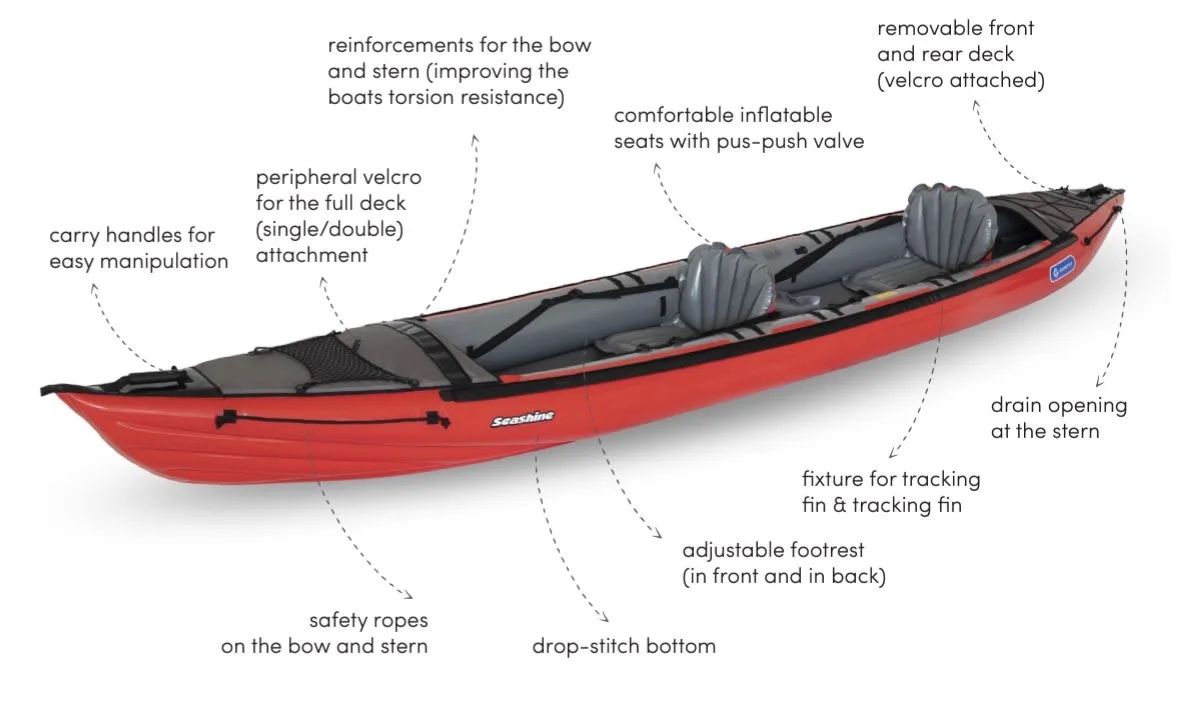
This is Gumotex’s third DSF IK, starting with the, simple, flat-floored Thaya (basically a hybrid Solar, which they still sell for around €400 less) and the lighter Rush 1 and 2 which was a new model in 2020 and had a more convoluted DS hull. The new Seashine resembles an elongated and wider Seawave, but without the Rush’s hydro-formed and more complex DS bow and stern. Underneath there’s a shallow V-shaped DS floor, changing to flat profile at the end, just like a hardshell sea kayak and the new Aurion. They’ve done a good job of smoothly integrating the DSF into the regular but lengthened Seawave, although in this two-up video you can still see the hull flexing in choppy seas, just like a regular Seawave would. As someone observed, a boat this long might well benefit from a rudder. There’s a kit you can buy.You wonder if the V floor might make the Seashine a bit more tippy, but tbh the Seawave had stability to spare.


The Seawave was a great IK. I had two and improved one with higher rated side tube PRVs to gain stiffness. It cost little and worked well. A DS floor is another way of doing the same and eliminates the traditionally fragile I-beam element (left; an old Semperit).
What are the benefits of a V-profile DSF? Better tracking than a smooth, flat floor, I imagine, but on the flat Igla a skeg easily ensured that. Better speed along with the added length? You’d hope so. A sustained 8kph or 5mph ought to be possible on windless flatwater. The ability to edge turn like a hardshell? That doesn’t really work with IKs I’ve owned (or I’ve never had a need for that technique), but the Polish bloke’s video below seems to show edge turning (leaning to the right to turn left) and so does the Aurion I am told. Only a comparison alongside a Seawave as well as the 4.2-m Rush 2 would tell, but it’s got to be a bit faster than either.
 Inflatable Kayaks & Packrafts