
See also:
Gumotex IKs
Hybrid IKs
Do you need a deck on your IK?
Seawave
Updated Summer 2026
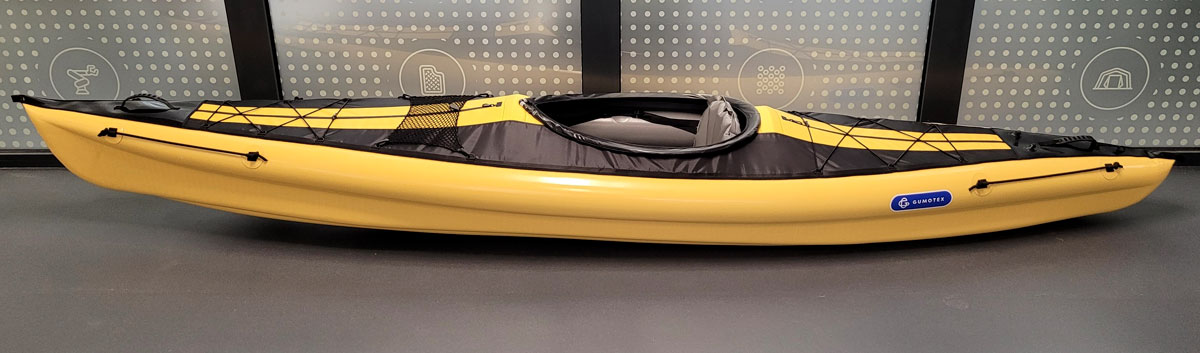

It’s now the end of summer 2026 but there’s still no mention on the Gumotex website or in their catalog of the decked, single seater Aurion, announced in September 2024 (video below). It does exist and is actually sold in Czech outlets at around €2230 discounted with the new 5-year warranty. I also see ‘B stock’ (seconds, with full warranty) going from €1700 in Austria – that’s about £1450 which is reasonable until you add UK import tax. So the boat is available to buy, but Gumotex don’t mention it anywhere and it’s not listed in the UK. Perhaps burned by the stalled Rush models launch in 2021, this may be some sort of pre-release customer evaluation strategy. They want to be absolutely sure they got this new IK right before listing it, but it’s been two years now and one owner/influencer I know is thrilled with his Aurion’s performance and now barely uses his older Rush I.
Positive video reviews appeared in Europe in summer 2025, pre-production prototypes dished out to reliable influencers in strong Gumo markets (ie: not UK), but there have also been actual civilian purchases too. Apart from above, currently most reviews seem to be videos in German, but we take what we can get here at IK&P.
Normally I’d scoot over to Laurent Nicolet’s Rivieres Nature YT channel (French Gumotex importer) who has tried the new for 2026 Caleya. They’re paddling pros not influencers, who often got new Gumboats early and shoot great vids with minimal chat, showcasing everything from the Gumocatalog from white water to sea with no indulgent piece-to-camera exposition. But so far they’ve only filmed the revised but still door-wide Swing 1 (their pics below) and Swing 2 2025, though Laurent did announce the Aurion on the French IK forum in September 2024. The discussion did not progress much.


One chatty German video from ‘RoGa‘ offers an AI-generated English translation – ‘adjustable fruit stand with push valve … for securing pastries‘. Good to know, but other segments make sense, and you get a good all-over view of the hull, inside and out, as you do on the garden vid below by Austrian? Kayak Kev. (translate ‘closed captions’ to know what’s being said). Another vid of his bottom of the page.
Anyway, the Aurion
The Aurion (look it up) announces itself as the hybrid replacement for the possibly outgoing Framura (still discounted right now). So like the old Solar span off the DS-floor or ‘hybrid’ Thaya, and the Seawave begat the longer hybrid Seashine, so the Framura has cloned into the Aurion. The dims are near identical. The price is not.
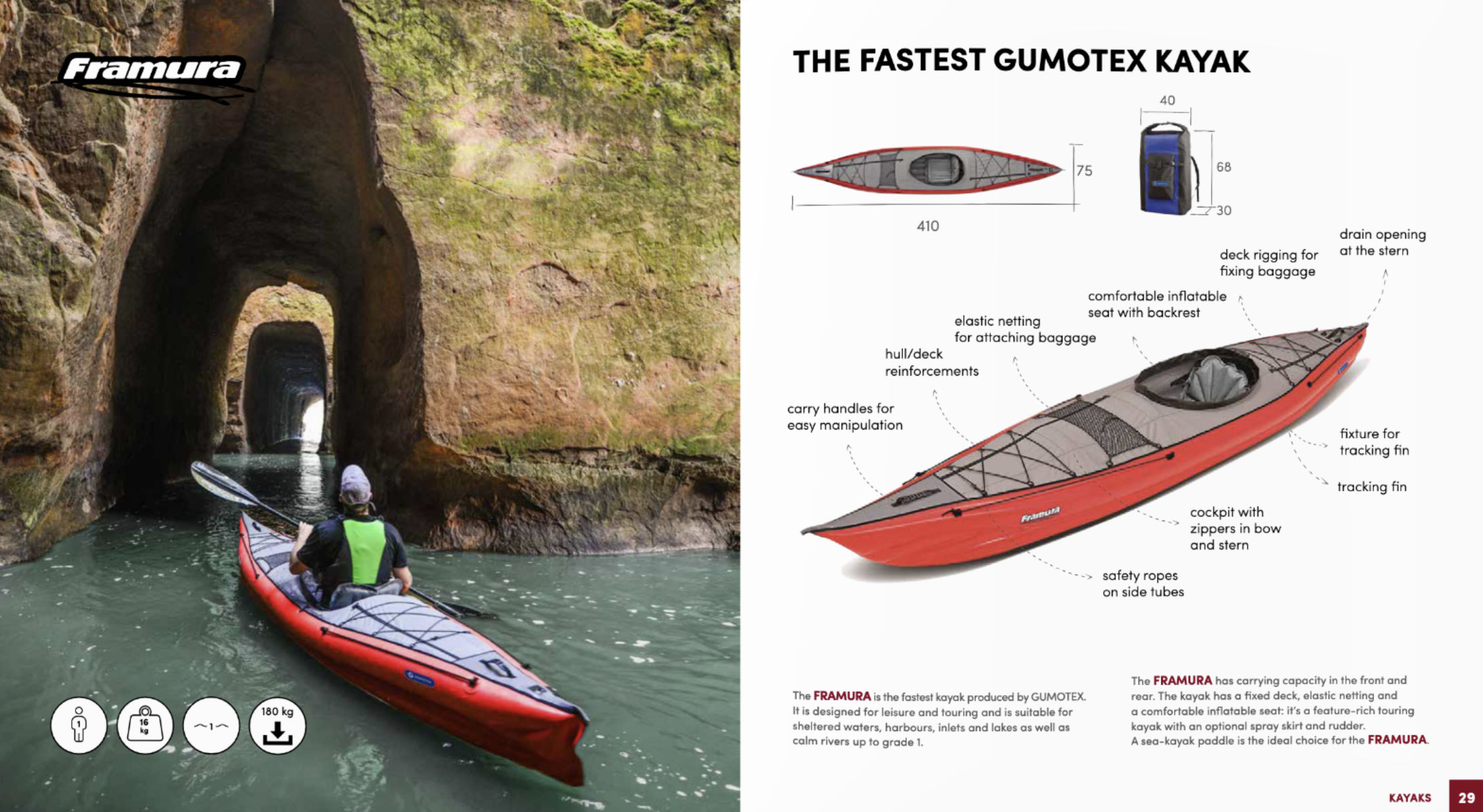
The Framura was a boat which Gumotex always pitched as ‘the fastest Gumotex’. But as I wrote here back in 2014:
I’m not convinced the 0.2 bar Framura is that much faster than a longer, stiffer Seawave [or later Rush 2]. And I also suspect it has not been such a sales success either. Perhaps claiming the former has something to do with the latter.
Indeed I wonder if ‘fastest’ was nothing more than a marketing label for the Framura to separate it from the dumpier, also-decked Swings. Someone needs to do a drag race or time trial with all of them.
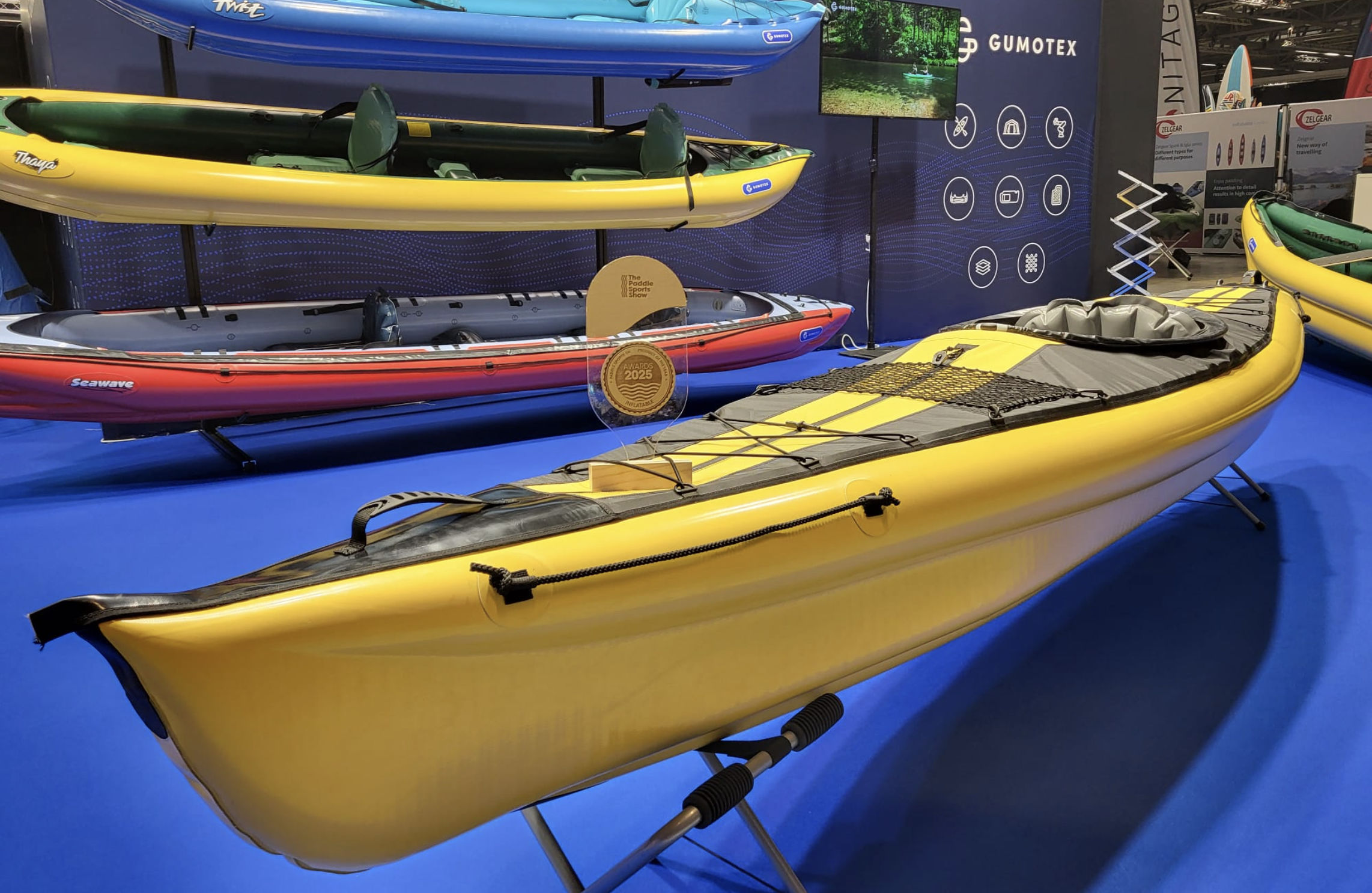

The new Aurion seems to match the Framuras LxW dims, but has been verified (see comments below) at at 402cm by 72cm wide. This is actually 5cm less wide than my Seawave (verified), no matter what the official dims claim. The Aurion’s payload is said to be 140kg.
Oddly, the Framura retained old-school 0.2 bar all round; low-end Gumotex pressures. The new Aurion runs 0.5 bar (7.5psi) in the dropstitch floor, and 0.25 (3.7psi) in the side tubes, while gaining a kilo (17kg, same as a Seawave) and ditching PRVs in the DS floor. That will be as rigid as a Grabner (who, fyi, manage stiffness and high pressures without DS). Only half a bar in a floor is nothing for dropstitch, and anyway, DS is much better at managing excess pressure (from blazing sunshine) than vulnerable, old school I-beams (like an air bed, see left). Along with less thick panels and of course rigidity for a negligible weight gain, this is the reason to incorporate DS in IK hulls.
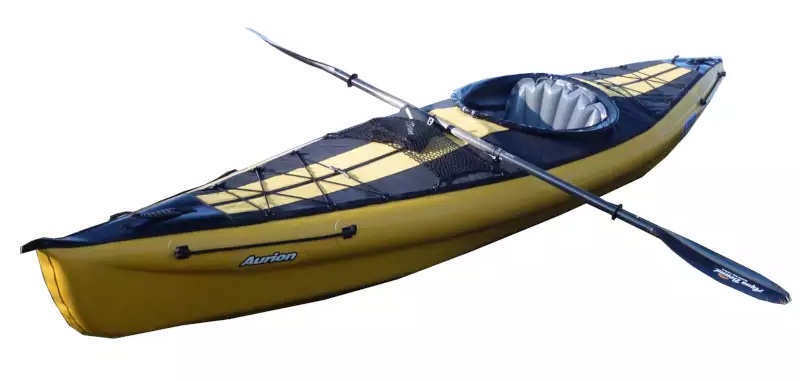
Your Aurion’s DS elements aren’t just a slab of SUP board joined at the hip, like FDS IKs costing a third less, but complex hydrodynamic forms (like the X500) which partly helps explain the price. Like 2025’s Seashine, the narrow floor has a shallow V, but only on the front half (with protective strake), producing a keel effect which flattens out to the back where the skeg mount sits. They claim this narrow floor helps make the Aurion 10% faster than its predecessor. As someone observed, the Aurion may be 75cm wide at the sidetubes, but it’s much less at water level which should mean less drag for a better glide.
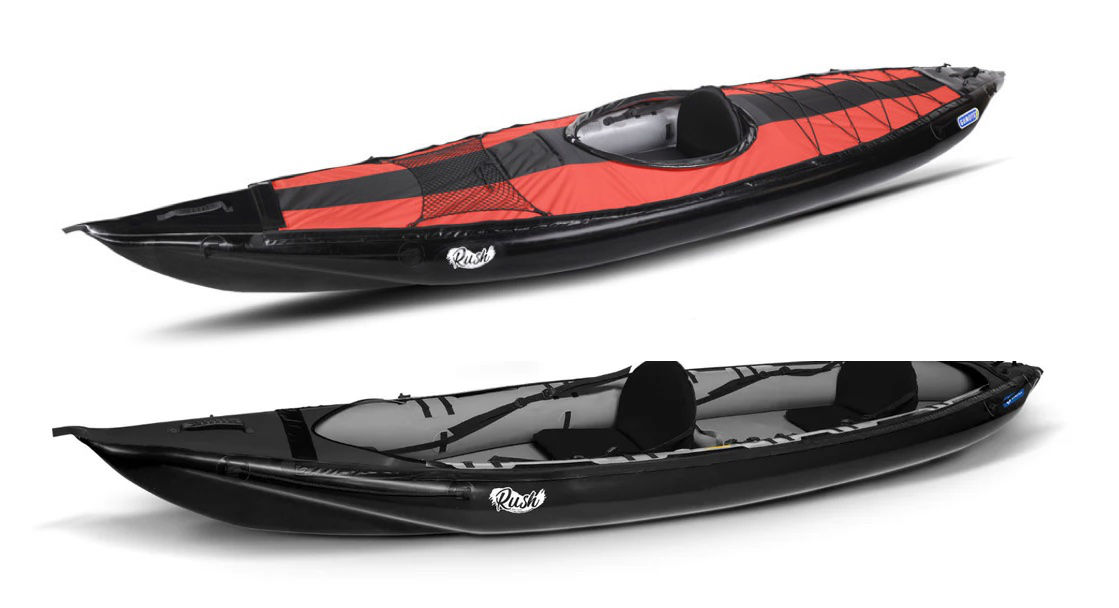
I haven’t visualised exactly how, but the single chamber (or linked) side tubes are said to be DS at water level, but regular round tubes above, but presumably running 0.25 bar which won’t strain the DS. In this way the upper non-DS side tubes act more like stability pontoons, and many testers report the Aurion may feel tippy initially, but has good secondary stability when leaning right over (or broaching along a wave) like a proper sea kayak. My Igla had the same overall dims and was perfectly stable to me.
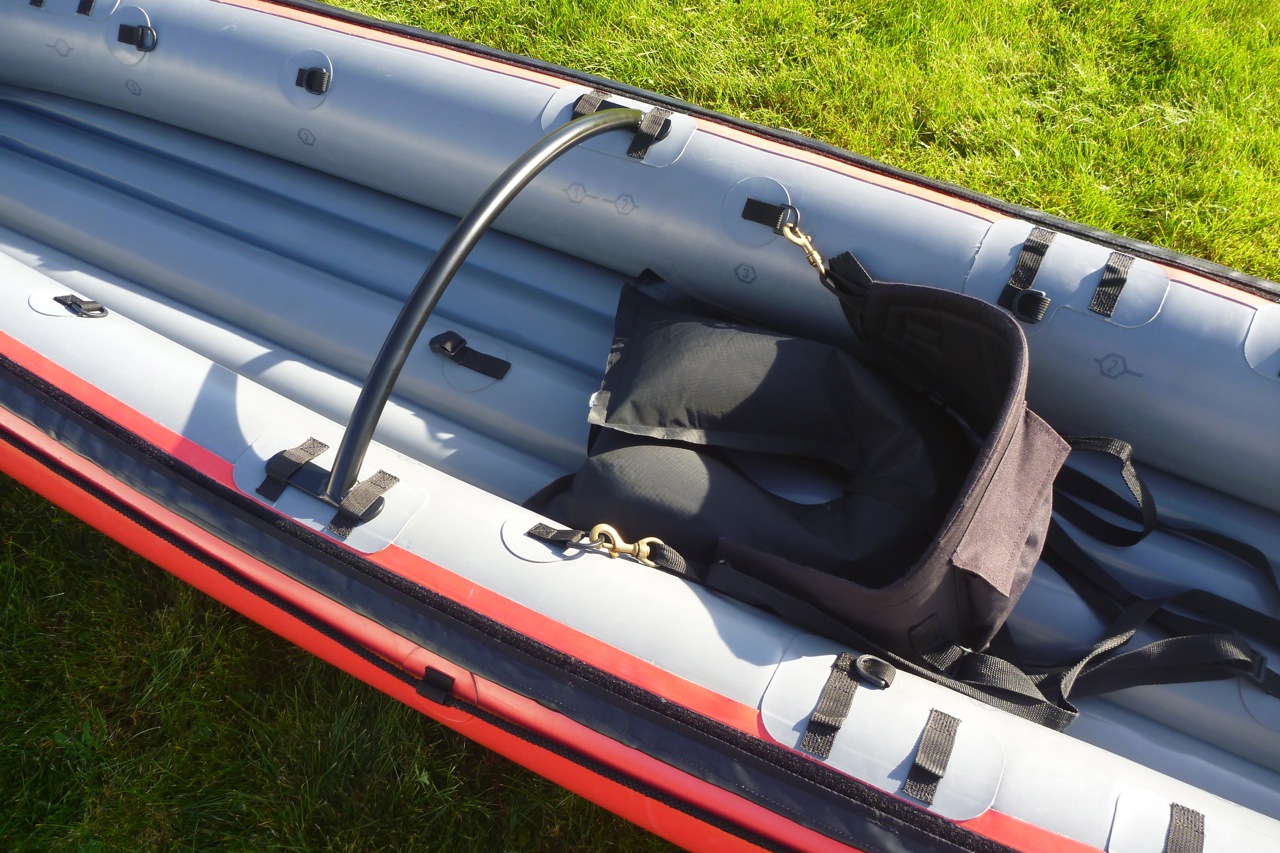
No one’s shown an out of the bag assembly yet, but the Aurion uses a pair of alloy supports fore and aft of the cockpit to keep the deck convex so water rolls ofF. The front bar can also give something to brace knees against, as I found on my Seawave (so no thigh straps needed) and supposedly, they tension the boat; holding the sides in as it flexes and opens out midway in heavy seas. You’d think the DS floor would see to that, and if these bars are anything like what my Seawave had (left), there’s a neater MYO option.

Meanwhile, the seats still look crude, heavy items made (I suspect) from Nitrilon off-cuts (unlike my Seawave adaption above left). They can easily be swapped out and so can the footrest. They insist on retaining a blow-up cushion, but at least it’s now adjusted by two straps running up to the cockpit. For tensioning, it’s a big improvement over the older, floor mounted set up, and you could easily replace the pillow with a piece of hard drainpipe, as I’ve done on my IKs for years (left).
With a narrower than normal IK you’d definitely want thigh straps to steady yourself, unless the front deck support brace works. Combined with a proper footrest, it all makes a huge difference to connection and control or flat or lively water.

Some people become exorcised by the grab lines on the sides, but they’re just a safety requirement for inshore sea use in some markets, like France (where it’s currently not sold anyway). Talking of which, there’s also a rudder attachment hole on the back. Having experimented with rudders on my longer Seawave, it’s important to understand that on a kayak, rudders aren’t primarily about steering like on the QE2 liner; they’re more for compensating against crosswind drift on open water. With a rudder trimmed to one side you can paddle normally across a side wind and not have to haul hard on one arm to compensate. Very handy at sea, especially on overnight paddles where you may end up with winds you didn’t ask for.

The cockpit takes a flexible coaming rod for a proper spray skirt, at which point you have to ask, would you want a fixed-deck single seater IK? You lose all the benefits of easy entry from or by the water, just to avoid a little paddle splash, though I admit a fore deck is handy for gadgets and snacks. Then you have the cleaning and drying issues, baggage loading complications and so on – all for what? In that way the similar but slightly longer and wider Rush 2 is 10% lighter, cheaper (though not once you buy the deck) and can take a second paddler which has proven benefits to well being and social bonding.
It’s good to see Gumotex leading the way with non-PVC hybrid IKs: first the basic Thaya slab, then the more sophisticated but initially troubled flat-floored Rush models, and the half V-hull Seashine which has been copied onto the Aurion, but with semi DS side tubes. Each iteration refines the Gumotex hybrid format, but unfortunately at a price that’s unlikely to see it chart in the UK or many other markets.


More detailed impressions from an Aurion owner of over one year:
I was privileged to test an Aurion prototype and bought two post-demo units from the company. I must say that for performance touring I currently do not know a better inflatable kayak.
Aurion has primary stability that would be slightly less than Framura but, unlike Framura, Aurion’s secondary stability is the best on the entire market. This kayak can perform all advanced manoeuvres on the water and doesn’t need a rudder if a skilled person gets their hands on it. Sculling draw, bow rudders, cross-bow rudders, low bracing, low brace turns, edge turns, or even hanging draw are easy to perform. I haven’t tried to roll my Aurion as I don’t have this skill yet. In order to edge Aurion, it’s best to push the knee into the side tube – the kayak goes into secondary stability right away, and holds it securely thanks to the classic side tubes.
The footrest cushion they installed is very comfortable to use if inserted upside down. 3psi gives enough bracing. The sides, like you mentioned, are 3.7psi and this low value is only due to them being classic side tubes. The seat is a regular Gumotex seat (the same one that you get with Seashine, Rush 1, and now also Caleya – inflating up to 3psi). All chambers (including the seat and footrest) now have push-push valves.
The v-entry floor inflates to 7.2psi. The thing with Gumotex’s drop stitch is that it is a completely different production/bonding process to integrate drop stitch into Nitrilon as opposed to regular reinforced PVC. This pressure rating is the highest they’ve currently achieved and these kayaks should not be inflated to pressures higher than this. However, I think 7.2psi good enough considering the whole construction which is stiff enough to allow good performance. My speed tests results were: 9.5km/h with a wing paddle and the same with a Greenland paddle.
Dimensions: although the catalogue officially stated 400x75cm (yes, 400, not 410), my verified dimensions are 402x72cm. Also, on the subject of waterline – the widest waterline point in Aurion is only 57cm wide (measured).
To sum up, Aurion has now become my number 1 kayak (it dethroned my Rush1). I use it very often and my paddling skills and experience only benefit from that.
LikeLike