Author Archives: Chris S

Water shoe review: Teva Omnium

See also: Packrafting shoes or boots

tevafloater

It’s 2025 and I’m on my my third pair of Teva Omniums after nearly 15 years. It pays to remember we’re not just ambling down to the sailing club for a drink, we’re balancing over slimy, head-sized boulders exposed at low tide, often while carrying a kayak, or walking through bogs or tidal mud which can suck off a shoe.

They were going for just $40 at REI Denver, back in 2011. Like it or not, much of how something performs depends on what it cost. As a replacement for my old Keen Arroyos, the Omniums hold my foot much more securely, with a velcro adjustable heel strap, a velcro adjustable clip buckle strap over the top, plus those dubiously effective cinch lock laces over the front. It’s the over-the-top strap that makes all the difference to holding to foot securely.
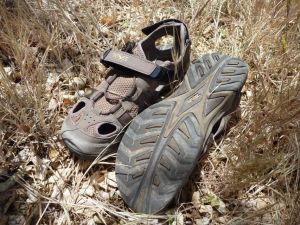
The Tevas also have no wear-prone threading attaching upper to sole, and a solid and chunky-looking plastic-rubber footbed derived from one of their sports sandals and doubtless designated with some snappy acronym.

I have found a closed-toe water show much better for wading than a regular sandal, because the open front of a sandal drags through the water as you wade. Closed toe ‘sandals’ work much better here and elsewhere, plus on land or water the toe protection is welcome. My Omniums feel more sure-footed than the Keen Arroyos ever were, mostly down to the fitting straps, but also due to what feels like a thick and less flexible sole which have not compressed and lost cushioning over time, as my previous Teva open sandals used to do.
We walked a couple of hours up The Narrows at the top of Zion park, following, crossing and wading along the Virgin River countless times. The Tevas gripped as well as anything here, drained readily and felt agile and secure when boulder hopping.
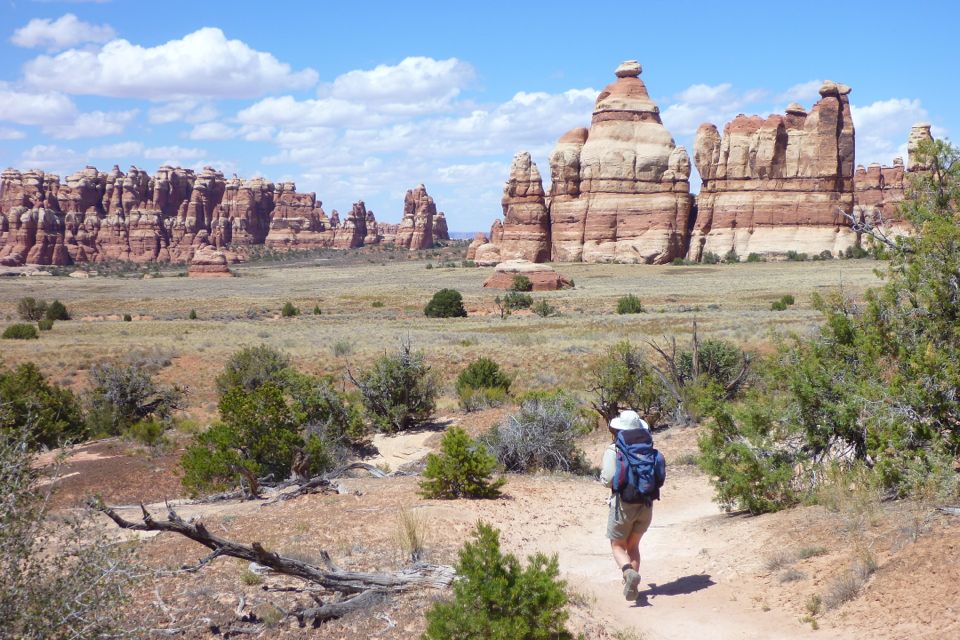
For regular dry walks up the side of Zion canyon and on a couple of longer dry desert walks in Canyonlands, they performed well enough, the softer-than-a-boot soles gripping very well on dry slickrock at the cost of letting some sand in in the washes. Lifting a foot behind you once or twice was an easy way to let the sand spill around the toe holes. At the end of a hot, 11-mile desert walk there was only a little soreness, but that could be due to my desiccated feet after a fortnight in this very arid climate. I feel that under the weight of a pack and clad in some seal skin socks, they’ll work well in northwest Scotland, though for an overnighter I think I’d sooner use the proper hiking boots.

With their wide snouts the Omniums are a bit Croc ugly, but wide shoes suit my feet much better. I haven’t read them all, but the reviews on Teva.com did complain of fast wear; no great surprise with modern sports shoes. I do wish they’s put a chunkier tread on their soles, but another plus: they float – always a good thing in the water. I give a paddlepacking thumbs up for the Omniums. If you can grab yourself a bargain you’ll have a great water shoe.

Two years later and my Teva Omniums are getting regular use for day paddles and are still hanging in there with no actual signs of breaking up. The soles are now too smooth to be useful on mud, but were never that good anyway. All in all, tougher than the similar Keens, but still limited for loaded overnight, all-terrain treks.

omnioo

Four years later and nothing much more to report. Decay is gradual but they’re still hanging in there. Nothing has actually broken or worn out. The soles are getting quite thin and have lost just about all the tread.. To be fair most of the time these shoes are in a boat or on a pushbike which may explain how they’ve lasted so long. So a short time later I used them on a three-day walk in Italy – about 80km. I  found the Tevas extremely comfortable on the mostly road and gravel track train (once I put some socks on). The thick, squidy heel really helped and the front sole wasn’t too thin for the gravel. They breath well of course (temps in the high 20s) and are easy to take off. 

tevaomnium

In 2016 I bought another pair in the US for about $60 and by 2020 the sole was peeling off here and there and I’ve just glued them up a second time. But they’re still my go-to paddling shoes.
Another five years later they’re doing OK. A bit more peeling going on. I think i got some Omnium 2s which look a bit less clumpy. It’s 2025 and they’re doing fine on the water on the bike and in the garden.

Gumotex Swing IKs

Updated: Summer 2020

See also: 2020 Rush models with D/S floors (like the Thaya)

swinginovlites
gumotexfabrics18

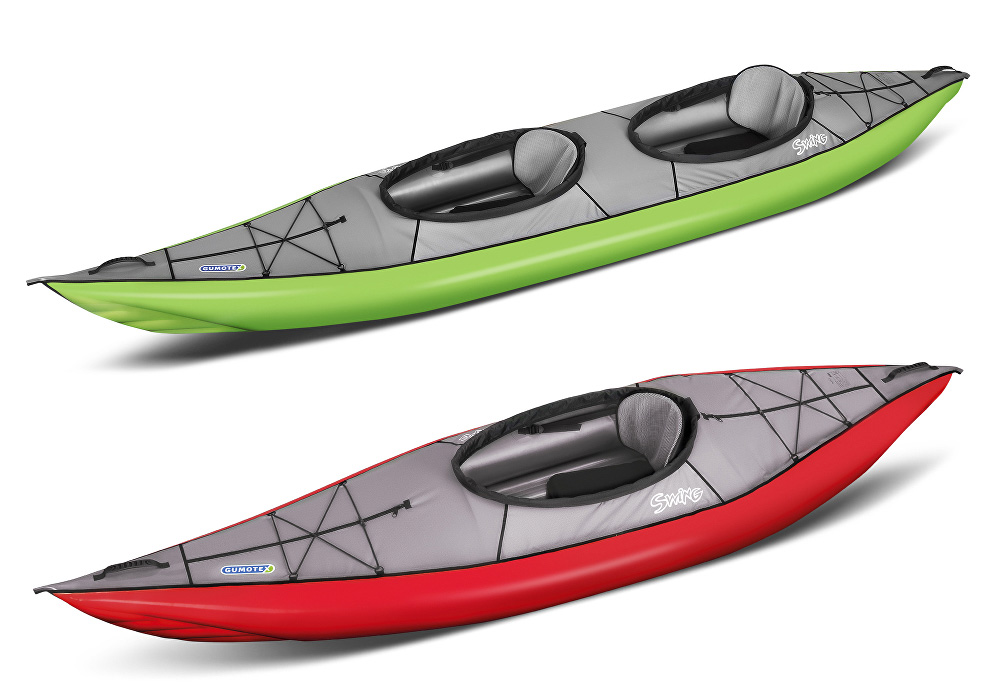
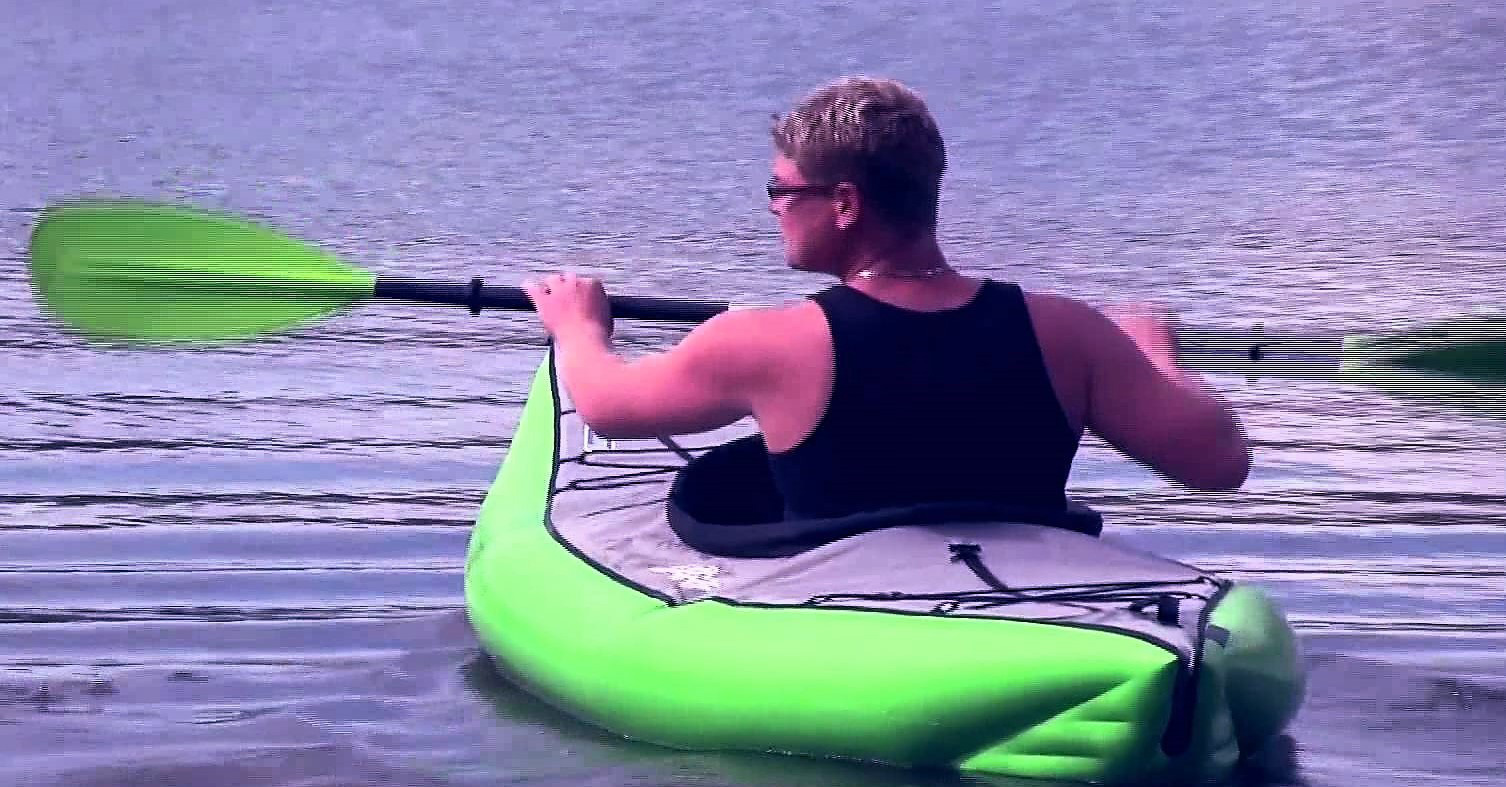
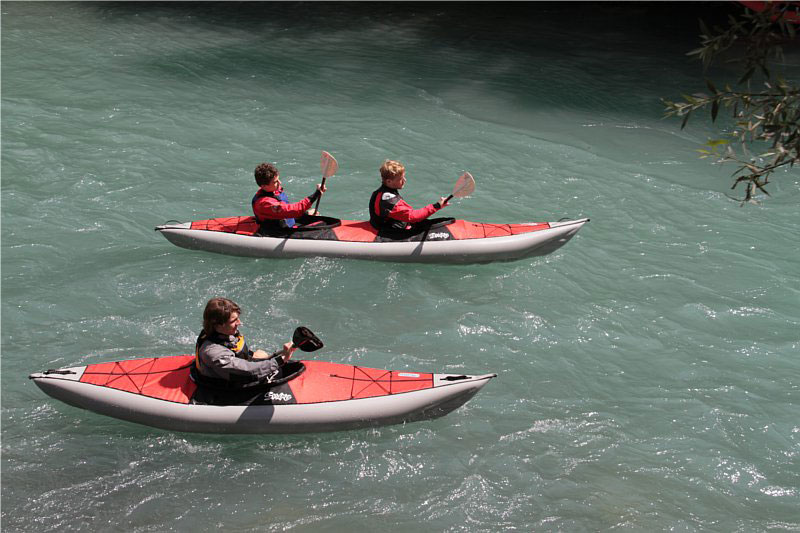
The Swings are fixed-decked solo or tandem IKs pitched at recreational users who seek the reassurance of a very wide boat and the dryness of a deck.

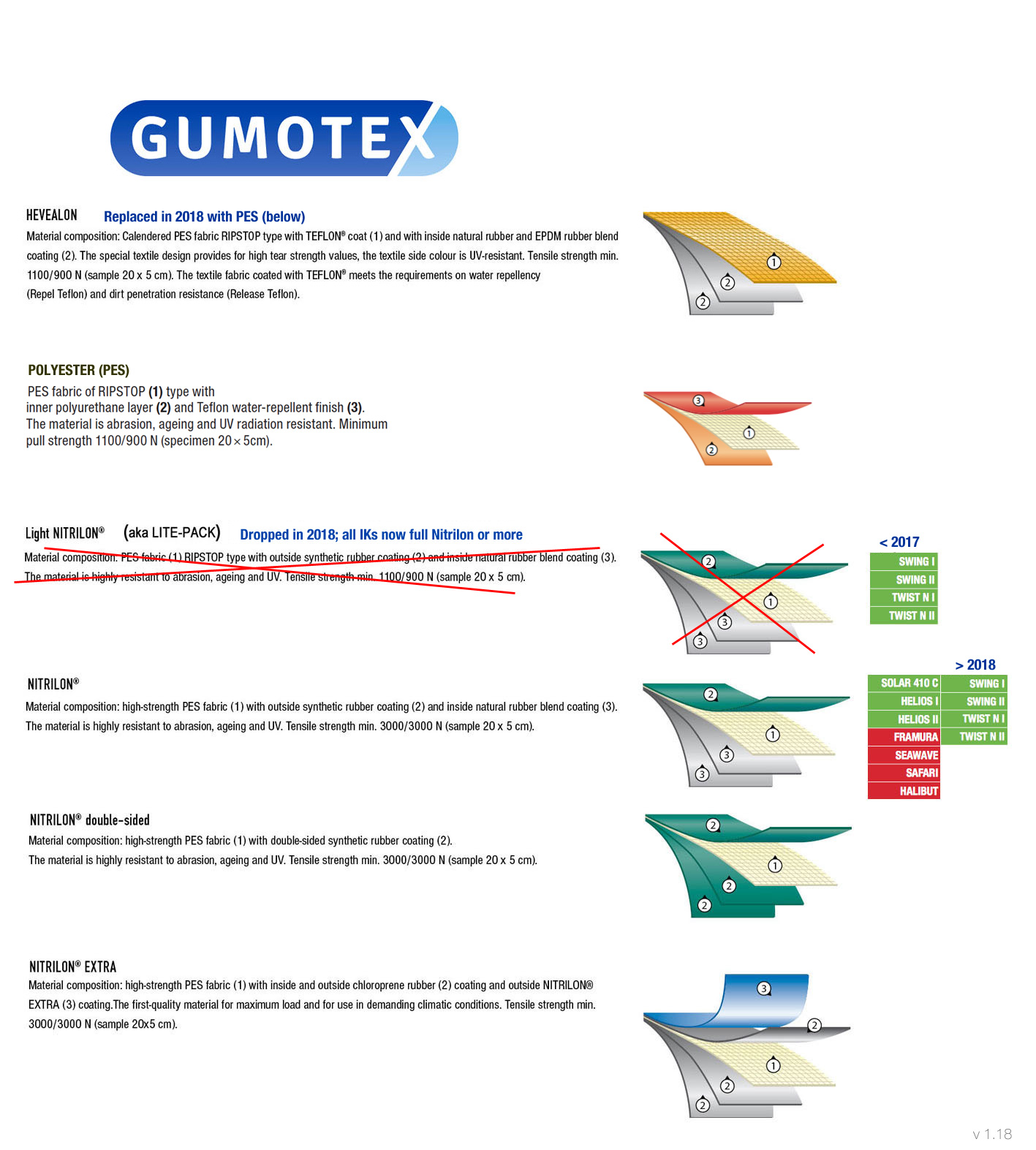
There were once and are maybe still two versions of Swing 1 and 2. Innova distributors in the US show red/black green/grey hulled models which they still list as made from Nitrilon Lite™. Europe and maybe elsewhere never had the black-hulled models and are made in Nitrilon (Nitrilon Lite™ has been dropped). The claimed weights for identical boats from EU/US are the same. You presume the green/grey doubles are now identical. See the table right about IK materials with more here

SWING I ▪ Length 3.16m ~ 10′ 4″ ▪ Width  87cm ▪ Weight 11.3kg ▪ Maximum load 120kg ~ 265 lbs

SWING II ** ▪ Length – 4.02m – 13 feet  ▪ Width  87cm ▪ Weight  14.3kg ▪ Maximum load  220kg ~ 450lbs

Note that what Innova in North America call the Swing EX is a Framura in Europe – a slimmer, fixed-deck, 4.1m IK which is much more suited to solo touring and inshore sea kayaking.

swingbots
swingwide
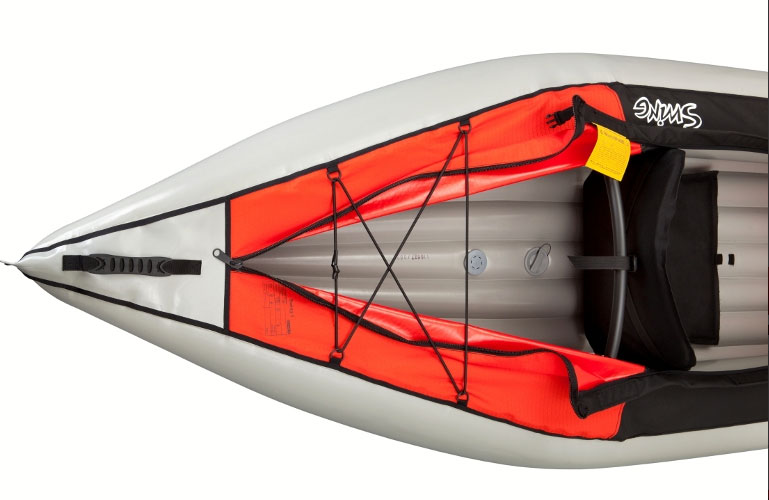
swingbow

As others have commented, they appear to be taking on IKs from Advanced Elements and even the bird’s-eye view is similar. From the profiles it appears they’re more ellipsoid or ‘lemon-shaped’ than other models, or maybe it’s just that they’re substantially wider which exaggerates this impression.

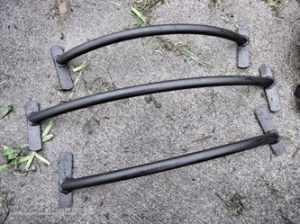
The Swings use 2 or 3 curved alloy crossbars to keep the deck taught (similar system on my Incept and Seawave) and make room for the legs, as well as spread and form the width of the boat. Some blurb states these crossbars make the boat more rigid which may well be true. Constraining the sides (stopping them from flexing out as the boat bends longitudinally) will have some effect in overall stiffness.

As far as the preferred boats for touring, what is desirable is a decked boat the length of a Swing 2, but set up for a single paddler. That is the Framura aka ‘Swing EX’ to Innova – a good-looking, solo-touring, fixed-deck IK for those who think soloing in a Seawave is a bit much. 
Sure you can sit in the back of an SW2 and load the front, but it’s not right, is it? What are the actual benefits of a fixed deck on an IK? (the Swings’ decks unzip partially). Limiting swamping – sure. Keeping the sun off – maybe in sunny lands. Keeping you warm – I suppose so, but that’s what a dry suit ought to do: ‘dress for the swim [falling in], not the paddle [air temps]’ they say.

And many users complain that the zips are far from watertight. And so I conclude that the Swings may well be popular (actually I don’t think they were) but fall into the less desirable ‘bloat’ category: much wider than they need to be which is great for nervous day/rec users. But for the smaller niche of multi-day touring and sea use (space, speed, convenience), they’re not so ideal.

Another review Some Swingers chat

Water shoe review: Vibram FiveFingers TrekSport

See also: Packrafting shoes or boots

I like to go barefoot so when I spotted Vibram’s FiveFinger ‘glove slippers’ a while back I thought they looked fun. Recently I took the plunge and selected the TrekSport model, thinking they were the most heavy-duty and hike-worthy of the range. The price is nuts, up to £100 or more in the UK, and as it is I’m still a bit shocked I actually paid $85 (£55) for these.

A BBC article shows how Vibram hit the jackpot when a bit of in-house experimental fun coincided with a barefoot running craze in the US. Sales went through the roof, and with success came the attack of the clones which the article describes.
Outside of California, you might feel a bit silly going shopping in a pair of 5Fs, but it has to be said they do raise a smile, and where possible, less clumpy footwear is always better. I’ve read rave reviews about the improved feel and ‘back to nature’ ergonomics of 5Fs, allowing the wearer to reconnect their feet with the [mother] earth so as to run not unlike the virile, loin-clothed hero from the 1980s Countryman movie (brilliant reggae soundtrack, btw).

Out the box the TrekSports don’t exactly slip on like a pair of well-oiled Crocs. It took a lot of fiddling to get my smaller toes into the corresponding pockets. Once done, you tug on the velcro band to secure them round the ankle and step out. On the first walk, heading into Willow Gulch down in Escalante, the baking sand on a 105-degree day burned through to my feet, but at least the close fit stopped any of that sand getting in.
Later on, in the shallow creek, they gripped reassuringly on all surfaces, even wet and slimy, and were certainly better than bare feet; the studded tread worked well. But for boulder-hopping they weren’t quite as secure as the Omniums, feeling a bit like the rubber-soled socks that they are. And after a couple of hours of wading some grit did get in which required a rinse out followed by a repetition of the tedious refitting dance. If there’s a knack to putting them on, I haven’t got it yet because next day up in the cooler Box Death Hollow forests, it took Five Minutes to get each Flipping Foot’s Five Fingers into Freakin’ Place. Tracking and crossing the rushing stream along the faint path for a few hours, the inevitable toe-stubbing plus head-on or side glances meant each time we crossed the stream I lingered a bit to let my throbbing toes numb a little in the cold water. I ended that walk deciding that while clearly not pretending to be a hiking boot, the many-toed TrekSports were too flimsy to be trekky after all.

The Emperor’s new shoes?
And so we must ask the five thousand finger question: do individual toe pockets on slipper-like footwear give any actual advantages in comfort, agility and performance against a regular water shoe?
Short of being a chimpanzee, I have to say not that I could tell. Had they been just a pair of snug-fitting, ten-dollar plimsoles or even a wetsuit ankle boot, they’d have worked as well on the trail and in the river. As it is, the thin soles transmit sharper rocks and maybe I’m clumsy, but in particular, the lack of toe protection bashed my toes as painfully as I recall back in my Teva open-sandal days.
But that is for boatless creek wading. For something like a day paddle in my packraft, with its tight foot area for my size 11 feet, the Vibrams may have a use, being light and robust enough to deal with put-ins and portages. On cooler UK paddles where socks can’t be worn, they may not be warm enough.

And then you have to ask: how long will something this thin and stretchy last? About as long as some of my socks I suspect. I did also wonder if just two toe pockets – a ‘foot mitten’ – might satisfy the anatomical ergonomists who believe in the benefits of full toe articulation while making the shoe a whole lot easier to put on?
It seems so with Vibram patent dodging 3T Barefoots from Bodyglove with three toe pockets. They seem to be pitched at SUP paddlers and not trekkers, but if I’d seen them earlier, I may have gone for them instead. I’m pleased to have tried the Fives but since sold them.

It’s worth remembering that you can’t wear socks (including drysuit socks) with such shoes, so for warm weather only.