Updated summer 2025

My 18-month-old TXL sold on ebay and I’ve just received a TXL Plus+ which I discussed earlier. Same boat but a lovely blue, heavier and with 80% more tear resistant hull fabric thanks to a denser weave and thicker 420D fibres. The floor is now full-weight 840D with extra coating. All that and it only costs €70 more than a standard TXL. Anfibio TXL page. Put that down to advances in TPU fabric technology. What is not to like?
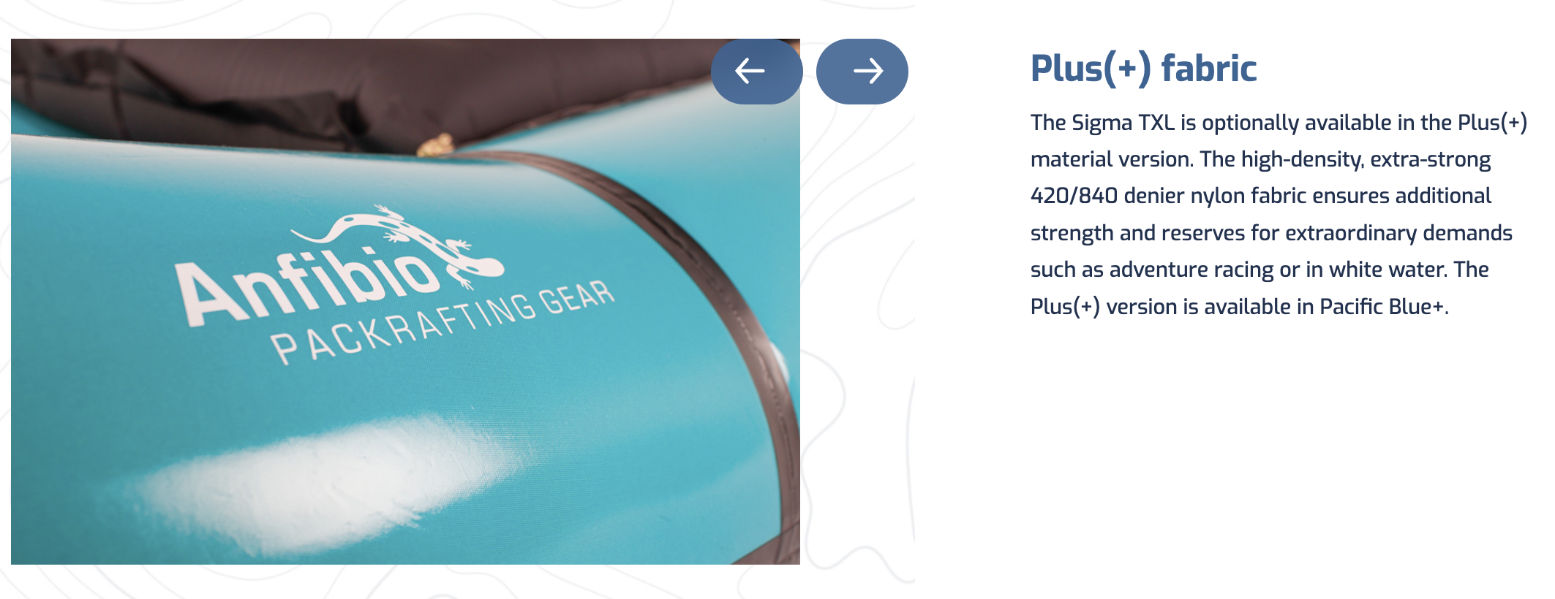
Who knows how the ‘80%’ is calculated, but for the small weight increase, I’m in. For me, mostly paddling the coast alone, durability trounces light weight. If there’s a heavy duty version of anything, I’ll usually take it.
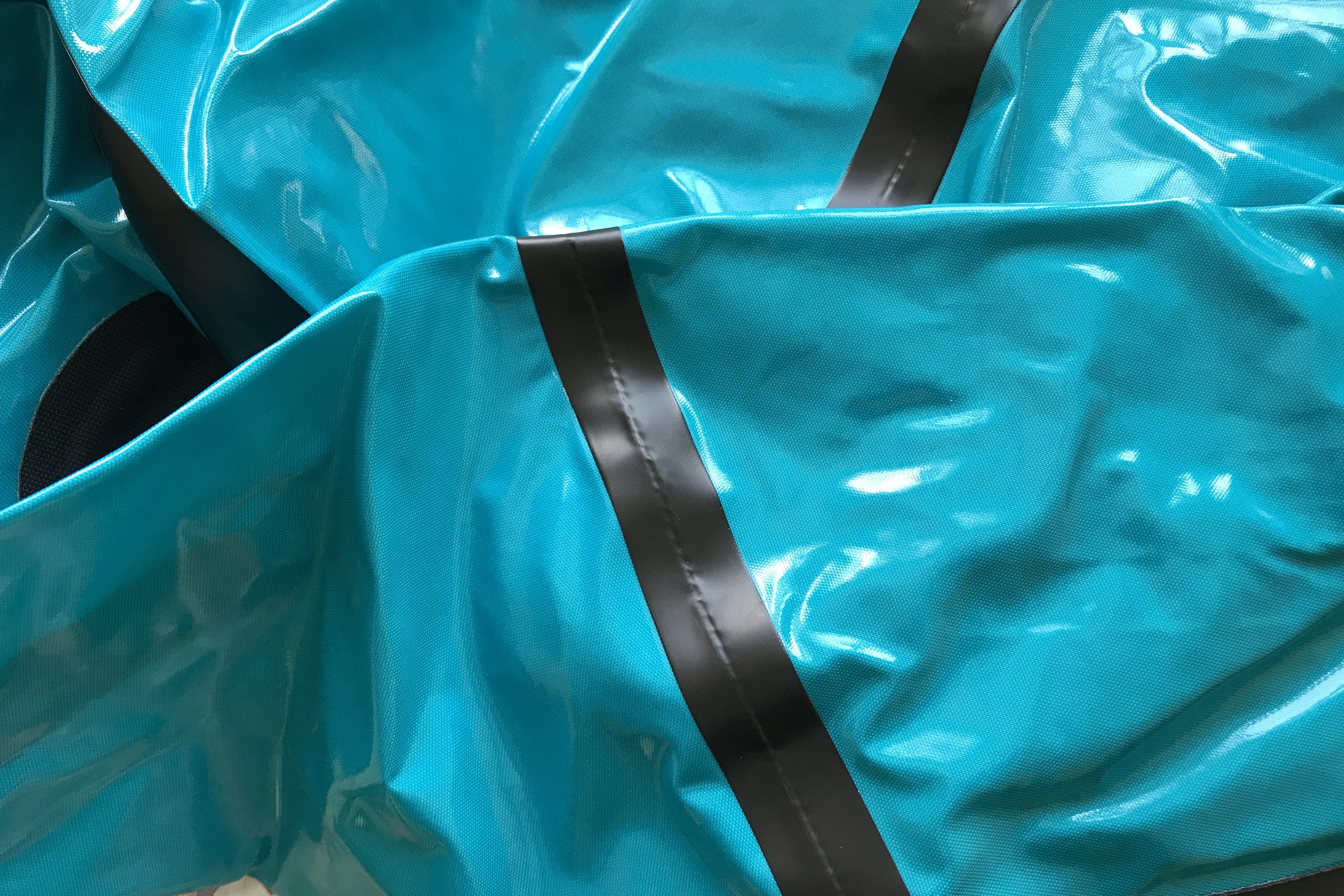
My TXL+ comes in a striking colour they call Pacific Blue but whose true hue can be hard to replicate on screens. I know from book cover printing that blue can be maddeningly inconsistent – WYS is not WYG. You will see the variations on this page – and that’s before we get into the subjective ‘was the dress gold or blue?’ argument. Anyway, I love my TXL+’s dark turquoise with tealy backnotes.

One thing I was pleasantly surprised by was the lightness of the box when I picked it up from the parcel depot. Did they miss something out? Nope, but back home, rolled up on the trusted kitchen scales (calibrated to <1% error, fyi), my bare TXL+ came in at 2971g or just 201g heavier than my green one. Weights may vary a bit but the dimensions are as below.


All Sigma TXLs now have the skeg mounted further forward. On the first batch the skeg was only half submerged (left) and not fully effective. Anfibio haven’t moved the skeg onto the floor, as I did with mine, but straddling the stern and the floor (below left).
On my new boat it’s one less gluing job and thinking about it, it’s actually a better position, too. The curvature of the inflated stern where it meets the floor adds tension which holds the skeg securely in place (but not always; see below) and it’ll probably still stay submerged on flatwater.

With my version on the floor sheet, there was more submergence but less tension. The other day the skeg got dislodged as I got washed to and fro onto a rocky ledge while landing. I thought it was a fluke, and luckily I noticed the skeg lying in a rock pool before I set off again. It happened again a couple of years later off a beach, so I fixed that (see below). It’s one reason I stick hi-viz tape on my skegs (the main one being while packing up it’ll get forgotten in the shingle).
Don’t lose your skeg
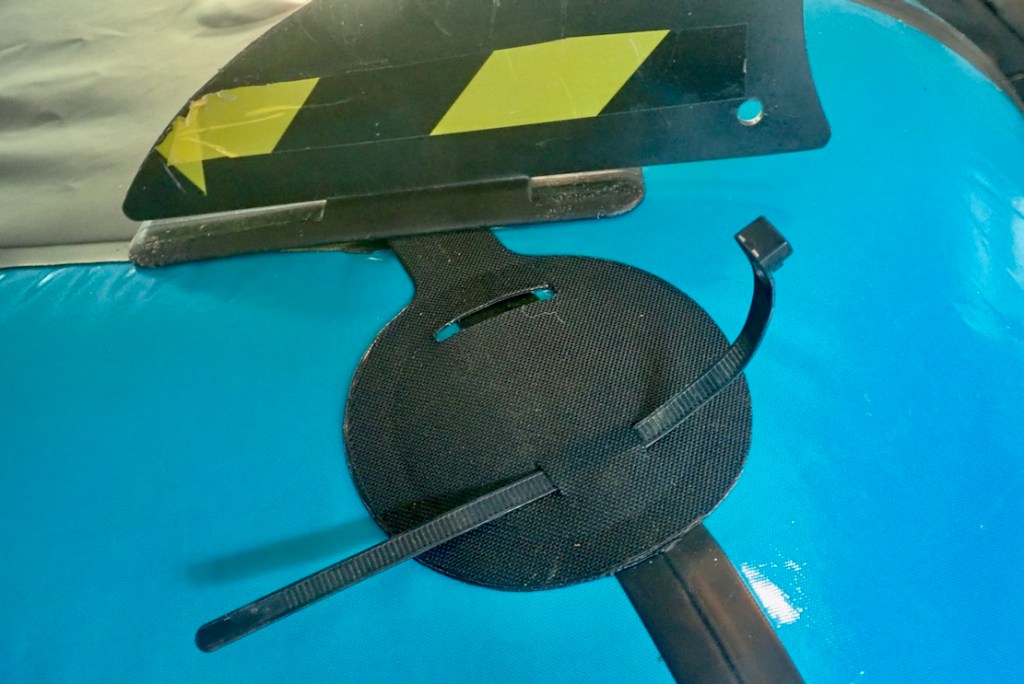
Even on the curve of the stern, the lack of tension, or perhaps the low-friction woven-nylon skeg-mount patch, can dislodge an Anfibio skeg following a small fore and aft movement of the hull pressing on the sea or riverbed. On a flowing river, paddling skeg-free is OK and you might need the clearance anyway, but at sea you definitely want good tracking. Here’s one solution.
• Stick something like a fat sharpie under the rear skeg patch to lift the fabric away from the hull; you don’t want to stab your packraft
• Make two incisions which line up with the hole at the back of the skeg
• Feed a reusable cable tie through the slits and leave it in place. The skeg will now be secure.



The TXL+ comes with the same, huge TubeBags giving 200L of in-hull storage (right). The new zips are exceedingly stiff and the tiny zip pulls don’t help. As before, I zipped on a zip tie and even then it was quite a tug until all was lubed with silicon and it now runs like a rocket sled on rails.
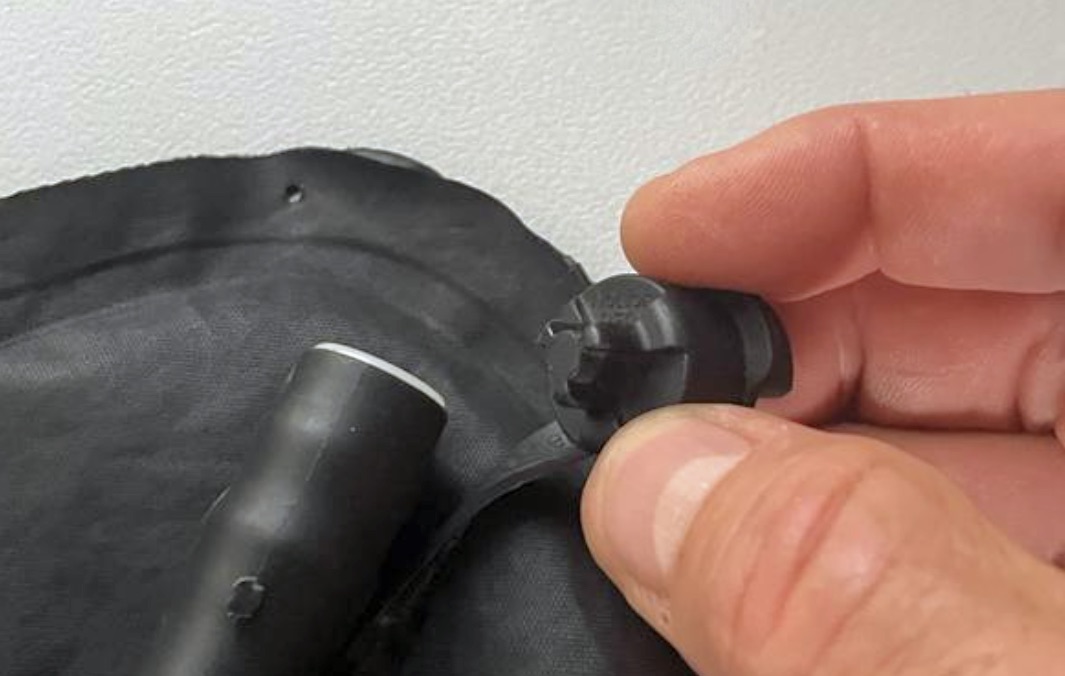
I included the +’s BNIB seats with my green TXL as my own seating is too bodged and ‘specialised’, but am told that the valve caps can now jam the sprung one-way valve open (left) for hands-free deflation. That’s a big improvement on the ‘press-valve-with-fingernail’ version that I crudely adapted to a Twistlok, and now means you can fully deflate the seatbase easily, even if it won’t be that fast.

As on my green TXL, I’d glued on 4 tabs for my knee straps. I don’t have the green TXL at hand, but it did look like the OEM threadable strap loops on the top of the side tubes (right) are a bit chunkier. Knowing how little tension I actually put on the knee straps, I thought I might risk using them for the rear strap attachment point. But in the end I decided the further back position (as on the green TXL) was better, especially as I’ve lately noticed that with Multimat and MRS footrest fitted, I sit quite a lot further back.

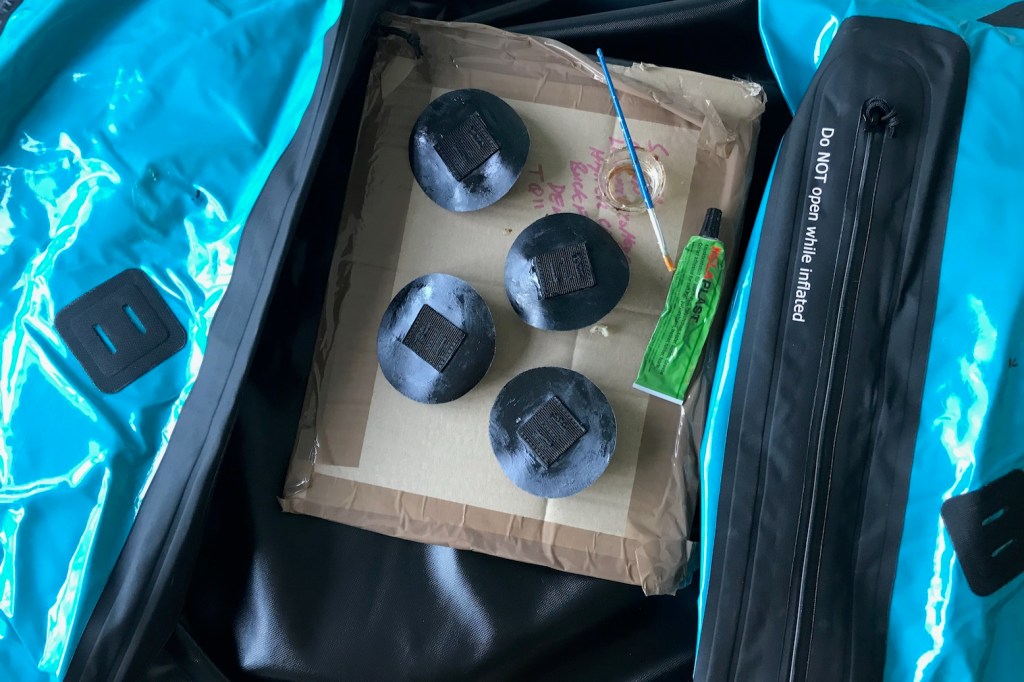


Top left: The bits you will need to stick on 4 attachment loops. Top right: Watching attachment loops dry. Below: Wait a bit then apply another coat, wait a bit more then position the loop and heat with a hair dryer to reactivate glue (it was so hot today it kept shutting down; I had to ‘suction cool’ it with a hoover). Bottom left: Put on a hard surface and get stuck in with the roller. Bottom right: Stuck on after rolling
I love the way dried Helaplast magically turns sticky under some heat. Full gluing procedure described here.

I didn’t receive one, but Anfibio have refined the mini handpump too. It’s basically an adapted party balloon pump and costs only €10, but their version now has a screw-off nozzle handle (left). Good idea as I can see it getting snapped with an unlucky whack while in transit. In fact that’s exactly what happened to my old version after unpacking one time. I eliminated the handle, glued the hose direct to the shaft and added a bit of garden hose to be handle.


I mentioned here about repositioning the main hull inflation valve forward for easier topping up on the water when solo. Big-volume packrafts like a TXL can get a little saggy after a few minutes paddling on cold water – you will notice the light crease in the side tubes when sat in the middle. But on my last couple of outings with the Multimat, that didn’t happen; the flood pad did its job in constraining sag. Not having to over-inflate to get the boat firm is desirable; just enough pressure to get the job done. Problem is, my Multimat has already been repaired once and weighs nearly a kilo. Oh well, at least you can sleep on it too.

The 840D floor is reassuringly heavy duty, with a textured interior and a smooth, waxy exterior to glide across the brine. On my last Alpacka I went through a phase of light 420D floors then reverted back to a full 840D. Floors are at the sharp end so need to be durable, though of course they’re dead easy to repair.
In the end it’s hard to tell if my blue, TXL+ hull fabric is thicker than the plain TXL. It’ll all be in the mind, like the blue/gold dress.
TXL+ maiden paddle with true-blue photos here.

 Inflatable Kayaks & Packrafts