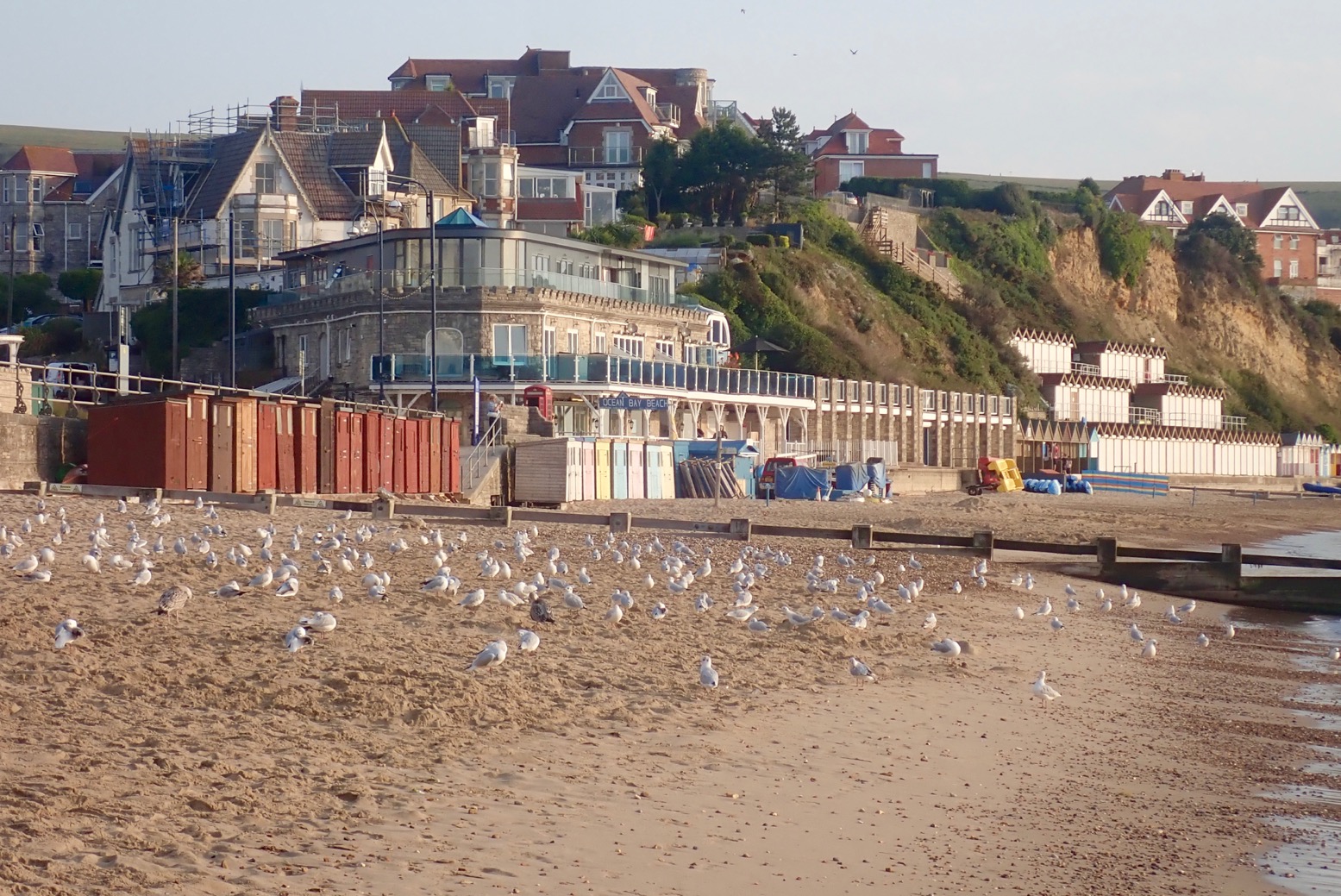
Ten minutes after a paddling away from a tranquil Swanage seafront bathed in a Turneresque light (above), we found ourselves battling a stiff breeze rolling off the Ballard Downs on the north edge of Swanage Bay. The odd whitecap scurried by, a sign that the IK Limit was not far away. This felt like more than the predicted 10mph northerly. We dug onward, and once tucked below the cliffs the pounding eased. The northerly was probably amplified as it rushed down the south slope of the Downs and hit the sea. We’d paddled through that turbid patch – a bit of a shock before breakfast. What would it be like once out in the open round Ballard Point? Mutiny was afoot.
“Let’s see how it is round the corner, then decide,” I informed the crew. “Aye aye, cap’n sir.”
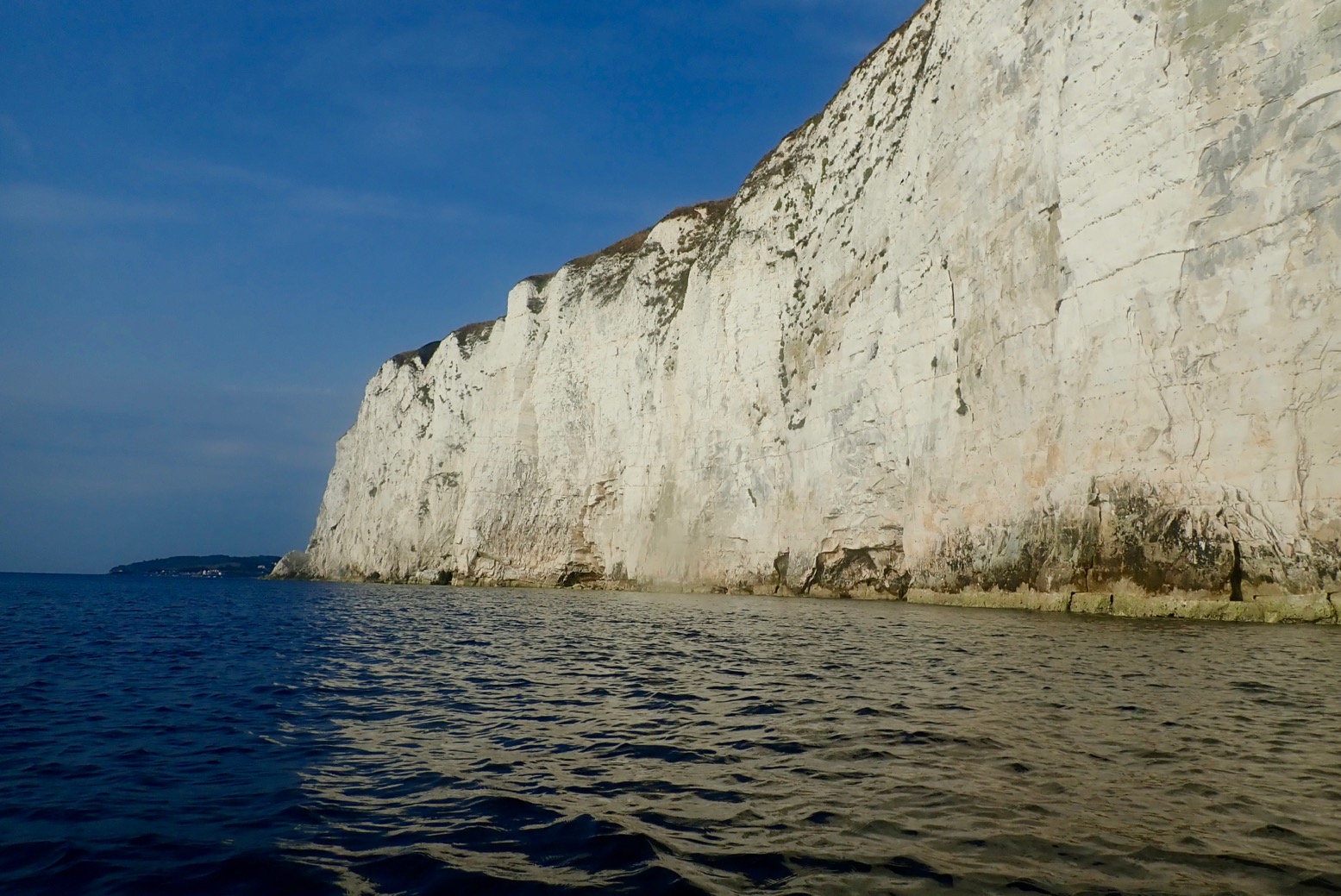
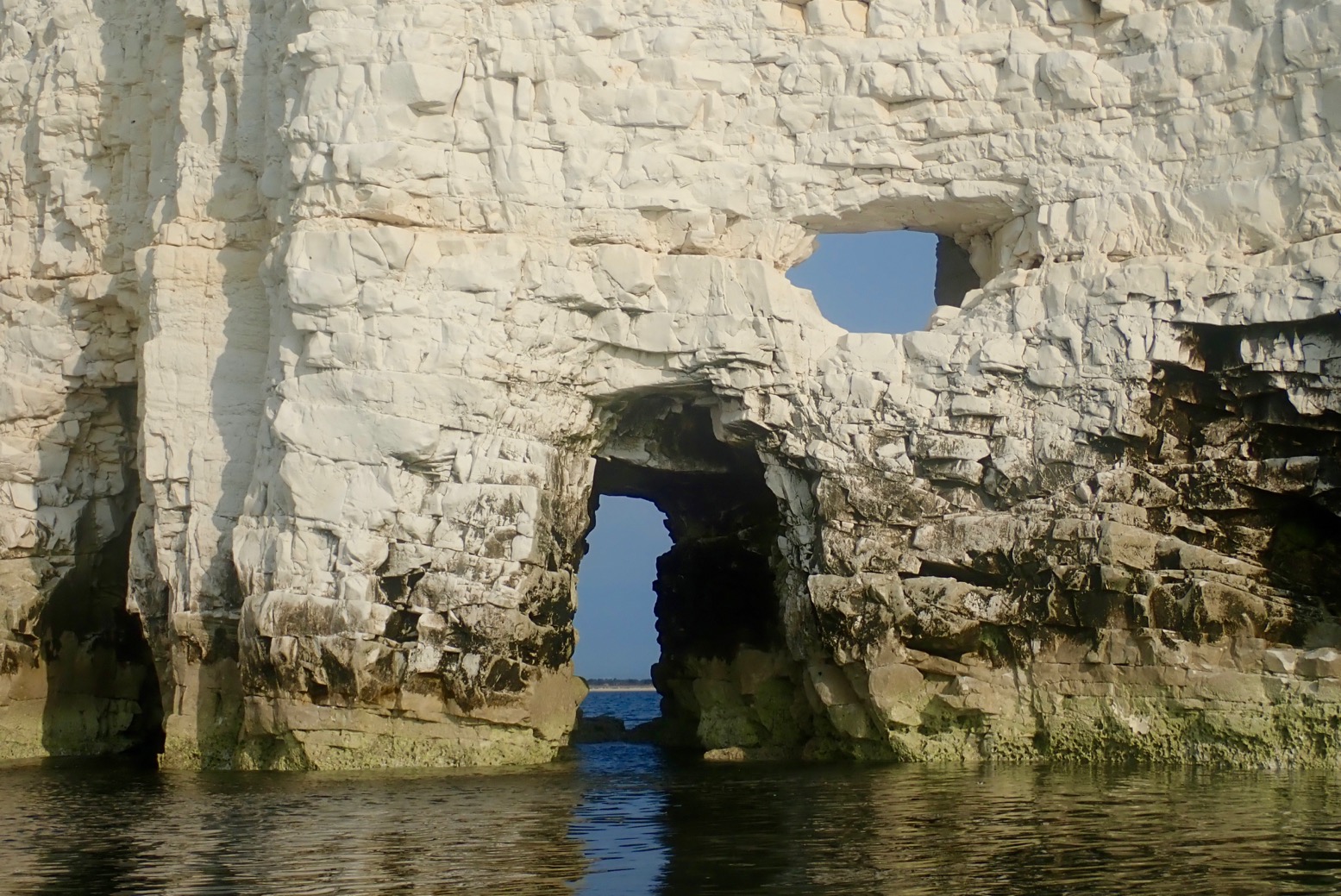
We eased around the corner expecting the worst, but were greeted by a magical sight: a line of 200-foot high chalk cliffs receding to a distant group of stacks and pinnacles glowing in the soft morning light and all soothed by a gentle breeze.
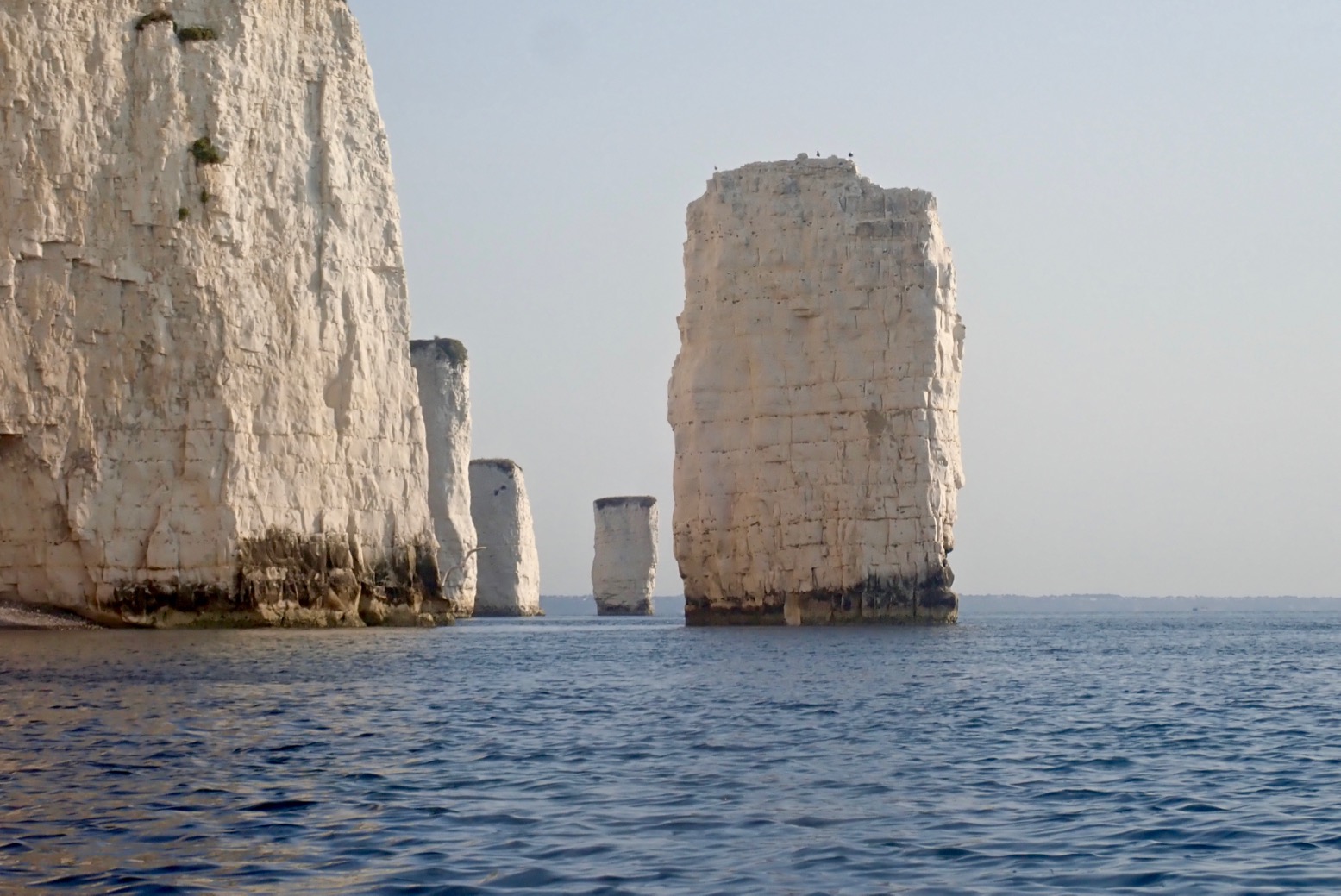
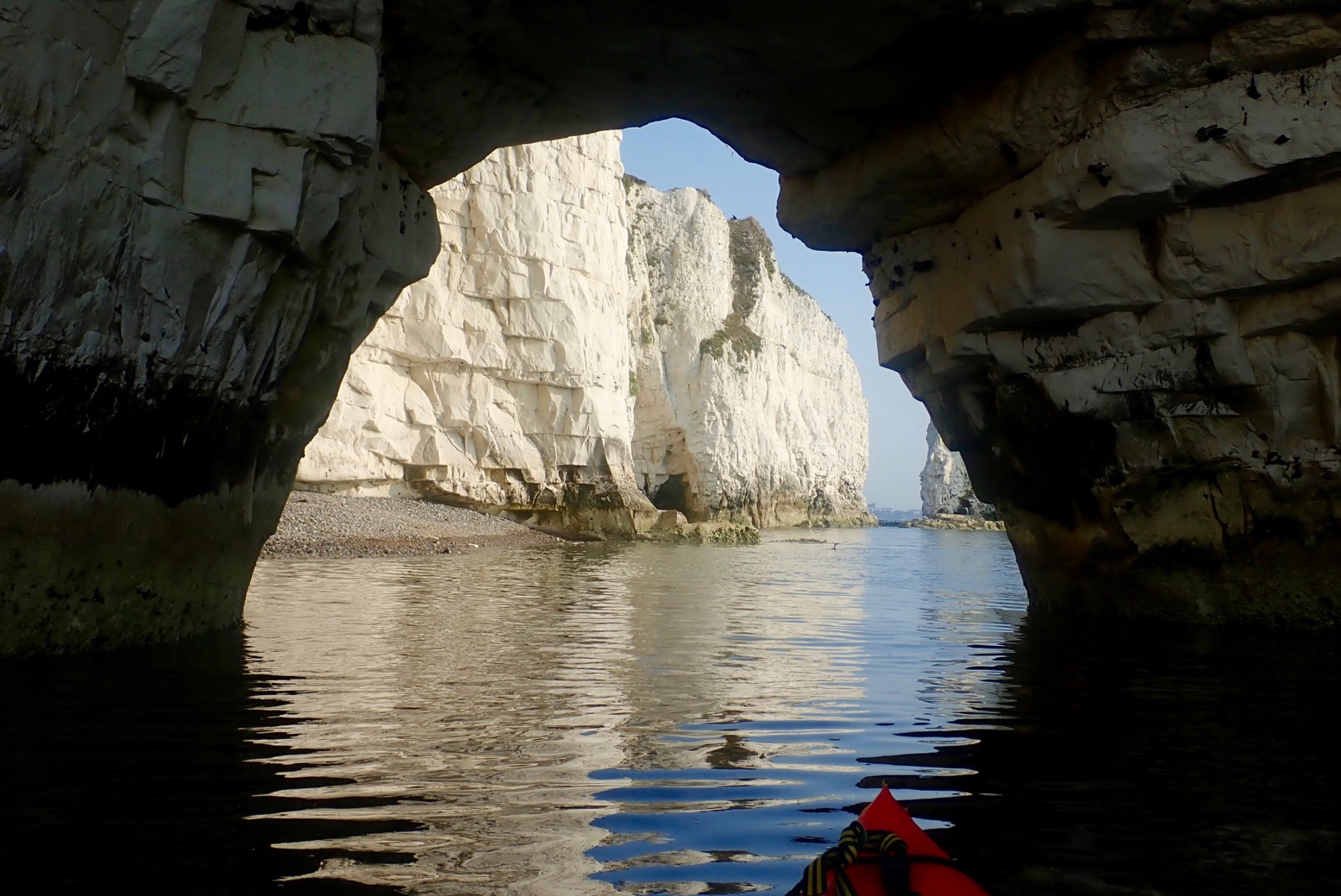
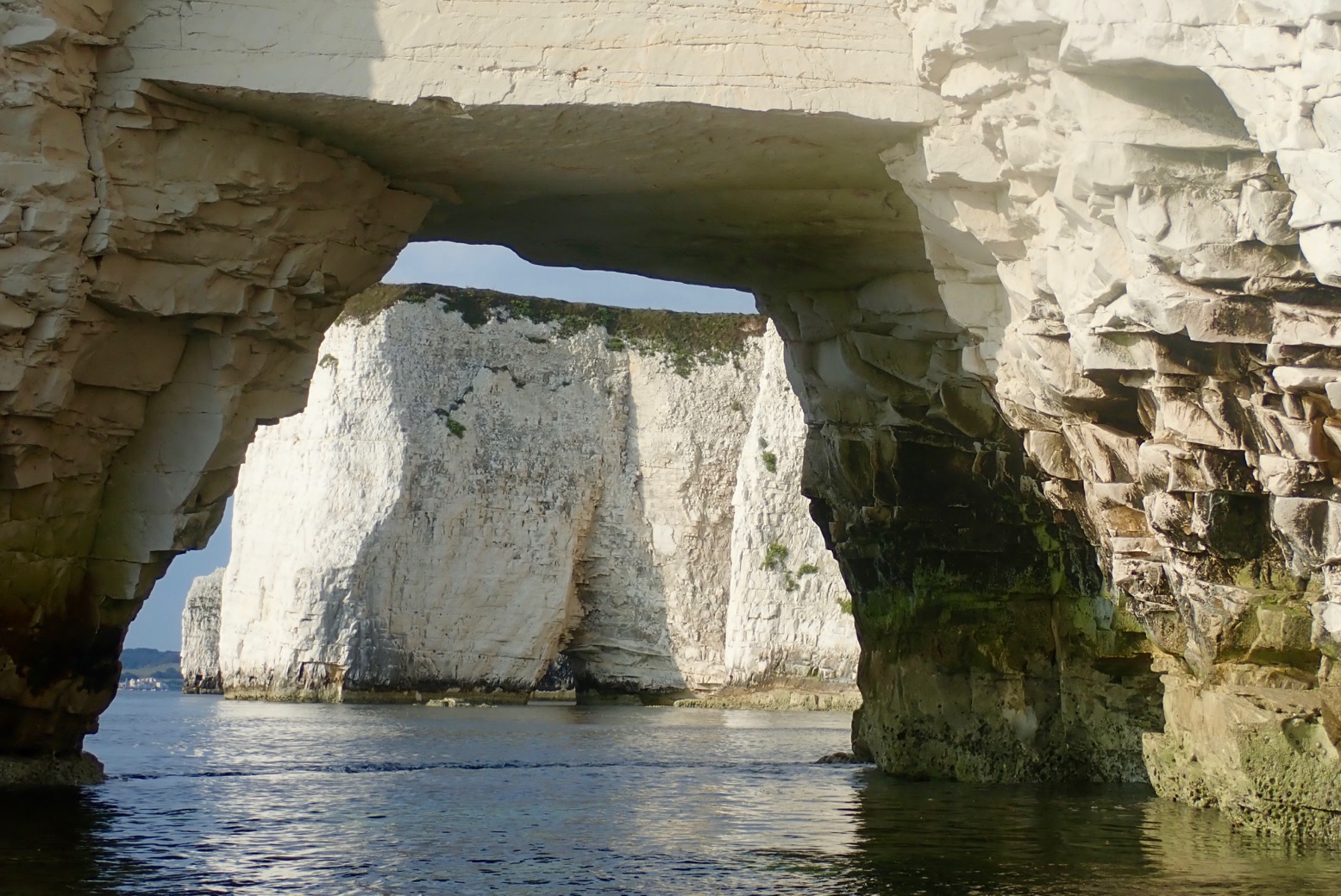
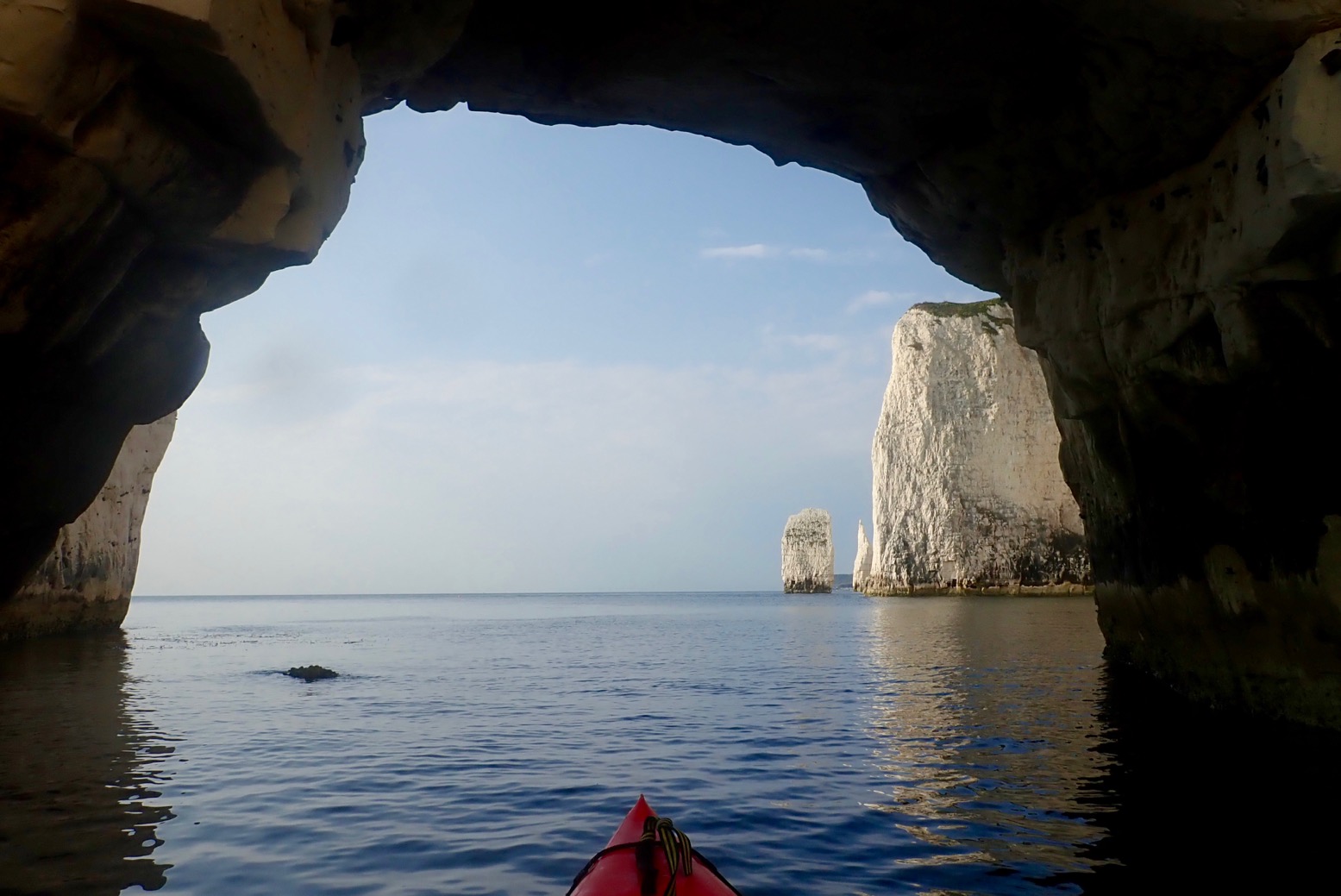
It was only a mile from here to Handfast Point aka: Old Harry, passing several stacks, arches, caves and slots. Ever the goldfish in its bowl, I’d got distracted before looking up tide times, but judging by yesterday evening’s paddle around Brownsea Island in nearby Poole Harbour, it was a couple of hours into its southerly ebb. We arrived at Harry’s about mid-tide but with still just enough water to paddle through most of the arches as well as some narrow slots which were already running too fast to tackle against the flow (below). A bit of a tidal race swirled past the Point, but nothing dramatic.
I’ve been planning to do Swanage for years and it was even better than expected. It must have been packed out yesterday on the bank holiday, but today, before 9am we had the place to ourselves. It’s a fascinating geological formation and all the better explored from a paddleboat.
Lit by a rising sun and on the top half of the tide must be ideal timing for a visit here. All up, it was only a two-hour roundtrip from Swanage seafront and in similarly good conditions would be easily packraftable from the north off nearby Studland beach.
Hope to paddle this again, one time.PS: Little did I know that this summer 2019 paddle would be out last sea paddle in the Seawave. Not since my original Gumo Sunny on which I learned and did so much, have I owned an IK for so long and had such fun times. What a great boat that was.
Time to knock out a long-planned circumnavigation of Hayling Island near Portsmouth while this amazing summer lasts! P-Day came along and by chance, the weather and tides lined up: high 20s °C with a 3-m neap and a calm morning before a 10mph onshore afternoon breeze.
I’d ridden down and recce’d the harbour entrances a couple of years back and last year we’d tried to reach the harbour along the canal from Chichester, but that plan didn’t work out. You’ll find lots of useful descriptions online, but it pays to recall (as I learned on a run to Brighton) that on the English southeast coast the tide (which floods eastwards and ebbs to the west) turns eastwards from two hours before high water to four hours after. So while the water is still dropping the current reverses. The Brighton post explains it (and I’ve since found an interesting animatable graphic here) and it may also explain why we passed deserted beaches and got to turn north into Chichester harbour entrance surprisingly quickly, even if it was near calm. Occasionally a rogue wake rippled in from a distant freighter out in the English Channel.
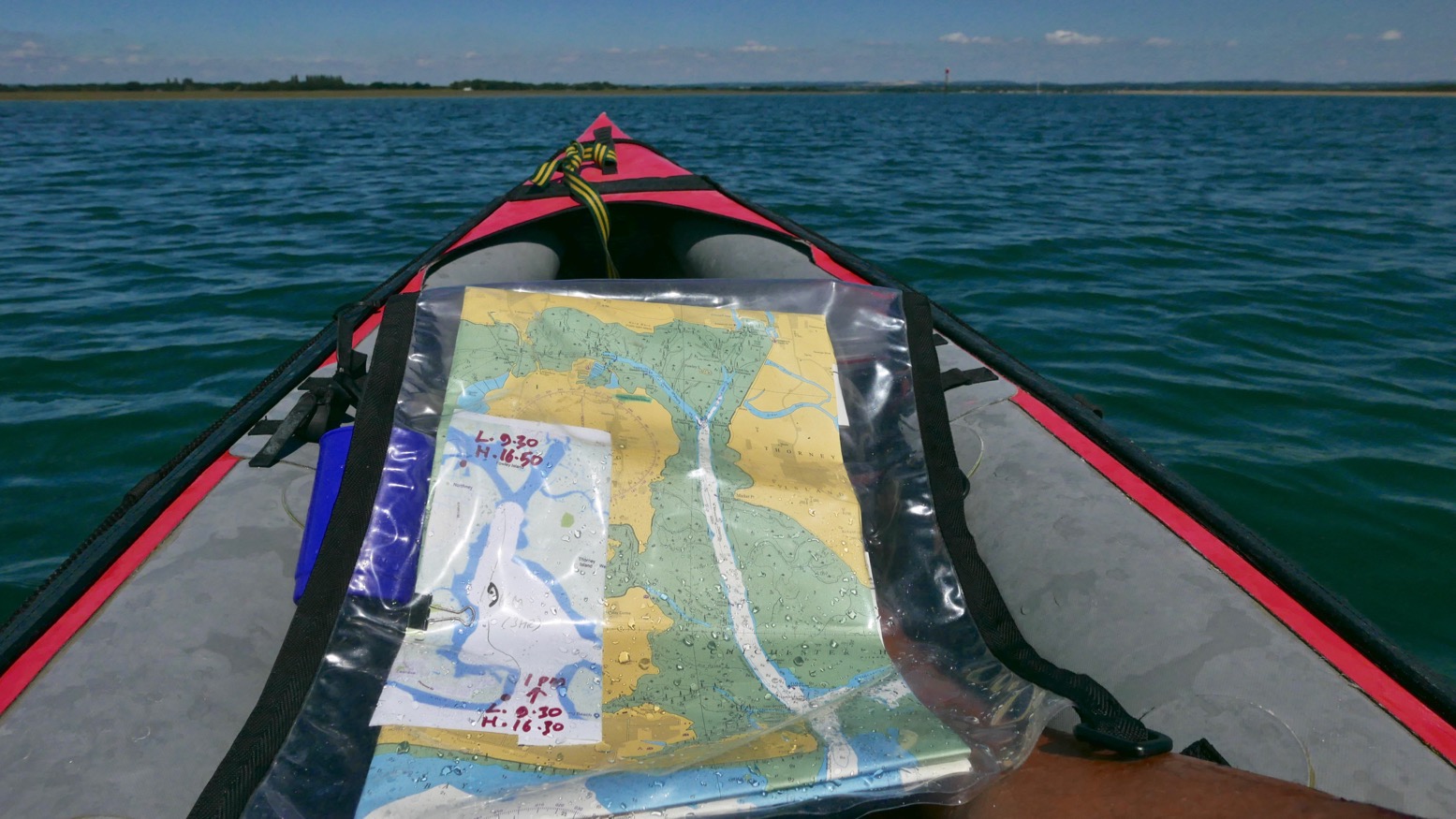
It was soon clear that my estimation to cover this 22km lap was way too long. Shooting along the channels visible on the map above, mudbanks to left and right limited side exploration and we ended up under Hayling bridge (KM13.5) in just 2½ hours including lunch and a few drifts.
On the way we passed a lot of moss-covered sailing boats, lots of birds including oyster catchers (didn’t know you get them down south) and up nearer Northney marina, a brace of SoTs and a young couple struggling to control an under-inflated (or leaking) Sevy K2. Our high-pressure Seawave glided smugly by.
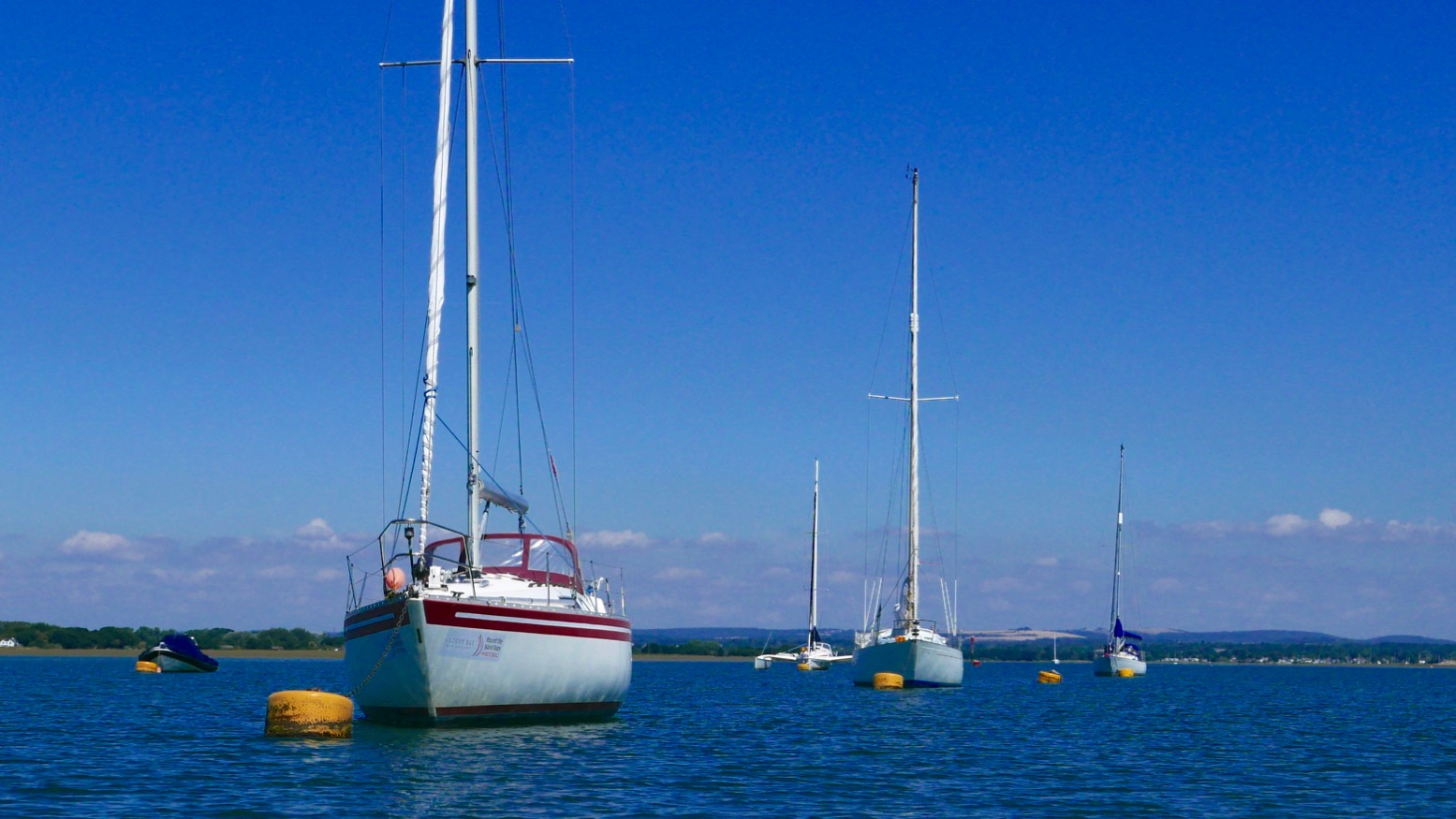
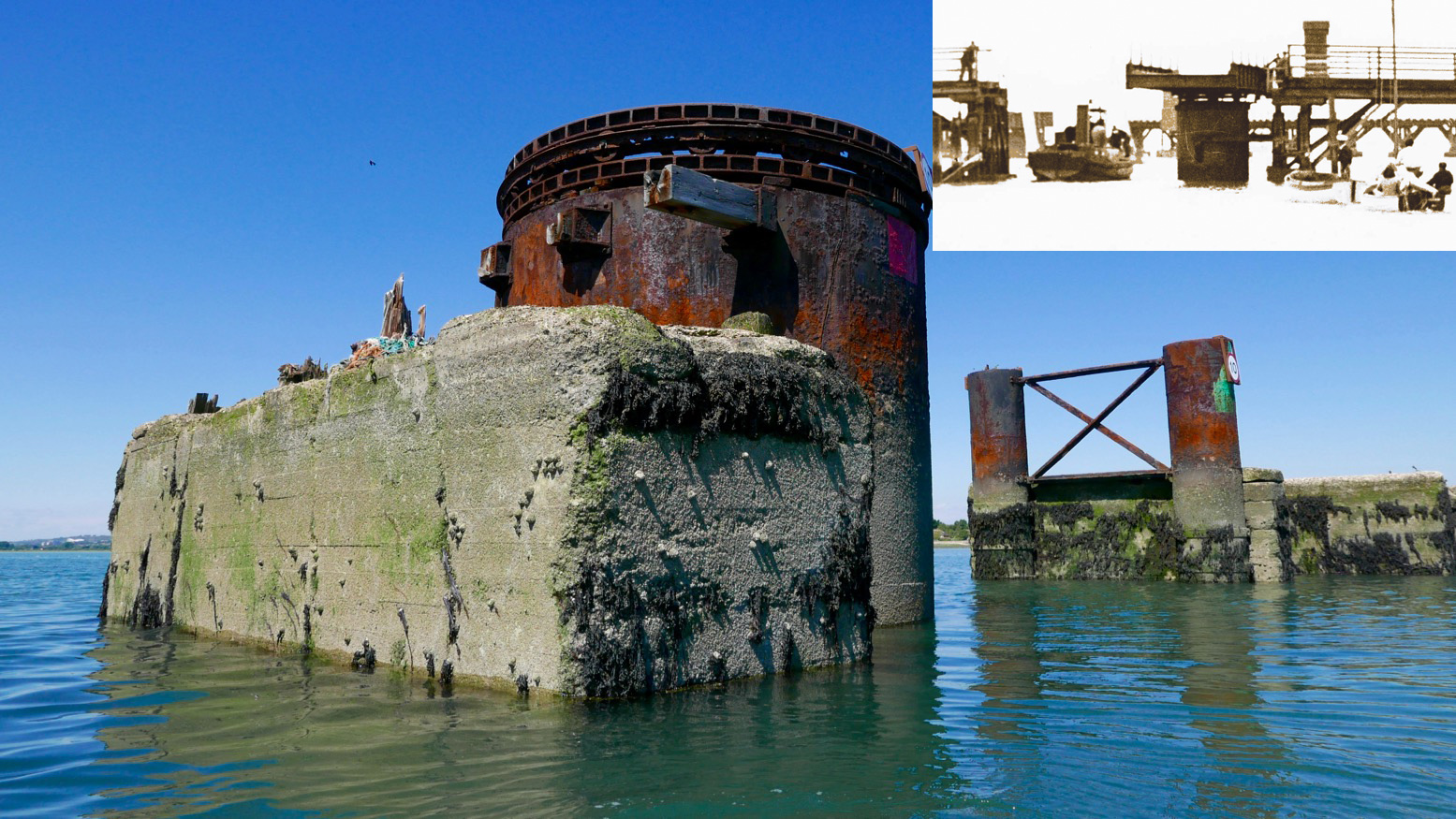
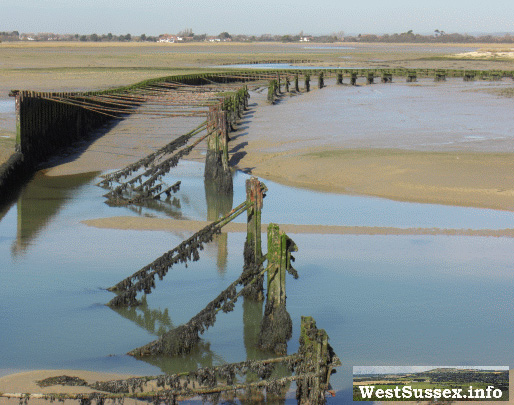
With less than half the tide in, there was already plenty of water to pass under the road bridge and between the stumps of the old railway span alongside. A huge rusting drum suggested a swing bridge to allow boats to pass; online later, sure enough, that’s what it was (left, see inset); a railway running from 1865 for just short of a century. When we drove off the island at about HW, it was the drum was only thing above water. Chichester harbour is packed with parked-up sailboats (‘moored’ some might say), but Langstone is virtually empty, possibly because i’s shallower and with a much narrower entrance. These natural harbours formed after the last Ice Age and take about seven hours to fill, but drain in only five. And because they drain right down to unfathomable mudflats on which even a gannet in snowshoes can barely walk, exploring side creeks can only be done with the high water clock ticking.
To aim for Langstone exit channel from the bridge, head for two tall poles visible to the SSW. By now the wind was in our faces giving a greater impression of speed, but the tide was coming in for another two hours (or do I add/subtract two hours? My brain hurts). We were way too early to catch a roiling ride out the 250-metre wide Langstone channel back into the Solent. We’d have to hack our way out along the side, like a Maori war party.
Long before we got there we could hear the intimidating wail of jet-skis haring up and down the channel. They have such a bad rep and the two-stroke din doesn’t help endear them. If they sounded like Ducatis or Bonnevilles we’d be queuing up for a go! We passed the famous Langstone Pumpkin (above; a lost novel by Wilkie Collins), and soon after, hopping out to wade against the tide over the shallow Sinah Bank saw me sink into the vile black quicksludge which Collins used for the demise of his fickle heroine.
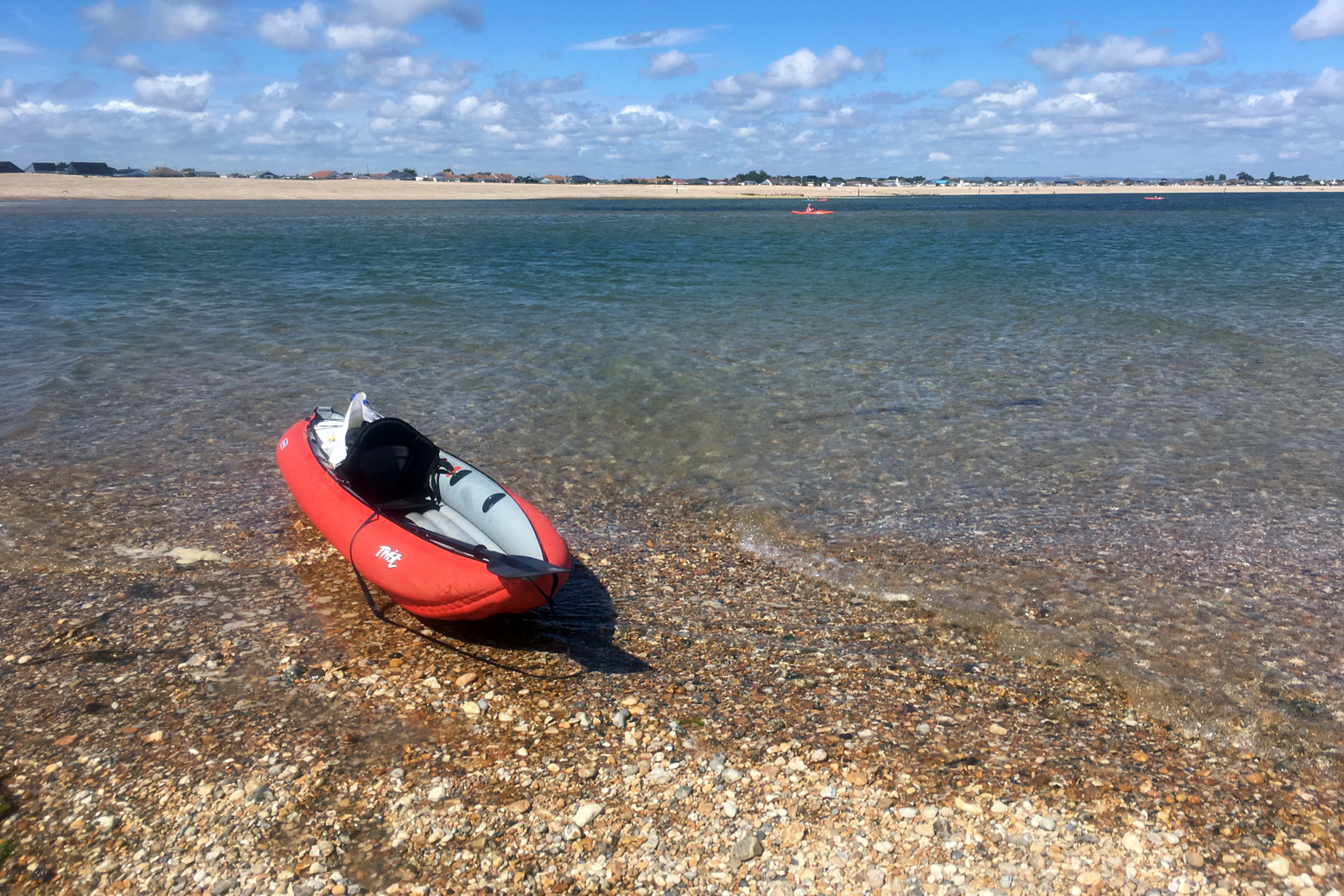
Nearing the channel I sought to dodge the in-pouring current by passing under the gantry of the Hayling Island ferry. Then I announced ‘All hands on deck! Prepare for ten minutes of full steam ahead’. That ended up more like twenty, because keeping close to shore was made trickier by frolicking bathers, parked-up jet skis and inflatable goofballs. To the right the tide streamed past way faster than we could’ve paddled, but along the sides we managed to inch forward at a stroll’s pace; a yacht motoring out mid-channel was no faster. I kept eyeing up points where the current might splay out, but it was getting on for a mile out over the East Winner sandbank before the effort eased, the seas slapped us about a bit and we were out in the Solent for a choppy paddle back to the beach (above), now packed with frolicking sunbathers, paddleboarders and inflatable goofballs. Quite worn out, we beached the kayak and jumped back into the warm sea to wash off the salt and sweat.
It’s fun to try new stuff and paddle on a sunny day, but overall I’d say around Hayling was a bit boring compared to a sunny day in the Northwest Highlands. Who wants to pass Funland and beach houses, mudflats, marinas and more mudflats? Reminds me of Darwin harbour but without the crocs and mangroves. I suspect west of here, the Southwest coast has more promise. I still think the morning start anticlockwise from West Town is a good idea: knock out that exposed seafront stage before an afternoon breeze (and the concomitant rise in bathers, borders and hydrofoil kiteboarders hitting the sound barrier). But I’d aim to leave West Town 3–4 hours after LW. The unintuitive tide may be turning but once in the Chichester Harbour it gets you up and around to the Langstone exit channel around HW for a short paddle along the seafront back to West Town. There’s probably a formula for doing it clockwise from Eastoke and running the flood tide through the Langstone channel, but I’ll let you work that out.
We set out to paddle from Chichester Town Basin, down the old ship canal into the tidal Chichester Harbour at Birdham Lock. Lois and Austin in two do-it-all, drop-skeg Venture Flex 11s (left) Robin and Elliot in an old Gumo Twist 2 and a newer Nitrilon one, both of which fitted into carrier bags. Plus my Seawave lashed to a trolley.
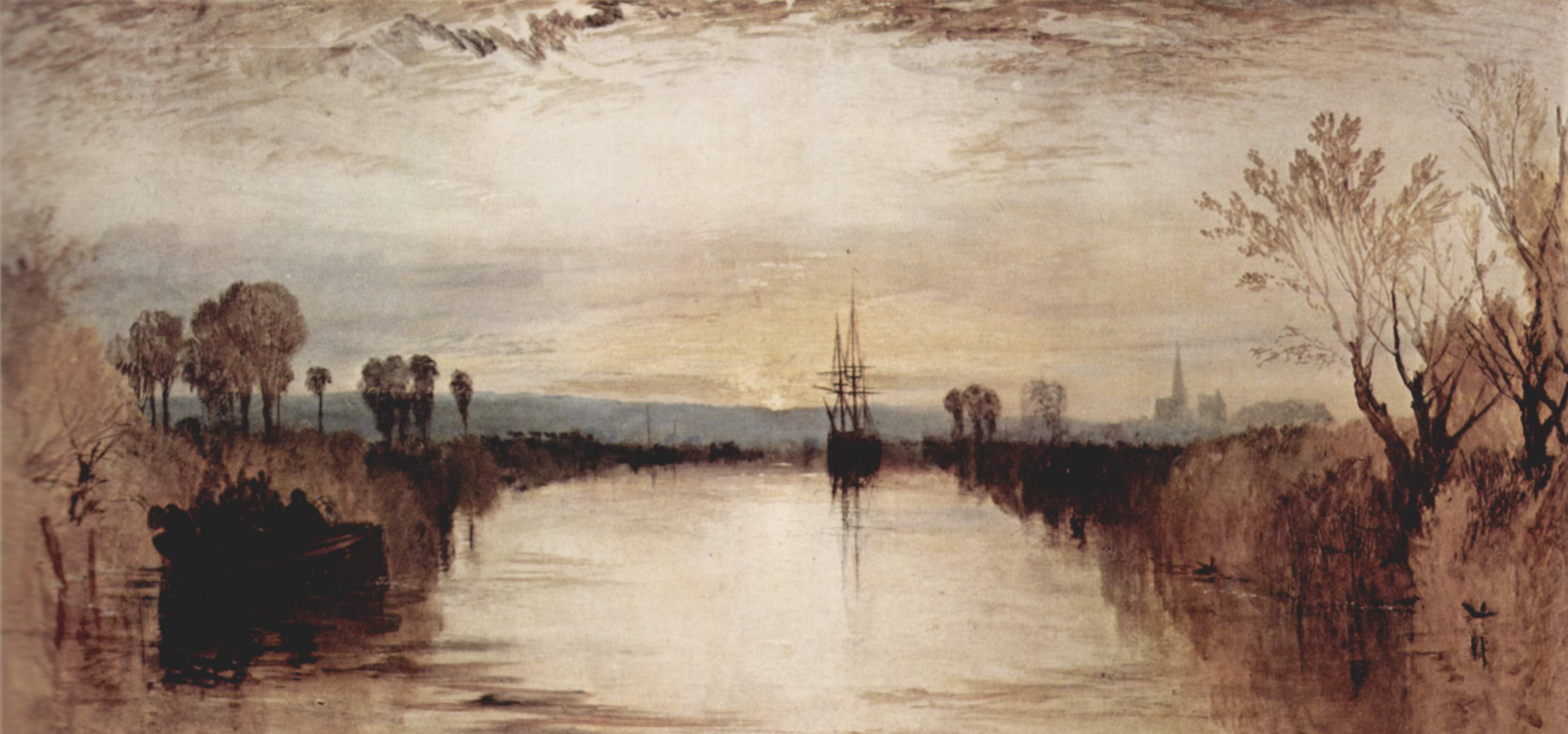
Nearly two hundred years ago Turner depicted tall ships gliding serenely along the then new 4.5-mile canal (above). During the canal boom preceding the railways, it linked Roman-era Chichester with the huge natural inlet of Chichester Harbour and the adjacent naval fleet at Portsmouth. To the east was a canal to the Arun & Wey navigation (left) which was a short-lived inland link between London and Portsmouth commissioned at a time when Napoleonic fleets threatened the English Channel.
Our original plan had been no less Napoleonic in its grandeur: a 15-mile lap of Hayling Island, but today the tides and winds were all wrong for that, and even with Plan B we’d arrive at Birdham at low tide to face an undignified, sludgey put in.
On Google maps the canal looked clear, with maybe a quick carry around a lock or two. But just two miles from the basin, a thick mat of Sargasso frogweed clogged the channel at the B2201 Selsey Road bridge (below), reducing speeds to a crawl. Worse still, over the bridge this unallied carpet of errant biomass ran on like forever, and probably all the way to Birdham Lock.
Was it a high-summer frogweed bloom? The initial two miles are kept clear by rowers, paddlers and the 32-seater cruise boat which hooted past us with a lone passenger tapping at his phone. But nothing bar the Solent breeze stirred the canal west of the B2201, allowing the thick Sargassian spinach to fester and choke navigation for even the pluckiest of mallards. A picture from 2008 (above) shows less weed at the bridge and a rather squeezy thrutch through a spider-clogged culvert under the road.
Abandon Plan B all ye who Venture Flex here. Austin called in an Uber: ETA 4 mins; ET back to his Volvo: 6 mins. Total elapsed recovery time: 16 mins, give or take. The internet of things – how modern! Soon the hardshells were lashed to the roof and the rolled-up IKs heaved into the spacious boot of the Swedish landraft with class-leading crumple zones.
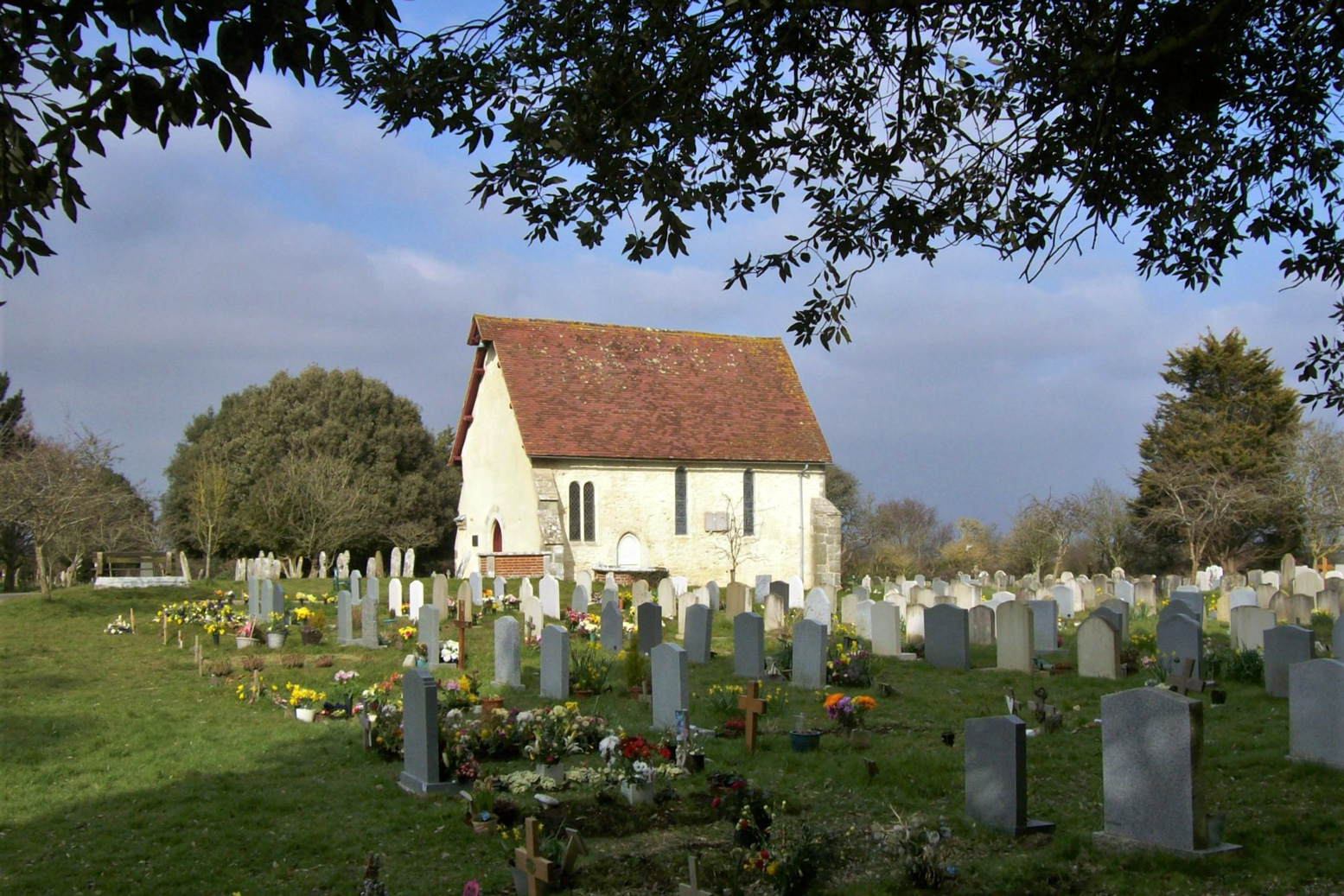
A quick map check and I proposed Plan C: Pagham Harbour just down the road and out of the rising southwesterlies. I’d never heard of this medieval-era port which was now a bird sanctuary-cum-sludge repository, but Elliot had been spotting here so knew the way to the chapel at Church Norton, thought to be the mythical 7th-C source of the overdue Christianisation of pagan Sussex.
A 5-minute haul led to the shore, except the tide – which should have turned over an hour ago – was still way out, leaving only snaking channels accessible down muddy banks. We ate lunch, waiting, like Al Gore, for sea levels to rise. But when the time came nothing but irksome clouds of marsh gnats stirred as we padded over the springy salt-scrub to the nearest channel (above).
All around, collapsed jetties, concrete groynes and other arcane structures recalled Pagham’s 19th-century heyday. Back then the sea had been successfully sealed off and the land reclaimed for farming until a storm in 1910 broke through the embankment, reflooding the harbour for fair and fowl.
Another portage over a shingle bank got us to the main outlet leading to the sea and where the water was rushing out when it should have been filling. I realised that narrow-necked inlets like Pagham Harbour act like reservoirs, releasing their tidal fill gradually for hours after the sea tide has turned. In the tropical fjords of northwestern Australia’s Kimberley it can produce bizarre spectacles like the Horizontal Waterfall (left).
We drifted and boat-hauled through a strange, desert-like landscape of barren shingle banks speckled with forlorn fishermen and demure nudists until the spit spat us out into the English Channel like five bits of unwanted, flavourless chewing gum.
According to images and video on Save Pagham Beach (left), it’s staggering how fast the spit has grown once shingle management ceased around 2004; part of a new ‘natural coastline’ [money saving] policy. The spit has repositioned tidal erosion eastwards and along the shore, accelerating the scouring of Pagham’s foreshore and endangering the homes immediately behind. Recutting the Harbour’s outlet to the west (bottom picture, left) is thought to be a solution, but may transfer the flooding risk inside the harbour. Add in the protected SSSI status of the Harbour and the ‘homes vs terns’ debate becomes complex. Who’d have thought we just went out for a simple paddle.
Eastward along the coast, the assembled infrastructure of Bognor Regis rose from the horizon, while behind us the promontory of Selsey Bill kept the worst of the wind off the waves. With a helping tide and backwind we bobbed with little effort in the swell which gradually grew and started white-capping once clear of the bill. But as I often find, a sunny day and not paddling alone reduced the feeling of exposure and imminent watery doom. Only when a stray cloud blocked the sun for a minute did the tumbling swell take on a more malevolent tone. The buoyant Twists – hardly sea kayaks – managed the conditions fine and the lower, unskirted Ventures only took the odd interior rinse.
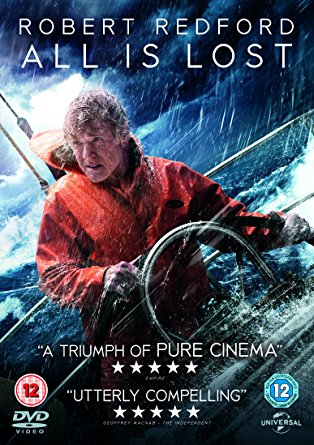
Talking of which, All Is Lost (right) was on telly the other night. Lone yachtsman Robert Redford battles against compounding reversals in the Indian Ocean after a collision with floating cargo container wrecks his boat. A great movie with almost zero dialogue.
Just near Bognor all was lost for real (above and left). Only a fortnight earlier, a similar, lone-helmed sailing boat had lost its engine and unable to sail, drifted onto Bognor’s serried timber groynes. Less than two weeks had passed and already the hull was now cracked like an eggshell and the masts were gone (maybe removed). But unlike the doomed Redford character, on the day the Norway-bound sailsman had been able to scramble ashore.
These groyne stumps – designed to limit longshore shingle drift – could also be a bit tricky in a hardshell if the swell dropped as you passed over one. And just along the shore was another wreck (above) protruding gnarly, rusted studs which may well have sliced up an IK. Mostly submerged when we passed, some post-facto internetery revealed it to be the remains of a Mulberry Harbour pontoon, one of many built in secret during WWII as far as northwest Scotland, then floated out on D-Day in 1944 to enable the sea assault on Normandy.
Our own beach assault ended at the truncated remains of Bognor pier, proving the sea eats away at this whole coast. Bognor is a step back to Hi-de-Hi! Sixties Britain when we did like to be beside the seaside. All together now! So ended a great day of paddle exploring. Uber!
Tuesday was set to be a scorcher – no less than 30°C predicted in mid-September (in the end over 34°C, the hottest Septemberday for over a century; the new normal). No excuses then to try my first south coast paddle if the winds and tides lined up. It could be my last paddle this year. With bands of chalk cliffs and the Atlantic getting funnelled in, the Sussex coast feels a bit exposed compared to northwest Scotland where I usually sea kayak. With little of interest, it’s not exactly a sea kayaking mecca, even though it’s highly populated. At least if you have a shipwreck, it won’t be far to a road or even a bus and I bet a mobile works everywhere. Wind direction for Tuesday was ESE – an ideal onshore-ish backwind, if a bit breezy (for a lone IK) at 13mph. And by chance the tide was just right too: high at a handy 9am with a moderate 3.5m drop. (good tide times website). In five days time the spring tide would be nearly twice that. Clearly this was shaping into a westbound day. Anyway, that was academic as wind and tide made Newhaven west to Brighton and beyond the way to go. With lots of rail stations, I could go as far as the arms lasted.
I learned an interesting thing about Sussex and Kent tides while planning this run earlier in the summer. For the last two hours of the incoming (eastbound) flow, the tide keeps rising but reverses westbound along the English coast as it backs up at the Straits of Dover and spills back down the sides. This makes a more usual easterly run with the prevailing SW winds a bit tricky (or short) on an incoming tide. The nearer the Straits the more skewed the tides. At Dover it falls for nearly 8 hours, but fills in less than five. At Brighton, where the Channel is four times wider, ebb and flow are equal but you still get that 2-3 hour backwash at the end of a high.
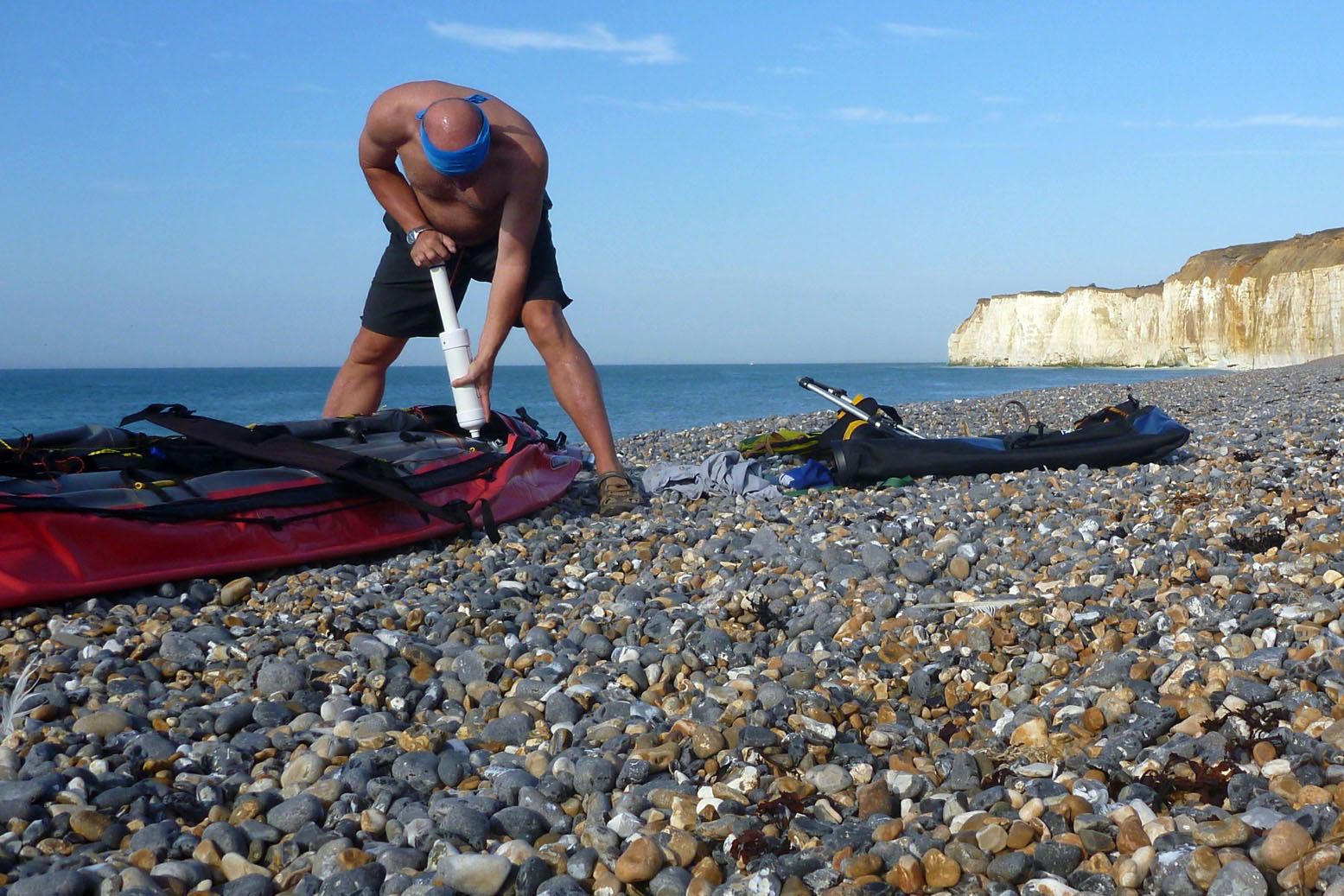
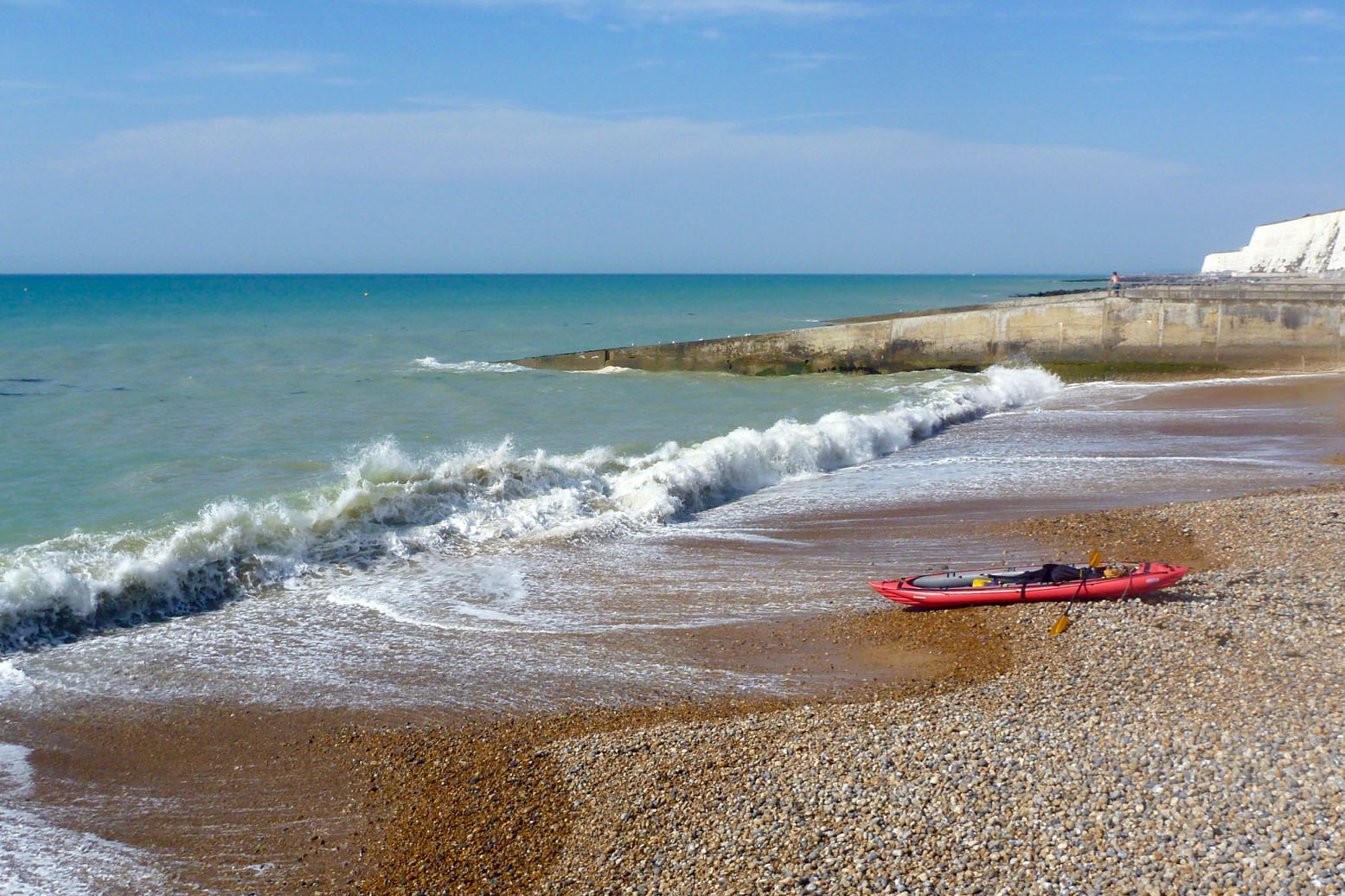
The Newhaven train took me over and along the South Downs where sheep nibbled in the early morning sunshine. It sure was nice to get out, even in southeast England which isn’t exactly terra incognita to me. On the steep shingle beach below Newhaven fort, the tide was topping out as I topped off the Seawave and the Dieppe ferry backed out of the harbour. These shingle beaches have steep ramps bashed out by stormy seas. At high tides this terracing kicks up the surf and means wading in can quickly put you out of your depth, as I recall well from childhood holidays on the Southeast’s shingle beaches. But probably more by chance, I timed my put-in on a lull, hopped in and PLF’d out of the surf zone. As usual, alone on a new shore after a couple of months off, the first few minutes or more required managing an agoraphobic anxiety. I reassured myself the wind was blowing me along- and towards the shore, and the dropping tide would gradually expose beaches below the cliffs if I needed a break. On the beach I’d inadvertently pumped the seat right up, and in trying to deflate it on the water, the annoying sticky twist valve stuck and I was soon sat flat on the floor. Oh well, it will make me more stable if it all gets rough. I’d forgotten my rudder too, but wasn’t too bothered about that. One less thing to concentrate on.
The trouble with backwinds is they give no impression of movement and soon I was dripping like a dewy fern at dawn. As you’d expect out here, the seas were jaunty, with occasional swells rolling by that looked higher than me. But there were no tell-tale whitecaps, the stern wasn’t pushed about, and half an hour in, a long concrete ledge/seawall below Peacehaven cliffs offered a way out if needed. That would have to be in extremis though, as at times the swell slapped hard against the walls and there were only steps to get out.
No need for that yet. We were moving along probably faster than I felt. I tried to keep away from the shore so as not to get caught by a rogue swell – I saw one break up ahead way off the shore and steered well behind that point. There seemed to be no pattern to these choppier episodes. Was it a set coming through or just seabed related? Later, looking at an OS map and what the sat map below shows too, a wave-cut sub-sea platform of the soft chalky cliffs extends quite far out. Where the jade green sea turns blue is where it drops off? Who knows, perhaps it’s just the sea, but it created an uneven rhythm considering the linear nature of the paddle. Another thing I noticed was that I drifted out to sea if I didn’t concentrate. It was probably the tide which not only ebbs westwards but goes out too. Hence the well-known expression and phenomenon: ‘the tide is going out’. Every once in a while a quick spurt inshore (but not too far inshore) put me right.
A few miles ahead I could see the whitewashed conurbation of Brighton, but without a seatbase the old backside was now beginning to feel the strain. I passed by a couple of serious-looking sea swimmers heading upwind, then put in between some groynes at Saltdean, where another cliff-protecting concrete walkway ran all the way to Brighton; a fun cycle or hoverboard, I dare say. I timed my landing well enough, but after pumping the seat and a rest, re-entry required flipping the swamped boat a couple of times. Probably because getting back out between the surf can’t be done as briskly as coming in.
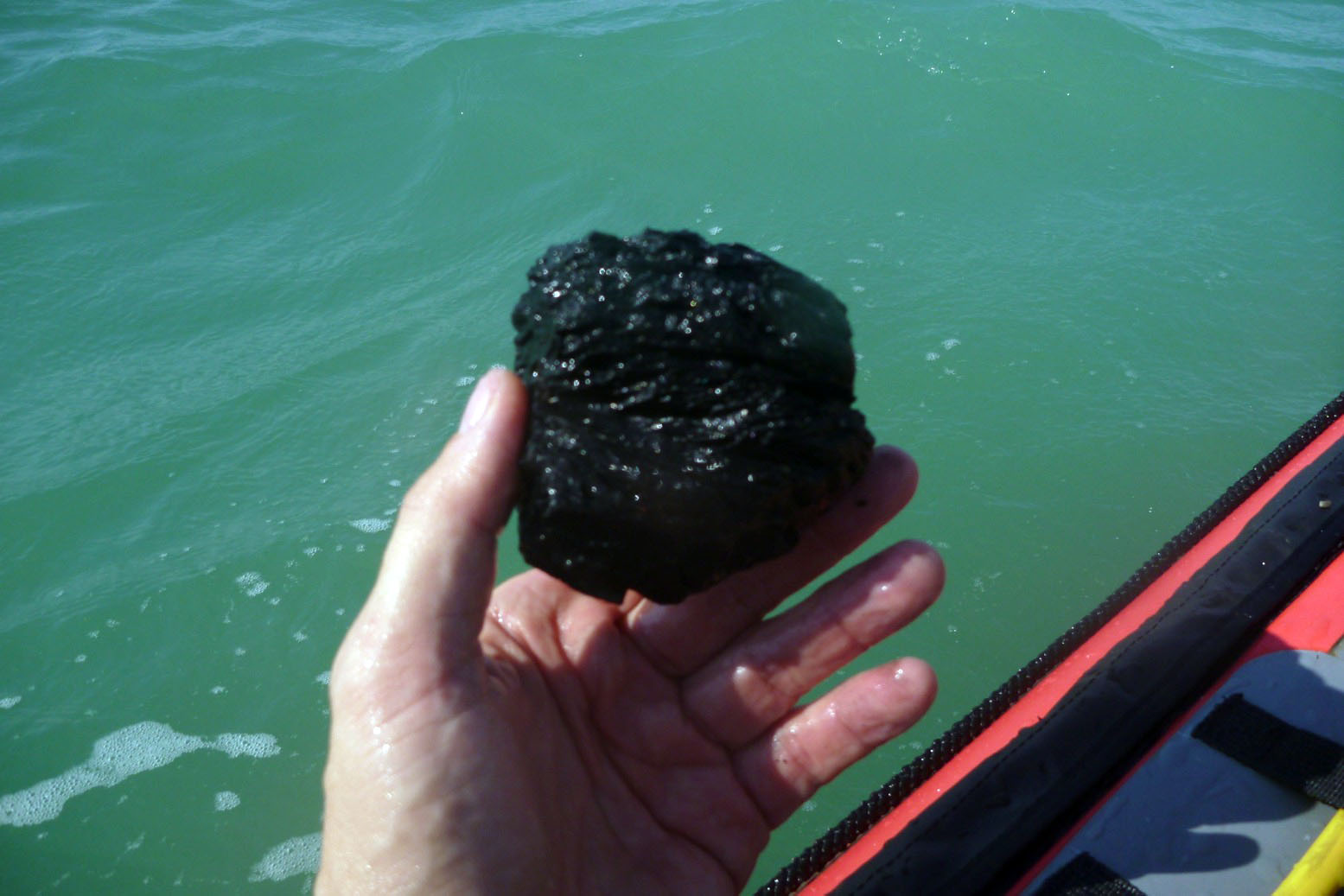
Next obstacle: getting round Brighton marina where the seas really felt quite lively. The southeasterly swell was bouncing off the marina walls like Brighton revellers on legal highs. Nothing for it but to PLF; at least the wind was helping. Round the back of the breakwater all was calm, bar the odd oversized swell. I found a piece of coal and a child’s wet shoe. It was a good omen: follow the shoe!
Up ahead lay Brighton pier and the effort and early tension of only a couple of hours was starting to show. I hacked away towards the pier, then decided I must pass underneath it with my new shoe if I was to reach salvation. SUPers were gliding by and wetbikers were gunning about, making a grating, aggressive din. A surfy beach landing was performed ‘with aplomb‘ in front of the basking crowds. I recall an apocryphal American’s view of Brighton Beach ‘Beach? Where’s the saynd? It’s all stones!’. GPS check: ten miles at 4mph average, peak 6.5mph. Quite fast really. Time to pull the plugs.
In case you don’t know, Brighton is an unusually groovy and arsty enclave by English south coast standards; ‘London by Sea’ some call it. I met up with a young entrepreneur who was hoping to start-up an innovative coffee-by-drone delivery service. So far the response had been excellent and the odd sunbather who’d got a scalding espresso shower merely thought it was an amusing prank. If coffee-by-drone could work anywhere in the UK, Brighton would be the place. Apparently he’s idea is on an upcoming Dragon’s Den.
As for the paddle. It’s good to get a salty tan while exercising, but the run was as ordinary as I expected, not like the wilds of the northwest or even the rural southwest, and without much intriguing geographic detail to explore. I bet looking down on the passing Seawave from the clifftops was a lot more alluring.
West beyond Brighton it’s built up pretty much all the way to Selsey Bill before the Solent. In the other direction Cuckmere Haven around the much bigger cliffs of Seven Sisters and Beachy Head to Eastbourne pier (8 miles) would be a good one on a calm day. You can’t get lost – just follow the shoe.


 It was only a mile from here to Handfast Point aka: Old Harry, passing several stacks, arches, caves and slots. Ever the goldfish in its bowl, I’d got distracted before looking up tide times, but judging by yesterday evening’s paddle around Brownsea Island in nearby Poole Harbour, it was a couple of hours into its southerly ebb. We arrived at Harry’s about mid-tide but with still just enough water to paddle through most of the arches as well as some narrow slots which were already running too fast to tackle against the flow (below). A bit of a tidal race swirled past the Point, but nothing dramatic.



























 Inflatable Kayaks & Packrafts