Tag Archives: New Zealand

Kayaking Doubtful Sound (NZ)

See also:
Hardshelling in Abel Tasman NP (NZ)
Packrafting North Island (NZ)
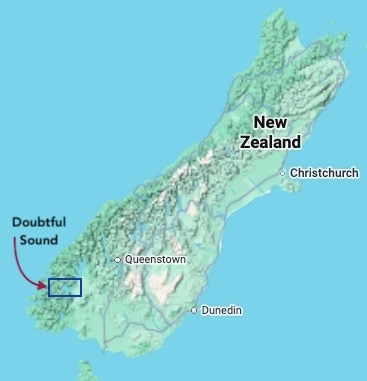
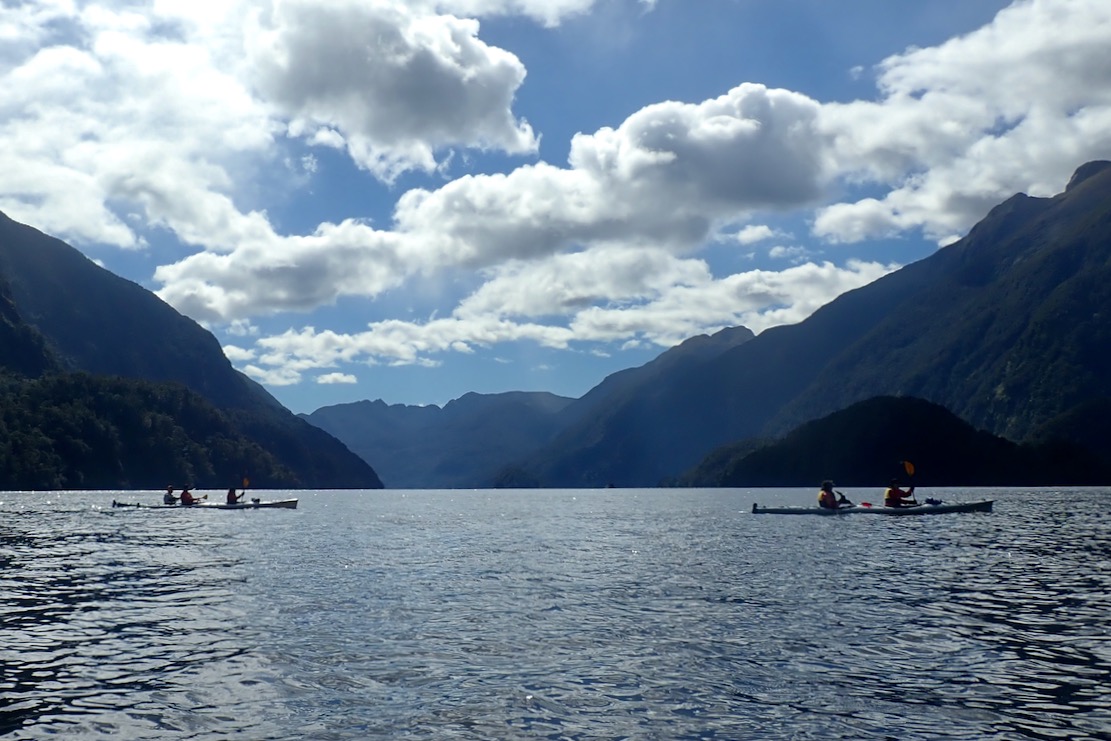
Fjordland National Park in the far southwest of New Zealand’s South Island is a huge, barely inhabited warren of 1000-m+ mountain ridges, deep 40-km inlets and glittering alpine lakes. Milford Sound is the best known of these glacier-carved fjords reaching inland from the Tasman Sea. Every day convoys of buses drive up the spectacular Milford Sound road to cruise the Sound.
We chose the less visited Doubtful Sound further south for a spot of rental kayaking.
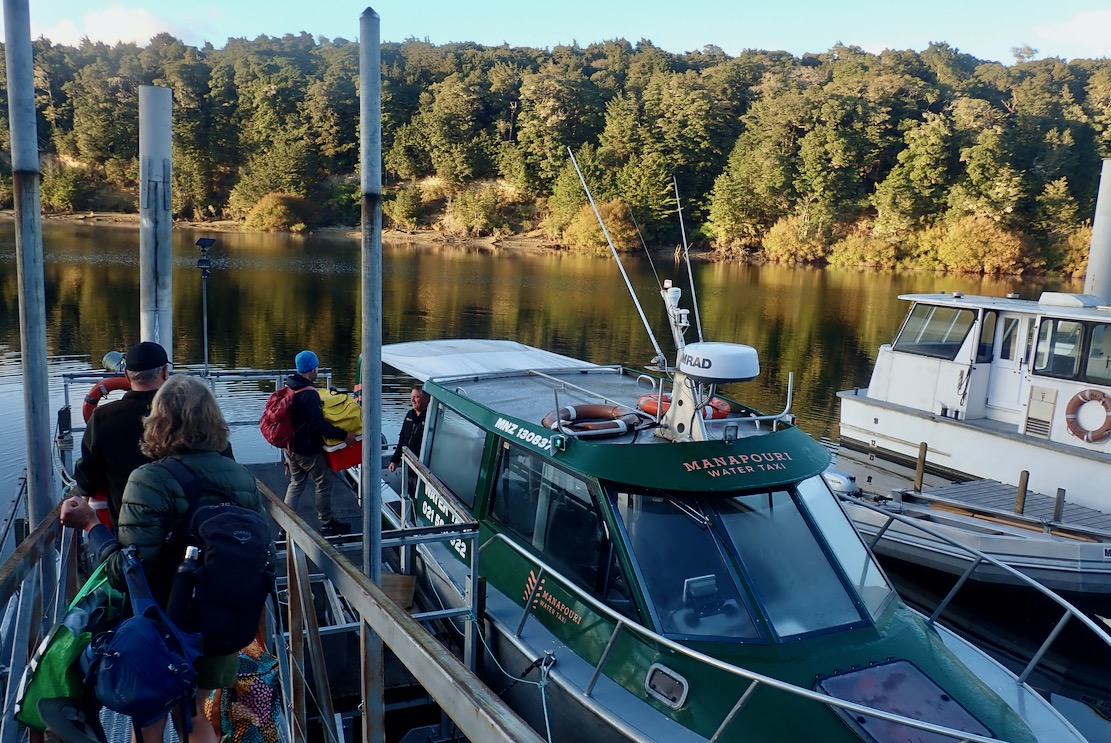
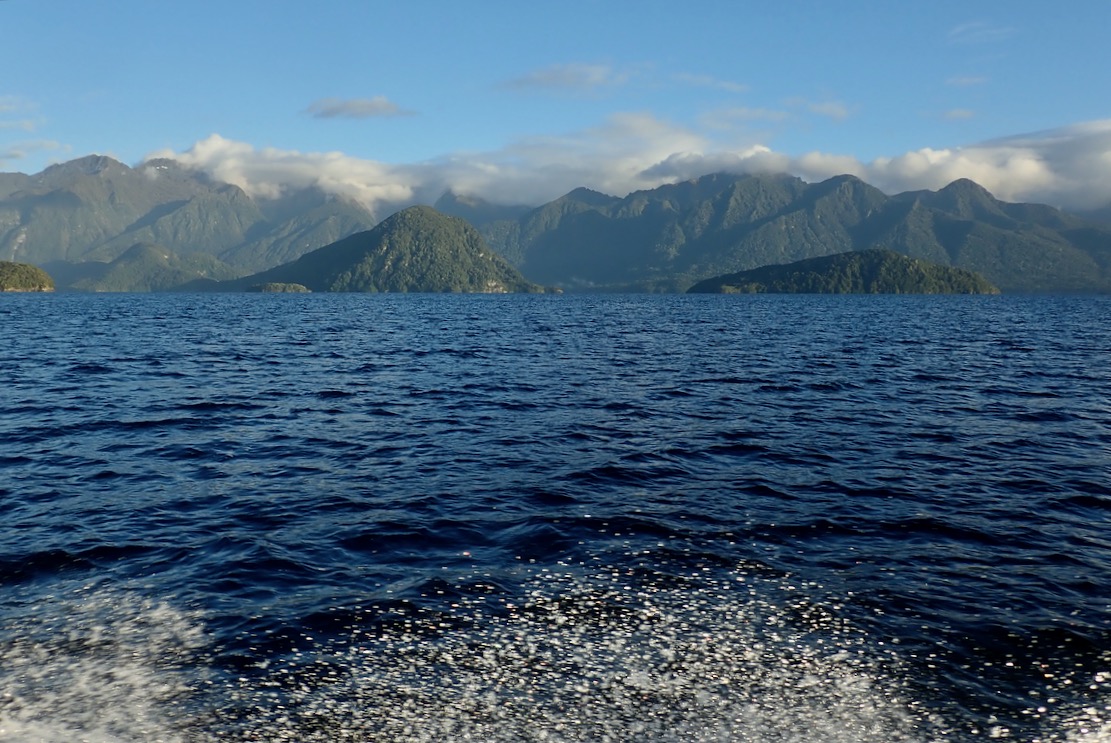
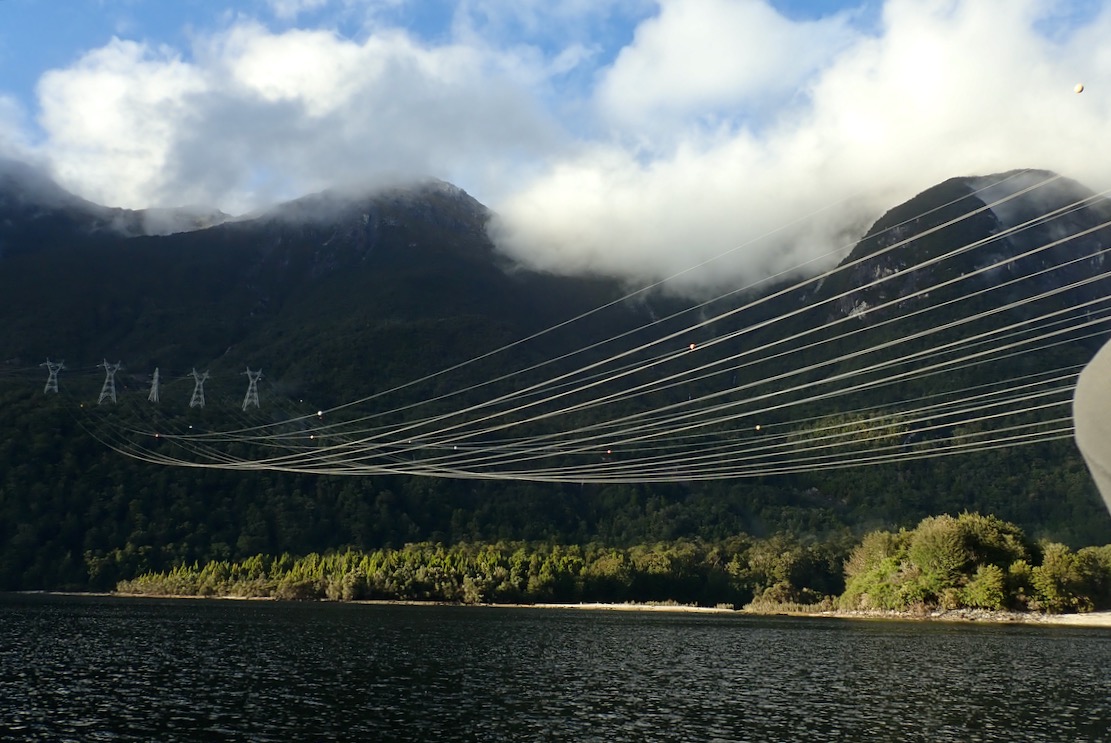
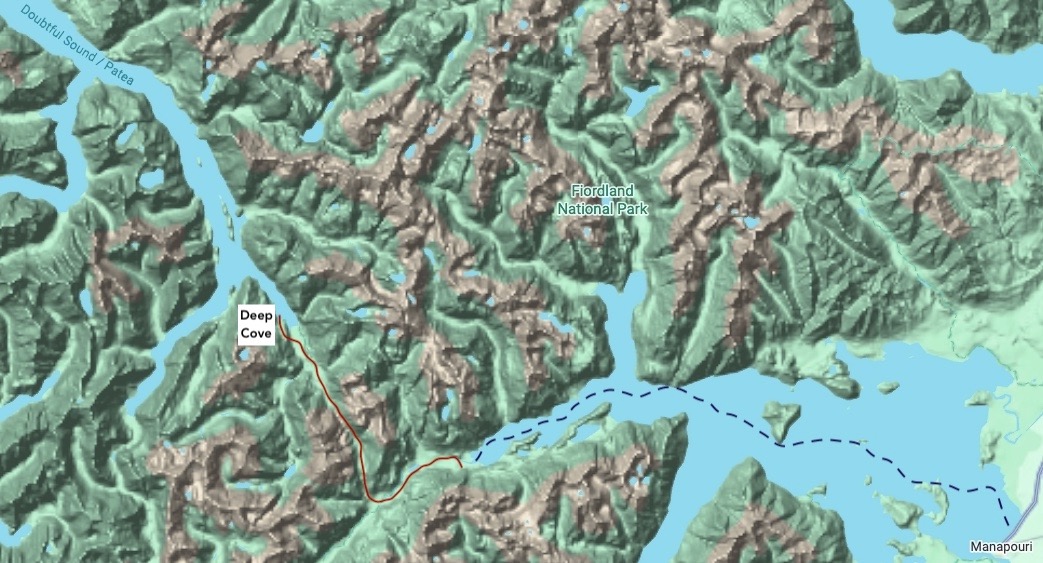
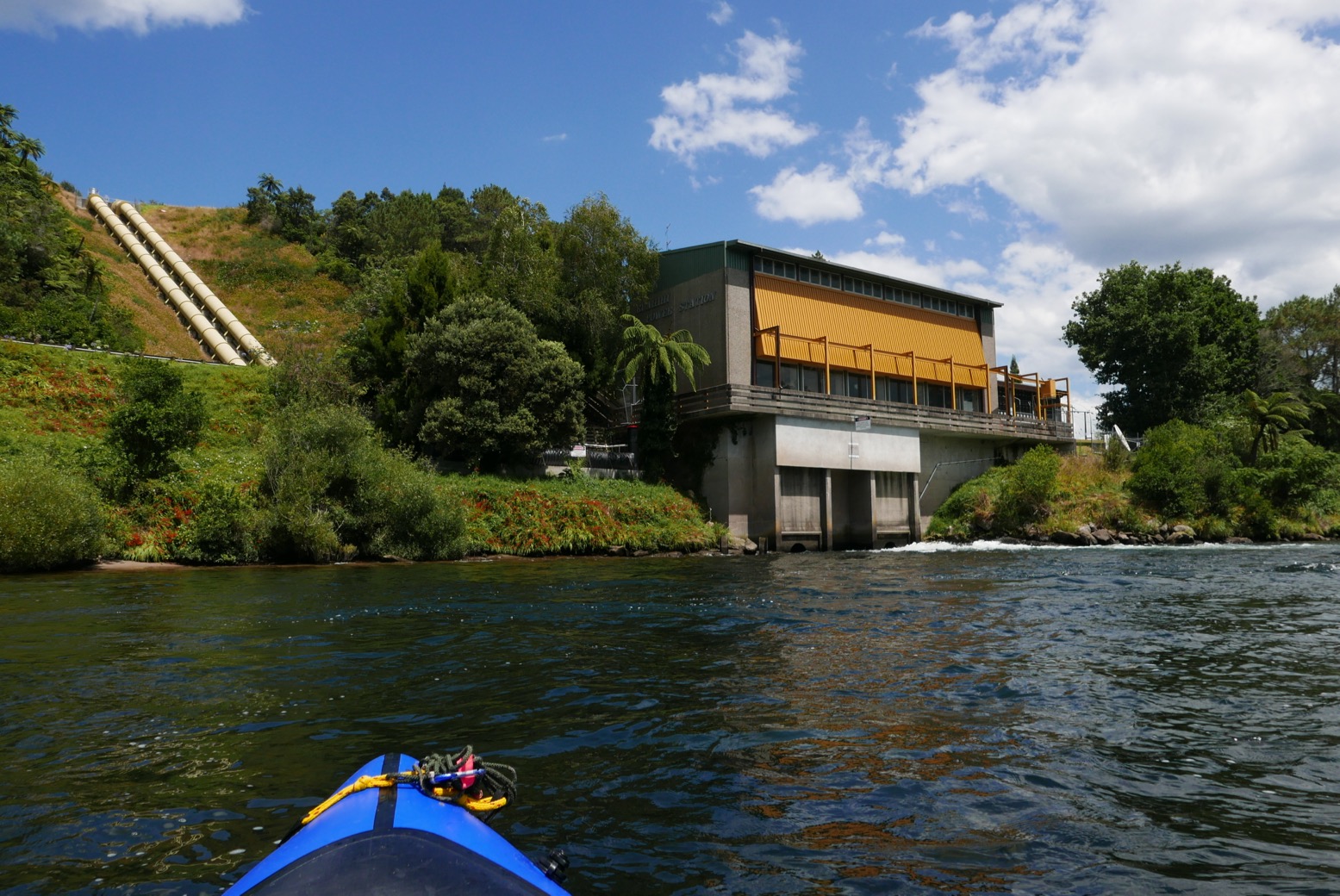
However you do it, getting to Doubtful Sound is a bit of an affort. First you cross the 35-km width of Lake Manapouri (pics above, map below) to a jetty at the west end, alongside NZ’s biggest hydro electric scheme (left). Unseen below is a huge machine hall carved out of the granite, housing the turbines
Just about every South Island lake seems to have been repurposed for power generation, producing up to 85% of the island’s electricity. 
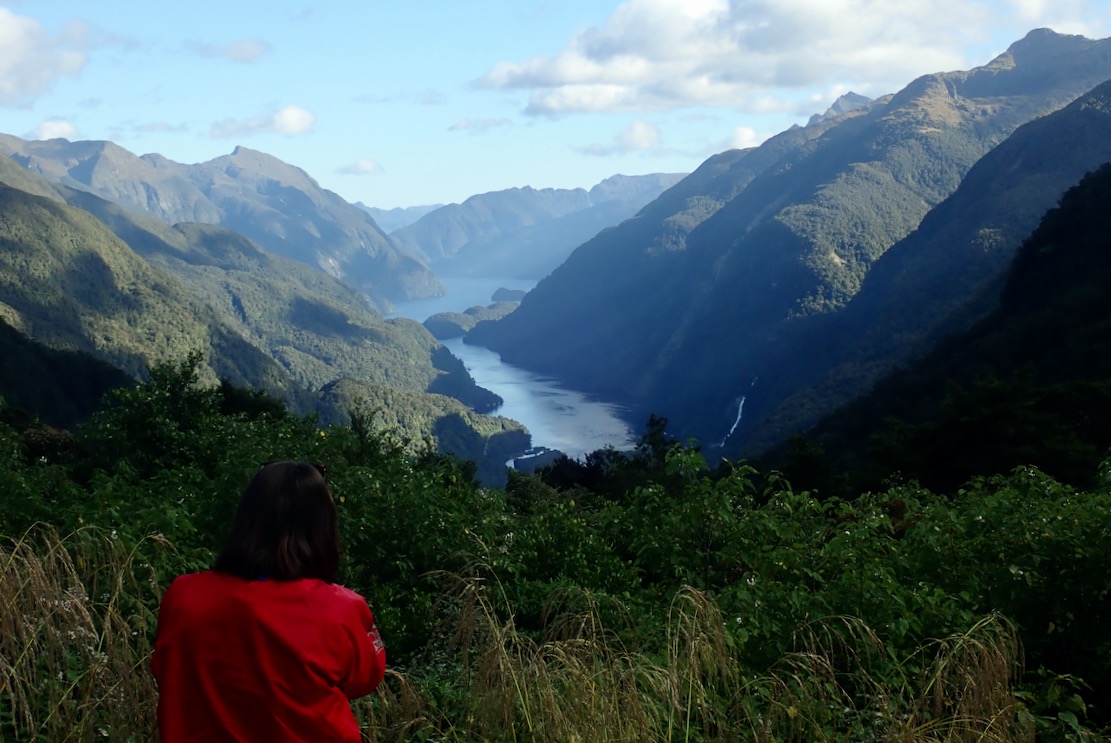
From the jetty a steep road leads over Wilmots Pass (above), then drops to the Deep Cove at the eastern extent of Doubtful Sound, noted by Cook on his 1770 expedition. This private road was originally built to serve the remote hydro construction from the sea. Once finished in the 1970s, one and then another tailrace tunnel was carved through the granite 10-km from Lake Manapouri to Doubtful Sound, the 180m-drop generating electricity for a smelter in town of Bluff, 150-km away. Five hundred cumecs (m³/sec) of water rush out of the tunnels, which adds up to a billion litres (1km³) every three weeks, freshening up the salty reach of Deep Cove with a couple of jetties and a hostel.
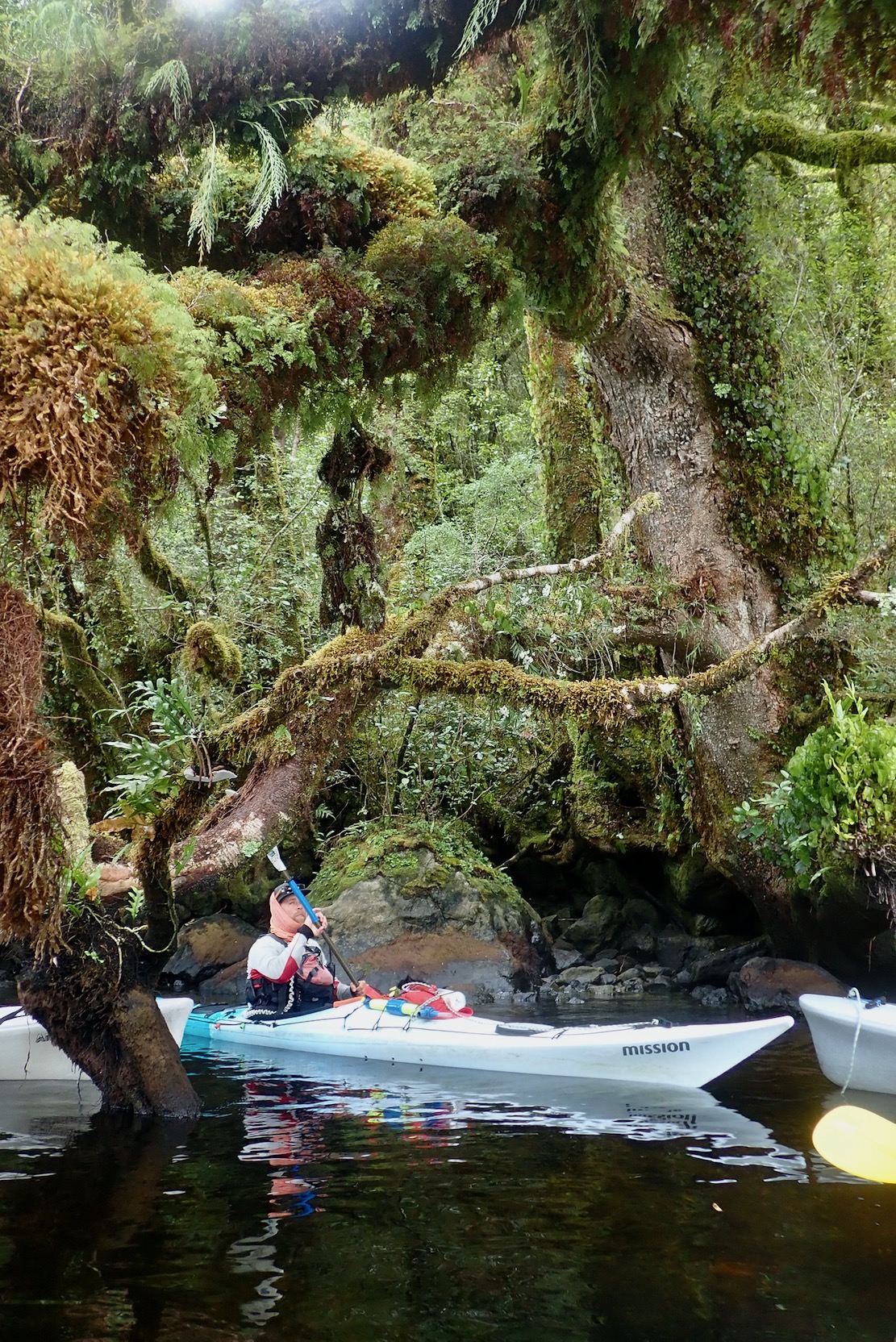
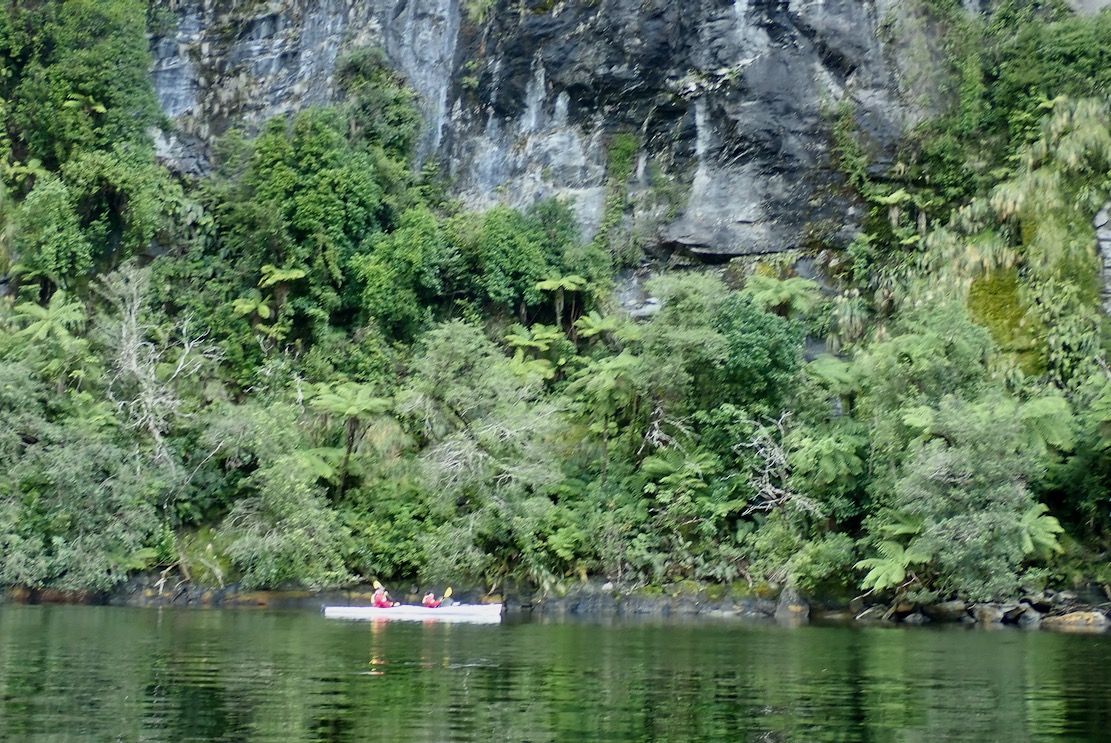
There’s little worry of Lake Manapouri running dry as the prevailing westerlies off the Tasman Sea dump up to 8 metres of rain a year, sustaining a dense, primeval rain forest of evergreens and ferns right out of Jurassic Park. They cling to the steep valley sides from the ridge crests all the way down to the tide line, and mineral, vegetable and probably some slow moving animals too, everything gets clad in bright green moss (left), even old rope.
But for all this running water and greenery, it’s barely inhabitable terrain dominated by 60° slopes or outright cliffs, all thick with impenetrable vegetation.
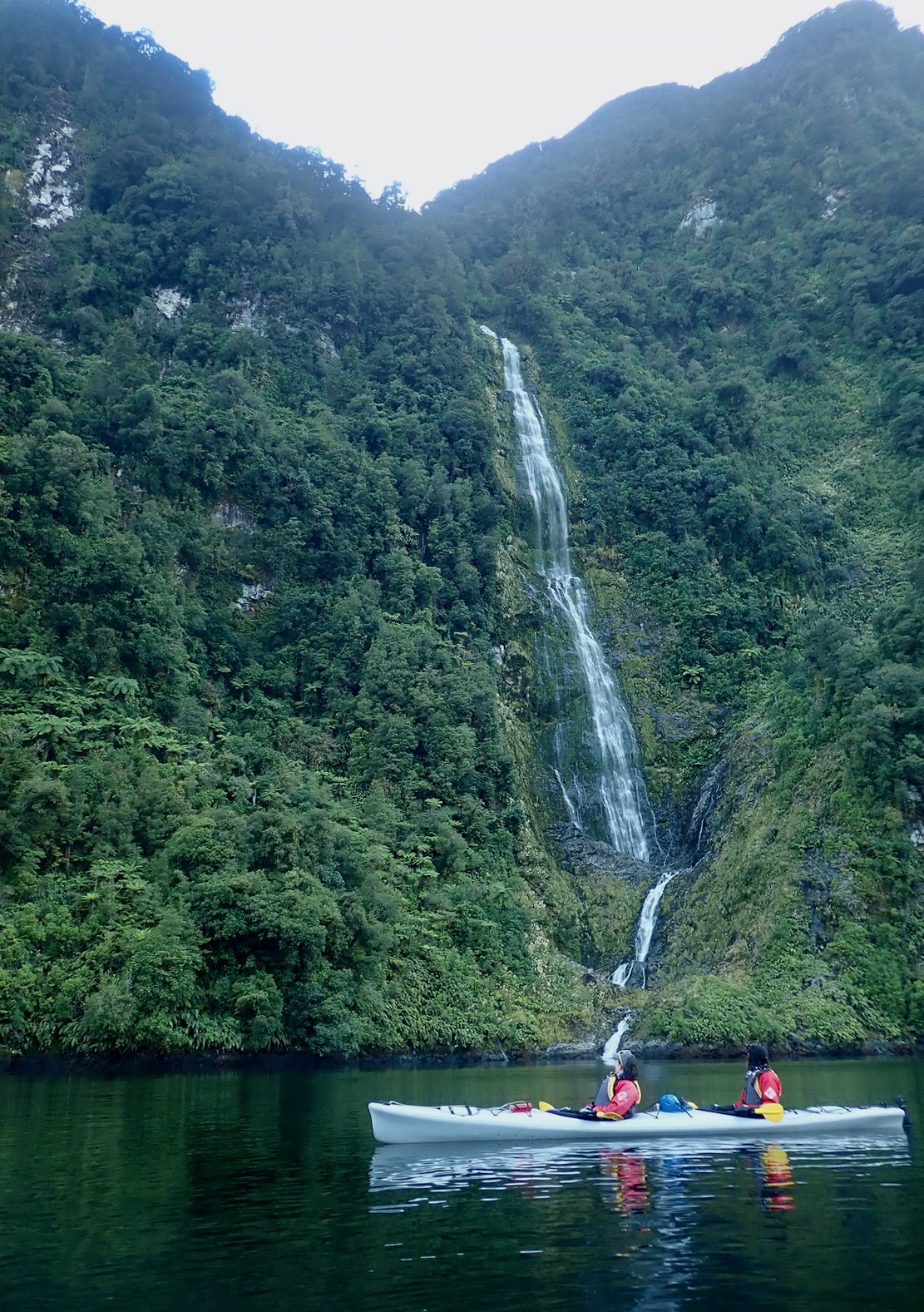
We’d arrived after a not unusual spell of rain which saw 1000-foot waterfalls streaming down the slopes, fed by unseen tarns far above. By the the time we headed out of the valley a day later, they’d dried up.
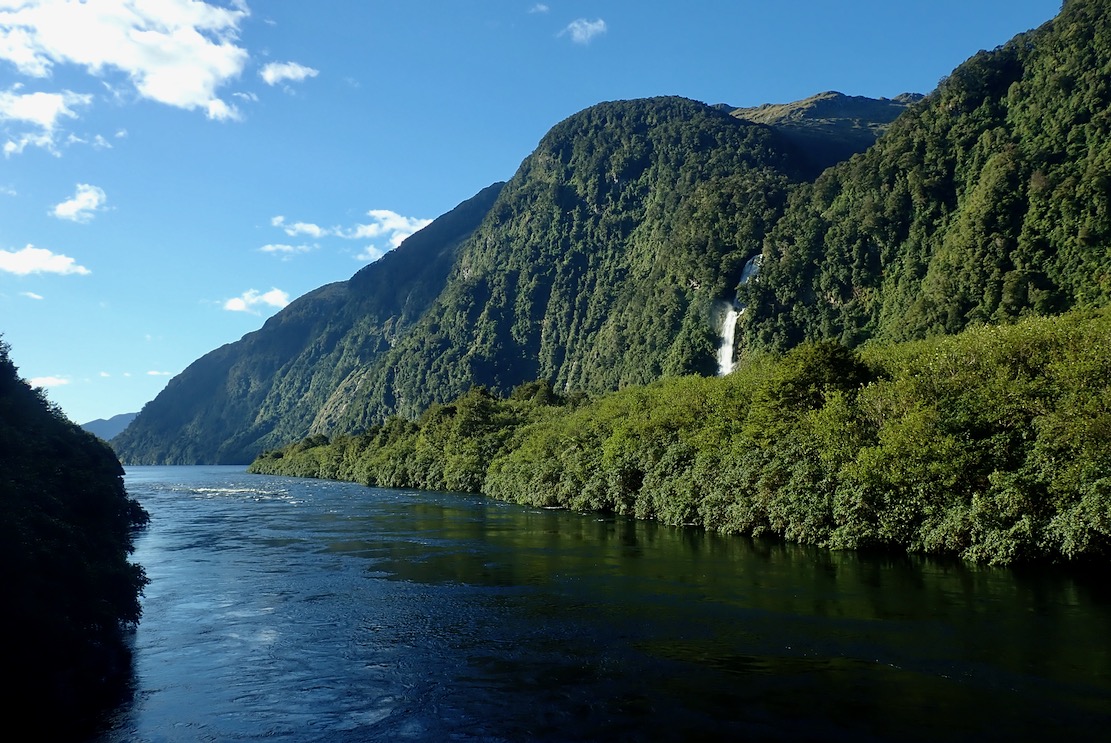
This is the hydro scheme’s spillway, with a swift current running into the Sound.

Our guide Blake explained there was no soil on these slopes. Once exposed by the retreating ice cap 12,000 years ago, lichen (algae-fungus) attracted moss, then ferns gained a footing and finally huge beech trees rose up, clinging to cracks in the rock and each other. Periodically they let go in a spectacular ‘treevalanche’, exposing a strip of bare rock comonly seen, and so the floral colonisation process resumes.
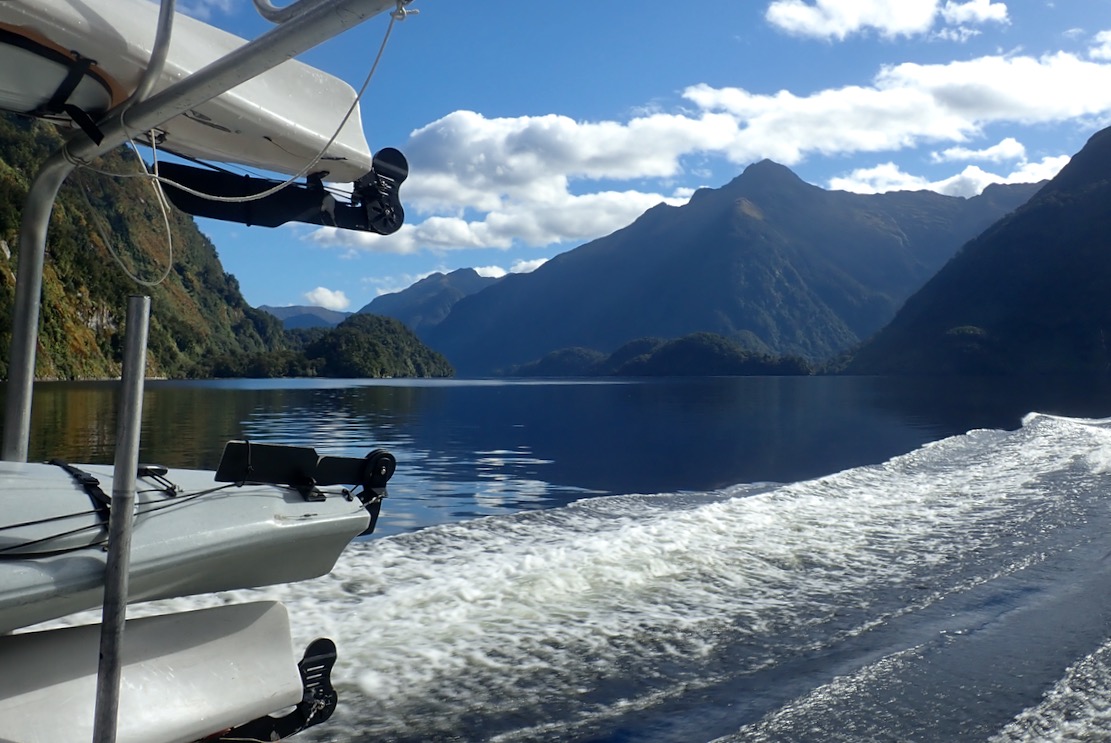
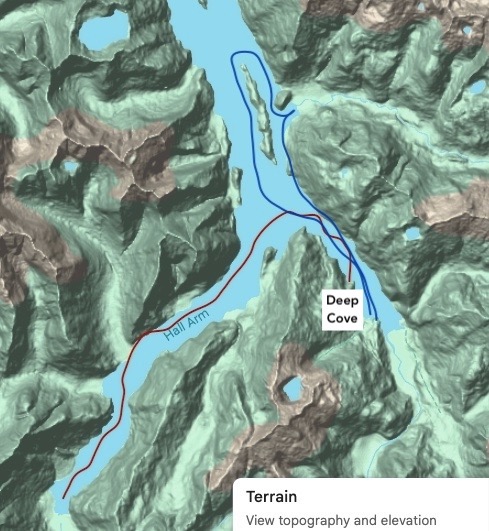
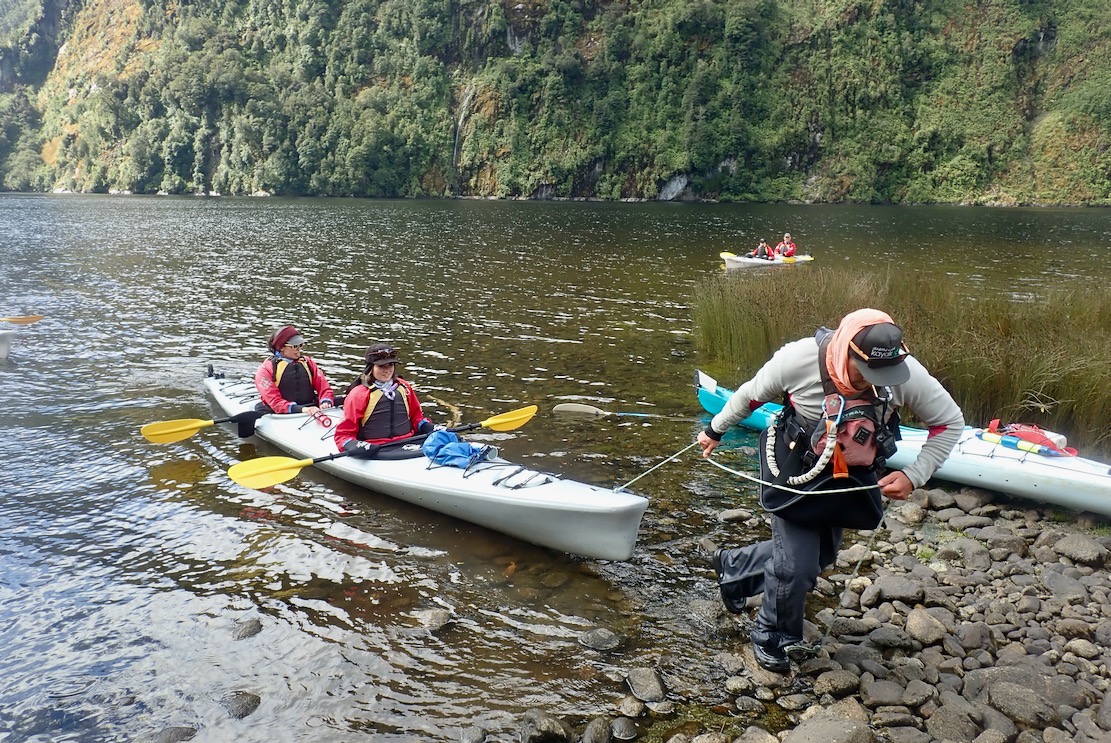
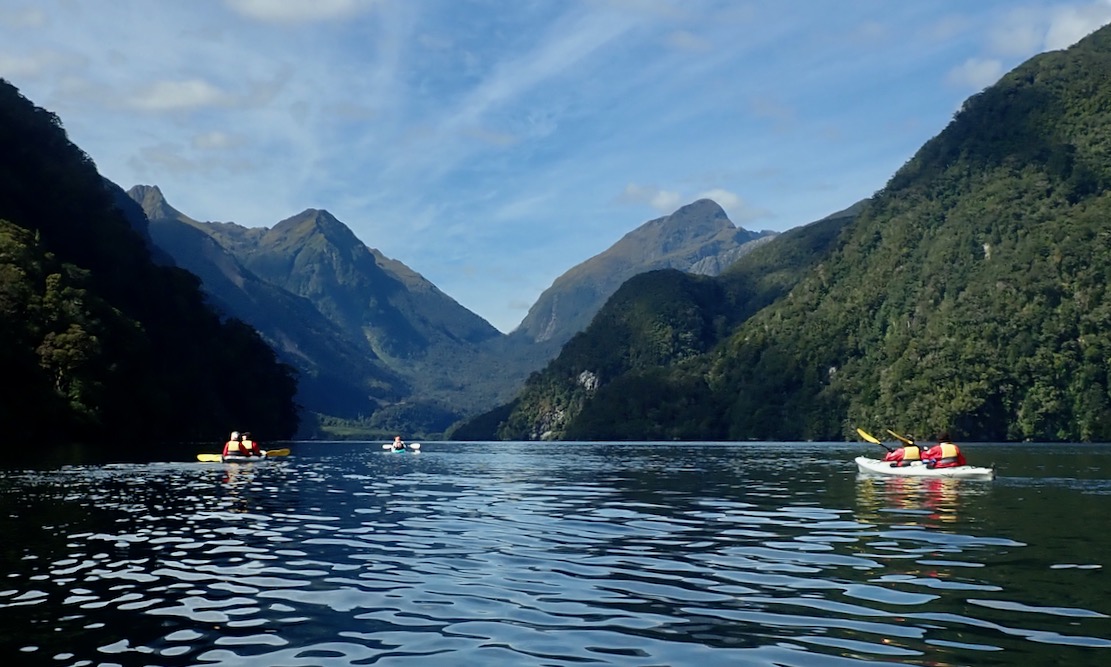
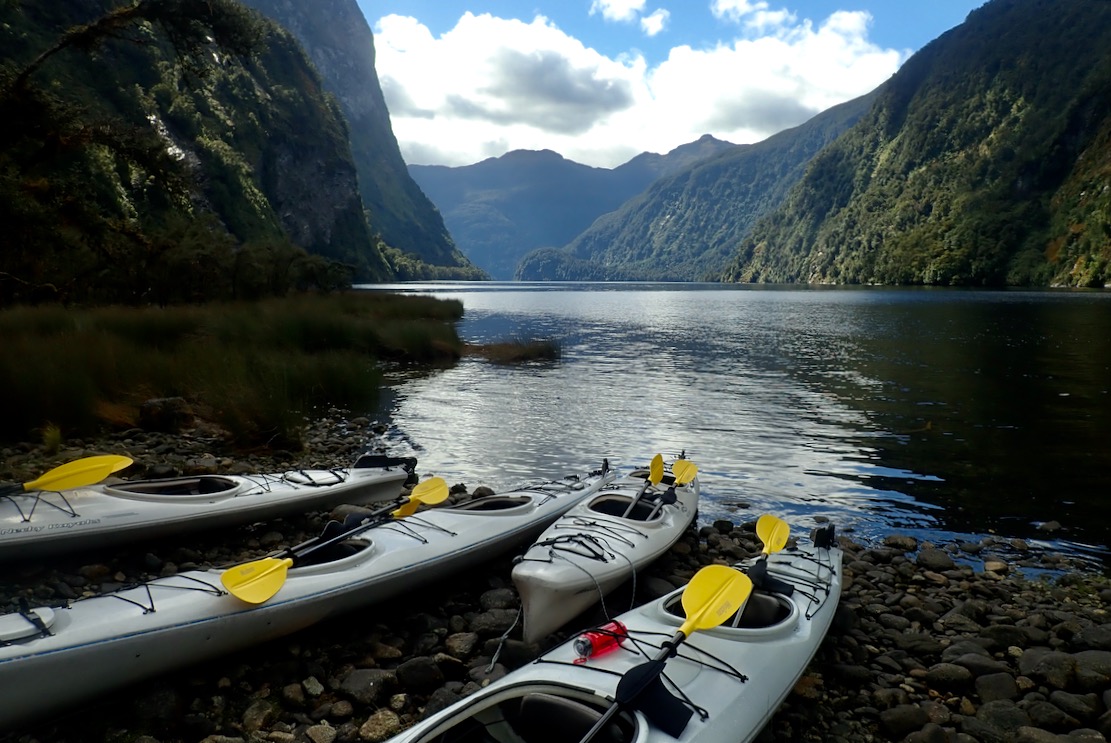
A service boat from Deep Cove jetty means kayak groups can be dropped off or collected anywhere in the Sound in minutes, depending on the day’s winds. Our afternoon paddle saw us left at the head of Halls Arm, 13km from Deep Cove. Down here only about fifty days a year are sunny, and we were lucky enough to grab two in a row. It was a bit disappointing to see passenger tour boats here, but they kept their distance or provided fun wakes to bounce across.

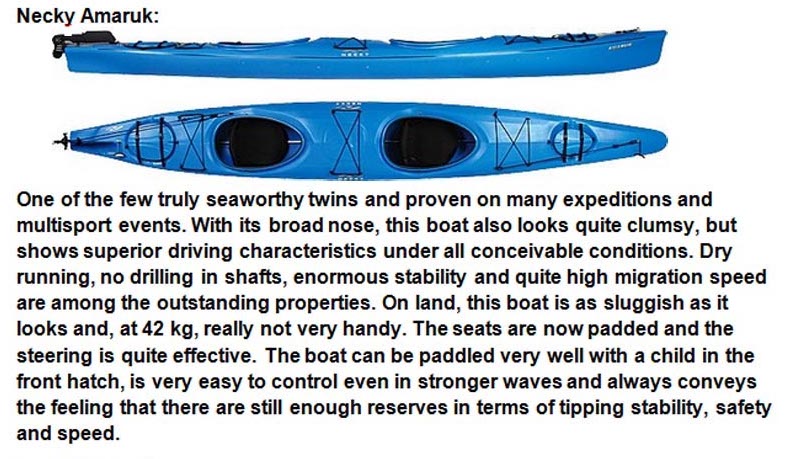
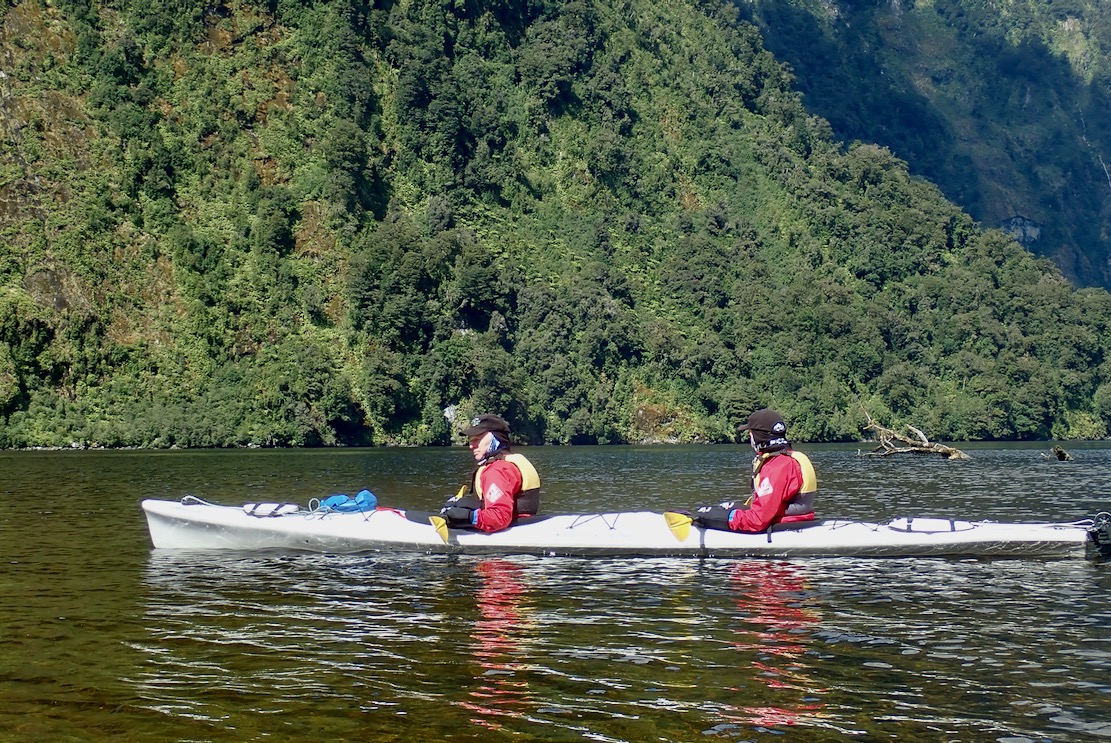
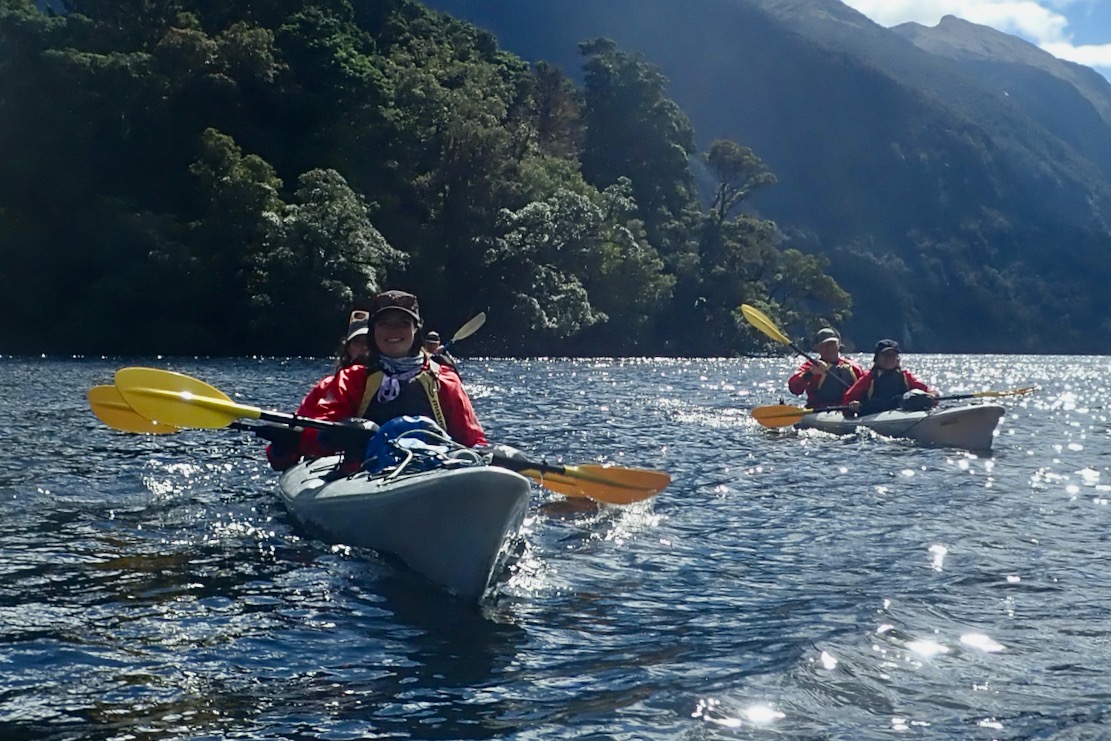
In Halls Arm eight of us slipped into four Necky Amaruks, a discontinued 6.4m roto double from the 1990s, just 66cm wide but clocking in at 42 kilos. We probably last paddled a hardshell double along Croatia’s Kornati Islands, some 30 years ago. The good thing with hardshells is you sit virtually on the floor and below the waterline, like a packraft but at nearly half the width. This means the boat is stable and fast, while still sitting low on the water and less prone to winds – the bane of much lighter and buoyant inflatables.
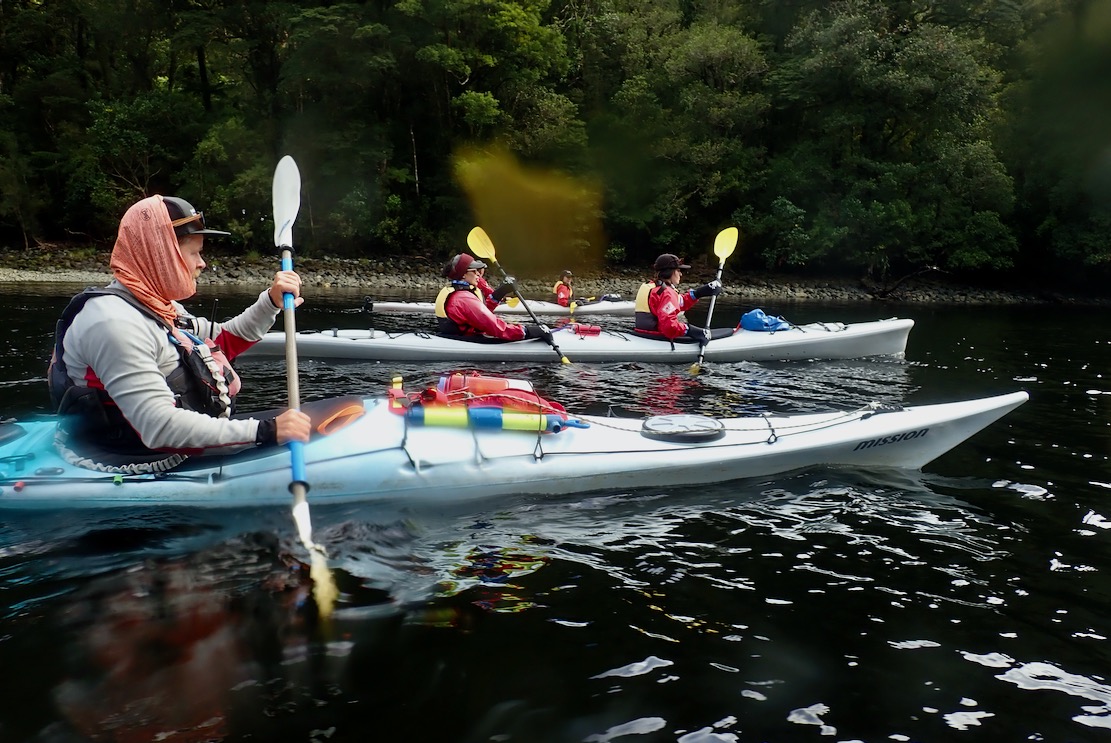
Today I sat in the back with the rudder, but failed to adjust for comfort, which ended up disagreeing with my bad leg and bad back. Occasionally an Omnium wet shoe would slip off the awkward side peg – less thick soles are better. After flailing hopelessly trying to reconnect my foot, I’d have to pulled back the skirt and reach in to unfold the peg.
I’ve experimented with or had IKs with rudders, but in the end decided they weren’t essential for my sort of fair-weather day-trips (as opposed to overnighters, where you’ll get all sorts of weather when a rudder can help).
You’d think you just set the rudder straight to go straight, but I found myself constantly finessing the pegs and zig-zagging, while trying to synch with the Mrs’ cadence up front, a bit like patting the head and rubbing the stomach.
By the time we got back to Deep Cove after two, 2-hour spells, me and another similarly older guy had to be winched out like sacks of wet wheat. The minimally-padded seats saw to that, not helped by the lack of a solid footrest for support. He and I were not the first to experience this hardshell discomfort of course, but like bike saddles, you either get used to it or find one that suits you.
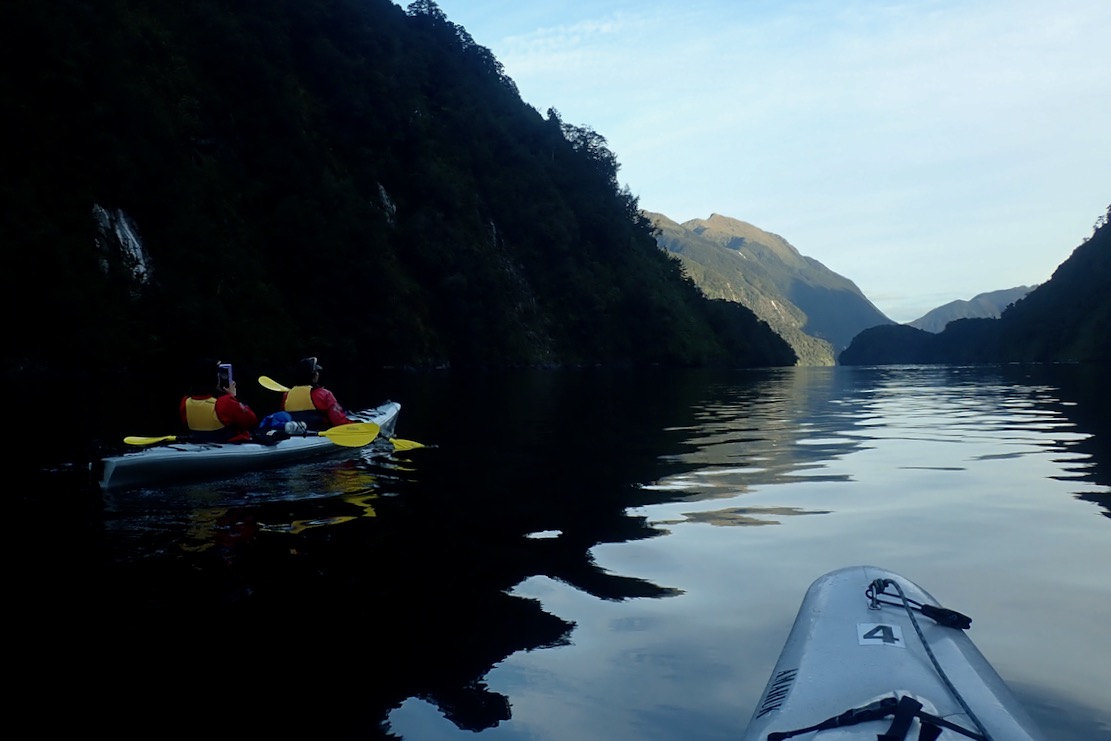
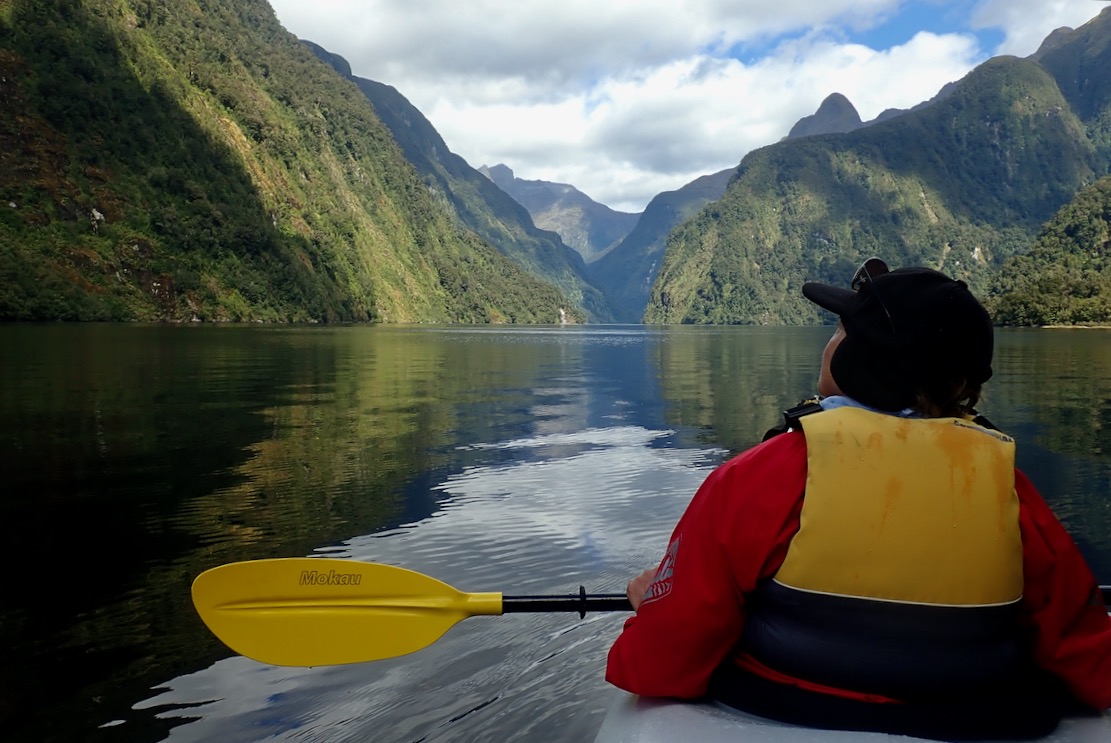
Next day I grabbed the front seat and directed the Mrs to the steerage area. This was much more like it! Solid foot placements and a great view. This time we paddled down the Sound alongside Elizabeth Island, passing a textbook hanging valley carved out by a former side glacier.
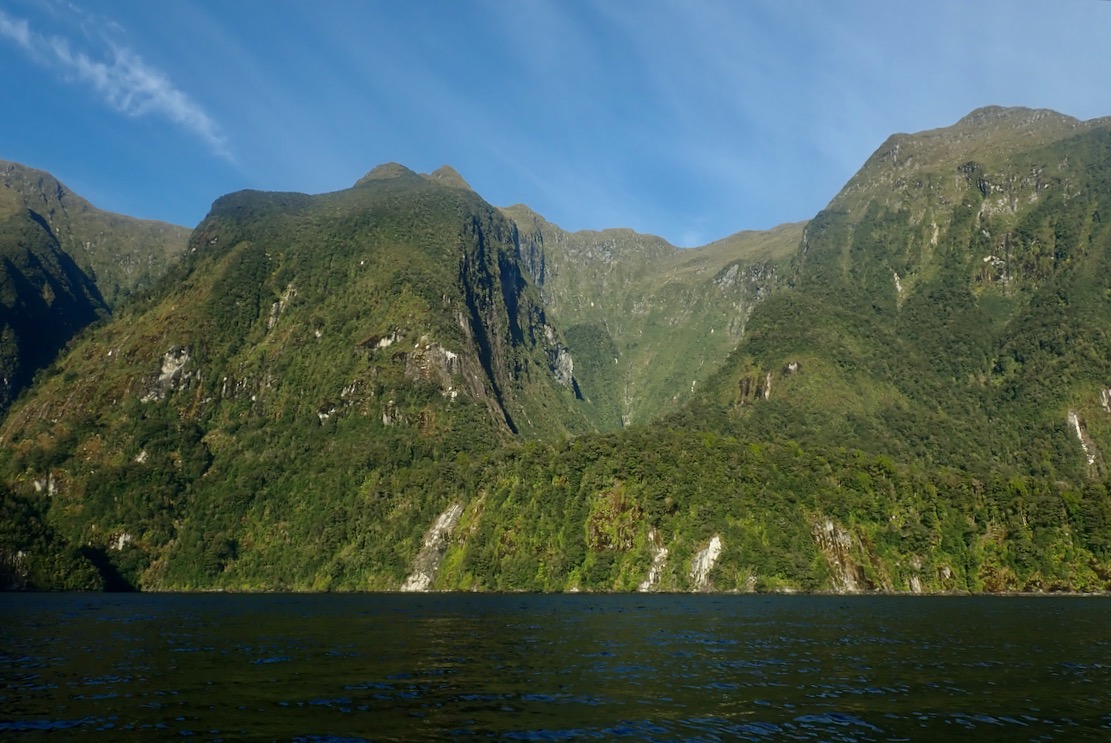
Hanging valley

Returning up the north side of the island, we took a break in a tidal cove free of sand flies which had pestered us yesterday and which are the famed nemeses of New Zealand’s sodden west coast. Blake said yesterday’s smoko had been sand fly hell, but being bigger, satisfyingly swattable and far less dense than tiny Scottish midges, I’ll take Kiwi sand flies any day, even if they give the same itchy bites.
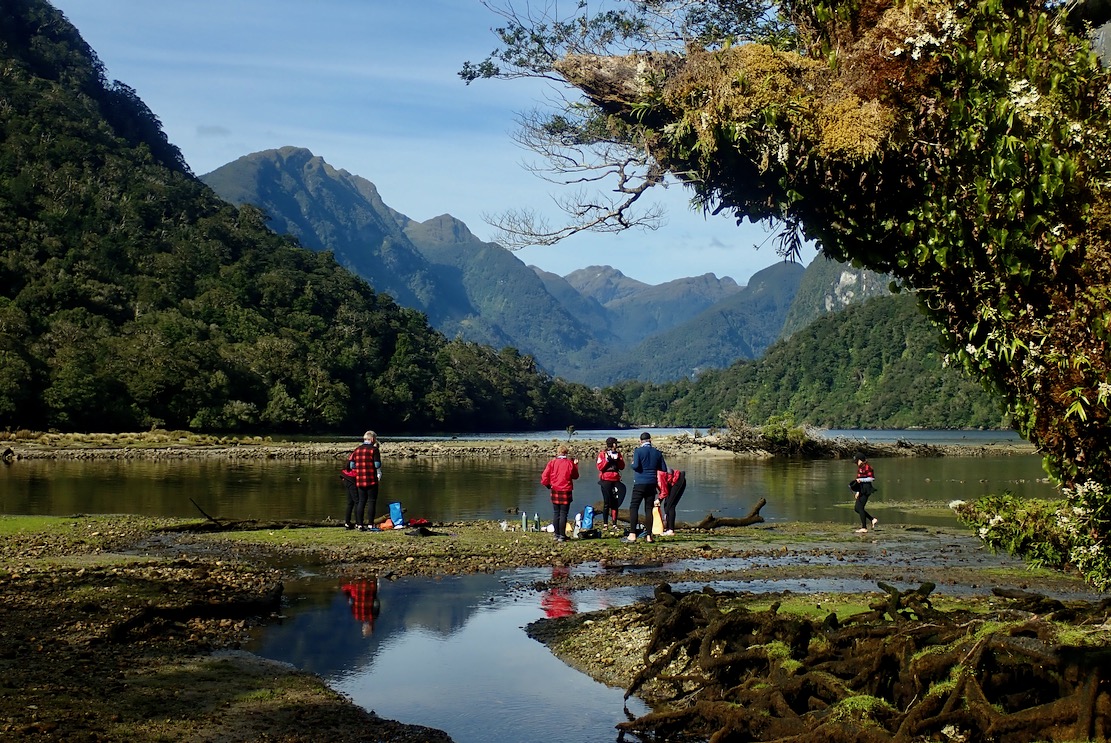
Sand fly-free tea break. Nice spot.

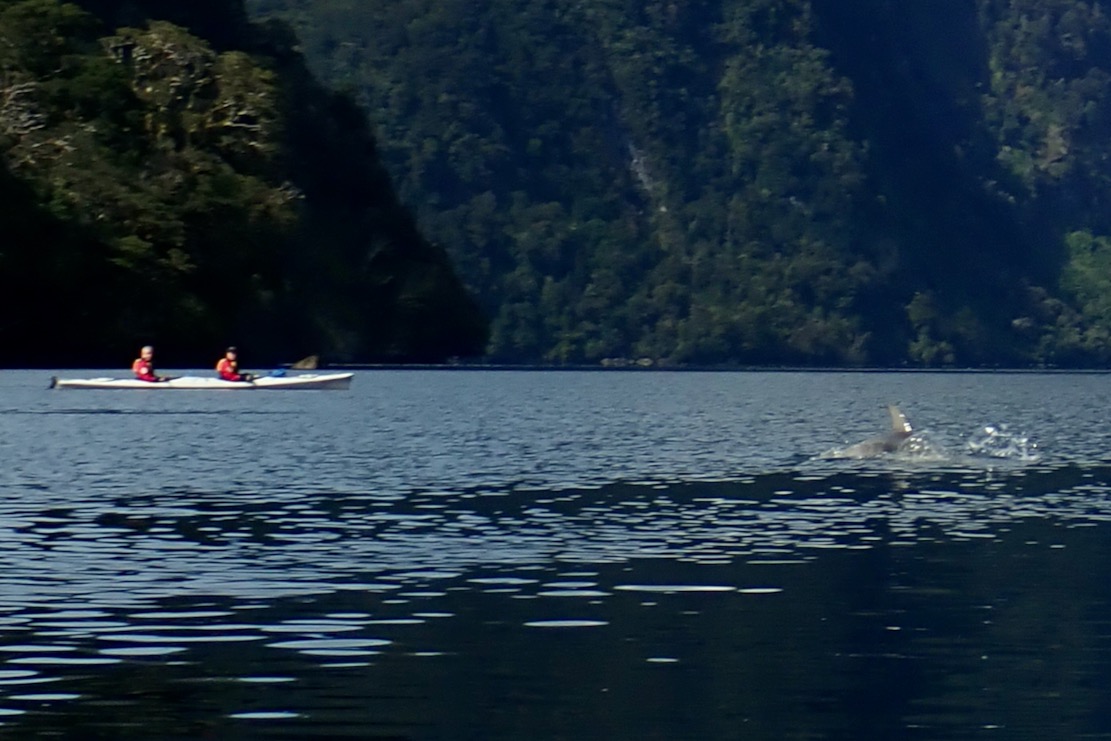
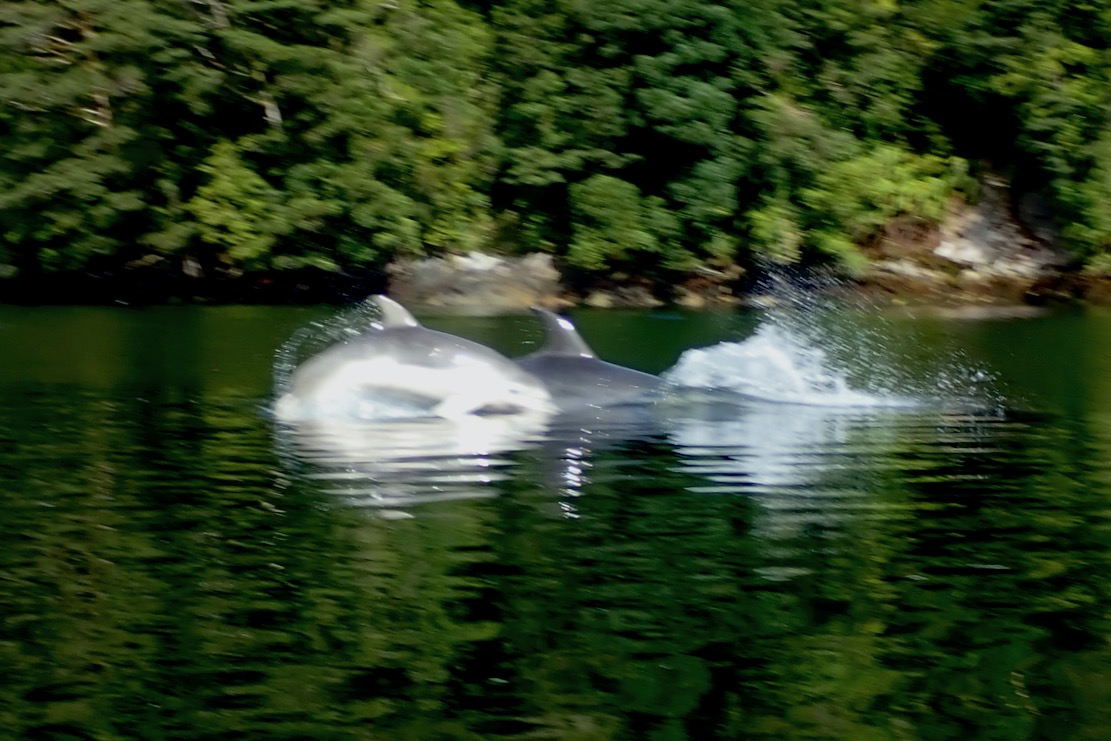
Heading back up to Deep Cove we came across some of the troupe of bottlenose dolphins which inhabit the Sound. The pod passed right by our boats, jumping and diving as they went.
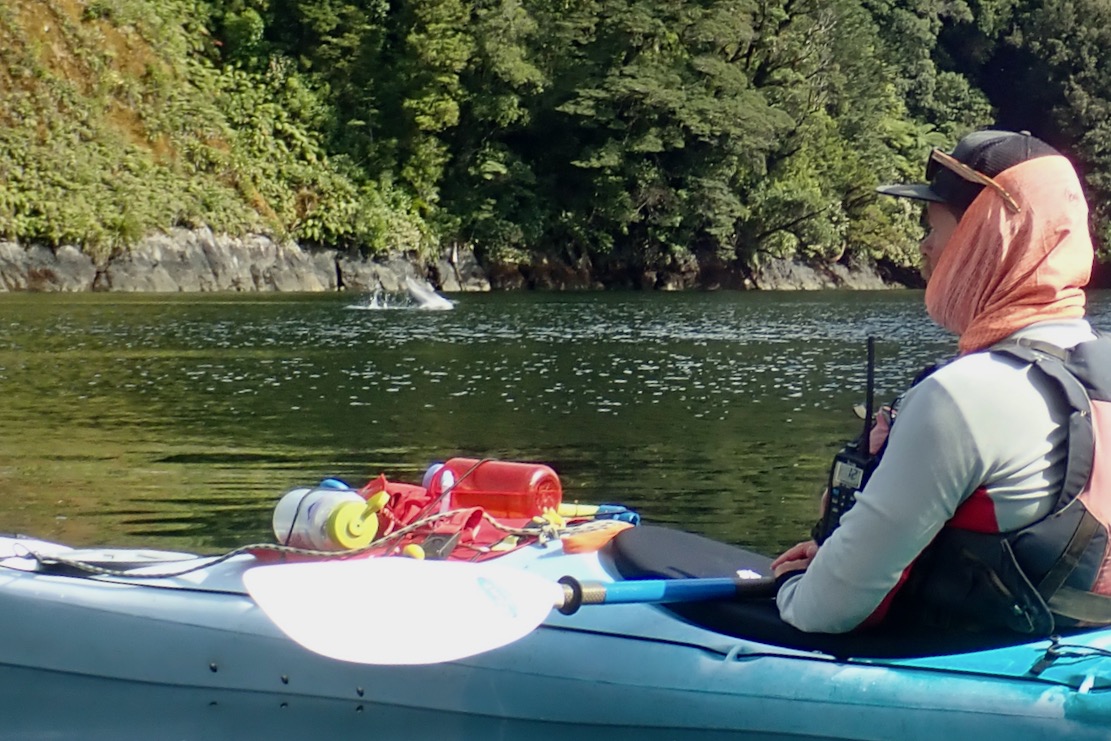
The last half hour turned into a slog. It wasn’t a headwind and it couldn’t be the Sound’s meagre two-m tide, even though it was on the turn. Which only left Manapouri hydro turning the taps on full as the the ally smelter down in Bluff just got a big order in.
Other than that, the tour’s pace was slow and the day after we both noted the lack of shoulder aches common after a first paddle in ages. When we were in synch, the Necky zipped along at an easy 6kph or more. It would have been interesting to see how it – or we – handled windier, choppier conditions.
Even then, a spell of hard shelling in a clammy wetsuit reminded me why I like IKs and Ps. Out in the fresh air, you can see your feet, access stuff easily, sit on a cushy pad of air, and of course hop in and out like a squirrel on a pogo stick. They say the Necky Lochsa which replaced the Amaruk had bigger cockpits, but you’ve still got 20 feet and 40+ kilos of plastic to store and transport; I saw one on ebay.nz going for just 300 quid. But for this type of use – rentals left on site for months – they’re ideal and indestructible. An SoT double would be door-wide and slow, and after all, most paddles here are in the rain.
It was great to paddle Fjordland and revisit to the dark side to revalidate my prefs. For the sort of paddling I enjoy, I’ll still take an IK or P.
Packyaking in Whitianga (NZ)

MRS Nomad Index Page
Packrafting the Wairoa River (NZ)

nzwhitmap
diver

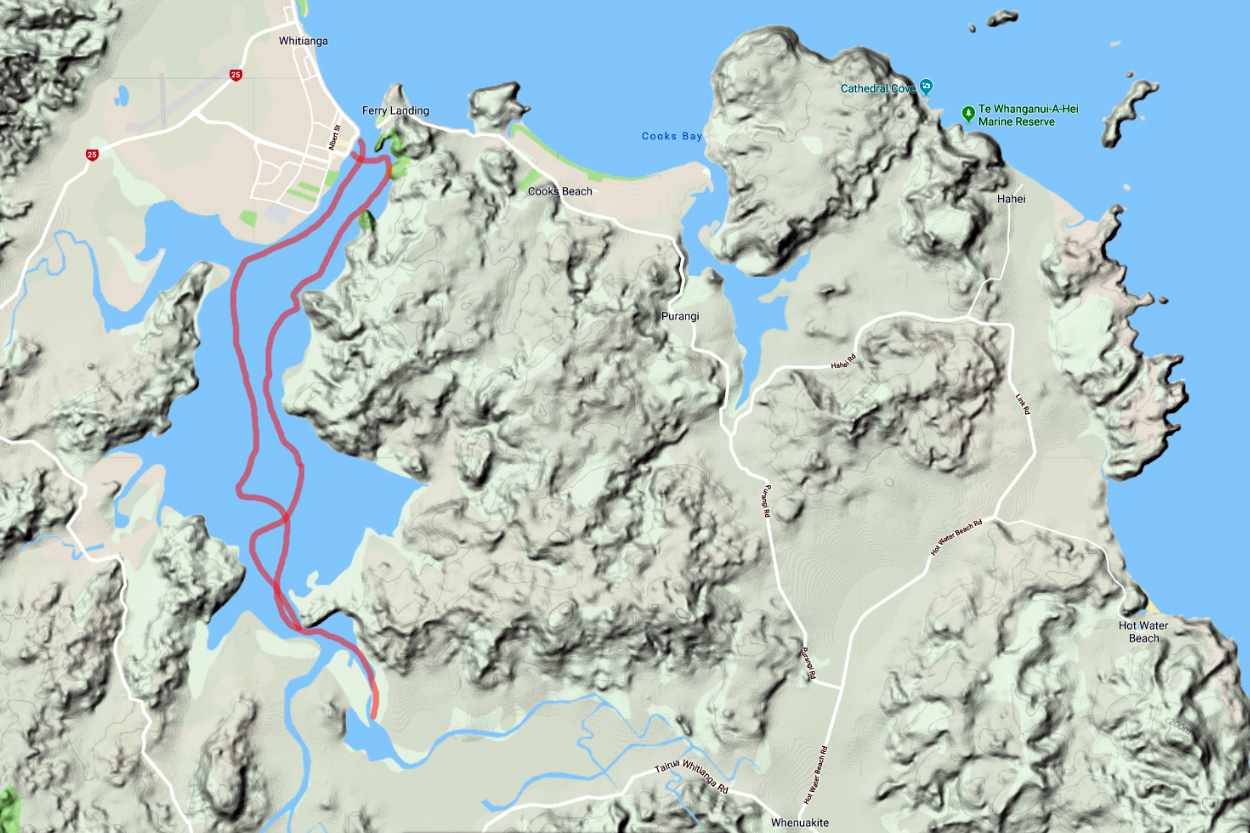
At a Dive shop in Whitianga on the North Island’s Coromandel peninsula half a day from Auckland, I asked the teenage girl left at the till which way the tidal currents flowed around here. She smiled at me like I was an idiot and explained slowly.
‘Well, when the tide comes in it like, comes towards you, and when it goes out, it sort of goes away.’
Before I got into sea paddling that’s what I would have said, but I explained what I meant, that tidal flows moved to and fro in a given direction along a coast, not just in out, in out, like a Can-Can dancer’s legs At any constriction or headland it’s a good thing to know when planning or timing a paddle. She looked it up on the internet.

‘Anticlockwise.’

‘Thanks.’

nzwhitibay
pacificoh

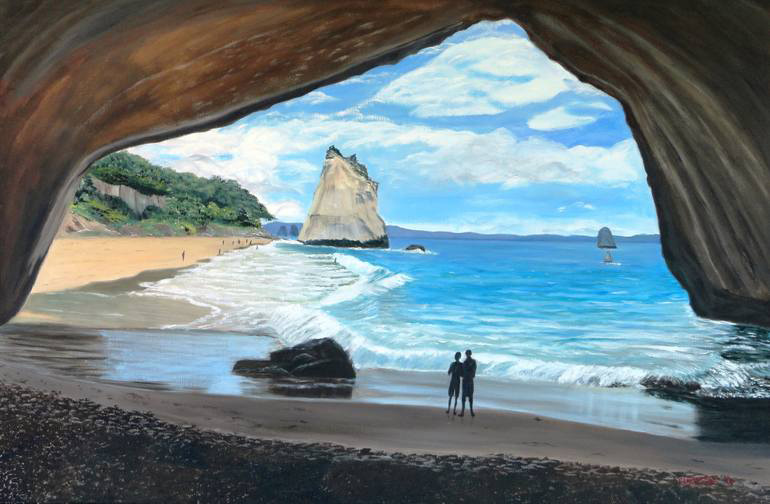
Tides apart, did I really think the surging expanse of the Pacific would be calm enough for a humble 10km coastal packayak round the cliffs of Cook Bluff to the famous and much fridge-magneted tourist icon of Cathedral Cove (painting below)? No, but now on my wavelength, Dive Girl went on to offer me tomorrow’s gloomy forecast: 4-metre swells, 35 knot gusts and occasional showers of razor-billed flying fish.
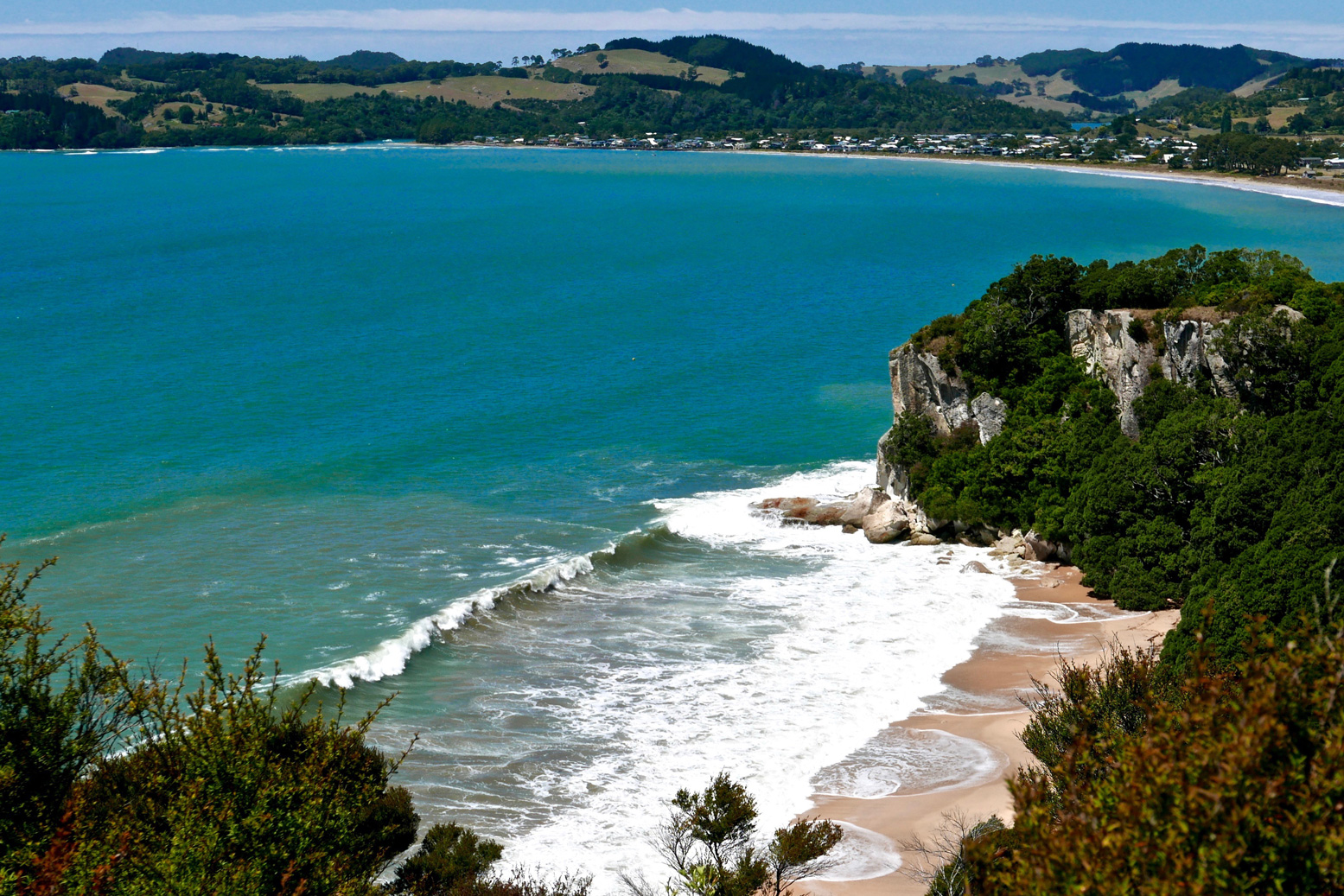
A good day for a cliff walk then. Coming back next evening from Cooks Beach, I  was a little appalled to see Mercury Bay awash with white-capped rollers, as if some tsunami was on the go. Surf’s up, if you have the nerve.
It was right here in 1769 that Captain Cook and his crew – on the hunt for the fabled Terra Australis – first raised the British flag on the New Zealand shore while engaged in observing the transit of Mercury.

cathcov.jpg
nzlonebay

Maybe I’d get a chance the day after, my last. But even in the calm morning, the storm’s after-swell was still pounding the cliffs and beaches of Mercury Bay. Who knows how it was at the Cove of Broken Dreams which, they said, was still closed from the land side, anyway.
Luckily, the cliff-rimmed natural harbour of Whitianga was sheltered from all this Pacific aggression. And better still, the tides were ideally timed to be swept into the inlet, before getting spat out on the mid-afternoon ebb like a retching gannet’s breakfast.

nzwhit - 3

Settling up on a grassy strand near the marina, I realised I’d left my pfd at the hostel – this after noting a warning sign advising that all in <6-m long boats required them. Oh well, if spotted hopefully the harbour master will zoom up alongside me on his jet ski and lend me one for the day. As it was, I was heading inland where there’d be no one.
Once tempered up via my hose extension, I scooted over the yacht-clogged harbour mouth, ferrying across the strong current filling the shallow inlet, tilting marker buoys as it went. I was told later that, partly as a result of dredging a channel for marina access, that Whitianga’s natural harbour was fastest flowing in New Zealand.

nzwirshelf
handpump
beg18

On the west side, under a wave-carved overhang (left) I hopped out to temper the MRS again. I like an inflatable as firm as possible but am finding, perhaps due to its larger than normal volume for a non-pump inflatable, that the S1 commonly needs a second pump up a few minutes in.
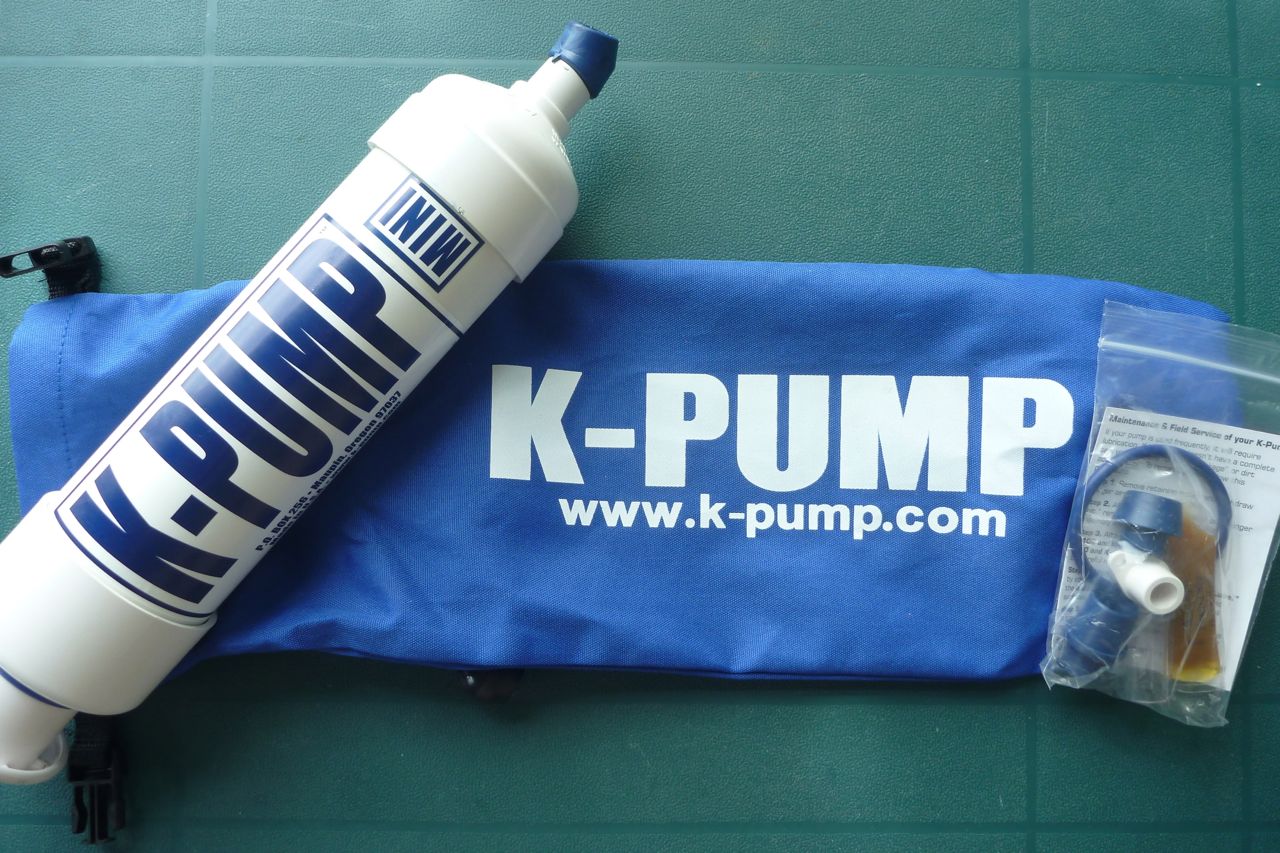
I’m now wondering if something about half the size or volume of my 600-g K-Pump Mini would be handy to get the Nomad up to operating pressure in one go. This eBay pump (right) cost me just 3 quid posted and is actually similar to the mini pump Alpacka initially offered with their $2000 Alpackalypse. With a pump like this, after high-volume air-bagging, you could judiciously pump to a highish pressure on the shore – assuming the cheapo eBay pump can hack it. Yes, a pump’s another thing to carry/lose and the comparatively bulky K-Pump will do the job in a few short strokes. But unlike a paddle, it’s not ‘mission critical’, as they say in the movies.

Fitting a PRV and being able to pump away until the PRV purged (as I do with my Seawave IK) would be even easier, because you could also happily leave the boat out on a hot beach without fear of it exploding into a thousand ribbons of ruptured TPU. PRVs are unknown on packrafts so maybe I’m over-thinking it, but double-tempering is a bit of a faff even if, as humans go, I have a good pair of nicotine-free lungs.

nzyacht

Anyway, I padded southwards, weaving among the lifeless yachts and cruisers, reminding me of our Hayling Island paddle last summer. Let me tell you, in this world there are a lot of massively under-used boats bobbing around and gathering algae.
Once past a sinister big black tug, the bay opened out and I was in the clear. Nearby, alongside a jetty below a cliff leading to a dwelling hidden in the bush, I spotted this pioneering-era carving.

nzwhit - 2
nzwhit - 1

Beyond here the shore looked oddly mangrovey and inaccessible. Mangroves this far south at nearly 37°? I’d only ever seen then around Darwin where I’d once eaten a so-called oolie worm which feeds in their trunks. Sure enough, turns out hereabouts is the southermost extent of mangroves.
I’m not so keen on this sort of drab coastline, but live and let alternative lifeforms live, I suppose. In fact it was fun to probe the passages below the shady groves as it was due to reach 30°C today.

s1nzmangro
nzwhit - 7

It took a bit more idle nosing about before I finally located the channel leading southeast to the two small rivers which fed the harbour inlet. The channel narrowed as the supposedly slack tide swept me into the tangled maze of salt-loving woodland. Curving left and right, south and east, as the scaly boughs closed in, it occurred to me that this far down in the bay wouldn’t be a great place to get lost and then stranded in thigh-deep, oolie-ridden silt for the next few hours. Who knows how quick the tide turns. Anticipating this, I’d clocked a hilltop landmark over on the western hills to help orientate myself, then pushed on in as far as I dared, getting maybe 500m from shore before spinning around into the still-rising tide and scuttling back out into the open.

nzwhitbaymapp

The tide really ought to have turned by now, carrying me back the way I’d come, but the forecast nor’westerly was on time and in my face. Luckily the Nomad’s generous stub nose stopped me making a mockery of the harbour’s 5-knot limit so it was a long hour’s slog back to the harbour mouth, bent against the breeze and slapping waves. A similarly windy afternoon on the Wairoa River a few days back must have got me into paddling shape, so the effort was all put down to good exercise.
Once past the marina, I’d hoped to slip below the jetty, under the harbour master’s cabin and out into Mercury Bay itself. Maybe cruise below Shakespeare Cliffs and then land on Buffalo Beach, like a proper Pacific navigator. But it was not to be. Chances are I’d have just embarrassed myself, tumbling through the surf and into the shore fishermen’s barbed hooks.

nzwhit - 6
nzwhit - 12

My time was up in NZ. Next day, rolling my cleverly adapted UDB (more below) to the bus stop, all was as calm as a kiwi’s cozy nest. I was reminded how sea kayakers must feel when they haul all the way up to the Summer Isles to be met by tent-bothering gales, only to find great conditions as they pack up.
It’ll be there next time and for sure the east side of the Coromandel looks like the fantastic place for some fabulous sea paddling. The beachside hostel I stayed at laid on hefty old SoTs for free and there were plenty of kayak touring outfits in town and around. Give it a go if you ever find yourself down here.

nzwhit - 9

nzwhit - 10
trolley
ort140
ortliebrolled

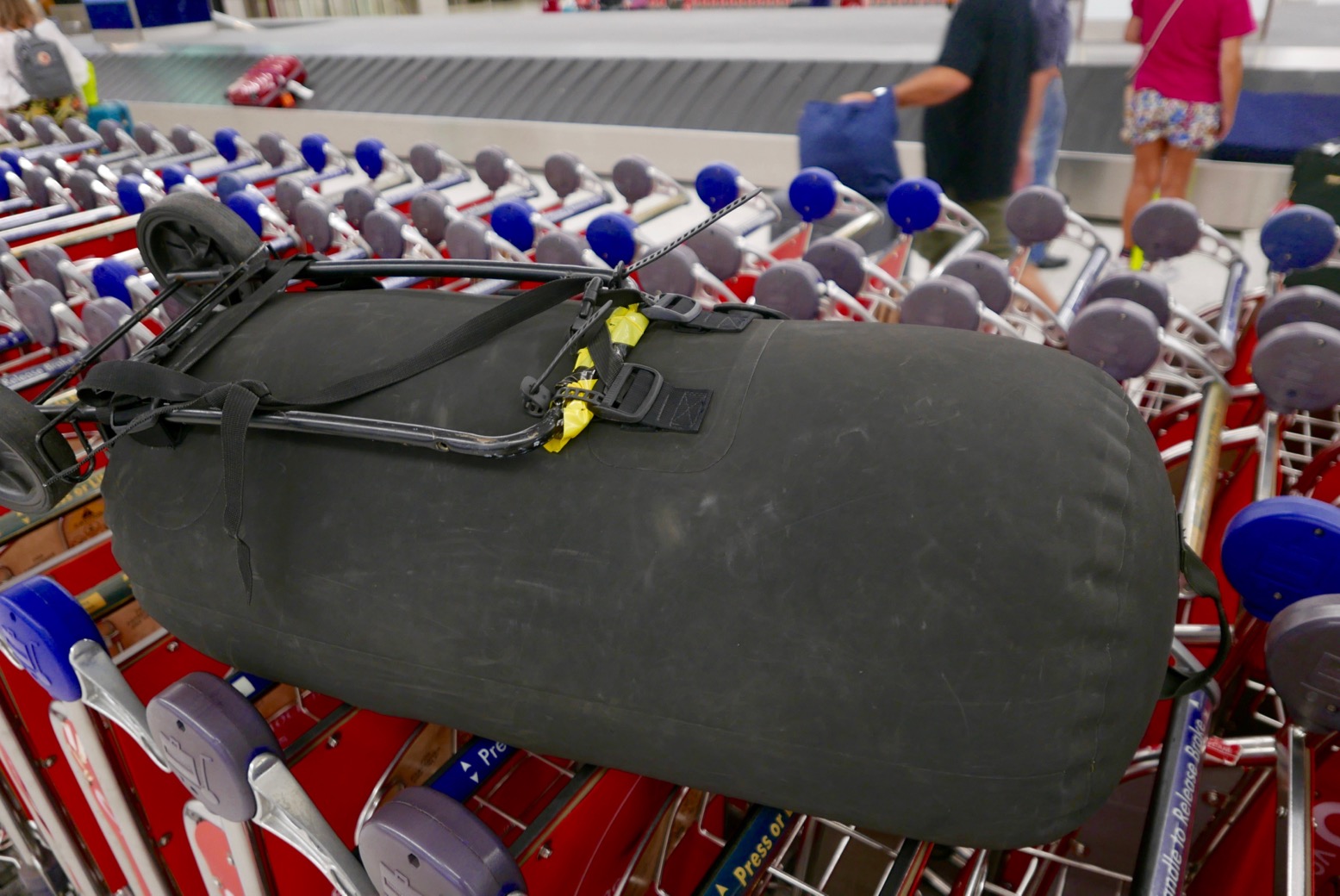
For this trip moving from airport to airport and in a bid to spare my creaking back, I mated my trusty Watershed UDB to a chopped-down lightweight folding trolley I’ve used on previous packboating trips. With chunky zip ties and a strap, the shortened frame fitted securely to the rugged UDB’s back harness tabs.
My load was way under the airline limit, but the thinking was that, once packboating my planned river for a few days, the UDB and small trolley would still be compact, compared to a regular wheeled travel bag.
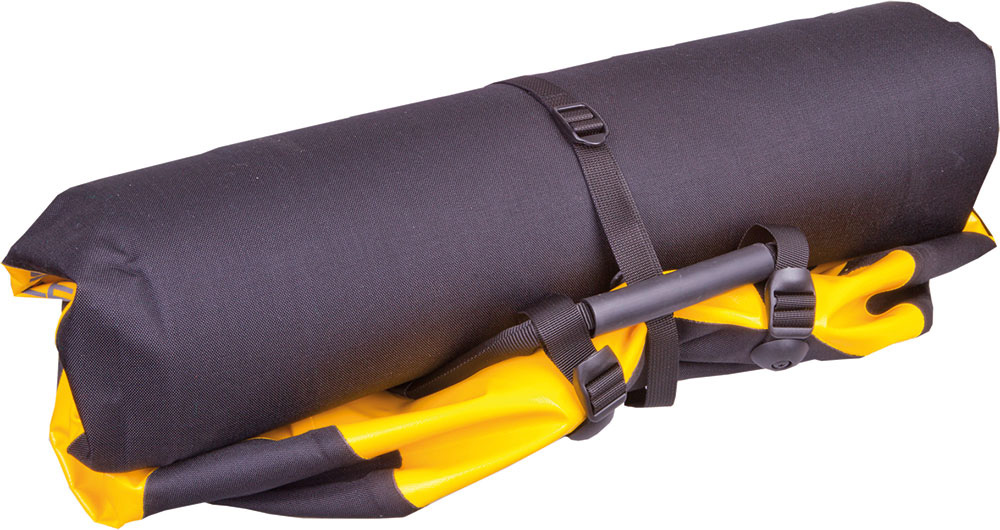
It was all a way of stopping myself buying the painfully pricey but actually only 500g heavier Ortlieb Duffle RS 140 I’ve been eyeing up. Fitted with an IP67 TiZip (not as good as the UDB’s brass drysuit zip), it’s the biggest one they do, so ought to take my Seawave IK and gear. Lacking a backbone frame of Ort’s RG duffles,
the 140 actually rolls up even smaller (right) than my DIY contraption.
A handy side benefit (which might also apply to the airtight Ortlieb), was that being able to inflate my UDB into a rigid airtight sausage made it easier to wheel around (but not as comfy as a full-framed wheel bag). I got some odd looks giving my bag a blow job by the arrivals luggage carousel, because at departure check-in I had to tug the zip open a bit to ensure it would air-off safely at 32,000 feet.
In my hand I carried my nifty Ortlieb 30-L Travel Zip.

Packrafting the Wairoa River (NZ)

MRS Nomad Index Page

NZS1The MRS Nomad S1 I tested last summer in Scotland is my new packraft. Goodbye to my great little Alpacka Yak. Like the Yak before, it held its value and I sure got my money’s worth out of it over 4 years. The Nomad is an unusually long packraft with a central seat, making it more of a packyak which paddles much like a short IK (no yawing), has more space and weighs under 5kg with a roll-back skirt and thigh braces. So – easy to walk with for as long as you like.

I’d originally planned the classic North Island paddle: the canoe-able and therefore safely packraftable Whanganui River in the southwest. The best section is a 5- or 3-day-with-huts run for which you need to be self-sufficient as there are no towns, let alone roads or bridges until you take out at Pikiriki. I was set up for that, but it turned out getting to the remote Whakahoro put-in, then from Piki back to Auckland for my plane took more time than I’d allowed myself, once my flights got rescheduled.
No worries, this in New Zealand: international nexus for outdoor activities. I’d had a bike test arranged at Tauranga on the North Island’s Bay of Plenty, so decided to stick around that region instead of watching days pass by from a bus window.

nzt - 1


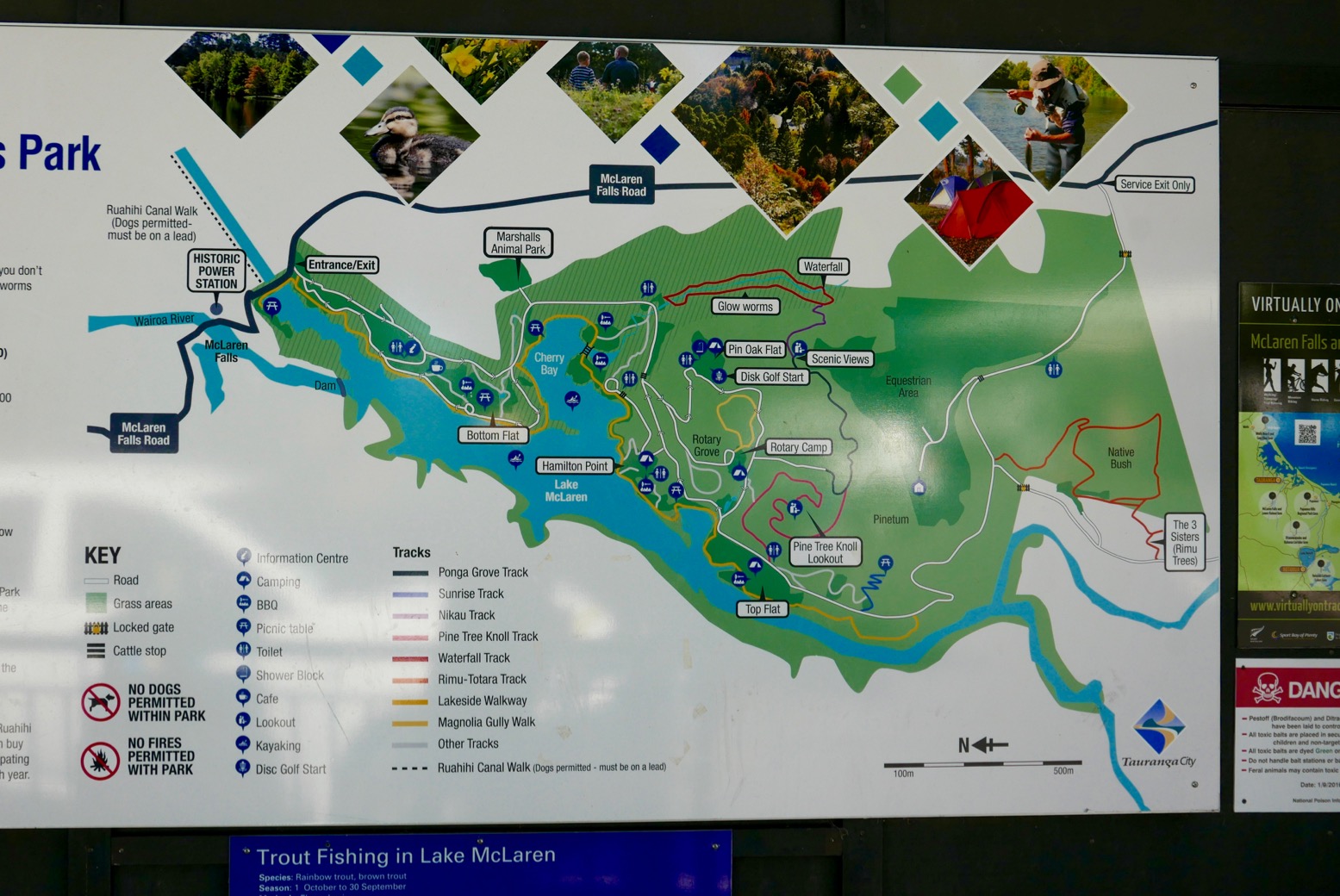
A brochure at the hostel proposed evening kayaking up a glow-worm gorge off Lake McLaren, 20kms south of town. Even in daylight that sounded fun, so I taxied over and planned to walk and paddle back. Lake McLaren is a country park (left) with forest trails spread around a small reservoir and an old power station by a waterfall. A good place to reacclimatise myself with the S1 as a quick spin in Sydney a week earlier showed up a crease mid-hull which suggested a slow puncture or just the usual ‘is-it-a-bit-soft?’ neurosis combined with too much fine dining.

nzt - 9
nzt - 5

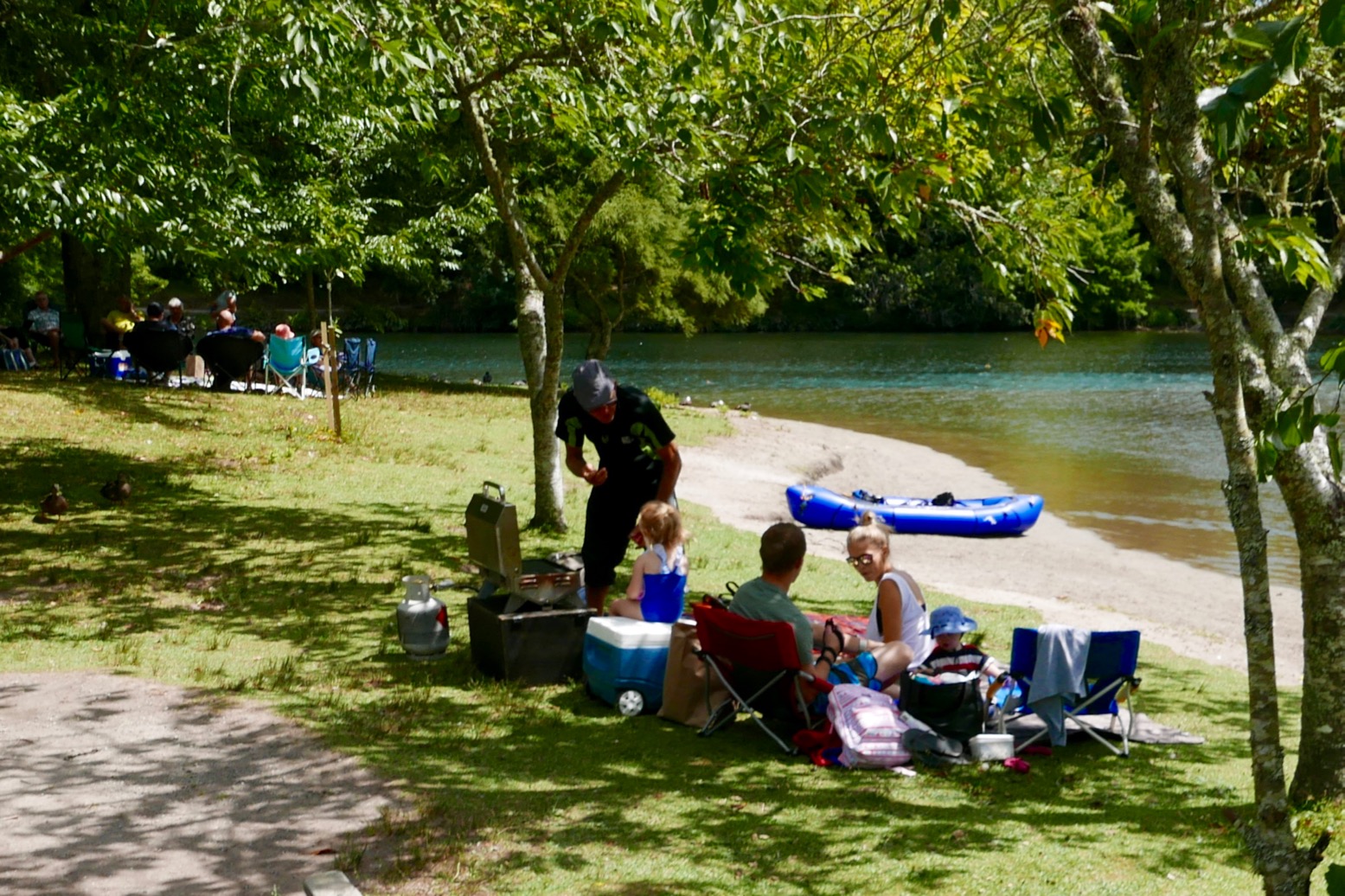
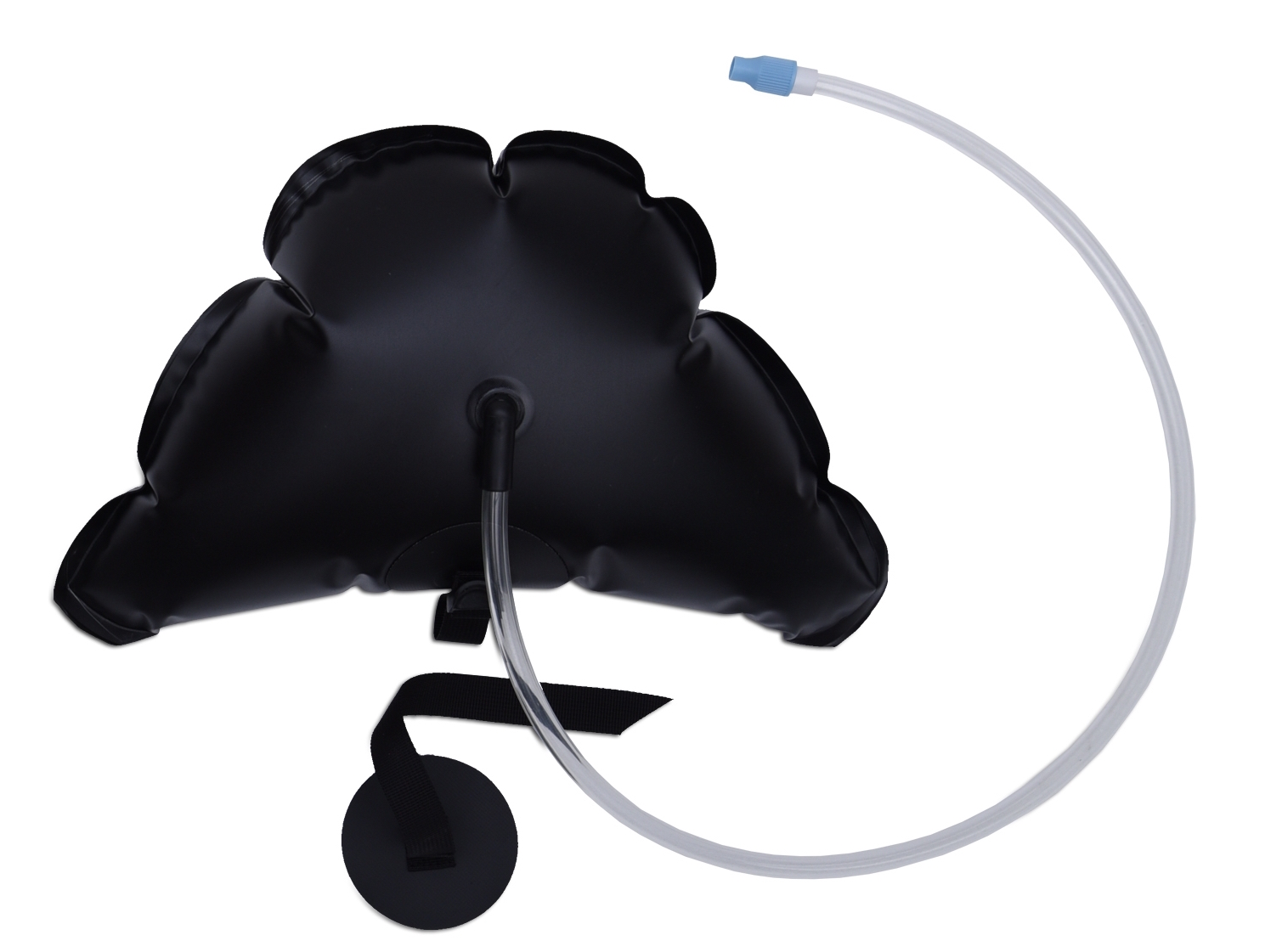
The boat was tempered and inflated to the max with my patented IAT (inflation assist tube; right). With the yellow hose you’re able to do a much better puff than just with your mouth on the Boston valve. I paddled my way round to the glowworm gorge inlet where families where feeding the ducks and enjoying Waitangi Day picnics. But the gorge stream was barely deep enough to float a duck and my quick foot-recce didn’t go far enough. If there was a paddleable pool up there, it was probably tiny. So I settled for cruising about the lake a bit and force-feeding more air where it wouldn’t go. I didn’t recall any hull creases when I tried the S1 last summer. And I’m sure the seat was suspended off the floor which spreads the load better, rather than pressing on the floor. Anyway, no leaks on this boat.

nzt - 6
nzt - 8

From the park it was a 6km walk back along the main road to rejoin the river at the newer Ruahihi power station. Between the park and Ruahihi I presume the lake’s output gets diverted through pipelines, baring occasional releases for the white water brigade. Having appraised the range of Newzealandish roadside detritus, just by the station I slithered down a steep bank thick with red flowers (left) and reinflated.

nzt - 10
wairiver

A nice current kicked out of the power station’s bores and I set off for the 12km run to a water park by a road bridge west of Tauranga.
It would be nice to report the Wairoa was a magical paddle. Giant, palm-like fern trees certainly give NZ’s lush, English-looking countryside an other-worldly, Jurassic quality. It’s no coincidence that just down the road they’ve renamed a town Hobbiton (below) in honour of the movie filmed there.

hobbito

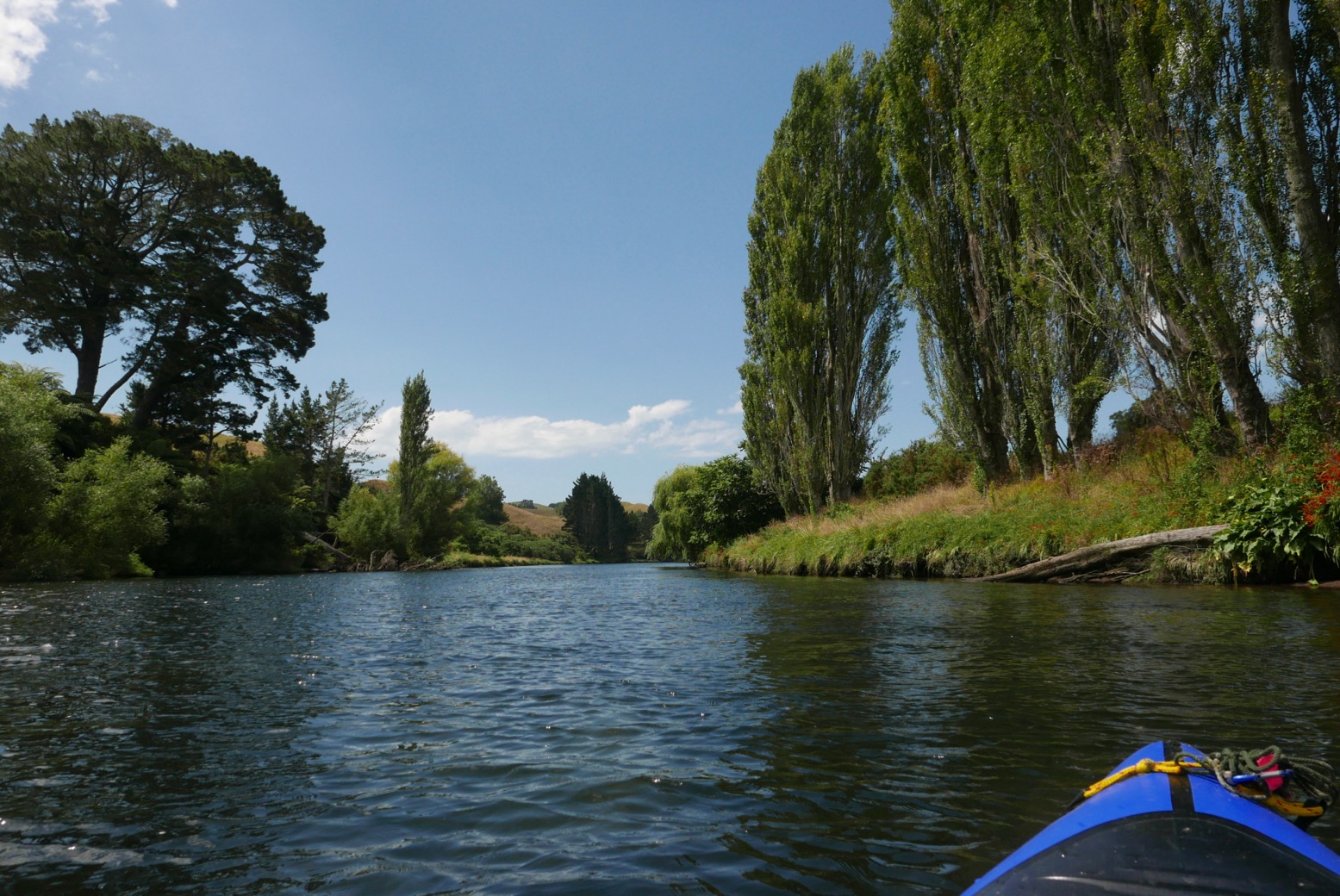
The Wairoa might make a nice afternoon’s flatwater canoeing, but I do miss a bit of easy Massifian eau vivant. Youtube vids suggested the Whanganui has some rapids fit to tip beginners’ canoe, but here all I got was the cooling breeze which developed into an annoying headwind. I put my head down and dug away, on the way passing a clifftop tree (left) which surely must be one good deluge away from crashing down into the river.

nzt - 13
mrs-footrest

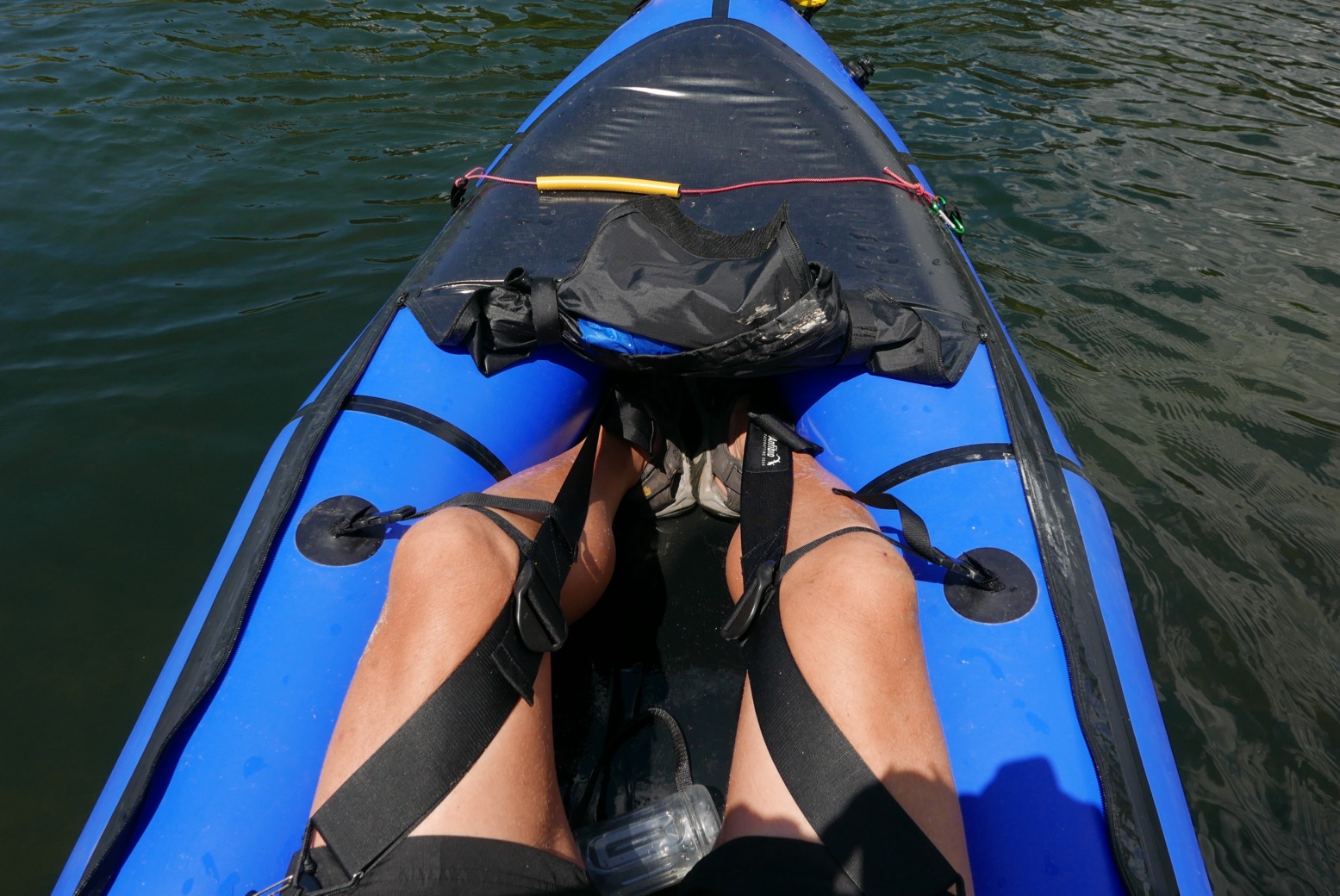
I may have skipped lunch and haven’t padded since the summer, but I was getting more tired than I should be. Something felt off with the seating and bracing set-up meaning I wasn’t relaxed. One problem with the mid-seated Nomad (or any packraft much longer than 130cm inside) is that you can’t jam yourself in, back-to-foot, leaning on the stern with the feet braced against the bow. The Packrafting Store included Anfibio knee braces which, after some adjustment, improved things a bit, but wasn’t as good as bow-braced feet. I see the Store are now selling an MRS footrest for €30 (right) which shortens the distance by six inches or so. I’ve since fitted one, improving bracing and comfort.

A jet ski shot by up river, kicking up some welcome wake. Then a paddle boarder passed by and a group getting merry on a motor pontoon. It had been over two hours now so I asked a bank-side dog lady how far to the water park
’Oh it’s a few kilometres’.
nzt - 15Surely not. I pulled over and, clinging to a moored boat against the wind, fired up the GPS. That’s more like it – not so far at all.

Soon there were kids churning along on pedallo-powered water slides, SoTs, giant inflatable silliness and a water chute hurling screaming infants into the river. What better way to spend Waitangi Day. Beyond, traffic rumbled over the road bridge and before that, a steep tidal bank lead up to a nicely mowed lawn for a dry-off during a bit of a lie-down. One-fifty minutes for 12 clicks – not so bad considering it felt like dog water much of the way.

nzt - 17
nzt - 18

From here it was a 7-km hike through Tauranga’s affluent suburbs back to the hostel. On the way, a supermarket called me like a siren:
‘Food… Foooood, large amounts’. Once out, I’d didn’t even re-park my trundler (as trolleys are called here) before gorging myself on a pain-au-choc, peaches and yoghurts. The rest of the shopping for the evening meal nicely balanced my paddle for the long walk back.

nzt - 19