Category Archives: Boat reviews

Tested: Sandbanks Style Optimal IK review

See also:
Full drop-stitch inflatable kayaks main page
Advanced Elements AirVolution (similar design)

In a line
Stable, good looking and good value two-chamber full dropstitch IK.

• Reassuringly stable but not too slow
• Easy to get in and out
• Everything in the bag bar a buoyancy aid
• Effortless two-way Bravo SUP pump
• Capacious wheelie-rucksack bag
Three Five-year warranty

• Usual budget paddles; a bit short too
• Minimal underdeck storage
• Thin, hard seatbases
• Floor-mounted backrest supports
• No footrests
• No repair kit included/listed online

What They Say
The Optimal is an inflatable, crossover kayak that truly excels in any water and is designed to feel just like a solid kayak and not compromise on performance. The Optimal will help inspire confidence in with a balanced rocker profile for speed on the flat and manoeuvrability in whitewater. The V-shaped hull is designed for stability and also helps the Optimal cut through the water effortlessly. The rounded stern sheds water easily, making it forgiving in moving water. There are luggage straps at the front and rear so it has plenty of room for dry bags and gear for your day on the water.  

  • Inflated: 427cm long x 89cm wide (14′ x 35″)
  • Deflated 105cm x 58cm x 30cm
  • Kayak 19kg
  • Maximum load 231kg
  • Three year warranty
  • Price: £769 at time of review. Summer 2025: £749.00 sale £499

Thanks to Sandbanks Style for the boat loan

On the Quay
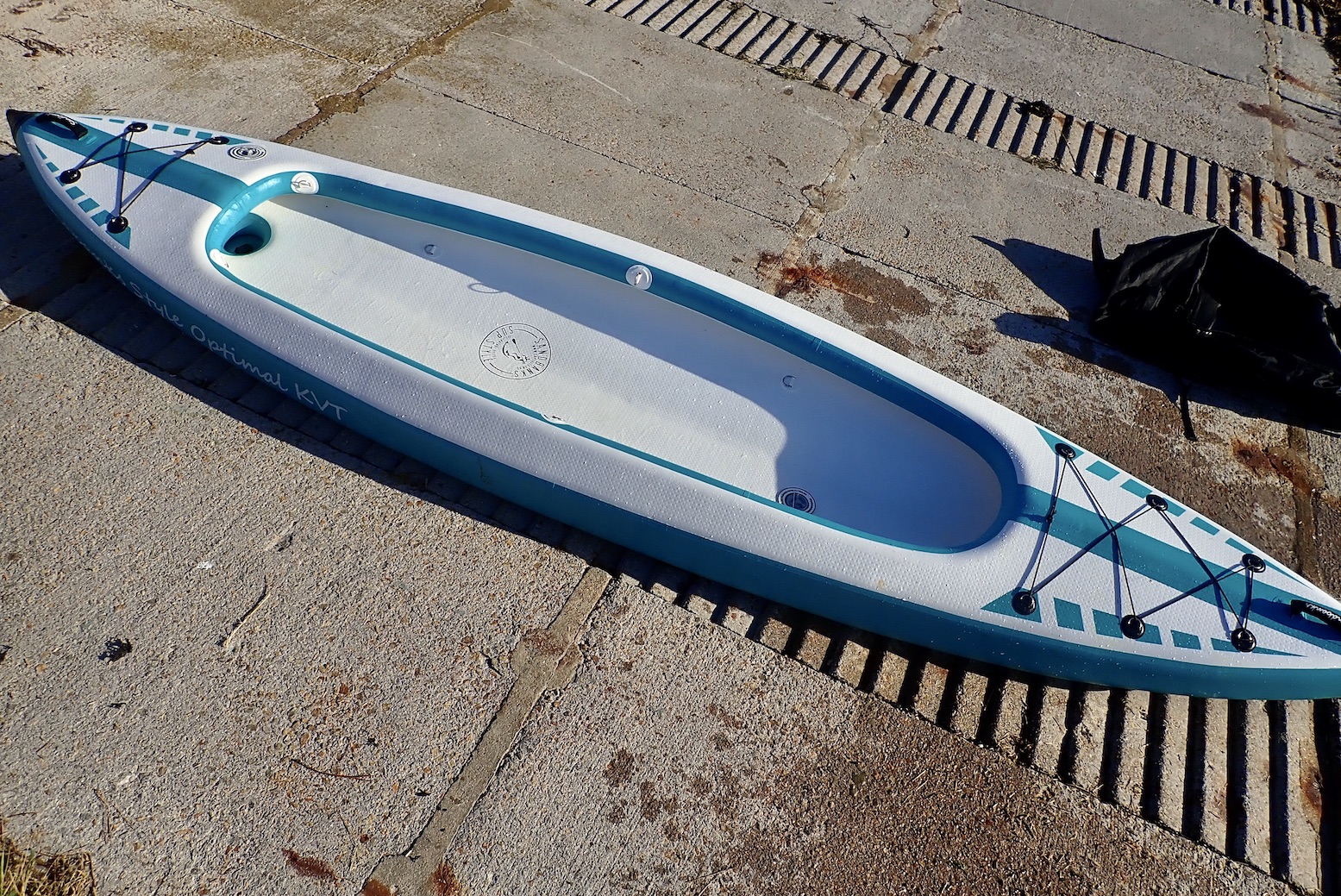
Based by Poole Harbour, iSUP-board brand Sandbanks Style offer a couple of full dropstitch (FDS) inflatable kayaks: the three-panel ‘Explorer’ similar to the Shipwreck Arrowstream I tested, and this two-panel Optimal, also in solo and tandem lengths.
The Optimal resembles (but is not a clone of) Advanced Elements’ AirVolution – as far as I know the first to use this design in 2020. The AquaTec Ottawa Pro (scroll down the linked page) is a similar design.

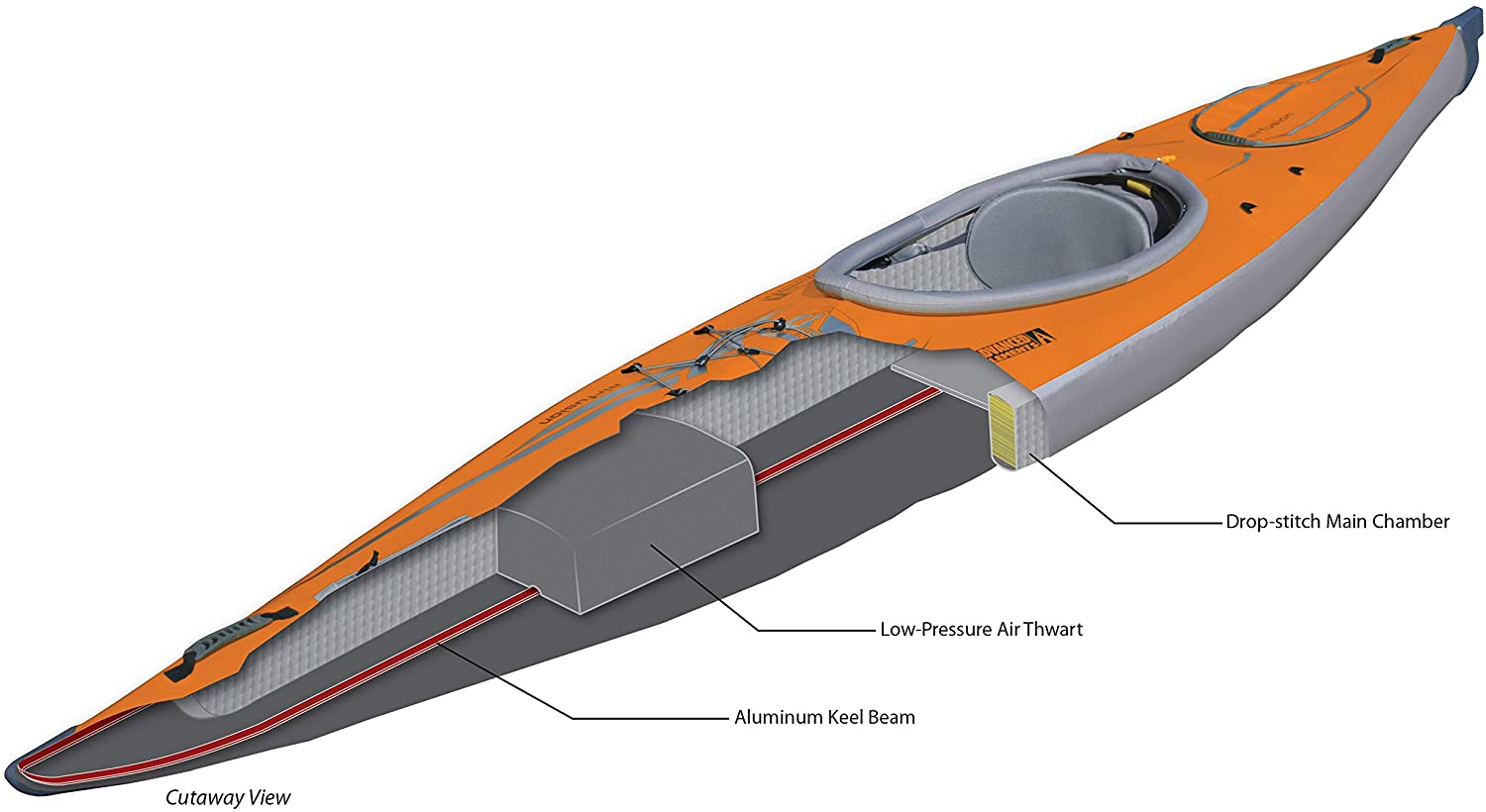
These types of FDS IKs use two slightly folded dropstitch panels wrapped in a PVC envelope; a ‘clamshell’ design which creates a small, low cavity under each deck. The upper panel is more of an elongated ring; the aperture forming the cockpit you sit inside. It’s similar to Perception’s Prodigy 145 hardshell (right), a kayak design favoured by recreational paddlers who prefer IK-like ease of access over a fixed deck, but don’t want a tippier and more wind-prone canoe.

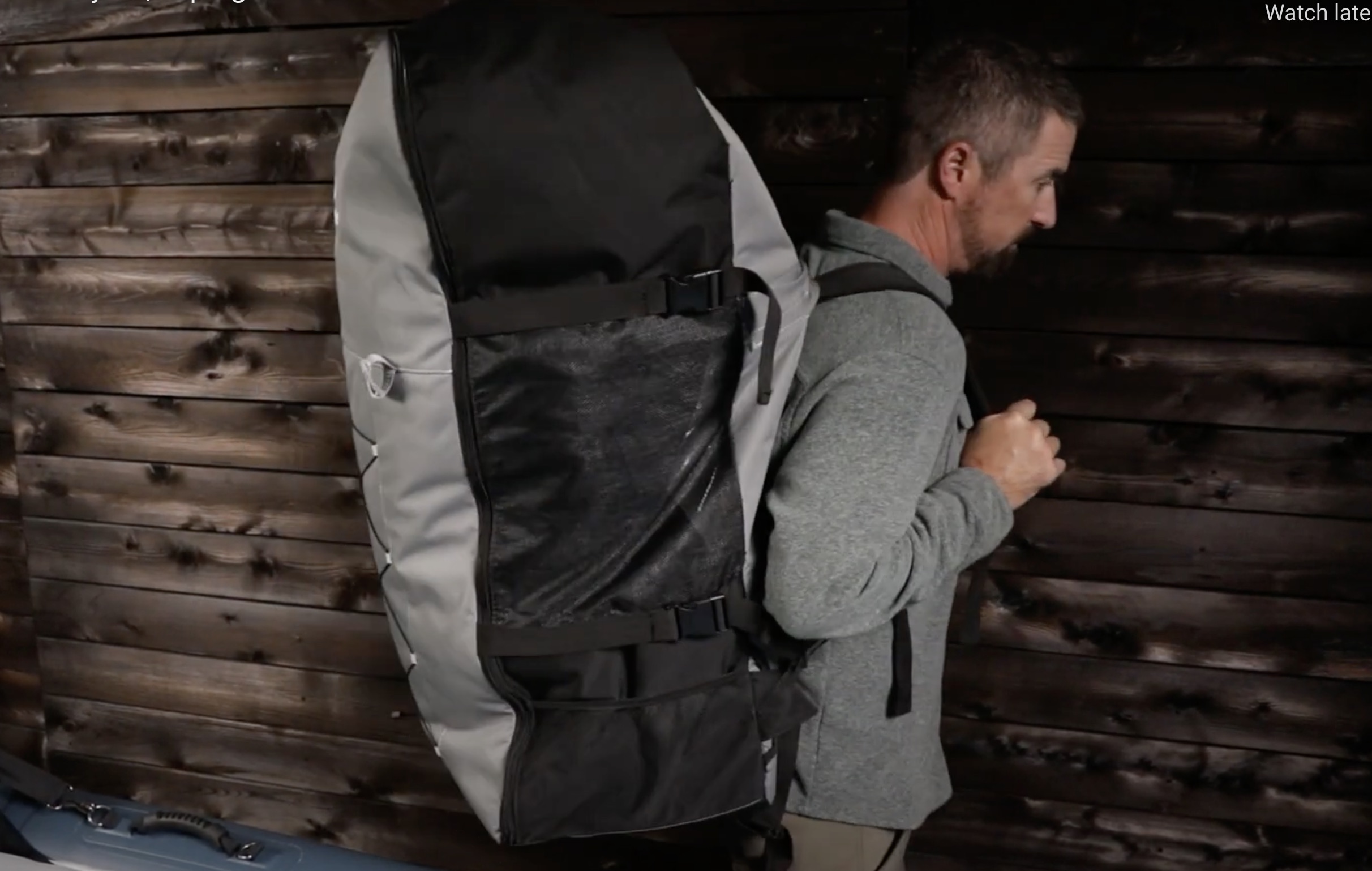
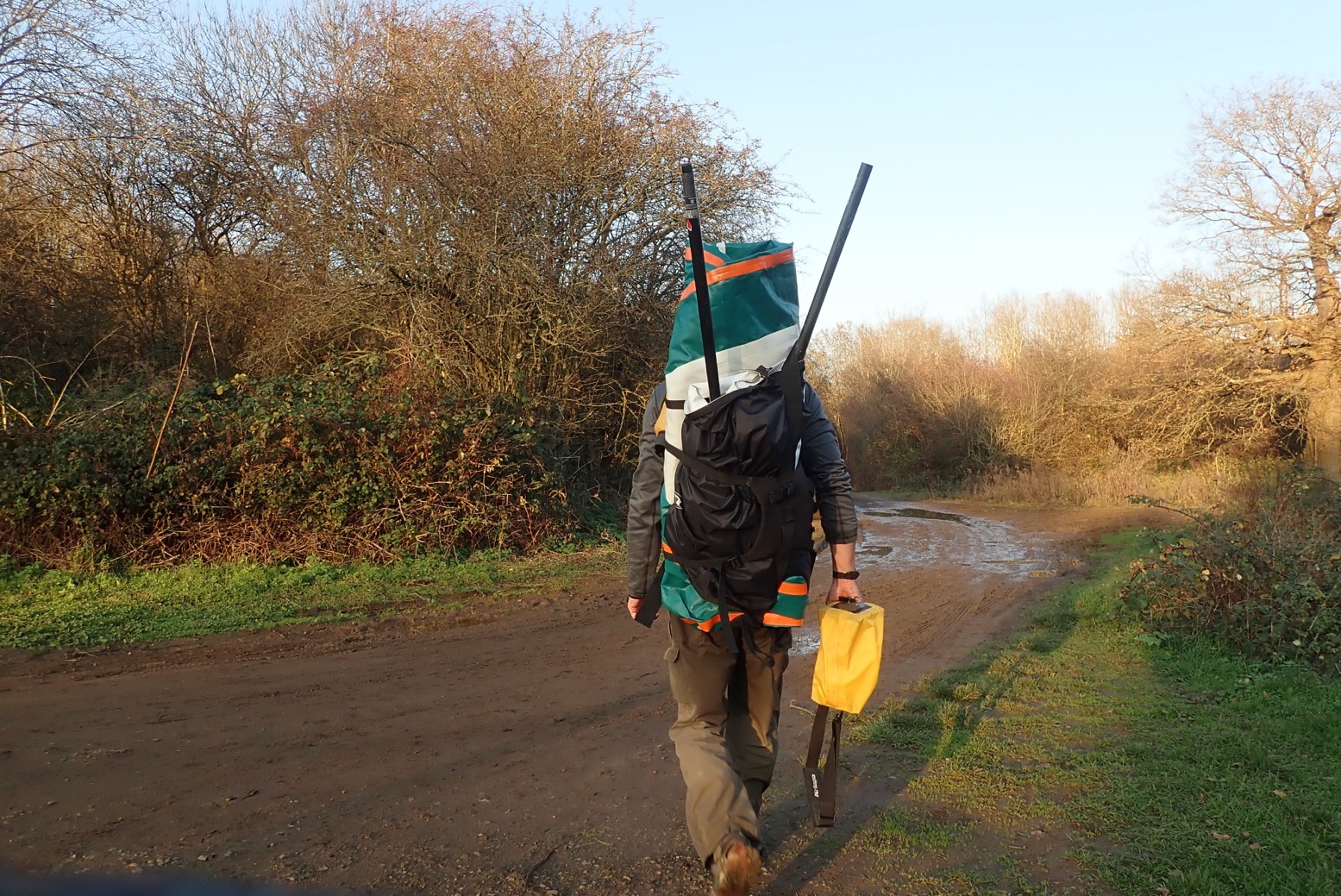
All tandem Sandbanks kayaks come with a pair of four-part 220cm paddles, a two-way, two-litre Bravo 100 SUP pump, a skeg and a huge wheeled bag to carry it all. The whole package for the Optimal double weighs nearly 27 kilos with room to spare in the bag. The rolled up boat itself seemed less bulky, or at least folded up more compactly than the Shipwreck. The turquoise/white PVC did have a nice, pliant texture which may have had something to do with it. I’ve found the quality and feel of PVC varies greatly from boat to boat.

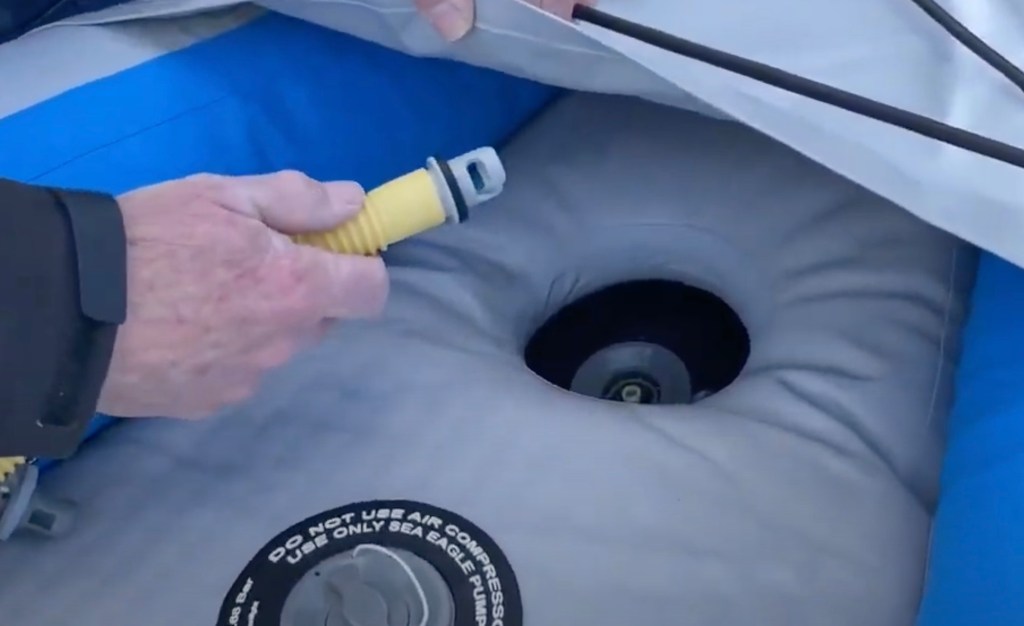
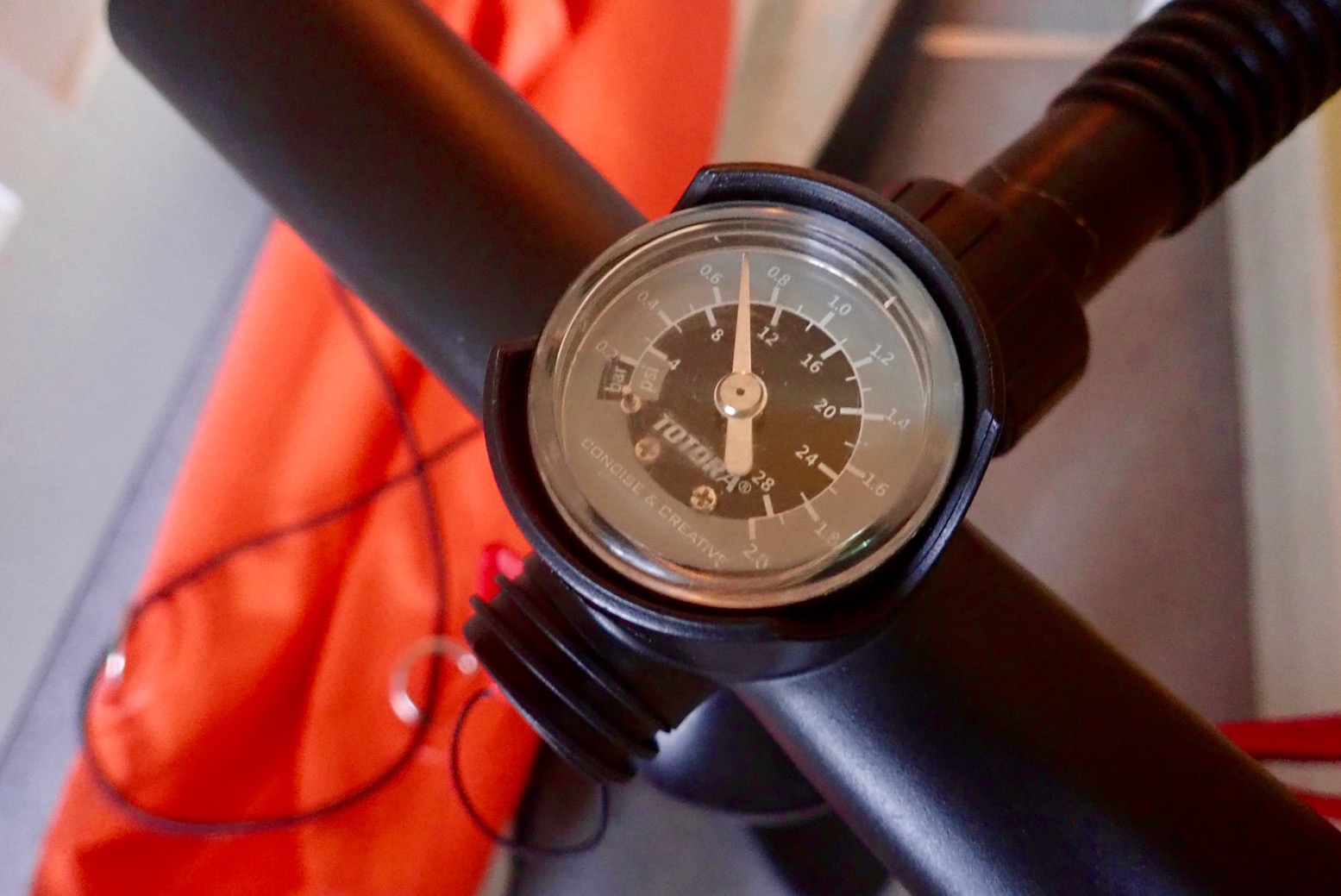
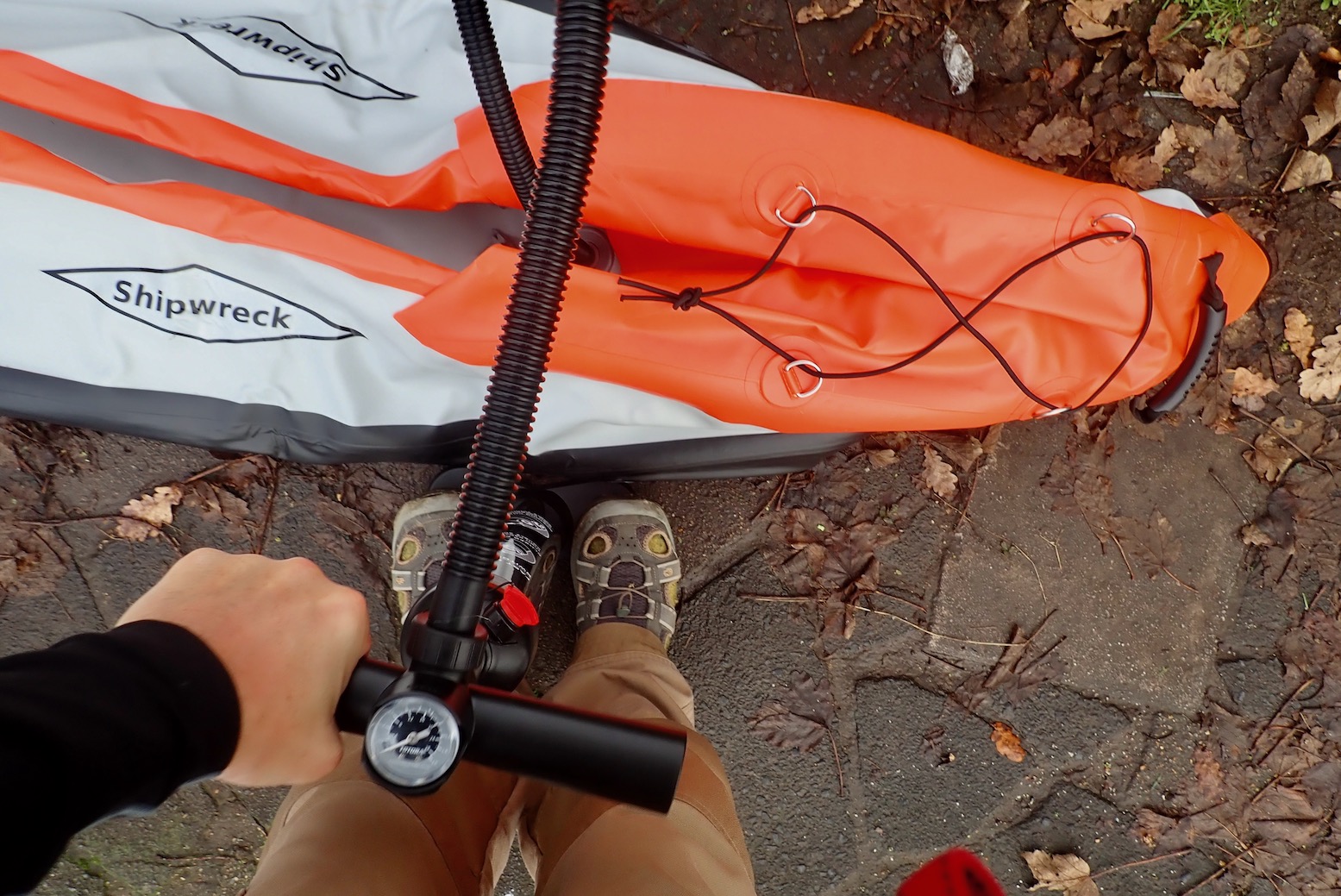
Inflation took about 7 minutes to reach an indicated 12psi on the pump’s gauge, which matched the reading on my handheld manometer. Using the 65-cm high pump means less stooping and was initially so effortless I thought I hadn’t plugged it in correctly. For the floor I flicked the switch to down-pumping only, but for the top chamber, with a better stance (left) I was able to reach full pressure using faster but more effortful up-and-down (two-way) pumping. I didn’t notice a deflation port on the pump to help suck the boat down for repacking, which is a shame. This is clearly a gangly iSUP pump which isn’t expected to be taken on the water.

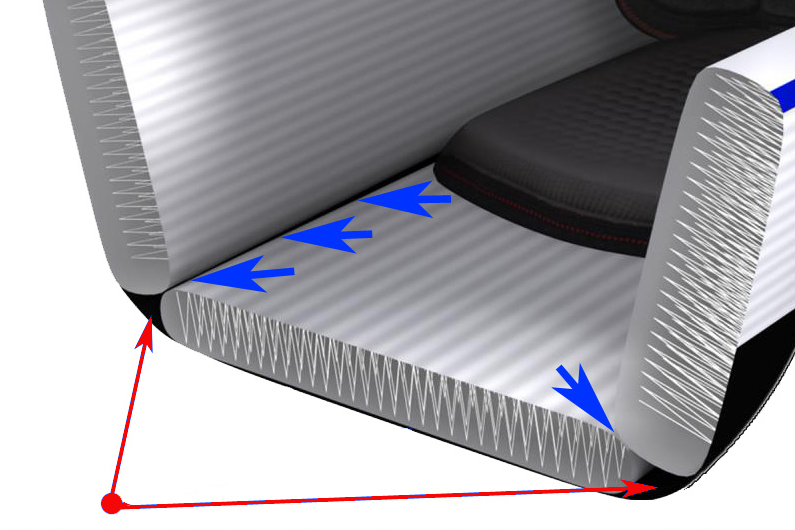
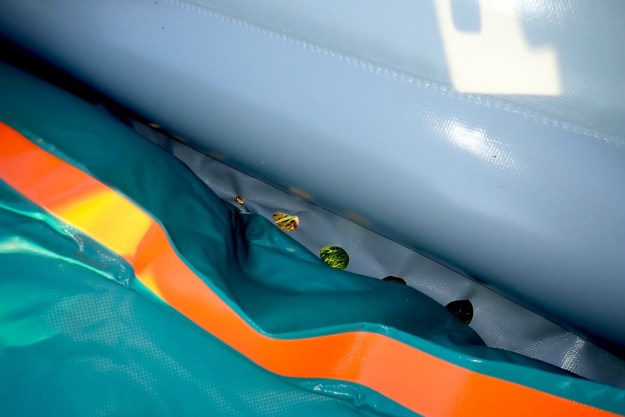
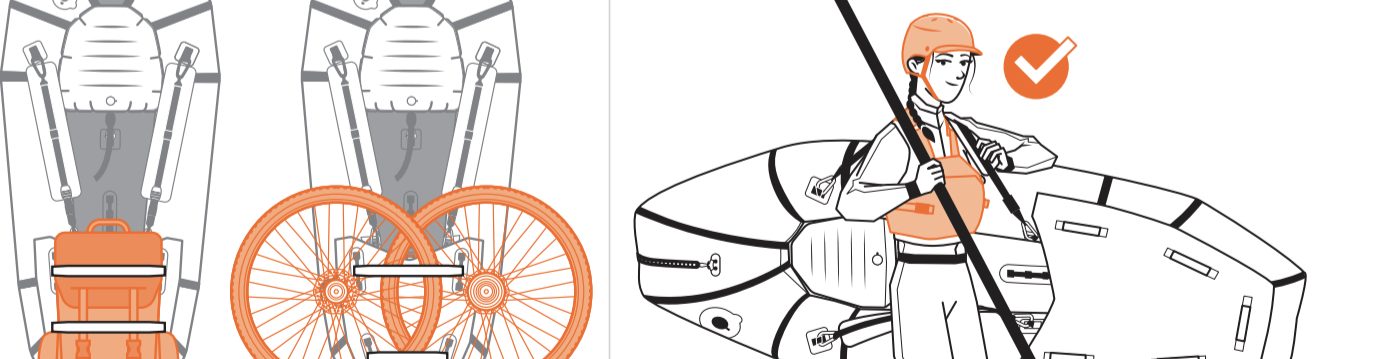
Once inflated, the top and bottom panels press together along the edges, sealing off a cavity with the outer hull envelope that wraps around the two panels (see graphic above). In this way it’s similar to my old Seawave, making a side channel where water and debris can collect. The Optimal’s two panels may press together although water and debris got in the channel too. But, compared to most three-panel FDS IKs, you can directly access this part of the boat for proper cleaning.
Measuring up the inflated boat gave the dimensions below; at 440cm (14′ 5″) – all round a bit longer, wider and heavier than what appears on Sandbanks’ website. Plus ca change… Dividing length by width gives an LxW ratio of 4.78 which, compared to the table here prioritises stability over speed, though other factors, not least hull shape and rigidity as well as wind and waves, will influence the latter.

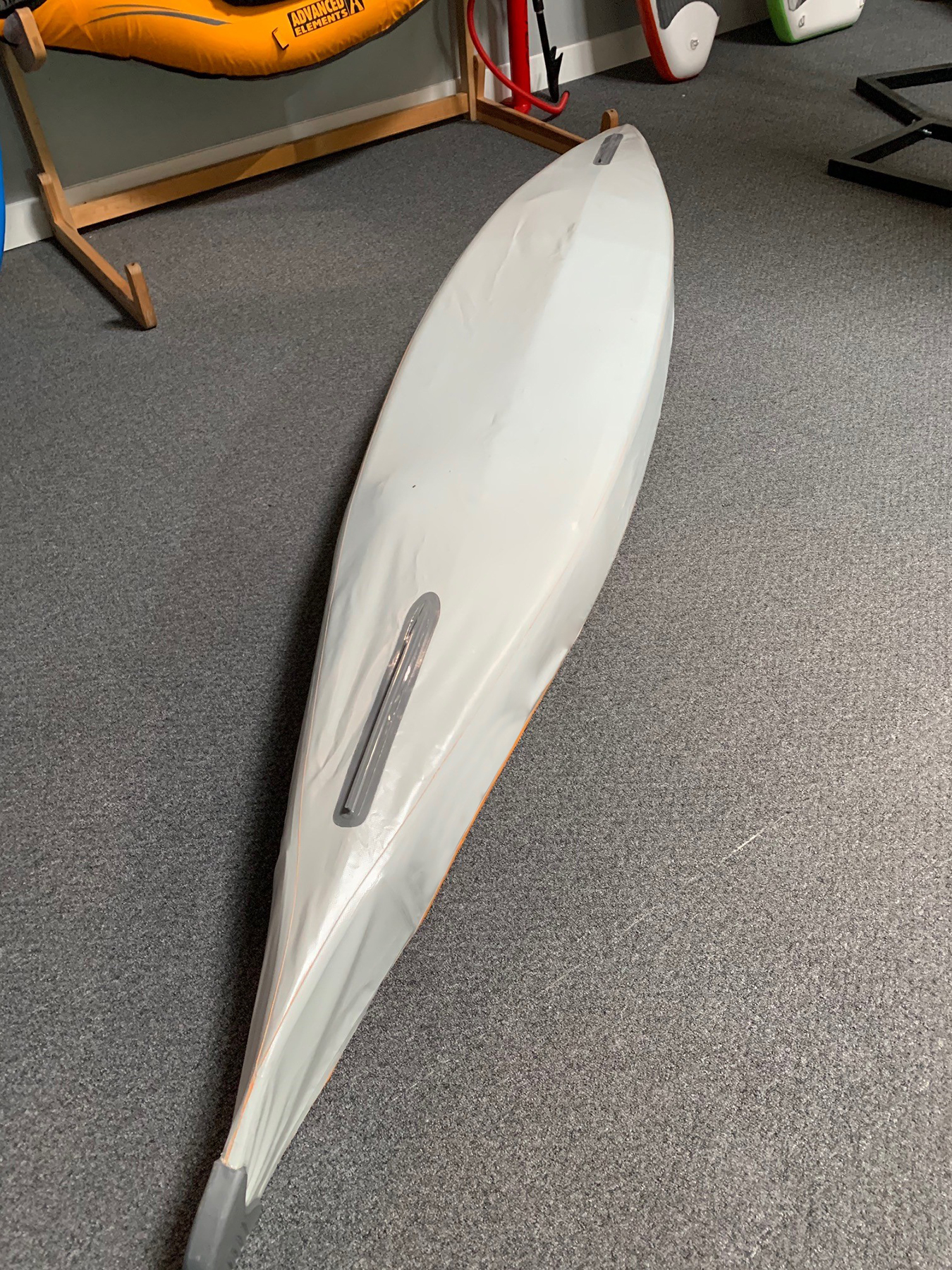
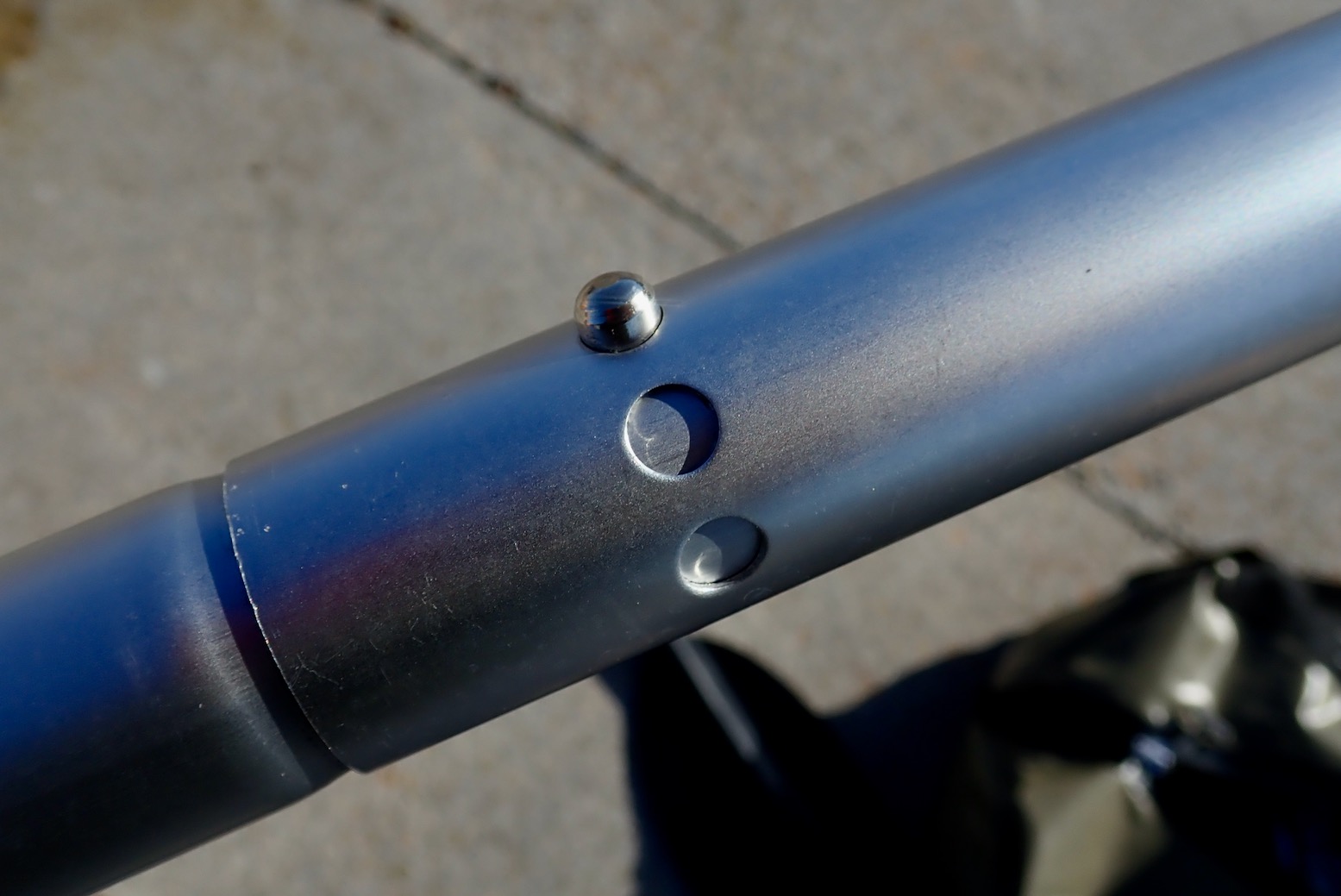
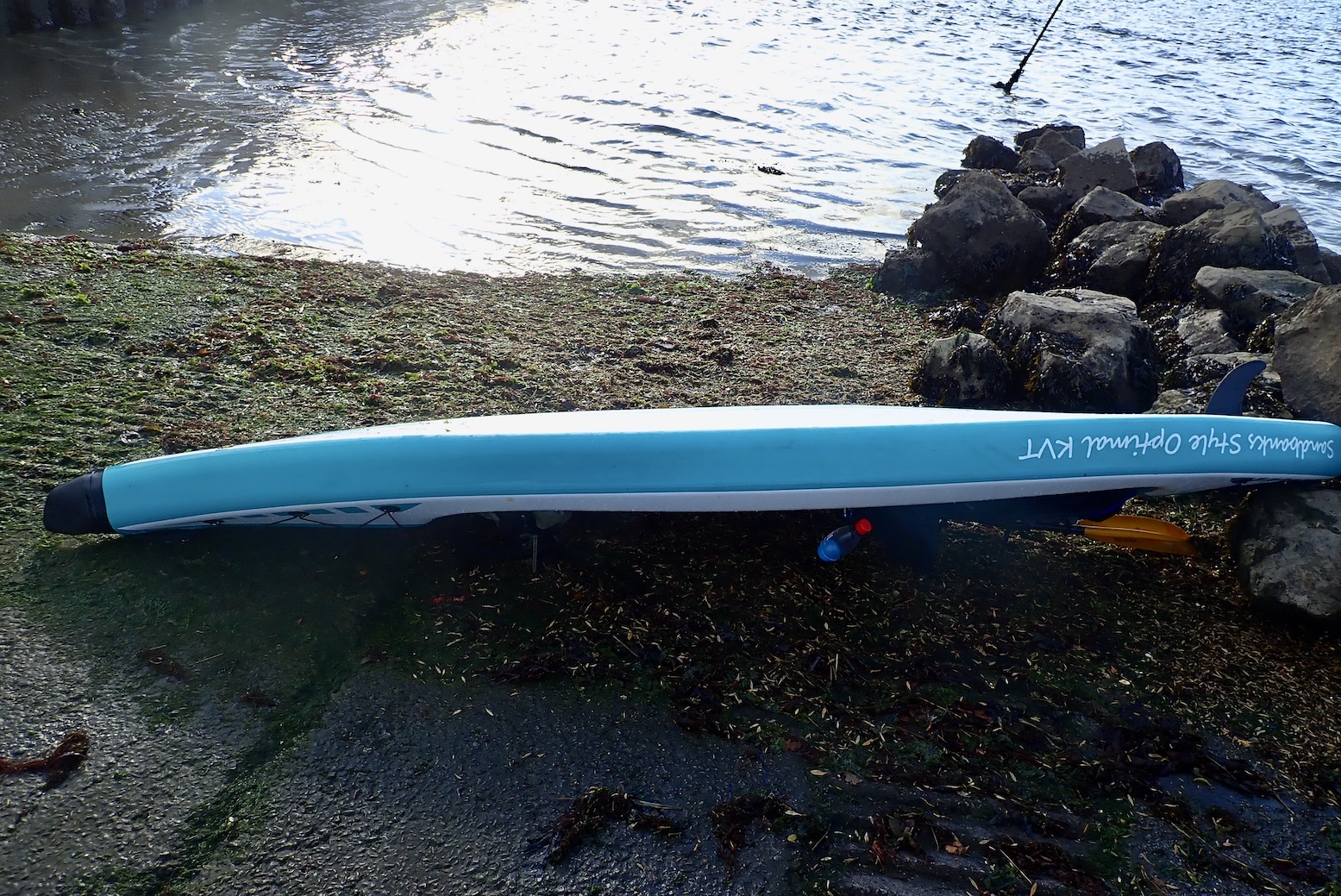
Thanks to glue-free heat-welding the whole high-pressure assembly is very clean with no untoward creases or anomalies. Only the black plastic end-cones stayed a bit deformed. I also noticed that after inflation the floor protruded a couple of inches on one side. But by the time I got back, a little hull flexing had realigned the two panels correctly. Underneath you’ll notice a ‘blister’ in the dropstitch (above right). This isn’t a flaw as some have thought, it’s opposite the floor panel’s inflation valve where there is no stitching.

Straight away you can see it’s not just two flat slabs of dropstitch, but a floor somehow folded up into a shallow ‘V’ to make a keel line (left) which, combined with the deep skeg, ought to ensure the Optimal paddles arrow-straight. The top panel has a similar downturn like the AE AirVolution, to ensure water run off the decks. These ‘clamshell’ angles create a space underneath each deck, but they’re too low to be of much use for storage.

At over 2.3 metres or 7.5 feet long and up to 50cm wide, the cockpit feels roomy for two adults. There are four D-rings on the floor for the backrest straps (but see below), with a four more rings up on the sides to counter-tension the backrests.
A side benefit of the cockpit’s overhanging side rim is you can easily pick up and carry the boat. If there are two of you, use the nicely padded carry handles at each end.

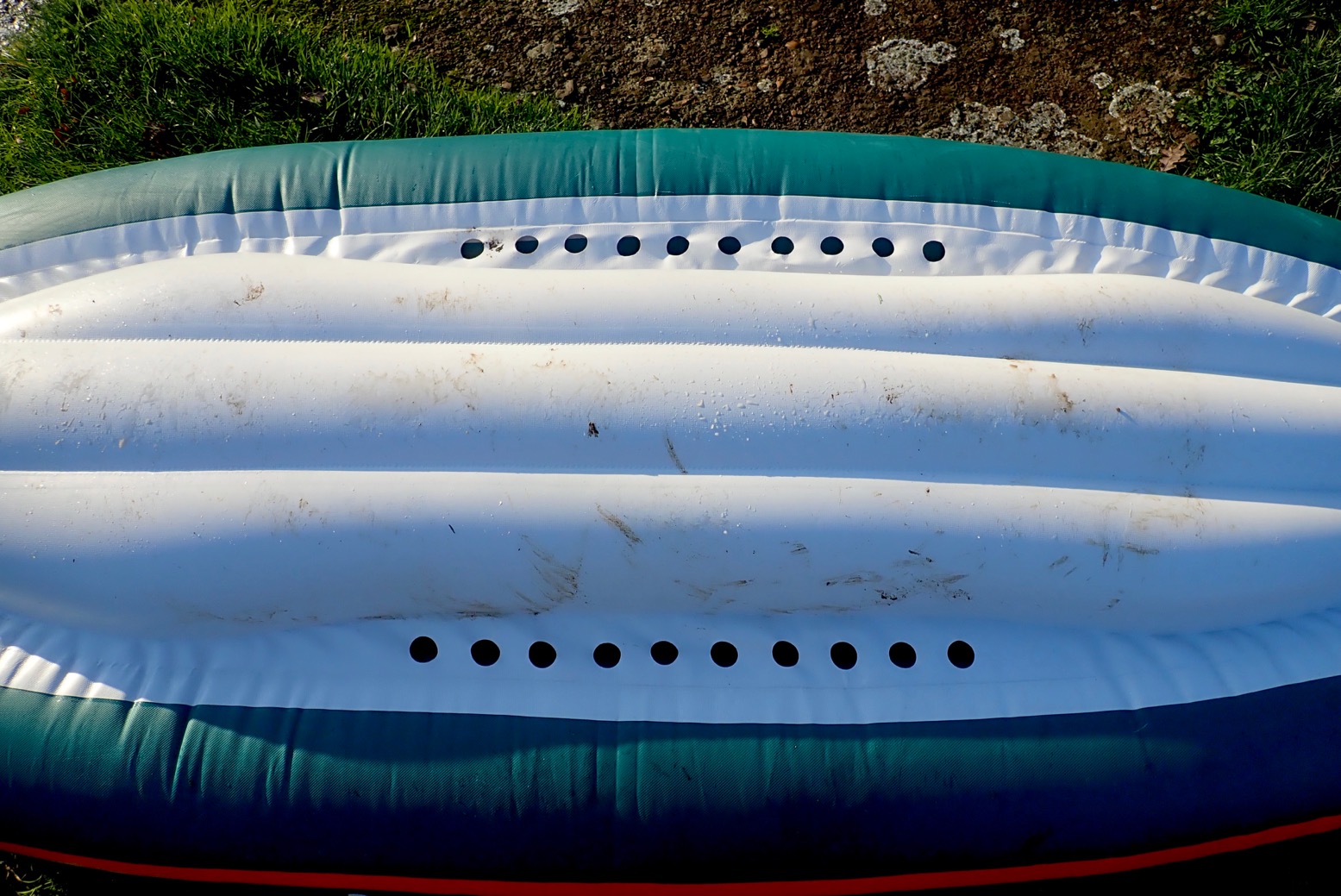
The floor’s shallow V is reflected inside, so any water will pool along the centre line and, depending on the boat’s trim, will run back towards the drain plug hole at the back of the floor. In my opinion this a bafflingly redundant and marginally effective gimmick that gets copied from boat to boat. Either flip the boat over to drain, or position the drain in the stern cone
A rear paddler could benefit from the back deck edge to lean on, and the front paddler might be able to use the edge of the front deck as a footrest. You might also shove a folded bag under either deck, otherwise gear will have to go under the paddlers’ knees or on top of each deck, using the bungy cords. They’re a commonly seen and inexpensive ‘feature’ on IKs, but I’ve never thought it a great place to lash gear that’s hard to access once on the water. As it is, used solo, there would be enough room to stash a camping load low on the wide floor.

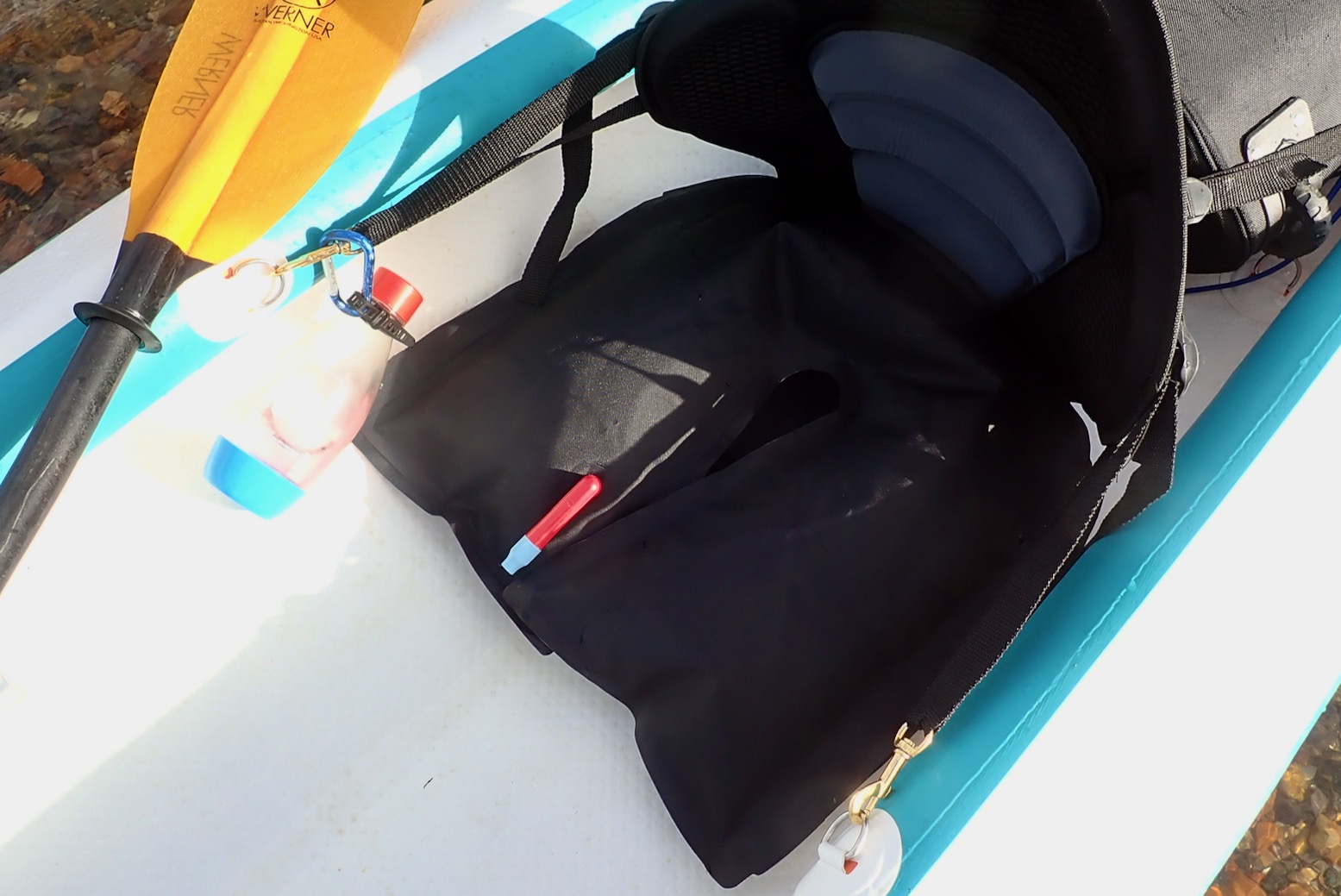
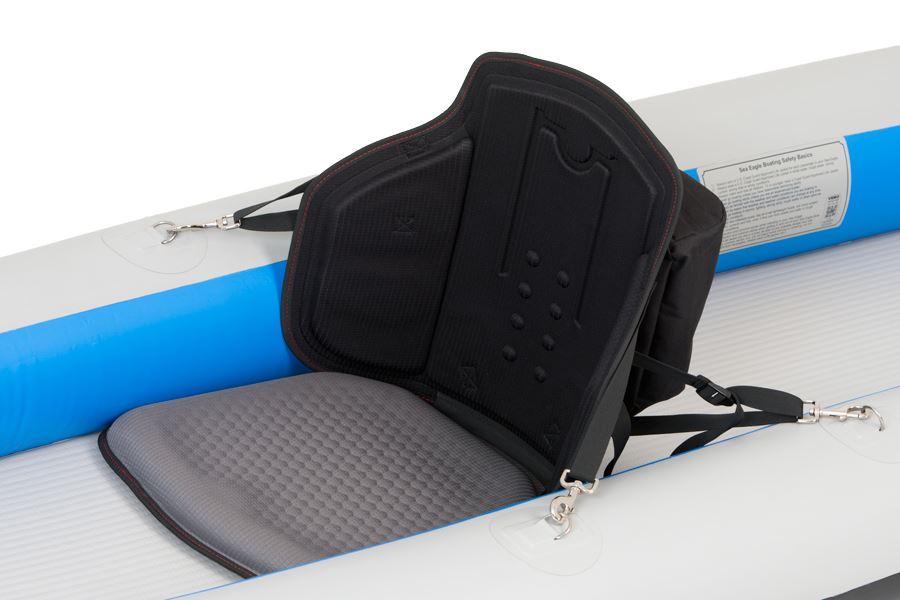
Seats are the usual light, stiff foam items, with four, two-point straps and brass-coated? clips to keep the backrest upright and get your position just right. The floor mounted D-rings for the forward straps would be better positioned on the sides, like the rear strap mounts, putting them in line with the direction of tension. Otherwise the backrest tends to pull down as you rest against it.

Thanks to these long straps I was able to fit the seat in the optimal rear-of-centre position for solo paddling, using all four of the higher D-rings on the sides, resulting in good back support. I knew the main problem would be the lack of a footrest and the ~inch-thick seatbase sat on a hard, 12psi floor; within an hour the backside and legs would be numb and the back sore from slouching. (I notice Sandbanks’ three-panel Explorers do come with footrests.) Expecting this, I’d brought an inflatable packraft seatbase to try-out, as well as a strap to rig up a footrest off the floor D-rings. Pushing off some kind of footrest stops you sliding down the seat, so enabling a proper upright paddling posture.

The 220cm four-part, alloy shaft paddle weighs around 950g and has three blade-angle adjustment holes about 45° either side of flat. It will do the job in calm conditions, but the soft plastic blade easily deforms. Expecting a mushy budget paddle, I brought my own Werner paddle.
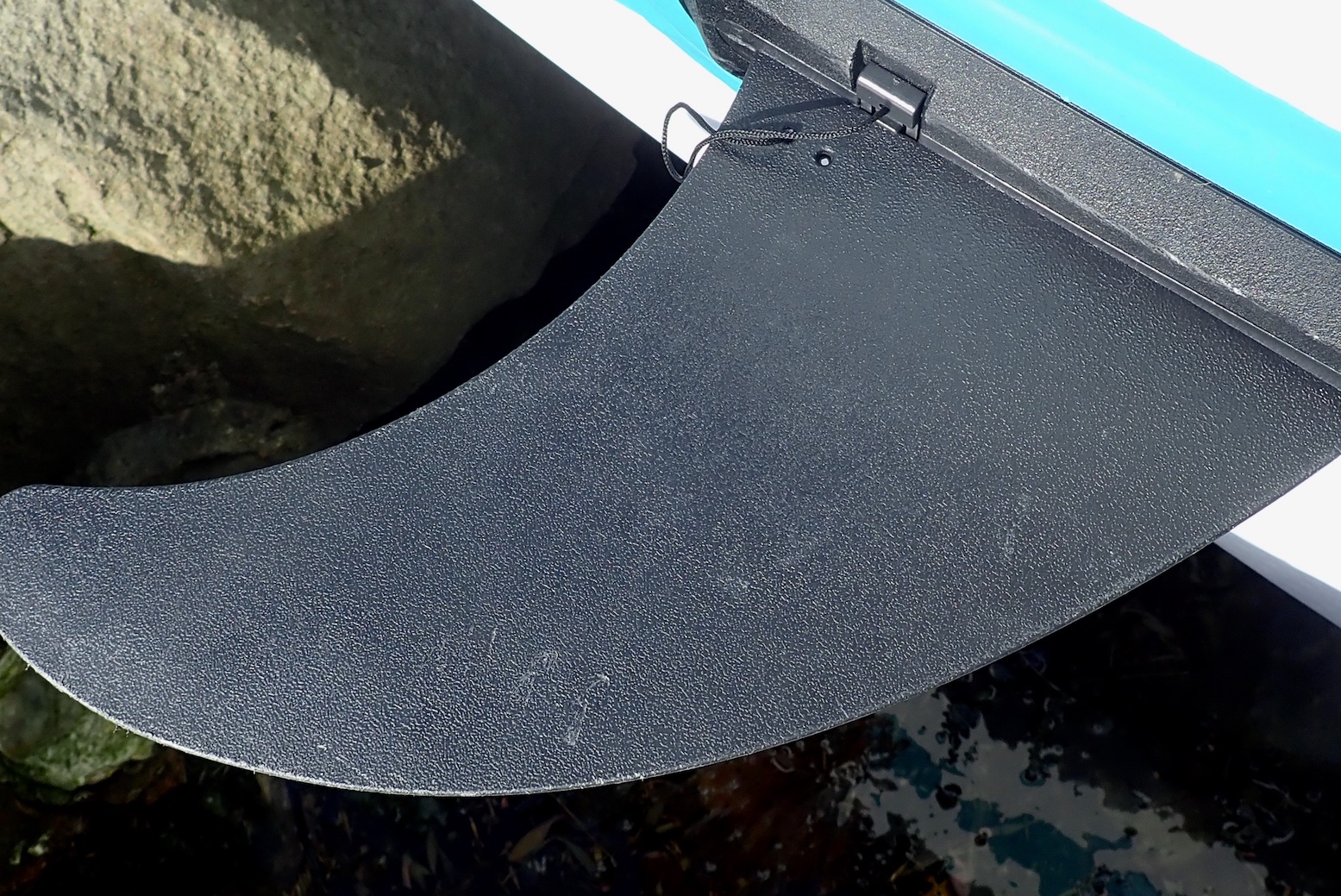
Underneath the stern goes the slot-and-peg skeg. At 20cm high, combined with the V hull, the Optimal ought to track like a TGV.
There’s no conformity label stating recommended pressures, payloads, CE stamp and so on, but I noticed a serial number (‘HIN’) at the back. This was a used boat, but there was no repair kit in the wheelie bag pocket, nor is a kit listed online, but the Optimal comes with a three- (now 5) year warranty.
On the Water

Putting in at Salterns jetty on the northeast shore of Poole harbour, I had various plans for my test paddle. Maybe a five-mile run out through the narrow harbour mouth to Old Harry Rocks which I’ve been keen to revisit. Or at the very least, a lap around Brownsea Island; about the same distance.
But on the day a chilly, 20mph NNW wind reduced my options. Even a quick crossing to Brownsea would have made getting back tricky in an unfamiliar boat, especially as the peak of a spring tide would be running southeast with the wind by the early afternoon.
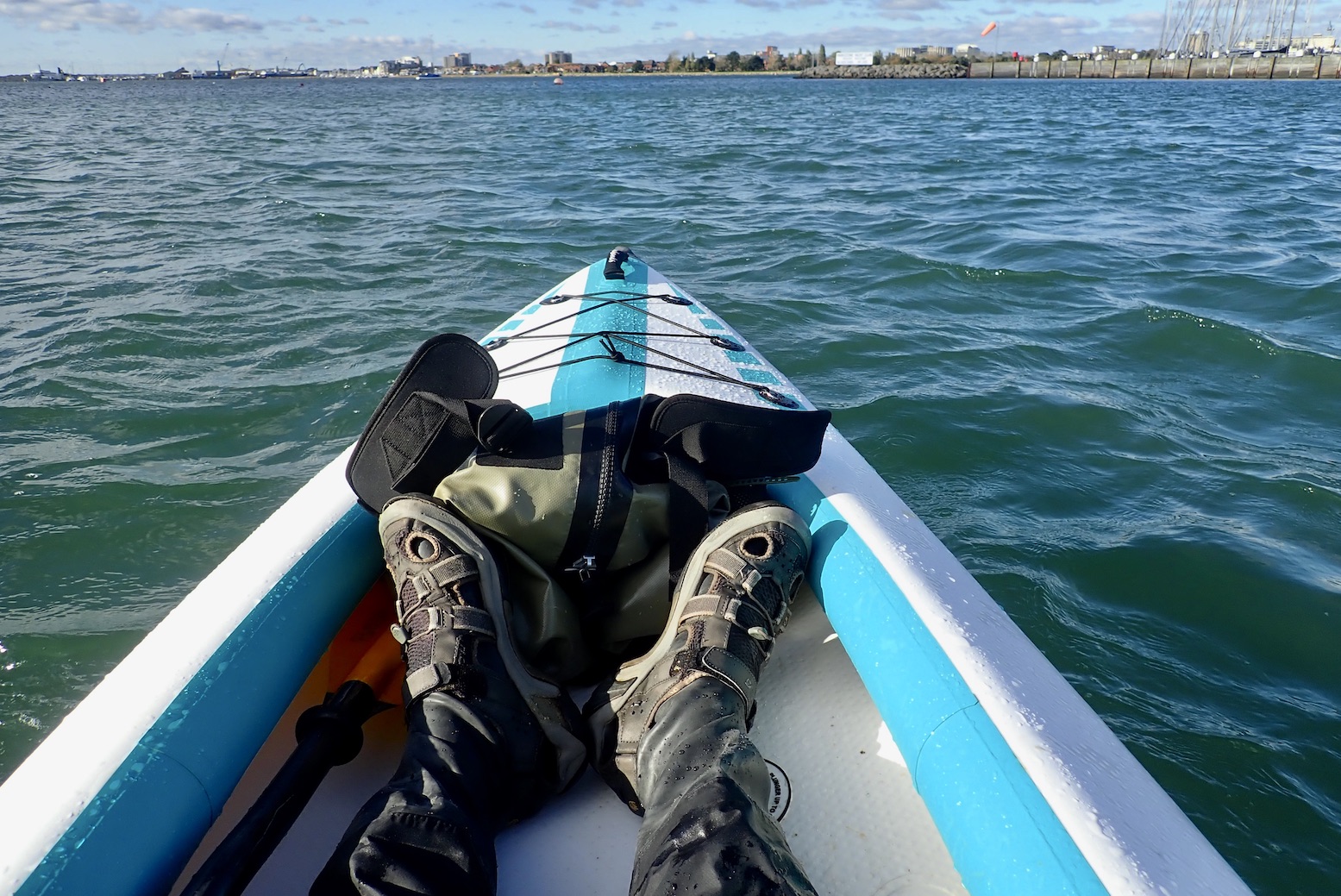
So I set off into the wind, heading towards Poole. Taking it on the nose with the Werner paddle was an effort, but with no fetch, the water surface was only a little ruffled and the Optimal cut through at a up to 4kph. But as soon as I turned a little off the wind the front was pushed round and required a lot of correcting (as would any buoyant and tall-sided IK on a day like today).
I reached the shelter of another marina where above me the wind whistled merrily through a forest of masts, and the orange windsock waggled about a few degrees below horizontal.

Here I decided to rig up a footrest strap to help brace myself in the seat and improve my draw, then set out with the four-part paddle. I could feel the blades flexing as soon as I left the shelter of the marina and had to dig in, and also found the 220-cm length a bit short; at 92cm or three feet, the Optimal is as wide as a packraft. These budget four-parters with riveted-on blades are great for beginners and mellow paddles, but over time the joints will loosen up, creating even more slack. After a few minutes I swapped back to my stiff Werner.

Windy

The wind flattened the water with no chop to speak of, so I tried paddling across the wind – tricky in any paddle boat. The deep skeg meant the bow pivoted downwind, requiring masses of correction. Better to know this now than when trying to get back from Brownsea Island with a train to catch, so I put that idea to bed.
Any IK would have struggled to hold its line broadside to the gusting 20mph wind, but if the plastic skeg was trimmed to half its length I suspect the hull would be more ‘balanced’ across the wind, while not sacrificing any tracking. This goes for any of the current crop of IKs with these overlong slot-in skegs. A spare skeg might cost a tenner, so the experiment poses little risk.

Turning the boat back into the wind was a huge effort; I was having to yank on my paddle from the middle to get it to turn. Once back on line I carried on up to some buoys and tried the boat downwind where it held it’s line well; the deep skeg and the flat water meant little weathercocking (back end coming round). As with any kayak, wavier conditions which momentarily lifted the skeg out of the water would have been a different matter.

I headed for a park on the north side of the harbour to hop out and see how the Optimal handled without the skeg. Coming back downwind, the boat tracked no worse than my unskeged Seawave might have done. You can’t paddle quite as hard while maintaining a straight line, but you can easily weave tight figure-of-eights in and out of some buoys. On a river with a current, the added manoeuvrability (and clearance) without a skeg might be a better set-up.

I also inflated my packraft seatbase (left) to see if the raised position and air cushion would be more comfortable. But on the hard seatbase and floor, it merely wobbled around like a jelly and made things worse. I know from similar accessory pads for motorbikes that you want just enough air to support your weight, but on a surface with no give it just didn’t work. A better solution would be to add a foam block similar to what came with the Arrowstream (but which on that boat I couldn’t use as the raised height made it unstable).

The wind was blowing me in the right direction anyway, but I decided to take back control and slip into what maps call the Blue Lagoon, an inlet ringed by houses with private jetties. Maybe ‘Blue Lagoon’ was cooked up by estate agents; it’s said this side of Poole Harbour has the highest density of Britain’s most expensive houses.

Appropriately, the tide dropping through the bay’s narrow entrance made accessing the Blue Lagoon tricky. I squeezed in along the edge of the current which was a good demonstration the boat’s agility and responsiveness. But once inside things were already getting too shallow, so I backed out and threw myself into the modest tidal race then ferried across it just to see if I could. Maybe the lack of a skeg (but with the footbrace) made this sort of manoeuvre easier.

Test route

I refitted the skeg and drifted south round to the lee side of my Salterns marina put in where all was calm as long as I kept close to the wall. Overall, with a skeg was better but as said, I’d try chopping a spare down by half.
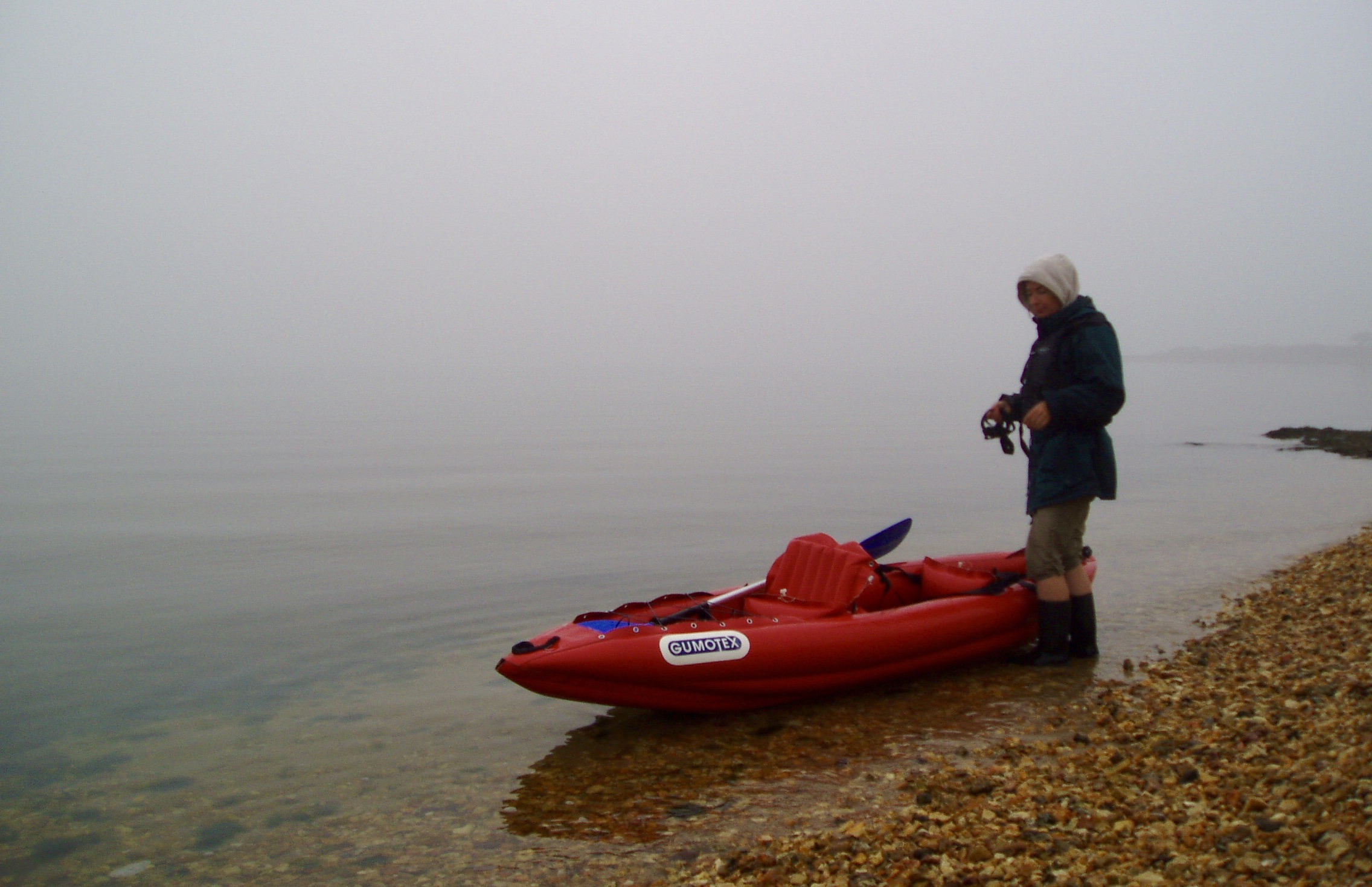
After ticking off a few selfies with the camera balanced on a buoy, I only just made it back round the corner to the jetty against the funnelled tide and wind, then bounced over the clapotis to where the sea had already dropped a foot, exposing Poole Harbour’s notorious mudflats. As newbs on a foggy day back in 2005 (left), we’d got caught out on one of my very first IK paddles in a Gumotex Safari.

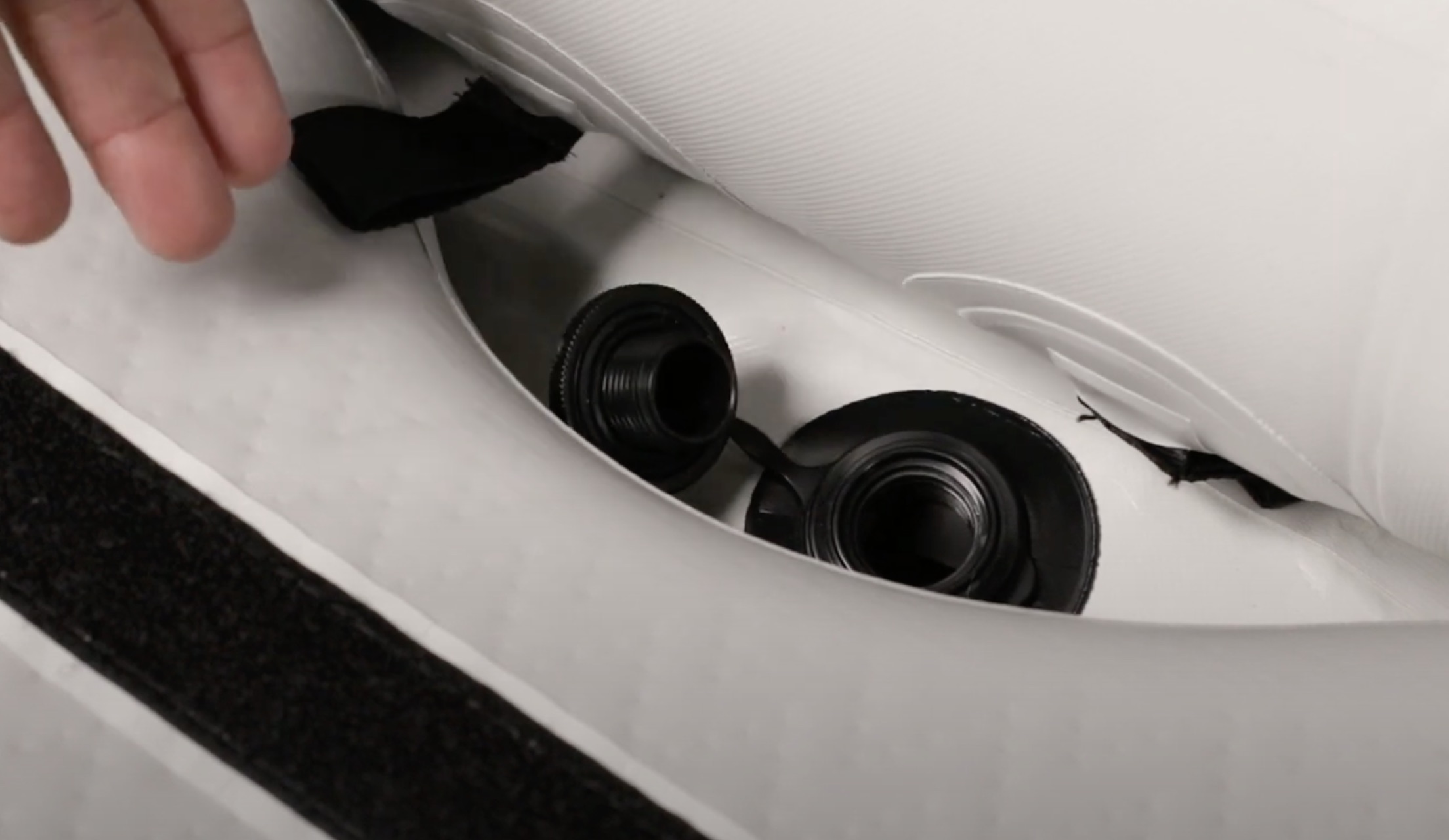
Once on shore the Optimal rolled up into the bag easily, though having both valves at the same end would make purging the air in one roll easier (or having a pump with a suction port). Had I the chance, I’d have rinsed it by resting the bow up on something, open the stern drain and then deflate the floor. This ought to give you access to the otherwise sealed-off side cavities where debris and water collect. Then hose from the top and most of it will flush out the drain hole before a wipe down.

It was a shame not being able to get stuck into a proper paddle to somewhere, but I enjoyed my brief spin on the Optimal. For £769 at the time (£499 in 2025) – about £150 less than similar, heavily discounted Ottawa Pro doubles you might find online, and nearly half the price of the AE AirVolution, the Optimal is a solid double FDS which would work well solo once you add a footrest tube (easily done using the floor D-rings). Budget paddles and thin seats are what you’d expect at this price – as it is, comfortable seats are an issue with many FDS IKs. But the boat looks well made and the pump is easily up to the job. Plus you’re buying from an actual UK shop you can go and visit, not some shouty, sell-it-all web-based entity with flakey customer service.

As FDS IKs go, I think I prefer the two-panel ‘clamshell’ design. It feels more sophisticated, or is dynamically no worse than the the masses of three-chamber FDSs which sell for a bit less. The crux is stability which most recreational IK users rightly prioritise (or soon learn to). The Optimal may have that to excess, but as I also found on that very first paddle in 2005 (left), better too much than not enough.

Preview: Sea Eagle Fast Track 465

See also:
Hybrid (DS Floor) Inflatable Kayaks
Aquaglide Chelan 155 preview
Tested: Kokopelli Moki II

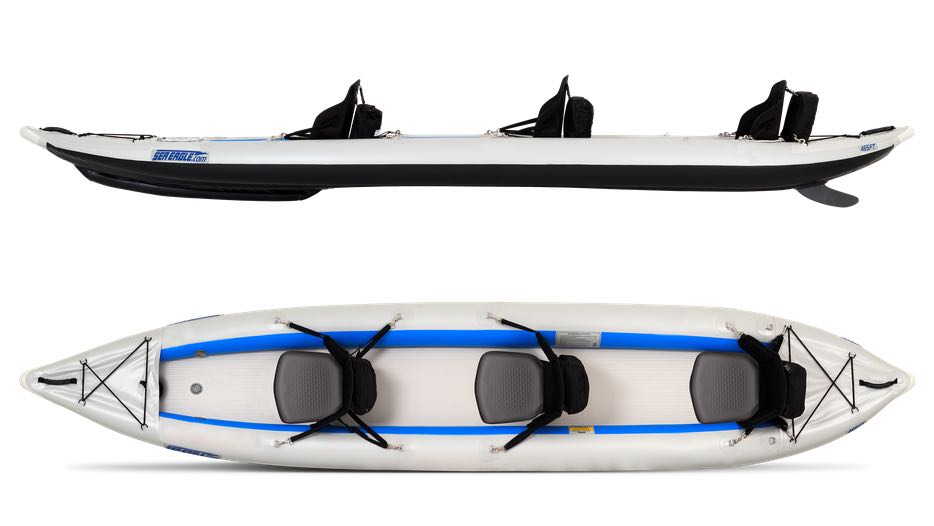
Sea Eagle’s Fast Track 465 (4.65m) is a high-end PVC IK has been around for several years, one of the earliest ‘hybrid’ IKs combining a removable dropstitch (DS) floor and conventional side tubes. It sits alongside their dumpy, all-tube SE cheapies, more whitewatery Explorers, and the all-DS, fixed-floor Razorlites. They even make a full-DS canoe.
From the side the 465FT is a sleek looking IK with slender 24cm side tubes and the distinctive frontal keel under the bow to keep it on track (and which Gumotex have vaguely copied on the Rush models). Quoted weights vary as usual: from 17kg to a ‘hull weight’ of 20kg on the official US website. For a 15.25-foot PVC IK, 44lbs sounds about right.

Sea Eagles only sell these boats in ready-to-paddle packages which include a paddle/s and a pump as well as the usual wrap-around carry bag and repair kit. They start at $1600 or £1299, though in the US are regularly discounted by nearly 30%. When you read scathing ‘reviews’ of otherwise perfectly good IKs panned for not coming with a pump or paddles (even if that was clear at purchase), you can see why SE do this. Just don’t expect a stiff and light paddle.
Upgrades include seats with proper backrests, as well as better paddles, three-seat combos and even rowing and motor rigs. And one thing that sets SE apart is the phenomenal 180-day return period and three-year warranty – at least for US customers.

Though you’ll struggle to see any evidence of this, the DS floor is removable, so it should be easy to clean and dry the boat. Assuming the floor comes out easily, the hull still has somewhat redundant closeable floor drains. Some outlets claim these to be self-bailing ports. There’s a big difference between the two: the former helps drain inaccessible cavities to help dry the boat without removing the floor; the latter allows waves that pour over the sides to drain away via holes in the floor – ideal for whitewater or surf. Such boats need thick floors to sit you high above the drain ports so the kayak doesn’t have water sloshing across the floor and soaking your butt. The 465 (and similar Aquaglide Chelan) doesn’t have a thick floor, though if you’re light you can give it a go. As it is, any 15-foot IK will be a handful in whitewater or surf conditions.

Oddly, the 2014 manual still online suggests you put the same 3.2 psi (0.2 bar) in the DS floor as the tubeless side tubes. Later models have ‘max 8-10 psi labels at the valves, but there is no way you’ll reach that pressure with the archaic foot pump supplied in some base packages. Then again, the couple in the video below inflated their 465 by foot pump. They represent perhaps the recreational core of SE’s customers: prepared to spend four figures but not that bothered about performance or equipment.

One thing that seems to be missing from online images are footrests. For all but the most undemanding recreational paddlers (which may be most of SE owners) a solid footrest to brace off makes a huge difference to paddling efficiency, while also stopping you sliding down the seat. It can have benefits to stability too, although at 91cm wide (36″) that won’t be a problem on the FT as some might find with the FDS Razorlites. Some D-rings could easily be glued on, but for what you pay, it’s odd to not see them included. They’re not even an accessory part. the drainpipe/strap idea I use on my IKs would work fine here.

What they call Deluxe seats are comfy looking vinyl blobs which sit you 5 inches up and clip to the hull sides (as well as the seat base). But because the backs are inflated (via Boston valves), they’ll have little support to lean on because low-psi inflatable backrests tend to crumple under pressure. Non-inflatable foam-board ‘tall back’ seats (found on most other Chinese-made IKs) are supplied in pricier packages will have better back support, except the base is thinner. A slab of foam underneath will see to that, but without footrests you may not notice the benefits.

The innovative Needleknife frontal keel is inflated via a raft valve accessed by a hole in the front floor. Flat, DS-floored boats need some help here, and it does appear to greatly improve tracking, especially while not adversely affecting turning. If that’s the case you do wonder if a long, low slip-on plastic skeg, or just a keel strake as of the Chelan 155, might not work as well with less assembly complication. Perhaps the Needleknife’s softer profile works better, especially in sidewinds where the keel (and low sides) is said to deflect the boat less. There is a large slip-on skeg which is now more swept back, but could still be a bit on the long side. Luckily it’s easily replaced or shortened, but the boat will need some sort of skeg to track well.

Preview: Aquaglide Chelan 155

See also:
Hybrid (DS Floor) Inflatable Kayaks
Sea Eagle Fast Track 465 preview

Aquaglide is a US brand producing over a dozen Chinese-made IKs as well as iSUP boards and even floating waterparks. It’s been around for a few years, but their high-spec Chelan range, particularly the spacious 155 (formerly Chelan HB Tandem XL) has now been designated an IK of Interest.
In the range’s three models, the numbers loosely relate to their length in feet; the actual stats are in the table below. These figures are copied off the internet, so accuracy cannot be guaranteed and anyway, sources vary. Like the similar Sea Eagle FastTrack 465, or bladdered Kokopelli Moki, By 2025 UK Chelan prices have dropped massively to a much more reasonable £899 for the 155.

All Chelans feature a 6psi removable DS floor with conventional 3psi tubeless PVC side tubes – what’s becoming known as a hybrid IK. Hybrids are usually more stable than the slimmer, boxy Full Dropstitch (FDS) IKs, because the round side tubes make them wider, but higher pressures add rigidity which can compensate for reduced performance. It’s a shame there are no pressure release valves, but they’re easily added in the sides if you paddle in hot climates. The relatively low 6psi in the floor – and the fact that’s it’s fully in the water – makes it less vulnerable to passive heating and ruptured panels.
With 10-inch tubes and at a yard or 91.5cm wide, the 155 has a Length Width Factor of 5.03. By comparison, the similar Sea Eagle 465 is 5.1. Both are pretty low (more square) compared to the table here, but for many other reasons, an IK with a higher rating (ie: long and thin) may not necessarily be more efficient. I find most IKs over-wide, but nervous beginners may feel differently.

Chelan side tubes have no bladders (same Sea Eagles and all rubber IKs) which helps explain the high price, and they’re all made of Duratex PVC which they’ve managed to print on to give a sleek, distinctive look to the 2021 models.
As you can read in the Comments, it took a while to clarify, but all Aquaglides featuring drop stitch floors are removable. This includes the Blackfoot, Chelan, Chinook and Navarro ranges. Actual new owner Dave Klein (see Comments and video below) assured me his new 155’s floor was removable. It’s odd that it’s not mentioned in the blurb, shown in the imagery or even explained in the pdf manual under cleaning and maintenance. This is an important and beneficial feature as it eases cleaning and speeds up drying.

Grit collects in the side

The 7 so-called ‘closable floor drains‘ are also odd, when the one at the back will do. If they’re just to drain the boat once on land, are seven – or indeed any – really needed? Especially as we now know the floor comes out easily. Just flip the boat over and let it drip dry. Many FDS IKs come with these multiple stern floor drains to help shed water and, more importantly, the grit, from inaccessible side cavities between the floor and sides (left). But the floor comes out on a Chelan so it’s not such an issue.
The suspicion is that they might be a self-bailing feature and, although again, you won’t see it in the bullet-point blurb, the manual does say:

This product can be used in self-bailing mode. In this case, all cockpit drains should remain open. Some water will enter boat in self-bailing mode but will not accumulate.

Or to quote the video below

[open drains] allow the boat to be paddled in rough water, surf or white water

In other words, the Chelans could be called optionally self-bailing which sounds like the best of both worlds. As mentioned, the blurb wisely steers clear of bragging about this, too much because, chances are for most people it won’t work so well. A boat is either designed to be self bailing – in which case it simply has bailing holes below an extra thick floor like the ROBfin I tried or AG’s Mackenzie range – or it isn’t. The heavier the load (or the smaller and less buoyant the model) the more the boat will fill up with water which will slow it down and become annoying as the water swills about. (On much slimmer hardshell sea kayaks this in-hull sloshing can lead to critical instability). The optional-bailing element may explain the unusually thick seat bases to ensure you’re not sitting in water.

The now improved, or higher-spec seats were a complaint on earlier models for their lack of back support – it’s a common issue with all IKs. They’re now positioned on velcro floor bands, like the Kokopelli Moki we tried. This is the quickest way to adjust seat positions for a level trim. There are small pockets along the seatbase’s front edge and on the backrest, and they’re braced off the sidetube tops. As mentioned, at five inches the bases are unusually fat. But you don’t have to inflate them fully, even if a taller seatbase makes paddling more comfortable; the 36-inch width Chelan has stability to spare.

Footrests use the same velcro bands to get the positioning just right. Not a bad way of doing it, providing that tube isn’t too squidgy.

Note the lateral strap with buckle which holds the removable floor in place.

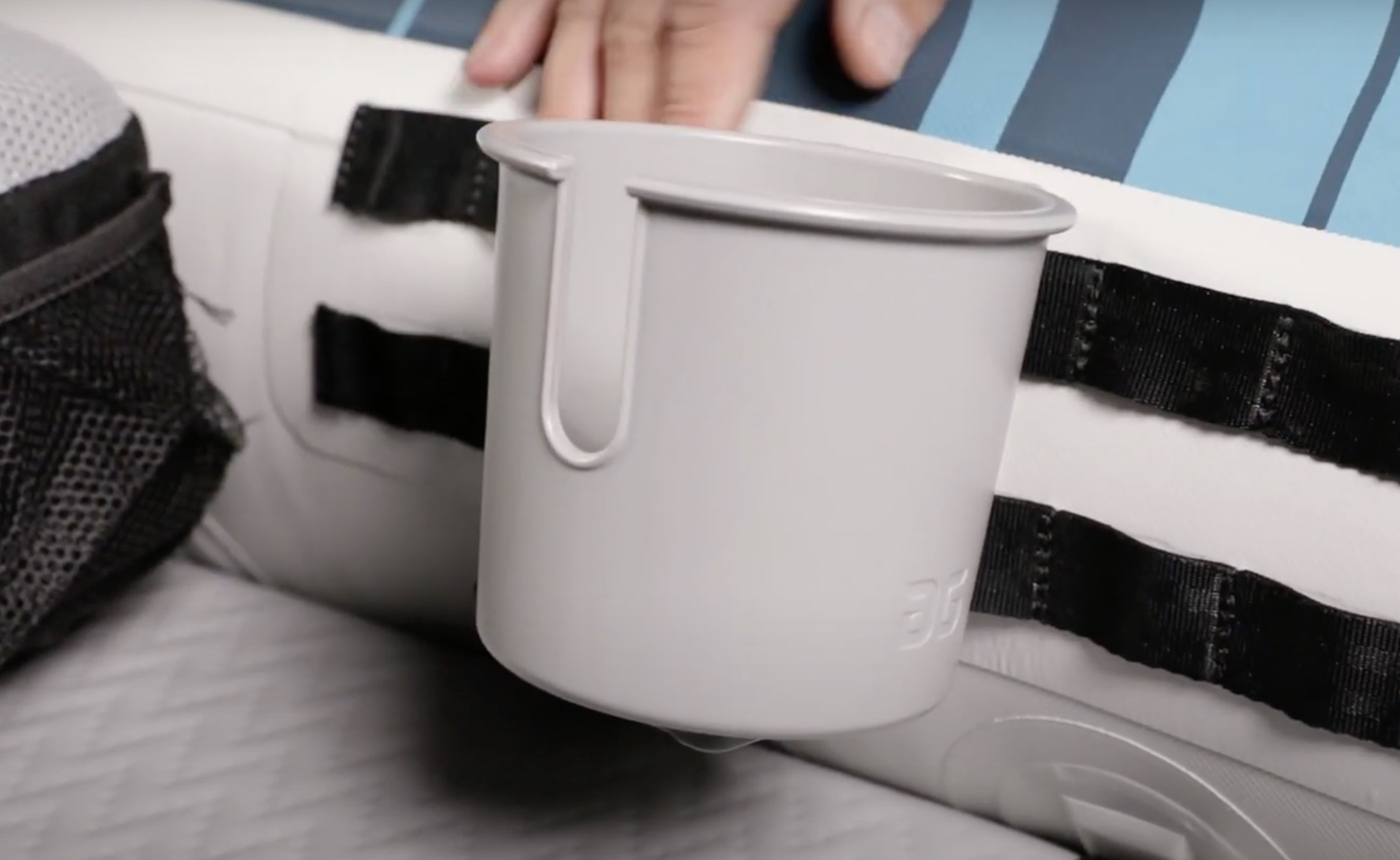
One of the best things on the Chelans is the attention to detail: handles at each end plus the sides, loads and loads of attachment points along the floor and side tubes, as well as Molle webbing which is becoming a thing on all sorts of outdoor gear now, and the usual deck bungies. Plus there’s an accessory mount floor plate for fishing gear or a GPS. I could do with one of those and it’s one of the side benefits of flat and firm DS floors. There’s even a beer can cup holder. I suppose it was only a matter of time before an IK got those.

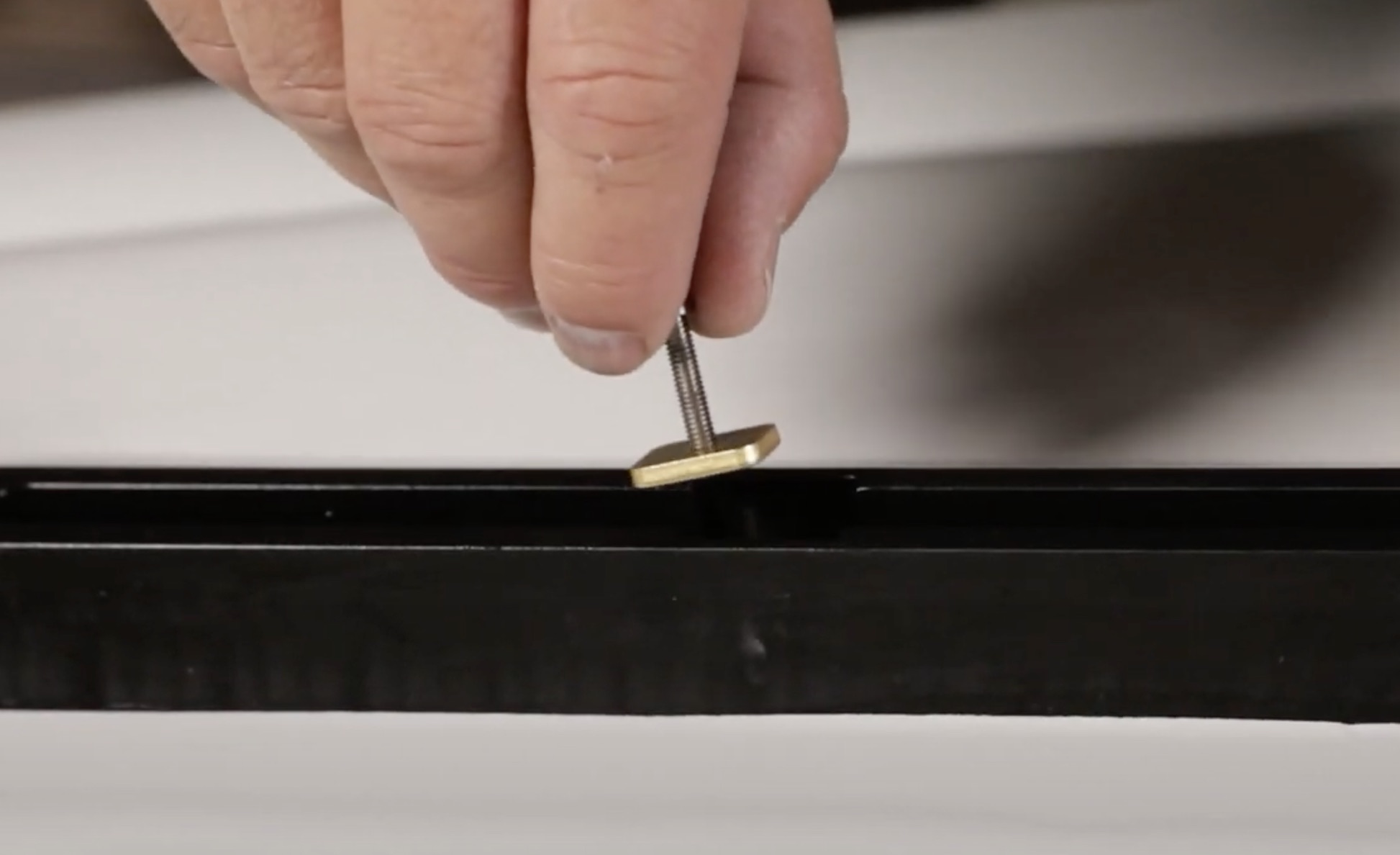
They sure have made a meal of the skeg fitting which uses a tiny and easily lost screw bolt and backing nut (left and right) which reminds me of the rubbish old Gumotex alloy skeg. Why complicate things like this when there are so many easy-to-use, no-loose-parts slide-in skegs around (as on the Moki).
Up front there is a shallow keel strake to protect the floor from wear and help with tracking. A better way of doing it than Sea Eagle’s bulky DS keel. You do wonder if the 155 might be as hard to turn as the Moki was.

The whole boat all folds down into a huge, 170-litre back pack. The 155 may not be that heavy at 19kg, but like many PVC boats, it sure has a lot of bulk.

Preview: Advanced Elements AirFusion EVO

See also:
Advanced Elements AirVolution
About Hybrid IKs

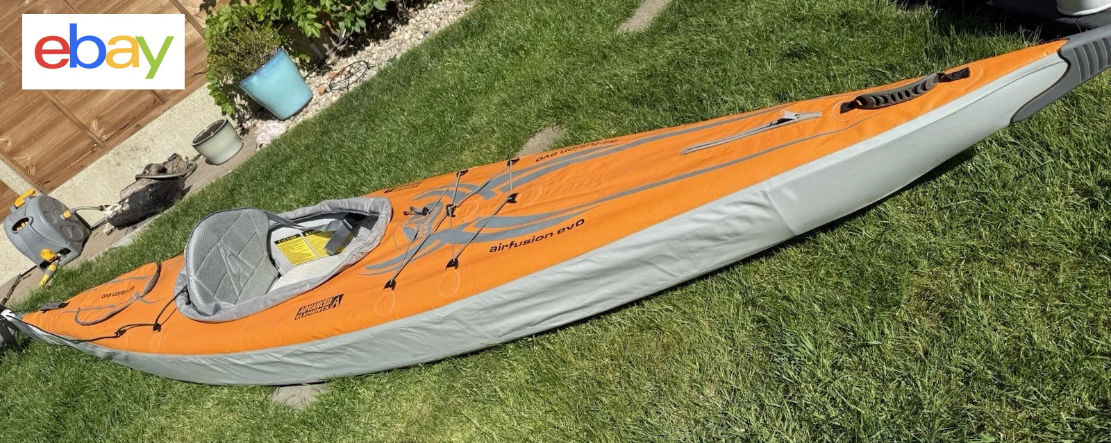
Advanced Elements’ hybrid AirFusion EVO (AE1042) is a good looking PU-skinned IK that slipped under my radar for a year or two. It replaced AE’s AirFusion Elite (right) which used two low-pressure side bladders (four in total) stacked one over the other, and an alloy keel rod along a plain, single-skin PVC shell. Like a folding kayak there is no inflatable floor.
The EVO version (above) looks similar, but replaced the four bladders with a pair of PVC dropstitch panels running a much higher 6psi (0.41bar), and with the shell now much more supple PU. Both methods keep the boat slim, and bow and stern alloy ‘C’ ribs are tensioned by a long slot-in keel rod, like a thick tent pole.

On some older, low-psi AE’s these ‘backbones’ are optional, but on the AirFusion it’s part of the design. This rod gives the AirFusion a V-shaped hull (above) a bit like the inflatable AirBone keel on some FDS Kzone IKs, and also adds tension between the bow and stern which the dropstitch sides can’t do alone.

The AirFusion EVO is the opposite of most ‘hybrid’ (part dropstitch) IKs which combine DS floors with round, low psi tube sides. Such boats, like the Gumotex Rush, or Aquaglide Chelan are rigid but, with round side tubes, end up wider and so, more stable.

The new EVO retains the low-pressure thwarts (air bags, below left) which help push the deck rod up so water runs off, push the sides and the floor rod out to make the skin taught, and up front, give something for your feet to push against (assuming the span is correct for you; there’s some adjustment in the seat). There are additional small airbags at the bow and stern to firm up the wave-cutting plastic mouldings there. As you can see, they’re as sharp as a hardshell sea kayak. The coaming (deck rim) is inflatable too, as is the seat base. And the EVO’s seat’s backrest has been made taller for better support.

The AE1042 is all wrapped in a PU shell – yes, you read that right; it’s not cheaper, stiffer and possibly heavier PVC. That makes it a sort of ‘shell & bladder’ IK with the drying issues that entails; made a little harder by the fixed deck. As with the bow and stern ribs, the DS panels are fixed with velcro but are pre-positioned out of the box. They can be easily removed (or even just part-deflated inside and separated from the shell) for a deep dry and clean.

Summer 2025 I spotted a 4-year-old Evo with rudder on eBay for £600 ono. I thought about it for a bit, but aside from the complex assembly and drying issues, the subtext implied it was fast but tippy.

Numbers are a very light 14.5kg/32lbs; 4m long x 61cm wide (13′ x 24″). Because of the lack of an inflatable floor, the capacity is a modest 106kg (235lbs) and, as the air bag thwarts take up interior space, like the all-DS AirVolution, this is more of a day boat than an overnighting tourer. But that is what most people want in an IK.

At 24 inches wide this is also one of the narrowest IKs around, similar to Itiwit’s 25-inch X500. That means it should also be fast, but the X500 is known to be tippy (it’s worse for larger paddlers). You’d think the AirFusion might be the same, but without an inflatable floor you sit a few inches lower (as in a hardshell kayak) which greatly aids stability. Certainly online reviews don’t mention the AirFusion’s tippiness as much as the X500 which runs 10psi I (Dropping the pressure a bit can improve things at the cost of performance.)

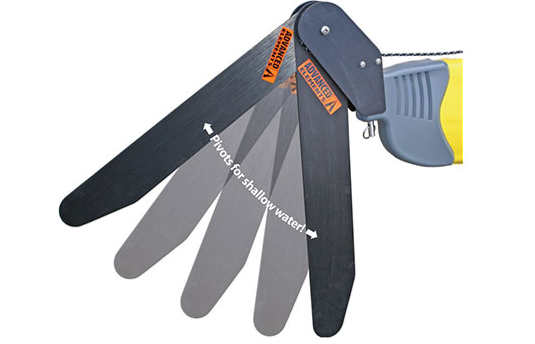
The integrated rear plastic moulding can take a skeg which is optional (or ‘free’ from some outlets). This is not your usual slot-in sharks-fin under the boat, but a rudder-like pivoting blade (below left) which can be lifted and dropped as needed on a loop cord.

I tried a similar MYO rudder set up but ended up a lot of unavoidable but annoying ancillary rigging. But I’ve often thought of adding something like this skeg to my own IKs to eliminate scraping in shallow water, or especially when beaching a loaded boat which needs to be rested on a rock your mate’s boat (above right) if the under-skeg is not be be stressed. I looked briefly on eBay but couldn’t see a similar but cheaper pivoting skeg direct from China. They must be out there of cough up 80 sovs for the AE one.
You may get by without the skeg on the AirFusion as the V-floor also includes shallow strakes (inch-high keel strips) which will aid tracking while not getting in the way on land or in shallows. A couple of reviewers have mentioned this PU shell is easily holed when scraping. Maybe they went a bit too far to get the weight low, but a quick bit of tape easily fixes that as the skin is separate from the pressured DS panels. The 2021 EVO has had an added panel of PU welded along the keel line where most wear occurs

Assembly does seem quite a faff compared to simply inflating three chambers (watch the vid below), but as with all things, you’ll get the hang of it. Remember, you’ll have the same alloy-framed folding kayak worries with salt and grit getting into the anodised alloy tube joints after sandy or saltwater paddles. The assembly video below shot on a sandy beach made me wince a bit.

But as with a folding kayak, it may all be worth it if performance is responsive once on the water. Some photos do show a saggy, creased shell (left) – you’d think they could have made a better fit, or more likely this boat could do with a few more psi.
And the sides are quite tall and slabby (also typical of a FDS IK) which will make it susceptible to side winds, especially without a skeg. That’s the case with most IKs, but you’d think with a single skin floor and a deck, it could be nice and low, like a Feathercraft.

With all the rods it looks as bulky as PVC DS or bladder IKs, but at under 15kg it certainly is light for a 4-m boat and appears to zip along. The back deck has an integrated velcro hatch / rolltop drybag and you have your usual bungy deck lines to stash a paddle while having a breather.
In the US the AirVolution EVO goes for $1200; that works out as £1300 in the UK, plus a $/£40 pump which will need three nozzles for the raft, Boston and twist lock valves. That’s still nearly twice the price of the X500 or a FDS IK like the Shipwreck, but there are no other boats quite like this.
Here an owner’s review.

Guest review: Kokopelli Rogue Lite

Javier Romaní

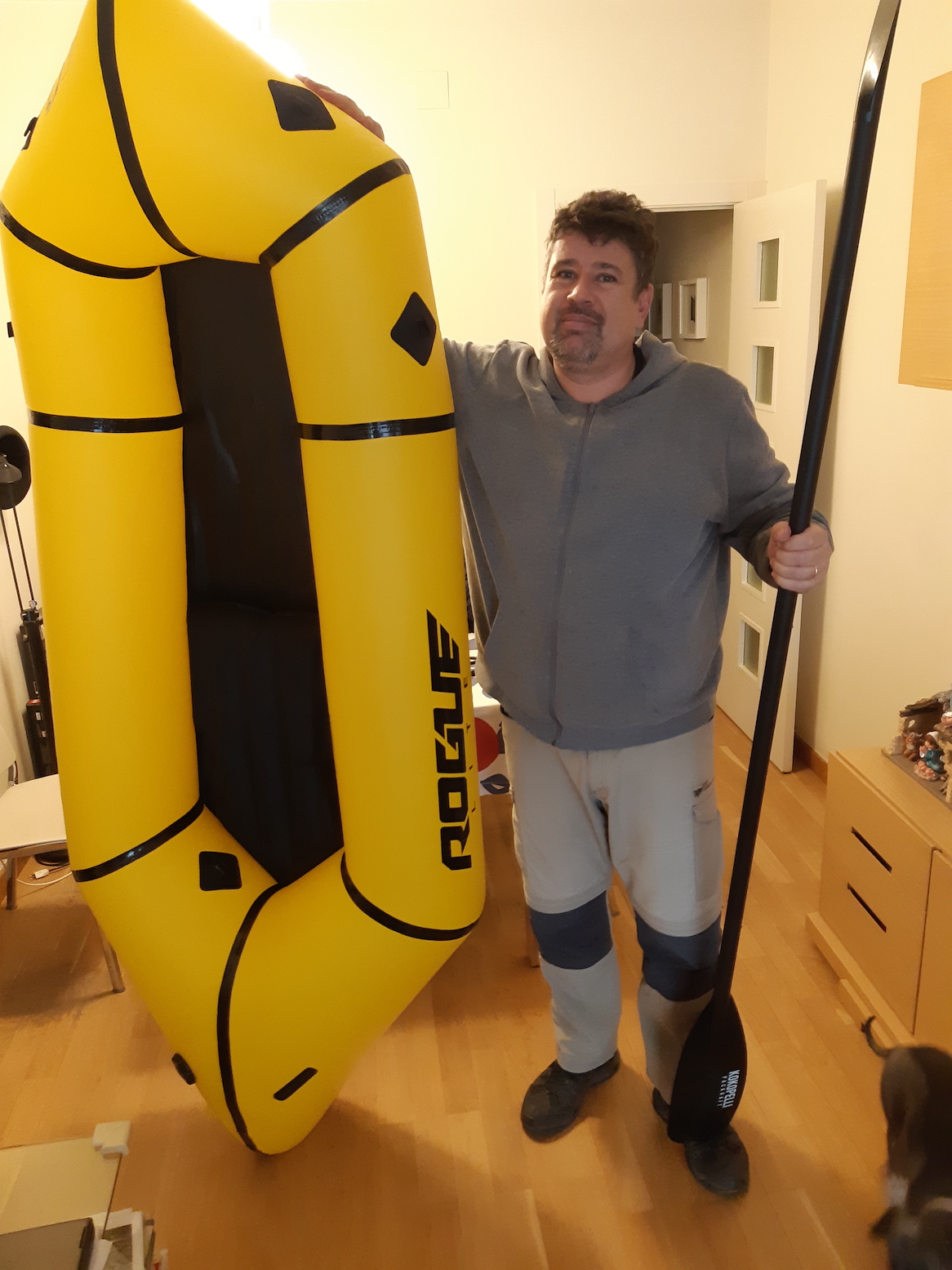
I love packrafts, but not their prices. Three years ago I bought a Klymit Litewater which served me well, but wanted something faster and more beautiful, yet almost as light. After a lot of internet research I decided the packraft I needed was an Alpacka Caribou or a Kokopelli Rogue Lite. But if I ever told my wife I had spent about 900€ on something that looks like a beach toy I would be in serious trouble.

And then, early in 2020 I found a pre-owned but unused Rogue Light for just 450€ including a carbon fibre paddle. It seemed too good to be true – was it some kind of scam? In fact the vendor had bought it for a trip that had to be cancelled, and he had no further use for it. One man’s misfortune is another man’s luck…

Sadly, before I had the chance to try it, the pandemic was in full swing and we were confined in our homes. I had to wait for June for a chance to use the Rogue Lite. My parents-in-law own an apartment in Costa Brava on the Mediterranean. There are a lot of nice beaches, coves and beautiful spots there, and many of the best can only be accessed from the sea. As I was teleworking, we moved to the apartment from June to September: what a beautiful chance to use the Rogue Lite in full!

There was an unused closet in the apartment and the inflated Rogue Lite fitted in quite well (it’s 2.15 metres long and 94 cm wide). Kokopelli boasts about the Rogue Lite having ‘the most bombproof valve on the planet’; in those three months I only had to top it up once, so I think Kokopelli has some reason in that.

The beach is about two kilometres from the apartment. As the Rogue weighs under 3kg, I could easily carry it fully inflated under my arm… That’s what packrafts are for! The boat is very robust and the paddling position is comfortable. The seat is good, and you can back lean on the stern. I am 1.83m tall and can keep my legs fully extended, which means that I can paddle for hours without feeling cramped.

My usual starting point was the north side of Sant Pol Bay, between the towns of Platja d’Aro and Sant Feliu de Guíxols. The sea is usually quieter so it’s a good place for embarking and disembarking, but the beautiful coves are in the south side. In the beginning, I just crossed the 1-km wide bay always in protected waters, to a small beach in the other side, that can only be accessed by sea, had a rest then came back. But, as my confidence in the Rogue Lite grew, my excursions became longer, even going out of the bay into the open sea. I once obtained a top speed of 6km/h, and I could keep 5 km/h for 15 minutes and 4 km/h for more than an hour. A 10-km round trip in the sea is not difficult in the Rogue Lite.

I was surprised of how seaworthy the Rogue Lite felt: it’s not difficult to paddle against a head wind, and side winds don’t make it drift too much (I imagine that the pointed stern acts as some kind of keel). One day, the sea conditions seemed awful, with a strong Force 4 winds and metre-high waves (Mediterranean waves are short, steep and have a high frequency, so 1-m Mediterranean waves are worse than 2-mAtlantic waves; believe me).
I decided to go out anyway, as the wind was blowing onshore. The Rogue Light did outstandingly: I could paddle into the wind, and the boat handled the waves easily. To make things worse, some large powerboats were around, creating their own waves, so sometimes I got waves from different directions at the same time. In some moments, I was in the trough between waves and completely surrounded by water… then, the Rogue Lite rode the wave and I was on top… easy! The tubes are high enough to avoid water getting in, even with these waves. If a wave seemed too menacing, I simply paddled straight into it. The rockered bow made an easy job of climbing the wave. Overall, it turned to be a lot of fun.

The only negative aspects I found are: the price, and the the floor: Kokopelli seems very proud of the kevlar floor, but they could have made it a little longer and wider, so it could better protect the lower part of the tubes. Overall, I really like my Rogue Lite and I hope to keep it for many years.

Guest review: Klymit Litewater packraft

Javier Romaní

I fell in love with the idea of packrafting as soon as I read about it. Sadly, when I started looking at prices I almost had a heart attack… an average Alpacka or Kokopelli costs more than 900€ in Spain – that’s a lot of money for me. But then I found the Klymit Litewater cost only 200€ including transport and import tax. I decided it deserved a try.

Two weeks later the first thing that surprised me was it’s really light (1300g in my scales) and easily packable. At a toy shop close to home I got a] cheap 7-piece paddle. The boat, the paddle and my everyday gear all fitted in a 5-litre Decathlon backpack. From March to October I always carry it with me so if I have a couple of hours free, I can go to the nearest water body for a paddle. That’s the whole point of ultralight boats like this.

The inflation bag is small, but is sturdy and waterproof. It serves to carry the boat and once inflated, a place to keep your belongings safe and dry. It takes between 5 and 10 minutes to inflate, after which it needs to be topped by mouth. The integrated seat is mouth-inflated. Once done the shape feels a bit odd as it’s short (1.93 m) and wide (1.15m). It has six tabs around the outer edge of the tubes for securing your belongings.

The paddling position is surprisingly comfortable: the sidewalls are low, but the stern provides good back support. The boat is long enough for me (I’m 1.83 metres) to keep my legs fully stretched. The material feels REALLY thin, but in three years my Litewater has rubbed against sand, gravel, rocks and concrete, and it still looks good. No punctures. The valve is simple, but doesn’t leak. This summer I kept the Litewater inflated for more than a month with no need to top up The deflation valve is a simple dump valve and one good feature of the Litewater is it dries fast.

I’m an atypical packrafter, as I use my boats in the sea. I alternate the Mediterranean (Costa Brava) and Atlantic (Ria de Arousa, a very large bay in northwest Spain), so all my comments will be related to the behaviour of the Litewater at sea. On the water it’s slow, but this is to be expected, as it’s short, wide and low-pressure. I don’t think I’ve ever gone more than 3 km/h. On the other hand, it’s more seaworthy than I expected, can hold its own quite well in the waves, and you can make headway against a moderate wind.
Once I found myself in an unfavourable situation: the sea and the wind were calm, so I paddled for 20 minutes to a small island one kilometre off the beach. But, when it was the time to come back, a strong wind had risen up, blowing across my course. There was also a noticeable swell, and a tidal current against me. It took me almost an hour to get back, but the Litewater managed it. Of course, with such low sides, you get pretty wet but overall, I’m very satisfied with it. I now have a Kokopelli Rogue Light but am keeping the Litewater for when I need to travel light, or for my son or guests.

Guest review: Itiwit EB-100

Javier Romaní

I bought one of the last Itiwit EB-100 sold new in Spain for 40€ from Decathlon which, in my opinion, is an absolute steal. It cost about a quarter of the price of the incumbent Itiwit 1-person inflatable kayak, but does almost anything the larger boat can do (maybe, that’s the reason why Decathlon discontinued it). I use it with a Decathlon 4-piece aluminium paddle. For 75€ I got a kayak (with a carrying bag), a paddle, and a foot pump.

It’s a small boat, about 215cm long and 95cm wide. Decathlon declares a weight of less than 3kg but, on my scales, it was about 4kg. It has the same construction as other Itiwit kayaks: two side air bladders with a removable outer nylon cover and a PVC floor. I find it robust enough: mine had close encounters with rocks, concrete and gravel and came away intact. If Decathlon had tried a little more seriously, they could have created a very nice budget packraft. The air valves are mini-Boston and are robust and leak proof, but require a specific nozzle in the pump that’s difficult to find. I had to cut and customize one of the adaptors of my foot pump to fit.

I use mine in the sea, both off the coasts of Galicia (northwest Spain) and Catalonia (Med). It’s not very fast as it’s short and wide, but it’s very stable and holds its own at sea with some waves. I’ve found I could paddle easily against a Force 3 wind and a tidal current, and have paddled with one-metre waves without a problem.

There are some negative points: the worst in my opinion is the paddling position: you sit high with legs in a 110º angle and no back support. It’s comfortable for about an hour but after that, your back begins to hurt and your legs feel cramped. On the other side, you can easily take a 10-year old child between your legs.
Another negative point is the looooong time it takes to dry, even in August in the Mediterranean it can easily be more than an hour.
Overall, I think it’s a great beginner’s kayak for the price. It’s a pity Decathlon doesn’t make it any more.

Tested: Shipwreck ArrowStream drop-stitch inflatable kayak review

See also:
Full drop-stitch inflatable kayaks main page

Updated May 2022

In a line
Still a great value full drop-stitch tandem IK with all the kit.

• Great price
• Not excessively wide but stable enough
• Everything in the box except a lifejacket and some water
• Clean, crease-free finish and assembly
• Supportive backrest
• Pumps up fast


• Folded-up, the boat is massive
• Very hard to turn with the skeg fitted
• Felt tippy with (removable) seat pad in place
• White surfaces may get grubby
• Seat base is hard (as is the floor)
• Footrest tubes too small and bendy
• Wide sides rub as you paddle

The original 2020 model I tried. New for 2022 version is 5cm wider

What They Say
High quality drop stitch kayak comes with everything you need to get started on the water.

  • Inflated: 440cm long, 80cm wide
  • Deflated 85cm, 50cm 22cm
  • Kayak : 18.3 Kgs
  • Total : 24 Kgs
  • Maximum load 340Kg
  • Price: £549 (at time of review; now £779 £689).

I am told the 2022 model is 5mm wider, now 85cm according to the website and still great value.

Test boat loaned for review by Shipwreck in December 2020

Out of the box

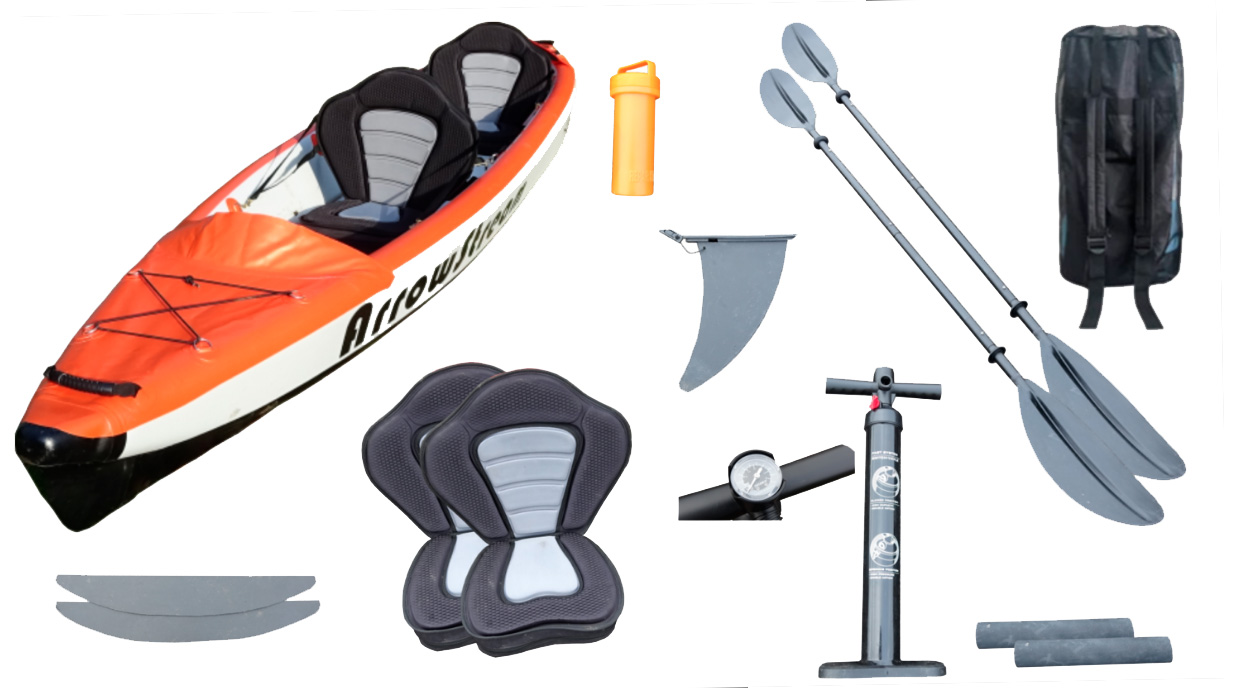
Shipwreck is the latest contender in self-branded full drop-stitch (FDS) IKs customised in China to an importer’s specifications. With the ArrowStream – not a bad name – you get all the kit including two four-part paddles and a two-way barrel pump.
The box it came in weighed a staggering 29.5kg – I could barely get up the stairs; it’s twice the volume of my Seawave 2. But once unwrapped, the whole kit: everything in the bag, weighs 25.4kg.

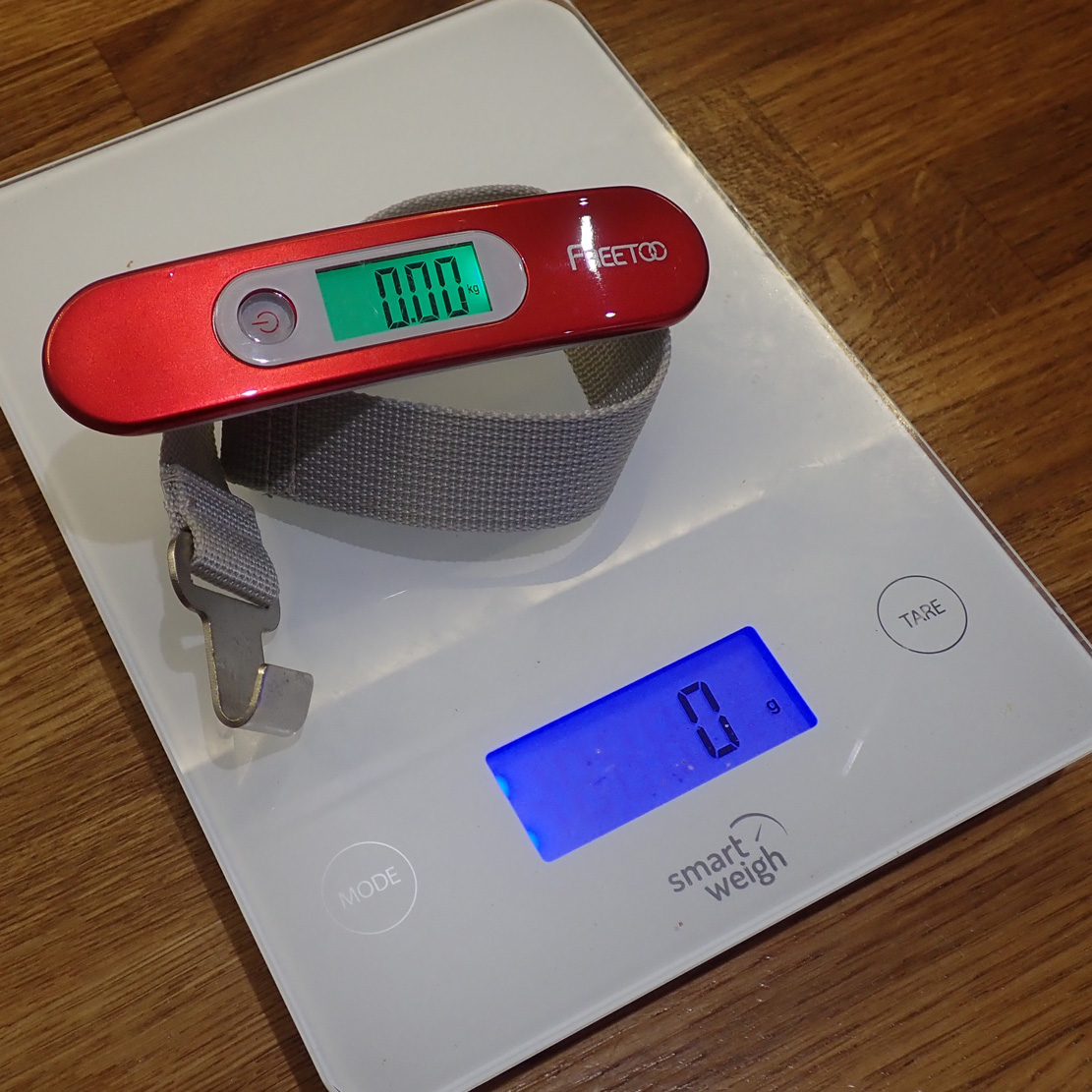
The bare boat itself is only 17.8kg, and with one seat and footrest, the splash vizors and the skeg comes in at 19.7kg on the water (plus pump and bag) according to my kitchen and suitcase scales. By comparison, had I kept the stock seat and footrest on my Seawave 2, it would have been 17.7 kg on the water, so that’s not as bad as the bulk – about 90cm x 70cm x 35cm boat alone in the bag – might suggest.
According to my tape it’s 431cm long and 83cm wide. That gives it an LxW ratio of 5.19 which, compared to the table here is also pretty good. And don’t forget the maximum width is measured high up on the outward-angled sides; the actual width at the waterline is around 60cm or 23.6 inches – fairly slender by IK standards. More on that later. The big advantage with these slim, 10cm-thick side panels compared to round tubes is loads more space inside. The interior width is 45cm at floor level and 66cm at the top of the sides.

The seats include a hefty 9cm-thick seat base incorporating a firm, 6cm foam block which can be zipped out. I can see that foam feeling a bit hard sat on the hard, 10psi floor after a few hours, but it could be easily replaced with something softer or lower. Or you could even zip an inflatable cushion in there to reduce the packed volume, but it will wobble a bit. The backrest is tall and wide, with loads of tensioning straps to get the position and angle to your liking. You can reposition a solo seat in the middle, a big benefit with any open tandem IK.

The footrests add up to a couple of 4cm ø hard foam tubes. This diametre is too small for a secure foot placement and they squidge once you push on them. For the test I replaced it with a section of 10cm PVC drainpipe. There are two pairs of D-rings on the floor to attach the tube, presumably with the two packing straps supplied. But that means adjustment is only forwards, away from each seat. So if they’re too far away for your feet you’ll need to adjust the seats forward which may not ideal for trim. However, in the tandem video above the attachment D-rings appear to be in the right spot, even if the trim at 2:09 appears a bit front-heavy. For my solo paddle I joined the two straps into a loop (above left) to use the footrest pipe. Pushing off a proper footrest makes sitting more comfortable and less slouchy. The important thing is the D-rings are there.

Flexible plastic splash visors slip under the rims of the short decks, and the slot-in skeg is the usual (for this type of boat) 9-inch monster. There are handles at each end and a pair on the sides.

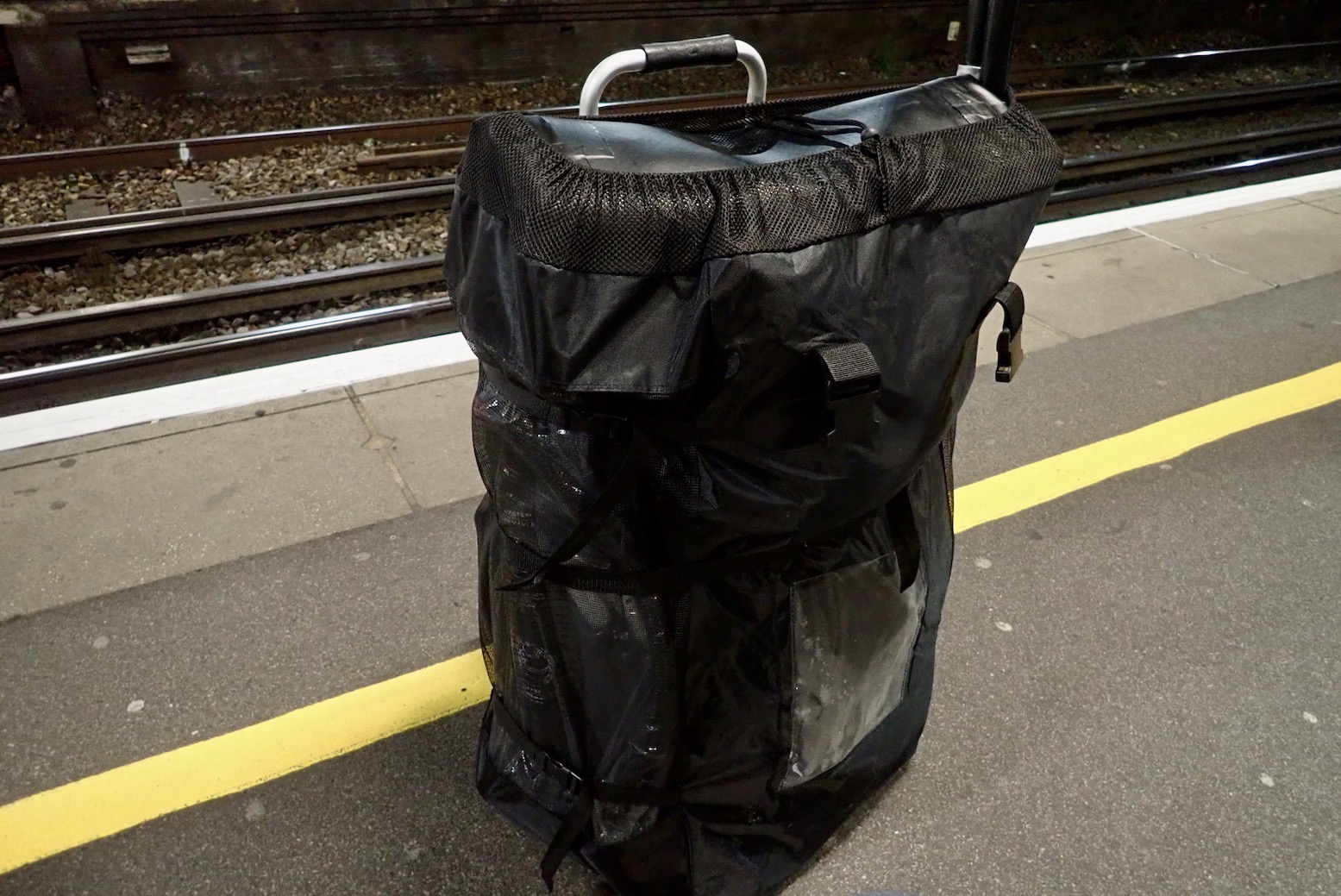
The supplied mesh-sided backpack is commendably huge: big enough to get everything in. There are cinch-down straps on the sides and the top, and a big zip plus a clear pocket on the front. The mesh sides will help a wet boat air off. But considering the weight it’s carrying, you do wonder if the shoulder straps will survive too much heaving on and off on public transport. I know my Gumotex backpack didn’t, and neither did the similarly huge Kokopelli Moki bag.

The whole assembly of the boat is very clean – that’s the wonder of heat-welding compared to messier rubber gluing. An exception are stray thread ends inside where a tape covers the floor–sides cavity (left). Once inflated I could see no blisters in the DS panels which, with threads every 5mm, adds up to an estimated 4 kilometres of space yarn! Maybe that’s what explains the bulk, but once vacuum sucked down, I don’t think so. It’s more that the stiff but soft-textured PVC can only be loosely folded over, not rolled up. Half the bulk is just air.
The supplied four-part 220cm alloy paddles weigh only 950g and have blade-angle adjustment holes 45° either sides of flat. The blades also have little hooks cut in the sides which are actually quite handy, now I think about it. Assembled, there’s quite a lot of slack in the three joints which will only get worse with use but they’ll certainly get you moving until you decide to upgrade.

Pumping stations
Pumping up the ArrowStream to an indicated 10psi measured by the 1.7-litre barrel pump’s built-in manometer took less than 90 seconds for the floor and a minute for each side. The pressures may be high but there’s much less volume here than a tubed IK. The pump comes with a nifty red cap which you easily unscrew to switch to downward-action-only to help attain higher pressures. I actually managed those times on double action all the way to 10psi. It’s manageable, but others will welcome the lighter pumping option as pumping effort increases. Checking against my accurate Bravo hand manometer, the 10psi figure on the dial was spot on. Good to know.

One good thing about the 64cm tall pump is that, I at least, stoop less compared to my 45cm Bravo. That makes pumping a whole lot more comfortable, though conversely shorter pumpers may find the height awkward. As mentioned here, a barrel pump suited to higher D-S pressures needs to be relatively tall but slim.
The raft valve nozzle on the end of the hose had the bridge inside to press open the inflation valve once clamped on, so as to ease the pumping effort. This also enables sucking the boat down to maximum compactness. I’ve only just realised these nozzle bridges are the key to compact suction packing, as long as you have push-push valves. After shrink-packing, as you quickly remove the nozzle the valve closes and virtually no air in sucked back in.
One thing you don’t get on a self-branded boat like this is a conformity table stating recommended pressures, HIN, payloads, ISO rating, CE stamp and so on. But there’s a one year warranty against manufacturers defects.

On the Water

I’ve been speculating about these boxy, hardshell-stiff full drop-stitchers for years and finally had a chance to try one. I picked a 21km (13 mile) section of the Thames from Shepperton to Richmond with three lock portages on the way.
From where I live it’s an hour and a half by train, then a 20-minute walk to the river: a good test of real-world packboating. All I had to do now was sit back and wait for a sunny, mid-December day. In the end I settled for a dry day and once I got there, it dawned on me I’ve not been to my local train station for 9 months or more (this was Covid Year One). To spare the mesh backpack, I used an old folding trolley. It can hack rough treatment but these days most London stations have lifts, so the whole trip was rather effortless.

A 15-minute walk from Shepperton station, I’d located a perfect put-in off Google maps: a paved dock down a bank tucked between trees and just a foot above the water (left). As so often happens when setting up in the more populated south, a passing chap was curious about the boat. Little do these people know they’ve stumbled upon the UK’s self-styled inflatable guru! A comprehensive exultation of The Packboating Way may have been more than he bargained for.

The planned route broke down as: 4km to Sunbury Lock; about the same to Molesey Lock; another 8 to Teddington and 4 or so to Richmond. As I wrote recently in my IK guidebook: first time in a new boat choose a quiet, safe and easy spot and if in doubt, do the tippy test before you let go of the river bank. Perched on the thick 9cm seatbase, the ArrowStream felt wobbly on its relatively narrow hull that’s about 60cm wide at the waterline where you sit. At a guess my Seawave 2 might be 70cm or less at the water level, but the difference must be that the Seawave sags a bit and leans over onto round side tubes (below right) which vaguely maintain the waterline width; the Shipwreck’s super-stiffness and near-vertical sides are what I’ve decided to call a ‘flowerpot’ profile (below left) which quickly narrows and has less to support it as it leans over.

Had it been a lovely summer’s day in a shallow pool, it would have been interesting to push the tippy test past the limit. And also find out how easy it was to re-enter the ArrowStream from deep water. But it was a cheerless mid-December day on the Thames. I suspect the Shipwreck is more stable than it feels: what they call low primary (upright) stability but good secondary (leaning) stability, though some think latter concept is bollocks; a kayak either feels stable to you or it doesn’t. As for deep-water re-entry, like a canoe, the tall, thin sides may make that tricky, depending on how well you can dolphin-launch yourself up and into the boat without pulling more water in.
Luckily I had the option to zip out the 6cm foam block from the 3cm padded seatbase envelope and sit nearly on the floor. I could try the block later when I was more accustomed to the boat. Sat lower, the boat felt normal. It can be rocked side-to-side more readily than my Seawave and you have to make sure you sit right on the centre line. As others have said it may tip off centre but it won’t go right over, at least on flat water.

On this first stage, in the interests of analytical rigour I planned to use the four-part paddle before switching to my trusty Werner. In fact it worked perfectly well for an alloy straight-shaft. You don’t really notice the slack joints, though the width of the boat’s high sides caused the paddle to brush against them. It was the same with my Werner later, so it might be an idea to tape this area against wear. Sat on the seat foam block or other added padding would get you higher for more paddle side-clearance.
Once I got on the move the biggest problem was as anticipated: the tendency of the ArrowStream to track straight as a streaming arrow. Normal inputs to fine-tune the direction had no effect and progress became an annoying succession of straight lines broken by occasional hard hauling or jamming in a stern rudder/forward pry (it’ll all be in the book!) to get it on track. This was the same issue we had with the Moki a few months back. Is it the stiff DS floor? Is it the huge skeg? The sculpted hard plastic bow and stern prows? Read on, but I got to Sunbury in less than half an hour which was a pretty good 5mph with help from the current.

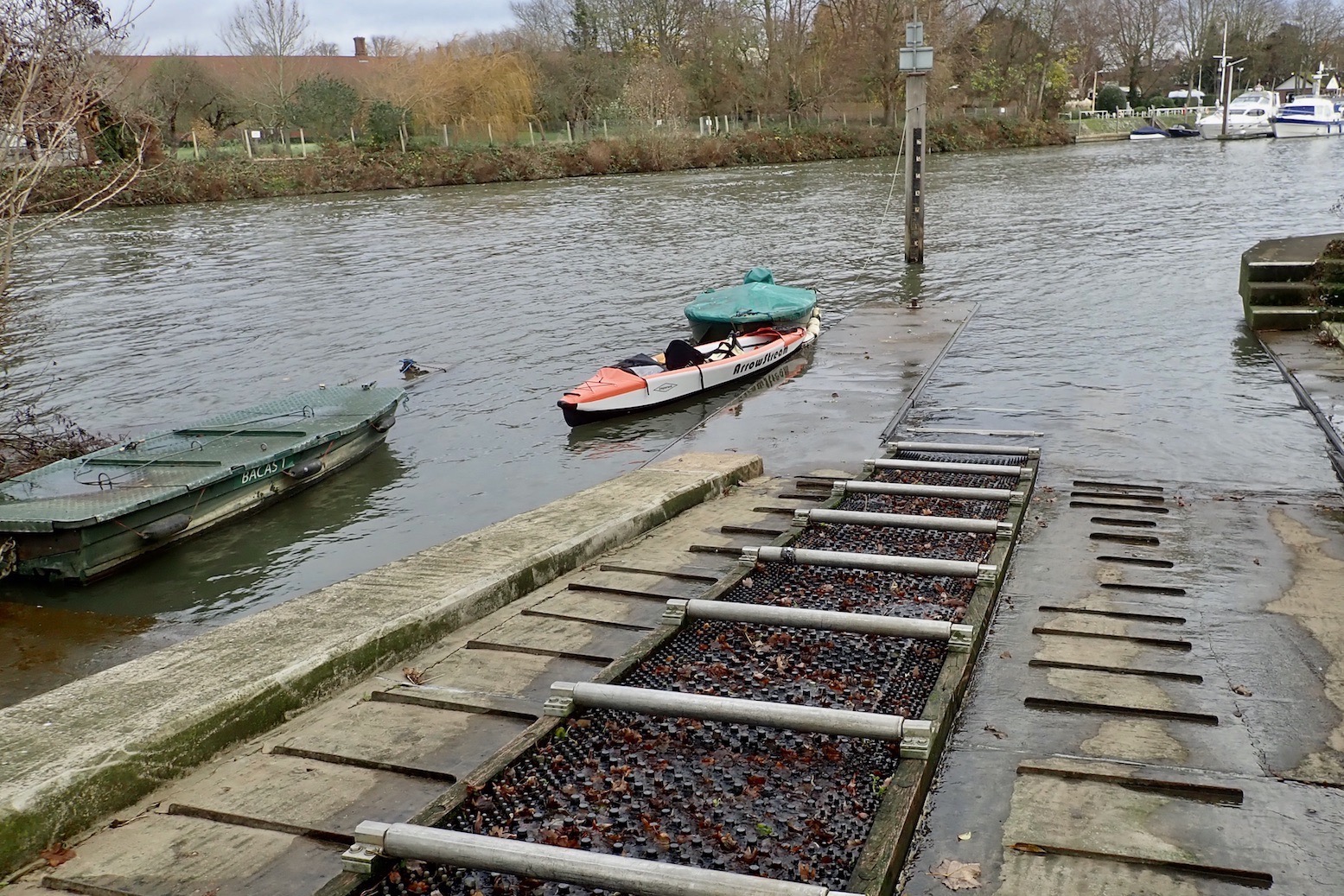
Here I didn’t think to investigate what had looked on Google like a fish-ladder/mini weir on the left of the lock. I now realise it was a very handy canoe roller ramp: a slopping drop which would have made portaging near effortless. I’ve never seen these before; with a little more excavation they could be made into chutes as found uniquely on the Medway but perhaps the Thames’ current gets too strong for them. Instead, I hauled the kayak up onto the towpath, carried it past the lock and clambered back down a dockside ladder. Grabbing one side-handle, a solo paddler can rest the boat on the hip and carry it a short distance.

Paddling off with the weight (trolley, pump, spare paddle) now in the back and my Werner in hand, progress improved. A favourite paddle of 15 years fits like a well worn pair of boots, except boots would never last that long. I still hadn’t got to grips with steering nuance. There is just no way skipping a few strokes on one side will make any difference: the Arrow Streams full ahead like a rocket sled on rails. Of course, it’s better that way round than the other.
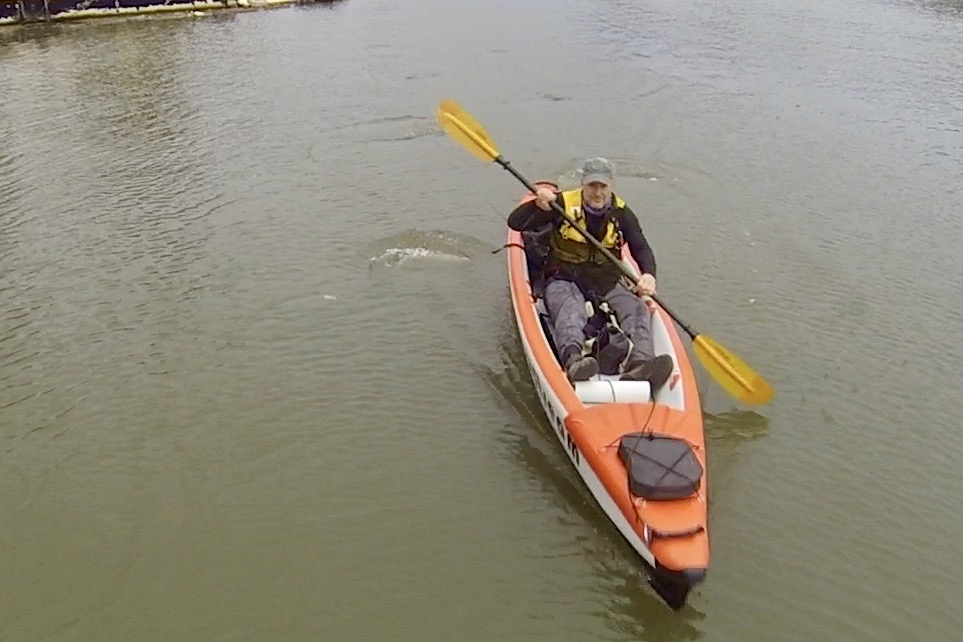
Somewhere downriver a mate who lived nearby was standing by to grab some drone footage, but you’ll see better video at the top of the page. A few stills below.

With half an hour spent chatting or in a holding pattern while the drone buzzed overhead, annoying all in earshot, I wondered if I’d left it too late to get to Richmond before dark. At Molesey Lock I nearly made the same portaging mistake had not a kayaker catching up scooted down the ramp (below). They may not be as much fun as a chute, but with shallow water on either side, you can hop out and portage in a minute, even without using the rollers. It’s probable the day’s three locks (plus Richmond’s tidal barrier, just downstream of town) are the only such roller-ramps on the Thames’ 45 locks.

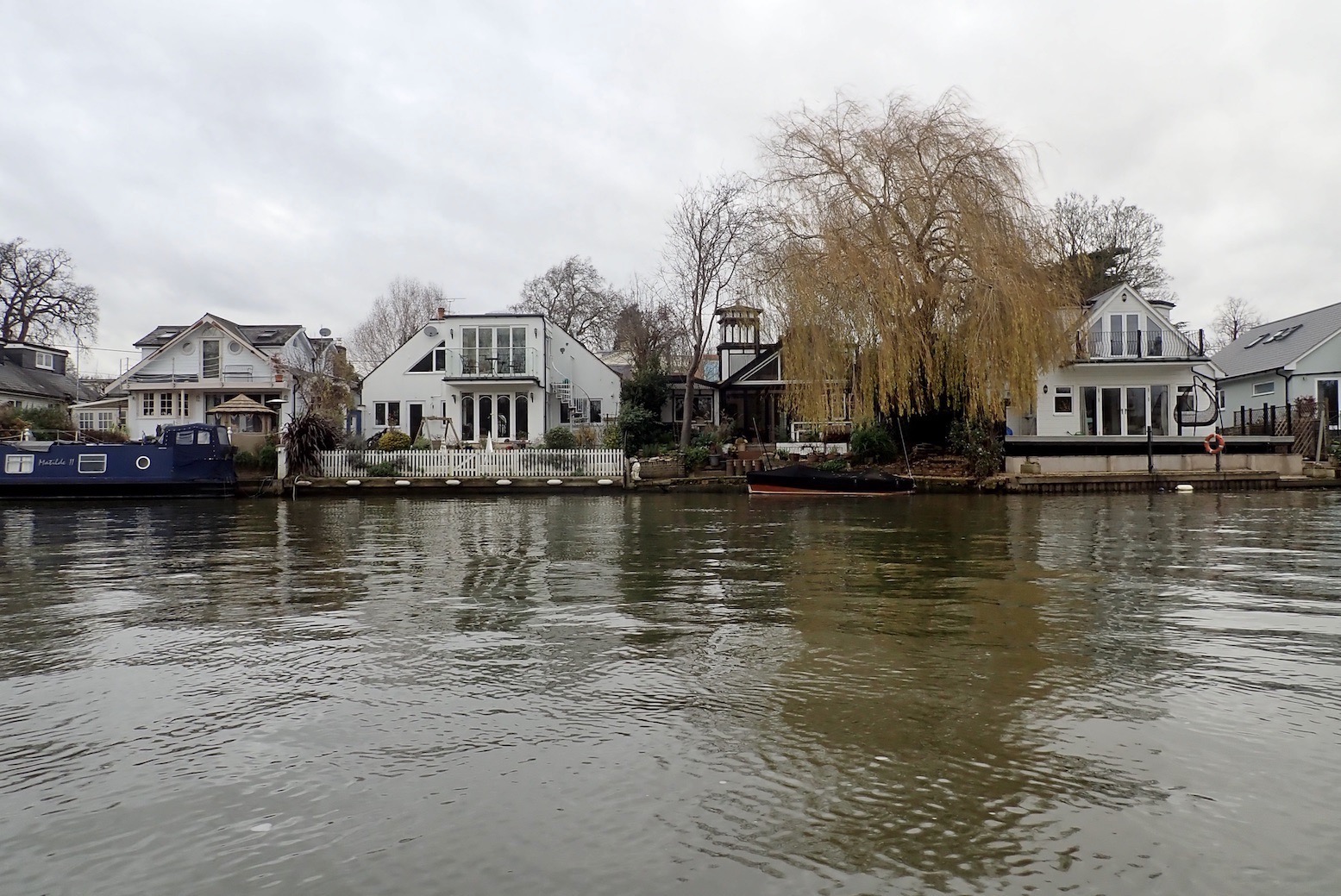
From here it was an 8-km stretch to Teddington where I thought I might bail if I felt tired. That’s the great thing with a packboat: you can change plans as you go. After passing rows of cute riverside dwellings and many seemingly abandoned boats, from here on the river was less grubby and urbanised as it passed the vast grounds of Henry VIII’s Hampton Court Palace.
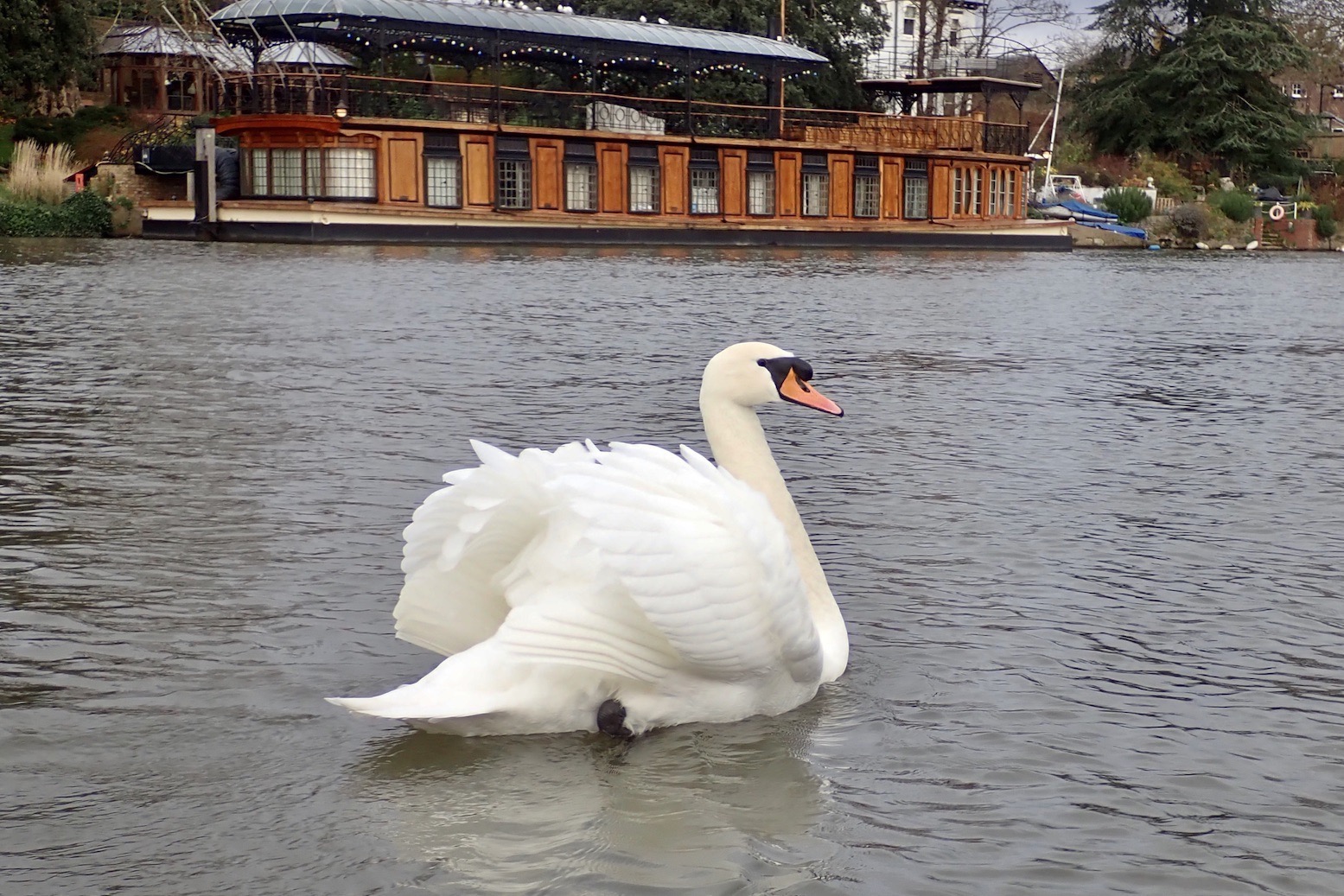
Right from the start I’d been surprised at the number and variety of birds on the Thames, not least the hordes of swans (which were protected by ancient royal decree until 1998). I noticed one had a cunning way of fluffing its wings out into a pair of downwind sails to tale advantage of the tailwind.

Like a weary traveller, I came upon a glittering riverside metropolis and for the life of me couldn’t work out where this was. Happy shoppers and joggers where cruising along the waterfront. Cafes, bars and patisseries were making the most of it before Covid restrictions ramped back up in a few days. Was Thames Ditton really like a mini-Manhattan? Or have I been cooped up indoors a little too long.
I asked a passing boatman what was this place of wonder.
“It’s Kingston, mate. Why, wherja think it was?”
I hadn’t the heart to tell him.

As I paddled past, I clocked the distinctive slabby flanks of an Aqua Marina Tomahawk tucked between two raptor-like speed boats. That particular boat was about as good value an FD-S IK as you could buy until this Shipwreck washed up on the ebbing tide.

I drifted under Kingston Bridge which I must have ridden over scores of times in a past life, whereupon the Miracle of Kingston delivered one final benefaction: the setting sun burst out from beneath the carpet of clouds which had smothered the London skies for the past week.
The shock was so great and the light so stunning against the steel-blue clouds, it could not have been a better time for the cold to get to the camera’s battery. I managed to rub it into delivering one last shot of the stately riverside plane trees before it packed up for good.
This illuminated setting invigorated me for the final lap to Teddington Lock and Richmond beyond, but three hours in, the old butt was getting sore. One good thing with the ArrowStream and similar is you can lift yourself up on the hard sides to aire le derriere.
This turned out to be one of the nicest stretches on the Thames I can recall. The riverside sticky-beaking, enigmatic islands and doubtless loads of history if you care to investigate, makes me realise that without its sporty chutes, Kent’s Medway is just another ordinary, agri-saturated Southeastern drain.

Converging on Teddington Lock with a quartet of silver-haired sea kayaking ladies, like a well-conditioned lab rat, I knew the form by now: canoe ramp, river left. Here I decided to remove the skeg. Straight away I set off at a faster paddling rhythm and found the boat much more lively, but in a good way. Yes, small corrections were needed to keep track, but now I was off the monorail and could wander and weave around like a normal IK. I wish I’d done this earlier. As suggested elsewhere; the sweet spot must lie with chopping that dorsal fin down. At the lock I also slipped the seat block back under the seat … for as many nano-seconds it took to realise that was still a bad idea. Something softer but less thick is needed, but watch the IoW video at the bottom of the page to see proof that this IK can be manageable at sea.

The trees of what I thought was Richmond Park (actually the near-contiguous Ham Lands) glowed orangey-red as I cruised below Richmond Hill and under another familiar road bridge to arrive at the ramp where Steve and I had set off for Greenwich nine years ago, just after the last London riots. Lord know there’s plenty more to riot about these days, but now it’s all conducted online which is much more hygienic.
Like Kingston, twilight on Richmond waterside was throbbing with ducks and Christmas revellers. I took my time draining and folding up the boat (chatting IKs with another curious chappy), rather pleased I’d managed the distance in exactly four hours without ending up too knackered. Part of that must be down to a backwind and the Thames’ swift winter current, but most of it’s owed to the Shipwreck ArrowStream, a fast flatwater cruiser whose potential is released once you dial in the right amount of skeg which may be none at all.

Drying
The twin drain plugs at the back worked fairly well on the ramp at Richmond; a pint or two spilled out from the cavity formed between the sides and the floor and which will almost certainly not dry out fully. The mesh-sided backpack helped, but you could tell it would take more to dry the boat off fully prior to long-term storage. In our flat I left it in the warm hallway (with an appropriate warning sign) and gave it what I thought was a final wipe down, but folding it up more water splashed out from somewhere, possibly the hollow prow beaks at either end.
If you have the space the best way would be to lean it inflated on a wall in a warm room (or out in the sunshine), let what’s in there run to one end and deal with it there. If you’re really serious about the side cavities, you might get to them from either end with a hose attached to a hair dryer set on low.

Tested: ROBfin Big Boy L Packraft review

In a line
Nippy self-bailing 3-chamber PVC / high-pressure packraft/IK made in Czech Rep and suited to white water and surfing.

A nippy, light, taut IK with raft valves
Tough, German-made 1.1mm PVC
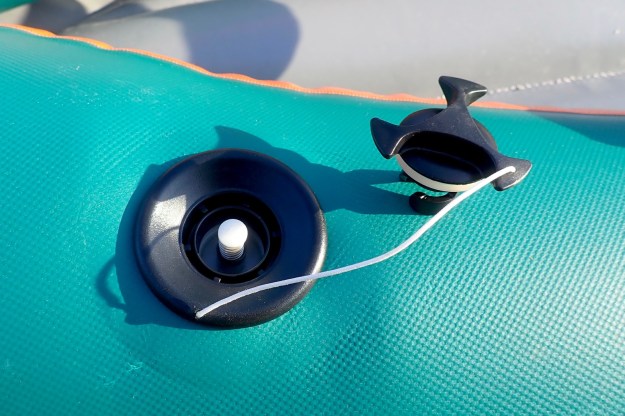
Mini barrel pump will get it to 3psi eventually
Integrated thigh straps/footrest work well
Thick floor forms a keel to limit yawing
It’s heavy for a packraft
Heavier paddlers will still get a bit of wet bum on flatwater
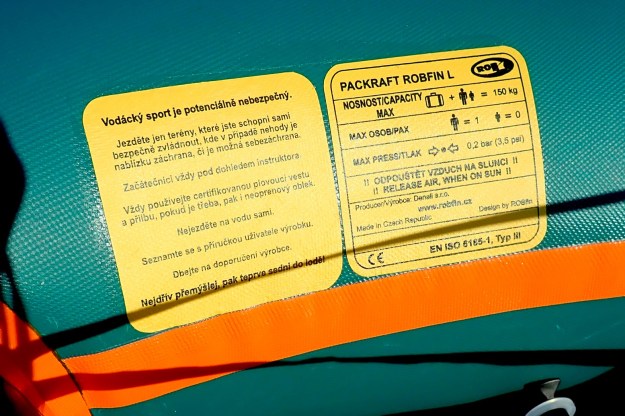
0.2 bar ≠ ‘3.5psi‘ as printed on the yellow label

What They Say
Completely new concept of packrafting. Instead of mushy packraft, you get a High Pressure Packraft from extremely heavy duty fabric, that takes you anywhere and make it fun!
Stable and self–bailing (realy self-bailing) packraft with performance of hardshell boat. Fast and manoeuvrable, good for beginners, for experienced boaters or experts as well.
Packraft for bigger boaters or for long expeditions, sometimes called Big Bro. For paddlers and gear up to 140 kg. Fast and responding boat from extremely tough fabric. High profile bottom with comfortable seat, self-bailing up to 5 secs completely full boat (with standard load).

Price: €750

Out of the box

The Big Boy is the second largest in ROBfin’s range of four packrafts, rated for loads of up to 140kg. Self-bailing holes in the floor set limits on payloads; tape them up and you may well be able to carry more without sitting in water, but heavy hauling is not what a self-bailer is about.

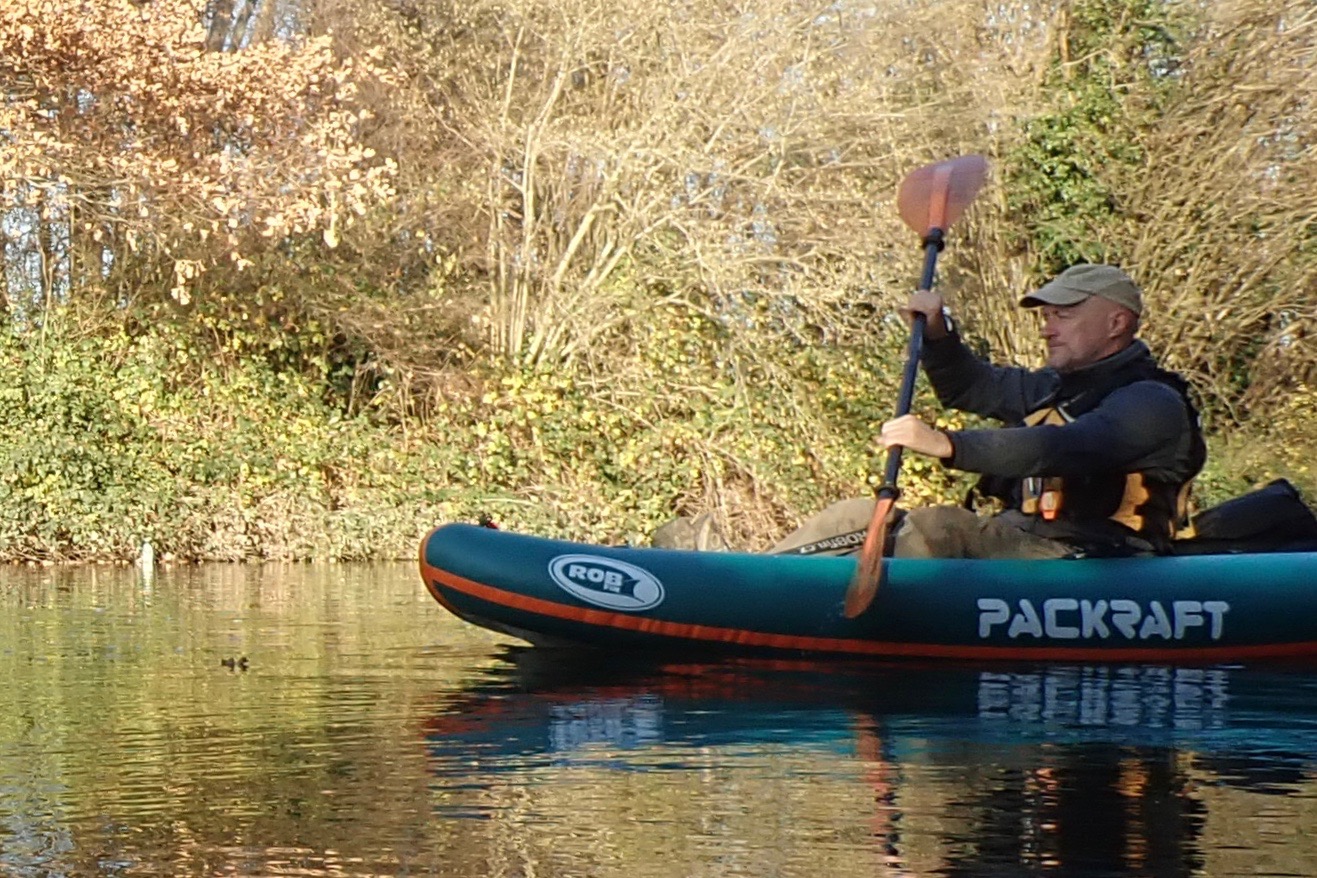
Although PACKRAFT is emblazoned boldly along the sides, this is not your typical, single-chamber TPU Alpacka or Anfibio, but more like an IK with three chambers including an inflatable floor.

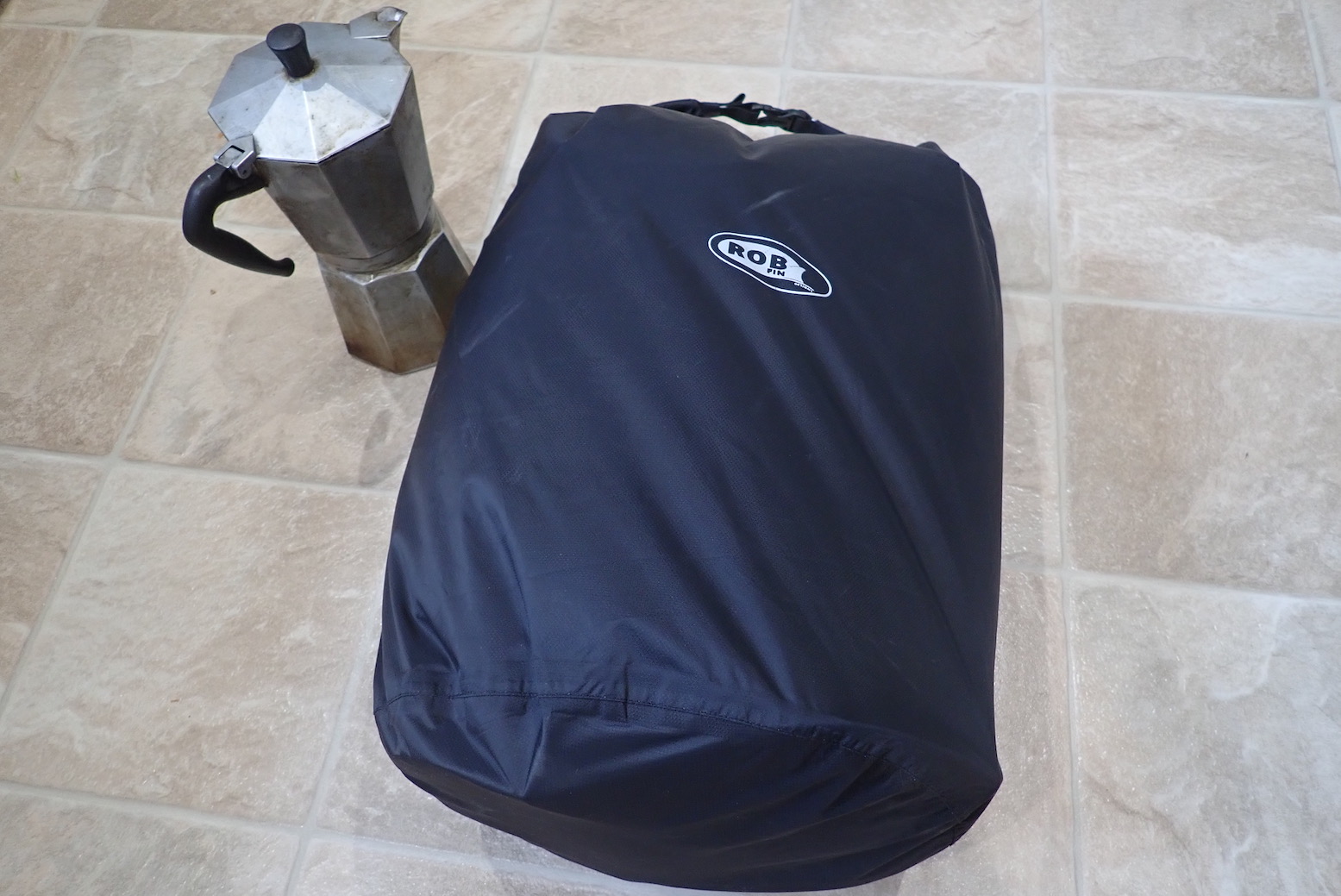
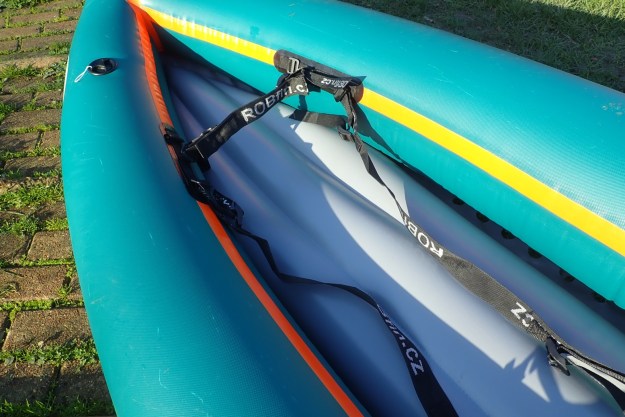
Made from stiff, 1.1mm PVC and with raft valves, the small Bestway Air Hammer will get 3psi (0.2 bar) in there eventually. The stiff hull works well with the integrated footrest/thigh straps for a better connection with the boat. You may notice below left how the floor expands and thickens towards the back to add more buoyancy in the seating area where it’s needed.

On the Water

Where I live there’s no white water for miles. The Lee River White Water Centre on the other side of London would have been fun to visit, but was closed for Lockdown and requires passing an assessment course before they let you loose on the two short artificial courses.
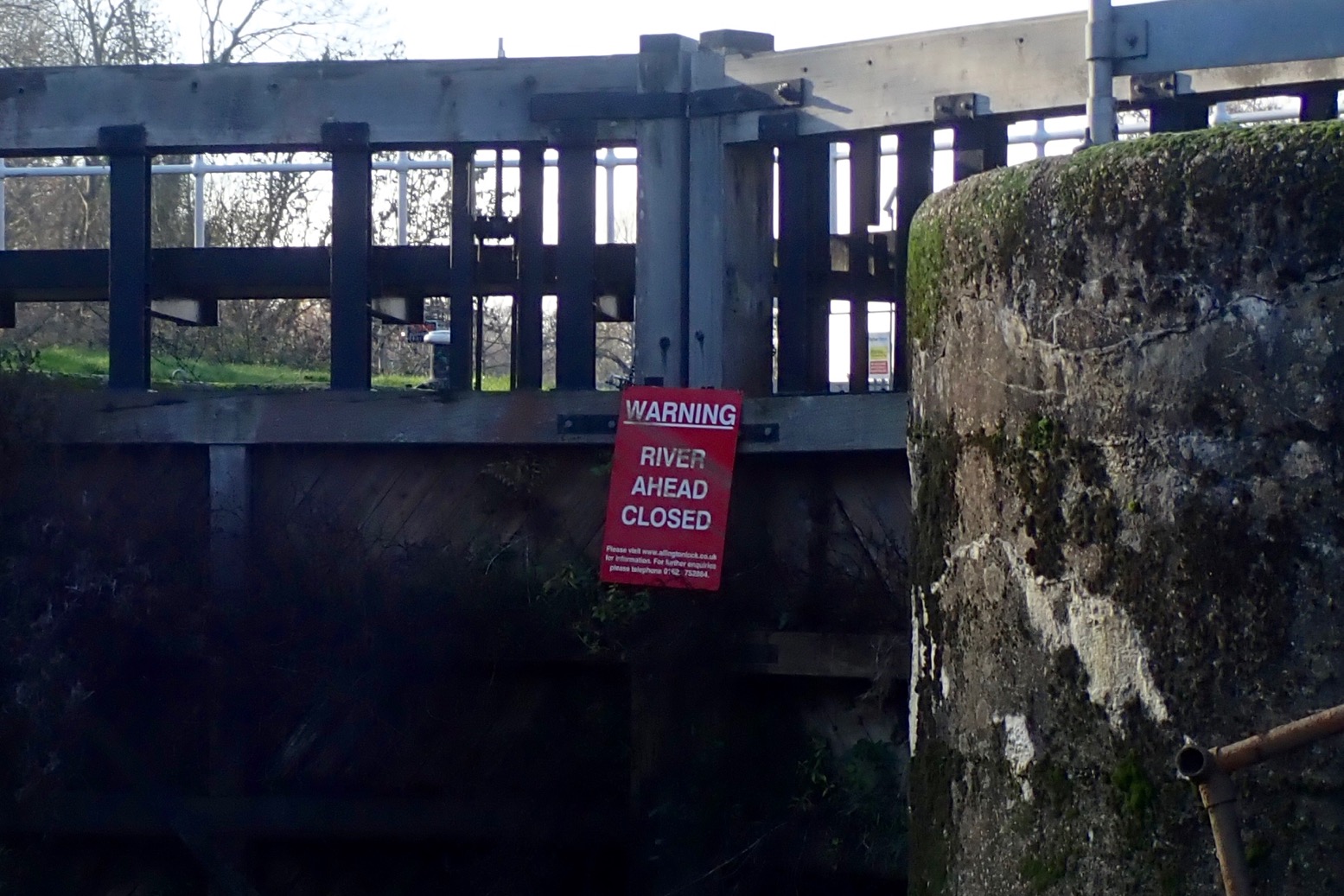
So the ever-reliable Medway and its sporty canoe chutes would have to do. And with the recent rains the river should be moving right along. But on arriving at Sluice Weir there were barriers everywhere, and the river level above the lock was several feet below the jetty. The upper Medway was closed for winter maintenance works. I’ve been caught out like this on the Medway before. Better to check at http://allingtonlock.co.uk.(click ‘river status’).
So after waiting weeks to try out the ROBfin on a sunny day, all I got was a muddy, flatwater paddle. It was altogether a bit of a washout.

My big IK barrel pump inflated the boat in no time. The yellow conformity label says ‘0.2 bar/ 3.5psi’, but 0.2 = 2.9psi, so that’s what I put in. At this pressure the PVC ROBfin was firm like an IK and not mushy like a packraft. Setting off downstream, the way the floor drops like a keel helps the boat track reasonably well, though you can’t power on without the need to correct once in a while. If you stop it veers off to one side, like an unskeged IK or packraft. With gentle strokes, you move along with none of that bow yawing you get with a packraft. The packraft-like ~1-metre width meant it was stable too, even with the higher seating position.

As it is, the water level in the boat was only about two inches below where I sat, so any fast moves or turns brought it up momentarily. You will get a bit wet. Judging by some brisk riverside walkers, the boat was managing over 3mph against the current, and back at the lock it was easy to wipe down and dry.

It’s a pity I wasn’t able to get splashy with the ROBfin; it would have been fun to belt flat out down the bigger chutes to test out the bailing, and mess about below them. The taut hull means the thigh straps work well and the short length would make it agile in the rapids. And should you tip over, getting back on would be dead easy. For playing in white water I’d sooner get a boat like this than a decked packraft. But they make self-bailing packraft too.
Packraft or IK? I’d settle on the latter which might put it up against a 12-kilo, 3.3m Gumotex Safari at more or less the same price. The shorter, wider ROBfin would be more stable a fun boat in the right element. What a shame I never got there.

.