Category Archives: Jurassic Coast packrafting

Igla 410: The Kimmeridge Ledges

See also:
Igla 410 main page
Packrafting the Jurassic Coast

Eastwards from near Tyneham Cap: Kimmeridge Bay and the Ledges beyond on a very windy day

We took a lovely evening walk along the Purbeck coast east of Kimmeridge Bay, where for millennia the bands of bituminous shale have been burned or squeezed for their oil, like Kalamata olives. Good page here on Kimmeridge and its geology over the eons.

Just west of Kimmeridge Bay there’s even a lone oil well (right), nodding away incongruously since 1959 in the pastoral Purbeck idyll that inspired Enid Blyton’s Famous Five adventures which I devoured like Opal Mints in the Sixties. Blyton holiday’d for two decades in Swanage and elements of some distinctive Dorset icons, like Corfe Castle, find themselves transposed onto her book covers (left). There’s even an Enid Blyton Trail, which lists Kimmeridge.

East of the bay are the notorious Kimmeridge Ledges, submarine clay or dolomite beds which reach out to sea a few hundred metres. With the right sort of swell or wind (top of the page and below) they can catch out unwary paddlers when waves suddenly rise up and break far from the shore.

Windy day looking east across Kimmeridge Bay to the jetty below the Clavell Tower

Our evening walk coincided with low tide and calm conditions exposing parts of the ledges. They’re said to be rich in fossils and over the decades a local man, Steve Etches has collected enough to fill a museum in Kimmeridge village.
We walked as far as the outlook over Egmont Point where the path turns inland on its way over Houns Tout to Chapman’s Pool, just before St Alban’s Head (below).

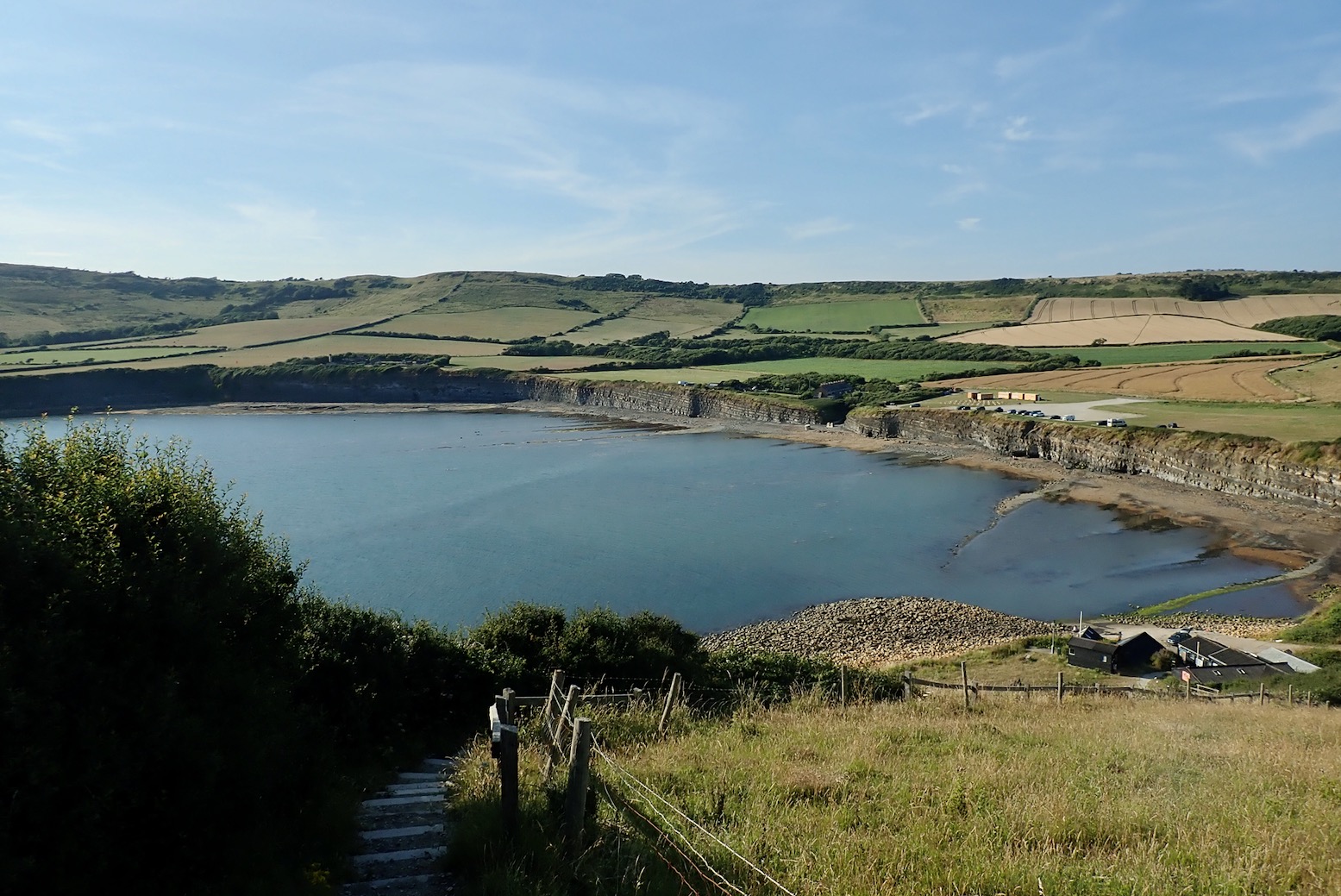
Chapman’s Pool, just before St Alban’s Head
Kimmeridge Bay

To reach Kimmeridge Bay you continue past the village onto a private toll road to a huge car park with a daytime cafe. On both visits no one was at the toll booth which saved a few quid.
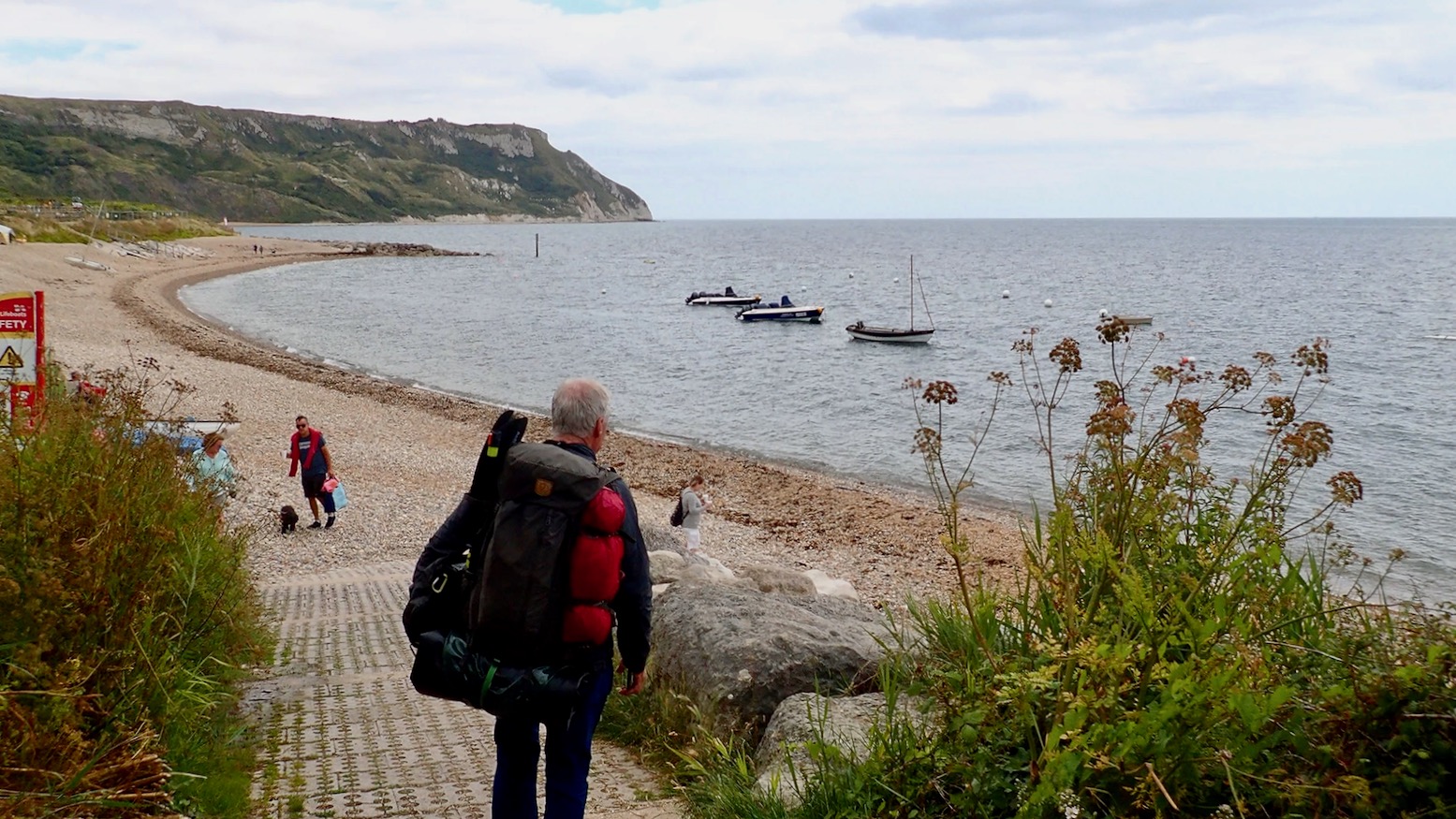
The east end of the bay has a handy slipway by the Wild Seas Centre. What a luxury it is to drive down to the sea’s edge and pop the kayak straight into the water to let it cool down and soften up while I parked the car. The high tide was just on the turn, but out here away from the headlands, the effect of any tidal current is minimal compared to the wind.

Jetty put in

I’ve got into the habit of opening the two side PRVs plus airing down the floor a bit at the end of a paddle for the drive home. Providing it’s not baking hot, I paddle with the PRVs closed which keeps the boat as rigid as a stick. Today I realised you can’t top up with a push-pull barrel pump stood in the boat on the water; you need to drag it all back ashore to stand on the ‘stirrups’. It takes just a few strokes to fully inflate the Igla back to 0.5 bar.
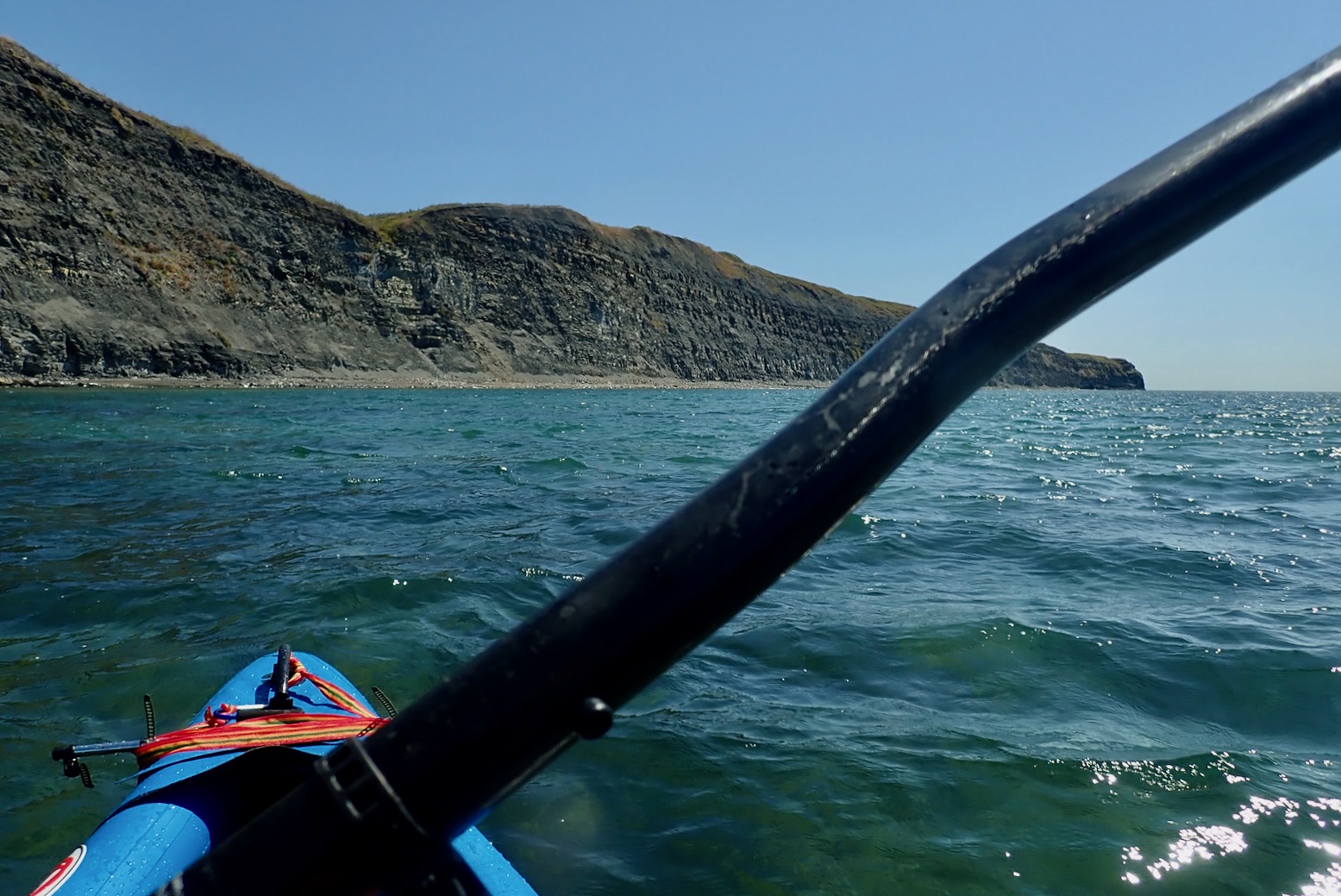
Round the corner the south easterly feels a bit more than the predicted 8mph. Perhaps the tall cliffs channel and accelerate the wind along their face. At least it should make for a good sail back.
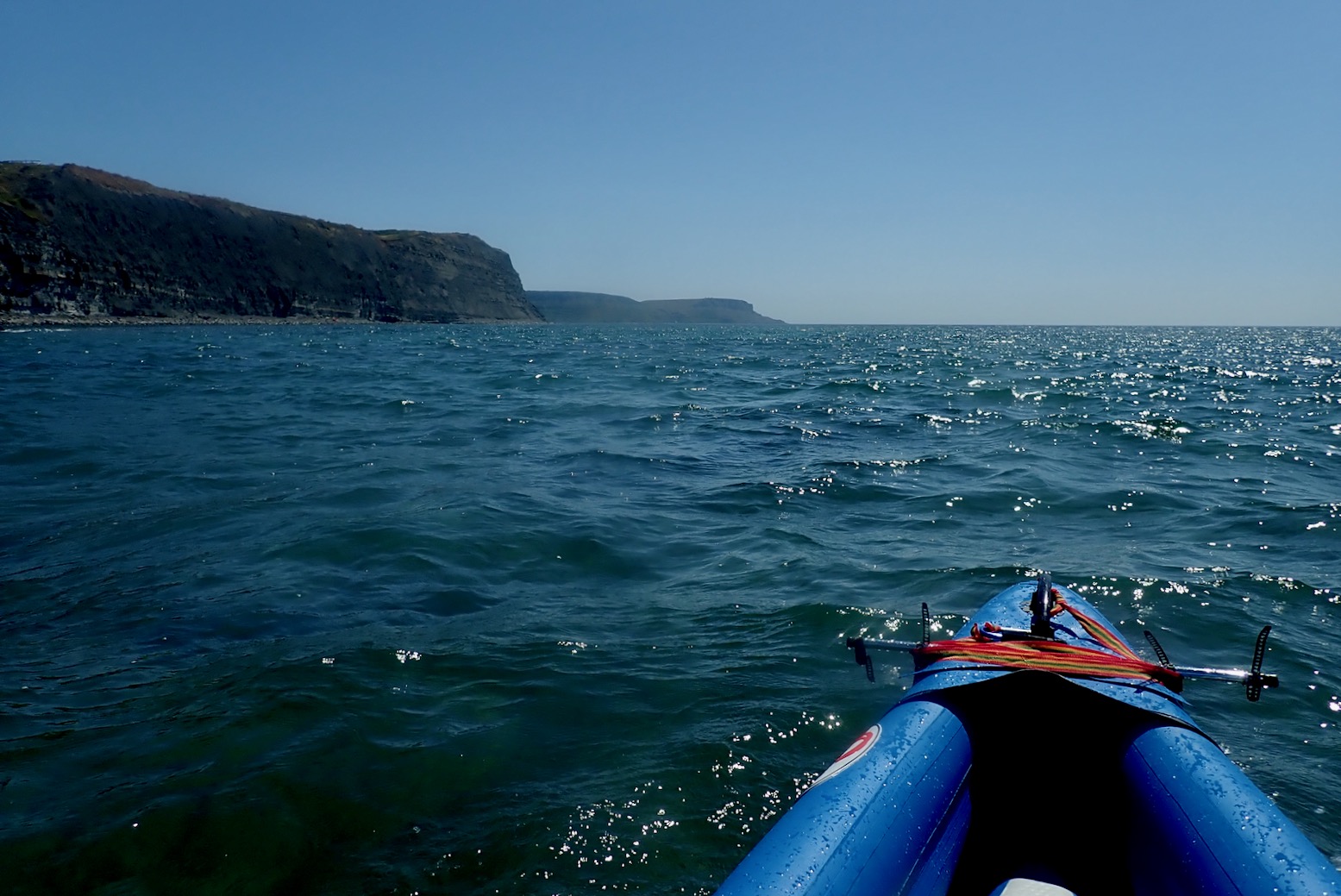
Heading southeast, I can’t help but feel a bit exposed out here; open sea to the right, rocky beach below a steep, crumbling cliffs to the left, and lethal ledges lurking ahead. What next – fireballs falling from the sky? But away from the corner the seas settle down a bit. The Igla cuts through the headwind at around 3mph.
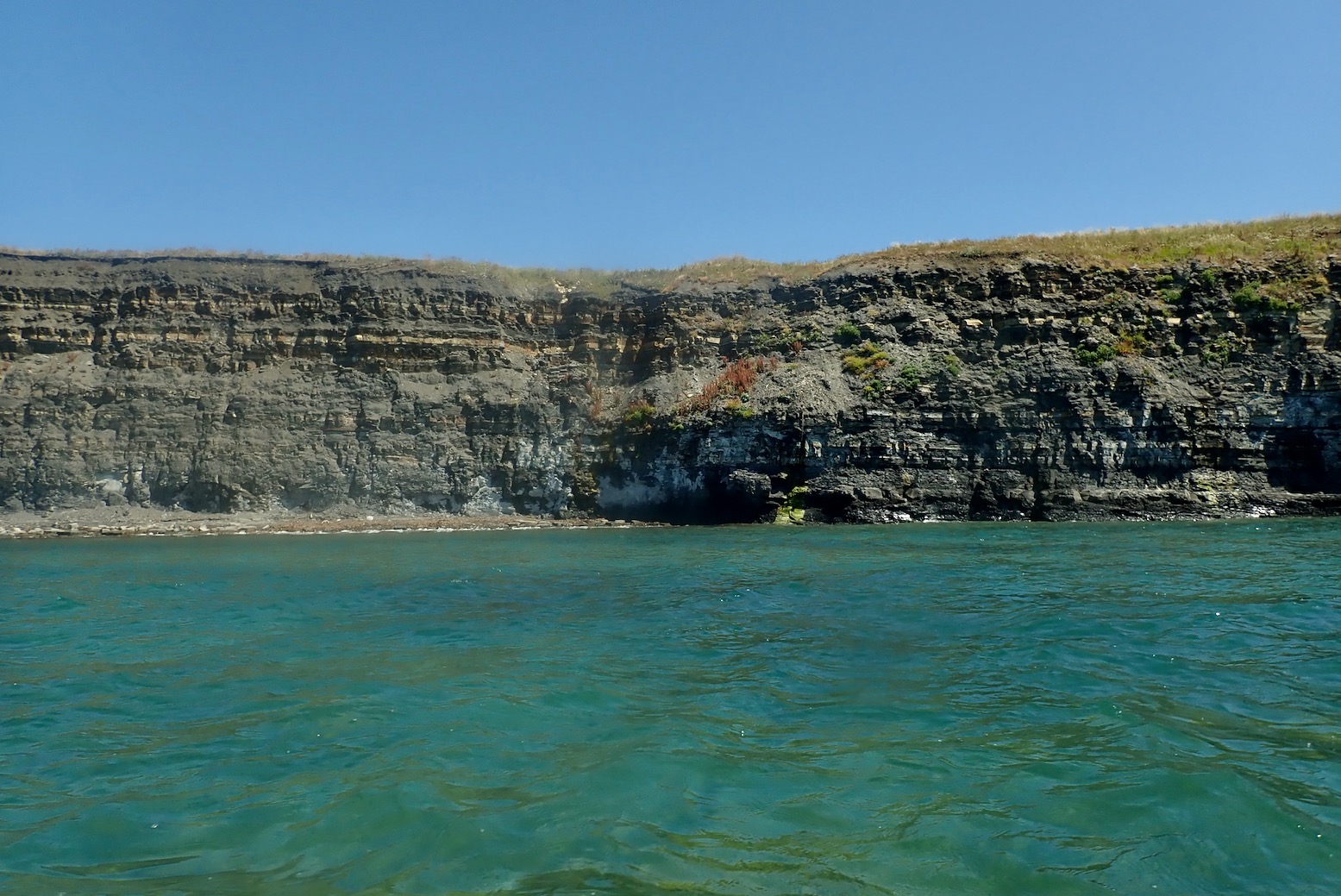
Nearer the cliffs the water turns green over the clay ledges not far below. But bigger waves rise up occasionally so I prefer to stay out which means I see less. As there are no sea caves to paddle into on this stretch and no skerries to paddled around, in a packboat I decide this unusual area might be more interesting to explore at low tide. You can easily hop in and out of an IK or packraft and wander across the ledges which few people ever access, looking for ammonites and other curiosities. Next time I’ll know.

Otherwise, with linear cliff paddles, in a kayak this Jurassic Coast can be all or nothing. You either commit yourself to a full run to the next normal take-out, or go somewhere and come back.
It’s only 3.6 miles to Chapman’s Pool, but I wasn’t ready for that today. (I packrafted it in 2025). As it is, once there, with a 4-metre boat on your head it’s an unrealistic take-out up a 400-foot climb over a mile to the nearest parking.

It’s the same at the next possible take-out at Dancing Ledge. We checked that out on midsummer’s eve. In calm conditions it’s an easy enough landing providing the lower ledge is exposed, but you’d then need ropes to haul an IK, either inflated or rolled up, up a 15-foot scramble (left) before another steep walk up to Langton village via Spyways Barn. One for a packraft noseabout on the next calm day.

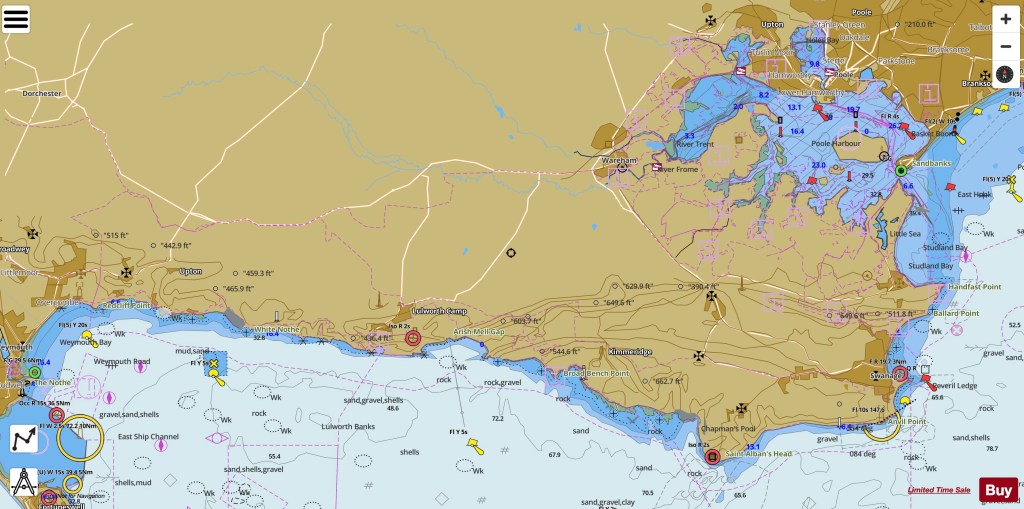
Handy online marine chart for depths.

As it is, Dancing Ledge is on the far side of St Alban’s Head where the tide can kick up a bit (left). Good timing and some nerve are required, even if a kayak can tuck in close to the shore inside the race. This is why Mark R says in his South West Sea Kayaking book. [Kimmeridge to Swanage is 19km and …] “… a commiting trip with big tides races and few opportunities to land. This also happens to be the author’s local (and favourite) paddle.”
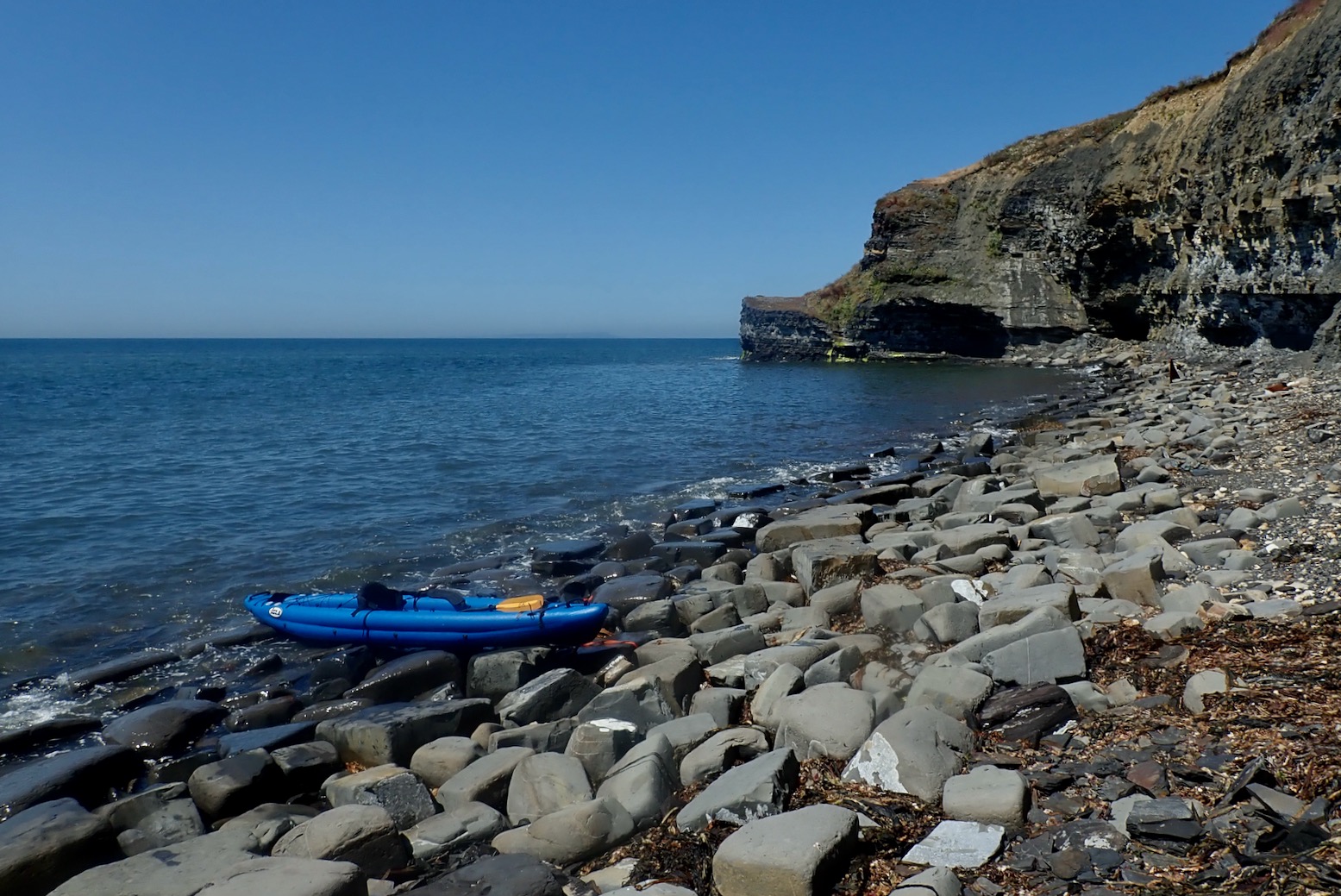
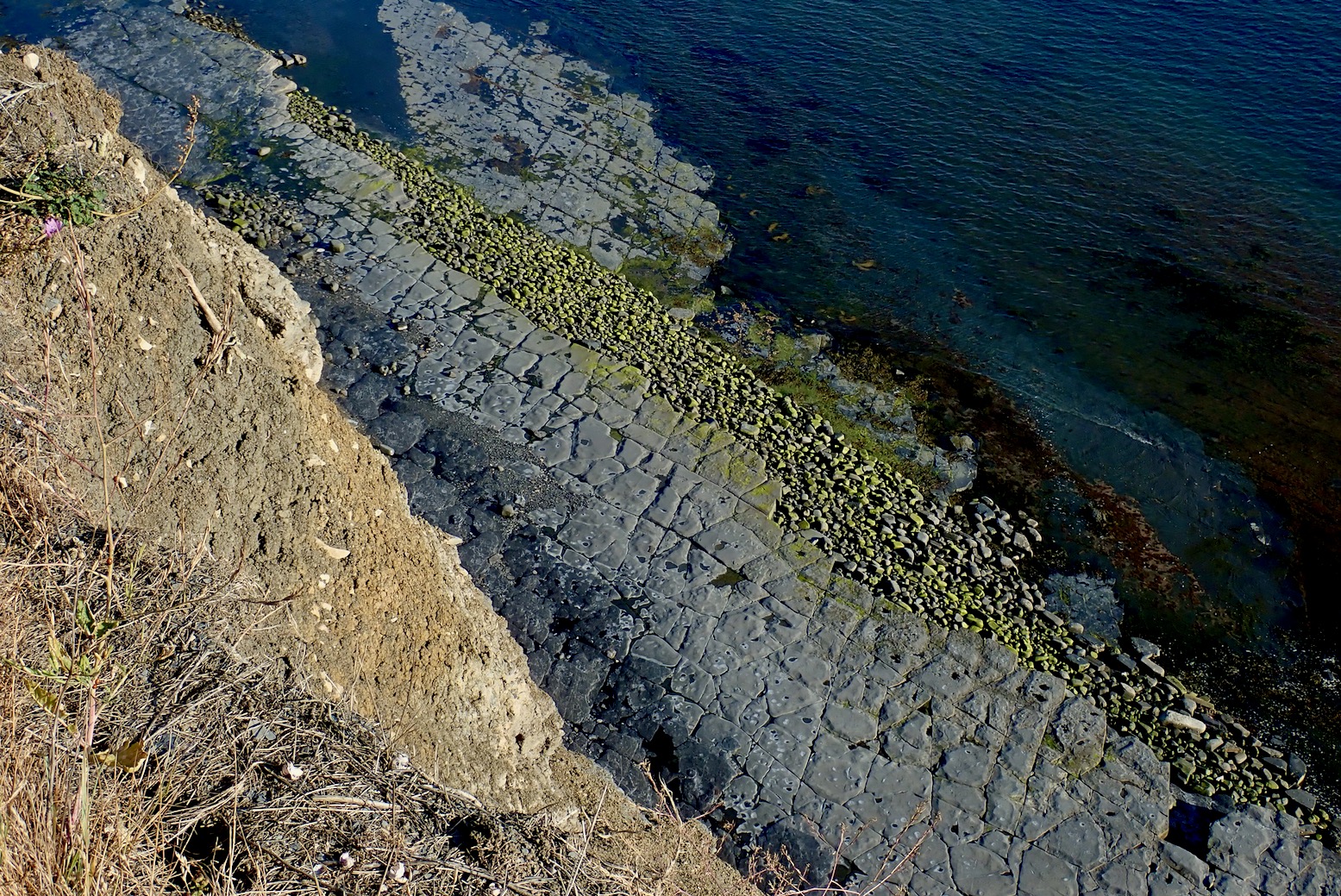
View from above, give or take.

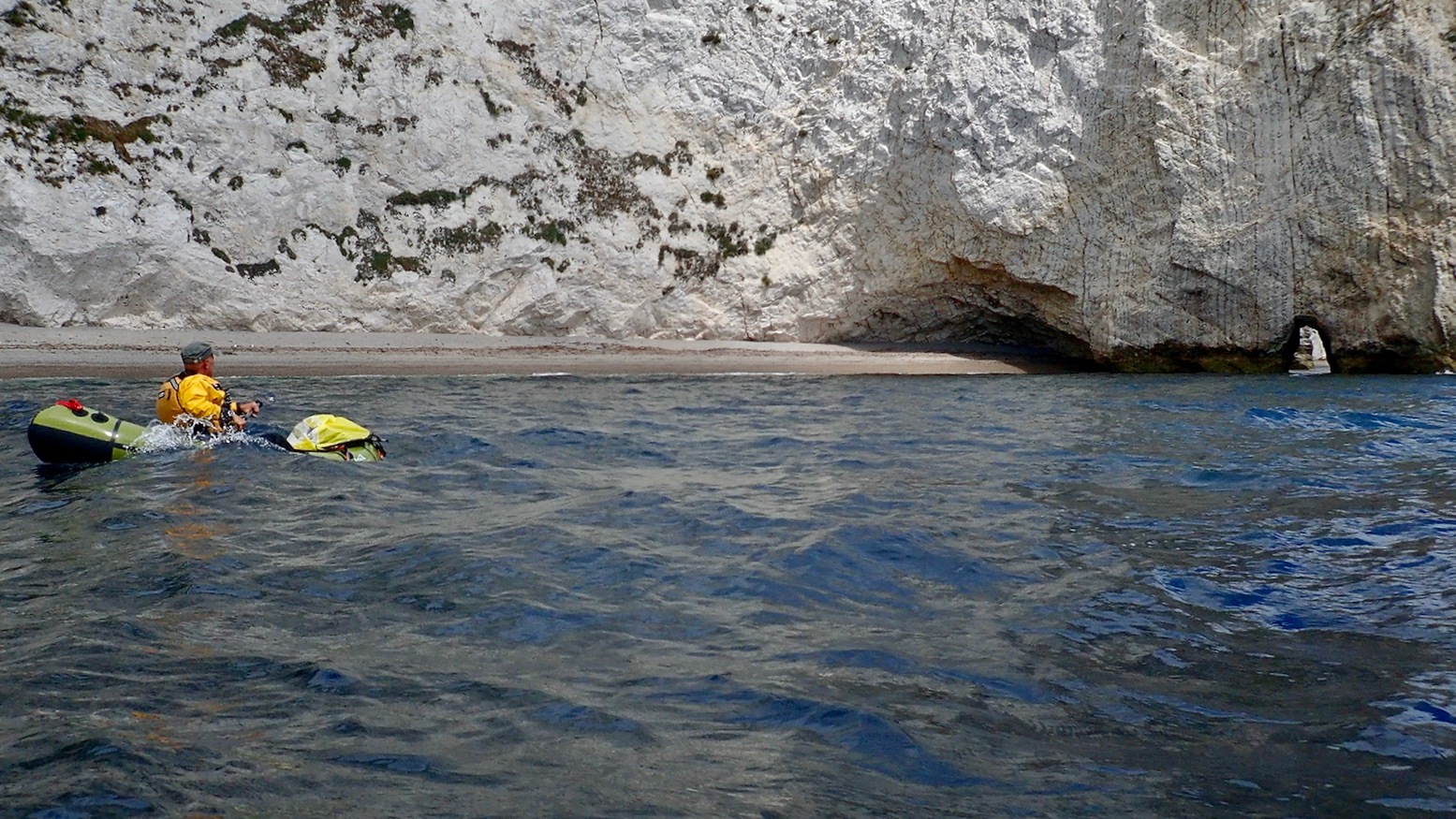
Back to the present. Lured by a curious triangle jutting up from the stones, I park up on a narrow beach and hop out for a bit on a look around. This is Clavell’s Hard, site of former shale mining.
At ordinarily inaccessible spots like this you’re bound to find something interesting.

Like a beached red plastic ‘fake clinker’ dinghy.

Anywhere near seaweed there are masses of aggressive ‘sea-horse’ flies. The other week nearby Weymouth beach was blanketed in this kelp which soon started rotting during the hottest month ever. ‘Clear it away! cried the holidaymakers. ‘Stop your whining; it’s a natural phenomenon!’ responded the local council. ‘Get a grip‘ suggested Springwatcher General Chris Packham. Buckets and spades were flying and Trip Advisor turned molten with rage.

“This decision [to ignore the seaweed] supports our commitment to preserving the ecosystem’s integrity and avoiding any potential harm that may arise from interfering with its natural course.” chirped the council unconvincingly. A week or two later later they caved in and cleared the beach. Honestly, it’s just one scandal after another these days.

Compared to northwest Scotland, I’m surprised how little fishing detritus there is here. Are southern fisher-folk more tidy? I help that effort by snagging a superb, self-draining crayfish crate-bench to add to my collection.

I approach the mysterious shark’s fin.

It looked like the upper half of a retractable drop skeg (fixed rudder) with its mounting plate, similar to kits you can buy for hardshell sea kayaks (left), except it weighed tons, not ounces. I thought it might be off some old wreck.

You can see a pivot pin up front. A cable might have winched it up and down. But then any ship that size would obviously have a rudder. Who knows, but I now think it’s abandoned mining junk.

The fin made me think of the SS Treveal which broke in two on the ledges about 1.5 miles southeast of here in January 1920. The Belfast-built steamer was on the return leg of its maiden voyage from Calcutta to Dundee, and had left Portland earlier that day where someone observed that the too northerly heading was inauspicious.
Most of the 46 crew drowned when their lifeboats capsized near the shore. It’s said the tug which came to salvage the cargo also sank alongside. There’s no trace of the Treveal now, even on marine charts and wreck maps. But how do you dispose of a 5000-ton steamer snapped in two? Bit by bit I suppose.
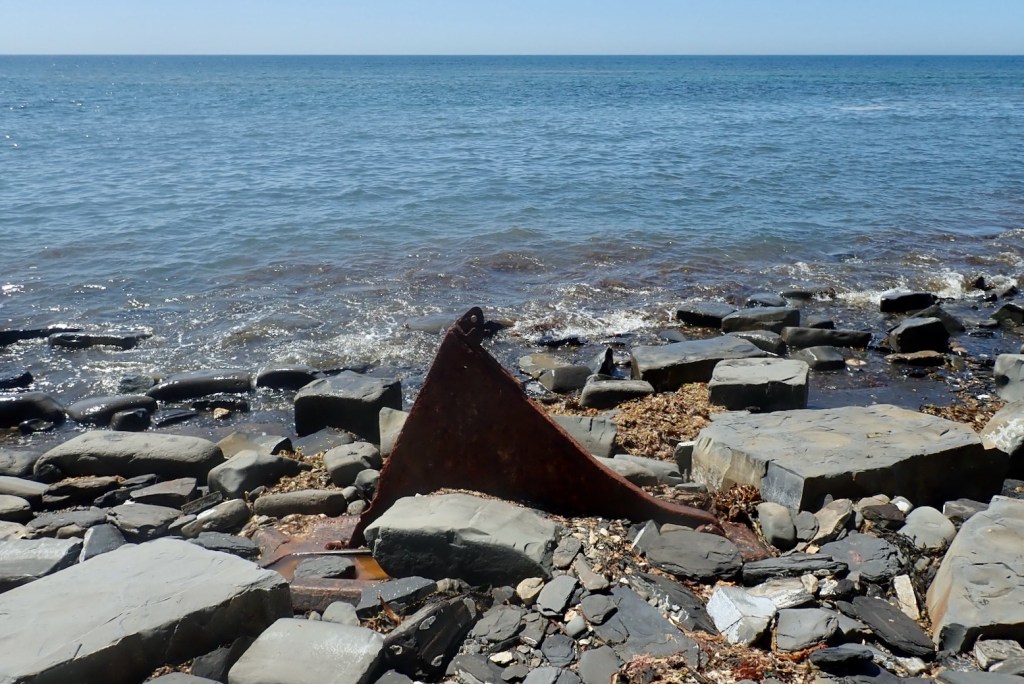
It’s unlikely subsequent storms washed that huge hunk of angular metal a mile and a half to the base of this cliff. More probably it was placed there by shale miners. There’s more on the SS Treveal on Ian West’s geological pages here (scroll to the bottom of the long page).
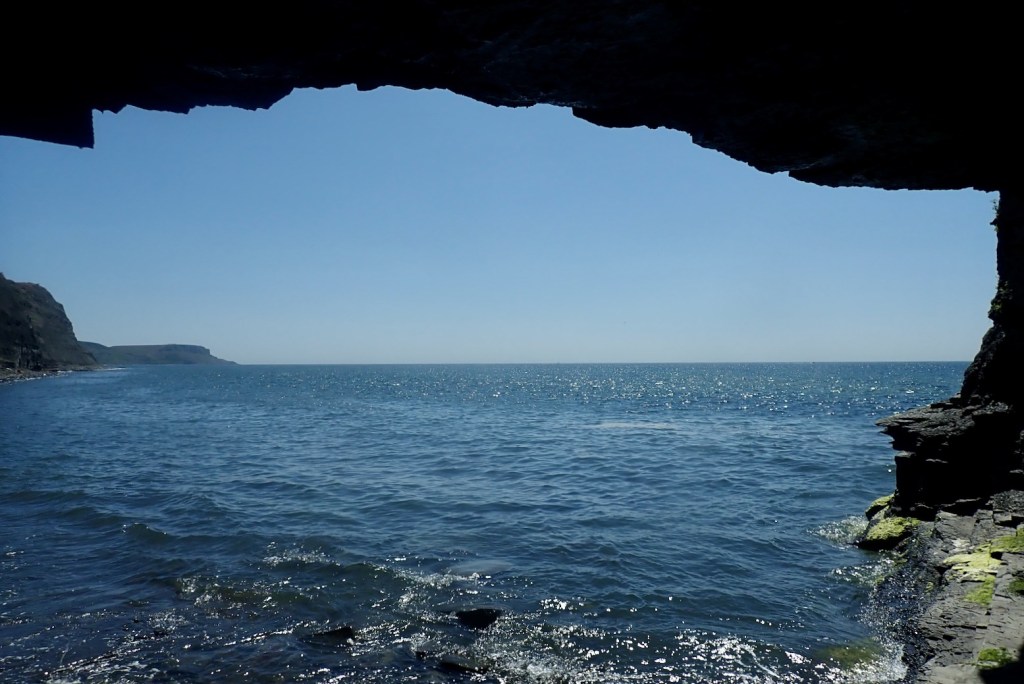
I wander into a nearby cave, perhaps excavated during the ‘Blackstone’ mining era.

Inside I see just how friable this oily shale is. I can easily peel bits off.

Underneath Silurian millipedes inhabit the tiny cracks, feeding off microbes that feed off the oil. Probably.

Time to head back. I’m all fired up for a good sail with the tide.

Benign, weed-covered ledges lurk not far below. On the far horizon the chalk cliffs of Mupe Bay, just next to Lulworth Cove. Might try there next, but the army firing ranges restrict weekday access. We’ve been hearing machine gun fire all week; Ukrainian soldiers getting trained for the front line.

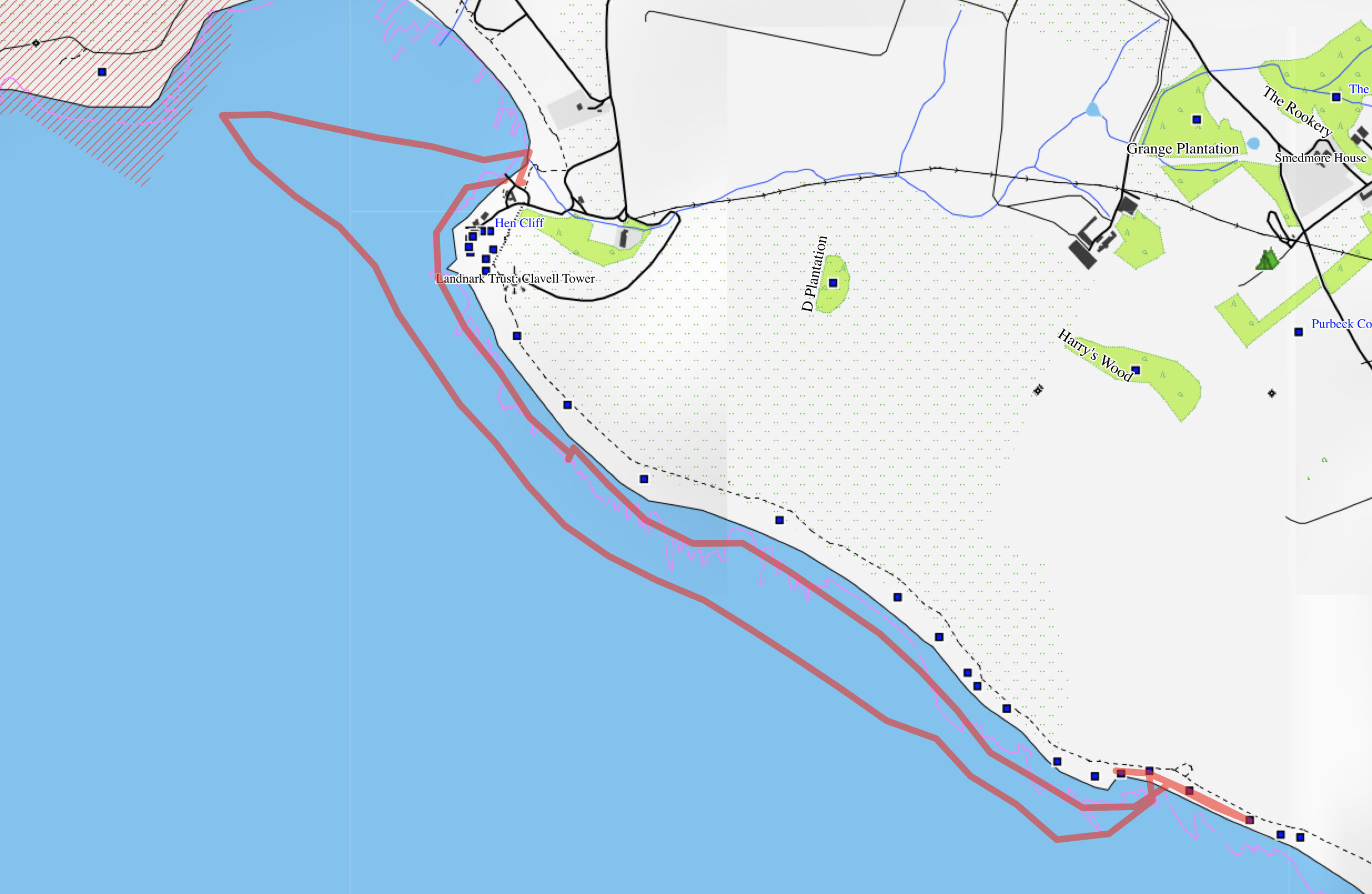
I throw up the sail but it’s not happening. I creep along at barely 2mph. Maybe I’m too far out (left) and the wind got intensified near the cliffs.

I paddle back to the corner of Kimmeridge Bay…
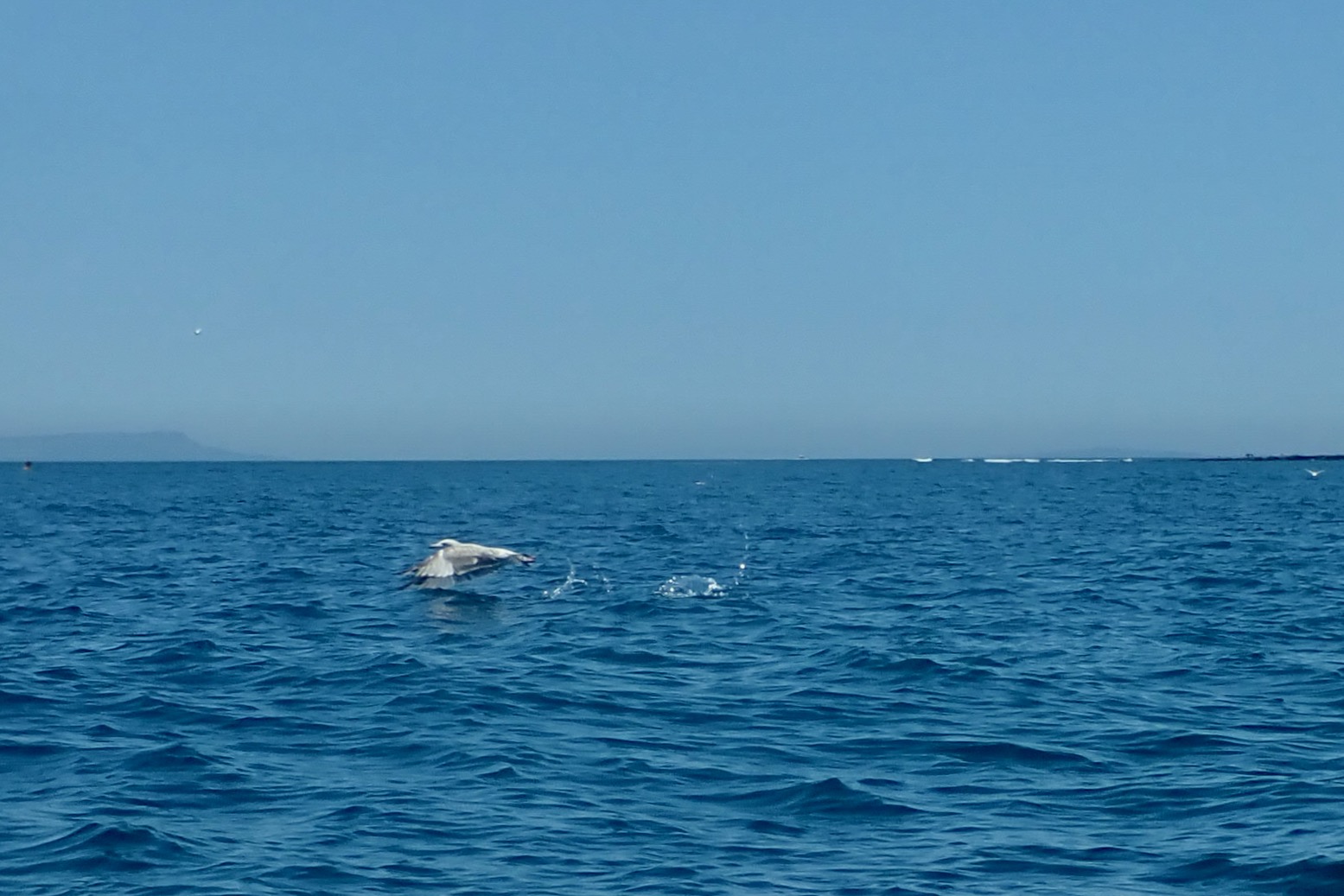
And carry on to the other side where waves are breaking off Broad Bench ledge. On the left horizon is Portland Bill dangling below kelp-clad Weymouth.
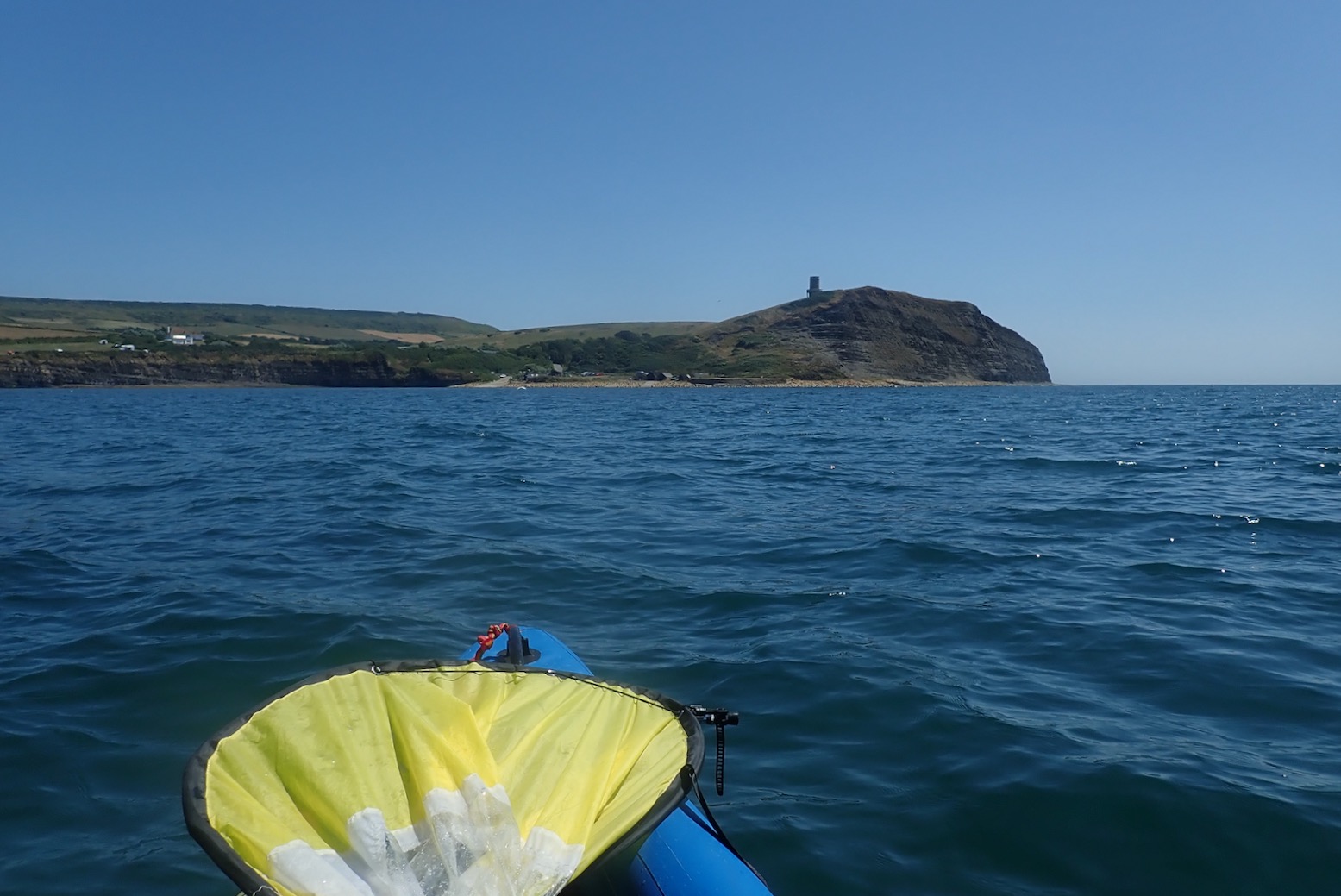
I turn back to the jetty, de-air the Igla a bit and strap it to the car roof.

And though I haven’t really earned it today, I treat reward myself to a seaside seafood basket by the seashore.

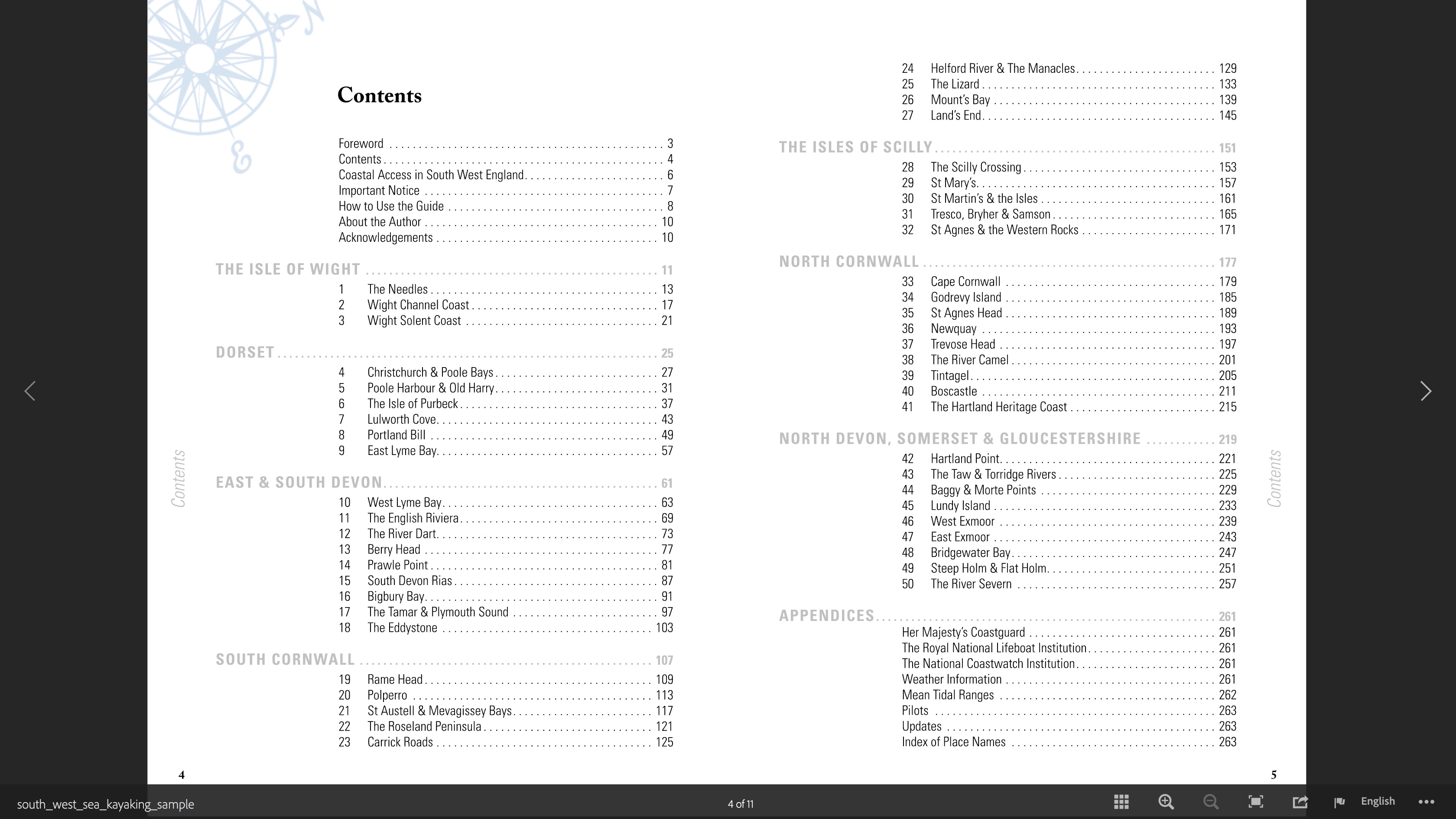
Book review: South West Sea Kayaking (+ Reeds Channel Almanac)

In a line
[SWSK has…] Loads of ideas and detailed information covering 50 paddling itineraries along hundreds of miles of England’s fascinating southwestern coastline.

Well worth 17 quid on amazon.uk

What they say

This revised and updated third edition provides a guide to the entire South West’s coasts and islands. It is packed with great photography and detailed route maps, alongside descriptions and anecdotes unveiling the region’s rich tapestry of maritime scenery, wildlife, history, geology and culture
April 2021; 272pp; Pesda Press

South West Sea Kayaking and Reeds Channel Almanac

Review
Although I’ve only done a couple of routes, this is a comprehensive handbook to safely plan a paddle along this complex but accessible and populated coastline. Or just browse through to get some ideas of what’s possible. Of the 50 suggested routes, 14 are grade ‘A’ for easy, 25 are ‘B’ and the other 11 are ‘C’, like Cape Cornwall, Lundy Island or the crossing to Scilly Isles which are a bit of a reach for a solo paddler in an IK, even without a gale blowing. Any IK or even a packraft party could manage a B in ideal conditions – but of course even an A-grade paddle could get too lively at the wrong tide in nasty weather. That’s UK sea paddling for you: a lot of sitting about watching the weather forecast.

Suggested start and finish points are given with a postcode and OS map coordinates along with the given OS sheet. It would be nice to also have more easily copied and interpreted GPS decimal degrees (for example: 51.2025, -4.6777: tip of Lundy) which most people use these days over arcane OS coordinates, even if they’re likely have OS maps in their phone or GPS.
Nearby tidal ports are a way of calculating the time of the tide in your area, and there’s a detailed paragraph on tidal times and what might be happening where and at what stage of the tide and how fast it runs during stronger springs. Some of this information was probably collected from a Reeds Almanac (see below) so it’s one less thing to buy or consult. As it is, most of us will check and bookmark local tide times on a phone before reception gets lost. I’ve recently found that Willy Weather gives many reliable timings for places between the UKHO locations.
In particular the Pedsa book will point out where the water can get turbid at spring tides around headlands – important information you’ll struggle to find or interpret easily online and especially important in a less agile inflatable.
A detailed description follows, you can tell most if not all the routes have actually been done by author Mark Rainsley at least once, and that’s followed by Tide & Weather and Additional Information, all adding up to a thorough guide to what you’re taking on. In between you get boxed asides, most describing terrible maritime tragedies or badly behaved smugglers which all chime with the author’s sometimes dark humour, as well as background reading: that’s the sort of guidebook we like!

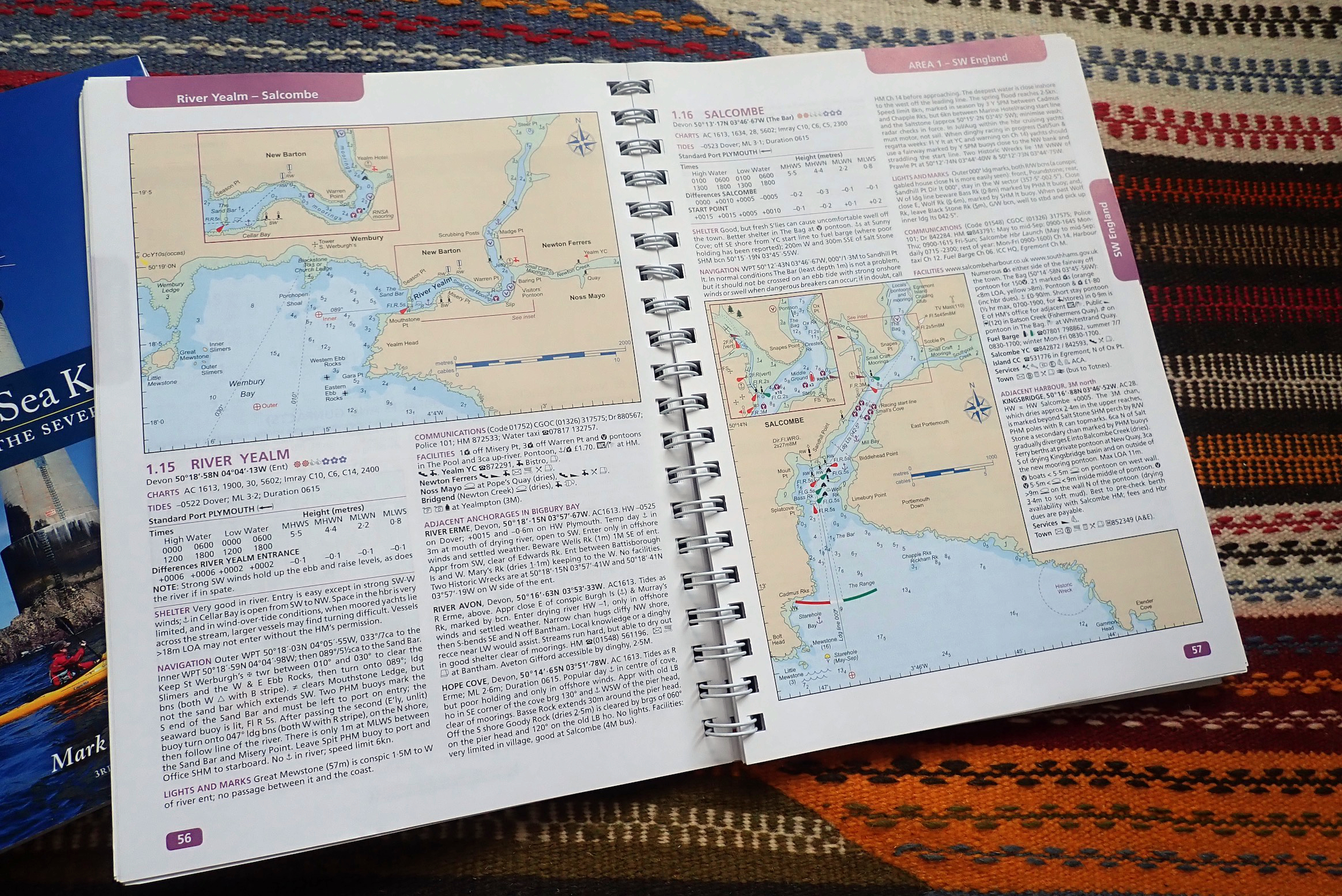
One annoyance in search of a clean design is putting the captions of the many colour photos deep in the gutter of this thick and thick-papered book that’s about an inch in thickness. Along with the uncluttered colour maps, most of these photos work well in visualising the region described. And the dark humour mentioned can extend to gloating in the dangers in an ‘are you man enough?’ sort way, rather than encouraging what could be possible. But that’s the author’s style and you adjust accordingly, as with any guidebook.

I can see myself using this much more than Pesda’s North West Sea Kayaking guide I bought years ago and hardly ever used (as I mostly paddled in one small area). Even if you just end up doing a handful of Southwest routes in your IK or P, you’ll set off well armed with what need to know and so won’t regret spending the typically discounted 16 quid. It’s a lot of book for that money.


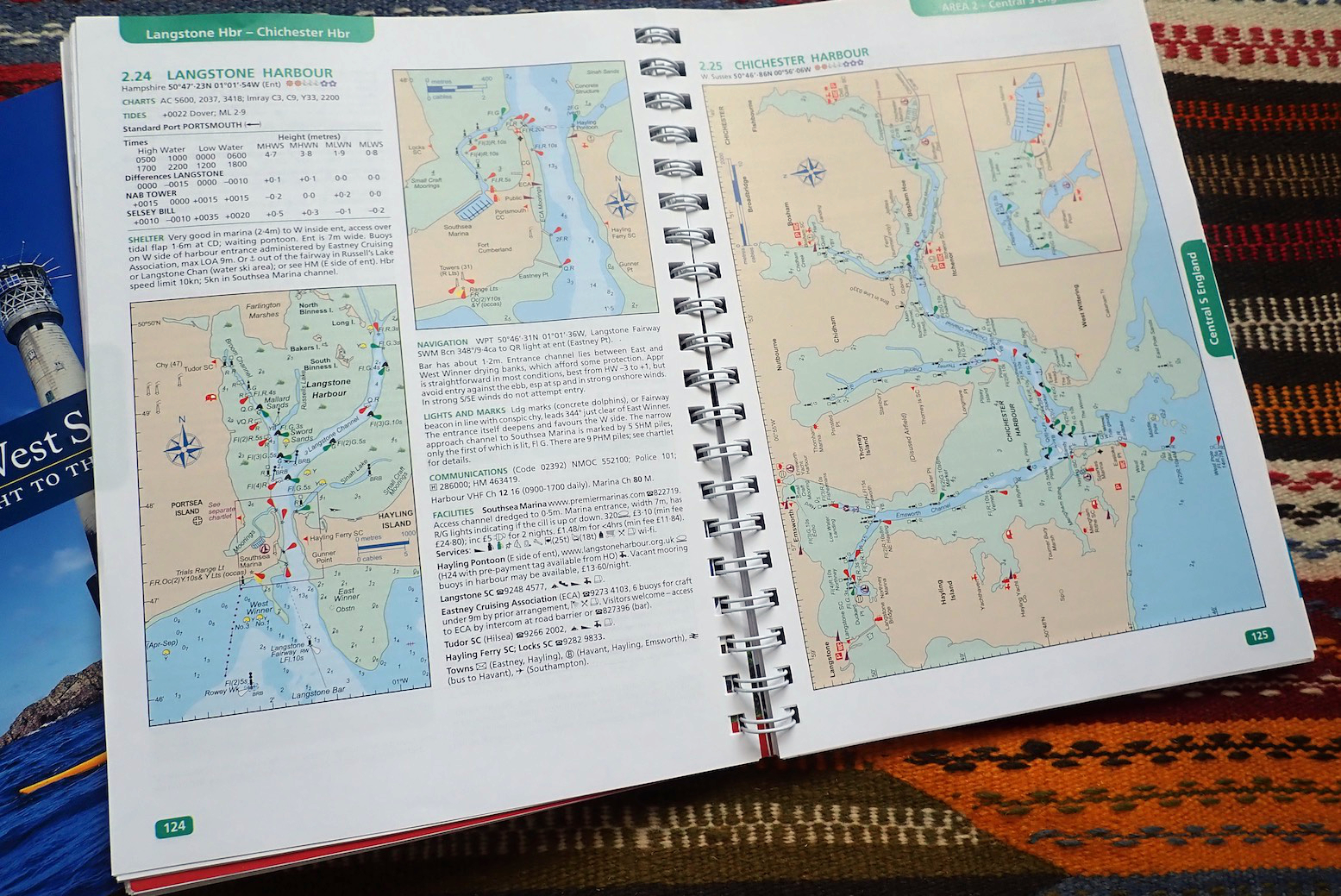
It was sailer Barry who alerted me to the value of a ring-bound Reeds Almanac prior to our Jurassic paddle. I’ve heard of Reeds of course, but assumed it was strictly for yachtsmen.
In print since 1932, there’s loads of little value or interest to a fairweather sea inflationeer – the most useful thing kayakers want to know are locally intensified tidal streams and the Pesda book covers that with more clarity on the included routes.
Still, it’s reissued every year with annual tide predictions (easily found online anyway) so you can pick up a recent used edition, like the ‘Channel Almanac’ (south England and NW French coast only) for a fiver, ditch the tide and French pages, and learn all about harbour features, the meaning of buoyage and big-picture tidals streams in the Channel over the 12-hour span of a tide (below left).

Packrafting the Jurassic Coast (video)

See also
Sigma TXL Index Page
MRS Nomad
Rye to Hastings
Newhaven to Brighton
Chichester to Bognor
Hayling Island
Swanage Stacks
Studland to Swanage
South West Sea Kayaking guidebook
Kayaking the Kimmeridge Ledges
Packrafting Kimmeridge to Chapman’s Pool
In Search of the Kimmeridge Pliosaur

I’ve done a few IK paddles in Southeast England between Rye and Portsmouth, but the Sussex and Hampshire coasts aren’t that inspiring. So it’s about time I started exploring the far more interesting and much more extensive Southwest Coast. From the Isle of Wight to Cornwall and back up to the Severn there are scores of inshore excursions possible in an inflatable. Just as in the far northwest where I mostly sea paddle, all you need is a fair tide and paddle-friendly winds, the latter a bit less rare down south.

In a blobby packraft? You cannot be serious!

So in the face of predicted moderate winds I cooked up a 50-km Jurassic overnighter from Weymouth to Swanage in Dorset. I’m pretty sure they opportunistically rebranded the plain old Purbeck or just ‘Dorset’ coast as the ‘Jurassic Coast‘ soon after that 1993 movie and haven’t looked back since.
Like much of the Southwest coast, the beaches and country lanes become a logjam of holidaymakers on a warm summer’s day. On the water, our paddle would pass below sections of cliffs a couple of miles long and take us to the famed landmarks of Lulworth Cove, Durdle Door arch (top of the page) and Dancing Ledge. We could even carry on back north past Old Harry’s Rocks and across Studland Bay right into Poole Harbour to catch out trains home.

TXL at sea

Compared to using regular (solo) packrafts, my confidence in my TXL for sea paddling is a revelation. After all, it’s still just another blobby, single-chamber packraft. It must be a combination of the added size giving a kayak-like perception of security (as I found in my MRS Nomad), as well as the responsiveness and speed from a longer waterline and, I now recognise, the sometimes noticeable added glide from the Multimat floor. There’s also the fact that paddlechum Barry was up for the Dorset run in his similar MRS Nomad, making this untypical packraft outing less daunting.

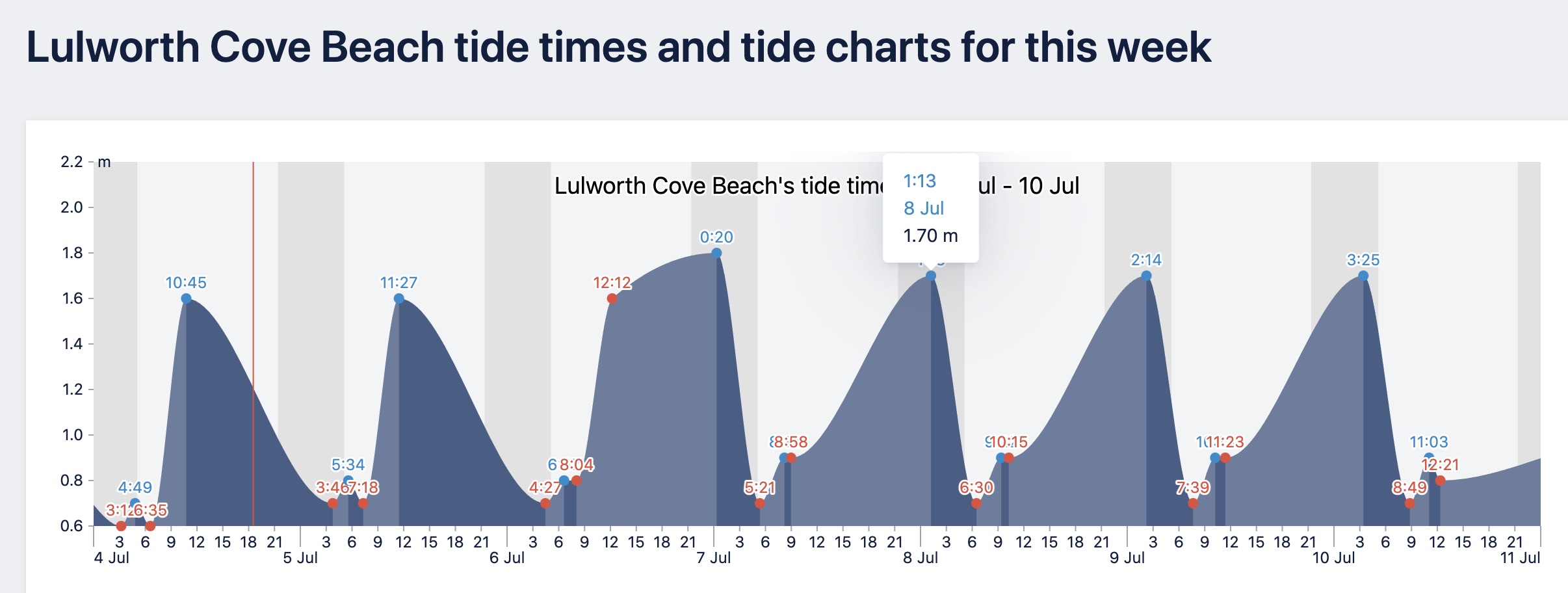
Lulworth tides – all or nothing (of not much).
Modest, two-metre tides off Purbeck

For some bathymetric reason – possibly the Atlantic tidal surge backing up in the Straits of Dover, plus hidden offshore shelves – the tides off the east Dorset coast are very odd: they can rise or drop all day, but have a range of just two metres, about as low as it gets in the UK. That ought to mean moderate ebb flows pushing up against prevailing westerlies, plus we were heading into neaps. And while often cliff-bound, if we stayed alert to escape routes we could easily bail and walk or climb out with our packrafts.

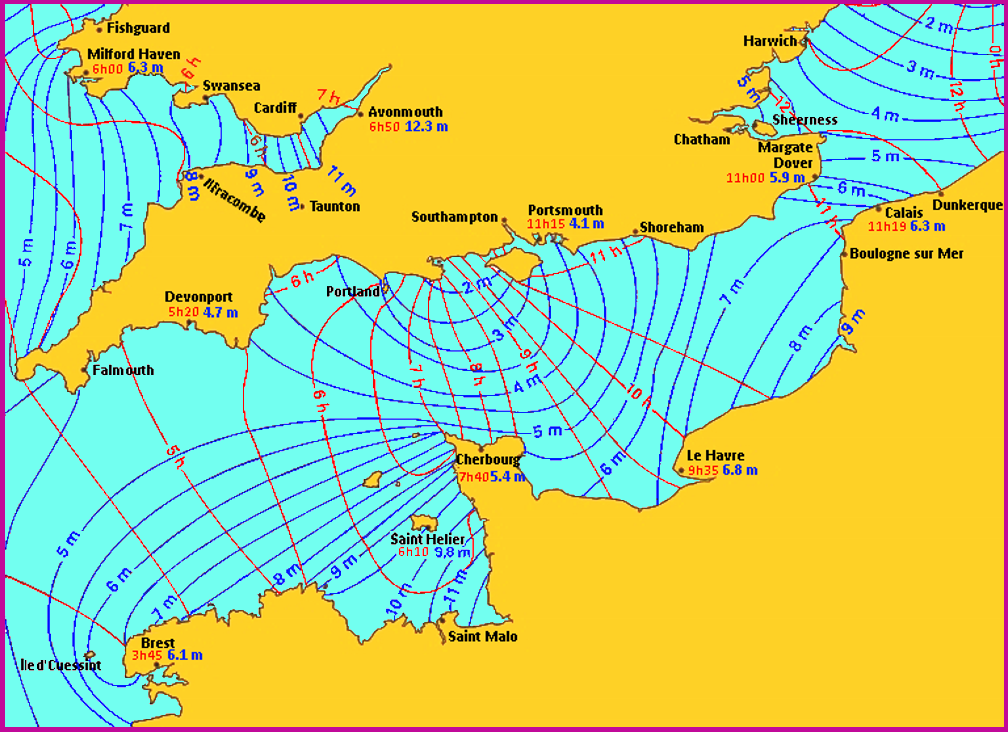
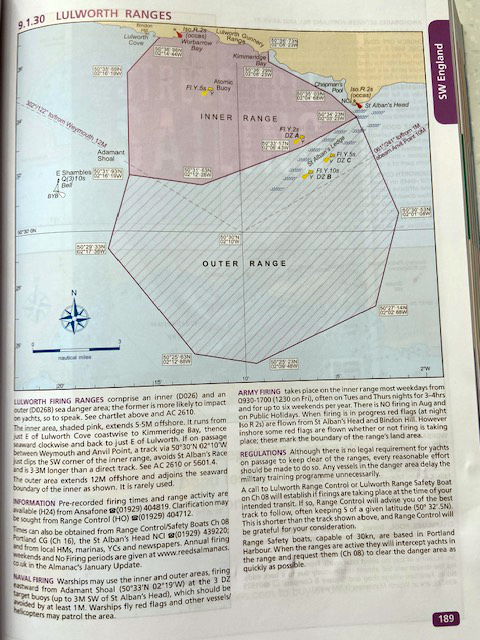
East of Lulworth Cove the Jurassic Coast‘s bucket & spade Babylon is interrupted by a 5-mile wide Danger Area – an army firing range. This was probably not one of UNESCO’s criteria for World Heritage status, but the SW coastal path also gets closed for a similar distance. Barry’s Reeds Almanac had a page or two on this (left), as well as useful tidal flow charts (drops to the west; rises east). I left it to Barry to call the ‘0800 DUCK!’ number, but imagined surely they’d leave the target practice to the off season. In fact they’re all it most of the time Mon–Fri, including an evening session 9pm to midnight: all we had to do was click this.

fishing.app – handy and similar toa Reeds Almanac but free
Early train to Weymouth

With a plan taking shape, I in turn bought a copy of Pesda’s South West Sea Kayaking in the hope of being alerted to local anomalies. I’m glad I did. It turned up with just hours to spare and identified that the run from Kimmeridge Bay round the Purbeck corner to Swanage was a grade up from the easy section from Weymouth. With headlands, submarine ledges and long lines of cliffs, without a foot recce I decided we may be better off skipping this bit.

It’s noon in Weymouth, but with offshores now predicted by late afternoon, we fast forward by taxi to Ringstead Bay, 5 miles in. That first section from Weymouth looks nothing special.
Put in at Ringstead. Ten mph westerlies blowing against an ebbing neap tide.
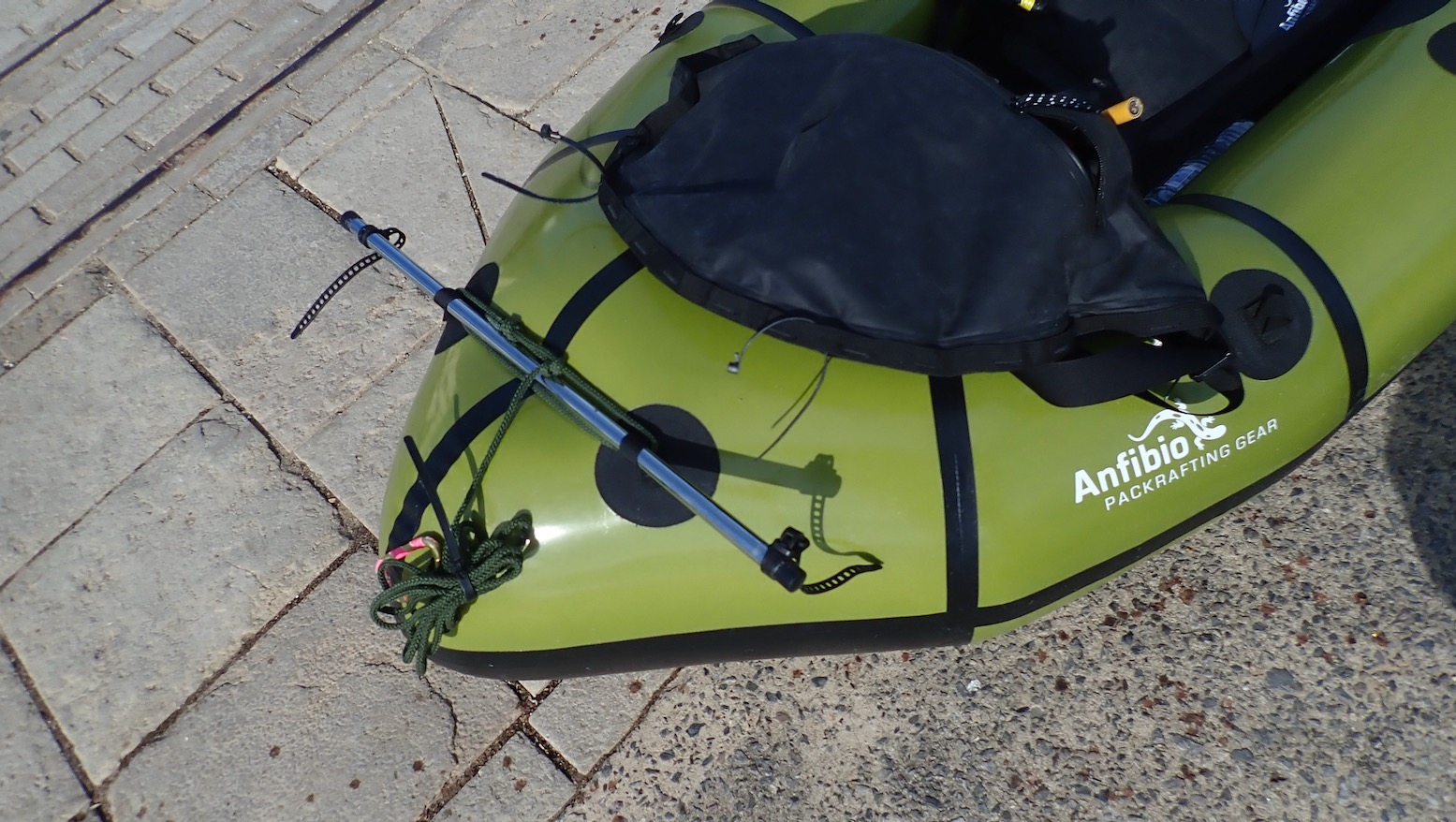
My Mk2 transverse bowsprit for a wide WindPaddle sail mount to limit swaying in stronger winds.
I’m giving the Multimat floor yet another go too, all the better to skim over the water.
We’re on the water at 1pm, hoping to reach Chapman’s Pool, about 21km away.
But around 5pm winds are said to veer offshore and strengthen, so we’ll see.
We sail at about 5-6kph – not much faster than paddling – but I note my TXL creeps forward about half a click faster than the MRS – must be the stiffening Multimat.
Propelled at paddling speed by his inflatable AirSail, Barry casually checks his investment portfolio.
The cliffs below Chaldon Downs. At times we paddled as we sailed to make less work for the wind.
Forty five minutes in, I pull in the sail and line the TXL up to thread Bat’s Head arch.
Note how the layers of chalk beds here have been pushed up to nearly vertical.
Give it half a million years and Bat’s Head will be as big as nearby Durdle Door.
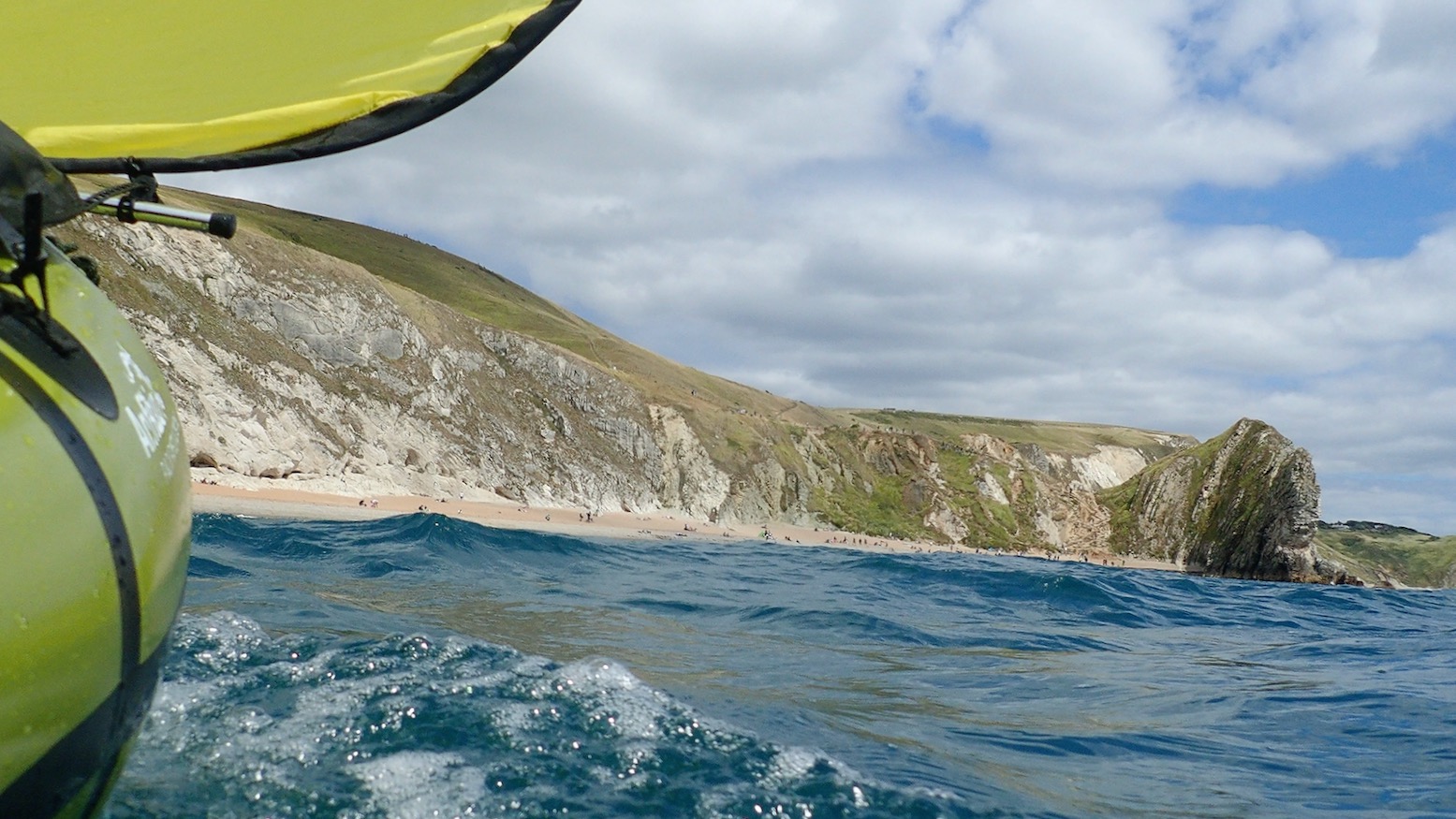
Approaching the famous Durdle Door arch alongside a crowded beach.
The TXL still weathercocks a bit under sail; I keep having to steer hard inland, but the bowsprit ‘stick’ limits the sail’s ability to twist. Or maybe the wind’s bouncing off the cliffs and blowing us offshore a little.
Sitting further back to weight the back end over the waves may help.
Sunbathers watch spellbound as Barry smoothly ‘Durdles the Door’ – a Southwest kayaker’s rite of passage.
The Door has been durdled. Some claim ‘Dorset’ (formerly Wessex) was named after this famous arch.
In high summer young bloods jump off the 60-metre arch. Appropriately, it’s called ‘tombstoning’.
Near the entrance into Lulworth Cove things get choppy. Sat high on the airmat floor, if I feel unstable I can easily let it down. As we head through the Cove’s narrow neck a patrol boat circles back and instructs Barry we can’t carry on east; the army ranges are firing.
‘I thought you said you were going call them, Barry? You had one job to do…’
‘But you said they hardly ever do this on a balmy, July’s day!’
And so it went on…
A salty-eared boatman tells us the army pack up about 5pm, about 2.5 hours from now by which time the offshores may be on us as we cross the Kimmeridge Ledges mentioned in the Pesda book.
As we slurp a 99 with sprinkles the odd gust blows offshore.
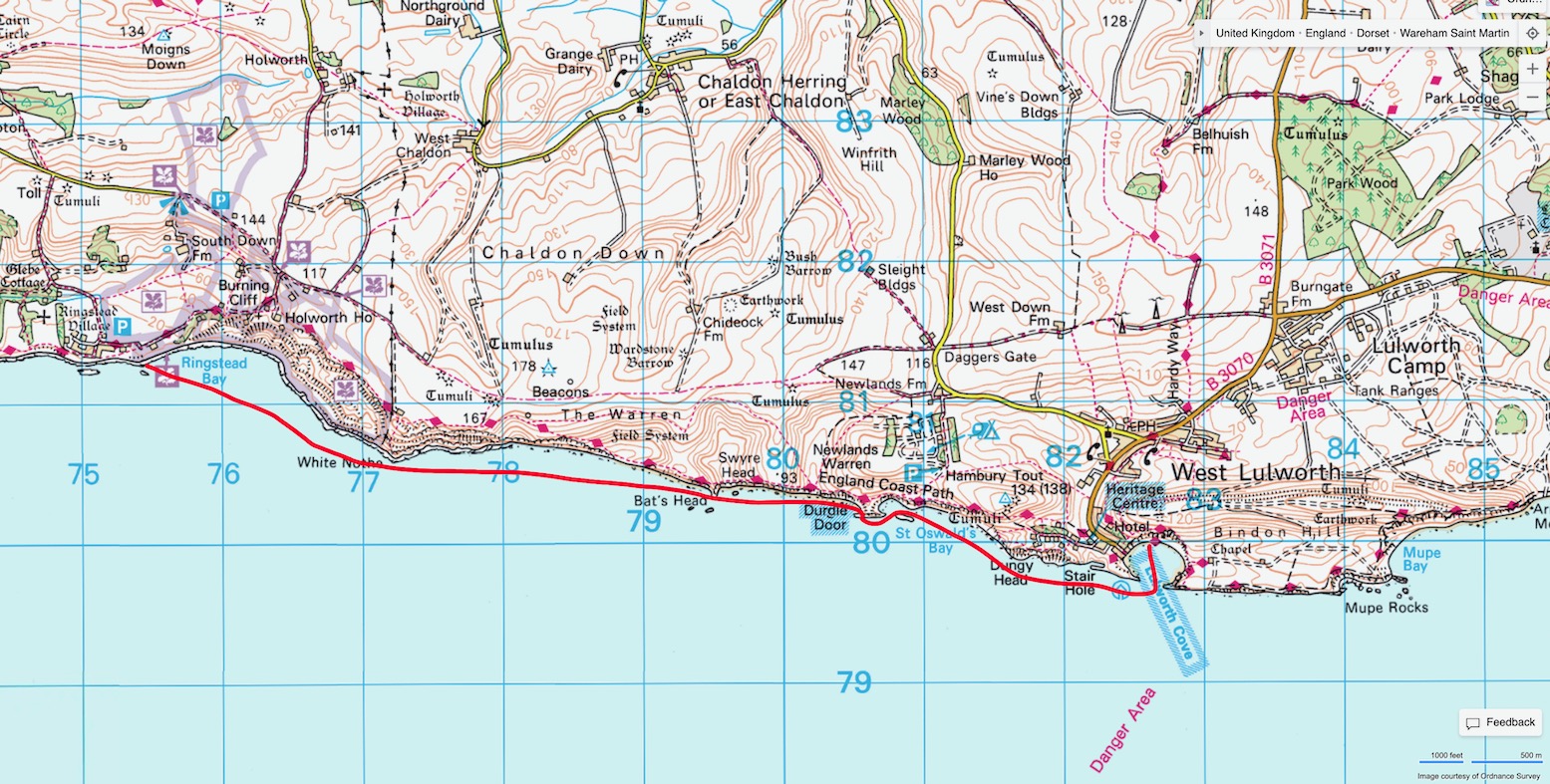
We can’t even pack up and walk the cliff path; it’s closed too, and so is the B3070 road.
Barry wants to paddle on a 5pm, but I propose we bus to Swanage rather than risk being be left high and dry.
Tomorrow we’ll paddle north towards Poole – or as far as the predicted headwinds allow.
So a paltry 5 miles – but the classic stretch of the Jurassic Coast.
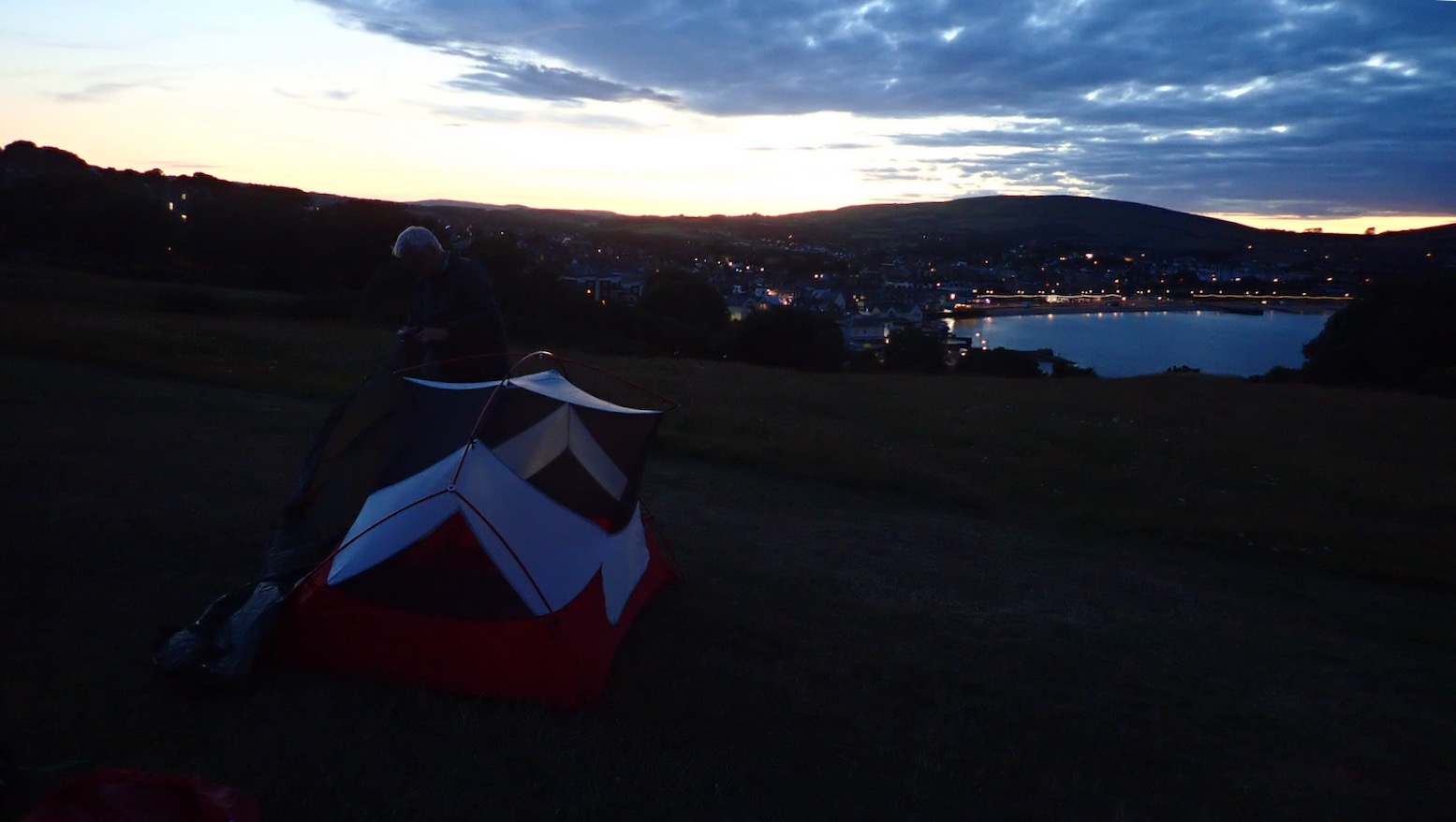
But there’s no campsite till August, so we pitch for free up in Durlston Country Park to the sound of beery revellers and Tuesday-night hoons doing burn-outs along the seafront. What can it be like on a Saturday night?
Six am next morning, a light breeze blowing from the northwest means no condensation ;-))
The Anfibio Multimat passed the sleeping test, too.
I walk a mile south to Purbeck’s corner at Durlston Head to inspect the tidal stream. Two hours before LW, it’s negligible, but further west, St Albans Head just out of Chapman’s Pool is said to be stronger. I must do that walk sometime.
Above, a ferry heads from Poole to the Channel Islands.
Looking back north you just see our tents on Peveril Point,
Ballard Down chalk cliffs and pinnacles stretch out beyond, and Bournemouth’s at the back.
At the cafe we meet Rach and Mark setting off on the final day of a staggering 630-mile walk along the Southwest coast from Minehead in north Devon. Their picture above taken a few hours later.
Meanwhile we prime our boats for the 6.3 miles past Old Harry to Poole Harbour Entrance.
We may carry on to Poole itself, but a strengthening wind may nix that idea.
No sailing today, Barry inches into the light morning breeze across Swanage Bay.
We reversed this trip a couple of months back.
Ballard cliffs in the wind’s lee at glassy low water.
Ballard’s spike, thought by some to be a fossilised Dendrosauraus tooth.
We approach the Pinnacles to the squawk of agitated seabirds.
Arches ripe for threading as far as the eye can see.
But this morning the tide is too low.
And it means there’s a lot of this string-weed floating about. It catches in our skegs but I have a solution.
Leaving Harry’s, Barry’s is a bit of a Lethargic Larry cutting across Studland Bay.
Halfway across, I remove a metre-long, kilo of Swanage string-weed caught in his skeg.
It’s all going nicely until 10.30am when the wind kicks up, then picks up some more.
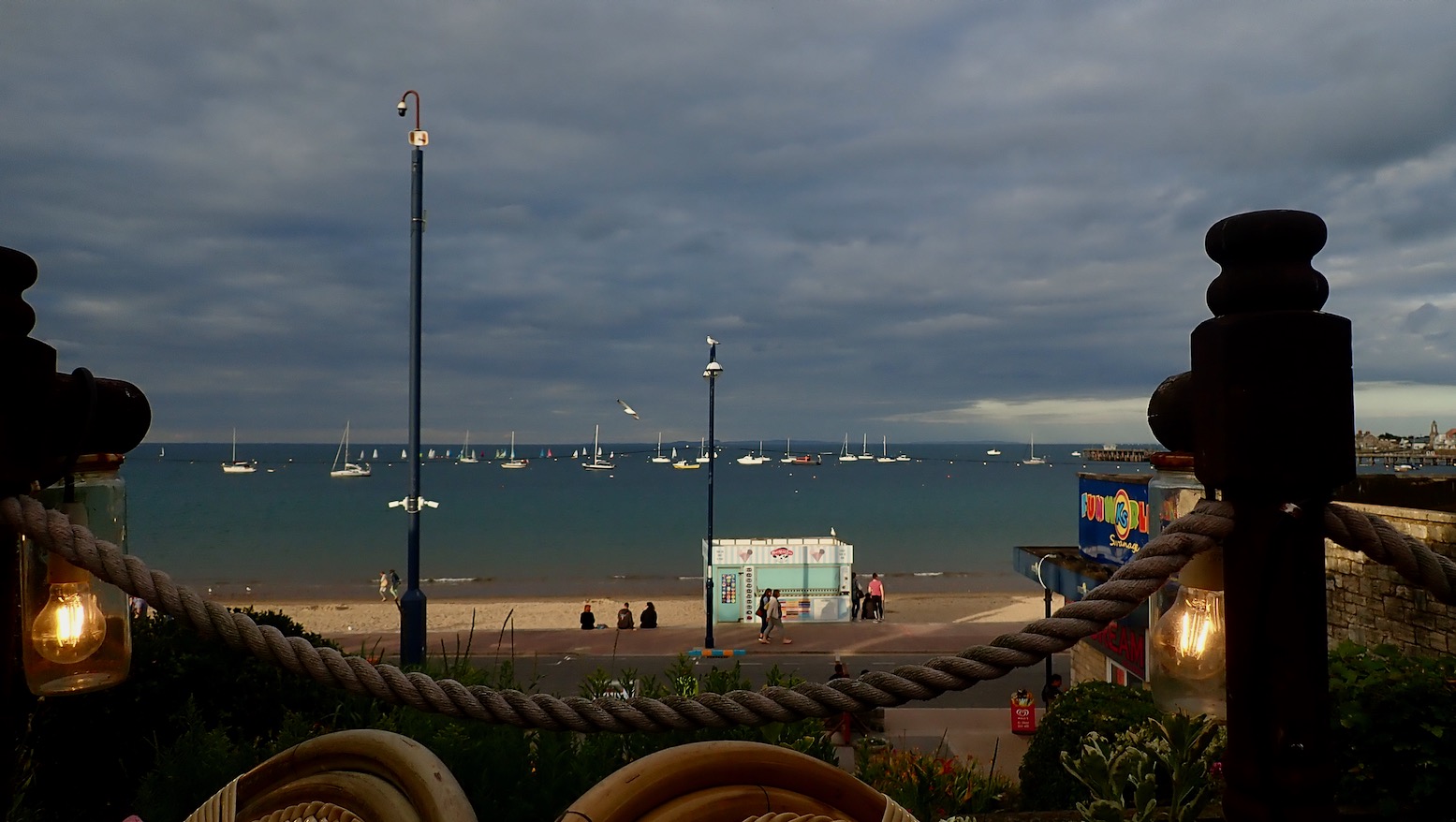
But the GPS revealed we kept plugging on at 5kph, just with a lot more effort.
As Barry observed, it was a slog but good to know our packrafts can progress against this sort of wind.
With brain-out jet-skiers, sailboats, motorboats, working boats and the rattling Sandbanks chain ferry, we have to time our crossing across the busy vortex of Poole Harbour Entrance. Hitting 8kph, we cross a sharp eddyline where the incoming tide clashed with still-draining Poole Harbour. Barry hops out quick before the chain ferry trundles back. (Turns out it’s actually free for northbound pedestrians).
From Swanage to Sandbanks, followed by a 90-minute walk to Poole station for the train home.