Packraft Sailing with MRS Barracuda

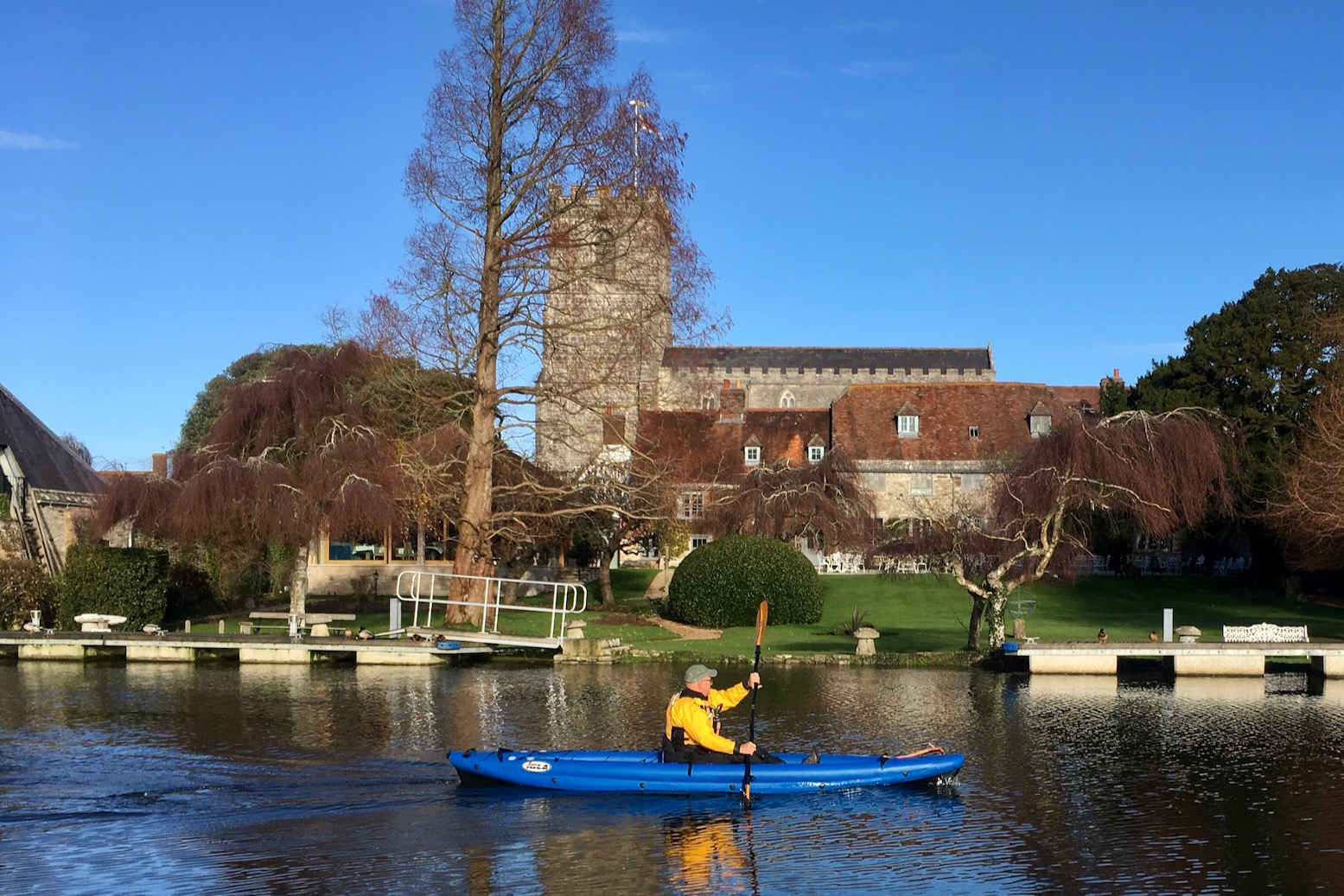
It took just one outing with old mate/new packchum Phil to recognise the appeal of packraft sailing. My old WindPaddle Adv 2 was able to haul us both out to the Teign estuary with little effort.

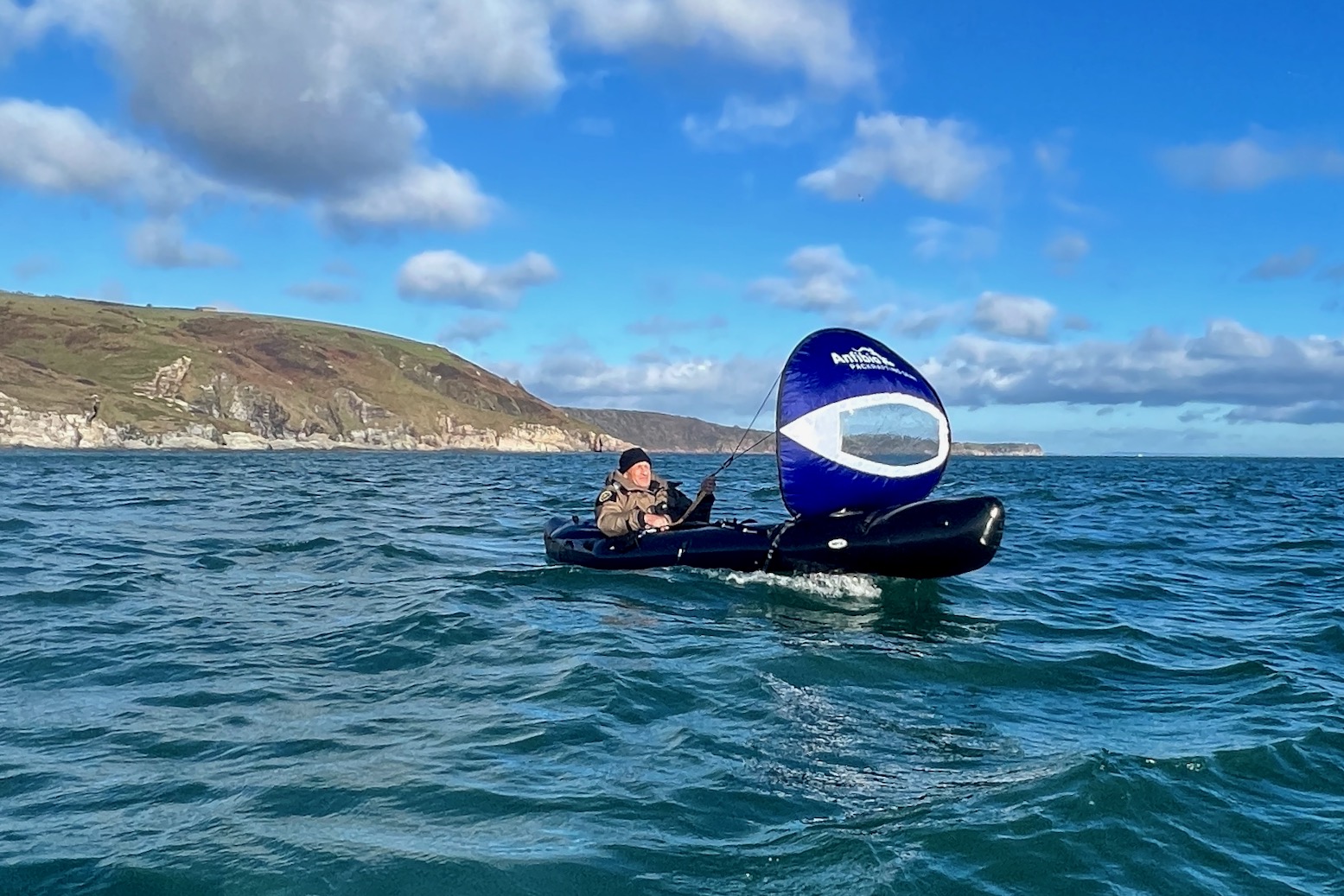
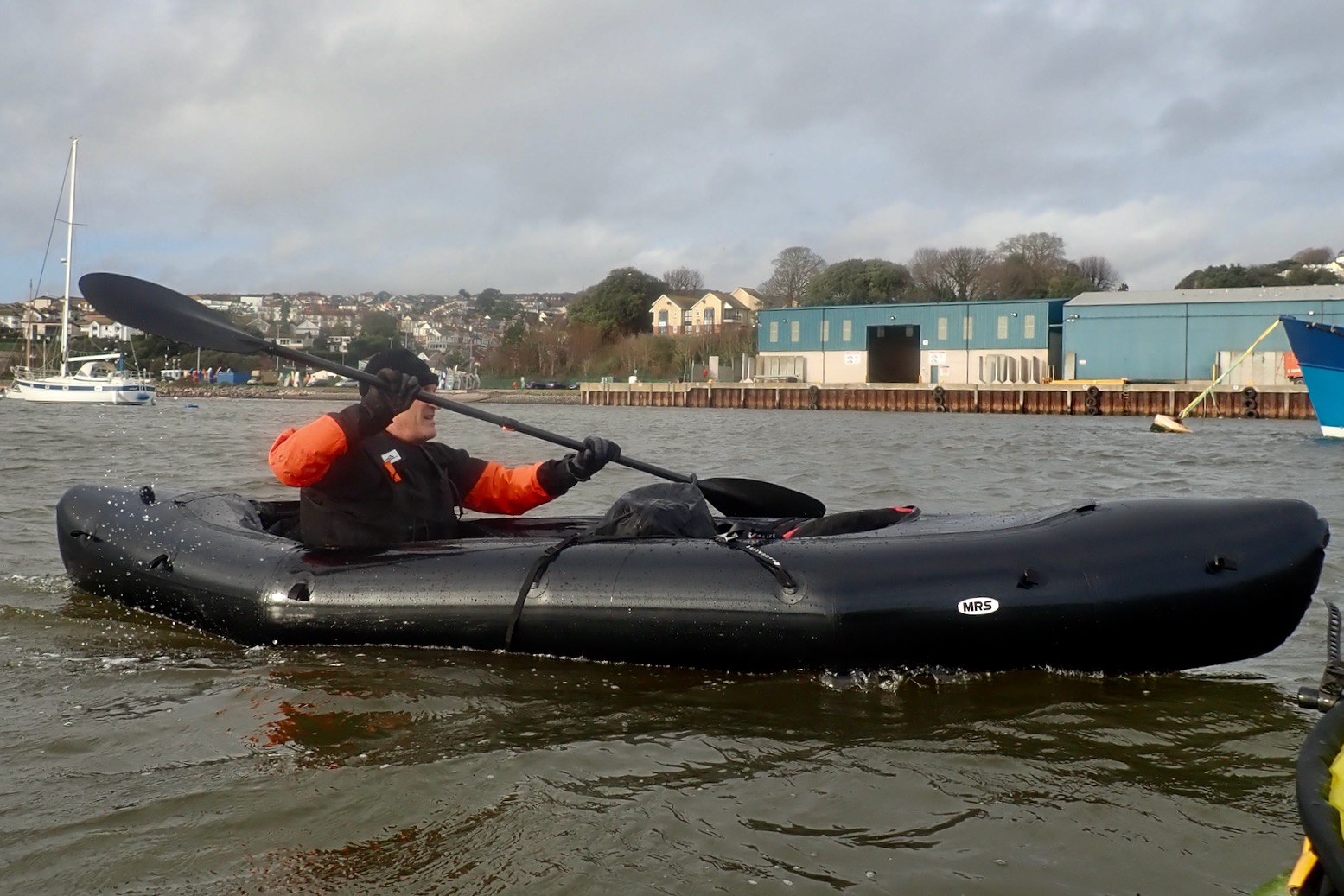
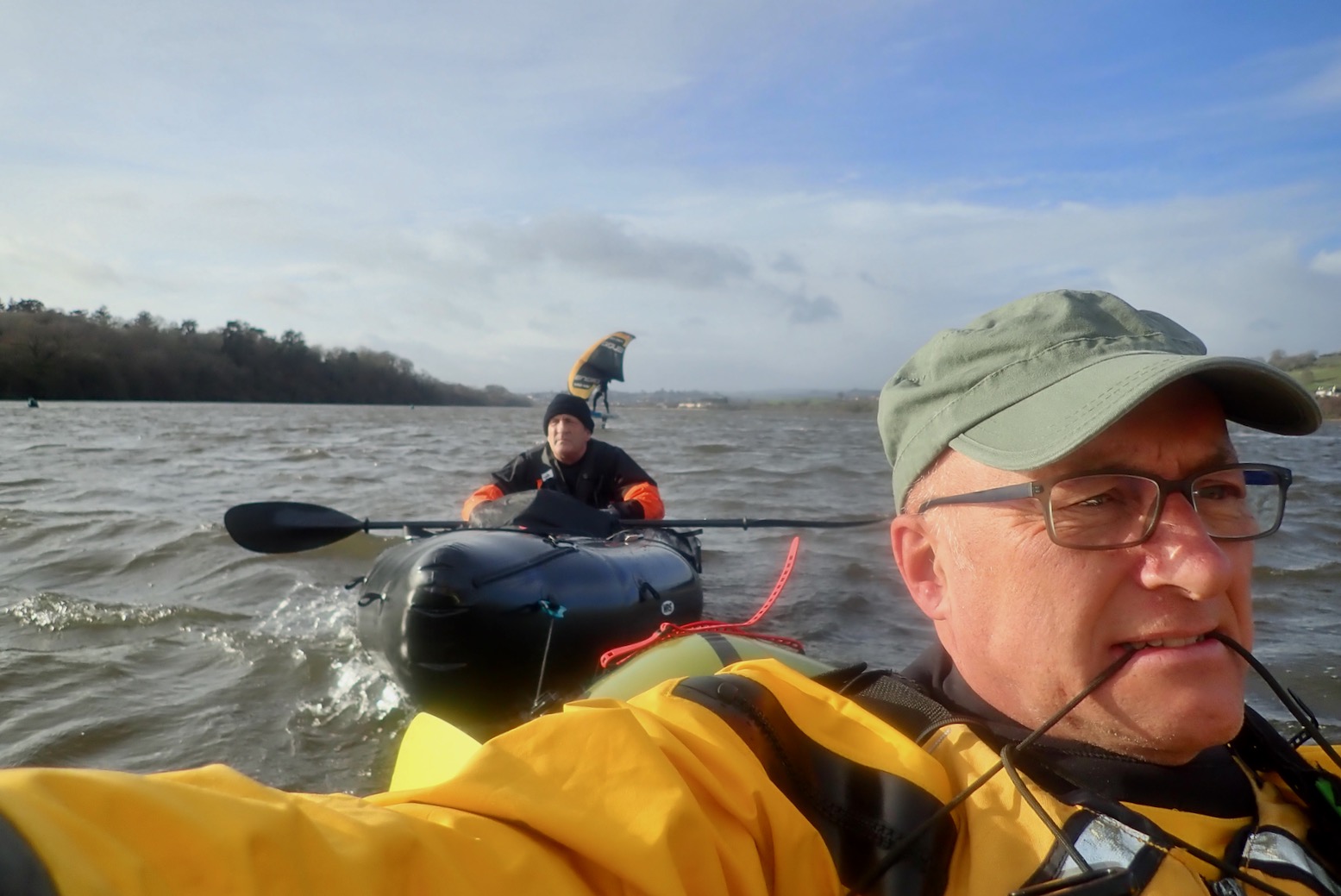
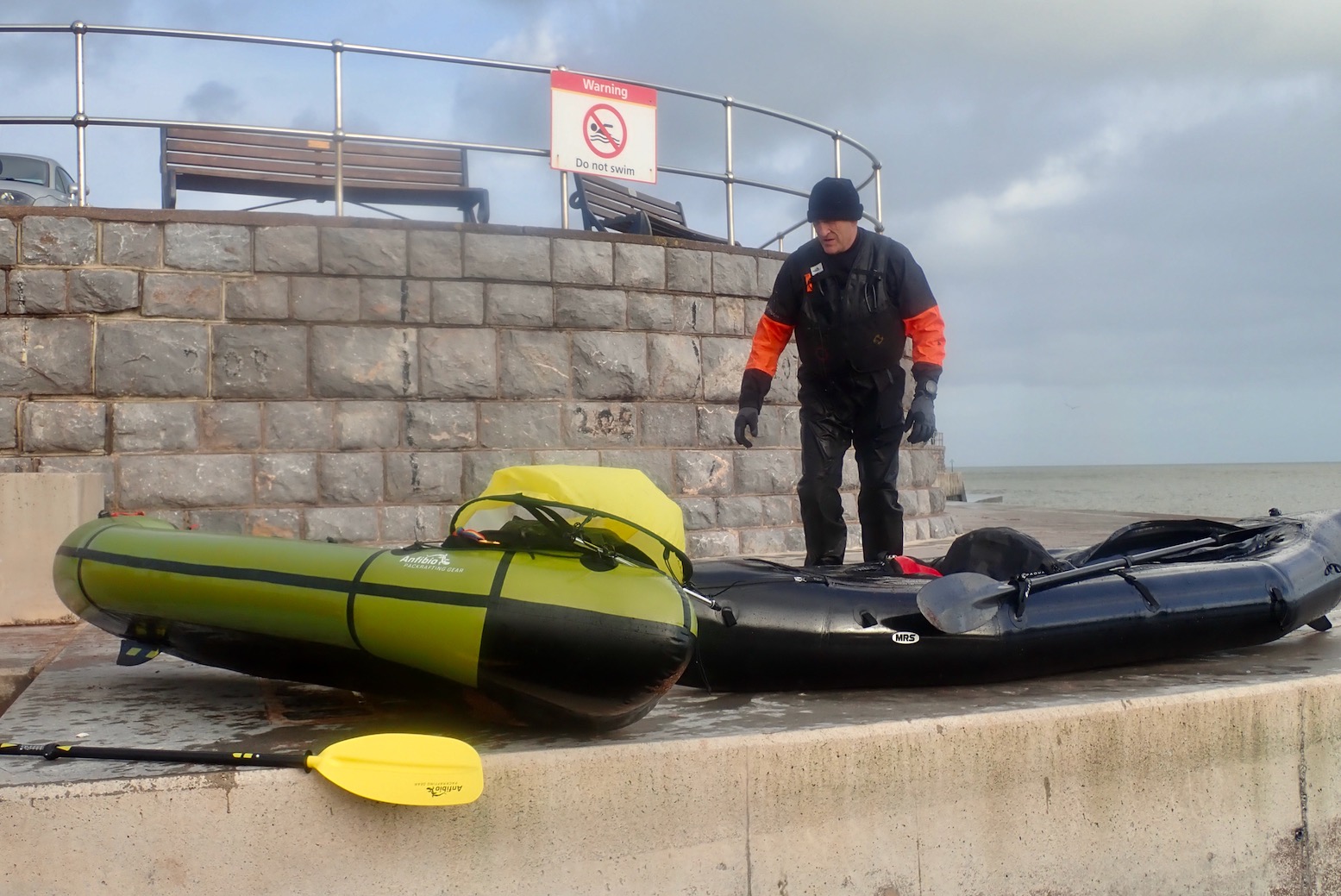
A few clicks online and a 99-euro Anfibio PackSail (same as the defunct WP) got jammed in his letterbox. With a chilly offshore wind blowing off the south Cornish coast, Phil launched his 12-foot long R2 Barracuda Pro from a handy RIB and set off for Brittany.

The combination of the Barracuda’s kayak-long waterline, light weight and the 1.3-m diameter sail soon got the MRS skimming along at nearly 10kph.
That switched to -0kph as he turned round into the 30kn gusts and tried to paddle back to shore. Time to hail down the water uber.

After the Gale: Packrafting with the Teignmouth Beast

An old mate got in touch to tell me he’d bought himself a top-of-the-range MRS R2 Barracuda Pro and heck, even my packrafting book. He’s in Devon and I was in Dorset so I suggested we meet up for a Yuletide splash-about. Back in the day we were desert bikers; now we’re packrafting pensioneers.

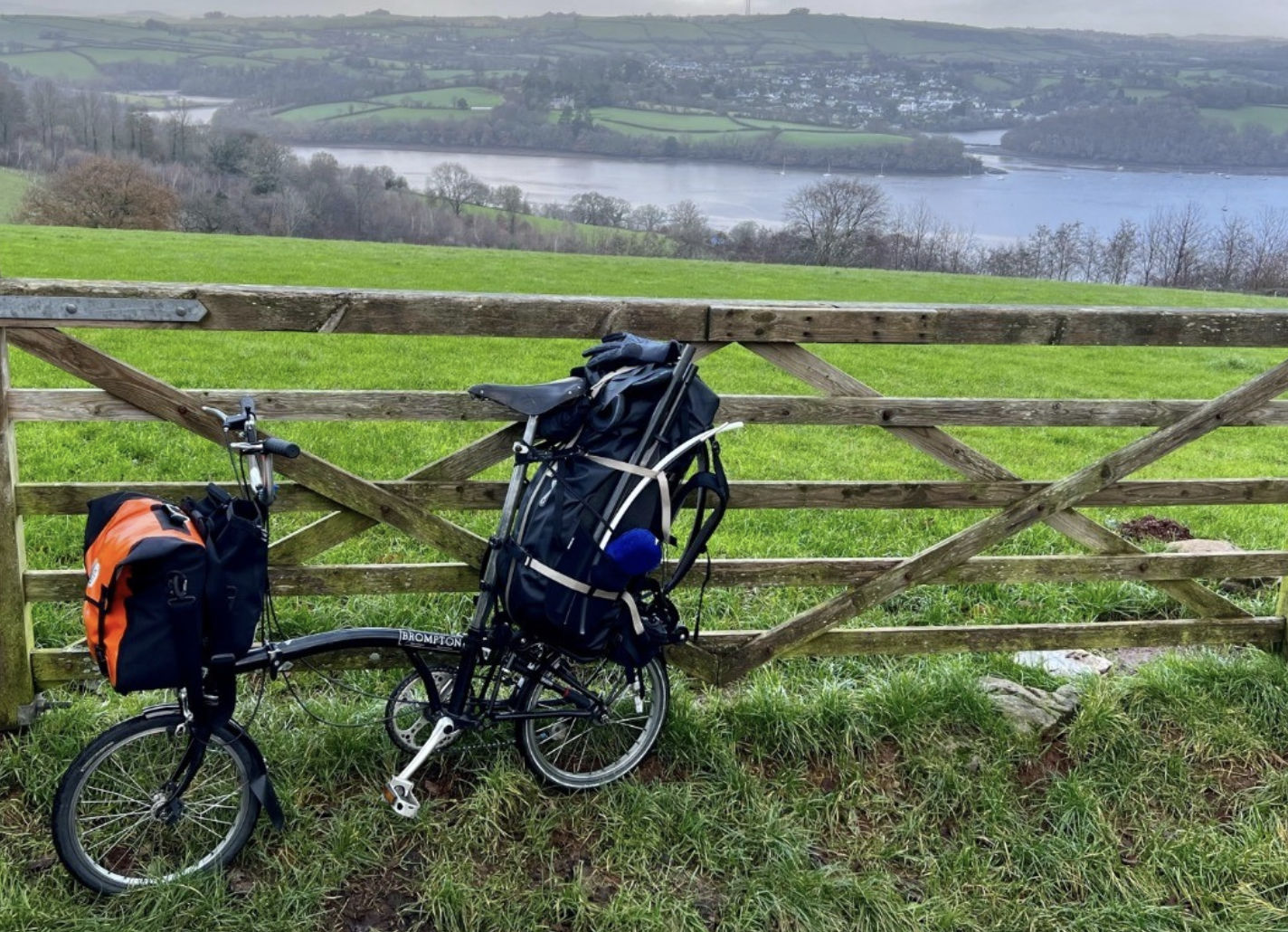
Like some do with a new activity, Phil had got stuck right into his MRS and had already paddled to Dartmouth with his Brompton bike (left), something over in Norfolk, then scared himself further up the rain-swollen Dart from Buckfastleigh to Totnes, noting ‘it’s amazing how dangerous the big branches [and fallen trees] are…’

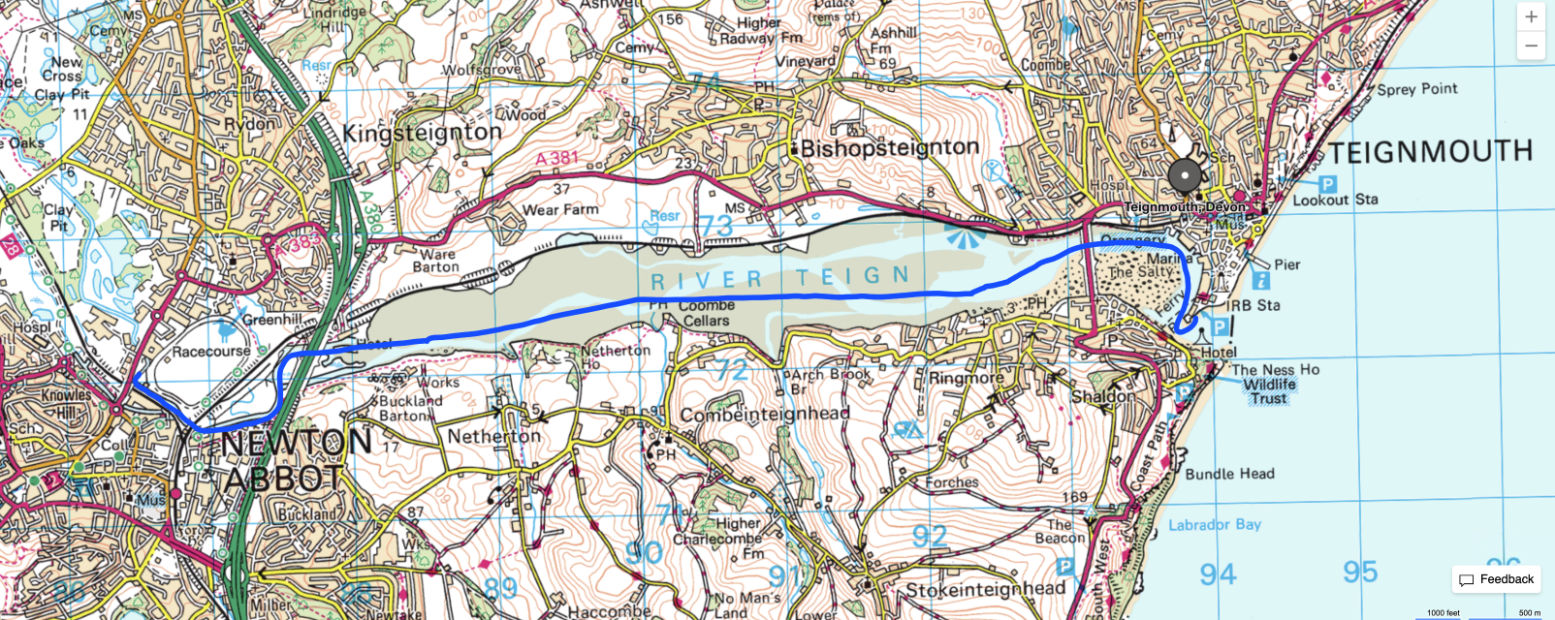
Tell me about it. If it’s not weirs or camo-&-beard anglers spitting poison darts, it’s deadly sweepers blown down by winter storms. I never quite got round to doing the Dart in my fearless prime, such as it was, but I hear in winter it’s one of the Southwest’s whitewater classics – a bit serious for me now. We settled on the Teign out of Newton Abbot with our respective bangers parked at either end.

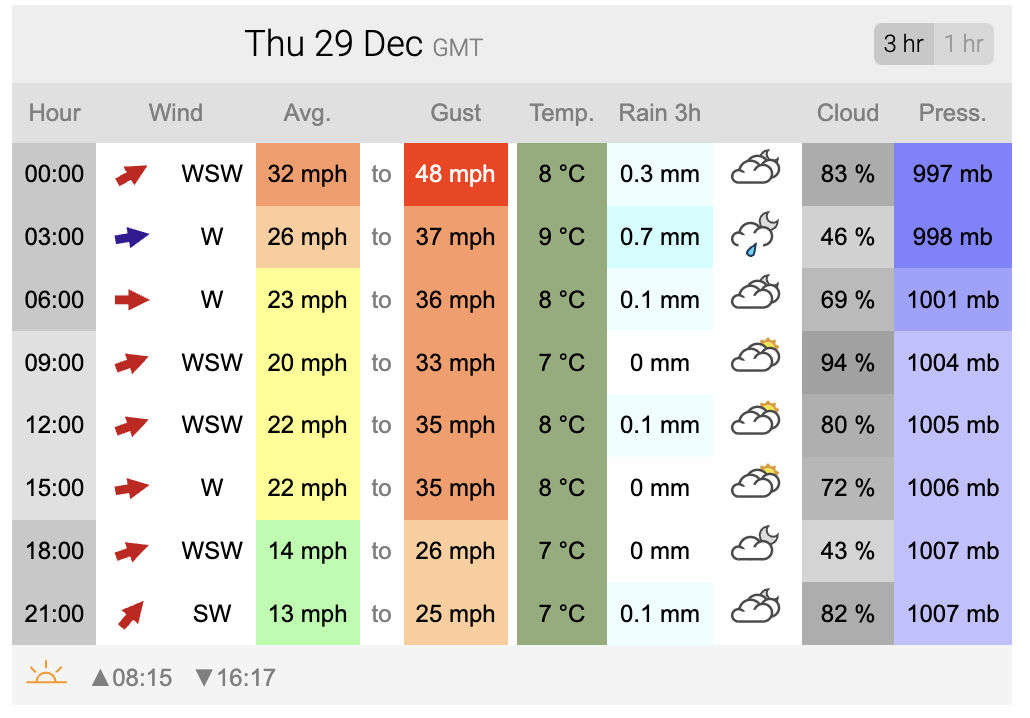
If nothing else, we ought to have a good backwind. The previous night had peaked at around 50mph, but by dawn it was tailing off to half that, with the usual gusts at +50%, single-digit temps and showers. A good day for a drysuit and a stable packraft.

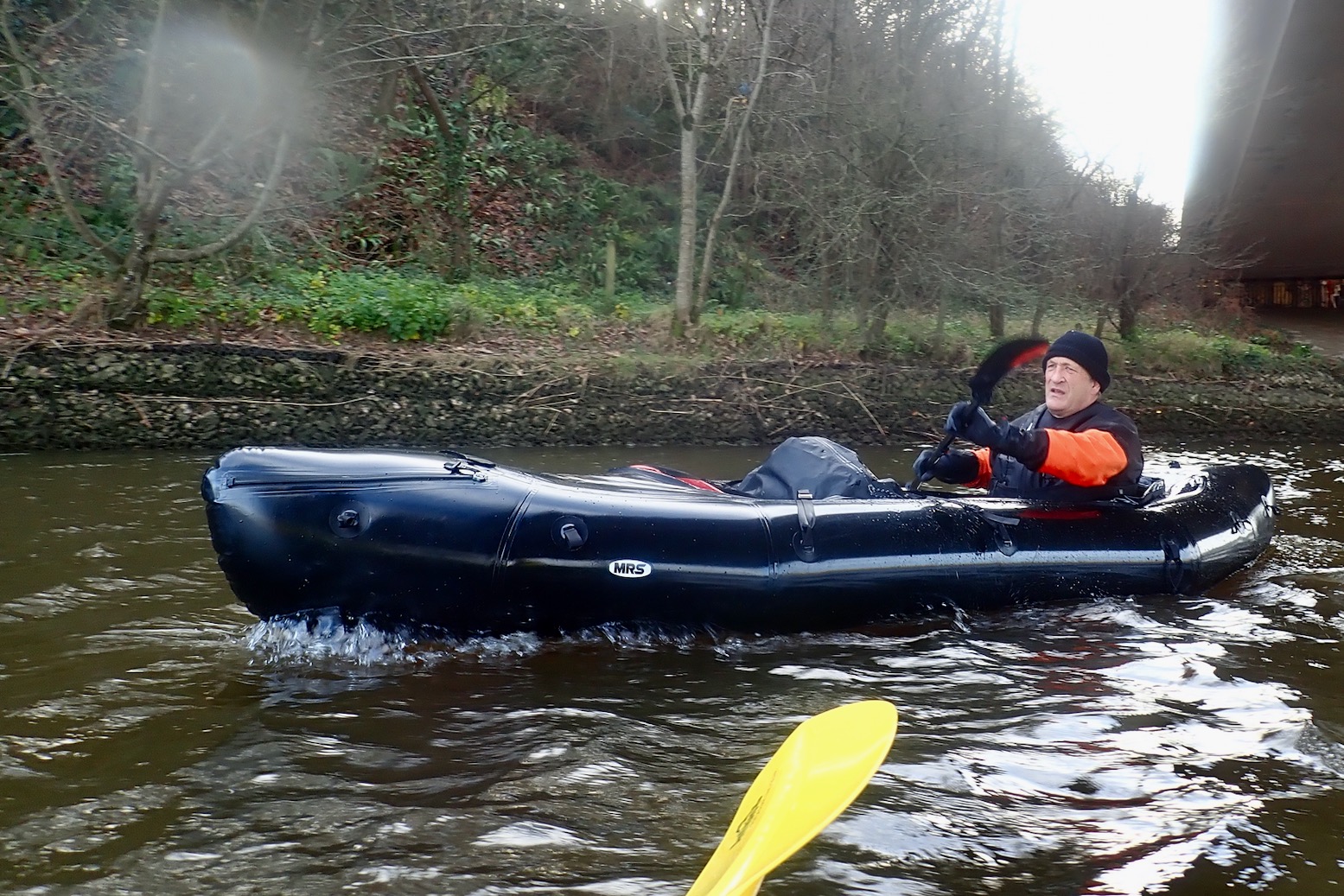
Some quick stats on Phil’s noire ‘cuda: 3.6m x 99 wide with 217cm inside and up to 7.6kg with the removable deck, two seats and internal storage, all for a hefty £1750. Compared to my TXL, it’s 80cm longer or nearly 12 feet in old money; our Micra’s shorter than that! It’s also 10% wider than the TXL, about 35cm longer inside so loads of room for 2 adults. Solo/no deck it gets down to 5.6kg alongside the TXL’s 3kg.

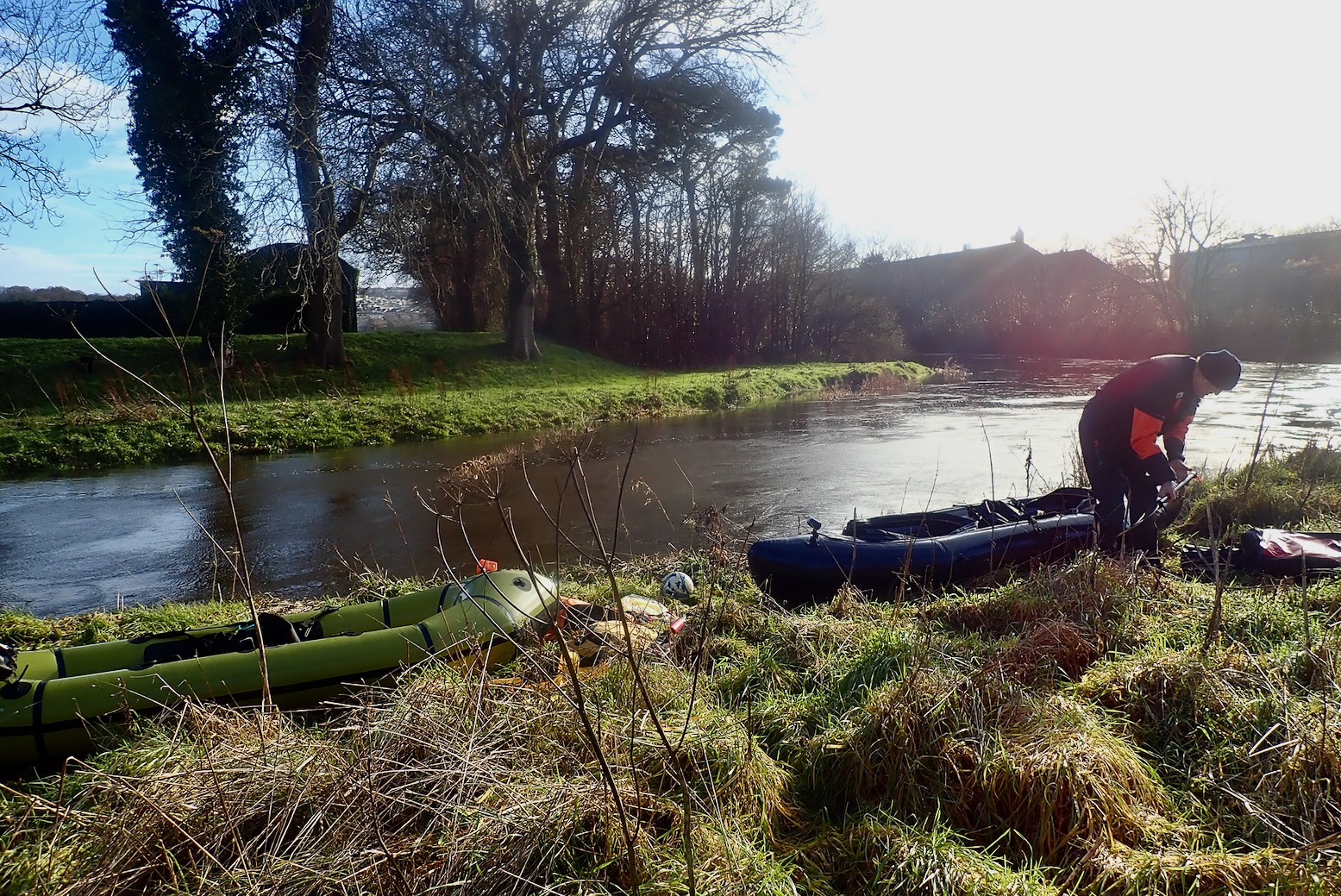
We drove around Newton looking for parking and a put-in. Opposite the racecourse and over a broken roadside fence we found a spacious river bank just at the Teign’s tidal reach. By the time we set off we were in the middle of a 3.5-m ebb, midway between springs and neaps.
Either way, like the Frome the other day, the Teign was ripping along at a light jog and before I’d got myself untangled from my gear I was 75m downstream. I thought I’d finally got to grips with keeping it all in one bag, but Today’s Forgotten Item was my seat base [forehead slapping emoji]:
Gear drifts apart; the centre cannot hold. Mere forgetfulness is loosed upon the world‘. By chance I had a spare Anfibio Bouy Boy which did the job as a seat cushion.

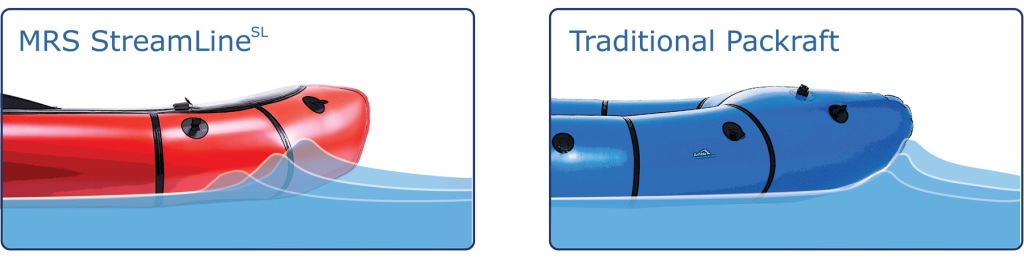
The Barracuda has the same distinctive prow design as my old MRS Nomad which was a fast solo packraft, what MRS call StreamLineSL. These prows take up nearly 1.5m in the R2 which explains the massive length while still having a lot of room inside the boat. There’s probably enough buoyancy for four people and a caribou calf, with room for all their gear inside the ISS hull storage.

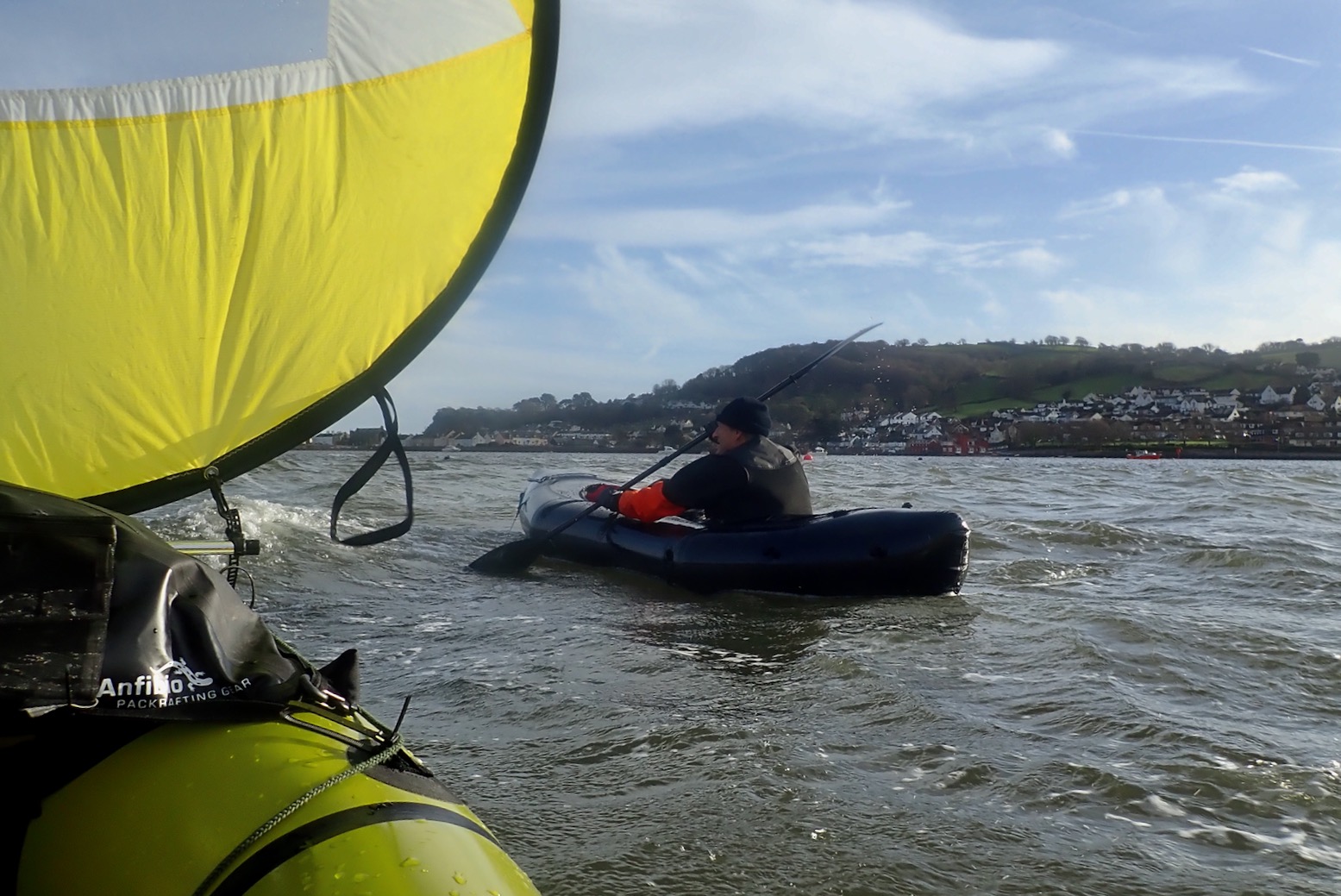
Before we knew it we’d passed under the A380 bridge and were out in the wide tidal estuary. The predicted 20mph winds came barrelling down the channel so I couldn’t resist flipping out my WindPaddle. With the Barracuda’s mooring line clenched in my teeth I managed the sail while Phil’s phone recorded 8 knots, obviously helped by the falling tide.

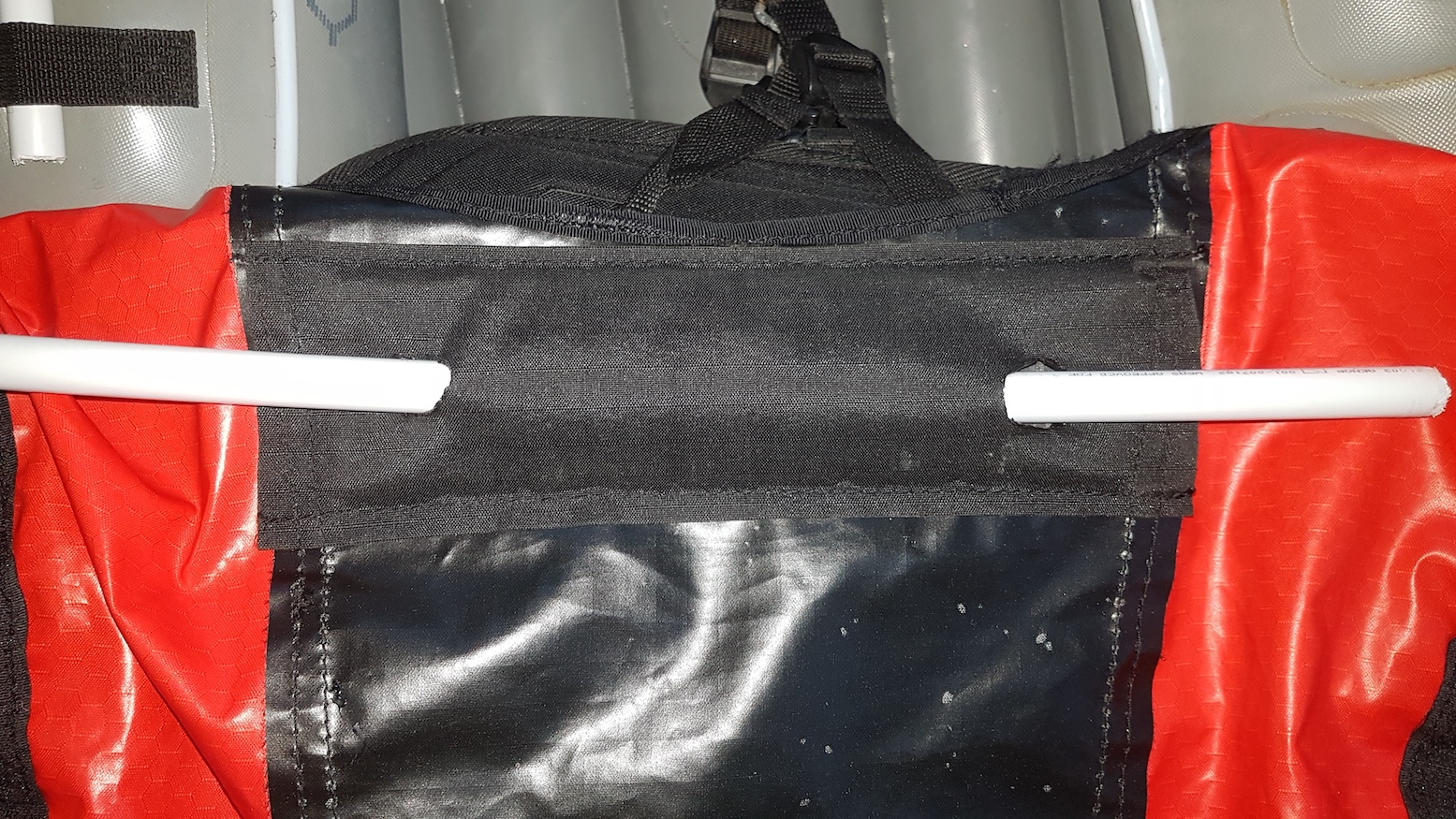
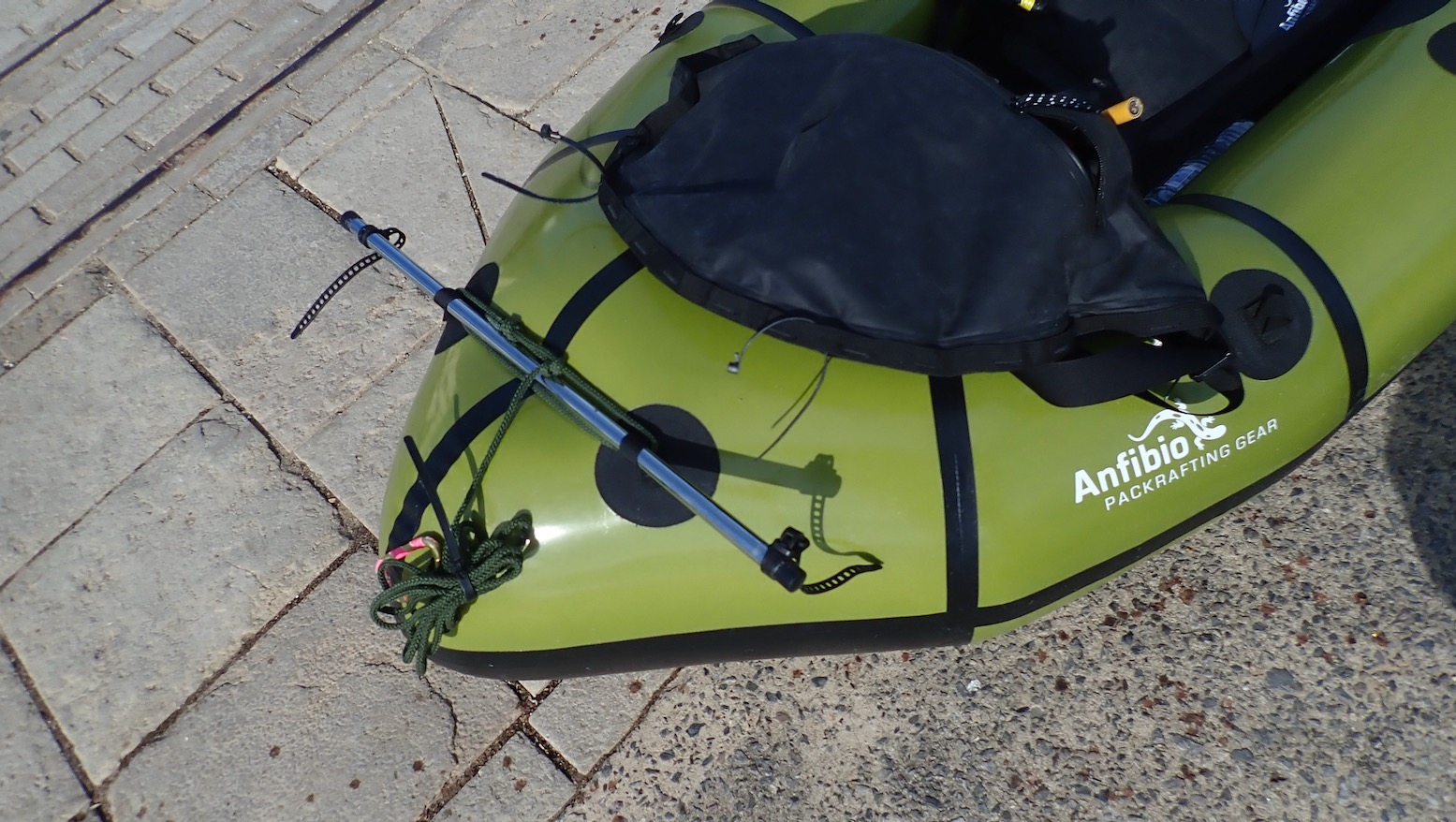
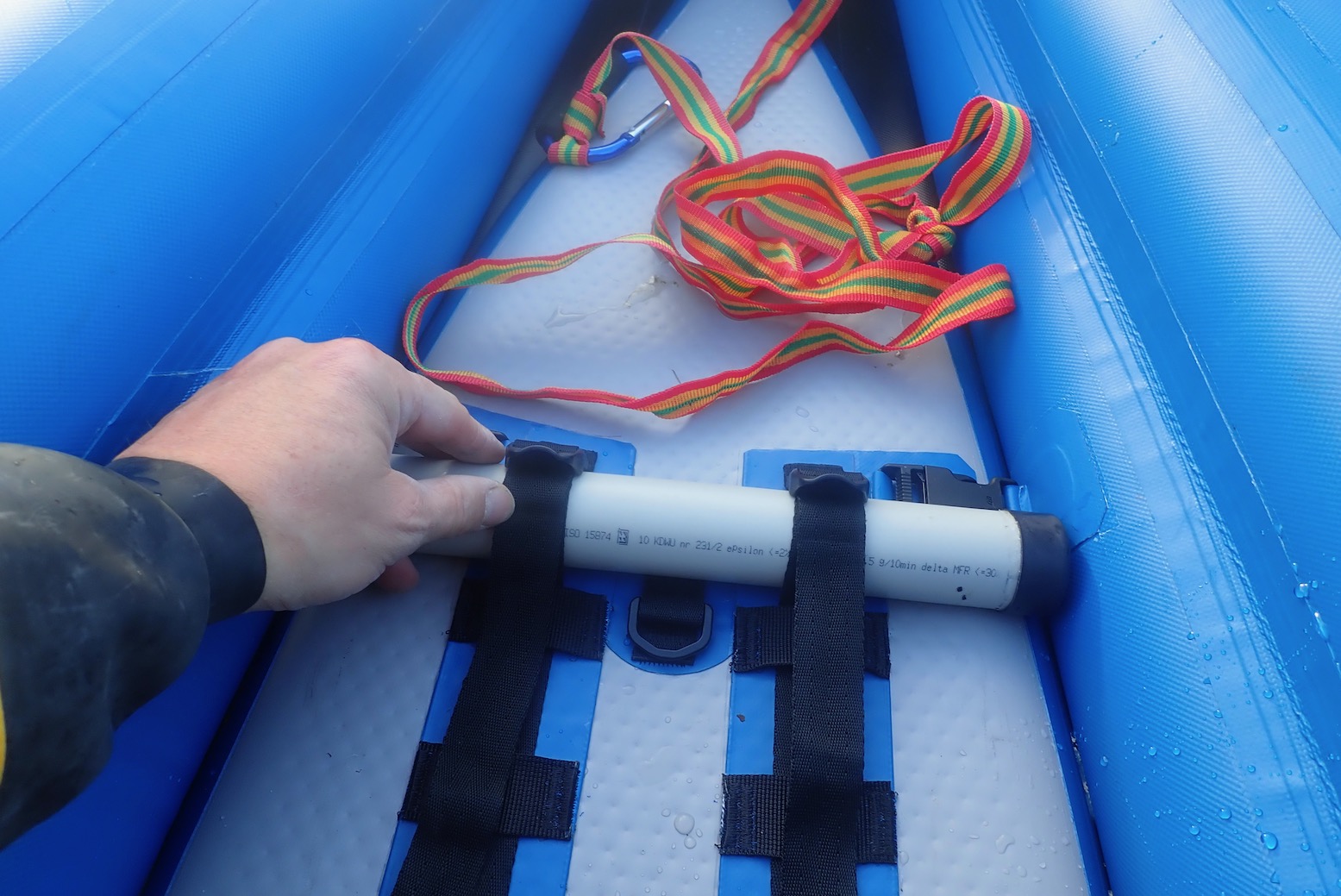
There were a few forceful gusts and the fetch kicked up towards the end, but the TXL and Barracuda shrugged it all off and my transverse bow sprit (left) did a great job of steadying the straining sail. I think the MRS has wider attachment points on the bow so may not need it, but I’m sure Phil will be buying a PackSail if Anfibio can do him one in black. He did.

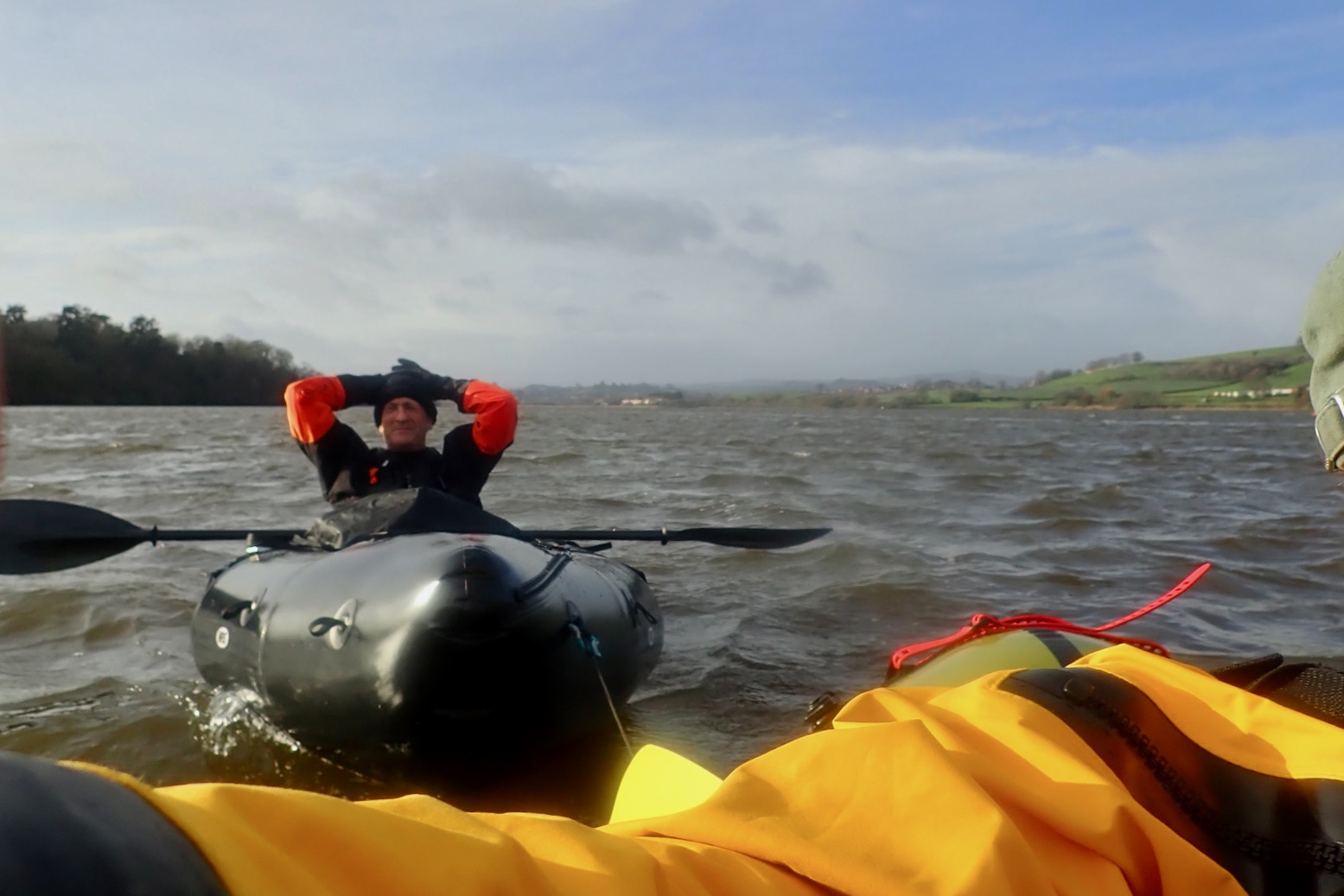
Things got a bit chilly out in the deeper water and I noticed my TXL was creasing a bit at the sides. It’s been so many months since I last used it I’d forgotten high-volume packrafts need a second top-up a few minutes in to get good and taut. It didn’t seem to affect speed, but like properly laced shoes, taut feels better. That’s one good thing with Phil’s black boat; it auto pressurises in the pale winter sun. While we sailed, he tucked into his lunch.

The Teign estuary is actually not too industrialised. Under the last bridge The Salty sandbank was starting to emerge from the chop and as we curved round to the river mouth the sidewind pushed us into moored craft caked in algae. At the narrow outlet a rip of bouncing clapotis was jiggling out to sea and on the beach someone was striking poses for their Insta feed.

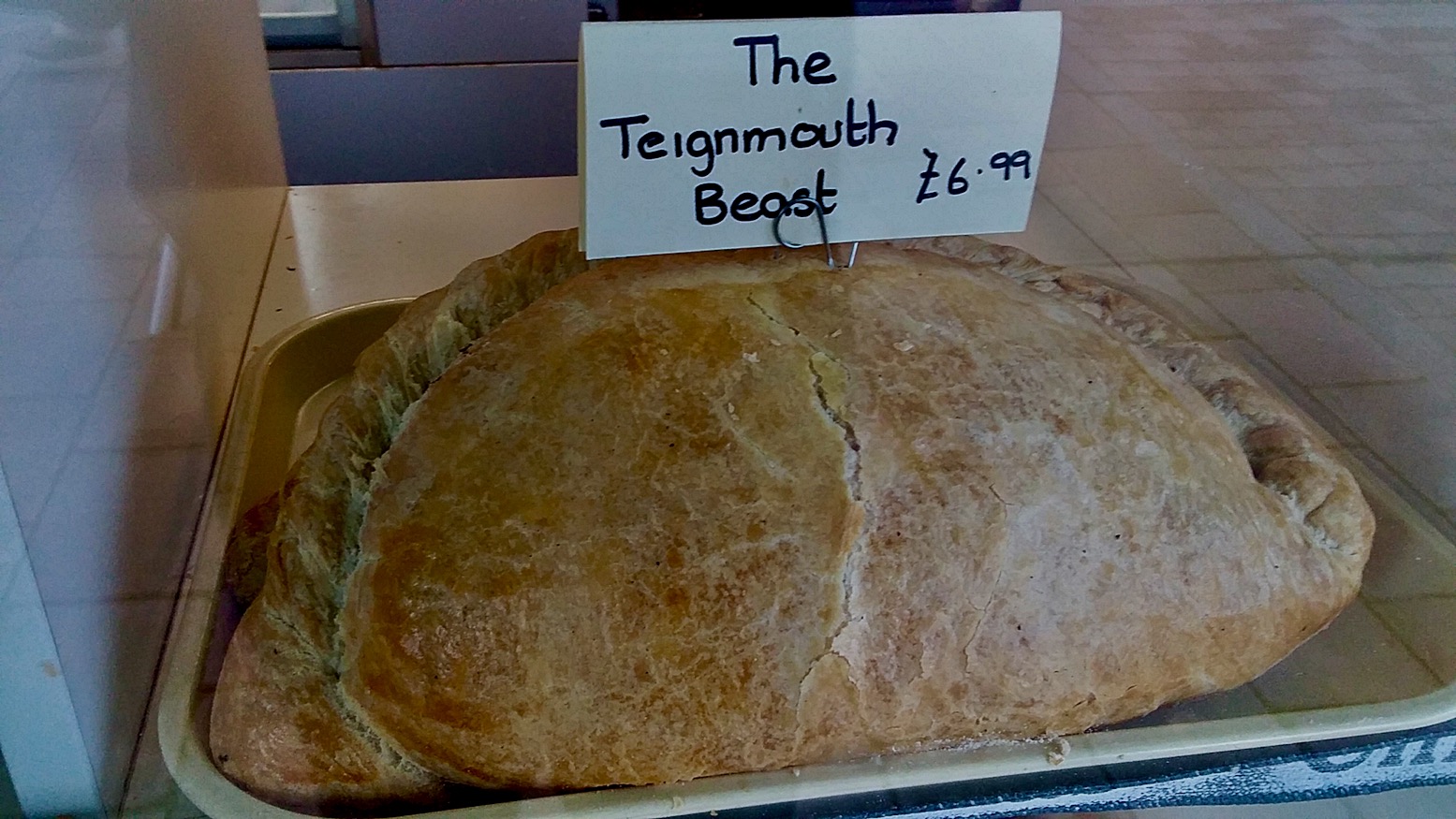
A little over an hour for 5 and a bit miles, just about all of it sailing both boats. It was interesting to learn that the WP could sail two big boats without much loss of speed. Staggering ashore, it felt odd not to be arm knackered, but once I got over that we headed into the deserted seaside town in search of the legendary Teignmouth Beast. That’s a local XXL pasty, not the jet-black MRS Barracuda.

Zelgear Igla 410 – first paddle

Zelgear Igla Main page

In a line
Fast, light, well-made and great value European-made hybrid tandem, the Igla’s removable floor and stacked [twin] side tubes keep the width down while retaining stability.

Everything in the huge bag except a paddle
Removable DS floor for quick rinsing and drying
Unusually light on the water
Adjustable footrest tube
Seat feels great
Knee braces are stock
Twin (stacked) side tubes keep width down
Ready for optional rudder (supplied)
Closeable sidetube PRVs
Fittings for a deck (supplied)
Three-year warranty
Like many PVC IKs, it’s bulky (if not necessarily heavy)
Alloy skeg appears to be an extra; and would prefer it in plastic
Skeg can’t be removed without deflating DS floor
Limited overseas dealer network
but see here

With clear skies forecast I took the Igla for a quick spin down the tidal River Frome out of Wareham quay. Some 1150 years ago marauding Vikings besieged the Saxon port in a bid to establish a flat-pack furniture enterprise. The ever dependable Alfred the Great sent them ‘packing’.

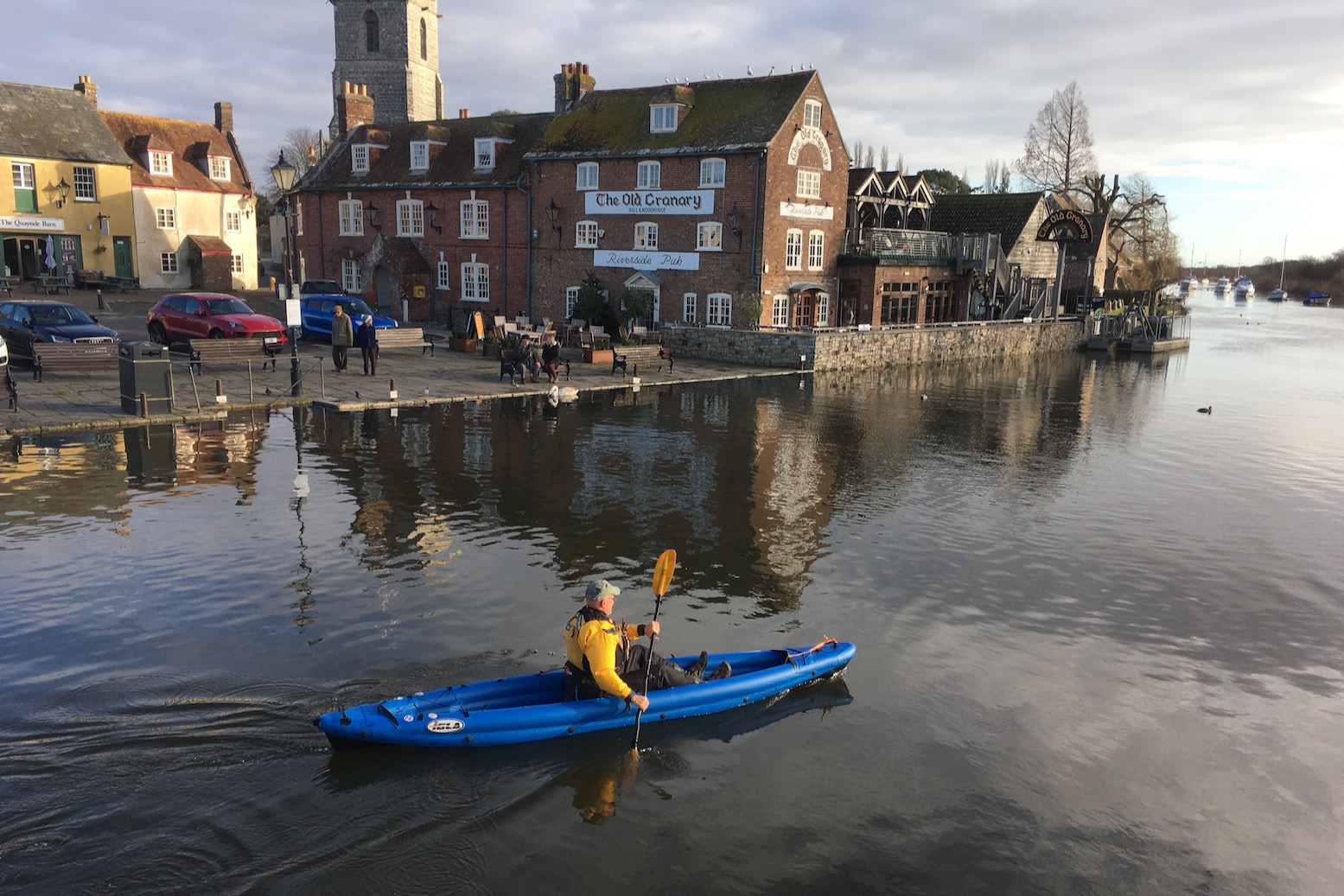
The recent thaw and rains on top of an incoming spring tide saw water just lapping over the medieval quay’s kerb and nearby pub lawn which for me meant an easy put in. Once cooling in the water I gave the kayak a quick top up and realised the closeable PRVs are quite handy in that you can close them as they start purging at 0.25–3 bar and so maintain firm sidetubes. Today, with temperatures in single figures there’s little risk of overheating blowing the boat to smithereens. I need to track down my manometer to see what the pressures actually are.

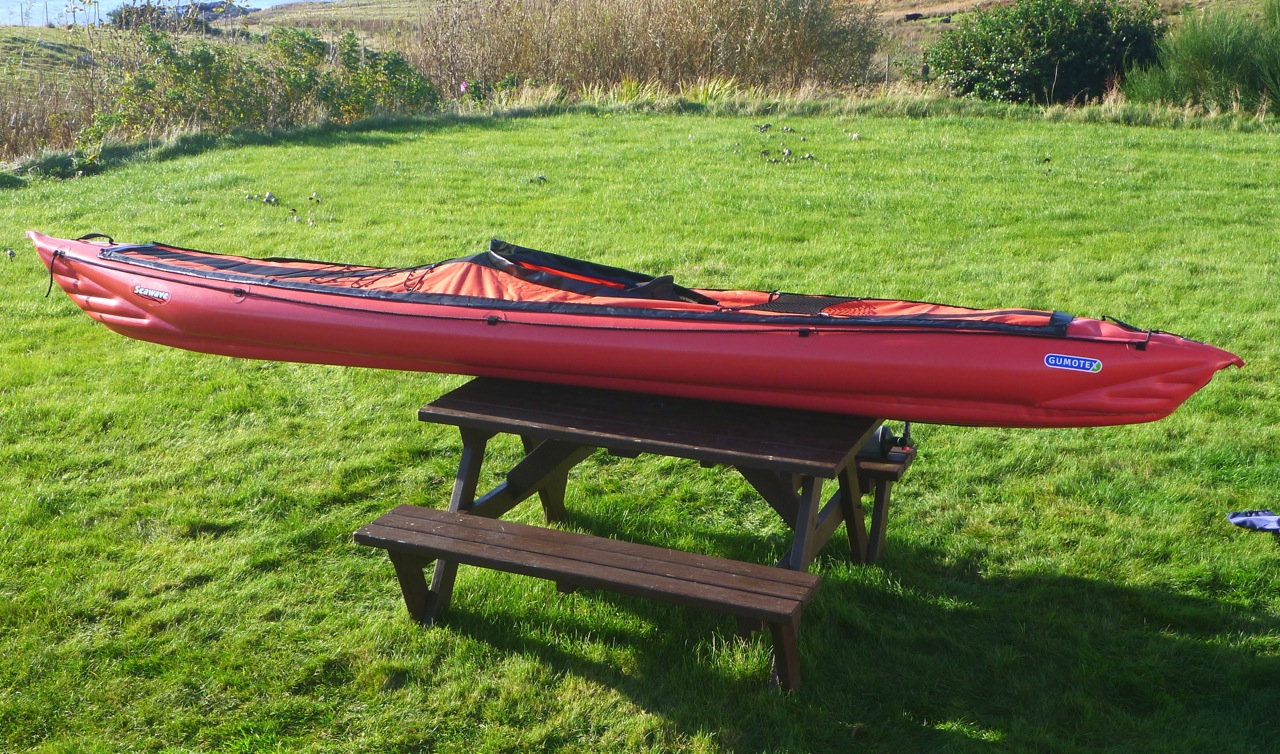
After hopping in I did a bit of pre-emptive wobbling while holding onto the quayside to ascertain stability. I don’t want a repetition of the shaky Shipwreck FDS I tried a couple of winter’s ago. The Igla seems good; a bit more tippy than the super-stable Seawave but unlike many FDS IKs, the round side tubes give it a bit more beam at water level. I adjusted the footrest tube further forward but later realised I may have been sat a little too far forward for level trim. I get the feeling these rock-solid drop stitchers are a bit more sensitive to trim as there’s no sag in the floor.

I see now that floating on the water the bow and stern prows are just above water level. With these relatively water-slicing forms (for an IK) I wondered whether the Igla might manage without a skeg but decided not to risk it.
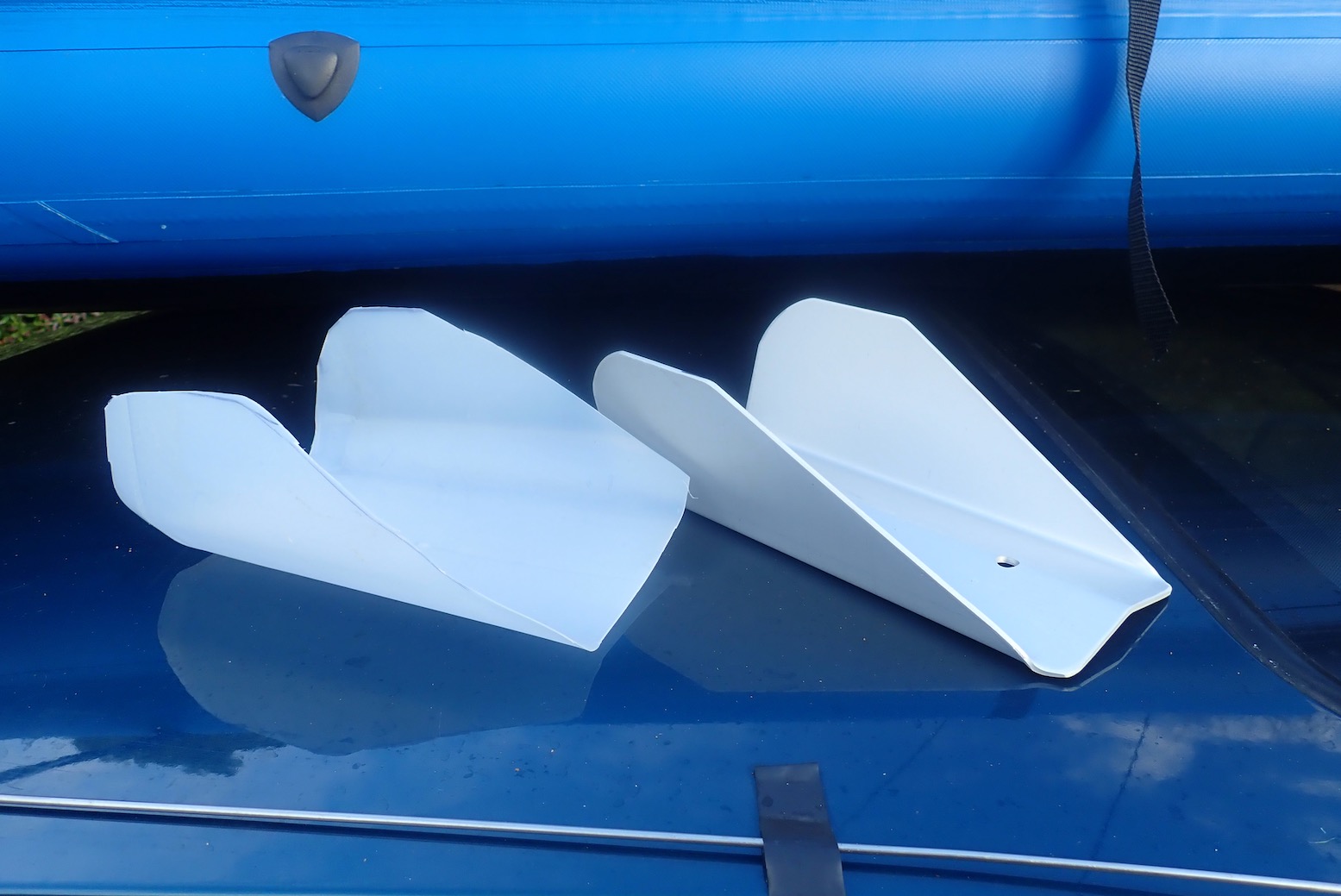
You can’t fit/remove the twin-fin alloy skeg with the DS floor inflated, so I made a quick copy from a plastic container (below). My MYO skeg was a bit flimsy but setting off downstream the Igla tracked fine while turning as easily as the Seawave. It wouldn’t be hard for Zelgear to redesign the skeg and mounting to make it easily removable while still being secure. And while they’re at it they could make it in ABS plastic.

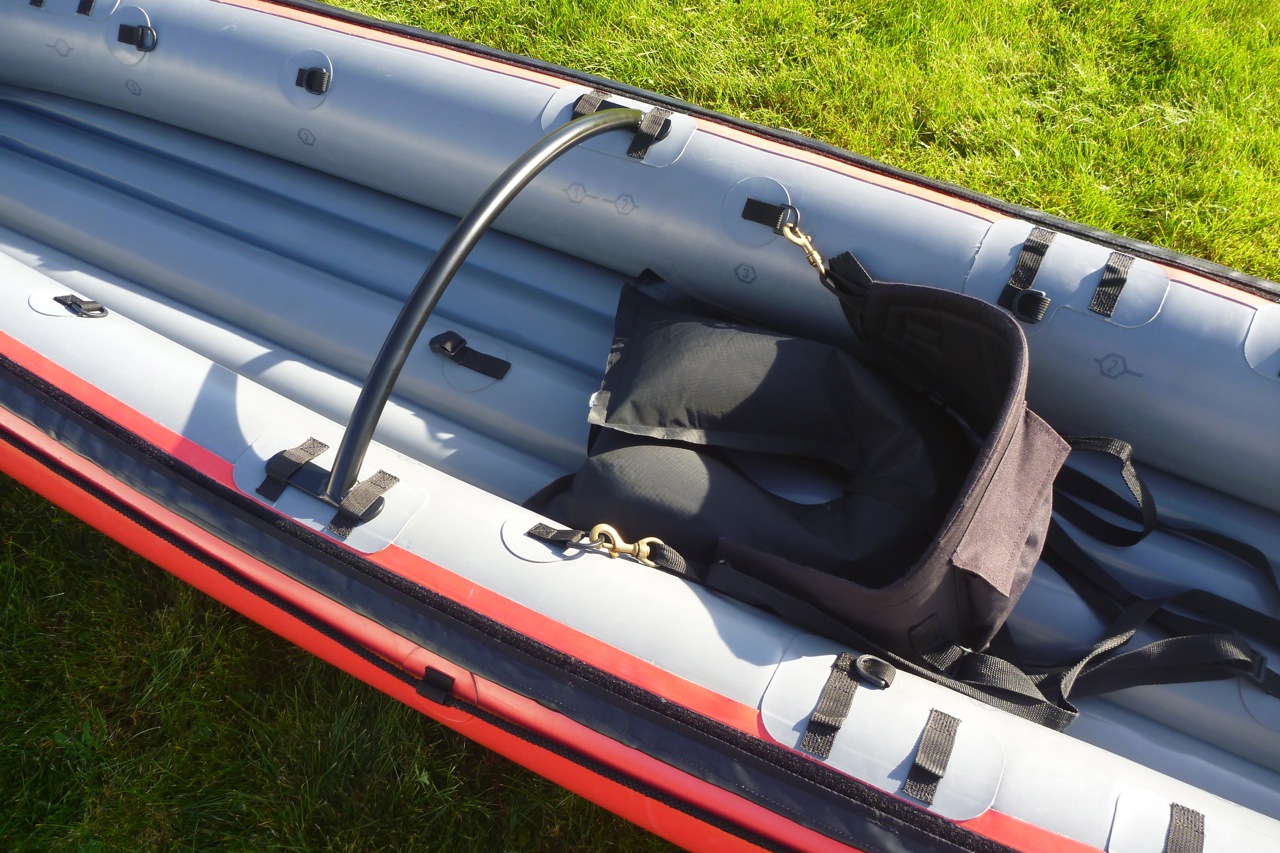
I’m pleased to report the six-point seat feels about as comfy and supportive as I’ve seen in an IK out of the bag. No need for the usual adaptations or outright swaps. Gumotex take note. It weighs only 700g but offers great support, even from the inflated backrest. And semi-deflated, there was no wobble from the seatbase on the hard DS floor. If you’re looking for a good IK seat, try and get one of these.

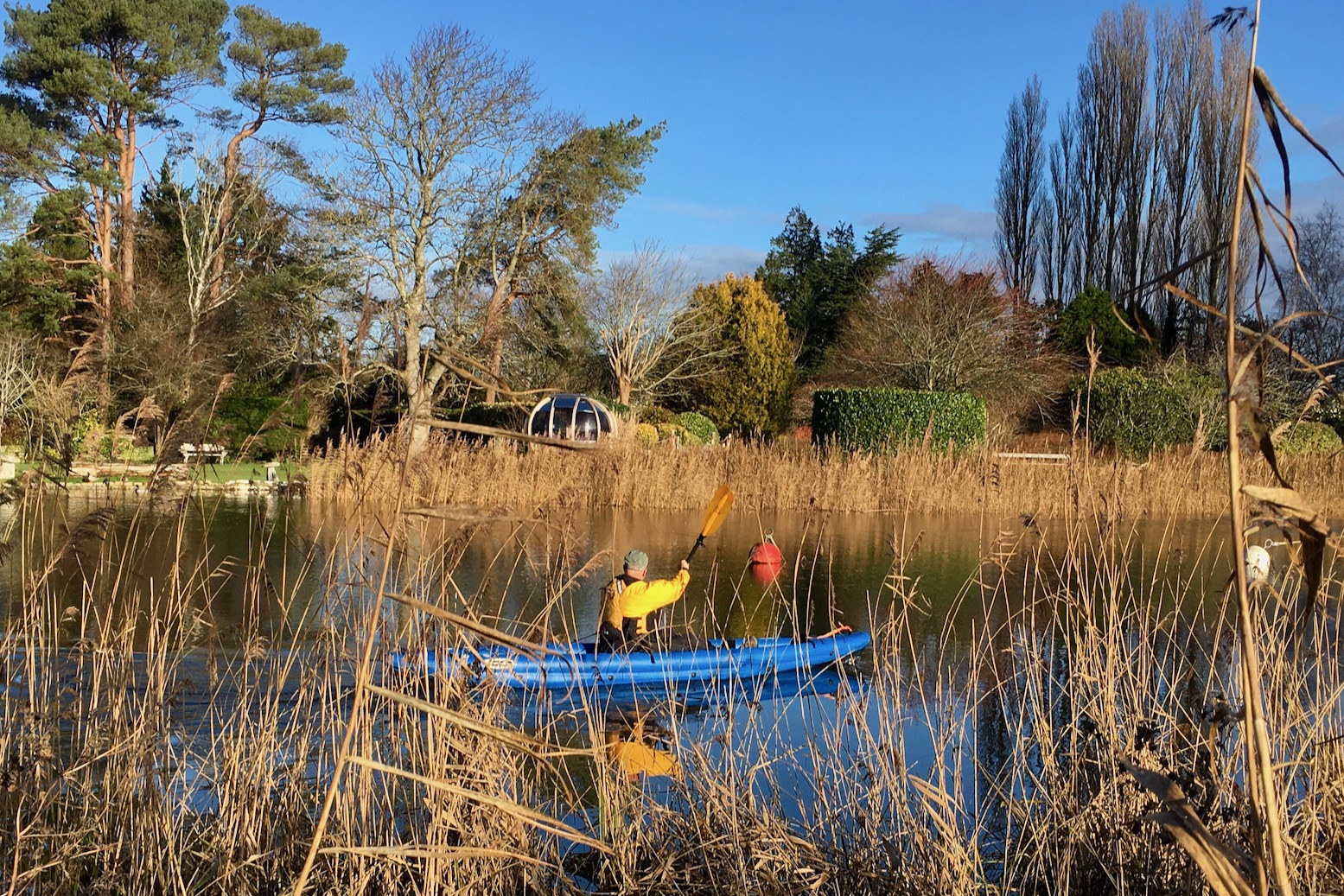
The slim footrest tube too works better than I thought, thanks to the hard floor, and with knees braces cinched up, I felt secure in the boat. It’s a tad less stable than my Seawave of the same width but not enough to bother you on flatwater, as least. The Mrs was walking along the south bank and I was going to ferry her over to the north side to walk back, but we got separated in the reeds so I headed back into the growing westerly before the spring tide turned on me too.

Before I did, I hopped out and pulled out my plastic skeg. Doing so soon established that like most IKs, the Igla did indeed benefit from a tracking fin. The boat was paddleable but micro-corrections were required to keep it on track; do nothing and the bow comes round. Again, very similar to my old Seawave and unlike the FDS Shipwreck which tracked fine without it’s huge skeg but could turn better, too.
Bang on time, at 12.20 the tide turned and soon, helped by the run-off from the Purbeck Hills, the river was belting along under Wareham bridge. That’s good to know for later paddles out of here.

Having not paddled for months, that little outing wore me out, but I like the Igla. It looks good, performs well, has many useful fittings which other IKs don’t and, for a European-made boat, is a bargain at current prices. Add tax and shipping (if needed) and it still ought to come in at under a £grand. I’m looking forward to taking it out for a longer session into Poole Harbour and beyond.

Preview: Decathlon Itiwit Packraft 100

See also:
Itiwit 500 Packraft

Itiwit inflatable kayaks were one of the few IKs that remained available (and without price hikes) during the Great Lockdown IK Shortage of 2020. In 2021 Decathlon’s initial entry into the packraft market with the 12-panel, semi decked ‘500’ model got off to a lumpy start, or at least ended up not being sold in the UK for more than a couple of weeks.
However since 2022 the cheaper and plainer Packraft 100 model is definitely here in the UK (and probably everywhere else) for £399 and highly rated by buyers.

Itiwit Packraft 100 and 500

What they say
Designed for packrafting beginners, this packraft can be carried in a backpack! Cover a calm water course or a lake then descend or cross it!
This extremely compact packraft will enable you to enjoy your hikes in a whole new way, travelling along a calm class 1 river, or across a lake: Create your own tailor-made adventure.

(It’s not easy to locate the X100 pdf manual)

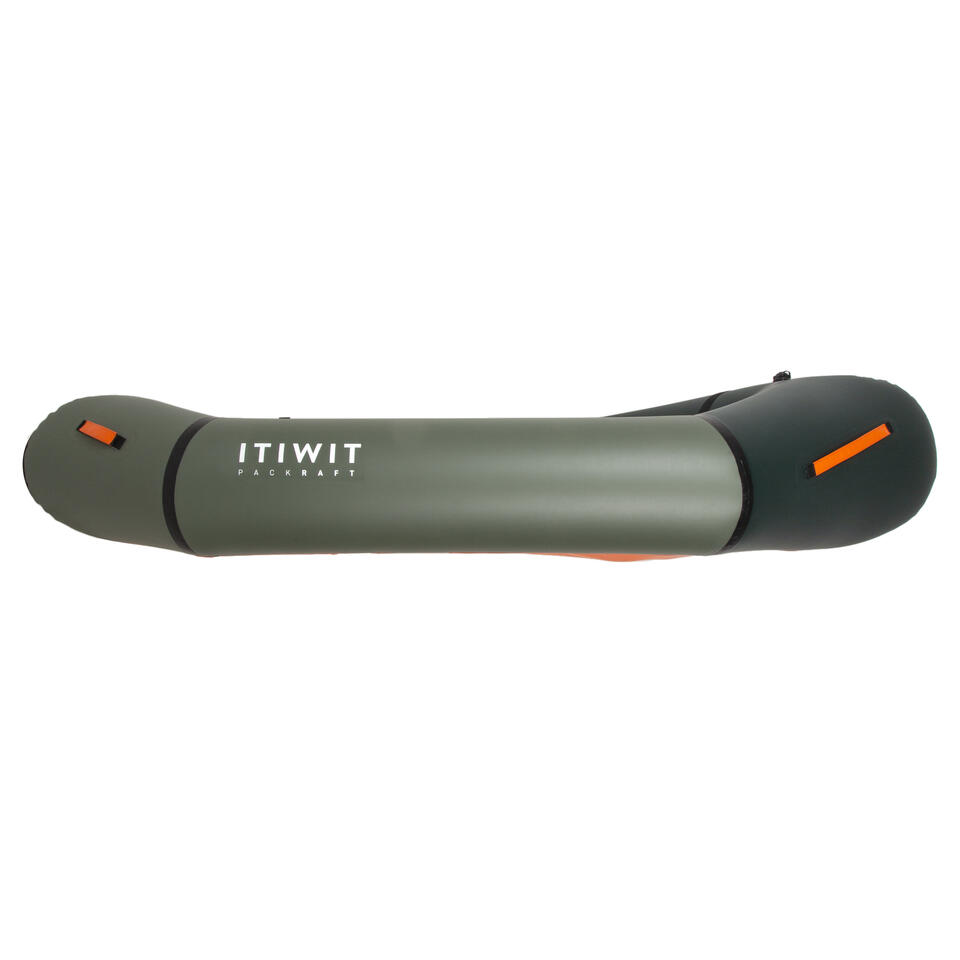
Decathlon/Itiwit kept things simple on the 100 with a basic, six-panel Kokopelli-like design and a flat hull with no rocker (bow uplift). The boat is made with 210D? TPU tubes and a 420D floor measuring up, we’re told, at 205cm long by 95cm wide, a bit shorter but a lot wider than Anfibio’s similar Alpha XC. Using graphic extrapolation developed in Bletchley Park, I estimate the interior width at the seat is 45cm and 25cm at the feet, with an interior length of 118cm, although the pointy ends will make that feel a bit less.
Weight rating is 110kg and the claimed weight of the entire package: boat and hose in the carry/airbag, is under 2kg.

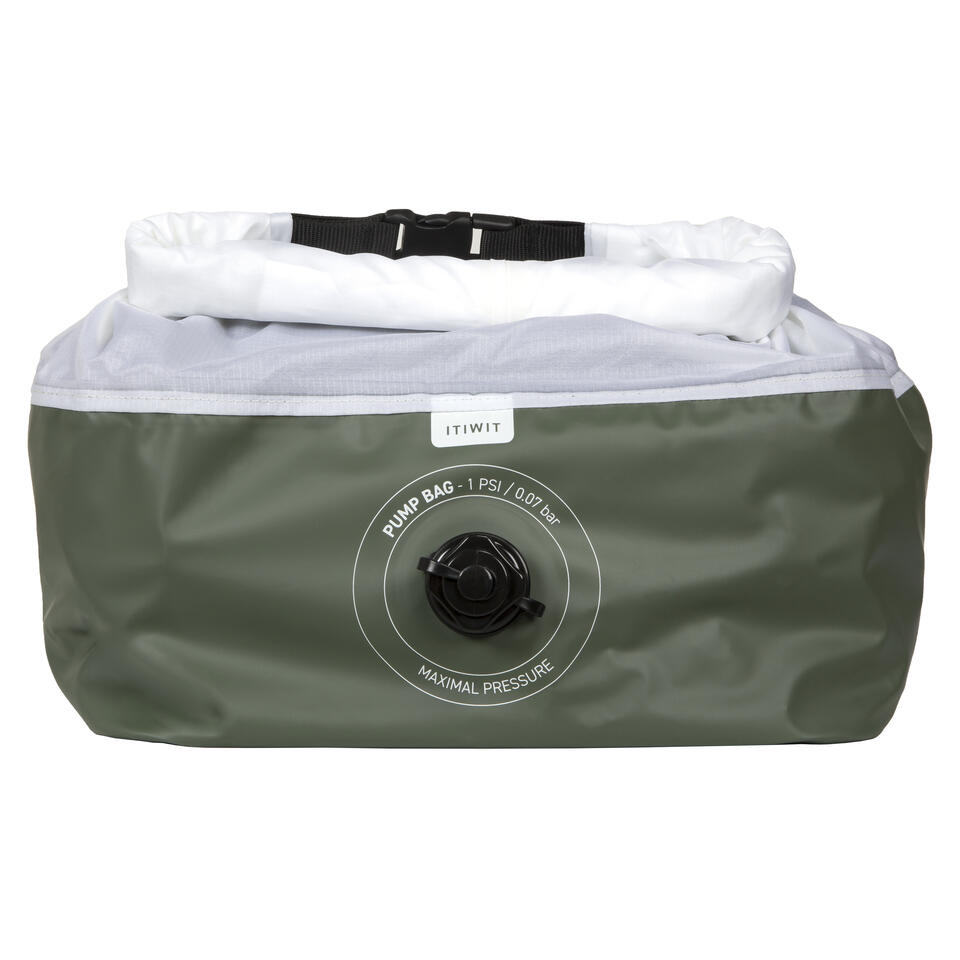
In that second video, product engineer Julie tells us with English subs that the Packraft 100 runs 1psi right over an image (left) that clearly states 1.5psi around the valve. Then again, the preceding action vid shows 1psi at the valve and on the air bag too. Perhaps they decided to play it safe at the last minute, but assuming it’s sewn and welded with tape like most packrafts, it should be able to handle a bit more for a better ride. Of course there’s no way of measuring pressure without a low-psi manometer.

As with their IKs, Itiwit have their own way of doing things with seemingly little reference to competitors. So Packraft 100 looks oversquare and with long hand straps front and rear, rather than the usual grab loops (there are two up front inside). It’s possible hand straps are a requirement of paddle craft safety regulations in France.
Unless I’m missing something, the very wide seat with a handy one-way valve uses an oddly clumsy securing strap, but the carry bag cleverly doubles as an inflation bag and then a roll-top dry bag once on the water. The orange floor is 420D TPU. In an emergency, flip the boat over and wave.

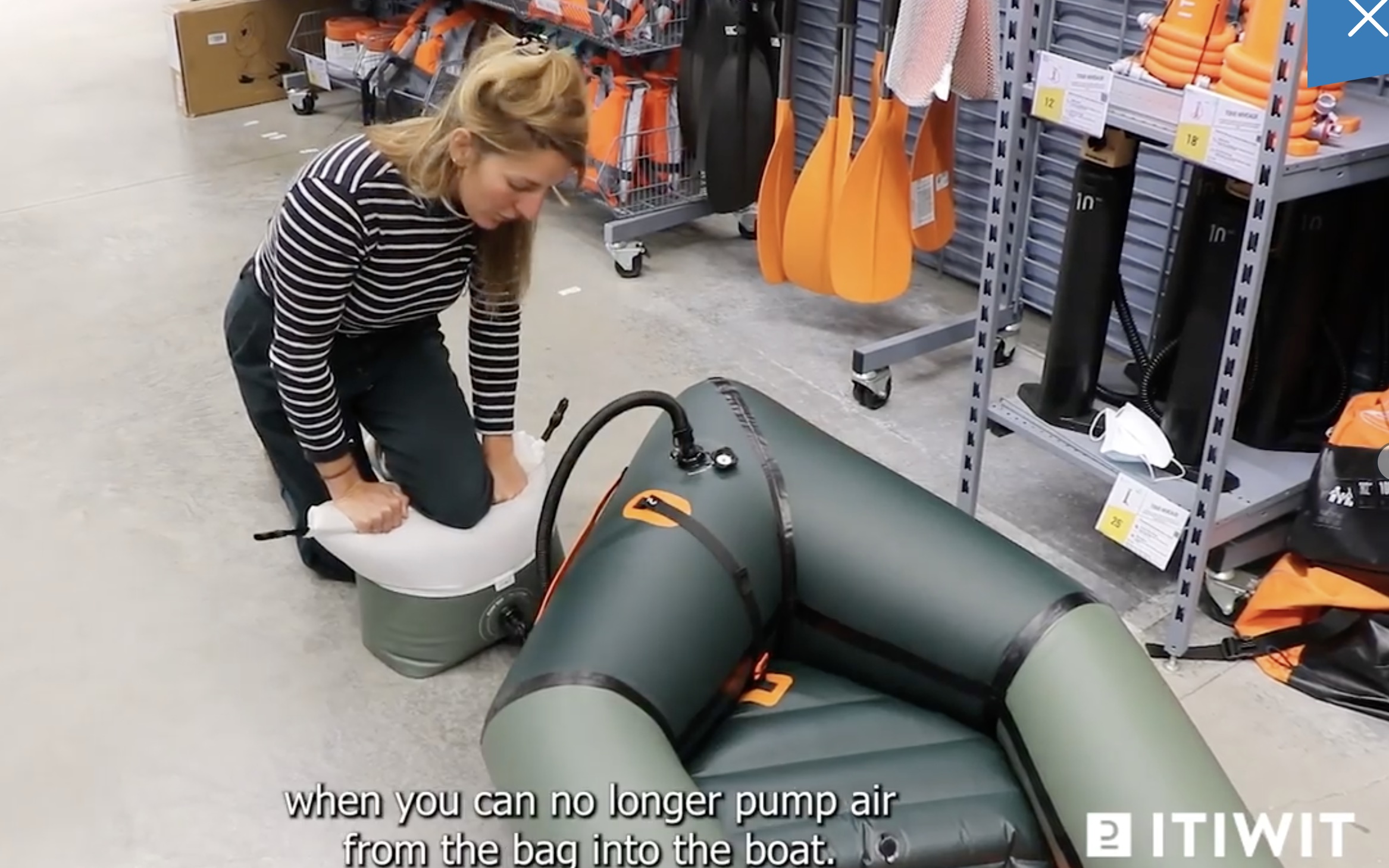
To inflate, you clamp a hose from the bag to the Boston valve, catch some air, roll up the ends then kneel on it (above left or watch the second vid). Top up by mouth only (see video below on this link), as they advise a hand pump may risk over-inflation. Then again we all managed packrafting for years with just air bags and mouth tops-ups long before mini hand-pumps came on the scene.

So there it is, Le Packraft 100 for le packrafting beginners, as long as they’re at the lighter and less tall end of the spectrum. And one good thing is Itiwit always make it clear spare parts are available.

At £380 I’m pretty sure it’s about the cheapest of the proper TPU packrafts (as opposed to PU nylon ‘crossrafts‘) and ought to be available wherever you find a Decathlon outlet.

Tested: 4-part kayaking paddles: Anfibio Vertex and Wave review

Two good-value, four-part paddles from Anfibio ideal for packraft or IK travels. The yellow Vertex Tour is a newer redesign and a lot lighter, even with a longer range of length adjustments and has a better clamp. But the black Wave (left) has the classic dihedral (two-faced) blade. What is the difference and does it matter?

What they say

Anfibio Vertex Tour
Our new, redesigned Vertex Tour paddle comes with a classic double blade, fine shaft and sub one-kilo weight. Equally suitable for lakes, calm rivers and moderate whitewater. The position length is adjustable from 210cm to 225cm at free angle.

Anfibio Wave
High-quality, lightweight carbon paddle for long tours on calm waters. Freely adjustable in length and angle.

I’ve done several hours with both paddles and for this comparison we took both on a 15-mile paddle down the Wey in Surrey in the TXL. It was a hot day but water doesn’t get any flatter unless it’s an ice rink. Below some weights and measures to mull over.

Weight gLength cmShaft cmShaft
g
Shaft øBlade gmLongest piece cmBlade cmPrice
Anfibio
Vertex
851g210-225118cm303g
fibreglass
29mm274g63cm
(blade)
44 x 19.5cm€125
Anfibio
Wave
1011g210-220108cm283g
carbon
29mm365g65cm
(blade)
44 x 16cm€125

I didn’t notice until I weighed the blades, but the two are made quite differently. The larger Vertex blade – about 650cm2 – has a molded central ‘corrugation’ to stiffen the blade. The Wave has a classic dihedral (two-faced) power face which is said to power smoothly through the water better than a plain flat blade. The Wave blade is also smaller – 600cm2 at a guess.

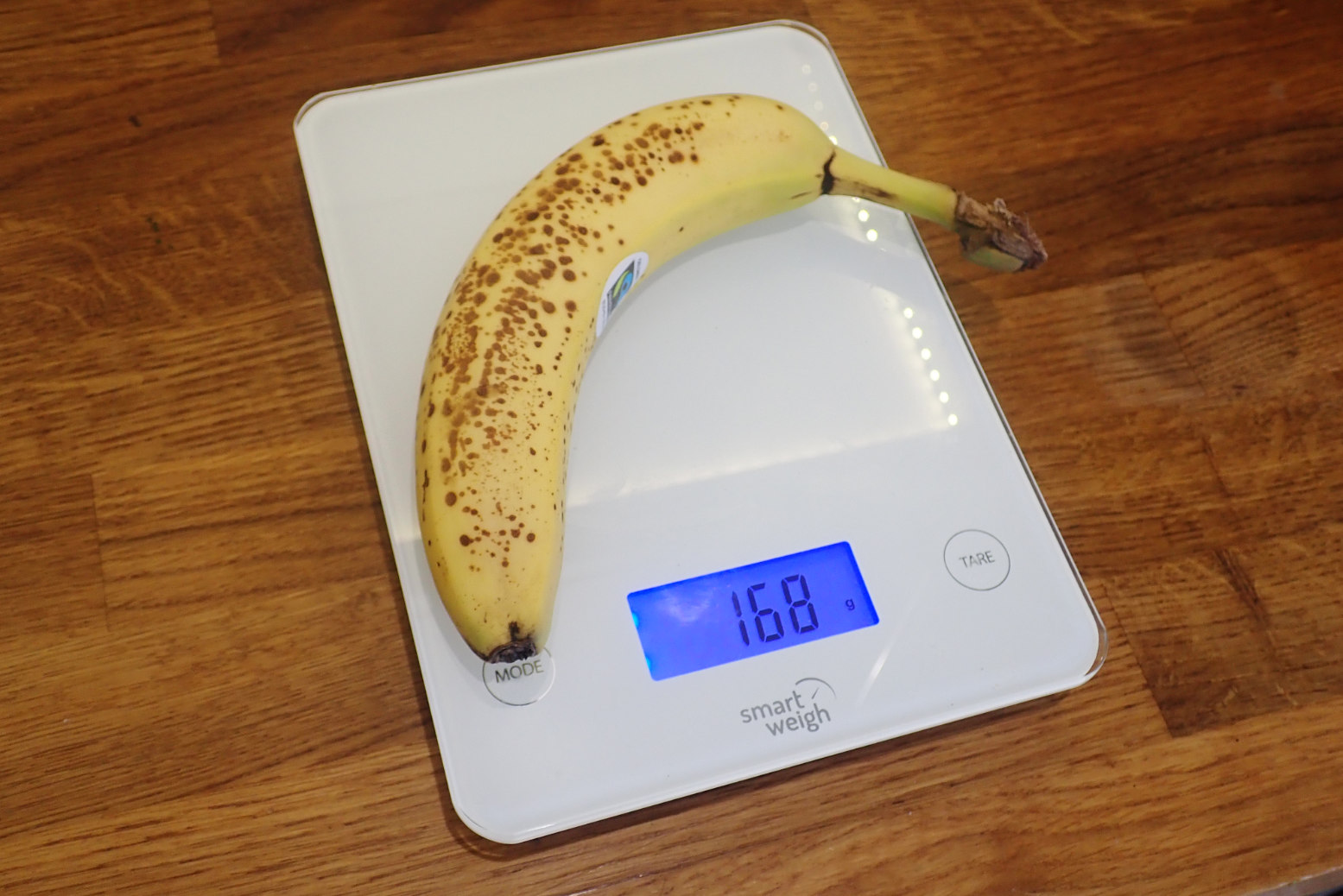
People ask: what is the the weight of a large banana?

So the main differences are weight, blade size and blade face, and I suppose adjustable length and the texture of the shafts. Will you notice the difference in a packraft? I very much doubt it but I think I’d prefer to paddle all day with the smaller bladed and dihedral Wave, even if it’s 160g heavier: the weight of a large banana.

I have a theory with length-adjustable paddles that into the wind or upstream (ie; max effort) you can ‘lower the gearing’ by shortening the paddle and leverage. Meanwhile downwind you can get the most of your paddle by setting it at full length overdrive. It’s good to have the option and one day I will test this theory but really, we paddle as hard as the situation demands. Sometimes easy, sometimes more efortful.

Wave shows the carbon weave; both are 29mm ø, good for smaller hands

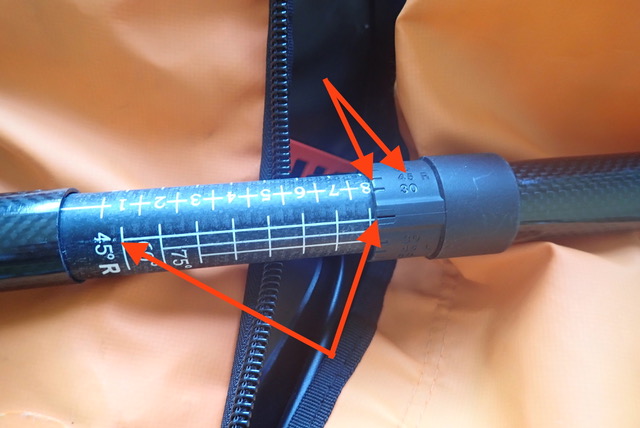
Feather angle alignment
My Vertex came with no alignment line on the lever clamp to set the angle against a grid. It took me a while to work this out until I couldn’t and a couple of yellow tape arrows set at my preferred 45°R. Anfibio have since told me this was a production flaw and current Vertex have an alignment marker on the clamp. A permanent alternative to my stick-on arrows would be melting a slot into the clamp with a hot knife. It would be easiest to do this with the paddle feathered at zero (no offset) which is easy to estimate. Think before you melt or use tape!

The Wave’s alignment system is as you’d expect. In fact there are two ways: a slot on the clamp to align with the grid; and pre-set angles molded into the clamp to align with the zero line on the grid. As it is, on both paddles the white alignment grid gets slid over at each assembly and will probably wear away over the years so you’ll end up with a tape marker anyway. That’s what I’ve done on my old Werners which had a grid sticker on the outside which eventually peeled off.

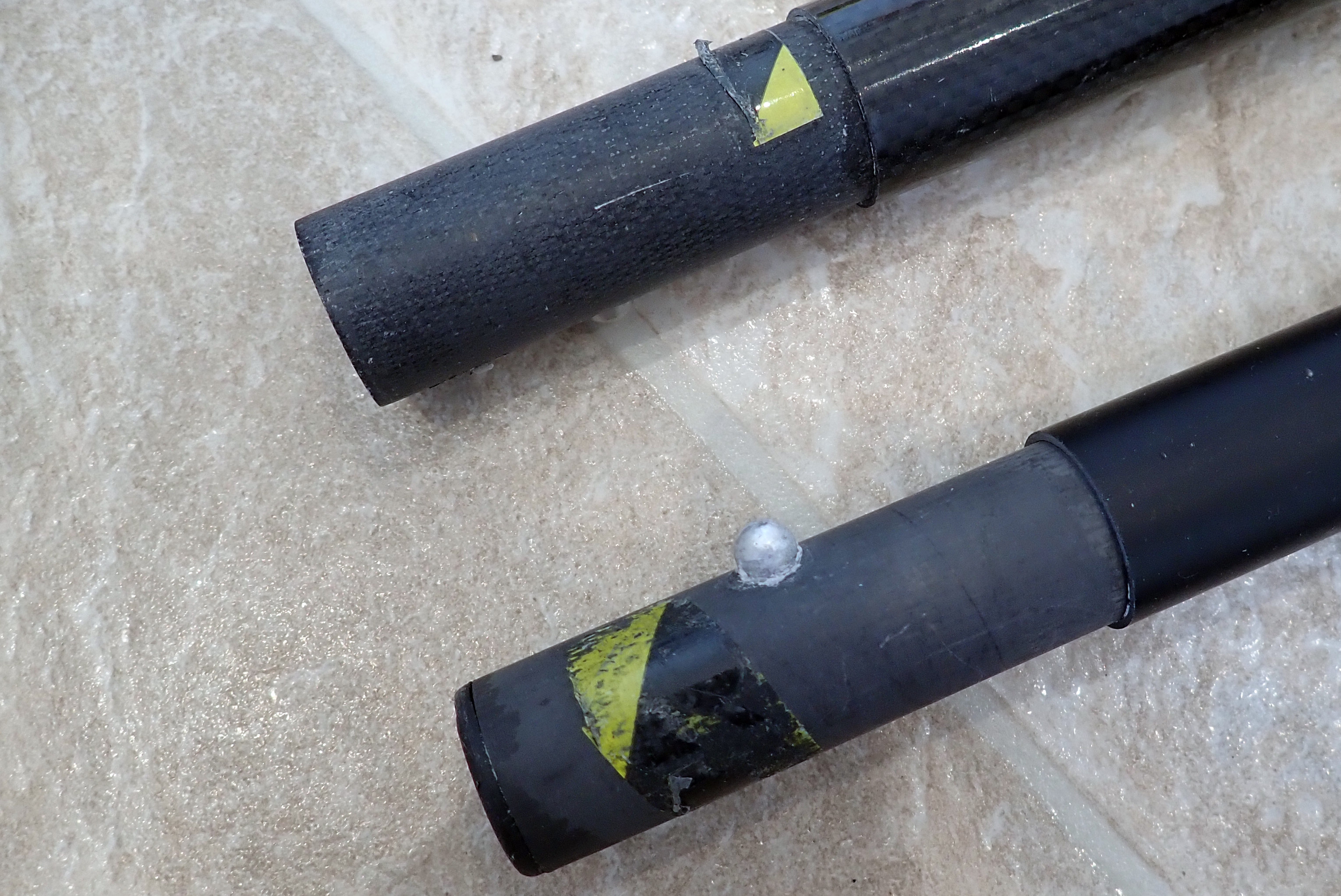
The blades on both paddles felt a little loose once mounted on the shafts. Maybe they’re made that way as the shaft may swell over the years as it did on my carbon AquaBound. It’s unlikely you’d notice on the move but no movement is best. A small bit of thin tape (left; not a full wrap) was enough to remove any play and if the tape wears or pulls off it’s easy to apply some more. Once clamped down there was no play at the shaft join.

On the Wey you might notice the weight swapping from one to the other, but after a while you’re just paddling. In a way the ideal combo would be fitting the smaller Wave blades on the longer, better clamped Vertex shaft, but oddly they’re not interchangeable.

In the end, for €125 you will not be disappointed because either paddle will proper your boat forward, adjust readily and fit easily in your pack.

Incidentally, I did an IK&P survey when I paddled the Wey in 2021. 2022 numbers in red. In over a decade I saw my first every packraft actually being used on the water! An underinflated MRS. I got the feeling the owner didn’t know that airbagging was not enough; you have to top up too. Has he not read my book?!

  • Hardshell canoes: 1 1
  • Hardshell kayaks: 1 8 (group)
  • Hardshell SoT: 1 0
  • Vinyl IKs (rock-bottom cheapies): 5 1
  • PVC (bladder) IKs 3 0
  • Packrafts 0 1!
  • iSUPs: 10+  (mostly women or mixed groups goofing off) 10
  • FDS IKs: 0 (IK&P most read page) 0

Preview: Aquaglide Cirrus 150 TPU hybrid kayak

See also:
AquaXtreme Explorer II
TPU The Mis ing Link
Hybrid IK Buying Guide
IK Fabrics

Nearly two years ago I predicted TPU IKs could be the next step and wrote:

[synthetic rubber is good but] … Packrafts, meanwhile, are mostly made from TPU (as well as PVC), a different sort of polymer coating which has many of the benefits of synthetic rubber: odour-free, smooth texture, light, UV resistant, supple (crease-free), not environmentally toxic. But, like PVC, it too can be heat welded. Since Alpacka got the ball rolling, there are now loads of brands banging out TPU packrafts. In this time the fabric and seam technology have proved themselves to be as durable as PVC or rubber, and capable of running higher pressures too. As someone on the internet observed: ‘Thermoplastic Polyurethane (TPU) is the link between rubber and plastic’.

Now that TPU packrafts are well proven, it could be time to ditch PVC and make TPU IKs, assuming the costs can be bearable. The benefits are principally nothing less than a huge reduction in weight.

Aquaglide Cirrus TPU IK
On the face of it the new Cirrus IKs seem to be copies of Aquaglide’s three PVC Chelen models (120, 140, 155) – never seen one but they look to be a decent hybrid. The PVC ‘155’ 15-footer weighs a hefty 42 lbs (19kg) and I bet will fill a large suitcase. Although that weight’s unverified, it actually compares well with other long hybrid PVC IKs and even my old 4.5-m Seawave at 17kg. But unlike a Nitrilon rubber Seawave, in my experience the rolled-up bulk of big PVC IKs can be off putting.

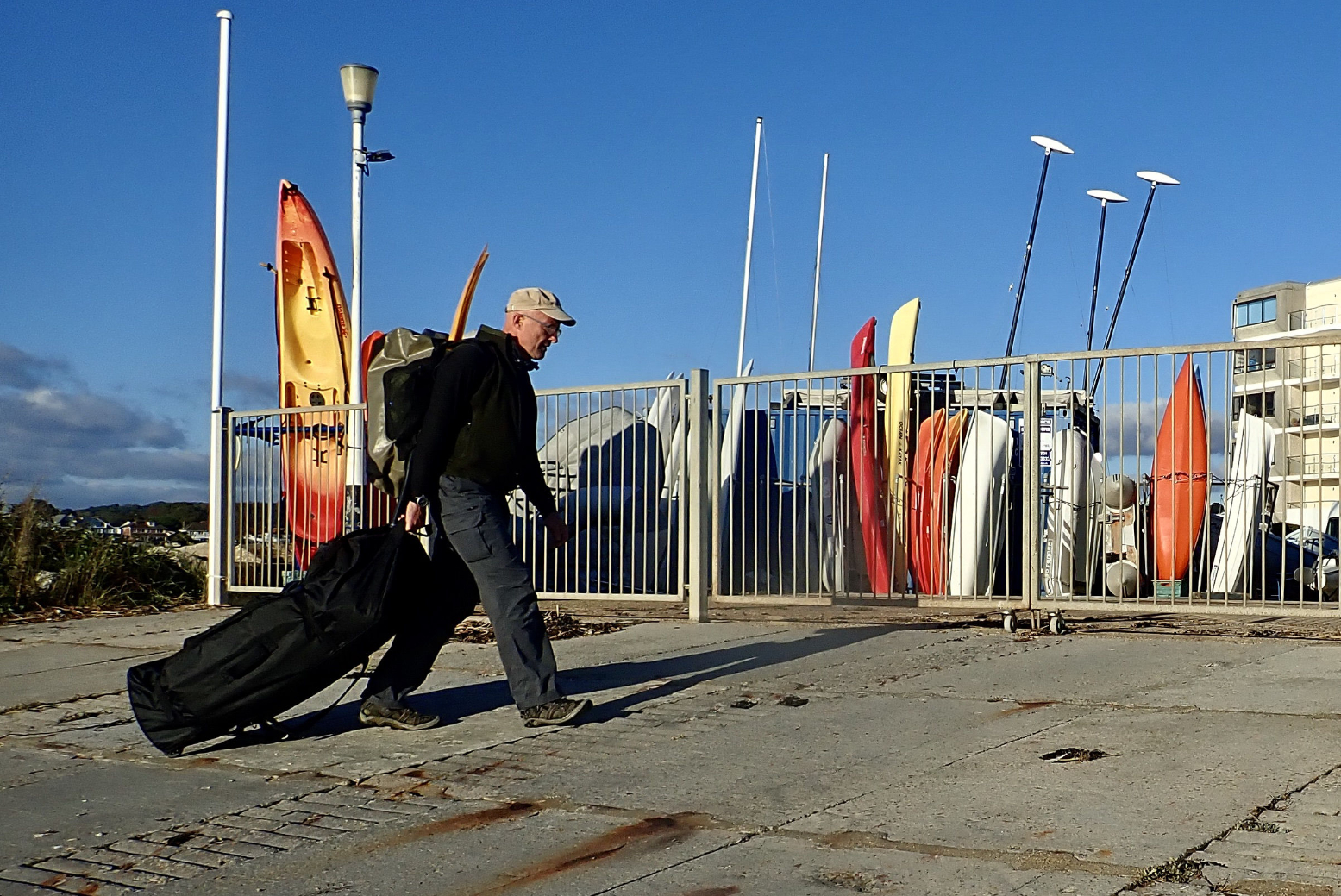
The press release claims the new Cirrus 150 will weigh just 18 lbs (8.1kg); a staggering <50% reduction on the PVC Chelan. The boat is 15 feet (4.57m) long, 35 inches (89cm) wide and claims to handle 600 lbs (272kg). You won’t need a wheel suitcase (left; Sandbanks) to cart a Cirrus around. By 2025 the price in the UK had plummeted to a reasonable £1400 or $1700 in the US.

According to the video above, the tubes are double-coated 70D nylon TPU. This sounds low compared to a packraft’s typical 210D hull, but remember denier is thread weight not coated fabric thickness (’70 x the weight of silk’). In the UK IronRaft sell 70D TPU and this MYO chap used it too. It’s at the very lightest end of the scale; 70D PU-coated nylon is what Supai use, though I’m not sure you can compare PU coating with TPU. The fact that the Cirrus will be double coated (most packrafts are now single coated) ought to provide extra support (more rigidity/less sag) without needing to resort to seam-straining higher pressures. One good thing about PVC is that it’s innately stiff once pumped up – good for performance if not packability.

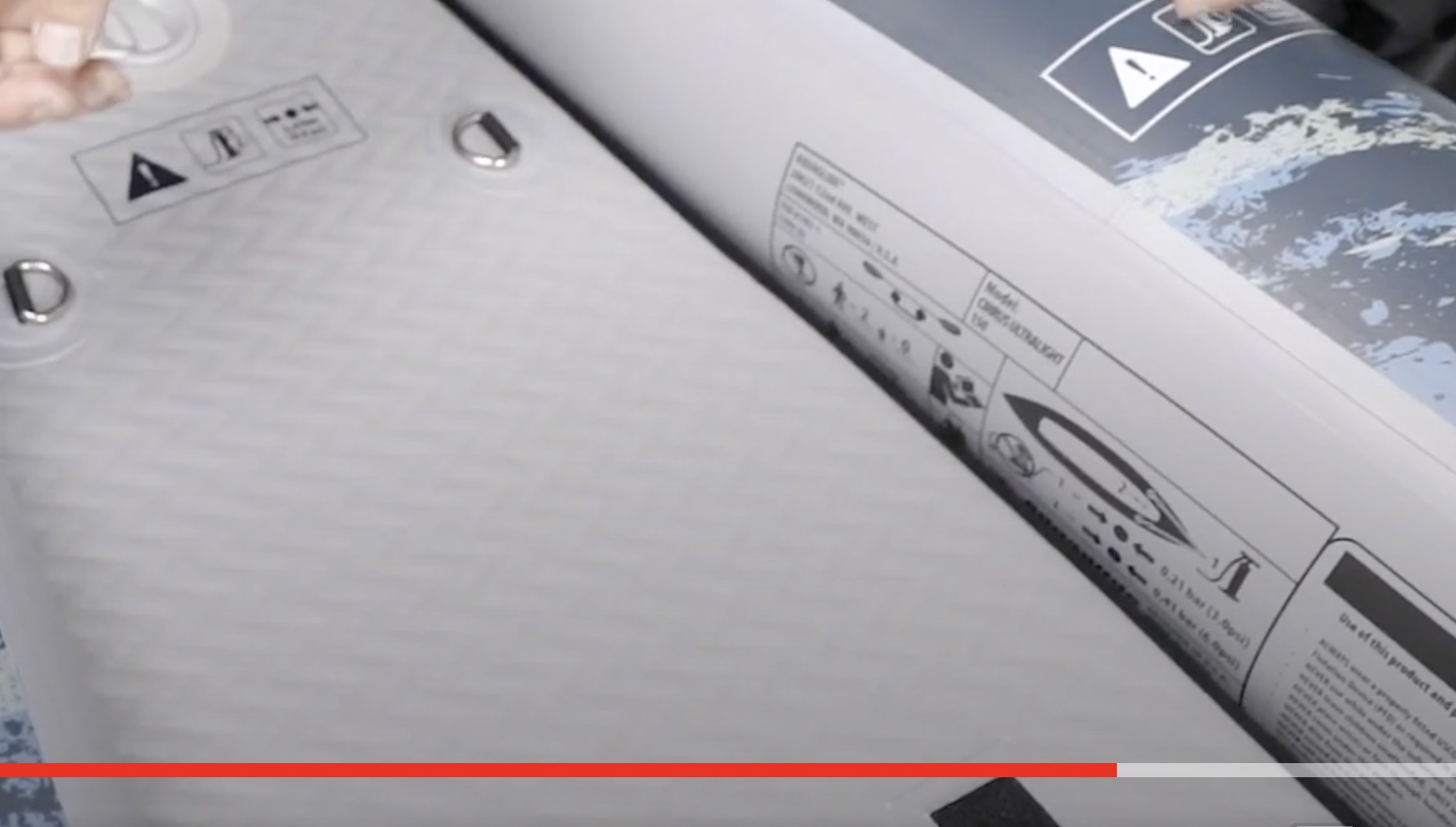
In the vid you can spot the floor pressure is rated at 0.41 bar (5.9psi) and the sides take a healthy 0.21 (3psi) which ought to be enough to give a rigid form without ruptures.

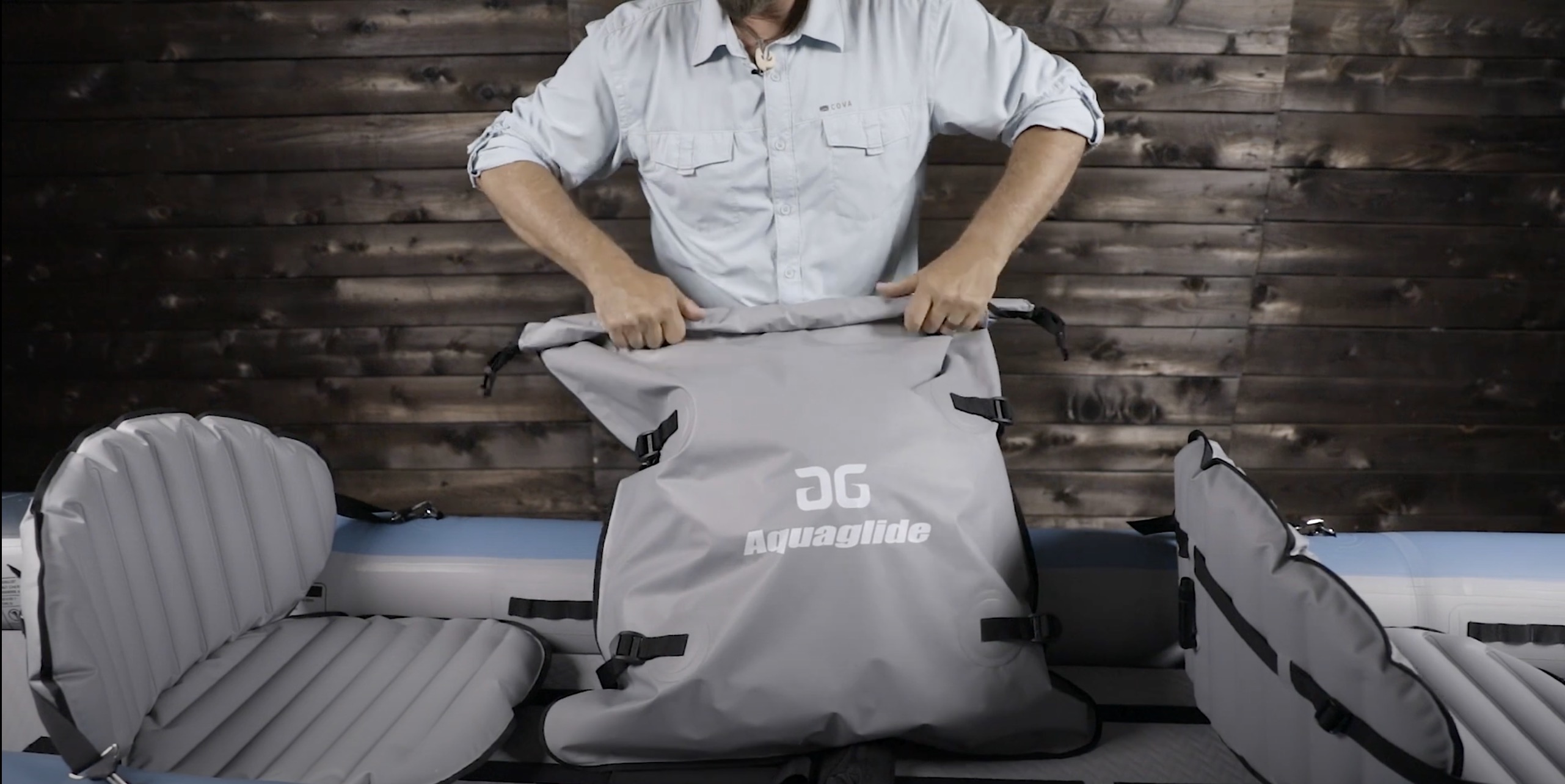
Unlike the Chelan, there appear to be no ‘have-your-cake-and-eat-it’ closeable self-bailing ports which I suspect have dubious value outside of white water paddling to which a 15-foot IK is ill suited. You just get the usual drain port in the back when flipping the boat over will achieve the same purpose. The floor is removable too according to a video comment; a huge benefit for quick rinsing, drying and cleaning. And we’re told the whole boat fits into the shoulder drybag as pictured below.

Price was always an issue with more sophisticated and less widely-used TPU and over £2000 is loads for an IK, but now everything everywhere has become expensive, does this matter less? Who knows but let’s hope this starts a trend towards more TPU IKs for folk who want the benefits of a lightweight tandem packraft like my current Sigma TXL, but in spacious and faster IK form.

Let’s end with something else I wrote two years ago:

A few years ago I predicted that full drop-stitch IKs would become the new thing. This has happened and has driven IK design and sales a long way forward. But, PVC aside, I’m still not convinced by the boxy profiles and packed bulk of FD-S IKs. Until FD-S forms can evolve (as the Itiwit X500 has shown), I think hybrid, drop-stitch floors (D-SF) are certainly the way to go, if an IK is to stay undecked, unlike the X500.
There will always be a demand for cheap vinyl or PVC IKs but I predict the next big thing in high-end IKs will be TPU, including removable D-S floors in TPU. TPU is now well proven with packrafts and blends the heat-welding benefits of PVC with nearly all the better attributes of ‘hypalons’.

Thanks to a couple of IK&P followers who spotted and passed on news of Aquaglide’s new Cirrus range of hybrid TPU IKs.

Book review: South West Sea Kayaking (+ Reeds Channel Almanac)

In a line
[SWSK has…] Loads of ideas and detailed information covering 50 paddling itineraries along hundreds of miles of England’s fascinating southwestern coastline.

Well worth 17 quid on amazon.uk

What they say

This revised and updated third edition provides a guide to the entire South West’s coasts and islands. It is packed with great photography and detailed route maps, alongside descriptions and anecdotes unveiling the region’s rich tapestry of maritime scenery, wildlife, history, geology and culture
April 2021; 272pp; Pesda Press

South West Sea Kayaking and Reeds Channel Almanac

Review
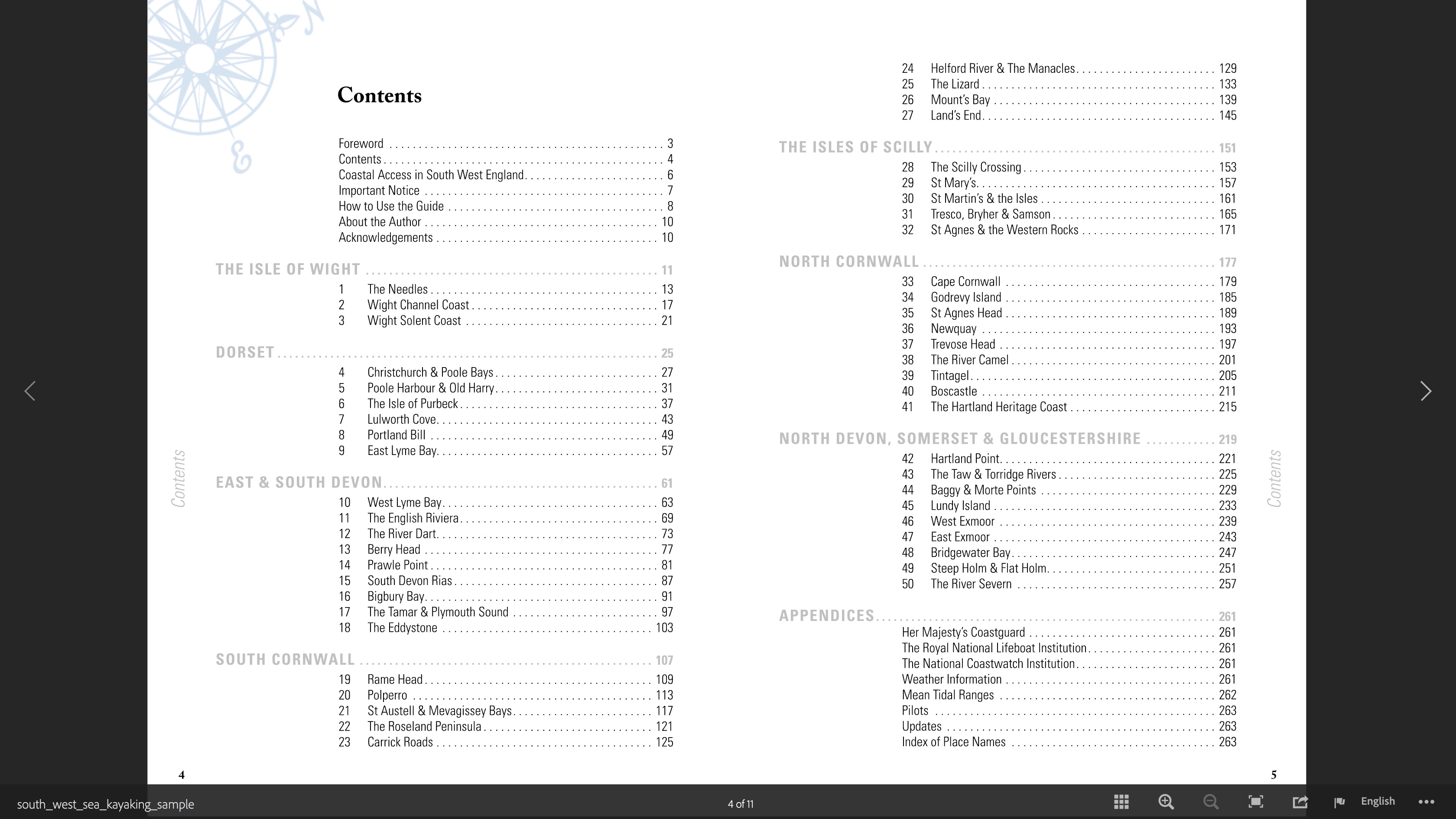
Although I’ve only done a couple of routes, this is a comprehensive handbook to safely plan a paddle along this complex but accessible and populated coastline. Or just browse through to get some ideas of what’s possible. Of the 50 suggested routes, 14 are grade ‘A’ for easy, 25 are ‘B’ and the other 11 are ‘C’, like Cape Cornwall, Lundy Island or the crossing to Scilly Isles which are a bit of a reach for a solo paddler in an IK, even without a gale blowing. Any IK or even a packraft party could manage a B in ideal conditions – but of course even an A-grade paddle could get too lively at the wrong tide in nasty weather. That’s UK sea paddling for you: a lot of sitting about watching the weather forecast.
Suggested start and finish points are given with a postcode and OS map coordinates along with the given OS sheet. It would be nice to also have more easily copied and interpreted GPS decimal degrees (for example: 51.2025, -4.6777: tip of Lundy) which most people use these days over arcane OS coordinates, even if they’re likely have OS maps in their phone or GPS.
Nearby tidal ports are a way of calculating the time of the tide in your area, and there’s a detailed paragraph on tidal times and what might be happening where and at what stage of the tide and how fast it runs during stronger springs. Some of this information was probably collected from a Reeds Almanac (see below) so it’s one less thing to buy or consult. As it is, most of us will check and bookmark local tide times on a phone before reception gets lost. I’ve recently found that Willy Weather gives many reliable timings for places between the UKHO locations.
In particular the Pedsa book will point out where the water can get turbid at spring tides around headlands – important information you’ll struggle to find or interpret easily online and especially important in a less agile inflatable.
A detailed description follows, you can tell most if not all the routes have actually been done by author Mark Rainsley at least once, and that’s followed by Tide & Weather and Additional Information, all adding up to a thorough guide to what you’re taking on. In between you get boxed asides, most describing terrible maritime tragedies or badly behaved smugglers which all chime with the author’s sometimes dark humour, as well as background reading: that’s the sort of guidebook we like!

One annoyance in search of a clean design is putting the captions of the many colour photos deep in the gutter of this thick and thick-papered book that’s about an inch in thickness. Along with the uncluttered colour maps, most of these photos work well in visualising the region described. And the dark humour mentioned can extend to gloating in the dangers in an ‘are you man enough?’ sort way, rather than encouraging what could be possible. But that’s the author’s style and you adjust accordingly, as with any guidebook.

I can see myself using this much more than Pesda’s North West Sea Kayaking guide I bought years ago and hardly ever used (as I mostly paddled in one small area). Even if you just end up doing a handful of Southwest routes in your IK or P, you’ll set off well armed with what need to know and so won’t regret spending the typically discounted 16 quid. It’s a lot of book for that money.


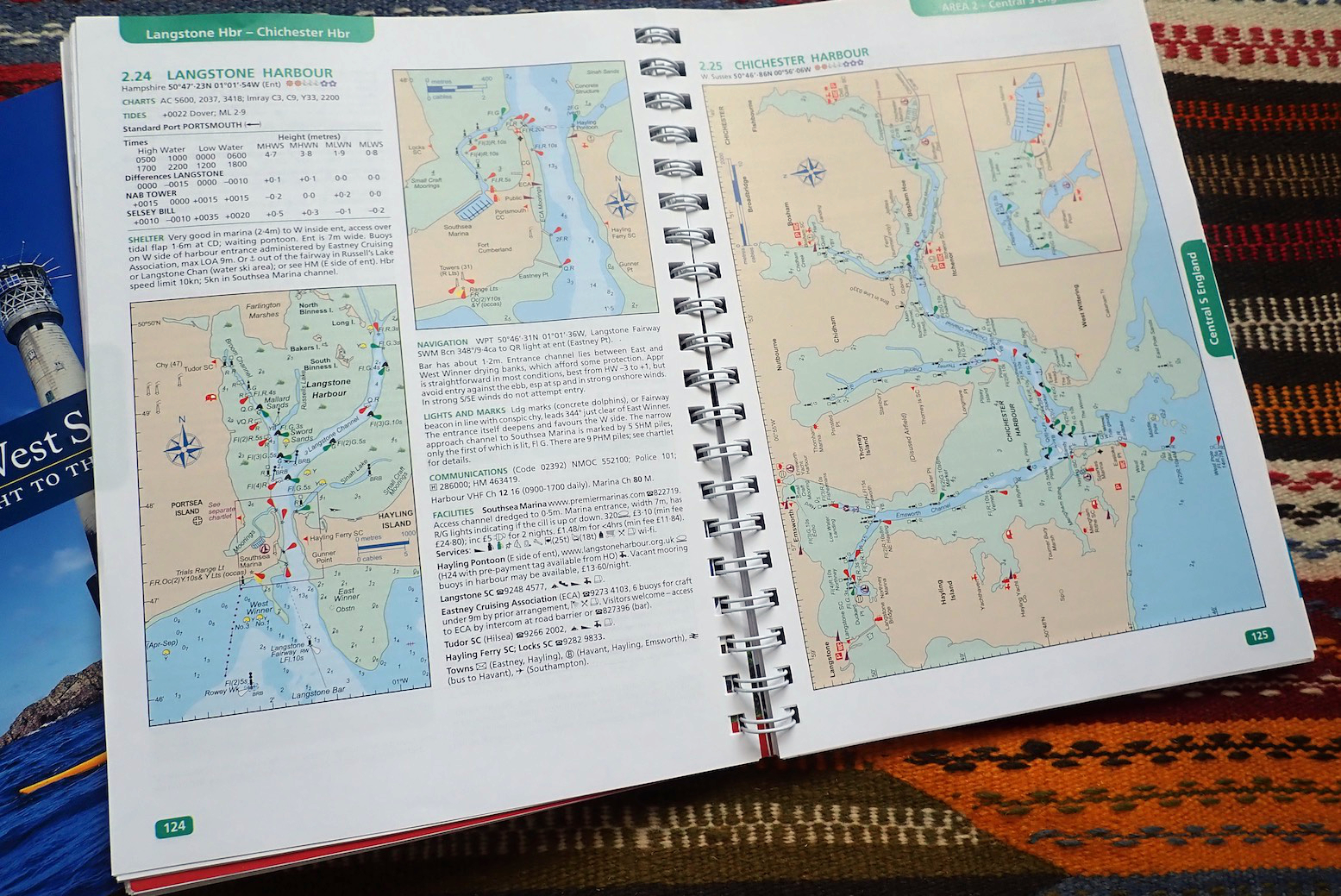
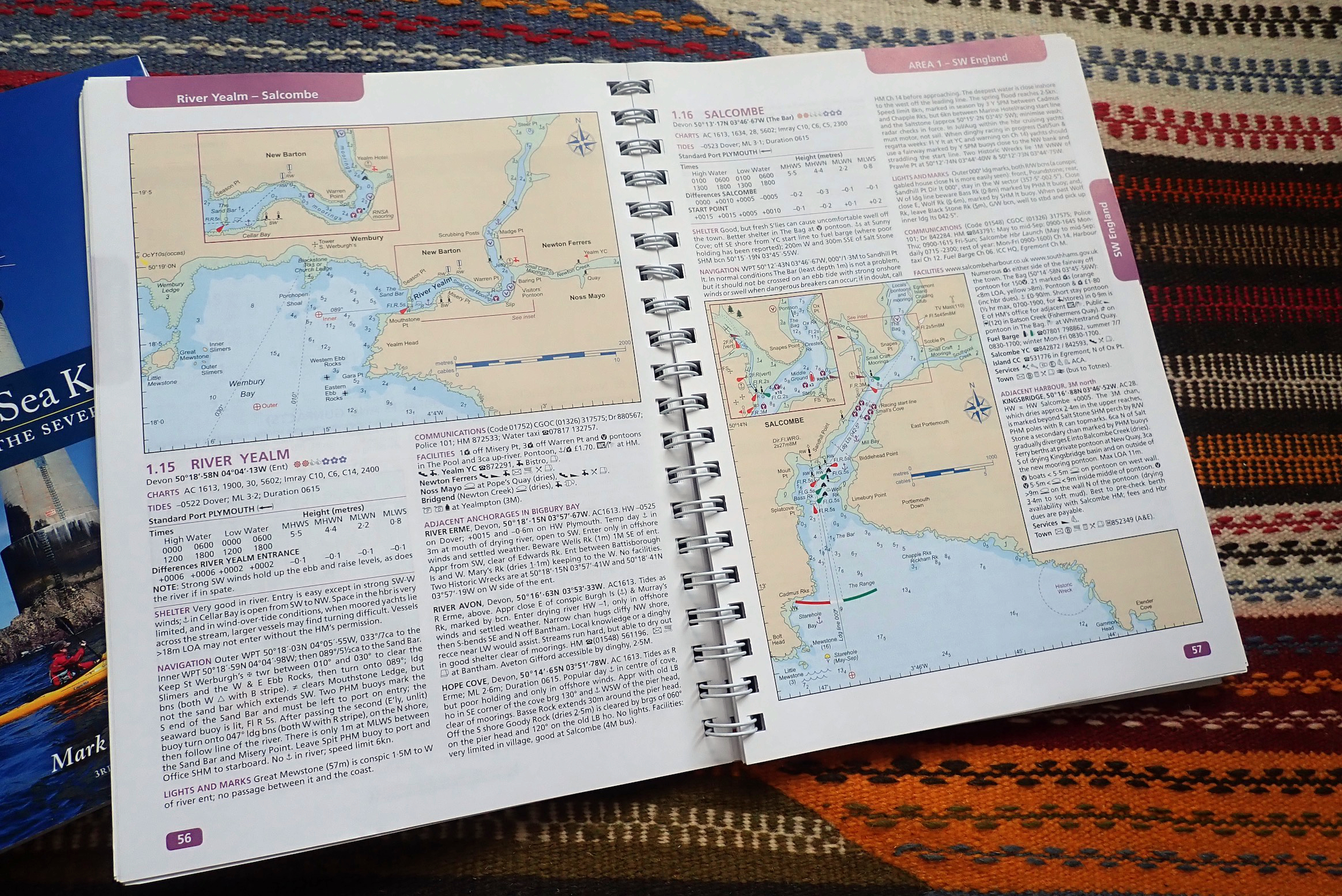
It was sailer Barry who alerted me to the value of a ring-bound Reeds Almanac prior to our Jurassic paddle. I’ve heard of Reeds of course, but assumed it was strictly for yachtsmen.
In print since 1932, there’s loads of little value or interest to a fairweather sea inflationeer – the most useful thing kayakers want to know are locally intensified tidal streams and the Pesda book covers that with more clarity on the included routes.
Still, it’s reissued every year with annual tide predictions (easily found online anyway) so you can pick up a recent used edition, like the ‘Channel Almanac’ (south England and NW French coast only) for a fiver, ditch the tide and French pages, and learn all about harbour features, the meaning of buoyage and big-picture tidals streams in the Channel over the 12-hour span of a tide (below left).

Packrafting the Jurassic Coast (video)

See also
Sigma TXL Index Page
MRS Nomad
Rye to Hastings
Newhaven to Brighton
Chichester to Bognor
Hayling Island
Swanage Stacks
Studland to Swanage
South West Sea Kayaking guidebook
Kayaking the Kimmeridge Ledges
Packrafting Kimmeridge to Chapman’s Pool
In Search of the Kimmeridge Pliosaur

I’ve done a few IK paddles in Southeast England between Rye and Portsmouth, but the Sussex and Hampshire coasts aren’t that inspiring. So it’s about time I started exploring the far more interesting and much more extensive Southwest Coast. From the Isle of Wight to Cornwall and back up to the Severn there are scores of inshore excursions possible in an inflatable. Just as in the far northwest where I mostly sea paddle, all you need is a fair tide and paddle-friendly winds, the latter a bit less rare down south.

In a blobby packraft? You cannot be serious!

So in the face of predicted moderate winds I cooked up a 50-km Jurassic overnighter from Weymouth to Swanage in Dorset. I’m pretty sure they opportunistically rebranded the plain old Purbeck or just ‘Dorset’ coast as the ‘Jurassic Coast‘ soon after that 1993 movie and haven’t looked back since.
Like much of the Southwest coast, the beaches and country lanes become a logjam of holidaymakers on a warm summer’s day. On the water, our paddle would pass below sections of cliffs a couple of miles long and take us to the famed landmarks of Lulworth Cove, Durdle Door arch (top of the page) and Dancing Ledge. We could even carry on back north past Old Harry’s Rocks and across Studland Bay right into Poole Harbour to catch out trains home.

TXL at sea

Compared to using regular (solo) packrafts, my confidence in my TXL for sea paddling is a revelation. After all, it’s still just another blobby, single-chamber packraft. It must be a combination of the added size giving a kayak-like perception of security (as I found in my MRS Nomad), as well as the responsiveness and speed from a longer waterline and, I now recognise, the sometimes noticeable added glide from the Multimat floor. There’s also the fact that paddlechum Barry was up for the Dorset run in his similar MRS Nomad, making this untypical packraft outing less daunting.

Lulworth tides – all or nothing (of not much).
Modest, two-metre tides off Purbeck

For some bathymetric reason – possibly the Atlantic tidal surge backing up in the Straits of Dover, plus hidden offshore shelves – the tides off the east Dorset coast are very odd: they can rise or drop all day, but have a range of just two metres, about as low as it gets in the UK. That ought to mean moderate ebb flows pushing up against prevailing westerlies, plus we were heading into neaps. And while often cliff-bound, if we stayed alert to escape routes we could easily bail and walk or climb out with our packrafts.

East of Lulworth Cove the Jurassic Coast‘s bucket & spade Babylon is interrupted by a 5-mile wide Danger Area – an army firing range. This was probably not one of UNESCO’s criteria for World Heritage status, but the SW coastal path also gets closed for a similar distance. Barry’s Reeds Almanac had a page or two on this (left), as well as useful tidal flow charts (drops to the west; rises east). I left it to Barry to call the ‘0800 DUCK!’ number, but imagined surely they’d leave the target practice to the off season. In fact they’re all it most of the time Mon–Fri, including an evening session 9pm to midnight: all we had to do was click this.

fishing.app – handy and similar toa Reeds Almanac but free
Early train to Weymouth

With a plan taking shape, I in turn bought a copy of Pesda’s South West Sea Kayaking in the hope of being alerted to local anomalies. I’m glad I did. It turned up with just hours to spare and identified that the run from Kimmeridge Bay round the Purbeck corner to Swanage was a grade up from the easy section from Weymouth. With headlands, submarine ledges and long lines of cliffs, without a foot recce I decided we may be better off skipping this bit.

It’s noon in Weymouth, but with offshores now predicted by late afternoon, we fast forward by taxi to Ringstead Bay, 5 miles in. That first section from Weymouth looks nothing special.
Put in at Ringstead. Ten mph westerlies blowing against an ebbing neap tide.
My Mk2 transverse bowsprit for a wide WindPaddle sail mount to limit swaying in stronger winds.
I’m giving the Multimat floor yet another go too, all the better to skim over the water.
We’re on the water at 1pm, hoping to reach Chapman’s Pool, about 21km away.
But around 5pm winds are said to veer offshore and strengthen, so we’ll see.
We sail at about 5-6kph – not much faster than paddling – but I note my TXL creeps forward about half a click faster than the MRS – must be the stiffening Multimat.
Propelled at paddling speed by his inflatable AirSail, Barry casually checks his investment portfolio.
The cliffs below Chaldon Downs. At times we paddled as we sailed to make less work for the wind.
Forty five minutes in, I pull in the sail and line the TXL up to thread Bat’s Head arch.
Note how the layers of chalk beds here have been pushed up to nearly vertical.
Give it half a million years and Bat’s Head will be as big as nearby Durdle Door.
Approaching the famous Durdle Door arch alongside a crowded beach.
The TXL still weathercocks a bit under sail; I keep having to steer hard inland, but the bowsprit ‘stick’ limits the sail’s ability to twist. Or maybe the wind’s bouncing off the cliffs and blowing us offshore a little.
Sitting further back to weight the back end over the waves may help.
Sunbathers watch spellbound as Barry smoothly ‘Durdles the Door’ – a Southwest kayaker’s rite of passage.
The Door has been durdled. Some claim ‘Dorset’ (formerly Wessex) was named after this famous arch.
In high summer young bloods jump off the 60-metre arch. Appropriately, it’s called ‘tombstoning’.
Near the entrance into Lulworth Cove things get choppy. Sat high on the airmat floor, if I feel unstable I can easily let it down. As we head through the Cove’s narrow neck a patrol boat circles back and instructs Barry we can’t carry on east; the army ranges are firing.
‘I thought you said you were going call them, Barry? You had one job to do…’
‘But you said they hardly ever do this on a balmy, July’s day!’
And so it went on…
A salty-eared boatman tells us the army pack up about 5pm, about 2.5 hours from now by which time the offshores may be on us as we cross the Kimmeridge Ledges mentioned in the Pesda book.
As we slurp a 99 with sprinkles the odd gust blows offshore.
We can’t even pack up and walk the cliff path; it’s closed too, and so is the B3070 road.
Barry wants to paddle on a 5pm, but I propose we bus to Swanage rather than risk being be left high and dry.
Tomorrow we’ll paddle north towards Poole – or as far as the predicted headwinds allow.
So a paltry 5 miles – but the classic stretch of the Jurassic Coast.
But there’s no campsite till August, so we pitch for free up in Durlston Country Park to the sound of beery revellers and Tuesday-night hoons doing burn-outs along the seafront. What can it be like on a Saturday night?
Six am next morning, a light breeze blowing from the northwest means no condensation ;-))
The Anfibio Multimat passed the sleeping test, too.
I walk a mile south to Purbeck’s corner at Durlston Head to inspect the tidal stream. Two hours before LW, it’s negligible, but further west, St Albans Head just out of Chapman’s Pool is said to be stronger. I must do that walk sometime.
Above, a ferry heads from Poole to the Channel Islands.
Looking back north you just see our tents on Peveril Point,
Ballard Down chalk cliffs and pinnacles stretch out beyond, and Bournemouth’s at the back.
At the cafe we meet Rach and Mark setting off on the final day of a staggering 630-mile walk along the Southwest coast from Minehead in north Devon. Their picture above taken a few hours later.
Meanwhile we prime our boats for the 6.3 miles past Old Harry to Poole Harbour Entrance.
We may carry on to Poole itself, but a strengthening wind may nix that idea.
No sailing today, Barry inches into the light morning breeze across Swanage Bay.
We reversed this trip a couple of months back.
Ballard cliffs in the wind’s lee at glassy low water.
Ballard’s spike, thought by some to be a fossilised Dendrosauraus tooth.
We approach the Pinnacles to the squawk of agitated seabirds.
Arches ripe for threading as far as the eye can see.
But this morning the tide is too low.
And it means there’s a lot of this string-weed floating about. It catches in our skegs but I have a solution.
Leaving Harry’s, Barry’s is a bit of a Lethargic Larry cutting across Studland Bay.
Halfway across, I remove a metre-long, kilo of Swanage string-weed caught in his skeg.
It’s all going nicely until 10.30am when the wind kicks up, then picks up some more.
But the GPS revealed we kept plugging on at 5kph, just with a lot more effort.
As Barry observed, it was a slog but good to know our packrafts can progress against this sort of wind.
With brain-out jet-skiers, sailboats, motorboats, working boats and the rattling Sandbanks chain ferry, we have to time our crossing across the busy vortex of Poole Harbour Entrance. Hitting 8kph, we cross a sharp eddyline where the incoming tide clashed with still-draining Poole Harbour. Barry hops out quick before the chain ferry trundles back. (Turns out it’s actually free for northbound pedestrians).
From Swanage to Sandbanks, followed by a 90-minute walk to Poole station for the train home.