Tag Archives: studland bay

Packrafting the Swanage Pinnacles

See also
Sigma TXL Main Page
TXL • Packrafting Old Harry (Swanage)
TXL • Packrafting Swanage
Kayaking the Swanage Stacks

A recent picture on BBC News of David Attenborough plugging his new Ocean film (or lamenting the ravaged state of the seas) reminded me that the dramatic Swanage Pinnacles and arches are just down the road. Having paddled just once last year, this would be a good first paddle to break in the shoulders. Last summer got nixed by a big book job, which was tackled full-on and did in my back for months and months – all compounded by finally catching the Covid (or so it felt).
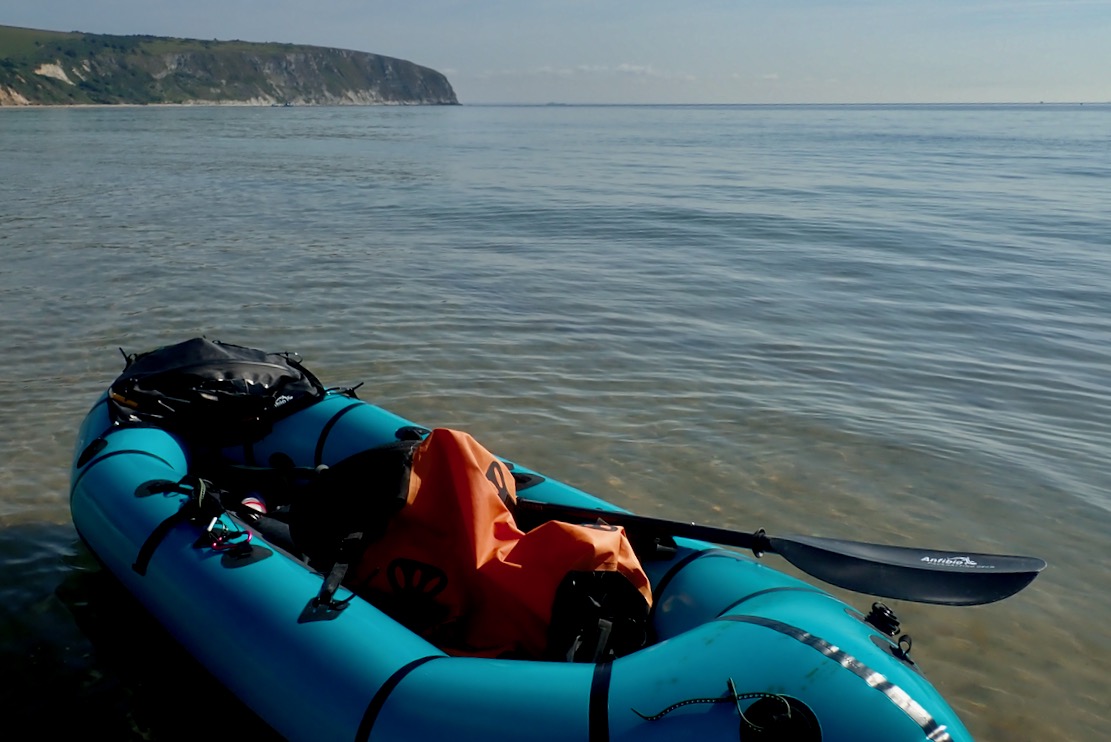
Ballard Point

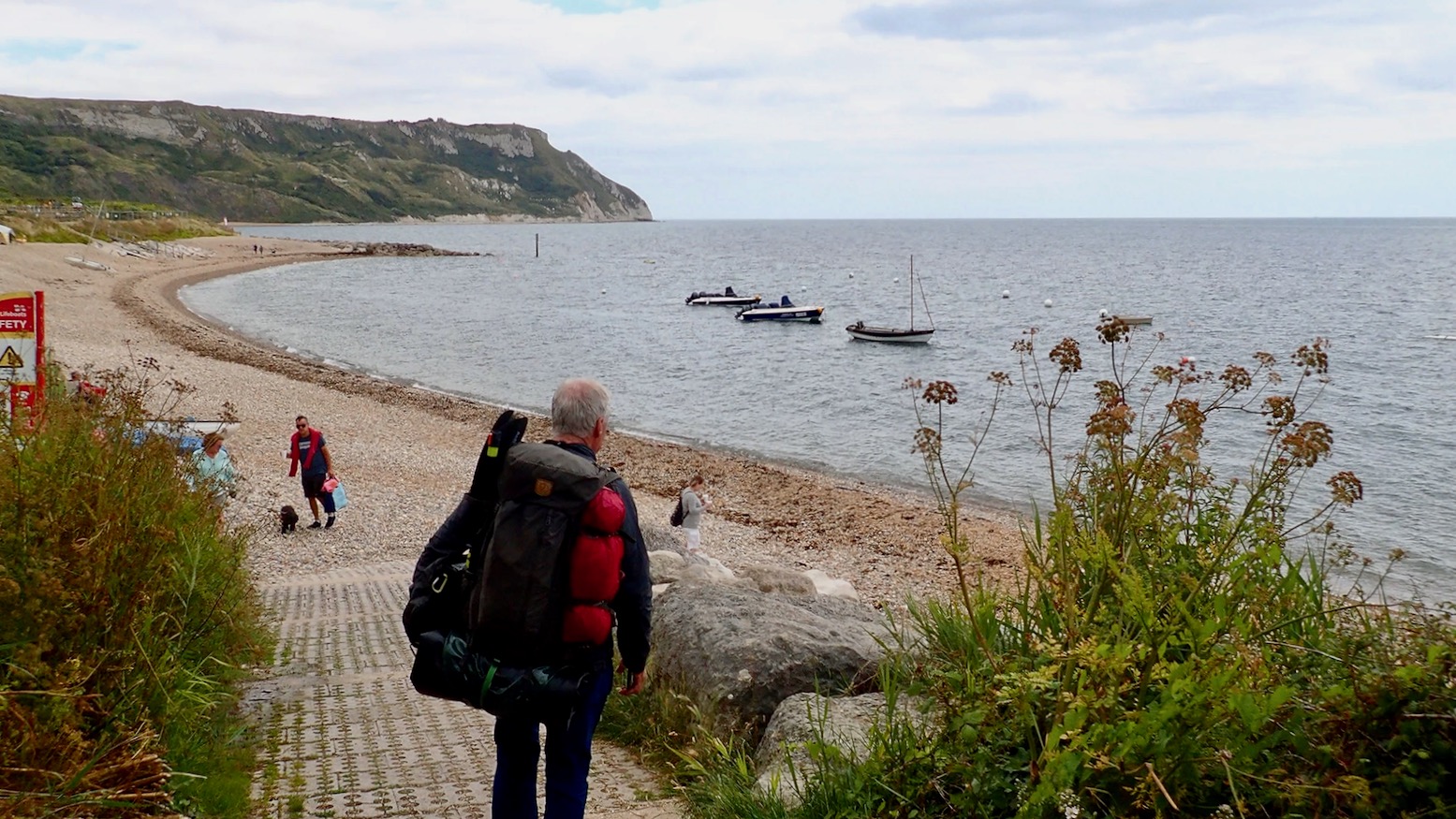
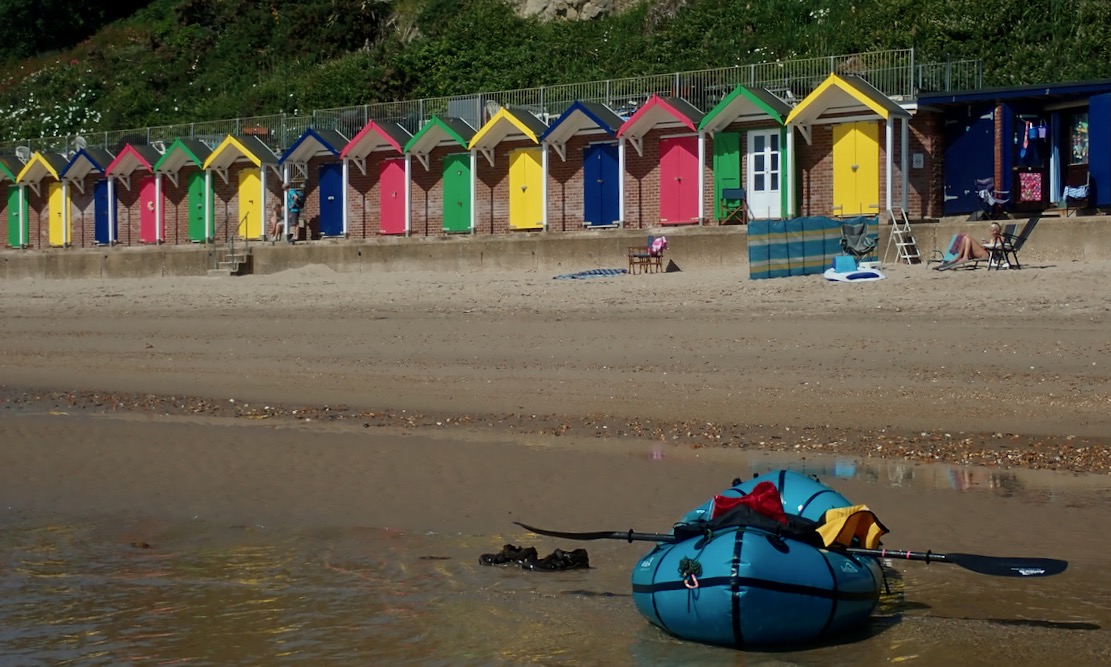
As beach towels and brollies were getting unfurled, I unrolled my boat and left Swanage Bay (above) at the bottom of the tide. It would carry me north against a light breeze that would flip and get behind me around noon.
But setting off towards Ballard Point (left), the TXL was all over the place, handling like a 1psi vinyl bath toy. Had I forgotten how to paddle straight in the last year? I groped under the stern with the paddle to see if it clanked against the skeg. Either I missed it or it wasn’t there.

Back on the beach, sure enough – no skeg; probably dislodged while putting in. This happened once before, landing on a rocky ledge where the fore and aft of the shallow surf saw the skeg slip its mount. After that I wrapped it in hi-viz tape.
I couldn’t see how it had happened today on a smooth, sandy beach, but I spent the next 40 minutes wading up and down, juggling estimates of longshore drift with onshore breezes, but unsure exactly which of the 20 Swanage groynes I’d set off from. I finally accepted the skeg was MIA: some errant doggie must have snapped it up and rushed it back to its bemused owner. Drat – and I’d paid for 6 hours parking too! I went for a swim anyway, ate my sandwich, then packed up while a beaky seagull dryly observed the lambent folly of human endeavour.
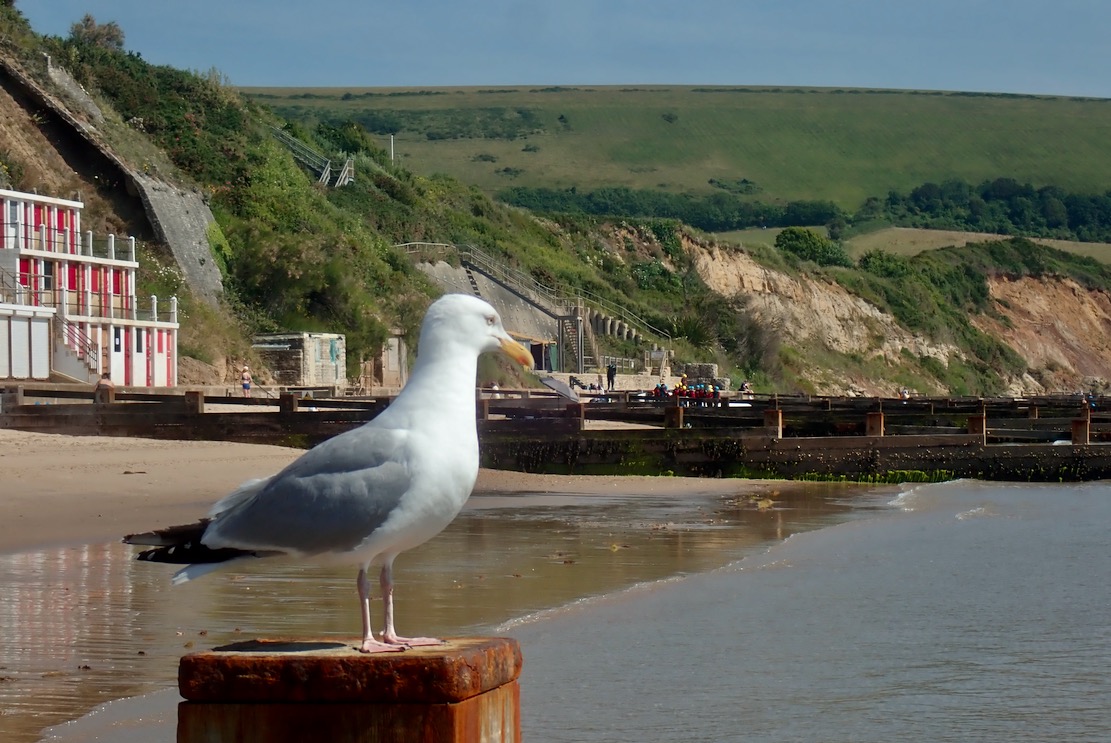
Look for my Skeg, ye Mighty, and despair!

Heading back, I recognised a little sandcastle I’d passed on my way down to the shore, all of 2 hours ago. Was it here I put in? I wandered back to the nearby groyne on the off chance, but soon got distracted by the flash of some sunglasses. I waded round the end of the groyne to pick them up and there sat my skeg! Like a lost desert traveller expiring just one dune short of a palm-ringed oasis, my search had been one groyne short. Saved by a thoughtful beachcomber, I grabbed my skeg and left the shades: this show was back on the water ;-)
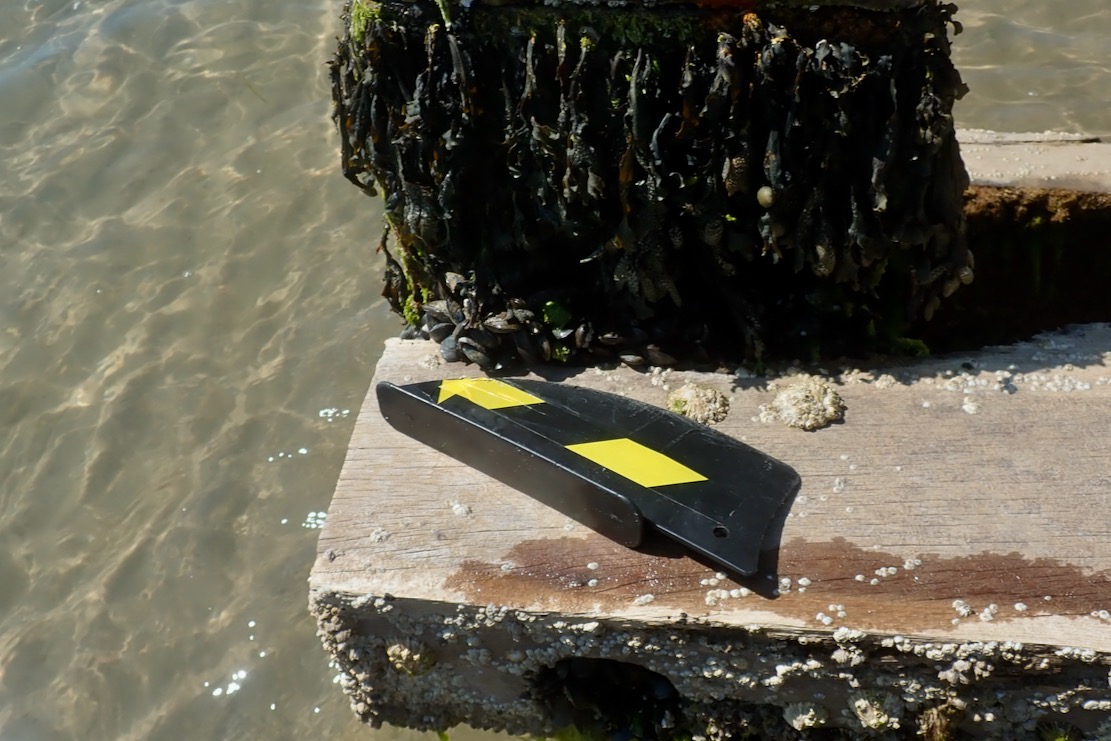
Don’t lose your skeg
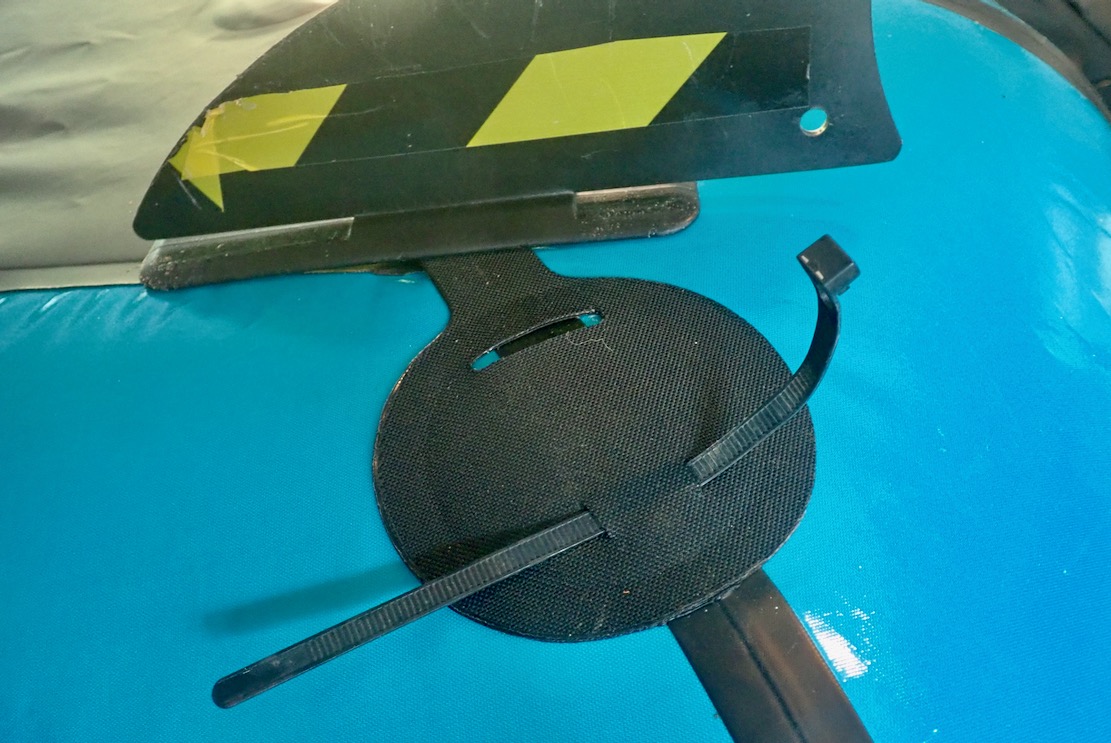
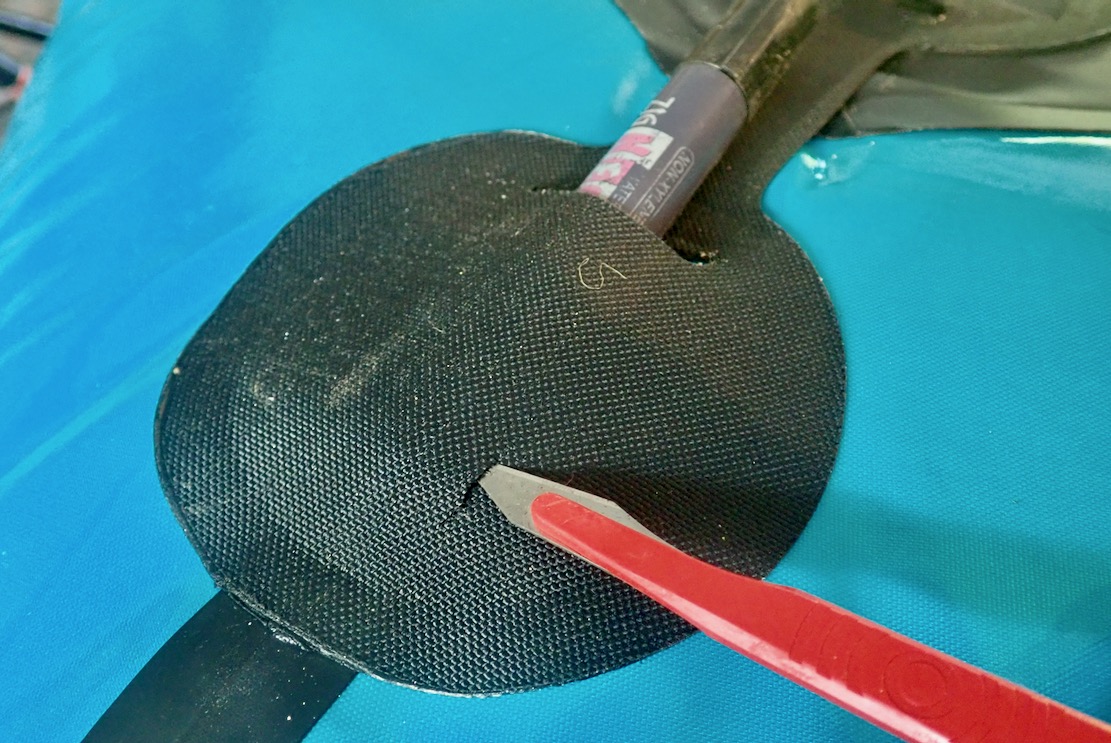
The lack of tension, even once inflated, can dislodge an Anfibio skeg following a small fore and aft movement of the hull pressing on the sea- or riverbed. On a flowing river, skeg-free is not so bad and you might need the clearance anyway, but at sea you definitely want a skeg for good tracking. Here’s one solution.
Stick something like a fat sharpie under the rear skeg patch to lift the fabric away from the hull; you don’t want to stab your packraft
Make two incisions which line up with the hole at the back of the skeg
Feed a reusable cable tie through the slits and leave it in place. The skeg will now be secure
Skeged up, the TXL sliced NE towards Ballards Point like a troupe of dolphins late for the ball. I was sitting on the optional floor inflata-mat, which stiffens the long hull, reducing drag).
Edging towards the Point, I could feel the boat slowing down against the eddy hooking back southwest into the bay (left; LW+3). Passing over the corner some clapotis (below) was jingling about, pushed up by the eddying current.
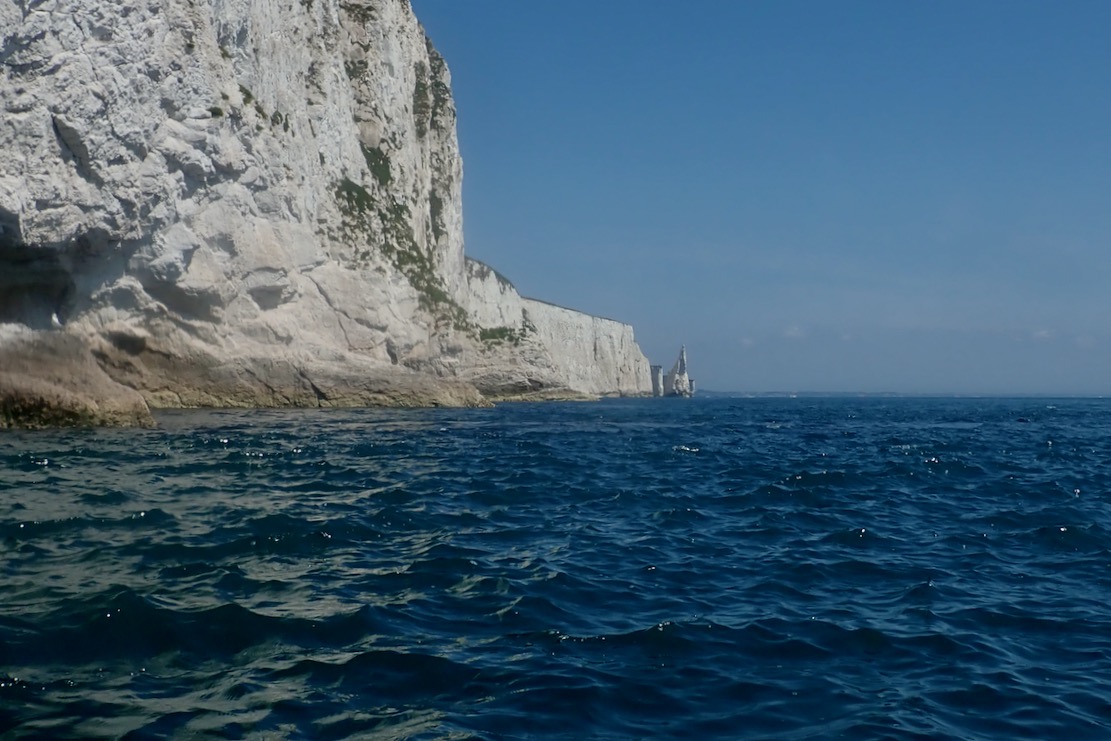
Once round the corner, with the wind and tide now behind me, I was expecting record speeds. As usual though, with a backwind you lose the ‘wind-in-your-face’ impression of speed, which can be quite dissatisfying. To my right, jet-skiers were thrashing about, making me feel uneasy. Paddling quietly along, it’s hard not to feel intimidated, far less any aquatic fraternity towards these wave-jumping motocrossers. The sooner they all go electric the happier we’ll all be. But either way, I bet they’re a blast to ride!

Awesome!

Up ahead rose the oddly nameless Jurassic fang, seen behind Attenborough at the top of the page. All the other outlying pinnacles hereabouts are flat-topped. When you work out the thin rib of chalk where they got DA to stand to get the shot, you’d hope there was an unseen safety line securely attached to Britain’s most treasured national. As I passed between the fang and the cliff wall, a gust shoved me through, and I saw later the GPS had hit a dizzying 9kph.

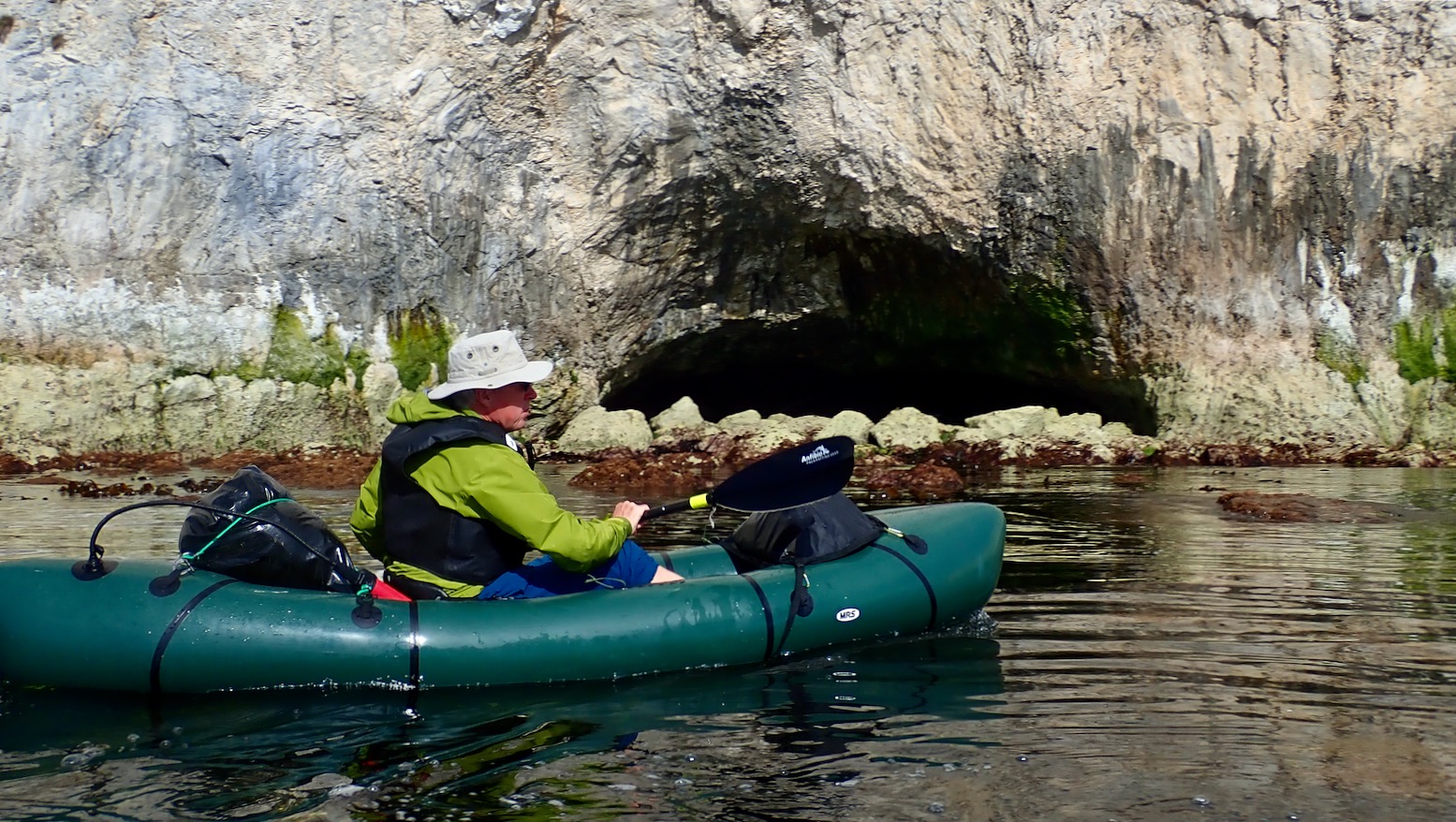
Beyond lay the first of the chalk arches which make this paddle so special, and why it got featured on the title page of my IK beginner’s guidebook (below). At the first small arch the wind bounced me back off the high walls, then whooshed me through the calcified portal like a popped cork. On the far side some paddle-boarders out of nearby Studland were taking a break on a tidal ledge.
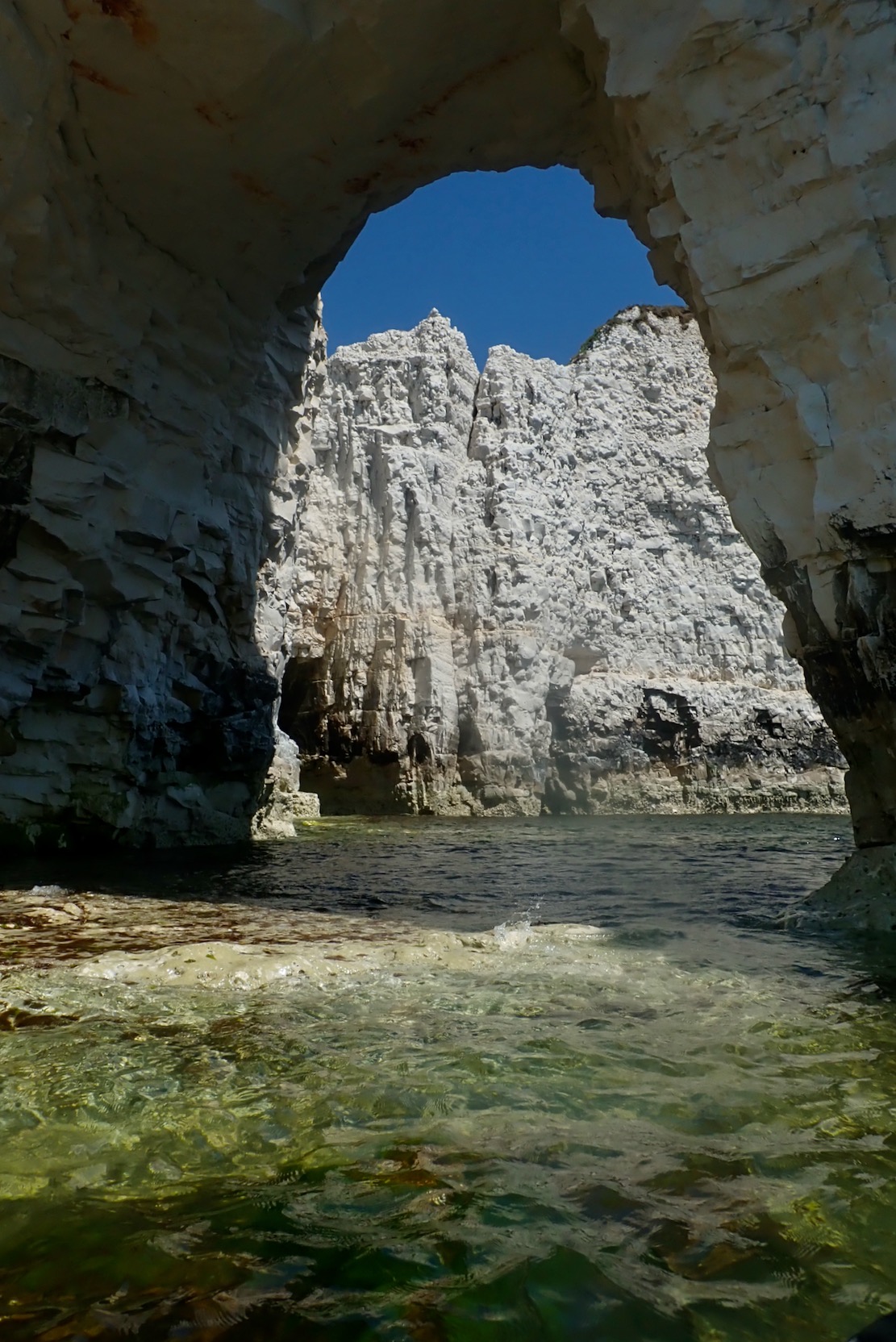
With the tide about halfway in, I threaded the passable arches around Old Harry’s (above), while other paddle sports enthusiasts milled about at the geological wonder of it all and from the cliffs above, walkers looked down with envy.
Once round the corner and in the lee of Ballard Downs, all that remained was to head west for Studland South Beach and pull the plug.

Convincing

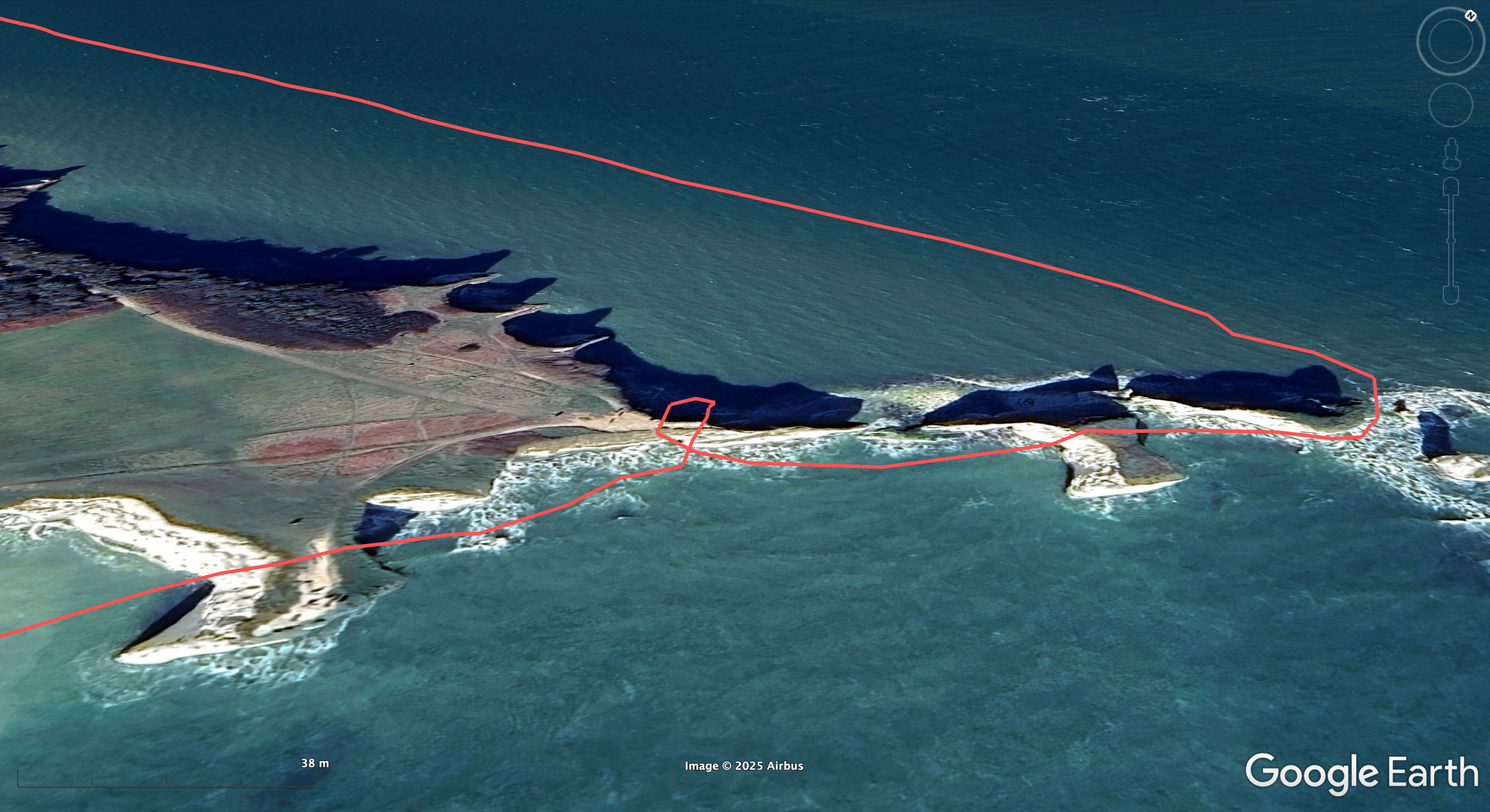
With a bit of energy to spare and nothing to lose, at one point I put my head down and powered on to see ‘what she’ll do [mister]’. The GPS data log revealed a blip from a steady and sustainable 5kph to a limited-endurance 6kph, which would soon drain the batteries. Six kph must be the maximum hull speed of a TXL on near still and windless water. Better to save such efforts for unwanted offshore headwinds. Even then, looking at the data below, I’m again amazed what a portable raft which you can easily pack up and walk with anywhere will do on the open sea. ISuPs may be loads more popular, but to paraphrase former Met Police commissioner, Robert Mark, ‘I’m convinced packrafts are a major contribution to paddle sport adventures’.

Fast

On South Beach oiled-up heliophiles were laid out like seals. It reminded me of a radio doc about boredom I’d caught the previous evening. In an experiment, apparently 70% of males preferred to self-administer a light electric shock rather than sit still in an empty room for 15 minutes. They should give them a sun bed next time, but perhaps I’m missing the point.

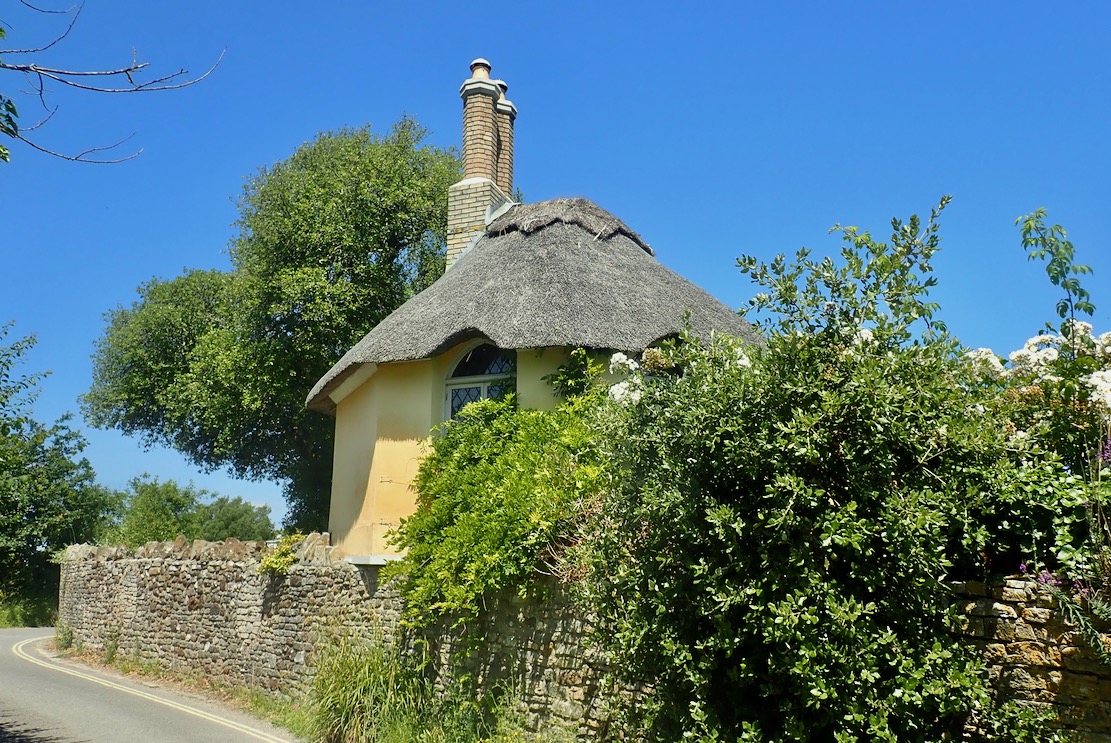
I could have walked back the couple of miles over Ballard Downs to Swanage, but what with the time wasted on the skeg search-and-rescue mission, I didn’t want to risk getting back late to the parking before something terrible happened.

So I treated myself to the 20-minute open-top #50 bus ride back to town.

All together now:
We’re all goin on a
Summer holi-day…’
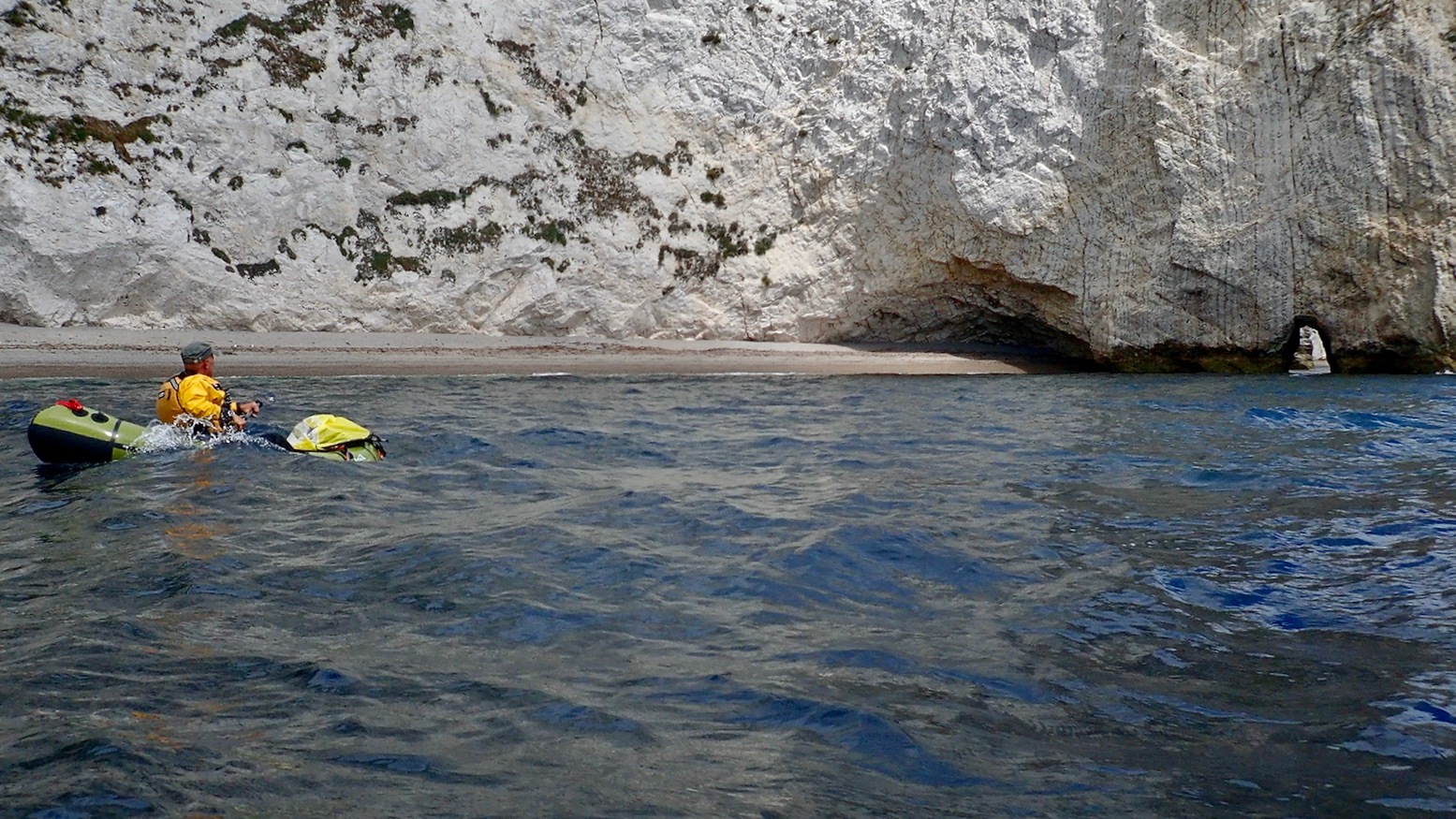
Packrafting the Jurassic Coast (video)

See also
Sigma TXL Index Page
MRS Nomad
Rye to Hastings
Newhaven to Brighton
Chichester to Bognor
Hayling Island
Swanage Stacks
Studland to Swanage
South West Sea Kayaking guidebook
Kayaking the Kimmeridge Ledges
Packrafting Kimmeridge to Chapman’s Pool
In Search of the Kimmeridge Pliosaur

I’ve done a few IK paddles in Southeast England between Rye and Portsmouth, but the Sussex and Hampshire coasts aren’t that inspiring. So it’s about time I started exploring the far more interesting and much more extensive Southwest Coast. From the Isle of Wight to Cornwall and back up to the Severn there are scores of inshore excursions possible in an inflatable. Just as in the far northwest where I mostly sea paddle, all you need is a fair tide and paddle-friendly winds, the latter a bit less rare down south.

In a blobby packraft? You cannot be serious!

So in the face of predicted moderate winds I cooked up a 50-km Jurassic overnighter from Weymouth to Swanage in Dorset. I’m pretty sure they opportunistically rebranded the plain old Purbeck or just ‘Dorset’ coast as the ‘Jurassic Coast‘ soon after that 1993 movie and haven’t looked back since.
Like much of the Southwest coast, the beaches and country lanes become a logjam of holidaymakers on a warm summer’s day. On the water, our paddle would pass below sections of cliffs a couple of miles long and take us to the famed landmarks of Lulworth Cove, Durdle Door arch (top of the page) and Dancing Ledge. We could even carry on back north past Old Harry’s Rocks and across Studland Bay right into Poole Harbour to catch out trains home.

TXL at sea

Compared to using regular (solo) packrafts, my confidence in my TXL for sea paddling is a revelation. After all, it’s still just another blobby, single-chamber packraft. It must be a combination of the added size giving a kayak-like perception of security (as I found in my MRS Nomad), as well as the responsiveness and speed from a longer waterline and, I now recognise, the sometimes noticeable added glide from the Multimat floor. There’s also the fact that paddlechum Barry was up for the Dorset run in his similar MRS Nomad, making this untypical packraft outing less daunting.

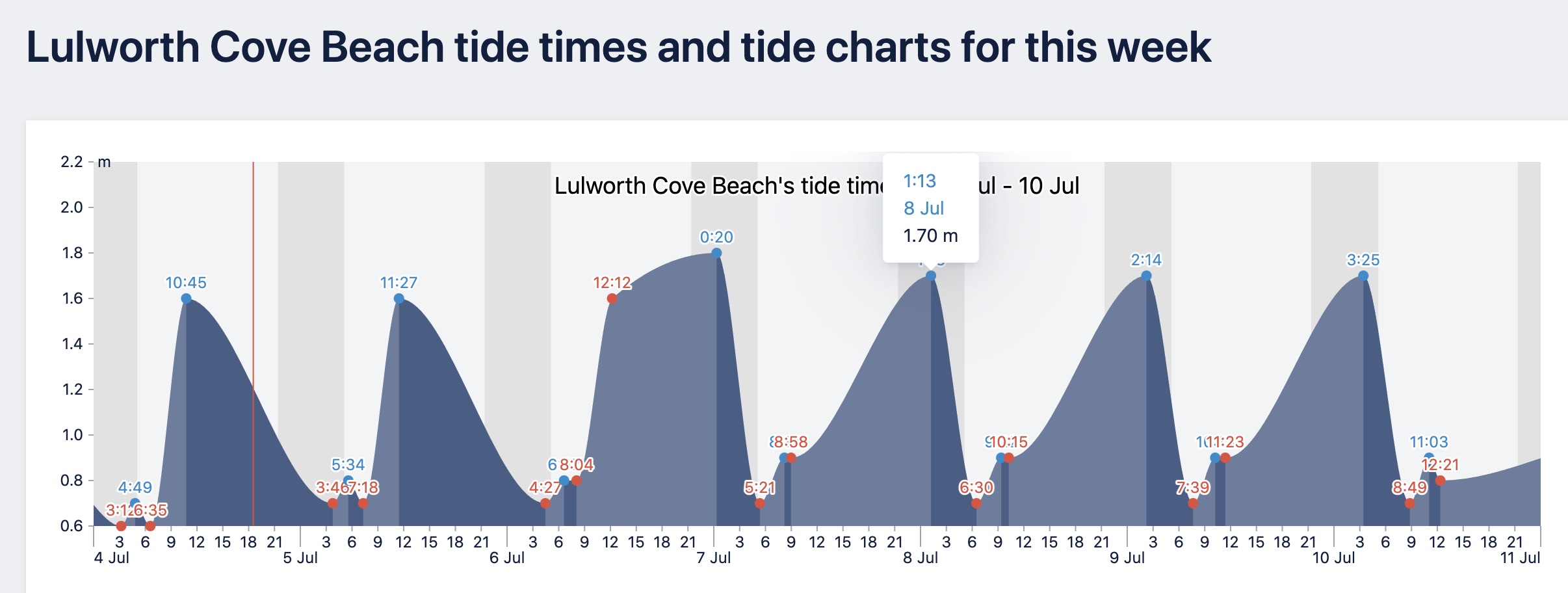
Lulworth tides – all or nothing (of not much).
Modest, two-metre tides off Purbeck

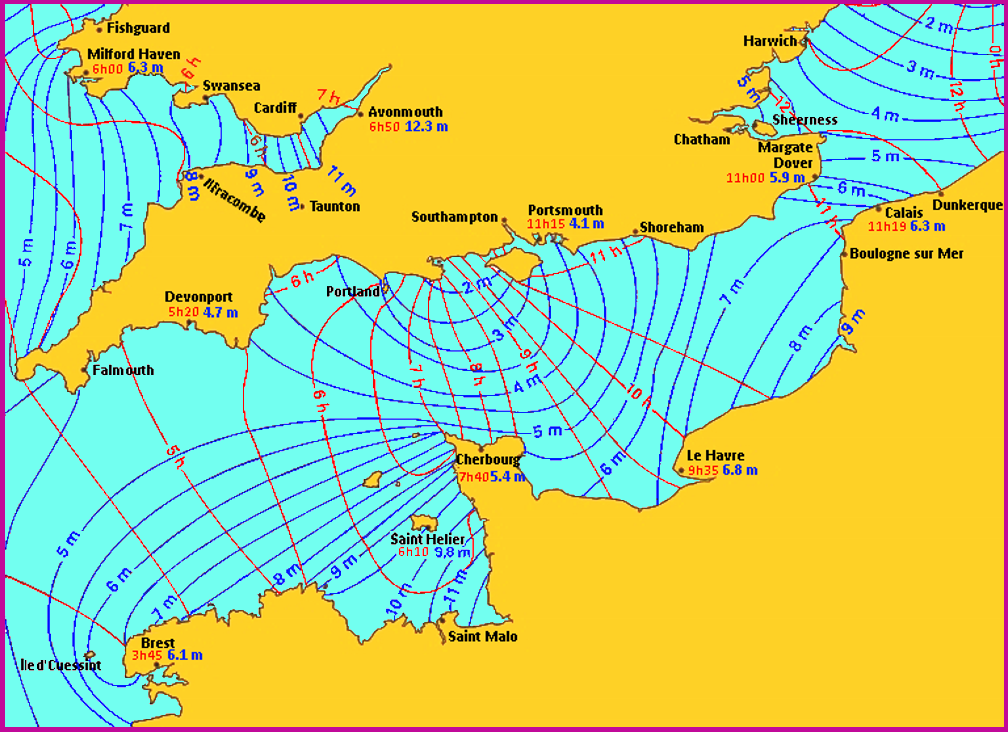
For some bathymetric reason – possibly the Atlantic tidal surge backing up in the Straits of Dover, plus hidden offshore shelves – the tides off the east Dorset coast are very odd: they can rise or drop all day, but have a range of just two metres, about as low as it gets in the UK. That ought to mean moderate ebb flows pushing up against prevailing westerlies, plus we were heading into neaps. And while often cliff-bound, if we stayed alert to escape routes we could easily bail and walk or climb out with our packrafts.

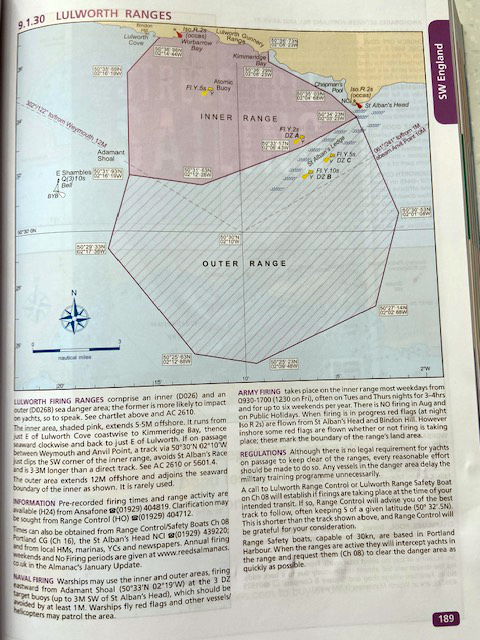
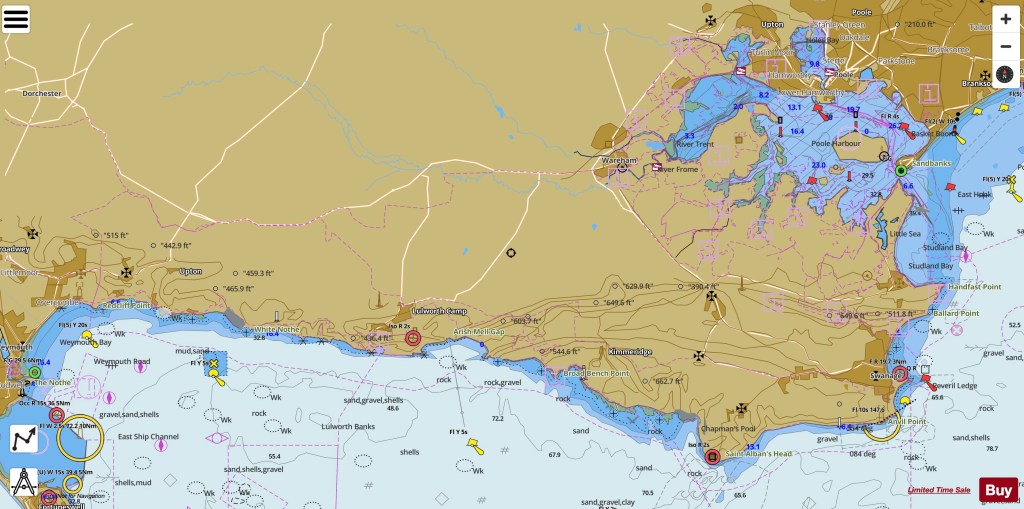
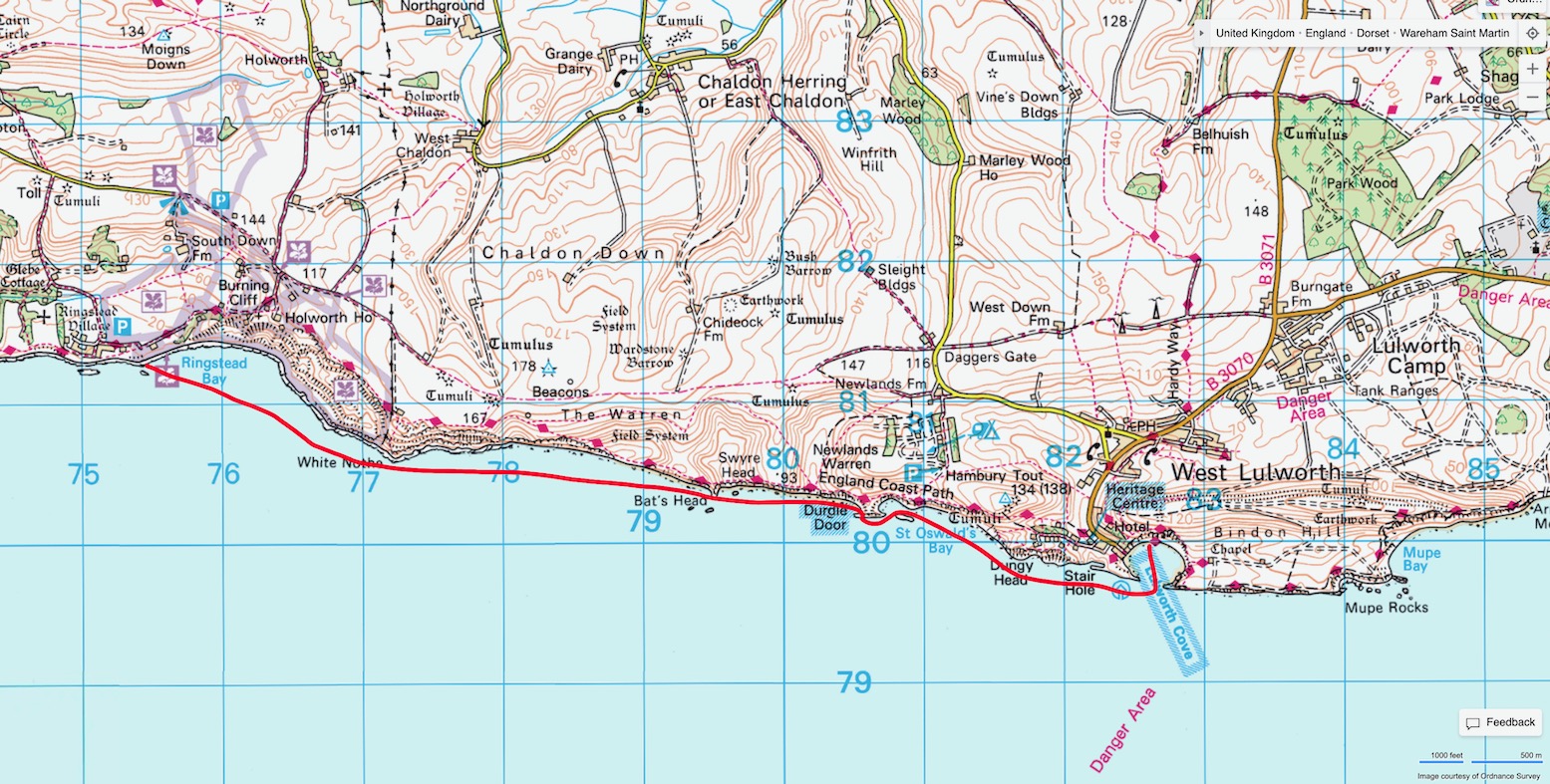
East of Lulworth Cove the Jurassic Coast‘s bucket & spade Babylon is interrupted by a 5-mile wide Danger Area – an army firing range. This was probably not one of UNESCO’s criteria for World Heritage status, but the SW coastal path also gets closed for a similar distance. Barry’s Reeds Almanac had a page or two on this (left), as well as useful tidal flow charts (drops to the west; rises east). I left it to Barry to call the ‘0800 DUCK!’ number, but imagined surely they’d leave the target practice to the off season. In fact they’re all it most of the time Mon–Fri, including an evening session 9pm to midnight: all we had to do was click this.

fishing.app – handy and similar toa Reeds Almanac but free
Early train to Weymouth

With a plan taking shape, I in turn bought a copy of Pesda’s South West Sea Kayaking in the hope of being alerted to local anomalies. I’m glad I did. It turned up with just hours to spare and identified that the run from Kimmeridge Bay round the Purbeck corner to Swanage was a grade up from the easy section from Weymouth. With headlands, submarine ledges and long lines of cliffs, without a foot recce I decided we may be better off skipping this bit.

It’s noon in Weymouth, but with offshores now predicted by late afternoon, we fast forward by taxi to Ringstead Bay, 5 miles in. That first section from Weymouth looks nothing special.
Put in at Ringstead. Ten mph westerlies blowing against an ebbing neap tide.
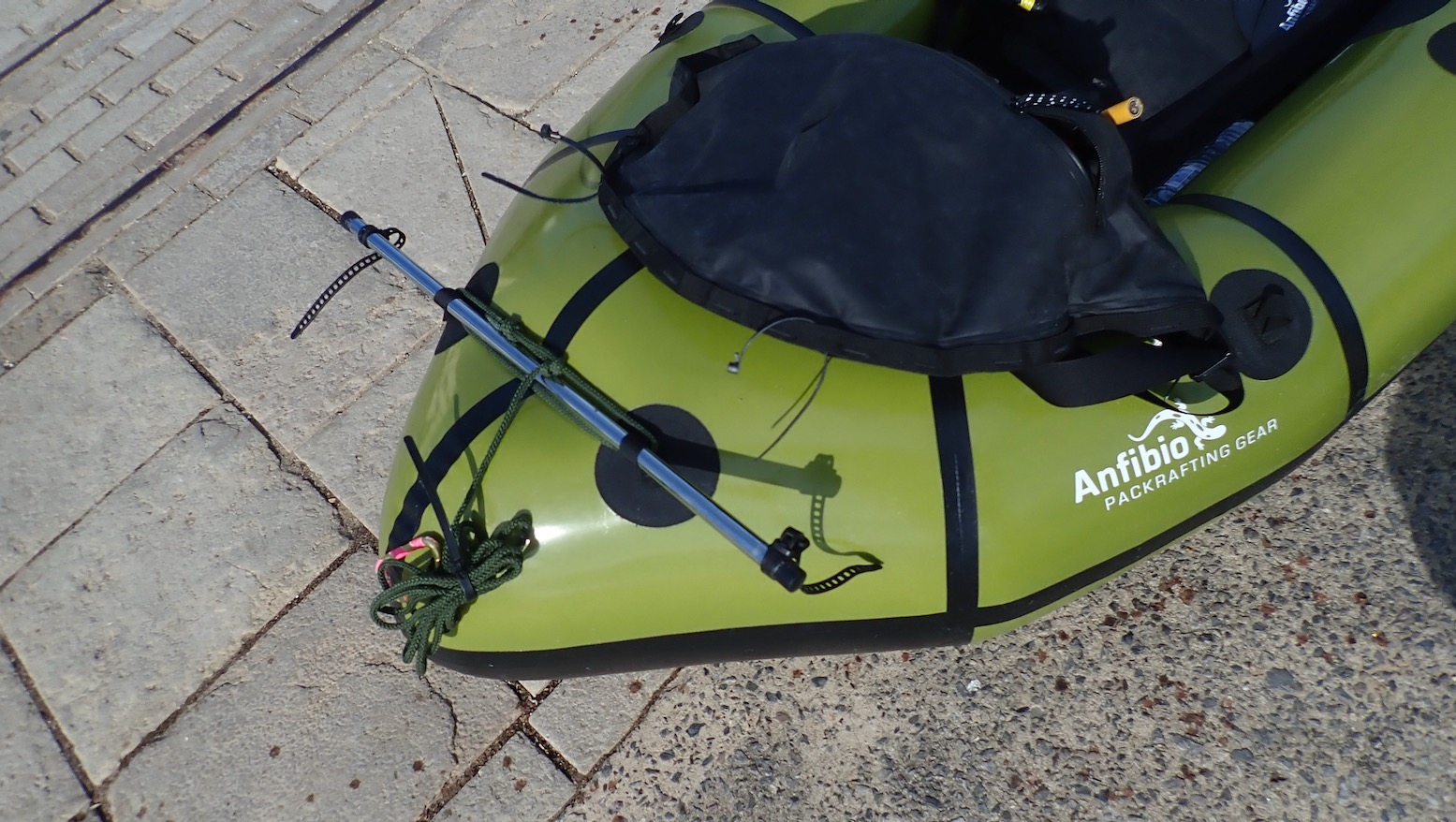
My Mk2 transverse bowsprit for a wide WindPaddle sail mount to limit swaying in stronger winds.
I’m giving the Multimat floor yet another go too, all the better to skim over the water.
We’re on the water at 1pm, hoping to reach Chapman’s Pool, about 21km away.
But around 5pm winds are said to veer offshore and strengthen, so we’ll see.
We sail at about 5-6kph – not much faster than paddling – but I note my TXL creeps forward about half a click faster than the MRS – must be the stiffening Multimat.
Propelled at paddling speed by his inflatable AirSail, Barry casually checks his investment portfolio.
The cliffs below Chaldon Downs. At times we paddled as we sailed to make less work for the wind.
Forty five minutes in, I pull in the sail and line the TXL up to thread Bat’s Head arch.
Note how the layers of chalk beds here have been pushed up to nearly vertical.
Give it half a million years and Bat’s Head will be as big as nearby Durdle Door.
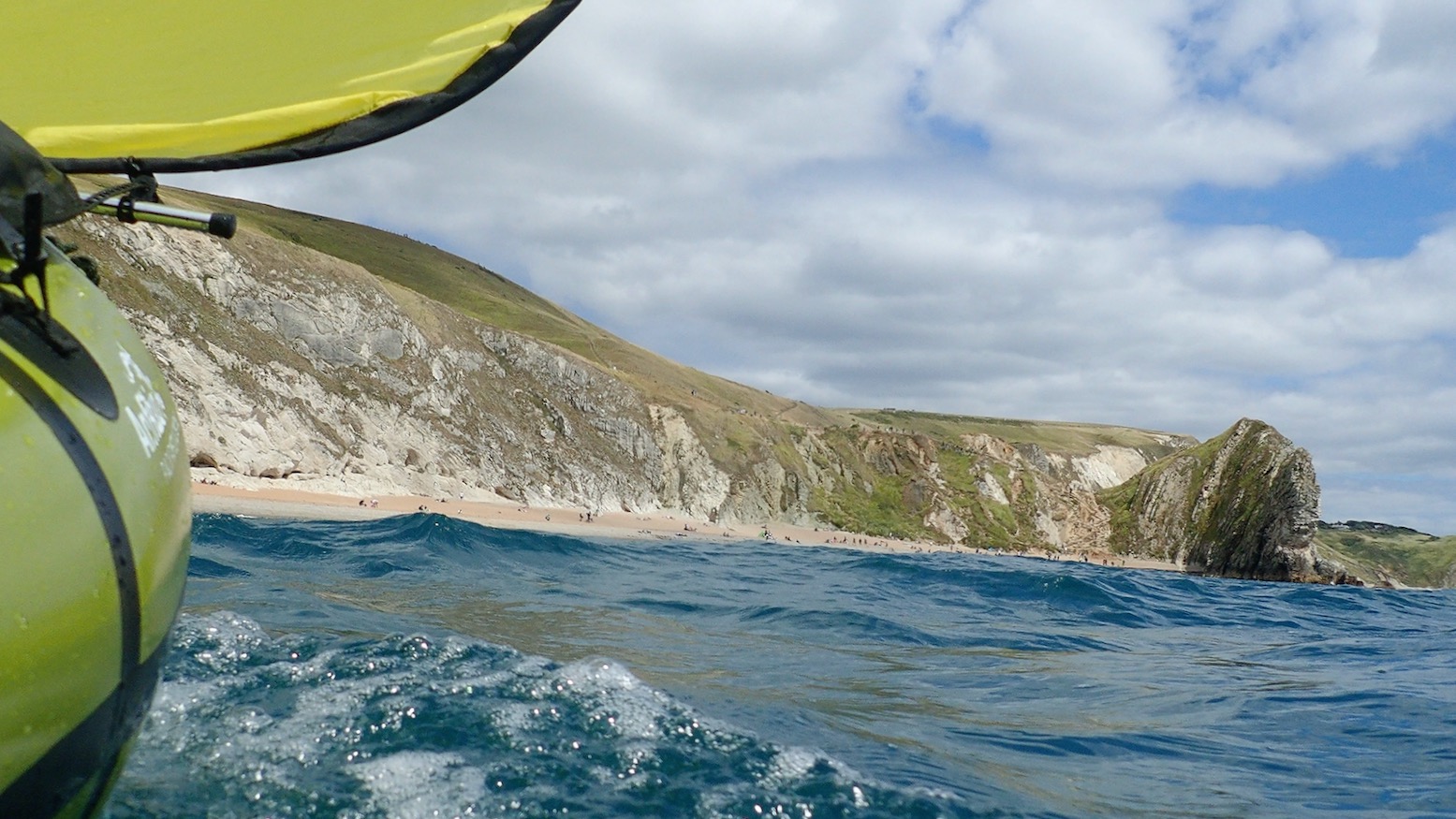
Approaching the famous Durdle Door arch alongside a crowded beach.
The TXL still weathercocks a bit under sail; I keep having to steer hard inland, but the bowsprit ‘stick’ limits the sail’s ability to twist. Or maybe the wind’s bouncing off the cliffs and blowing us offshore a little.
Sitting further back to weight the back end over the waves may help.
Sunbathers watch spellbound as Barry smoothly ‘Durdles the Door’ – a Southwest kayaker’s rite of passage.
The Door has been durdled. Some claim ‘Dorset’ (formerly Wessex) was named after this famous arch.
In high summer young bloods jump off the 60-metre arch. Appropriately, it’s called ‘tombstoning’.
Near the entrance into Lulworth Cove things get choppy. Sat high on the airmat floor, if I feel unstable I can easily let it down. As we head through the Cove’s narrow neck a patrol boat circles back and instructs Barry we can’t carry on east; the army ranges are firing.
‘I thought you said you were going call them, Barry? You had one job to do…’
‘But you said they hardly ever do this on a balmy, July’s day!’
And so it went on…
A salty-eared boatman tells us the army pack up about 5pm, about 2.5 hours from now by which time the offshores may be on us as we cross the Kimmeridge Ledges mentioned in the Pesda book.
As we slurp a 99 with sprinkles the odd gust blows offshore.
We can’t even pack up and walk the cliff path; it’s closed too, and so is the B3070 road.
Barry wants to paddle on a 5pm, but I propose we bus to Swanage rather than risk being be left high and dry.
Tomorrow we’ll paddle north towards Poole – or as far as the predicted headwinds allow.
So a paltry 5 miles – but the classic stretch of the Jurassic Coast.
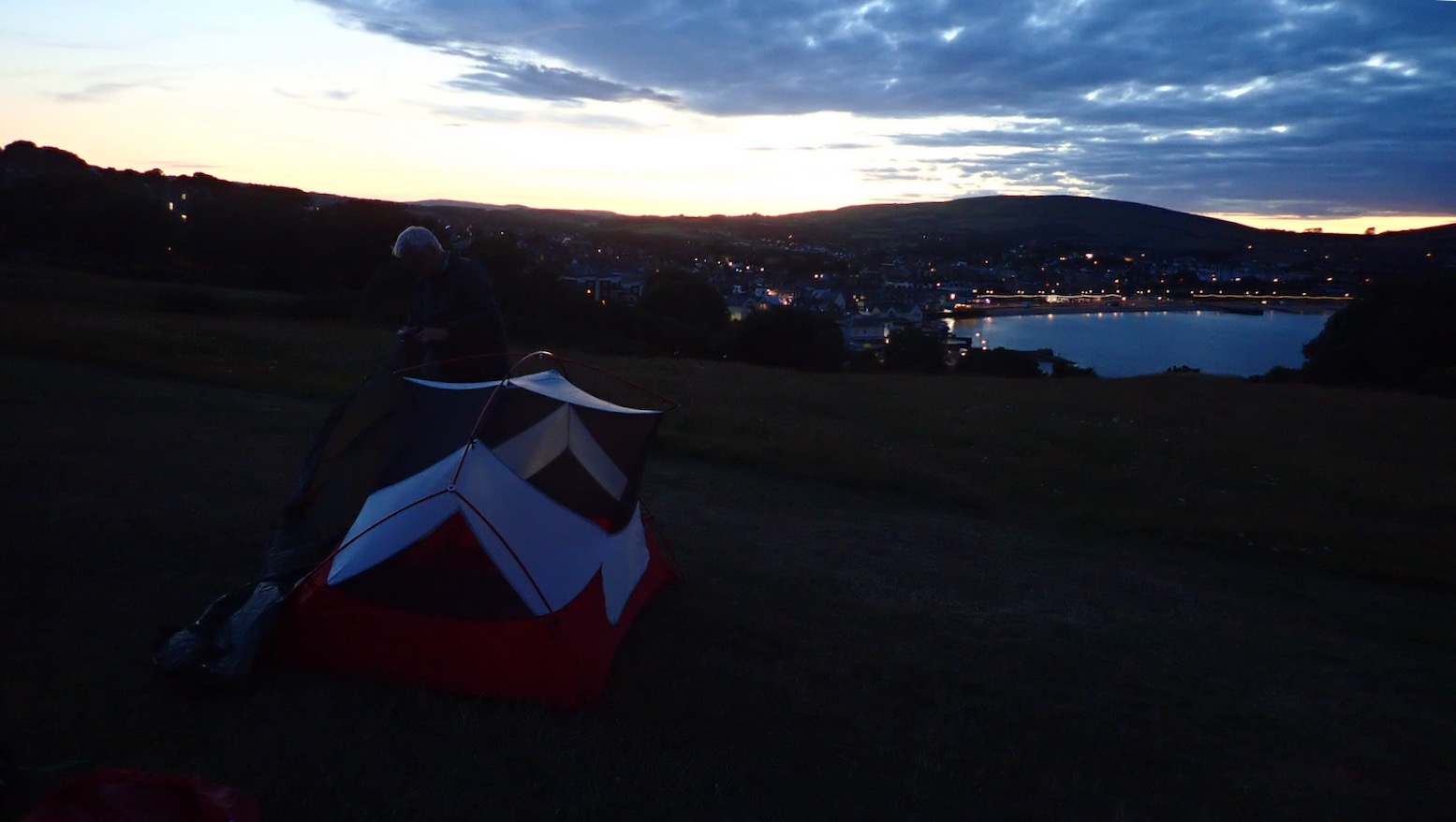
But there’s no campsite till August, so we pitch for free up in Durlston Country Park to the sound of beery revellers and Tuesday-night hoons doing burn-outs along the seafront. What can it be like on a Saturday night?
Six am next morning, a light breeze blowing from the northwest means no condensation ;-))
The Anfibio Multimat passed the sleeping test, too.
I walk a mile south to Purbeck’s corner at Durlston Head to inspect the tidal stream. Two hours before LW, it’s negligible, but further west, St Albans Head just out of Chapman’s Pool is said to be stronger. I must do that walk sometime.
Above, a ferry heads from Poole to the Channel Islands.
Looking back north you just see our tents on Peveril Point,
Ballard Down chalk cliffs and pinnacles stretch out beyond, and Bournemouth’s at the back.
At the cafe we meet Rach and Mark setting off on the final day of a staggering 630-mile walk along the Southwest coast from Minehead in north Devon. Their picture above taken a few hours later.
Meanwhile we prime our boats for the 6.3 miles past Old Harry to Poole Harbour Entrance.
We may carry on to Poole itself, but a strengthening wind may nix that idea.
No sailing today, Barry inches into the light morning breeze across Swanage Bay.
We reversed this trip a couple of months back.
Ballard cliffs in the wind’s lee at glassy low water.
Ballard’s spike, thought by some to be a fossilised Dendrosauraus tooth.
We approach the Pinnacles to the squawk of agitated seabirds.
Arches ripe for threading as far as the eye can see.
But this morning the tide is too low.
And it means there’s a lot of this string-weed floating about. It catches in our skegs but I have a solution.
Leaving Harry’s, Barry’s is a bit of a Lethargic Larry cutting across Studland Bay.
Halfway across, I remove a metre-long, kilo of Swanage string-weed caught in his skeg.
It’s all going nicely until 10.30am when the wind kicks up, then picks up some more.
But the GPS revealed we kept plugging on at 5kph, just with a lot more effort.
As Barry observed, it was a slog but good to know our packrafts can progress against this sort of wind.
With brain-out jet-skiers, sailboats, motorboats, working boats and the rattling Sandbanks chain ferry, we have to time our crossing across the busy vortex of Poole Harbour Entrance. Hitting 8kph, we cross a sharp eddyline where the incoming tide clashed with still-draining Poole Harbour. Barry hops out quick before the chain ferry trundles back. (Turns out it’s actually free for northbound pedestrians).
From Swanage to Sandbanks, followed by a 90-minute walk to Poole station for the train home.