
Some observations made here have been corrected once I actually bought and used a K40.

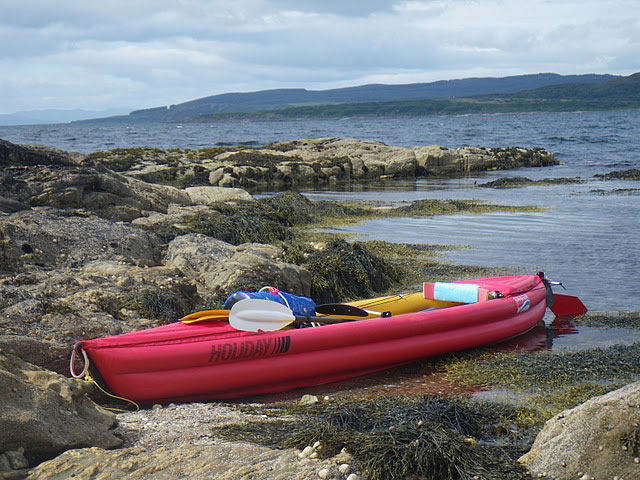
A couple of months ago I speculated that the Incept K40 may well be the long-sought successor to my ageing Gumotex Sunny, a great IK which I feel I’ve taken to the limit over the years. You may want to read the bottom half of that page first to get the drum on the Incept, but now I’ve actually spent an afternoon paddling a K40 around Shuna Island north of Oban and can conclude that apart from price, the Incept K40 ticks all the boxes. The other boat you see in the pictures is Jon’s P&H Scorpio LV – or SinK to you and me.

Weight in dimensions
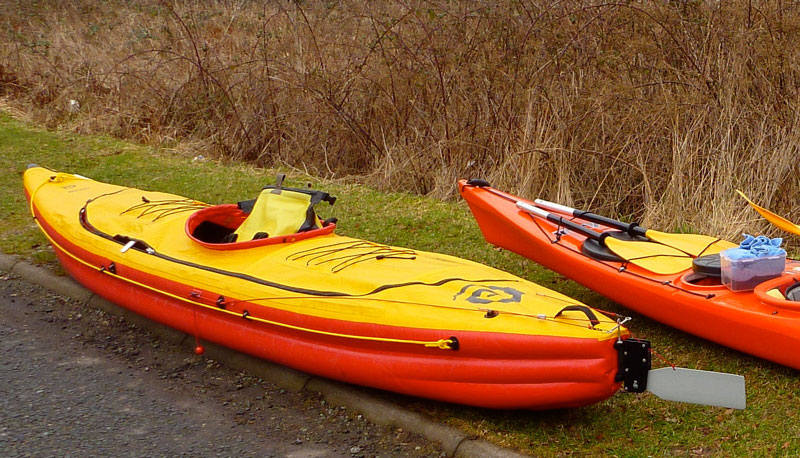
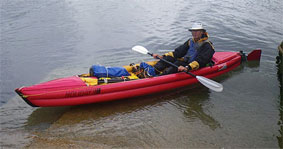
I didn’t get a chance to measure and weigh the boat. The K40 is said to be 4-6 inches narrower than a Sunny and a foot and a half longer. It’s nowhere near as narrow as that sounds, as you can see on the left (Jon’s P&H Scorpio LV is only 21″ wide – cripes!) but the twin side tube construction gives higher, swamp-proof sides and more internal storage space. And it certainly looks higher in the water than a Sunny which is both good and bad.
Material and construction
According to the brochure the K40 is heat-welded from “a heavy-duty but light weight high-tech Polyurethane alloy [with PVC coating] … with 1100 dernier Polyester reinforcing [which is] exceptionally strong and hard wearing and is UV protected…”.
Handling the deflated boat out of the water my impression was that it felt no heavier than my 14-kilo Sunny, while the fabric felt harder, stiffer, less elastic and possibly a tad thinner than Sunny-era Nitrilon; a bit more like lino compared to a Sunny’s rafting fabric. That means when you deflate it it doesn’t collapse flat like a Sunny and it may take some effort to get it into the holdall supplied. On the Incept website they admit the material they use is less foldable than Hypalon. The stiffness (good thing for performance – less good for packing) shows when you inflate it using the supplied K-Pump K100 hand pump. I was expecting many minutes and a sore arm, but before I knew it and with very little effort the three chambers were purging their pressure release valves (PRVs) at a claimed 5psi/0.34bar and the boat was suddenly as stiff as a board. Yes, the K40 has PRVs on all three chambers, probably because there are I-beams in the sidetubes.

It’s notable that the K40 has it’s inflation valves set in the cockpit. Should you lose pressure via the PRVs over the course of a hot day (and so lose some rigidity and performance) you could top-up on the water. One valve on the test boat was a bit stiff to release for pumping (left).
The seat and footrest pump up quickly by mouth with elbow valves, like an Alpacka, but with notably thicker fabric than Alpacka uses for its seat. Once set up for your size and with the rudder attached, I imagine the boat takes no longer to get on the water than a Sunny, that’s about 10 minutes. I can’t say I scrutinised it very closely, but the quality of construction on this example looked pretty good; at least as good as a Gumo. They say heat welding means no glue to deteriorate over the years and maybe less weight too (though some parts of the boat are glued).

Getting in and out
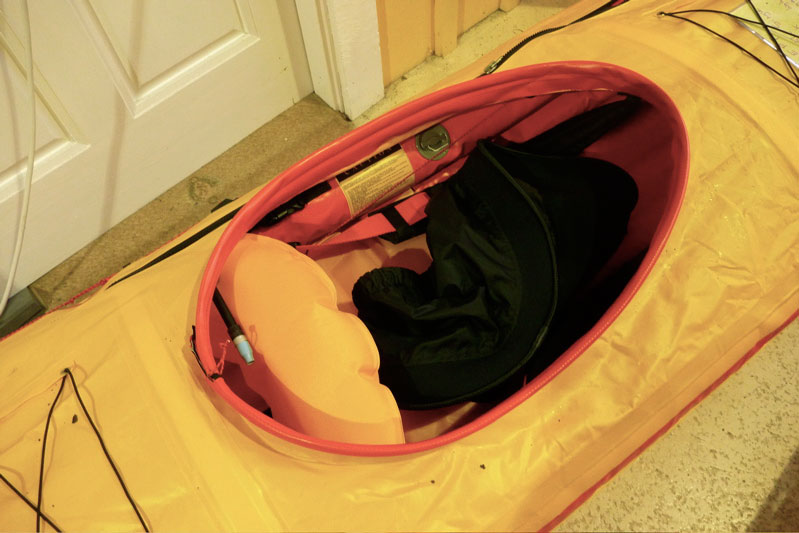
Before I saw the boat I feared the cockpit was on the small side, but it’s not. With one leg down in the boat and sat in the seat, I can bend the other leg and slide it inside; and this with full dry suit and other clobber on. No real need to sit on the back deck like on a hardshell or a Big Kahuna and best of all, while doing so the boat remains pretty stable. For getting out you can just pull out a leg, put it on the ground/seabed and stand up. Knowing this, my idea of stepping into the boat with the deck unzipped, pulling the hatch over me and then zipping up wasn’t necessary, except perhaps when you’ve unzipped to crawl back aboard after capsizing – something we tried later.

This zip-off deck really is a great idea for access, cooked up they say by IK pioneer Audrey Sutherland. How many folders and hard-shellers struggle cramming little bags through awkward deck hatches and then squeeze gingerly into their boats? I watched Jon doing just this after lunch on Shuna island. It’s the price you pay for speed on the water.
With the Incept I can bung my Watershed UDB in the back, lash the other bag or a lunch box to the front deck and put more in front of my feet so I can easily see a week’s worth of supplies fitting with room to spare. I don’t recall seeing any lashing points, easily glued on one imagines, and not strictly necessary with a deck, anyway, but then again spec sheets say there are 25 of them somewhere [not on this boat]. As for paddling undecked, it can be easily achieved by removing the stiff hatch coaming road. The deck also features four curved GRP batons which slip into sleeves and are very chunky while not being bulky like Gumo Seawave alloy frames. It would still be desirable to be able to ride the K40 with the top down on a sunny summertime river in France.
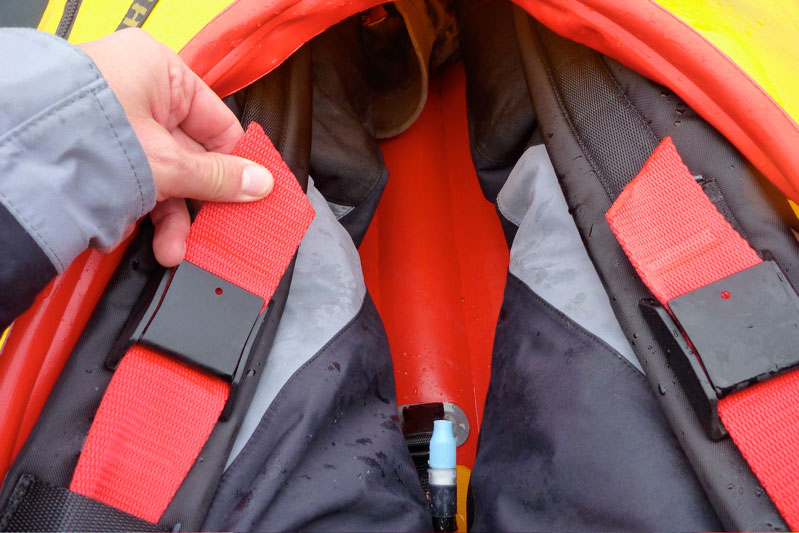
I didn’t get fully to grips with the thigh straps and anyway didn’t really need them in the calm conditions, but it sure is nice to have them there as standard [they’re not], with easy-to-hand micro adjusters. I had a feeling the Java or some boat I had (the Safari?) had curved straps which sat over the knee better. It did take a conscious effort to brace against them and power on, but with the unusual stiffness of the Tasman that all helped achieve the surprisingly high speeds I recorded. In choppier conditions I’d imagine you’d use them to brace against tipping, or of course for rolling the boat, a trick I may yet learn one day.


Speed, stability and tracking
The weather conditions for the test day in early March were very calm with a high pressure, white cloud and some mist, all clearing by the afternoon. On the water we headed out southwest against an incoming tide backed by a wind said to be 4mph (6kph), about as calm as it gets out on Loch Linnhe. In a couple of days it was forecast for 30mph+ out of Oban and was much calmer than our previous visit here. In these conditions stability was hardly tested but felt fine which was a relief considering the boat is 4-6 inches narrower than a Sunny and less even than the Java which was less confidence inspiring for me.

Although I took it pretty easy I never had ‘a moment’ in the K40, not even getting in and out. So with stability not an issue, next test was to see what this baby will do flat out! Jon had already cranked up 9kph on his Scorpio while I was faffing about, and hammering away with the 220-cm paddle the shop lent me (20cm shorter than I’m used to) I clocked 9.8kph (6mph) at some point against the breeze and tide, with a more readily sustainable 6-7kph (4mph).
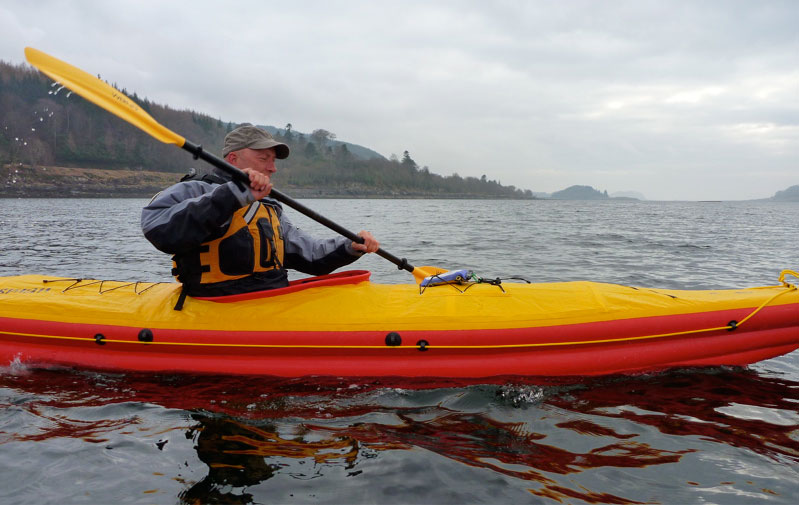
This boat is definitely faster than my Sunny and these are about the same speeds I recorded in my Feathercraft Java a few years ago, also in calm conditions. The Incept is about 15% narrower and longer than the Sunny and a foot (30cm) shorter than the Java which is apparently wider but I very much doubt it.
It has to be said that after less than 10km on the water that day I was worn out and aching, but I hadn’t paddled for nearly two months. Out with a speedy hardshell, I was sometimes ahead, not because I was faster than Jon’s P&H, but because compared to previous runs in my Sunny with him, it took him more time than he expected to catch me up when I was ahead. We had a bit of a race as you do, and he certainly pulled away faster, but I had a feeling I caught up and if I’d had my normal paddle and spandex ski jumping suit I’d have had him! One day soon we’ll do a race round two points on a loch somewhere to see how our speed and turning match up, boat for boat. We did a similar test once in the desert, jump starting a loaded Honda XR650L. I lost that one and it’s gnawed at me for years.

Speaking of which, I’ve never owned a boat with a rudder before, though I’ve tried others here and there and it was fun, especially when engaged in ramming (above). Initially I didn’t bother with steering and just used it as a trailing skeg. Foot pedal actuation seemed a bit vague as you press flaps on top of the inflatable footrest thwart to move the rudder lines, but by the end of my session I’d got the knack and with the wind and tide behind us, I was ruddering a lot more and finding it useful. A bit more experimentation with positioning and tension would pin it down.
Early on I tried paddling with the rudder up, and into the wind the K40 did spin out after a few strokes if I didn’t correct hard, but then so did my Sunny before I got the knack of skeg-free paddling. Jon in his Scorpio was also deploying his retractable skeg in the same conditions and explained that in a proper Brit-style sea kayak you’d edge a bit to counteract the deflection of the wind on the front; the skeg is there to balance the defelction more than aid racking. Anyway, with the rudder always there and not vulnerable to fouling like a fixed skeg, why would you not use it except when paddling backwards, in which case it’s dead easy to flip it up and reverse all engines.

So there it is…
What in Neptune’s name is there not to like about the K40 apart from the hefty price and I suppose the IK’s bete noir: appearance? Looks like a sort of over-buoyant torpedo to me, sat high in the water, but I can get over that if it takes me to more places than my Sunny.
2020:
The K40 is hard to find new other than direct from Incept in NZ. Prices are high but you get a lot for your money. The rudder is not an extra and they should come with an K-Pump and a big dry bag and repair kit, but spray deck and thigh straps may be extra.
The ’25 D-rings and attachment points’ you read about were not present on the test boat or the one I eventually bought. More on this post. It’s worth noting with boats like the similar Grabners, many of these basic items are expensive extras.




 Inflatable Kayaks & Packrafts
