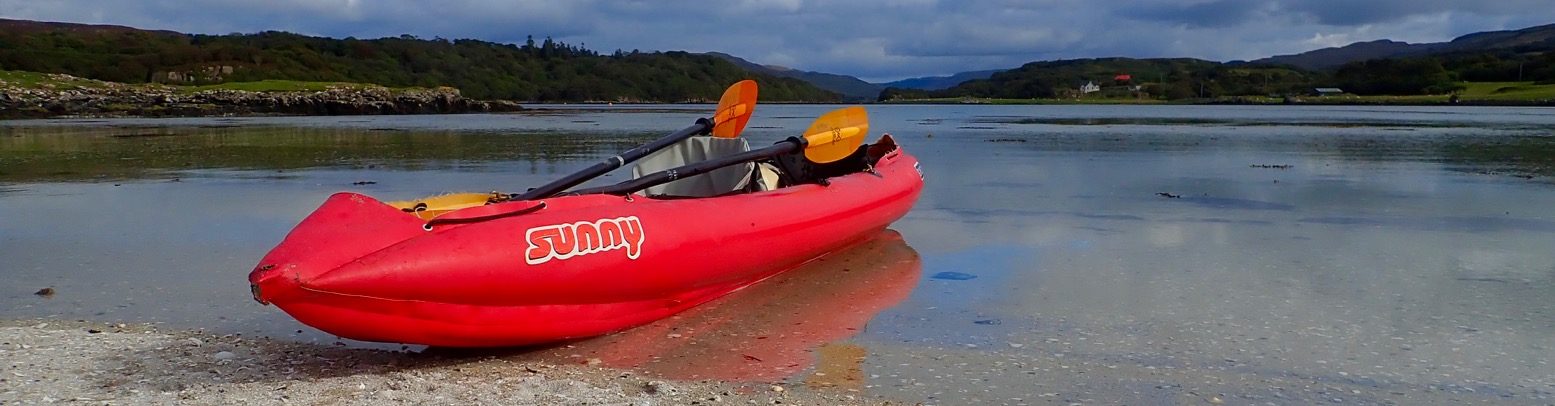
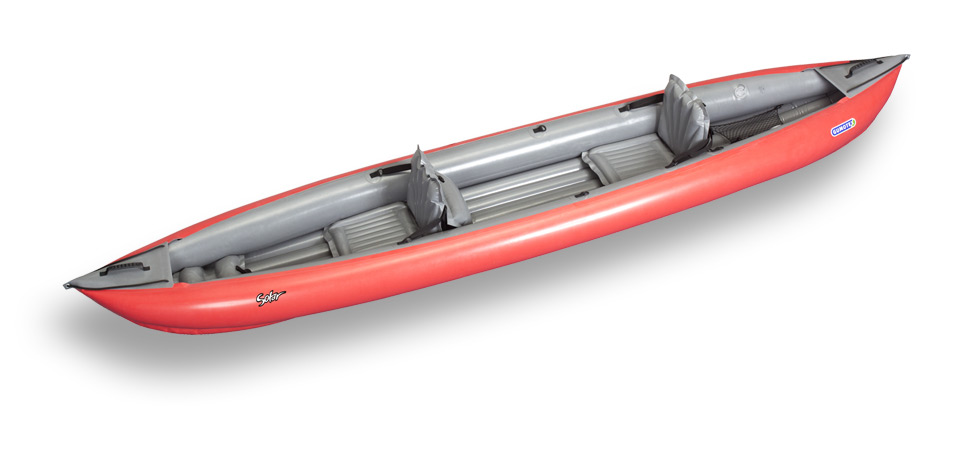
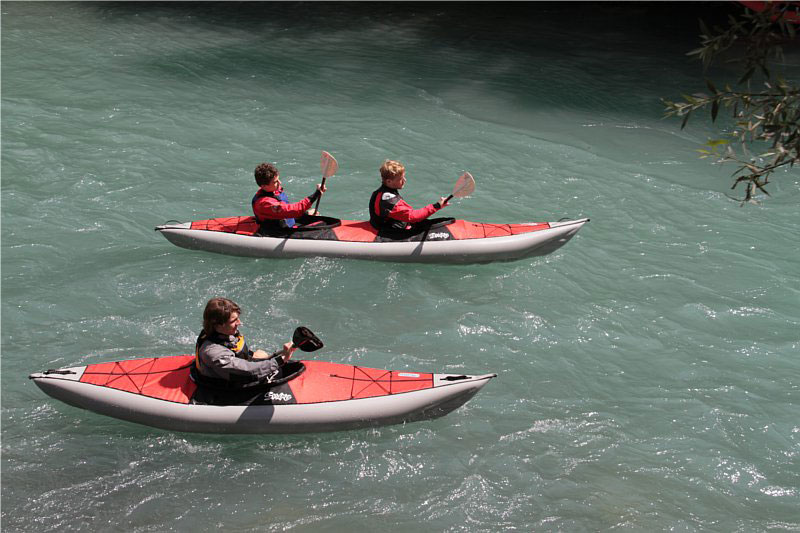
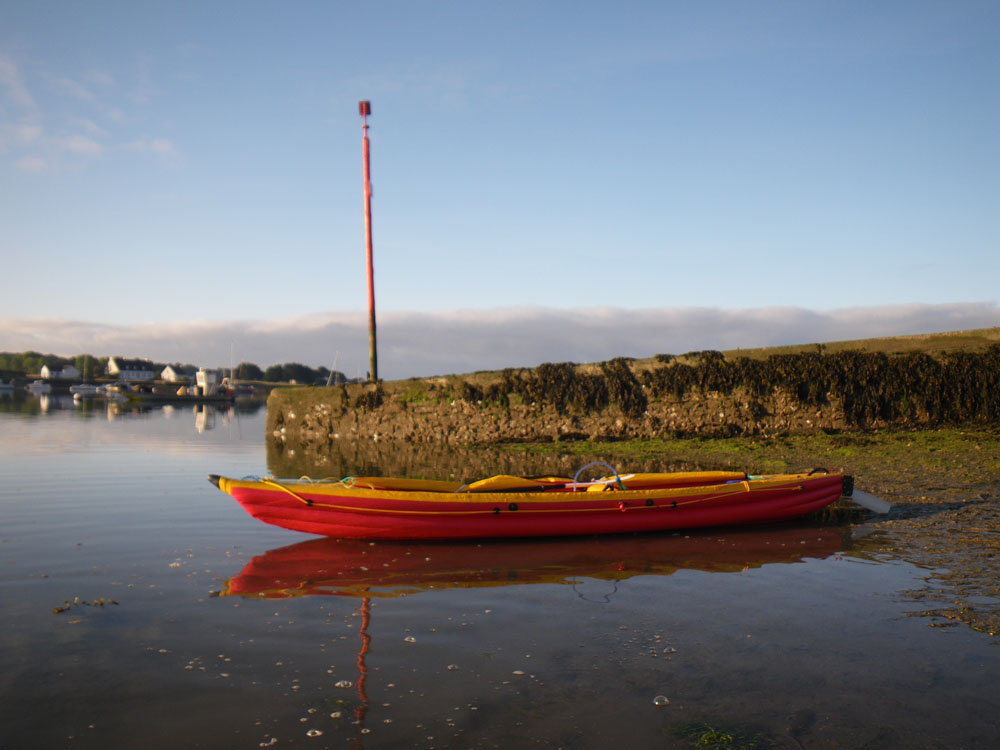
The Solar 410C was a step up from the short-lived, fixed-seat Solar 2 (below).The price in the UK with two seats and a skeg was £470. It became for all intents and purposes the new Sunny, because the old discontinued 405 Solar and Solar 2 (below) were usefully long touring boats ruined with fixed seat designs: either the original space-wasting thwarts (at least they were replaceable) or worse still, Helios-style fixed seats in the half-coat (Lite Pack) Solar 2 – the pits!
Luckily, the Solar 410 ‘C’ (for ‘Convertible’) has two or even three seats which can be removed and one re-installed the other way round to make a big, single seat kayak with lots of room for stuff – nice. You also get adjustable footrest pads (see here for a lighter and simpler idea), the usual half-arsed cargo net in the back, and the usual floor PRV too. Gumotex never seem to mention this useful feature, but of them I am a big fan. If not included, the black plastic skeg might be extra (and is worth getting). On the 410C you don’t need a skeg-mounting patch at both ends because unlike a Sunny, you simply move the seats forward or back on the D-rings, not turn them the other way. In the unlikely event your 410C doesn’t have a skeg patch, it’s not so hard to glue one on.
The stats for the Solar 410C are 4.1m long (Sunny 3.85m); 80cm wide (Sunny 77cm), weight 17kg (Sunny 16kg) and payload no less than 270 kilos (Sunny 180kg). With pressure still at 0.2 bar/3psi, that looks to be quite a jump in payload for just a little extra volume. If you can imagine three hefty adults sat in the new 410C, that equals 270 kilos – the slightest wave will surely swamp the boat.
But one thing I do wonder with a 410C (and why I got a Grabner instead, even at nearly twice the price), is that with my weight I suspect the longer hull would sag even more than the Sunny. This was why I moved on from the Sunny after many years, although here I discuss ways of getting around that flaw
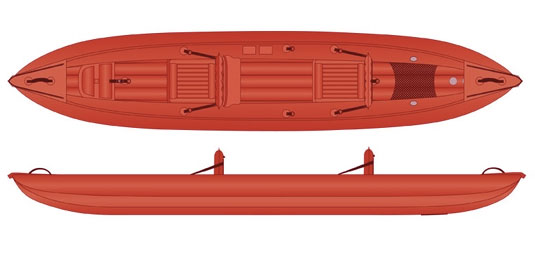
Gumotex Solar 405/ Solar 2 The original, pre-2007 Solar 405 (below) was similar to a Sunny of the time but longer. Unfortunately it used space-wasting thwarts (fat air cushions) for seats. For that reason a Sunny was always better solo touring choice at the time.
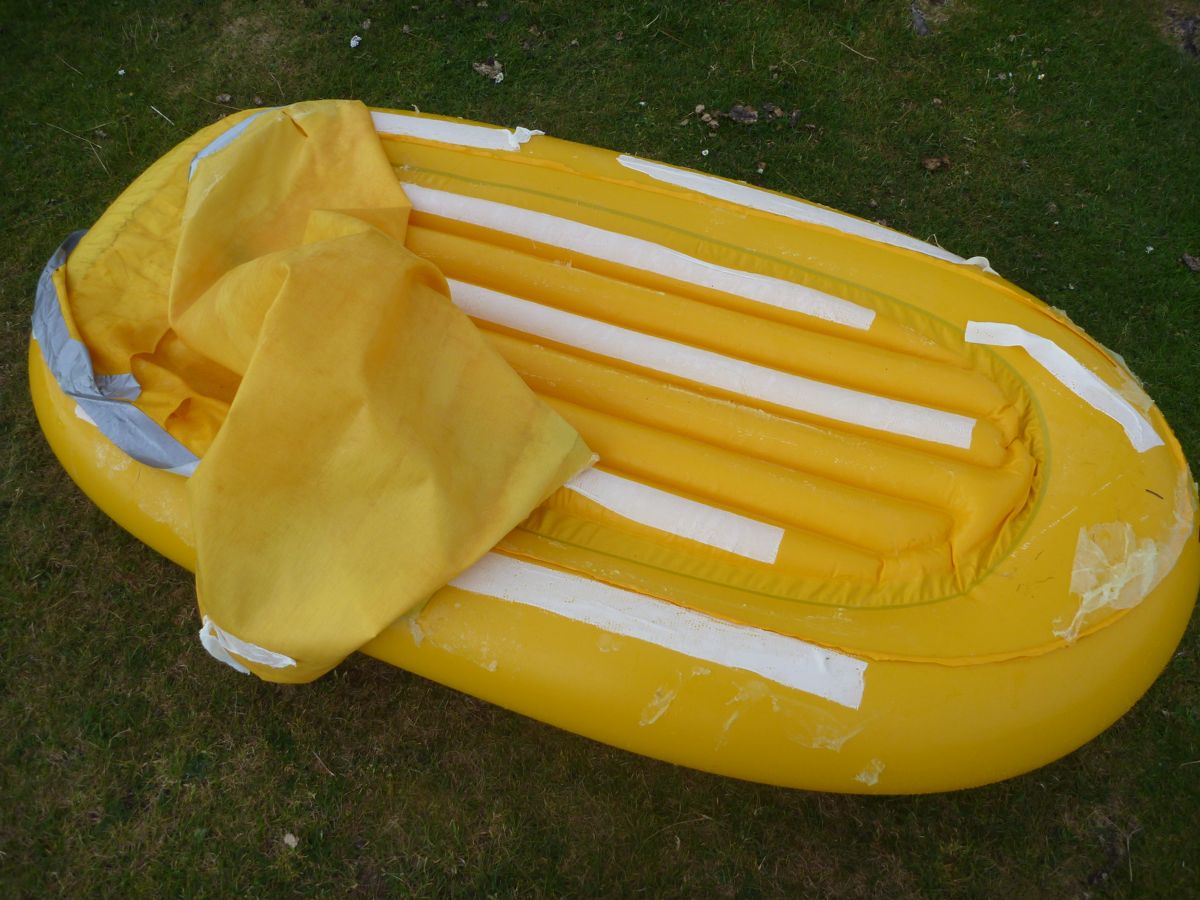
The post 2007 ‘Solar 2s’ (right) became even less versatile: horrible fixed seats like the Twist and Helios may give great support, but along with fixed footrests it all means it can’t be set up optimally for solo paddling without chopping it all out. As on all post-2007 Solars for a while, only the outer wet surfaces were coated, and then the Solar 2 was dropped in favour of the broadly similar but more popular Sunny MkIII, the semi-decked 3.8-metre Helios II (also with fixed seats and decking) or even the shorter Twist I. By 2013 the 410C set things straight again and that soon became the Solar 3 which is still around today.
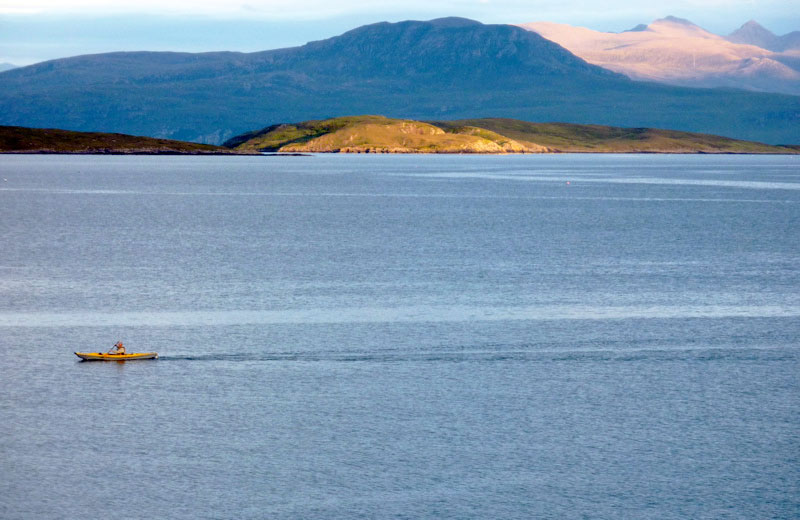
A couple of years ago I did a speed test on my then-new Incept K40 over three and a bit miles from Old Dornie to Badentarbet beach via Tanera Mor island.
I recall setting out flat-out on a cool, calm evening, cruising hard close to 5mph at times, with a burst after a rest up to 5.2, after which my energy levels tailed right off because I was well and truly pooped. I recently decided to replicate that route in similarly calm conditions and see how my new Grabner compared.
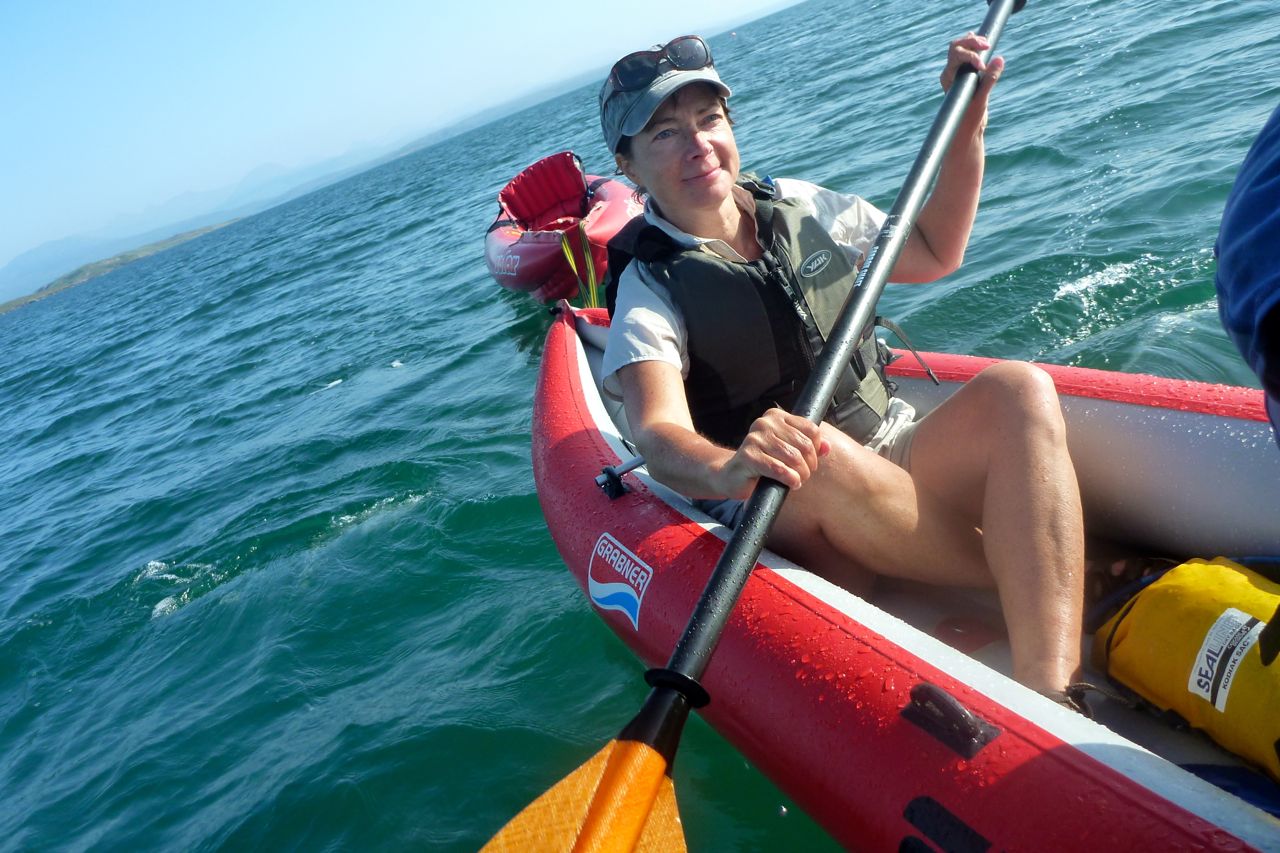
Prior to that we were out yesterday in windier and choppier conditions when, with a 10-15mph back wind I averaged about 4mph with a burst up to 5.3. Coming back into the wind we decided to try the Amigo two-up, as it only requires the front backrest moving forward. Towing the Solar together we managed a steady and sustainable 3mph with a burst of 3.8 into the stiff breeze. And on a quick spell downwind we got up to 4.8mph. It’ll be interesting to see what we can manage two-up when not towing a kayak
Though twice the weight of the g’f, I sat in the front and got pretty wet from the chop, but up here found the Amigo’s narrowed beam and lack of annoying finger-snagging seat lugs made paddling easier, even without a footrest to brace off. We seemed to clash paddles less than the last time we did two-up in the Sunny on the Vezere in France. Perhaps there’s more space between the seats in the Amigo even though it’s overall 10cm shorter than a Sunny.
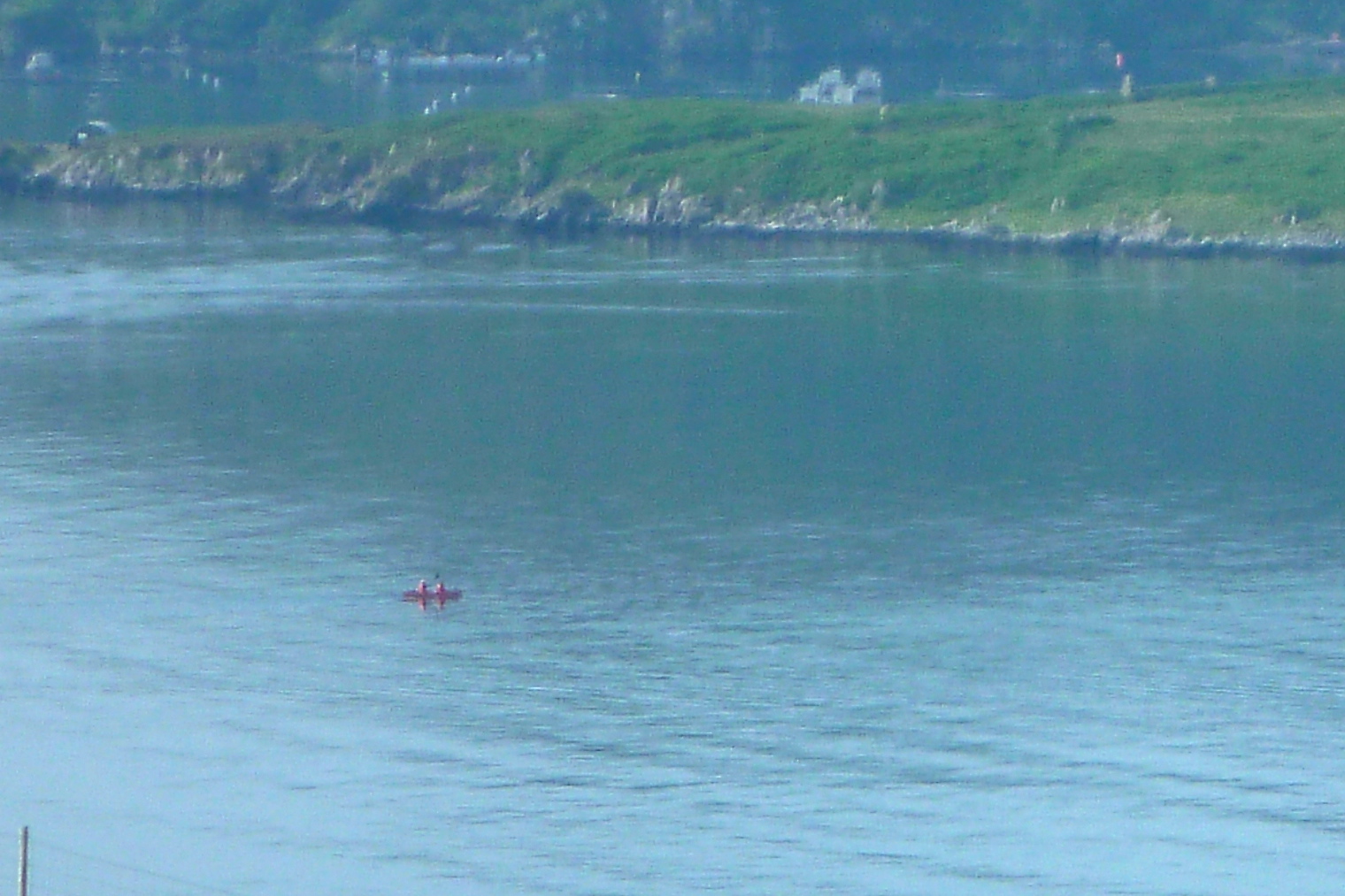
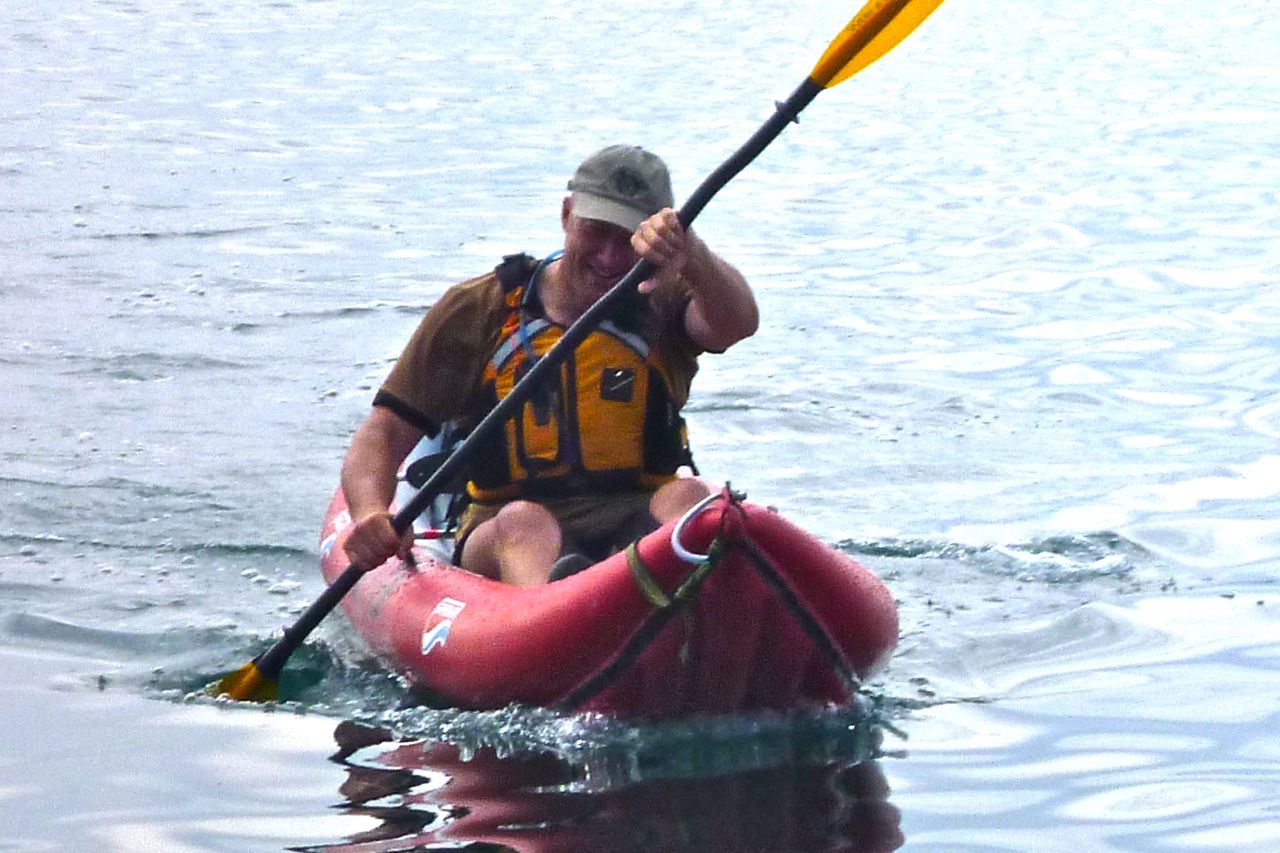
As it happens once back on the beach, a French couple in a motorhome were drying off their Gumotex Solar 410C. They’d also been put off from exploring the Summer Isles by the offshore wind. They set out this morning and I see that the two seats do look quite close (ropey photo at max zoom on the right). I mention this because, as a reminder, I rate my discontinued Grabner Amigo as very similar to Gumo’s Solar 410C (see table below). Main difference is more pressure in my Amigo make it a stiffer and probably faster boat – but at twice the price of the Solar while you can still buy it. Back to the speed comparison test. Today was a calm day with a light wind from the southwest and when I set off the tide just beginning to ebb.
I’m getting accustomed to the thigh straps and the homemade footrest is great. Pulling inwards with the knees to brace off the straps and so transmit more power in the stroke isn’t something I could do for too long, I decided. I think the straps are more useful for last-ditch bracing against tipping in rough seas or rapids. But even then, allied with the footrest they do help connect you as well as you can be in an open-decked IK. Yesterday I’d found the backrest made my back hurt, perhaps because I have those footrests to push off. I’m still not convinced by this rigid backrest arrangement anyway. The cut-down packraft seat is fine (while it lasts) but that bar keeps disengaging from the rubber lugs (since fixed) and I think I’ve already bent it just be leaning too hard while moving about. It won’t be too hard to either get a thicker-gauge backrest bar made or dispense with it altogether and fit something like an Incept blow-up seat using the current lugs (although I see from what I thought here that maybe that’s not the answer). And as mentioned, those forward lugs painfully snag my fingers every once in a while.
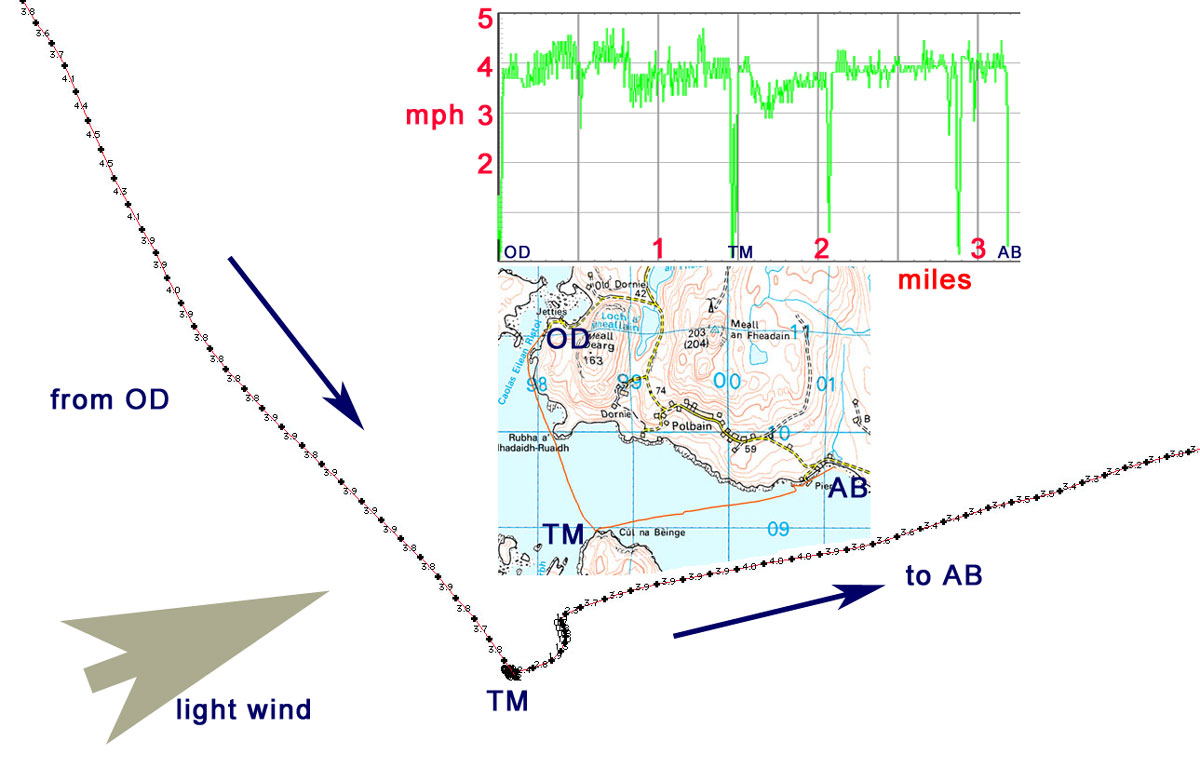
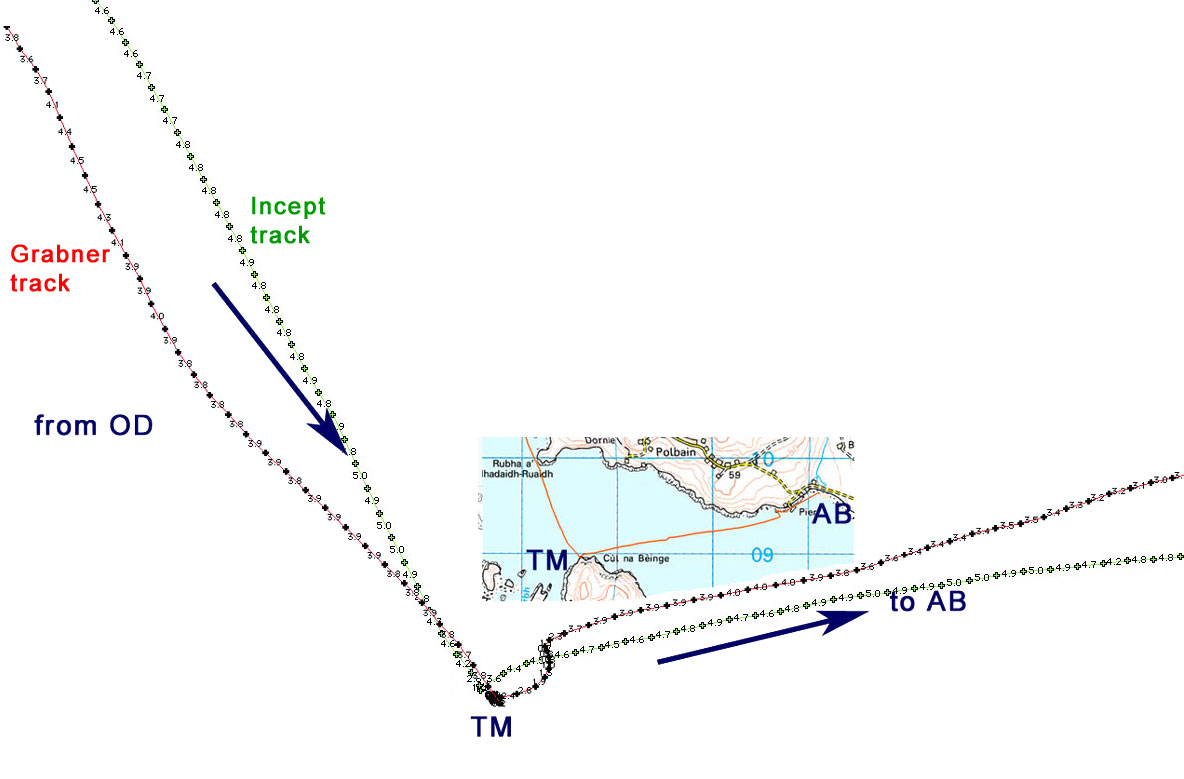
Anyway, with barely a break I belted across to Tanera as fast as I could, leaning on a bit of karrimat taped to the seat back which did the trick. I averaged just under 4mph where the Incept had managed about 4.6. That’s also the top speed I clocked in a flat-out burst in the Grabner just before reaching the island, although on both occasions this sort of effort was not sustainable.
On the second leg back to the beach I had a light wind behind me but as I neared the pier I thought I could feel the pull of the outgoing tide. Unlike in the Incept, my energy and speed didn’t drop off much as I approached the beach and I got across at what felt like an all-day sustainable 3.8, with some spells recorded at up to 4.5mph without trying.
What the heck does it all mean? Well, it’s the not-so-startling revelation that the slimmer and two-foot longer Incept K40 was indeed a faster IK than the Grabner (two tracks overlaid on the left). Overall the Grabner is around 20% slower than the Incept.
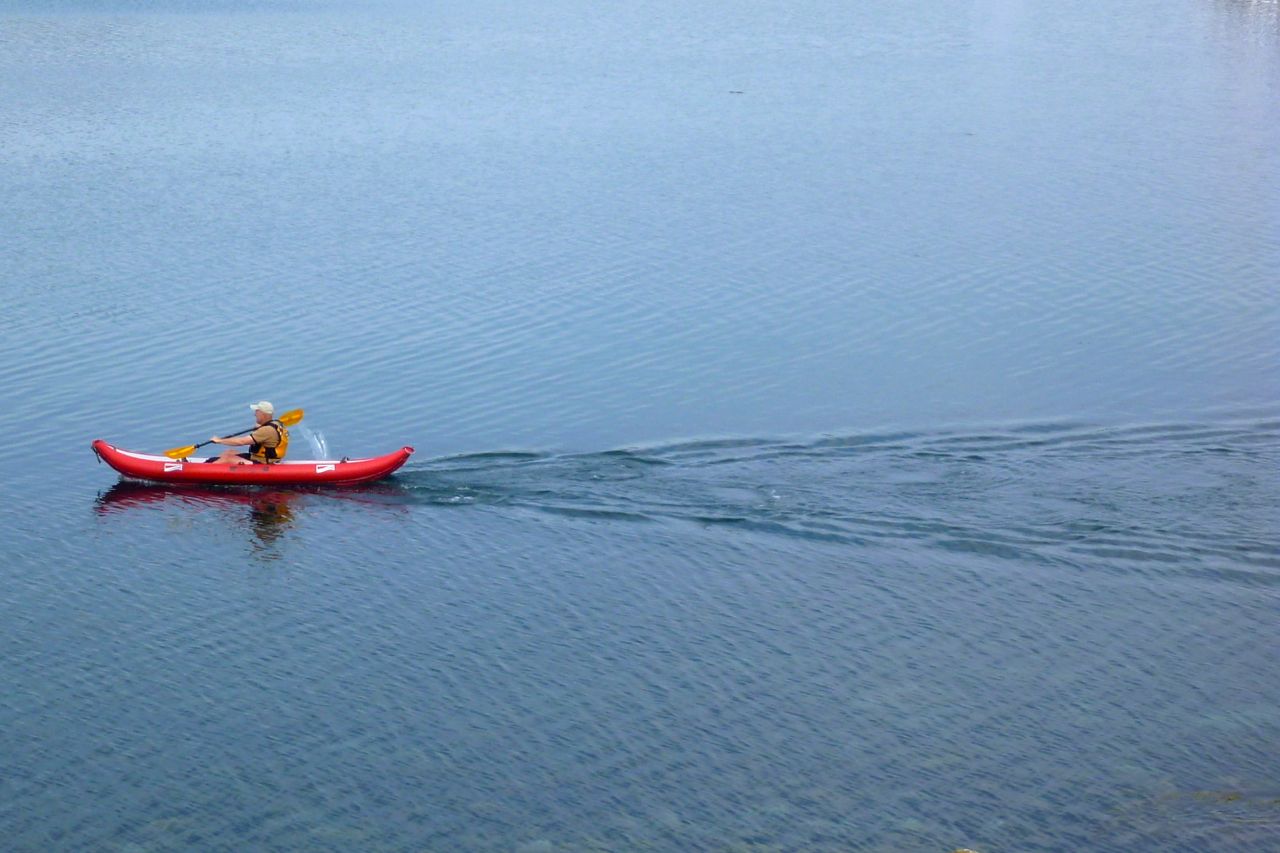
At times at sea or on near-still rivers I do feel like I’m pushing the wide-nosed Grabner like a packraft. That’s another benefit of twin-side tubes, I now realise: a sharper bow is formed, as found on Grabner’s Holiday models too. On the right you can see that’s more plough than bow and must add up to a more effort over a long day, limiting compatibility with hard-shells for full-day runs like this.
And look at that wake I recall forming a similar conjecture (picture) about how the Sunny ruffled the water when compared to a hardshell’s sculpted bow. Or indeed look again at the Incept’s moderate wake at the top of the page. But then this is all for flatwater operations. In a swift river like those of the <a class="wp-gallery mceItem" style="color: #000000;" title="Kayaking and packrafting in southern France Massif I’m sure the shorter Amigo will be easier to handle than a K40 and so the compromise stands. It’s just that up here the best paddling is in the sea. Surprisingly I don’t miss the Incept’s rudder, having spent years in skeg-only IKs before getting the Incept.
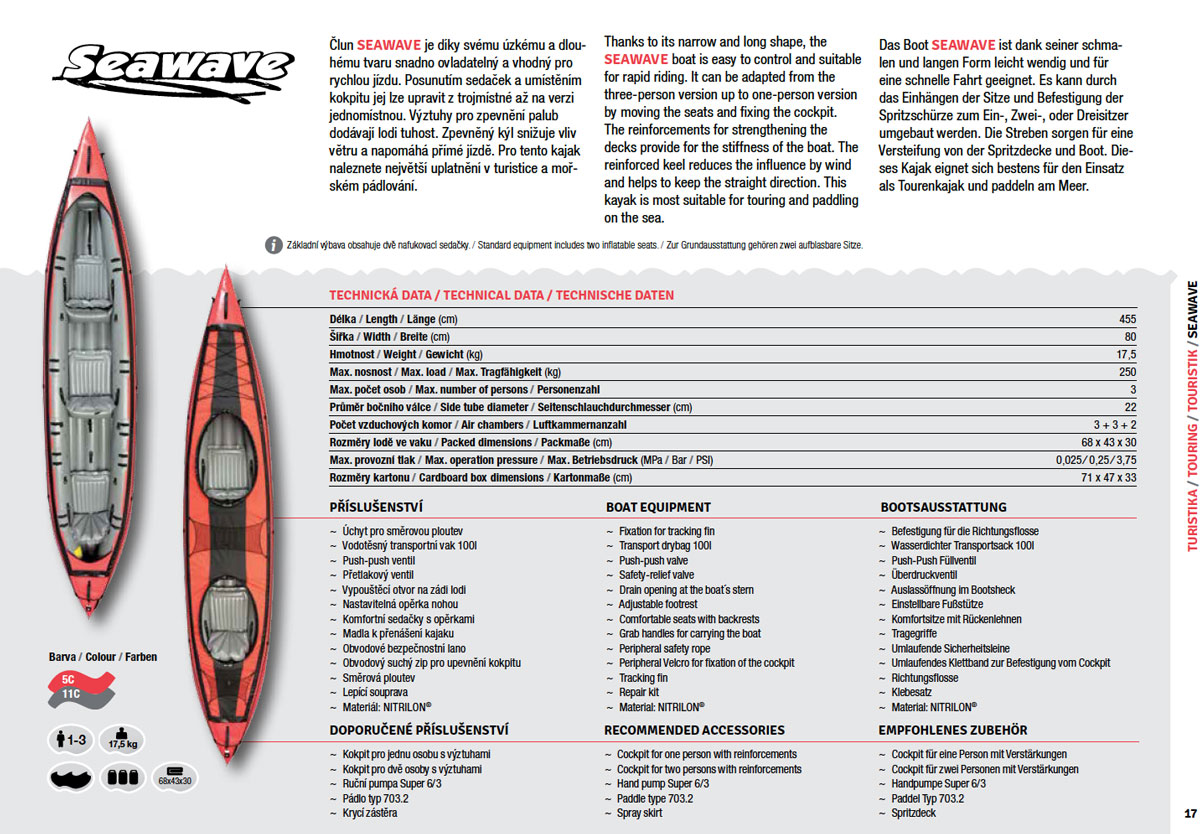
The Seawave was released in 2013 and in 2016 a near-identical model came out with a rudder option. The Seawave can be used as a single, double or triple, and is sold in Euroland for around€1625 or £1425 in the UK. They used to be a bargain. Not any more. In 2023 the Seashine version came out – a Seawave with a drop stitch floor (like the Thaya and Rush); slightly heavier, wider and longer and a lot more expensive.
My stats for my Seawave are 4.5m x 78cm wide and 17kg plus a claimed payload of 250kg which sounds plausible. Significantly, the Seawave’s pressure is rated at 0.25 bar (3.6psi) all round, midway between the Gumotex IK norm of 0.2 and Grabner’s 0.3 bar. Some of Gumotex’s orange series whitewater boats run 0.25 and their IKs were never that shoddy. Having said that, the PRV in the floor of the Seawave has the same ordinary rating you’ll find in a Twist or a Palava or probably any other Gumotex IK (more here) but the adjacent sticker claims 0.25 bar max. It’s the side tubes that now take 0.25 bar, not 0.2. What they now call Nitrilon is not like the stiff old hypalon-like Nitrilon of my early Gumboats. Increasing hull pressure is one way of getting a more rigid and therefore faster IK, but it’s the integrity of the ‘I-beam’ floor that’s the usual limitation. The Seawave has a pressure-release valve in the floor but not on the side tubes, and I read these pressures are said to be on the conservative side. You can’t over-inflate the floor but these Gumboats can handle more in the side tubes providing you watch it when out of the water in the heat.
The Seawave is long for an IK, but with just a skeg (optional, but there’s a rudder now), you wonder if this could be hard work to turn into the wind. However, in France kayaks destined for sea use (beyond a certain distance from the shore) must be homologated or approved in some way, and the Seawave has passed this test.
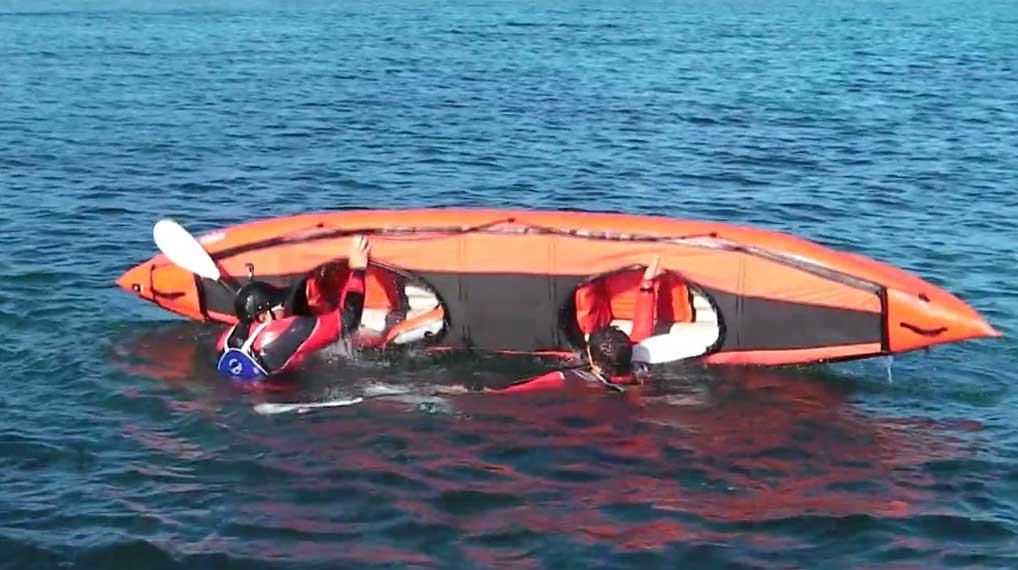
The great thing with the velcro deck (for one or two) is that it can be removed; on my Incept I paddled like this approximately 99.9% of the time, with the deck rolled to one side. Even at the slightly higher pressures, I have to say at one point in the video I noticed the Seawave bending with the swell. My Sunny used to do this, taking on water over the low sides, but with a deck that ought not be less of a problem, even if you imagine there’ll be some seepage through the velcro in heavy conditions or white water.
Flexing is a problem with any long inflatable and even my short and high-pressure Grabner (left) flexedin certain conditions. Manufacturers get round it with metal frames (Feathercraft, Advanced Elements), twin side tubes (some Grabners, Gumo Seakers, Incept) stiff fabric (Incept) or just high pressures like Grabner, but that demands very good construction. Drop-stich panels are the new way of doing it now.
There are more impressions as well as some nice pictures from an actual owner, Norman, right here (translated from French). He ran a 410C for a few years and talks of pumping his Seawave right up to 0.35 (5psi) bar which makes for good speed (6kph average he claims). That is 40% above the recommendation so let’s hope the seams on the Seawave can take it, cap’n.
It looks like grey, Halkey-like valves in the back, not the old-style black ones that Gumo used. And I see that Gumotex have again adapted an idea that I had on my Sunny years ago (right), a drain hole at the back. Only theirs features a neat sliding cover. It could all be the normal process of improvement of course, but I recall that after I had some smaller skegs made for my Sunny (and sold to a few others), Gumotex reduced the size of theirs to the current black plastic ones. And then the velcro deck idea. Whatever, it’s gratifying to see ideas I have tried or written about actually making it into production.
Enough of this speculation! Actual impressions on receiving my boat here, followed by half a decade of very enjoyable Seawave paddling.
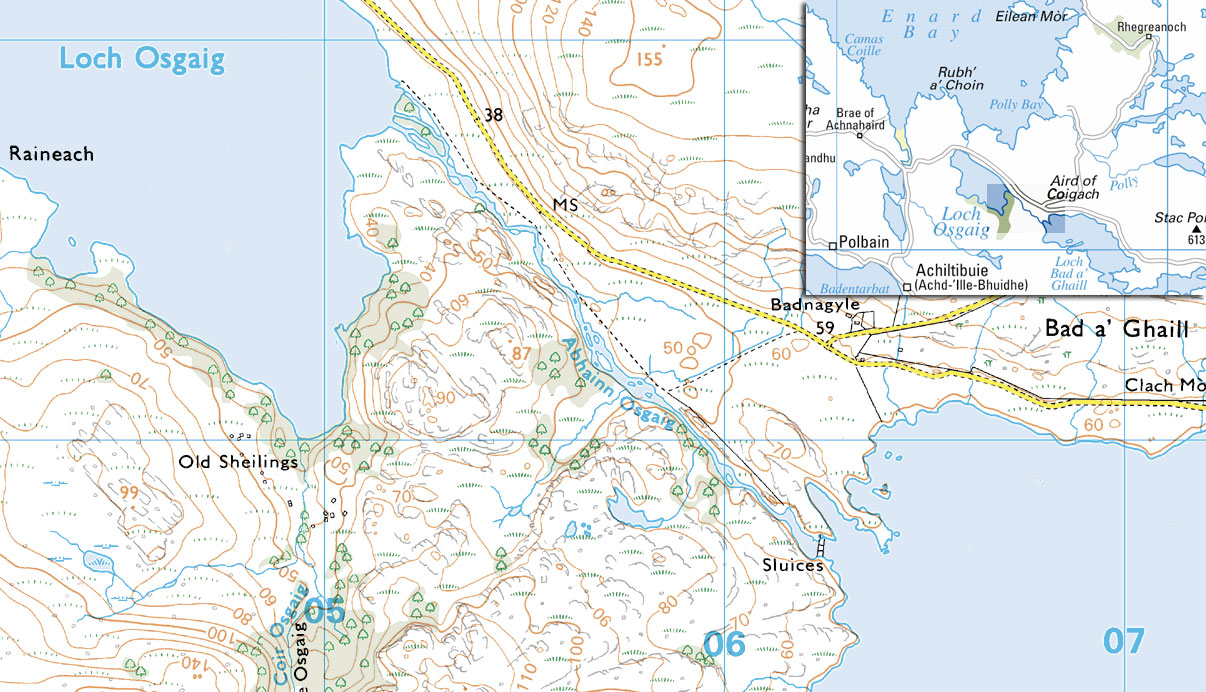
Don’t get excited, we’re talking a few hundred metres of Class 1.1, but that’s as good as it gets around here. We’ve had a lot of rain in the last week, enough to make the only paddleable river – the short Osgaig – worth a poke with a paddle. I was here with the Yak last year at slightly lower levels, so this time was expecting a smoother run in the Solar (now with an improved seat-foot set up), followed immediately by a comparison run in the Alpacka Yak.
Gumotex Solar IK The good thing with the Solar is it’s old, worth next to nothing but tough, so can be dragged like a hardshell with the Yak in the back. I considered jury rigging some thigh straps; it could be done now through the new footrest pipe and around the seat mounts, but looking at the river as I drove up, it wasn’t really worth it. Thigh straps are what makes any deckless boat – air-filled or hard-shelled – much more controllable when things get choppy. Even WW packrafters insist straps are the way to go.
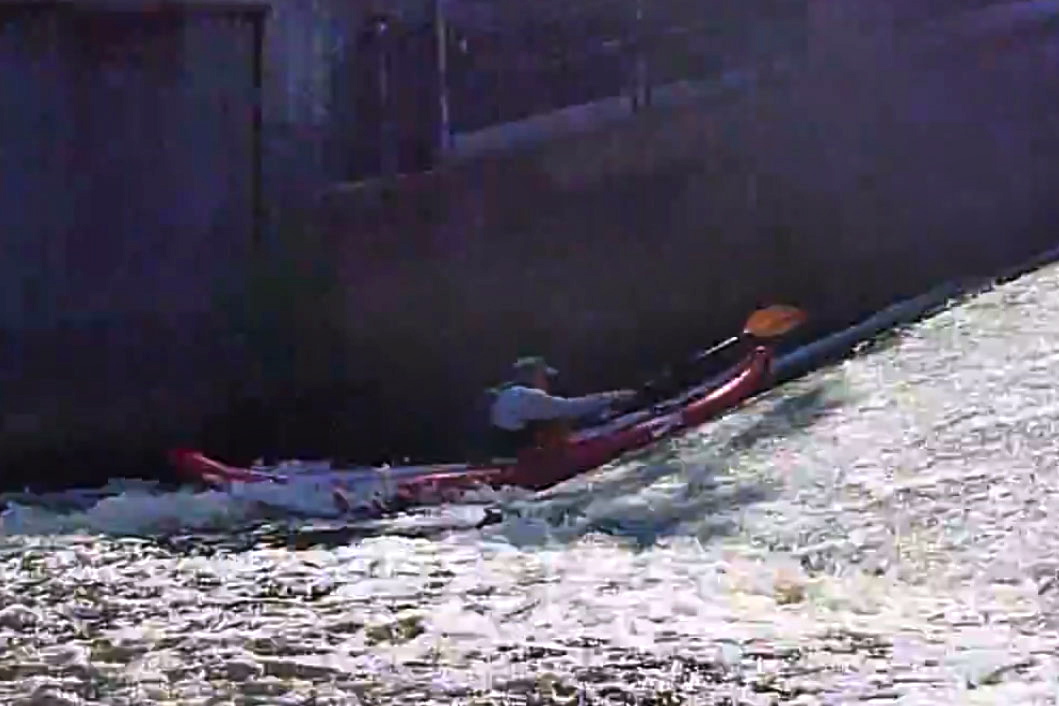
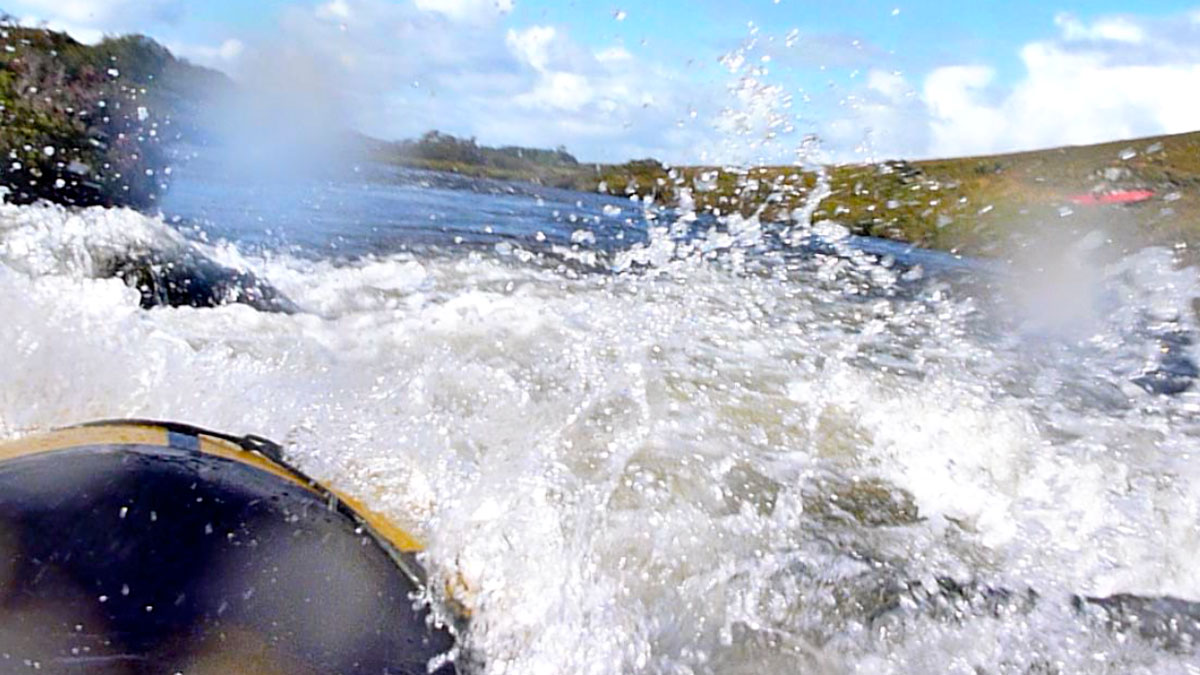
With the skeg off, it’s easy to seal launch off a grassy bank and into the scrum just below the waterfall which looks a bit complicated so was no less inviting this year. As I spilled over the first little step I tried surfing like people do. But the Solar wasn’t especially dynamic or there wasn’t a strong enough recirculation going on to make it feel interesting. So I swung round and set off. Even at full flow, the Osgaig is a shallow, bony river better suited to an injection-molded TNP ‘spaddle’, not 220 quid’s worth of carbon-light Werner Corry which was picking up new scrapes as I jabbed at the water to keep the boat on line. It was really quite effortful with the Solar, at 3m or nearly 10 feet it’s perhaps a bit long for this sort of thing. I hit the one or two rapids full face, kicking up a satisfying splash and remembering that ‘bring it on’ exhilaration when trying an IK and white watering for the very first time on the Salmon River in Idaho all those years ago.
The river branched near the Loch; left looked all froth but too shallow so I swung right but again scrapped and shoved from one bar to the next. I was hoping to make it all the way to Loch Osgaig but up ahead I saw the tree strainer I recalled from last year so, stuck on another rock and by now steaming out of the ears in my heavy drysuit, I stepped out and walked back upriver.
Alpacka Yak Packraft A few minutes later I hopped into the snug Yak, spun round and slipped over the first drop. Spinning back, I tried to surf as I’d just done in the Sunny but it wasn’t happening. I guess the Yak is just too wide, light and too much drag to fight the flow. Off I went downstream, trying to avoid getting snagged while lining up to take the peak of what waves there were. Jammed in the yellow tub, sat lower and with higher sides, it felt much more responsive than the longer Solar and so was less effort to ride. Perhaps part of it was that a good line is less vital; most of the rapids I could have taken backwards and that added up to more fun. So there it is: a tight-fitting packraft is more fun on easy white water than a 3-metre IK. When I got snagged towards the end, I just stepped out, threw the boat ashore, and staggered out over the slimy boulders.
Chopping down my Sevy pooltoy into a slackraft lost too much buoyancy to take my gross weight, but it works fine for the Mrs who’s about half my weight. So on a very calm, sunny morning – realistically, it’s inshore limits – we took the Sevy out to the Bay for a swim. I’d glued on an extra outer covering of ballistic nylon to save the vulnerable floor, as we had planned to take it down the Escalante river in Utah a couple months back, but it was way too hot for that when we got there and since then, as you may know, much of the US has been suffering a terrible drought.
As often, the first paddle in a short boat like this sees the operator yawing from left to right like a crowd watching a ping pong final. After a while, though the paddling technique adapts to reduce this effect, but even then the boat is still much slower than an Alpacka. This Slackie is only 28″ wide by 56″ long – 2:1 – (my Yak is 88″ x 36″; 2.44:1) and the Mrs found the best trim was sitting in the middle, even if this meant nothing to lean back on and was not sustainable. Next time out we’ll take a fishing buoy or something to lean against, although I do wonder if some sort of trailing skeg – a board sticking out the back rather than an under hull skeg like on an IK– might help subdue the yawing and so direct the effort in a straight line rather than zigzags.
My Alpacka skims along just like it always does; what a great boat it is. Annoyingly the backrest is leaking again from the twist valve base, even though it’s been glued up once. I find you do need that backrest to sit correctly in the boat, so another repair is due. We dipped about, followed the river channel and out to sea and on to the rocks. As the tide turned we headed back up the river, against the flow the slackboat soon slowed to a near stop and it was faster led on its string through the shallows until a tailwind helped blow us back to our shoes, by now stranded some 200m from the water’s edge in just an hour.
A post-sea trail inspection showed that my carefully glued floor was coming away from the Sevy’s PVC hull like damp wallpaper; that may have explained why the boat got so slow coming back. The Evo Stik didn’t take to the hull at all, or if it did, seawater soon dissolved it. At the time I was trying to save on my nice Bostik 1782 which I used elsewhere on the slack boat with no problems. Anyway, it’s not worth wasting any more glue on this boat. And who knows, perhaps the ribbed floor which has been exposed again may help restore some tracking. We’ll see next time. We’ve half a mind to repeat last year’s fabulous Suilven triathlon, but this time in a boat each.
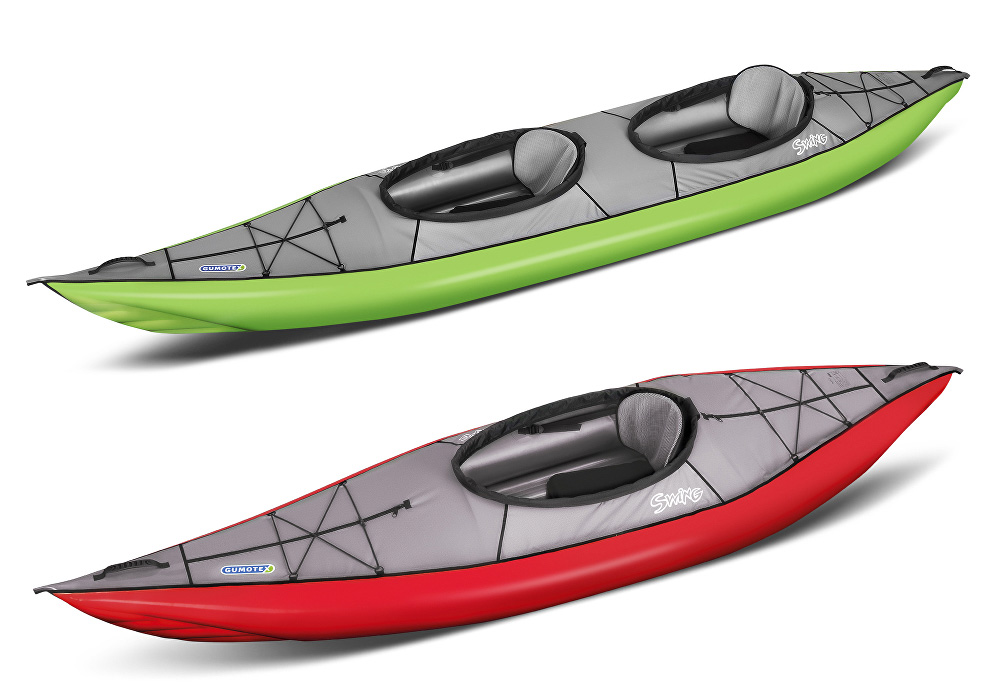
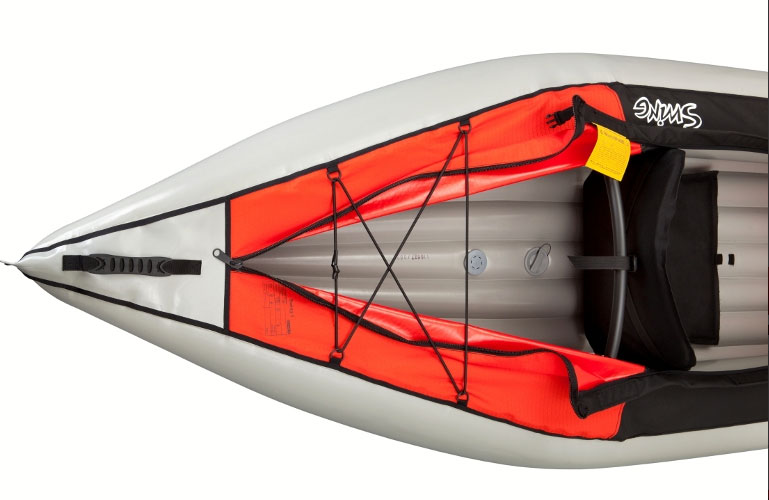
The Swings are fixed-decked solo or tandem IKs pitched at recreational users who seek the reassurance of a very wide boat and the dryness of a deck.
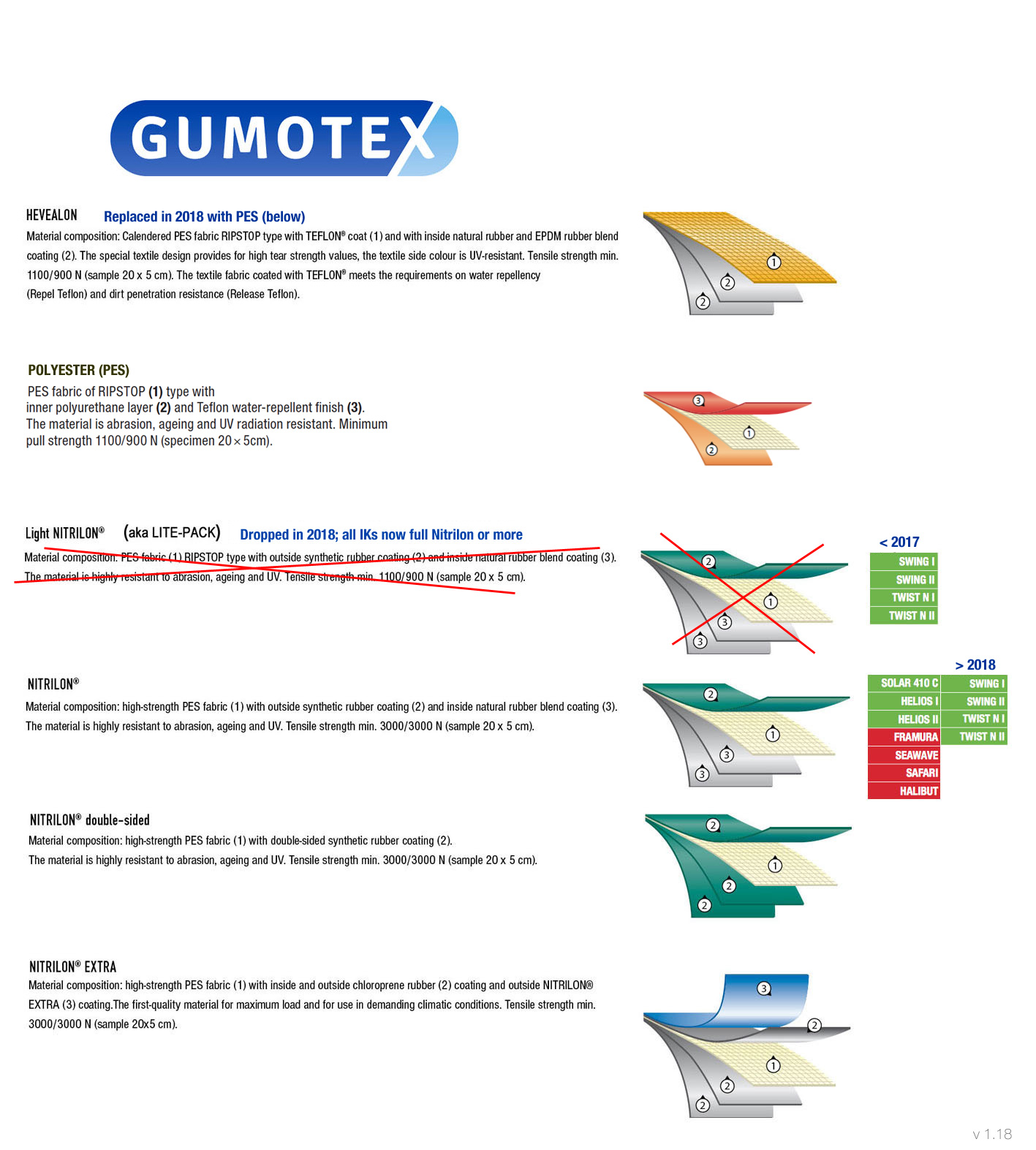
There were once and are maybe still two versions of Swing 1 and 2. Innova distributors in the US show red/black green/grey hulled models which they still list as made from Nitrilon Lite™. Europe and maybe elsewhere never had the black-hulled models and are made in Nitrilon (Nitrilon Lite™ has been dropped). The claimed weights for identical boats from EU/US are the same. You presume the green/grey doubles are now identical. See the table right about IK materials with more here.
Note that what Innova in North America call the Swing EX is a Framura in Europe – a slimmer, fixed-deck, 4.1m IK which is much more suited to solo touring and inshore sea kayaking.
As others have commented, they appear to be taking on IKs from Advanced Elements and even the bird’s-eye view is similar. From the profiles it appears they’re more ellipsoid or ‘lemon-shaped’ than other models, or maybe it’s just that they’re substantially wider which exaggerates this impression.
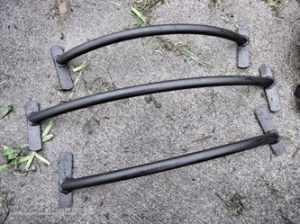
The Swings use 2 or 3 curved alloy crossbars to keep the deck taught (similar system on my Incept and Seawave) and make room for the legs, as well as spread and form the width of the boat. Some blurb states these crossbars make the boat more rigid which may well be true. Constraining the sides (stopping them from flexing out as the boat bends longitudinally) will have some effect in overall stiffness.
As far as the preferred boats for touring, what is desirable is a decked boat the length of a Swing 2, but set up for a single paddler. That is the Framura aka ‘Swing EX’ to Innova – a good-looking, solo-touring, fixed-deck IK for those who think soloing in a Seawave is a bit much. Sure you can sit in the back of an SW2 and load the front, but it’s not right, is it? What are the actual benefits of a fixed deck on an IK? (the Swings’ decks unzip partially). Limiting swamping – sure. Keeping the sun off – maybe in sunny lands. Keeping you warm – I suppose so, but that’s what a dry suit ought to do: ‘dress for the swim [falling in], not the paddle [air temps]’ they say. And many users complain that the zips are far from watertight. And so I conclude that the Swings may well be popular (actually I don’t think they were) but fall into the less desirable ‘bloat’ category: much wider than they need to be which is great for nervous day/rec users. But for the smaller niche of multi-day touring and sea use (space, speed, convenience), they’re not so ideal.
I got round to trying the Sevy ‘packraft’, a cheapo PVC dinghy with the outer hull cut off to make it less wide and hopefully more functional. Compared to the single-chambered Alpacka, blowing it up takes a while. The floor is made of two interlinked ribbed chambers which require a ‘spike’ beach ball inflation adapter that fits on the end of the K-Pump (right). The main chamber fills quickly enough with the K-Pump – a one-way Boston valve ensures you get a good fill of the elastic material and it’s always a surprise to see it stay that way according to the SevyGauge™.
Even then, on the riverbank alongside the Yak it did look very small and rather low in draught so that even with a dry suit, I wasn’t convinced I wanted to get in off a steep, muddy bank. So I set off upriver to Sluice Weir in the Yak, towing the Sevy and intending to shoot the chute for a bit of fun. On the way I spotted a striking blue bird – never seen one of those before. Do you get bluebirds in Kent in mid-winter?
I got in the boat as gently as I could but it didn’t take long to have an inverted Archimedean revelation: the mass of the paddler was nearly equal to the peak buoyancy at the rear of the craft. That’s partly why Alpacka came up with the fastback tail in 2011. Unlike Archimedes, I didn’t jump out yelling ‘Eureka’. I just sat still thinking ‘is it spilling over behind me and if not, why does my back feel cold?’ I took a couple of pics behind my back (below) to establish plimsoll levels, then set off slowly across the pool, with the trusty Alpacka tender bobbing along behind in case the Sevy sank.
This was not relaxed or efficient paddling like in the Yak. I arched forward trying to offload the stern while pulling gingerly through the water for fear of initiating a possibly catastrophic water-bounce that would fill the boat. The Sevy sagged feebly under the weight of my butt and feet, just as I’d seen Jeff’s do on the Fitzroy. However Alpacka do it, it’s the rigidity in their hulls that makes them as good an airboat can be. The multiple coatings on the non-stretch fabric must have a lot to do with that. As expected the short, round Sevyslackraft yawed quite badly, even with the Alpacka in tow to act as a rudder. But that always happens first time out in one of these boats until you adopt a smoother technique. Either way, I was relieved to be wearing a drysuit.
As I bimbled around trying not to sink, the nearby weir boom opened up without warning and suddenly the Medway was kicking out a current such as it had not seen since the end of the last Ice Age. I could barely make headway in the Sev so allowed myself to be swept back to the canoe portage pier where I hopped back into the Yak. Within just a few minutes the river had risen 6 inches or more. I thought it had appeared rather over-full upstream in Tonbridge where I had driven through earlier. Anyway, the 5-minute Sevy Slackraft trial were complete. To paraphrase Right Said Fred, I’m… Too Hefty for My Boat, although it will make a nice packraft for the Mrs who’s a little over half my weight of 95kg + winter ballast.
So, packboating newsflash: the Sevy blow-up boat is not for bloaters like me. But as it’s so light I could still see a use for it as a tow barge for a bike or an extra huge payload (not that you could realistically walk with such a load). Maybe a really long river stage, or one where you want to be well equipped on arrival with a huge tent or something.
In early 2016, Feathecraft dropped the Java/Gemini and Aironaut to stick with folding kayaks. In 2017 Feathecraft closed for good.
In 2007 I was already looking to move on from my Sunny to something a bit longer and self-bailing (I thought this was a good idea at the time). The two boats that appealed to me were Aire’s hefty and wide Super Lynx and a Feathercraft Java (since then many new contenders have come on the scene). I decided to treat myself to the more expensive but lighter Java and picked one up from the clued-up FC dealer in Durango.
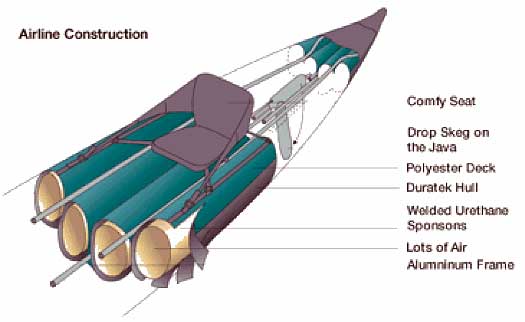
Set up is pretty straightforward: you slot in the alloy keel- and skeg pole and then the side poles, velcro them all in place, attach the seat by too many straps, pump up the four sponsons and off you go. Realistically, 20 minutes is a good assembly time. It’s a sleek-looking boat for an IK; still today nothing else comes close, but one of the biggest hassles are the cheapinflation valves: basic turn-and-lock elbow valves seemingly off the end of a Thermarest (or indeed an Alpacka packraft where they work fine to top up, not inflate). The thin plastic hose on the hand pump supplied pushes on, but when it’s hot or wet it twists off, or if you pump too hard it blows off and the air leaks out. As it’s an open (not one-way) valve, you have to screw it shut quick. Maddening! I thought for a while there was some component missing from the pump but no, this was it. I found holding the hose onto the valve with one hand while pumping the two-way pump with the other was an awkward but more effective way of inflating. Even if it’s bigger, give me a foot pump any day. Or regular one-way Halkey valves and a K-Pump. At 28 inches (71cm) wide, it’s just two inches narrower than the Sunny but feels much morem chiefly because you sit high ON it, rather than in it. FC are right in describing the Java as an inflatable sit-on-top. As you can see in the pics, under my 95kg weight, the poles are more there to aid the hull profile than enable longitudinal rigidity. It’s 15 feet 4 inches (4.65m) long but you can’t get much into the last foot-and-a-half at each end; the usual problem with IKs. The thigh straps are a nice touch or an admission that you may need them to keep upright. I took it out for a scoot across the Vallecito reservoir in Colorado one evening with the two inner (floor) bladders not too firm and was relieved to find it not too tippy. On the way back I struggled with the pump some more to firm up the inner sponsons and found it less stable but still OK, and probably faster. And before I got caught out, I practiced getting back in off the water; as long as I crawled aboard without any sudden movements it could be done in calm flat water. But who ever falls out in calm water?
The retractable skeg is a great idea that’s only really possible on a self-bailer, but with the middle sponsons firmly pumped up the actuating string which comes up between them gets jammed. It’s best to manually make sure the skeg is fully down before setting off – but this negates the retractable feature. At least you know that if it snags on the river bed it will just pivot up (but then won’t come down again). A good fix to help the skeg pivot with the string lever would be to have the string passing through a short section of thick garden hose or plastic tube jammed between the sponsons so enabling it to slide freely. The slot through which the skeg passes is also the bailing hole, designed I am told, to suck water out of the boat with a venturi effect as it moves over still water (less effective in a current going with the boat). Can’t say I noticed water rising as I stopped, but it sounds plausible.
Paddling without the skeg was OK on flat water but with it deployed you can power on. The solid footrests, thigh straps and comfy seat (also inflatable) all help here. One problem with the footrests is the angle they sit on: the poles force your knees outwards into the paddle arc. I also wondered how secure they were, screwed down to merely butt against a protruding rivet in the pole. A flat rather than pointy end to the securing screw pin sitting against the 2mm-high rivet might be better and could easily be done. Anyway they never shifted during the easy paddling I did.
The Java has neat cargo nets: easy to use and secure. I’ve since bought a pair for my Sunny. Inflation valve design apart, workmanship is what you’d expect for over $2000 with good attention to detail. The ‘envelope’ or hull doesn’t really need to be sealed in any way as the four sponsons or bladders slot into their respective cases and, with the poles, make this pile of nylon and rubber into the only IK I know that looks close to a proper sea kayak.
Next day in Colorado disaster struck. I left the boat drying on the roof of the car in the forest camp – black hull side up… and went out very early to Silverton on the steam train. It had been a week of huge storms in the Rockies and camped in the forest I figured it would be OK in the shade and probable afternoon storm. But on the way back, when the bus driver mentioned it was a hot afternoon in Durango I thought “oh dear, I hope it hasn’t…”
It had. The thick black hull rubber had caught the sun nicely as it passed over the clearing and ruptured three of the bladders or sponsons. My lovely new boat, not one day out of the bag was a floppy mess. I yanked out a limp bladders (easily done) and found the rather light, flysheet-like ripstop nylon split, and pinprick holes in the airtight PU coating. That was the end of my Java paddling in CO. (A happy ending. I ordered a full set of sponsons from FC in Vancouver and when they discovered the boat was nearly new they generously offered to supply them free of charge. Good on you FC.)
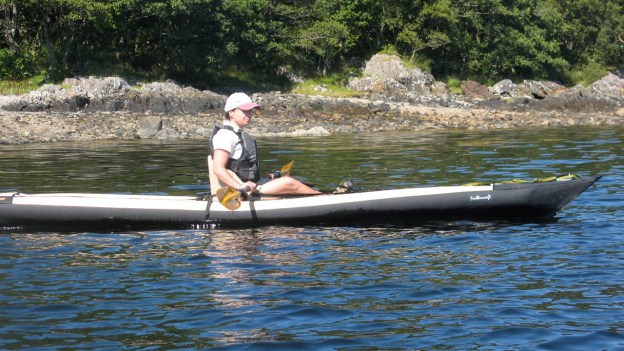
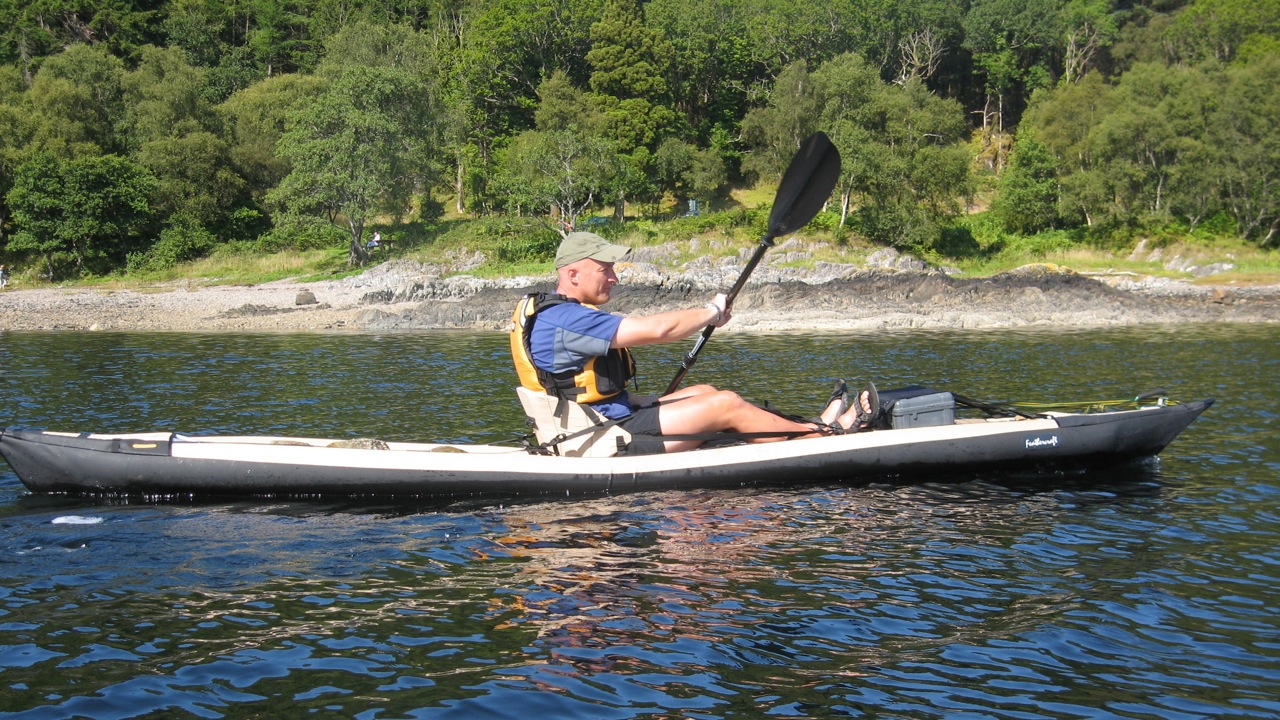
Back home with new bladders, we went to Scotland and I tried out the re-bladdered Java alongside my old Gumotex Sunny. G-friend’s first impression was that I was too big for it probably due to its SoT stance. She had a point. And also it was too fiddly to set-up for my keep-it-simple prefs. She had a point again, and although it’s amazingly light for what it was, it’s still pretty bulky. In Denver I’d spend hours packing it carefully for the flight back for fear of having the near yard-long hull poles damaged in transit. On my bathroom scales in the blue holdall ready to paddle it weighs 17kg (37.5lbs). The boat’s envelope alone (no seat or tubes) weighs 9kg (19.8lbs). In other words, about the same as my Sunny but two and a half feet longer.
On the lochs the long, thin Java slipped along, with a speedof 10kph (6.2 mph) flashing on the GPS for a second, though 4mph was a more sustainable speed (video above). Let me tell you that is a very good speed for an IK, comparable with the Incept K40 I bought a few years later. (There are more useful speed stats on inlotusland’s blog about a lake near Vancouver in a blue Java.).
The Java kayak didn’t really feel right to me: the old problem of too narrow and me sitting too high for my weight. An experienced hardsheller would probably not have any issues. We went on to a freshwater loch, a little windier by now. I tried to visualise myself in a fairly normal one-metre swell out at sea. The rocks I added for ballast hadn’t really added an impression of stability (as they can do on other tippy IKs) and overall, with the height/width relationship I didn’t feel confident anticipating the less than flat calm conditions I wanted to be able to face.
Back at the chalet the biggest hassle of all: the Java takes hours to dry, maybe even days. But dry well it surely must, especially when rinsed after a sea paddle. Sure, I’d read about this in some reviews, but it now dawned on me that the problem was common to all bladder IKs (like all Aires). Water will always get in the hull sleeves/envelopes holding the bladders as well as other crannies, and once there will always take a while to evaporate. A spin in my basic Gumotex Sunny reminded me what a great boat it was: quick to set up, fast drying and good enough performance. If only it bailed. [2020: I now think self-baling is not essential for a tour boat; i just used my Sunny beyond its abilities].
The Java got itself sold on ebay. Lesson: try before you buy and if it’s not possible (as it wasn’t for me in the UK), be prepared to eat your mistake.
In 2011 I gave my sun-faded Sunny away and got myself an Incept K40 Tasman. The K40 was less fiddly than the Java to set up, though the time taken is about the same, but I still miss the ‘pump and go’ simplicity of the Sunny. That is why I then got myself a Grabner Amigo. But I sold that and got a Seawave, my best IK yet.
There’s some Java chat on FoldingKayak.org. This guy in BC also had a Java then got a Gumo 410C. Looking at his pictures, I’m struck how ‘perched’ he looks while still being high in the water.
Let’s begin at the end: rolling up the K40. I followed the instructions provided in the leaflet. I removed the footrest airbag and the thigh braces before rolling the boat up and it took one or two attempts before I managed to roll the boat exactly as on the leaflet picture. The resulting bundle (right) was a bit thicker than my Grabner H2, but a bit shorter and I could put it back into the wheel bag provided by Sea Kayak Oban without any trouble.
Back to the beginning. I inflated the Tasman on the grass at my parents’ place in Brittany last Friday afternoon and checked the pressure with the gauge of my Grabner pump. The PRVs started hissing at 0.3 bar (4.5 psi) so the Incept runs the same pressure as the Grabner boats, yet is significantly stiffer than my Hypalon H2 once inflated. The H2 collapses flat when deflated, while the K40 keeps most of his shape, hence the initial difficultly in rolling it up into a compact bundle.
It took me some time to fine-tune the footrest and the rudder controls as I am 6’ 4” (1.93m) tall. I found a much better way to attach the rudder return shock cords to replace the previous messy knots, using a simple taut-line hitch. The lines are too short to make the hitches accessible from the cockpit with the deck on, but I can adjust them in open deck configuration.
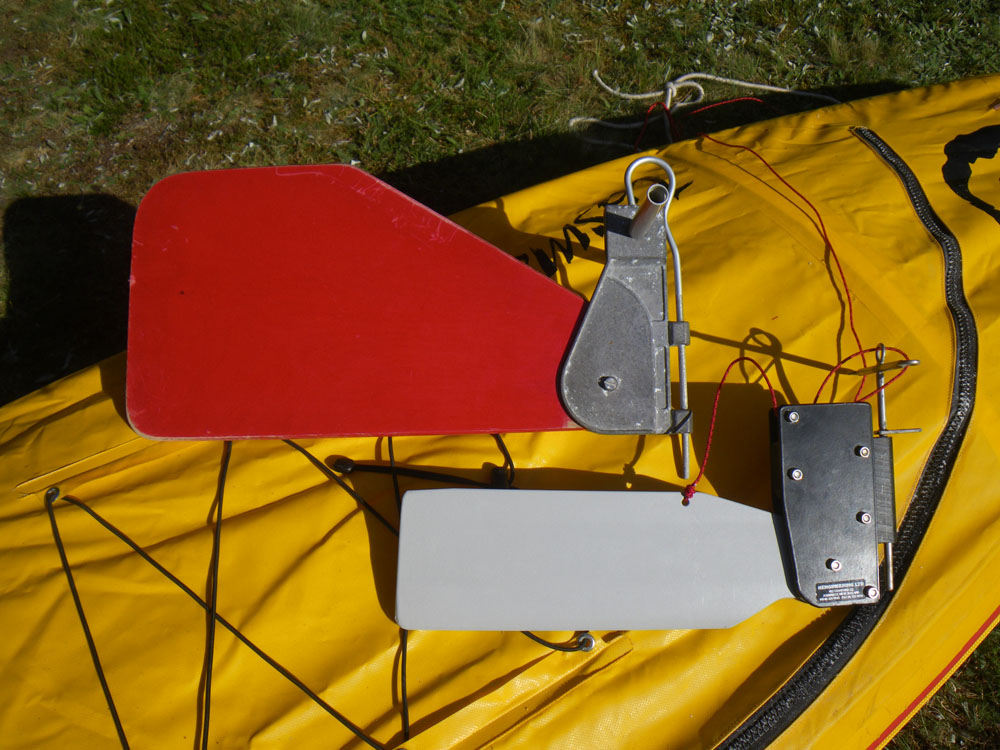
Talking of which, the rudder which comes with the Incept (left, below) is a beautiful piece of gear; much more serious that the piece of plywood and hinge which came with my old Grabner (but is still an expensive option).
The deck zip didn’t slide so smoothly but was improved by rubbing a piece of soap along the length of the zip. The spray skirt (right) is a rather ordinary piece of neoprene and nylon with braces. It’s been a fight to fit it around the flexible coaming (despite the rod inside) but it should become easier after some practice. The cord tension of the two crisscross bungee lacings fore and aft of the cockpit can be adjusted by cord locks, but I think the 3mm lines are too thin – 5 mm (5/16″) would work better. I don’t trust such flimsy deck bungees, and any item put down under them should be secured to the boat with some kind of leash. A leash can be attached to the perimeter grab line or to some additional D-rings to be glued to the deck. There are two unused fittings on the outer side of the K40 alongside the cockpit, through which I run bungee straps. Inside the kayak they run through the D-rings where the thigh straps are attached. The holds of the K40 lack any D-rings; there is nothing to attach basic kit (bailer and sponge, painter, water bottle, map case, compass, spare paddle) to the boat. I’ve got to order those NRS patches Chris mentions here.
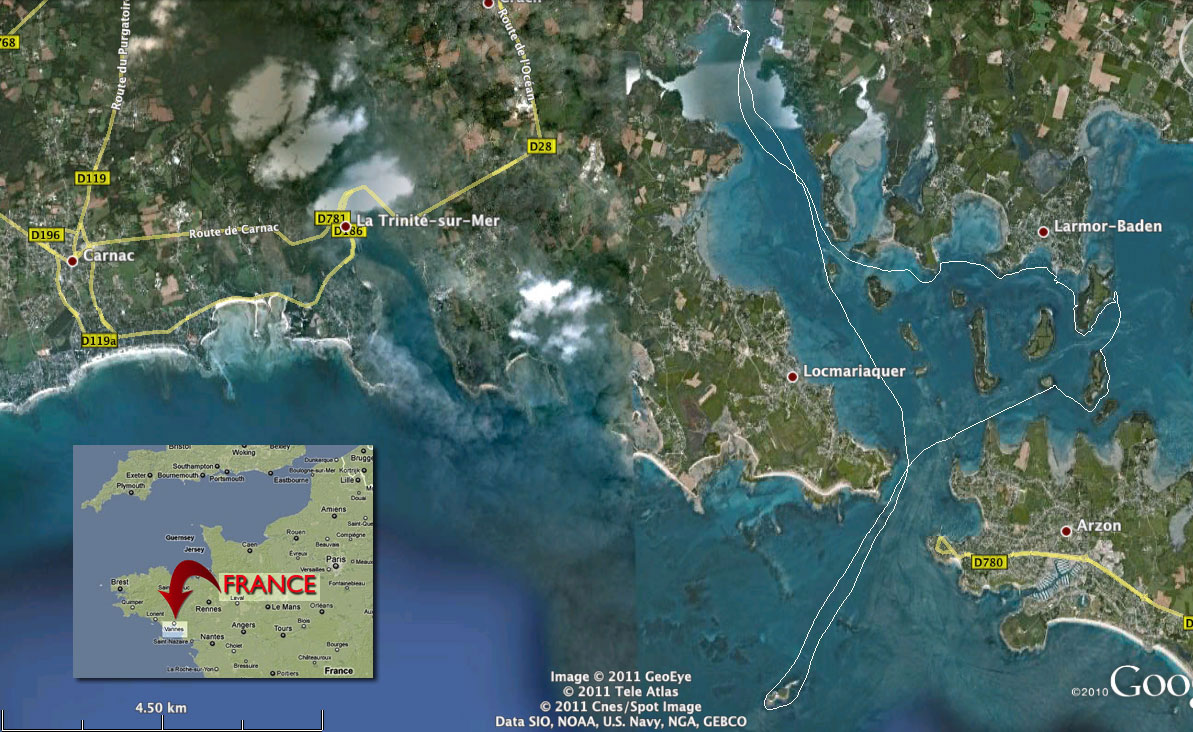
On the water Early on Sunday morning I loaded my K40 on my car roof and drove to a nearby put-in, Fort Espagnol that juts into the placid waters of the rivière d’Auray. It was sunny when I launched but it soon became overcast. I spent the next five hours on the water, riding the lively currents of the Golfe du Morbihan getting up to 10.1kph (6.3mph). Although those currents were rather mild as it was neap tides, they created enough chop in some places to test the behaviour of the K40 on short bumpy waves.
I made a short visit to the stone circles on Er Lannic (below) and made a stop behind the eddy next to the infamous Grand Mouton beacon. The current is still fast although it’s the end of the ebbing tide. The Incept K40 is definitely faster than my H2. It was difficult to assess my average speed because I was paddling in currents most of the time, however I wouldn’t make headway so easily against the tide with my H2. The thigh straps proved to be very effective in handling the boat in rough water and against the current, enabling the paddler to hold a better paddling position and to cling to the boat.