An hour and a half before sunrise and I am in the midst of a twitter storm. Up above me unseen in the trees the neighbourhood avians are performing their dawn chorus a little ahead of schedule. I’d been planning to try out a prototype Anfibio Revo for weeks, waiting for a sunny day while failing to pull off more ambitious test venues. In the end they wanted it back so it feel to a transit of the dreary old Thames through London.
But walking to the station, it was clearly far from the predicted freezing night leading to clear skies till noon. No frost glittered on car bodies nor stars twinkled above. Oh well, it’s 6.30am and I’m at the station. I may as well go through with it. Not done the Thames in a packraft before, so there’s that.
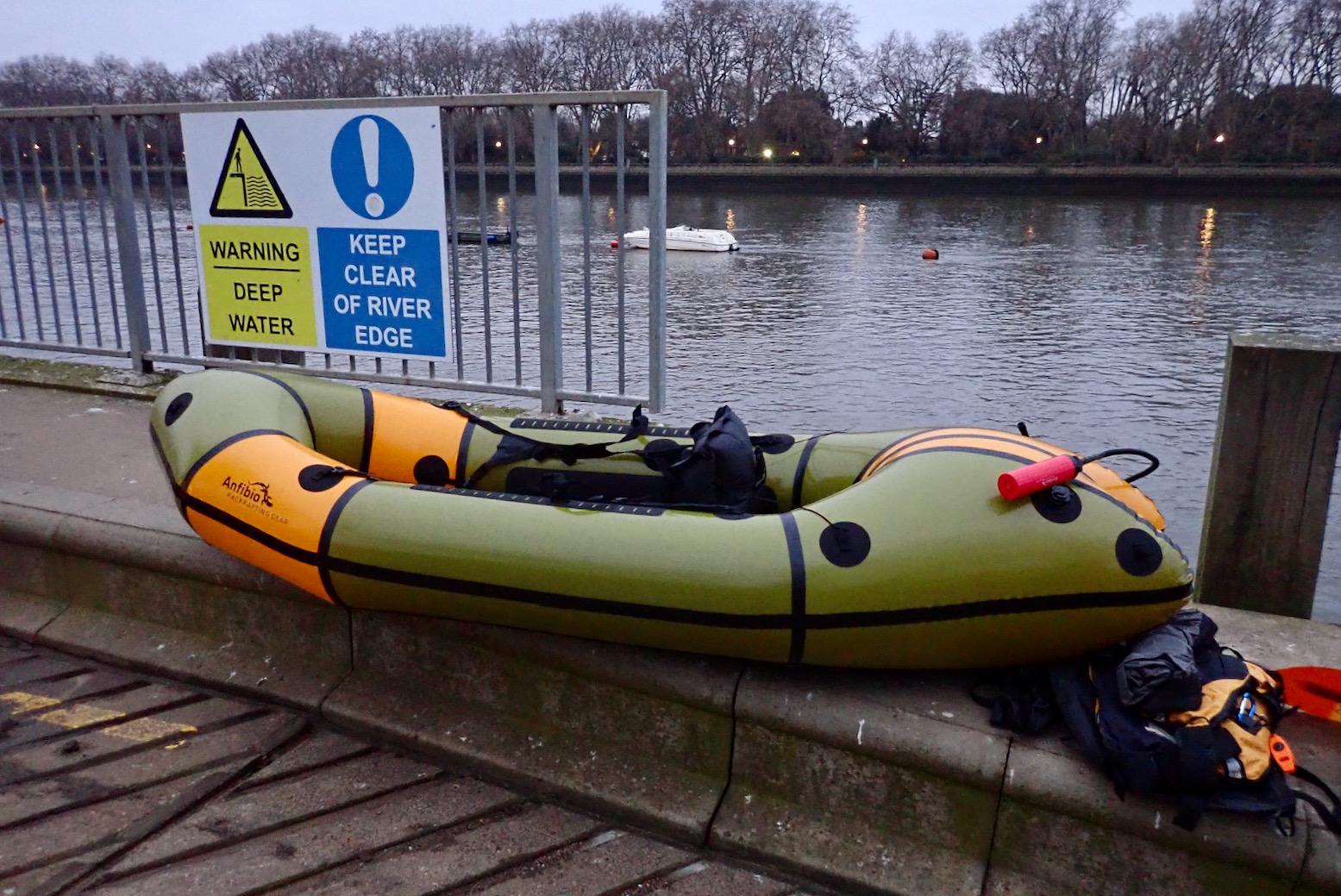
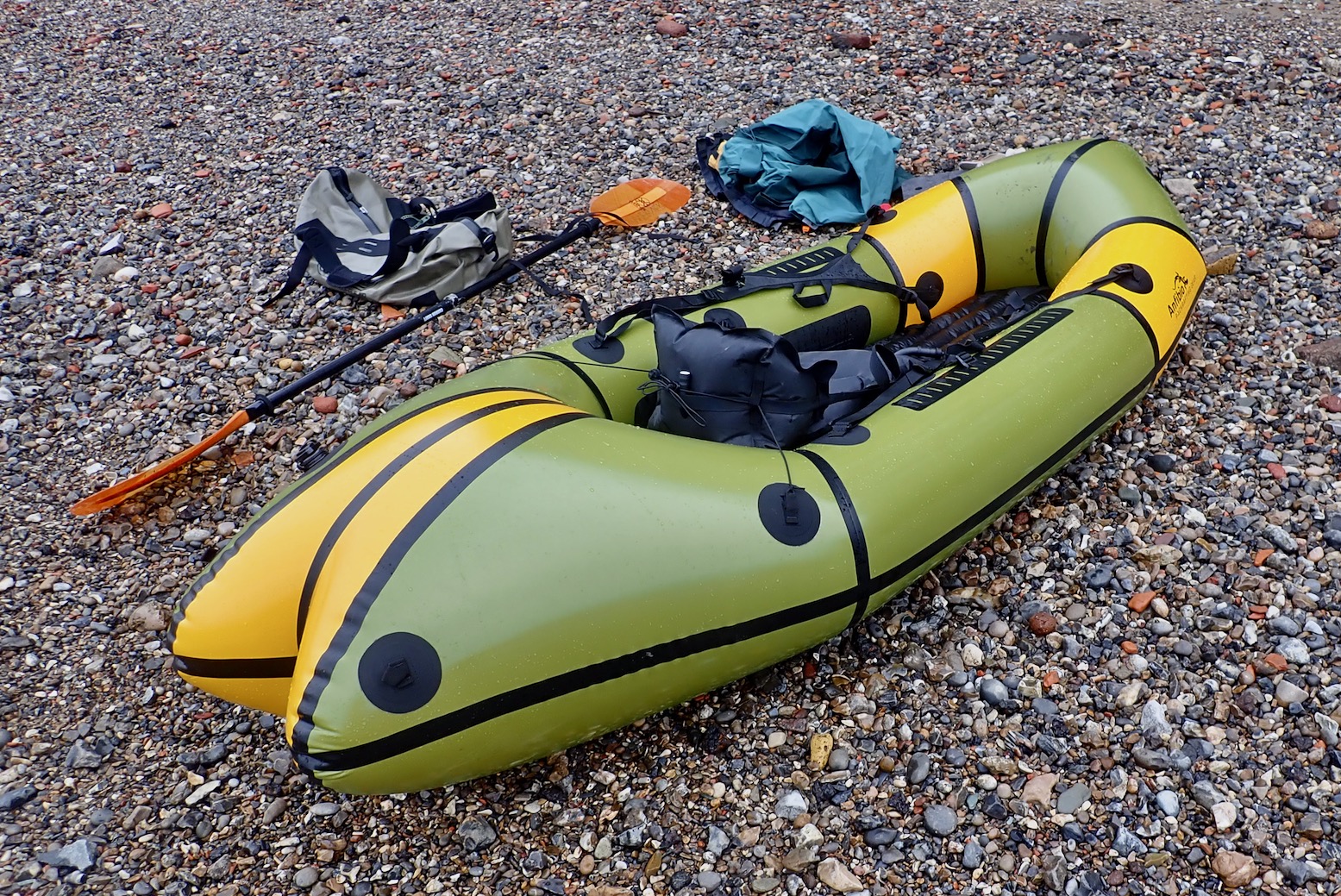
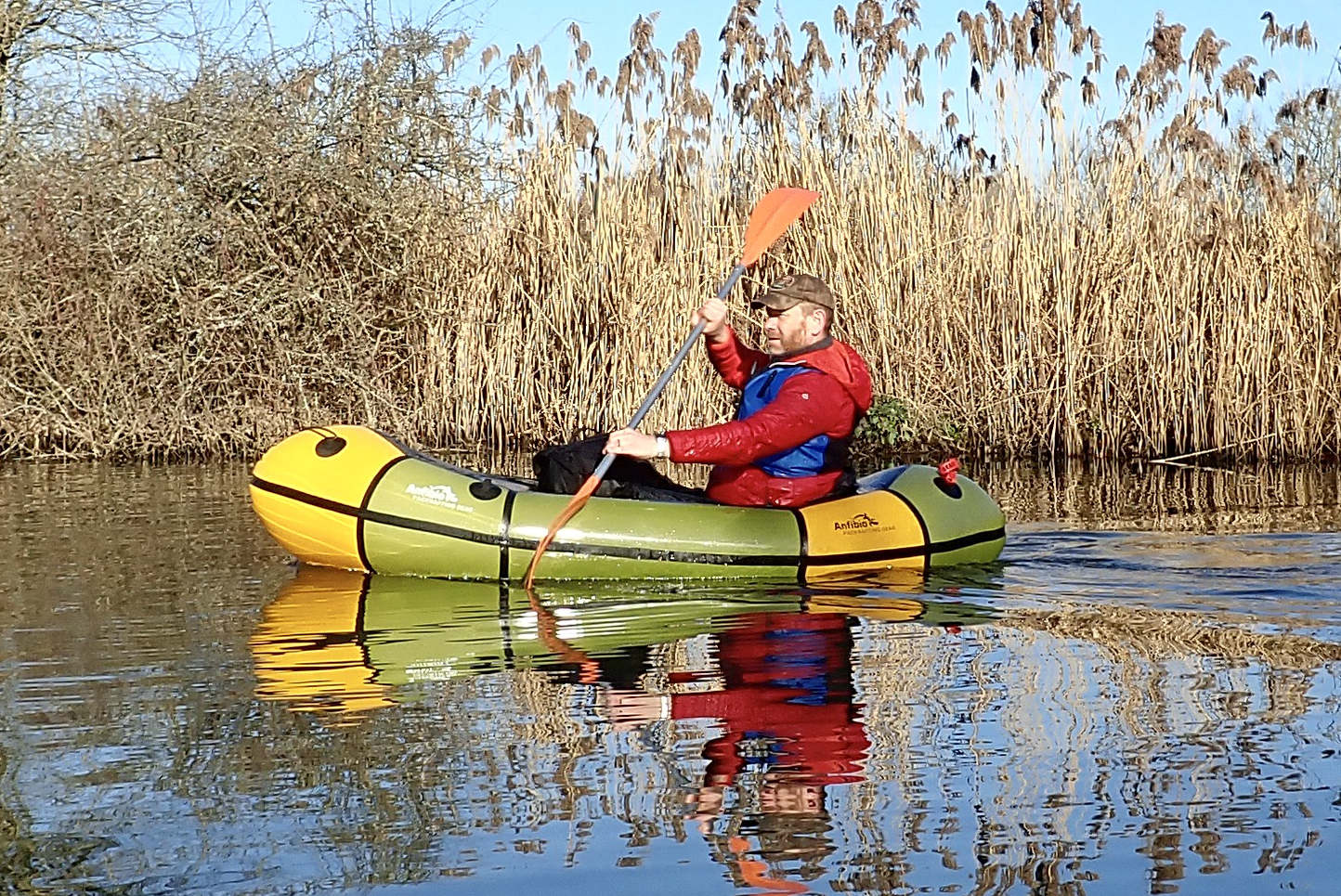
At Putney jetty energetic young rowers were hauling out their cheesecutters from the sheds while I fumbled with the Anfibio Revo’s floor pad. At a glance the Revo looks bigger than my 2K so it might be a bit faster. It’s a self-bailer with an unusual drain funnel under the seat (like some Gumotex canoes) rather than the usual lines of holes along the floor’s edge (like the ROBfin; another stillborn test). An 8-mile run along the Thames wasn’t going to test the self-bailing system, but for flatwater the dangling funnel can be pulled in and rolled up like a dry bag to stop the boat filling up.
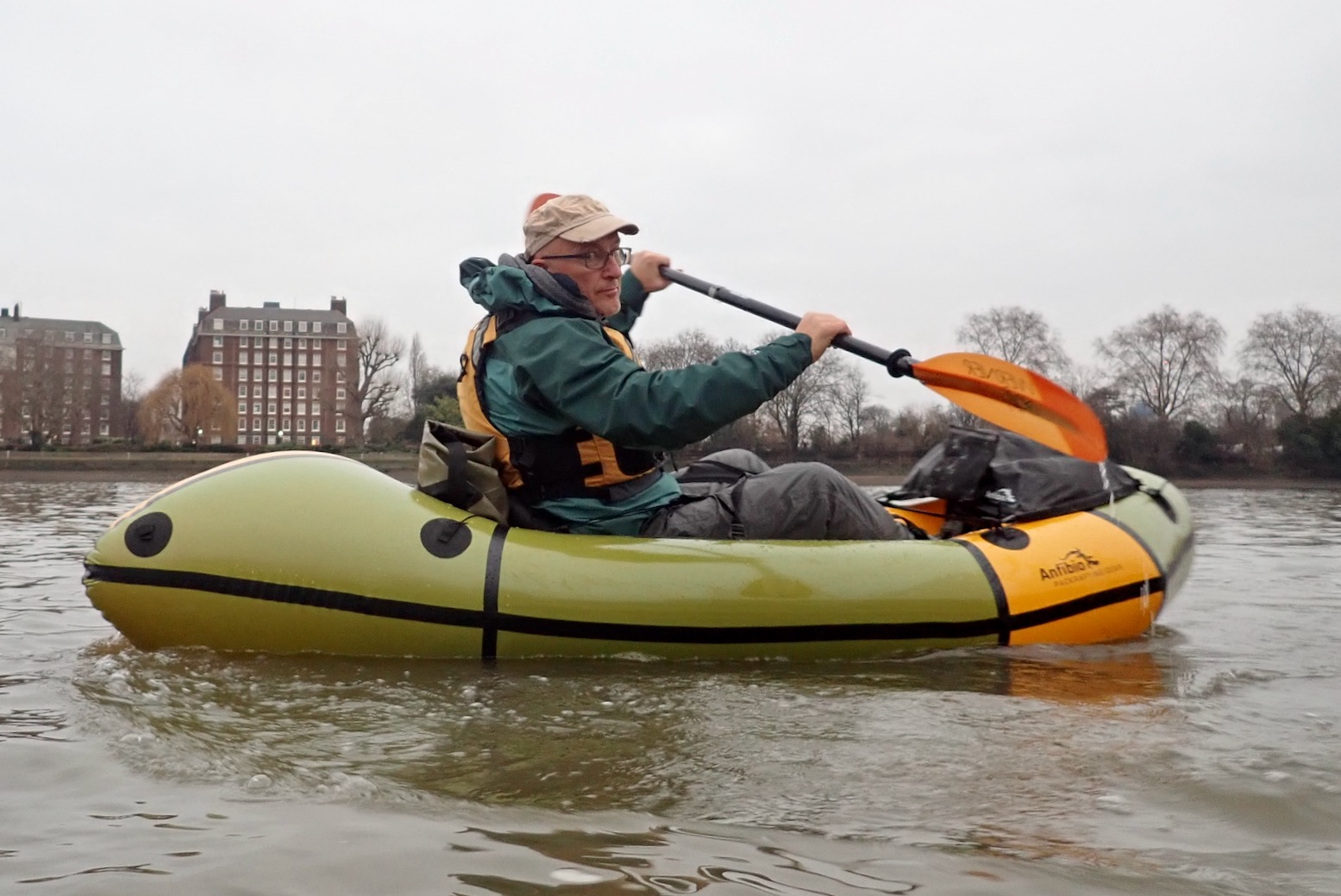
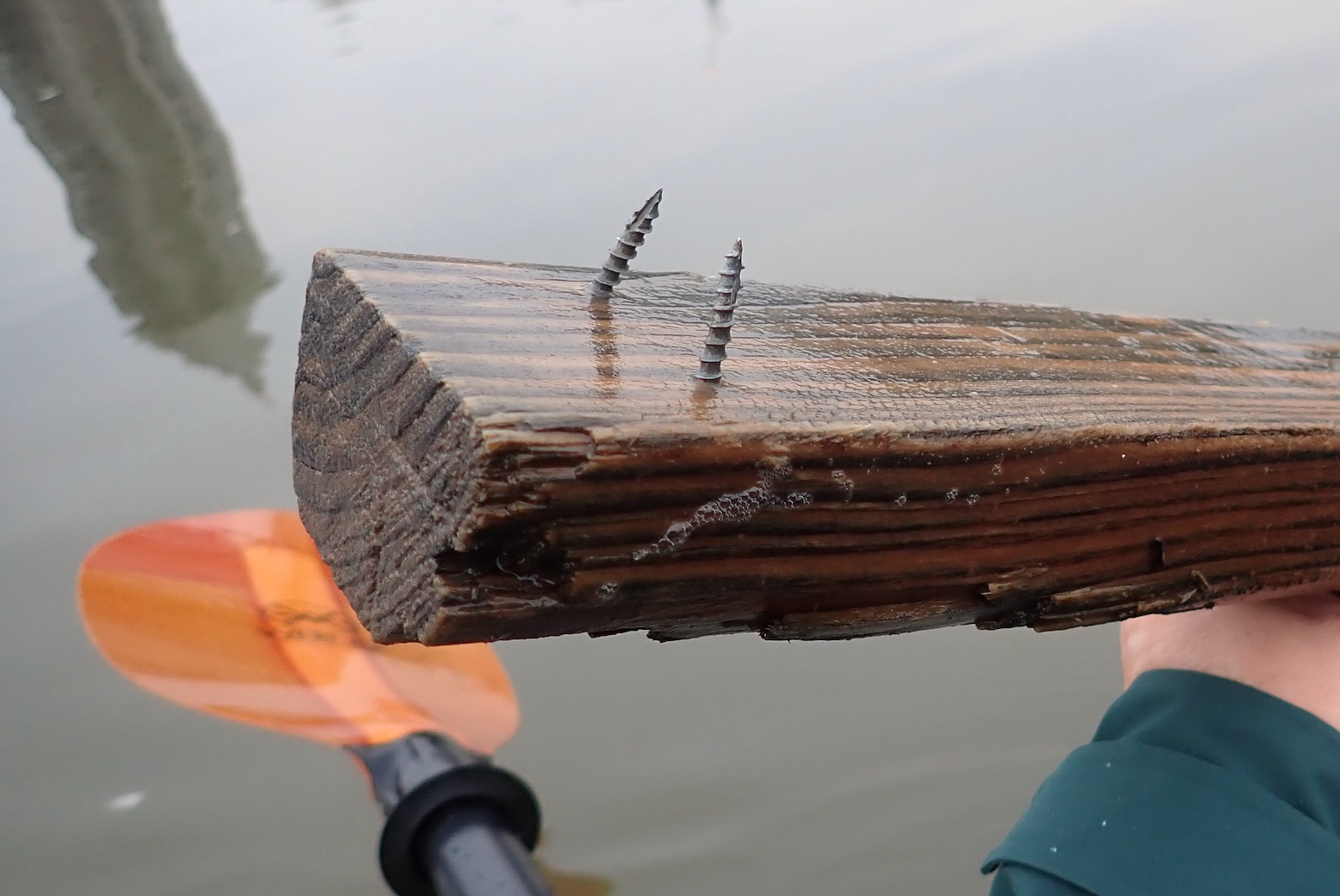
I am on the water midway through a 6-metre ebb; LW is 11am at the Mayflower pub in Rotherhithe. The Revo has a high-volume stern typical of whitewater packrafts to stop them flipping backwards when coming out of rapids (I presume).That old hay bail from my visit last April in the Seawave. It’s an ancient rivermen’s sign indicating ‘arch closed’ or danger. Could make a nice bird nest tooThe Revo seemed to yaw a lot for a long boat. Maybe the floor pad making the floor extra flat doesn’t help. So I pull over and fit my skeg which made it a bit betterYou don’t want to push up against this with 0.55mm of TPU between you and the fetid ThamesIs Battersea Power Station powering again? I hope someone informed the new residents?I am reminded of the famous Pink Floyd LP cover from 1977. People ask: What does the pig symbolize in Pink Floyd? Along with dogs and sheep, pigs are one of 3 animals represented on the album. The pigs represent people, like [Mary] Whitehouse, who feel they are the moral authorities. I was only asking!The latest scandals? Sigh: where to start, but good to see they’re finally getting the flammable cladding sorted.9am, all is quiet on the river but as soon as you pass under Westminster Bridge things gets choppier. My P&S camera is barely coping with this eclipsarian light. What a wash out.Jaunty buildings; journey’s end is nighI try some more selfingtons, but the focus is too lowI pull in just before London Bridge. I averaged 5mph for 7.5 miles, but half of that speed was the tide. Like any packraft, the Revo felt slow at times. You sure miss the g l i d e of a long IK. But it got me here and weighs just 4kg with the floor pad.Jeez, I’m glad I got off before he bombed through!A picture of me rolling up the packraft, so you know I’m not making it up.I decide to climb the ladder for old time’s sake.Back in summer 2005 with the old Gumo Sunny (my first proper IK) and before I knew about packraftsNotice the small standing waves you often get just after London BridgeWhat is the name of this famous ship? And who was the illustrious captain?I find myself in Borough Market for the first time in years, an Aladdin’s souk of upmarket nosebag: Paradoxically, in the middle is a greasy spoon and before I know it I’m sat before my annual Full English. After, I buy a giant sourdough loaf for a fiver and some wafer-thin slabs of Comte and Gruyere at only £45 a kilo.Can I see you ticket, please?London Bridge & APaddleInMyPack
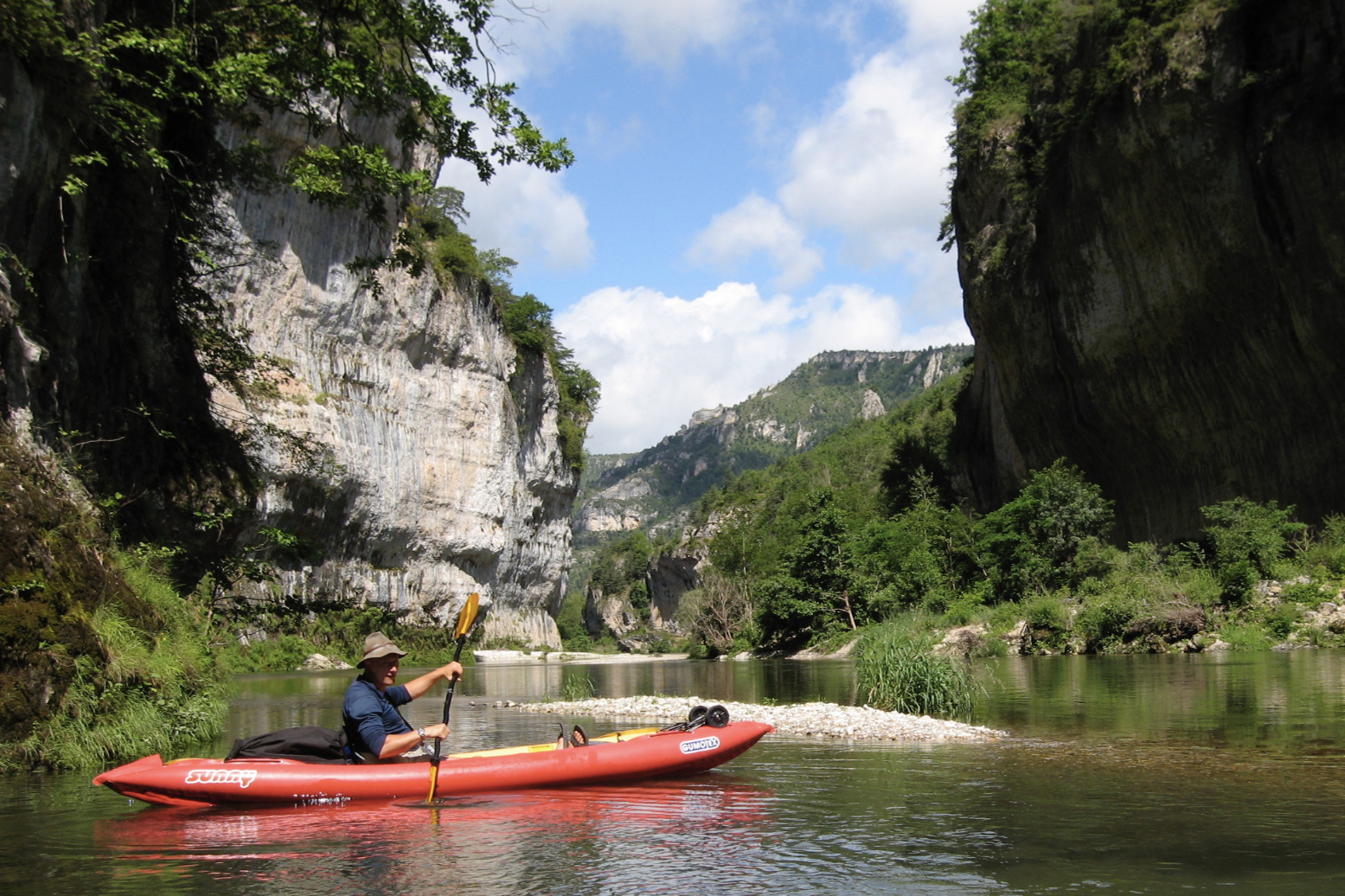
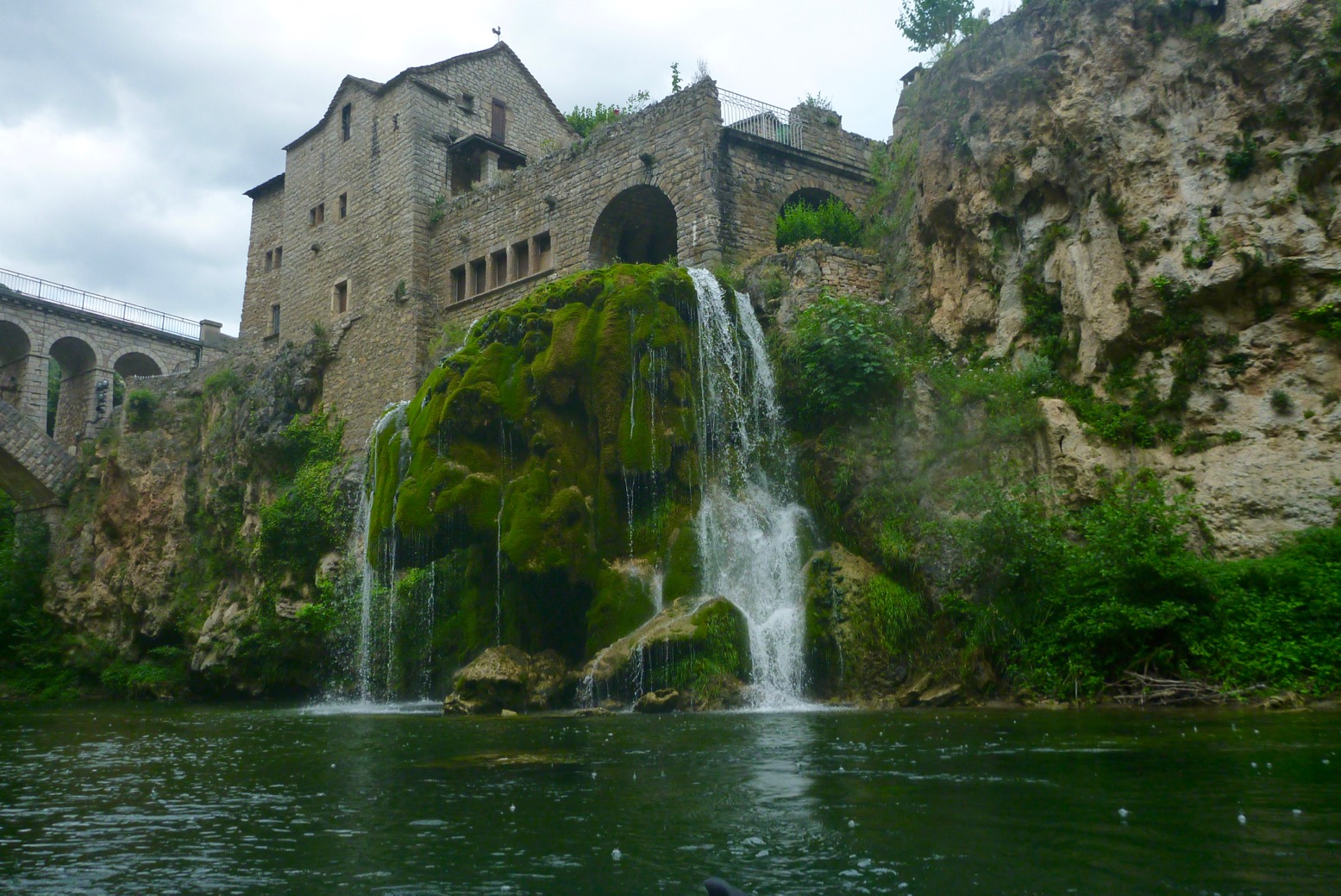
For reasons of topography and size, France, particularly the south and west, has some great paddling rivers. Mountainous areas not immediately adjacent to the sea produce long rivers along which you can choose the gradient and level of difficulty that suits your ability. And you can do so for days at a time. You can also add unfettered rights of way on the water, though that’s an unfortunate anomaly unique to England and Wales.
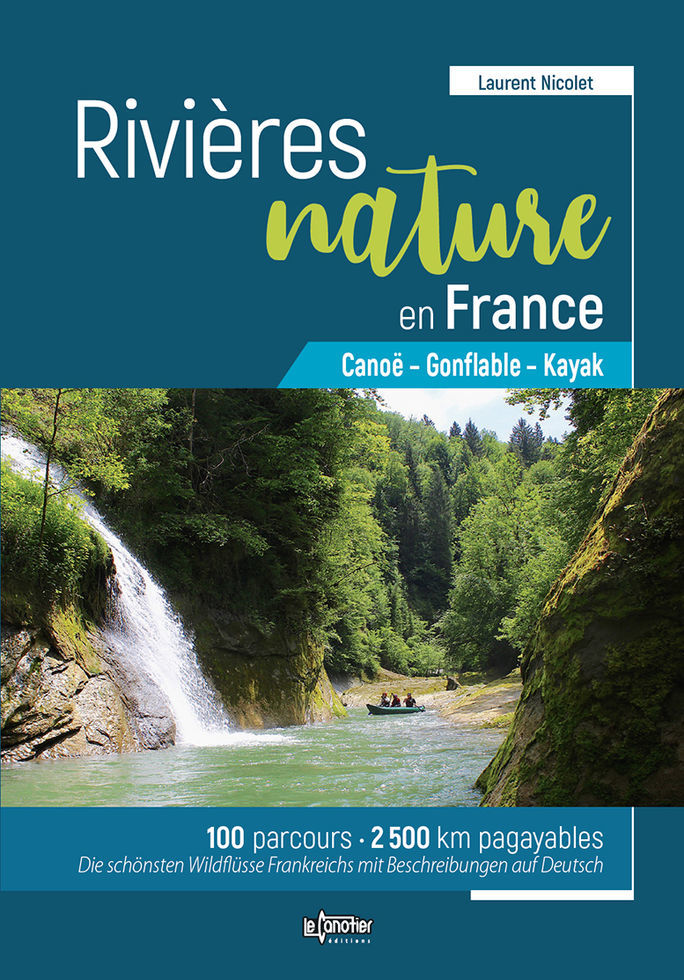
What they Say [translated] RIVIERES NATURE EN FRANCE answers all the following questions. For each route, you will find: • level of difficulty (easy to intermediate), the length and duration • specific regulations for the route • minimum, maximum and ideal water levels, and how to know them • access points with gps coordinates • QR codes to map access ponys and water level stations • description of the route (km by km, focus on difficulties) • short hikes off the river (canyons, caves, viewpoints, etc.) • specific safety advice • useful addresses (campsites, visits, service providers) • detailed map with an IGN topographic background
• Must be the ultimate guide to southern French rivers • The author has been there and paddled it – all bar three of the hundreds of photos are his • Very nice full page maps detailing portages and rapids • Parallel river summaries in German • More IK photos than you can point a paddle at • With a mobile signal, QR codes for put-ins go straight to your device’s map • Numerical waypoints also given • Nice paper and great value per gram • Printed in Belgium – better sustainability
• It’s in French – domage • The design can be a bit dense • Packrafts (and SUPs) not seriously considered
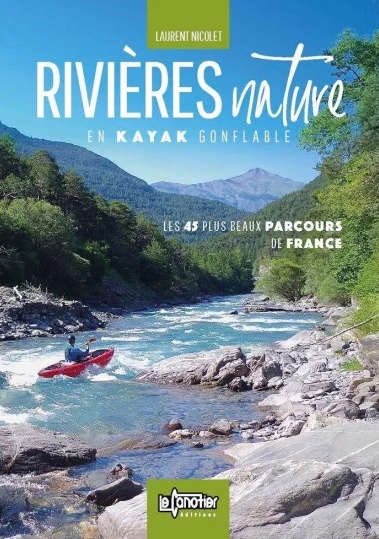
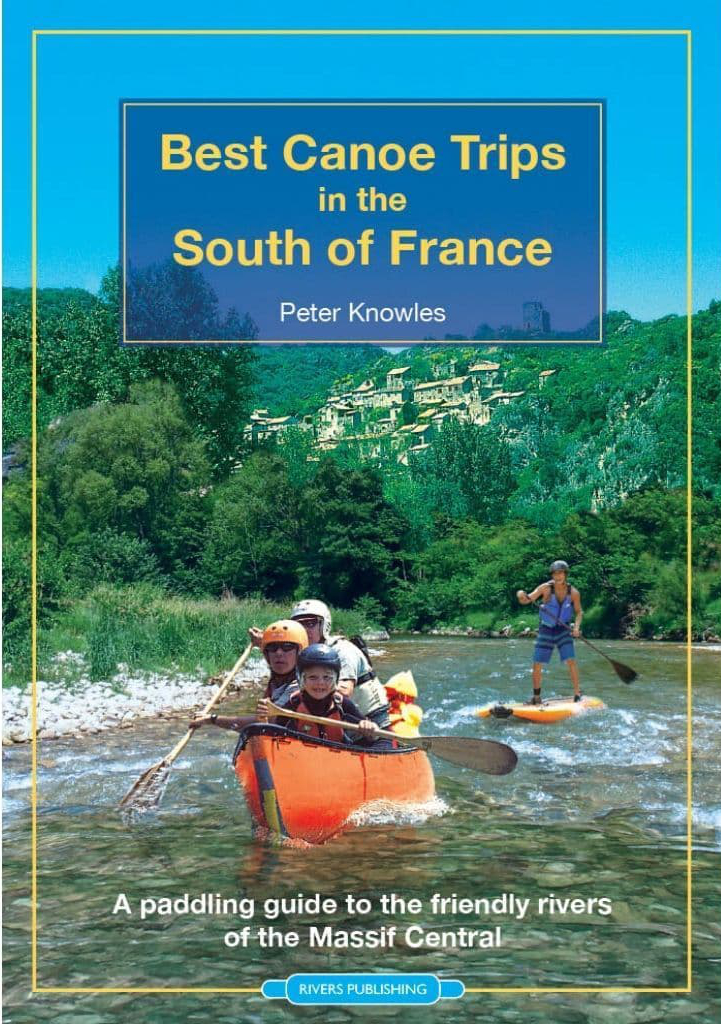
Review Rivières Nature en France is a similar if far more comprehensive title to the dozen rivers in Best Canoe Trips in the South of France (left) which I’ve used myself. This 416-page book compiled by Laurent Nicolet (distributer of Gumotex IKs and Nortik packrafts in France) lists no less than 100 routes over 63 rivers mostly in the south and west. It also shows parallel short summaries for each route in German and is sold on amazon UK for under £25. The book has more images of IKs than have probably ever been printed – even after my book came out ;-) This edition seems to supersede an earlier title published in 2018 called Rivières Nature en Kayak Gonflable which is Nicolet’s day job. For years he’s produced videos validating the utility of ‘kayak gonfables’ or KGs in French. It might well be the same or very similar book, but reprofiled away for IKs towards all paddle craft.
All the great rivers of the south are here: Tarn, Ardeche, Dordogne (ideal for beginners), Verdon and the sportier Allier, as well as a whole lot you’ve never heard of. Up front you get a location map (above), after which each river is listed alphabetically and described over a few pages. There’s the usual advice on what gear to take and safety tips like never tying yourself to the boat (SUP leashees take note) or shooting weirs without checking first. That’s unless there’s a portage-dodging passe canoës or canoe chute (left) – a common feature on French rivers which add greatly to the fun. There’s also an interesting rant against official censures against solo paddling “Imagine such restrictions on walking and skiing!’ Quite right, mon brave.
The author covers the full range of kayaks and canoes, hardshell or inflatable and even packrafts and SUPs (translated above). But less versatile SUPs and packrafts are virtually excluded from the book’s copious imagery, though a decked or bailing packraft could probably managed all the whitewater shown, and there must be some easier rivers which could be ‘boarded. On p379 I’m not sure the bloke balancing upright on some sort of dropstitch picnic table is on a SUP as we know it. There follows the usual advice on ‘leave no trace’ including using Le Poop Tube en sauvage, an explanation of Class 1-6, the vigicrues website for reading live river levels and which I discovered one time on the Allier, and advice on organising shuttles – all much eased if not eliminated outright by using portable packboats.
I won’t pretend to have read this book cover to cover, were that even possible – I speak French a lot less badly than I read it. But I only recently realised the ease at which a page can be translated with a translation app using a tablet or phone camera, or dropping an image into Google Translate. Reading a translated A4-sized page on a phone screen would be tiresome; easier to do back home on a desktop and print out. Some examples below. Note you have to excise the QR codes or Google goes there.
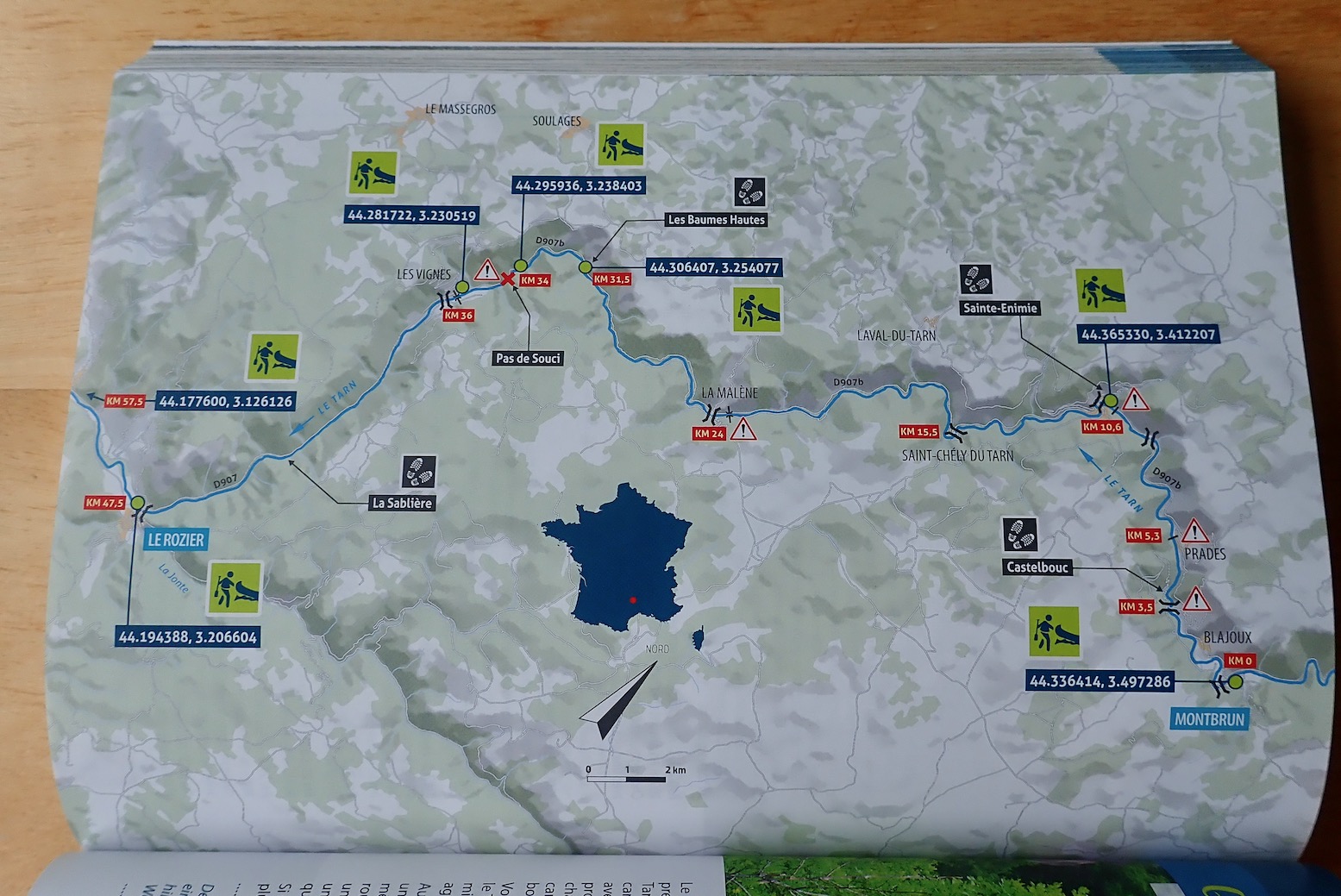
As a test example, I can concentrate on a river like the Tarn which I’ve done a couple of times both in a packraft and with IKs.
Tarn map. Fairly intuitive icons but no explanatory key and no campsites labelled.
Le Sabiliere – as hard as it gets on the Tarn
The Tarn description focuses on the most popular 57km section from Montbrun to Le Rozier. I have to say I made that 47km measured off Google Maps on my big Tarn map which covers the full 84km run from Florac, 18km upstream from Montbrun, to Millau, 19km after Le Rozier, Using public transport, I found both Florac and Millau better choices to start and end a Tarn packboat paddle. Anyway…
Tarn summary
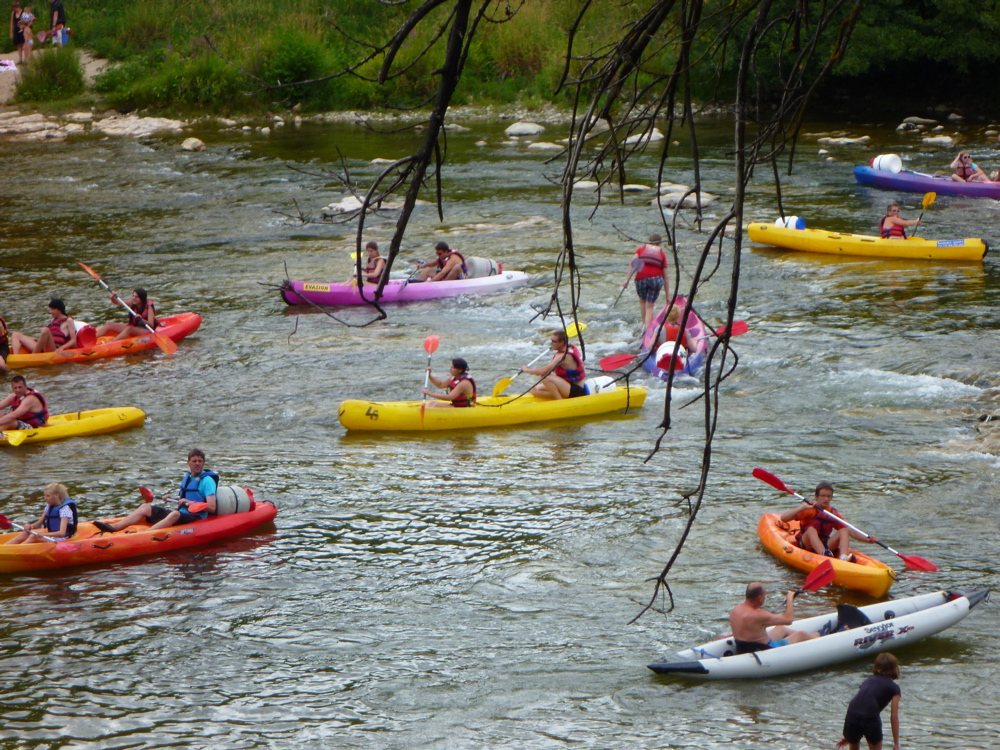
The first thing they advise is avoid the peak holiday period when the Tarn can become a logjam of hardshell rentals and yelping kids (left; actually the Ardeche below a busy campsite). While I’d certainly avoid the Tarn (and indeed France) in August, as a foreigner I found the occasional hullabaloo in July all part of the fun if you just paddle through it. Packed-out campsites along the stage described will be as bad as it gets. And they are packed out.
Tarn – Les Detroits
You then get a river summary: best time of year; regulations (if any); water levels with min, max and ideal levels, plus a QR code going direct to vigicrues – a good use of this idea; the best type of boat; environmental protection (if any); wilderness and tranquility; off-river pedestrian excursions, and where to sleep, but with only a selection of campsites including websites and a phone number. These could have been much more usefully added to each route’s map. Selected put-ins/take outs have more QRs linked to waypoints which are also printed in old-style DMS (44° 56′ 15.5″ N…), followed by the much less error-prone decimal-degrees (DD: 44.9376297, 2.321622…) format. Google still uses both but the sooner we all get used to simpler DD the better.
Kayaker caught putting-in below the Soucy rock-jumble by the Google drone
St Chely
Next is the main route description: KM0, KM22.7 and so on. ‘En aval‘ was a new expression on me: ‘downstream’. If your French is a bit ropey – or cordée – it would be worth translating page images in the planning stage, as suggested above, so you don’t find yourself in l’eau chaud. Doing so you’ll come to learn handy expressions like en aval and so on.
Tarn Route description
The book goes on like this, river after river, with enough photos to help you identify what looks appealing. It celebrates a newly opened passage of the Allier from Naussac all the way to Brioude (114km), though you may want to miss the initial 22km of “no less than 55 distinct rapids [up to Class 4]” which end at Chapeauroux.
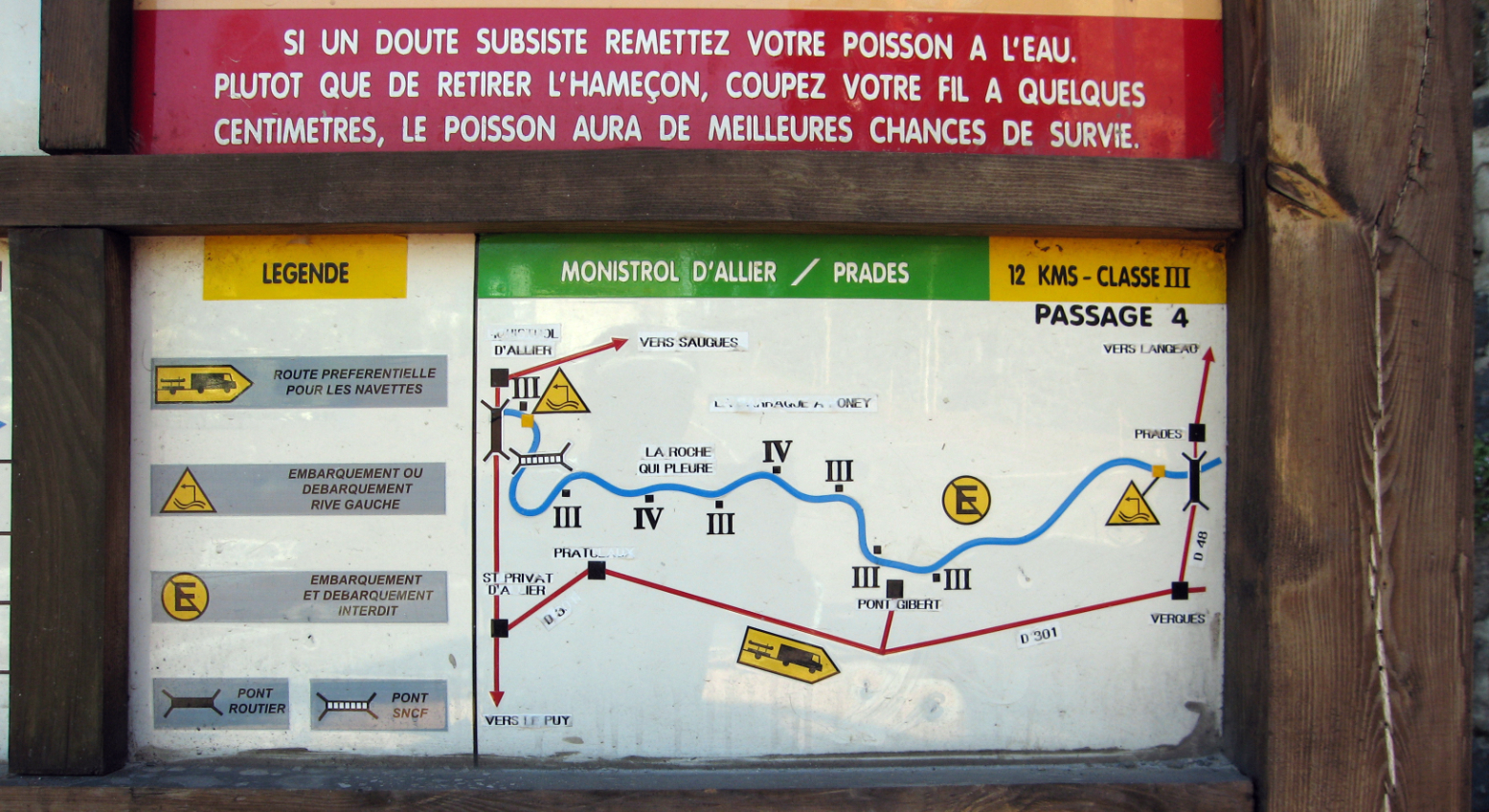
Coming up the train line from from Brioude, it was from Chapeauroux one June that I blundered rather naively down the Allier in my early Sunny days, after having found the Dordogne a bit of a doddle the previous year. As mentioned elsewhere, a dam up from Monistrol (30km below Chapeuroux) has by been rebuilt lowered to salmon-friendly levels so that the long taxi portage I had to do around the now non-existent reservoir from Alleyras is now just an awkward portage down the new dam face at Poutes. (At the back of the book is an article entitled: ‘Hydro-electricity; the least renewable of renewables’). For the 12km from Monistrol to Prades (above left) you’ll again want a deck or self-bailing boat, otherwise you’ll find yourself as I did, pulling over to pour the water out of your boat. From Prades it’s all a less fraught and as enjoyable two days to Brioude.
You can have a lot of fun with the English Rivers Publishing guidebook – in some ways I find the basic design and layout a bit less dense. But once you’ve seen it and done it all, Rivières Nature has many more paddling suggestions in the fabulous south of France.
Are there really 450 pages to write about packrafting? Let’s find out!
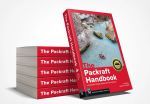
In a line You’ll learn more than you’ll ever use from this lavishly illustrated handbook, with loads of safety advice that focuses strongly on the author’s preference for whitewater.
• Presented with an engaging humility and humour which helps deliver important messages • Sarah Glaser’s vibrant graphics often work better than photos • Goes from £26 on amazon • Like the best handbooks, even the experienced will learn something new
• For a 450-page handbook on packrafting there are some odd omissions: no words or pictures about crossrafts or tandem paddling, sailing, bikerafting (bar one loading graphic), even packraft ski-ing which sounds fun and the author seems to have done • Like similar kayaking books I read ages ago, it can all feel a bit off-putting – which may be a good thing • Inevitably, Alpacka and Alasko-centric, a magical if unforgiving wilderness with unique challenges.
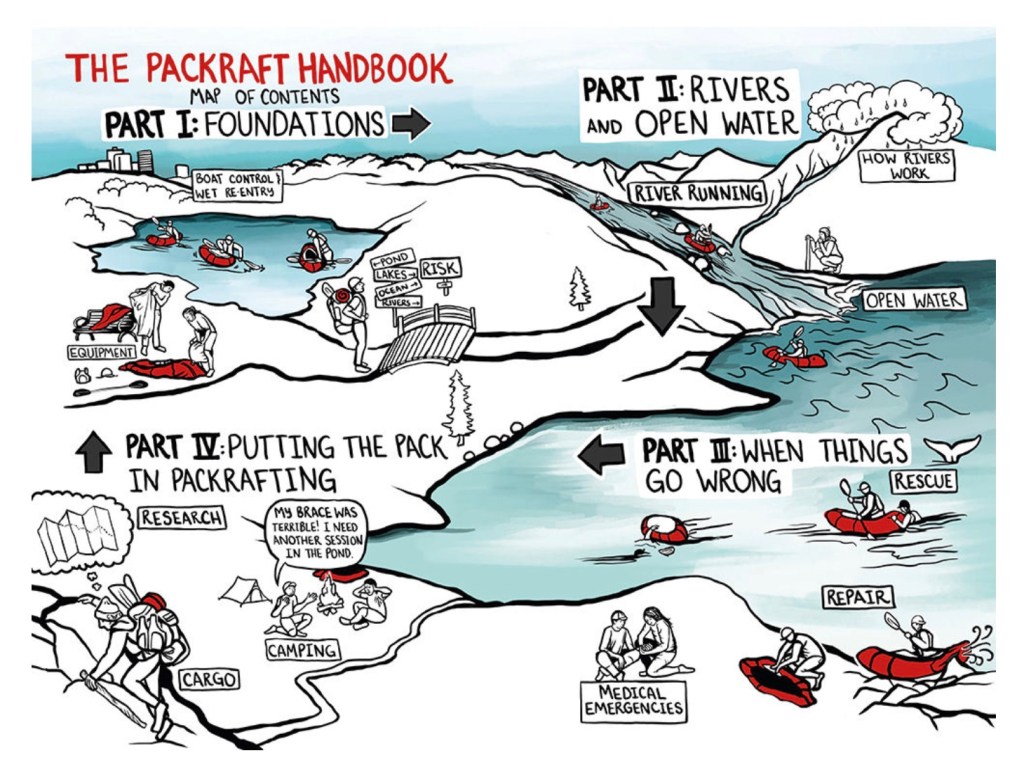
What they say The Packraft Handbook is a comprehensive guide to packrafting, with a strong emphasis on skill progression and safety. Readers will learn to maneuver through river features and open water, mitigate risk with trip planning and boat control, and how to react when things go wrong. Beginners will find everything they need to know to get started – from packraft care to proper paddling position as well as what to wear and how to communicate. Illustrated for visual learners and featuring stunning photography, The Packraft Handbook has something to offer all packrafters and other whitewater sports enthusiasts.
* This review refers to the original 2021, Canada-printed edition self-published by the author, not the 2022 version published by Mountaineers in Seattle and printed in Korea. There may be small differences in content and print quality.
Two good books I read as a beginner
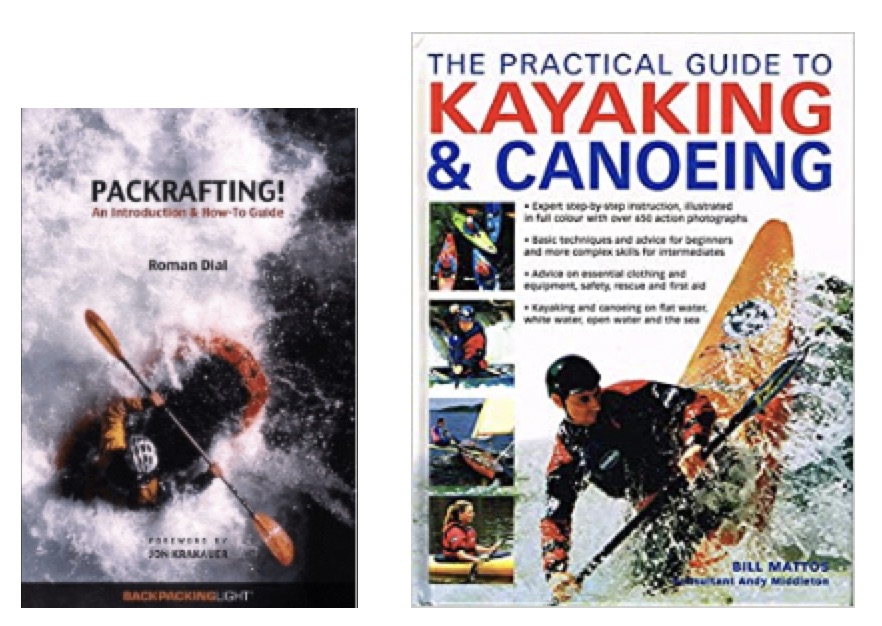
I recall reading Roman Dial’sPackrafting! (right) when I started out and thinking, Oh, there’s really not much to it provided you avoid churning whitewater. At that stage I’d been into IKs a few years and had read the basics in The Practical Guide to Kayaking and Canoeing, a huge, 256-pager by Brit, Bill Mattos. That book covered everything you can do in hardshells but, being more traveller than thrill-seeker, was instrumental in steering me away from the sort of high-adrenaline antics depicted on both covers.
Wisely, Luc Mehl, an environmental scientist and ‘swiftwater’ paddling instructor, opts for a serene front cover, even if he’s a skilled exponent of whitewater action. His blurb above states: “… packrafters and other whitewater sports enthusiasts” suggests he sees packrafts as whitewater boats you can easily travel with, rather than easily portable boats you can take anywhere. That’s an important distinction. It was produced in response to the death of a fellow packrafting journeyman, as well as several other tragedies befalling close friends. The book’s tagline has been #CultureOfSafety, as in making it second nature to use the right gear, learn appropriate skills, pick the right conditions and make smart decisions, including scouting and if necessary, portaging sketchy situations. Inside, The Packraft Handbook uses thick, glossy paper to help Sarah Glaser’s graphics jump off the page. As a result it weighs nearly a kilo and must have cost a fortune to print before Mountaineers picked it up in 2022.
Early on, there’s an aside which resonated with me. “Many topics in this book won’t seem relevant until you experience missteps. It is more important to know what is in the book than to understand it all.” Having written similarly weighty handbooks on other subjects, that’s something I’ve frequently heard from readers: it’s only after having been there and done that, including bad decisions or choices, that they get what the book was telling them all along. This will doubtless be the case with The Packraft Handbook.
Tellingly, Luc Mehl found that kayaking whitewater in hardshells accelerated his skill development much faster than a packraft. Sure, a packraft feels stable but when it flips it does so with little warning, unlike a hardshell creekboat with far superior secondary (‘on edge’) stability. The point, of course, is a packraft is so much easier to carry overland for days at a time that the compromises are worth it. I skimmed over most of the technical whitewater paddle strokes which, as in Bill Mattos’ kayak book, is stuff with little application to the type of packrafting I did then or do now.
Even before you get to page 99, it becomes clear that both Luc Mehl and many of his intrepid contributors who supply pithy, lesson-learning asides, have had several close calls while ascending their packrafting learning curves, mostly in the unforgiving Alaskan wilderness.
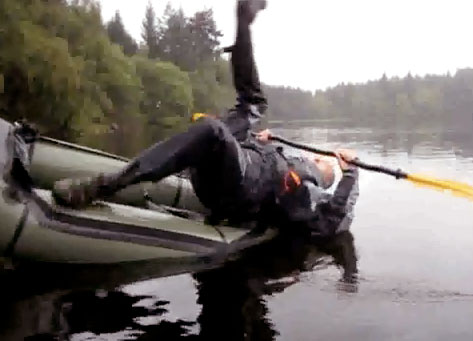
Fall out? Me?
Then you take someone like me who’s never fallen out of a packraft, yet enjoys their amazing potential just the same. Aside from the fact that I live in the opposite of Alaska, one explanation may be the graph (below) featured in an interesting section on risk, ‘safety drift’ and ‘heuristic traps’. We learn that three often repeated words are key to assessing risk: Hazards, your Exposure and subsequent Vulnerability.
I was so old when I started packrafting I’m off the graph!
Having learned the basics in the Mattos book, I got a bit bogged down in the slightly over-technical How Rivers Work though it was interesting to read that bedrock rapids have a more dangerous character than silt riverbeds, perhaps because they resemble hard-edged, man-made wiers. And, along with the regular inclusion of snappy ‘Pro Tips’, I liked the ‘River as a series of conveyor belts’ graphic analogy – a novel way of explaining the complex flows of rapids.
I have to admit before I was even halfway through I was beginning to skim more and more river-running lore, while enjoying the boxed-out anecdotes which are the gravy in books like this. While I had a familiarly with what was being expounded, aspiring to master nifty river moves is just not what I do. My ability, such as it is, plateaued years ago while my risk tolerance drops by the second. Still, it all needs to be written down and explained in one authoritative source, and all the better from a specifically packrafting viewpoint building on many years experience.
The section on open-water crossings is based on the travels and subsequent material by Bretwood Higman and Erin McKittrick, whose record of their epic journey, A Long Trek Home I read soon after getting my first Alpacka. I paid a bit more attention here as in Scotland it’s the most exposed packrafting I might do. That section includes the sobering account of a British bikerafter who drowned during a Patagonian lake crossing of just 2km, and where having his boat leashed to his paddle or himself – a massive whitewater no-no – may have saved him. I’m reminded of another formative book I read ages ago: Sea Kayaking Deep Trouble; US-based analyses of sea padding fatalities and rescues, and crucially, what lessons can be learnt. Luc Mehl curates a webpage of known packraft fatalities which similarly hopes to inform packrafters on how to avoid getting in too deep.
As a result of reading most of this book, I finally did something about a couple of safety and entrapment issues that have been lightly bugging me for years: I ditched a cheap, heavy (and barely used) locking rescue knife for an as-heavy but quick-grab NRS Pilot Knife which at the same time can also replace my never used Benchmark rope-cutter. (Maybe I missed it but, despite the repeated dangers of entrapment, I saw no mention of such knives in the Handbook). And I got round to fixing a reusable ziptie to a bow attachment loop to retain my bunched-up mooring line when on the water. ‘Wayward Lanyard’ a mate called it last weekend. He has all his early LPs.
As things get more serious in When Things GoWrong your attention span may falter in the face of elaborate river-rescue techniques, including rolling your capsized raft (depicted in a series of graphics that make the technique very clear – a first for me), as well as increasingly intricate shore-based rope recoveries which are probably better watched or practised than read about.
Equipment Repair and Modification is a valuable resource of proven recommendations and ideas for tapes, glues and what works best for just about every sort of eventuality. It’s bound to be of use to many. Similar content appears on Luc Mehl’s website. Medical Emergencies underlines, among other things, the importance of understanding cold-water shock – the reflex which most commonly leads to drowning long before you’ve had a chance to catch hypothermia. Here I also learned something that’s puzzled me: why some drowning survivors still end up dying a few days later: pulmonary edema. At one point Luc Mehl describes how shooting off waterfalls down in balmy Mexico gave him a new perspective on risk – as in things felt less dangerous in the tropics. I remember thinking the same thing while struggling to kayak along Australia’s Ningaloo Reef. The wind was howling, the waves were annoying, but it all felt a lot less scary than it could have because it was sunny and warm. No risk of cold-water shock here, just being swallowed by a whale shark. The final two chapters about backpacking gear and trip planning were surprisingly skimpy; a sign of end-of-book syndrome? As it is, backpacking gear choices are highly subjective and are repeated all over the blogosphere (not least here!). The planning chapter felt very Alaska- and river centric (not much about the terrain in between which can be as challenging). But if you can pull off a successful backcountry trip in Alaska, you can probably do so anywhere. The book ends with no less than 16 pages of glossary and an appendix listing sources and additional resources. Design-wise, I’d say it’s bad form to have short boxed asides rolling over the page – across a spread would have been better. And it’s a shame that all of Sarah Glaser’s graphics (mixed in with some of the author’s?) weren’t in vibrant colour; that would have made a stunning book as it’s a great look which vividly delivered the lessons. Much as Bill Mattos’ hardshell book helped guide me towards my current packboat interests, a first-time packrafter with big ambitions is bound to value having the thrills and spills of whitewater packrafting laid out in The Packraft Handbook, all the better to decide what sort of packrafting appeals to them.
In a line Robust, well-made and comfy, but hefty and expensive.
• Thick 210D fabric has a chunky, solid feel • Counter tensioned seat band gives great back support • No overhang with the fixed deck sections (less snagging)
• £1199 ($1199; €1400) • Relatively bulky and heavy • As usual, some of the Kokopelli online specs (below) seem miles out
We took our most versatile, best-selling packraft, and upped the game. The Rogue is award-winning for a reason. (A handful of reasons, actually). Weighing in at only 9.1lb (4.1kg), and packing down to the size of a (large) roll of paper towels, it’s become the standard for portability and durability. We kept the best-in-class 210d DuPontTM Kevlar® Aramid-Nylon Blend* reinforced floor system for increased durability on the water. We kept the 210d TPU + Nylon sidewalls for the perfect combination of strength and weight. We kept the spraydeck to keep you warm and dry, and add extra reinforcement in high-wear areas – perfect for bikepacking. … Rated up to Class II rivers, the Rogue R-Deck is now THE packraft for bikepacking, backpacking, high alpine lakes, fishing, climbing, travel, whatever you can throw at it, wherever you can throw it.
I rented this boat from AS Watersports (not all accessories were requested)
Out of the box
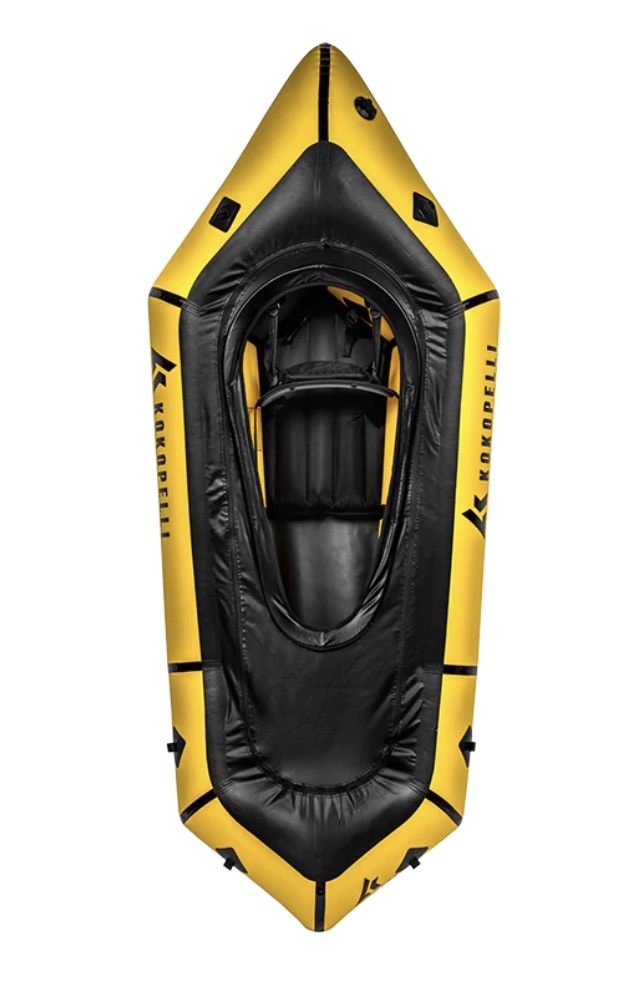
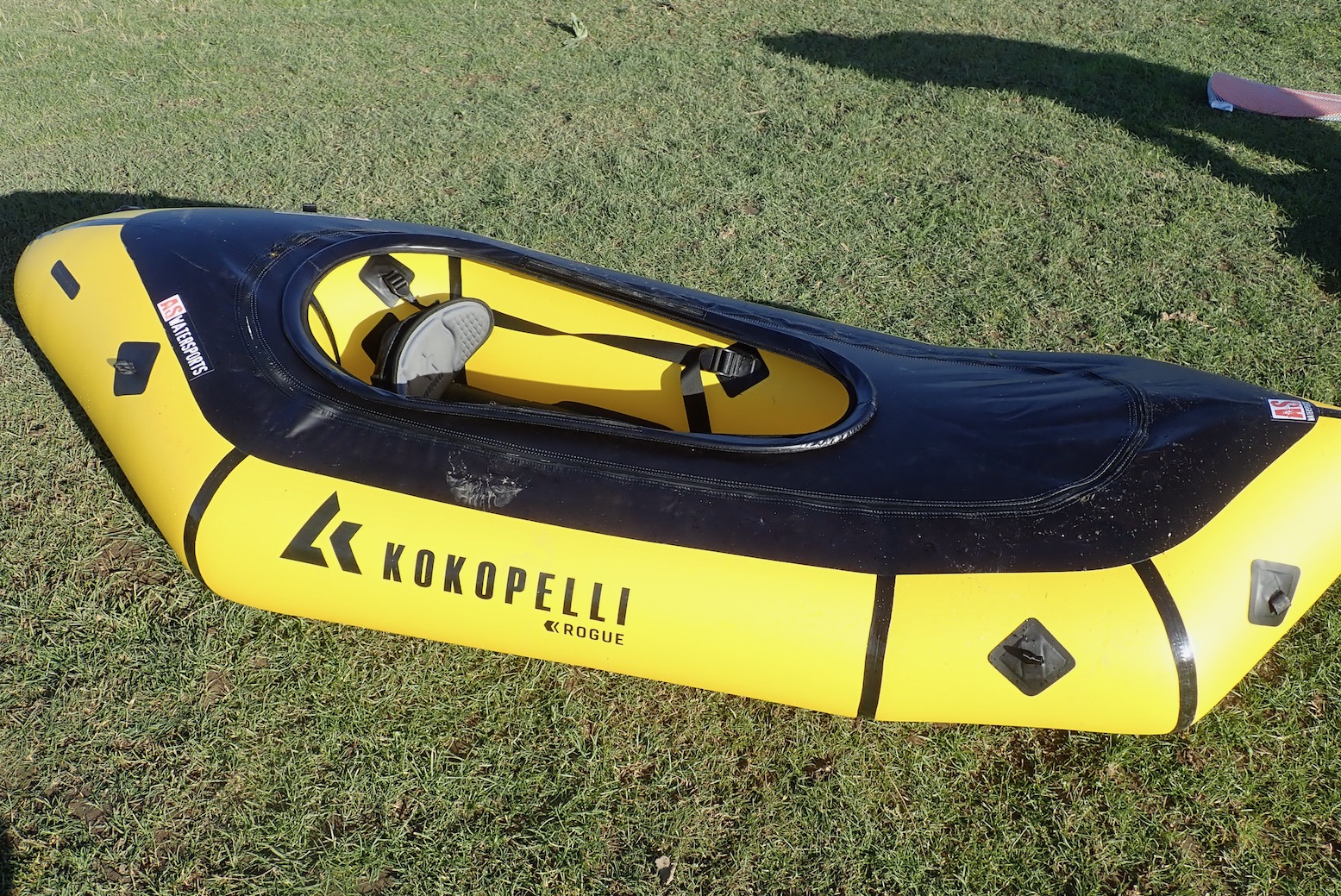
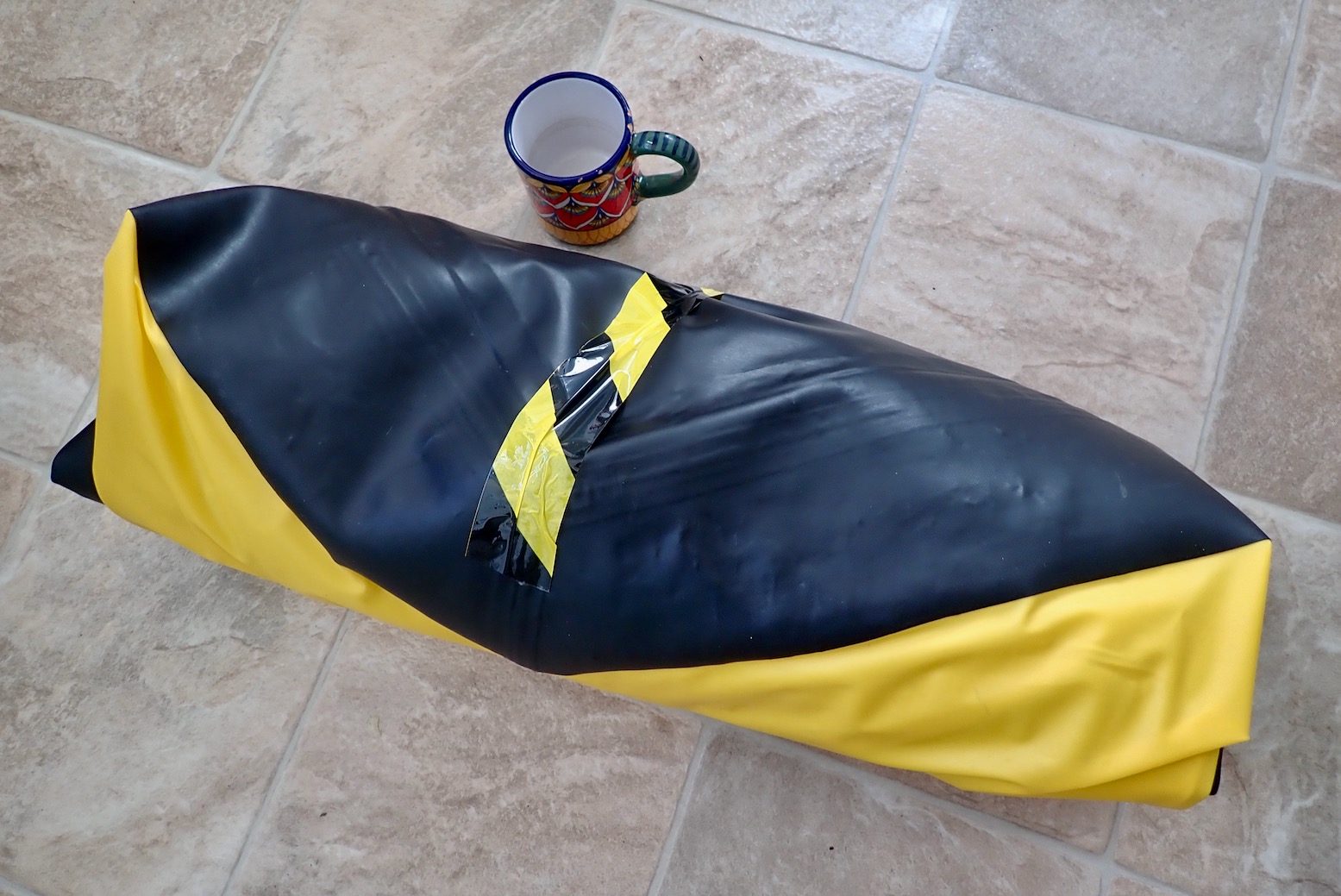
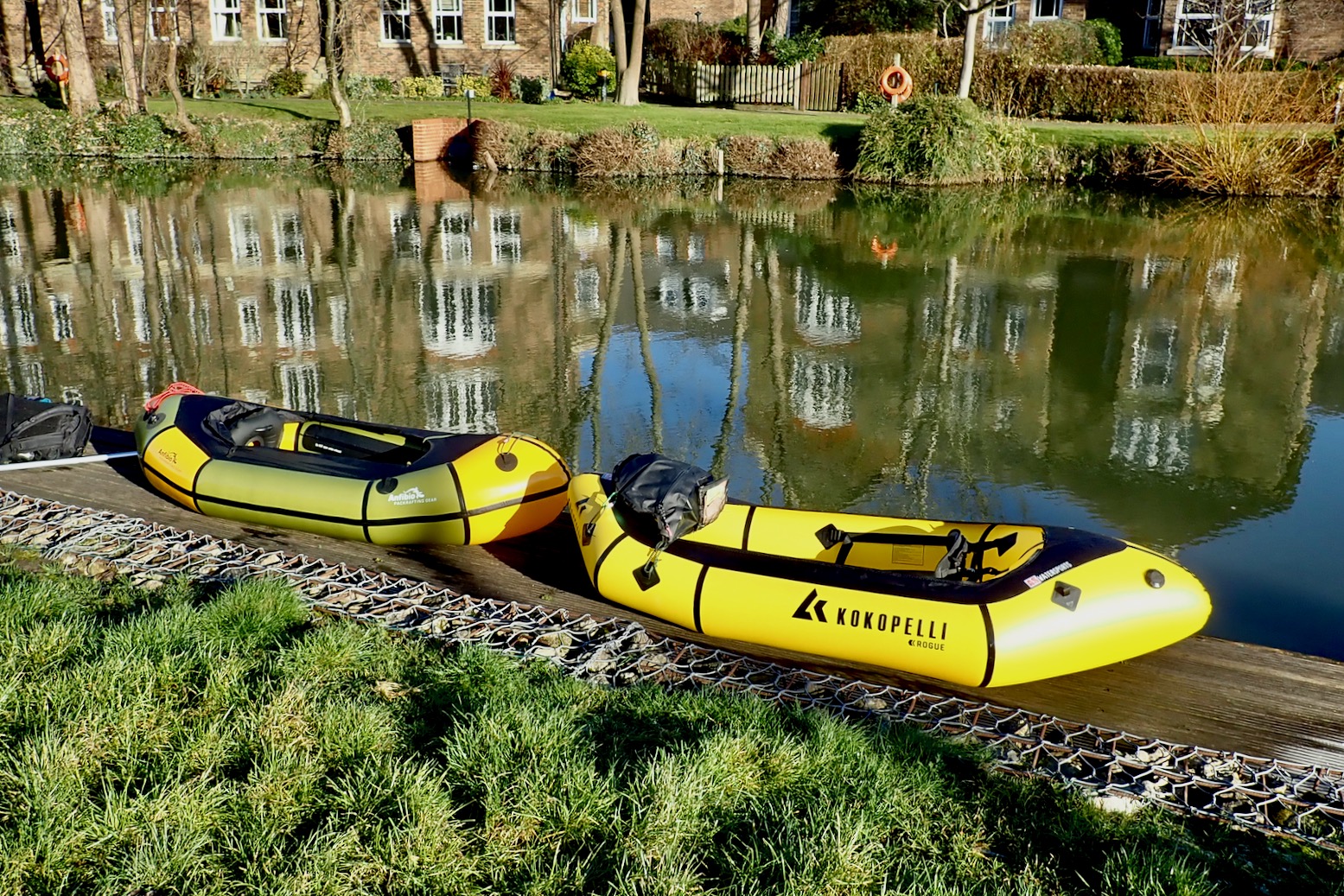
Kokopelli are the other well-known US brand of packraft that’s maybe even more widely distributed worldwide. Their distinctively angular 8-panel design, like Alpackas – also originally made in Colorado – have been put together in China for some years now, with models in both PVC and TPU. Out of the box the boat feels big and heavy, but the thick, waxy TPU also adds an IK-like robustness. Interestingly, they describe the fabric as 210D all round, which just goes to show how misleading Denier ratings (relative thread weight) are, once you apply lashings of TPU.
Leafield push-fitChunky twist-lock
From the start Kokopelli have used Leafield D7 ‘raft valves’ in their boats. These are push-fit, like on old Gumotex, not modern not bayonet style, but for the low pressures you pump in a packraft they work fine and if a nozzle blows off it’s a kind of pressure release valve. The seatbase has an old style twist-lock valve, but again, with a sturdy quality I don’t ever recall on my old Alpackas. I used my mini electric pump and mini handpump to inflate the Rogue.
EVA foam seatback bandFat seatbaseRear mesh pocket
The seat is a similar and proven system I adapt on my IKs: a big, inflatable seatbase which attaches to the hull via a strap, and a chunky EVA foam backrest with a rear mesh pocket and which is tensioned from front and back to stay upright. It means that even if the 130-cm cockpit is too long for you, you can shuffle the seat as far forward as necessary to get a good, braced position with your feet against the bow.
DeckeredCoaming rod to fit a spray skirt
The separate deck goes on with a perimeter zip, and the 90-cm long hatch coaming is held in shape with a bendy nylon rod, with no creases, just like the Moki IK we rented a couple of years ago. Curled up, this rod does make the packraft a bit awkward to transport (but it may have been two-piece inside the hatch’s sleeve)
Inside there is a thick valance or edging band between the floor and the hull which I’ve not seen on a packraft. It’s a nice touch and is sure to keep crud out of this join, though does make the boat a stiffer to roll up. The floor we’re told is 210D TPU with a Kevlar Aramid-Nylon blend (they missed a chance to use the word ‘ballistic’) with a broad four-inch overlap against the hull. No buttpatch needed here. Old-time Kokopellards tell me fit and finish wasn’t always this good in the US-made-era, but what I have here all adds up to a durable-looking boat, that’s as well made as any packraft I’ve seen and may partly explain the price.
“packing down to the size of a (large) roll of paper towels…” Really?
On the Water
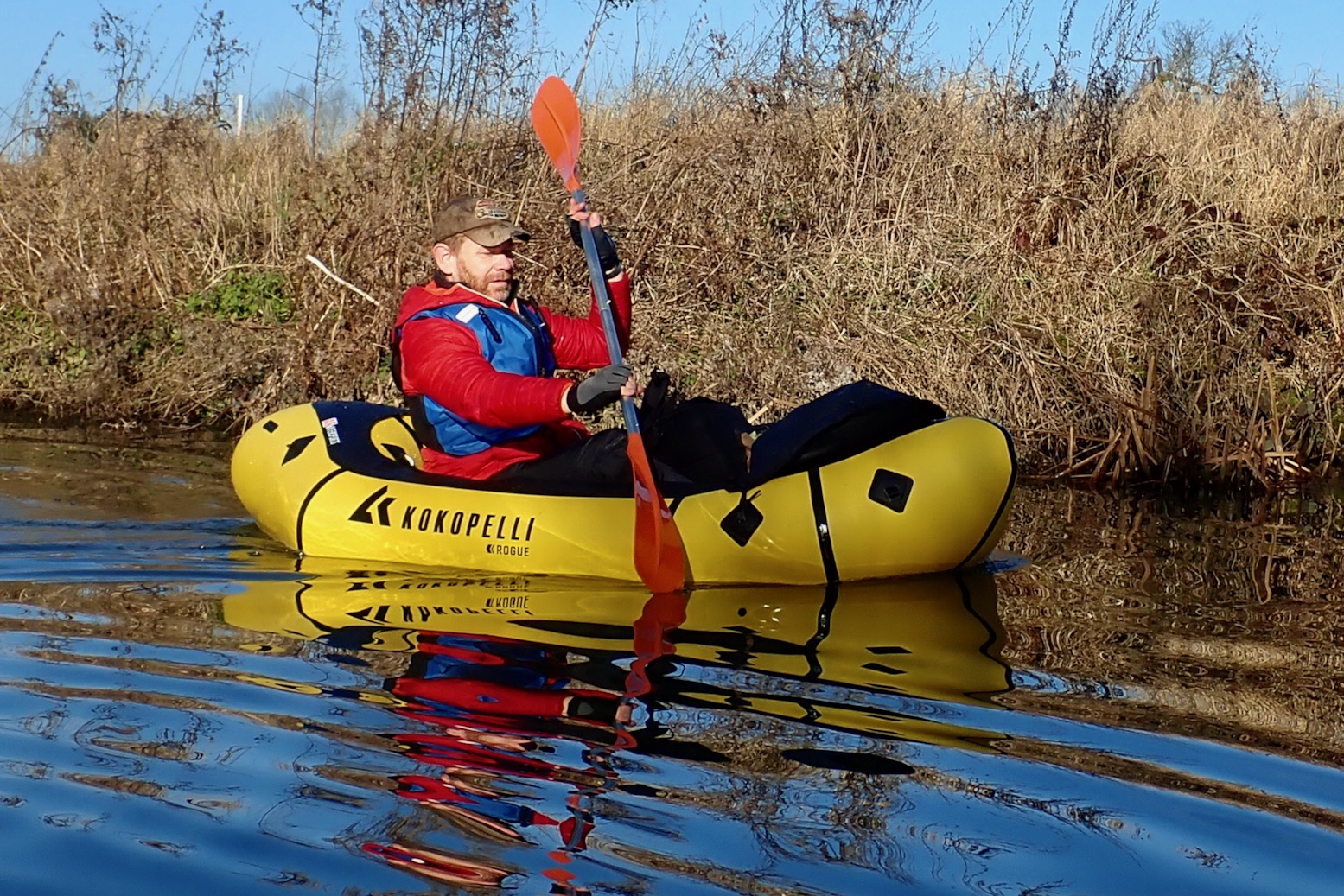
A wintry pre-dawn start saw me and Robbo on the water at Tonbridge by 10am. Once on the move it was clear the Rogue was a bit faster than the Rebel, even though both are the same length. It could be down to the Rogue’s tapered bow, though I suspect the longer stern which sits the occupied but otherwise unloaded Rogue level on the water has something to do with it – compared to the back-heavy Rebel.
We are more or less the same weight, but watching Robbo (lately unpractised in packraft paddling) yaw along in the symmetrical Rebel (ie: identical bow and stern) underlined the rationale behind the extended stern idea which Alpacka came up with over a decade ago and which positions the paddler more centrally, as in a kayak. Then again, the Rebel was being paddled without it’s skeg which may have reduced yawing, but not fixed the trim.
Level trim due to extended sternBack heavy symmetrical boat
Once hitched up into the small of my back, I also found the backband gave very good support, just like on my Seawave (possibly helped by the orange holdall shoved behind it). It may be down to it’s solid, non-inflatable form, but the EVA foam does make it bulky and twice as heavy as the Rebel seat. Then again, Robbo said he found the Rebel more comfortable.
As I was zipped up in my drysuit, I didn’t paddle the Rogue with the deck zipped on but, at a push, I think it could be zipped on on the water. It all just about crammed into the bow bag with the coaming rod.
There’s not much more to say about the Kokopelli Rogue R-Deck: it looks like a packraft and paddles like one: it tracks well and doesn’t yaw that I noticed. And it’s very cleanly put together but is on the heavy side for my sort of use. At the four-figure price, you sure hope they’re paying them well back in China, because they’ve done a darned good job.
I just dug out this story I wrote a few years ago about our packrafting adventure in northwest Australia. There’s more here, including vids. Originally published in Terra magazine2011.
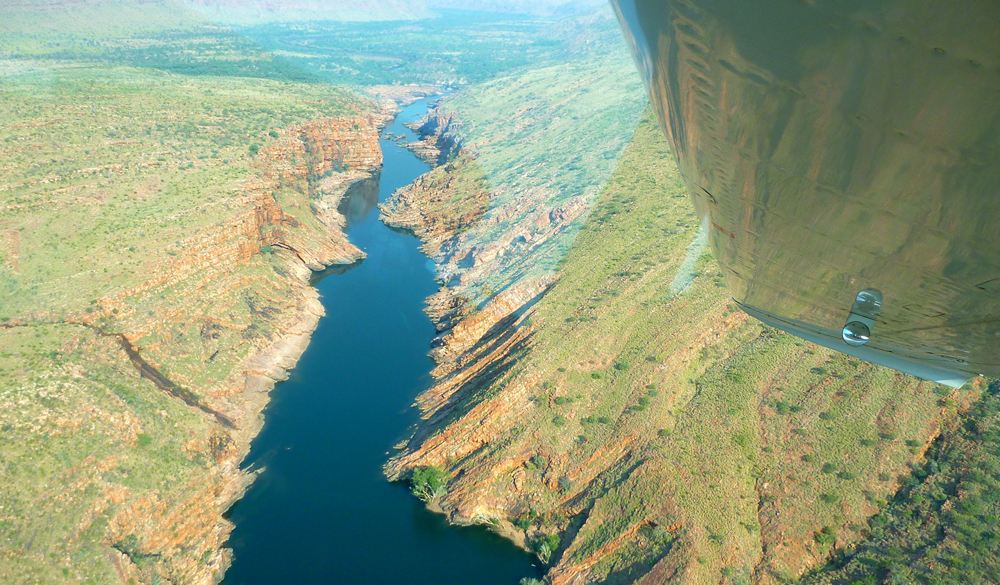
In the far northwest of Australia is a barely tamed region of spinifex-clad tablelands, big seasonal rivers and the world’s largest expanse of tropical savannah woodland. About the size of California but with a population of just 40,000, the Kimberley hosts marginal, million-acre cattle stations, tracts of land returned to local Aboriginal people, remote wildlife conservation ventures and undeveloped national parks.
But the Kimberley might be better compared with Alaska, a wilderness that is under threat. Inaccessible by road for the rainy half a year, the Kimberley is such a relentlessly tough environment that unlike in the rest of Western Australia (WA), exploiting the valuable mineral resources known to be here only now become viable. WA itself is a state the size of India but with 3% of its population, and continues to thrive on a century-old mineral boom. The Kimberley is under pressure to join the party, but as a parallel environmental awareness to conserve Australia’s last tropical wilderness has grown, industrial development of the region has become controversial, not least with the current plans to turn the ochre cliffs of James Price Point 20 miles north of Broome into a vast LNG plant. No one wants to see the Kimberley end up like the Pilbara highlands, 600 miles to the southwest, criss-crossed with private railroads and pitted with huge iron ore excavations as hills are turned into holes to ship the ferrous rubble to resource-staved Far East. But the Kimberley one other abundant resource which the populated southern rim of Australia is crying out for: water.
Most visitors experience the same Kimberley; they transit the 450-mile Gibb River Road, a dirt track which bisects the region between the former cattle ports of Wyndham and Derby in the west. With a branch track leading north to Kalumburu on the coast, it’s the Kimberley’s only track, dotted with fern-clad gorges, waterfalls and swimming holes. It was an area I’d visit eagerly when updating an Australia travel guide, often spending too much time and fuel money researching out of the way spots that ended up as just a few lines in the finished book. But even then I knew I’d barely got beneath the Kimberley’s skin and my work there left me wanting to see more. Specialized trekking outfits used local contacts, helicopters and seaplanes to access outback areas, but charged several thousand dollars.
Follow a river – that was the way to do it. With high humidity and average daytime temperatures over 90°F, the constant need for water was solved, while the boat took the weight off feet and shoulders. I’d researched short trips with inner tubes or float bags, but they weren’t really sustainable. Then in 2010 I discovered Alpacka packrafts and knew I had a tough, lightweight craft with which to explore a Kimberley river.
All that remained was to choose a river. Most of the big Kimberley rivers, the Durack, Drysdale and King Edward drained into the Timor Sea lapping an uninhabited and fjord-riddled coastline of 1500-miles on which the small Aboriginal outpost of Kalumburu was the only settlement. But up here the presence of estuarine or saltwater crocodiles as well as 35-foot tides heaving through rocky gaps to form ‘horizontal waterfalls’ made bobbing around in a tiny raft a risky idea.
Horizontal Falls, where the falling spring tide rushes back out of the lagoons through narrow gaps
The key for this visit was to pin down an amenable stretch of water with easy access and exit points and without the menace of saltwater crocodiles. I knew well that no matter how easy you made it – the coolest period, the flattest river – the harsh conditions in the Kimberley would take its toll. My mate Jeff and I didn’t want to be abseiling down ravines, hacking through snake-infested rainforest or looking twice at every passing bit of driftwood in case it slowly started swinging its tail from side to side.
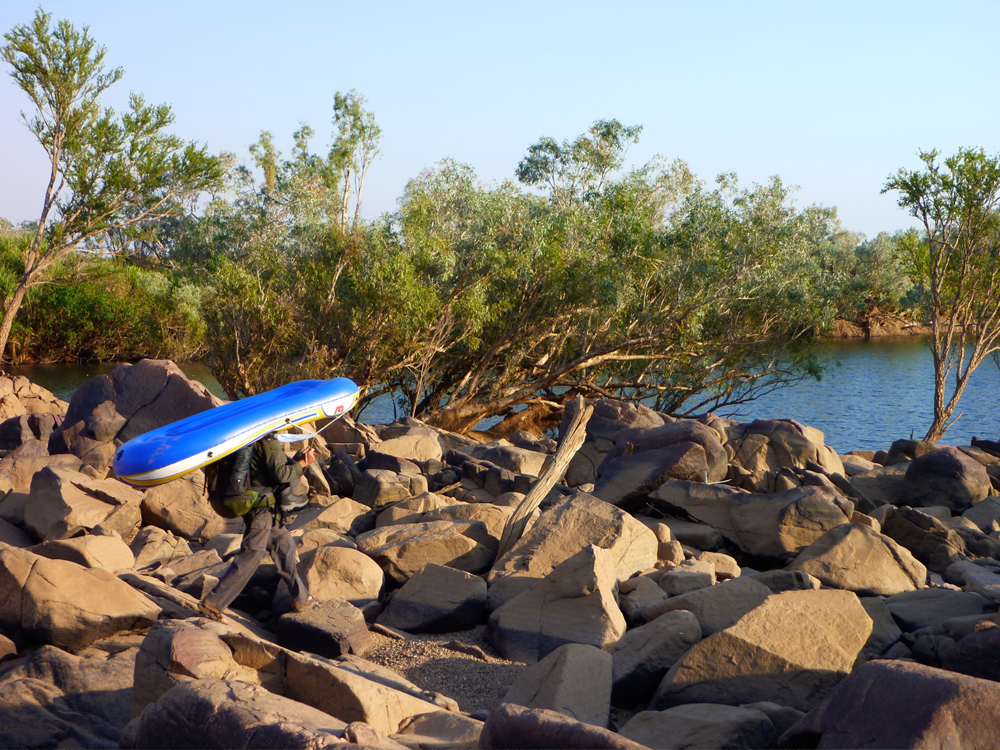
The most likely candidate was the Fitzroy, at 500 miles the Kimberley’s biggest river and in peak flood, the highest volume river in Australia, flowing at up to 30,000 cfs under the Highway 1 bridge at the town of Fitzroy Crossing. Running the churning Fitzroy in the unpredictable Wet sounded a little extreme for me. The good thing with packrafts is that extended portages are relatively effortless; the excess payload adds up to a 5lb raft and a 4-piece paddle. So Jeff and I decided September, the end of the dry season, would make an easier introduction; cooler and less humid just as long as we were prepared to walk between the pools.
Mornington
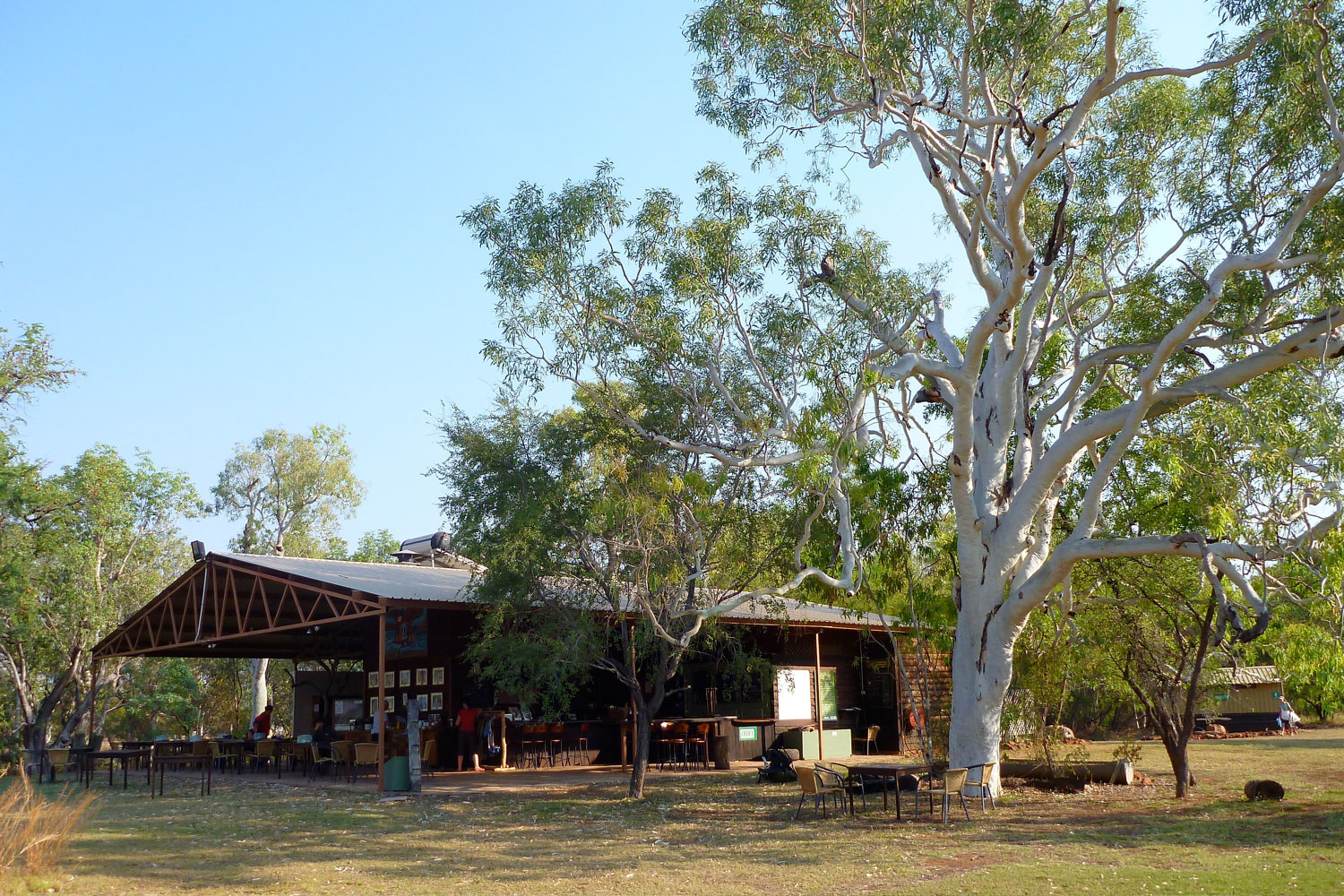
The take out was obvious: the bridge at Fitzroy Crossing, the only town for a couple of hundred miles along Australia’s peripheral Highway 1. And some eighty miles upriver, Mornington Wilderness Camp seemed like the best place to start. A former cattle station spread across the King Leopold Ranges. I’d visited the Camp a decade or so earlier, soon after the Australia Wildlife Conservancy had taken it over and de-stocked it. It’s one of nearly two-dozen sanctuaries the AWC manages on the continent and at nearly 800,000 acres, one of the largest, with a range of unique ecosystems as well as high levels of biodiversity which included several rare and threatened species.
When we arrived at the Camp, following a 30-minute flight from Fitzroy Crossing, the Camp’s manager Diane was midway through a pre-dawn finch census lasting several days and assisted by volunteers from all over Australia. The ranges around Mornington are one of the preferred habitats of the stunningly colourful Gouldian Finch, an endangered passerine or ‘songbird’ whose breeding patterns and habitats have been disturbed by changes in the bushfire regime as well as introduced predators, topped by the feral cat – the scourge of indigenous birds right across Australia.
When I think of the Kimberley, it is above all the chorus of the largely unseen birds which evokes the spirit of northern Australia’s wild and remote corners. From just before dawn until sunset the bush resonates with avian chattering, from the strident squawks of the corellas, cockatoos and kookaburras, to the milder coo-ing of the crested pigeons. This would be the daily soundtrack for our five-day descent from the Mornington to the highway bridge.
Dimond
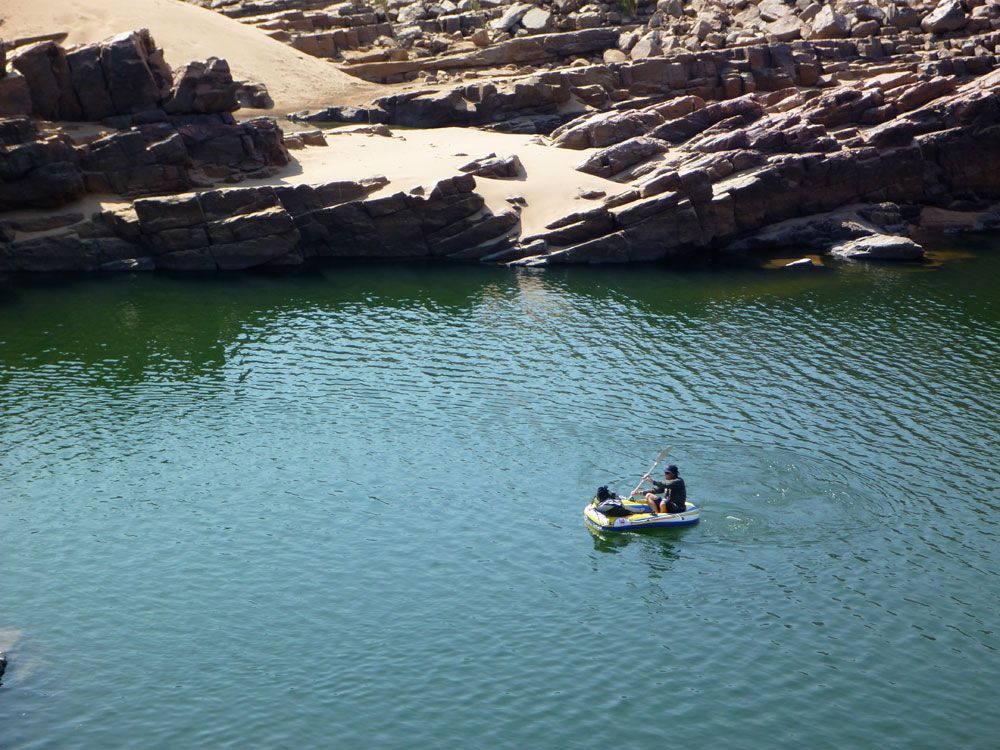
On the water soon after dawn, by the mid-morning of the second day we arrived at Dimond Gorge on the southern edge of the Ranges. Here the Fitzroy cuts back on itself as it pushes past the gorge walls, scoured smooth by the monsoonal torrent. At the southern exit where the gorge walls are just a few hundred feet apart, a dam had been proposed to match those on the Ord river in the eastern Kimberley. In 1960 the original dam enabled the development of the Ord River Irrigation Scheme (ORIS), the new town of Kununurra and with the much bigger Ord River dam completed in 1972, the 400-square-mile expanse of Lake Argyle was formed. But the ORIS has been slow to reach any potential. Thousands of kilometres from its domestic market, the produce, mostly sugar cane and high-value sandalwood, gets shipped to Asia and the power generated from the huge dam only supplies Kununurra and a nearby diamond mine.
Water has become an acute problem in the populated southeast of Australia where the steady depletion and raising salinity of the Murray-Darling basin which fills most of New South Wales and Victoria has led to water restrictions. Meanwhile, on the opposite side of the country, the Fitzroy’s wet season run-off spills into the Timor Sea at a rate of a ‘Sydney Harbour’ every nine minutes, or evaporates from the vast 1000 km² surface of Lake Argyle. This potential was anticipated in the 1980s ago when a 1200-mile pipeline to already drought-stricken Perth was proposed, until it transpired that the cost of securing and delivering water to be six times that of local desalination. And so by 2006 the world’s first desalination plant to powered by a nearby wind farm was opened just south of the city Perth, supplying nearly a fifth of the city’s needs.
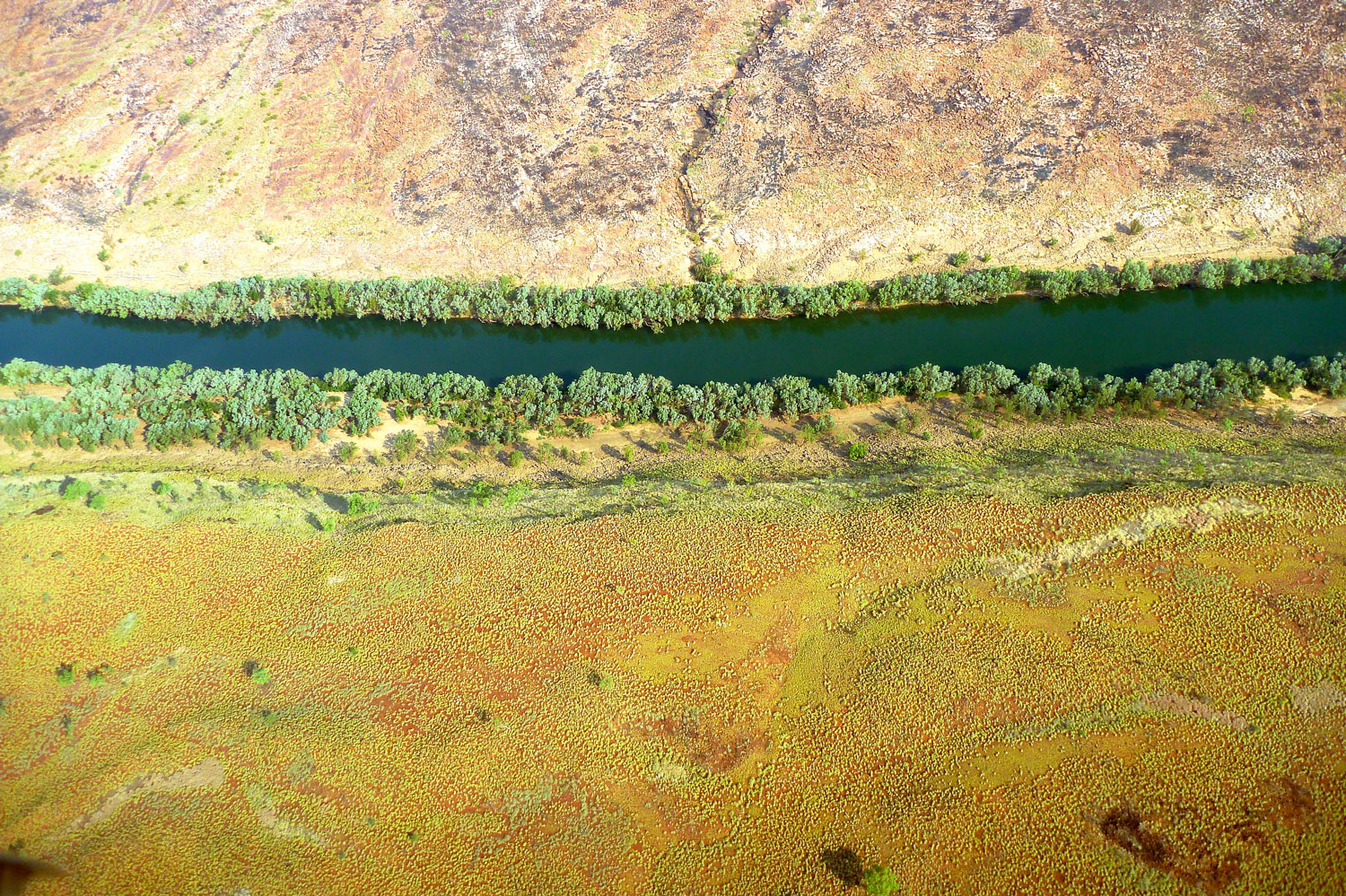
Emerging from the uplifted sandstone escarpments of the King Leopolds at lunchtime on the second day, we were having no such shortages. The preceding Wet had ended five months ago breaking all Kimberley records, and as we’d flown into Mornington a couple of days ago it was clear that, against our expectations, below us the Fitzroy was still flowing and four-fifths was open, paddleable water. There’d be a lot less walking than we’d anticipated.
Now, ahead of us lay the cattle country where we expected the river to lose its depth and definition as it meandered southwest among granite outcrops towards the highway. Sure enough, after lunch the flow soon dissipated into a jumbled rock bar with one particularly tough portage over huge boulders which left me croaking with thirst. Walking consumed so much more energy than paddling and we fully expected the stage across the cattle plains of Fossil Downs station to be tough, fly-ridden and with the menace of semi-feral stock.
Although we’d end most days exhausted, it in fact turned out to be the highlight of our traverse. There were no more rock bars but periodically the river’s main channel became choked with flood-borne sand which diverted the remaining flow into the trees along the banks. Here, under a cool canopy of river gums replete with twittering of birds, we’d wade the sandy shallows for hours, towing our rafts like sleds. Occasionally we squeezed under- or climbed over a log jam, or sank to our hips in quicksands.
Jeff was using a $30 PVC pool toy rather than a fancy, $1000 Alpacka, so had to nurse the limp raft and repair punctures almost daily. The cattle and harmless freshwater crocs (a species unique to northern Australia) usually scuttled away or stared indifferently as we sploshed by. At one point the acrid reek of urea announced a huge colony of riverside bats which once agitated, took to the wing in their hundreds with a high-pitched screech. Come the evening, we’d spread out on a sandbank with plentiful firewood within arm’s reach, and set about steadily rehydrating ourselves from the day’s efforts.
By the fifth day we sighted the Geikie Ranges, the northern gateway to an unbroken, deep channel which flowed past the distinctive ramparts of Geikie Gorge National Park. Here, eons of flooding had eroded the former limestone reef into bizarre, scalloped forms. Freshwater crocs laid their eggs on the adjacent sun-baked sandbanks while out in the 100° heat, we paddled into the twilight to complete a marathon 12-hour, 20-mile day on the river. By the following lunchtime we crawled up the steep bank below the highway bridge at Fitzroy Crossing. Jeff could barely face another moment in his excrable pool toy, but like me, he’d followed the river.
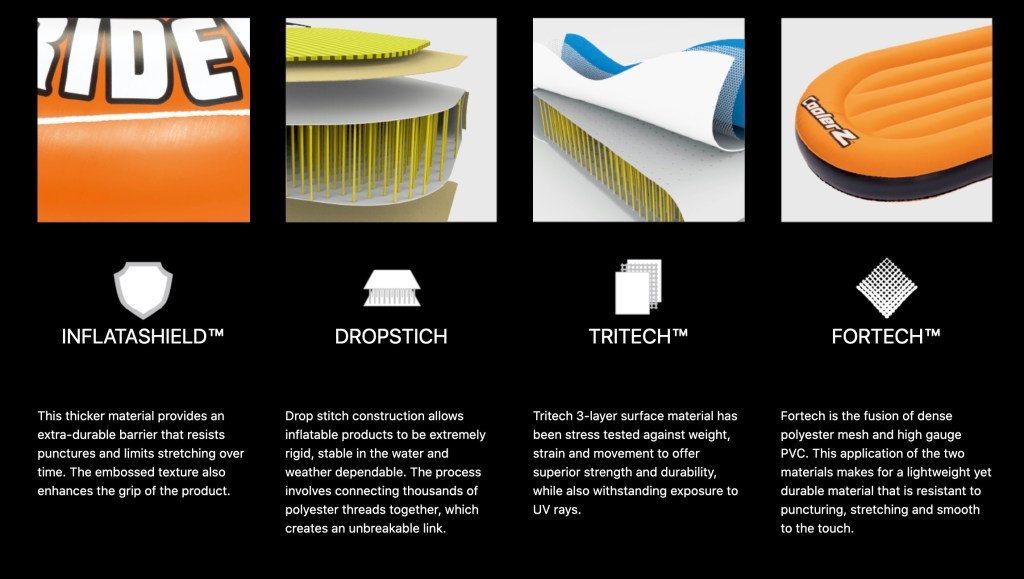
After a decade or so are packrafts finally becoming a thing? Better known for their Slackrafts, especially Downunder (where Jeff dragged his Bestway Outdoorsman down the Fitzroy one time) check out the new for ’22 Bestway Hydro-Force Wayfarer packraft. You can mute the jaunty music as there’s not much you can tell from the short vid. A glancing close-up shows ‘fabric’ with distinctive embossed vinyl dimples – so not a fabric as such, just thick Inflatashield™ plastic? But do I see proper raft valves not just Bostons, as well as twin hull chambers (like a ROBfin) and an inflatable floor – possibly a separate mat? You’d surely need PVC fabric for those sorts of potential pressures. It certainly looks like it skims and yaws across the water more than a 1-psi-slackraft blob. It might even be a self-bailer. Bestway moving into PVC packrafts? It happened with Decathlon so why not. Expect Intex to follow soon and before you know it the mystique of exotic packrafts will be just a dream.
Twin-chamberVinyl or PVC?Cool low shotHappy chappy with his BestyRaft valve? CuriousYes, Bestway make PVC too
As it was with kayaks, so it is with packrafts. AE are the first to produce a solo and two-person packraft with a removable dropstitch floor.
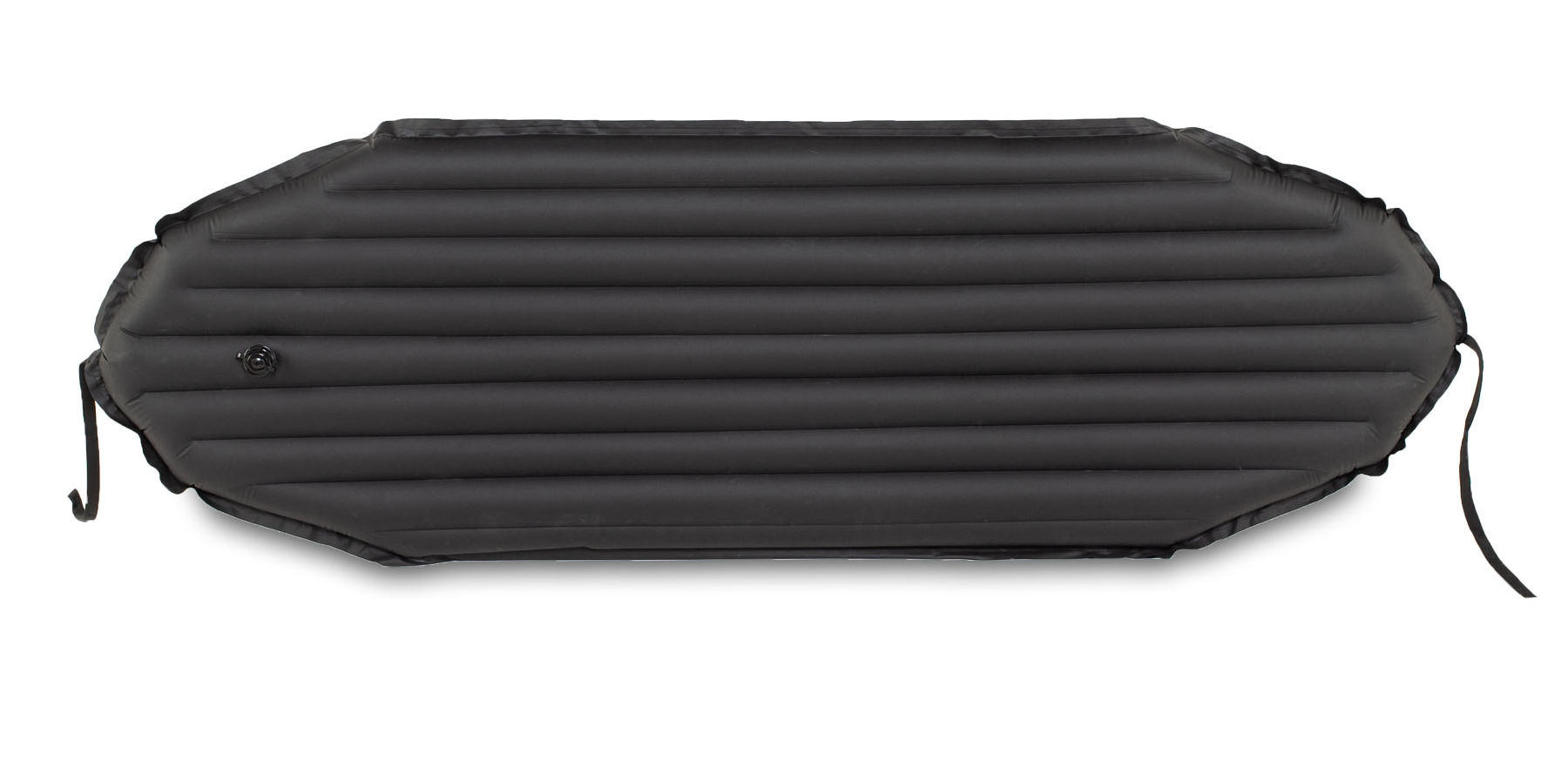
For years packrafters have used the idea of shoving in sleeping mats as floors, and right now Anfibio sell slot-in Multimats to fit some of their boats. The idea is improved rigidity for a better glide, insulation for your legs in very cold conditions as well as raising your seating position for better visibility and paddle draw, stability notwithstanding. Plus longer packs like my TXL will sag less when paddled solo.
One problem with a regular packraft’s plain floor sheet is that the weight of the paddler sags downwards (as above), making a wear-prone low point in shallow rivers as well as not doing wonders to a packraft’s glide, such as it is. Being at the heavier end of the human spectrum, one pre-emptive solution I used on my Alpackas was a double layer of floor fabric or ‘buttpatch’, as Alpacka called them. It meant I could scrape through shallow rapids, knowing the 840D floor was a little more protected withg another sheet of 840D. This is a bit less of an issue these days when packraft sterns are longer which means the solo paddler is more centrally seated and less back-heavy
The DS floors on the AE Packlite+ packrafts eliminate this sag with all the benefits stated above. And being a separate panel, you can choose to use it or not, if weight and bulk matters. The DS floor’s pressure is 4-6psi, clearly enough to stand up and paddle the raft like a board at 1.5mph. It also makes getting in easier, in that you can stand on the firm floor (left).
Despite the orange Prop65 warning label usually associated with PVC (for sales in California), AE’s new packrafts are made from 210D TPU. Interestingly, the hull uses a high-pressure raft valve as opposed to the more common Boston valves, but this is probably to simplify inflation as the DS floor must use a valve like this, so they may as well be doubled up. It should mean the hull can hold a bit more pressure to make a really rigid boat. The boats also have about 14/20 attachment loops, carry handles and even a 530-cm TiZip for in-hull storage. Nice touch. Plus you get carry bag and barrel pump and the longer boat gets a skeg. Just as with IKs, I think a DS floor’s main benefit will be on longer packrafts like the tandem which could be used solo to make a fast boat similar to the MRS Nomad, but without sag.
The Packlite+ AE3037 costs $899 and weighs 6.1kg, or 13.4 lbs (KG) and as little as 3.2kg with no floor or seat. It’s 99cm wide (39″) and 221cm long (7.25′).
The tandem Packlite+ XL AE3038 goes for $1199, weighs from 8.3kg ( 18.3 lbs) down to 4.4kg. It’s also 99cm wide (39″) and 3m (9.9′) long.
In a line Stable, good looking and good value two-chamber full dropstitch IK.
• Reassuringly stable but not too slow • Easy to get in and out • Everything in the bag bar a buoyancy aid • Effortless two-way Bravo SUP pump • Capacious wheelie-rucksack bag • Three Five-year warranty
• Usual budget paddles; a bit short too • Minimal underdeck storage • Thin, hard seatbases • Floor-mounted backrest supports • No footrests • No repair kit included/listed online
What They Say The Optimal is an inflatable, crossover kayak that truly excels in any water and is designed to feel just like a solid kayak and not compromise on performance. The Optimal will help inspire confidence in with a balanced rocker profile for speed on the flat and manoeuvrability in whitewater. The V-shaped hull is designed for stability and also helps the Optimal cut through the water effortlessly. The rounded stern sheds water easily, making it forgiving in moving water. There are luggage straps at the front and rear so it has plenty of room for dry bags and gear for your day on the water.
Inflated: 427cm long x 89cm wide (14′ x 35″)
Deflated 105cm x 58cm x 30cm
Kayak 19kg
Maximum load 231kg
Three year warranty
Price: £769 at time of review. Summer 2025: £749.00 sale £499
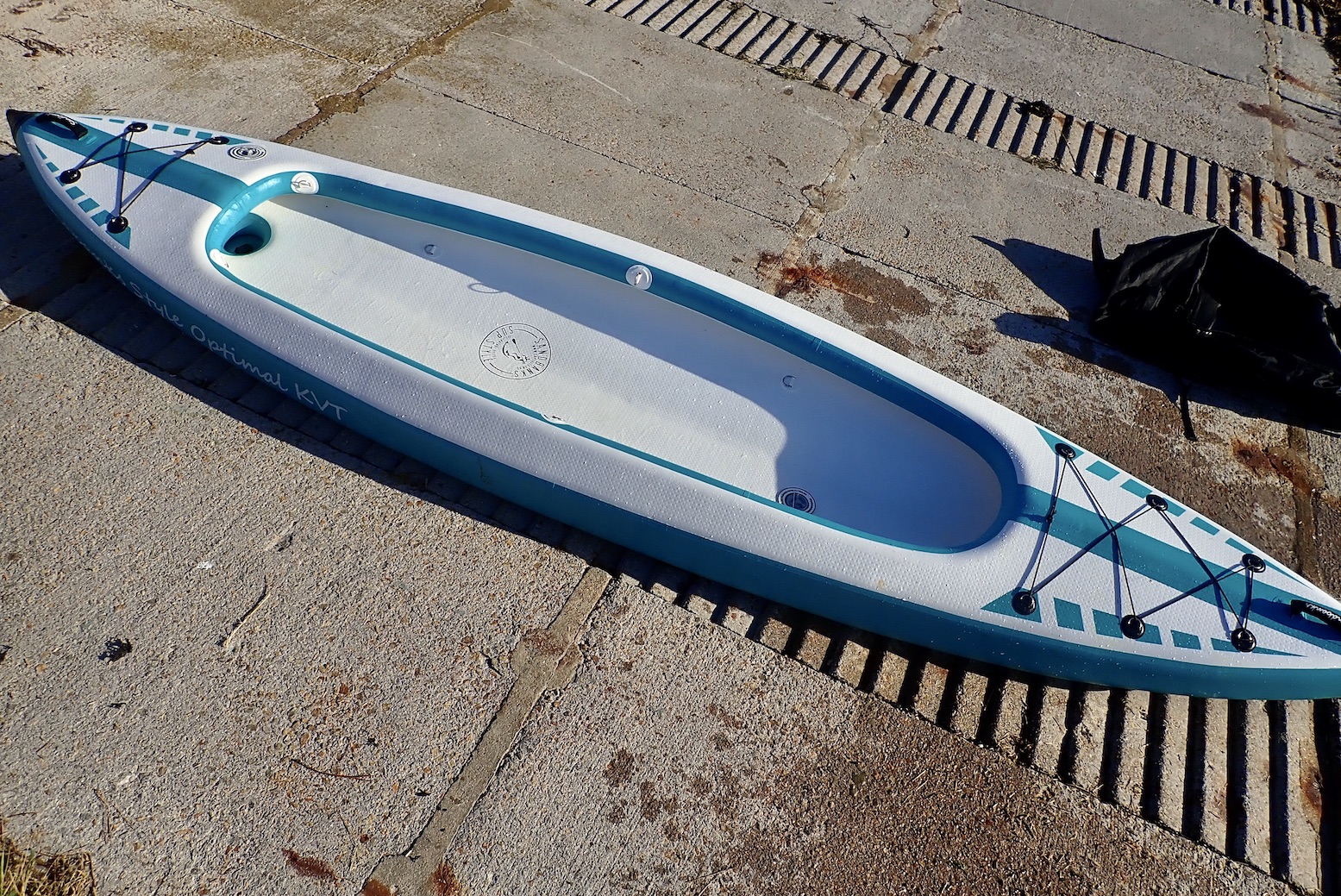
Based by Poole Harbour, iSUP-board brand Sandbanks Style offer a couple of full dropstitch (FDS) inflatable kayaks: the three-panel ‘Explorer’ similar to the Shipwreck Arrowstream I tested, and this two-panel Optimal, also in solo and tandem lengths. The Optimal resembles (but is not a clone of) Advanced Elements’ AirVolution – as far as I know the first to use this design in 2020. The AquaTec Ottawa Pro (scroll down the linked page) is a similar design.
These types of FDS IKs use two slightly folded dropstitch panels wrapped in a PVC envelope; a ‘clamshell’ design which creates a small, low cavity under each deck. The upper panel is more of an elongated ring; the aperture forming the cockpit you sit inside. It’s similar to Perception’s Prodigy 145 hardshell (right), a kayak design favoured by recreational paddlers who prefer IK-like ease of access over a fixed deck, but don’t want a tippier and more wind-prone canoe.
All tandem Sandbanks kayaks come with a pair of four-part 220cm paddles, a two-way, two-litre Bravo 100 SUP pump, a skeg and a huge wheeled bag to carry it all. The whole package for the Optimal double weighs nearly 27 kilos with room to spare in the bag. The rolled up boat itself seemed less bulky, or at least folded up more compactly than the Shipwreck. The turquoise/white PVC did have a nice, pliant texture which may have had something to do with it. I’ve found the quality and feel of PVC varies greatly from boat to boat.
Not too bulky for an FDS
Inflation took about 7 minutes to reach an indicated 12psi on the pump’s gauge, which matched the reading on my handheld manometer. Using the 65-cm high pump means less stooping and was initially so effortless I thought I hadn’t plugged it in correctly. For the floor I flicked the switch to down-pumping only, but for the top chamber, with a better stance (left) I was able to reach full pressure using faster but more effortful up-and-down (two-way) pumping. I didn’t notice a deflation port on the pump to help suck the boat down for repacking, which is a shame. This is clearly a gangly iSUP pump which isn’t expected to be taken on the water.
Once inflated, the top and bottom panels press together along the edges, sealing off a cavity with the outer hull envelope that wraps around the two panels (see graphic above). In this way it’s similar to my old Seawave, making a side channel where water and debris can collect. The Optimal’s two panels may press together although water and debris got in the channel too. But, compared to most three-panel FDS IKs, you can directly access this part of the boat for proper cleaning. Measuring up the inflated boat gave the dimensions below; at 440cm (14′ 5″) – all round a bit longer, wider and heavier than what appears on Sandbanks’ website. Plus ca change… Dividing length by width gives an LxW ratio of 4.78 which, compared to the table here prioritises stability over speed, though other factors, not least hull shape and rigidity as well as wind and waves, will influence the latter.
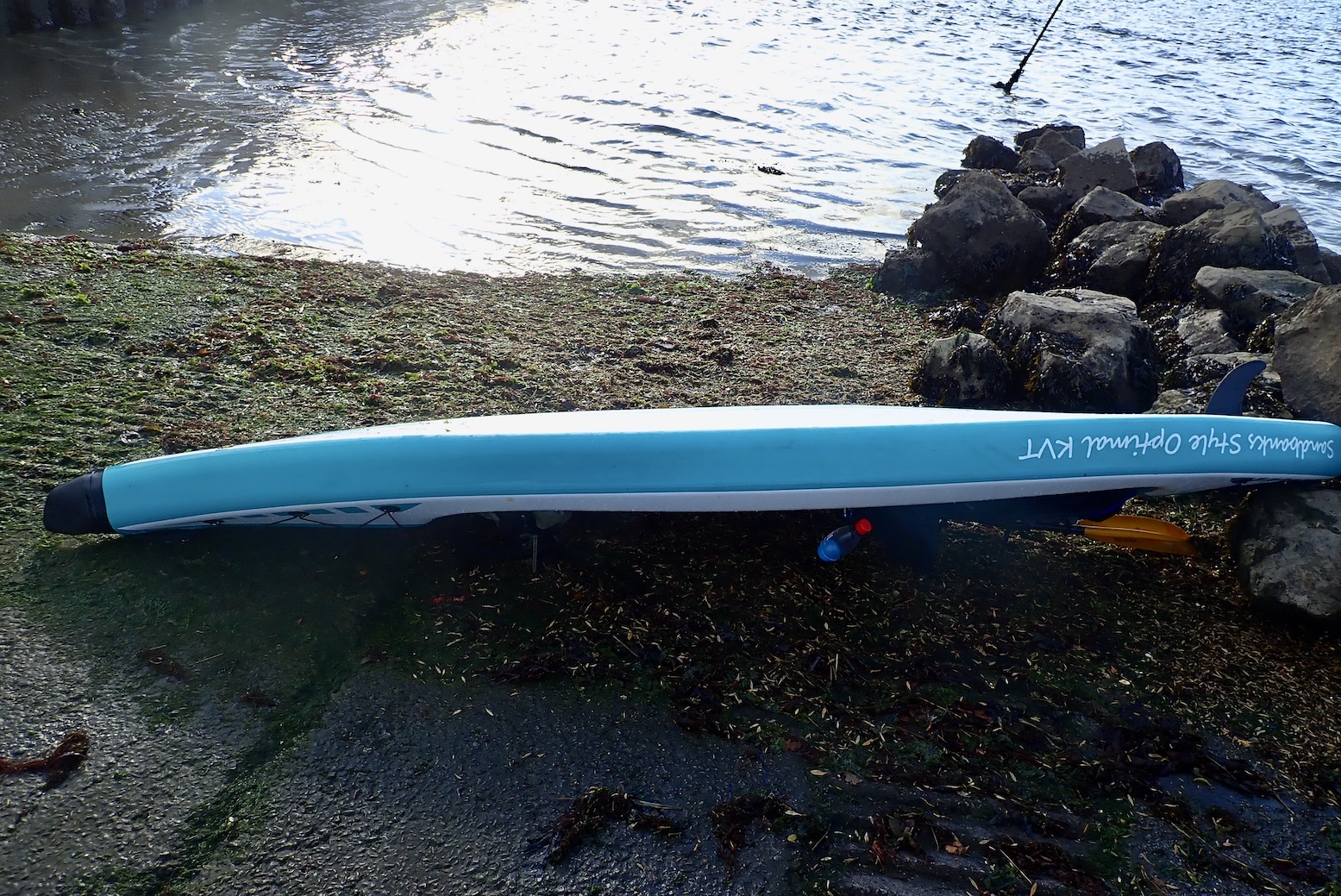
Thanks to glue-free heat-welding the whole high-pressure assembly is very clean with no untoward creases or anomalies. Only the black plastic end-cones stayed a bit deformed. I also noticed that after inflation the floor protruded a couple of inches on one side. But by the time I got back, a little hull flexing had realigned the two panels correctly. Underneath you’ll notice a ‘blister’ in the dropstitch (above right). This isn’t a flaw as some have thought, it’s opposite the floor panel’s inflation valve where there is no stitching.
To me this two-panel design just looks better than your boxy, three-panel FDS IK
Straight away you can see it’s not just two flat slabs of dropstitch, but a floor somehow folded up into a shallow ‘V’ to make a keel line (left) which, combined with the deep skeg, ought to ensure the Optimal paddles arrow-straight. The top panel has a similar downturn like the AE AirVolution, to ensure water run off the decks. These ‘clamshell’ angles create a space underneath each deck, but they’re too low to be of much use for storage.
At over 2.3 metres or 7.5 feet long and up to 50cm wide, the cockpit feels roomy for two adults. There are four D-rings on the floor for the backrest straps (but see below), with a four more rings up on the sides to counter-tension the backrests. A side benefit of the cockpit’s overhanging side rim is you can easily pick up and carry the boat. If there are two of you, use the nicely padded carry handles at each end.
The floor’s shallow V is reflected inside, so any water will pool along the centre line and, depending on the boat’s trim, will run back towards the drain plug hole at the back of the floor. In my opinion this a bafflingly redundant and marginally effective gimmick that gets copied from boat to boat. Either flip the boat over to drain, or position the drain in the stern cone A rear paddler could benefit from the back deck edge to lean on, and the front paddler might be able to use the edge of the front deck as a footrest. You might also shove a folded bag under either deck, otherwise gear will have to go under the paddlers’ knees or on top of each deck, using the bungy cords. They’re a commonly seen and inexpensive ‘feature’ on IKs, but I’ve never thought it a great place to lash gear that’s hard to access once on the water. As it is, used solo, there would be enough room to stash a camping load low on the wide floor.
Single seat set up worked well. A footrest tube could easily be added too.
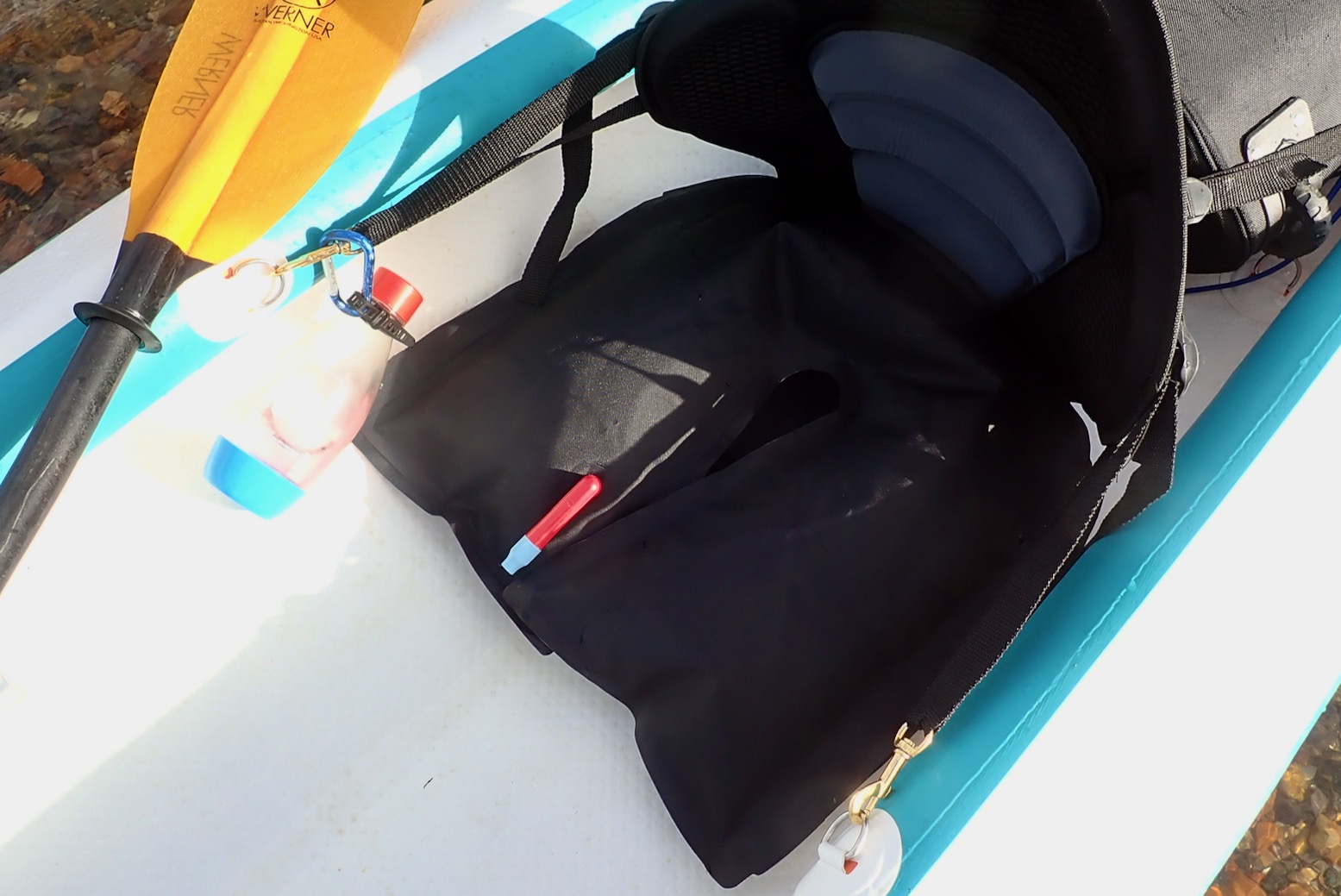
Seats are the usual light, stiff foam items, with four, two-point straps and brass-coated? clips to keep the backrest upright and get your position just right. The floor mounted D-rings for the forward straps would be better positioned on the sides, like the rear strap mounts, putting them in line with the direction of tension. Otherwise the backrest tends to pull down as you rest against it.
Thanks to these long straps I was able to fit the seat in the optimal rear-of-centre position for solo paddling, using all four of the higher D-rings on the sides, resulting in good back support. I knew the main problem would be the lack of a footrest and the ~inch-thick seatbase sat on a hard, 12psi floor; within an hour the backside and legs would be numb and the back sore from slouching. (I notice Sandbanks’ three-panel Explorers do come with footrests.) Expecting this, I’d brought an inflatable packraft seatbase to try-out, as well as a strap to rig up a footrest off the floor D-rings. Pushing off some kind of footrest stops you sliding down the seat, so enabling a proper upright paddling posture.
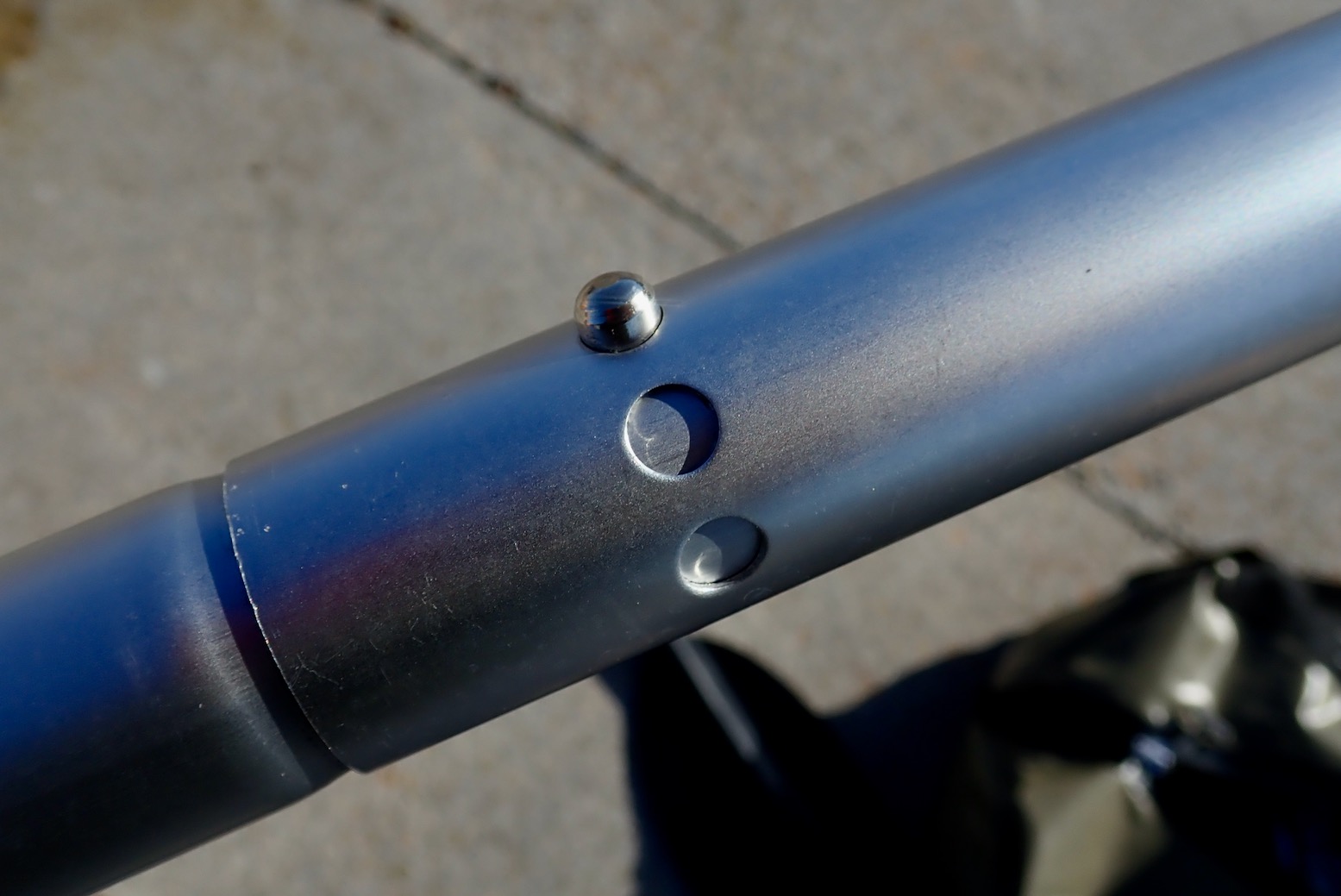
The 220cm four-part, alloy shaft paddle weighs around 950g and has three blade-angle adjustment holes about 45° either side of flat. It will do the job in calm conditions, but the soft plastic blade easily deforms. Expecting a mushy budget paddle, I brought my own Werner paddle.
Adjustable paddle angleSoft plastic blades
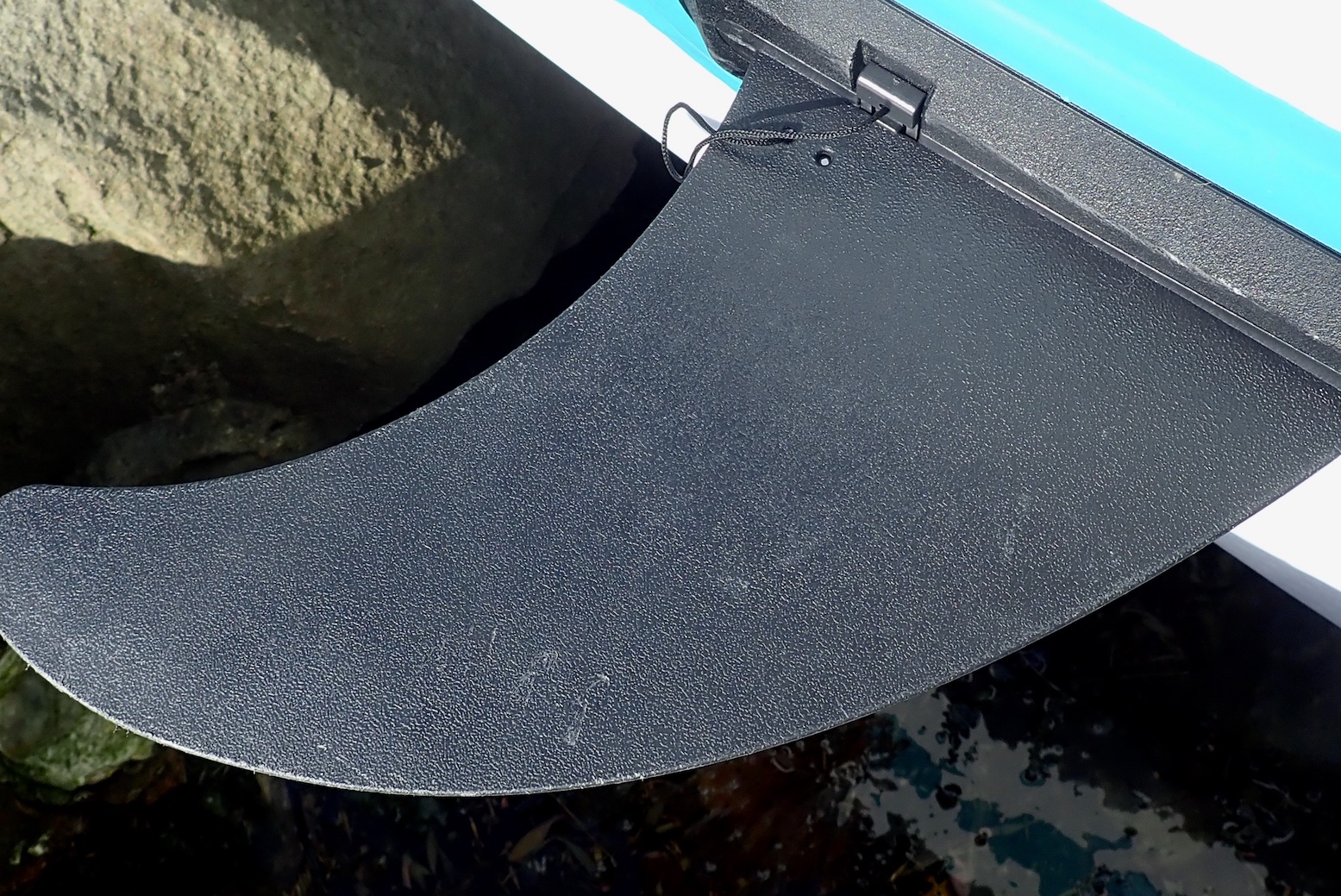
Underneath the stern goes the slot-and-peg skeg. At 20cm high, combined with the V hull, the Optimal ought to track like a TGV. There’s no conformity label stating recommended pressures, payloads, CE stamp and so on, but I noticed a serial number (‘HIN’) at the back. This was a used boat, but there was no repair kit in the wheelie bag pocket, nor is a kit listed online, but the Optimal comes with a three- (now 5) year warranty.
Not as plain a hull profile as you’d thinkAction stations
On the Water
Putting in at Salterns jetty on the northeast shore of Poole harbour, I had various plans for my test paddle. Maybe a five-mile run out through the narrow harbour mouth to Old Harry Rocks which I’ve been keen to revisit. Or at the very least, a lap around Brownsea Island; about the same distance. But on the day a chilly, 20mph NNW wind reduced my options. Even a quick crossing to Brownsea would have made getting back tricky in an unfamiliar boat, especially as the peak of a spring tide would be running southeast with the wind by the early afternoon.
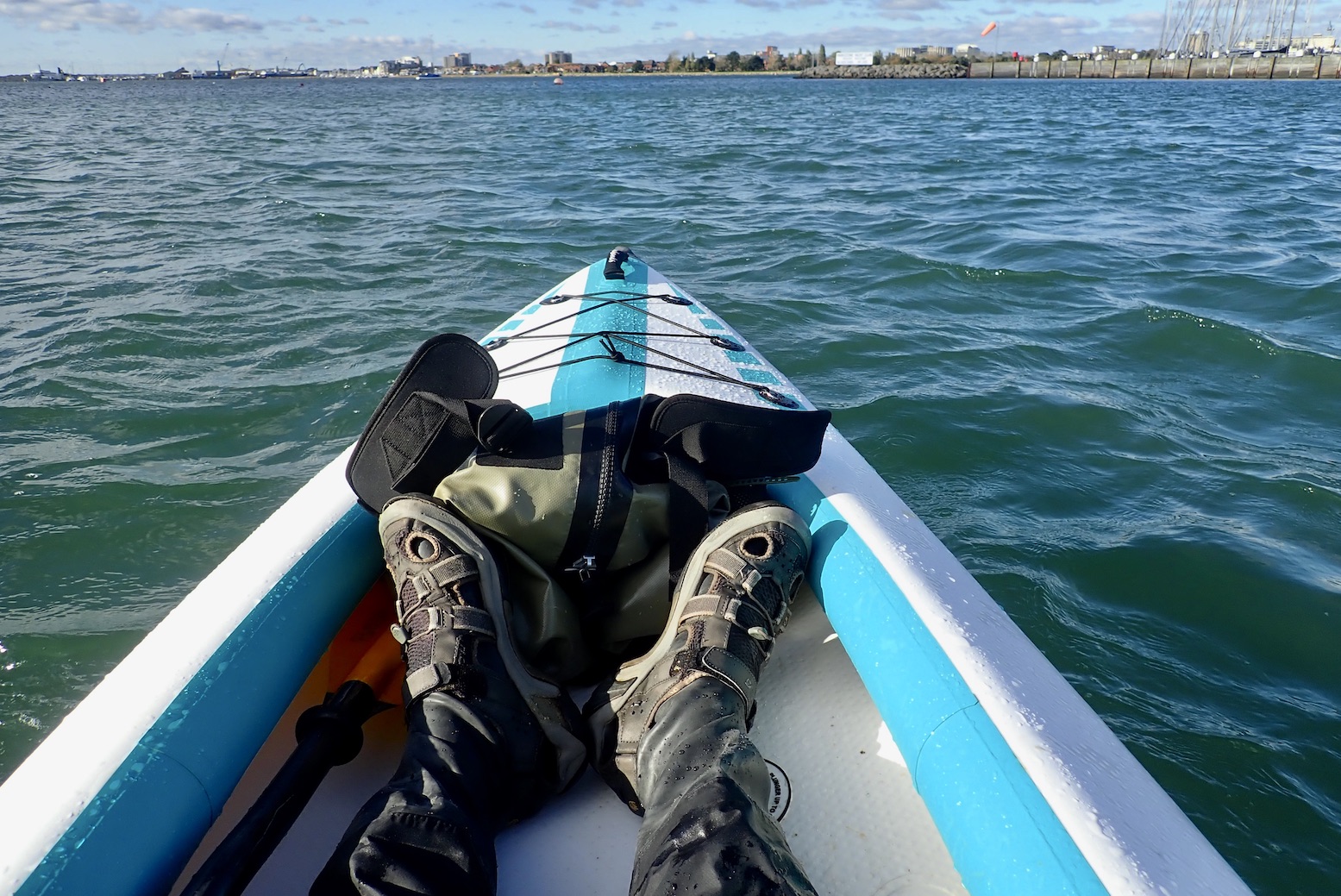
So I set off into the wind, heading towards Poole. Taking it on the nose with the Werner paddle was an effort, but with no fetch, the water surface was only a little ruffled and the Optimal cut through at a up to 4kph. But as soon as I turned a little off the wind the front was pushed round and required a lot of correcting (as would any buoyant and tall-sided IK on a day like today). I reached the shelter of another marina where above me the wind whistled merrily through a forest of masts, and the orange windsock waggled about a few degrees below horizontal.
Here I decided to rig up a footrest strap to help brace myself in the seat and improve my draw, then set out with the four-part paddle. I could feel the blades flexing as soon as I left the shelter of the marina and had to dig in, and also found the 220-cm length a bit short; at 92cm or three feet, the Optimal is as wide as a packraft. These budget four-parters with riveted-on blades are great for beginners and mellow paddles, but over time the joints will loosen up, creating even more slack. After a few minutes I swapped back to my stiff Werner.
Windy
The wind flattened the water with no chop to speak of, so I tried paddling across the wind – tricky in any paddle boat. The deep skeg meant the bow pivoted downwind, requiring masses of correction. Better to know this now than when trying to get back from Brownsea Island with a train to catch, so I put that idea to bed. Any IK would have struggled to hold its line broadside to the gusting 20mph wind, but if the plastic skeg was trimmed to half its length I suspect the hull would be more ‘balanced’ across the wind, while not sacrificing any tracking. This goes for any of the current crop of IKs with these overlong slot-in skegs. A spare skeg might cost a tenner, so the experiment poses little risk.
Turning the boat back into the wind was a huge effort; I was having to yank on my paddle from the middle to get it to turn. Once back on line I carried on up to some buoys and tried the boat downwind where it held it’s line well; the deep skeg and the flat water meant little weathercocking (back end coming round). As with any kayak, wavier conditions which momentarily lifted the skeg out of the water would have been a different matter.
I headed for a park on the north side of the harbour to hop out and see how the Optimal handled without the skeg. Coming back downwind, the boat tracked no worse than my unskeged Seawave might have done. You can’t paddle quite as hard while maintaining a straight line, but you can easily weave tight figure-of-eights in and out of some buoys. On a river with a current, the added manoeuvrability (and clearance) without a skeg might be a better set-up.
Plenty of low storage in solo mode
I also inflated my packraft seatbase (left) to see if the raised position and air cushion would be more comfortable. But on the hard seatbase and floor, it merely wobbled around like a jelly and made things worse. I know from similar accessory pads for motorbikes that you want just enough air to support your weight, but on a surface with no give it just didn’t work. A better solution would be to add a foam block similar to what came with the Arrowstream (but which on that boat I couldn’t use as the raised height made it unstable).
The wind was blowing me in the right direction anyway, but I decided to take back control and slip into what maps call the Blue Lagoon, an inlet ringed by houses with private jetties. Maybe ‘Blue Lagoon’ was cooked up by estate agents; it’s said this side of Poole Harbour has the highest density of Britain’s most expensive houses.
Appropriately, the tide dropping through the bay’s narrow entrance made accessing the Blue Lagoon tricky. I squeezed in along the edge of the current which was a good demonstration the boat’s agility and responsiveness. But once inside things were already getting too shallow, so I backed out and threw myself into the modest tidal race then ferried across it just to see if I could. Maybe the lack of a skeg (but with the footbrace) made this sort of manoeuvre easier.
Test route
I refitted the skeg and drifted south round to the lee side of my Salterns marina put in where all was calm as long as I kept close to the wall. Overall, with a skeg was better but as said, I’d try chopping a spare down by half.
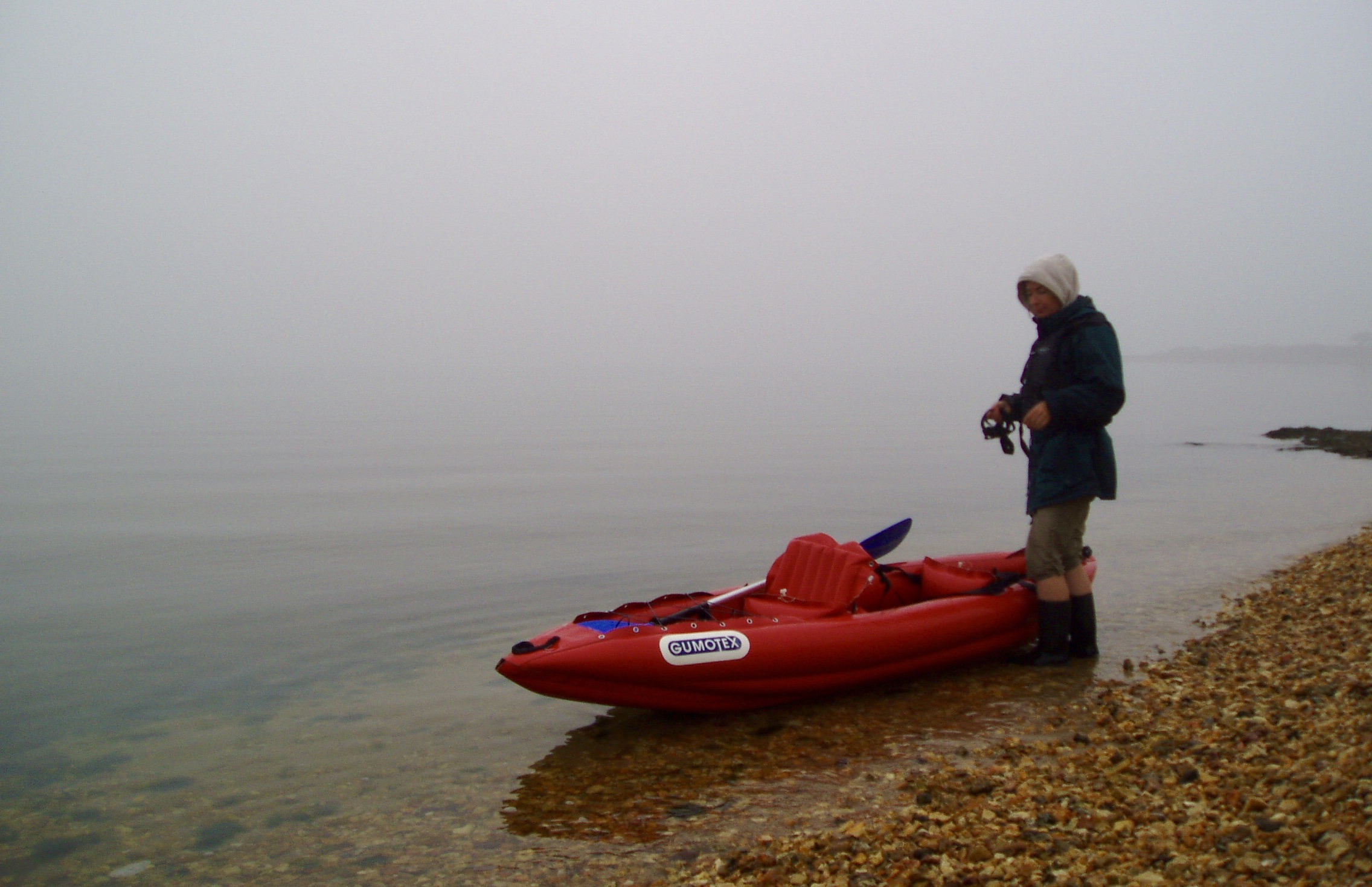
After ticking off a few selfies with the camera balanced on a buoy, I only just made it back round the corner to the jetty against the funnelled tide and wind, then bounced over the clapotis to where the sea had already dropped a foot, exposing Poole Harbour’s notorious mudflats. As newbs on a foggy day back in 2005 (left), we’d got caught out on one of my very first IK paddles in a Gumotex Safari.
Once on shore the Optimal rolled up into the bag easily, though having both valves at the same end would make purging the air in one roll easier (or having a pump with a suction port). Had I the chance, I’d have rinsed it by resting the bow up on something, open the stern drain and then deflate the floor. This ought to give you access to the otherwise sealed-off side cavities where debris and water collect. Then hose from the top and most of it will flush out the drain hole before a wipe down.
It was a shame not being able to get stuck into a proper paddle to somewhere, but I enjoyed my brief spin on the Optimal. For £769 at the time (£499 in 2025) – about £150 less than similar, heavily discounted Ottawa Pro doubles you might find online, and nearly half the price of the AE AirVolution, the Optimal is a solid double FDS which would work well solo once you add a footrest tube (easily done using the floor D-rings). Budget paddles and thin seats are what you’d expect at this price – as it is, comfortable seats are an issue with many FDS IKs. But the boat looks well made and the pump is easily up to the job. Plus you’re buying from an actual UK shop you can go and visit, not some shouty, sell-it-all web-based entity with flakey customer service.
As FDS IKs go, I think I prefer the two-panel ‘clamshell’ design. It feels more sophisticated, or is dynamically no worse than the the masses of three-chamber FDSs which sell for a bit less. The crux is stability which most recreational IK users rightly prioritise (or soon learn to). The Optimal may have that to excess, but as I also found on that very first paddle in 2005 (left), better too much than not enough.
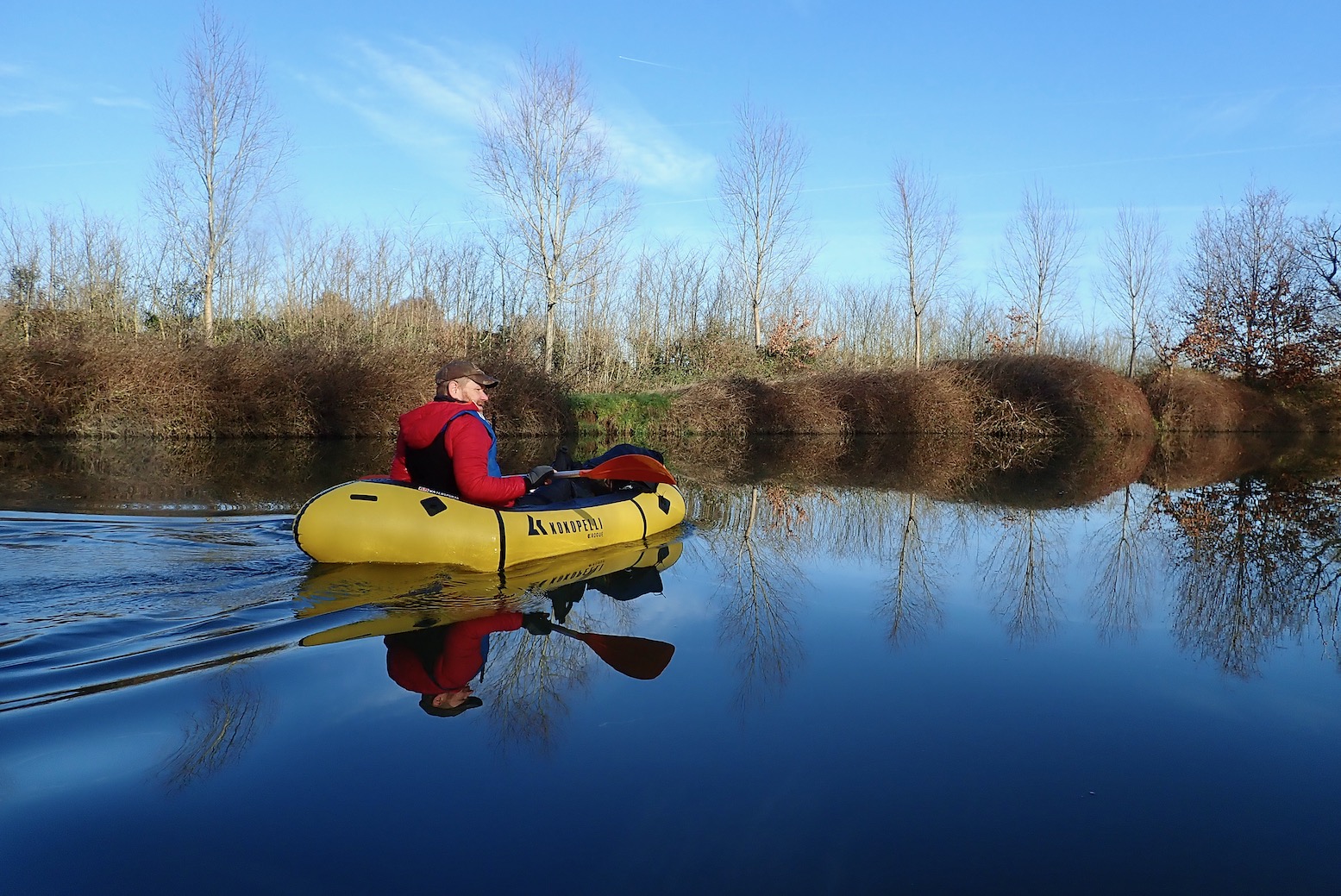
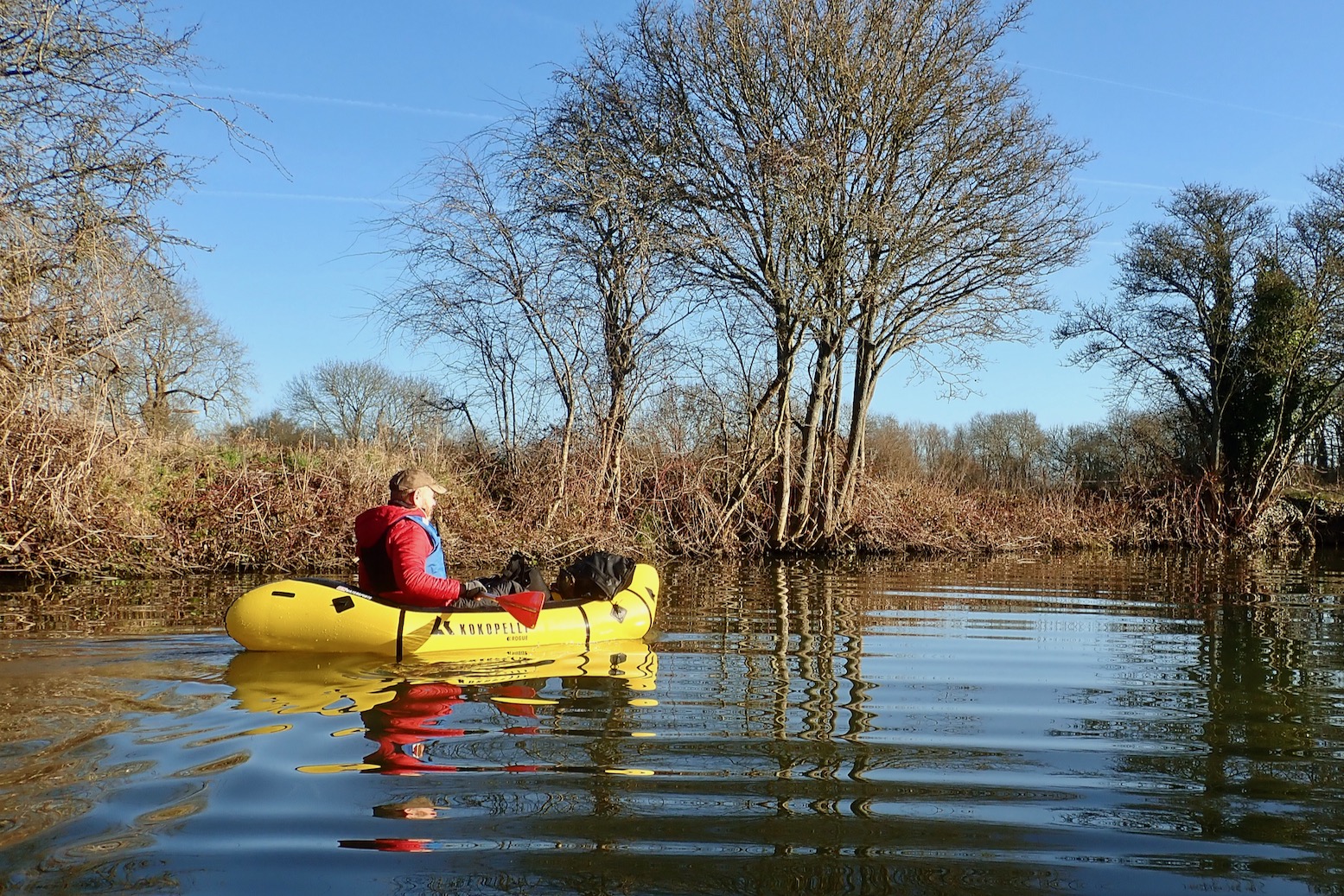
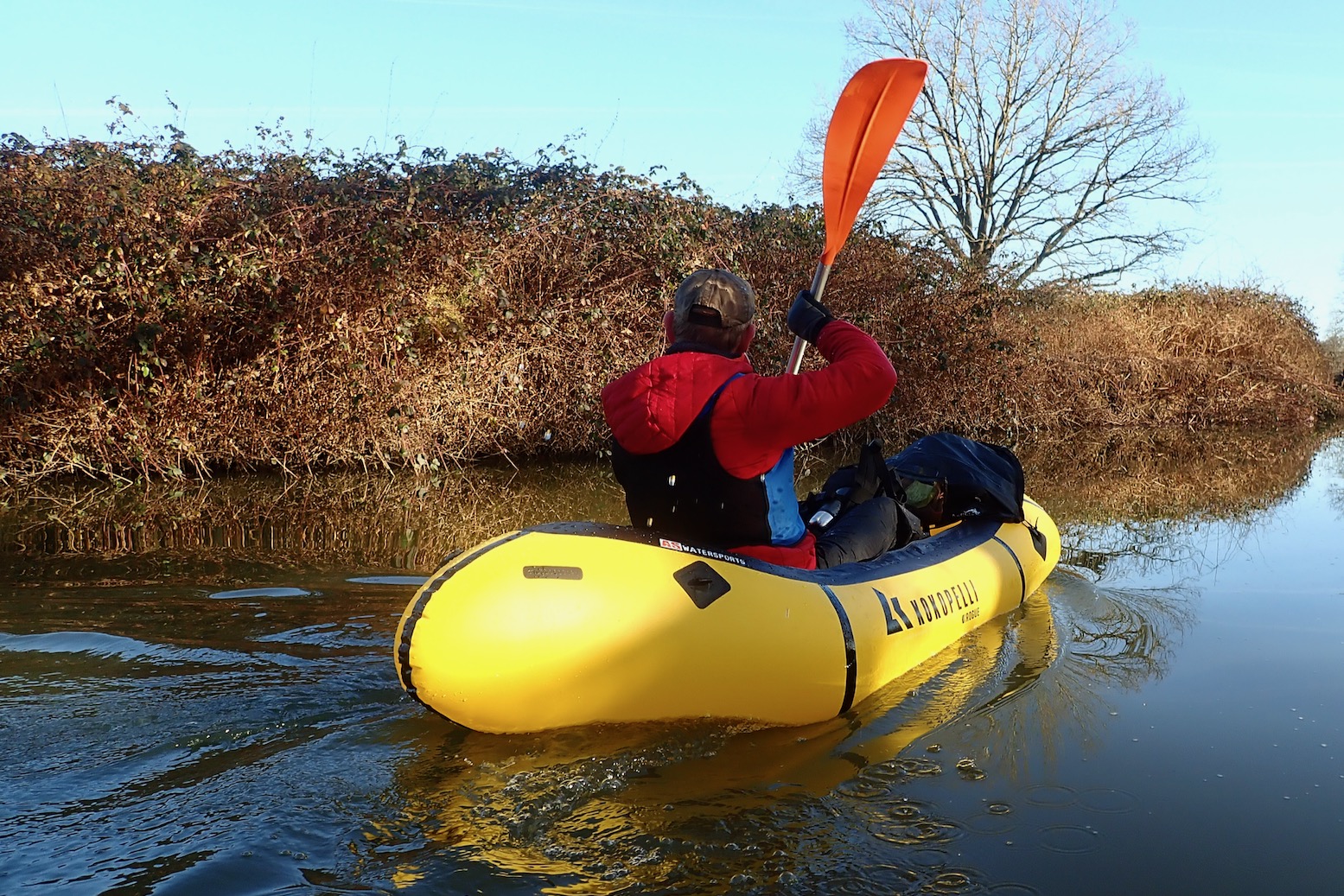
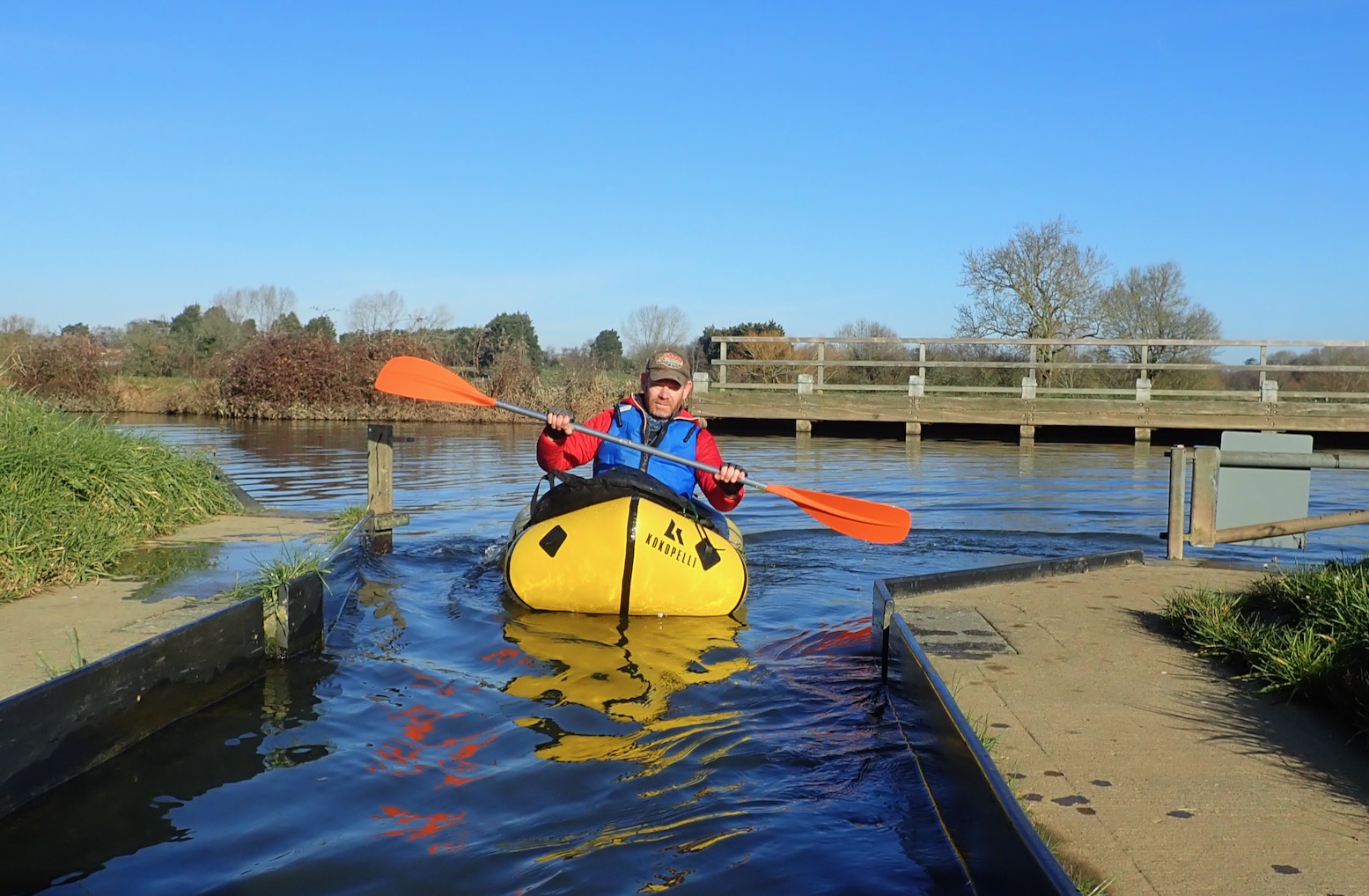
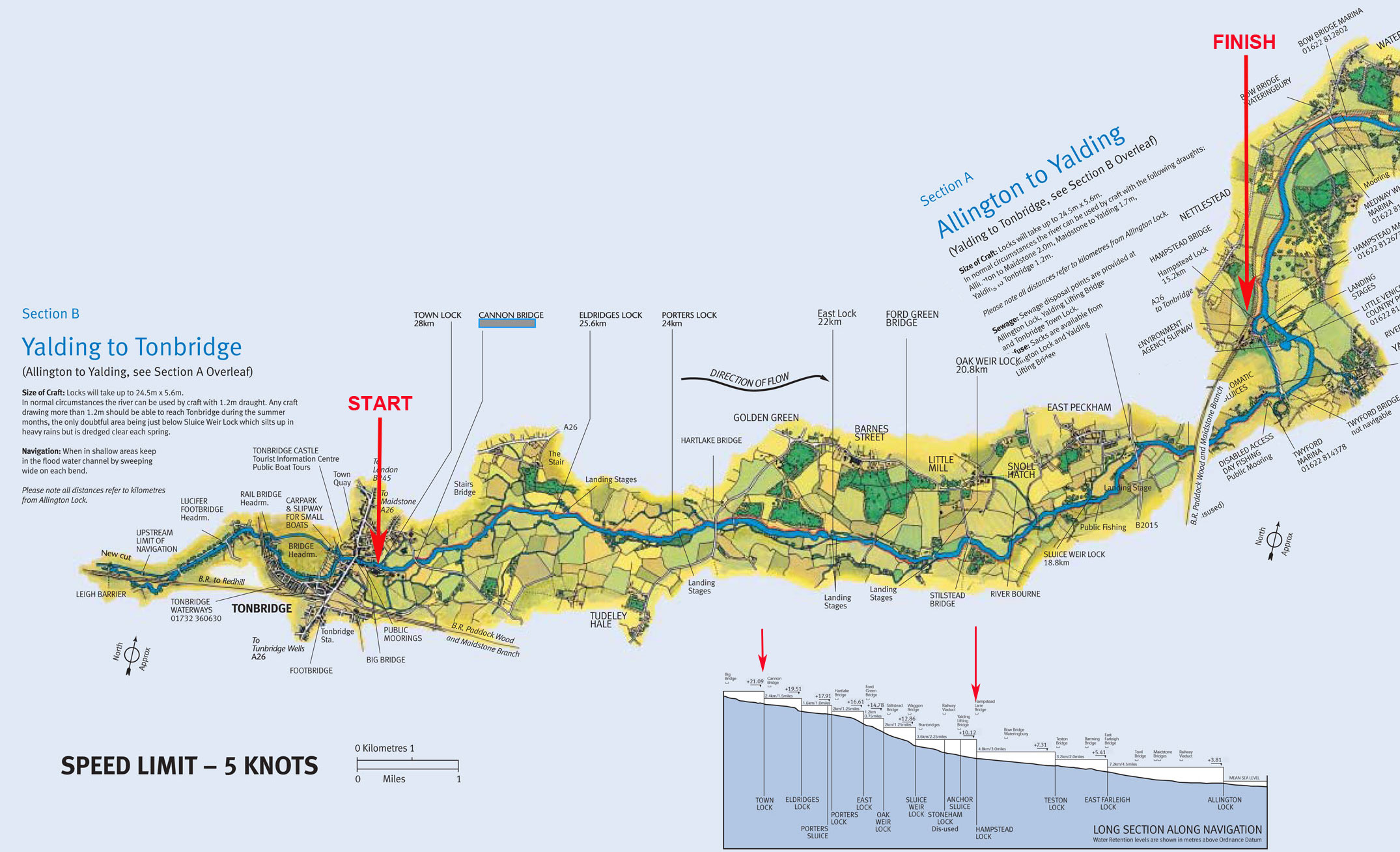
Monday was the calm after the first big storm of autumn, a sunny day to packraft 8 miles along the Medway from Tonbridge to Yalding station. With recent heavy rains, I was expecting a noticeable current on the usually placid Medway whose flow is constrained by numerous locks.
I’ve been caught out on this river before by massively dropped water levels (usually during winter maintenance), so I remembered to check the river status on the website. Oddly it claimed all was normal, but the Medway was clearly up to the grass and I wondered if the five canoe chutes downstream may be closed. Oh well, each lock or weir has a handy low-level jetty so a little portaging will be some extra exercise. It wasn’t till I got back home that I saw they’d issued the warning you see above left.
The noise of the thundering weir at Tonbridge Town Lock put me on edge, and as I set off across the carpet of white scum the over-loaded weir had generated, I was mindful of the latest in a series of revelations about how much raw sewage gets dumped directly into English rivers and coasts by water treatment plants (it’s said fines are cheaper than treatment). A week ago it’s said public outrage had forced the government to reverse a vote against regulating raw sewage dumping. In fact, it seems intensive livestock production is a greater threat to healthy, biodiverse rivers. A few months ago activist George Monbiot exposed how the Wye (which we packrafted last spring) was choking to death from the effluent produced by cattle, pig and chicken installations in its catchment area. The brown, flood-charged brown waters swirling around me now took on a different meaning.
The Medway was moving like a proper unfettered river at a pace I’d not seen before. Small eddies, boils and whorls spun up to the surface at each bend or constriction, and occasionally the boat got pushed or pulled about.
Eldridge Lock, weir and chute
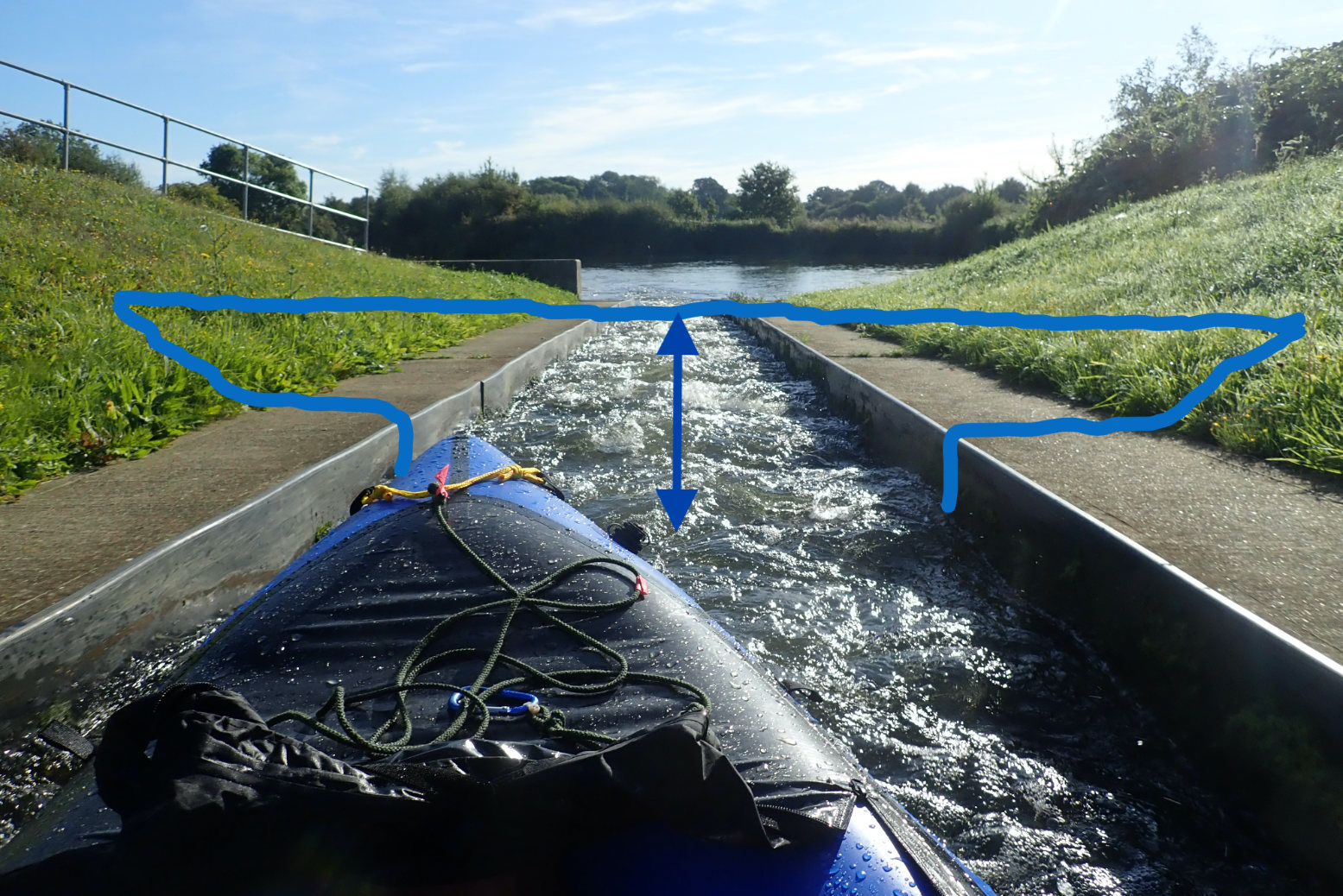
Eldridge chute at normal levels
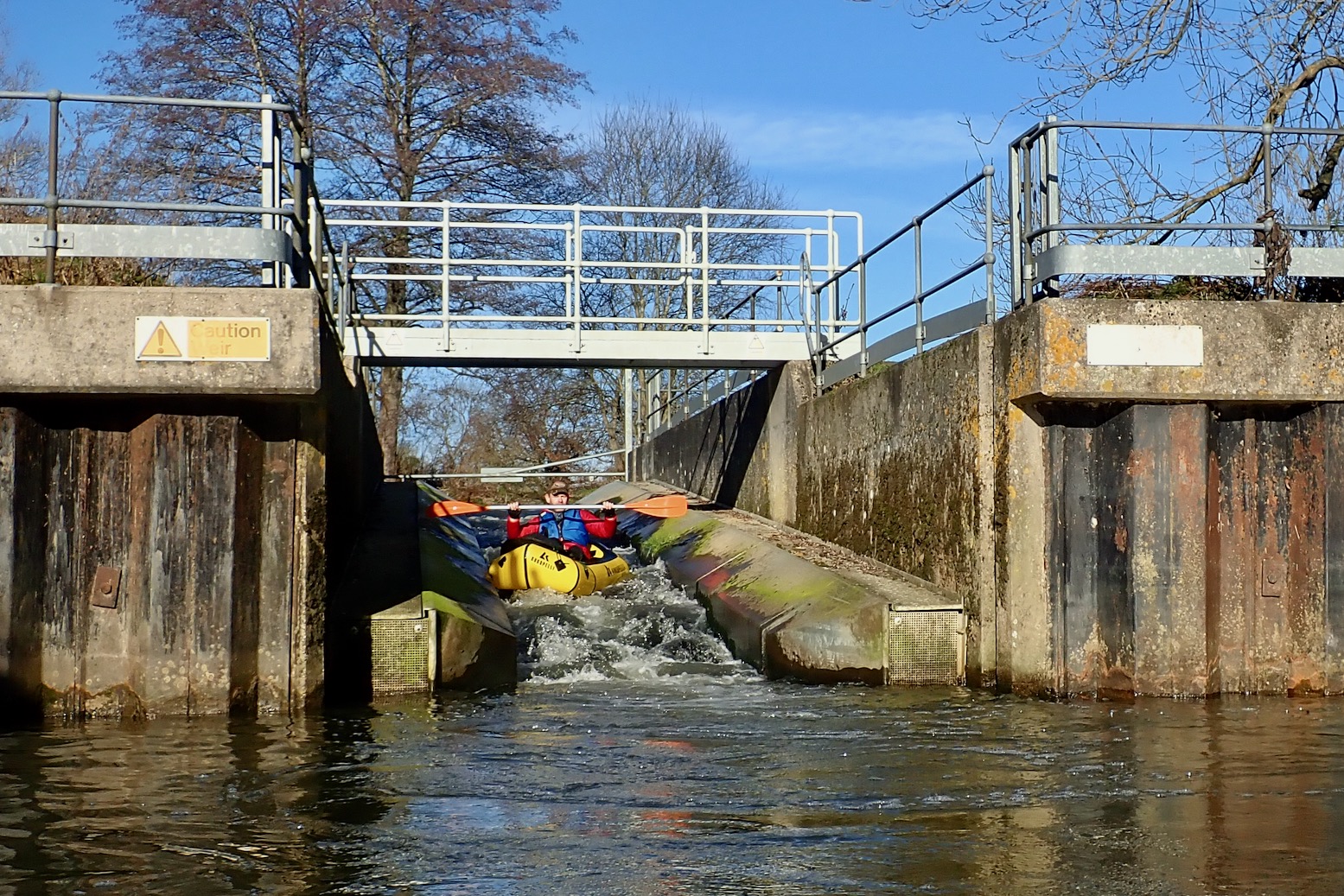
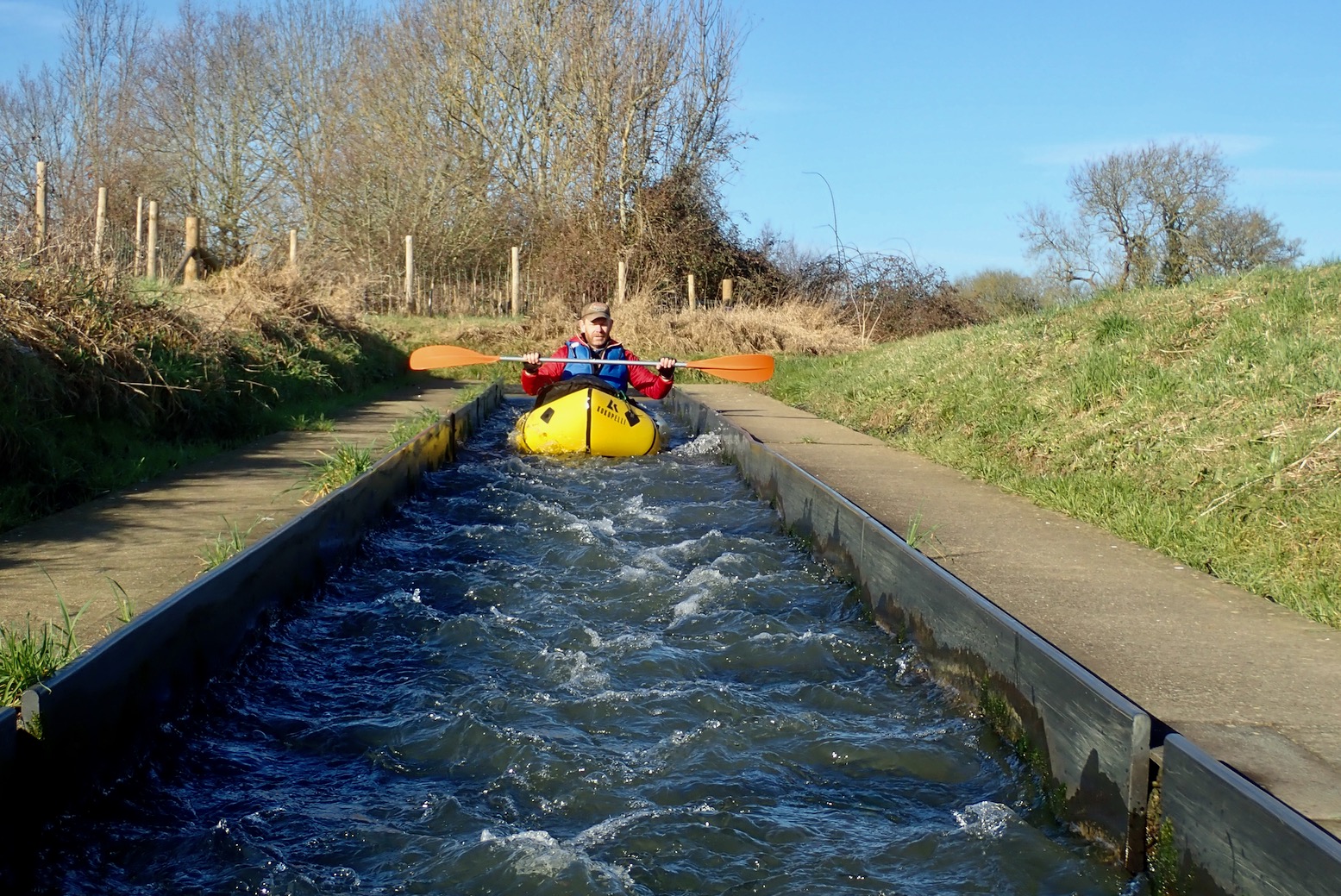
On arriving at Eldridge Lock, the very shallow-gradient chute had burst its banks, so to speak, and was twice as wide as normal, with the metal edges of the channel hidden in the brown murk. A little taken aback, I was too focussed on keeping the packraft in line to take a photo. Once down, the powerful eddies belting out of the churning weir right alongside the chute took a bit of digging to get across, before carrying on downstream through the frothed-up scum. As a longer boat could have got crossed up and flipped over in the unconstrained chute, you’d think think they’d have closed it.
Porters Lock chute. Straightforward but often closed (as today) for no obvious reason
Downriver, the gate was closed on the Porters Lock chute, which appeared the same as normal and perfectly straightforward. With the base of the chute separated from the adjacent weir’s turbulence, I slipped under the bar, as I’ve done before, and shot the chute with ease.
Oak Weir chute. Same as normal but closed.
The next two chutes at the similar East- and Oak Weir Locks were also unflooded if flowing briskly within their sides. But the gates were too low to slip under, so I rolled out of the boat and carried it down to the jetty.
Jetty below Oak Weir Lock
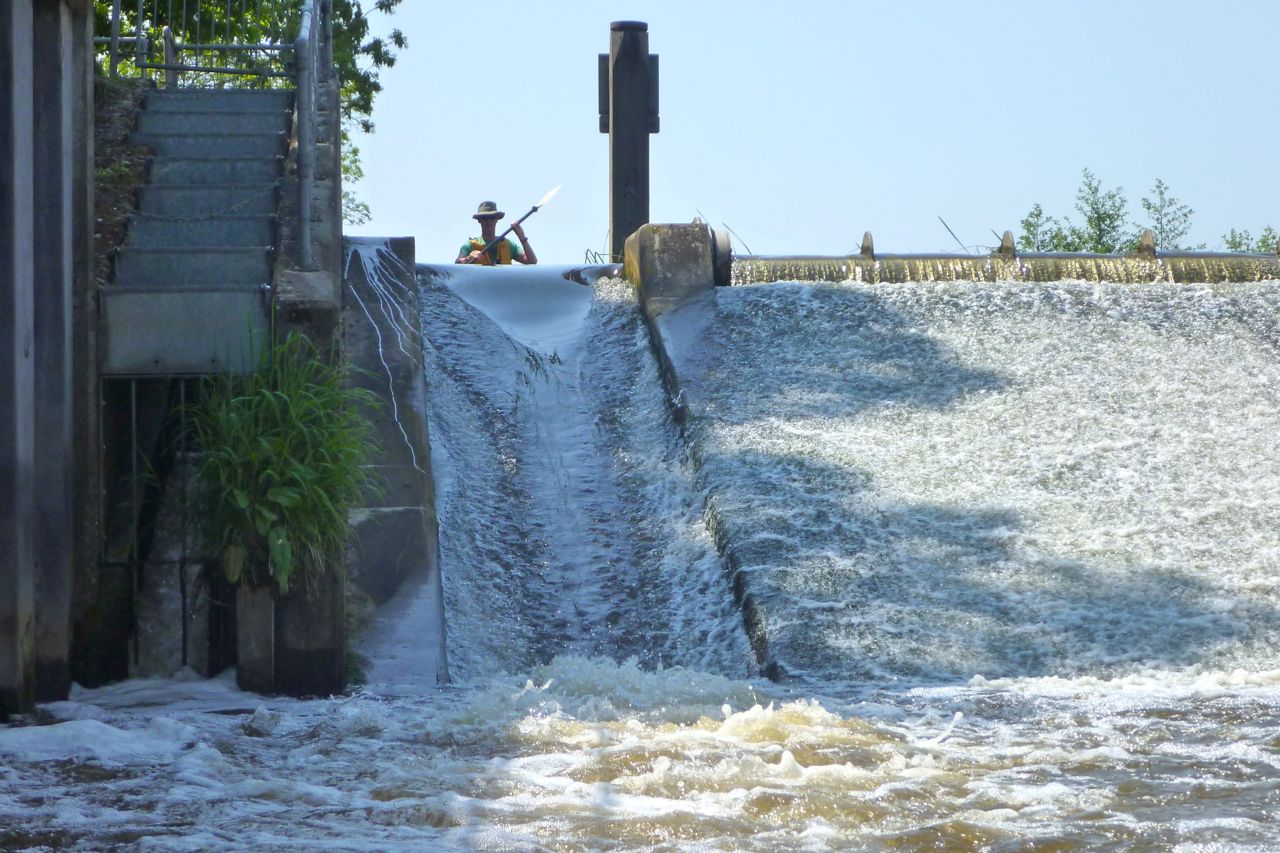
Sluice chute running a bit harder on another day
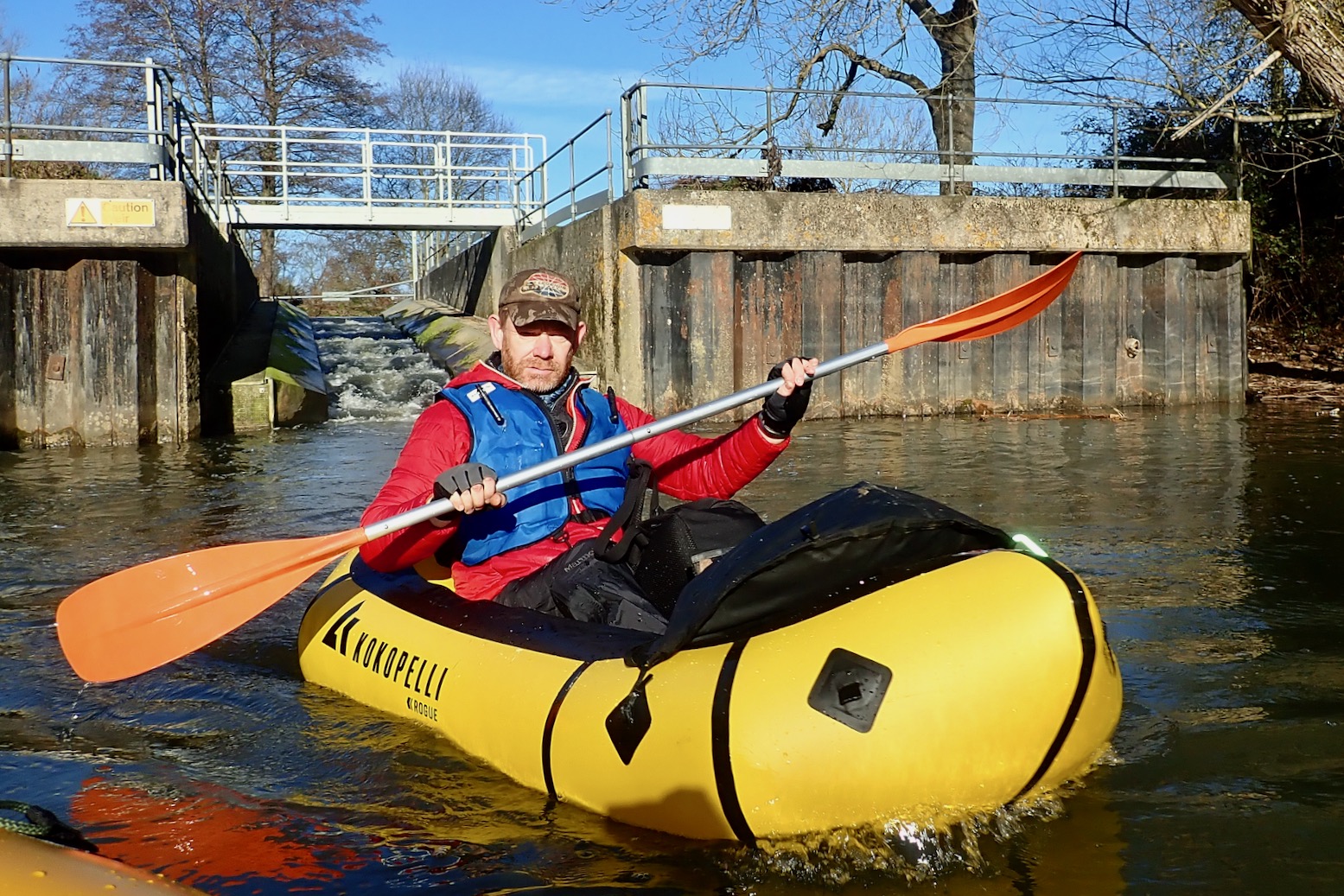
With the strong current and a helpful back breeze, I got to the final chute at Sluice Weir in what felt like no time. Branches and other debris obscured the entry point which, even at the best of times, is difficult to nose up to to check the chute was clear without getting sucked in.
Because you never know what may be jammed half way down the chute until you tip over the edge, I decided to cross over to the jetty on the other bank and have a look before hurtling down.
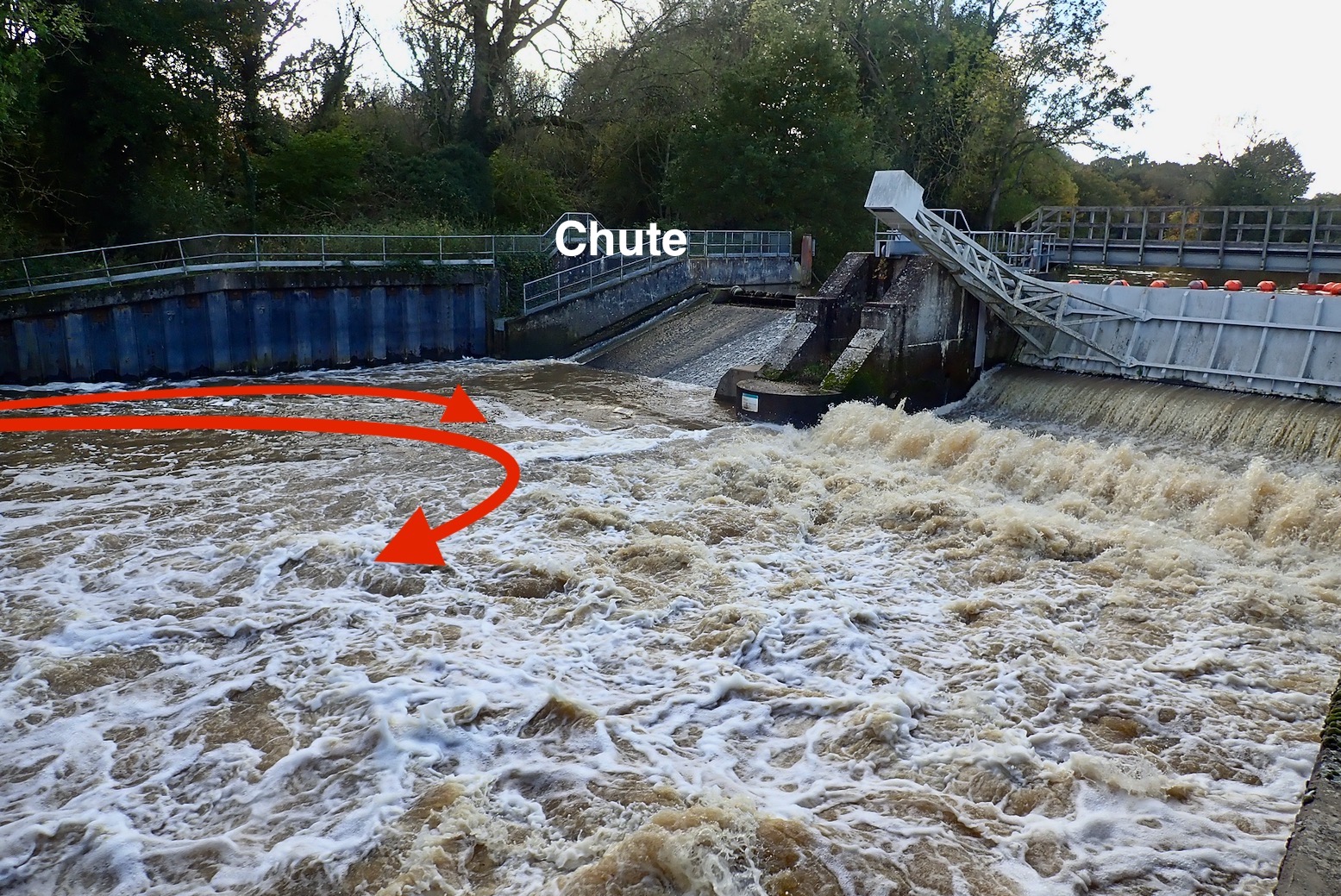
Just as well as, although the chute was clear and running shallow within it sides, the thundering weir alongside span a back eddy clockwise right into the placid drop zone. The packraft would have almost certainly skimmed over to the flow, but as I was right by the put-back-in jetty, the ‘dare’ didn’t seem worth the risk. Messing about near weirs can end badly. Maybe it was a matter of timing on the day, but it seemed ironic that two potentially dodgy chutes were open, while the three straightforward ones were closed.
All that remained was the last mile or two to Yalding Weir and on down the short, deadwater canal to Hampton Lock for a wipe, roll up and the 14:40 back to London.


































































 Inflatable Kayaks & Packrafts