Tag Archives: gumotex seawave kayak

Seawave: windy test run with deck

Seawave main page
swv1

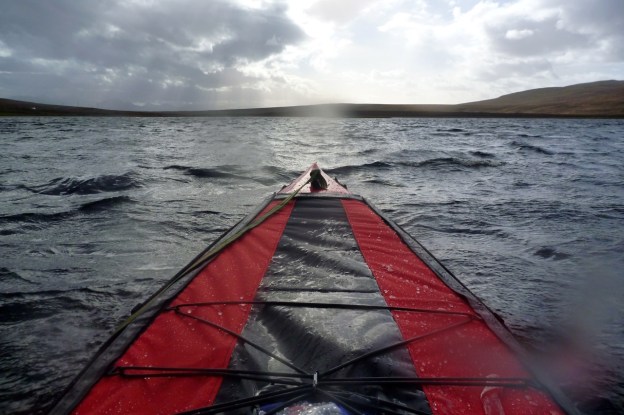
The new boat had to get christened in what they call a ‘fresh breeze’. It was only going to get windier over the next few days. Either that or it would stay rolled up till the new year.
I went to freshwater Loch Ra round the back where I took my packraft for a ‘gale test‘ one time. It’s a safe place for this sort of thing. My new wind gauge – a tenner on ebay – was reading a moderate 15 mph, but it felt like more. I do wonder about the accuracy of that thing. Turns out Ardmair near Ullapool was registering a solid 25 with a spike up to 35 around the time I was out. So let’s call it at least 20 mph – not really IK weather.

footard

I pumped the sides up to about 0.33 bar (4.8psi) and jury-rigged a quick footrest stirrup, but under the deck it was hard to line up quickly when you’re getting in while being blown around. I have a better idea to counter-tension it into position from the other end with an elastic (left). That, or copy the Amigo set up with D-rings – less straps cluttering up the floor that way.

seawave2dek


Used to hoping effortlessly into open boats and setting off whatever the conditions, the need to negotiate the deck made getting in all the more awkward – though a grounding skeg is also a factor. With an onshore wind, I figured out a nose-to-the-shore angle but had the paddle blown out of my hands just as I was slotted in. I retrieved it and tried again using those nifty deck elastics for the stick, then backed up and swung into the wind.

As expected progress was slow until I found a rhythm, and then just very effortful – like hauling a head hose uphill. The Seawave’s more rounded hull means it’s a little more tippy than the mattress-flat Amigo, but in a good way. I never thought I’d write that line, but a little rolling means side waves need not push you over if you counter brace, though I can’t say the Amigo riding side waves flat like a raft was ever a problem. If it didn’t tilt with the waves water would pour over the sides. With the Seawave’s deck, lateral sea waves need not deck the Seawave.

Before I got too far out I checked to see I felt in control across the wind. It was blowing so hard I only needed to paddle on one side to go straight, but no stability worries. Then downwind with no untoward weathercocking either, all things considered. Further out on the small loch the fetch flattened a bit but another side-to-the-wind run saw the long boat extremely hard to bring back into the wind. A rudder would be handy, or maybe more aggressive leaning or my weight further back. It felt like my position was a bit too far forward to lever the bow round while the wind pushed on me and the sides. Not sure if that makes actual hydrodynamic sense, but without knowing the Seawave’s normal seat position, there’s certainly room to move my seat back in the cockpit a few inches to see if it makes a difference: more ‘rudder effect’ with a rearward paddler. This animated gif on the right shows the seat about 4 inches further back. Of course these were conditions where you’d expect a long, unloaded, over-buoyant IK to handle like a drifting log.
swv-speeds


Upwind it felt like I was crawling along but I got to an island faster than expected, got beached then carefully inched around it. As I knew well, a backwind may be less effort but can be as hard if you can’t keep the back of the boat from coming round – a common flaw with wind-prone IKs. But the Seawave tracked pretty well, right on- and then just off the wind, with only the occasional double pull on one side to level up. I did a bit more crosswind practice but by now I was pooped and even needed to drink out of the loch. Any hope of more tests without the skeg, without deck, at factory pressures and so on would all have to wait.

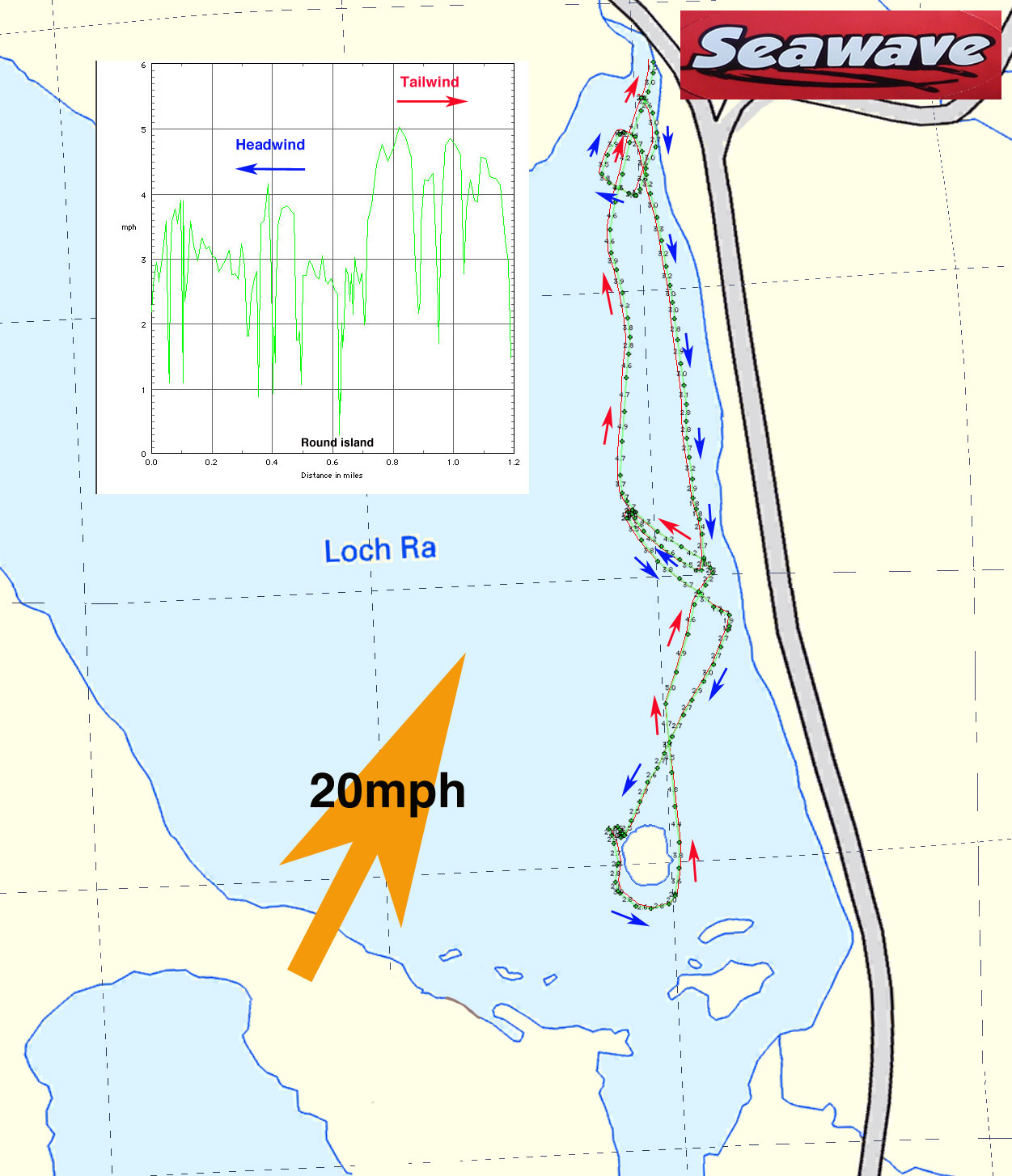
Back home the GPS showed up some surprises. Into the wind I was hacking at a surprising 3mph, across it at 4 and downwind at up to 5mph. All much more than it felt. I’m pretty sure the Incept would have managed the same – and it was less effort than in the Amigo.

Gumotex Seawave kayak preview – 0.25 bar

Seawave main page (less speculation; more up to date user-info)

seawaves

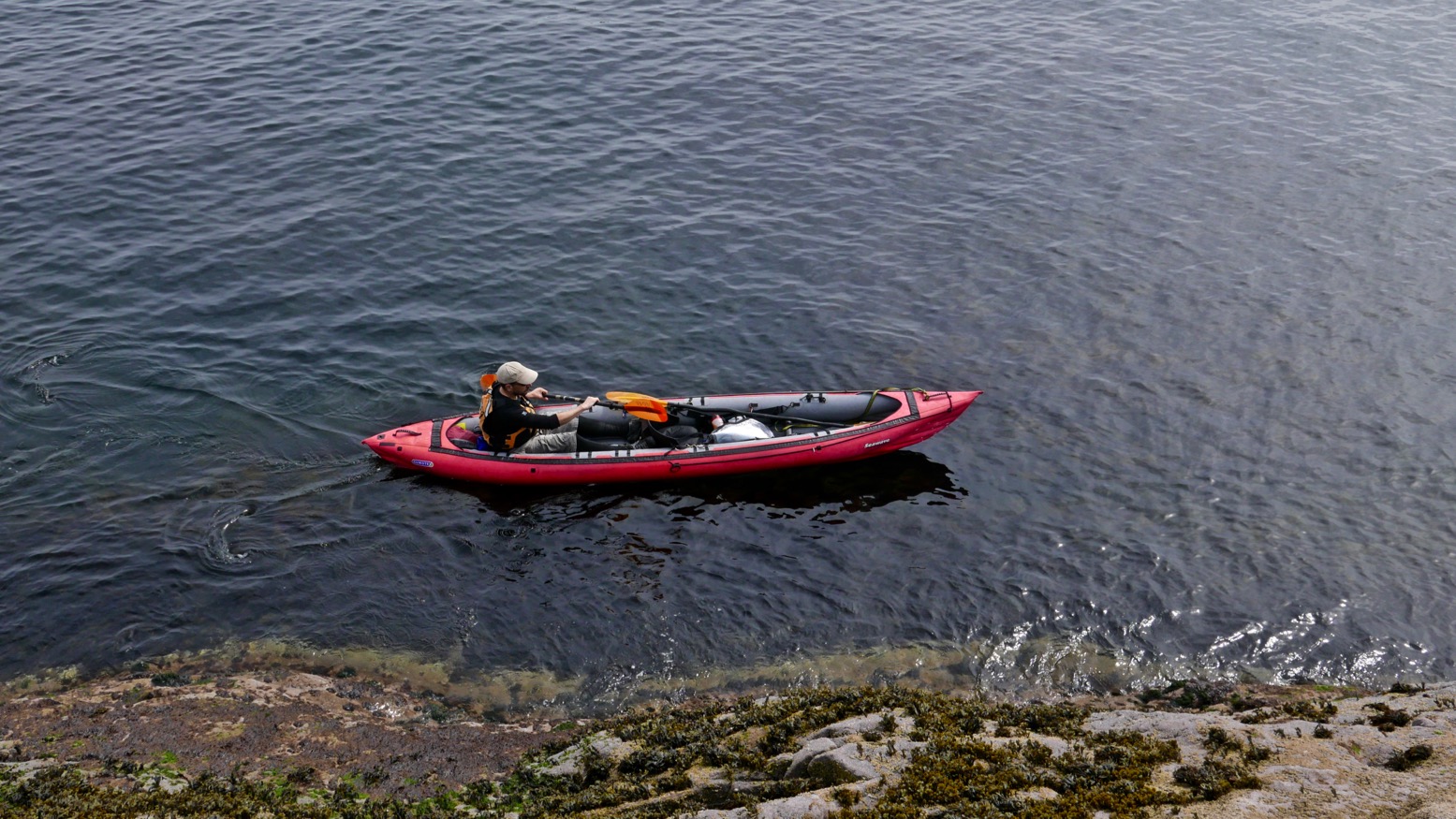
The Seawave was released in 2013 and in 2016 a near-identical model came out with a rudder option. The Seawave can be used as a single, double or triple, and is sold in Euroland for around €1625 or £1425 in the UK. They used to be a bargain. Not any more.
In 2023 the Seashine version came out – a Seawave with a drop stitch floor (like the Thaya and Rush); slightly heavier, wider and longer and a lot more expensive.

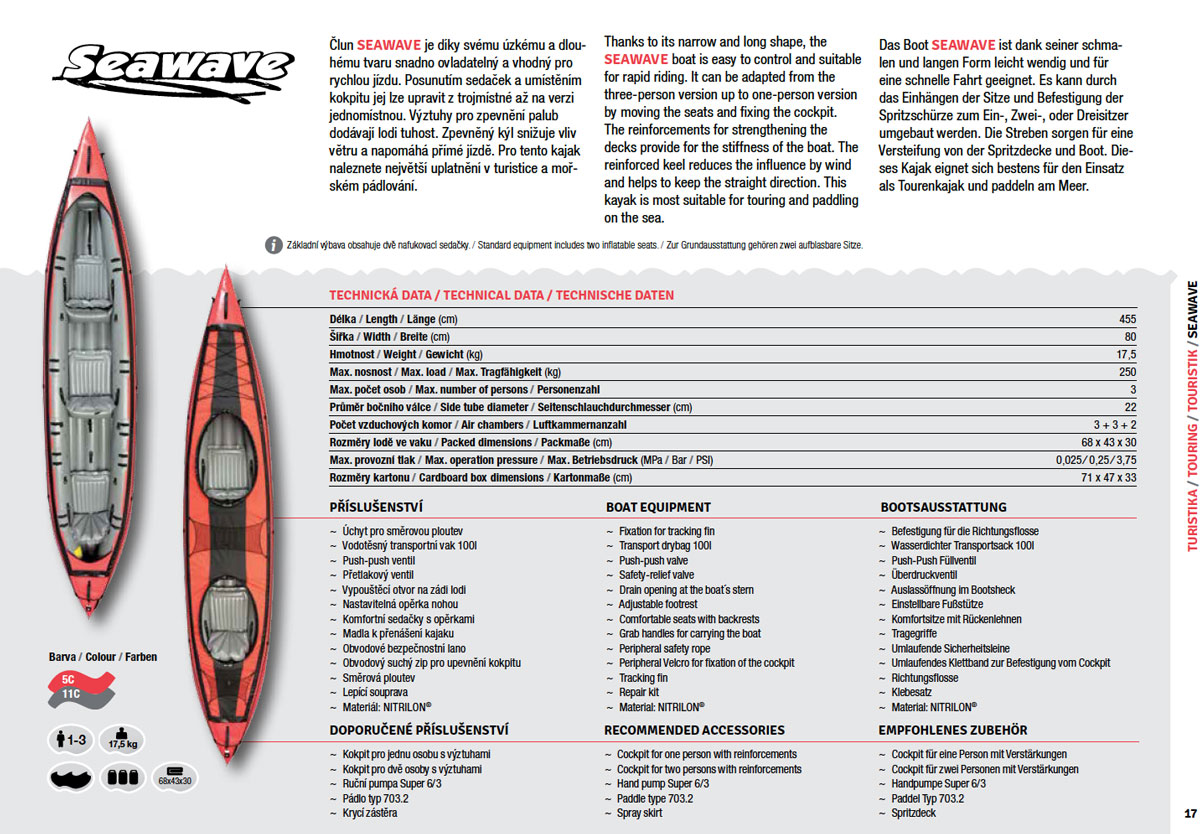
My stats for my Seawave are 4.5m x 78cm wide and 17kg plus a claimed payload of 250kg which sounds plausible. Significantly, the Seawave’s pressure is rated at 0.25 bar (3.6psi) all round, midway between the Gumotex IK norm of 0.2 and Grabner’s 0.3 bar. Some of Gumotex’s orange series whitewater boats run 0.25 and their IKs were never that shoddy. Having said that, the PRV in the floor of the Seawave has the same ordinary rating you’ll find in a Twist or a Palava or probably any other Gumotex IK (more here) but the adjacent sticker claims 0.25 bar max. It’s the side tubes that now take 0.25 bar, not 0.2. What they now call Nitrilon is not like the stiff old hypalon-like Nitrilon of my early Gumboats. Increasing hull pressure is one way of getting a more rigid and therefore faster IK, but it’s the integrity of the ‘I-beam’ floor that’s the usual limitation. The Seawave has a pressure-release valve in the floor but not on the side tubes, and I read these pressures are said to be on the conservative side. You can’t over-inflate the floor but these Gumboats can handle more in the side tubes providing you watch it when out of the water in the heat.

seawavecat

The Seawave is long for an IK, but with just a skeg (optional, but there’s a  rudder now), you wonder if this could be hard work to turn into the wind. However, in France kayaks destined for sea use (beyond a certain distance from the shore) must be homologated or approved in some way, and the Seawave has passed this test.

gumtip

The great thing with the velcro deck (for one or two) is that it can be removed; on my Incept I paddled like this approximately 99.9% of the time, with the deck rolled to one side. Even at the slightly higher pressures, I have to say at one point in the video I noticed the Seawave bending with the swell. My Sunny used to do this, taking on water over the low sides, but with a deck that ought not be less of a problem, even if you imagine there’ll be some seepage through the velcro in heavy conditions or white water.

grabend

Flexing is a problem with any long inflatable and even my short and high-pressure Grabner (left) flexed in certain conditions. Manufacturers get round it with metal frames (Feathercraft, Advanced Elements), twin side tubes (some Grabners, Gumo Seakers, Incept) stiff fabric (Incept) or just high pressures like Grabner, but that demands very good construction. Drop-stich panels are the new way of doing it now.

Scotty

There are more impressions as well as some nice pictures from an actual owner, Norman, right here (translated from French). He ran a 410C for a few years and talks of pumping his Seawave right up to 0.35 (5psi) bar which makes for good speed (6kph average he claims). That is 40% above the recommendation so let’s hope the seams on the Seawave can take it, cap’n.

mod-drainer
sw14

It looks like grey, Halkey-like valves in the back, not the old-style black ones that Gumo used. And I see that Gumotex have again adapted an idea that I had on my Sunny years ago (right), a drain hole at the back. Only theirs features a neat sliding cover. It could all be the normal process of improvement of course, but I recall that after I had some smaller skegs made for my Sunny (and sold to a few others), Gumotex reduced the size of theirs to the current black plastic ones. And then the velcro deck idea. Whatever, it’s gratifying to see ideas I have tried or written about actually making it into production.

Enough of this speculation!
Actual impressions on receiving my boat here, followed by half a decade of very enjoyable Seawave paddling.

Gumotex (Innova) inflatable kayaks

> > > Page moved: this way please > > >

angus - 8