Author Archives: Chris S

Kayaking the tidal River Adur

See also: Bic Yakkair Full HP

In the beginning when I was keen to try anything, I paddled Sussex’s River Arun and the upper Rother too. Neither made me want to rush back to tick off the other tidal rivers of southeast England. You feel you’re in a sunken, silty, reed-chocked ditch passing below treeless agricultural land and with limited, muddy take-outs.
But Robbo was taking his Full DS Yakkair for a burn up; a good chance for me to check the boat out as well as try something new. He’d worked out the tides: putting in on a 6.5-m spring tide at 11am in Upper Bedding (the former medieval port of Steyning) would scoot us 10km up to the tidal limit under the A281 bridge near Shermanbury.

In Beeding there’s a free car park at the east end of the village by the playing fields (maybe toilets), plus a garage and a Subway nearby. Arriving with Kahuna Steve at the steep east bank just south of the bridge at 10.30 (above), the river was flowing downstream like rivers do and faster than we could paddle against it. Had we timed it all wrong? But by the time Rob and his two young chums were on the water with us an hour later, the moon was doing its work and the river was flowing as fast in the opposite direction, backed by the southerly breeze pushing through the Steyning Gap in the South Downs.

Yes it’s another tidal Sussex ditch with lots of day-amblers either side, but who can complain being on the water on a sunny day in a boat you brought in on your back despite bevies of menacing swans to dodge? Robbo was spinning like a break-dancing turtle in his tiny Twist, Steve was piloting his old Feathercraft Kahuna, the folder nursing a broken plastic rib from last year’s Danube run. And E&L were in Rob’s dropstitch Yakkair which you can read about here.

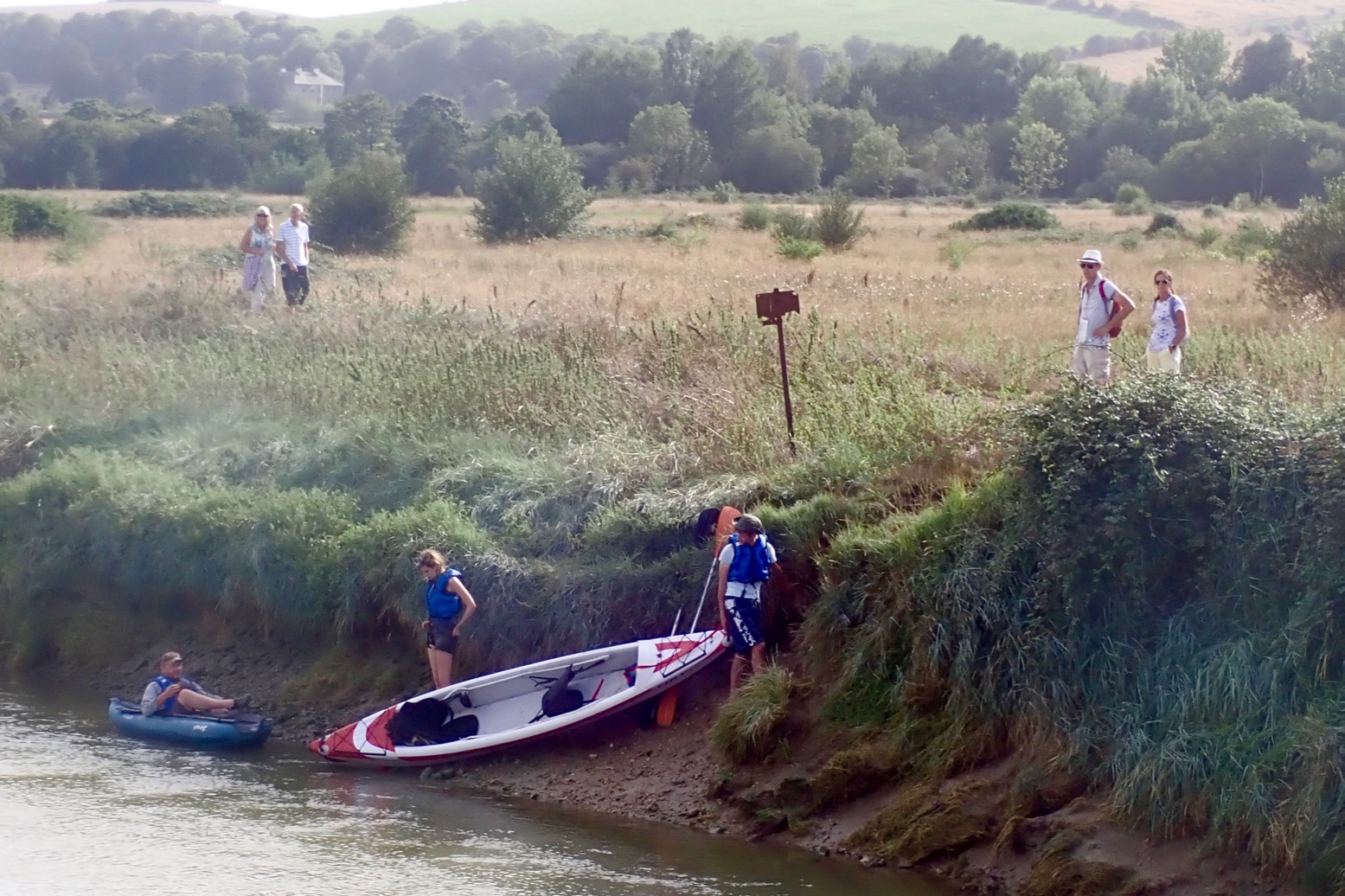
As we cruised effortlessly northward, the banter subsided and the river got narrower. Reeds and fallen trees closed in to just a boat’s width at times. Upstream I noticed a couple of access steps on the west bank – maybe private but the only way of getting off the river with some elegance, if needed.

We reached the fork in about 80 minutes. Northwest leads to Bines Bridge, romantically depicted by renowned 1960s illustrator, Michael Codd. Look him up: he’s rendered loads of idealised Sussex tableaux from the late-medieval iron ore industry right back to Neolithic hunting scenes.
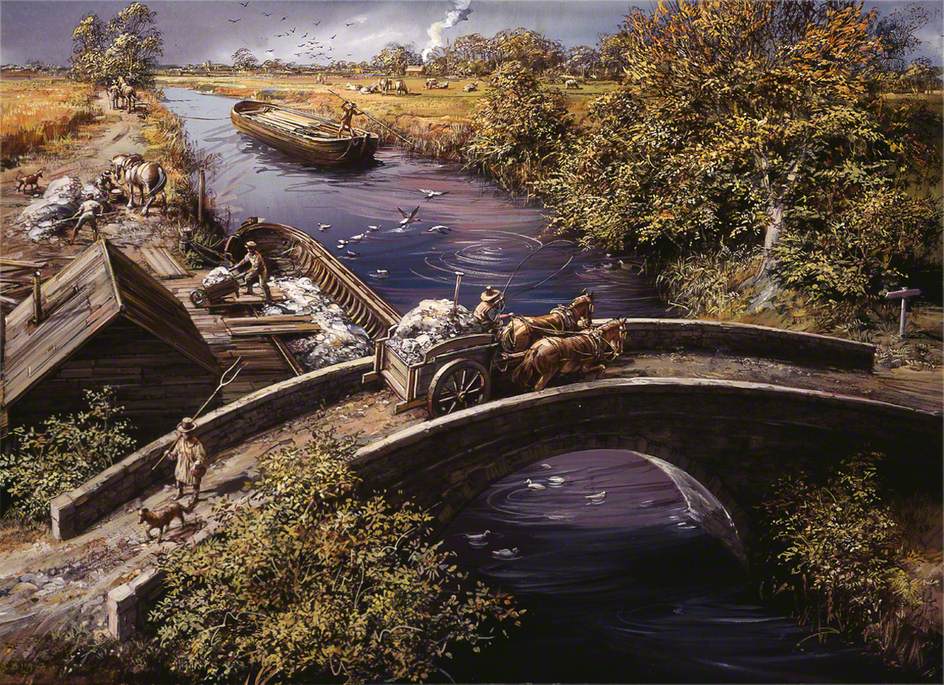
Taking off up the east arm, very soon a submerged weir slowed down the three skeged IKs. The Yakkair needed a lift over. Then a fallen tree appeared to block the way but we squeezed through. Here we met a local couple in their new Itiwit 3-seater. These must be the most popular IKs around right now, maybe because Decathlon were able to meet the huge demand after the first lockdown this summer.

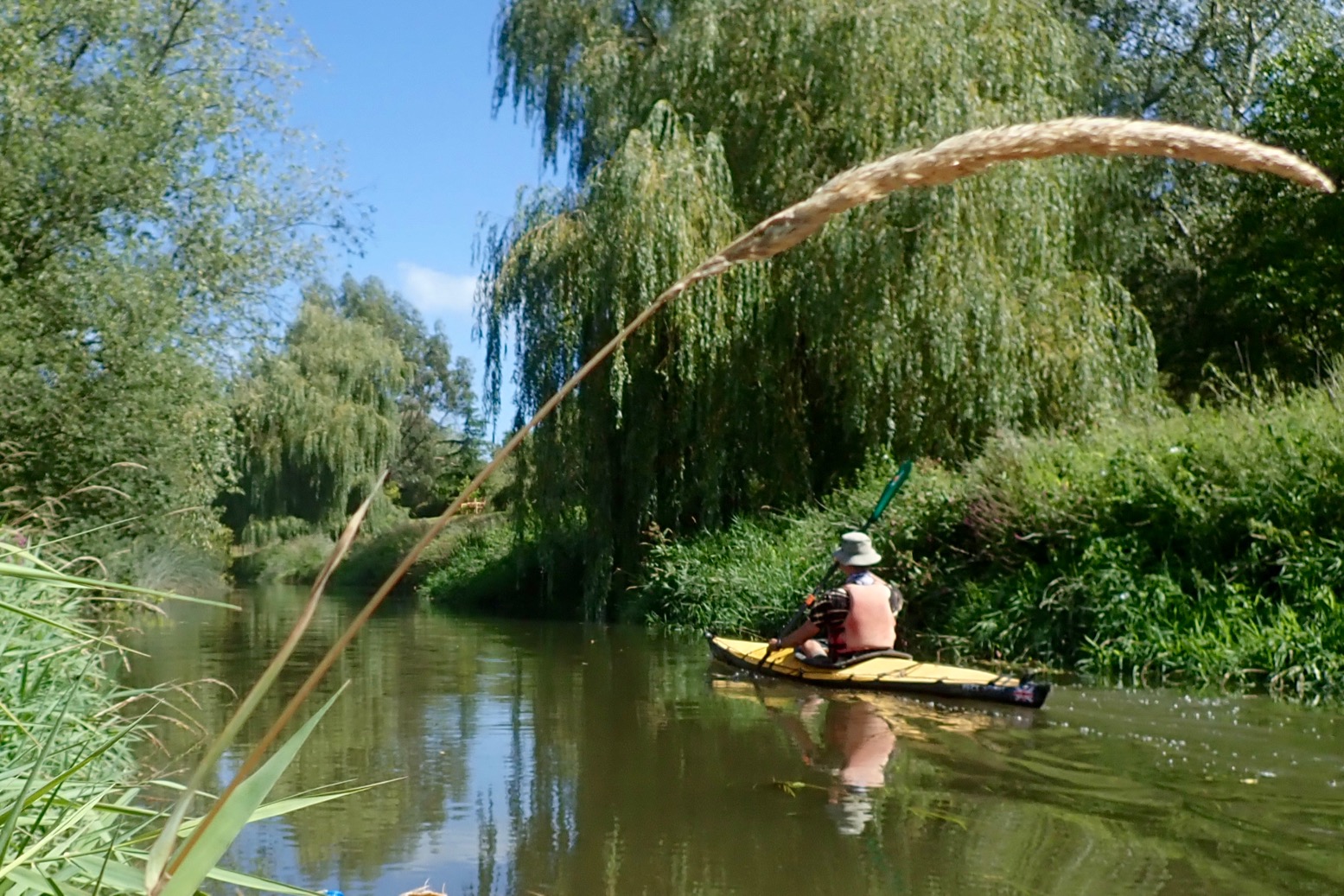
From here the scenery picked up briefly. The fields didn’t run to the water’s edge and riverside willows dangled over the stream. We reached the four-arched bridge near Shermanbury about 2pm for a snack (easy take out on the right), but had it in our heads we should turn round pronto. In fact it soon became clear the spring tide here kept rising up to 3pm, a full two hours after Shoreham, maybe pushed up by the day’s wind.
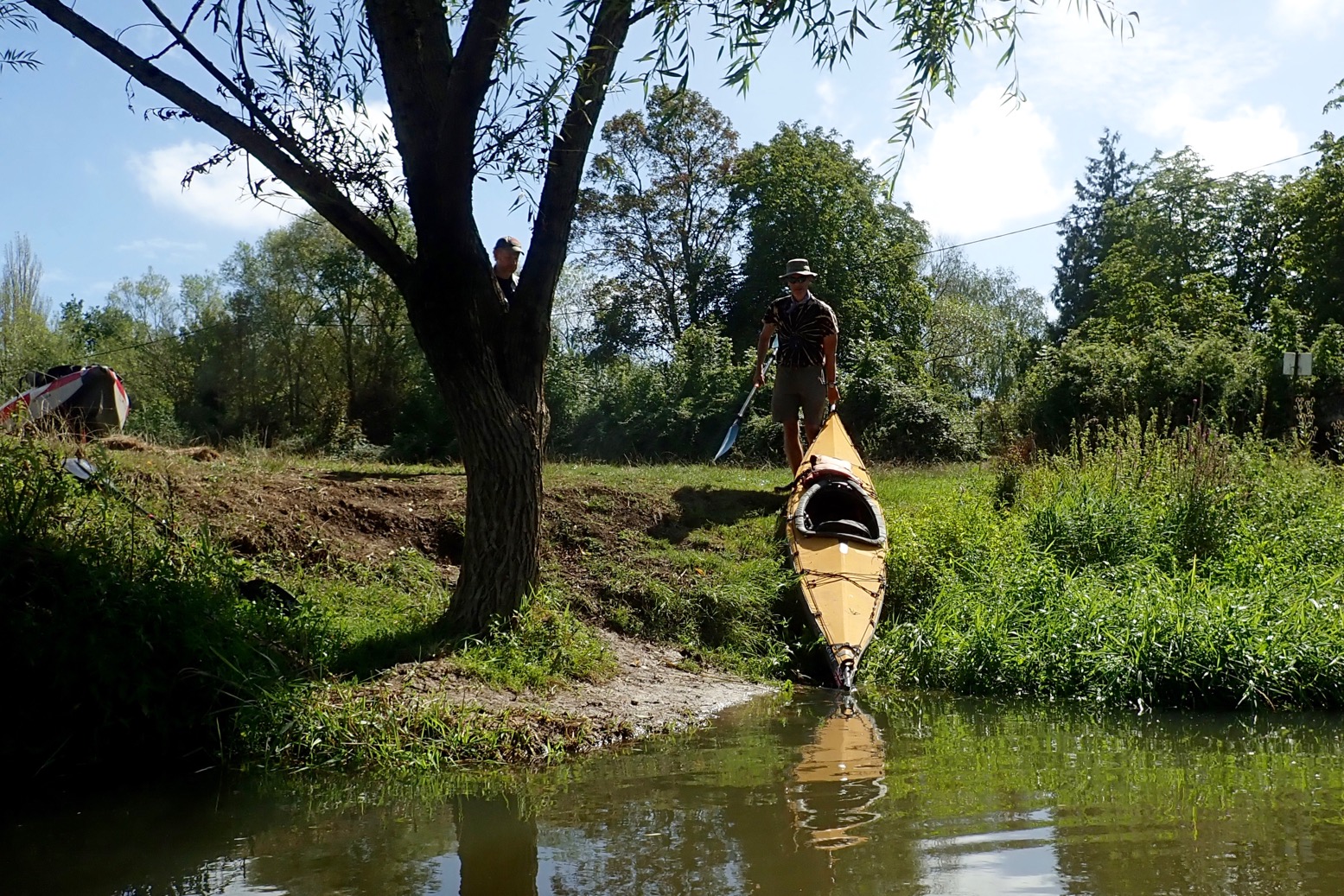
The weir bar that has been six inches below the surface on the way up was now two feet under. Good to know. The wind had strengthened and was now in our face so there was nothing left but to have a work-out. Steve and I pulled ahead as gradually the flow turned our way; the Downs making a good marker for where we were headed.
We got back in about an hour 30 and managed to crawl out without covering ourselves and the boats in mud. As Steve sagely observed, anywhere else in the world there’d be a civilised jetty to encourage paddling.
About the Adur tides:
High tide in Upper Beeding (Steyning) is about 45 minutes after Shoreham and about 2 hours at Shermanbury. That brings up the brain-twisting notion that water levels are rising upriver while falling at the estuary. Somewhere a spooky patch of slack water is migrating silently upstream.
With a skeg the weir bar is submerged enough about an hour before a high spring tide at Shermanbury bridge. Neap tides may not submerge it so just take the left fork towards Bines Bridge and see how far you get.

Next time it would be fun to start in Shoreham, at least 7km downstream from Upper Beeding, and take more time at the top end – maybe at the Bull Inn near Shermanbury bridge – before riding the current and tide all the way back. You’d hope there’s a mud-free take out or slipway somewhere in Shoreham harbour.

Paddling with a Yakkair Full HP2 dropstitch IK

See also:
Full drop-stitch inflatable kayaks main page

Late 2021: Bic Sport rebranded Tahe and this boat is a Breeze HP2. Price unchanged

Tahe Breeze HP2
image.png

French paddleboat, board and ball-point dinghy manufacturer BIC Sport joined the full dropstitch (FDS) market a few of years back with three models of Yakkair Full HP: the 1, 2 and le trois. Made in Vietnam, the HP2 goes for around £1200 in the UK under the new for 2021 Tahe brand.

Yak owner Robbo uses an ultralight ripstop, rip-cord
paragliding backpack-bag for his Bic.

The ‘Full’ is an important addition to the name which gets emblazoned on the hull, because the previous Yakkair models (above right) were just called HP 1, 2 and maybe 3. They had a DS floor between regular round side tubes.
The old models didn’t really jump out off my IK radar; they looked too much like some Advanced Elements IKs. But looking at the inset diagram above, it looks like they tried to address the flat-floor with a keel tube tucked underneath the outer shell.

On the water under the weight of a paddler it supposedly deformed to produce a double concave profile – a bit like the Kxone/DS Kajak AirTrek floors – and which looks like it will work better than a totally flat floor. Even with a skeg at the back, this barge-like flat floor common to DS IKs does make me wonder how they’d handle or track.
Bic owner Robbo has a variety of slip-on skegs and for this run he selected a medium in orange.

You get two clip-in SoT contoured-foam seats which have a well-braced backrest but, with bases an inch or two thick, won’t raise the butt above the ankles to give an efficient paddling posture, IMHO. Many IKs are like this out of the box, but raising or replacing the seat base is dead easy. I put my shoes under my Sunny seat: much better, but really you can’t beat an inflatable seat base like a packraft seat.

For solo use it looks possible to position the front seat back to the next D-rings, except there’s nowhere to clip the foot brace, which on the Yakkair are just a couple of padded straps. You could maybe use the front seat mounts. A good way to make a firmer and more effective foot brace is to slip a bit of 4-inch ø plastic drainpipe over the strap (right).

At each end you have two chunky carry handles as well as those fairly useless elasto-nets so common to many IKs. What would you put there that wouldn’t be more secure and more accessible lashed down by your feet or behind you? Not needed today, but the Yakkety Yak has a dinky slip-in spray visor up front to keep the splash out.

Talking of splash, I was keen to see the notorious side-floor join I wrote about. Sure enough, the Yakk’s floor is glued to the hull casing floor beneath and taped the side panels. But not all the way and so water and crud will run into the cavities at each end (below left) and then run down behind the tape along the sides. You could get rid of most of it by standing the boat on its end and opening the drain at the stern. And if you think there’s a lot of grit and other debris in there, hose from the top and let it run down the inside edges and out the drain. As for drying: that will take as long as it takes.

Sat inside, the boat is over half a metre wide because so much space is saved by the flat DS panels. But measured at 87cm wide (33.5″), the FHP 2 looks a bit on the wide side. Many FDS IKs look the same but have various widths: the HP2 seems about average. The much cheaper Decathlon Itiwit X500 is an unnerving 64cm, but even it seemed pretty wide when I looked at one in the shop. My Sunny was some 20cm less wide – and that’s with round tubes!

yakfhp2-4way

Flipped over, the bow looks a lot better formed than a typical full-tube IK, perhaps to compensate for the flatter floor. It’s actually a solid plastic moulding so should be immune to wear as the boat comes in to shore. But coming back down the Adur into the wind and against the flow, E & L had some trouble tracking straight. The two of them combined probably weighed less than me and with the featherlight L in front, the lifted bow was not cutting down through the water – the trim was out. Swapping seats with the heavier E up front would have fixed that, but it was thought the more powerful paddler should be at the back. Kayaking lore seems to agree, though two-up in my IKs (same-ish length) my generous mass is better distributed up front. To me it’s obvious: better to have the larger mass (my torso) towards the centre of the boat, not the stern.

Watching the Yakk navigate 20-km of flatwater for a few hours didn’t me inspire to even ask for a go, far less to own one. Used to being snuggly jammed into IKs & Ps, the canoe-like width and low seats put me off and set-up was without footrests would have made it too much like sitting on a log. L & E were first-timers in this boat afaik and initially found it tippy though soon got accustomed (they looked pretty relaxed).

The quality of assembly certainly corresponded with a four-figure IK and it sure looks less bloaty than a Decathlon Itiwit we met – the IK sales hit of 2020. I suspect this image is the attraction to many FDS buyers, but for me the water and grit-trapping cavities would add extra maintenance, even if it wouldn’t be that hard to fabricate and glue in a PVC cone to seal them off for good. Then you could simply rinse, drain, deflate, wipe off and dry the Yakkair like a regular tubeless IK. And the other drawbacks: seats; footrests; thigh straps are easily added. The you’d have a stiff and spacious tourer with great paddler ergos.

New Yakkair HP1 owner, Kevin A, adds:
Having just bought a Bic Yakkair Full HP1 to replace an ageing Walker Bay Airis which has become porous after about ten years of excellent service, I was very interested to read this review and I thought I would add some early impressions of my own boat.  So far, I have only had it on the water once because I have ordered a new combo paddle which can be a kayak paddle, a canoe paddle or a SUP paddle – I generally prefer using a single canoe paddle but the one which I have been using for years is a bit too short for the wider new boat.  You mention the width of the HP1 in your review and you say that you prefer a narrower boat but, for me, the extra width was part of the attraction.  I’m not sure yet about how it affects the stability and handling but, tbh, I just prefer the appearance of the wider boat even though, as you suggest, it does make a footrest essential so that you can brace yourself better – in my other boat, I was held fairly firmly at the thighs by the narrow interior.  The footrest which came with my boat seems to be a bit more substantial than the one you describe in your review.
Looking around at the various marketing pictures, I think some of the details of the package are a bit variable and maybe the footrest falls into that category.  But the biggest difference I have spotted is the style of the carry bag for the boat and I have to say that the carry bag which I have been supplied with is fantastic.  It is superbly well made and looks like a fairly upmarket piece of luggage – on the occasions when I take the boat on public transport I will no longer feel quite so conspicuous (the downside – there’s always a downside! – is that the bag itself adds weight to the whole package).  The real surprise about the carry bag is that it swallows up the entire rig – hull, paddle, pump and seat and there is still room for all the normal bits and pieces of personal kit.  The downside of that, of course, is that it is very big and only just about manageable by a single person – there is definitely no chance that it will ever be carried on my back using the excellent quality backpack straps which are part of the bag’s construction (I’m seriously tempted to cut the straps off).
The only area which I still have to work out is, as you say, how to deal with getting the water out of the joints between the three panels.  I’m not sure that the material itself will absorb much moisture and I’m hoping that removing the end plug and propping the boat up on end for a decent length of time (half an hour?) will allow the joints to drain pretty thoroughly – if necessary, I will have to re-inflate the boat at some point in order to ensure that it is completely dry.  By the way, I think that the so-called self-bailing drains are only really intended for use in seriously white water when the boat is in danger of filling up completely – in those conditions, it would be quite normal for the boat to have quite a lot of water sloshing around but the self-bailers would help to keep the level down (I only ever paddle on flat water so I have no idea how effective the self-bailers are in practice).
Happy paddling!

Sunny 2020 on the Medway Canoe Trail

Sunny main page

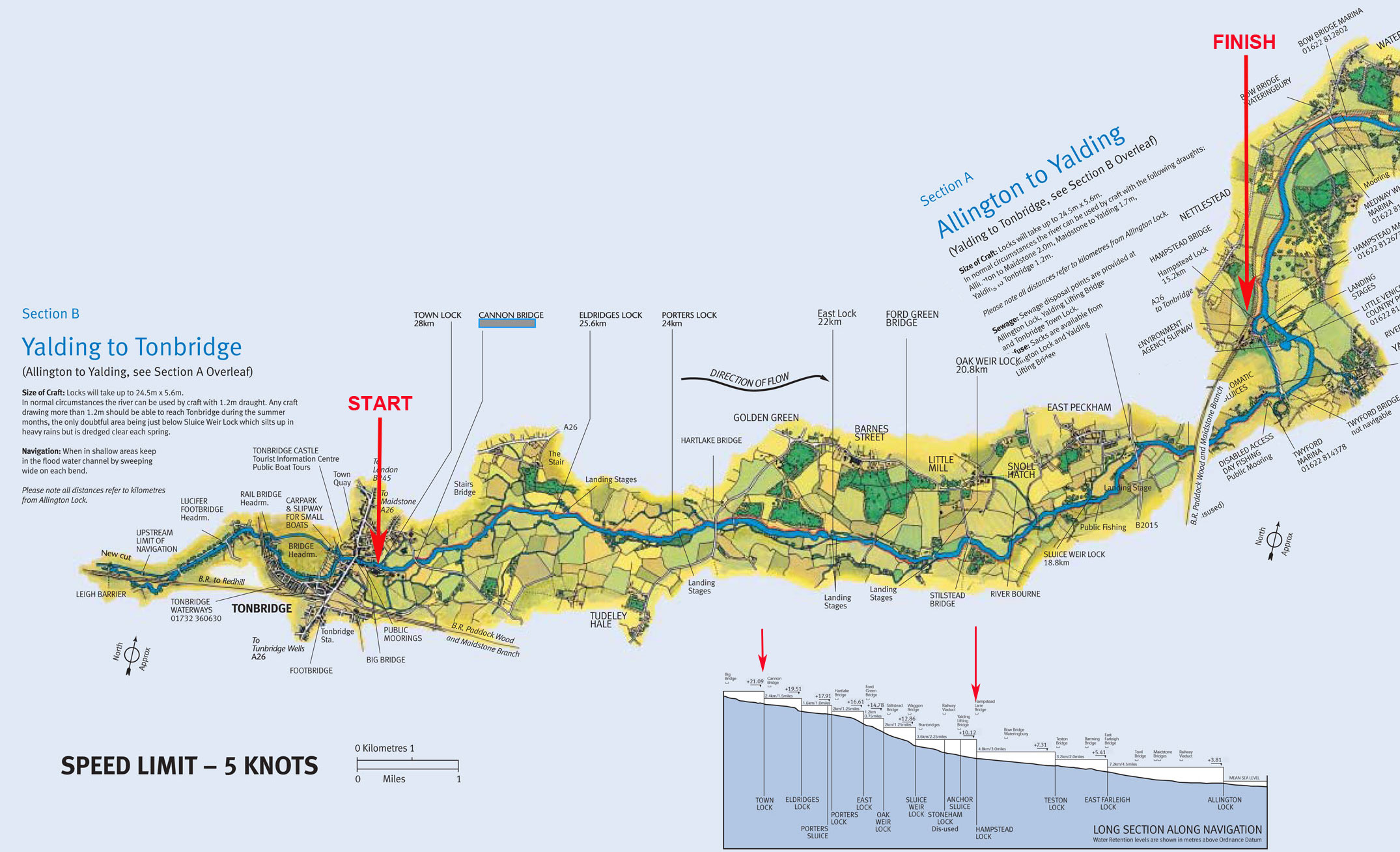
A quick check over my old Gumotex Sunny proved it looked as good as when I gave it away nine years ago. So I bunged it in the car and drove to Tonbridge for the ever-reliable Medway Canoe Trail.
With half a dozen fun chutes to dodge lock portages, it’s about as exciting as a river gets in Southeast England. As the lush summer verdure passes its peak, in places you feel you could be somewhere exotic. It was to be a cooler day promising thunderstorms and violent downpours – a relief and an added thrill after a week of 30°C+ temperatures.

I was going to run at the official 0.2 bar (3psi), paddle for a bit then put some more in the sides to see if I noticed a dramatic difference. But when the floor PRV hissed at presumably 0.2, it felt so mushy I went right ahead and cranked the sides up to around 0.3bar (4.3psi). There was no blazing sun today so it shouldn’t be too risky, and they’ve felt that tight before.

Using my big-bladed ‘whitewater’ Corry paddle, initially it was all a bit of an effort, but that was just me adjusting to the task, not the boat. Soon I found my rhythm and by the way the lush, berry-laden river banks skimmed by, I’d guess I was cruising at 3.5mph. Not bad, but this was flatwater.

The first canoe chute came up, then the steeper East Lock and Oak Weir Lock chutes where local boys were sliding down on their backsides. I often worry that these unsedated teenagers may do something stupid to show off to their mates, like try and jump on my boat from a bridge. But the worst I got coming off a chute was a cooling facefull of splash and a cheeky “Oh, sorry mate!”.

A couple of other IKs were out, including a well-used and now ubiquitous lime green Itiwit which must be the hit of the summer for Decathlon who seem to have anticipated the demand. Passing a camping field, I also observed a new-to-me spin on the novelty inflatable toy theme: a pizza slice. It was inappropriate to sneak a photo, but it nevertheless makes me marvel anew at the sheer joyous breadth of human creativity.

In about 2 hours I reached the daunting sounding Grade 3 Sluice Lock chute which the Sunny swept down in its stride. By now I was feeling a bit saddle sore.
Since I originally owned the Sunny I’ve leaned a whole lot, including the value of solid footrests and a slightly raised seat for an efficient paddling stance and comfort. What came first: civilisation or chairs? When I see pictures of me paddling Shark Bay all those years ago it’s clear I’m sitting too low with feet at butt level, if not even higher due to the sag.
The Aire Cheetah seat which I thought was so hot in 2006 may have been better than the stock seats but is nothing special and doesn’t spread the side tubes out. This helps make the Sunny a slender 30″ wide, but adds to discomfort on the jammed in hips. A pad (or my shoes) underneath the seat would raise me above the sidetubes and greatly improve the paddling position to something more akin to driving a go-kart.

A footrest I’ve yet to reimagine, and may not bother before selling the Sunny. I like the look of the Grabner alloy footbars which are width adjustable and cleverly jam down between the inflated floor and sides. They cost a reasonable (for Grabner…) €80 and come in various sizes for all sorts of Grabner IKs. It might be possible to easily MYO from 1-inch copper tube or something, but welded alloy would be best at the T-join where the stress is.

With leaden skies and near constant rumbling thunder to the north, I was disappointed to dodge a good summer downpour and arrived at Hampton Lock in 2.5 hours, 8 miles and surprisingly not knackered. I splayed out the Sunny like a dissection experiment; it was clean and dry in minutes.

Someone on YouTube made a good point about drying which otherwise seems so inconsequential. When you arrive back from a tiring paddle the last thing you want to do is spend ages carefully dismantling and drying your boat. And drying it back home may not be an option because lack of space was why you bought an IK in the first place! That’s why we appreciate ‘wipe-down’ bladder-free ‘tubeless’, IKs like the Sunny.

Gumotex Sunny 2020

Sunny Index Page

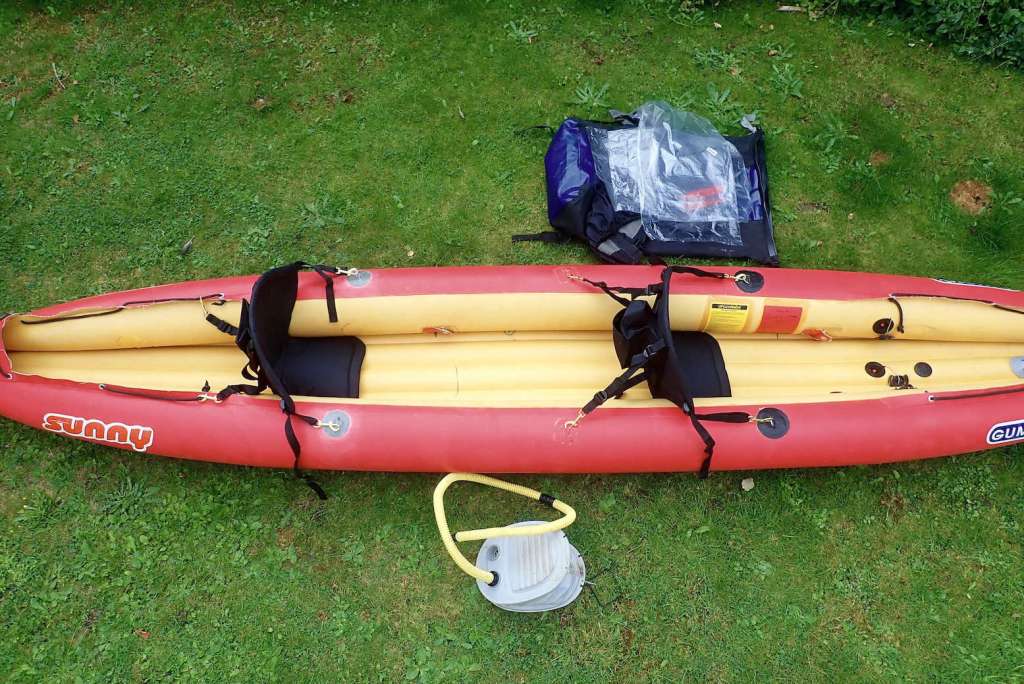
I sure do regret selling my Seawave. Lockdown-related production delays as well as travel-dodging staycations plus, in the UK at least, a hot summer, have seen Gumotex Rushs and a lot of other decent IKs become out of stock till the autumn. As a result, used prices have shot up. The other day a 20-year-old Sunny (below; in very good condition it must be said) went for £325 on eBay! If you have an old IK rotting in the shed, now is the time to flog it!

Chances are that old Sunny has another 20 summers in it. The Nitrilon from that era was more raft-like and one likes to think fewer corners were cut (as the 2007 LitePack Outrage proved). Something happened to Gumotex around this time: maybe someone new took over or got involved. Within a few years Gumotex prices soared as more sophisticated models were released. But not all of them: today you can still buy the Sunny’s lo-fi descendant, the Solar 3 (aka; Solar 019), a 0.2 bar, three-tube dinosaur, now 4.1m long.

I bought my 3.9-m Sunny from boatpark.cz in 2005. Stuck for a kayak in 2020, I asked the mate who I gave it to in 2011 whether he’d like to give it back. With his kids now young men and the boat unused, he was happy to oblige.

Unpacking, the Sunny was covered in damp sand and with the valves open. Some people just don’t know how to look after their boats! A quick hose down and it looks in great shape, less faded than my Seawave. Some of my old D-rings applied with crappy Gumotex glue have come adrift and there’s UV-discoloured factory glue at the seams, but the colours are still pretty bright and no seams are lifting.

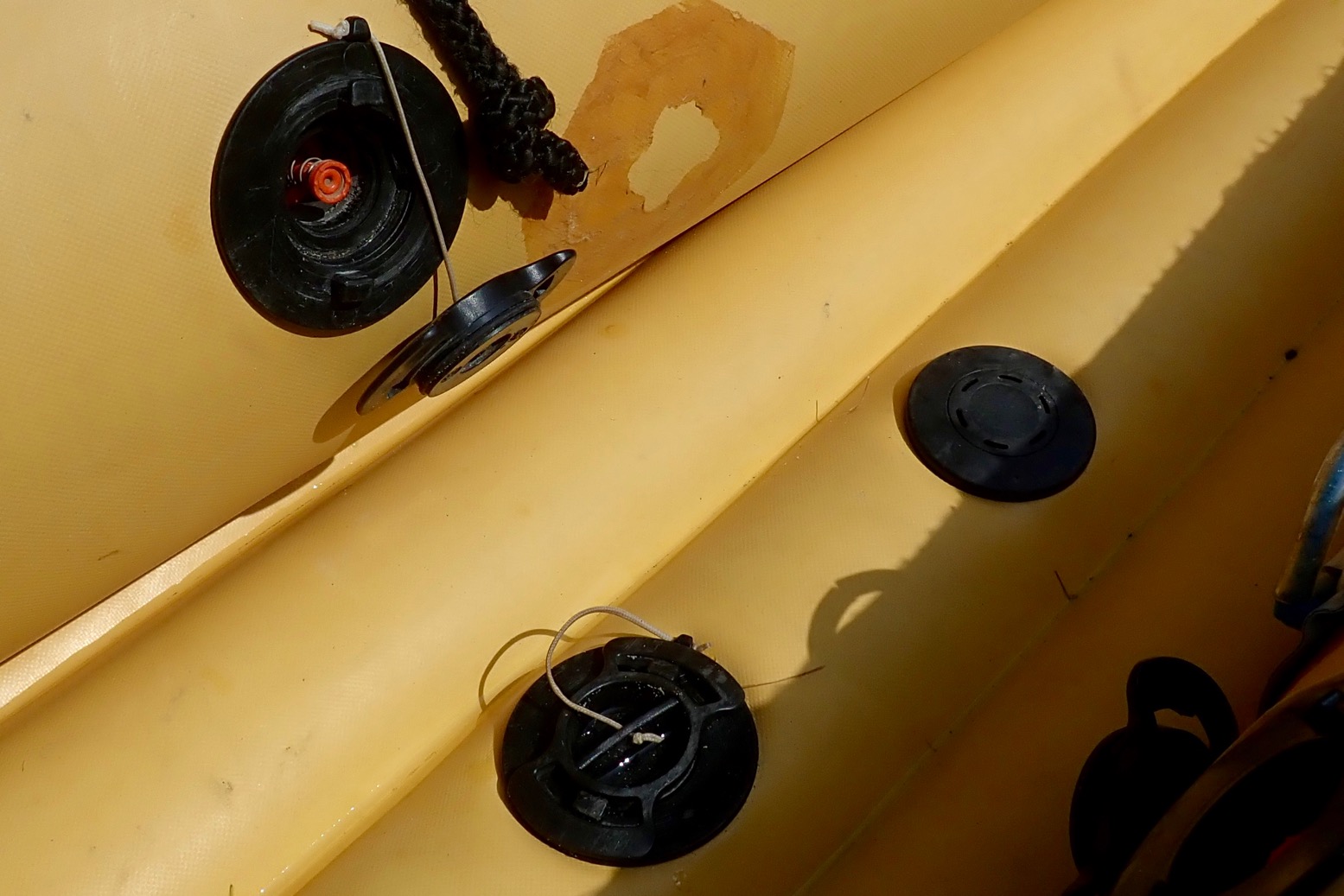
I forgot about those annoying black twist-lock inflation valves with the annoyingly stiff dust caps. I blew the grit out and plugged in the aged Bravo bellows which is now so soggy it struggles to set off the PRV at 0.2bar with me putting my full weight on the pump. Was the PRV seized? I hooked up my new two-way barrel (with home-made manometer) and in seconds the PRV is spewing sand and spray. I keep going to blast any remaining crud out then give the sidetubes a taught 25%-over, 0.25 bar. Nothing rips or explodes.

I fall into the modification/improvement trap and consider replacing them with current Gumotex Push-Push valves, and even adding PRVs in the sides, as on my Seawave. But I remind myself valves can be tool-breakingly stiff and I’ll probably keep the Sunny until a Rush 2 becomes available, or maybe the rumoured DS-floored Seawave is released. That won’t be until autumn.

My clip-in Aire seat with crucial backrest supports glued on to the sidetube tops (as on the current Solar, above) works better than the crumby originals which folded in on themselves as you lent back (see the eBay Sunny, above). But with sidetube supports my Amigo / Seawave system: packraft seatbase + SoT backrest would be lighter, adjustably higher and more comfortable. Again, it’s not worth mixing the glue up unless I decide to keep the Sunny as a spare.

The long strap loop running clipped to the seat base via the second seat mounts used to clip to a small Peli box which doubled as a footrest. I remember now: to use solo you flipped the front seat to face the other way, replaced the back seat with a footrest pillow and moved the skeg to the other end. That’s why my boat unusually has the valve and PRV at the front. But for a good brace the reach was too great, even for my legs.
I prefer my plastic drainpipe idea but that needs a couple of added D-rings. As it is, the seat could probably go back a bit further for solo use, so it may have to be a box or some other bodge, as my legs definitely won’t reach. Or maybe I can just do without a footrest which only really matters on long or dynamic paddles. These days I prefer a Peli under my knees where I can actually get to it without having to do 45 minutes of hot yoga.

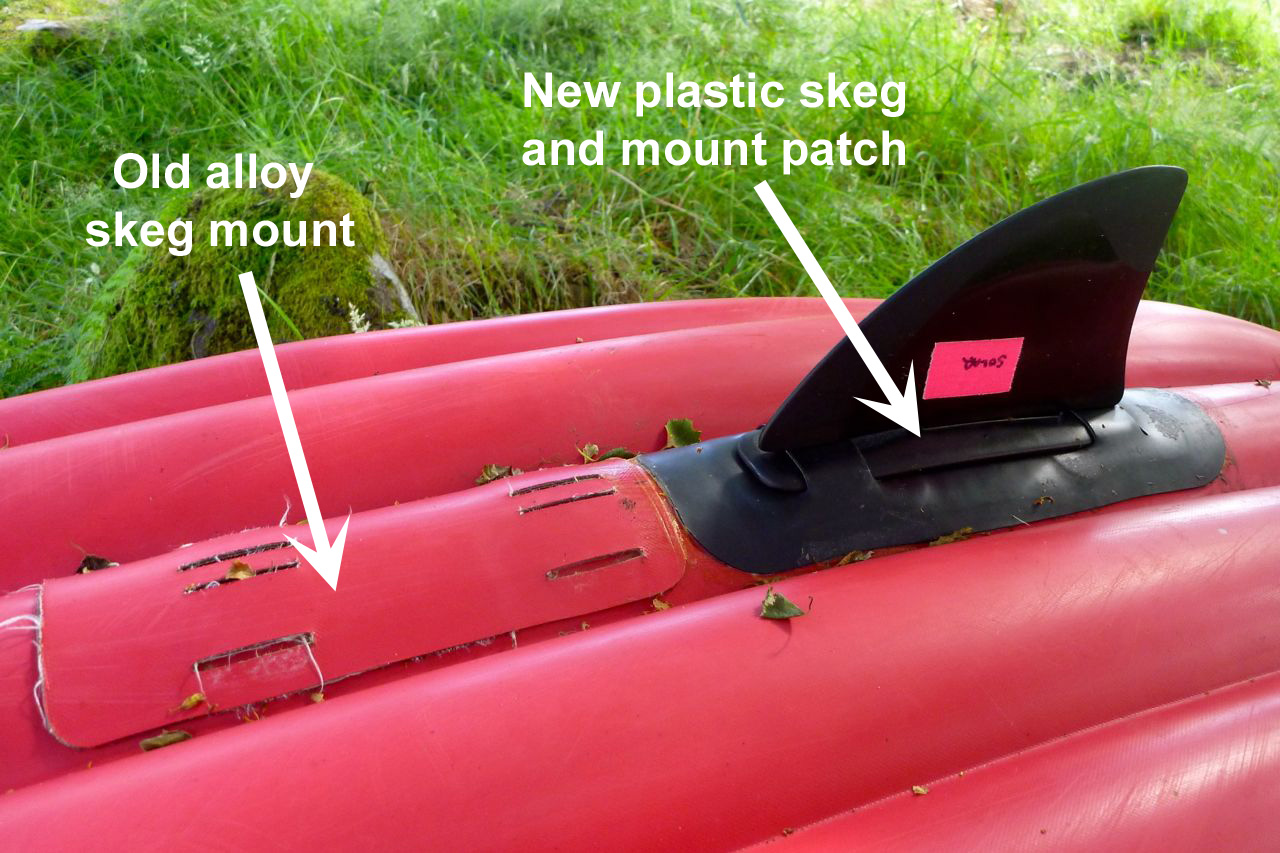
Underneath it has that crappy old Gumotex alloy skeg system – and at each end, too. Did I do that? The original oversized alloy skeg is deeply corroded along the smaller ones I got made, and even sold to fellow Gumotards.
A modern plastic skeg needs a different patch but I bet there’s a way to adapt the alloy patch to take a plastic skeg. Below, a picture of new and old skegs on our old Solar 300.

Other than that, the old dog is in good shape and would look better once I clean off the dried duct tape residue and stray glue. I weighed it off some suitcase scales: 12.7kg + another 1.5kg for the seat. First run I’m going to risk 0.25bar (3.6 psi) in the sides to see if it glides like a Seawave and stings like a bee. What’s the worst that can happen?

After a few weeks, a couple of trips and a refurb I sold the Sunny. What a great boat that was.

Advanced Elements AirVolution Dropstitch Kayak

See also:
Sandbanks Style Optimal (similar to AirVolution)
Full drop-stitch inflatable kayaks main page
Advanced Elements AirFusion

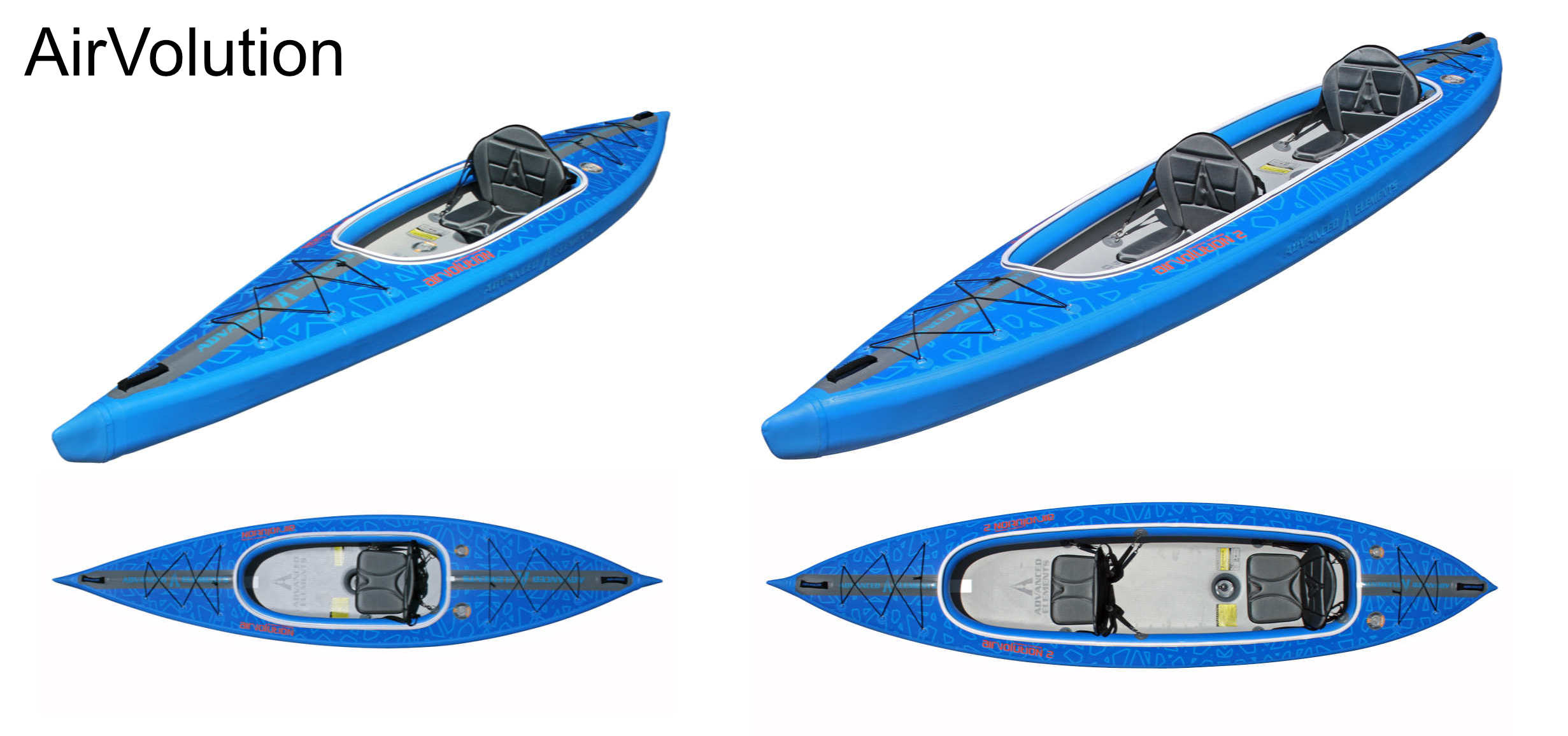
US IK and iSUp brand Advance Elements have come up with a sleek and innovative new angle on full dropstitch kayaks (FDS IK): The AirVolutions feature a high-pressure two chamber ‘clamshell’ design where the upper DS panel is a demi-deck. With minimal stowage below the decks at each end, it resembles a Sit-On-Top, except (though not currently offered) you could fit a spray skirt round that coaming (cockpit rim) to be sealed right off.

‘Airvolutions do not have a ton of storage space below deck [and] are designed to be Recreational/Day Touring kayaks‘

There are Solo and Double/Solo models with dimensions below. The more I study these Full DS IKs, the more I think what you gain in rigidity you pay for in weight and especially bulk over similar non-FDS IKs, some with just a DS floor. Maybe PVC tough enough to handle the intended use and pressures is simply a bulky fabric. In its wheeled duffle the folded up AirVolution2 is a massive 4 feet high and 18″ wide. As with many US-branded IKs, the Airvolutions are on the wide side, but it’s claimed they can be stand-up paddled if you have good balance. That’s me out, then!

LengthWidthWeightPayload
Solo13′ / 3.9m33″ / 84cm39lbs / 17.7kg300lbs / 136kg
Double14.5′ / 4.5m37″ / 94cm52lbs / 23.5kg550lbs / 249kg

Both models are rated at 10 psi / 0.7 bar (though they will work with less) and have another DS IK innovation: Pressure Relief Valves (PRVs) on both panels set to now purge at 14psi (2021 onwards). Why not 10psi so you can blithely inflate away till the PRVs hiss? Some pressure might be purged over a hot day from the top deck but not enough to matter.

A few iSUps have PRVS, but I’ve not seen them on FDS IKs before and many potential owners will be reassured, as it should aid the as-yet untested longevity of DS panels. PRVs limit potentially destructive over-pressurisation when inflatable boats are left in the sun.

Looks like AE listened: the 2021 models got 14psi PRVs, as well as an inflatable footrest (mentioned below), a better backrest, and other detailed tidying. And they chuck in a low pressure battery pump to get the bulk of the air in. You’ll still need a 2-stage barrel pump to get it up to 10-12psi.

AirKayaks™ IK in the US seem to be a favoured AE outlet right now and have detailed reviews of both boats with loads of photos and measurements, followed by a quick flatwater spin.
There you can read the double’s open hatch is over 7.5 feet (231cm) long) and, oddly, there are no footrests (until 2021 models). A stuffed bag would work, or it would be easy to glue on some D-rings to run a footrest strap and hard tube. On a raft-wide IK like the AirVo2, it may not be worth bothering with thigh straps. Both models run a huge 9-inch skeg which will ground easily in shallows and suggests tracking with the flat floor may need help. It’s easily be replaced with a cut-down spare.

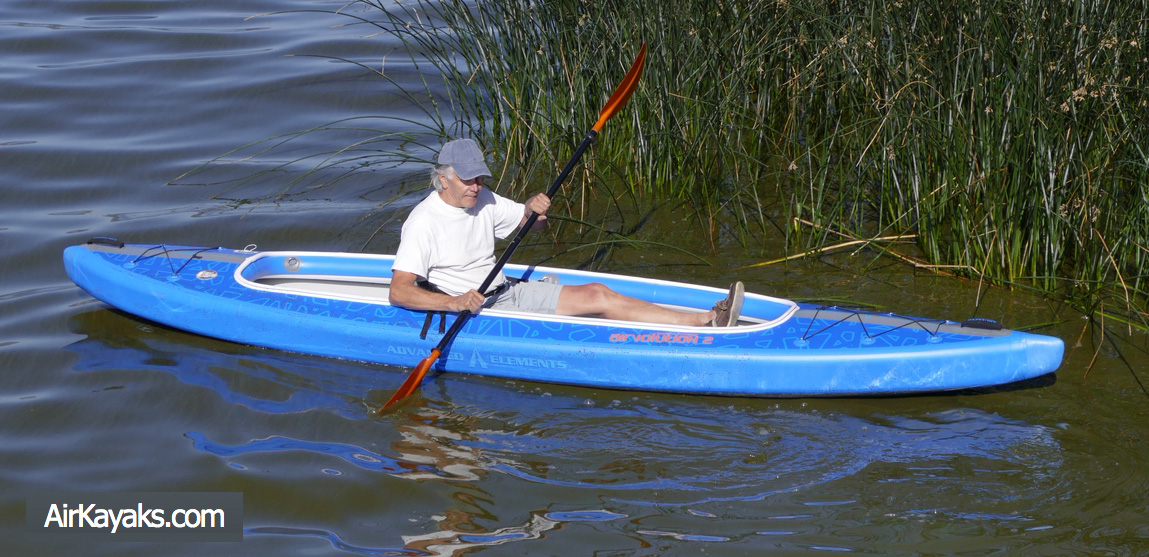
The AirVolution2 looks like a great day kayak for two, but from the photo above, even tall solo users may be better off with the less huge AirVolution, unless you add a foot brace tube. With this design, either boat has less low-down storage space than a conventional fat sidetube IK like a Seawave. Storing gear under the deck bungies just adds windage and hampers steering and stability. For touring, what gear is less than 4-5 inches high could squeeze under the covered ends, and when used solo the double has about half a metre of room behind the seat and some in front.

It’s hard to be sure, but inside it does look like the two panels have been ‘wallpapered over’ leaving no crevices to trap water and much more potentially damaging grit. This is a big improvement over hitherto conventional boxy three-panelFull DS IKs where water and crud gets in all sorts of hard-to-clean places. Being smooth inside, you’d think the AirVolutions could easily be drained by tipping upside down, then wiped down to dry. Maybe, but they’ve added a big plugged drain in the middle of the floor (left) to make that easier (it won’t work for self-bailing unless you’re very light). Judged against some of AE’s other ‘busy’ graphics, the blue boats don’t look too bad.

Up to now AE used far less elegant solutions to the problem of rigidity in long IKs. The AirVolutions: a pair of iSUp boards wrapped up and glued in the blue skin, are an interesting idea with some compromises, mostly in storage. These are day boats, not tourers, but there are many, many more day-paddlers out there.

It would be a struggle carrying a 23-kilo boat too far so for your money you get a wheelie duffle but with tiny, pavement-only wheels and clearance. There’s also a repair kit and a high-pressure, two-way switchable barrel pump which may need some brawn to reach the full 10+psi. Because high-pressure IK pumps need to be tall and slim, they’re low volume so take a while. AirKayaks reported it needed 100-150 strokes to inflate each chamber. That is a whole lot of pumping for a DS boat, but a battery pump now comes with the 2021s.
Prices in the US for 2021 are now $1200/$1500; in the UK the boat works out a bit more in £s; not such a good deal with obscure-branded 3-panel FDS IKs going for half that price. Or indeed a similar Sandbanks Optimal.


Make Your Own Hypalon D-rings

See also:
Inflatable kayak glues and repairs
Repairing a Gumotex Seawave
MYO alternative to D-rings

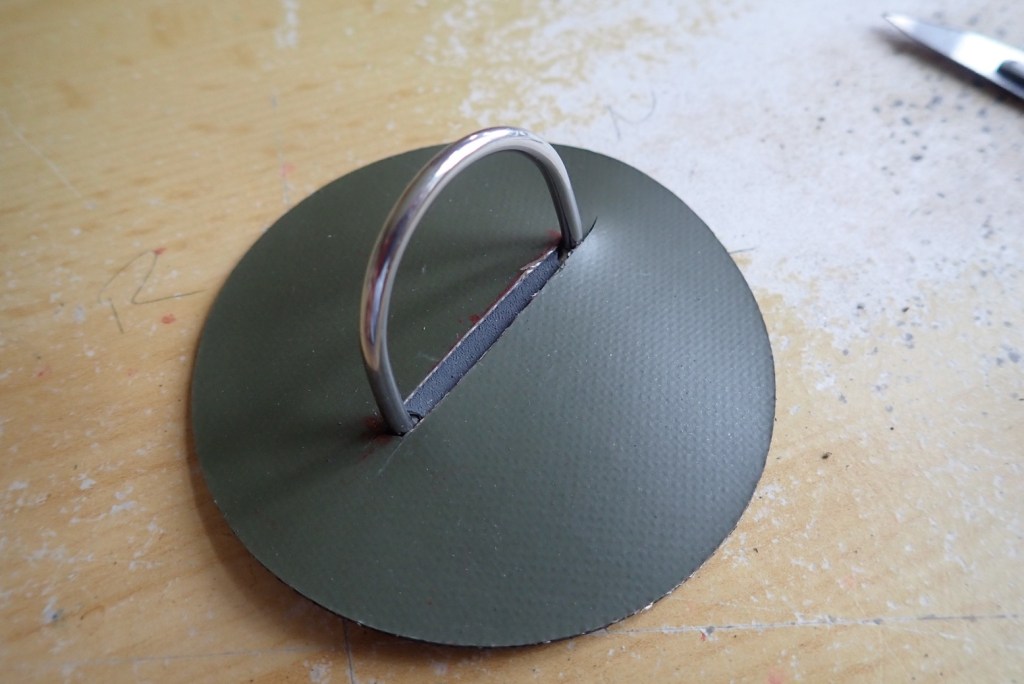
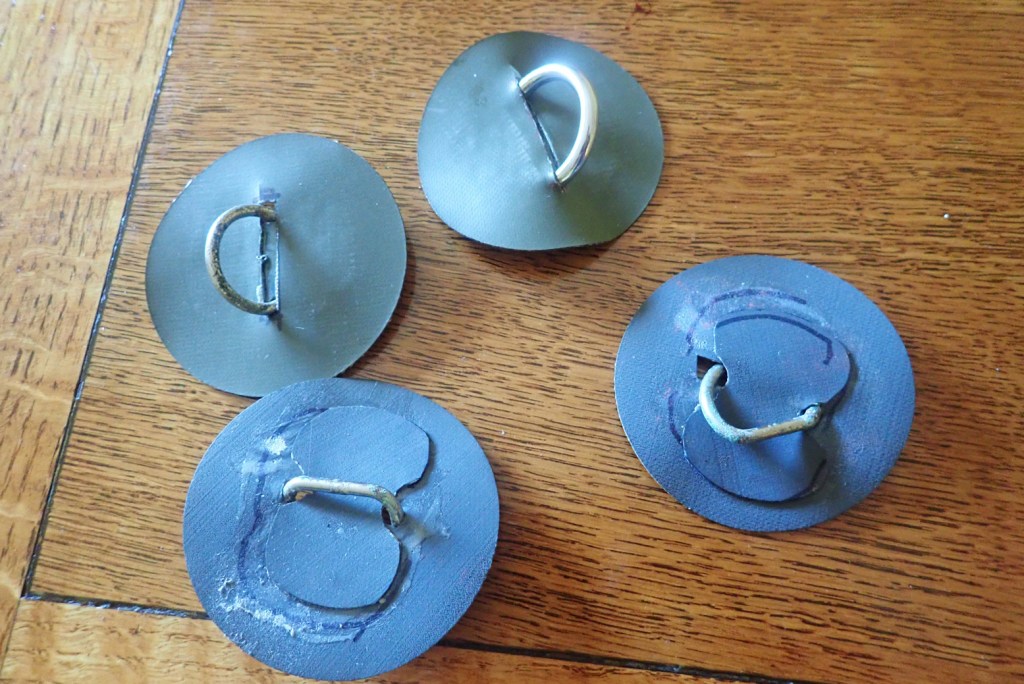
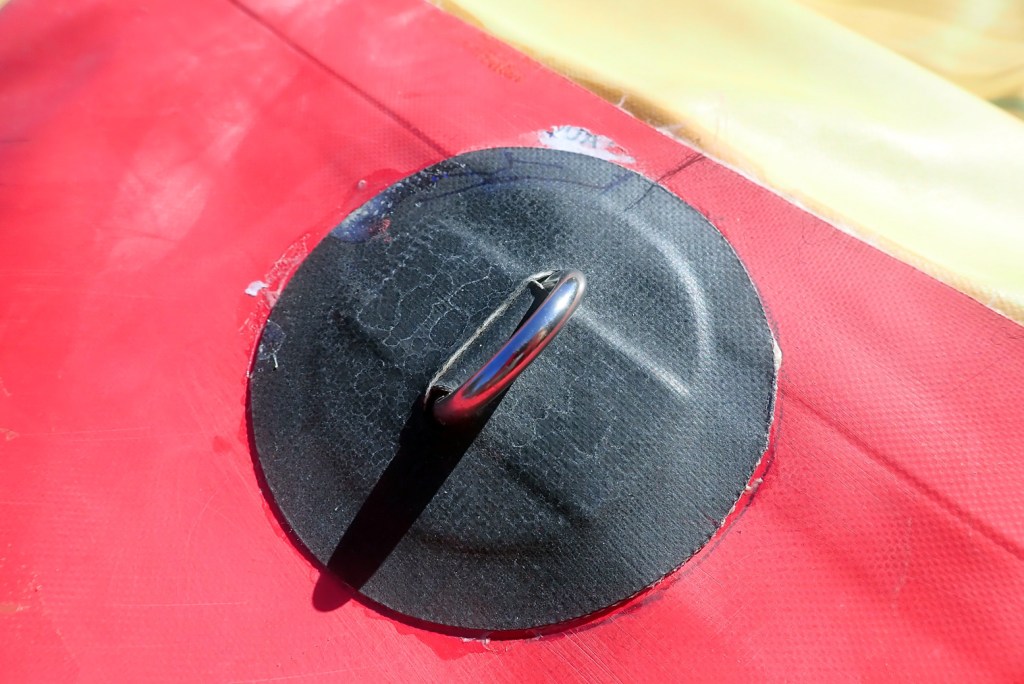
You can get ready made Chinese PVC D-rings dirt cheap on eBay but genuine rubber hypalon D-rings (not plastic PVC claiming to work on hypalon) cost a lot for what they are. Once you factor in the price of two-part glue, it adds up, especially if you have a few to fit.
It’s fairly easy to make your own D-rings for your IK to attach gear, thigh straps, footrest mounts and so on.

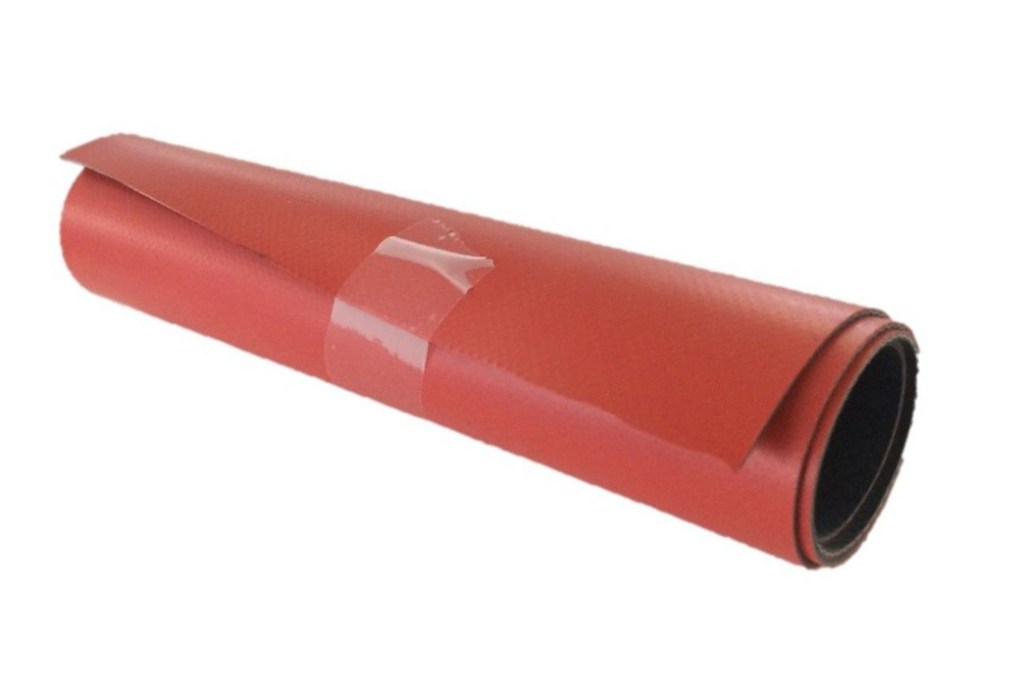
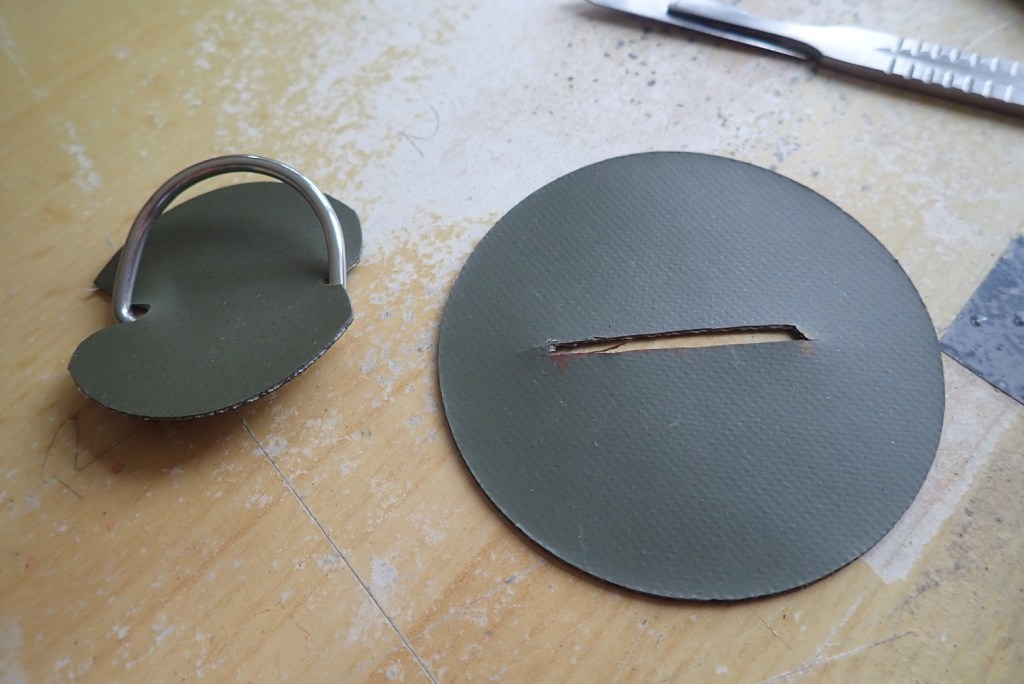
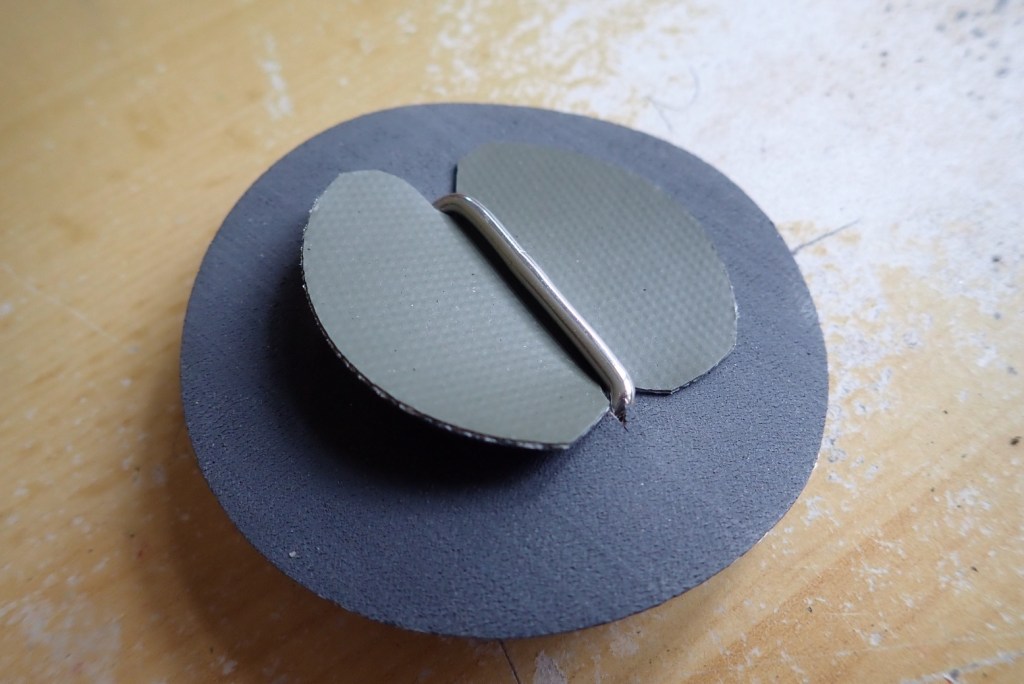
You can buy metal D-rings by the sack-load online, as well as round PVC or Hypalon patches. (‘Hypalon’ is pretty much the same synthetic rubber as Gumotex Nitrilon and Grabner Nordel EDPM). Or buy an off-cut (above right) for much less and cut your own. A D-ring doesn’t have to be round but it’s better if corners are rounded. You will notice how unusually hard it is to cut this stuff with scissors or a blade. The fibre core is tough: needed for zero-elasticity in an IK.

Pictures below show how to make your own D-rings.
Go to this page for how to apply any patch, step-by-step.


Sticking to the Rules
I needed to fit some tube-top D-rings to properly support a second backrest in my Sunny 2020. I found a stray, opened tin of Bostik 2402 two-part in my kit bag, but with an expiry date of 2009. Back then I only owned this original Sunny and looking it up, 2402 turned out to be for rubber boats. Perhaps I bought it more recently but didn’t notice the expiry date. In the tin the glue was still liquid and unseparated, but the little bottle of Bostik D-10 hardener had long since evaporated. Digging around, I also found an opened bottle of PolyMarine hardener. Comparing chemicals showed they both contained Diphenylmethanediisocyanate, one of the few words that’s too long for a Scrabble board.
I mixed the wrong-brand hardener with the 11-year old glue 25: 1 and the bond looked as good as anything.

Preview: Aire Tributary Sawtooth

See also:
Hyybrid IKs

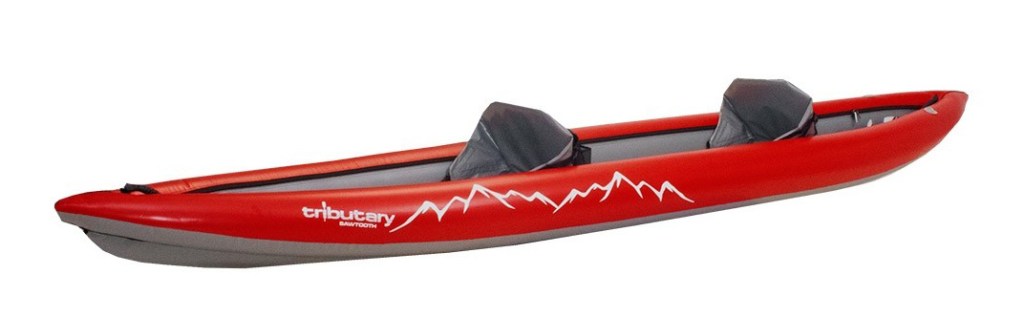
There are a lot of full or hybrid Dropstitch IKs coming out now, but Idaho-based Aire are sticking with traditional bloat technology with their 2020 Tributary Sawtooth upgrade which gets an extra two feet and ‘bold new graphics’, as they call it in motorbike world. Along with with NRS down the road and with whom they seem closely tied, they’re among the US’s more serious IK makers (both come from the rafting game). Before the Seawave came along I’d considered an Aire IK but was put off by:
• Price (US-made models)
• Excessive width
• PVC shells with slow drying bladders
• Self-bailing

In other words, as far from a high-end Gumboat as you can get. It was long-extinct Sears IKs who are said to have originally come up with the idea of ‘inner tubes‘ supporting a sewn or welded PVC shell in the early 80s. It works like a bicycle inner tube supports a tyre. Aire adopted the idea a few years later which may explain why this method is common in North America but unknown in Europe. The benefits of this type of assembly are primarily economic: quicker, less laborious assembly, although bankside repairs using sticky tape on the bladder are near-instant.
As explained on the IK Construction page, the bladder system involves easier sewing or welding of the shell (all shown in this Aire promo video – stills below). No glues or solvents needed, unlike ‘tubeless’ Gumotex or Grabners. Aire spins this as ‘double layer’ but of course they are co-dependant: without one the other is useless. For a recreational packboat user, bladder boats have drying issues because inevitably water seeps in between the two layers and stays there. Owners often complain about this and certainly in a temperate climate like the UK, proper drying would be a pain. It’s a lot of extra faffing to clean and dry than a quick wipe of a tubeless boat. Being rot-free plastic, leaving an IK wet won’t ruin it, the worst might be some mildew or staining, but as with all outdoor gear, storing wet is bad form and may affect durability, especially around sewn seams.
Whether heat-welded or sewn, the tough 1000D PVC hull casing doesn’t have to be watertight. It’s just there to protect the much tinner AireCell bladder which is accessed (and repaired or replaced) via long zippers (see boat below) which is the main way water seeps in between the layers. Other downsides include grit getting in between the shell’s floor and bladder. All-round, it adds up to more maintenance than a tubeless IK which dries in minutes after a wipedown.

You’ll struggle to tell on Aire’s website, but this budget ‘Tributary-branded’ range is ‘imported’: a presumable euphemism for ‘China’. That’s a word that’s even more tiptoed around in packboating world than PVC which, in the US, requires a health warning (left) to be sold in California.
As always, TheBoatPeople tell it like it is. They had a hand in designing the original 13-foot Sawtooth. US-design with cheaper Asian textiles and manufacture explains the reasonable pricing. It also explains the 1-year Tributary guarantee compared to the mammoth 10 years you’ll get on Idaho-assembled Aire-branded boats with urethane (not vinyl) bladders.

Numbers (with help from the reliable theboatpeople are said to be:

Weight: 19kg (42lbs)
Length: 4.65m (15′ 3″)
Width: 84cm (33″)
Payload: 201kg (440lbs)
Construction: 500/1000D PVC with vinyl bladders
Pressure: 0.17 bar (2.5psi) (PRV in floor bladder)
Price: U$ 1370 (2025)

Don’t ask me to explain the hydrodynamics, but a longer boat in the water is a faster boat, providing it’s not ridiculously wide or high or made from concrete. Longer, narrower and lighter than Aire’s US-made $2000 Super Lynx, the 2020 Sawtooth’s length-by-width factor is a pretty good 5.53 – near identical to a Seawave. (Compare other LWF’s here).

Obviously rigidity has an influence on speed and response, but up to a point a thick PVC IK (like my old Incept) is innately stiffer than more pliable rubber-based fabrics like Nitrilon. This may explain why the Sawtooth need run only 2.5psi (0.17 bar) even in a 15-foot IK, while a Seawave runs 3.6 psi and a Grabner even more. Or perhaps the vinyl AireCell bladders (right) can only safely take that pressure?

No footrest is included even though one is needed to brace against for a good paddle stroke. But Aire IKs can have have over two dozen attachment points along their full lengths (left). So besides positioning the seat/s exactly where you want them, you can easily clip-in a bit of sawn-down plastic drainpipe, which anyway is better than the mushy inflatable footrests which come with other IKs. While you’re at it, thread in some thigh straps which further improve your connection to the boat for more efficient paddling, especially at sea and in rougher conditions.

Many Aire IKs have an unusual dropped floor (right), partly because it has to be thick to work as a self-bailer. This design also means it acts like a fat keel to help tracking while its buoyancy lifts the side tubes out of the water to produce less drag and so increase speed. The Sawtooth comes with a clip-on skeg (useful at sea) and the Boat People reckon the Sawtooth is one of the fastest IKs around.

The principle of drop-floor/high sides may work, but in a self-baling boat the floor has to be thick anyway sit you up high above the water level. That means you’re less stable unless the boat is extra wide, but the Sawtooth’s width is pretty good (certainly compared to the Super Lynx).
I can see the value of self-bailing in a whitewater IK – I’d sooner have that than a deck. Not so sure in a touring IK. When heavily-loaded or two-up and passing through swell, the boat may fill from below with water. You’re getting soaked anyway, but that’s not really wanted. It’s the other thing Aire owners grumble about.
Aire IKs are unknown outside the US and certainly in the UK, and although the numbers and the price of the Sawtooth are great, for the same $1370 in the US (2025), I’d sooner choose something else.
Owners’ reviews (old model).

Five years with a Gumotex Seawave

Seawave Index Page

Darn. I put my Seawave on eBay to ‘test the water’ and it went within hours.

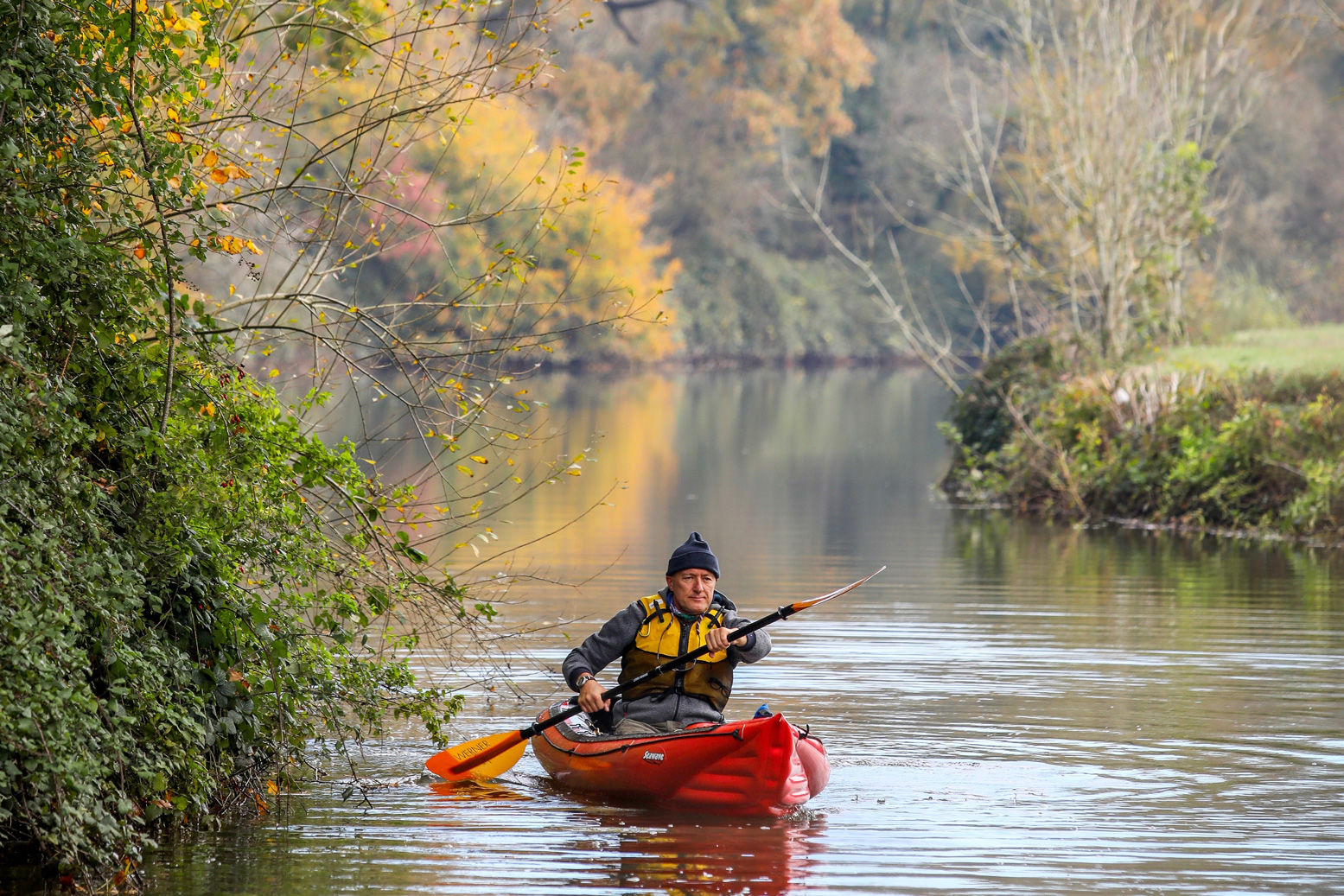
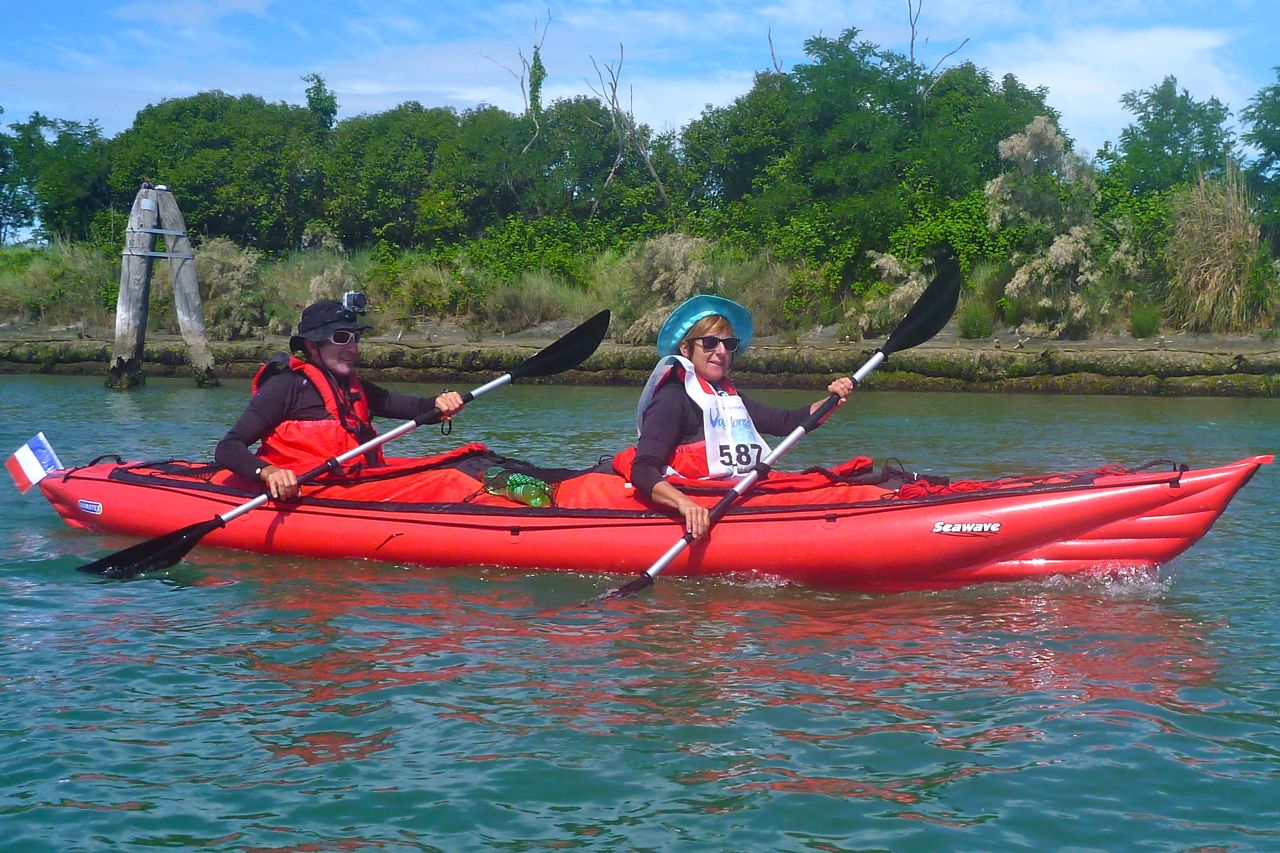
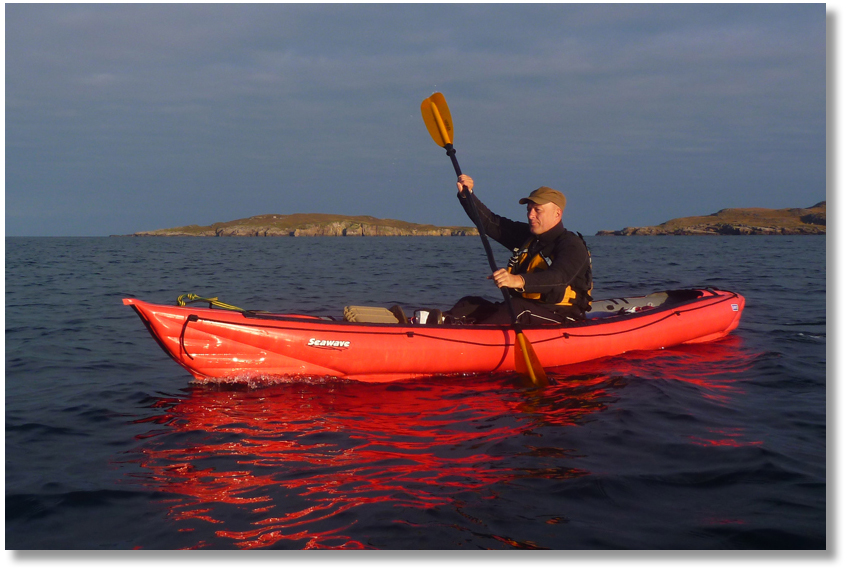
Still, it’s an excuse to show some of my favourite Seawave shots in five seasons of fantastic paddling. What a great boat that was. So great that, with nothing better available at the time, in October 2020 I bought another Seawave (left).