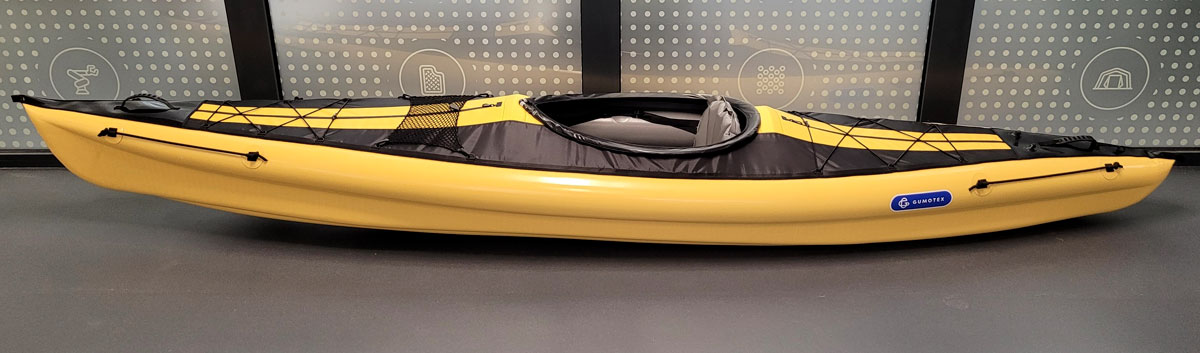
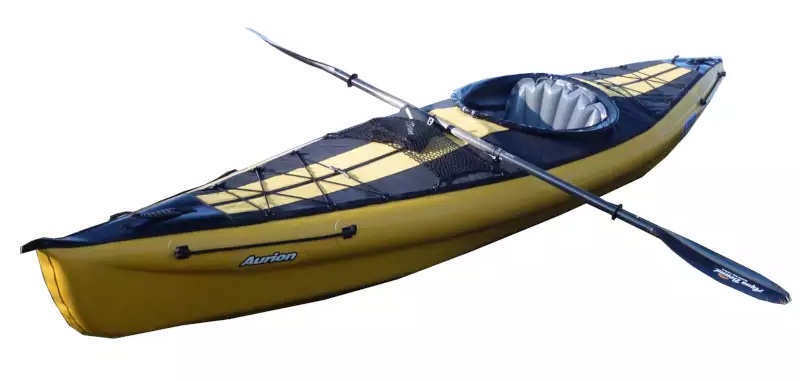
It’s now February 2026 but there’s still no mention on the Gumotex website or in their catalog of the decked, single seater Aurion, announced way back in September 2024 (video below). It does exist and is actually sold in this Czech outlets at around €2500 with the new 5-year guarantee. i also see ‘B stock’ (seconds, with full warranty) going from €1750 in Austria). So the boat is available to buy, but Gumotex don’t mention it anywhere. Odd.
Positive video reviews appeared in Europe in summer 2025, pre-production prototypes dished out to reliable influencers in strong Gumo markets, but there have been actual purchases too. Apart from above, currently most reviews seem to be videos in German, but we take what we can get here at IK&P. Normally I’d scoot over to Laurent Nicolet’s Rivieres Nature YT channel (French Gumotex importer). They’re paddle pros not influencers, who often got new Gumboats early and shoot great vids with minimal chat, showcasing everything from the Gumocatalog from white water to sea with no piece-to-camera exposition. But so far they’ve only filmed the revised but still door-wide Swing 1 (their pics below) and Swing 2 2025, though Laurent did announce the Aurion on the French IK forum in September 2024. The discussion did not progress much.
Swing 25Swing 25 – wide
One chatty German video from ‘RoGa‘ offers an AI-generated English translation – ‘adjustable fruit stand with push valve … for securing pastries‘. Good to know, but other segments make sense, and you get a good all-over view of the hull, inside and out, as you do on the garden vid below by Austrian? Kayak Kev. (translate ‘closed captions’ to know what’s being said). Another vid of his bottom of the page.
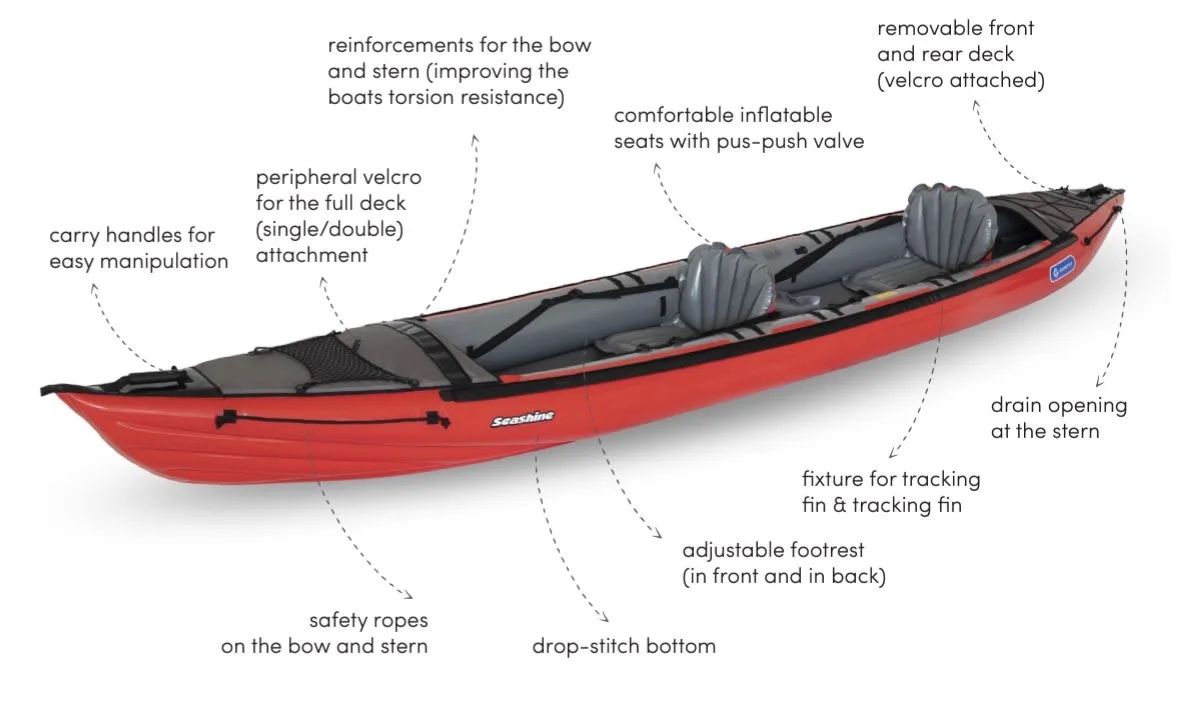
Anyway, the Aurion The Aurion (look it up) announces itself as the hybrid replacement for the possibly outgoing Framura (still discounted right now). So like the old Solar span off the DS-floor or ‘hybrid’ Thaya, and the Seawave begat the longer hybrid Seashine, so the Framura has cloned into the Aurion. The dims are near identical. The price is not.
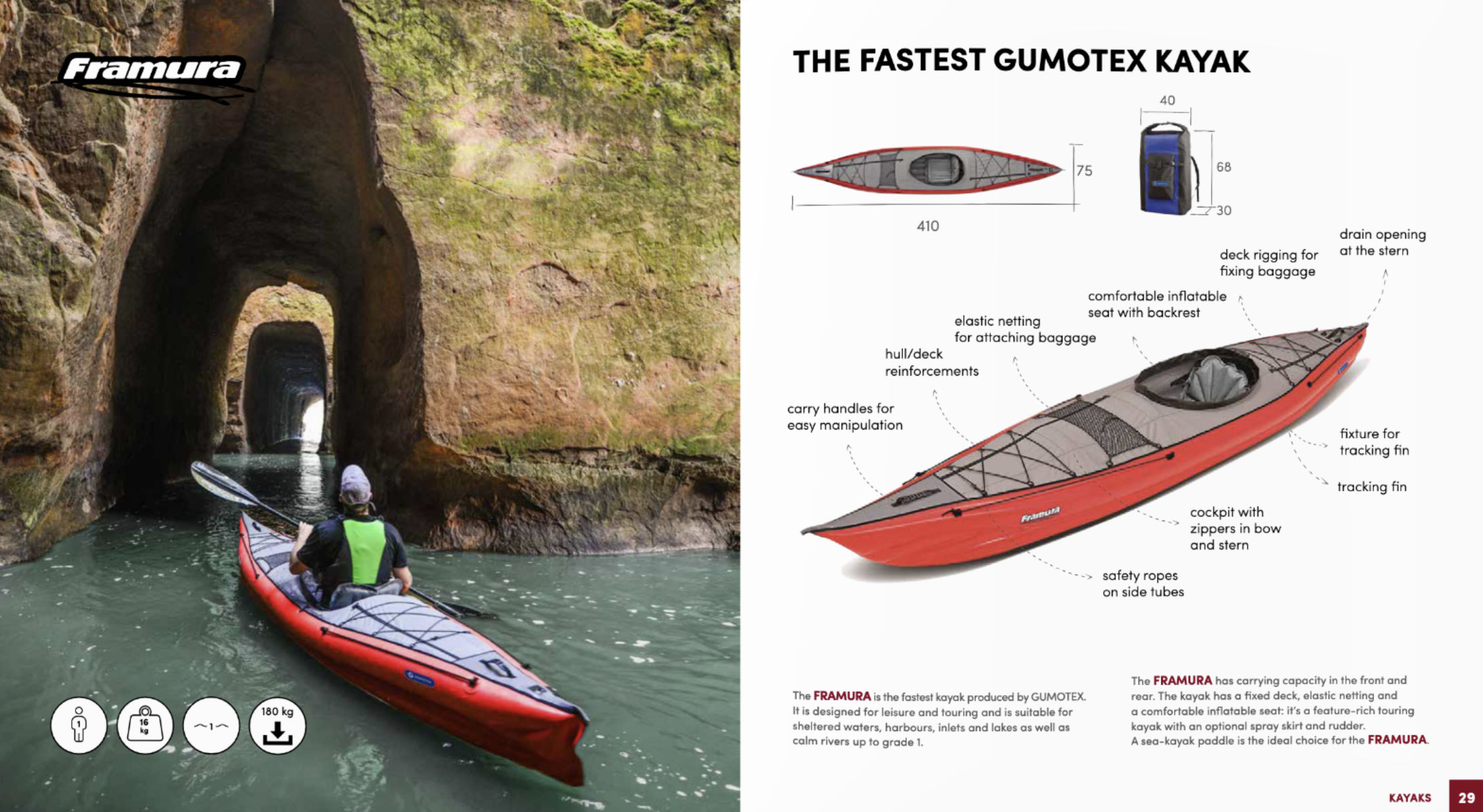
The Framura was a boat which Gumotex always pitched as ‘the fastest Gumotex’. But as I wrote here back in 2014: I’m not convinced the 0.2 bar Framura is that much faster than a longer, stiffer Seawave [or later Rush 2]. And I also suspect it has not been such a sales success either. Perhaps claiming the former has something to do with the latter. Indeed I wonder if ‘fastest’ was nothing more than a marketing label for the Framura to separate it from the dumpier, also-decked Swings. Someone needs to do a drag race or time trial with all of them.
I-beam: parallel linked tubes, like an old lilo. This was the original way of making an inflatable ‘plank’ but was vulnerable to over-pressure and rupture if left in the sun (as happened to my Feathercraft). Automatic PRVs are a solution, but can be prone to leaks with grit-swill down on the floor. Lockable PRVs, like on my Zelgear Igla was another way round it, but for minimal weight gains, super rigid dropstich puts the whole issue to bed and turns out th light.
The new Aurion seems to match the Framuras LxW dims at 410cm by 75cm wide. This is actually only 3cm less than my 78cm Seawave (verified), no matter what the official dims claim. The Aurion’s payload is said to be 140kg. Oddly, the Framura retained old-school 0.2 bar all round; low-end Gumotex pressures. The new Aurion runs 0.5 bar (7.5psi) in the dropstitch floor, and 0.25 in the sides, while gaining a kilo (17kg, same as a Seawave) and ditching floor PRVs. That will be as rigid as a Grabner (who, fyi, manage stiffness and high pressures without DS). Only half a bar in a floor is nothing for dropstitch, and anyway, DS is much better at managing excess pressure (from blazing sunshine) than vulnerable, old school I-beams (like an air bed, see left). Along with less thick panels and of course rigidity for a negligible weight gain, this is the reason to incorporate DS in IK hulls.
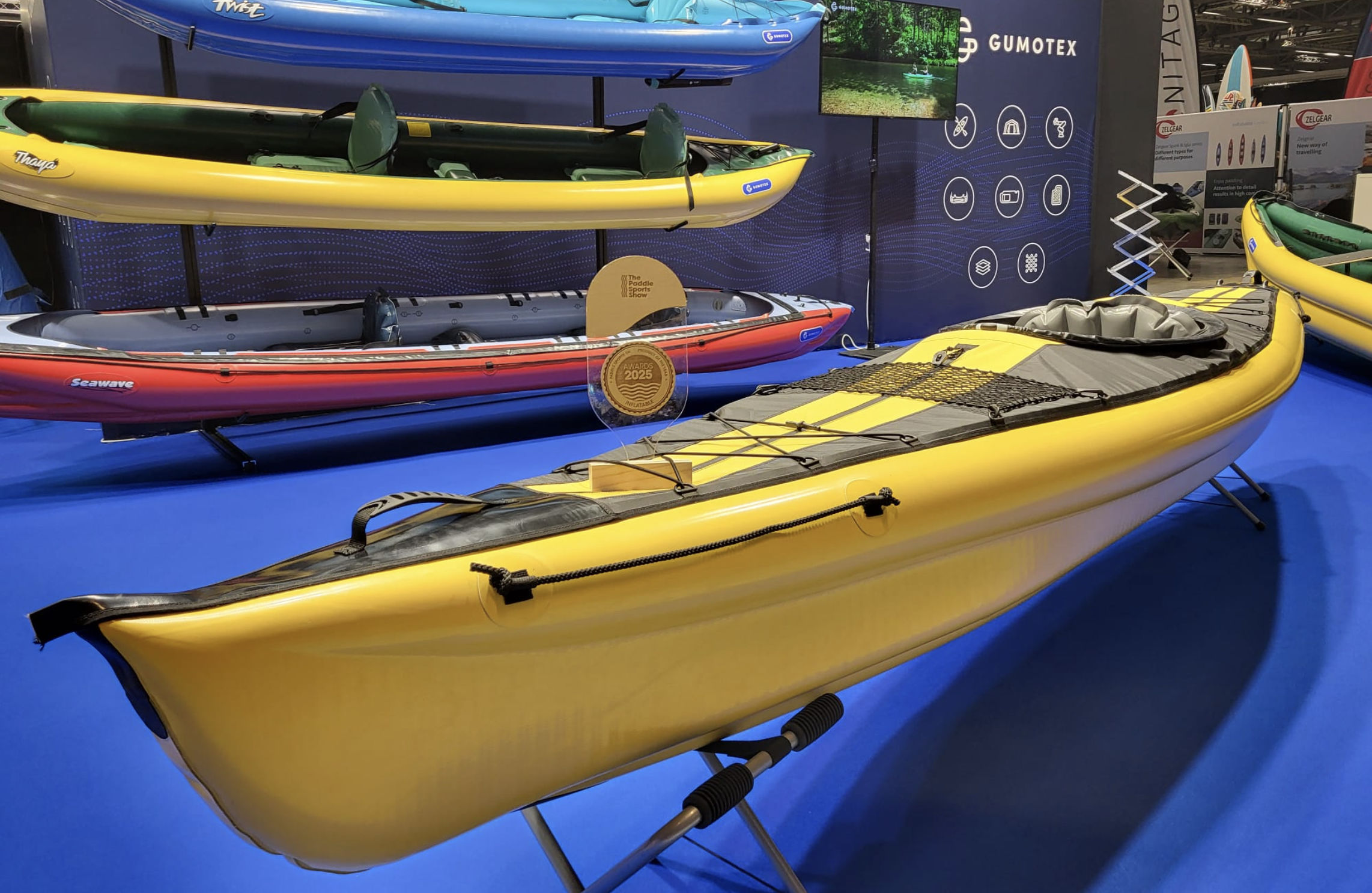
Your Aurion’s DS elements aren’t just a slab of SUP board joined at the hip, like FDS IKs costing a third less, but complex hydrodynamic forms (like the X500) which partly helps explain the price. Like 2025’s Seashine, the narrow floor has a shallow V, but only on the front half (with protective strake), producing a keel effect which flattens out to the back where the skeg mount sits. They claim this narrow floor helps make the Aurion 10% faster than its predecessor. As someone observed, the Aurion may be 75cm wide at the sidetubes, but it’s much less at water level which should mean less drag for a better glide.
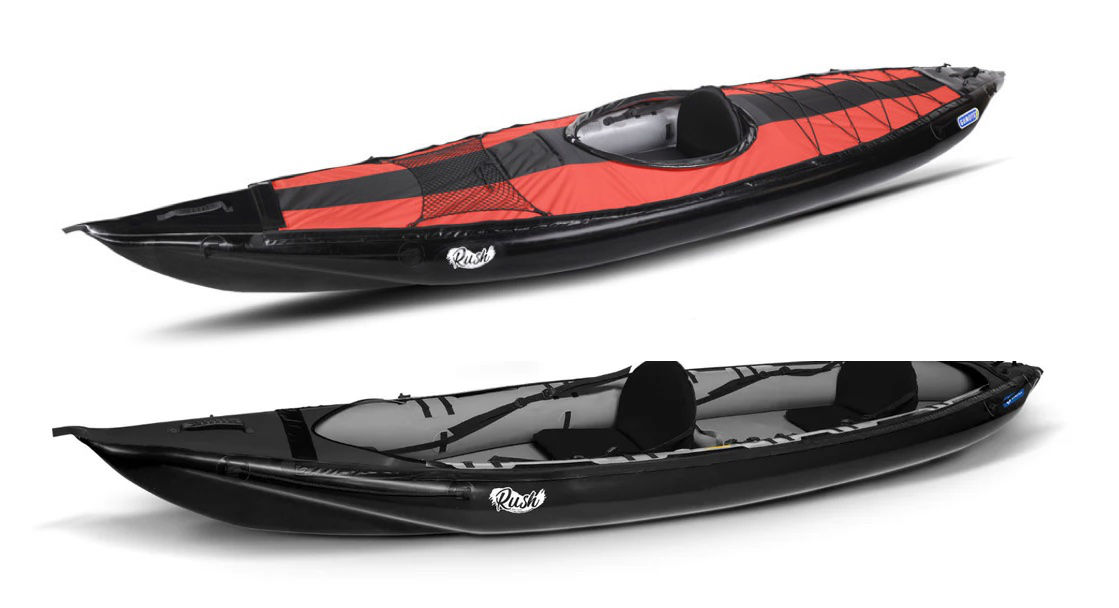
If you’re spending €2450 (around £2150) on a yellow Aurion from the few EU outlets which sell it, for what will be around the same £2500 with import taxes, in the UK (or anywhere) you can easily buy yourself Gumotex’s tandem Rush 2 with their optional solo or tandem removable deck. A Rush 2 is a bit longer, wider and lighter, and you’ll be able to paddle solo or double, with deck or no deck. Seems a more versatile option as long as you don’t mind the stealthy colour.
I haven’t visualised exactly how, but the single chamber (or linked) side tubes are said to be DS at water level, but regular round tubes above, but presumably running 0.25 bar which won’t strain the DS. In this way the upper non-DS side tubes act more like stability pontoons, and many testers report the Aurion may feel tippy initially, but has good secondary stability when leaning right over (or broaching along a wave) like a proper sea kayak. My Igla had the same overall dims and was perfectly stable to me.
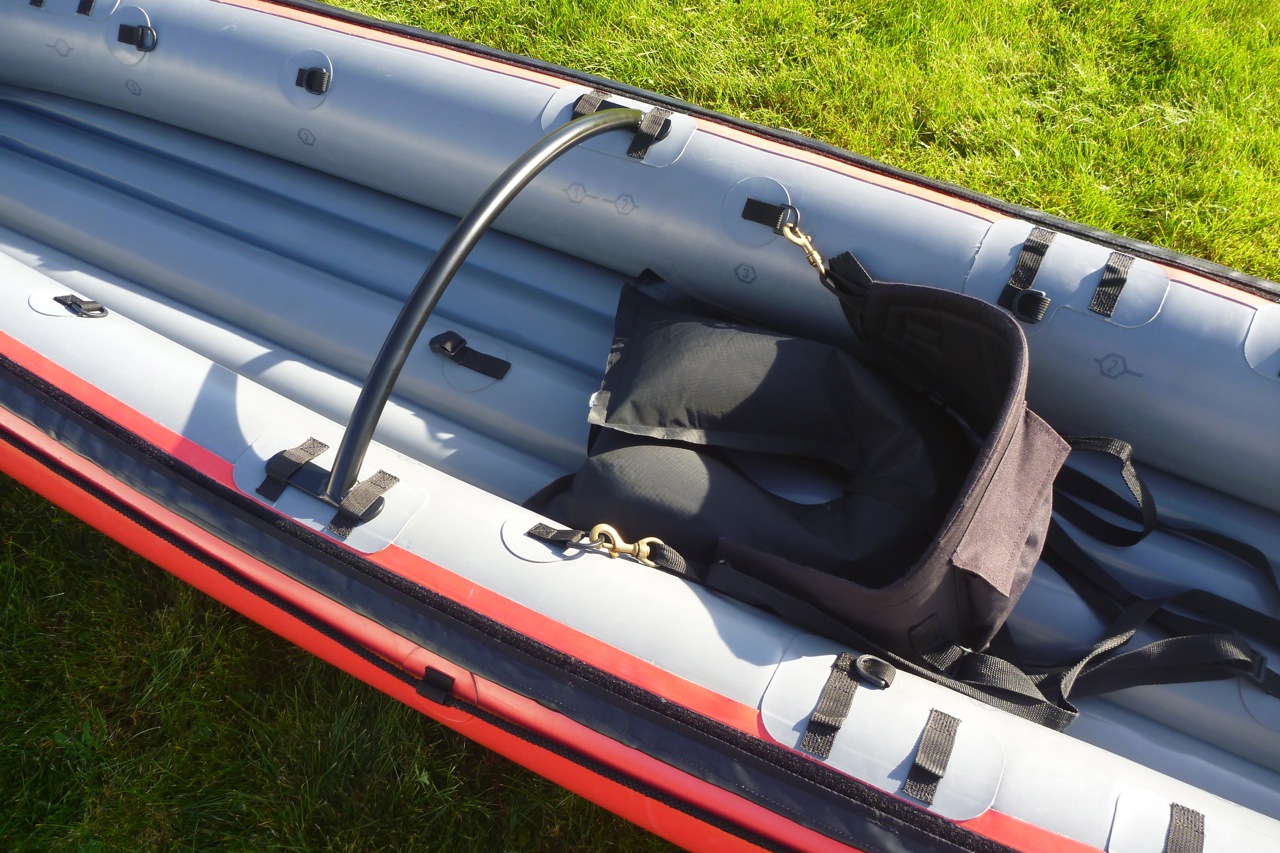
No one’s shown an out of the bag assembly yet, but the Aurion uses a pair of alloy supports fore and aft of the cockpit to keep the deck convex so water rolls ofF. The front bar can also give something to brace knees against, as I found on my Seawave (so no thigh straps needed) and supposedly, they tension the boat; holding the sides in as it flexes and opens out midway in heavy seas. You’d think the DS floor would see to that, and if these bars are anything like what my Seawave had (left), there’s a neater MYO option.
Drainpipe footrest – better
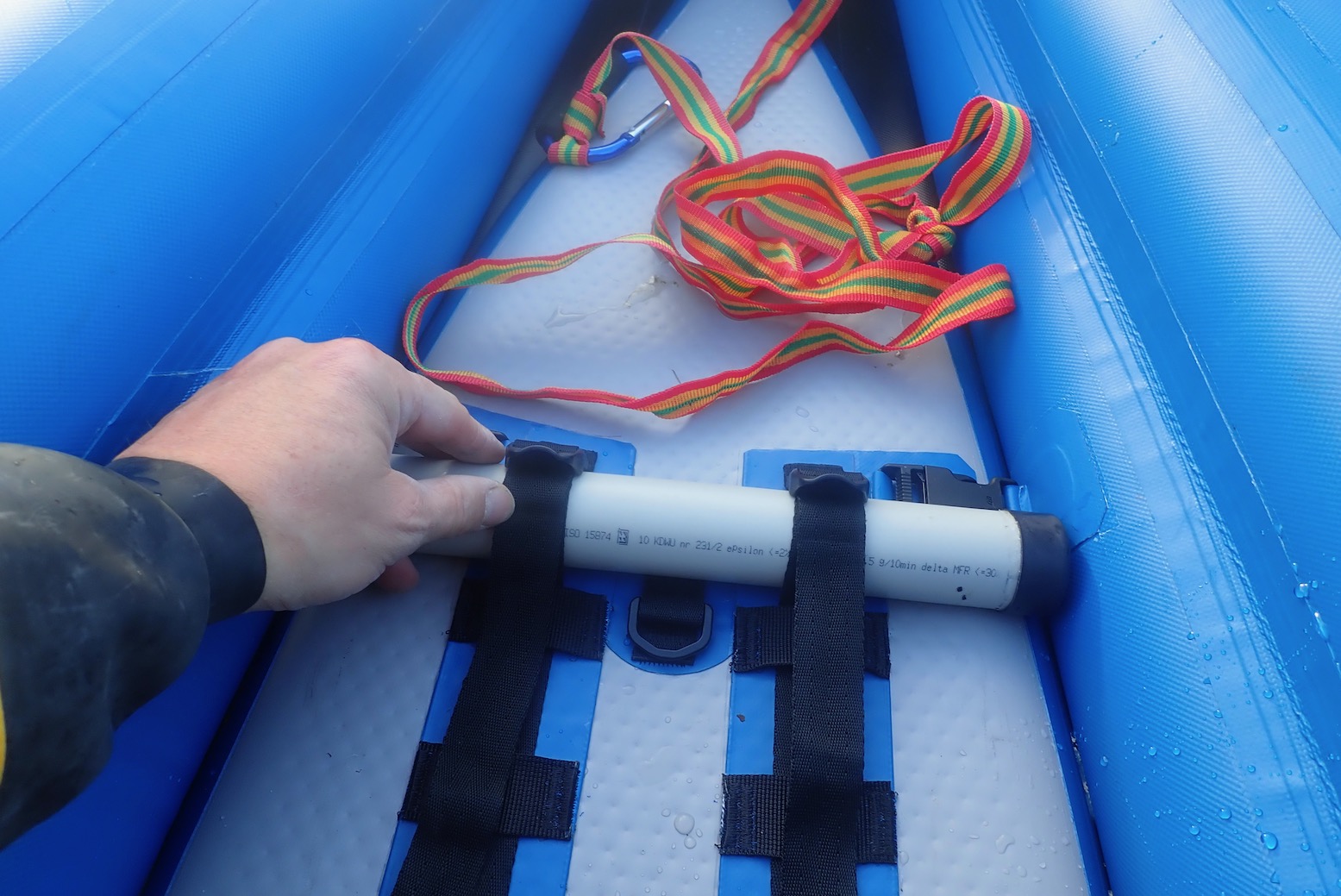
Meanwhile, the seats still look crude, heavy items made (I suspect) from Nitrilon off-cuts (unlike my Seawave adaption above left). They can easily be swapped out and so can the footrest. They insist on retaining a blow-up cushion, but at least it’s now adjusted by two straps running up to the cockpit. For tensioning, it’s a big improvement over the older, floor mounted set up, and you could easily replace the pillow with a piece of hard drainpipe, as I’ve done on my IKs for years (left). With a narrower than normal IK you’d definitely want thigh straps to steady yourself, unless the front deck support brace works. Combined with a proper footrest, it all makes a huge difference to connection and control or flat or lively water.
Some people become exorcised by the grab lines on the sides, but they’re just a safety requirement for inshore sea use in some markets, like France (where it’s currently not sold anyway). Talking of which, there’s also a rudder attachment hole on the back. Having experimented with rudders on my longer Seawave, it’s important to understand that on a kayak, rudders aren’t primarily about steering like on the QE2 liner; they’re more for compensating against crosswind drift on open water. With a rudder trimmed to one side you can paddle normally across a side wind and not have to haul hard on one arm to compensate. Very handy at sea, especially on overnight paddles where you may end up with winds you didn’t ask for.
Re-entering a decked boat from deep water. Needs practice and calm seas. Who ever capsizes in calm seas?
The cockpit takes a flexible coaming rod for a proper spray skirt, at which point you have to ask, would you want a fixed-deck single seater IK? You lose all the benefits of easy entry from or by the water, just to avoid a little paddle splash, though I admit a fore deck is handy for gadgets and snacks. Then you have the cleaning and drying issues, baggage loading complications and so on – all for what? In that way the similar but slightly longer and wider Rush 2 is 10% lighter, cheaper (though not once you buy the deck) and can take a second paddler which has proven benefits to well being and social bonding.
It’s good to see Gumotex leading the way with non-PVC hybrid IKs: first the basic Thaya slab, then the more sophisticated but initially troubled flat-floored Rush models, and the half V-hull Seashine which has been copied onto the Aurion, but with semi DS side tubes. Each iteration refines the Gumotex hybrid format, but unfortunately at a price that’s unlikely to see it chart in the UK or many other markets.
Thanks to Marcin for alerting me to the long-awaited dropstitch floor (DSF, or ‘hybrid’) Seawave. It’s called Seashine, an S-link between the old Sunny, Solar and Seawave? Why not. Length is 4.7m or nearly 15.5 feet with 83cm width. That’s 20cm longer and 5cm wider than mt verified Seawave, or nearly the same width as a Rush 2. Weight is said to be 19 kilos; 2kg more than Seawave, with the price in 2025, a hefty €2450. I really liked my hybrid, 4.15-m Zelgear Igla (with a removable DS floor) which was half a metre shorter and 10cm narrower (thanks to twin- or stacked sidetubes). A 15+ foot IK is a lot of boat for solo paddlers; it must be pitched at families or a fast and spacious sea tandem.
This is Gumotex’s third DSF IK, starting with the, simple, flat-floored Thaya (basically a hybrid Solar, which they still sell for around €400 less) and the lighter Rush 1 and 2 which was a new model in 2020 and had a more convoluted DS hull. The new Seashine resembles an elongated and wider Seawave, but without the Rush’s hydro-formed and more complex DS bow and stern. Underneath there’s a shallow V-shaped DS floor, changing to flat profile at the end, just like a hardshell sea kayak and the new Aurion. They’ve done a good job of smoothly integrating the DSF into the regular but lengthened Seawave, although in this two-up video you can still see the hull flexing in choppy seas, just like a regular Seawave would. As someone observed, a boat this long might well benefit from a rudder. There’s a kit you can buy.You wonder if the V floor might make the Seashine a bit more tippy, but tbh the Seawave had stability to spare.
I-beam floor: can’t do high pressures
The Seawave was a great IK. I had two and improved one with higher rated side tube PRVs to gain stiffness. It cost little and worked well. A DS floor is another way of doing the same and eliminates the traditionally fragile I-beam element (left; an old Semperit). What are the benefits of a V-profile DSF? Better tracking than a smooth, flat floor, I imagine, but on the flat Igla a skeg easily ensured that. Better speed along with the added length? You’d hope so. A sustained 8kph or 5mph ought to be possible on windless flatwater. The ability to edge turn like a hardshell? That doesn’t really work with IKs I’ve owned (or I’ve never had a need for that technique), but the Polish bloke’s video below seems to show edge turning (leaning to the right to turn left) and so does the Aurion I am told. Only a comparison alongside a Seawave as well as the 4.2-m Rush 2 would tell, but it’s got to be a bit faster than either.
For the last fortnight the Wessex skies have been clear, and warm winds have blown from the east. After six months in the garage I finally get round to taking the Igla for a day out. Hard to believe I’ve only been out in the Zelgear IK once in mid-winter. A closer look at the south side of Poole Harbour is the plan, and a 25-minute drive drops me off just before the Sandbanks ferry inlet which we crossed last year in packrafts.
The tide was inbound and the forecast 13mph from the east, rising later and with gusts predicted at twice that according to some sources. Ideal for some downwind sailing action! The plan was to explore as much of the Harbour’s southern shore as wind, curiosity, energy and draught would allow.
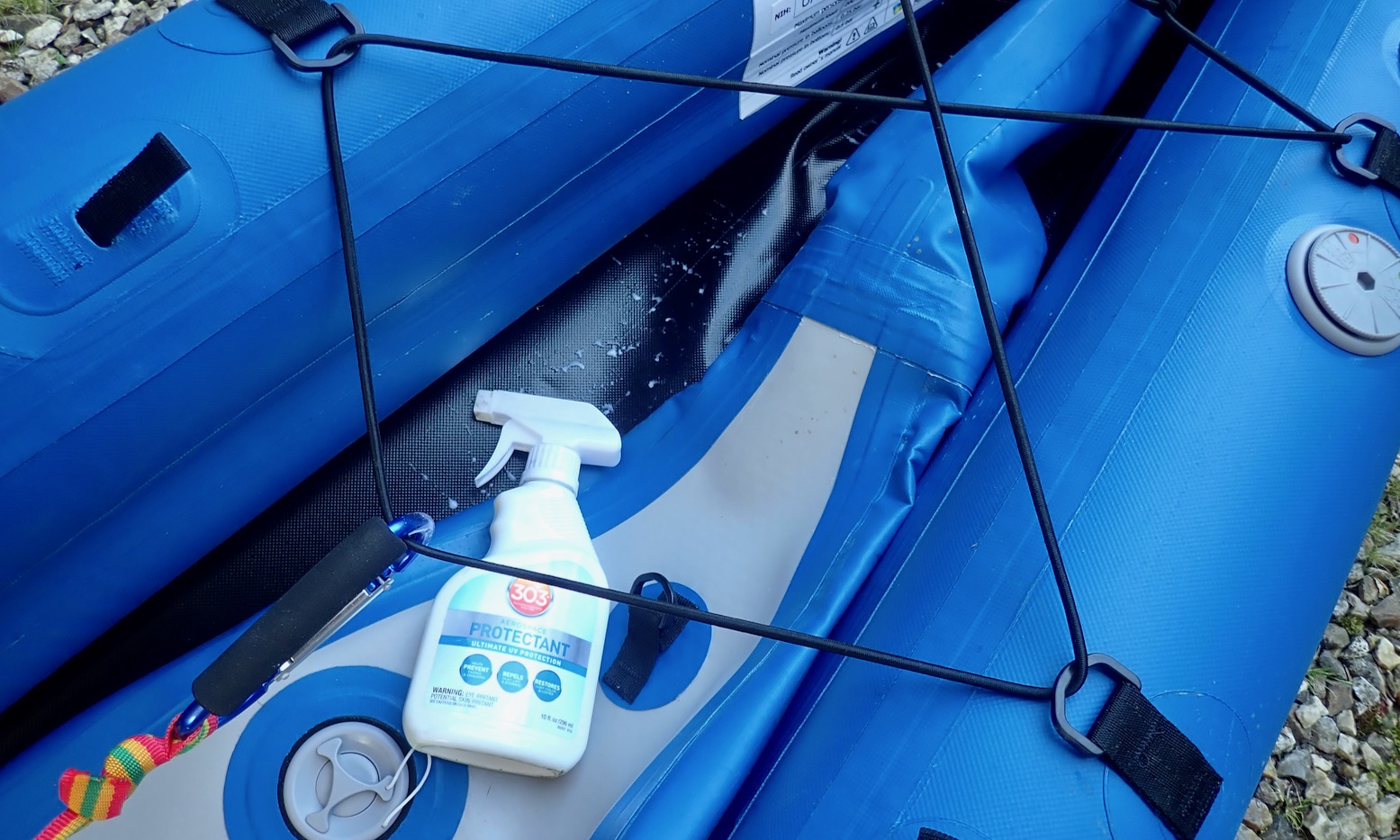
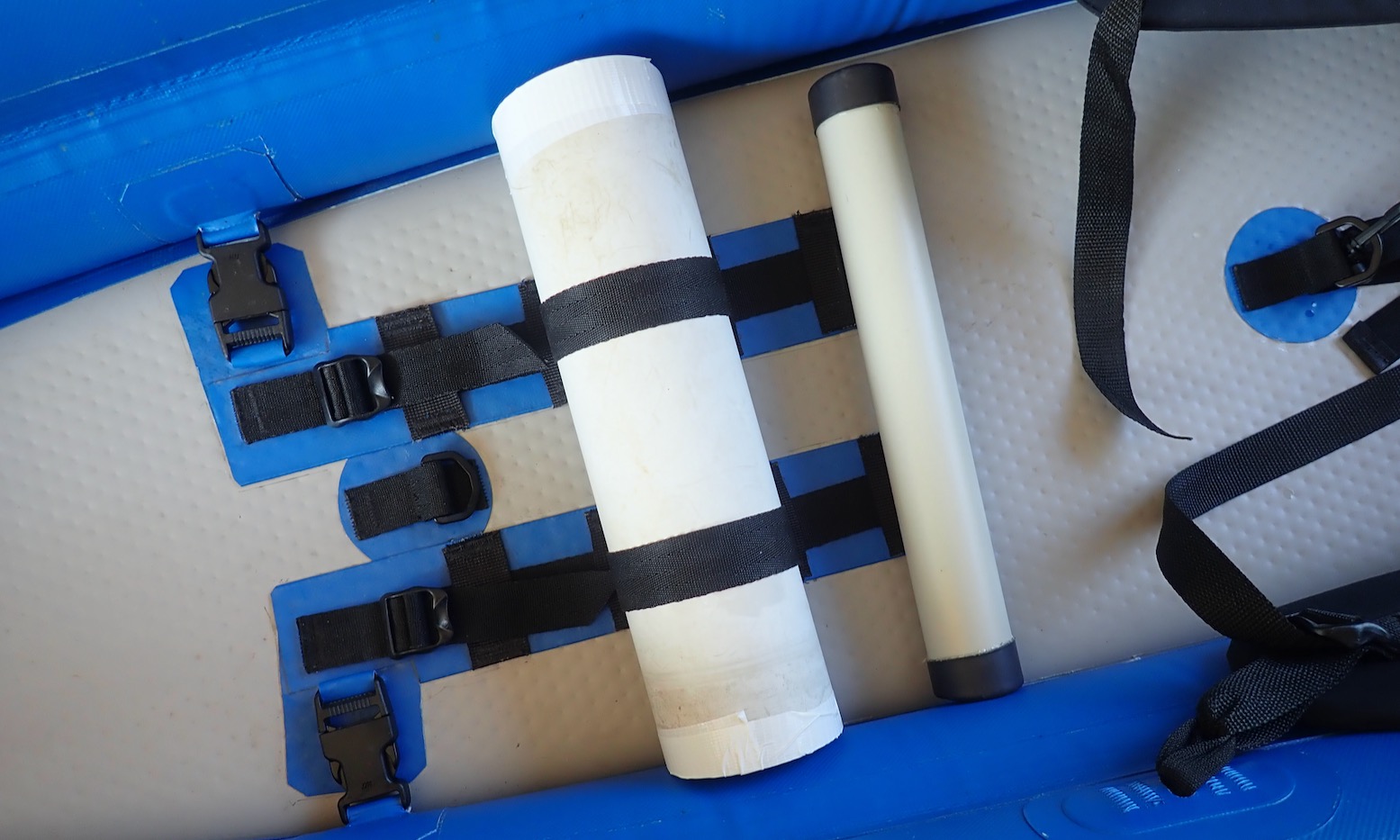
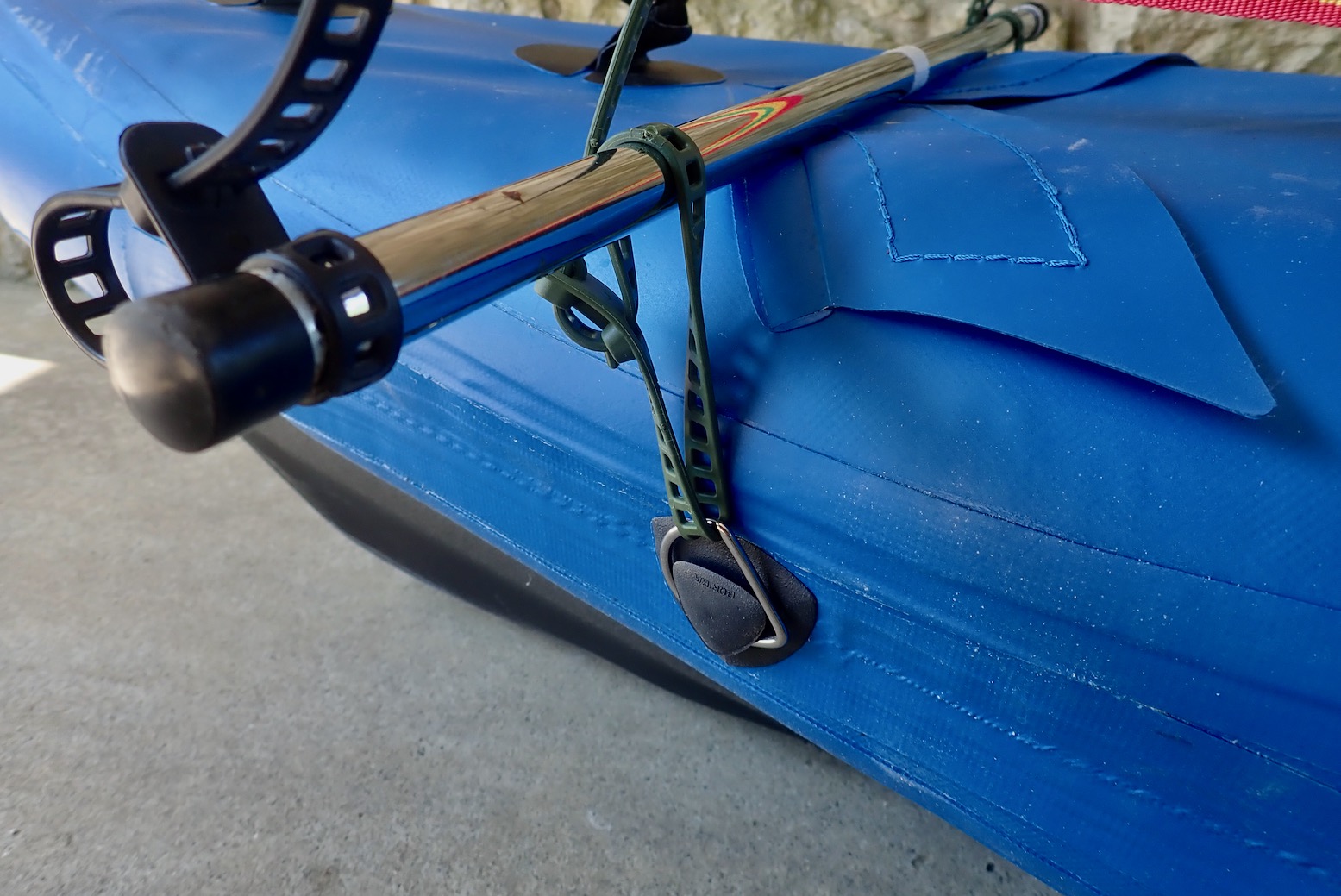
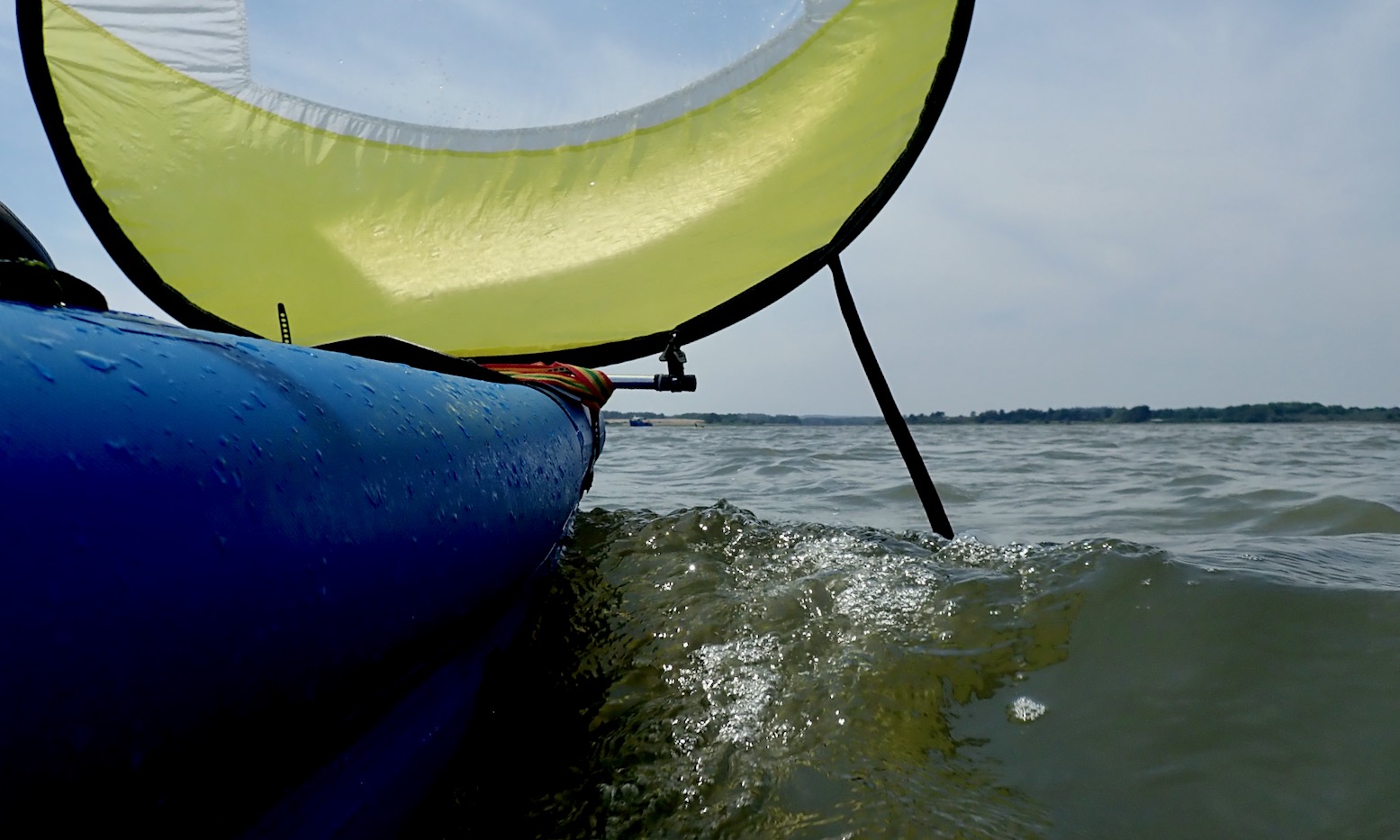
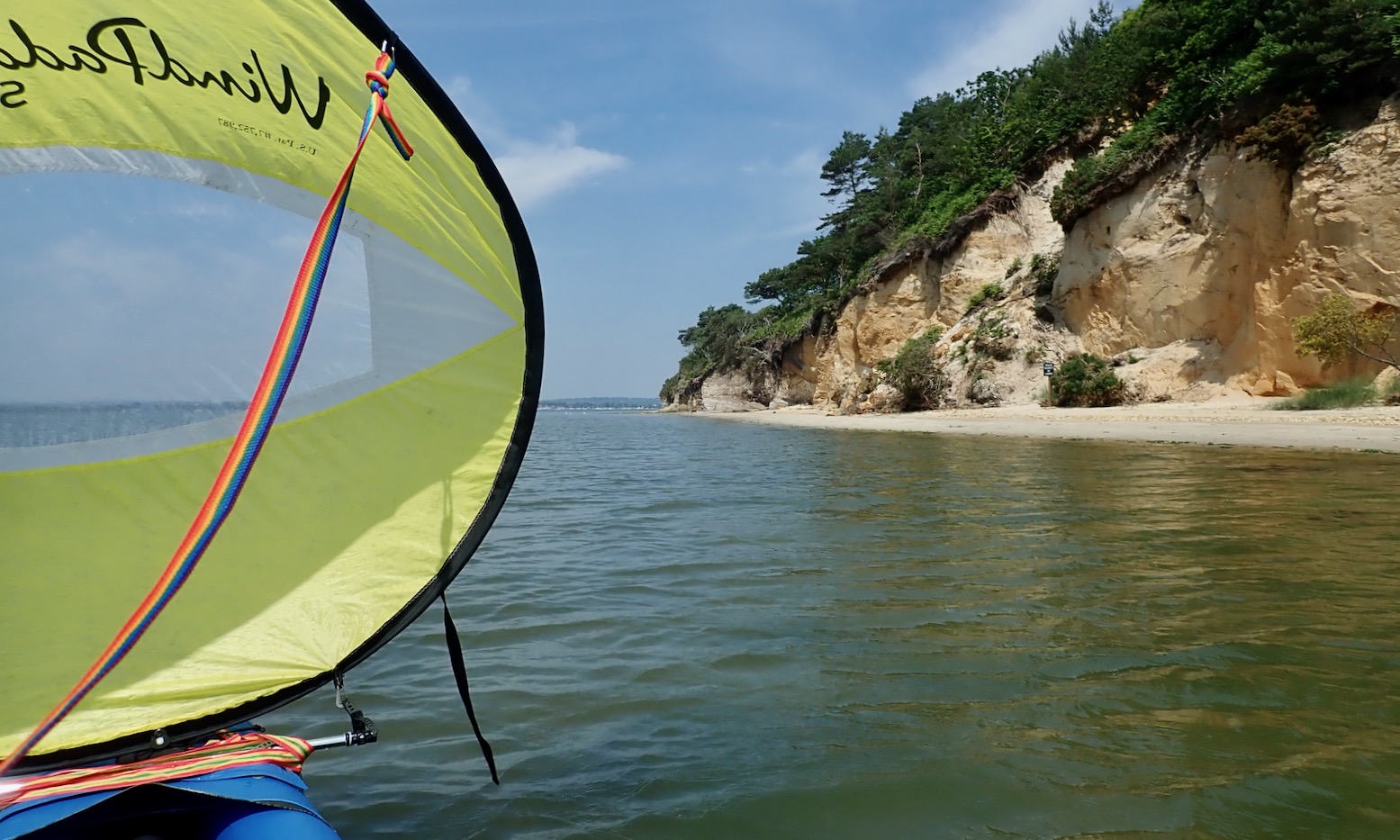
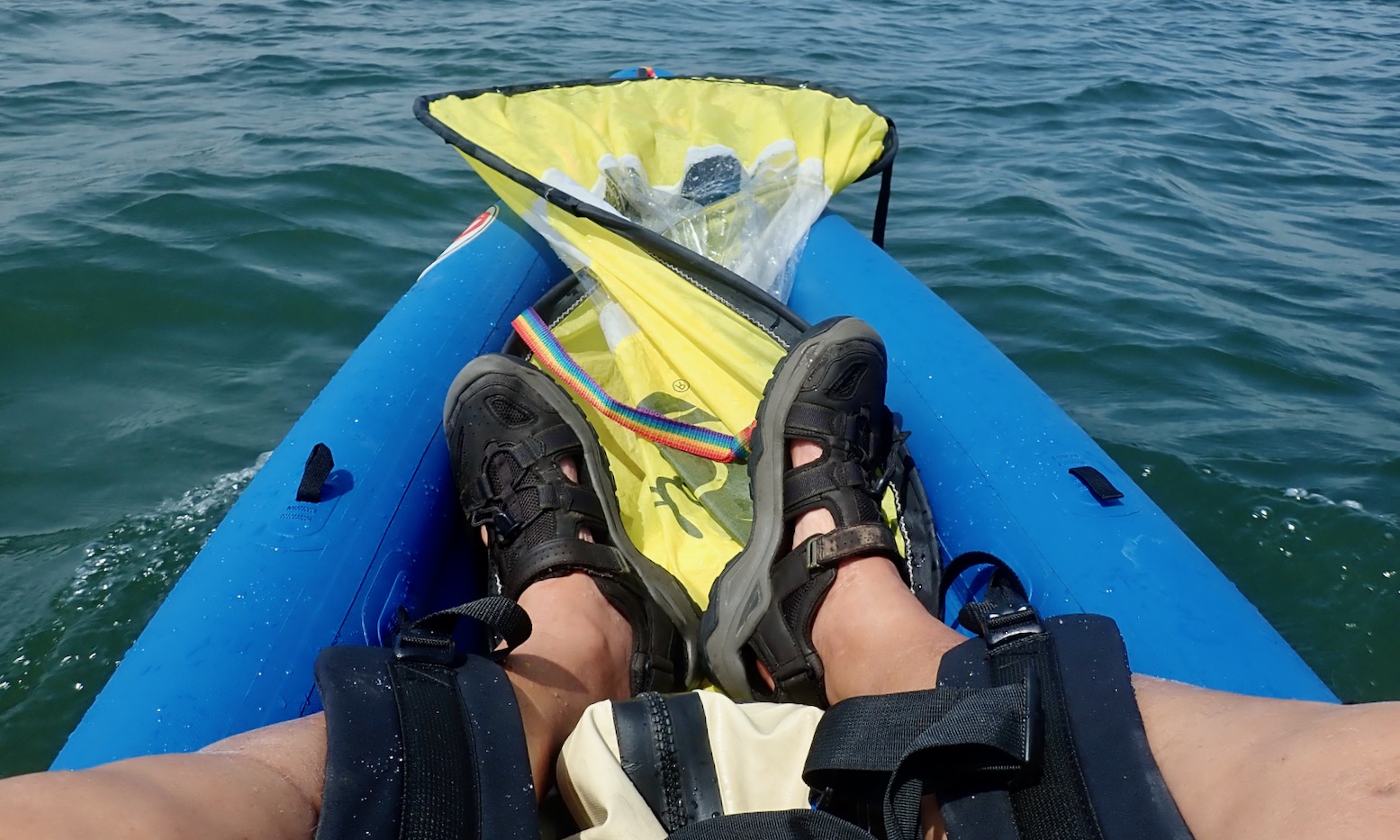
The 0.25 bar hull has been inflated for six months and lost a little pressure. I’d fully deflated the removable 0.5 bar DS floor and refitting it, decided a quick squirt of 303 anti-UV lube underneath and on the ‘horns’ would help it slide snugly into the correct position.I sawed off a bit of 12cm drainpipe to make a bigger footrest tube for my bigger feet. (Original Zelgear footrest tube on the right).I also found a way to fit my packraft ‘transverse bowsprit’ using ever handy Rovaflex straps.The wide bar stabilises the sail mounts to limit sideways swaying or rocking.It’s only a two-minute carry through the trees from road to beach, but requires passing through the ‘TPZ’ or toilet paper zone.I drop my lunch into the boat. It’s going to be a hot paddle. At the back, Brownsea Island.Oo-er, the Igla (‘Needle’) feels a tad wobbly, but then it’s an IK not a packraft. I deflate the seat with the handy twist-valve tube until I’m just resting on the DS floor. That’s better and once hooked into the cushy knee straps I feel secure and snug. The Igla’s seat is by far the most comfortable IK seat I’ve tried. It doesn’t have to be complicated or heavy.Like a migrating gannet, I venture forth in search of the wind.Soon it finds me.I glide past the southern cliffs of Green Island. Signs discourage landing. Nearby chaps are doing tight circles in small dinghies, dredging or fishing for something. Not knowing the landmarks yet, I keep having to refer to my Garmin’s OS map to go the right way.
Right now I’m reading We, the Navigators; The Ancient Art of Landfinding in the Pacific by David Lewis (1972, open source pdf). In it he explains how Oceania (or Micronesia, Melanesia and Polynesia) were populated by intrepid Asian seafarers – contrary to what the famous Kon Tiki expedition sought to prove. Some had mastered the art of navigating hundreds of miles of open Pacific without any kind of instruments, memorising instead a combination of stars (rising and setting points were like compass bearings) as well as prevailing winds and waves, refracted swells from unseen islands and unseen currents (flying fish always jump down-current; fyi). Travelling with the incredulous author, after days at sea aged South Sea navigators regularly found a tiny pin-prick of an island bang on time. It’s a fascinating topic but the book focuses purely on the techniques, rather than the adventures they all clearly shared for months. David Lewis’s earlier book, Daughters of the Wind (catamaran from UK to NZ via Cape Horn with young family) may be a more engaging read, and was a voyage on which Lewis practised the instrument and chart-free techniques he later documented in the Navigators.
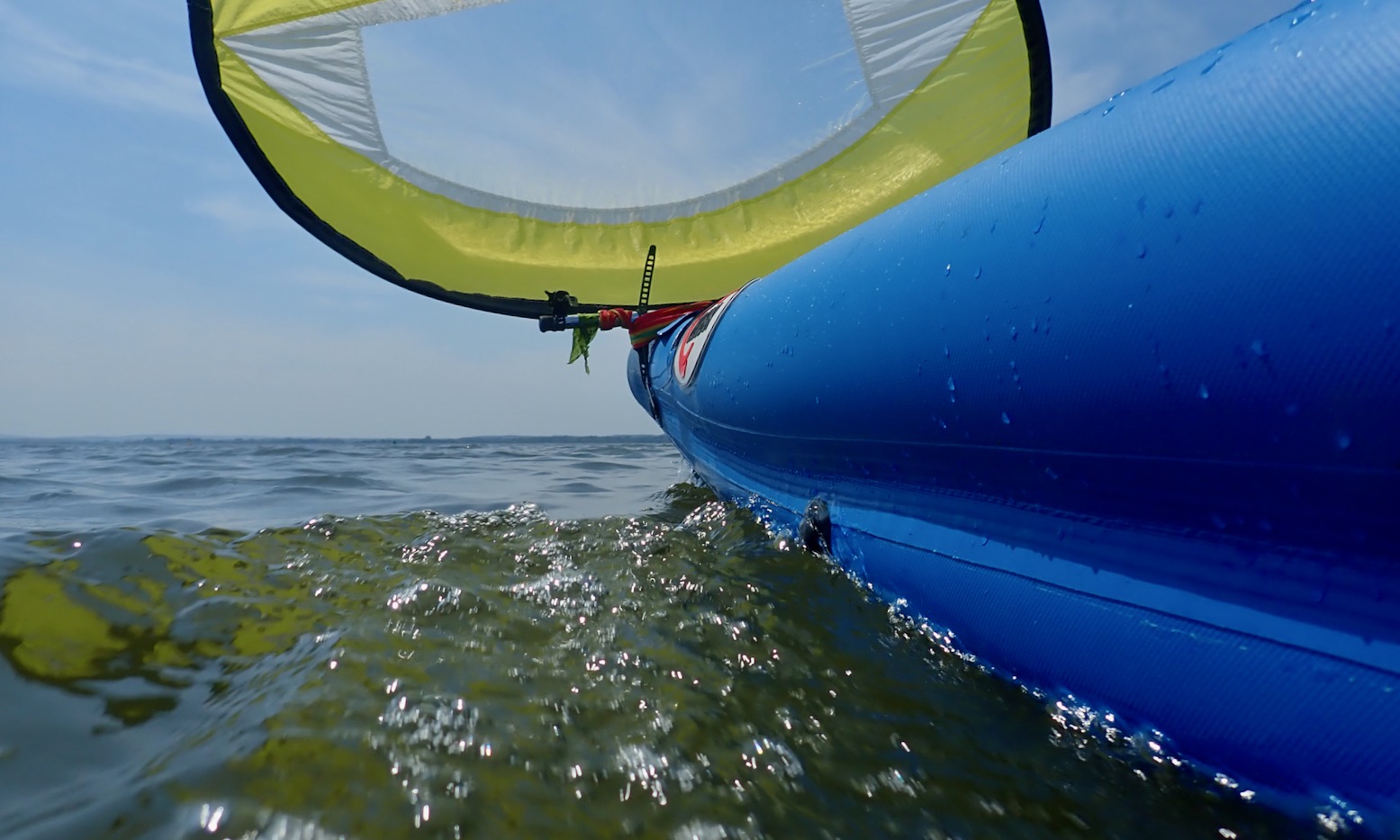
It’s blowing nowhere near 13mph and when the wind drops or I turn off it, one twist of the sail and it tucks easily under a foot, ready for redeployment in seconds. The system works very well.
We cycled a trail along the southern shore the other day, branching up to the harbour at a cottage on Ower Bay. From there I couldn’t work out what the wooded island was to the NW. Turns out it’s the south end of Round Island. Sgurr nan Cruinn, that might be in Gaelic.
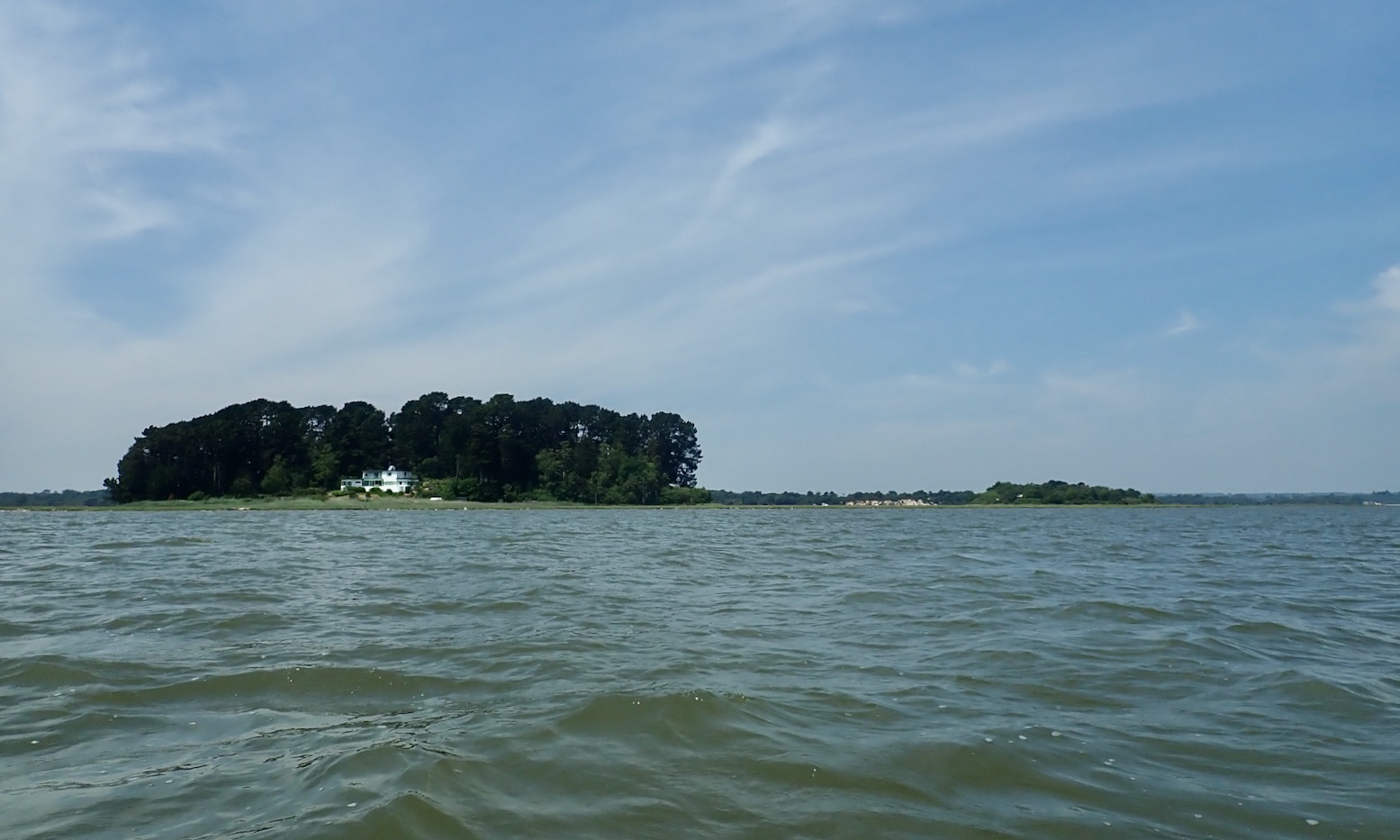
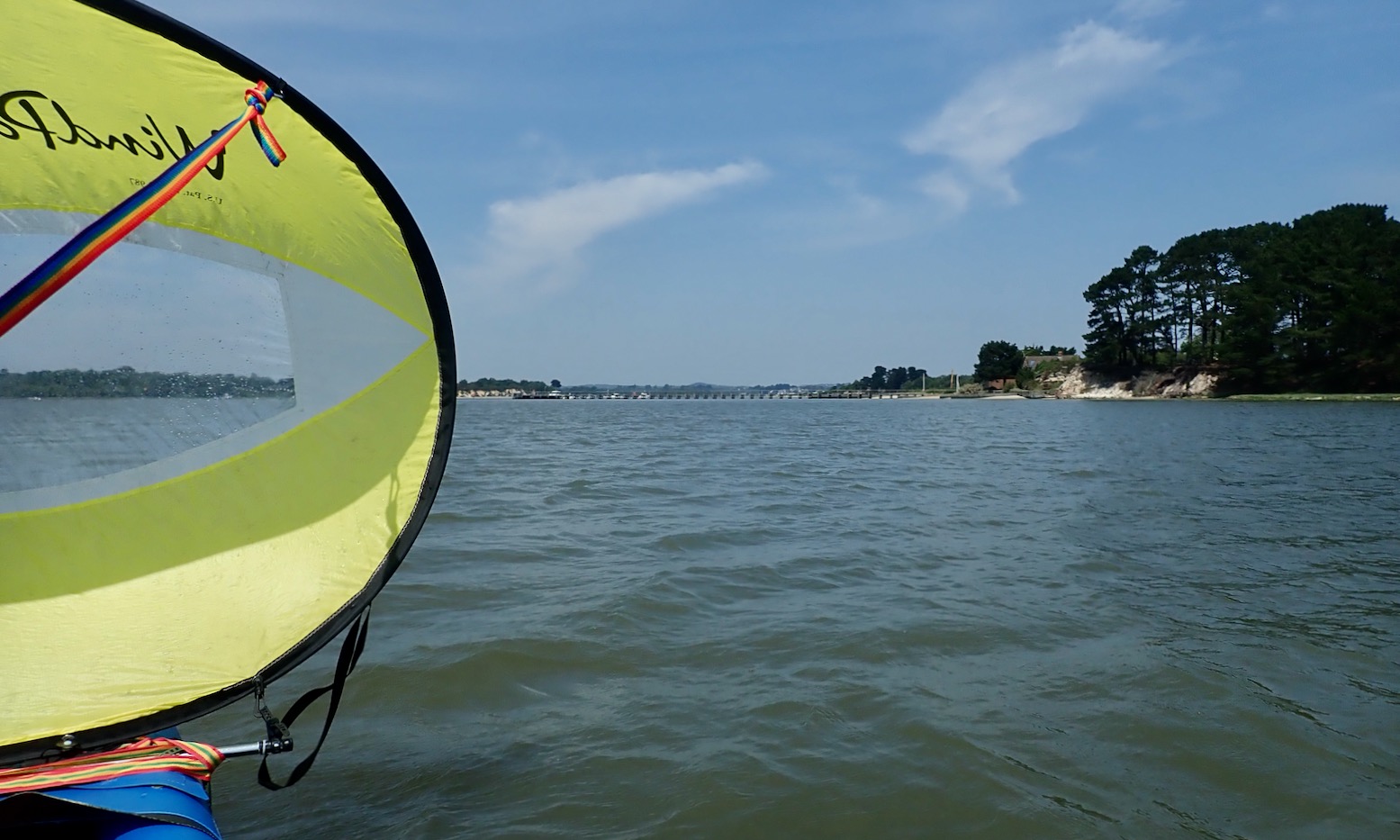
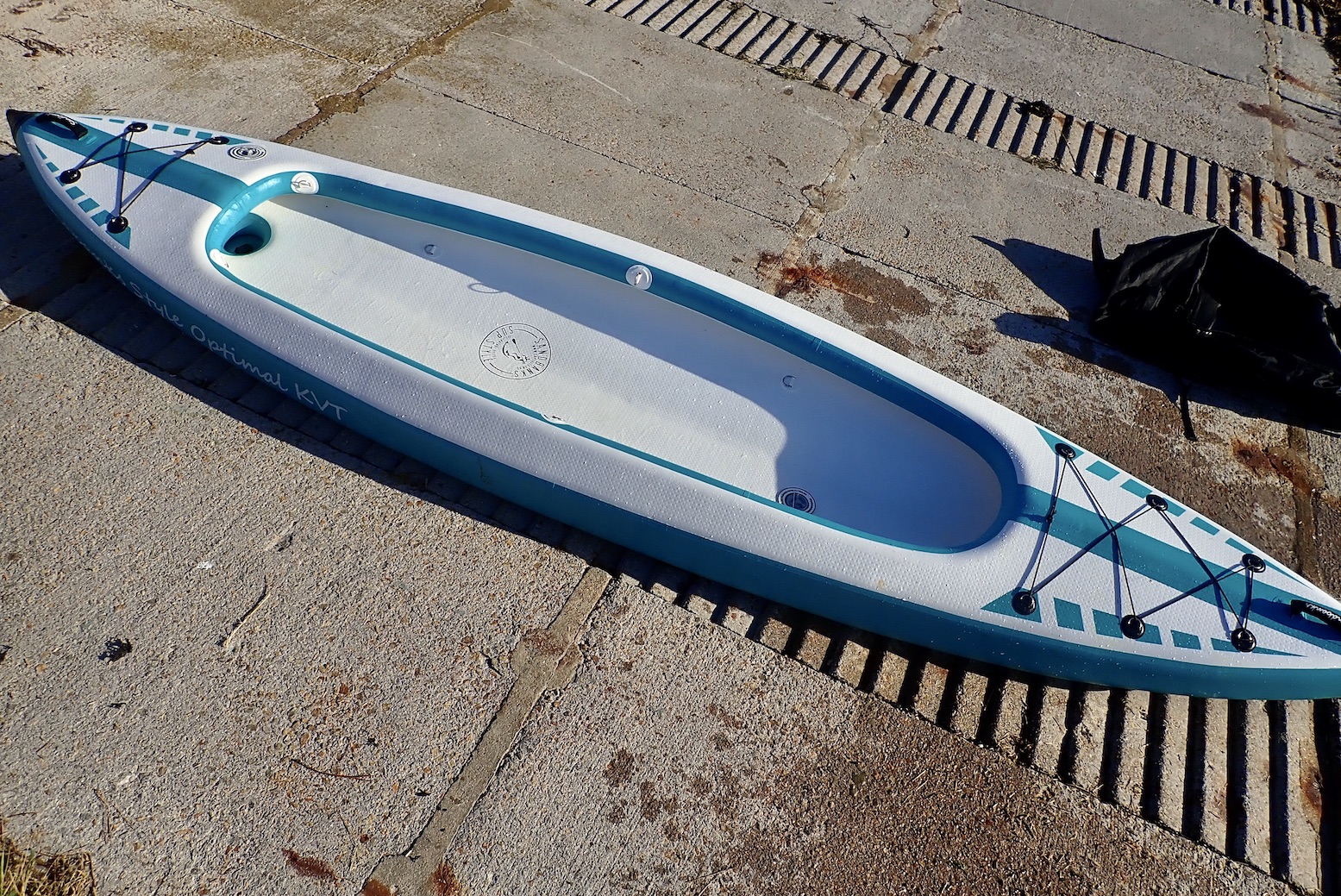
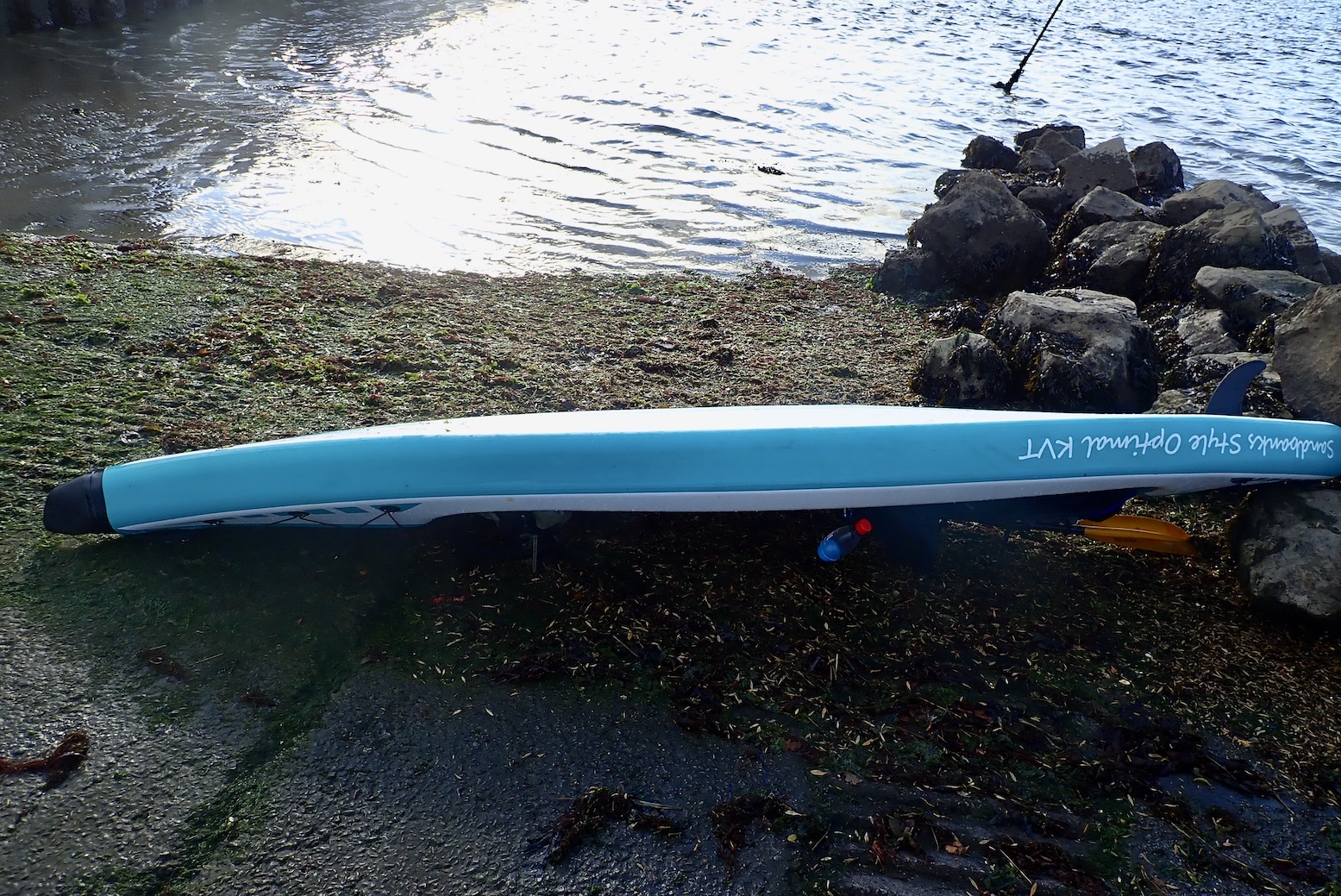
I rounded the southern end of Round Island, passing more dinghymen doing full-lock burn-outs. There’s the long jetty as shown on maps. On the left the mainland shore of Arne.I ride up past Shipstal Point, one of the few points where footpaths reach the sea. A couple of SoT’s are beached up ahead, including a Sandbanks Style Optimal which I tested here a couple of years back. They’re going to have a rum old haul eastwards back to Sandbanks against the rising wind.I’m not wearing my glasses so don’t see the low spit of Patchams Point until I’m right on it. I have to turn east into the wind to get round it, scattering Oyster Catchers as I go. The taut Igla responds well.I pull over to inspect that state of regeneration and other incisive environmental initiatives. Soon I’ll pass Russel Quay where we put in the packraft the other day. I’m hoping for a good run with the wind towards the Frome river mouth.I get it but it’s not the high speed thrill I was hoping for. Plus it’s blowing me west, when I need to be going southwest. One flaw with my bowsprit idea is the lack of slack reduces the angle you can pull the WindPaddle to steer off the wind, especially when it’s not very strong.
The wind picks up, or get its fetch on at the downwind end of the Harbour. I’ve squeezed all the west i could from the wind and must now turn south. So I stow the sail and paddle a crosswind pushing me towards ancient stakes and into the reeds.
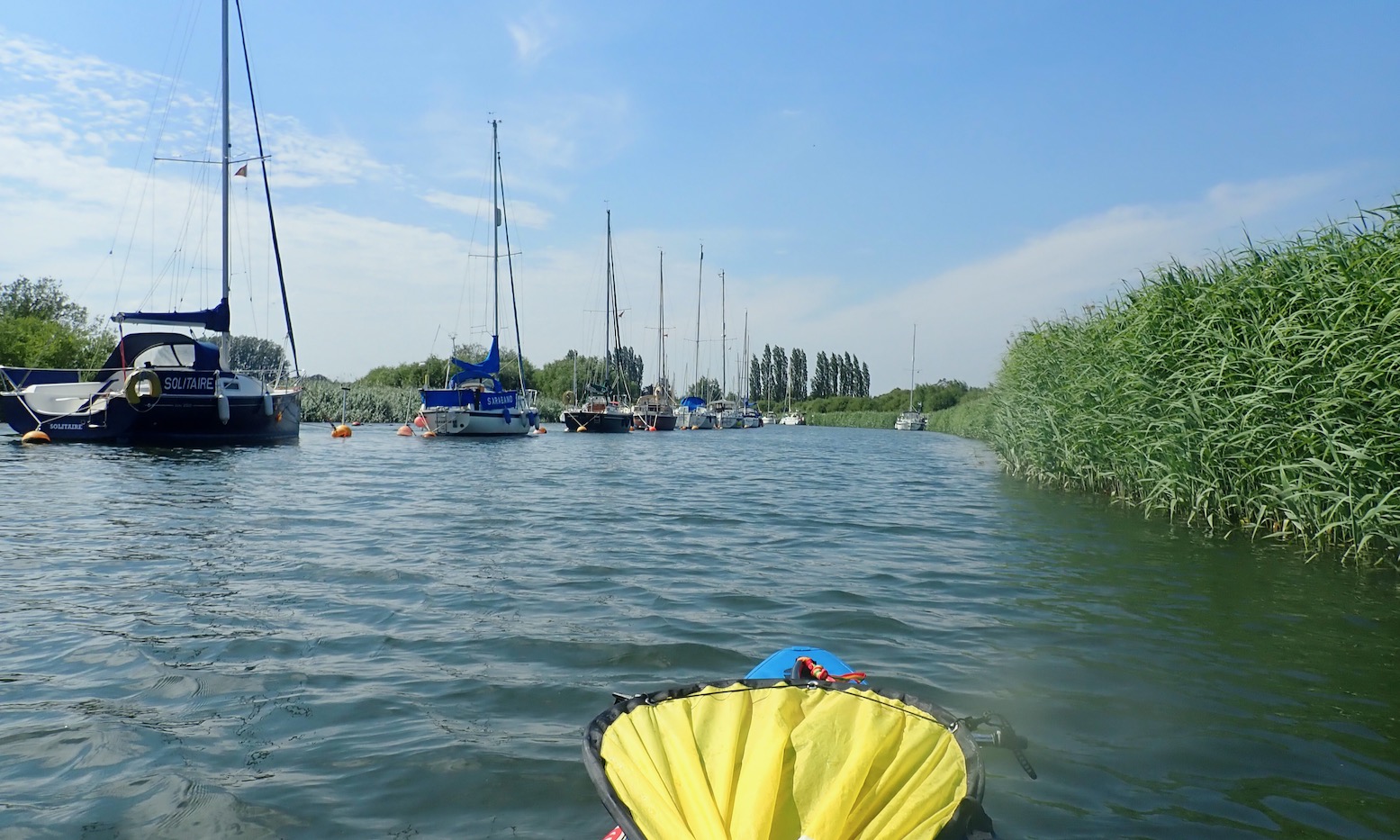
I follow a boat into the hidden river mouth and, with the wind now up to 20mph, I can sail a lot of the river’s meanders the two miles west to Wareham Quay.
With the wind whistling through the rigging, I hear a ‘Bloody hell, wow…’. It’s a moored boater expressing surprise as my kayak sails by as close to the 4-knot limit. I learned a new sailing trick: to micro steer the boat drag a left hand in the water to bring the bow round to the left. It worked well zig-zaging up the Frome.
Like a Polynesian master navigator, after my ten-mile traverse of the Harbour, I sail right up to the Quay…
.. casually hop out, and look around for my taxi.
IK or packraft, I wonder to myself. Environment or geography (as well as intended use) help define the best suited packboat. My TXL would have managed this outing fine, if a tad slower, but it sure is nice when the Igla slices through the water, either under sail or into the wind. The problem in this corner of Dorset is, once one tires of noisy, busy, drab but safe Poole Harbour, apart from Swanage (below), getting the inflated 17kg IK down to the exposed Jurassic Coast in suitable conditions is a bit of a faff, even with wheels, let alone getting back out and closing the loop with cars in place. You may as well use hardshells. That’s why I chose the long but still light TXL packraft. Down here I’m not straying out to islands where speed and efficiency are important. For plain old calm-weather mainland coast hugging, a large packraft does the job and enables public transport, an easy scramble ashore followed by a walk back. But for an effortless coastal tour with plenty of room for two, the Igla has its benefits. It’ll easily paddle at 8kph on a breeze too light to hold up a sail and that’s an extra 30% more speed or so less sustained effort over a few hours.
In a line Fast, light, well-made and great value European-made hybrid tandem, the Igla’s removable floor and stacked [twin] side tubes keep the width down while retaining stability.
Everything in the huge bag except a paddle Removable DS floor for quick rinsing and drying Unusually light on the water Adjustable footrest tube Seat feels great Knee braces are stock Twin (stacked) side tubes keep width down Ready for optional rudder (supplied) Closeable sidetube PRVs Fittings for a deck (supplied) Three-year warrantyLike many PVC IKs, it’s bulky (if not necessarily heavy) Alloy skeg appears to be an extra; and would prefer it in plastic Skeg can’t be removed without deflating DS floor Limited overseas dealer networkbut see here
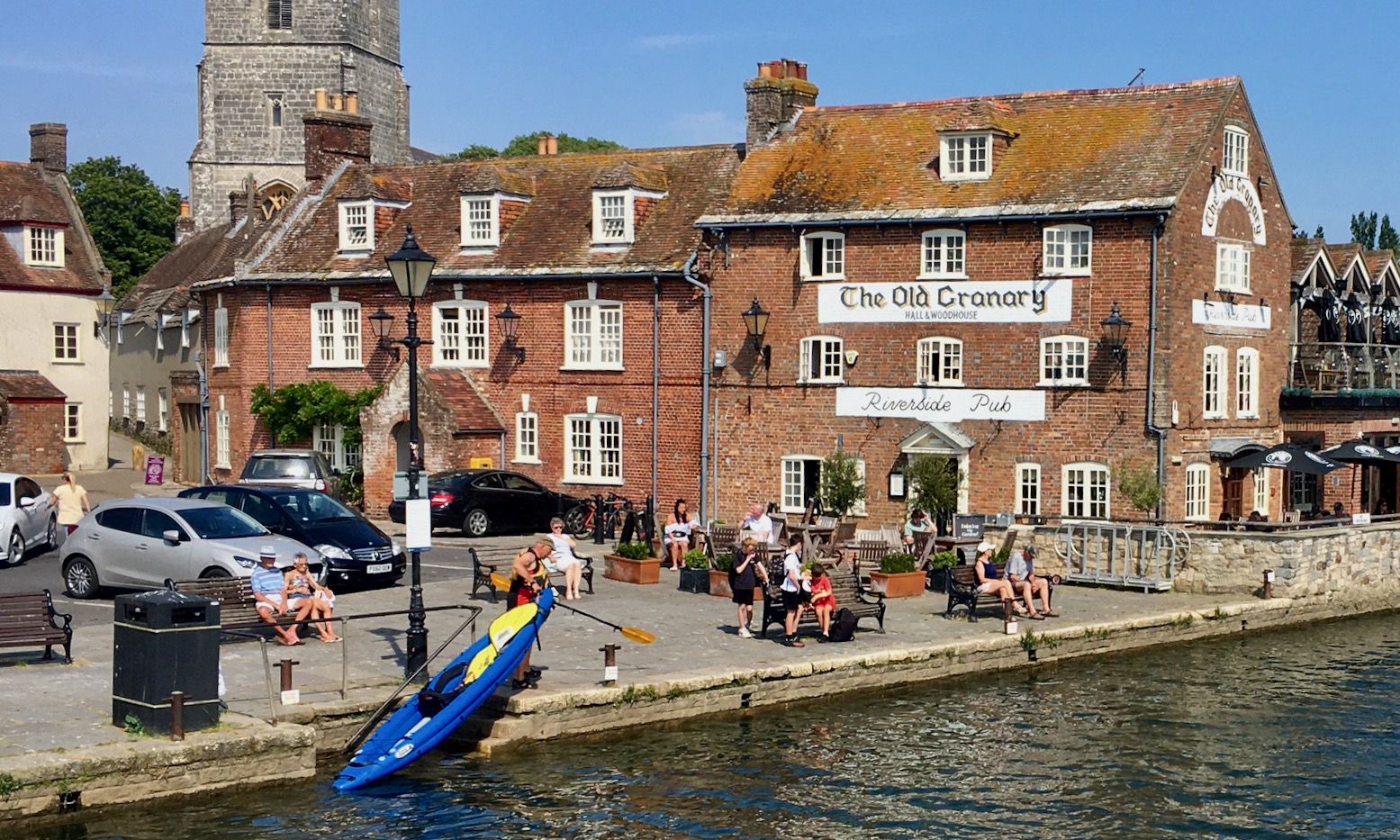
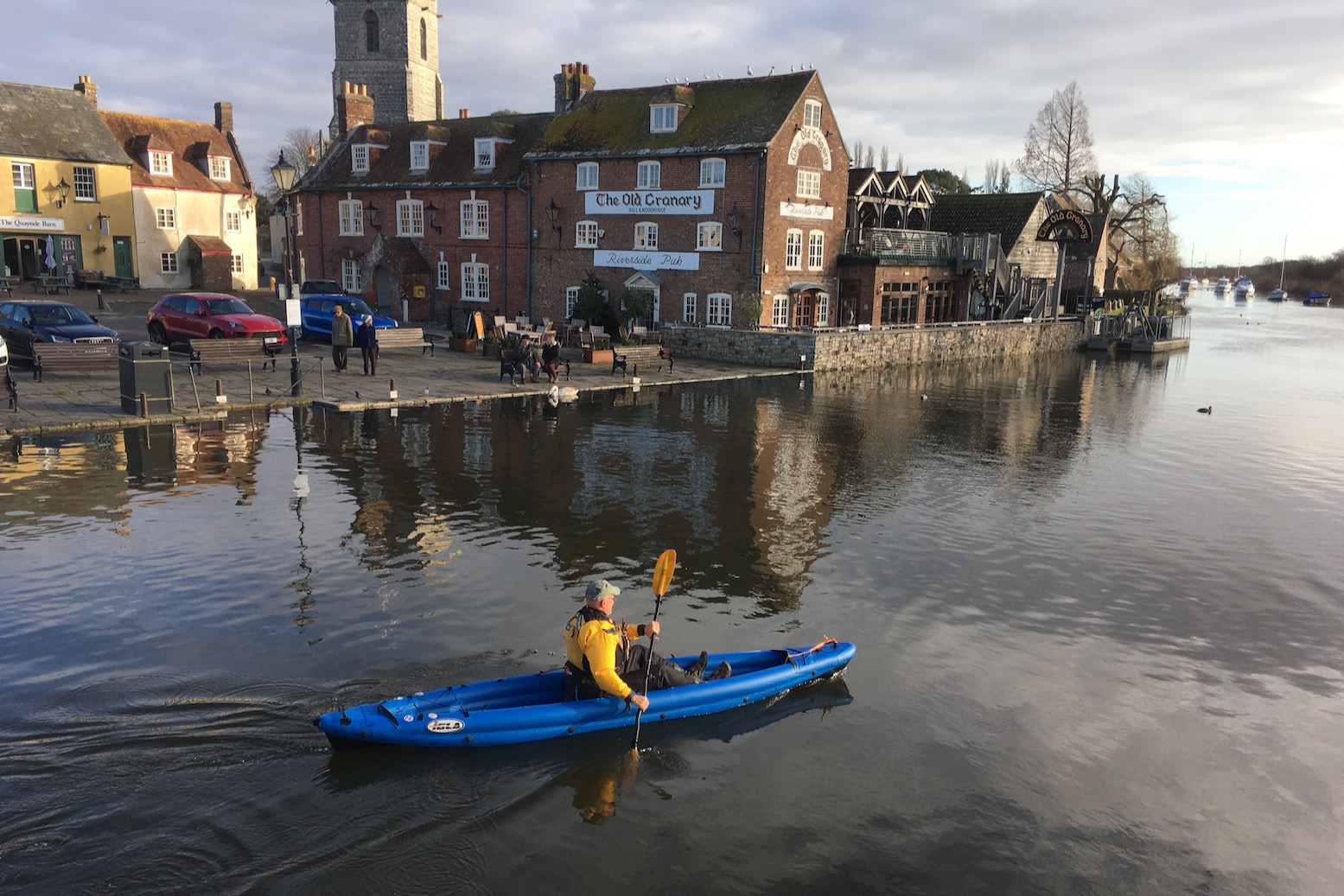
With clear skies forecast I took the Igla for a quick spin down the tidal River Frome out of Wareham quay. Some 1150 years ago marauding Vikings besieged the Saxon port in a bid to establish a flat-pack furniture enterprise. The ever dependable Alfred the Great sent them ‘packing’.
The recent thaw and rains on top of an incoming spring tide saw water just lapping over the medieval quay’s kerb and nearby pub lawn which for me meant an easy put in. Once cooling in the water I gave the kayak a quick top up and realised the closeable PRVs are quite handy in that you can close them as they start purging at 0.25–3 bar and so maintain firm sidetubes. Today, with temperatures in single figures there’s little risk of overheating blowing the boat to smithereens. I need to track down my manometer to see what the pressures actually are.
After hopping in I did a bit of pre-emptive wobbling while holding onto the quayside to ascertain stability. I don’t want a repetition of the shaky Shipwreck FDS I tried a couple of winter’s ago. The Igla seems good; a bit more tippy than the super-stable Seawave but unlike many FDS IKs, the round side tubes give it a bit more beam at water level. I adjusted the footrest tube further forward but later realised I may have been sat a little too far forward for level trim. I get the feeling these rock-solid drop stitchers are a bit more sensitive to trim as there’s no sag in the floor.
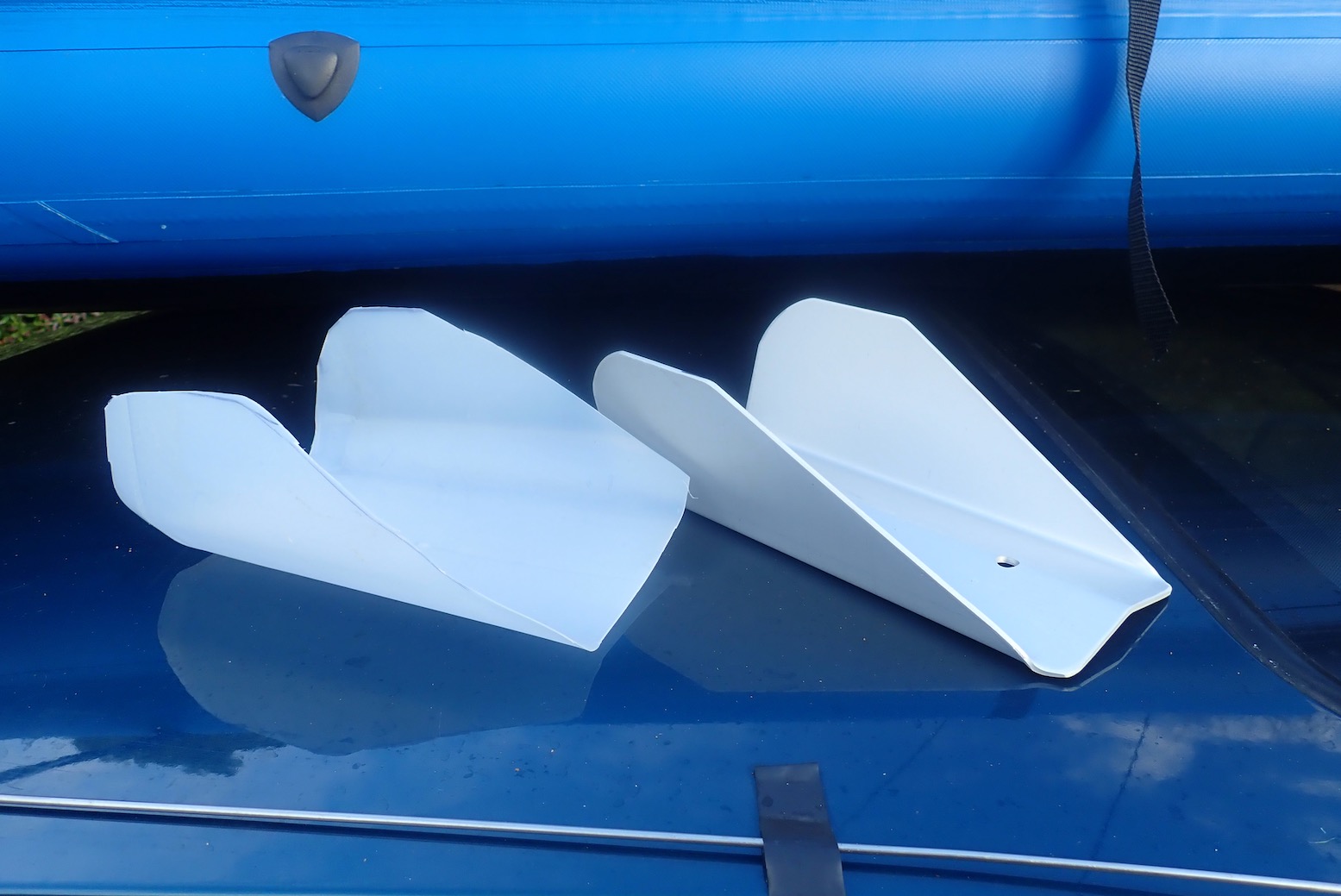
I see now that floating on the water the bow and stern prows are just above water level. With these relatively water-slicing forms (for an IK) I wondered whether the Igla might manage without a skeg but decided not to risk it. You can’t fit/remove the twin-fin alloy skeg with the DS floor inflated, so I made a quick copy from a plastic container (below). My MYO skeg was a bit flimsy but setting off downstream the Igla tracked fine while turning as easily as the Seawave. It wouldn’t be hard for Zelgear to redesign the skeg and mounting to make it easily removable while still being secure. And while they’re at it they could make it in ABS plastic.
Skeg bottle hack30g vs 260gEasily removable
I’m pleased to report the six-point seat feels about as comfy and supportive as I’ve seen in an IK out of the bag. No need for the usual adaptations or outright swaps. Gumotex take note. It weighs only 700g but offers great support, even from the inflated backrest. And semi-deflated, there was no wobble from the seatbase on the hard DS floor. If you’re looking for a good IK seat, try and get one of these.
The slim footrest tube too works better than I thought, thanks to the hard floor, and with knees braces cinched up, I felt secure in the boat. It’s a tad less stable than my Seawave of the same width but not enough to bother you on flatwater, as least. The Mrs was walking along the south bank and I was going to ferry her over to the north side to walk back, but we got separated in the reeds so I headed back into the growing westerly before the spring tide turned on me too.
Before I did, I hopped out and pulled out my plastic skeg. Doing so soon established that like most IKs, the Igla did indeed benefit from a tracking fin. The boat was paddleable but micro-corrections were required to keep it on track; do nothing and the bow comes round. Again, very similar to my old Seawave and unlike the FDS Shipwreck which tracked fine without it’s huge skeg but could turn better, too. Bang on time, at 12.20 the tide turned and soon, helped by the run-off from the Purbeck Hills, the river was belting along under Wareham bridge. That’s good to know for later paddles out of here.
Having not paddled for months, that little outing wore me out, but I like the Igla. It looks good, performs well, has many useful fittings which other IKs don’t and, for a European-made boat, is a bargain at current prices. Add tax and shipping (if needed) and it still ought to come in at under a £grand. I’m looking forward to taking it out for a longer session into Poole Harbour and beyond.
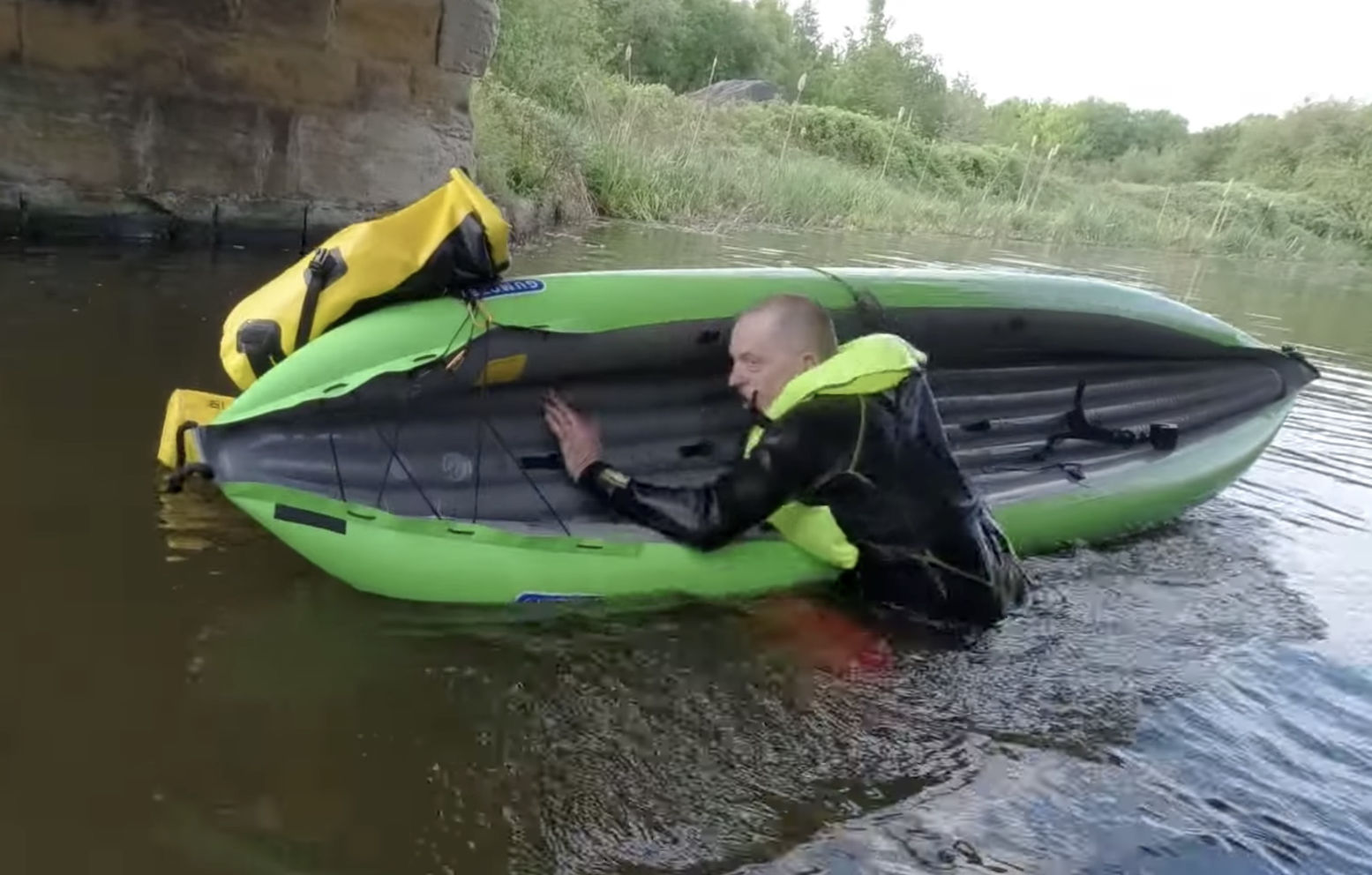
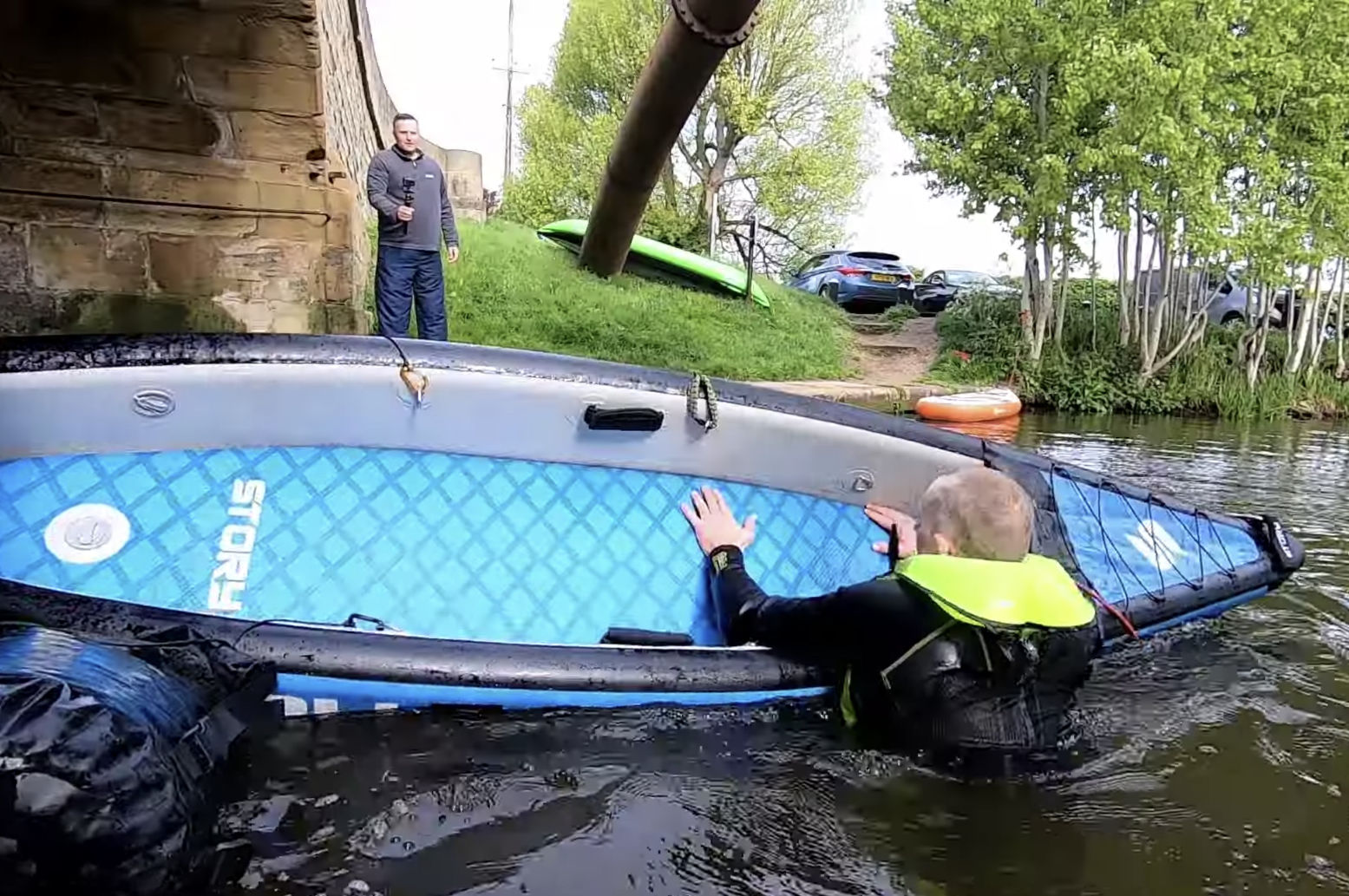
We can all chuckle about IK vlogger Karl’s repeated attempts in practicing re-entering his IKs from a deep canal, but it is definitely something you should try to master before heading out onto open water in a new boat. And note, this means deep water: ie, not being able to stand on the bottom.
Karl is practising in benign, controlled circumstances: calm water and conditions; mate and banks at arm’s reach, warm and buoyant wetsuit. Even so, you can see how the effort and cold water soon wears him down, even in a small canal. Falling out in deep water too far from the shore usually happens in rougher more intimidating conditions.
Re-entering a decked IK…… is darned tricky
In the video he tries two different IKs: his Gumotex Twist 2 and Story FDS – and reminds me of me when I was keen to learn new skills in my early years. I’m not at all surprised he found it impossible to re-enter the boxy, high-sided Story FDS. As I’ve seen done with hardshell sea kayaks, crawling up over the bow or stern can work, but good luck with that in choppy waters that just tipped you out.
One solution is a handily accessible paddle float: a blow up bag you slip and inflate over your paddle blade, a bit like water wings. This makes your paddle into a stable outrigger to remount the IK. With no float bag use a suitable drybag (left) or your pdf if desperate. This also needs practising if you’ve found you can’t re-enter you IK normally.
With his non-dropstitch Twist Karl nearly makes it. I found years ago in a similar Sunny that dipping down then launching up and over the side like a breaching salmon works, kicking hard as you go. You need that extra drive from your paddling legs to lift you up and over.
He notes his buoyant, wetsuit-clad legs get pulled under the boat. Too much buoyancy can make moving around difficult in the water. Lying flat on his front with legs behind and driving in from the side might work better. Swim in hard from the side and launch yourself across the boat like a Roman siege galleon. As with many athletic moves, once you get the knack it becomes easier because you know you’ve done it before. Of course, with someone else around to hold the far side of the boat or using their bow for added support, the whole drama becomes easier. In dodgy conditions not going out alone is the biggest lesson of all, but this is not always possible so we need to learn how to self rescue.
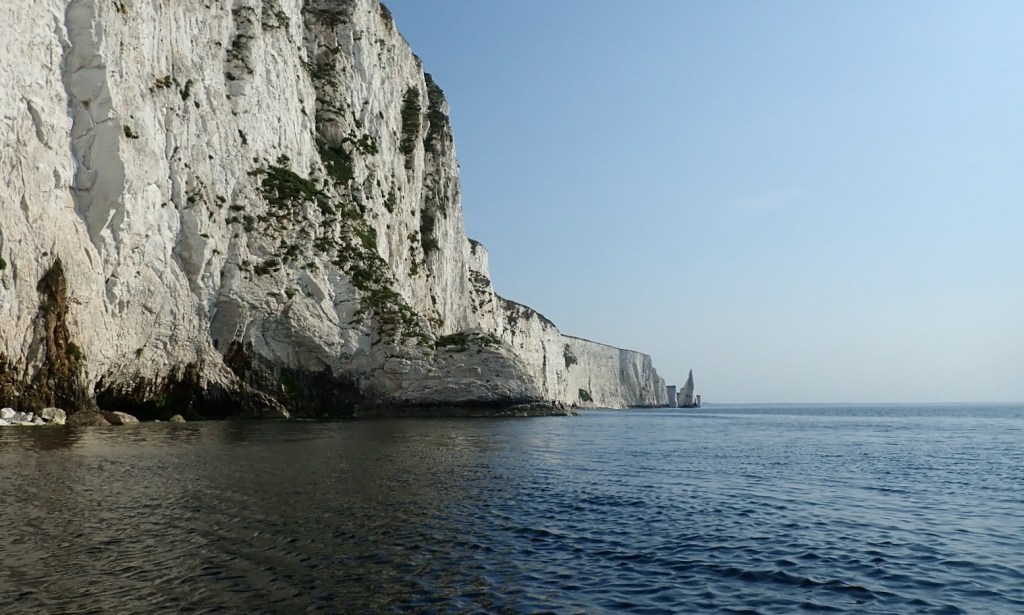
Good to see an FDS being used on a multi-day sea trip. The Needles look like a good day out; the same chalk formation as Dorset’s Swanage stacks, 15 miles to the west. My review of the same model ArrowStream here.
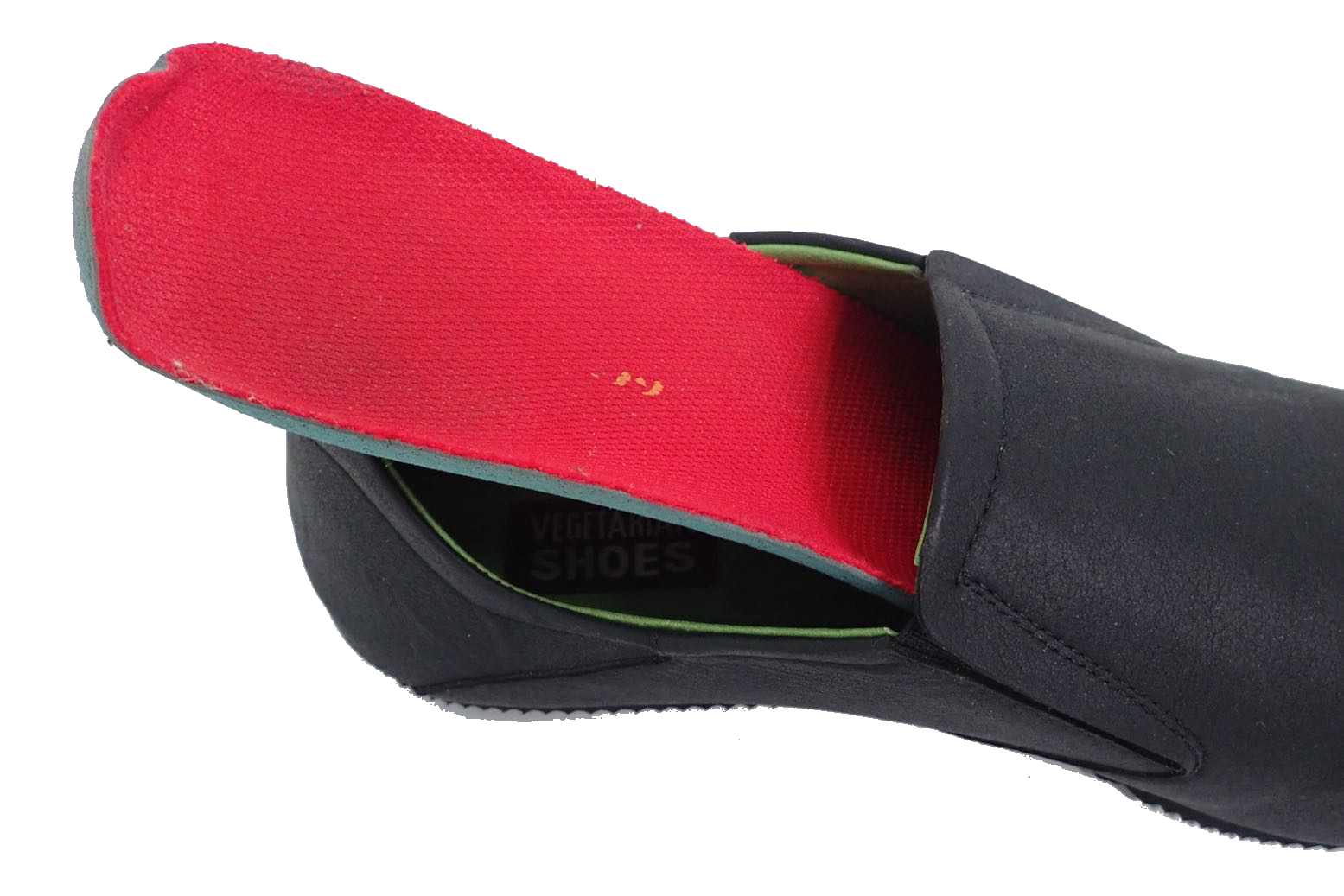
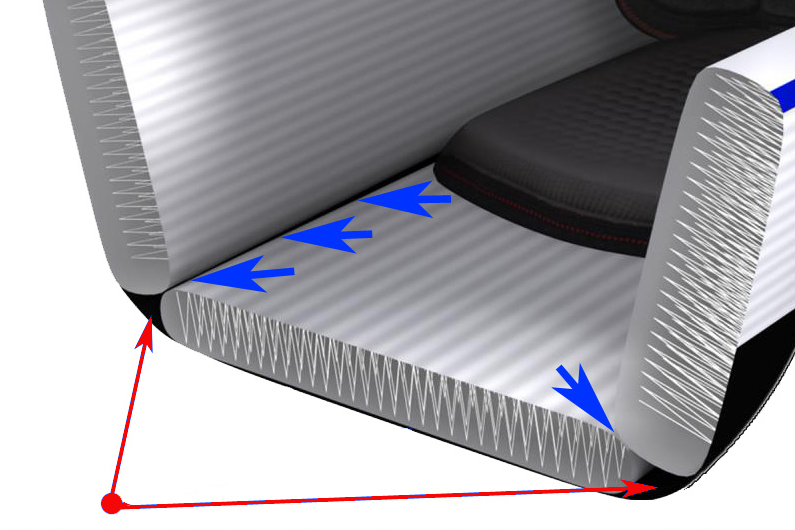
Broadly speaking, 3-panel FDS IKs are assembled by gluing the three DS planks into a wrap-around envelope of more PVC which holds the panels in a boat-like shape. Some floors areremovable, a bit like a footbed slips into a shoe. This makes the hull skin’s inner floor accessible for easy cleaning, rinsing and drying before storage: an important part of IK care. Not everyone may see drying as the deal breaker I make it out to be. Much depends on where you live in terms of climate and storage space.
Fixed DS floor sealed to the side with tapeBut not all the way, so water and debris get channelled down in the cavities either side
Unless a glued-in floor is fully sealed along the sides, water and grit will collect in the side cavities. But for deflation reasons, this cavity cannot be sealed off.
Less goodbut almost universal with three-panels is a DS floor permanently glued to the floor skin but not fully sealed to the side panels. See the two images above: at the bow and stern where the tape stops, water and debris run down into the side cavities. A drain valve helps water to run out when flushing before deflating. Some boats feature several capped drains along the sides, which is either odd or a ‘more-looks-better’ marketing gimmick. After all, unless you’re an oligarch, your bath has only one plug hole. Don’t mistake these multiple drains as self-bailing ports, no matter what clueless vendors may claim or owners may think. Open the drains when afloat and the boat will part-fill with water. Until I realised this, I was baffled by these drains. So it seems were actual owners.
Floor drains on a GliderDrains on TomahawkStern drain on Yakkair HP
Such a boat is nearly as much of a pain to dry properly as the bladdered IKs I go on about. There will always be moisture in the long, inaccessible side cavities along the floor edge which you’ll struggle to dry properly. Proper rinsing and drying matter if you want your IK to last a long time, especially after you’ve been at sea when sand and other debris can get in the boat. Seawater causes mildew, staining, slime and odours. So does trapped organic matter, while in the long term, trapped grit might rub unseen against the soft PVC until it wears right through (this will probably take years).
‘Wallpaper’ over the end ‘cracks’ (shown in green) to seal off the cavities. You’ll then need to fit a plug to allow the cavity to deflate properly when rolling up. Then the FDS would be dead easy to dry, just like a tubeless boat (below left).
Tubeless rubber IK: dead easy to dry
A theoretical way to eliminate these issues is by fully sealing or ‘wallpapering over’ the floor gaps the bow and the stern as shown in green above. To drain and dry such fully sealed boats, you simply flip them over to shed the excess water, then deflate, spread out and wipe dry, just like the round-tube Grabner on the left. A boat modified like this would have no crud-trapping, moisture-retaining cavities. The flaw with this idea would be the air trapped in this sealed-off cavity would make the boat impossible to pack compactly: like trying to roll up a partially deflated inner tube. It needs a breather hole: a simple plug would work. Pull out the plug when deflating, plug up once inflated to keep water out. Fyi: this is all hypothetical but an Italian chap with a BIC FDS told me he had just this problem: gravel and grit collecting in the cavities. One solution of his was to stuff the openings each end with a dense sponge. Water may still get in but bigger grit won’t. Good idea. For the moment it seems most manufacturers are happy to settle on fitted floors with drains, just as some buyers are either oblivious to- or not bothered by this issue.
Protracted KXone cavity drying instructions using what seems to be a hidden floor drain valve (6, 7).
Actually there is a worse option: supposedly ‘self-bailing’ 3-panel FDS IKs which have little side cavities on the edge of the fitted floor and simple drain holes in the outer skin. There are no closable drain valves. A tellingly unused and unbranded FDS IK (left) I saw on eBay was like this. I had to check with the seller as there were no photos of the floor. Within an hour it sold for £700, but once on the water the new owner will find their boat filling up from below. It may only be a couple of inches, but that water will slosh back and forth as you paddle along, adding several kilos of weight and upsetting stability. You could easily tape up the holes in the outer skin, but this is why what look like FDS bargains come unbranded, badly designed and without guarantees. As said above: not everyone may see drying as the deal breaker I make it out to be. Much depends on where you live in terms of climate and storage space.
In a line Stable, good looking and good value two-chamber full dropstitch IK.
• Reassuringly stable but not too slow • Easy to get in and out • Everything in the bag bar a buoyancy aid • Effortless two-way Bravo SUP pump • Capacious wheelie-rucksack bag • Three Five-year warranty
• Usual budget paddles; a bit short too • Minimal underdeck storage • Thin, hard seatbases • Floor-mounted backrest supports • No footrests • No repair kit included/listed online
What They Say The Optimal is an inflatable, crossover kayak that truly excels in any water and is designed to feel just like a solid kayak and not compromise on performance. The Optimal will help inspire confidence in with a balanced rocker profile for speed on the flat and manoeuvrability in whitewater. The V-shaped hull is designed for stability and also helps the Optimal cut through the water effortlessly. The rounded stern sheds water easily, making it forgiving in moving water. There are luggage straps at the front and rear so it has plenty of room for dry bags and gear for your day on the water.
Inflated: 427cm long x 89cm wide (14′ x 35″)
Deflated 105cm x 58cm x 30cm
Kayak 19kg
Maximum load 231kg
Three year warranty
Price: £769 at time of review. Summer 2025: £749.00 sale £499
Based by Poole Harbour, iSUP-board brand Sandbanks Style offer a couple of full dropstitch (FDS) inflatable kayaks: the three-panel ‘Explorer’ similar to the Shipwreck Arrowstream I tested, and this two-panel Optimal, also in solo and tandem lengths. The Optimal resembles (but is not a clone of) Advanced Elements’ AirVolution – as far as I know the first to use this design in 2020. The AquaTec Ottawa Pro (scroll down the linked page) is a similar design.
These types of FDS IKs use two slightly folded dropstitch panels wrapped in a PVC envelope; a ‘clamshell’ design which creates a small, low cavity under each deck. The upper panel is more of an elongated ring; the aperture forming the cockpit you sit inside. It’s similar to Perception’s Prodigy 145 hardshell (right), a kayak design favoured by recreational paddlers who prefer IK-like ease of access over a fixed deck, but don’t want a tippier and more wind-prone canoe.
All tandem Sandbanks kayaks come with a pair of four-part 220cm paddles, a two-way, two-litre Bravo 100 SUP pump, a skeg and a huge wheeled bag to carry it all. The whole package for the Optimal double weighs nearly 27 kilos with room to spare in the bag. The rolled up boat itself seemed less bulky, or at least folded up more compactly than the Shipwreck. The turquoise/white PVC did have a nice, pliant texture which may have had something to do with it. I’ve found the quality and feel of PVC varies greatly from boat to boat.
Not too bulky for an FDS
Inflation took about 7 minutes to reach an indicated 12psi on the pump’s gauge, which matched the reading on my handheld manometer. Using the 65-cm high pump means less stooping and was initially so effortless I thought I hadn’t plugged it in correctly. For the floor I flicked the switch to down-pumping only, but for the top chamber, with a better stance (left) I was able to reach full pressure using faster but more effortful up-and-down (two-way) pumping. I didn’t notice a deflation port on the pump to help suck the boat down for repacking, which is a shame. This is clearly a gangly iSUP pump which isn’t expected to be taken on the water.
Once inflated, the top and bottom panels press together along the edges, sealing off a cavity with the outer hull envelope that wraps around the two panels (see graphic above). In this way it’s similar to my old Seawave, making a side channel where water and debris can collect. The Optimal’s two panels may press together although water and debris got in the channel too. But, compared to most three-panel FDS IKs, you can directly access this part of the boat for proper cleaning. Measuring up the inflated boat gave the dimensions below; at 440cm (14′ 5″) – all round a bit longer, wider and heavier than what appears on Sandbanks’ website. Plus ca change… Dividing length by width gives an LxW ratio of 4.78 which, compared to the table here prioritises stability over speed, though other factors, not least hull shape and rigidity as well as wind and waves, will influence the latter.
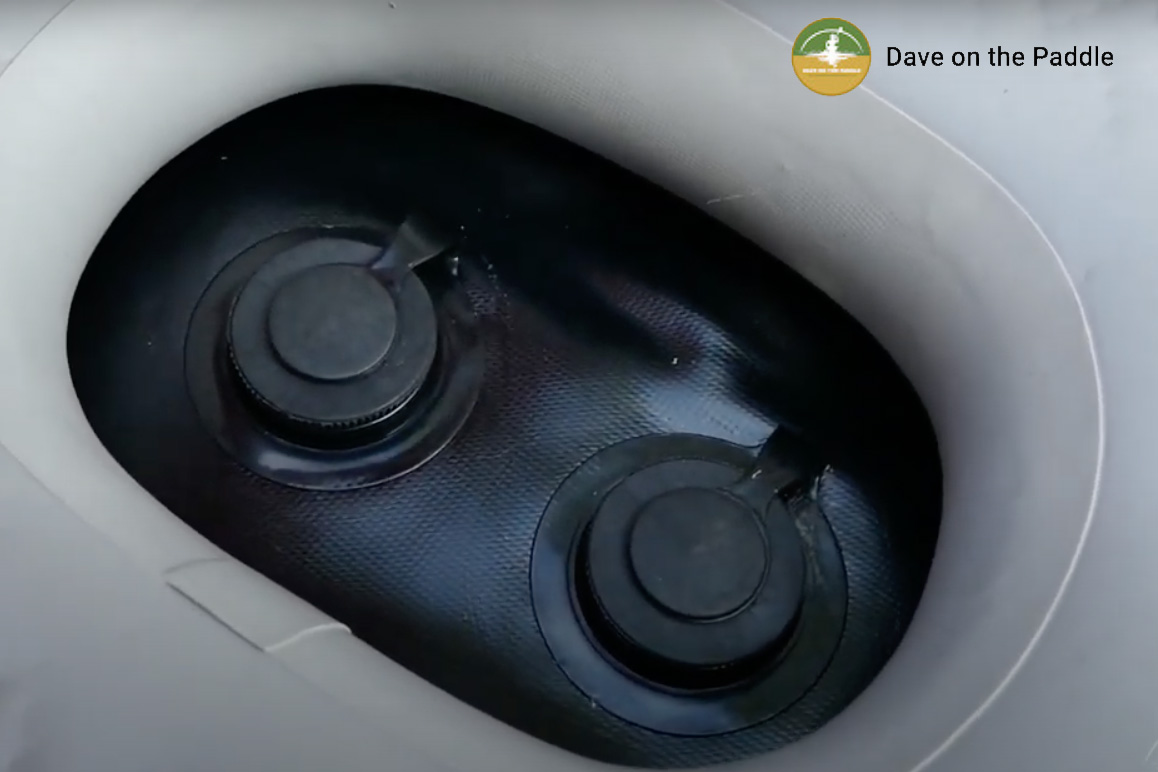
Thanks to glue-free heat-welding the whole high-pressure assembly is very clean with no untoward creases or anomalies. Only the black plastic end-cones stayed a bit deformed. I also noticed that after inflation the floor protruded a couple of inches on one side. But by the time I got back, a little hull flexing had realigned the two panels correctly. Underneath you’ll notice a ‘blister’ in the dropstitch (above right). This isn’t a flaw as some have thought, it’s opposite the floor panel’s inflation valve where there is no stitching.
To me this two-panel design just looks better than your boxy, three-panel FDS IK
Straight away you can see it’s not just two flat slabs of dropstitch, but a floor somehow folded up into a shallow ‘V’ to make a keel line (left) which, combined with the deep skeg, ought to ensure the Optimal paddles arrow-straight. The top panel has a similar downturn like the AE AirVolution, to ensure water run off the decks. These ‘clamshell’ angles create a space underneath each deck, but they’re too low to be of much use for storage.
At over 2.3 metres or 7.5 feet long and up to 50cm wide, the cockpit feels roomy for two adults. There are four D-rings on the floor for the backrest straps (but see below), with a four more rings up on the sides to counter-tension the backrests. A side benefit of the cockpit’s overhanging side rim is you can easily pick up and carry the boat. If there are two of you, use the nicely padded carry handles at each end.
The floor’s shallow V is reflected inside, so any water will pool along the centre line and, depending on the boat’s trim, will run back towards the drain plug hole at the back of the floor. In my opinion this a bafflingly redundant and marginally effective gimmick that gets copied from boat to boat. Either flip the boat over to drain, or position the drain in the stern cone A rear paddler could benefit from the back deck edge to lean on, and the front paddler might be able to use the edge of the front deck as a footrest. You might also shove a folded bag under either deck, otherwise gear will have to go under the paddlers’ knees or on top of each deck, using the bungy cords. They’re a commonly seen and inexpensive ‘feature’ on IKs, but I’ve never thought it a great place to lash gear that’s hard to access once on the water. As it is, used solo, there would be enough room to stash a camping load low on the wide floor.
Single seat set up worked well. A footrest tube could easily be added too.
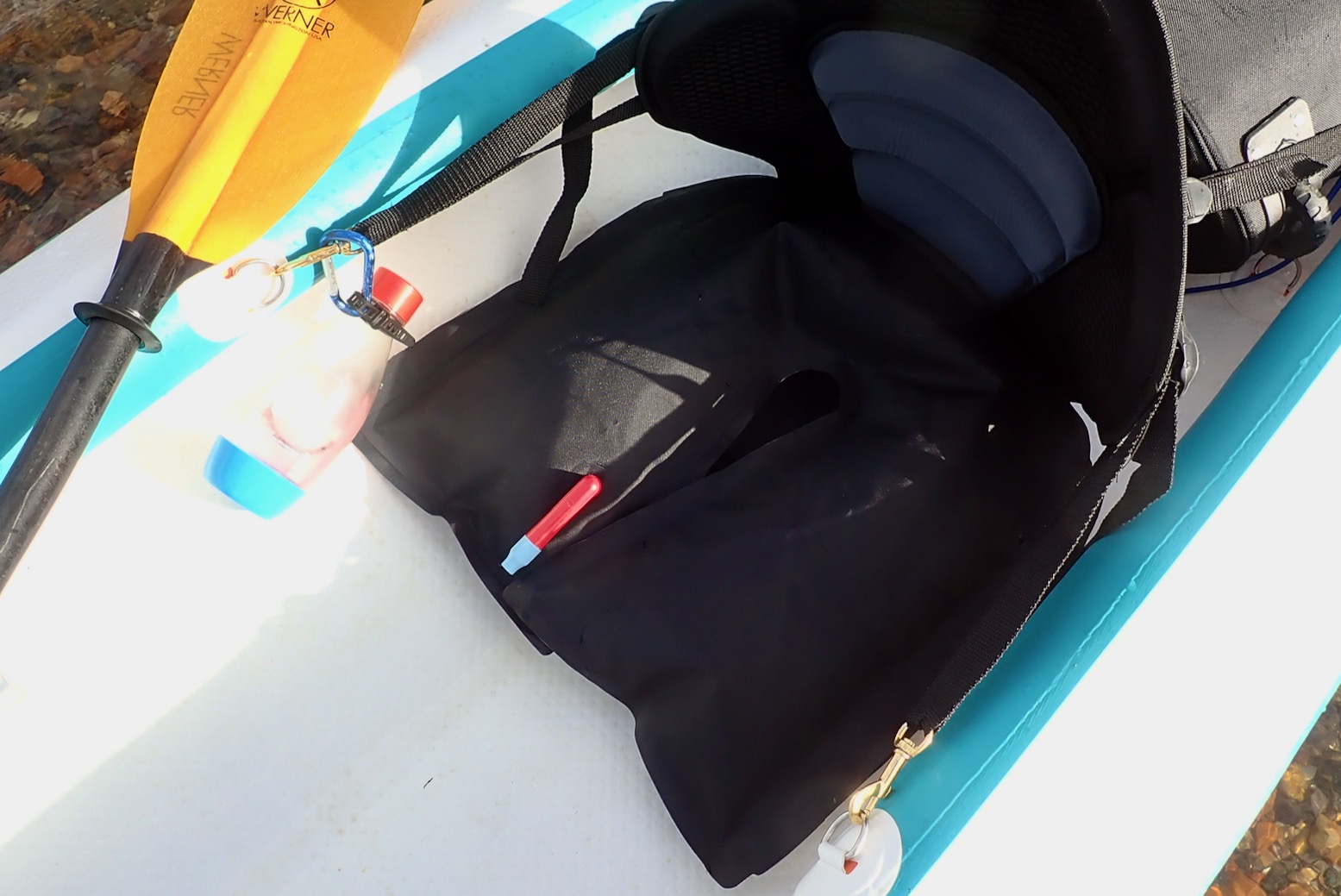
Seats are the usual light, stiff foam items, with four, two-point straps and brass-coated? clips to keep the backrest upright and get your position just right. The floor mounted D-rings for the forward straps would be better positioned on the sides, like the rear strap mounts, putting them in line with the direction of tension. Otherwise the backrest tends to pull down as you rest against it.
Thanks to these long straps I was able to fit the seat in the optimal rear-of-centre position for solo paddling, using all four of the higher D-rings on the sides, resulting in good back support. I knew the main problem would be the lack of a footrest and the ~inch-thick seatbase sat on a hard, 12psi floor; within an hour the backside and legs would be numb and the back sore from slouching. (I notice Sandbanks’ three-panel Explorers do come with footrests.) Expecting this, I’d brought an inflatable packraft seatbase to try-out, as well as a strap to rig up a footrest off the floor D-rings. Pushing off some kind of footrest stops you sliding down the seat, so enabling a proper upright paddling posture.
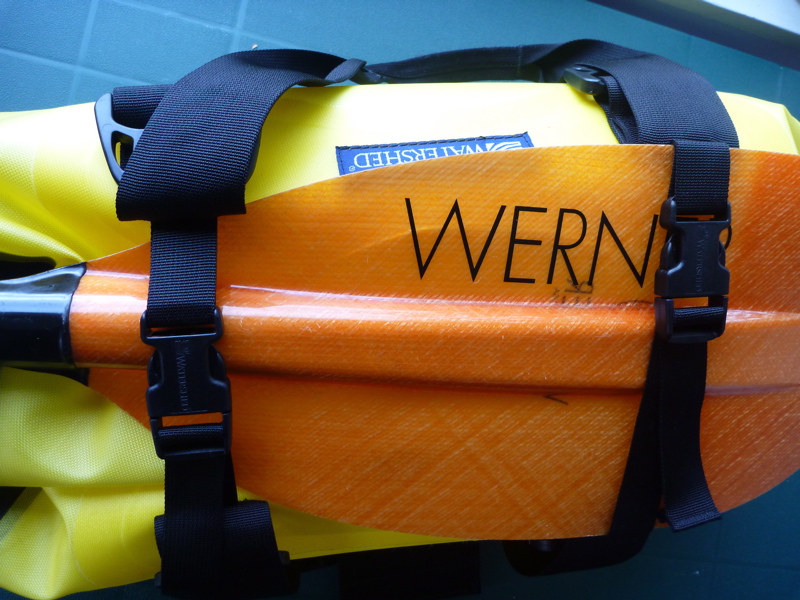
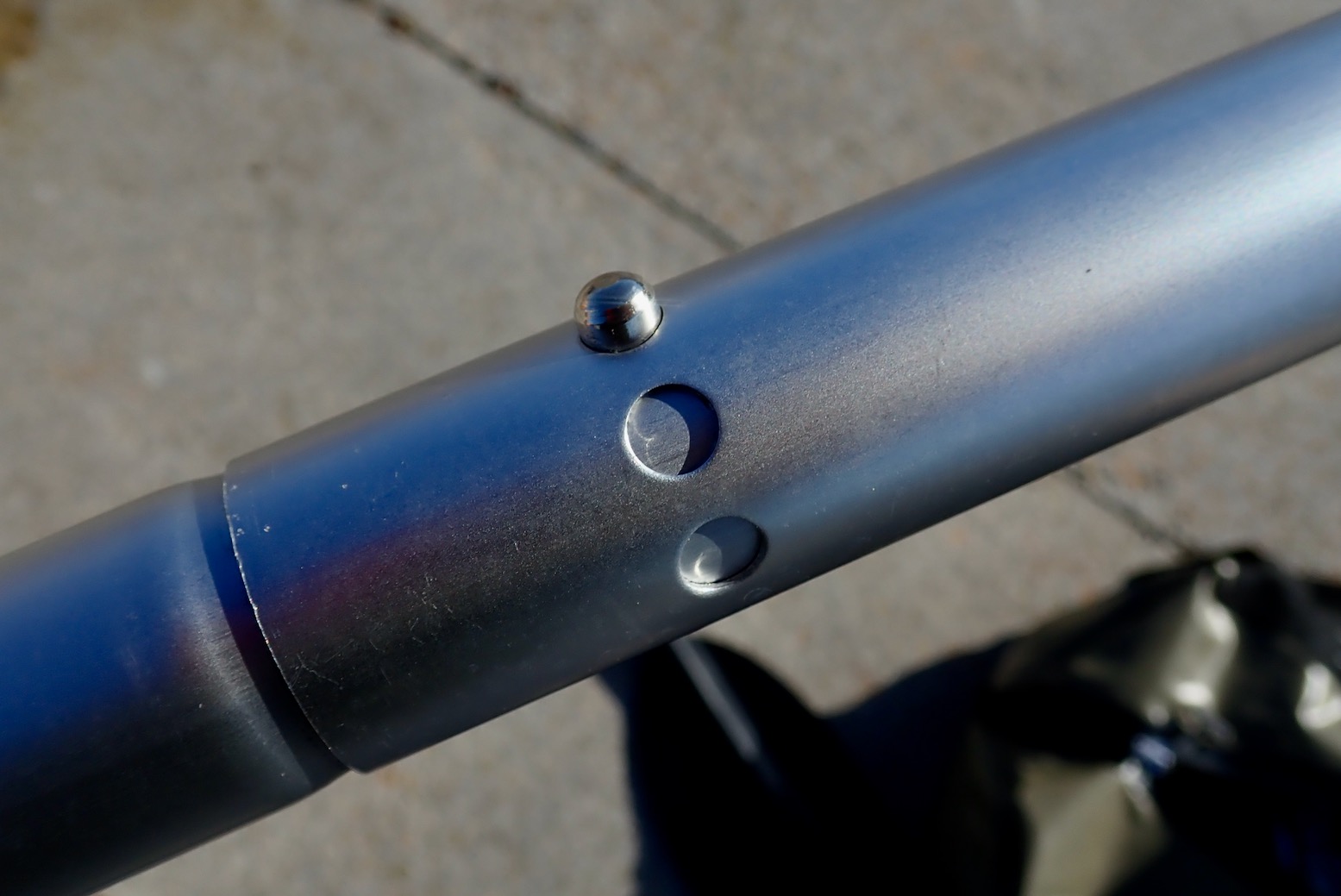
The 220cm four-part, alloy shaft paddle weighs around 950g and has three blade-angle adjustment holes about 45° either side of flat. It will do the job in calm conditions, but the soft plastic blade easily deforms. Expecting a mushy budget paddle, I brought my own Werner paddle.
Adjustable paddle angleSoft plastic blades
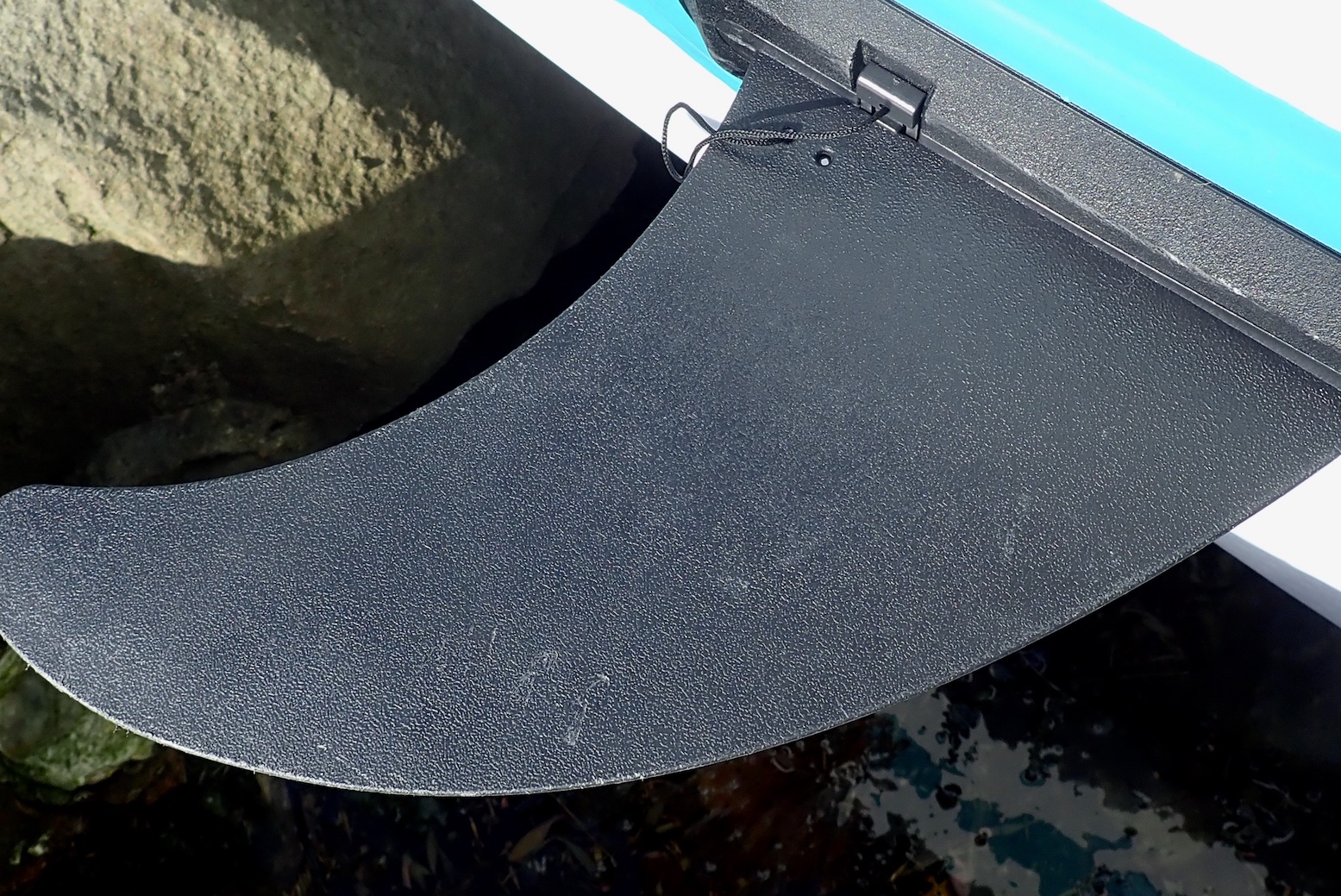
Underneath the stern goes the slot-and-peg skeg. At 20cm high, combined with the V hull, the Optimal ought to track like a TGV. There’s no conformity label stating recommended pressures, payloads, CE stamp and so on, but I noticed a serial number (‘HIN’) at the back. This was a used boat, but there was no repair kit in the wheelie bag pocket, nor is a kit listed online, but the Optimal comes with a three- (now 5) year warranty.
Not as plain a hull profile as you’d thinkAction stations
On the Water
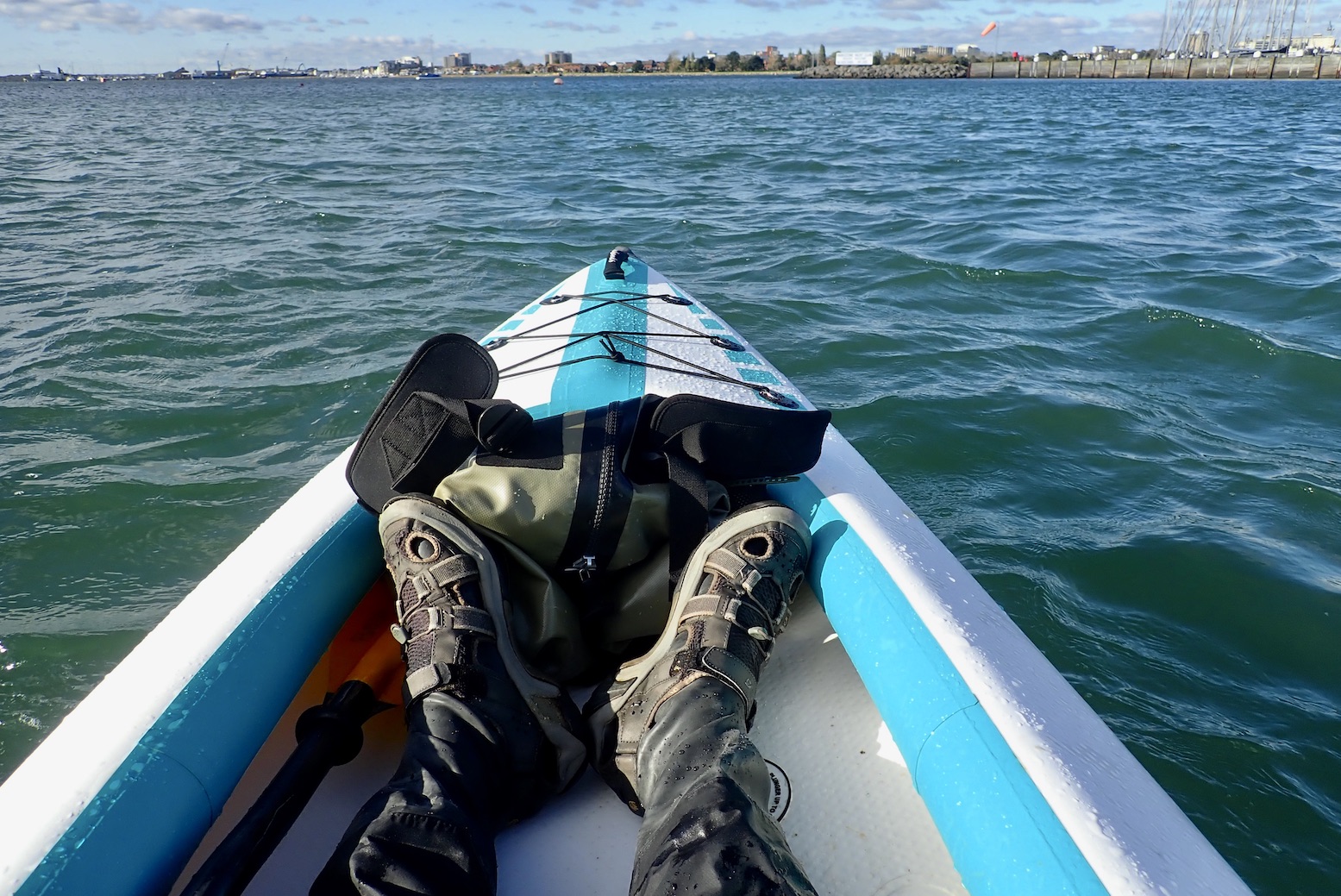
Putting in at Salterns jetty on the northeast shore of Poole harbour, I had various plans for my test paddle. Maybe a five-mile run out through the narrow harbour mouth to Old Harry Rocks which I’ve been keen to revisit. Or at the very least, a lap around Brownsea Island; about the same distance. But on the day a chilly, 20mph NNW wind reduced my options. Even a quick crossing to Brownsea would have made getting back tricky in an unfamiliar boat, especially as the peak of a spring tide would be running southeast with the wind by the early afternoon.
So I set off into the wind, heading towards Poole. Taking it on the nose with the Werner paddle was an effort, but with no fetch, the water surface was only a little ruffled and the Optimal cut through at a up to 4kph. But as soon as I turned a little off the wind the front was pushed round and required a lot of correcting (as would any buoyant and tall-sided IK on a day like today). I reached the shelter of another marina where above me the wind whistled merrily through a forest of masts, and the orange windsock waggled about a few degrees below horizontal.
Here I decided to rig up a footrest strap to help brace myself in the seat and improve my draw, then set out with the four-part paddle. I could feel the blades flexing as soon as I left the shelter of the marina and had to dig in, and also found the 220-cm length a bit short; at 92cm or three feet, the Optimal is as wide as a packraft. These budget four-parters with riveted-on blades are great for beginners and mellow paddles, but over time the joints will loosen up, creating even more slack. After a few minutes I swapped back to my stiff Werner.
Windy
The wind flattened the water with no chop to speak of, so I tried paddling across the wind – tricky in any paddle boat. The deep skeg meant the bow pivoted downwind, requiring masses of correction. Better to know this now than when trying to get back from Brownsea Island with a train to catch, so I put that idea to bed. Any IK would have struggled to hold its line broadside to the gusting 20mph wind, but if the plastic skeg was trimmed to half its length I suspect the hull would be more ‘balanced’ across the wind, while not sacrificing any tracking. This goes for any of the current crop of IKs with these overlong slot-in skegs. A spare skeg might cost a tenner, so the experiment poses little risk.
Turning the boat back into the wind was a huge effort; I was having to yank on my paddle from the middle to get it to turn. Once back on line I carried on up to some buoys and tried the boat downwind where it held it’s line well; the deep skeg and the flat water meant little weathercocking (back end coming round). As with any kayak, wavier conditions which momentarily lifted the skeg out of the water would have been a different matter.
I headed for a park on the north side of the harbour to hop out and see how the Optimal handled without the skeg. Coming back downwind, the boat tracked no worse than my unskeged Seawave might have done. You can’t paddle quite as hard while maintaining a straight line, but you can easily weave tight figure-of-eights in and out of some buoys. On a river with a current, the added manoeuvrability (and clearance) without a skeg might be a better set-up.
Plenty of low storage in solo mode
I also inflated my packraft seatbase (left) to see if the raised position and air cushion would be more comfortable. But on the hard seatbase and floor, it merely wobbled around like a jelly and made things worse. I know from similar accessory pads for motorbikes that you want just enough air to support your weight, but on a surface with no give it just didn’t work. A better solution would be to add a foam block similar to what came with the Arrowstream (but which on that boat I couldn’t use as the raised height made it unstable).
The wind was blowing me in the right direction anyway, but I decided to take back control and slip into what maps call the Blue Lagoon, an inlet ringed by houses with private jetties. Maybe ‘Blue Lagoon’ was cooked up by estate agents; it’s said this side of Poole Harbour has the highest density of Britain’s most expensive houses.
Appropriately, the tide dropping through the bay’s narrow entrance made accessing the Blue Lagoon tricky. I squeezed in along the edge of the current which was a good demonstration the boat’s agility and responsiveness. But once inside things were already getting too shallow, so I backed out and threw myself into the modest tidal race then ferried across it just to see if I could. Maybe the lack of a skeg (but with the footbrace) made this sort of manoeuvre easier.
Test route
I refitted the skeg and drifted south round to the lee side of my Salterns marina put in where all was calm as long as I kept close to the wall. Overall, with a skeg was better but as said, I’d try chopping a spare down by half.
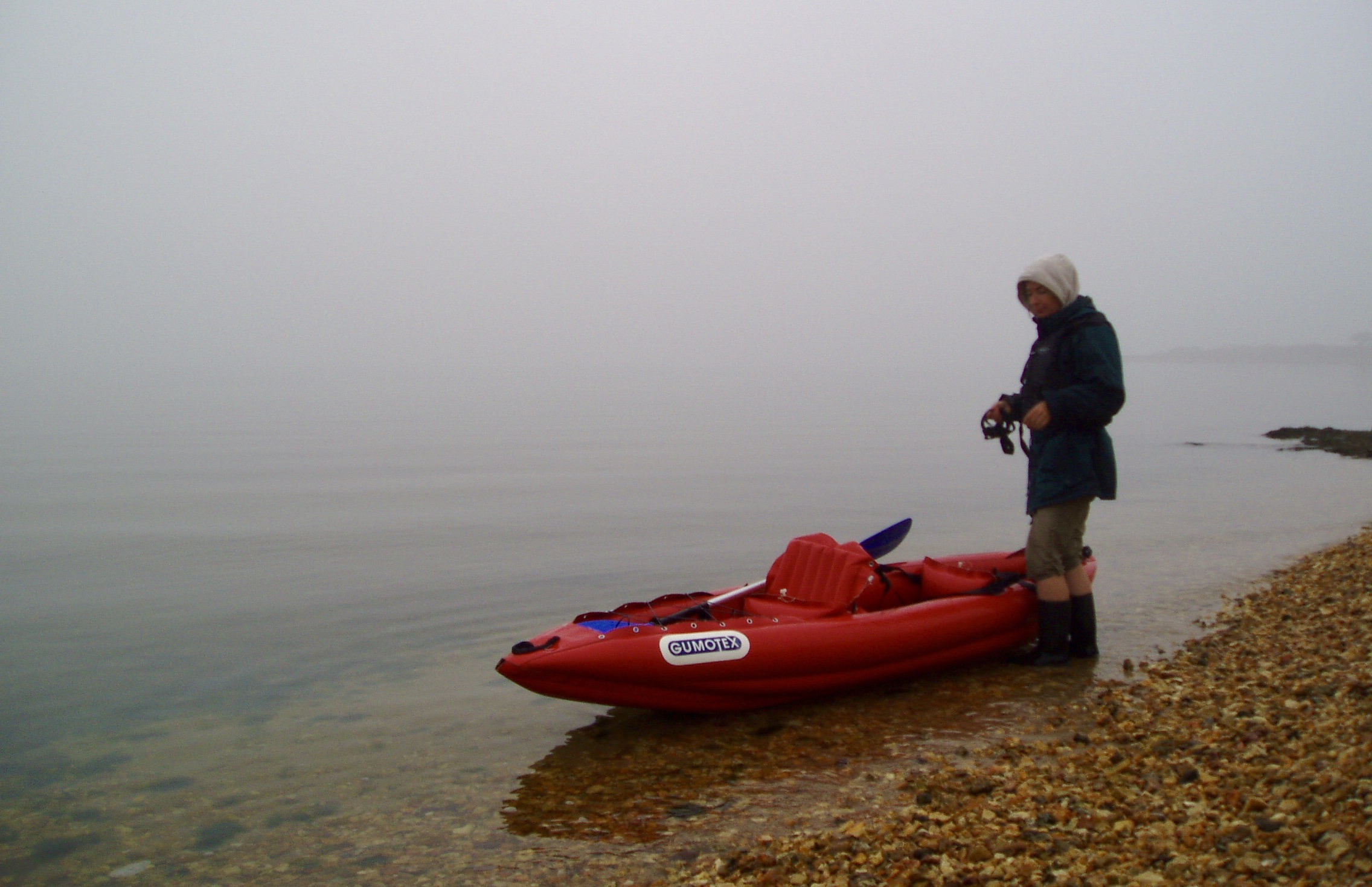
After ticking off a few selfies with the camera balanced on a buoy, I only just made it back round the corner to the jetty against the funnelled tide and wind, then bounced over the clapotis to where the sea had already dropped a foot, exposing Poole Harbour’s notorious mudflats. As newbs on a foggy day back in 2005 (left), we’d got caught out on one of my very first IK paddles in a Gumotex Safari.
Once on shore the Optimal rolled up into the bag easily, though having both valves at the same end would make purging the air in one roll easier (or having a pump with a suction port). Had I the chance, I’d have rinsed it by resting the bow up on something, open the stern drain and then deflate the floor. This ought to give you access to the otherwise sealed-off side cavities where debris and water collect. Then hose from the top and most of it will flush out the drain hole before a wipe down.
It was a shame not being able to get stuck into a proper paddle to somewhere, but I enjoyed my brief spin on the Optimal. For £769 at the time (£499 in 2025) – about £150 less than similar, heavily discounted Ottawa Pro doubles you might find online, and nearly half the price of the AE AirVolution, the Optimal is a solid double FDS which would work well solo once you add a footrest tube (easily done using the floor D-rings). Budget paddles and thin seats are what you’d expect at this price – as it is, comfortable seats are an issue with many FDS IKs. But the boat looks well made and the pump is easily up to the job. Plus you’re buying from an actual UK shop you can go and visit, not some shouty, sell-it-all web-based entity with flakey customer service.
As FDS IKs go, I think I prefer the two-panel ‘clamshell’ design. It feels more sophisticated, or is dynamically no worse than the the masses of three-chamber FDSs which sell for a bit less. The crux is stability which most recreational IK users rightly prioritise (or soon learn to). The Optimal may have that to excess, but as I also found on that very first paddle in 2005 (left), better too much than not enough.
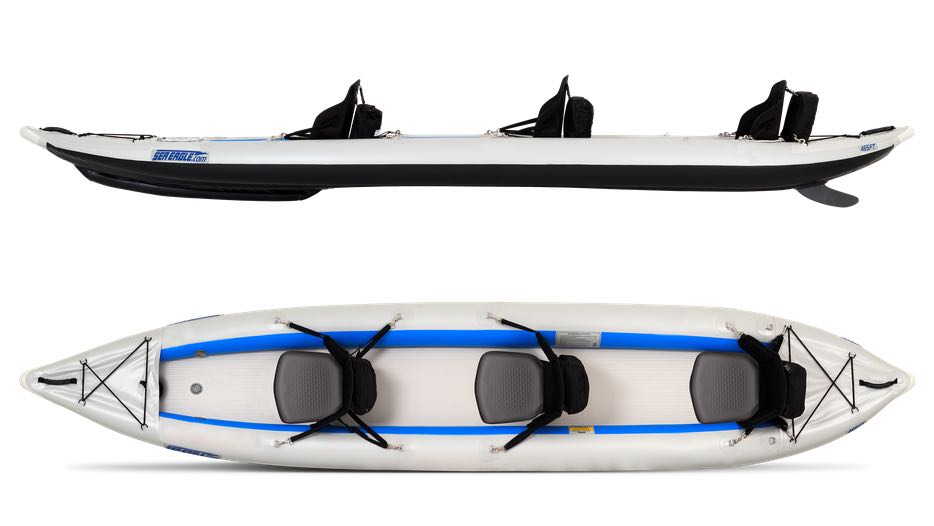
Sea Eagle’s Fast Track 465 (4.65m) is a high-end PVC IK has been around for several years, one of the earliest ‘hybrid’ IKs combining a removable dropstitch (DS) floor and conventional side tubes. It sits alongside their dumpy, all-tube SE cheapies, more whitewatery Explorers, and the all-DS, fixed-floor Razorlites. They even make a full-DS canoe. From the side the 465FT is a sleek looking IK with slender 24cm side tubes and the distinctive frontal keel under the bow to keep it on track (and which Gumotex have vaguely copied on the Rush models). Quoted weights vary as usual: from 17kg to a ‘hull weight’ of 20kg on the official US website. For a 15.25-foot PVC IK, 44lbs sounds about right.
Sea Eagles only sell these boats in ready-to-paddle packages which include a paddle/s and a pump as well as the usual wrap-around carry bag and repair kit. They start at $1600 or £1299, though in the US are regularly discounted by nearly 30%. When you read scathing ‘reviews’ of otherwise perfectly good IKs panned for not coming with a pump or paddles (even if that was clear at purchase), you can see why SE do this. Just don’t expect a stiff and light paddle. Upgrades include seats with proper backrests, as well as better paddles, three-seat combos and even rowing and motor rigs. And one thing that sets SE apart is the phenomenal 180-day return period and three-year warranty – at least for US customers.
Though you’ll struggle to see any evidence of this, the DS floor is removable, so it should be easy to clean and dry the boat. Assuming the floor comes out easily, the hull still has somewhat redundant closeable floor drains. Some outlets claim these to be self-bailing ports. There’s a big difference between the two: the former helps drain inaccessible cavities to help dry the boat without removing the floor; the latter allows waves that pour over the sides to drain away via holes in the floor – ideal for whitewater or surf. Such boats need thick floors to sit you high above the drain ports so the kayak doesn’t have water sloshing across the floor and soaking your butt. The 465 (and similar Aquaglide Chelan) doesn’t have a thick floor, though if you’re light you can give it a go. As it is, any 15-foot IK will be a handful in whitewater or surf conditions.
Oddly, the 2014 manual still online suggests you put the same 3.2 psi (0.2 bar) in the DS floor as the tubeless side tubes. Later models have ‘max 8-10 psi labels at the valves, but there is no way you’ll reach that pressure with the archaic foot pump supplied in some base packages. Then again, the couple in the video below inflated their 465 by foot pump. They represent perhaps the recreational core of SE’s customers: prepared to spend four figures but not that bothered about performance or equipment.
One thing that seems to be missing from online images are footrests. For all but the most undemanding recreational paddlers (which may be most of SE owners) a solid footrest to brace off makes a huge difference to paddling efficiency, while also stopping you sliding down the seat. It can have benefits to stability too, although at 91cm wide (36″) that won’t be a problem on the FT as some might find with the FDS Razorlites. Some D-rings could easily be glued on, but for what you pay, it’s odd to not see them included. They’re not even an accessory part. the drainpipe/strap idea I use on my IKs would work fine here.
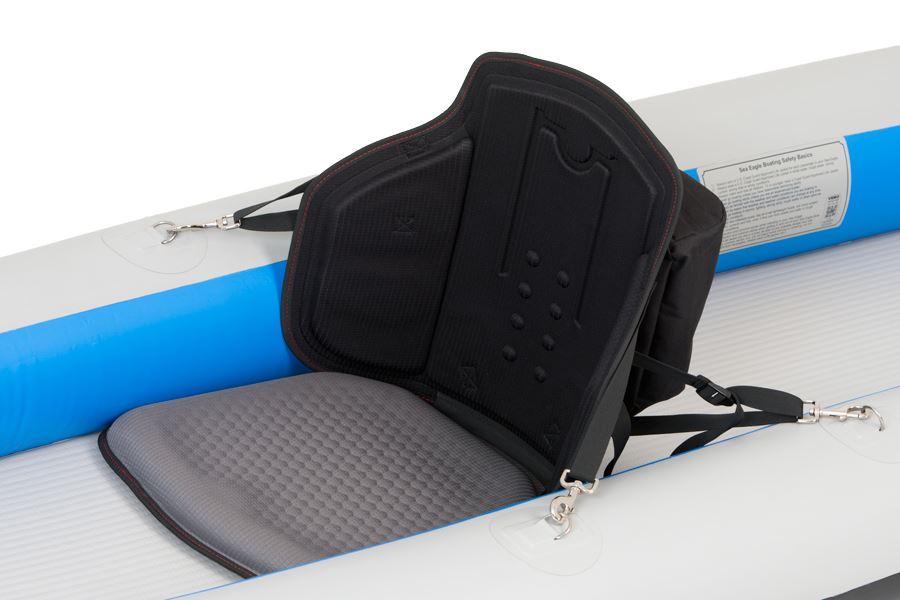
Deluxe seat
Tall back seat
What they call Deluxe seats are comfy looking vinyl blobs which sit you 5 inches up and clip to the hull sides (as well as the seat base). But because the backs are inflated (via Boston valves), they’ll have little support to lean on because low-psi inflatable backrests tend to crumple under pressure. Non-inflatable foam-board‘tall back’ seats (found on most other Chinese-made IKs) are supplied in pricier packages will have better back support, except the base is thinner. A slab of foam underneath will see to that, but without footrests you may not notice the benefits.
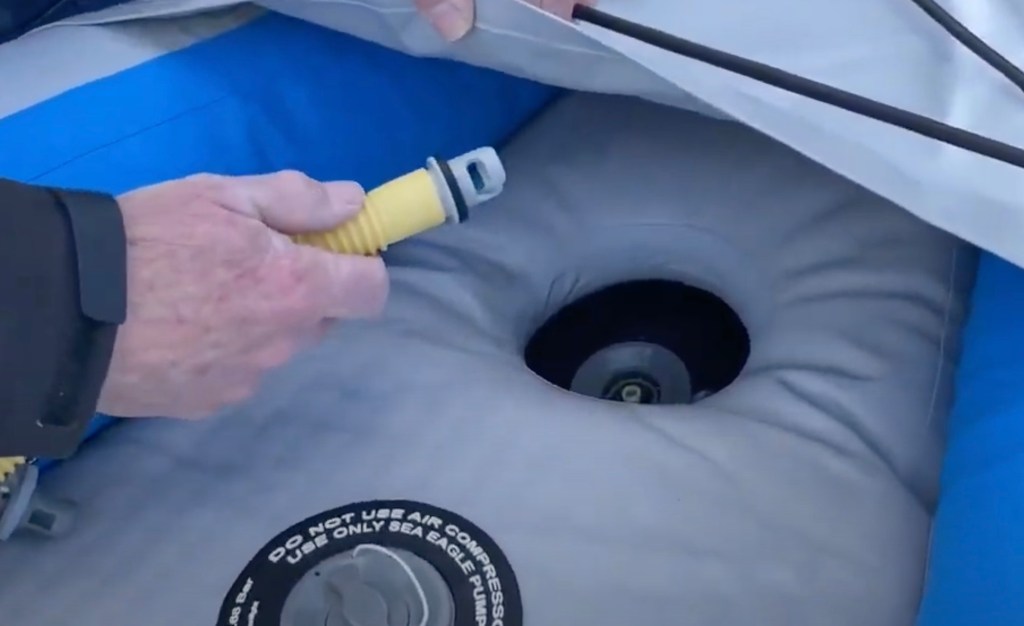
The innovative Needleknife frontal keel is inflated via a raft valve accessed by a hole in the front floor. Flat, DS-floored boats need some help here, and it does appear to greatly improve tracking, especially while not adversely affecting turning. If that’s the case you do wonder if a long, low slip-on plastic skeg, or just a keel strake as of the Chelan 155, might not work as well with less assembly complication. Perhaps the Needleknife’s softer profile works better, especially in sidewinds where the keel (and low sides) is said to deflect the boat less. There is a large slip-on skeg which is now more swept back, but could still be a bit on the long side. Luckily it’s easily replaced or shortened, but the boat will need some sort of skeg to track well.

















































 Inflatable Kayaks & Packrafts