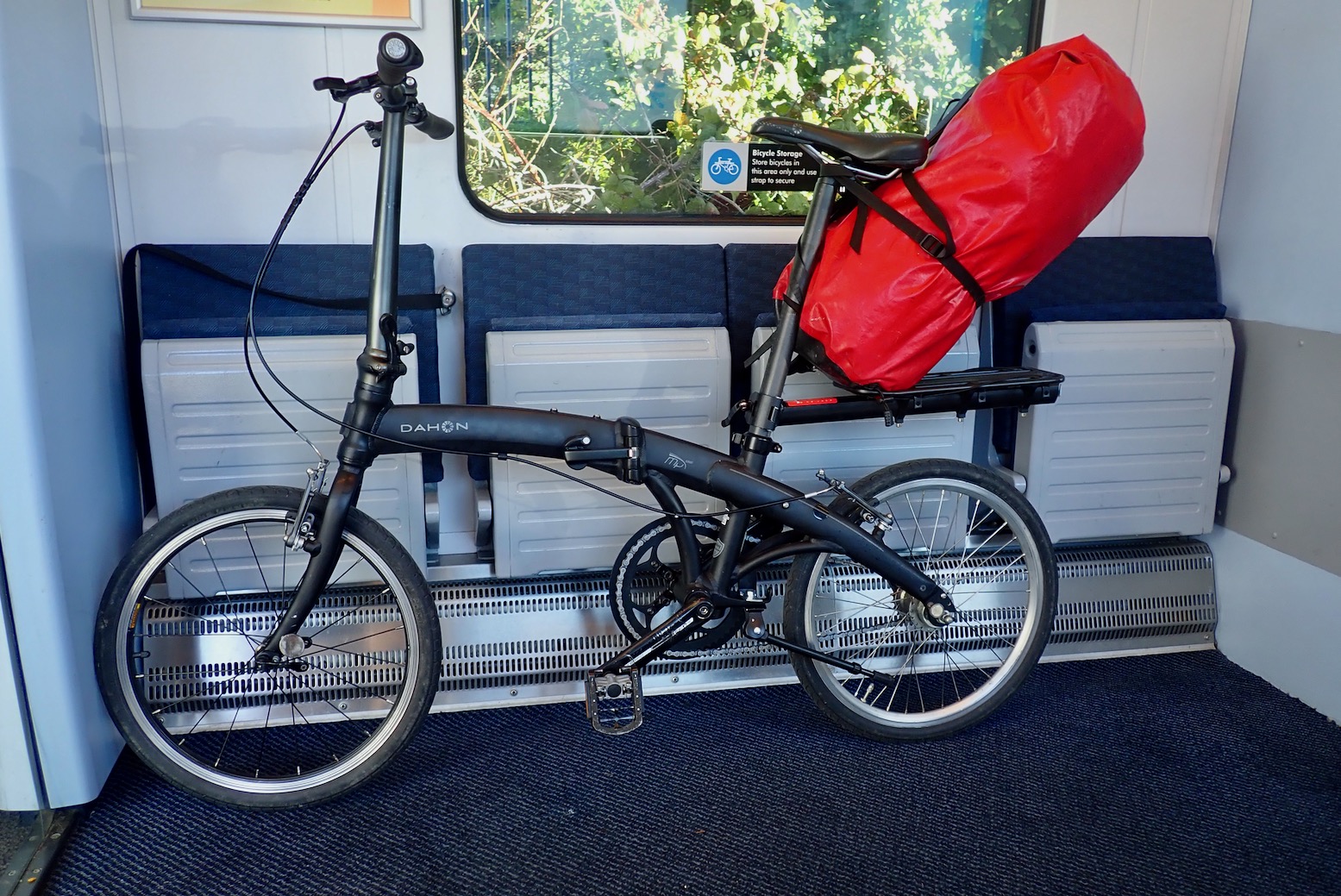
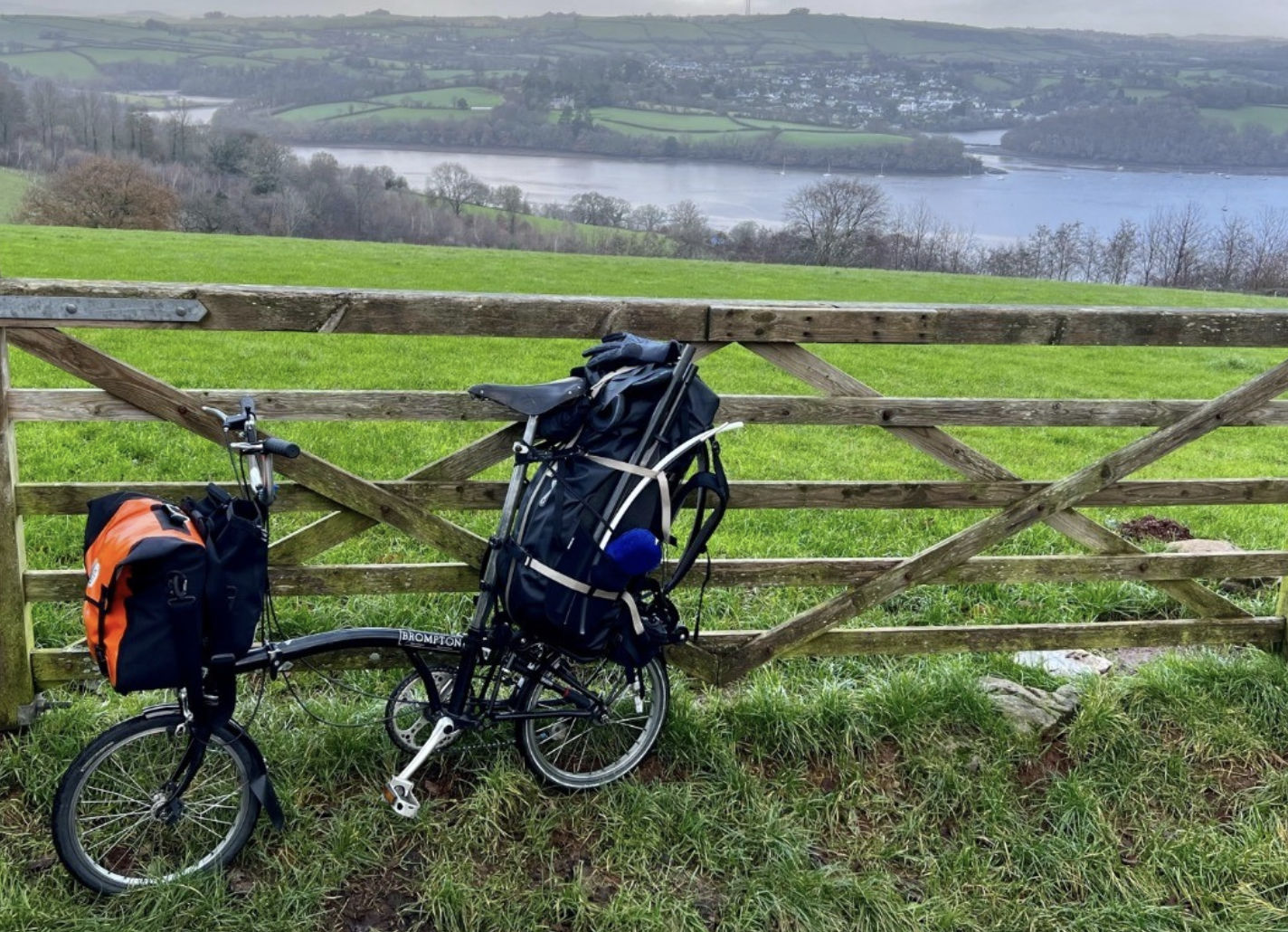
The other week I bought myself a Dahon folding bike, a long-established American brand with a French sounding name that’s probably made in China and in the UK is much less pricey than better known Bromptons. Folders seem to be going cheap right now as older folk move to e-bikes. I still have a couple of pedalling years left in me, I hope. At least 8 years old, my Dahon Mu has an unusual (and long discontinued) SRAM Automatix 2-speed hub, V-brakes and once folded up, weighs just 11kg (my MTB is 15kg). I could’ve waited for a 7- or 8-speed hub to turn up, but thought I’d give the Automatix a try. I don’t mind having one less cable and mechanism to operate. It shifts up automatically at a round 10kph; a bit too soon some say, but there’s an easy mechanical hack around that.
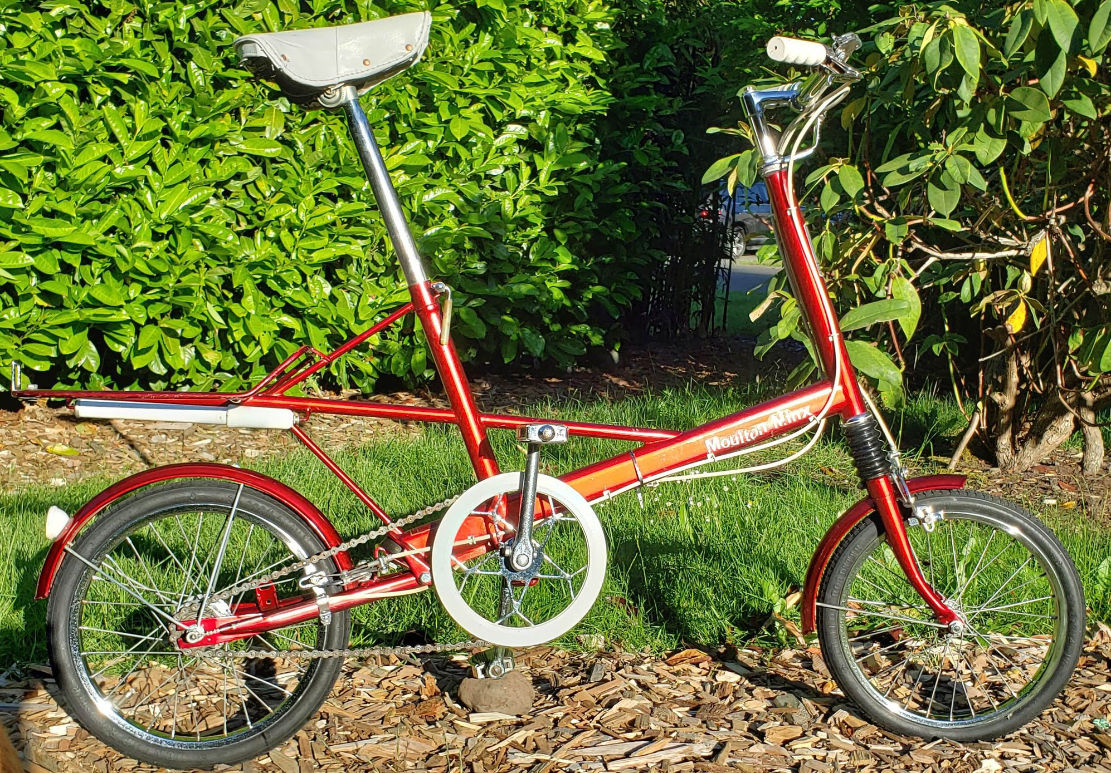
The Dahon reminds me of my Ferrari-red Raleigh Moulton I had in the late 60s, possibly my first two-wheeler. Along with being a groovy Sixties design, I think my mum thought small wheels = ‘sensible’, like a shopping bike. ‘Sensi-Schmensi? Hold my Tizer!’ My innovative ‘full suspension’ Moulton folded too, only not in a good way. Too much bombing around on Mitcham Common doing Evel Kinevel jumps one weekend saw the seat tube and stays fold backwards after one heavy landing. A decade and a half later California brought us the Apple Mac and mountain bikes and we never looked back.
Midsummer 2012, Joe Sheffer and Al Humphreys bikerafted to the top of Shetland using folding bikes. That’s my very first green Alpacka Joe’s paddling, a Denali Llama, just before Alpacka introduced the much copied extended stern.
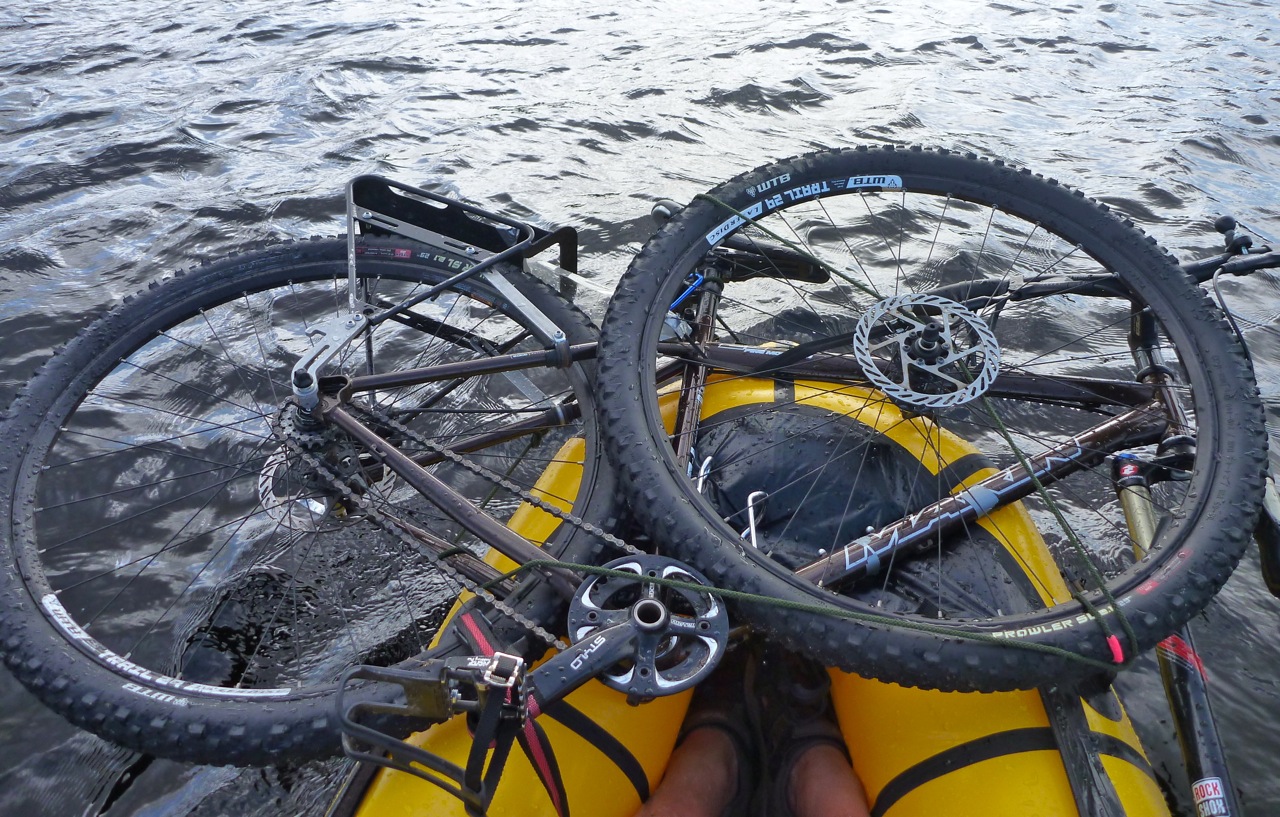
Years ago I tried bikerafting in northwest Scotland with my MTB. Up there it didn’t really work, the few roads were empty enough, but what paths and tracks there were were tricky on a bike with a boat strapped to it. I wrote in 2012…
… add a bike and any off-roading becomes marginal up here [FNWS]. Most of the time you’ll be pushing or carrying, especially with an overnight load. No MTB is really rideable on the footpaths up here, although unlike England and Wales, since 2003 Open Access allows cycling on all footpaths (there are no bridleways). Cross country and off the footpaths, at times you can barely walk, let alone ride a bike
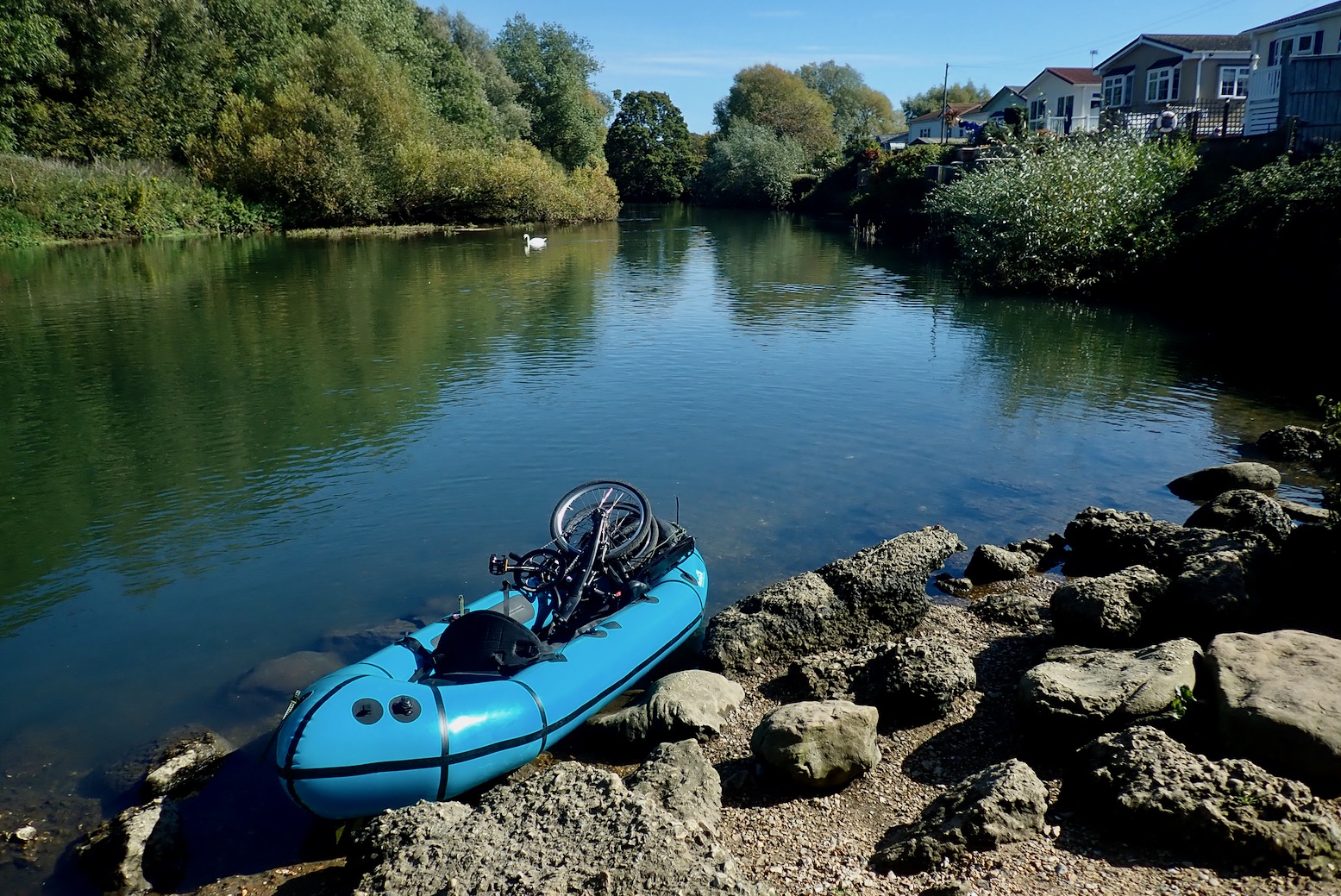
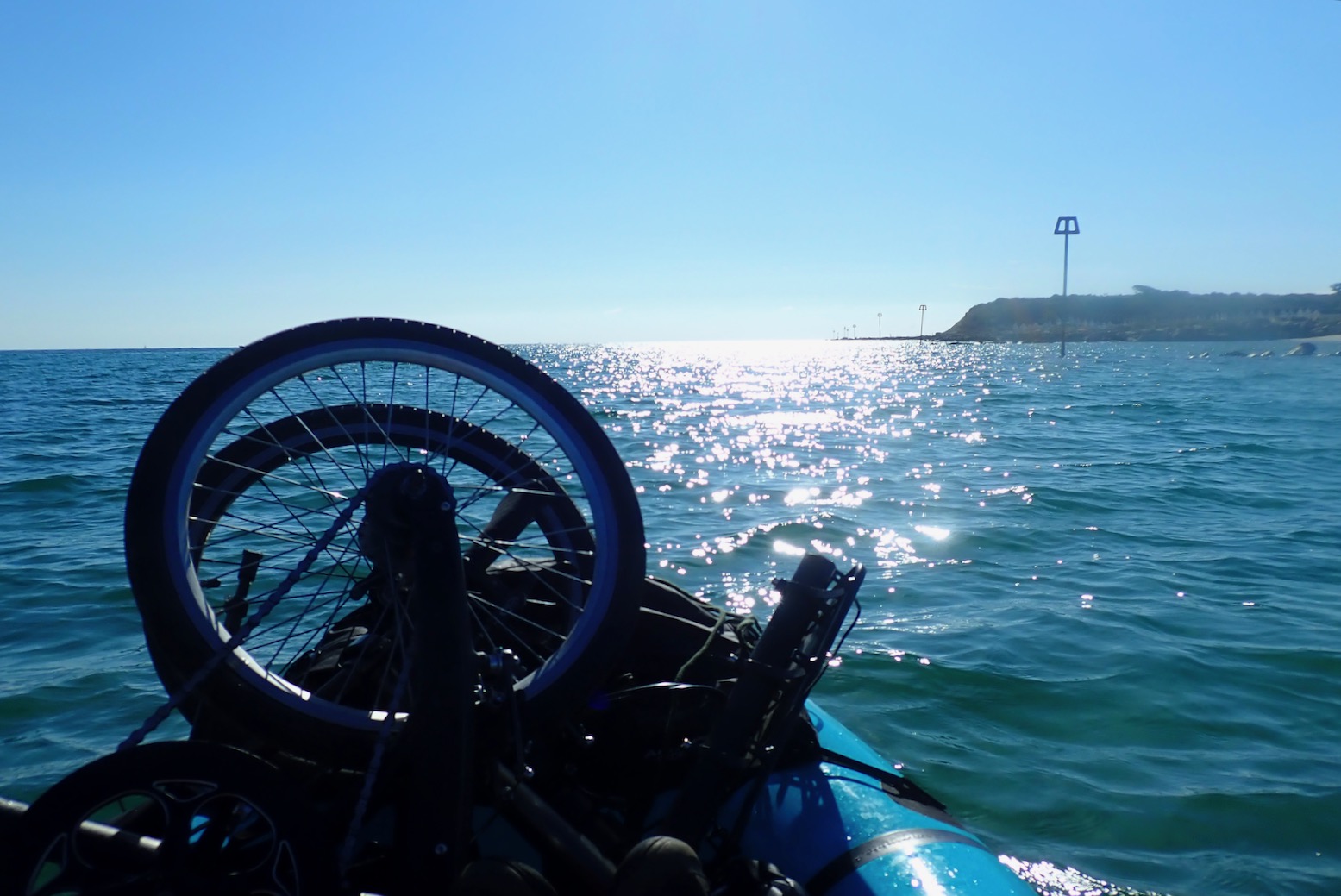
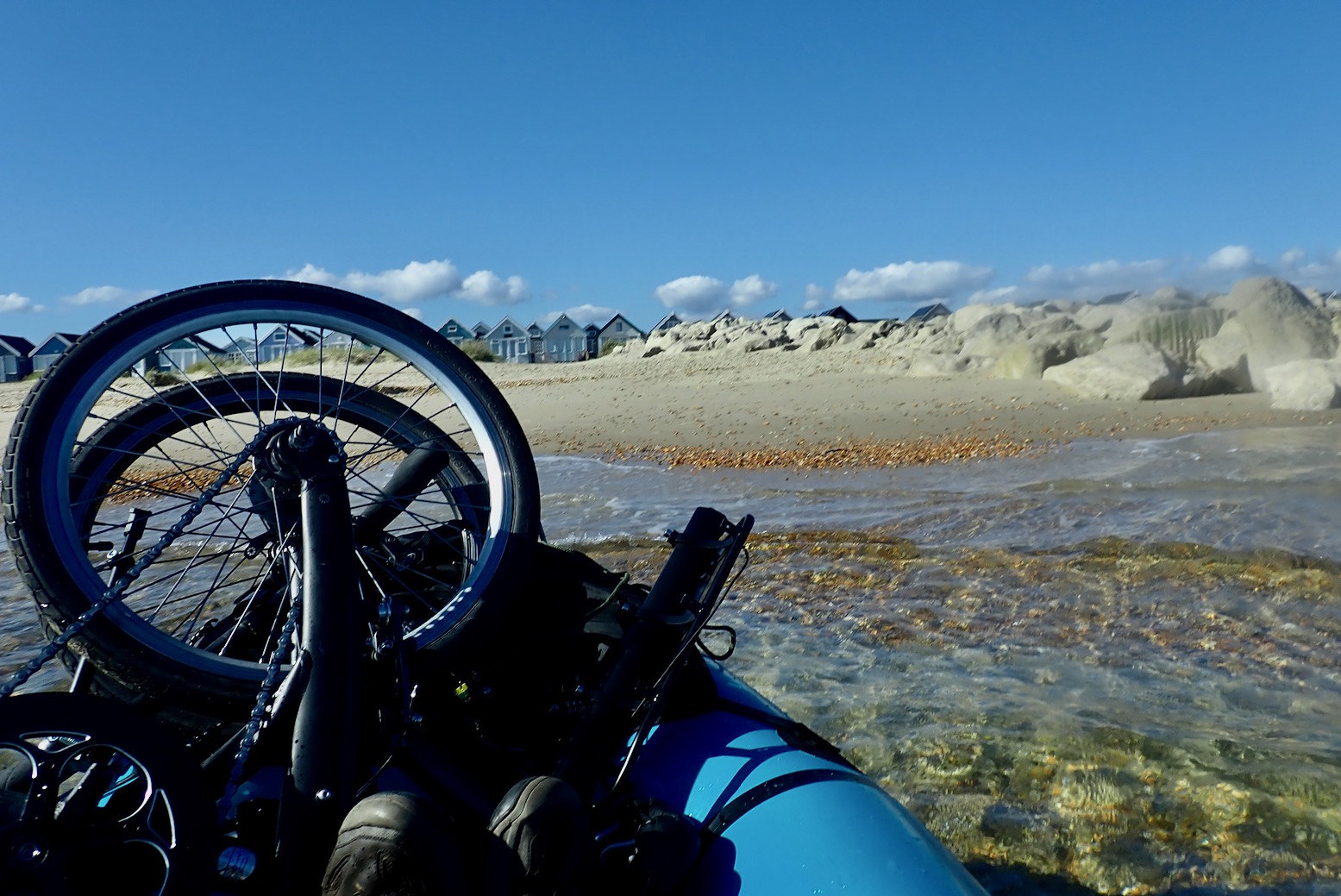
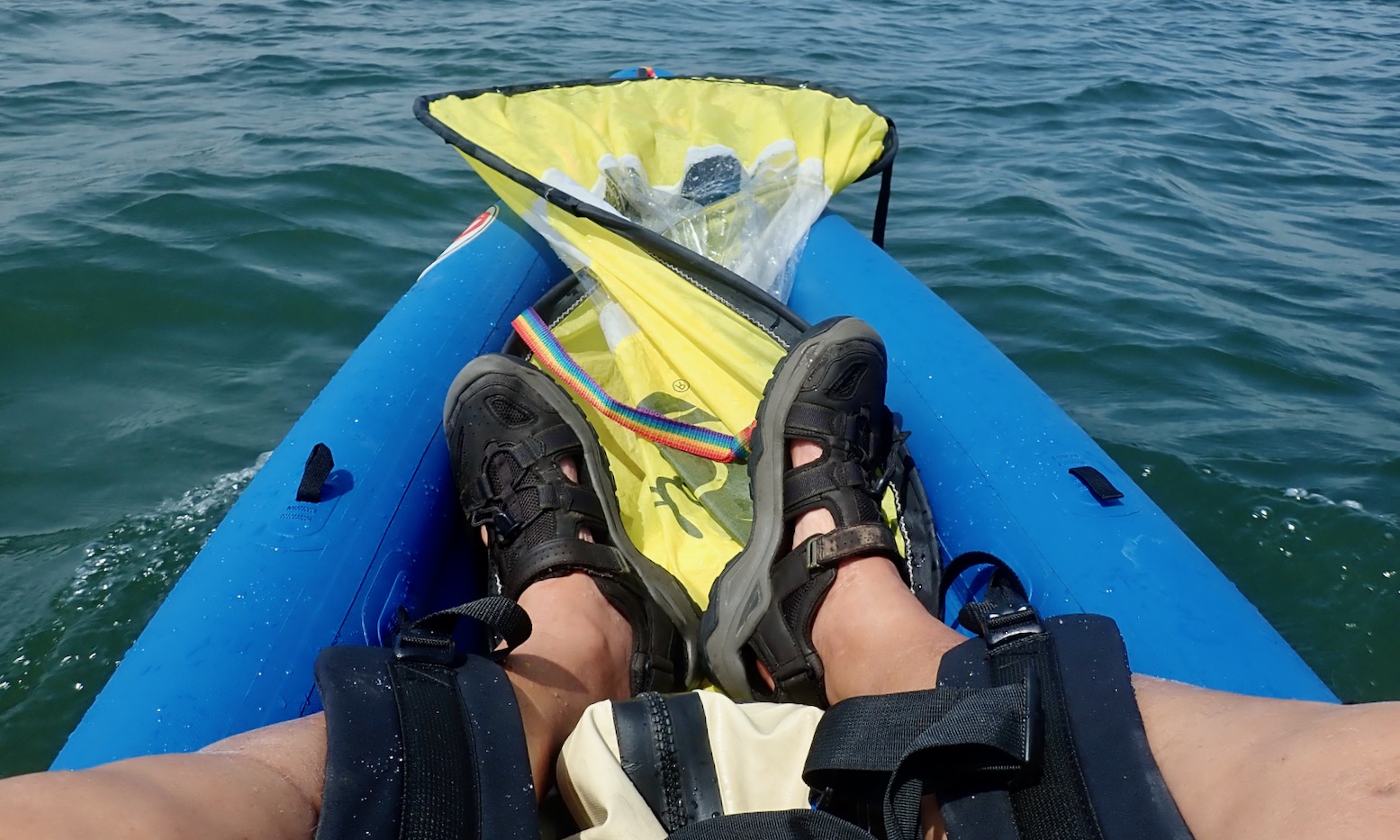
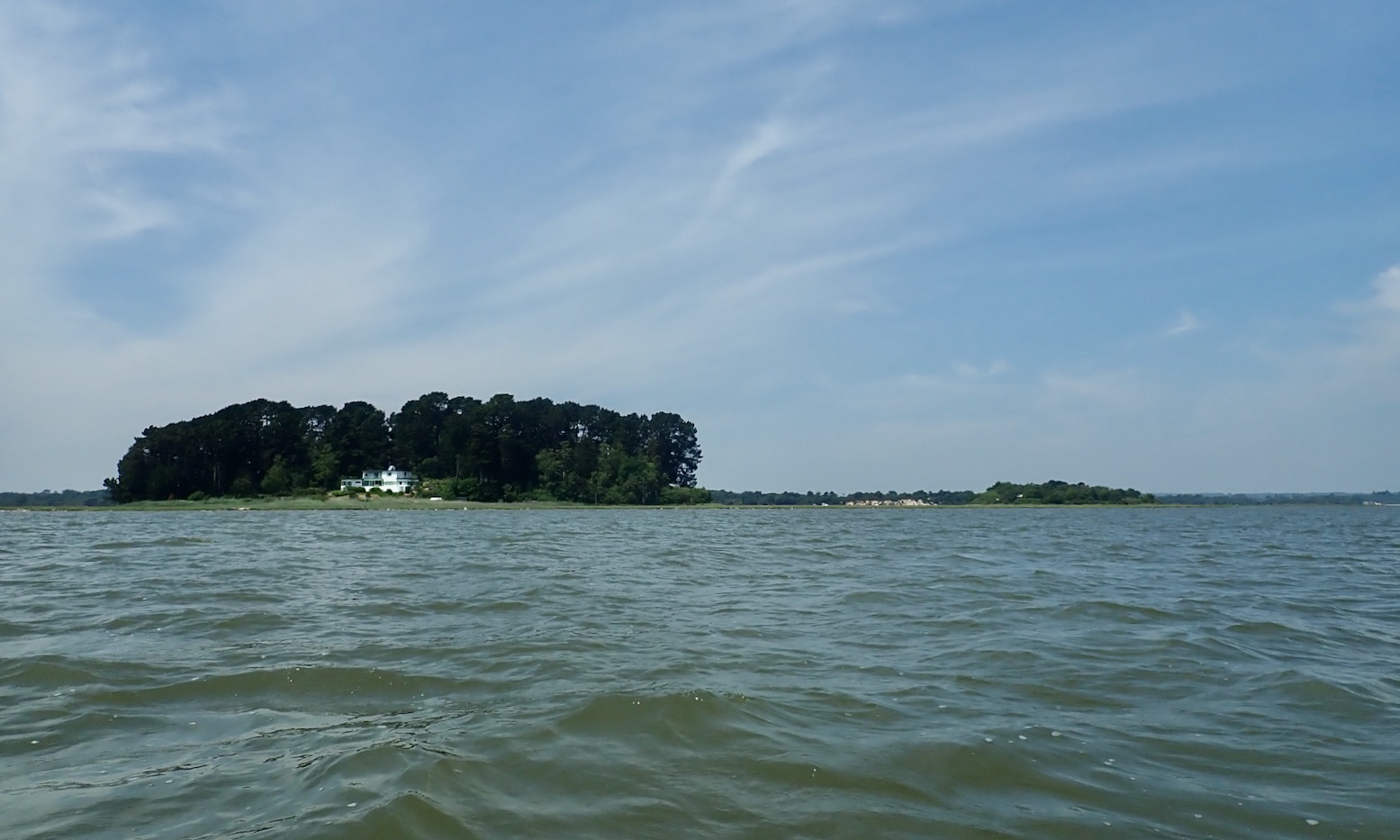
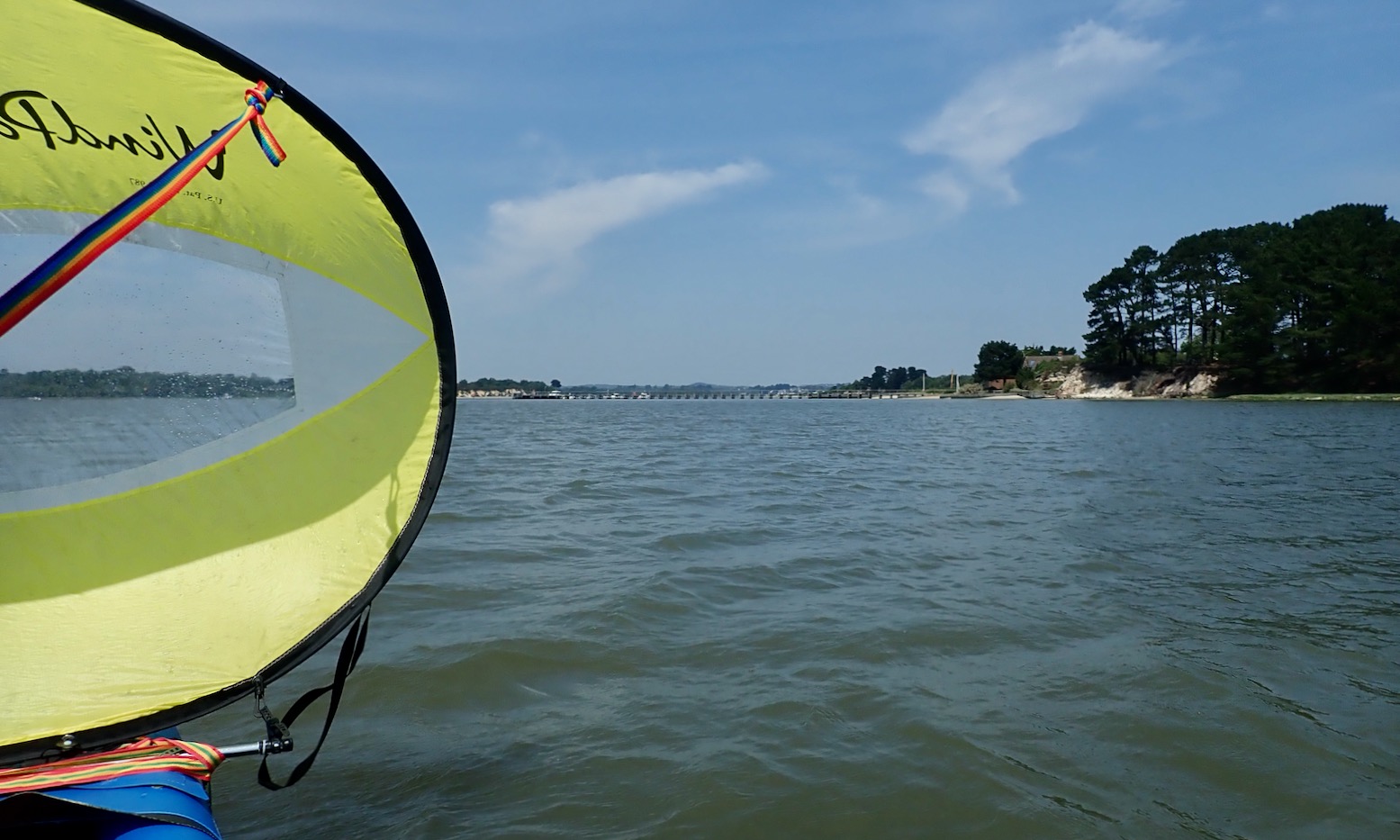
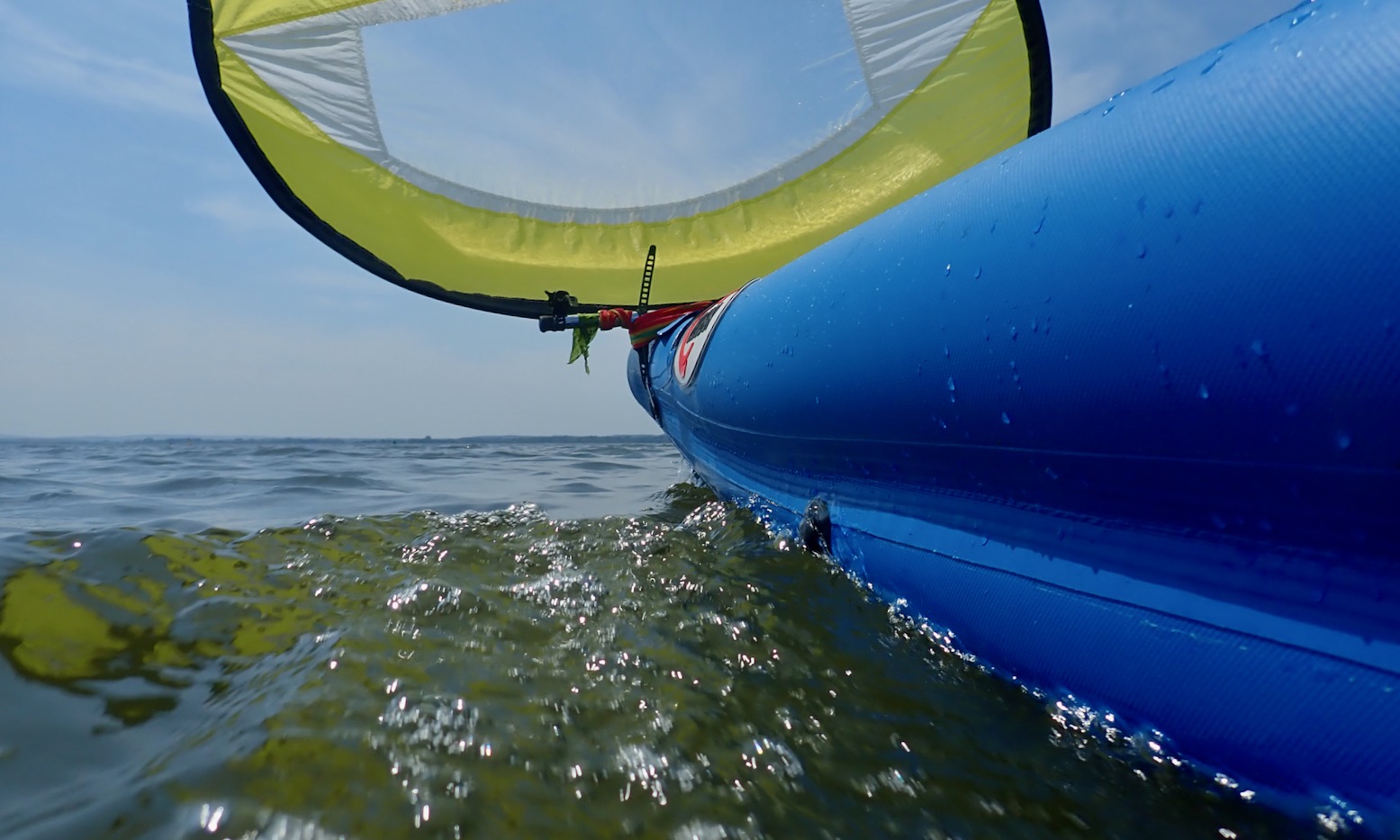
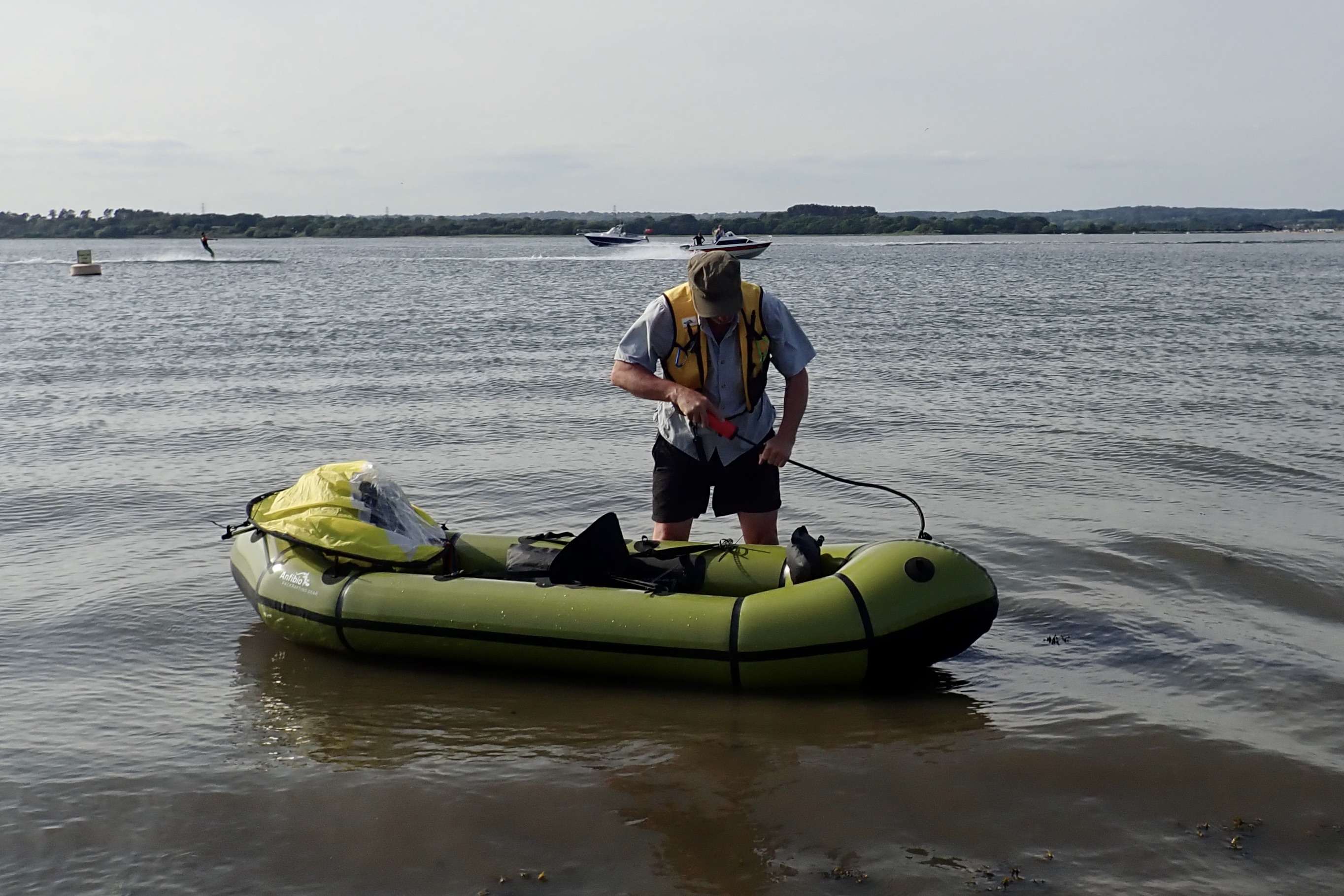
This time round I have a bigger packraft and a smaller bike. I pedalled down to the station and got a train to Pokesdown, a 10-minute cycle from Iford bridge (below) near the tidal limit of the River Stour. On the water I moved the seat back and dropped the folded bike at the front. Unlike a regular bike, the folded Dahon sits part in the boat so there’s no real need to strap it down on the long TXL. I put the bag under my knees and set off about 1pm on a rising neap tide (right) that was set to stay level in the harbour for the next few hours. Winds were 6-8mph from the southwest.
Iford bridge at the tidal limit of the River Stour
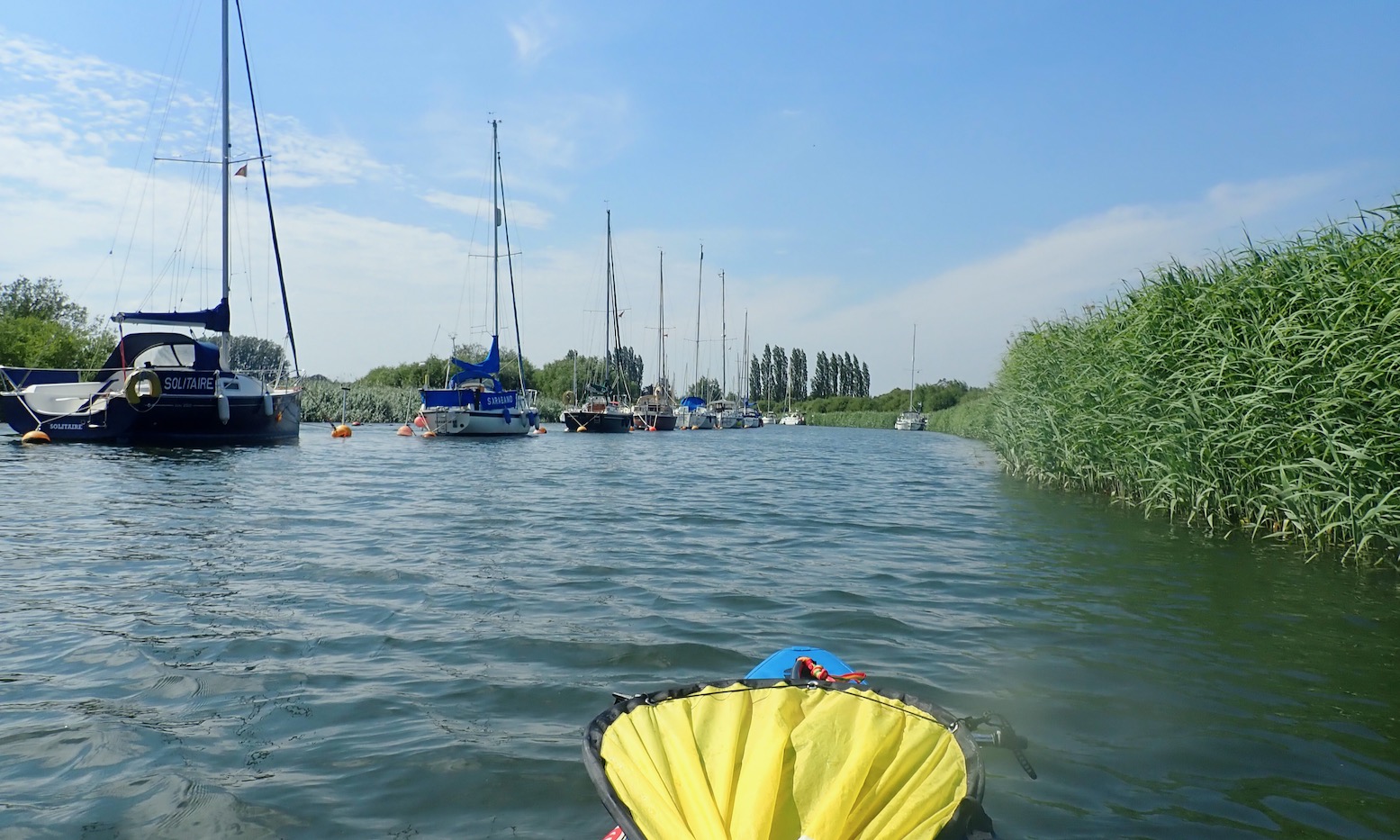
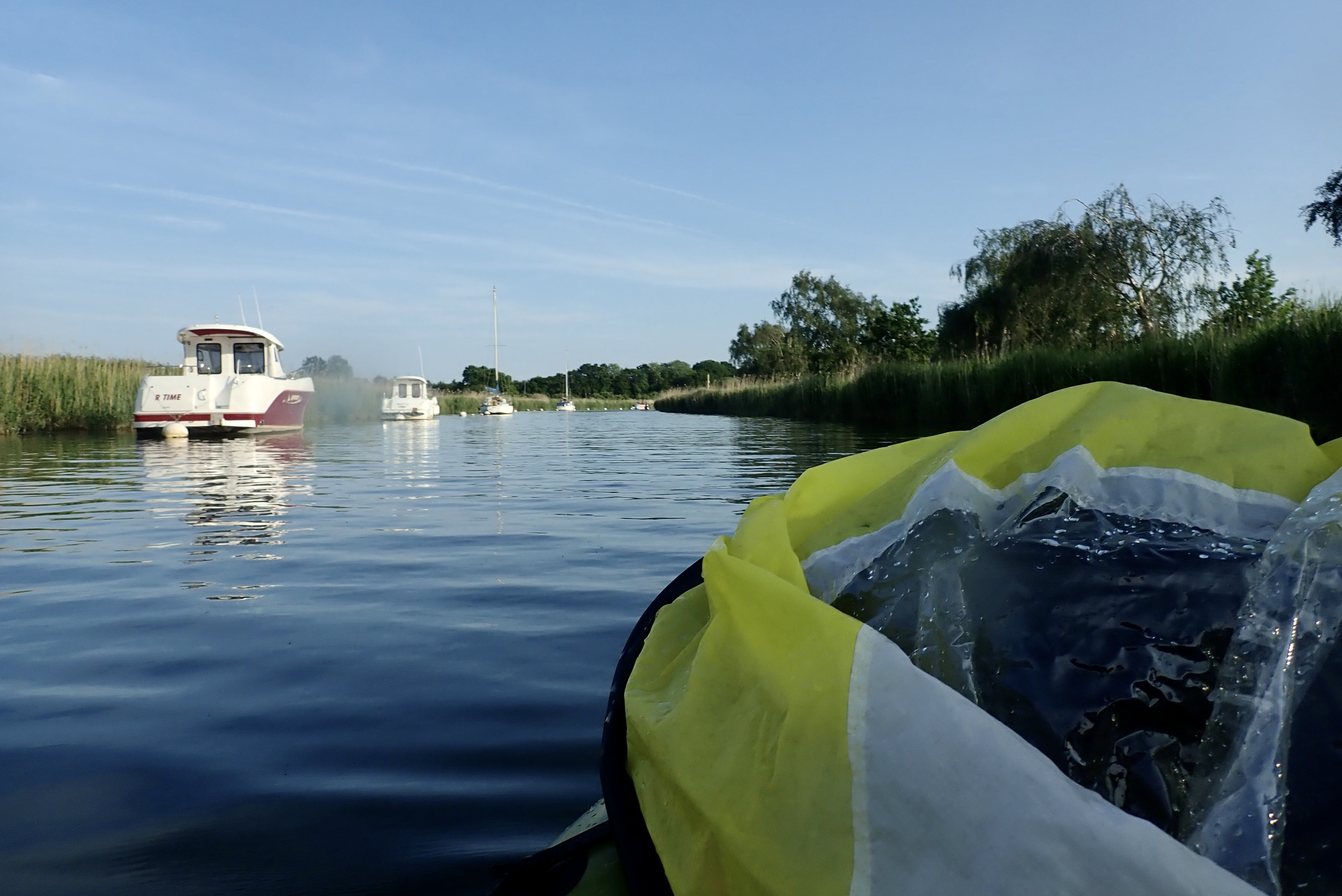
From Iford bridge, or Tuckton just downriver is a popular paddle boarding spot and a couple of women were putting in with me. You can see why. You soon leave any impression of urbanity and drift along between the lush trees with little other traffic.
Add the blue sky and all in all, these were as ideal packrafting conditions as you’ll get. The TXL feels a bit heavy with the 12kg bike, or I’m out of paddle practice.
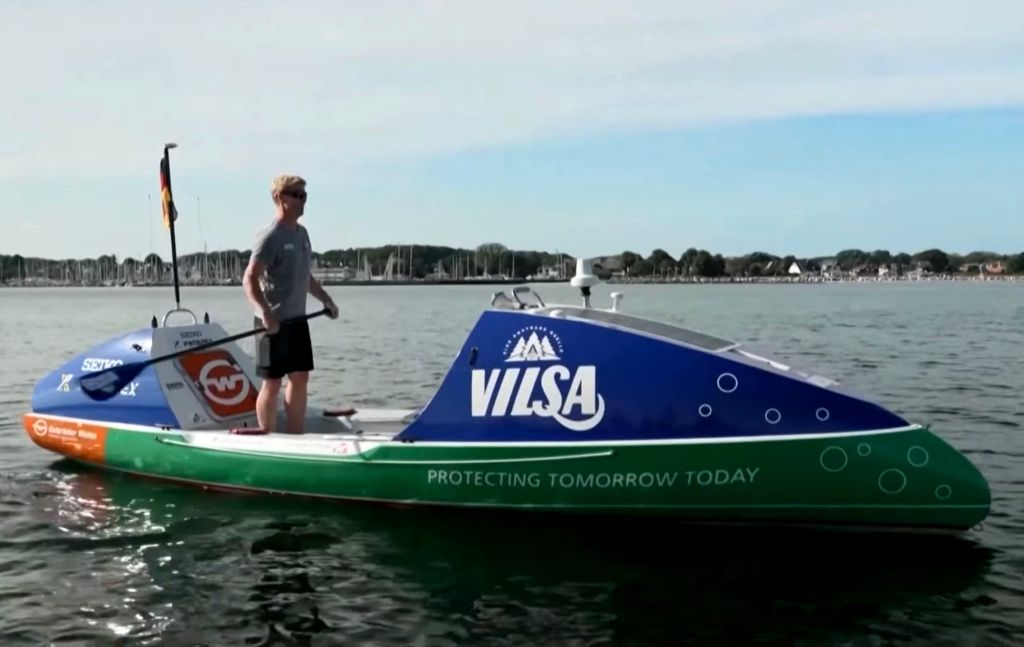
I pass a chap doing up an solo ocean rowing boat. It wasn’t this one which washed up nearby recently. Even with favourable currents and winds, it amazes me a single person can row a ton of boat across an ocean. But they can and they do.
I just read about Michael Walther, who adapted a similar boat to ‘SUP the Atlantic’. He set off from Spain and in two weeks covered 1150km to the Canaries averaging 3.9kph. Explanations seemed vague (boat damaged close to the port) but the trip ended there.
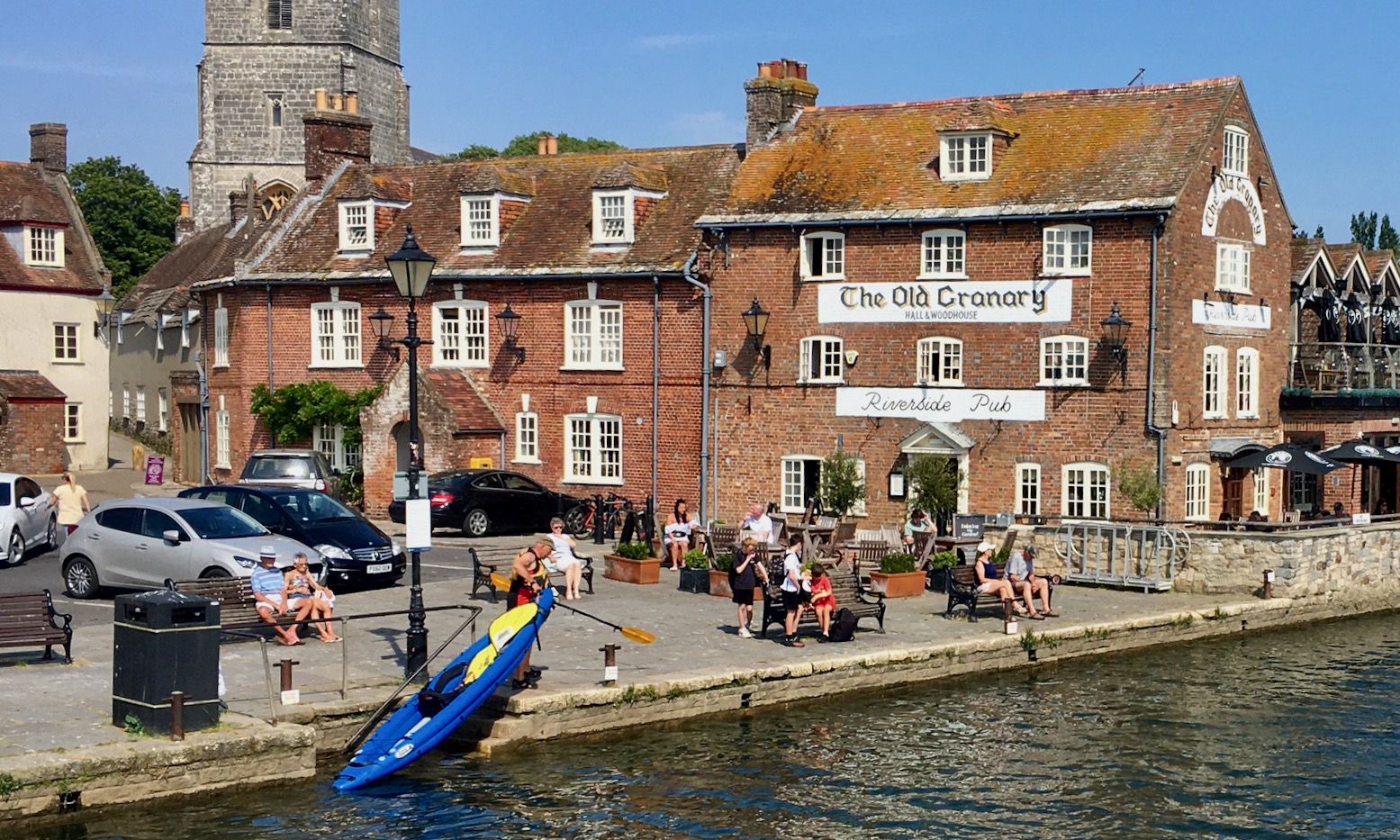
Soon rows of mega boats crop up with the the priory behind. Christchurch is like a millionaires’ Wareham.
Past Christchurch the land opens out. I sense the sea ahead.
A lot of boat for a little space. But a lot more stable than a little Dahon Mu with a packraft on the back.
I stray too far north into the protected shallows with just six inches of water. The marked boating channel follows the harbour’s southern edge.
From Hengistbury hill looking north. Note the tourists train for the weary of limb.
The harbour’s narrow outlet at Mudeford Quay.
Mudeford Quay from the hill.
As I passed through the channel I was hoping to be temped ashore by the aroma of sizzling seafood.
No discernible tidal flow in the channel today. Out into Christchurch Bay it’s only 13km to the Isle of Wight
Wanting to string things out, I paddled south into the wind and tide towards Hengistbury Head. It felt a bit more fun to be pressed against the elements (knowing there’s only 10 minutes of it).
I take out at the last beach before the Head.
That was an easy and very enjoyable paddle. Only 8km over 90 minutes.
‘That’s a good set up you got there’ said a woman. ‘Yes it is’, I replied. The complete solution to amphibious mobility for the recreational enthusiast (I did not add).
I weave along trail across the beach
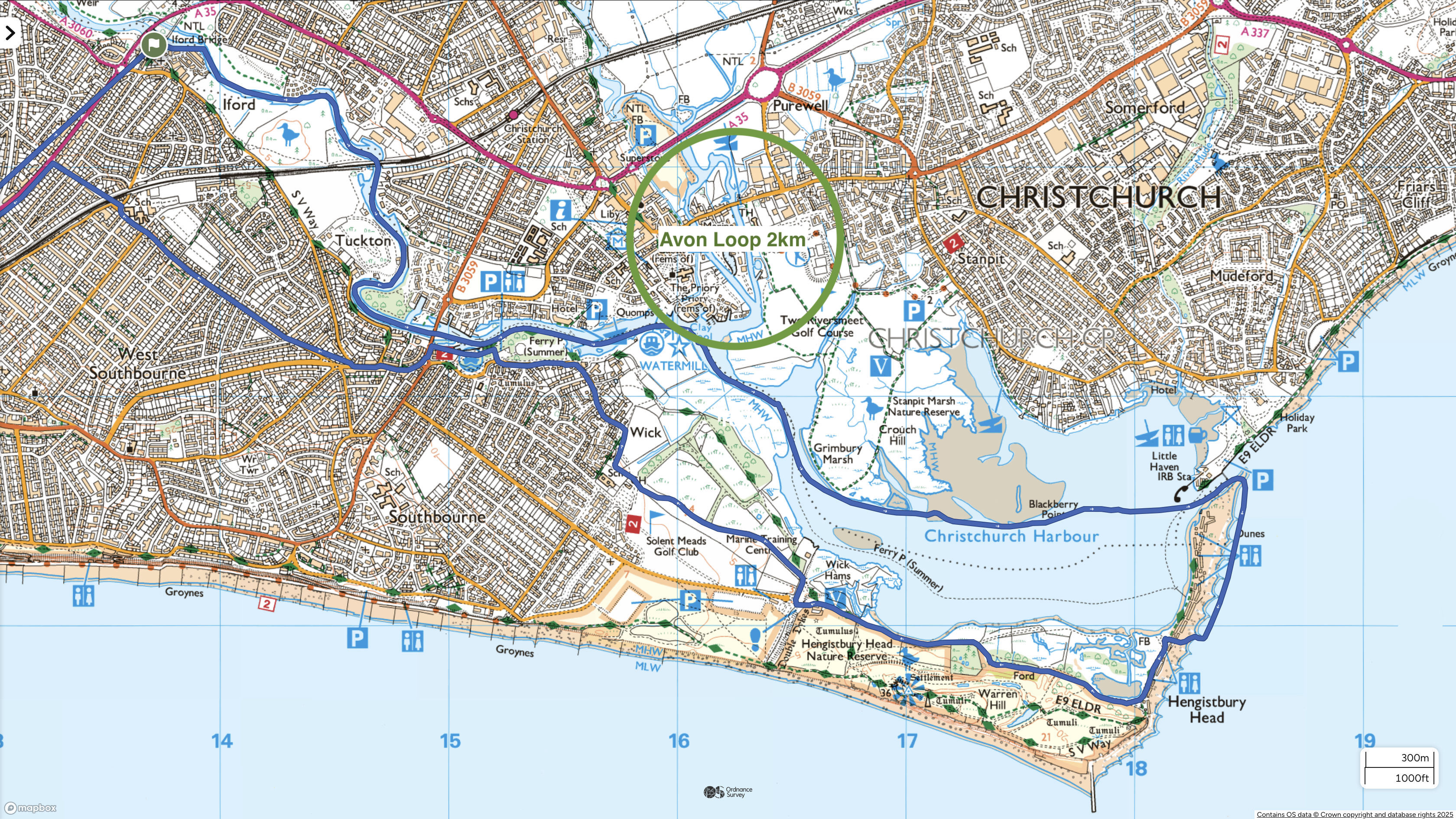
Harbour map. A fun place to explore with bike or boat or both.
It’s about 8km back to Pokesdown station, half of it on tracks.
Christchurch Priory and the water meadows, as not painted by Constable.
Only a tenner for 2 slices and a big cappucho. I suppose I needed the energy but that cherry slice had enough sugar in it to preserve a herd of dugong.
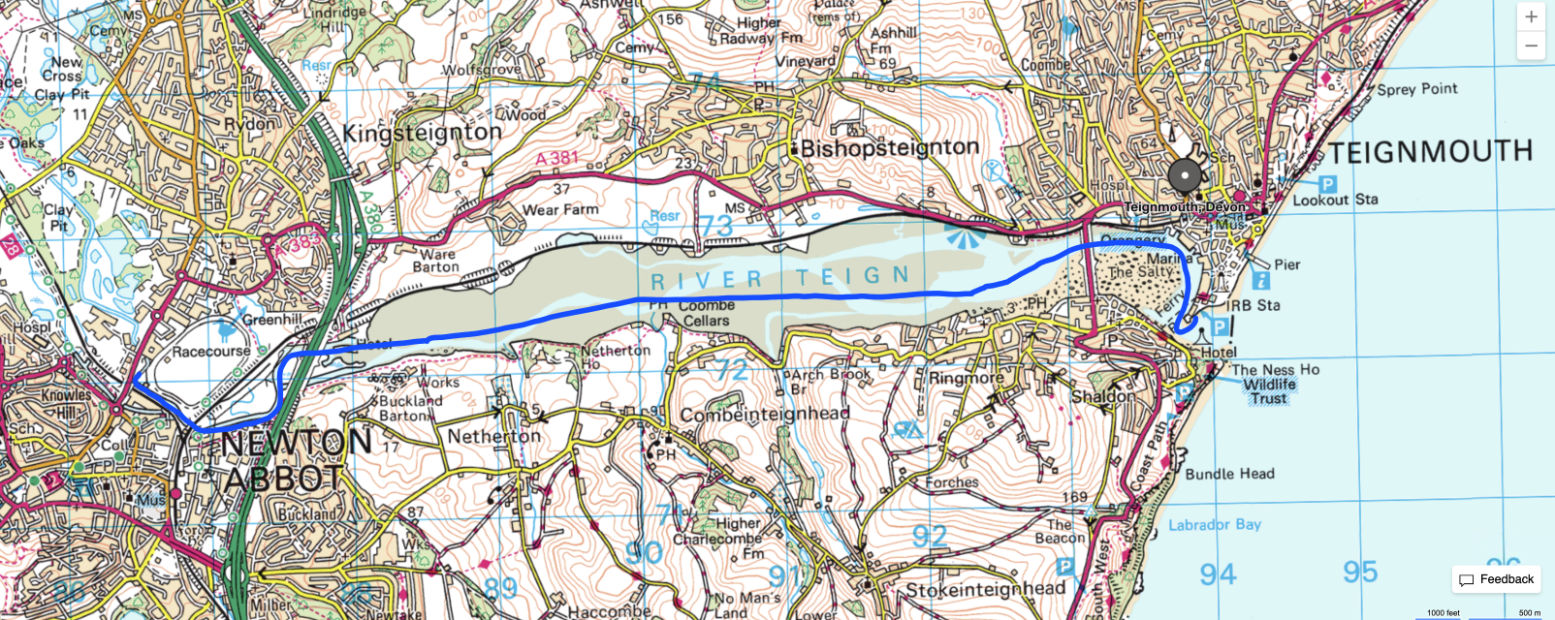
Looking at the OS map left, you might think it’s like packrafting through London, but nothing could be further from the truth. A tranquil, tree-lined river leads to a glittering inland marina and medieval church and a swan-speckled natural harbour beyond. Once out in the Bay, with the usual southwesterly you could carry on up the coast to Highcliffe, a couple of train stops up from Christchurch. Or with a higher tide, poke around the harbour. And just after the Priory, the Avon river comes in from the north. Someone suggested it’s possible to do a 2km tidal loop off the Stour and back. One for next time. Ironed out for some blundering around on the way back, that was about 18km from Pokestown station, with 8km of very enjoyable paddling. Without the bike it would have been a long walk back, though there is a summertime ferry from Mudeford Quay back up river. So this particular outing was well suited to bike rafting. With the wobbly payload, the comparative lack of stability, just two gears and the feeling I might snap something if I rode it like my MTB, the Dahon forces me to slow down. Not a bad thing. Next time on salt water, I might put it in a bag, so I don’t have to rinse and lube it back home, but I’m looking forward to more mini foldingbikerafting trips, where flatter roads and tracks allow.
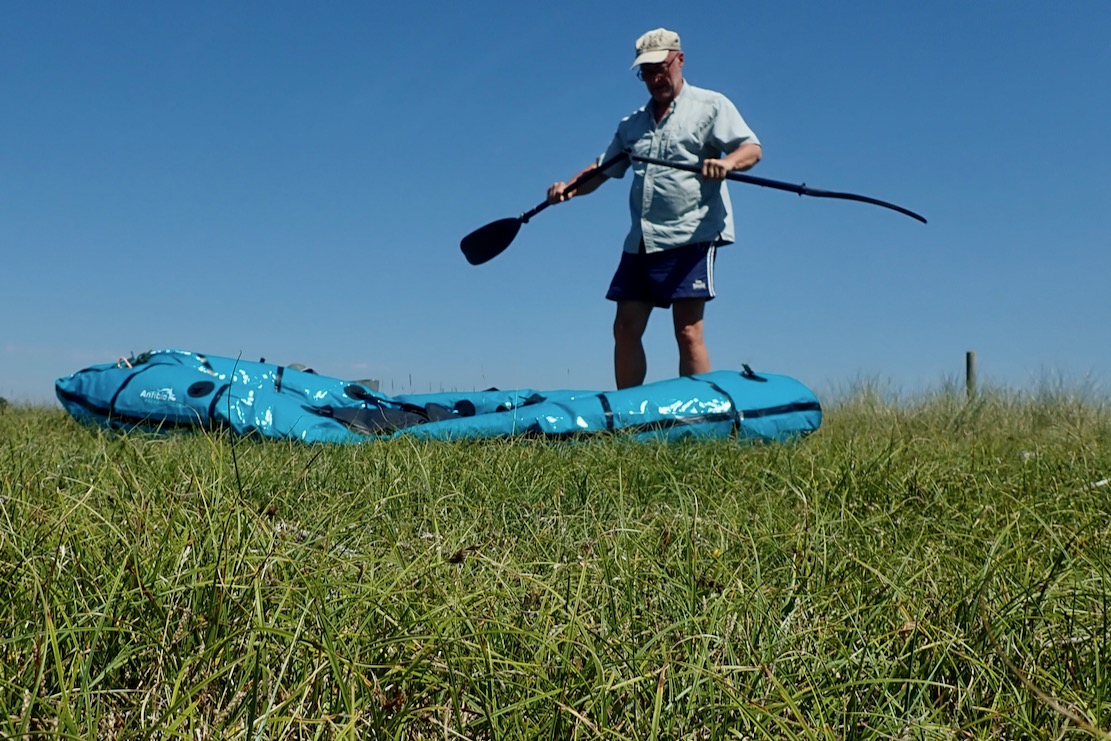
My 2.8-metre TXL+ (left) does it all for me these days, and I was just thinking that, for what I do (less hardcore, such as it was), I don’t miss my IKs at all.
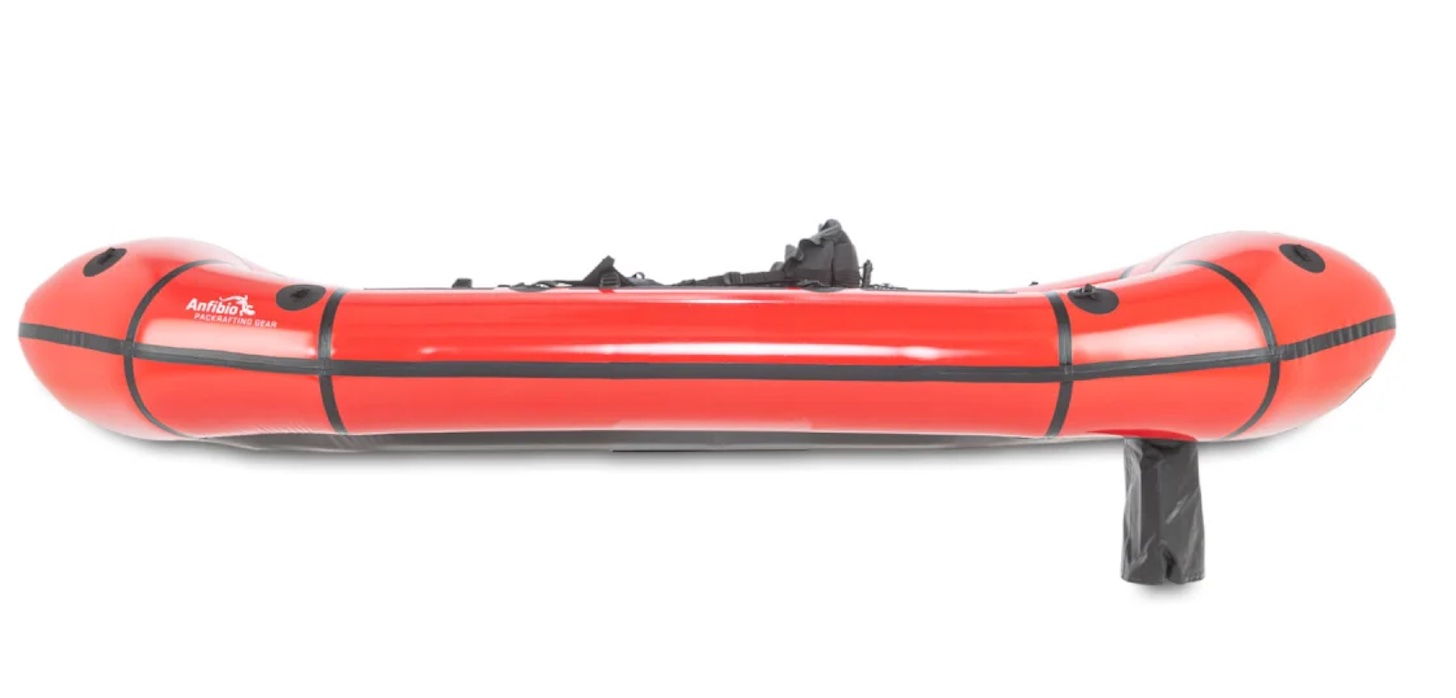
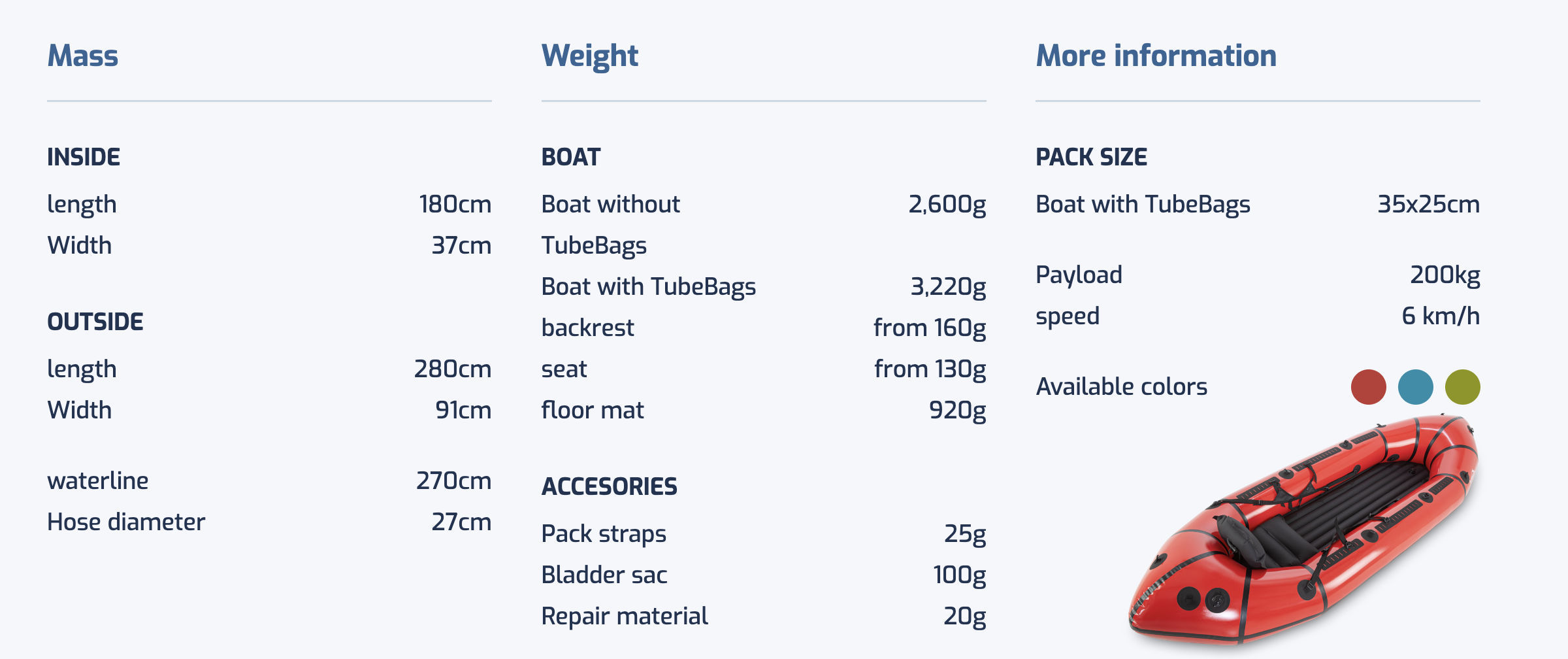
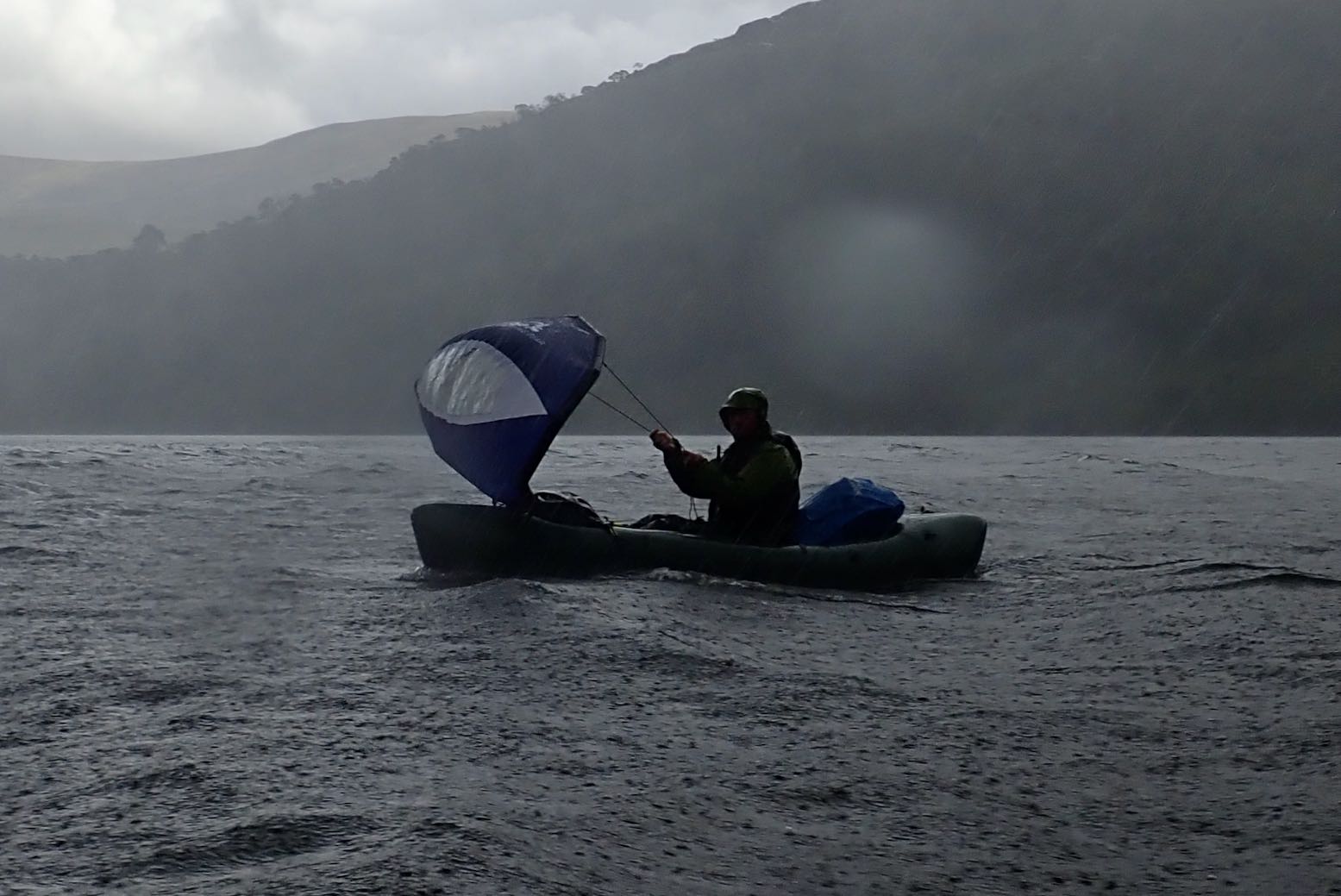
What my TXL+ loses in sublime kayak glide, it gains right back in being able to be easily carried following a day paddle. Being wind-prone, venturing too far out to sea in any inflatable, IKs included, takes some nerve when alone. Of course overnight trips including tough terrain, like our Knoydart paddle, will require a stiffer back or porters for these heavier, bulkier boats – or you plan for a sustainable paddling/walking ratio, ideally including sailing where possible (see video below). Long packrafts of around 2.8 metres offer more packing space and less annoying bow yawing, have a kayak-like, central solo paddling position with a level trim, but can fit a second paddler or a bike, as well as reach speeds up to 6kph. All for less than a kilo in mass. They are Pakayaks: the best of both worlds. Two newish ‘packayaks’ from Anfibio caught my eye: the Sigma TXLB+ and the Rebel 3KL which has been out a few months. With masses of (optional) side storage, both are suited to multi-day, rough water expeditions. One bails, the other decks and both are ‘symmetrical’, ie: the bow and stern are identical, like a canoe and all current Anfibio boats apart from the Revos and Nano RTC. Some reviewers seem to think this symmetry contributes to faster speeds. A longer waterline certainly does, but identical bows and sterns merely simplify assembly and reduces costs – symmetry has nothing to do with speed (or Alpacka Raft have got it all terribly wrong!). I’ve not tried either boat but as usual, that does not proscribe me from opinionating on pictures ransacked from the Anfibio website.
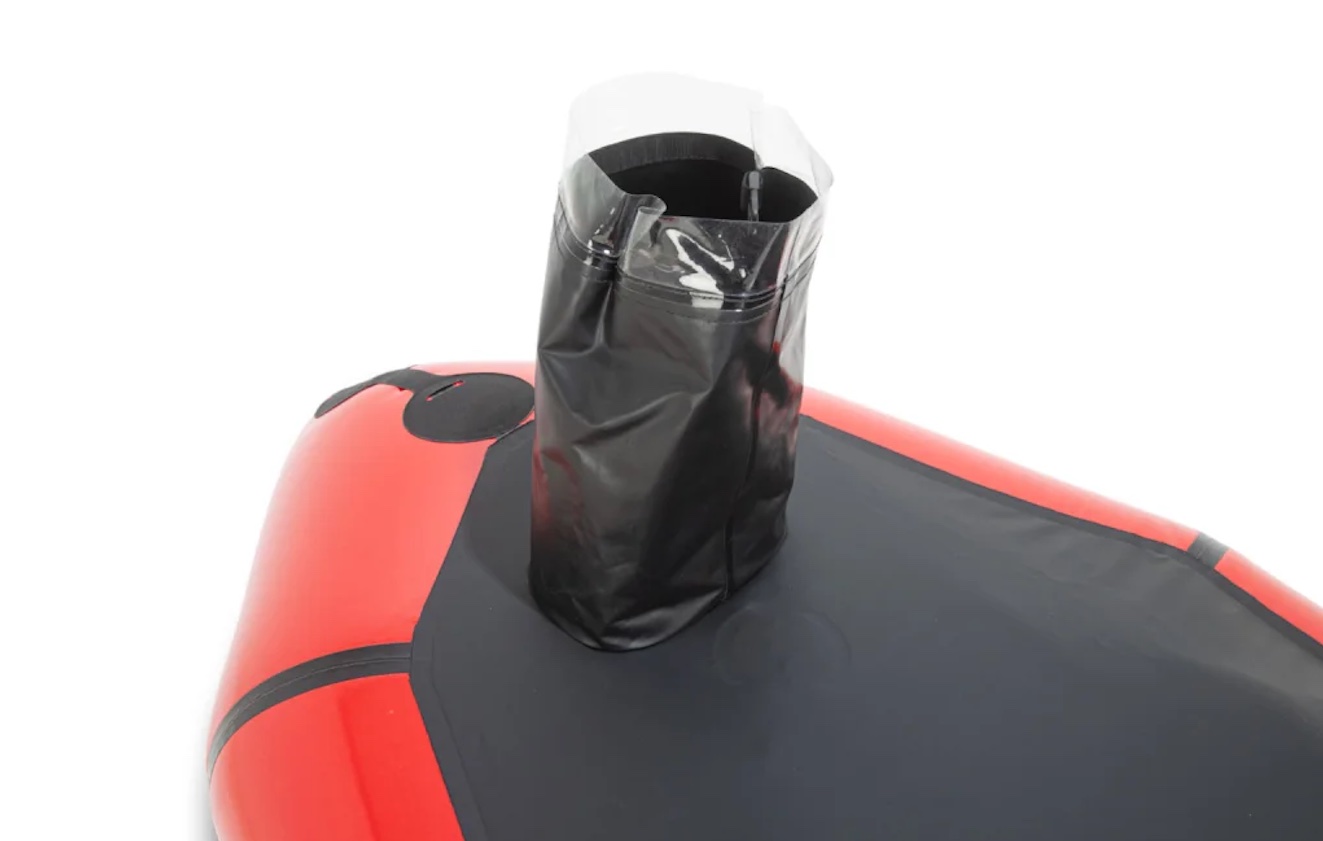
Sigma TXLB+The Expeditionist The single colour TXLB+ is just like my blue boat with optional thigh straps, floor matt, strap attachments and massive and secure TubeBag storage, but with the roll-up self-bailing drain hose we first saw on the 2022 Revo white water packraft. I never got to test that system properly, but the principle of flowing water sucking the swill out sounds plausible. As it is, you’ll be up dry on a floor and seat anyway, so it’ll take a lot of splashing to swamp the boat.
Is it needed? Not for what I do, but mileage famously varies from paddler to paddler. The hose can be rolled up and tucked out of the way (left) when not needed. One thing that didn’t look right is the skeg back in the ‘old’ solo-packraft position (left) so as to be out of the way of the trailing hose. This placement works fine on normal, back-heavy packrafts with the paddler’s weight at the stern. But as I soon found with my first green TXL (see video below), it is less effective with centrally positioned padders because the boat floats level. And I imagine it might work even less well with the hose down. I suppose you could say when using the self-bailing feature in white water, you won’t be using a skeg. And on flatwater you won’t be using the drain but could do with the skeg which will work OK. As for rough seas when you might want both – who would go out and do that?! One answer could be a bigger ‘sea skeg‘ option, like I’ve been saying for years. Or, on the TXLB+ simply remount the regular skeg in front of the drain.
Rebel 3KL ‘The Longliner’ I’m not sure about the 3KL’s blue and green (“… should never be seen”) colour scheme. Bring back the delicious lemon and olive, like my old 2K. But the 2.72-m ‘Longliner’ is just 8cm less than a TXL and a viable decked longboat comparable with the zippy MRS Nomad S1. The deck is permanently fitted which means it’s solo only, but that’s what most do most of the time.
I was never that keen on my fragile decked packrafts from MRS, Alpacka or Anfibio – just another thing to damage, though I never did. I barely used them but one time rushing down a windy loch in pelting squalls, it sure kept me drier than matey in an undecked Nomad (left). He got so drenched and waterlogged, we had to stop early for him to tip out and wring himself out like a flannel. You don’t have to zip up every time: the deck with integrated skirt rolls off to the sides, and a vital grab loop ejects you fast if you tip over. (Never happened to me in all my pack years).
I like very much that Anfibio are now using the so-called Performance BackBand – aka: an SoT foam backrest which I’ve been retro fitting to my packboats – IK or raft – for years (years, I tell you!). The lighter but wobbly inflatable versions which came with my TXLs got fed to the goats before I ever used them. Yes, you need inflation for supporting your weight on a seat base, but a backrest wants to be stiff and supportive, snugging into your lumbar curve while ideally, you press against a footrest or the front of the boat. Doing so really enhances boat control and connection.
TXLB+ or 3KL. Which would I choose? Neither, thanks for asking ;-) My deckless, drainless TXL+ with self-fitted thigh straps and an SoT backrest covers all my needs. Just like IKs, I like that it’s dead easy to get in and out. And that video above is about as ‘out there’ as I ever like to get. Water coming over the sides was not an issue that day. Going straight was. If it’s cold or rainy I’ll wear my drysuit and onesie or surf Netflix. And if it’s coming over the sides then I either badly misread the forecast or am engaged in some lovely southern French white water in the balmy summertime when pulling over to a bank to flip the boat dry is all part of the fun. I suppose I’d take the decked 3KL for cosy winter paddles. They just need to sort those mixed colours out. Alpacka used to have some great combos.
Still, it sure is great to have all these choices! Anfibio Rebel 3KL Longliner Anfibio Sigma TXLB+ Expeditionist – both with optional Tubebags, imo the best way to carry heavy loads securely and reliably without compromising hull integrity.
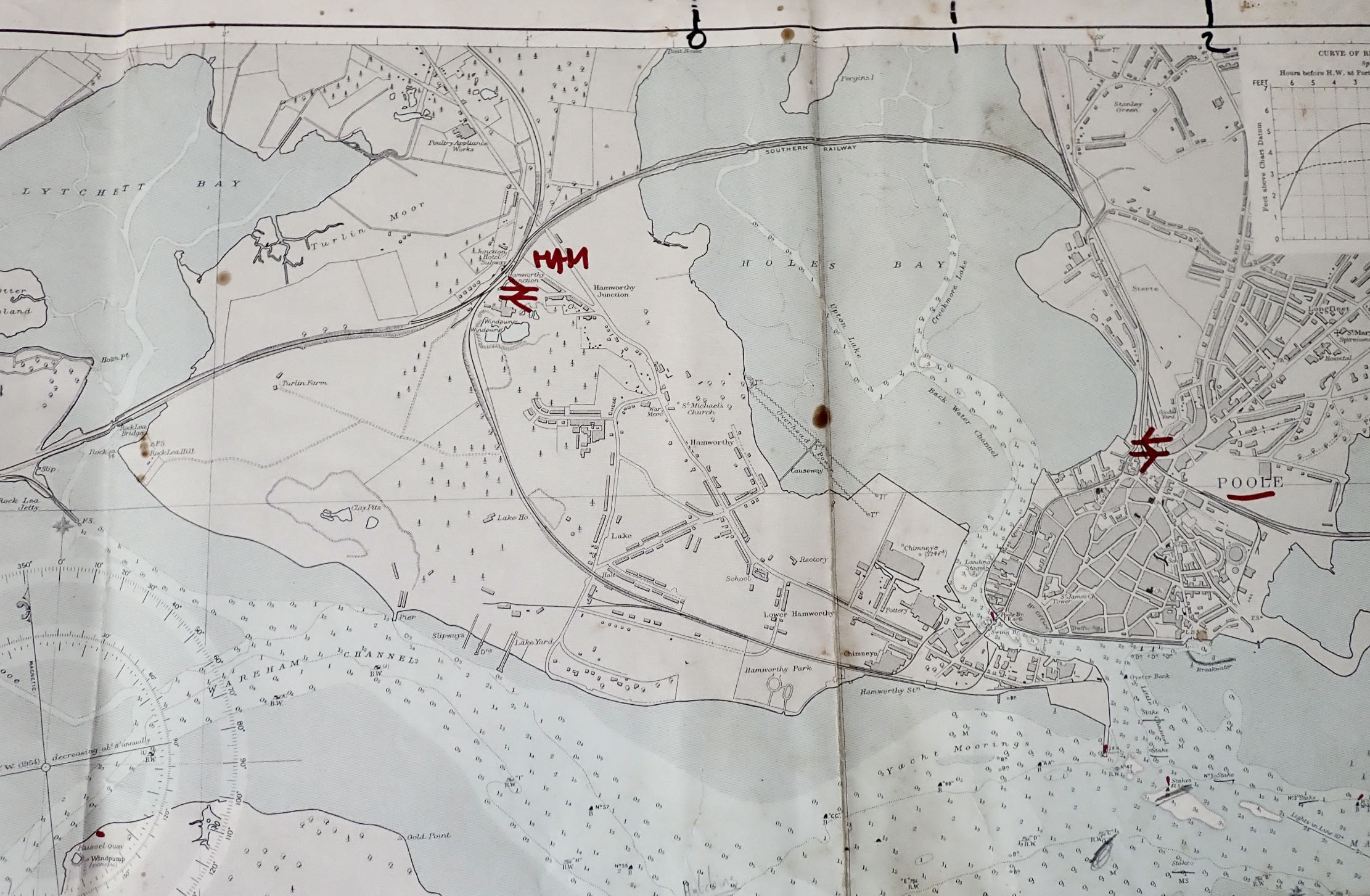
With the car in for an MoT at Kwik-Fit in Hamworthy, it made sense to do a Poole harbour paddle rather than go home or hang out. Kwik-Fit is close to Lytchett Bay, an intertidal embayment or tidal inland lake crossed by the London-Weymouth rail line spanning a narrow outlet. A 10km lap from there out into Wareham Channel and back into the adjacent Holes Bay (another embayment with a narrow pass under a rail bridge) might be possible in the time I had. If not, I could hop off anywhere and walk back to the garage. That is the appeal of pack boating! This route – out one tidal channel and in via another – had similarities with our lap around Hayling Island a few years back in the Seawave. On that occasion we had to go full steam against the incoming tide to get out of Langstone Harbour back into the Solent to close the loop. This Poole loop would only require a 500-m walk from Holes Bay shore back to Kwik-Fit.
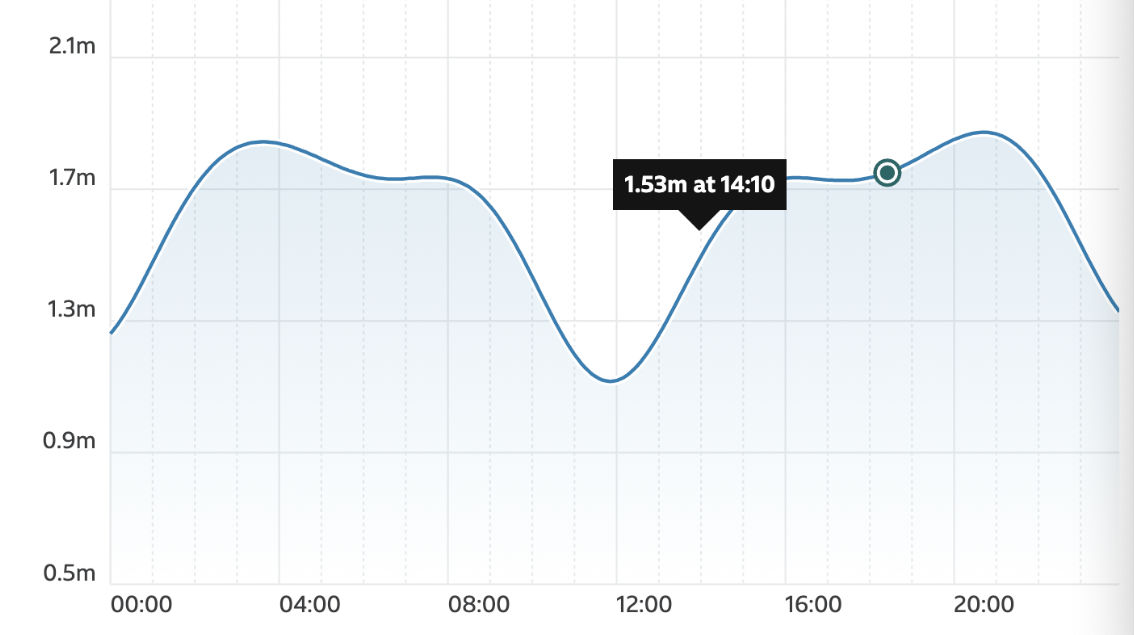
The winds were 10-13mph from the southwest which made sailing just about possible along my ESE route. The tide was coming in and levelling off about 3pm for 6 hours before dropping steeply again. In Poole Harbour – second only to Sydney Harbour but with an outlet just 300-m wide at Sandbanks chain ferry – the tides are far from simple sine waves. It may still be going in at Wareham at the back end, when it’s already going out at Sandbanks. There are four tide points listed by UKHO in Poole Harbour and I’m pretty sure ‘Poole Harbour’ refers to the RoRo ferry port on the north side. PHC is a great resource.
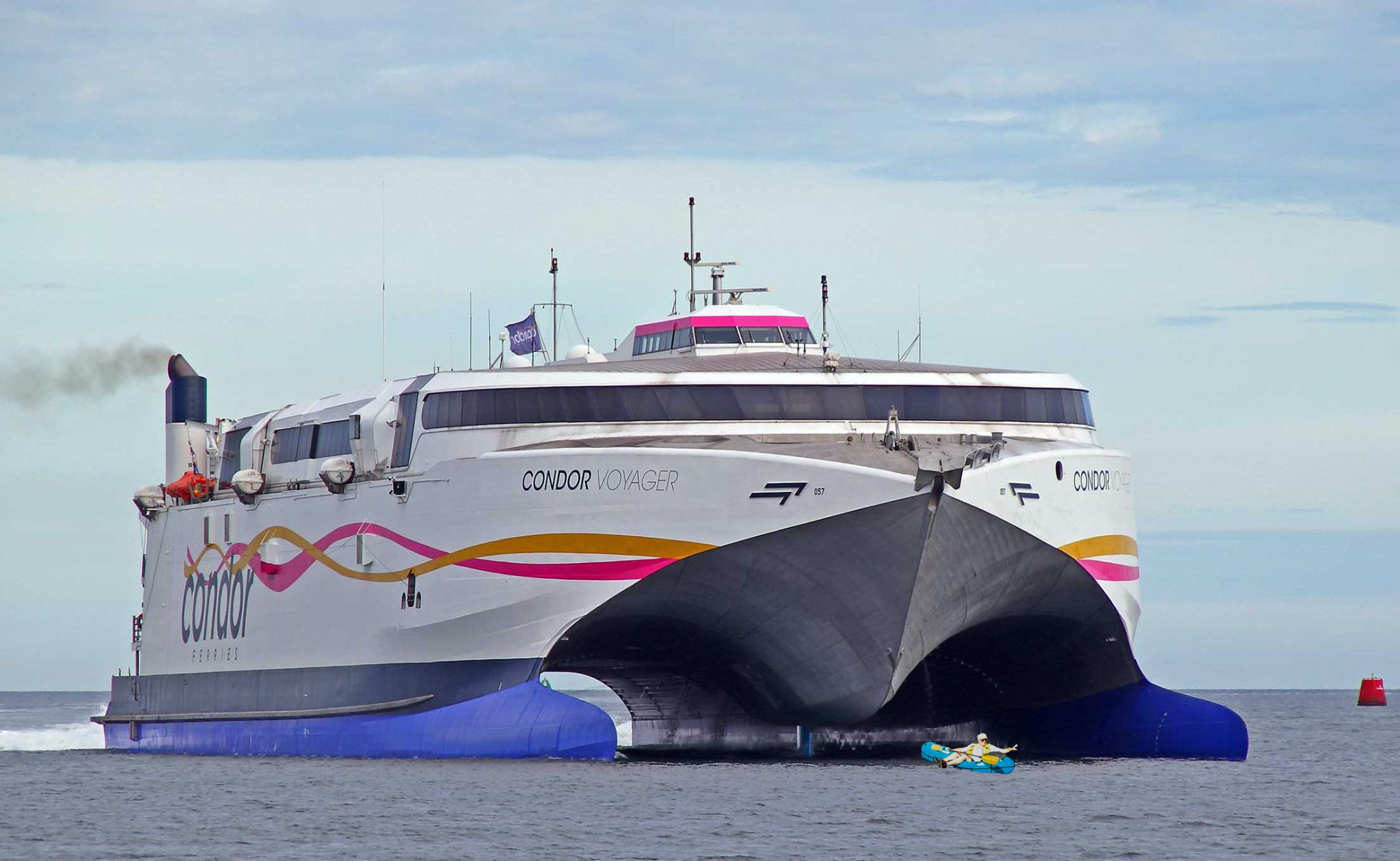
My route would take me right past the ferry berth where getting in the way of a gigantic ferry would probably raise a yellow card. Again, on PWC I was able to see today’s main ferry movements: the massive Condor Voyager cheesecutter class twin hull (above) would depart for St Malo at 14.15. I’d probably be an hour behind.
I set off from Kwik-Fit across Turlin Moor park aiming for the inlet, and once I saw some water, bundled through thick, 2-metre-high reeds on the off chance.
But once I emerged from the dense reed jungle I could see I was a bit early at this point, with 100m of knee-deep sludge ahead. It’s large acreages of tidal mudflats like this which give Poole Harbour its average depth of less than 50cm. That’s about the same depth I’d sink into the mud, trying to reach the water.
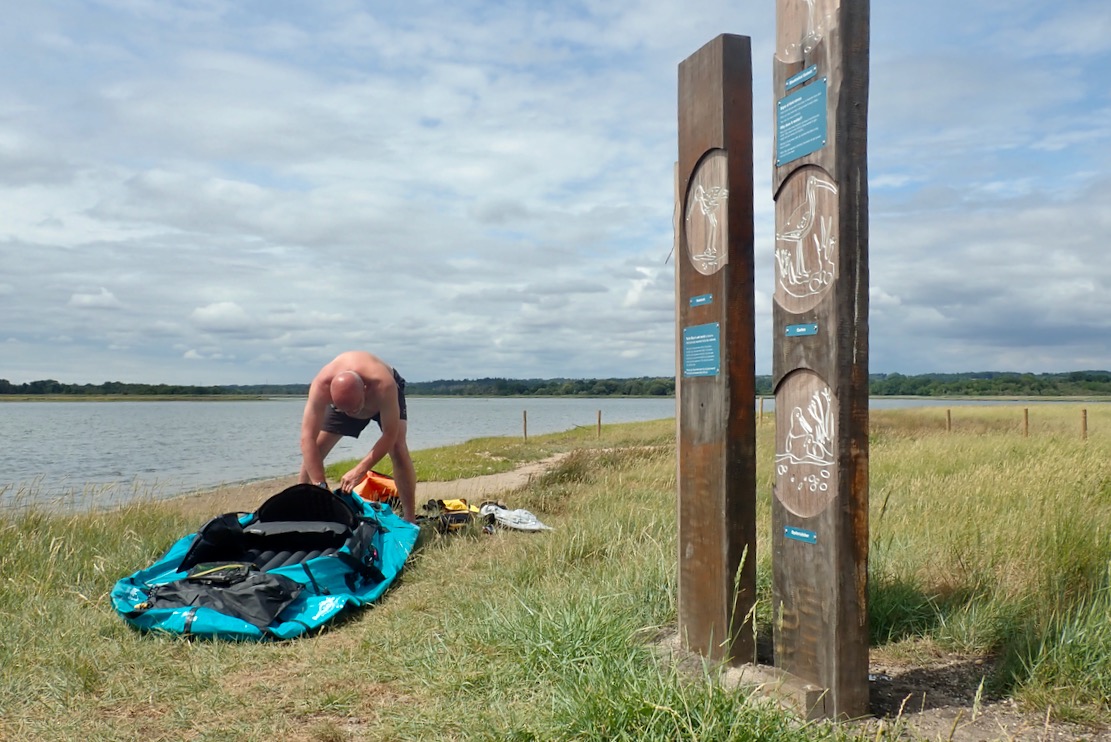
So I turned back and carried on along the shore until a path led behind some houses and through the trees to this grassy, reed-free bench by a sandy beach: 50.72448, -2.03601. If you want a mess-free, easy way to get on the water at Lytchett Bay east, aim for here.
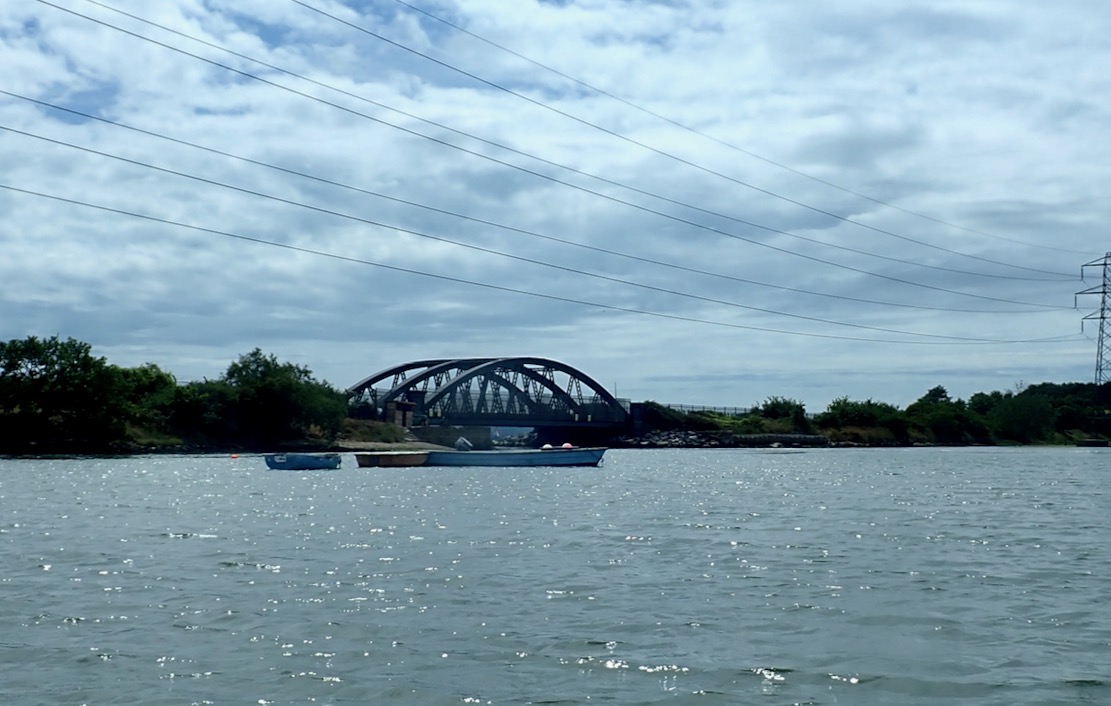
A headwind was blowing quite hard, but it was only 500m to the rail bridge narrows, after which I’d turn southeast to pick up what wind I could get. Setting off, the TXL+ felt like it was zipping along as wind and waves rushed past. Up to 6kph, according to the GPS as I neared the narrows. That was probably an unseen back eddy sucking me into the gap, because as I got nearer I could see a current ripping through under the bridge at at least the same speed or more. I powered in hard along the edge, like we’d done at Hayling, but could only manage 0kph.
“Try on the other side” said the bloke lurking by the abutments, so I ferried across and, with a lot more effort managed to squeeze under the bridge and hook behind some rocks for a breather while not getting drawn back in. I’d swum half a mile that morning which can be enough exercise for one day. Paddling under the bridge was like doing 50 pull-ups and I was a bit pooped. I looked later at the state of the tide at that precise time (left) and saw I’d been about an hour early.
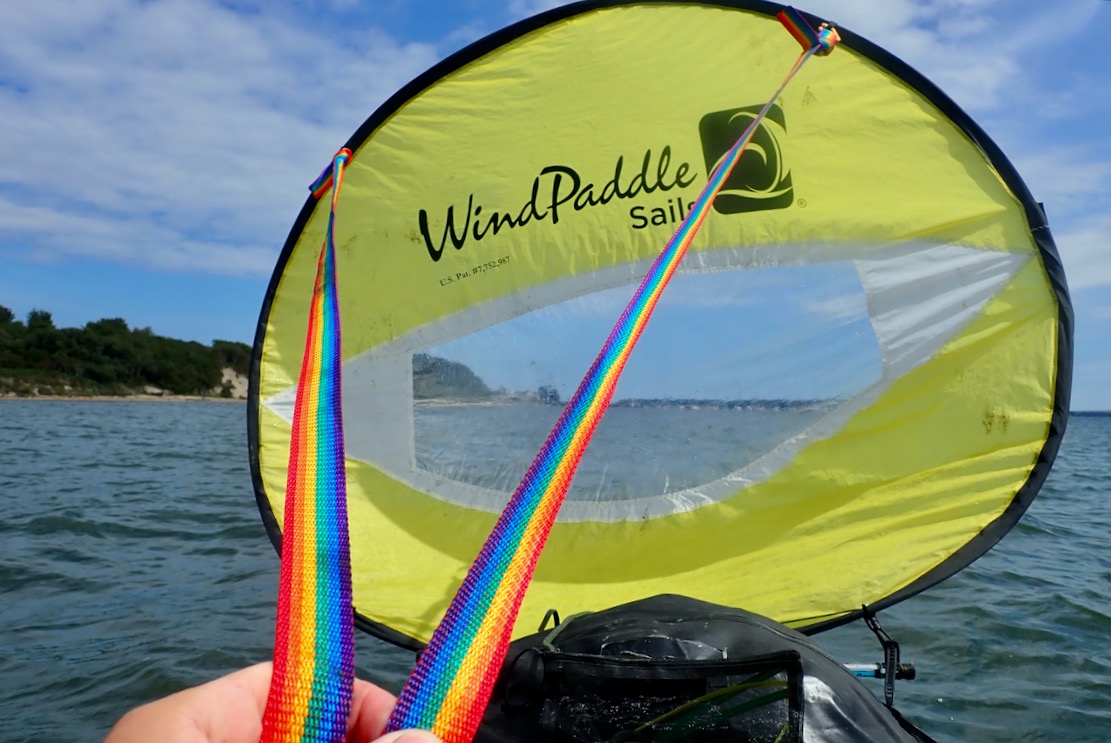
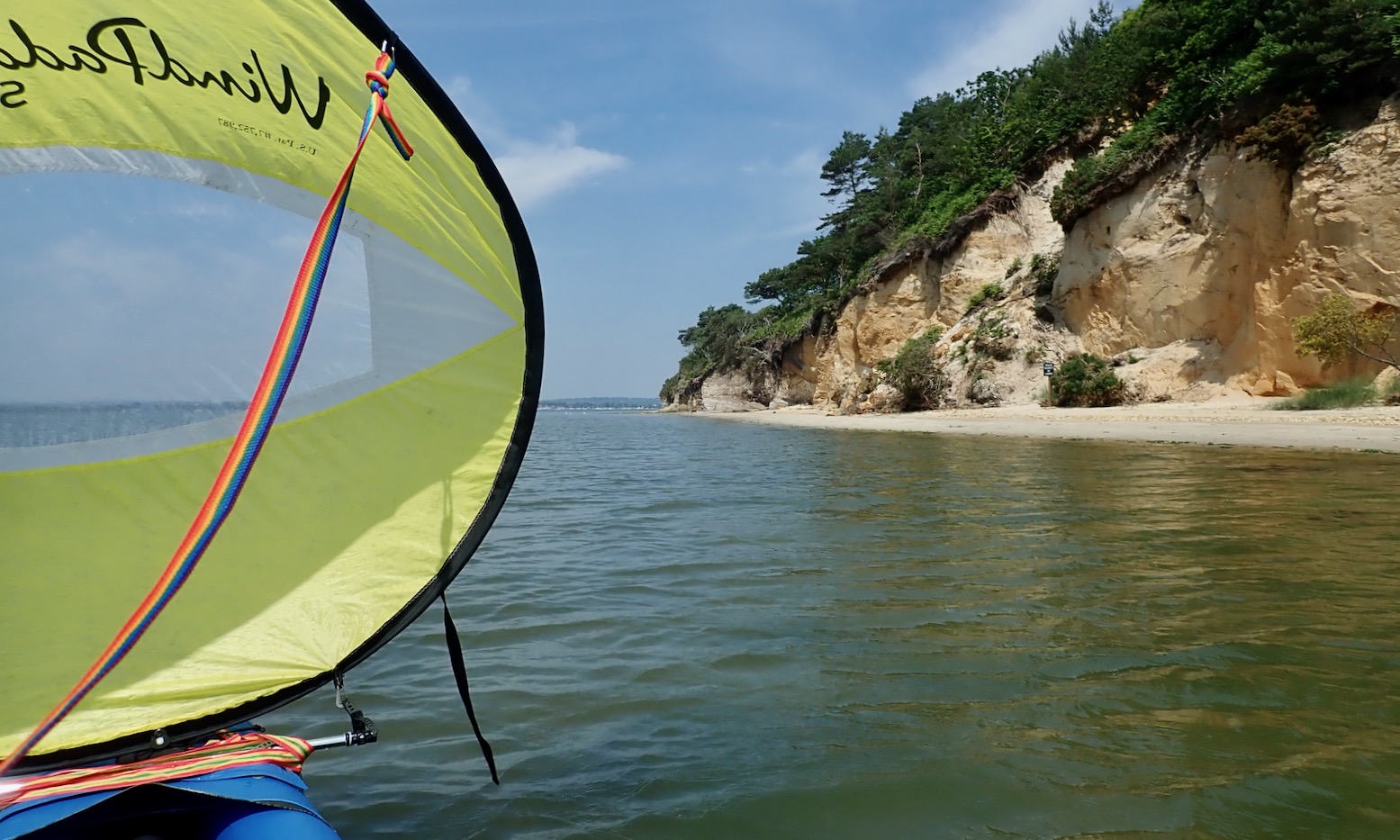
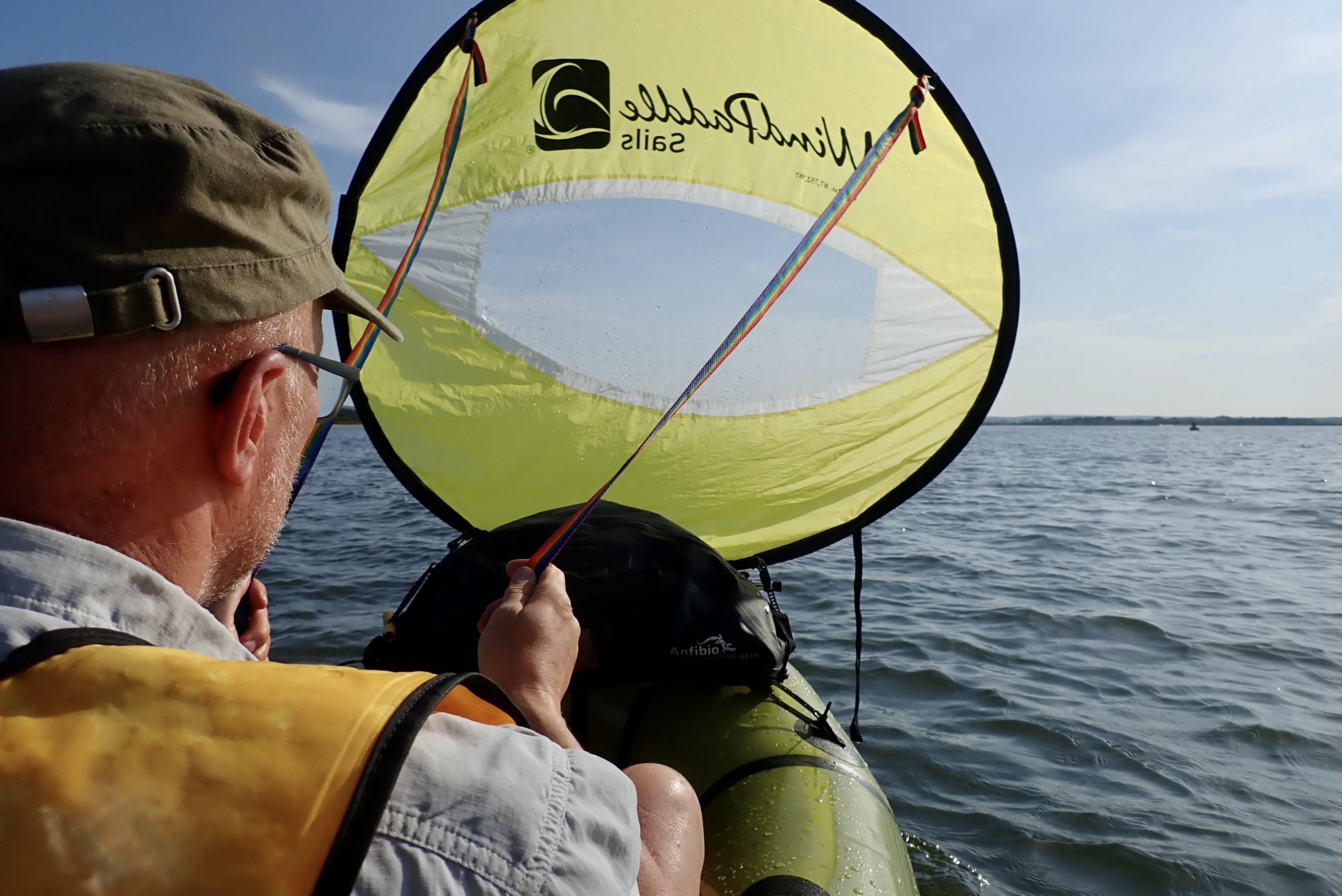
I took a wide arc out to avoid the worst of the tide race and headed off towards Rockley Sands where I came ashore last year on my way to buy a moto. The wind from my right wasn’t ideal for sailing in my direction, so I paddled out into the channel to turn and get a better angle as it pushed me towards the shore. Though I was hardly bombing along, getting the sail up was the rest I needed. Out in the Channel, loads of sailing boats were fluttering to and fro past Brownsea island, and at one point a lightweight sailing cat passed close by with a hiss. I could do with some sails like that. As usual the WindPaddle was hit and miss. Holding 45° off the wind with some steering is not bad for what it is, but it never stays on it for long before getting in a flap. However, as I got pushed towards the shore again, I really appreciated the way I could pull the WindPaddle down, give it a twist and tuck the lower fold under the Anfibio DeckPack in seconds. It was a handy trick I discovered while belting down a wind struck loch in Knoydart one time.
I passed a couple of piers and a series of long private jetties extending from people’s back gardens, some with a motorboat at the end perched on giant hydraulic hoists to stop them getting too wet. I assumed this was luxury overspill from affluent Sandbanks nearby, once home to the most expensive properties in the UK, but here “…overall, the historical sold prices in Branksea Avenue over the last year were 41% down on the previous year and 75% down on the 2011 peak of £2,262,500.” Unless rising sea levels are coming quicker than we think, or they’re putting in a new high-speed railway, it did seem an implausibly catastrophic collapse in house prices. Maybe the Rightmove AI needs to be burped.
Now heading more east, the wind was getting behind me. I made another effort to paddle out into the Channel to get a good run, and this time the TXL got picked up and rushed along. This was more like it, with an aerated bow wave frothing away by my feet. I squeezed every last minute out of a good run of nearly half a mile, not quite managing to steer around the breakwater of Poole Yacht Club where the accumulated fetch and rebound slapped me around a bit, but the TXL sat steady as a barge. Round the corner I passed the entrance to Poole Yacht Club with a ‘Visitors Welcome’ sign and wondered if that included packrafts. The phone rang. ‘Kwik-Fit here. Your Micra’s ready in 40 minutes.’ ‘My word that was quick!’
A quick look at the map showed I was just less than halfway and would soon turn into Holes Bay with no more wind behind me, but with the high tide negligible. It would be tight to get back to the garage before it closed, so I turned into a dock entrance and rolled up the boat on the slipway.
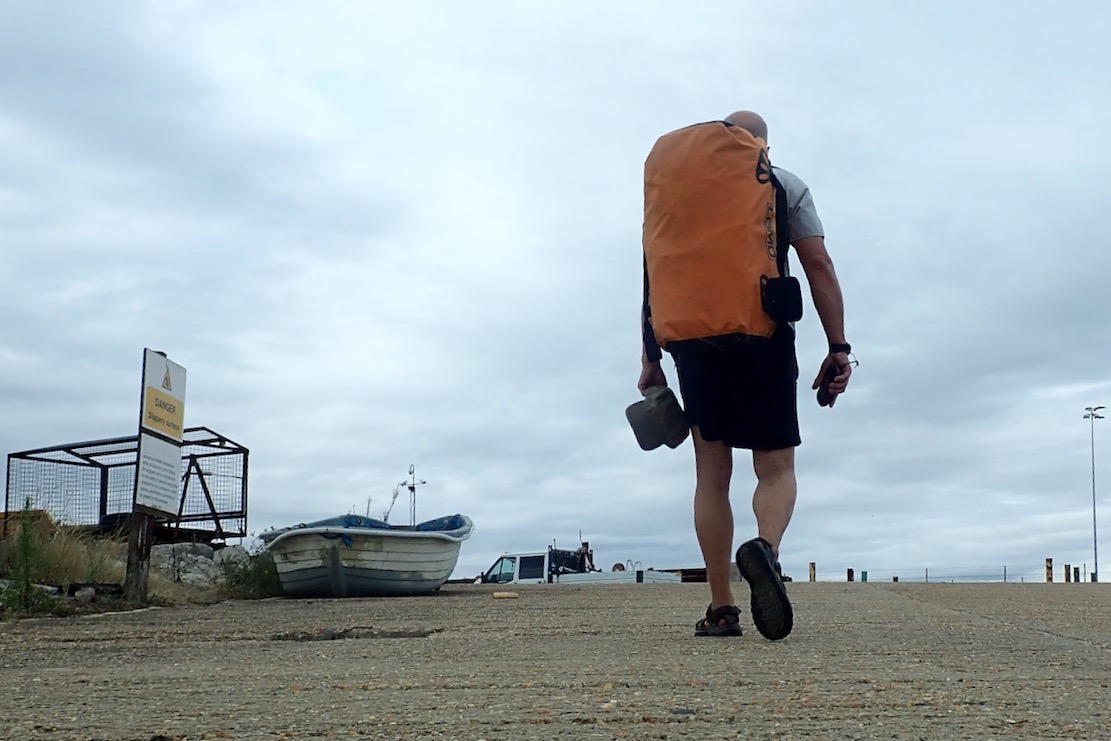
I assumed this dock was part of the welcoming yacht club marina next door, but it was actually more like a deserted service yard for the ferry port right next door, surrounded on all sides by high security fences and an electric gate. I dare say some security guard was observing me on his CCTV lair somewhere. After nosing around the portacabins and sheds looking for someone, a guy appeared in his car and swiped me out with his pass. Things always work out, and as I passed the entrance to the Yacht Club, that too had electric security gates, though probably someone manning them. Looking at the map, a better take-out would have been Hamworthy Park by the club’s breakwater (50.71099, -2.00039), leading to a footbridge short cut over the rail line.
I walked right past the Customs and Immigration cabins (above left) of Poole ferry port, and a helpful map affirming je pagaie donc je suis ici with irreducible Cartesian logic. So – paddling mission not fully accomplished but the old Micra was on the road for another year.
Fat dotted red line shows unfinished stage. Arrows show wind direction
Looking back at the tide graphs for Poole Harbour, it seems that at the lowest neap tides (as it was two days later), there can be a 7 hour period when the high tide flattens off and rises then falls more than 20cm. That would be the best time to try and paddle around Hamworthy between Lytchett and Holes Bay. It could also be fun to leave Holes Bay on an ebbing spring tide to get a good blast under the rail bridge narrows, down the channel through downtown Poole and out into the harbour.
Wayback machine. Harbour chart from 1955. Hamworthy was just farmland and claypiys
For the last fortnight the Wessex skies have been clear, and warm winds have blown from the east. After six months in the garage I finally get round to taking the Igla for a day out. Hard to believe I’ve only been out in the Zelgear IK once in mid-winter. A closer look at the south side of Poole Harbour is the plan, and a 25-minute drive drops me off just before the Sandbanks ferry inlet which we crossed last year in packrafts.
The tide was inbound and the forecast 13mph from the east, rising later and with gusts predicted at twice that according to some sources. Ideal for some downwind sailing action! The plan was to explore as much of the Harbour’s southern shore as wind, curiosity, energy and draught would allow.
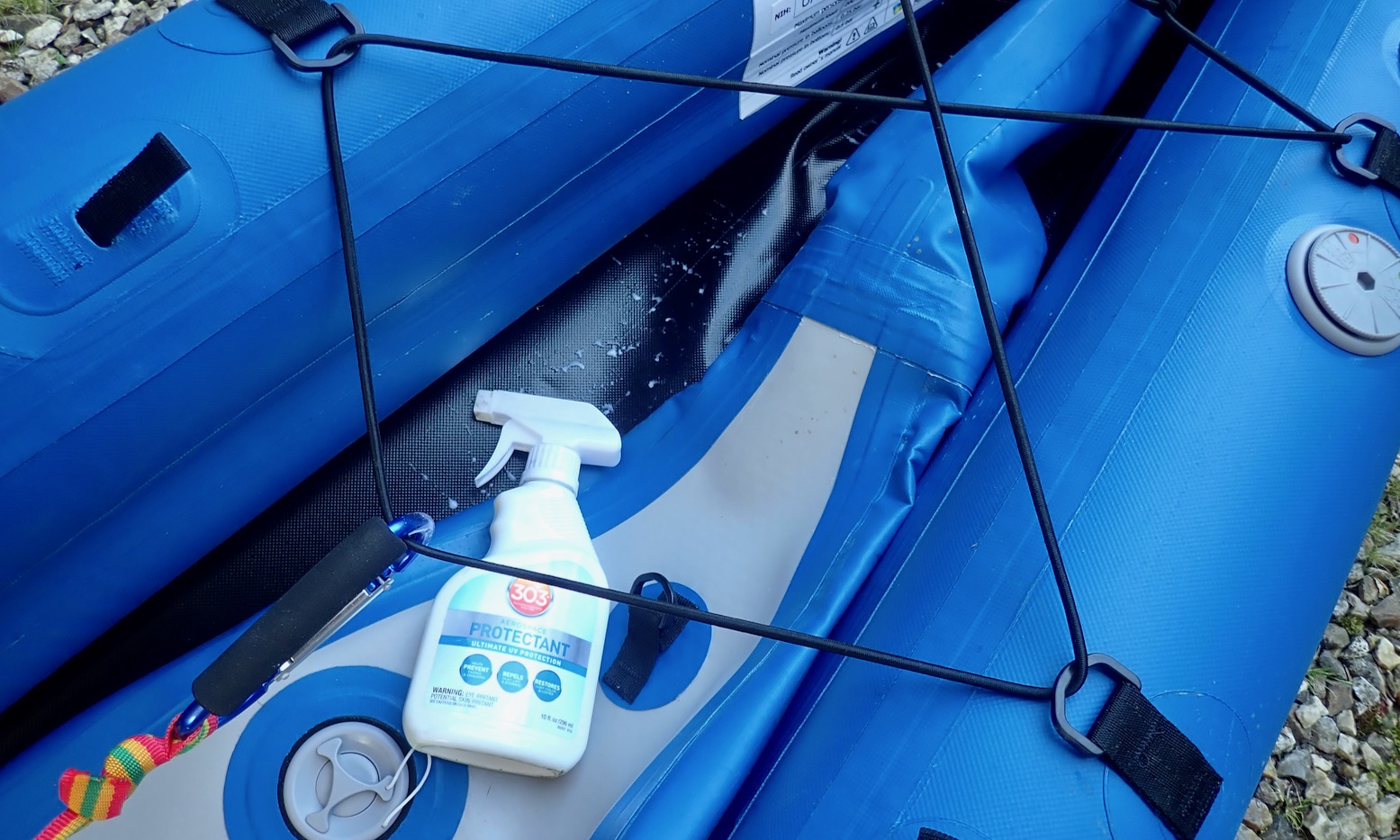
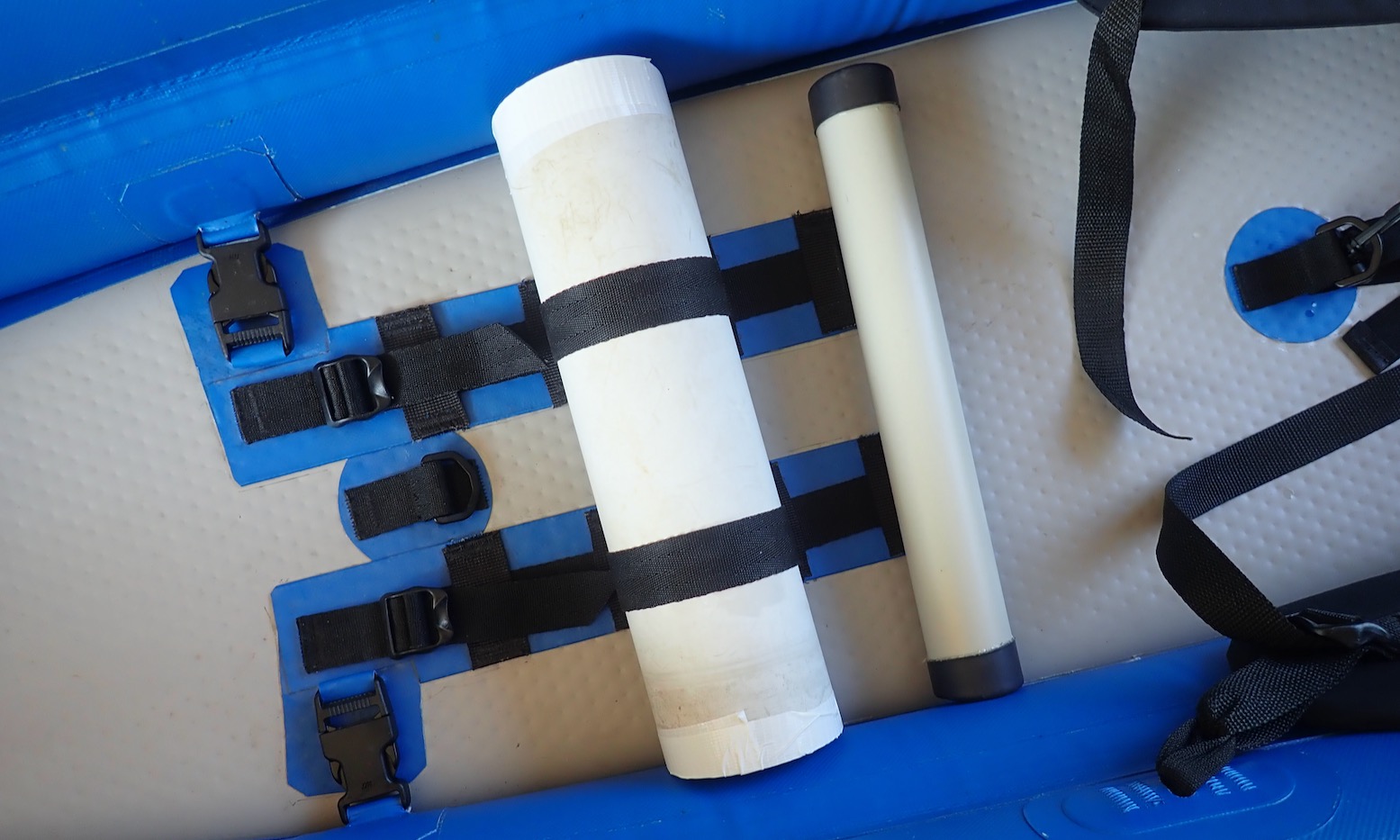
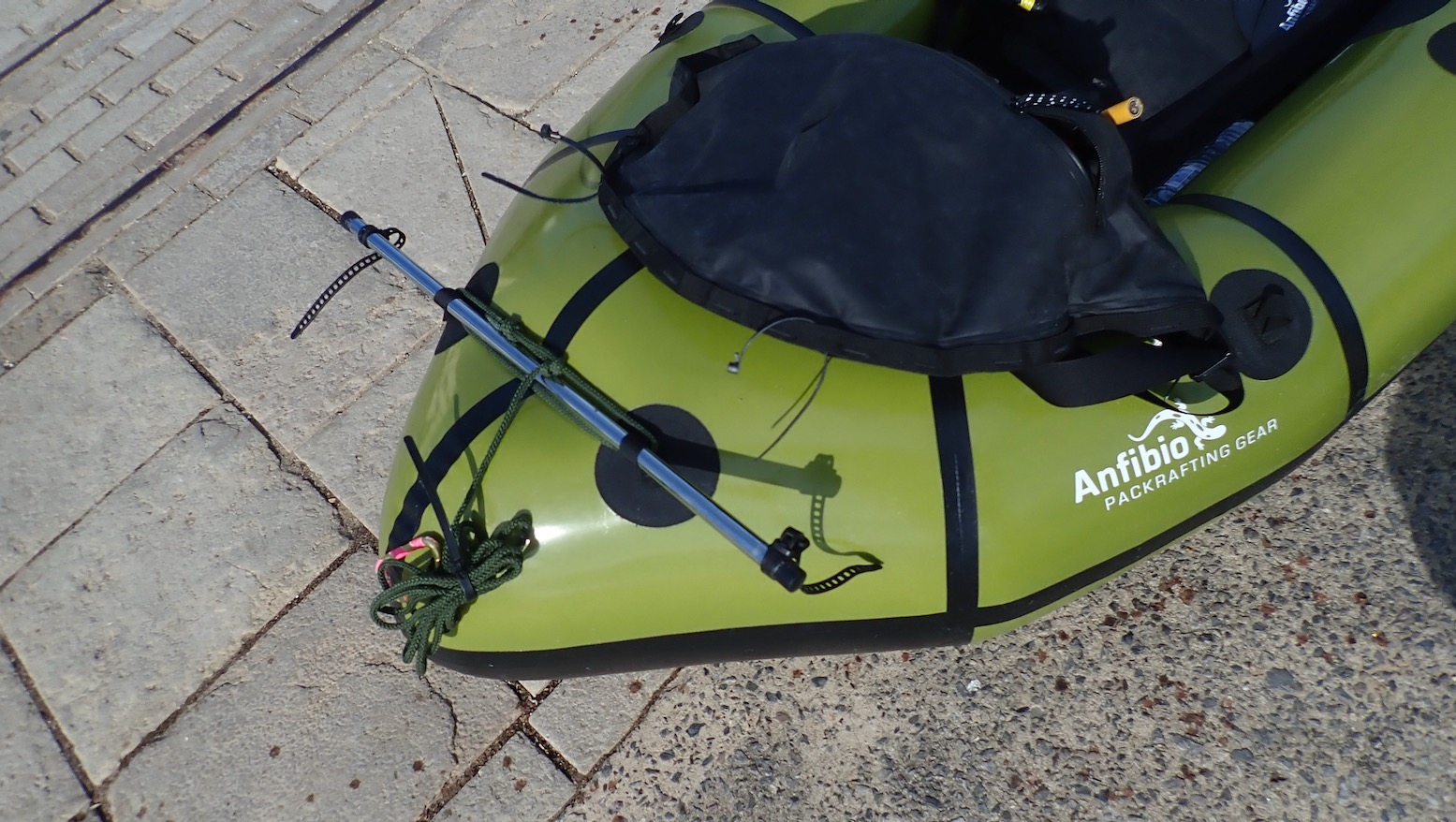
The 0.25 bar hull has been inflated for six months and lost a little pressure. I’d fully deflated the removable 0.5 bar DS floor and refitting it, decided a quick squirt of 303 anti-UV lube underneath and on the ‘horns’ would help it slide snugly into the correct position.I sawed off a bit of 12cm drainpipe to make a bigger footrest tube for my bigger feet. (Original Zelgear footrest tube on the right).I also found a way to fit my packraft ‘transverse bowsprit’ using ever handy Rovaflex straps.The wide bar stabilises the sail mounts to limit sideways swaying or rocking.It’s only a two-minute carry through the trees from road to beach, but requires passing through the ‘TPZ’ or toilet paper zone.I drop my lunch into the boat. It’s going to be a hot paddle. At the back, Brownsea Island.Oo-er, the Igla (‘Needle’) feels a tad wobbly, but then it’s an IK not a packraft. I deflate the seat with the handy twist-valve tube until I’m just resting on the DS floor. That’s better and once hooked into the cushy knee straps I feel secure and snug. The Igla’s seat is by far the most comfortable IK seat I’ve tried. It doesn’t have to be complicated or heavy.Like a migrating gannet, I venture forth in search of the wind.Soon it finds me.I glide past the southern cliffs of Green Island. Signs discourage landing. Nearby chaps are doing tight circles in small dinghies, dredging or fishing for something. Not knowing the landmarks yet, I keep having to refer to my Garmin’s OS map to go the right way.
Right now I’m reading We, the Navigators; The Ancient Art of Landfinding in the Pacific by David Lewis (1972, open source pdf). In it he explains how Oceania (or Micronesia, Melanesia and Polynesia) were populated by intrepid Asian seafarers – contrary to what the famous Kon Tiki expedition sought to prove. Some had mastered the art of navigating hundreds of miles of open Pacific without any kind of instruments, memorising instead a combination of stars (rising and setting points were like compass bearings) as well as prevailing winds and waves, refracted swells from unseen islands and unseen currents (flying fish always jump down-current; fyi). Travelling with the incredulous author, after days at sea aged South Sea navigators regularly found a tiny pin-prick of an island bang on time. It’s a fascinating topic but the book focuses purely on the techniques, rather than the adventures they all clearly shared for months. David Lewis’s earlier book, Daughters of the Wind (catamaran from UK to NZ via Cape Horn with young family) may be a more engaging read, and was a voyage on which Lewis practised the instrument and chart-free techniques he later documented in the Navigators.
It’s blowing nowhere near 13mph and when the wind drops or I turn off it, one twist of the sail and it tucks easily under a foot, ready for redeployment in seconds. The system works very well.
We cycled a trail along the southern shore the other day, branching up to the harbour at a cottage on Ower Bay. From there I couldn’t work out what the wooded island was to the NW. Turns out it’s the south end of Round Island. Sgurr nan Cruinn, that might be in Gaelic.
I rounded the southern end of Round Island, passing more dinghymen doing full-lock burn-outs. There’s the long jetty as shown on maps. On the left the mainland shore of Arne.I ride up past Shipstal Point, one of the few points where footpaths reach the sea. A couple of SoT’s are beached up ahead, including a Sandbanks Style Optimal which I tested here a couple of years back. They’re going to have a rum old haul eastwards back to Sandbanks against the rising wind.I’m not wearing my glasses so don’t see the low spit of Patchams Point until I’m right on it. I have to turn east into the wind to get round it, scattering Oyster Catchers as I go. The taut Igla responds well.I pull over to inspect that state of regeneration and other incisive environmental initiatives. Soon I’ll pass Russel Quay where we put in the packraft the other day. I’m hoping for a good run with the wind towards the Frome river mouth.I get it but it’s not the high speed thrill I was hoping for. Plus it’s blowing me west, when I need to be going southwest. One flaw with my bowsprit idea is the lack of slack reduces the angle you can pull the WindPaddle to steer off the wind, especially when it’s not very strong.
The wind picks up, or get its fetch on at the downwind end of the Harbour. I’ve squeezed all the west i could from the wind and must now turn south. So I stow the sail and paddle a crosswind pushing me towards ancient stakes and into the reeds.
I follow a boat into the hidden river mouth and, with the wind now up to 20mph, I can sail a lot of the river’s meanders the two miles west to Wareham Quay.
With the wind whistling through the rigging, I hear a ‘Bloody hell, wow…’. It’s a moored boater expressing surprise as my kayak sails by as close to the 4-knot limit. I learned a new sailing trick: to micro steer the boat drag a left hand in the water to bring the bow round to the left. It worked well zig-zaging up the Frome.
Like a Polynesian master navigator, after my ten-mile traverse of the Harbour, I sail right up to the Quay…
.. casually hop out, and look around for my taxi.
IK or packraft, I wonder to myself. Environment or geography (as well as intended use) help define the best suited packboat. My TXL would have managed this outing fine, if a tad slower, but it sure is nice when the Igla slices through the water, either under sail or into the wind. The problem in this corner of Dorset is, once one tires of noisy, busy, drab but safe Poole Harbour, apart from Swanage (below), getting the inflated 17kg IK down to the exposed Jurassic Coast in suitable conditions is a bit of a faff, even with wheels, let alone getting back out and closing the loop with cars in place. You may as well use hardshells. That’s why I chose the long but still light TXL packraft. Down here I’m not straying out to islands where speed and efficiency are important. For plain old calm-weather mainland coast hugging, a large packraft does the job and enables public transport, an easy scramble ashore followed by a walk back. But for an effortless coastal tour with plenty of room for two, the Igla has its benefits. It’ll easily paddle at 8kph on a breeze too light to hold up a sail and that’s an extra 30% more speed or so less sustained effort over a few hours.
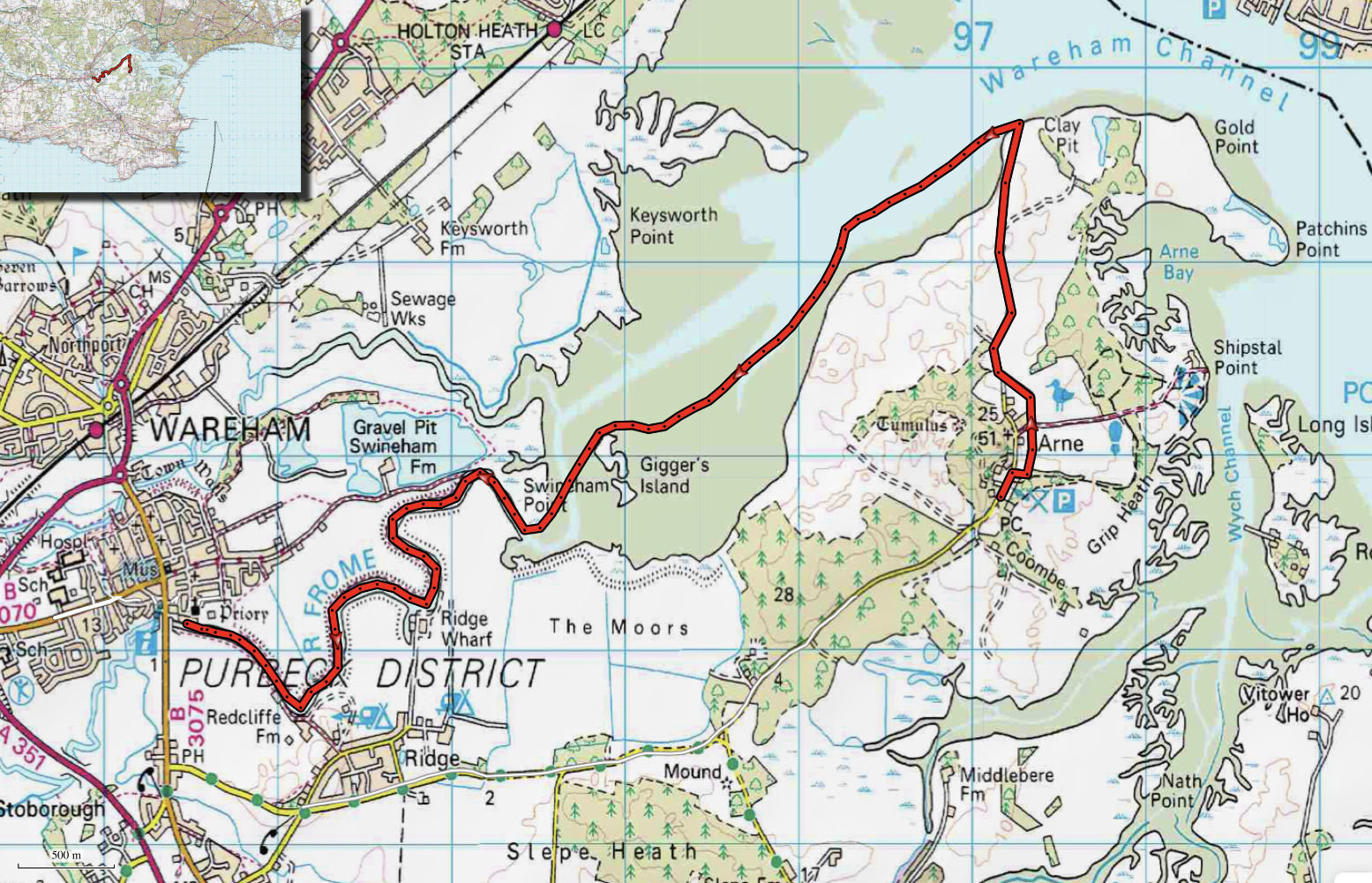
Holy moly, end of May and first paddle of the year? It’s been a busy winter and the arm’s been playing up so time to break in with an easy packraft across a back corner of Poole Harbour, our locale for the summer. Sailing Russel Quay back to Wareham with the tide and the wind sounded like a good one – a mile’s walk + 5 on the water. Although it clashes with our hitherto pristine eco credentials, we have two cars down here, so we leave one in town and the other at Arne.
Teetering on the edge of Open Access land.
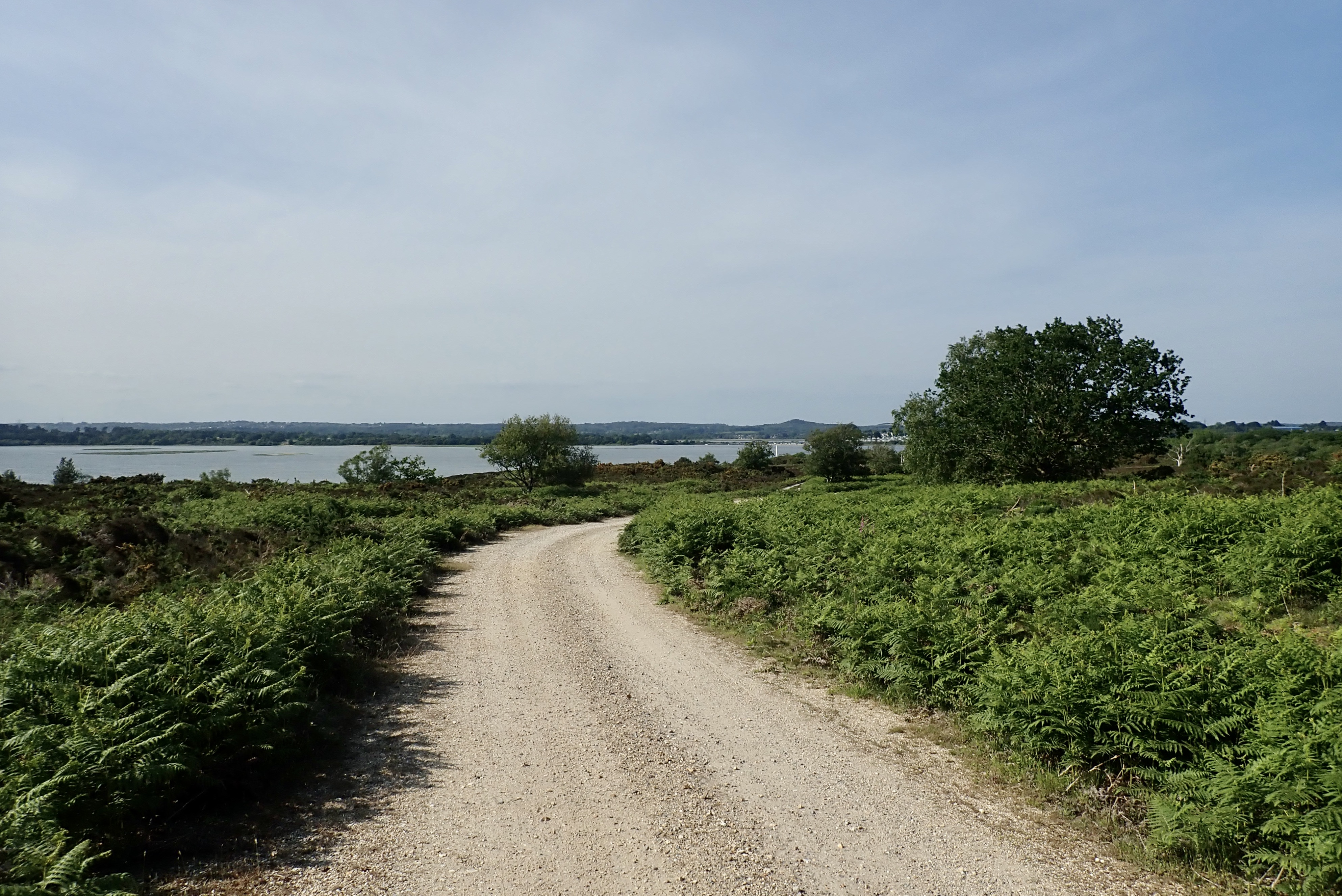
This whole area south of the Harbour is a largely undeveloped heathland with rare wildlife and part of an RSPB ‘super reserve’. On the day the famous BBC Springwatch crew were installed for a fortnight or more, motion sensing cameras probing various nests and burrows. Thick power cables lined our track leading up north to the put in near long gone Russel Quay. I’m not fully sure it was a right of way. Dodging irate English Nimbies is going to take some practice after the freedom of the Scottish northwest coast we became accustomed to. But ironically this area also has the biggest knot of land-based oil wells in western Europe. They’re the small, nodding donkey type, not towering rigs but a couple of months ago one of the pipelines sprung a leak in Ower Bay near the processing plant on the less accessible south shore. Luckily it wasn’t an Exxon Valdez event and at higher tides there could be some good packboat exploring in this inlet-rich area. It’s all we’ll have here bar the more exposed Jurassic Coast.
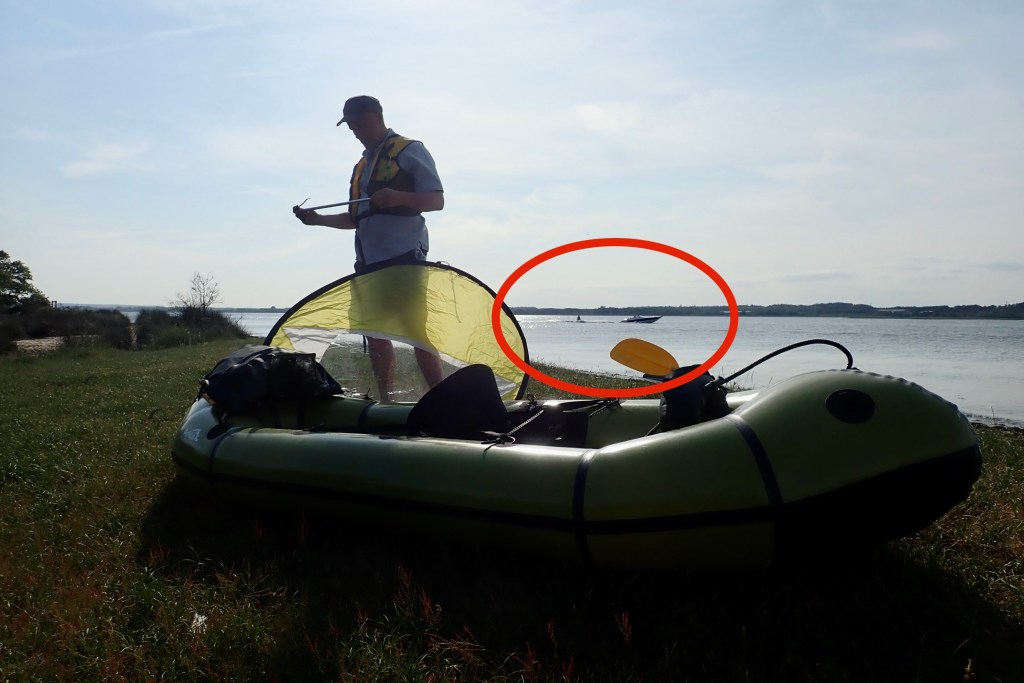
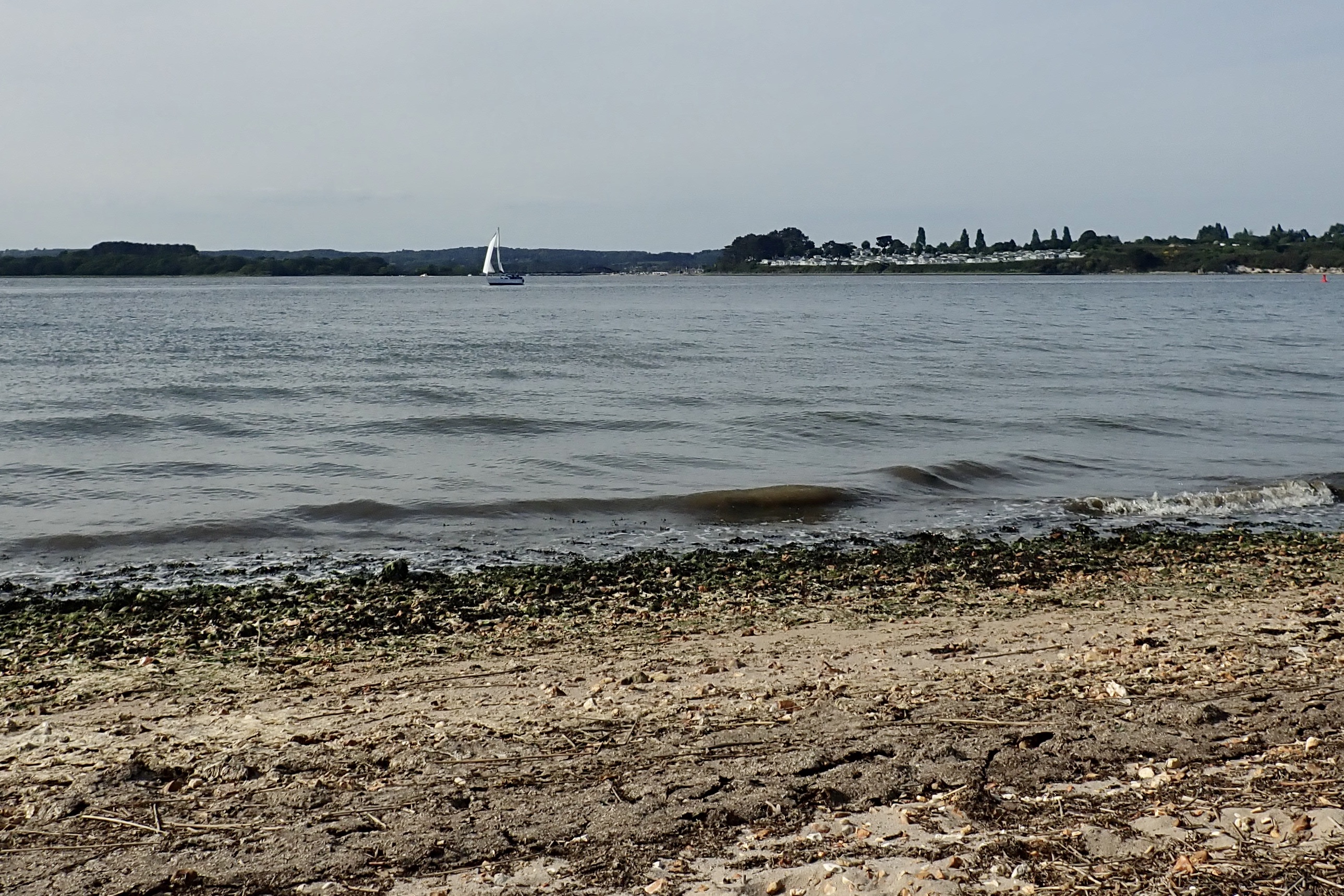
Not exactly the Summer isles, but it’ll have to do. You don’t get a May week of 20°C+ and full sun up there.I try to remember what to do and in what order.Note the water skier. With my typical ‘let’s-wing-it’ lack of due diligence, we’d stumbled on one of the few ‘PWC’ zones on Poole Harbour. (The link’s map is missing but may be what’s at the top of the page.)Well, stood at the shore it looked like a good north-easterly for a while.OMG, more menacing water-hoons! It’s a bank holiday Sunday and turns out we were right on their sole permitted skiing corridor. RTFM!Once on the water there’s barely enough wind to blow out a scented candle from Purbeck Handicrafts.But according to the GPS, paddling most of the time we did momentarily zip along with the tide.As it is, tides in the Harbour have quite a prolonged high water period which will be useful. This is a spring tide in a few days.Newbie on Poole Harbour back in 2005.Gumo Safari, my very first IK.We should have just cruised close to the shore where motorboats fear to tread. Next time we’ll know. Near Gigger’s Island we pass a motionless hardsheller, like a heron deep in thought.Without my GPS, first time finding the Frome river entrance would have been tricky. Soon impenetrable reeds line the banks, our speed drops and pot-bellied boaters cruise by at 4 knots. I can see this 2.5-mile river stretch might soon become a chore at the end of a long paddle and an ill tide.
Never get out of the boat? We couldn’t if we tried, but near the river mouth there’s a small jetty and a track back to town. Good to know but with an IK, I’ll need some wheels.
That night we catch a bit of Springwatch on the iPlayer but, as expected, I can stomach the hyper-saturated, happy-clappy ‘Phil & Holly of Wildlife’ for only so long. It’s the final finale of Succession – what are we waiting for!? A probing bike recce of the south shore is needed. More Poole Harbouring to come.
It took just one outing with old mate/new packchum Phil to recognise the appeal of packraft sailing. My old WindPaddle Adv 2 was able to haul us both out to the Teign estuary with little effort.
A few clicks online and a 99-euro Anfibio PackSail (same as the defunct WP) got jammed in his letterbox. With a chilly offshore wind blowing off the south Cornish coast, Phil launched his 12-foot long R2 Barracuda Pro from a handy RIB and set off for Brittany.
The combination of the Barracuda’s kayak-long waterline, light weight and the 1.3-m diameter sail soon got the MRS skimming along at nearly 10kph. That switched to -0kph as he turned round into the 30kn gusts and tried to paddle back to shore. Time to hail down the water uber.
An old mate got in touch to tell me he’d bought himself a top-of-the-range MRS R2 Barracuda Pro and heck, even my packrafting book. He’s in Devon and I was in Dorset so I suggested we meet up for a Yuletide splash-about. Back in the day we were desert bikers; now we’re packrafting pensioneers.
Like some do with a new activity, Phil had got stuck right into his MRS and had already paddled to Dartmouth with his Brompton bike (left), something over in Norfolk, then scared himself further up the rain-swollen Dart from Buckfastleigh to Totnes, noting ‘it’s amazing how dangerous the big branches [and fallen trees] are…’
Tell me about it. If it’s not weirs or camo-&-beard anglers spitting poison darts, it’s deadly sweepers blown down by winter storms. I never quite got round to doing the Dart in my fearless prime, such as it was, but I hear in winter it’s one of the Southwest’s whitewater classics – a bit serious for me now. We settled on the Teign out of Newton Abbot with our respective bangers parked at either end.
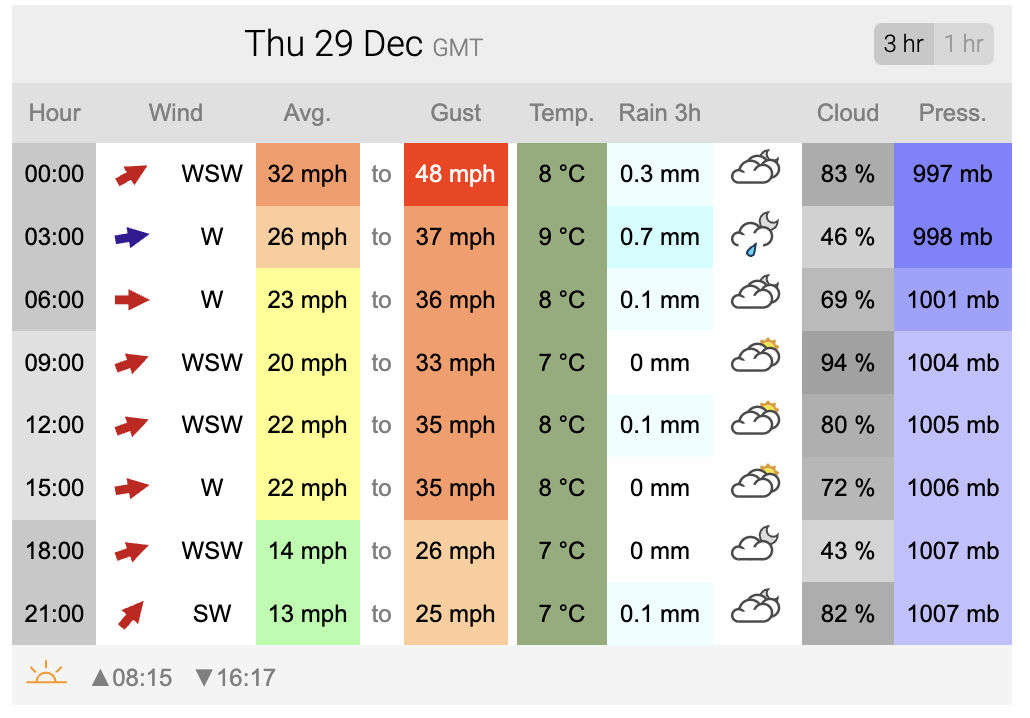
If nothing else, we ought to have a good backwind. The previous night had peaked at around 50mph, but by dawn it was tailing off to half that, with the usual gusts at +50%, single-digit temps and showers. A good day for a drysuit and a stable packraft.
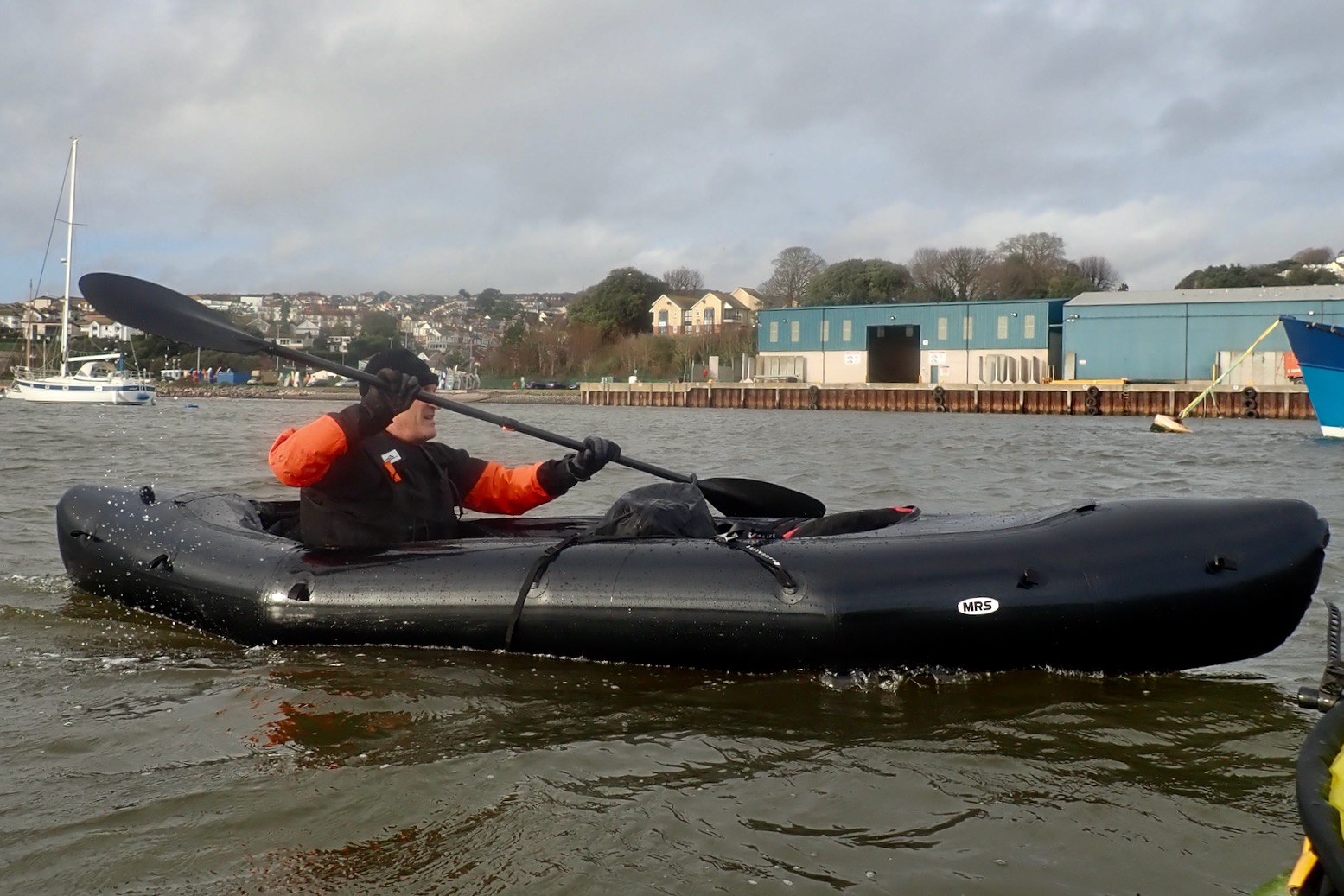
Some quick stats on Phil’s noire ‘cuda: 3.6m x 99 wide with 217cm inside and up to 7.6kg with the removable deck, two seats and internal storage, all for a hefty £1750. Compared to my TXL, it’s 80cm longer or nearly 12 feet in old money; our Micra’s shorter than that! It’s also 10% wider than the TXL, about 35cm longer inside so loads of room for 2 adults. Solo/no deck it gets down to 5.6kg alongside the TXL’s 3kg.
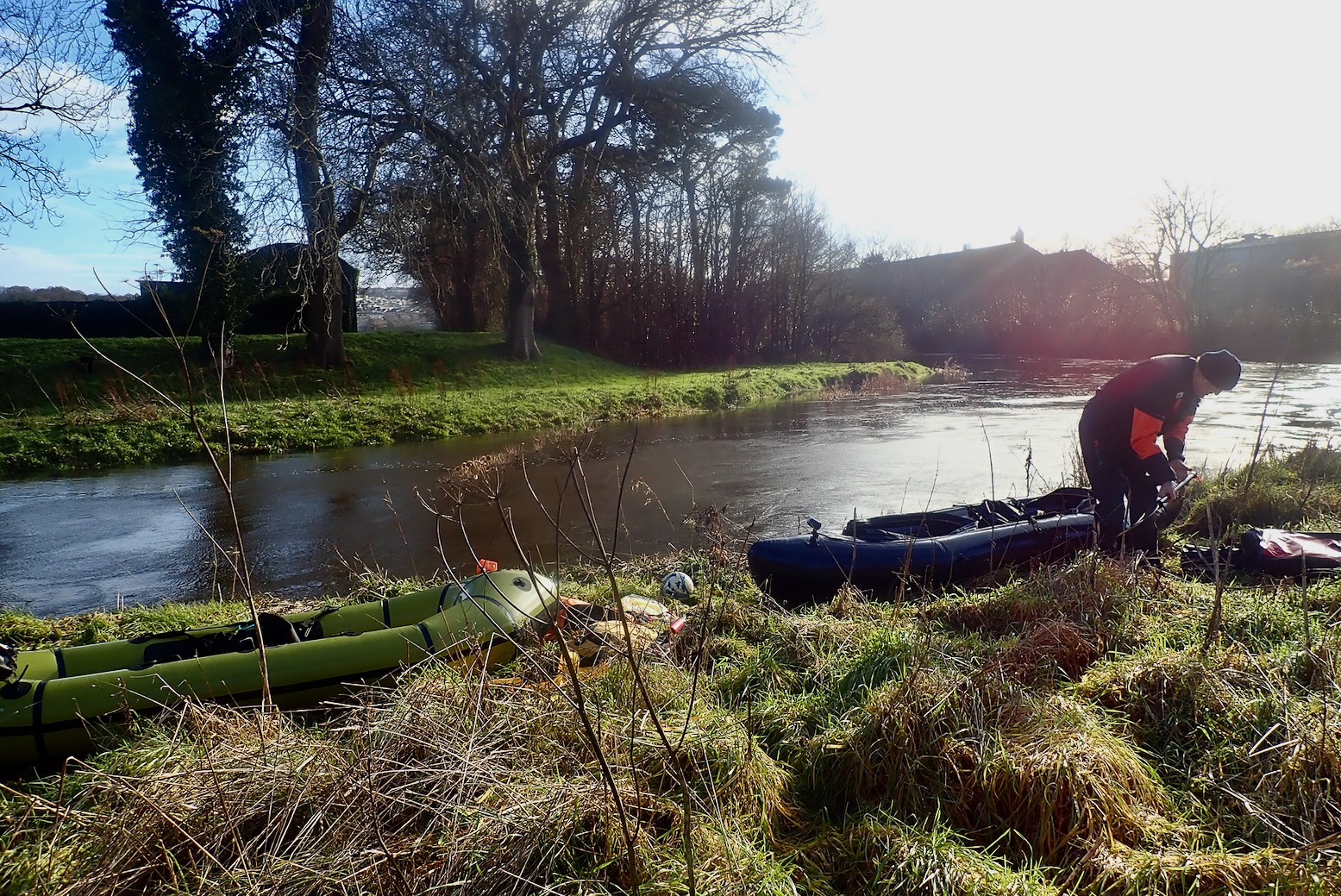
We drove around Newton looking for parking and a put-in. Opposite the racecourse and over a broken roadside fence we found a spacious river bank just at the Teign’s tidal reach. By the time we set off we were in the middle of a 3.5-m ebb, midway between springs and neaps. Either way, like the Frome the other day, the Teign was ripping along at a light jog and before I’d got myself untangled from my gear I was 75m downstream. I thought I’d finally got to grips with keeping it all in one bag, but Today’s Forgotten Item was my seat base [forehead slapping emoji]: ‘Gear drifts apart; the centre cannot hold. Mere forgetfulness is loosed upon the world‘. By chance I had a spare Anfibio Bouy Boy which did the job as a seat cushion.
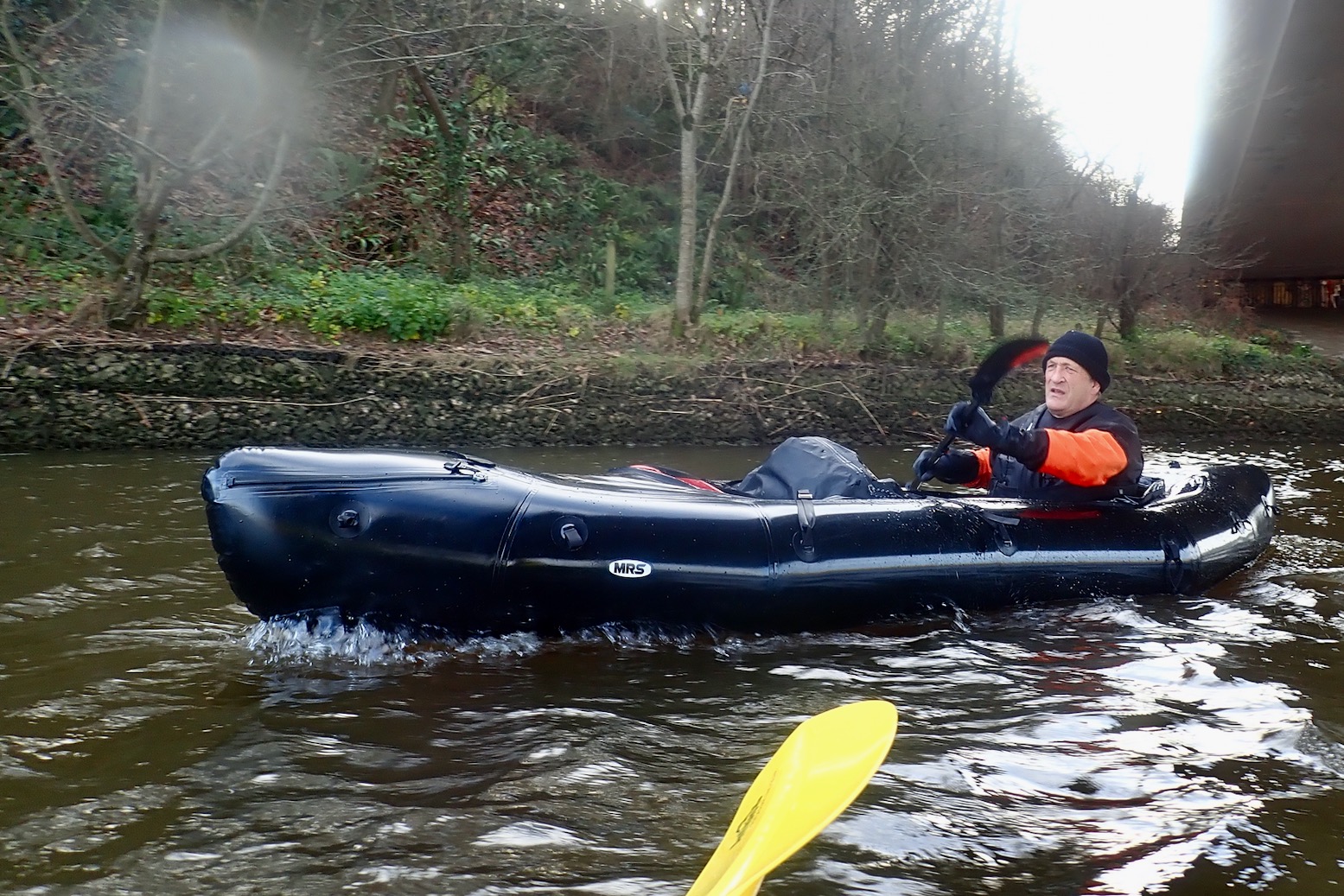
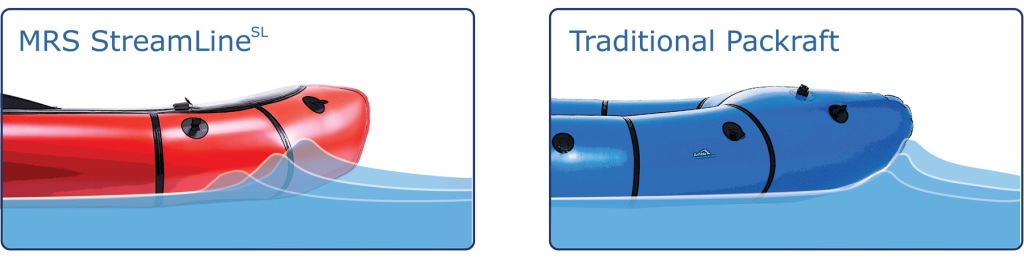
The Barracuda has the same distinctive prow design as my old MRS Nomad which was a fast solo packraft, what MRS call StreamLineSL. These prows take up nearly 1.5m in the R2 which explains the massive length while still having a lot of room inside the boat. There’s probably enough buoyancy for four people and a caribou calf, with room for all their gear inside the ISS hull storage.
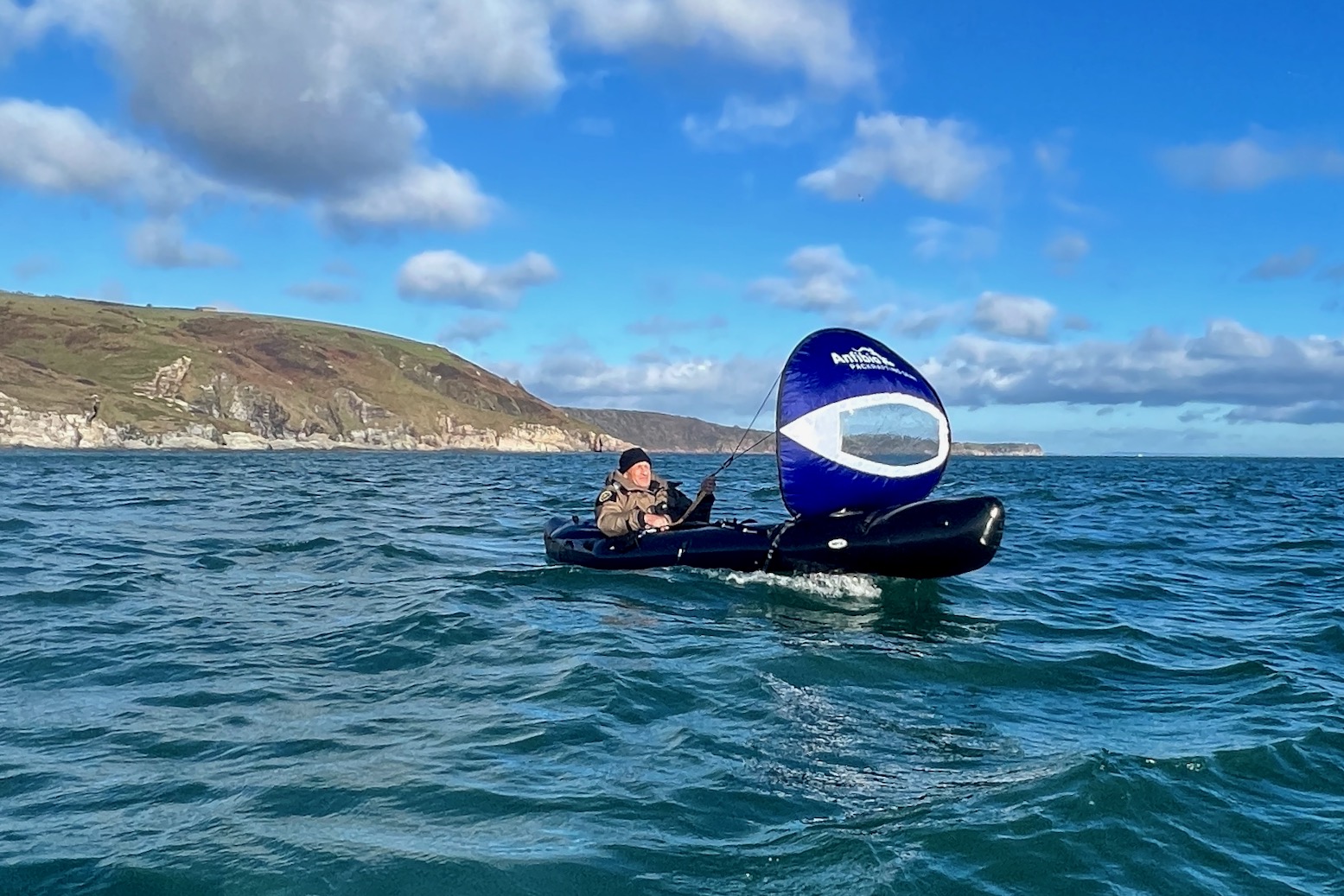
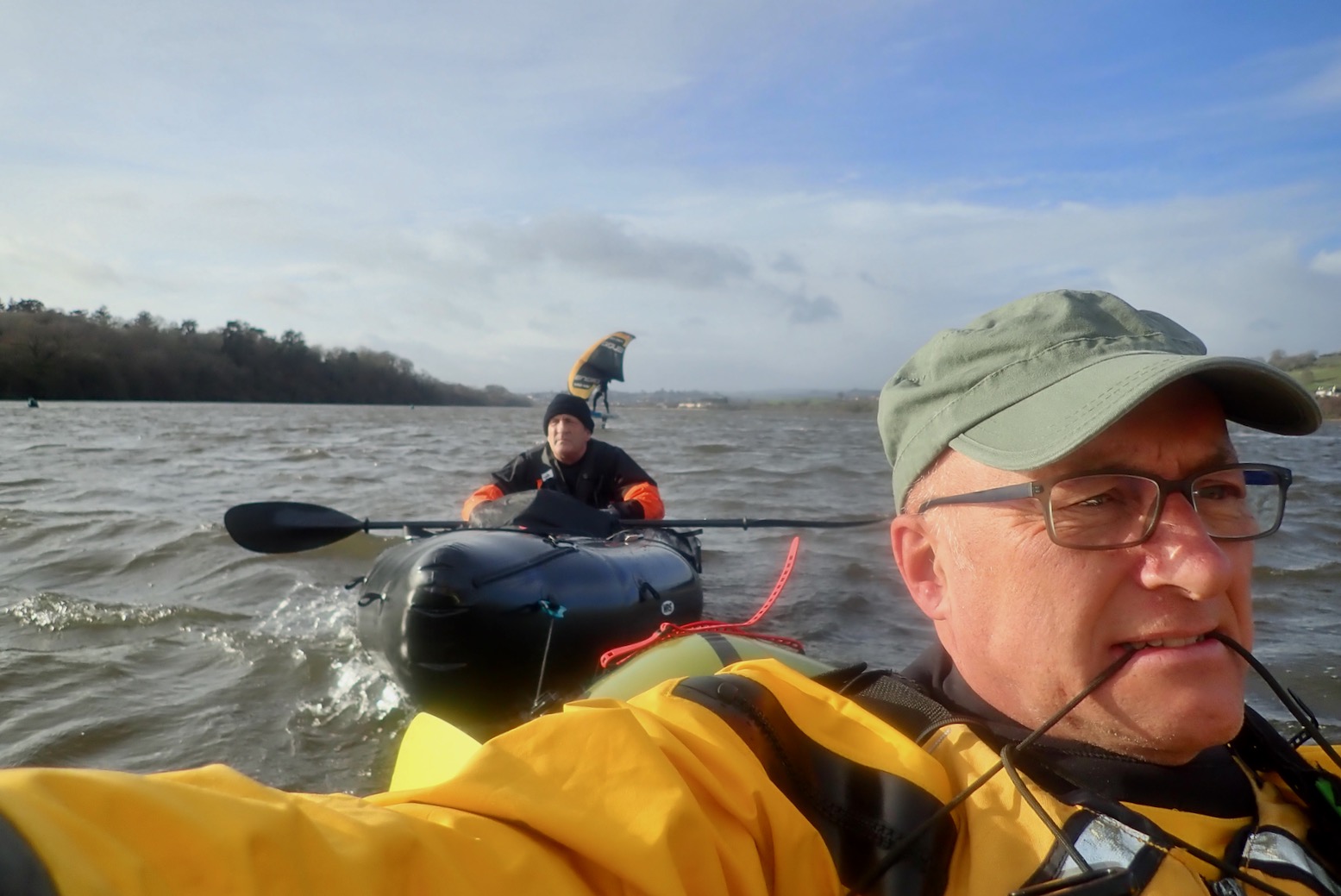
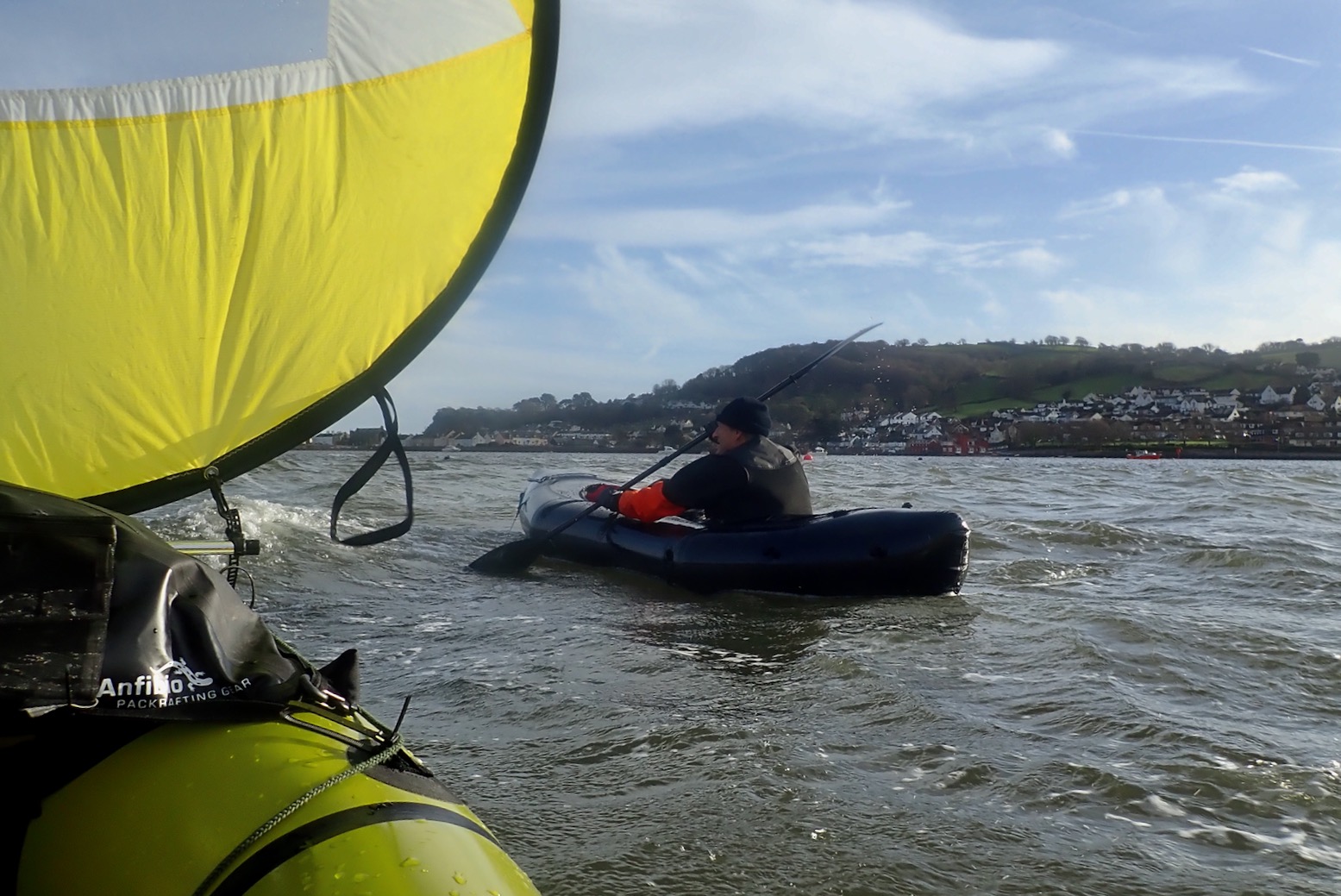
Before we knew it we’d passed under the A380 bridge and were out in the wide tidal estuary. The predicted 20mph winds came barrelling down the channel so I couldn’t resist flipping out my WindPaddle. With the Barracuda’s mooring line clenched in my teeth I managed the sail while Phil’s phone recorded 8 knots, obviously helped by the falling tide.
There were a few forceful gusts and the fetch kicked up towards the end, but the TXL and Barracuda shrugged it all off and my transverse bow sprit (left) did a great job of steadying the straining sail. I think the MRS has wider attachment points on the bow so may not need it, but I’m sure Phil will be buying a PackSail if Anfibio can do him one in black. He did.
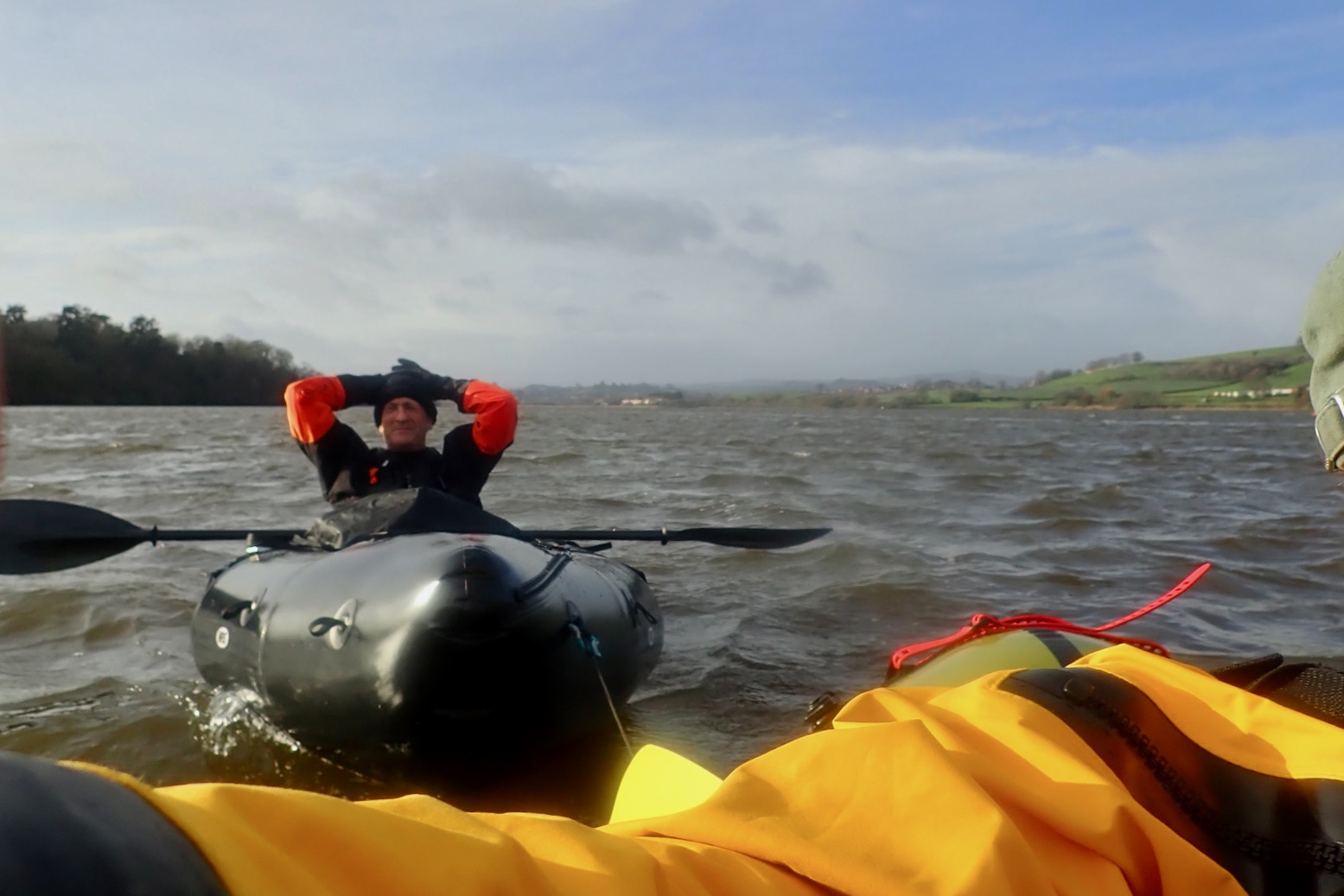
Things got a bit chilly out in the deeper water and I noticed my TXL was creasing a bit at the sides. It’s been so many months since I last used it I’d forgotten high-volume packrafts need a second top-up a few minutes in to get good and taut. It didn’t seem to affect speed, but like properly laced shoes, taut feels better. That’s one good thing with Phil’s black boat; it auto pressurises in the pale winter sun. While we sailed, he tucked into his lunch.
The Teign estuary is actually not too industrialised. Under the last bridge The Salty sandbank was starting to emerge from the chop and as we curved round to the river mouth the sidewind pushed us into moored craft caked in algae. At the narrow outlet a rip of bouncing clapotis was jiggling out to sea and on the beach someone was striking poses for their Insta feed.
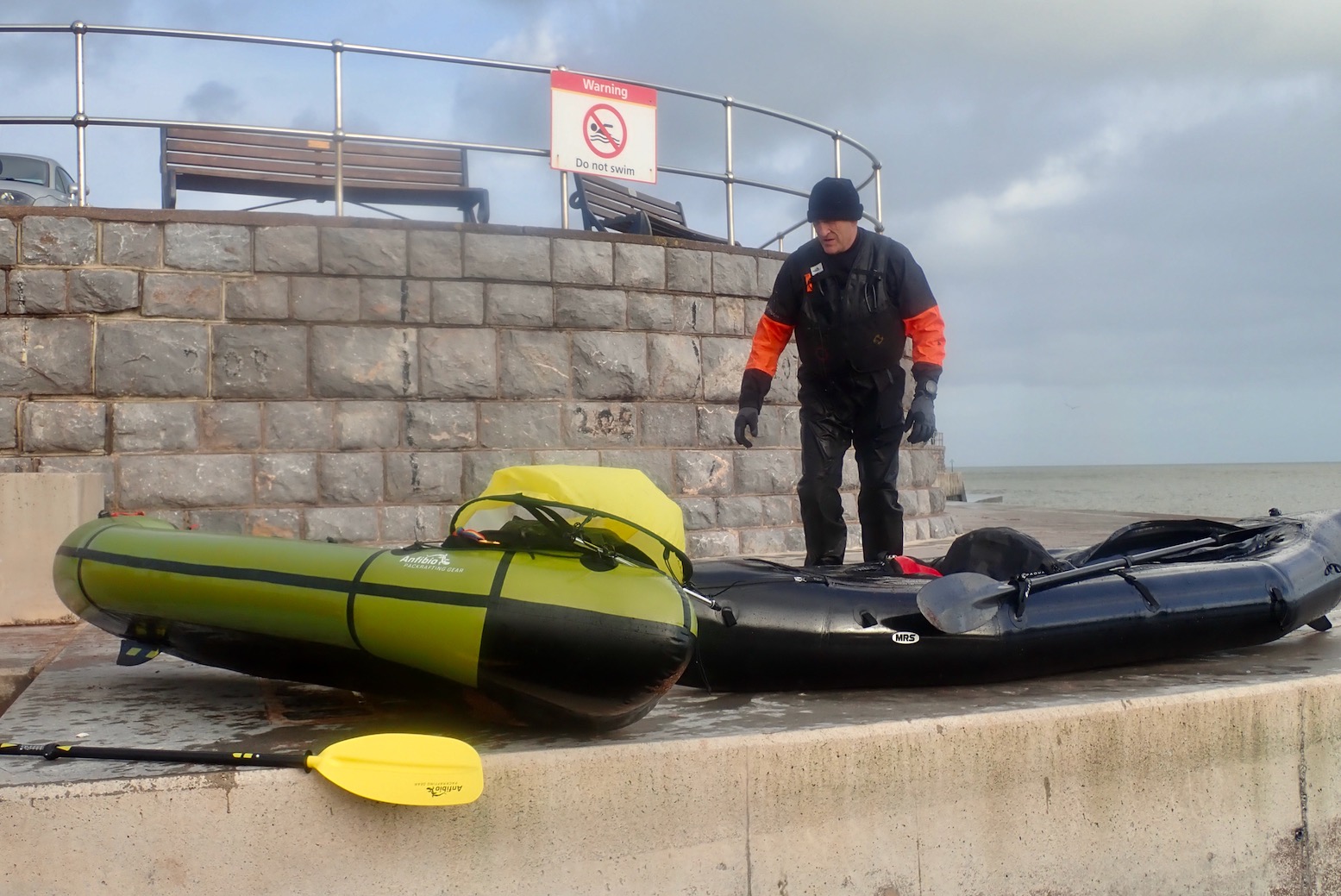
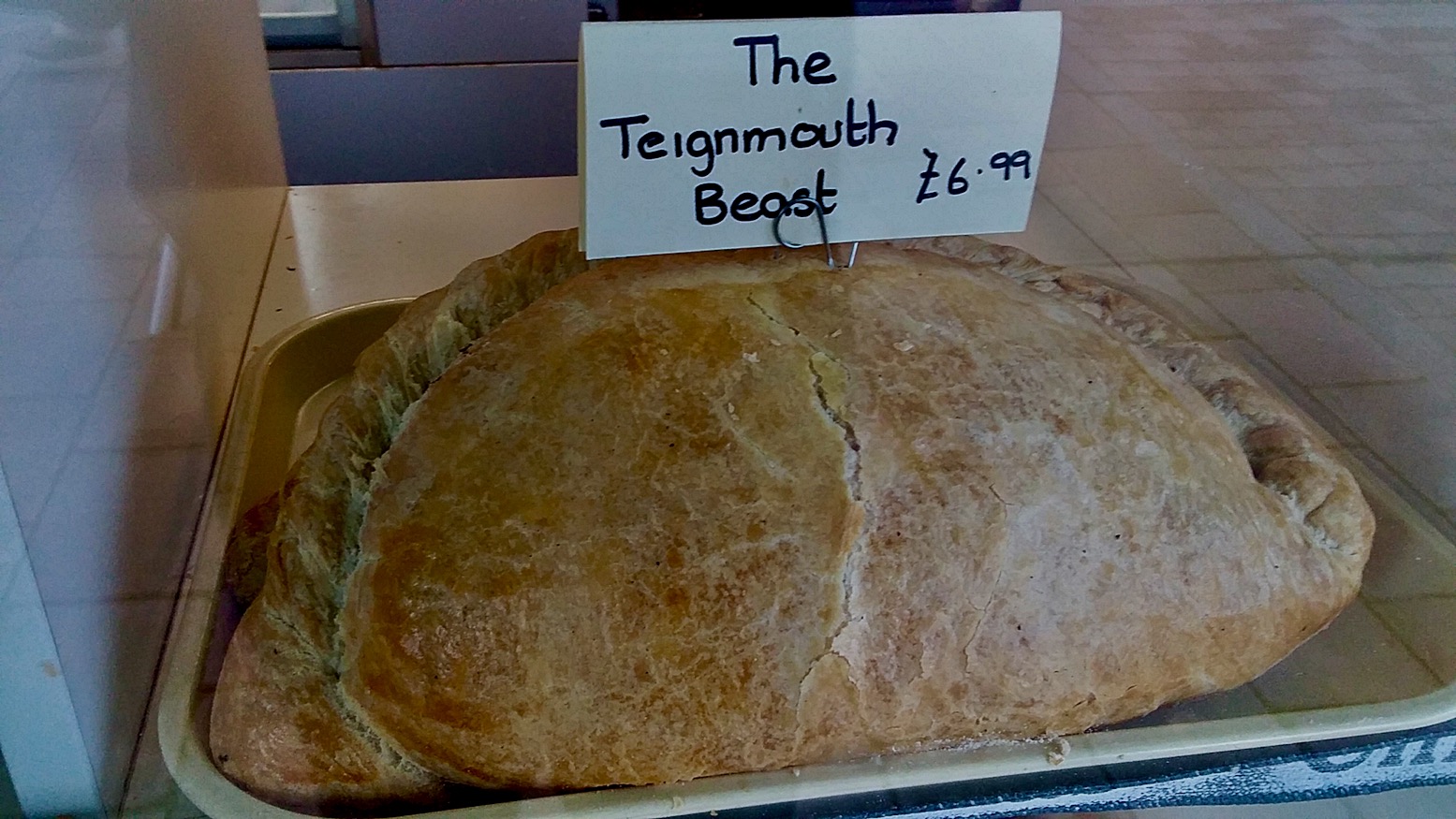
A little over an hour for 5 and a bit miles, just about all of it sailing both boats. It was interesting to learn that the WP could sail two big boats without much loss of speed. Staggering ashore, it felt odd not to be arm knackered, but once I got over that we headed into the deserted seaside town in search of the legendary Teignmouth Beast. That’s a local XXL pasty, not the jet-black MRS Barracuda.
I’ve done a few IK paddles in Southeast England between Rye and Portsmouth, but the Sussex and Hampshire coasts aren’t that inspiring. So it’s about time I started exploring the far more interesting and much more extensive Southwest Coast. From the Isle of Wight to Cornwall and back up to the Severn there are scores of inshore excursions possible in an inflatable. Just as in the far northwest where I mostly sea paddle, all you need is a fair tide and paddle-friendly winds, the latter a bit less rare down south.
In a blobby packraft? You cannot be serious!
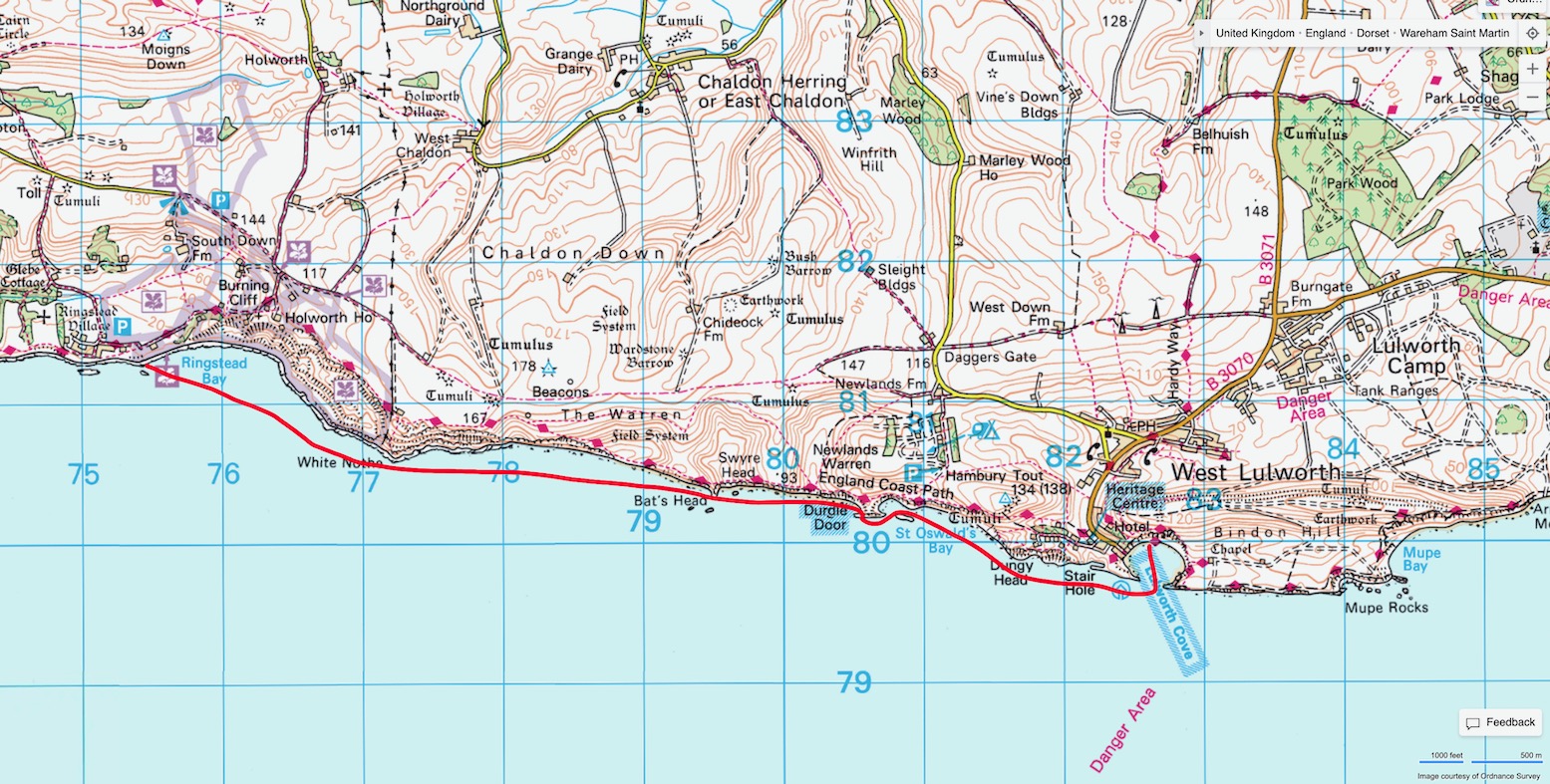
So in the face of predicted moderate winds I cooked up a 50-km Jurassic overnighter from Weymouth to Swanage in Dorset. I’m pretty sure they opportunistically rebranded the plain old Purbeck or just ‘Dorset’ coast as the ‘Jurassic Coast‘ soon after that 1993 movie and haven’t looked back since. Like much of the Southwest coast, the beaches and country lanes become a logjam of holidaymakers on a warm summer’s day. On the water, our paddle would pass below sections of cliffs a couple of miles long and take us to the famed landmarks of Lulworth Cove, Durdle Door arch (top of the page) and Dancing Ledge. We could even carry on back north past Old Harry’s Rocks and across Studland Bay right into Poole Harbour to catch out trains home.
TXL at sea
Compared to using regular (solo) packrafts, my confidence in my TXL for sea paddling is a revelation. After all, it’s still just another blobby, single-chamber packraft. It must be a combination of the added size giving a kayak-like perception of security (as I found in my MRS Nomad), as well as the responsiveness and speed from a longer waterline and, I now recognise, the sometimes noticeable added glide from the Multimat floor. There’s also the fact that paddlechum Barry was up for the Dorset run in his similar MRS Nomad, making this untypical packraft outing less daunting.
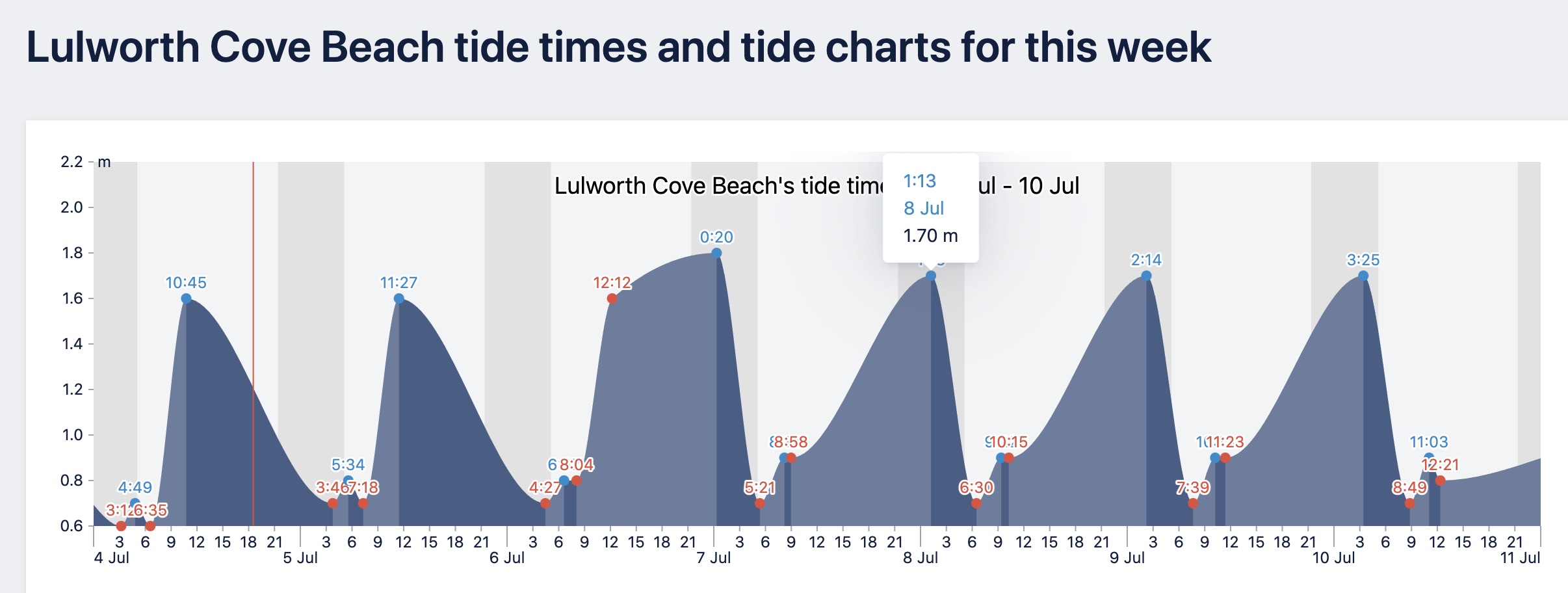
Lulworth tides – all or nothing (of not much).
Modest, two-metre tides off Purbeck
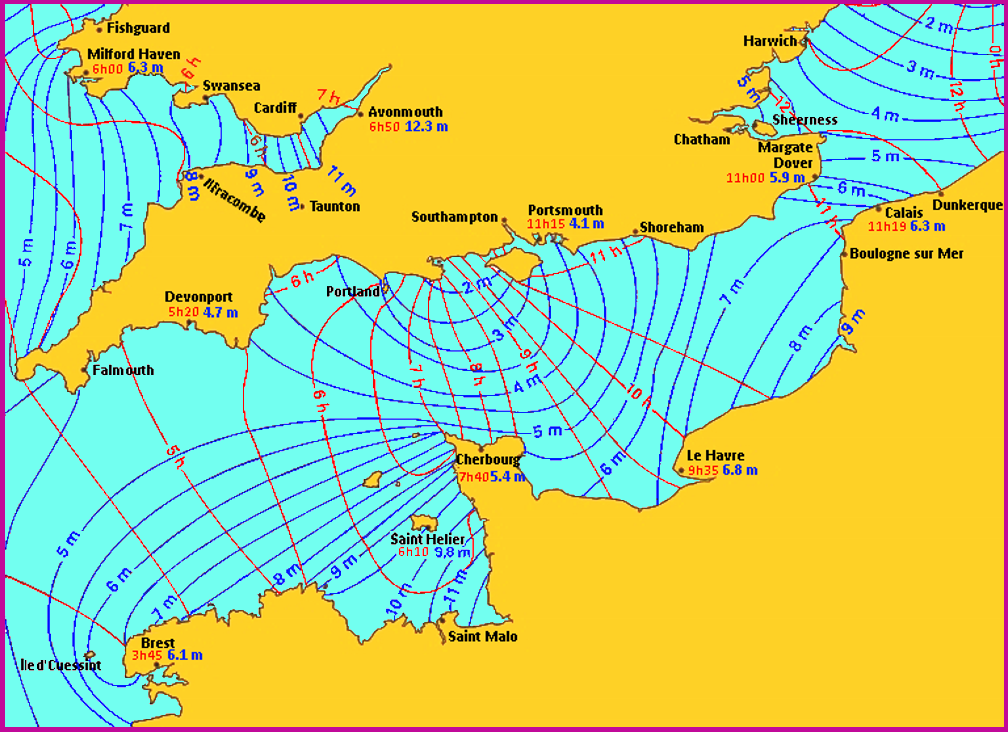
For some bathymetric reason – possibly the Atlantic tidal surge backing up in the Straits of Dover, plus hidden offshore shelves – the tides off the east Dorset coast are very odd: they can rise or drop all day, but have a range of just two metres, about as low as it gets in the UK. That ought to mean moderate ebb flows pushing up against prevailing westerlies, plus we were heading into neaps. And while often cliff-bound, if we stayed alert to escape routes we could easily bail and walk or climb out with our packrafts.
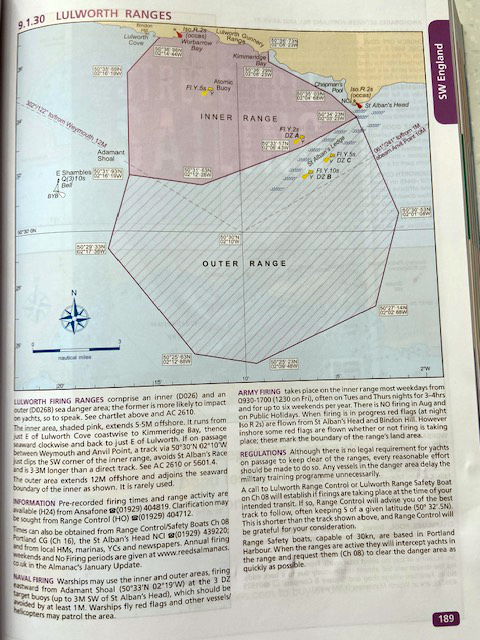
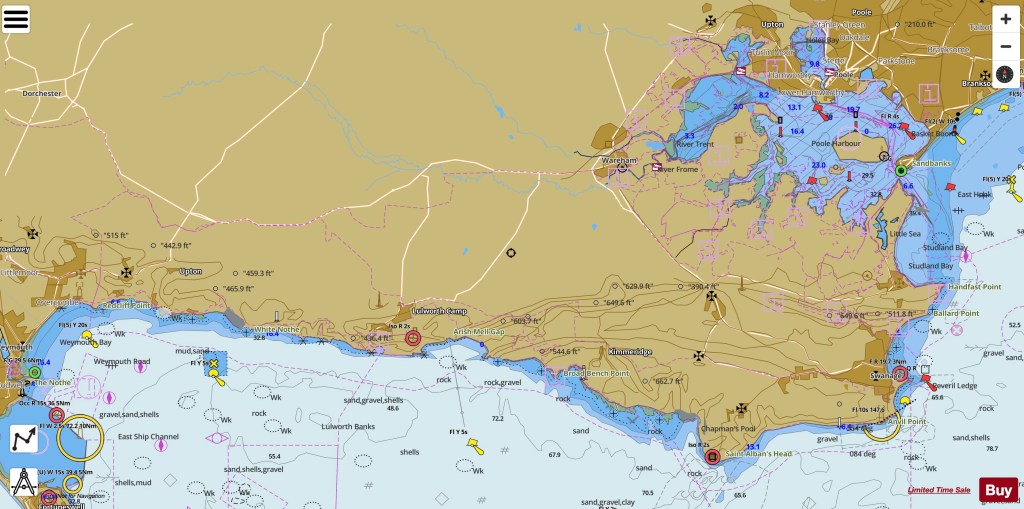
East of Lulworth Cove the Jurassic Coast‘s bucket & spade Babylon is interrupted by a 5-mile wide Danger Area – an army firing range. This was probably not one of UNESCO’s criteria for World Heritage status, but the SW coastal path also gets closed for a similar distance. Barry’s Reeds Almanac had a page or two on this (left), as well as useful tidal flow charts (drops to the west; rises east). I left it to Barry to call the ‘0800 DUCK!’ number, but imagined surely they’d leave the target practice to the off season. In fact they’re all it most of the time Mon–Fri, including an evening session 9pm to midnight: all we had to do was click this.
fishing.app – handy and similar toa Reeds Almanac but free
Early train to Weymouth
With a plan taking shape, I in turn bought a copy of Pesda’s South West Sea Kayaking in the hope of being alerted to local anomalies. I’m glad I did. It turned up with just hours to spare and identified that the run from Kimmeridge Bay round the Purbeck corner to Swanage was a grade up from the easy section from Weymouth. With headlands, submarine ledges and long lines of cliffs, without a foot recce I decided we may be better off skipping this bit.
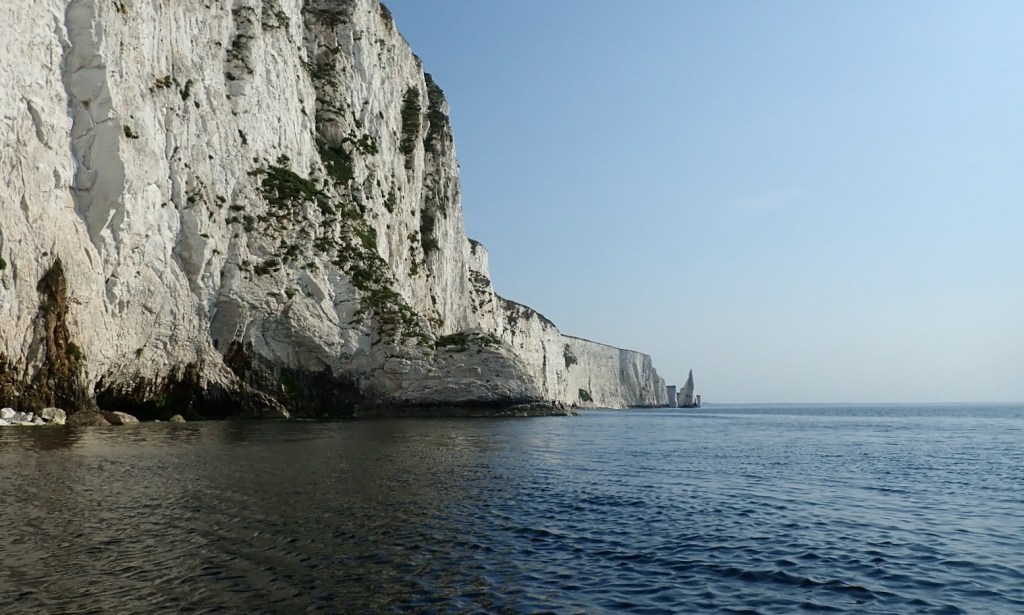
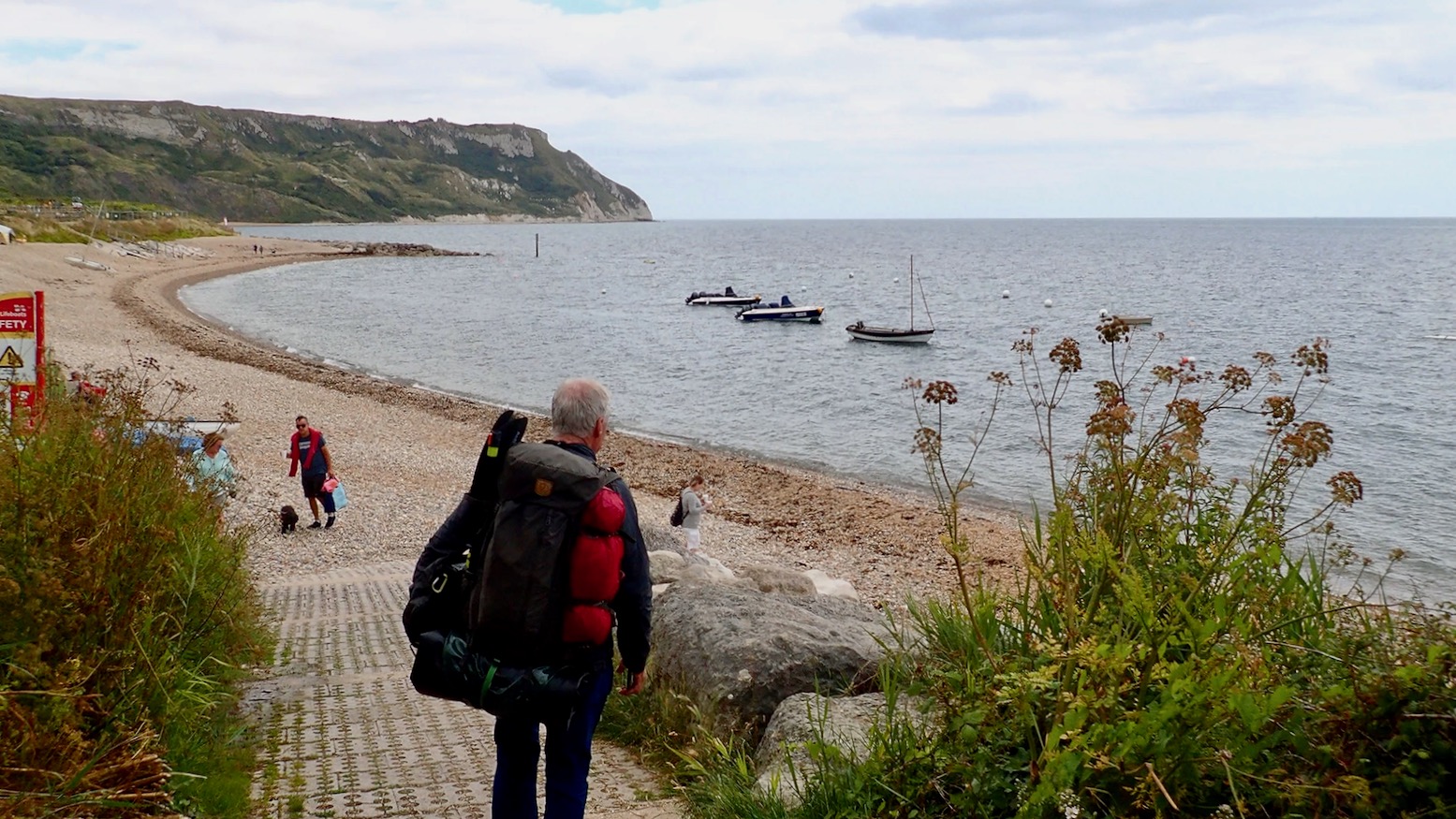
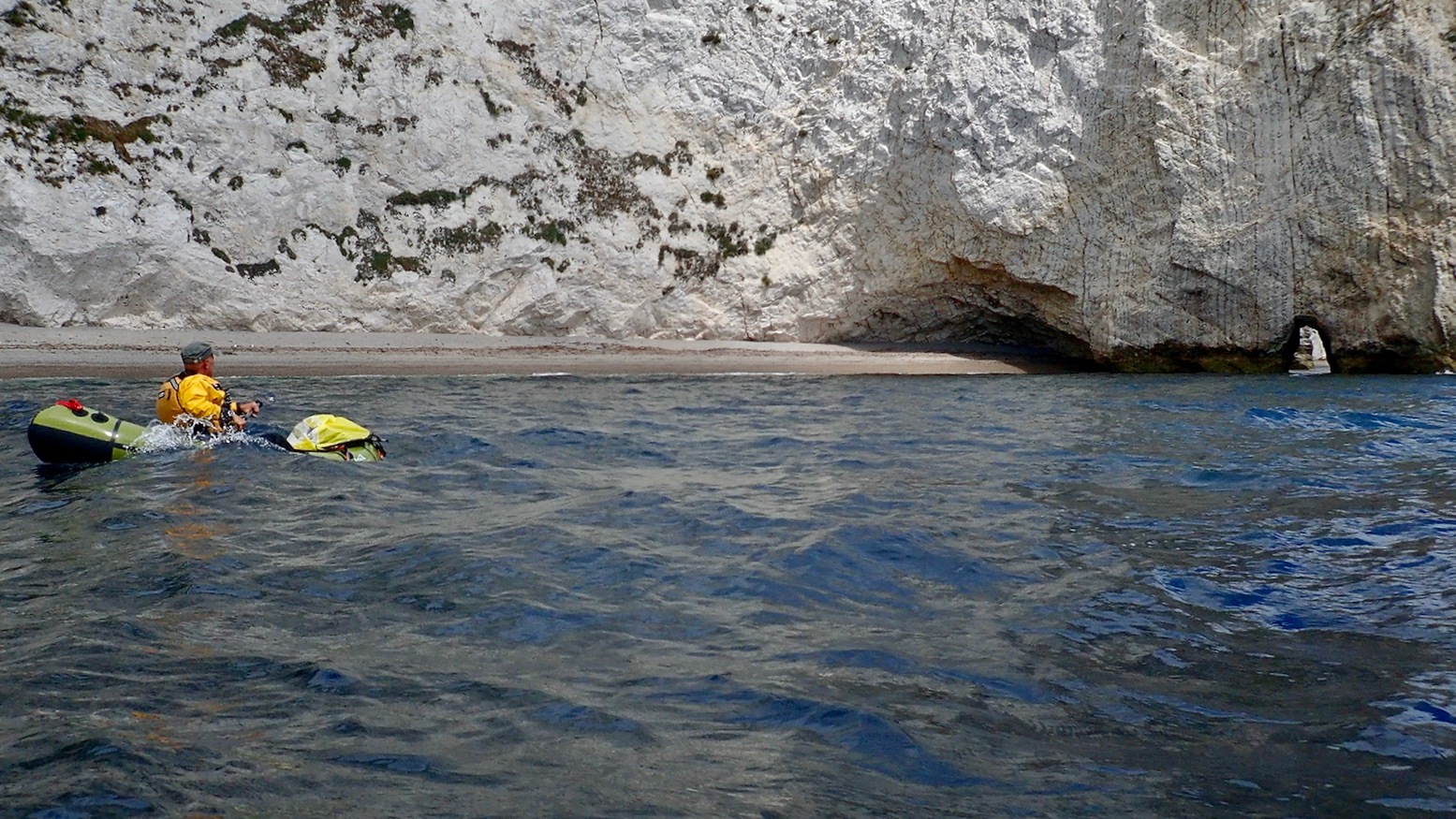
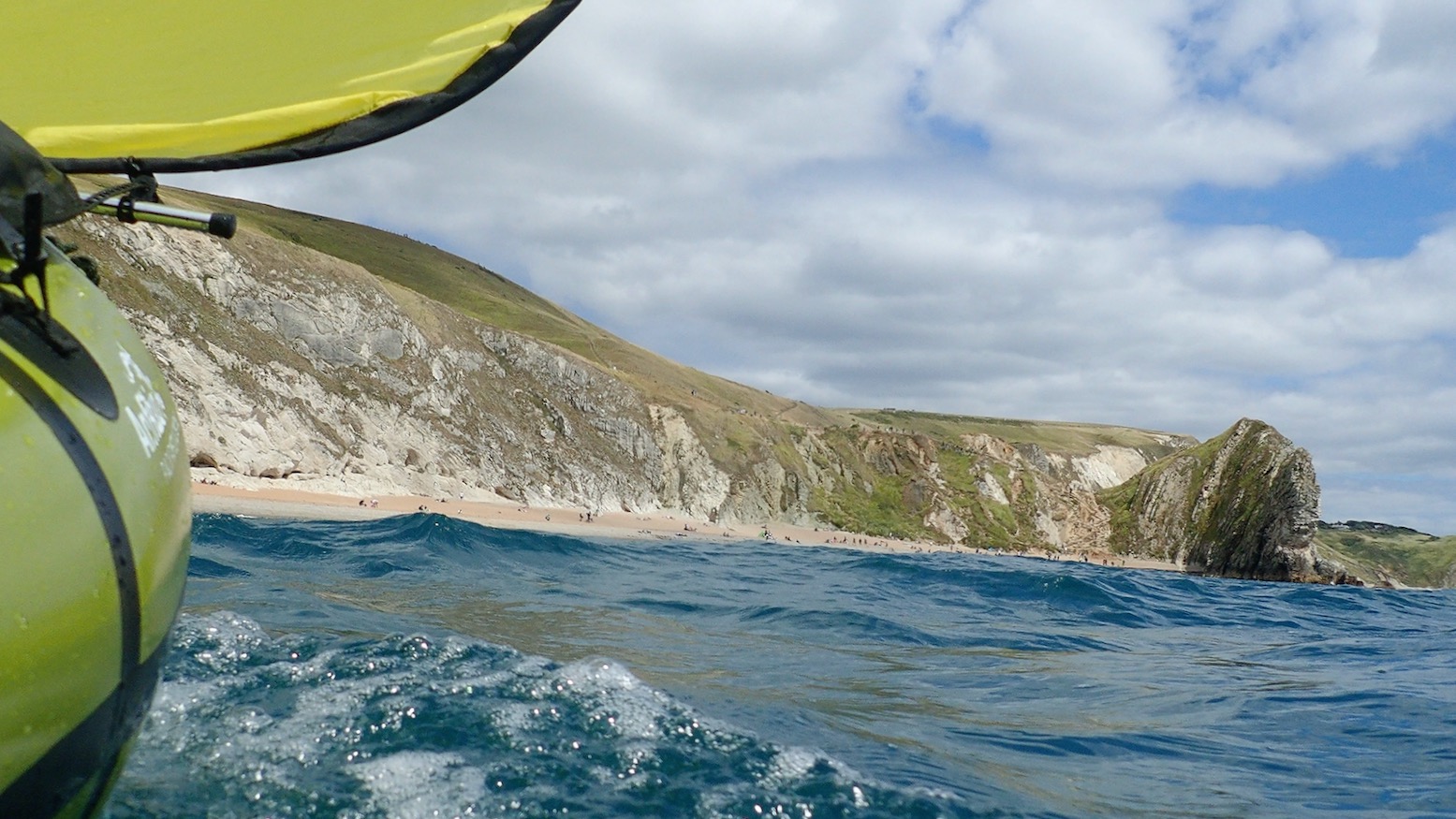
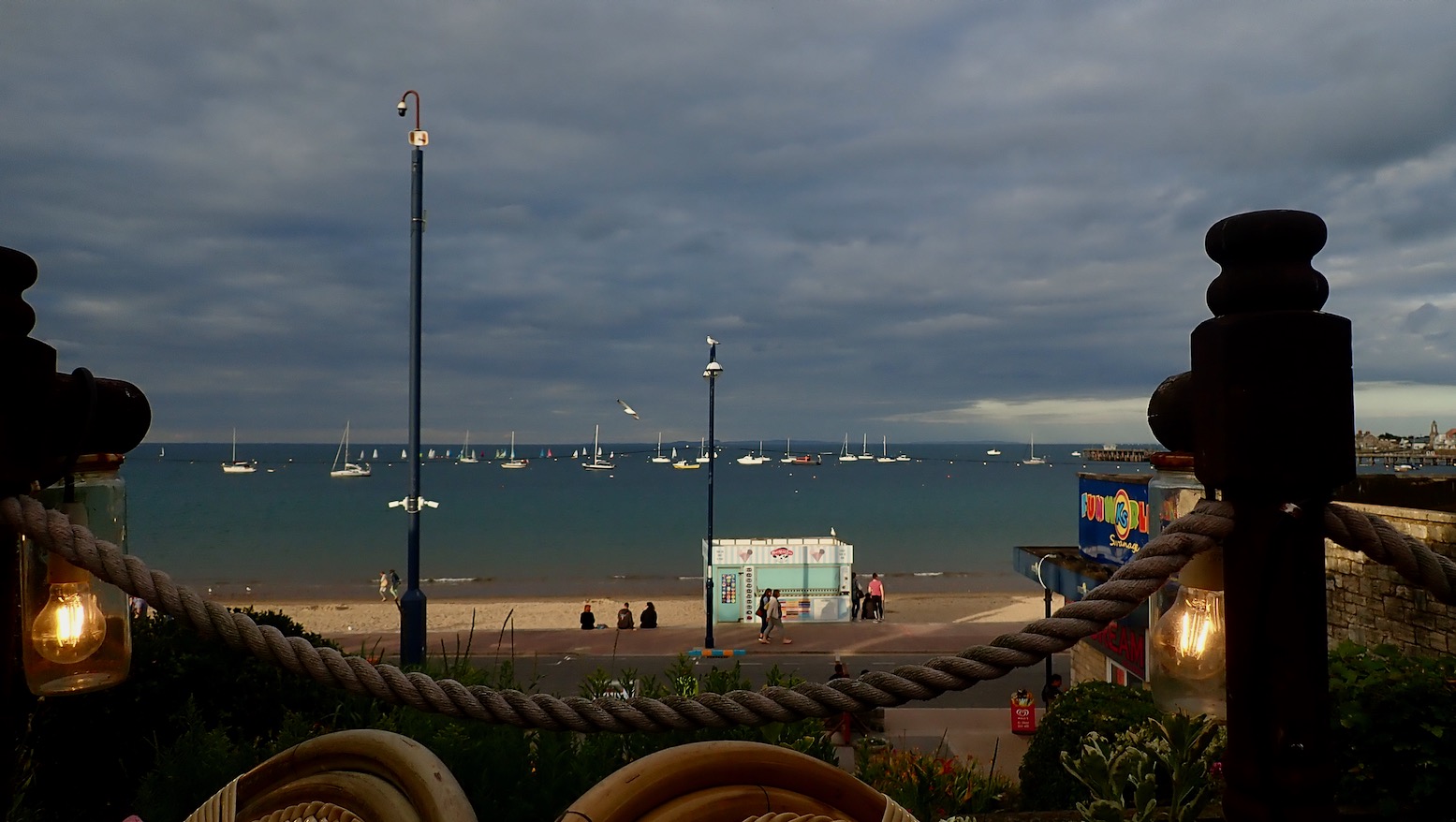
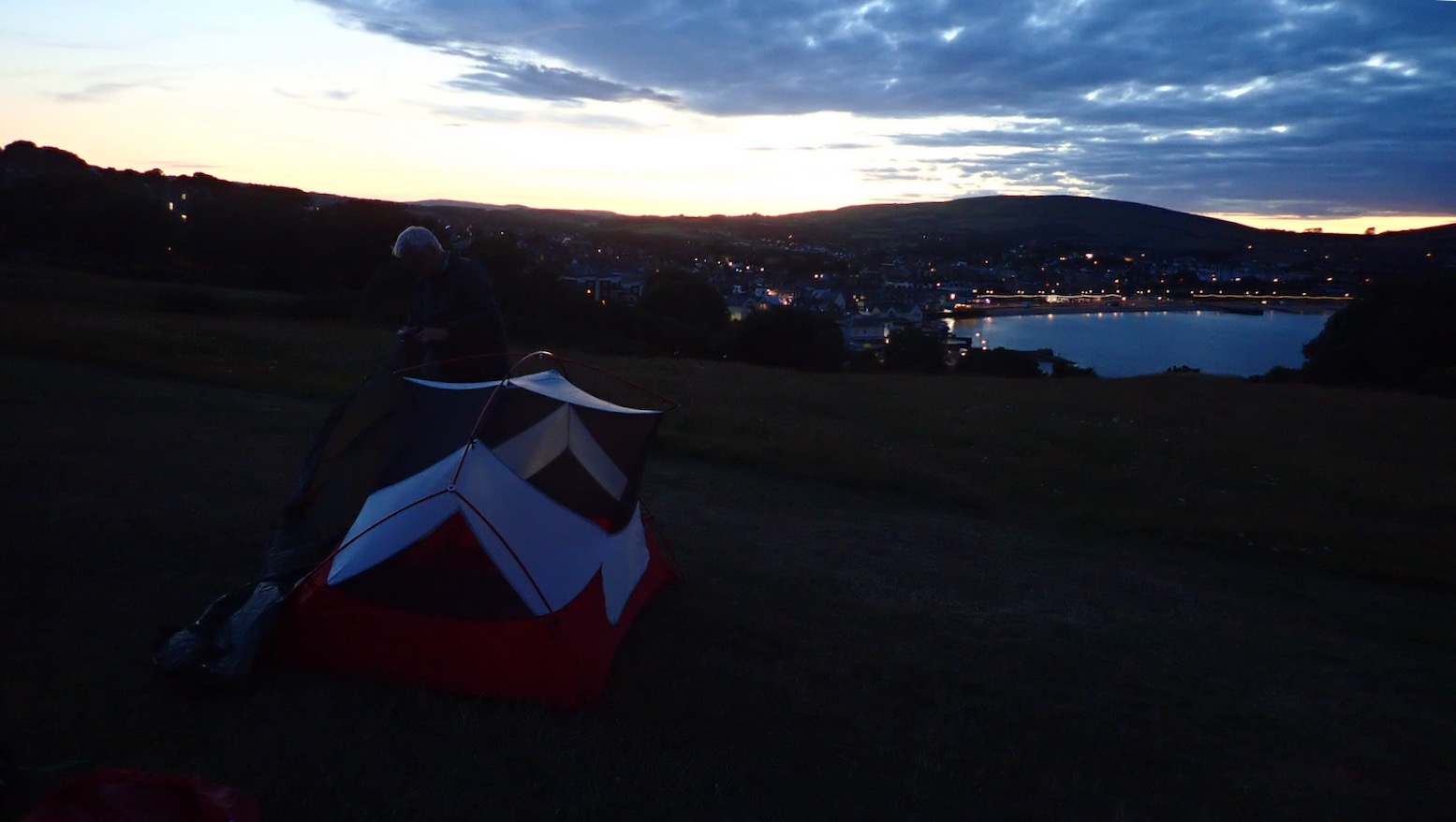
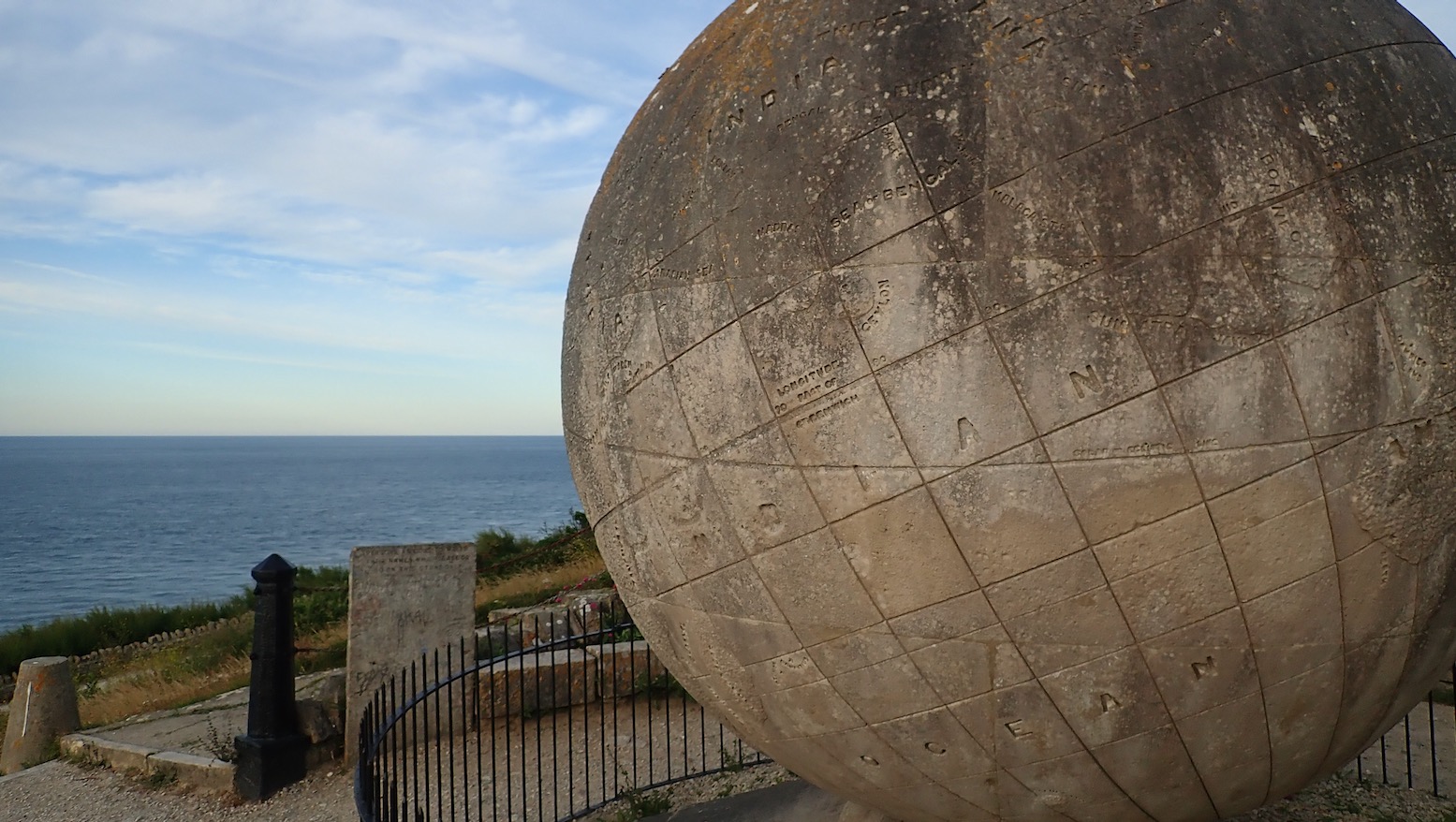
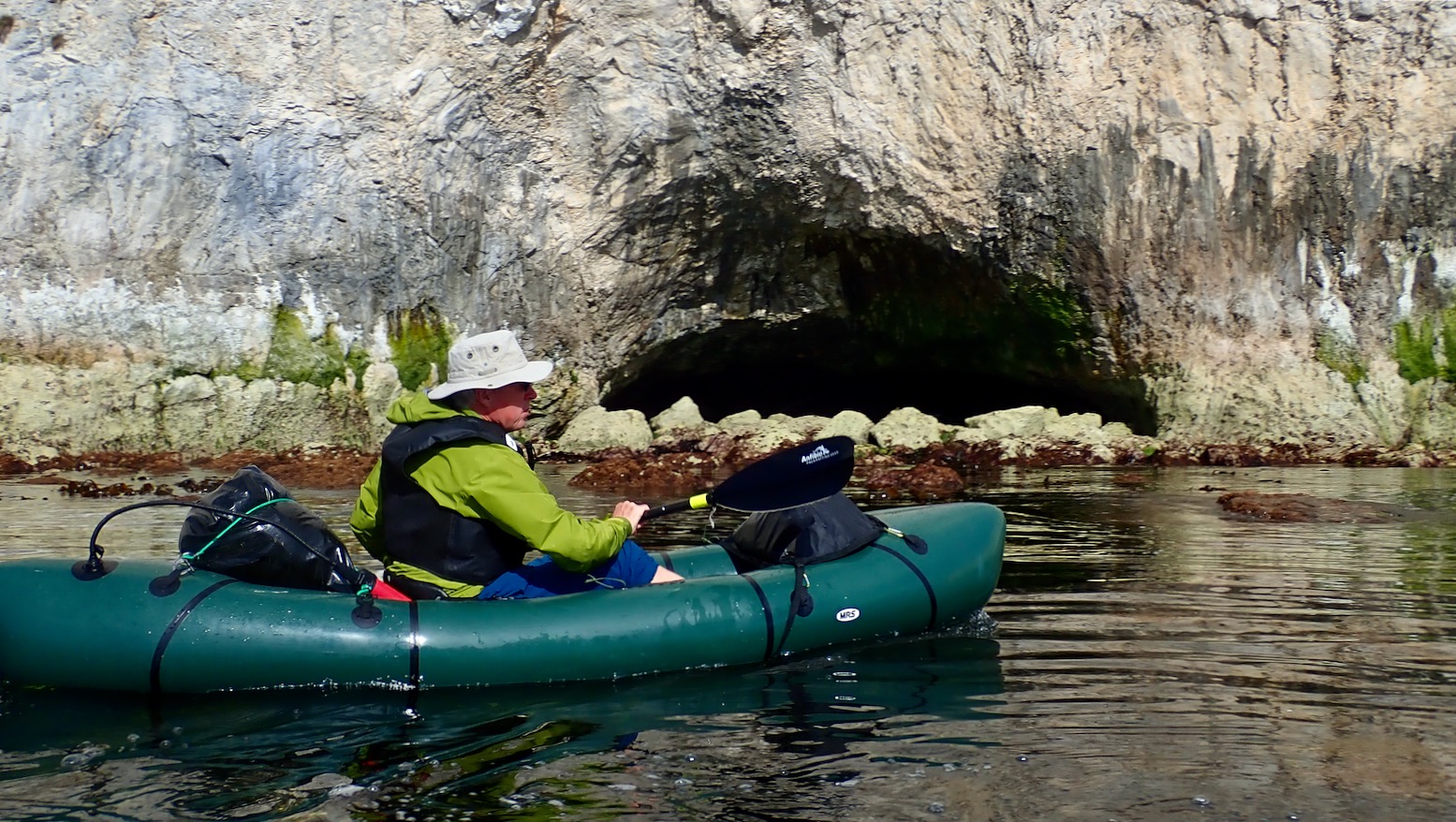
It’s noon in Weymouth, but with offshores now predicted by late afternoon, we fast forward by taxi to Ringstead Bay, 5 miles in. That first section from Weymouth looks nothing special.Put in at Ringstead. Ten mph westerlies blowing against an ebbing neap tide.My Mk2 transverse bowsprit for a wide WindPaddle sail mount to limit swaying in stronger winds. I’m giving the Multimat floor yet another go too, all the better to skim over the water. We’re on the water at 1pm, hoping to reach Chapman’s Pool, about 21km away. But around 5pm winds are said to veer offshore and strengthen, so we’ll see. We sail at about 5-6kph – not much faster than paddling – but I note my TXL creeps forward about half a click faster than the MRS – must be the stiffening Multimat.Propelled at paddling speed by his inflatable AirSail, Barry casually checks his investment portfolio.The cliffs below Chaldon Downs. At times we paddled as we sailed to make less work for the wind.Forty five minutes in, I pull in the sail and line the TXL up to thread Bat’s Head arch. Note how the layers of chalk beds here have been pushed up to nearly vertical. Give it half a million years and Bat’s Head will be as big as nearby Durdle Door.Approaching the famous Durdle Door arch alongside a crowded beach. The TXL still weathercocks a bit under sail; I keep having to steer hard inland, but the bowsprit ‘stick’ limits the sail’s ability to twist. Or maybe the wind’s bouncing off the cliffs and blowing us offshore a little. Sitting further back to weight the back end over the waves may help.Sunbathers watch spellbound as Barry smoothly ‘Durdles the Door’ – a Southwest kayaker’s rite of passage.The Door has been durdled. Some claim ‘Dorset’ (formerly Wessex) was named after this famous arch. In high summer young bloods jump off the 60-metre arch. Appropriately, it’s called ‘tombstoning’.Near the entrance into Lulworth Cove things get choppy. Sat high on the airmat floor, if I feel unstable I can easily let it down. As we head through the Cove’s narrow neck a patrol boat circles back and instructs Barry we can’t carry on east; the army ranges are firing. ‘I thought you said you were going call them, Barry? You had one job to do…’ ‘But you said they hardly ever do this on a balmy, July’s day!’ And so it went on…360° selfing in sheltered Lulworth Cove.I spot some IK compadres lugging an AE Elite.A salty-eared boatman tells us the army pack up about 5pm, about 2.5 hours from now by which time the offshores may be on us as we cross the Kimmeridge Ledges mentioned in the Pesda book. As we slurp a 99 with sprinkles the odd gust blows offshore. We can’t even pack up and walk the cliff path; it’s closed too, and so is the B3070 road. Barry wants to paddle on a 5pm, but I propose we bus to Swanage rather than risk being be left high and dry. Tomorrow we’ll paddle north towards Poole – or as far as the predicted headwinds allow.So a paltry 5 miles – but the classic stretch of the Jurassic Coast.A couple of hours later we enjoy a pint and…a lavish seafood medley overlooking Swanage Bay.But there’s no campsite till August, so we pitch for free up in Durlston Country Park to the sound of beery revellers and Tuesday-night hoons doing burn-outs along the seafront. What can it be like on a Saturday night?Six am next morning, a light breeze blowing from the northwest means no condensation ;-)) The Anfibio Multimat passed the sleeping test, too.I walk a mile south to Purbeck’s corner at Durlston Head to inspect the tidal stream. Two hours before LW, it’s negligible, but further west, St Albans Head just out of Chapman’s Pool is said to be stronger. I must do that walk sometime. Above, a ferry heads from Poole to the Channel Islands.Durlston’s famous 1890 Great Globe.‘The Earth is a planet and one of God’s glorious creations.’Looking back north you just see our tents on Peveril Point, Ballard Down chalk cliffs and pinnacles stretch out beyond, and Bournemouth’s at the back.I’m amazed how Barry always manages to roll his MRS up so compactly.A modest breakfast in the Swanage sunshine.At the cafe we meet Rach and Mark setting off on the final day of a staggering 630-mile walk along the Southwest coast from Minehead in north Devon. Their picture above taken a few hours later.Meanwhile we prime our boats for the 6.3 miles past Old Harry to Poole Harbour Entrance. We may carry on to Poole itself, but a strengthening wind may nix that idea.No sailing today, Barry inches into the light morning breeze across Swanage Bay. We reversed this trip a couple of months back.Ballard cliffs in the wind’s lee at glassy low water.Ideal paddling conditions – a chance to explore tidal caves I’ve never noticed before.Ballard’s spike, thought by some to be a fossilised Dendrosauraus tooth.We approach the Pinnacles to the squawk of agitated seabirds.Arches ripe for threading as far as the eye can see.But this morning the tide is too low.And it means there’s a lot of this string-weed floating about. It catches in our skegs but I have a solution.Leaving Harry’s, Barry’s is a bit of a Lethargic Larry cutting across Studland Bay. Halfway across, I remove a metre-long, kilo of Swanage string-weed caught in his skeg.It’s all going nicely until 10.30am when the wind kicks up, then picks up some more. But the GPS revealed we kept plugging on at 5kph, just with a lot more effort. As Barry observed, it was a slog but good to know our packrafts can progress against this sort of wind.With brain-out jet-skiers, sailboats, motorboats, working boats and the rattling Sandbanks chain ferry, we have to time our crossing across the busy vortex of Poole Harbour Entrance. Hitting 8kph, we cross a sharp eddyline where the incoming tide clashed with still-draining Poole Harbour. Barry hops out quick before the chain ferry trundles back. (Turns out it’s actually free for northbound pedestrians).From Swanage to Sandbanks, followed by a 90-minute walk to Poole station for the train home.
The winds here have been belting out at up to 40mph for days, but I grabbed a quickie during a lull the other afternoon to try out some final mods.
Foam backrest: much better
My centrally seated TXL is like a small TPU kayak – the missing link, some say – so it needs a backrest that works. I was never won-over by the Anfibio inflatable backrest on the Revo or my boat; it manages to be both mushy and wobbly. But once on the water it was soon clear that, combined with my Lomo holdall wrapped into a footrest bundle (below left), the foam SoT backrest felt much better. The broader, firm pad spreads across the back supportively and is held up with straps, not thin elastic. Plus being able to press feet side-by-side against a flat, firmish surface, not jam feet into the bow, is also much more comfortable. It felt just like my old Seawave!
Feet side by side – betterUse a bag or get a blow-up footrest
I was giving the Multimat air floor one more try. It must do some good and I admit it may have helped replicate the IK feel. And unlike initial impressions, the half-inflated seat base is actually pretty stable sat on the stiff floor, not wobbly as I originally thought. Plus the pad protects the floor from impacts below, and heel scuffing inside.
I did feel again that the TXL skates across the water a little, bobbing on the stiff air floor. This flat-floor effect makes sense on a shortish 3:1 ratio boat and was one reason I thought a front skeg might be helpful (it wasn’t with the stock rear skeg). The air floor lifts the boat a bit higher in the water and the sliding left to right is more from wind and waves than in reaction to paddling strokes (like normal packraft bow yawing). But until conditions get too rough I don’t think it really hampers paddling progress that much. It’s a packraft after all, not a jet ski!
While I had the floor in, I tried the 15-cm thick seatbase fully inflated and sure enough, like Anfibio say, it’s too high and may get unstable on anything other than flatwater, even with my repositioned knee straps for added support (left). That’s why they offer the 5cm foam block (it’s on ebay, fyi). A thinner inflatable seatbase would be less agonising but it seems, like on an IK, the half-inflated stock seatbase actually works fine.
Only one skeg needed
The other test was a skeg repositioned on the floor for full submergence – this is only needed for sailing; the TXL tracks well enough with the semi-submerged stock skeg position and goes OK without one. Had I not seen the selfies (left) and not tried sailing, I’d probably not have noticed.
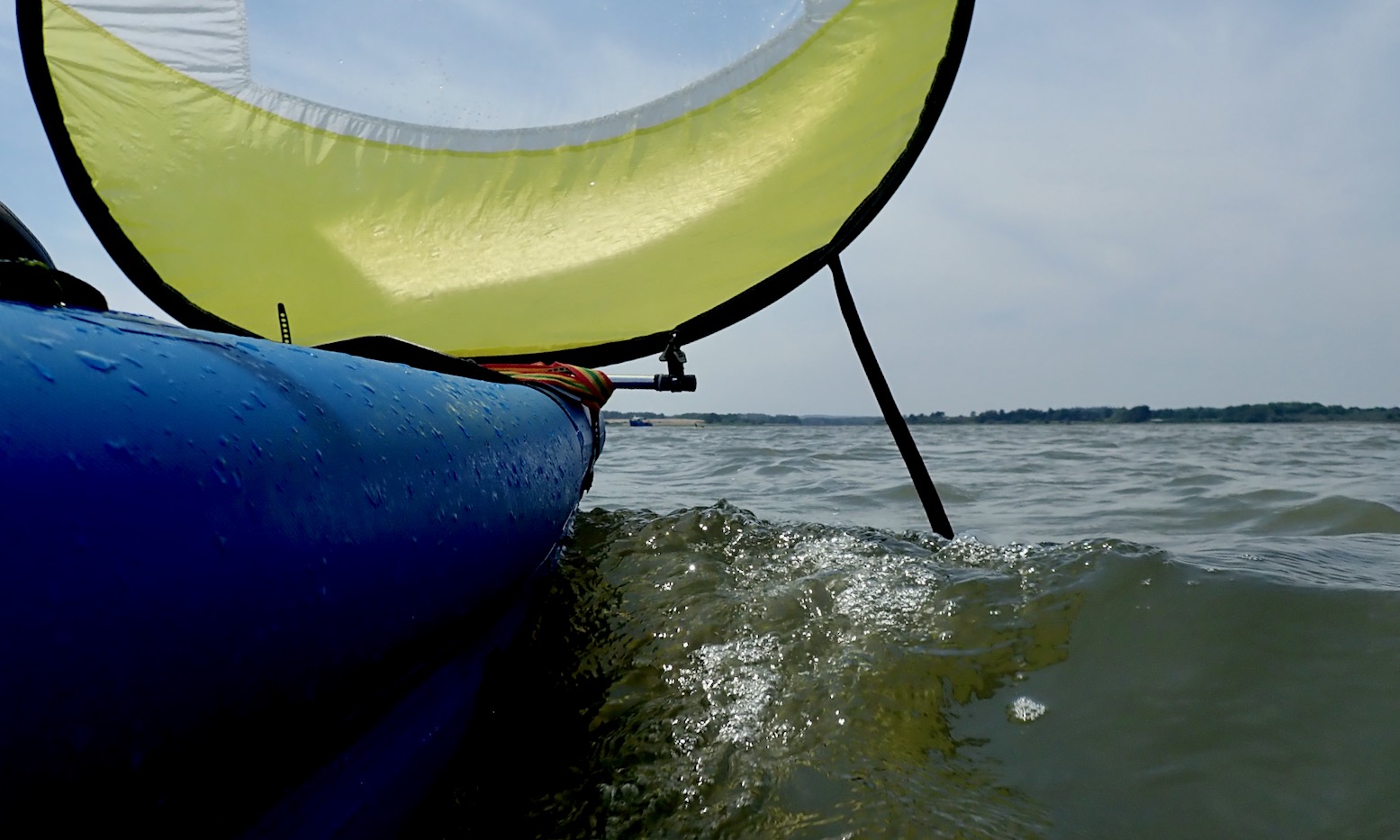
The afternoon’s glassy calm had turned already. I pushed into the breeze out towards a low-tide skerry just off Tanera Mor, then heeled round for the mile back to Badentarbet beach and flipped out the WindPaddle. I left the stock skeg in place which was cheating a bit, but I’m pleased to say my earlier problems with weathecocking (stern blowing round, side to the wind) have been solved. No surprise a fully submerged skeg makes the TXL sail as well as my Rebel 2K and MRS Nomad. This was an important thing to pin down as I want to be sure my bloaty, IK-replacing Sigma TXL has something up its sleeve when the wind allows because, like any inflatable, in the other direction it will struggle as headwinds reach 15-20mph. Sailing still needs constant micro-adjustment, but it’s great to feel a gust tugging at the handlines as the Sigma ploughs a trough through the surf like a water buffalo wading across a mudhole. The boat was definitely hitting 7kph or more at times.
I was also trying an idea I didn’t get round to testing on my narrower-bowed Seawave before I sold it: a WindPaddle transverse bowsprit™. Those cunning Chinese will be copying it on ebay any day now.
Transverse bowsprit™ Ask for it by nameHang on, was I not the first transverse genius?
TXL vs MRS Nomad spacing
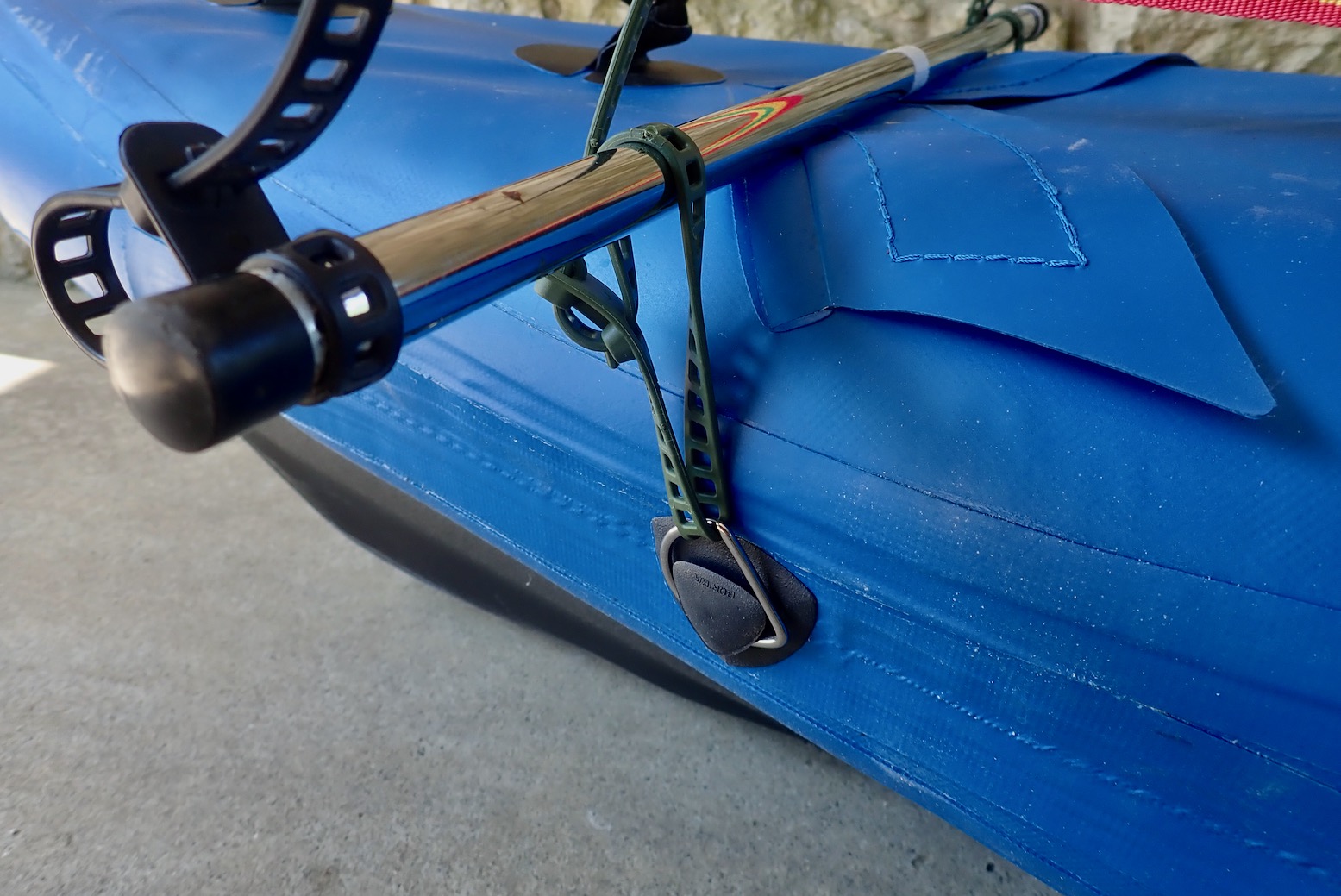
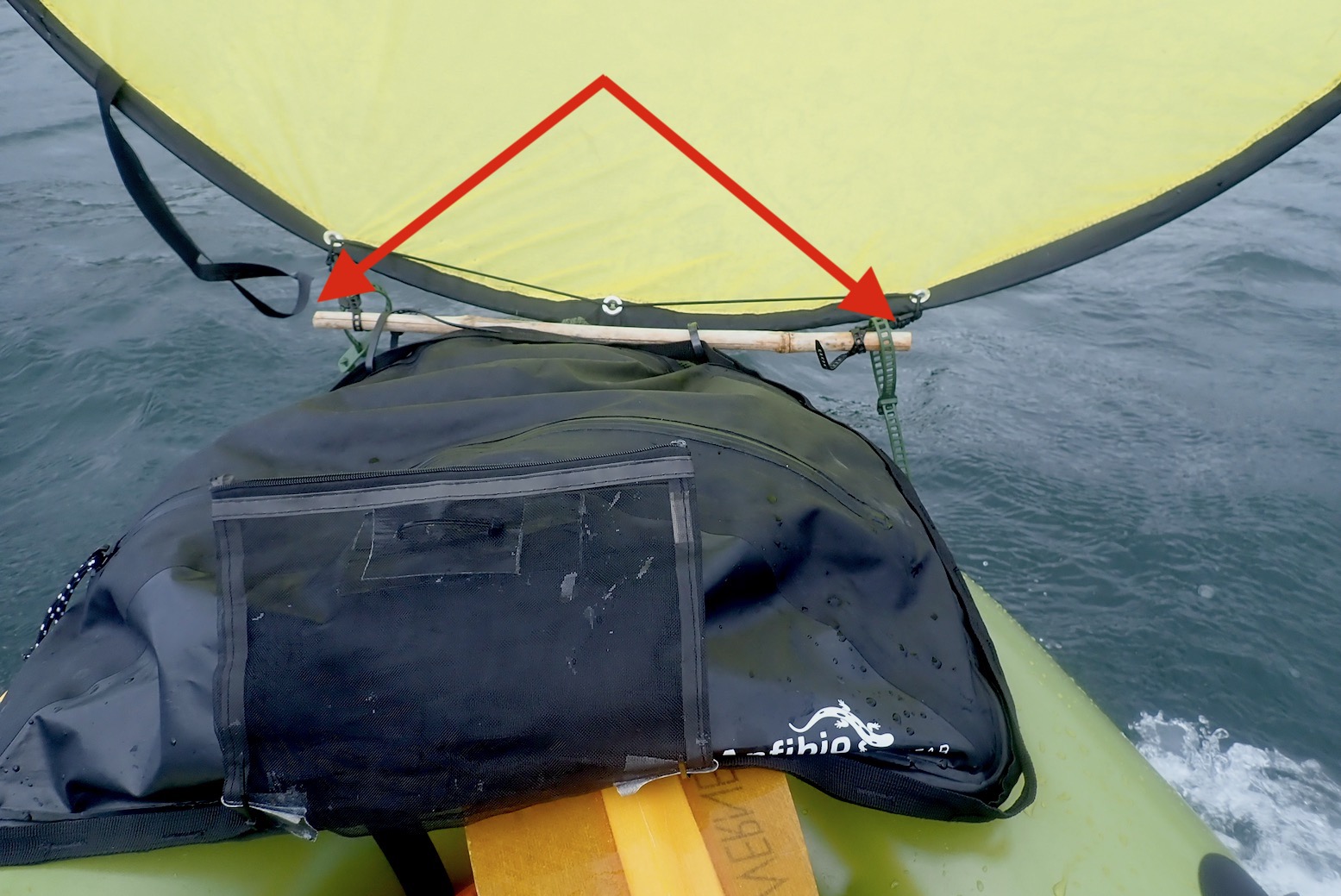
A WindPaddle disc sail starts bobbing madly left to right when winds get much over 10-15mph – it can’t unload the air fast enough. This is a side effect of mast-less downwind sails, but I figured if the bow sail attachments were further apart and more taught, the bobbing might be constrained. You want a downwind sail at the very front of a short boat, but on the TXL thr frontmost mounts are quite close together (compare to a Nomad, above left). My ‘transverse bowsprit‘ is a stick which extends the sail mounts out to the sides, like ship rigging. I used a foot-long bamboo stick with some Rovaflex loops on the ends and for the weight and minimal faff, I like to think it worked. A bit longer would be better; I have a 50cm rod lined up for next time. A few days after posting my sailing vid, YouTube thoughtfully directed me to a ten-year old video where a bloke with a hip-wide surf ski had the same idea (above right). Only he managed to zip along at a breathtaking 15kph in a 40kph breeze!
Heading towards shore, again, I aired-down the Multimat but again, can’t say performance deteriorated noticeably. After all, the MRS Nomad manages fine. The stiffening breeze rushed me towards the rarely exposed sands of Badentarbet beach and a short walk home.
So. Good to know the TXL is now largely sorted. Weather-wise, it’s been a wash-out in the far northwest this year, but there’s still enough summer left in the heatstruck south to do some trips.








































































 Inflatable Kayaks & Packrafts