Category Archives: Inflatable Kayaks

Pacific Action V-sail revisited

Packboat sailing main page

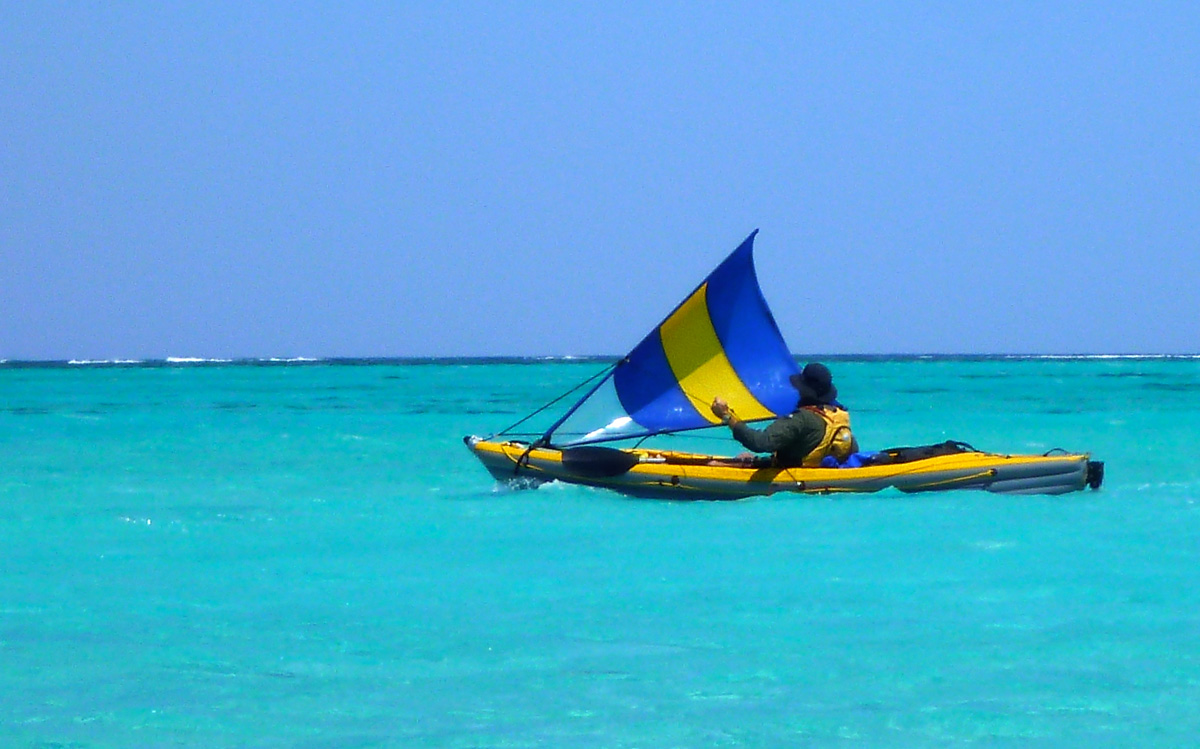
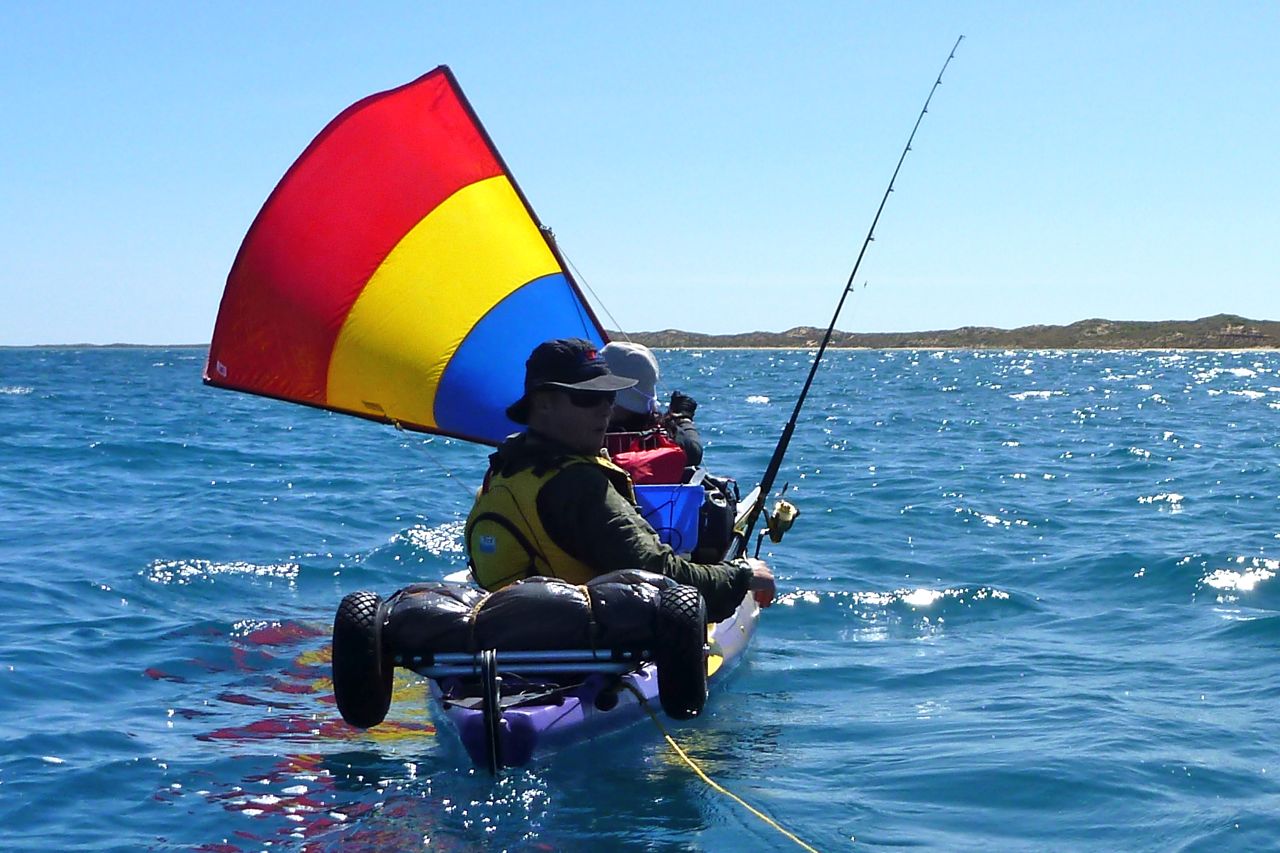
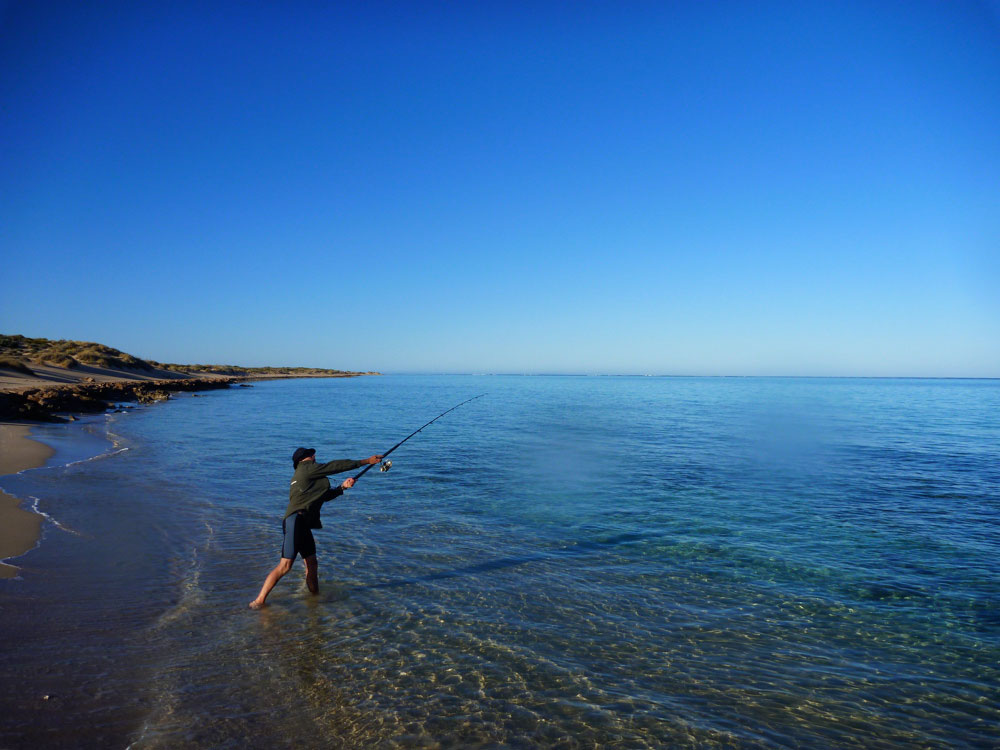
Windy but warm and dry thanks for asking – a good afternoon to take the IK out sailing. I’ve not done that since Ningaloo last September (left) when I was blown away so to speak, but not in a good way.
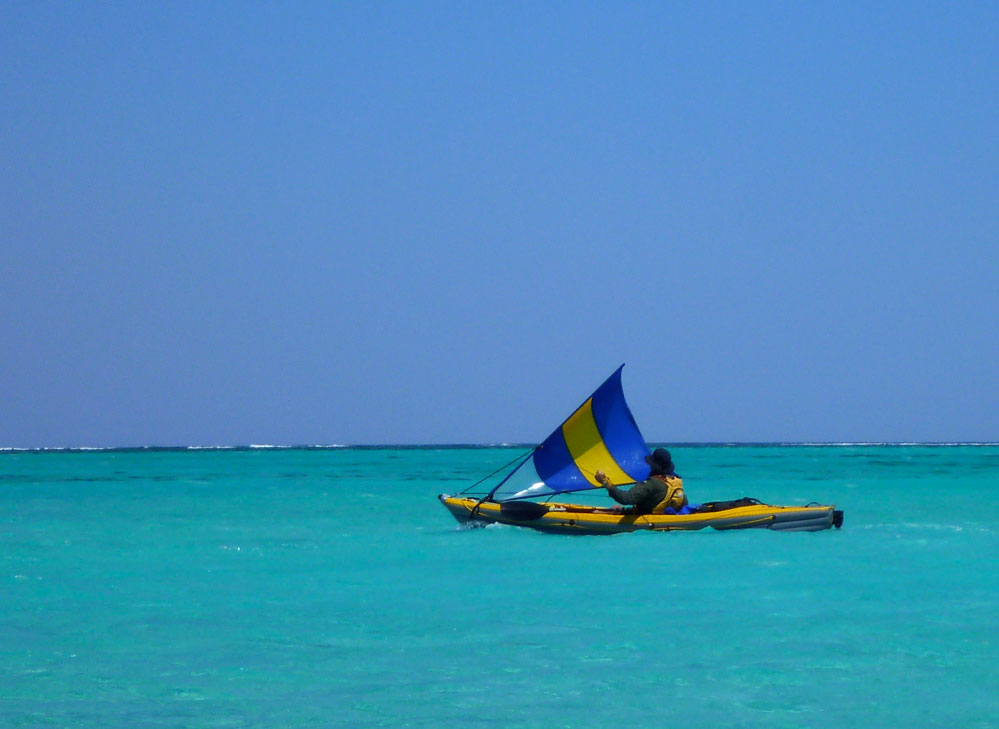
Even before then I can’t say I’d got the hang of the Pacific Action V-sail which should add up to either hurtling from crest to crest with all hands on deck – or kicking back and getting a free ride while looking around at 3mph. Both are good fun but neither scenario seems to last more than a minute for me.

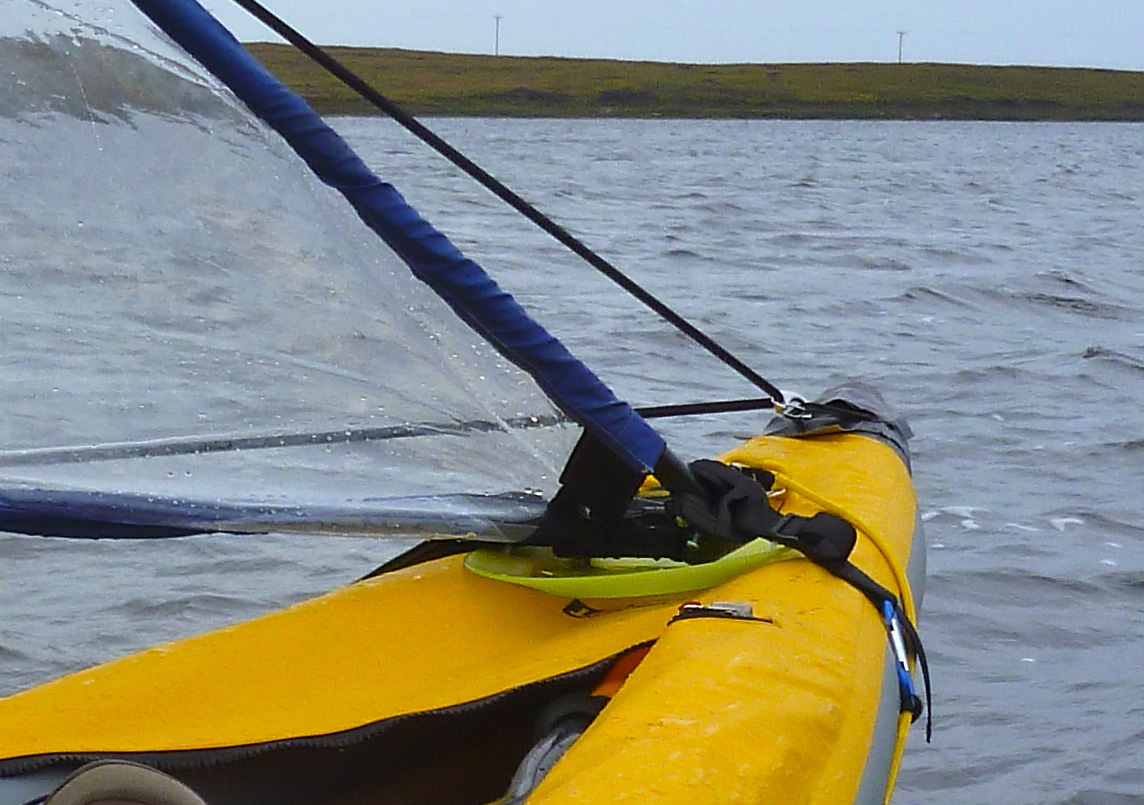
Remounting the V-sail to the K40 was easy. I clipped the front ‘sail-hoisting’ bungie about 8 inches further forward, right out on the boat’s nose using a loop of string and tape (right) as opposed to using the boat’s lift handle-ring. Fixed here it ought to help keep the sail up when pulled down low to one side by increasing the angle and distance from the sail’s feet. It’s an idea we came up with in Australia in an effort to make the K40 controllable in the strong winds.

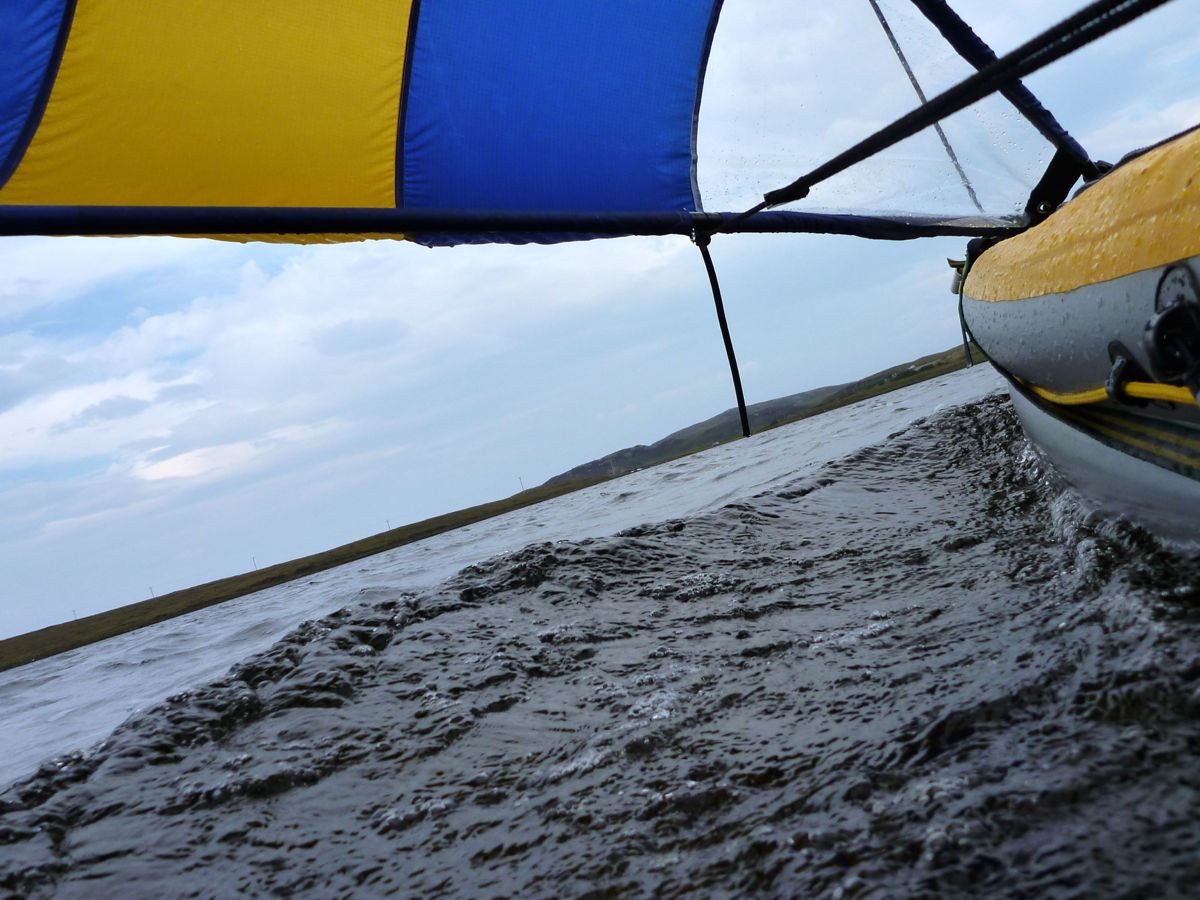
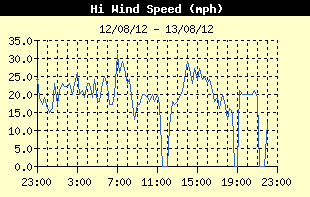
Winds today (left, from 3pm) weren’t quite as strong as WA but were getting there. And anyway, I was out on small lochs with no rudder-lifting ocean swell to deal with – another reason we thought the K40 got squirrely in strong winds out in WA. The K40s large draught but low weight acted like a sail of it’s own, weathercocking the boat.
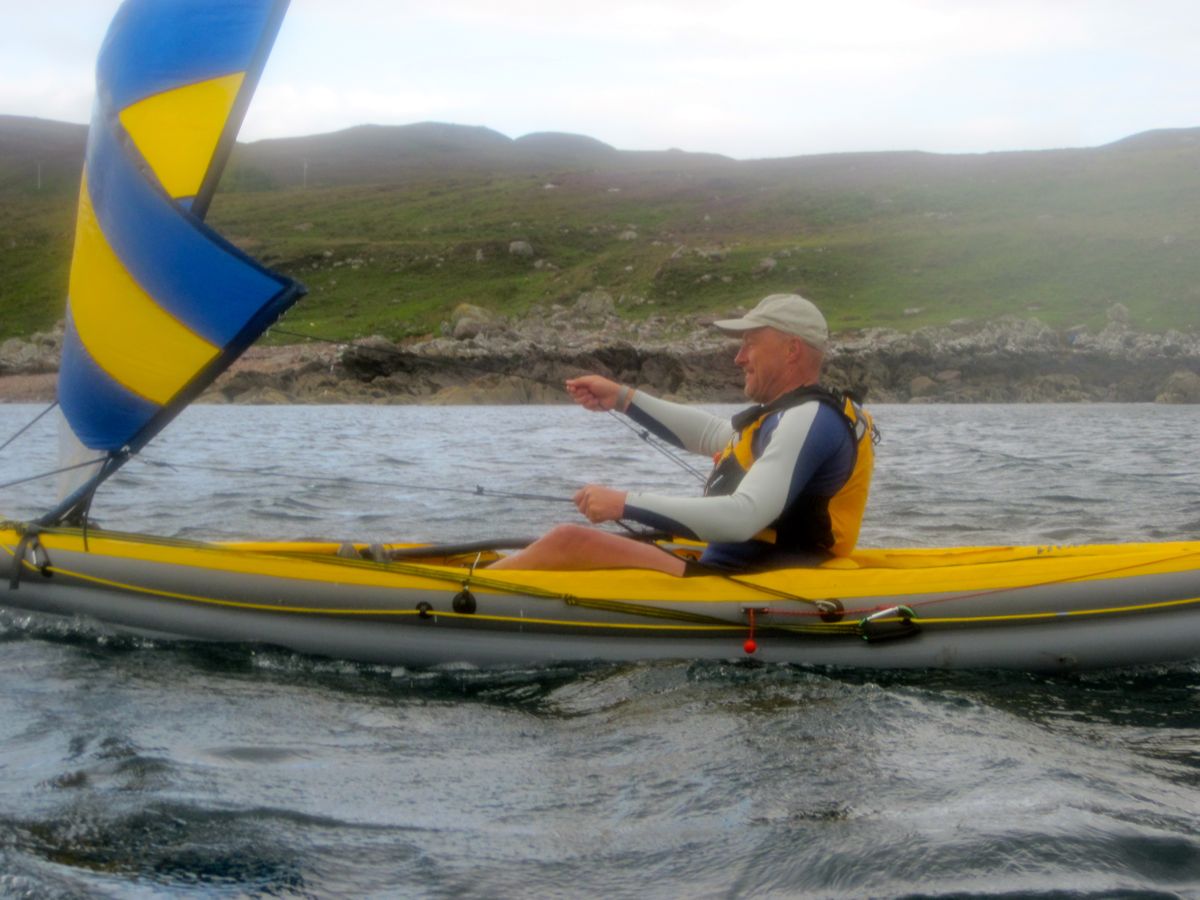
To reacquaint myself, I first took a spin on the smaller Loch Raa. I’m never really sure what I’m doing so just try various angles and approaches until the kayak catches the wind. I’m told that sailing directly downwind with the sail fully upright is less efficient (or is that with regular, fixed-mast sails?). With the PA you can get a good speed for a while, but soon the sail starts rocking violently from side to side as it sheds the excess blast – my strong recollection from Ningaloo. I assume that’s just a sign of the sail exceeding it’s speed limit, though I think Jeff’s hardshell did it less.

Off the wind about 45° and up to 90- or even 100° (ie; slightly upwind) seems more stable but slower, with the sail cranked down low to one side. But even then a consistent speed or direction seems hard to maintain for long. Is it my poor technique, the design of the sail when applied to my IK, or just an aspect of gusting and shifting wind? As it was I felt the unloaded boat was rather light, though in Ozzie last September 20+ kilos of ballast didn’t help much either.

Big sailboats and windsurfers seem to manage OK, but it seems hard to get a smooth, steady run while sat back with the cleated-off sail doing the work. Usually I’m yanking hard on the rudder to get in line, or have handfuls of lines trying to trim the sail for best effect. The tiny ‘finger-and-thumb’ cleats are just too fiddly to use in a hurry or mild panic, and often require two hands to release the jam. I wonder if hand-sized cleats exist for the thin cord, or some better device all round? Something like a sliding tube you could grab, but with a release button, a bit like a mountaineering jumar (left).

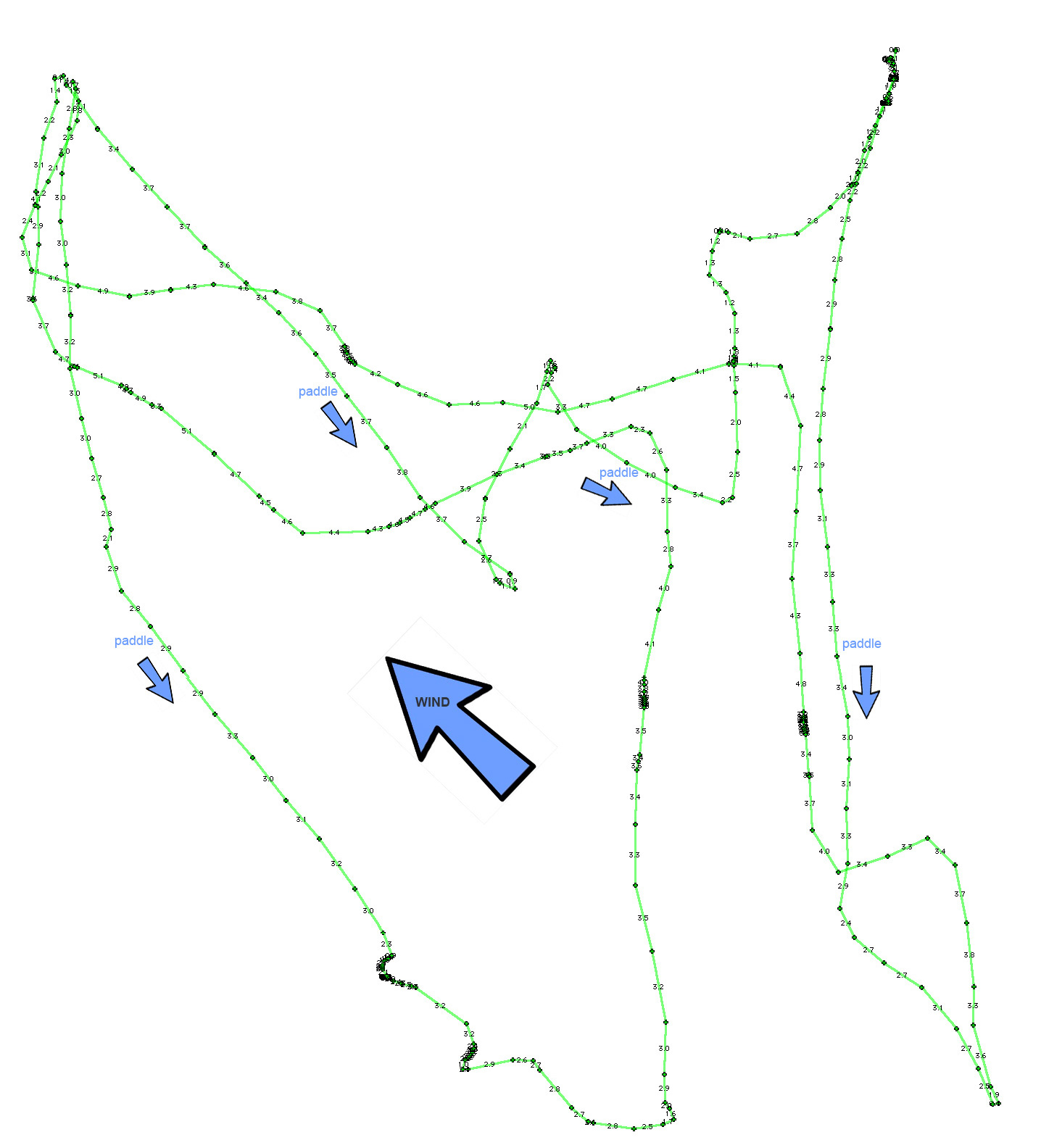
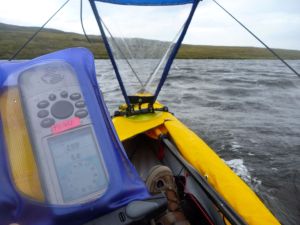
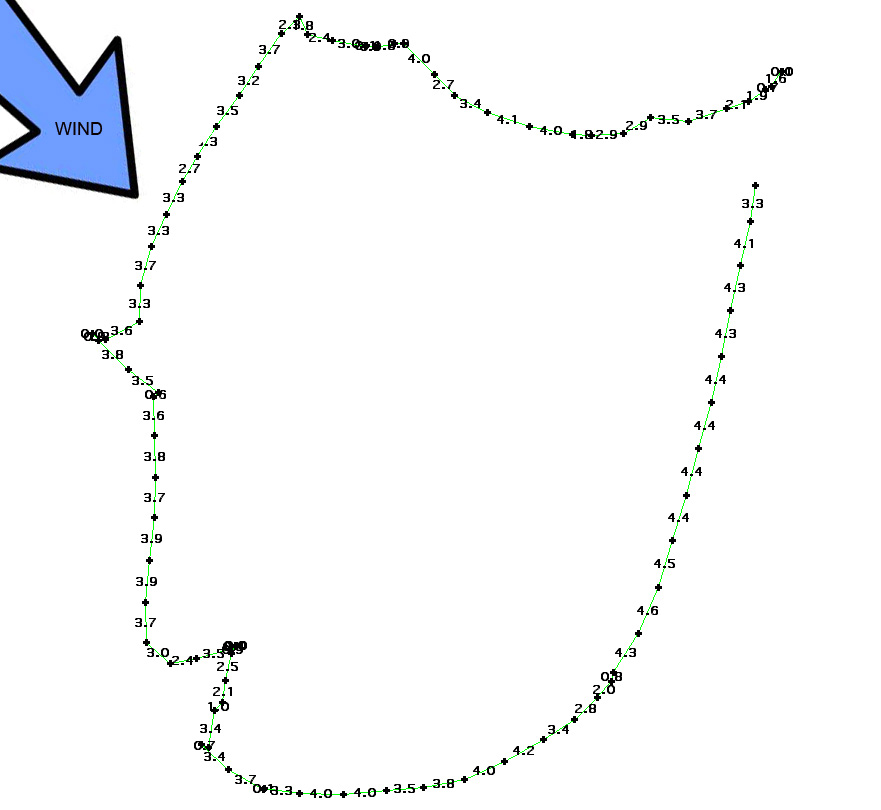
Even then, on seeing the speed readings (above), it surprised me how fast I could hack into the wind at 2.5–3mph, admittedly with some effort (needed to keep the kayak pointed ahead). Coming back with the big sail I only got over 5mph a couple of times, and often moved barely more than upwind, although using much less energy of course.

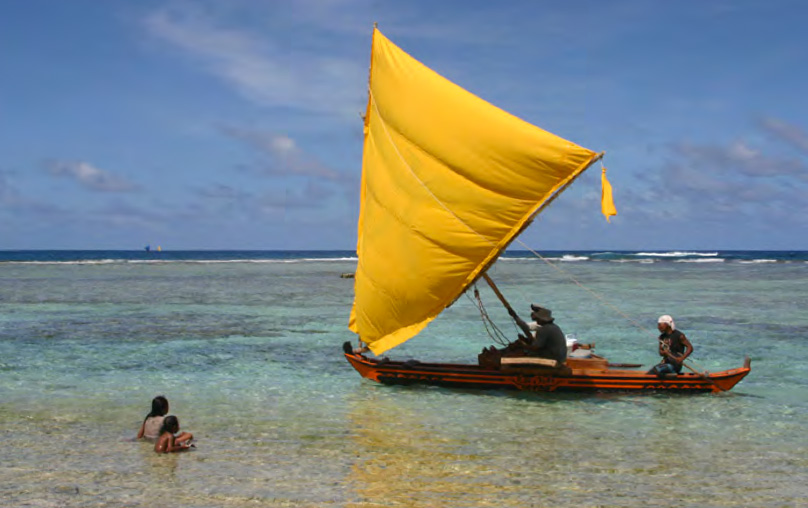
I came across this image of a Micronesian waharek boat newly built on an ancient design. Looks like a big V-sail to me but crucially, it has an outrigger.


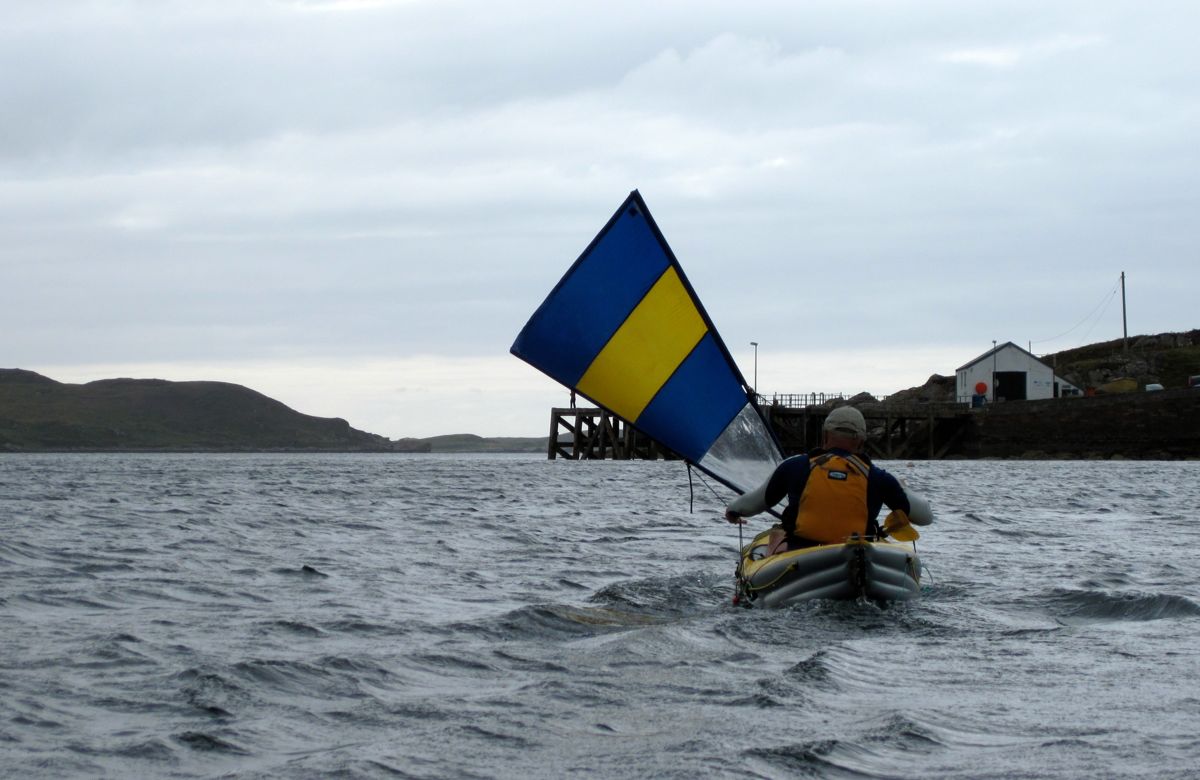
After crisscrossing Loch Raa a few times (above right), I went around the corner onto Loch Osgaig. Out in the open and with the wind bouncing off nearby Stac mountain, there should be room enough to get some speed up, providing I could hold on.

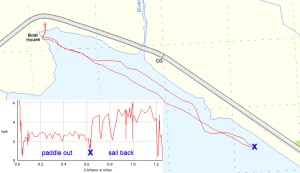
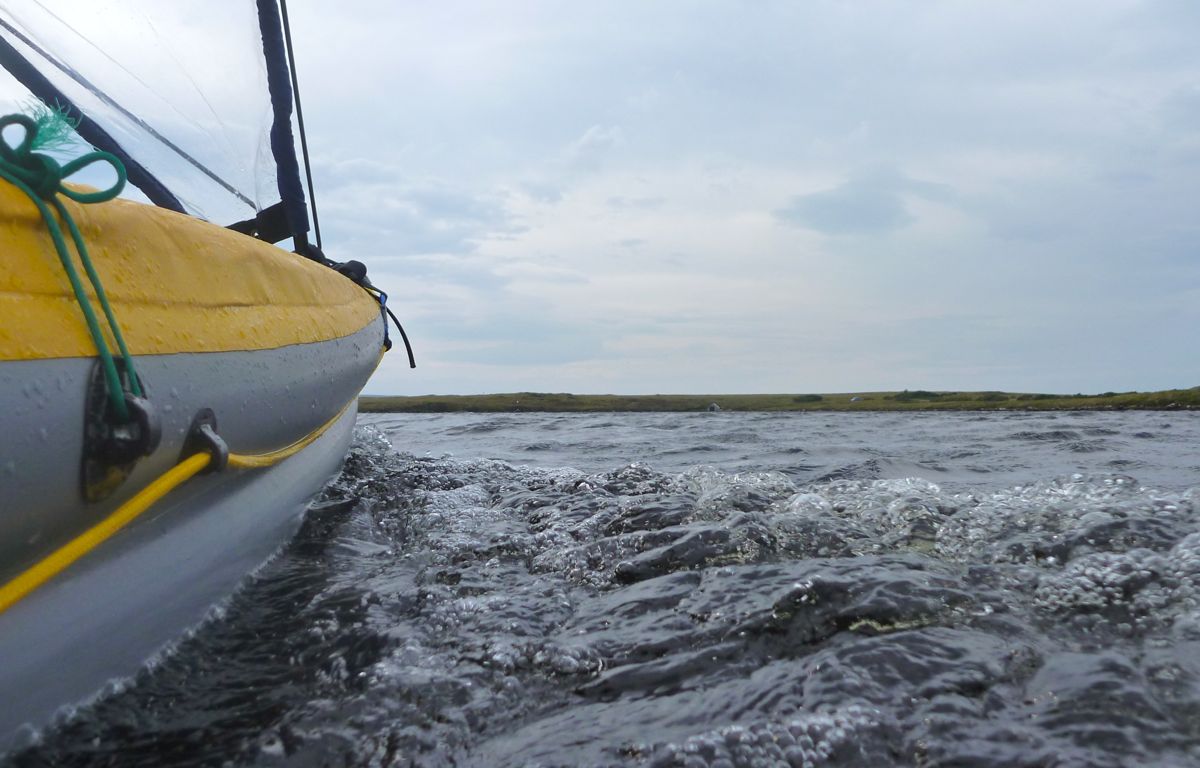
I set off and sliced the waves as best I could and stuck at it until I got opposite the small plantation. Here I stowed the paddle securely, got blown round and unfurled the v-sail, ready to snatch it back down should it all be more than I could handle. In fact, there were only a couple of hairy moments As you can see from the speed graph (right), my paddle out was pretty steady and straight, but under sail, speeds and direction were all over the place. A couple of times either a gust or the optimal line saw the boat fly at along at over 5mph (left), but it never lasted.

saijeff

It does make me wonder what the PA sail is good for on my K40. In winds of over 15mph it seems hard work to maintain. Is it an inherent flaw of a lose, articulated mast – and one whose feet are not pressing directly onto a solid hardshell hull (I use a plastic dinner plate to spread the load/reduce wear). The fact is, Jeff managed fine on Ningaloo (right), ripping along in a boat that was four times heavier than the Incept. And in Shark Bay a few years earlier in the same tandem tanker, he was towing me in my Gumboat.

A 10-15 mph breeze does often correspond to a nice steady sail, but that does seem a rather narrow margin of operation – something I recall someone else saying to me about V sails. I think it’s a combination of more practice required, hampered by the fact I’m in a light, buoyant, flaccid-chined IK. It makes me wonder if the WindPaddle is worth another look (it was and I did), though I’m fairly sure the PA V-sail is more versatile; I doubt you could ride at 90°+ to the wind with the deeply dished WindPaddle. Another good thing about the PA is that it’s out of the way when down but dead easy and fast to deploy or stash. Just throw it up and see if it takes to the wind. Out this time I also felt that the thigh straps were particularly useful when edging the boat against the gusts.

Summer Isles Kayaking ~Tanera Mor (Incept K40)

Incept K40 Index Page
Tanera Beg here

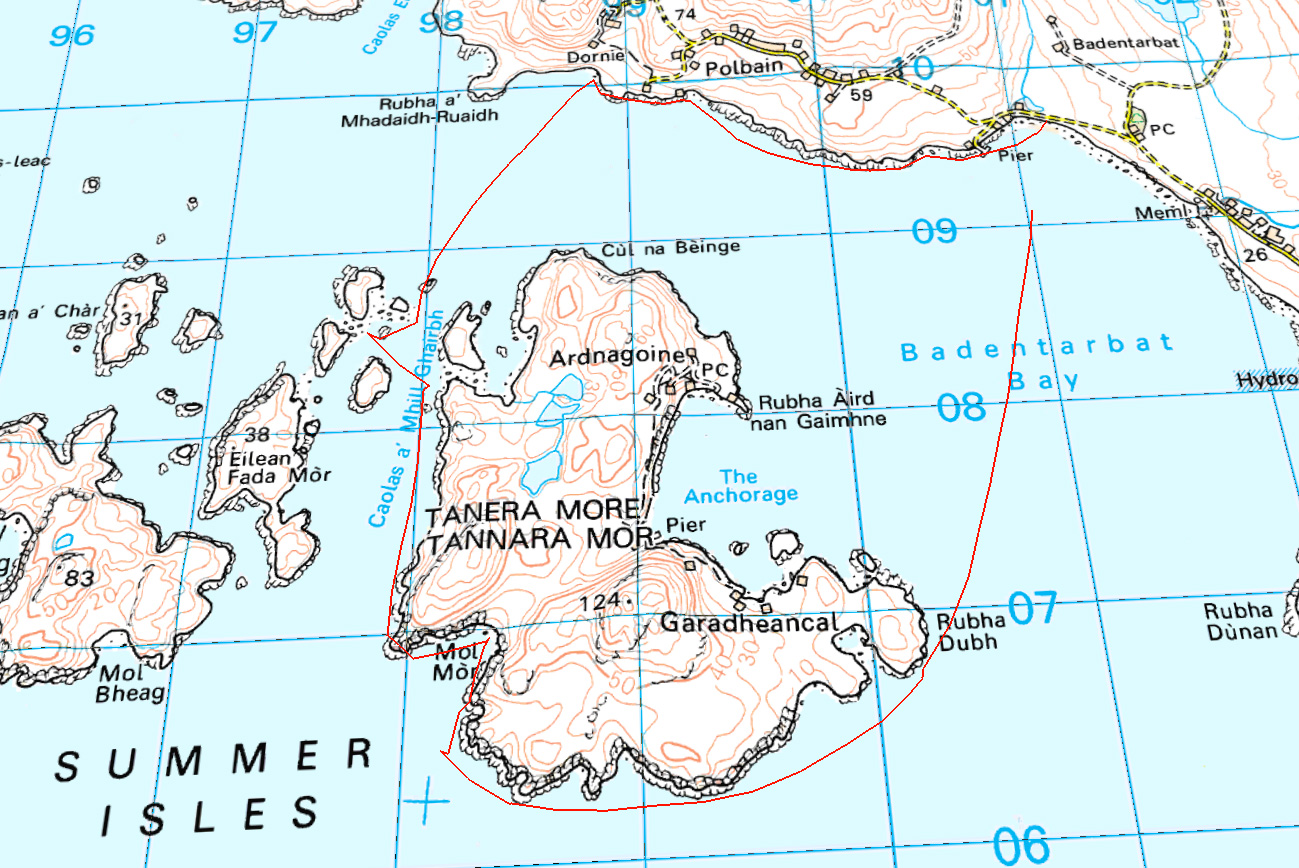
A sunny and wind-free morning coincided with the definitive wrapping up of my current job that’s dragged on for years. I could not pack up the gear quick enough before the calm spell flipped. And this time I wasn’t messing about – I was going to paddle right around Tanera Mor! All of a mile off shore it is, but you never know what to expect on the unseen ‘ocean’ side.
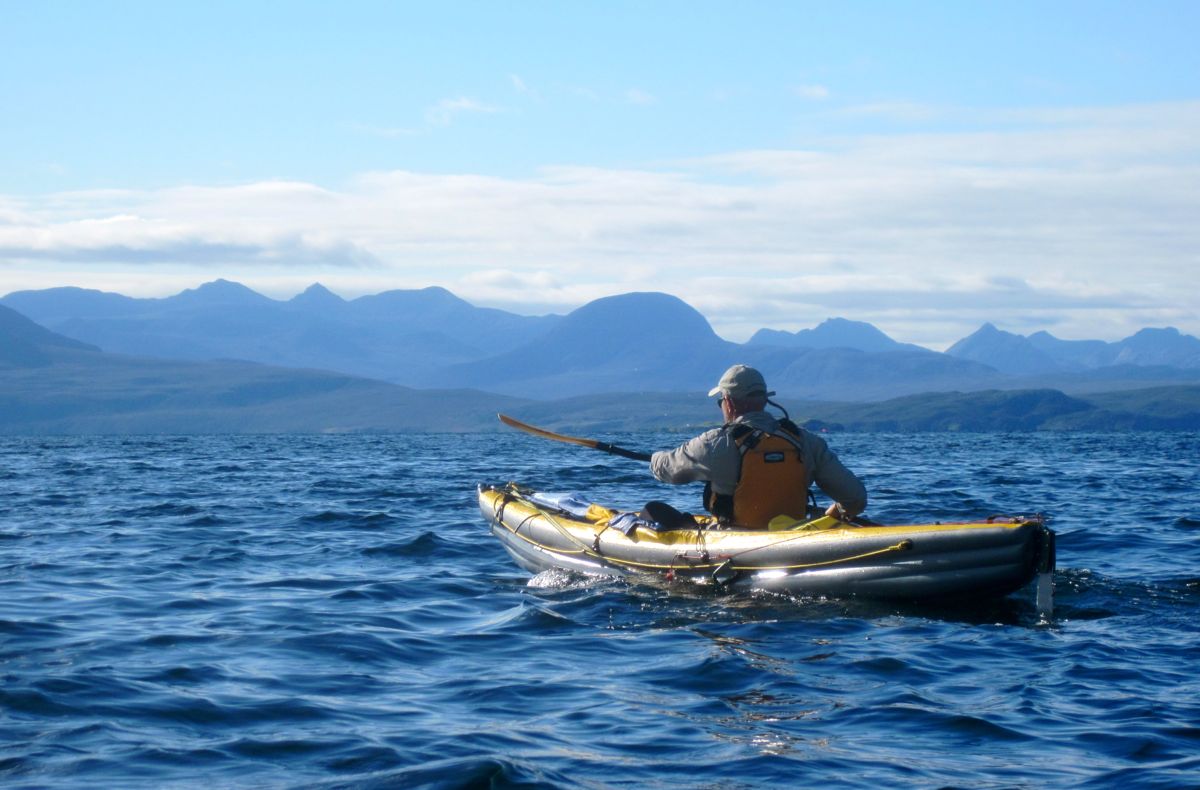
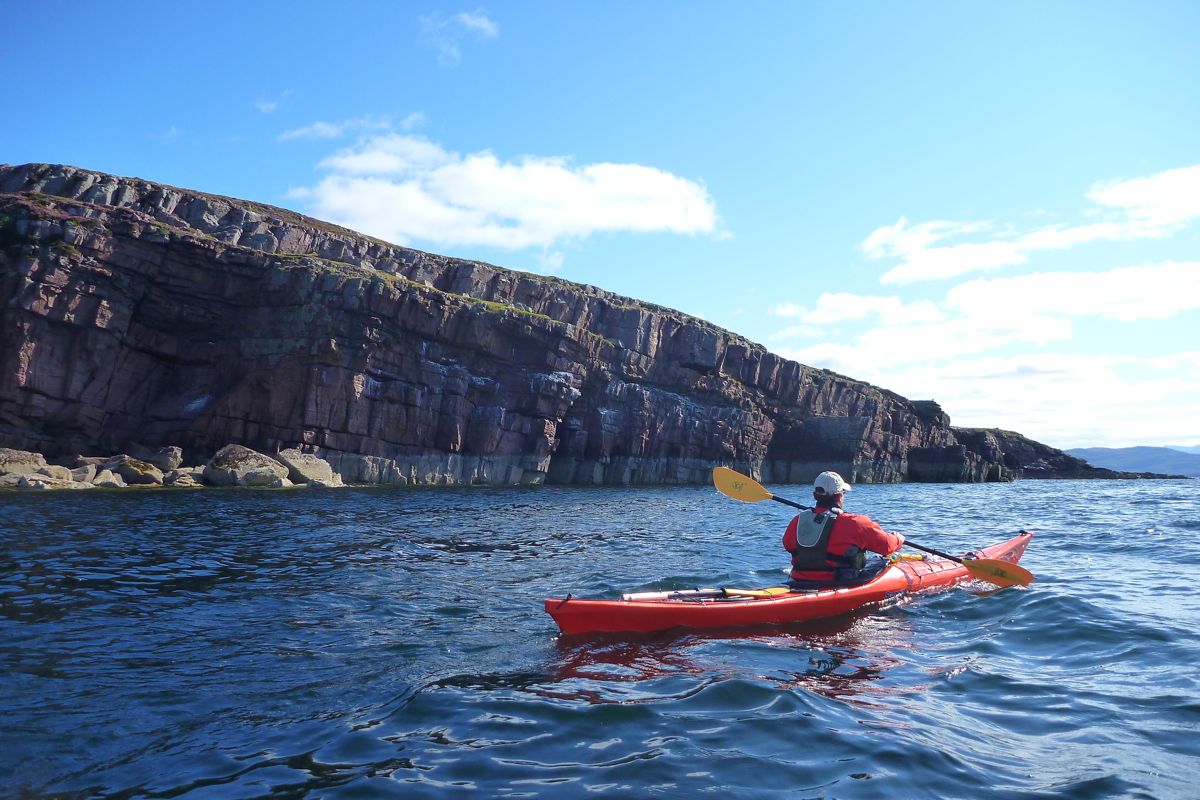
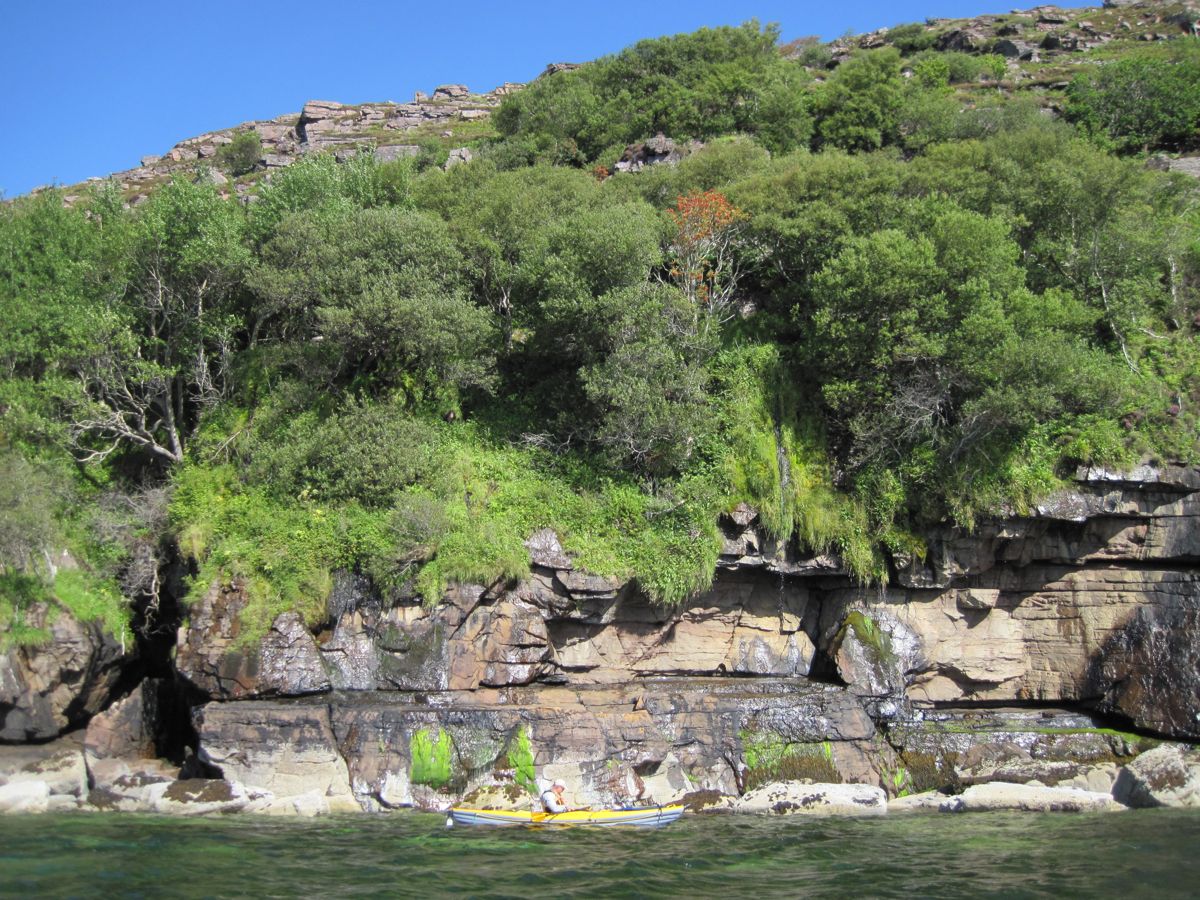
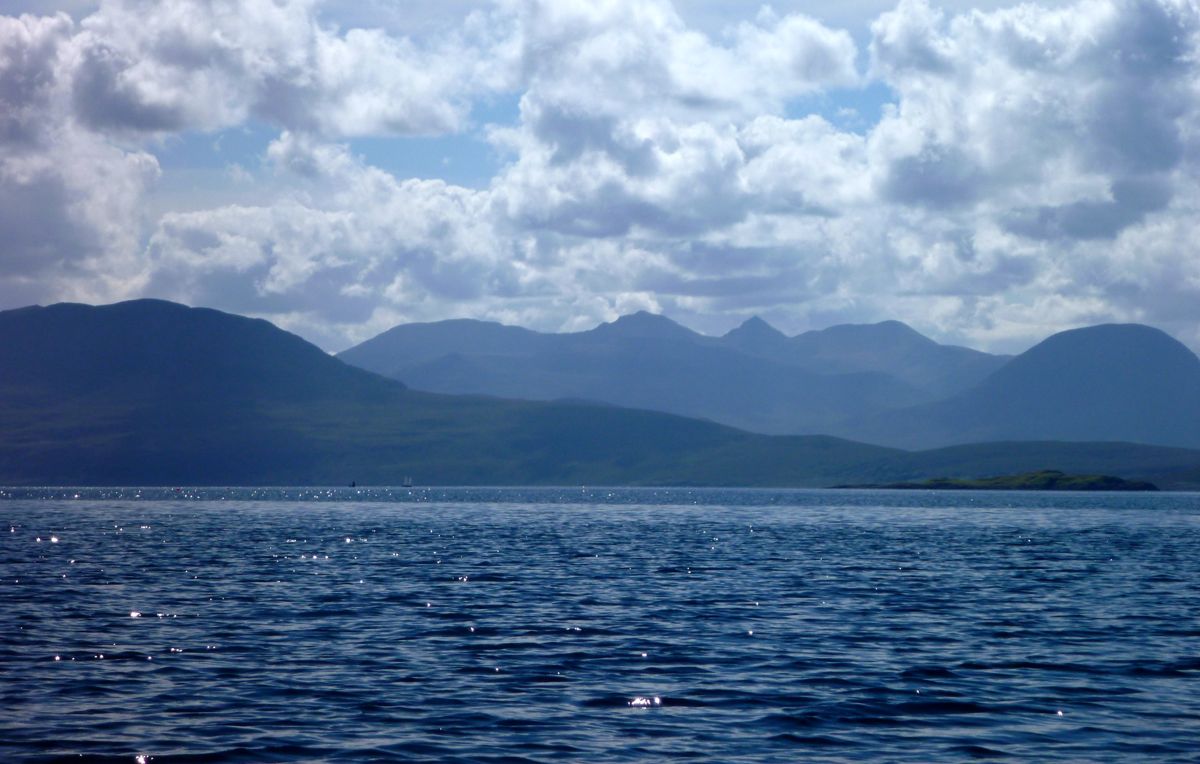
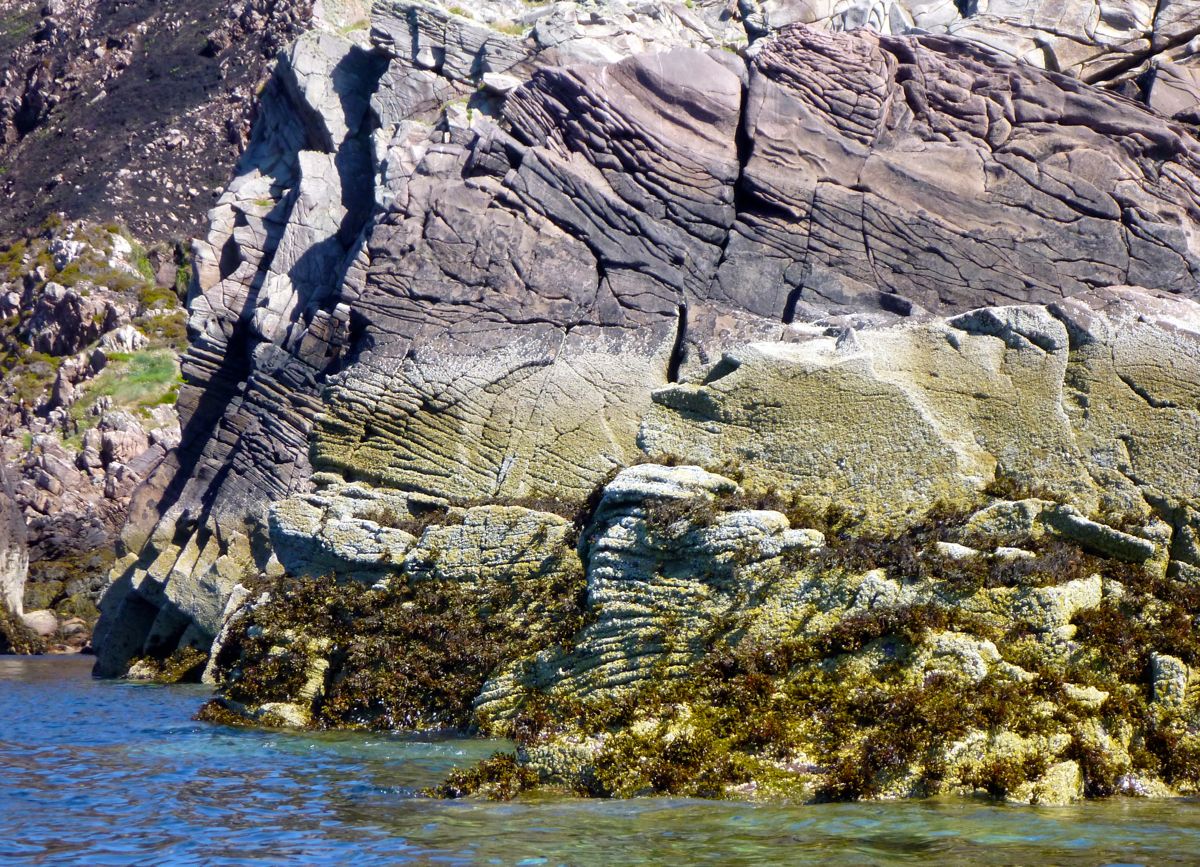
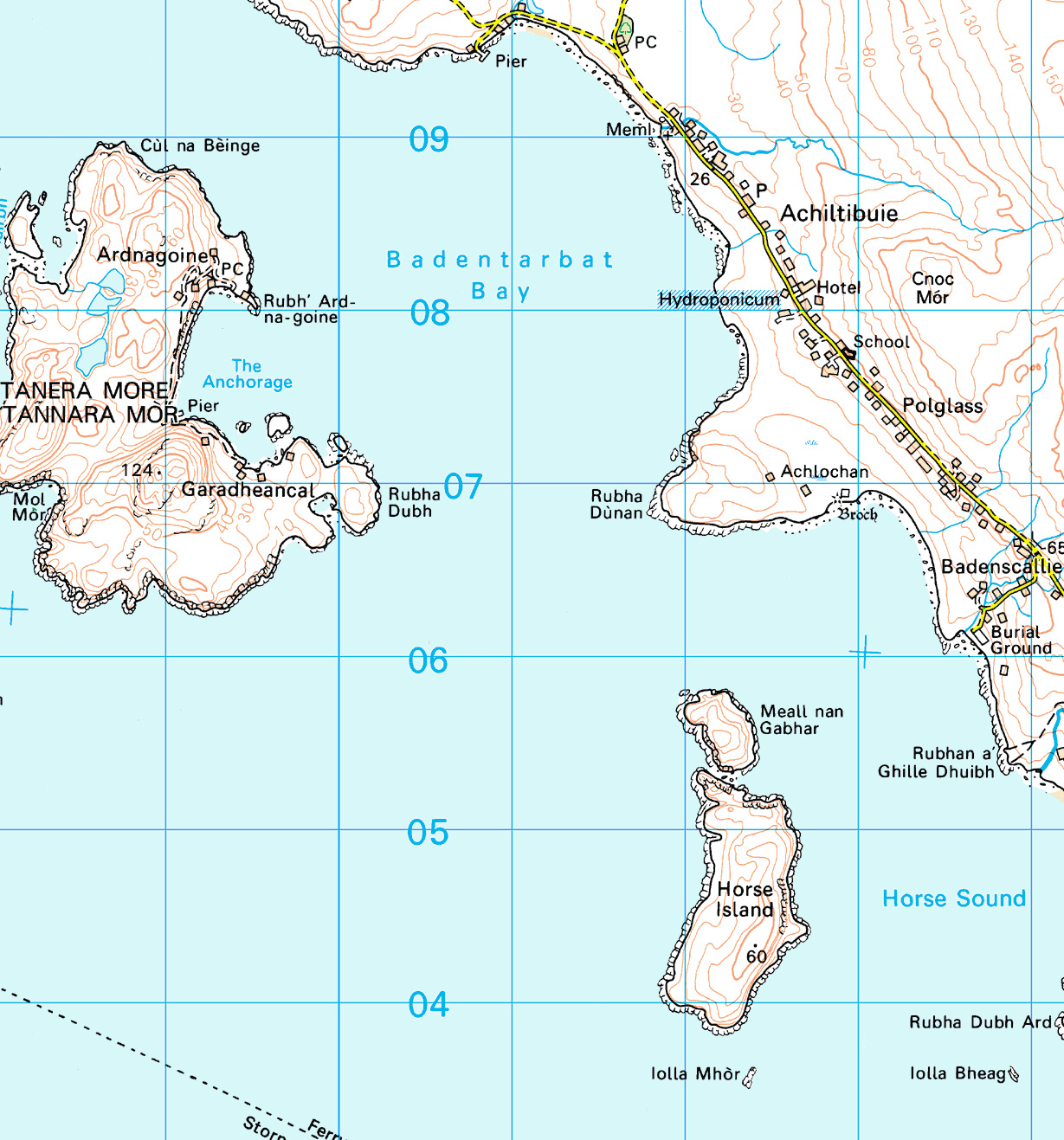
Just before midday I stuck out for Rhuba Dubh Dubh, the island’s most easterly point (see map, above) and would decide how things went from there. Less than half an hour of speedy, flat-water paddling I arrived at the point, the smokey blue Torridons brooding in the background and the creased and weathered sandstone cliffs to my right.


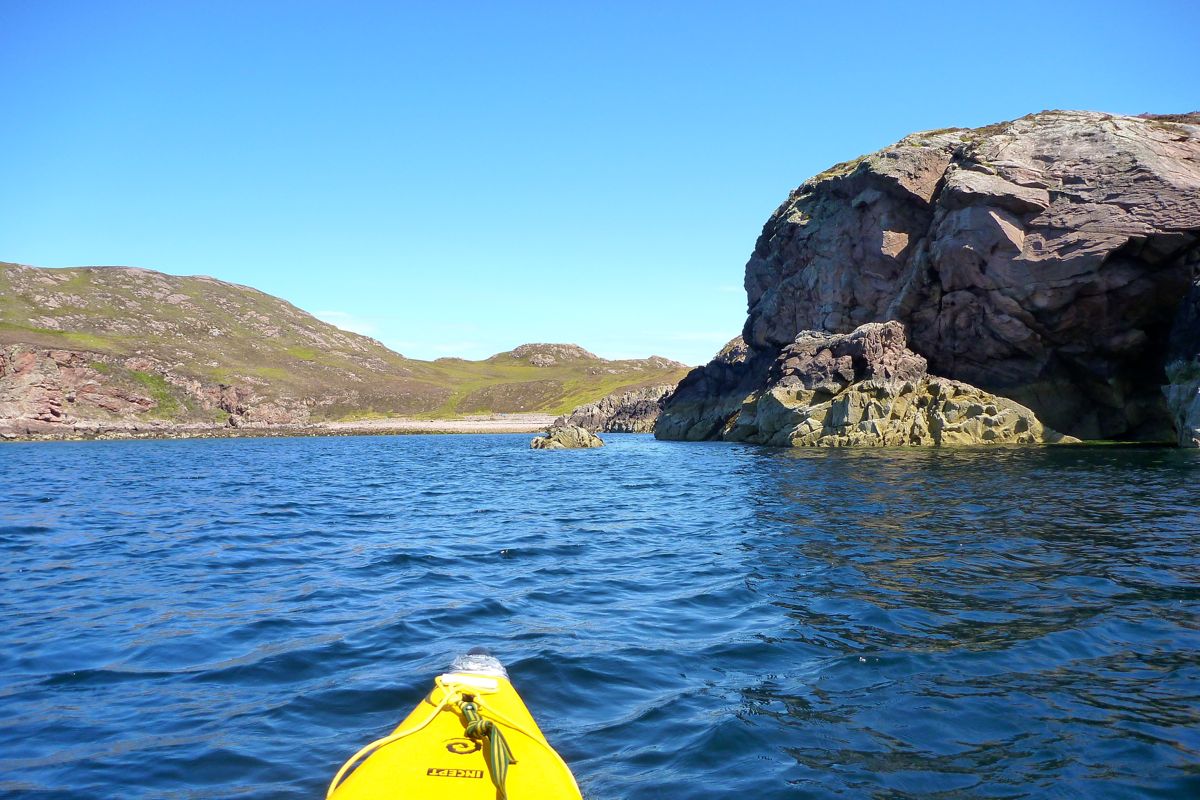
Rounding the bend to Tanera’s south side I wasn’t hit by the expected churning swell and whirlpools but pressed on, reluctant to relax until there was something to relax about. That turned out to be the inlet of Mol Mor which invited me in for a walkabout.
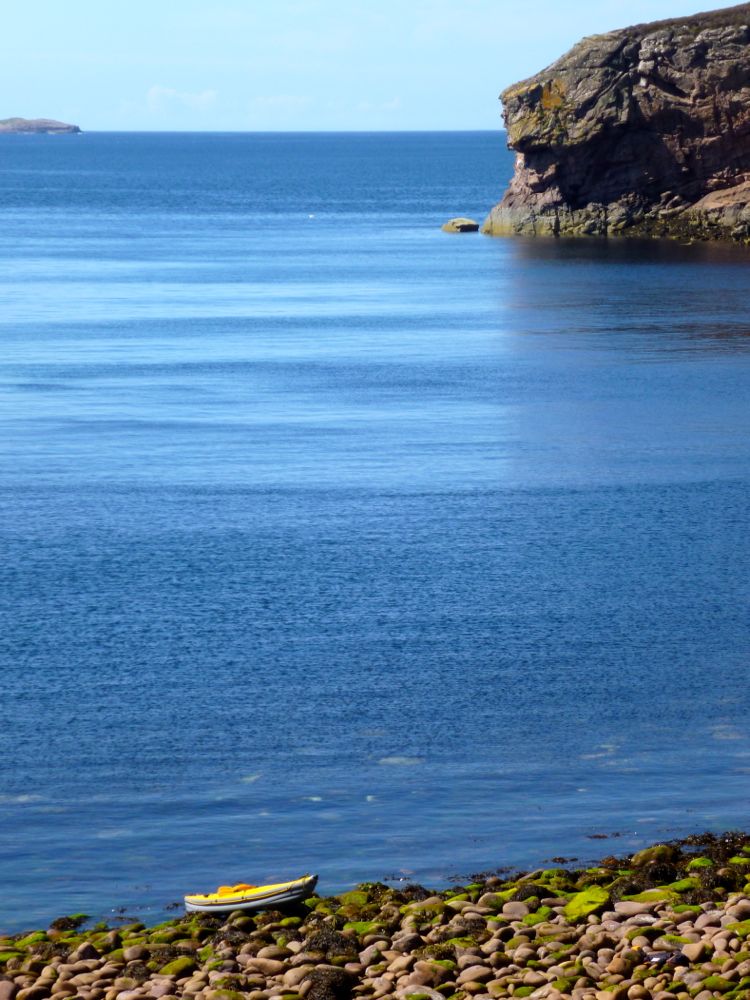
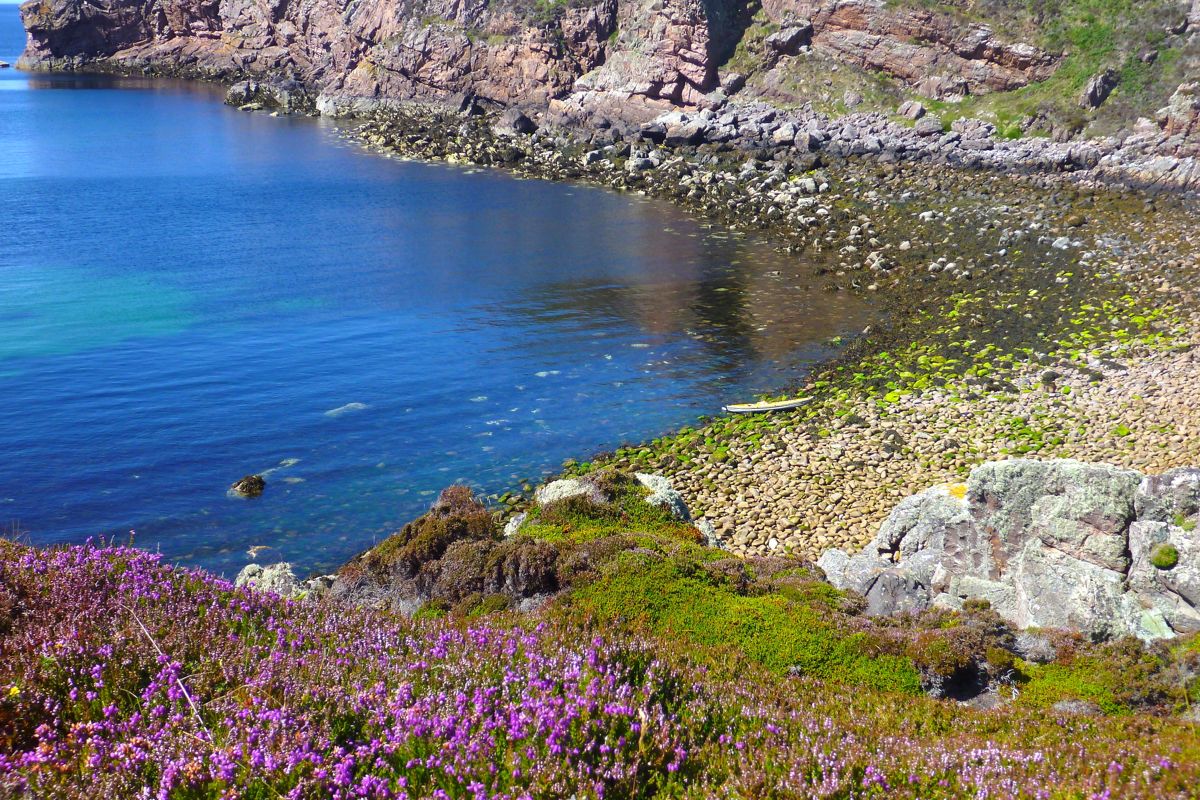
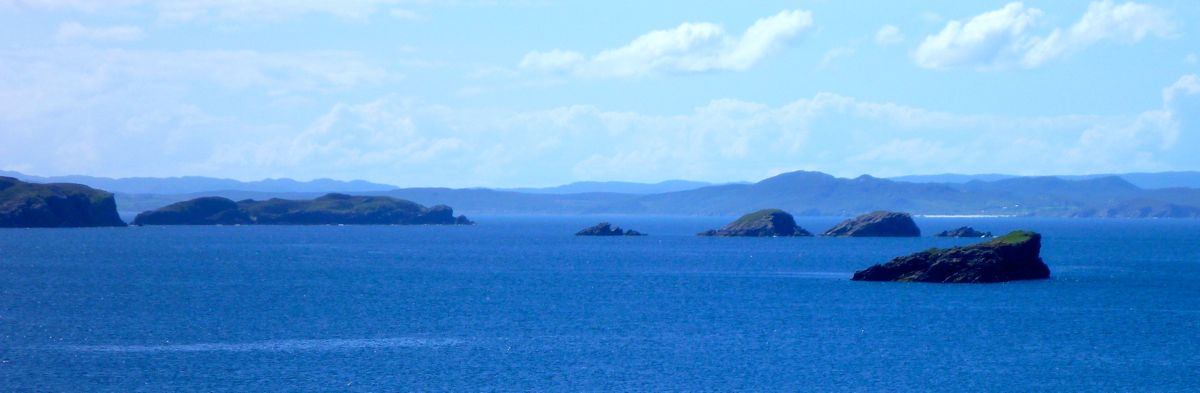
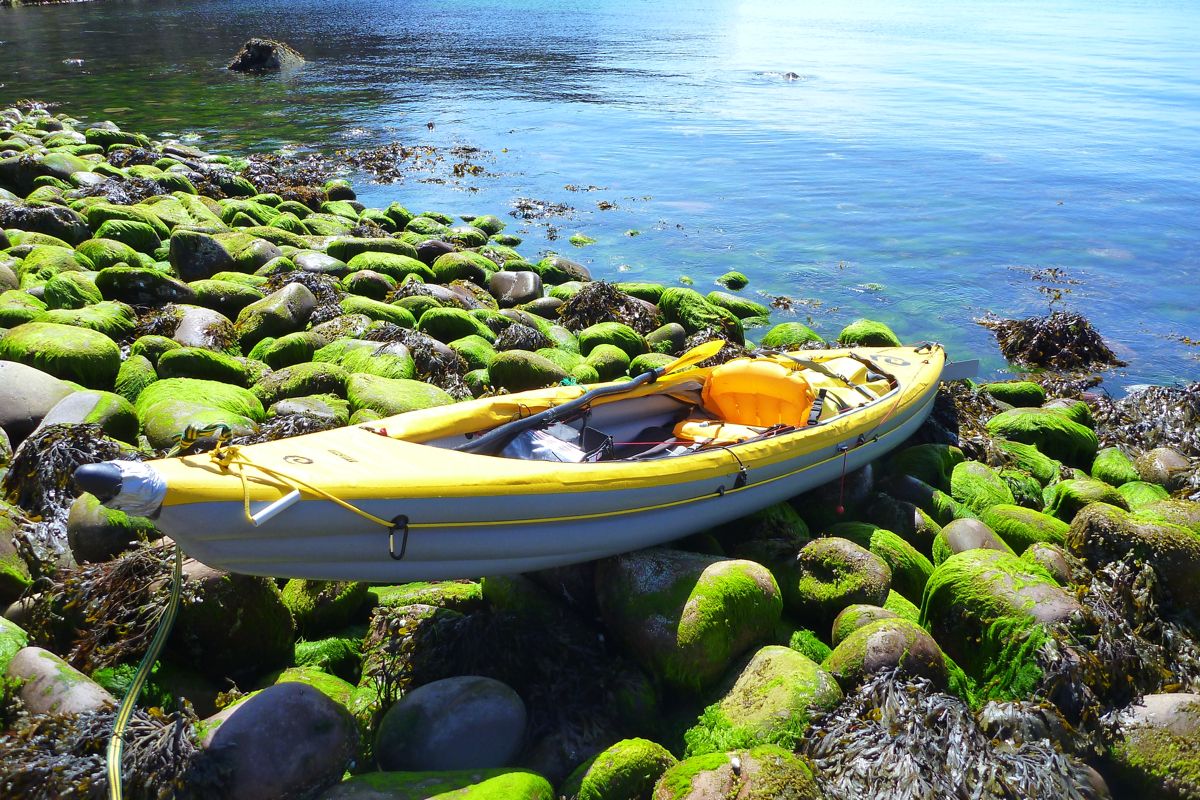
It has to be said, at lower tide levels these islands don’t make getting ashore easy; a jumble of glistening wet, seaweed-draped boulders as big as melons bite at your ankles. And on proper land, it’s no better, with more unseen ankle traps under the thick heather, or plain old sphagnum sludge juiced up from the recent rains. But as always, from a high point the little yellow boat down below looked striking. Green sea-over-sand and the far headlands of Wester Ross backing the tempting (but not today) outer Summer Isles of Eilean Dubh, Bottle Island and Priest Island with the distant strand of Mellon Udrigle shining bright.


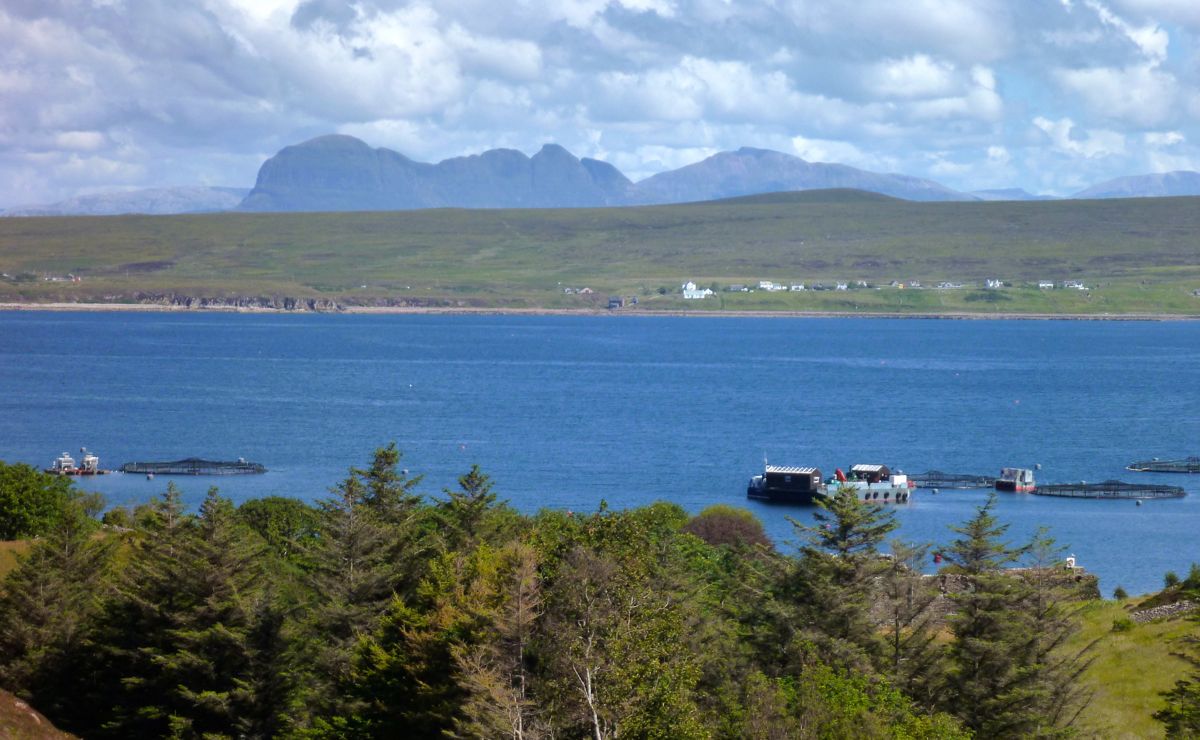
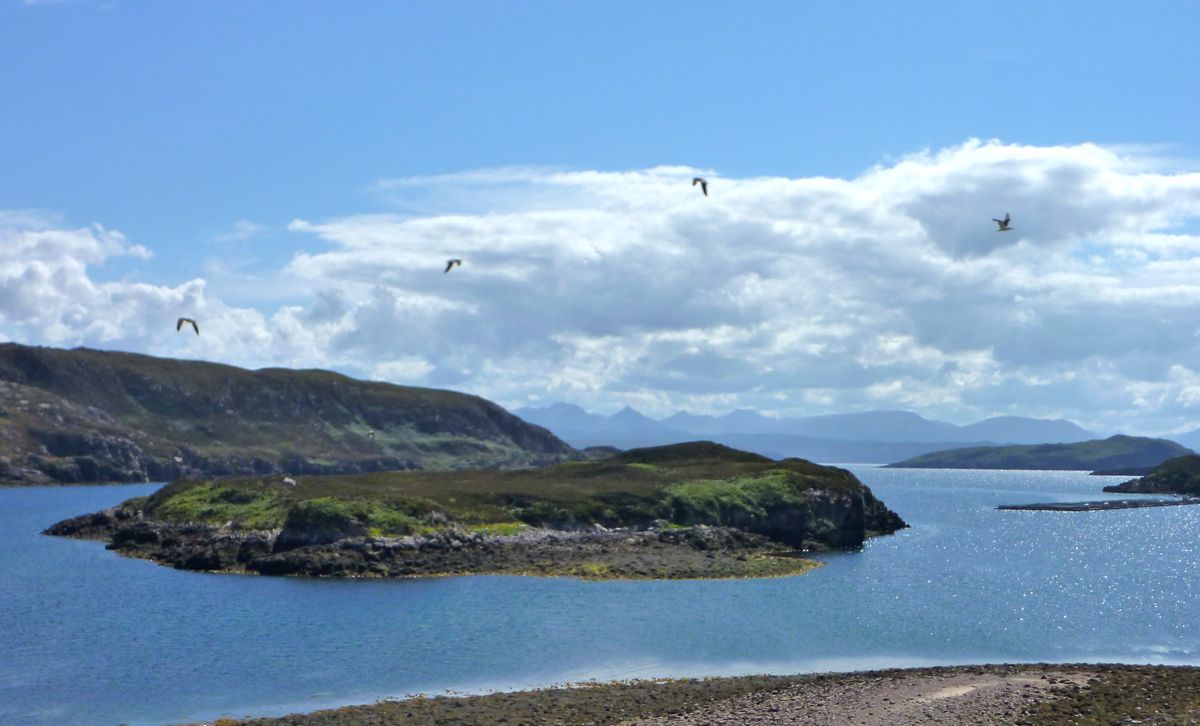
I clambered up to a pass for a view back north over the fish farm to Achiltibuie and the loaf of Suilven behind. Must go back up there one time soon. On the water again I turned up between Tanera Beag where a north wind had come up and gave me something to get stuck into. I didn’t want to push my luck but to string things out I popped onto one of the three islands north of Fada Mor which become one mass at low tide. Causing a seabird commotion overhead, I crawled to a high point and took in another great view back at the Fisherfield   and Torridons.
As on Tanera, the colours of the vegetation jumped out at me – was it the light, the recent rains after a long dry spell or just my shades?  All that remained was a hack over to Dornie and back to Whalebone beach (now all gone). It was just beginning to whitecap which I regard as the red flag, especially when blowing from behind.

The spray kicked up over the sides but at times like these I’m reassured by the K40’s reliable turn of speed – about 3.5mph the readout said. It’s good to know it can be done, even if most of the time I prefer bumbling around in calmer weather, looking at stuff.

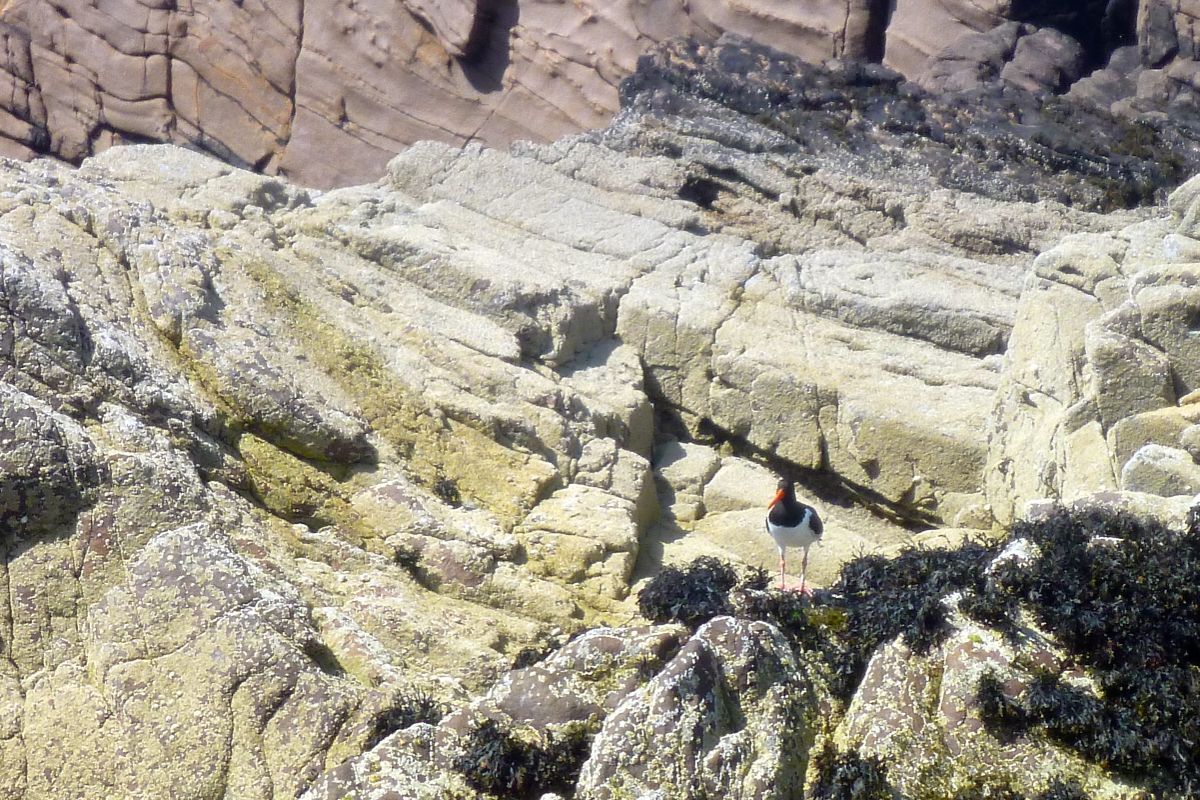
Once over, I pottered back tucked under the mainland shore out of the wind. A beaky oyster catcher eyed me suspiciously just as I neared the beach where a guy setting out with his toddler on his Sevy 200, doubtless the only two IKs for miles around. A few more days like that please, Mr Weatherman.

Lurgainn – linking the Lochs

An afternoon’s paddle along the lochs strung out below Stac Pollaidh mountain, with a bit of portaging in between and a jog back to the car to finish up.

Landfall on Horse Island (Incept K40)

Incept K40 Index Page

Sadly it looks like the amazing start to the summer may be over up here – or rather it’s back to normal. Since March it’s been one of the driest periods for years. June just gone was the driest ever while down south in places it was the wettest ever.


But the jet stream has flipped back into position and so it’s business as usual: the south is getting its overdue share of sunshine again while right now the wind howls periodically, it’s lashing down and I can barely see a mile across the bay.

It was the same deal last weekend, but midweek the winds dropped and so did the pressure of finishing the current job. So I slipped out one evening across Badentarbet Bay to try and thread a loop through Horse Island.
Not having paddled for weeks, as usual I went through the usual neuroses as I parted with the shore (“Crikey, this water really looks dark and deep”. “I really must take a spare paddle.” etc, etc…) while cautiously tracking some low cloud or mist coming up with a southern breeze.
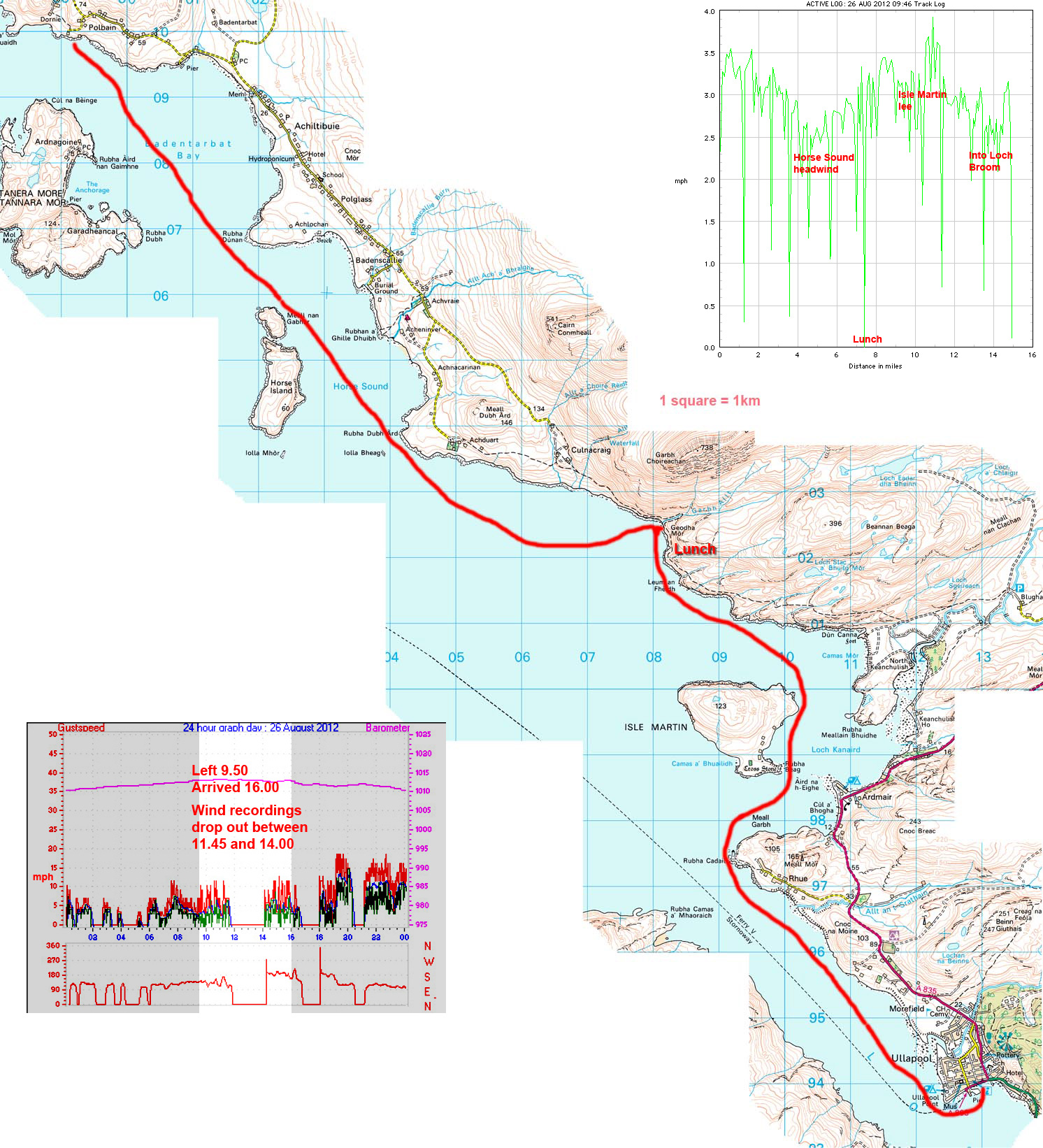
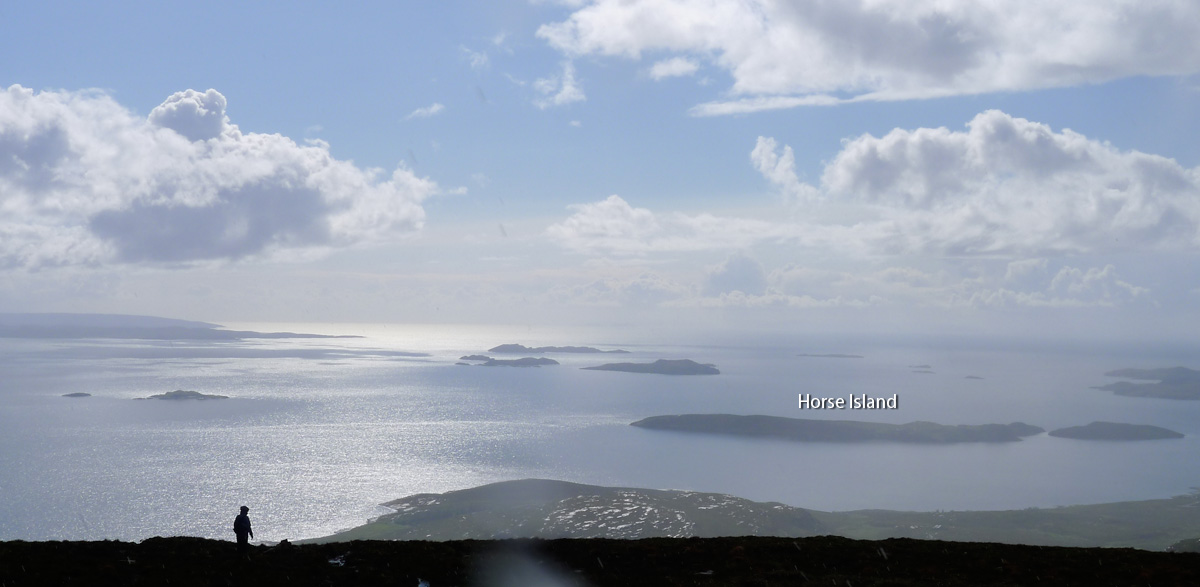
Horse Island is actually further than it looks, about 5km from the pier, and once I decided I’d survive the crossing I planned to slip through the gap between Meall nan Gabhar (see map, above) and head back. The passage is no longer pictured right by Gael who passed that way a couple of months back in his Incept at the culmination of his epic run up the Scottish Sea Kayak Trail.


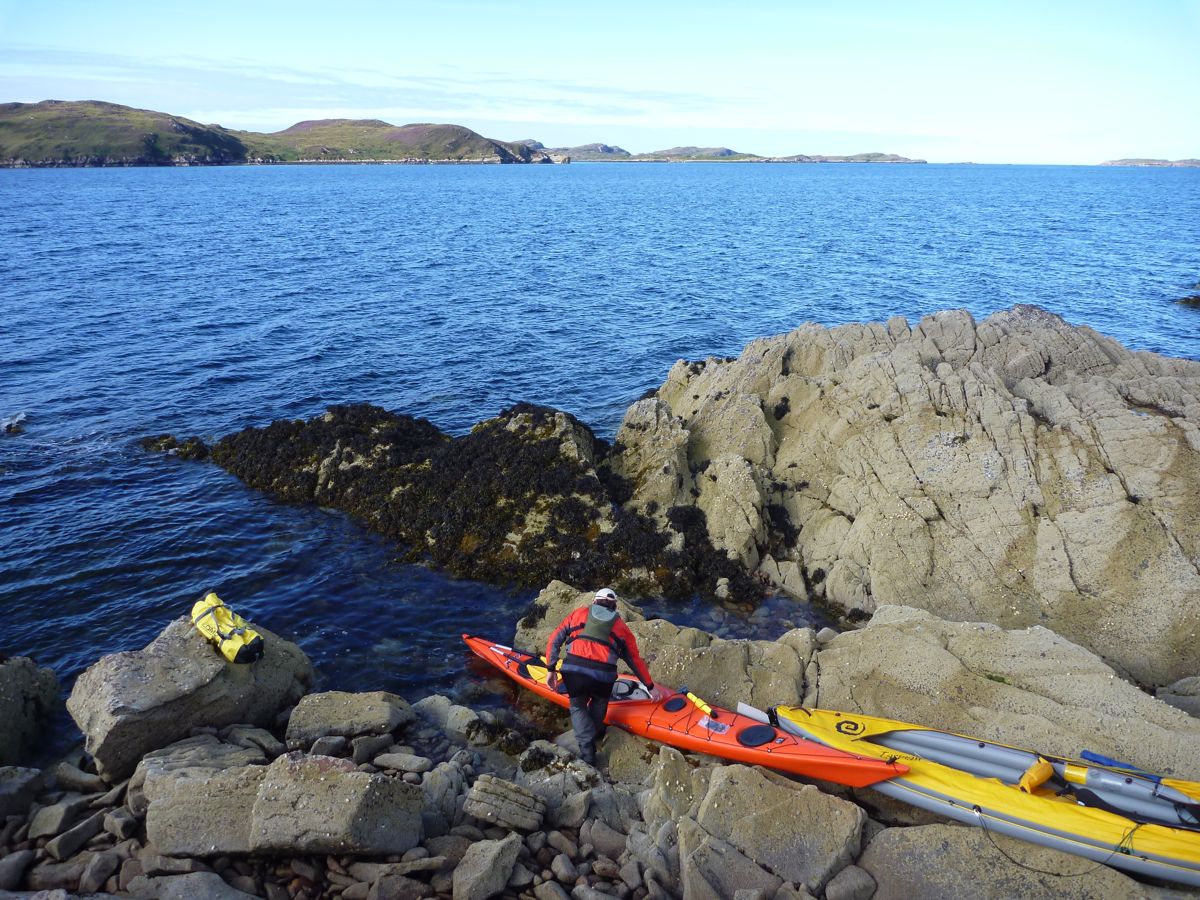
As I rounded the corner and frightened some seals with a splash, it turned out Meall (a ‘hill or mound’) is a separate island only during the top half of the tide. On my arrival with the tide bottomed out, a bank of seaweed-covered boulders rose two metres out of the sea (below), creating a broad causeway between Meall and Horse.
No matter, it made getting out easy and as a seal popped up and eyed my movements, I scrambled up the knee-high heather and scrub for a look around Horse, finding a broad grassy platform with various sheltered nooks for a sheltered camp. It’s said local farmers periodically drop off their sheep here to graze, but the only presence was the high-pitched caw of a large bird of prey hovering over its nest up on the hill. The clouds parted briefly to shine onto Ben Mor (above) and pleased with my offshore excursion, I powered back to the pier.

As I Paddled out one Midsummer’s Evening (Incept K40)

Incept K40 Index Page

I took the K40 out across the bay for the first time since Ningaloo last September. As mentioned earlier, Australian UV being what it is, it did look pretty good after being rolled up for months. I put that down to lashings of 303. But it still went a bit flat in the few days between pumping up and paddling. Maybe I pumped it up on a hot day.

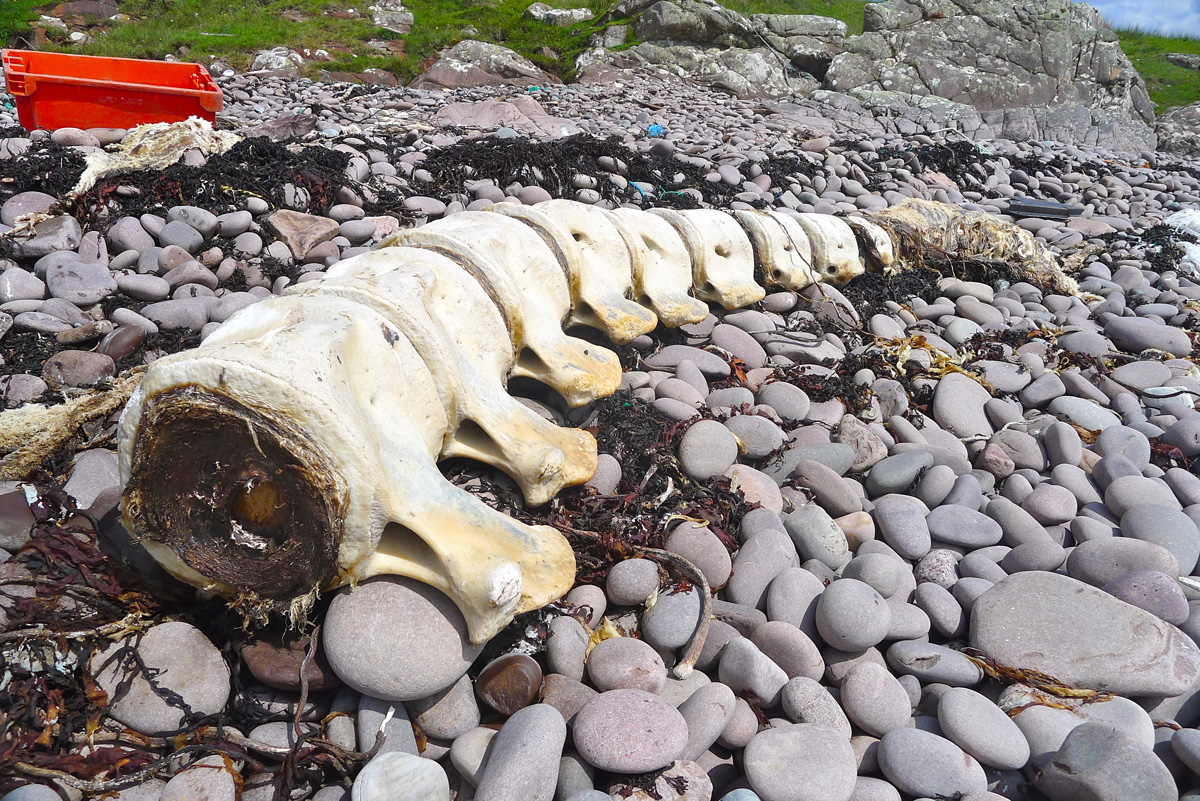
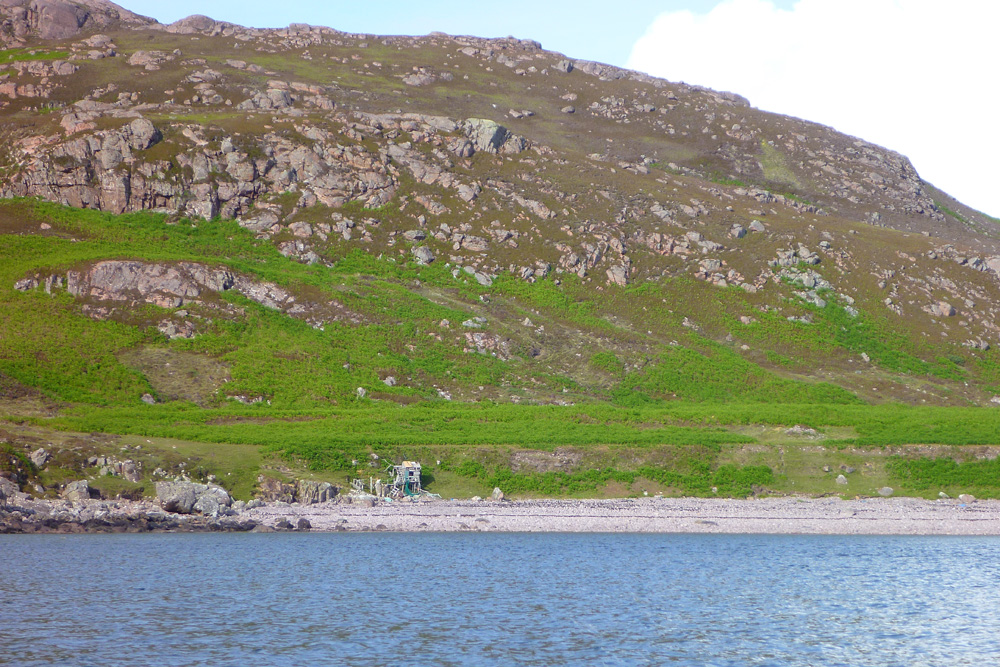
I topped it up in the water at Old Dornie, had a quick look for bubbles, took the pump with just in case, and set out back to Badentarbet beach. It had been calm for days and an ankle-high swell wafted along with a spring tide about to top out at about 3.5 metres. I passed the old ‘Wasp Factory‘ (left) still intact, and dithered a bit about crossing to the island, over-conscious about how the boat was moving on the currents that would barely push a wet paper bag. In the end, Tanera Mor got close enough, and after a couple of minutes paddling I trailed the rocky shore of red Torridon sandstone for a while before heading back across the bay.
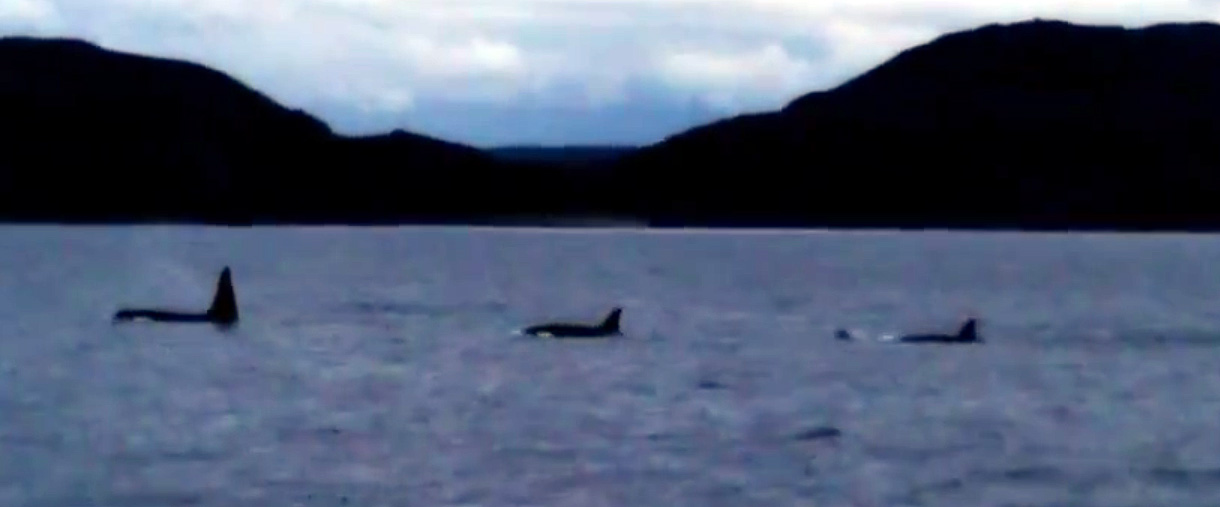
I found out later that the day before a boat tour had spotted a pod of half a dozen orcas (ropey video – start at 1:40 for the best action) right here. Someone suggested that because it’s been so dry, the salmon can’t get upstream to do their thing so have backed up along the shore where the killer whales come in for a feed. Video still below, more pictures here and see footnote.

With no dorsal fins towering over my head, I crossed the last mile over the bay with the rudder up to remind myself it was do-able. The K40 took a bit more finesse and occasional hard yanking to keep in line, same as with the old Sunny when without a skeg. A smooth, steady style works best but what it really means is that you can’t go as fast; pull hard to escape from a killer whale’s jaws and you really need your feet and a rudder to get you back in line.

As my taxi came down off the hill I passed a cheerful buoy bobbing around. Stowing the paddle and using the buoy as a marker, I noticed how quickly I was drifting back on the unseen tide, but as always, with the water and wind moving against you, you get much more of an impression of speed which is satisfying. Battling the not so agreeable tail winds off Ningaloo last September, I lost my faith in the K40 a bit, but here on a calm Highland evening, the Tasman slipped along, just as it always did.


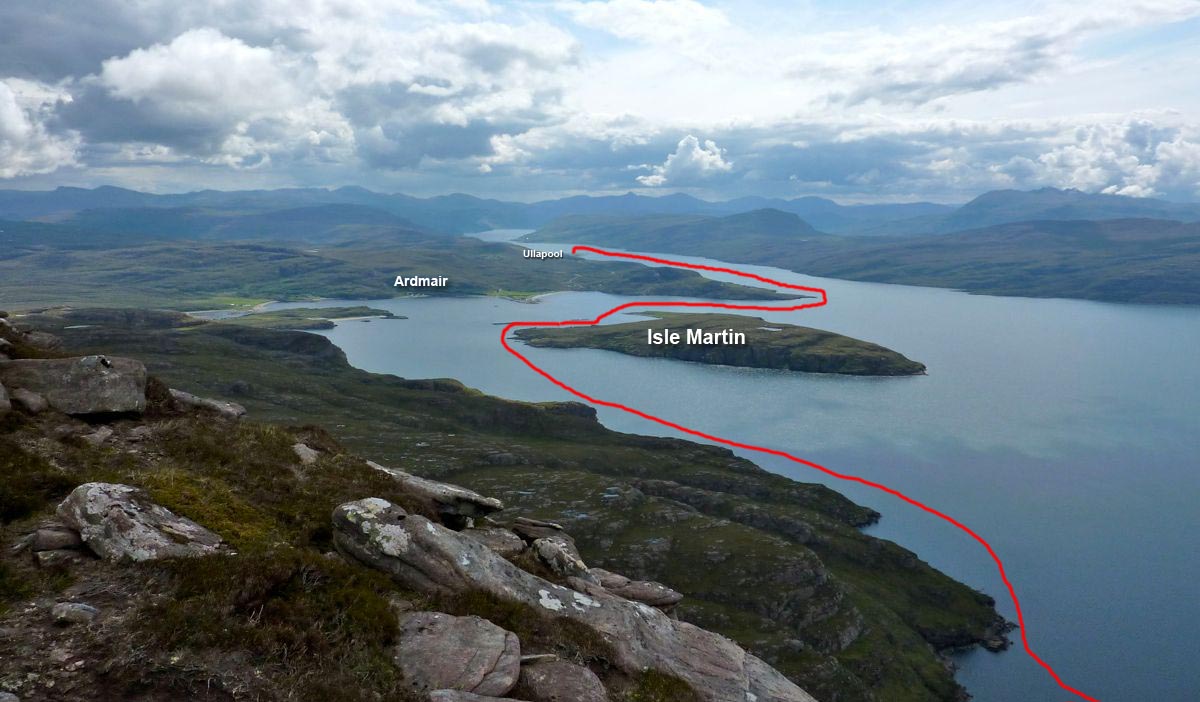
We climbed up onto Ben Mor (right) the other evening, from where I was reminded just how close Ullapool seems from a couple of thousand feet above sea level. Looking out over Loch Broom, with one arm you can pat the Summer Isles, and with the other dab the lighthouse at Rubha Cadail (Rhue), south of Isle Martin and Ardmair (left). It’s some 13 miles or more, but with a get-out at Ardmair if need be, it would surely be doable within in the span of a tide, then to catch the afternoon bus back.

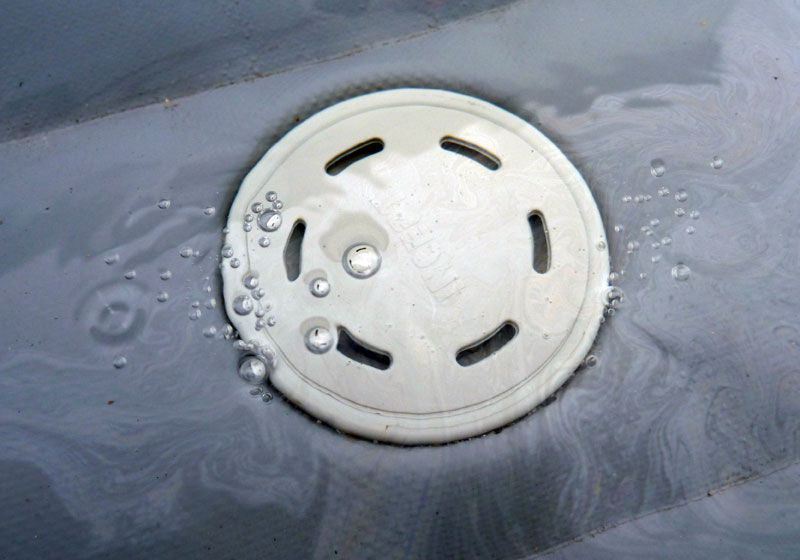
A few days later I decided my boat did have a leak in the floor somewhere. I hoped it might be a bit of easily expelled grit in the PRV and not the hull delaminating in some hard-to-get-to corner.  I filled it up like a paddling pool and sure enough, it was fizzing from around the edges of the PRV (right).
It took a bit of tracking down with Google (the menuless Incept NZ website is not the best), but it seems the cap needs prising off and the valves cranking down once in a while with a Halkey Roberts valve tool. Seeing as it’s not been done since new, that makes sense, so one’s on order and will hopefully do the trick. I never had to do that on the Gumotex Sunny in all its years, but the Incept does run a higher pressure and is a faster boat because of it.
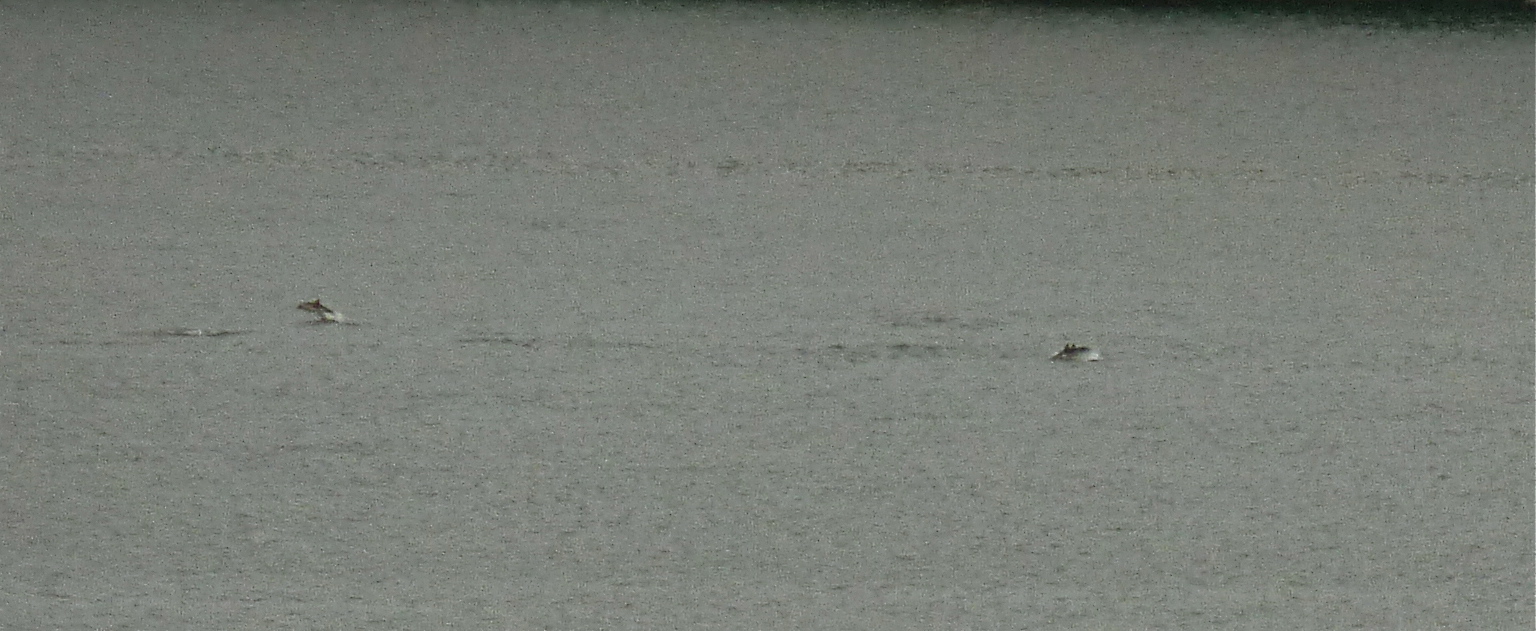
A day after I wrote this, over breakfast we spotted a huge pod of [probably harbour] porpoises coursing across the bay. They’re not so unusual and half an hour what looked like up to 20 of them trawled a line to an fro off the shore of Tanera Mor, presumably hunting or feeding. This is the best the zoom could manage on a murky midsummer’s morning.

Water shoe review: Teva Omnium

See also: Packrafting shoes or boots

tevafloater

It’s 2025 and I’m on my my third pair of Teva Omniums after nearly 15 years. It pays to remember we’re not just ambling down to the sailing club for a drink, we’re balancing over slimy, head-sized boulders exposed at low tide, often while carrying a kayak, or walking through bogs or tidal mud which can suck off a shoe.

They were going for just $40 at REI Denver, back in 2011. Like it or not, much of how something performs depends on what it cost. As a replacement for my old Keen Arroyos, the Omniums hold my foot much more securely, with a velcro adjustable heel strap, a velcro adjustable clip buckle strap over the top, plus those dubiously effective cinch lock laces over the front. It’s the over-the-top strap that makes all the difference to holding to foot securely.

The Tevas also have no wear-prone threading attaching upper to sole, and a solid and chunky-looking plastic-rubber footbed derived from one of their sports sandals and doubtless designated with some snappy acronym.

I have found a closed-toe water show much better for wading than a regular sandal, because the open front of a sandal drags through the water as you wade. Closed toe ‘sandals’ work much better here and elsewhere, plus on land or water the toe protection is welcome. My Omniums feel more sure-footed than the Keen Arroyos ever were, mostly down to the fitting straps, but also due to what feels like a thick and less flexible sole which have not compressed and lost cushioning over time, as my previous Teva open sandals used to do.
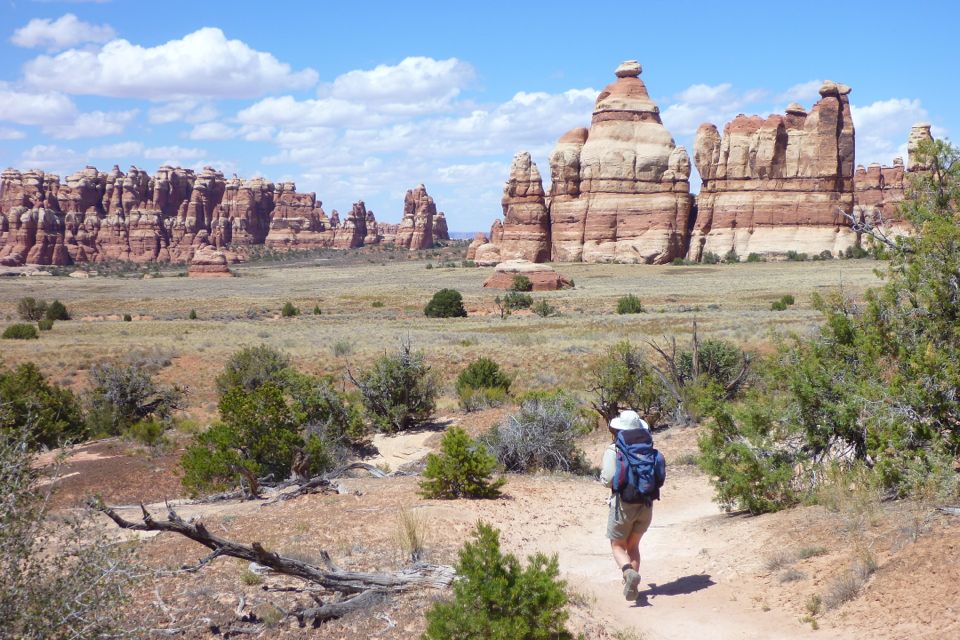
We walked a couple of hours up The Narrows at the top of Zion park, following, crossing and wading along the Virgin River countless times. The Tevas gripped as well as anything here, drained readily and felt agile and secure when boulder hopping.

For regular dry walks up the side of Zion canyon and on a couple of longer dry desert walks in Canyonlands, they performed well enough, the softer-than-a-boot soles gripping very well on dry slickrock at the cost of letting some sand in in the washes. Lifting a foot behind you once or twice was an easy way to let the sand spill around the toe holes. At the end of a hot, 11-mile desert walk there was only a little soreness, but that could be due to my desiccated feet after a fortnight in this very arid climate. I feel that under the weight of a pack and clad in some seal skin socks, they’ll work well in northwest Scotland, though for an overnighter I think I’d sooner use the proper hiking boots.

With their wide snouts the Omniums are a bit Croc ugly, but wide shoes suit my feet much better. I haven’t read them all, but the reviews on Teva.com did complain of fast wear; no great surprise with modern sports shoes. I do wish they’s put a chunkier tread on their soles, but another plus: they float – always a good thing in the water. I give a paddlepacking thumbs up for the Omniums. If you can grab yourself a bargain you’ll have a great water shoe.

Two years later and my Teva Omniums are getting regular use for day paddles and are still hanging in there with no actual signs of breaking up. The soles are now too smooth to be useful on mud, but were never that good anyway. All in all, tougher than the similar Keens, but still limited for loaded overnight, all-terrain treks.

omnioo

Four years later and nothing much more to report. Decay is gradual but they’re still hanging in there. Nothing has actually broken or worn out. The soles are getting quite thin and have lost just about all the tread.. To be fair most of the time these shoes are in a boat or on a pushbike which may explain how they’ve lasted so long. So a short time later I used them on a three-day walk in Italy – about 80km. I  found the Tevas extremely comfortable on the mostly road and gravel track train (once I put some socks on). The thick, squidy heel really helped and the front sole wasn’t too thin for the gravel. They breath well of course (temps in the high 20s) and are easy to take off. 

tevaomnium

In 2016 I bought another pair in the US for about $60 and by 2020 the sole was peeling off here and there and I’ve just glued them up a second time. But they’re still my go-to paddling shoes.
Another five years later they’re doing OK. A bit more peeling going on. I think i got some Omnium 2s which look a bit less clumpy. It’s 2025 and they’re doing fine on the water on the bike and in the garden.

Gumotex Swing IKs

Updated: Summer 2020

See also: 2020 Rush models with D/S floors (like the Thaya)

swinginovlites
gumotexfabrics18

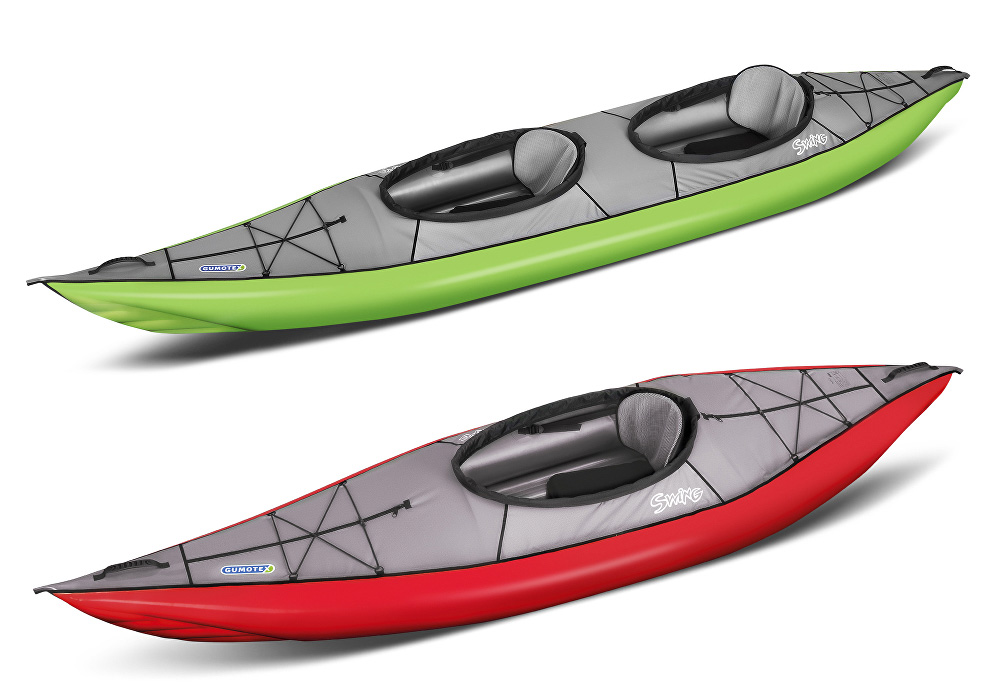
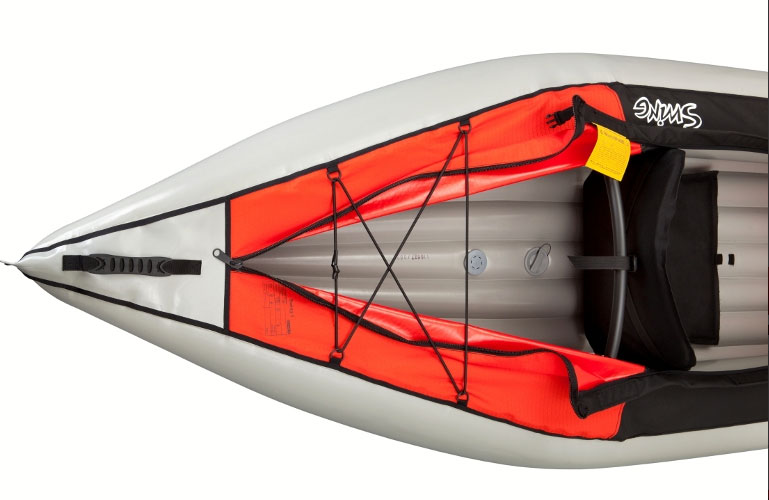
The Swings are fixed-decked solo or tandem IKs pitched at recreational users who seek the reassurance of a very wide boat and the dryness of a deck.

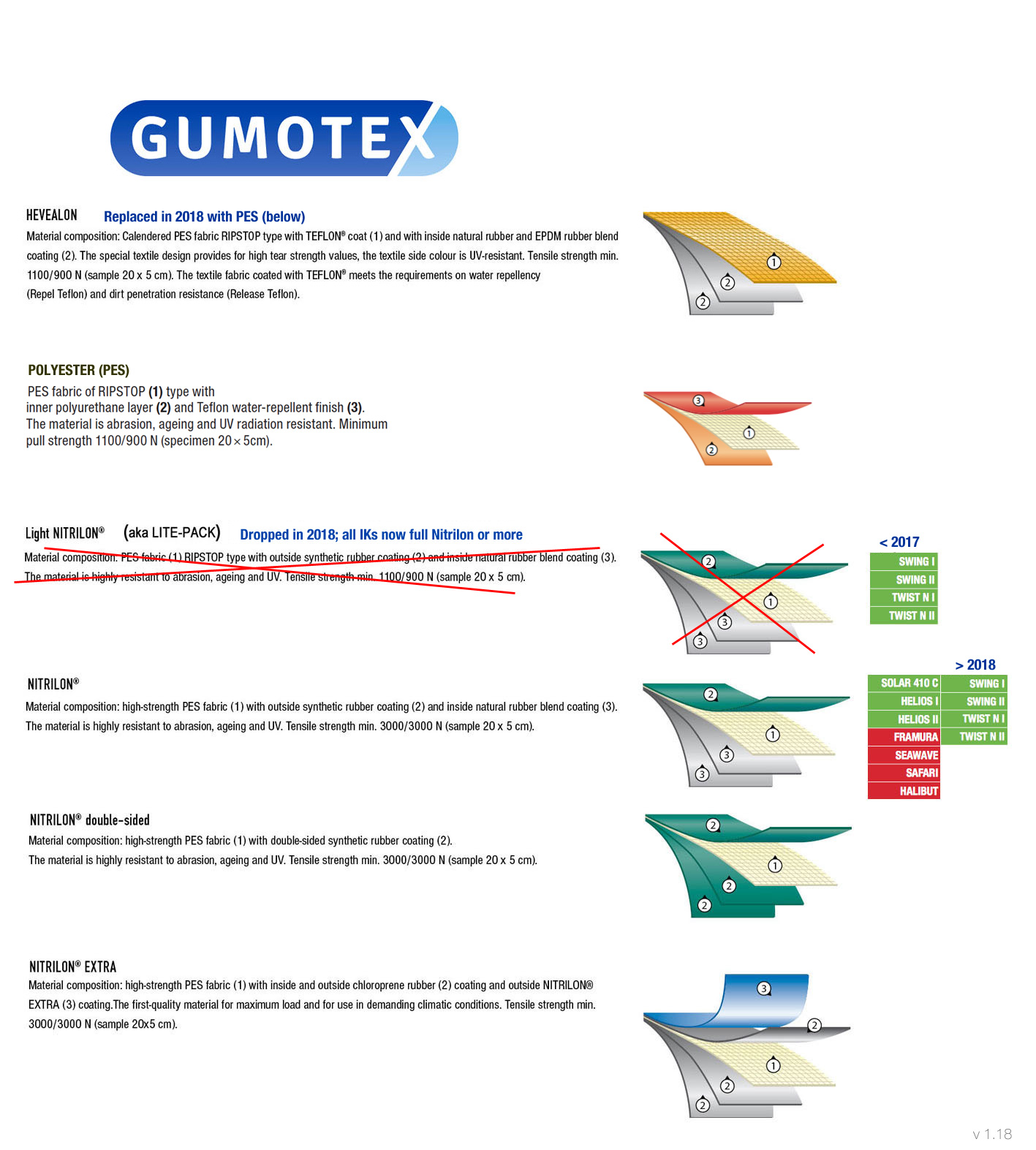
There were once and are maybe still two versions of Swing 1 and 2. Innova distributors in the US show red/black green/grey hulled models which they still list as made from Nitrilon Lite™. Europe and maybe elsewhere never had the black-hulled models and are made in Nitrilon (Nitrilon Lite™ has been dropped). The claimed weights for identical boats from EU/US are the same. You presume the green/grey doubles are now identical. See the table right about IK materials with more here

SWING I ▪ Length 3.16m ~ 10′ 4″ ▪ Width  87cm ▪ Weight 11.3kg ▪ Maximum load 120kg ~ 265 lbs

SWING II ** ▪ Length – 4.02m – 13 feet  ▪ Width  87cm ▪ Weight  14.3kg ▪ Maximum load  220kg ~ 450lbs

Note that what Innova in North America call the Swing EX is a Framura in Europe – a slimmer, fixed-deck, 4.1m IK which is much more suited to solo touring and inshore sea kayaking.

swingbots
swingwide
swingbow

As others have commented, they appear to be taking on IKs from Advanced Elements and even the bird’s-eye view is similar. From the profiles it appears they’re more ellipsoid or ‘lemon-shaped’ than other models, or maybe it’s just that they’re substantially wider which exaggerates this impression.

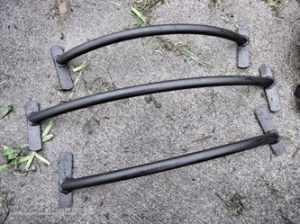
The Swings use 2 or 3 curved alloy crossbars to keep the deck taught (similar system on my Incept and Seawave) and make room for the legs, as well as spread and form the width of the boat. Some blurb states these crossbars make the boat more rigid which may well be true. Constraining the sides (stopping them from flexing out as the boat bends longitudinally) will have some effect in overall stiffness.

As far as the preferred boats for touring, what is desirable is a decked boat the length of a Swing 2, but set up for a single paddler. That is the Framura aka ‘Swing EX’ to Innova – a good-looking, solo-touring, fixed-deck IK for those who think soloing in a Seawave is a bit much. 
Sure you can sit in the back of an SW2 and load the front, but it’s not right, is it? What are the actual benefits of a fixed deck on an IK? (the Swings’ decks unzip partially). Limiting swamping – sure. Keeping the sun off – maybe in sunny lands. Keeping you warm – I suppose so, but that’s what a dry suit ought to do: ‘dress for the swim [falling in], not the paddle [air temps]’ they say.

And many users complain that the zips are far from watertight. And so I conclude that the Swings may well be popular (actually I don’t think they were) but fall into the less desirable ‘bloat’ category: much wider than they need to be which is great for nervous day/rec users. But for the smaller niche of multi-day touring and sea use (space, speed, convenience), they’re not so ideal.

Another review Some Swingers chat

Kayaking Ningaloo – Part 2 (Incept K40)

Incept K40 Index Page
Part 1 is here.
Gallery at the bottom of the page.

After a spell of snorkeling in Coral Bay and reading in Exmouth, I drove round to the ocean side of the Cape and met up with Jeff and Sharon near Yardie Creek in the Cape Range National Park. Later they told me they’d had their camp swamped early one morning by the tide, but had an exhilarating run around Point Cloates dodging humpback whales and covered up to 55km a day, all under sail.

But all was not well with our ill-defined status in the national park. Most visitors arrive by car or tour bus and book their camp sites well in advance if staying a few days. Wild camping is not on, but as I’d discovered to my surprise in Exmouth, all of Cape Range’s few campsites were booked for days in advance and occupied for weeks, with newcomers queuing from 8am at the park entry gate near Tantabiddi for any vacancies. Rocking up off the sea in kayaks was highly irregular and Jeff and Sharon had been given a bollocking by the head ranger who reluctantly negotiated a fixed itinerary for us to follow through the park, ranging from 4- to 20kms a day, until we exited the park at Tantabiddi.

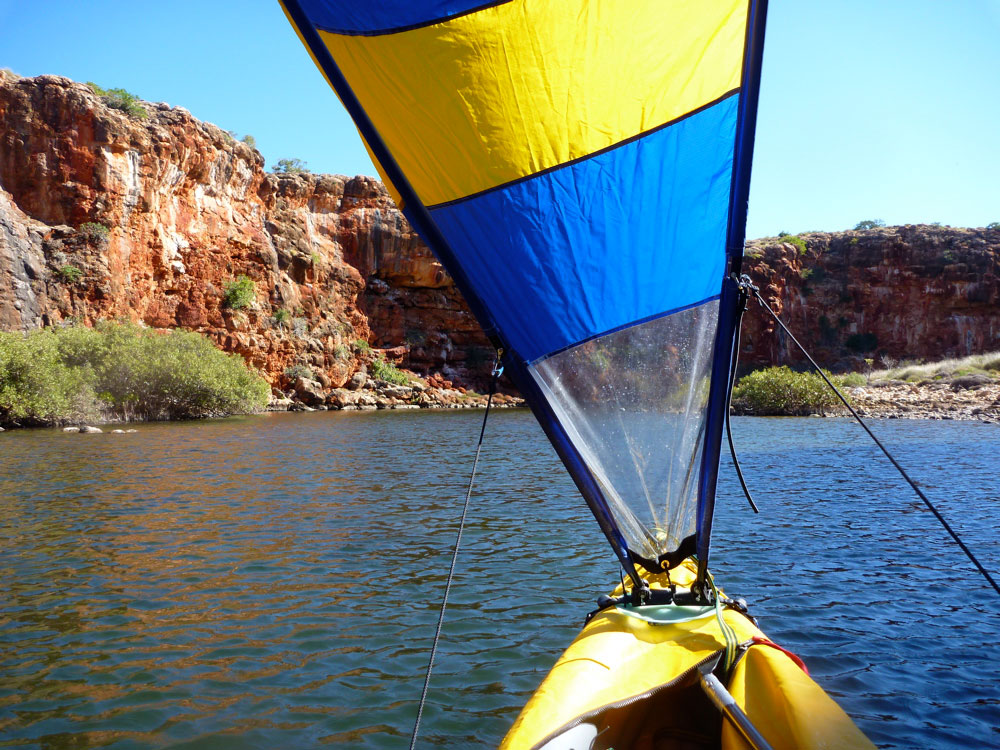
While waiting for the other two to arrive, I took a quick scoot in my underused boat up Yardie Creek gorge (above), a 2km cleft in the otherwise flat coastline. Official boat cruises run up here to spot bat-eared rock wombats, a trip that I must have done in my time when updating the guidebook. But even running Yardie in my own boat, I thought by WA standards this was a long drive to a very ordinary gorge. Send them off to Karajini or the Gibb River Road and leave Yardie to the speckle-chinned wallabies.

I gave my problematic V-sail another spin to remind myself it had not become a complete flop. With a more secure fixture of the mast foot straps and the elastic cord positioned right on the boat’s black nose, it worked well enough in the light breeze, but could still do with some sort of bowsprit (sticky-out front pole) to get the elastic clip still further forward – a solution that’s easier than making alternative mounts for the sails masts.

I set off to Pilgramunna Camp where a note from Jeff explained that an extramural pitch had been allocated for us boat people. Months earlier I’d spent ages on the DEC website looking for kayak touring regulations in Cape Range but had found nothing and so concluded it was the same ‘come through but leave no trace’ deal as at Cape Peron down at Shark Bay.
Turns out there are no formal regs for kayak tourers visiting the park as it seems only a few kayak parties pass through each year. But as the park is about 60km long along the shore, you’re going to need at least two nights in the half dozen official campsites which mostly probably need to be booked in advance in the more tolerable seasons. That’s something that is difficult to plan for if coming up from Coral Bay, nearly 100km away.

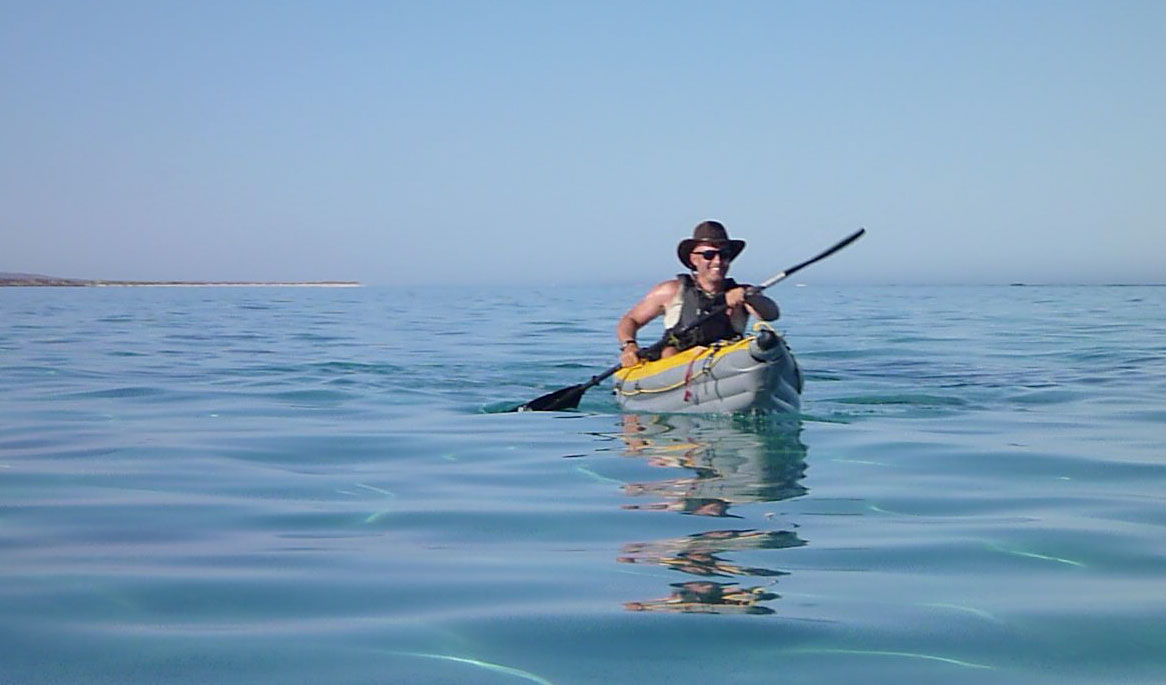
With our pitch allocated, I set off in my kayak to meet up with Jeff and Sharon coming up from the south. We were soon reunited on the water (above) and shared the stories of our separation. They were low on food so back at the camp were pleased to tuck into a cake Sharon had baked for the trip and which I’d managed to resist eating during my days hanging out.

Early next morning we were all set to complete the less demanding two-day run along the reef up to Tantabiddi, but now northeasterlies turned on us as the back end of a high pressure system moved east over the continent. At least these were conditions I knew the K40 and I could handle, right up to the point when our pace progress dropped to zero.

The winds scuppered any reef viewing opportunities off the boats and a momentary pause in paddling effort saw the boats stall and drift backwards at least as fast as we could move forwards. But here at least were the fabulous azure lagoons and shell-white sands of Ningaloo.

Just before Turquoise Bay we stopped for a snack at which time Jeff took a quick scoot in my empty Incept . He proclaimed my boat was light and fast but my PA sail tension was still too slack or the mast-to-elastic clip distance too short. That was something I’d thought of and re-rigged the front tensioner further forward on the nose of the boat, though I may try the bowsprit idea mentioned above.

That was academic in the current headwinds so Jeff led the boats off on a lead while Sharon and I took advantage of a current the ran along the point leading into Turquoise Bay created by the lagoon filling with overspilled surf which ran out as a riptide through a gap in  the reef. Compared to Coral Bay, there were many more soft corals here along with all the usual fishes. Coral Bay coral gardens got trashed by a cyclone a few years back.

That done we hacked on northwards across Turquoise Bay, busy with weekend day trippers, and occasionally took to walking out boats in the shallows as we’d done in Shark Bay. As we did so we passed a couple of stocky reef sharks as well as several turtles and rays.

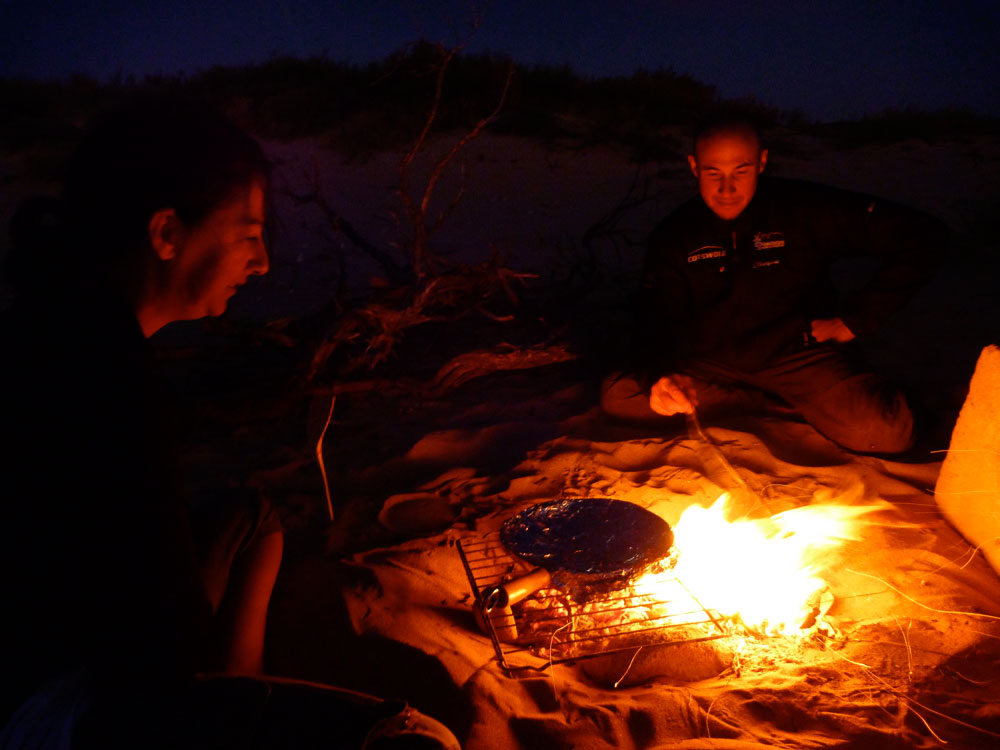
By the late afternoon it was clear that after nearly a week at sea, Jeff and Sharon didn’t have the puff to make it to our pre-ordained camp in the portly tandem, so we pulled in on a beach for a much more satisfying wild camp and a great feed laid on by Sharon from a food cache we’d retrieved earlier in the day. To avert any alarm or searches we left a phone message with the head ranger. As the fire died down we dozed off at 8pm and the wind dropped off, promising a good night’s sleep. Its howling was replaced by the distant roar of surf breaking over the reef.

Early next morning we got the break we were hoping for: near still conditions. After forensically tidying up the camp, we headed out towards the surf line and finally had a chance to enjoy a little of what we’d come here for: gliding serenely over the reef just a few feet below, past fishes, sharks, turtles and rays. No need for a mask or glass-bottomed boat today, it was all laid out below us for an hour and a half until the north winds returned us to business as usual.

Mesa Camp came and went, with a report passed to the head ranger that we were breaking with his proscribed itinerary and making our way out of the park that day. Turtles dashed all about as we nosed into Mangrove Bay, a welcome change from the unending string of scrubby low dunes that lined the shore all the way up from Coral Bay, if not Perth itself.

Another spell of wading brought us finally to Tantabiddi boat ramp by which time I’d divined a new paddling technique probably known to all: pushing off the mushy inflatable’s footrests actually enabled a rigid torso rotation which notably increased speed for little extra effort. With energy to spare after only a day or two’s paddling, at times I was even inching past the tandem until we nudged ashore at the ramp. Jeff and Sharon performed a ‘paddle high five’ after completing their challenging 150-km run up from Coral Bay, most of it alone.

The boats and gear got hosed down at the fish station while I hitched back down to Pilgramunna to retrieve the van. It was nearly dark by the time I arrived and I must have spotted and dodged up to 100 ‘roos on the 40-km drive back. I’ve never seen so many kangaroos. The park was infested with bounding marsupials: ‘Ningaroo’ they should call it.

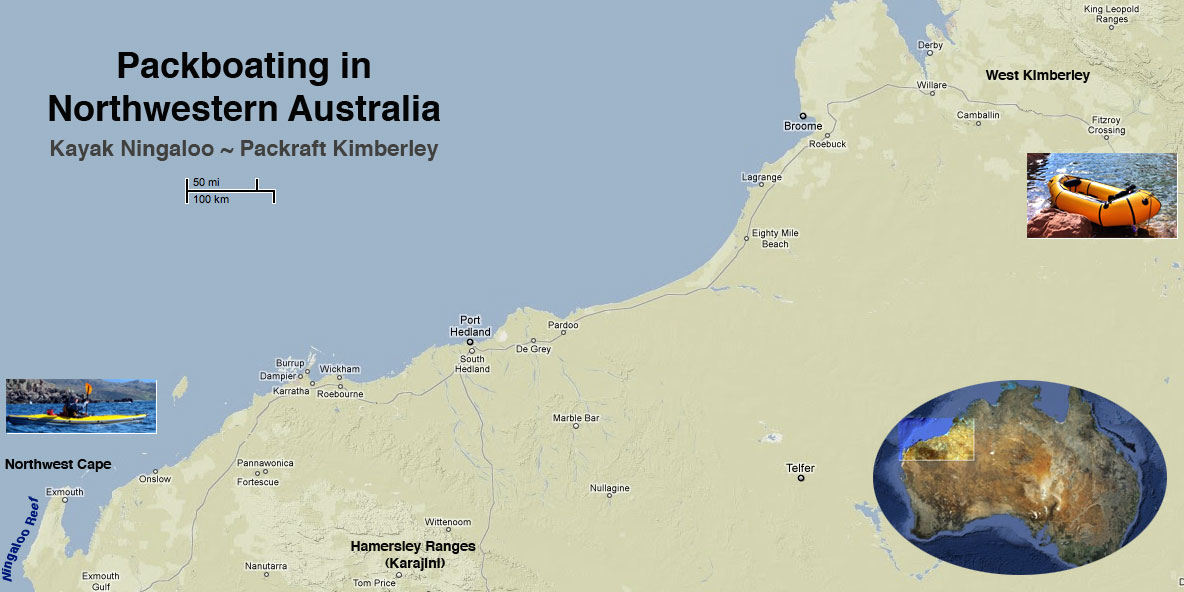
So, I ran out of easy conditions for a good sea paddle through Ningaloo; something I suspected might happen even before I left the UK. But I wasn’t too bothered. I got a couple of days in plus that lovely calm morning and knew that a meaty packrafting adventure lay another 1000 clicks up the road in the Kimberley (see map below). I got the impression from Jeff and Sharon that, apart from the humpbacks and not least the satisfaction of having kayaked the entire way from Coral Bay to Tantabiddi, I hadn’t missed that much. Unlike Shark Bay, here it was the reef that was special, best appreciated in calm conditions or on the end of a snorkel. Otherwise, you might as well be battling the winds anywhere along the WA coast.


I can’t be sure I’d reached the limit of the K40 (as described in part 1), but until I get more experience I’d certainly reached my limits trying to handle the kayak in very windy conditions I’d not normally tackle back in the UK. That still leaves a lot of easy sea kayaking and fun rivers to do yet.


Kayaking Ningaloo – Part 1 (Incept K40)

Incept K40 Index Page

After a great paddle in Shark Bay with Jeff and Sharon a few years ago, we’d vowed to try the more exposed transit of the Ningaloo Reef, from the small resort of Coral Bay, north along the west side of the Northwest Cape through Cape Range NP as far as Tantabiddi boat ramp. All up about 150 kilometres or a week’s paddling.

The entire coast of WA is bare, windy and exposed to swells raised by storms in the restless Southern Ocean, with few settlements and little shelter or natural sources of freshwater to speak of. Only the extensive lagoon of Shark Bay and the reef-protected shoreline of the Northwest Cape provide potentially interesting sea kayaking, sheltered from the daily sea breeze, even if access to fresh water is still a problem.

What makes Ningaloo special is that the continental shelf is relatively close to the shore compared to the northwest coast up towards the Timor Sea. This fact, as much as the presence of the reef, explains the unusual diversity of marine life which led to the marine park’s UNESCO status. Small fish, turtles, rays, small sharks and dolphins live or visit the lagoons between the main reef’ and the shore, while bigger creatures right up to humpback whales, tiger sharks and not least the whale sharks for which Ningaloo has become famous, usually feed along the outside edge.

After a 1200-km overnight drive from Perth, we arrived at the Coral Bay (CB) where Jeff’s first comment on easing himself out of the driving seat was ‘Jee-zus, look at the swell out there!’. The reef lies just below the surface a kilometre offshore here, and the Indian Ocean breaks on it unceasingly, forming a glaring band if ice-white surf, at times thrown 2-3 metres into the air. That wasn’t an undue worry for us as we were planning on staying well inside the near-continuous Reef, but the winds were another matter.

Following weather reports over the preceding weeks I was beginning to wonder if September (early spring) such a good time after all. Asking around, many said a month earlier (as we’d been at Shark Bay) would have been fine – or May, or in high summer between cyclones. Everyone had their own suggestions, but the fact was right now the forecast for the next week (left) was 20 to 30-knot winds from the east or southeast, with gusts half as much again. As a result all fishing and tourist boat charters were cancelled out of Coral Bay.

Sounds grim unless you’re into tough conditions, but the good thing about following the Ningaloo is that it’s easy to bail out and cross the low coastal dunes to a rough 4×4 track that runs just inshore. A few cars ought to pass along it each day, so I figured even though I’d never go out in an F5 or 6 in the UK (where the seas are bigger, the skies greyer and the water much colder), here with reliably sunny 30°C days I’d give it a go as we’d never be far from the shore. We’d considered starting halfway up the coast at Ningaloo Homestead and just doing the less exposed northern stage, but the other two were keen to do the full run from Coral Bay (left). And anyway, getting Jeff’s van in and out along the Homestead’s corrugated access track with his 55-kg Perception kayak on the roof was not ideal.

Sunday Jeff and Sharon drove out to leave caches of food and water at the Homestead and another point up in the Cape Range park, while I investigated logging our route plan and details with anyone who was interested. Turns out that was a short list as most marine activity in Coral Bay was concerned with nipping out through the reef in motor boats for the day of fishing. Kayaking beyond the Bay itself was unknown and I was told within a day we’d be out of range from the local volunteer rescue services anyway. But we had my sat phone, Jeff had a VHF, plus a chart and we had a GPS each. The weather wouldn’t suddenly get much worse; it would be challenging from the start, so we knew what we were taking on.

Monday 6am and Jeff was raring to go; no time for breakfast – straight to the beach from where our mission that day was to cover 40 clicks, even although we had 9 days to cover the other 110 kms to Tantabiddi during which time we planned to linger and enjoy some reef exploring.

We loaded the boats on the shore, set off and flicked up our Pacific Action V-sails. Behind us, a curious crowd of early morning dog walkers had gathered while I struggled to follow a straight line across windy Batemans Bay (‘Coral Bay’). The sea was flat enough but the Incept seemed hard to control as the sail flapped or swayed violently from side to side. I tried to imitate the sail position Jeff was running on his big tandem, but soon even he reckoned it was already too windy to use the sails, so we pulled them in and paddled around Point Maud into the big scoop of coastline that leads north some 60km to Point Cloates below the Ningaloo sheep station.

The wind still blew offshore at this time which helped flatten the seas just as Jeff predicted, but soon a mile-long gap in the reef let the ocean swell through from the left. It rolled beneath us harmlessly and crashed with occasional fury on the sandy beach far to our right. As the morning progressed we tried sailing again. With years of experience and a well set-up boat, Jeff was much more proficient at this, but during the stronger gusts I was again struggling to get to grips with the K40. Where was the 10kph+ rush the PA sail had promised? Testing it in Scotland had hinted at this potential, but now the winds were an order of magnitude greater. One problem was the force of the wind had loosened and pushed my mast feet forward, so lessening the all-important elastic tension which keeps the sail pulled upright, especially at lower angles. At one point Jeff leaned over and tightened the straps (and later I revised the straps to link directly to a couple of lugs) but as the hours passed I could feel myself losing confidence in my boat, too busy trying to control it or keeping up to even grab a drink, take photos or just look around.

At the sandy Bruboodjoo Point we pulled in for a snack after five hours paddling. Unknown to us, there was a camp here called Nine Mile, occupied by self-sufficient recreational fishermen. Having already covered 20kms, I wasn’t feeling reassured about what lay ahead, when a woman bathing nearby confirmed that the winds were set to get stronger through the week.

We set off again into what was now a strong southwesterly – the daily ‘sea breeze’ which rolls in in late morning along the entire west Australian coast and is known as the soothing ‘Fremantle Doctor’ down in Perth. In this stronger wind I was even less able to sail as steadily as the tandem. We had tried long and short line towing (rather than rafting up alongside) but under sail or not, the bobbing Incept was all over the place, fouling the Perception’s rudder and at times pulling me over or burying the bow. After a bit of that I decided to revert to paddling, but by now even doing that in a straight line was a struggle.

At the time I couldn’t pin down the source of the difficulty, but I’d probably never been out in such winds. Jeff thought my rudder was ineffective or not articulating fully, but it was doing as well as normal for a mushy foot linkage system with a bit of rudder cord drag due to the packed payload. Could the rudder be too small or short to operate with the sail? Unlikely. Later I wondered if I may have reached the operational limits of the wind-prone K40 – at least when combined with my rudimentary skills. My boat was about as high above the water as Jeff’s, but with much less weight below, and at 17kg, was less than a third of the tandem’s weight. And even with a rudder, it still lacked the sharply defined stern and bow ‘keel-edges’ of a hardshell to enable it to cut and hold a line in the water against back- or sidewinds. As it was, it was a bit like trying to ice skate in slippers; you can work up some speed sure, but directional control is minimal.

This blobby shape is an inevitable consequence of inflatable kayak design that’s difficult to get around until full dropstich came on the scene. The result – with sail or just paddling – was that the light kayak’s hull itself was as prone to back/side winds as the sail, and so weathercocked (back end coming round) as I zig-zagged inefficiently to try and counteract it. Weathercocking is not unique to IKs of course. and I don’t think the boat’s trim (load level – about 30kg) was off – there was 10kg of water right at the stern. It’s just that in the current conditions the K40’s light weight, buoyancy, rounded hull and high sides conspired to push it about on the water, even if those high sides and the boat’s innate rigidity greatly helped limit swamping compared to the bendy Gumotex Sunny in Shark Bay a few years ago. The sail needed more tension to stay up when pulled down low, but that was easy to remedy and I noticed also occurred on the Perception where Sharon had to hold up the upper mast at times.

deeptr

I can’t be certain those observations about the boat’s handling are correct, and perseverance may have overcome them, but even when the K40 had sailed steadily in less strong winds earlier that day, it was still much slower than Jeff’s 20-foot-long tandem whalesharkboat with its bigger 2.2m PA sail. I assumed weights and hull profiles of the two boats would have matched up, but as well as being a hardshell, length has a lot to do with it, so instead of keeping pace with J&S in my new, faster, sail-equipped boat, even when I sailed well I was left just as far behind as I’d been a few years ago paddling the Sunny in Shark Bay. It was all going Pete Tong and I foresaw this was how those stories in Sea Kayaker ~ Deep Trouble begin: “Jeff, Sharon and Chris left Coral Bay in clear conditions but with strong offshore winds forecast. They were equipped with blah blah but had no blah…
As the tandem surged on I sponged out the swill taken on by the towing and a bloke in an alloy dinghy or ‘tinny’ came over to ask if I was OK. It was an encounter that was to pay off soon. I set off again, paddling with the odd small wave breaking from behind. The tandem was fast becoming a speck up ahead. It was decision time because at that moment, without a chance to talk over options with the other two, getting widely separated like this didn’t seem like a good idea. After the unexpected Nine Mile Camp, there was nothing till the Homestead from where it would be more awkward to bail out if I’d had my fill by then. I looked back at the Camp, now a couple of clicks behind. Up ahead the tandem’s sail was nearly as far off with no sign of them slowing down. I decided I’d pull in. Hopefully, the other two would notice that, stop so I could catch up and get the van keys and rejoin them on the less exposed waters north of Yardie Creek in a few days time.

‘Thank God that’s over’ I remarked with relief as I landed and lifted the boat over the exposed coral slabs marking the tide line along the beach. It was about 2pm. I grabbed a bottle of water and set off north along the coast to meet up with the J&S who I was sure would do likewise soon. An hour later I reached a very conspicuous zone boundary post just before a small headland – an obvious place to wait, I thought. I climbed onto the structure and scanned the beach about a kilometre ahead. Was that a boat or just a rock? There was no sign of the distinctive PA sail and after 15 minutes nothing had moved so I decided that they had shot on ahead. Short of something holing my boat, there was no reason for them to think I couldn’t paddle ashore and they knew I had water, food and comms and so could work it all out.

I returned to the boat, finding a handy half-full water bottle on the way, and paddled slowly south into the wind for an hour and a half back to the scattered collection of caravans at Nine Mile. Over the dune I walked to the nearest van where an Australian flag curled and slapped in the wind.

Hello, is this immigration?” I said with a grin to the old guy, mimicking one of the Asian boat people who frequently beach themselves on WA’s shore.
What?”
I saw the flag and thought this was immigration

Clearly my joke was going down like a lead lure.
Oh that, I just use it to see where the wind’s blowin’ from.”
I see.
Pardon me.

Jim was one of the many retired Australians who now far outnumber backpackers up north, as they seek to escape WA’s southern winter. Coral Bay’s caravan parks were full of them and, as I was to find out soon, every site in Cape Range NP up ahead was full of ‘grey nomads’ too. Hardier and better-equipped types based themselves for longer periods at zero-facility sheep station sites like Nine Mile, where rents were cheaper and stays unlimited. Even then, Jim (the guy in the tinny who’d asked if I was OK, earlier) told me that normally Nine Mile would have had 60 vans parked up. The unseasonably strong winds over the past couple of weeks had driven off most of them, leaving just a dozen diehards. With summer on the way and fishing in such conditions difficult in a tinny, Jim was about to head south himself.

I explained my situation and asked whether he had a radio to call Ningaloo Homestead. Many vehicles have these in the north. Jeff had made an arrangement to check in with the Homestead on his untried VHF that evening, so could get my message and leave the van keys there. Jim only had a CB, but he did have Ningaloo’s phone number. He expressed repeated surprise that the other two hadn’t waited once I was so far behind, but I figured they’d recognised I’d had my fill and bailed.

I tramped back to the boat as the sun sank and on the satphone explained the situation to Jane at the Homestead who thankfully got it all in one take. They’d experienced worse kayak dramas before. She’d pass on my request for keys when Jeff turned up there next day to retrieve a cache of food and water he’d left with them just before we’d set off.

Long story short
Jeff and Sharon had stopped just a few kilometres ahead of the point I’d walked to and waited for me till next morning to turn up. When I hadn’t, Jeff walked back to Nine Mile, found out what happened, walked back and continued on towards the Homestead, arriving the next day.
Separated by 10-15kms that night, we both had rough nights of tent-flattening winds after which the site host at Nine Mile offered to drive me back to Coral Bay where he was heading anyway with his laundry. At the caravan park the host and I set to the van doors with coathangers and zip ties until they yielded. Though we couldn’t get past the immobiliser to hotwire it, the van became a handy base while I worked on a new plan.

By now on the notice boards in town there were Strong Wind Warnings for entire northwest coast of WA. I updated our status with the DEC (parks authority) and, not a little anxious myself now after more calls to the Homestead, a day later finally spoke with Jeff. He apologised for not stopping earlier – I suspect the sailing was just too good and I too had been looking forward to the rush of being batted up the coast with my feet up. His VHF didn’t get through and his walk to Nine Mile explained the day’s delay in getting to the Homestead.

With that sorted out, all that remained for me was to wander around the Coral Bay campground eyeing up likely candidates until I succeeded in persuading a young Brit backpacker that for fuel and 50 bucks, it would be an awesome adventure to drive me 120kms to the Homestead and back in his clapped-out Suzuki banger.

If Jeff’s $1500 van was rough, Rory’s 20-year-old Suzuki Swift truly had three wheels in the scrapheap. Even he admitted it would probably not make it to Darwin as he and his mates had planned. The CV joints clattered like a football rattle and I’m sure the 60 clicks of corrugations along the homestead access track brought the Suzuki’s imminent Big Bang forward a few weeks.

At the Homestead Jane confided that the southern bay up to Point Cloates was indeed the more exposed ‘open water’ stage of the Ningaloo passage and the wind had certainly come up on Monday afternoon. When it blew like that for ten days at a time, she admitted it drove her nuts. But all this as least boded well for the more sheltered northern section of the paddle in a few days time. The car got us back to Coral Bay where I started the van up and headed north to Exmouth, planning to meet J&S at Yardie Creek in three days time.

Part II and a short video