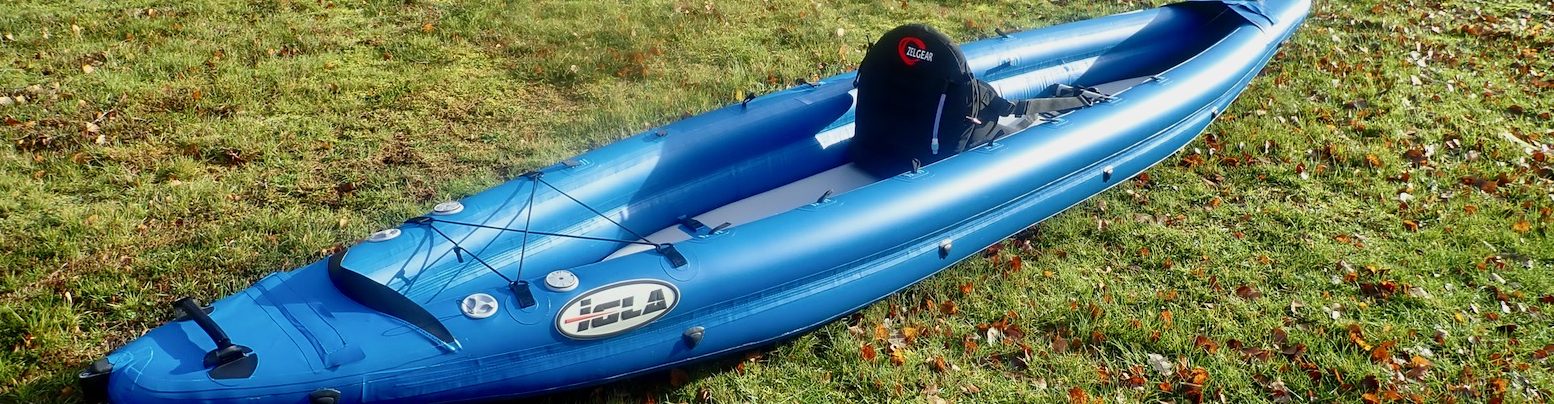
Category Archives: Inflatable Kayaks

Fitting a Pacific Action sail on Incept K40

Incept K40 Index Page
See also this post as well as this post about using the PA in strong winds in Western Australia. There’s a video there too.

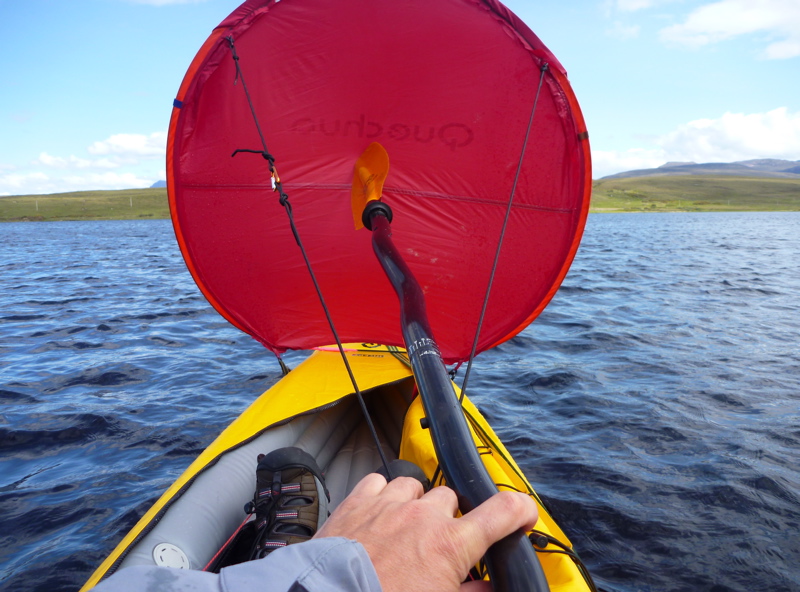
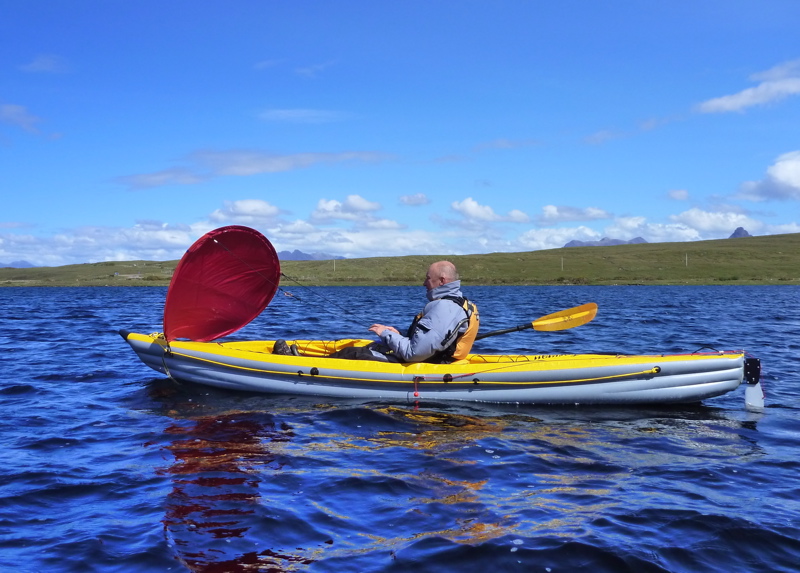
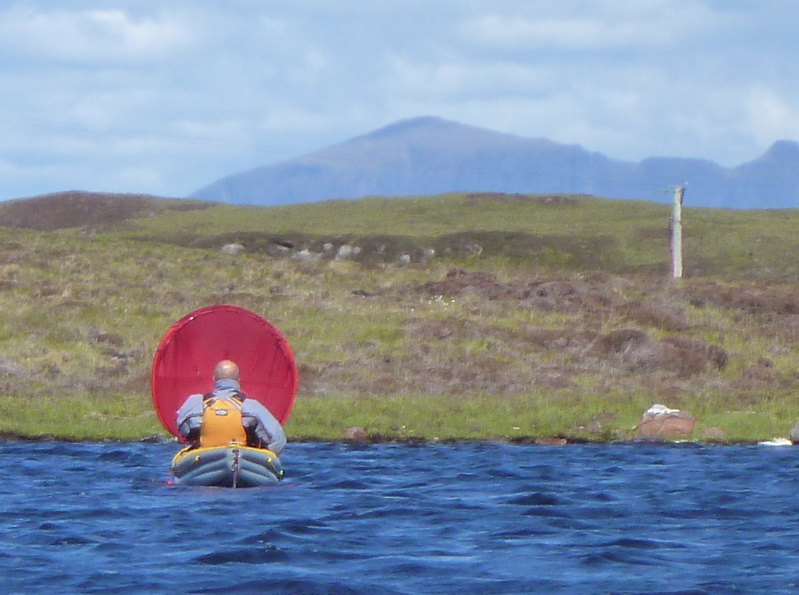
I’m pretty sure my 0.78m2 home-made disc sail is too small to push the 4-metre Incept along until wind conditions get beyond the pale. Recognising that, I tracked down a 1.5m Pacific Action for £175 instead of the usual £250 which is a bit much. As I mention here, you can easily make a V-sail yourself from bits of plastic piping and old trousers, but life is short and as I’ve experienced a PA in action in Shark Bay, I’ve treated myself. The nearest B&Q hardware store is half a day away.

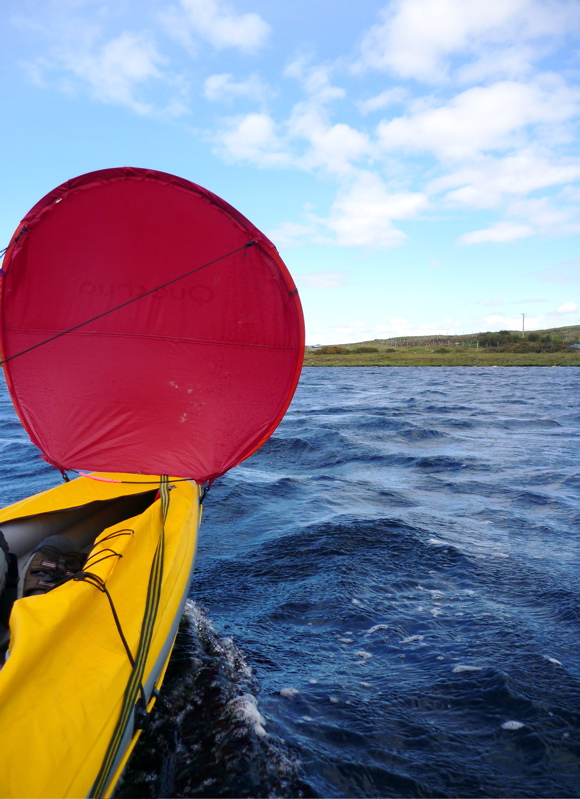
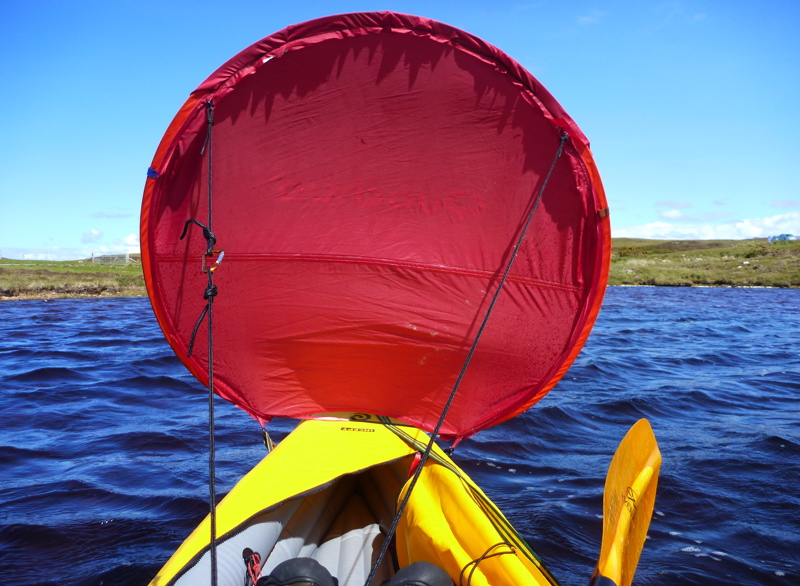
They call it a ‘1.5m’ sail, but unless I am very much mistaken it’s more like 1.15m2 if you calculate the area of the Isosceles as 146cm across the top and 174 up the sides (graphic on right; or base x height of about 170 divided by 2). PA round those dimensions up on their website to 150cm and 180cm,  but that still doesn’t add up to 1.5m2 or 16 square feet. Maybe I should chill out a bit; a Ducati 900SS is actually 864cc and so on. As you can see left, it’s about twice as big as my 0.78m2 disc sail and it certainly looks like a metre-and-a-half square, so perhaps my sums are wrong. And it’s bigger in the right area too: up high where it counts. Plus you can see where you’re going – always handy in busy traffic lanes.
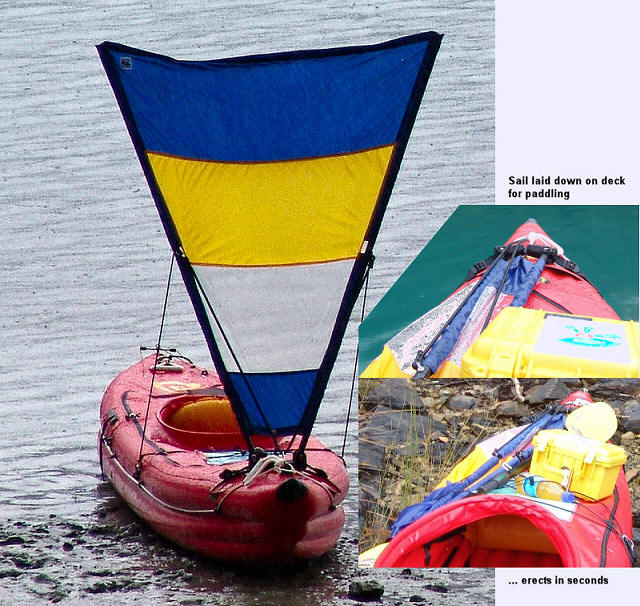
The sail comes in a compact bag of less than a metre. Can’t weigh things here but they claim 1.9kg; could even be less. Inside you get the two, 3-part masts made of thick glass fibre, the sail, fittings and rigging or lines, plus adequate instructions* for what turns out to be a fairly straightforward task. These instructions and fittings are obviously aimed at hardshells, be they SinKs or SoTs. With an IK you have to improvise a little. It helped knowing that there’s a picture of a PA sail on the Incept website (right), as well as this Kiwi guy’s video (bottom of page). The supplied cleats (sliding cord locks) are tiny and I recall Jeff replacing them on his Perception tandem for Shark Bay, but see below. Because of the confusing instructions combined with my congenital density, I misunderstood their simply application. On my first go at sailing the PA I was holding and maneuvering the control string by hand, as I did with the disc sail.
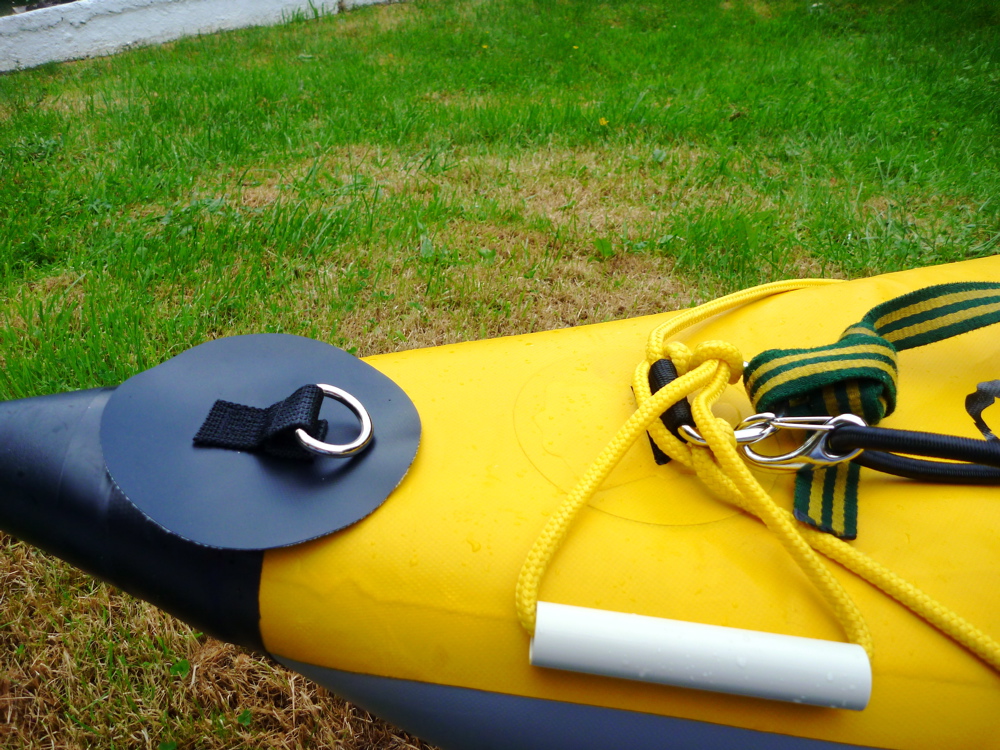
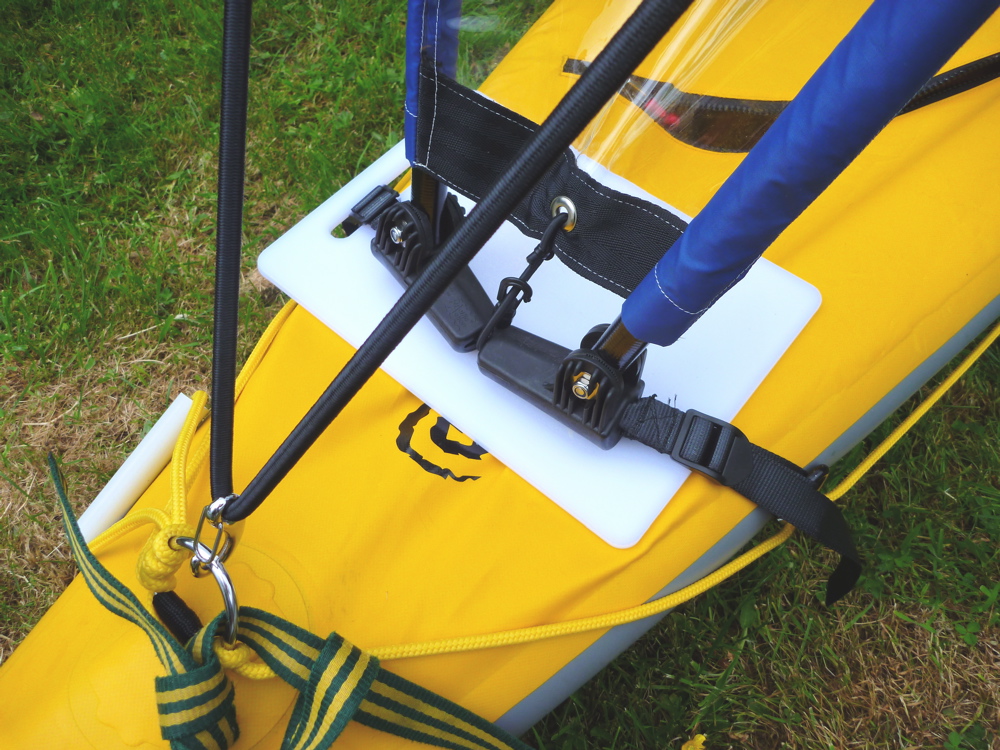
Up front the snaplinks (right) I’ve used to mount the disc sail also happen to be ideal positions for the PA’s webbing loop. And the bow handle ring toggle is the just about the minimum 12 inches ahead of the mast feet to take the shock cord clip (left) with which the sail springs forward when you release it. If that’s not quite enough far forward (as I think may be the case), I can stick a D-ring patch a few inches further forward right on the nose of the boat (as left). This position/angle may be more important than just getting a good spring forward, but also affect the sail support. We’ll see.
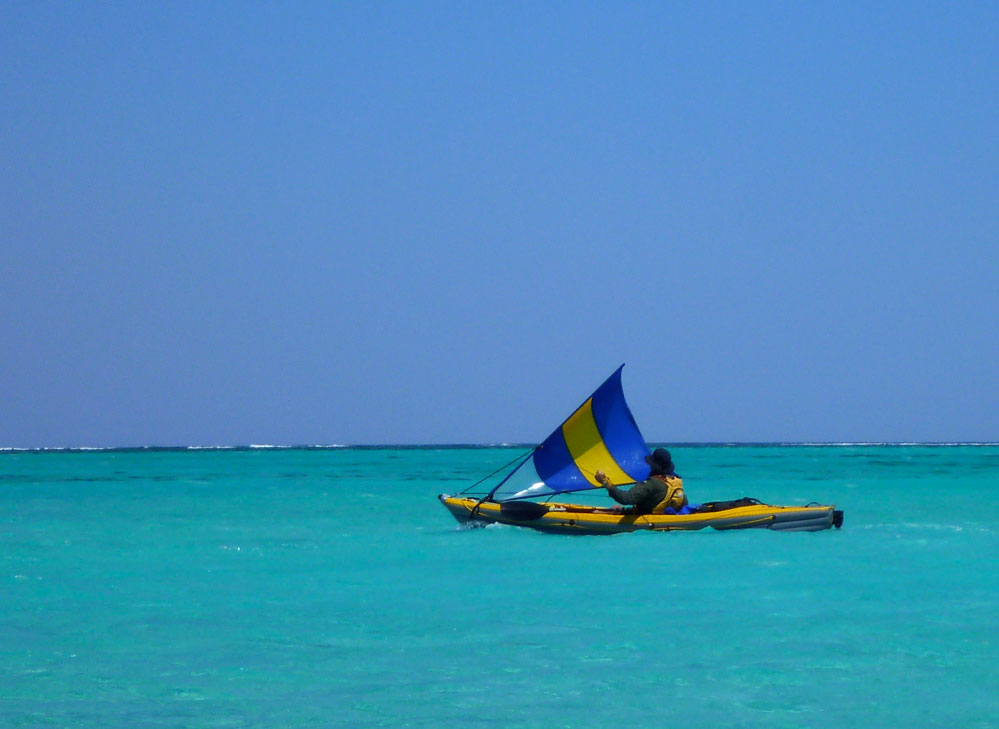

In Australia a few months later we did see. Further forward was indeed better, but I suspect still not optimal. When you think about it, the front attachment for the elastic would be better if it was set higher that the level of the mast feet. That’s because when you’re reaching across the wind with the downwind mast almost horizontal with the hull (as pictured left), the angle of leverage to keep the upper mast up gets very low; at 5-10° the tensioned elastic is almost at the same angle and so the sail collapses as shown in this video at 1.16. This happened to me all the time in Australia as the sail was pulled low to cope with the strong sidewinds. If I go ahead with my nasal bowsprit idea as mentioned here, I’m now thinking it might also be an idea to raise it a bit; have an upcurved bowsprit so the sail is more readily held up when reaching (near-horizontal).

While in Australia I also pushed the snaplinks to mount the sail straps directly through the black lugs and not around them as pictured right. This was because the strong wind was pushing the sail mount (a plastic plate) forward, making it go slack, reducing the elastic tension and causing more problems with handling. But by the time I made all these adaptions we were locked into two days of headwinds so I never really had a chance to see if it made any great difference.


Back to the original mounting story set in Scotland in summer 2011. It all went together easily enough, until it became clear some fittings were missing from the pack which for some reason looked like it had done the rounds with a few previous customers. Most fittings were not needed for my IK, except the four ¾-inch self tappers with which you permanently fix the mast feet position in relation to your kayak’s deck angle and with the sail splayed. According to the instructions* and this picture I found on the web this is an ‘8g ¾-inch’ screw, but that seems way too long to have two from opposing sides – one alone would act more as a bolt than a self-tapper getting a bite, but that is what they recommend; the subtext is these screws are important to make a solid fixture. What’s not made clear (or is perhaps obvious) is that you ought to pre-drill guide holes deep into the plastic mast feet lugs for the screw can get right in there. Some hardshells will have a bevelled or convex foredeck which is why you must set the mast foot angle (MFA) specific to your boat for optimum operation. On my set up, the MFA is horizontal (flat) as I’m using a plastic chopping board idea as PA suggest to give the feet the all-important support and avoid wear on the PVC deck. The feet move around quite a lot under tension as you pull the sail this way and that but, as I found first time out, the angle of those feet against the mast (as well as the webbing tension) must be solid if the sail is to spring up and open or splay out.

The sail rolls down out of the way and doesn’t interfere with paddling, though it does mean yet more cordage hanging around; you could get in a right old muddle if you don’t keep on top of it. PA do advise paddling with a knife or a less pointy rope cutter. I have a quick-grab Benchmark one (left) attached to my PA.
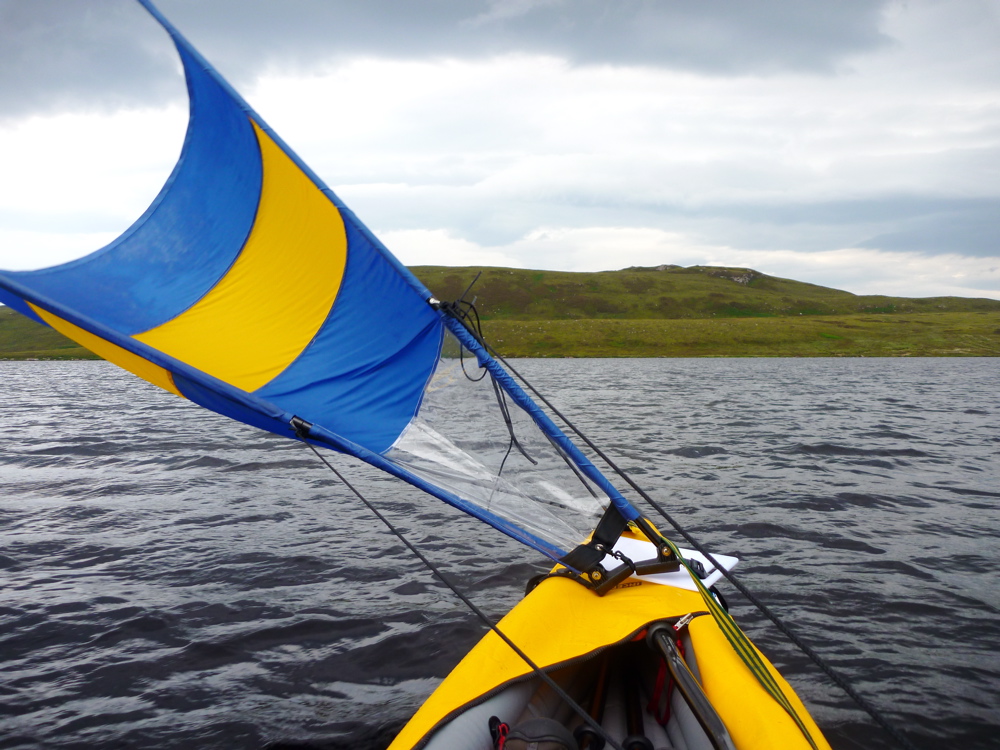

It was gusting up to 40mph before the local weather station packed up, and at times the sea was covered in foam streaks and swell, so I went to a back loch for a spin. Typically by the time I’d crawled into a dry suit in case I fell out and got dragged along by the sail, the wind had just about died, but it gave me a chance to test it out in tame conditions. That evening my paddling speeds back into the wind were greater than anything I managed under sail, but I was getting the hang of it and even got the knack of running almost across the wind. The vid from that session isn’t worth uploading unless you’re having trouble sleeping; I hope to have another session when the wind returns and on a loch that’s longer to the wind.
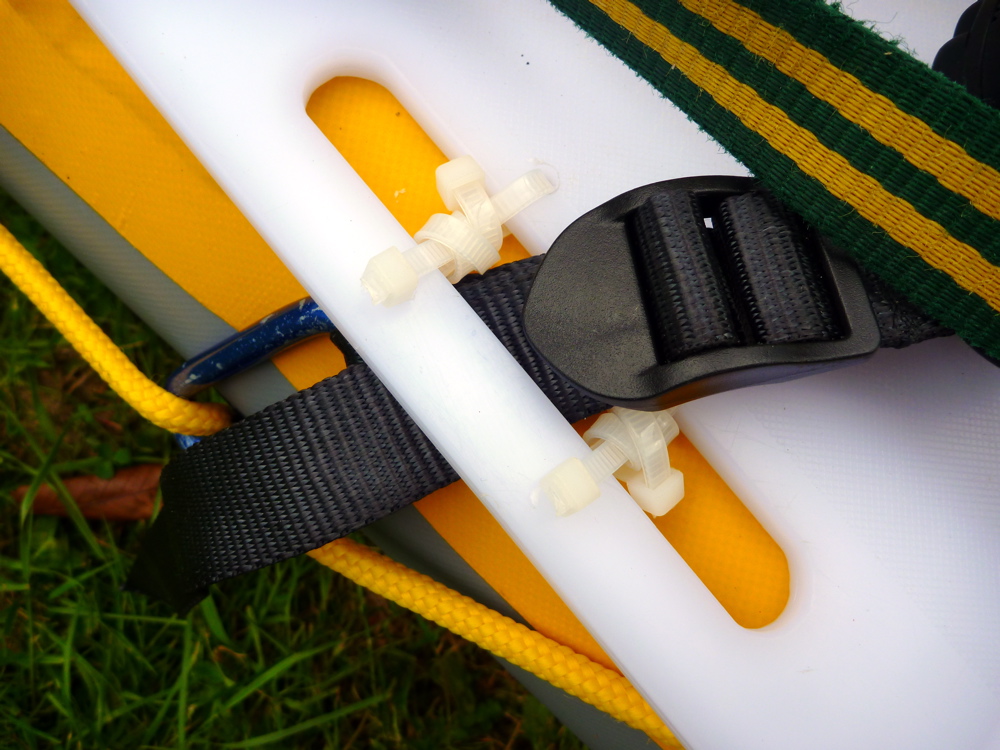
Lessons learned: need those self tappers to lock the feet, luckily the local store had some that may do the job. And I’ve since located that chopping board a bit better to the boat with some slots and zip ties until a better solution is required. 
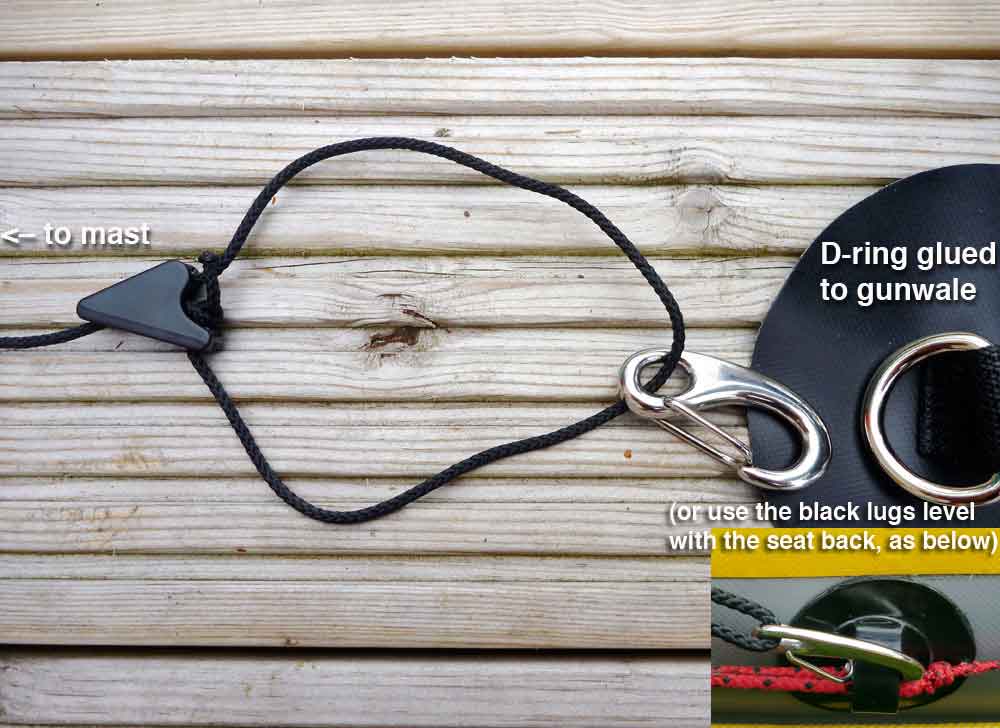
Rigging the sail-adjusting cleat
Working out how to rig the control cord to alter the sail angle was actually rather simple once I put my mind to it. As mentioned, you get some small plastic cleats in the pack whose use is unclear. But digging around online for an alternative cleat (as other PA users tend to fit), I discovered what the PA comes with are very much like, if not exactly Clamcleat Line-Loks. Now I know what they are, their fitting and application is more clear. It’s not illustrated or explained in the PA instruction leaflet* I received; in fact I’d go as far as to say that the tiny yellow picture of the rigged Line-Lok in the PA leaflet is the wrong way round compared to what’s illustrated in the Clamcleat gif on the left. But even though (as I found) it does work crudely when rigged the wrong way round, I think I finally get it now. A Line-Lok a nifty solution to tensioning a tent guy in the Arctic as the link shows, but as Clamcleat’s gif on the above right also illustrates, you need two hands to release it – not something that may be easily available in rough conditions while trying to grab your paddle and not spill your tea. But so far I’ve found in the light conditions I’ve been out in, one-handed works fine and if it’s a real panic you just pull the sail down in a jiffy.
In fact, testing the correctly rigged locking cleat off a chair leg, it’s possible to achieve the release movement by spreading your fingers as long as it’s not too tightly jammed in the cleats, while adding tension (pulling the sail back/down) is certainly easy.
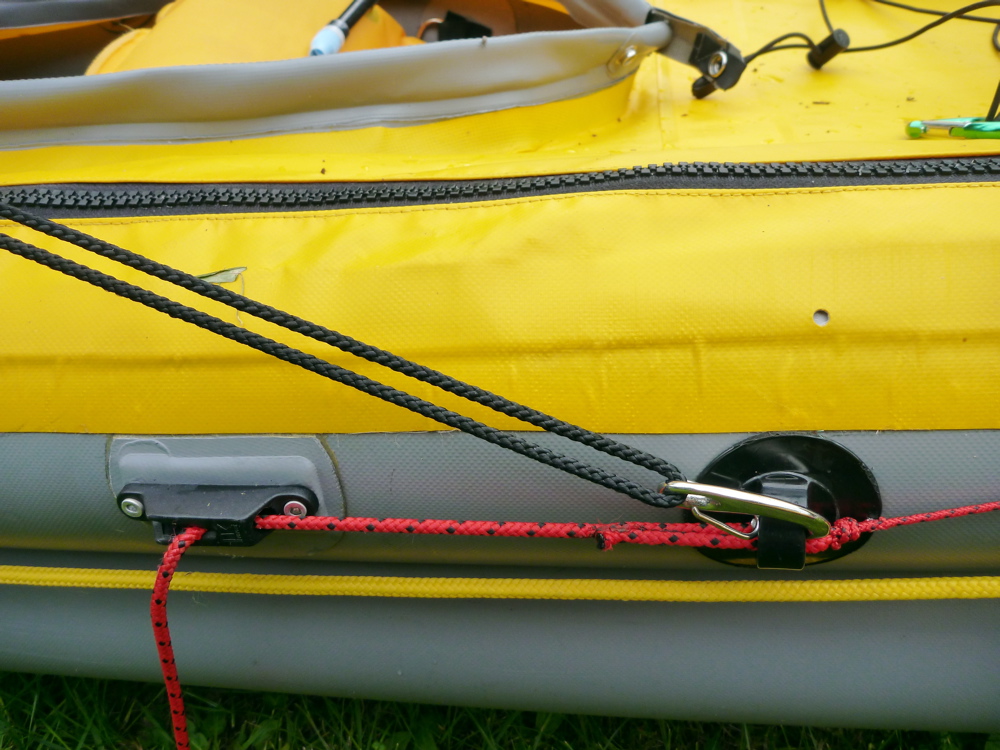
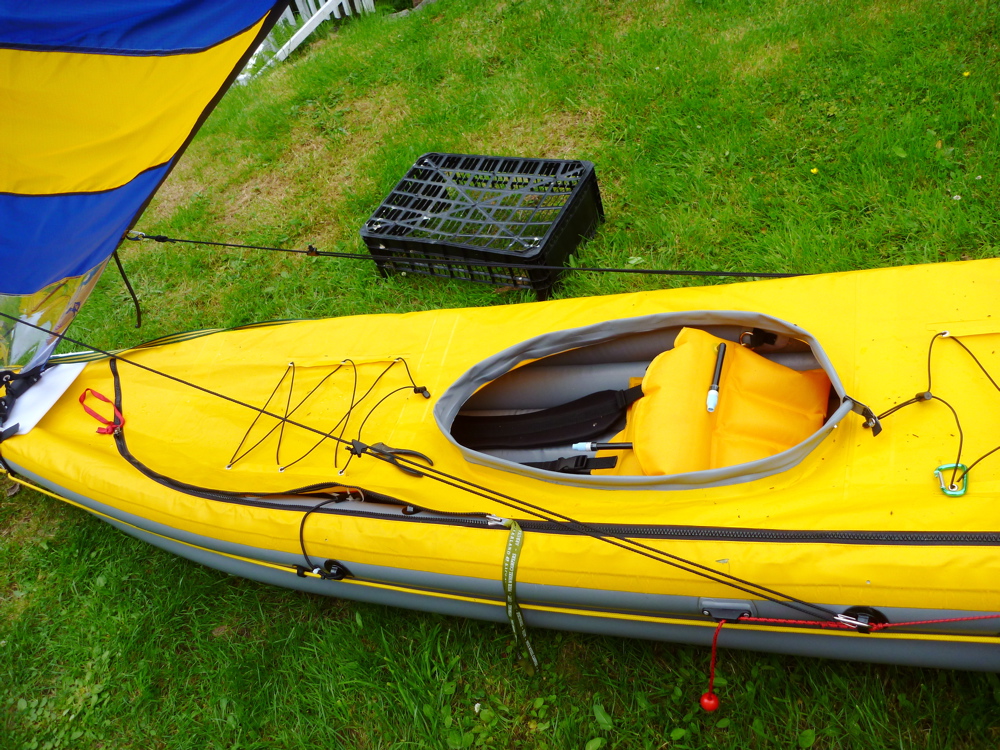
Having worked out how to string them up, the next question is where to attach them to the boat. By trial and error I found that cutting the supplied 4-5m line in half, rigging as above and then clipping the stainless steel clip to the K40 at the plastic lugs just behind the seat seems just right (left; it shares the left side lug with the rudder lifting line). Even though the Incept image with the red boat above seems to use the more forward points, fixed like this it puts the full sliding range of the locking cleat within arm’s reach while sat in the cockpit; or at least that’s how it looks on the lawn. I used the spring clips supplied to fix the control cord to the mast shackles, but at one point while sailing one unhooked itself from the shackle, so better to knot the cords securely to the shackle as PA recommend. To see how it sailed first time out, see this.

NB: A more recent set of fitting instructions were sent to me as a pdf from Pacific Action and are much clearer.
As far as I could see it wasn’t to be found on their website.
Water shoe review: Vibram FiveFingers TrekSport

See also: Packrafting shoes or boots

I like to go barefoot so when I spotted Vibram’s FiveFinger ‘glove slippers’ a while back I thought they looked fun. Recently I took the plunge and selected the TrekSport model, thinking they were the most heavy-duty and hike-worthy of the range. The price is nuts, up to £100 or more in the UK, and as it is I’m still a bit shocked I actually paid $85 (£55) for these.

A BBC article shows how Vibram hit the jackpot when a bit of in-house experimental fun coincided with a barefoot running craze in the US. Sales went through the roof, and with success came the attack of the clones which the article describes.
Outside of California, you might feel a bit silly going shopping in a pair of 5Fs, but it has to be said they do raise a smile, and where possible, less clumpy footwear is always better. I’ve read rave reviews about the improved feel and ‘back to nature’ ergonomics of 5Fs, allowing the wearer to reconnect their feet with the [mother] earth so as to run not unlike the virile, loin-clothed hero from the 1980s Countryman movie (brilliant reggae soundtrack, btw).

Out the box the TrekSports don’t exactly slip on like a pair of well-oiled Crocs. It took a lot of fiddling to get my smaller toes into the corresponding pockets. Once done, you tug on the velcro band to secure them round the ankle and step out. On the first walk, heading into Willow Gulch down in Escalante, the baking sand on a 105-degree day burned through to my feet, but at least the close fit stopped any of that sand getting in.
Later on, in the shallow creek, they gripped reassuringly on all surfaces, even wet and slimy, and were certainly better than bare feet; the studded tread worked well. But for boulder-hopping they weren’t quite as secure as the Omniums, feeling a bit like the rubber-soled socks that they are. And after a couple of hours of wading some grit did get in which required a rinse out followed by a repetition of the tedious refitting dance. If there’s a knack to putting them on, I haven’t got it yet because next day up in the cooler Box Death Hollow forests, it took Five Minutes to get each Flipping Foot’s Five Fingers into Freakin’ Place. Tracking and crossing the rushing stream along the faint path for a few hours, the inevitable toe-stubbing plus head-on or side glances meant each time we crossed the stream I lingered a bit to let my throbbing toes numb a little in the cold water. I ended that walk deciding that while clearly not pretending to be a hiking boot, the many-toed TrekSports were too flimsy to be trekky after all.

The Emperor’s new shoes?
And so we must ask the five thousand finger question: do individual toe pockets on slipper-like footwear give any actual advantages in comfort, agility and performance against a regular water shoe?
Short of being a chimpanzee, I have to say not that I could tell. Had they been just a pair of snug-fitting, ten-dollar plimsoles or even a wetsuit ankle boot, they’d have worked as well on the trail and in the river. As it is, the thin soles transmit sharper rocks and maybe I’m clumsy, but in particular, the lack of toe protection bashed my toes as painfully as I recall back in my Teva open-sandal days.
But that is for boatless creek wading. For something like a day paddle in my packraft, with its tight foot area for my size 11 feet, the Vibrams may have a use, being light and robust enough to deal with put-ins and portages. On cooler UK paddles where socks can’t be worn, they may not be warm enough.

And then you have to ask: how long will something this thin and stretchy last? About as long as some of my socks I suspect. I did also wonder if just two toe pockets – a ‘foot mitten’ – might satisfy the anatomical ergonomists who believe in the benefits of full toe articulation while making the shoe a whole lot easier to put on?
It seems so with Vibram patent dodging 3T Barefoots from Bodyglove with three toe pockets. They seem to be pitched at SUP paddlers and not trekkers, but if I’d seen them earlier, I may have gone for them instead. I’m pleased to have tried the Fives but since sold them.

It’s worth remembering that you can’t wear socks (including drysuit socks) with such shoes, so for warm weather only.

Summer Isles Overnighter (Incept K40)

Incept K40 Index Page

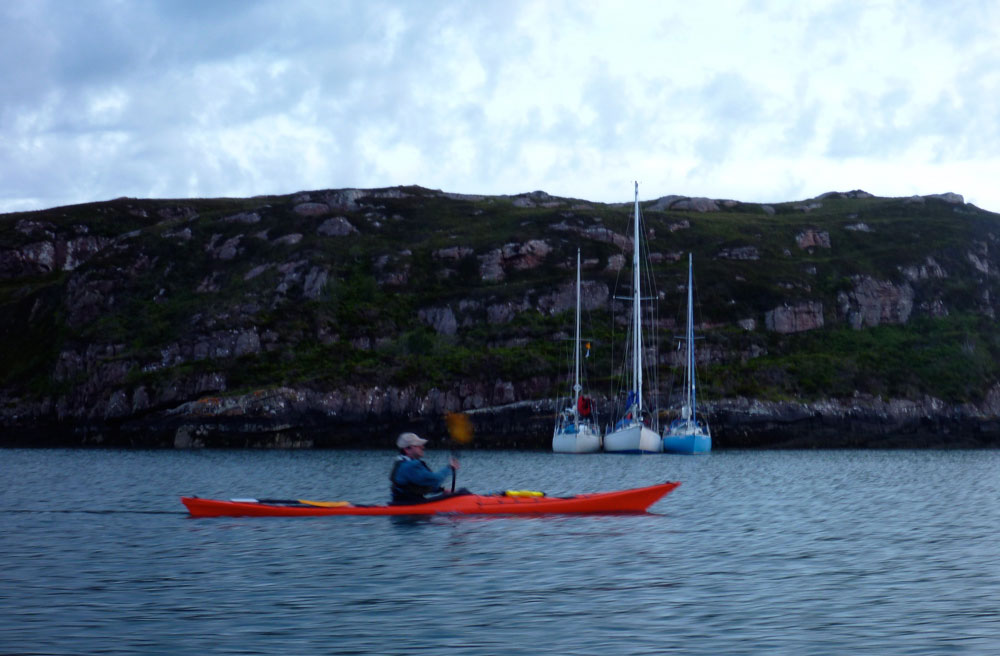
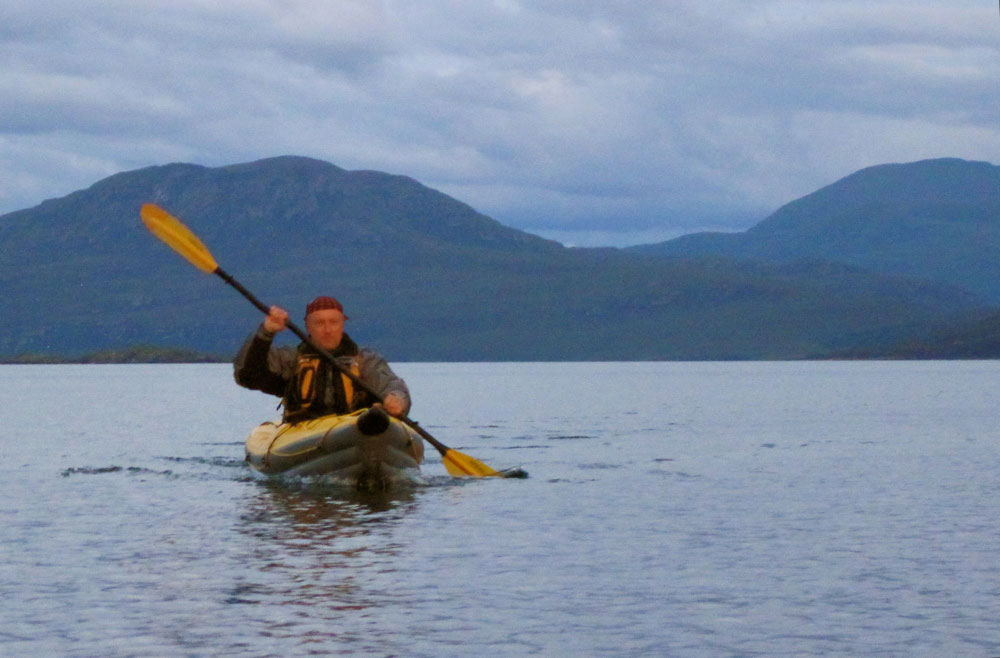
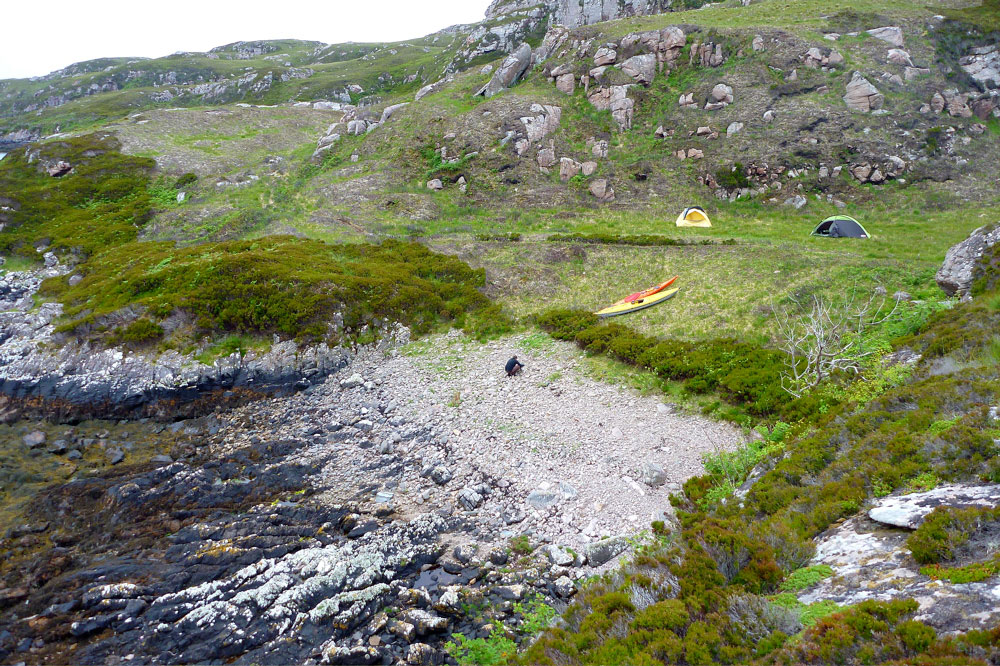
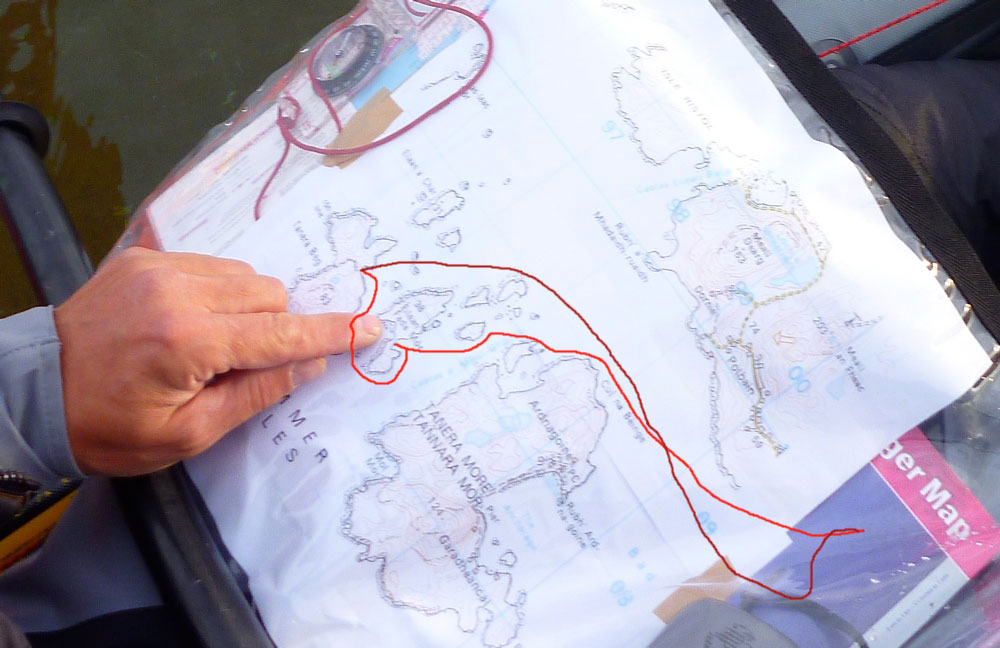
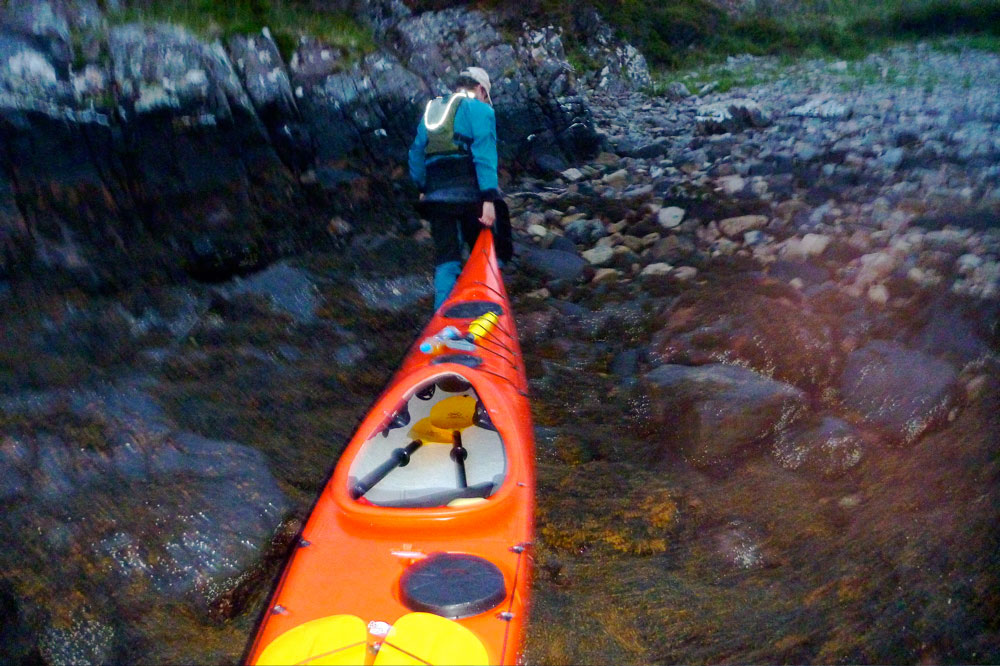
Friday night Jon and I paddled over to the Summer Isles on an exceedingly calm evening. After a bit of dithering looking for a place to camp, we hacked through the seaweed to get onto Tanera Beag about 11pm where we set up for the night.
As predicted, it got windy and flapping tents meant we didn’t get much sleep, although at one point a sudden lull at 3.30am did wake me up with a start. Out over Polbain the red sky was already presaging the dawn, just 80 degrees east from where the sun had set 5 hours earlier.
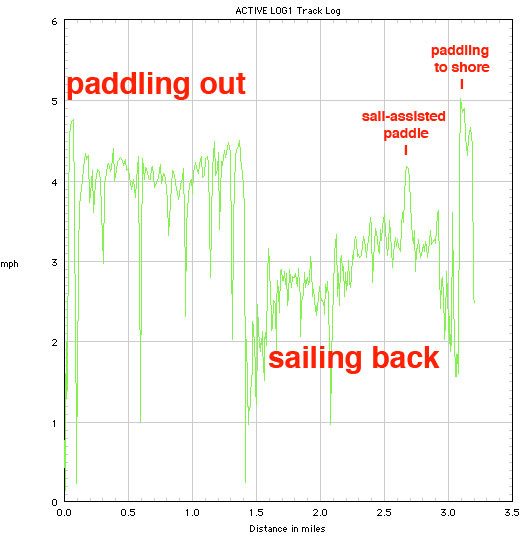
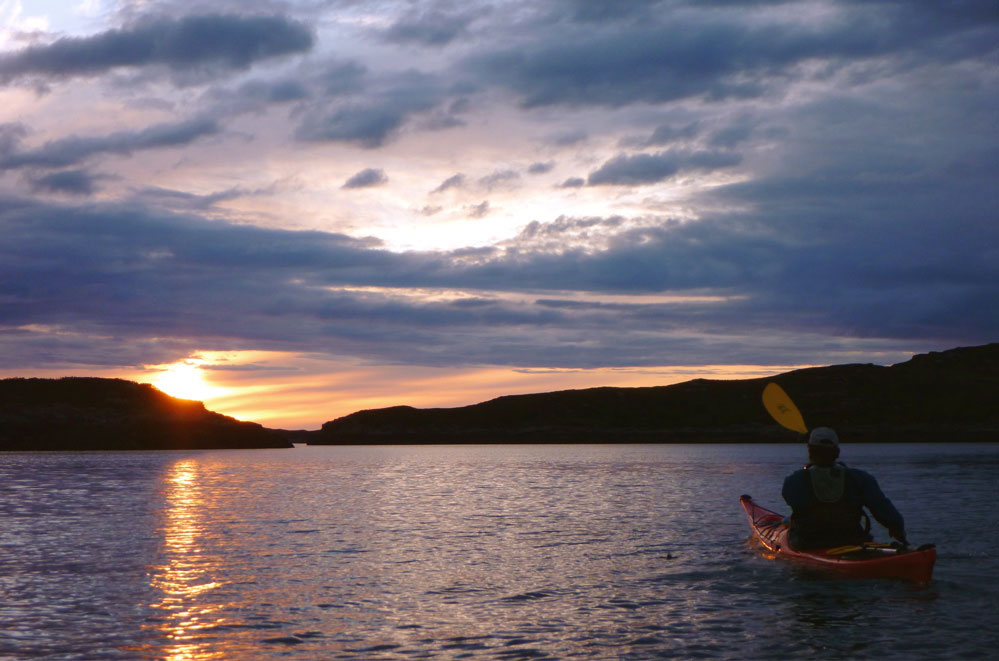
Heading back later that morning into an F4, it was nice when that part was nearly over. Near the each I hooked around the and tried a bit of disc sailing – it works but I definitely need a bigger sail.  A few days late but I got my midsummer’s mini adventure after all. 

Scottish Sea Kayak Trail Part 2 ~ Raasay to Loch Torridon

Grabner H2 report • Part 1 (previous) • Part 3 (next)

Scotland 2011
Raasay – Rona – Loch Torridon

On Saturday May 14, I left Paris very early and drove to Scotland. I arrived in Kyleakin on Skye very late the same day. The last leg between Fort William and Kyle of Lochalsh had been tricky because some large animals were standing in the dark by the roadside. I pitched my tent in the grassy backyard of the Backpackers hostel and eventually enjoyed some well-deserved rest.
Morning after, I checked the weather forecast to find out that it was expected to be rough during the next 36 hours, before improving on Monday afternoon.
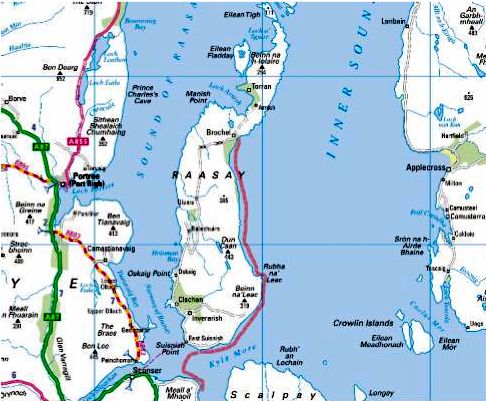
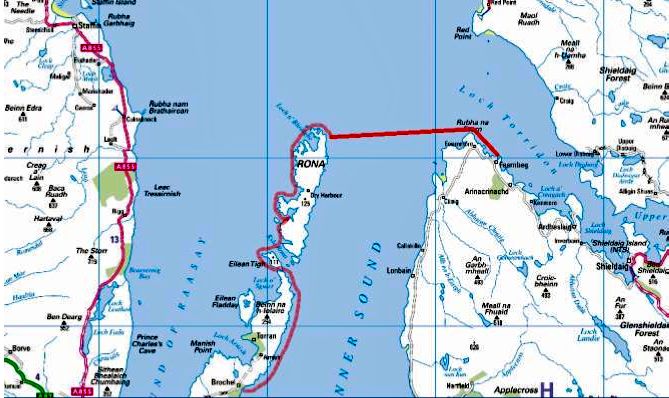
My plan was to complete in about 10 days the last section of the SSKT, the Northland section, from Kyle to Ullapool. Last summer I had paddled North up to Applecross, visiting the Crowlin Islands en route, as well as Loch Carron up to Plockton and the Black Islands. Instead of following the same route, I intended to visit Raasay and Rona before crossing the Inner Sound to Loch Torridon. This detour would also keep me sheltered from the Westerly winds in the lee of Skye.

SSKT2-01

Before putting off, I went to the police station in Kyle of Lochalsh to inform them about my intended trip. The officer in charge was very helpful and helped me to turn a « going to the hills » form into a float plan. He took note of my leaving my car at Kyleakin: I did not want to be reported missing in case somebody would draw wrong conclusions after noticing a foreign car left unattended for several days.


I launched in Otter Pond after lunch and started paddling westward, hugging the shore which offered some shelter from the SW breeze. I thought I could reach the SE corner of Scalpay by the end of the afternoon and set camp there, but the wind decided otherwise and grew stronger as I was passing Palbay on my starboard beam. Rounding the low features of Rubha Ardnish I felt the full force of the SW gusts freewheeling across Broadford bay. It would take way too much energy to reach the other side, so I decided it was wiser to call it a day and returned to the lee of Rubha Ardnish. 

SSKT2-02
SSKT2-03


It was high water time. The sea had just risen up its highest, flooding large expanses of grass and patches of sea pinks (armeria maritima). I landed on a bed of flowers and installed my camp at the foot of a rocky bluff offering a natural protection against the wind. Soon the rain forced me to hide in my tent. Cooking outside was impossible so I carefully light my tiny can stove inside and prepared some hot soup.

SSKT2-04
SSKT2-06


I took to sea at high tide the following day. Very early then. I had to because the shoals around Rubha Ardnish dry out not long after high water, meaning a long and tedious portage should I miss the time. Crossing Broadford bay against the still fresh SW breeze proved to be a effective warming up exercise.  
I stopped on the gravel beach in the small drying harbour, protected by an old and crumbling stone pier where some fishing boats were moored. Through the windows of the hotel nearby, I was watched by guests having breakfast in shorts and t-shirt.

SSKT2-05
SSKT2-07


Surprisingly as I left Broadford behind me the wind eased off and I paddled through Caolas Scalpay on mirror like flat water. This bliss did not last and I crossed the mouth of Loch Ainort buffeted by the usual SW gusts. I probed into Caol Mor to assess the conditions for this 2 km passage. I found it challenging enough to make my arms feel weak. I postponed the crossing to later in the afternoon, let the wind blow me back around and retraced my last paddle strokes until I could land on a seaweed choked boulder beach for an early luncheon. One hour later the receding tide had left my boat high and dry but I could easily drag it back to water on the thick and slippery layer of kelp covering the boulders. The 2 km crossing to Raasay went fairly well. To my great satisfaction I was whisked by the wind around Eyre Point then to Rubha Na’ Leac. I landed in the small bay behind this headland, hoping to find a camping spot. There was none so I had to paddle on along steep hillsides and stately cliffs all the way to Brochel.

SSKT2-08


I landed on a pebble beach below the conspicuous ruins of Brochel Castle. Above the beach was a grassy ledge where I pitched my tent. The evening was calm and dry, so I could enjoy my dinner in the open, watching the Applecross hills across the Inner Sound. I paid a visit to the Castle (which is unfortunately falling apart), but it was too late to have a walk to Ardnish along the famous Calum’s Road. 

SSKT2-09


Forecast for the next day, provided to me by Chris, was light breeze no rain until 7 pm. There were even patches of blue in the overcast sky. I paddled to the north tip of Raasay, entered Caol Rona and turned into the narrow passage between Raasay and Eilan Tigh. A SW light breeze pushed me across Caol Rona and later helped me against the current ebbing out of Acairseid Mhor between Rona and Eilean Gharb. Acairseid Mhor is a natural harbour, and a former smugglers haunt.

SSKT2-11
SSKT2-12
SSKT2-13


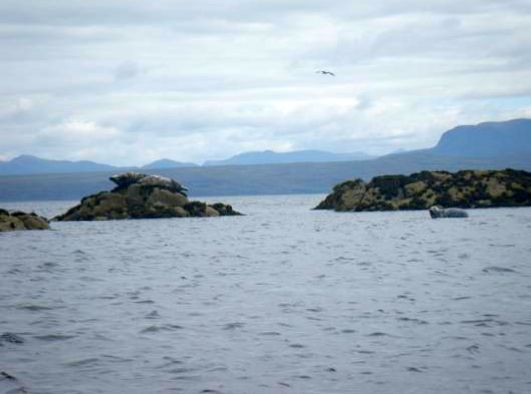
Rounding the North tip of Rona amongst a maze of skerries, I involuntarily scared a score of seals which scrambled into the water from the rocks where they were sprawled. The visibility was good and I could see Rubha na Fearna 9 km away to the East. I looked up to the lighthouse and noticed the flag flying in the wind next to it. The flag was showing that the wind had backed South. That was bad news: I would have to paddle for about two hours in side wind pushing me towards open sea. But the wind was not expected to pick up before the end of the afternoon and I should be safe in Loch Torridon by then. So much for the easy downwind crossing I had hoped for. Two hours later I rounded Rubha na Fearna with a heavy sigh of relief. The wind had alarmingly picked up while I was still in the middle of Inner Sound. The current was running against the wind, inducing some uncomfortable yet manageable chop. I stopped on the sand of a tiny inlet and had lunch.

SSKT2-14


When I set off again, the wind had backed to the SE. While probably still blowing from South outside, it was funneled along the direction of Loch Torridon. So I trudged along the shore, feeling the wind blowing stronger as time passed, and reached Aird, a headland separating Loch Torridon from Loch Shieldaig. I rounded the north tip of this headland then set a course to Shieldaig island some 4 km away. The wind suddenly accelerated and stopped me in the passage. The water around me became white. I tried hard to move forward, to no avail. I gave up and let the wind push me back out of Loch Shieldaig into Loch Torridon.

SSKT2-15


Hugging the shore of Aird I paddled into Loch Beag under the pouring rain. I landed on a narrow slipway at the very head of the inlet, next to heaps of creels. Exhausted, cold and miserable I staggered up to a shed were some people were sorting shellfish. The building had an upstairs platform above the working floor accommodating an office, a cloakroom, a kitchen and a bathroom. I was granted permission by the foreman to spend night in the kitchen. This room was also a closet cluttered with various things. The cloakroom stank because of the fishermen oilskins and wellies hanging there, but it was heated and I put my stuff there to dry.

SSKT2-16


The foreman came back at 7 next morning. I was ready to go and had washed the floor before leaving. Through his binoculars I could see the white crests of rough water outside. However as the wind had veered to SW, it should not prevent me to enter Loch Shieldaig this time.
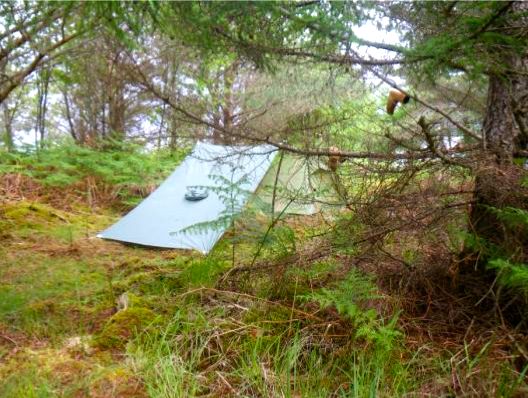
Again I rounded Aird. As expected, I was sheltered from the SW wind. Nevertheless I kept hugging the shore to avoid any risk of being pushed away. I landed on a tiny pebble beach near a shabby cabin. I walked up a soaking wet footpath to explore the woods. There I found an ideal campsite, flat, dry and sheltered by the trees.

SSKT2-17


I was short of drinkable fresh water. There was plenty of water dripping all over the place but I was not in the mood for going through the process of purifying it, not for setting up a rig to collect rain water, even though I had nothing else to do actually.
Instead I decided to paddle another 2 km to Shieldaig, get some water there and return to my secret campsite. I was halfway across to Shieldaig Island when a powerful SW gust hit and I had to paddle like mad to keep on my course to Shieldaig jetties. I filled my 10 litre waterbag and bottles at the tap conveniently located on the creel-choked platform, after a local confirmed it dispensed drinkable water. I paddled the shortest distance to the sheltered opposite shore and returned to campsite.
SSKT2-18


The forecast that Chris texted me for the following days was still depressing. There was too much distance of west facing exposed coast on my way up north that I could handle in high winds. So I decided to leave the SSKT here, and accepted Chris proposal to pick me up in Shieldaig the next day. I hoped the weather would improve after the week-end and allow us to explore the Summer Isles. It did not happen.

Paddles for IKs and packrafts

See also:
Anfibio Vertex Multi Tour paddle
Anfibio Fly
Wax your paddle blades
MYO Packstaff

pad-abmr
shovelorspade

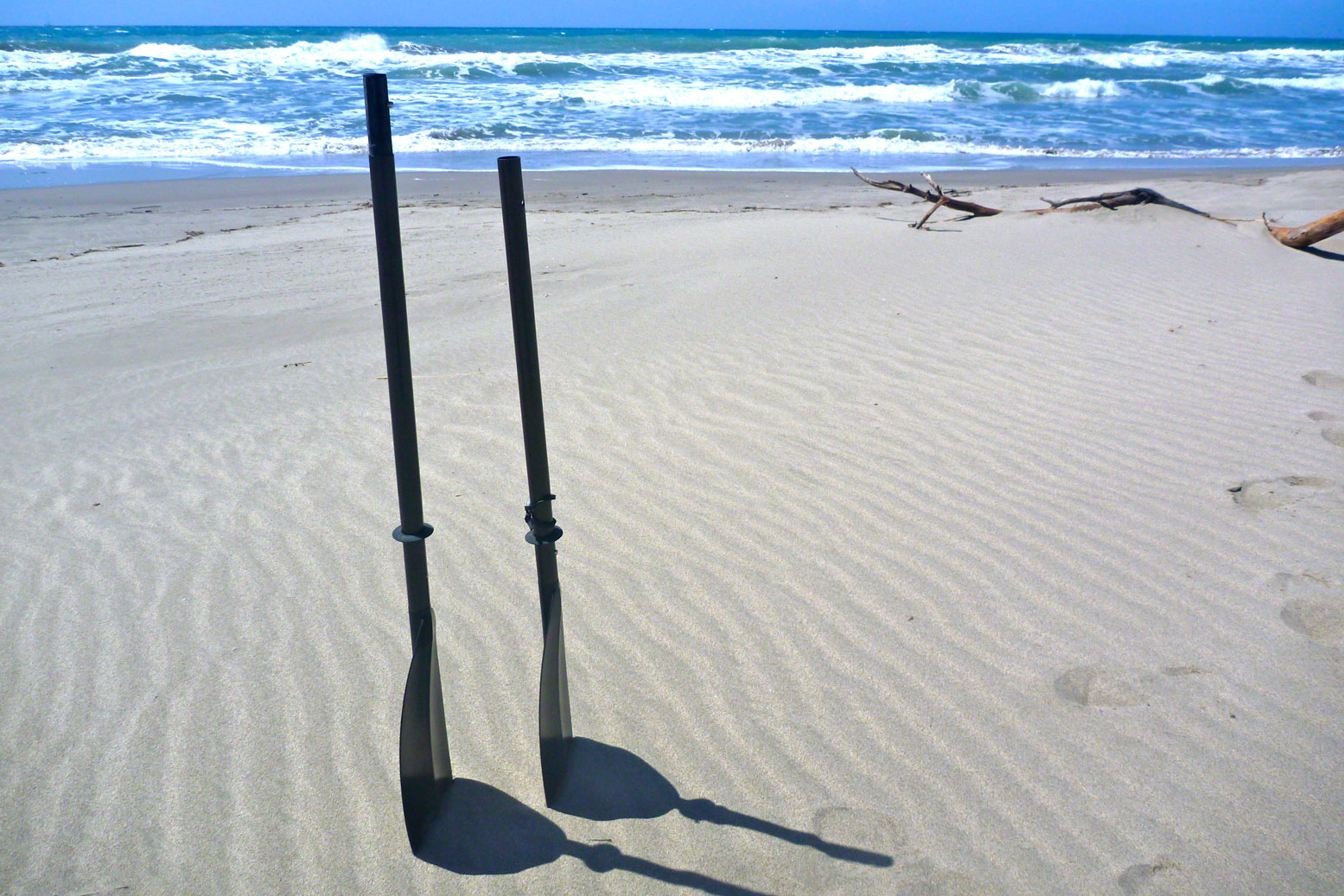
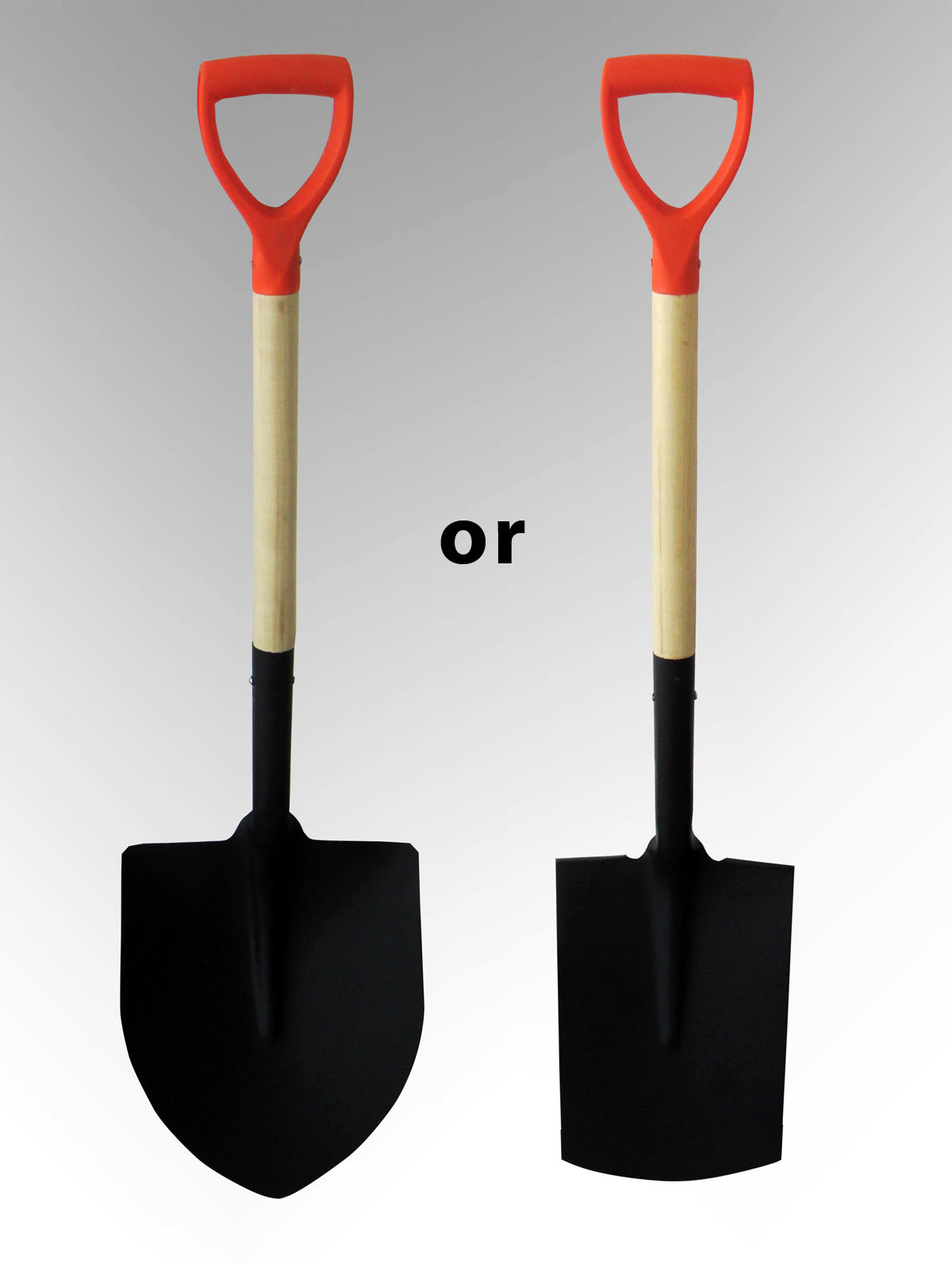
Like most beginners I started my IK-ing with a super cheap 3-piece TNP shovel. Then, after picking up a much better used 2-piece fibreglass Lendal Archipelago which soon seized up, for Shark Bay in 2006 I splashed out on a decent light, rigid, bent-shaft, adjustable offset, low angle 2-piece, 230cm Werner Camano. At £230, it cost more than my first two boats but in all those [17] years I have no regrets. The Camano just works.

highangle
High angling with a low-angle paddle.? All the gear with no idea

To me bent shafts and an indexed, ovalised grip make ergonomic sense for steady, all-day paddles rather than pulling fast moves in rapids. It’s just more compatible with the non-rectilinear human form. I did notice that when I swapped back to the slightly heavier straight Lendal (before it seized) there was noticeably less flex, but over a decade and a half later, the Camano is in great shape and is still my favourite for anything where a compact four-piece is not needed.

The Camano is a low-angle paddle, but I think my style, if you can call it that, is high angle, and in fact I read that high angle is the right way to do it. I find that wide, high-sided and relatively unresponsive IKs and packrafts encourage or require an energetic ‘digging’ style compared to a smooth gliding hardshell.

A paddle for packrafting
The way I see it, even more so than most IKs, a packraft has high and fat sides and you sit low inside. So that ought to mean a long paddle to get over all that plastic and into the water. Paddling with the 220cm, big-faced Aquabound paddle, I didn’t really notice any issues other than some squeaking as I rub the sides occasionally. Longer would not have made much difference.
At around 3kg a packraft is extremely light but it’s not an efficient shape for gliding through water like a swan. However, once on the water with a paddler in it, the total weight is nearly the same as a more glidey IK, so it boils down to the need to propel the hull using a paddle with a large surface area. Some might say a bigger blade will mean more yawing, but I figure you just dig less hard and anyway, with practice, yawing is easily controlled once moving. Providing you have the strength, a bigger face ought to give the speed which packrafts and IKs lack. There are times (mostly at sea or on white water) when speed and power can mean safety.
In the US I got myself an Aqua Bound Manta Ray 4-piece high-angle in carbon (above right, 220cm). Weighing under 900g this one feels more flexy than the Camano, but fits right in the bag and so makes a great packrafting or back-up paddle – apaddleinyourpack, so to speak. Mine has the two-position snap button offset which I run at 45°. You can now get an infinite-position Posi-Lok version.
The compact and light Manta Ray (70cm longest section) is ideal on short day trips with public transport and with no load to haul on the water. It was fine for a decade of UK packrafting and makes a great packstaff, too, but it didn’t always come apart easily like the Werners. Dry or wet, don’t leave it
assembled for days or weeks, especially after sea use (that probably goes for all multi-piece paddles).

I used my Manta sea kayaking in Australia as well as packrafting – it was fine for both. For the price this is a great paddle – so good I sold it to my Ozzie mate and bought another right away. I’ve never seen a 4-part Manta for sale in the UK, but in Germany the Anfibio Packrafting Store sells TLC Mantas as well as their own Anfibio Vertex 4P (left).

Or they used to. Now they sell their range of own-brand sticks. I recently padded with a chap with their four-part Wave which weighs 991g and comes with infinite angle and 10cm of length adjustment (210-220cm). I would guess the blade is <650cm2. The longest section is 64cm and all that for €125 is very reasonable.

I also have a straight, fibreglass-blade Werner Corryvrecken (£200 years ago). It’s the biggest paddle Werner do in 210cm+ 2-piece touring paddles: 721cm2 blade area compared to the Camaro’s middle of the road 650cm2. and 677cm2 for the Manta Ray.

At 220cm (same as the Manta Ray) I’ve also gone as short as I dare to get over the fat sides of a packraft.
There’s no indexing on the straight, carbon shaft, just a little ovalisation as on the Aqua Bound. The Corry’s face is a tad bigger than the Manta Ray (left and above) but the whole stick feels much more rigid (it’s 2-piece). It’s 7% lighter than the Manta Ray and 17% lighter than the stiffer Camano – initially you notice this. I compare my Corry and Camano in my Incept sea kayak here.

More weights & measures
According to the kitchen scales the weights of these paddles are:

  • Werner Camano 230, 2-piece – 988g – stiffest
  • Werner Corryvrecken 220, 2-piece – 816g – lightest
  • Aqua Bound Manta Ray 220, 4-piece – 880g – least stiff but cheaper
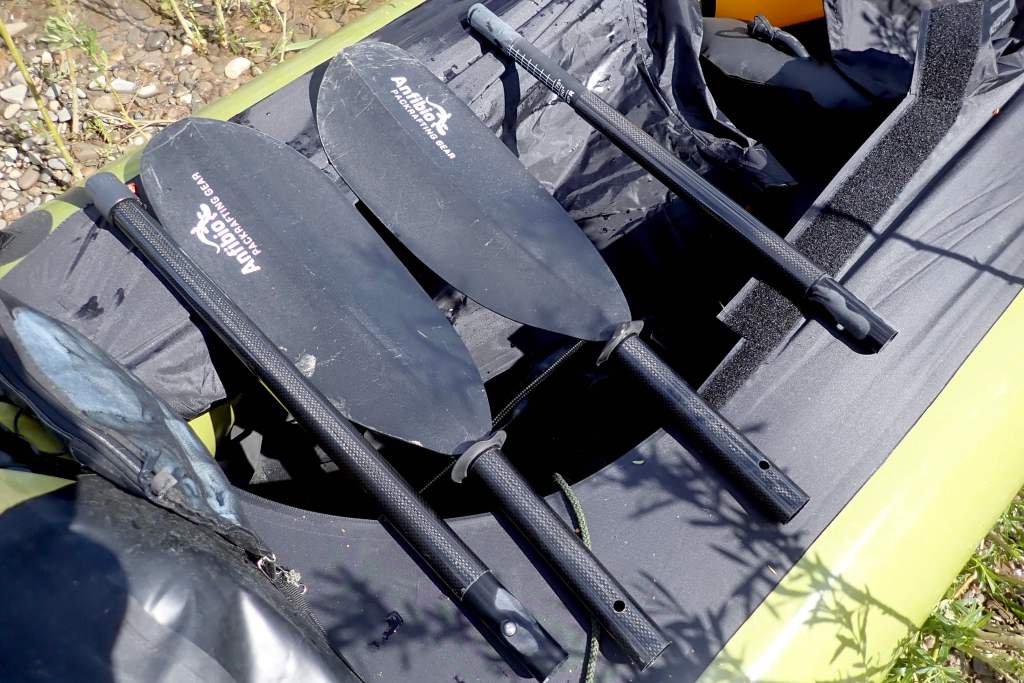
  • Anfibio Vertex Multi Tour 210-25, 4-piece – 890g – cheapest; multi-use

So now I have a long, comfy low-angle Camano for long, loaded IK or packraft sea trips; a straight, I sold the rigid, light, shorter big-faced Corry, and the Mrs likes the thin-shafted Anfibio Vertex Multi Tour 4-piece.

Incept K40 – speed, straps and storage

Incept K40 Index Page

No doubt about it, the K40 is fast enough for an IK. Last night was a calm but chilly evening, not very inviting so I settled on some effort and endurance rather than relaxed fun, nosing along the coast.
Alone and without my usual dry suit, the initial agoraphobia certainly helped with the digging. But for goodness sake, the sea was barely stirring apart from an eerie swell, so I dared myself a dash over to Tanera Mor (left). It’s only a 25-minute crossing.

The day before a kayaker fell in heading in the other direction back to Old Dornie and ended up being rescued by the coast guard (one press version here with a few small errors). I was told only one of the two kayakers actually fell in and although experienced, couldn’t roll or exit instantly, possibly as a result of cold shock? I presume it was that effort along with, like me, not being ‘dressed for the swim’, that brought on the reported hypothermia and associated helplessness. There were several other kayak rescues reported around Britain last weekend. Certainly up here it was the first sunny and calm couple of days in ages which must have brought paddlers out, even if sea temps haven’t caught up and may never do so.

I kept upright and sustained a sweat-inducing 4mph plus for half an hour, peaking with the aid of some unnoticed surge at just over 5mph (8.5kph or 4.6 knots). I suspect that in similar conditions, a slick fiberglass sea kayak that’s six inches narrower and six inches less high can cruise at around 4–4.5mph all day, and I’m also told that at sea you should bank on an average of 3 knots (3.5mph, 5.5kph) when estimating distances. On the last leg, going east against the ebb and a light breeze didn’t make much difference to my speed. Until I was spent, that is. In the absence of sunny vistas and a warm breeze to linger over, it was a good work out. See also a similar test with my Grabner.
This was my first proper outing with the thigh straps. It wasn’t rough enough to test them, but I’m sure they enabled me to keep the speed up. This is partly due to the fact that, like so many IK seats, the Incept backrest collapses as you lean on it as it’s far from rigid, no matter how much you inflate it. It’s why I got an Aire Cheetah seat for my Sunny years ago, and why, along with its mushy footrest, the g-friend can’t get the most out of her Solar (top left; I fixed it later). When you lean back on an inflatable seat – even attached to the hull tops (the highest point) – it still just folds down from the arch of the lower back. This leaning from the middle-lower back rather than pushing from the lower back/hips is partly to do with a lack of solid footrests in the Incept and Solar (before mods). All this squishy inflation certainly creates comfort but is also the biggest performance drawback compared to hardshells – even if you do read of SinK Sit in Kayak hardshellers complaining of numb limbs until they find their ideal boat/set up. One reason a sea kayak can manage to be just 22 inches wide is that you can jam yourself into it – hip, thighs/knees and feet – so it fits and responds on the move like a running shoe, not a woolly slipper – a nifty analogy for SinKs vs IKs.
Without a solid seat or footrests, the thigh straps on the Incept do their best to replicate a hardshell’s underdeck thigh pads, enabling me to sit upright because the backrest as it is can’t provide that support. If that means more strain on my abdominal muscles, bring it on!
As I mention elsewhere, with the deck zipped up there’s normal back support off the coaming that’s still mushy enough not to make you sore as it would do on a SinK. Open deck, one solution would be to incorporate some rigid sticks or a board into the backrest to stop it scrunching down – like a Cheetah in fact. At one point on the Sunny, before I got the Aire seat I had a board jammed in behind me to help push off the box I used as a footrest. And so I conclude: seatback with the top down, not so good no matter how you adjust it; thigh straps good any day of the week.

One thing you lack in open deck mode on a K40 or any open IK is flat space for any sort of secure storage or fitting points.  It’s the same story on a packraft. Trying to emulate a professional, I went out with my new large SealLine ziplock map case which lay at my feet. Gael turned me on to these. Unlike some walking map cases that I’ve seen over the years, it’s clear on both sides and best of all is big enough to give you a whole day of map on view if you fold the map right, so avoiding unnecessary fiddly openings on the water or in the rain. Online walkers’ reviews seemed to rate the Ortlieb roll-top equivalent, and claimed the Seal Line will split at the ziplock, but even if it’s simpler, I can’t see roll-top anything being as bomb-proof on the water as a ziplock, and Gael’s had his still-unyellowed SealLine for years before it developed a tiny hole on his last trip.

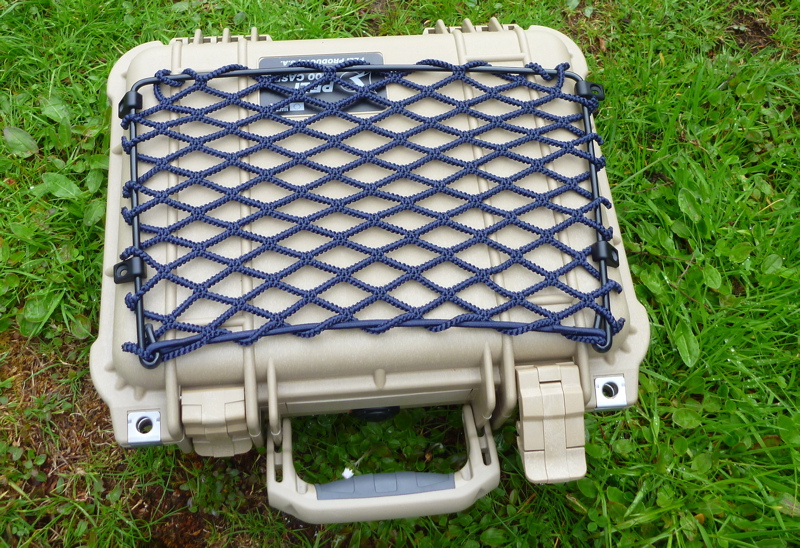
Back to stashing; of course you can attach everything to some point on the boat, Gael managed fine in his H2, but bits of string around your legs doesn’t seem such a good idea unless you’re really organised. I tried paddling with my Peli 1400 box (left, with a lid-net I plan to fix on – bought here) under my knees the other day, but handy though it was, that wasn’t going to work. It would be better fixed behind me. A Peli is easier to open and close quickly and reliably than my yellow Watershed bag (also ziplock closure), but I think it’s shape will make it a much better ‘day hatch’ bag on an open IK and a packraft, even if closing it securely as a hazard looms may take some luck.
Of course in zippy deck mode you have quite a lot of flat space, even if the Incept’s deck stretchies are almost over my feet (the thin shock cord is indeed too flimsy as Gael mentions). But top on there’s enough flat deck space by the hatch at 10- and 2 o’clock to stick a D-ring or velcro. One way I’ve got round this so far is packing it all on the pfd. Certain things belong there sure, but you can end up feeling like some special forces dude, waiting the the signal.

You can attach things to your thigh tops which are within reach and sight. The SealLine map case will clip around a thigh. I’ve tried doing the same with an Aquapac GPS case strapped round the leg; it’s OK and can hook to my drysuit’s relief zip tab to stop it slipping down when walking, but it’s all more junk hanging off you. Compass excepted, a GPS isn’t really a vital gadget in clear conditions. On the sea a legible and accessible map is handier. Still here? Then there’s a good page of improvised deck tech on ukrivers – but of course it’s all oriented towards hardshell SinKs.

Incept K40 – second opinion

Incept K40 Index Page

by Gael A

While visiting Scotland recently to finish off the  Scottish Sea Kayak Trail in his 12-year-old Grabner H2, Gael bought the Incept K40 I tested back in March from Sea Kayak Oban.

Let’s begin at the end: rolling up the K40. I followed the instructions provided in the leaflet. I removed the footrest airbag and the thigh braces before rolling the boat up and it took one or two attempts before I managed to roll the boat exactly as on the leaflet picture. The resulting bundle (right) was a bit thicker than my Grabner H2, but a bit shorter and I could put it back into the wheel bag provided by Sea Kayak Oban without any trouble.


Back to the beginning. I inflated the Tasman on the grass at my parents’ place in Brittany last Friday afternoon and checked the pressure with the gauge of my Grabner pump. The PRVs started hissing at 0.3 bar (4.5 psi) so the Incept runs the same pressure as the Grabner boats, yet is significantly stiffer than my Hypalon H2 once inflated. The H2 collapses flat when deflated, while the K40 keeps most of his shape, hence the initial difficultly in rolling it up into a compact bundle.

It took me some time to fine-tune the footrest and the rudder controls as I am 6’ 4” (1.93m) tall. I found a much better way to attach the rudder return shock cords to replace the previous messy knots, using a simple taut-line hitch. The lines are too short to make the hitches accessible from the cockpit with the deck on, but I can adjust them in open deck configuration.


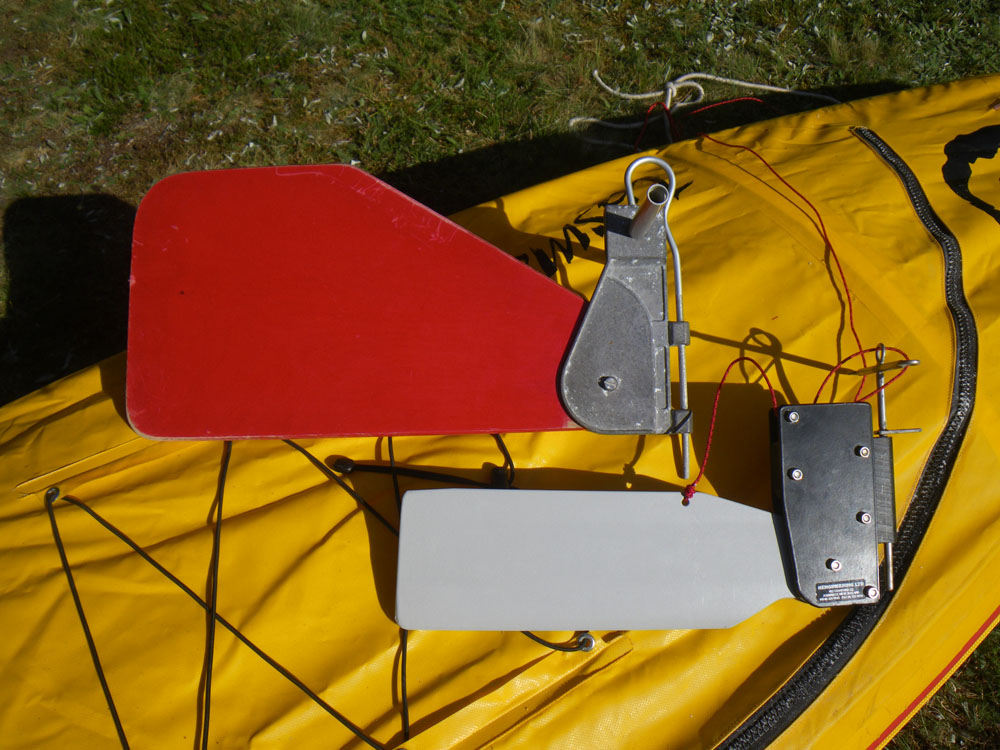
Talking of which, the rudder which comes with the Incept (left, below) is a beautiful piece of gear; much more serious that the piece of plywood and hinge which came with my old Grabner (but is still an expensive option).

The deck zip didn’t slide so smoothly but was improved by rubbing a piece of soap along the length of the zip. The spray skirt (right) is a rather ordinary piece of neoprene and nylon with braces. It’s been a fight to fit it around the flexible coaming (despite the rod inside) but it should become easier after some practice. The cord tension of the two crisscross bungee lacings fore and aft of the cockpit can be adjusted by cord locks, but I think the 3mm lines are too thin – 5 mm (5/16″) would work better. I don’t trust such flimsy deck bungees, and any item put down under them should be secured to the boat with some kind of leash. A leash can be attached to the perimeter grab line or to some additional D-rings to be glued to the deck.
There are two unused fittings on the outer side of the K40 alongside the cockpit, through which I run bungee straps. Inside the kayak they run through the D-rings where the thigh straps are attached. The holds of the K40 lack any D-rings; there is nothing to attach basic kit (bailer and sponge, painter, water bottle, map case, compass, spare paddle) to the boat. I’ve got to order those NRS patches Chris mentions here.

On the water
Early on Sunday morning I loaded my K40 on my car roof and drove to a nearby put-in, Fort Espagnol that juts into the placid waters of the rivière d’Auray. It was sunny when I launched but it soon became overcast.

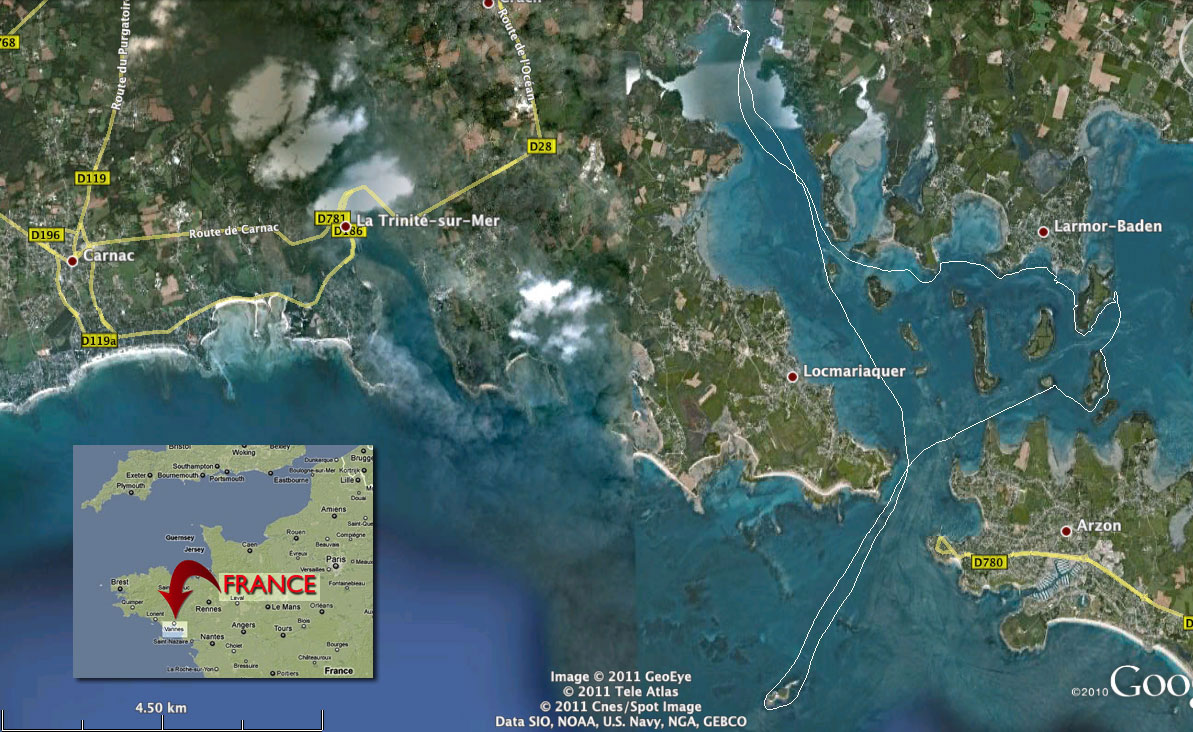
I spent the next five hours on the water, riding the lively currents of the Golfe du Morbihan getting up to 10.1kph (6.3mph). Although those currents were rather mild as it was neap tides, they created enough chop in some places to test the behaviour of the K40 on short bumpy waves.

I made a short visit to the stone circles on Er Lannic (below) and made a stop behind the eddy next to the infamous Grand Mouton beacon. The current is still fast although it’s the end of the ebbing tide.
The Incept K40 is definitely faster than my H2. It was difficult to assess my average speed because I was paddling in currents most of the time, however I wouldn’t make headway so easily against the tide with my H2. The thigh straps proved to be very effective in handling the boat in rough water and against the current, enabling the paddler to hold a better paddling position and to cling to the boat.

Detailed report on kayaking in the Gulf de Morbihan.

MYO kayak disc sailing – Incept K40

Incept K40 Index Page
Main kayak/packraft sailing page
See also this post and links off it

We parked up at Loch Raa where we’d tried umbrella sailing last year without much success. Initially G said we were nuts to go out in this wind, so we sat in the car and ate our butties like a semi-retired couple in a Peak District car park. But by the time I’d finished working out a way to attach my home-made sail to the Incept’s bow, she was already on the other side of the loch.

This was my first time trying out my 0.78m2 sail on a kayak, but I’d recognised the value of sailing in Australia a few years ago with a mate hooked up to a Pacific Action (PA).
Here in the UK I get the feeling sails on sea kayaks are seen as even less sportsmanlike than rudders – just not cricket, but an Incept IK is excused from such protocols. Anyway, in terms of efficiency my home-made jobbie wouldn’t be a patch on a proper PA, but I’m not planning on crossing the Indian Ocean just yet. Made from an old tent and with the ability to twist down to half the deployed size, my rag sail was a good way to experiment with the idea and techniques of sailing. If it came to it, I can buy a PA or Bic anytime.

The wind was still batting over Loch Raa (Ardmair recorded a max of 33mph today) so I hacked upwind, flat out at 2-3mph, drifted round and let my rag sail get a fill. Considering the paddling effort it took to get there, I wasn’t exactly ripped out of my seat, but that’s probably a good thing for a first go. I was concerned a side gust might catch me out and pull me over. I took a few downwind runs and found myself cruising at around 3.5mph, topping out at 4.3mph once I neared the downwind shore at the end of the fetch.

At around 4mph it begins to get fun, with the bow carving through the waves. Stability was great, I never felt out of control and would have like to have gone a bit faster. All I had to do was stash the paddle, hold onto the string and foot the rudder. In lulls I needed to support the sail with my paddle (left), but later found if I let it reach forward it stayed up. Set up for a packraft, my control string was a bit too short with the sail six feet ahead of me.


I did try to steer and travel off wind by twisting the sail and ruddering, but not sure I fully got the hang of that. Doing this takes two hands to pull one string back, but if I rigged a rigid handlebar into the string (a bit like a water skier), that might enable one-handed twisting, plus easier holding at other times. Or perhaps a cinchable attachment to the hull is the way to go, leaving yours hands free to who knows, add a little paddle power.
Thing is, if I hacked into the wind at 2-3mph I could probably have paddled downwind at 4mph. I may try a proper downwind paddle v sail test next time, but as we all know, what downwind paddling gives you in push, you put in as tracking effort to avoid weathercocking, especially without a rudder.

At the wind speed that day, sailing wasn’t so much about going faster as saving effort. Plus it was more fun than I expected to surf along for free, mainly because it didn’t feel at all risky. But this was on a small loch with waves less than a foot high. Half an hour earlier on the sea the chop was a couple of feet; I imagine that would require more concentration and with less possible speed on the rougher surface.

Sailing downwind you don’t get the sensation of the wind in your hair, but the GPS and the splash off the bow tell the story. On one run we rafted up and the sail still pulled us along at over 3mph which was pretty good for two fat boats. As I approached the shore on my last run I lifted the rudder and straight away the back came round, as it seemed to do when I tried sailing in a pack raft. So it seems a rudder or at least a skeg is the key. To steer accurately with a paddle would be pretty tricky, but I may try that one time. Visibility wasn’t really a problem; to get a closer look just tug it back out of the way.

Having thought it all over, I have updated my hypothetical analysis of the £50 Bic Sail (left) on the main packboat sailing page with a couple of pics. For the couple of hours it took me to make my disc sail, I think fifty quid on something that has actually has some kayak-based testing and design put into it is not such bad value.

I also tried out my thigh straps. Problem was one of my messy patches had half unglued so I couldn’t put any force on them. But they fit well, are comfy and easy to adjust, don’t feel like they might trap you, and are a definite improvement for either powering on or boat control in choppy water. The positions marked on the Incepts hull felt just right.

A wet weekend that turned windy (Incept K40)

Incept K40 Index Page

 Gale warning 23 May 09:53 UTC
Violent storm force 11 veering northwesterly imminent, decreasing gale force 8

That storm hit some 200 miles west of here in Rockall, but you get the picture; it’s kite-shredding weather round here right now. Friday afternoon Ardmair near Ullapool recorded nearly 100 kph (62 mph), while we sat at the window and watched the sound run with streaks of foam. The way it’s blowing now I’d not be surprised if it gets over a 100 this week. As it turns out, along with us, the weather station up the loch went down in a 4-hour power cut at the height of the storm, but by then I read it reached 100 mph (160 kph) on the other side of Scotland.

A week ago intrepid French IK sea kayaker Gael A. set off from Skye to complete the Scottish Sea Kayak Trail (SSKT) which he started last August and wrote up for this blog. At that time he managed a fair chunk of the route before the weather turned. This time he was far less lucky; after a record hot April in the UK, May is turning into a bonanza harvest for wind farmers. By last Tuesday Gael had crossed over from Rona island to the mouth of Loch Torridon (above left, midway on the 9km crossing) and got up as far as he could before the fierce wind forced him back to camp.

Next day he reached Sheildaig, at one point noting the spring tide flooding a patch of wildflowers. The forecast summaries I was texting him were not promising: days of F5-7 ahead. He was in a fix because from Torridon he had an exposed 45-km section past Gairloch to get around Rubha Reidh headland before turning east towards Loch Ewe, the Summer Isles and Ullapool, the finish line of the SSKT. Providing we could handle the conditions, Jon and I had hoped to meet him ‘after the scary bit’ somewhere around Loch Ewe and paddle for a couple of days together.

Gael is pretty experienced – 40 years sea yaking man and boy – so by Wednesday night he knew the game was up in the time he had left. Next day I drove down to pick him up and take him back to his car on Skye, if for no other reason than it’s a fabulous drive across Wester Ross that I’d not done before. There are scores of dramatic valleys like that up here and Loch Torridon itself is a fabulous spot I’d like to return to with my packboats. The whole of the northwest above Skye really is something else as the many touring bikers and pushbikers were no doubt finding out for themselves. The tiny hamlet of Sheildaig is a time-lost, lobster-pot fantasy tucked up an inlet. It didn’t take long to find Gael so we went over to his camp by the jetty, loaded the car and headed to Skye.

The Sound of Sleat off Kyleakin (left) was calm enough, but out beyond the bridge the sea had a bit of a head on it. We had a 1970s-era lunch, Gael checked out with the police in Lochalsh and decided to hang out up here on the off chance the weather improved and he or we could make a little tour of the Summer Isles. He was also keen to try out my Incept as his Grabner was showing the years. In fact is was he who last year pointed out that Incept K40 had evolved since I last checked it out. For me it was also a good chance to interrogate an experienced sea kayaker about the Ways of the Sea. Among the many skills I feel I lack is the judgement to know when it’s safe to got out and when I ought to turn back: interpreting clouds and wind changes, forecasts and sea states. It’s a lot of stuff to understand so we spent Friday chatting while refreshing various forecast websites: Saturday looked like a bit of a lull so Jon came up to for a paddling threesome.

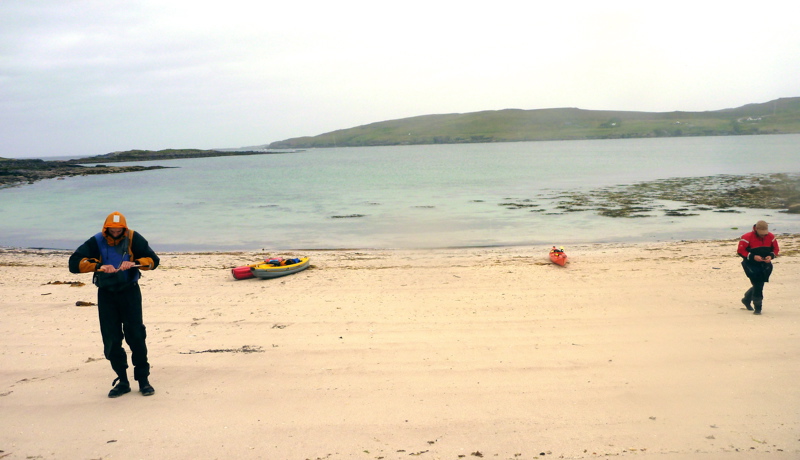
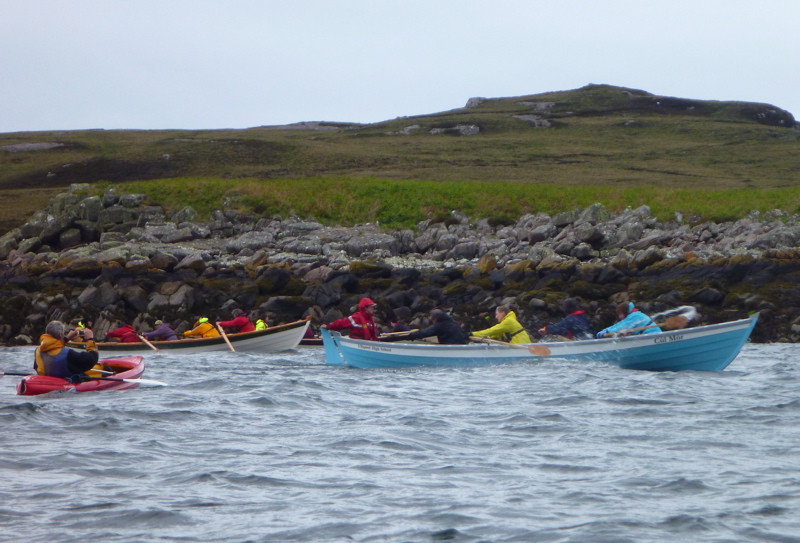
We did the best we could on Saturday and set out from the campsite beach (left) to plant our flags on the calm side of Isle Ristol (which you can walk to at very low tide). Old Dornie was standing room only that day as a local skiff racing regatta was on, postponed from last weekend when Jon and I spent our time daring ourselves to do something and go somewhere.

Sat in the back of his aged H2 Grabner like a canoeist, Gael was far more confident than us – pushing out over some surf raised by a reef while we scurried away, appalled. We beached on Ristol for lunch then turned around into the wind blowing through Old Dornie harbour, dodging the skiffing crews (right) hauling out to a buoy and back to the cheers of the crowds until – to quote Gael – it got at least as ‘lively’ (below)  as the previous weekend when we’d taken a while to get the hang of it all. Hauling against the wind the two clicks to the main Summer Isles looked a bit of a reach.

We turned back to the campsite launch as it filled with tooled-up sea kayakers who I fear were not going to have the great weekend’s paddling they’d come for. We headed over to Achnahaird Beach on the north side which ought to be either sheltered or with an offshore wind, depending on how you looked at it. Once in, I pointed to a Point and said let’s go there! but the Wise Old Man of the Sea advised we keep along the leeside cliffs in case the wind picked up as was predicted. The sea was flat enough between gusts but had a big, rolling swell which was an odd sensation I’ve not experienced before. I wasn’t sure if I should be anxious or just enjoy the ride.

Once in a while a series of bigger swells rolled by and churned around the outcrops, or crashed against the red sandstone cliffs, but without any real danger to a boater as there was no surf. We’ve all seen impressive sea kayaking long lens shots like that; relaxed yaker in profile with a backdrop of white-foam carnage. Even under skies which looked like they were about to collapse under their own weight (choose any pic nearby), it was a nice end to the day, running past the moss-clad cliffs and spooky caves from which pealed unrecognisable squawks. A lone seal popped up from a distance to check us out and to the east rose the naked spurs of Suilven, Cul Mor and Stac, carved out of the Assynt’s bedrock during the last Ice Age.

Jon glided along in his LV like he was on rails; you got to hand it to these hardshell SinKs, they may be a pain to carry on the Tube but they sure look good on the water – viewed from the stable-as-a-cow-pat perch of an IK, of course! Heck, it all felt like proper sea kayaking. Further up, around Rubha na Coigach headland I dare say it all gets pretty hairy, but it sure would be nice to cruise further along this coast with the Mrs some warm, calm and sunny evening.

And before the weekend was done, Gael got onto Sea Kayak Oban and bought their K40 test boat which I tried out last March. He got a great deal all things considered; I’d have bought it myself had I not already ordered my yellow boat. So that’s at least two K40s in action on the high seas; mine, his and maybe yours too soon.