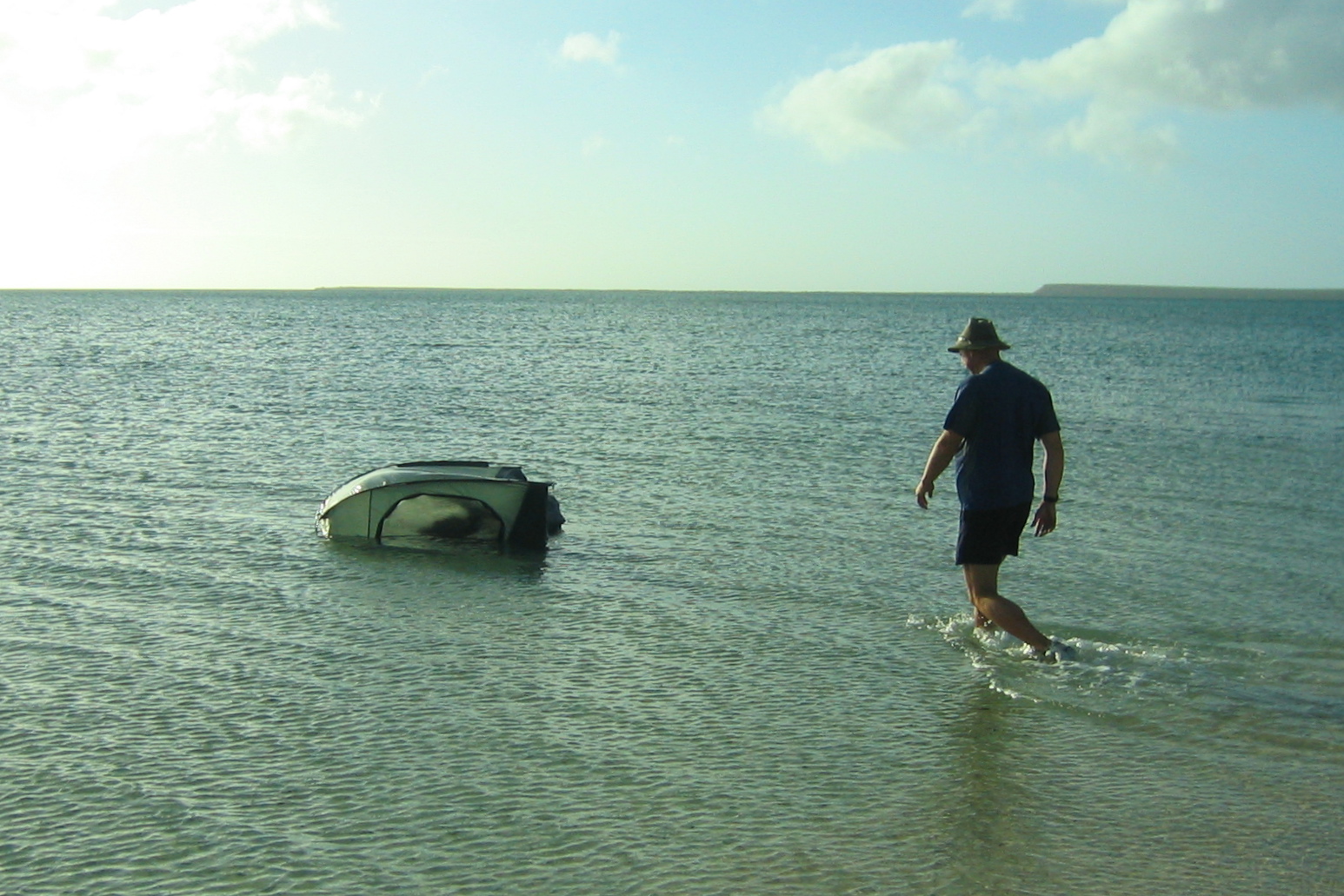
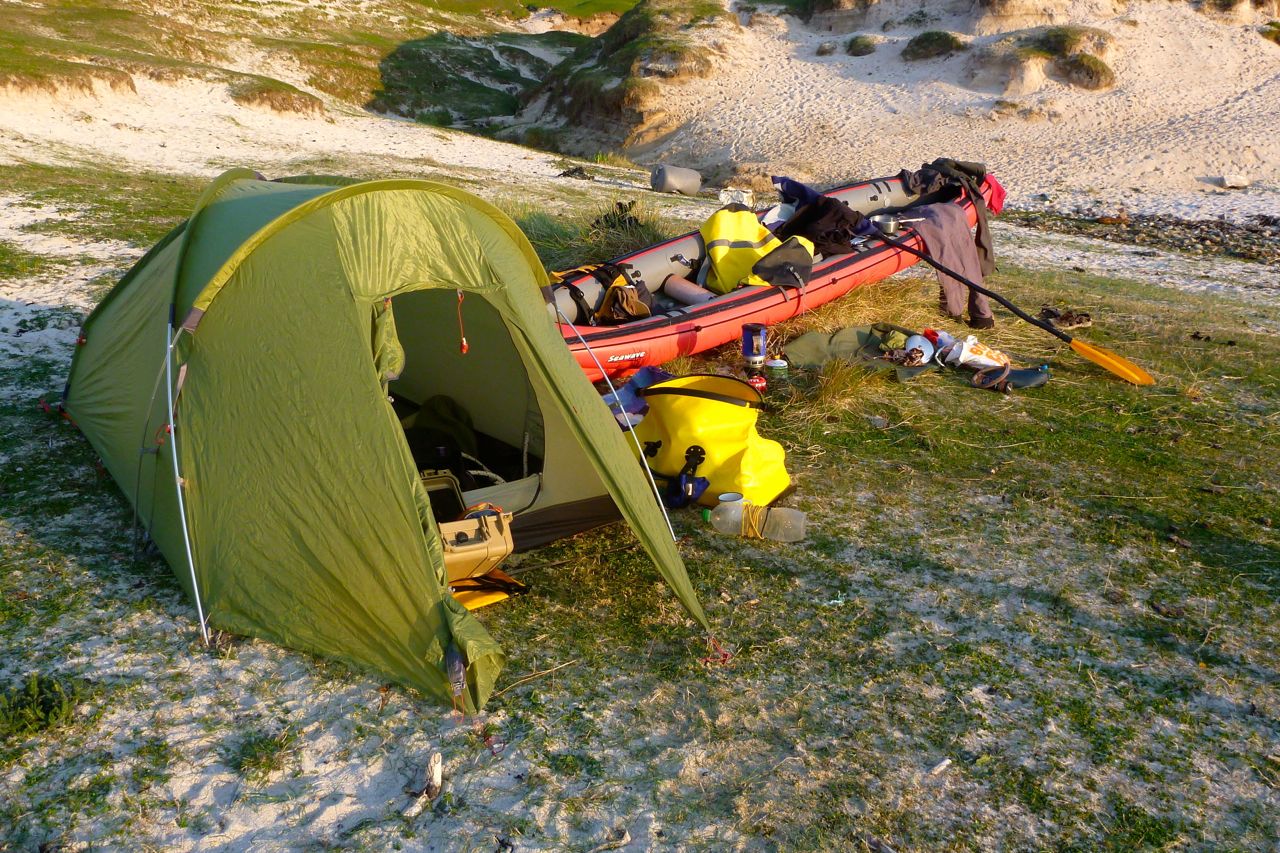
What makes a good packboating tent? For me doing a bit more Scottish sea kayaking than packrafting these days, super light weight is not that crucial. Better to have something that is easy pitching and spacious so you can sit out rough weather. And then when some packrafting does turn up, have the ability to use just the fly or inner to save weight and bulk. On occasions I’ve used a cheapie tent’s inner as a mozzie dome, just as long as I remember to keep it weighed down before frying up the brekkie on a windy morning in Shark Bay (left).
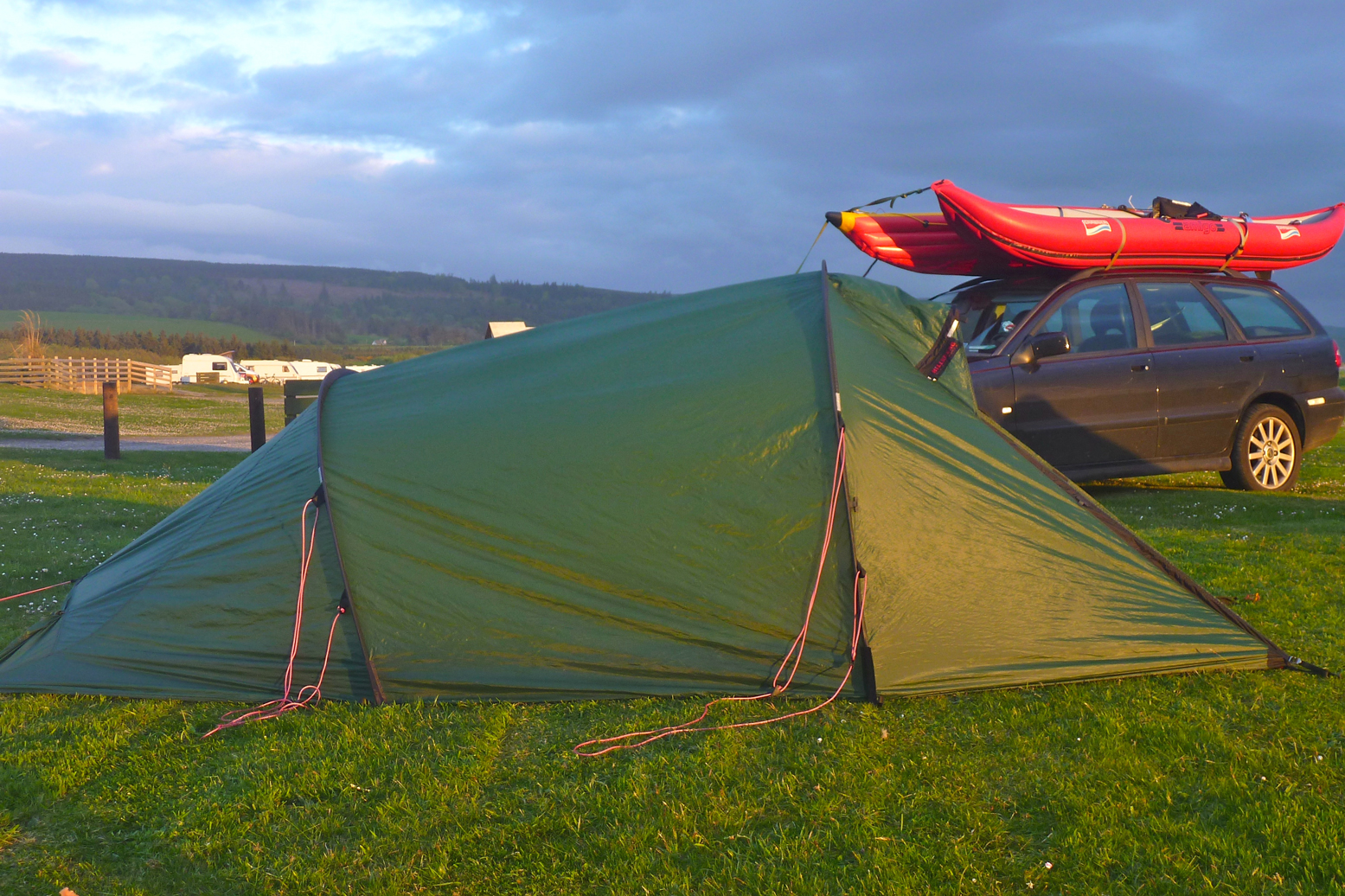
A couple of mates have used the legendary Hilleberg Nallo for years, so when I found one cheap in the US I gave it a try. Sure, for me the Nallo (left) may have been OTT in an ATGNI sense, but with its reputation and residuals, I knew I’d not lose on it. I liked the Hillie’s all-in-one pitching, the options to pitch outer (with footprint), inner only (or an optional inner mesh that was also included). This made it as potentially as light as my old Black Diamond Lighthouse, but much roomier. I also like the roomy front end and porch.
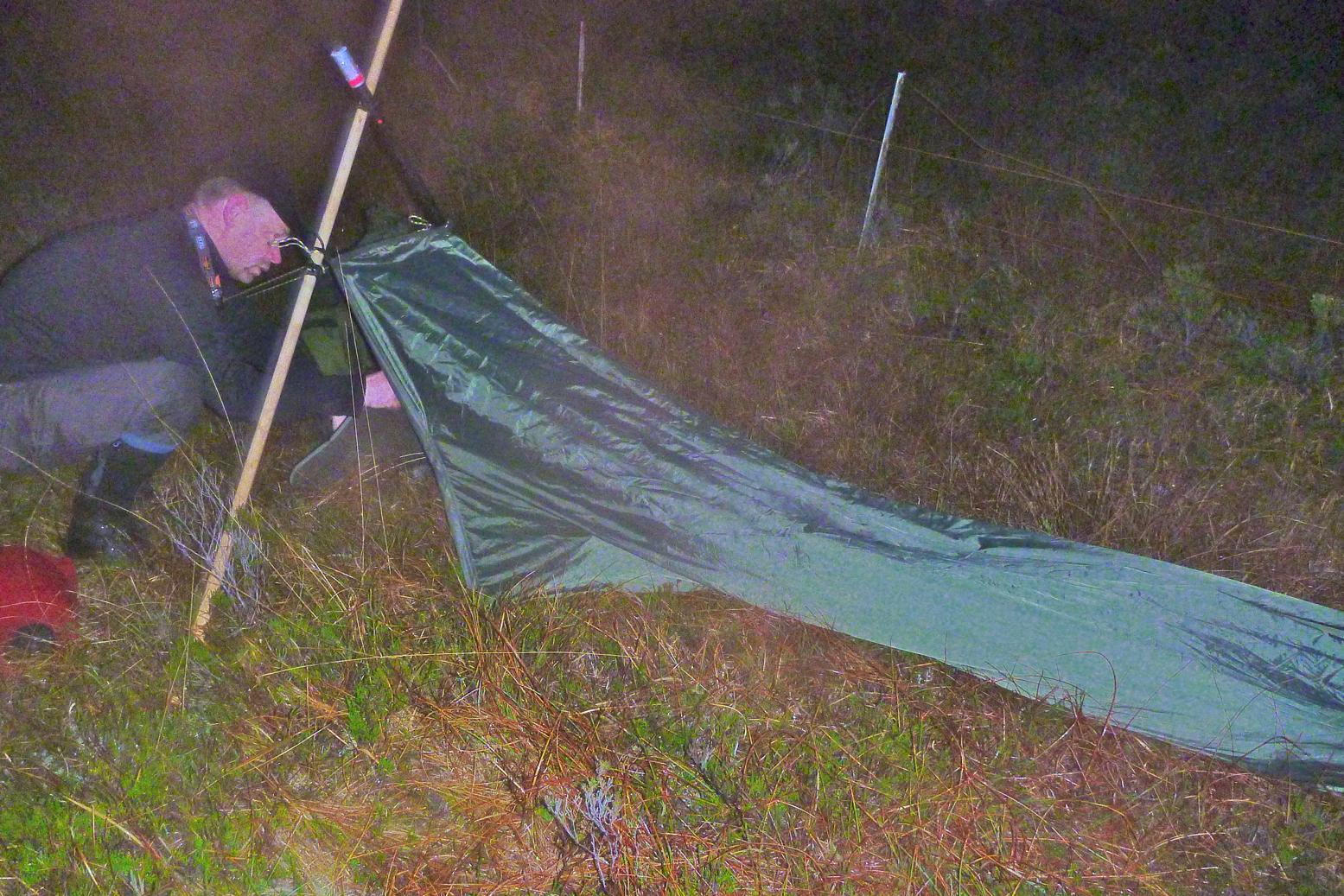
I thought it would fit the bill, but getting caught out one winter’s night on the Postman’s Path on the Coigach (below) proved that, while it may stand up to 60-mph blasts like they say, its unsupported flanks flapped like the flags outside the UN building during Hurricane Sandy. My hardcore mate crammed himself into his bivvy bag (left) and had a quieter night, even if he could barely move. On a windy nor’western night, for all that money the Nallo was no quieter than my old Black Diamond.
On top of that, the Nallo may claim to have a floor that’s 220cm long (a minimum requirement for me) and have a huge porch, but the way it slopes down at the back where the blowing wind presses (right, and in the video below) meant I still ended up with an annoyingly damp end to my sleeping bag. Just like the too short Lighthouse.
I’ve since read that Hilleberg recommends pitching a Nallo porchinto the wind, but as this discussion suggests, that seems rather counter-intuitive – unzip the door and the thing will fill like a sail while blasting you with horizontal rain every time you get in and out. They say the Nallo-style tunnel design gives the lightest weight for volume. I’m not sure that’s true anymore, and those unsupported flanks make a racket plus inside, my Nallo was always a saggy affair (right), however I pitched it (left). While paddling the Slate Islands I took the chance to get some good ebay pics and sure enough, flogged it for more a little more than it cost me.
It was good to try the Nallo experience for free, but now I had a better idea what I wanted for my current camping prefs: the Nallo’s better attributes but not in tunnel form. I considered four-pole mountain tents like the famous Quasar or more obscure Crux X2 Storm, but the doors were small, they didn’t do inner or outer only, and prices were a bit high for my low level of usage. Crux’s foam spacers to separate the inner and fly to enable better airflow was an interesting idea – or an admission that condensation was a problem. More tent spotting uncovered Vaude’s Odyssee which used a similarly stable 3-pole set up while having many of the other features I sought.
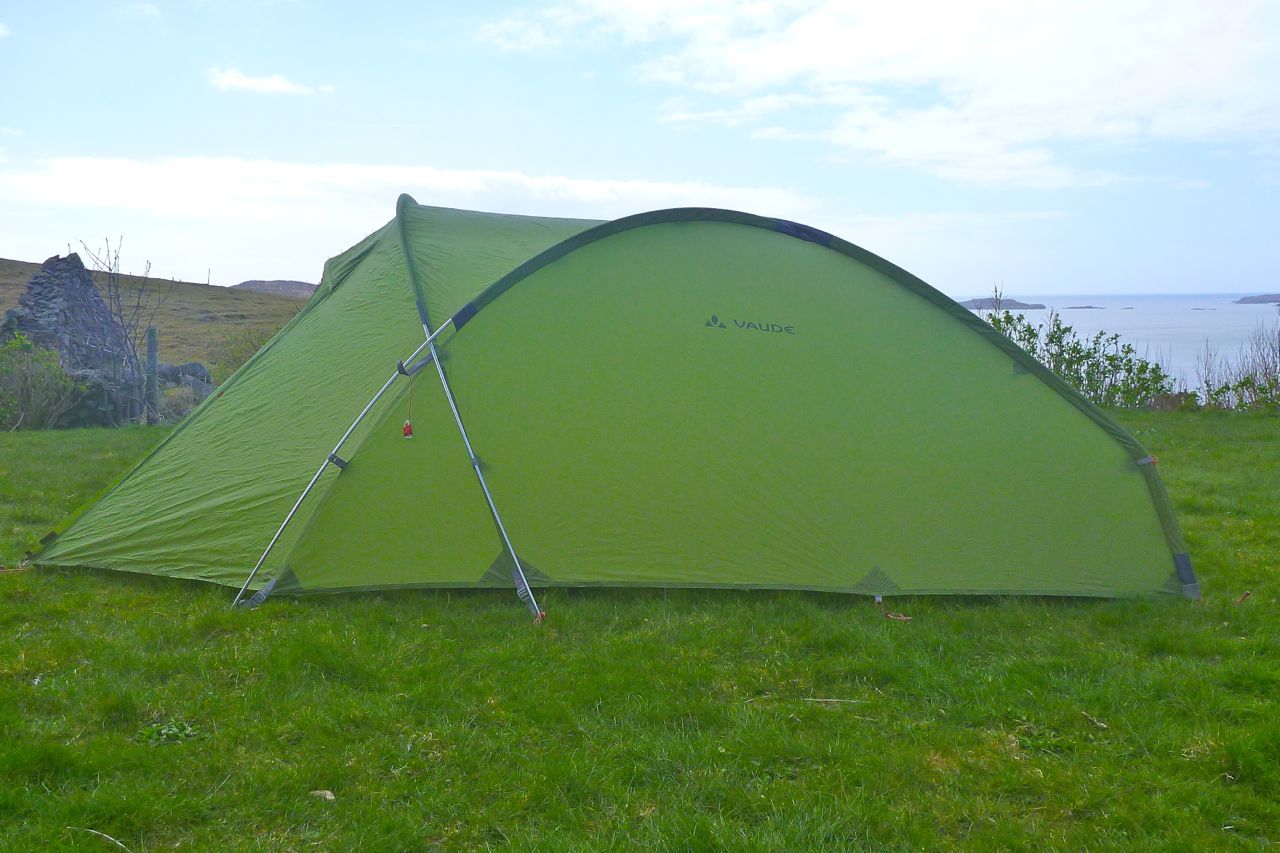
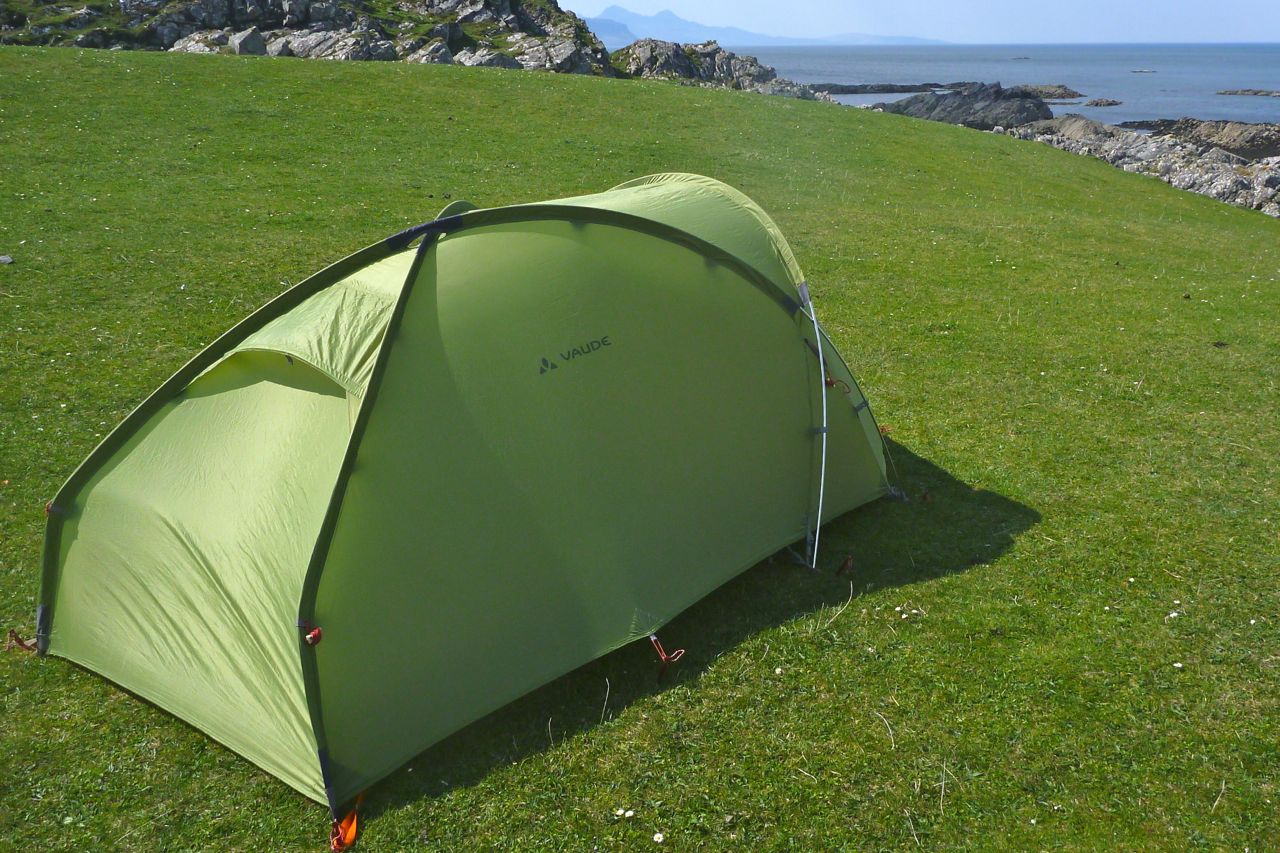
Vaude Odyssee L 2P
The Odyssee ticked all the boxes for my sort of camping out of boats or riding a moto.
• Inner and outer attached helps speedy, all-in-one pitching • 3-pole system copes in strong winds and makes a taught, flapping-reducing pitch. • Almost self-supporting so can be easily repositioned or pitched on hard surfaces which can’t be pegged • The steep back end may catch more wind but means the full 220cm inner length can be used. This is a great feature for me – no more diagonal agonies or damp sleeping-bag foot from pressing against a sloping inner, as on the Nallo. • You can pitch just the outer, saving 700-odd g*, if insects, moles or temperatures aren’t an issue – and I’m pretty sure you can pitch just the inner (saving nearly a kilo) as a mozzie dome. • Scrunches into a football-sized bundle and the poles break down to 44cm for compact packing.
All these attributes along with the reasonably light weight – ready to go at 2.6kg made the Odyssee 2P a great-value and versatile 1 or 2 person tent. It’s only 280g heavier than my Nallo, and while I presume the fabrics are inferior (“30D ripstop Polyester Silicone/PU coated 3000mm head; floor: 70D Polyamide PU coated 7000mm head”) it was much less than what my Nallo would have cost new.
* My dimensions may not match other sources
The inner ‘washing line’ and loops to attach an optional roof net are handy, as are the pockets by the door. The 75-cm deep porch is smaller than the Nallo but roomy enough, and the zip arrangements make it easy to control ventilation and maintain privacy. I’ve not had much condensation, but that must be just luck and breezy nights. Even with a breeze, the Nallo was terrible for condensation, partly because the flysheet ran right to ground level. The other night, gusts over 20-25mph in the Odyssee woke me up and I lay there thinking ‘she cannae hold, Cap’n’ until I remembered my earplugs and soon fell asleep. I’m told most modern tents with < 4 poles will make a noise in strong winds. As long as you know it’s as well lashed down as can be and can take the hammering, just turn over, plug up and pass out.
First time out one peg bent when pressed in by foot. So I pulled out my bombproof MSR Groundhogs with nifty pull-out loops (right). The Odyssee takes about ten minutes to pitch without hurrying and some faffing with the footprint (from the old Exped), and will stand with a minimum of two pegs staking out the porch. Two more at the back help make good tension, and using every dang loop and all six guys needs 16 pegs – you’re now ready for a gale and I suppose a pole will snap before it rips (there a pole repair sleeve included).
Other small annoyances are the two long poles catch the fabric pocket seams at the back – make sure the pole ends sit fully in the end of the pockets or you’ll over-tension them when clipping in the front end. And the pole-end locating pegs sometimes come away on the elastic cord which can be fiddly to reposition with the cord knot. I’ve fixed that with a dab of rubber glue.
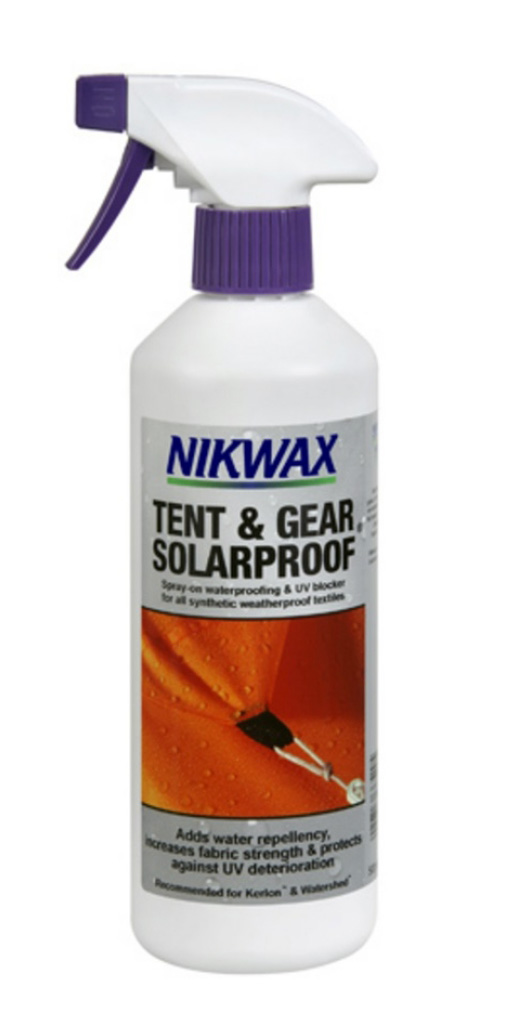
I’ve only had normal rain until 2018 when I used it on the Tarn without the inner. In really pelting rain verging on hail a light spray came through the fly and there was the odd drip from the seams. Had I used the inner would have settled on that and evaporated later, but it didn’t so all was a little damp. The flat roof doesn’t help. I wonder if even a 3000mm hydrostatic head (over twice normal) is not enough for really heavy and prolonged downpours. I see the Kerlon 1200 on the Nallo is rated at 5000mm. When I got home I sealed most of the roof seams and sprayed it all with Nikwax. We’ll see if it made any difference on the next big downpour.
Inner hangs from the fly; pitches all in one, like a Nallo Can pitch inner or outer only Nearly self-standing Roomy inner in all dimensions Long, flat roof gives good headroom Roomy porch; quite easy to get in and out Stable 3-pole set up
Boring old green Bendy stock pegs In pelting rain a light spray passes through the fly if no inner used. Since re-proofed and seam-sealed Collapsed poles are a bit long at 44cm
… I deliberately chose [these Kokatat Swift] dry trousers with no sewn-in socks as my drysuit has those. With the Swifts … I’ll just wear short Seal Skins and have no worries about the sewn-in socks getting holed by gravel. Time will tell how they wear and perform.
Well, I’ve changed my mind. I’ve never been convinced by the Goretex/membrane magic; at least not for hillwalking – I get too hot and sweaty. But making less heat paddling an open kayak on a cool Scottish day, the stuff seemed to work. It keeps out the splash and light rain, but because the leg muscles are inactive, sweatiness is barely apparent. Using a regular eVent hiking cag on top produced more mugginess, but nothing as bad as on the hill and easier to control with the front zip and adjustable cuff cinches. Unlike a hardshell, for an IK there’s no great benefit to buying a regular kayak cag with a waist seal as there’s no cockpit spray skirt to seal it against. If you really want to keep dry all over, just use a dry suit.
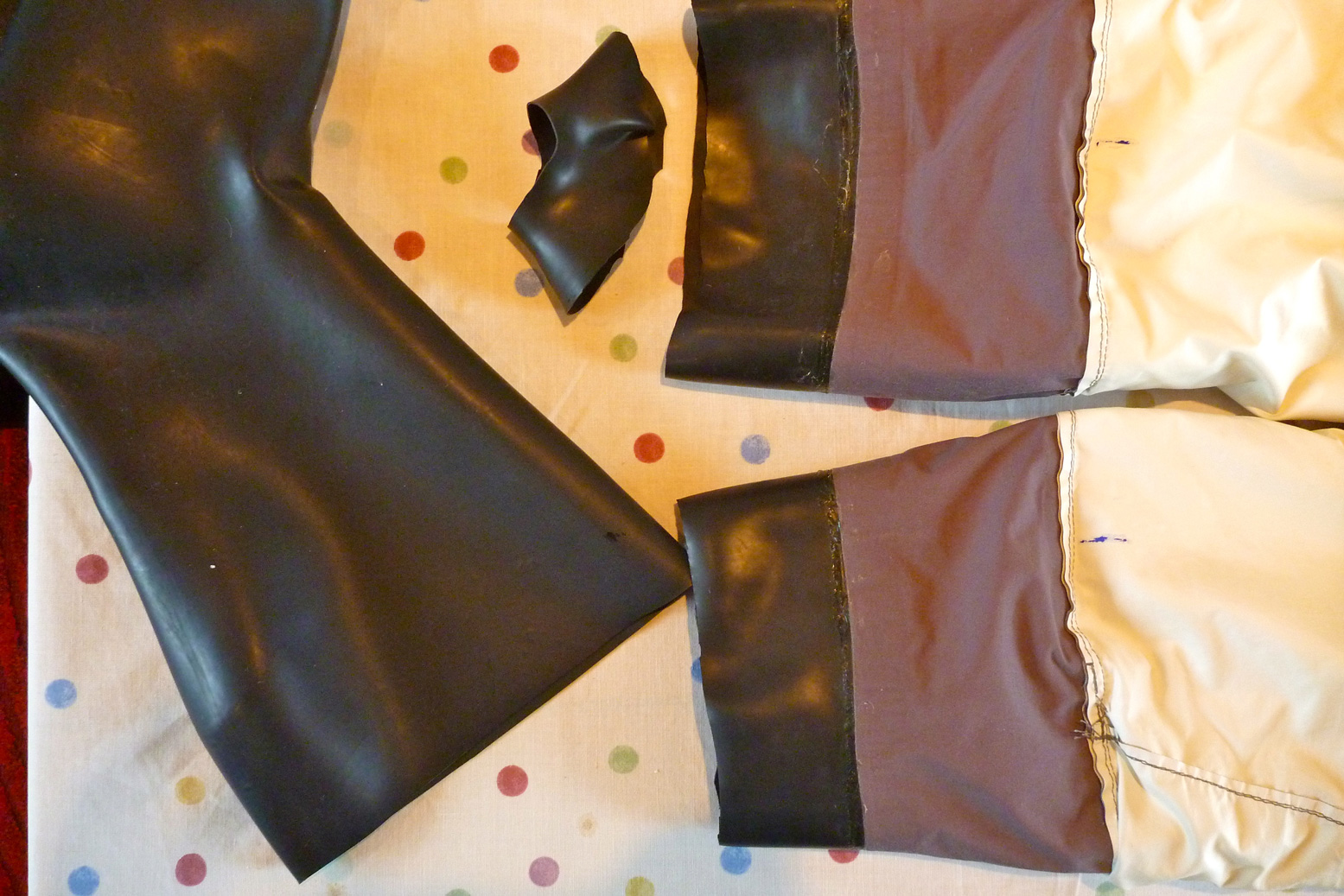
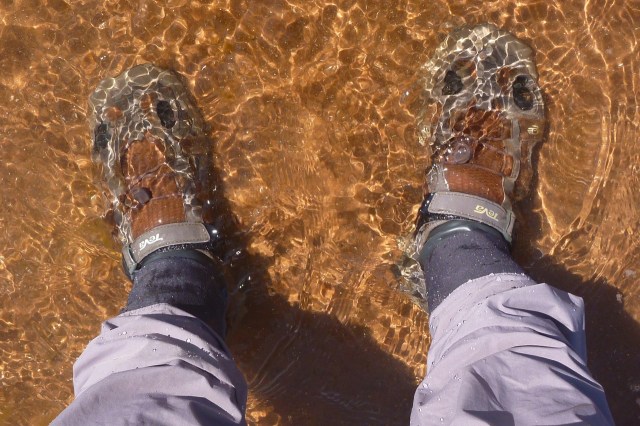
On one trip I found that the Swifts with knackered SealSkinz didn’t really work. ‘Waterproof’ SealSkinz only last until the clingfilm-like membrane goes. Then they become saggy sock-bags with insulation qualities no better than woollen socks. In fact, they may well chill damp feet. Wearing my slowly dilapidating Teva Omnium water shoes (left), I now think it’s better to seal feet properly with latex socks. IMO latex is easier to repair than socks laboriously made from off-cuts of membrane fabric which, like all that kind of stuff, has a limited life span, especially under the grinding weight of a foot. Bizarrely, I see most don’t make dry pants with integrated latex socks, only membrane, which must be a a cost or maybe a UV thing. Anfibio is an exception. But you can easily buy dry pants with latex ankle seals and glue on latex socks which are readily sold individually for around 20 quid.
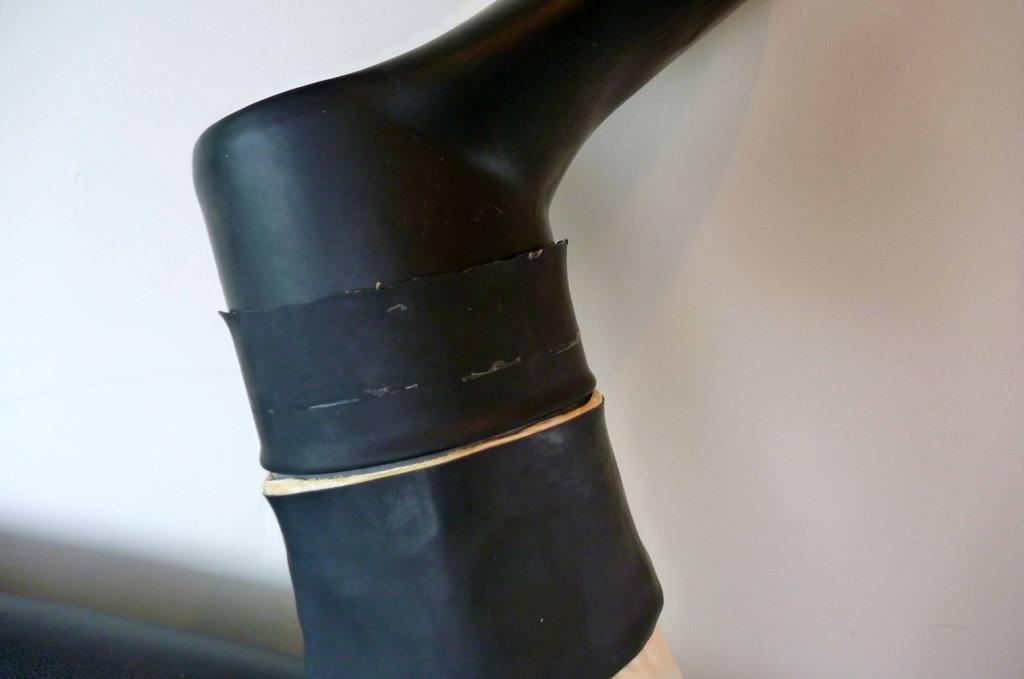
Gluing on latex socks First I trimmed the latex on the trousers and the socks to similar lengths. Getting a circumference match is important if there’s to be no leak-prone creasing once they’re joined. You’d think gluing latex socks to latex trouser cuffs would be simple. Not so it seems. My first go using regular rubber glue didn’t take to the shiny outer surface of the pants’ latex.
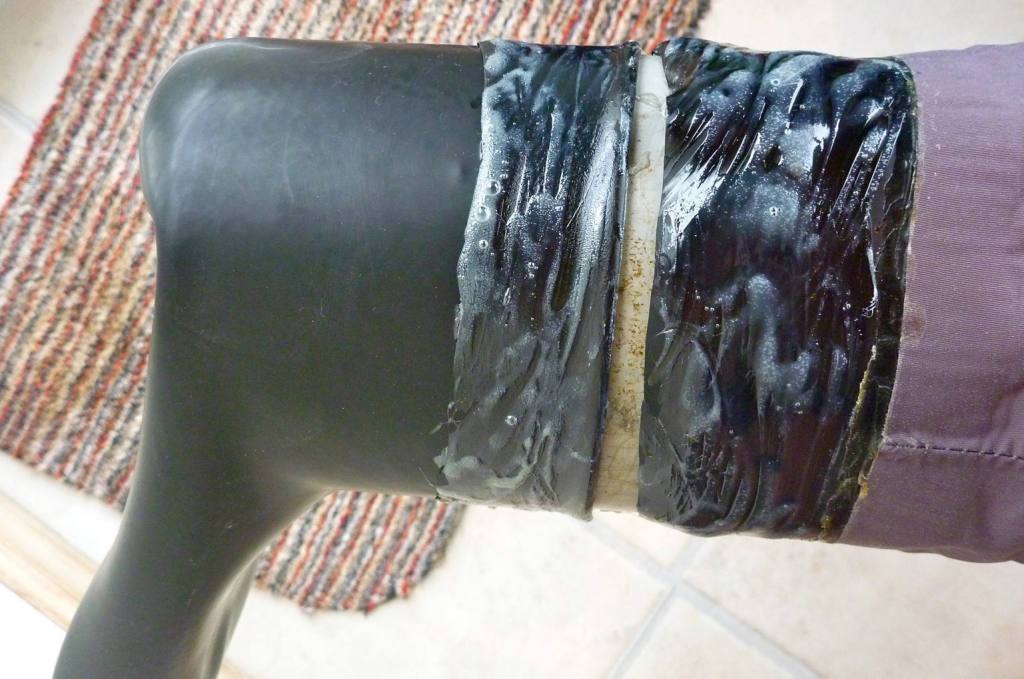
I read of using two-part adhesive, even though that refers to the tricky latex-to-dry suit fabric seal, not similar latex. So with the leg and the sock remounted on a piece of 5-inch plastic drain pipe (below), I tried again mixing up some PolyMarine Hypalon adhesive. This stuff sticks like a velcro electro-magnet, but curing times are lengthy and there’s the whole faff of getting the 25:1 mix correct.
Mount on a pipe
Fold sock back and glue
Fold over and press down
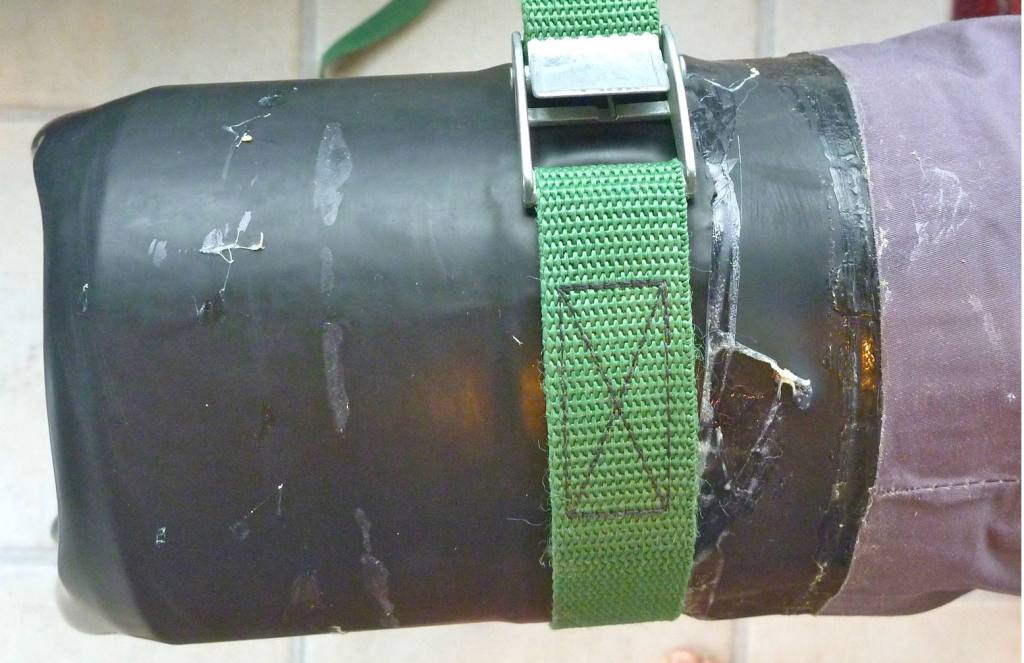
I folded back the sock about 3cm on the pipe end and nudged it against the exposed trouser leg cuff (left, above). When the adhesive had cured after 30 mins, it’s another coat (middle), wait 3 mins then just roll the sock over onto the leg and lay in with the roller then strap it up for a couple of hours. There was one small leak, easily fixed.
When cooler weather requires them but you don’t want a full-on drysuit, these fully sealed pants have been great. I can wade right in without getting wet feet, and wearing regular socks underneath the latex is are warm and comfy. A few years later one sock started leaking; a tiny hole, easily fixed with a dab of Aquaseal. They say latex is prone to UV so is best kept out of sunlight (which is why latex cuffs are often covered) and given the odd squirt of 303 UV protectorant or NikWax Solarproof.
Integrated socks – best thing you can do to your dry pants
In an occasional series here on IK&P, we trawl through the tangled archives of celluloid to seek out often over-looked packrafting action from the silver screen. Our first candidate: Stanley Kramer’s 1959 rendition of Nevil Shute’s post-apocalyptic drama On The Beach (1957), starring Gregory Peck and Ava Gardner (left and right) plus a miscast and already twitchy Anthony Perkins warming up for Psycho in a year’s time.
Synopsis Someone in a Cold War bunker over-reacted and the world has turned dayglo (this actually nearly happened in 1983). But only the northern hemisphere has been obliterated. Australia remains uncontaminated but commodities are in short supply and the country is irrevocably turning toxic as wind currents spread fall-out right across the planet. Although the film and the book shared an implausible ‘Keep Calm and Carry On [till the End]’ mood, for it’s time On The Beach was unusual in that the dangers of misused nuclear power were for once not ‘Attack-Of-The-Giant-Ants’ allegorical, but chillingly in-your-face realistic.
Packrafting Scene American Navy sub commander Peck has taken refuge in Melbourne, but is asked to cross the Pacific in his nuclear-powered vessel to see if Arctic radiation levels might be dropping, and also to look into grabled morse signals emanating from San Diego. On the left a volunteer in a radiation suit and scuba tanks paddles ashore to investigate the radio transmissions.
Our man’s heavy get-up sees his navy issue packraft close to swamping. Continuity spotters will further observe that as he climbs the mooring ladder (left) he carelessly fails to tether his packraft, jeopardising his return to the sub even before the deadly fall-out permeates through his PVC suit.
Denouement Northern hemisphere radiation remains deadly – no one is alive. The San Diego signals turn out to be a tangled sun shade flapping over a morse keying board. Gregor returns to Melbourne and accedes to Ava Gardner’s charms (left – unlike in the book but we’ll let him off). Doing so cures her alcoholism and ‘wicked ways’ but with his loyal crew he heads back ‘home’ to the toxic US anyway. The antipodean remnant of humankind succumbs and the film ends with a Salvation Army banner flapping in now-deserted uptown Melbourne: ‘It’s Not Too Late… Brother’.
The range of packrafts has slowly expanded since I bought my first Alpacka Llama in 2010 and Alpacka rafts themselves have changed a lot in that time. But here in the UK people are still slow to see the benefits of these lightweight portable boats. Much of this reticence must be due to the price of these niche-interest boats which, at a glance look not much different from what I call Slackrafts: disposably cheap vinyl beach toys. Another reason might be that packrafts appeal more to outdoorsy types looking for a new way to enjoy the wilderness or countryside, but with no interest in acquiring the technical skills far less the storage and transport issues of hardshells. They won’t come across these boats very often but as this test clearly proved, anyone can hop into a packraft, set off down river in a straight line and tackle an Environmental Agency Grade III canoe chute. The testers all ‘got it’ and by the end some were already cooking up packrafting adventures.
We’re comparing a prototype Aire BAKraft as well as the new Supai Matkat, bothfrom the US; the Russian-made, German-branded Nortik Trekraft, and the Micro Rafting System (MRS) Microraft from China. The unusual Aire calls itself a hybrid IK-packraft, the Supai is an ultralight ‘crossraft’ intended for flatwater use. The other two more closely resemble Alpackas in current or former iterations. My current 2014 Yak made a fifth boat on our test, one which I at least could compare against the others.
These four boats were lent to us by what is now called the Anfibio Packrafting Store in Germany which sells, rents and now makes under its own Anfibio brand, the biggest range of packrafts and packrafting gear in Europe. Sven at the Packrafting Store helped clarify or correct technical aspects in this review but the opinions, observations and most measurements are our own. Some of the more exciting photos are also from the Packrafting Store. We asked NRS to participate: they didn’t answer. At the time Feathercraft’s packrafts were another option but Feathercraft is no more.
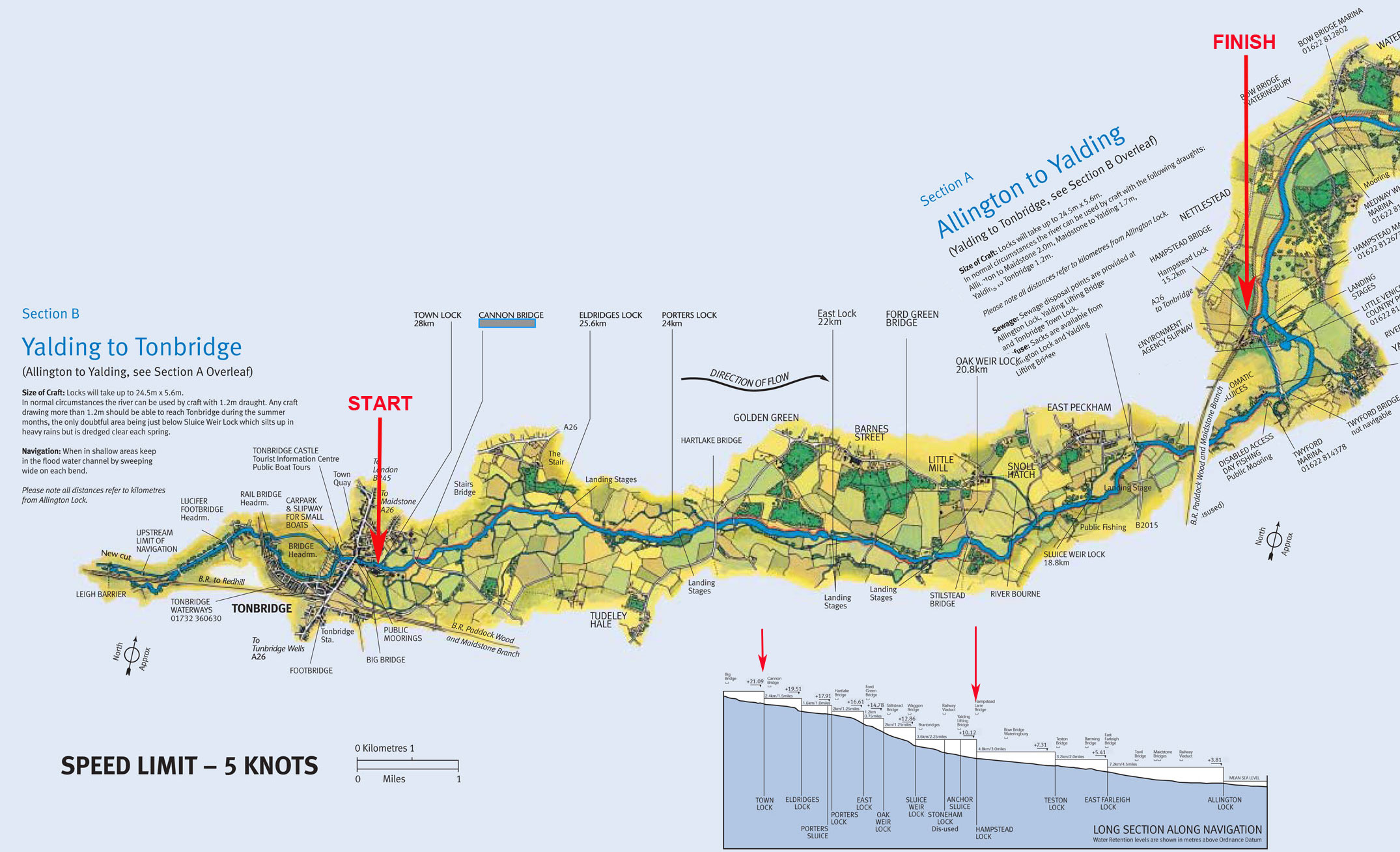
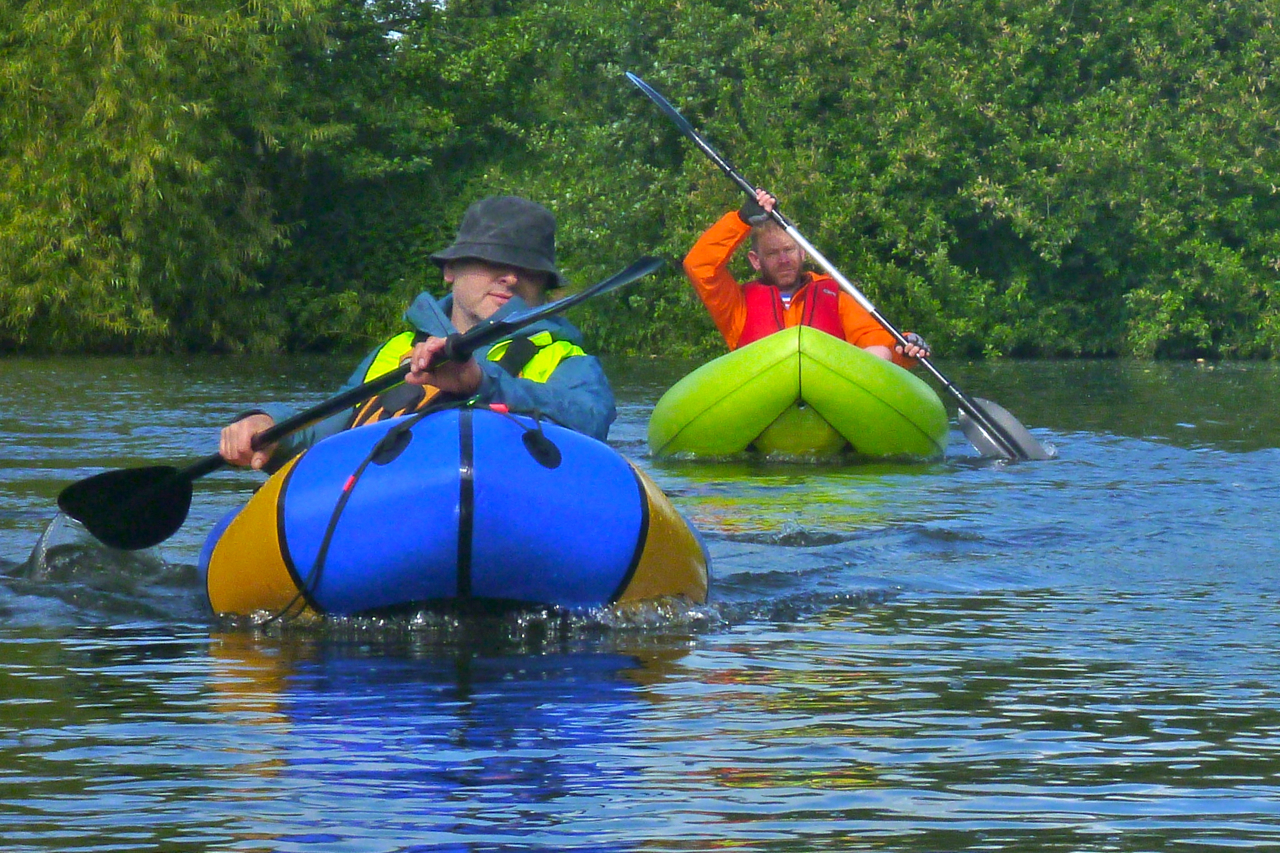
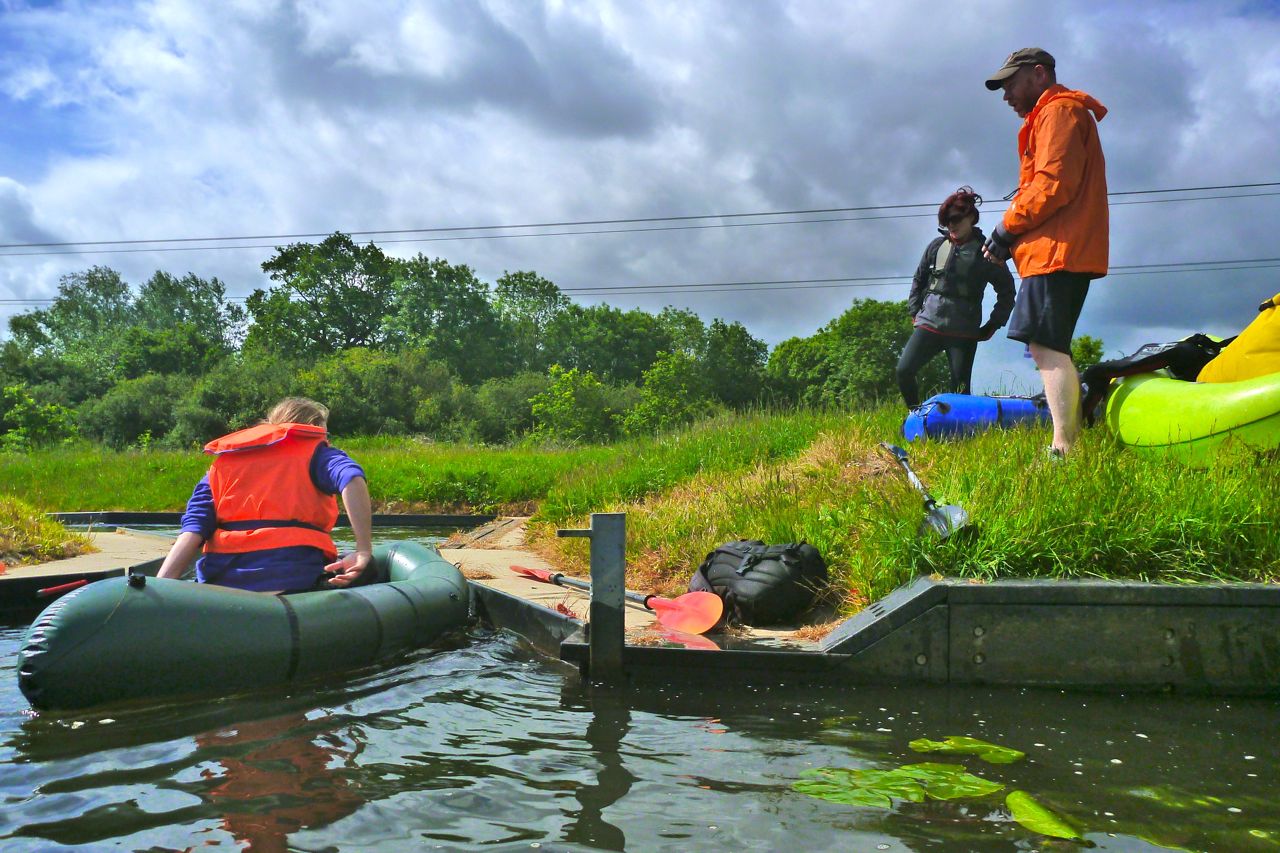
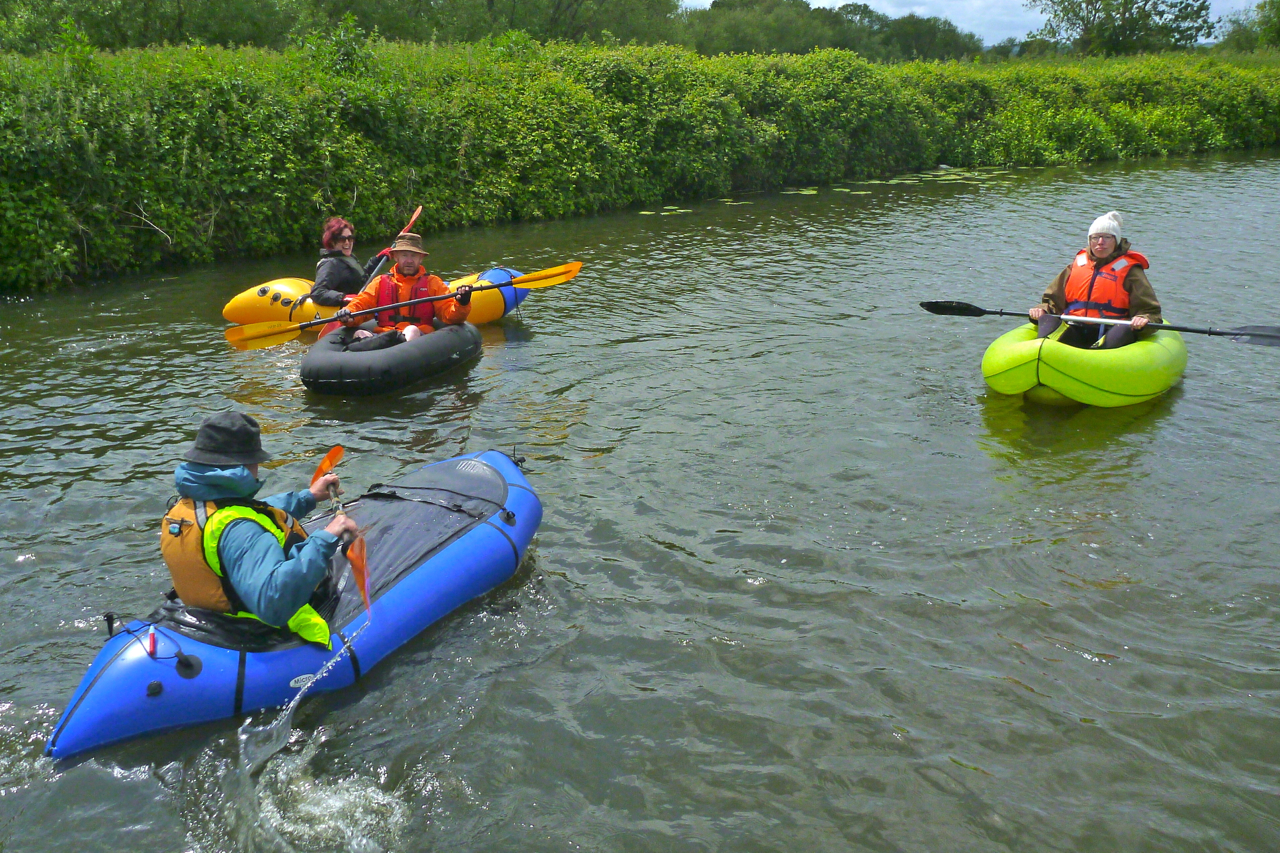
For this group test it would have been great to set off across the hills of Wales or Scotland, deploy the boats and then follow a river, hop out, walk some more, set up camp and swap notes. The reality of combining good weather and four other people with the free time to help do all this was slim. So we settled on an eight-mile day trip down the Medway River in Kent (above): me and four testers who’d all paddled (some with trousers rolled up) but had never packrafted. At each lock and chute we swapped boats, so everyone tried each raft at least once.
Me – Height 1.83m; weight 93kg Experience: Into IKs and packrafts for day trips and touring. On my third Alpacka.
Bob – 1.78m; 85kg Lilo incident, Margate 1965. Lea River canoe lessons, Harlow 1980.
Hannah – 1.75m; 75kg Much canoeing, some kayaking, love touring. Don’t understand eddies, yet.
Lois – 1.62; 63kg Dicking about on the Thames in Gumotex IKs and a Dagger. Rely on enthusiasm rather than skill.
Robin – 1.78m; 85kg Scouts canoeing, NZ white water, Colorado kayaking, various inflatable trips, usually with tides.
How the packrafts were weighed and measured Weighing was done using the classic Salter 1004 SSDR digital kitchen scales. They come with a classy brushed steel finish and still rate at 4 stars on amazon. They were checked and registered 500ml of water as weighing 500g.
Each boat was weighed exactly as it came out of the box, and then weighed again as it was actually paddled, without air bags, repair kits or straps (where included). It was then weighed again before going back in the box. All dimensions were also taken twice, the second time using stakes to get the external measurements at the widest points (above). Internal dimensions were taken at the shortest point, usually halfway up the curved tube side. Measurements from other sources may vary; there’s a table at the bottom of each review’s page and the summary for quick comparison. * Our exterior measurements for the Matkat were 3- to 5cm less than the Store, but 4cm longer and 1.6cm slimmer than Supai states. Unnoticed leaks during the measuring stage may have stopped us pumping the boat up to actual size.
Construction All these packrafts are made from pliable fabrics which form airtight vessels when inflated by human power alone. That’s about 0.03 bar or 0.4psi according to the Packrafting Store’s tests and probably too low for a regular manometer to measure accurately. The BAKraft uses an in-line ‘squeeze pump’ to potentially attain 0.17bar or 2.5psi – firmer than most vinyl IKs. All the models used here except the Supai were pressure tested to an impressive 0.5 bar (7.25psi) by the Store without exploding into a blaze of TPU. As a comparison, my old Grabner ran 0.3.bar as was as stiff as a gangplank. Hardshell-like rigidity is an inflatable boat’s goal, and while design and shape might come into it, some rafts become more rigid than others and so perform better. The best rafts use a fabric (or construction design) which becomes stiff when inflated but is pliable when folded (especially at low temperatures) as well as being durable against sharp impacts and abrasion. Among other things you could add resistance to UV rays, ready supply and ease of assembly in the factory, repairability on the trail, and a range of fabulous customer-friendly colours.
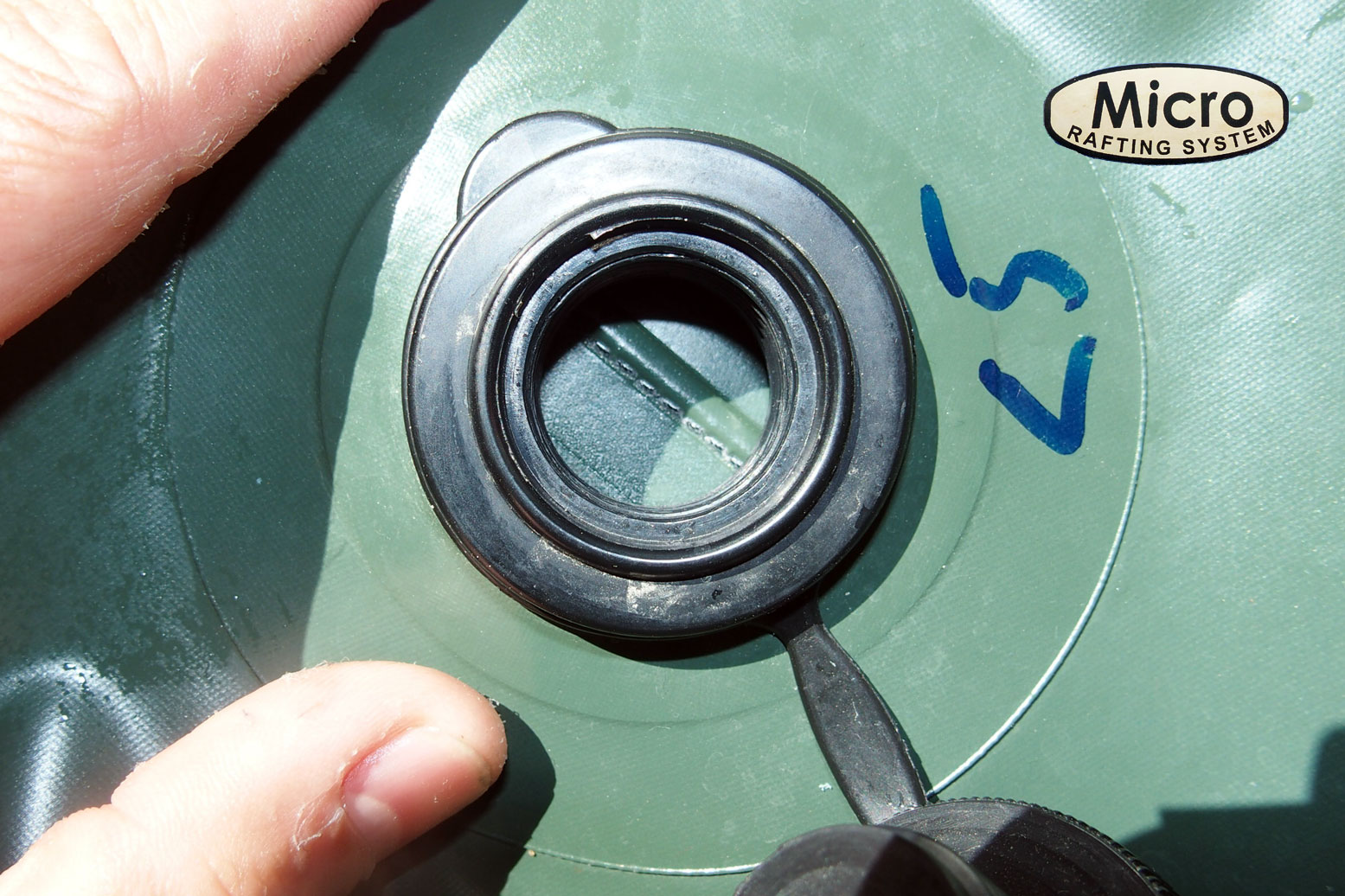
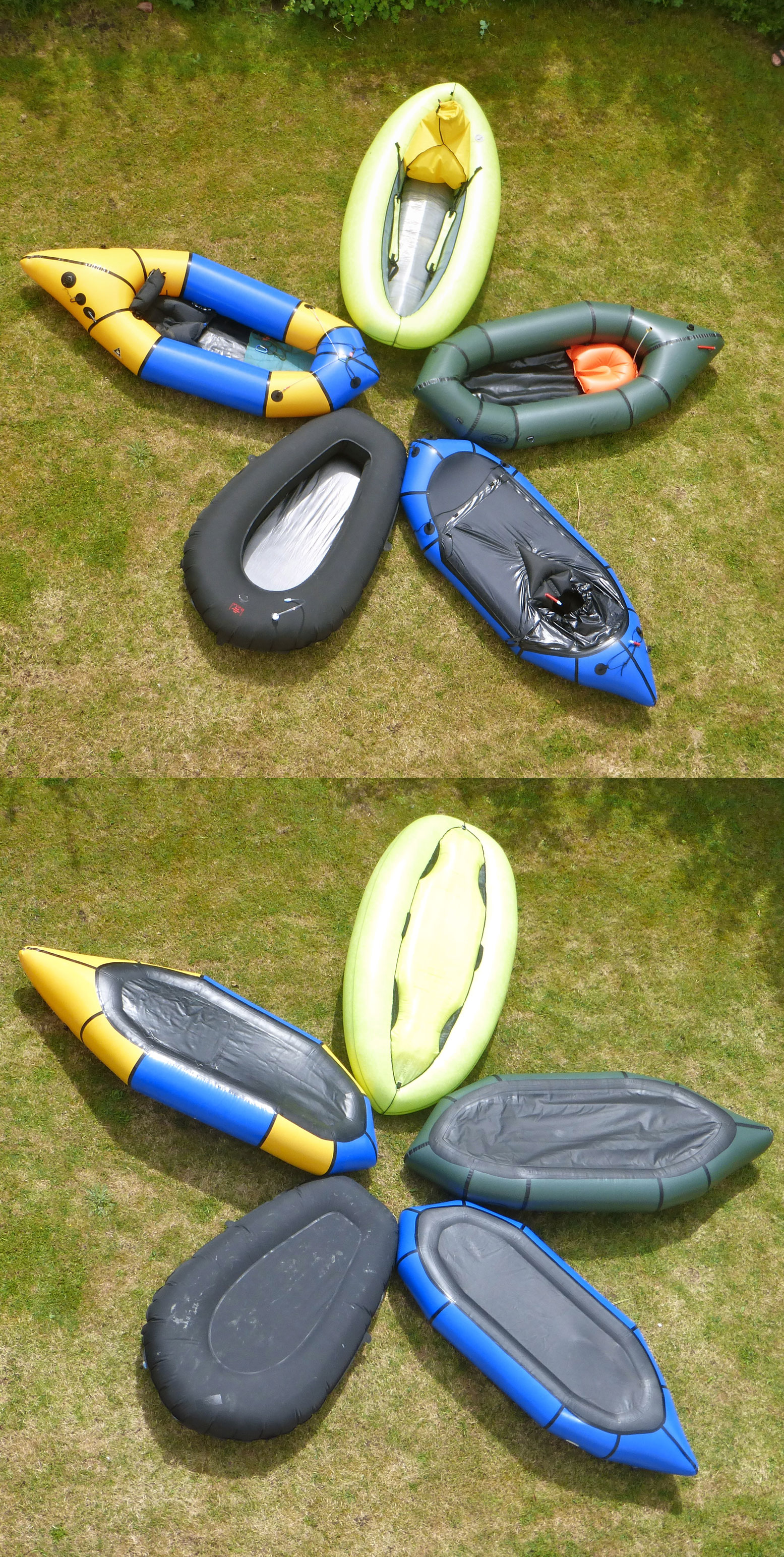
Broadly speaking the hulls of the Alpacka and MRS use ten panels of urethane (TPU) coated nylon fabric which are sewn together. Tape is then heat welded over the seams. The Alpacka fabric is only coated on the outside; the Nortik uses a similar double-coated fabric to the MRS (above; green, but not our Trekraft), but the Nortik’s seams are heat-welded with thicker tape (no sewing).
Double-coating adds weight and other technical aspects of proprietary coated fabrics vary greatly; they’re often specifically formulated for a raft manufacturer. The benefits of an inside coating are a second barrier to punctures when a light scratch to the exterior reaches down to the fabric core but doesn’t actually cut through it.
The floors on the Yak, Nortik and MRS are glued on then taped over (Nortik on the inside, the other two outside). They’re typically two or three times the denier rating (thread weight) of the hull fabric. The Alpacka uses something called ballistic nylon which sounds cool but I’ve found is far from bulletproof. No part of an inflatable raft weighing just three kilos can be expected to be. Occasional repairs are all part of ownership, like a bicycle’s tyres. So is rinsing any grit out the boat before it works its way into the nooks and crannies. On the right click the extra large picture to have a close look under the boats and compare workmanship.
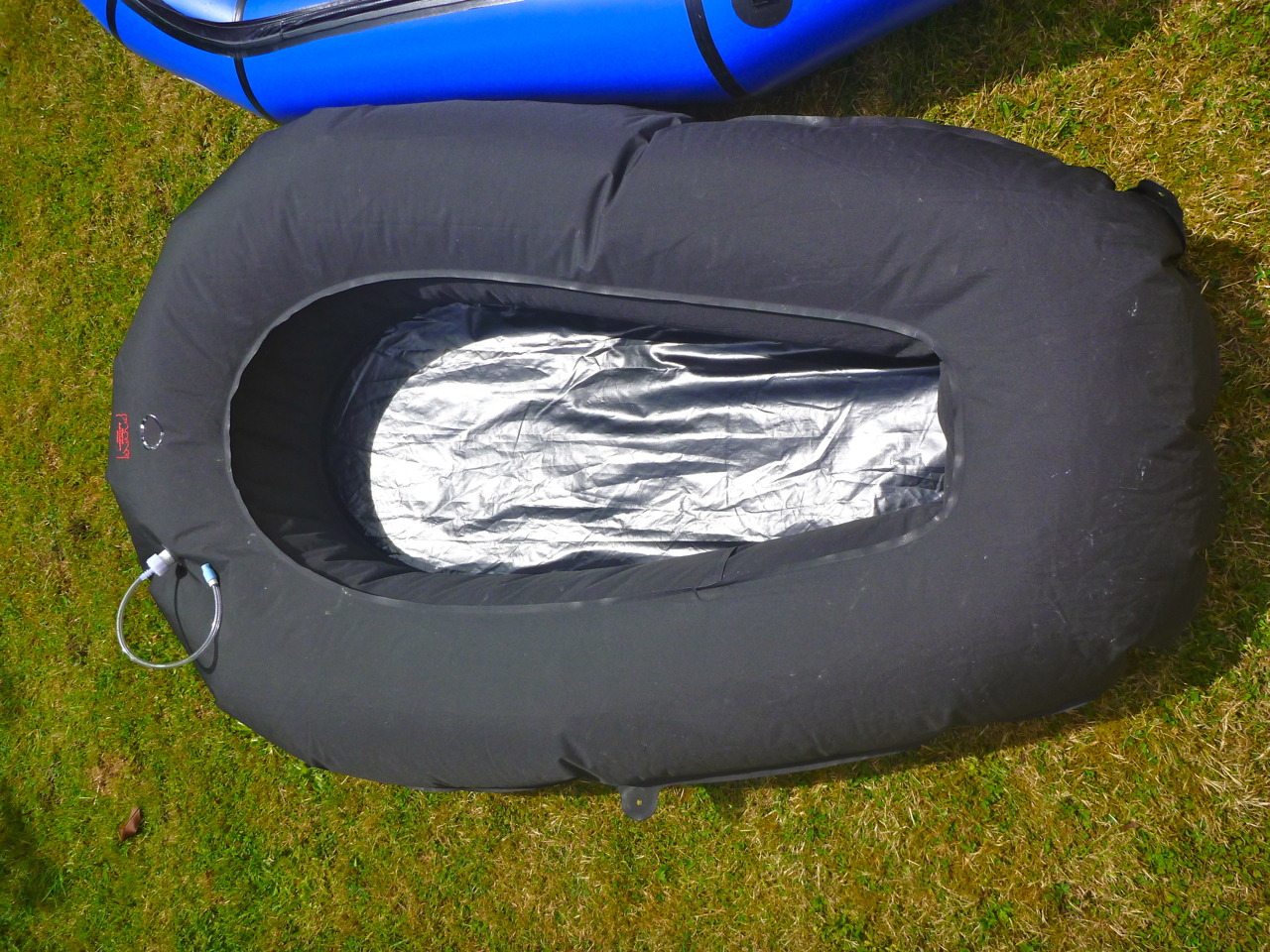
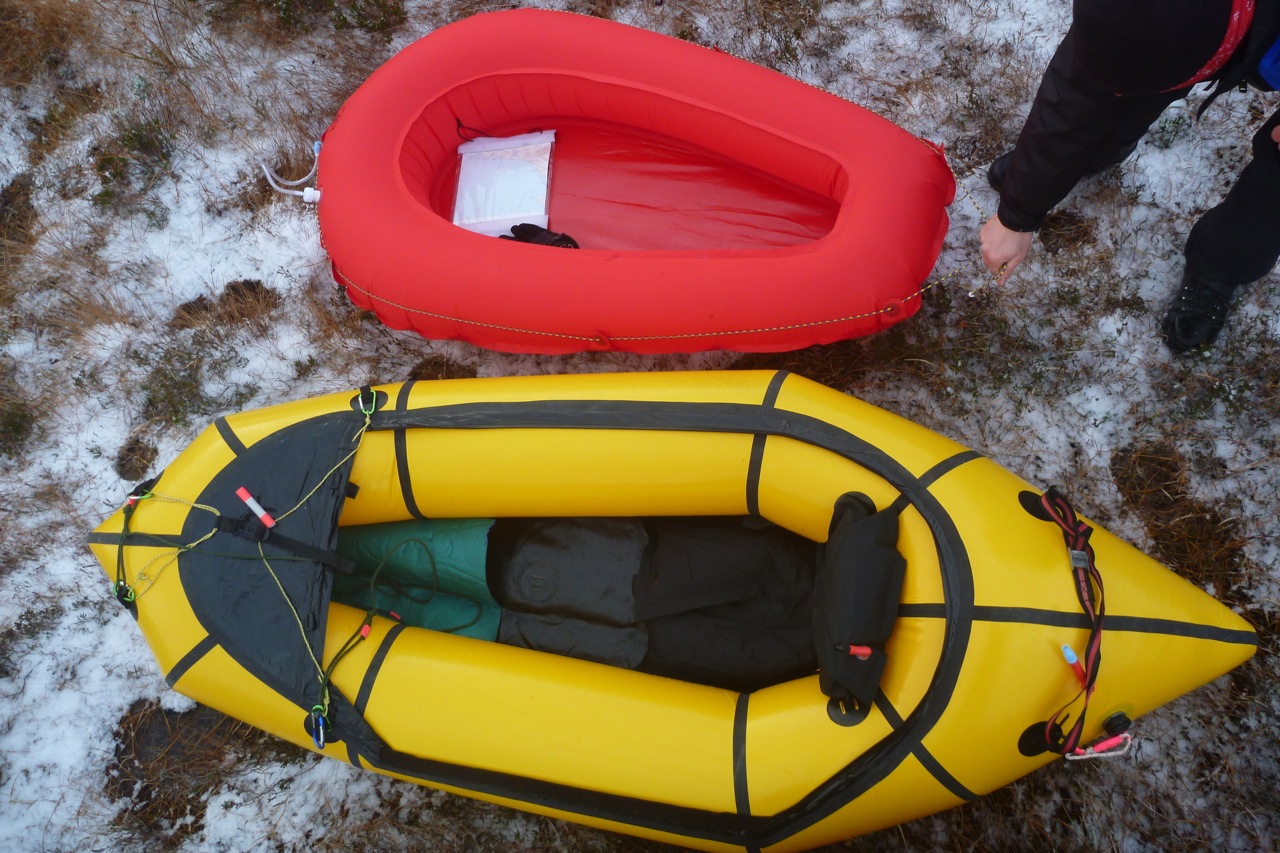
The superlight Matkat is in a class all of its own, entirely made from 75-denier ripstop polyester with a single urethane coating on the inside, the same weight (and sealing method) as an MSR water bag. The red picture below right is of another Supai we tried which you’ll see had a diamond pattern on the surface. The black Matkat we used here had a plain surface like an MSR bag. On both boats the four panels (floor, inside, top and bottom hull) are heat-welded together. It’s possible to repair these seams with a hot iron (or glue).
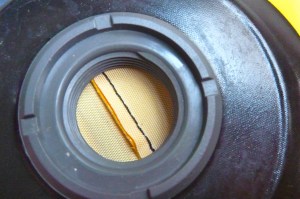
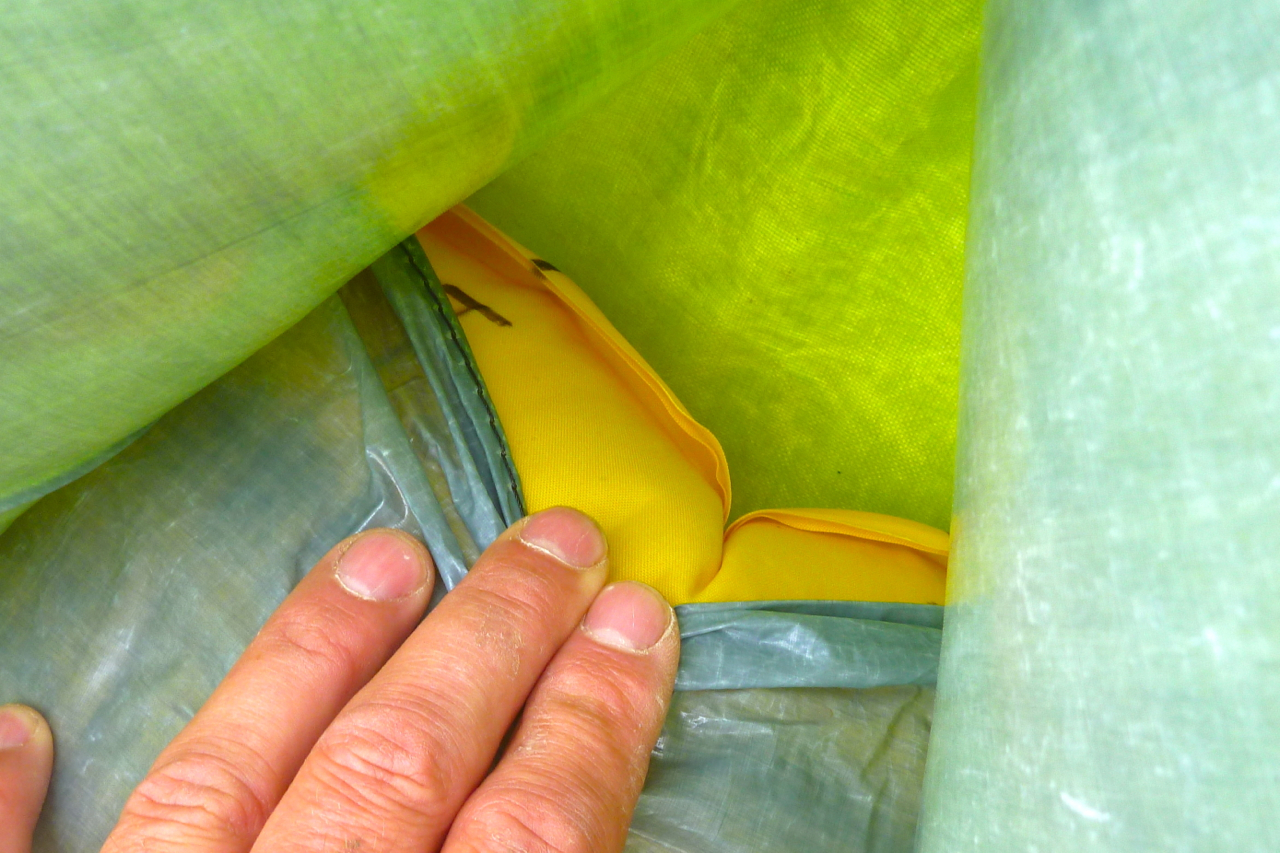
The AireBAKraftprototype we tested used a thin and slightly stretchy urethane film ‘inner tube’ or collar supporting the hull, and a much thicker and stretch-free urethane-coated yellow nylon fabric for the I-beam floor (left). These bladders or ‘AIREcells’ as Aire calls them, are contained inside a sewn-up shell of fabric which need not be air- or watertight. If I interpreted the owner’s manual correctly then the BAKraft’s green exterior shell is made of Spectra and the grey interior of lighter-weight Dyneema fabric. You may know stretch-free Dyneema guy lines found on better tents.
The urethane bladder can be accessed for repair via long zips (left); the nylon floor can be pulled out for repair from each end. On packing or refitting care must be taken not to twist the bladders. I’ve never been a fan of it (for reasons explained later) but this AIRECell system has been used by Aire on their PVC whitewater rafts and IKs for many, many years. With minimal seams compared to a traditional packraft hull, air retention is excellent. On all the boats seats, backrests and decks (where present) are typically made from urethane-coated nylon with seams or joins heat-welded and maybe taped.
Inflation/deflation If you’re combining walking with navigating bodies of water – packing + rafting – you want a boat which inflates and deploys without any faffing about. In this respect the Microraft was the best of the bunch. It used the proven screw-in inflation bag (see video below) and, being a small volume boat, took about ten ‘scoops’ to fill up. The main valve cap is attached with a short plastic ring tab – no fiddly bits of string. Top off the air pressure by blowing all you got into the twist-lock valve and with practice you’re good to go in three minutes.
In the video below, from arriving at the beach to paddling away takes about 8 minutes. Speeded up 15x. A jet passes overhead.
My Yak followed exactly the same inflation procedure, but being a higher volume boat (a little bigger than the one in the video above) took twice as many ‘air-grabs’ to fill up before topping off with lung power. Every time I do this I wonder whether my super-thin airbag will split or unravel at the seams if I scrunch too hard. I can feel the air leaking through the sides.
One-way spring valve
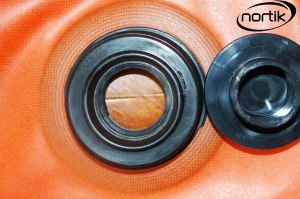
Like the MRS, the Trekraft’s airbag is also made from a reassuringly thick fabric, but is spoiled by a push-in plug, even though there’s obviously a thread in the boat’s port. Compress too hard or if it’s wet and the bag plug might pop out, so inflate gently. Instead of using the old twist-lock to top-off, the Trekraft has a one-way spring valve stem with a cap (which came adrift and eventually got lost). This valve (above left) is dead easy to use and avoids the risk of over-tightening a cheap plastic twist-lock valve (as on older Alpackas). But when airing down, with the spring valve you can’t suck and seal the remaining air out unless you jam something in the valve as you suck. Packraft or IK, this ability to suck your boat down is handy for compact packing.
Next comes the Matkat. No airbag supplied even though the Supai website states: ‘We are working on developing an inflation sack to work with our valves hopefully we will have it released in mid-2014.’ When we tried the smaller red Supai Canyon Flatwater II in late 2013 we found it took about fifty breaths to fill, plus topping off. The higher volume Matkat takes about eighty breaths. I like breathing but that’s not something I’d want to do more than a couple of times day to save the 100 grams of an airbag.
Oh…
Unlike the Alpacka, Nortik or MRS, the Supais use a male threaded dump valve which protrudes from the boat and onto which screws a cap with a thin tube and the twist lock valve on the end (right, red boat) – a neat and simple system that’s just about accessible for on-board top-ups. Alpacka use an identical threaded valve port but on their air bags; it’s a regular American plumbing ¾-inch size. If I had a Supai packraft I’d get an Alpacka airbag for $20 and then either find a female-to-female plastic connection, or jam on a short section of clear plastic tube to join them together. That way I can save the hyperventilating for Glastonbury.
That leaves the BAKraft. Even before I received the boat I had my doubts after seeing pictures of the convoluted inflation system which Aire suggest.
The BAKraft uses Halkey Roberts (or very similar) valves, as found on proper IKs and whitewater rafts: one in the floor and one for the urethane bladder that fills both sides of the hull, or what what they call the ‘collar’. These valves work like car tyre valves (or the Nortik top-up) – a spurt of high pressure opens the seal and a spring seals it shut – except that you can lock them open by pushing and twisting the valve stem. This is necessary to deflate a boat easily, or to loosely pre-inflate it without having to push against the valve spring. These valves are really designed to be used with pumps not flimsy air-catching inflation bags, far less lung power. A simple and compact push-fit pump like a K-Pump will work. A high-pressure stirrup pump with a ‘Summit’ bayonet connector on the end will be even quicker, but is way too bulky to travel with.
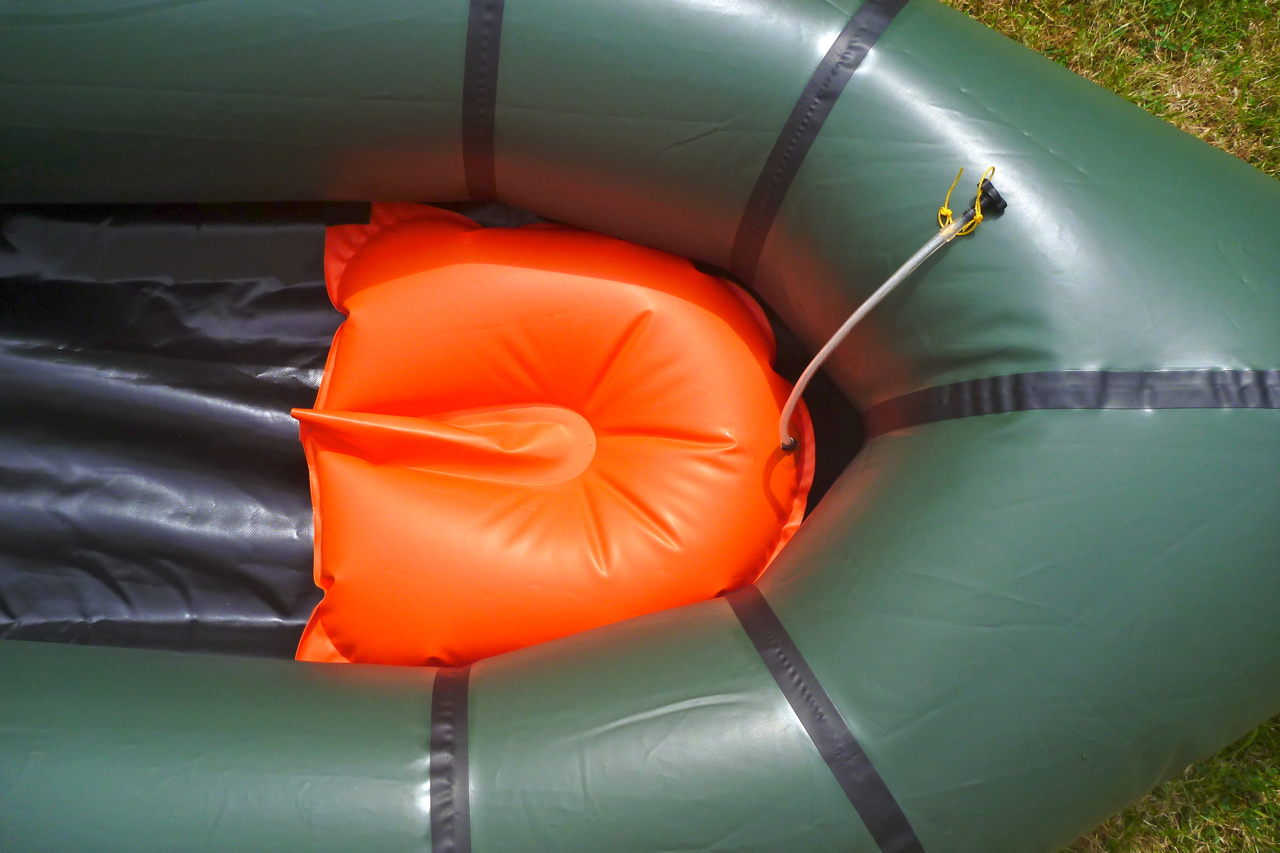
With the BAKraft you’re supposed to use the backrest/cargo bag as an inflation bag and scrunch air into the boat via a tube fitted with a bayonet connector (left). But the backrest bag’s weight, odd shape and relatively small volume makes this task awkward, even past an opened intake valve which is still a restricted airway. I gave it a go but soon saw that, while I’d get there in the end, it was going to take ages.
Once the boat has ‘shape’ you’re then supposed to quickly close the boat valve then splice in a low-volume/high-pressure hand-squeeze pump into the ISC bag. The squeeze pump has another one-way spring valve in it: charge it with air from the backrest then squirt air by hand past the closed valve until the boat is firm. This squeeze pump is quite a clever idea but at about 150cc a go will take a while to do the job. Sorry to say I wasn’t even curious to find out how long – I’d guess at least 15-minutes for the whole inflation, same as it took to pump up my 4.5-metre kayak the other day with the one-litre K-Pump Mini. So instead I reached for my Bravo stirrup pump – it took two minutes – and on test day I brought my compact K-Pump which took about twice as long.
I see now that I’ve actually RTFM I used an alternative method. The image above right suggests you don’t use the backrest bag to charge the squeeze pump, but just blow then squeeze the hand pump directly using an oral tube, like a silent bag pipe. If I’d thought of that I might have tried it as it’s a much less clumsy way of topping off the BAKraft.
All the other packrafts here run at an air pressure that’s governed by the lung power you can exert through the top-off twist valve (left). But with a one-way valve you can pump more air into a raft (that goes for the Trekraft’s top-off valve too, now I think of it). The BAKraft is made to run an IK-like 2.5psi although you’re warned not to over-pressurise or allow it to happen. That can be easily done of you get carried away with a stirrup pump or leave the raft out in the hot sun. It may have seemed clever to give the necessary backrest multiple uses, but it works only a little better for filling the boat with air than it does as a backrest (see review). I’d recommend getting a $20 Feathercraft inflation bag which comes with the ‘Summit’ bayonet fitting from their BayLee packrafts (they also use Halkey-like valves). And if you don’t get on with the oral/hand pump system, then get a 600-g K-Pump Mini too. I’d guess using both these devices will more than halve the inflation time.
From the four corners of southern England the throng gathered at Tonbridge Town Lock, the boats got pumped up, cooled off in the water then topped up some more. Then, after a quick groupie, we set off down the easy first chute. I took it upon myself to get in the Matkat while I was still feeling fresh.
It was time to hop into my boat – a 2014 model Yak. You can read more about it here. There’s no real need to go on about it too much as it’s a well proven product. It’s use here was more to aid real time comparisons with the other four boats on test. I did this Medway run in it last year at an average of 3.4mph which for a packraft is pretty good going. Today with all the yaking and picture taking it was more like 1.1mph.
I knew the Yak was a tad short when I chose it and I see now that the tapered bow exacerbates that slimness at the feet. For me it’s fine bare foot, not so comfy in footwear. Because of this I rarely use the inflatable backpad to fill out the space.
It’s great to see how Alpacka have evolved since my first Alpacka, an old-shaped decked Denali Llama back in 2010. The ‘fastback’ stern introduced a year later was a convincing reason to sell the Llama and get a Yak. The stern prong acts both like a skeg, reducing the yawing motion at the bow – and adds buoyancy at the back of an inevitably back-heavy design, so improving the trim. It’s no surpeise to see the MRS and Nortik adopting similar designs. The old-style deck on my 2011 Yak was no better than before, better than nothing but feeling fragile and not that effective. Now Alpacka seem to have sorted that with a permanent, more kayak-like design also found on the Trekraft, and while I’m not convinced myself, the Cargo Fly is another ingenious innovation.
A question you might ask is having tried the competition, would I buy another Alpacka? as with all of them I bought it direct from the factory during a sale and either picked them up over there or got it brought over. I liked the fact that I could order a boat to my specifications (lighter floor, custom colours), even if that process took a long time and was incorrectly delivered. But I like to try new stuff so should my Yak be attacked and shredded by a pack of rabid Tibetan mastiffs, it’s good to have new stuff to choose from.
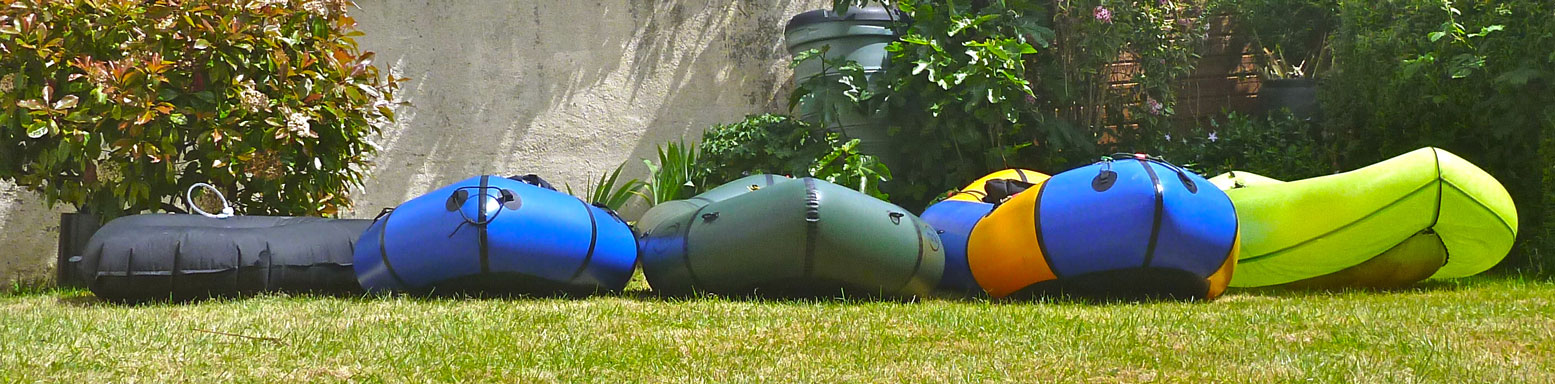
After a chilly lunch at East Lock, sheltering against the wind behind a couple of upturned boats, it was my turn to try the Nortik Trekraft. The day before I had all the boats out in the garden and have to say these Russians can cut and assemble a German-designed packraft just as well as anyone else. Maybe it’s not so hard, but I doubt it. The manufacturer Triton has been making folding and inflatable kayaks for years. In Germany slightly different models are sold under the Faltboot brand who are part of Out-Trade who designed the Nortik Trekraft – or something like that. Like a lot of Russian-made gear, I’ve read that some Triton kayaks have an unrefined, agricultural reputation that can be mistaken for ruggedness and durability.
Feathercraft’s unsold-in-Europe BayLee ought to get a look in, but if one assumes Alpackas are the current state of the art then, like the MRS, the Trekraft is up there. The early production run Trekraft we had was just under 3.1kg on the water. Newer versions of the same model are said to be some 200g lighter. The truth will be in the durability of course, as out of the box a €600 packraft floats just as well as a £30 slackraft. As with a lot of outdoor gear, you can pay a lot more to gain a small advantage, which can include image as much as performance.
You wonder if heat welding the joins with tape without also sewing each panel’s seams is strong enough? Well, if you assume that, as with welding steel, the two pieces become joined on a molecular level then it must be, though that didn’t work so well on our Matkat test boat. In this way you’d think sewing (as the MRS and Alpacka do) is as redundant as riveting over a steel weld. Sewing may be more to do with aiding reliably accurate assembly without recourse to tape. And anyway, the Trekraft handled the Store’s0.5 bar pressure test as well as the rest.
Other details on the Trekraft include four plastic D-rings on the bow, easier to use than tape loops but possibly prone to sub-freezing brittleness and attached by a relatively small contact area compared to a typical 3-inch patch. The seat (left) is a bit less thick than the other two test boats with seats, and is held in place with four small velcro tabs biting both sides of the loop part (right). If the loop tab on the seat was full length it would enable some forward positioning options – and this raft has the interior room to do that. As it is, velcro does have a finite life span and is a pain to replace compared to bits of Alpackan string (or reusable zip ties which I prefer in my Yak).
A nice touch unique to the Trekraft is taping the floor to the hull inside the boat where otherwise grit can gather and work its way into the join. Same goes for the spraydeck on the decked Trekraft (orange, right – not tested here).
For the moment the Trekraft only comes in one size and one thing that put me off when the dimensions became known was it seemed too big inside. Even on flat water a packraft works best when it’s a snug fit in width and length, just like a shoe. On a kayak, footrests do the same. Our Nortik came in at 134cm inside, the MRS and Yak were 117 and 120cm and the MRS felt just my size (helped by the non-tapered foot box). In width too the Trekraft is from 9- to 5cm wider than the other two (the Supai was widest at 43cm). Tube diametre is 29cm; midway between the Microraft and Alpacka.
I have to say though, getting in and paddling away I didn’t notice any ‘looseness’, though I and others did stuff some bags down at the bow to take up the slack and stop us sliding down. The raft is actually nearly the same overall length as my Yak in which I am well jammed; the added inches are accounted for by the Yak’s longer stern prong.
We noticed that at each changeover (~40 mins) the Trek needed a puff or two up its one-way valve, though not enough to make us bother looking for a leak. All the boats except the pump-pressured Aire needed this, though part of that may be my preference to paddle a boat that’s as hard as my lungs will permit. Also, the afternoon cooled off and showered to the point where I at least was numb and shivering by the time we reached the tea shop in Yalding. So much for early summer in the Garden of England. There’s more on each boat’s inflation procedure on the introduction page; the Trekraft does have a small operational anomaly.
On my second spell in the Trekraft I found water oozing up through the floor after a few minutes. It turned out I’d inadvertently been sitting on the bilge pump (right) which had slid under the seat. The edge of the intake had pressed against the floor and pushed a slit a few millimetres wide through the fabric. Normally you’d avoid any edged object pressing under 90 kilos into a packraft’s single-skin floor, but I’m not sure this would have happened so quickly on my Yaks’ more robust floor (but which I’ve also holed one time). I did notice that while paddling the floor seemed to wobble more than it does on my Yak, as if it’s either less rigid or not as taut. You can see it in the groupie photo or here.
Floor fragility was something I addressed (clumsily) with my very first Alpacka (right) and is why I now run a double thickness ‘butt patch’ on my Yak, plus a closed cell foam heel pad at the front. How ironic that the bailing pump caused the need for a bailing pump. A bit of stray tape stemmed the flow and at Yalding Robin pulled out a proper bit of gaffer from his batbelt and fixed it for good.
One benefit of the Trekraft’s generous internal space is the ability of packing your gear low in the boat, not strapped over the bow blocking the view of some oncoming hazard – or inside the hull tubes, as Alpacka’s cunning but flawed Cargo Fly system allows. I imagine that could be adapted to any TPU-coated boat though you could also try packing gear behind you as on the Aire to put you in a more balanced, kayak-like paddling position. Not sure if that’s really necessary with the Nortik and anyway, all the gear at the back would make the boat back heavy. I like the suggested idea of a beachball backrest – gives you something to do at lunchtime, too. Or of course it makes a roomy platform for bikerafting.
The other useful benefit we found was the ability to fit two smaller adults in the Nortik. With the Supai out of action and the Aire not that effective as a tandem boat, Hannah and Lois didn’t look too cramped, huddled in the now repaired Trekraft for the last short stretch to Hampstead Lock. It shrugged off their 150-kilo load (left). So may have my Yak, but they’d have needed prising out of that one with a hair drier and a spatula.
To me the best thing about the Nortik is the €600 price. That’s over a hundred quid less than I paid for my Yak, even bought direct in the US. And the (properly) decked Trekraft goes for just €200 more, though it may help to pad out the insides to make a good connection for whitewatering. The weak rouble may have something to do with all this but between them, those are the two best reasons to have a closer look at a Nortik packraft.
One tends to compare new boats against Alpacka because they were the innovators who took the whole packrafting game forward. Now that I’ve tried the competition I can see the gap between the Colorado-made boats and the two similar packrafts from China and Russia is much smaller than most would imagine.
But between them these five boats occupy three different categories, with some overlap. The MRS, Nortik and Alpacka all make great do-it-all boats, especially as the later two have spray skirt options. The Supai and the Aire (in prototype form) are more single-minded and uncompromising: extreme lightness or kayak-like hair-boating agility.
Back in the day the question was ‘which Alpacka should I buy and what specification can I afford?’ Now it’s great to have the choice that’ll no doubt see the new contenders evolve and others emerge.
Other vendors do exist but you can see the full range of the Packrafting Store’s 14-odd packrafts here. And don’t forget, you can rent before you buy to save you making an expensive mistake. Thanks to the floating foursome: Bob, Hannah, Lois and Robin, for giving up a day to help out with this group packrafting test.
Among other things Supai Adventure Gear (moto: ‘Where every ounce counts‘) makes what have become to be known as ‘crossrafts’, ultralight packrafts suited to gentle flatwater floats, canyoneering or crossing lakes while avoiding any kind of rough handling. In other words it’s like a slackraft pool toy, but at a fraction of the weight and made from fabric, not PVC film. We were a bit unlucky with our Matkat so bear that in mind when reading what follows. We assumed the previous user had given our example a hard time and managed to put no less than two holes and a split in it. That’s two more punctures than I’ve collected in ten years with IKs and five years of packrafting. The Packrafting Store has since been informed by Supai that that boat was part of a batch with production flaws. Blowing the boat up out of the box revealed a puncture under the stern (not unexpected in that position) but once that was fixed another leak emerged from a split seam.
The seam may well be a manufacturing fault, or the black boat could have been left out in the hot sun for too long (right) – a lesson I’ve learned the hard way with a previous IK and one reason I did this to my current kayak. Had the Matkat been my boat I’d have either sent it back or hot-ironed the split shut (as I’ve successfully done on an old Alpacka seat). But I didn’t want to risk inadvertently melting a hole in the test raft, so I played it safe with some Bostik 1782. That done, the raft still seemed to lose pressure – or was it just me? I checked the cap and valve and then tried to check the exterior seam for other leaks in the bath, but the Matkat’s bulk makes this awkward to do unless you have a bathroom out of an Imperial Leather advert. So I decided I was being fussy. These ultralight crossrafts are always a bit floppy, aren’t they?
But now, ten minutes downriver from Tonbridge Town Lock I wasn’t being fussy as the boat got soggier and soggier and my arms strained with the effort of hauling it through the water. Even getting in saw the boat fold up under my weight and take on water; that’s why I’d brought a bailing pump. Another ten minutes downstream and I had to call in a top-up (I couldn’t reach the short tube for fear of swamping). As air was slowly lost the boat didn’t actually get lower in the water. Instead you sank lower into it as the raft collapsed in on itself. Your backside sags at least six inches below water level making paddling the metre-wide raft even more awkward (you’ll want a long paddle with this one – even with no leaks). Pumped up it was briefly much better – or as good as a Matkat can get, but I needed another top-up before the next chute and a welcome raft change over.
Looking at the photos it doesn’t look that bad, does it. But that’s because, like a slackraft, the weight of a person on the water gives the the boat form. Step out (above right) and it became unnervingly limp.
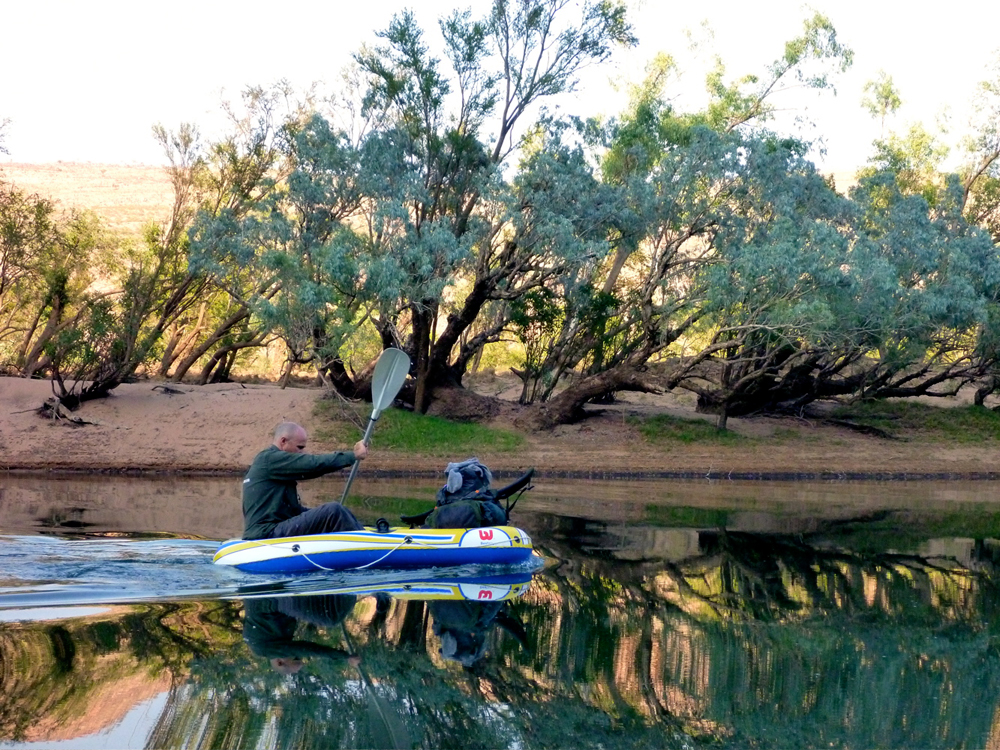
It was the same for everyone in what we christened the ‘Bin Bag’. I now know how my mate Jeff felt a couple of years back, paddling his execrable slackraft for nearly a week along far northern Australia’s Fitzroy River (right). Paddling a wide, soggy, unresponsive boat is as much fun as cycling on flat tyres. But like a slackraft, even at full pressure I doubt a Matkat’s thin fabric can’t attain rigidity of a conventional packraft. That’s the price you pay for an inexpensive boat that can almost fit inside a large jacket pocket and weighs less than my lightest carbon schmarbonstick. Robin and I briefly tested Supai’s Canyon Flatwater II (left) in late 2013 and, while both attracted to the ultralight crossraft concept, came away unconvinced. The Flatwater floated with 80-kilo Robin in it, but lacked reassuring buoyancy once anything other than the gentlest of paddling was called for. Robin was inches from shipping water over the stern and settling it off into a bobbing cycle could see it swamp (The near-freezing conditions and inappropriate clothing may have influenced our paranoia). The black Matkat is Supai’s answer to the ‘XXL version’ we hoped to see.
Back on the Medway over lunch I finally tracked down a tiny hole in the top of the raft near the inflation port. I’d expect damage underneath and maybe another seam to blow, but this was the last place I’d look. So however it happened, it does make you wonder if 75D polyester is pushing things a bit too far for the realities of wilderness adventuring rather than goofing about. Incidentally, our Matkat’s fabric didn’t look the same as the red Flatwater II we tested – there’s no embossed diamond pattern. Instead, it has the same texture as the MSR water bags I compared the red boat to (right), though I can’t say the Matkat felt any thinner than the red boat.
We’d hoped (and even suggested that) Supai make a longer boat with fatter tubes, something more suited to grown men carrying gear. Instead the Matkat is simply a Canyon with 8cm oversized tubes. Now at least a metre wide and 43cm wide where you sit, we weren’t even sure it would fit down the first chute out of Tonbridge. That makes it wider than the Aire BAKraft but you’re sitting up to a foot lower down, well below water level. That’s made worse with no seat. Knowing that I brought an old Alpacka seat base for everyone to use. Bare that in mind in the pictures. Above left is Lois; at 65kg the trim is just about level but she’s sitting some 4-inches higher than normal.
Like the Canyon, the Matkat has seven reinforced attachment points punched out from extension tabs along the peripheral hull seam (left). They may all be better used to thread in a perimeter grab line than for attaching heavy gear. Or maybe tie gear off a grab line to avoid a thin line’s direct force on the tab’s hole. More so than other packrafts, the extremely light Supai’s will take off at the slightest gust – and if that happens on the water following a capsize you could be in trouble. Hence the suggested grab line if not even a tether when paddling in windy conditions.
All day the Matkat languished at the back of the pack as each stoically endured their spell in the Bin Bag, periodically asking “how far d’you say to the next chute?” A shower hosed us down and as we neared Yalding tea shop Hannah on her second spell was getting lower and lower in the water until just her head and arms were visible above the sides. It was decided to abandon ship and enact an on-water emergency evacuation. We unclipped the Aire’s bulky backrest, Hannah crawled onto the BAKraft and with Lois they shot off downstream like a skimmed pebble. The Matkat was aired down and stuffed into a raft.
I said as much when the Matkat’s dimensions were announced a couple of months ago. By taking the easy way out and using the same floor pan and internal section, Supai missed a trick by making this a fatter, wider raft (100 x 175cm, but see the intro) rather than a slimmer, longer one. As it is both Supai models could easily lose 5cm of width inside; it’s not like you’re going to be bracing the thing through Grade III whitewater. It reminds me why the Alpacka-style extended stern works so well: it adds buoyancy where it’s needed but without width – and it lengthens the water line for greater speed.
There is a place for an inexpensive sub-1000-gram crossraft. I could have used one myself in Turkey the other month where the 3kg weight and bulk of my Yak became a chore over 200kms. But no matter how flat the water – be it Scotland or Alaska or the Lycian shore – alone you want to feel secure mid-river, estuary or lake if a gust comes up, a swell rolls in or an oil tanker’s wake surges towards you. The 792-g Matkat has the added buoyancy the Canyon lacks, but the claimed payload of nearly 150 kilos feels improbable in the real world; the momentum of that weight against any wave will see it plough in. The Matkat is now so wide for it’s length it paddles little better than a tractor inner tube wrapped in string (click one back in that slideshow to see what happens to Supais when used too hard).
And with this estimated 30% added volume over the Canyon (right) you could really use an air bag, even if they make it an optional extra. (More on inflation – and a suggested solution – in the intro). A seat can be up to the user: they could to sit on a pack or buy a 150-gAlpacka for $25.
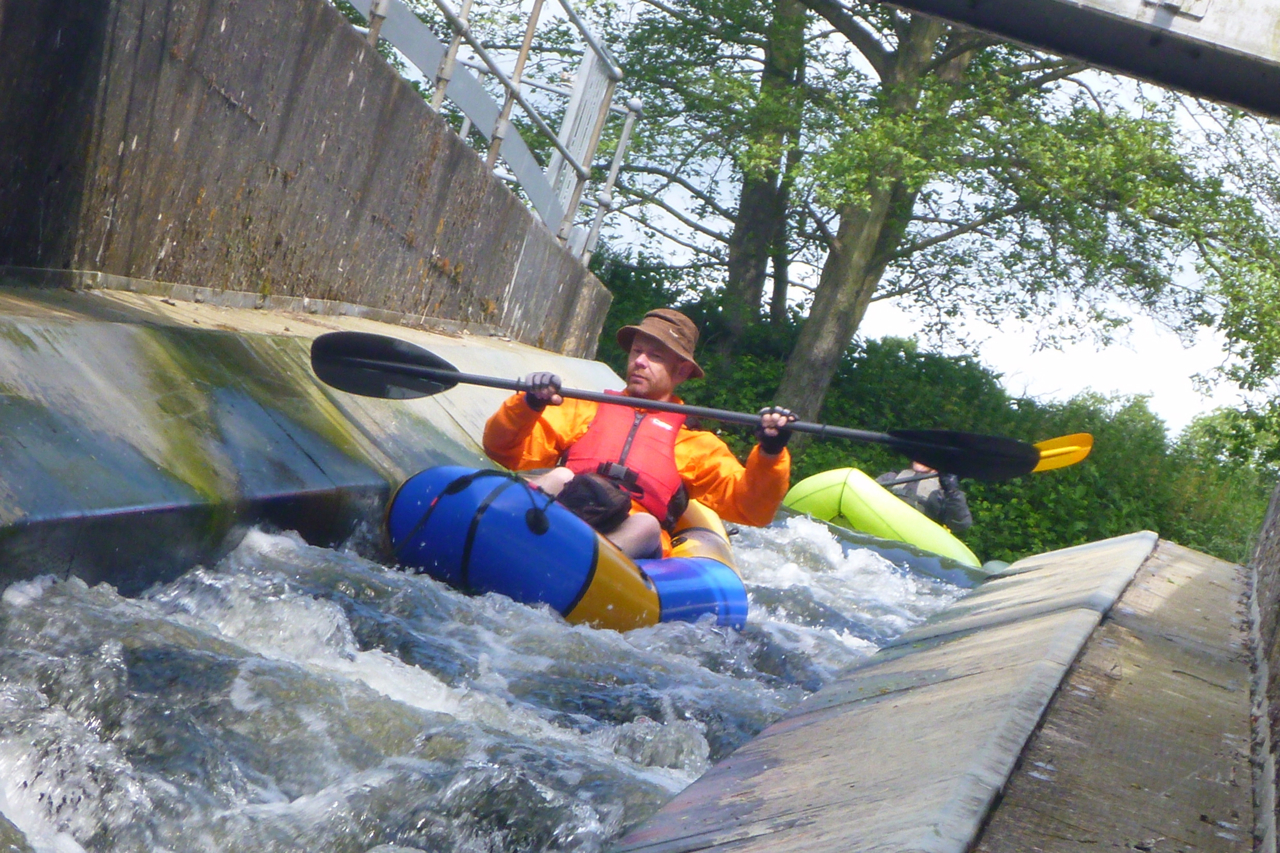
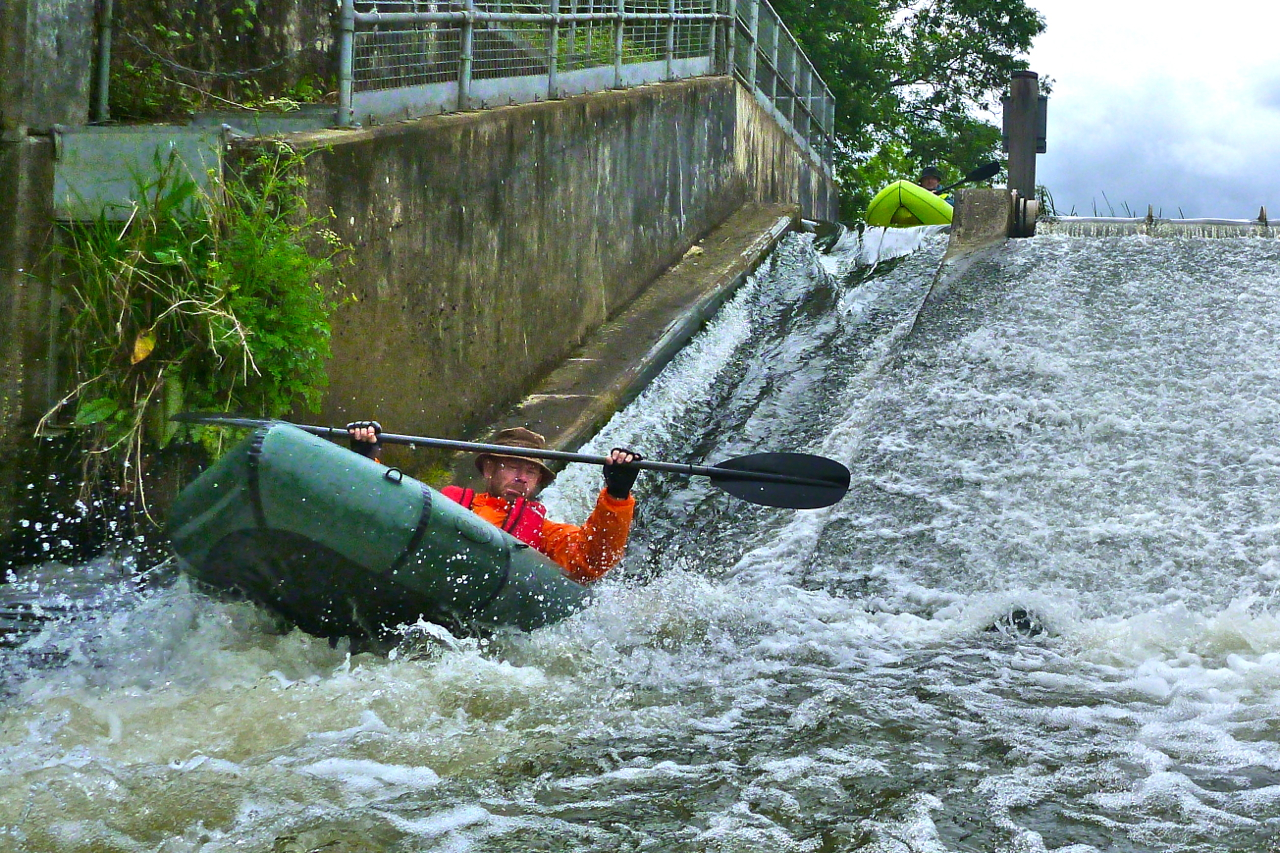
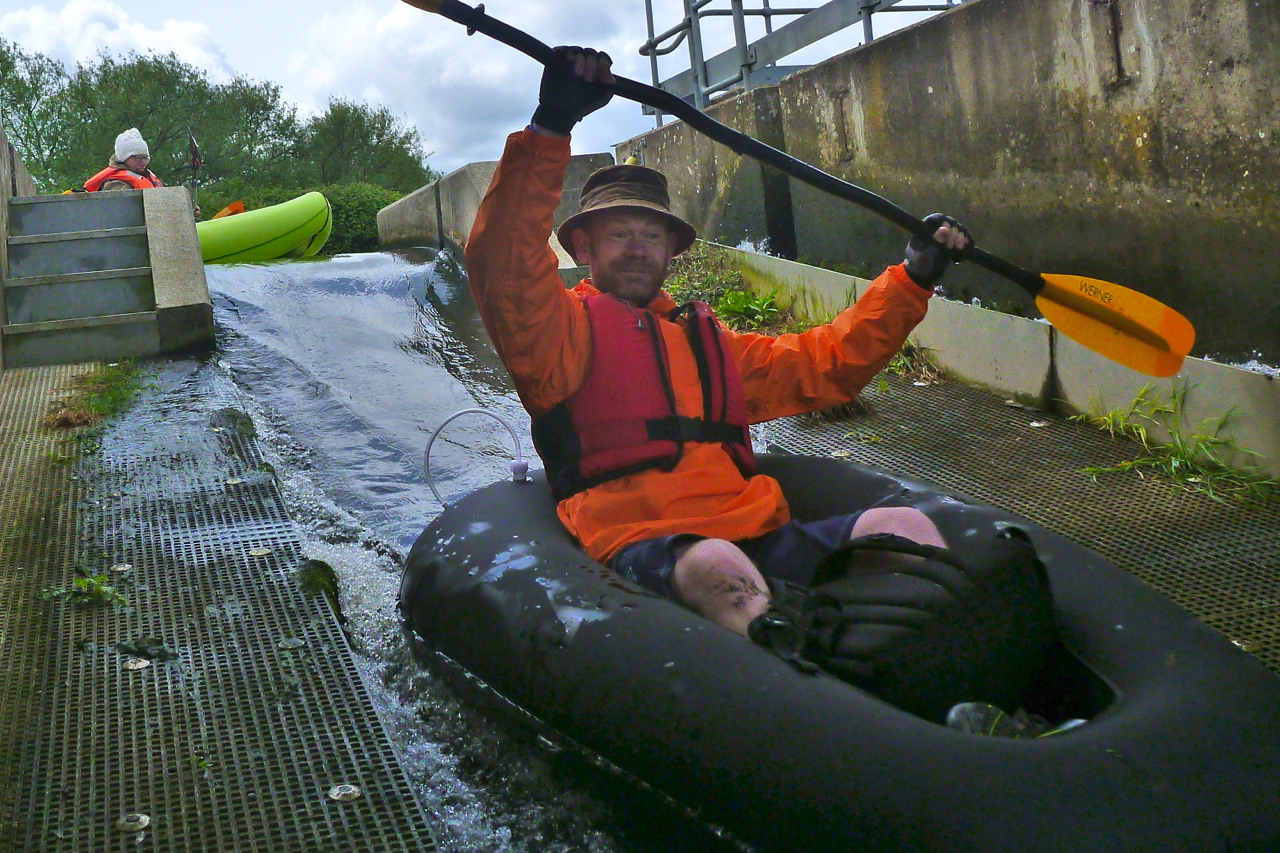
To be fair a full day on a calm river is not a leaking Matkat’s forte, though it’s interesting to note it handled all the chutes, including the steep Sluice Weir, (left) without shipping any more water than the other rafts, including my snazzy Yak. As I mentioned in the Canyon review, what we wanted next was the same boat but just bigger all round (not unlike the long lost Sevylor Trail Boat, above right) because it looks like that would work. Perhaps a 75D crossraft couldn’t contain a longer hull without folding. Whatever the reason, if it ends up weighing 1106 grams, is made of a more rugged fabric and comes with an air bag, then so much the better. For other crossrafts see this.
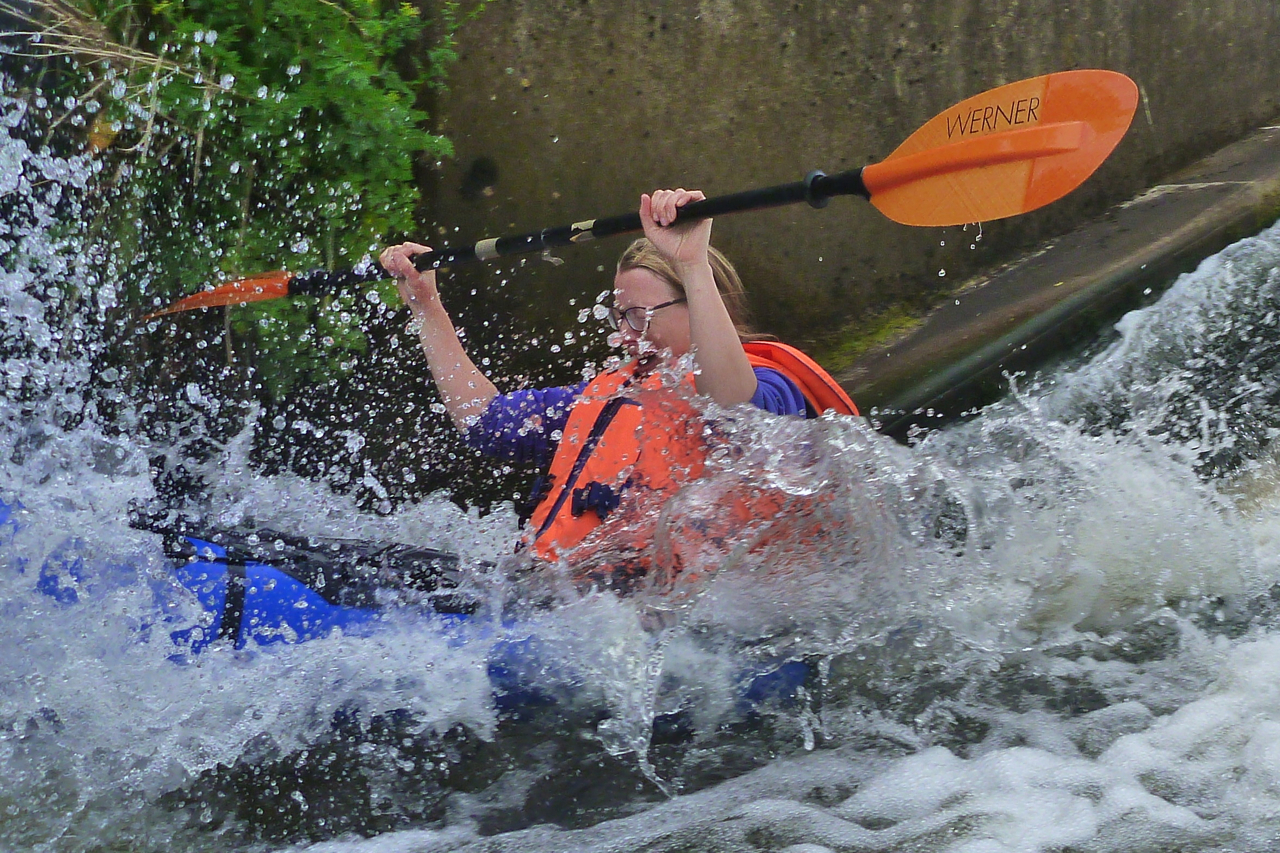
After being pulled out of the Matkat this was much more like. I was gliding along, whoosing forward with each paddle stroke, tucked under the deck of the MRS Microraft. Yeah, baby! However unfair, we all admitted that whichever boat you used after the Bin Bag was the best boat of the day. A Chinese-made packraft sounds like a hard sell, especially when it so closely resembles a Gen II decked Alpacka that it risks being labelled a cheap knock off. But the price of the Microraft isn’t cheap, and as far as we could tell neither is the build quality. With China’s enduring if outdated ‘made in Hong Kong’ reputation and MRS’s unsophisticated website on Aliexpress, this can be something that’s hard to get your head around. But we forget that good and cool stuff is made in China too: when’s the last time someone scoffed at an iPhone because it was made in Chengdu? The difference is that iPhones are probably designed in some groovy Californian creative play pen. That’s not the case with MRS but whoever’s behind them is definately not in the knock-off or pool toy game and has gone out of their way to make this comparable with Alpacka in more than just looks. The deck may look identical to the thin velcro-and zip item I had (but rarely used) on my first two Alpackas. But the Microraft differs significantly in having parallel side tubes (like a white water raft) and less bow upturn. You imagine the parallel tubes simplify construction a little and I didn’t sense any noticeable tracking drawbacks on the water. On the contrary this arrangement makes for a footbox that’s as wide as the seat so that even in this Small/Medium 120-cm-long model my large feet weren’t jammed as they are in my 177-cm long Yak. At 27cm the Microraft does run the thinnest tubes of the bunch and I noticed that Bob (at 85kg – right) looked quite low and back-heavy (I’d have been even lower) while Hannah and Lois looked just right in this raft. And we’re told that a side benefit of slimmer side tubes is better edging in rough water. The picture from the Store (left) clearly show that the Microraft can tackle the white water with the best of them. The seat is threaded in with string like Alpackas and our boat came with nine attachment loops, four up front, two at the back and three inside. The fabric has less of a shiny sheen too, but is applied to both sides so is more puncture resistant. Another thing I liked about the MRS was the non-featherweight air bag that feels so much nicer in the hand than my Alpacka’s net curtain. (They say restos with heavy cutlery can charge more). And the valve cap attached to the valve body: a simple solution to lost caps held on with string. I never trusted that lightweight ‘Cruiser’ deck on my Alpackas, and the attachment was messy with exposed positioning tape peel;ing away on a hot day. But as our test day grew increasingly chilly and wet, so everyone in the MRS including me was pleased to tuck in and zip up, like a granny by the fireside. It’s not a bomb-proof solution to white water – the decked Trekraft or self-bailing BAKraft are probably better, but it sure slows down the swamping while keeping your legs warm. Only the 1000-euro price tag needs some getting used to; it feels too close to an Alpacka while you assume Chinese workers’ wages aren’t, even if their workmanship and the materials used are hard to tell apart. If you took off the MRS label, I could have easily been fooled that this was a new Alpacka model. And that alone must be worth the price.
















































 After being pulled out of the



 Inflatable Kayaks & Packrafts