Category Archives: Urban Paddles

Packrafting Bradford-on-Avon 8 mile loop

See also
Sigma TXL index page
River Wye
Regents Canal
Wey Navigation

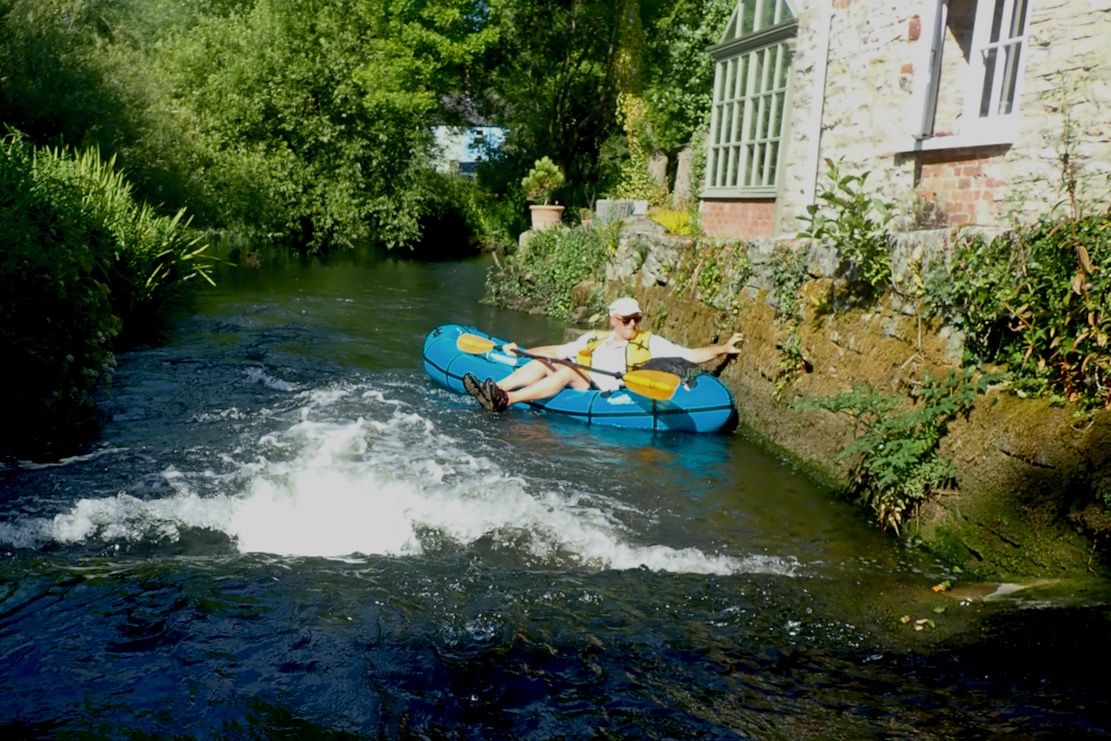
They say Bradford-on-Avon near Bath is one of England’s prettiest historical towns. I blundered through the other evening trying to outwit the satnav, and it didn’t look too shabby. With something to pick up near town, I wondered if the Avon river was paddleable, and found Andy Ballard’s nice canoeing vid above. He describes an 8-mile-loop which follows thne river towards Bath, before hopping up onto the parallel and lock-free Avon & Kennet canal at the Dundas viaduct to return to BoA. That will do nicely.
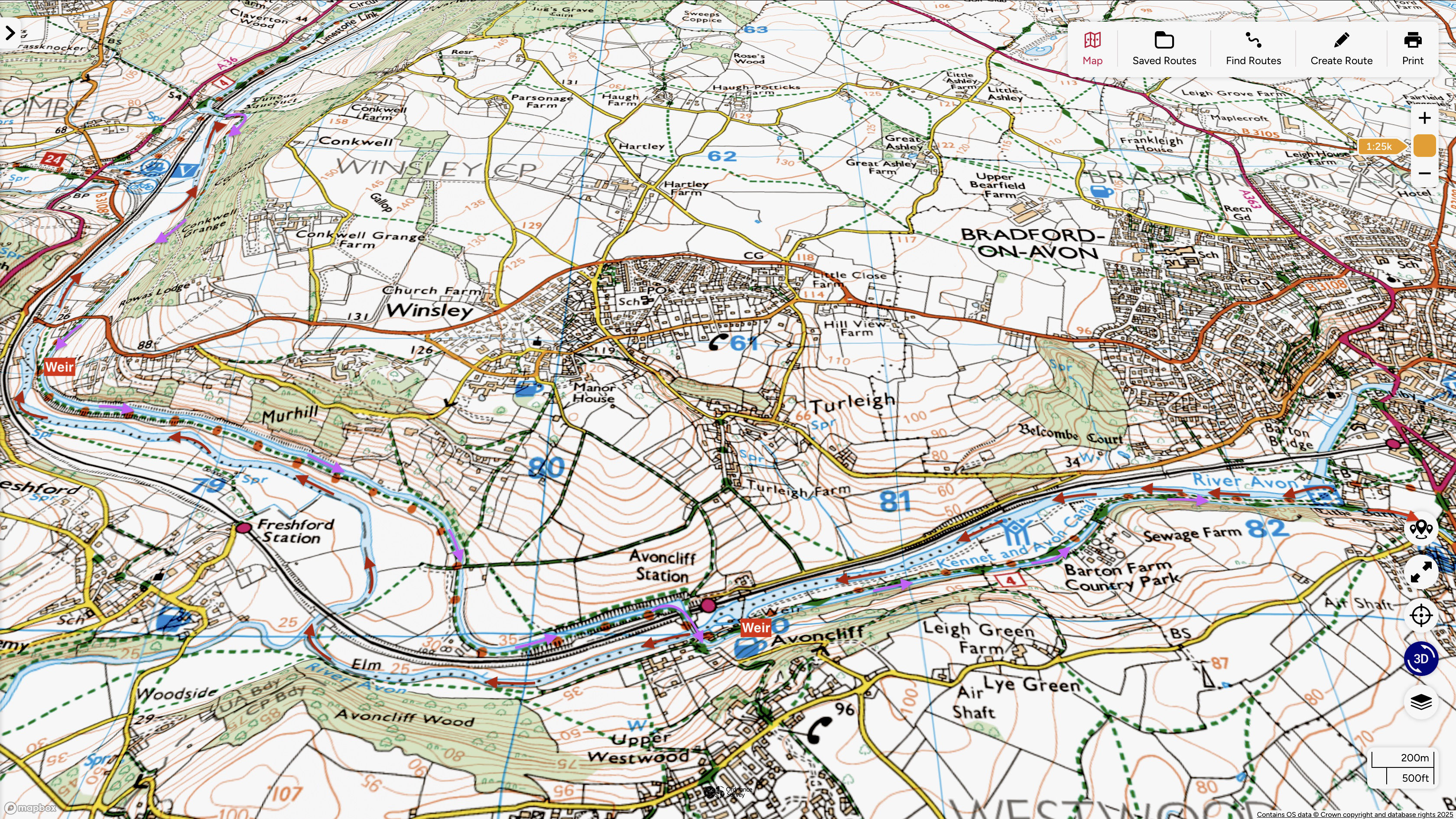
Avon 8 mile loop

‘Pay attention at the back!’
Completed around 1810 towards the end of the ‘Canal Mania’, the Kennet & Avon Canal essentially crossed southern England’s watershed to link the then key port of Bristol at the mouth of the Avon with London on the Thames. At Paddington in London, the Grand Union was completed around the same time, and led up to the north’s mines, foundries and mills, and where the network of canals became much denser (below right).

The Thames and Avon rivers were long navigable inland as far as Bath and Reading and the K&A linked those two towns over 87 miles. Kayaking the Wey Navigation and packrafting London’s Regents Canal taught me that Britain’s canals helped kick off the world’s first industrial revolution. They linked or added to long-established river navigations to extend inexpensive and reliable cross-country transportation of heavy, bulky or fragile commodities.
At this time the decrepit road network along ther Bath Road (A4) was still suffering from 1500-years of neglect following the Roman era. Coaches carried passengers and packhorse trains were superior to wheeled carts, but turnpike fees (tolls to help pay for road upkeep) made them costly. Hostilities with France included attacks on coastal shipping in the English Channel, necessitating secure inland transportation to help provision the war effort. The former Wey-Arun Navigation linking London and Surrey’s gunpowder mills with the navy fleet at Portsmouth was another example.

Once 18th-century nimbyism had been overcome, canals soon became a reliable investment opportunity which made nearly all shareholders richer, while seeing commodity prices drop for all. But Britain’s canal boom was short lived and 30 years after completion, the K&A was trounced by the Great Western Railway, itself trounced a century later by the M4 motorway.
Since WW2 canals and their adjacent towpaths have been widely restored and especially in cities, can be historically interesting byways. But recreationally they’re more suited to walkers, cyclists and powered river craft than paddlers. The lack of a current means they can work both ways, but portaging locks can break a journey’s flow, as they can on a rivers like the Thames, where canoe chutes are few. And the popularity of canals and towpaths can make them busy places compared to a natural river winding through the landscape, with the odd aerated riffle to spice things up.

I tried to do the right thing and buy a paddling day pass from the Canal & Rivers Trust in Bradford basin (not sold online afaict). But what looked on the map like a C&RT office turned out to be a cafe and gift shop. Oh well, at least they got a fiver off me in their car park.

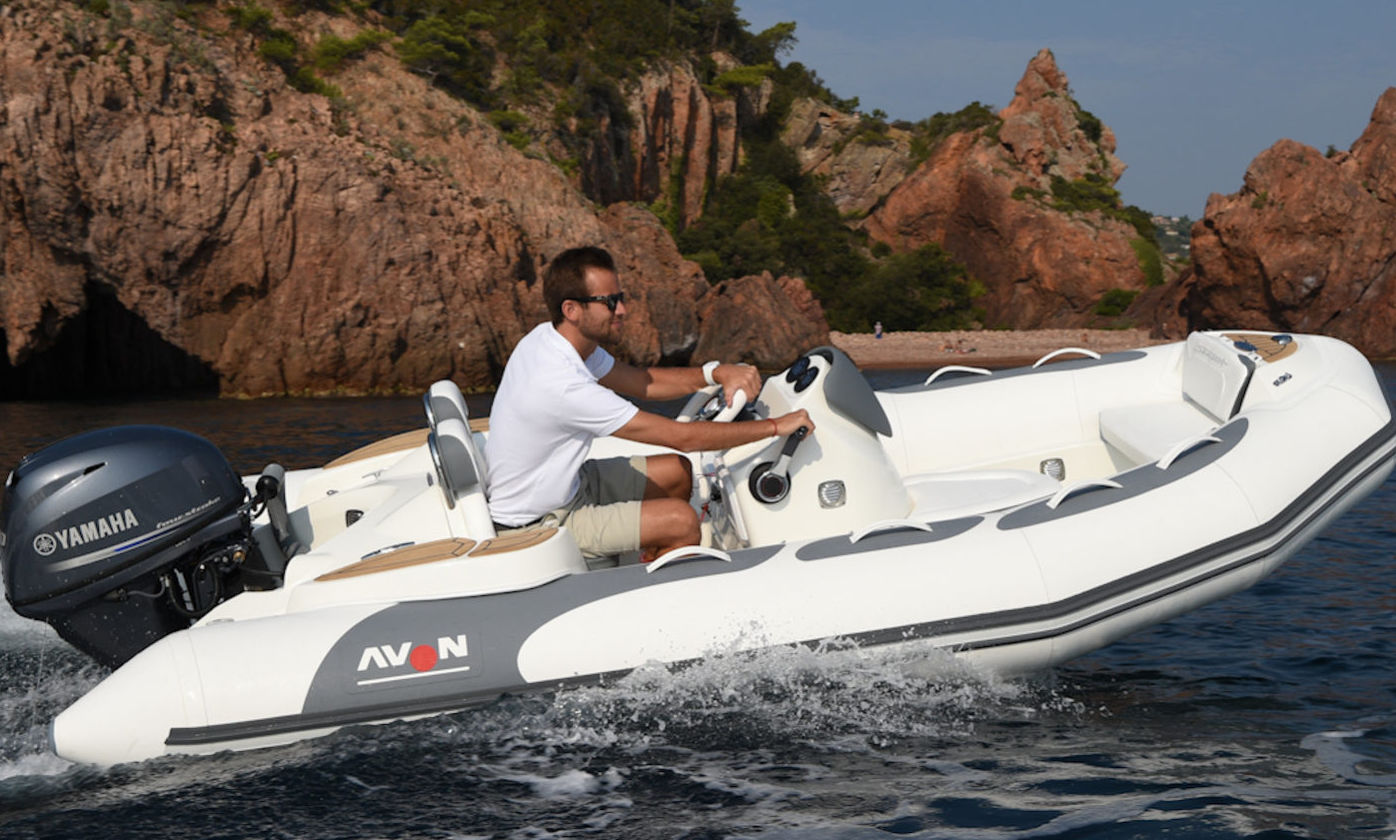
Signboard in the car park noting the dawn of rubberised fabrics in 1848 (interesting BoA Museum page) and which became Dupont hypalon we know and love, and then PVC. It explains the brand name of Avon Rubber Company and their RIBs (middle) and moto tyres (right). The factory was by the secind weir at Limpley. Avon RIBs were bought by French Zodiac in the 1990s, and after 112 years the Avon tyre factory up river in Melksham closed in 2023.

I have a mooch around the huge, 14th century Tithe Barn, a feudal tax warehouse where peasants surrendered part of what they produced to nearby abbey. Then in the 1530s, Henry VIII grabbed all religious properties for himself.
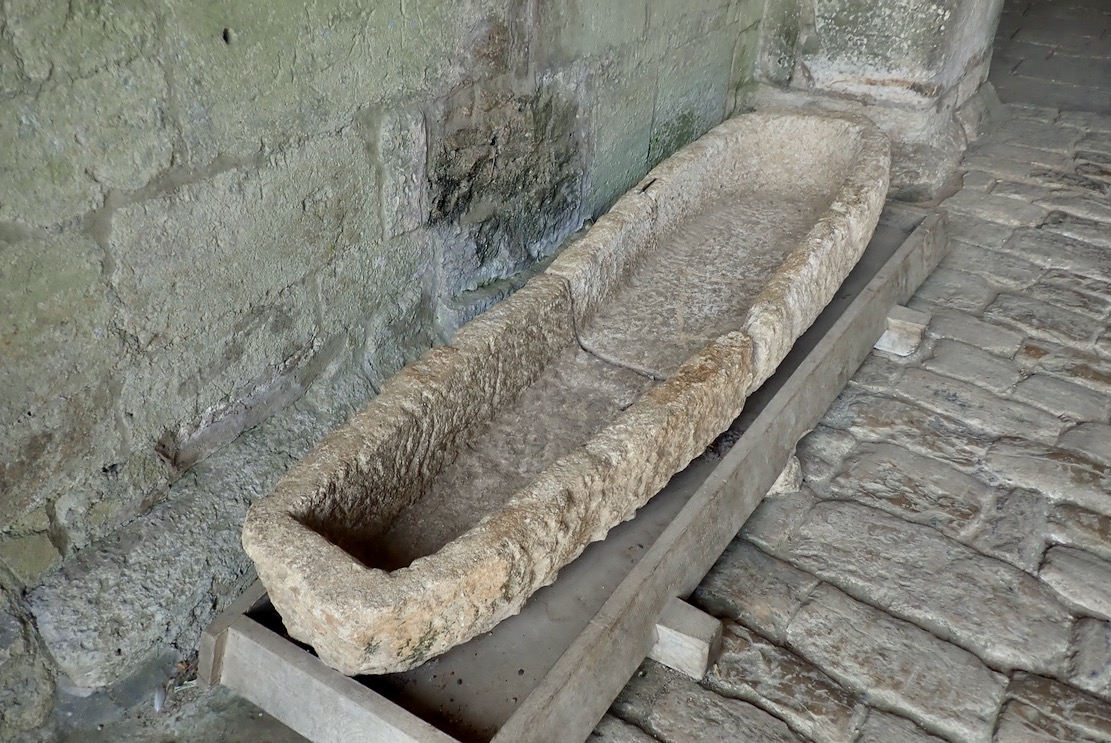
An experimental Roman dug-out canoe later repurposed as a sarcophagus. Along with a Saxon church, there are many historic buildings in BoA, most dating for the Industrial Revolution.
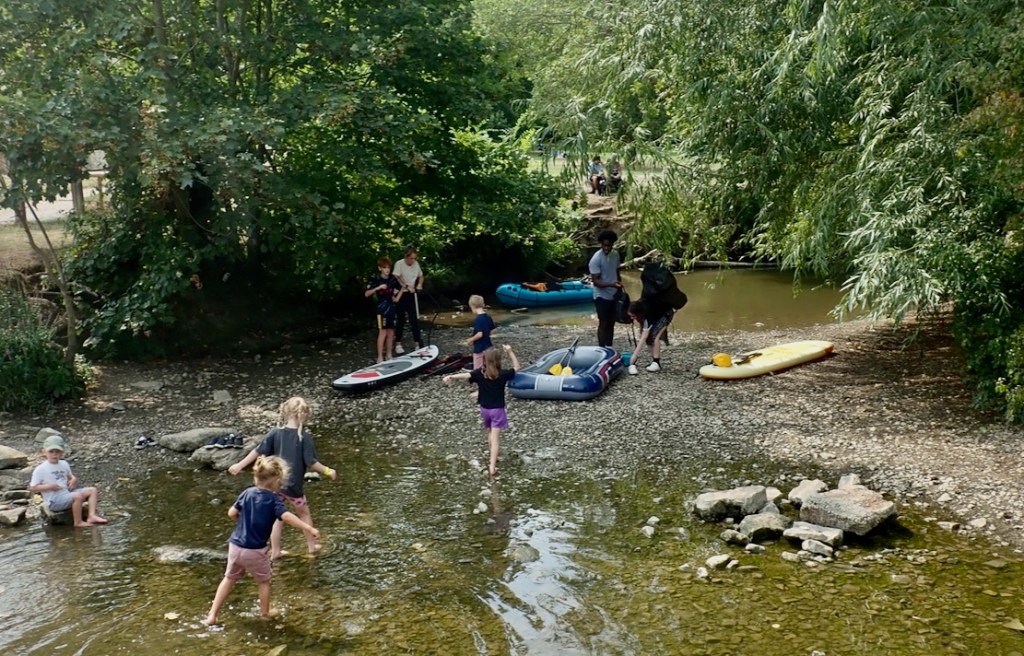
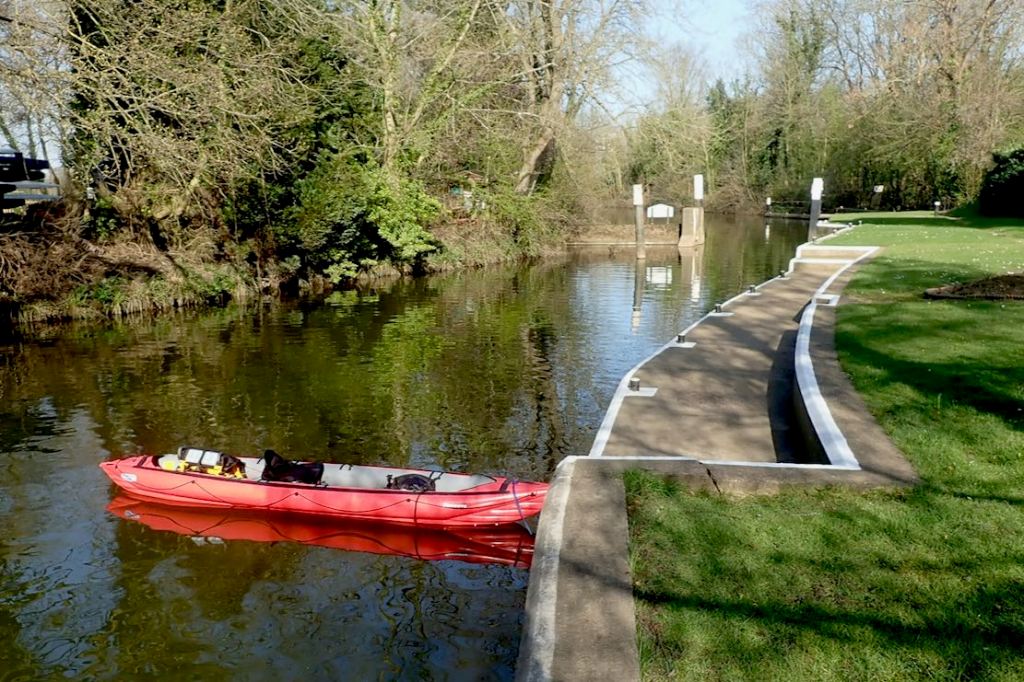
Easy put-in just by the barn. Loads of kids on paddle boards, plus a £20 slackraft to even things up a bit.
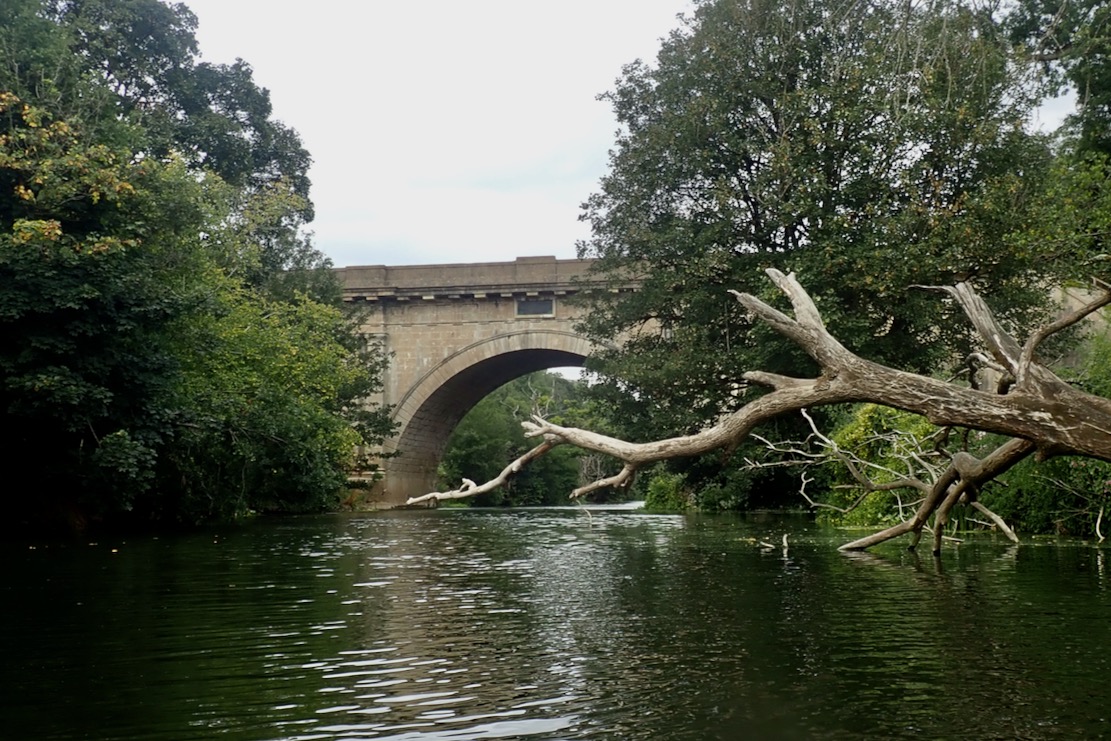
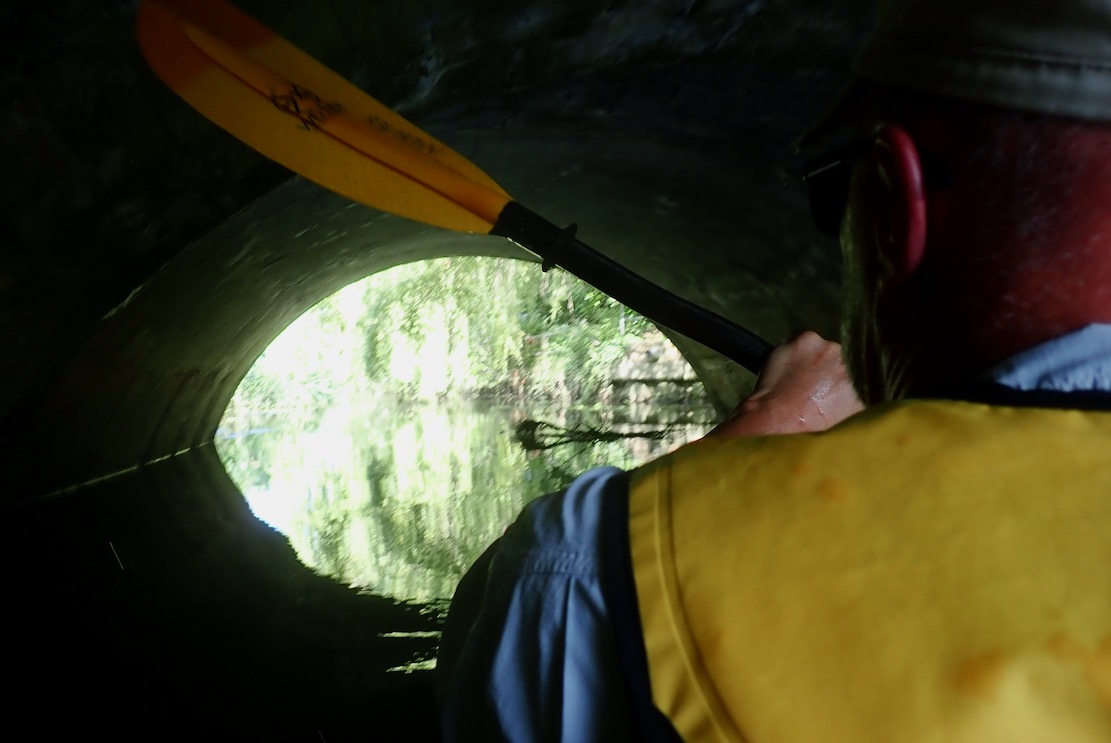
Soon I pass under the Avoncliff aqueduct which I’ll be crossing in a few hours.
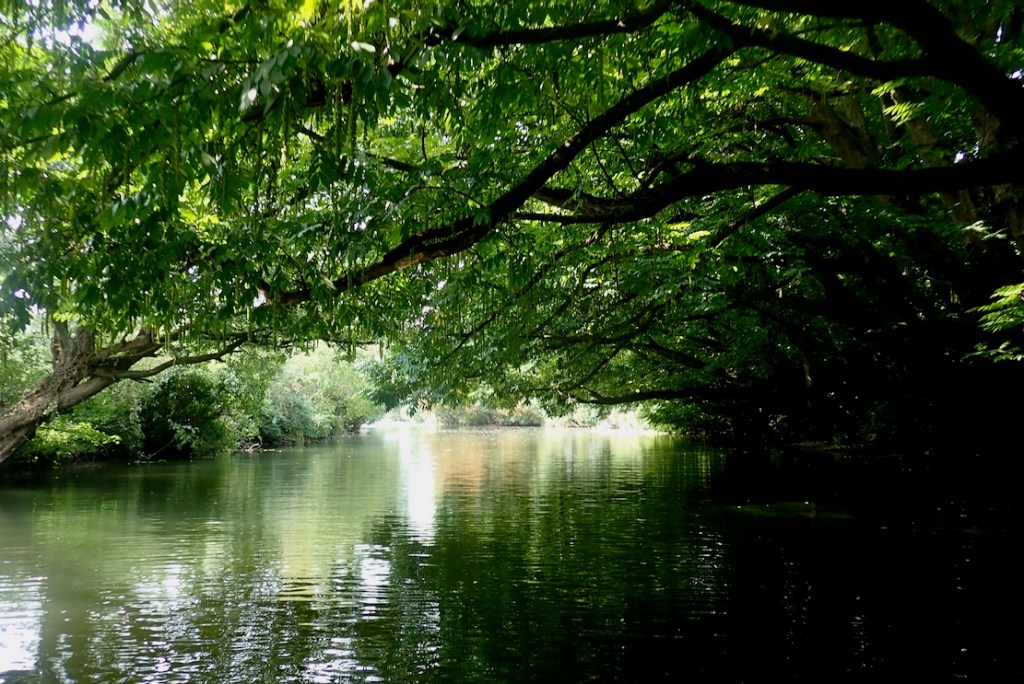
Lovely riverside treescapes.
Some are already turning, despite being right by the water.
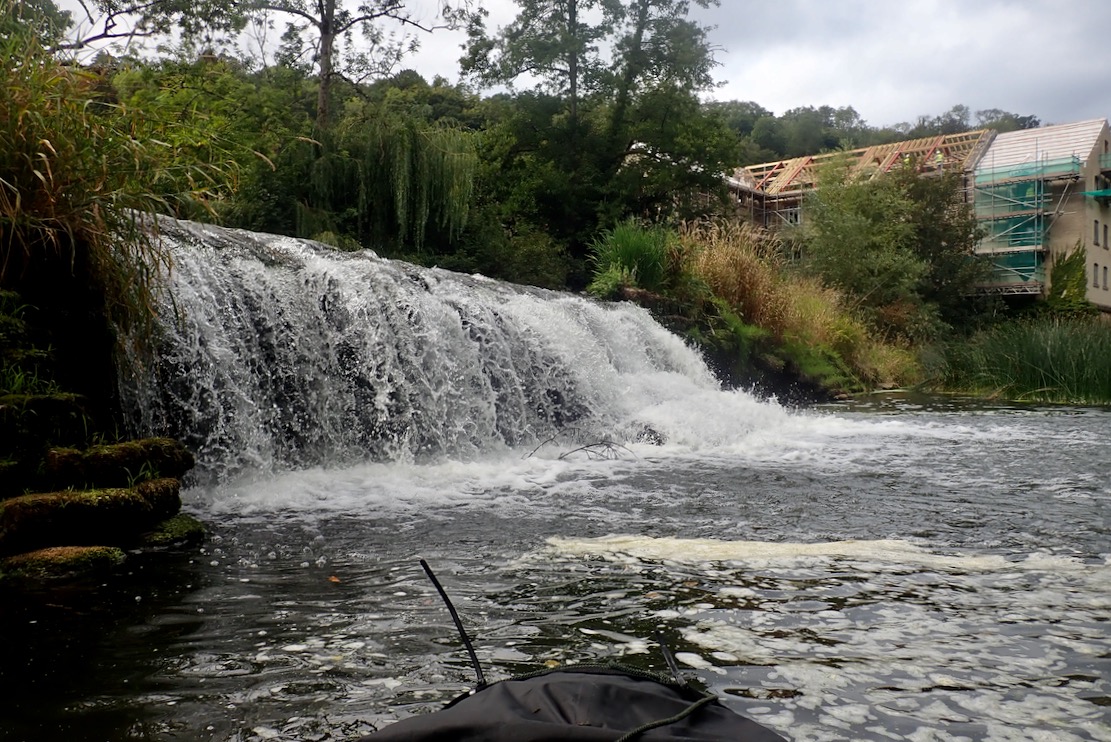
The first weir at Avoncliff. A Medway-style chute would be nice, but I read the weir face steps are shootable at much higher water levels. Sounds a bit sketchy to me.
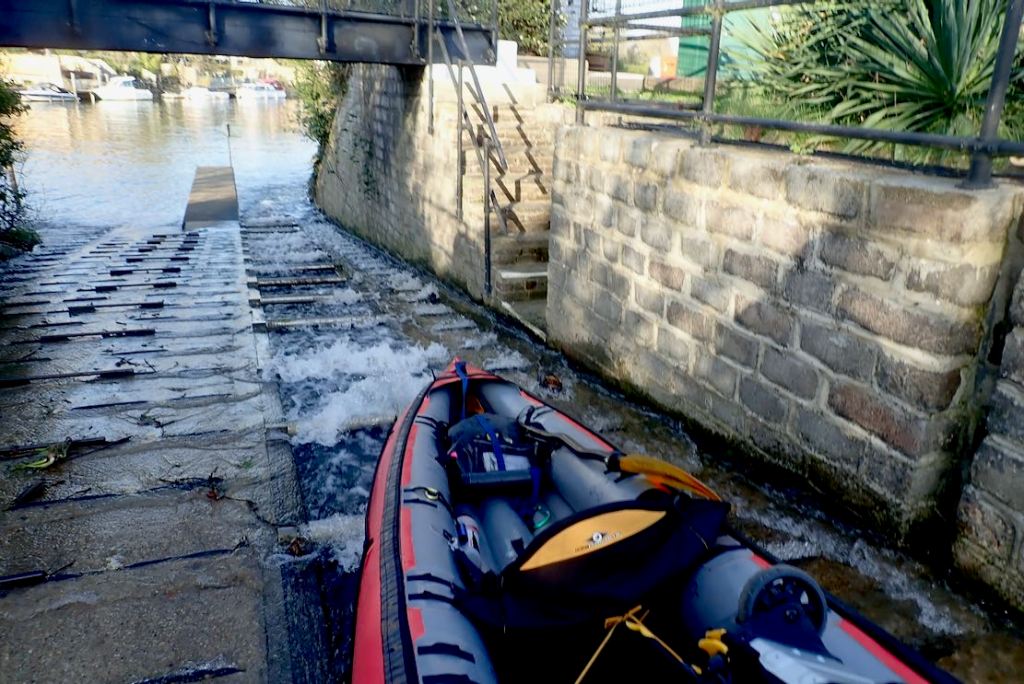
The exposed steps make for an easy portage.
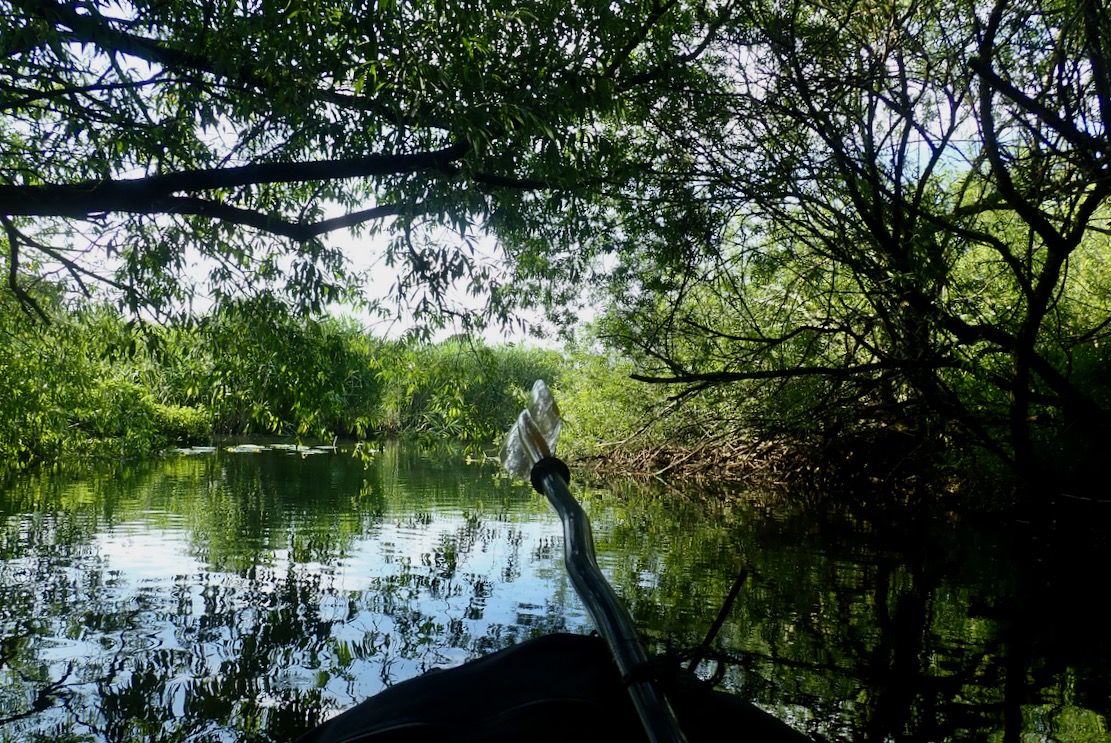
Once below, a brisk current flushes me through the reeds.
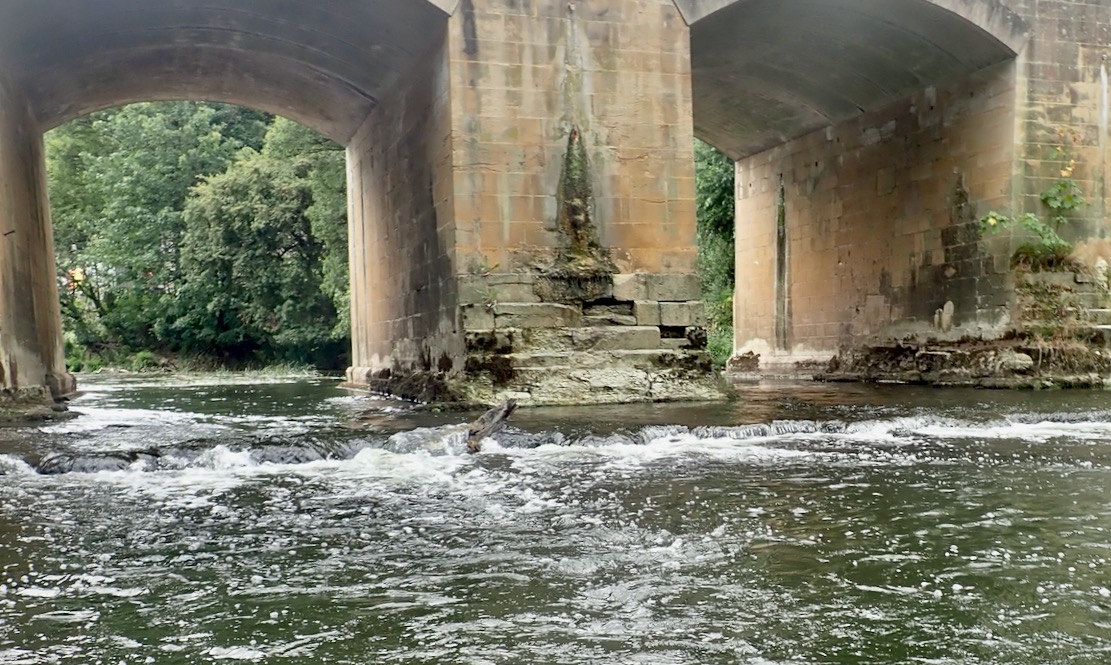
The second weir at Limpley Stoke. The steps river right are a bit steeper here, but easy enough. Not sure I’ve seen stepped weirs in the UK before. Avon Rubber’s original factory was here at Limpley Mill.
There’s a road bridge soon after followed by a 7-inch weir. The skeg scraped a bit around here but despite no rain for months, I never had to get out and walk the packraft, like in the canoe video.
Reeds and trees. I’m amazed how well the Sigma zips along, helped I’m sure by a bit of current and backwind and the Multi Mat floor. At times I even perceive an IK-like glide. No one’s ever said that of a packraft. The TXL+ really is a great do-it-all boat. Ae you getting a bit tired of reading that?
After 4.1 miles (6.6km) and 85 minutes (just under 3mph) I reach the Dundas Aqueduct where the Kennet canal crosses high above the river. Just after, on the right are steps to take out.
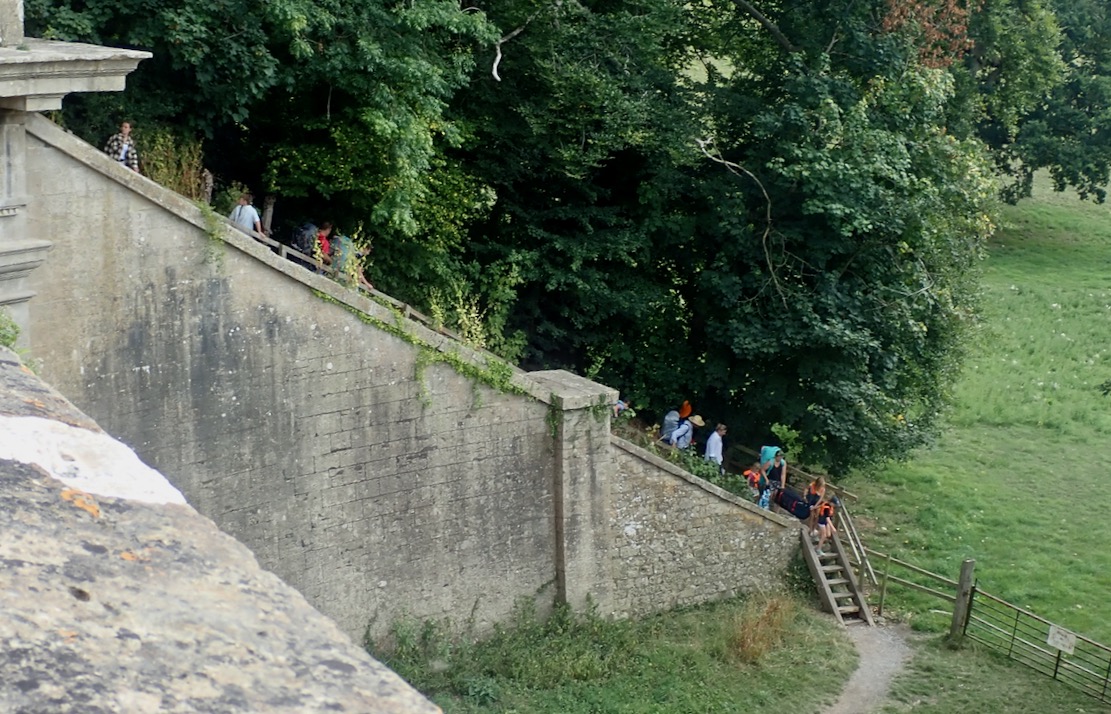
Once on the right bank it’s a 20-metre set of stairs up to the aqueduct. Wouldn’t fancy hauling a hardshell up there by myself.
The Avon from the aqueduct.
Tow path on the aqueduct. By way of a rest I submit to a questionnaire for the National Trust.
Video Andy warned the canal can get raucous with piss-up barges. But not on a balmy, late summer’s Tuesday afternoon.
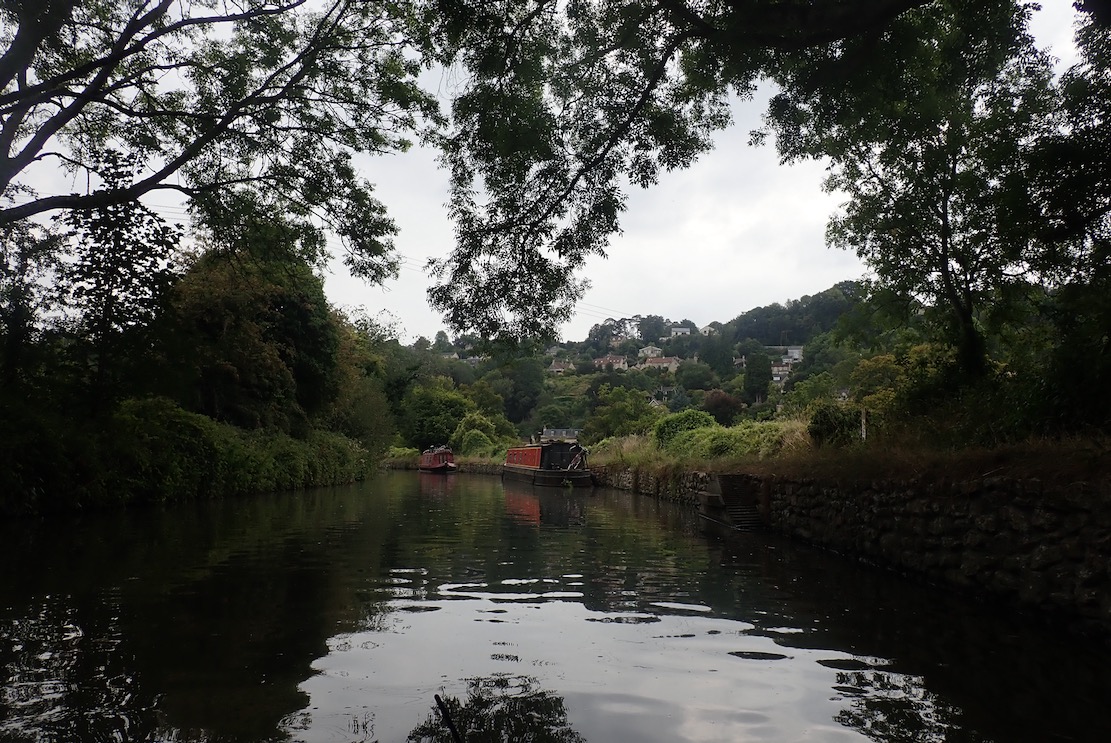
I got stuck in to the flatwater paddle back to BoA, looking down onto the valley on the right. It gets a bit dull and samey, then becomes a flat-out slog. The hands get sore and the elbows creak. I even overtake a couple of rental barges chugging along in a trail diesel fumes like an Algerian truck. A smell from the 1980s. No Euro 5 here.

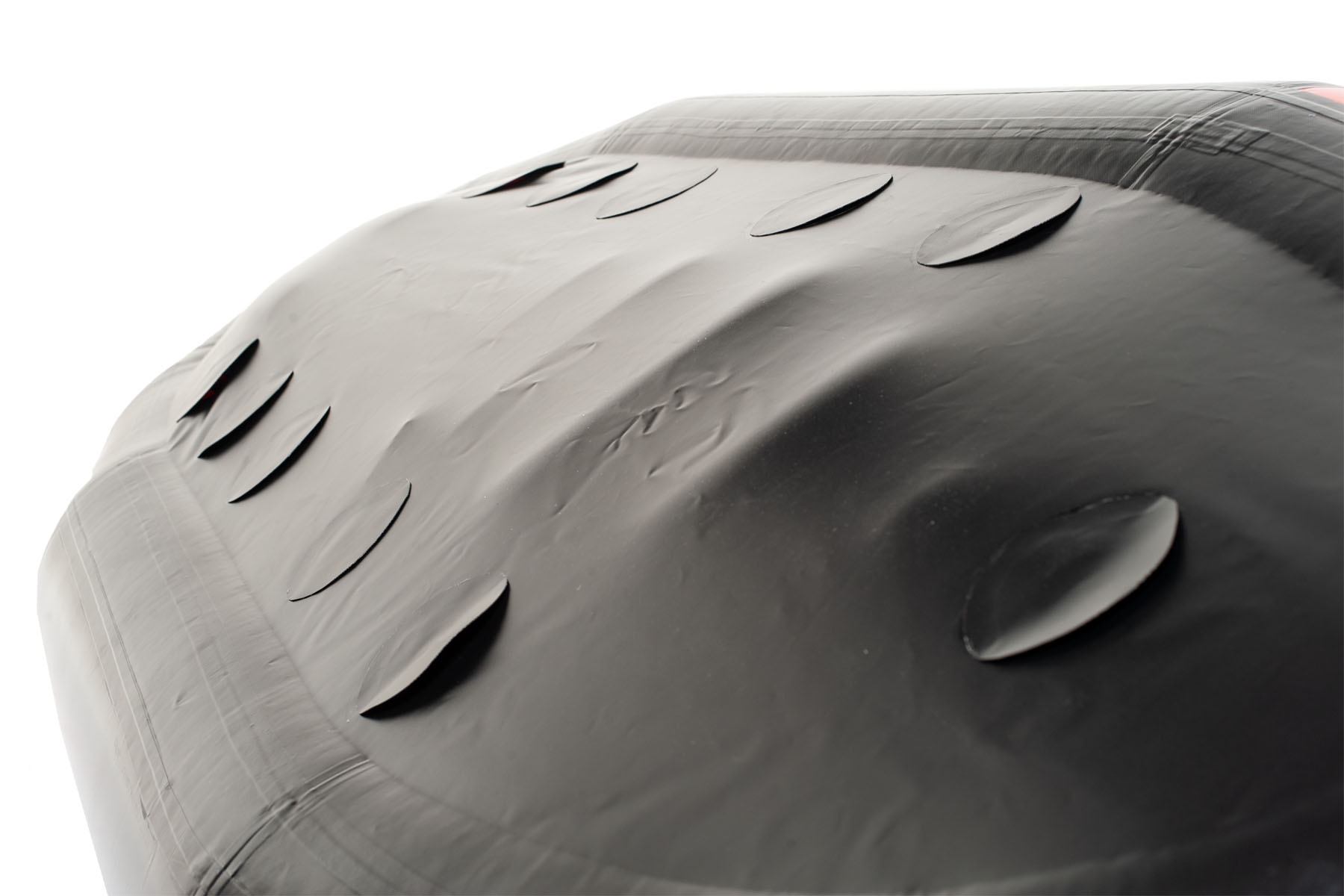
Paddling along in the perfectly still water I had the feeling the boat was pulling to the left as if some weed was caught in the skeg or I wasn’t holding my paddle evenly. This wasn’t evident on the more lively river, earlier. I suspected I knew what it was: the skeg was warped, leaning over to one side and with a longitudinal curl at the back that would steer the boat left. I’ve not had this before on rock solid polyethylene skegs which don’t deform no matter how abused or badly packed. The unused one above with no tape or scratches is straight. I gave the bent one 2 minutes in a microwave but it came out the same. It is 3 years old from my original green TXL.

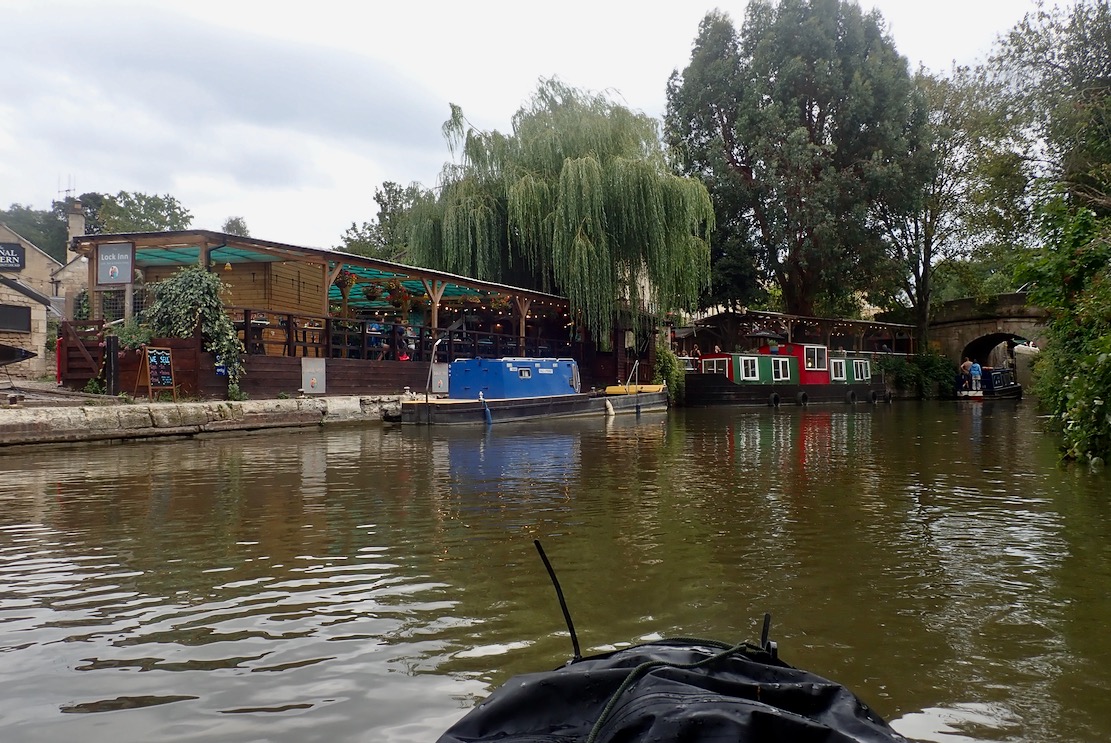
The state of some of these boats, honestly! On the street they’d be towed away.
Take out by the Lock Inn back in town. There a lock right by that bridge leading into the C&RT basin. It was a bit further (4.3mls/6.9km) but surprisingly took just 80 long minutes (3.2mph) with no weir interruptions. Near the end I was considering hopping out but that would ruin the story. By now I’m ready for an early dinner.

Unless you’re getting swept down Spain’s Canal de la Toba, as expected, the river stage was a lot more agreeable than the parallel canal, and the two weirs portaged were not awkward. At much higher (or normal?) flows that might be different but anyway, the whole point of packboats is you don’t need to do loops if there is transport at hand.

Poshboys on old Pulteney weir

Had I thought it through a bit more, I’d have registered the railway also following the Avon valley, and carried on six miles down river. There are weirs at Warleigh, a mile after Dundas, and Bathampton, both of which would hopefully with no more bother than what passed before. They lead to Bath’s amazing, neo-classically set Pulteney Weir, doable providing it’s no more turbid than pictured below. Bath Spa station is just 5 minutes away for the 16-minute train ride back to Bradford on Avon, looking down onto the river you just paddled. One for next time.

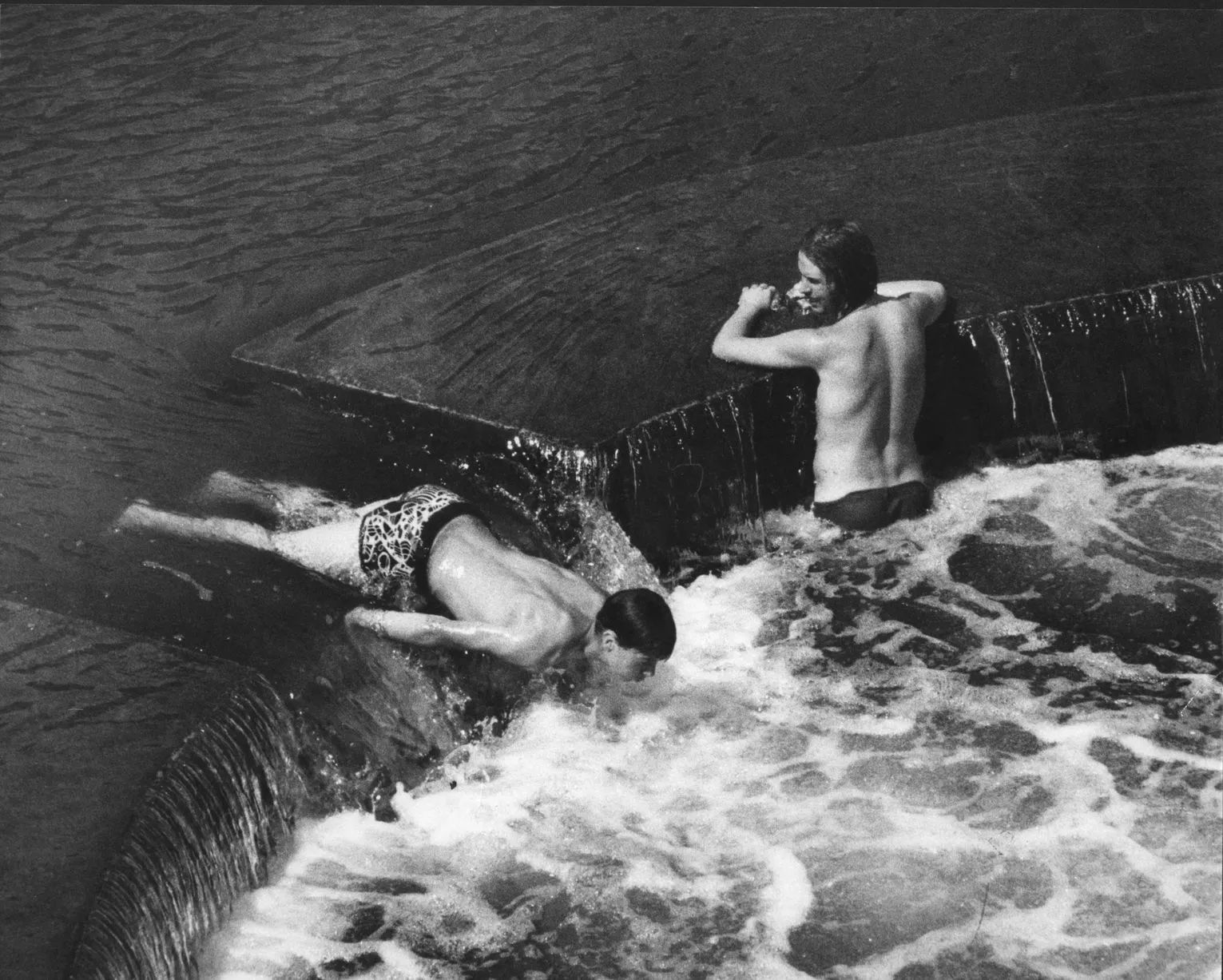
Bath’s Pulteney Weir even has a kayak-friendly nick at the apex.
Hold my beer!

Pulteney has had it’s share of tragedies, though the weir’s grim record must down to its city-centre location. The unusual V-shape actually only dates from the 1970s, replacing a diagonal low-head weir (above left), like most weirs upstream. Check out a great series of before-, during-, and after photos here, although the current log-jammed image on Google Earth doesn’t look inviting at all. They is actually a canoe chute alongside a dry ramp on the left hand end, by the trees. See this vid.

Packrafting TXL: Kwikie around Hamworthy

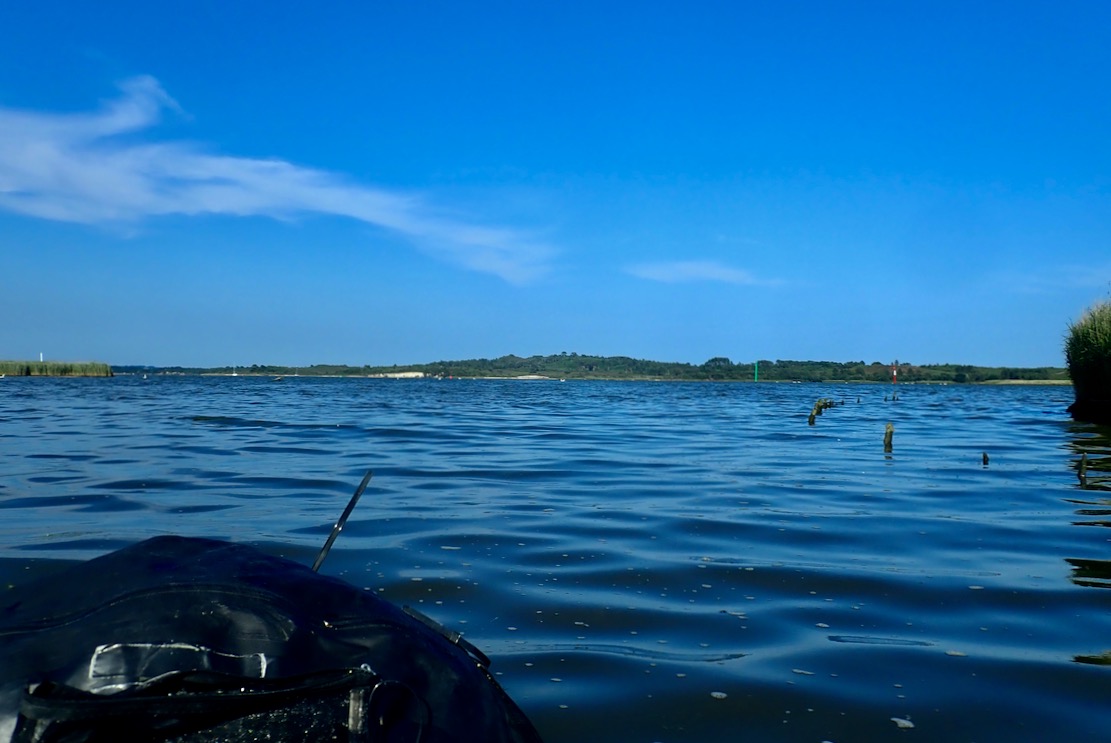
With the car in for an MoT at Kwik-Fit in Hamworthy, it made sense to do a Poole harbour paddle rather than go home or hang out. Kwik-Fit is close to Lytchett Bay, an intertidal embayment or tidal inland lake crossed by the London-Weymouth rail line spanning a narrow outlet. A 10km lap from there out into Wareham Channel and back into the adjacent Holes Bay (another embayment with a narrow pass under a rail bridge) might be possible in the time I had. If not, I could hop off anywhere and walk back to the garage. That is the appeal of pack boating!
This route – out one tidal channel and in via another – had similarities with our lap around Hayling Island a few years back in the Seawave. On that occasion we had to go full steam against the incoming tide to get out of Langstone Harbour back into the Solent to close the loop. This Poole loop would only require a 500-m walk from Holes Bay shore back to Kwik-Fit.

The winds were 10-13mph from the southwest which made sailing just about possible along my ESE route. The tide was coming in and levelling off about 3pm for 6 hours before dropping steeply again. In Poole Harbour – second only to Sydney Harbour but with an outlet just 300-m wide at Sandbanks chain ferry – the tides are far from simple sine waves. It may still be going in at Wareham at the back end, when it’s already going out at Sandbanks. There are four tide points listed by UKHO in Poole Harbour and I’m pretty sure ‘Poole Harbour’ refers to the RoRo ferry port on the north side. PHC is a great resource.

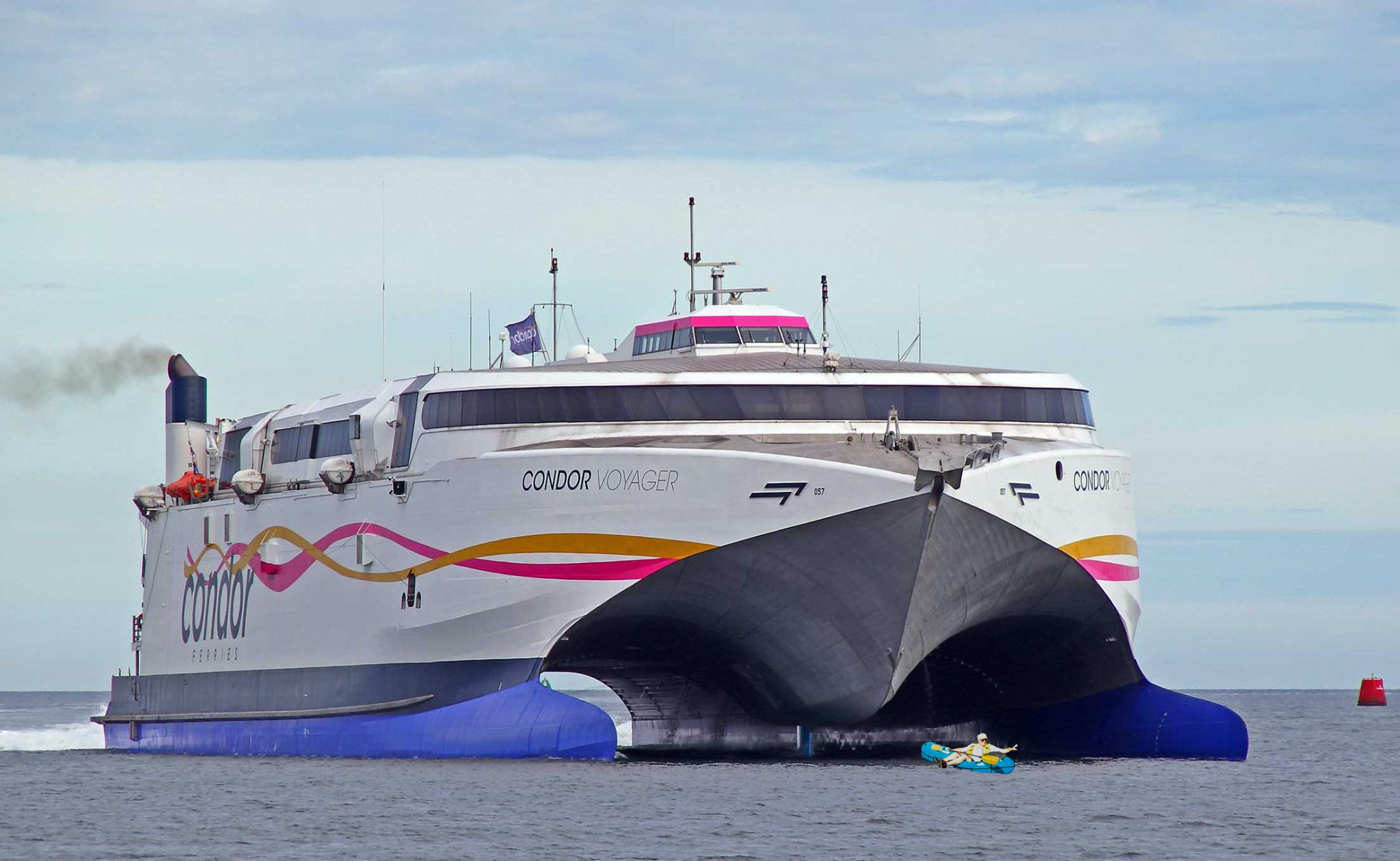
My route would take me right past the ferry berth where getting in the way of a gigantic ferry would probably raise a yellow card. Again, on PWC I was able to see today’s main ferry movements: the massive Condor Voyager cheesecutter class twin hull (above) would depart for St Malo at 14.15. I’d probably be an hour behind.

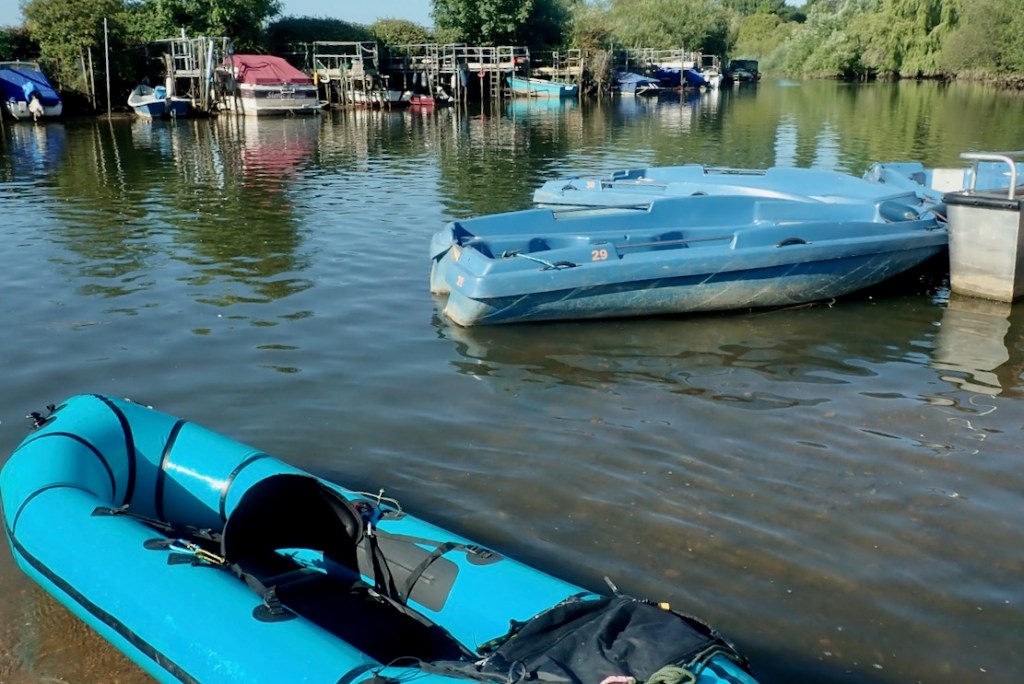
I set off from Kwik-Fit across Turlin Moor park aiming for the inlet, and once I saw some water, bundled through thick, 2-metre-high reeds on the off chance.

But once I emerged from the dense reed jungle I could see I was a bit early at this point, with 100m of knee-deep sludge ahead. It’s large acreages of tidal mudflats like this which give Poole Harbour its average depth of less than 50cm. That’s about the same depth I’d sink into the mud, trying to reach the water.

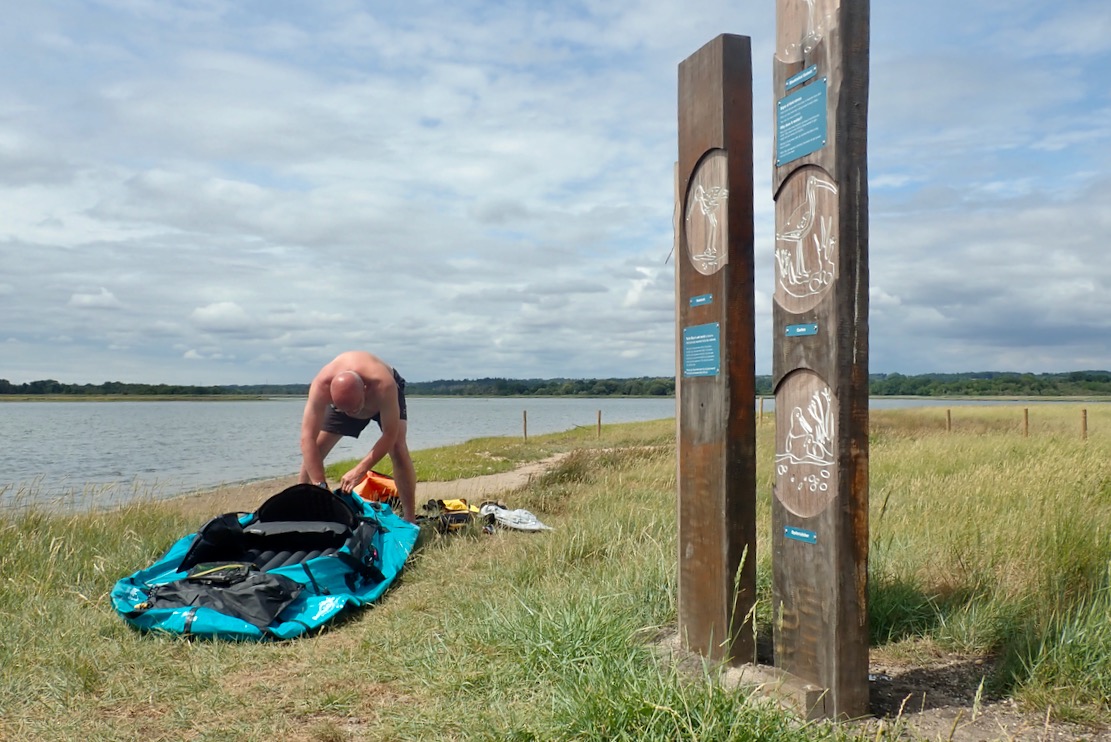
So I turned back and carried on along the shore until a path led behind some houses and through the trees to this grassy, reed-free bench by a sandy beach: 50.72448, -2.03601. If you want a mess-free, easy way to get on the water at Lytchett Bay east, aim for here.

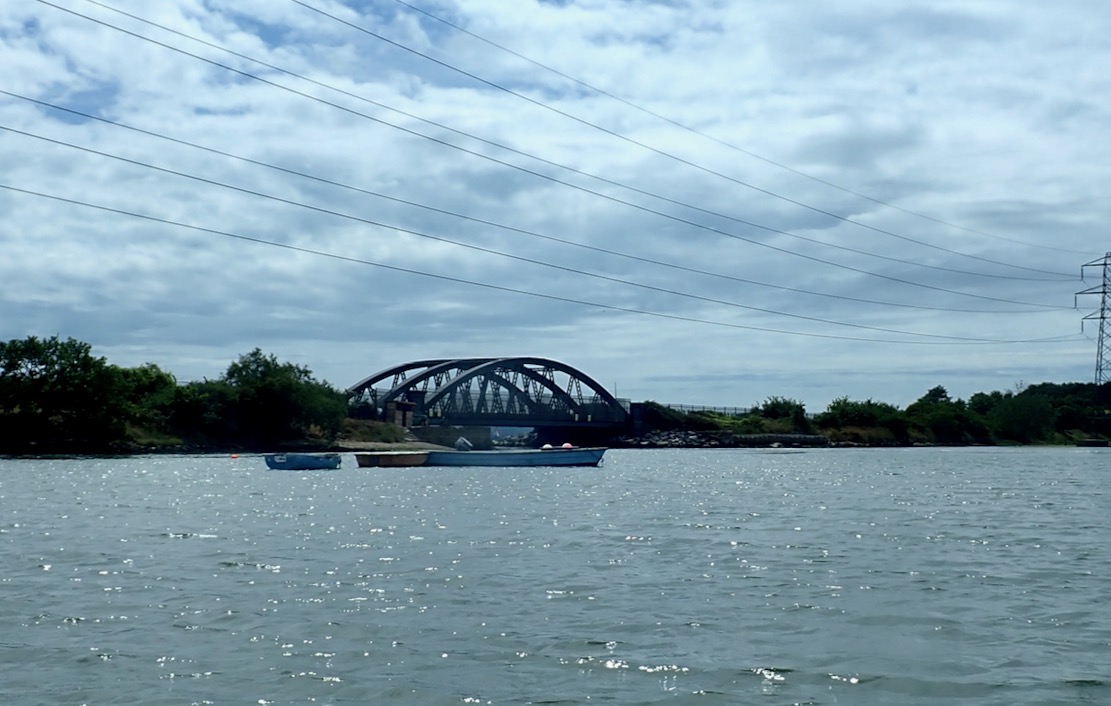
A headwind was blowing quite hard, but it was only 500m to the rail bridge narrows, after which I’d turn southeast to pick up what wind I could get. Setting off, the TXL+ felt like it was zipping along as wind and waves rushed past. Up to 6kph, according to the GPS as I neared the narrows. That was probably an unseen back eddy sucking me into the gap, because as I got nearer I could see a current ripping through under the bridge at at least the same speed or more. I powered in hard along the edge, like we’d done at Hayling, but could only manage 0kph.

“Try on the other side” said the bloke lurking by the abutments, so I ferried across and, with a lot more effort managed to squeeze under the bridge and hook behind some rocks for a breather while not getting drawn back in.
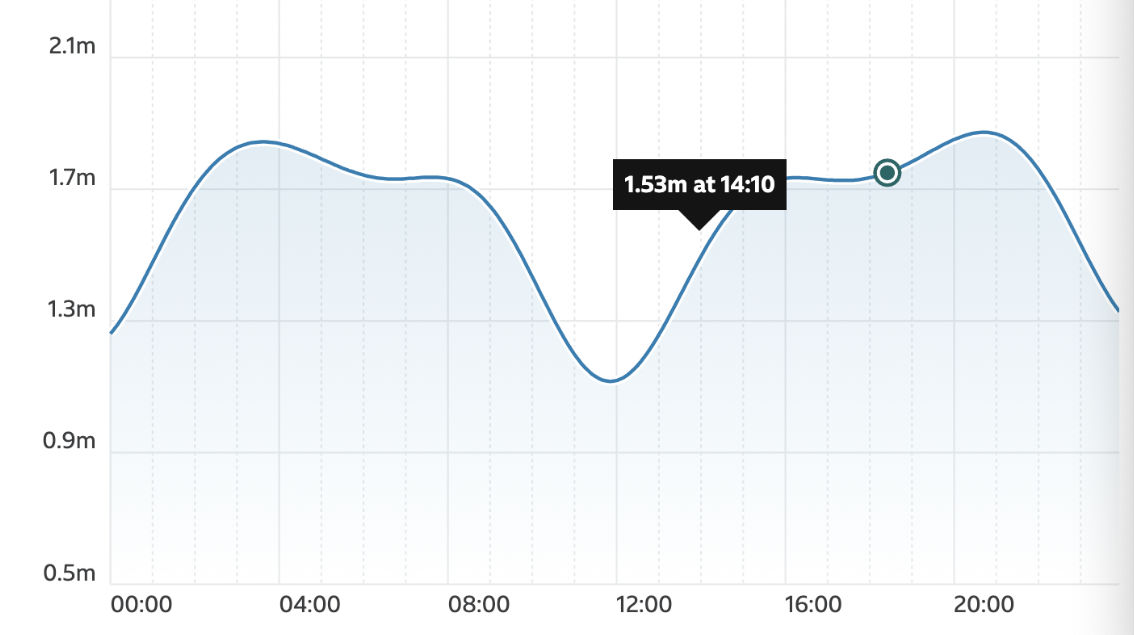
I’d swum half a mile that morning which can be enough exercise for one day. Paddling under the bridge was like doing 50 pull-ups and I was a bit pooped. I looked later at the state of the tide at that precise time (left) and saw I’d been about an hour early.

I took a wide arc out to avoid the worst of the tide race and headed off towards Rockley Sands where I came ashore last year on my way to buy a moto. The wind from my right wasn’t ideal for sailing in my direction, so I paddled out into the channel to turn and get a better angle as it pushed me towards the shore.
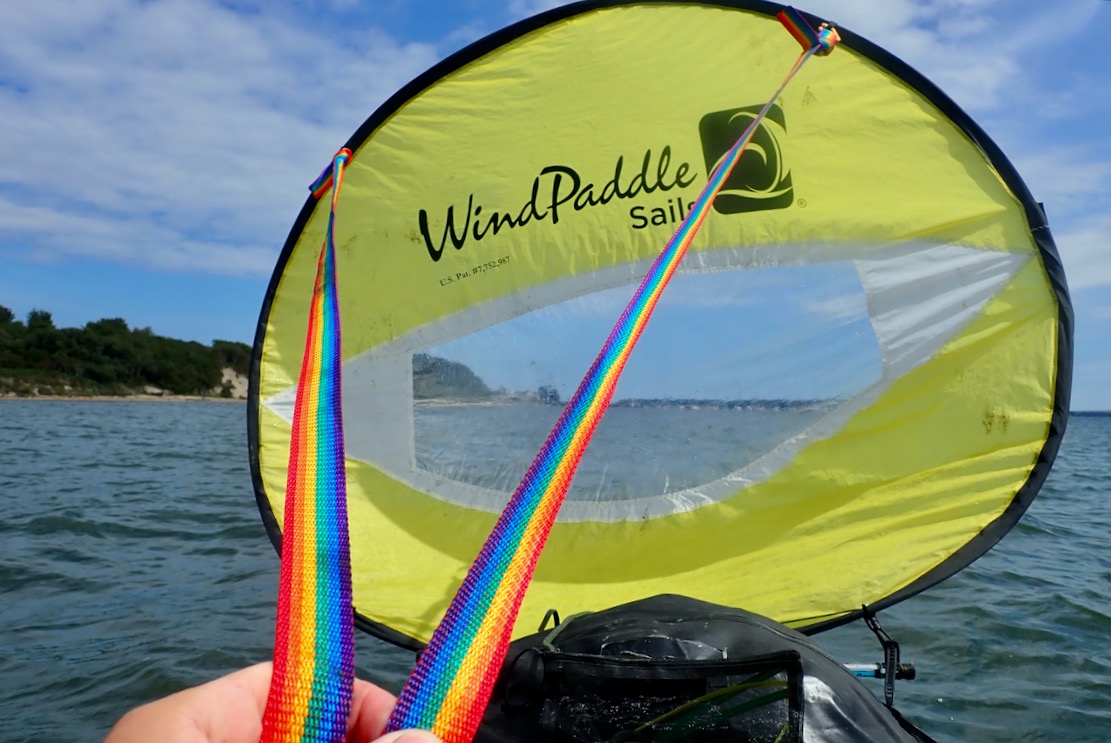
Though I was hardly bombing along, getting the sail up was the rest I needed. Out in the Channel, loads of sailing boats were fluttering to and fro past Brownsea island, and at one point a lightweight sailing cat passed close by with a hiss. I could do with some sails like that. As usual the WindPaddle was hit and miss. Holding 45° off the wind with some steering is not bad for what it is, but it never stays on it for long before getting in a flap.
However, as I got pushed towards the shore again, I really appreciated the way I could pull the WindPaddle down, give it a twist and tuck the lower fold under the Anfibio DeckPack in seconds. It was a handy trick I discovered while belting down a wind struck loch in Knoydart one time.

I passed a couple of piers and a series of long private jetties extending from people’s back gardens, some with a motorboat at the end perched on giant hydraulic hoists to stop them getting too wet. I assumed this was luxury overspill from affluent Sandbanks nearby, once home to the most expensive properties in the UK, but here “…overall, the historical sold prices in Branksea Avenue over the last year were 41% down on the previous year and 75% down on the 2011 peak of £2,262,500.” Unless rising sea levels are coming quicker than we think, or they’re putting in a new high-speed railway, it did seem an implausibly catastrophic collapse in house prices. Maybe the Rightmove AI needs to be burped.

Now heading more east, the wind was getting behind me. I made another effort to paddle out into the Channel to get a good run, and this time the TXL got picked up and rushed along. This was more like it, with an aerated bow wave frothing away by my feet. I squeezed every last minute out of a good run of nearly half a mile, not quite managing to steer around the breakwater of Poole Yacht Club where the accumulated fetch and rebound slapped me around a bit, but the TXL sat steady as a barge.
Round the corner I passed the entrance to Poole Yacht Club with a ‘Visitors Welcome’ sign and wondered if that included packrafts.
The phone rang.
Kwik-Fit here. Your Micra’s ready in 40 minutes.’
My word that was quick!’

A quick look at the map showed I was just less than halfway and would soon turn into Holes Bay with no more wind behind me, but with the high tide negligible. It would be tight to get back to the garage before it closed, so I turned into a dock entrance and rolled up the boat on the slipway.

I assumed this dock was part of the welcoming yacht club marina next door, but it was actually more like a deserted service yard for the ferry port right next door, surrounded on all sides by high security fences and an electric gate.
I dare say some security guard was observing me on his CCTV lair somewhere. After nosing around the portacabins and sheds looking for someone, a guy appeared in his car and swiped me out with his pass.
Things always work out, and as I passed the entrance to the Yacht Club, that too had electric security gates, though probably someone manning them. Looking at the map, a better take-out would have been Hamworthy Park by the club’s breakwater (50.71099, -2.00039), leading to a footbridge short cut over the rail line.

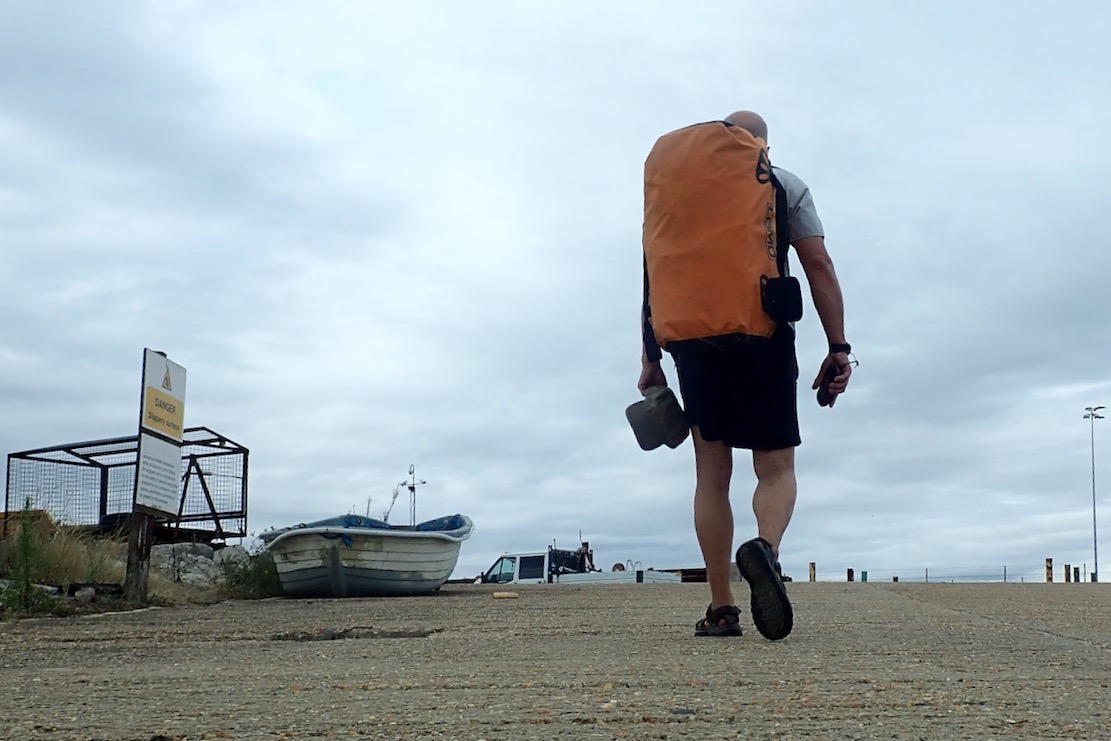
I walked right past the Customs and Immigration cabins (above left) of Poole ferry port, and a helpful map affirming je pagaie donc je suis ici with irreducible Cartesian logic. So – paddling mission not fully accomplished but the old Micra was on the road for another year.

Fat dotted red line shows unfinished stage. Arrows show wind direction

Looking back at the tide graphs for Poole Harbour, it seems that at the lowest neap tides (as it was two days later), there can be a 7 hour period when the high tide flattens off and rises then falls more than 20cm. That would be the best time to try and paddle around Hamworthy between Lytchett and Holes Bay. It could also be fun to leave Holes Bay on an ebbing spring tide to get a good blast under the rail bridge narrows, down the channel through downtown Poole and out into the harbour.

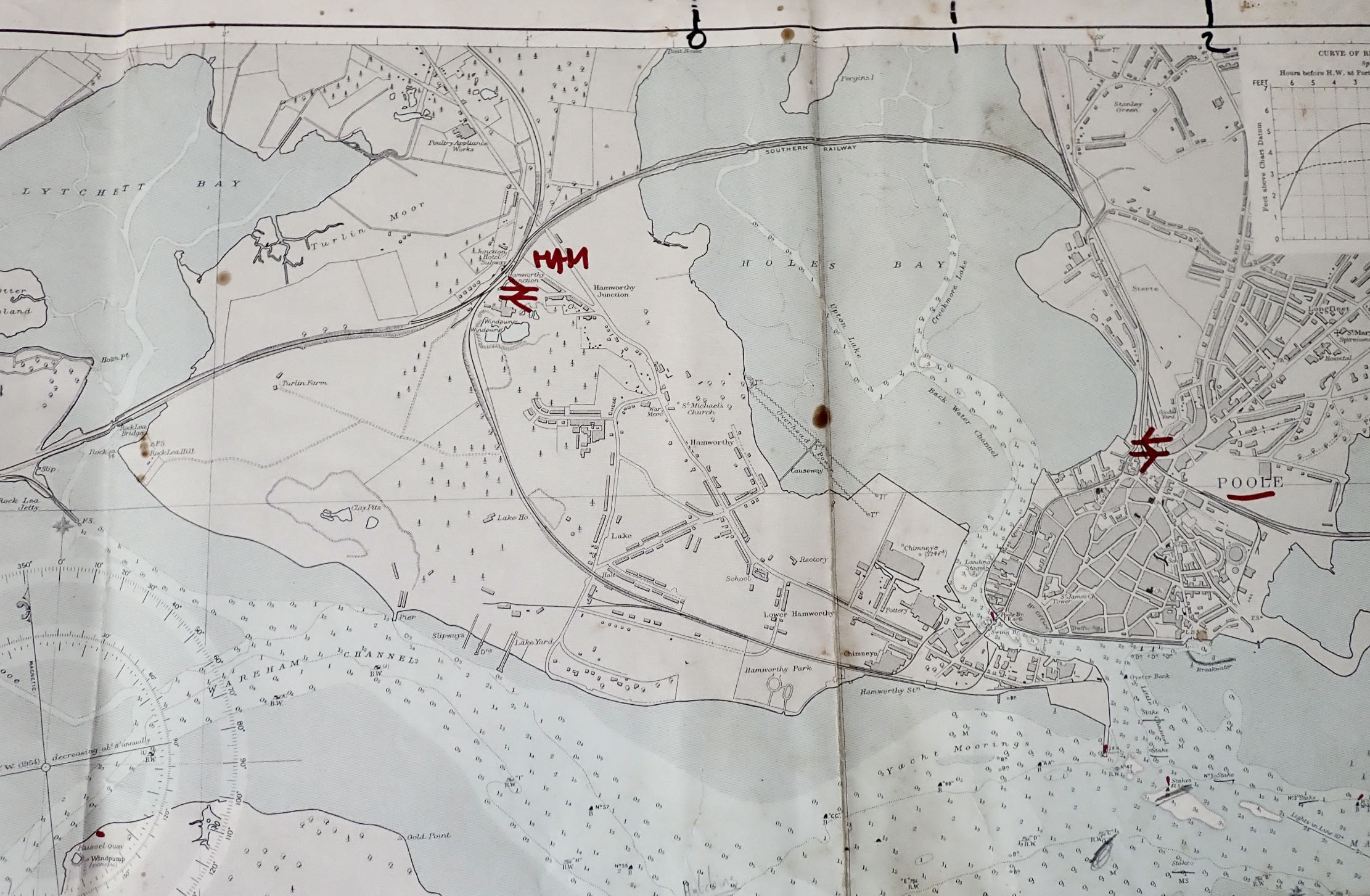
Wayback machine. Harbour chart from 1955. Hamworthy was just farmland and claypiys

There’s Wind in the Willow

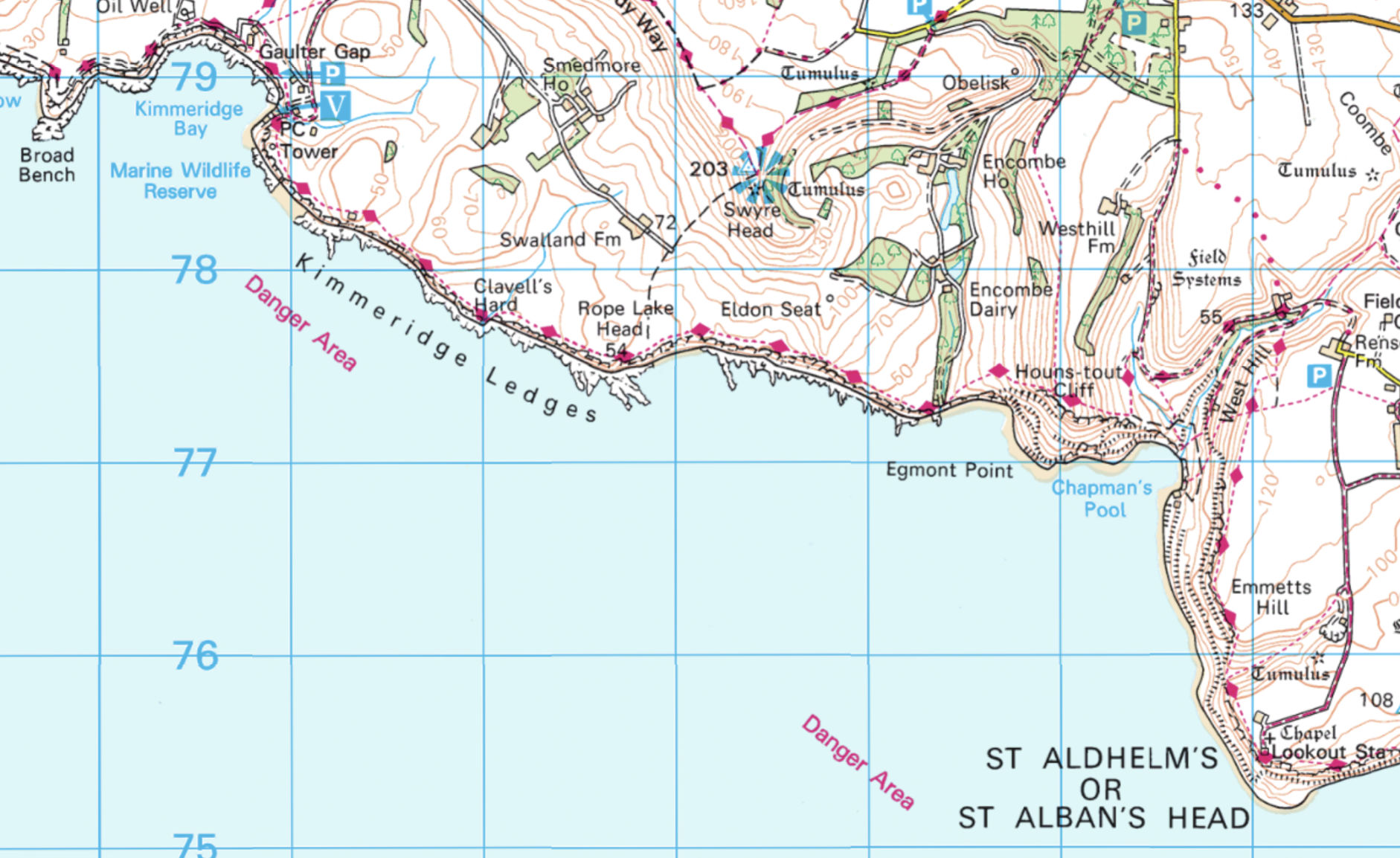
The short run between Kimmeridge Bay and Chapman’s Pool was on my pack list, part of what remains to packraft between Weymouth and Poole. St Alban’s Head near Chapmans, and Durlston Head near Swanage will need ideal conditions as there’s virtually no getting off anywhere in between, so they will have to wait.

A quick look at next day’s wind and tide put Kimmeridge broadly in the ballpark. High water 10am at Chapmans receding east, helped by a 10-12mph easterly. Ten is my self imposed limit for packing at sea so it felt a bit sketchy, plus it would be a hot walk with the boat back to the car near Kingston. It feels more than the forecasted mid-20s around here right now.
I was also unsure what the Kimmeridge Ledges do in such conditions, other than force you away from the shore. It was all a bit hot for an otherwise sensible clifftop recce from Kimmeridge car park to Chapmans’ with the boat, to gauge the sea state below. I’d have to carry loads of water too, as the springs trickling into Chapman’s Pool are probably minging with farm run-off. But whatever happened, it would sure be a sporty ride to Kimmeridge clutching the sail like something out of Roadrunner.

There’s a wind in this willow

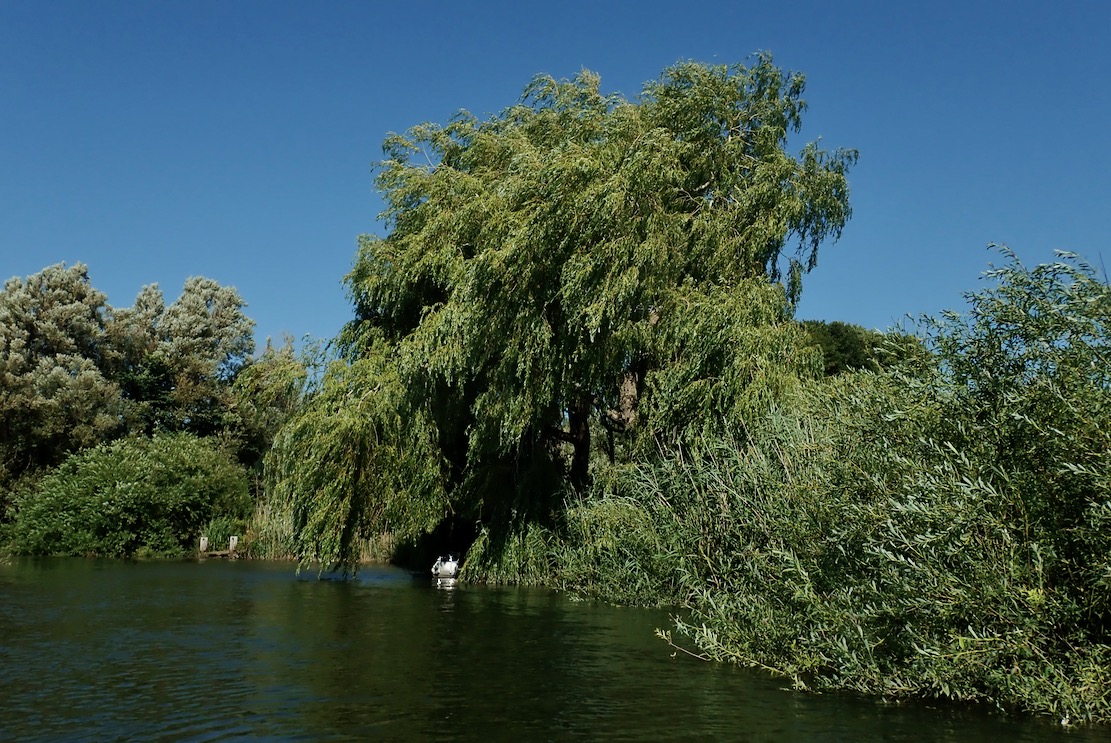
Came the early morning I let myself off and decided to paddle upriver from Wareham instead. I’ve not been up there either. I left the quayside ducks around 9am, and passing the already swaying riverside willows confirmed I’d made the right choice. Ten-12mph predictions are always more in my experience, and they say easterlies off the continent are more gusty. Six to 10 with a tide would be more like it, alone in a packboat.

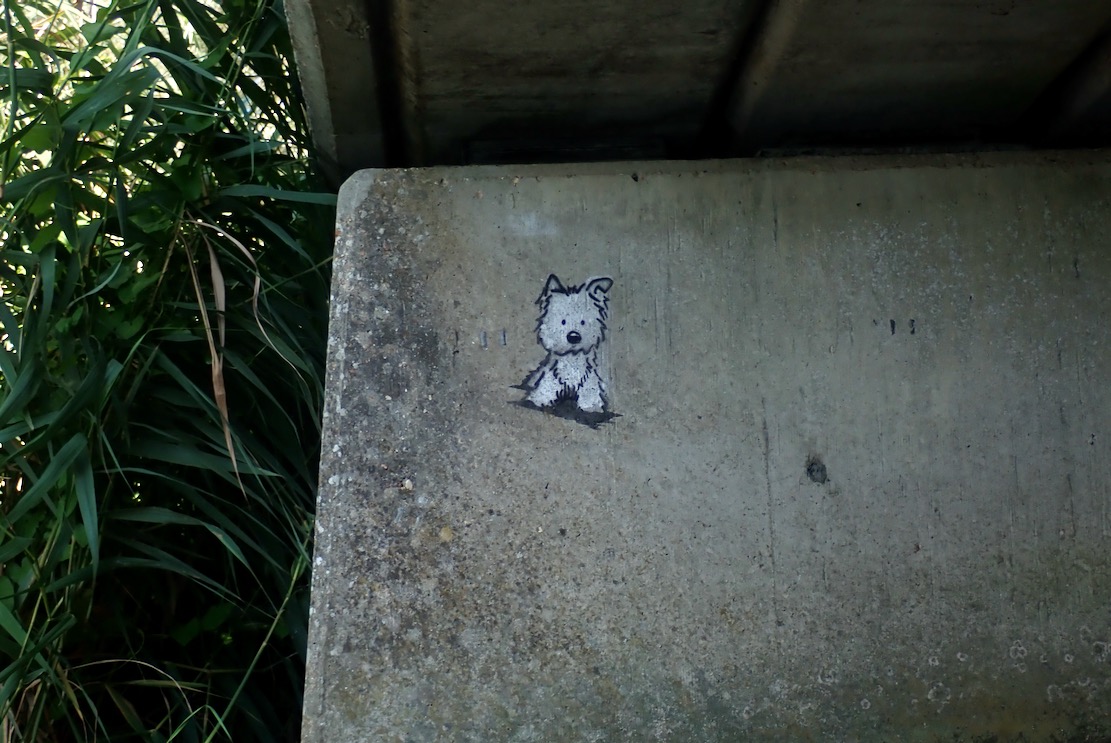
Tagged by the Wareham RiverBanksy

The Wareham tide and wind were with me and reaching the A35 bypass bridge (left) – the tidal line according to the OS map – I expected a big, ‘Paddlers Turn Back!’ sign, as rental SoTs and SuPs venture up this way.
No sign, so I had an excuse to carry on in ignorance until I got either shouted at or the Frome’s current got too strong. As it was, the riverbanks hereabouts were still thick with reeds, making angling without a periscope difficult. Further up nearer Holmebridge was angling country.

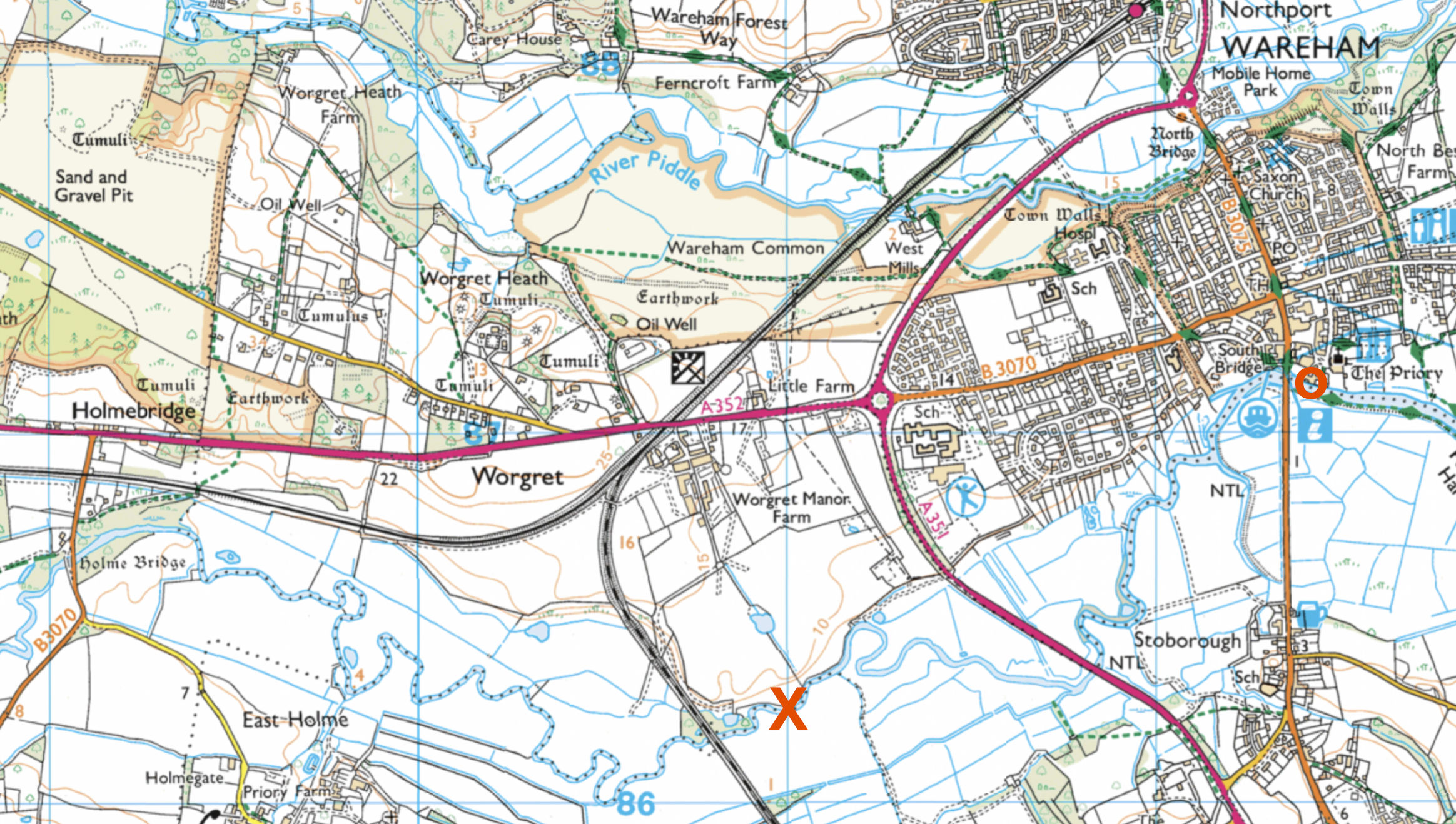
Frome meander from O to X and back to O

The river meanders like rivers do, covering double the distance as the gannet flies, so at some points I was into the wind which was now bending the trees. A good time not to be hanging onto the WindPaddle while launching from one Kimmeridge ledge to the next.
Up ahead I could the vanside banners fluttering briskly at the annual Volksfest campsite (below) whose music we can hear until nearly midnight.

Turns it down, volks

I wondered if I might make a run through the water meadows to Holmebridge, but by now the incoming tide had dissipated and I was against the Frome’s rising current.
That would better done as a stealthy dawn mission, but I felt I’d seen enough of the inland Frome, so I flipped round and enjoyed the cooling breeze in my face back to Wareham town.

Wareham Quay

It was a short, easy paddle so I’d not bothered checking the tides, but back home I was curious to know how Wareham – tucked right at the back of Poole Harbour – compared with Kimmeridge out in the Channel. Taking out at Wareham Quay around 10.15, the tide looked nearly full and had turned 30 minutes ago at Kimmeridge.

BBC tide

But the BBC (above right) which I usually look at first appeared to be hours out. According to their graphic (left), after I got out at 10.15 the river would rise another 800mm in the next 3 hours, flooding the quayside carpark a foot deep! tideschart.com, which I also refer to, showed identical times for anywhere in Dorset, so it (or my computer, or as likely, me) needed a cooling drink in the shade.
I deleted tideschart.com bookmark and found dorset-tides.com (above left) which gave a more plausible Wareham High Water about 90 minutes away (11.46). These are all BST, but this is the first time I’ve noticed such an anomaly. Both claim to use the UKHO. Only the BBC matches UKHO data, while seeming to be way out on the water. Today is the peak of the spring tides and maybe the east wind pushed Poole Harbour’s mass up the Frome a bit more than normal, but that’s not what a tide table can predict.
Meanwhile I wait for a fair wind at Chapman’s.

Taking the Piddle: Wareham Two Rivers Loop

TXL main page

Wareham – between two rivers
Frome Safari 2005

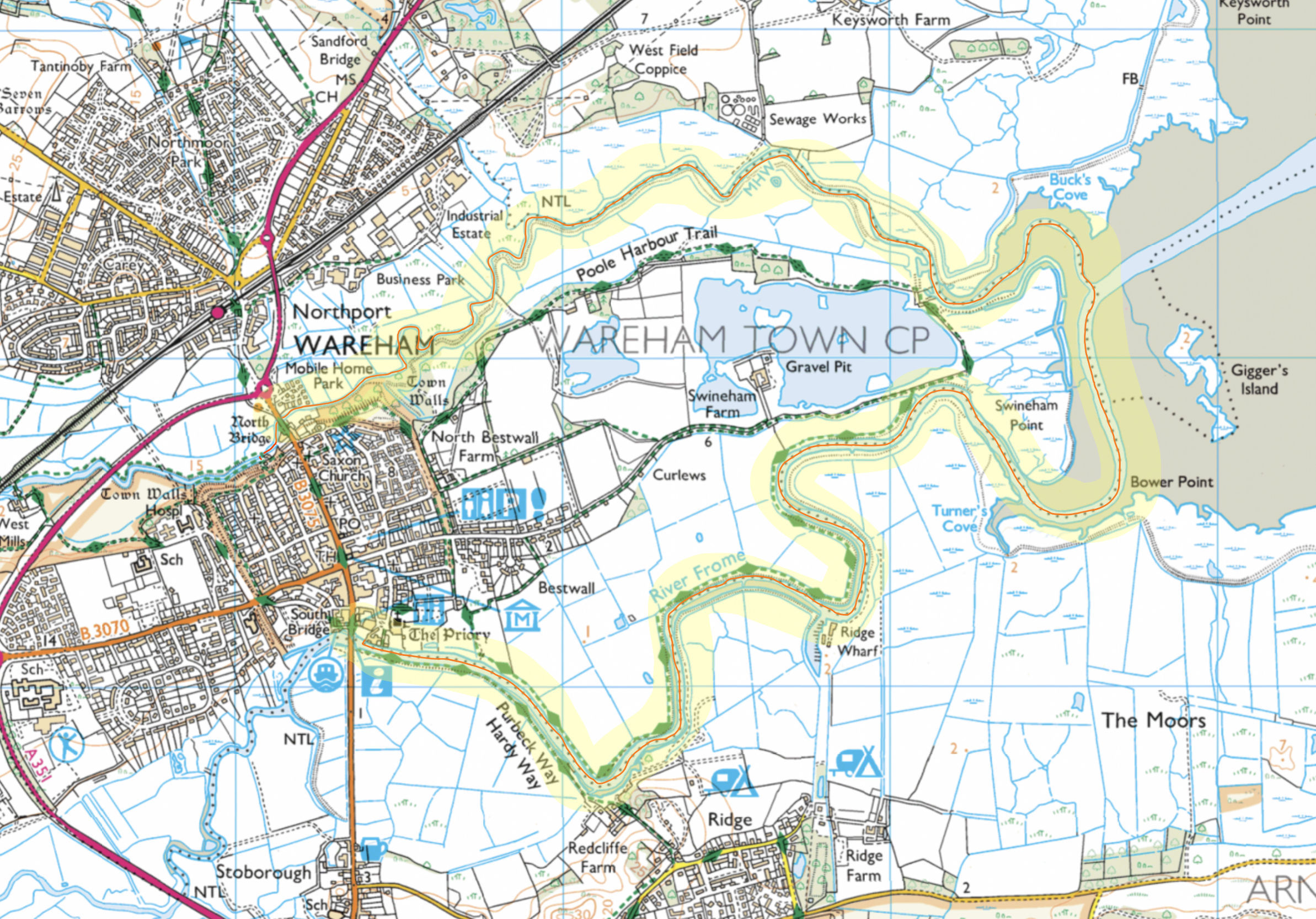
You do one paddle in two years then do two in a row. Honestly, you could not make this up! Take the Saxon walled town of Wareham – wrested back from the beardy Viking hordes by King Alfred in 875. It sits snuggly between the tidal reach of two rivers: the Frome to the south, and the smaller Piddle (aka: Trent) on the northern edge.
East of Wareham there’s a Two Rivers Walk which more or less replicates this paddle: down one river and up the other. I’ve paddled up and down the Frome loads of times. In fact 20 years ago last week I wobbled along the Frome in my very first IK – an early Gumotex Safari (left) that was tippier than a hog on ice.

The Piddle flows below the northern remnants of the old Saxon walls, and I’d long assumed it was clogged, weir-ed, patrolled by angling militias or otherwise inaccessible to the recreational paddleur. Not so, said our paddle-boarding builder who ID’d a put-in near the pre-Norman church of St Martin’s on the Wall, the oldest in Dorset. I recall checking it out in the 1990s while updating a UK guidebook, looking for the tomb-like effigy of T.E.Lawrence (left) who was died on his motorbike up the road at Bovington.

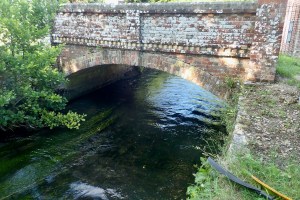
We walked down a private drive/footpath to North Mill (above; a self-catering) and put in by the brick bridge (left). It felt like their front garden, so next time I’d cross the bridge through the gate and put in somewhere on the north bank.
It’s a brambly, 3-foot drop either way into the swift but foot-deep Piddle. Piddle is of course a Naughty Word, so I should not bandy it about, willy-nilly, but in the ancient Saxon dialect of Dorse, it means a small stream. Along its upper course, several west Dorset villages: Tolpuddle, Affpuddle, Piddlehinton Puddletown, Mein’dapuddle and Piddletrenthide, take their names from it. (Test: one of those names is made up).

We left about 4 hours before HW at Wareham so we’d be against the tide (and a SE wind) as we neared Poole Harbour, but later have both at our backs as we heaved wearily up the Frome back into town.

Below the bridge the old mill weir was easy to walk down (to spare the skeg). It’s not always so; sometimes the water meadows here get inundated. I bundled in and held on while the Mrs caught up. Once in the boat we felt like kids wearing oversized trench coats. I’d forgotten that when not using the Multimat floor (which makes less space inside when two-up) you inflate the seat bases right up. That done, we navigated down an overgrown channel, dodging overhanging branches and other rampaging midsummer verdure.

Soon we passed under Wareham North Bridge and its famous 18th-century sign strongly discouraging bridge vandals with a life sentence to Botany Bay. 

We paddled through a hidden world of drooping willows and silent lilies. At times it all closed right in and we were pushing and pulling through the dense overgrowth and branches, while getting pelted by dropping insects.

The detritus of bawdy summer parties.

Gradually the Piddle opened out. Somewhere around here we reached the tidal reach and entered a dreary, reed-lined corridor. The pace slowed down as tide and wind pushed against us.

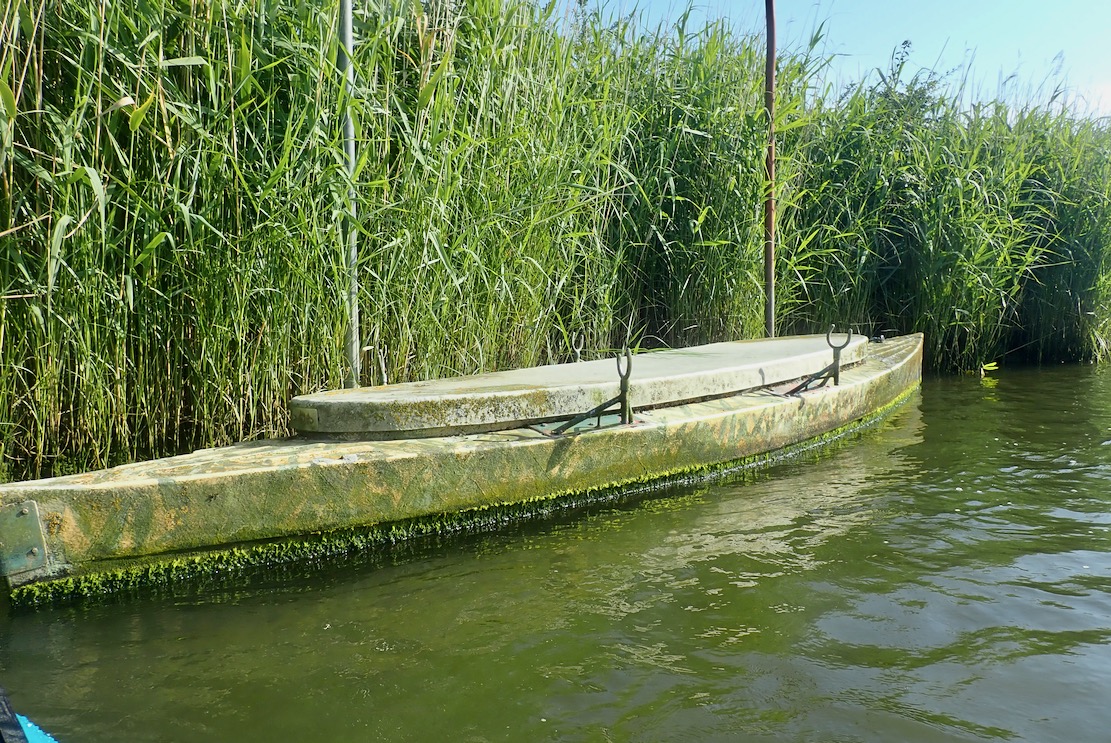
Near Poole harbour a few of these old rowing canoes caught my eye. They looked like something left over from D-Day training. Or maybe just long unused fishing club water craft. Anyone know more? Waterfowl punts I hear from the back.

Out in Poole Harbour the water was less than a foot deep so we aimed for the red and green deep channel markers leading south to the mouth of Frome. Up ahead, the Arne peninsula. We turned into the Frome and the long hack back inland began. Even with a backtide, the Frome meanders to all corners of the compass so at some points you’re into the wind. Thick reeds to either side make you wonder how you’d get ashore if the call to abandon ship was announced.

A nice red boat – a sloop perhaps?

Paddling onwards, energy levels were also beginning to sloop, but we finally pulled in at Wareham Quay where early evening revellers were feeding the ducks. Originally bequeathed to the town by Alfred the Great following his expulsion of the Norsemen, a Purbeck legend has it that should the ducks ever leave Wareham Quay the kingdom will fall.
It was fun to try something new, but we’d not rush back to do the Wareham Two Rivers Loop.

Down the Piddle, into Poole Harbour and up the Frome to Wareham Quay. 8.5km and about 3 hours

Back home disaster struck me down. As anticipated, my Anfibio handpump’s vulnerable handle snapped off in transit. Anfibio revised the pump by making a screw-off handle (below right), but mine was the old type.
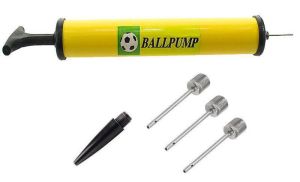
A new one is £15 posted in the UK so I bodged mine by simply gluing and cable-tying the hose directly to the shaft, then adding a bit of garden hose to make a hand grip while pumping. Assuming it lasts, it ought to be much less snap prone. You can’t buy this type of balloon pump on eBay any more, but I found a smaller ball pump for 6 quid (left) which could be as good with the black adaptor modified. We shall see. Every inflatable needs a pump or two.

Sigma TXL on the Thames

Anfibio Sigma TXL Main Page
Anfibio Revo on the Thames
Gumotex Seawave on the Thames
Gumotex Sunny Incept K40 on the Thames

Order! Orrrrdeuuuurrr!!
TXL on the riverbank

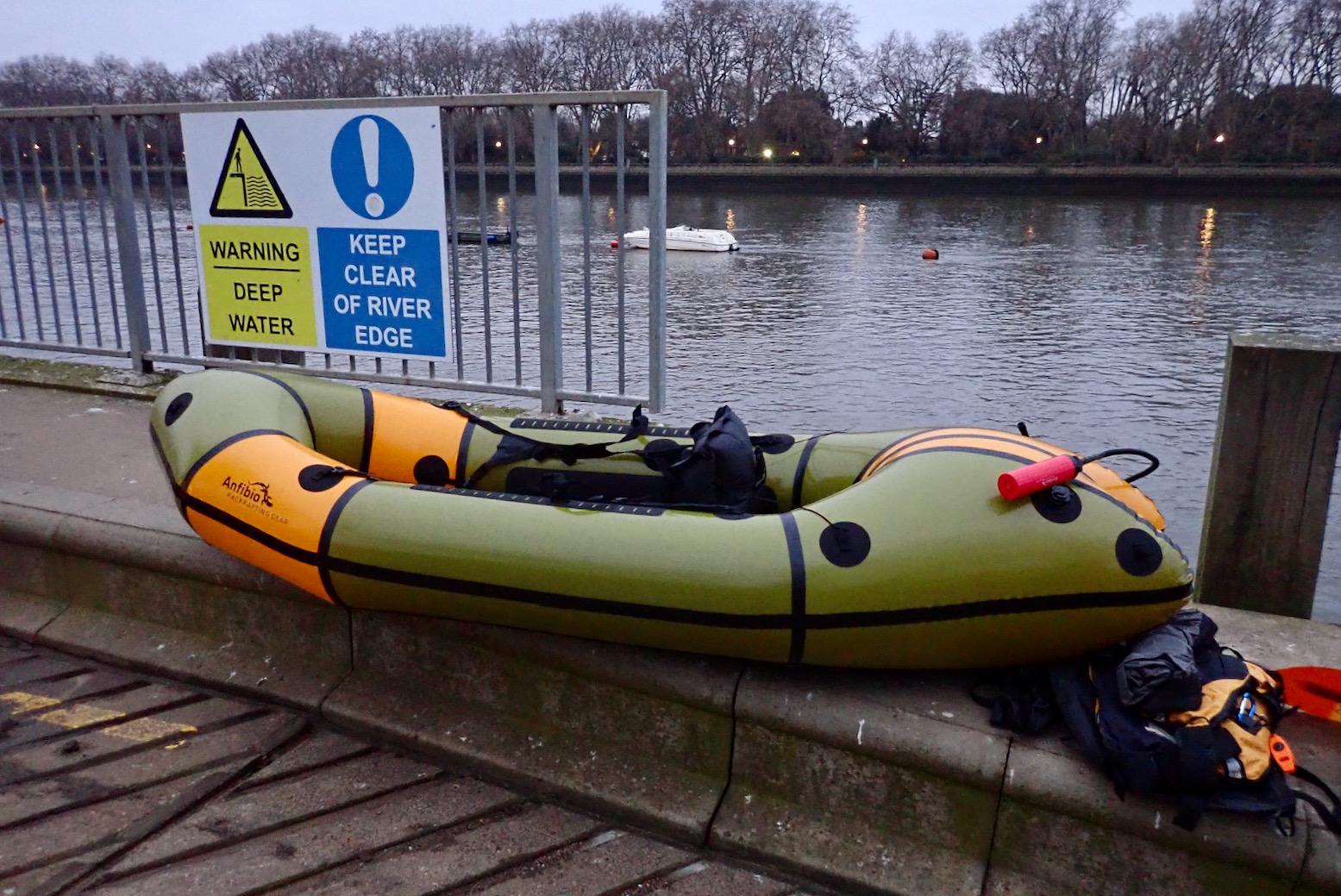
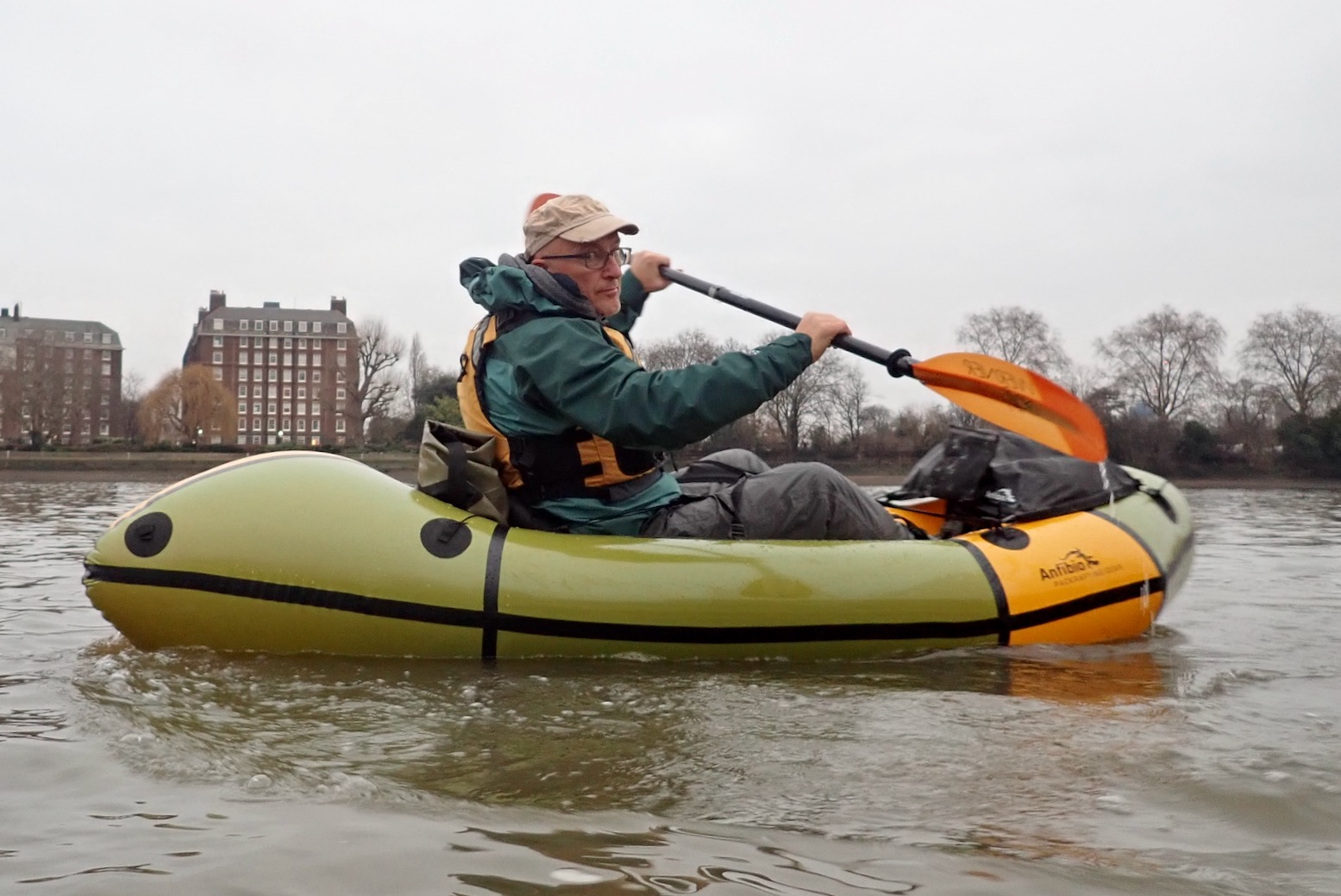
Miraculously, a sunny spell spanned the Easter bank holiday weekend so I took the new TXL down the Thames for its maiden voyage. At Putney I caught the remains of a spring tide but dithered too much so only had a hour until it turned at London Bridge and pushed back up the river. Nevermind, I’ll get as far as I get and hop out anywhere there are some steps or a ladder. With a packraft it’s easily done.

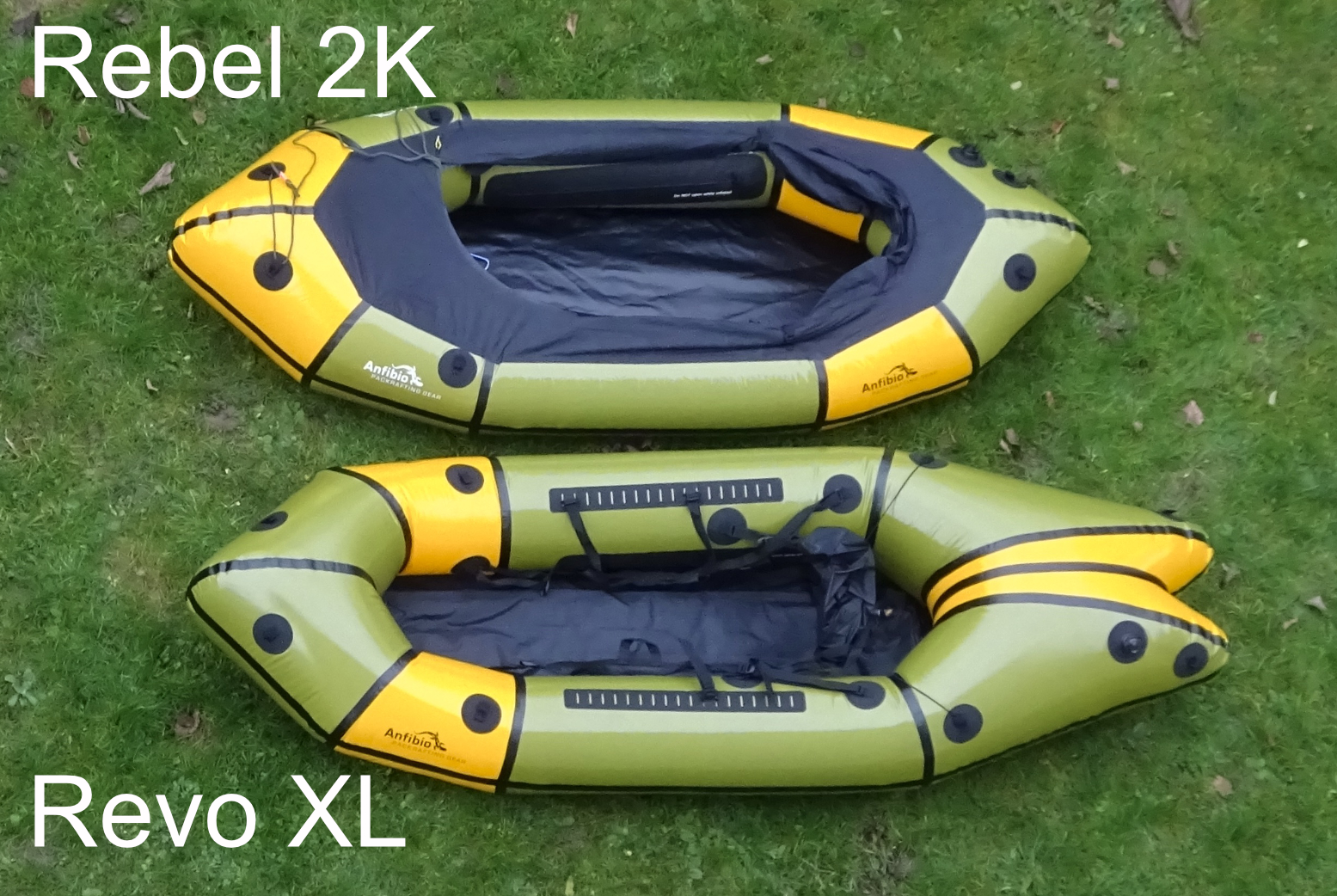
Skeg half out but does the job. One thing I like about longer, centrally positioned packrafts is the the trim is level, not back-heavy as in a conventionally sized rear-sat packraft like my 2K, (unless you are light or it has a hugely voluminous stern, like a Revo)

Floor pad and skeg
This is a similar run I did a couple of months ago in the dead of the Covid winter with the Revo, but this time I remembered to air up the floor pad good and hard. I’m expecting the 2.8-m long, hard-floored TXL to be nippy, and so it is. Setting off the boat skates across the water so that you can ‘paddle – pause/glide – paddle’ like in a kayak, not spin like a food mixer to keep moving.
I fit the skeg but notice from the pix that most of it is out of the water. Don’t think the 2K was like that, but it’s submerged enough to track well. I did wonder why it wasn’t on the flat of the floor for full effect. Perhaps, as with the Nomad S1, it’s not strictly necessary. Something to try next time. As mentioned, I do plan to fit a second skeg on the front to see how that affects crosswinds and sailing.

Seat
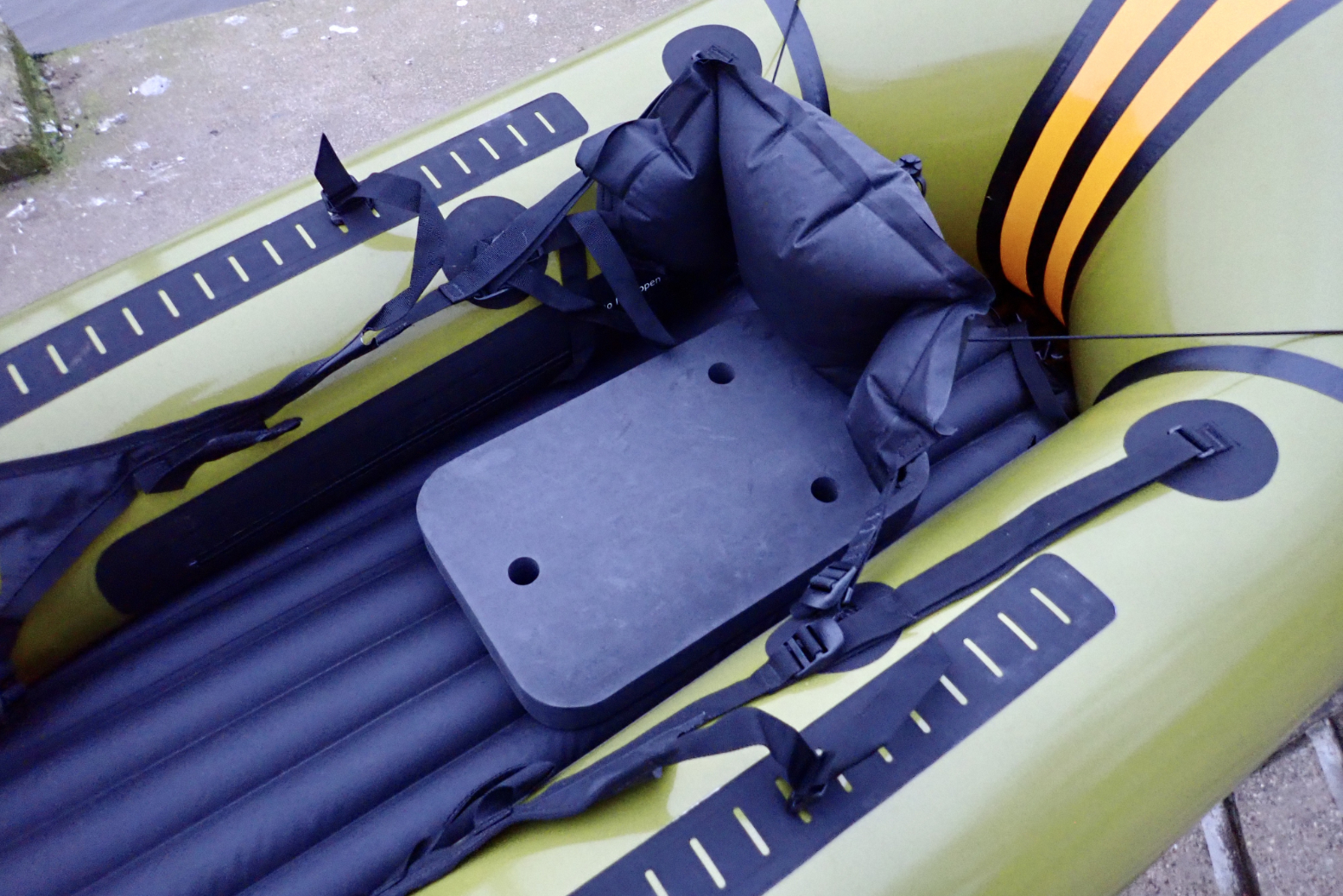
They advise using the foam seat block with the floor pad. It feels a bit of an afterthought, adds packed bulk and, as others have reported, is not so comfortable. After 20 minutes I was getting a sore coccyx which was only going to get worse.

More seats than the O2 Arena

Mid-river I shuffled over the twice-as-large inflatable seatbase but soon found it wobbled around on the hard floor pad (like trying to stand on a soft football) in a way these seats don’t when sat on regular packraft floors. This must be why the block seatbase is supplied but the foam is too hard for flatwater cruising. I aired the seatbase right down (easily done in situ) until I was nearly sitting on the floor, but in rougher waters there would still be a wobble and anyway, by then your butt and heels are nearly level like sitting on an iSup board; not an ideal paddling posture.

OMG – non-locking krabs! (fear not, a solution is at hand)

Overall, the raised position on the floor pad does aid good paddling as you can clear the fat sidetubes with the paddle more easily. Sat higher, I would expect stability in rougher water to suffer; at that time you’d want either thigh straps – or just sit yourself lower by easily airing down the floor pad. The backrest is easily adjusted in the boat too, and is held up by thin bungies so it’s easy to shift it up your back if it slips.

For the moment I feel the seat set up in MRS Nomad was a better affair. Partly because I felt it was part suspended/supported from tabs halfway up the side tubes like a hammock, not sat directly on the floor. That means your body weight is spread broadly along on the side tubes, not pressing down solely into the floor, created sagging. And also the flat foam backrest if fitted was better *and I may do the same with TXL).
But, at around half-a-metre square, the TXL seat base is much bigger than previous packraft seatbases I’ve used. Without the floor pad, this broad base may nearly replicate the advantageous load-spreading effect of a Nomad-style side-tab suspended seatbase. An underwater picture will tell all, but I like to think the TXL may be as functional and not much slower without the floor. After all the floor-less Nomad was nippy enough. Since then I think the TXL works well without the floor – or I’ve yet to detect unambiguous advantages.

The TXL’s raised floor jams you less well into the boat sides which is 4cm wider than the Nomad. I quite like a jammed-in feeling but recognise that with a floor pad, added height requires a bit more boat width to maintain stability. Meanwhile, up front there’s plenty of room for feet side by side, unlike in the pointy ended Nomad.

There are a few more evaluations to do with the TXL but it looks promising. Comfortable, supportive seating I know can be an issue with IKs so using the floor pad I’m confident I will either get used to it, find a better seatbase and backrest or find that the pad is not essential for shorter paddles.
Fyi, I have now become very used to using the Flextail electric pump to air up the boat (and the floor), before finishing off with the handpump. It can vacuum shrink the boat too, for compact packing, but rolling up is as quick. As you can see the handy BowBag fits on like it should, too.

Anfibio Vertex Tour paddle
Anfibio sent me their new, four-part, multi-adjustable Vertex Tour paddle to try. It weighs just 890g on my scales, same as my old carbon Aqua Bound Manta Ray, with same-sized blades. A simple lever clamp allows you to set any offset the carbon shaft left or right, as well as vary the length 15cm between 210 and 225cm which is something new to me. Theoretically I can see using the full length with a backwind or a strong current and a short paddle for battling into the wind in ‘low gear’.

Each piece is 63cm long. The all-round shaft felt a bit thinner than normal, and sure enough, measured up around 29mm ø compared to my 32mm Werners which suit my hands better. Smaller handed persons will prefer the Vertex.
The middle clamps up firmly but there was a bit of slack at the paddles; we’re talking less than half a millimetre here but it’s enough to rattle and be noticeable as you release the pressure on lifting the blade out. Does it make difference to non-competitive propulsion? Not really and better too loose than too tight. I wrapped some thin, smooth tape round the ends to eliminate the slack. The Vertex costs €125 – that’s a lot of light and fully adjustable paddle for your money. More here.

Quick test: Anfibio Revo XL packraft (video)

See also:
Packrafting [the Revo XL] through London
Anfibio Sigma TXL

Early in 2022, as the UK’s Omicron surge peaked, I had a chance to try out a pre-production prototype of Anfibio’s Revo XL packraft. Along with its distinctive forked stern, the Revo introduces a new idea to self-bailing packrafts: a single ~15cm drain funnel under the seat which can be pulled into the boat then rolled up and sealed, like a drybag.
I tried the XL version with a 135cm inner length and 28cm sidetubes. The smaller Revo CL is 10cm shorter all round and has 27cm sidetubes. As you can see my test boat came in lemon and olive. The production boats are cornflower blue and olive for the CL which costs from just €759. That’s a bargain and may fit taller folk better than they think. The Revo XL which I tried costs €999, but in-hull storage TubeBags come as standard. I think the lemon and cornflower is also a better colour combo. Both models come standard with inflatable floor mats to help displace any water inside, as well as 4-point knee braces. The sides are 210D, the floor is a thick 840D which wraps generously up the sidetubes for WW protection, and it’s all assembled by heat welding and sewing; no glue.

What they say (Revo CL here)
The Revo XL is part of the Revos concept – a combination of (closeable) self-drainage, profiled floor and the new TwinTail . Thanks to bilge (spray water runs out through the floor), the boats come without a spray deck and can also be configured as a light, minimalist boats. This results in a unique range of uses from whitewater to touring. The particular construction is similar to the smaller Revo CL:
VenturiTube – the closable bilge hose
TwinTail TM  – the W-shaped double tail of a surfboard
Comfort BackBand – the combination of back strap and rest
5P Thigh Straps – ergonomically adjustable thigh straps
Firm floor mat – for a stiff, profiled hull 
The structure of the boat with and without a floor mat and the various (seat) configurations are the same as in the Revo CL or can be found in the supplied operating instructions. 
Revo XL/CL Differences
The XL variant uses a larger outline. It is 10 cm longer, which creates space and speed. It has 28cm side tubes for increased buoyancy and stability. [The CL runs 27cm. And the XL has yellow contrast panels; the CL has olive].
TubeBags* are standard in the Revo XL, which ensures sufficient payload. In addition, a stronger base is used, which is appropriate for potentially high loads. The boat is a good choice, especially for tall and heavy paddlers, multi-day tours or if extra comfort is required. In the XL variant, tall people with a load of up to 120 kg can sit directly on the mat without a seat.


About self-bailing
In a packraft there are two ways of dealing with getting swamped: seal the boat with a deck and spray skirt like a kayak (below left), or let the water drain out via holes in the floor, like a commercial whitewater raft (below right) or a hardshell sit-on top. The latter method has the advantage of being immune to water ingress while also making exiting the deck-free boat faster. The weight of carried water and a perforated floor are said to slow a self-bailer down a bit on flatwater.

With self-bailing, a thick floor rising above the waterline displaces water carried in the boat, and a seat on top of that means the paddler isn’t sitting in water, even if they may be soaked from waves. Among others, packrafts like MRS, Kokopelli, Mekong and RobFin [link] (more of a small IK) use a line of holes in the floor. You can seal those with some tape, and MRS use valve flaps to smooth the profile and reduce infress. But for the moment only the Revo uses a retractable drain funnel or Venturi Tube, potentially giving you the best of both worlds. They work like similar devices on surf-skis [link]: the movement of the boat over water creates a low pressure zone which sucks water out of the boat provided you keep moving. When you stop the level may rise a bit.


Review: Anfibio Revo XL

Along with a voluminous ‘whitewater’ stern, the Revo has a distinctive and trademarked TwinTail which is said to help the back end bite into the water or catch back surf, like the somersaulting playboat below right. Because using a skeg on whitewater is a bad idea, I can see how the forked stern might replicate a similar digging-in effect, but won’t pretend to know what I’m talking about here. I have seen similar designs on surfboards where it’s called a fishtail.

Either way, a long stern positions you centrally like a kayak, and the high stern volume ought to stop the boat flipping backwards as you exit small waterfalls. Because of the back’s huge buoyancy, I thought I detected a slightly tipped forward aspect to the trim, even with my hibernating 93kg.

Unfortunately, where I live there are no small waterfalls for miles. Were that the case my whole paddling background might be different. So I wasn’t able to test the self-bailing function or the stern’s finely tuned handling characteristics. I suspect there isn’t much more than aesthetics to the Twin Tales design; a cool, 50s Cadillac look, but whitewaterists will have the final say on that.

The seat uses a suspended inflatable backrest, but as this was the XL version, there was not much adjustment left to move the backrest forward enough for me, even at 6′ 1″.
At the back I’d have preferred counter tensioning straps like on the Kokopelli, rather than the thin elastic which makes the backrest wobble about, but you can always use the long packing strap for that. (In fact, the same backrest came with my Sigma TXL which I eventually replaced with a firm backrest and rear straps). The loose seatbase can attach to a strap over the floor pad which is well jammed in. The boat also comes with a hard foam seat base; I didn’t try it on the Revo but did on my own TXL a couple of months later on the Thames and again two-up off the Skye coast: it was soon uncomfortable. I’ve since learned it’s designed to allow bilge water to flow freely to the back of the boat and drain away (the regular air seat would block the flow).

Sat quite high but nice level trim, unlike me in the conventional Rebel 2K

The fitted, Boston-valved floor pad eliminates floor sag and adds overall stiffness to the hull for better response and speed. Sat higher on the pad I thought the Revo might be a bit tippy; not normally a problem with a packraft. On the Thames I soon got used to it; in whitewater not so sure, but too low a centre of gravity can reduce agility.

The four-point knee straps are key to this and I also soon got used to them. Even on flatwater they help your posture and drive by fixing your lower body to the boat. Again, on the XL the mounts were a bit off for me; I ended up using the front tabs, not the daily-chain ladder rungs along the top of the sidetubes.

At nearly 2.5-m long, the Revo looks huge but is actually only 17cm (6.7″) longer than my 2K (left) while having a flatter trim with me in it due to the longer stern adding up to a central seating position. With the stiffer floor, I thought it might have felt faster; perhaps it was but I didn’t notice on the strong outgoing Thames tide. I pulled over and fitted my skeg which reduced some yawing, but realised later I should have topped up the floor mat, as well as the boat, once it had cooled on the water a minute or two.

There’s nothing to stop you using the Revo without the floor pad with drain funnel closed (less bulk when travelling). The backrest might end up a bit high, but you’ll be sat nice and low. I was told the drain funnel’s roll-top closure would be improved on production versions, but after going out of my way to make a really tight roll and clip, only a cup had seeped in over an hour, which is barely more than paddle splash. With the drain tube sealed and with no floor pad but just a seatbase, I don’t think you’ll be swilling around in water seeping up from the funnel. I forgot to try paddling with the funnel open, but all that would have done on the Thames is possibly slow the boat down.

So the Revo: a packraft with a hull-stiffening floor pad, optional self-bailing and knee straps. It ticks all the boxes for playing around in whitewater and sea surf, but with the huge TubeBag storage pockets installed in the hull sides (€140 option on the CL; well worth it), the XL is set up for overnight trips too, with the load providing added stability in the rough stuff or when bombing along under sail.
I knew before I saw it that a Revo wasn’t really a packraft suited to my kind of use. I don’t do challenging whitewater nor sea surf, so can live without self bailing (though I appreciated the deck on the Rebel 2K). Soon after trying the Revo I bought a more conventional Sigma TXL solo/tandem (also with TubeBags and an inflatable floor pad) and so far am very pleased with it on inshore paddles. I’ve fitted some knee straps, but am not sure about the floorpad and did not get on with the inflatable front backrest or the foam seat block.

YouTube overview from ‘Vildmark’
German TV show, Einfach Genial (‘Just Awesome!’)

Packrafting through London – Anfibio Revo

See also:
Anfibio Revo XL review
Packrafting the Regents Canal

An hour and a half before sunrise and I am in the midst of a twitter storm. Up above me unseen in the trees the neighbourhood avians are performing their dawn chorus a little ahead of schedule.
I’d been planning to try out a prototype Anfibio Revo for weeks, waiting for a sunny day while failing to pull off more ambitious test venues. In the end they wanted it back so it feel to a transit of the dreary old Thames through London.

But walking to the station, it was clearly far from the predicted freezing night leading to clear skies till noon. No frost glittered on car bodies nor stars twinkled above. Oh well, it’s 6.30am and I’m at the station. I may as well go through with it. Not done the Thames in a packraft before, so there’s that.

At Putney jetty energetic young rowers were hauling out their cheesecutters from the sheds while I fumbled with the Anfibio Revo’s floor pad. At a glance the Revo looks bigger than my 2K so it might be a bit faster. It’s a self-bailer with an unusual drain funnel under the seat (like some Gumotex canoes) rather than the usual lines of holes along the floor’s edge (like the ROBfin; another stillborn test). An 8-mile run along the Thames wasn’t going to test the self-bailing system, but for flatwater the dangling funnel can be pulled in and rolled up like a dry bag to stop the boat filling up.

I am on the water midway through a 6-metre ebb; LW is 11am at the Mayflower pub in Rotherhithe.
The Revo has a high-volume stern typical of whitewater packrafts to stop them flipping backwards when coming out of rapids (I presume).
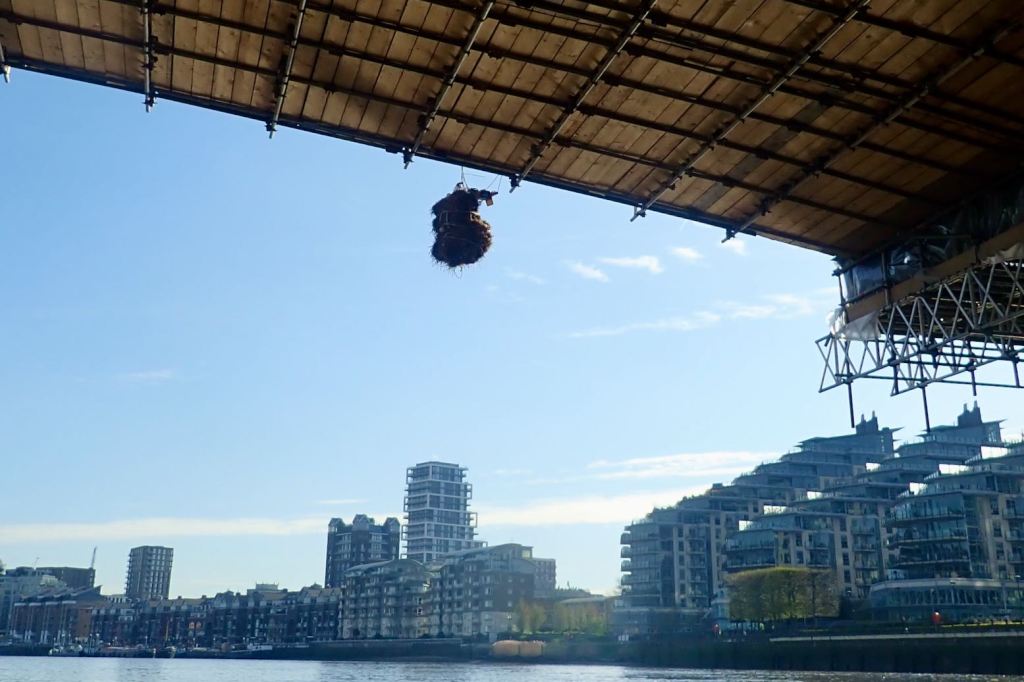
That old hay bail from my visit last April in the Seawave.
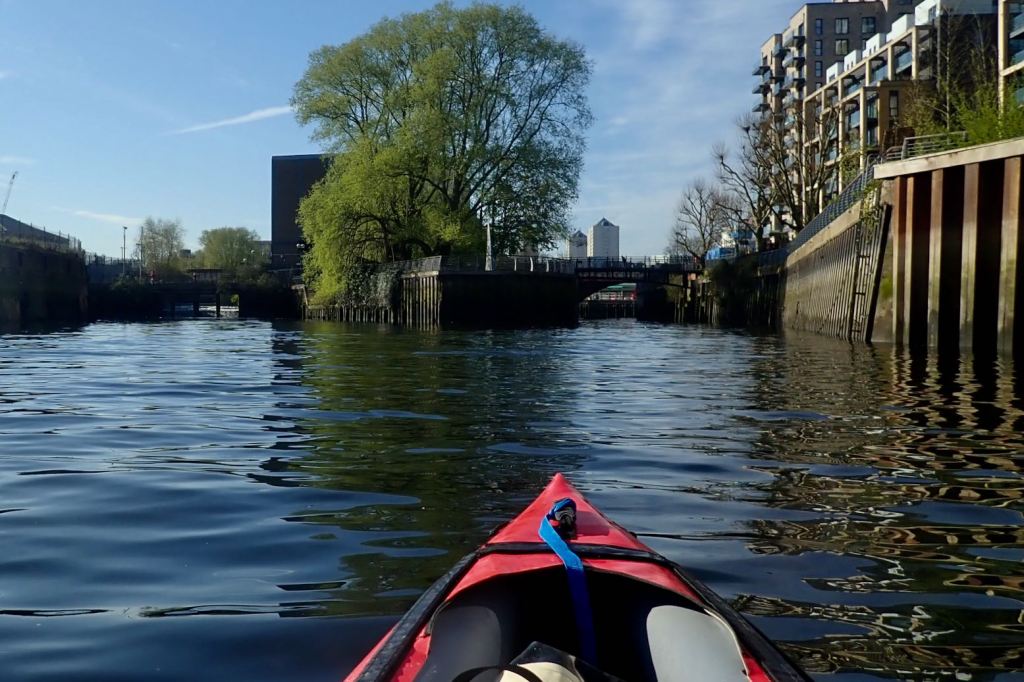
It’s an ancient rivermen’s sign indicating ‘arch closed’ or danger. Could make a nice bird nest too
The Revo seemed to yaw a lot for a long boat. Maybe the floor pad making the floor extra flat doesn’t help.
So I pull over and fit my skeg which made it a bit better
You don’t want to push up against this with 0.55mm of TPU between you and the fetid Thames
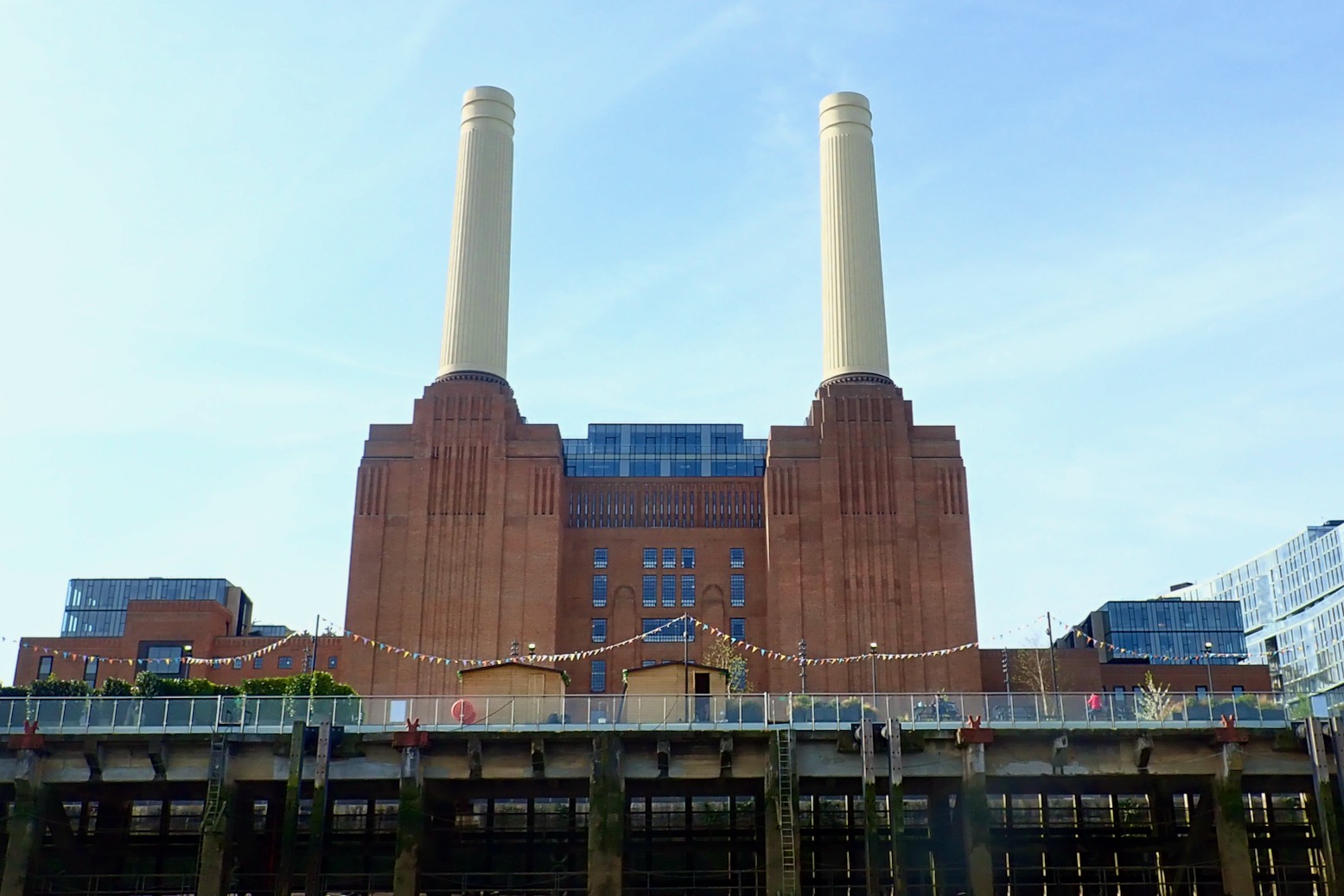
Is Battersea Power Station powering again? I hope someone informed the new residents?
I am reminded of the famous Pink Floyd LP cover from 1977.
People ask: What does the pig symbolize in Pink Floyd?
Along with dogs and sheep, pigs are one of 3 animals represented on the album. The pigs represent people, like [Mary] Whitehouse, who feel they are the moral authorities.
I was only asking!
The latest scandals? Sigh: where to start, but good to see they’re finally getting the flammable cladding sorted.
9am, all is quiet on the river but as soon as you pass under Westminster Bridge things gets choppier.
My P&S camera is barely coping with this eclipsarian light. What a wash out.
Jaunty buildings; journey’s end is nigh
I try some more selfingtons, but the focus is too low
I pull in just before London Bridge. I averaged 5mph for 7.5 miles, but half of that speed was the tide.
Like any packraft, the Revo felt slow at times. You sure miss the g l i d e of a long IK.
But it got me here and weighs just 4kg with the floor pad.
Jeez, I’m glad I got off before he bombed through!
A picture of me rolling up the packraft, so you know I’m not making it up.
I decide to climb the ladder for old time’s sake.
Back in summer 2005 with the old Gumo Sunny (my first proper IK) and before I knew about packrafts
Notice the small standing waves you often get just after London Bridge
What is the name of this famous ship?
And who was the illustrious captain?
I find myself in Borough Market for the first time in years, an Aladdin’s souk of upmarket nosebag:
Paradoxically, in the middle is a greasy spoon and before I know it I’m sat before my annual Full English.
After, I buy a giant sourdough loaf for a fiver and some wafer-thin slabs of Comte and Gruyere at only £45 a kilo.
Can I see you ticket, please?
London Bridge & APaddleInMyPack

Read more about the Anfibio Revo here.

All Quiet on the Waterfront; Kayaking through London

See also
Kayaking Richmond to Greenwich

Notice anything suspect about this image?

Right now [April 2021] it’s a great time to kayak the Thames through London. It’s only April but due to you-know-what the Westminster tourist barge scene is dormant, making that brief but lively stage a bit less fretful. Down at water level we paddlers may be hyper vigilant, but can the bloke doing a U-turn in his heaving tourist catamaran while doing a commentary see us fending off the standing waves and refracted wakes?
As a barge-tourist in a Union Jack bowler hat asked me last time;
Is this allowed?
Yes it is chum, but a kayak on this part of the Thames is still an incongruous sight. The congestion and the standing waves pushed up by some bridges at certain times can feel a bit like skateboarding in a gale on Runway 3 at Heathrow.

Downloading the PLA’s mammoth 130-page Tideway Code is enough to put anyone off, but I do believe this edition (dated October 2020) is less anti IK than a previous version I read. At the time I recall seeking clarification from the PLA’s media person and got an arsey corporate riposte. Has the Lockdown IK consumer surge turned the tide on the PLA’s prejudice? It’s the old problem of misconflating a clueless beginner in £49.95 Aldi bin bag with an alert and well-equipped paddler in a decent high-pressure hybrid.
I say: pick your tide, keep right and be observant. For me the biggest peril was dodging the horizontal scythes of the Putney rowers who seem to go up and down across the whole width of the river as they please. They do need a lot of space.

Mortlake to Mayflower (Rotherhithe)
This 21-km (13-mile) stretch lined up well with 10-minute walks from stations at either end.
By Rotherhithe the excitement, such as it is, is over. And skipping the five miles from Richmond gives an easy three hours on the river; a nice early morning or afternoon paddle with good light for great photos or views of the Thames’ bankside icons.
It’s dawn and a Sunday, so it takes two buses and a train to get to Mortlake
Yadda, yadda…
Spacious put-in at Bulls Alley off Mortlake High Street, complete with benches
7.15am. All is calm
A bit of early morning rumpy-pumpy
Head buoy
Genteel Georgian waterfront around Chiswick
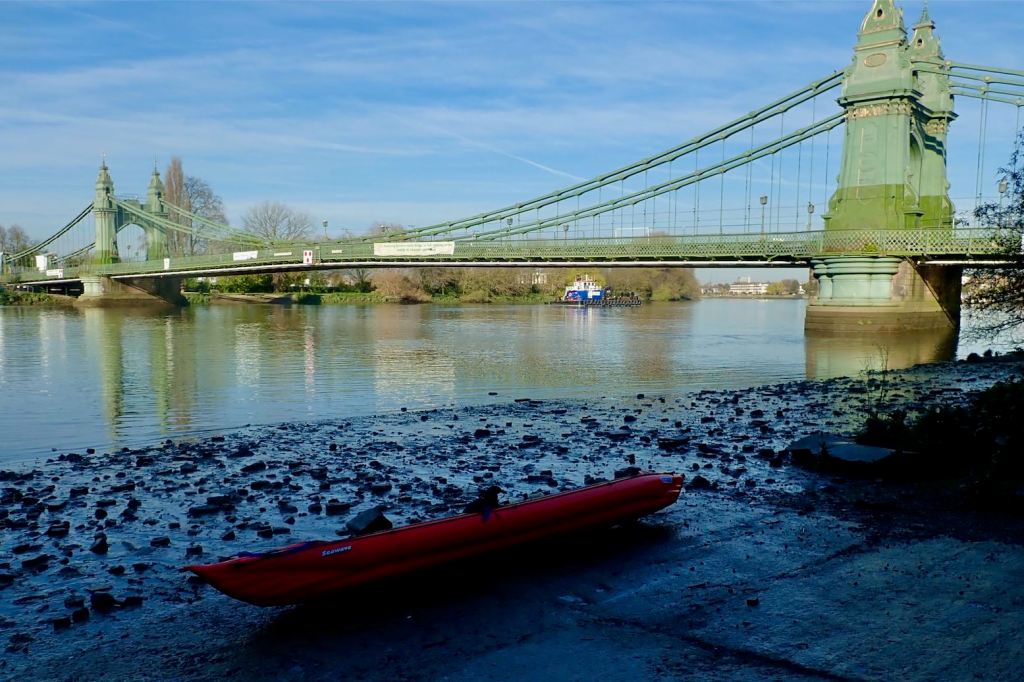
Arseache! Hammersmith Bridge is Falling Down and closed to navigation.
Ie: you can’t paddle under it in case it collapses on your head.
But on the north bank there’s a handy jetty and this slipway (above) on the downriver side is a 5-minute carry
The Hammersmith’s brittle, ageing cast iron dates from 1887 and is suffering from micro-fractures.
All together now: “Build it up with iron bars, iron bars, iron bars.
Build it up with iron bars, my fair lady
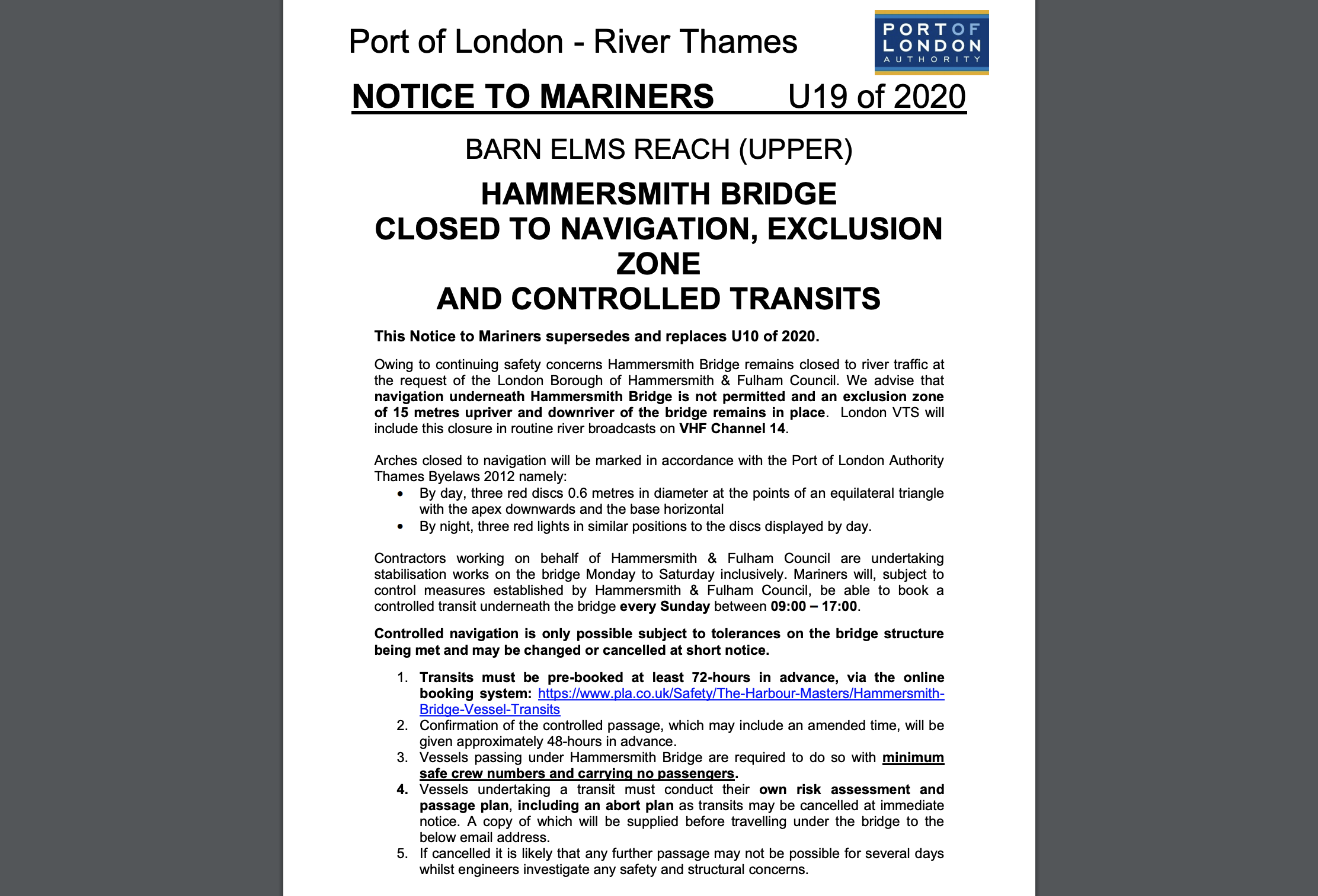
Once a Harrods warehouse, how expensive flats
9am. Putney rowers getting their oars on.
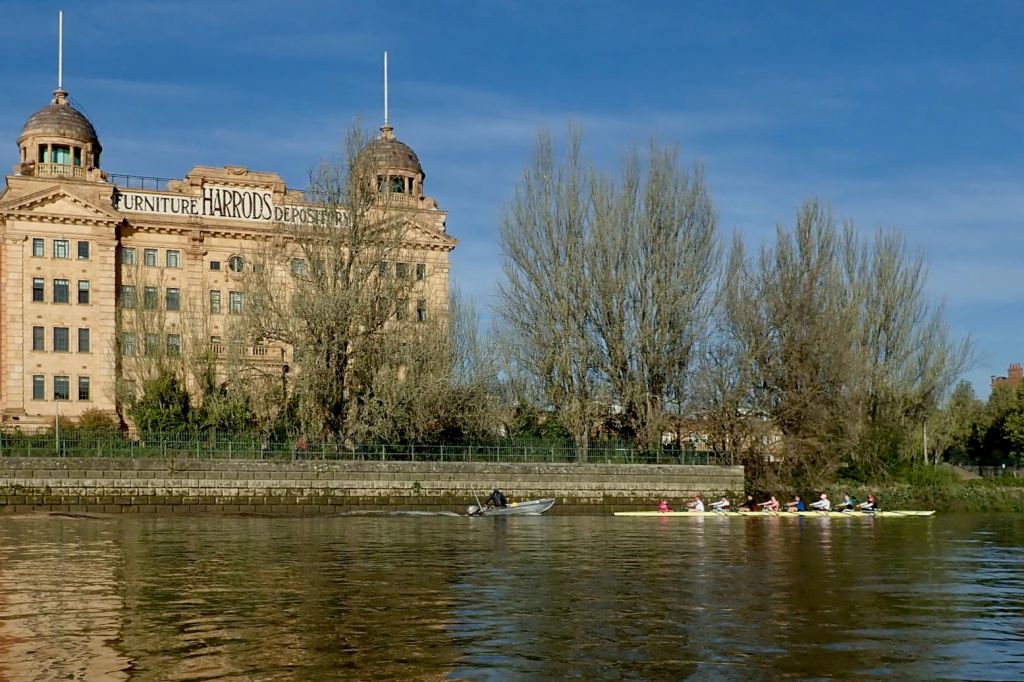
At Wandsworth I nip up Bell Lane Creek where the Wandle comes in.
Big weir drop to the left, and a bit further up on the right, another weir drop at all but HW.
See: Wandle: An Urban Packrafting Nightmare
Hanging hay bale? WTJoF? Explanation in the PLA Tideway Code
No arcane signage here up Wandle creek
It’s chilly. Nature’s call cannot go unanswered
River racers. My money’s on the Yellows
Holy Mother of all Parliaments. The latest scandal? The ‘chumocracy’ of lobbying (there have been a whole load more since
It gets a bit choppier just after Westminster Bridge as the current backs up
London Eye still looks as amazing as ever. I wonder if they grease the axle and tension the spokes once in a while
Rectilinear skyscrapers are just so last century
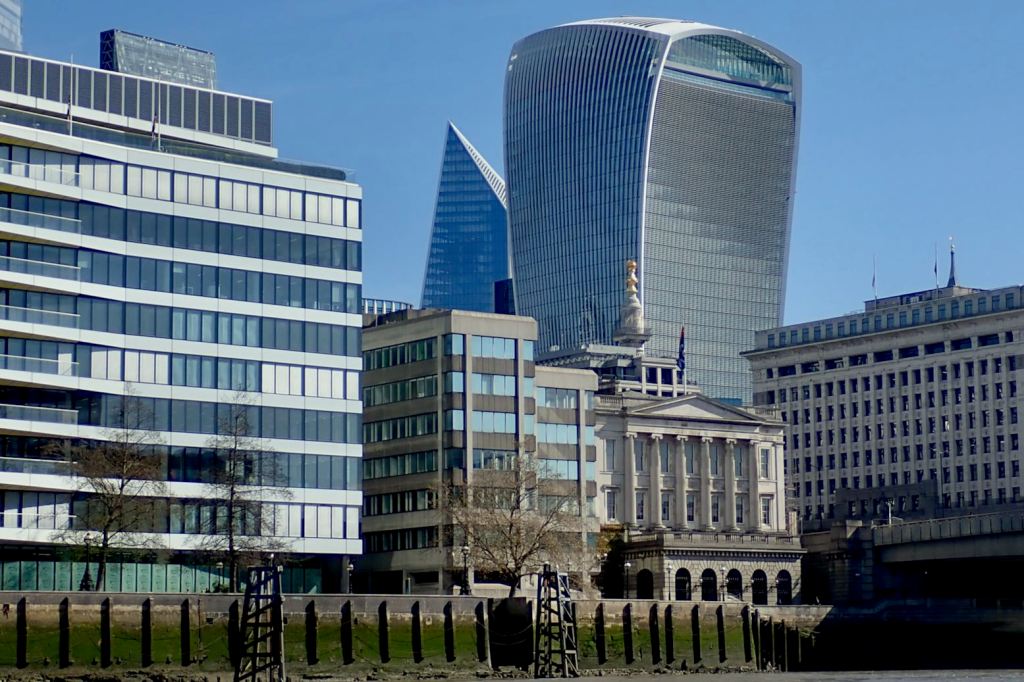
A few years back sunlight reflected off the ‘Walkie Talkie’s’ concave face (20 Fenchurch St) and melted a car in the street below
Not falling down any time soon, but small standing waves soon after can make you think
By the HMS Belfast it settles down again. On a neap tide at least.
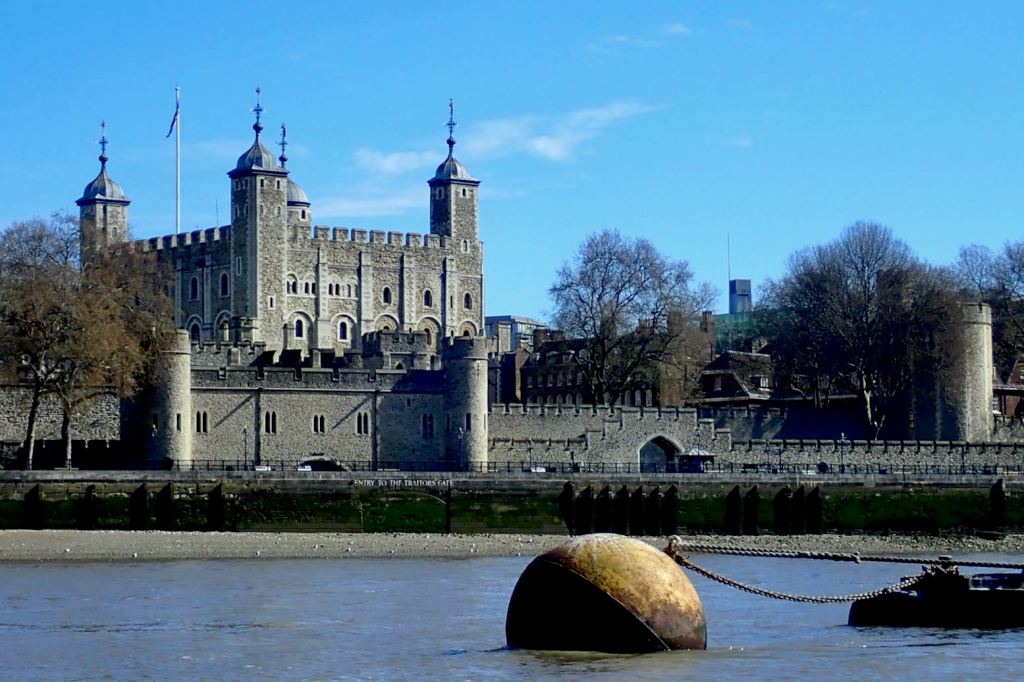
‘Send him to the Tower!’
This is what Hammersmith needs
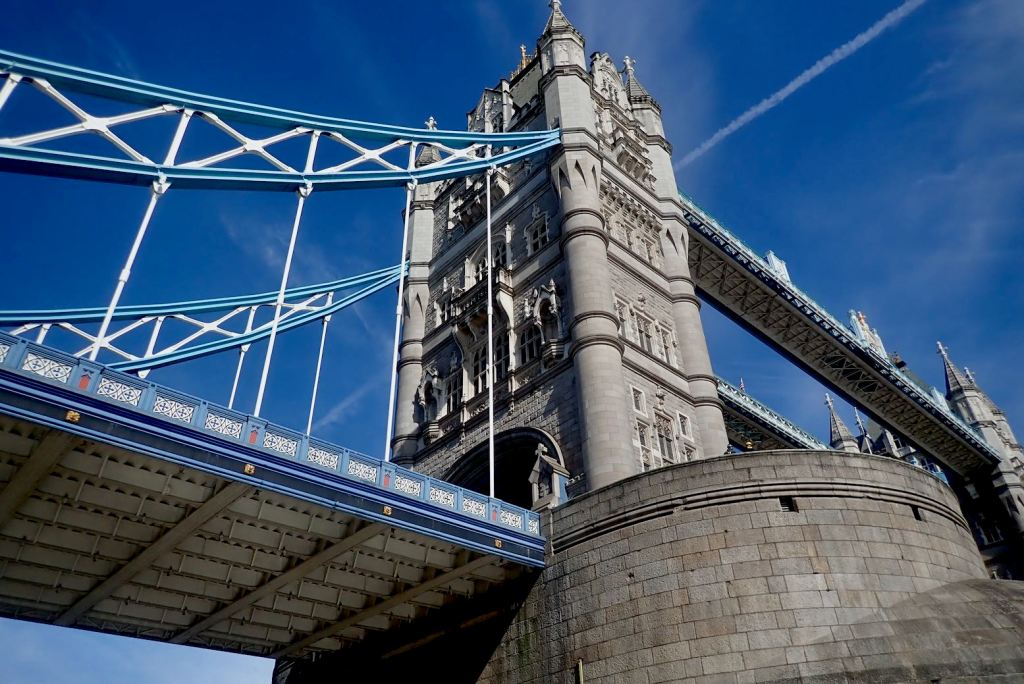
After Tower Bridge the river widens out and the powered craft can gun it
A mile downriver, the Mayflower’s looking a bit shabby. Don’t people go to pubs any more?
In 1620 the famous ship embarked from here for the New World
Tourists RIBs slalom up and and down the Pool of London like giant jet-skis
My modified seatback worked great. Just what was needed
Go west young man. And never come back!
From the beach it’s a 10-minute walk to Canada Water station.
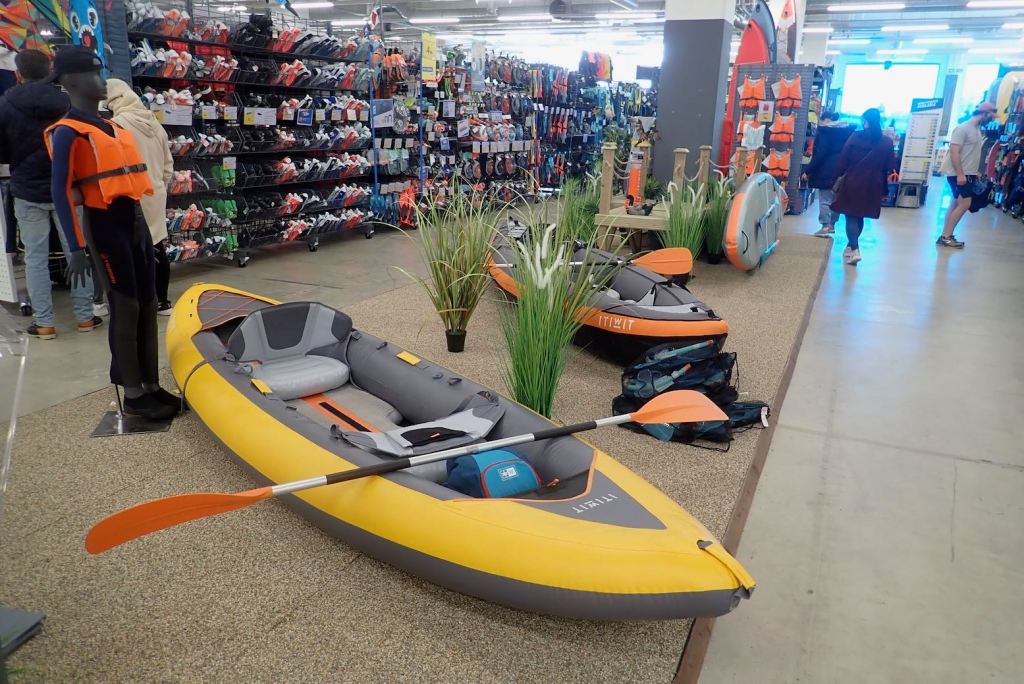
I pop into Decathlon nearby to admire some Itiwits; quite possibly Britain’s most popular IK


The Long Wey Down: kayaking Guildford to Hampton:

Seawave Index Page
Regents Canal (London)
Avon & Kennet canal (Bradford on Avon)

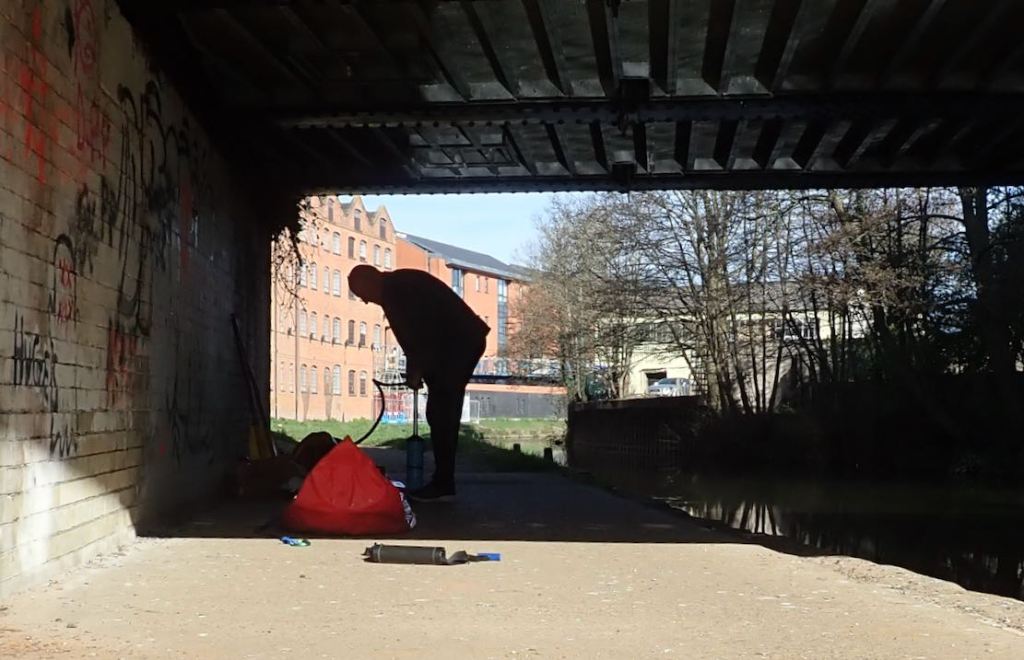
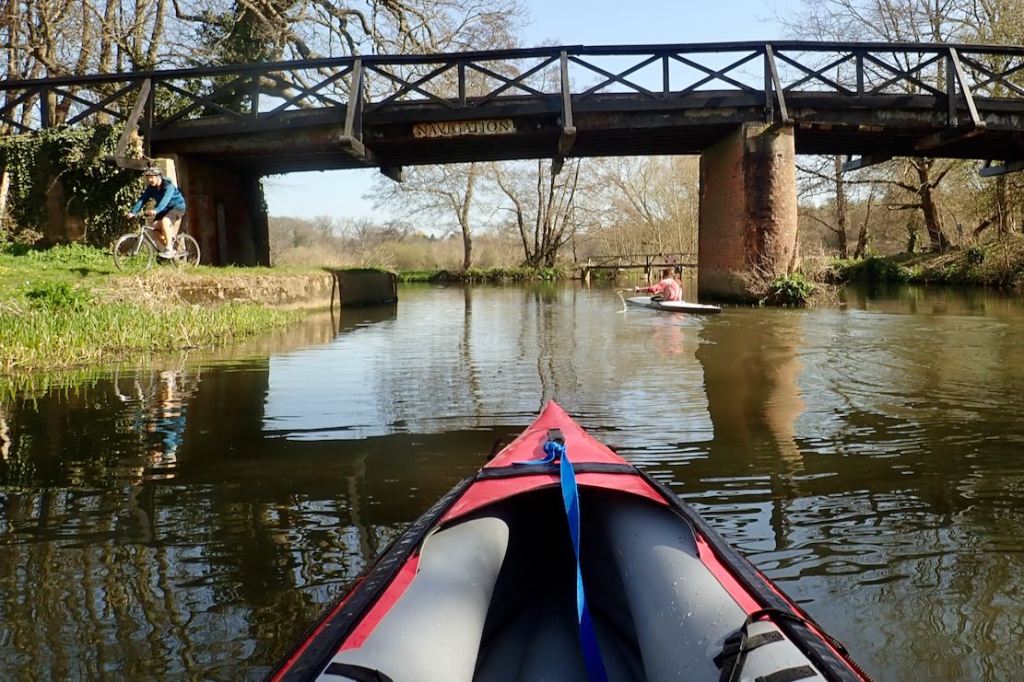
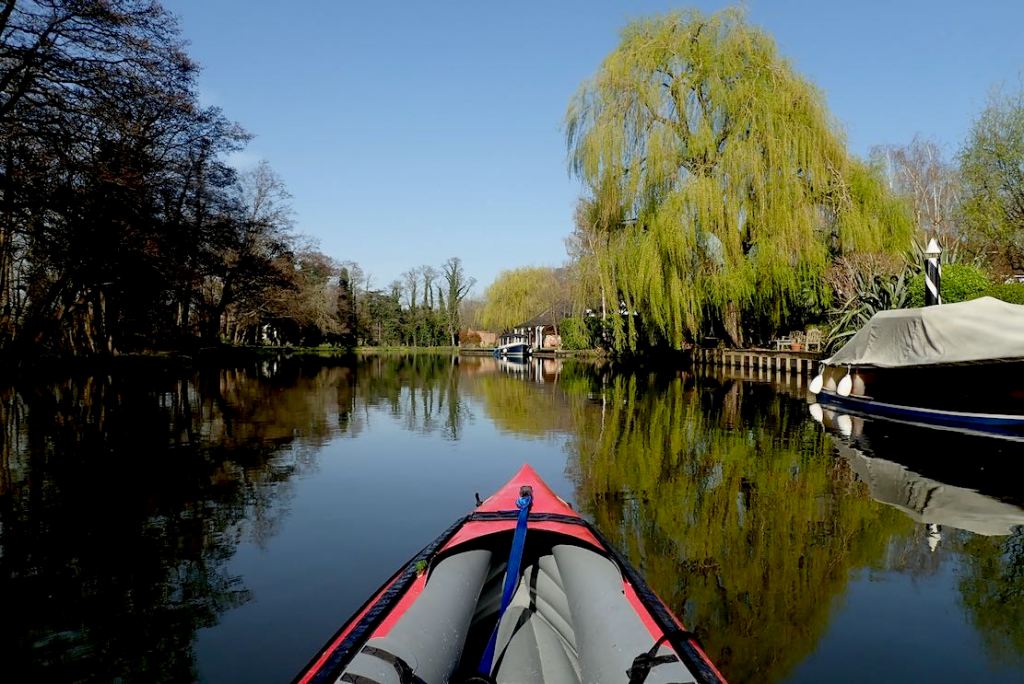
One of England’s first navigations, dating back to 1653. That’s probably why this historic canal feels quite natural and river-like, apart from the virtual lack of current.

All hands to the barrel pump! The day will be long, sunny and warm. High time to tick off ideas matured over the winter months of Lockdown.
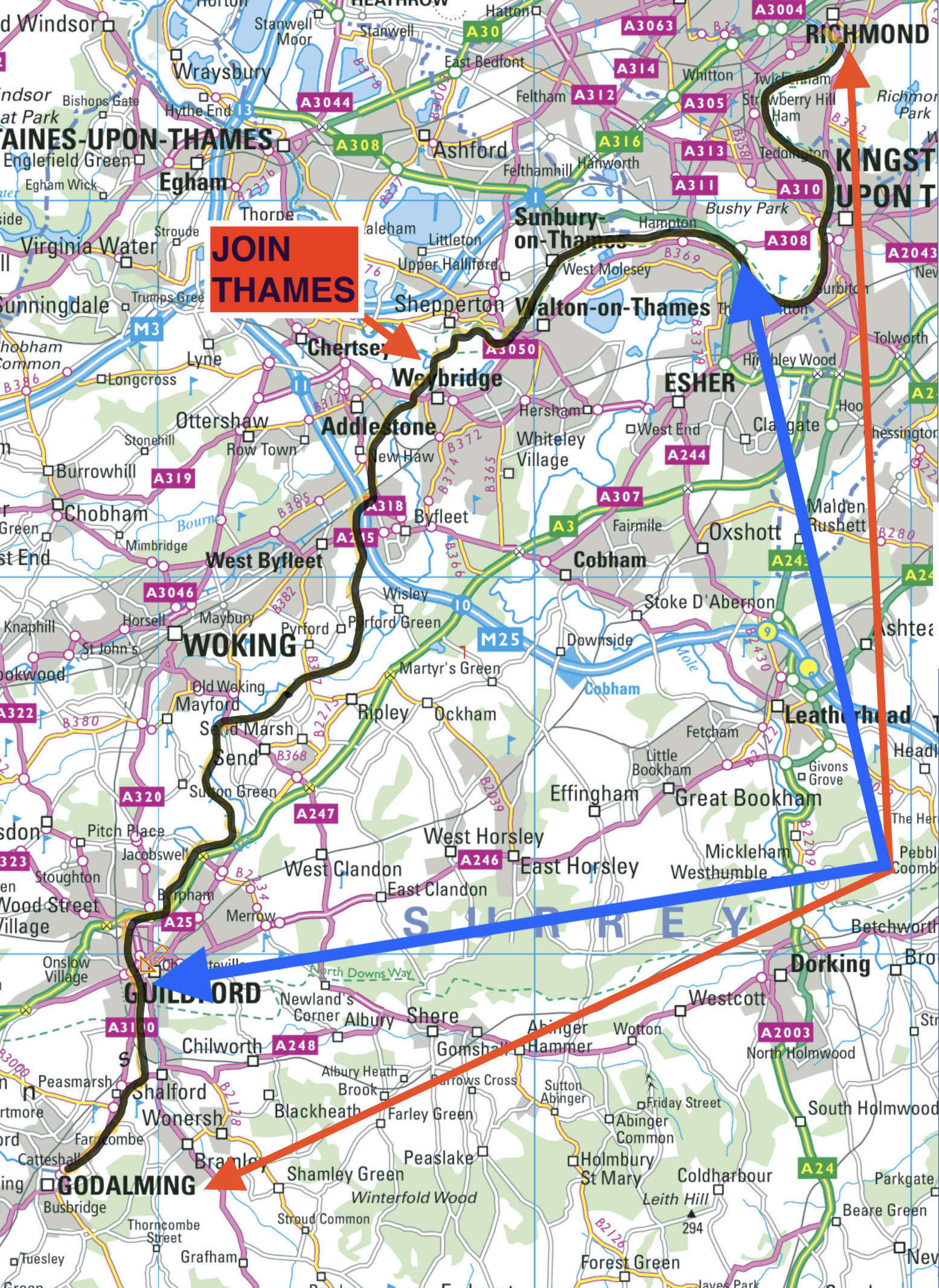
First on the list: the River Wey from Godalming to Weybridge in Surrey. Or should I say, the historic canal called the Wey Navigation which is paralleled in places by the old river. It’s one of England’s oldest navigations (commercial inland waterways) which once connected the Thames with the Navy base in Portsmouth. At the time a safe way of transporting stuff, including munitions produced near Godalming, without risking encounters with Napoleonic marauders in the Channel.
For years I’ve been unsure whether the Wey was a dreary canal with more locks than the Tower of London, or a grubby, semi-urban river with weirs and other obstructions. Turns out it’s a bit of both but better than expected. All I had to do was RTFM!

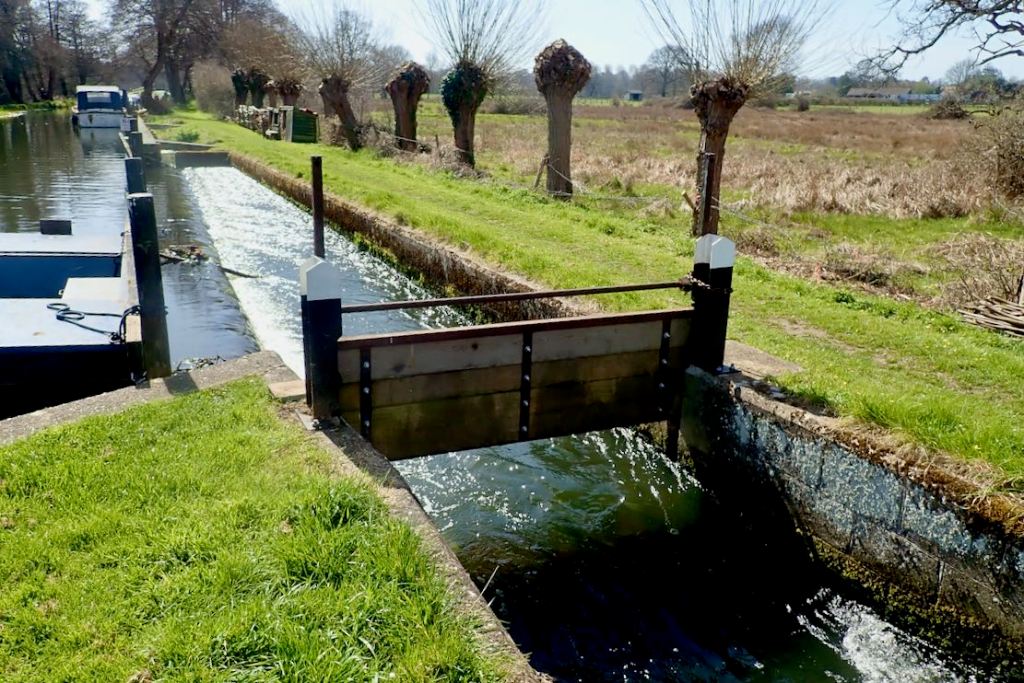
Compared to the similarly popular Medway, which I’ve done loads of times in IKs and packrafts, summer and winter, the Wey Nav feels less agricultural, more scenic and has an interesting history if you slow down enough to look. But it lacks the Medway’s unique canoe passes which scoot you down the side of each lock (right), avoiding up to three laborious carry-rounds per mile.
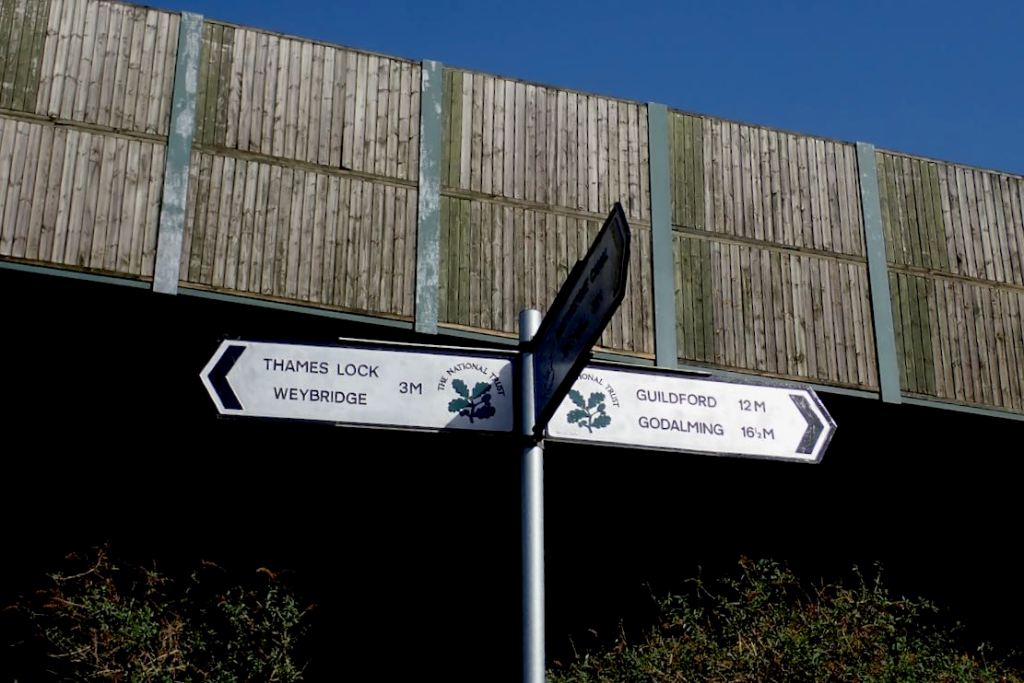
Parts of the original river survive in places to either side of the canal, which is what caused me confusion. I now realise the Navigation (managed by the National Trust) gets priority in terms of water levels and maintenance. As a result the occasionally nearby River Wey might be shallow or chocked up with fallen trees or rubbish. But you can combine both to make loops like this.

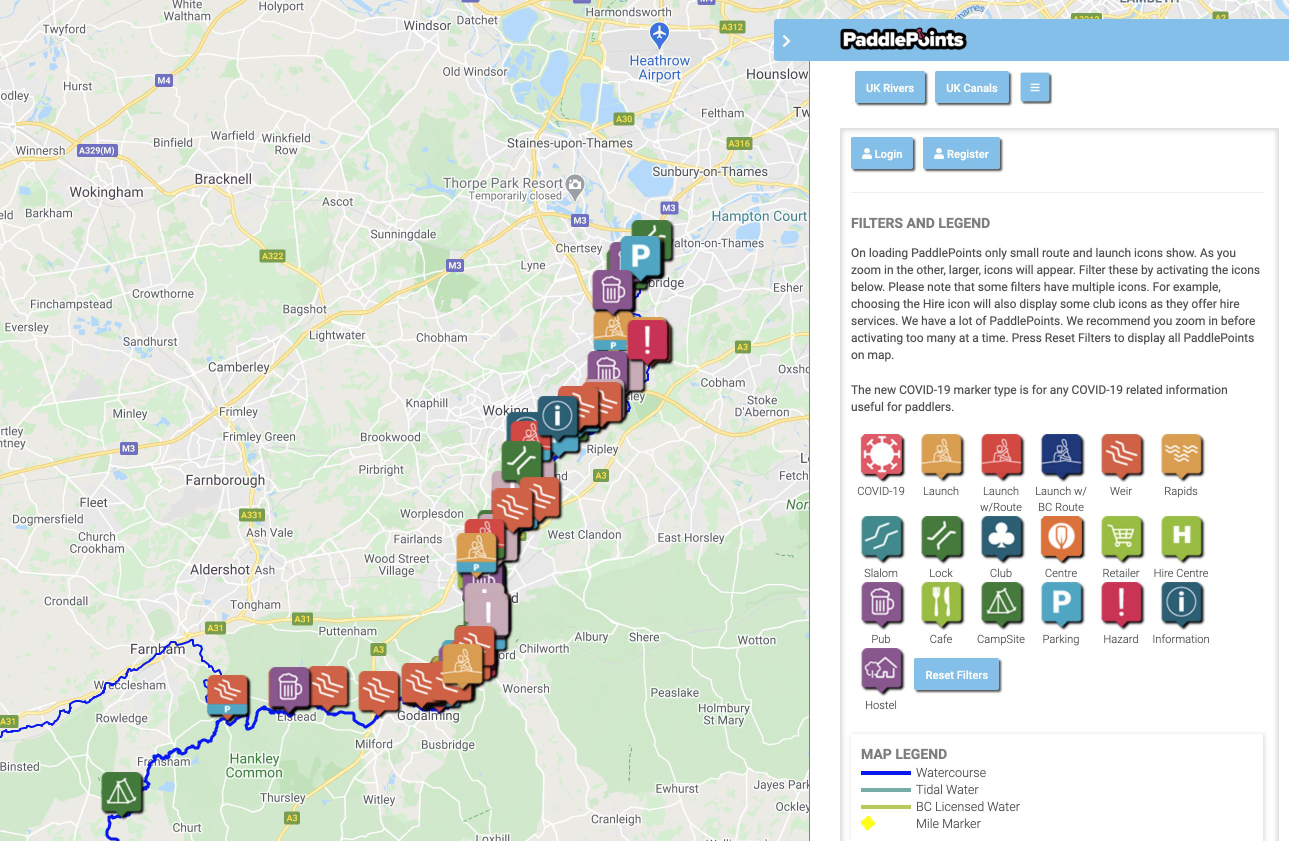
Because of the Wey’s multiple channels and numerous weirs and locks, I tried British Canoeing’s PaddlePoints website, a comprehensive database of paddleable river map routes with handy icons (above) for put-ins, parking, hazards like fallen trees, feral teenagers (I’m not joking) and so on. You can reset to delete extraneous icons (‘Covid-19’ ?); I just wanted to clearly locate the locks and weirs and river’s branches, though on the day ‘Navigation [this way]’ signs at junctions were clear. Closer scrutiny of the map shows that in places the blue line guides you along the old, choked-up river, not the Nav, and not all weirs (an important feature to know about) are shown as icons, even when they’re clearly evident on the Sat view underlay. And so the Map view (as above) can give a misleading impression of which way to go. As you’ll see below, at one point the blue line even guides you over a weir. Common sense prevails of course, but you can imagine some beginner clutching their PaddlePoints app on Map view getting sucked into a weir. I realise now this content is user-generated like OSM or Google Maps, and so errors, inconsistencies and lack of moderation are inevitable. As such, you can report icon-points, but it’s unclear if the route (blue/green line) can be corrected by users. If nothing else, PaddlePoints helps identify which rivers you’re allowed to paddle in England and Wales, and what the rules there might be.

I fancied a full dawn-to-dusk recce: as much as I could fit in from Godalming (where most paddlers start) before my tank ran dry. I might even reach Richmond on the Thames, a section I enjoyed last December in the Arrowstream. That is actually quite a haul: 20 Weymiles plus another 15 on the Thames, including no less than 17 lock portages on the two rivers. But the great thing about ending a paddle in an urban area is I could air down when I got worn out and rail home.
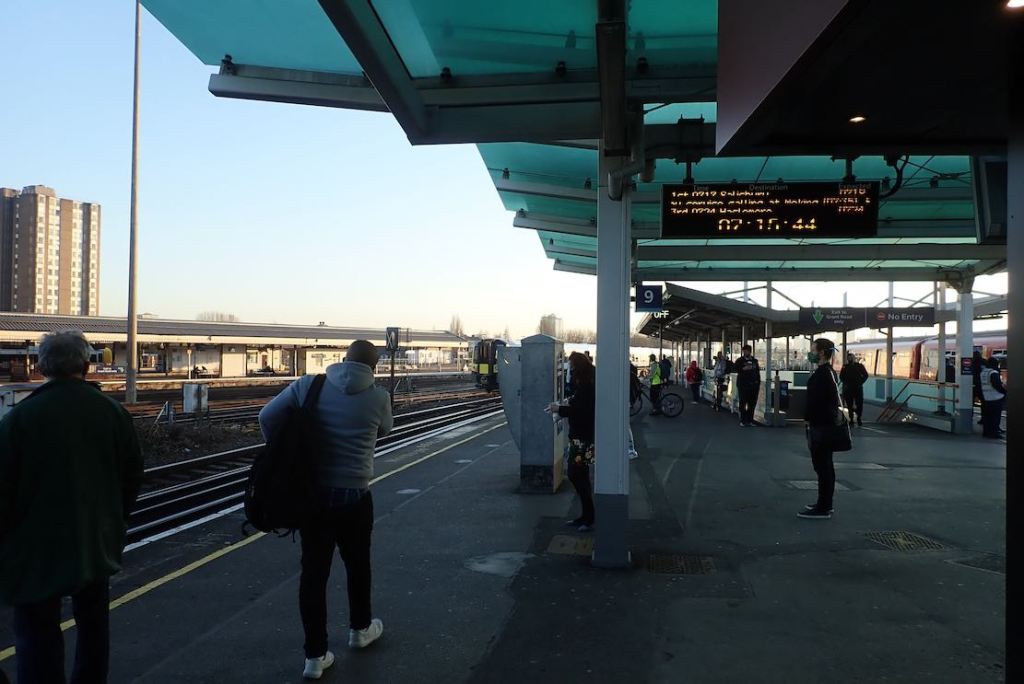
Thirty-five miles? Dream on, bro! I’ve only paddled two days since September so was far from paddle fit. Then again, the pre-dawn brain wasn’t on top form either: I set off in the right general direction, but on the wrong train.

Oh! Mister Porter, what shall I do?
I want to go to Godalming
And they’re taking me on to Hoo [k],
Send me back to Woking as quickly as you can,
Oh! Mister Porter, what a silly boy I am!

After backtracking, I decided to catch up with myself at Guildford, 5 miles downstream of Godalming and missing out 4 of the Wey’s 14 locks. I dare say I’d appreciate that later.

Clapham at 7am. It’s all a bit of a blur.
In Guildford I slip onto a closed towpath and enjoy a quiet set-up without the usual ‘Oh Mr Porter, is that one of those inflatable canoes? I’m thinking of getting one…’
Just around here I realised I’d left my Garmin out in the sun to catch a signal… Should have gone to Starbucks.
I’m trying out some old runners as water shoes instead of my usual Teva Omniums.
Do they really believe this or is it just juvenile baiting?
Alternative use for a big slackraft.
At Bowers Lock I spot my first Intex of the day, a 100-quid of K2 Explorer on its maiden voyage with daughter and dad.
Under an old bridge a real K1 belts past with barely any wake. Looks like fun but what happens when she stops? Same as the bike on the left, I suspect.
As canals go, not so bad.
Triggs Lock. With a little work this side sluice could be a fun canoe chute (lens finger shows scale).
All they need to do is get rid of the guillotine and add a galvanised chute at the end.  
How about it, National Trust? It would be like turning Downton Abbey into a Discount Carpet Warehouse!
Soon after lunch at Papercourt Lock I pass two chappies also heading for Weybridge in something called a Sea-Doo.
Flip yer paddle round, mate, you look like an amateur!
Not another lock, TFFT! Just some general-purpose gates to hold back Viking raiding parties.
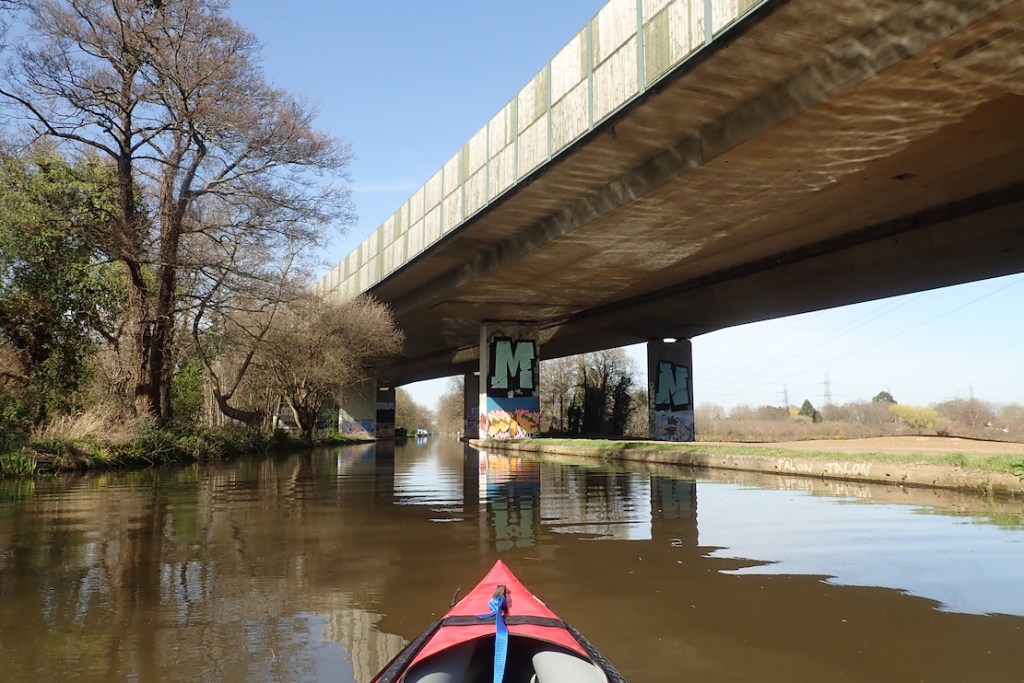
At this scenic and willowy point the canal runs right alongside the M25 London orbital motorway.
The tyre noise is like Niagara Falls.
Mile 12 at Basingstoke canal junction. By some civil engineering synchronicity the M25, Wey Nav, Basingstoke Canal and a railway mainline all cross or meet at this point. In its way it demonstrates the history of post-medieval commercial transport: rivers > canals > railways > highways and airplanes. That’s my MA thesis, right there!
At New Haw Lock I need water but the lawn-mowing lock keeper says there’s no tap for a couple of miles.
It’s an awkward portage over a narrow road bridge too. Luckily, this chap helps me out. Thanks, chum!
Coxes Lock with a doable weir to the side. I may try it next time and risk censure from the NT.
Well, according to BC’s PaddlePoints website, that’s the way to go!
Weybridge Town Lock. Another awkward portage over a road bridge on the left.
In places the Weybridge backwaters look like an Everglades retirement village.
As I approach the Thames Lock at Weybridge things get wobbly and I have an out-of-boat experience.
Amusingly lock-themed gates close the footpath so us portageurs can pass.
Finally at Thames level, hallelujah. And there’s a tap set into the jetty too. I drink like a camel then me and the boat have ourselves a wash.
Over six hours from Guildford, but even with a drink and food to spare, I don’t have another three hours in me to reach Richmond. Maybe I can do two hours to Kinsgton.
Now on the Thames, I become a great admirer of roller portages.
The game’s up at Hampton Court Bridge if I’m to have enough energy to roll up the boat. The station is right there.
It’s a warm evening on the Thames and they’re all out in boats and the riverside parks. The [Covid] Rule of Six? Do me a favour!
The skiffs collect bird poo while two lads fire up their Intex Challengers. I’ve seen more Intex IKs today than anything else.
Why? Because they cost from under 100 quid, float just like a Seawave but track like a barrel.
And he may be saying to himself: ‘My god, what have I done?’
Dusk back at Clapham Jct. All up, only 21 miles. I blame ten portages, no resting and my nifty but 3-kilo Ortlieb roller duffle.
With too much food, it all made the boat just a bit too heavy to carry easily. Where the lock-side grass was lush I dragged the boat, but I have a better idea.

Just before the GPS packed up at Basingstoke canal junction, I was averaging 5.5kph on the move. Pretty good with no current to speak of. On the livelier Thames I estimate I was moving at up to 10kph before I withered. Same as in the FDS Shipwreck in December.
My tall BIC backrest (below left) initially felt great then collapsed on itself. Usual story: needs a stiffer insert.
I was trying out my new footrest tube attachment points which worked great. Only when one heat-welded strap broke near Addlestone was I reminded how essential footrests are to comfort, efficiency and stamina. I jury-rigged something up between two D-rings which have been staring in the face all this time.

My 2021 Wey Survey of UK Paddling Trends 

  • Hardshell canoes: 1
  • Hardshell kayaks: 1 (+ 2 K1 racers)
  • Hardshell SoT: 1
  • Vinyl IKs (cheapies): 5
  • PVC (bladder) IKs 3
  • iSUPs: 10+  (mostly women on iSuPs, too)
  • PFDs worn, almost none then again, mine’s more of a handy waistcoat)
  • FDS spotted: none (interesting as readers here are mad for that page)