Trying a cheap disc sail

The IK & packraft sail Index Page
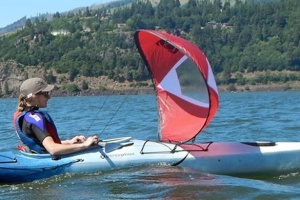
Unbranded windsail update 2016: the 3mm-thick glass fibre rod snapped. I bought another length for a tenner. It felt more flexible but within a couple of days that broke in two places too. If I run 3mm rod doubled up I presume the bending forces will be the same, but if I run thicker rod I presume it won’t fold down three times to the compact 30cm diametre disc.
Looking again at the original WindPaddle, it does seem much of the cost is explained by the ‘proprietary’ composite rod they use, and there seem few easily found online reports of breakages. Prices seem to have dropped quite a lot too (as they have for the ebay knock offs). Could it be you get what you pay for after all? It’s a lesson so often learned here at IK&P!
sai01
sai-disc

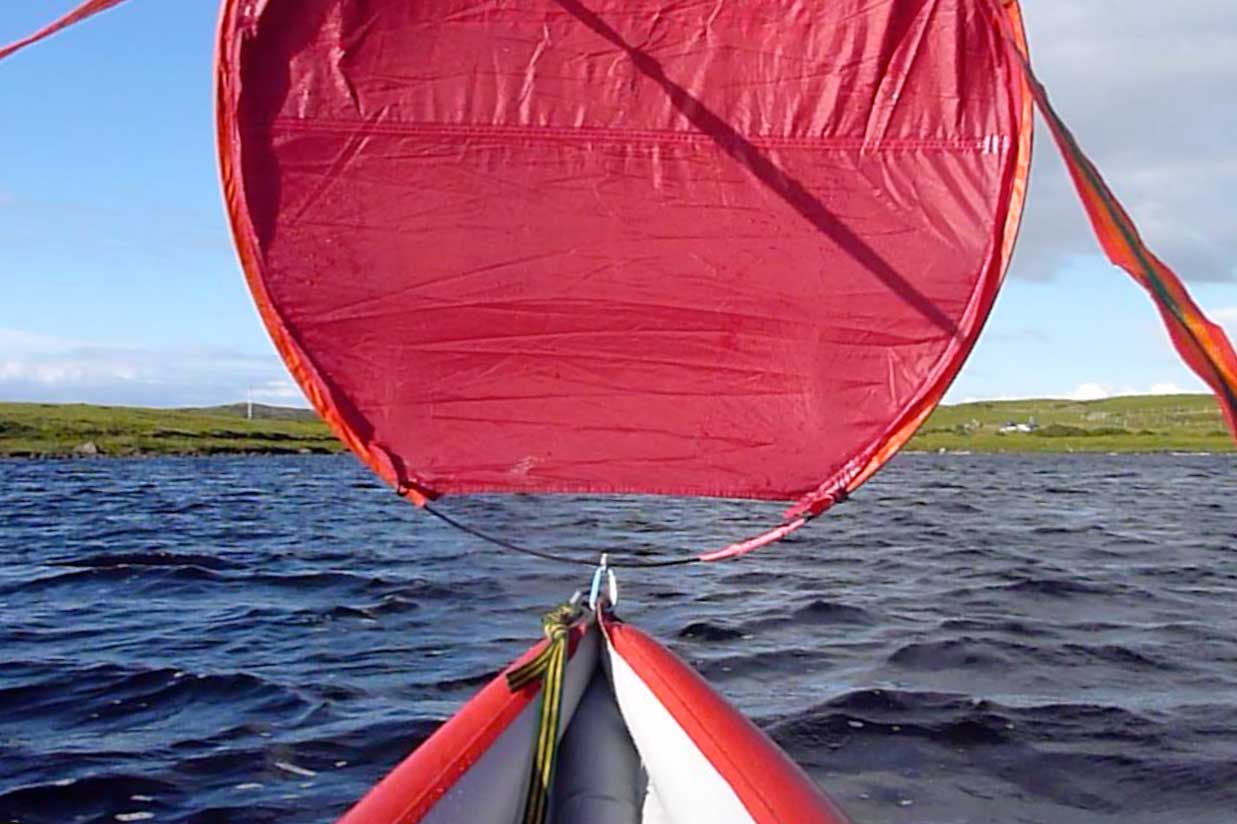
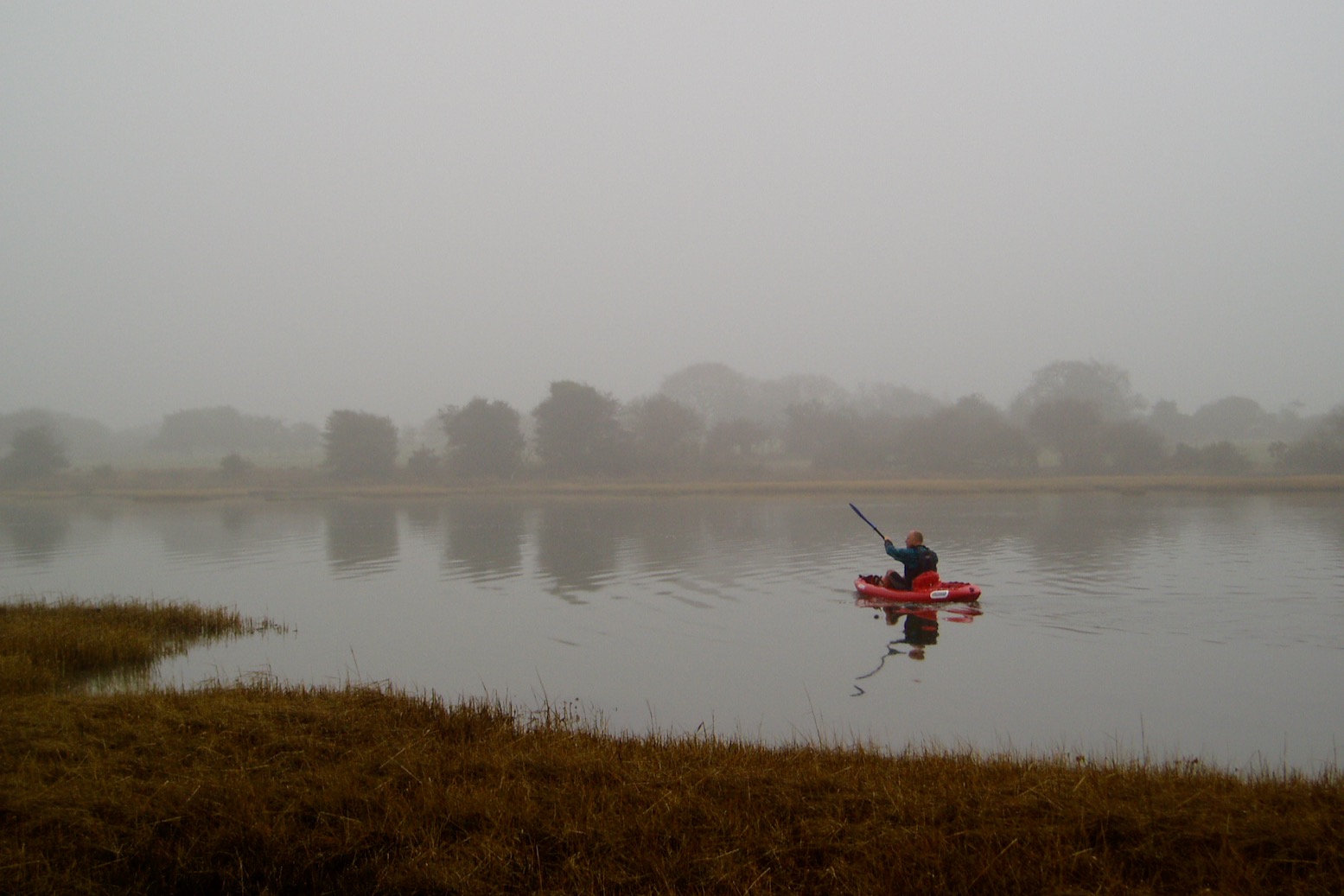
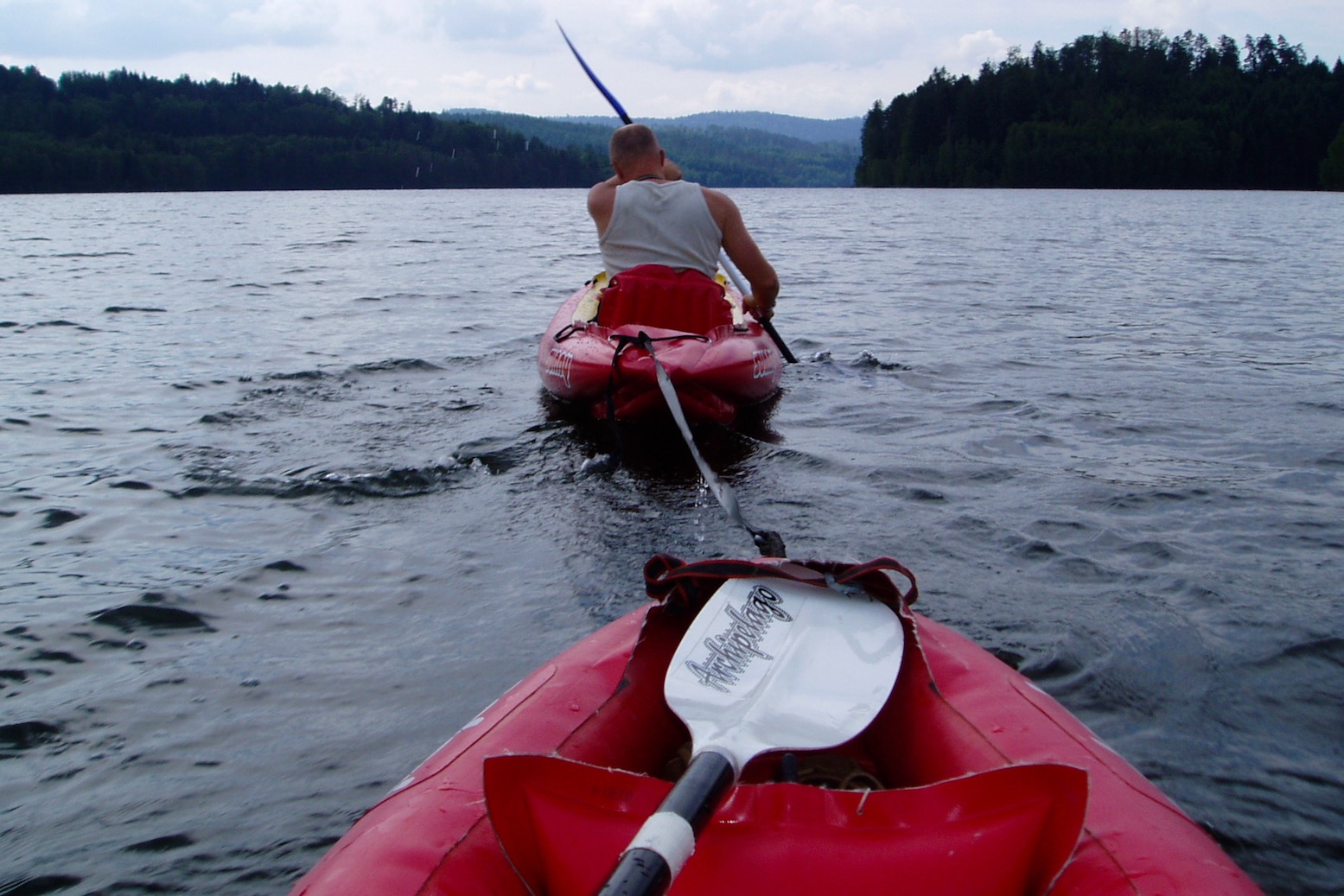
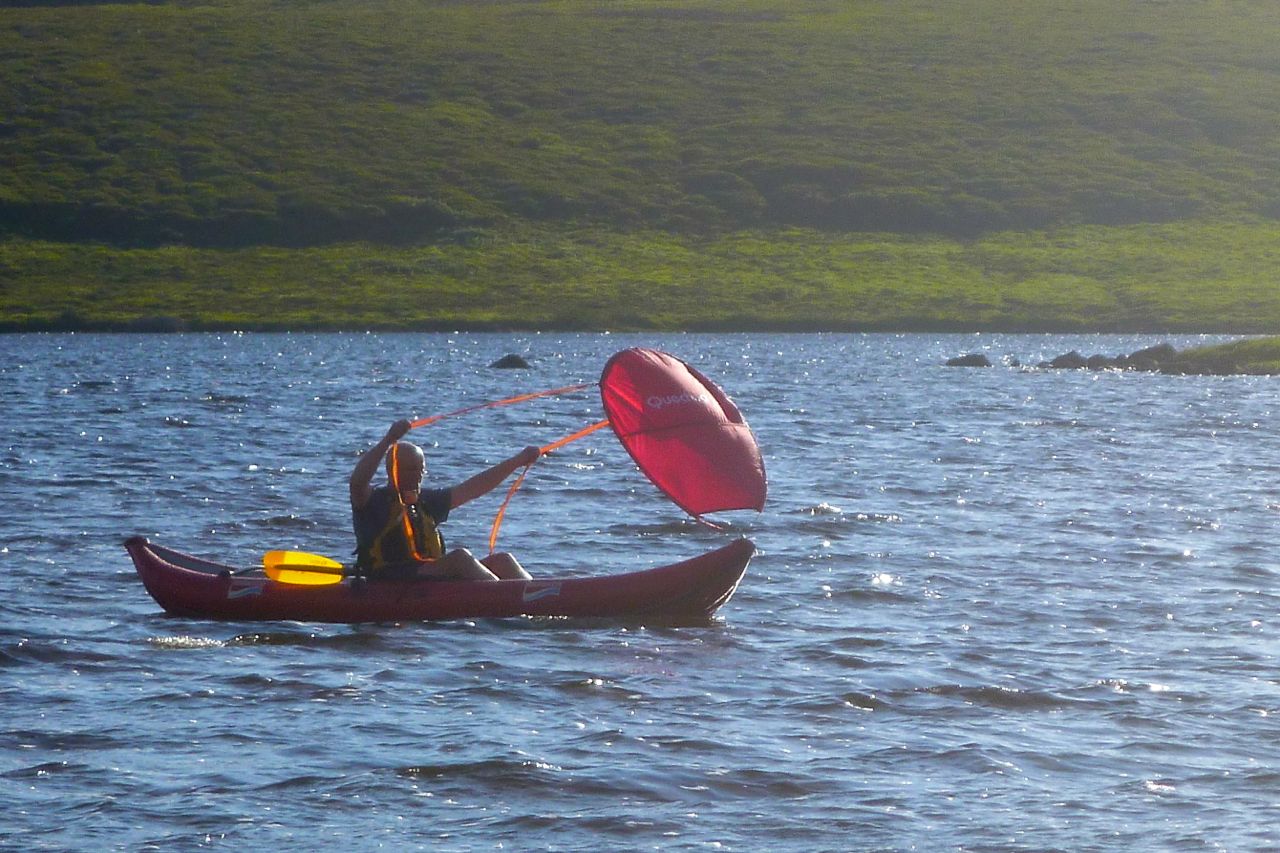
The other evening I hooked my old home-made disc sail onto the Grabner’s bow (left and above) and took it out on a loch to remind myself that it wasn’t really that good. As before, I found it difficult to get a good run before it flapped out or otherwise lost its drive.
My Pacific Action V-sail will work better, but fitting that to the Amigo may require more D-rings. I like the compactness and simplicity of a disc sail, but it was suggested that dishing like a bowl was the key to holding the wind and maintaining steady progress, even if it may be less effective tacking across the wind.
Parachutai

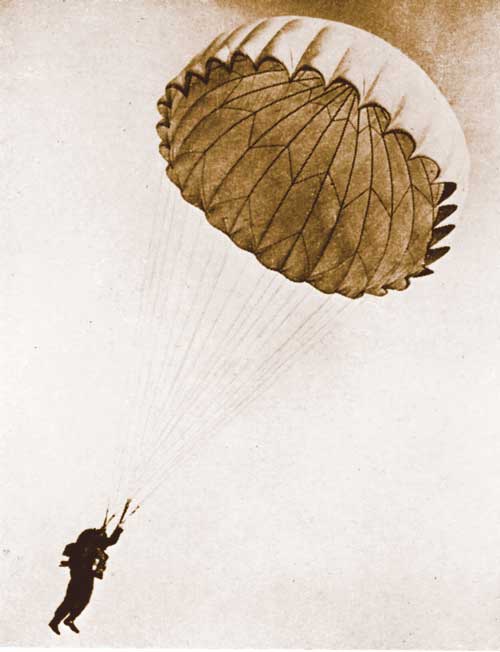
Sounds plausible and WindPaddles are clearly made like that for a reason. Since then it occurred to me that’s why classic ‘descending’ parachutes (‘reverse’ sails) are bowls and not flatter discs which would shoot across the sky. Before I set about recutting my disc into a bowl shape I checked WP prices on ebay and spotted what looked like a knock-off: ‘Canoe sail kayak sail wind sail‘, now just £15 delivered. Cheaper than sewing and at 115cm deployed, it was midway in size between WP’s Adventure which at the time was selling for no less than £155 in the UK (now about half that). Someone assure me that a WindPaddle costs even a fiver to make in China, but see top of the page.
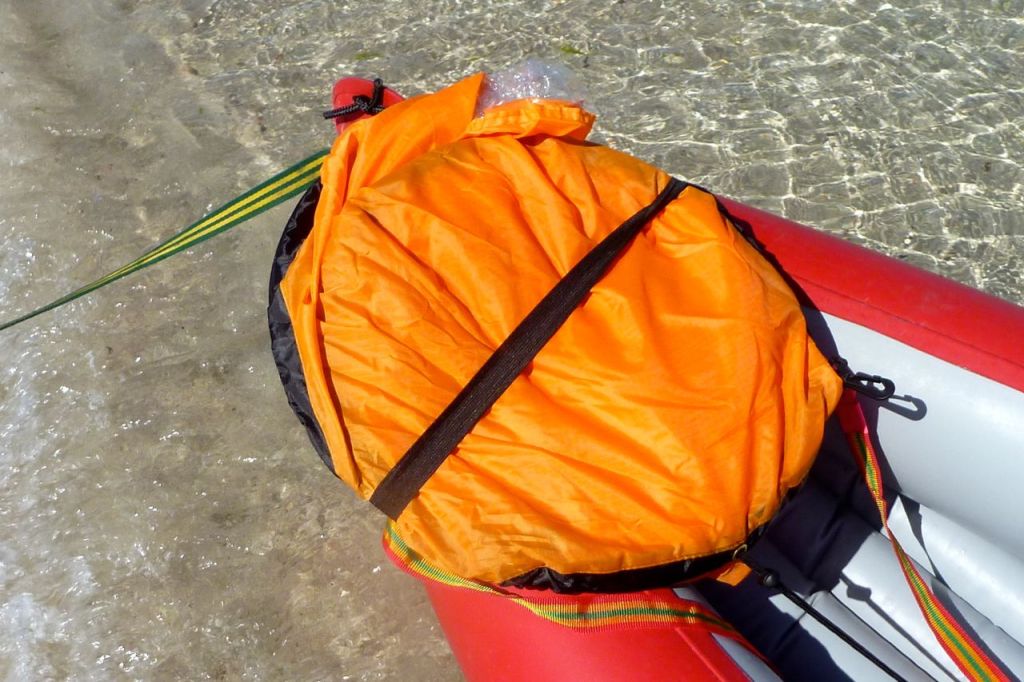
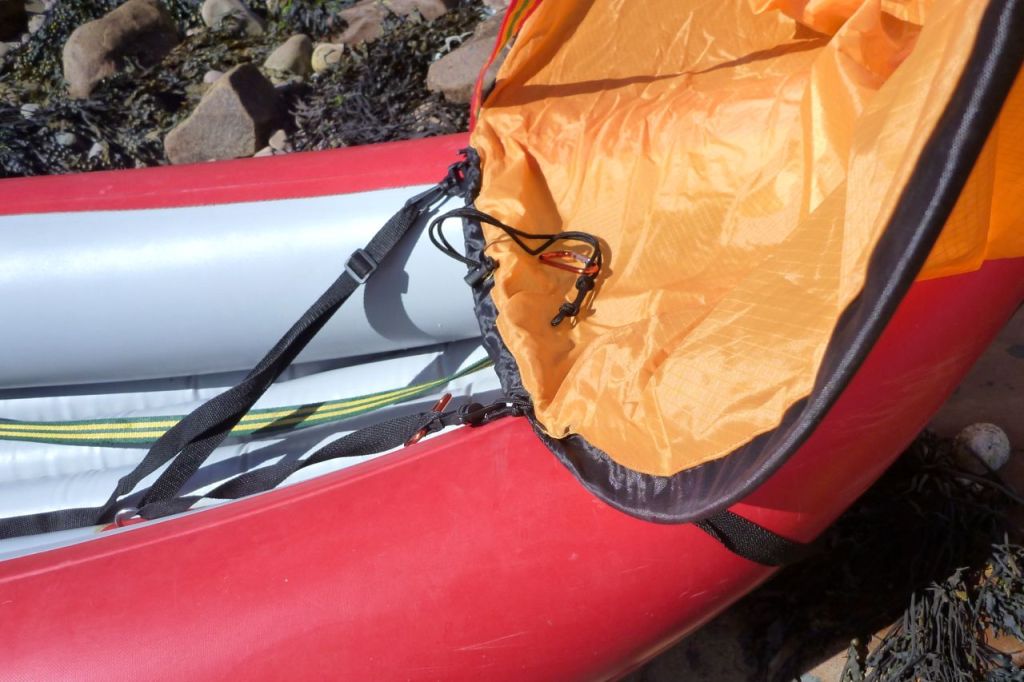
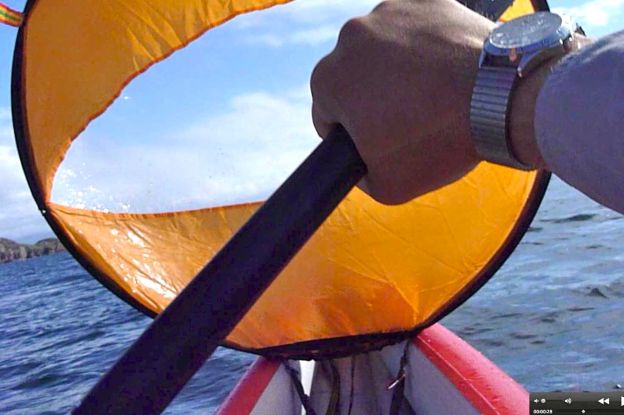
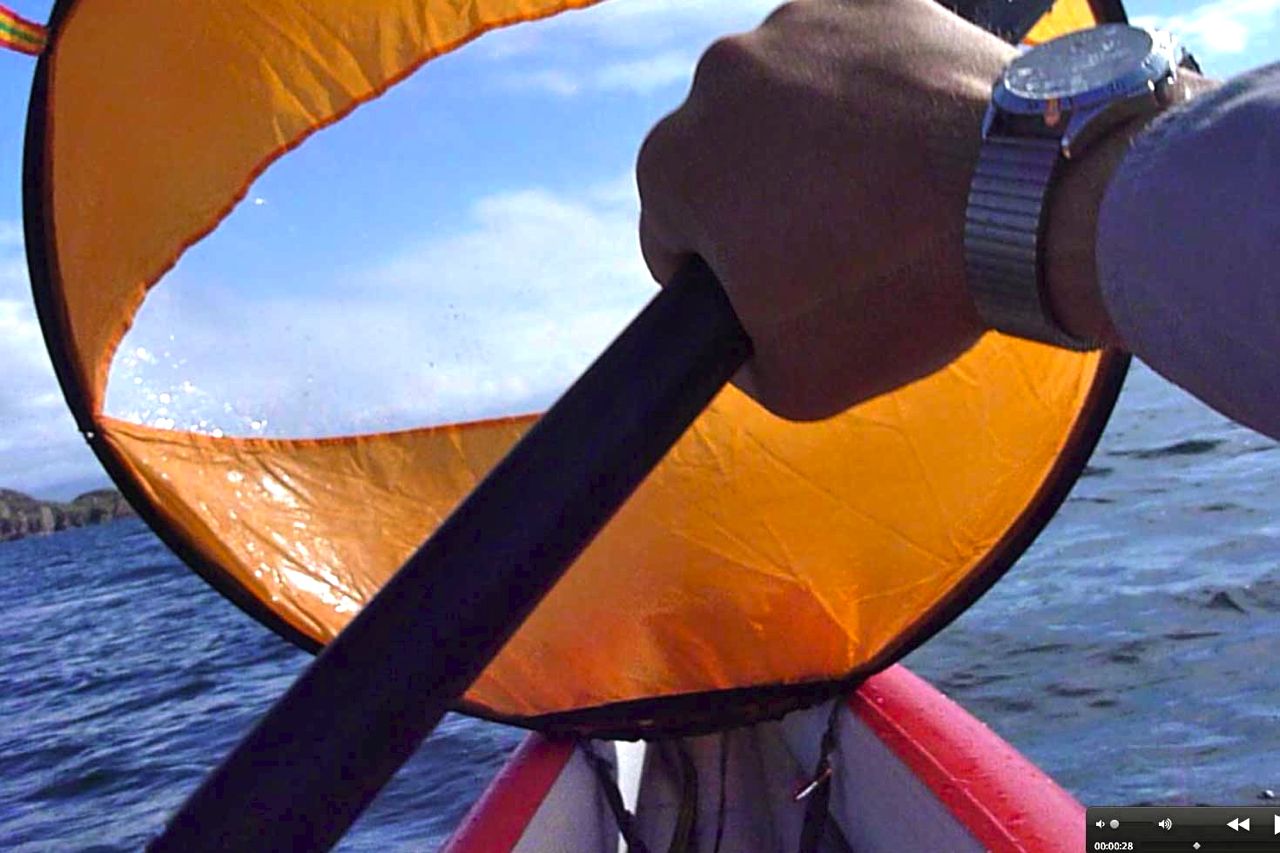
And better still, the no-name windbag folds down into three hoops of just over a foot in diameter (above left). Plus there’s an elastic hoop to keep it like that and a carry bag for the long walk back to the van. Out of that bag, the only changes I made were to replace the too-short control strings with my tape off the red sail which I find easier to handle. I reassigned a sling to hook the sail’s base to a floor D-ring back from the bow (above left). That was already fitted and was the only adaption I needed to mount the sail to the Grabner.
sai03

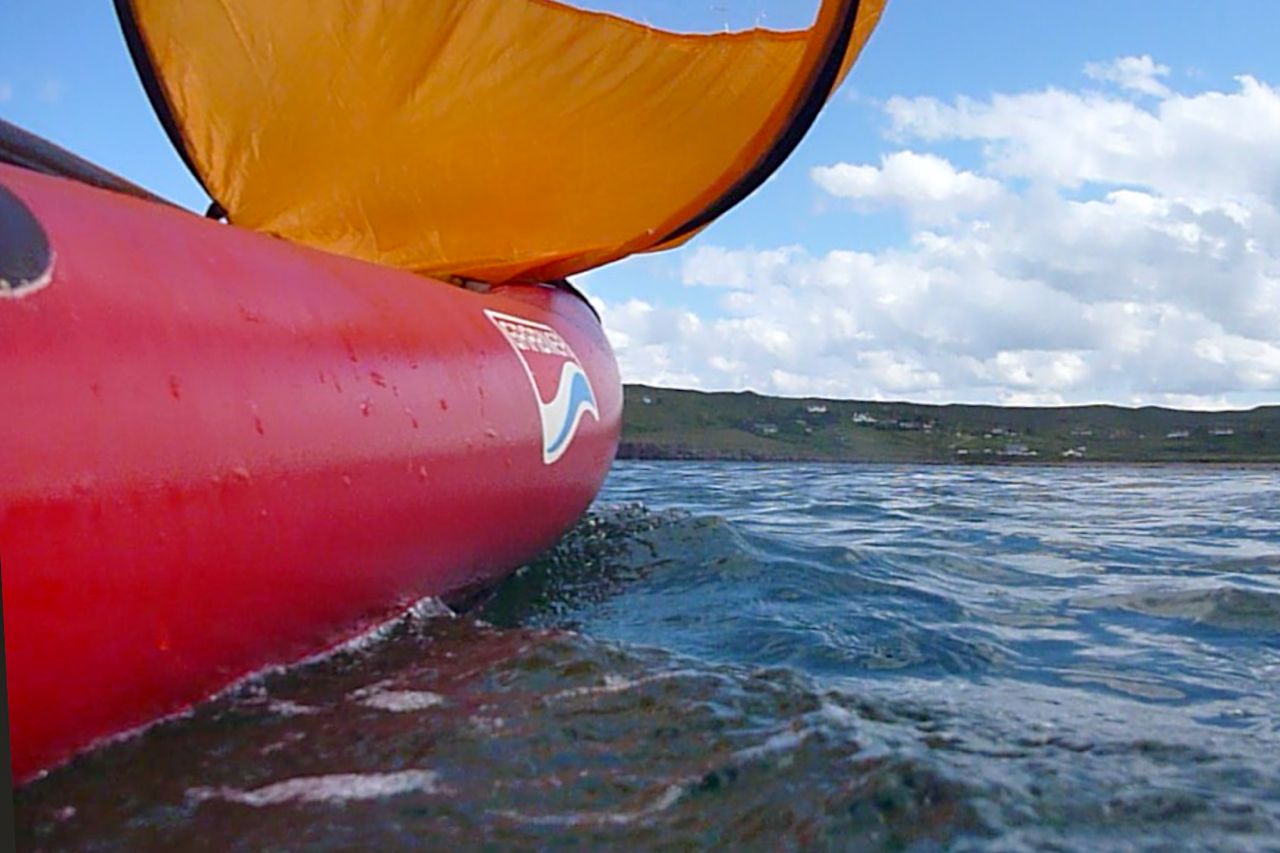
The day before, with the visiting Nimbus family we’d paddled round the Ristol isles. Over lunch on Ristol beach I took my new sail for a burn up. First time out, not bad at all. I got a steady run and up to 3.9 mph on a breeze of no more than 15 mph and with very little faffing. The prospects were good. More wind was needed.
sai12

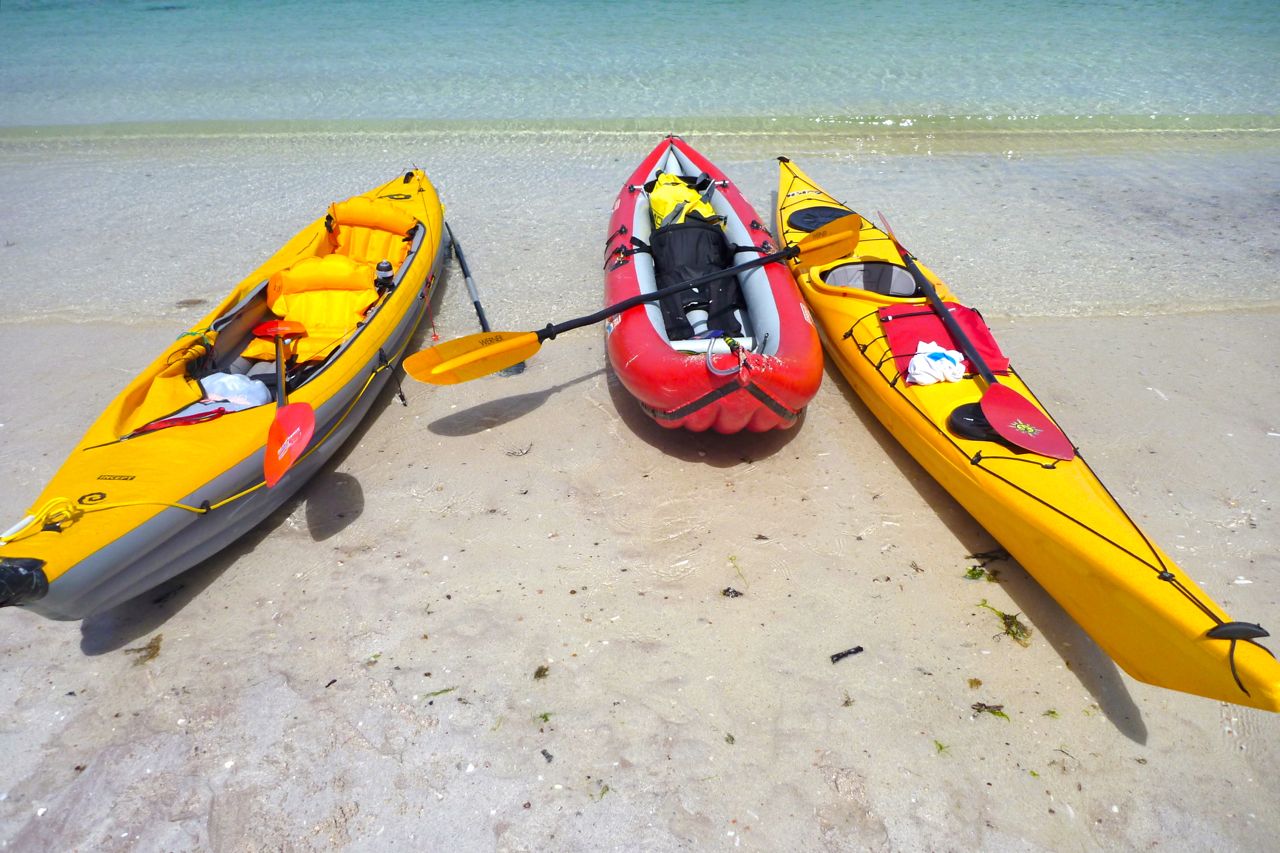
Incidentally, on the beach I noticed how very, very much unlike a sea kayak the Amigo really is. Alongside my old Incept, let alone the lethal Scorchio HV (right), the red boat looked like one of those inflatable kayaks you read about, except it happened to be made from bomb-proof hypalon and pumped up like a basketball.
sai-mulla

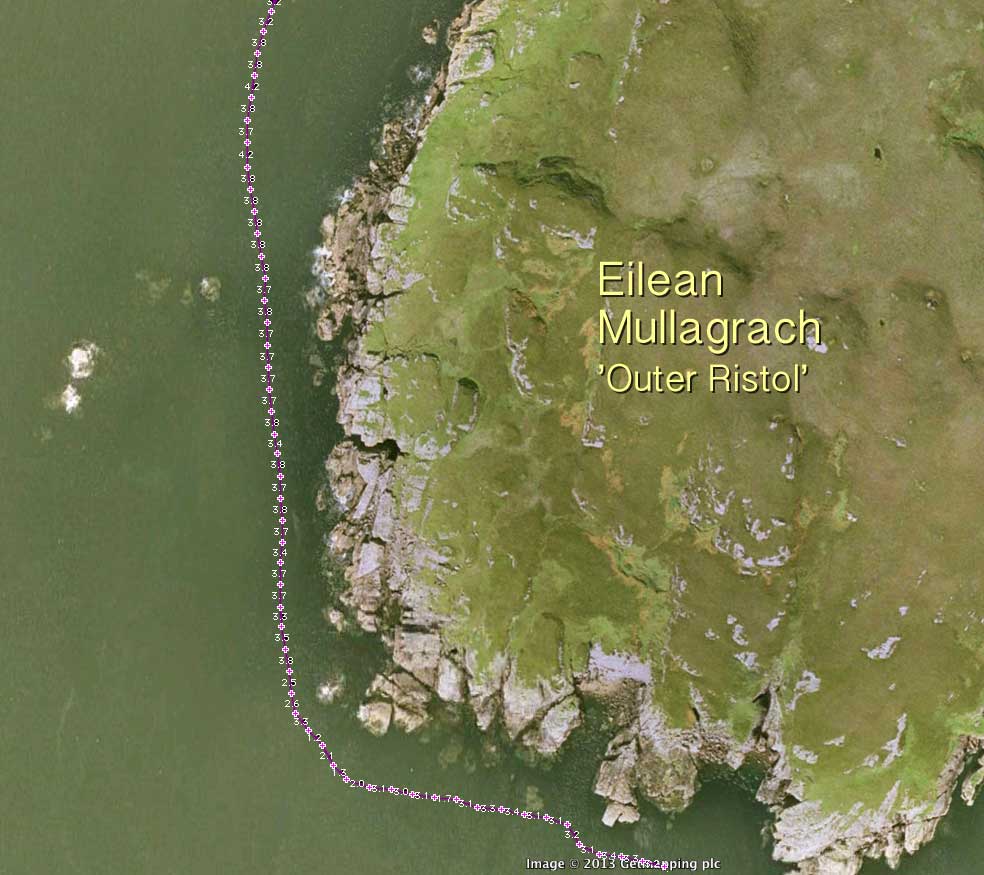
Earlier on, coming round the southwest corner of Eilean Mullagrach, (left), the swell bouncing off the cliffs and crashing over outer reefs looked intimidating. Though we all managed fine, it was everyone for themselves. With heads bent to the task, the comparative speeds of our four boats was clear to see. Way out ahead and longer than your average four-door car: the cheddar-coloured P&H cheese cutter. No far behind, 12-year-old Boy Nimbus darted along in his 12-foot Carolina (later I GPS’d him at 6mph, same as the P&H). Further back Mama Nimbus and little Nima in the K40, all hands on deck. And out back the Grabner hypalon clog – splish-splosh, splish-splosh Slap. Checking the GPS data the speeds weren’t so bad, it’s just that in the rough the hardshells cut through some 30% quicker.
sai-2bots

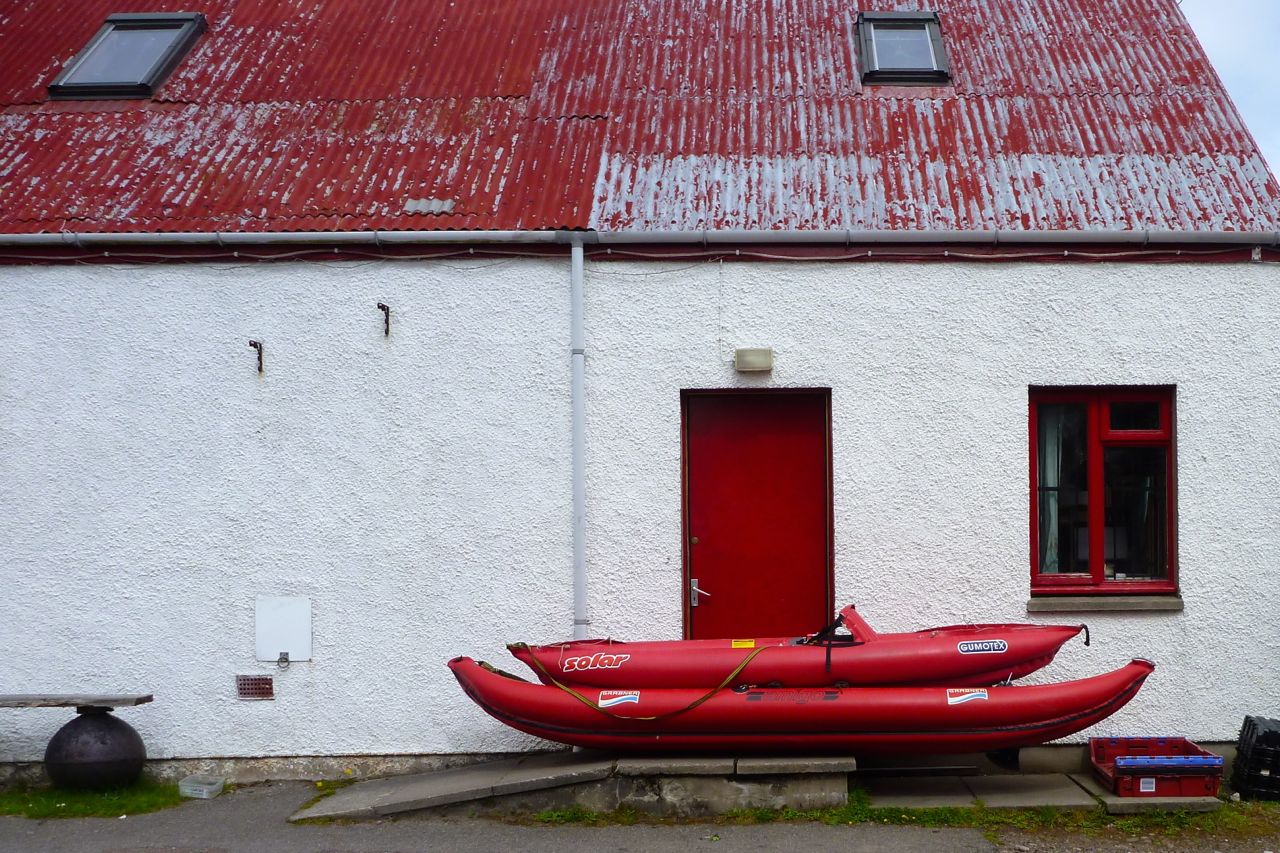
A few days later the Solar was stacked on the Amigo (right) and I realised it was only a foot or so longer than the Gumotex. In that case the Grabner does pretty well for a 12-foot four-, 31-inch kayak that hauls two paddlers.
Back to the sailing. Next day winds were forecast at over 25 mph (right) but as it was warm and only a 5-minute drive to a Loch Vatachan, it was worth a crack.
sai-splasher

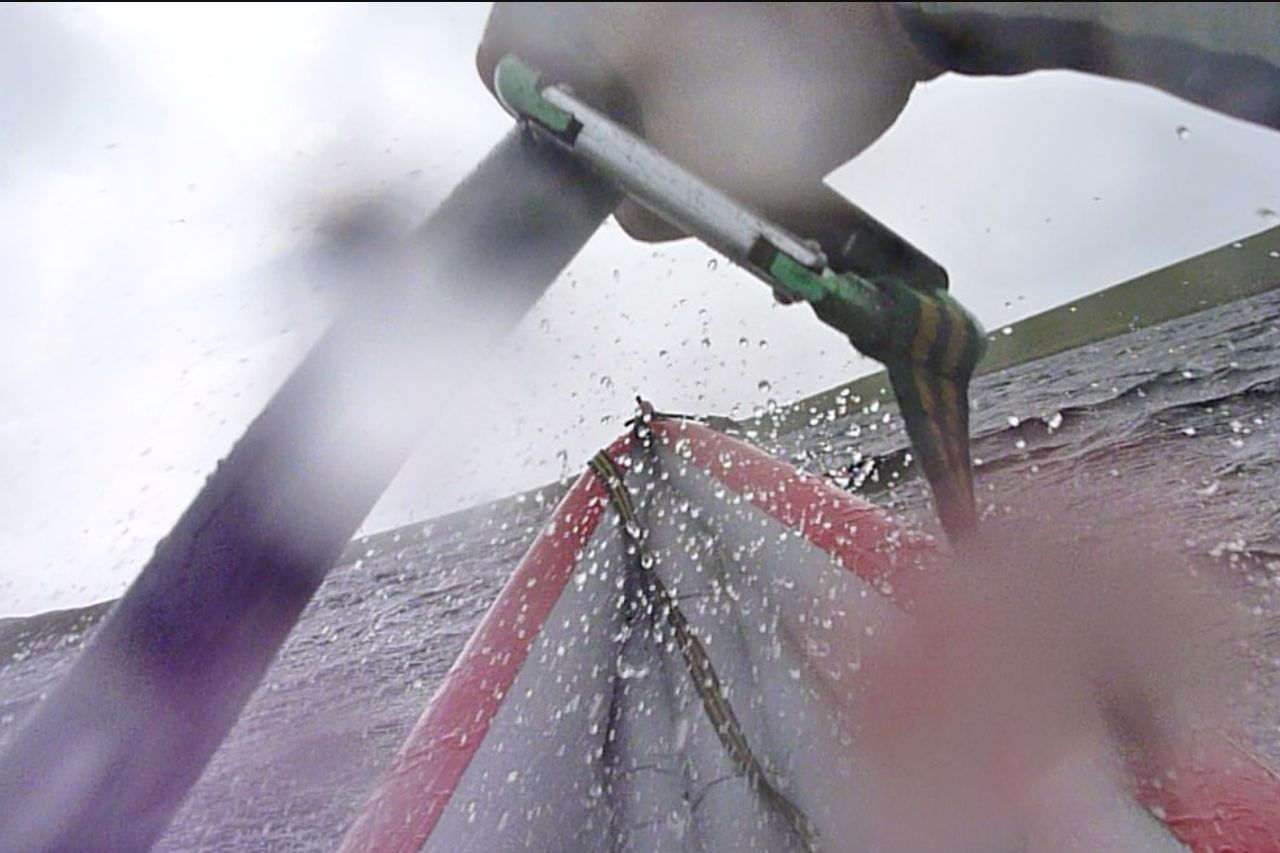
A short pre-paddle suggested my cheapo windsail would probably get ripped off and blown away, or else see me roll off the back of the kayak as it shot away from under me liked a snatched tablecloth. Upwind I couldn’t exceed 2 mph (left), but skimmed downwind at up to 5.5 mph providing I kept the stern right on the wind. And while I was out here, side-on to the one-foot fetch the Amigo felt secure, so not a completely wasted outing. I’d never set out to paddle in such conditions normally (actually I did once), let alone try sailing (actually I had once) so I called it off. Later, Ardmair weather station confirmed the wind had been howling at a steady 35 and gusting to nearly 50 mph.

sai-boats

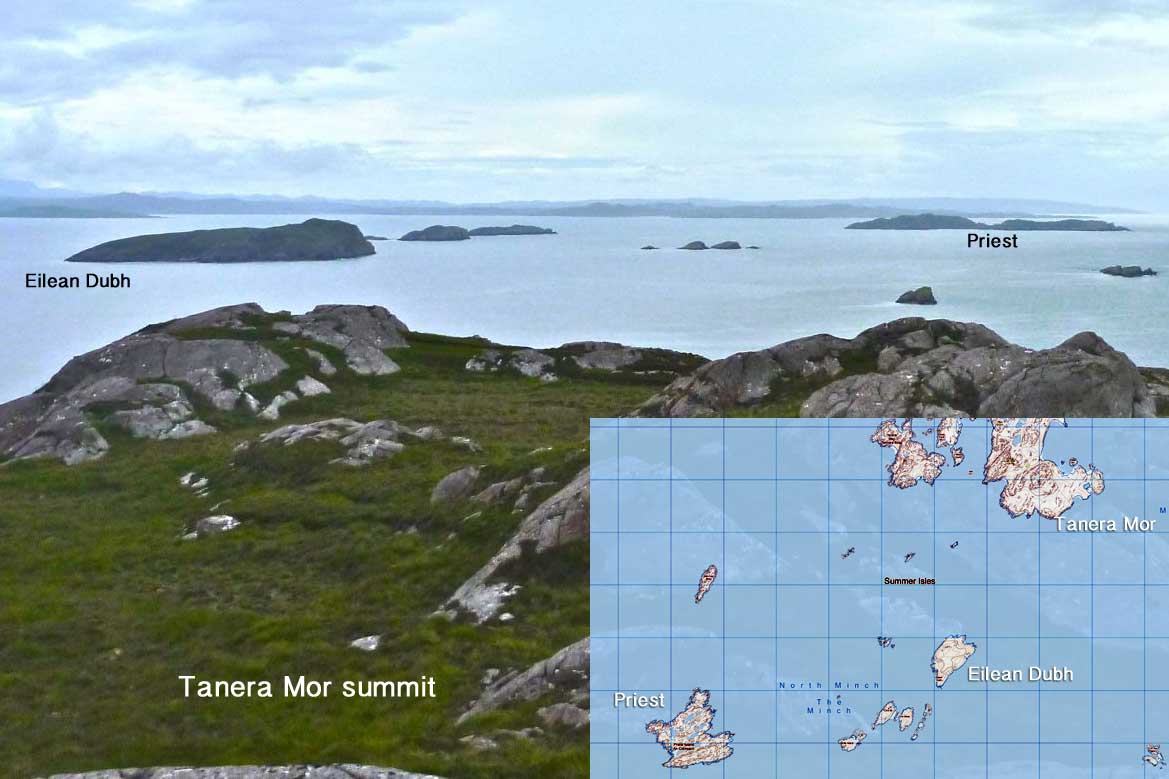
We all ‘yaked over to Tanera Mor one afternoon; three IKs and two SinKs. I realised I’d never actually walked up to the 124-m summit of Tanera Mor for a look around.
Up on top a string of islets lead to the twin humps of Priest Island, 4.5 miles in a straight line (right). It was a ten-mile round trip I’ve mentioned earlier but may be beyond reach this time round.
sai-tansouth


Paddling back from the island, Mama Nim found my old Incept had picked up another pin-prick hole in the side. Wtf is happening to the K40? It’s a lot better than the armchair -wide Sevy they were borrowing before, but three holes in four outings? And it gets worse. On leaving the island the wind dropped to nothing so sailing was off. Instead, we were plagued by sea midges which rise from their lairs as soon as the wind turns its back.
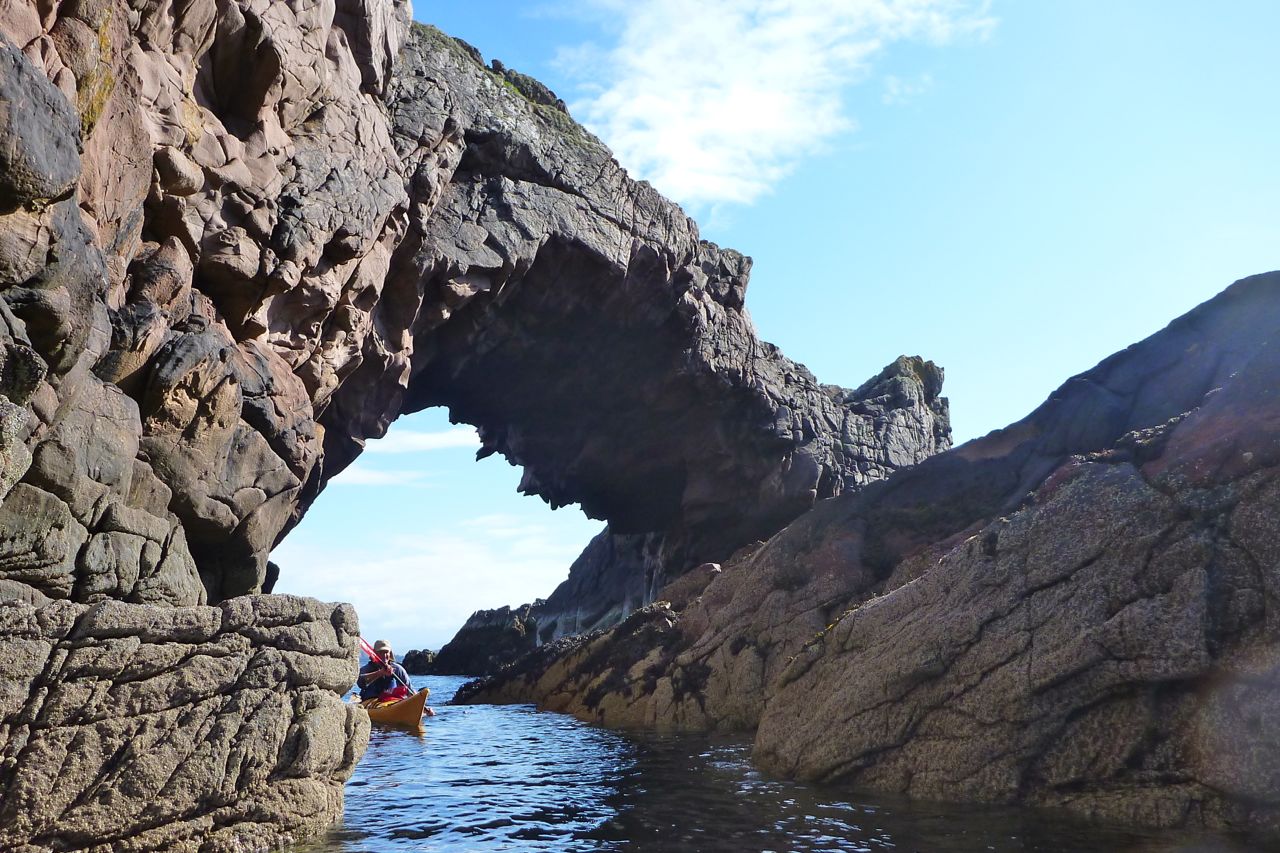
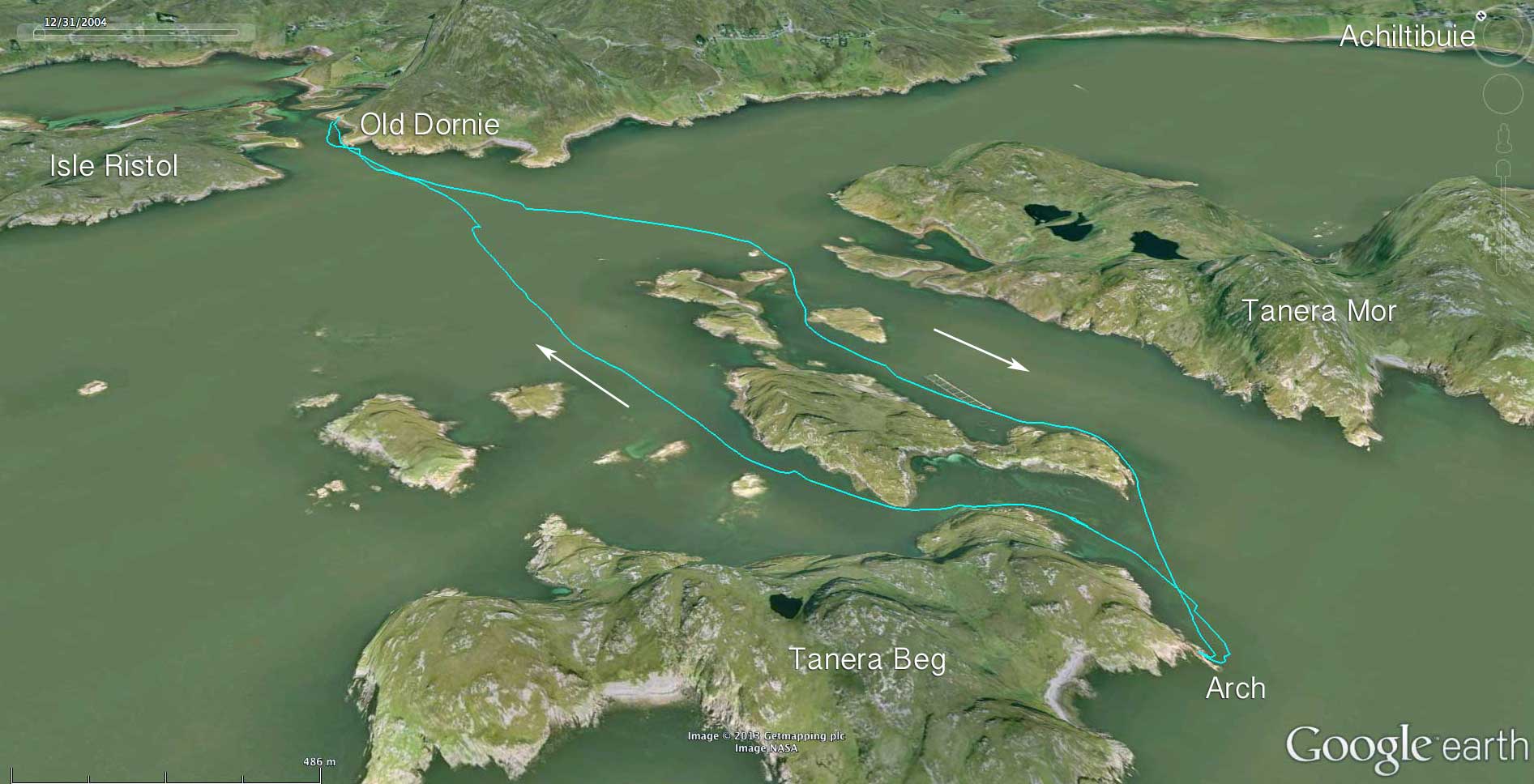
Another day and a healthy northerly forecast at 10mph on the BBC which might mean 15 in real terms. I set off with Nimbus in his Scorpio ‘PK’ (plastic coffin) for a look at Tanera Beg’s arch he’d missed on previous visits. It’s a nice arch; we passed it a couple of weeks back, two-up in the Amigo.
sai-keens


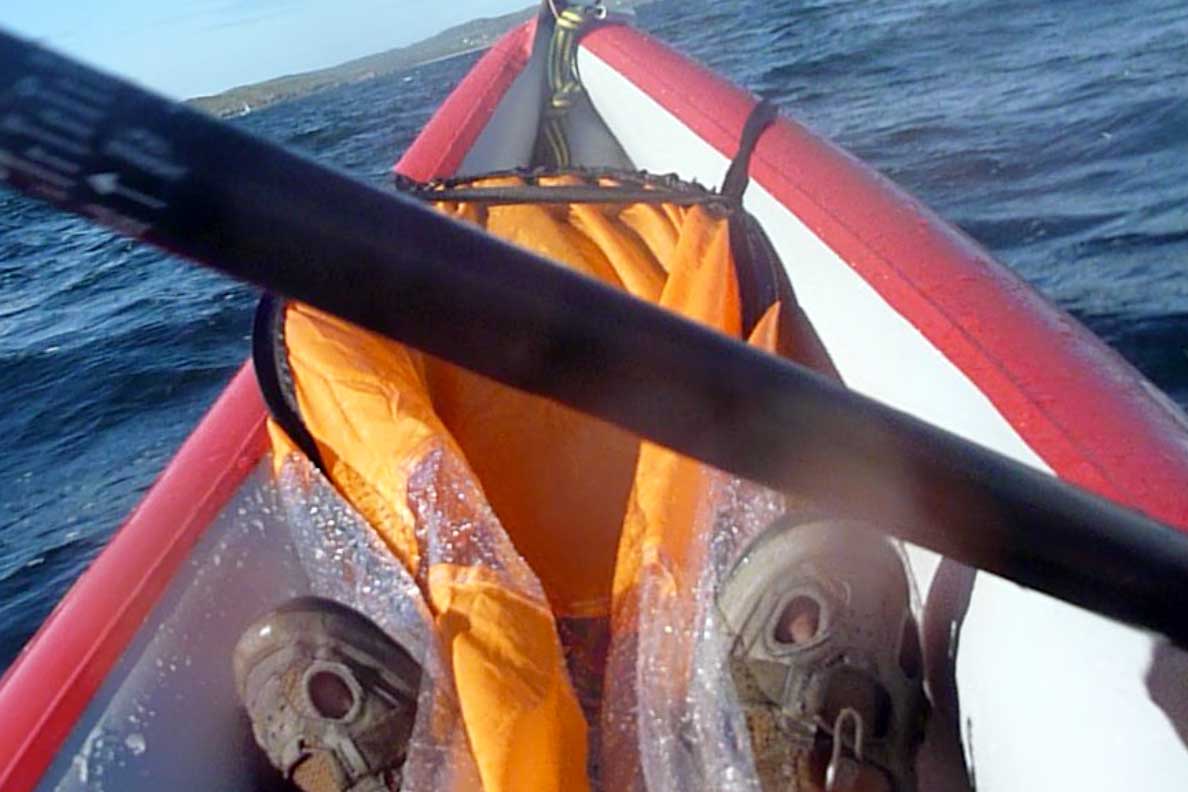
Once clear of Old Dornie I threw the sail out and trotted along at 3.5 mph which won’t be giving me any nosebleeds but I suppose must be classified as progress. At least I found a good way of stashing the sail. Seeing as it’s right out on the bow, refolding it down to three hoops isn’t practical on the water without help or taking risks. But I could just pull it back and tuck the squidged sail under my feet and between my legs (above). Down here there’s little risk of it self-deploying and jumping overboard to become a most unwelcome sea anchor, but it can be thrown up in a jiffy to catch a breeze, just as with the PA.
sai-padd

Once we got to the two Taneras’ In-Between islands the wind remained but the waves were blocked so I threw out the air bag and trickled along again at about 3.5mph again. Then it occurred to me I could hold the sail leash in my teeth and paddle. That worked well too, getting on for 5 mph but without the paddling effort to make that speed unaided. Plus it felt better than having the sail hooked to my pfd and stopped me talking unnecessarily.
sai-archers
sai-calmacer

Once past the In Betweens we crossed over to the arch but found we were a metre short of water. Still, high or low water it’s a great mini-destination some three miles out of Old Dornie.
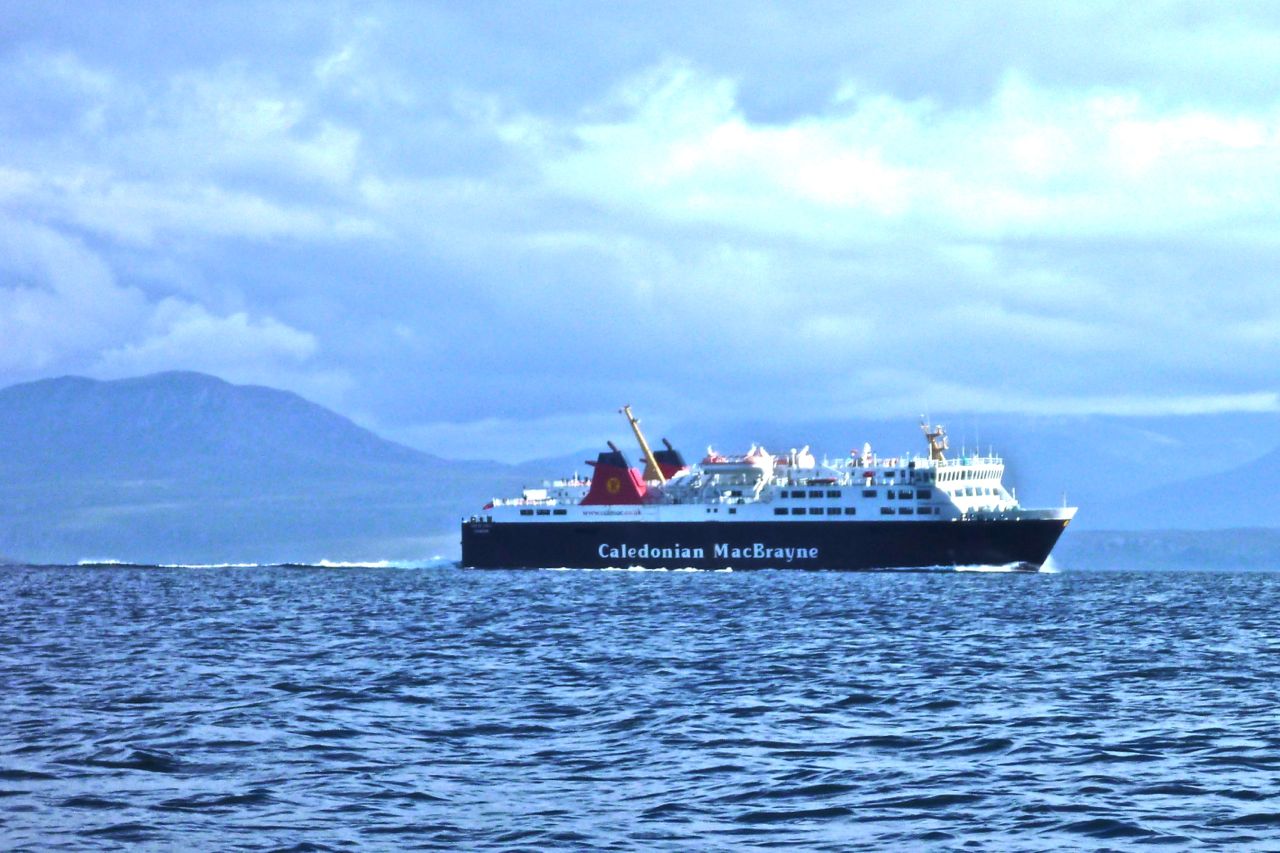
The easy part was over; it was going to be a solid old hack back into the wind for Old Dornie. As we turned we were a little perturbed by what looked like the  Stornoway ferry heading right at us. I’m sure it never came this far north, was the captain asleep at the wheel or taking a deeper channel on the spring tide?
sai-breaker

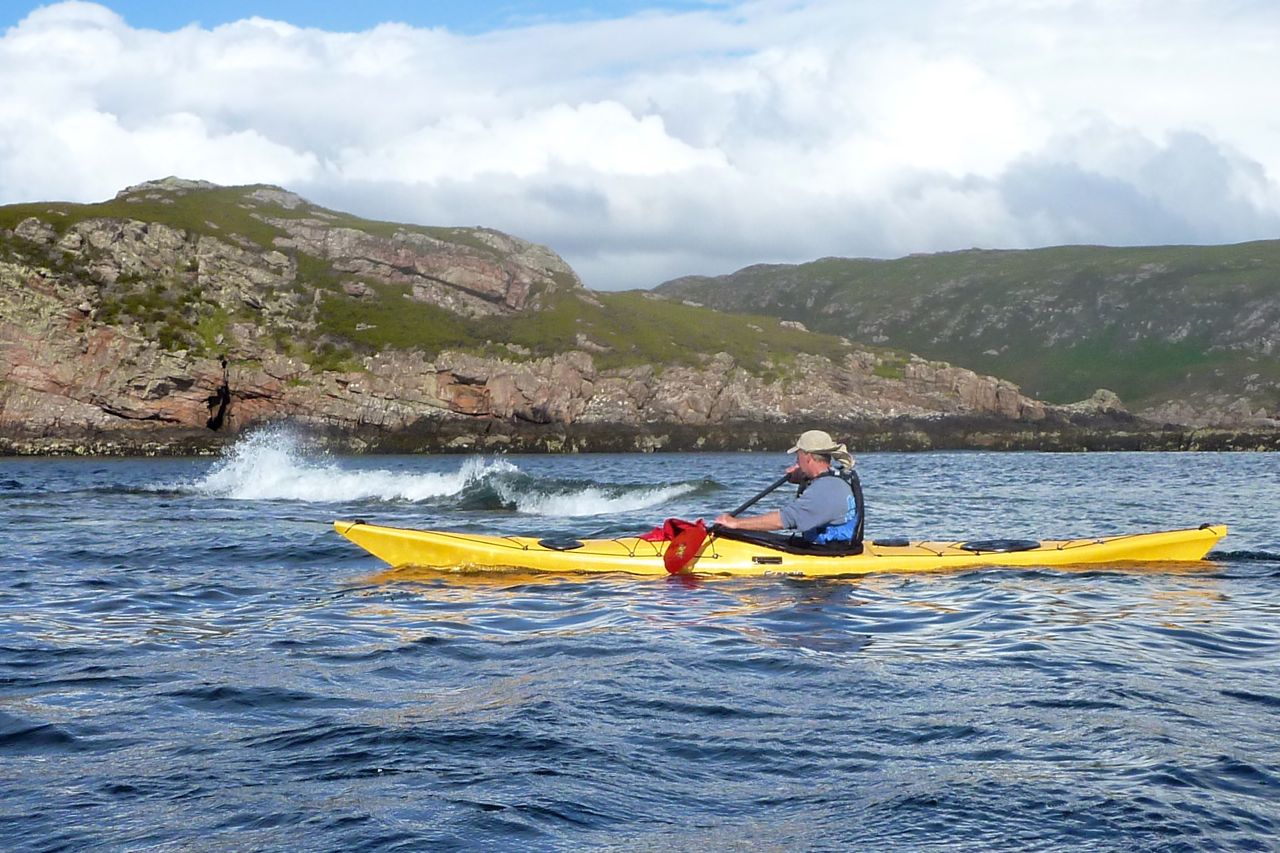
At the last minute the CalMac turned away and a calamity was averted. A few minutes later its wake rolled in, breaking a couple of feet high just as we  passed a reef. It looked like a good picture so I sent Nimbus back for a shot (above) but by then the best of the surf had passed. If that was the swell kicked up by the ferry from a mile away and before it hit full speed in the Minch then I’m glad we keep our distance.

blofie

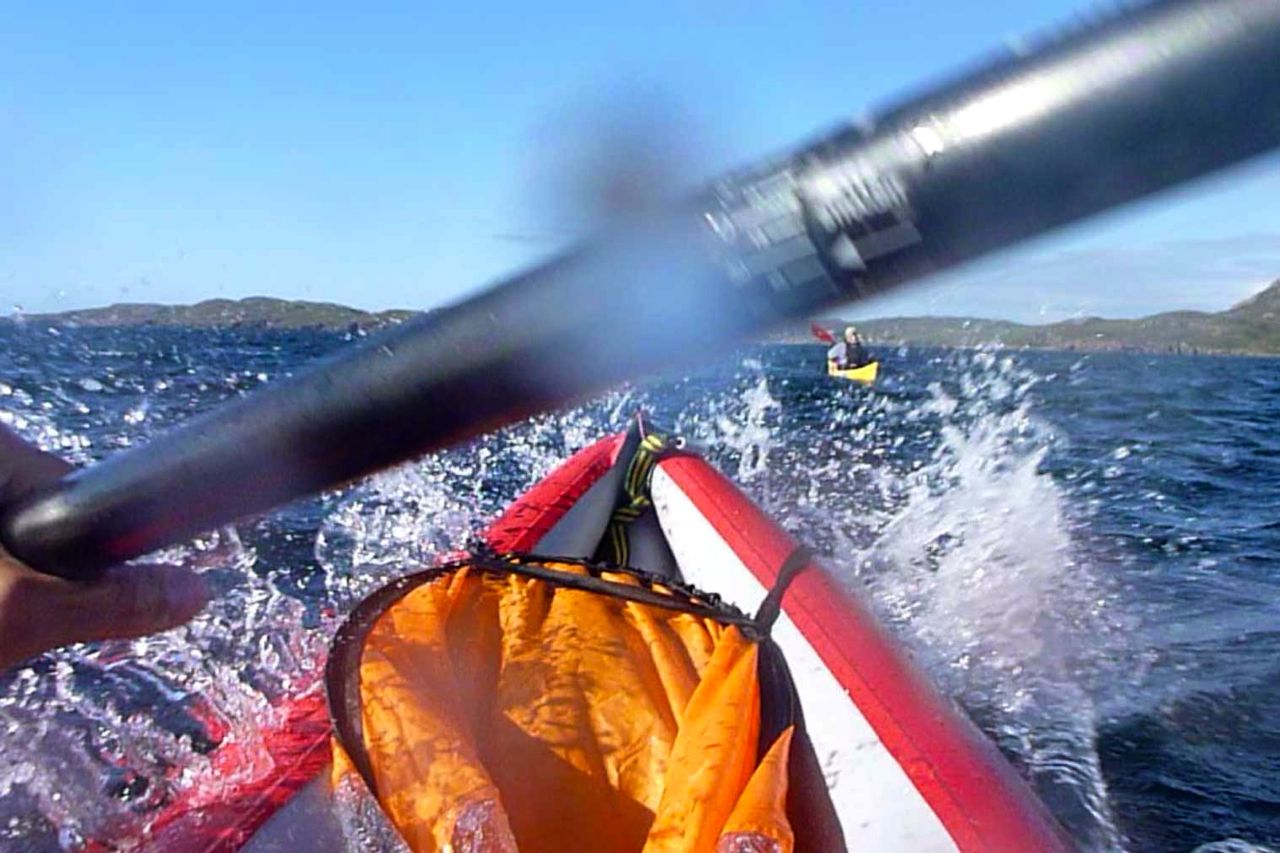
Time to put the camera away and knuckle down for an hour’s bow slapping to Old Dornie. As I’ve observed before in such conditions, Nimbus in his SinK paddled like he was stroking his favourite cat, gliding through the waves in a seemingly relaxed procession. Me? I was loading 16 tons and what did I get? Slipping back further and deeper in bilge.
Still, not alone for a change was less unnerving and I quite like a good work-out on familiar terrain. You dial in the effort you know you can sustain for the duration and progress at whatever speed that delivers. From the graph below that added up to about 2.5 with occasional surges to 3 mph when my technique briefly hit form. The P&H PK seemed to hold a steady 3+mph without trying.
sai-splarsh


The wind had failed to live up to the forecast promise of dropping around 6pm and out in the mid-channel a few white tops developed; for me a warning sign it’s approaching IK limits. I will speculate that I shipped less water than I would have in the Sunny which is a similar type of IK. Partly because of the Amigo’s upswept bow that front or rear, doesn’t seem to be as much of a wind catcher as it looks. And perhaps too because the boat doesn’t bend with the swell.

In fact it was fun slapping the fat bow against the oncoming waves as I slowly hauled my way closer to Dornie. Old Man Nimbus can read wind speeds like a Tubu hunter reads the sands. He estimated it was blowing at 8m/sec which in English translates to 20mph. I’d have guessed a bit less, as with the spring tide at full flow against it, it didn’t seem too much in an IK (as long as land appeared close by). As we neared the harbour a couple of other SinKs slinked by, tucked right under the shore, out of the wind. Get out here you cowards!
angleferry

No Name wind sail
My conclusion of the no-name wind sail? It’s a WindPaddle at the right price. Easy to fit to my boat and doubtless many others, easy to temporarily stash on the move and probably easy to repair. And easy to steer too; pull left to go left, usually. With the window pane it’s much better than my home-made flat disc, plus it’s less bulky and complex than a V-sail, even if a V will give you nearly 90° reach either side of the wind.
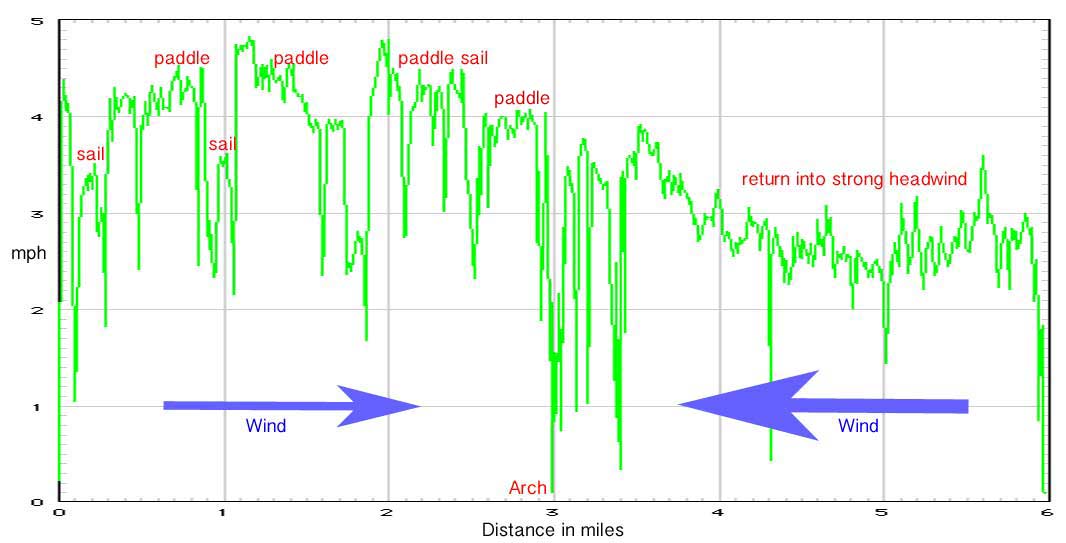
ferryspd


Surprisingly I haven’t found the lack of a rudder an impediment with the Grabner. Though there’s a bit less directional control, at the typical sub-4 mph speeds you can drag a hand or a paddle blade to bring the nose around. And interestingly, providing you’re close to the wind and holding a steady course, the sail worked pretty well when paddling with the leash in my teeth like the 3.30 line up at Cheltenham. I can’t say I ever managed paddling with the Pacific Action on the Incept for long before it flapped out. Plus there’s plenty of scope for hooking up some self-jamming cleats (more here) like I ran on the Incept.
Above all, the no-name air scoop is great value for money for the performance it delivers. For thirty quid it wouldn’t be worth making your own. Next job: see how the little Alpacka handles when yanked along by the wind sail.

See update, top of the page.

Send me an email

← Back

Thank you for your response. ✨
Eskimo rolling inflatable kayak videos

animush

It can be done with thigh straps and technique. A calm pool helps too. Here are a few vids I dug up years ago. Some look pretty ancient; perhaps the mastery of IK rolling has become a lost art.
Of course the fact is most IKs are usually so wide that falling out takes some effort (left). Getting back in to an IK is usually as easy as crawling drunk onto a sofa. But that’s not so entertaining to watch.

First up. The IK in the old video below from theboatpeople is a self bailing Aire Lynx (right); 32lbs (14.5kg), and no less than 37 inches wide (94cm).

Here’s another. Don’t know what it is but it looks even wider – perhaps a small raft? The guy gives it a go but eventually separates from the boat. Nul point. As the lone youtube comment says: “Nice briefs, bro”.

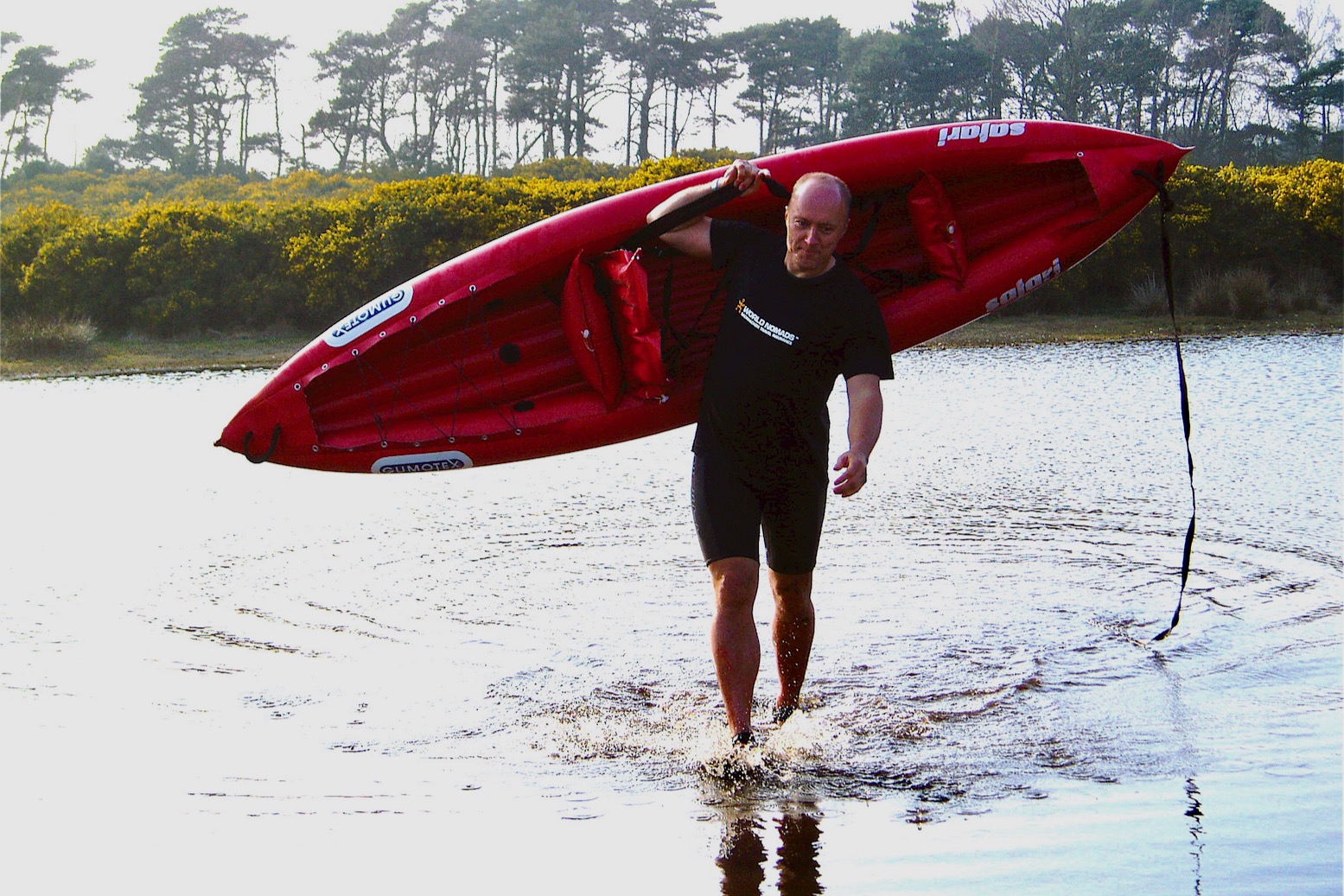
One more? A Gumotex Safari with a long lever roll. At 28 inches wide it’s narrow for an IK and probably the easiest one to roll (not that I’ve ever done it, mind).

And another. Tahiti is a Sevylor IK, I do believe. Nice execution.

Another Aire – looks like a 36-inch Force river runner. He gets there in the end.

More pixels here than Disney, but no long levering required in a vintage Spreu Boote Guppy. What is it with these European IK names?

And finally the Packmaster, Roman Dial and chums demonstrating packraft rolling with and without skirts. There are plenty more packrolls like this on youtube.

The A to Z of Inflatable Kayaks

a2zik

halforts
lidl

Inflatable kayaks are a bit like mountain bikes. You can buy a blinged-up piece of overweight junk with ‘full suspension’ from a superstore for under a hundred quid. Or, if you’re serious about your cycling fun you can buy something decent that’ll be a joy to own and ride.

Continue reading…

Gumotex Twist (old models)

Current Nitrilon Twists

twisters

Gumotex Twist Mk 1
Around 2010 Twists became a new direction from Gumotex: lighter, less rugged boats that suited recreational users. The original models didn’t last.
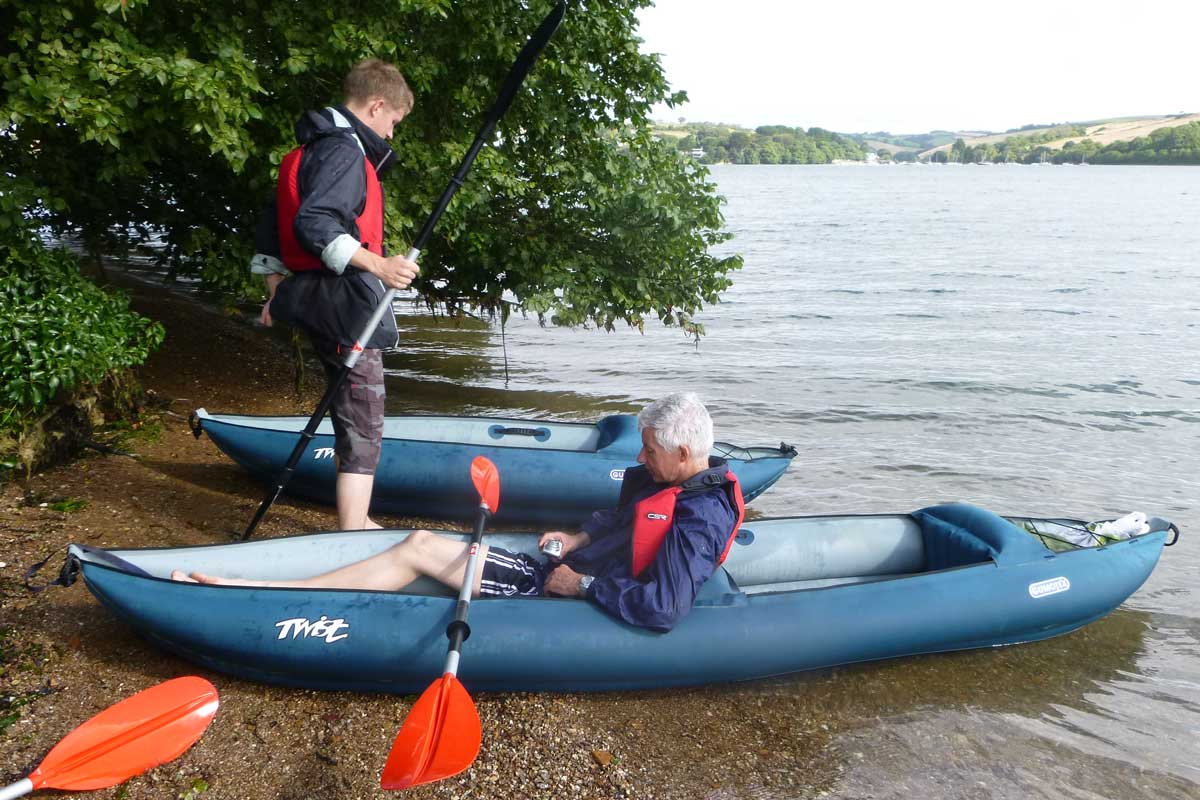
The Gumotex Twist 1 (LitePack then later teflon-coated Hevealon, 2.6m long, 79cm/31″ wide, 6kg, max. load 100kg) became the replacement for the popular Solar. There’s a good review here and the author, Dave D, sent in some photos and updated impressions below.

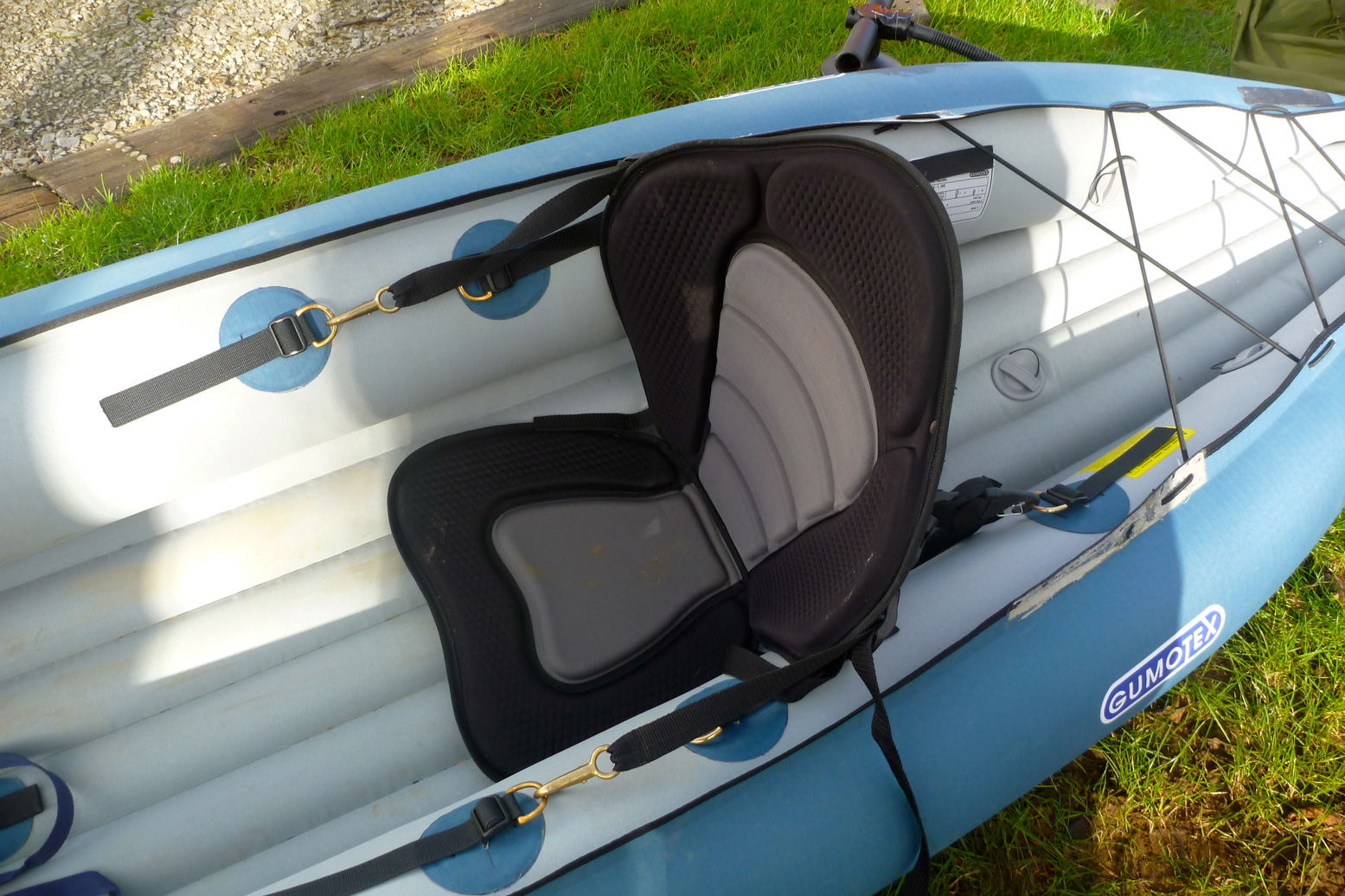
Notice the black backrest on his yellow boat are not the bulky and fixed stock items which have been cut out, so making the boat even lighter. I saw a Twist recently and realised they use the textured LitePack material for the whole boat, inside and out. This must be what makes them so light, while being like rubberised canvas it also takes a little longer to dry and a little less slippery on the water. This video below shows some disastrous porosity in a Lite Pack Twist. It can be fairly claimed that was an exception and the boat was replaced, but it’s hard to see that ever happening with full Nitrilon. A few years later the next Twists models were made in Nitrilon Lite.

twist-flat

twisting

The Twist 1 was not a lot bigger than my Alpacka Yak (above) and is only twice as heavy. On a recent Medway run I found the boats surprisingly similar in paddling speed. I assumed my flat, wide Yak would be slow. But this was on a day with a good swift current. I think with the more usual Medway deadwater the flat-bottomed Yak would have been more tiring and slower overall. This Twist also had its original seats cut out and replaced with an SoT pad.

twist-seat
gumsteadtwister


As for a Twist II, a mate got one along with a T1, and he likes the lightness above all. Vital stats on that one are 3.6m/11ft 10in; 80cm/31.5″ and just 9k/20lbs, so nearly as long as a Sunny, as wide too but nearly half the weight which makes hauling with boat in a pack much more viable. He has since got a new T2 but prefers the lightness and compactness of the old one, once he’s swapped out the seats.

twisting

[Dave D]: Here’s a few more thoughts now that I’ve had a chance to use an original T1 a bit longer:

1. The inflatable seat proved to be junk. It kept developing major leaks – always at the point where it is folded through a 90 degree bend. Clearly this is a stress-point which the kayak’s fabric construction can’t handle. After my first one popped, I sent it back to Gumotex who replaced it – although this didn’t go smoothly: the first time they just sent the boat back to me without having done anything to it! Eventually, they sent me a replacement boat, but when the seat on this one popped I decided to rip the inflatable seat out and replace it with a more conventional back rest as you can see in the photos. This is far better, and also makes the boat narrower – I now don’t skin my knuckles against the side of the boat with each paddle stroke!

2. The inflatable footrest is useless [as it is on many Gum boats – see this]. If you want to paddle, you need to brace your foot against something, and this isn’t it! I decided to remove the cushion and replace it with two foot-loops on an adjustable strap. I was a little dubious about having my feet strapped into the boat in case of capsize, however I’ve found I can get my feet in and out without any trouble.

3. Before making the above two modifications, the boat had a major flooding problem. The stern sat too low in the water, so if you got a wave from behind or if you put your bodyweight too far back in the boat (e.g. because your inflatable back rest had gone down!) then water would swamp the boat from behind. Having replaced the seat and footrests with adjustable ones, I can now set it up so my bodyweight is well forward. This has so far eliminated the flooding problem, but I imagine you’d still have a problem with steep waves hitting you from behind. That said – when it floods you just jump out, turn it over and jump back in again.

4. I still love the boat. Whenever I’m travelling with work, I keep it in the boot of my car with a drysuit and a 4-piece collapsible paddle. If I’m on the motorway at rush-hour, I pull off to the nearest river and do one hour’s hard paddling up and one hour back for a bit of exercise and to de-stress. I often paddle on canals with locks, and it’s great to see the envious looks of canoeists when you do the easiest portage they’ve ever seen! The boat is actually quite quick. A couple of nights back I even started playing in a fast (but shallow and safe) weir by moonlight.

I also use it to take a short-cut across the harbour in my home town. It feels very stable, even when there’s a swell. I’ve put nav-lights on it and I have no problems zipping around and keeping out of the way of boat traffic. Dave D

Additional pics by Robbo

gum2twister

Gumotex Seaker sea kayaks

This was Gumotex’s take on Grabner’s Holiday IKs, later reimagined by Incept (I’m pretty sure it’s in that order). In other words a twin sidebeam IK but with inflatable decking so making it an inflatable SinK (sit-in kayak). You didn’t get many of those to the pound back then, though Gumotex now do the Swings and Framuras and Aurion.

What they said
The Gumotex SEAKER is the first fully inflatable sea kayak worldwide. It is designed for long trips in sea bays, on big lakes and large estuaries. The small volume of the packed kayak and big space for baggage predetermine this kayak to be used for expeditions.

The user appreciates especially how easy and quick the kayak is ready for use. You can inflate the kayak within ten minutes. The biggest benefit of the Seaker kayak is its safety. The hull is extremely stable and enables remounting from the water without the aid of paddle floats. And what’s more – thanks to the inflatable design no water can get into the capsized kayak.

In case you’re wondering, twin side beam – two smaller stacked side tubes instead of one fat one has benefits. And on this model they were made from Mirasol PVC with a Nitrilon deck and floor. The Mirasol was thought to be less elastic and so the Seakers could run higher-than-then-normal-for-Gumotex 0.25bar. It made the sides taller so less swamping, though of course your deck and skirt will see to that. The interior space is greater and two side beams make the boat flex less longitudinally – a problem with all long, non-dropstitch IKs once they got beyond a certain length. The drawback was that the boat was taller in the water, so more wind-prone.

Once I thought a Seaker could fill the dark corners where the Sunny did not shine, but at 34kg the solo was more than double the weight of a Sunny, Incept K40, Grabner H2, Amigo or my later Seawave. The high-quality Korean Mirasol PVC was clearly much heavier than Nitrilon.
Like a proper sea kayak, it had hatches and a rudder and could no doubt be rolled, but to me, half the appeal of IKs, even at sea, is the SoT aspect. If you want to sit in and want to be portable, get a nice low-profile Feathercraft (since closed down) for nearly the same price, less weight and which looks less like a floating, wind-prone torpedo.

They also did a 2-seater Seaker II but I got the feeling these were exotic, rarely bought boats that were heavily discounted in North America before disappearing around 2014.
It was the end of the line for the heavy Seakers which is a shame because the only thing wrong with them was the weight. Still, I’ve never actually seen one so what the heck do I know about Seakers? A blogger in Canada got one cheap a few years ago but didn’t keep it long. A double went on eBay in 2016 for £410. Now in late 2025 the semi-dropstitch Gumotex Aurion looks like it fills the gap, only for over €2000.

Gumotex K1 and K2 white water

gumok22
gumok2

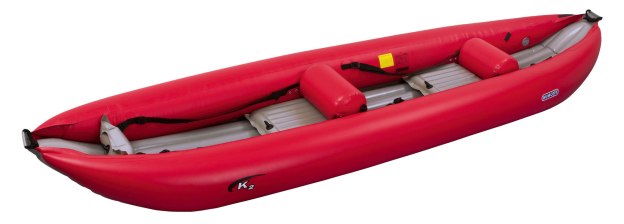
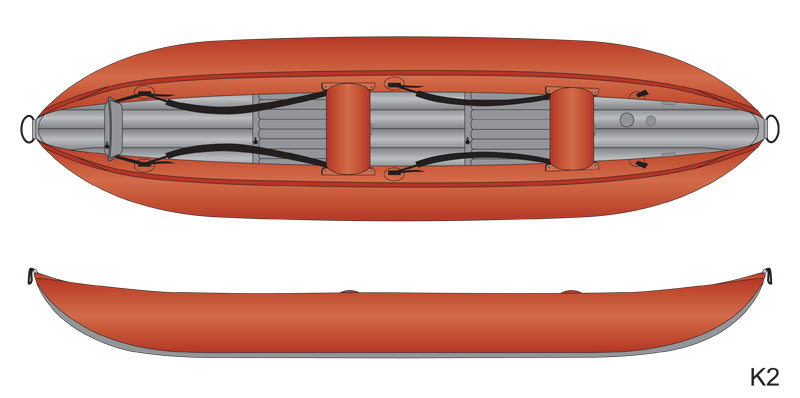
Made by Gumotex for years, the K1 and K2 double are obscure, expensive, hardcore self-bailing, white water IKs with thigh straps. Until the Seawave came out in 2013, these were the only Gumotex IK which ran 0.25 bar pressure (other Gumotex IKs run 0.2 bar). I’ve never read about the K models anywhere, though it seems the Germans and French (left, Allier) admire them. They feature the distinctive grey floor which is visible in this video at 2.27s.

gumok2


The K2 could be considered fat-tubed, self-bailing Solar 3 pontoon, a bit shorter at 3.9m but which costs more than double. At one metre wide it’s really a twin-seated, thigh-braced, self-bailing whitewater kayaraft, not a tourer.

otg-padlicac
padillac

It would be fun to throw a K down some gnarly rapids or surf, knowing that it floated like a cork, sat as flat as a wet pizza and drained as fast as a sieve. But if it’s like the Padillac I tried a couple of times in Colorado (left and right), that’s probably all it’s good for and it needs two paddlers to get up any speed.

otg-k1


In summer 2010 I came across a couple of K2s in France, having just come through some narrow rapids which I was too nervous to try alone in my new parkraft at the time, so clearly they are being used by some for the right purpose.
The solo K1 pictured below in boatpark.cz’s boat park is the single-seater version out of which it would be hard to fall short of being shaken out. Even used they were asking £500 while a used Twist 1 was going for £130.

Gumotex Safari Mk 1

2016: new Safari 330XL

safaritip
Dorset pond

Gumotex Safari (pre-2003)
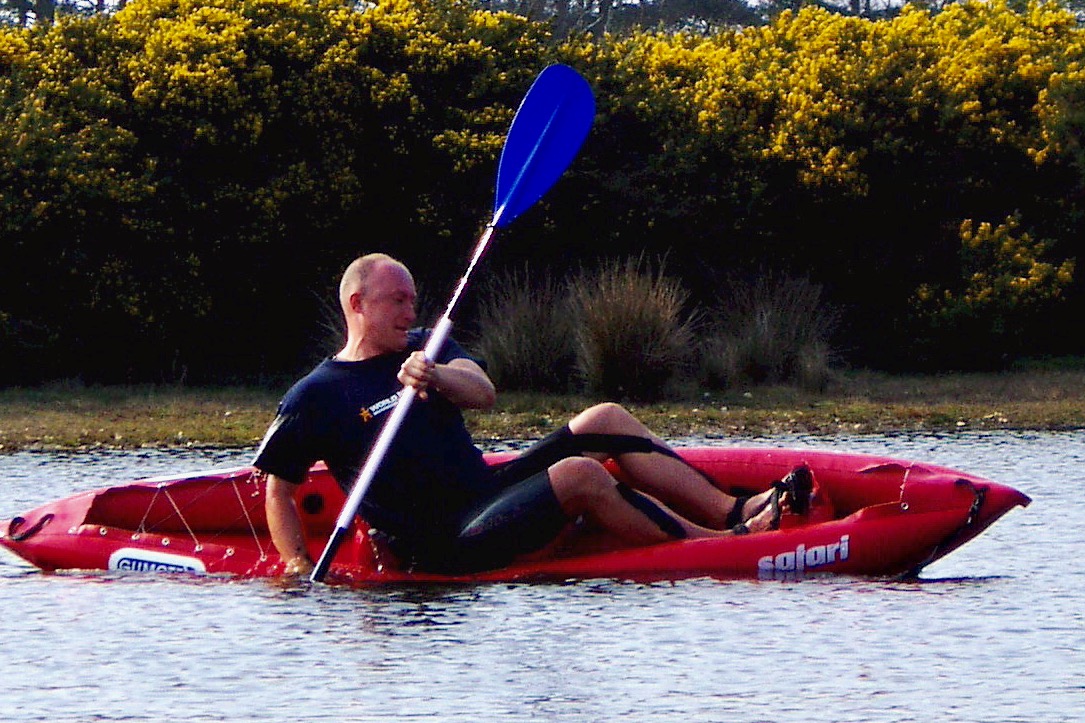
Back when I didn’t know an IK from JK Rowling, my very first IK was a used Safari. And light and tough though it was, this early model Safari was a mistake. The Mk1 was a tad over 3 metres long (same as a Solar 1), 72cm wide and weighted just 12kg.

I pretty much knew it wasn’t for me when I bought it used in 2004 for £120 from boatpark.cz, but it was so cheap it was worth the punt. At my weight I pretty much maxed-out the boat’s 100-kilo payload, and at 6.1” I looked like I was sat in a small bath.

safarisml
River Frome, Dorset

Without a skeg I also found it impossible to paddle straight (but had no experience then; see this). It felt nice and fast but way too tippy to inspire confidence in a large beginner. It’s the only IK I’ve ever had which I could barely stay in. And for me it was way too cramped to pack a useful load for a few day’s touring which was my plan all along.

OLYMPUS DIGITAL CAMERA
Croatia

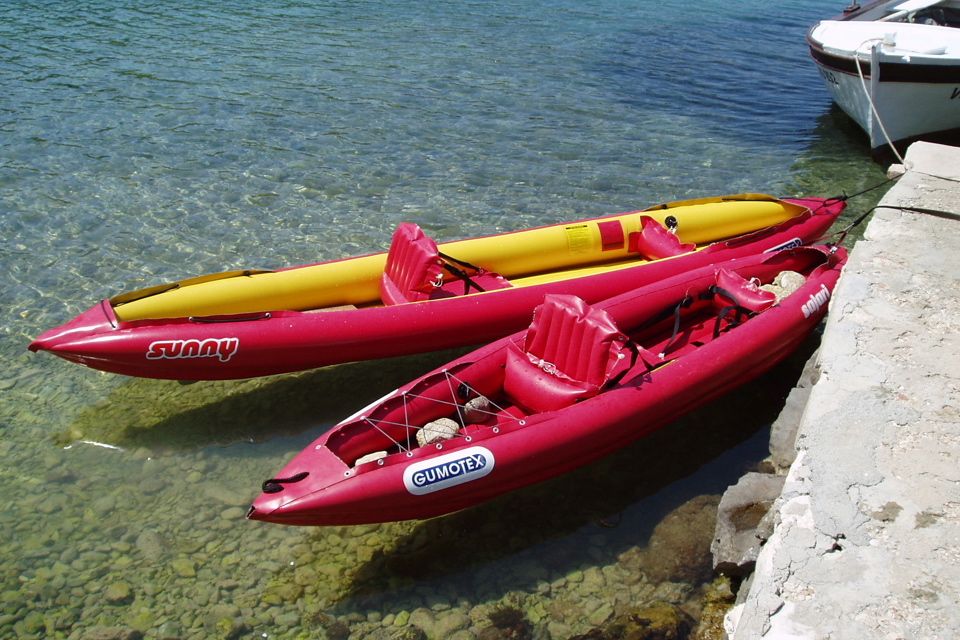
Anyone with a bit of experience would have realised this before they bought it, but I just wanted to check out a proper IK close up before moving on. I soon got a Sunny and have never looked back with Gumotex IKs; the Safari was passed on to my g-friend who’s a foot shorter and half my weight.

gumosafar
Scotland

A great feature on the Safari were the thigh straps (visible in the pics above). They really connect you to the boat and help you to paddle hard by controlling the yawing, as well as the roll to correct tipping over: great for the back and stomach muscles too. Knowing now that later Safari models are more stable, I’d be quite keen to try one again as a play/day boat.

Note. I’m told post-2003 Safaris (below) have a different hull design and are less tippy. The newer one had twin side tubes but still a rounded hull profile. BoatPeople in CA don’t mince their words when they talk about it still being tippy in certain conditions, and the current short Safari is not the same hull shape as an old and stable Solar 300 we owned. As for weight limit, I doubt that’s different.

North American Innova importer Tim R. told me “I would rate the Solar’s stability as a 9 out of 10, the old Safari would be a 6 and the new Safari an 8. The very first Safari prototype was a 3!”

gomosafrr
Croatia

New or old, a Safari is also a self-bailer which is highly desirable when the going gets even a little rough, but only if you’re not too heavy to end up sitting in pooled water, as I was.
G-friend used the Safari in Croatia and found she needed about 10kg of rock ballast in either end (see pic above) to make the boat stable and, as it happened, faster. Without them the boat sat high and even she felt tippy. Therefore the optimum weight for a pre-2003 Safari would be around 70kg. Now you know.
We sold the Safari and got a Solar 1 or 300. The Safari is still in the Gumo line up. For a small WW fiend, a Safari would be a great little boat. There are plenty of videos online testifying to that fact.

2016: new Safari 330XL

Gumotex Junior

Gumotex Junior
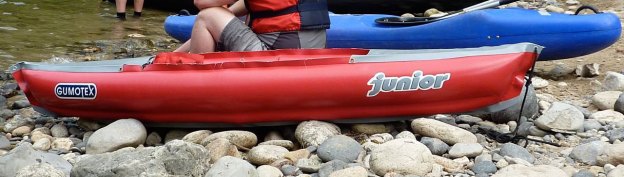
At ‘only’ 10kg (light, back in 2005) I thought this would be ideal for lightweight g-friend and even for me in a pre-packrafting sort of way. However our conclusion was it was merely a heavy, boat-shaped paddling pool made out of unusually tough material.

gumjunior

With my weight I of course had about 3mm of freeboard, but it was a hopeless tracker (not that we were experts back then) and all in all felt a bit of a half-baked design (it was actually based on an old Barum Sip).
Gumotex made some turkeys back then, but they don’t make this one anymore. Then again, in 2009 feedbacker Chris reported: “We opted for two Juniors and these are fine for what we need and really light for the motorhome as we are restricted on weight.” But he did report one was splitting  at each end, possibly from overheating?
For a small, compact IK the Twist 1 is better and lighter, or if that’s important, a packraft is even better.