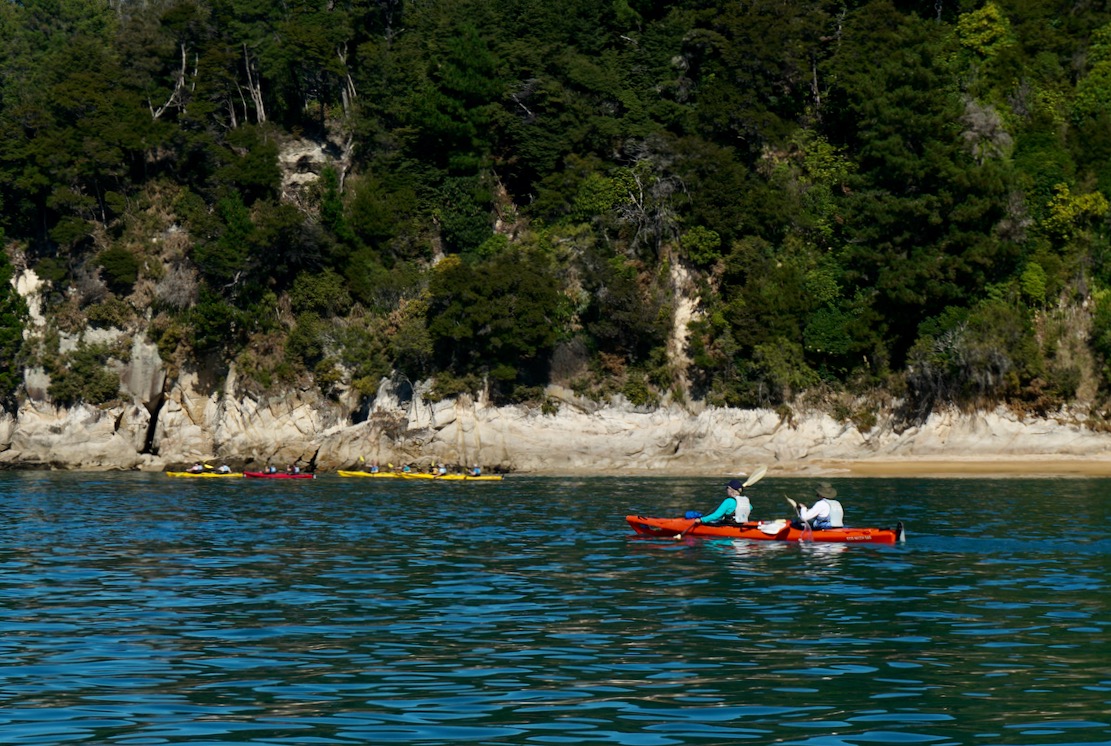
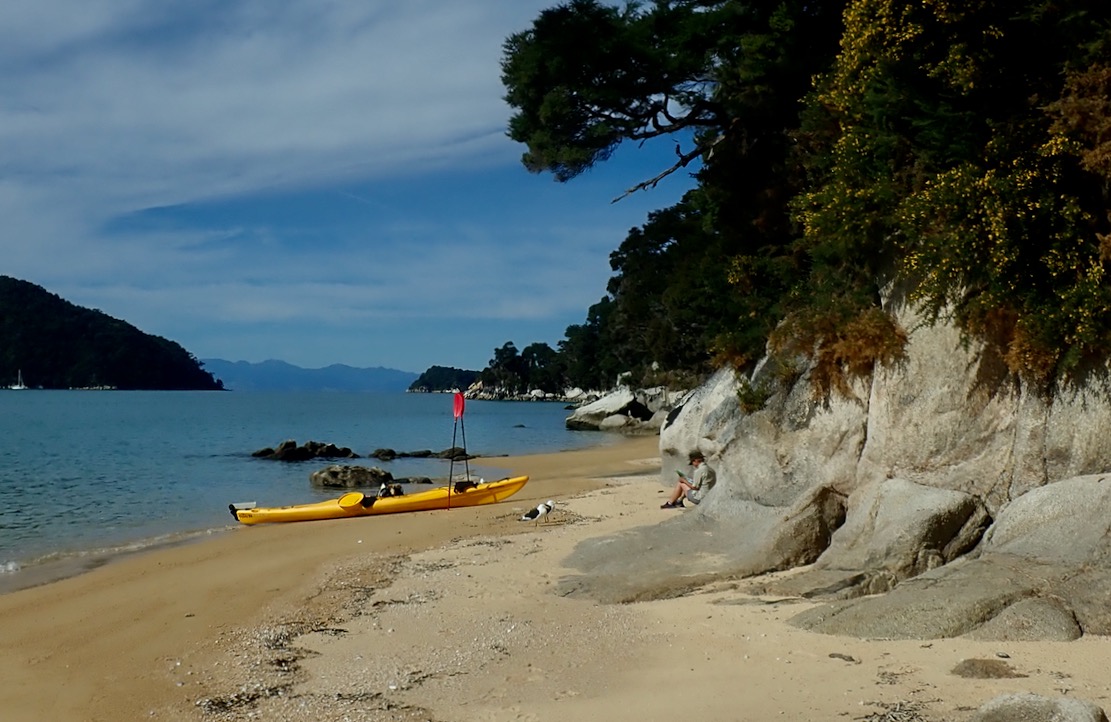
A few days after paddling Doubtful Sound we rented another hardshell double at Abel Tasman NP, at the top of the South Island. A much more popular kayaking location, a string of sandy, aquamarine bays and beaches punctuate wooded granite headlands dropping to the sea. Less rain-drenched than Fjordland, the vegetation here has a more Mediterranean appearance.
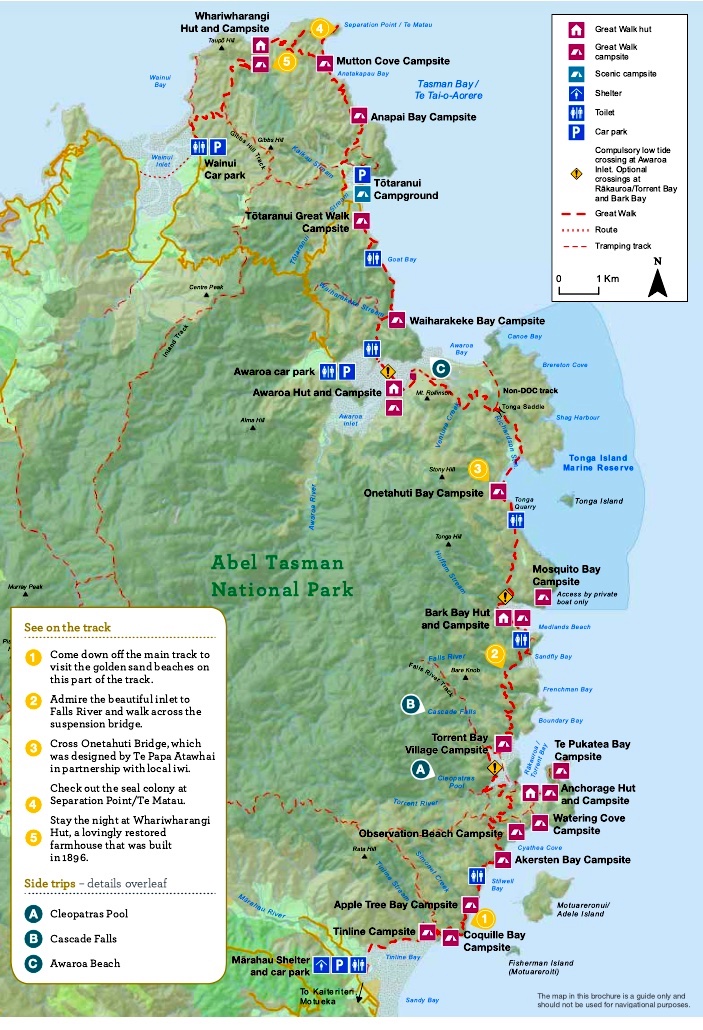
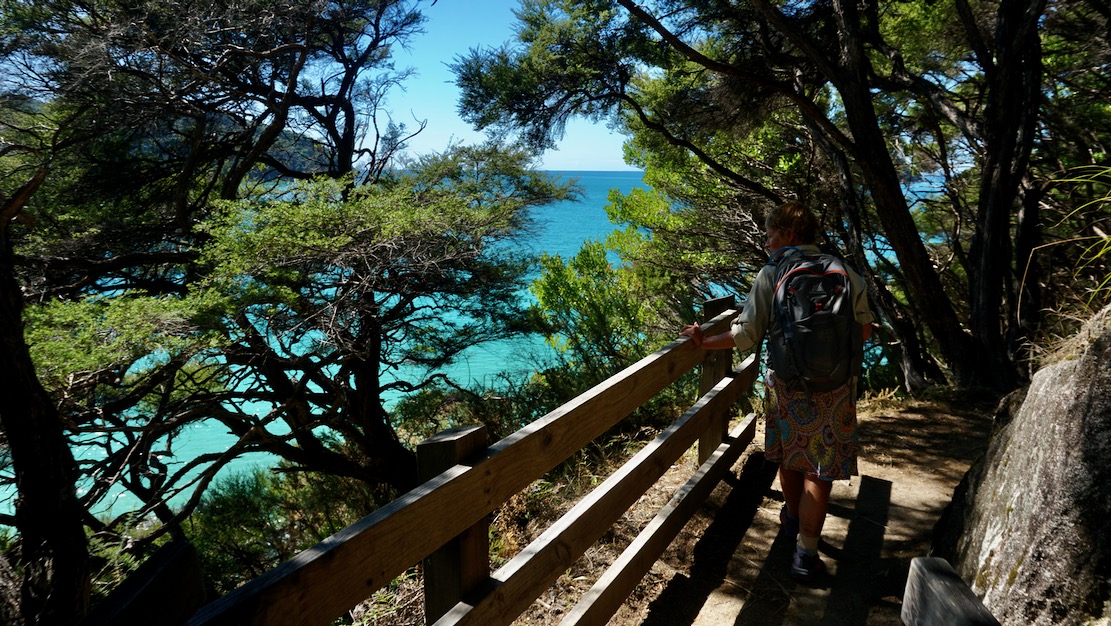
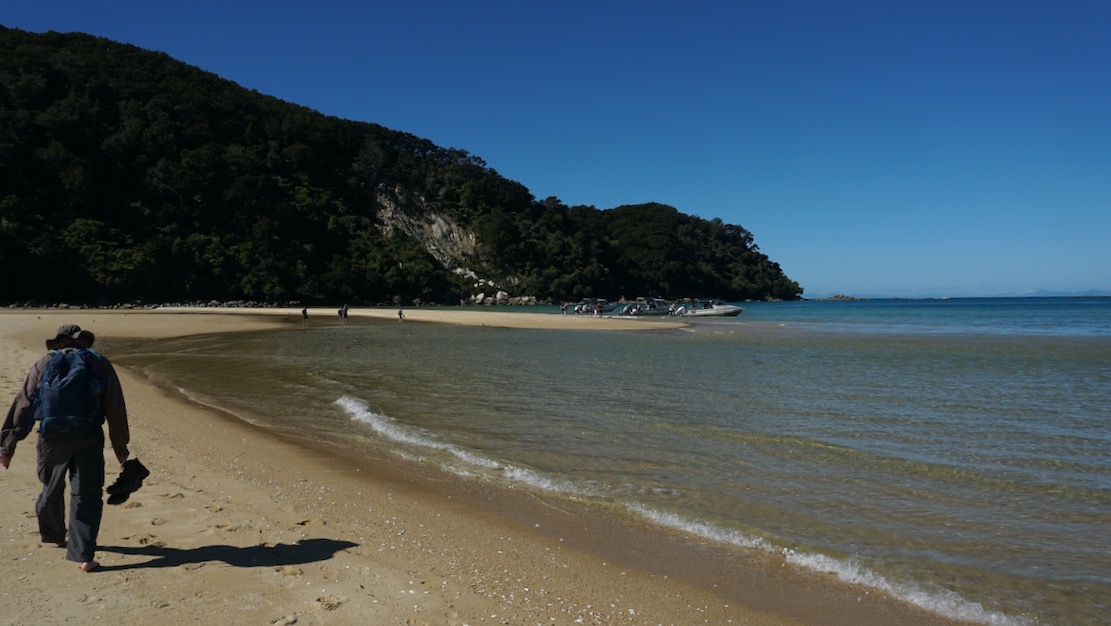
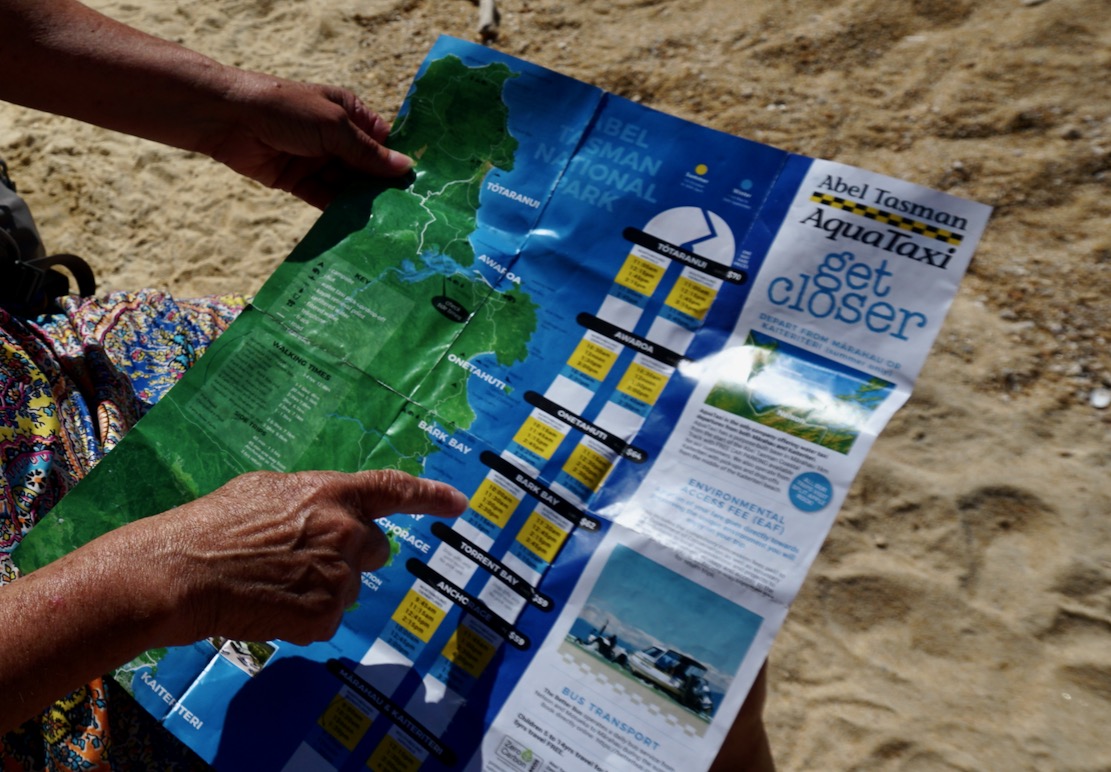
Blink and you’ll miss it Marahau is the main access point, serving visitors to the park. Here they have a really good system of water taxis which can drop or collect paddlers / walkers at any number of idyllic, granite-sand beaches along the NP’s sheltered east facing coastline. Most are walking all or parts of the 60-km Abel Tasman Track back to Marahau (as we did one day, below), staying at designated basic camp sites, if needed.
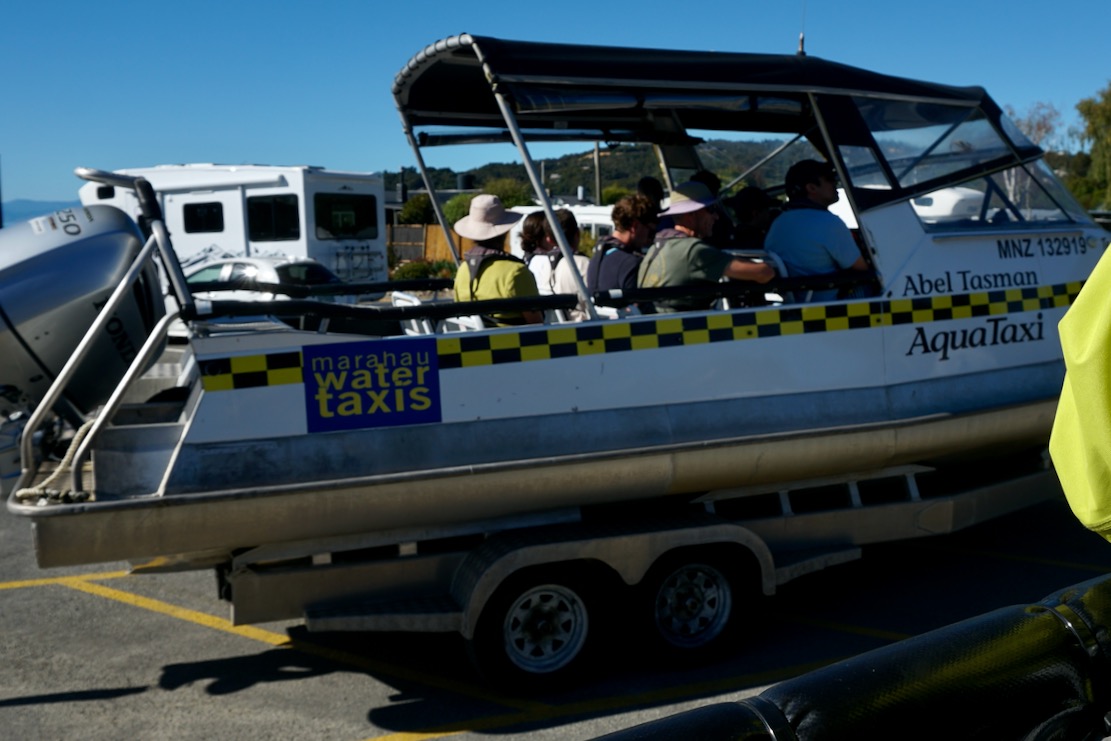
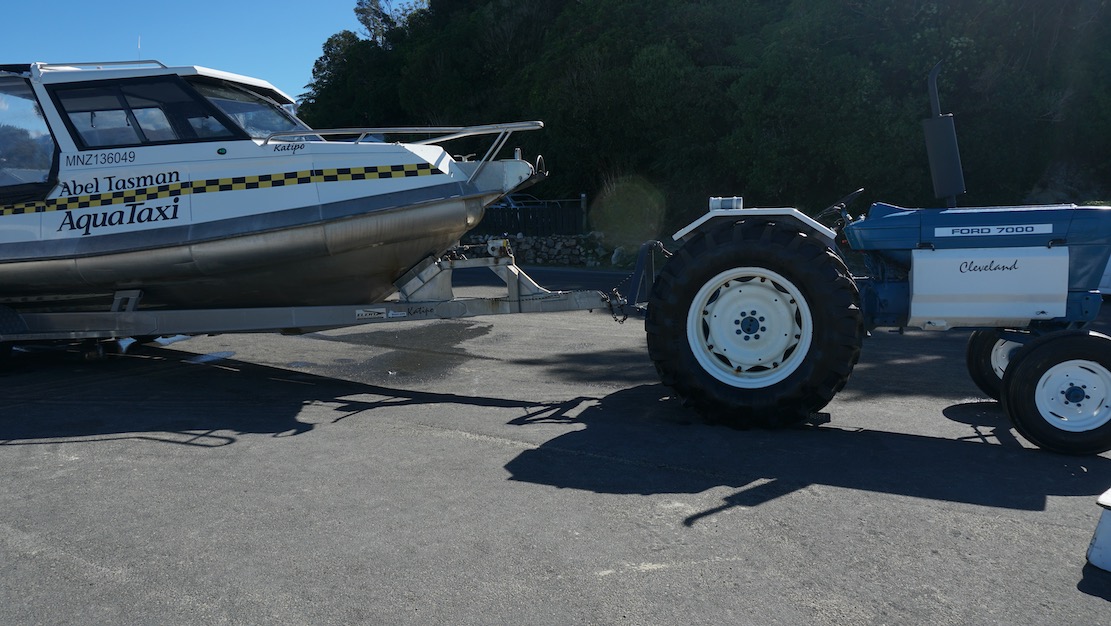
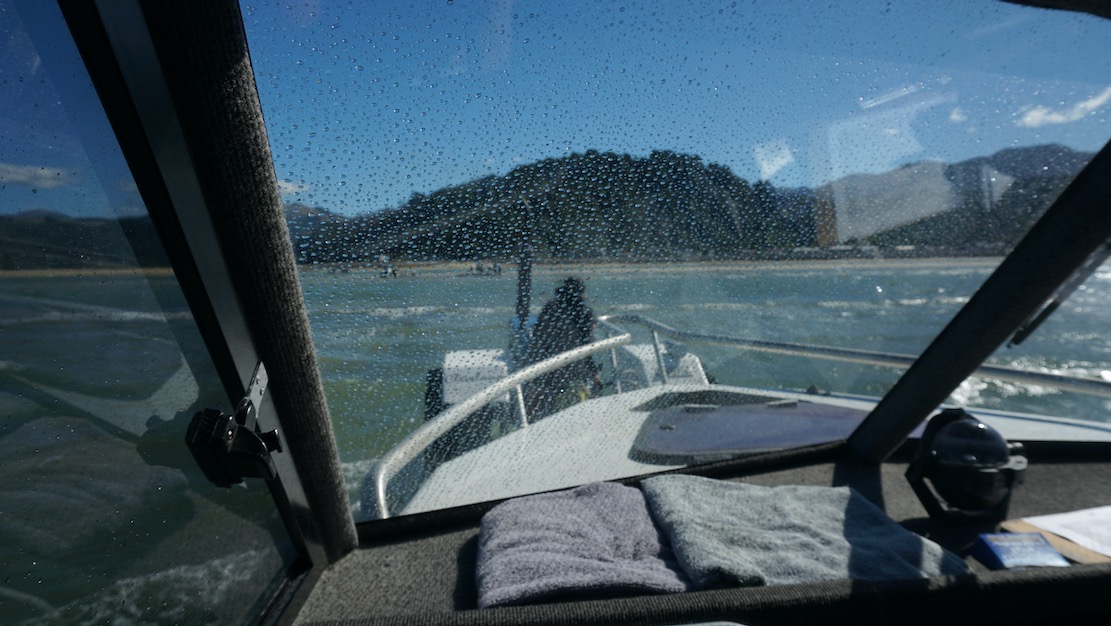
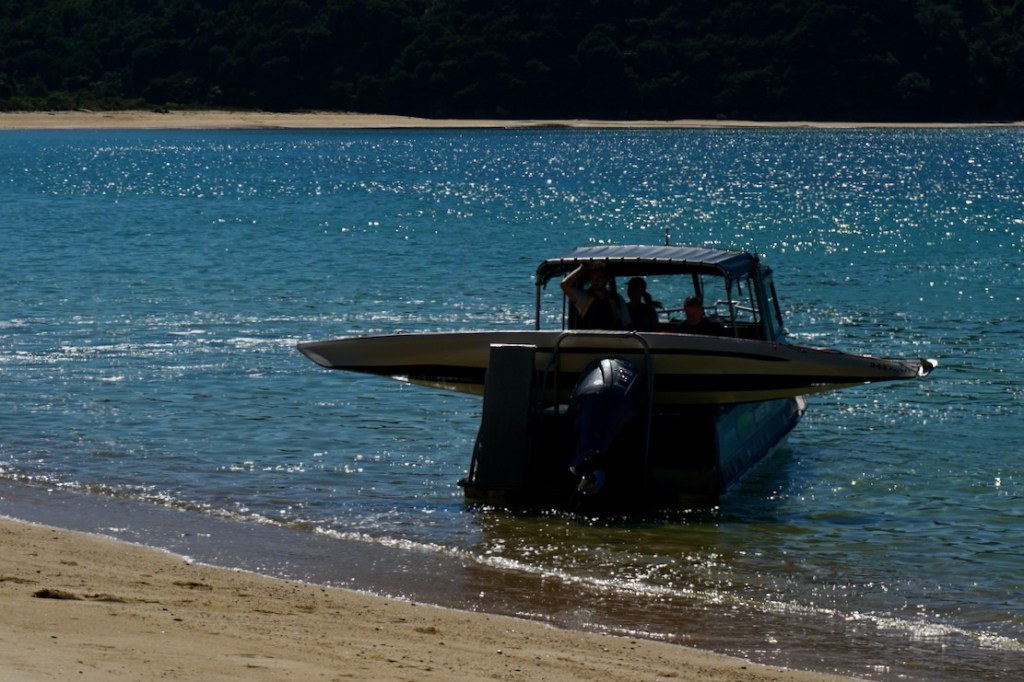
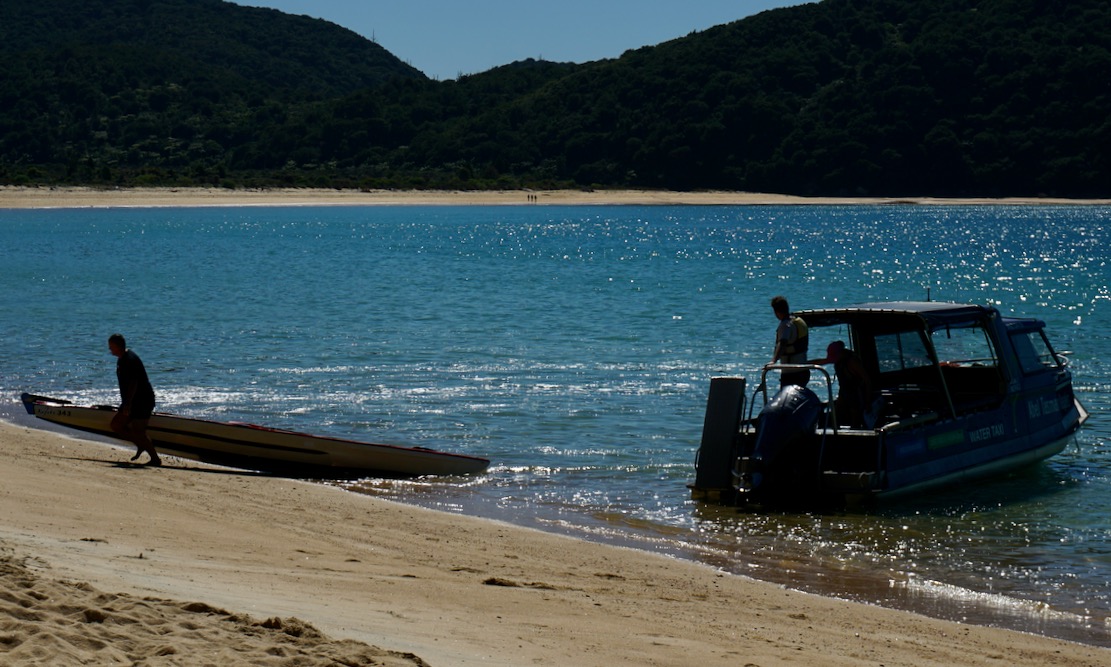
The Aquataxi operation is very slick: passengers board the motorboat on its trailer in the yard (below left), get tractored down the road to the beach and backed into the surf to head up the coast with various drops offs and collections, and of course a drole commentary. Returning to Marahau, a tractor waits axle deep in the surf, the boat takes aim and rides onto the submerged trailer, gets clamped down and we’re all driven back to the yard. It got me thinking something similar would work well along the Jurassic Coast and the Southwest Coast Path between Weymouth and Swanage in the UK to save circular walks. It’s true there’s a bus, but boating the coast would be loads more fun to or from a walk. I imagine rougher weather for nippy beach launches, plus a host of red tape kills this idea stone dead.
Hello? Is this legal?Deep water speed berthingTaxaaaaay!
The rental agencies offer the same service with their kayaks, but on day-paddles get you to paddle out from Marahau before bringing you back, where getting dropped off first to paddle back would be more fun. But with your own paddle boat, a taxi can drop you at the top of the park (below) to make your own way to Marahau. We may have struck unusually good weather again, but as we saw it, this would easily be doable in a packraft. Each day a late morning northerly sea breeze wafts you back down to Marahau.
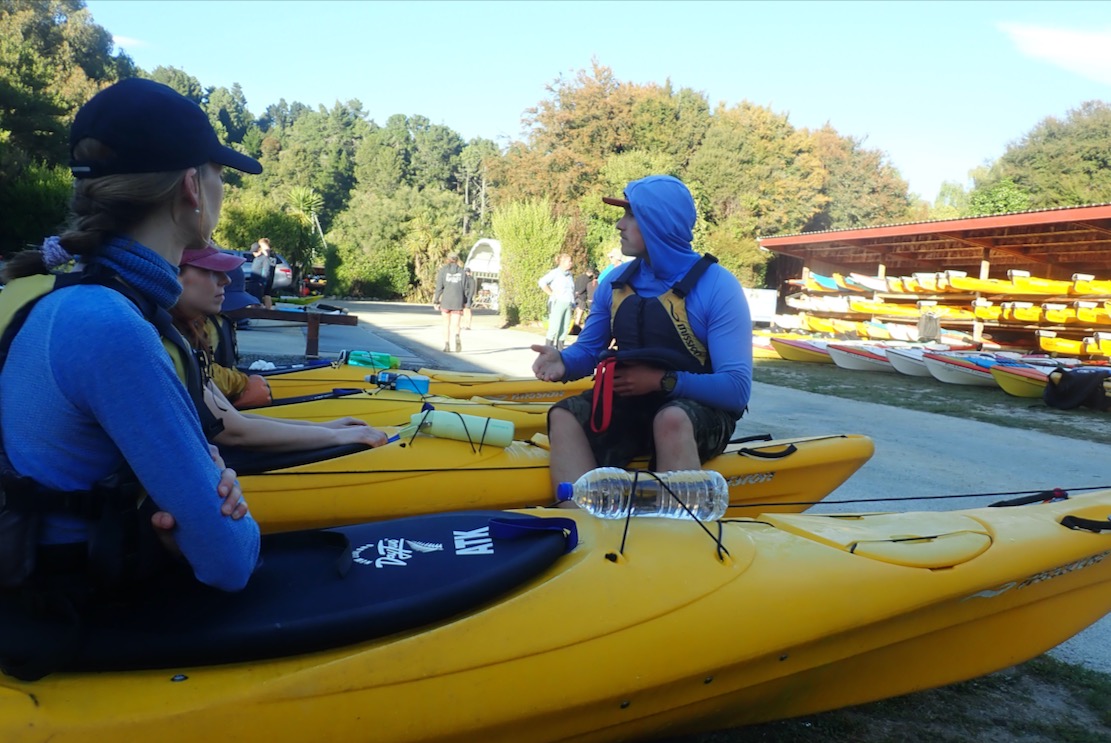
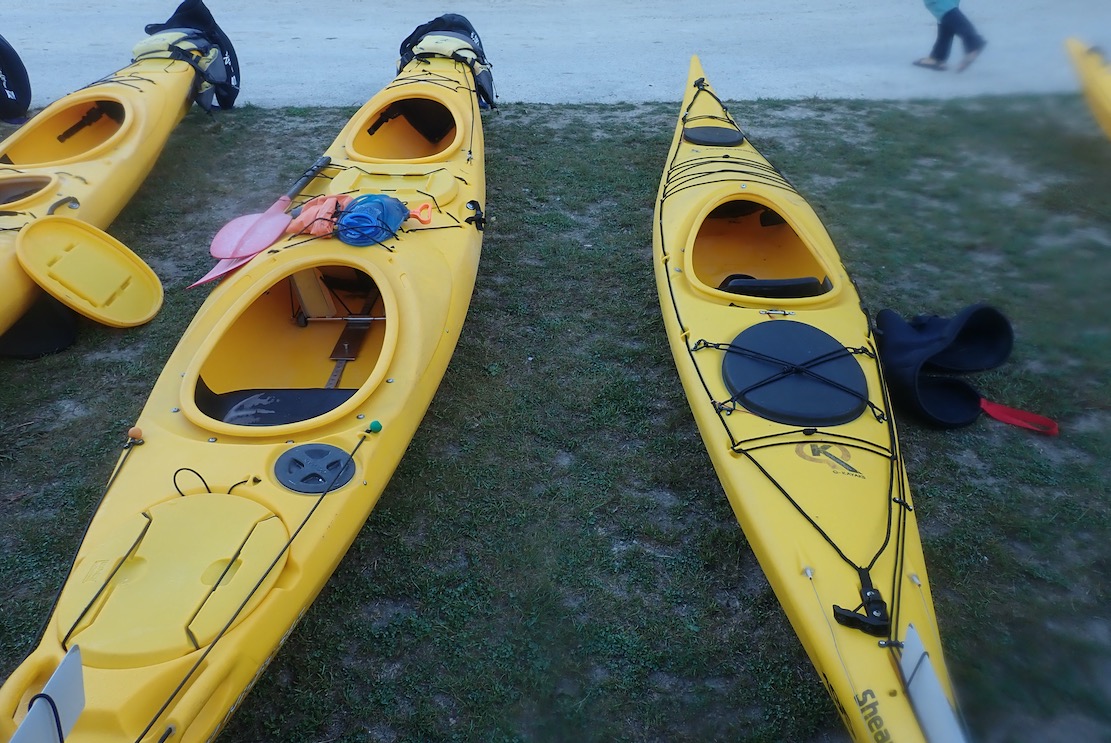
The reason the rental outfits require you to set off from Marahau is to give you a detailed safety briefing (left) before watching you set off in a plastic sea kayak. The boats were well equipped with a spare paddle, bilge pump and flare, but despite the demo of the technique, righting a 50-kilo double full of water, then getting back in and pumping out sounded quite daunting. On a day like today that was exceedingly unlikely unless you messed up a beach landing (or were in a tippier single; see below), but even then there are plenty of water taxis bombing around to help out if needed. I also spotted some double SoTs, much shorter and slower for sure, but which could be covered in a 5-second safety briefing: ‘Fallen out? Silly Billy! Clamber back aboard; paddle on ;-)’
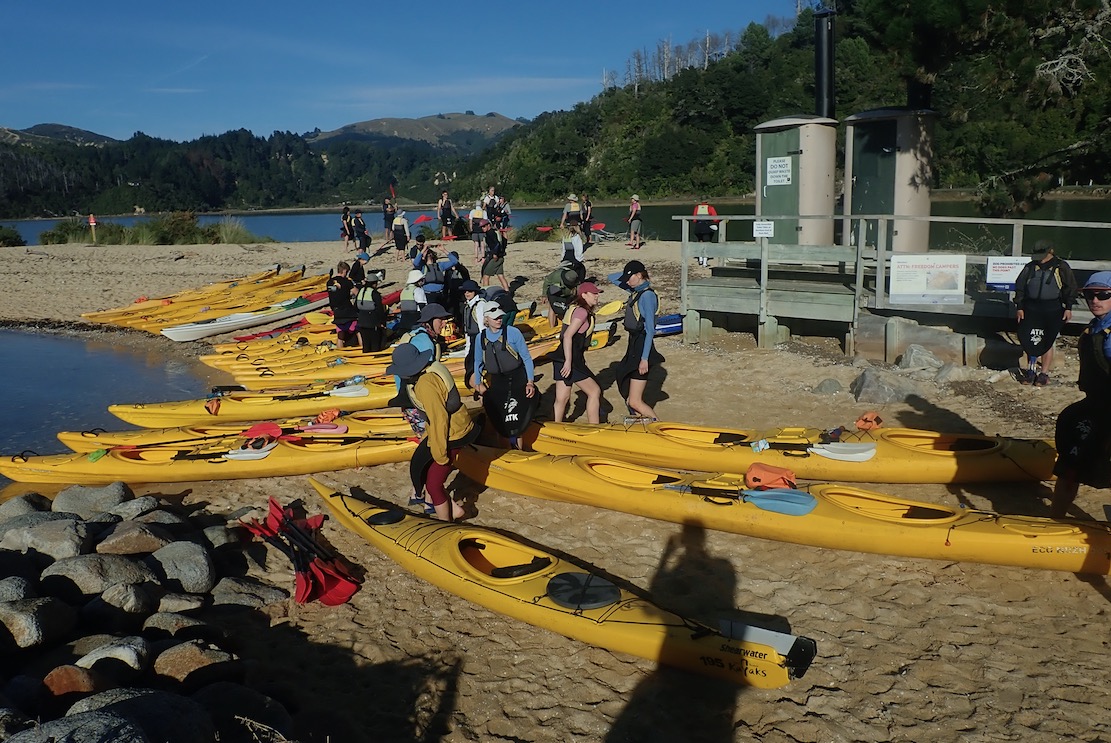
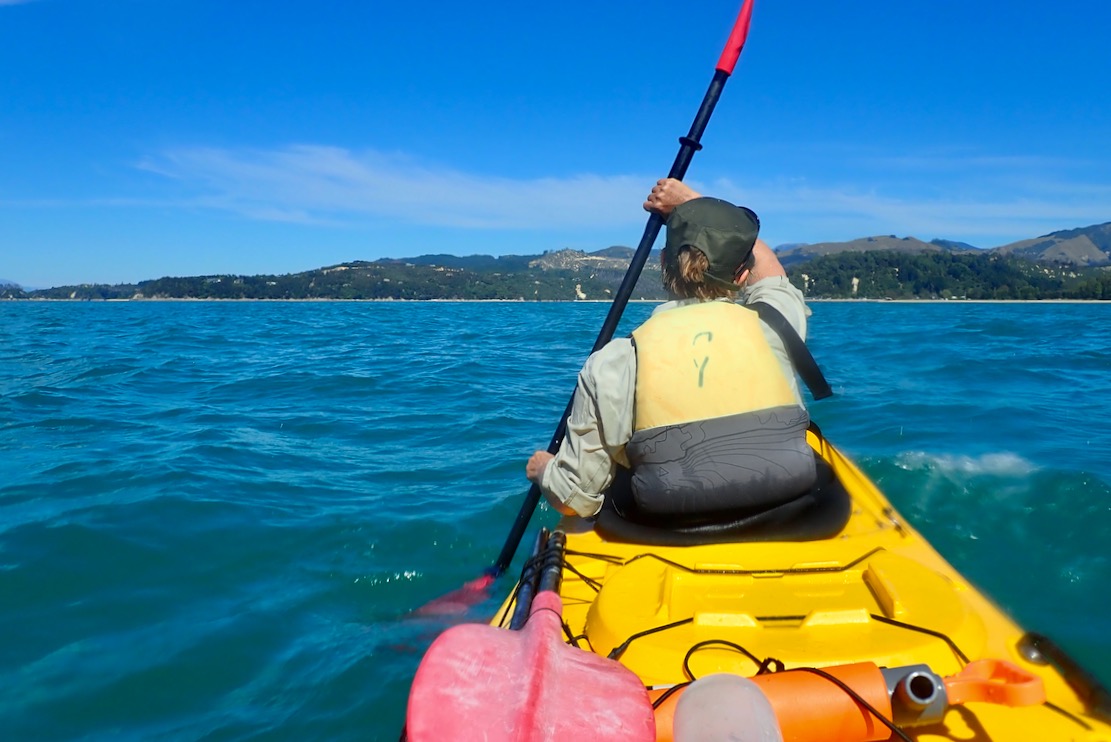
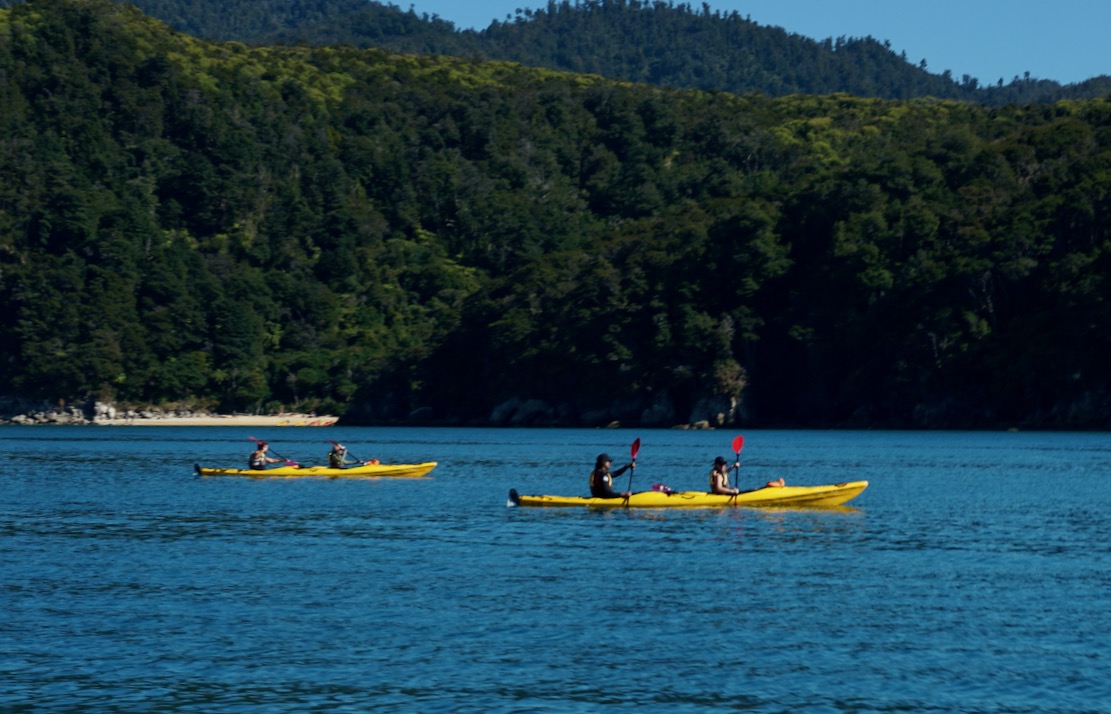
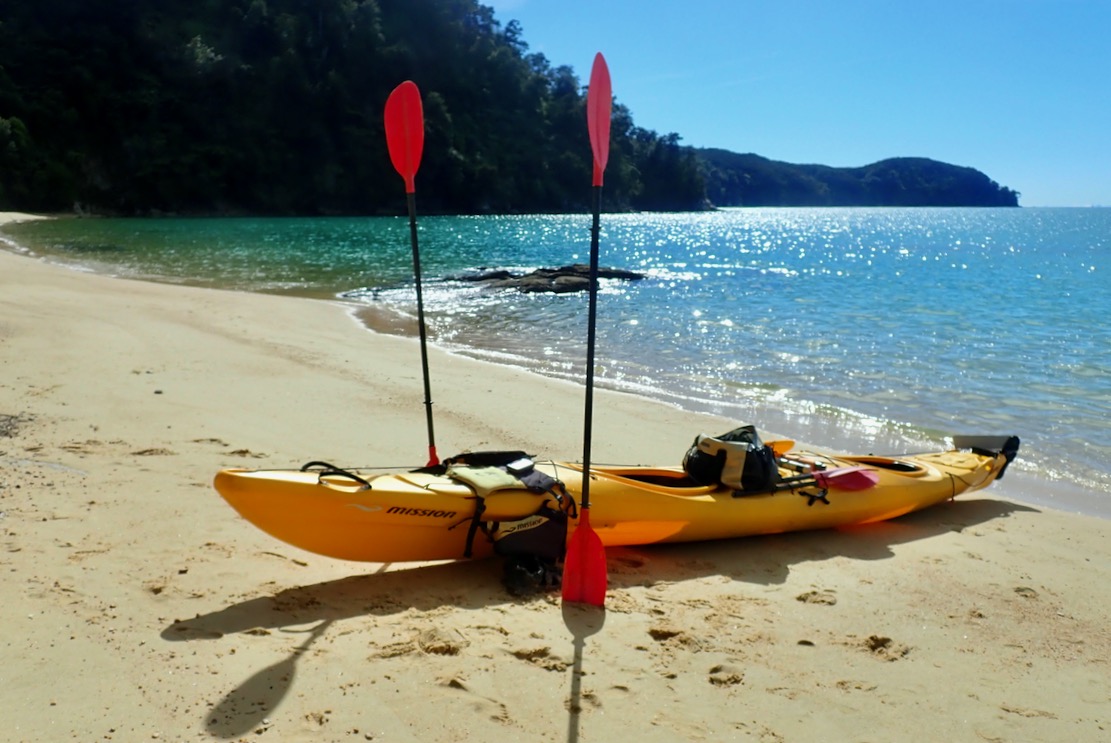
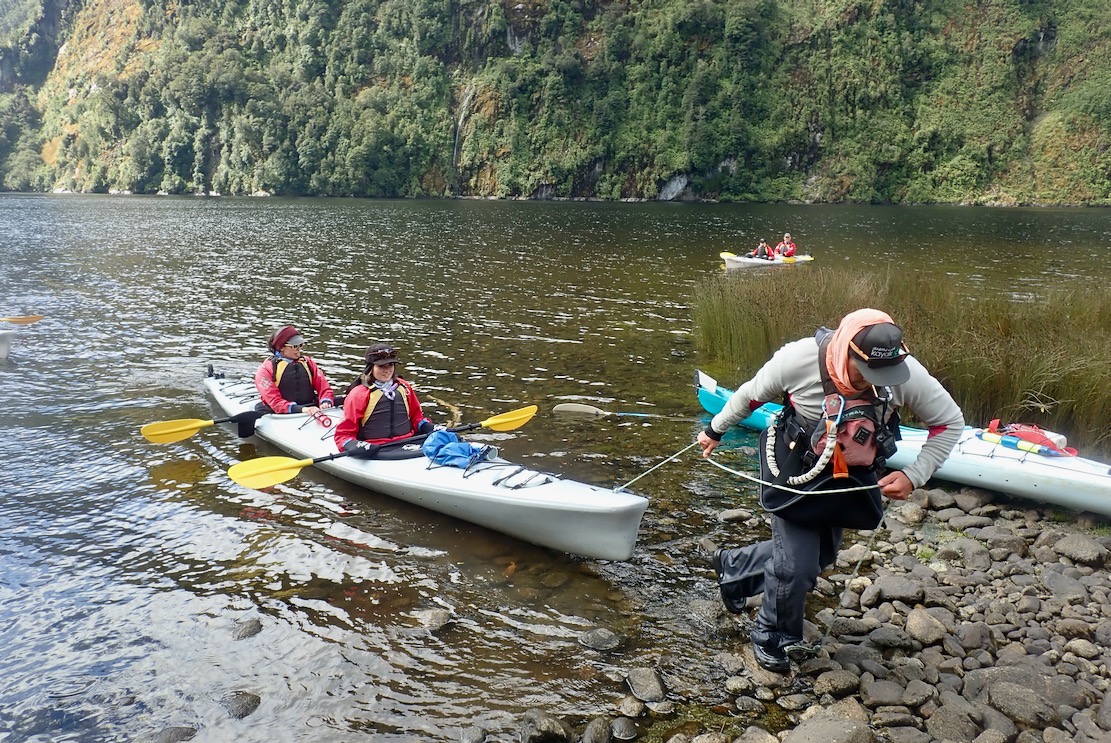
After the safety briefing, they took us to the beach and watched us get in and acclimatise to the Mission Eco Niizh 565s (18.5’). It was a similar classic to the Necky we used in Doubtful, except it was no less than 77cm wide and weighed a massive 55 kilos in the extra-rugged outfitters version designed to be knocked out for years by rental operators and their clients. But once on the water the Niizh had one big advantage over the Necky: a much better car-type pedal arrangement for the rudder, not the Necky’s awkwardly angled, self-folding side pegs. The action was much more taught and responsive too; we both found it much easier to track straight in the kayak without continuous micro-adjustments.
You can feel quite smug in your untippable, bath-wide, Eco Niizh double, but I don’t think I’d have been quite so sanguine once greased up and stuffed into a Shearwater single (above right) which, at 4.8m, is nearly as long, but 61cm wide and with a notably smaller hatch. They do look great though, like a proper sea kayak does.
I took the GPS this time but we only clocked 8kph flat out, though could easily sit on 6-7kph. I suppose that’s normal for a relatively wide and very heavy double where no amount of extra effort will overcome its shape and mass. As with IK doubles, two paddlers don’t add up to more power, just a potentially greater range. The Mission felt less uncomfortable too, but we only had a morning to spare here.
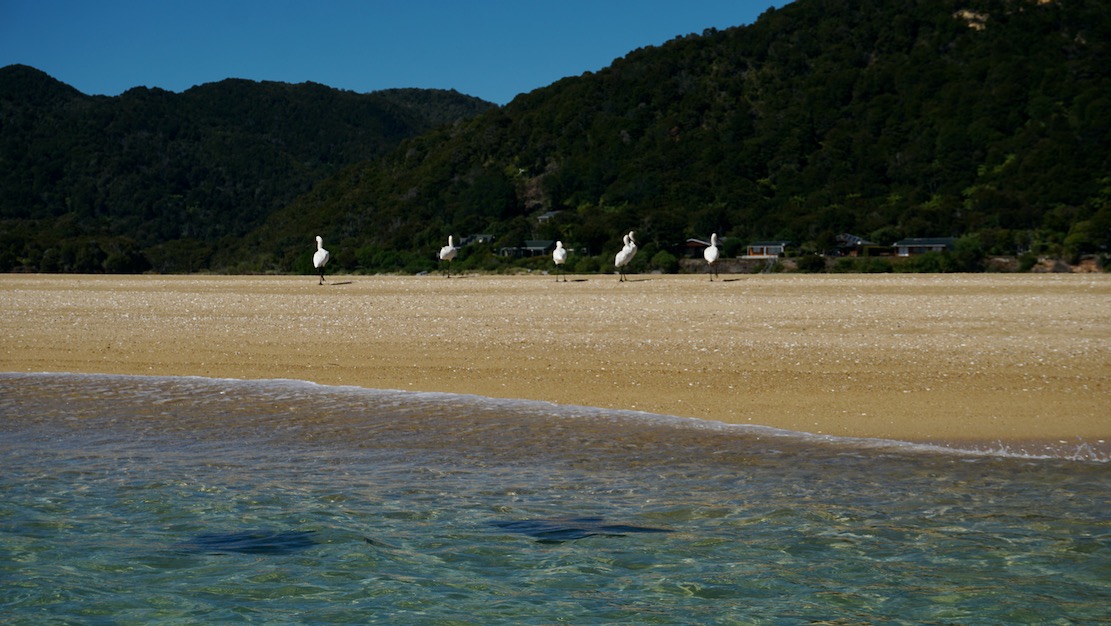
So now I can vouch that Abel Tasman would have been one spot where lugging my TXL packraft would have paid off. With loads of storage in the side tubes, relatively sheltered conditions, coastal path access and even water taxis to hail if it all gets too hard. A sail could even catch the afternoon sea breeze and on the way you might pass egrets and stingrays (left), except this in predator-free NZ, not Australia, so the stingrays don’t even sting.
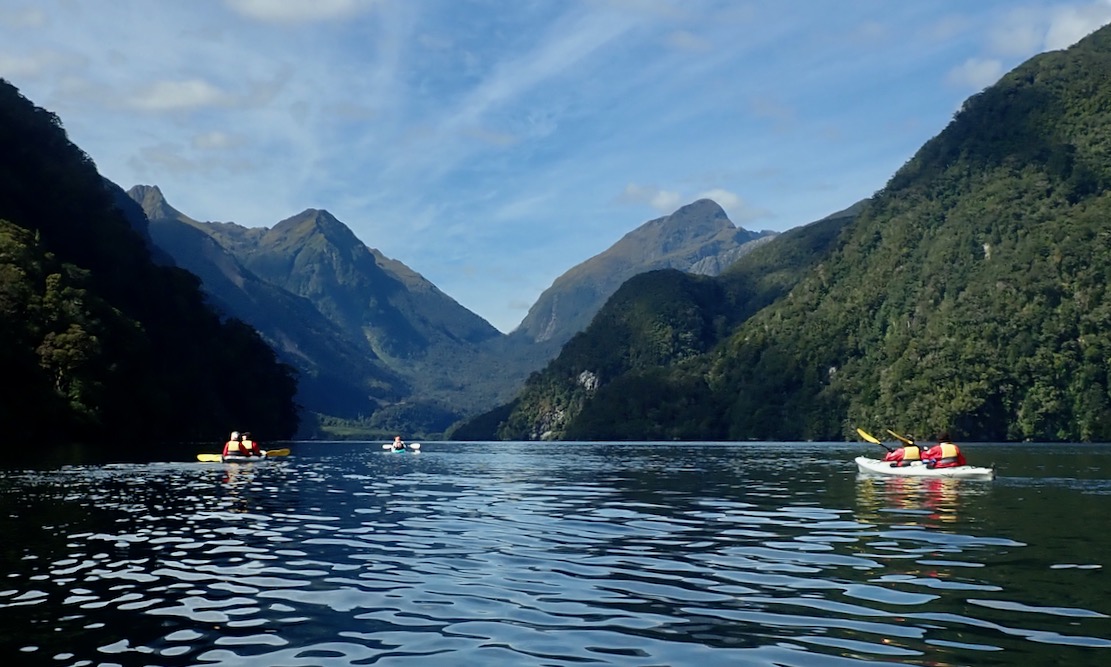
Fjordland National Park in the far southwest of New Zealand’s South Island is a huge, barely inhabited warren of 1000-m+ mountain ridges, deep 40-km inlets and glittering alpine lakes. Milford Sound is the best known of these glacier-carved fjords reaching inland from the Tasman Sea. Every day convoys of buses drive up the spectacular Milford Sound road to cruise the Sound. We chose the less visited Doubtful Sound further south for a spot of rental kayaking.
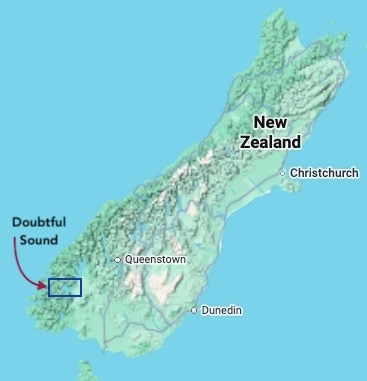
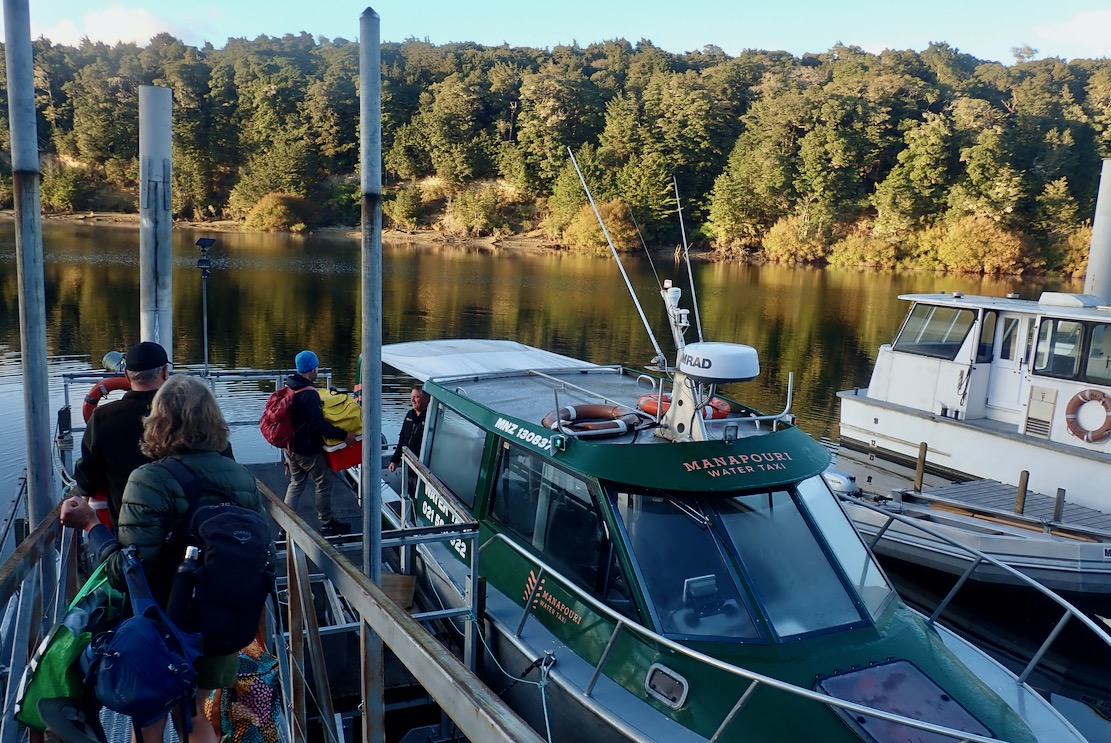
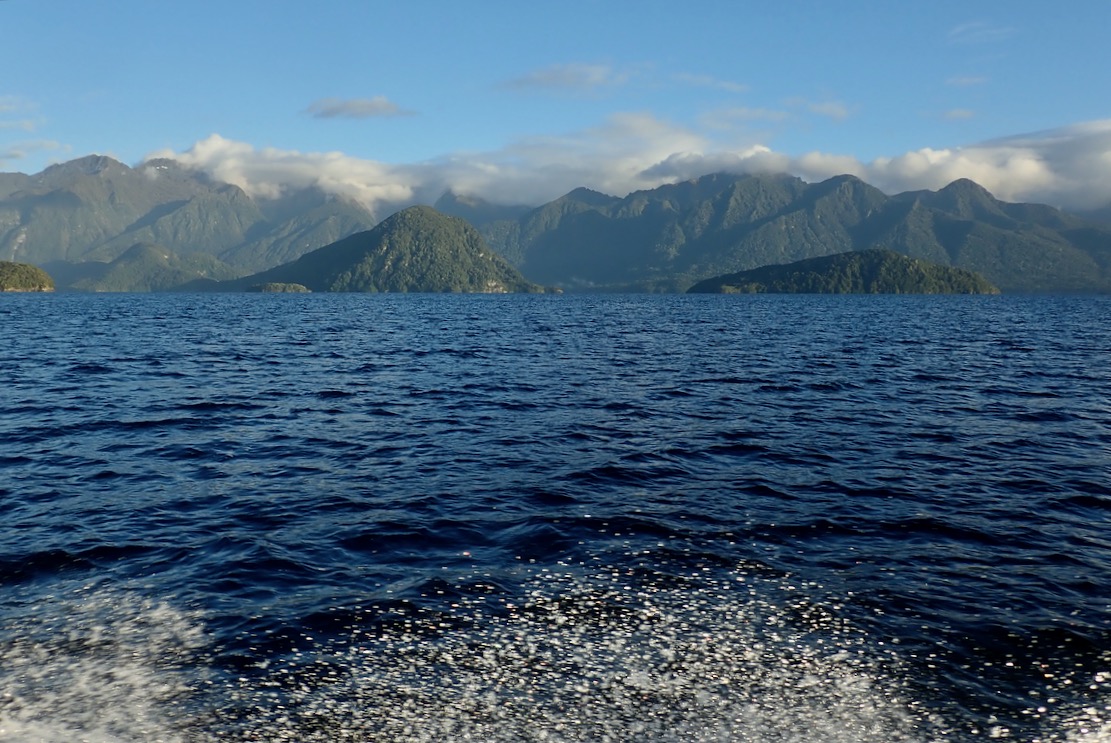
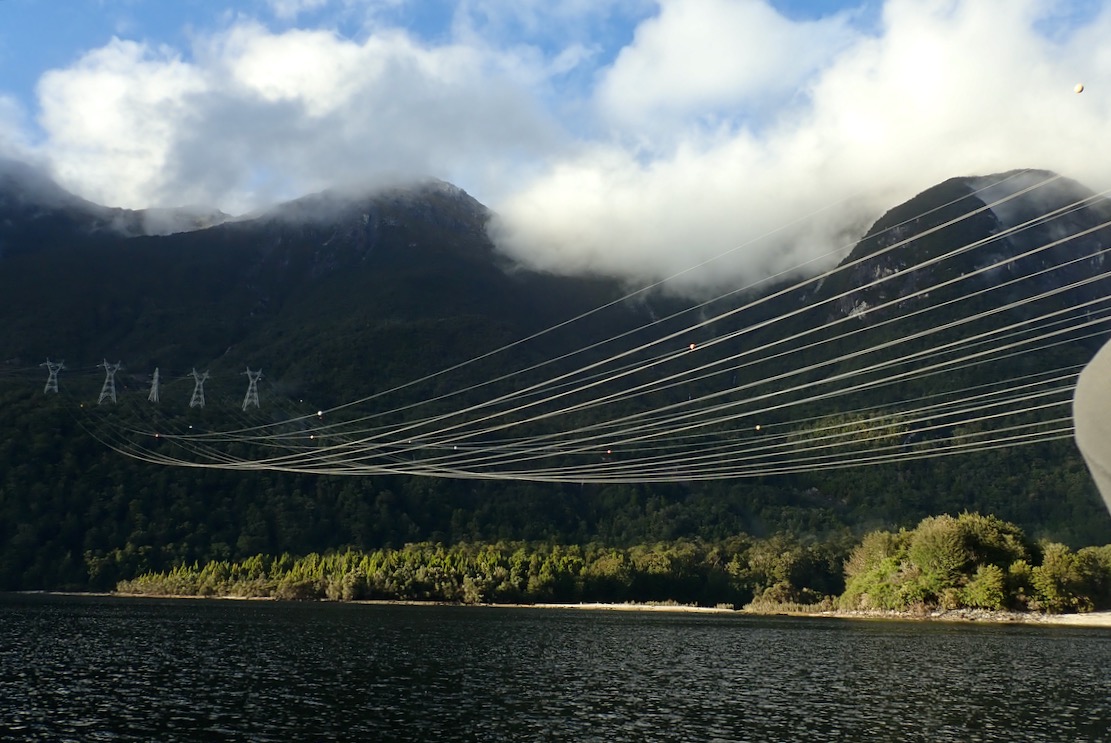
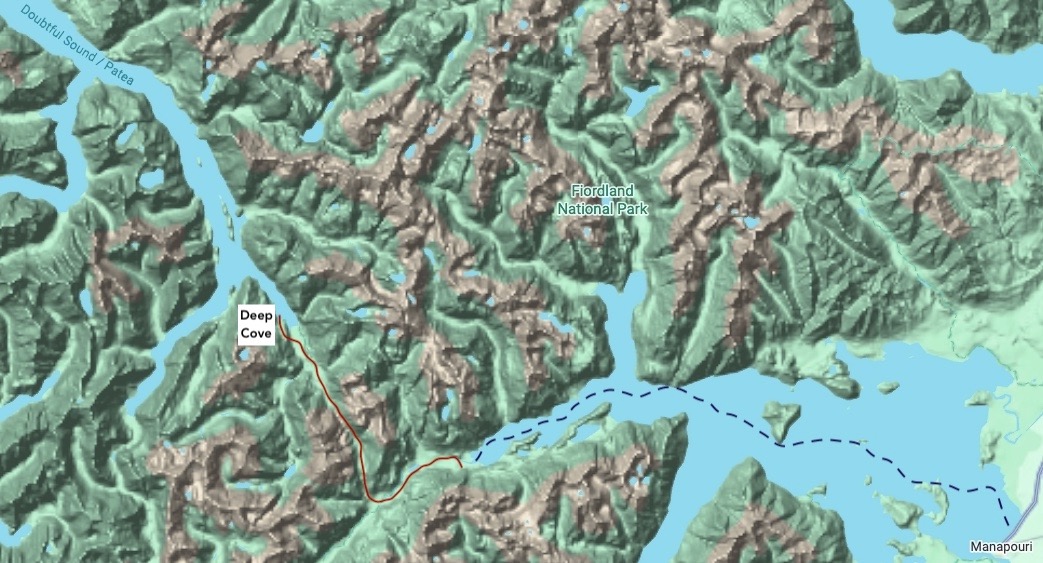
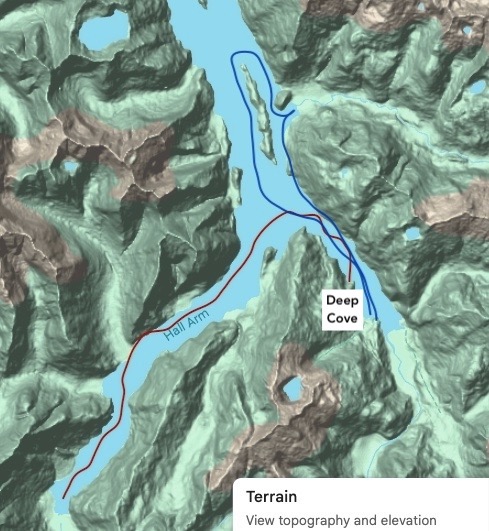
However you do it, getting to Doubtful Sound is a bit of an affort. First you cross the 35-km width of Lake Manapouri (pics above, map below) to a jetty at the west end, alongside NZ’s biggest hydro electric scheme (left). Unseen below is a huge machine hall carved out of the granite, housing the turbines Just about every South Island lake seems to have been repurposed for power generation, producing up to 85% of the island’s electricity.
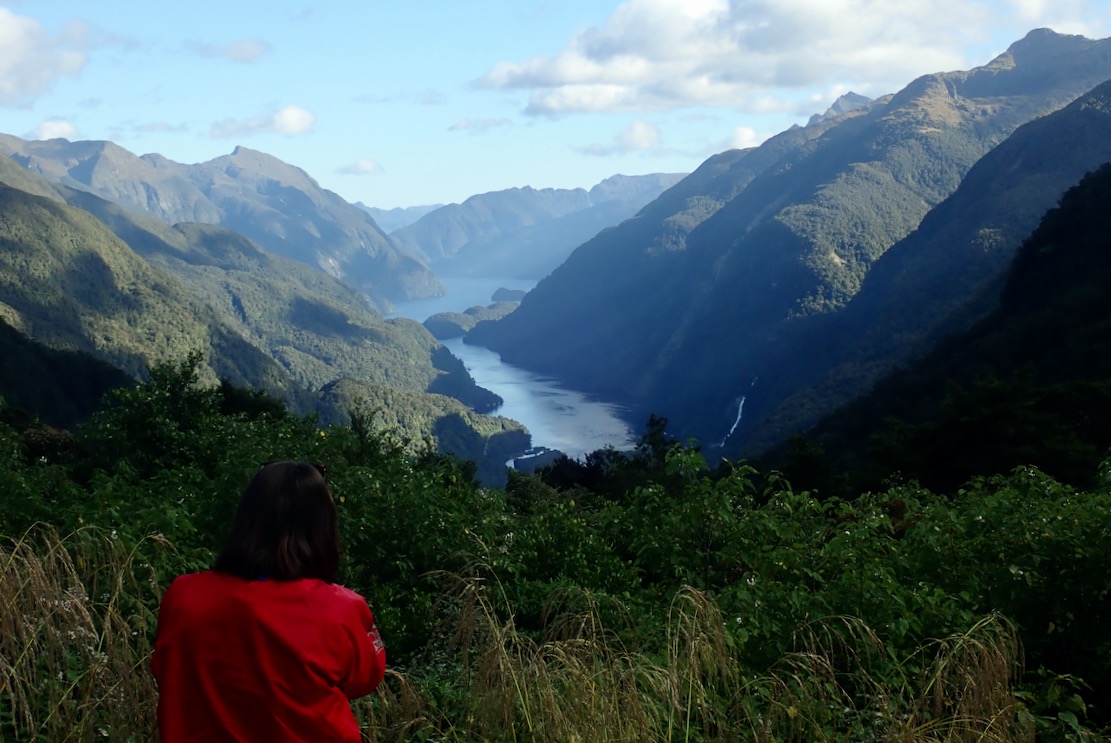
From the jetty a steep road leads over Wilmots Pass (above), then drops to the Deep Cove at the eastern extent of Doubtful Sound, noted by Cook on his 1770 expedition. This private road was originally built to serve the remote hydro construction from the sea. Once finished in the 1970s, one and then another tailrace tunnel was carved through the granite 10-km from Lake Manapouri to Doubtful Sound, the 180m-drop generating electricity for a smelter in town of Bluff, 150-km away. Five hundred cumecs (m³/sec) of water rush out of the tunnels, which adds up to a billion litres (1km³) every three weeks, freshening up the salty reach of Deep Cove with a couple of jetties and a hostel.
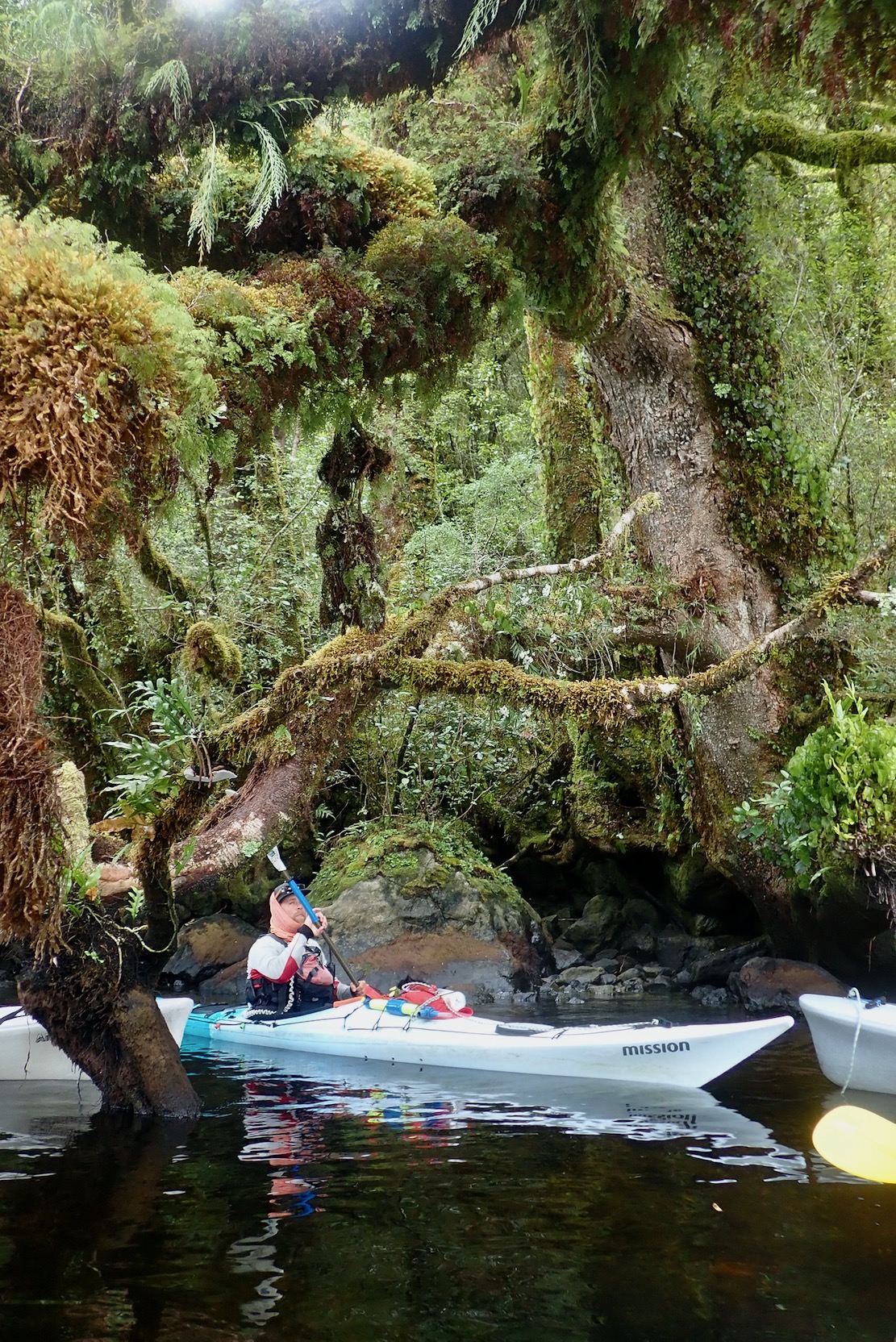
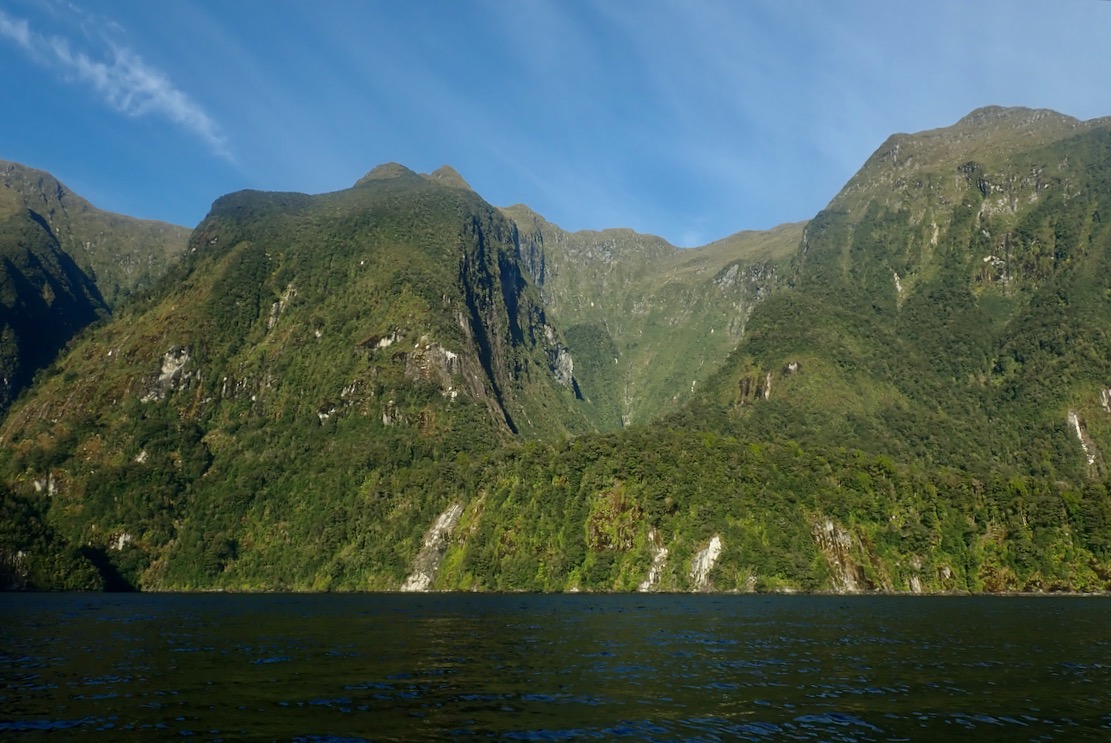
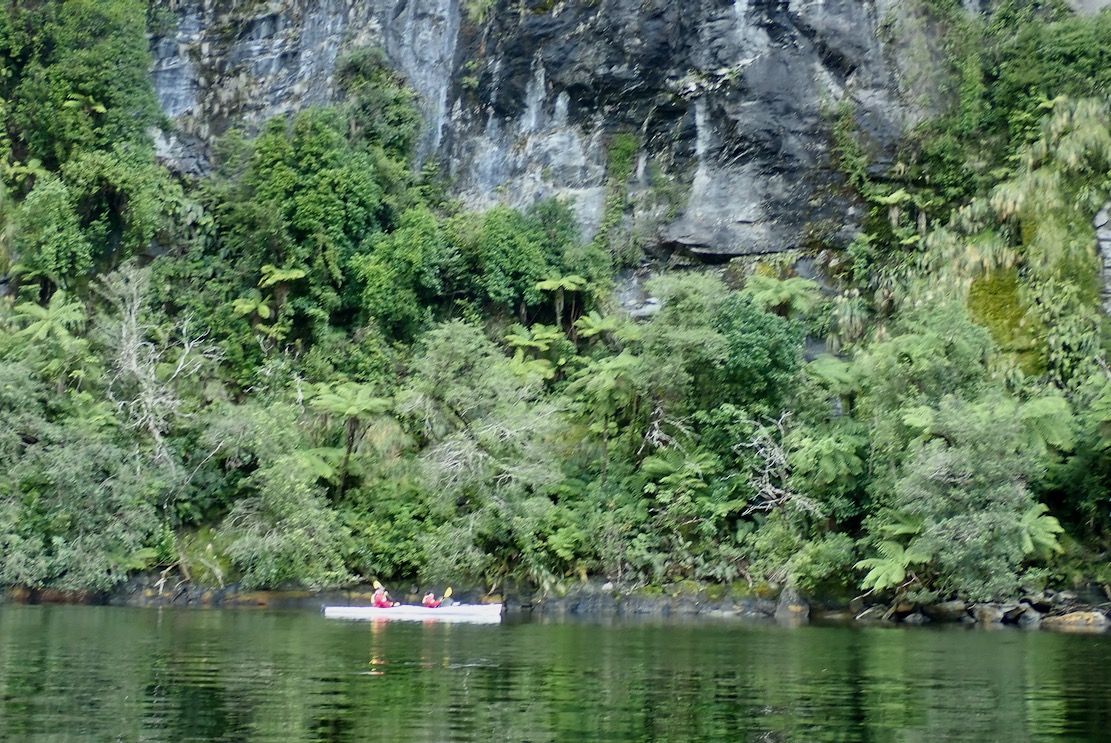
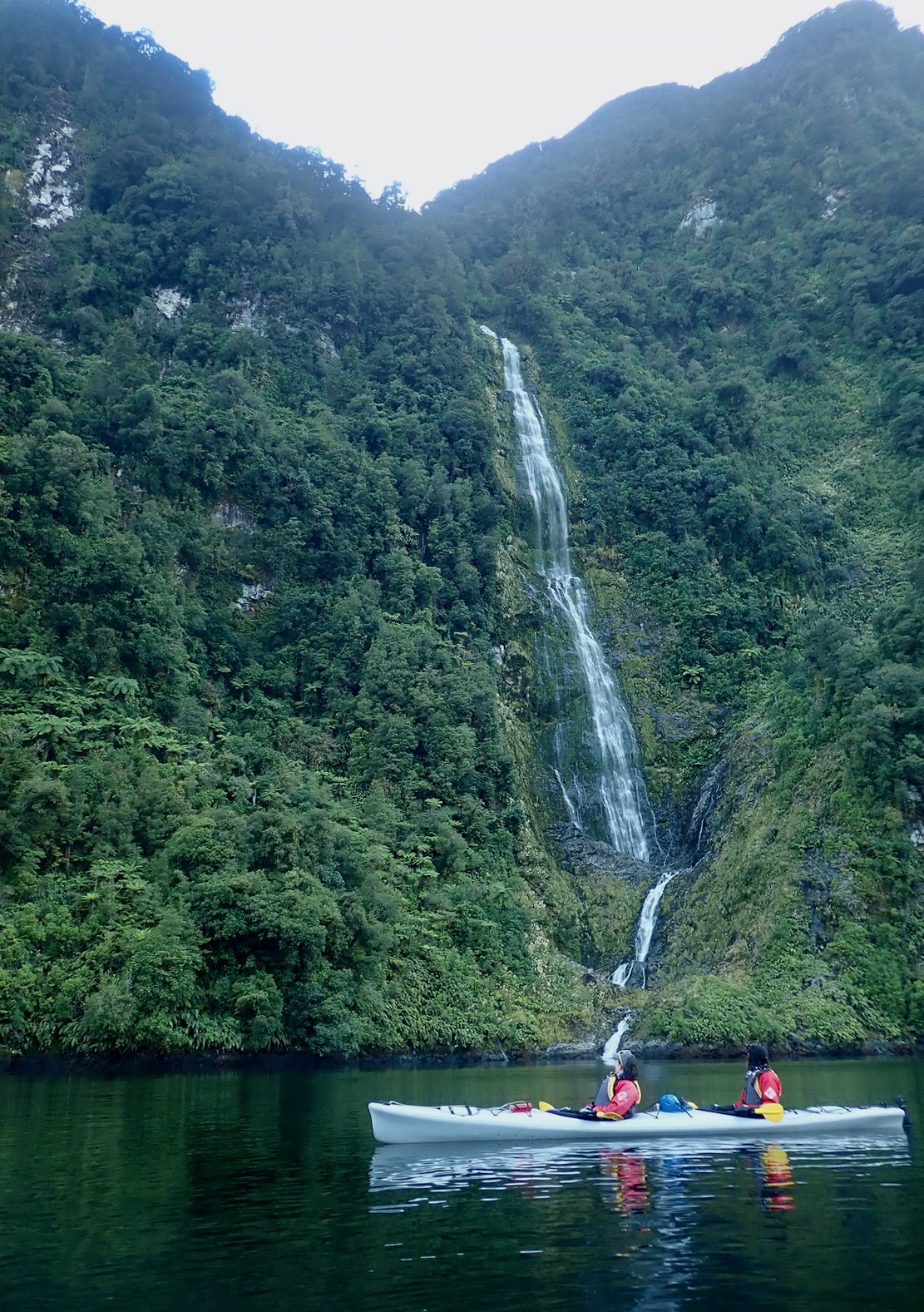
There’s little worry of Lake Manapouri running dry as the prevailing westerlies off the Tasman Sea dump up to 8 metres of rain a year, sustaining a dense, primeval rain forest of evergreens and ferns right out of Jurassic Park. They cling to the steep valley sides from the ridge crests all the way down to the tide line, and mineral, vegetable and probably some slow moving animals too, everything gets clad in bright green moss (left), even old rope. But for all this running water and greenery, it’s barely inhabitable terrain dominated by 60° slopes or outright cliffs, all thick with impenetrable vegetation. We’d arrived after a not unusual spell of rain which saw 1000-foot waterfalls streaming down the slopes, fed by unseen tarns far above. By the the time we headed out of the valley a day later, they’d dried up.
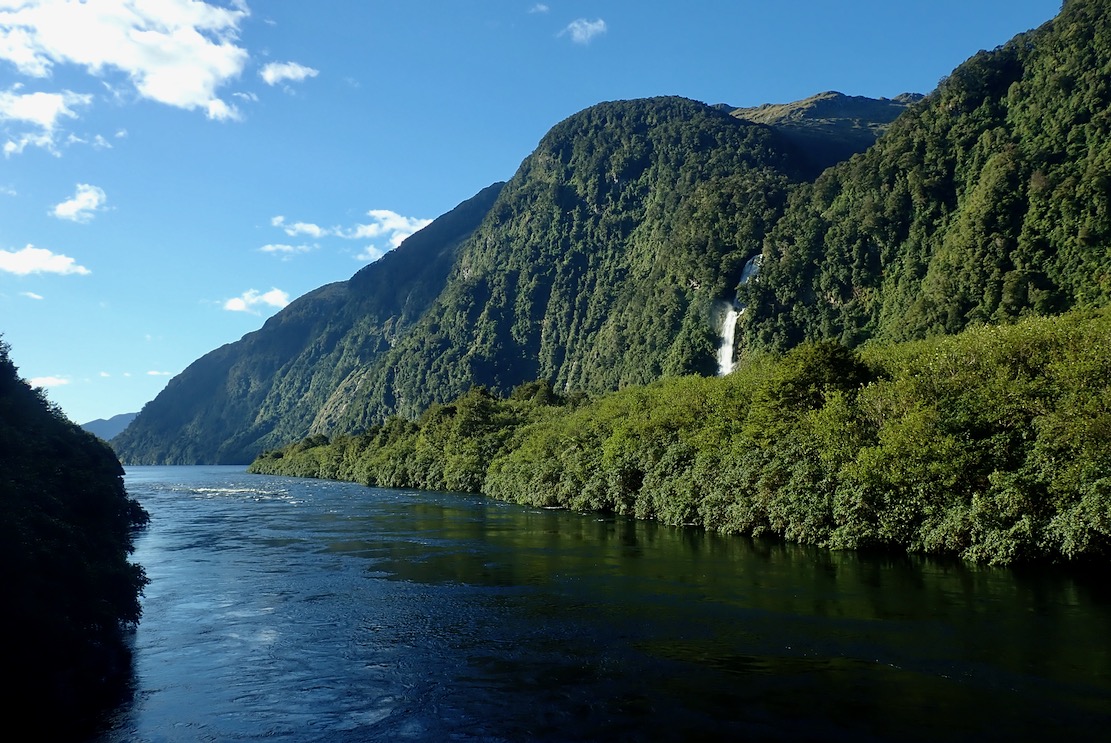
This is the hydro scheme’s spillway, with a swift current running into the Sound.
Our guide Blake explained there was no soil on these slopes. Once exposed by the retreating ice cap 12,000 years ago, lichen (algae-fungus) attracted moss, then ferns gained a footing and finally huge beech trees rose up, clinging to cracks in the rock and each other. Periodically they let go in a spectacular ‘treevalanche’, exposing a strip of bare rock comonly seen, and so the floral colonisation process resumes.
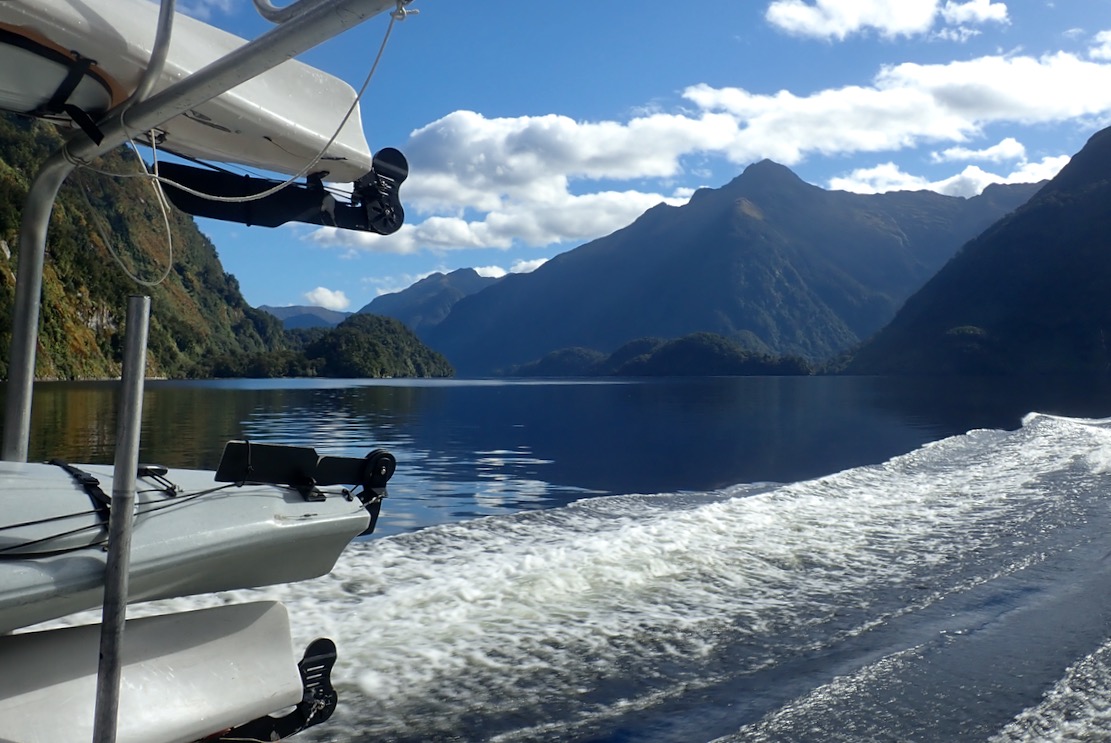
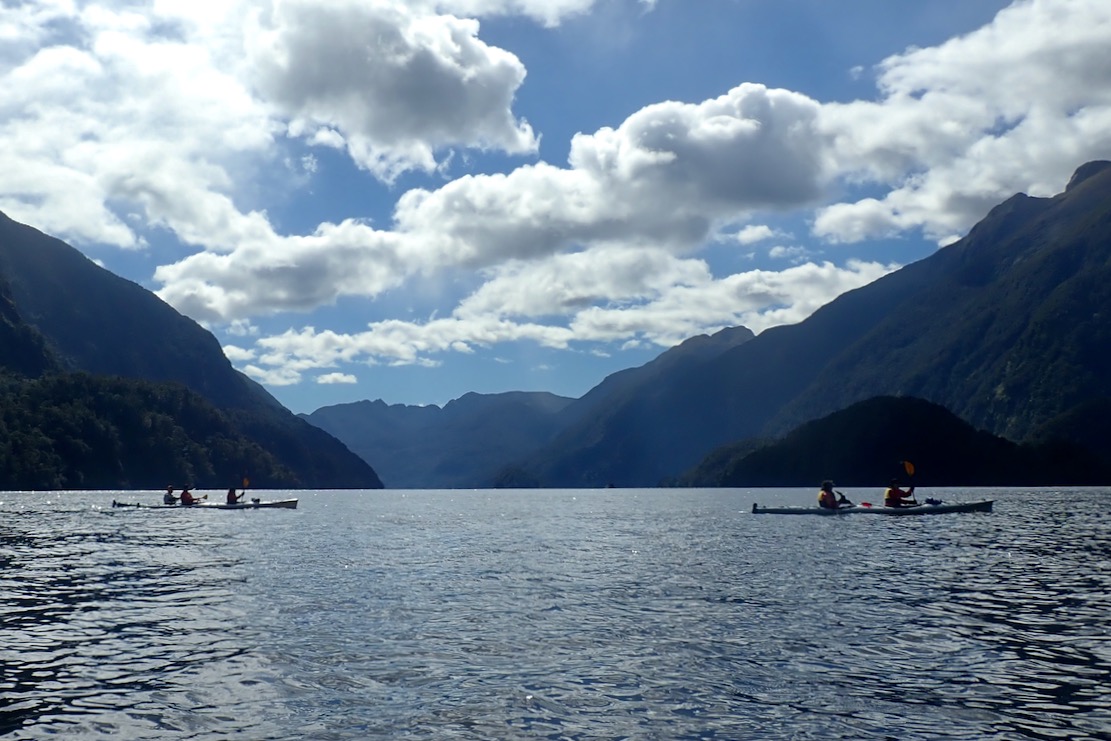
A service boat from Deep Cove jetty means kayak groups can be dropped off or collected anywhere in the Sound in minutes, depending on the day’s winds. Our afternoon paddle saw us left at the head of Halls Arm, 13km from Deep Cove. Down here only about fifty days a year are sunny, and we were lucky enough to grab two in a row. It was a bit disappointing to see passenger tour boats here, but they kept their distance or provided fun wakes to bounce across.
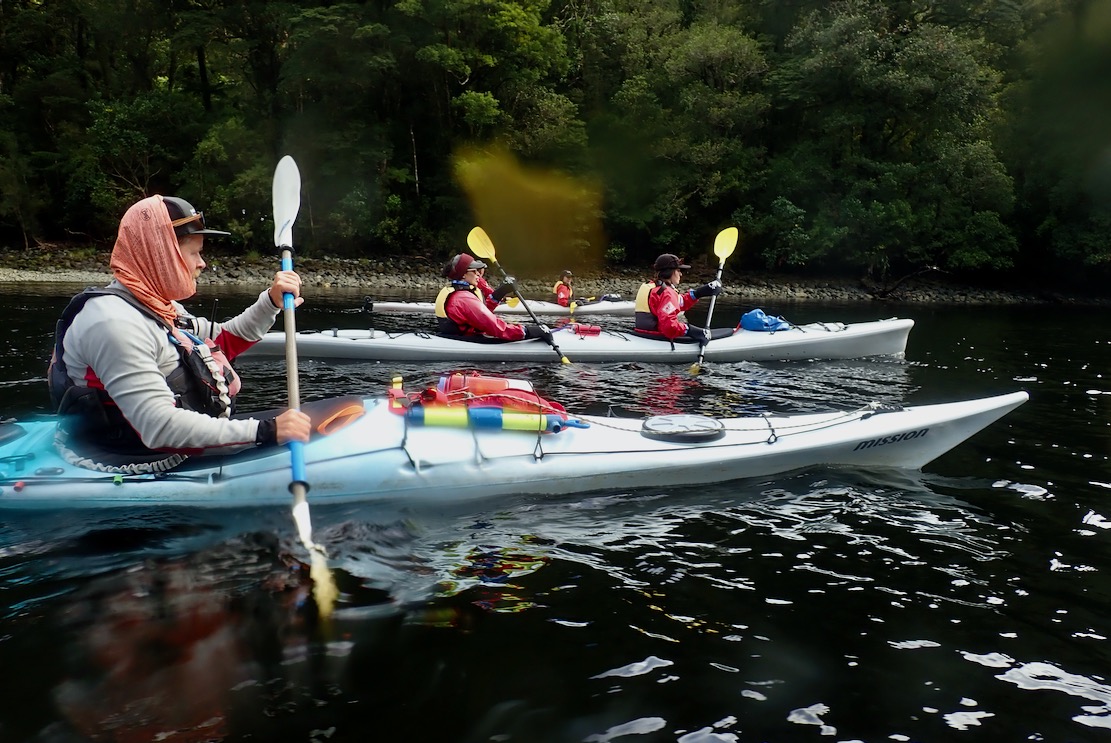
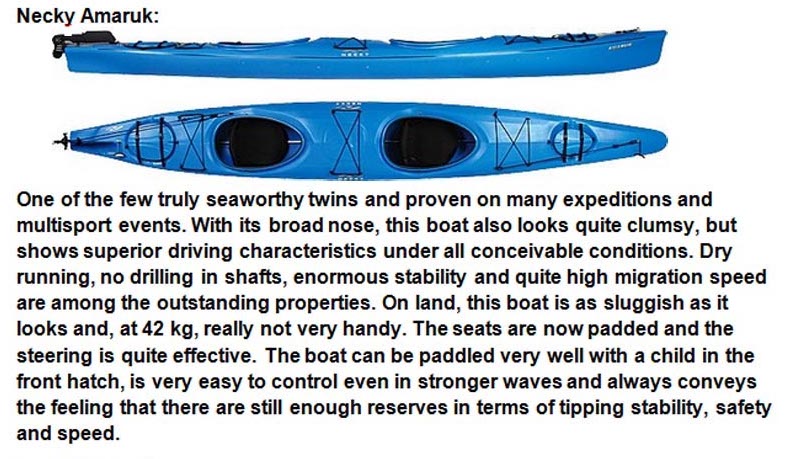
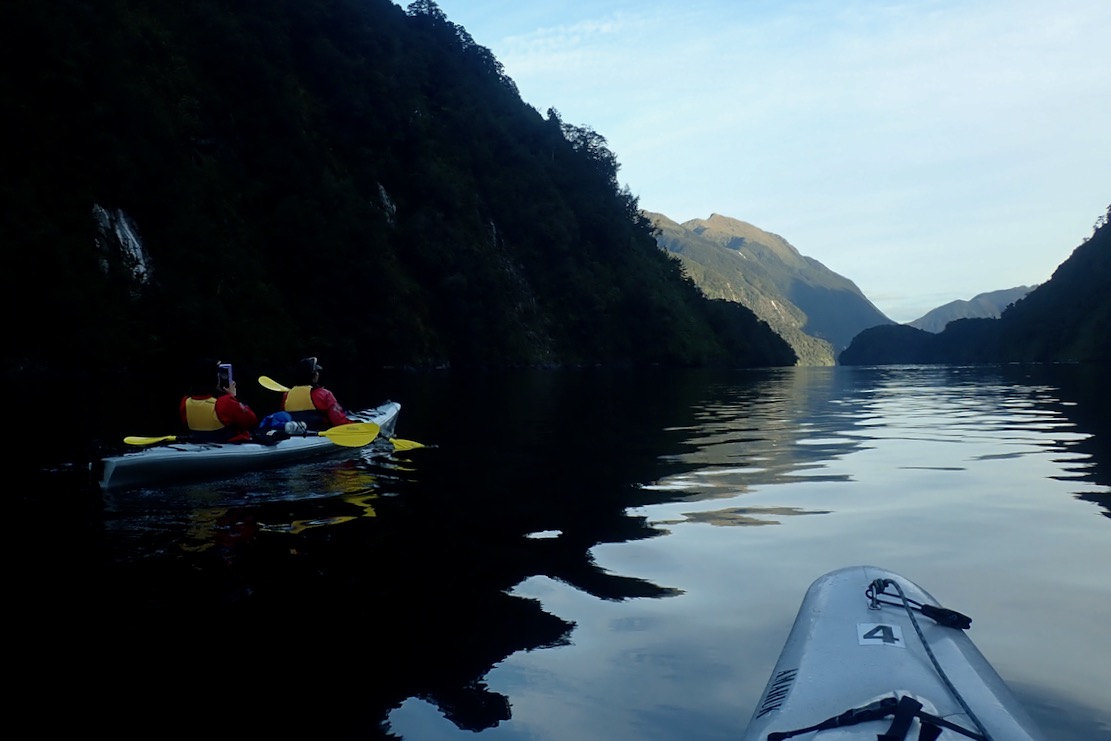
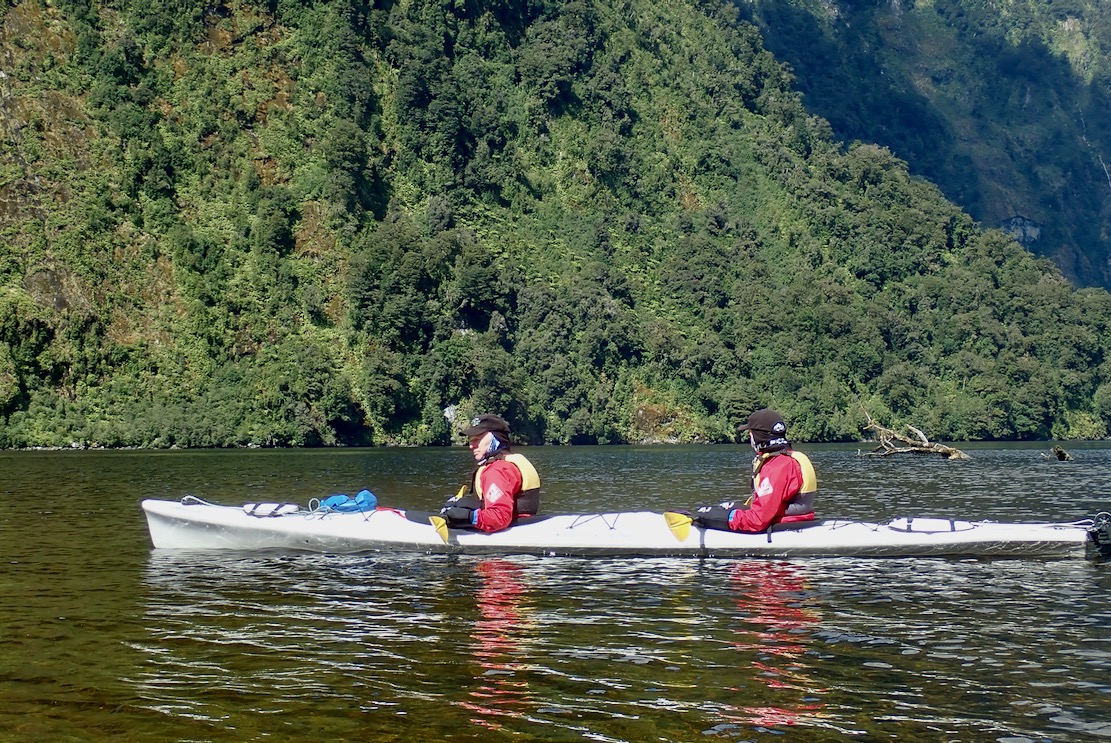
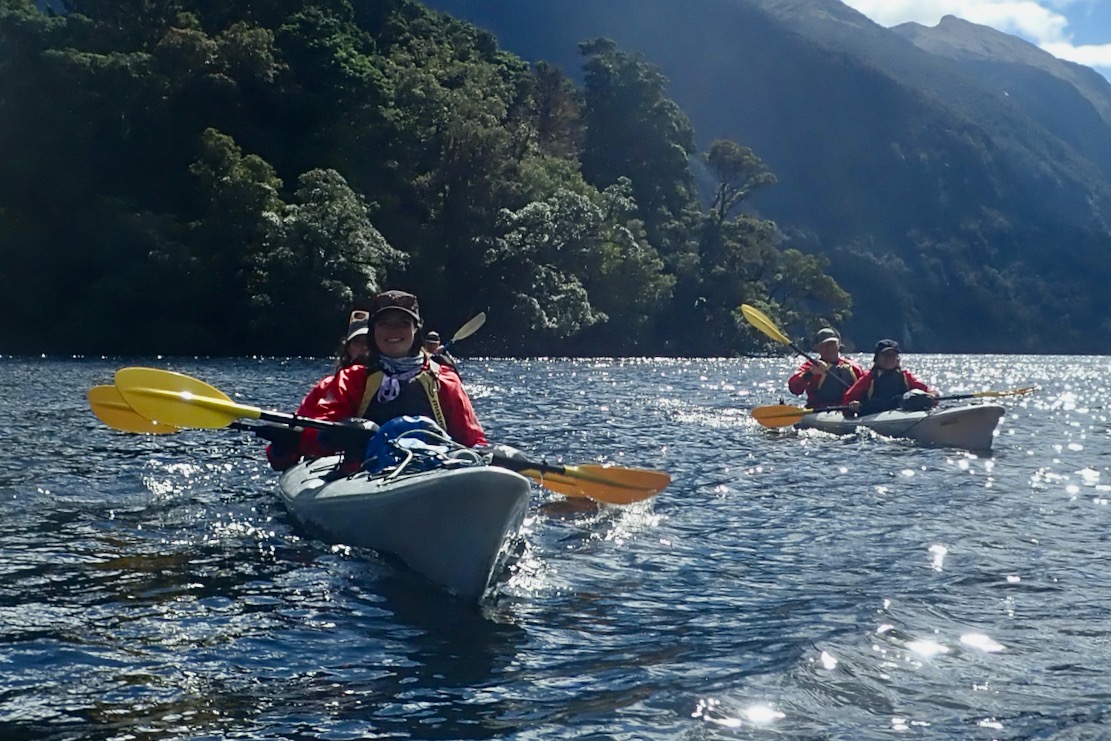
In Halls Arm eight of us slipped into four Necky Amaruks, a discontinued 6.4m roto double from the 1990s, just 66cm wide but clocking in at 42 kilos. We probably last paddled a hardshell double along Croatia’s Kornati Islands, some 30 years ago. The good thing with hardshells is you sit virtually on the floor and below the waterline, like a packraft but at nearly half the width. This means the boat is stable and fast, while still sitting low on the water and less prone to winds – the bane of much lighter and buoyant inflatables.
Today I sat in the back with the rudder, but failed to adjust for comfort, which ended up disagreeing with my bad leg and bad back. Occasionally an Omnium wet shoe would slip off the awkward side peg – less thick soles are better. After flailing hopelessly trying to reconnect my foot, I’d have to pulled back the skirt and reach in to unfold the peg.
I’ve experimented with or had IKs with rudders, but in the end decided they weren’t essential for my sort of fair-weather day-trips (as opposed to overnighters, where you’ll get all sorts of weather when a rudder can help). You’d think you just set the rudder straight to go straight, but I found myself constantly finessing the pegs and zig-zagging, while trying to synch with the Mrs’ cadence up front, a bit like patting the head and rubbing the stomach. By the time we got back to Deep Cove after two, 2-hour spells, me and another similarly older guy had to be winched out like sacks of wet wheat. The minimally-padded seats saw to that, not helped by the lack of a solid footrest for support. He and I were not the first to experience this hardshell discomfort of course, but like bike saddles, you either get used to it or find one that suits you.
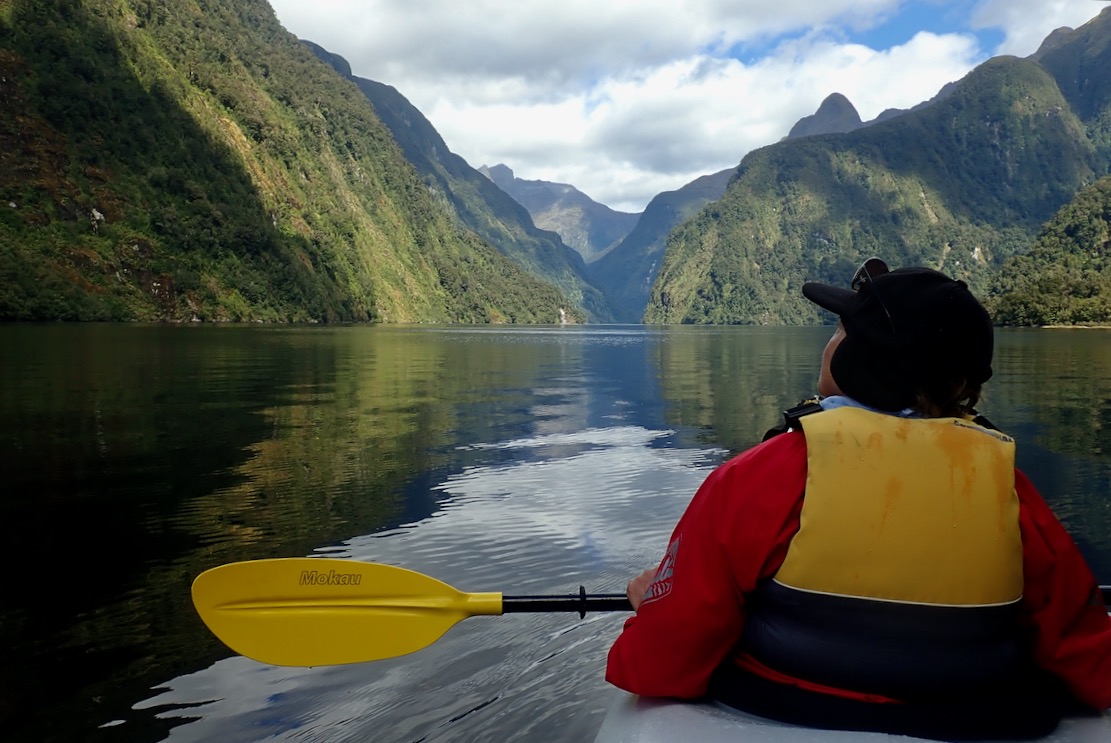
Next day I grabbed the front seat and directed the Mrs to the steerage area. This was much more like it! Solid foot placements and a great view. This time we paddled down the Sound alongside Elizabeth Island, passing a textbook hanging valley carved out by a former side glacier.
Hanging valley
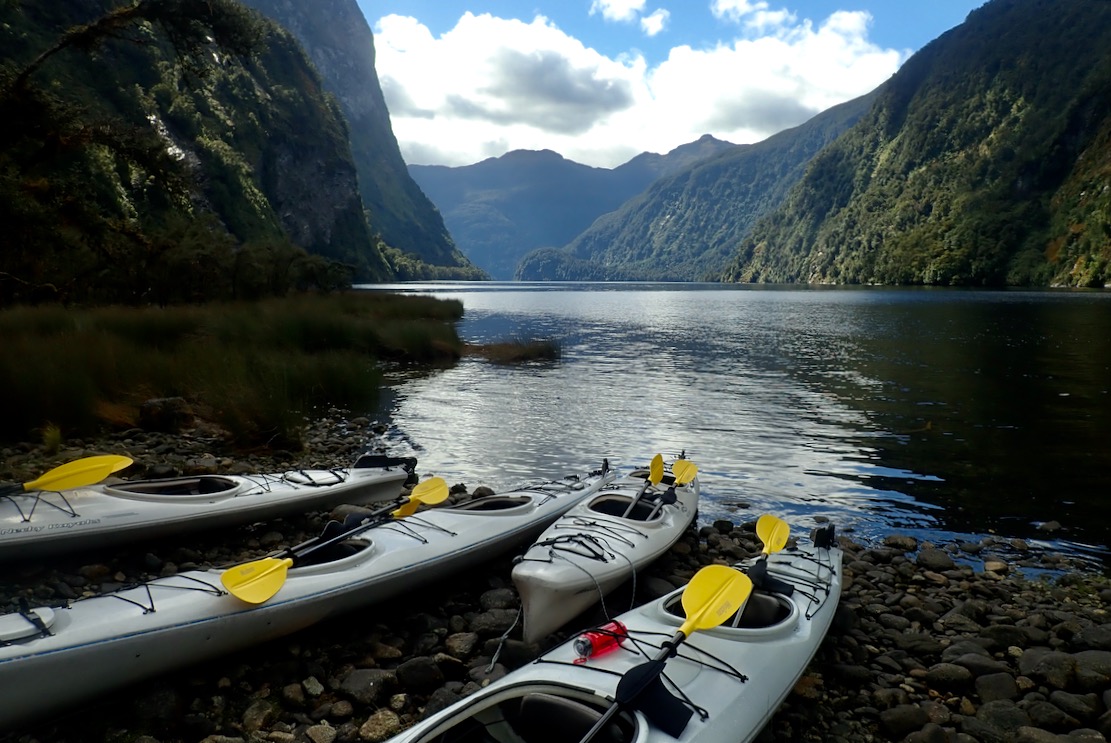
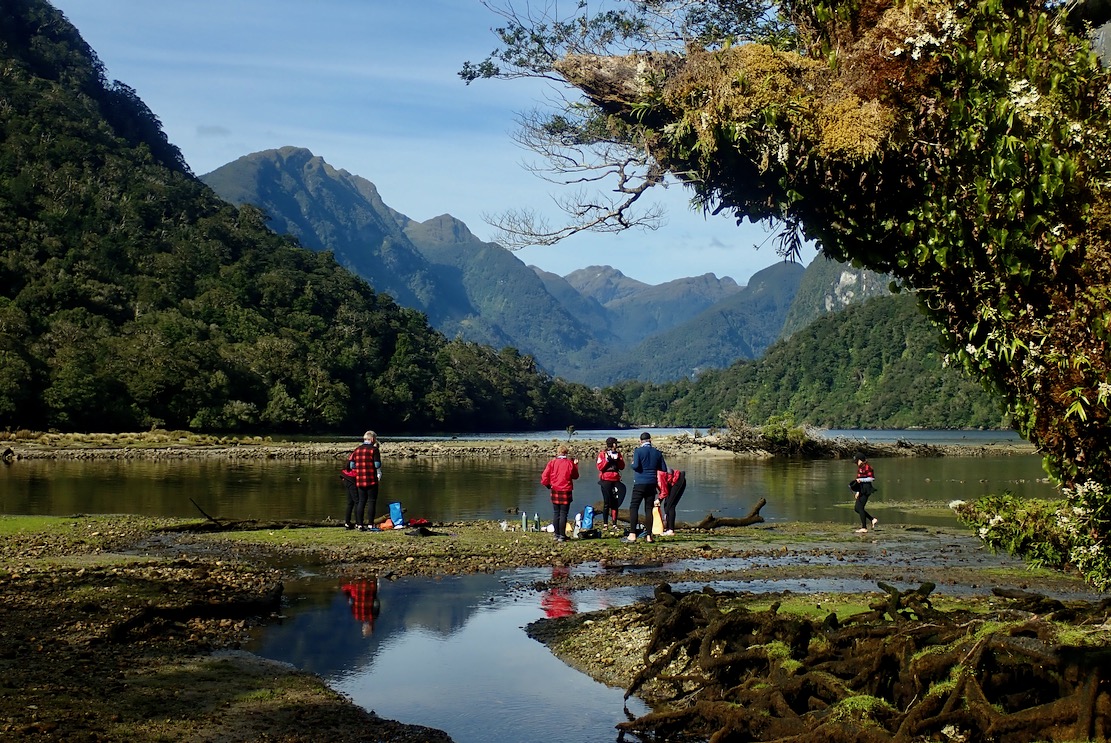
Returning up the north side of the island, we took a break in a tidal cove free of sand flies which had pestered us yesterday and which are the famed nemeses of New Zealand’s sodden west coast. Blake said yesterday’s smoko had been sand fly hell, but being bigger, satisfyingly swattable and far less dense than tiny Scottish midges, I’ll take Kiwi sand flies any day, even if they give the same itchy bites.
Sand fly-free tea break. Nice spot.
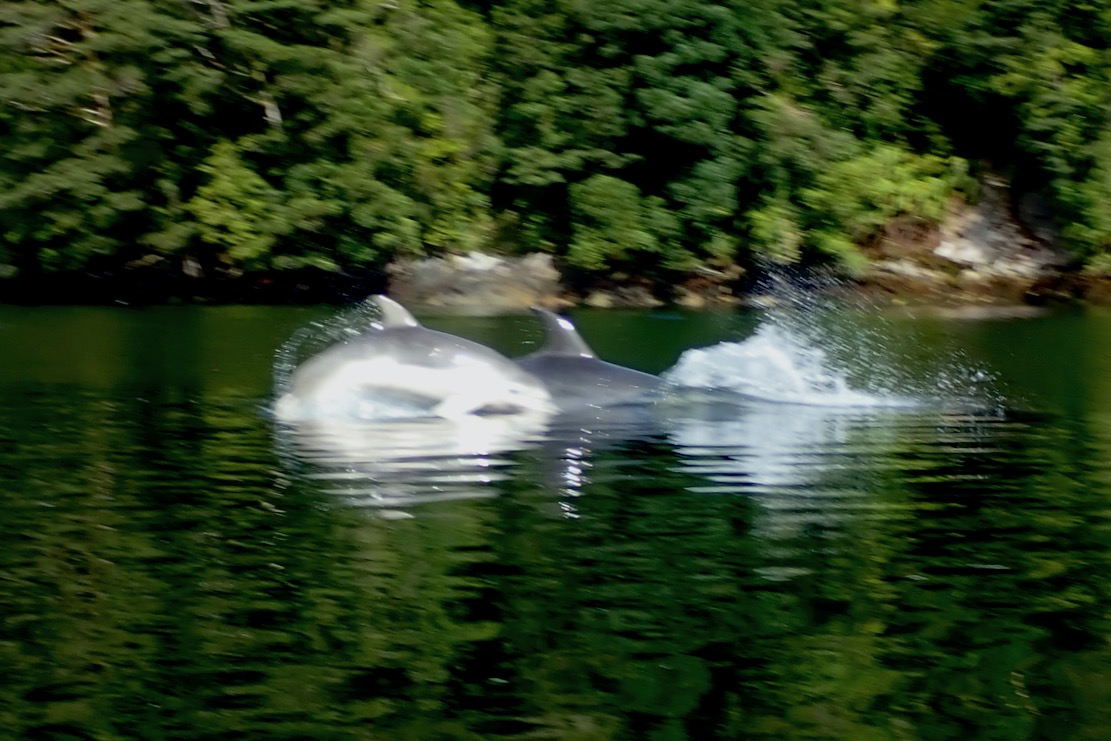
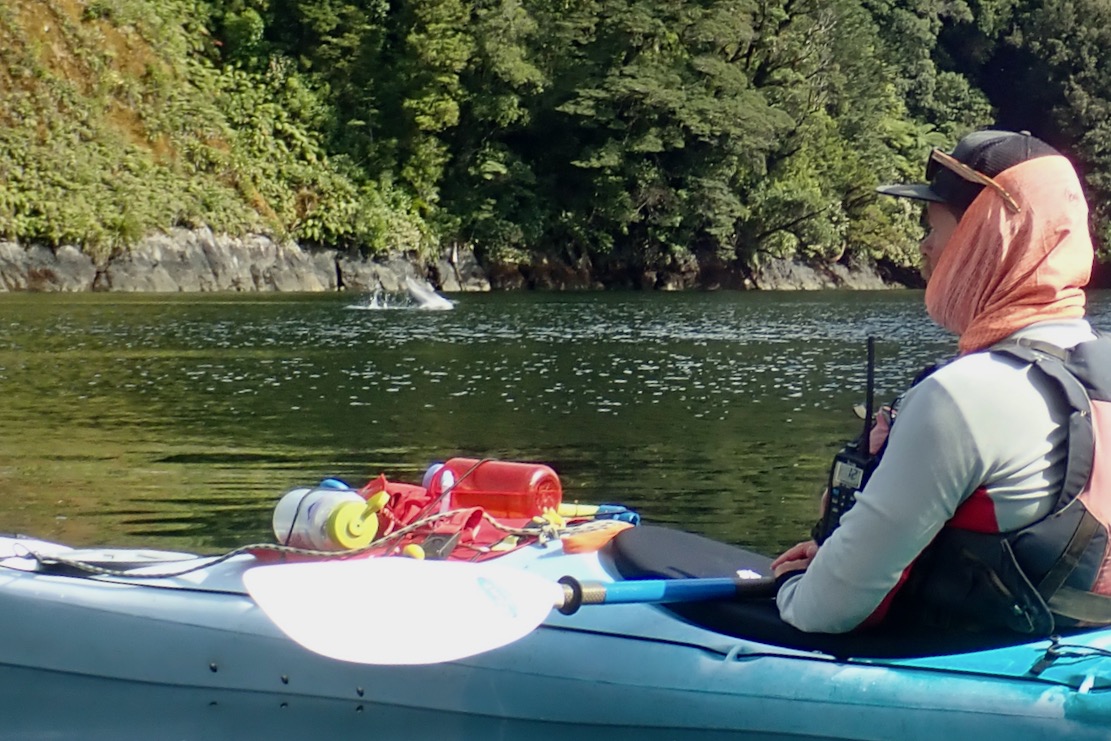
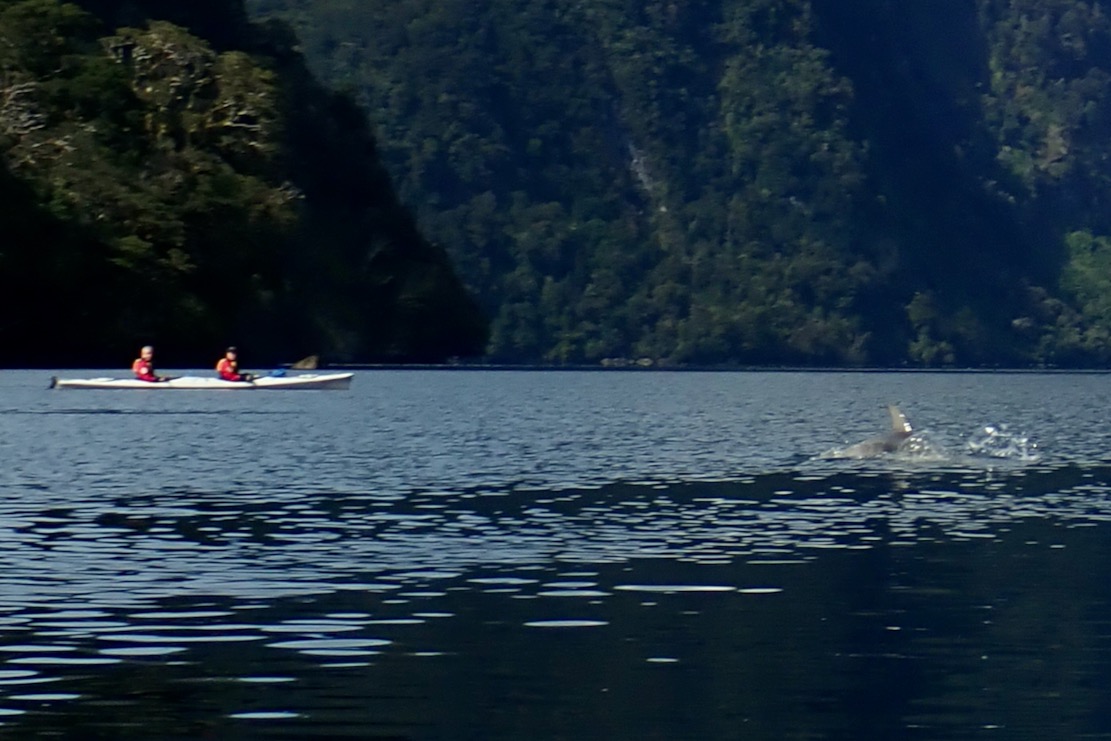
Heading back up to Deep Cove we came across some of the troupe of bottlenose dolphins which inhabit the Sound. The pod passed right by our boats, jumping and diving as they went.
The last half hour turned into a slog. It wasn’t a headwind and it couldn’t be the Sound’s meagre two-m tide, even though it was on the turn. Which only left Manapouri hydro turning the taps on full as the the ally smelter down in Bluff just got a big order in. Other than that, the tour’s pace was slow and the day after we both noted the lack of shoulder aches common after a first paddle in ages. When we were in synch, the Necky zipped along at an easy 6kph or more. It would have been interesting to see how it – or we – handled windier, choppier conditions. Even then, a spell of hard shelling in a clammy wetsuit reminded me why I like IKs and Ps. Out in the fresh air, you can see your feet, access stuff easily, sit on a cushy pad of air, and of course hop in and out like a squirrel on a pogo stick. They say the Necky Lochsa which replaced the Amaruk had bigger cockpits, but you’ve still got 20 feet and 40+ kilos of plastic to store and transport; I saw one on ebay.nz going for just 300 quid. But for this type of use – rentals left on site for months – they’re ideal and indestructible. An SoT double would be door-wide and slow, and after all, most paddles here are in the rain. It was great to paddle Fjordland and revisit to the dark side to revalidate my prefs. For the sort of paddling I enjoy, I’ll still take an IK or P.
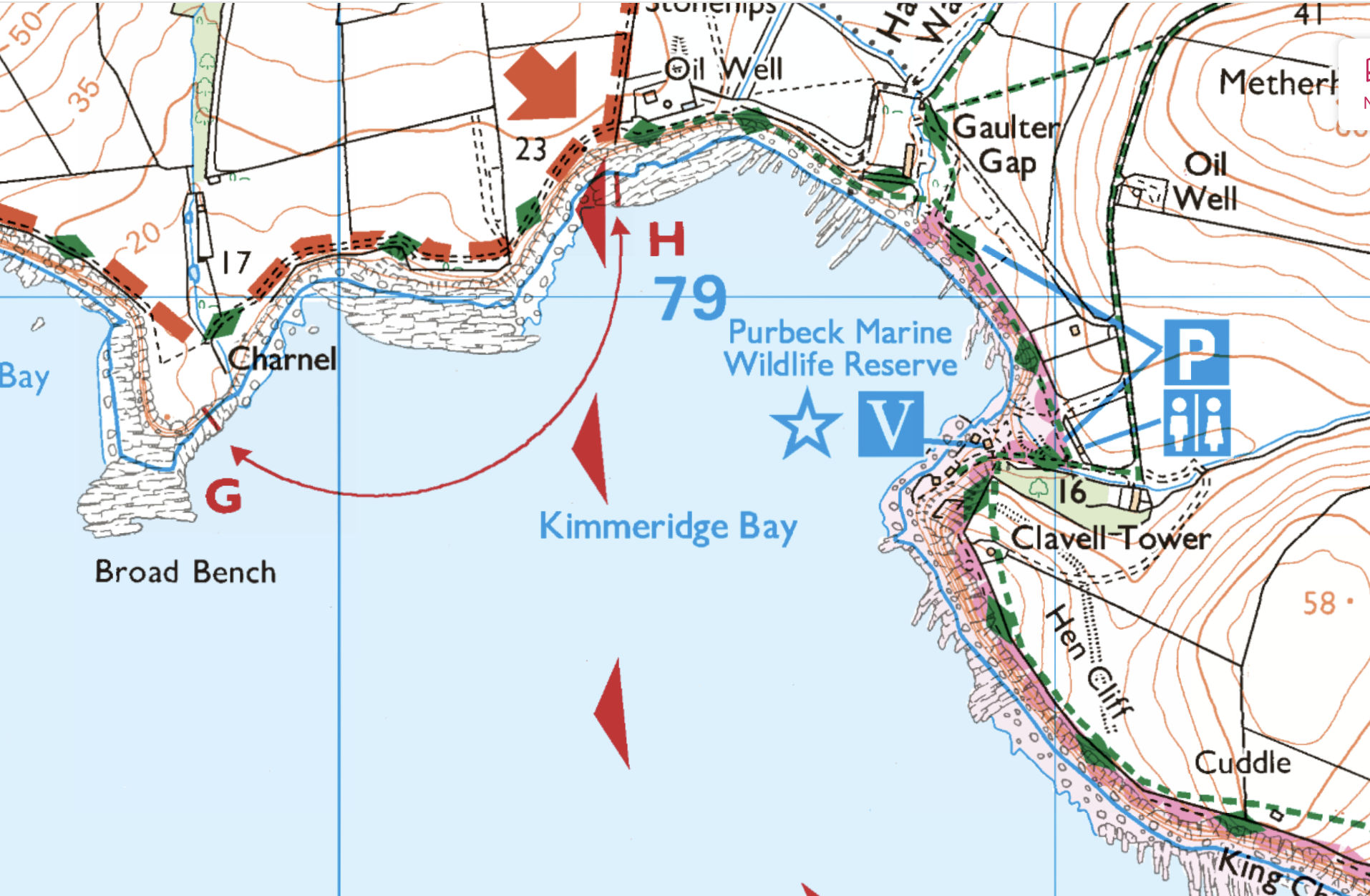
After Storm Chandra came the calm. Well, just a day of calm with a 5mph onshore breeze, sunny spells and single digit temps before seasonal deluges resumed. The artillery was pounding at Lulworth so the west side on Kimmeridge Bay within the MOD firing range was definitely off limits, but it might be nice to pootle along the base of the Kimmeridge Ledge cliffs and back. There could be a stormy after-swell, but small waterfalls may be be running too. I even thought it might be a day to sneak round St Alban’s Head from Chapman’s to Dancing Ledge…
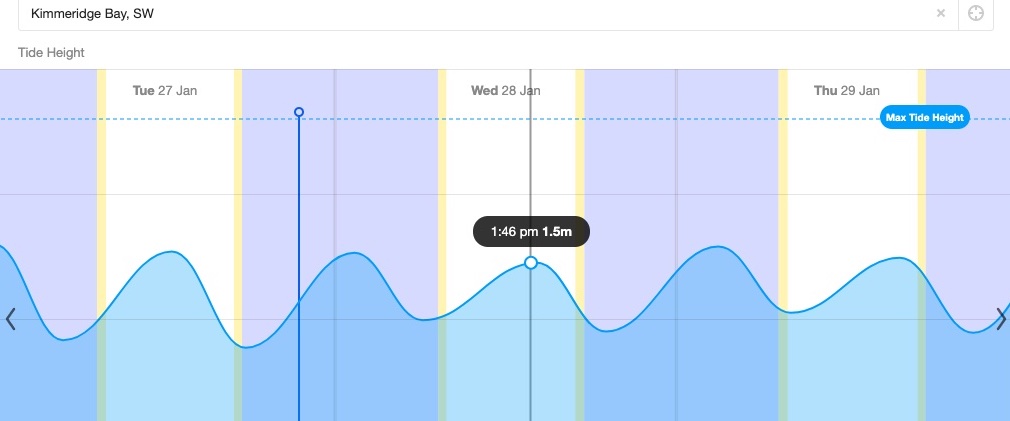
I’ve droned on about trying to pin down unlisted Kimmeridge tide times. The short answer, I’ve decided, is Willy Weather. Today a harmless neap tide was rising just half a metre in 8 hours to top out around 2pm. Interestingly, the High Water time moved by 20 minutes from the evening before, which suggests it’s not just some publish-and-forget-it table of predictions, but based on live inputs.
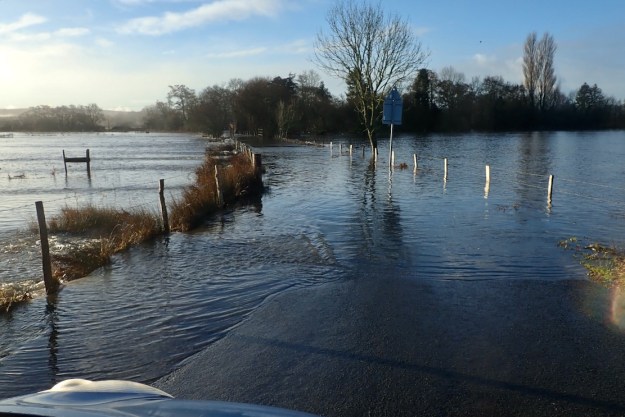
Hoping to take the scenic route, at Holme bridge the River Frome’s water meadows had spread into a vast lake, submerging the road, long before I even got close to the ford, which I read later was 5 feet deep. So after a couple of other attempts, I settled on the long way round over the flood-shedding Purbeck Hills to Kimmeridge Bay.
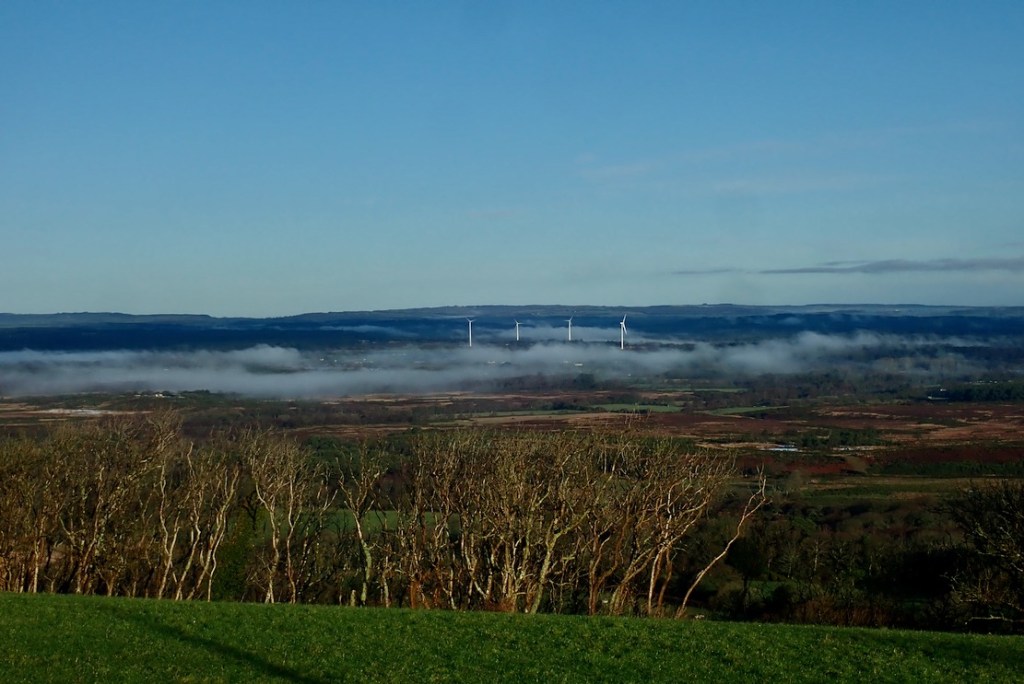
On Purbeck ridge the mist still clung to the flooded valley bottom.
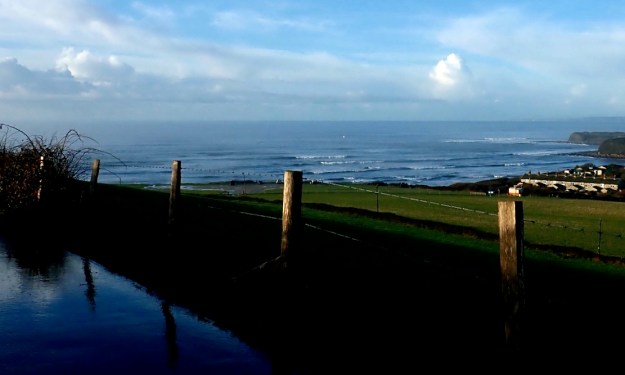
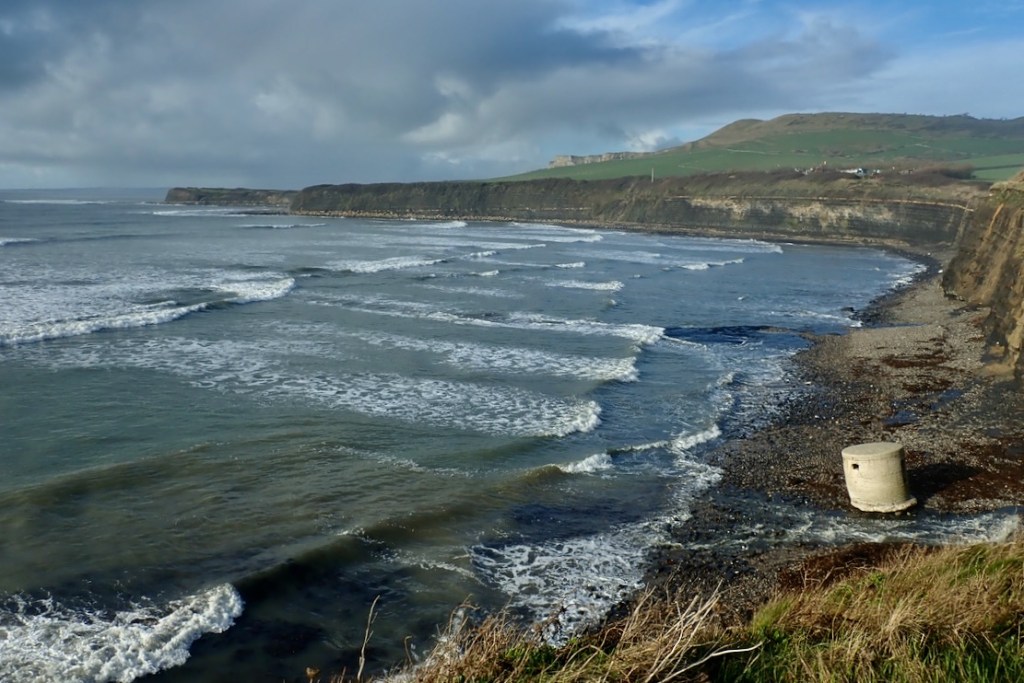
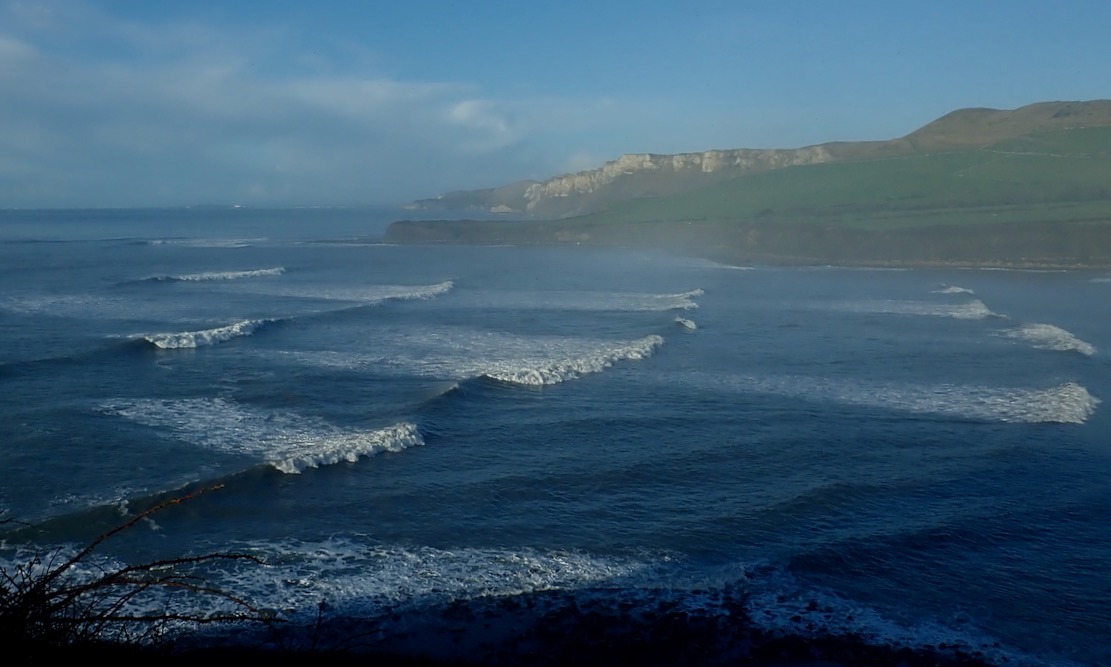
Coming over the last hill before Kimmeridge village, I realised I’d underestimated the after-swell; the stormy winds and rains may have passed but the seas were still animated.
Overlooking Kimmeridge Bay. Lively.
Down at sea level in a dumpy packraft it looked like it would be a struggle of good timing, desperate acceleration and luck to get out quick through this surf without getting swamped. I didn’t have my drysuit and as things looked, today was a day for a decked or bailing packraft. At times the surf seemed to flatten off and you could have scooted out on a paddle board. Then it all rolled back in, streaking the Bay with white foam.
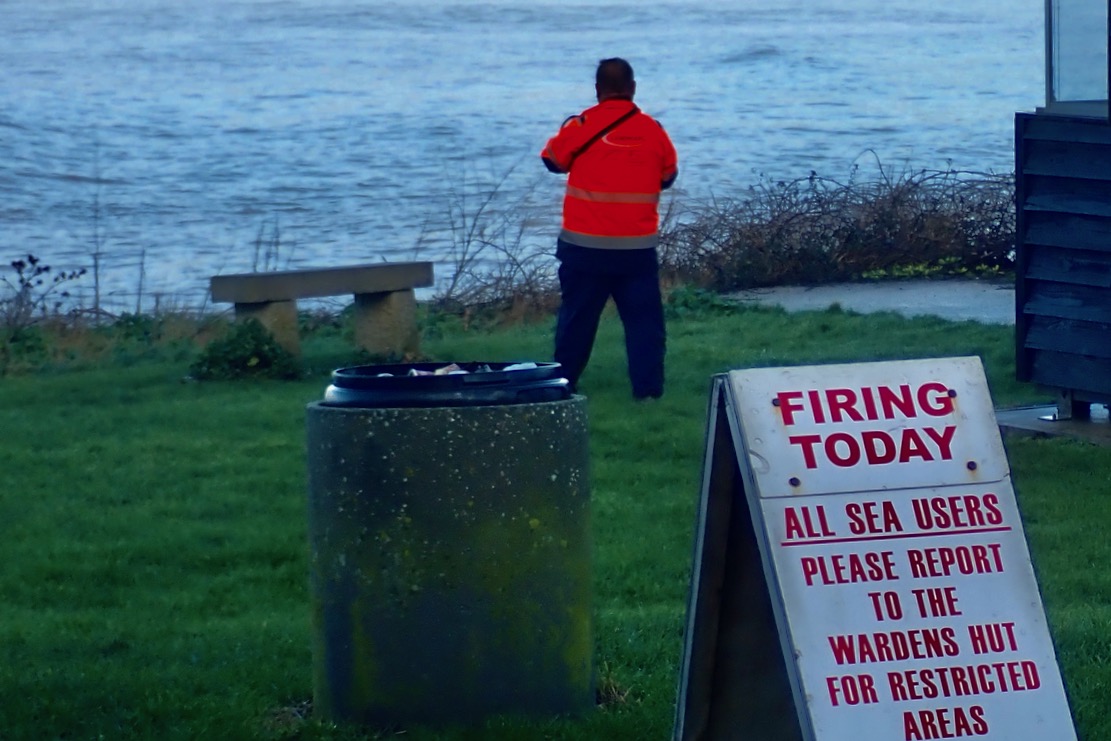
There were look-outs stationed round the bay. How thoughtful, I thought. Who lays that on then? Then I realised they were probably contracted by the MOD to make sure sea users kept away from the shells potentially raining down on the west side of the bay.
I thought if I could sneak through the east edge of the bay it would be OK round the corner, so I climbed up to Clavell Tower to have a look. Sea mist clung to the Bay.
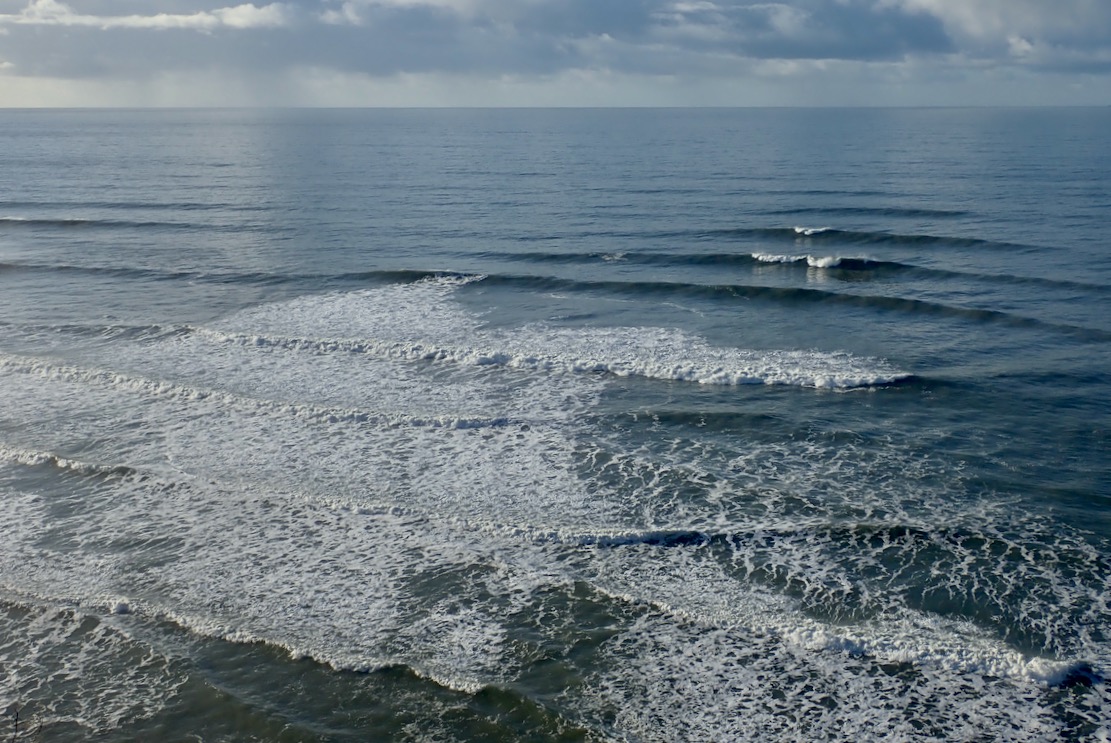
If anything it was even more lively, with the Ledges kicking up the swell for hundreds of metres out. So much for a quiet cruise along the cliff base. Unless I went right out, I’d be forever glancing right to see what was incoming, and on the Ledges, waves can lift up out of the blue without warning.
We tried packraft surfing up at lovely Achnahaird one time, in far more benign conditions with waves barely at knee height. It was a laugh but packrafting today would take some commitment.
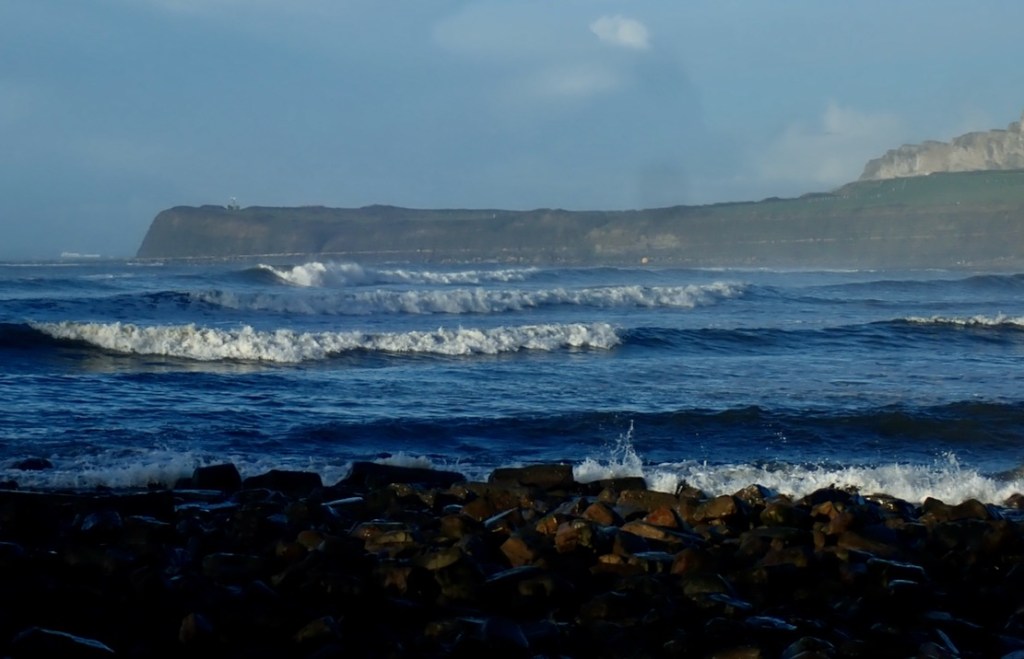
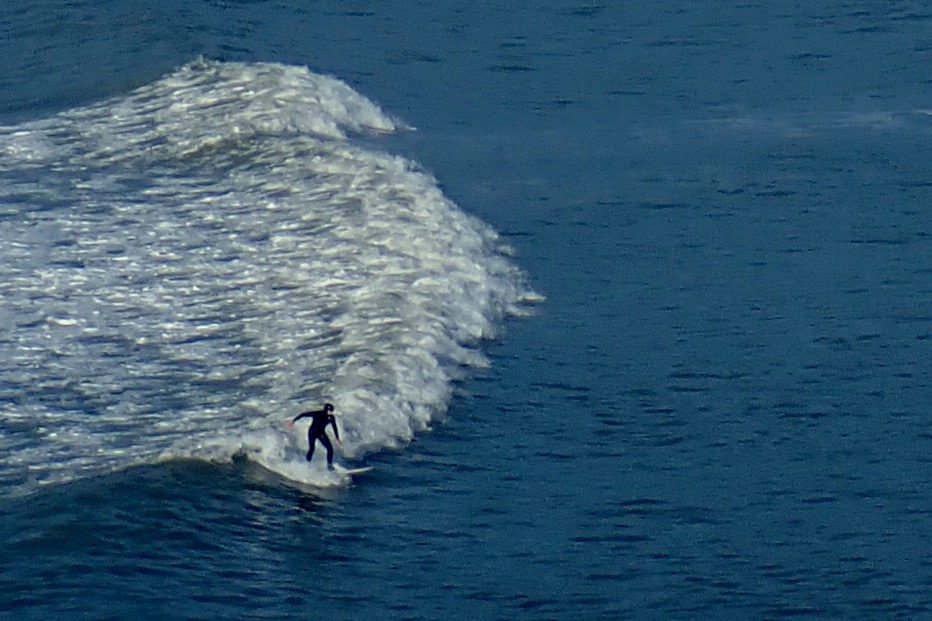
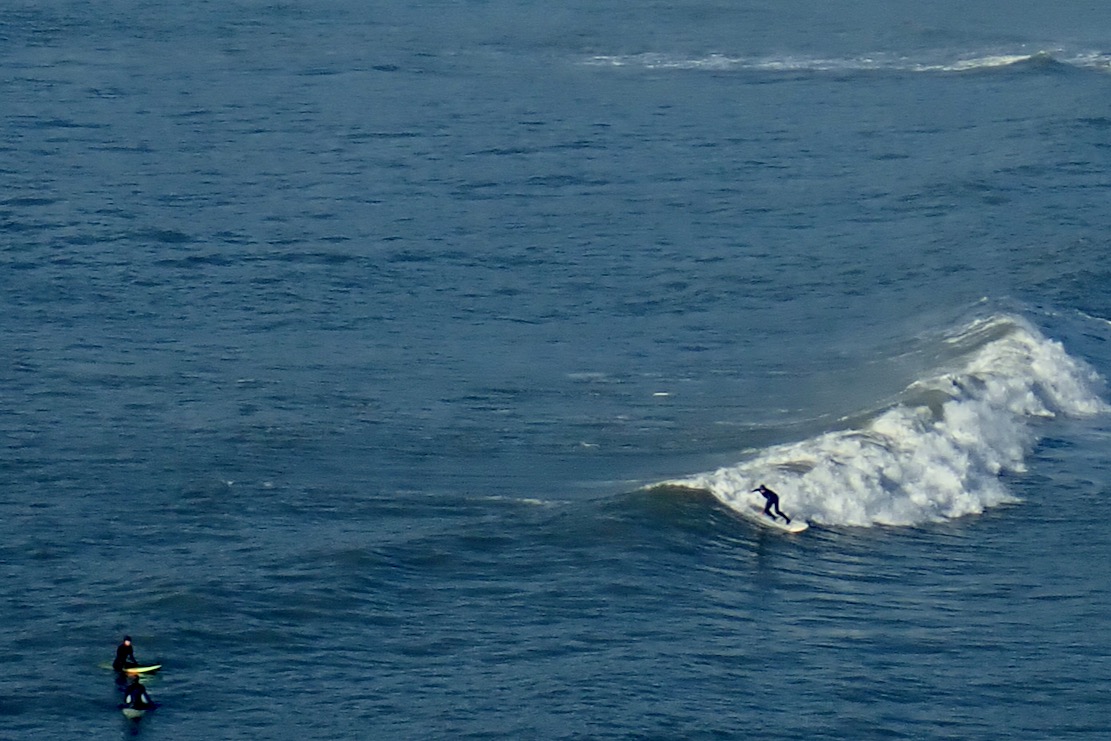
Today was a day for the surfers: get in the water and stay in it. Sadly, as I’ve noticed before, watching surfing live is not like a trailer for Big Wednesday. To paraphrase Gregory Peck: “They pay me for the waiting, the surfing I do for free“. It took me 15 minutes of watching four surfers bob around before I grabbed the shots here of a 15-second ride.
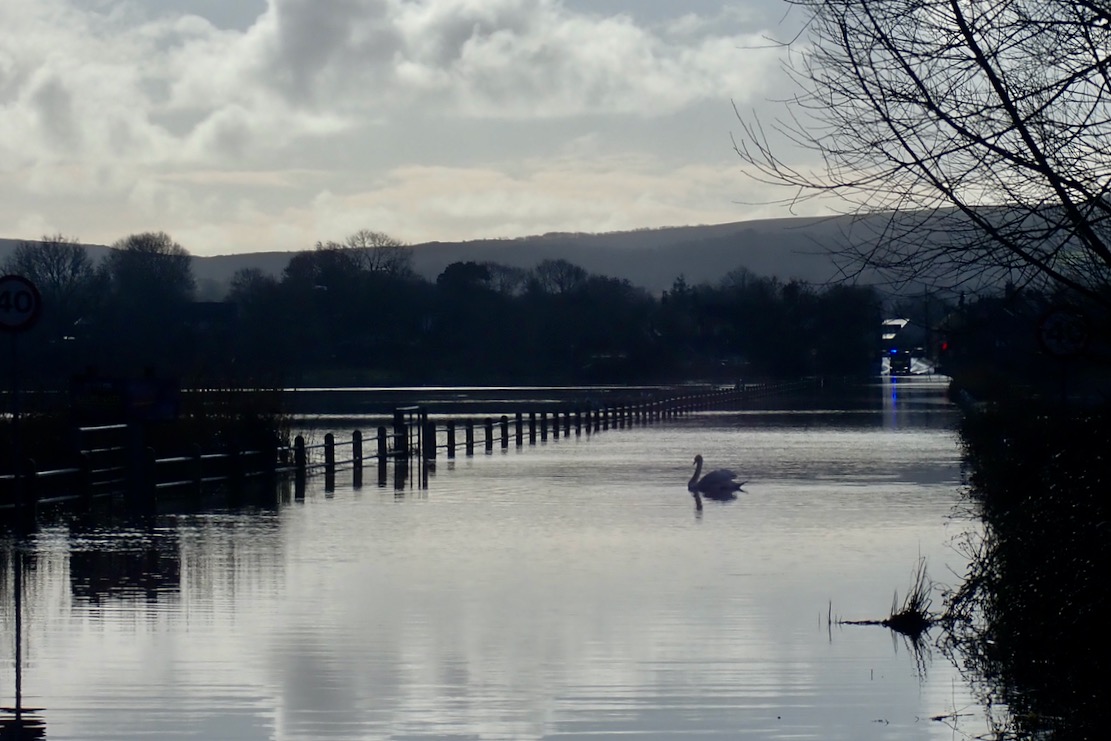
Back at Wareham, a swan was parked in the middle of the Causeway. You can see why they call it the Isle of Purbeck.
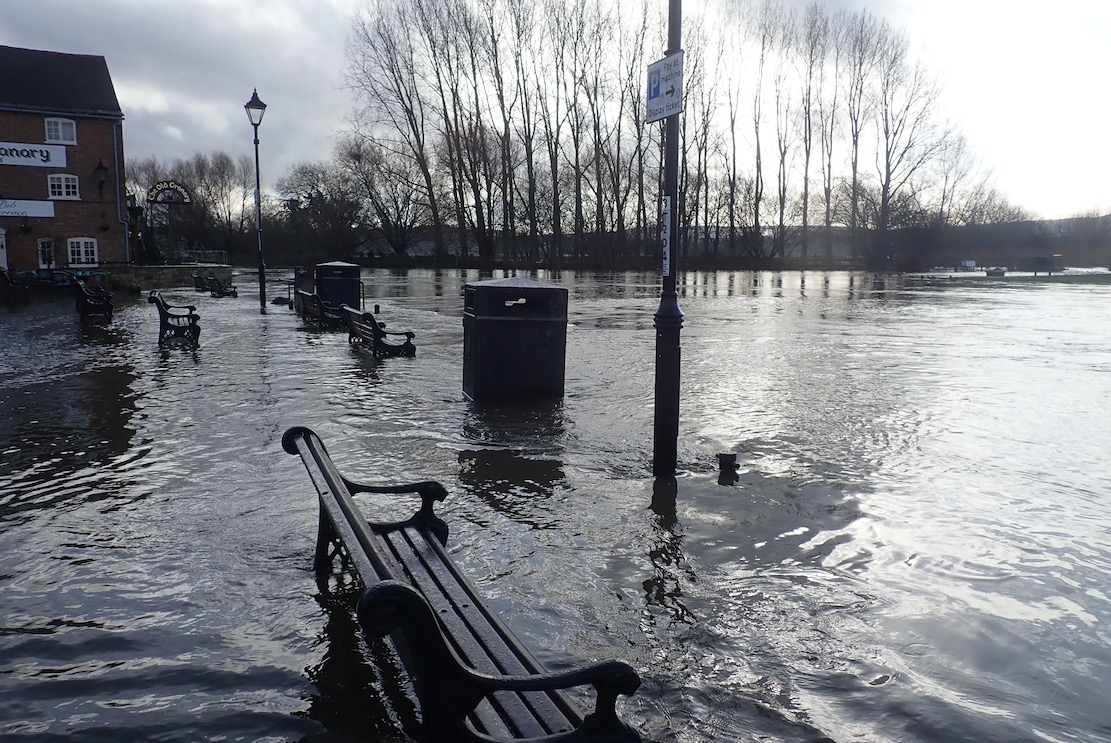
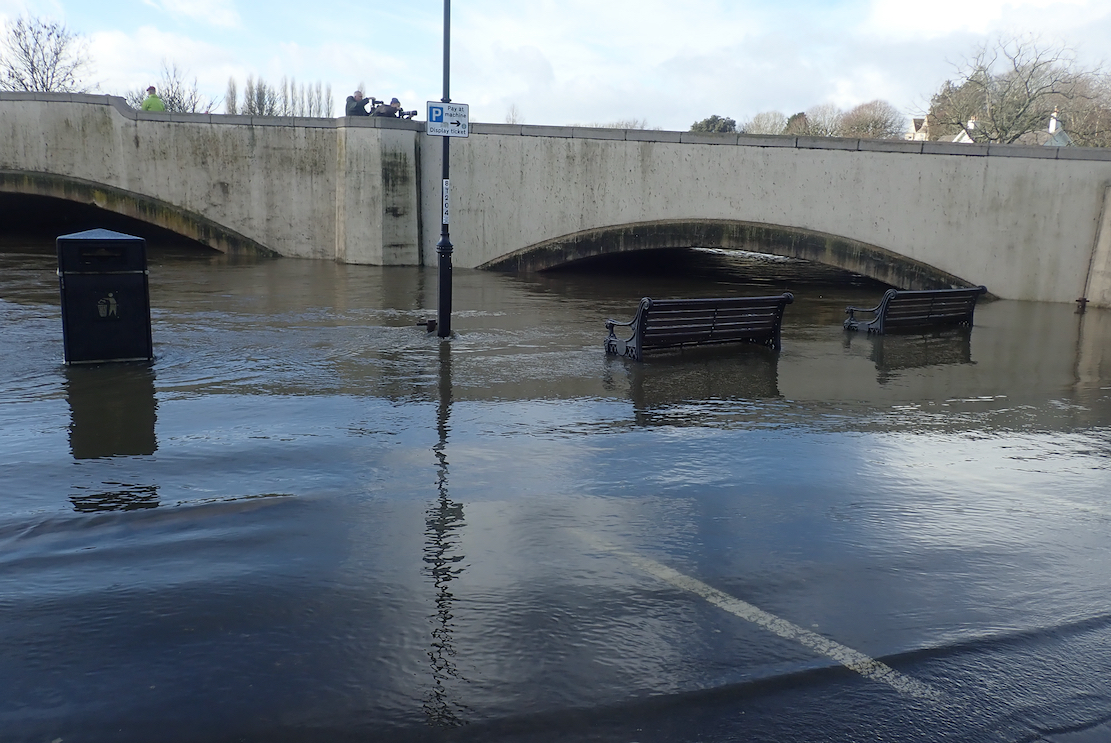
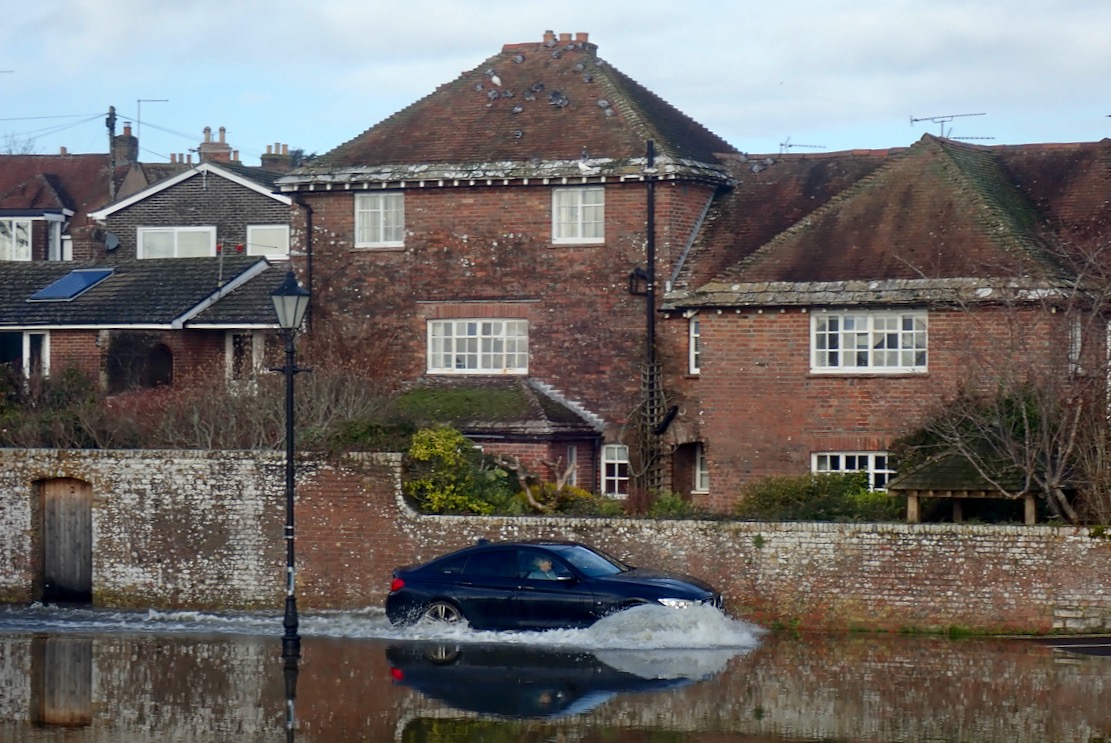
Wareham Quay was awash, with barely a foot under the road bridge to the Causeway which was why the river was backing up.
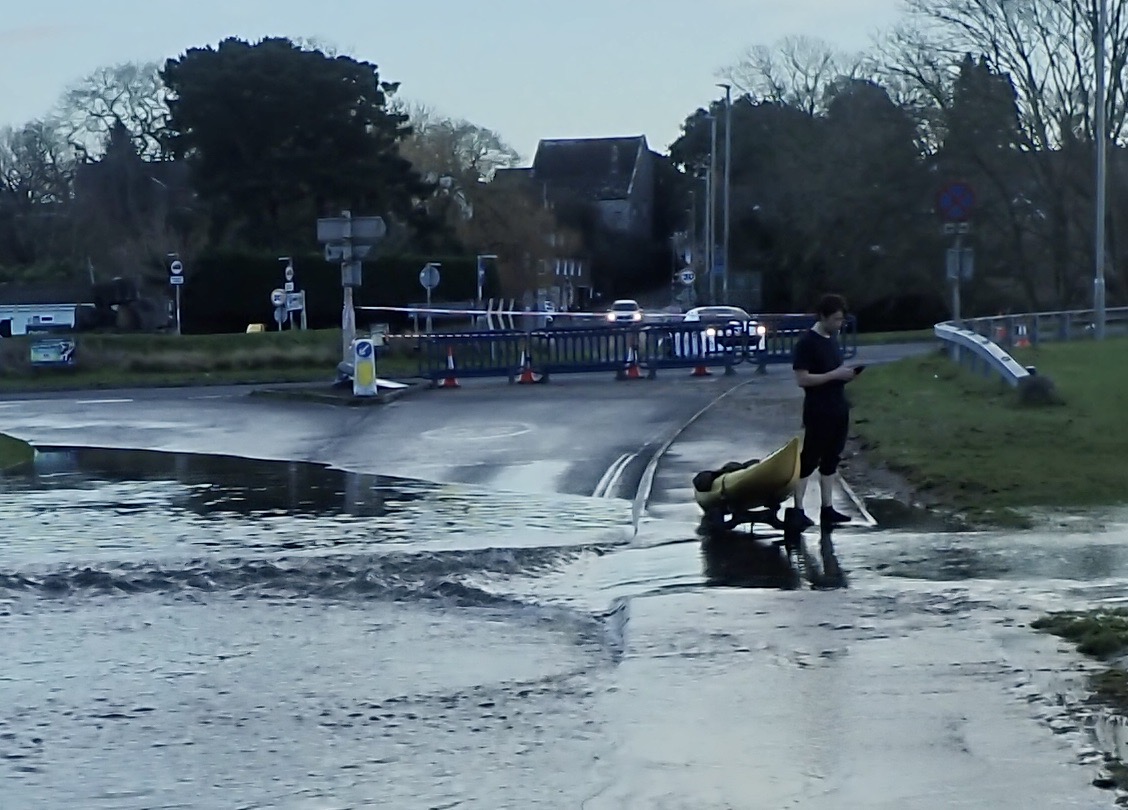
And it was only just possible to reach the station off the bypass where a bloke was putting in his sea kayak. At least someone got a paddle in today!
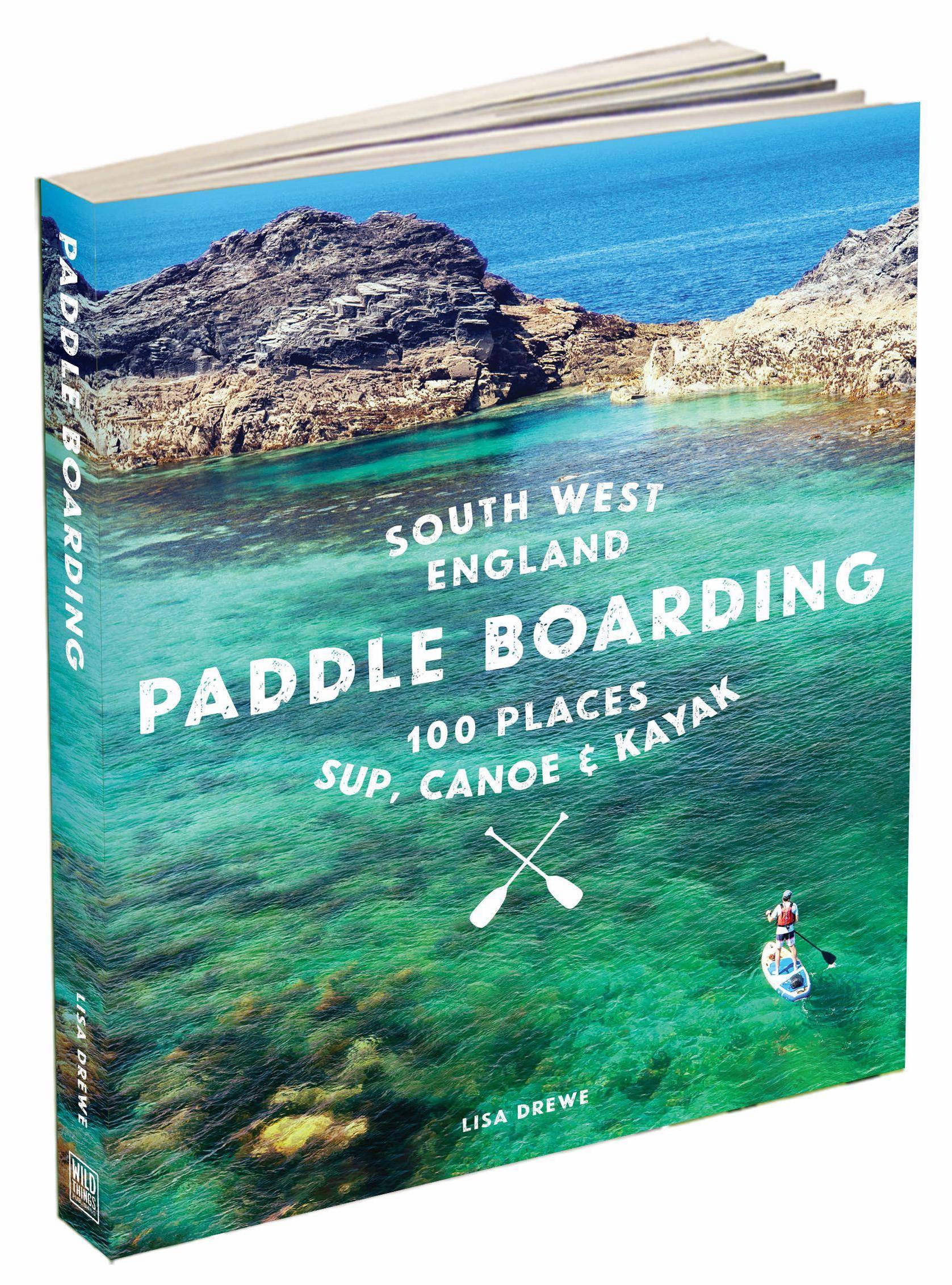
In a line Promising selection of rivers, canals and inshore SUP paddles right across the beautiful Southwest, but just one map.
What they say Explore the best of South West England’s rivers, canals, lakes, estuaries and beaches by paddle board, canoe and kayak Paddle along meandering estuaries, wild swim and picnic on silver sands. Featuring more than 100 stunning locations across Cornwall, Devon, Dorset, Wiltshire and Somerset, this trusted guide provides all the practical information you’ll need for trips out on the water by paddle board, canoe or kayak, whether you’re a beginner or a seasoned paddler. Illustrated with sparkling photography and offering a variety of routes, this is a beautiful and inspiring book for water lovers and adventurers afloat. Rrp £18.99, £8.99, 2023, 255pp
Review copy supplied by Wild Things Publishing (WTP)
• Covers over a 100 paddles from Wiltshire to Lands End • Nicely written descriptions and genuinely useful practicalities • Most photos by the talented author, not Shutterstock etc • Responsible take on PFDs which are often pictured in use • Now uses decimal degrees (D.D°) waypoints for start/end points (and the obsolete OS grid ref). In the pdf, along with website urls, D.D° waypoints are hotlinked to Google Maps • Details for public transport returning to start point, where it exists
• No route maps means added effort required to work out what, how and where • Doesn’t say where printed so presumably not UK • The ‘Getting There’ descriptions of lefts and rights and road numbers is redundant these days. A postcode or D.D° for the satnav or phone is adequate
Review Getting in on the wild swimming craze early, WTP moved on the ‘boarding a short while after Lisa Drewe brought us her original and award winning Islandeering guide in 2020. A proper, experienced kayaker turned SUP evangelist, the author knows her paddling, in particular what’s important, safety wise. Like Bradt’s Lizzie Carr, she’s also an environmental campaigner or conservationist, and it seems her SUP epiphany in the US was similar to my own while there. Suddenly there was a new and accessible way to explore the blue bits on a map.
The book is subtitled ‘canoe & kayak’ to catch the likes of me who don’t get the SUP thing, but that’s the last mention of boats in words or most pictures. Of course, what you can SUP you can easily packraft or IK, and the range of inland and inshore paddles is much more accessible to the majority of recreational paddlers than Pesda’s South West Sea Kayaking.
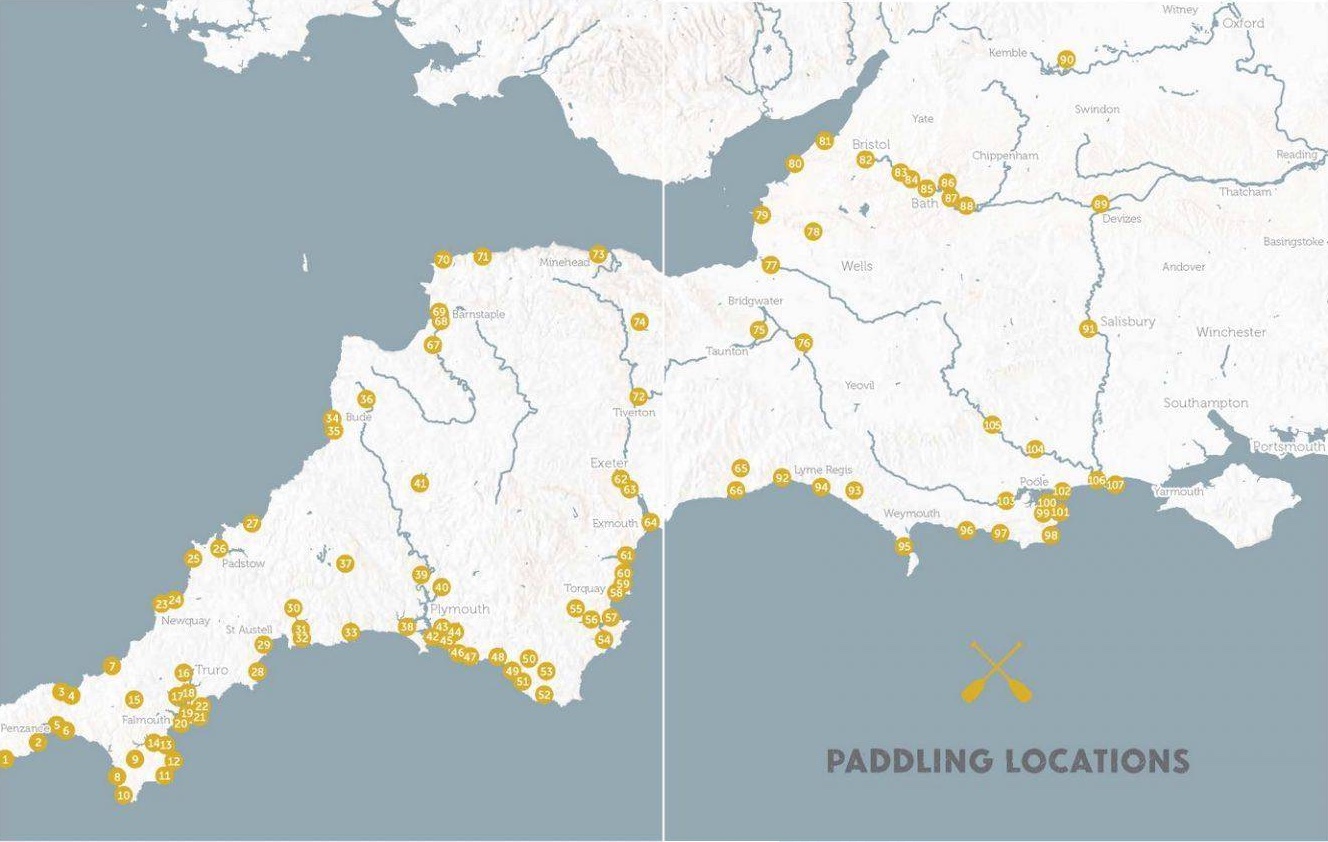
Up front you get a map covering all 100+ paddles, followed by a table including gradings and distances ready for you highlighter pen. The lengthy intro leads on to choosing a board and getting trained, then there’s a detailed section on trip planning for sea or rivers and what to wear pack.
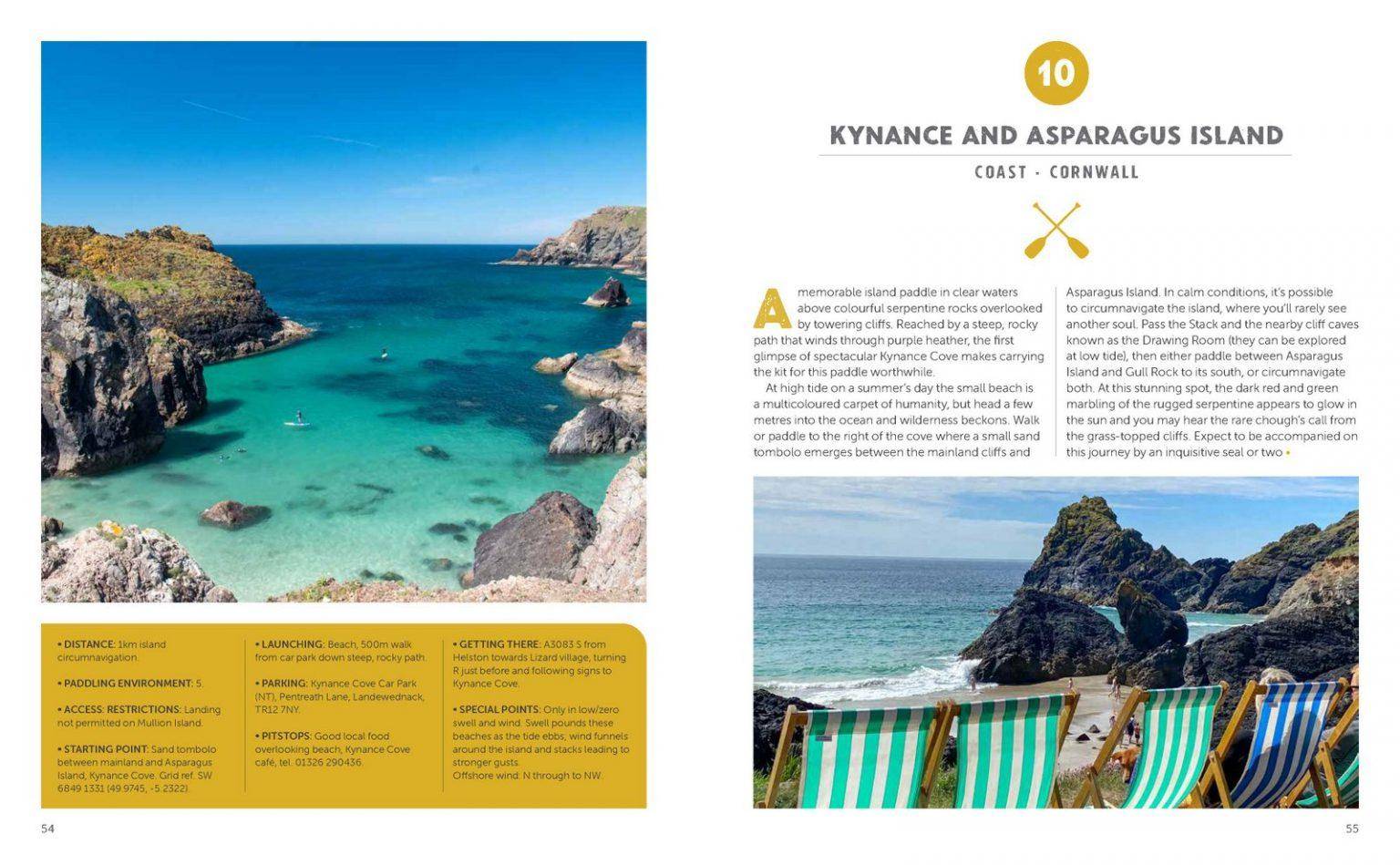
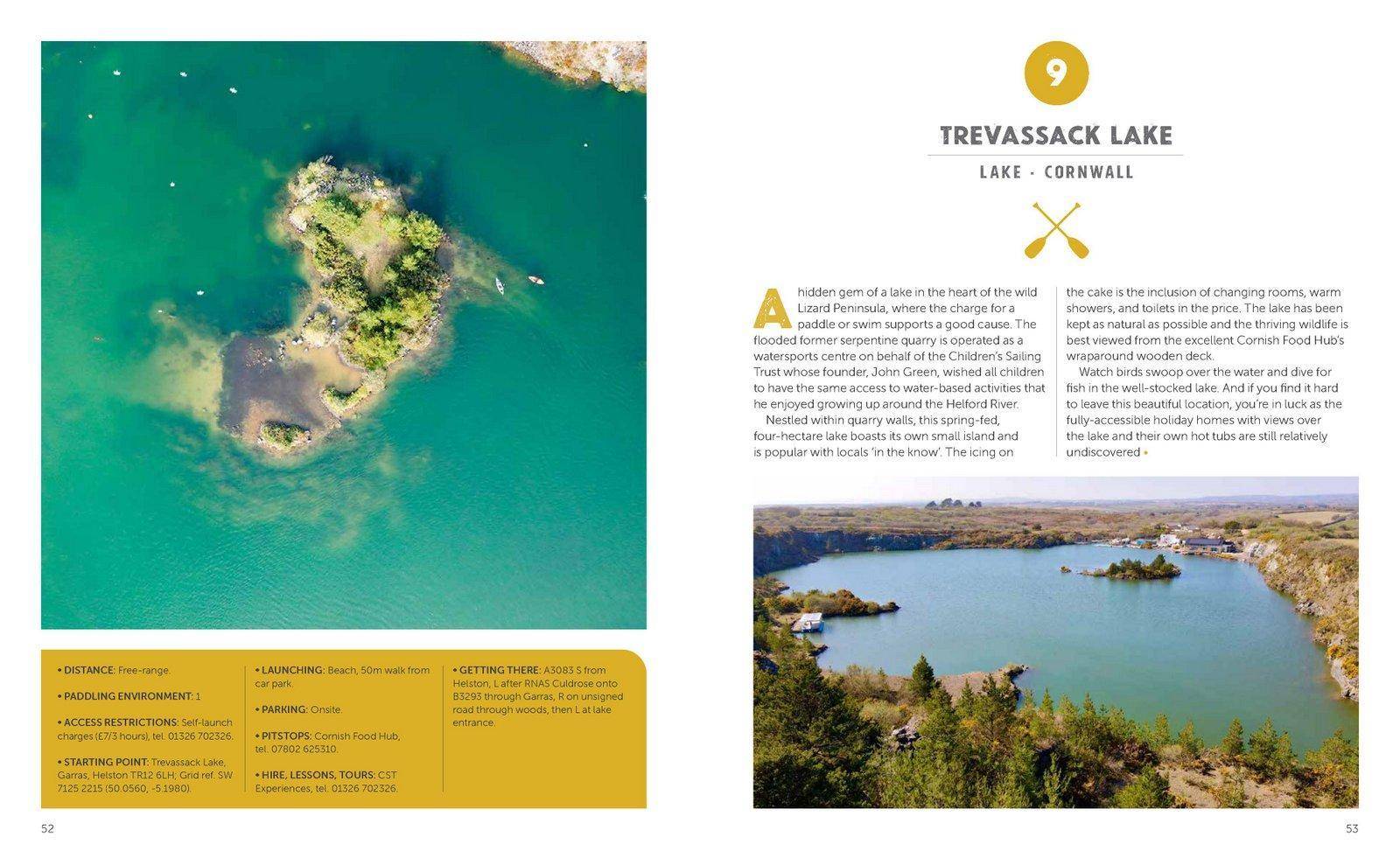
Covering one location per spread, you can flick open any page, like above or below, and be presented with a mouthwatering paddling suggestion. You get nice photos, a description and solid practical info in the yellow box, which occasionally includes public transport links for your rolled-up inflatable which might not be an iSUP.
The Pesda South West sea kayaking book knows what counts and provides sometimes near full-page maps of each suggested route. This book has pretty pictures of aquamarine bays. The lack of route maps in a route guide is baffling and relegates it into the ‘lifestyle’ category not everyone rates. How else can you effectively and concisely express this information? It’s not a space issue; any one of the generic shots could be have dropped or resized. I’d have happily paid another £1 for route maps because read any paddle description and you soon start thinking, ‘hmm, sounds good but what does it look like on the ground?’. A map depicts this information at a glance. The author’s Islandeering book (not a paddling book) had great maps and other Wild Guides, including their well-known wild swimming books at least have regional maps to supplement the main map up front. I’m told it’s a combination of space, aesthetics and cost.
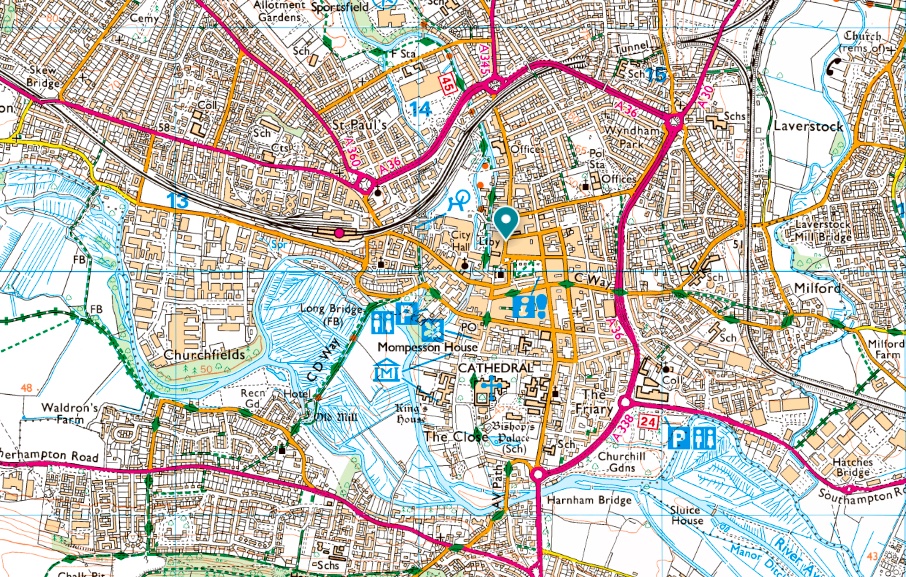
Take Route 91 for example: the ~5-km Salisbury Loop. Sounds great, easy access and a lovely picture of ‘boarding past the willows below the cathedral spire and no license required, we’re told. Now try to make sense of the dense network of rivers and canals surrounding the city (left) from the text. ‘Nadder Island’ is mentioned to avoid a weir, but it’s not even on the OS map (it’s the crescent below Churchfields). You want to hope you don’t take a wrong turn and get sucked into the municipal sewage compactor sluice. The two paddles covering Christchurch (which I bikerafted recently) are another example, and it’s the same with so many other paddles in this guide: they’d be so much easier to visualise and so get inspired by with one less photo and a basic map to cross referenced to a more detailed OS map or whatever’s on your phone. Failing that, link to an online map like here. Lisa Drewe is an ‘OS Champion‘, after all! The book ends with detailed sections or water safety and how to paddle responsibly – the sort of solid, concise but practical information which was missing from Bradt’s France book. With maps South West England Paddle Boarding would be a perfect, self-contained paddling guide to this magical region. As it is, it’ll still give you loads of ideas, even if you need to work for them.
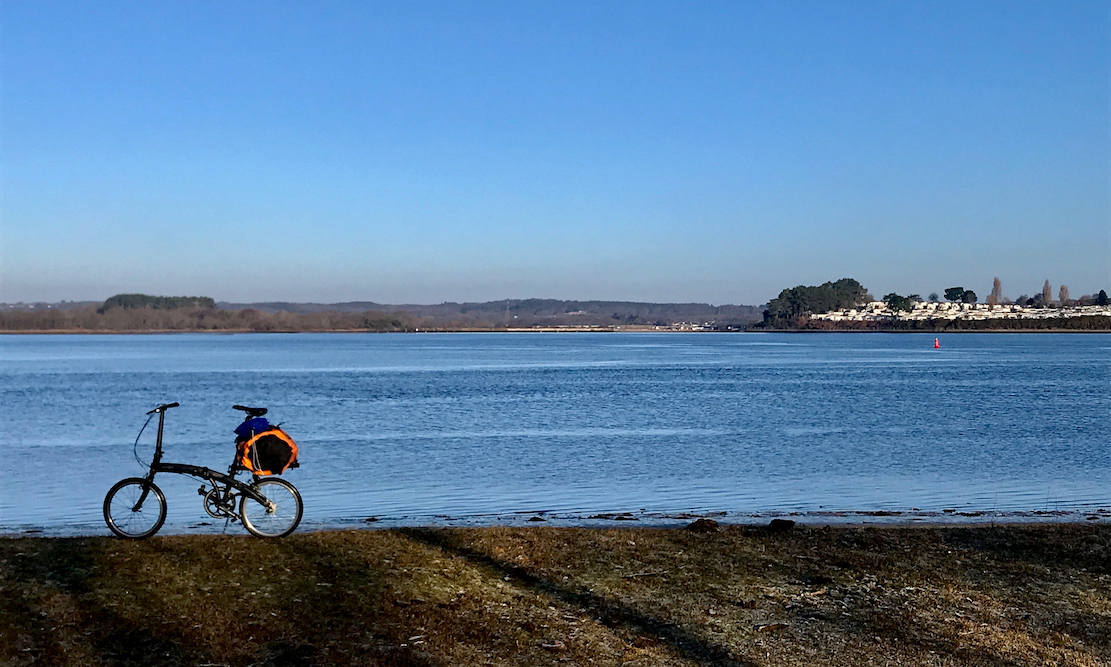
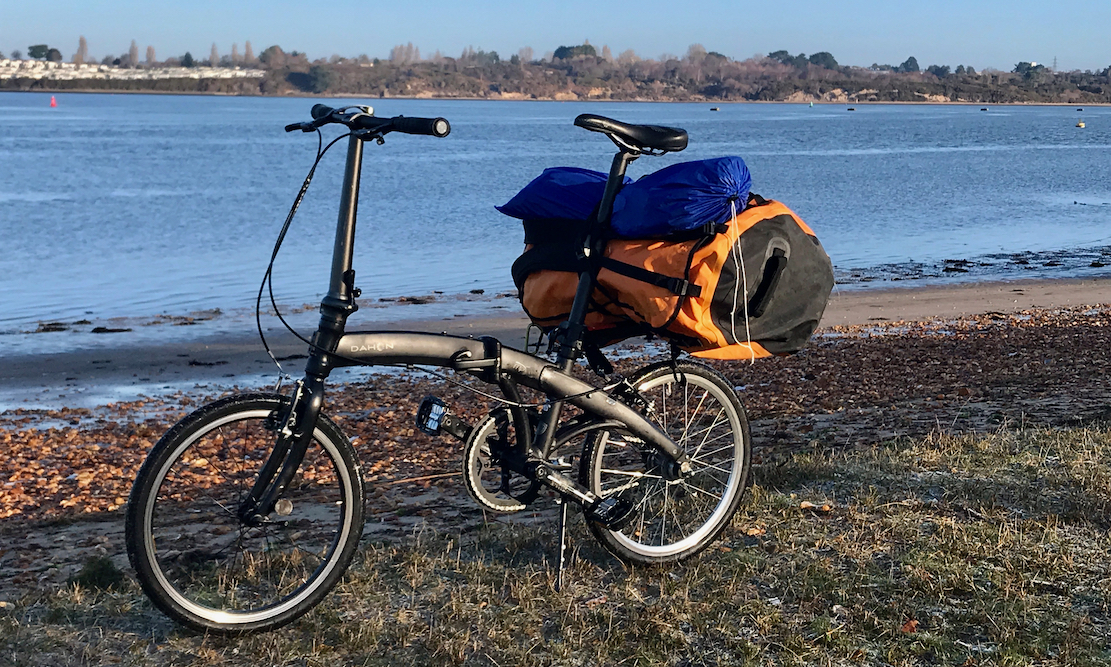
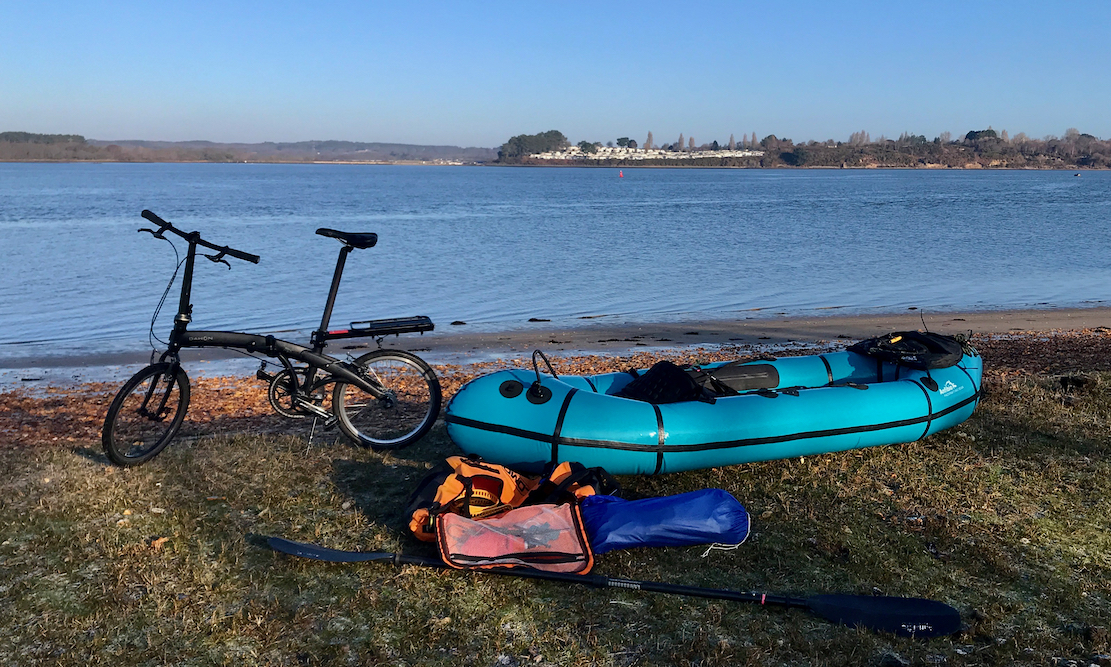
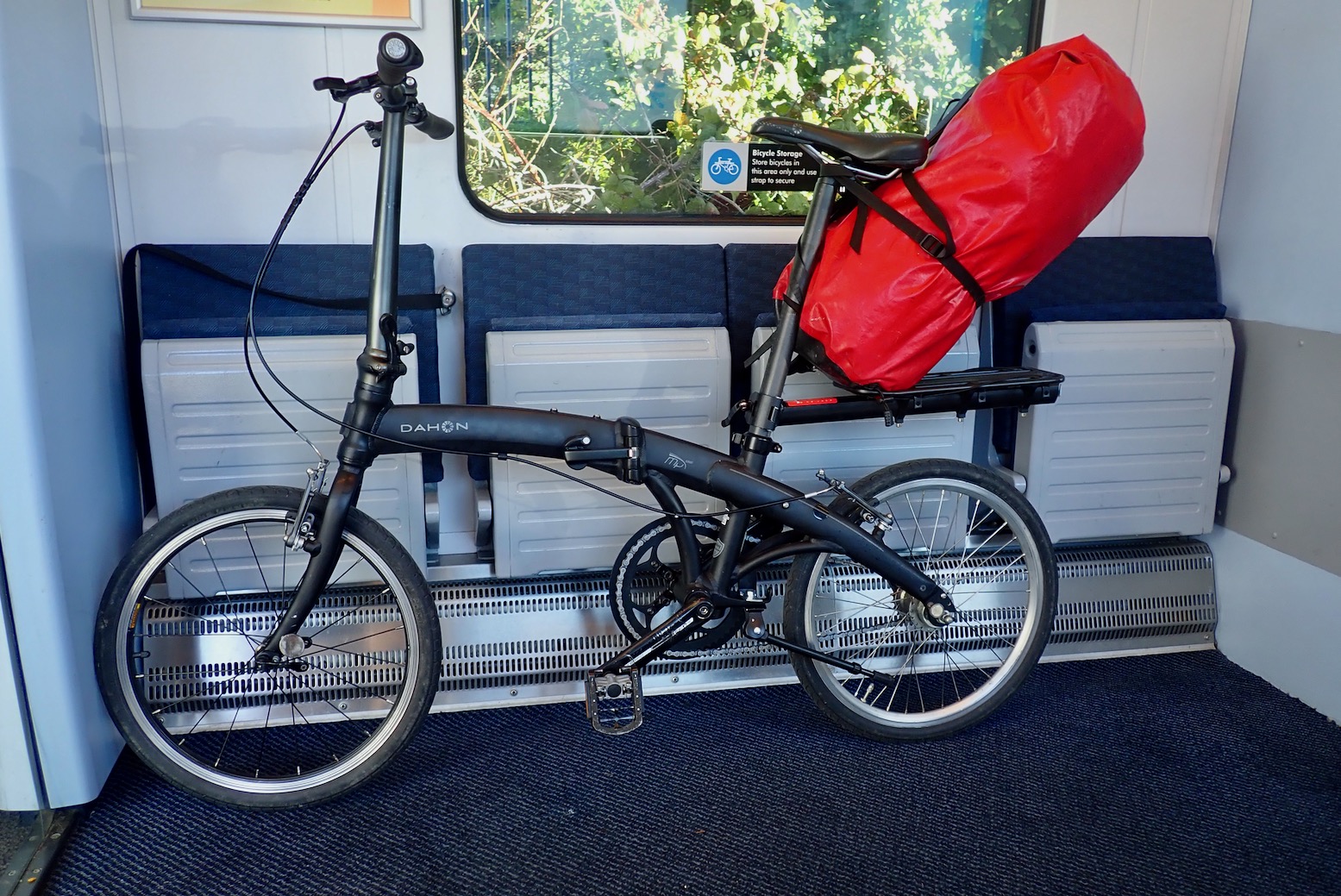
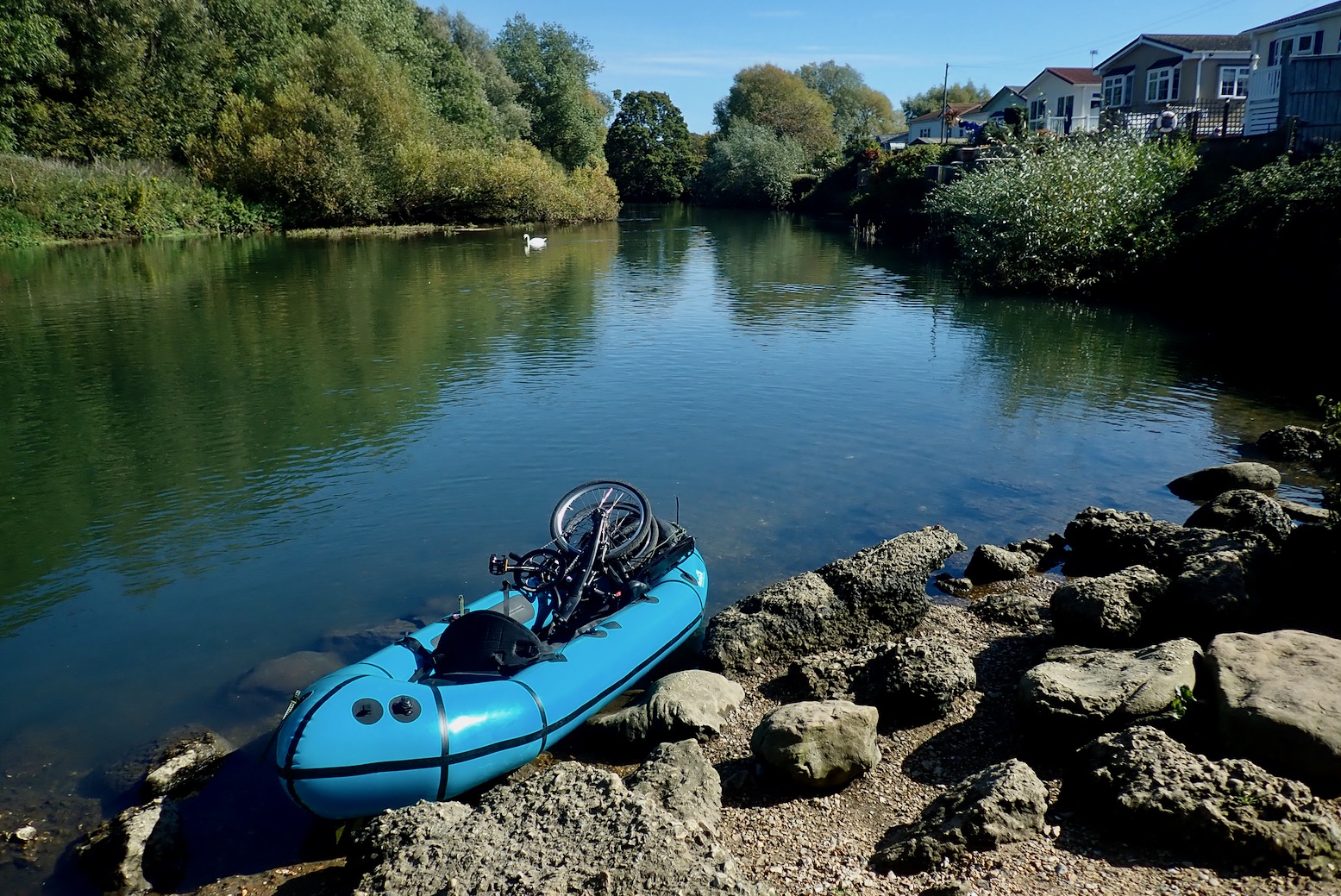
My Dohon two-speed folding bike is still a bit of a bikerafting novelty, so on a sunny, calm and chilly day soon after New Year, I went out for a spin in Poole Harbour.
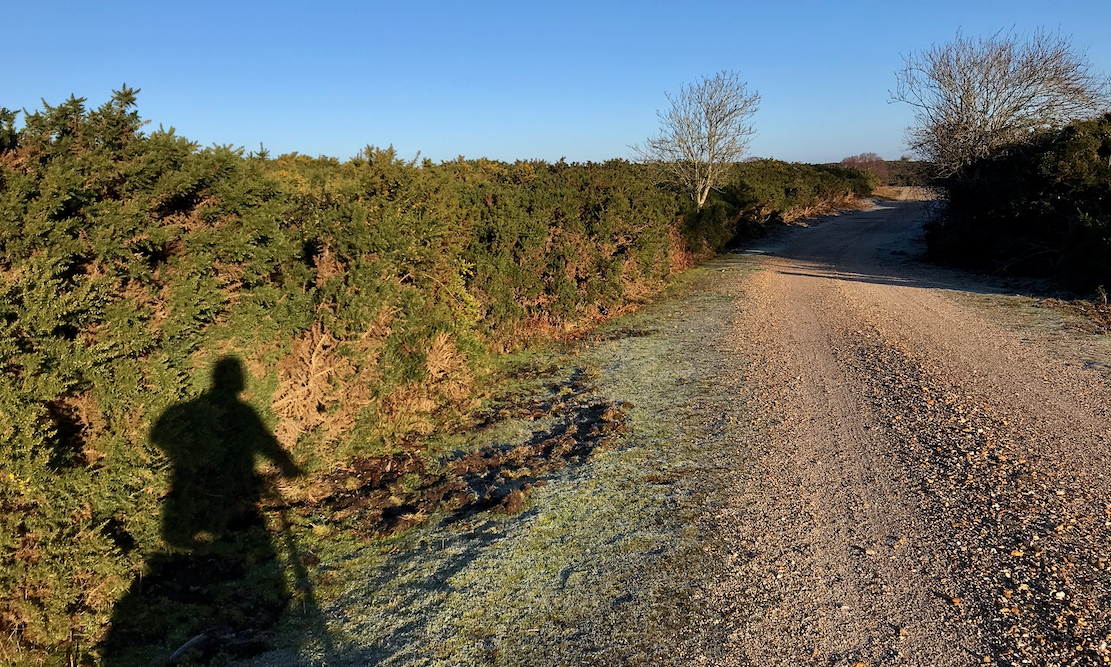
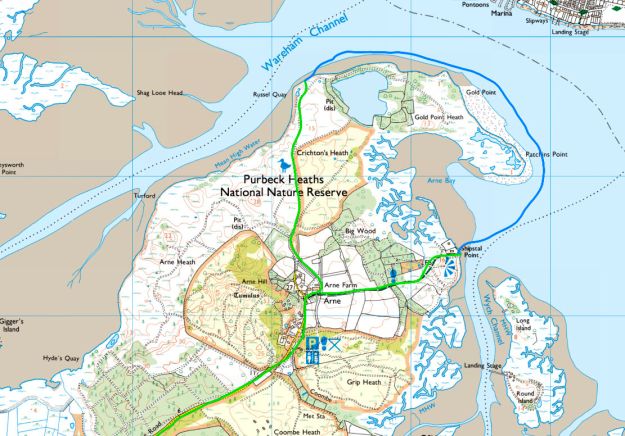
I pedalled up to Arne, then set off north across Crighton’s Heath, occasionally crunching through frozen puddles.
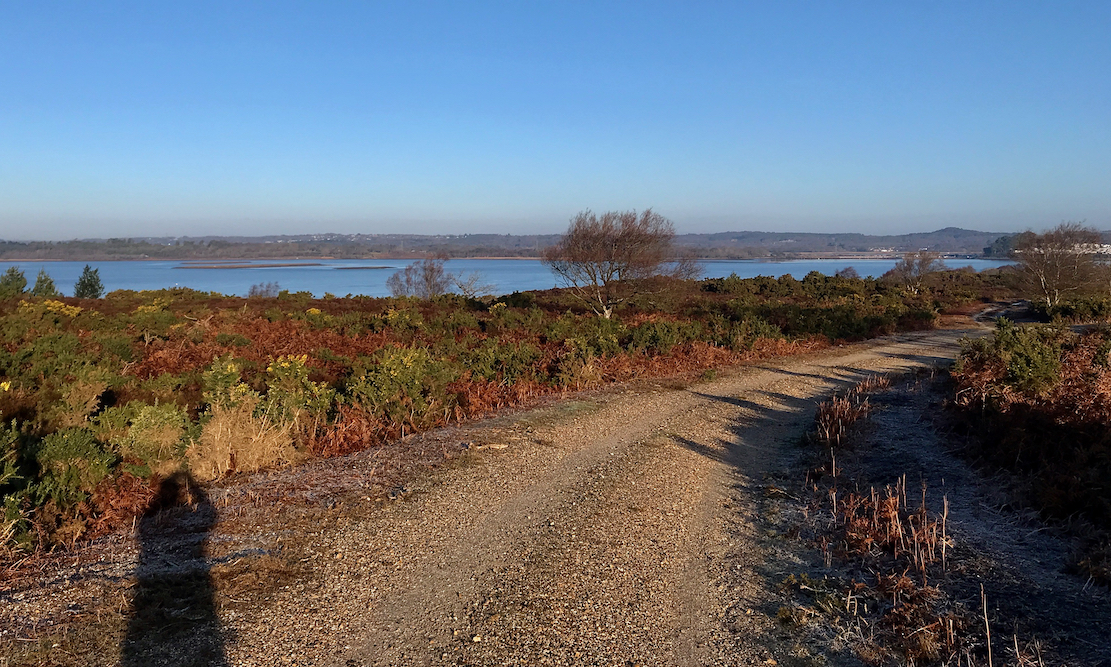
At the top of the heath the narrow Wareham Channel came into view beyond the tawny, mid-winter scrub.
For stability, the bag sat crossways over the clip-on rack works best, but the small wheeled bike struggles across cattle grids and gets wobbly manoeuvring at low speeds.
The tide was a lowish neap coming in, but at this point on the Harbour shore, the HW/LW band is narrow which means less chance of mudflats, whatever the tide. I’ve been caught out here before.
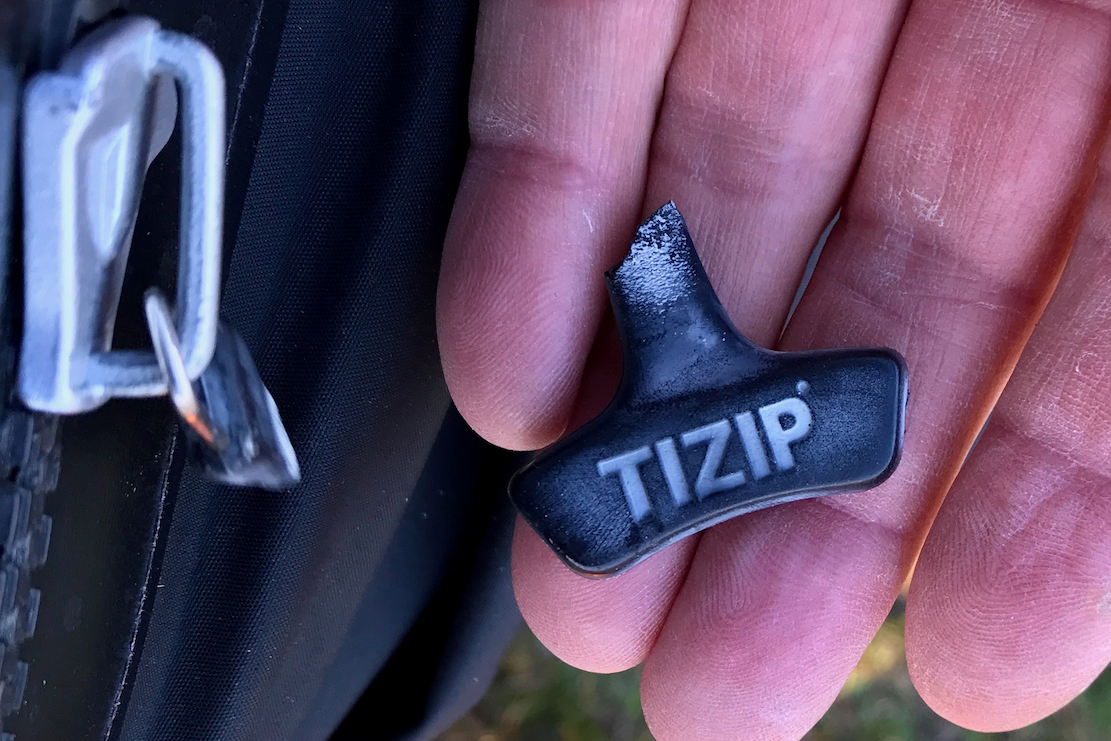
It wasn’t that cold – or I was over-dressed in a fleece onesie and drysuit. But it was cold enough the snap the plastic toggle off the drysuit’s TiZip.
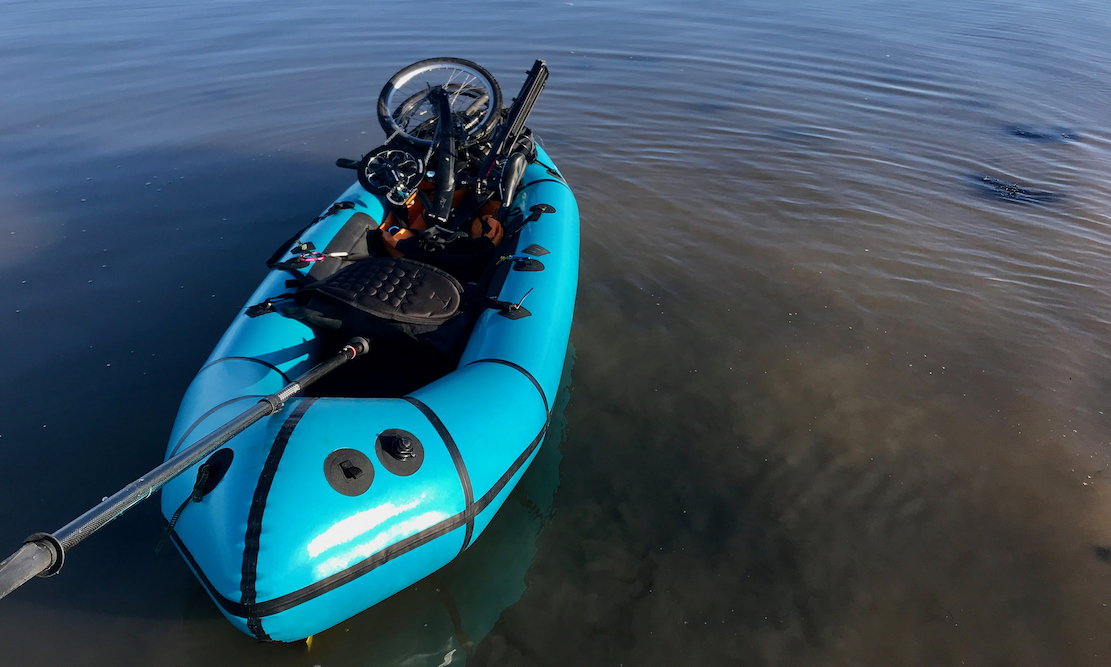
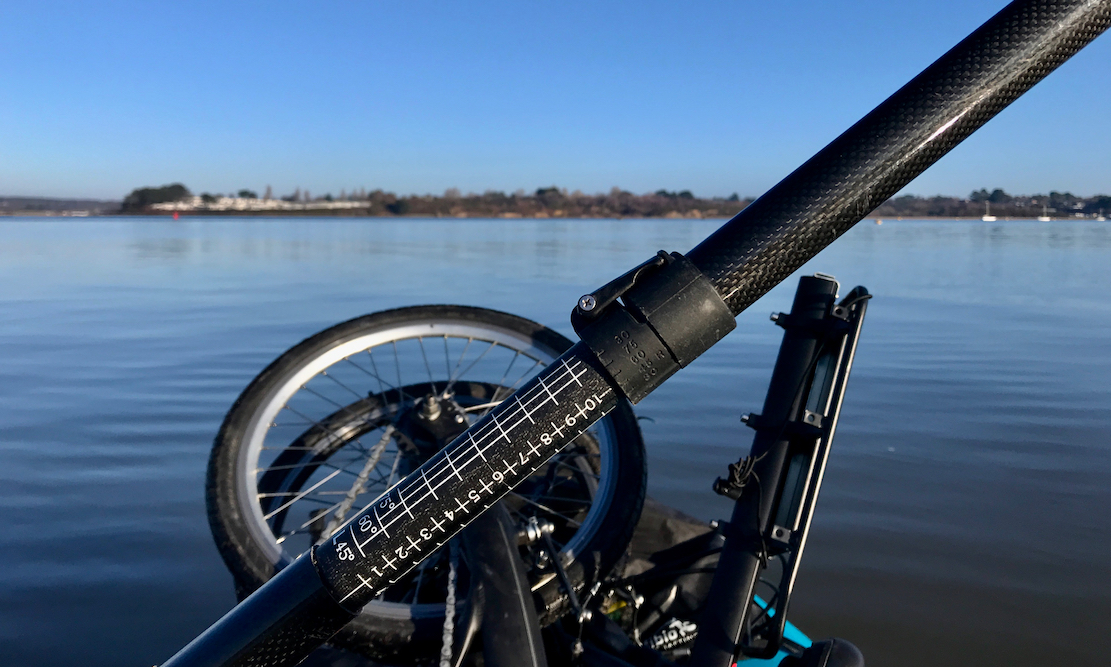
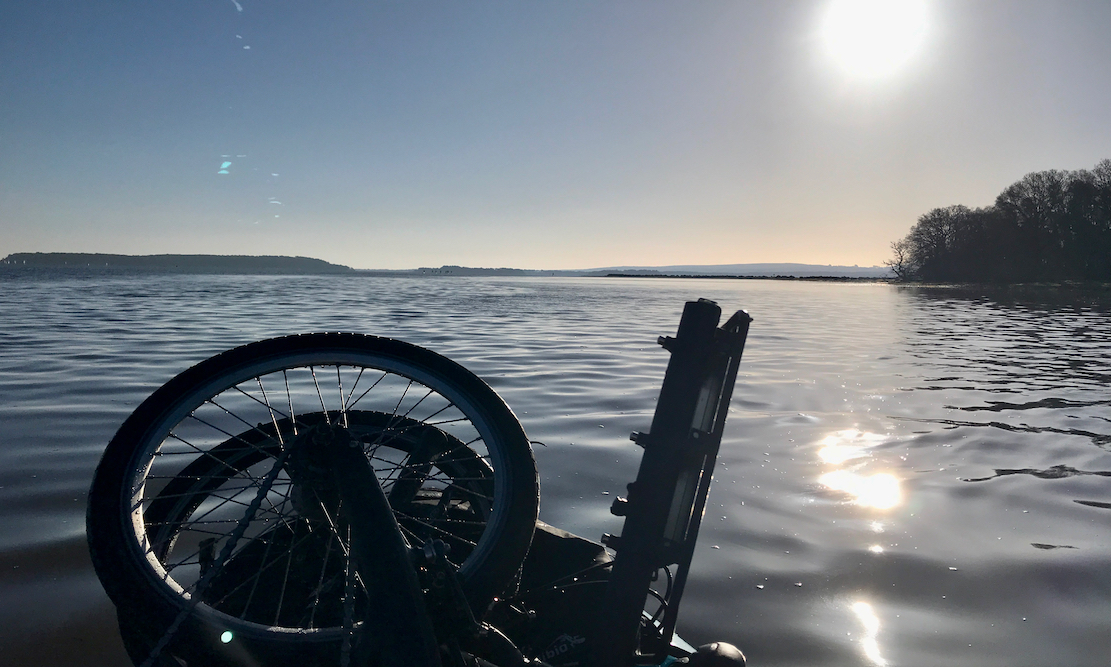
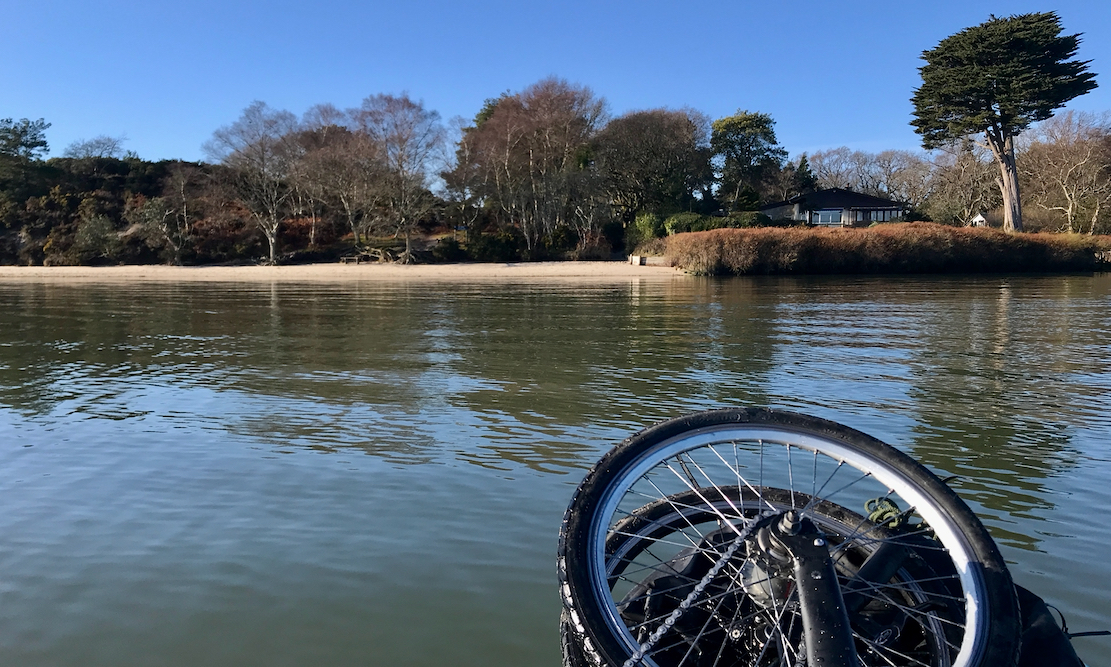
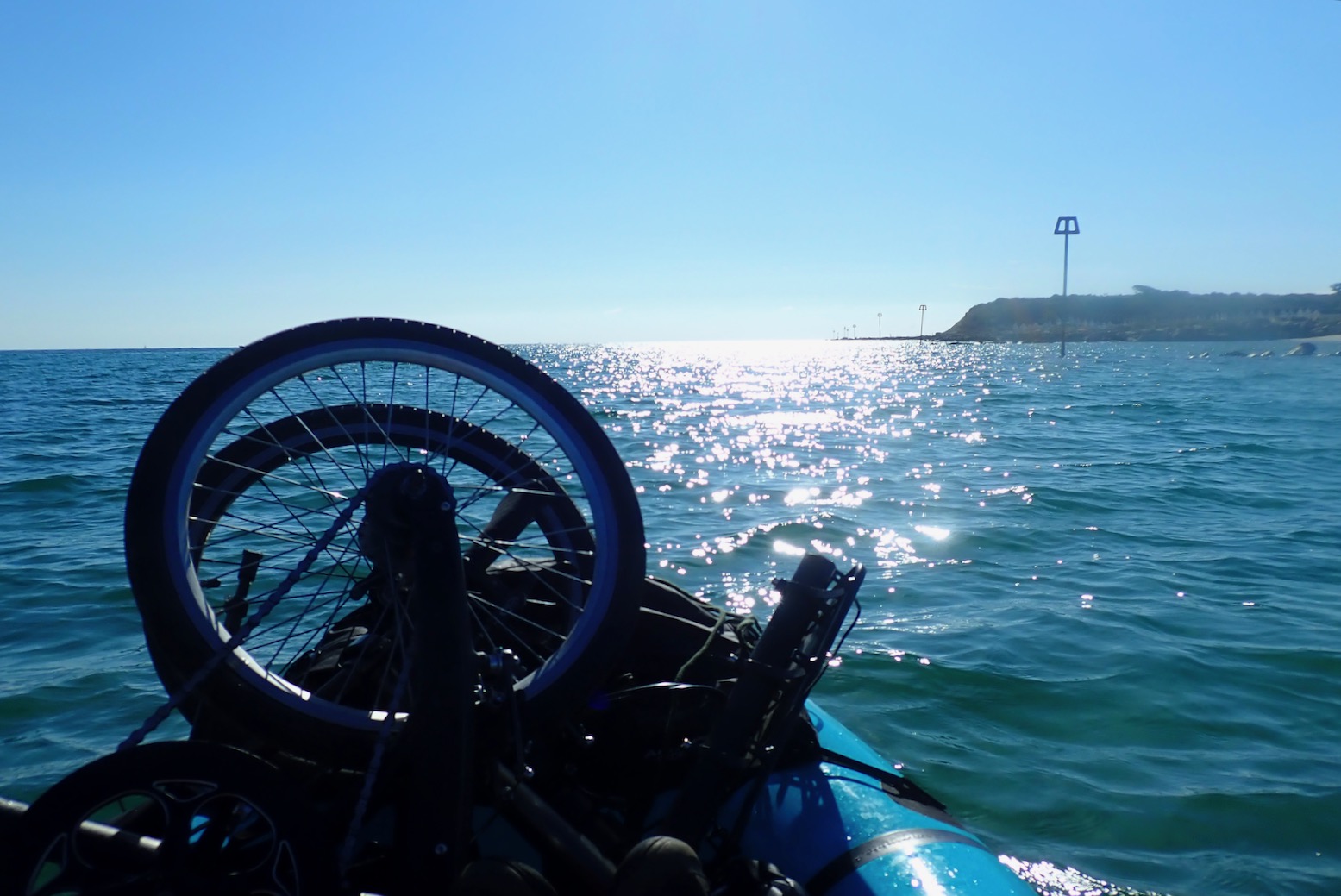
The bike drops easily into the bow. No need to lash down. I set off west. Today was one of those rare days where the water was warmer than the ambient air. Result? After inflating fully with cold air, no need to temper (top up) the boat as the warmer water firms it up for you.
The boat may be firm but I got no glide – it’s a struggle of move along. Is it the added 11kg, unfitness or the incoming tide through the narrow Channel having a bigger effect than I thought? I decide it’s mostly the latter.
As I turn the corner at Gold Point I’m paddling southeast into the low sun which, along with the tide, is really quite annoying. Should have brought the peaked cap. On top of that, I didn’t get myself properly comfy in the boat, as I managed on the Christchurch bikeraft last summer, the first time I tried folded bikerafting. Don’t know why; the seat was in the same place, so was the bike, but not being fully relaxed in the boat wears you out prematurely. Once past the hook of Patchins Point and out of the tide, I slide off the seat, put my feet up and drift off. I take a periodic peak and now it’s the northeasterly breeze pushing me out towards Brownsea Island, not the tide.
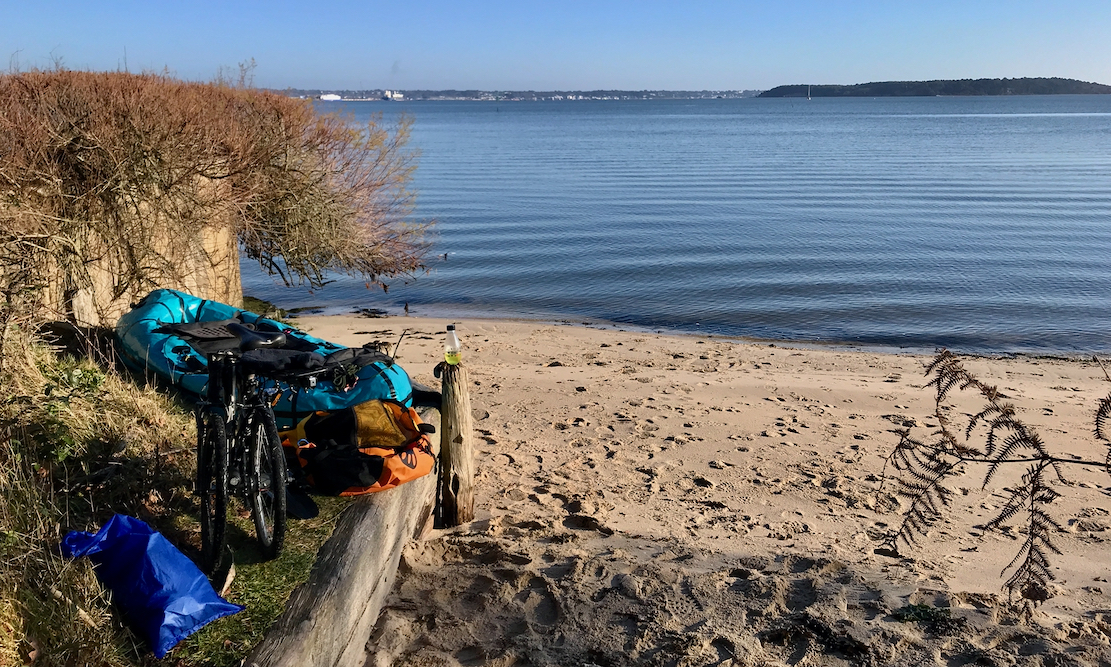
I turn into towards Shipstal Point where a bridleway leads back to Arne. It was a short paddle but as always, it’s nice to get on the water on a sunny winter’s day.
I try and pack up without getting sand all over the boat and bike, but it’s a losing battle. I lash down the boat and pedal home.
I’m reminded what a mistake it was to use an iPhone without a stand or at all. Unlike my Olympus, ‘wet camera’ it’s tricky to use while pedalling, and trying to use the self-timer or vids focusses on a blade of grass in front of the lens, not the passing bike. Result: extra boring pics of nothing much at all.
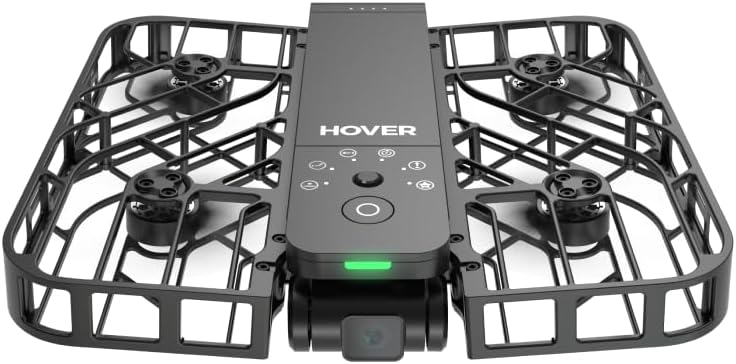
Later that afternoon I finally got to grips with a Hoverair X1 drone (left) a mate sold me cheap. It’s basic and sounds like a kicked hornet’s nest, but works without a phone or controller, weighs just 125g and fits in your pocket. Reviews are pretty positive for what it is. This morning’s biking and rafting would have been a perfect chance to try it out and get some better PoVs. Next time may be a while away. The weather forecast shows wind and rain right off the edge of the screen.
In a line Mouthwatering selection of river- lake- and inshore paddles right across France, but packboats go unmentioned, despite lauding the use of public transport.
What they say This award-winning new Bradt guidebook provides 40 itineraries for water-based exploration around France by SUP kayak & canoe to suit all abilities. It is the first practical guidebook to explore the whole country by SUP (stand-up paddleboard), canoe and kayak – waterborne activities enjoying a popularity boom. Experienced paddleboarder, travel writer and local resident Anna Richards has toured the country’s rivers, lakes and coasts to handpick 40 outstanding itineraries for water-based exploration that suit all abilities from novice to expert, enabling readers to experience Metropolitan France as never before! Rrp £19.99. 41 maps, 230pp
Review copy supplied by Bradt Guides. Book images found on online previews. Additional contextual review info by French boarder, Gael A.
• Varied selection of paddles right across the six corners of l’hexigone and Corsica • Nicely written descriptions • Maps are small but routes are short so they do the job • W3W works well for pinpointing locations • Nice layout and paper • Printed in the UK – better sustainability
• Routes appear to be composed almost entirely from set rental/guided itineraries • Most are short return paddles • When it comes to paddling knowledge, the author seems out of her depth • Nearly all photos are stock library shots • IKs and packrafts virtually unmentioned, yet as transportable as a rolled up iSUP
Review Thanks to its topography, rich history, culture and proximity to the UK, on river, lake or sea, France is a fantastic paddling destination. Paddling France: 40 Best Places to Explore by SUP, Kayak & Canoe replicates Bradt’s Paddling Britain by Lizzie Carr which, in its first 2018 edition, was a long-running hit, possibly supercharged by lockdowns when demand for inflatables boiled over. Like many others at this time, author Anna Richards discovered the wonder of paddleboarding, moved to France to become a travel writer and, knowing the country from childhood holidays, zig zagged around for over a year to write and research it all. Paddling France isn’t aimed at enthusiasts attracted to the challenge of developing skills by juggling tidal streams and winds, river flow rates or the logistics of multi-day tours. Most SUP owners are into casual day paddles, but probably outnumber the former by ten to one. But unlike Lizzie Carr’s original Paddling Britain (which I checked after writing this), faced with an equally monumental task, in most cases Anna Richards seems to have either rented kayaks (and maybe boards), used their shuttle services, or at sea sometimes joined tours. Although all are great paddles, I didn’t get the impression any routes were original selections born from years of experience, the usual prerequisite for authoring a guide book like this. Initially I understood ‘… generally withthe assistance of local clubs that kindly loaned me rigid… kayaks‘ (page xix) as a euphemism for arranging rental freebies in return for a listing in the book. But it’s possible the author actually believes ‘clubs’ – in the social/membership/lessons UK sense – is the right word to describe a commercial rental, tour and sometimes training outfit. Only Route 21 lists a ‘Club Nautique‘ sailing school which also rents kayaks and boards. All the rest call themselves versions of watersports centres or ‘location canoë-kayak‘ (kayak rentals) of which there are many more in France than in the UK. Once you get your head around this you ask yourself: well, it’s a short-cut but in France does it actually matter? What are most Brit paddle tourists’ experiences in France? Is it flying or railing down with a packboat, as I’ve done? Or is it driving around with kids or campervan, then chancing upon a lovely waterside spot which offers day rentals and a lift back? It’s almost certainly the latter. That’s what I’ve done elsewhere in the world. It’s clear the author put in the miles, paddled every route and composed a detailed description and practical info, although images of her in ‘off message’ kayaks are absent, replaced by stock library photos with fill 90% of this book. With mainstream guidebook sales in retreat and corners getting cut, these are all understandable measures to still produce a nicely designed and illustrated book in full colour for just £20 that’s printed in the UK, not the other side of the world. That alone deserves a sustainability rosette which the publisher should laud. I wouldn’t consider blagging a freebie rental in return for a mention as unethical, as long as it’s clearly flagged. Many routes start and end right outside an outfitter’s base. I could be wrong, but if that’s the case better to be upfront. Skimming through Paddling Britain, that book appears to have been written and researched the old fashioned way – though again, no mention of packboats ;-(
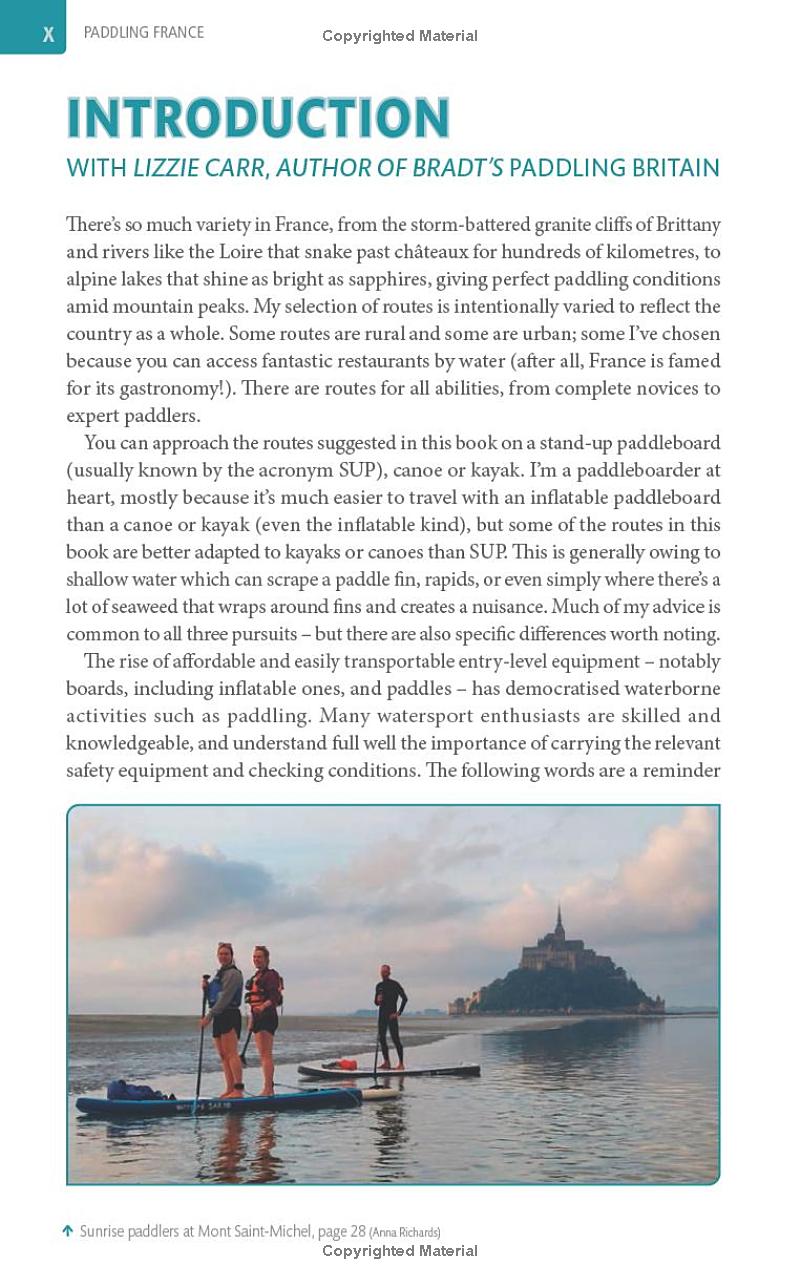
Ironically, Anna Richards likes iSUPs for some of the same reasons we all rate IKs and Packrafts: ease of use and transportability. Yet as said, many routes seem to be in rental hardshells, while IKs get dismissed in the Intro’s second para (left) as too awkward to travel with compared to a SUP. I looked up what a 12.5′ inflatable paddle board weighs: about the same as a Gumotex Twist 1, and 2-3 times more than a packraft, though I admit a 4-metre FDS IK (above right) is ridiculously bulky. What a shame then she missed out on made-in-France Mekongs packrafts rental service. Some rental outfitters listed even supply Mekongs. On a lively river I’m sure she’d have been thrilled. So, no IK or Ps in this book (bar photo p5), but of course, conditions permitting, all routes are suited to packboating.
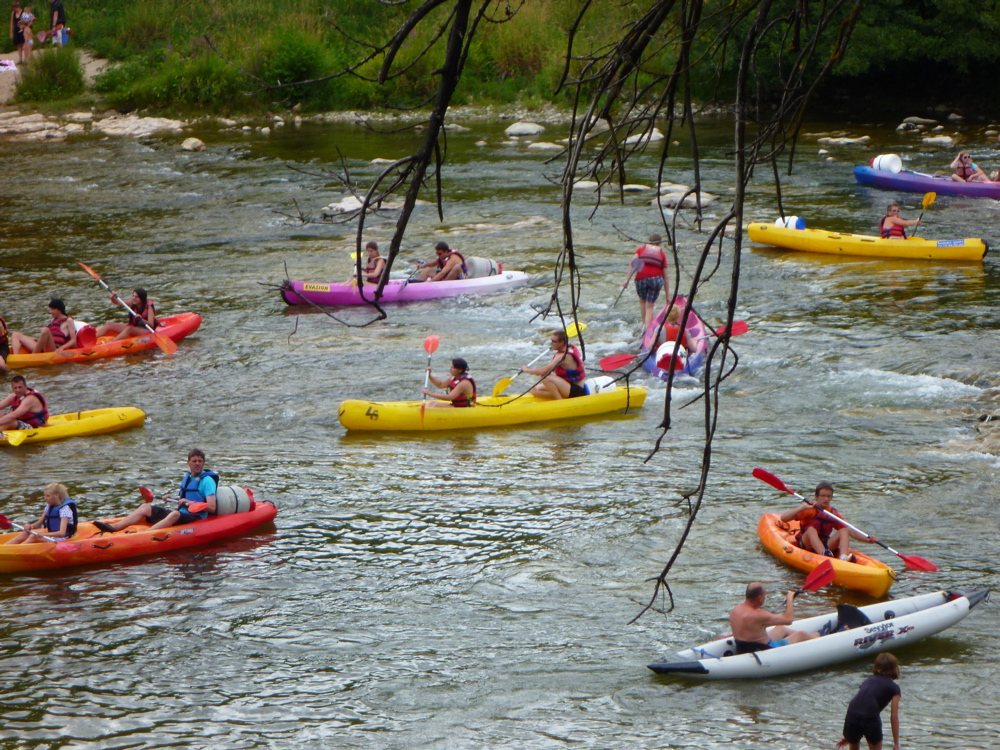
Evening splash hour on the Ardeche (Route 27). SoT and IK heaven
The author seems to be more enterprising travel writer with a SUP hobby, than experienced river runner and has a talent for filling out evocative descriptions with not much to go on. For an inspirational as much as practical title like this, that may be a better balance, but it’s a shame we can’t have both. If you’ve used serious paddle guides, Paddling France falls a little short in places. What I now realise are linguistic mistranslations of French paddling terms jar, suggesting the author was inexperienced in writing an English paddle sports guide that must include accepted terminology and elements of technique, appropriate gear, water hazards and safety regs. Page 16 and 18 excepted, the frequent use of disembark to ‘get off’ [your board/the river] but also to ‘set off’ [for the paddle – p66] get particularly grating. This is a literal translation of a similar French word which doesn’t always work in English. Marinas get described as ‘ports’ or ‘harbours’ or even ‘pleasure boat ports’ – also not the same thing. Nor is a weir a dam in English (though in the US they call them ‘low-head dams’). It took me days to realise this. I now wonder if paddling newb Anna Richards learned her paddling and nautical terminology in French while researching this book, then translated some words literally into English. Hence the odd use of port de plaisance – the clumsy French phrase for marinas. Or assuming barrage translates to dam, weir (or roadblock), when all three are quite different things. As an aside, a few times a SUP board is called a ‘paddle’: ‘inflate your paddle’ roll up your ‘paddle’. Is ‘paddle’ slang for a SUP in French? Probably not* But then an often-repeated claim dawned on me: English vocabulary is many, many times greater than French or any other language – no wonder L’Académie Française is so defensive ;-) You won’t drown horribly as a result of all this, but if writing a paddle guide in English for English readers, use or learn the right words – or check with someone who does.
Actually it is! Gael writes: Some years ago the term “paddle” has been inexplicably adopted as the official French word for SUP. Stand Up Paddleboard would translate into something like “planche propulsée en position debout au moyen d’une pagaie”, or PPPDMP which would be difficult to pronounce. Italians called it “tavola da SUP”, which is shorter but nearly as ludicrous.
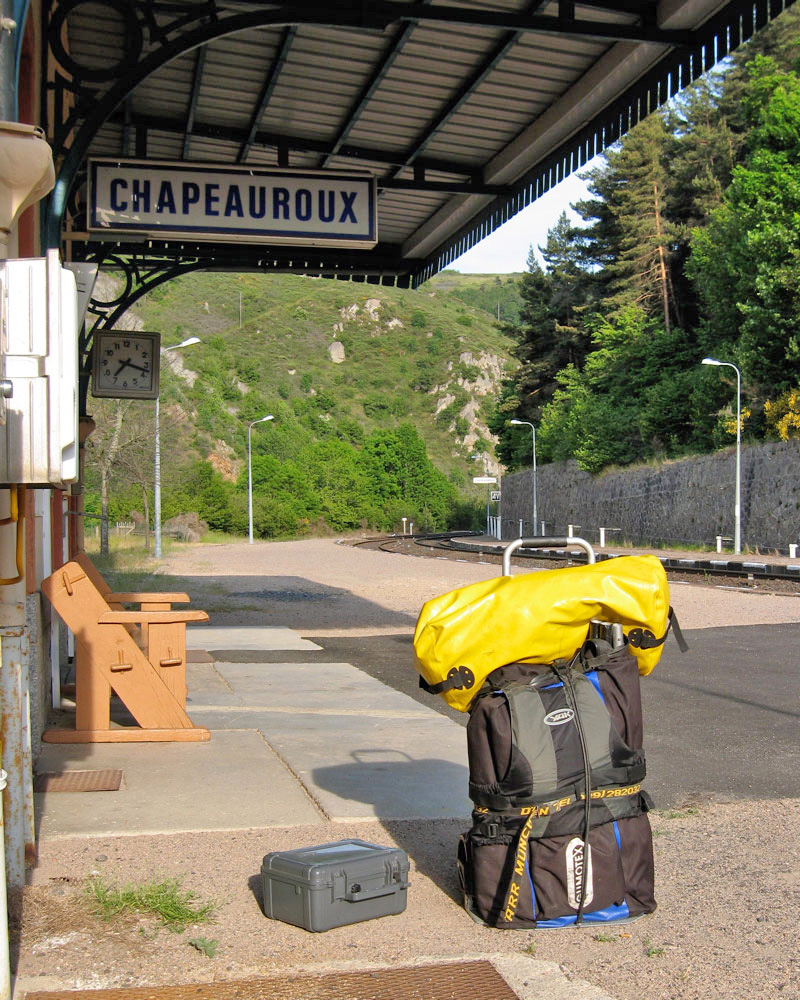
IK by train. A trolley helps
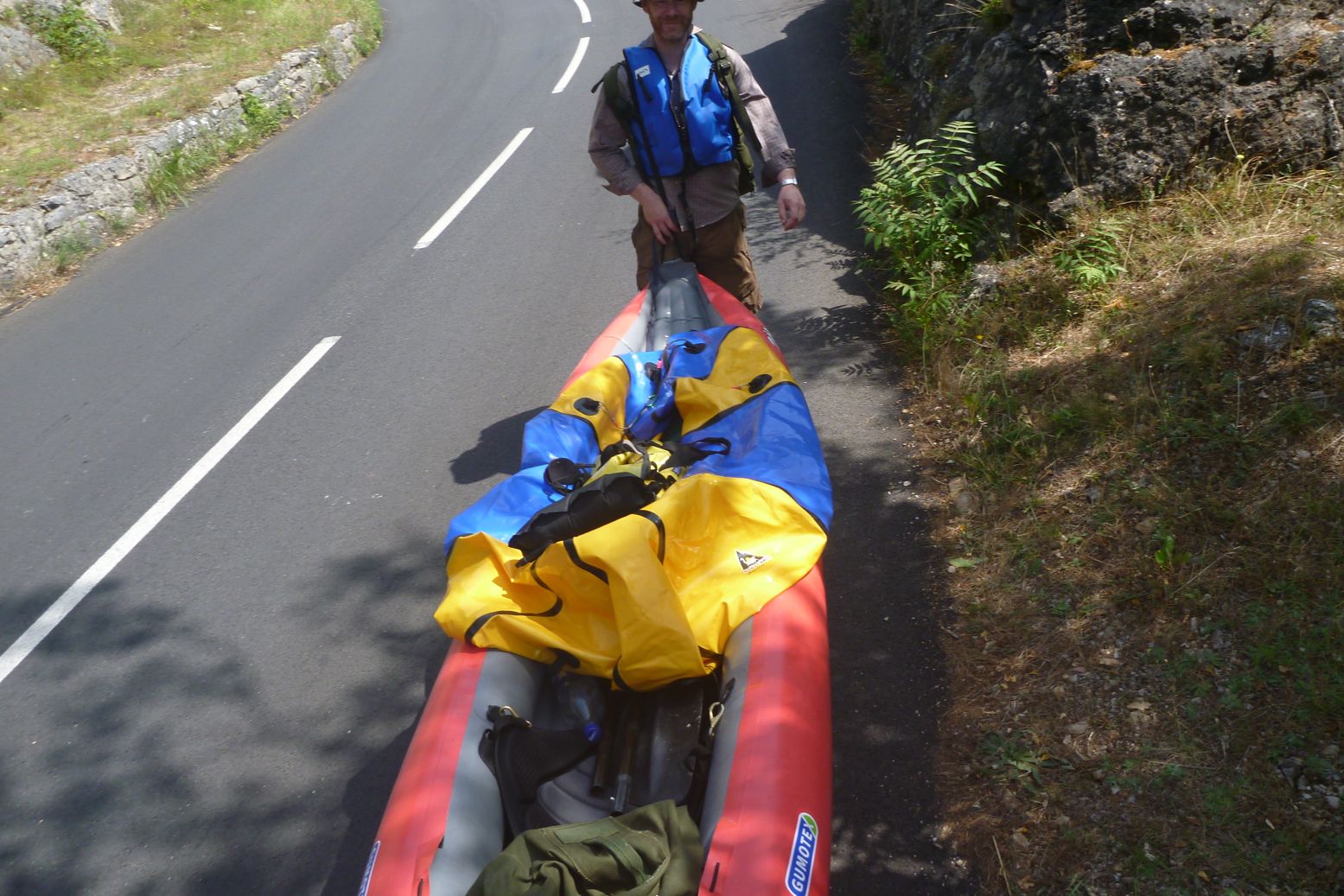
‘Paddle This Way’ Working through the book, up front after a handy country map which you’ll be referring to a lot, we get 26 (or xxvi) pages of what and how. Flying is discouraged for environmental but also supposedly impractical reasons even if, despite what’s claimed, a packboat or iSUP is easily loaded on a plane. There’s good info on the various car regulations including urban emission restrictions which could catch a foreigner out. On a Eurostar there’s no weight limit, so if you can get two bags like left (IK with camping gear on a folding trolley) you’ll not pay excess fees, despite what’s said. With a packraft there’s nothing to it. There follows a section about paddleboarding with the ‘accessibility and flexibility’ words I see mentioned so often, but which have long applied to packboats too, and especially packrafts (sorry; we’ve finished this argument, haven’t we?!). How to SUP, choosing a SUP and washing SUP; it’s all summarised. Kayaks and canoes get slightly less detailed treatment from expert contributors lifted from the Britain book who list elementary turning strokes a child would guess. Better to suggest a technique I found less intuitive: pushing on the upper arm, not yanking on the lower, as so many kayak newbs do. A box on renting boats and boards (also listed locally after each Route) recommends French outdoor retailer Decathlon’s IK rental service (and which might have included Decathlon’s packraft range, cough, cough). But I couldn’t find any rental boats on decathlon.fr and think that side of the service has been dropped.
iSUP in the bag. Gael A
Talking about gear, much of it makes sense, but it’s odd to see a manual SUP pump listed as ‘the biggest regret of the project‘, with the advice to get a 12-volt car inflator. So much for using public transport then! You can have both of course – long/thin SUP pumps are bulky compared to pocket packraft inflators, but the autonomy they offer changes the game by being able to ditch cars. A ‘Wear a Buoyancy Aid’ heading on page xx unfortunately appears right below a stock shot of half a dozen SUPists clad only in skimpy swimwear (and again two pages earlier). I read here 62% of UK ‘boarders don’t regard a PFD is an essential safety item. I rarely see them worn, but then I rarely see SUP boarders actually standing up. I suppose as long as you’re leashed to your board (the skimpies are unleashed), in deep but calm water you can crawl back on, providing you clung to you paddle. But on some of the listed rivers I know a leash can also be an entrapment hazard. Not mentioned. This is where handbooks or guidebooks written by paddling pros like Bill Mattos, Peter Knowles, Mark Rainsley, Laurent Nicholas, Luc Mehl and even Bradt’s own Lizzie Carr and Wild Thing’s Lisa Drewe have the edge. I’ve learned a whole lot from nearly all of them.
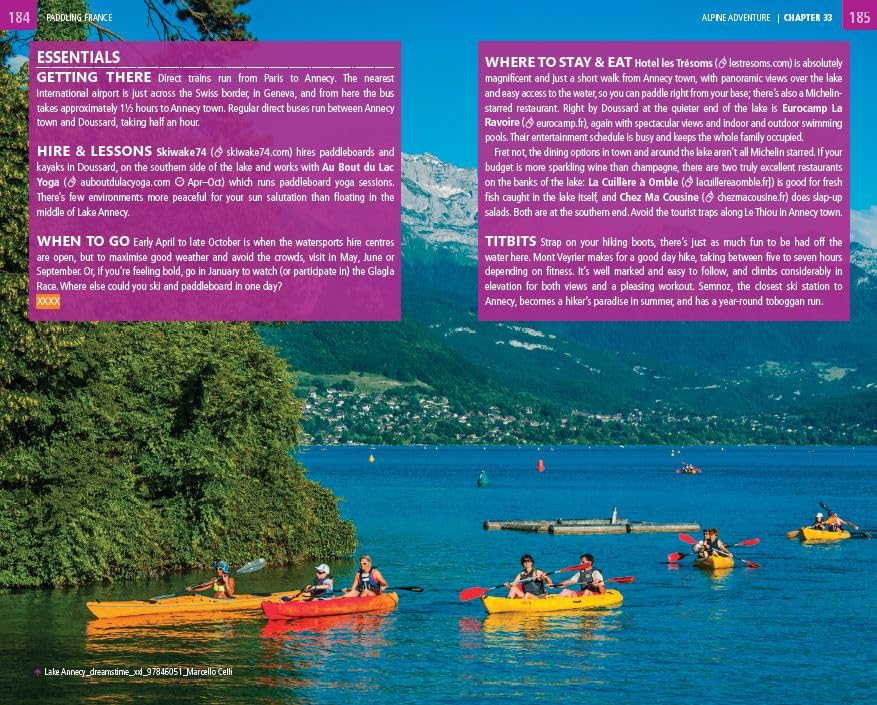
To her credit, every photo of Anna Richards on a board is in full wetsuit with pfd. What a shame there was no shot of her on Route 31 in Lyon, her home town – just more stock imagery. River rowers never wear BAs either, but it does seem to be a blind spot with SUP users. As said, most of the book’s images come from photo libraries, and of the SUPs pictured in the book, half have no BA, compared to only 1 in 10 kayakers. With off-season paddling often covered, you’d think then here’d a good place to mention the perils of cold water shock (scroll down to ‘C’) to drive the PFD message home: you drown flailing in a breathless panic long before succumbing to hypothermia. On Lake Annecy (Route 33) we’re told winter water temps are a ‘distinctly refreshing 4°C‘. There’s also no mention of the real menace of weirs (barrage in French; ‘low-head dams’ in the US) which led to that Welsh SUP tragedy and was also drummed into my paddle reading early on. There follows some boilerplate stuff on responsible paddling. Good to learn wild camping in France is a bit less illegal than I’d thought; it just emphasises how satisfying multi-day routes are (as in the Britain book). And I never knew canal paddling wasn’t allowed either*, nor the Seine in Paris. No wonder the French are so militant!
* Gael A adds: Canal paddling is allowed in many places. Inland waterways can be rivers or canals. Those capable of commercial shipping are managed by the public company Voies Navigables de France VNF. VNF decides which type of craft is authorized on each waterway or portion of waterway. For instance the Seine through Paris intra-muros is not allowed to sailing dinghies, skiffs, canoes, SUPs etc., while it is allowed downstream near Boulogne-Billancourt or Maisons-Laffittes and upstream near Saint-Fargeau for instance. VNF manages wide and deep waterways open to large barges. Older narrow gauge canals still in operation like Canal du Midi, Canal de Bourgogne or Canal de Nantes à Brest are no longer used for shipping and from now on dedicated to recreational navigation, which includes recreational barges, river yachts, canoes, SUPs, etc. For instance, when I couldn’t paddle on the river Marne because it was in spate, I went to Canal de l’Ourcq, although canal paddling is boring actually.
Division 240 sea regs With sea paddling routes included, I’d have expected a reference or at least a link to France’s Division 240 regs and how they might apply to SUPs. Another thing that could catch foreigners out, just as with driving, especially Brits from reg-slack UK. IK&P’s French SUP correspondent Gael A explains the sea regs as follows:
Division 240 applies to SUPs more than 3.50m [11.5′] long. SUPs shorter than 3.50m fall into the beach toy category, consequently they can’t go beyond 300 m from a sheltered shore. SUPs longer than 3.50m can go beyond the 300m limit up to 2 nautical miles [3.7km], by daytime only, provided they comply with watertightness, stability and buoyancy requirements described in Division 245. To make a long story short, a SUP must have 2 chambers. A SUP with only one chamber is considered a beach toy even if longer than 3.50m. Obviously watertightness and stability requirements don’t apply to SUPs. Navigation in the 300m-2nm zone requires the following safety gear: • leash • PFD 50N or wetsuit or drysuit • waterproof signal light like a strobe or a headlamp, or even a cyalume stick provided it is attached to the PFD.
So my single-chamber, 2.8-m TXL packraft would sadly be demoted to the beach toy it resembles and be restricted to less than 300m from a shore. But just as with having a high viz vest, warning triangle and breathalysers in your car (all detailed on pager xi), you do wonder how- or if all this is enforced. It’s a guidebook’s job to inform readers. Winds will always be unpredictable but there’s very little tidal information on the salt water routes, and whether it might be a factor. The much loved MagicSeaweed app listed on page xx went offline mid 2023, 10 months before the book was published, and its replacement seems surf based. (There are similar online weather and sea state resources.) Down on the Med tides aren’t a thing, but Brittany has some of the world’s highest tidal ranges, reaching 15 metres on some routes. Not everyone may fully appreciate how if could affect some paddles.
Rental SoT shoots a chute on the Tarn (Route 23)
Odd that there’s no mention or imagery of thrilling glissades orpasse canoës (canoe chutes, left), a French speciality rarely seen in the UK. Built especially for paddlers (and sometimes fish) to avoid tedious portaging around weirs, glissades aren’t listed in the Paddling Vocabulary on p222. They’re an added highlight to many rivers I’ve paddled there and you’d think it might be fun to try sat on a SUP too.
Location and nav Like some other guidebooks, the Bradt uses the What3Words GPS location app to precisely pin down riverside put-ins as well as passing POIs on third-party mapping. I got into using the W3W website (not the app) to orientate myself with the book’s routes and ///graphics.dads.inched is much easier to momentarily memorise then type correctly than 48.85840, 2.29447, although the Rivières Nature en France guide uses QR codes which go straight to map; no typing needed. Only once on Route 27 did the W3W launch point end up near Tomtor in far eastern Siberia and the coldest settlement on earth. All the others were spot on. The W3W app also provides the conventional numerical D.D° waypoint equivalent (as above) which a GPS device needs, and which will work on all other mapping apps, not just W3W. Both (and QRs) are so much better than the archaic OS grid ref system used in the first edition of Britain as well Pesda guides. The world’s digital now.
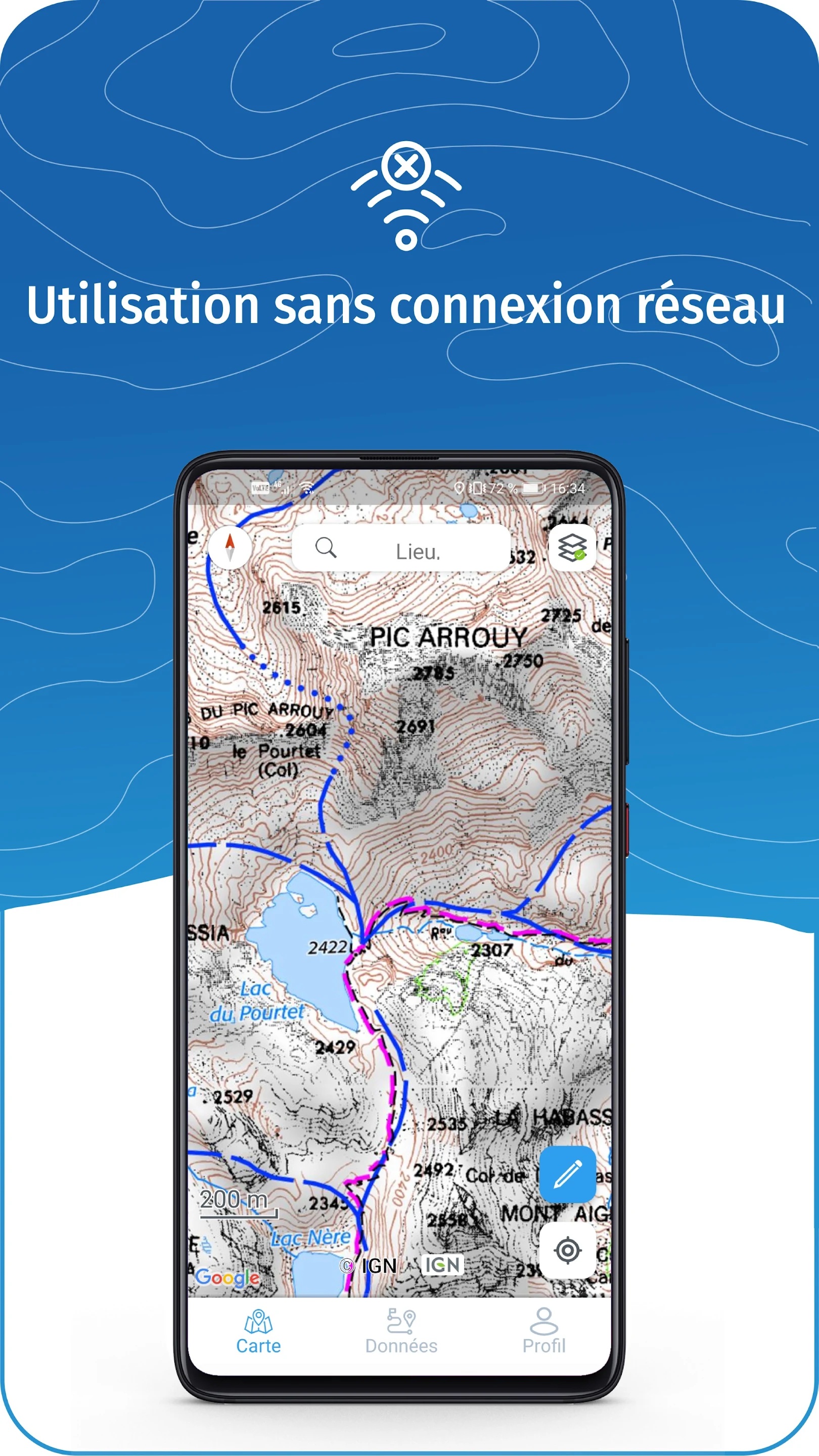
Talking of maps, I’d have expected a tip towards the IGN Rando app, (left) the French equivalent of the UK’s excellent Ordnance Survey. Widely used Open Source Maps (OSM, on which the book’s mini maps are based) can be free, but in my experience you can’t beat centuries of refined cartographic know-how. And with mapping apps like IGN (or indeed Google) you can download an area of map for offline use when there’s no 4G – quite likely if backcountry France is anything like the UK. All phones have GPS so W3W will still work, or at least show points, if not background map tiles. On long river days in France I’ve often lost track of where the heck I was and how far salvation might be. A handheld GPS device (eg: Garmin) or a mobile app running offline maps is the answer to nav connectivity.
TheRoutes About three-quarters of the 40 routes (full list right) are there-and-back or loop paddles in the 5-12km range and can be just a couple of hours on the water. On a lake a loop makes sense, but where possible, I’d rather paddle a river or a coast one-way and bus or even walk back. The outdoorsy author has done big hikes herself; it’s a shame she missed out on ways to combine both for those with portable inflatables like hers, but there-and-back day trips are what most people do. About 15 routes are inshore sea paddles divided equally between Atlantic and Mediterranean. Another 15 are rivers (9 are one-way), and 7 are lakes, with a bit of overlap all round (estuaries, reservoirs, canals, weir-ed urban rivers, and so on). As you can see in the Contents, each route gets a descriptive heading which is a nice touch.
Each route also gets difficulty ratings from 1-5 for SUPs, and another for kayak/canoes. As you’d expect, most are easier or safer in a kayak, but all will be dependant on experience, river levels or coastal winds. The few one-ways are all great rivers in the Massif, like the Tarn (only 10km), Allier (11.5km) and the famous Ardeche – at a full 32km by far the book’s longest. The shortest is less than 2km, or 3km through the Il de Ré’s salt marshes (Route 16) – the sort of paddling locale probably better appreciated standing on a board.
Essentials for Route 33: Lake Annecy in the Rhône-Alpes
Routes I know Like any know-all reader I ‘tested’ the four routes I’ve paddled through at least once to see how they compared with my recollections. I read a few other interesting ones too, then skimmed the rest.
€20 riverside lunch at Milandes – Dordogne (Route 20). Sure beats a Greggs on the Thames.
Route 20 on the Dordogne is a swift one-wayer of 11km passing several chateaux and ending with an easy bus trip back to the start. That’s what we want. I like the way some historical context is added into the narrative; as in the UK, it can be centuries deep in France. As it is you’ll be less than two hours on the water so best to string it out exploring some of the riverside villages. The Dordogne was my very first French paddle in 2005: a full 101-km of meanders and piffling riffles between Bretenoux and Tremolat. By the end I found it all a bit easy, but still fondly recall a deliciously expensive lunch at Milandes (above left), then randomly crawling off the river exhausted that evening, dumping the Gumotex Sunny in some undergrowth and squelching onto the grounds of what I now see was the luxury Manoir de Bellerive hotel. I was too tired to talk myself out of it.
We’ve done the full 86-km of the Tarn (Route 23) from Florac to Millau at least 2.3 times using trains, planes, buses, taxis, IKs and packrafts, and the 11-km of this route took us just 90 dawdling minutes. As the book suggests, your eyes will be out on stalks, but it’s a shame to come all this way for half a morning in the amazing Tarn Gorge.
Portage around Pas de Soucy
We also put in at La Malene one time, but following the easy 10-minute portage around Pas the Soucy (left; we clocked 9km), we did another 12km via Les Vignes to Le Rozier, capping a satisfying and spectacular day on the Tarn. The book advises to ‘disembark’ before Pas de Soucy a ‘gnarlywaterfall… which shouldn’t be attempted … unless you’re seriously professional‘. Shooting waterfalls can be a survivable stunt, but Soucy is a far more deadly rockfall with several syphons – another white water paddlers’ nightmare. It’s a serious mistake to make as photos show the author on her SUP so she was right there.
IK on the Tarn
On one of my favourites, the Allier (Route 27; 11km), you wonder why choose the hard to reach put-in at le Pradel, when Prades hamlet with shops, toilets, parking and a popular put-in beach is just a mile up the road? Perhaps partly because the rental outfit dropped the author here? Many of the book’s one-way river paddles seem predicated on the put-ins and itineraries of local kayak tour/rental operators (who each get a usually sole mention), rather than what would suit independent paddlers in their own boats and other means of getting around. With or without vehicles (or unwilling to use taxis), such paddlers could do a lot worse on the Allier than Langeac to Brioude, 38km. The two towns are just four stops (30 mins) apart on the Cevenol train line which followed all the way up the Allier gorges is a day out in itself.
Route 29 is the Ardeche, the longest in the book by far at 32km, of which the author says: ‘If you do one route in this book, make it [the Ardeche]’. This proves Anna Richards gets the appeal of doing a full day, one-way paddle, instead of two-hour there-and-backs which can be done back home on any summer’s evening. ‘It will leave you speechless…’ she continues. There’s certainly nothing like it (or the nearby Tarn) in the UK which is why in high summer you might get crushed in a white-water logjam of upturned rentals.
Pont d’Arc
Sevy on the Ardeche joins the melee
For a long time I was put off the Ardeche, misinterpreting Rivers Publishing’s description, and for Paddling France the author recommends using an SoT over her paddleboard. A lot of the time long, damage-prone fins are given as the reason not to ‘board similar rivers, but surely shorter or bendy fins are available? I’d assume the bigger risk is losing balance and whacking your head or breaking your collarbone in shallow rapids. Or the fact that when sat down for safety, your average SUP steers like a sea kayak with half a paddle. In a bombproof packraft the Ardeche was plain good fun, made all the more memorable by the hoards of flailing revellers I’d normally seek to avoid. We came down over a week from Les Vans via the Chassezac tributary, covering about 70km. Many famous spots like the fabulously chaotic Charlemange rapids just before the arch (above and above left), and the Dent Noire rock (where emergency services stand by on busy days) go oddly unmentioned.
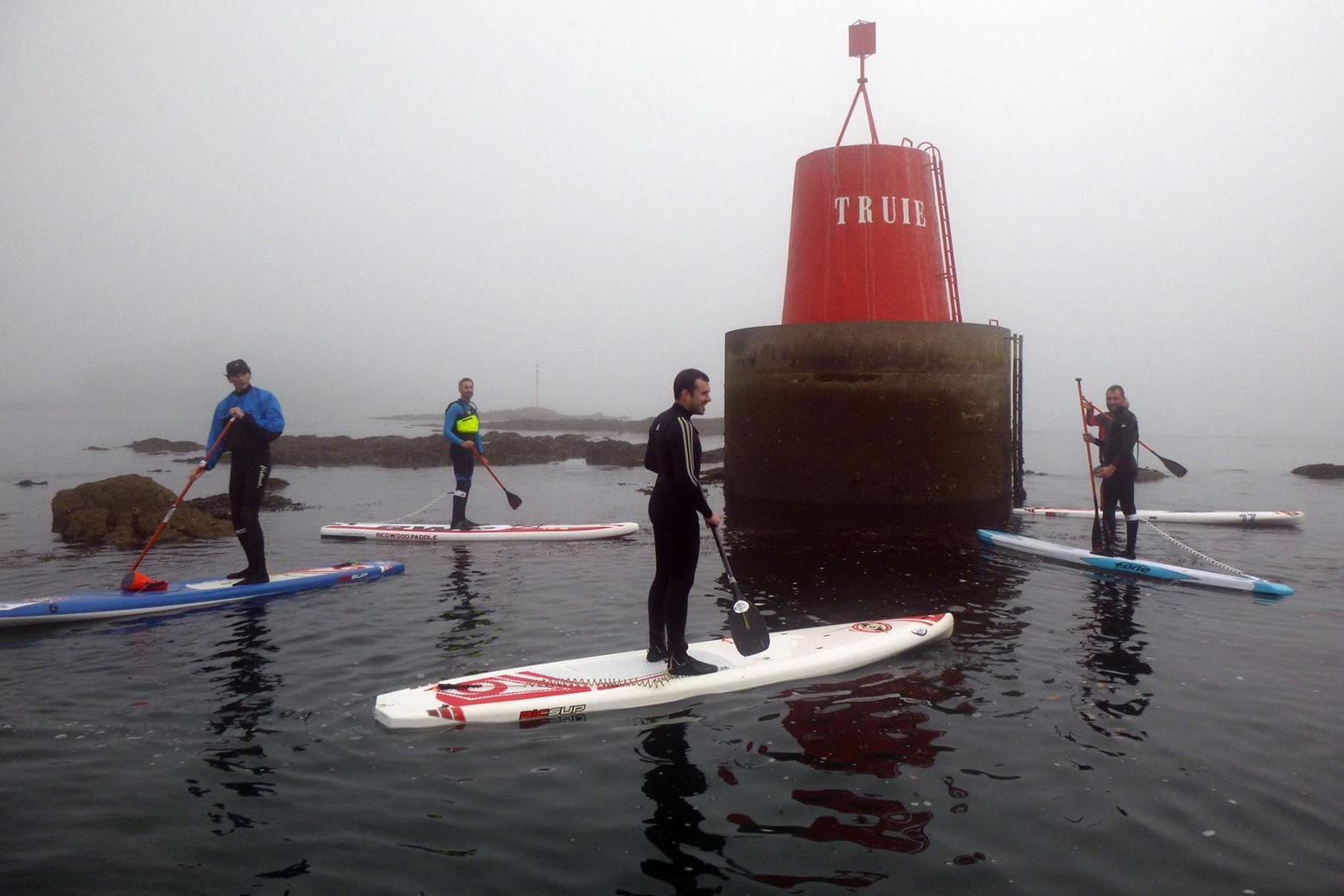
Fogbound SUPs at Morbihan (pic: Gael A)
Of the rest, everyone will find some great discoveries in Paddling France. Who’d know to try out the allotment-fringed canals of the hortillonnages off the Somme below Amiens’ gothic cathedral (below; Route 9). Other urban paddles also offer a novel viewpoint on a city which SUP-ing makes easier. Then there’s amazing Etretat on the Normandy coast which is probably geologically contiguous with Dorset’s Studland stacks over a hundred miles away. You’d hope that the rest of the sea paddles on this wild coast have been selected for their accessibility – probably so as rental outfitters will mean they’re a recognised thing. The sight of the book’s sole IK on p5 (Route 1, Corzon peninsula) was heartening, and the glittering granite sand spits of Glénan islands look like a mini Scilly Isles, though you’d think calm days here are infrequent. There are loads of tempting locales, and of course the book’s many brief itineraries can easily be extended if you ask around or consult other guides.
A maze of canals. Route 9 in Amiens
For her first guidebook Anna Richards has done a great job putting it all together. While it’s not that hard to find brilliant paddles in France, each route offers a locale with a proven appeal and rentals on site. Paddling France is easily worth 20 quid to have this information and inspiration in your hand to browse. A lot of my reservations are picky, but a printed guidebook from an established travel publisher carries an authority than online braying cannot match, and with it comes responsibility. Much more so for paddling, I believe, than walking or cycling guides, for example. After a quick flip through, Bradt’s Paddling Britain seems to have achieved this. As detailed above, a tiny amount of work would get Paddling France close to the calibre of that book and the other paddle guides mentioned. If the author didn’t have the paddling experience before setting out to write this guide, you’d think she had it by the time the book was finished. When I first got into river paddling I thought ‘How do you know that round the corner you won’t get swept into some deadly rapids or sluice with no way of easily getting ashore?’ For this reason, river guides are different other outdoor activities. You can’t always get off the ride quickly or at all. Your typical happy-clappy SUPy Puppy (and budget IK user, for that matter) buys a paddle craft online and hits the water, literally not knowing one side of a paddle blade from another (as the author also notes). Paddleboarding may be associated with the trendy Slow Travel movement, but on the water you can get in trouble fast, which is why it’s important to be across the risks and regs. We all have to start somewhere but in my experience, despite months of hard work, all this can often be too much to catch first time round, and to a busy publisher it’s just another title in the production line. Bradt is not a specialist in nautical publishing but a quick pass by a paddle-savvy editor would have caught most of the clangers. With a bit of distance and feedback, very often a guidebook’s second edition is what an author endeavoured to write first time round. I look forward to reviewing that one too.
The other week I bought myself a Dahon folding bike, a long-established American brand with a French sounding name that’s probably made in China and in the UK is much less pricey than better known Bromptons. Folders seem to be going cheap right now as older folk move to e-bikes. I still have a couple of pedalling years left in me, I hope. At least 8 years old, my Dahon Mu has an unusual (and long discontinued) SRAM Automatix 2-speed hub, V-brakes and once folded up, weighs just 11kg (my MTB is 15kg). I could’ve waited for a 7- or 8-speed hub to turn up, but thought I’d give the Automatix a try. I don’t mind having one less cable and mechanism to operate. It shifts up automatically at a round 10kph; a bit too soon some say, but there’s an easy mechanical hack around that.
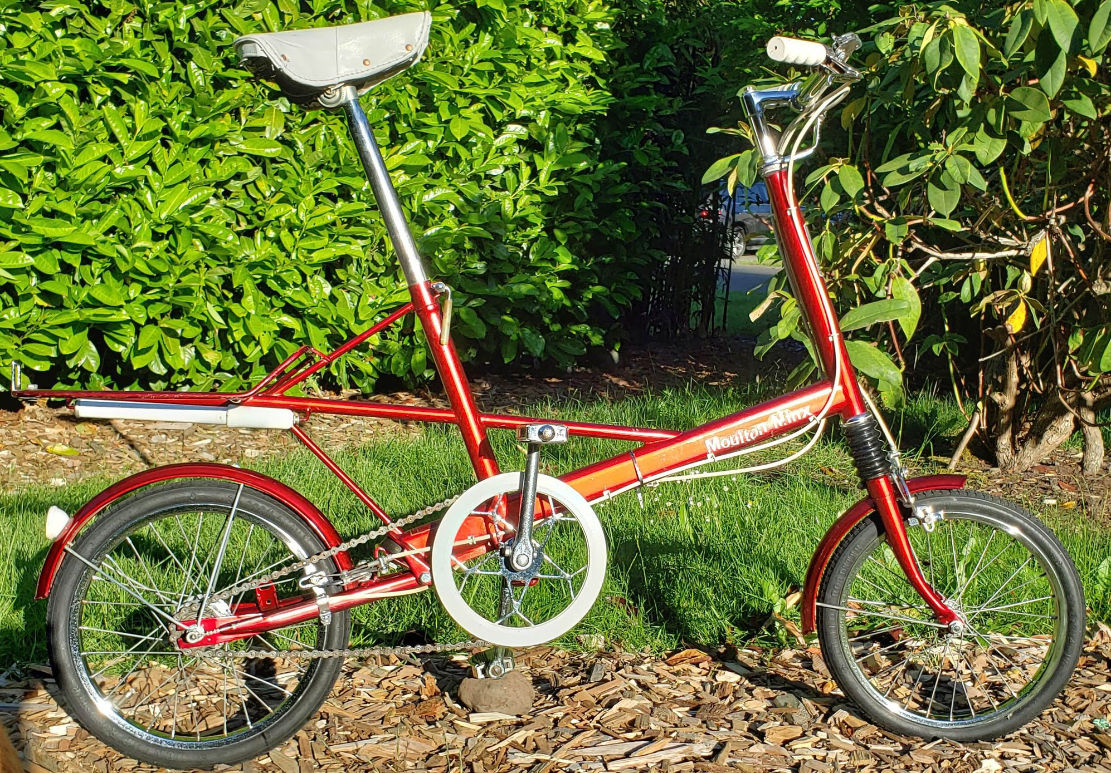
The Dahon reminds me of my Ferrari-red Raleigh Moulton I had in the late 60s, possibly my first two-wheeler. Along with being a groovy Sixties design, I think my mum thought small wheels = ‘sensible’, like a shopping bike. ‘Sensi-Schmensi? Hold my Tizer!’ My innovative ‘full suspension’ Moulton folded too, only not in a good way. Too much bombing around on Mitcham Common doing Evel Kinevel jumps one weekend saw the seat tube and stays fold backwards after one heavy landing. A decade and a half later California brought us the Apple Mac and mountain bikes and we never looked back.
Midsummer 2012, Joe Sheffer and Al Humphreys bikerafted to the top of Shetland using folding bikes. That’s my very first green Alpacka Joe’s paddling, a Denali Llama, just before Alpacka introduced the much copied extended stern.
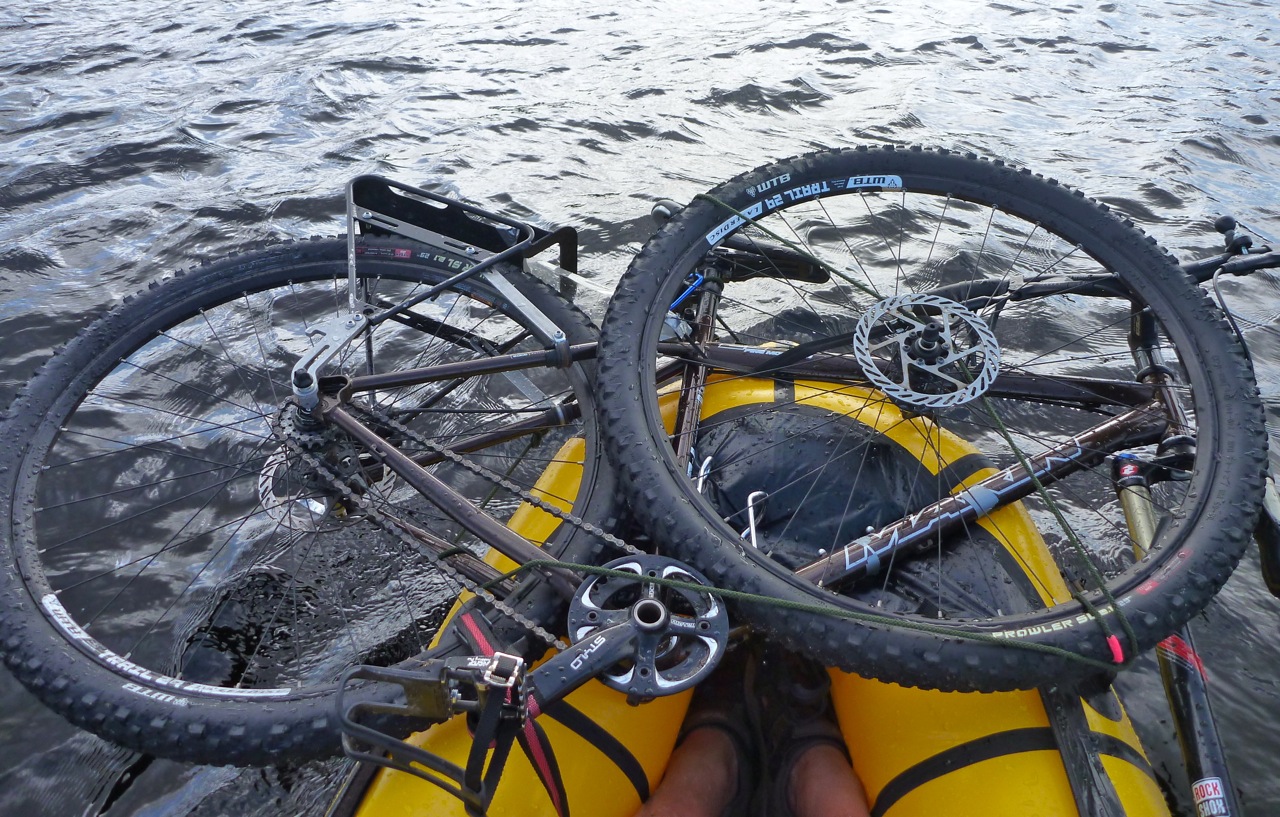
Years ago I tried bikerafting in northwest Scotland with my MTB. Up there it didn’t really work, the few roads were empty enough, but what paths and tracks there were were tricky on a bike with a boat strapped to it. I wrote in 2012…
… add a bike and any off-roading becomes marginal up here [FNWS]. Most of the time you’ll be pushing or carrying, especially with an overnight load. No MTB is really rideable on the footpaths up here, although unlike England and Wales, since 2003 Open Access allows cycling on all footpaths (there are no bridleways). Cross country and off the footpaths, at times you can barely walk, let alone ride a bike
This time round I have a bigger packraft and a smaller bike. I pedalled down to the station and got a train to Pokesdown, a 10-minute cycle from Iford bridge (below) near the tidal limit of the River Stour. On the water I moved the seat back and dropped the folded bike at the front. Unlike a regular bike, the folded Dahon sits part in the boat so there’s no real need to strap it down on the long TXL. I put the bag under my knees and set off about 1pm on a rising neap tide (right) that was set to stay level in the harbour for the next few hours. Winds were 6-8mph from the southwest.
Iford bridge at the tidal limit of the River Stour
From Iford bridge, or Tuckton just downriver is a popular paddle boarding spot and a couple of women were putting in with me. You can see why. You soon leave any impression of urbanity and drift along between the lush trees with little other traffic.
Add the blue sky and all in all, these were as ideal packrafting conditions as you’ll get. The TXL feels a bit heavy with the 12kg bike, or I’m out of paddle practice.
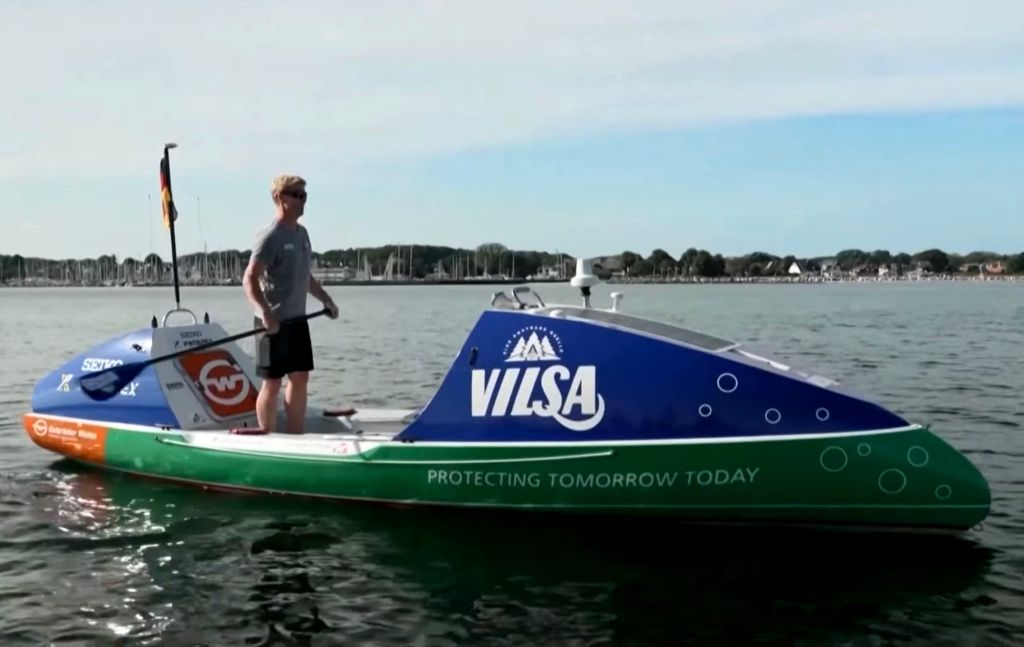
I pass a chap doing up an solo ocean rowing boat. It wasn’t this one which washed up nearby recently. Even with favourable currents and winds, it amazes me a single person can row a ton of boat across an ocean. But they can and they do.
I just read about Michael Walther, who adapted a similar boat to ‘SUP the Atlantic’. He set off from Spain and in two weeks covered 1150km to the Canaries averaging 3.9kph. Explanations seemed vague (boat damaged close to the port) but the trip ended there.
Soon rows of mega boats crop up with the the priory behind. Christchurch is like a millionaires’ Wareham.
Past Christchurch the land opens out. I sense the sea ahead.
A lot of boat for a little space. But a lot more stable than a little Dahon Mu with a packraft on the back.
I stray too far north into the protected shallows with just six inches of water. The marked boating channel follows the harbour’s southern edge.
From Hengistbury hill looking north. Note the tourists train for the weary of limb.
The harbour’s narrow outlet at Mudeford Quay.
Mudeford Quay from the hill.
As I passed through the channel I was hoping to be temped ashore by the aroma of sizzling seafood.
No discernible tidal flow in the channel today. Out into Christchurch Bay it’s only 13km to the Isle of Wight
Wanting to string things out, I paddled south into the wind and tide towards Hengistbury Head. It felt a bit more fun to be pressed against the elements (knowing there’s only 10 minutes of it).
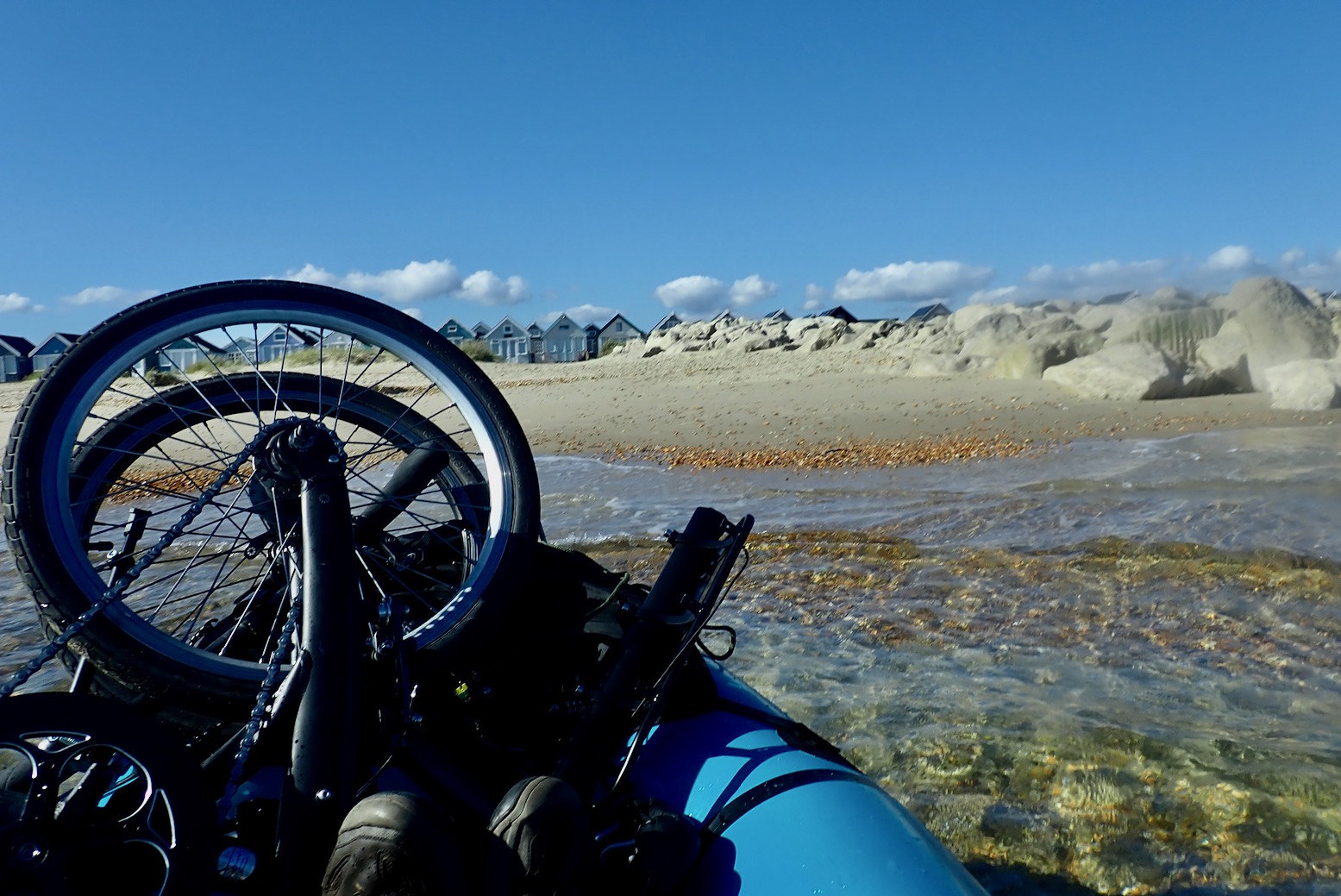
I take out at the last beach before the Head.
That was an easy and very enjoyable paddle. Only 8km over 90 minutes.
‘That’s a good set up you got there’ said a woman. ‘Yes it is’, I replied. The complete solution to amphibious mobility for the recreational enthusiast (I did not add).
I weave along trail across the beach
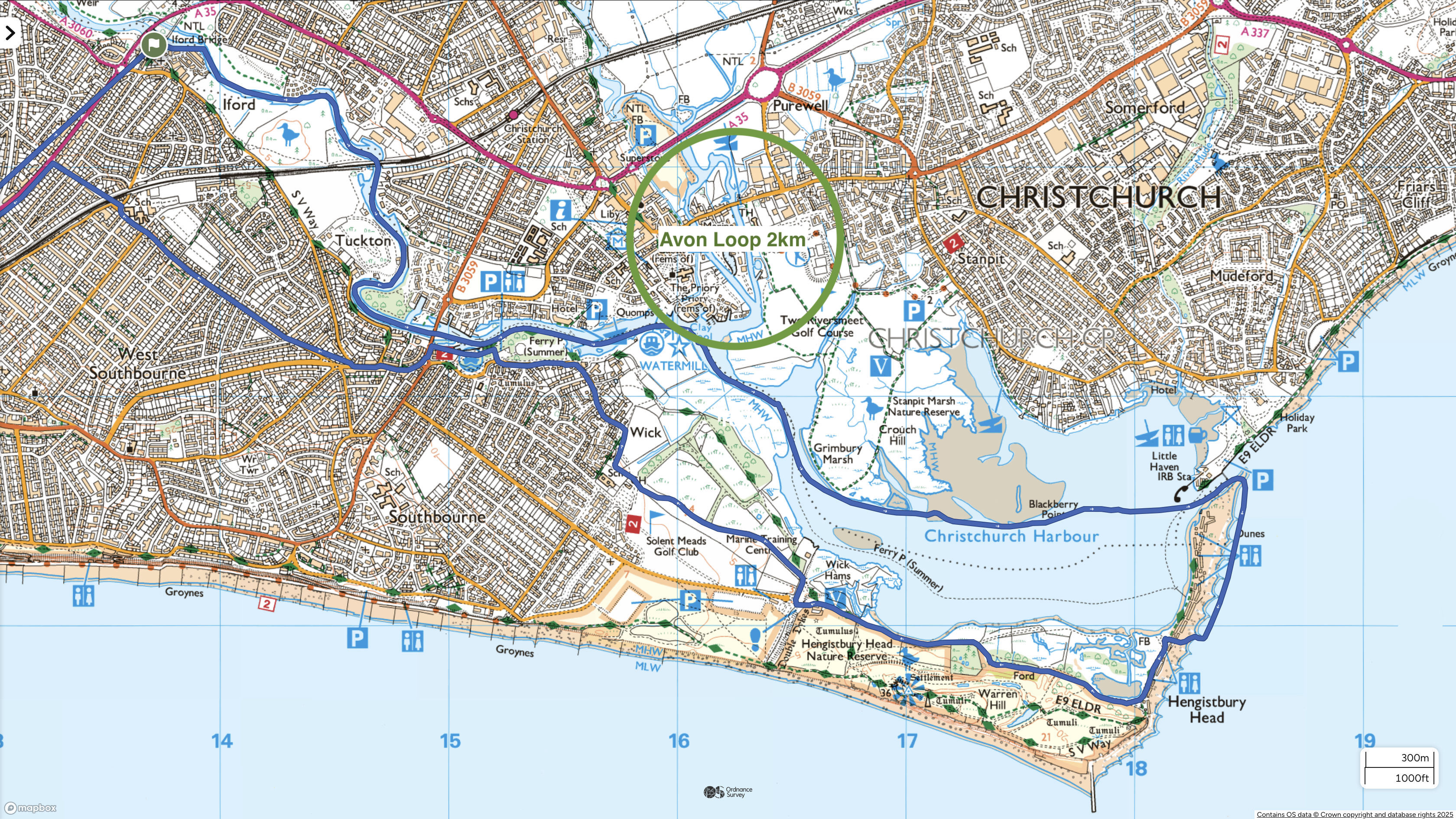
Harbour map. A fun place to explore with bike or boat or both.
It’s about 8km back to Pokesdown station, half of it on tracks.
Christchurch Priory and the water meadows, as not painted by Constable.
Only a tenner for 2 slices and a big cappucho. I suppose I needed the energy but that cherry slice had enough sugar in it to preserve a herd of dugong.
Looking at the OS map left, you might think it’s like packrafting through London, but nothing could be further from the truth. A tranquil, tree-lined river leads to a glittering inland marina and medieval church and a swan-speckled natural harbour beyond. Once out in the Bay, with the usual southwesterly you could carry on up the coast to Highcliffe, a couple of train stops up from Christchurch. Or with a higher tide, poke around the harbour. And just after the Priory, the Avon river comes in from the north. Someone suggested it’s possible to do a 2km tidal loop off the Stour and back. One for next time. Ironed out for some blundering around on the way back, that was about 18km from Pokestown station, with 8km of very enjoyable paddling. Without the bike it would have been a long walk back, though there is a summertime ferry from Mudeford Quay back up river. So this particular outing was well suited to bike rafting. With the wobbly payload, the comparative lack of stability, just two gears and the feeling I might snap something if I rode it like my MTB, the Dahon forces me to slow down. Not a bad thing. Next time on salt water, I might put it in a bag, so I don’t have to rinse and lube it back home, but I’m looking forward to more mini foldingbikerafting trips, where flatter roads and tracks allow.
To all Mohunes Of Fleet and Moonfleet In agro Dorcestrensi Living or dead
Moonfleet, 1960s edition
Recognise that epigraph? If you do you probably read John Meade Falkner’s Moonfleet (1898) as a conker-swinging nipper. Described as a ‘thrilling story of revenge and betrayal, of loyalty and great sacrifice, but … above all … friendship‘, I recall it being more of a ripping yarn with smugglers and treasure, set in mid 17th-century Dorsetshire or Dorcestrensi.
Like Enid Blyton in Swanage a few decades later, Wiltshire-born Falkner spent much of his time in a caravan park on the Dorset coast, and Moonfleet went on to be adapted into films (not least by Fritz Lang) as well as a few TV series. But to an 11-year-old none are as good as the book.
Fast forward half a century, I realise the 13-km long lagoon behind the pebblesome anomaly of Chesil Beach is known as the Fleet, as is a village along its shore, west of Weymouth. The novel includes many landmarks all the way to Purbeck and the Isle of Wight. That’s all the reason I needed to crack out the packraft and railcard. But wait – are there restrictions?
Small-scale use of canoes and kayaks for paddling to the mid Fleet for enjoyment and the experience … is discouraged… The Fleet seabed up to the mean high water mark is owned by the Ilchester Estates and part of the Reserve. The West Fleet is a closed, non-tidal area of water owned by the Estates and part of the Reserve. There are no boat slips bordering the Fleet that are open to the public.Boating in the mid Fleet is dissuaded as the water is shallow and the seabed comprises of soft, deep mud. There is also a tidal time lag … and strong winds … A military firing range is frequently in operation... It is hoped that the information below will reach potential boaters, … hopefully persuading them to reconsider their intentions.
‘Not swans again’
They missed out plague, pillaging pirates and pepper-spraying pangolins. Turns out the Fleet is a nature reserve. The top of the lagoon (West Fleet) has been a swannery since King Cnut of England, Norway and Denmark who actually died in Dorset. Harold (‘1066’) owned the manor of Fleet which was later listed in the first edition of the Domesday Book.
Kitchen Scene (1616) Adriaen van Nieulandt
At that time swans were a substantial food source, farmed at the newly founded Benedictine abbey in present-day Abbotsbury at the top of the lagoon. During the Dissolution the abbey was dismantled and rebuilt as the new owner’s mansion, as were many dwellings in Abbotsbury. By the mid-18th century, around the time of Moonfleet the new Earls of Ilchester established the Ilchester Estate which owns all you see here, including the Fleet seabed, not the Crown, as with most UK seashores.
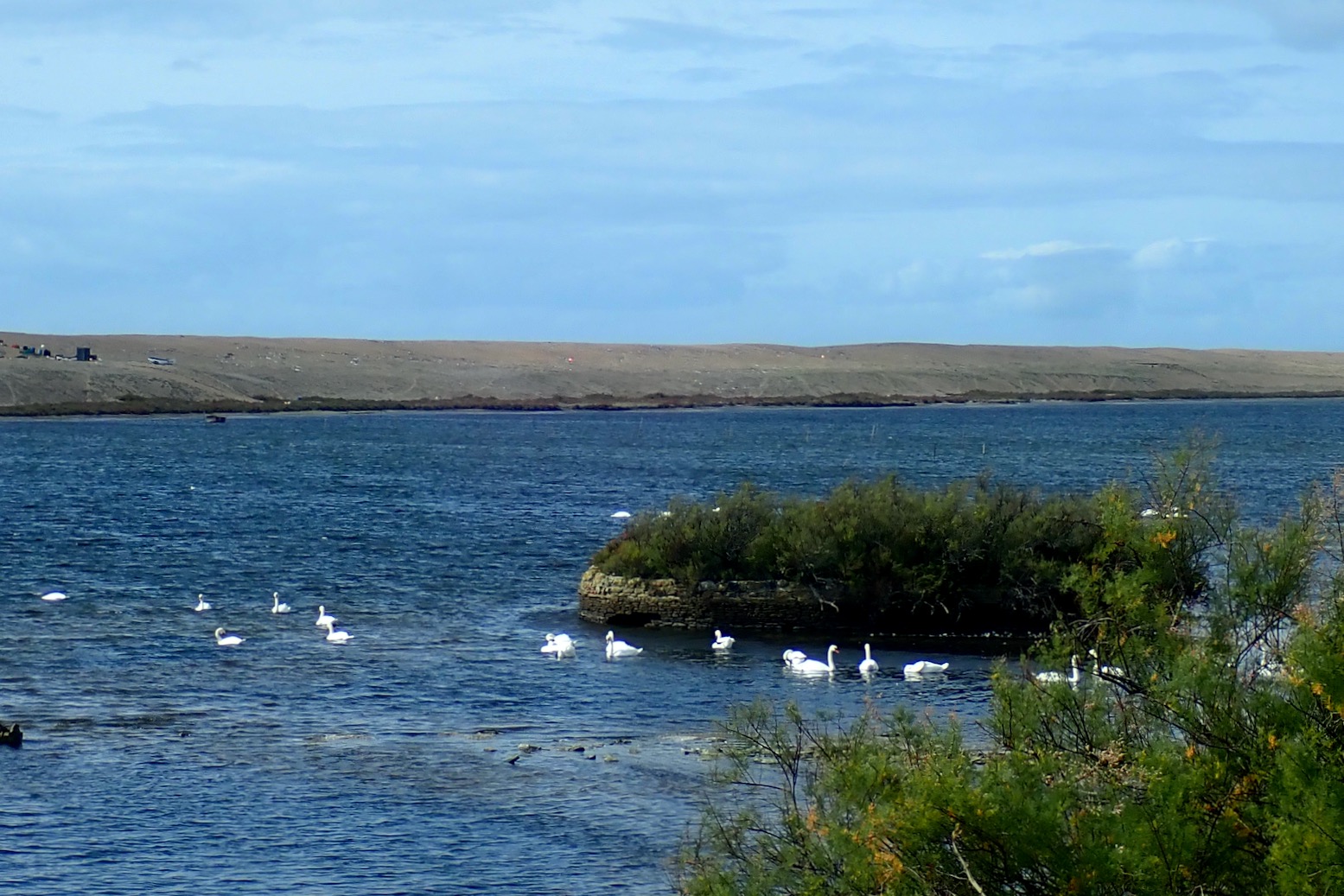
Interestingly, the ancient Abbotsbury swannery is one of few where the Fowle Royale aren’t automatically owned by the monarch under Crown Prerogative, or Droit de Cygneur. Look at the West Fleet above and you’ll see the foreshore thick with the swan-necked fowl.
Given the questionable access for paddling, a foot recce was in order. We got off a bus at Chickerell and footpathed west towards Langton Herring, passing big, fat but not juicy sloe berries.
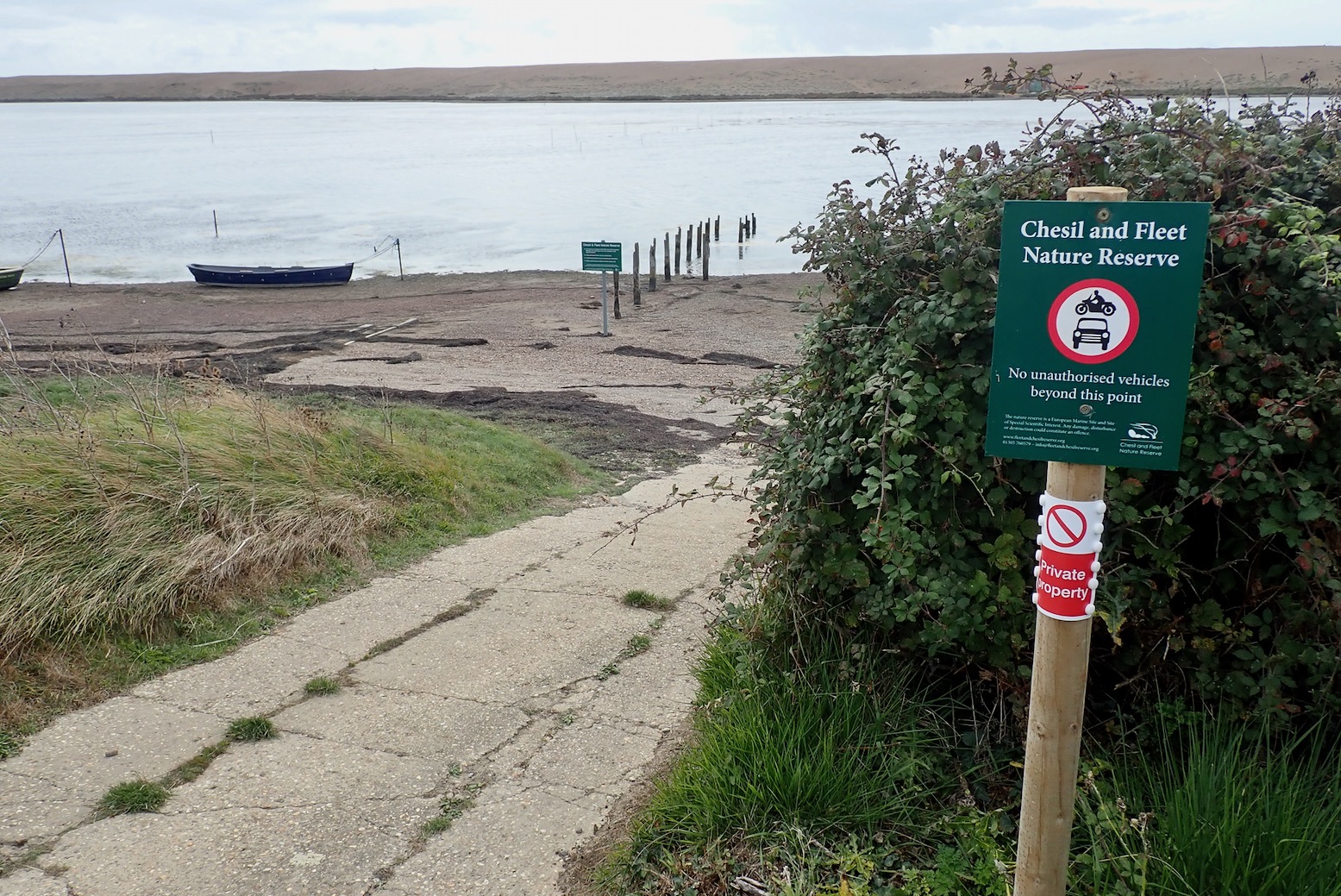
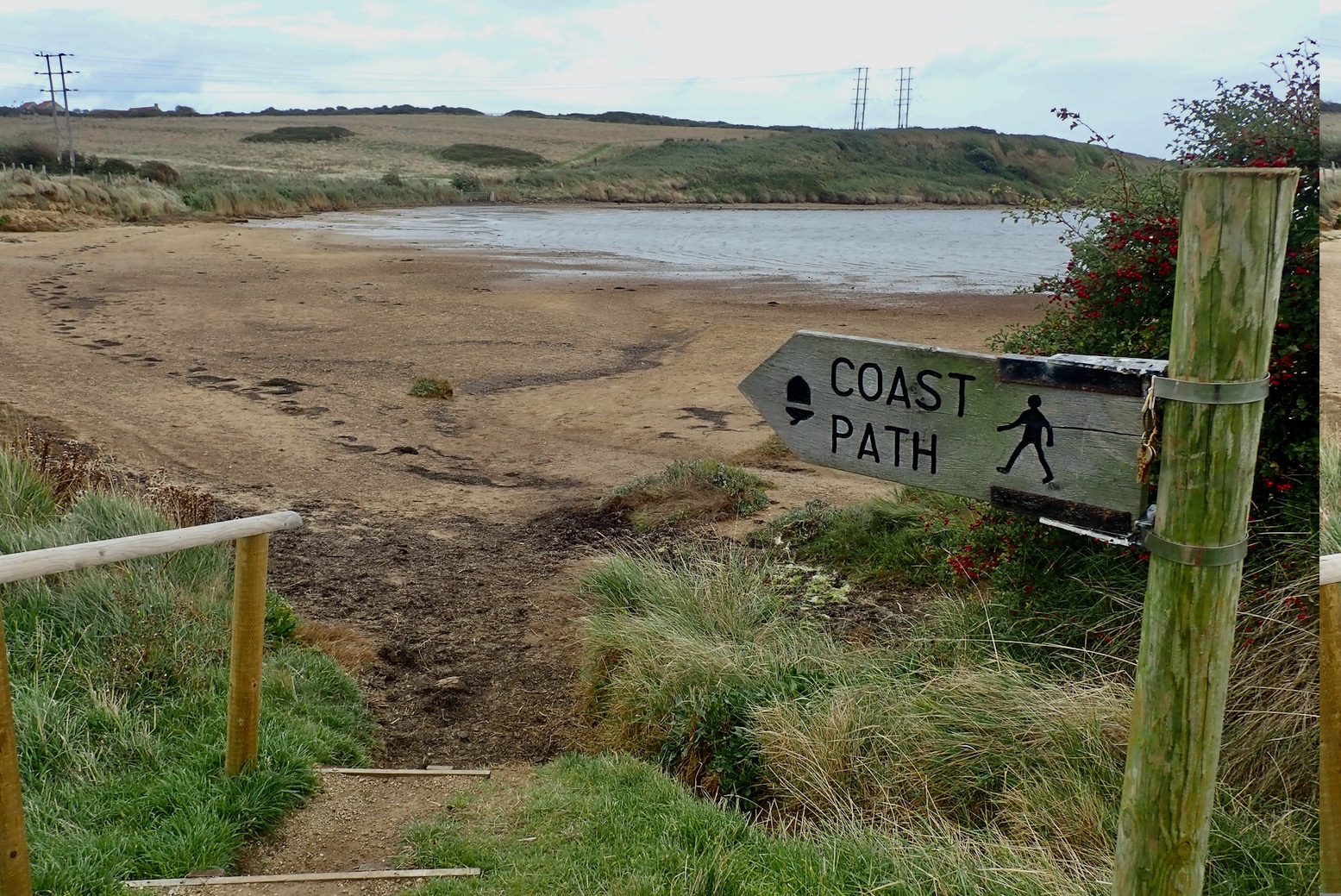
Langton Herring’s private slipway and the upper limit of ‘mid Fleet’. East of here prohibition becomes strong discouragement: … serious safety concerns [exist] even for the shallowest drafted craft in the mid Fleet: extensive intertidal mud-flats… some channels are a dead end … mud is too soft to walk on … impassable ‘flannel weed’. They really don’t want you to get to the water, do they. Along the shore regular green signs like above remind you there is no public access to the ‘hazardous foreshore‘. Additional signs warning of ‘quicksand’ on the shore. This was just like being on an English river!
The back side of Moonfleet Manor Hotel (formerly the Mohun’s Fleet House) would not win any awards.
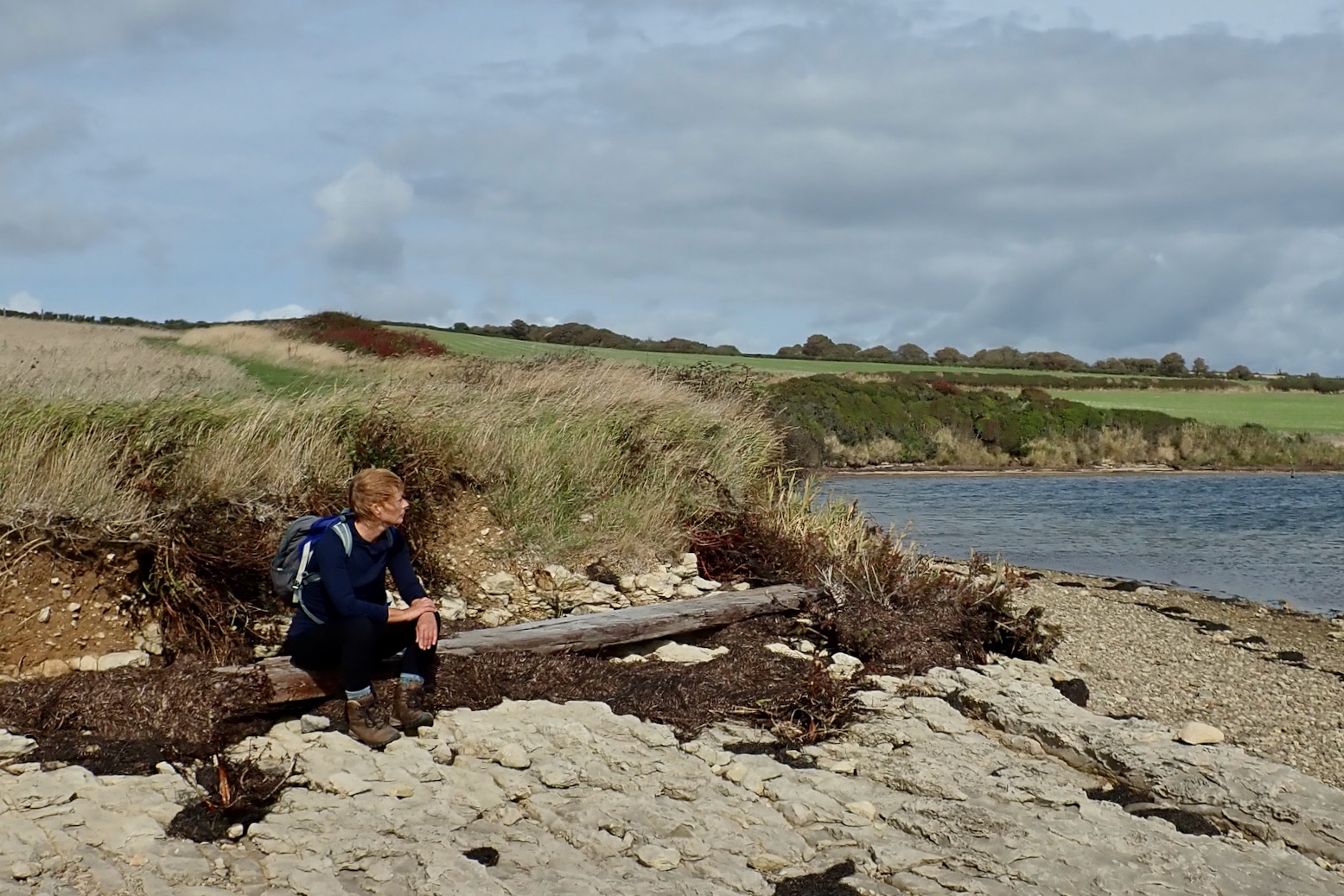
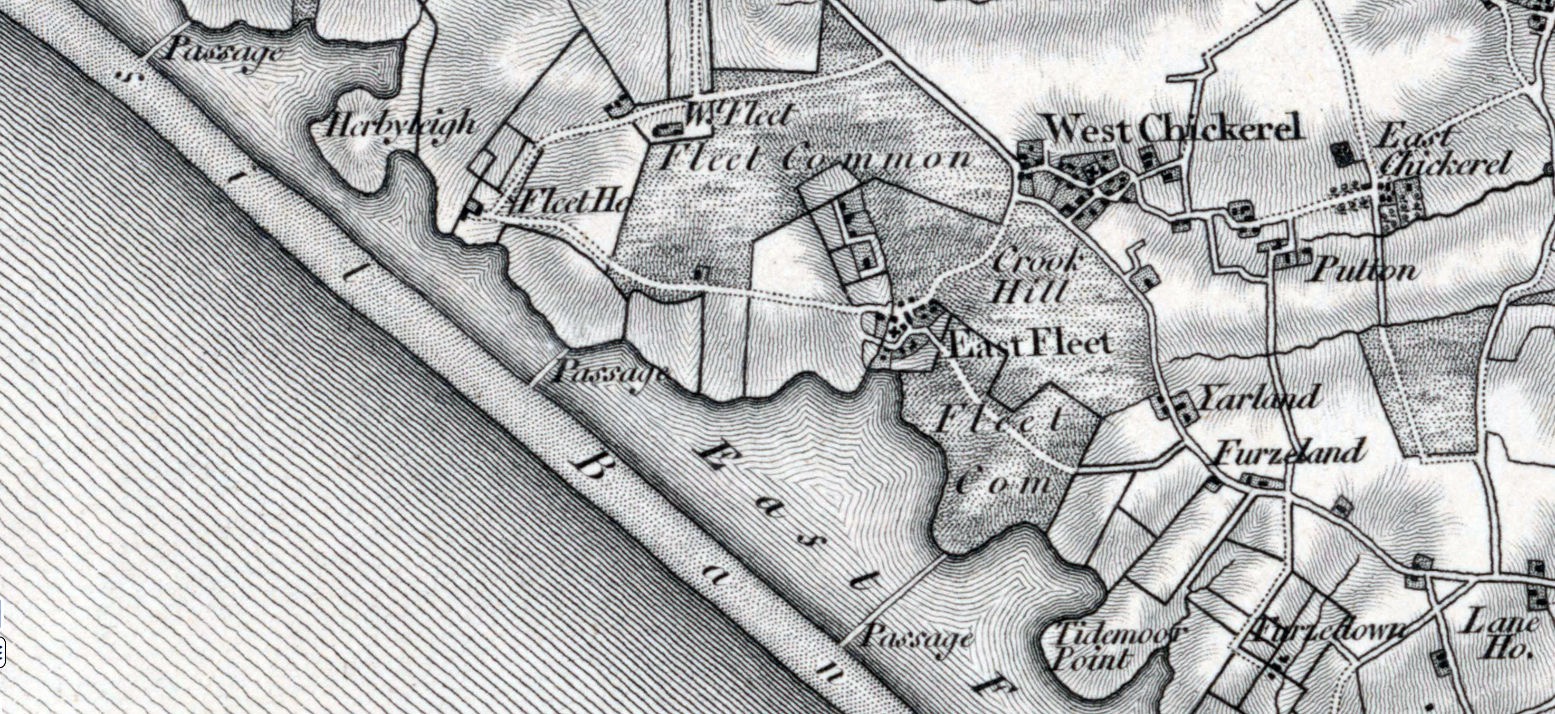
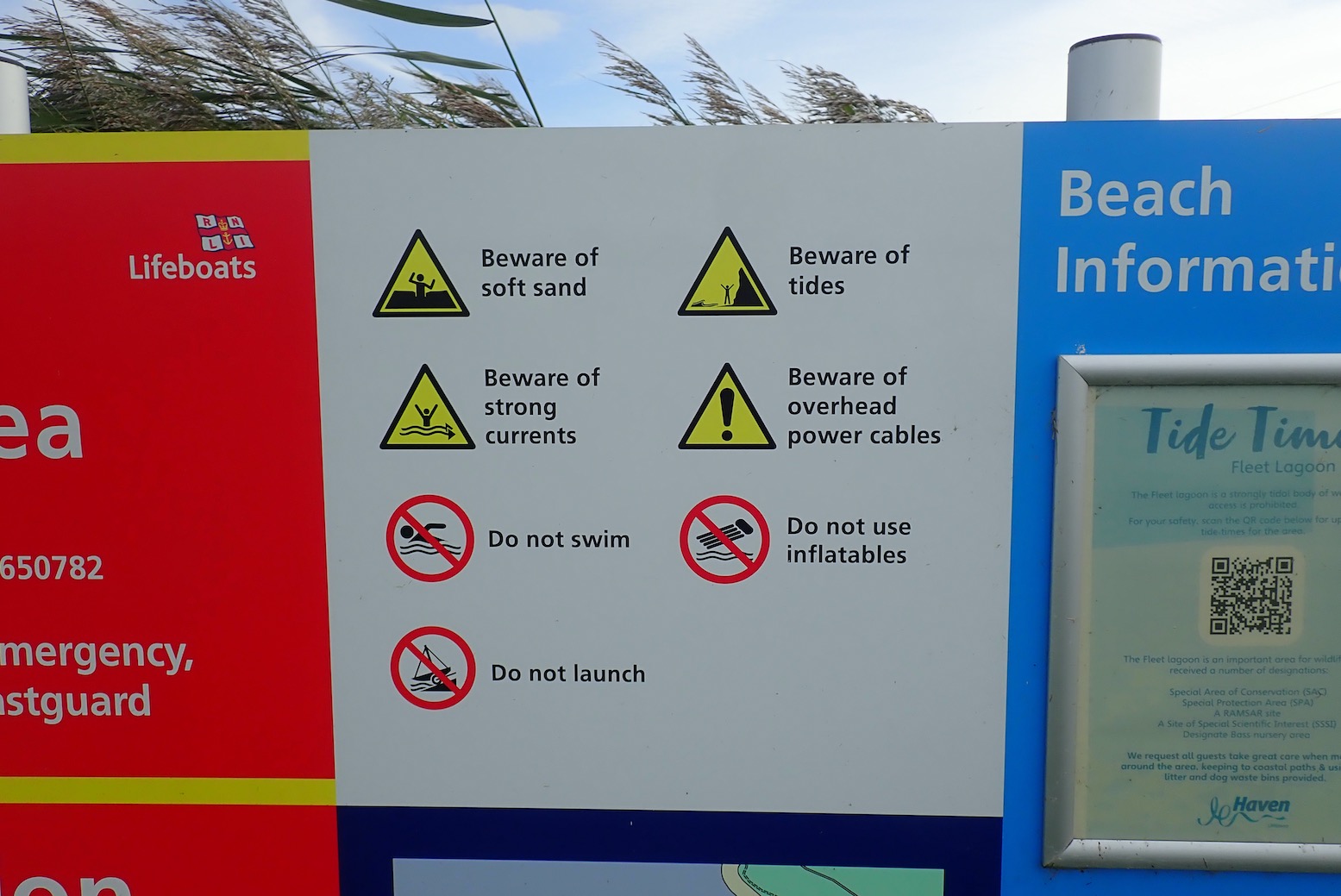
Sorry love, you can’t sit there.Green signs as thick as tangleweed – and an old jetty.In East Fleet we visit the original church, part rebuilt after the 1824 storm which breeched the Chesil and funnelled a wave up the Fleet creek to demolish half the church. It’s said the real-life Mohuns are buried in the vaults below. In the book their coffins clank about on the rising tide to warn off superstitious folk. In fact it was also a stash for barrels of finest French brandy, the ‘Milk of Ararat’!Old maps show causeways crossing the lagoon. Handy for bringing the tax-dodging plunder inland without getting wet.Fleet and Moonfleet.The Mrs and I debate vigorously about paddling the Fleet. ‘They clearly don’t want you on the water’ vs ‘They are not prohibiting it outright’. One trick the C&FNR miss is suggesting that the Fleet might be a bit boring to paddle, with the shingle bank obscuring sea views and general tidal sludge. Kayaker ahead (not pictured)! They hack out across Butterstreet Cove (above) into the strong SW wind, then turn back. They probably put in at East Fleet Farm campsite and interpreted the sign above as ‘paddlecraft not prohibited’. Interesting. Round about here the maps show a mile of tidal mudflats to the southeast, just before the Narrows lead on to Portland. But the maps also indicate a permanent channel right alongside the Chesil shore. Stay on the Chesil side if in doubt.More good news: it appears Chickerell Firing Range is ‘closed until further notice’, though with the way of the world right now, mobilisation might be round the corner so it would always pay to check.Later on, an explanation for the litany of dissuasion and prohibition becomes clearer. The popular SWCP follows the Fleet’s north shore and is frequently busy, not least because it is probably one of the easiest, flattest days on the whole 600-mile walk. Those merry hikers need to be protected from inadvertent trespassing!Littlesea Holiday Park’s list of Dangers & Prohibitions including ‘no inflatables’. Rats! Seems odd though, establishing a camp on the coast but with no access to the shore whatsoever and by whatever means. ‘Oh well, mustn’t grumble.’At ‘Martleaves Bay’ near Weymouth the SWCP takes to the beach. Traumatised by fears of sinkmud, we hack inland though thick reeds and brambles, as other have done.The Fleet Bridge linking Weymouth with Portland.
What about the matter of unravelling the tides so as not to get stranded on the cloying mudflats for 12.5 hours? The nearest datum is Portland Harbour into which the Fleet empties. I’d guess Portland + half an hour lag at Langton, but locals at the Ferry Bridge would known better.
Weymouth. Not walked 14 miles in many years.
Thinking it all over I realise I’ve fallen into the packrafters’ mentality of putting in to take out somewhere else, not the usual ‘there-and-back’ which heavy hardshells usually do. Asking online, access into the Fleet seems straightforward: put in at Ferry Bridge and paddle no further than Langton (8km) then paddle back without touching the sides. You’ve can’t say you’ve not been warned, so woe betide if you come a cropper in the mud flats, strangleweed, rip tides and all the rest. Riding the tides may work, but you’re going to catch the wind one way, or more likely an all-day southwesterly crosswind, like we had. So this is one scenario where a wind prone packraft would be a bit too slow for enjoyment, given the other opportunities in the area.
For a couple of years Longshore International sold self-branded packrafts from China, as did a few other ‘side-hustlers’ at that time.
Tim (left) actually undertook mini adventures with his products and in 2018 we reviewed their EX280 tandem in Scotland (right). But Longshore and most others shut down, possibly due to supply issues during Covid, even if demand went off the charts at that time. The website expired and their YouTube vids were deleted, but a couple of Tim’s yarns remain online at Medium (an early SubStack?), including this two day hike and paddle along the Devons’ south coast. Interestingly, he advises that some of South Devon’s many estuaries are privately owned, something I found out myself the other day while recce’ing the Fleet lagoon near Portland. No all UK tidal waters are freely accessed it seems, but at least they are extensive. Most pics by Longshore.
Over two days we hiked and paddled about 40km. Whilst we were carrying a little more gear than other hikers we met along the South West Coastal Path, our packrafts enabled us to cut across rivers whilst they had to traipse inland looking for a crossing. We also had the option to vary our route away from the official path, exploring otherwise inaccessible creeks, coves and estuaries. I suspect the sea kayakers we launched with, arrived far quicker than us but travelling only at sea level they missed some stunning views from the jagged pinnacles and tors above the coastal cliffs. Read the rest.







































 Inflatable Kayaks & Packrafts