See also: the similar but wider and DS-floored Thaya
Gumotex have rebranded 2013’s Solar 410C as a Solar 3 (some call it ‘Solar 019’). Everything about the two boats appears to be the same.
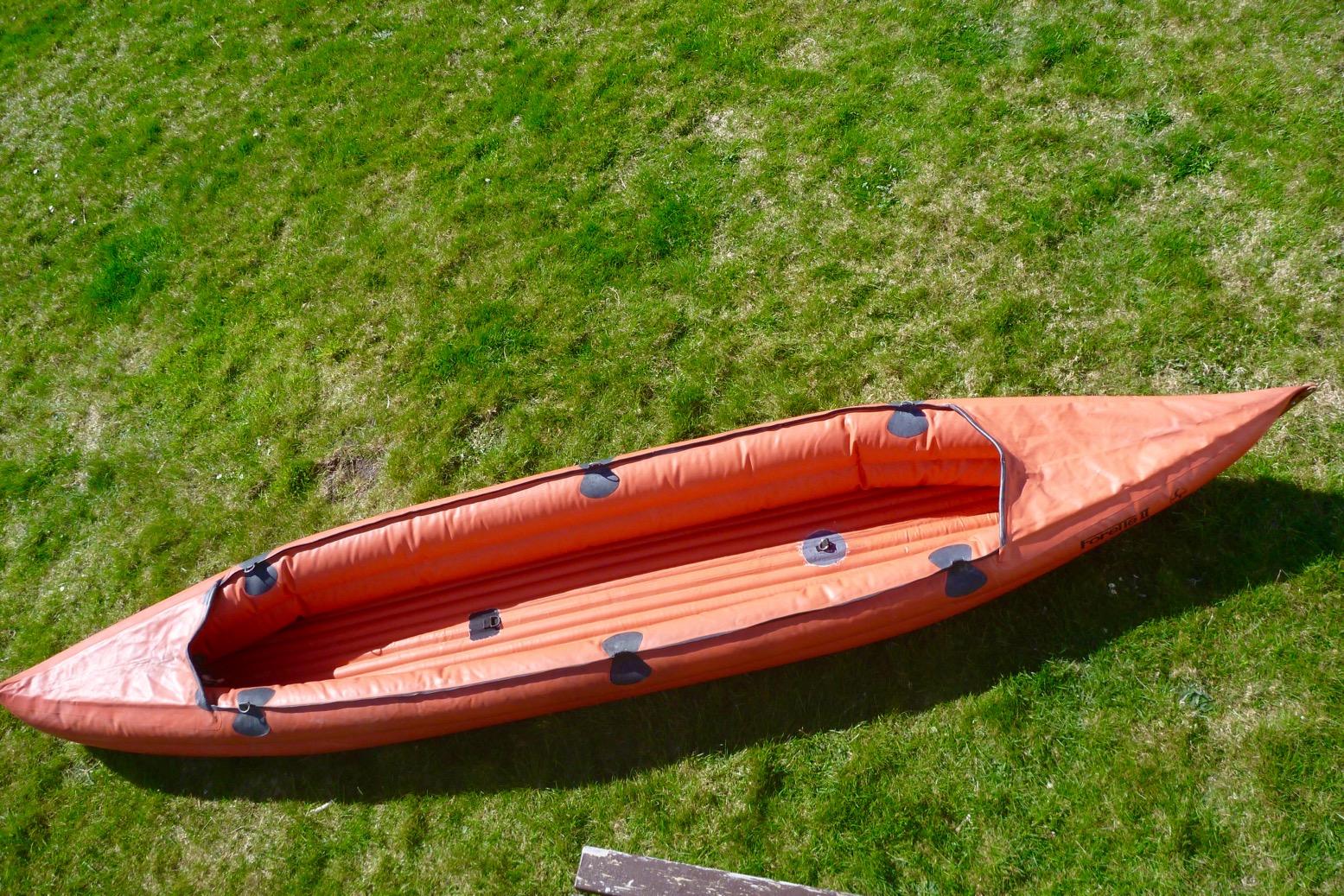
Actual differences only add up to a longer front splash deck (left) with a metal support to stop sag – and a drain slot at the back (right; an idea copied off my old Sunny, just so you know!).
The 410C evolved from the slightly shorter Gumotex Sunny (left), in its day a brilliant IK which I used for years and years, until the flexing and size outgrew my needs.
Pressure in the Solar 3 remains the standard 0.2 bar, but this only becomes an issue when used solo at sea (the boat sags in the middle and can swamp more easily). Two or three up on flat water, it won’t be so noticeable or will be part of the fun. The Solar 3 is pitched as an easy river-touring or family recreational boat where price and space matters more than pressure and performance; for that you have the 0.25 bar Seawave which costs 40% more. For now the Solar remains the an all-tube and inexpensive option to a wider, dropstitch Thaya and is the last of the classic Gumotex longboats.
Performing my cutting-a-kayak-in-half trick gave me a long overdue chance to see exactly how they’re put together, as well as other stuff, like why it was failing and how well certain glues stuck.
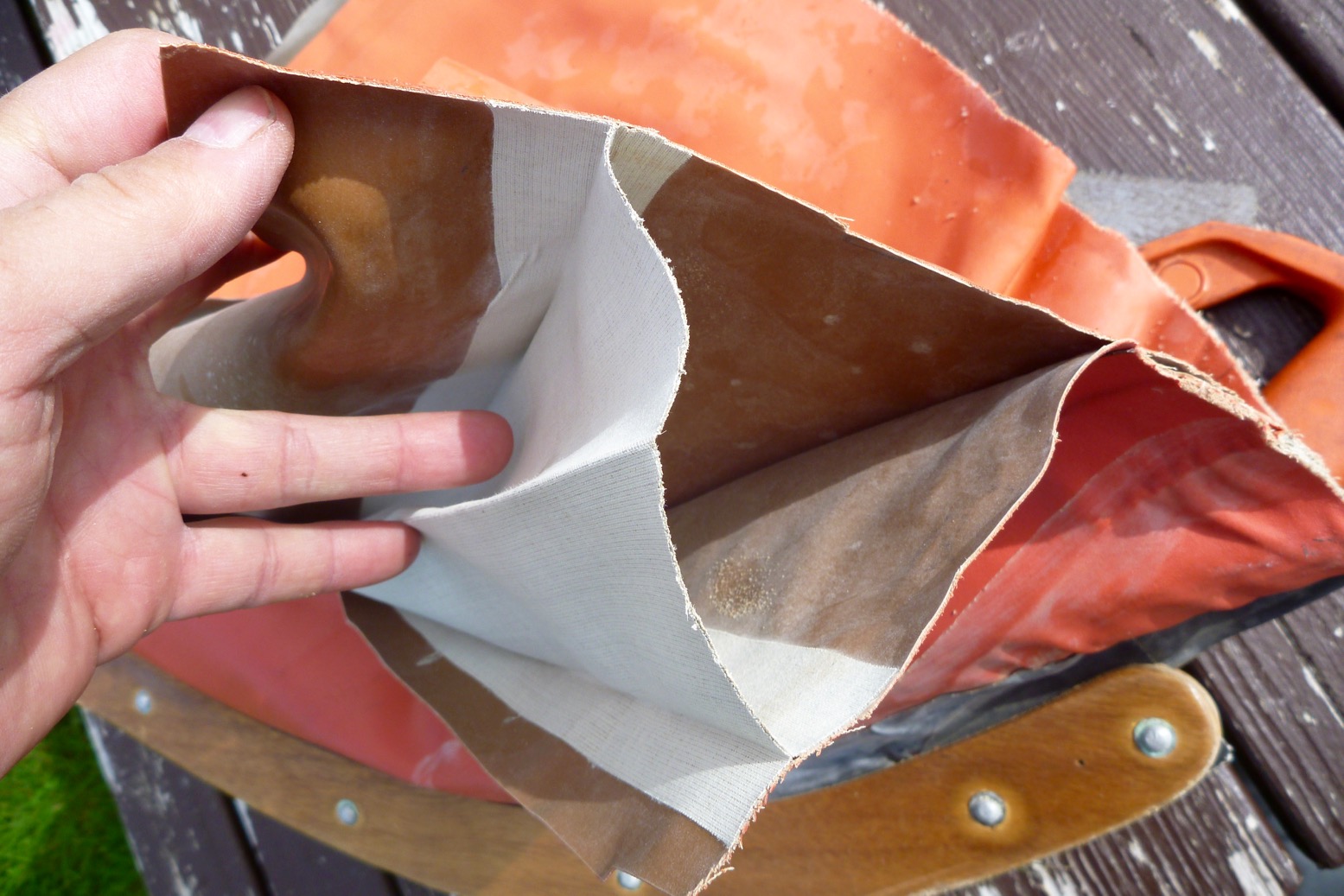
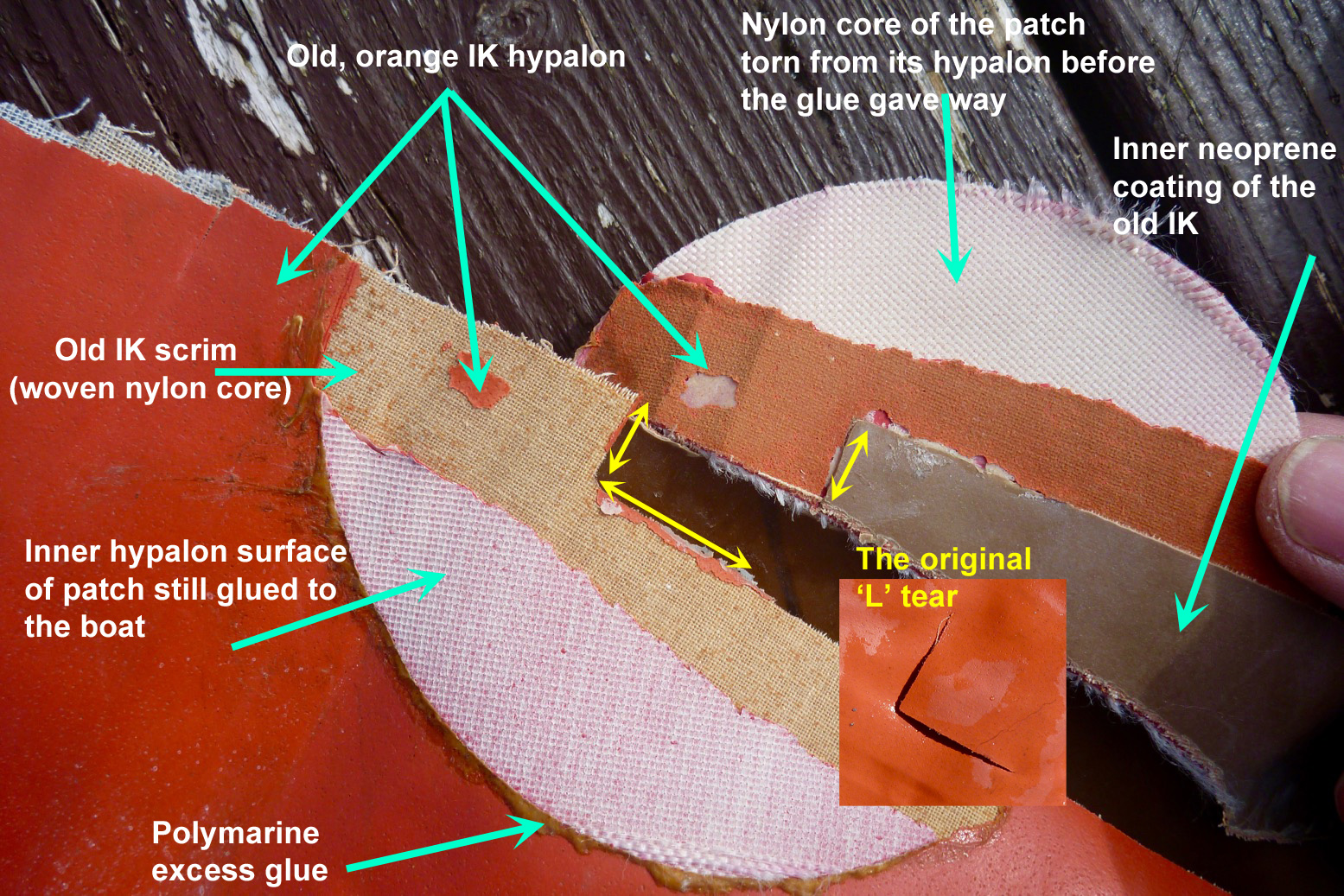
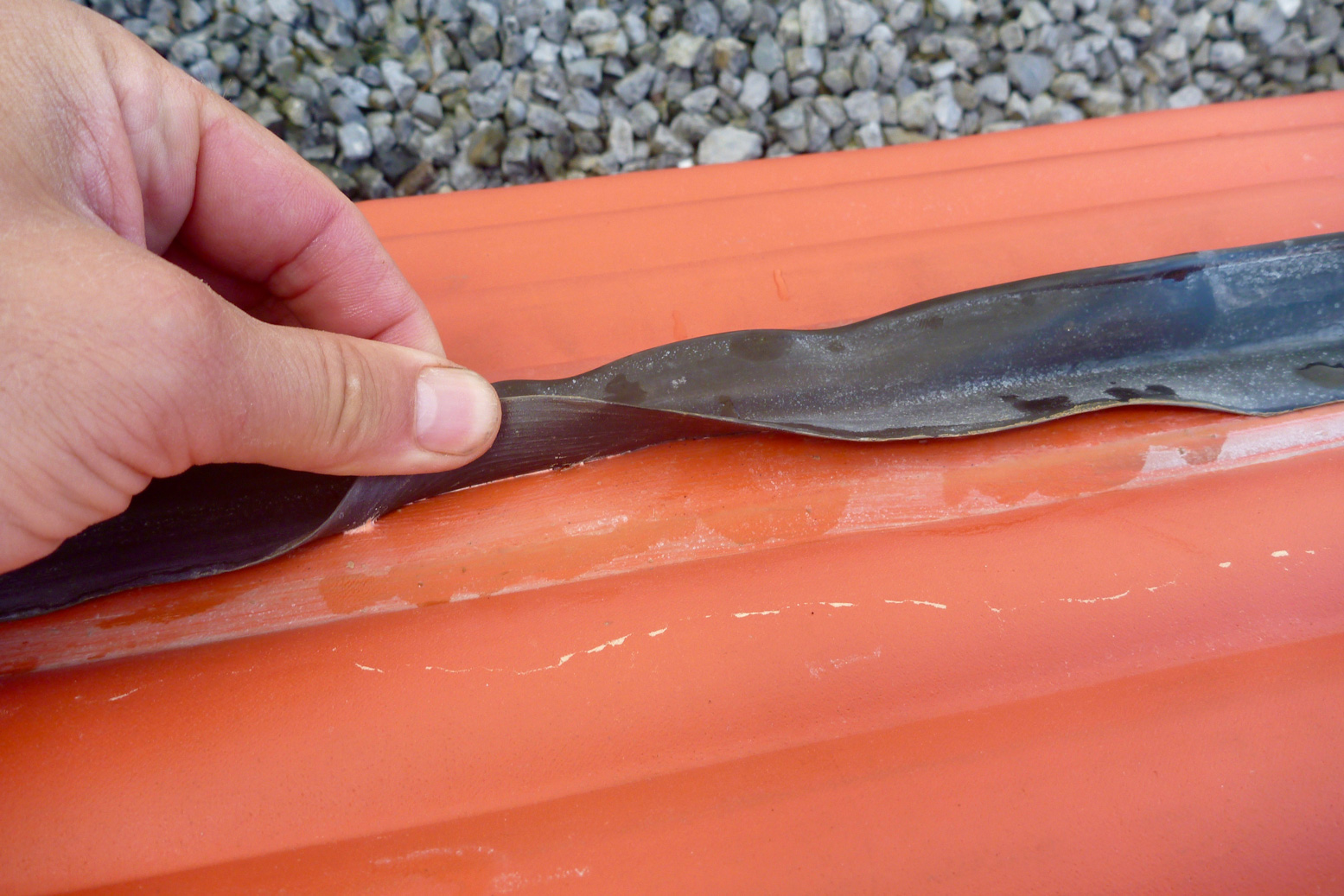
The neoprene inside I used to assume it was the same coloured coating inside the boat as out; it’s just simpler. But of course, the diagram left is clear: what’s outside and what’s inside an IK hull is not the same stuff. There’s no need to waste UV-resistant hypalon coating (or colouring or that matter) inside the boat’s benighted chambers. All it needs to be is the same durable and airtight coating, and neoprene – the brown rubber-like coating left – does that fine. I bet I’m not the only one to mistake ‘neoprene‘ as simply that closed-cell sponge used in wetsuits or laptop sleeves. In its solid form it’s a durable synthetic rubber, but I presume lacks the full-on UV resistance of hypalon which DuPont invented shortly after.
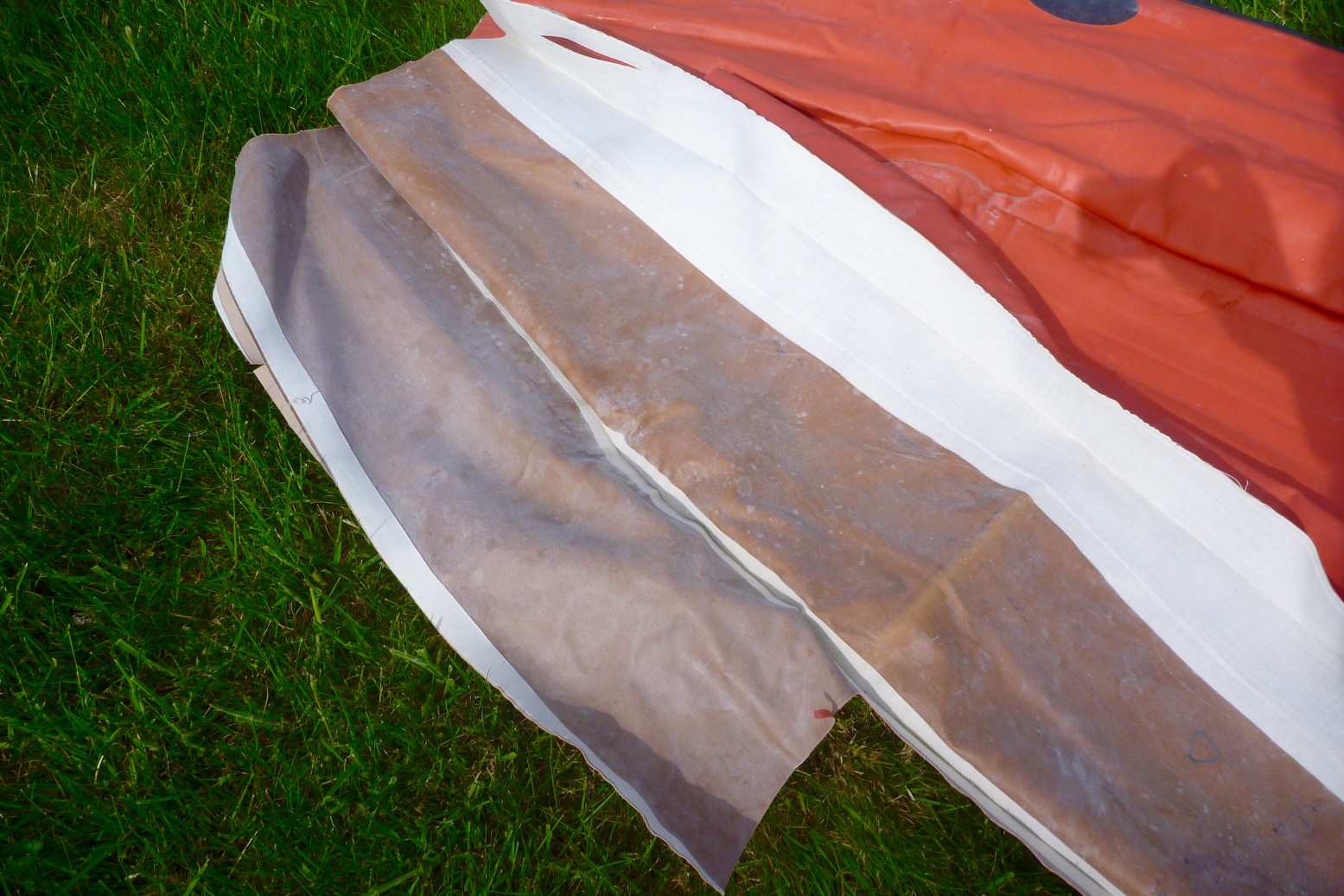
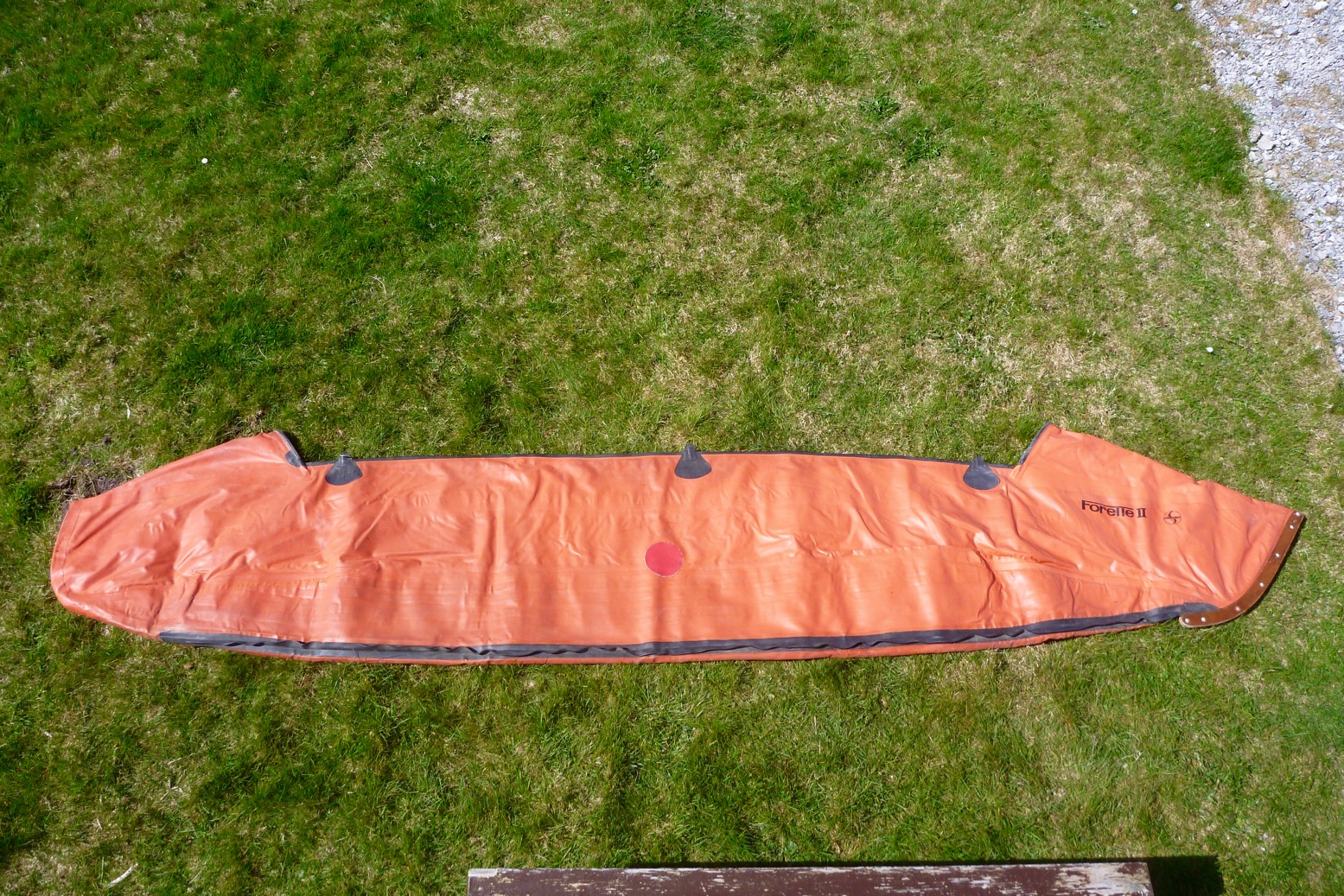
I-beam floor As mentioned here, an inflated vessel will seek equilibrium by attaining a rotund form, be it tube or sphere. A flat inflated plane such as an airbed or an IK floor needs to be a series of parallel tubes unless it’s just a non-inflated sheet, like packraft- and white-water raft floors. So this is an IK I-beam floor (above): probably the same tough core of nylon or polyester scrim, but without the impermeable hypalon and neoprene coatings of the exterior panels. Note the pre-folds or creases to help the Semperit pack flat. I imagine modern IKs do the same, but it all explains the necessary attention to detail which makes ‘tubeless’ IKs like this so labour intensive, compared to ‘bladder’ designs like Aire.
Twin side-tube IKs like this Forelle, the Incept and Grabner Holidays, have two smaller tubes one on top of the other, rather than one fat side tube like my Seawave (below, red) or Amigo. It gives the same buoyancy, more freeboard (above water height), a slimmer profile (more speed) and more volume inside (easier loading). The red Seawave below is 82cm wide; the Semperit is 72. It makes the boat look a whole lot better too and overall, because it’s also as stable, I’d say it’s the best design for an IK, but it also needs I-beam sections to constrain the two side tubes.
I can’t say I could suck air through the scrim easily, but I’m pretty sure it’s porous – I didn’t find any transfer holes to allow air to flow between adjacent tubes – they might be a weak point. When an IK like this is over-inflated (or left in the sun) and has no PRVs (none on the Semperit), it’s this scrim which either tears apart, most probably at the T-join where it’s glued to the neoprene. I tried tearing sections of scrim by hand; impossible where it was uncut, but as soon as you nick it with a knife it would tear quite easily, like thin cotton cloth. This fabric was at least 40-years-old and had one or two patches of mildew, but was still tough and the whole assembly of the boat has held together amazingly well over the years.
Where mine failed Inspecting the fatal second leak alongside the earlier repair, it seemed air was pushing through where two sections of I-beam scrim butted against each other. Perhaps the old coatings stretched differentially here or were just worn out. It did look like the hypalon was simply flaking away. I could have fixed that leak but, as mentioned, another would probably pop up whack-a-mole style somewhere else, quite possible while at sea in either my- or a new owner’s hands.
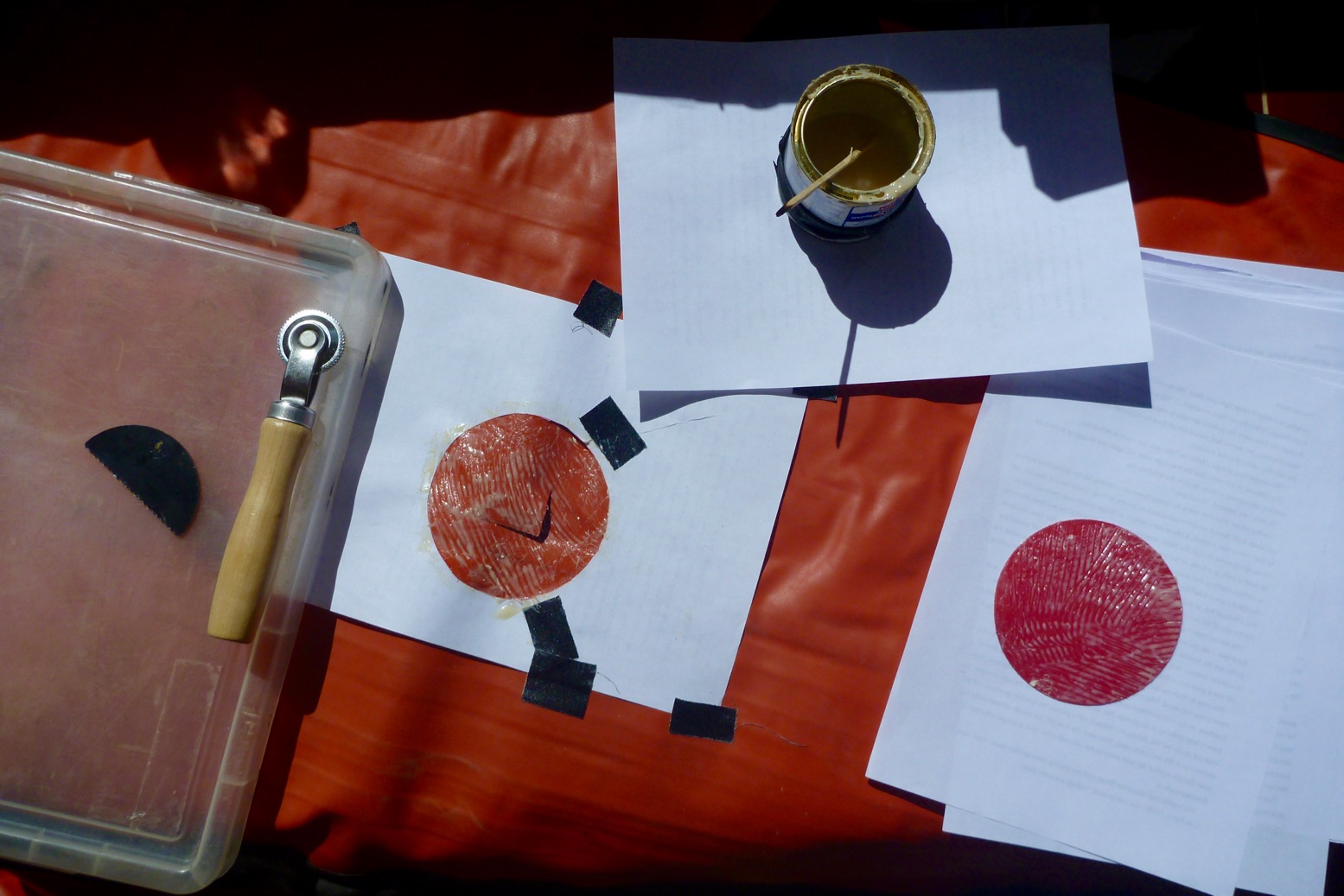
Glue test I repaired the big original ‘L’ tear with a 5″ round patch of hypalon and two-part glue (above and left). I then patched a down-to-the-scrim scratch under the hull with one-part Bostik 1782 (left). I used the same glue to repair the initial new leak inside (bubbling water, above).
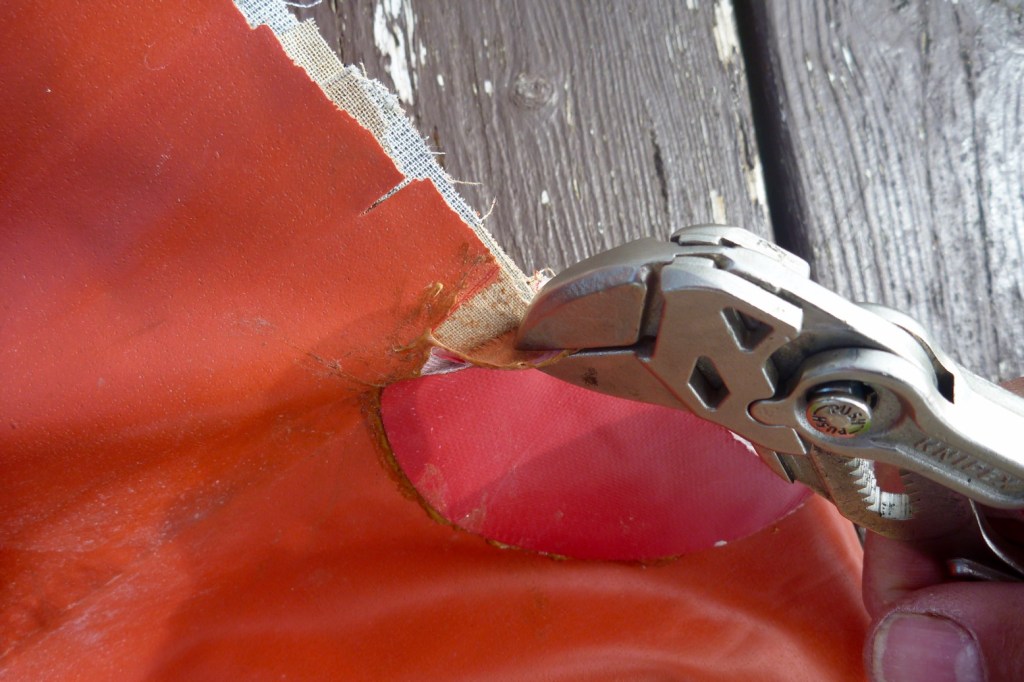
Although I’m pretty sure they’d have lasted, I could easily pull off the Bostik patches by hand. Pulling off the big round Polymarine’d patch was another matter. It just so happened I’d sawn through the round patch but, only once I got some pliers under a lip (above left) was I able to separate it from the hull. As you can see in the big image below, either the ancient orange hypalon coating of the IK, or the newer red hypalon of the patch separated from their respective nylon cores – the glue’s bond was stronger than the actual hypalon coatings, new or ancient.
I get a bit lazy about having to faff about with two-part glue, and I also wonder if I ever guestimating the 25:1 ratio correctly. But as you can see, this stuff sticks. If you absolutely, positively want things to stay stuck or sealed, use two-part adhesives. I still don’t know if the second part curing agent merely speeds up the drying process, or is chemically integral to creating the very strong bond. I’d think it’s the latter, otherwise why bother.
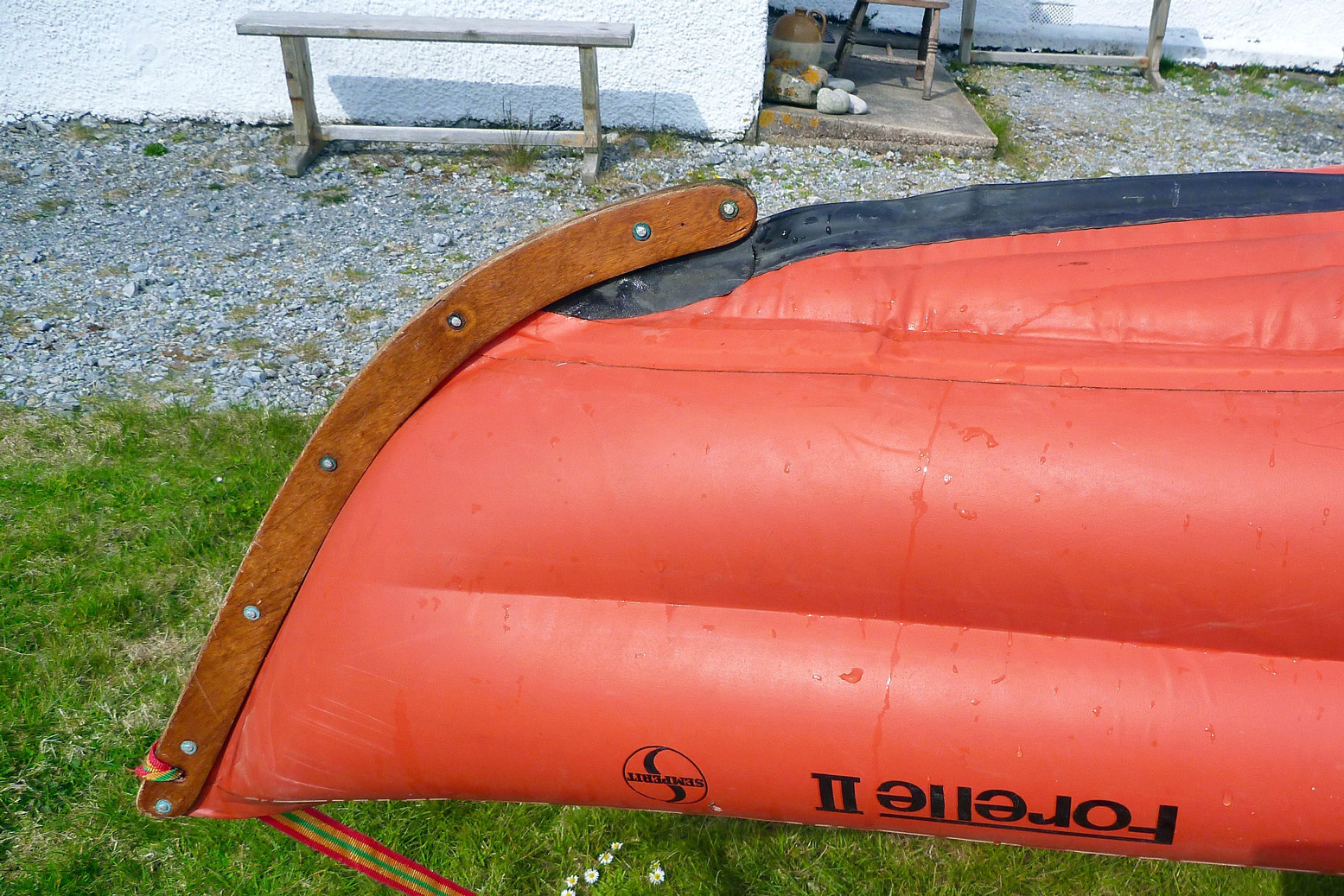
Other stuff The distinctive marine plywood bow has lasted fine – no warping at all and the rivets are still intact. It may have been an early design solution to easily joining the three sections of the hull in a nice sharp point, though they managed that join easily enough at the back. Maybe it was as much for protection and a frontal tracking aid.
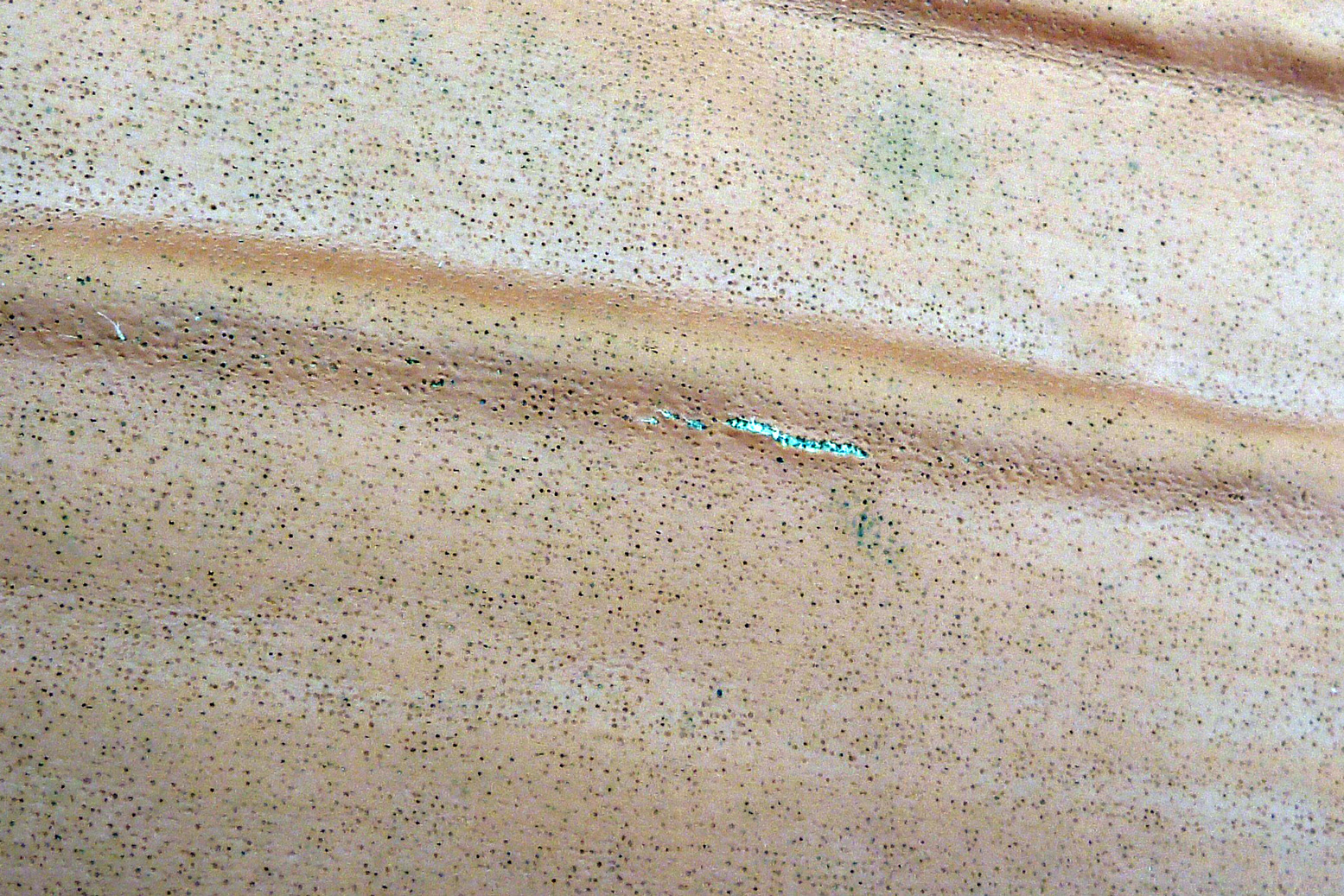
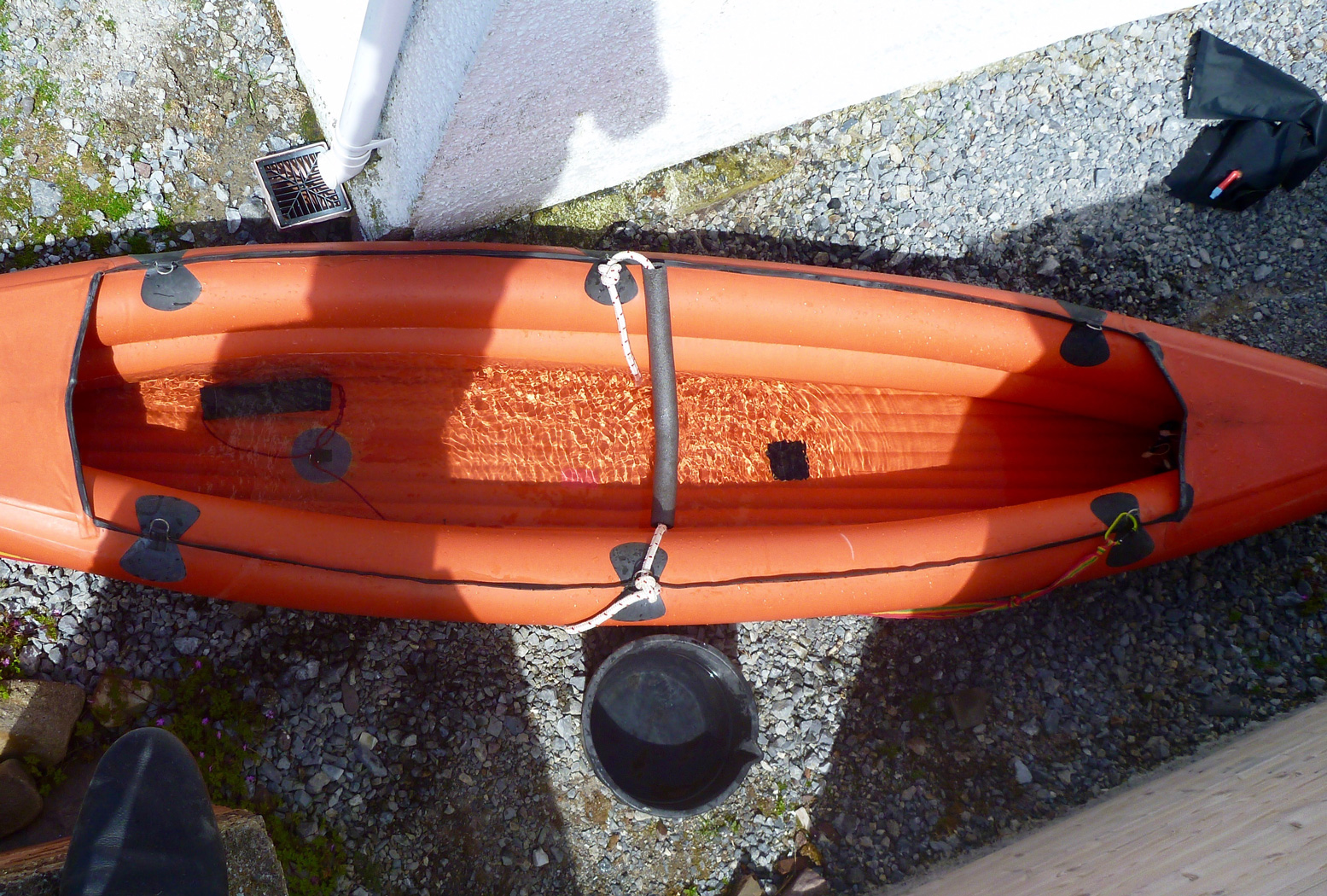
A couple of days after trying out the Semperit I noticed a scratch on the hull bottom (left) so decided to pre-emptively patch that with Bostik 1782 (less faff than 2-part). It looked like an old scratch which had opened up by reusing the boat. I reinflated a day or two later, but a few days on noticed the floor was flat. I pumped it up again – air was hissing from a crack in the hypalon coating inside the boat, more or less under the seat (below; colours enhanced for clarity).
This seemed a bit odd. The boat hadn’t been over-inflated or left in the baking sun, and there wasn’t any obvious rubbing in the two hours I’d used it, though I suppose this is a high-wear area and an old boat.
I suspected general, age-related delamination or entropic porosity. The outer orange hypalon coat can be rubbed or scratched down to the fabric core, as with the hull scratch I’d just repaired. But inside should be an airtight layer of neoprene. There’s no way of checking that without open boat surgery. To be honest, it’s what I half-expected from a 40-year-old IK, which is why I’d kept the refurb and expenses to a minimum. I suspect sudden use after many years possible neglect had accelerated decay. I see the keel-strake is coming away too, as are some other black patches holding the rusting D-rings.
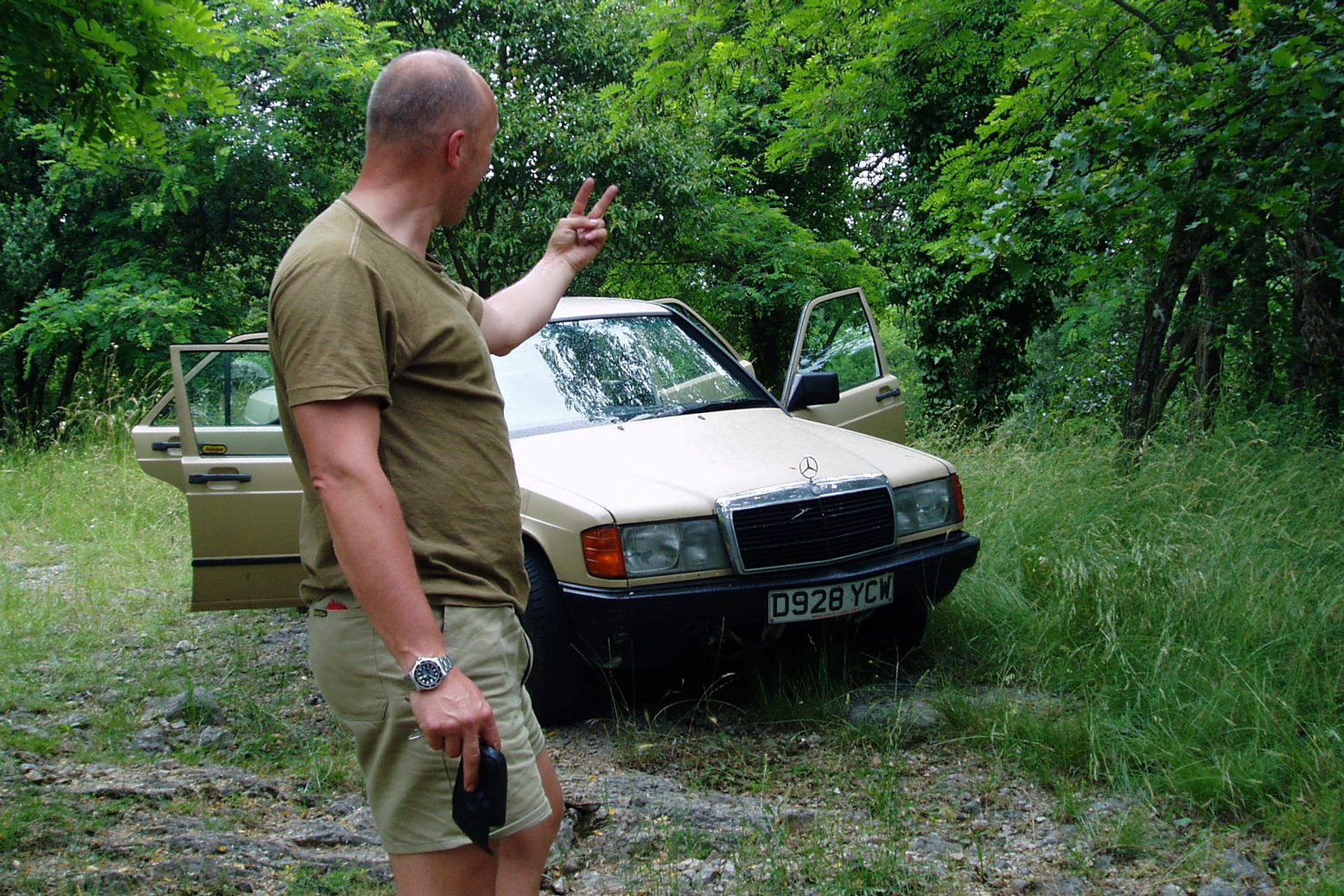
I’ve experienced similar deterioration when buying old vehicles for long trips. They seem like a bargain and have a solid ‘they-don’t-make-’em-like-they-used-to’ reputation. But reviving them, or just asking them to perform as they once did, can lead to a string of failures until it’s just not worth it (left). Much depends on how they’ve been maintained over the years. I recall writing in one of my books (or maybe on here): “you can’t give your old gran a pair of trainers and expect here to run a marathon without having a heart attack“.
I patched the wear-hole with more 1782, reluctant to waste good two-part PolyMarine. I pumped up and filled it with water: all good, but an anomalous perforation somewhere else can’t be ruled out. That’s another thing I’ve learned with old cars and bikes: you replace the clapped-out engine then the clutch goes; you replace the clutch and the gearbox goes; you replace the gearbox and so on… The strain of refurbishment gets passed on to the weakest point, and when that’s repaired, to the next weakest point. An IK will get you to shore on two chambers, especially if it’s just the floor that’s gone. I had that once with the Incept. Out with your pals on a warm summertime river that’s no drama. Elsewhere, alone with the wind picking up; not so trivial.
Years later I learned PolyMarine make SealFlex – a latex sealant (right) to revive old inflatables, PVC or plastic. You pour some in each chamber and roll the boat around for a couple of days. It costs £26 posted for 500ml – possibly worthwhile on your cherished RIB; not so sure on this old IK but had I known of it I may have given the old Trout a pint’s dose. After that you’ve got to know when to call it a day, and that day may have come. It might be fine for a guest or a rec river boat, but I don’t do so much of that nor have space for more stuff than I need.
A few hours later the floor was soggy – this time it had let go a few inches up from the recent patching. Up to then I’d been considering putting it back on ebay with a clear semperit caveat emptor. But then I decided sawing it in half would be more fun and educational. I always wondered what exactly an I-beam floor looks like. More here.
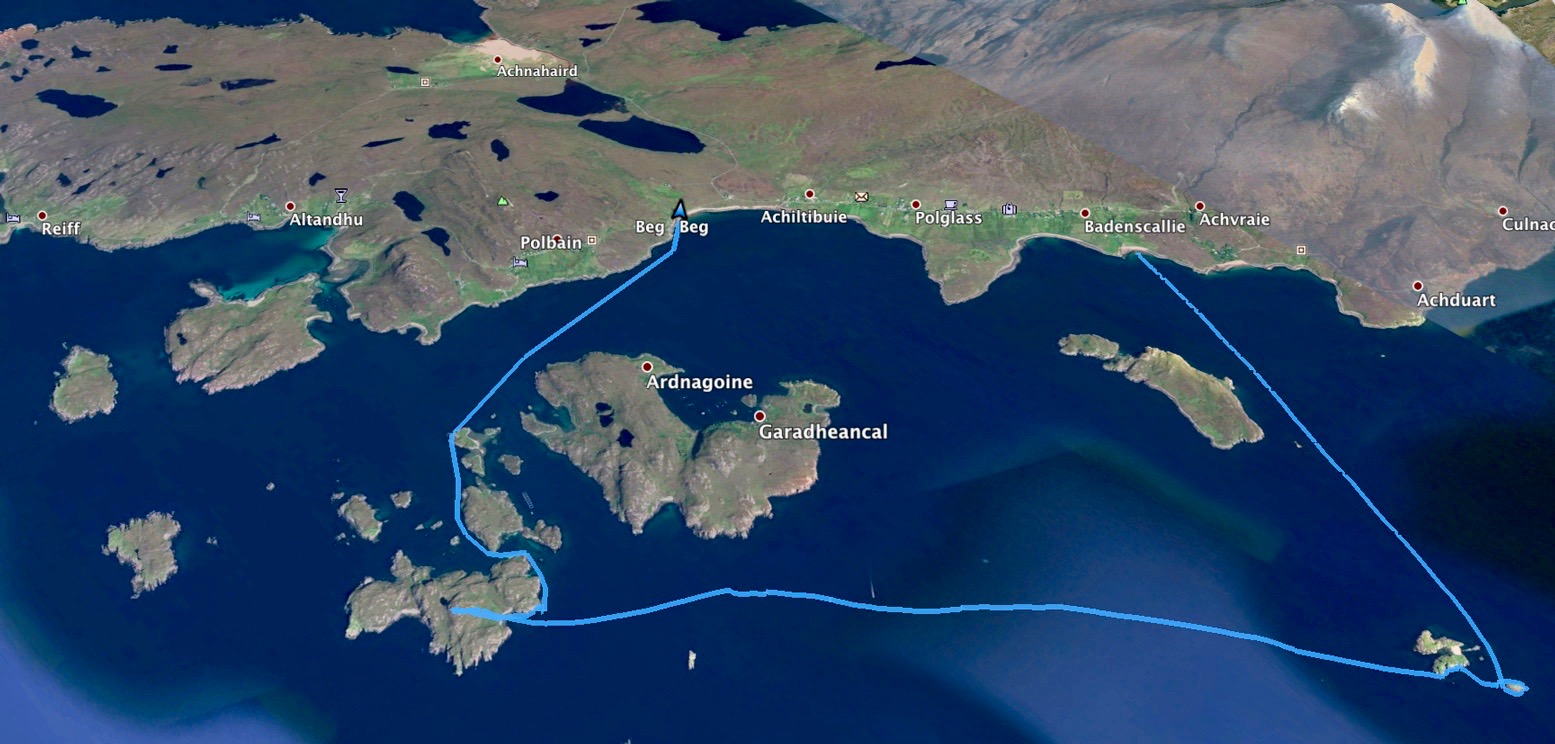
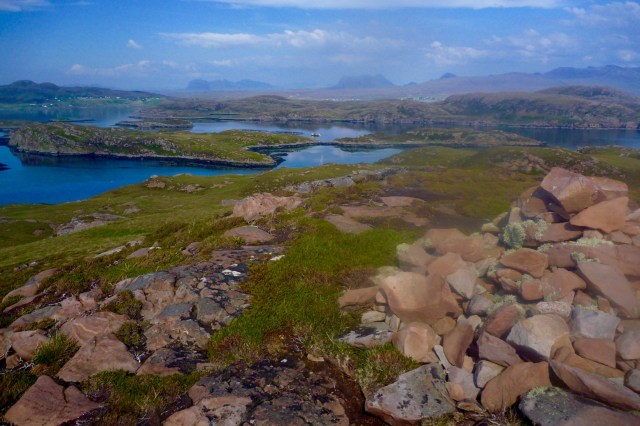
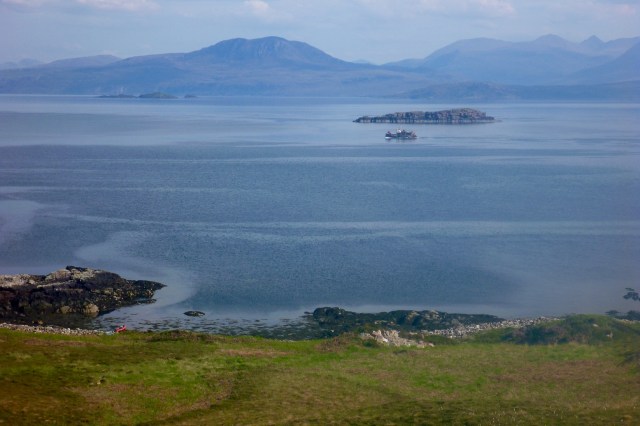
A few pictures from a 5-hour, 22-km paddle round the Summer Isles on a rare day of near-zero wind and hot, sunny skies. From Badenscallie I went south past Horse Island and Iolla Mhor to Carn nan Sgeir, a quick loop around Meall nan Caolach, just a mile from the south side of Loch Broom, then right across to Tanera Beg to revive the legs with a walk up to the summit, and finally back to Badentarbet. Noticeable is the lack of fatigue when there’s no wind or waves to cut through. I’d have been more tired walking the same distance. A few days and a bit more wind later, I did a 14-km lap round Tanera Beg and was pooped.
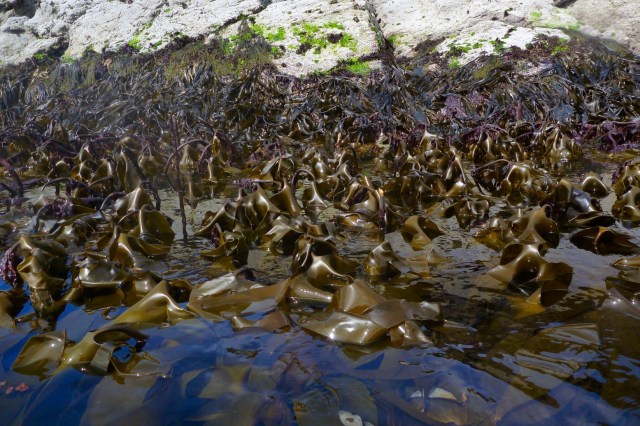
Glistening, brassy kelp round the back of Meall nan Caoloach, or Sheep’s Hill.
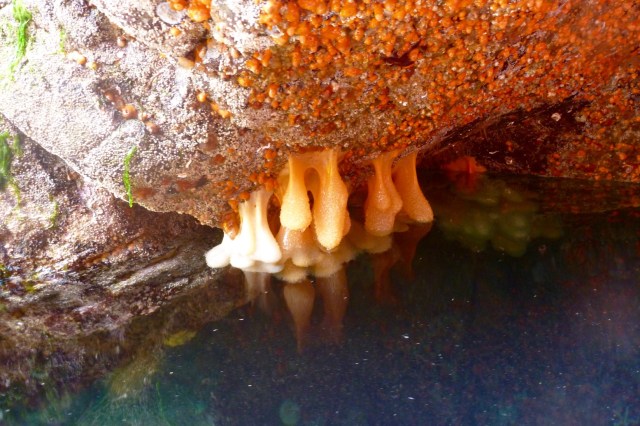
Strange dangular life forms you only see at very low tides.
Chestnutty limpets.
Faults and folds on Carn’s south side.
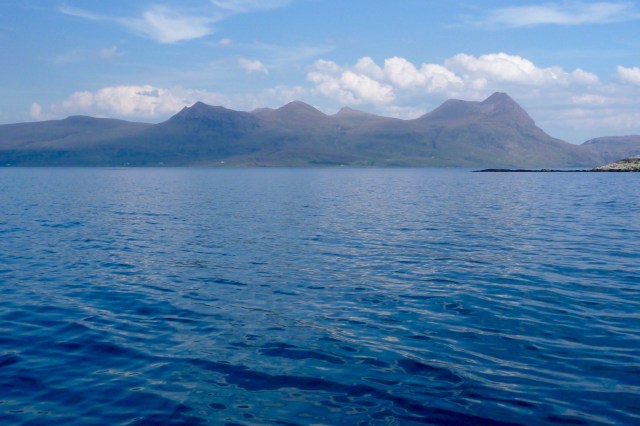
View north to Ben Mor on the way across to Tanera Beg.
South of Tanera Mor, the cabin’s roof on Eilean Dubh.
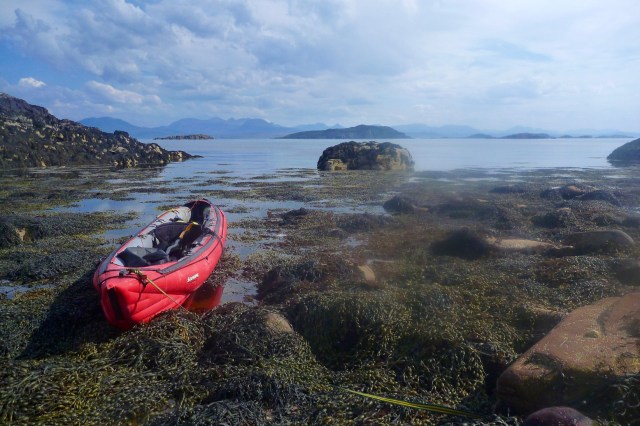
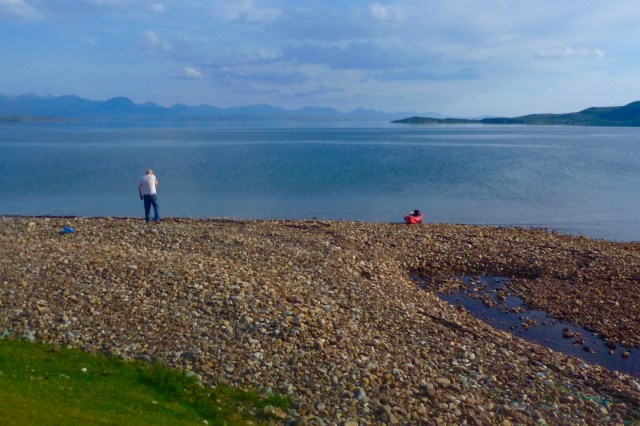
Landfall at Mol Bheag on Tanera Beg. Should I worry about the rising tide? I’ll only be gone half an hour. (Sorry – bit of lens smudge from here onwards.)
On T.Beg’s 83-m summit looking ENE towards Achiltibuie and the Assynt mountains.
Southwest, the curious wedge-skerry of Stac Mhic Aonghais – Cliff of Angus. Must try and nip out there one time.
Boat still there with two rocks on the anchor line.
Looking SE: Carn nan Sgeir back left; Eilean Dubh on the right. A trawler passes by.
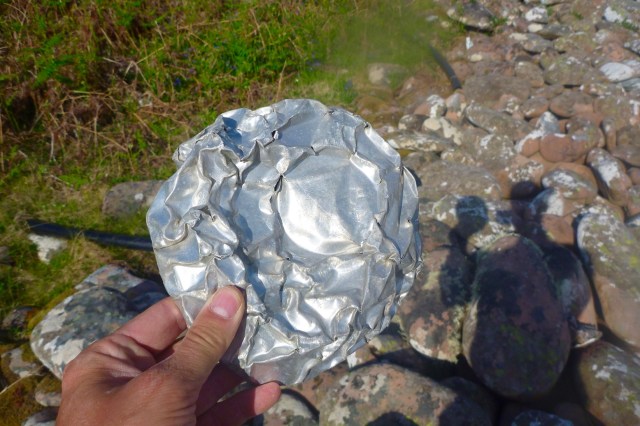
Storm-mashed tin can.
I find a superb crate/bench from a Fraserburgh trawler, and a massive pearl, too. Incredibly, this one is pre-threaded for a necklace which makes it even more valuable.
In just 40 mins the tide has risen a metre. I forgot that at mid-flow the rate of change is much greater. I wade in up to my shorts and clamber on with my treasures.Round the corner I come across the Tanera Beg arch.
Enough to pass under, but not enough to get right through.
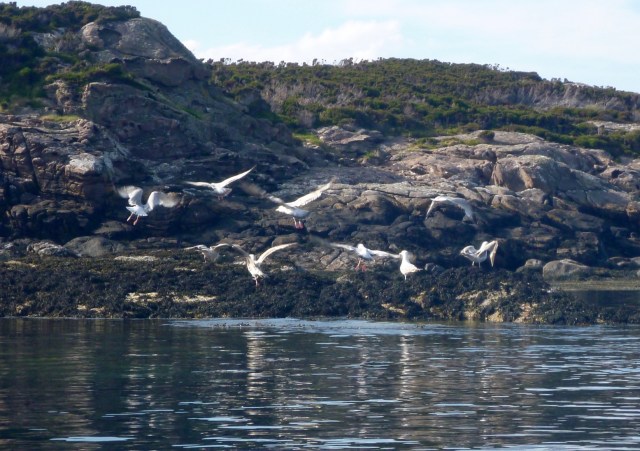
The birds are disturbed.
The sandy green depths between T. Beg and Eilean Fada Mor – aka: Caolas na Gainmhich.
Crystal-clear reflections – but always the racket of a boat somewhere. Makes a change from wind, I suppose.
Back towards Badentarbet after a great half-day out.
I notice several beer bottles bobbing around near the pier and sink them. Better that than smashed on a beach. Left last night by some beach campers, I suppose.
As tradition requires, I pass under the prematurely condemned pier. They say the new owner of Tanera Mor (who already has the diggers in), might replace Badentarbet pier with a floating jetty to serve his planned island restaurant. Currently, Old Dornie jetty is twice as far and tide-limited.
On the beach the owner of the cute Salmon Bothy is trying to locate an oystercatcher nest.
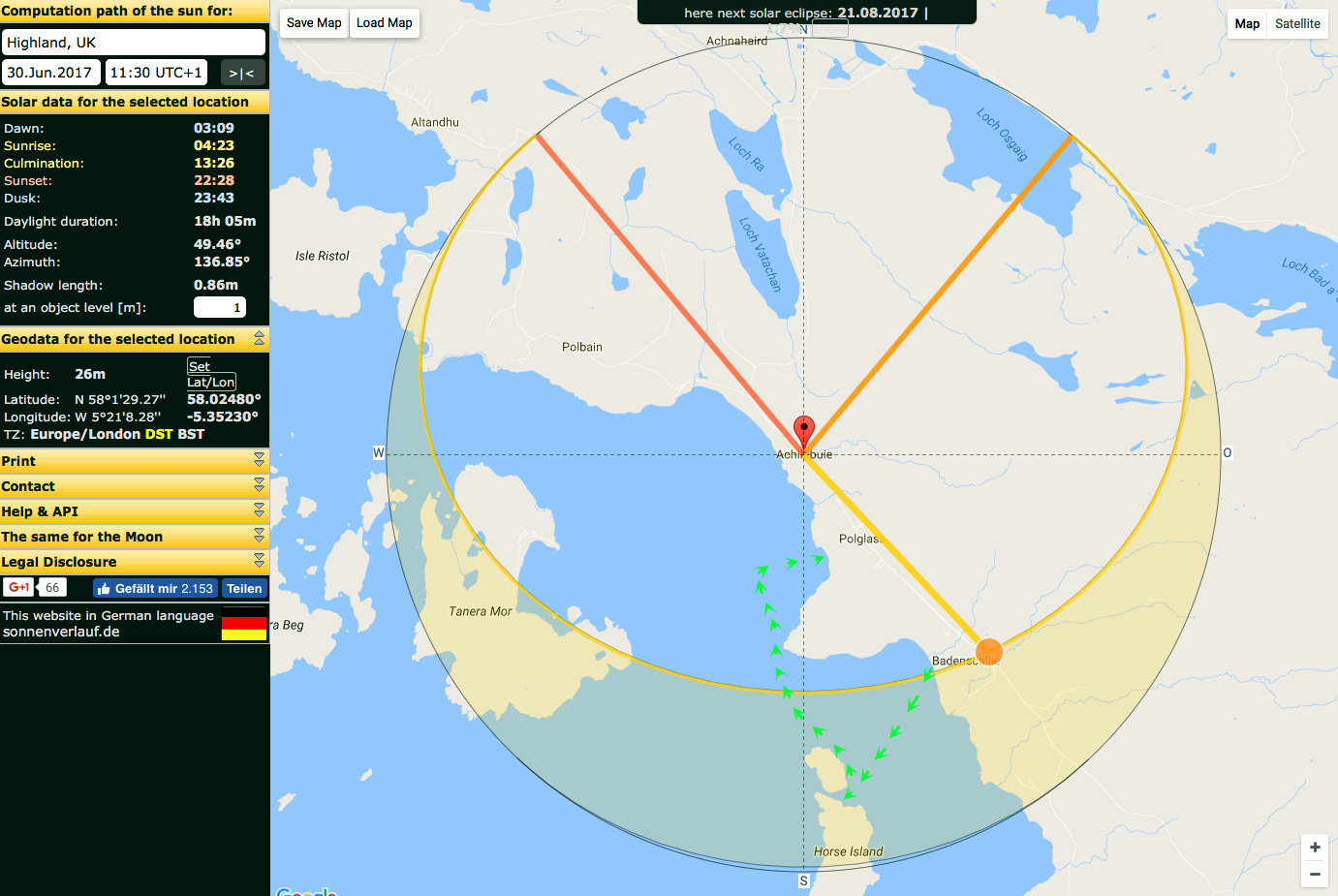
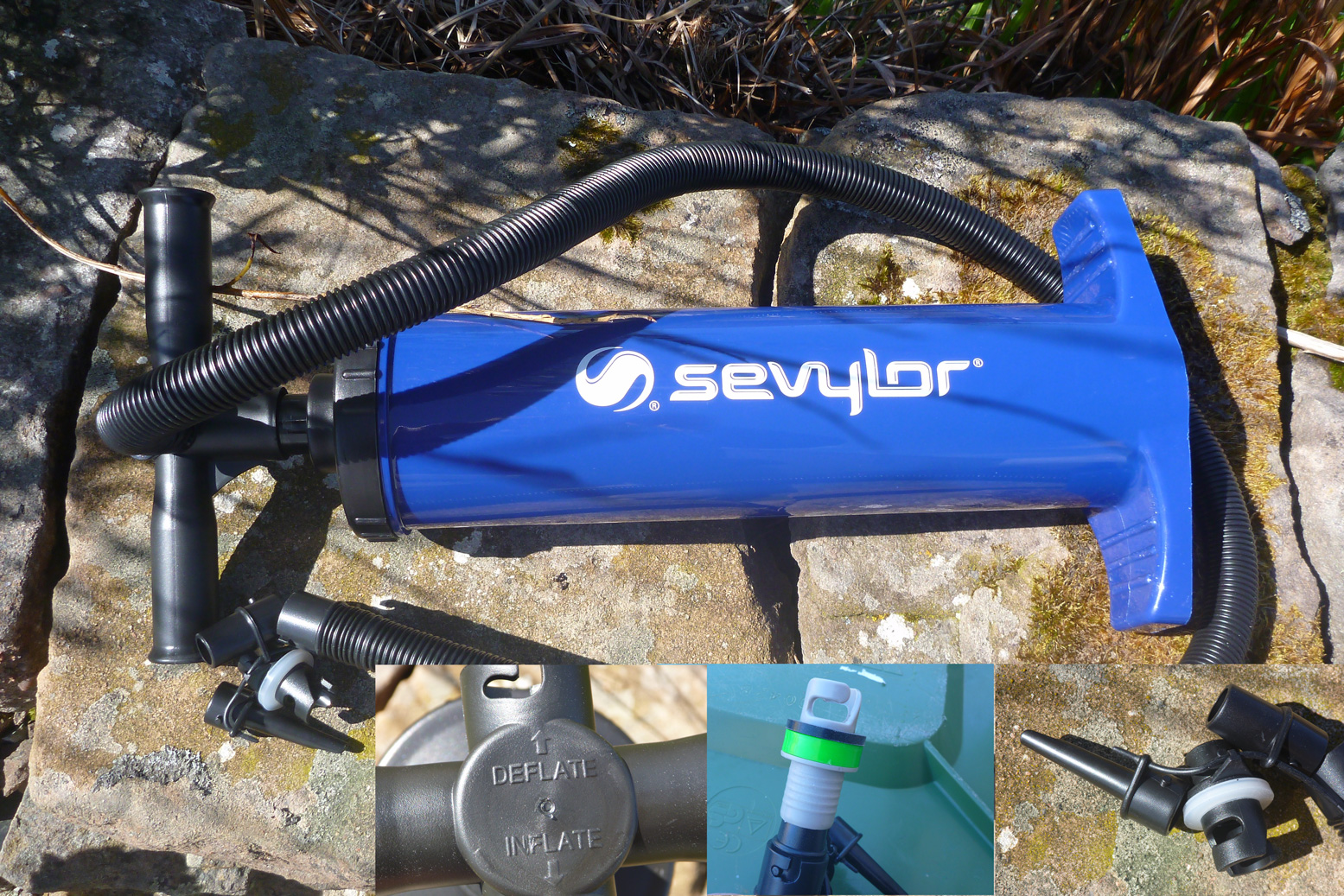
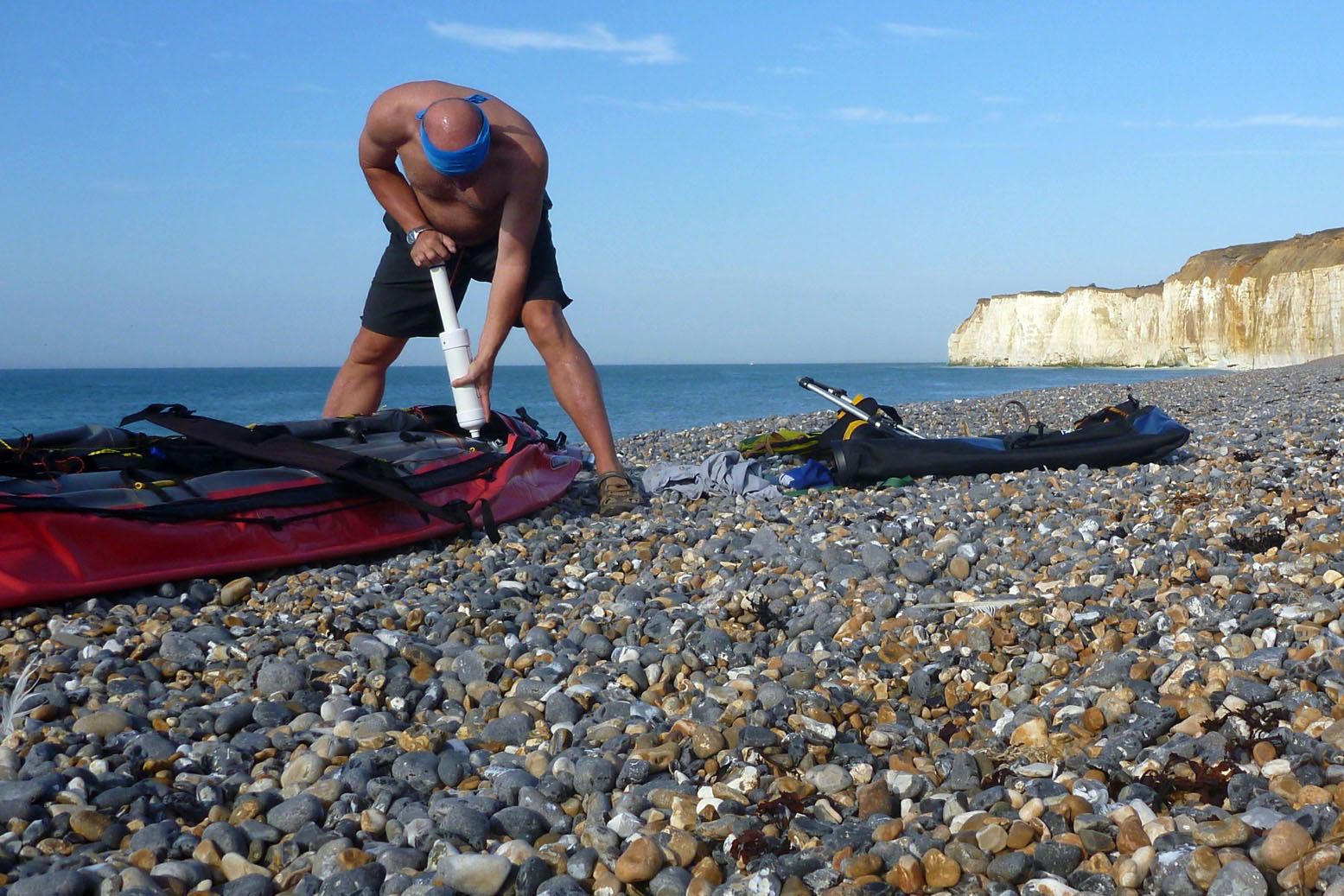
With an inexpensive Sevylor barrel pump I was able to get the repaired Semperit up to a good pressure. Ten days passed while I finished my current project, during which time the boat lost no air that I could feel. Over the same period the Seawave was a little soggy all round, as you’d expect with PRVs purging with changing temps. I keep the boats alongside the shadiest north side of the house, but this far north the early morning- and late evening sun still lights it up. In fact, looking at the graphic, above, it’s amazing just how far north the sun comes and goes at this time of year, a month from the solstice. Work out your own angles and azimuths.
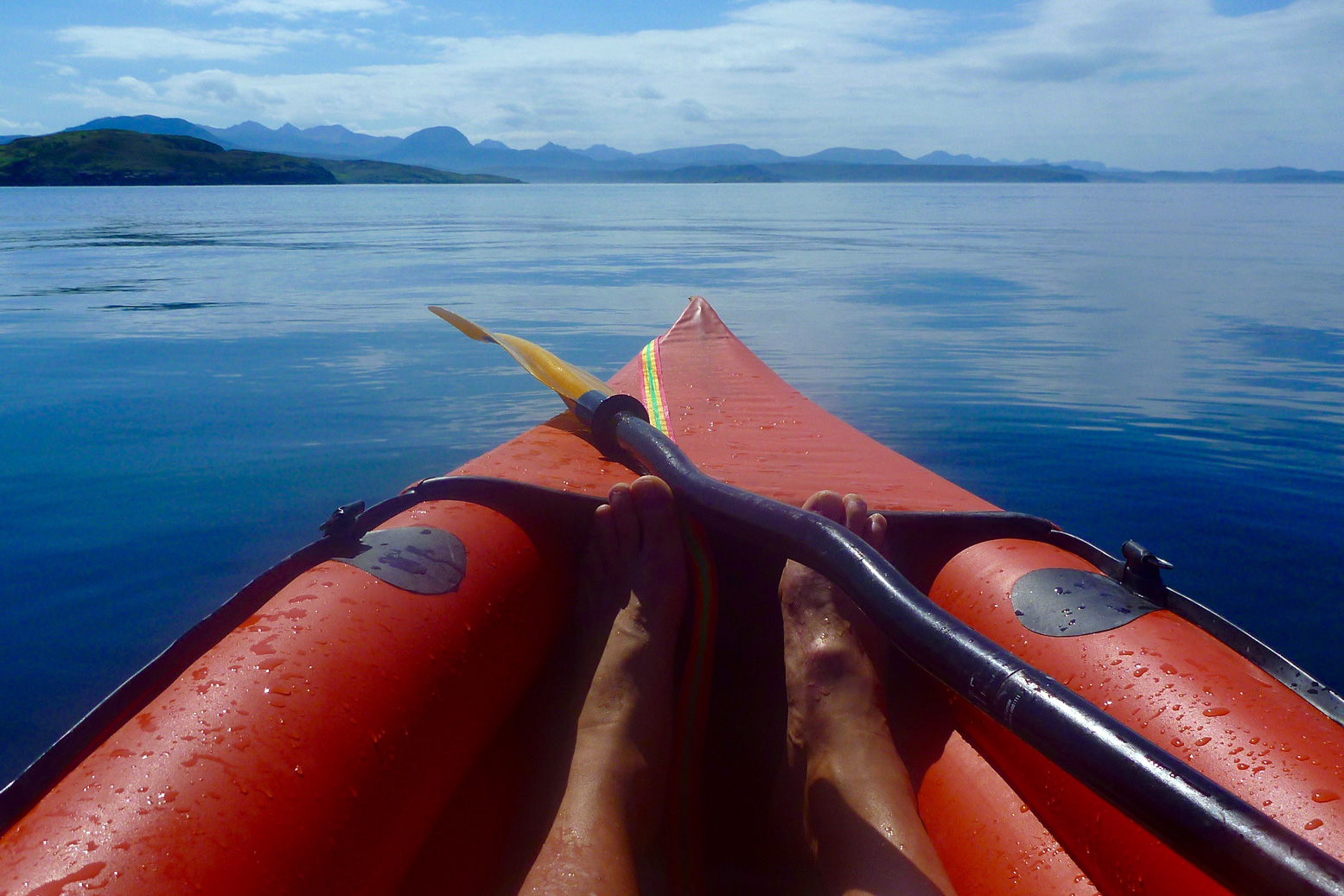
Back to the Semperit. With the desk finally cleared, conditions were as good as they ever get up here: hot, sunny and virtually windless – a triple meteorological miracle. I decided to nip over to Horse Island from Badenscallie (bottom of the map, above), still assuming the boat might track poorly and feel saggy. As it was, the Forelle felt much better – as good as you can expect of a 3-psi IK. With just the slight 2 o’clock head-breeze, I was reminded of the technique for skeg-free paddling: simply paddle gently to stay straight. You go a bit slower but in the near-calm conditions it worked, with the odd double pull to bring things back in line.
With spring tide flows peaking, I was too late to pass through the channel between Horse and Meall nan Gabhar, so I clambered up a hill. Looking south to Eilean Dubh and the outer Summers (below), I could have done the full tour in the Seawave. You only get a few days a year like this.
Back at the boat, it seemed a shame just to paddle the mile back to Badenscallie now that it had proven itself. So I set off north around Rubha Dunan. With the ring of mountains from the Torridans (below) up to the Assynt, what an amazing day to be out in a kayak.
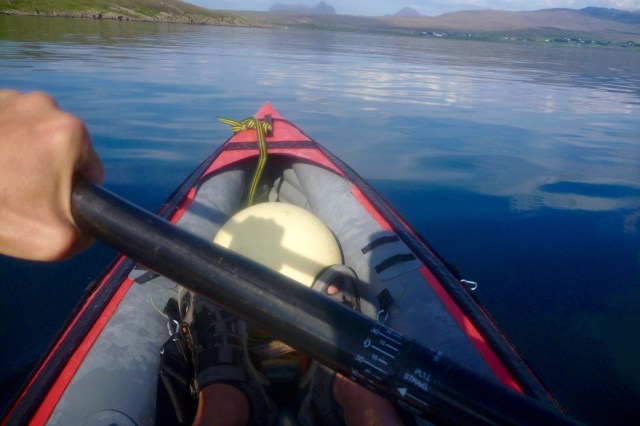
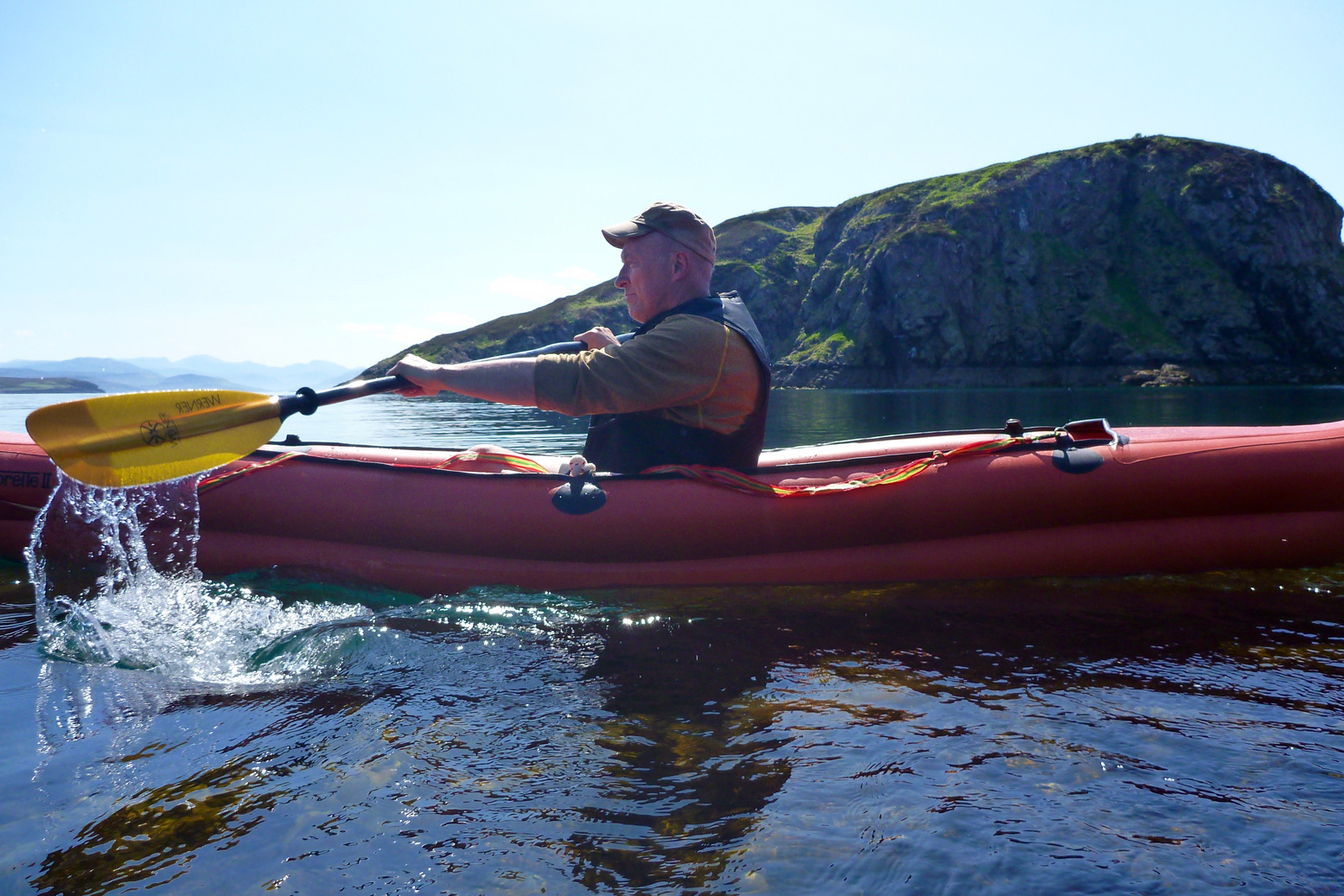
On the way back I managed a quick selfie to assess the sag and have to say that’s pretty good considering I’m nine times the weight of this 3.5-m boat. In a ruined croft on Horse I’d spotted a plank bench and thought about pinching it to level out the boat (by sitting on the plank), but in calm waters the fully pumped up Semperit was holding up fine.
It wasn’t all rosy: my old packraft seatpad was leaking from the stem base, and with my reluctance to lean back on the basic rope backrest, I couldn’t relax fully. I ended up sitting on my water shoes (a new pair of Teva Omniums) which gave me nearly enough butt-over-heel elevation for paddling efficiency. The rope could work well enough, but I don’t want to stress the ageing Forelle’s puny seat-mounts. What the boat really needs are a couple of bomb-proof D-rings on top of the sides to take the backrest strain in line (like I did on my old Amigo – left), but as I might be selling the boat, I’ll let the new owner decide what sort of seats they want. Like all IKs, with a higher seat or a small crate, the Forelle could easily be used as a canoe. I know a lot of people like them.
According to the map, Port Mhaire is where I landed. From here a new track led inland to the cafe at Polglass where I dumped the boat under some shady trees and walked back to Badenscallie.
With proper seat support and perhaps an articulated skeg pivoting off the existing rudder mounts, the Semperit would make a nifty boat for calm inshore and lochs, and rivers. But in the Seawave and my Alpacka Yak, I’ve got all the boats I need. It was fun to do up and try out the Semperit, probably the first serious IK from which twin side-tubers like most Grabners, the Incept and Gumotex Seaker can all trace their roots.
No doubt about it; since flogging my much-used Sunny in 2011, followed by a flawed experiment with a Feathecraft Java, I’ve become spoiled by high-pressure IKs like my fast Incept K40 (based on the Forelle’s design), the brick-hard but slower Grabner Amigo and my current lightly modified Seawave. Just 25-60% more pressure makes all the difference, especially once the boat gets usefully long.
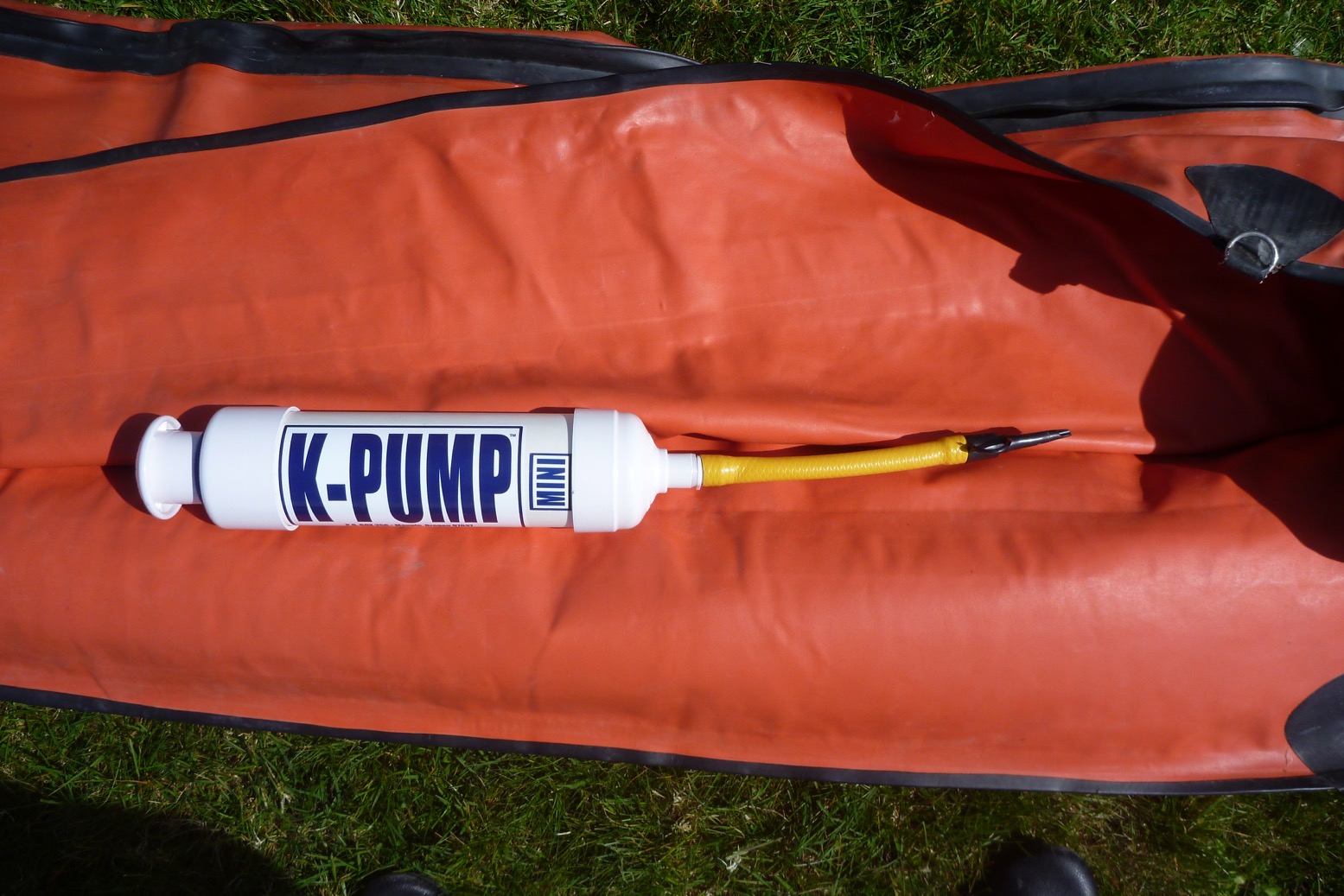
I only had my K-Pump Mini to inflate the Forelle after its repair and mods. I’d hand-pumped it up as hard as I dared but was probably a bit too cautious to not over-stress the old trout. Getting in I was reminded of that uninspiring slackrafty squidginess. I should have topped it up after putting in the cold water, but anyway there’s no easy way to accurately check the pressure off lilo plugs (I tried jury-rigging my manometer). Presumably in the 70s the idea of using tough, one-way rafting valves on IKs hadn’t been thought of yet.
In this under-inflated state and with a slight breeze, tracking away from a headwind was tricky, though I knew that new boats require a quickly acquired knack. As expected, the crumpled keel strip didn’t really do much, perhaps that’s why the Forelle 2 came with a rudder mount. As you can see there’s some taco-ing (folding) going on below me – and this was before lunch! Without a skeg or a rudder such sagging won’t help good tracking either.
My over-pressure caution was understandable, but thinking it over, I decided the Semp was under-inflated. What this boat needed was a better pump. A couple of days later a £10 Sevylor stirrup pump turned up (I left my super-duper Bravo kite pump down south) and I whacked in what felt like Sunny pressures. With the position of the lilo tubes tucked under the stern cover, and the need to yank off the hose adaptor while pinching the tube to stop air escaping, and jam in the lilo plug, it’s a bit awkward. These plugs really do grip/seal well.
That’s another great thing with running calibrated PRVs on all chambers: you just pump away until they hiss and the boat is correctly inflated while being protected from over-pressure. No need for manometer faffing.
Here in the Summer Isles the reliable May sunny spell is about to end. It’s been great for solar panels with strong afternoon easterlies, not so good for day-long IK-ing. Suilven mountain even caught fire. Yesterday, before it picked up we nipped out in the Seawave to Eilean Fada Beag (below) and listened to the birds. By the afternoon it was blowing hard.
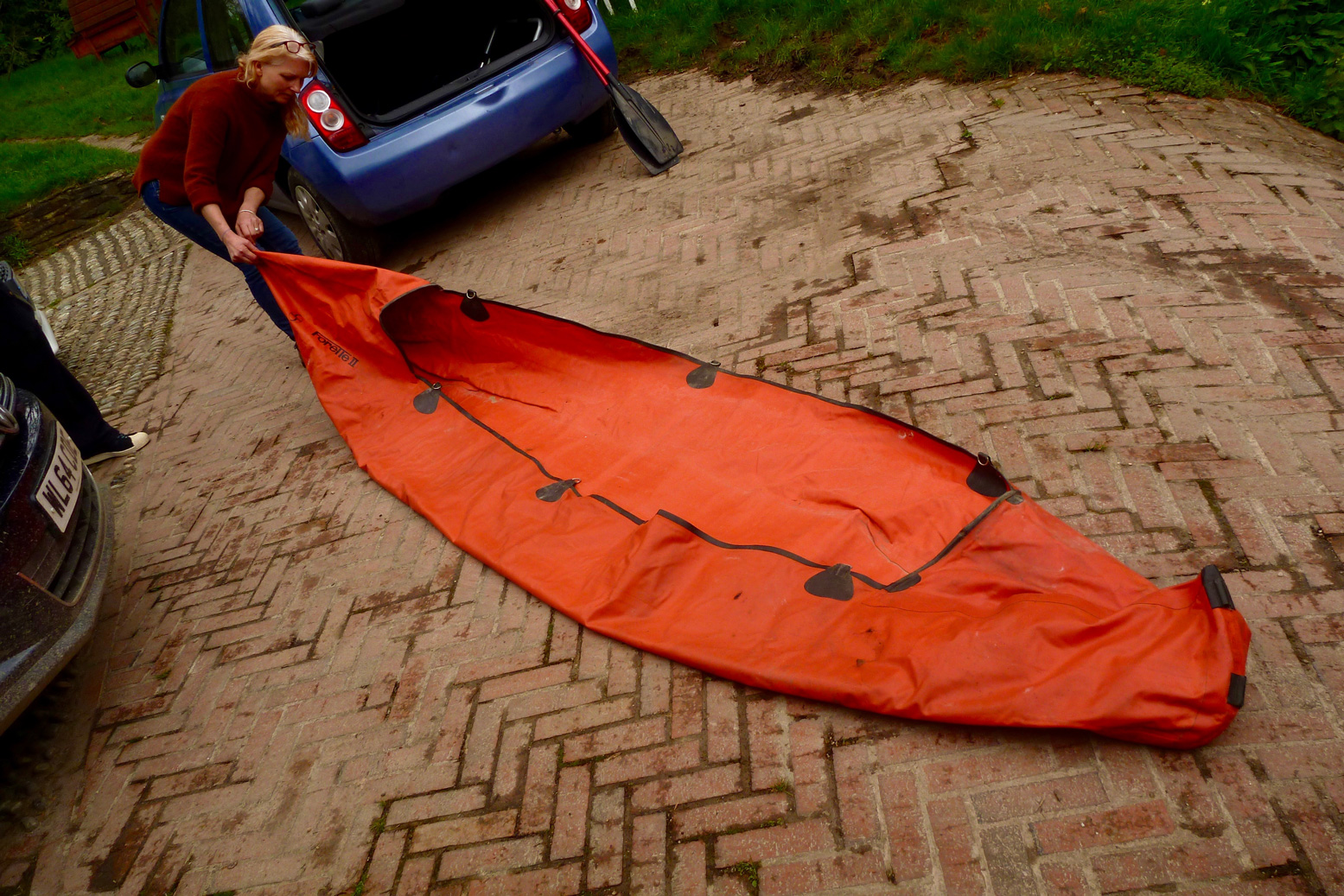
High time to patch up my latest IK: an old Semperit Forelle 2 I picked up in Cornwall. The boat was sold with some classic paddles which went straight in the bin, as well as a big tear in the side (right). Plan is to patch that hole, then see if it still holds air.
Semperit is an Austrian tyre manufacturer who’s still in business. Afaik, their IKs were a bit of a short-lived rubbery diversion in the 1960s. If my 40-year-old boat has no other more awkward leaks, I’ll rig it up and take it for a spin. But first, I scrubbed off a couple of decades of crud and let it dry.
I wondered about sewing up that L-tear before patching it – the Forelle’s hypalon seems pretty thin, but decided to just slap on a 5-incher. I’ve glued on loads of accessory patches but have never actually had to repair a hole in a hypalon IK in all these years. So I took note of the NRS repair video here: rough up hole and patch: wipe clean with solvent; apply two coats of glue and when knuckle dry apply the patch and roller the living daylights out of it.
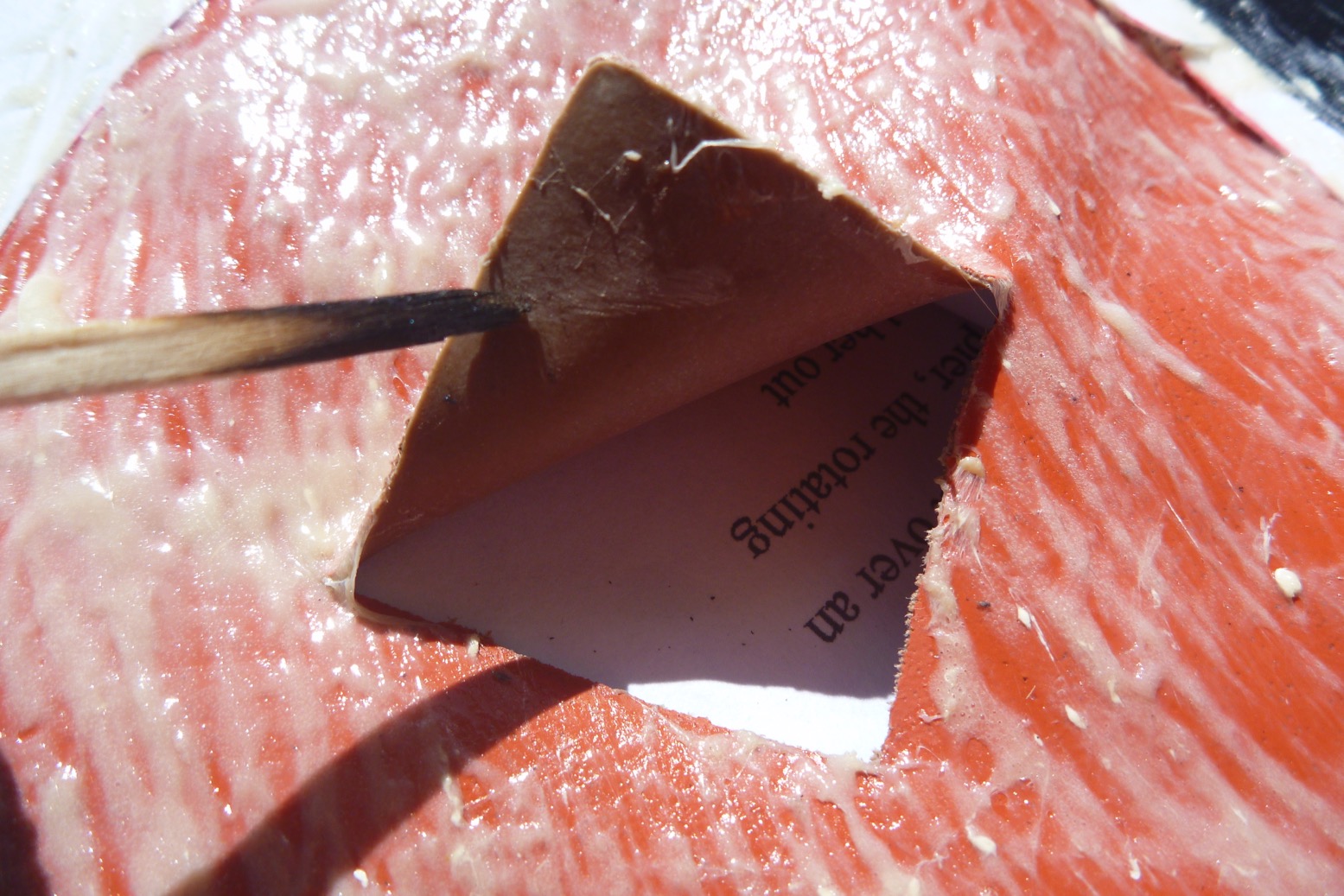
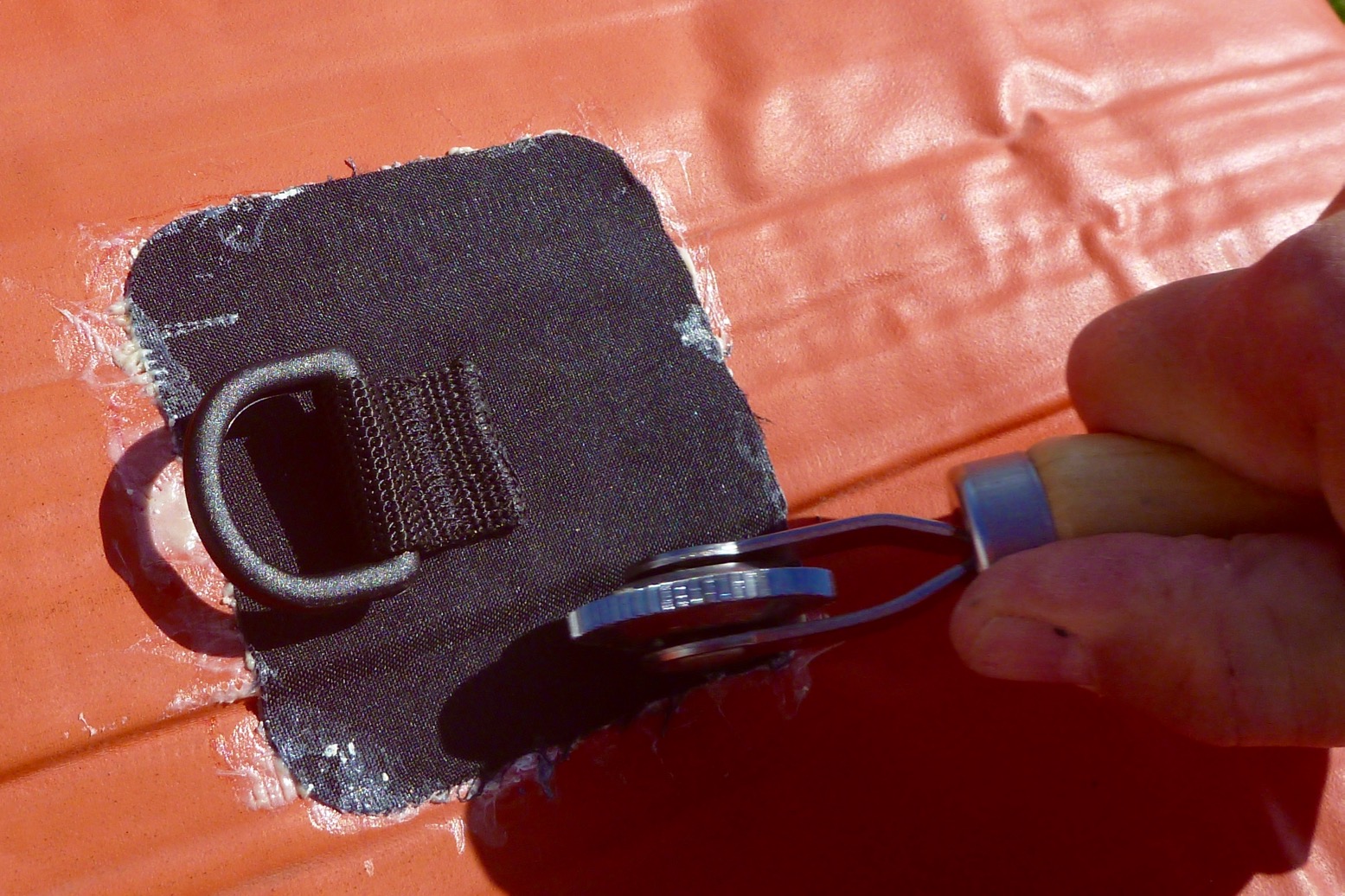
Watching that vid, I saw they used a much better tool for pressing down patches; an ash-handled Sealey TST15 tyre patch roller, unless I’m very much mistaken. The knurled metal wheel embedded in the wooden handle can lay down much more pressure than the wide plastic lino roller I’ve been using. Just before I did that, it occurred to me stray glue may squeeze through the tear and glue the insides together. Don’t want that nein danke so, with no better ideas, I stuck a bit of paper in there. Seems to have worked.
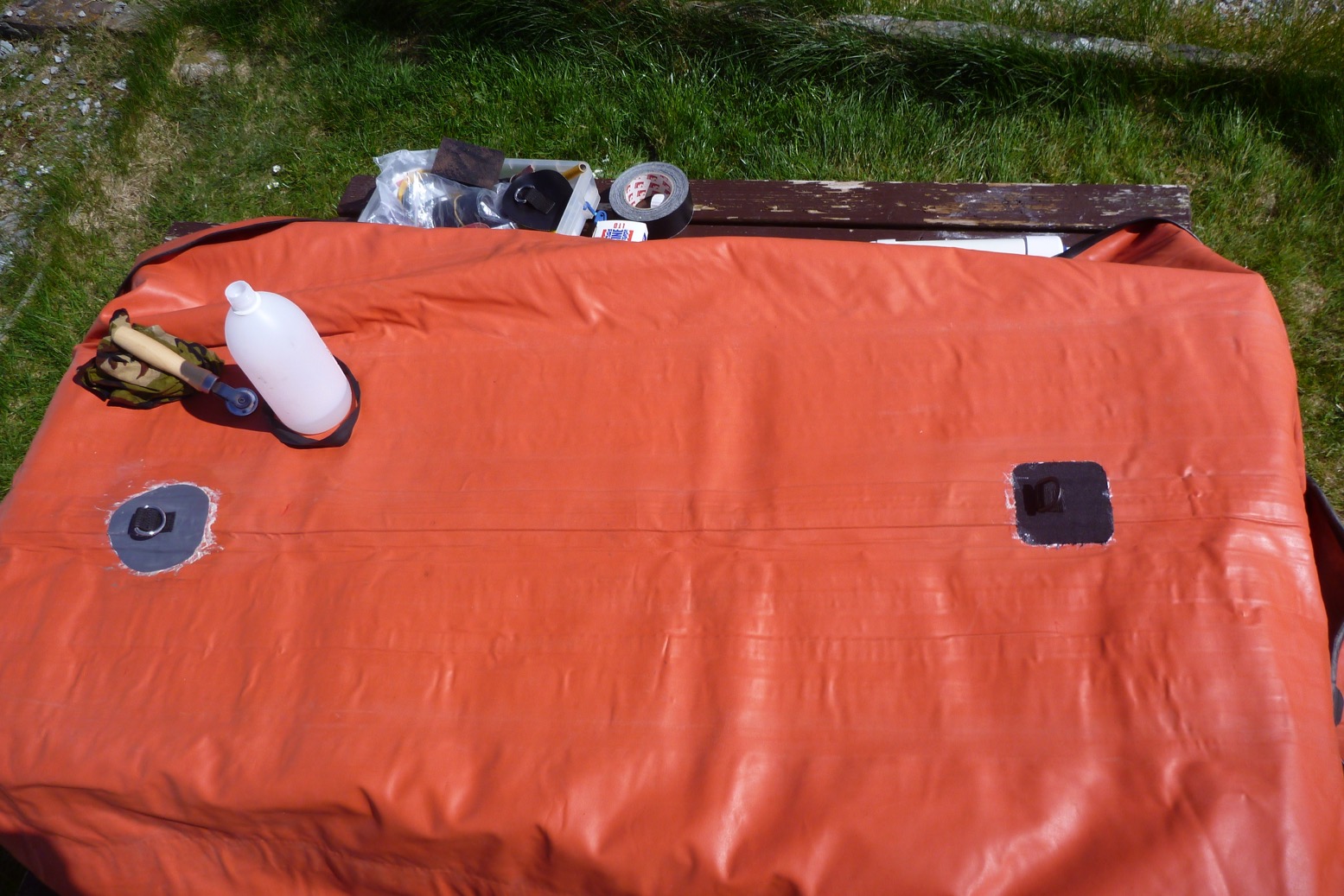
With glue left over, I thought I may as well stick on couple of floor patches for a seat base and a footrest tube. As these are non-critical fittings I used any old D-rings I had: a woven nylon one and probably a PVC. I’ve glued PVC to hypalon before for other fittings.
With them in place I couldn’t resist rigging up the old Trout with a rope-and-pipe-lagging backrest, an old Alpacka packraft seatbase; a drainpipe footrest tube and a lead. All stuff I happened to have in my IK box of bits or found in the barn among the rat droppings. I jury-rigged the K-Pump for nozzeling but haven’t pumped it right up to 2psi as I’m letting that big patch cure for a bit.
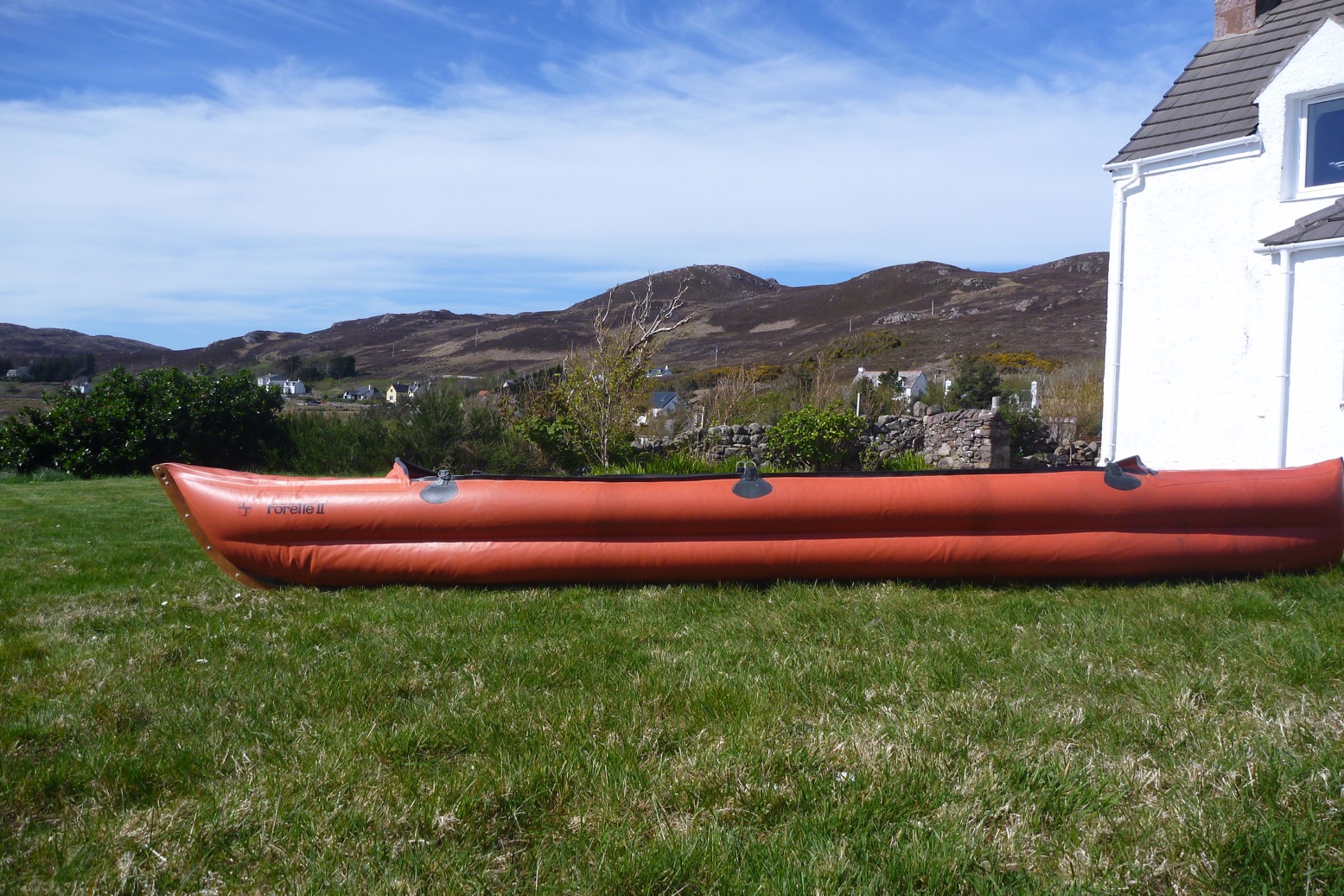
Looking round the repaired boat I see it has rudder mounts; not sure I’ll need one on a 3.56m boat. There are six D-rings on top of the double side tubes but they don’t look like they’ll take the backwards strain of a fabric backrest Forelles came with wooden backrest bars, (like Grabners who took over Semperit) and which I’ve found prone to bending when used with a firm footrest tube.
There’s also a squished up full-length keel strip along the bottom. If it works for tracking it will be nice not to have the usual skeg-grounding aggro in shallows or on land. But maybe that keel will slow down turning which is why they have the rudder attachment? We shall see. With twin side tubes the Forelle is just 70cm wide – that’s <28″. But with a thin floor and me sat low in the high sides I’m sure it will be stable enough. Gumotex still use them for their seats, but the ‘lilo plugs‘ on the three chambers are a bit of a faff for getting a good charge of air.
If the Semp proves viable, I may replace them with proper IK valves. Or I may just leave them as they are. Three £15 Gumotex valves + a £20 PRV will cost the same as the boat, and the lilo plugs can be regarded as their own ‘total loss’ PRVs – when the boat gets too hot they pop! And anyway, there’s no room to fit a big IK valve in the floor as the tubes are too close together. Knock-off Halkey valves go for 7 quid; I might stick a couple in the sides and leave the lilo plug in the floor.
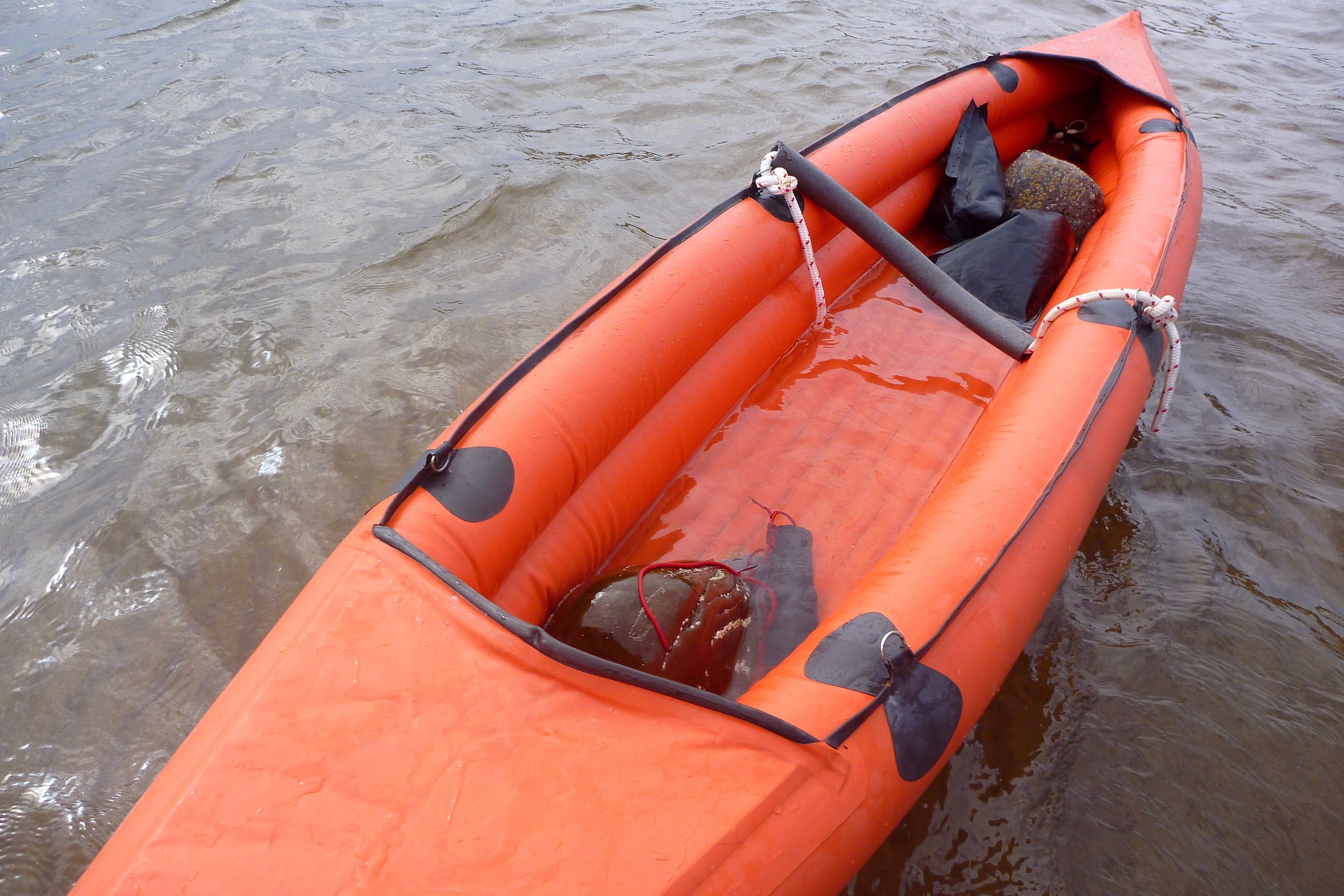
I put it back in the barn with my other restoration project for a couple of days. When I came back it was limp but not draped over that cabinet like a wet pizza. I pumped up and it stayed firm enough, though I’ve forgotten how mushy an 0.2 bar IK feels. It reminds me why I seriously took the idea of trying to increase the rigidity of my old Sunny before getting other IKs. At the beach I filled it with water and stones – no obvious leaks, (or so I thought). A testament to 40-year-old hypalon and glue.
Have to say too, once pumped up, for an IK the old trout is not bad looking. I think the discreet upsweep of the bow, that plywood ice breaker and slender twin tubes make it look a lot less of a bloat than some. Sea trials to follow.
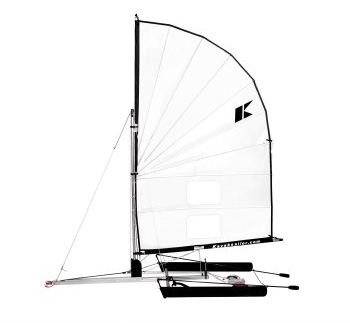
Spring is here, time to sharpen our paddles! While you’re doing that, here’s a Seawave sailing vid with a sail kit (right) from kayaksailor.com. With the lee boards it all looks a bit complicated for me, but perhaps that explains how they manage without a rudder. Notice the hull folding up from 1:40. Don’t know if that’s down to the breakneck speed under sail, or he needs some uprated side chamber PRVs. For more sail posts, see the IK sailing category somewhere on the right.
Tuesday was set to be a scorcher – no less than 30°C predicted in mid-September (in the end over 34°C, the hottest Septemberday for over a century; the new normal). No excuses then to try my first south coast paddle if the winds and tides lined up. It could be my last paddle this year. With bands of chalk cliffs and the Atlantic getting funnelled in, the Sussex coast feels a bit exposed compared to northwest Scotland where I usually sea kayak. With little of interest, it’s not exactly a sea kayaking mecca, even though it’s highly populated. At least if you have a shipwreck, it won’t be far to a road or even a bus and I bet a mobile works everywhere. Wind direction for Tuesday was ESE – an ideal onshore-ish backwind, if a bit breezy (for a lone IK) at 13mph. And by chance the tide was just right too: high at a handy 9am with a moderate 3.5m drop. (good tide times website). In five days time the spring tide would be nearly twice that. Clearly this was shaping into a westbound day. Anyway, that was academic as wind and tide made Newhaven west to Brighton and beyond the way to go. With lots of rail stations, I could go as far as the arms lasted.
I learned an interesting thing about Sussex and Kent tides while planning this run earlier in the summer. For the last two hours of the incoming (eastbound) flow, the tide keeps rising but reverses westbound along the English coast as it backs up at the Straits of Dover and spills back down the sides. This makes a more usual easterly run with the prevailing SW winds a bit tricky (or short) on an incoming tide. The nearer the Straits the more skewed the tides. At Dover it falls for nearly 8 hours, but fills in less than five. At Brighton, where the Channel is four times wider, ebb and flow are equal but you still get that 2-3 hour backwash at the end of a high.
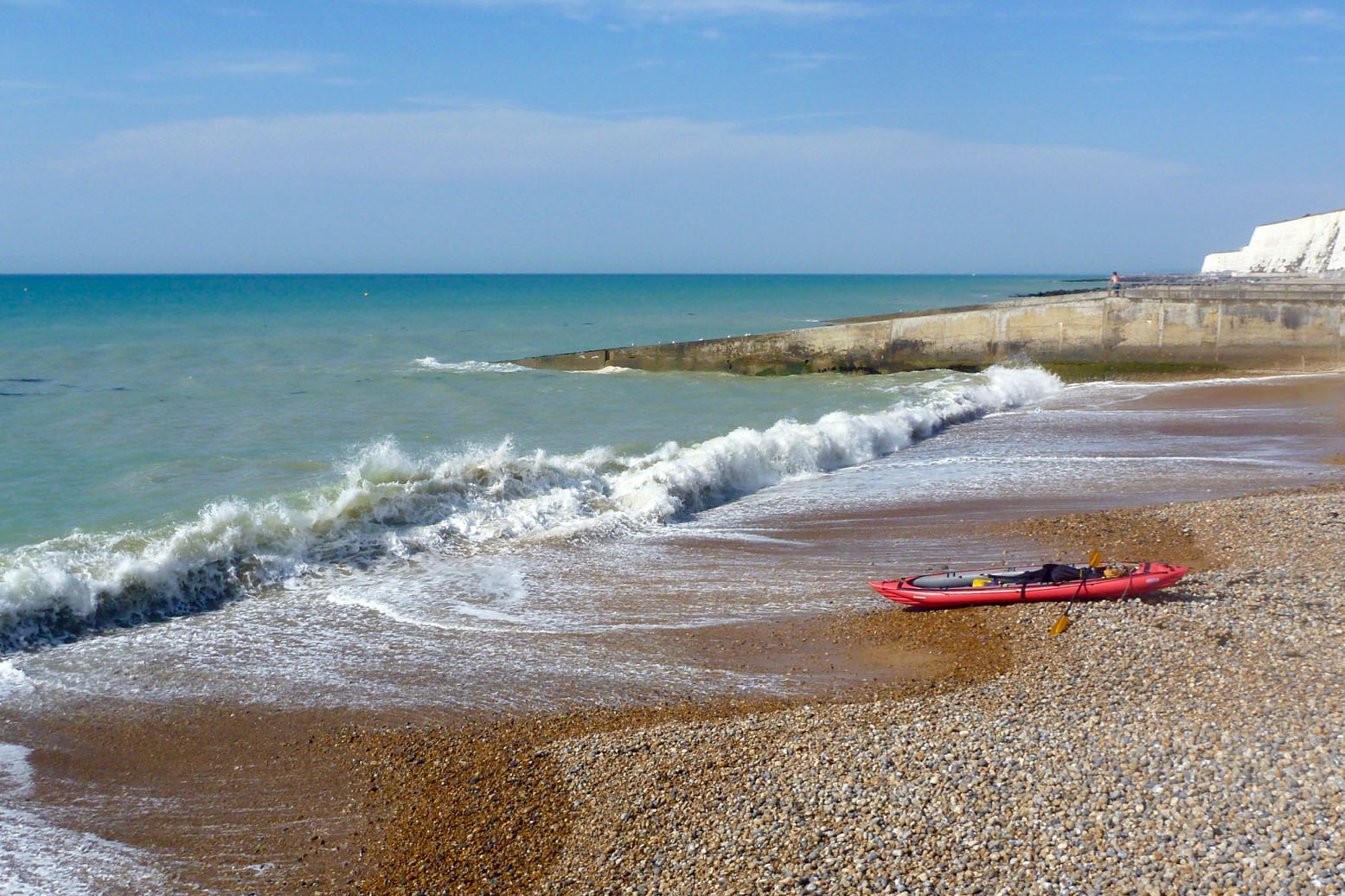
The Newhaven train took me over and along the South Downs where sheep nibbled in the early morning sunshine. It sure was nice to get out, even in southeast England which isn’t exactly terra incognita to me. On the steep shingle beach below Newhaven fort, the tide was topping out as I topped off the Seawave and the Dieppe ferry backed out of the harbour. These shingle beaches have steep ramps bashed out by stormy seas. At high tides this terracing kicks up the surf and means wading in can quickly put you out of your depth, as I recall well from childhood holidays on the Southeast’s shingle beaches. But probably more by chance, I timed my put-in on a lull, hopped in and PLF’d out of the surf zone. As usual, alone on a new shore after a couple of months off, the first few minutes or more required managing an agoraphobic anxiety. I reassured myself the wind was blowing me along- and towards the shore, and the dropping tide would gradually expose beaches below the cliffs if I needed a break. On the beach I’d inadvertently pumped the seat right up, and in trying to deflate it on the water, the annoying sticky twist valve stuck and I was soon sat flat on the floor. Oh well, it will make me more stable if it all gets rough. I’d forgotten my rudder too, but wasn’t too bothered about that. One less thing to concentrate on.
The trouble with backwinds is they give no impression of movement and soon I was dripping like a dewy fern at dawn. As you’d expect out here, the seas were jaunty, with occasional swells rolling by that looked higher than me. But there were no tell-tale whitecaps, the stern wasn’t pushed about, and half an hour in, a long concrete ledge/seawall below Peacehaven cliffs offered a way out if needed. That would have to be in extremis though, as at times the swell slapped hard against the walls and there were only steps to get out.
No need for that yet. We were moving along probably faster than I felt. I tried to keep away from the shore so as not to get caught by a rogue swell – I saw one break up ahead way off the shore and steered well behind that point. There seemed to be no pattern to these choppier episodes. Was it a set coming through or just seabed related? Later, looking at an OS map and what the sat map below shows too, a wave-cut sub-sea platform of the soft chalky cliffs extends quite far out. Where the jade green sea turns blue is where it drops off? Who knows, perhaps it’s just the sea, but it created an uneven rhythm considering the linear nature of the paddle. Another thing I noticed was that I drifted out to sea if I didn’t concentrate. It was probably the tide which not only ebbs westwards but goes out too. Hence the well-known expression and phenomenon: ‘the tide is going out’. Every once in a while a quick spurt inshore (but not too far inshore) put me right.
A few miles ahead I could see the whitewashed conurbation of Brighton, but without a seatbase the old backside was now beginning to feel the strain. I passed by a couple of serious-looking sea swimmers heading upwind, then put in between some groynes at Saltdean, where another cliff-protecting concrete walkway ran all the way to Brighton; a fun cycle or hoverboard, I dare say. I timed my landing well enough, but after pumping the seat and a rest, re-entry required flipping the swamped boat a couple of times. Probably because getting back out between the surf can’t be done as briskly as coming in.
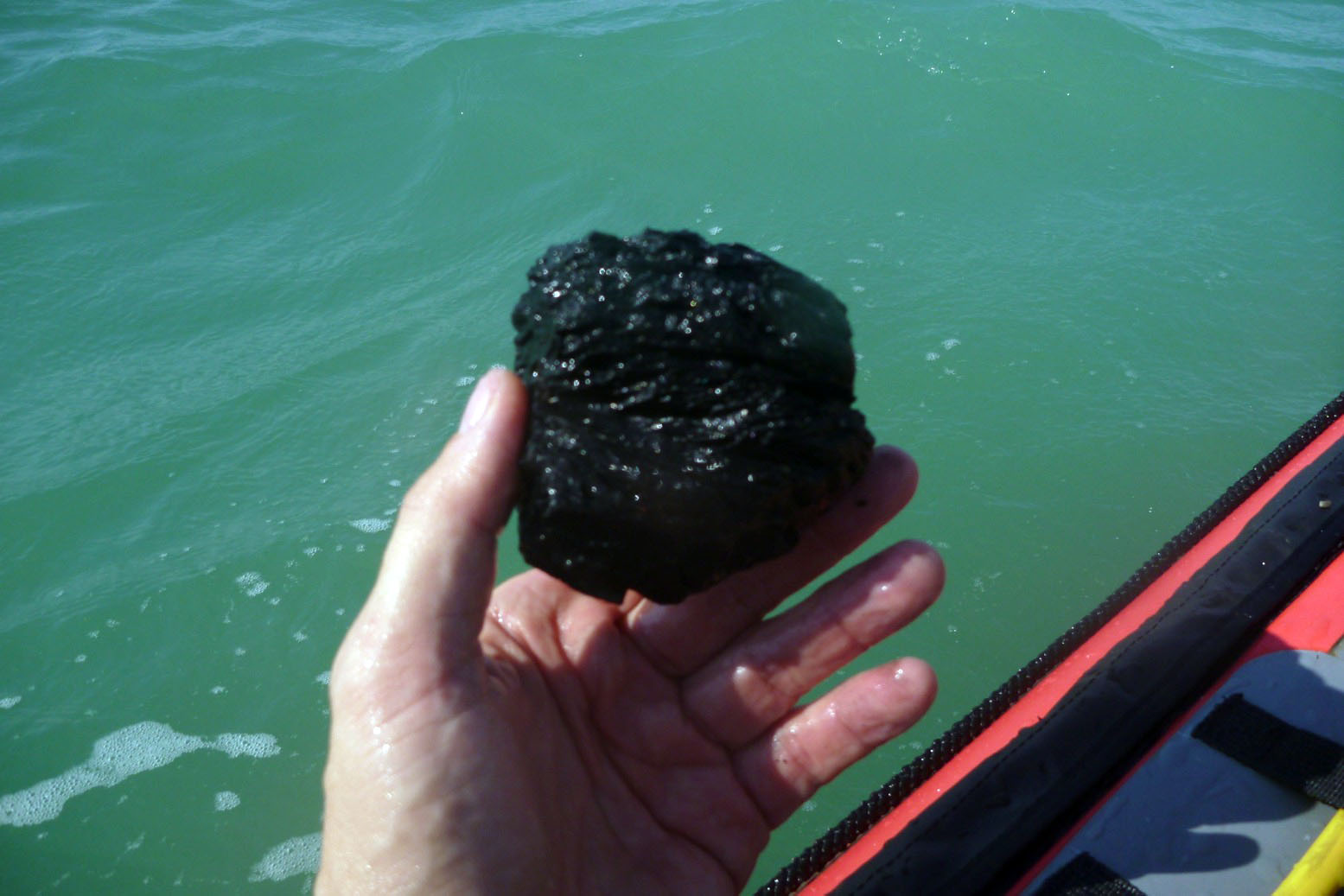
Next obstacle: getting round Brighton marina where the seas really felt quite lively. The southeasterly swell was bouncing off the marina walls like Brighton revellers on legal highs. Nothing for it but to PLF; at least the wind was helping. Round the back of the breakwater all was calm, bar the odd oversized swell. I found a piece of coal and a child’s wet shoe. It was a good omen: follow the shoe!
Up ahead lay Brighton pier and the effort and early tension of only a couple of hours was starting to show. I hacked away towards the pier, then decided I must pass underneath it with my new shoe if I was to reach salvation. SUPers were gliding by and wetbikers were gunning about, making a grating, aggressive din. A surfy beach landing was performed ‘with aplomb‘ in front of the basking crowds. I recall an apocryphal American’s view of Brighton Beach ‘Beach? Where’s the saynd? It’s all stones!’. GPS check: ten miles at 4mph average, peak 6.5mph. Quite fast really. Time to pull the plugs.
In case you don’t know, Brighton is an unusually groovy and arsty enclave by English south coast standards; ‘London by Sea’ some call it. I met up with a young entrepreneur who was hoping to start-up an innovative coffee-by-drone delivery service. So far the response had been excellent and the odd sunbather who’d got a scalding espresso shower merely thought it was an amusing prank. If coffee-by-drone could work anywhere in the UK, Brighton would be the place. Apparently he’s idea is on an upcoming Dragon’s Den.
As for the paddle. It’s good to get a salty tan while exercising, but the run was as ordinary as I expected, not like the wilds of the northwest or even the rural southwest, and without much intriguing geographic detail to explore. I bet looking down on the passing Seawave from the clifftops was a lot more alluring.
West beyond Brighton it’s built up pretty much all the way to Selsey Bill before the Solent. In the other direction Cuckmere Haven around the much bigger cliffs of Seven Sisters and Beachy Head to Eastbourne pier (8 miles) would be a good one on a calm day. You can’t get lost – just follow the shoe.