Author Archives: Chris S

Gumotex Twist (old models)

Current Nitrilon Twists

twisters

Gumotex Twist Mk 1
Around 2010 Twists became a new direction from Gumotex: lighter, less rugged boats that suited recreational users. The original models didn’t last.
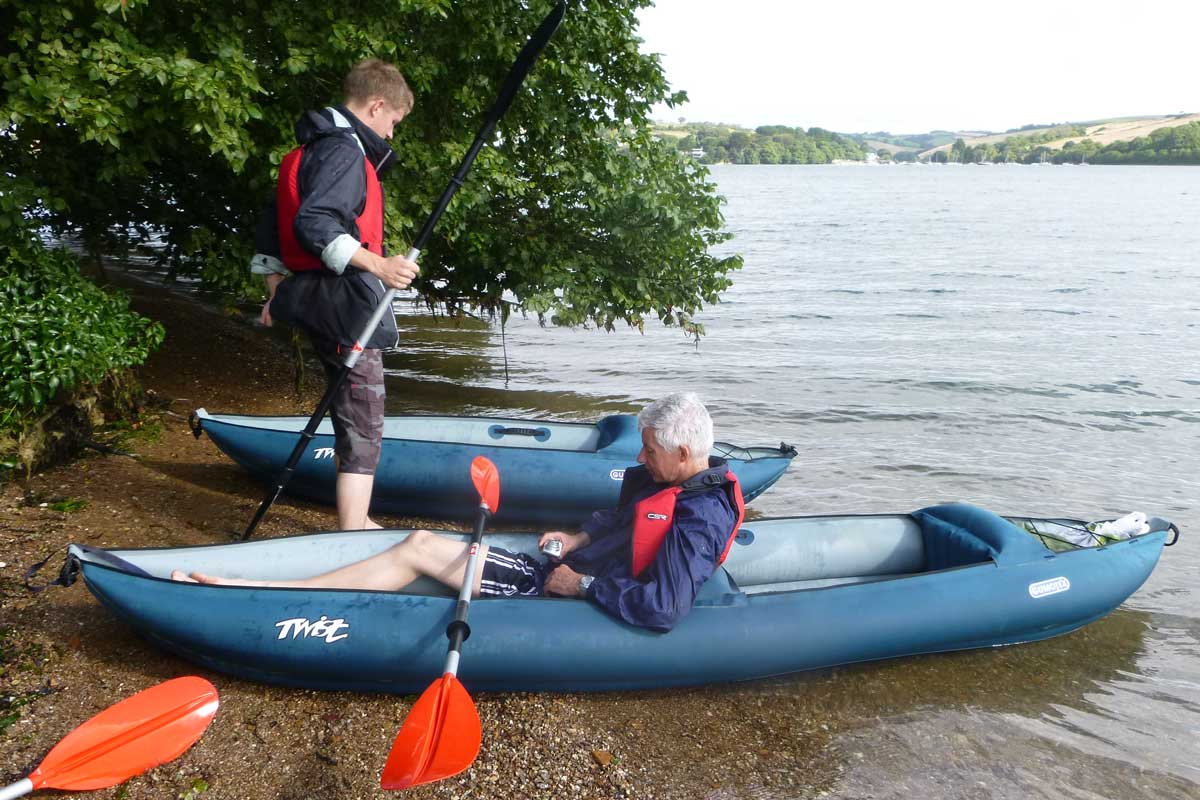
The Gumotex Twist 1 (LitePack then later teflon-coated Hevealon, 2.6m long, 79cm/31″ wide, 6kg, max. load 100kg) became the replacement for the popular Solar. There’s a good review here and the author, Dave D, sent in some photos and updated impressions below.

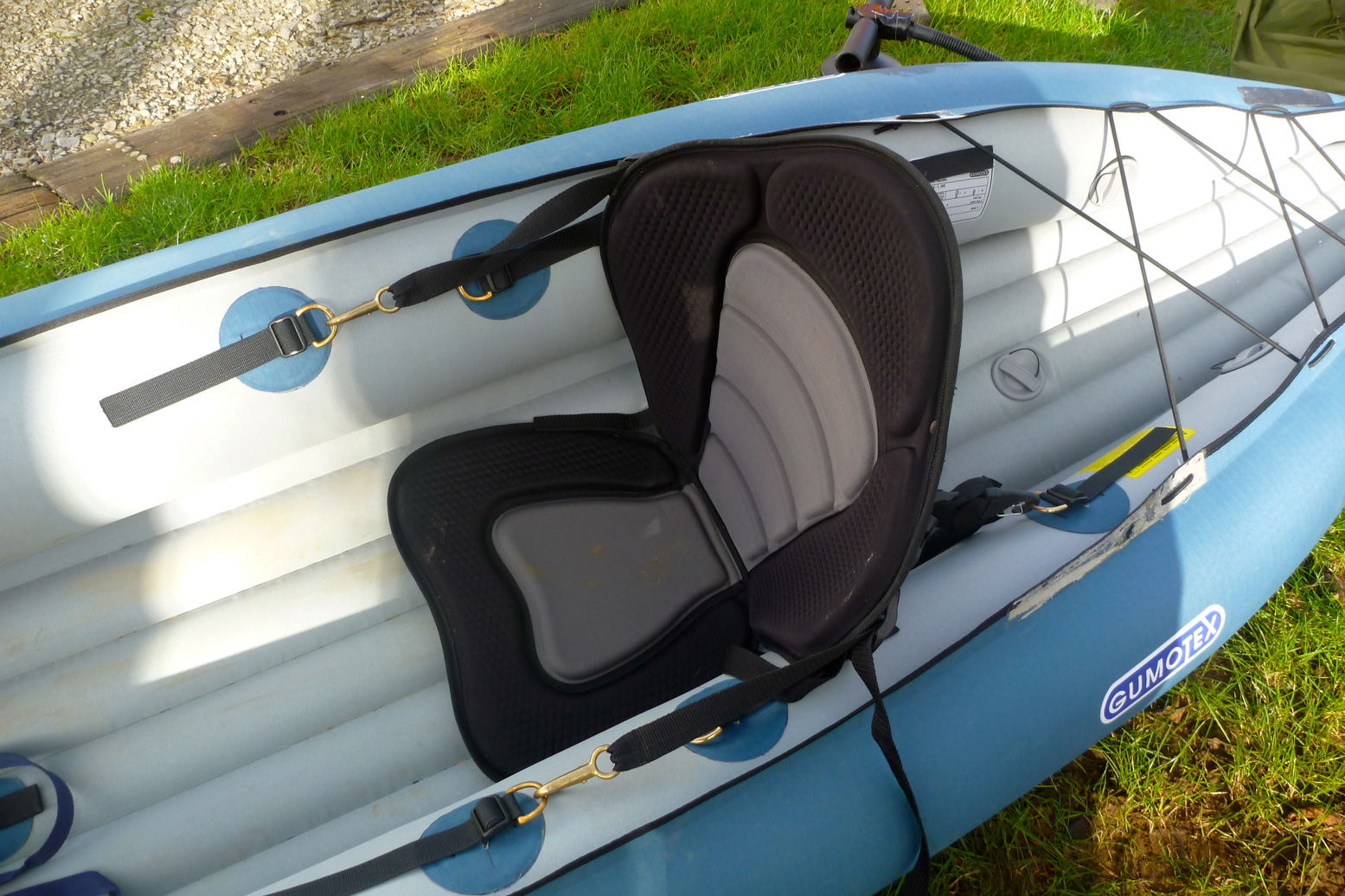
Notice the black backrest on his yellow boat are not the bulky and fixed stock items which have been cut out, so making the boat even lighter. I saw a Twist recently and realised they use the textured LitePack material for the whole boat, inside and out. This must be what makes them so light, while being like rubberised canvas it also takes a little longer to dry and a little less slippery on the water. This video below shows some disastrous porosity in a Lite Pack Twist. It can be fairly claimed that was an exception and the boat was replaced, but it’s hard to see that ever happening with full Nitrilon. A few years later the next Twists models were made in Nitrilon Lite.

twist-flat

twisting

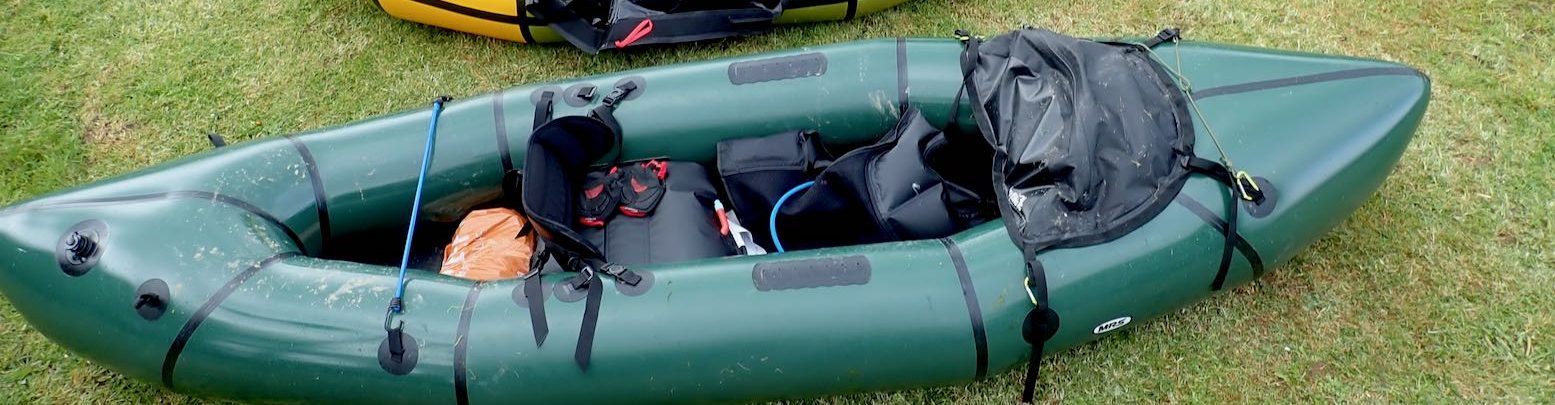
The Twist 1 was not a lot bigger than my Alpacka Yak (above) and is only twice as heavy. On a recent Medway run I found the boats surprisingly similar in paddling speed. I assumed my flat, wide Yak would be slow. But this was on a day with a good swift current. I think with the more usual Medway deadwater the flat-bottomed Yak would have been more tiring and slower overall. This Twist also had its original seats cut out and replaced with an SoT pad.
twist-seat
gumsteadtwister


As for a Twist II, a mate got one along with a T1, and he likes the lightness above all. Vital stats on that one are 3.6m/11ft 10in; 80cm/31.5″ and just 9k/20lbs, so nearly as long as a Sunny, as wide too but nearly half the weight which makes hauling with boat in a pack much more viable. He has since got a new T2 but prefers the lightness and compactness of the old one, once he’s swapped out the seats.

twisting

[Dave D]: Here’s a few more thoughts now that I’ve had a chance to use an original T1 a bit longer:
1. The inflatable seat proved to be junk. It kept developing major leaks – always at the point where it is folded through a 90 degree bend. Clearly this is a stress-point which the kayak’s fabric construction can’t handle. After my first one popped, I sent it back to Gumotex who replaced it – although this didn’t go smoothly: the first time they just sent the boat back to me without having done anything to it! Eventually, they sent me a replacement boat, but when the seat on this one popped I decided to rip the inflatable seat out and replace it with a more conventional back rest as you can see in the photos. This is far better, and also makes the boat narrower – I now don’t skin my knuckles against the side of the boat with each paddle stroke!
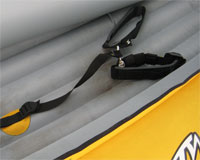
2. The inflatable footrest is useless [as it is on many Gum boats – see this]. If you want to paddle, you need to brace your foot against something, and this isn’t it! I decided to remove the cushion and replace it with two foot-loops on an adjustable strap. I was a little dubious about having my feet strapped into the boat in case of capsize, however I’ve found I can get my feet in and out without any trouble.

3. Before making the above two modifications, the boat had a major flooding problem. The stern sat too low in the water, so if you got a wave from behind or if you put your bodyweight too far back in the boat (e.g. because your inflatable back rest had gone down!) then water would swamp the boat from behind. Having replaced the seat and footrests with adjustable ones, I can now set it up so my bodyweight is well forward. This has so far eliminated the flooding problem, but I imagine you’d still have a problem with steep waves hitting you from behind. That said – when it floods you just jump out, turn it over and jump back in again.

4. I still love the boat. Whenever I’m travelling with work, I keep it in the boot of my car with a drysuit and a 4-piece collapsible paddle. If I’m on the motorway at rush-hour, I pull off to the nearest river and do one hour’s hard paddling up and one hour back for a bit of exercise and to de-stress. I often paddle on canals with locks, and it’s great to see the envious looks of canoeists when you do the easiest portage they’ve ever seen! The boat is actually quite quick. A couple of nights back I even started playing in a fast (but shallow and safe) weir by moonlight.

I also use it to take a short-cut across the harbour in my home town. It feels very stable, even when there’s a swell. I’ve put nav-lights on it and I have no problems zipping around and keeping out of the way of boat traffic. Dave D

Additional pics by Robbo

gum2twister

Gumotex Seaker sea kayaks

This was Gumotex’s take on Grabner’s Holiday IKs, later reimagined by Incept (I’m pretty sure it’s in that order). In other words a twin sidebeam IK but with inflatable decking so making it an inflatable SinK (sit-in kayak). You didn’t get many of those to the pound back then, though Gumotex now do the Swings and Framuras and Aurion.
What they said
The Gumotex SEAKER is the first fully inflatable sea kayak worldwide. It is designed for long trips in sea bays, on big lakes and large estuaries. The small volume of the packed kayak and big space for baggage predetermine this kayak to be used for expeditions.

The user appreciates especially how easy and quick the kayak is ready for use. You can inflate the kayak within ten minutes. The biggest benefit of the Seaker kayak is its safety. The hull is extremely stable and enables remounting from the water without the aid of paddle floats. And what’s more – thanks to the inflatable design no water can get into the capsized kayak.

In case you’re wondering, twin side beam – two smaller stacked side tubes instead of one fat one has benefits. And on this model they were made from Mirasol PVC with a Nitrilon deck and floor. The Mirasol was thought to be less elastic and so the Seakers could run higher-than-then-normal-for-Gumotex 0.25bar. It made the sides taller so less swamping, though of course your deck and skirt will see to that. The interior space is greater and two side beams make the boat flex less longitudinally – a problem with all long, non-dropstitch IKs once they got beyond a certain length. The drawback was that the boat was taller in the water, so more wind-prone.

Once I thought a Seaker could fill the dark corners where the Sunny did not shine, but at 34kg the solo was more than double the weight of a Sunny, Incept K40, Grabner H2, Amigo or my later Seawave. The high-quality Korean Mirasol PVC was clearly much heavier than Nitrilon.
Like a proper sea kayak, it had hatches and a rudder and could no doubt be rolled, but to me, half the appeal of IKs, even at sea, is the SoT aspect. If you want to sit in and want to be portable, get a nice low-profile Feathercraft (since closed down) for nearly the same price, less weight and which looks less like a floating, wind-prone torpedo.

They also did a 2-seater Seaker II but I got the feeling these were exotic, rarely bought boats that were heavily discounted in North America before disappearing around 2014.
It was the end of the line for the heavy Seakers which is a shame because the only thing wrong with them was the weight. Still, I’ve never actually seen one so what the heck do I know about Seakers? A blogger in Canada got one cheap a few years ago but didn’t keep it long. A double went on eBay in 2016 for £410. Now in late 2025 the semi-dropstitch Gumotex Aurion looks like it fills the gap, only for over €2000.

Gumotex K1 and K2 white water

gumok22
gumok2

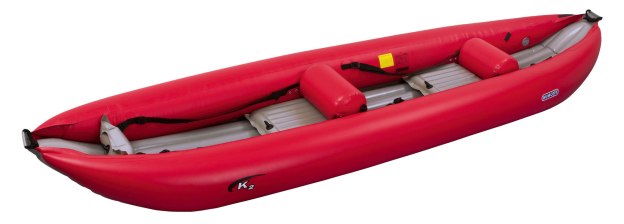
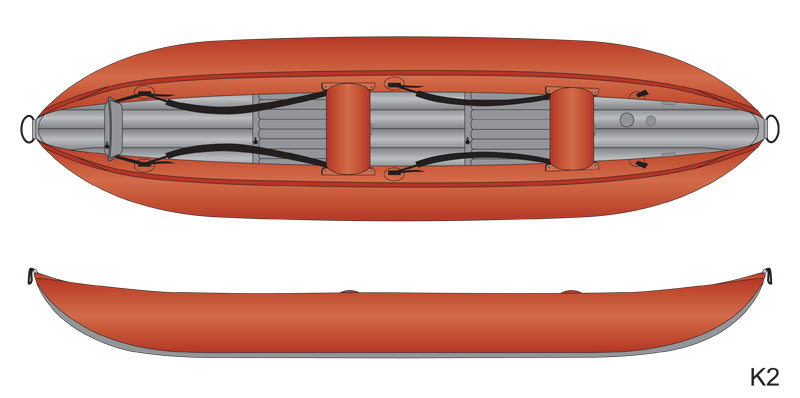
Made by Gumotex for years, the K1 and K2 double are obscure, expensive, hardcore self-bailing, white water IKs with thigh straps. Until the Seawave came out in 2013, these were the only Gumotex IK which ran 0.25 bar pressure (other Gumotex IKs run 0.2 bar). I’ve never read about the K models anywhere, though it seems the Germans and French (left, Allier) admire them. They feature the distinctive grey floor which is visible in this video at 2.27s.

gumok2


The K2 could be considered fat-tubed, self-bailing Solar 3 pontoon, a bit shorter at 3.9m but which costs more than double. At one metre wide it’s really a twin-seated, thigh-braced, self-bailing whitewater kayaraft, not a tourer.

otg-padlicac
padillac

It would be fun to throw a K down some gnarly rapids or surf, knowing that it floated like a cork, sat as flat as a wet pizza and drained as fast as a sieve. But if it’s like the Padillac I tried a couple of times in Colorado (left and right), that’s probably all it’s good for and it needs two paddlers to get up any speed.

otg-k1


In summer 2010 I came across a couple of K2s in France, having just come through some narrow rapids which I was too nervous to try alone in my new parkraft at the time, so clearly they are being used by some for the right purpose.
The solo K1 pictured below in boatpark.cz’s boat park is the single-seater version out of which it would be hard to fall short of being shaken out. Even used they were asking £500 while a used Twist 1 was going for £130.

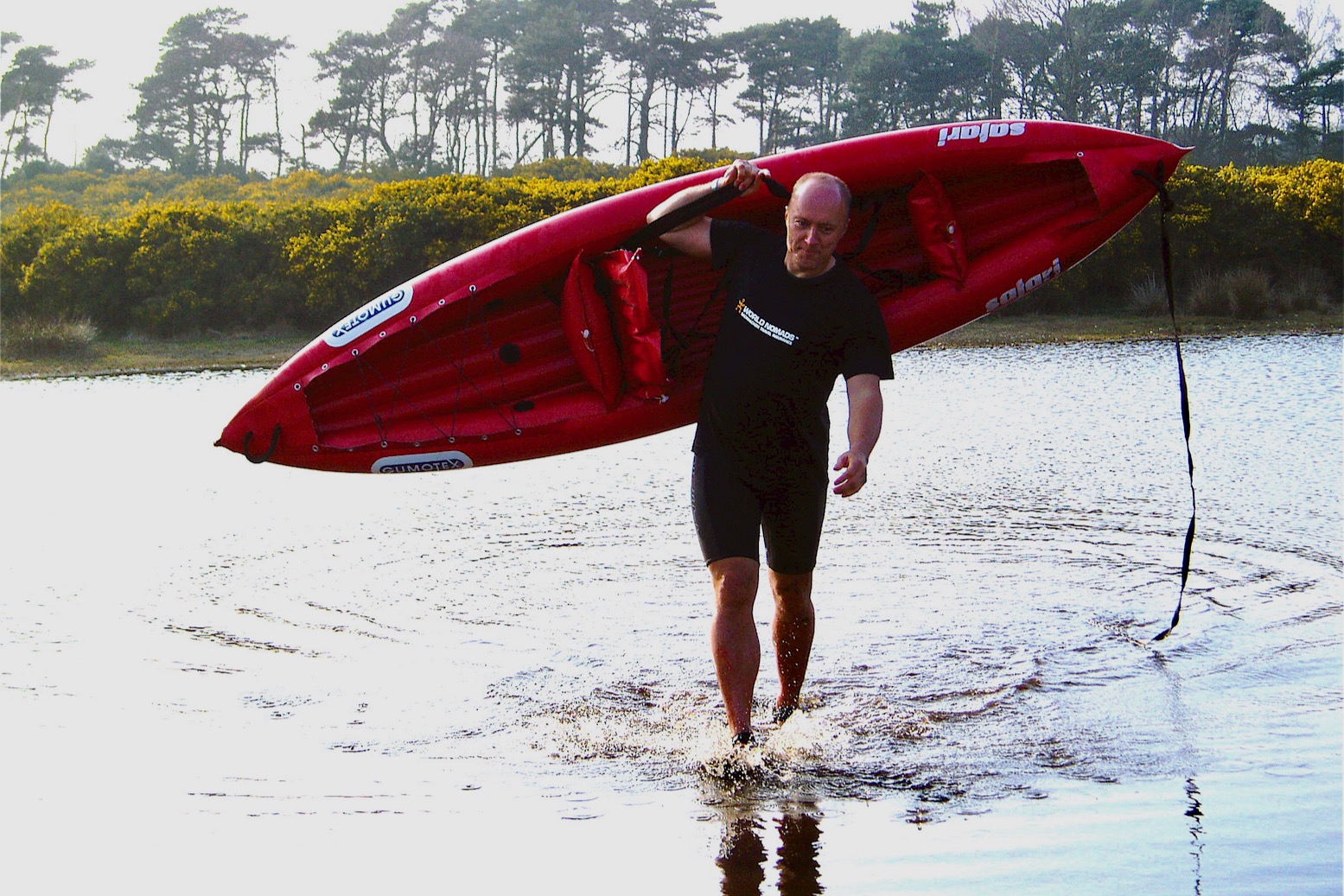
Gumotex Safari Mk 1

2016: new Safari 330XL

safaritip
Dorset pond

Gumotex Safari (pre-2003)
Back when I didn’t know an IK from JK Rowling, my very first IK was a used Safari. And light and tough though it was, this early model Safari was a mistake. The Mk1 was a tad over 3 metres long (same as a Solar 1), 72cm wide and weighted just 12kg.

I pretty much knew it wasn’t for me when I bought it used in 2004 for £120 from boatpark.cz, but it was so cheap it was worth the punt. At my weight I pretty much maxed-out the boat’s 100-kilo payload, and at 6.1” I looked like I was sat in a small bath.

safarisml
River Frome, Dorset

Without a skeg I also found it impossible to paddle straight (but had no experience then; see this). It felt nice and fast but way too tippy to inspire confidence in a large beginner. It’s the only IK I’ve ever had which I could barely stay in. And for me it was way too cramped to pack a useful load for a few day’s touring which was my plan all along.

OLYMPUS DIGITAL CAMERA
Croatia

Anyone with a bit of experience would have realised this before they bought it, but I just wanted to check out a proper IK close up before moving on. I soon got a Sunny and have never looked back with Gumotex IKs; the Safari was passed on to my g-friend who’s a foot shorter and half my weight.

gumosafar
Scotland

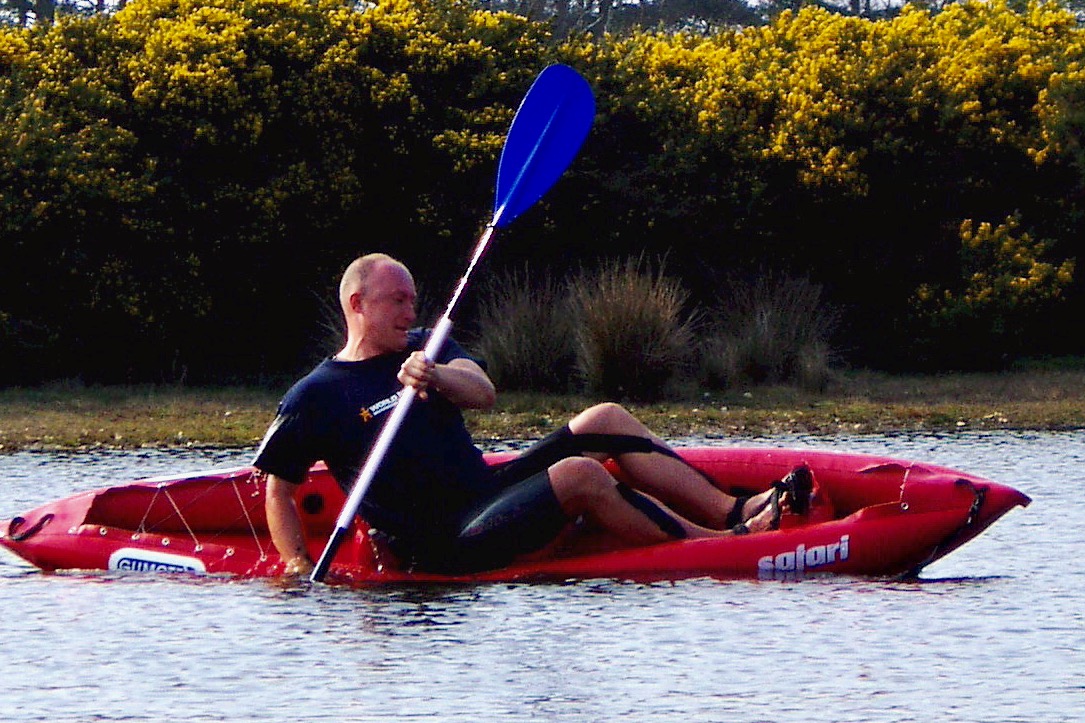
A great feature on the Safari were the thigh straps (visible in the pics above). They really connect you to the boat and help you to paddle hard by controlling the yawing, as well as the roll to correct tipping over: great for the back and stomach muscles too. Knowing now that later Safari models are more stable, I’d be quite keen to try one again as a play/day boat.

Note. I’m told post-2003 Safaris (below) have a different hull design and are less tippy. The newer one had twin side tubes but still a rounded hull profile. BoatPeople in CA don’t mince their words when they talk about it still being tippy in certain conditions, and the current short Safari is not the same hull shape as an old and stable Solar 300 we owned. As for weight limit, I doubt that’s different.

North American Innova importer Tim R. told me “I would rate the Solar’s stability as a 9 out of 10, the old Safari would be a 6 and the new Safari an 8. The very first Safari prototype was a 3!”

gomosafrr
Croatia

New or old, a Safari is also a self-bailer which is highly desirable when the going gets even a little rough, but only if you’re not too heavy to end up sitting in pooled water, as I was.
G-friend used the Safari in Croatia and found she needed about 10kg of rock ballast in either end (see pic above) to make the boat stable and, as it happened, faster. Without them the boat sat high and even she felt tippy. Therefore the optimum weight for a pre-2003 Safari would be around 70kg. Now you know.
We sold the Safari and got a Solar 1 or 300. The Safari is still in the Gumo line up. For a small WW fiend, a Safari would be a great little boat. There are plenty of videos online testifying to that fact.

2016: new Safari 330XL

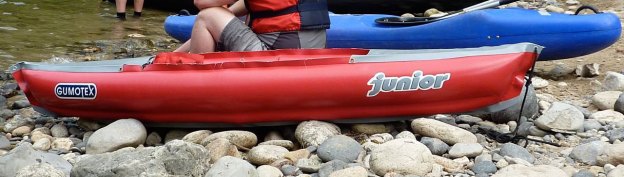
Gumotex Junior

Gumotex Junior
At ‘only’ 10kg (light, back in 2005) I thought this would be ideal for lightweight g-friend and even for me in a pre-packrafting sort of way. However our conclusion was it was merely a heavy, boat-shaped paddling pool made out of unusually tough material.

gumjunior

With my weight I of course had about 3mm of freeboard, but it was a hopeless tracker (not that we were experts back then) and all in all felt a bit of a half-baked design (it was actually based on an old Barum Sip).
Gumotex made some turkeys back then, but they don’t make this one anymore. Then again, in 2009 feedbacker Chris reported: “We opted for two Juniors and these are fine for what we need and really light for the motorhome as we are restricted on weight.” But he did report one was splitting  at each end, possibly from overheating?
For a small, compact IK the Twist 1 is better and lighter, or if that’s important, a packraft is even better.

Gumotex Solar 300

header-solar

See also:
Gumotex Solar 300 improvements
This ww video, and this

Gumotex Solar 300/Solar 1
We bought a Solar 300 in 2006, mainly for the v-light and short g-friend. Weight is 11kg (25lbs), length is just over 3 metres (10 feet) and width is 71cm (28″). It’s not self-bailing like the similar looking  Safari, but is a lot more stable than the original model Safari Mk1 I had (newer ones are said to be better).

solabarine


They stopped the 300 ages ago; the original Twists were the replacement. The 300 was tough little boat, even for my size of person, and especially with the improvements I made (see here). After nine years it still held air for weeks on end and never gave a single problem, I can’t see it ever wearing out and I hope the new owners enjoy it.
Coming out of the longer IK, it feels much more nippy but without being tippy. G-friend took the Solar down the Tarn in 2007, and I used it again in 2010 alongside my new packraft and occasionally since then. As you can see, my mate Yves pictured below left also took quickly to the Solar, first time out in an IK.

tar--55

Our trip down the Tarn Gorge proved it was no worse in white water than the Sunny, but of course it lacks the packing space for longer trips. With no WW experience at all, g-friend soon got the hang of it after a couple of early swims and even developed the feel for skeg-free paddling. It can be done, although I found one time on a Thames training run I wish I’d remembered the skeg as I just wanted to move fast and not bother about correcting finesse. As said elsewhere, with a skeg you can power on regardless.

az-lighthead


At 1kg a full-coat Solar is pretty heavy when it comes to lugging it around on public transport for a day paddle, but once on the water it’s a great boat and is of course a lot faster than my packraft. In summer 2010 on the currentless Thames near Oxford and with a strong headwind, I managed 9 miles in 3 hours, including rests and a couple of locks, though after 5 hours of paddling I was pooped.
Looking closely at the Solar while drying it out, I was struck how it’s built like a tough commercial raft so will last for many, many years, like all full-coat Gumboats. It still looked in great shape when I sold it in 2015 after I finally got round to greatly improving the seat and footrest and skeg, ideas which will work on many similar IKs. Details here.

gumosolar300

Gumotex Solar 410C – the new Sunny

In 2017 the Solar 410C became the Solar 3

410c

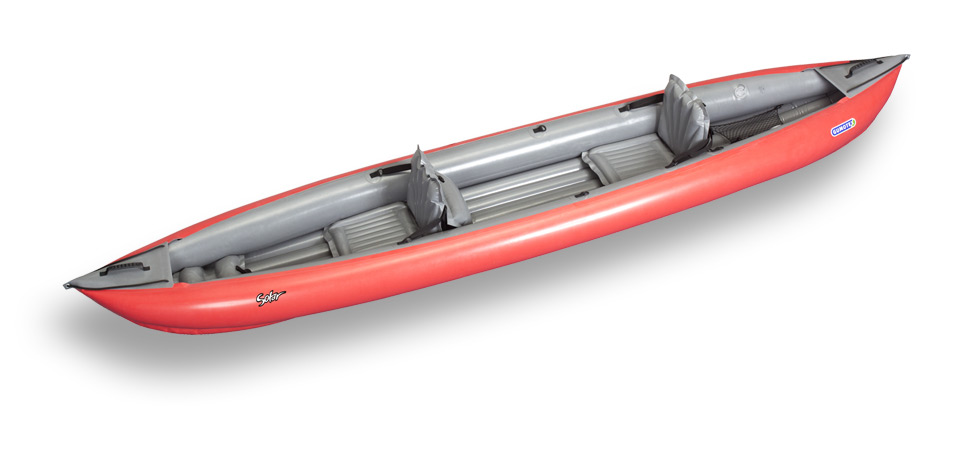
The Solar 410C was a step up from the short-lived, fixed-seat Solar 2 (below). The price in the UK with two seats and a skeg was £470.
It became for all intents and purposes the new Sunny, because the old discontinued 405 Solar and Solar 2 (below) were usefully long touring boats ruined with fixed seat designs: either the original space-wasting thwarts (at least they were replaceable) or worse still, Helios-style fixed seats in the half-coat (Lite Pack) Solar 2 – the pits!

410prv

Luckily, the Solar 410 ‘C’ (for ‘Convertible’) has two or even three seats which can be removed and one re-installed the other way round to make a big, single seat kayak with lots of room for stuff – nice. You also get adjustable footrest pads (see here for a lighter and simpler idea), the usual half-arsed cargo net in the back, and the usual floor PRV too. Gumotex never seem to mention this useful feature, but of them I am a big fan.
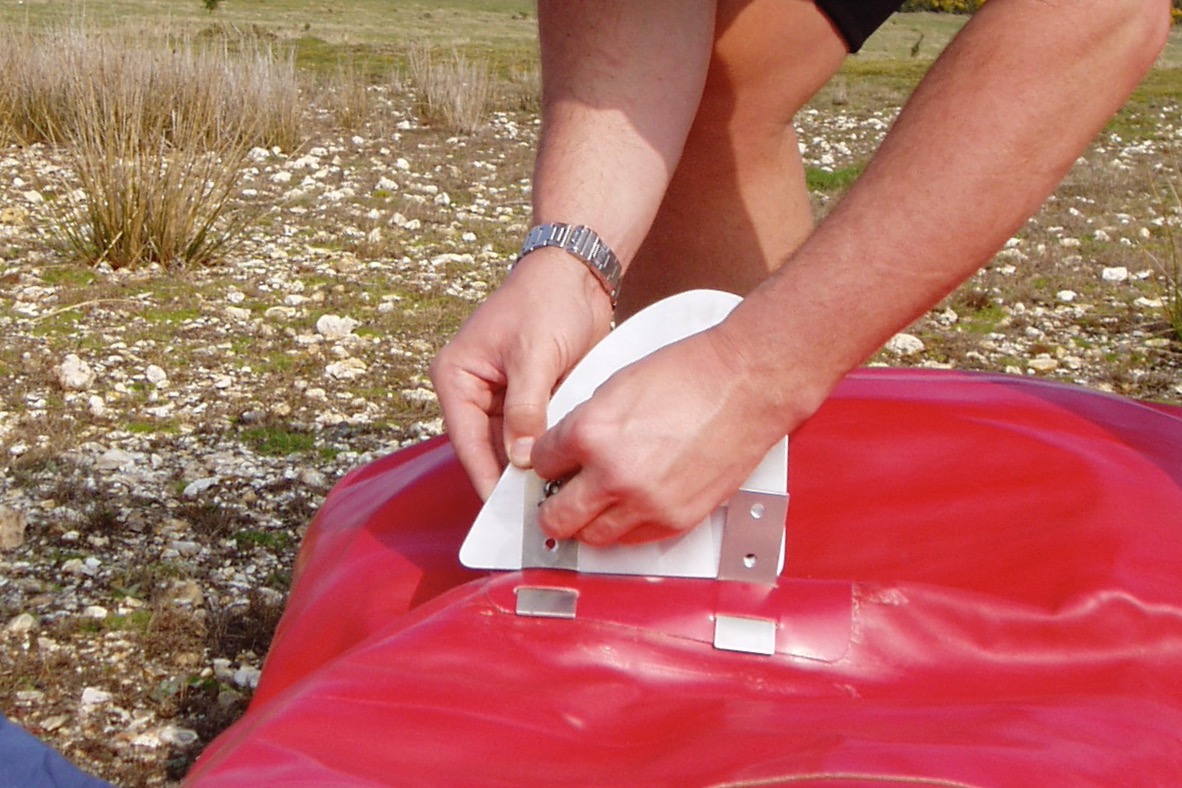
If not included, the black plastic skeg might be extra (and is worth getting). On the 410C you don’t need a skeg-mounting patch at both ends because unlike a Sunny, you simply move the seats forward or back on the D-rings, not turn them the other way. In the unlikely event your 410C doesn’t have a skeg patch, it’s not so hard to glue one on.

The stats for the Solar 410C are 4.1m long (Sunny 3.85m); 80cm wide (Sunny 77cm), weight 17kg (Sunny 16kg) and payload no less than 270 kilos (Sunny 180kg). With pressure still at 0.2 bar/3psi, that looks to be quite a jump in payload for just a little extra volume. If you can imagine three hefty adults sat in the new 410C, that equals 270 kilos – the slightest wave will surely swamp the boat.

But one thing I do wonder with a 410C (and why I got a Grabner instead, even at nearly twice the price), is that with my weight I suspect the longer hull would sag even more than the Sunny. This was why I moved on from the Sunny after many years, although here I discuss ways of getting around that flaw

Gumotex Solar 405/ Solar 2
The original, pre-2007 Solar 405 (below) was similar to a Sunny of the time but longer. Unfortunately it used space-wasting thwarts (fat air cushions) for seats. For that reason a Sunny was always better solo touring choice at the time.


The post 2007 ‘Solar 2s’ (right) became even less versatile: horrible fixed seats like the Twist and Helios may give great support, but along with fixed footrests it all means it can’t be set up optimally for solo paddling without chopping it all out.

As on all post-2007 Solars for a while, only the outer wet surfaces were coated, and then the Solar 2 was dropped in favour of the broadly similar but more popular Sunny MkIII, the semi-decked 3.8-metre Helios II (also with fixed seats and decking) or even the shorter Twist I. By 2013 the 410C set things straight again and that soon became the Solar 3 which is still around today.

Horse Island ~ threading the loop

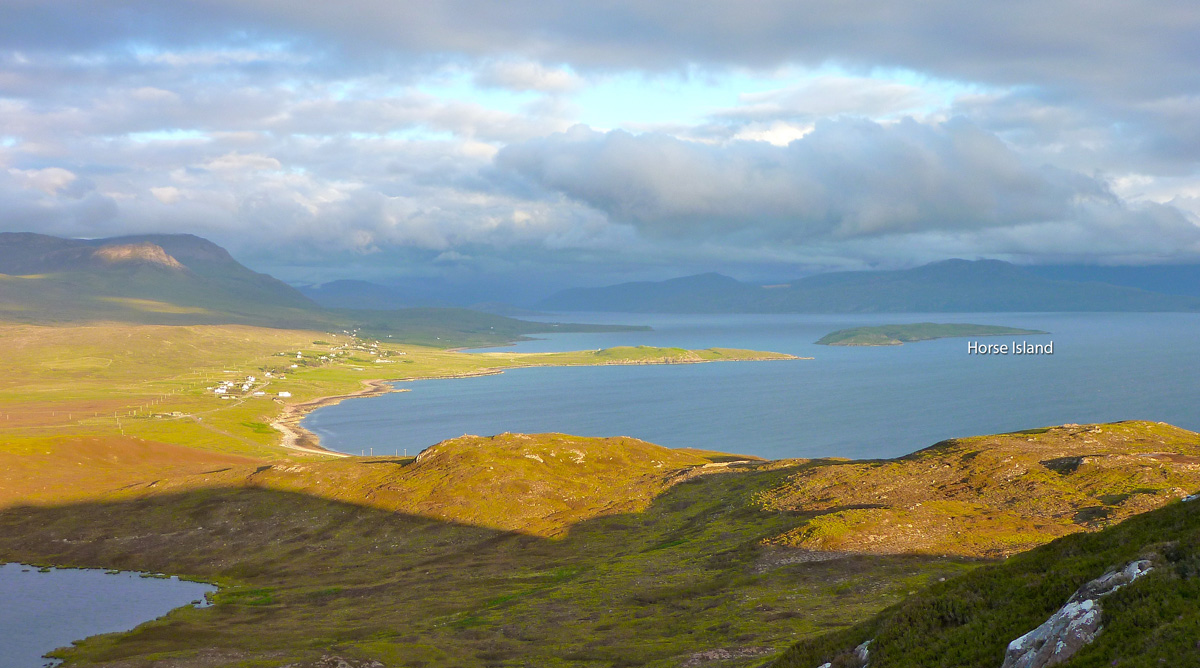
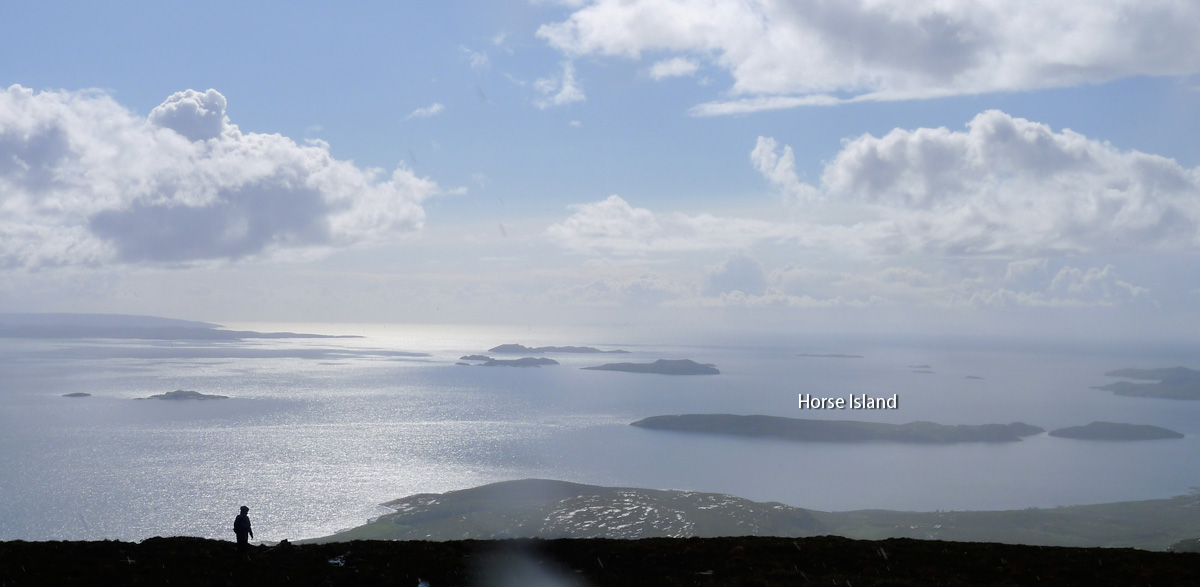
horsemaphorseAnother calm day, another island paddled around; a quick one to Horse Island which I visited last year. On that occasion the two islands of Horse and the smaller Meall nan Gabhar were separated by a stony, seaweed-drapped causeway. Today, leaving Badentarbet beach 40 minutes after HW, I expected to paddle between the two.
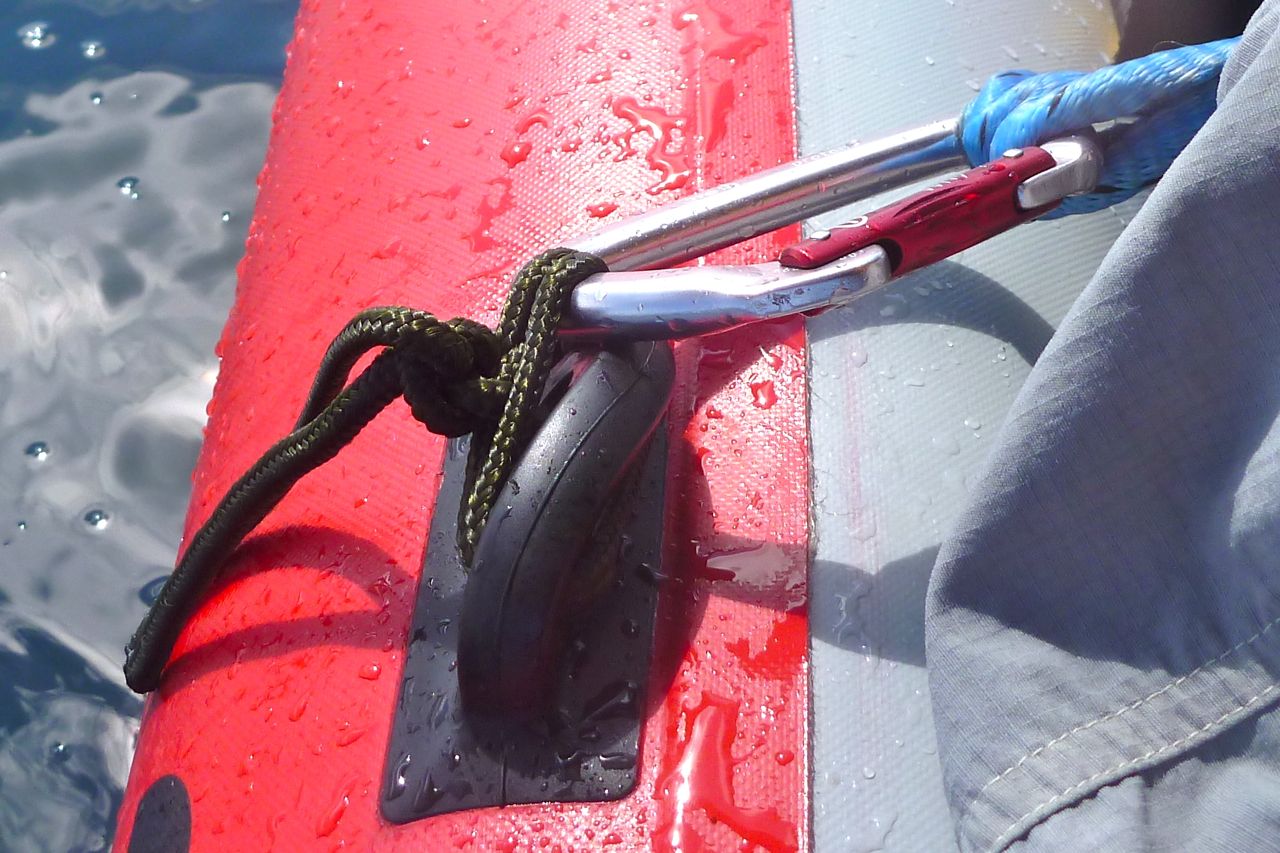
On the way out I noticed that the way I’d clipped the new backrest was not so good, so at Runha Dunan point (map left) I pulled over to try something less bad (right). horse7I definitely need to come up with something better, and for the rest of the trip avoided leaning against the strap for fear of damaging the lugs. That may have contributed to the fatigue, if not actual low speeds (see below). Expensive but stout Grabner D-rings and an SoT backrest are on the way.
horsechannelAt 2.7 miles out a wide channel separated Horse from its northern neighbour (left). In the absence of distracting wind and at today’s tide (3.6m, max can be 4.7) I wanted to see if I could detect any currents in places like this channel. Maybe not yet only 1.5 hours after HW, but by the time I closed the loop a flow – I imagined against me from east to west – ought to be noticeable.
horse5Down the inland side of the Horse I passed the small seal colony (left) we spotted on our way to Ullapool last year. And at around 70 minutes and 4 miles out I turned horse4around the south end of Horse Island (left) and experienced the slight turbulence I expected, possibly as the tide flowed round the point against a rising southwest breeze.
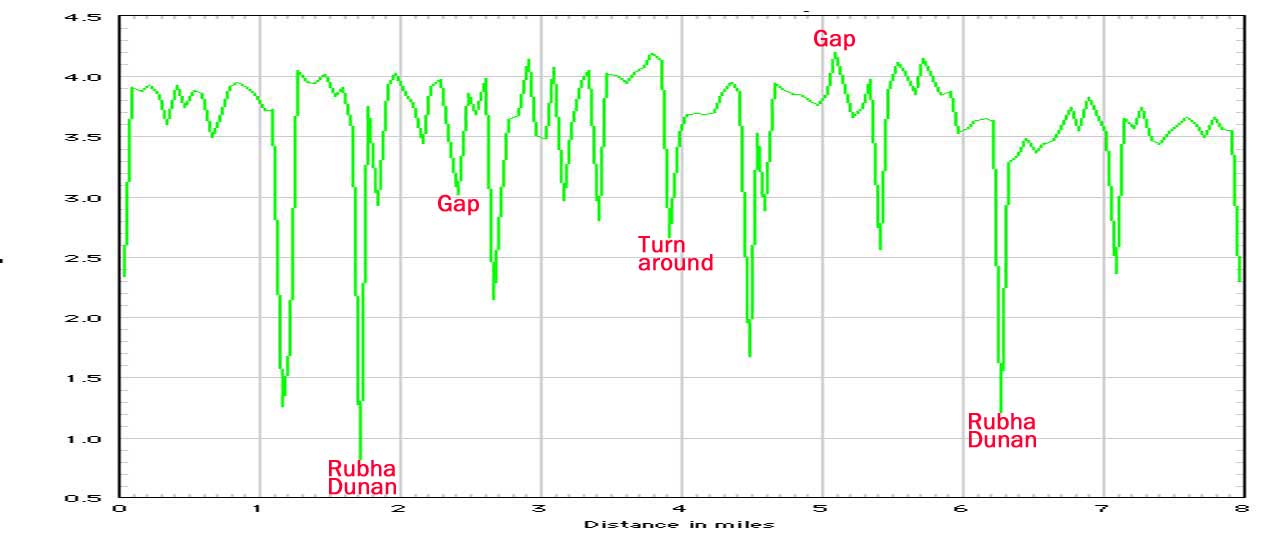
Up the outside of the Island I felt a bit exposed so pressed on against the chop and as I returned to the gap from the south side the back end of the kayak kicked out a bit. A ha, something’s happening two hours after high water, getting through the gap may be a struggle. I felt the nose of the boat pull off course unless I kept straight on against an imagined current. But as the speed graph shows, I was actually going faster than an hour 20 minutes earlier and the seaweed below wasn’t showing any signs of flow, so if anything it was a light current pushing the back around. All very confusing. Perhaps the ebbing tide backing out of Loch Broom around the island creates a back eddy through Horse Channel.
horsespeedsThe fifty-minute paddle back to the beach turned into quite a haul, but that’s the way I like it sometimes and somewhere on this stage the GPS’s trip log (if not the track log, left) recorded the magical 5 mph!
All up, 8.1 miles in 2 hours 20 at a moving average of 3.5 mph. About 10% faster than my other solo trips over the last week to Lochinver and around Rubha Coigach, but as a training run and without a proper back rest, the effort wore me out. As for tides and tidal movements, for the moment I remain baffled.

horsefar

Around Rubha Coigach (Summer Isles)

Summer Isles Kayaking Guide

rubccoiheader

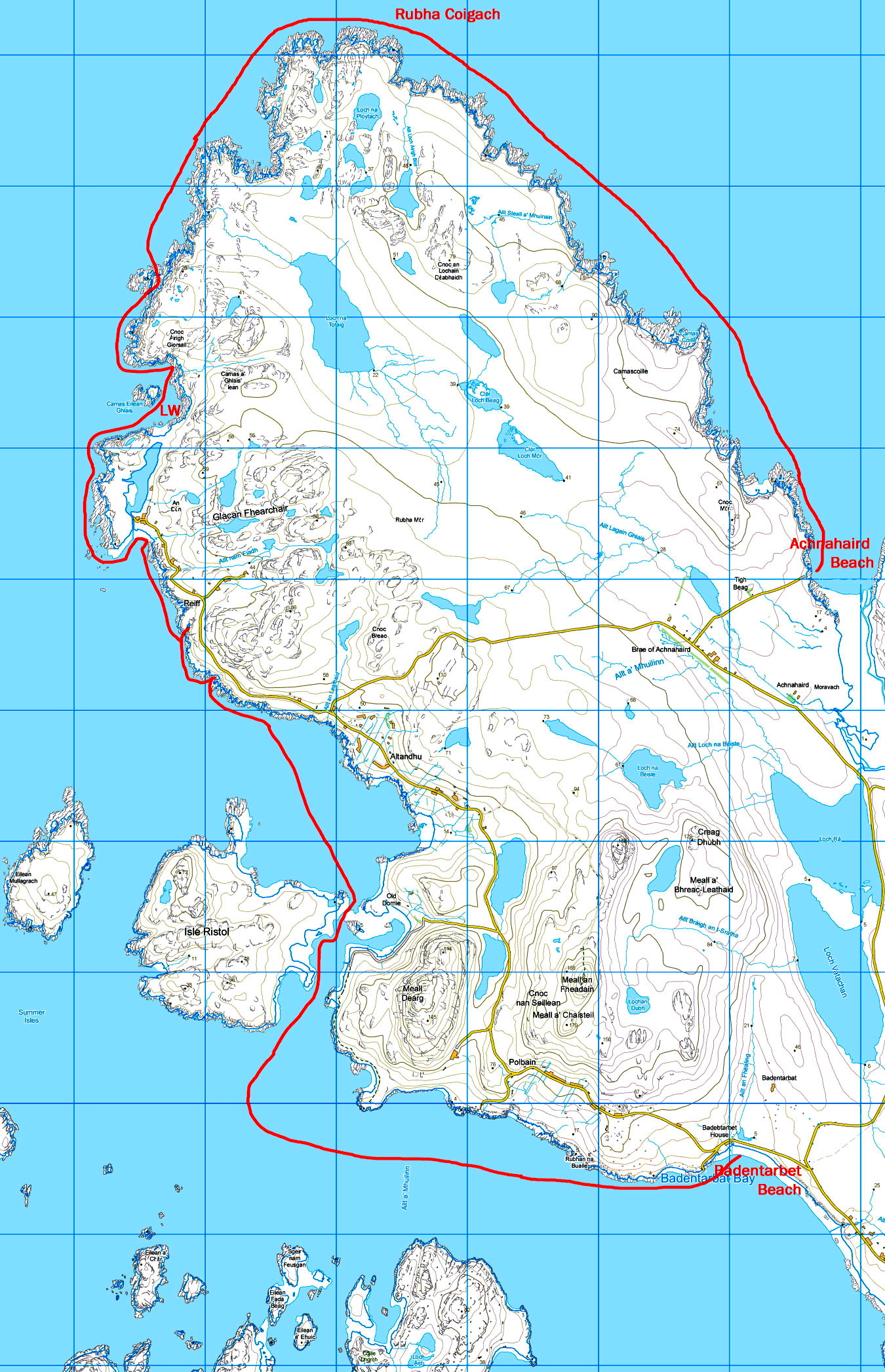
I set off from Achnahaird thinking I’ve left it a bit late. I must get to Rubha Coigach – the northern prow of the Coigach peninsula – by 11.40 BST or my kayak will turn into a sea pumpkin and my paddle into a wicker broomstick.

cogachmap

I was reversing Route #25 from the Scottish Sea Kayaking guidebook, a ‘Grade B’, (C being the hardest). And although spring tides were kicking off next day, the forecast was for very light winds and a warm sunny day; a good day to try and ‘turn the point’.
Knowing that capes and headlands can be hairy places, I’d given this local ‘Cape Wrath’ a wide berth, but current conditions could not have been more benign. So for once I RTFM closely and decoded the perplexing tidal calculations of when not to be seen dead in a bloat at Rubha Coigach, the headland of Rubha Mor. The red period started at 11.40 which didn’t quite make sense in respect to slack water, but tidemaster and experienced NW Scottish sea kayaker Gael confirmed my calcs. I wasn’t going to argue.

rubcoi02

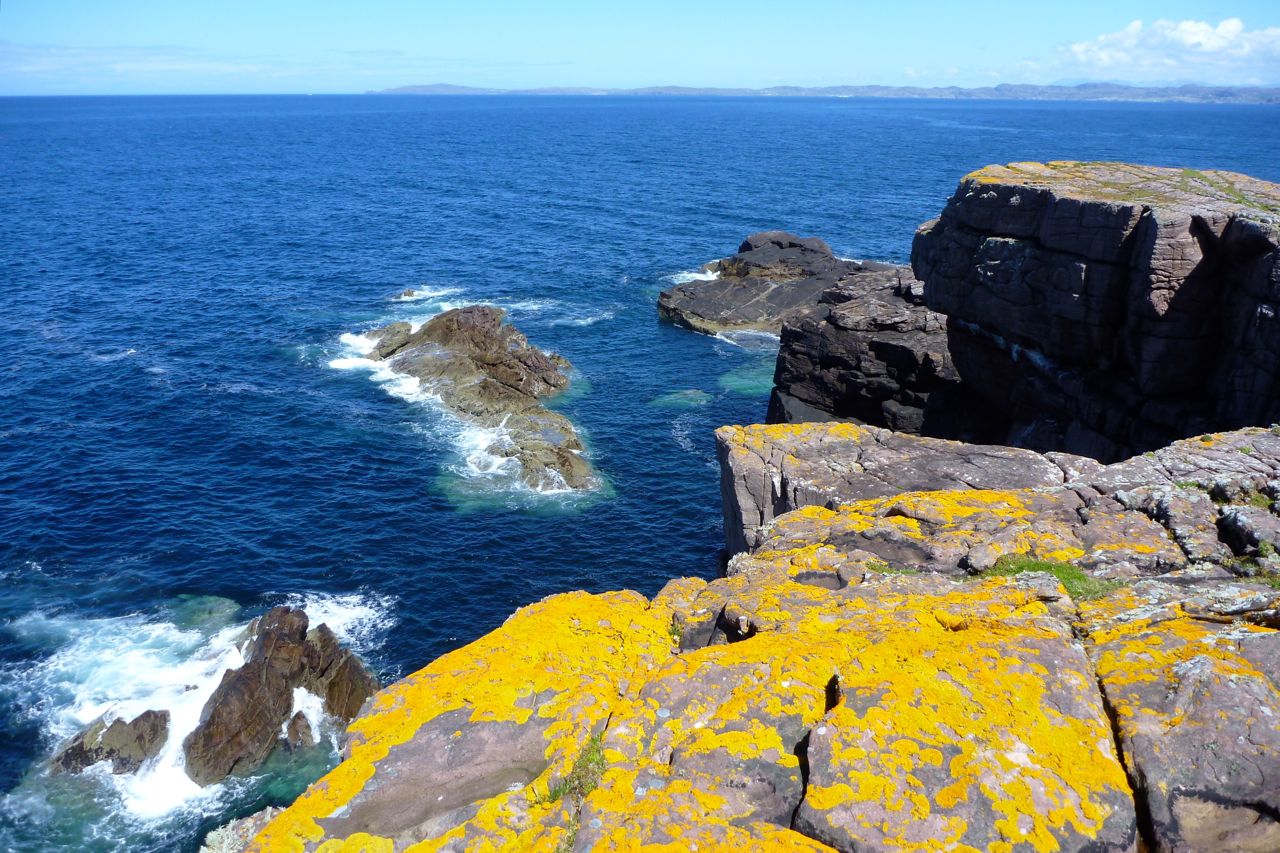
It’s about 3.5 miles from Achnahaird northwest to the tip, and as I paddled along I tried to visualise possible scenarios. What unpredicted Corrywrecken-like horrors awaited me up there if I strayed into the red zone and got caught in a frothing maelstrom of lashing foam and bruised fish? A north-easterly breeze pressed in from the right and a gentle swell lifted the boat pleasantly. Up ahead white foam was periodically slapped off low rocky shelves, but it was nothing I couldn’t handle, and it was easy enough to turn back. I neared the jumbled cliffs which we’d walked to a few weeks earlier (some pics here from then), knowing that whatever it’s like now, it’ll be different once I got round the corner. And I was right.

rubcoi05

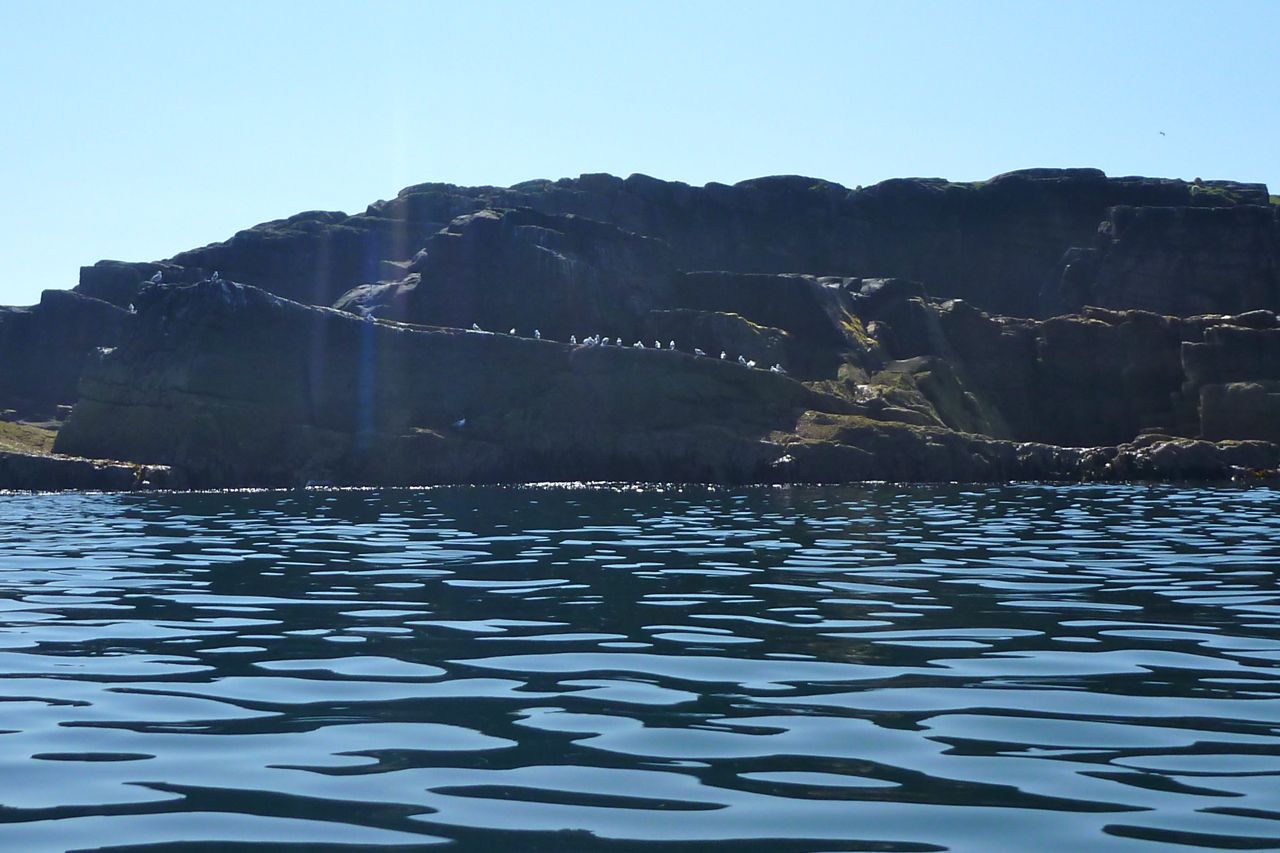
On turning Rubha Coigach the chop dropped right away and I entered a windless Caribbean calm, divided by a hazy line far to the west blurring sea from sky. Lined up along a ledge to my left, a welcoming committee of seabirds nodded approvingly then waved me on with oily wings, pointing insistently at their watches. You don’t want to be here at 16.36 tomorrow, sunshine.

rubcoi06

I could afford to take my foot off the pedal now, but cut across Faochag Bay anyway; up ahead what I thought was a cluster of bobbing gannets miraged into a party of a dozen sea kayaks (left), presumably being guided round to Achnahaird by one of the local outfitters. That was more kayakers than I’d seen here in six weeks or more. The amazing weekend weather had brought them all out likes midges.

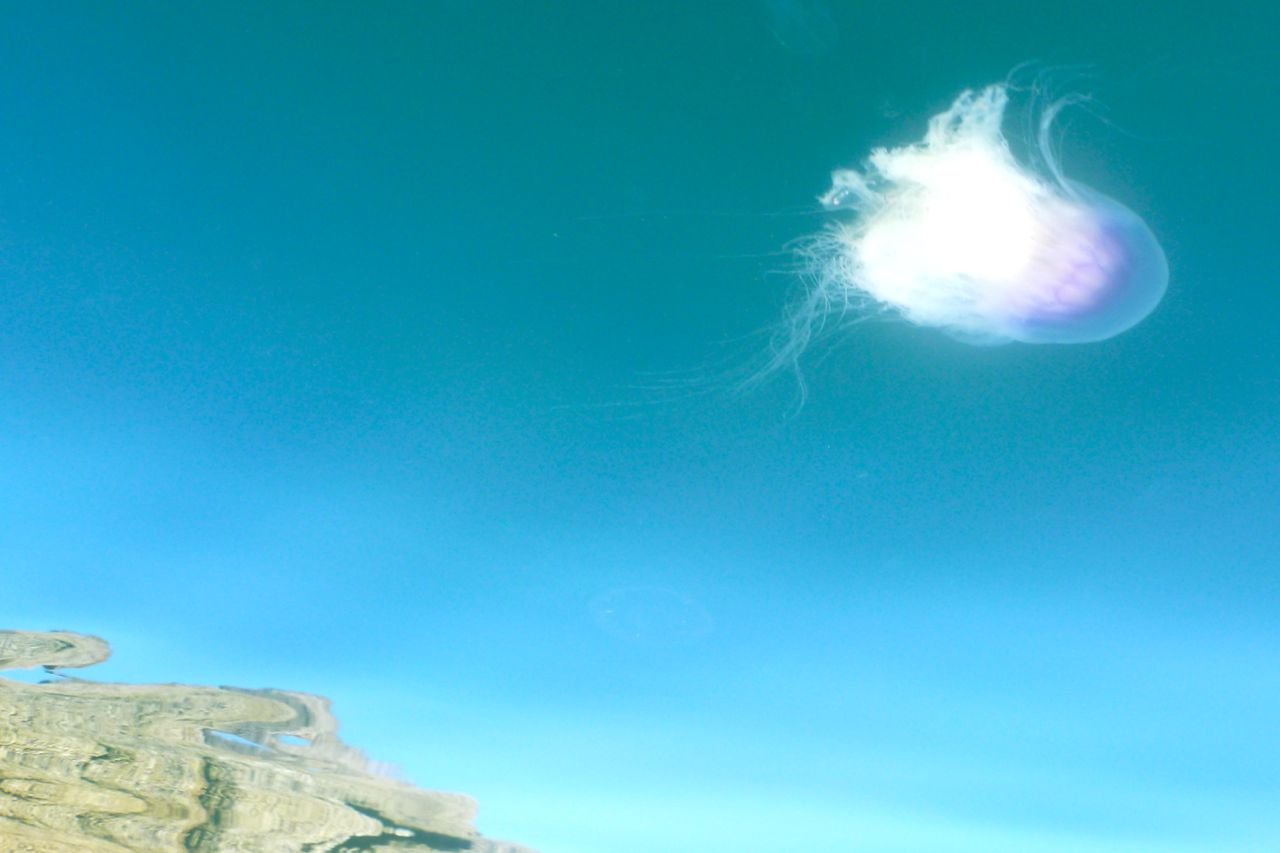
Like yesterday across Enard Bay, the land kept what breeze there was off the sea making a surface as smooth as polished bronze. Beneath that, at least half a dozen varieties of jellyfish morphed and drifted weightlessly like organic spaceships. I’d never seen so many here; do jellyfish spawn?
I was intending to keep going after Reiff where Route #25 started, so before I got there I turned in at Camas Eilean Ghilais bay and an unknown sandy beach. Unfortunately, a lone sunbathing couple sent out bad vibes, so knowing that feeling, I moved on following a quick look around. There were plenty more secluded spots I could reach that most couldn’t.

rubcoi12
reeferai

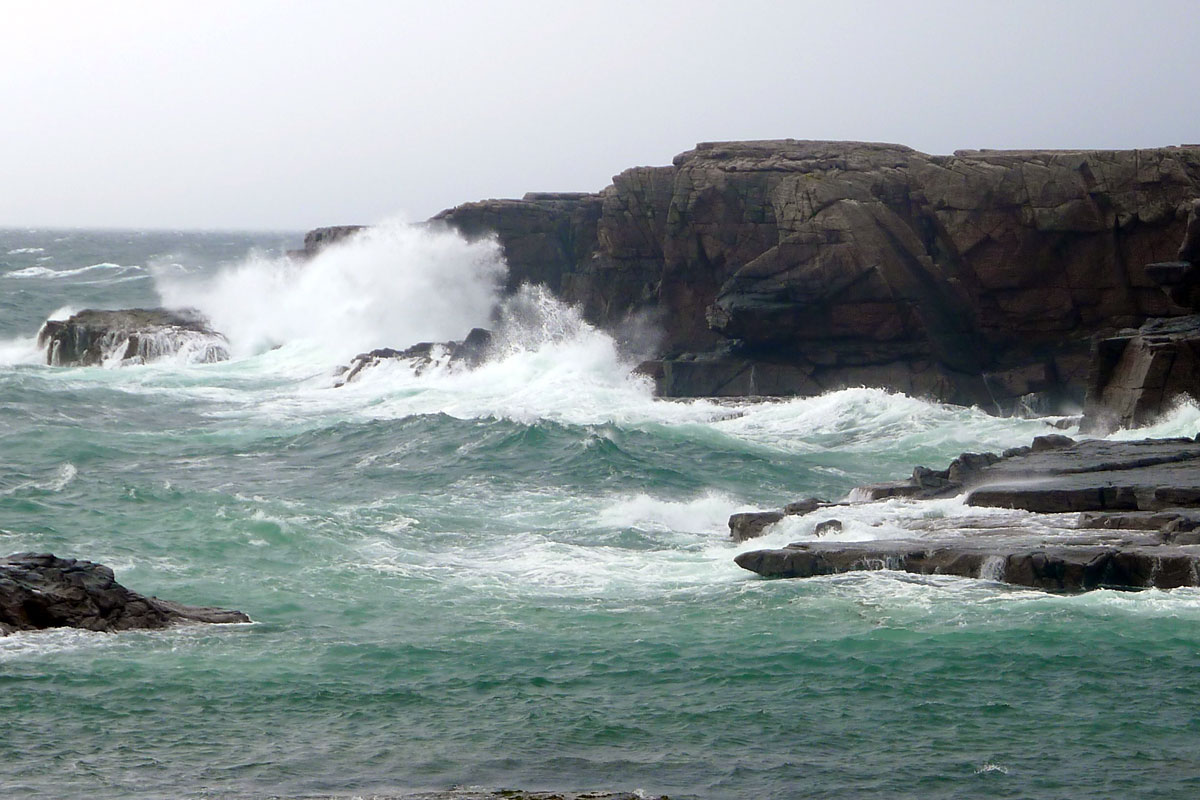
Just south of here are some crags popular with rock climbers and a few were out today. I also knew this was a great place to watch Atlantic storms beating against the same cliffs (left), although today was as calm as an atoll.
The low reefs at Reiff which the SSK guidebook warned about were easy to miss and the sandy seabed off Reiff beach itself (below) maintained the tropical theme.

rubbcoi2

I was hoping to get up the tidal channel that led under the bridge into the Loch of Reiff. The loch holds water once the tide drops and I’ve been on the bridge at a spring tide with the water rushing in to top up the loch, making a fun-looking horizontal version of  a Medway chute. But today I needed at least two more metres of water to get into the loch; a portage looked like too much work.

Just as I was thinking I must come back to shoot the chute in the packraft, one of the R-clips holding the Amigo’s backrest bar in place gave way and fell in the drink. So after lunch I wandered up to a sheep fence and broke off a bit of stray wire to replace the missing pin. That Grabner seat bar is reaching the end of its probation. I suppose the problem is I inadvertently treat it like a fabric IK seat, leaning back to pull out the thigh straps or adjust the seat base. Doing so bends the bar slightly and alloy can only be bent back so many times. Rigid objects attached to an IK (including a skeg) don’t work so well. I’ve a strap-based alternative in the works which will doubtless appear on the Grabner Mods page.

rubcoi16


I trickled on down the unknown shoreline from Reiff to Althandu, nosing into geos crammed with yet more jellyfish, and then headed across to Old Dornie harbour. Other IK-ers and canoes were fanning out from the campsite, enjoying the sunny weekend, but by the time I got into the harbour with 10 miles behind me I was beginning to feel it. Over a forgotten Snickers bar I pondered over heading out to the Summers for a look around.

The breeze had now turned to the southwest, running with the incoming tide although it was still flat enough to roam. I  headed out towards Tanera Beg, but about halfway across admitted that the anticipated sugar rush wasn’t happening. I’d had a great day out, ticked off the feared headland and found some nice places to revisit, so headed for Badentarbet. As I did so I noticed the occasional 10mph gust was pushing the back round; not quite enough to require double ‘correcting’ stroke, but noticeable. Add some swell, waves and more wind and the stern would get pushed offline for sure, but then that’s IKs for you. Not a suitable craft for very windy conditions at sea, although a deeper skeg (old-style Gumotex) and a full payload might minimise this weathercocking.
To make up for my sloth and with a Cadbury’s power surge coming on, I had nothing to lose by hammering away at the last half mile, hoping to crack the 5 mph barrier. But that wasn’t happening either; 4.9 was the best I could wrench from my strangled paddles. Today’s tally: 13.1 miles in about 5 hours and a moving average of 3.2 mph. On the beach I hauled the Grabner over to the freshwater pool for a rinse and called in the taxi.