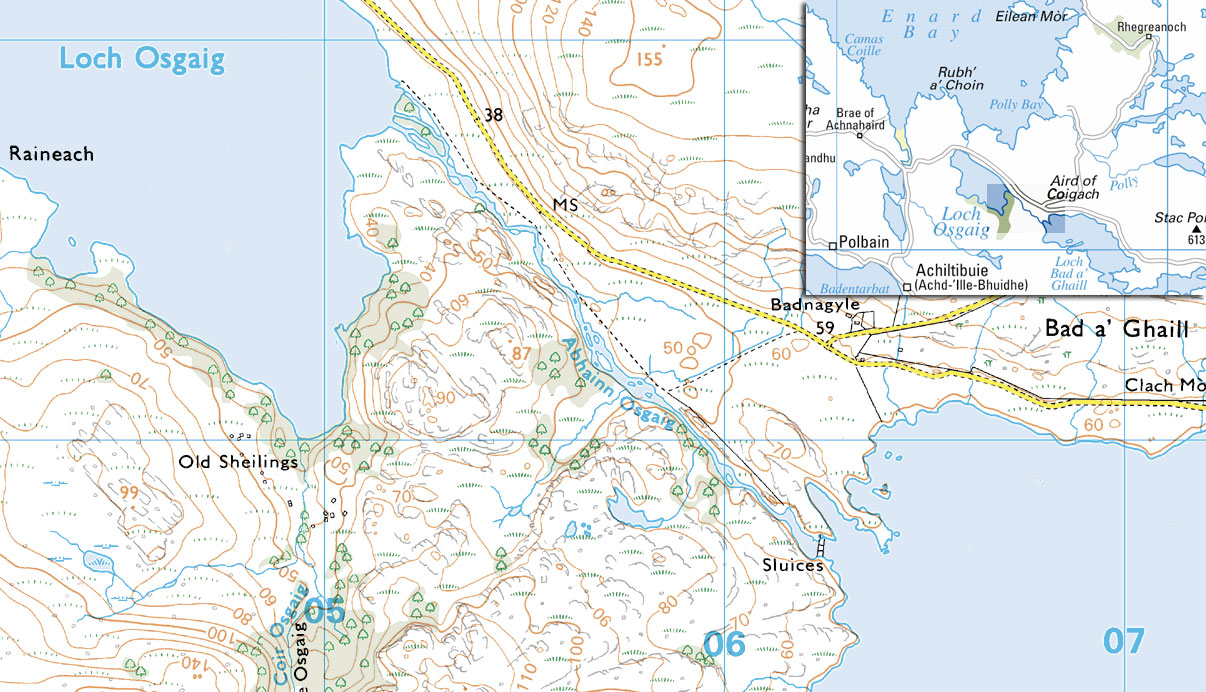
Don’t get excited, we’re talking a few hundred metres of Class 1.1, but that’s as good as it gets around here. We’ve had a lot of rain in the last week, enough to make the only paddleable river – the short Osgaig – worth a poke with a paddle. I was here with the Yak last year at slightly lower levels, so this time was expecting a smoother run in the Solar (now with an improved seat-foot set up), followed immediately by a comparison run in the Alpacka Yak.
Gumotex Solar IK The good thing with the Solar is it’s old, worth next to nothing but tough, so can be dragged like a hardshell with the Yak in the back. I considered jury rigging some thigh straps; it could be done now through the new footrest pipe and around the seat mounts, but looking at the river as I drove up, it wasn’t really worth it. Thigh straps are what makes any deckless boat – air-filled or hard-shelled – much more controllable when things get choppy. Even WW packrafters insist straps are the way to go.
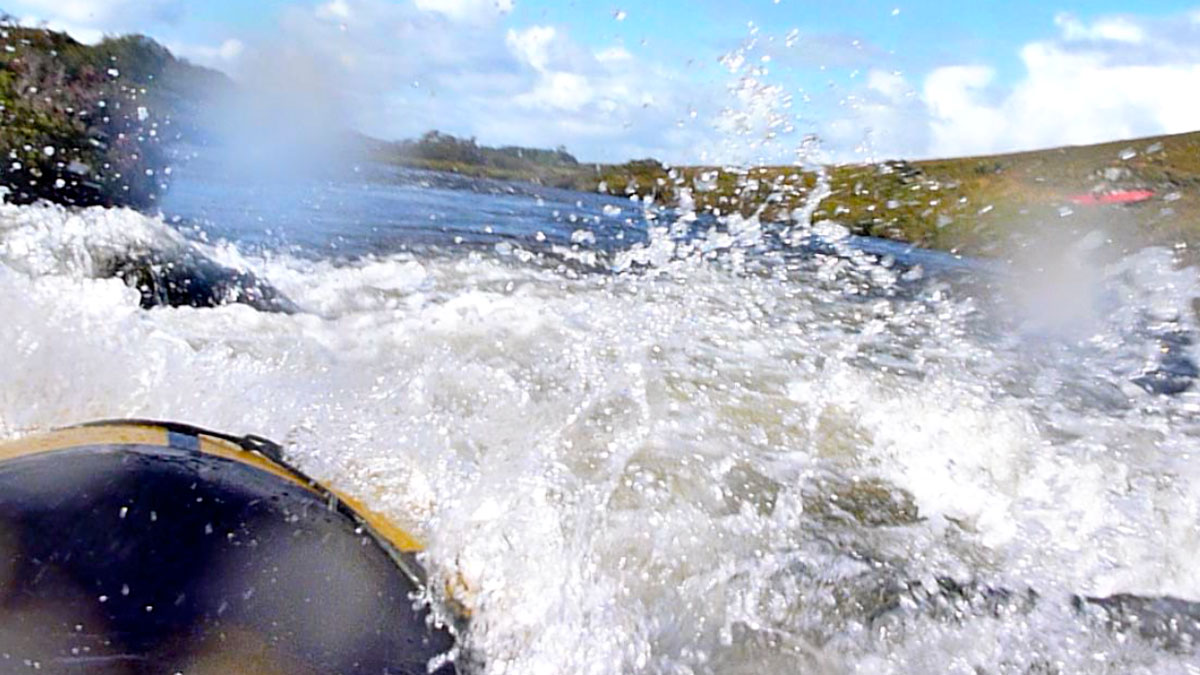
With the skeg off, it’s easy to seal launch off a grassy bank and into the scrum just below the waterfall which looks a bit complicated so was no less inviting this year. As I spilled over the first little step I tried surfing like people do. But the Solar wasn’t especially dynamic or there wasn’t a strong enough recirculation going on to make it feel interesting. So I swung round and set off. Even at full flow, the Osgaig is a shallow, bony river better suited to an injection-molded TNP ‘spaddle’, not 220 quid’s worth of carbon-light Werner Corry which was picking up new scrapes as I jabbed at the water to keep the boat on line. It was really quite effortful with the Solar, at 3m or nearly 10 feet it’s perhaps a bit long for this sort of thing. I hit the one or two rapids full face, kicking up a satisfying splash and remembering that ‘bring it on’ exhilaration when trying an IK and white watering for the very first time on the Salmon River in Idaho all those years ago.
The river branched near the Loch; left looked all froth but too shallow so I swung right but again scrapped and shoved from one bar to the next. I was hoping to make it all the way to Loch Osgaig but up ahead I saw the tree strainer I recalled from last year so, stuck on another rock and by now steaming out of the ears in my heavy drysuit, I stepped out and walked back upriver.
Alpacka Yak Packraft A few minutes later I hopped into the snug Yak, spun round and slipped over the first drop. Spinning back, I tried to surf as I’d just done in the Sunny but it wasn’t happening. I guess the Yak is just too wide, light and too much drag to fight the flow. Off I went downstream, trying to avoid getting snagged while lining up to take the peak of what waves there were. Jammed in the yellow tub, sat lower and with higher sides, it felt much more responsive than the longer Solar and so was less effort to ride. Perhaps part of it was that a good line is less vital; most of the rapids I could have taken backwards and that added up to more fun. So there it is: a tight-fitting packraft is more fun on easy white water than a 3-metre IK. When I got snagged towards the end, I just stepped out, threw the boat ashore, and staggered out over the slimy boulders.
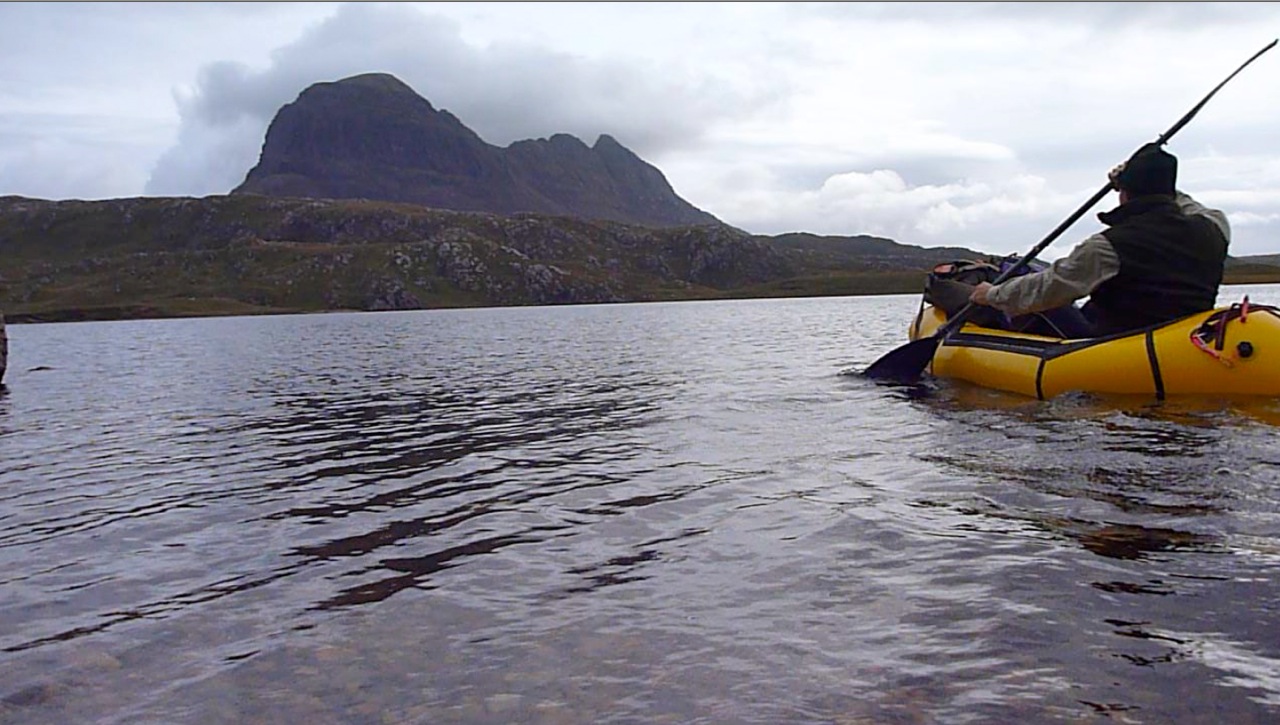
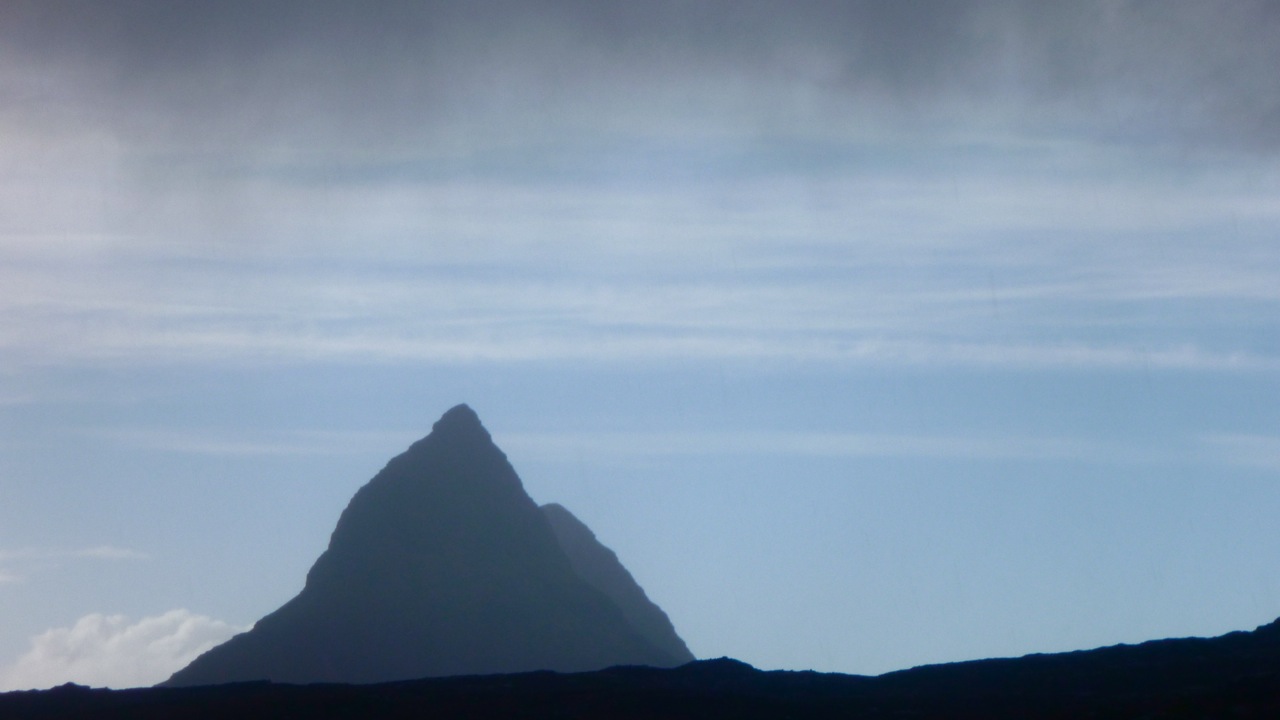
I’ve already done a couple of great packrafting excursions around the charismatic mass of Suilven mountain (left, viewed from the east). Last year we did a ‘triathlon’ loop up one side and down the other using bikes, feet and two-up in the Yak; and before that I did an overnighter from Loch Sion to have a look around. That second link has an intro to the region you may like to read.
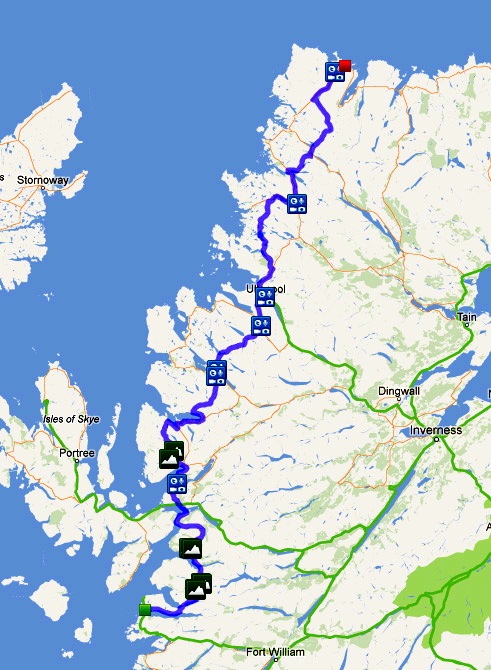
So you’d think I’d know the local pack-potential well, but looking yet again at the map, I clocked an interesting if lengthy day out, packrafting around Suilven. I could walk east out of Inverkirkaig past the Falls to Fionn Loch, then paddle several miles of continuous water south of the mountain to cross a headland and then another short loch. From there I’d turn back passing a couple more lochs to Lochinver back on the coast. That was around 23 miles, plus another 3 or 4 back to the motorbike at Inverkirkaig. An eleven hour day for sure so unusually, I packed a torch.
The day of least bad weather arrived (today’s grim weather, right): overcast and 12°C with winds building up to 25mph bringing showers and afternoon sunshine. It would have to do; the rest of the week was forecast as much worse and at least I’d have backwinds paddling out.
Should they become hard to handle I knew I could hop ashore – that’s the great thing about packrating. But I also knew that cross country hereabouts is usually a gnarly combination of boot-sucking mires, moss-clad boulders and ankle-snapping tussocks of clump grass. Unless you’re a ground slug or sport a rack of antlers, when off piste in the trackless wilds of the far northwest, you’re often better off in a boat.
Nine 15 and I was out of Inverkirkaig with two fat sandwiches, two bananas and a cup. The thickly wooded valley with it’s not quite paddle-worthy river rose up to the 60-foot Falls of Kirkaig, but with filming and whatnot, it wasn’t till 11am that I paddled onto Fionn Loch (left) under a ceiling of thick cloud on the verge of incontinence. The rounded west prow of Suilven loomed above, trailing its cone-like tail like the giant goldfish in the Singing Ringing Tree.
I was reversing the section we paddled last year on the triathlon, and at a narrow point passed some small standing waves indicating a current flowing back to the river. Hmm, strange I thought. Approaching the mile-long narrows which maps call Uidh Fhearna, it was a stage which I’d somehow got into my head flowed eastinto Loch Veyatie, based partly on this picture I took last year. Turning south round a reedy bend and fighting what I thought was just the headwind, I took another turn and, like some astonished Victorian explorer, found the water flowing west, right at me. Of course it does. At the other end Loch Veyatie, Cam Loch drops through a series of waterfalls, and if Fionn here did the same, where did Veyatie drain – down some tectonic plug hole? There would be no Fellowship of the Royal Geographical Society for me this year.
Even with a backwind, there was no paddling up this Uidh (left), though I’ve read of hardcore canoeists poling it. So I unplugged the Yak and set off along the north bank to the far end where the Uidh opened out onto Loch Veyatie and lost its current. With no free ride to help outrun the afternoon’s predicted winds, my schedule slipped away. As the OS map shows initially, there’s a path as far as a stream a mile away. Who knows why, maybe that’s where folk fish, but of course the path itself becomes a mini river. I should have worn my long Seal Skin socks today, the short ones were already sodden but they still kept my feet warm. After fording the river I decided to continue cross country until it became too hard. That took less than 20 minutes by which time I’d already stumbled twice and, while negotiating one steep bank, actually feel a few feet into the loch! Luckily, no damage done so just up ahead I set my sites on a beach to deploy the raft. It was now 1pm and with that walk covered at around 1.5mph and getting slower; better to get on the water. But first, for amusement purposes I filmed myself from unrolling the Yak to paddling away. It took 8 minutes, something that you’ll see below is made a little less boring to watch by speeding up fifteen times.
An exposed hour’s paddle down Loch Veyatie ensued. I turned out of the cove into the wind, hurrying for the south shore to get into the southwesterly’s lee until the next narrow point where I’d cross back to the windier north side to line up for my take-out. As I passed across the mouth of the sand-spit inlet of Loch a Mhadail, gusts blasted out fetching up some whitecaps. It’s all in the mind of course, but I really don’t enjoy bobbing about alone, mid-loch and out of sight on a chilly September’s day without a drysuit or PFD. One good thing with the Animas backpack I was using for the first time was that like my UDB, it doubled as a reliable float bag. Although there was virtually nothing in it bar my lunch and a cag, that was the reason I sealed it full of air.
The overhead gloom and rising wind was eating up a lot of nervous energy, but that wind was also pushing me along at what turned out to be 3mph, more than double what I’d have managed staggering along the shore, and more direct too. Another reassuring surprise was spotting the buildings at Elphin on the A837 at the head of the Loch. I’d forgotten how close I’d be getting to the other end. Paddling with the wind past the south shore, cascades ran off Cul Mor and scraggy patches of original woodland clung to the foreshore. I counted them off on the map as markers to my take-out, and with a dash over to the north side, that came up just as it looked on Google Earth last night. What a great WYSIWYG navigation aid GE is. Let Google harvest all my dreary browsing data to throw back at me as targeted ads. It’s a price worth paying for their sat mapping services.
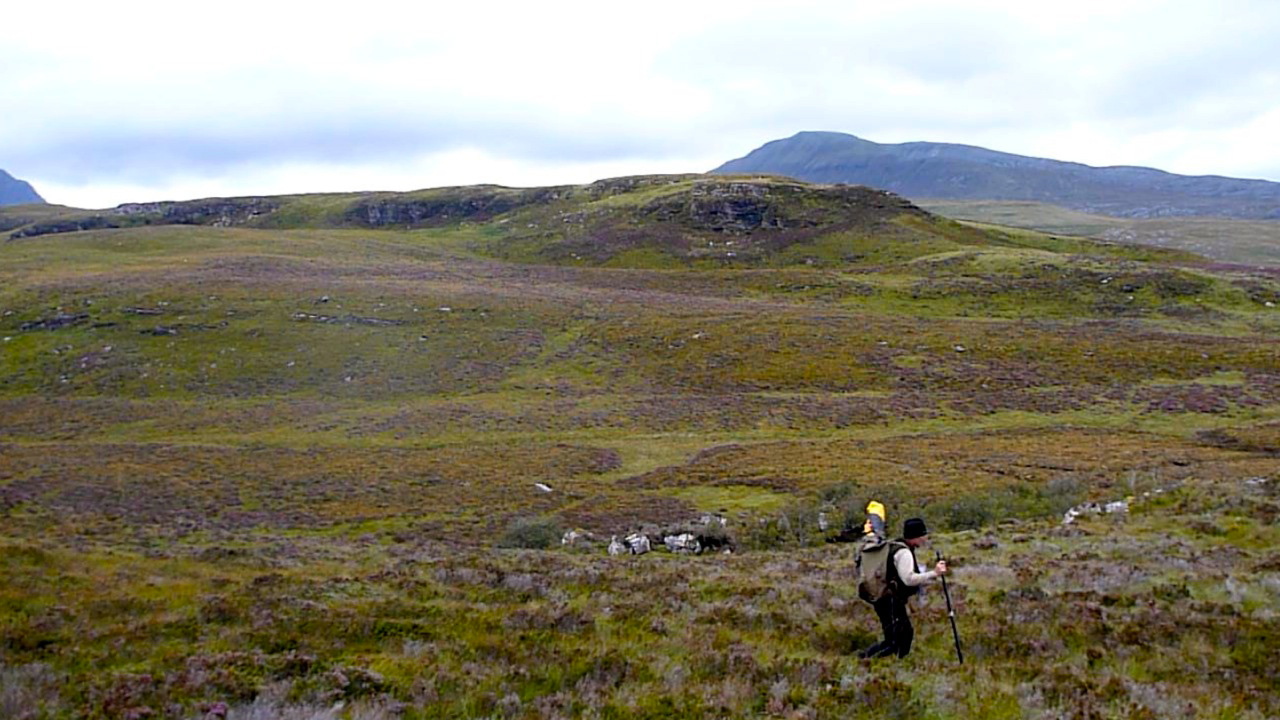
It was only when I crawled out of the boat and stood still that I realised how strong the wind really was, roaring over the hills and bating down the grass. Even though it was less than a mile’s walk to the other side of Creagan Mor headland, there was no chance of leaving the Yak inflated. Instinctively I headed for higher ground, scattering some deer far ahead, but my route soon led to a cliff so I dropped back into the bog and tussock valley that brought me to Cam Loch’s shore. Here I felt I could relax sufficiently to eat something. My cup was MIA, out on the loch somewhere, so I scooped up a drink by hand.
One more loch to cross; easily done no matter how windy it’s become. Somewhere on the north side the map promised a path that led 12 miles back to Lochinver. All I had to do was slot myself onto it and ride it out for as long as it took. Whitecaps rolled passed me as I neared the north shore of Loch Cam, but what had had an edge of dread on Veyatie just an hour or two ago was becoming familiar and a bit of a laugh as the promised sun stuck its nose out for a sniff at the day. After airing down I soon hooked up with the stony trail, but found I was wavering a little, probably through not eating or drinking enough. It was now 3pm; six hours on the go but I’d only actually walked some 4 miles up to that point, so the legs had plenty left in them and there was drinking water running down the paths.
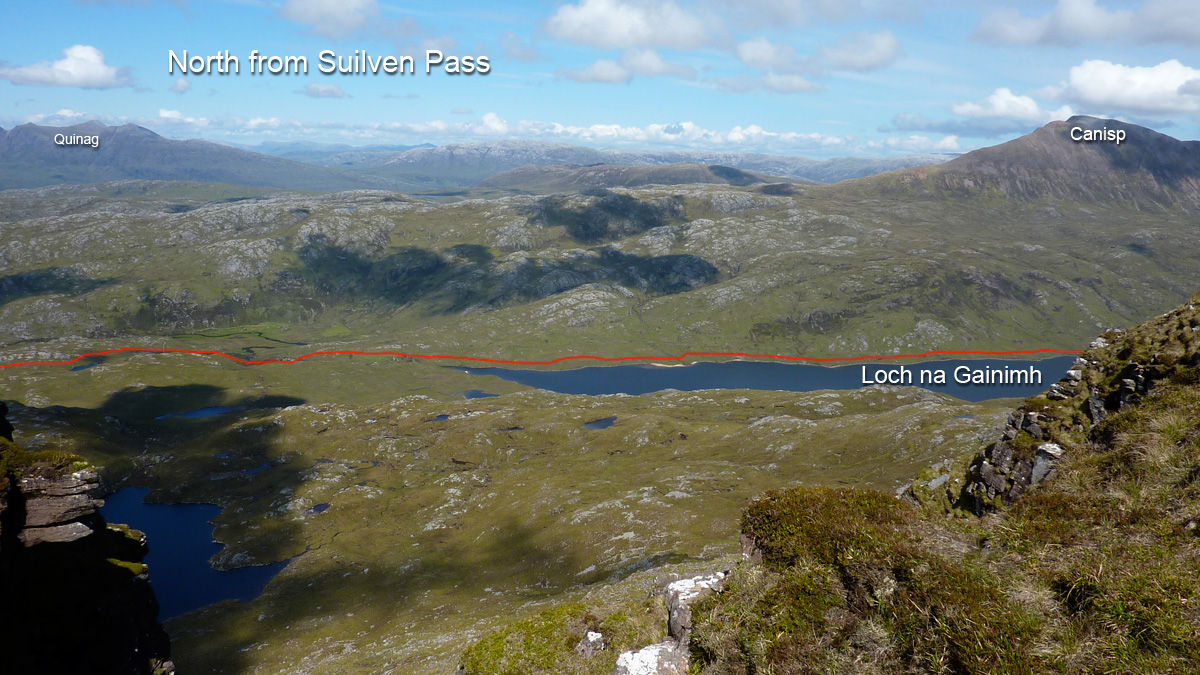
On occasions I’ve harboured thoughts of cycling this path from Lochinver to the A road, but from the state of it at this end I’d not get 10 feet. It followed a hard, white rim of exposed stony rubble that’s visible on a sat image, but I suppose was better than the mush to either side. Light grey and crystalline, I’ve since read it’s Lewisian gneiss or quartzite which gives the appearance of snow to some of the Assynt’s mountains like Canisp or Foinaven (see long image below). This whole region is marked with monoliths, the most striking of course being the remnant sandstone outliers like Stac or Suilven which resisted their brush with the glacier’s claw as it passed through, exposing the ancient base of lighter coloured gneiss.
I’ve kept missing the interesting ranger-led talks at Knockan Crag, just south of Elphin, he site of the Moine Thrust which literally turned geology on its head a century ago.
I’ve had Alpackas a couple of years now but I’ve been a bit slow about trying out bikerafting. I like pushbiking, walking or packrafting in the wilds and combining walking with paddling (aka: packrafting) is well suited to northwest Scotland, as several posts here show. But add a bike and any off-roading becomes marginal up here. Most of the time you’ll be pushing or carrying, especially with an overnight load. No MTB is really rideable on the footpaths up here, although unlike England and Wales, since 2003 Open Access allows cycling on footpaths (there are no bridleways). Off the footpaths, at times you can barely walk, let alone ride a bike.
I like the simplicity of walking with paddling – you can traverse both surfaces most anywhere you like. A pushbike requires rideable terrain and on an Alpacka gobbles up payload, space and buoyancy, requiring you to design routes that combine flat water with ridable terrain, or even roads to make the most of the configuration. Then you got the faff of securing the bike reliably to the boat (or so I thought); the last thing you want mid-loch is 15 kilos of Cro-Mo steel slipping off and turning into an anchor just as the wind kicks up.
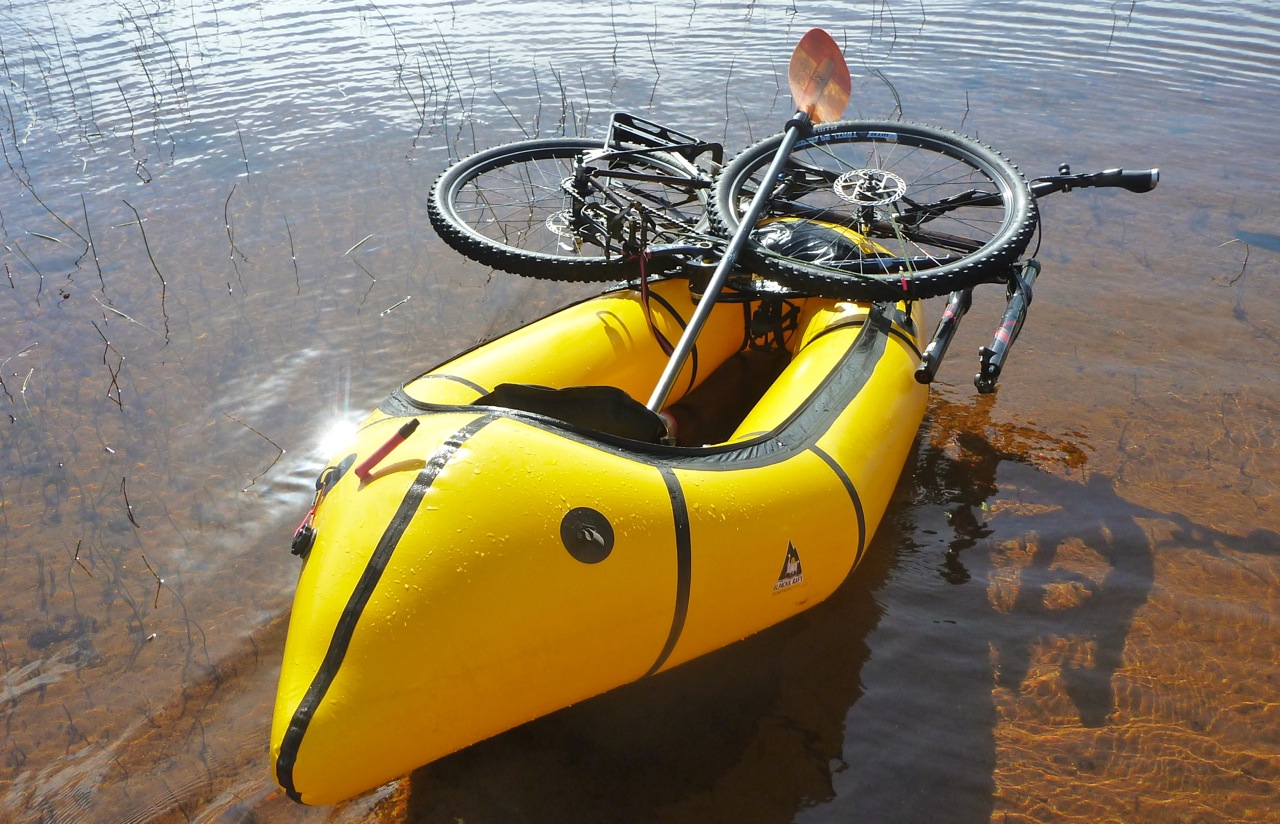
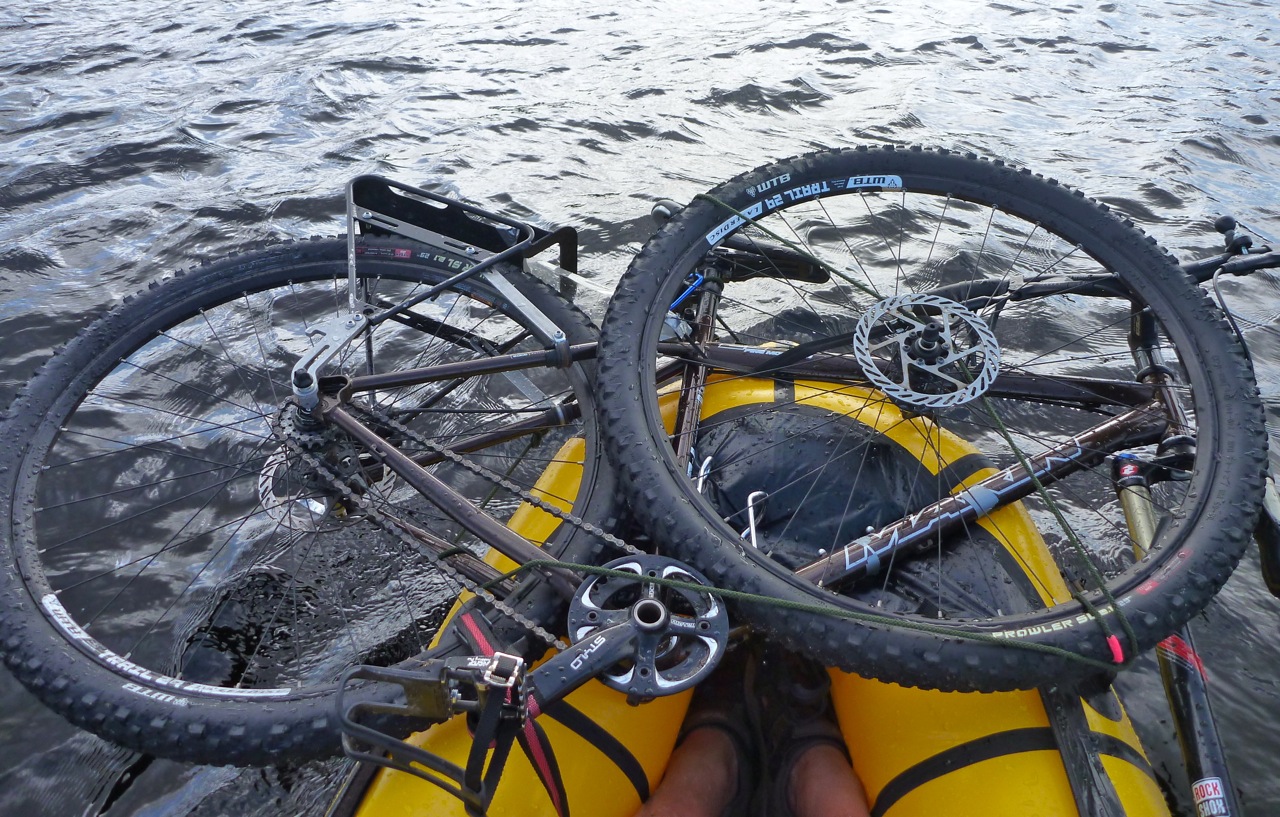
But let’s give it a try. The winds had backed down to a forecast 15mph (yesterday it was three times that) so we nipped out with the Gumotex Solar for a scoot around Loch Oscaig. I hadn’t tried it before, but with the front wheel off, strapping the bike on was actually pretty easy. The four Alpacka loops line up just right and two short straps plus the boat’s bow line were enough to secure the load without even a smear of chain grease. A loop of inner tube was handy to hook the handlebars around the top tube to stop one end dragging in the water. Once on the water, my arrangement was by chance correctly balanced, too.
My bike’s at the time was a single-speed Marin with hydraulic brakes so there were no cables to worry about rusting, but on the move it was clear the back wheel got in the way of a full stroke on the left, making for unbalanced paddling. I got used to it but for a longer stage it would be better removed, even if it leaves the chain flapping around. To me it’s a light bike, but the Marin probably weighs 14kg, about the same as overnight loads I’ve carried. The good thing is, such a weight on the front of the Yak only improves the tracking by reducing yawing.
The wind got up while we were out and at the downwind end of the loch it got a little choppy with splash coming over the sides, but the Yak bobbed over it. Here the Mrs set off against the wind for the two clicks back to the boathouse, while I hopped out, unloaded, aired down, rolled up and rode back along the road.
Having now tried it I’m a bit less sceptical about bikerafting. On the boat it was less of an encumbrance than I thought. I’m not sure it would work well up here in the Assynt without contriving a route, but maybe all packraft trips are contrived to a certain extent, and anyway the motorable roads here are very quiet.
I suppose the real advantage of a bike with a raft over walking is that, providing the terrain is amenable, greater distances can be covered off the water which extends your range. But combining a multi-day trip with a bike away from roads gets challenging. I’m thinking of something like the 2008 Lost Coast bikerafting trip in Alaska I read about a few years ago, which ran northwest from Yakutat. Roman Dial, Erik Parsons (from ’08) and a couple of other guys did a similar route last year, but heading southeast towards Glacier Bay this time. Check out their superb vid below or Roman’s blog post and pics. The vid doesn’t not show much rafting but look at the route maps: they sure put in the days on the water.
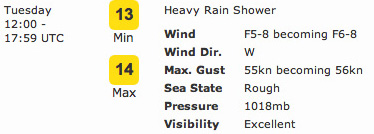
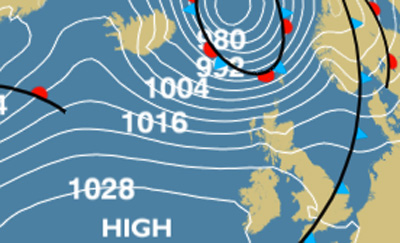
I do like a good storm. On the left today’s coastal forecast for the Minch. You might call it the first big storm of the autumn. Some 250 miles to the north, out on the Faeroes and towards Norway it’s blowing at Force 10 with 40-foot waves, like something out of the Perfect Storm movie before it gets really scary.
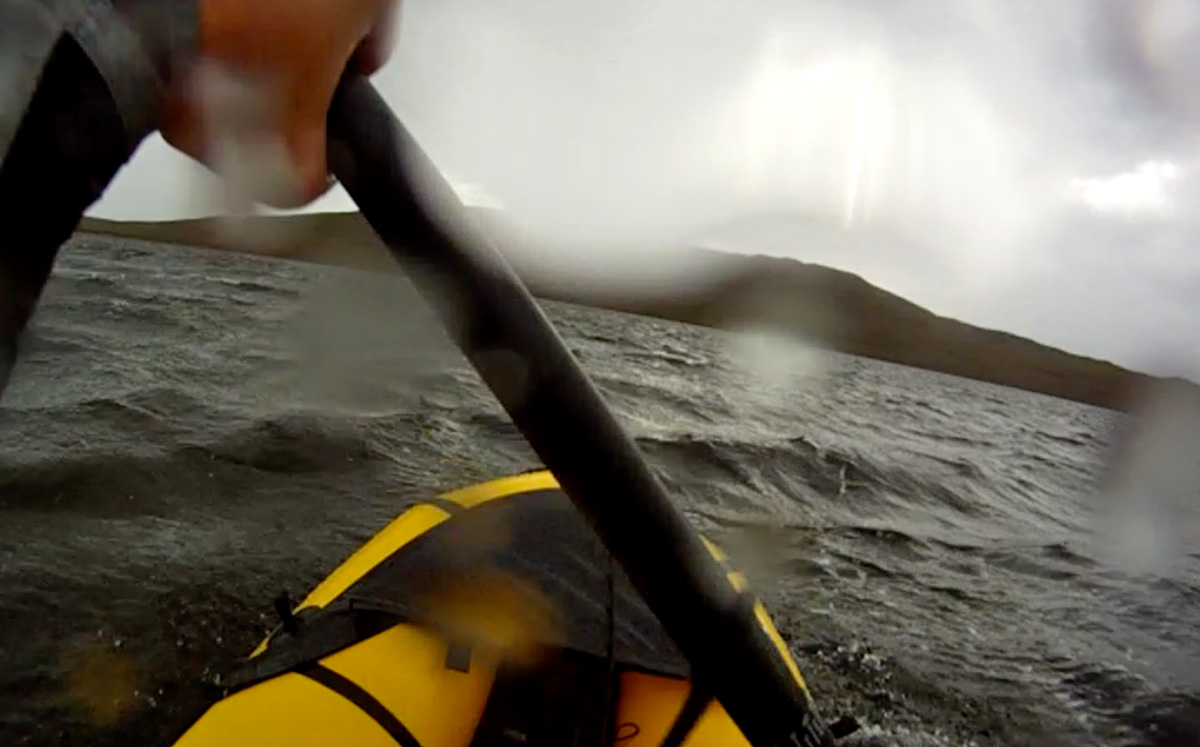
What can it be like to paddle a packraft against a wind gusting up to 50mph, I wonder? Is it even possible? Many times I’ve surprised myself how fast an IK can move – 2-3mph – into a headwind of around 25mph. You can’t sustain that all day, but last year I managed to plough along like that for an hour or two when I gave up on the Ningaloo Reef and turned back into the wind. Seeing as gale-force is the only paddling available for the next few days, I rolled up the Alpacka and went to find out. Sorry to disappoint you but heading out to sea alone, even on the beach with the onshore wind felt too risky. I figured there was a good chance of a gust flipping the back-heavy Yak in a kind of ‘frontal bandersnatch’ as it crested a wave. Better to stick to my ‘play-loch’, site of many paddling experiments and where there’s just wind and not much wave to deal with. In the given conditions inflating the Alpacka in the back of the car was effortless; it took just six bagfuls to fill up the boat, instead of the usual ten. Getting my yellow windsock onto the water was less easy, so once I slapped it down I jumped in quick, clipped the raft to myself via the paddle and tried to leave the shore at the downwind end of Loch Raa.
There was no fetch to speak of and using my large-bladed but light Werner Corrywrecken paddle, I jabbed at the water head down, trying to make headway. The waves rushing by gave the impression I was flying but a sideways glance to the shore showed the raft was barely creeping along. And when a gust hit, it didn’t actually move at all despite my huffing and puffing. Even though I’d probably missed the peak of the day’s winds, not surprisingly I’ve never experienced a paddling effort like it. It felt like some sort of horizontal pull-up machine in a gym set on ’10’ and my hands gripped way out on the ends of the shaft to increase the leverage. Soon any ideas about paddling to the far shore, only 700 metres away, were surrendered. From a video’s timeline it seems it took me 8 minutes of flat-out effort to cover 250 metres – just over 1mph with brief rests every couple of minutes.
I felt safe in the Yak; the gust-borne waves weren’t even a foot high and it was actually a good little workout. Once I’d had enough, I swung round and shot back to shore at what turned out to be 4mph, but felt like sitting still while the wind blew past from behind. Interestingly the raft was easy to handle; no weathercocking. Walking the empty Yak to shore, it took off like a kite. Had I not been strung onto that thing it would have been on it’s way to Inverness quicker than the RAF Tornadoes which tear across the skies hereabouts on a fine day.
Chopping down my Sevy pooltoy into a slackraft lost too much buoyancy to take my gross weight, but it works fine for the Mrs who’s about half my weight. So on a very calm, sunny morning – realistically, it’s inshore limits – we took the Sevy out to the Bay for a swim. I’d glued on an extra outer covering of ballistic nylon to save the vulnerable floor, as we had planned to take it down the Escalante river in Utah a couple months back, but it was way too hot for that when we got there and since then, as you may know, much of the US has been suffering a terrible drought.
As often, the first paddle in a short boat like this sees the operator yawing from left to right like a crowd watching a ping pong final. After a while, though the paddling technique adapts to reduce this effect, but even then the boat is still much slower than an Alpacka. This Slackie is only 28″ wide by 56″ long – 2:1 – (my Yak is 88″ x 36″; 2.44:1) and the Mrs found the best trim was sitting in the middle, even if this meant nothing to lean back on and was not sustainable. Next time out we’ll take a fishing buoy or something to lean against, although I do wonder if some sort of trailing skeg – a board sticking out the back rather than an under hull skeg like on an IK– might help subdue the yawing and so direct the effort in a straight line rather than zigzags.
My Alpacka skims along just like it always does; what a great boat it is. Annoyingly the backrest is leaking again from the twist valve base, even though it’s been glued up once. I find you do need that backrest to sit correctly in the boat, so another repair is due. We dipped about, followed the river channel and out to sea and on to the rocks. As the tide turned we headed back up the river, against the flow the slackboat soon slowed to a near stop and it was faster led on its string through the shallows until a tailwind helped blow us back to our shoes, by now stranded some 200m from the water’s edge in just an hour.
A post-sea trail inspection showed that my carefully glued floor was coming away from the Sevy’s PVC hull like damp wallpaper; that may have explained why the boat got so slow coming back. The Evo Stik didn’t take to the hull at all, or if it did, seawater soon dissolved it. At the time I was trying to save on my nice Bostik 1782 which I used elsewhere on the slack boat with no problems. Anyway, it’s not worth wasting any more glue on this boat. And who knows, perhaps the ribbed floor which has been exposed again may help restore some tracking. We’ll see next time. We’ve half a mind to repeat last year’s fabulous Suilven triathlon, but this time in a boat each.
I got round to trying the Sevy ‘packraft’, a cheapo PVC dinghy with the outer hull cut off to make it less wide and hopefully more functional. Compared to the single-chambered Alpacka, blowing it up takes a while. The floor is made of two interlinked ribbed chambers which require a ‘spike’ beach ball inflation adapter that fits on the end of the K-Pump (right). The main chamber fills quickly enough with the K-Pump – a one-way Boston valve ensures you get a good fill of the elastic material and it’s always a surprise to see it stay that way according to the SevyGauge™.
Even then, on the riverbank alongside the Yak it did look very small and rather low in draught so that even with a dry suit, I wasn’t convinced I wanted to get in off a steep, muddy bank. So I set off upriver to Sluice Weir in the Yak, towing the Sevy and intending to shoot the chute for a bit of fun. On the way I spotted a striking blue bird – never seen one of those before. Do you get bluebirds in Kent in mid-winter?
I got in the boat as gently as I could but it didn’t take long to have an inverted Archimedean revelation: the mass of the paddler was nearly equal to the peak buoyancy at the rear of the craft. That’s partly why Alpacka came up with the fastback tail in 2011. Unlike Archimedes, I didn’t jump out yelling ‘Eureka’. I just sat still thinking ‘is it spilling over behind me and if not, why does my back feel cold?’ I took a couple of pics behind my back (below) to establish plimsoll levels, then set off slowly across the pool, with the trusty Alpacka tender bobbing along behind in case the Sevy sank.
This was not relaxed or efficient paddling like in the Yak. I arched forward trying to offload the stern while pulling gingerly through the water for fear of initiating a possibly catastrophic water-bounce that would fill the boat. The Sevy sagged feebly under the weight of my butt and feet, just as I’d seen Jeff’s do on the Fitzroy. However Alpacka do it, it’s the rigidity in their hulls that makes them as good an airboat can be. The multiple coatings on the non-stretch fabric must have a lot to do with that. As expected the short, round Sevyslackraft yawed quite badly, even with the Alpacka in tow to act as a rudder. But that always happens first time out in one of these boats until you adopt a smoother technique. Either way, I was relieved to be wearing a drysuit.
As I bimbled around trying not to sink, the nearby weir boom opened up without warning and suddenly the Medway was kicking out a current such as it had not seen since the end of the last Ice Age. I could barely make headway in the Sev so allowed myself to be swept back to the canoe portage pier where I hopped back into the Yak. Within just a few minutes the river had risen 6 inches or more. I thought it had appeared rather over-full upstream in Tonbridge where I had driven through earlier. Anyway, the 5-minute Sevy Slackraft trial were complete. To paraphrase Right Said Fred, I’m… Too Hefty for My Boat, although it will make a nice packraft for the Mrs who’s a little over half my weight of 95kg + winter ballast.
So, packboating newsflash: the Sevy blow-up boat is not for bloaters like me. But as it’s so light I could still see a use for it as a tow barge for a bike or an extra huge payload (not that you could realistically walk with such a load). Maybe a really long river stage, or one where you want to be well equipped on arrival with a huge tent or something.
As promised, I’ve invested in a Sevylor Caravelle PVC dinghy. Cost: £34 delivered complete with pump, oars, repair kit, manual in ten languages and a box which is bound to come in useful one day. The heavy-duty Super Caravelle model, as modified by Narwhal, is out of stock in the UK until next summer, although an Intex Sea Hawk is the same thing and can be ‘skinned’ of its outer hull (as in the graphic, right) in the same way to make a lighter, narrower and nippier ‘PVC packraft’ – see bottom of the page. That’s the purpose of what is being done here, in case you’re wondering.
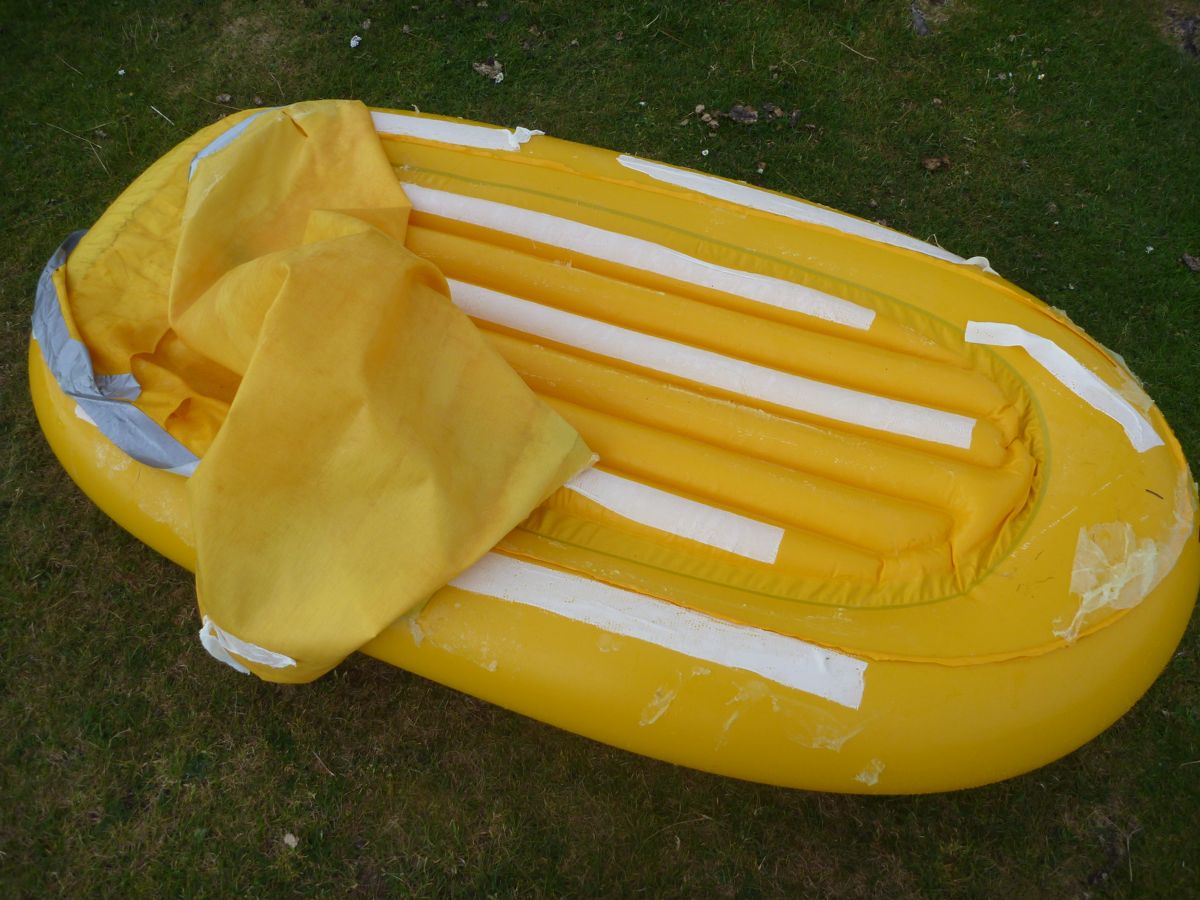
Pre-skinned and rolled up, the Sevy was about the size and weight of a proper Alpacka packraft, but awaft with that dizzying scent of PVC which takes you back to Mallorca in the late 1960s. Fully inflated, it’s too wide to take seriously, but it stayed like that long enough to enable the outer chamber to be surgically removed with a bread knife. Unfortunately, it’s on this outer chamber that the half-decent ‘high volume’ Boston valve is fitted – all the rest (2 floor chambers and the inner hull) get poxy, beach ball-style push-in valves which, in the latter case, take a while to inflate due to the pencil-thin aperture. Perhaps the Boston can be grafted onto the inner hull; what’s the worst that can happen? I’ll find out soon enough as it also took so long to deflate the remaining hull by squishing the push-in valve I decided to cut it out there and then and slap on the Boston valve from the trashed outer hull over the hole (above left). This was the first time I used MEK solvent to clean PVC. This stuff is pretty damn potent and ‘cleans’ the PVC a bit like paint stripper removes paint! Tellingly, it’s also known as polystyrene cement and has uses for welding too, so use it sparingly on PVC pool toys or they’ll dissolve before your eyes.
The squidgey little foot pump (right) is very light, but slow, especially when trying to get enough pressure into the main chamber for the slide-marker to move down and line up with the ‘A’ on the SevyScale™ (below left). This is a pressure guide so you don’t burst your new pool toy – easily done with thin, stretchy PVC and sharp words. But by chance the Sevy valve plug fits neatly onto the end of my K-Pump which is much quicker at inflating. The Alpacka air bag sort of screws into the Boston valve too, but you need a K-Pump to get max pressure.
Testing the newly glued on Boston valve, the boat was losing air, but it didn’t look like the glued-on valve was at fault. As it happens the bath was full so a check revealed a tiny, half mil hole near one of the seams underneath. I’m fairly sure I didn’t jab the boat with the knife while skinning it, so it must have come like that or my carpet is sharper than I think. Lesson: test all chambers in your cheap pool toy before running a coach and horses through the warranty by attacking it with a knife – that’s if you can be bothered to send it back instead of dab some glue on the hole, should it also be faulty. The oars are mere fly swatters as previously noted. It’s possible they could be joined together into a packrafting paddle, but why bother; there are decent Werners and Aqua Bounds under the bed so the oars can join the scrapped outer hull at the local dump.
It has to be said, once skinned it’s 36″ (91cm) wide, 60″(152cm) long, and no more than 12″ high at the bow, so there doesn’t look to be a heap of buoyancy left over for the likes of bloated boaters like me, but the floor also holds air unlike an Alpacka so a spell on a river will reveal all. As mentioned, if it’s enough to stop me sinking, I may invest in gluing a spare sheet of tough nylon onto the base. It may add weight but will make the Caravette unstoppable; that’s unless a sharp-clawed bird lands on the deck or it gets splashed with MEK.
With half a dozen attachment points cannibalised from the outer hull and glued onto the stripped-down packboat with some Bostik 1782 (right), it now weighs 1550 grams; about half the weight of my current Alpacka Yak and about half the volume once rolled up. So compact, it could even make a flat-water towing platform for the Yak – for carrying a bike for example, as I’m not sure it would so easily fit on the bow, especially with camping gear.
River trials will follow shortly, or I may well head straight out to Rannoch Moor for an overnighter with Intex chum Jon who lives up there – see the vid above from last summer. He has also been inspired to skin his SeaHawk 1 bloat into a purposeful packslab. Might be good to take the Yak as a spare up there; if Loch Laidon freezes up round the edges the ice spikes might be too much for our pool toys.
Access One reason I chose the Fitzroy was that it seemed easy and safe by Kimberley river standards. It was easy to get to Mornington; the river covered mostly flat terrain (no abseiling/clambering down waterfalls, etc); and it was easy to get off – either onto station land in an emergency – or at the end where it ran past Fitzroy Crossing.
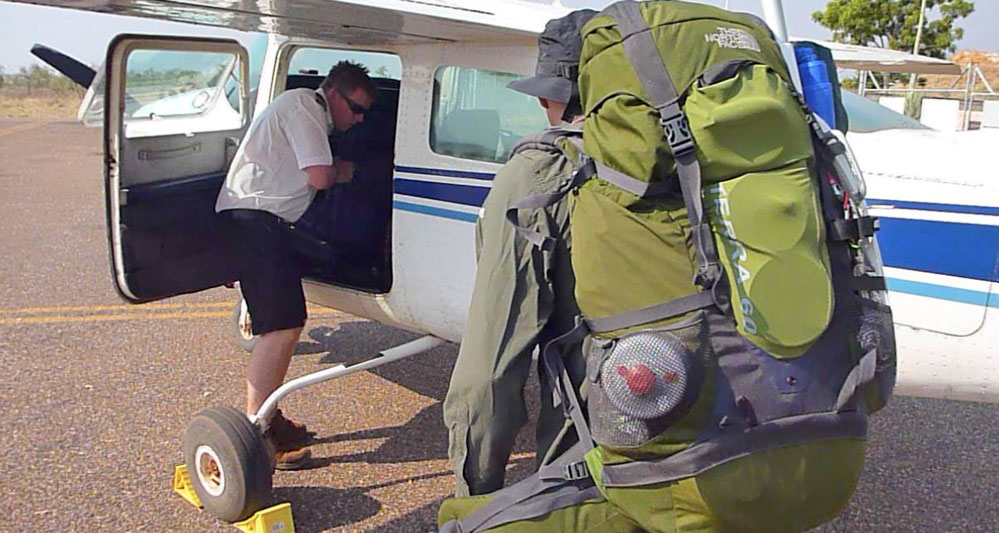
The Cessna from Broome Air Aviation cost AU$500 (£300), and we were able to leave Jeff’s van at Fitzroy Crossing aerodrome safely. The flight took 25 minutes to Mornington where we were met by a ute and taken to the camp. They charged us around AU$150 each for air strip pick-up and river drop-off, gourmet dinner and breakfast, and camping. Fossil Downs just asked us to call on departure and arrival (as did MWC), Leopold Downs (a small section) were not bothered, and we wangled our way through Geikie Gorge NP, as you read. At the far end it was a 4km walk from the bridge through town to the aerodrome to retrieve the van. All in all, it couldn’t have been easier when you consider what we did, especially at the end of a trip when you can be tired or potentially lame or ailing.
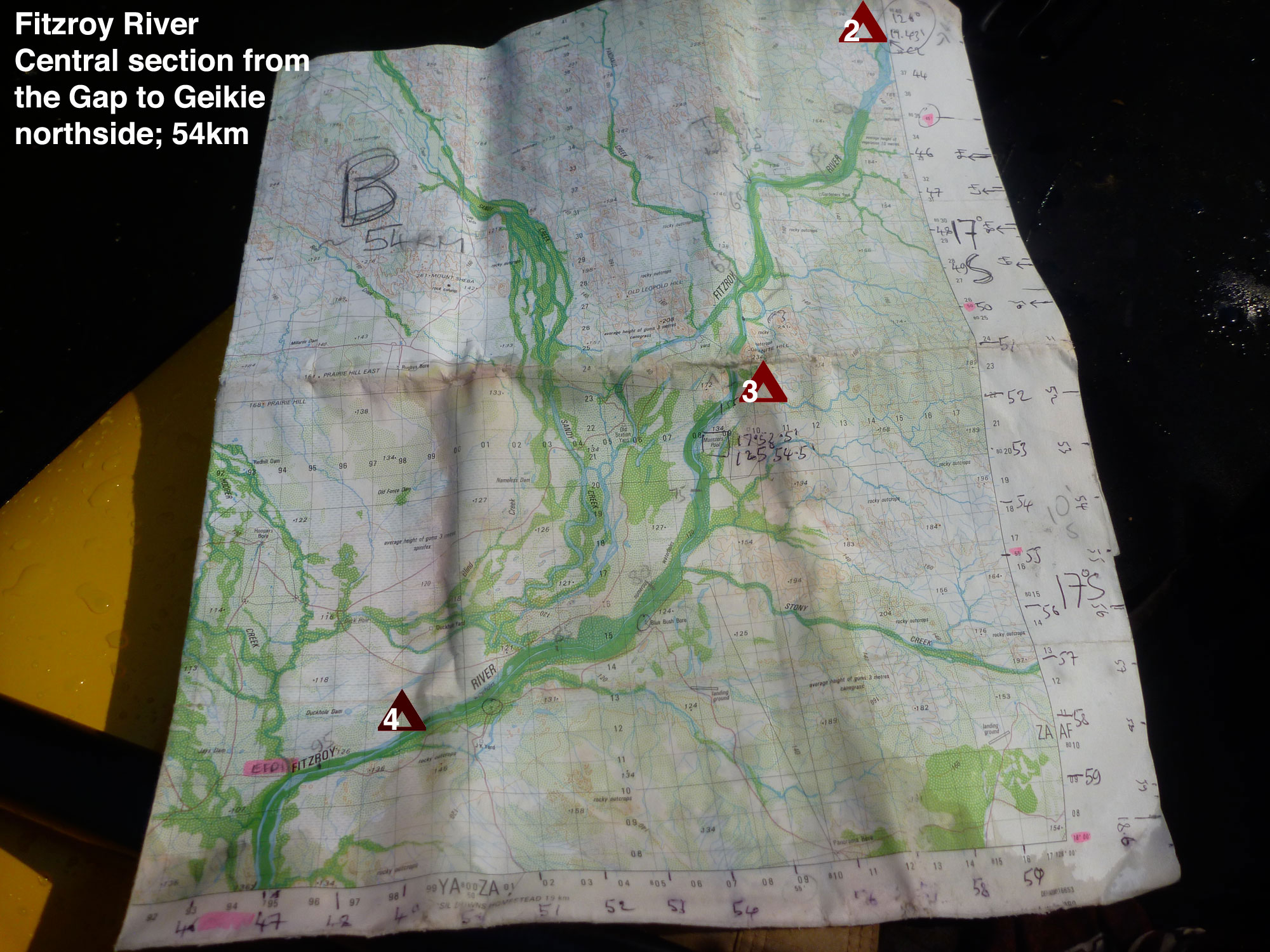
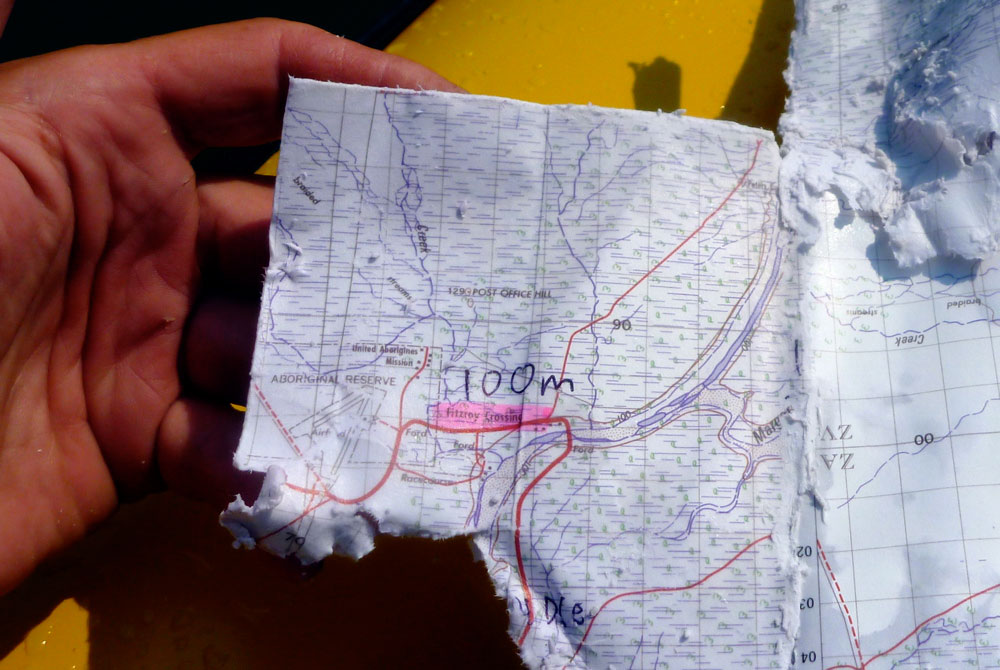
Maps, Navigation and Comms Three 1:100,000 scale maps covered out route and proved to be very accurate, considering the river channels can move around after a Wet. Fitzroy Crossing 4061 Hooper 4062 (left) Lerida 4162
Oddly, 4061 was printed on some kind of blotting paper and fell to pieces under conditions which the other two maps survived with a bit of drying. All maps needed the long-lat grid calibrated by hand along the sides to work with my GPS. They use some other (Australian?) grid which I suppose I could have set the GPS up to read, but I prefer what I’m used to: long-lat.
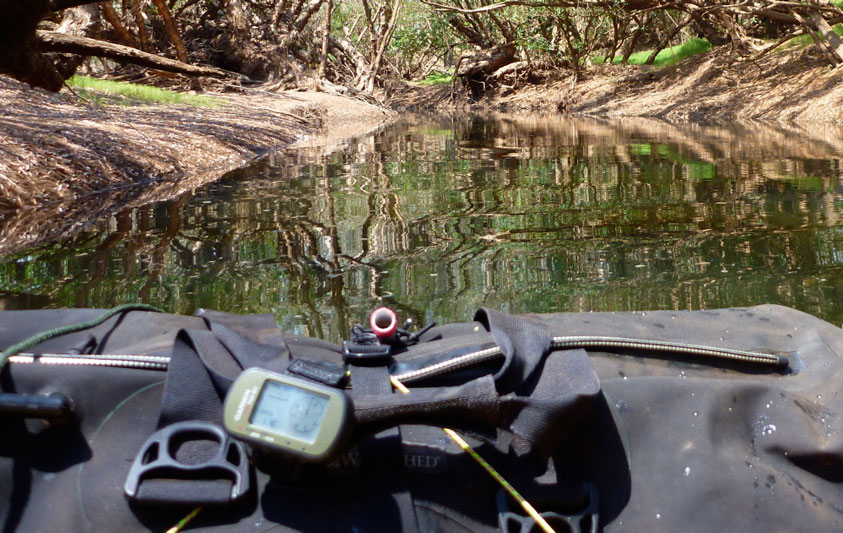
We both carried a GPS. I had a little Garmin 401 (left) and Jeff a more modern SatNav Nuvi with a good WA map which even depicted the course of the Fitzroy. He could have just about managed without a paper map. My 401 is a splash-proof wrist-mounted GPS, much lighter and less bulky than the 76CSx I normally use. Unfortunately, I suspect the 401 uses old Garmin electronics from the XL12 era that aren’t particularly sophisticated or efficient. The two AAA batteries lasted less than 6 hours (my CSX would have lasted up to 3 days in the heat on its two AAs), so after that I gave up keeping a GPS track and just turned it one to get a location. Because of that, we never really knew exactly how far we travelled. But above all, the 401 is handy and light, so as a quick locator it does the job unobtrusively and while it tracked it managed the splash-prone attachment to my pack without complaint. I sold it later – too basic for my needs.
I had a compass too but didn’t use it much, although my 10-year-old Thuraya sat phone was handy to call Fossil one time, or to liase with Jeff when he was still on the river at the end (his Ozzie PAYG mobile didn’t work up north). Thuraya sat phones just about work everywhere except the Americas and are cheaper than Iridiums.
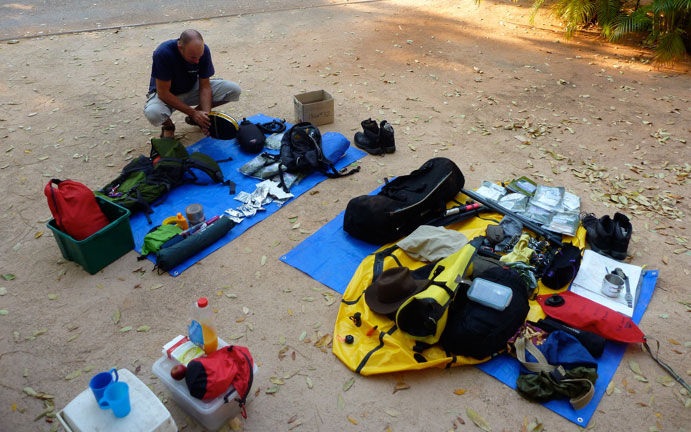
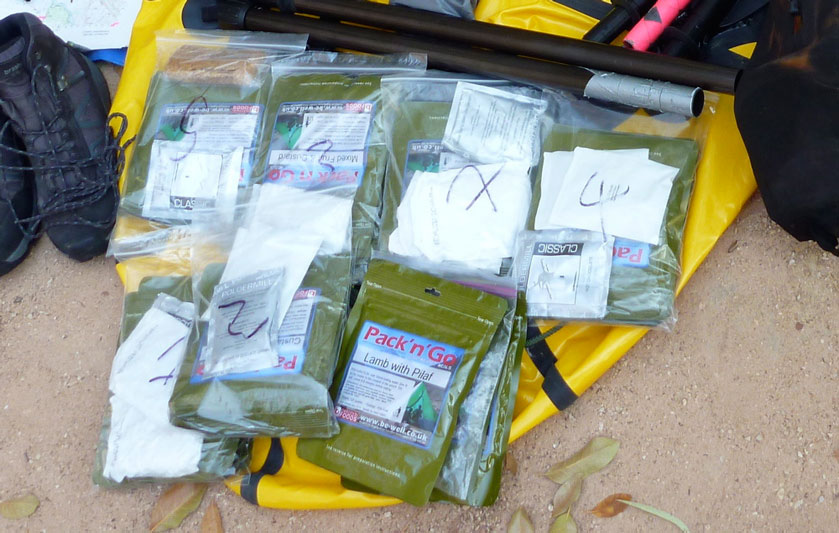
Food and water We brought a week of freeze-dried, Pack n Go food from the UK (below left) which weighed in at 3.5kg each but didn’t cover lunch – just hot choc, breakfast cereal and a two-course dinner. Pour in boiling water, seal, wait a few minutes and you got meal. Although it became quite boring after a while and some meals are tastier than others, I was amazed at its ability to sustain us considering the energy we were expending for up to 11 hours a day. I probably ate half what I do at home merely bashing at a keyboard; I suppose the heat helped suppress the appetite, but it must have also been due to the food’s calorific and nutritional values.
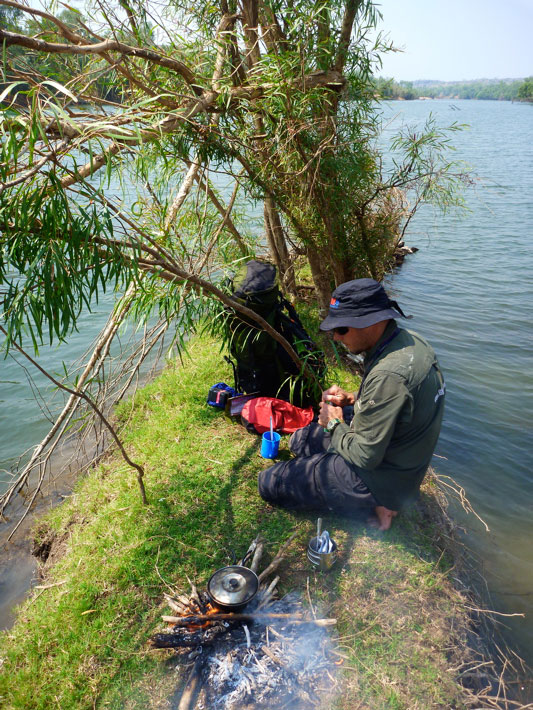
In the morning we had a hot drink and a hot P&G cereal of some kind. Smoko (morning tea break) was tea and a muesli bar or trail mix while both lasted. For lunch I just ate a double cuppa soup (good for salt) and another hot drink – Jeff got to eating his evening pudding at this time. And in the evening we ate the main bag meal and I had my pudding as well as more tea, coffee and whatever. I can’t say I was ever hungry, but I sure enjoyed some real food when we got back to Broome – including the brilliant seafood curry down at the Wharf – you gotta go there! We took my Pocket Rocket knock-off stove and a gas can but only used it on the last morning where there was no wood nearby on our sandbank. At all other times there was plenty of dry wood and little risk of a bushfire along the river bank. Out in the open during very windy conditions a stove would be less risky.
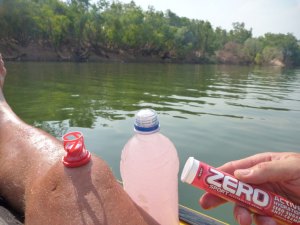
We planned to filter water daily with my Katadyn Pocket Filter (left), expecting lots of scunge due to low water levels. In fact the river was pretty full and running so after a day I dumped my cumbersome 5-litre water bag and filled a 750-mil bottle straight out of the river, while adding a Zero tablet (right) every time to stave off mineral loss through sweating. Jeff stuck with filtered (as did I on the day bat crap covered the river), and even though I didn’t use it much, I’m glad we brought it along,. There could have been an occasion where it would have meant clean water or no water, and out there you need water. Including drinks I drank up to 4 or 5 litres a day when engaged in hot and arduous portaging. Since sold and got an MSR Waterworks which I’ve not used yet.
Clothes I expected to need to cover right up to reduce sun burn and transpiration: long trousers, long sleeves and a hat. But in the end while the UV was the same, it was not so hot on the river due to splashing and shade, and the trousers were only useful against big flies in the gorges on day one. The problem with long trousers is that when wet they cling to your legs and drag – Jeff eventually ripped his North Face zip-offs above the knee, but both if us turned to shorts and a bit of slip-slap-slop on our legs. Rolling up the trousers didn’t quite work. Knowing they would get a hammering from the UV and all the rest, I invested in some American 5-11 Tactical trousers and jeans. They are basically the same as normal work or hiking trousers and shirts, but as far as I can tell feature a thicker synthetic material, countless pockets and other small details like tabs to hold up sleeves. The shirt was very good: huge pockets to take a map or whatever – both it and the trousers finished up fine after a rough week unwashed. And they both cost half of what Fjallraven and the like might charge. All in all, I am a 5-11 Tactical convert, even though I know it has a naff ‘special forces’ connotation. I didn’t find the synthetic material a problem in the heat with regards to rashes. odour and so on – if anything it dried much quicker and was tougher than cotton.
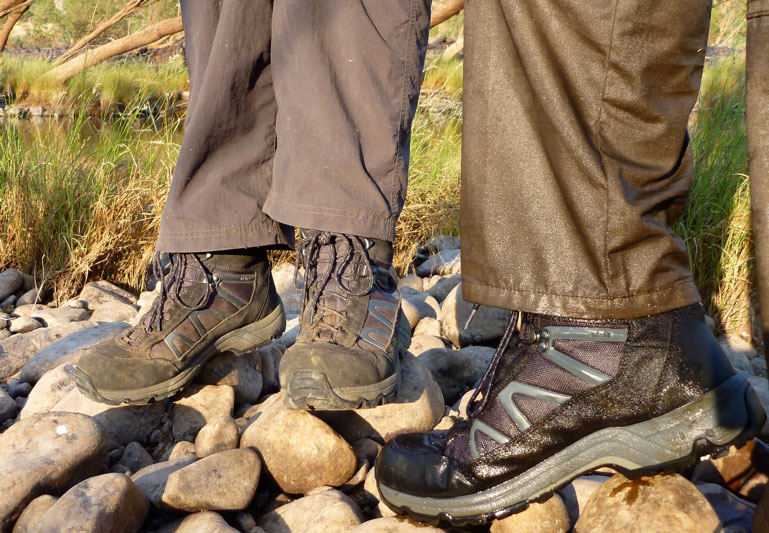
Footwear We both bought some Brasher Lithium boots which were going half price in London (£65), as we expected a lot of tough walking with full loads. In the end there was very little of that – and just as well in the heat away from the river. The Lithiums were great when portaging/balancing over boulders and wading through slimy, rocky shallows. But in the sands they filled up with grit and were hard to drag out of quicksands where they filled with sand all the more. Jeff who did more walking than me, wore his Lithiums more, or his Tevas, but in the end we both went barefoot in the river: lighter feet, easier quicksands and more hygienic. By the end our feet were a little sore and swollen from rough gravel, very hot sand and twig jabs, but I think Jeff found his Tevas the worst of both worlds for catching gravel on his already sore feet while not giving full boulder support or secure footing. On the last morning he duct-taped his shoes to his feet (left), but that didn’t really work either. Around camp I wore flip-flops. In the end, although lacing the Brashers up was a pain, you do need a pair of tough boots if you plan to be walking in the Kimberley – Tevas or Keen Arroyos will not do when packing a load. I poked drain holes in mine after a couple of days so my feet would not get sodden, but in the end it was better just to put them on when needed, even for a short portage. Teva Omniums much better.
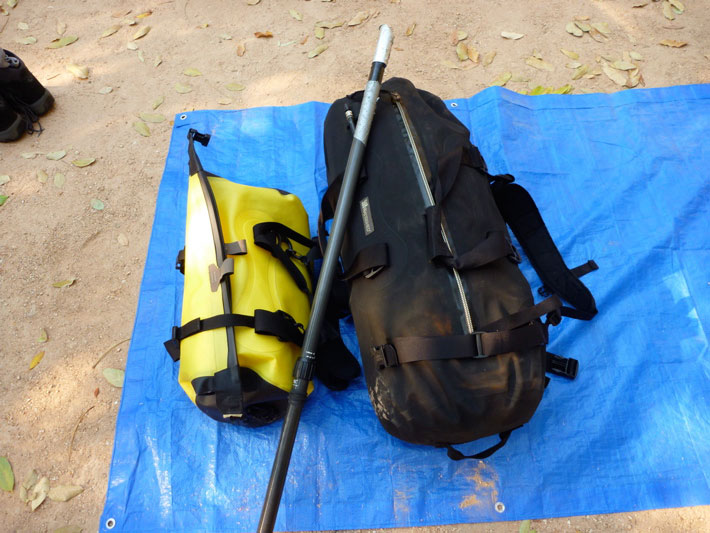
Packs and camping gear Jeff used my old TNF Terra 60 pack with dry bags, which was barely big enough but extremely comfortable. He also had a day pack which he clipped to the front – a neat system (right) for portaging. I used my UDB (90+ litres) and the Watershed Chattooga as a day bag (both left). But the UDB was a floppy sack on my back compared to the TNF and the Chat bag just got in the way for portages, so that went inside the UDB pretty soon and my shirt pockets became my ‘day bag’. I made great improvements to the stability of the UDB but packing the weight low one time. After that walking with it was not so bad, but it’s nowhere near as comfy as a proper backpack. But it can be if you use this.
I didn’t take a sleeping bag, just a thin blanket that was going spare, and wore all my clothes on the one or two cold nights. Most nights I used the $15 K-Mart Tent which Jeff bought me – more as a mozzie dome than against the cold. The K tent was too short for me but for what it cost it was OK. Since then I’ve bought myself an Exped Venus UL which pitches with just inner for hot, insect nights and is longer than I am. Jeff’s mozzie dome is the same sort of thing – just right for the tropical bush. I used my Exped Synmat DL which is excellent and sold,it to Jeff in the end who suffered under his Thermarest UK which I used to use until I woke up (too much). I’ve since replaced my cushy SynMat DL with the UL version which weighs just 500 grams and is half a litre in bulk.
Cameras and recharging We both used Panasonic FT2 waterproof cameras – the ranger we met at Geikie had one too. At the time (before Olympus TG) it was good in that it’s waterproof (great for Ningaloo reefing) but of course the lens is tiny and so the picture quality- is not that hot, especially on zoom. The video quality, it has to be said, is pretty amazing for a £200 camera. We shot in Motion JPG and HD modes (not the AVCHD which doesn’t import so well I find). That gave a 1200 pixel image which is certainly good enough for youtube, even if it takes many many hours to upload a 5GB movie. I would love to have used my old TZ Lumix, or the even better LX5 I now have, but out in the wet and wilds it’s too hard to be careful with fragile gear so the FT2 is good enough until I get a commission from National Geographic. They’ve since brought out an FT3 as they do, with GPS and other gimmickry – there is no substantial improvement as far as I could tell and you’ll never get a decent lens in such a compact, flat, waterproof body. A pair of 16GB cards were more than enough for both of us. We carried 1 spare battery for the Panas and, with the Go Pro below, that just about did us. In the end I didn’t take the Power Monkey solar charging gadget on the Fitzroy, but did use it on the Ningaloo stage. It charges the Pana batteries very quickly and has the capacity to do that about 10 times. I also used my Go Pro which is temperamental and drives me nuts, but can get the hands-free shots other cameras cannot reach – mostly when on your head. The buttons are a pain so you have to check every time to be sure it’s on, but I also got into using it out of the box when the audio is of course much better. Out of bright conditions the exposure is not half as good as the Lumix; in the shade its terrible but maybe I should meddle with exposure settings which are on default. I also took a Gorillapod but that fell apart at the joints. Jeff used his newer one a couple of times; I’ll probably get another, maybe the bigger one for SLRs which may last longer.
Health and Dangers The Kimberley can be a pretty unforgiving environment, hot, harsh and full of nasty or just plain irritating wildlife. I must say I feel I got away from there with barely a scratch; Jeff suffered a bit of crotch rot and cut up feet. I like to think that the Zero tablets I ate religiously kept me in good shape, even with unfiltered river water. I used a bit of 50-factor on my exposed legs and always wore the hat in the sun. In my experience in Australia the UV is much harsher than even the Sahara.
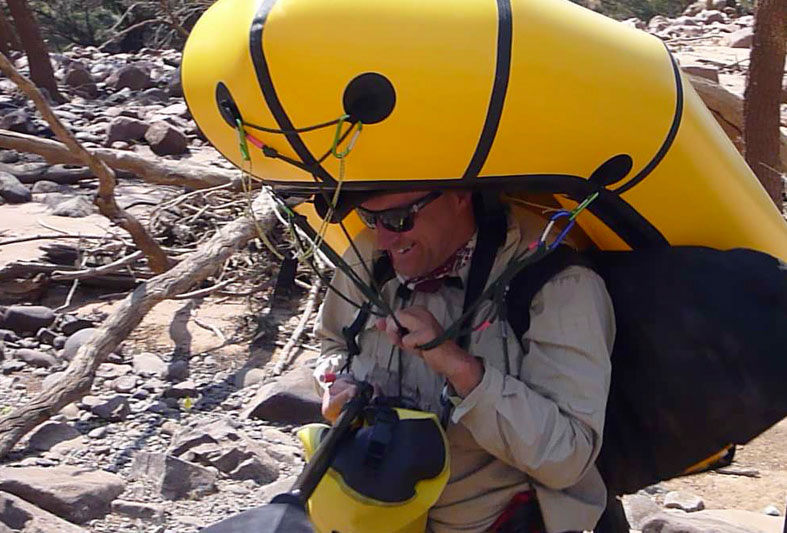
We saw no snakes – maybe one – though there are big olive pythons around (we had gaiters for walking in long grass, as Jeff did on occasion). Big lizards and freshie crocs are also only a danger if you tread on them by mistake. The only cow that got edgy was clearly in a bad way and cornered, and the only time big horse flies were a pain was, funnily enough, in the Leopold Ranges, well away from cattle country. I think the biggest danger was portaging over boulders – a slip there could have ended badly once you crash to the ground under the weight of your gear. The answer is to pack carefully and take your time, or just do two trips as I did on one occasion. I found my packstaff was rather a hindrance with my boat on my head. There were a few mozzies at night, but they were nothing compared to the blood suckers I’ve experienced in the Top End. So all in all, no drama.
Today, our fifth on the river, we expected to break out of the clogged-up side streams of the last two days and get on the deep, open channel which led right through Geikie Gorge national park, not far from Fitzroy Crossing.
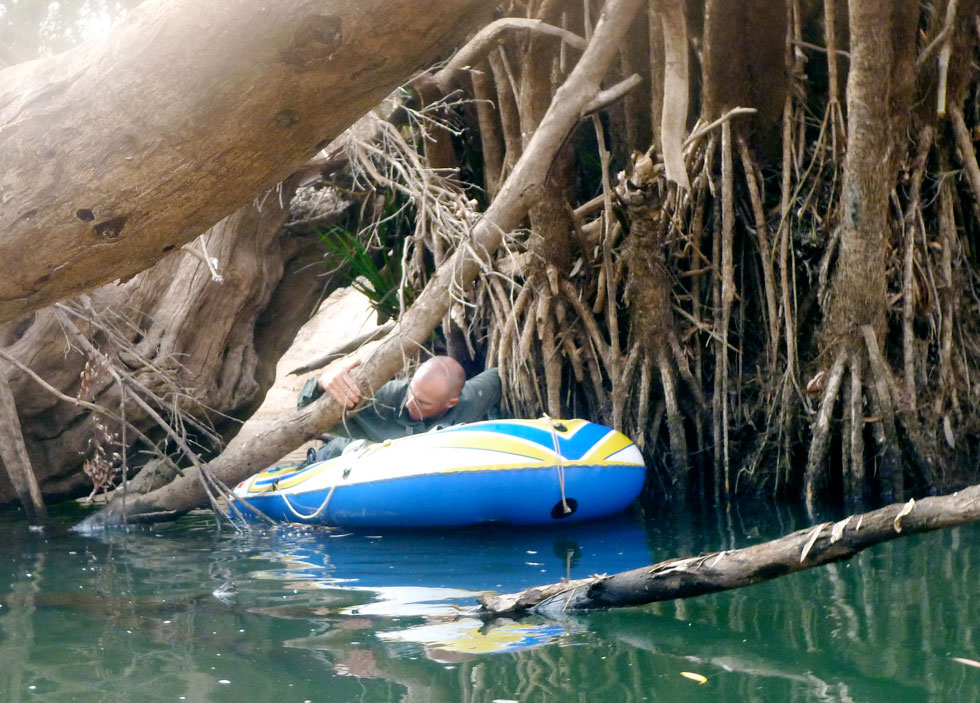
After breakfast the log jam which had defeated us last night was easily carried around, and after a couple of hours lifting over and squeezing under other blockages (left), we turned the last Big Bend and spied the northernmost outcrops of the Geikie Ranges in the distance.
This was the last of the few landmarks on the route and though the bridge was still 40km away, it marked the beginning of the final leg, just as the Gap had marked the end of the Leopolds. As if on cue, the rock changed again from the sand-smothered granite we’d been on since leaving the Leopolds three days ago, to limestone which gave Geikie’s flood-scoured gorge walls their distinctive appearance. The river spread out and lost its depth, and as we picked our way over shallow but gnarly limestone rapids not unlike the Ningaloo‘s shores, Jeff’s floor got snagged and went flat. It was smoko time anyway, so while the water boiled he repaired his boat one more time.
As far as we could tell, the park’s northern boundary began at 18°S, and as you’d expect in WA, paddling there was not without its restrictions. The DEC website stated private boats were only allowed on the river before 7.30am and after 4.30pm so that the daily boat cruises wouldn’t be disturbed by people bombing around for free. At our paddle speeds, keeping to these times would be difficult, let alone getting through the 18km-long park before nightfall, because camping wasn’t allowed either.
All visitors to Geikie drive in, almost all to do the one-hour boat cruise. Aside from a couple of short walks, that’s all there is to do, even though it’s clearly a great place for paddling. As with kayaking the Ningaloo Reef, we were again expecting ranger problems due to our unorthodox arrival and mode of travel. If the Ningaloo Reef NP regulations had no category for sea kayak touring, you can be sure Geikie Gorge had no equivalent for packrafts and slackrafts coming down from the King Leopolds. Our transit would require a sympathetic head ranger; something of an endangered species up north, if experience during my guidebook years was anything to go by.
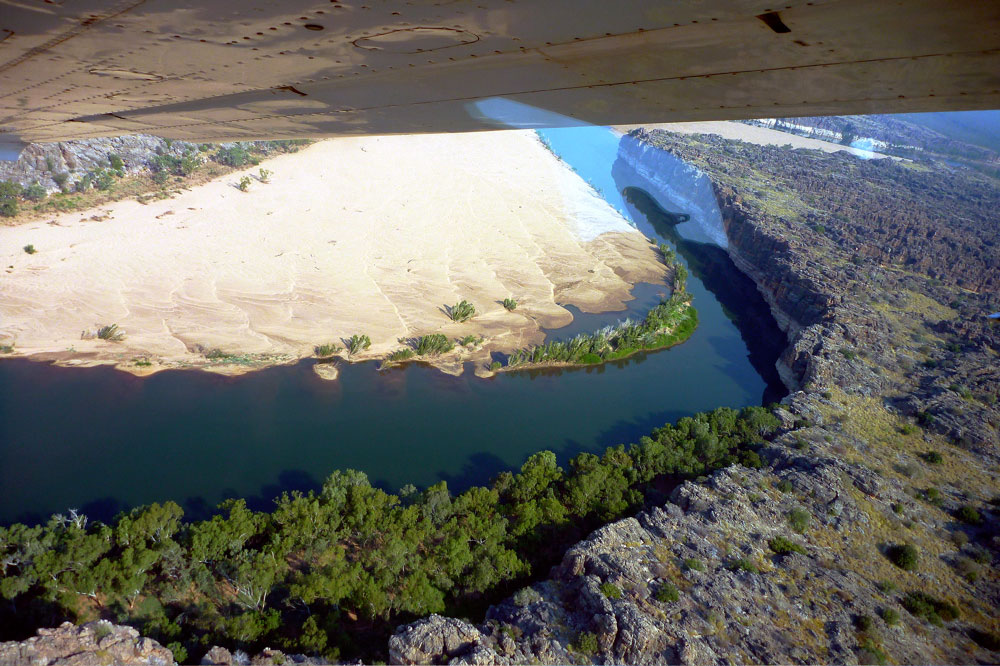
At least we’d seen from the plane that the river cut through Geikie in a deep, wide channel with minimal shallows. For me in the nippy Alpacka that was great news, but hours of unbroken paddling would be a drag for Jeff in his sluggish pool toy. Mid-morning a hot northern wind rose up and Jeff was quick to rig up a sail, but its effect was negligible; the only way forward was to dig or settle back and drift on the quarter-knot current. To our left and right, sun-bleached water marks reached ten metres up the cliff sides, demonstrating how high the Fitzroy rose during the Wet.
It was lunchtime, but with little flat and shaded land between the cliffs and the bank, we rocked up on a slither of an island capped with fresh green grass that no cattle had managed to reach. Later I realised I’d taken a picture of the very spot from the plane (left). While Jeff got the billy on, I emptied the Yak for a rinse and then went for a quick blast across the open river. Without its load the Alpacka skimmed across the water like a pebble. “Have a go in it” I said to Jeff when I got back. He did and of course loved it. “I shouldn’t have done that. I really shouldn’t have done that“, he realised. It made getting back is his squidgy pool toy all the more galling.
Back on the water, up ahead a motorboat was gunning towards us. Here comes the ranger; we’ve been spotted and our trip could end right here. But our paranoia was premature, it was just a bloke heading out to his favourite barra hole by some sunken trees. He explained we were in an unofficial access window tolerated between 11am and 1pm, between the two big daily tour boat cruises. He also warned us that the head ranger was a grumpy sod. No surprise there, so we decided better not to get bogged down in explaining ourselves on the sat phone, while at the same time planning to make the most of the Fossil Downs station land on much of the east bank for which we did have permission. Before we’d flown out of Fitzroy we’d tried to track down the ranger’s office in town to inform someone of our plans. We couldn’t find the place, but heard later there was no one there most of the time anyway.
As we entered the main part of the gorge, up ahead we heard the blaring of a guide giving his tour schpiel from the cruise boat. People looked to be taking pictures of us which meant we’d be seen for sure. They’d be waiting for us downriver, hands on their hips, drumming their fingers, but we decided we’d deal with that when it came. We’d talked our way out of it on the Ningaloo; we could do the same here. It’s not like we were drunk and churning the place up in jet skis.
Without any overhead canopy to shade us, the full heat of the afternoon pressed down and Jeff was feeling it. After some 20kms we came to a big sandbank where crocs buried their eggs. Seeing a curve in the cliff line, Jeff could bear the paddling no more and set off on foot (left) to cut the corner. At the far end I came ashore to look for him but he was still way back. The day’s heat bounced off the glaring sand.; great for incubating croc eggs, but it reminded me that had we actually done much open country walking (as we’d expected) we’d have had a tough time of it. Wading or paddling, the surface of the river felt a good 5-10°C cooler, even out of the shade. The combination of the cool water surface as well as constant splashing kept us swathed in a temperate micro-climate which made the whole experience infinitely more tolerable. The few portages we’d taken over boulders or sand banks over the last few days had been brief reminders of how hot it actually was out there, and later that day we were told the temperature had topped out at nearly 39°C (102°F).
Unless he was training to be an Indian fakir, it didn’t look like walking across the scorched sand bank had been any kind of respite for Jeff, and he flopped back into his boat. As on the first day, I suggested I tow him for a bit and this time he was too weary to resist. He reposed on his water sofa as we set off to explore the main east wall of Geikie, where eons of seasonal flooding had carved the former subsea reef into scalloped and fluted Gaudi-esque forms.
We glided under overhangs and nosed into caves and web-drapped fissures which bigger boats couldn’t reach. As we bounced along the eroded undercliff, enjoying a break in the pace, up ahead a babe in a red kayak came into view. And as we got close she started chuckling.
“I hope you’re not laughing at us” I said with a stern grin. It was Ingrid, the Cool Ranger, probably the only person north of the 26th parallel who was remotely impressed by our achievement. “Good ON-ya guys!”,
she said as we filled her in on our adventure, and she meant it too. We gloated modestly at this unexpected attention as she fired off questions about our boats and a trip she’d often thought of doing herself. On the way out we’d actually spotted her red kayak from the plane, beached on a bank somewhere upriver. Turns out she was one of the dreaded park rangers, but despite six months on the job was still keen enough to use her days off to see how far she could get upriver in her SoT. And this wasn’t just any old SoT, but an Ocean Kayak Scupper Pro – a boat I’d considered buying myself for our stay in far northwest Scotland earlier in the year. Compared to most SoT tubs, the SP is a long, slim and sleek-looking boat, much admired by spray skirt-dodging hardshell connoisseurs as being the most sea kayak-like of SoTs. No stranger to her own outback adventures, she quizzed us about our run down, while a fellow ranger glided over to deliver her fishing rod in a dumpier OK Frenzy, the more usual door-wide slab of SoT plastic. Ingrid had caught a two-foot barra hereabouts just a few days ago, so there were fish to be had here after all.
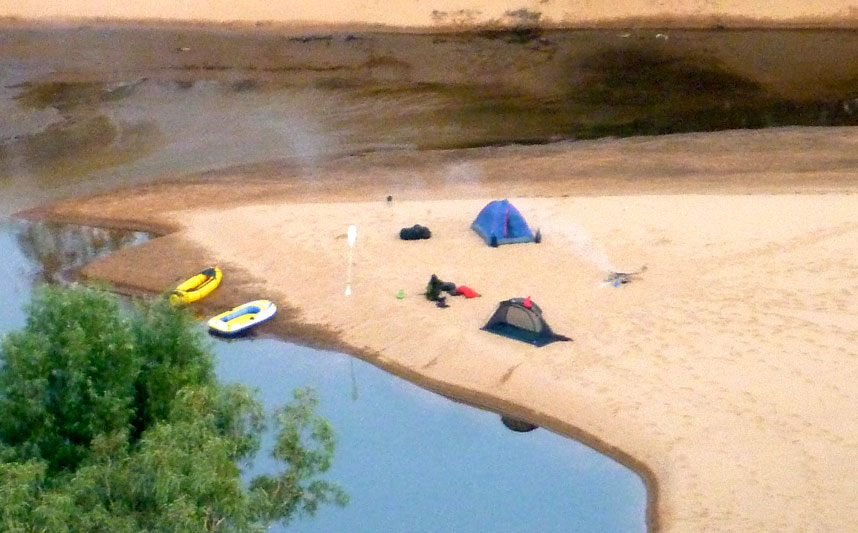
After a long chat it was time to move on; the sun had just about set. She explained that up ahead was a big sandbank on the left where another river joined the Fitzroy. That was out of the park so we could camp there as long as we liked. Buoyed on by the hope of a fresh fish supper, Jeff trailed his lure until half an hour later we bounced into the sankbank at twilight, barefoot and fishless as usual.
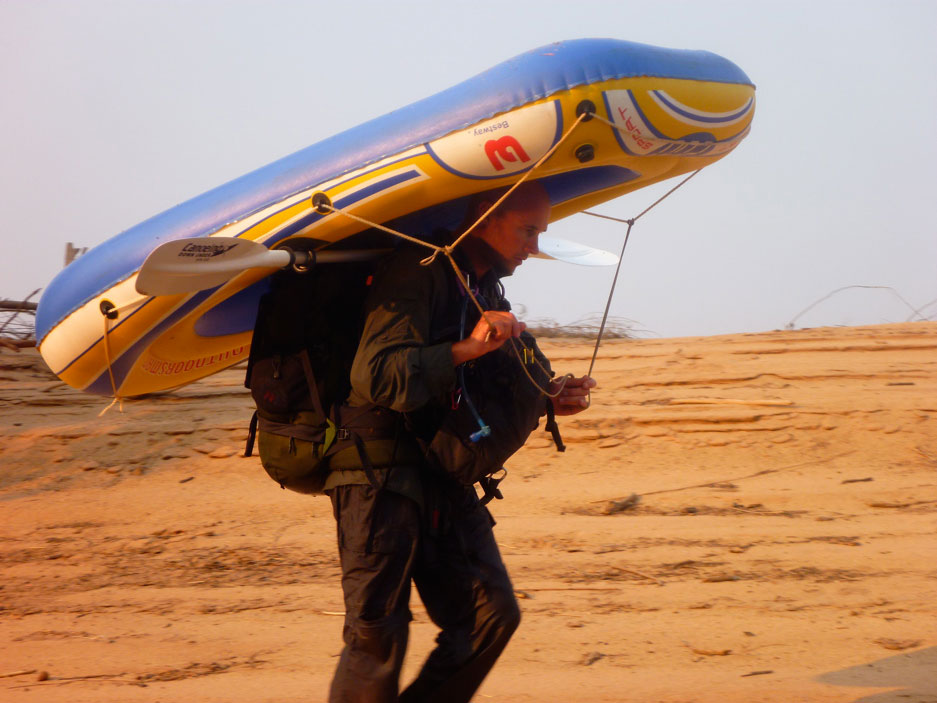
To the Bridge Jeff had well and truly had it with his Bestway, and the previous evening had talked about walking the last 15kms back to the van at the aerodrome and putting back in at the bridge. By dawn he’d come to his senses. After all he’d nursed his malformed lilo over a hundred kilometres, past sleeping crocs and charging bulls, over boulder fields and under fallen trees, patching it as he went. For whatever reason, yesterday had been a hot slog and the novelty of his achievement had long gone stale, but he knew he had to see it through to the end – or at least give it a go. If nothing else, he had a film to finish!
He suggested I go on ahead to the bridge, walk to the aerodrome and come back with the van, by which time he’d be arriving himself. And so at 6am we set off for the final 20-kilometre leg which I figured I’d complete by noon. Although there was no let up in obstacles – more log jams, frequent sand shallows with quicksands, as well as headwinds – by 9.30 I’d reached the original ford which at the end 19th century had given Fitzroy Crossing its name. My watch had packed up days ago and for some reason the last topo map was printed on toilet paper and had quickly disintegrated. An old guy was walking his dog over the ford and as I lifted my Alpacka over the concrete rim I asked the time and how far to the bridge – groaning when he said about 4 or 5 kilometres. Oh well, about another hour then.
I attacked this final stage non-stop in one last burn up, but after 16kms I was fading. It was hot and I only had a 750-mil bottle of water. Having passed a dead animal and other rubbish, I didn’t fancy the river water down this end, and now the river was no longer wild, I was keen to get the job over with.
Another sandy, shallow bend. I hop out to wade, sink over my knees in quicksand, crawl out, stagger on, get back in to paddle a bit, ground out and go through the whole cycle again. Jabiru storks carved the airwaves overhead and Brolga cranes danced about on the sandbanks. There were a lot more roos bouncing up and down the banks here, too. But never mind the wildlife, where was that bridge? Surely around this bend… that one… or the next, until finally there it was, less than a mile away (below). Road trains sped across, oblivious to the tiny raft below with its paddler, up to his hips again in quicksand.
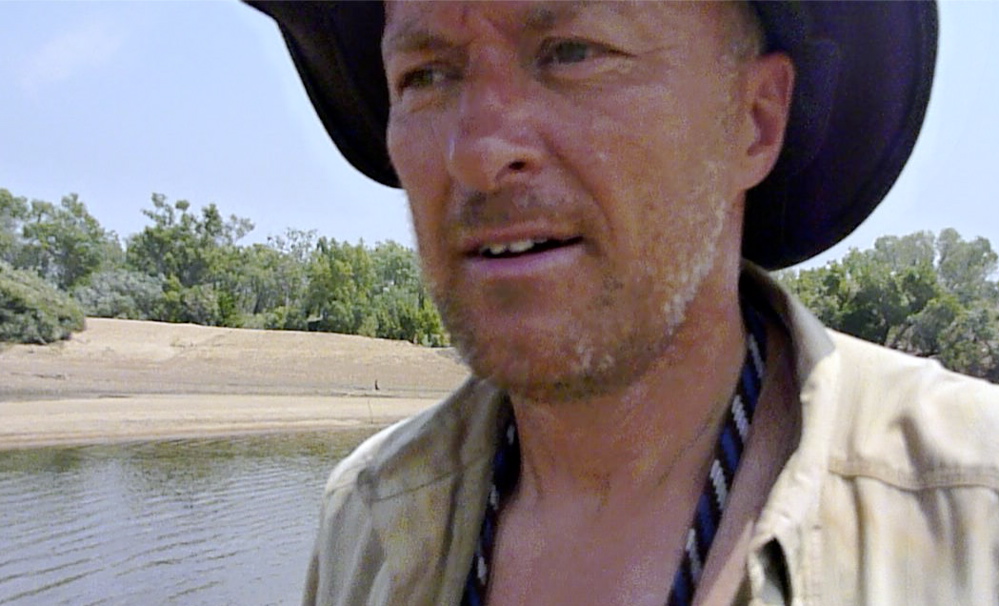
Presently a shadow passed overhead, but it wasn’t a flood-battered river gum or a rustling cadjeput; it was the bridge on Highway 1 which ringed the entire continent of Australia. Worn out and parched, I filmed a final, slurred p2c and headed for the steep bank to pull the cork out of the Alpacka one last time.





































 Inflatable Kayaks & Packrafts