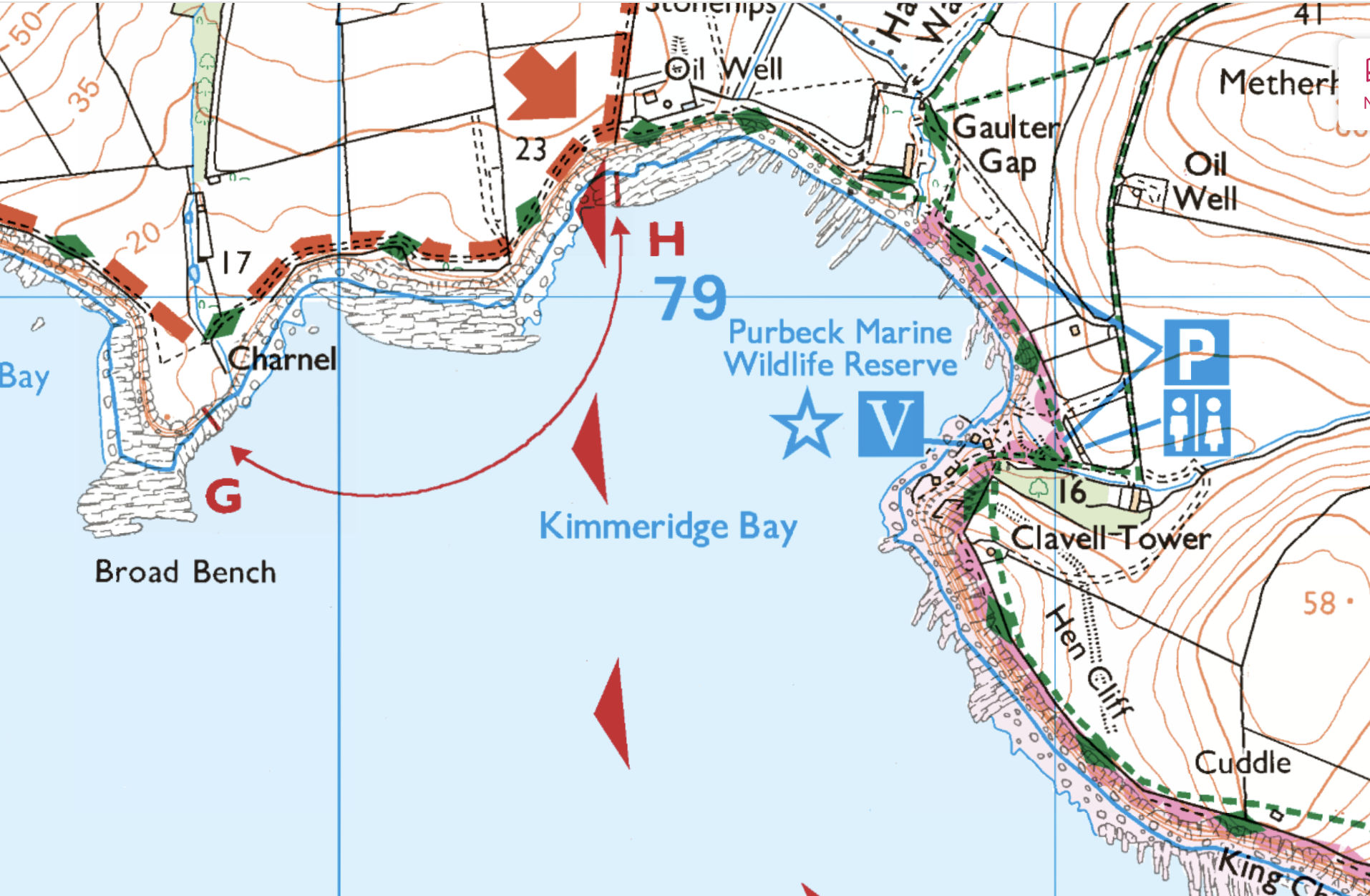
After Storm Chandra came the calm. Well, just a day of calm with a 5mph onshore breeze, sunny spells and single digit temps before seasonal deluges resumed. The artillery was pounding at Lulworth so the west side on Kimmeridge Bay within the MOD firing range was definitely off limits, but it might be nice to pootle along the base of the Kimmeridge Ledge cliffs and back. There could be a stormy after-swell, but small waterfalls may be be running too. I even thought it might be a day to sneak round St Alban’s Head from Chapman’s to Dancing Ledge…
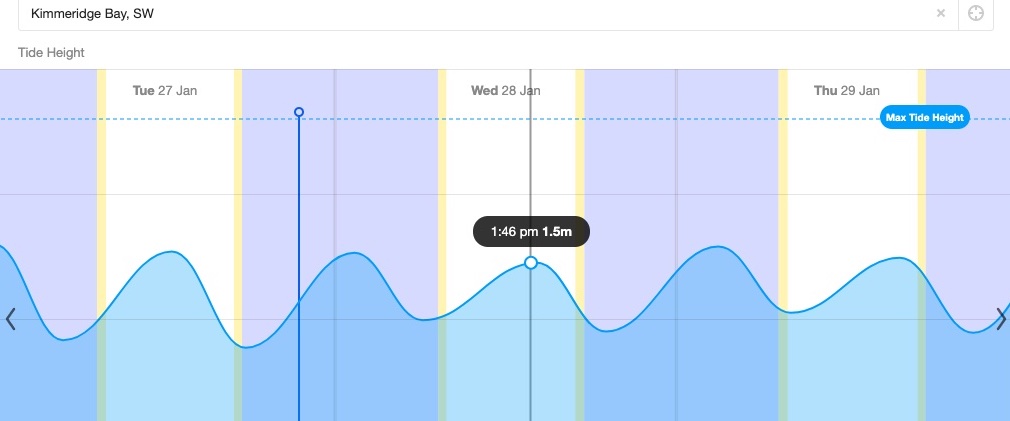
I’ve droned on about trying to pin down unlisted Kimmeridge tide times. The short answer, I’ve decided, is Willy Weather. Today a harmless neap tide was rising just half a metre in 8 hours to top out around 2pm. Interestingly, the High Water time moved by 20 minutes from the evening before, which suggests it’s not just some publish-and-forget-it table of predictions, but based on live inputs.
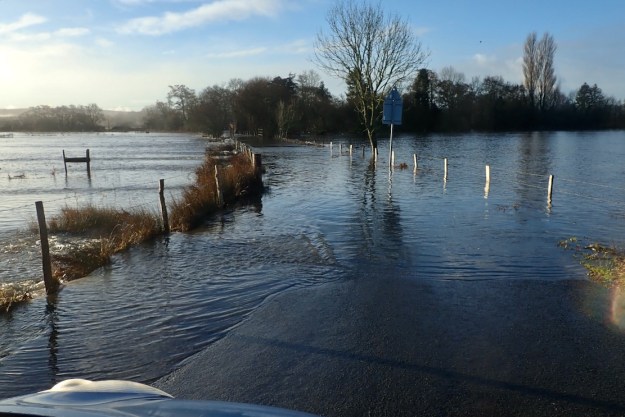
Hoping to take the scenic route, at Holme bridge the River Frome’s water meadows had spread into a vast lake, submerging the road, long before I even got close to the ford, which I read later was 5 feet deep. So after a couple of other attempts, I settled on the long way round over the flood-shedding Purbeck Hills to Kimmeridge Bay.
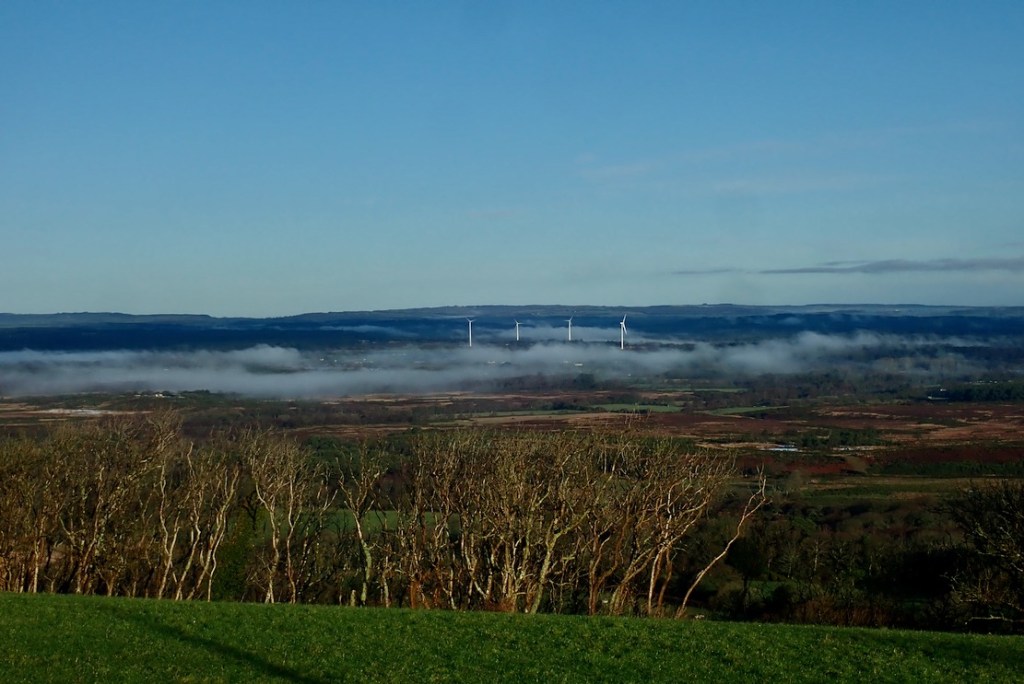
On Purbeck ridge the mist still clung to the flooded valley bottom.
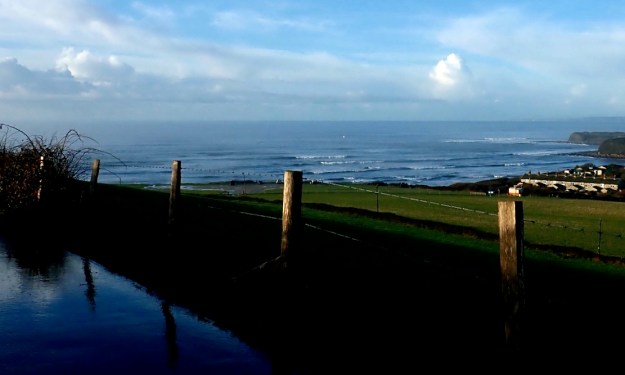
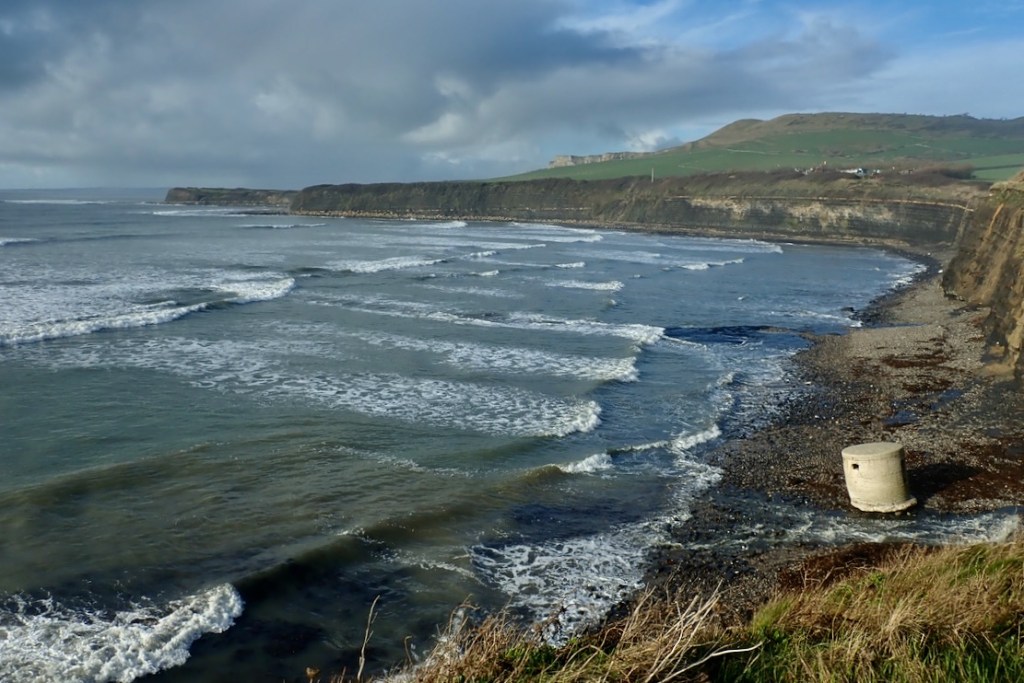
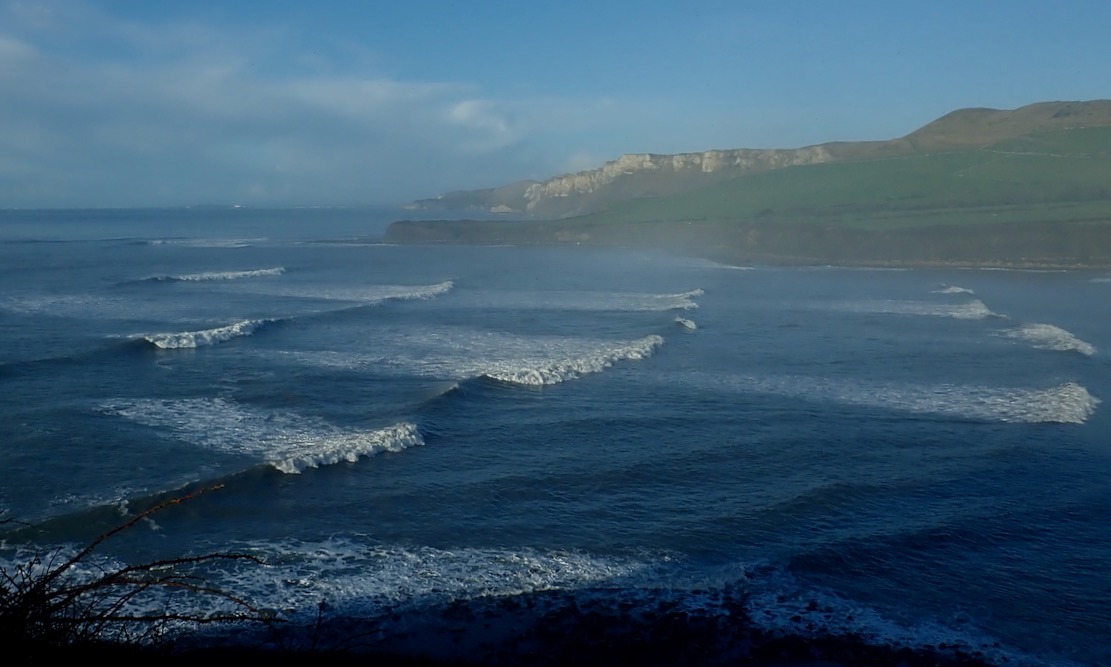
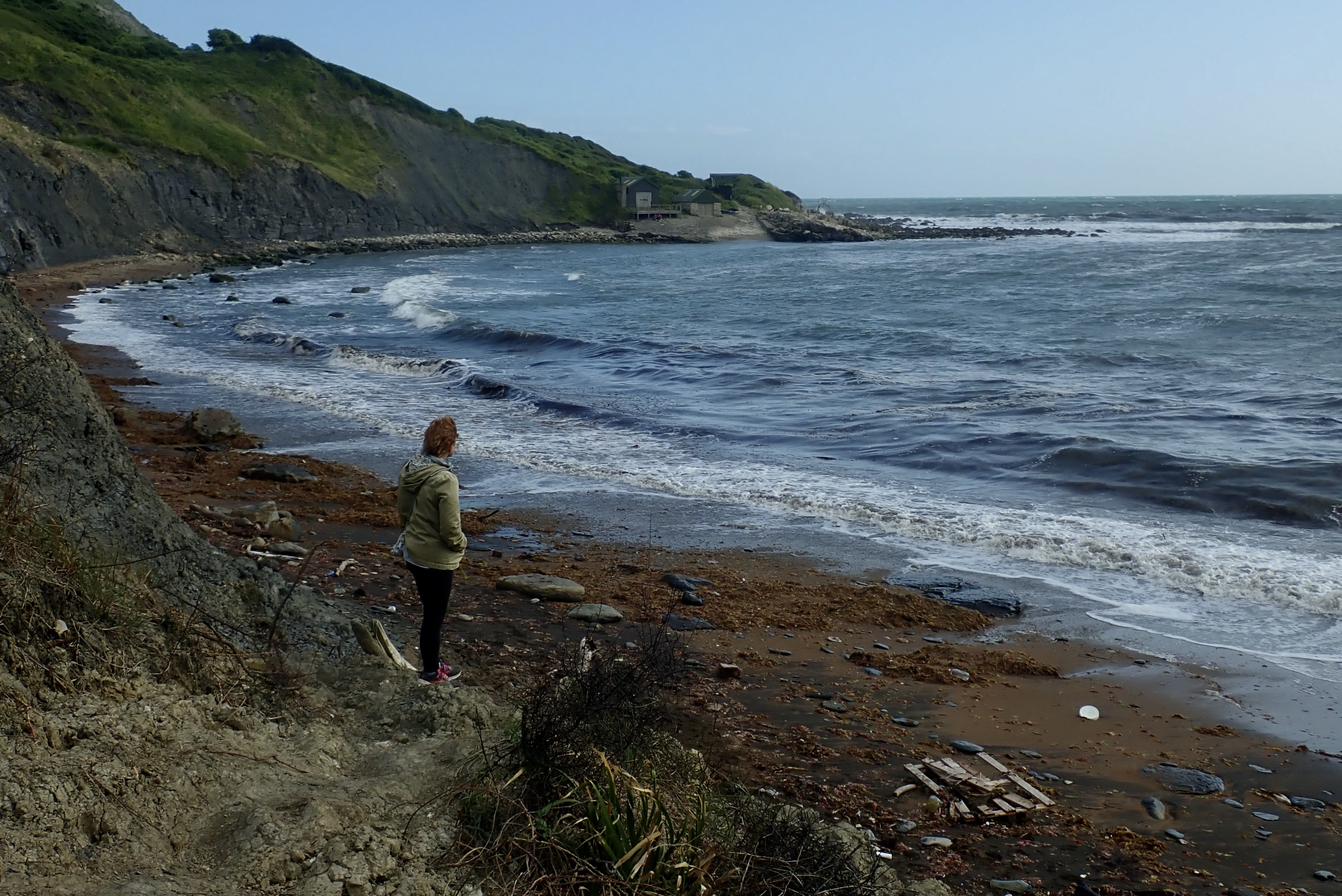
Coming over the last hill before Kimmeridge village, I realised I’d underestimated the after-swell; the stormy winds and rains may have passed but the seas were still animated.
Overlooking Kimmeridge Bay. Lively.
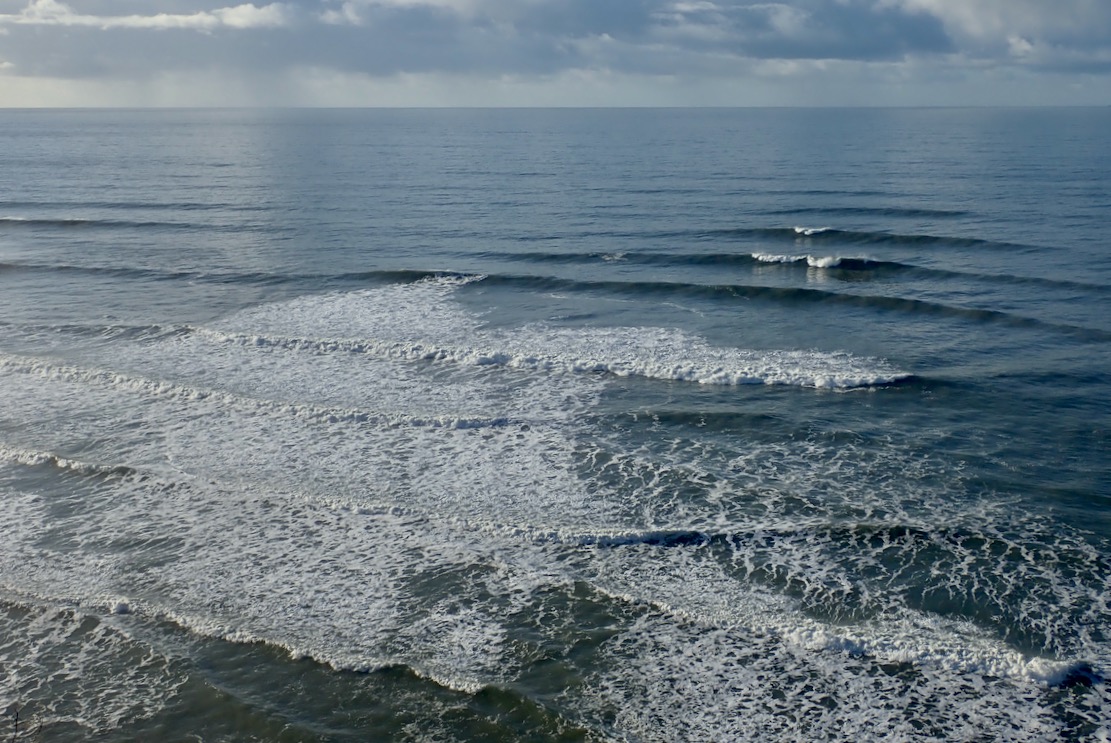
Down at sea level in a dumpy packraft it looked like it would be a struggle of good timing, desperate acceleration and luck to get out quick through this surf without getting swamped. I didn’t have my drysuit and as things looked, today was a day for a decked or bailing packraft. At times the surf seemed to flatten off and you could have scooted out on a paddle board. Then it all rolled back in, streaking the Bay with white foam.
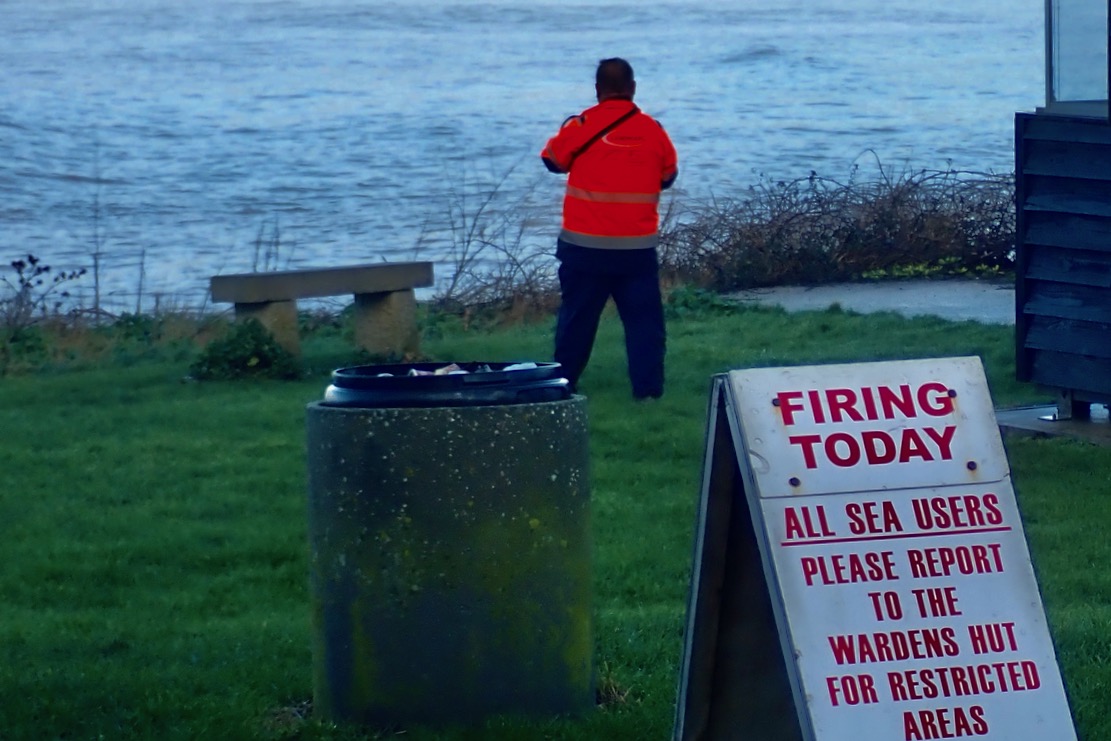
There were look-outs stationed round the bay. How thoughtful, I thought. Who lays that on then? Then I realised they were probably contracted by the MOD to make sure sea users kept away from the shells potentially raining down on the west side of the bay.
I thought if I could sneak through the east edge of the bay it would be OK round the corner, so I climbed up to Clavell Tower to have a look. Sea mist clung to the Bay.
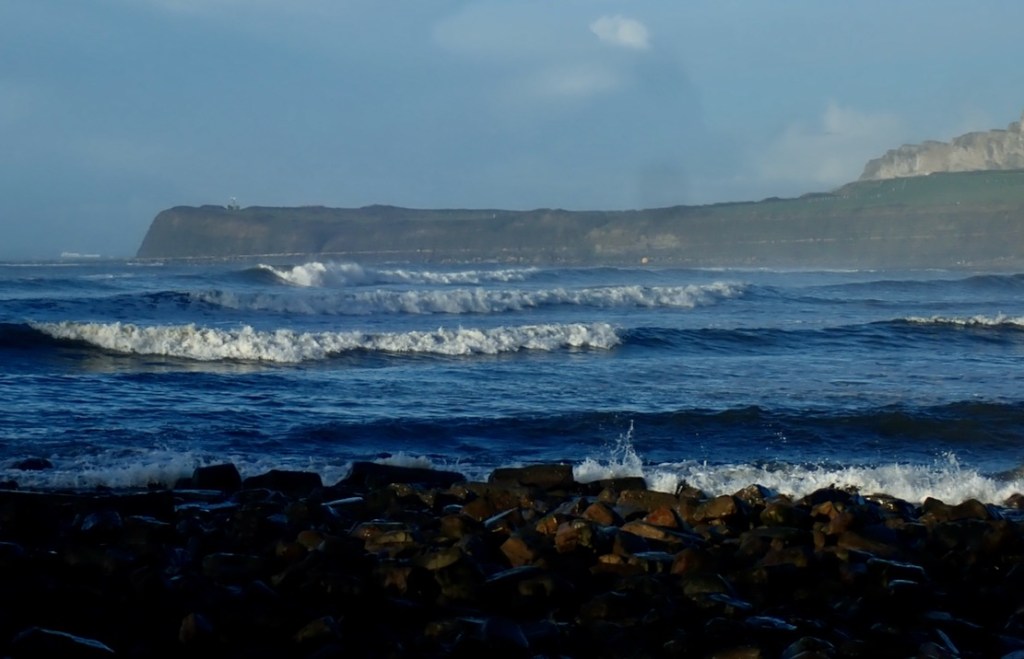
If anything it was even more lively, with the Ledges kicking up the swell for hundreds of metres out. So much for a quiet cruise along the cliff base. Unless I went right out, I’d be forever glancing right to see what was incoming, and on the Ledges, waves can lift up out of the blue without warning.
We tried packraft surfing up at lovely Achnahaird one time, in far more benign conditions with waves barely at knee height. It was a laugh but packrafting today would take some commitment.
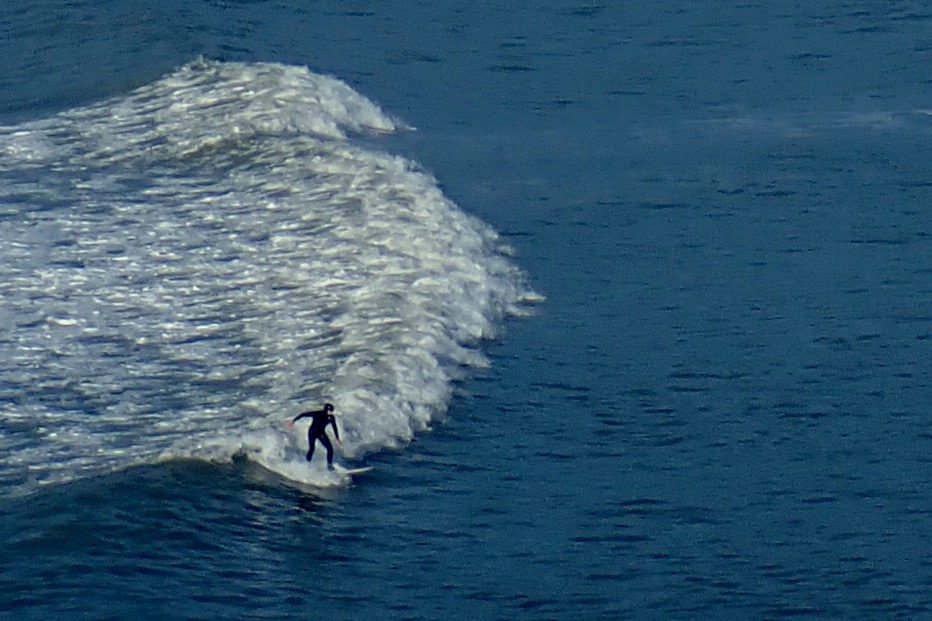
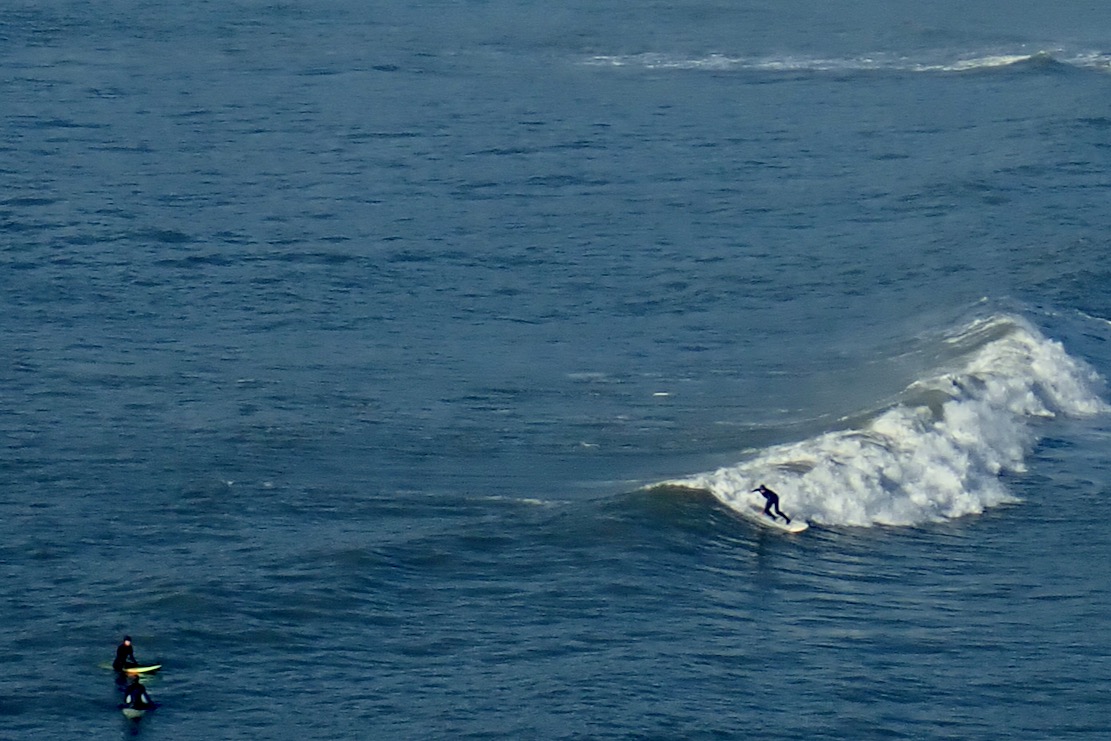
Today was a day for the surfers: get in the water and stay in it. Sadly, as I’ve noticed before, watching surfing live is not like a trailer for Big Wednesday. To paraphrase Gregory Peck: “They pay me for the waiting, the surfing I do for free“. It took me 15 minutes of watching four surfers bob around before I grabbed the shots here of a 15-second ride.
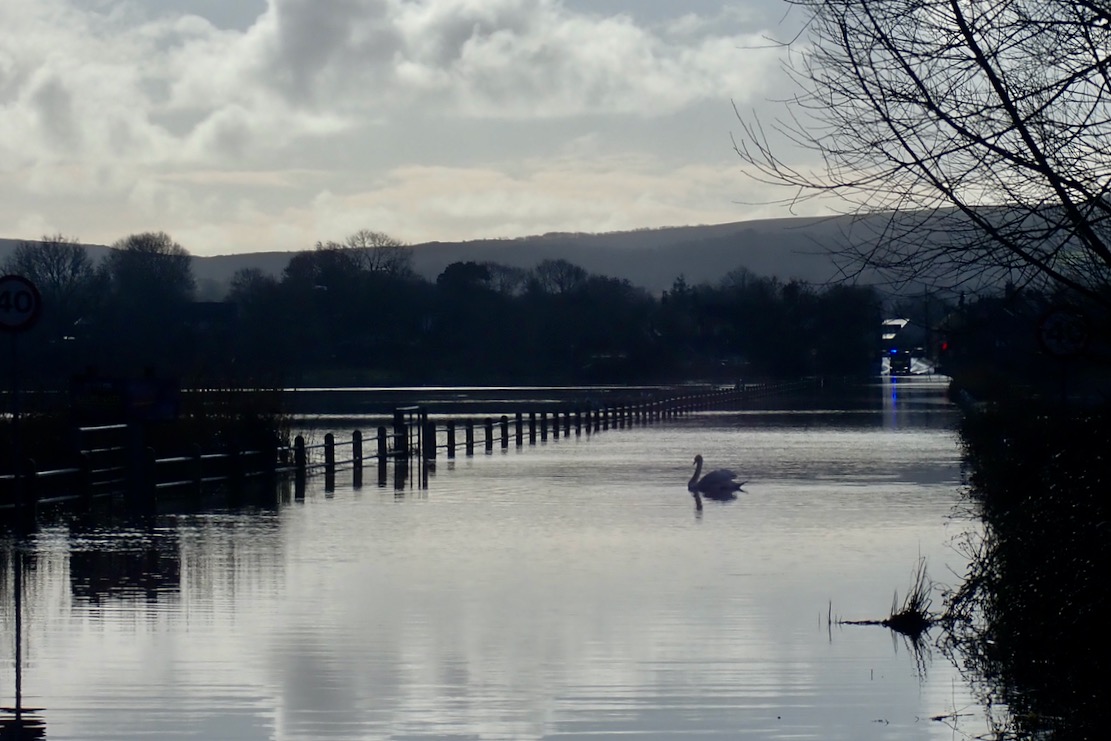
Back at Wareham, a swan was parked in the middle of the Causeway. You can see why they call it the Isle of Purbeck.
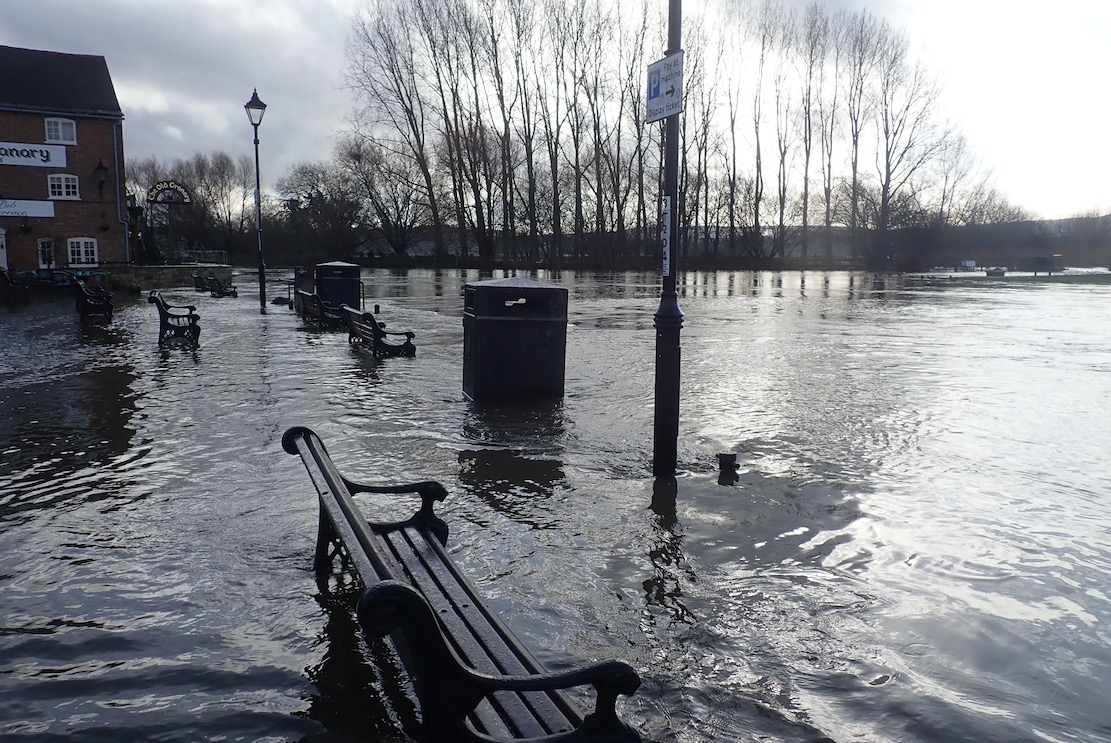
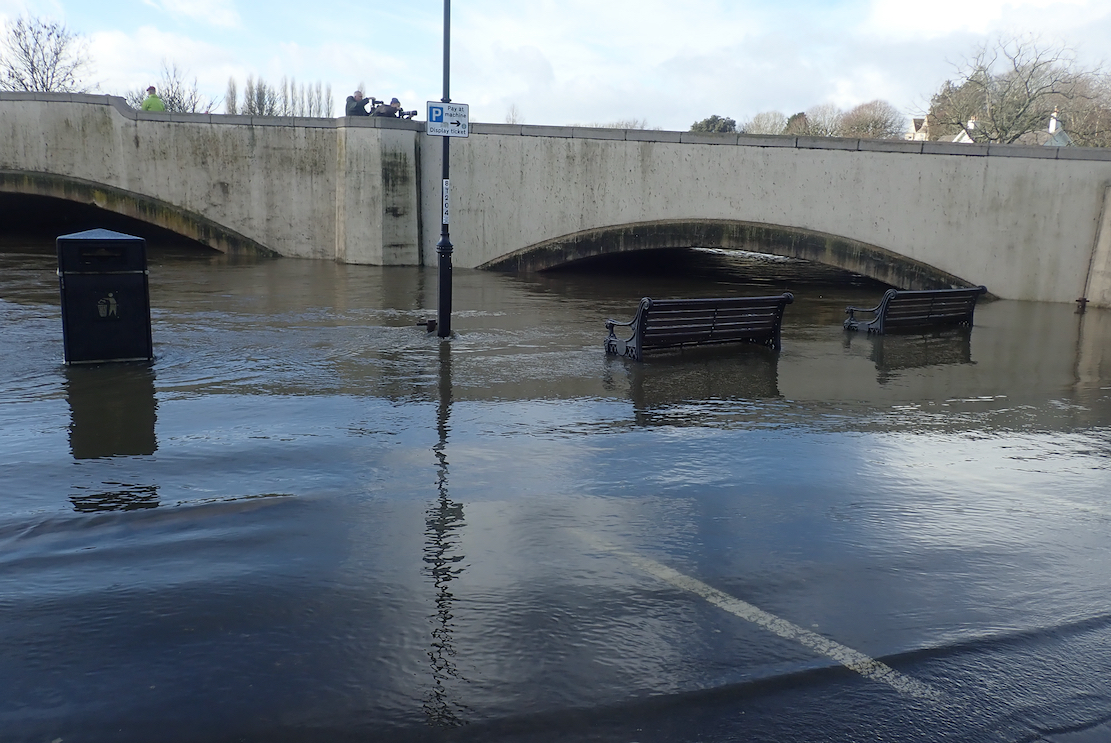
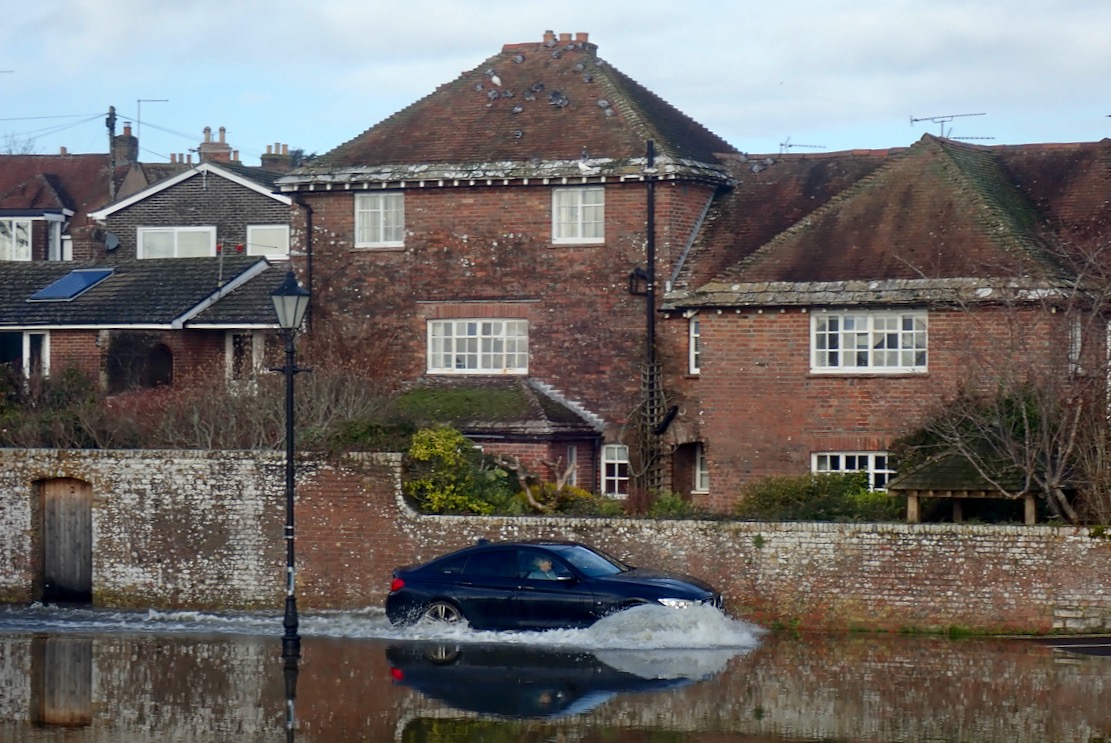
Wareham Quay was awash, with barely a foot under the road bridge to the Causeway which was why the river was backing up.
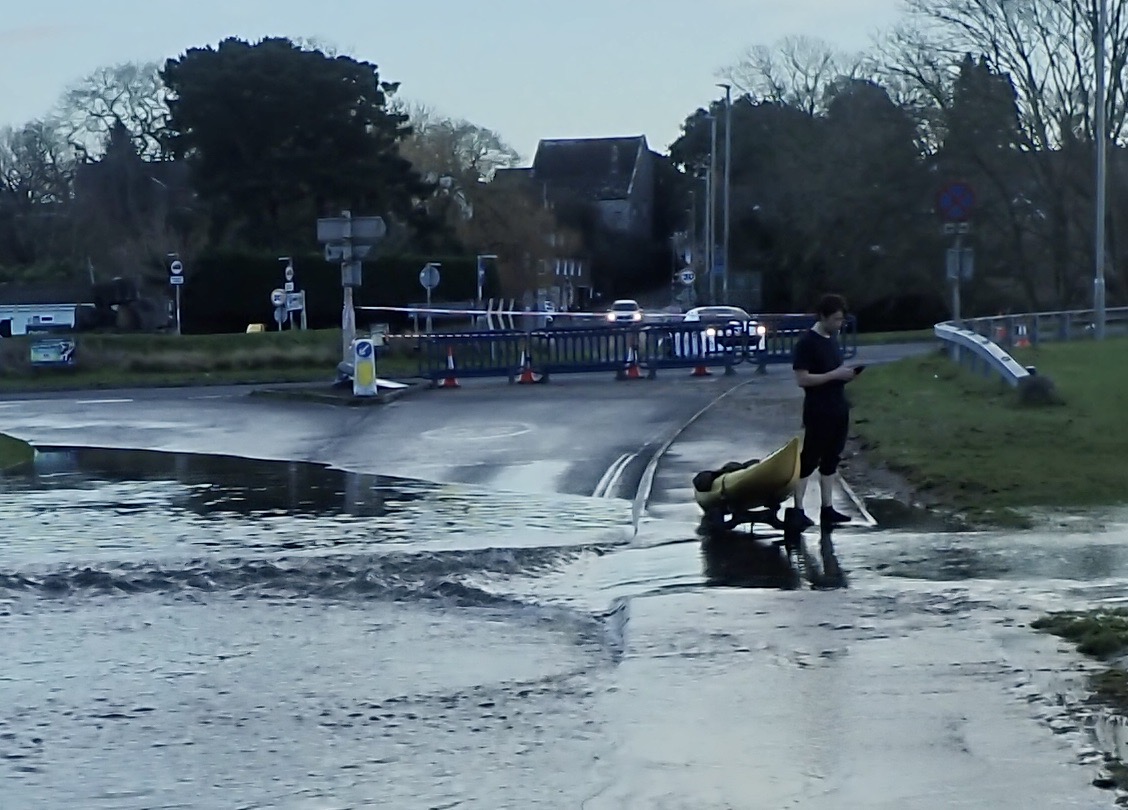
And it was only just possible to reach the station off the bypass where a bloke was putting in his sea kayak. At least someone got a paddle in today!
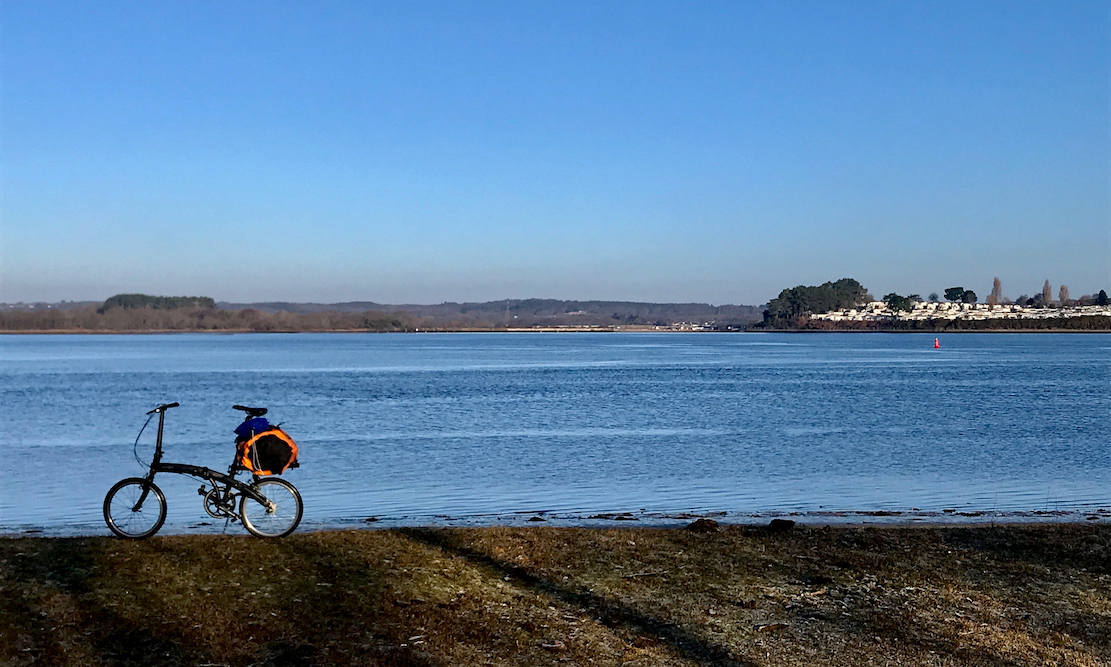
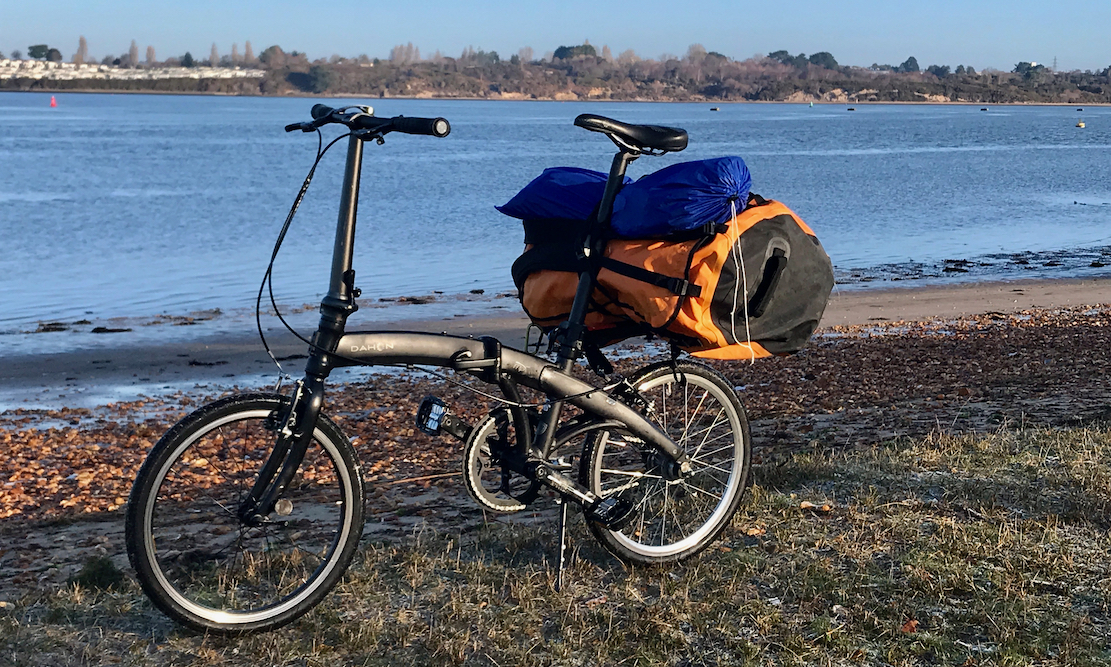
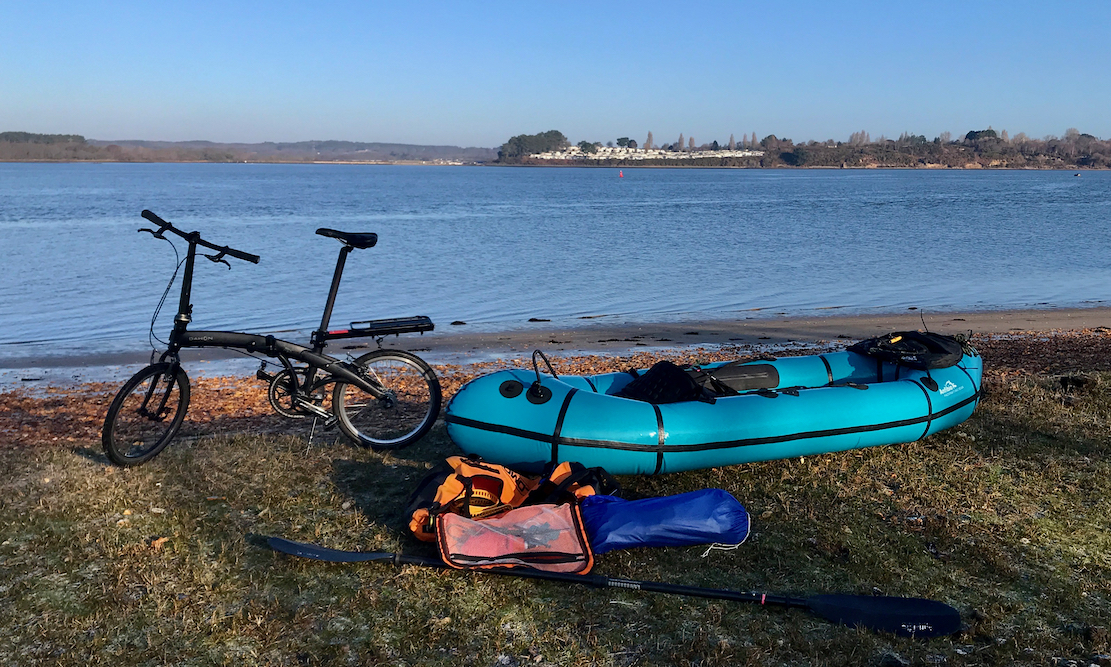
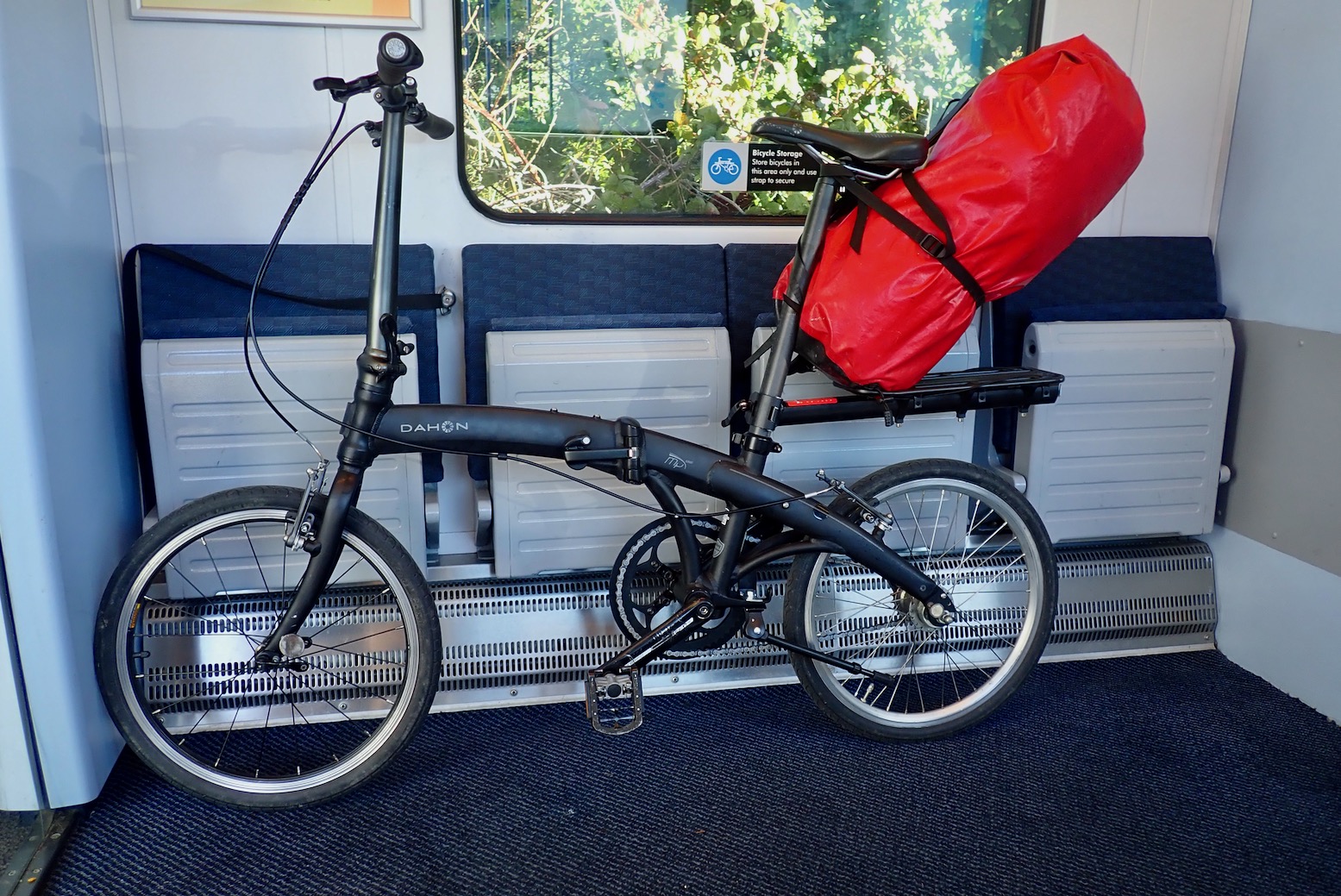
My Dohon two-speed folding bike is still a bit of a bikerafting novelty, so on a sunny, calm and chilly day soon after New Year, I went out for a spin in Poole Harbour.
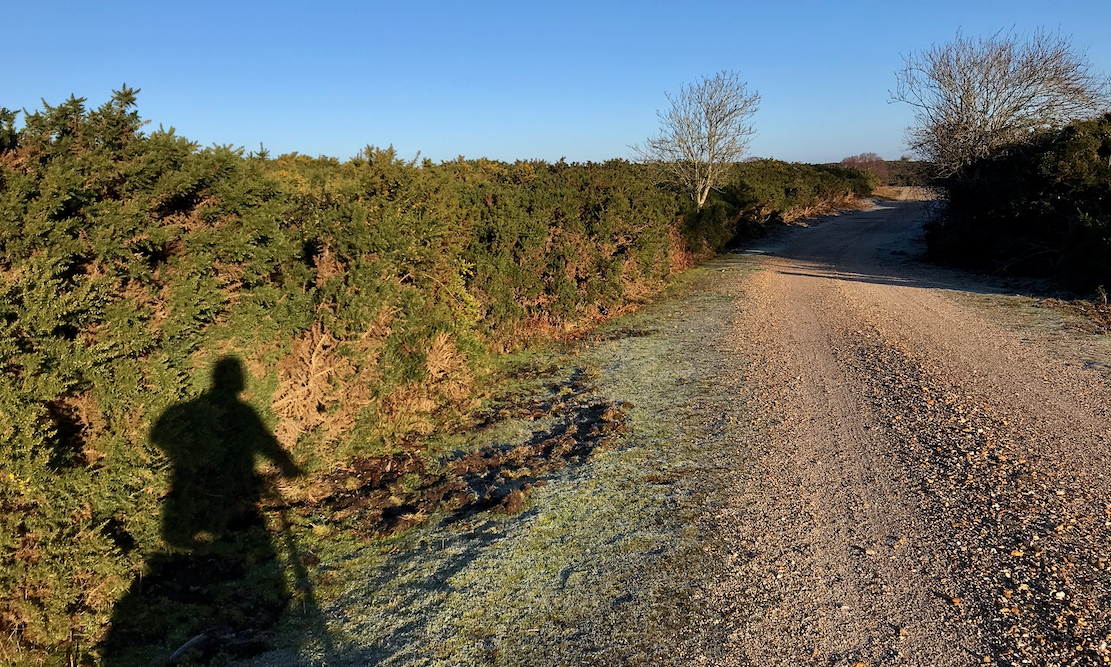
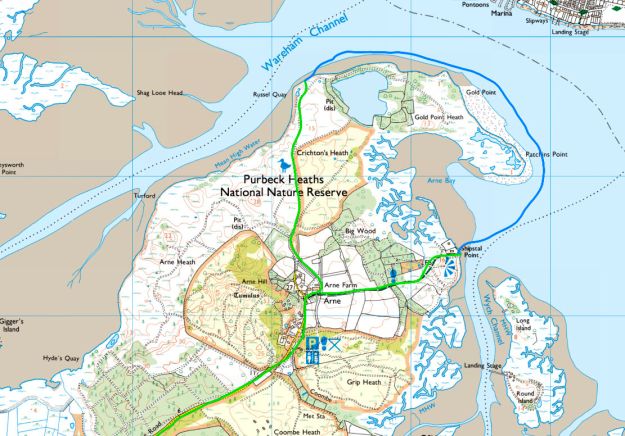
I pedalled up to Arne, then set off north across Crighton’s Heath, occasionally crunching through frozen puddles.
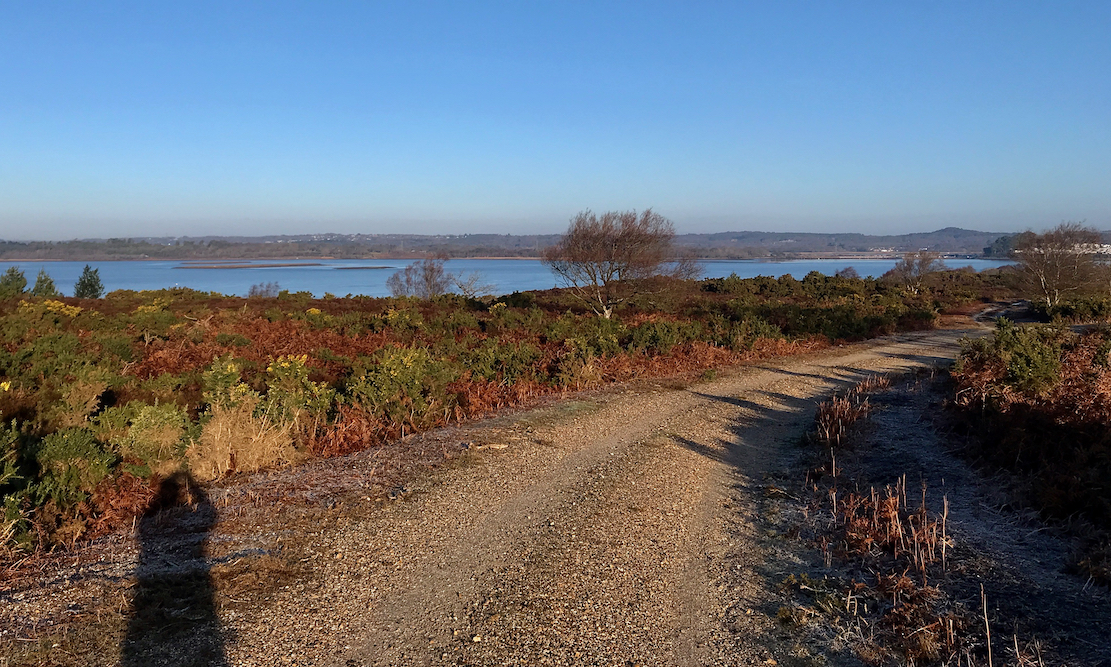
At the top of the heath the narrow Wareham Channel came into view beyond the tawny, mid-winter scrub.
For stability, the bag sat crossways over the clip-on rack works best, but the small wheeled bike struggles across cattle grids and gets wobbly manoeuvring at low speeds.
The tide was a lowish neap coming in, but at this point on the Harbour shore, the HW/LW band is narrow which means less chance of mudflats, whatever the tide. I’ve been caught out here before.
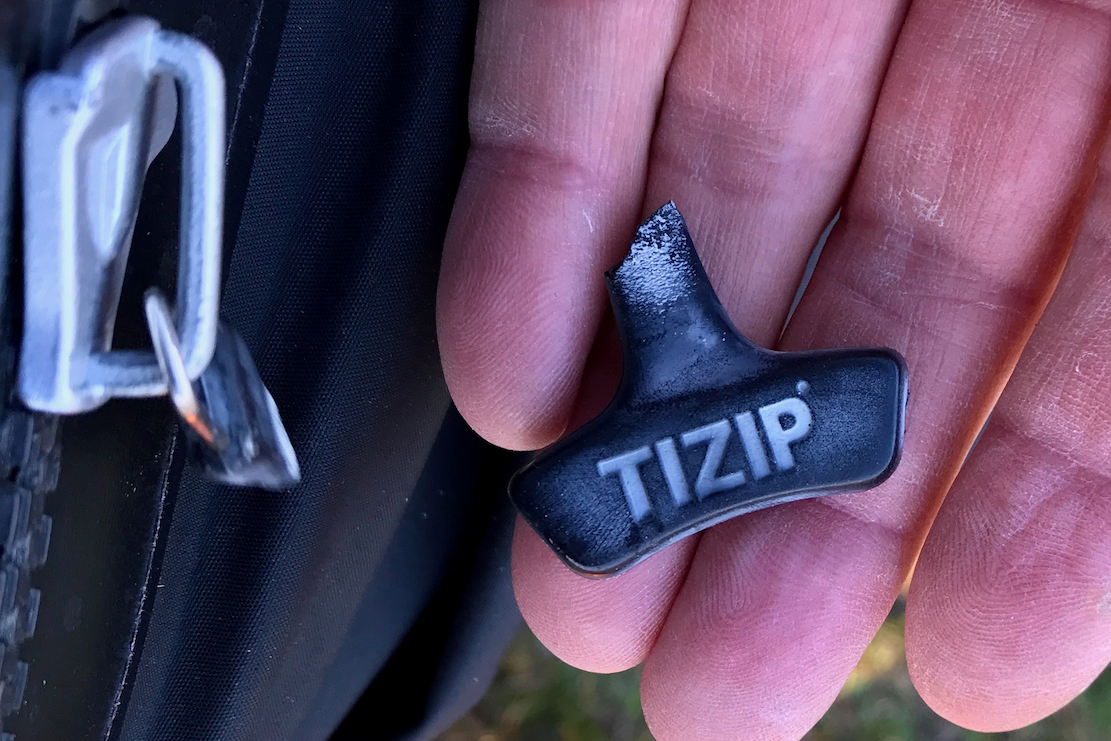
It wasn’t that cold – or I was over-dressed in a fleece onesie and drysuit. But it was cold enough the snap the plastic toggle off the drysuit’s TiZip.
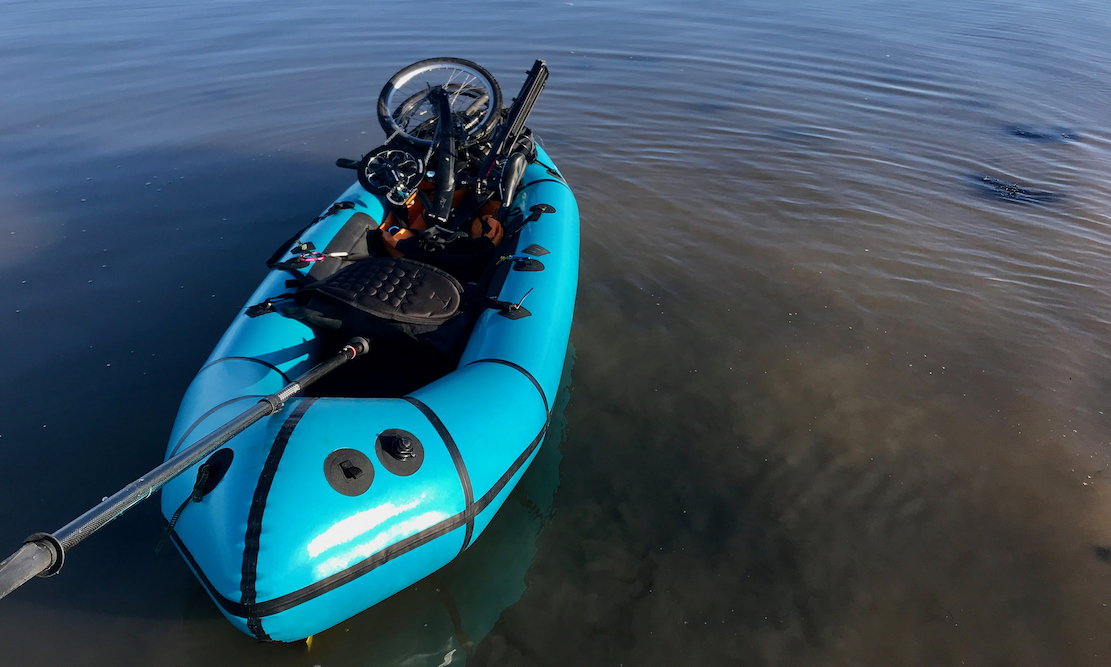
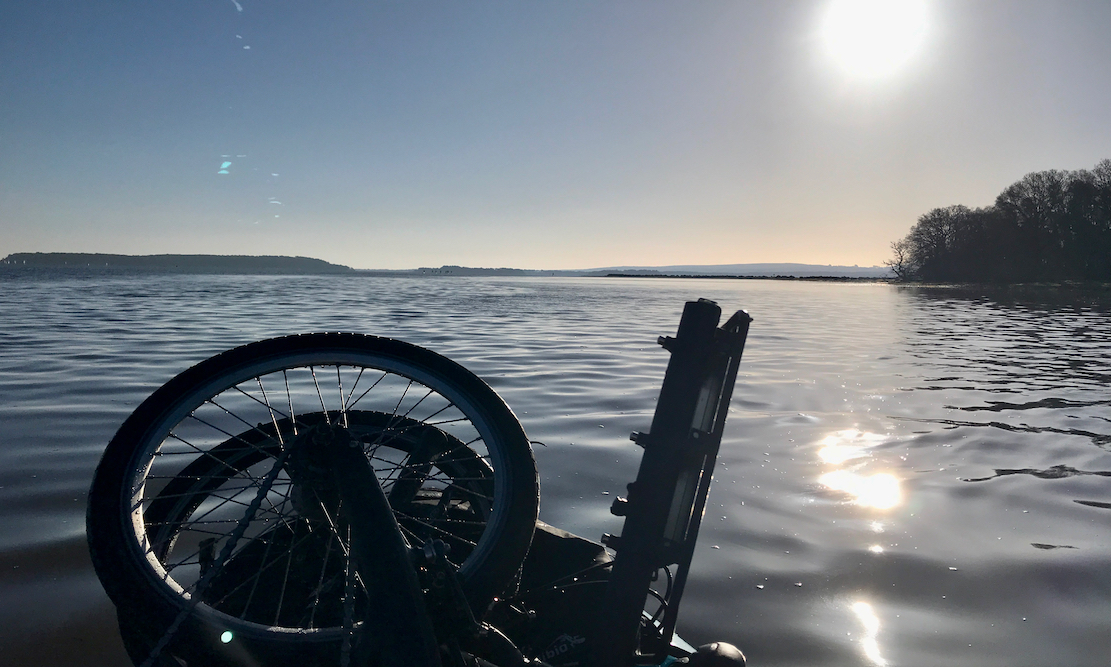
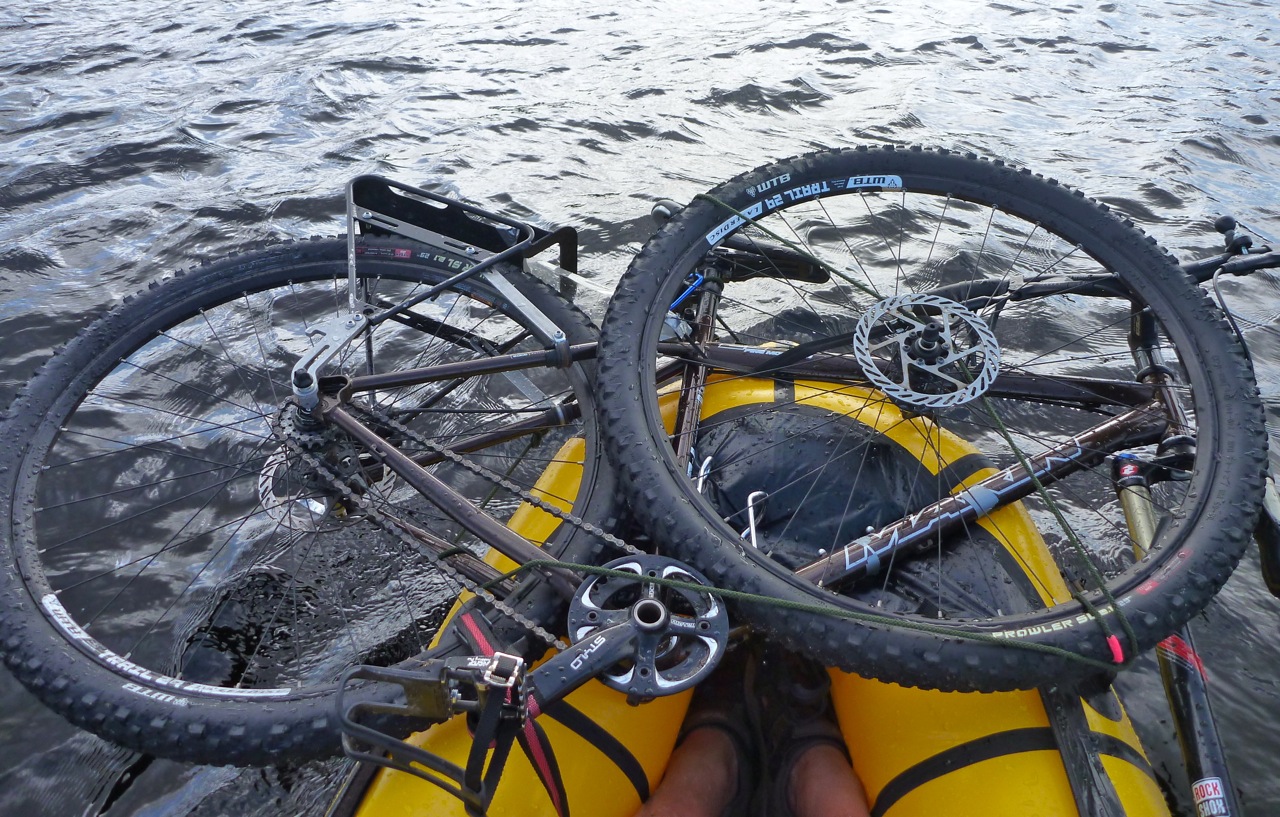
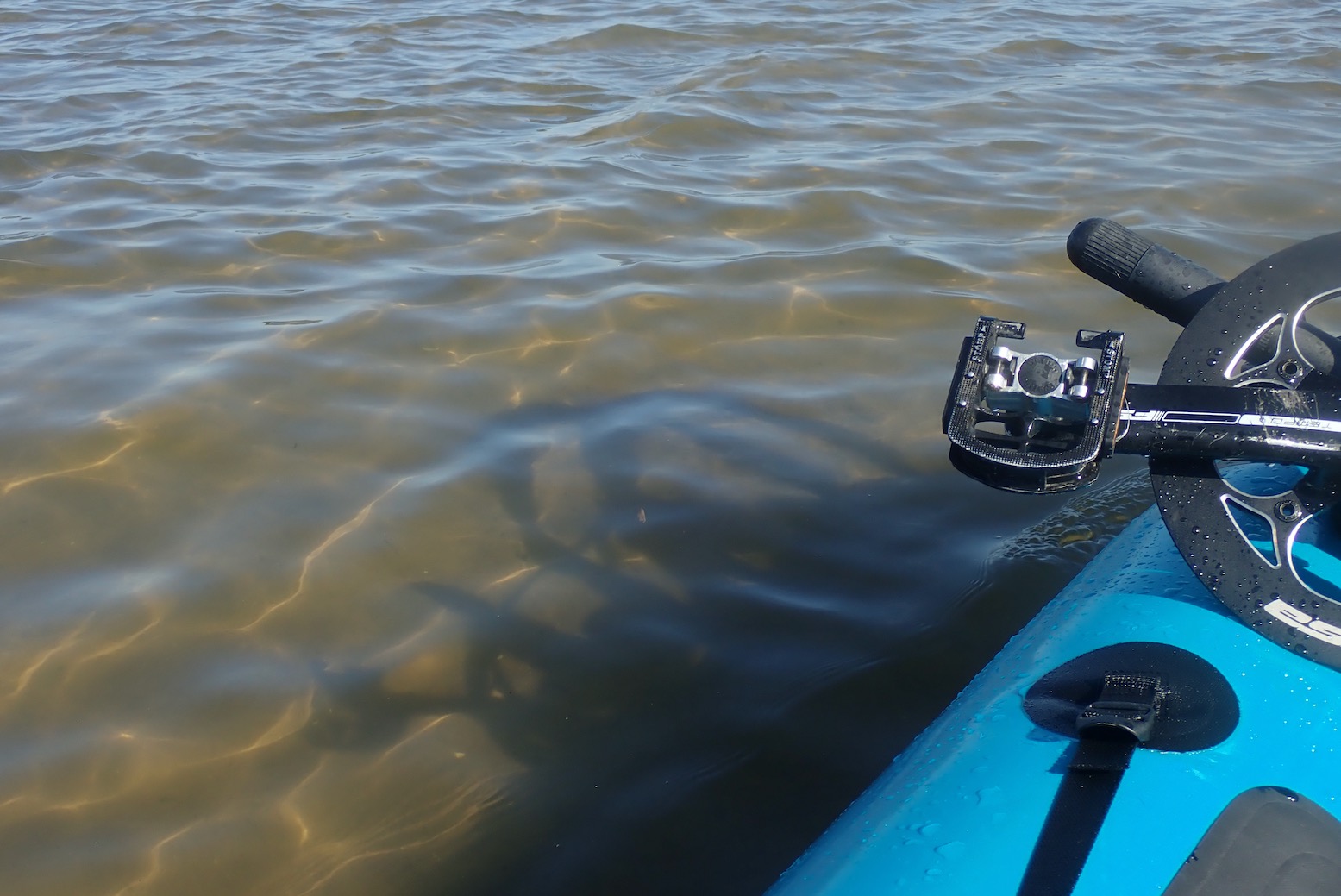
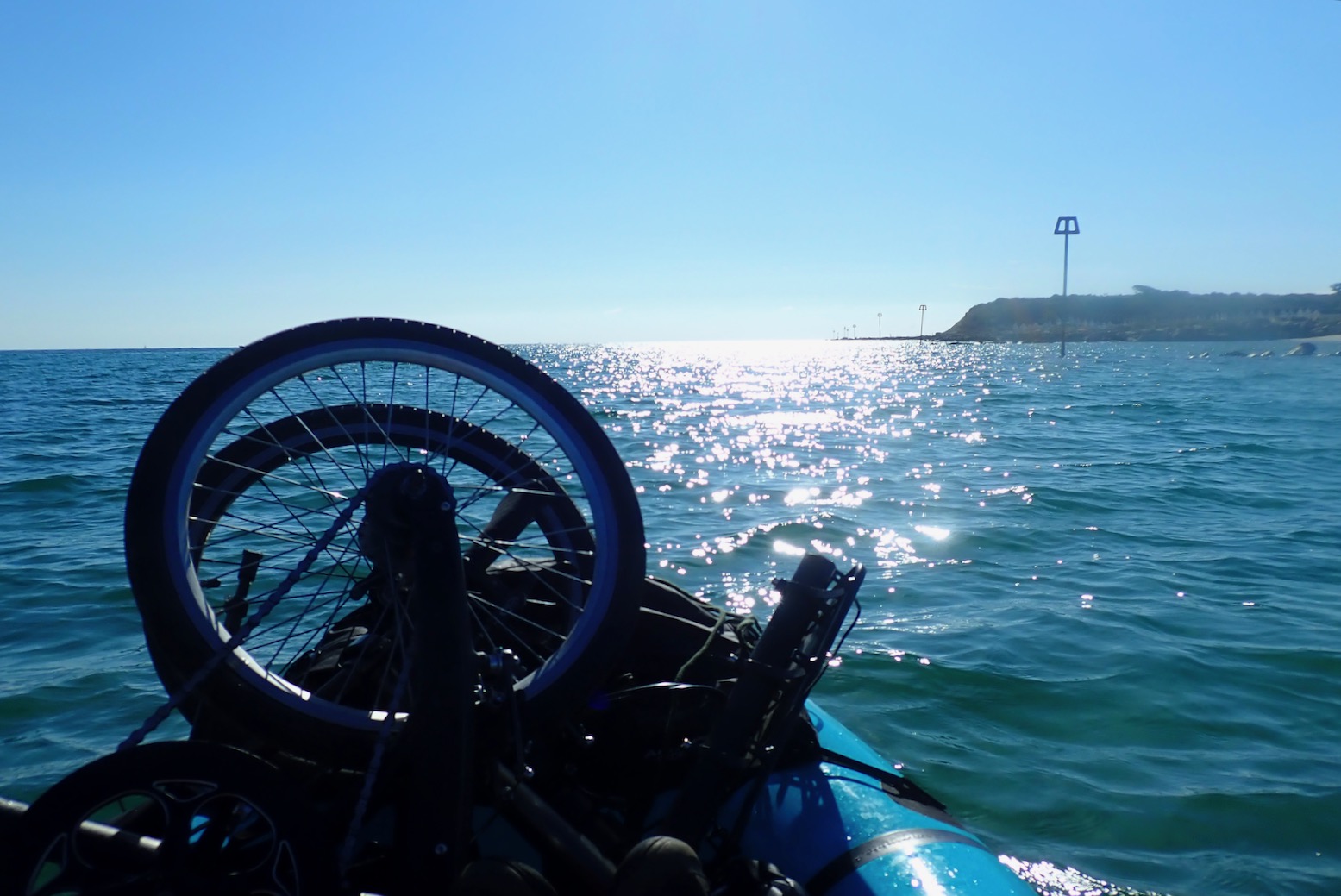
The bike drops easily into the bow. No need to lash down. I set off west. Today was one of those rare days where the water was warmer than the ambient air. Result? After inflating fully with cold air, no need to temper (top up) the boat as the warmer water firms it up for you.
The boat may be firm but I got no glide – it’s a struggle of move along. Is it the added 11kg, unfitness or the incoming tide through the narrow Channel having a bigger effect than I thought? I decide it’s mostly the latter.
As I turn the corner at Gold Point I’m paddling southeast into the low sun which, along with the tide, is really quite annoying. Should have brought the peaked cap. On top of that, I didn’t get myself properly comfy in the boat, as I managed on the Christchurch bikeraft last summer, the first time I tried folded bikerafting. Don’t know why; the seat was in the same place, so was the bike, but not being fully relaxed in the boat wears you out prematurely. Once past the hook of Patchins Point and out of the tide, I slide off the seat, put my feet up and drift off. I take a periodic peak and now it’s the northeasterly breeze pushing me out towards Brownsea Island, not the tide.
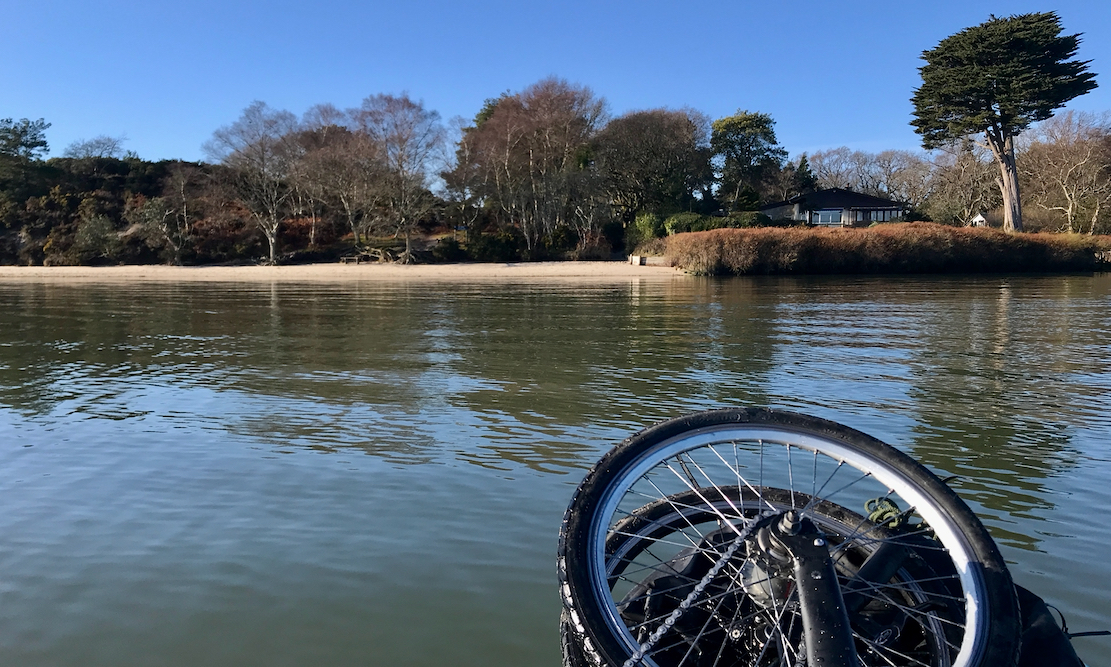
I turn into towards Shipstal Point where a bridleway leads back to Arne. It was a short paddle but as always, it’s nice to get on the water on a sunny winter’s day.
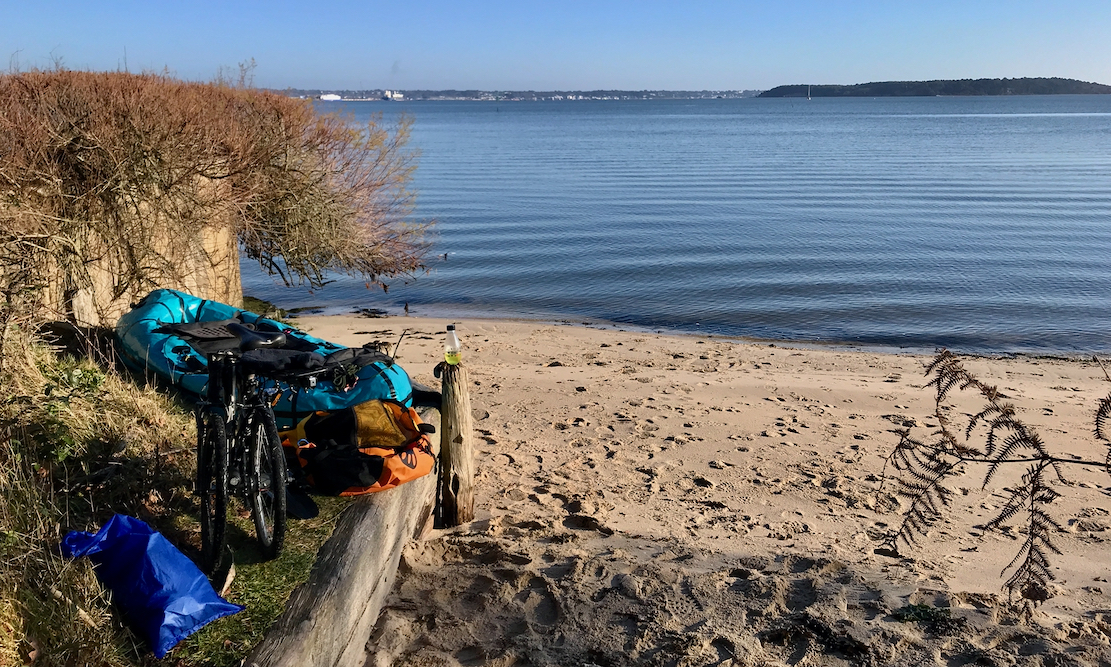
I try and pack up without getting sand all over the boat and bike, but it’s a losing battle. I lash down the boat and pedal home.
I’m reminded what a mistake it was to use an iPhone without a stand or at all. Unlike my Olympus, ‘wet camera’ it’s tricky to use while pedalling, and trying to use the self-timer or vids focusses on a blade of grass in front of the lens, not the passing bike. Result: extra boring pics of nothing much at all.
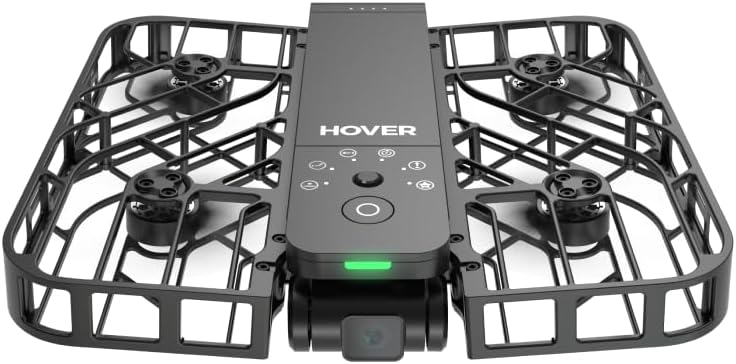
Later that afternoon I finally got to grips with a Hoverair X1 drone (left) a mate sold me cheap. It’s basic and sounds like a kicked hornet’s nest, but works without a phone or controller, weighs just 125g and fits in your pocket. Reviews are pretty positive for what it is. This morning’s biking and rafting would have been a perfect chance to try it out and get some better PoVs. Next time may be a while away. The weather forecast shows wind and rain right off the edge of the screen.
The other week I bought myself a Dahon folding bike, a long-established American brand with a French sounding name that’s probably made in China and in the UK is much less pricey than better known Bromptons. Folders seem to be going cheap right now as older folk move to e-bikes. I still have a couple of pedalling years left in me, I hope. At least 8 years old, my Dahon Mu has an unusual (and long discontinued) SRAM Automatix 2-speed hub, V-brakes and once folded up, weighs just 11kg (my MTB is 15kg). I could’ve waited for a 7- or 8-speed hub to turn up, but thought I’d give the Automatix a try. I don’t mind having one less cable and mechanism to operate. It shifts up automatically at a round 10kph; a bit too soon some say, but there’s an easy mechanical hack around that.
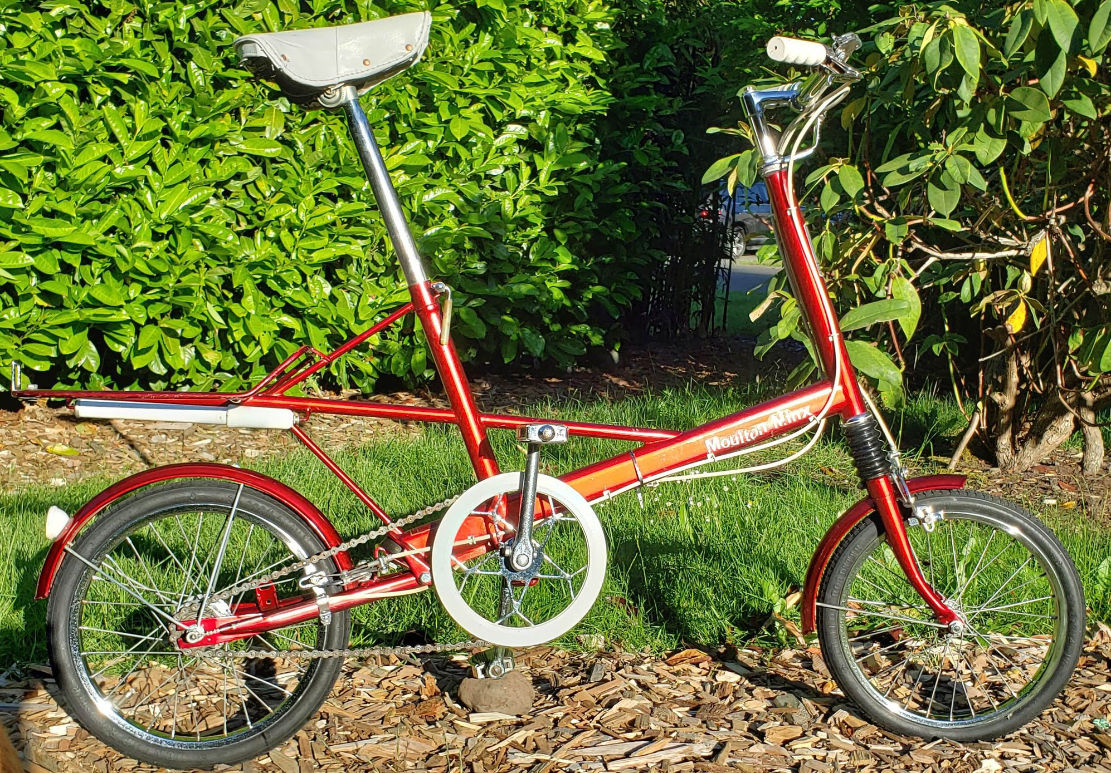
The Dahon reminds me of my Ferrari-red Raleigh Moulton I had in the late 60s, possibly my first two-wheeler. Along with being a groovy Sixties design, I think my mum thought small wheels = ‘sensible’, like a shopping bike. ‘Sensi-Schmensi? Hold my Tizer!’ My innovative ‘full suspension’ Moulton folded too, only not in a good way. Too much bombing around on Mitcham Common doing Evel Kinevel jumps one weekend saw the seat tube and stays fold backwards after one heavy landing. A decade and a half later California brought us the Apple Mac and mountain bikes and we never looked back.
Midsummer 2012, Joe Sheffer and Al Humphreys bikerafted to the top of Shetland using folding bikes. That’s my very first green Alpacka Joe’s paddling, a Denali Llama, just before Alpacka introduced the much copied extended stern.
Years ago I tried bikerafting in northwest Scotland with my MTB. Up there it didn’t really work, the few roads were empty enough, but what paths and tracks there were were tricky on a bike with a boat strapped to it. I wrote in 2012…
… add a bike and any off-roading becomes marginal up here [FNWS]. Most of the time you’ll be pushing or carrying, especially with an overnight load. No MTB is really rideable on the footpaths up here, although unlike England and Wales, since 2003 Open Access allows cycling on all footpaths (there are no bridleways). Cross country and off the footpaths, at times you can barely walk, let alone ride a bike
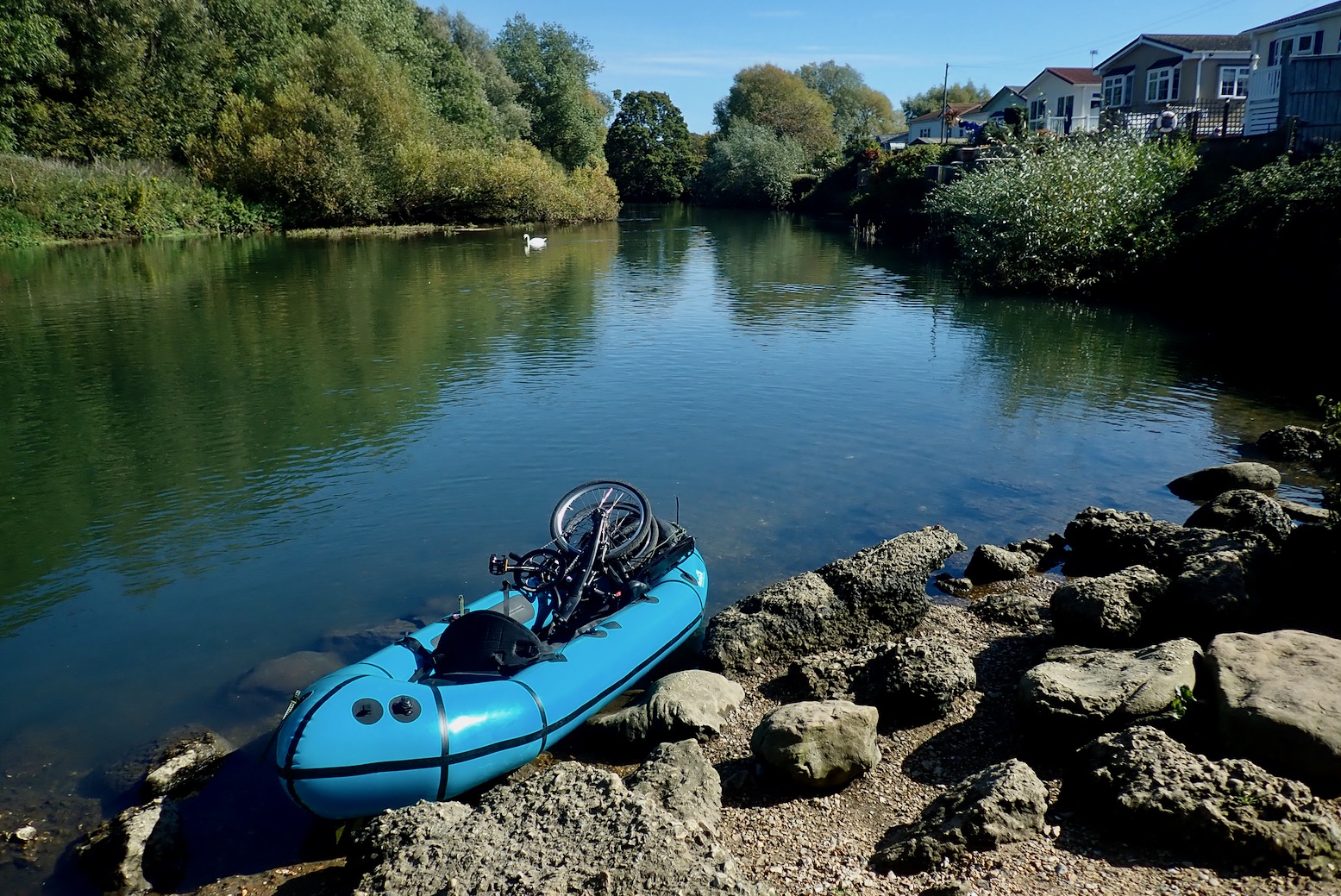
This time round I have a bigger packraft and a smaller bike. I pedalled down to the station and got a train to Pokesdown, a 10-minute cycle from Iford bridge (below) near the tidal limit of the River Stour. On the water I moved the seat back and dropped the folded bike at the front. Unlike a regular bike, the folded Dahon sits part in the boat so there’s no real need to strap it down on the long TXL. I put the bag under my knees and set off about 1pm on a rising neap tide (right) that was set to stay level in the harbour for the next few hours. Winds were 6-8mph from the southwest.
Iford bridge at the tidal limit of the River Stour
From Iford bridge, or Tuckton just downriver is a popular paddle boarding spot and a couple of women were putting in with me. You can see why. You soon leave any impression of urbanity and drift along between the lush trees with little other traffic.
Add the blue sky and all in all, these were as ideal packrafting conditions as you’ll get. The TXL feels a bit heavy with the 12kg bike, or I’m out of paddle practice.
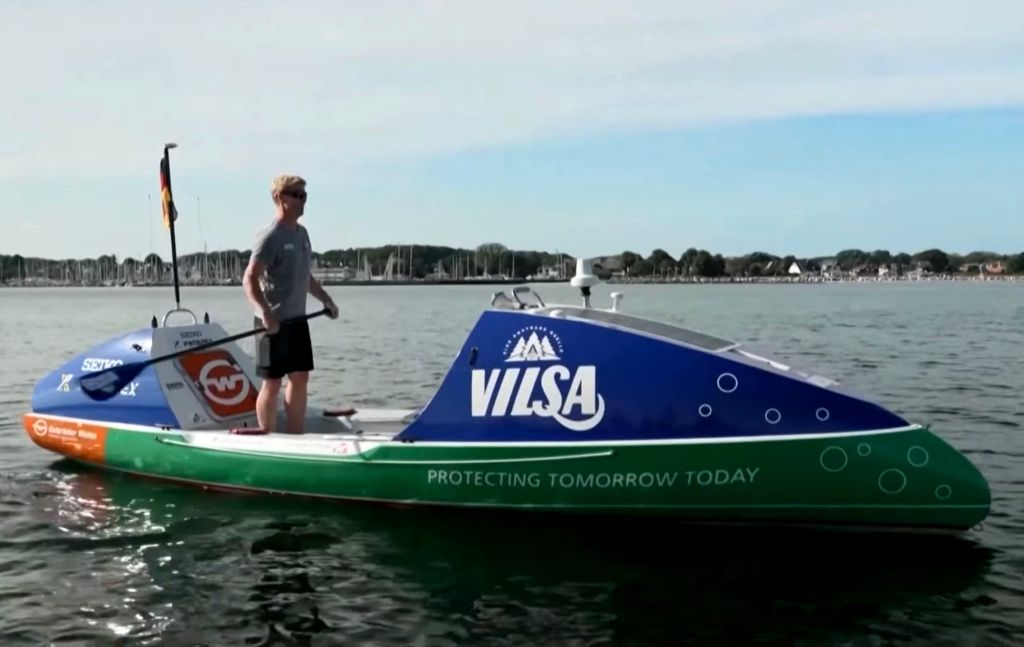
I pass a chap doing up an solo ocean rowing boat. It wasn’t this one which washed up nearby recently. Even with favourable currents and winds, it amazes me a single person can row a ton of boat across an ocean. But they can and they do.
I just read about Michael Walther, who adapted a similar boat to ‘SUP the Atlantic’. He set off from Spain and in two weeks covered 1150km to the Canaries averaging 3.9kph. Explanations seemed vague (boat damaged close to the port) but the trip ended there.
Soon rows of mega boats crop up with the the priory behind. Christchurch is like a millionaires’ Wareham.
Past Christchurch the land opens out. I sense the sea ahead.
A lot of boat for a little space. But a lot more stable than a little Dahon Mu with a packraft on the back.
I stray too far north into the protected shallows with just six inches of water. The marked boating channel follows the harbour’s southern edge.
From Hengistbury hill looking north. Note the tourists train for the weary of limb.
The harbour’s narrow outlet at Mudeford Quay.
Mudeford Quay from the hill.
As I passed through the channel I was hoping to be temped ashore by the aroma of sizzling seafood.
No discernible tidal flow in the channel today. Out into Christchurch Bay it’s only 13km to the Isle of Wight
Wanting to string things out, I paddled south into the wind and tide towards Hengistbury Head. It felt a bit more fun to be pressed against the elements (knowing there’s only 10 minutes of it).
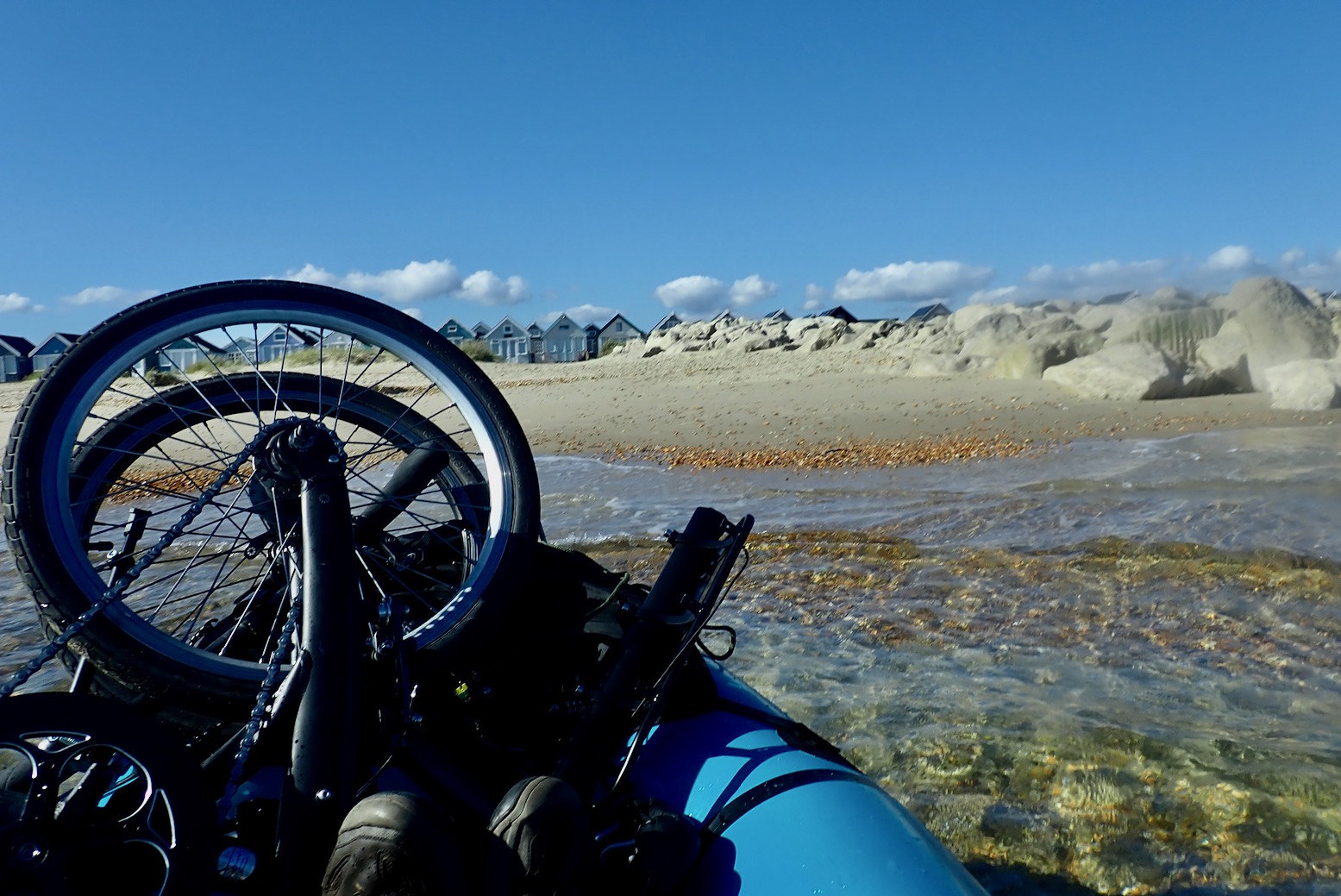
I take out at the last beach before the Head.
That was an easy and very enjoyable paddle. Only 8km over 90 minutes.
‘That’s a good set up you got there’ said a woman. ‘Yes it is’, I replied. The complete solution to amphibious mobility for the recreational enthusiast (I did not add).
I weave along trail across the beach
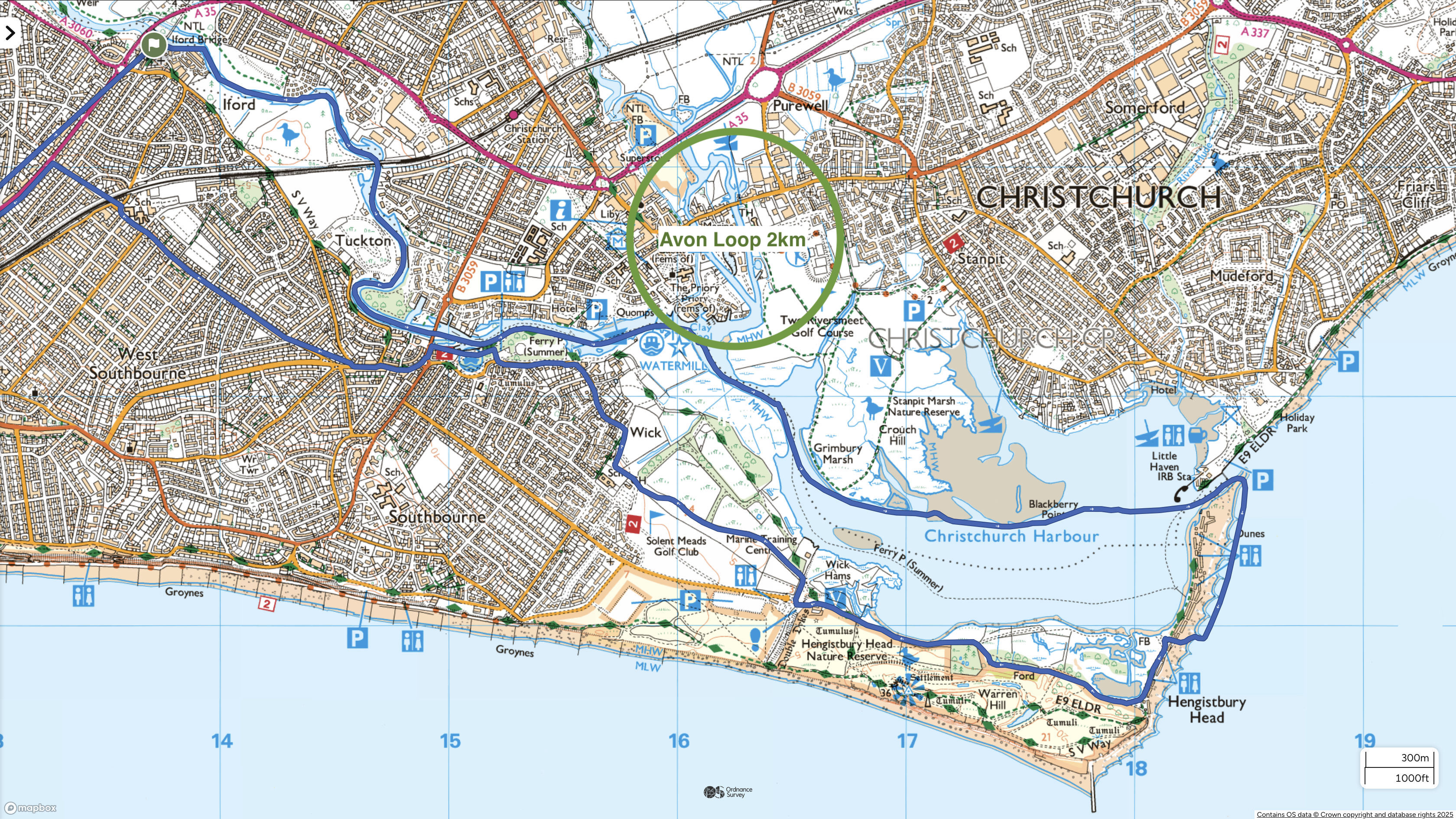
Harbour map. A fun place to explore with bike or boat or both.
It’s about 8km back to Pokesdown station, half of it on tracks.
Christchurch Priory and the water meadows, as not painted by Constable.
Only a tenner for 2 slices and a big cappucho. I suppose I needed the energy but that cherry slice had enough sugar in it to preserve a herd of dugong.
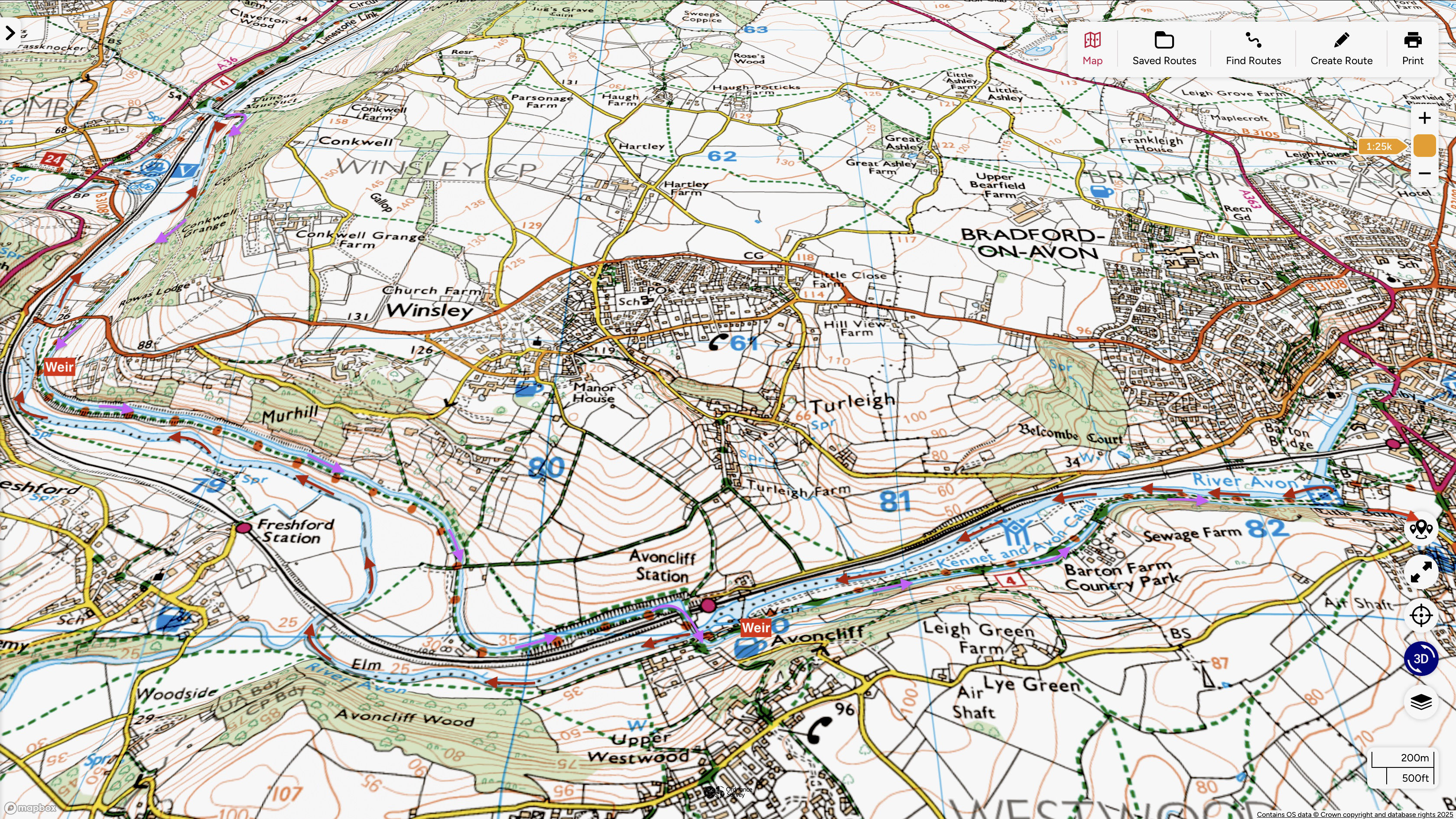
Looking at the OS map left, you might think it’s like packrafting through London, but nothing could be further from the truth. A tranquil, tree-lined river leads to a glittering inland marina and medieval church and a swan-speckled natural harbour beyond. Once out in the Bay, with the usual southwesterly you could carry on up the coast to Highcliffe, a couple of train stops up from Christchurch. Or with a higher tide, poke around the harbour. And just after the Priory, the Avon river comes in from the north. Someone suggested it’s possible to do a 2km tidal loop off the Stour and back. One for next time. Ironed out for some blundering around on the way back, that was about 18km from Pokestown station, with 8km of very enjoyable paddling. Without the bike it would have been a long walk back, though there is a summertime ferry from Mudeford Quay back up river. So this particular outing was well suited to bike rafting. With the wobbly payload, the comparative lack of stability, just two gears and the feeling I might snap something if I rode it like my MTB, the Dahon forces me to slow down. Not a bad thing. Next time on salt water, I might put it in a bag, so I don’t have to rinse and lube it back home, but I’m looking forward to more mini foldingbikerafting trips, where flatter roads and tracks allow.
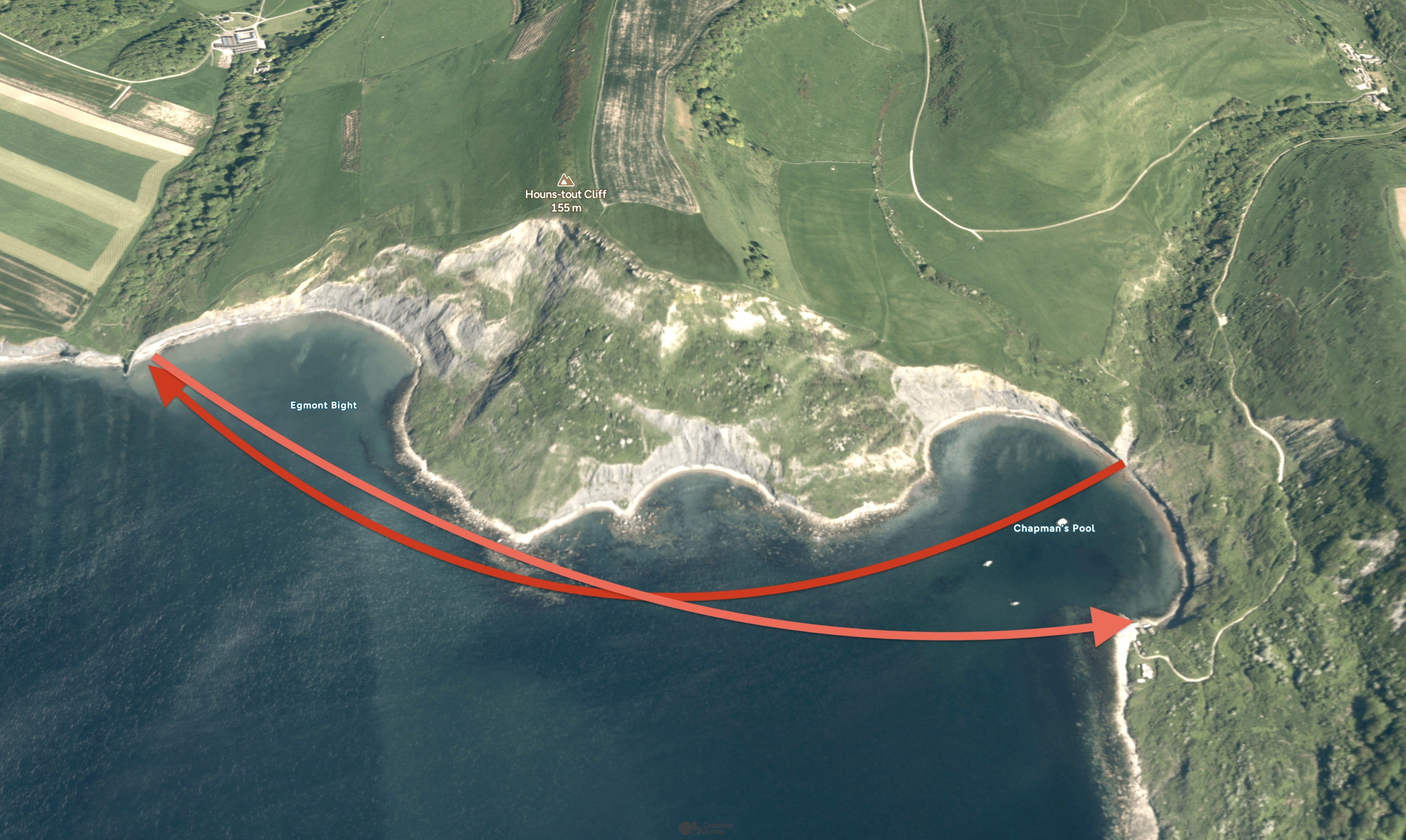
Unsatisfied with my bank holiday paddle-by, two days later we hiked back to Chapman’s and packrafted back round to Punta P. We left right on LW spring, but either my tide timings were wrong (don’t start me on that) or Chapman’s shore doesn’t dramatically transform, like Kimmeridge beach. It was less than a mile’s paddle, but a strong SSE was blowing and once out of the Pool, it got choppy around Egmont Point, especially into the wind on the way back. It didn’t help that I had the TXL’s floor mat fitted for extra glide, but which I know doesn’t work well for a rear paddler: higher floor = less or no backrest = not relaxing.
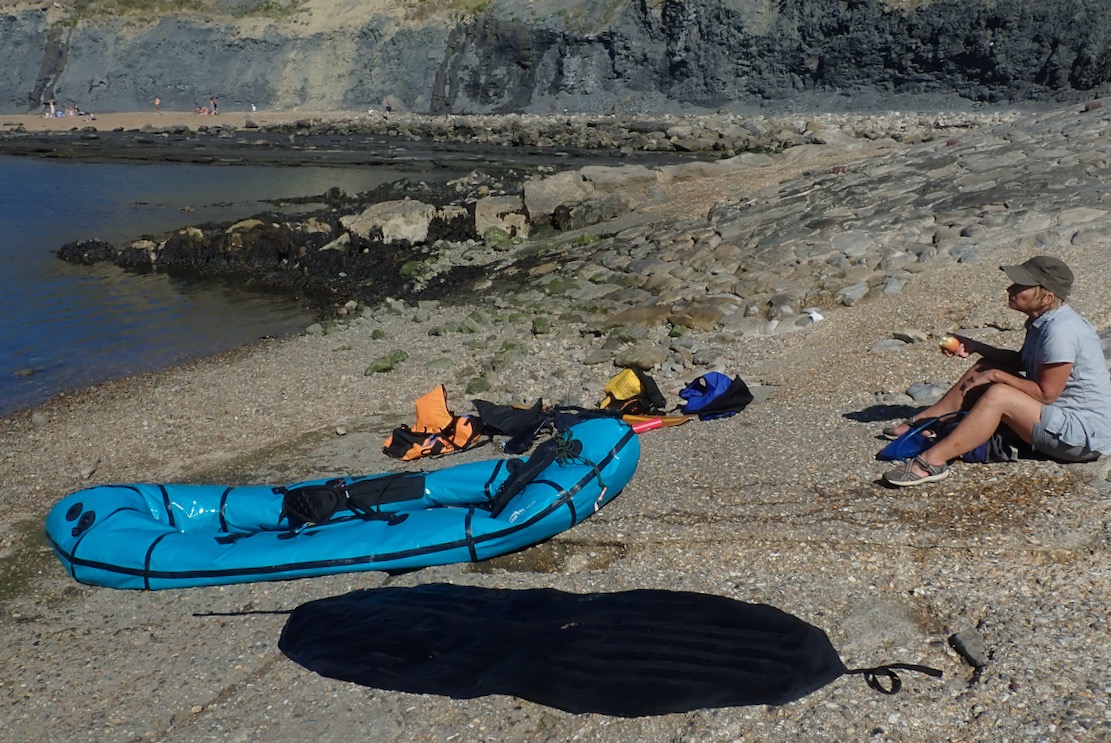
Once at the cliff face and with the boat resting in the shade of the Freshwater rock spur, the Mrs easily found fragments of ammonites in the shingle (why always ammonites?). We edged round the spur’s tidal shelf onto Pliosaur beach where a woman looked down from above and asked ‘Ow d’you get down there?’ ‘We paddled.’ ‘Uh..?’
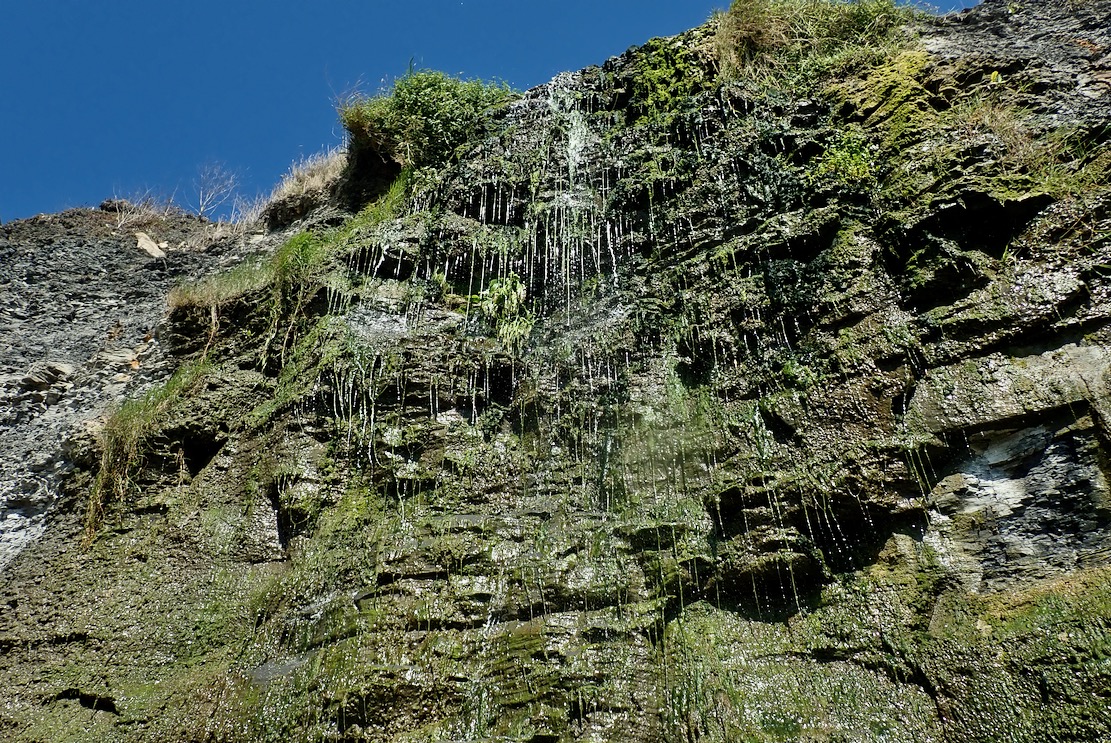
Despite an exceedingly dry spring and summer, a cascade was still dribbling down the cliff face through tendrils of moss, ferns and algae (below). It was the end of the South Gwyle, a short stream with a big catchment. Augmented by a couple of landscaped fish ponds up the valley at Encombe House (more below), ‘gwyle’ is an old Dorset word for a tree-lined stream.
Fallen and weathered concrete slabs below a protruding step on the cliff edge: the remains of the mysterious ‘Freshwater Steps’
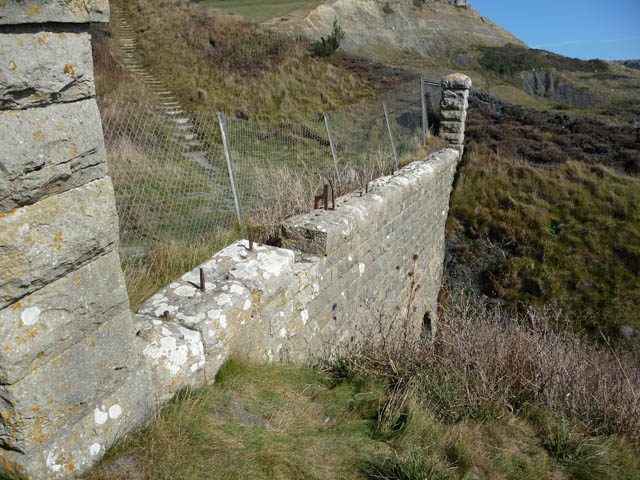
With nothing more to learn about the pliosaur, I was curious about the odd limestone wall up on the clifftop, seemingly bridging the stream. Clearly visible on aerial imagery, I’d noticed it walking back the other day to Kimmeridge, but was too hot and bothered to explore. Perhaps the ruin of an old mill?
Landslide into Egmont Bight
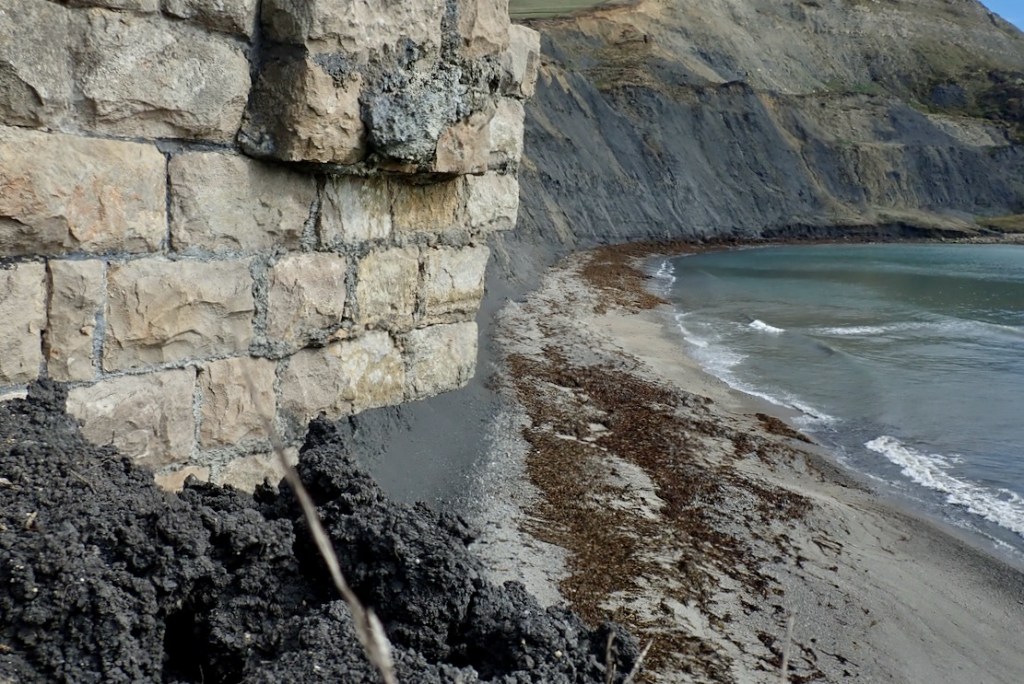
On the east (other) side of the dark shaly spur from which the cascade falls, the protruding end of the wall is being undermined, and now hangs over the cliff edge (below). Cracking under its own weight, one day it’ll collapse and fall to the beach. We parked the packraft here, in the shade of the spur. The face was full of fossils, but bits of grit were constantly dropping from above. While here I had a look at the probable site of the landslide I’d seen on Saturday (left), but it must have looked more dramatic than it was on the beach, and these little slides must happen all the time.
Overhanging east end of the wall from above and the beach, slowly being undermined by the receding cliff (2025)
Photos by Phil Champion on Geograph from 2008. On the left note the ‘other’Ladies’ Steps’ (‘for ladies to climb easily to a path leading to the Carriage road‘) descending to the wall: the old footpath still part of the SWCP in the 1970s but now under thick brambles or thin air. The wire fence and all the pillars seen above have disappeared, bar one. It’s amazing it’s all lasted so long, given its exposure, but the east side of the spur has lost several feet in height and width in 17 years.
Freshwater Steps and the Hydraulic Ram, map 1901 (Source)
Back on the west side of the spur, ‘Freshwater Steps’ is a name I’ve seen on older maps (above) and, as expected, locally born geologist Ian West’s geological and historical page had some answers, as well as many fascinating old photos. In fact ‘Freshwater’ seems to have been a name for this locality (left) which preceded the Steps. Perhaps a place a boat could pull in to top up the water barrels? I’ve noticed another ‘Freshwater’ on the south coast of Devon.
Encombe House, 1857, photolithograph, John Pouncy (source)
As far as I can unravel, the story goes that round 1840, the Freshwater Steps were built down to the beach by John Scott, the 2nd Lord Eldon whose Encombe estate enveloped a grand Georgian mansion (above) bought in 1807 by his grandfather, former Chancellor Lord Eldon (also John Scott; d. 1838; right). History has not judged the first Lord too fondly according to usually impartial Wikipedia, as well as this writer who puts him alongside the famously loathed Castlereagh of the late Regency era. Since those days the estate has grown greatly.
The falls today at Freshwater Steps. The last hanging step visible top left
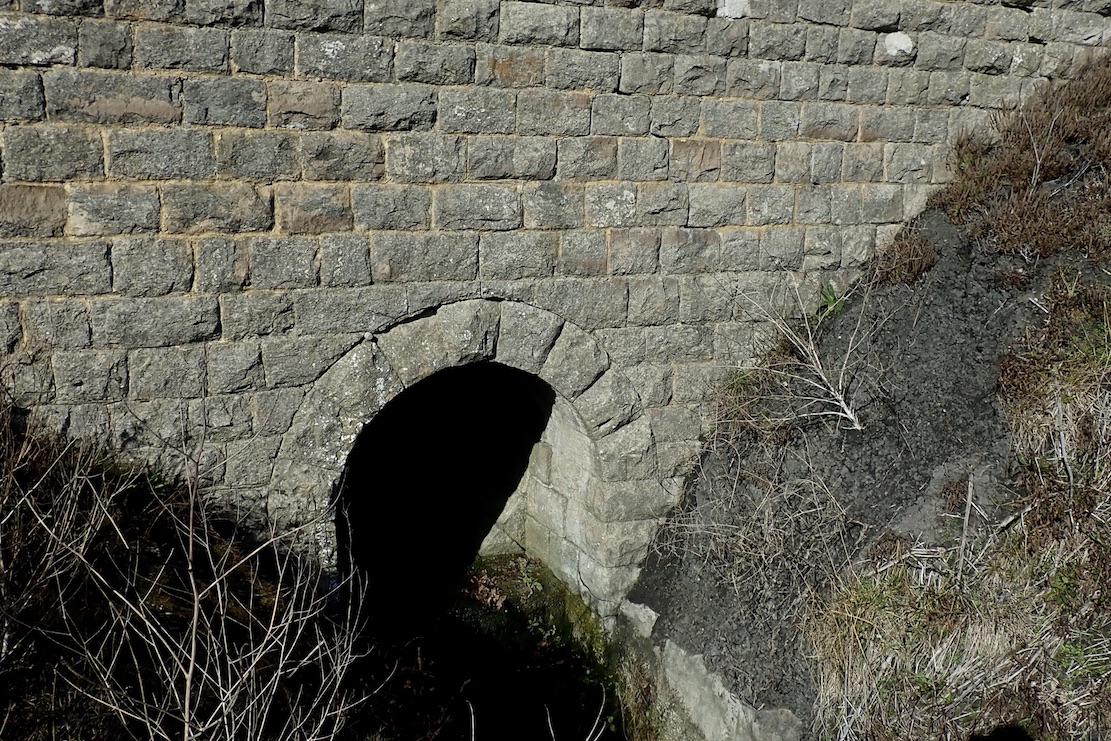
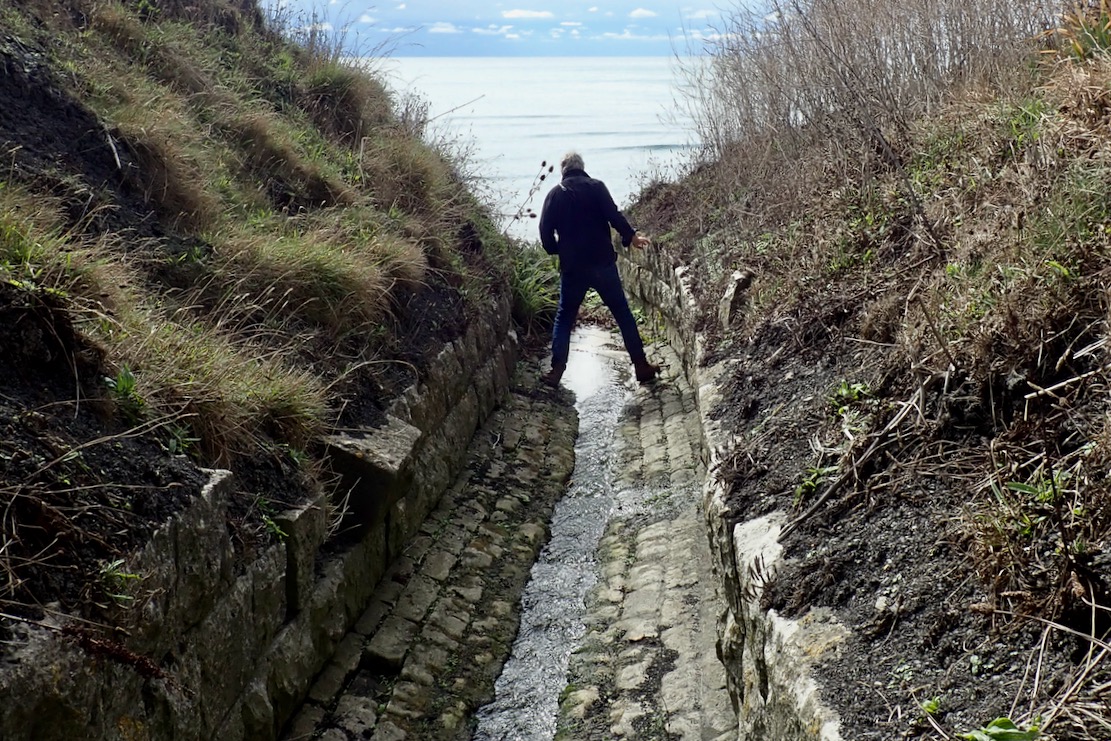
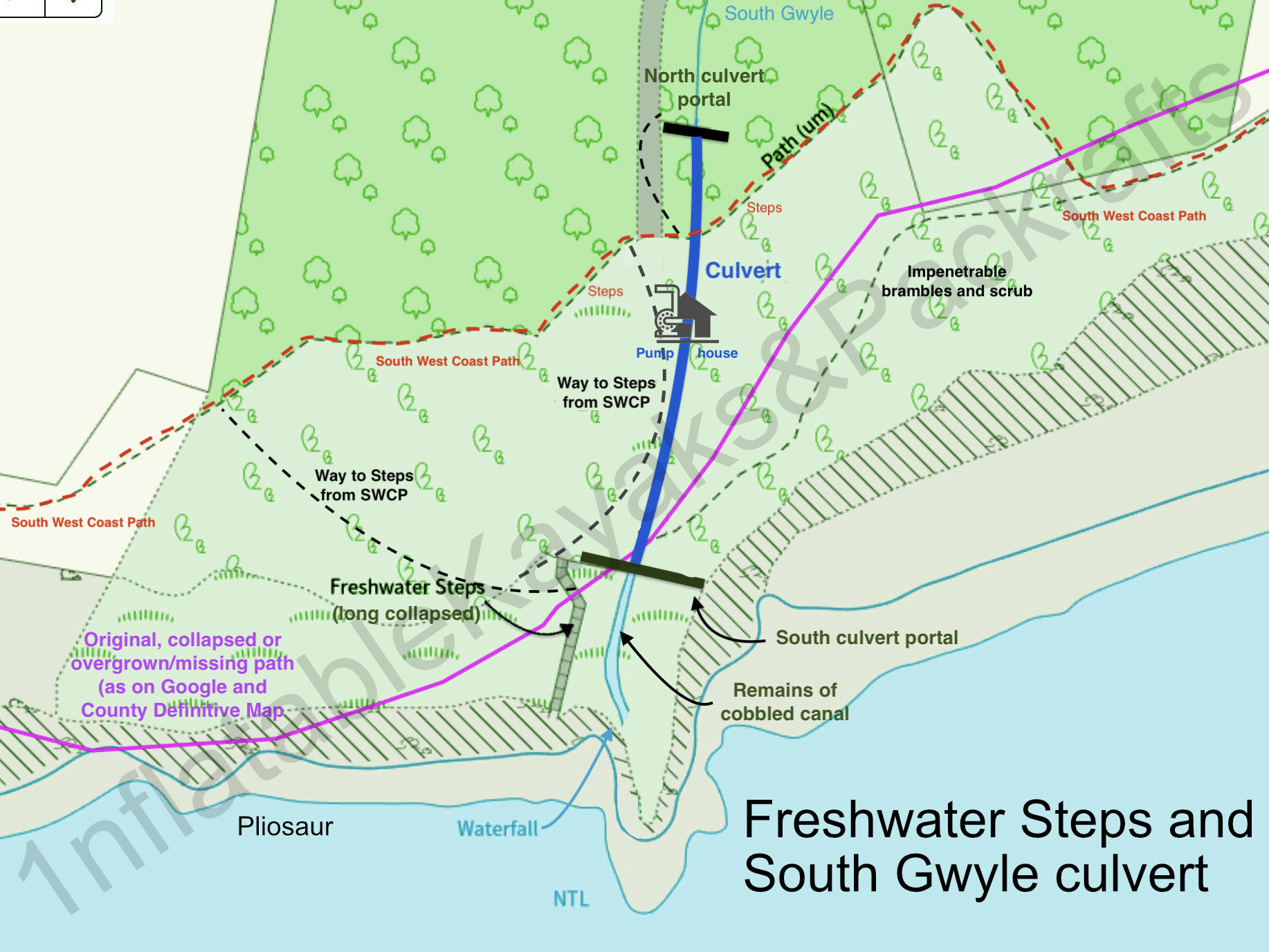
The surviving stone wall is actually the portal of a finely built, 60-metre, stone-lined culvert passing under the South West Coast Path (gallery above). Downstream, a cobbled canal once redirected the stream over the promontory’s tip (another image from 1965), though the 2004 Purbeck Revealed book (see below) seems to explain this as a natural feature, despite the stone-lined canal. Freshwater and sea storms eroded the spur and the stream receded to its current position (left) – the same geological process which, decades later, saw a pliosaur snout drop to the shore with an unheard thud.
200220052014
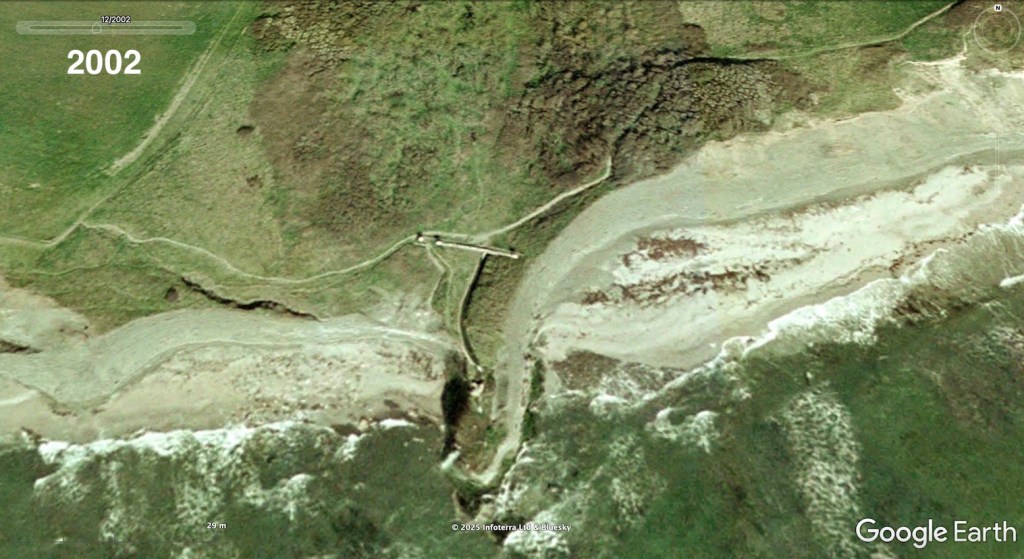
Google Earth historical imagery. In 2002 the coast path still took the old way close to the cliffs and through the scrub (as still shown of Google Maps today), the wall and canal appear intact with a pillar at each end of the wall and another (which has been moved but still survives in the grass) marking a gateway to the Steps whose lower have have collapsed to the beach. At least 2 metres of cliff have also slipped down from the eastern side of the spur. Another, more overgrown image from 2005; the canal wall remains intact and the waterfall tips off towards the end. Note the gully above the as-yet unfound pliosaur, it may have contributed to the erosion which eventually exposed the snout. By 2014 the SWCP had rerouted north, the western canal wall had collapsed, littering the beach below and putting the waterfall in its current position, although the upper Steps are still evident. The wall is collapsing on the east side. Current GE imagery appears to extend the east wall which suggests artificial enhancement, possibly AI?
Mid-19th century ‘carriage roads’
Why all this work diverting the gwyle through a culvert and building the Steps? Perhaps, along with the estate’s fine gardens and numerous carriage roads (one cutting right across long subsided Houns Tout cliff to Chapman’s; left), it was all about impressing visitors with picturesque ‘follies’ along with the supposed health benefits of bathing in sea water (see pump house below) which had helped put nearby Weymouth on the map. Purbeck Revealed (2004) by Ilay Cooper may have another explanation. Born in Swanage during WW2, the author describes larking about on the Encombe estate as a boy. According to his research, the second Lord was responding to water shortages on the estate with bold Victorian engineering, not engaging in late Regency frippery. The gwyle’s catchment was not so broad after all, necessitating the digging of long, stone-lined tunnels and laying pipes into adjacent valleys in search of springs. The Freshwater project may have been little more than a spin off while the builders and masons were in. Certainly Encombe sat right on top of lashing of Purbeck stone from which the house itself was originally built.
The Steps and Falls may have modestly been trying to outdo the 1831 Clavell Tower folly (right), three miles west along the SWCP on the adjacent Smedmore Estate. The Tower survived a little better than the Freshwater infrastructure, but a century on, it was a ruined, burned out shell. By 2007, in poor shape internally and fast becoming the ‘Leaning Tower of Purbeck’, a funding campaign finally succeeded in having it dismantled brick by brick and moved back from the cliff edge.
Note that especially on the east side, the cliff is much more receded than this modified map, based on the Definitive County Map, shows
Near the Steps, this doesn’t look like a ‘hydraulic ram’ as shown on maps.
On another visit here, exploring the area just north of the wall, a friend noticed a rusted iron fence and overgrown steps (left) leading down to a domed chamber. Inside a heavily corroded crank and flywheel (above) looked like the ‘Hydraulic Ram‘ noted on late-1800s maps (below) and listed on Dorset Heritage. But the position doesn’t line up with old maps and I must admit, the device we saw doesn’t resemble any vintage ram pumps found online, each with their distinctive bulbous ‘accumulator’ chamber. With the hand wheel and crank, this looked more like a means to vertically open a sluice valve. Maybe there’s more elsewhere or below the stone floor. At Encombe, old sources say the pump was used secondarily to move sea water up to the house where people could bathe in privacy, not on the beach like the hoi polloi. It may explain the small side shaft I noticed passing through the culvert probably directly under the pump house – an outlet for the sluice or the ram’s ‘waste valve’ perhaps? Assuming sea water bathing didn’t go on round the clock at Encombe, the chamber we found may have been a valve to get the hydraulic ram pumping. The pump house was also alongside a shorter trail to the SWCP, joining it just before the steps climb westwards.
A ‘hydram’ is an ingenious ‘uphill water pump’ invented by one of the Mongolfier brothers in 1796, a decade or more after their famous hot air balloon flight (left) also turned the concept of gravity upside down. The pump uses the free energy of a constant water source and the ‘water hammer’ effect (the bang when you shut off a tap quickly) feeding pipes fitted with a pair of one-way valves. Once balanced, it slowly but surely pumps water way above the inlet source with a little wastage from the first valve – see vid below. Requiring no external power and little maintenance, hydraulic rams and similar devices were common in the pre-electric 19th century, and have been rediscovered today by off-griders and remote villages in the developing world.
There’s a good account extracted from local born Bob Dorey’s (1892-1995) memoir – Odds & Ends from My Century (1992) – on the Kingston history page. Here, the old village pub was renamed the Scott’s Arms after WW2. OS maps also show ‘Eldon’s Seat’ half a mile to the northwest of the Steps, the first Eldon’s private viewpoint.
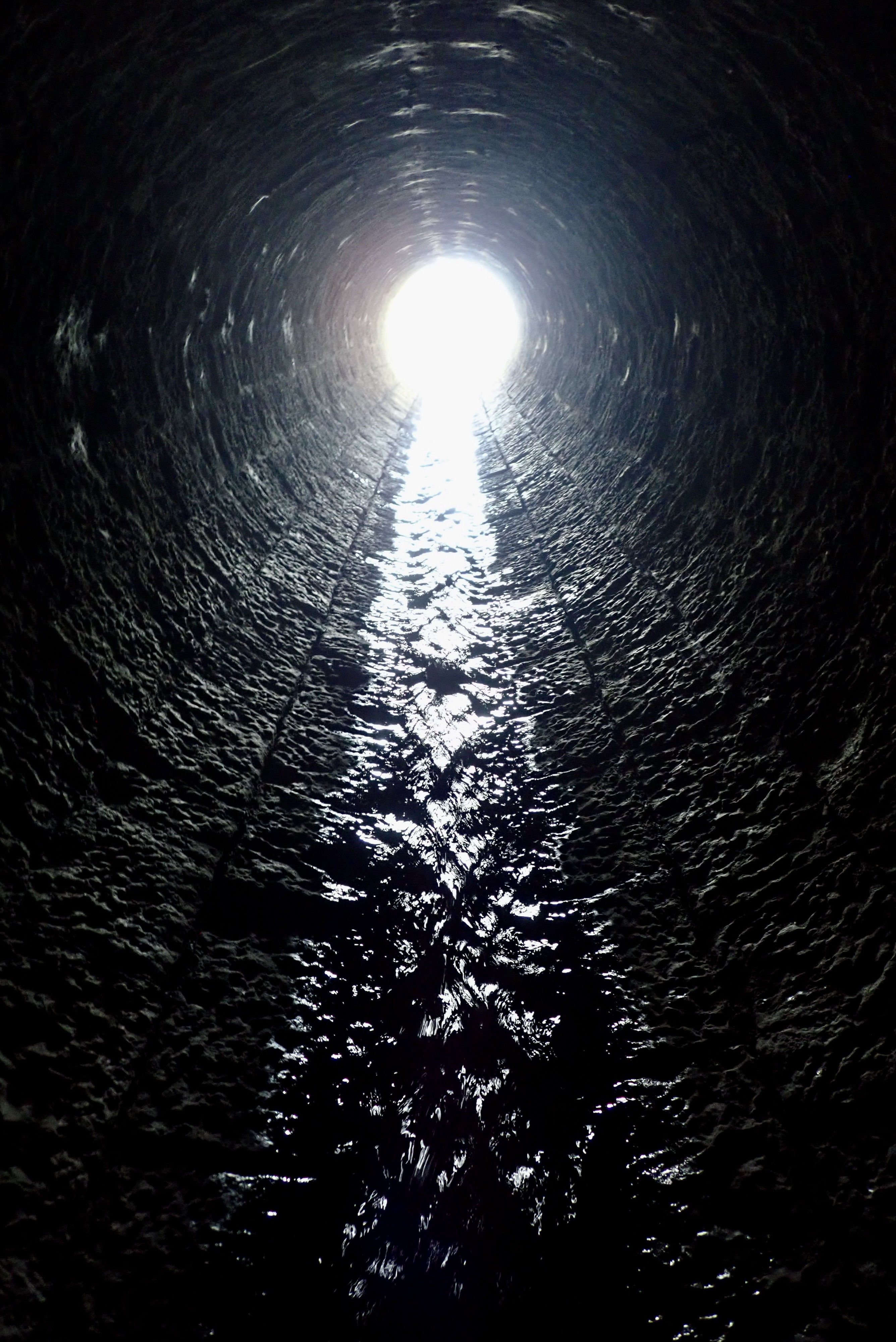
Finely built culvert, nearly 200 years old. Crawling through here was all a bit ‘Famous Five and the Mystery of the Freshwater Steps’. At the end of the tunnel I was expecting to find a lost smugglers’ hoard draped by a couple of skeletons. Maybe I’ve read too many books.
Storms raged and the soft shale crumbled, slowly taking the Steps, and parts of the wall and channel with them. The falls broke through to spill down the mossy cliff some time after 2005, and around 1978 (according to Purbeck Revealed) the Steps, long undercut, collapsed entirely, never to be trod again.
A castaway’s last desperate attempt at rescue.
Deary me, we have drifted a long way from packrafting and adventures in packboats. We set off back to Chapman’s, the TXL riding over bigger waves like a dead pliosaur. The Mrs was not at ease and next day Poole Coastguard reported being swamped with incidents. I was also surprised how sore the shoulders were next day after just 2.5 kms there and back in the wind and waves, compared to Saturday’s calm 6-kilo ride over from Kimmeridge. Seems it was more effort than it felt, like a short but rough MTB ride vs a longer road ride. Repeating that crossing today in a packraft would’ve been utterly exhausting if not an outright Bad Idea. But that’s why we wait and wait for the 10% chance of <10mph tailwinds with favourable tides.
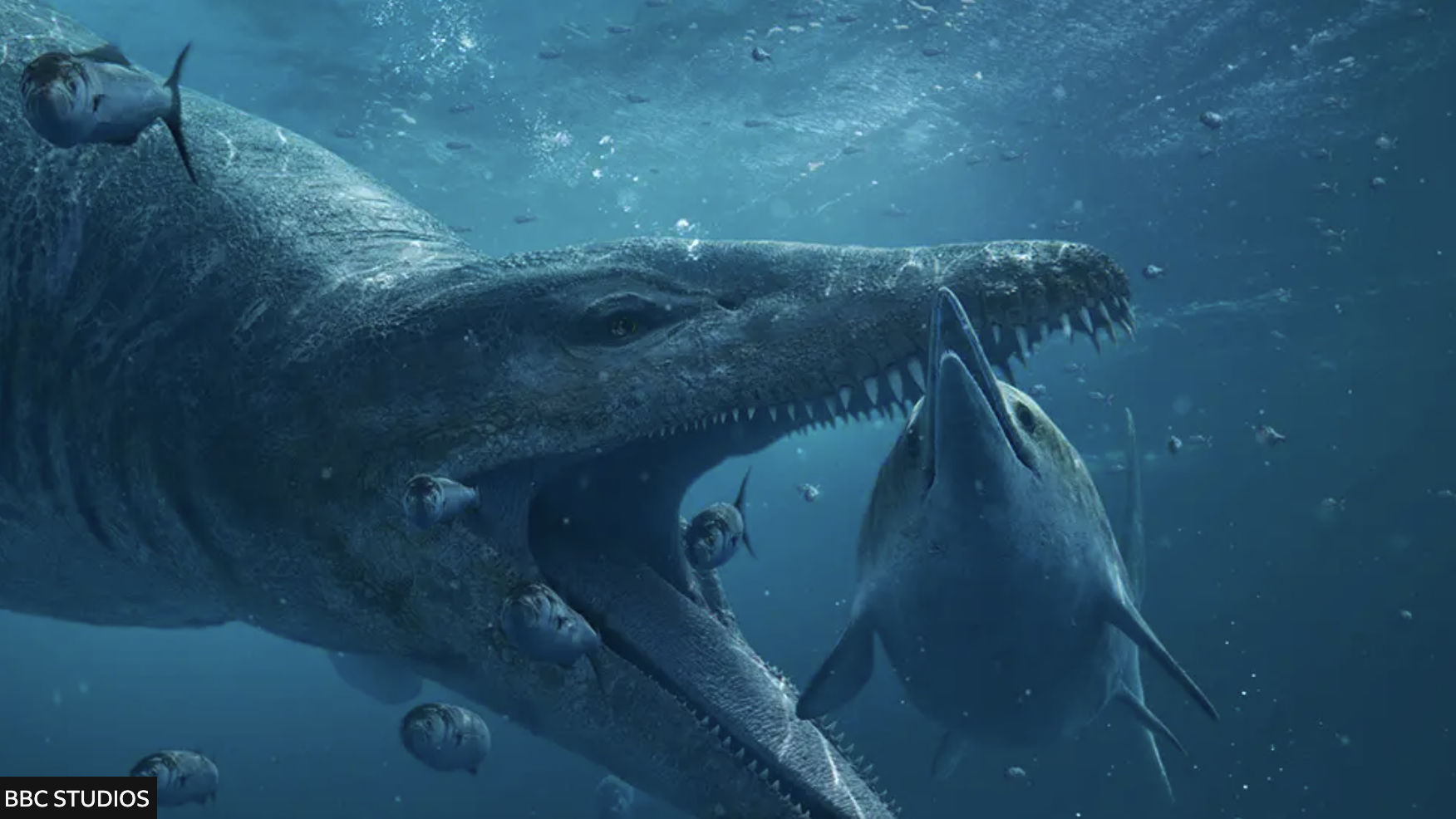
They say everyone remembers where they were when the BBC aired ‘Attenborough and the Giant Sea Monster‘ on New Year’s Day, 2024. ICYMI, it’s still on iPlayer and having watched it, you’ll realise the profile of the famously fossil-rich Kimmeridge cliffs along Dorset’s Jurassic Coast has been raised further. Come high summer it’s impossible to find a park at the local Sainsbury’s.
Attenborough and the Giant Sea Monster – on BBC iPlayer last time I looked
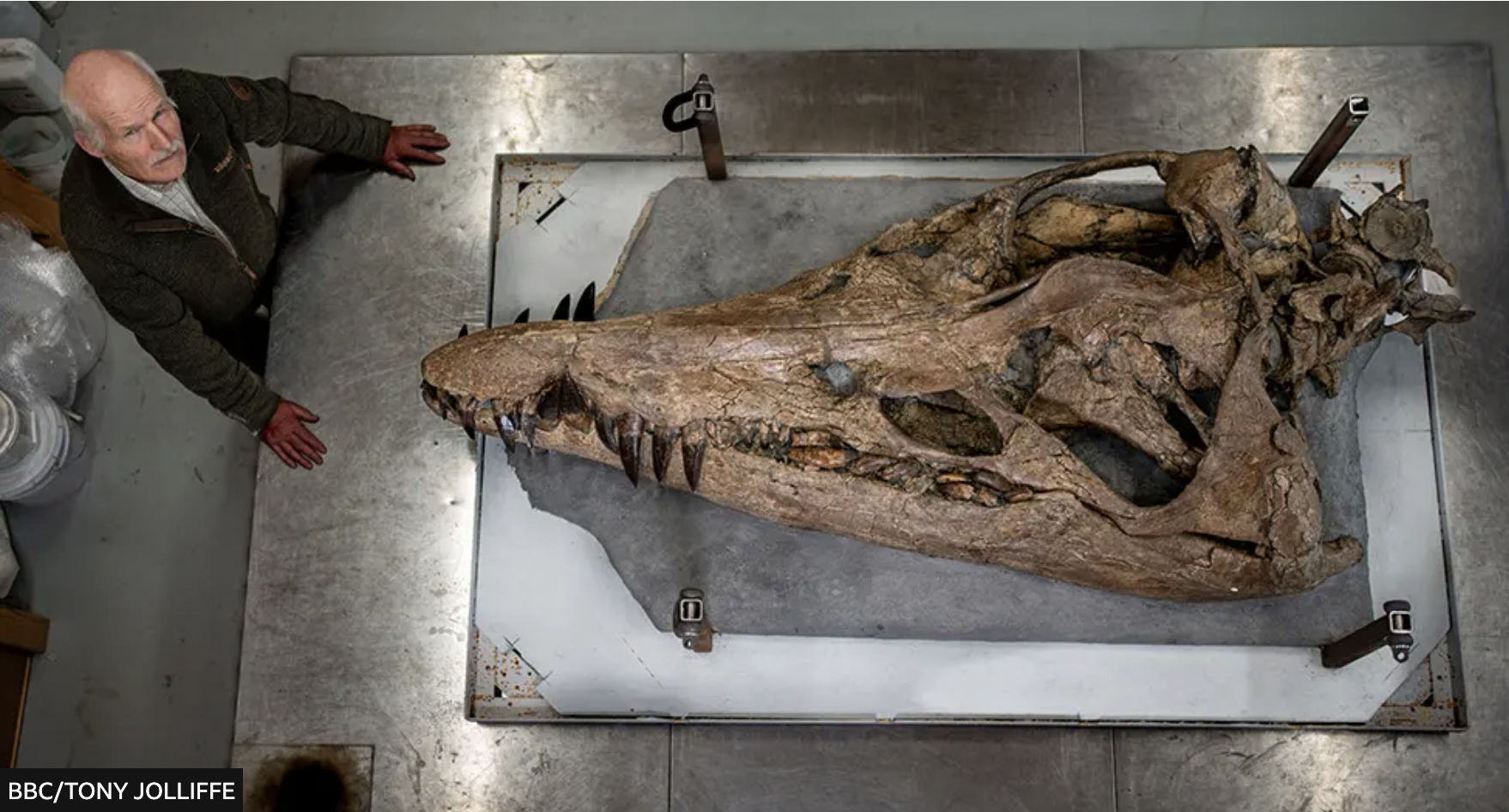
The story goes that in 2022, fossil enthusiast Phil Jacobs was fossicking along a difficult-to-access beach at low tide when he discovered a huge, crocodile-like snout in the shingle (left). He contacted Steve Etches (below) at the nearby Etches Collection fossil museum in Kimmeridge and, long story short, a two-metre pliosaurskull was laboriously excavated from the friable cliff-face from which the snout had dropped. The BBC and Attenborough recorded it all as over months, the skull was painstaking restored and primed to go on display at the Collection the day after the documentary aired. Good article.
Steve Etches dwarfed by the massive pliosaur skull
I’d visited the usually deserted museum over Christmas a week earlier, finding another similarly huge pliosaur jaw and many other amazing marine fossils on display. Returning on a stormy January 2nd after the broadcast, the place was packed with curious visitors blithely ignoring the ‘No Photos’ edicts right under Steve Etches’ nose. Since then the Pliosaur has been rebranded as the ‘Sea Rex‘.
Smedmore Estate signs at Kimmeridge Bay (left) warn against doing many things, including fossil hunting, and yet the museum has a video on how to do this safely. So I wondered how permission worked in the technically ‘neutral’ or Crown-owned intertidal zone (ITZ) where the fossil-rich Kimmeridge Ledges lie, and further east where the snout was found. A member of staff explained that protected SSSI status (see map or below) extended into the ITZ (as it might do for coral reefs) and Etches, a local man with decades of fossil collecting behind him, is the only person with permission from the Smedmore Estate (who help fund his museum) to excavate fossils, presumably in the cliffs fringing their land above the ITZ.
Kimmeridge SSSI includes ITZ
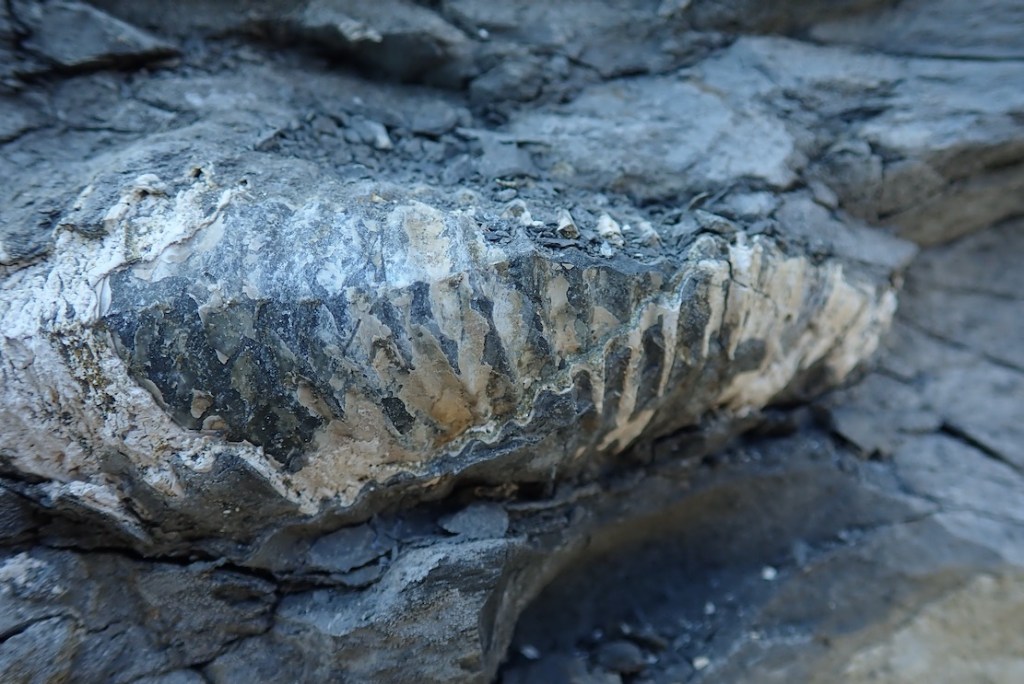
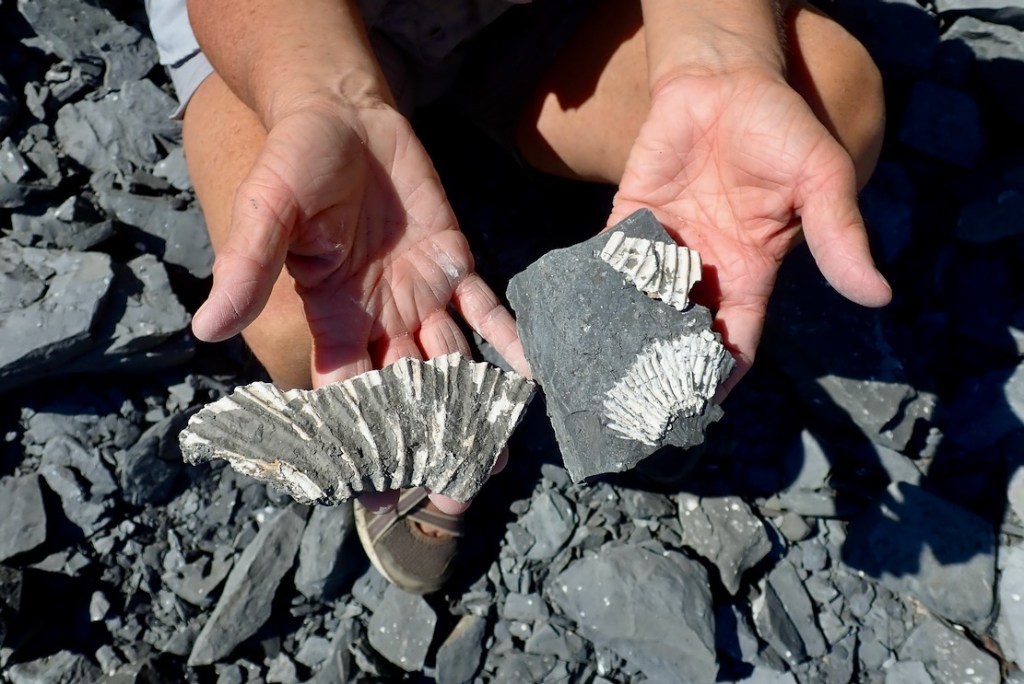
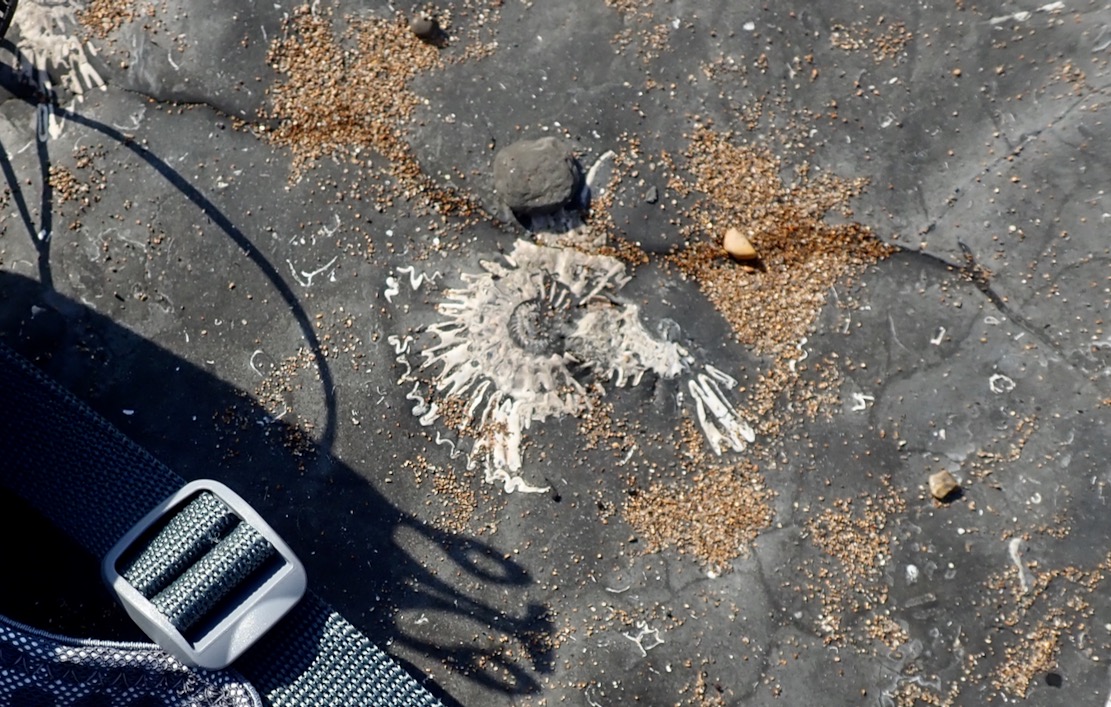
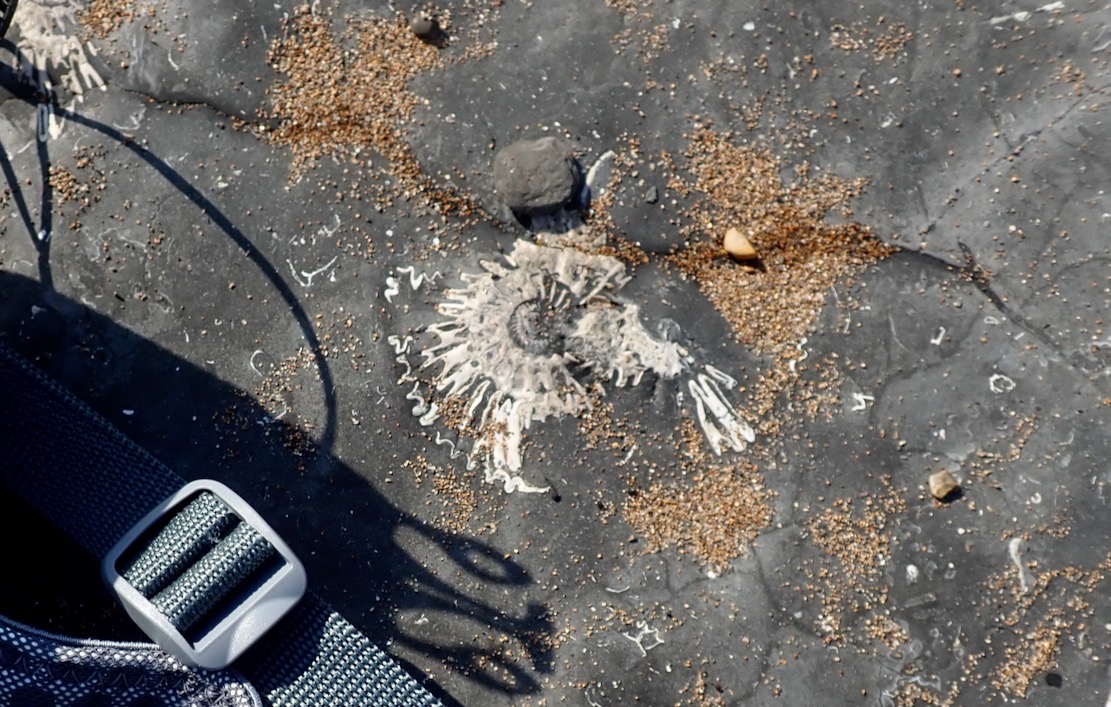
Perhaps finding tiny, loose fossils while beach combing is tolerated. When I was packing up my packraft the other day at Chapman’s Pool, I flicked off a wet flake stuck to the boat and could swear it was a thumbnail-sized ammonite fossil, DoB: 150,000,000 BC. I tried to find it among the shingle, but the fast-rising tide was lapping at my feet, so it got away. Another time down at Chapman’s (below left), the geef easily found a curl of ammonite shell the size of a thumb. Ammonites embedded in the exposed grey bedrock are everywhere (above left).
Chapman’sPart excavated Dogosaurus
Like many who know the area, I was curious to know exactly where the fossil was found – or more accurately, solving the geo-locating challenge was a bit of ‘Wherewozit’ fun. Not surprisingly, the location was conspicuously absent from mainstream reports, but within the first minute of the BBC doc the excavation site is shown, and a couple of minutes later, snout finder Phil Jacobs’ shaky phone video pans past a waterfall in the background with a limestone wall bridging it (more below), and a mention of ‘east of Kimmeridge’. Ah Ha! The waterfall appears again in the BBC doc, so all in all you don’t have to work for GCHQ to pin down a possible location.
Fast forward a year and I finally got to paddle past what looked like Punta Pliosaurus on my way to Chapman’s from Kimmeridge. Beforehand, I’d wondered what would be there: disingenuous ‘Danger, Keep Away, Loose Cliff’ signs, evidence of excavation to retrieve the rest of the megafish’s body, or a huddle of day tourists from Swanage?
BBCPunta Pliosaurus?
Although a late-afternoon sun was casting a shadow across the cliff (above right), all I can say is, assuming I’d got the right place, they’ve done an superb job of disguising the excavation of the pliosaur skull and restoring the cliff’s natural appearance until they get a chance to come back and finish the job. That said, a couple of weeks later a regular walker who knew the story here thought natural processes had quickly obliterated the excavation but either way, once done, they’re gonna need a bigger display case. Meanwhile, something else above the beach had caught my eye. More about that here.
Action Stations and man the pumps. Conditions are finally benign for a paddle from Kimmeridge Bay to Chapman’s Pool – a distance of over three point six miles. It’s not exactly rowing the Pacific, but in a dumpy packraft you need to pick your moments when there are no take-outs from one end to the other, followed it’s a stiff, four-mile walk back. A big spring tide was inbound for HW about 8pm and the wind was forecast at just 8mph SSW (onshore) and dropping by late afternoon. Plus it was sunny, too. Which was nice.
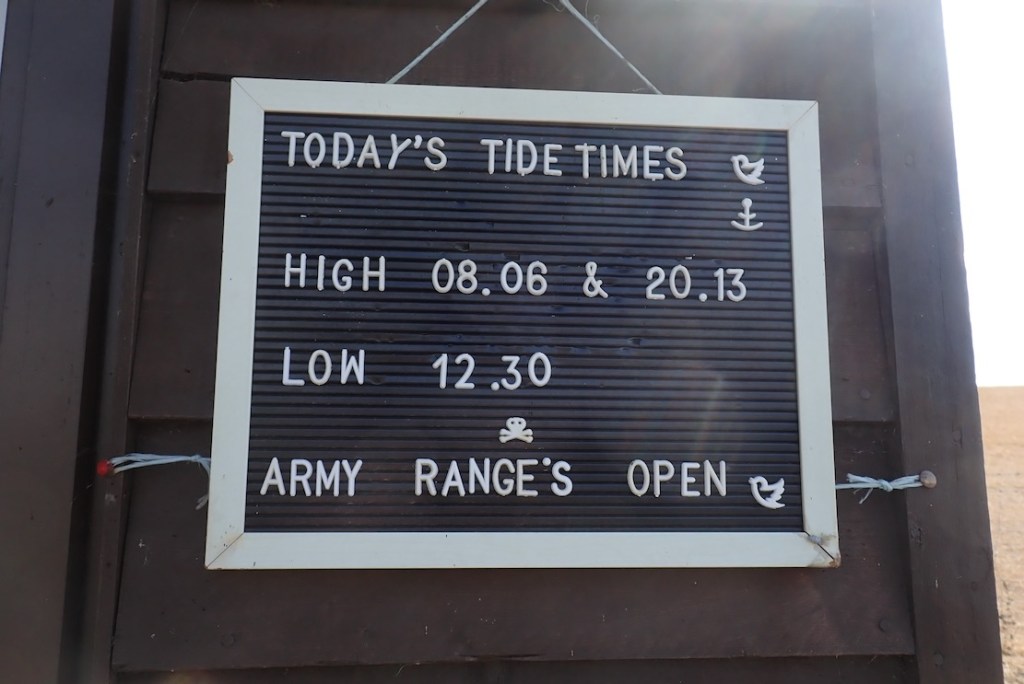
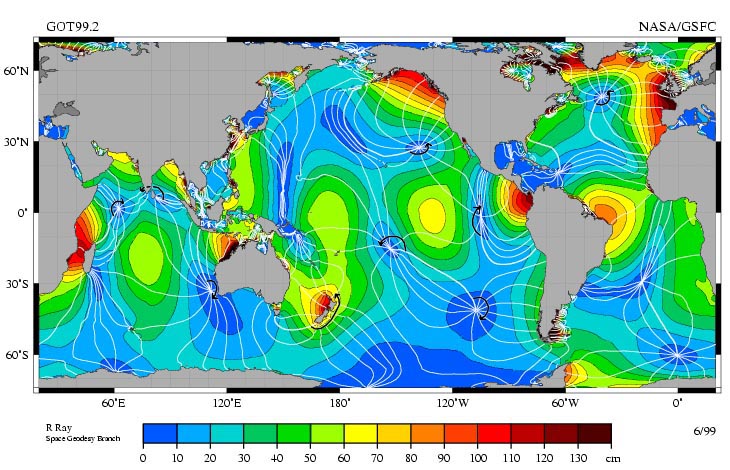
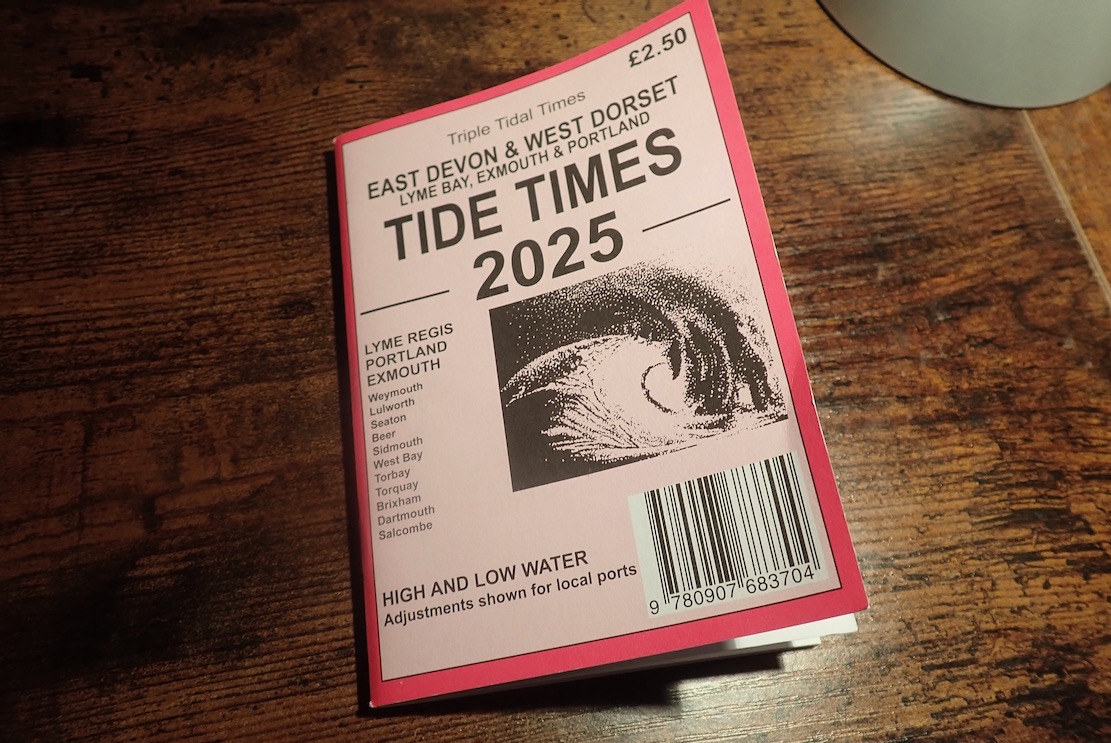
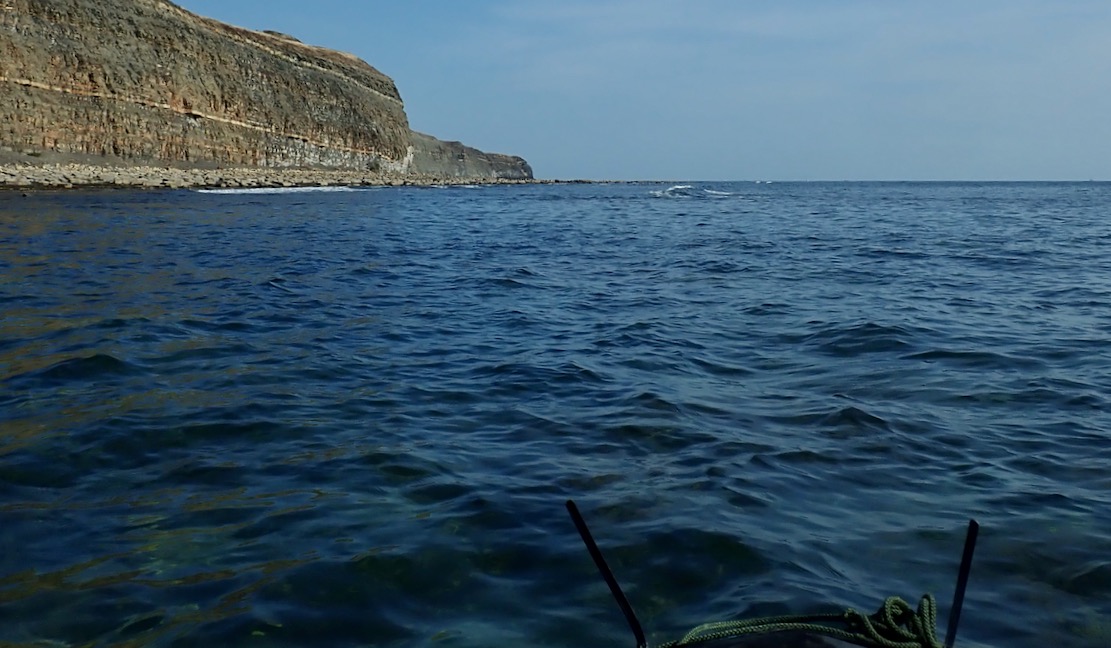
I packed a paddle in my pack and rode down to Kimmeridge Bay.At Kimmeridge Bay’s massive car park field, bikes are only £1.20, but it’s a choka bank holiday weekend so I hope the lad at the pay shed was on a percentage today. I asked him about tides which have been doing my under-stimulated brain in. ‘Err, there’s a board over there’ said laddy. At last, the Kimmeridge Question was solved, I thought, admiring the first apostrophe, but sighing at the second. It turned out the board lazily repeated UKHO Mupe Bay/Lulworth Cove timings, about 5 miles west. You’d think that would be adequate for an estimate, but not necessarily.I’m still baffled by the tides on Purbeck’s eastern Jurassic Coast. The problem is getting reliable times for Kimmeridge Bay or Chapman’s Pool, the most useful put-ins hereabouts, and timings matter the longer you’re on the water. The UKHO posts times for Mupe Bay and also Lulworth Cove which is less than a mile away. The times are identical. And then there’s nothing until Swanage, about 12 miles to the east as the black-tipped tern flies and a doable day’s paddle in a long boat. Such gaps in UKHO stations are fairly normal along the UK coast, and you’d think just estimating Mupe Bay ± ~30 mins will give a time for Kimmeridge. But around here the tidosphere is all warped. Above, a few days before neap tide, it looks like Swanage rises in synch with Mupe and then ‘holds on’ to HW for hours, before dumping five hours ‘late’.And then I found this Insta post (above) from Sharon Lee in Brighton who makes tide times posters. But not for Kimmeridge because, as she observes: ‘Notice an arc of weirdness around Dorset? That’s an amphidromic point. Which basically means the tides around Dorset (particularly the Isles of Purbeck and Portland) are utterly mad.’ Amphidromic (or a tidal node) was a new one on me, but may explain the Mupe-Swanage Incongruity (MSI), as tidal philosophers have called it since Pytheas skimmed pebbles with Posidonius. You’ll find many tide times websites supposedly offering times for non-UKHO locations, but many just list the nearest UKHO location with no real-world adjustment. As unless I am over-thinking it, Mupe Bay to Swanage needs quite a bit of Amphidromic adjustment. And while I have your attention, what is the point of UKHO listing identical times for Lulworth Cove and Mupe Bay, just a mile apart? Is it because one is civilian-touristy and the other military most days of the year? So what? Yes, there are no less than four UKHO tidal locations in western Poole Harbour (+ Wareham) as closely bunched, but it’s a busy area that drains out to mud flats at low water and the timings are all different.Mysterious tidal nodes appear all over the world. They are the Black Holes of the Oceans; go there and nothing happens. Spooky. Source Then I saw in Kimmeridge’s Etches Fossil Museum shop a locally published tide tables booklet. ‘… West Dorset’ said the cover, but ‘Covers the coast from Swanage, Dorset through to Salcombe, East Devon‘ claimed the shop’s online blurb. The publisher’s website said as much (… the whole of the Dorset and South Devon coast…). Not in the copy I bought. The tables give every day of the published year, but only for Exmouth, Lyme and Portland. There’s nothing east of Portland in the booklet, unless you include a spot check on Portsmouth or Dover. No mention of Swanage, Lulworth or other local adjustments for Purbeck. You’d think I’d not be the first to notice this, I’d have saved my money for two more moto parkings were it not for chappy behind the shop counter advising: add an hour to Portland for BST, then 15-25 minutesfor Kimmeridge. It’s Portland’s sticky out Bill that puts a spanner in Purbeck’s tidal flow, he explained. The formula was not Mupe Bay ± 30 minutes, as I’d guesstimated, but Portland + 15-25. I coughed up my £2.50 as an offering for this handy tip – I’ll appreciate it and the booklet when AI implodes the internet. But hold your paddles, there’s more! Also on the Etches website I found a link to Willy Weather with a page for Kimmeridge Bay that wasn’t just a paste from Mupe Bay, but believably adjusted times. I compared KB times many months in the future using the Portland booklet formula and Willy, and found them to be within 3-13 minutes of each other. Assuming both are broadly correct, that will do me. Willy don’t list Chapman’s Pool but do have adjacent Egmont Point which seems to be KB + 2 minutes. I’d heard of Willy Weather, but it wasn’t in my tidal bookmarks. It is now.Still reading? At the jetty by the Wild Seas Centre a pair of well prepared sea anglers were setting out in their double outrigger SoTs. Talking of gear, this is a proper sea paddle so I’m in my proper Kokatat Leviathan pfd, but it feels like wearing a folded tractor inner tube full of ice cream. Leviathan – it’s in the name. At least I won’t be too gear-shamed when the RNLI fish me out by my ear and shake me dry.I head out of the Bay and turn east. Oh MG, breaking offshore waves already! But I needn’t have worried today. There were a few more later on, but nothing the TXL+ couldn’t ride out. I actually think tackling this stage with a rising tide flooding the Ledges is the way to do it (in either direction), as any waves will diminish as the ledges submerge – won’t they? It’s more down to the wind of which there was little today, but as you paddle along you still want to glance offshore once in a while in case you’ve gotten on the inside of a building wave which can pop up out anytime, any place, any where. This is why I stayed quite far out. Not normally what I like to do alone in a packraft.
The Ledges from above.
And on a windy day west of Kimmeridge. Frothier than a Costa cappuccino with sprinkle.
The waters are clear and green. At many points I could have hopped out and waded along.
In fact, I did for a bit.
It took me back to Shark Bay, 2011. Jeff and Sharon and me in my Gumotex Sunny wading north to a unearth a cache near Peron Point after battling a stiff headwind all morning. What a great paddle adventure that was. Easily doable in a packraft too, with added dolphins, dugongs, rays and yes, sharks.
I’m on the look out for ‘Iron Skeg Beach’ I found with the Igla IK a couple of years back. Above looks similar but is not it. In the Igla I turned back at ISB to Kimmeridge as paddling on to Chapman’s would’ve meant paddling back. First time out here and with a head full of Ledge Lore, I didn’t want to get caught out as tides and winds turned, and hauling the 17-kilo boat back along the coast path would have been too much. As I was about to find out.
There is the rusty triangular ‘skeg’ (also below) sticking up. This is actually called Clavell’s Hard and studying Ian West’s page for this area, I think the object (below) may have been something to do with oil shale mining right here in the 1890. There’s a semi-naked castaway looking for treasure. I hope he knows how to get back.
The strange cast iron object that looked like a ship’s skeg – from the SS Treveal, wrecked at nearby Egmont Point in 1920? It’s more likely a piece mining gear, a winch stand perhaps.
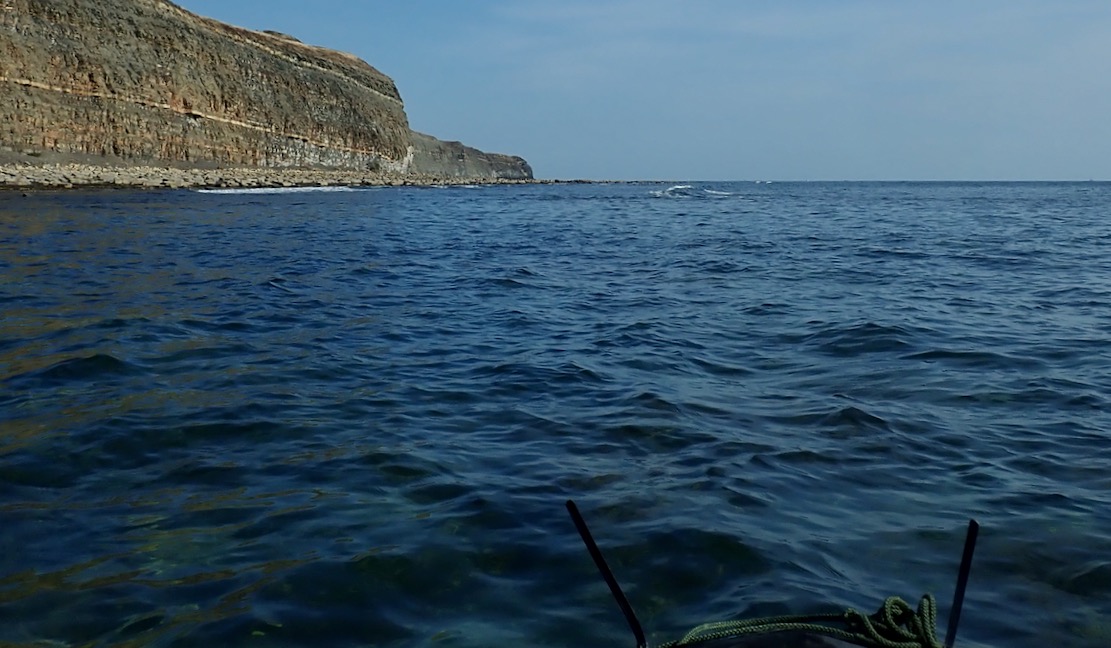
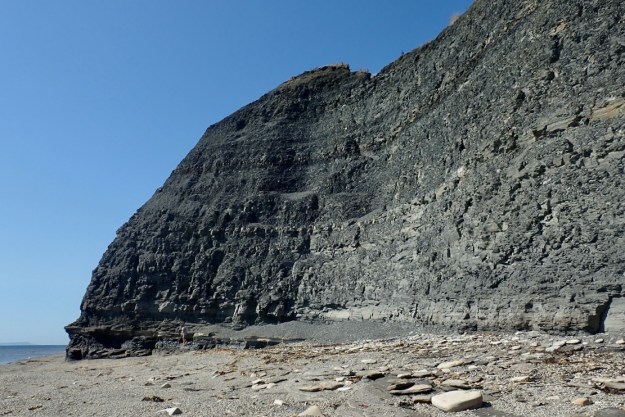
The soft, shaly grey cliffs, rich with ancient marine remnants.Four colourful kayakers close to shore, like I should be. There’s more to see there.I pass what could be Punta Pliosaurus.
I see sailboat masts ahead behind big rocks and am a bit disorientated. Chapman’s is tucked in on the left somewhere? I check the GPS and am nearly there, getting ashore 80 minutes out of KB or 4.5kph average with a bit of dawdling, and quite a lot at 6kph, according to the Garmin. People want to know this stuff!.
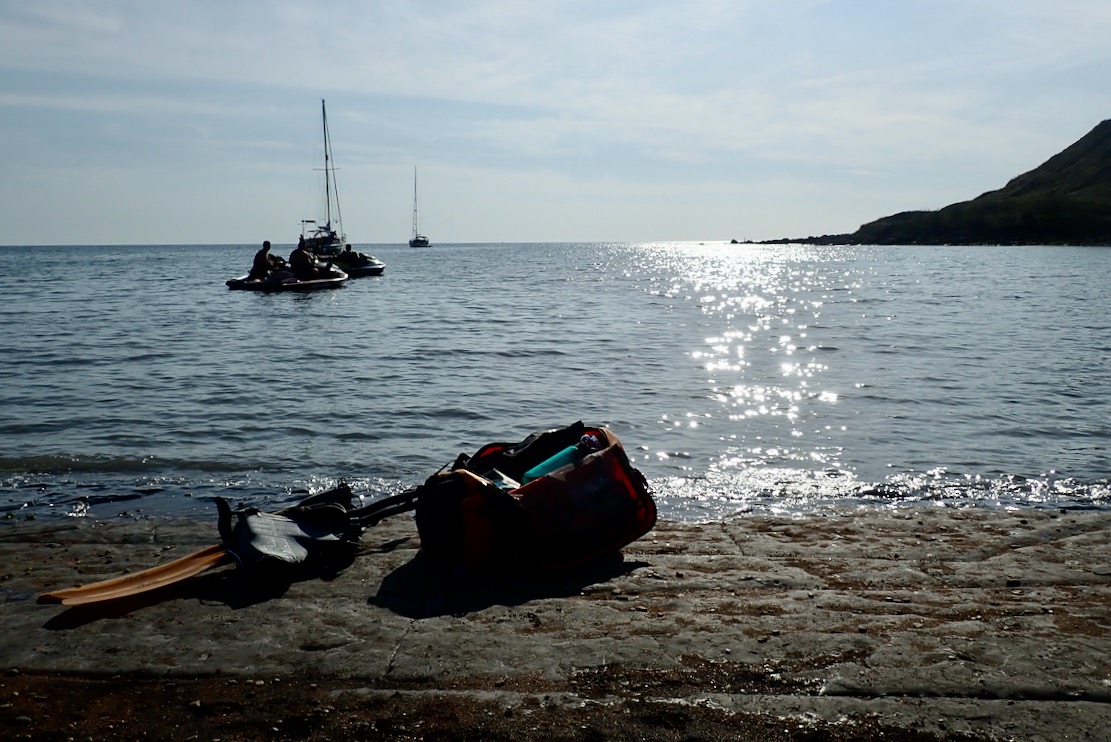
Along with some moored yachts and beach bathers is a trio of menacing jetskiers playing their satanic music. But this is Purbeck so it’s not blaring, and at least they weren’t tearing up the Pool like houns en tout.At Chapman’s there are ammonite fossils everywhere you step.Even getting off the beach by the waterfall is a loose scramble, especially backpacking a holdall. As I leave, I hear the jets gun off to Kimmeridge or Swanage. I presume that’s what they did as you can’t get a trailer down here. With a packraft you can go anywhere you can walk.Up the steep, overgrown gully and across the parched field for the 500-foot climb up to Houns-tout hill – all in less than a mile from the shore. My pulse hits the rev limiter. What does Houns-tout even mean?Kimmeridge 3 miles. In these shoes? No way, Jose.
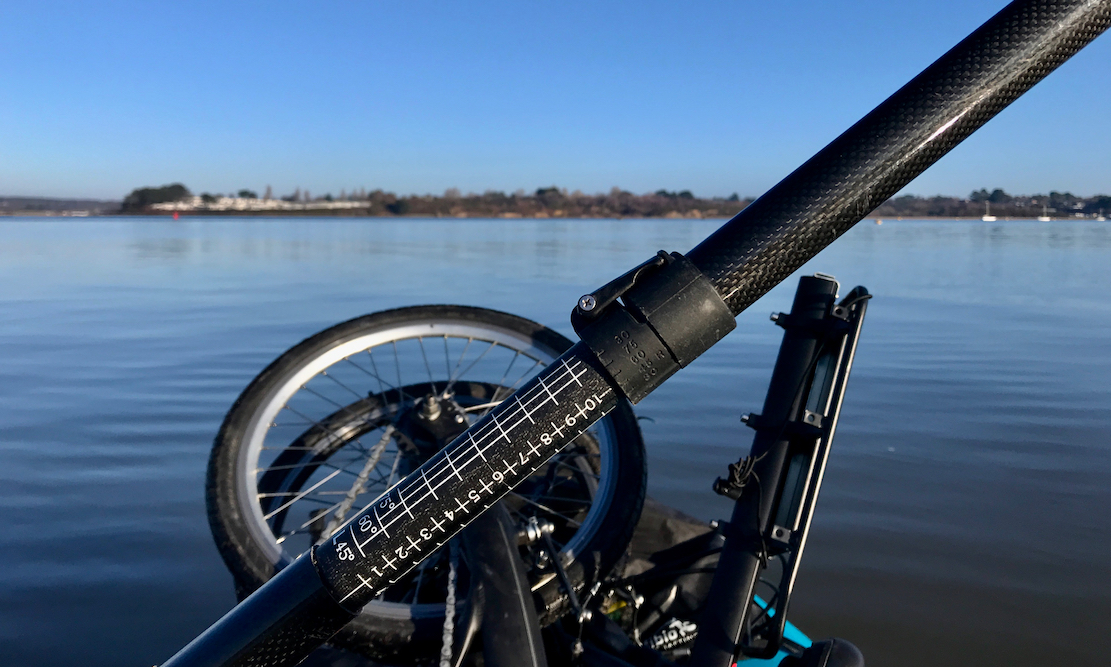
Tranquil Chapman’s and St Alban’s Head from Houns-tout summit. And actually my Teva Omniums are not the problem; it’s the wobbly, 8-kilo holdall hanging from my shoulders. But on the way back I have a brilliant idea. More here.The steep decent from Le Tout gave the underworked knees what for. I could do with my packstaff. I sold the 4-part Vertex paddle which it fitted. I need to convert my Anfibio Wave 4P but it’ll require some whittling.
Then back home I dug out an old, 55/170cm telescopic monopod (£18 on amazon Basics). It’s more gear (370g) and may slip under pressure, but zero bodging required and will work for long-arm selfies.
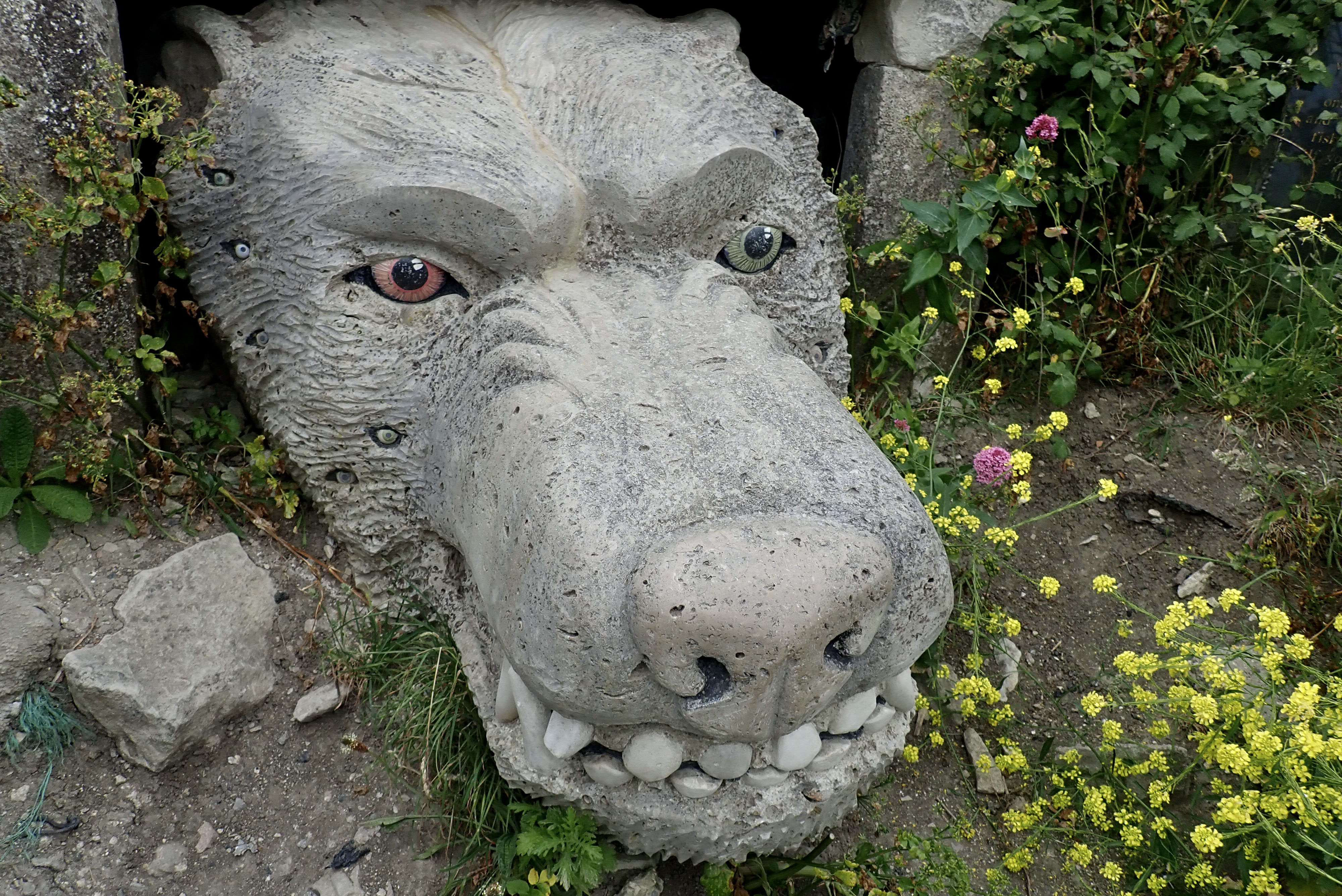
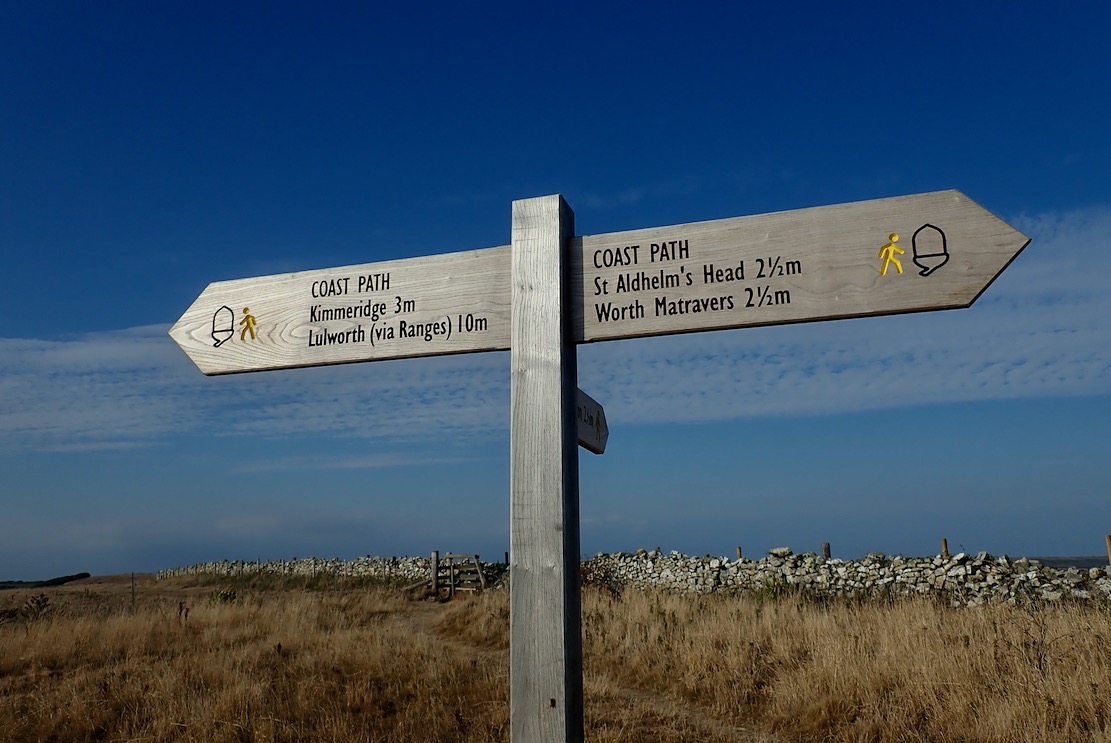
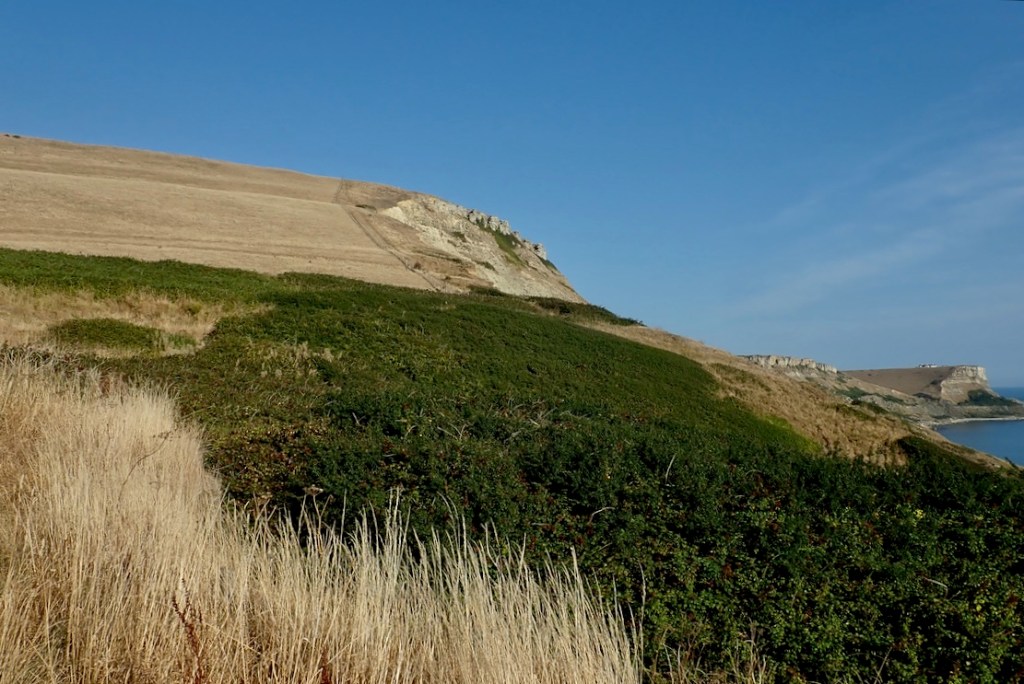
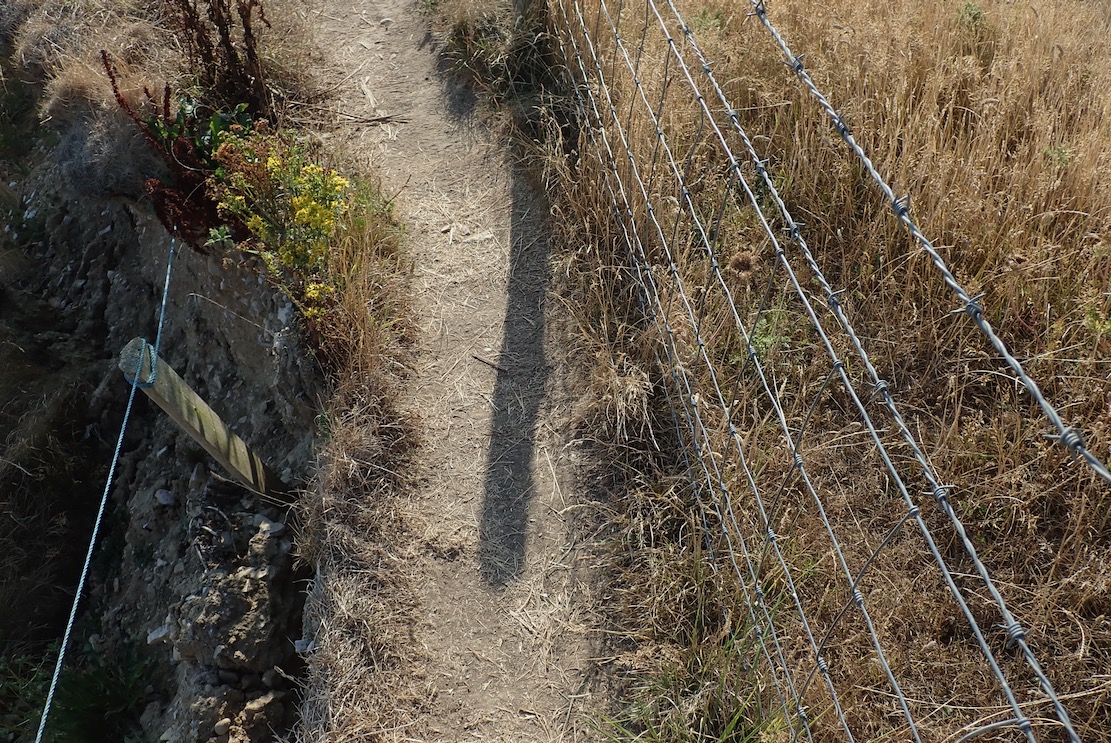
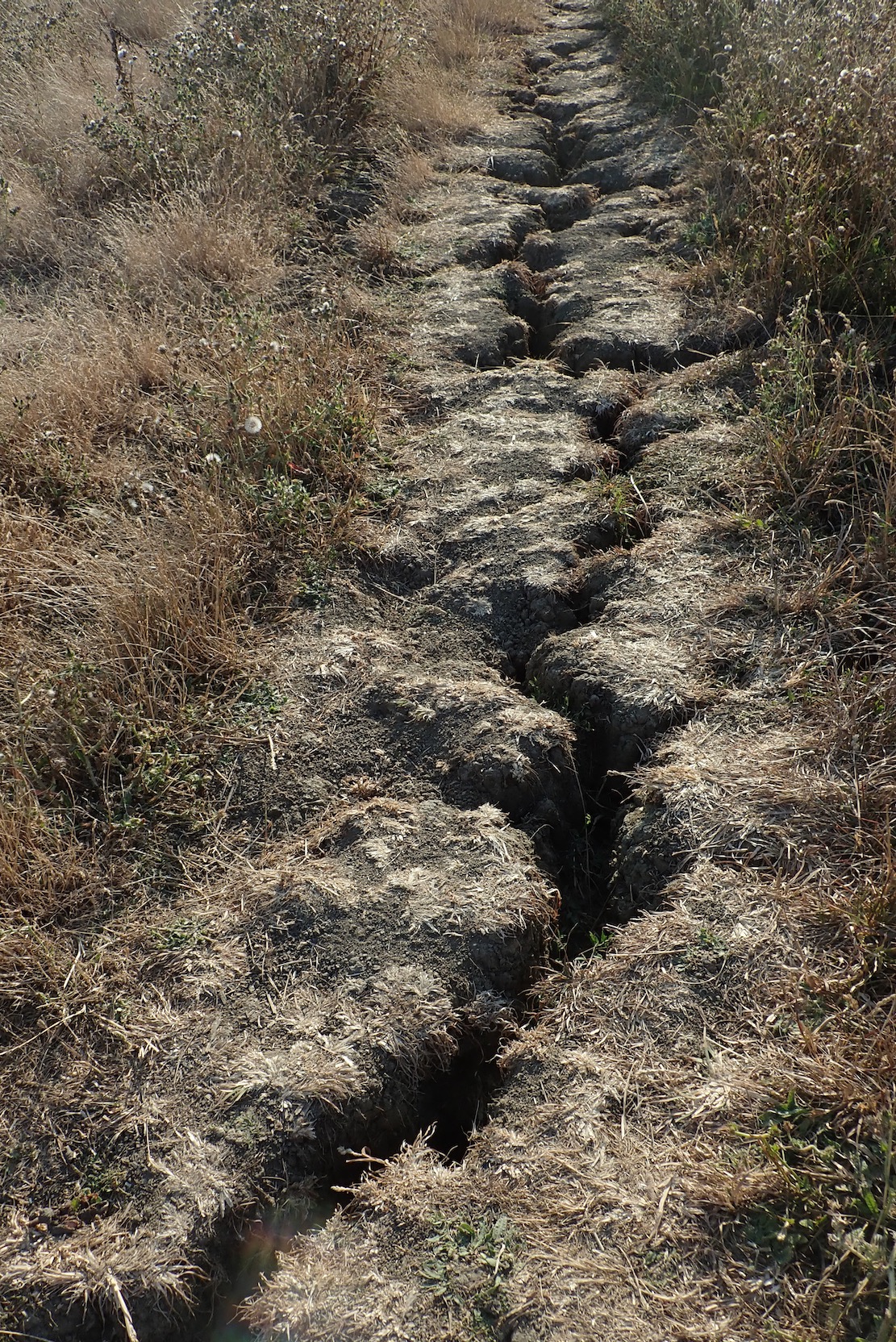
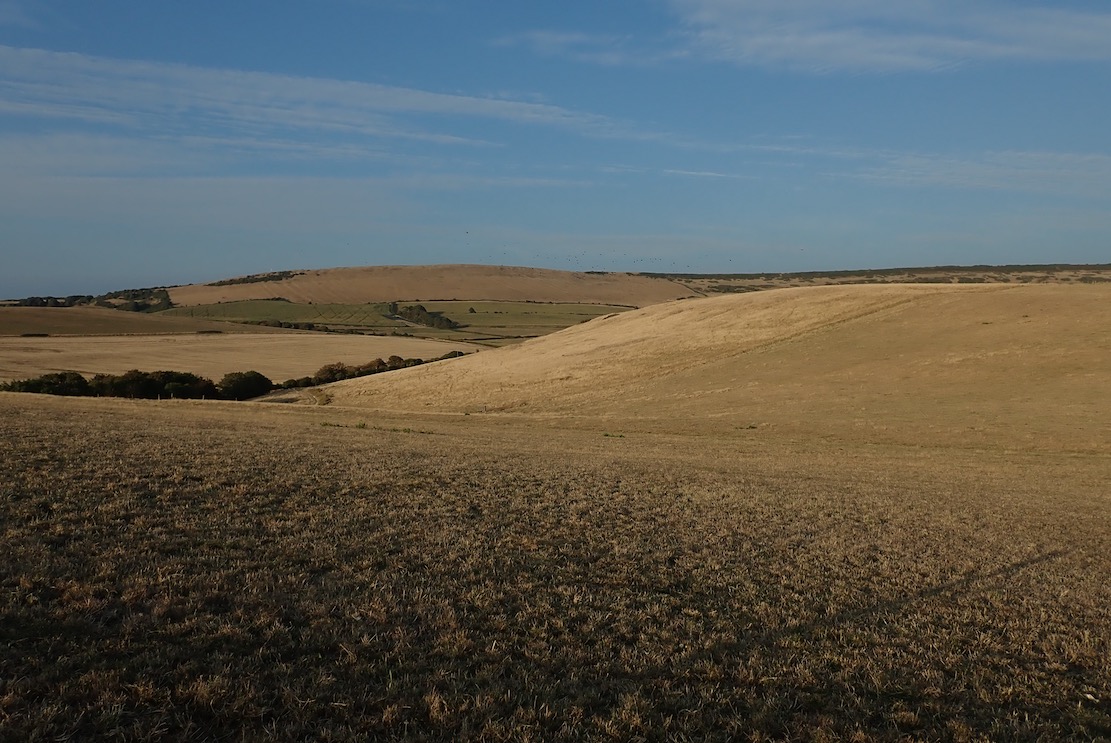
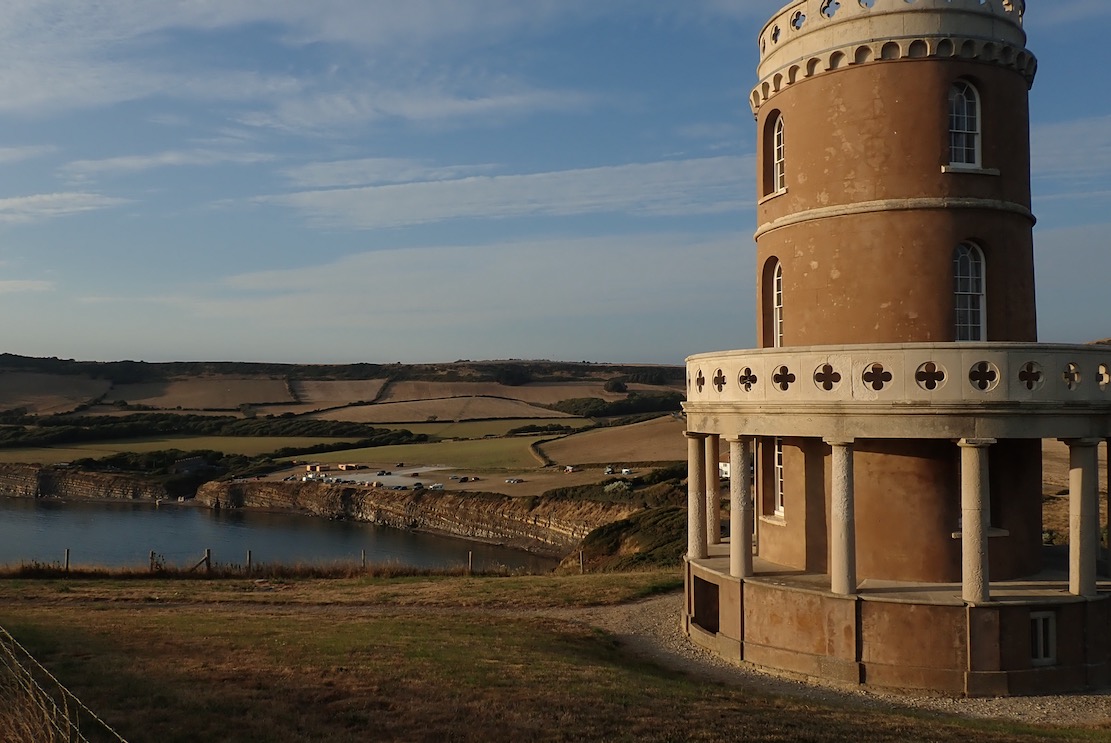
I witness a landslide near Punta Plio. This country is falling apart! I should get down there houns tout suite and see what fossil treasures came down with the rubble. ‘Get me Professor Etches, I found the tail. That pliosaur is longer than you think!’In places the path is very narrow: barbed wire right to spike my raft, big drop left to spike everything else. The first half from Chapmans is tricky in places. Don’t be part of the next landslide.The SW Coast Path is cracking up. Must be the drought. Come the next deluge it could all come apart and slide into the sea, a few feet to the left.All around as parched as southern Spain. At one point a cheerful passing walker observes ‘Ooh, paddles. What’s in the bag?’ ‘A boat‘, I reply. ‘Oooh, luvlay juvlay!’ she saysAt last, the rotund edifice of Clavell Tower just as the battery warning light starts flashing and the legs wobble. I hobble down the steps like Steptoe with a hangover, passing pouting Instagramers capitalising on the golden hour.I’m a sweaty, achey mess but it’s been a lovely summer evening’s walk up and down 340 metres along a tiny part of the South West Coast Path. They say the total elevation gain on the entire 630-mile trail from Minehead to Poole is a staggering 115,000 feet (over 35,000 meters). That’s like climbing Everest from sea level four times. And yet hundreds manage it every year, signing off with thighs like telegraph poles. They’ll see many amazing things, like Kimmeridge Bay an hour before spring HW: not a foot of a beach to spare.The ride home via a refreshing ford cools me off.There you have it: KB to Chapman’s. A lot easier to paddle than to walk. That’s another stage of Weymouth to Poole ticked off, leaving the trickiest 8 miles for last. First, Chapman’s east around St Alban’s Head 4 miles to Dancing Ledge. Then about the same distance from there to Swanage, around Durlston Head, another tidal pinch point and with no take-outs. In a sea kayak you’d swan through in one go, slicing through whatever the tides bring. But you can’t pop it in your pack and bus home. Alone in the TXL I’d pick the neapest of neaps and lightest of winds – and still break it into two manageable stages. Summer is coming to and end. Maybe soon or maybe next year.
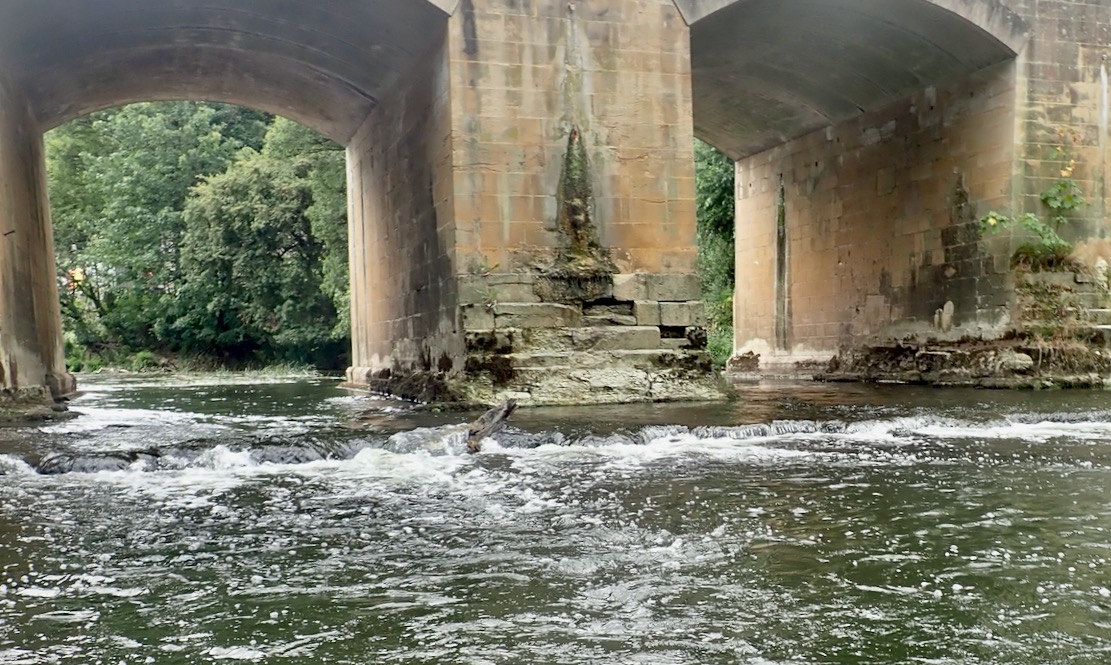
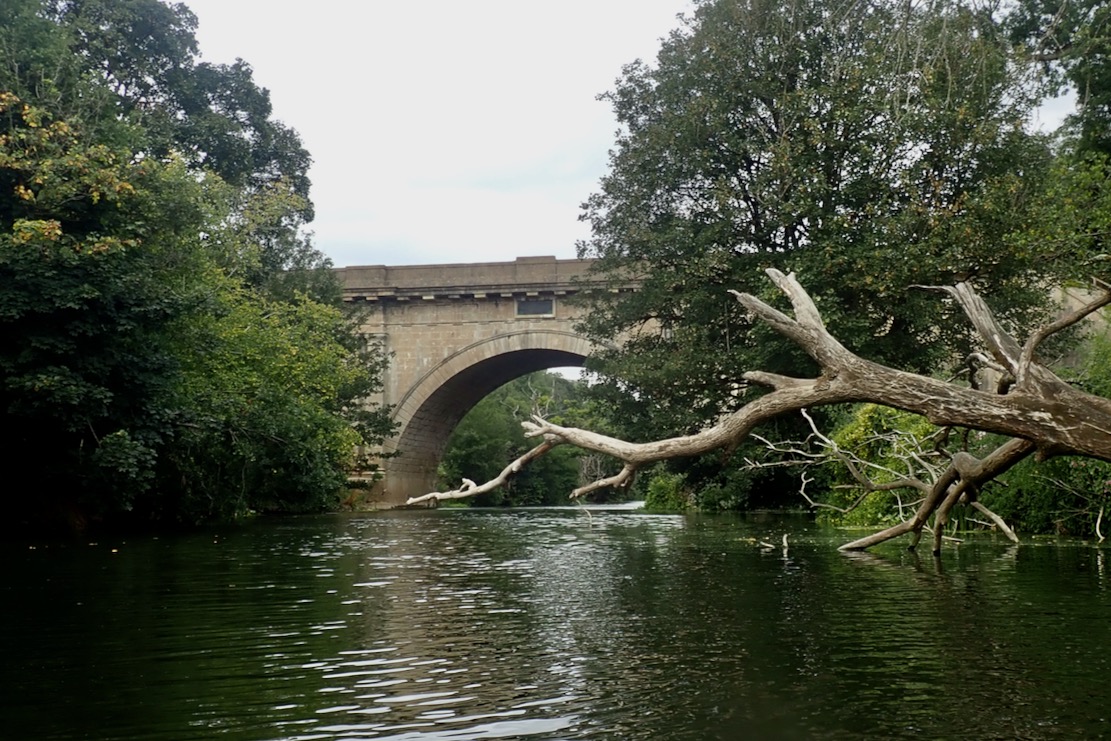
They say Bradford-on-Avon near Bath is one of England’s prettiest historical towns. I blundered through the other evening trying to outwit the satnav, and it didn’t look too shabby. With something to pick up near town, I wondered if the Avon river was paddleable, and found Andy Ballard’s nice canoeing vid above. He describes an 8-mile-loop which follows thne river towards Bath, before hopping up onto the parallel and lock-free Avon & Kennet canal at the Dundas viaduct to return to BoA. That will do nicely.
Avon 8 mile loop
‘Pay attention at the back!’ Completed around 1810 towards the end of the ‘Canal Mania’, the Kennet & Avon Canal essentially crossed southern England’s watershed to link the then key port of Bristol at the mouth of the Avon with London on the Thames. At Paddington in London, the Grand Union was completed around the same time, and led up to the north’s mines, foundries and mills, and where the network of canals became much denser (below right).
SourceSource
The Thames and Avon rivers were long navigable inland as far as Bath and Reading and the K&A linked those two towns over 87 miles. Kayaking the Wey Navigation and packrafting London’s Regents Canal taught me that Britain’s canals helped kick off the world’s first industrial revolution. They linked or added to long-established river navigations to extend inexpensive and reliable cross-country transportation of heavy, bulky or fragile commodities. At this time the decrepit road network along ther Bath Road (A4) was still suffering from 1500-years of neglect following the Roman era. Coaches carried passengers and packhorse trains were superior to wheeled carts, but turnpike fees (tolls to help pay for road upkeep) made them costly. Hostilities with France included attacks on coastal shipping in the English Channel, necessitating secure inland transportation to help provision the war effort. The former Wey-Arun Navigation linking London and Surrey’s gunpowder mills with the navy fleet at Portsmouth was another example.
Once 18th-century nimbyism had been overcome, canals soon became a reliable investment opportunity which made nearly all shareholders richer, while seeing commodity prices drop for all. But Britain’s canal boom was short lived and 30 years after completion, the K&A was trounced by the Great Western Railway, itself trounced a century later by the M4 motorway. Since WW2 canals and their adjacent towpaths have been widely restored and especially in cities, can be historically interesting byways. But recreationally they’re more suited to walkers, cyclists and powered river craft than paddlers. The lack of a current means they can work both ways, but portaging locks can break a journey’s flow, as they can on a rivers like the Thames, where canoe chutes are few. And the popularity of canals and towpaths can make them busy places compared to a natural river winding through the landscape, with the odd aerated riffle to spice things up.
I tried to do the right thing and buy a paddling day pass from the Canal & Rivers Trust in Bradford basin (not sold online afaict). But what looked on the map like a C&RT office turned out to be a cafe and gift shop. Oh well, at least they got a fiver off me in their car park.
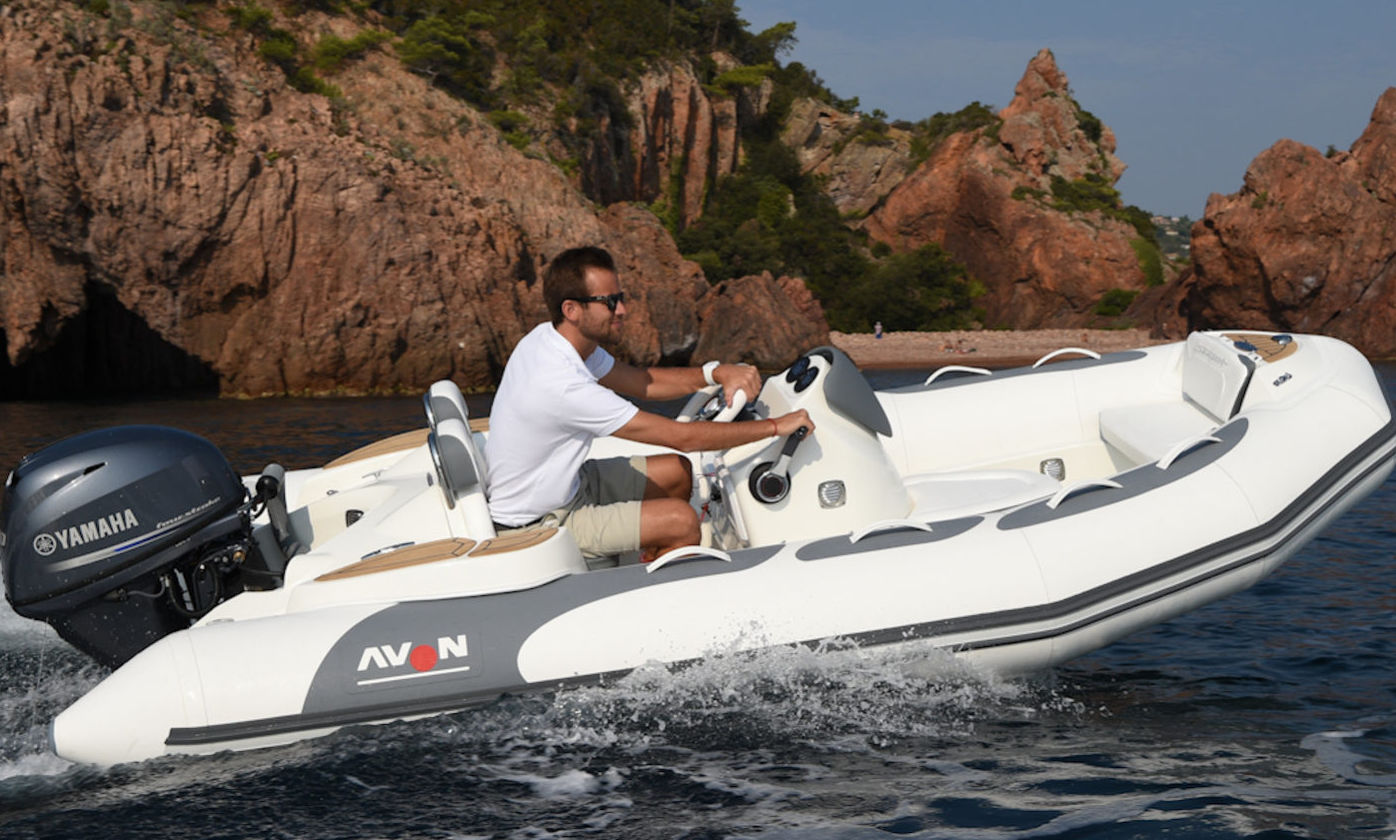
Signboard in the car park noting the dawn of rubberised fabrics in 1848 (interesting BoA Museum page) and which became Dupont hypalon we know and love, and then PVC. It explains the brand name of Avon Rubber Company and their RIBs (middle) and moto tyres (right). The factory was by the secind weir at Limpley. Avon RIBs were bought by French Zodiac in the 1990s, and after 112 years the Avon tyre factory up river in Melksham closed in 2023.
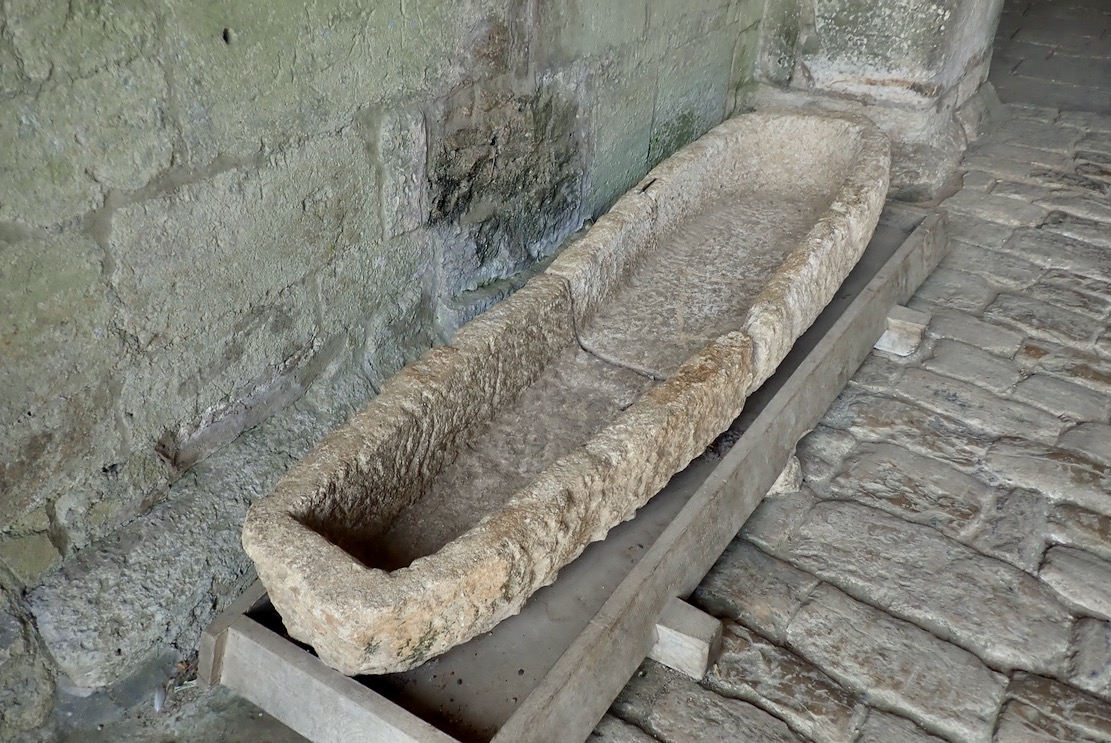
I have a mooch around the huge, 14th century Tithe Barn, a feudal tax warehouse where peasants surrendered part of what they produced to nearby abbey. Then in the 1530s, Henry VIII grabbed all religious properties for himself.An experimental Roman dug-out canoe later repurposed as a sarcophagus. Along with a Saxon church, there are many historic buildings in BoA, most dating for the Industrial Revolution.Easy put-in just by the barn. Loads of kids on paddle boards, plus a £20 slackraft to even things up a bit. Soon I pass under the Avoncliff aqueduct which I’ll be crossing in a few hours.Lovely riverside treescapes. Some are already turning, despite being right by the water.The first weir at Avoncliff. A Medway-style chute would be nice, but I read the weir face steps are shootable at much higher water levels. Sounds a bit sketchy to me.
The exposed steps make for an easy portage.
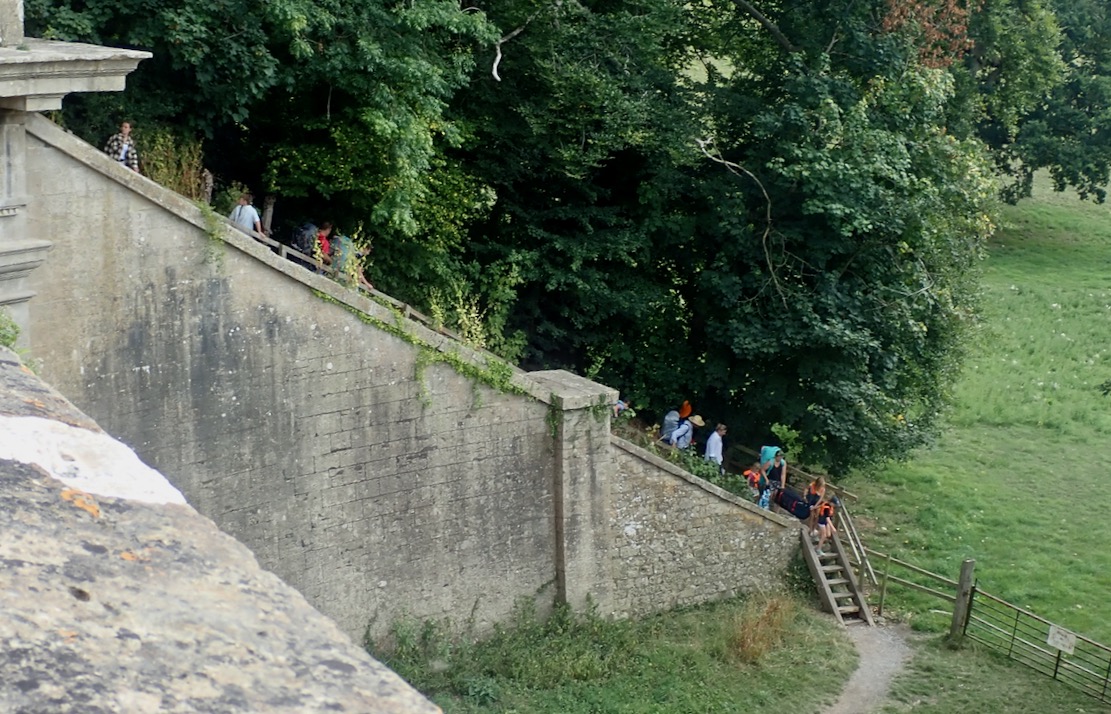
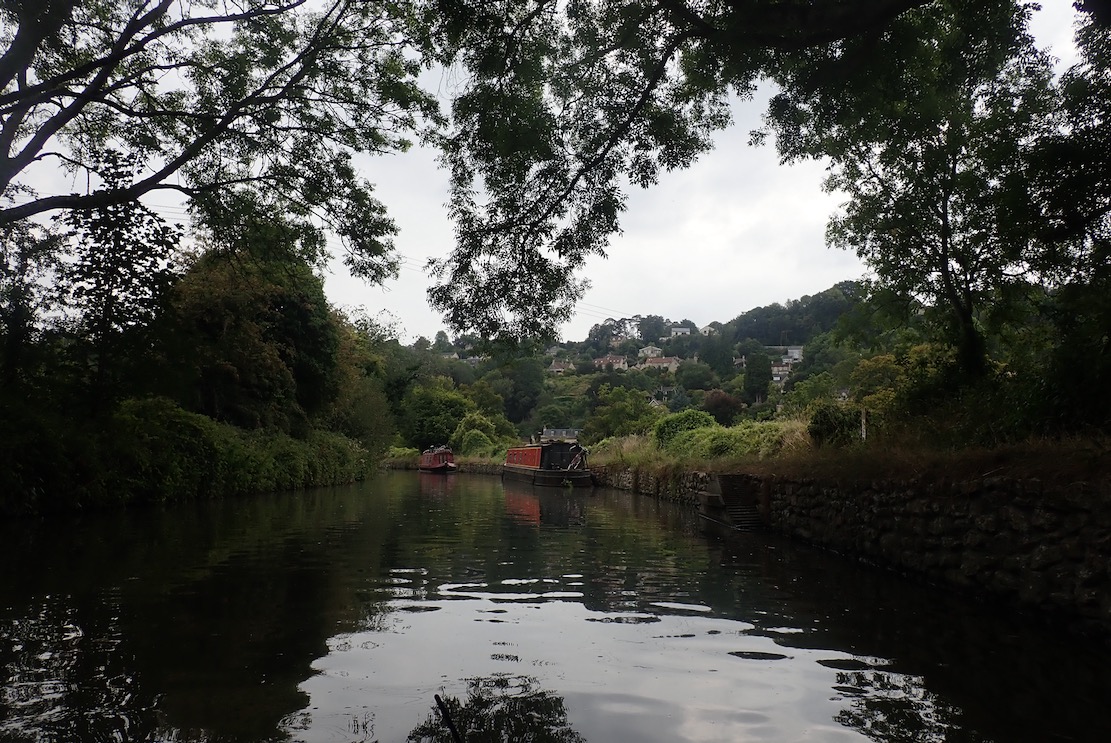
Once below, a brisk current flushes me through the reeds.The second weir at Limpley Stoke. The steps river right are a bit steeper here, but easy enough. Not sure I’ve seen stepped weirs in the UK before. Avon Rubber’s original factory was here at Limpley Mill.There’s a road bridge soon after followed by a 7-inch weir. The skeg scraped a bit around here but despite no rain for months, I never had to get out and walk the packraft, like in the canoe video.Reeds and trees. I’m amazed how well the Sigma zips along, helped I’m sure by a bit of current and backwind and the Multi Mat floor. At times I even perceive an IK-like glide. No one’s ever said that of a packraft. The TXL+ really is a great do-it-all boat. Ae you getting a bit tired of reading that?After 4.1 miles (6.6km) and 85 minutes (just under 3mph) I reach the Dundas Aqueduct where the Kennet canal crosses high above the river. Just after, on the right are steps to take out.Once on the right bank it’s a 20-metre set of stairs up to the aqueduct. Wouldn’t fancy hauling a hardshell up there by myself.The Avon from the aqueduct.Tow path on the aqueduct. By way of a rest I submit to a questionnaire for the National Trust.Video Andy warned the canal can get raucous with piss-up barges. But not on a balmy, late summer’s Tuesday afternoon.I got stuck in to the flatwater paddle back to BoA, looking down onto the valley on the right. It gets a bit dull and samey, then becomes a flat-out slog. The hands get sore and the elbows creak. I even overtake a couple of rental barges chugging along in a trail diesel fumes like an Algerian truck. A smell from the 1980s. No Euro 5 here.
Paddling along in the perfectly still water I had the feeling the boat was pulling to the left as if some weed was caught in the skeg or I wasn’t holding my paddle evenly. This wasn’t evident on the more lively river, earlier. I suspected I knew what it was: the skeg was warped, leaning over to one side and with a longitudinal curl at the back that would steer the boat left. I’ve not had this before on rock solid polyethylene skegs which don’t deform no matter how abused or badly packed. The unused one above with no tape or scratches is straight. I gave the bent one 2 minutes in a microwave but it came out the same. It is 3 years old from my original green TXL.
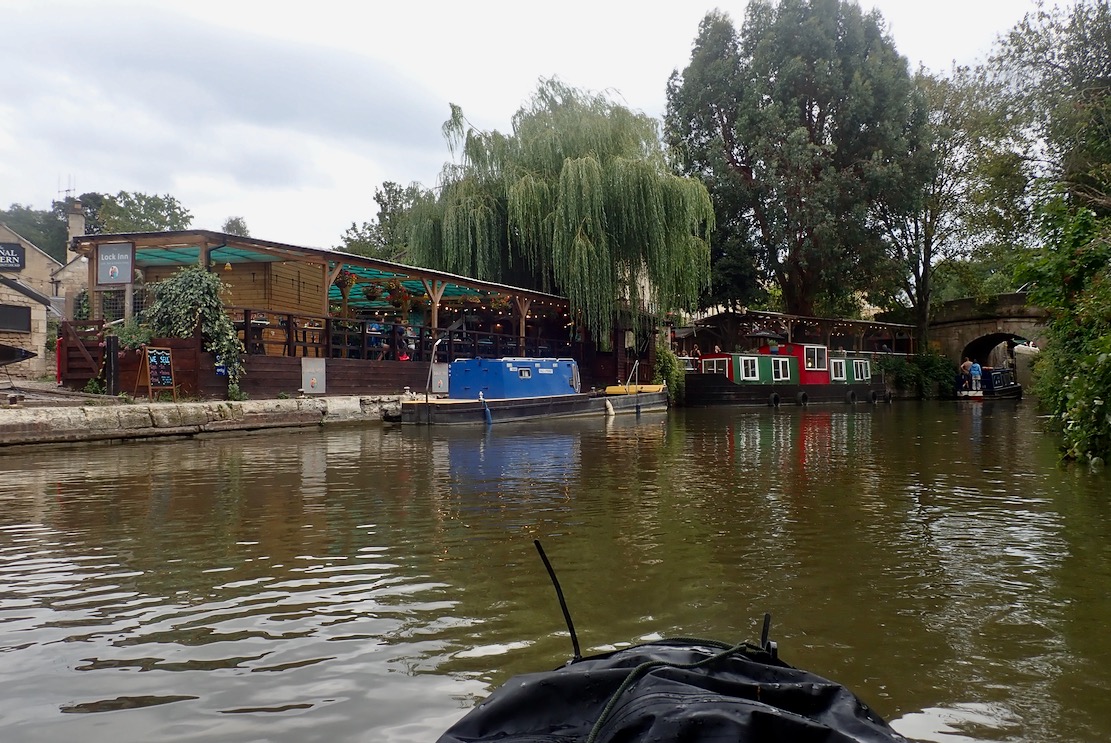
The state of some of these boats, honestly! On the street they’d be towed away.Take out by the Lock Inn back in town. There a lock right by that bridge leading into the C&RT basin. It was a bit further (4.3mls/6.9km) but surprisingly took just 80 long minutes (3.2mph) with no weir interruptions. Near the end I was considering hopping out but that would ruin the story. By now I’m ready for an early dinner.
Unless you’re getting swept down Spain’s Canal de la Toba, as expected, the river stage was a lot more agreeable than the parallel canal, and the two weirs portaged were not awkward. At much higher (or normal?) flows that might be different but anyway, the whole point of packboats is you don’t need to do loops if there is transport at hand.
Poshboys on old Pulteney weir
Had I thought it through a bit more, I’d have registered the railway also following the Avon valley, and carried on six miles down river. There are weirs at Warleigh, a mile after Dundas, and Bathampton, both of which would hopefully with no more bother than what passed before. They lead to Bath’s amazing, neo-classically set Pulteney Weir, doable providing it’s no more turbid than pictured below. Bath Spa station is just 5 minutes away for the 16-minute train ride back to Bradford on Avon, looking down onto the river you just paddled. One for next time.
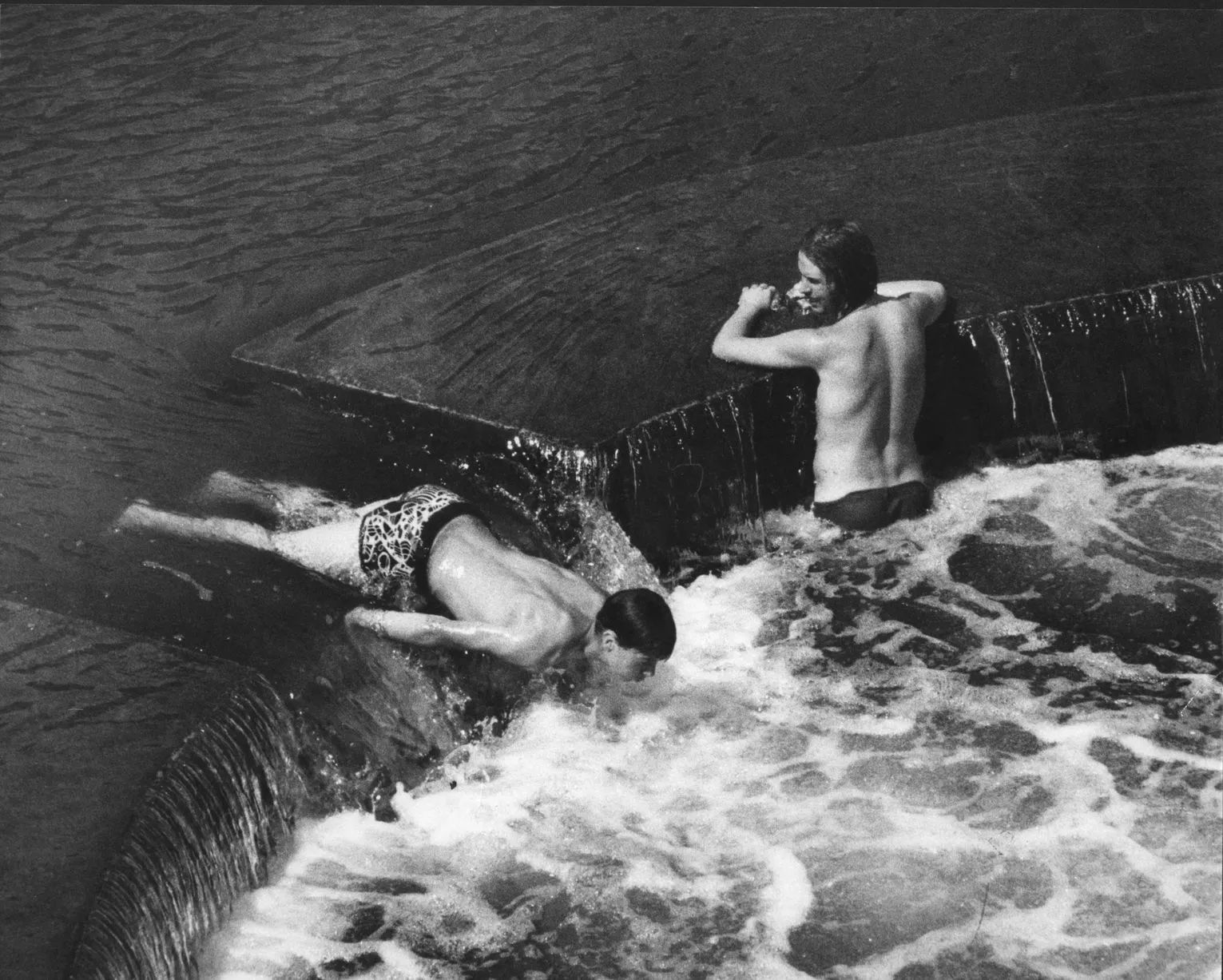
Bath’s Pulteney Weir even has a kayak-friendly nick at the apex.
Hold my beer!
Pulteney has had it’s share of tragedies, though the weir’s grim record must down to its city-centre location. The unusual V-shape actually only dates from the 1970s, replacing a diagonal low-head weir (above left), like most weirs upstream. Check out a great series of before-, during-, and after photos here, although the current log-jammed image on Google Earth doesn’t look inviting at all. They is actually a canoe chute alongside a dry ramp on the left hand end, by the trees. See this vid.
My 2.8-metre TXL+ (left) does it all for me these days, and I was just thinking that, for what I do (less hardcore, such as it was), I don’t miss my IKs at all.
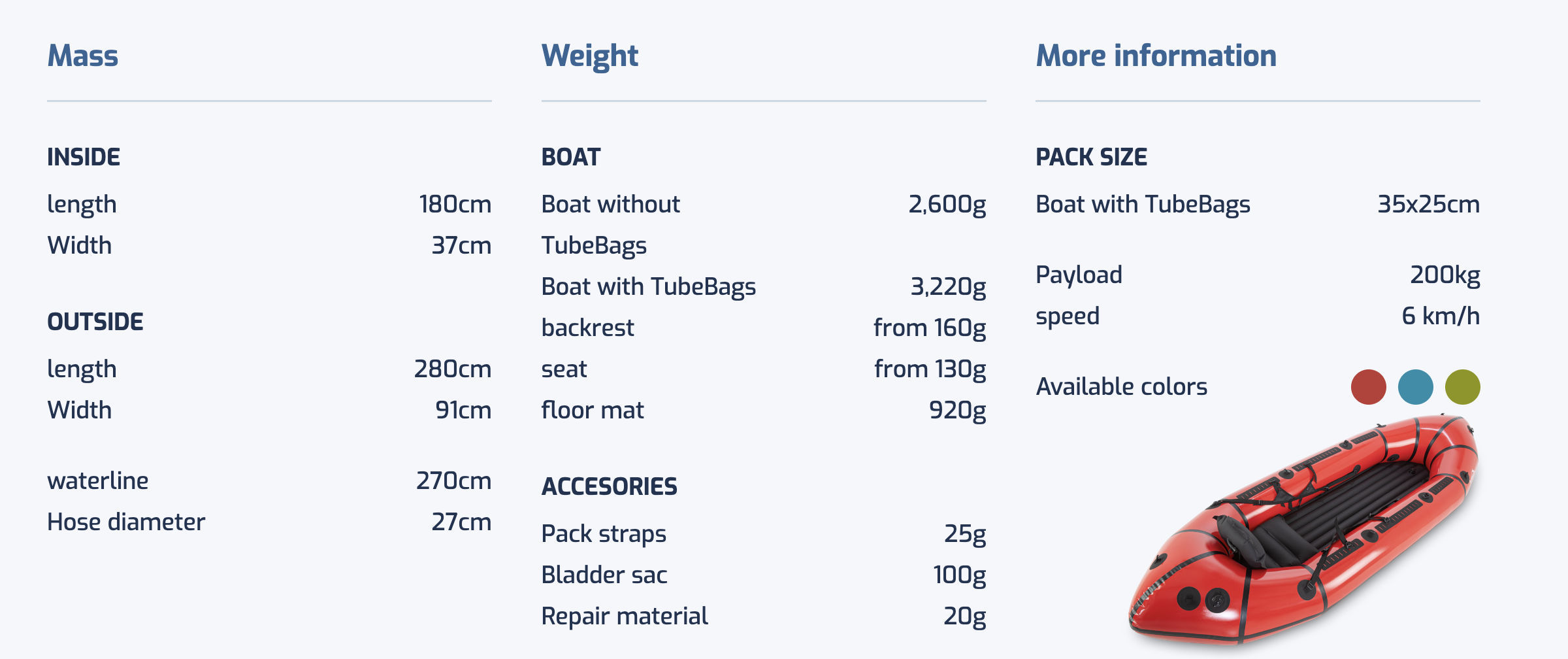
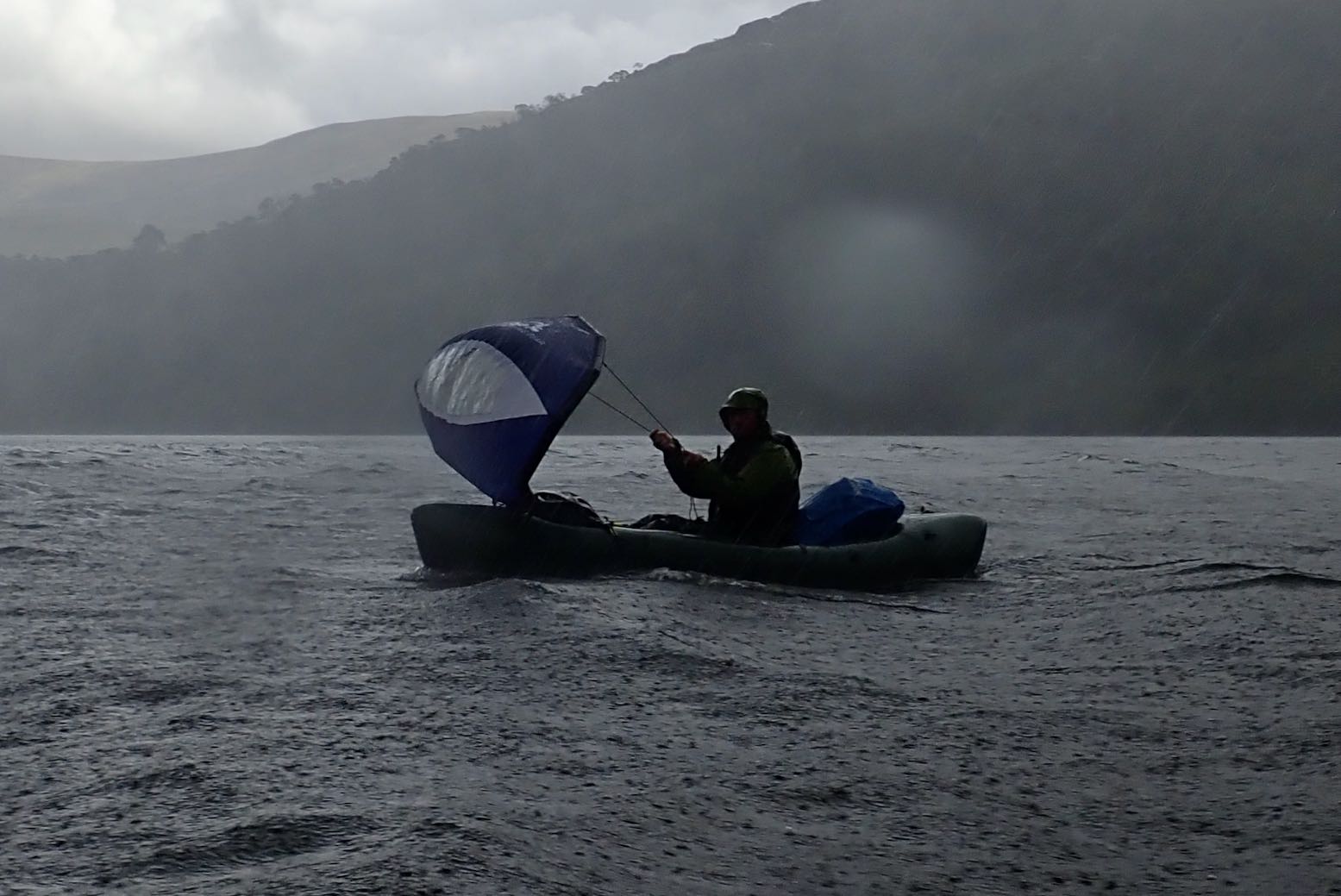
What my TXL+ loses in sublime kayak glide, it gains right back in being able to be easily carried following a day paddle. Being wind-prone, venturing too far out to sea in any inflatable, IKs included, takes some nerve when alone. Of course overnight trips including tough terrain, like our Knoydart paddle, will require a stiffer back or porters for these heavier, bulkier boats – or you plan for a sustainable paddling/walking ratio, ideally including sailing where possible (see video below). Long packrafts of around 2.8 metres offer more packing space and less annoying bow yawing, have a kayak-like, central solo paddling position with a level trim, but can fit a second paddler or a bike, as well as reach speeds up to 6kph. All for less than a kilo in mass. They are Pakayaks: the best of both worlds. Two newish ‘packayaks’ from Anfibio caught my eye: the Sigma TXLB+ and the Rebel 3KL which has been out a few months. With masses of (optional) side storage, both are suited to multi-day, rough water expeditions. One bails, the other decks and both are ‘symmetrical’, ie: the bow and stern are identical, like a canoe and all current Anfibio boats apart from the Revos and Nano RTC. Some reviewers seem to think this symmetry contributes to faster speeds. A longer waterline certainly does, but identical bows and sterns merely simplify assembly and reduces costs – symmetry has nothing to do with speed (or Alpacka Raft have got it all terribly wrong!). I’ve not tried either boat but as usual, that does not proscribe me from opinionating on pictures ransacked from the Anfibio website.
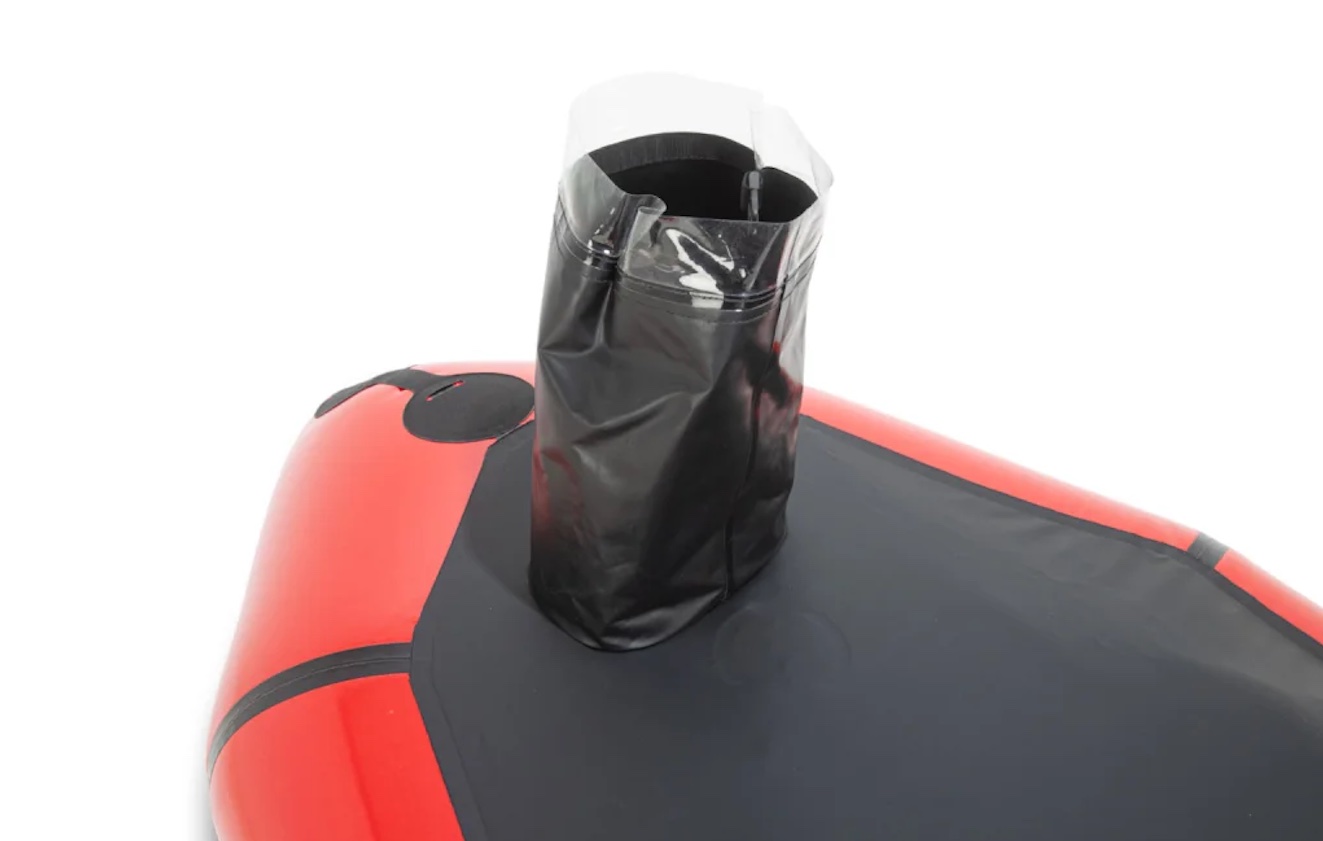
Sigma TXLB+The Expeditionist The single colour TXLB+ is just like my blue boat with optional thigh straps, floor matt, strap attachments and massive and secure TubeBag storage, but with the roll-up self-bailing drain hose we first saw on the 2022 Revo white water packraft. I never got to test that system properly, but the principle of flowing water sucking the swill out sounds plausible. As it is, you’ll be up dry on a floor and seat anyway, so it’ll take a lot of splashing to swamp the boat.
Is it needed? Not for what I do, but mileage famously varies from paddler to paddler. The hose can be rolled up and tucked out of the way (left) when not needed. One thing that didn’t look right is the skeg back in the ‘old’ solo-packraft position (left) so as to be out of the way of the trailing hose. This placement works fine on normal, back-heavy packrafts with the paddler’s weight at the stern. But as I soon found with my first green TXL (see video below), it is less effective with centrally positioned padders because the boat floats level. And I imagine it might work even less well with the hose down. I suppose you could say when using the self-bailing feature in white water, you won’t be using a skeg. And on flatwater you won’t be using the drain but could do with the skeg which will work OK. As for rough seas when you might want both – who would go out and do that?! One answer could be a bigger ‘sea skeg‘ option, like I’ve been saying for years. Or, on the TXLB+ simply remount the regular skeg in front of the drain.
Rebel 3KL ‘The Longliner’ I’m not sure about the 3KL’s blue and green (“… should never be seen”) colour scheme. Bring back the delicious lemon and olive, like my old 2K. But the 2.72-m ‘Longliner’ is just 8cm less than a TXL and a viable decked longboat comparable with the zippy MRS Nomad S1. The deck is permanently fitted which means it’s solo only, but that’s what most do most of the time.
I was never that keen on my fragile decked packrafts from MRS, Alpacka or Anfibio – just another thing to damage, though I never did. I barely used them but one time rushing down a windy loch in pelting squalls, it sure kept me drier than matey in an undecked Nomad (left). He got so drenched and waterlogged, we had to stop early for him to tip out and wring himself out like a flannel. You don’t have to zip up every time: the deck with integrated skirt rolls off to the sides, and a vital grab loop ejects you fast if you tip over. (Never happened to me in all my pack years).
I like very much that Anfibio are now using the so-called Performance BackBand – aka: an SoT foam backrest which I’ve been retro fitting to my packboats – IK or raft – for years (years, I tell you!). The lighter but wobbly inflatable versions which came with my TXLs got fed to the goats before I ever used them. Yes, you need inflation for supporting your weight on a seat base, but a backrest wants to be stiff and supportive, snugging into your lumbar curve while ideally, you press against a footrest or the front of the boat. Doing so really enhances boat control and connection.
TXLB+ or 3KL. Which would I choose? Neither, thanks for asking ;-) My deckless, drainless TXL+ with self-fitted thigh straps and an SoT backrest covers all my needs. Just like IKs, I like that it’s dead easy to get in and out. And that video above is about as ‘out there’ as I ever like to get. Water coming over the sides was not an issue that day. Going straight was. If it’s cold or rainy I’ll wear my drysuit and onesie or surf Netflix. And if it’s coming over the sides then I either badly misread the forecast or am engaged in some lovely southern French white water in the balmy summertime when pulling over to a bank to flip the boat dry is all part of the fun. I suppose I’d take the decked 3KL for cosy winter paddles. They just need to sort those mixed colours out. Alpacka used to have some great combos.
Still, it sure is great to have all these choices! Anfibio Rebel 3KL Longliner Anfibio Sigma TXLB+ Expeditionist – both with optional Tubebags, imo the best way to carry heavy loads securely and reliably without compromising hull integrity.
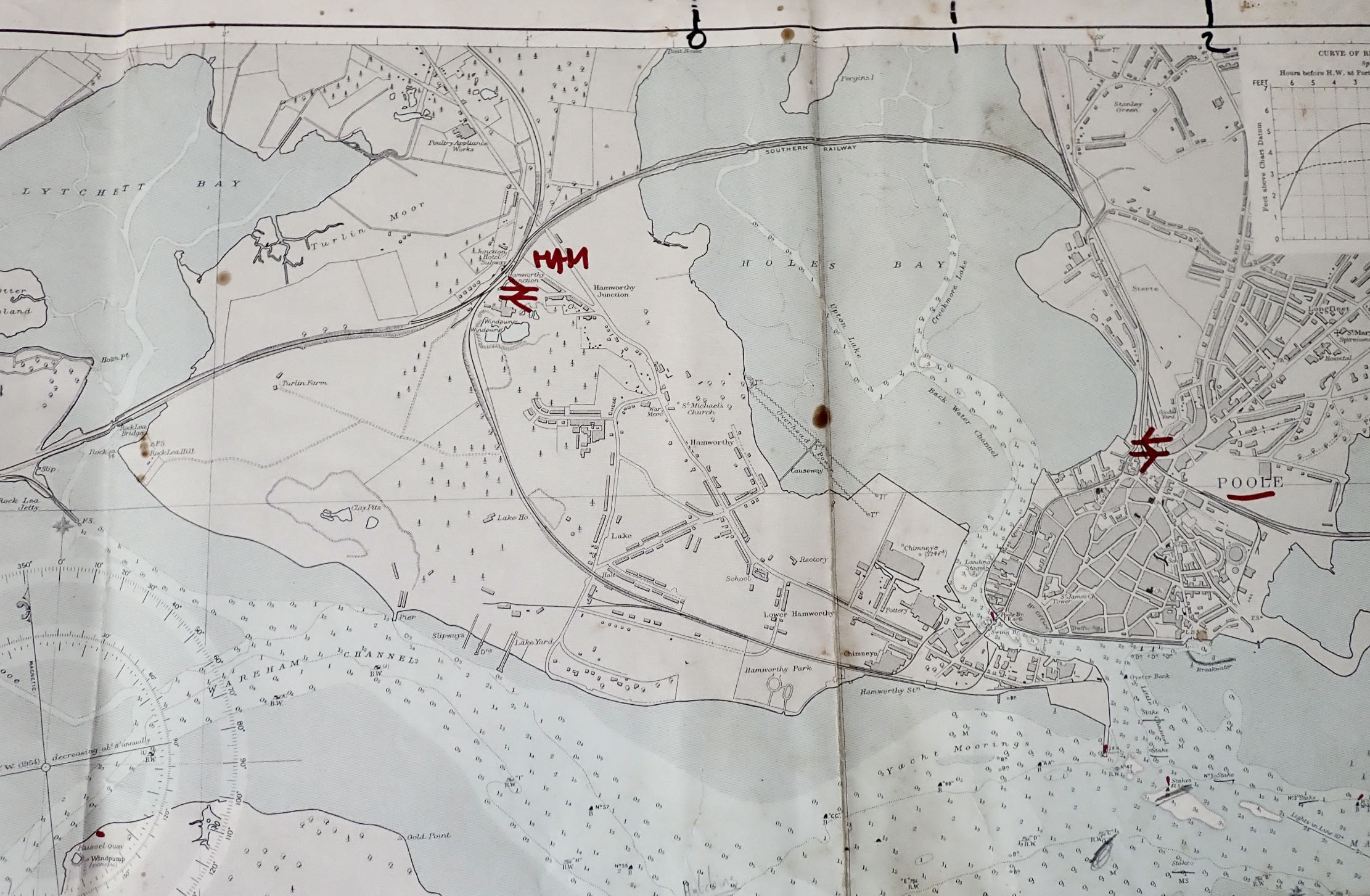
With the car in for an MoT at Kwik-Fit in Hamworthy, it made sense to do a Poole harbour paddle rather than go home or hang out. Kwik-Fit is close to Lytchett Bay, an intertidal embayment or tidal inland lake crossed by the London-Weymouth rail line spanning a narrow outlet. A 10km lap from there out into Wareham Channel and back into the adjacent Holes Bay (another embayment with a narrow pass under a rail bridge) might be possible in the time I had. If not, I could hop off anywhere and walk back to the garage. That is the appeal of pack boating! This route – out one tidal channel and in via another – had similarities with our lap around Hayling Island a few years back in the Seawave. On that occasion we had to go full steam against the incoming tide to get out of Langstone Harbour back into the Solent to close the loop. This Poole loop would only require a 500-m walk from Holes Bay shore back to Kwik-Fit.
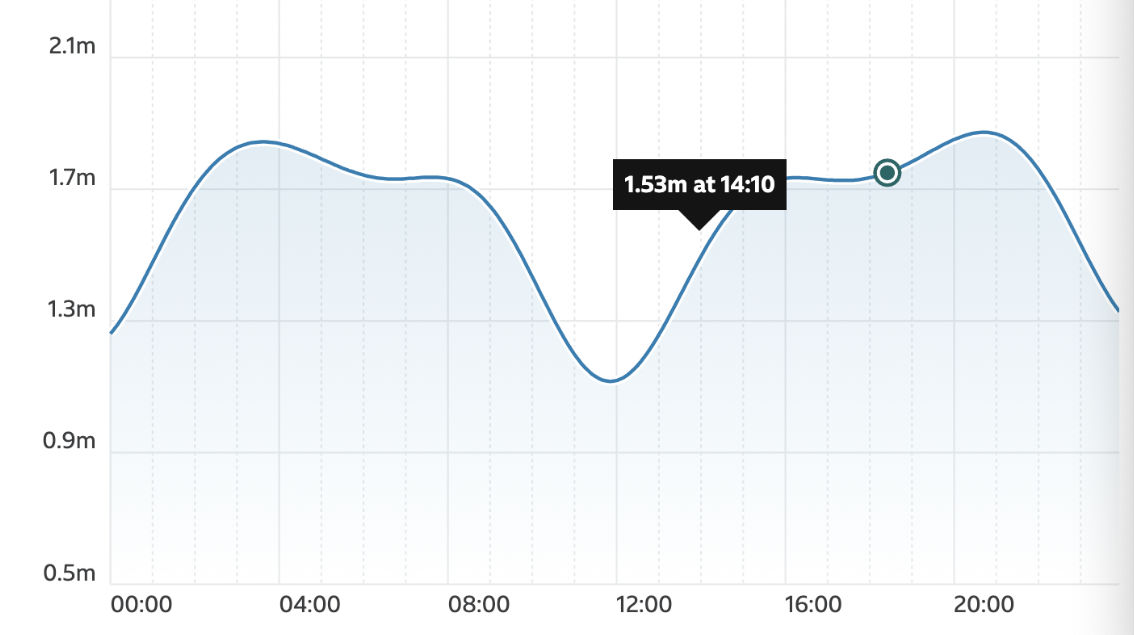
The winds were 10-13mph from the southwest which made sailing just about possible along my ESE route. The tide was coming in and levelling off about 3pm for 6 hours before dropping steeply again. In Poole Harbour – second only to Sydney Harbour but with an outlet just 300-m wide at Sandbanks chain ferry – the tides are far from simple sine waves. It may still be going in at Wareham at the back end, when it’s already going out at Sandbanks. There are four tide points listed by UKHO in Poole Harbour and I’m pretty sure ‘Poole Harbour’ refers to the RoRo ferry port on the north side. PHC is a great resource.
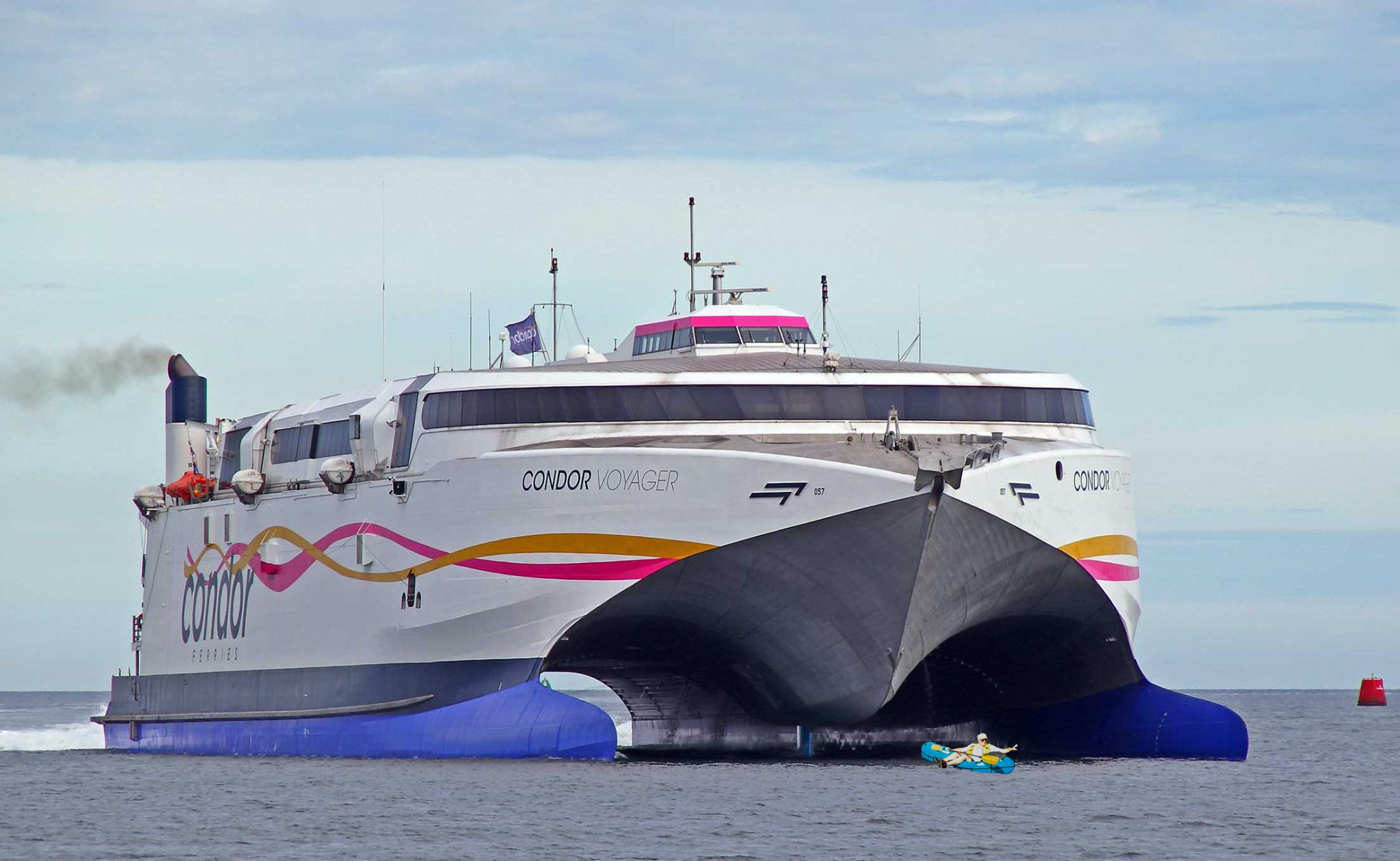
My route would take me right past the ferry berth where getting in the way of a gigantic ferry would probably raise a yellow card. Again, on PWC I was able to see today’s main ferry movements: the massive Condor Voyager cheesecutter class twin hull (above) would depart for St Malo at 14.15. I’d probably be an hour behind.
I set off from Kwik-Fit across Turlin Moor park aiming for the inlet, and once I saw some water, bundled through thick, 2-metre-high reeds on the off chance.
But once I emerged from the dense reed jungle I could see I was a bit early at this point, with 100m of knee-deep sludge ahead. It’s large acreages of tidal mudflats like this which give Poole Harbour its average depth of less than 50cm. That’s about the same depth I’d sink into the mud, trying to reach the water.
So I turned back and carried on along the shore until a path led behind some houses and through the trees to this grassy, reed-free bench by a sandy beach: 50.72448, -2.03601. If you want a mess-free, easy way to get on the water at Lytchett Bay east, aim for here.
A headwind was blowing quite hard, but it was only 500m to the rail bridge narrows, after which I’d turn southeast to pick up what wind I could get. Setting off, the TXL+ felt like it was zipping along as wind and waves rushed past. Up to 6kph, according to the GPS as I neared the narrows. That was probably an unseen back eddy sucking me into the gap, because as I got nearer I could see a current ripping through under the bridge at at least the same speed or more. I powered in hard along the edge, like we’d done at Hayling, but could only manage 0kph.
“Try on the other side” said the bloke lurking by the abutments, so I ferried across and, with a lot more effort managed to squeeze under the bridge and hook behind some rocks for a breather while not getting drawn back in. I’d swum half a mile that morning which can be enough exercise for one day. Paddling under the bridge was like doing 50 pull-ups and I was a bit pooped. I looked later at the state of the tide at that precise time (left) and saw I’d been about an hour early.
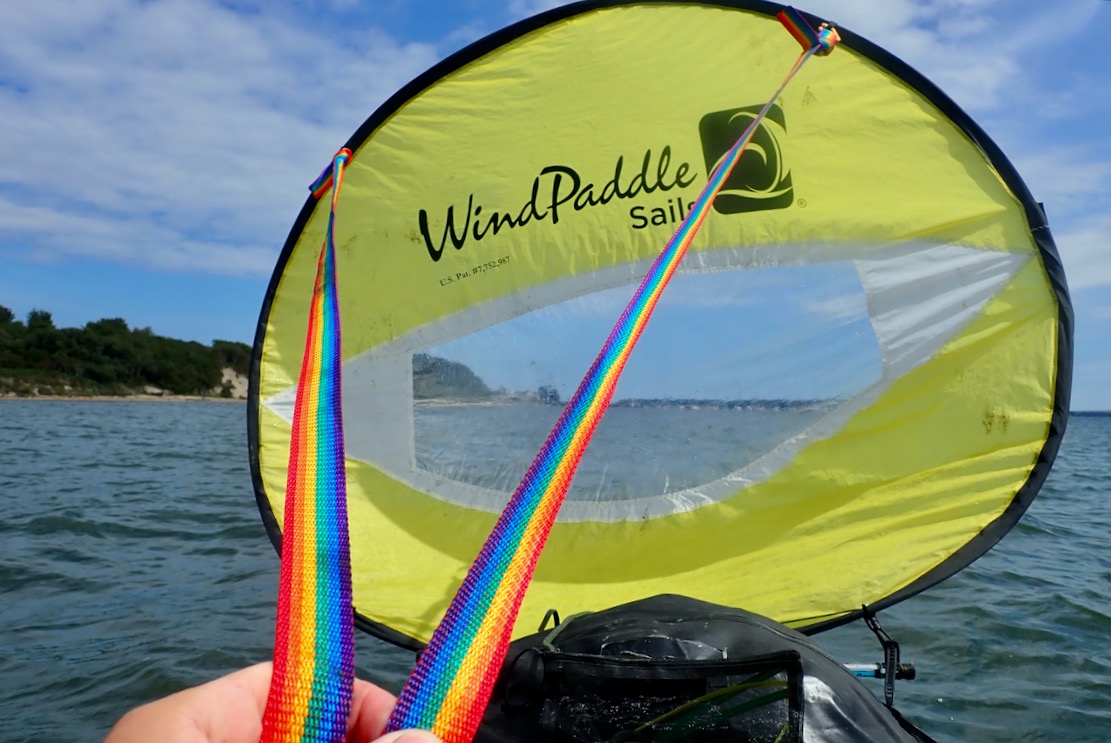
I took a wide arc out to avoid the worst of the tide race and headed off towards Rockley Sands where I came ashore last year on my way to buy a moto. The wind from my right wasn’t ideal for sailing in my direction, so I paddled out into the channel to turn and get a better angle as it pushed me towards the shore. Though I was hardly bombing along, getting the sail up was the rest I needed. Out in the Channel, loads of sailing boats were fluttering to and fro past Brownsea island, and at one point a lightweight sailing cat passed close by with a hiss. I could do with some sails like that. As usual the WindPaddle was hit and miss. Holding 45° off the wind with some steering is not bad for what it is, but it never stays on it for long before getting in a flap. However, as I got pushed towards the shore again, I really appreciated the way I could pull the WindPaddle down, give it a twist and tuck the lower fold under the Anfibio DeckPack in seconds. It was a handy trick I discovered while belting down a wind struck loch in Knoydart one time.
I passed a couple of piers and a series of long private jetties extending from people’s back gardens, some with a motorboat at the end perched on giant hydraulic hoists to stop them getting too wet. I assumed this was luxury overspill from affluent Sandbanks nearby, once home to the most expensive properties in the UK, but here “…overall, the historical sold prices in Branksea Avenue over the last year were 41% down on the previous year and 75% down on the 2011 peak of £2,262,500.” Unless rising sea levels are coming quicker than we think, or they’re putting in a new high-speed railway, it did seem an implausibly catastrophic collapse in house prices. Maybe the Rightmove AI needs to be burped.
Now heading more east, the wind was getting behind me. I made another effort to paddle out into the Channel to get a good run, and this time the TXL got picked up and rushed along. This was more like it, with an aerated bow wave frothing away by my feet. I squeezed every last minute out of a good run of nearly half a mile, not quite managing to steer around the breakwater of Poole Yacht Club where the accumulated fetch and rebound slapped me around a bit, but the TXL sat steady as a barge. Round the corner I passed the entrance to Poole Yacht Club with a ‘Visitors Welcome’ sign and wondered if that included packrafts. The phone rang. ‘Kwik-Fit here. Your Micra’s ready in 40 minutes.’ ‘My word that was quick!’
A quick look at the map showed I was just less than halfway and would soon turn into Holes Bay with no more wind behind me, but with the high tide negligible. It would be tight to get back to the garage before it closed, so I turned into a dock entrance and rolled up the boat on the slipway.
I assumed this dock was part of the welcoming yacht club marina next door, but it was actually more like a deserted service yard for the ferry port right next door, surrounded on all sides by high security fences and an electric gate. I dare say some security guard was observing me on his CCTV lair somewhere. After nosing around the portacabins and sheds looking for someone, a guy appeared in his car and swiped me out with his pass. Things always work out, and as I passed the entrance to the Yacht Club, that too had electric security gates, though probably someone manning them. Looking at the map, a better take-out would have been Hamworthy Park by the club’s breakwater (50.71099, -2.00039), leading to a footbridge short cut over the rail line.
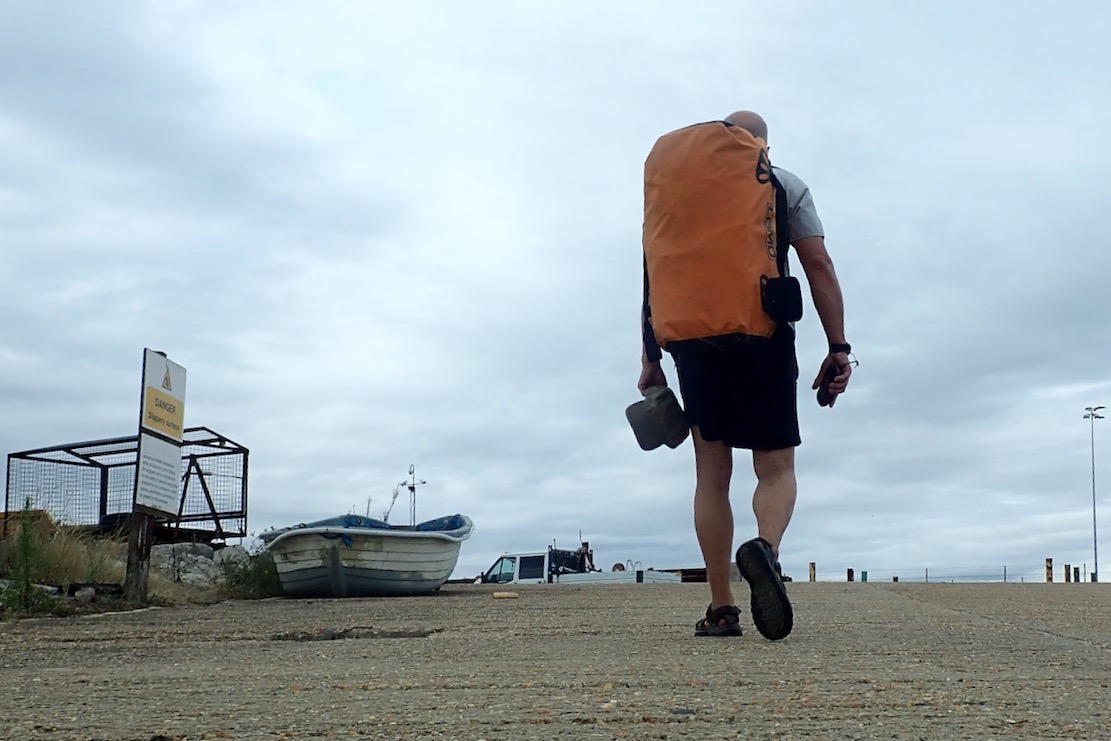
I walked right past the Customs and Immigration cabins (above left) of Poole ferry port, and a helpful map affirming je pagaie donc je suis ici with irreducible Cartesian logic. So – paddling mission not fully accomplished but the old Micra was on the road for another year.
Fat dotted red line shows unfinished stage. Arrows show wind direction
Looking back at the tide graphs for Poole Harbour, it seems that at the lowest neap tides (as it was two days later), there can be a 7 hour period when the high tide flattens off and rises then falls more than 20cm. That would be the best time to try and paddle around Hamworthy between Lytchett and Holes Bay. It could also be fun to leave Holes Bay on an ebbing spring tide to get a good blast under the rail bridge narrows, down the channel through downtown Poole and out into the harbour.
Wayback machine. Harbour chart from 1955. Hamworthy was just farmland and claypiys
















































































 Inflatable Kayaks & Packrafts

