Category Archives: Gear

Paddles, clothes, buoyancy vests, etc

Gumotex Seawave – MYO rudder

Seawave main page
Refining and testing prototype rudder
Making and testing MkII version
Update 2019:
I’ve not used my MYO rudder since I made it in 2016 and sold it with the boat in 2020. Partly because I’ve only done day trips predicated on nice weather, but also it’s all just more faff and clutter, not least the lines and footboard. As explained earlier, for multi-day trips you must deal with the winds you’re given so a rudder is a good idea. But even then, you only notice your relative lack of speed (due to sidewind paddling correction) alongside others. Alone, you’re as fast as you are [grasshopper].
Rudders are not about steering as they are on powered boats; in a kayak they’re about enabling efficient, balanced paddling on both arms by compensating for the boat’s deflection by side winds. 
rudnee5
Mk1 version – needed improvements
rudney
K40 with rudder

After writing this a few weeks back I decided to try and fit a rudder onto my Seawave. On that breezy Mull trip Gael, in the ruddered Incept K40 (left), seemed a little faster than me and the penny finally dropped as to why.

A rudder can compensate for winds pushing the boat off course while you power on as normal. Without one, you’re pulling hard with just one arm in an effort to keep on course – that explained why I was a bit slower. Rudders have little to do with improving tracking which the Seawave does fine with the help of the skeg (though fitting a rudder means you won’t need a skeg). And unlike a ship, rudders have even less to do with ‘steering’ which a kayak does easily enough by dragging or drawing a paddle blade. But you can of course steer with a rudder too.

skeglift

As mentioned elsewhere, another benefit of a rudder instead of a skeg is you can park the boat on flat ground without it pressing on the skeg – particularly useful when the boat is loaded and heavy (left). I’ve often thought about fitting a hinged skeg at the back of the boat to enable this. It’s a way of avoiding the complexity of a rudder but with the benefits of solid tracking which is needed at sea.

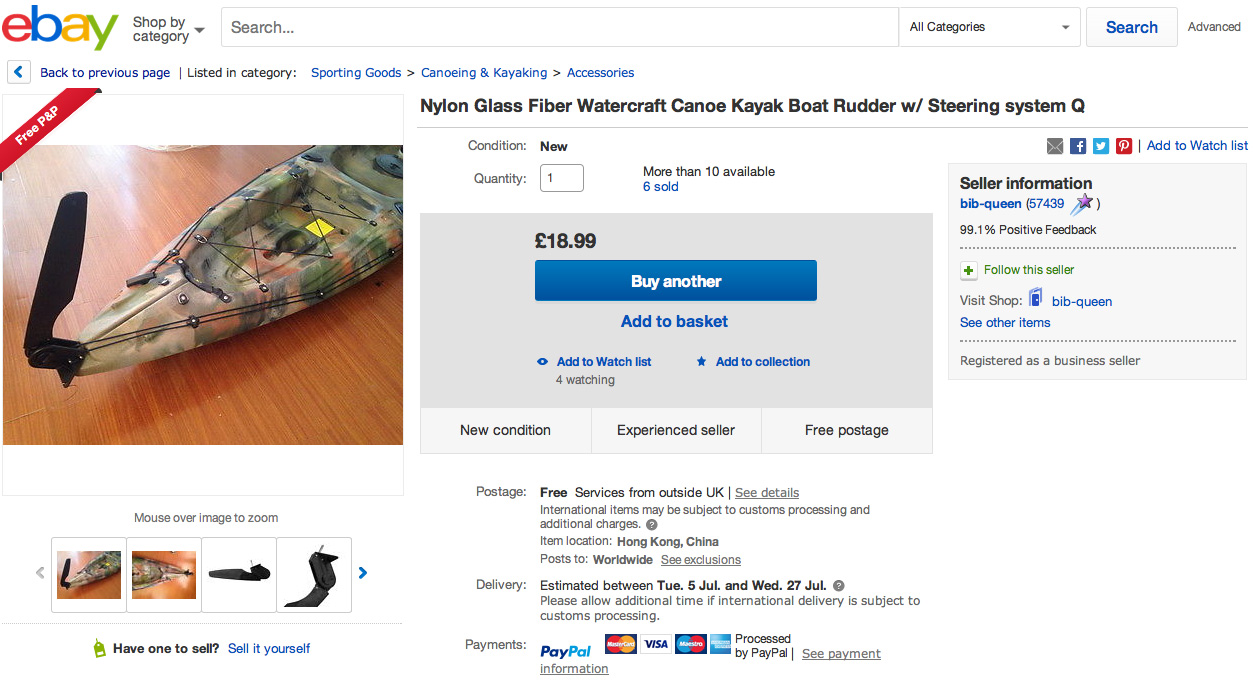
It helped that I found SoT rudders on eBay from Hong Kong (and now, in the UK) from just 20 quid. For that price it was worth experimenting, just like it was for a knock-off disc sail. Here in the UK a proper sea kayak rudder costs over £200 for a full kit with pedals. 
I also learned that Gumotex had introduced a Seawave rudder kit on their 2016 model as I was halfway through this project. I’m glad I spotted it as it gave me some good ideas, while the cost and certain features of the Gumotex rudder reassured me that my MYO was a better way to do it.
ning-front
K40 with a (too short) rudder

Does an IK need a rudder?
Most of the time on calm day trips a skeged Seawave manages fine without a rudder. But on a longer multi-day trip like Mull, you have to deal with the weather you’re given, or sit it out. As it is, unlike hardshells, IKs are innately more windprone as they’re lighter and sit higher on the water.
ningsails
Fiddler

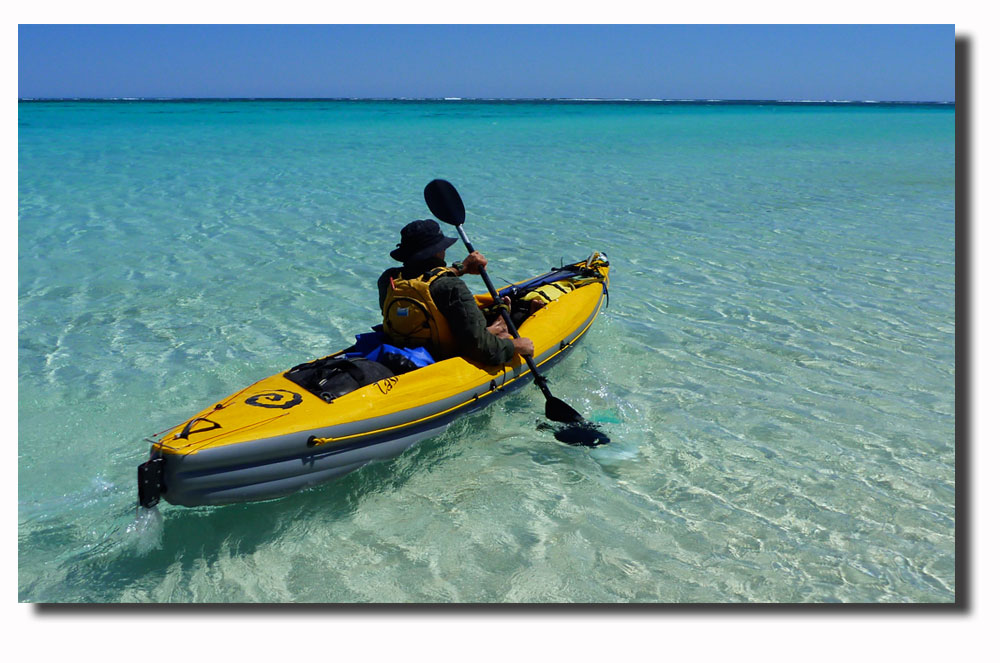
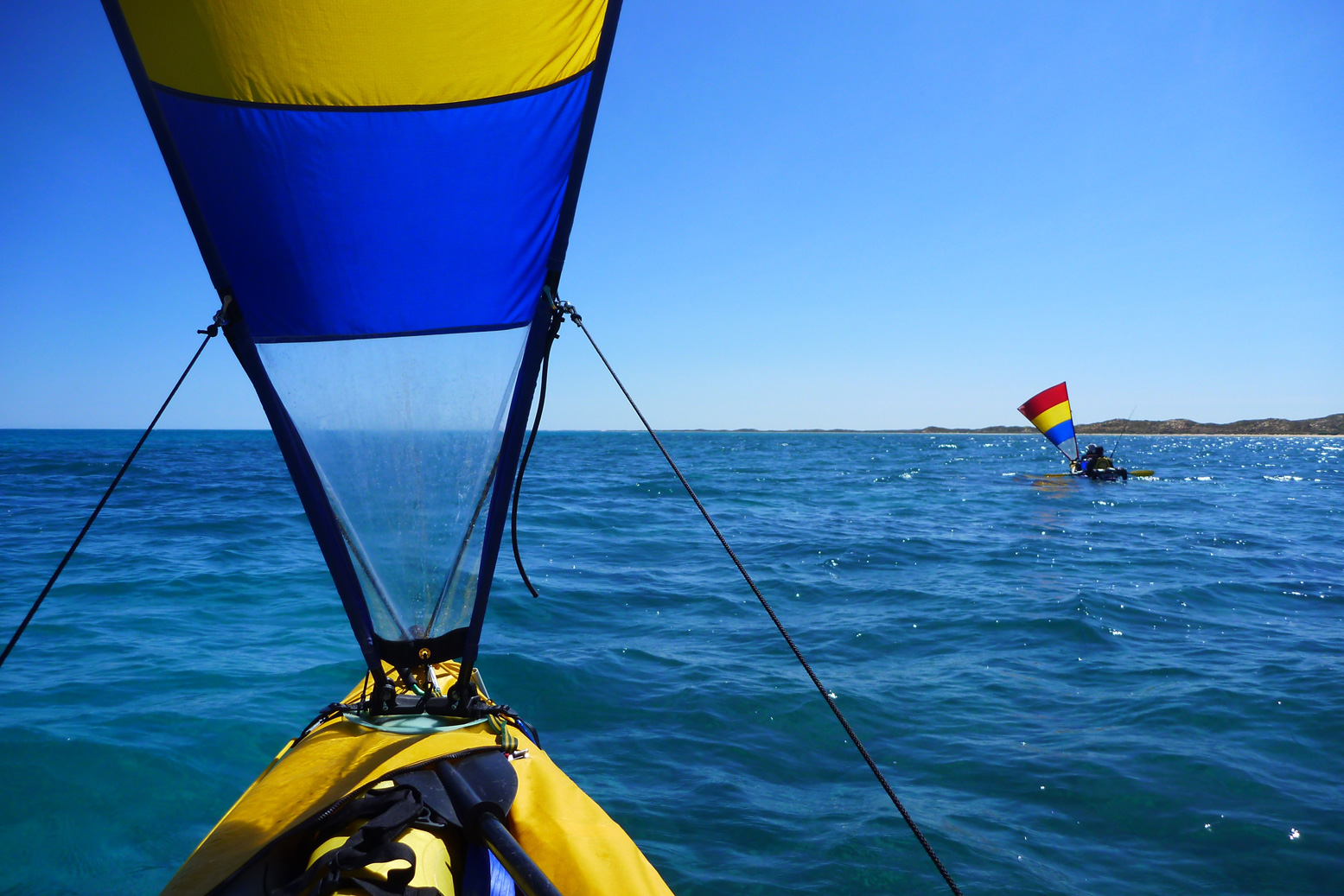
I paddled with a ten-ton hardshell once in Australia with my old K40 (above). Where we could, we both had sails and the hardshell flew along (a rudder makes kayak sailing much easier). But me, I had to give up on day two; I couldn’t control my kayak in the 20-30-knot backwinds, and that was with a rudder. (I realise now this was because the K40’s rudder was too short).
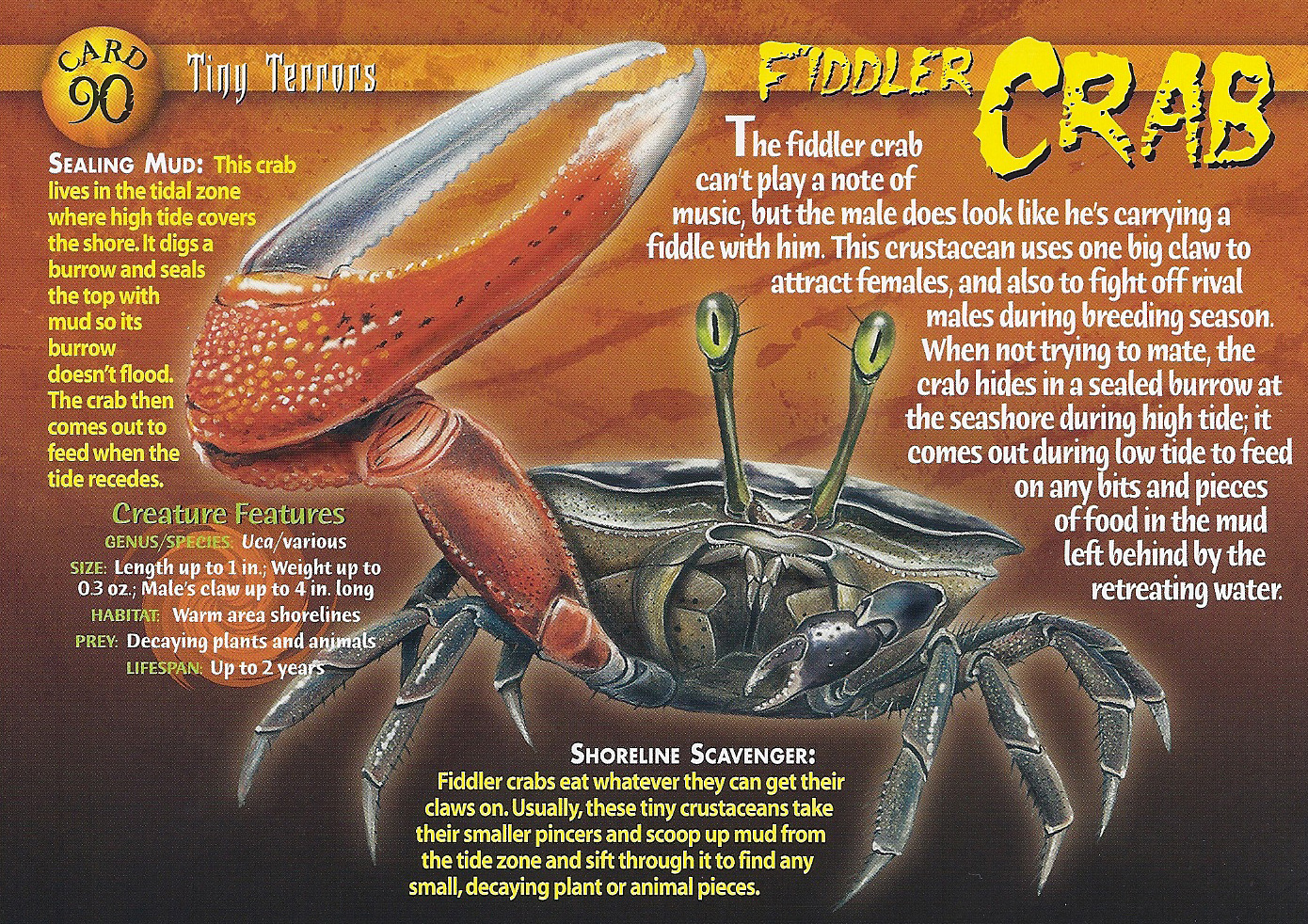
On another earlier paddle in Ozzie in my Sunny I remember pulling hard on one arm for hours and days to counteract the crosswinds. I ended up with arms like a fiddler crab.
So with an IK the window of rudder usefulness – when winds are strong enough to require rudder correction, but before they’re too strong for all except short, white-knuckle crossings – is actually quite narrow. Say, between 10 and 20mph.

This’s why I’d sooner not spend £200 finding out if a rudder suits my sort of paddling. A rudder isn’t going to transform my Seawave and I may end up not using it much, aa with my disc sail (though having a rudder again may encourage me to give sailing another go). But a rudder will slightly extend my boat’s paddleability. When a brisk quarter wind blows from front or rear I’ll be able to set the rudder against it and power away with equal effort on both arms. Anatomical consequences? More Popeye, less Fiddler crab.
k40rudney
Stick-out K40 rudder is vulnerable. Plus it’s too short when the waves get going.
erudney
chineerid

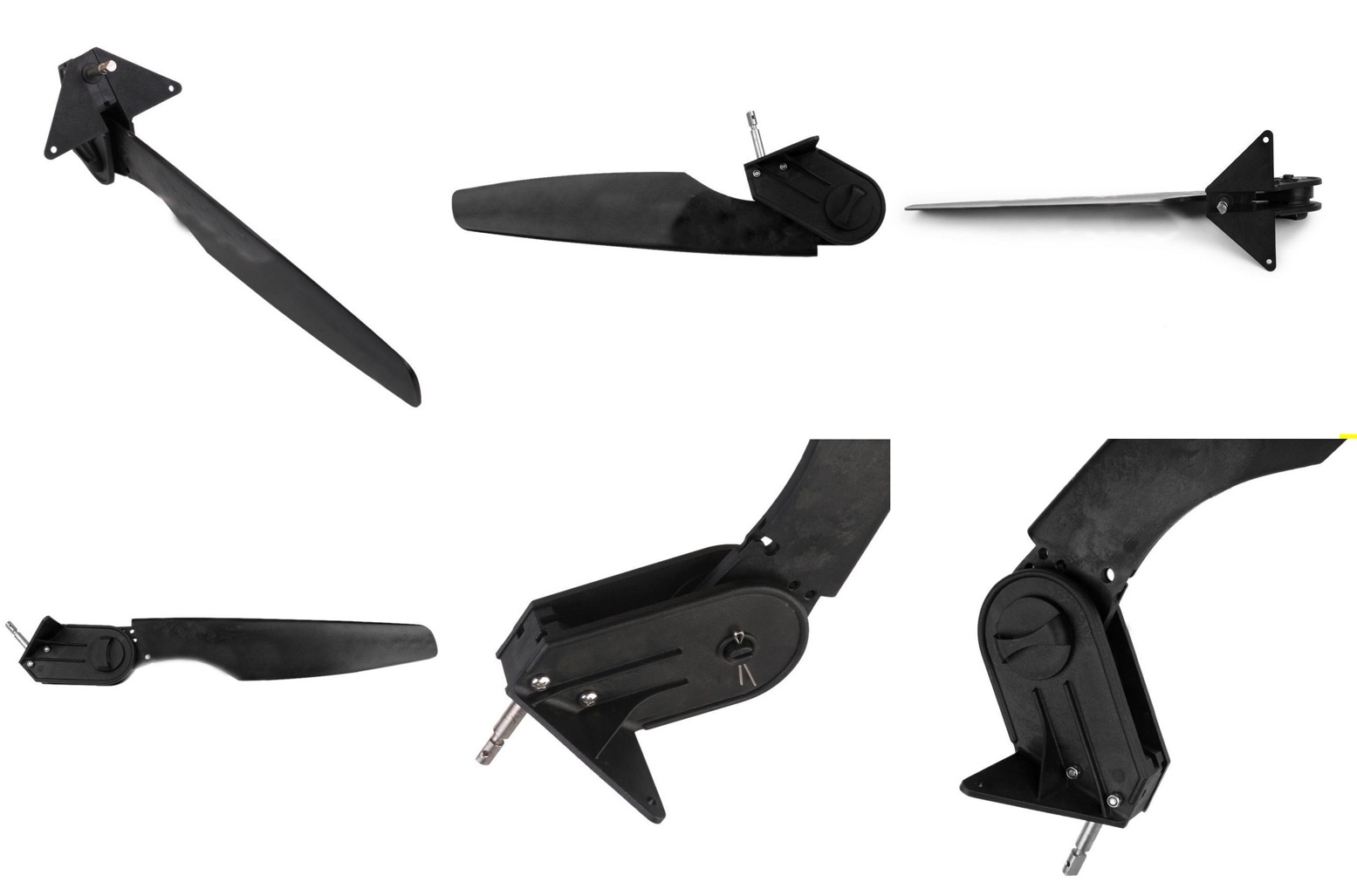
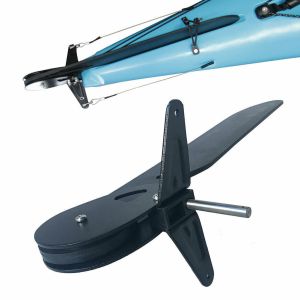
Chinese SoT item (left and right) typically has a 400mm blade and is quickly removed on the pivot pin, plus can be both retracted and deployed using control lines.
And better still, the retraction sweep comes right out and drops over the back of the deck, not sticking out vulnerably like the Incept rudder (above) or the Gumotex kit.

MYO
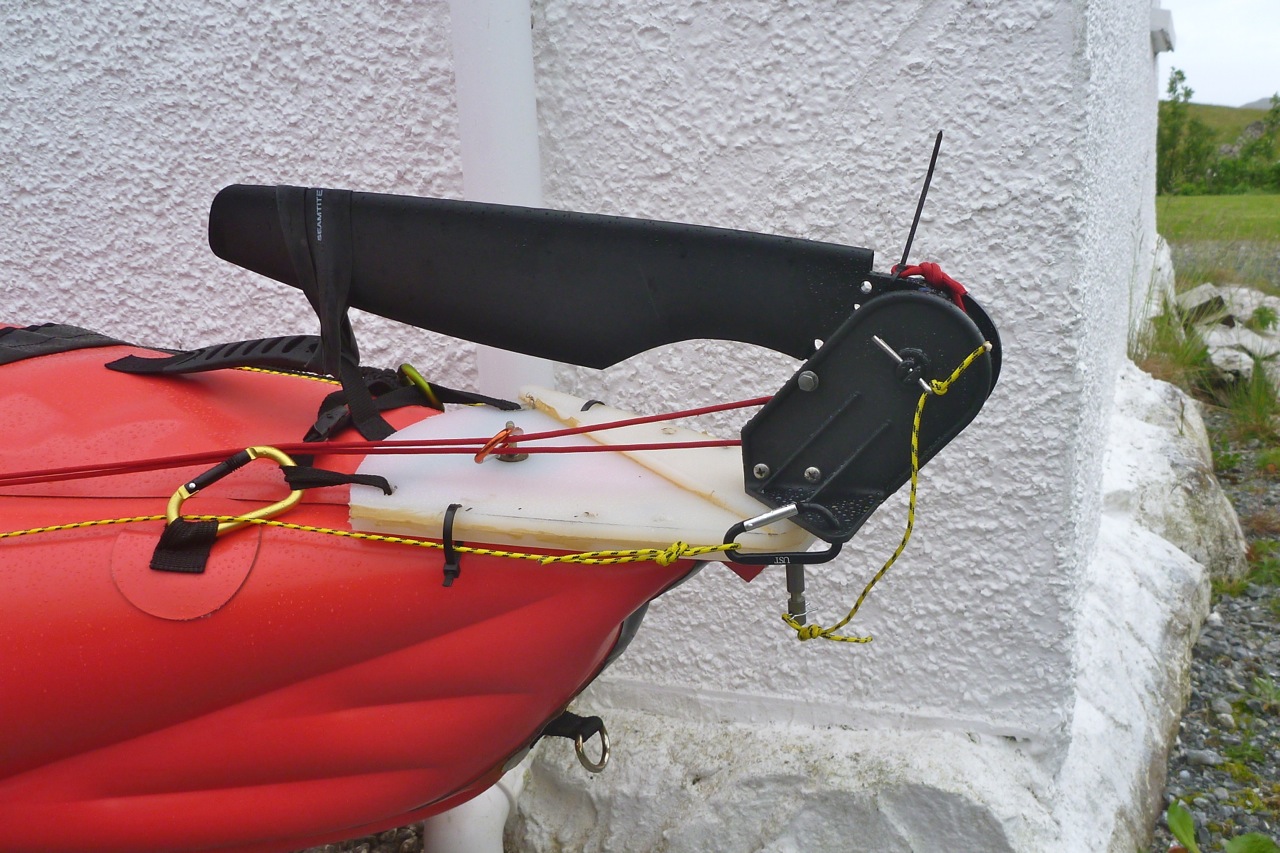
While the rudder inched its way over from Hong Kong I came up with a rough idea to mount it on a chopped up HDPE chopping board held in place by straps or similar off the rearmost deck line sleeves, then cinched down with an extra D-ring glued under the stern – the only mod permanently added to the actual boat.
On the end of the board some sort of swivel tube was needed, or just a built block of HDPE with a ⅜” hole drilled through it to take the rudder pin. Rigidity, or minimal flex is important if the rudder is to feel responsive – another flaw I recall from the Incept. Mounting something rigidly on the end of an inflatable is tricky, but if my first ideas aren’t good enough, there’ll be better ways of doing it.
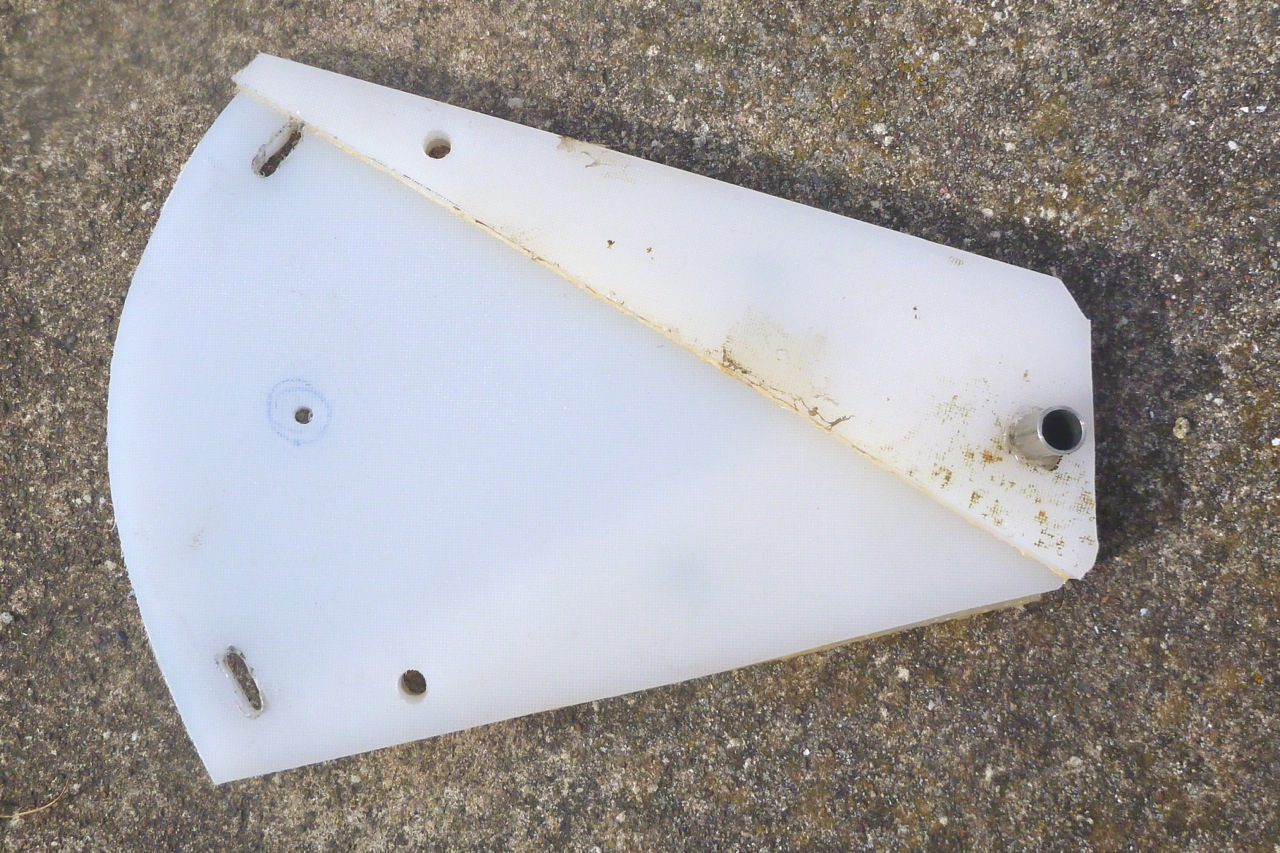
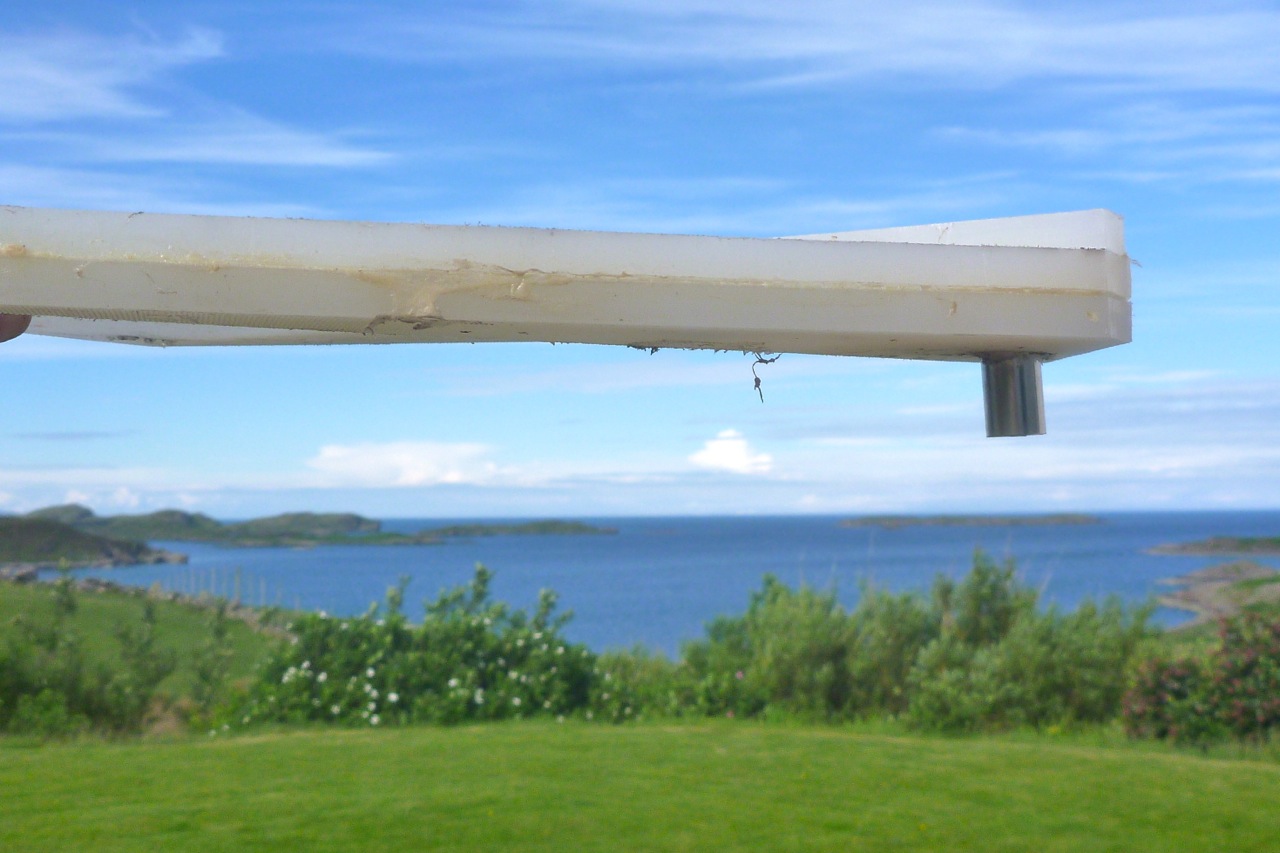
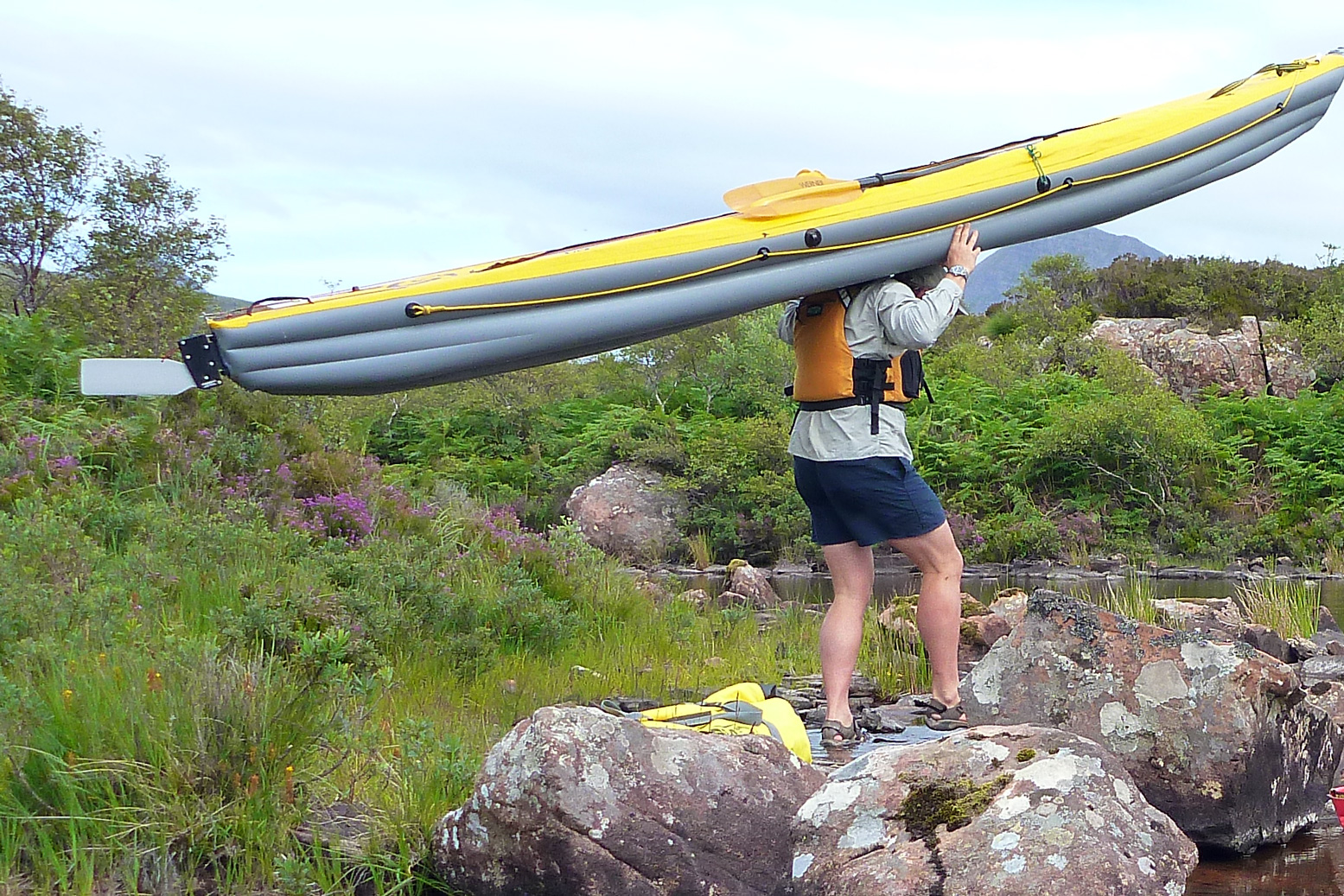
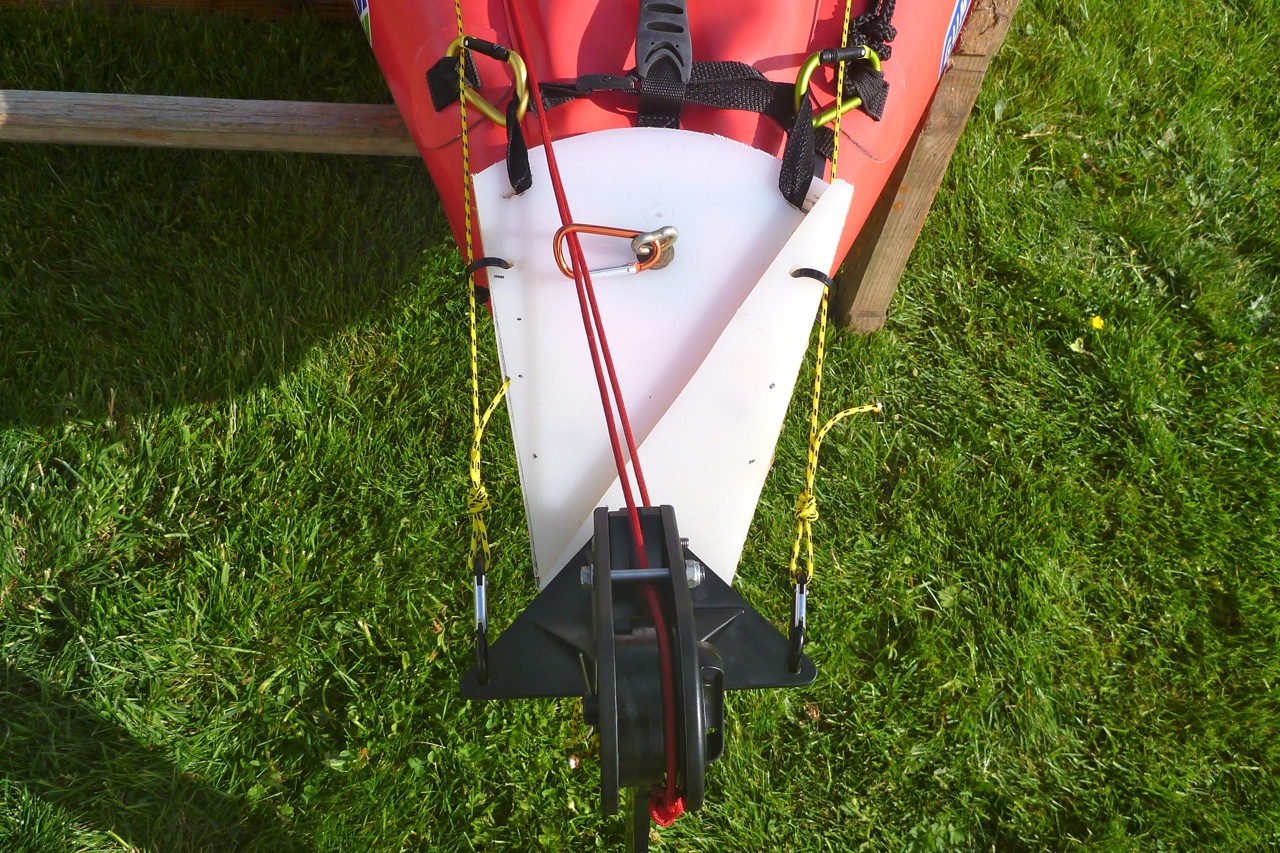
The way I chopped my 8mm board up and glued on the off-cuts for added stiffness produced about an inch of thickness at the back (right). And when the rudder turned up with a gudgeon pivot swivel sleeve, I decided it could be jammed into the back end of my board to provide a solid enough pivot.
rud04

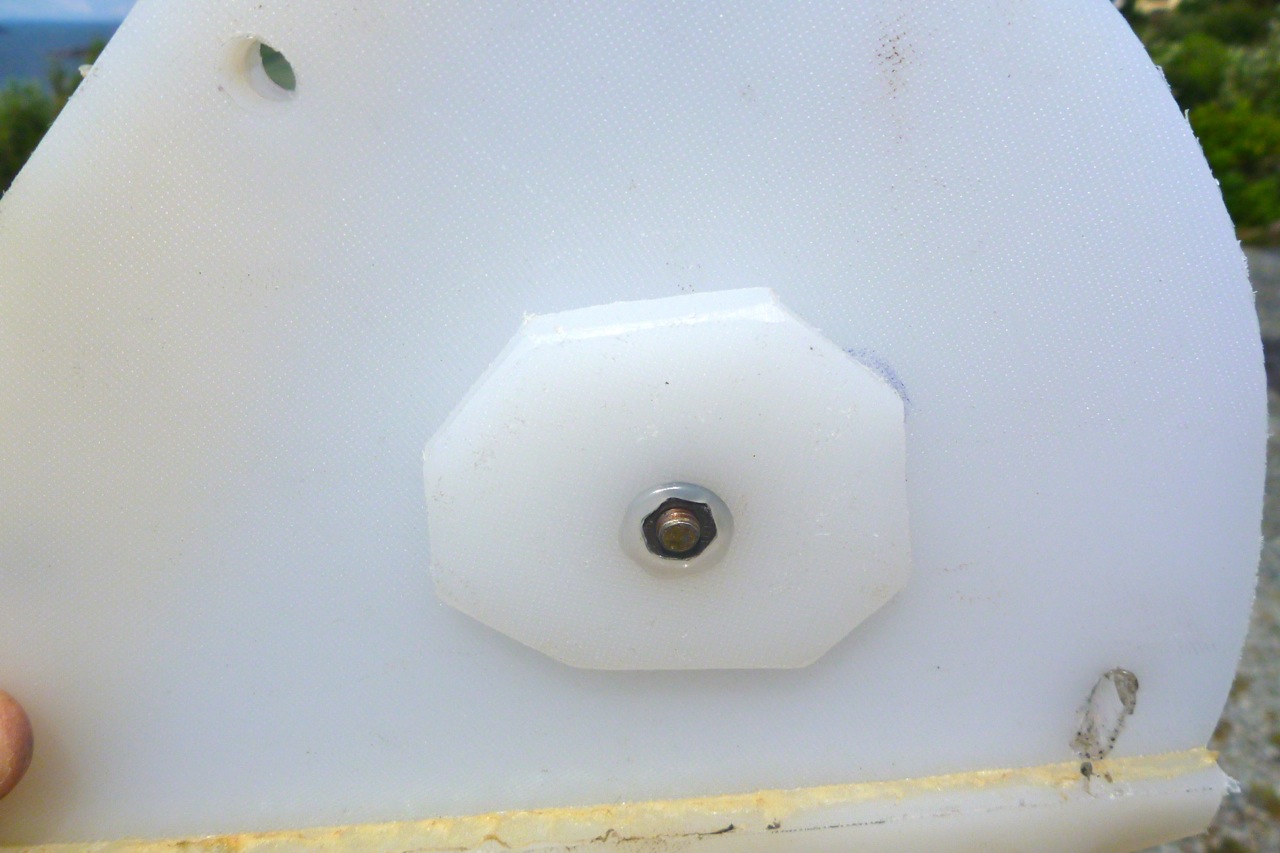
This kitchen plastic is a dream to work with: it cuts easily, melts readily (no need for a drill) but is fairly light, stiff and rot proof. I mounted a clamp through the boat’s drain hole – copied from the Gumotex kit – and used an off-cut with a melted-in M6 nut (right) to grip the top plate under the deck. With a strap threaded through the rearmost deckline sleeves, this triangulated the mounting to reduce – but not totally eliminate – sideways pivoting. When it turns up a ‘saddle strap’ through the under-stern D-ring will hold the board down to reduce movement some more.
Control lines
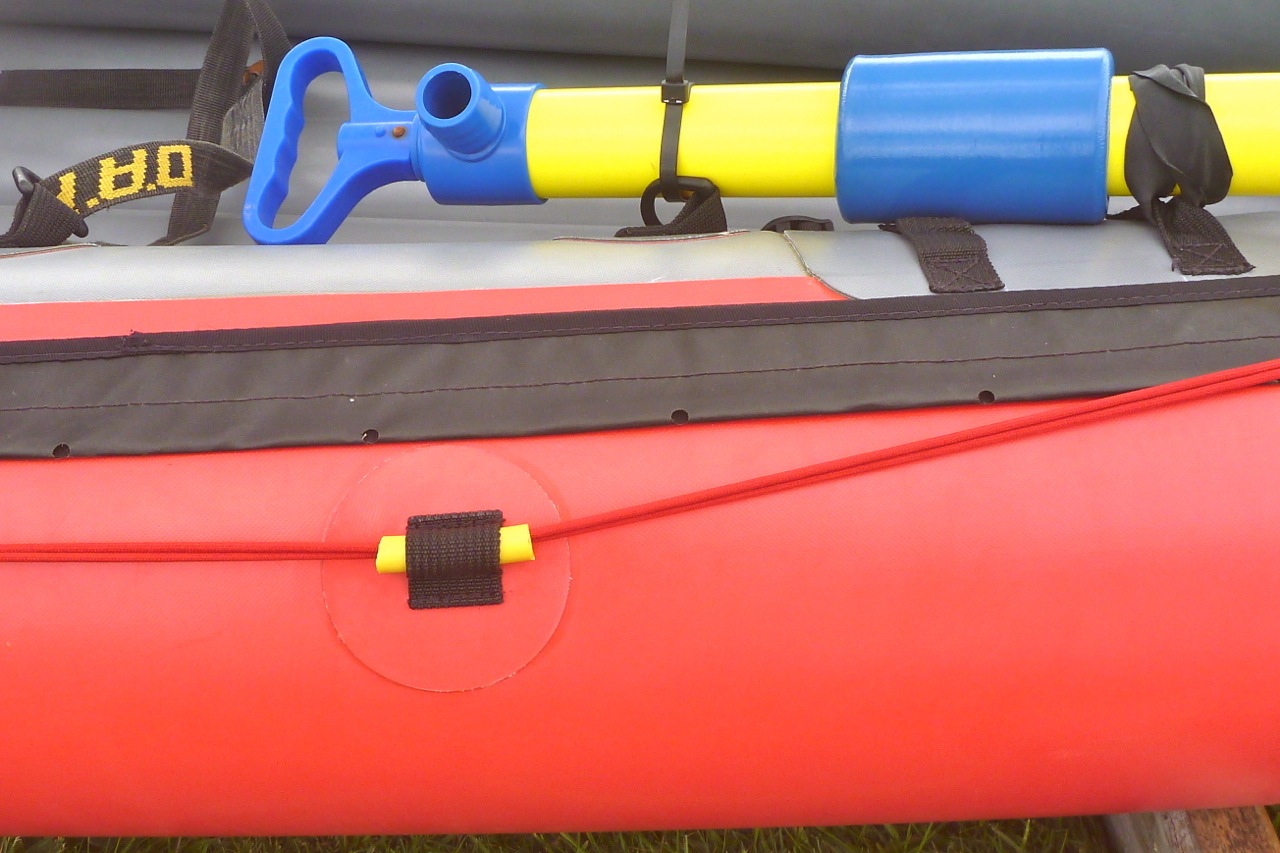
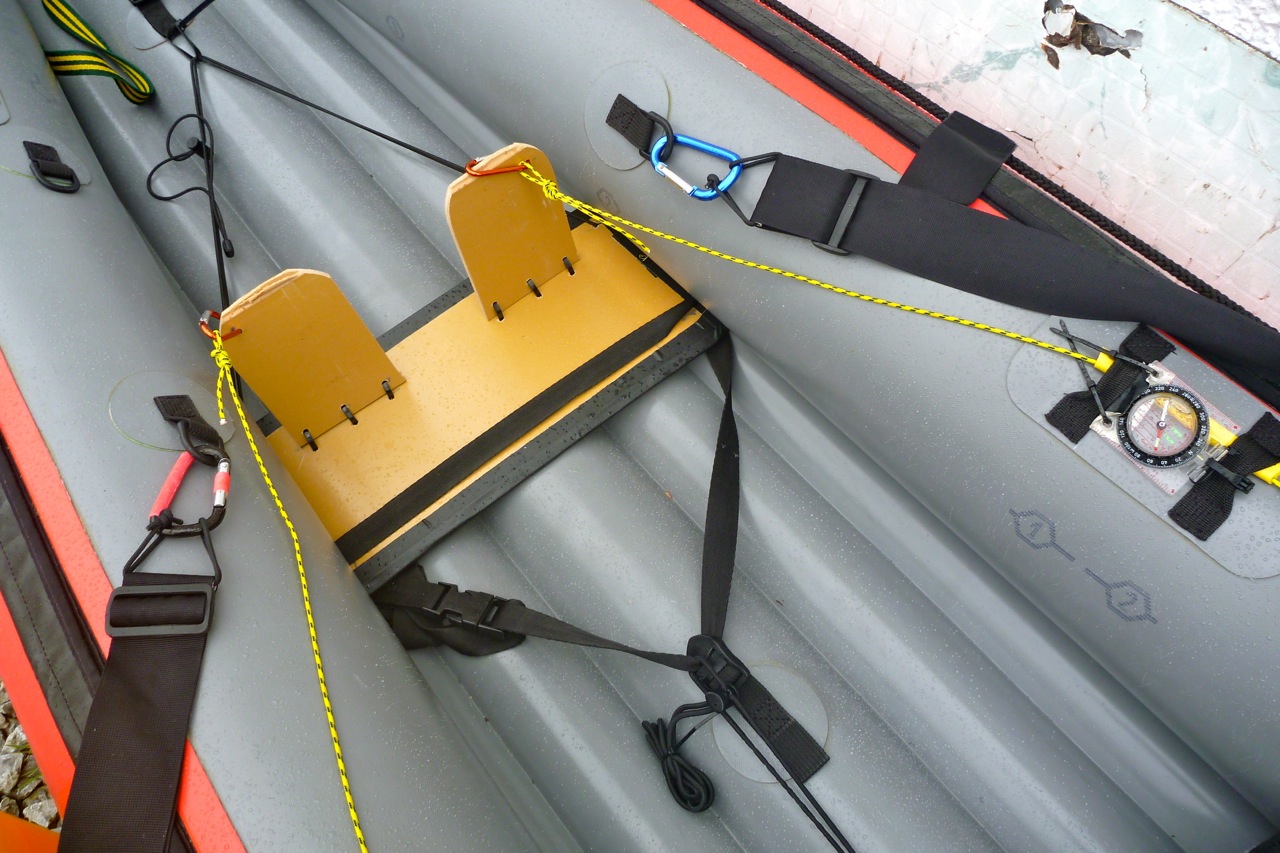
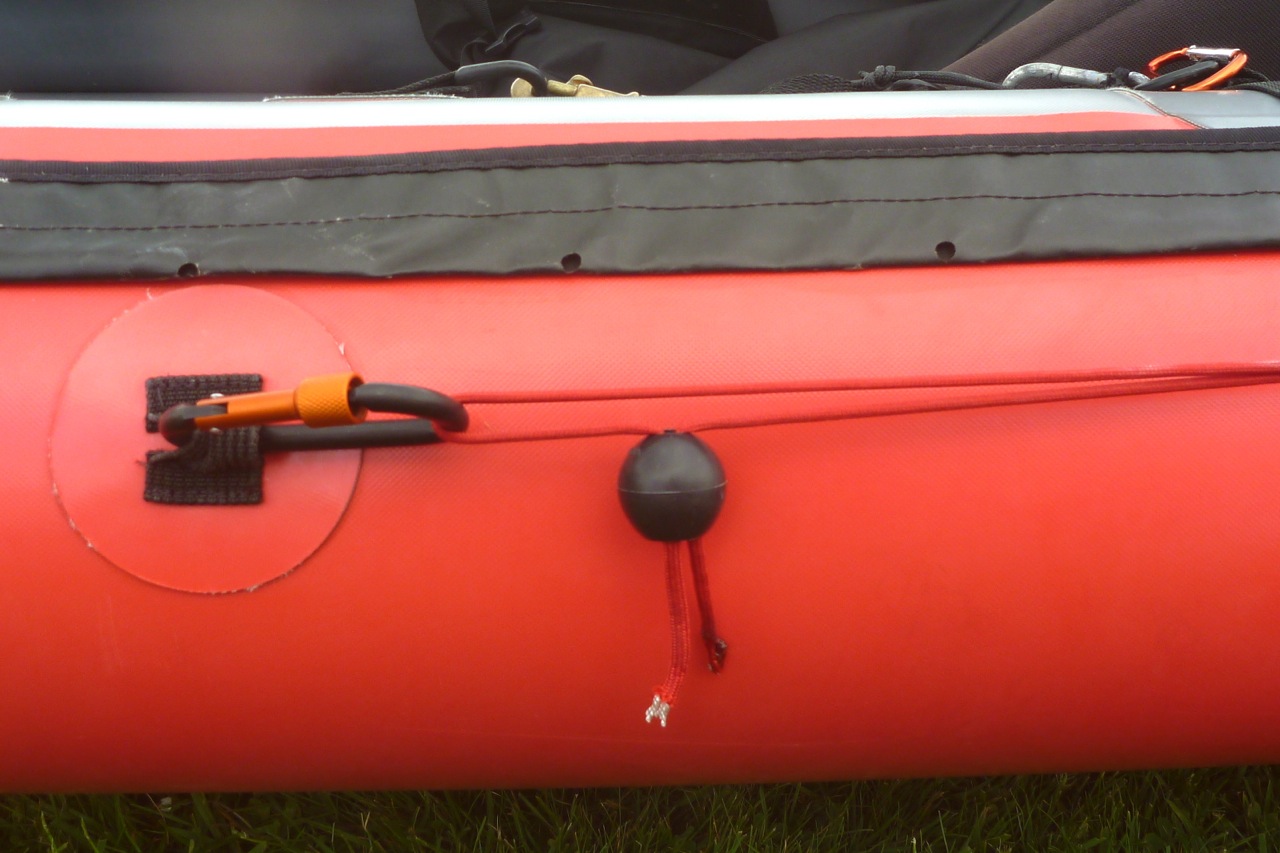
Having owned a ruddered IK helped with setting up the control lines. The threading of the rudder lift/drop line pulley is fairly obvious – the goal is to create as little drag as possible and the many fixtures on the Seawave make this easy. I used bits of yellow fuel line (above right) to make runners for the line which is more or less a closed loop from the rudder sliding through a karabiner hooked to a deckline sleeve left of the cockpit and knotted up to a plastic knob (above left). Haul back to lift the rudder; pull forward to drop. The trick is the get the length right before cutting off the excess cord. I might have done better using zero-stretch Dyneema cord rather than cheaper paracord, but that’s easily changed if need be.
rudyard

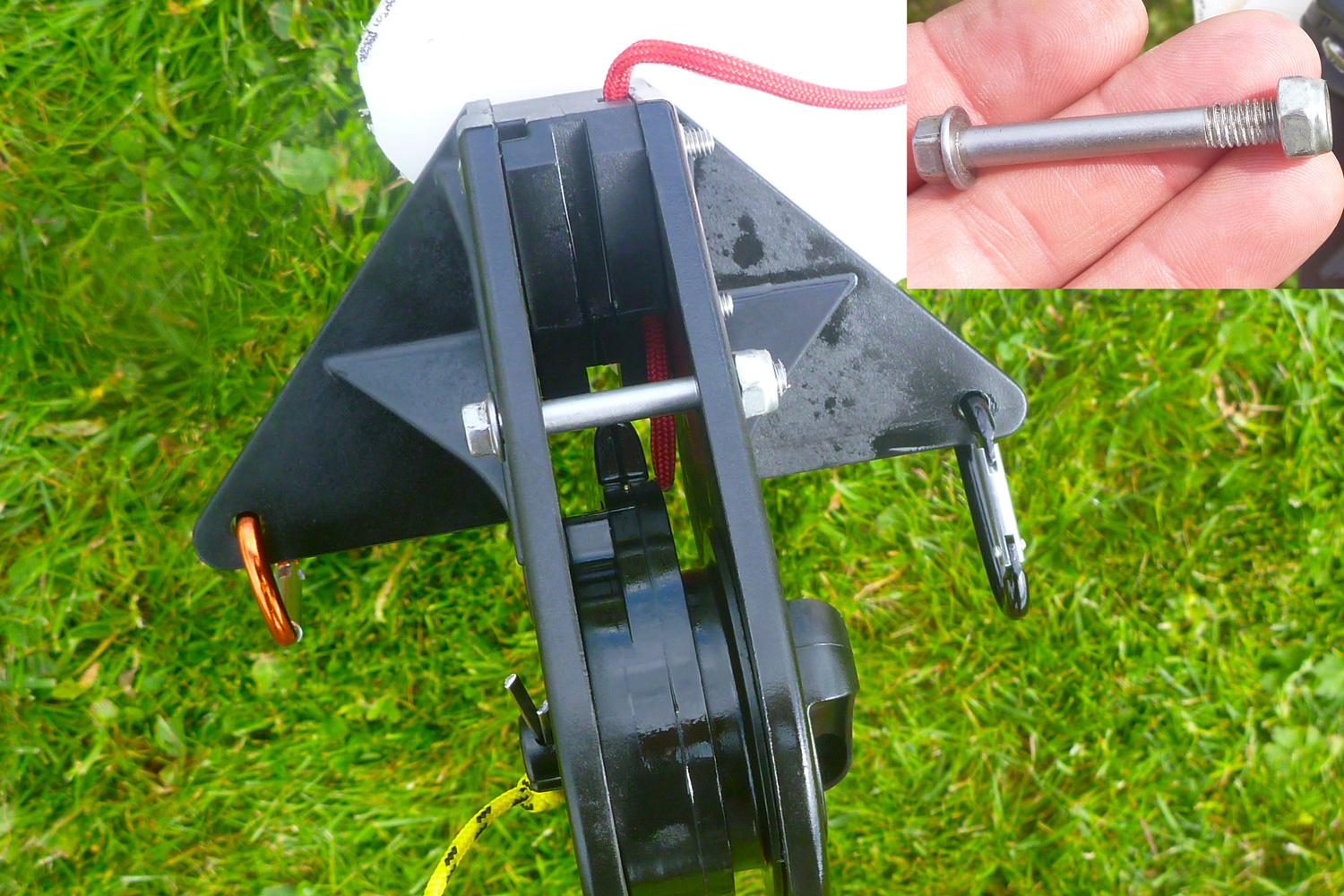
One thing the rudder needed to improve the lifting line’s angle was a smooth shafted M5 bolt running through it as shown left. The holes are already there – maybe it’s supposed to be like that (no instructions with rudder, but you do get 4m of paracord). The bolt isn’t tightened and rolls as the rudder lifting cord passes under it.
rudlines
rud12

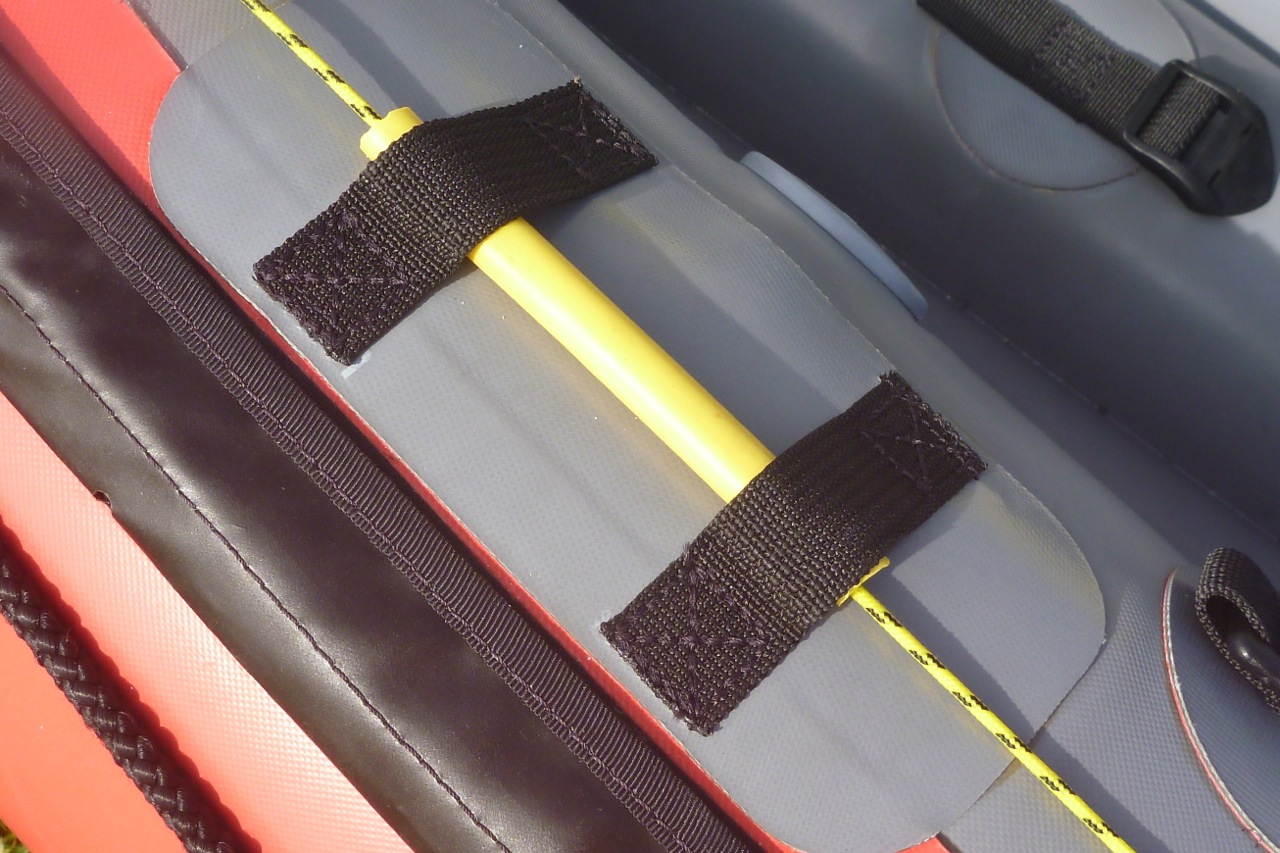
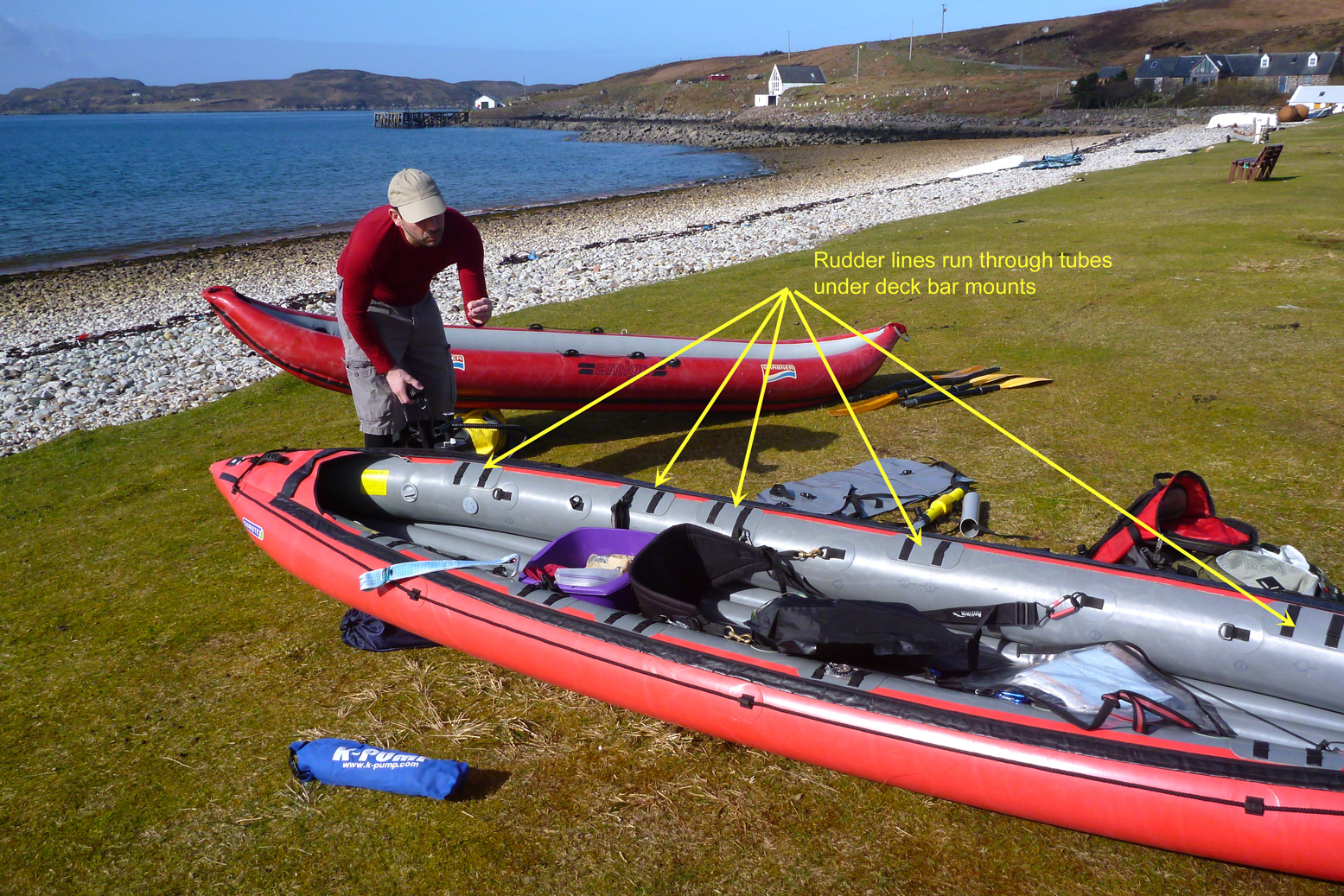
The rudder pivot lines run smoothly through more fuel line slipped unobtrusively under the redundant splash deck tabs on the hull top (right and left).

mull11

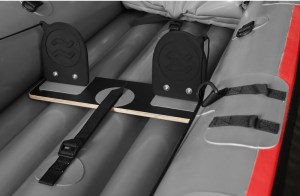
At the foot end attaching pedals to my big footrest tube (right) wasn’t going to work. I thought about using a smaller bit of tube but then decided a plain board with pedals pivoting on it at floor level works best – as Gumotex below right.
rudnee1

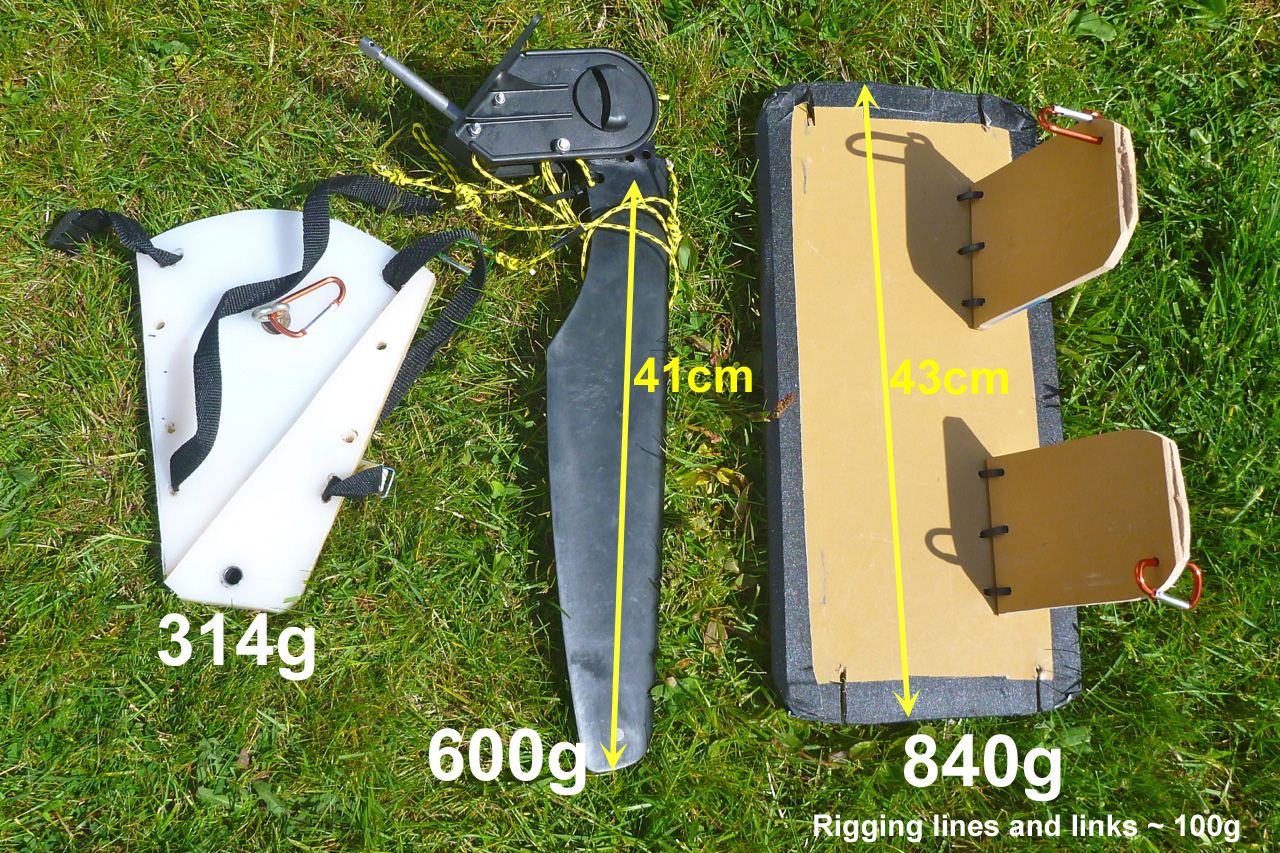
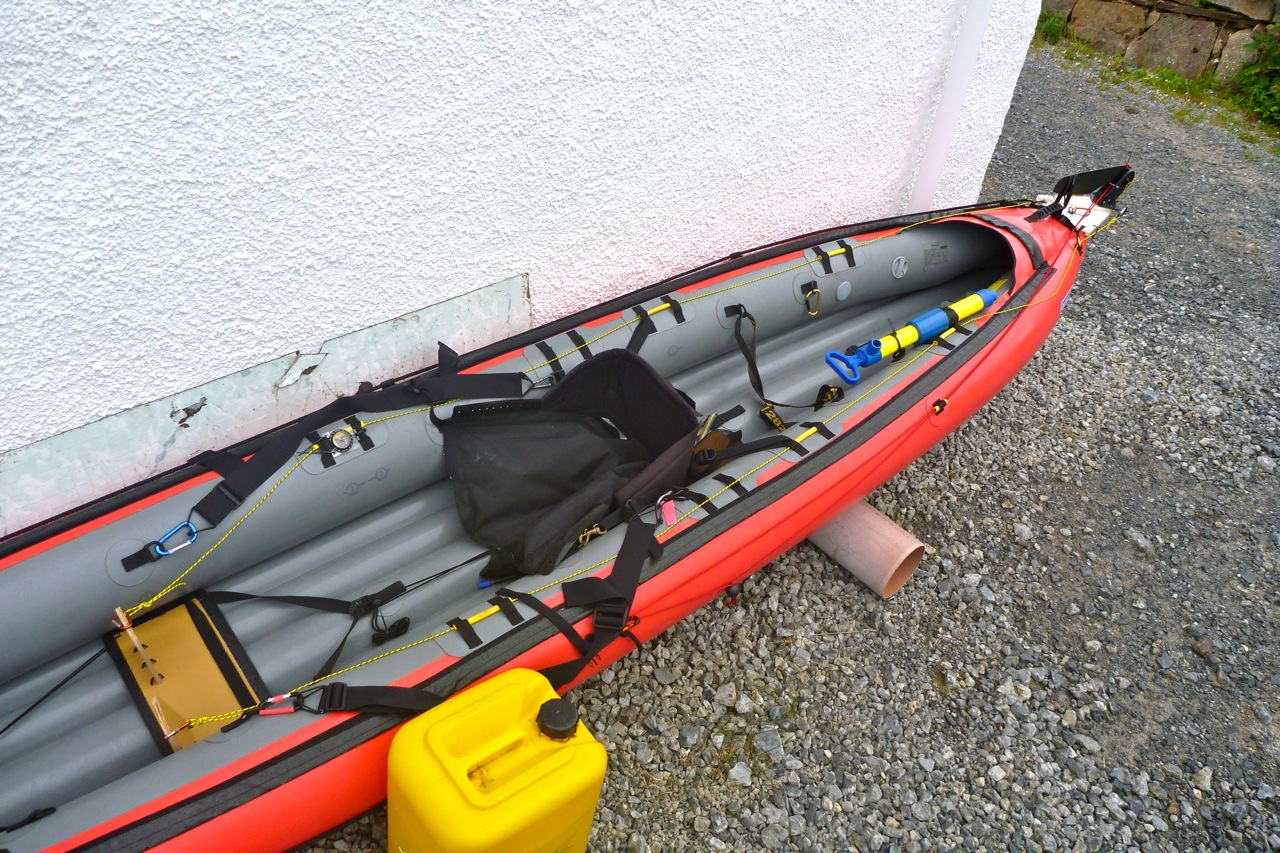
I found a plank of laminate flooring in the barn, sawed it into the right shapes and attached the pedals to the plate with zip-tie hinges so the thing would pack flat when not in use, but makes the pedals stand up which is handy.
This floor laminate was what I found lying around wanting to get the job done, but another slab of kitchen chopping board will be a better long-term solution. At least I have a template just as long as the pedal board doesn’t dissolve at the first splash of seawater.

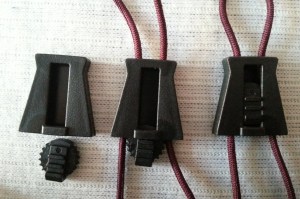
The pedal board is moveable front and back same as my foot tube was (for different length paddlers or two-up) but I need to find some way of fine-tuning the 2mm Dyneema rudder line lengths to match. Something more than a spring cinch lock like you get on a stuff sack that will actually lock the slippery Dyneema cord, but doesn’t need tension like the cam lock cleats I used on my V-Sail. I ordered the wheel locks on the left which should work.
rudnee2
ruddkit

The whole thing took a couple of days to work out using a jigsaw, a drill and a camping stove plus a skewer. If I had to do it all again and had all the bits and pieces at hand and a better idea of what I was doing (ie; this again but better) I reckon it would all take me 4–5 hours. Total weight added is 1.85kg, but I saved 450g by ditching my drainpipe footrest with a thinner version at a quarter of the weight.

The costs were:
• Rudder £19
• Chopping board £2
• 5m of 2mm Dyneema and paracord £11
• Five mini karabiners £2
• Two cord locks £1.50
Other bits and pieces I already had or found lying around might add up to another tenner.
Lessons learned: it pays to think it over: first ideas may give the impression of momentum coupled with intuitive brilliance, but are not always the best.

Next installment: Oh rudder, how art thou?
 

iSUP: a new way to get in trouble at sea

by Gael A

sup9

One day during my annual paddle off western Scotland, while waiting out a gale near Glenuig and enjoying some familiar Highland music (howling wind, drumming rain, crashing waves, whistling guy lines), I lay daydreaming of my imminent summer holidays in Sardinia. What would be the best use of these heavenly three weeks of typical Mediterranean conditions: hot days, warm water and mostly moderate wind? I needed a new way to roam this now familiar place. I’d kayaked the Ogliastra coast several times, hiked most of the hinterland, and wasn’t interested in mountain-biking or climbing. I wanted to try something new and that’s when stand-up paddle-boarding came to mind. According to some fellow paddlers who’d taken up SUPing some years ago, it was particularly enjoyable on calm seas with a light wind, no current and insignificant chop, allowing the paddler to see deep into the clear water below and enjoy a higher-than-normal viewpoint.

Quick iSUP Q&A

How far do you get on a good day?

Between 15 and 20 km. Paddling time is more relevant than distance. Sea and wind conditions have a greater influence on the distance you can paddle. I do usually 2 to 4 hours a day. 

I hope you are standing up and not kneeling or sitting like I often see around here.

Yes I am. Paddling a board seated or kneeling is very uncomfortable. This summer I found out that most SUP owners use it as a kayak with a double blade paddle and some with a SoT seat. 

What is the magical appeal of SUP? It won’t be the speed and range. 
Is it the standing, maybe easier to look around and breathe fully than sitting.
 

More fun. 
I was willing to try something new, provided it would be simple and use a paddle. Setting up a SUP is very straightforward and yes you see more things standing up. When conditions are favourable I like to potter along a craggy shore exploring nooks and crannies then return to base on a more direct route, like I would do with any other paddle craft. 

Do you fall in often?

Not anymore, but it still happens. 

Do you have to watch the weather more or less than IK conditions?

Definitely more. I try to avoid paddling in headwind or side wind, or on complicated sea state : staying upright on a SUP in steep waves is exhausting compared to riding them sitting in a kayak.

sup6

Back home, a bit of sit-down web surfing convinced me a SUP board would definitely be my next beach toy. SUPing is a fast-growing sport (if not the fastest according to some) so there are heaps of manufacturers offering flotillas of models in various materials, shapes, sizes and prices. Moreover, a wide range of inflatable models are available in this booming market, and thanks to innovative drop-stitch technology, most can take up to 20psi, (1.38 bar) making them almost as rigid as regular solid boards. As in the realm of kayaks, iSUPs aren’t as sleek and swift as solid boards, but they’re said to offer reasonable performance as well the usual benefits of inflatables.

How I chose my board
In a nutshell, SUPs fall in three categories: short ones less than 9’ for surfing (the original purpose of the craft) and long ones over 12’ for racing, touring, and ‘downwinding’, which is surfing down big wind-induced offshore swells. Those in between are called all-rounders.

While sales people in shops advise a wide 30-inch plus all-rounder for beginners, web research leads logically to responses like ‘depends on your type of paddling’, just as with IKs. What is my type of paddling going to be? More or less the same as my IK-ing: coastal exploring mostly with the occasional bit of inland – ‘flat water’ touring in SUP-speak. Flat water might be any sheltered expanse of water, lake, river, inlet, channel or bay which doesn’t get too rough under the action of wind, though from my experience and that of many others, such ‘flat water’ can get quite bumpy at times. For that the longer SUPs are faster and easier to keep straight. More length also means more buoyancy and room on deck to carry a payload.
I bought an WSK 12’6” Race ST for around €600 from Kite Spirit near Auray in Brittany, not far from the Golfe du Morbihan, my favourite paddling playground. WSK is Kite Spirit’s own brand and is significantly cheaper than other top brands. It claims to be an original manufacturer, but all iSUPs are made in Asia. Sacrebleu: a French manufacturer using imperial measurements? I feel seasick! Someone call the Académie Française!

Specs:

  • 12’6” long
  • 29” wide
  • 5.5” thick
  • 26.5 lbs
  • 18 psi
  • removable fin
  • 4 cargo D-Rings
  • 1 D-ring on the tail, 1 under the nose

As its name suggests, this board is supposed to be a race board which is why the width is slightly under 30”. Most touring/exploring oriented boards are wider than 30”. They are a bit more stable, but are slower.
ST stands for Super Thick. The advantages of this 5½” (14cm) thickness are stiffness and buoyancy. Stiffness is even more important for a SUP than for an IK. It would be very difficult to keep balanced on a sagging board, speed and manoeuvrability would be poor: for that we have Slackrafts. Buoyancy enables a heavier payload or paddler but it also means more windage. At 12kg the 12-6 ST is very comfortable to carry.

sup1
sup5
sup8

Unpacking the bundle
iSUPs are generally sold with a fin, a repair kit, a pump, a paddle and a carry bag. The 12-6 Race ST uses a US Fin Box: a commonly used slotted box that allows fitting various fin styles. You guessed it; mine is a classic style deep fin for all-around paddling. It’s held in position by a small screw and plate which requires a screwdriver unless you use hand-tightened screws. For both types I use my Gerber multi-tool that goes into my repair kit.

Pump
The pump (1.25 kg) is a tough, simple, single-action barrel pump with a built-in pressure gauge. The weak part is the cheap plastic tube that doesn’t inspire confidence.

Repair kit
The repair kit (183g) includes glue, patches and valve key neatly stored in an orange cylindrical container with enough room for other tools and spare parts. I added the multi-tool and a spare fin screw in it.

sup2

Carry bag
The carry bag is a cheap piece of canvas with shoulder straps which wouldn’t survive the rough baggage handling in airports. However it should survive a journey from a car park to the beach.

sup7

Additional equipment
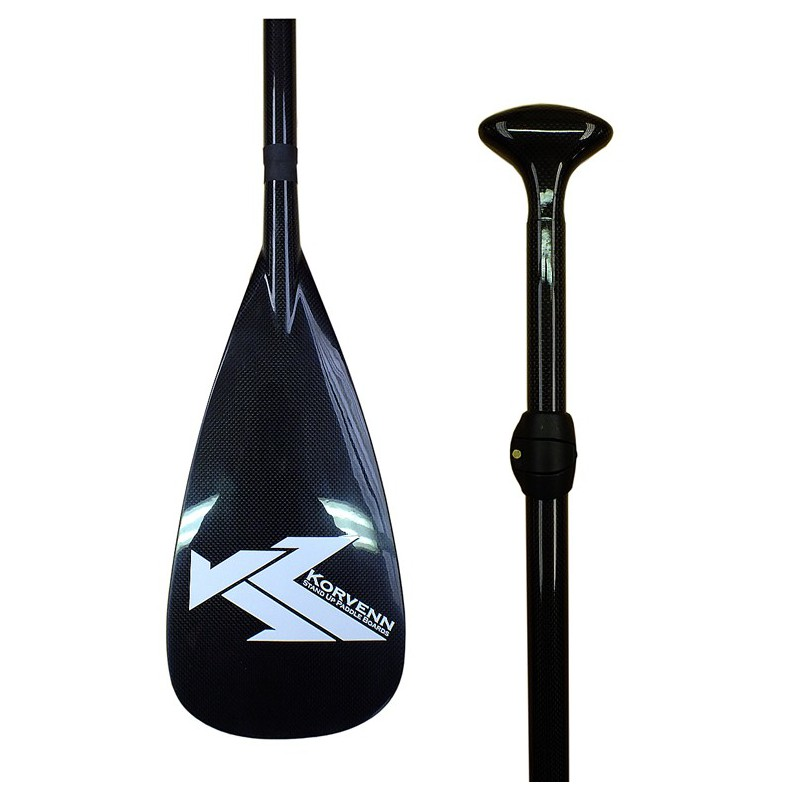
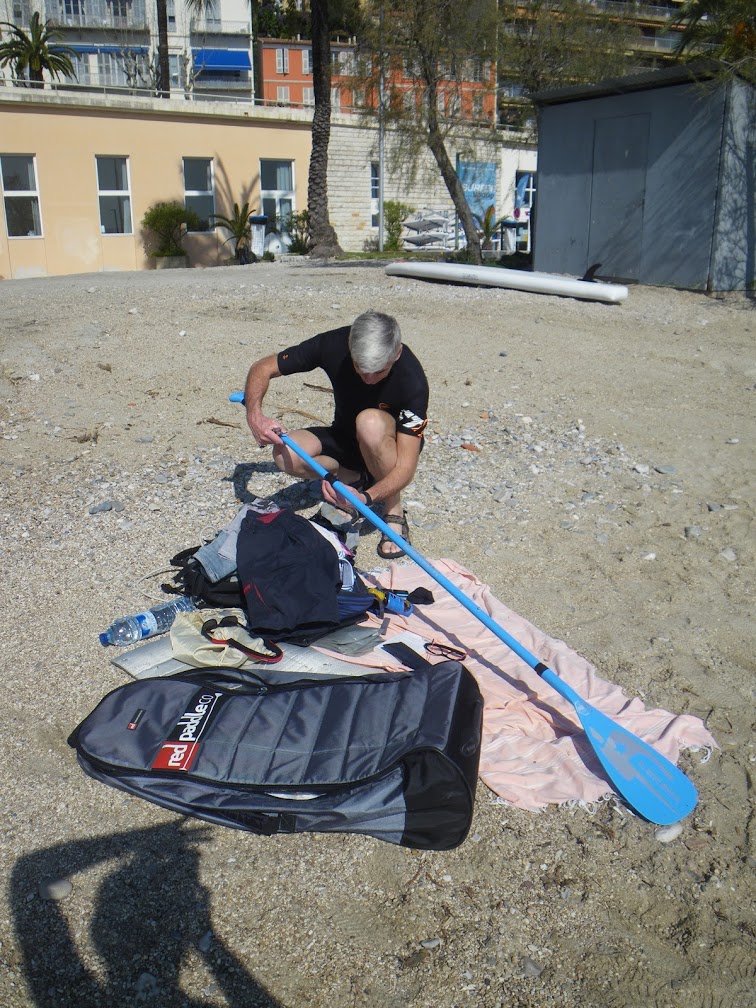
I bought an adjustable 500g carbon-fibre paddle which can be extended to the 225cm length I need. As a spare, I took a three-part adjustable (782g). By putting the blade on the shaft of my two-part paddle, I get a kayak style paddle for handling strong headwinds or swift currents.

Leash
Just as sure as the sea is wet I’m sure to fall off on the water but don’t want to be separated from my board. At sea any inflatable object will be carried away by the wind faster than most can swim. Instead of buying a fancy surf-like leash, I use my old wave-ski one which I also in my IK.

Other stuff
On a SUP you need to carry the same basic kit:

  • Painter / towline
  • Straps, bungee cords or cargo net to lash down equipment on deck
  • Map (in a watertight case) and compass or GPS
  • Safety kit (signalling mirror, whistle, flares, flashlight)

Much like with my open decked touring IKs, all the gear must go into dry bags tied down on deck. Multiple cargo tie-downs allow for a large quantity of gear to be carried on the nose and tail. While my 12.6 ST sports four D-rings on the front deck, I purchased four more from the local Red Paddle reseller (sold without the plastic ring) to be glued on the rear deck.

sup4

On the Water
End of July I got a chance to try out my SUP. On that day, after a late lunch the sky darkened with ominous black clouds over the Sardinian mountains. Most people left and we had the beach for ourselves – all the better for my first attempt at riding my board.

Conditions were perfect: no wind, flat sea, incredibly warm water. As advised in all beginner lessons I’d watched on youtube, I put the board in a foot of water with leash attached, knelt on it and paddled 20 meters then tried to stand up.
I knew how hard it would be to just stand up and maintain balance and had imagined the first 20 minutes would be very frustrating for me and very entertaining for the spectators. Actually they were, even though the only onlooker was my wife.
To make things worse, I made some mistakes like wearing my Tevas instead of barefoot, not washing the sand off the deck, and falling forward on the board, as I did when I tried to stand up. Next time I fell in the water and soon I was exhausted. My knees were raw, my hands were bleeding and my chest and forearms sore from rubbing against the board.

supi

Within about an hour, spent mostly swimming alongside my board, my balance improved enough to look up from my feet and make my first forward strokes. Like a kayak, the pressure of the paddle on the water provides some lateral support and when I gained some forward momentum I felt significantly more stable and my confidence increased. Now I could stand for 20 minutes at a time before falling while trying to turn too sharply or tipped off by the wake of some motor vessel.
The next challenge was to paddle straight. Since a SUP paddle is single blade, giving several strokes along one side then the other causes the board to yaw, even if keeping the paddle as vertical and as close to the board rail as possible. Although it proved impossible to achieve a straight line, switching sides about every 4 or 5 strokes produced an acceptable S-line while maintaining an almost continuous paddling rhythm. in spite of my precarious stance, my awkward paddle strokes were effective enough to drive me and my board along the desired route and reach the spots I was aiming at (buoy, yacht at anchor, jetty). The more proficient I grew, the more direct my course and the faster my pace became and the less I fell off.

Upon reaching my target I had to execute the next manoeuver in the learning path: turning. SUP turning manoeuvres are very similar to sweep and draw strokes with as a kayaker, with a big difference: in a stable IK, I wasn’t punished by a dip when I got it wrong!

supa

A kayak has inherent static stability and a lower centre of gravity, plus the paddler is wedged in his cockpit and integral with the craft. That is not the case on SUP. Any force on the paddle tended to pull me off the board before the board turned. I had to bend my knees to lower my centre of gravity and pay even more attention to my balance.

Coping with headwinds
While paddling a kayak into a headwind can be frustrating, paddling a SUP in the same conditions is sheer drudgery. The board itself has a very low profile but the windage of the standing paddler is huge. In addition to the effort required to push into the wind, you of course have to deal with the wind-induced chop which sometimes gets the better of you.
The recommended tactic in a strong headwind is to kneel or sit: less windage, better balance. Should I have to paddle a long way against a stiff breeze, I’d replace my paddle handle with a blade and paddle kayak style.
On days when the grecale blew across the Tyrrhenian Sea I paddled up to a harbour breakwater. After a 50-minute slog and a bit of rest, I returned to the beach in 10 minutes, carried downwind by the breeze and gliding along the choppy waves.

bladdersleeve

Next steps
My last year vacation ended before I got confident enough to try an overnighter. Now summer is almost there and I’m prepared to resume my SUP education. I still need hours of practice to improve balance and achieve longer paddling times before attempting a ten-mile coastal trip. So far, after an hour on the board, I badly need some rest. And SUPing makes me very thirsty too. In calm conditions I could grab my bottle of water when paddling, but not in windy conditions. I might consider buying a fancy hydration vest, or just slit open the back of my old pfd for a water bladder, as Chris has done (right).

sup-morb

2016 Seawave with rudder option

Seawave main page
My MYO rudder (MkII)

gumrud2

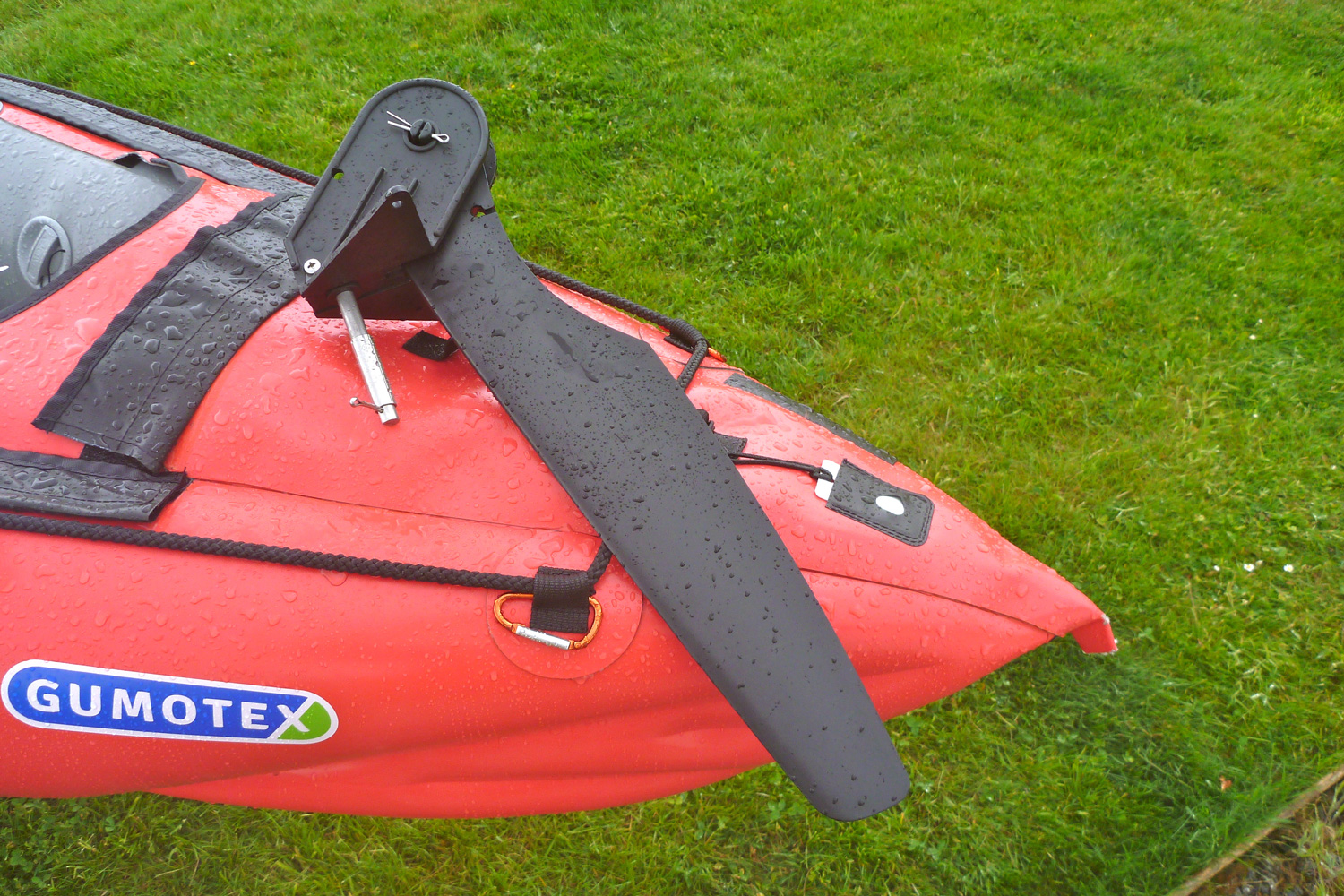
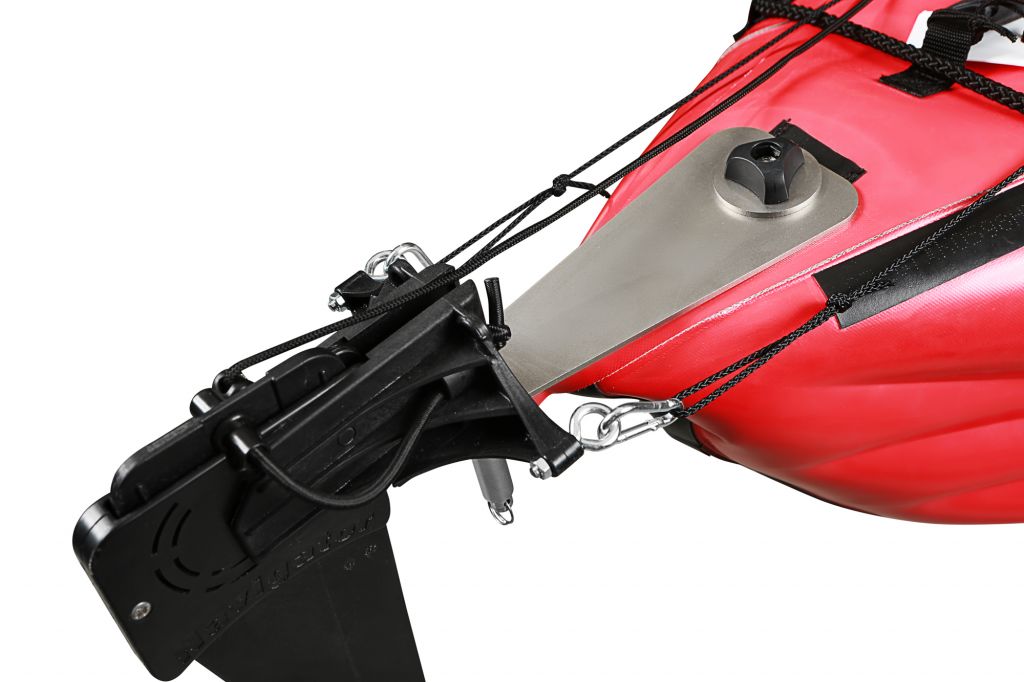
The 2016 Gumotex Seawave has had the stern slightly adapted to take an optional rudder kit. They’ve also improved the velcro bands for the optional deck by using Nitrilon, but it’s the rudder that’s the interesting development.

P1150820

Coincidentally, I was  halfway through adapting a cheap SoT rudder for my Seawave (left) and the factory version (going for £200) gave me some good ideas. The Gumotex rudder kit could be easily fitted to first-model Seawaves, and possibly to other Gumboats with similar triangular stern decks.

gumrud61

For the time it took to make mine I could have fitted a Gumotex kit ten times over but with only these pictures I was unsure exactly how it was secured. I suspect there’s an additional unseen plate underneath the stern decking to help jam the whole set up securely into the back triangle of the boat. I also believe they supply some stick-on velcro which goes behind (aft of) the black knob. Otherwise the plate would be prone to distortion under rudder forces, or give a mushy response like I got that on my prototype version.

gumrud4

The Gumo’s rudder’s retraction method is a pull-up-and-in, (left) whereas my was a more conventional swing-up-and-over which puts the rudder right out of the way over the back of the boat. IMO this is better for negotiating tight turns in narrow sea chasms where an unexpected swell could crunch your protruding rudder blade.

gumrud1

At the pointy end the pedal board looks reassuringly basic (and easy to copy) and the only obvious difference between an old Seawave are the two line guides on the stern deck (right) which I added to my boat to make a straighter, drag-free pull on the lines.

gumrud3

Hilleberg Nallo vs Vaude Odyssee 2P

See also:
Terra Nova Laser Compact 2

tent in sea

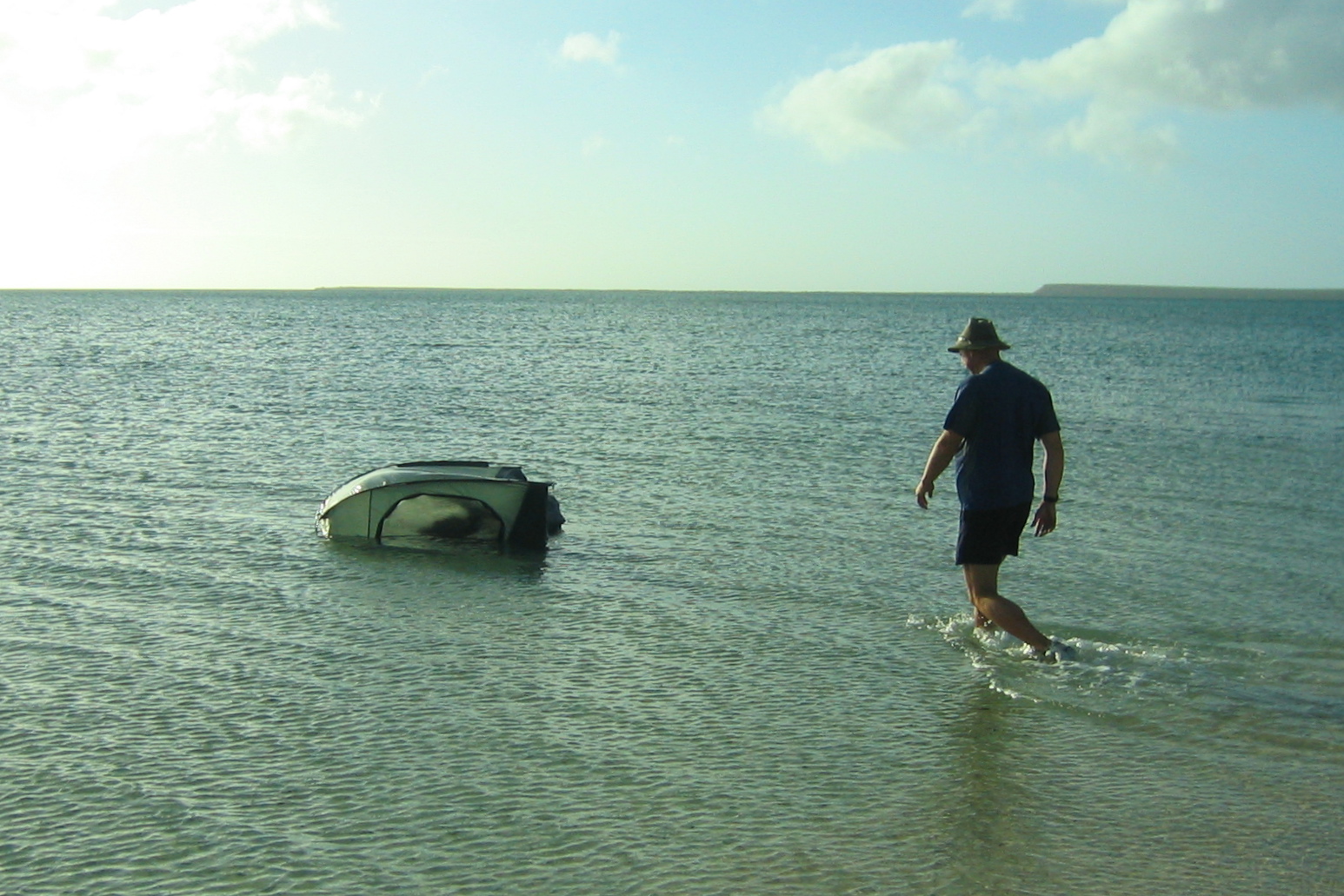
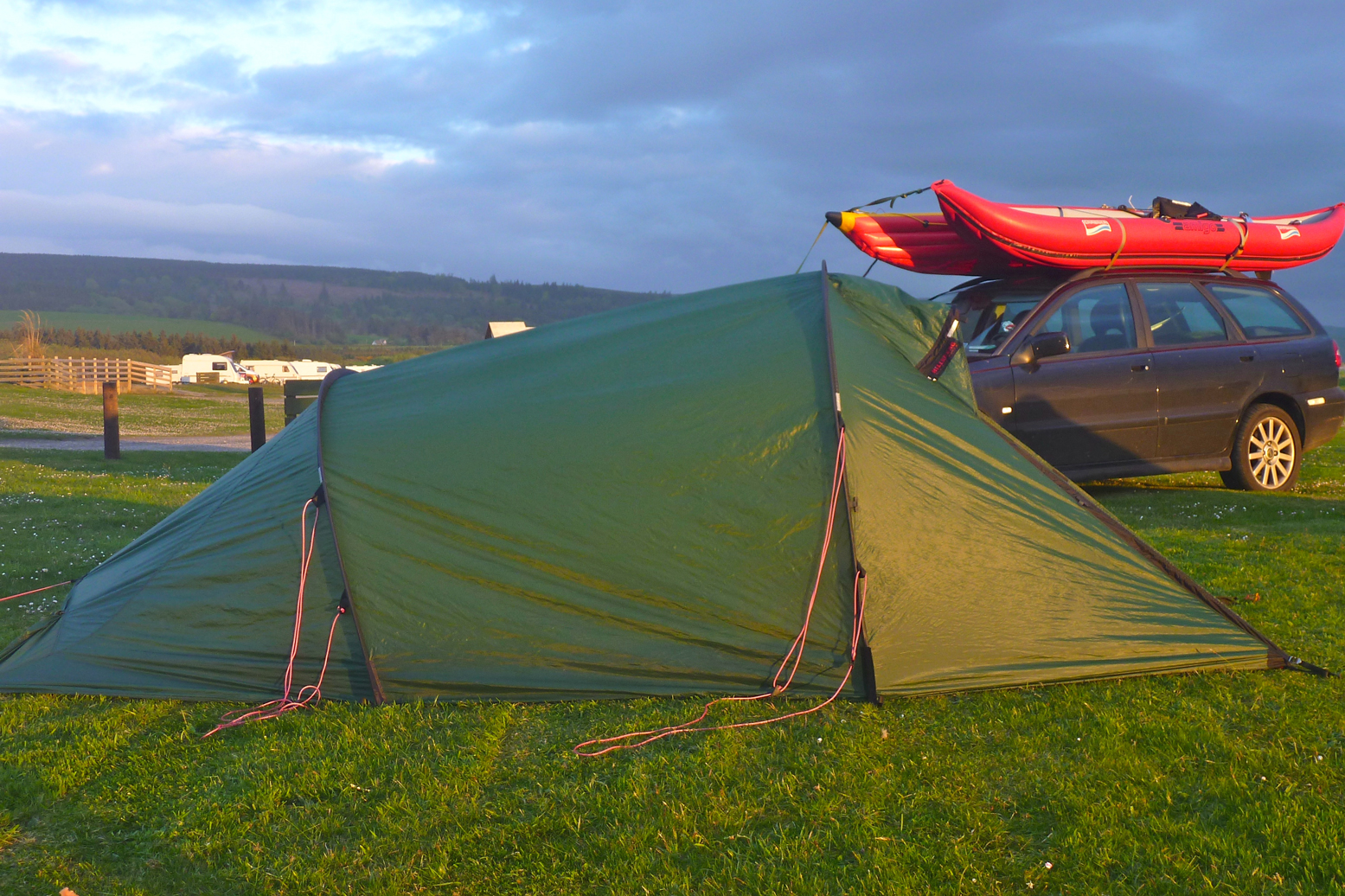
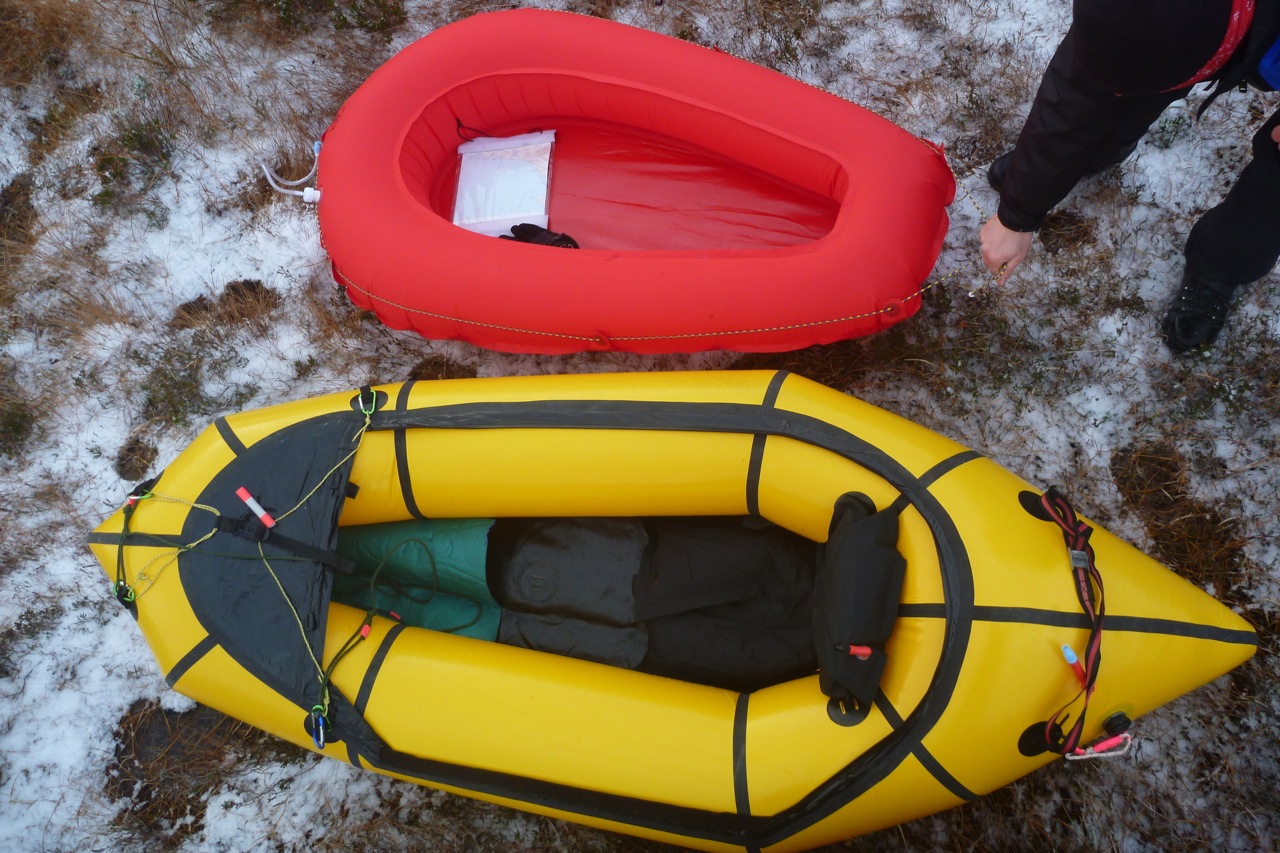
What makes a good packboating tent? For me doing a bit more Scottish sea kayaking than packrafting these days, super light weight is not that crucial. Better to have something that is easy pitching and spacious so you can sit out rough weather. And then when some packrafting does turn up, have the ability to use just the fly or inner to save weight and bulk. On occasions I’ve used a cheapie tent’s inner as a mozzie dome, just as long as I remember to keep it weighed down before frying up the brekkie on a windy morning in Shark Bay (left).

postnallo

A couple of mates have used the legendary Hilleberg Nallo for years, so when I found one cheap in the US I gave it a try. Sure, for me the Nallo (left) may have been OTT in an ATGNI sense, but with its reputation and residuals, I knew I’d not lose on it.
I liked the Hillie’s all-in-one pitching, the options to pitch outer (with footprint), inner only (or an optional inner mesh that was also included). This made it as potentially as light as my old Black Diamond Lighthouse, but much roomier. I also like the roomy front end and porch.

postbiv
flagsun

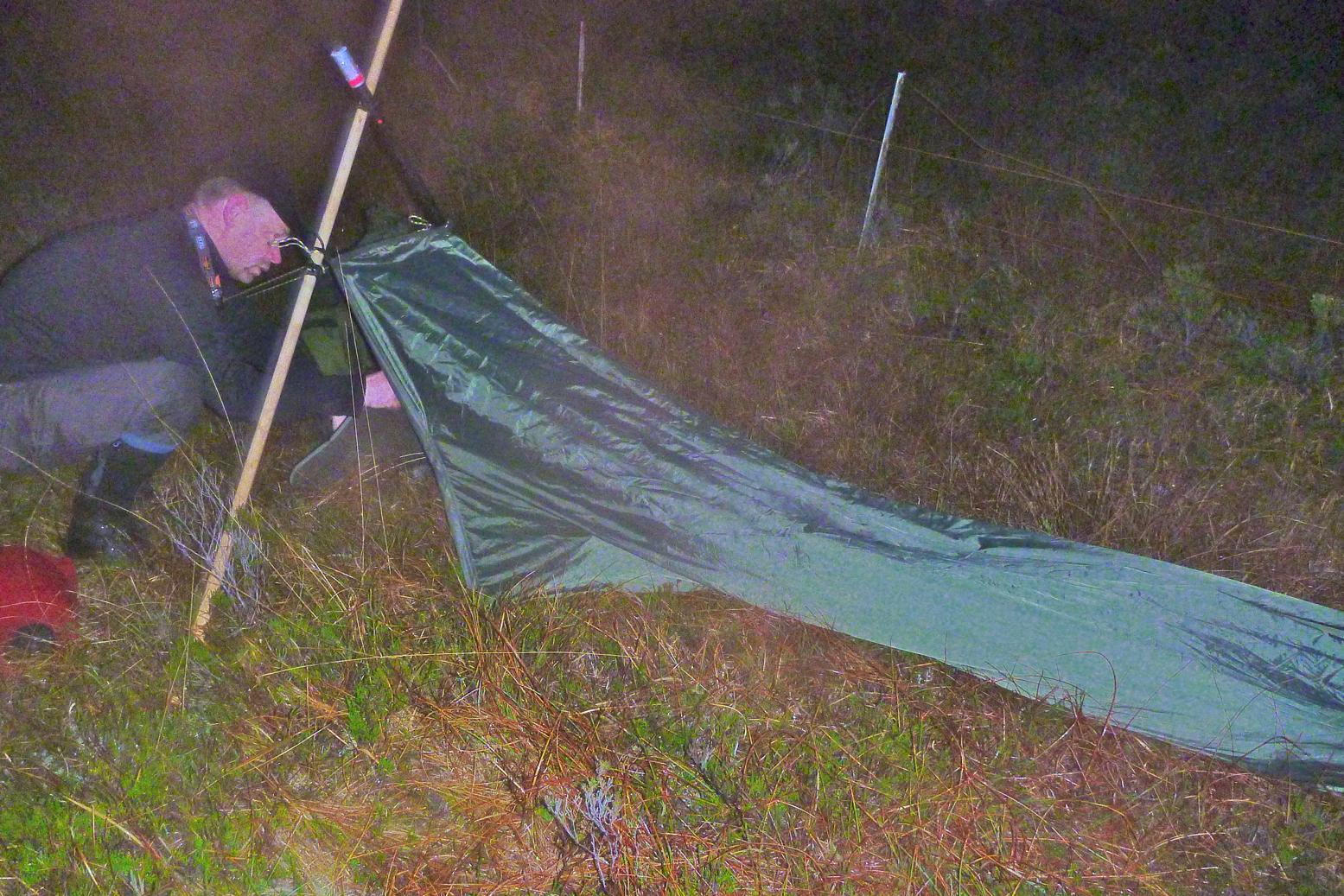
I thought it would fit the bill, but getting caught out one winter’s night on the Postman’s Path on the Coigach (below) proved that, while it may stand up to 60-mph blasts like they say, its unsupported flanks flapped like the flags outside the UN building during Hurricane Sandy. My hardcore mate crammed himself into his bivvy bag (left) and had a quieter night, even if he could barely move. On a windy nor’western night, for all that money the Nallo was no quieter than my old Black Diamond.

postpath
nalodims

On top of that, the Nallo may claim to have a floor that’s 220cm long (a minimum requirement for me) and have a huge porch, but the way it slopes down at the back where the blowing wind presses (right, and in the video below) meant I still ended up with an annoyingly damp end to my sleeping bag. Just like the too short Lighthouse.

naloe
naloin

I’ve since read that Hilleberg recommends pitching a Nallo porch into the wind, but as this discussion suggests, that seems rather counter-intuitive – unzip the door and the thing will fill like a sail while blasting you with horizontal rain every time you get in and out.
They say the Nallo-style tunnel design gives the lightest weight for volume. I’m not sure that’s true anymore, and those unsupported flanks make a racket plus inside, my Nallo was always a saggy affair (right), however I pitched it (left). While paddling the Slate Islands I took the chance to get some good ebay pics and sure enough, flogged it for more a little more than it cost me.

It was good to try the Nallo experience for free, but now I had a better idea what I wanted for my current camping prefs: the Nallo’s better attributes but not in tunnel form. I considered four-pole mountain tents like the famous Quasar or more obscure Crux X2 Storm, but the doors were small, they didn’t do inner or outer only, and prices were a bit high for my low level of usage. Crux’s foam spacers to separate the inner and fly to enable better airflow was an interesting idea – or an admission that condensation was a problem.
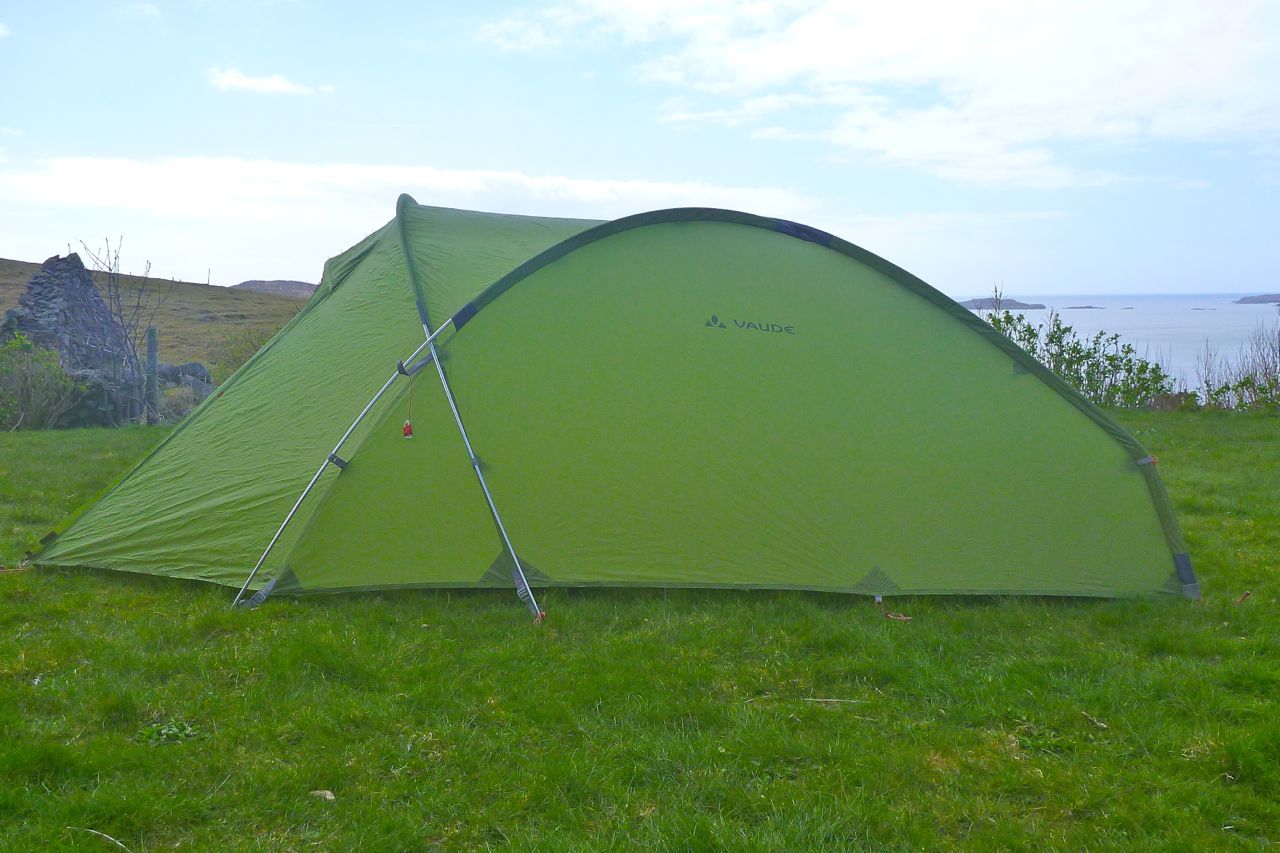
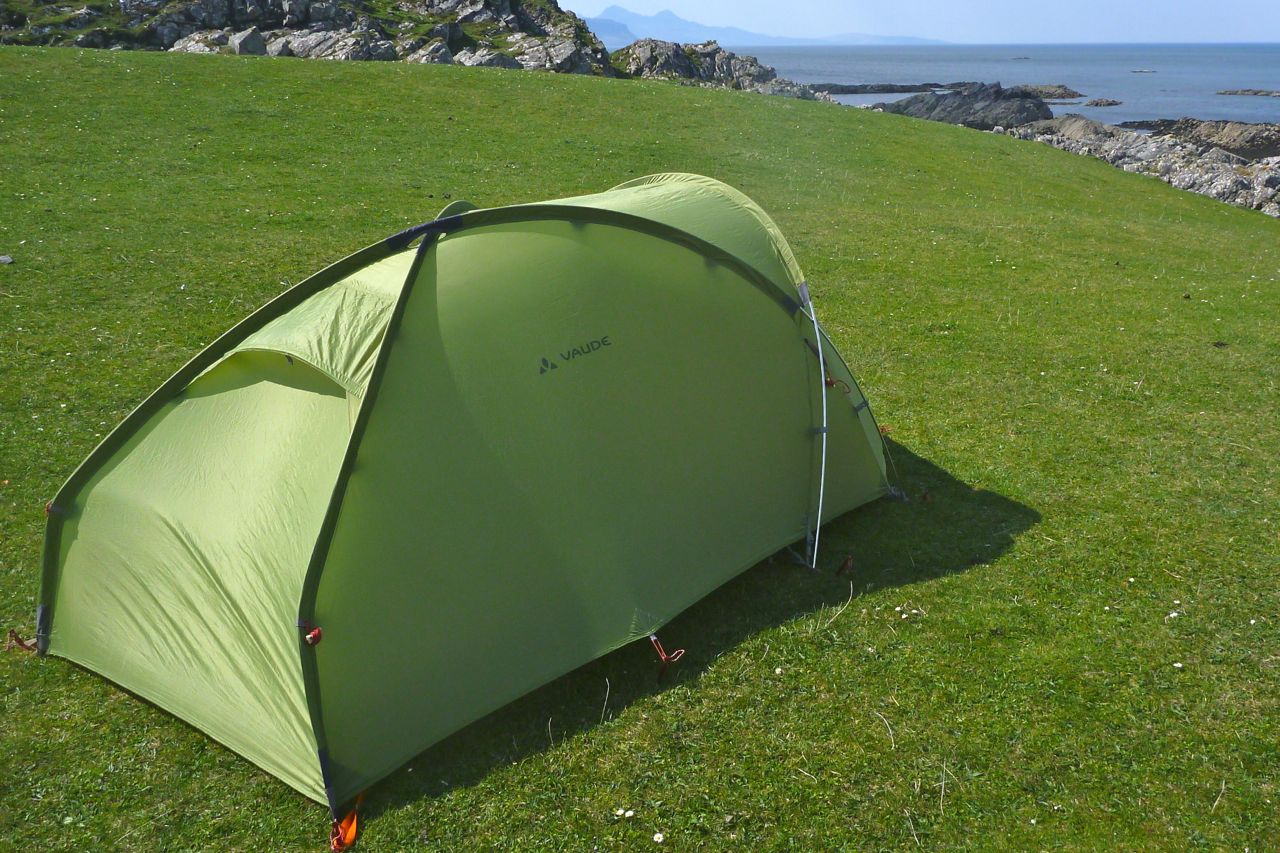
More tent spotting uncovered Vaude’s Odyssee which used a similarly stable 3-pole set up while having many of the other features I sought.

vaude-03
vaude-01

Vaude Odyssee L 2P

The Odyssee ticked all the boxes for my sort of camping out of boats or riding a moto.

• Inner and outer attached helps speedy, all-in-one pitching
• 3-pole system copes in strong winds and makes a taught, flapping-reducing pitch.
• Almost self-supporting so can be easily repositioned or pitched on hard surfaces which can’t be pegged
• The steep back end may catch more wind but means the full 220cm inner length can be used. This is a great feature for me – no more diagonal agonies or damp sleeping-bag foot from pressing against a sloping inner, as on the Nallo.
• You can pitch just the outer, saving 700-odd g*, if insects, moles or temperatures aren’t an issue – and I’m pretty sure you can pitch just the inner (saving nearly a kilo) as a mozzie dome.
• Scrunches into a football-sized bundle and the poles break down to 44cm for compact packing.

All these attributes along with the reasonably light weight – ready to go at 2.6kg made the Odyssee 2P a great-value and versatile 1 or 2 person tent. It’s only 280g heavier than my Nallo, and while I presume the fabrics are inferior (“30D ripstop Polyester Silicone/PU coated 3000mm head; floor: 70D Polyamide PU coated 7000mm head”) it was much less than what my Nallo would have cost new.

* My dimensions may not match other sources

The inner ‘washing line’ and loops to attach an optional roof net are handy, as are the pockets by the door. The 75-cm deep porch is smaller than the Nallo but roomy enough, and the zip arrangements make it easy to control ventilation and maintain privacy. I’ve not had much condensation, but that must be just luck and breezy nights. Even with a breeze, the Nallo was terrible for condensation, partly because the flysheet ran right to ground level. The other night, gusts over 20-25mph in the Odyssee woke me up and I lay there thinking ‘she cannae hold, Cap’n’ until I remembered my earplugs and soon fell asleep. I’m told most modern tents with < 4 poles will make a noise in strong winds. As long as you know it’s as well lashed down as can be and can take the hammering, just turn over, plug up and pass out.

vaude-10
msrgh

First time out one peg bent when pressed in by foot. So I pulled out my bombproof MSR Groundhogs with nifty pull-out loops (right).
The Odyssee takes about ten minutes to pitch without hurrying and some faffing with the footprint (from the old Exped), and will stand with a minimum of two pegs staking out the porch. Two more at the back help make good tension, and using every dang loop and all six guys needs 16 pegs – you’re now ready for a gale and I suppose a pole will snap before it rips (there a pole repair sleeve included).

vautorn

Other small annoyances are the two long poles catch the fabric pocket seams at the back – make sure the pole ends sit fully in the end of the pockets or you’ll over-tension them when clipping in the front end. And the pole-end locating pegs sometimes come away on the elastic cord which can be fiddly to reposition with the cord knot. I’ve fixed that with a dab of rubber glue.

nimwax

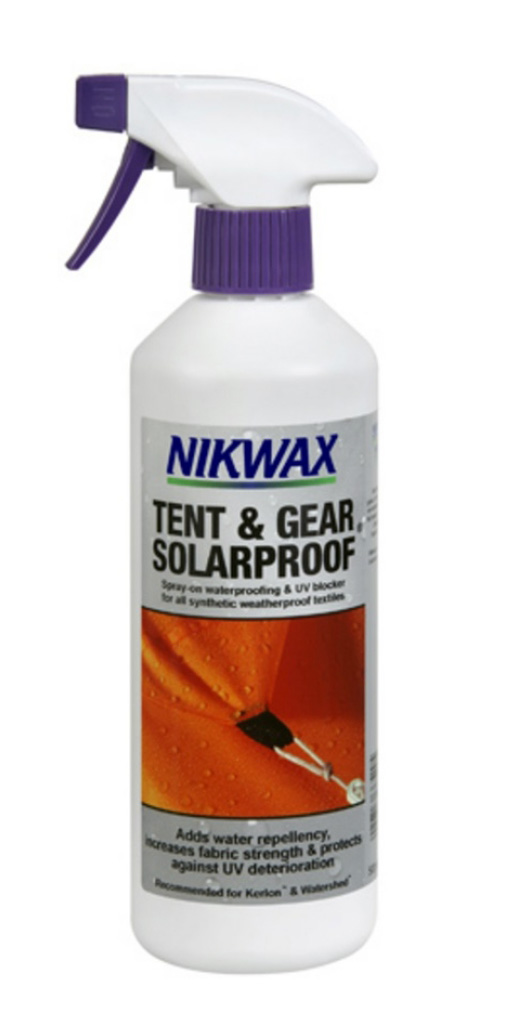
I’ve only had normal rain until 2018 when I used it on the Tarn without the inner. In really pelting rain verging on hail a light spray came through the fly and there was the odd drip from the seams. Had I used the inner would have settled on that and evaporated later, but it didn’t so all was a little damp. The flat roof doesn’t help. I wonder if even a 3000mm hydrostatic head (over twice normal) is not enough for really heavy and prolonged downpours. I see the Kerlon 1200 on the Nallo is rated at 5000mm. When I got home I sealed most of the roof seams and sprayed it all with Nikwax. We’ll see if it made any difference on the next big downpour.

tik

Inner hangs from the fly; pitches all in one, like a Nallo
Can pitch inner or outer only
Nearly self-standing
Roomy inner in all dimensions
Long, flat roof gives good headroom
Roomy porch; quite easy to get in and out
Stable 3-pole set up

cros

Boring old green
Bendy stock pegs
In pelting rain a light spray passes through the fly if no inner used. Since re-proofed and seam-sealed
Collapsed poles are a bit long at 44cm

vaude-08

Adding latex socks to Kokatat Dry Pants

kokoswift

A few years ago I wrote:

… I deliberately chose [these Kokatat Swift] dry trousers with no sewn-in socks as my drysuit has those. With the Swifts … I’ll just wear short Seal Skins and have no worries about the sewn-in socks getting holed by gravel. Time will tell how they wear and perform. 

Well, I’ve changed my mind. I’ve never been convinced by the Goretex/membrane magic; at least not for hillwalking – I get too hot and sweaty. But making less heat paddling an open kayak on a cool Scottish day, the stuff seemed to work. It keeps out the splash and light rain, but because the leg muscles are inactive, sweatiness is barely apparent. Using a regular eVent hiking cag on top produced more mugginess, but nothing as bad as on the hill and easier to control with the front zip and adjustable cuff cinches. Unlike a hardshell, for an IK there’s no great benefit to buying a regular kayak cag with a waist seal as there’s no cockpit spray skirt to seal it against. If you really want to keep dry all over, just use a dry suit.

omnio

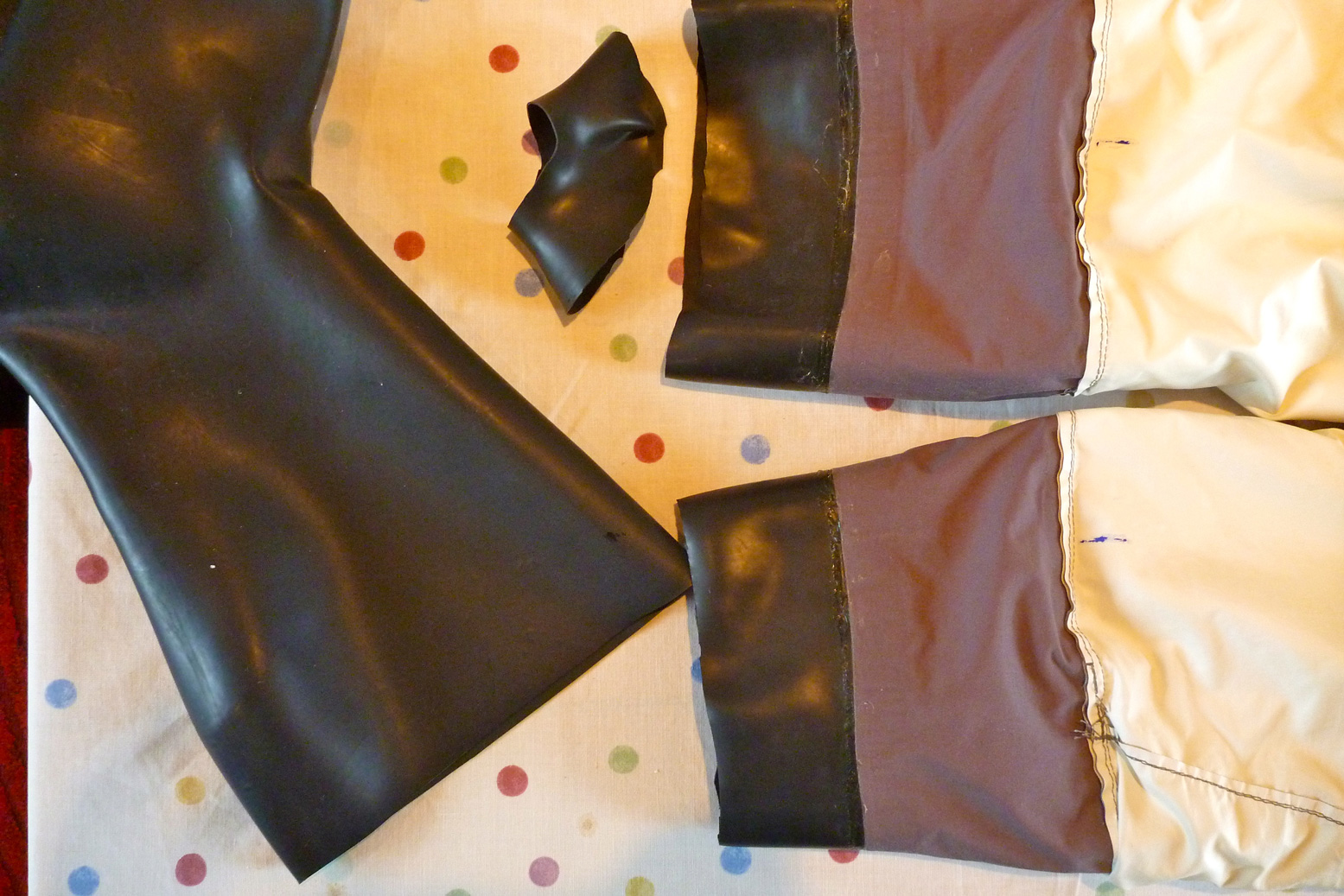
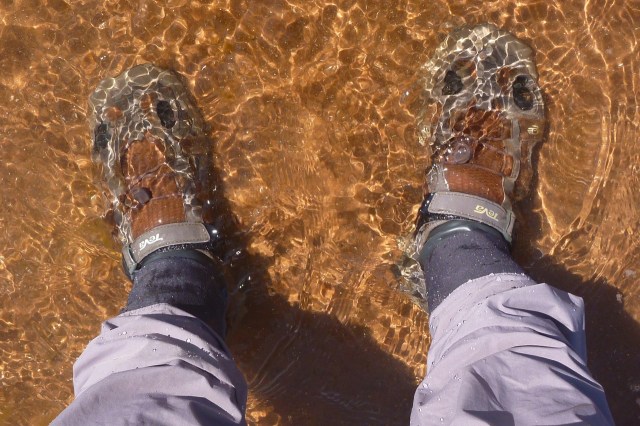
On one trip I found that the Swifts with knackered SealSkinz didn’t really work. ‘Waterproof’ SealSkinz only last until the clingfilm-like membrane goes. Then they become saggy sock-bags with insulation qualities no better than woollen socks. In fact, they may well chill damp feet. Wearing my slowly dilapidating Teva Omnium water shoes (left), I now think it’s better to seal feet properly with latex socks. IMO latex is easier to repair than socks laboriously made from off-cuts of membrane fabric which, like all that kind of stuff, has a limited life span, especially under the grinding weight of a foot. Bizarrely, I see most don’t make dry pants with integrated latex socks, only membrane, which must be a a cost or maybe a UV thing. Anfibio is an exception. But you can easily buy dry pants with latex ankle seals and glue on latex socks which are readily sold individually for around 20 quid.

latexer

Gluing on latex socks
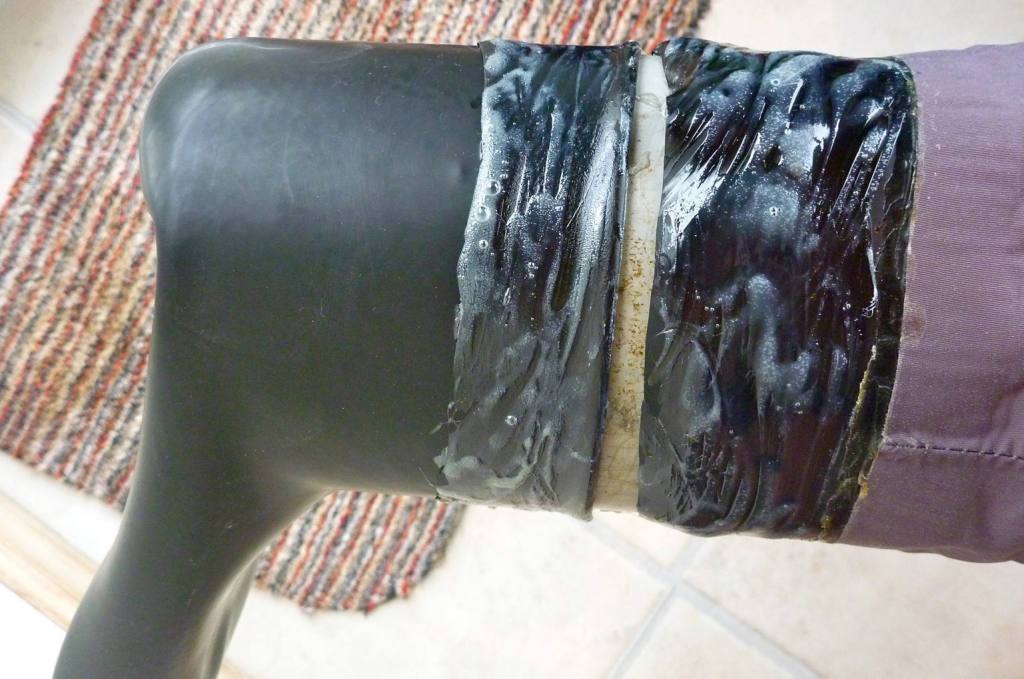
First I trimmed the latex on the trousers and the socks to similar lengths. Getting a circumference match is important if there’s to be no leak-prone creasing once they’re joined.
You’d think gluing latex socks to latex trouser cuffs would be simple. Not so it seems. My first go using regular rubber glue didn’t take to the shiny outer surface of the pants’ latex.

ami-poly

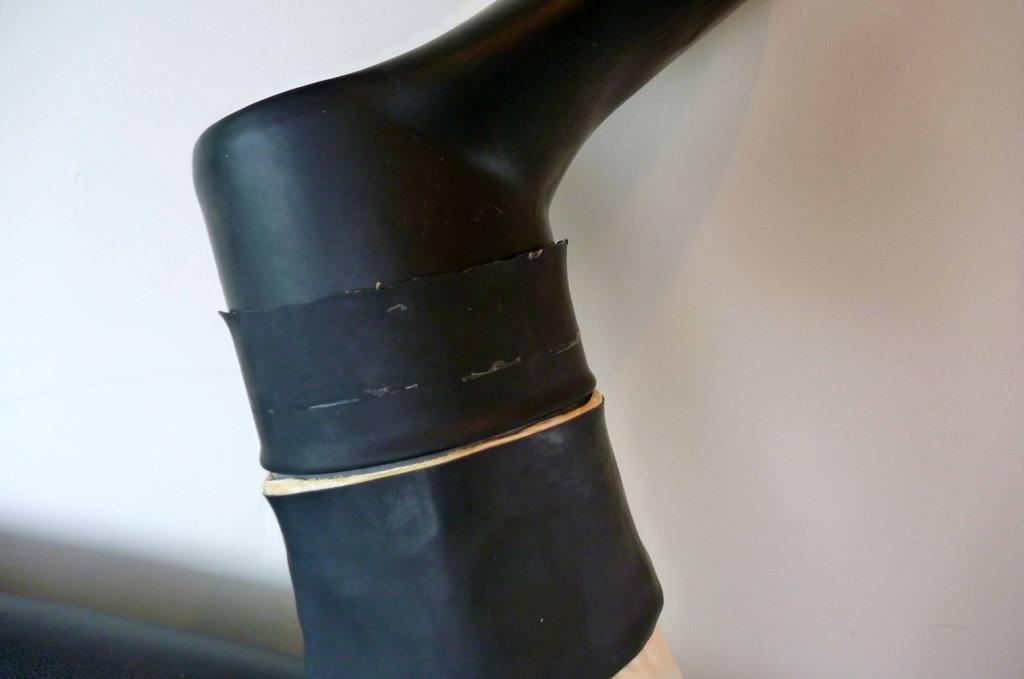
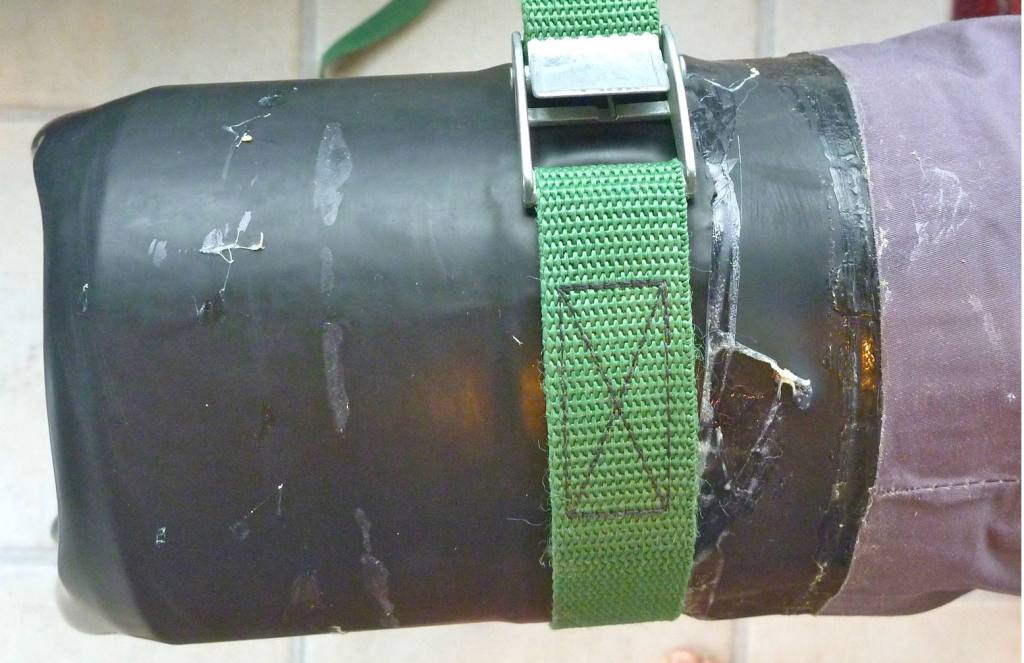
I read of using two-part adhesive, even though that refers to the tricky latex-to-dry suit fabric seal, not similar latex. So with the leg and the sock remounted on a piece of 5-inch plastic drain pipe (below), I tried again mixing up some PolyMarine Hypalon adhesive. This stuff sticks like a velcro electro-magnet, but curing times are lengthy and there’s the whole faff of getting the 25:1 mix correct.

latii

I folded back the sock about 3cm on the pipe end and nudged it against the exposed trouser leg cuff (left, above). When the adhesive had cured after 30 mins, it’s another coat (middle), wait 3 mins then just roll the sock over onto the leg and lay in with the roller then strap it up for a couple of hours. There was one small leak, easily fixed.

When cooler weather requires them but you don’t want a full-on drysuit, these fully sealed pants have been great. I can wade right in without getting wet feet, and wearing regular socks underneath the latex is are warm and comfy. A few years later one sock started leaking; a tiny hole, easily fixed with a dab of Aquaseal. They say latex is prone to UV so is best kept out of sunlight (which is why latex cuffs are often covered) and given the odd squirt of 303 UV protectorant or NikWax Solarproof.

Seawave vs Gumotex 410C + skeg-rudder mod

Seawave main page
The Solar 3

gumsee02

I had a visit from former Olympic slalom trainer and canoeist Jim the other day. He bought a Solar 410C after browsing IK&P and declares it one of his favourite boats. I ran the previous version Sunny for years before I felt I’d squeezed all the potential from it and started changing IKs every year. The Sunny was a tough do-it-all boat and the 410 is the same, but 20cm longer. It was more space but also the greater rigidity of higher-pressure boats I was after.

qef

We were hoping to go out for splish-splosh but for the last few days a cold offshore F4-5 northerly has been spinning off a North Atlantic High and bearing down on the Summers so games are off. Right now the chilling drizzle is nearly horizontal as it blows past the window. Oh hold on, it’s gone sunny now. Is it autumn already?

gumsee03

The 3-seat, 410cm Solar went for as little as £550 in the UK or up to £100 less from Boatpark in Czech when on special. Both do free delivery anywhere. The Seawave costs about half as much again.
The 410 is a foot shorter than my Seawave, an inch wider maybe, less slim and pointy at the ends and runs 0.2 bar/3 psi compared to my Seawave’s 0.25 (I run my Seawave sides at 0.33/4.8psi). The old style Nitrilon is thicker so the weight’s the same at 17kg, maybe less with one seat. The Seawave has a bit of a more pronounced keel rib along the middle too, but neither struggle to track without a skeg. It’s just that a skeg enables you to spend less time and effort correcting and so you can power on. Handy at sea, less essential in flowing rivers.

gumsee07

Jim showed me an interesting mod to make his skeg into a rudder to enable paddling into steady winds. By simply not fitting the back of the skeg into the sleeve, he’s able to pivot it off the front and modify the angle with a bit of string attached to the back of his seat (right). No probs with the skeg sliding out and if it does on a rock, chances are you’ll be close to shore and the boat won’t exactly become suddenly uncontrollable anyway.

gumsee08

I usually deal with quartering – ’10 or 2 o’clock’ – headwinds by just pulling harder on one arm, leaning into the wind or repositioning the paddle in my hands longer on the leeward side. I rather lost faith in rudders on the Incept in Australia when it was maddeningly ineffective in controlling the boat in strong backwinds, although I fitted one on the Seawave in the end. But without all the foot control faffery this could be a simple, non-permanent mod to any Gumboat which runs the robust, slip-in black skeg. And unlike my Incept rudder, it won’t come out of the water and be ineffective on steep backwaves.

gumsee10

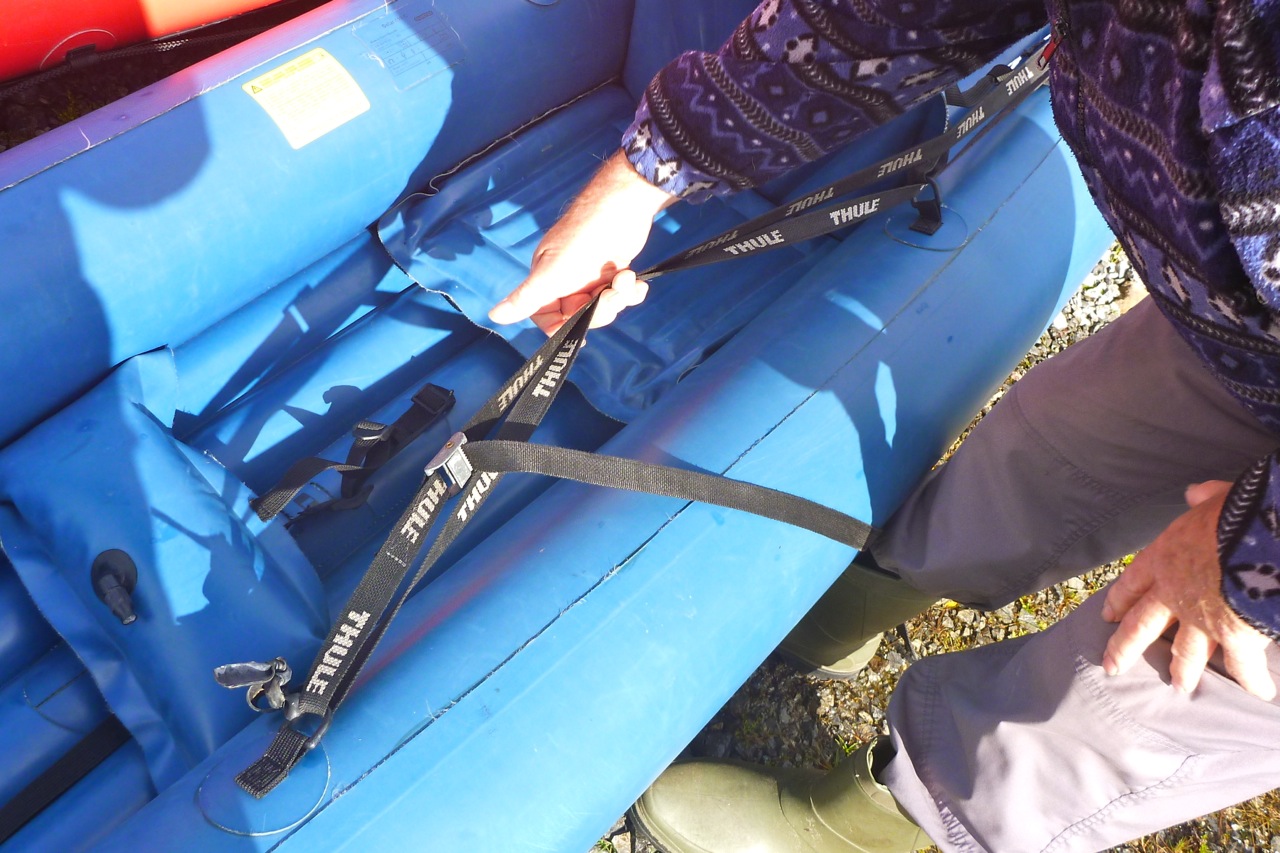
He also showed me a way of simply rigging up his roof rack tie-downs into thin knee braces (left). Like me, Jim agrees they’re a great benefit to paddling efficiency in an otherwise unbraced IK. I have some Packrafting Store ones on the Seawave – a lot lighter than my old SoT braces.
And he also said he’s successfully tried an idea I thought of in my Sunny days, but never tried: hull rigidity rods to make the long but low-pressure boat flex less. Either two on the sides which requires gluing fixtures to work best, or as he’s found, simply putting a thick broomstick or whatever under the seat in the middle of the boat

Packraft Group Test • Introduction

pakGTbanner

Supai Matkat • MRS Microraft  • Aire BAKraft • Nortik Trekraft • Alpacka Yak • Summary

It’s 2020 and things have moved on. See also:
Anfibio Nano RTC
Anfibio Alpha XC ultralight
Longshore International EX280 double
MRS Nomad S1 kayakraft

The range of packrafts has slowly expanded since I bought my first Alpacka Llama in 2010 and Alpacka rafts themselves have changed a lot in that time. But here in the UK people are still slow to see the benefits of these lightweight portable boats.
Much of this reticence must be due to the price of these niche-interest boats which, at a glance look not much different from what I call Slackrafts: disposably cheap vinyl beach toys. Another reason might be that packrafts appeal more to outdoorsy types looking for a new way to enjoy the wilderness or countryside, but with no interest in acquiring the technical skills far less the storage and transport issues of hardshells. They won’t come across these boats very often but as this test clearly proved, anyone can hop into a packraft, set off down river in a straight line and tackle an Environmental Agency Grade III canoe chute. The testers all ‘got it’ and by the end some were already cooking up packrafting adventures.

5bots

We’re comparing a prototype Aire BAKraft as well as the new Supai Matkat, both from the US; the Russian-made, German-branded Nortik Trekraft, and the Micro Rafting System (MRS) Microraft from China.
The unusual Aire calls itself a hybrid IK-packraft, the Supai is an ultralight ‘crossraft’ intended for flatwater use. The other two more closely resemble Alpackas in current or former iterations. My current 2014 Yak made a fifth boat on our test, one which I at least could compare against the others.

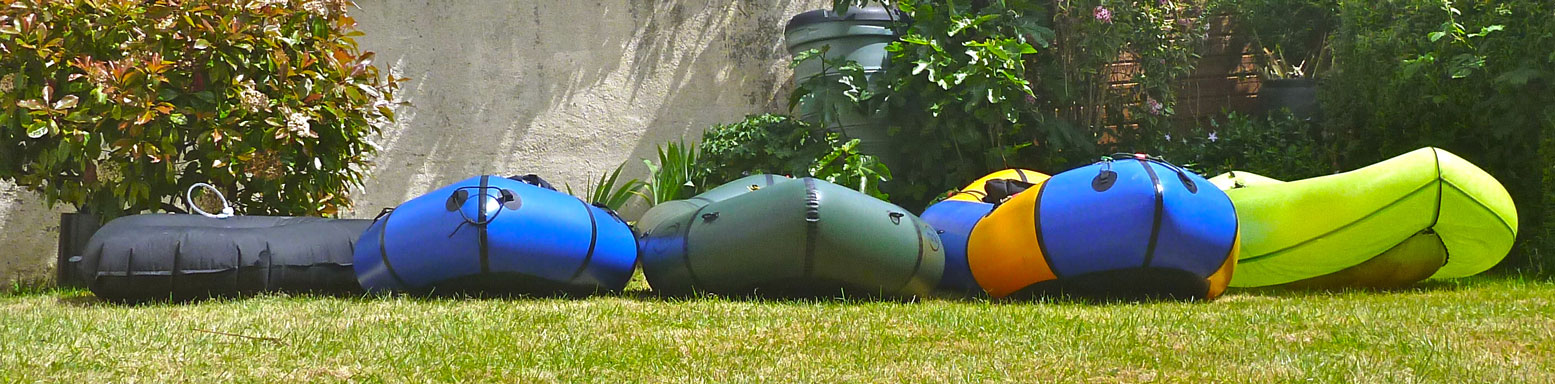
These four boats were lent to us by what is now called the Anfibio Packrafting Store in Germany which sells, rents and now makes under its own Anfibio brand, the biggest range of packrafts and packrafting gear in Europe. Sven at the Packrafting Store helped clarify or correct technical aspects in this review but the opinions, observations and most measurements are our own. Some of the more exciting photos are also from the Packrafting Store. 
We asked NRS to participate: they didn’t answer. At the time Feathercraft’s packrafts were another option but Feathercraft is no more.

pgt-lowboarts


gpt-medwaymap

For this group test it would have been great to set off across the hills of Wales or Scotland, deploy the boats and then follow a river, hop out, walk some more, set up camp and swap notes.
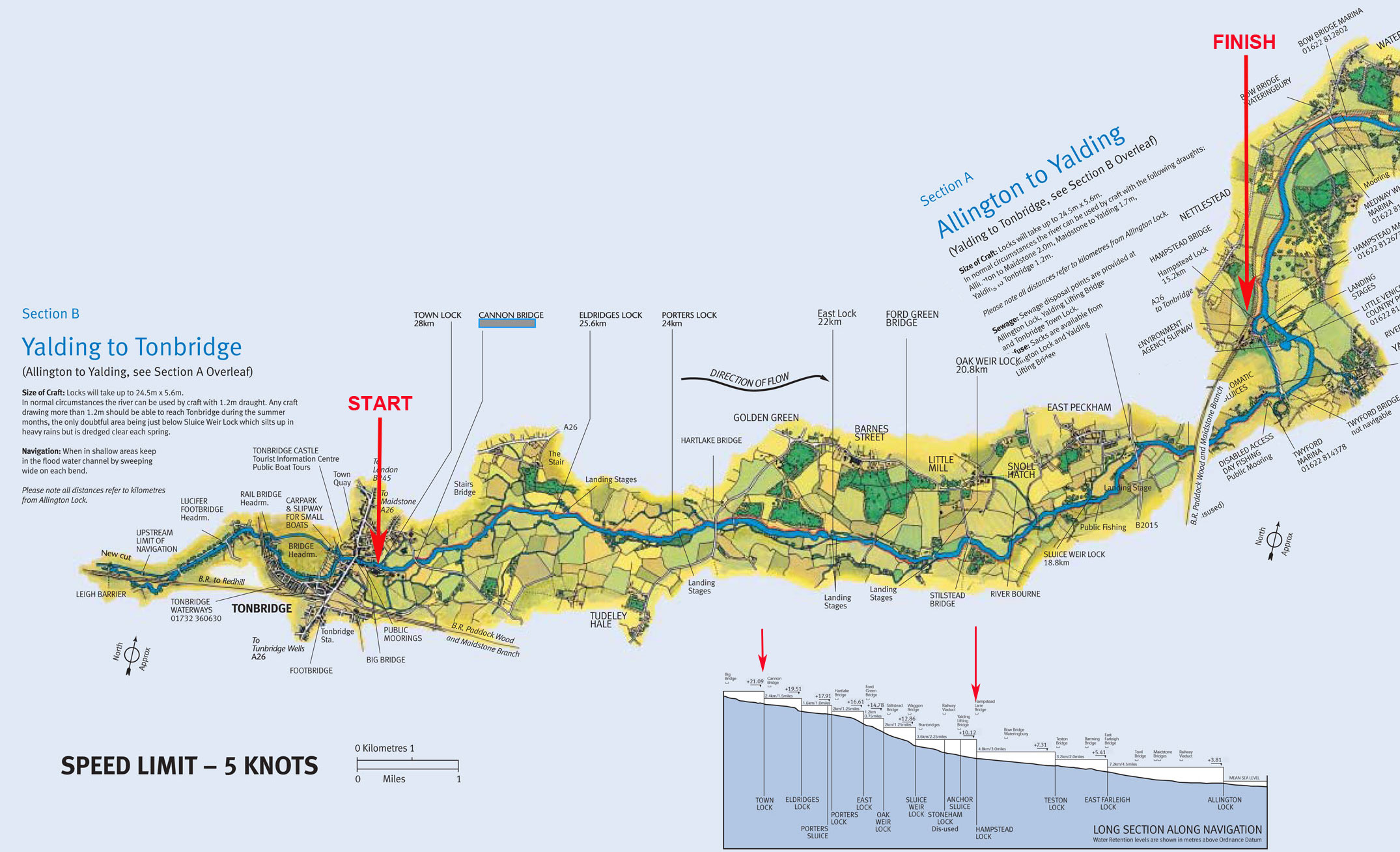
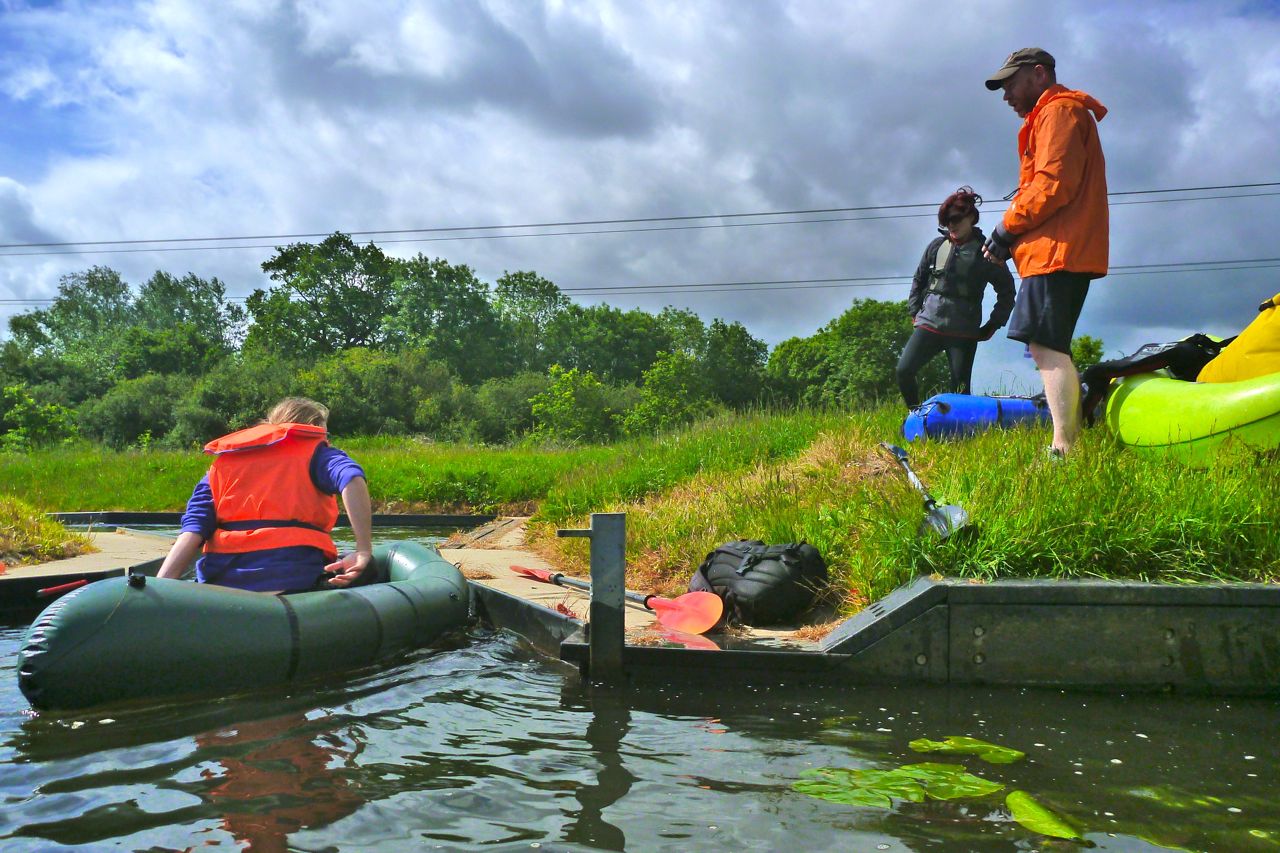
The reality of combining good weather and four other people with the free time to help do all this was slim. So we settled on an eight-mile day trip down the Medway River in Kent (above): me and four testers who’d all paddled (some with trousers rolled up) but had never packrafted. At each lock and chute we swapped boats, so everyone tried each raft at least once.

pgt-me

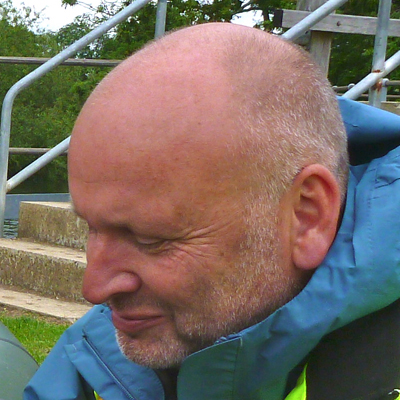
Me – Height 1.83m; weight 93kg
Experience: Into IKs and packrafts for day trips and touring. On my third Alpacka.

pgt-bob

Bob – 1.78m; 85kg
Lilo incident, Margate 1965.

Lea River canoe lessons, Harlow 1980. 

pgt-han

Hannah – 1.75m; 75kg
Much canoeing, some kayaking, love touring. 
Don’t understand eddies, yet.

pgt-lo

Lois – 1.62; 63kg
Dicking about on the Thames in Gumotex IKs and a Dagger. Rely on enthusiasm rather than skill.

pgt-rob

Robin – 1.78m; 85kg
Scouts canoeing, NZ white water, Colorado kayaking, various inflatable trips, usually with tides.

How the packrafts were weighed and measured
Weighing was done using the classic Salter 1004 SSDR digital kitchen scales. They come with a classy brushed steel finish and still rate at 4 stars on amazon. They were checked and registered 500ml of water as weighing 500g.

gptmeaz

Each boat was weighed exactly as it came out of the box, and then weighed again as it was actually paddled, without air bags, repair kits or straps (where included). It was then weighed again before going back in the box. All dimensions were also taken twice, the second time using stakes to get the external measurements at the widest points (above). Internal dimensions were taken at the shortest point, usually halfway up the curved tube side. Measurements from other sources may vary; there’s a table at the bottom of each review’s page and the summary for quick comparison.
* Our exterior measurements for the Matkat were 3- to 5cm less than the Store, but 4cm longer and 1.6cm slimmer than Supai states. Unnoticed leaks during the measuring stage may have stopped us pumping the boat up to actual size. 

Construction
All these packrafts are made from pliable fabrics which form airtight vessels when inflated by human power alone. That’s about 0.03 bar or 0.4psi according to the Packrafting Store’s tests and probably too low for a regular manometer to measure accurately. The BAKraft uses an in-line ‘squeeze pump’ to potentially attain 0.17bar or 2.5psi – firmer than most vinyl IKs. All the models used here except the Supai were pressure tested to an impressive 0.5 bar (7.25psi) by the Store without exploding into a blaze of TPU. As a comparison, my old Grabner ran 0.3.bar as was as stiff as a gangplank.

Hardshell-like rigidity is an inflatable boat’s goal, and while design and shape might come into it, some rafts become more rigid than others and so perform better. The best rafts use a fabric (or construction design) which becomes stiff when inflated but is pliable when folded (especially at low temperatures) as well as being durable against sharp impacts and abrasion. Among other things you could add resistance to UV rays, ready supply and ease of assembly in the factory, repairability on the trail, and a range of fabulous customer-friendly colours.

gpt-MRSsew

Broadly speaking the hulls of the Alpacka and MRS use ten panels of urethane (TPU) coated nylon fabric which are sewn together. Tape is then heat welded over the seams. The Alpacka fabric is only coated on the outside; the Nortik uses a similar double-coated fabric to the MRS (above; green, but not our Trekraft), but the Nortik’s seams are heat-welded with thicker tape (no sewing). 

Double-coating adds weight and other technical aspects of proprietary coated fabrics vary greatly; they’re often specifically formulated for a raft manufacturer. The benefits of an inside coating are a second barrier to punctures when a light scratch to the exterior reaches down to the fabric core but doesn’t actually cut through it.

gpt-underbots

The floors on the Yak, Nortik and MRS are glued on then taped over (Nortik on the inside, the other two outside). They’re typically two or three times the denier rating (thread weight) of the hull fabric.
The Alpacka uses something called ballistic nylon which sounds cool but I’ve found is far from bulletproof. No part of an inflatable raft weighing just three kilos can be expected to be. Occasional repairs are all part of ownership, like a bicycle’s tyres. So is rinsing any grit out the boat before it works its way into the nooks and crannies. On the right click the extra large picture to have a close look under the boats and compare workmanship.

The superlight Matkat is in a class all of its own, entirely made from 75-denier ripstop polyester with a single urethane coating on the inside, the same weight (and sealing method) as an MSR water bag. The red picture below right is of another Supai we tried which you’ll see had a diamond pattern on the surface. The black Matkat we used here had a plain surface like an MSR bag. On both boats the four panels (floor, inside, top and bottom hull) are heat-welded together. It’s possible to repair these seams with a hot iron (or glue).

pgtBAK30

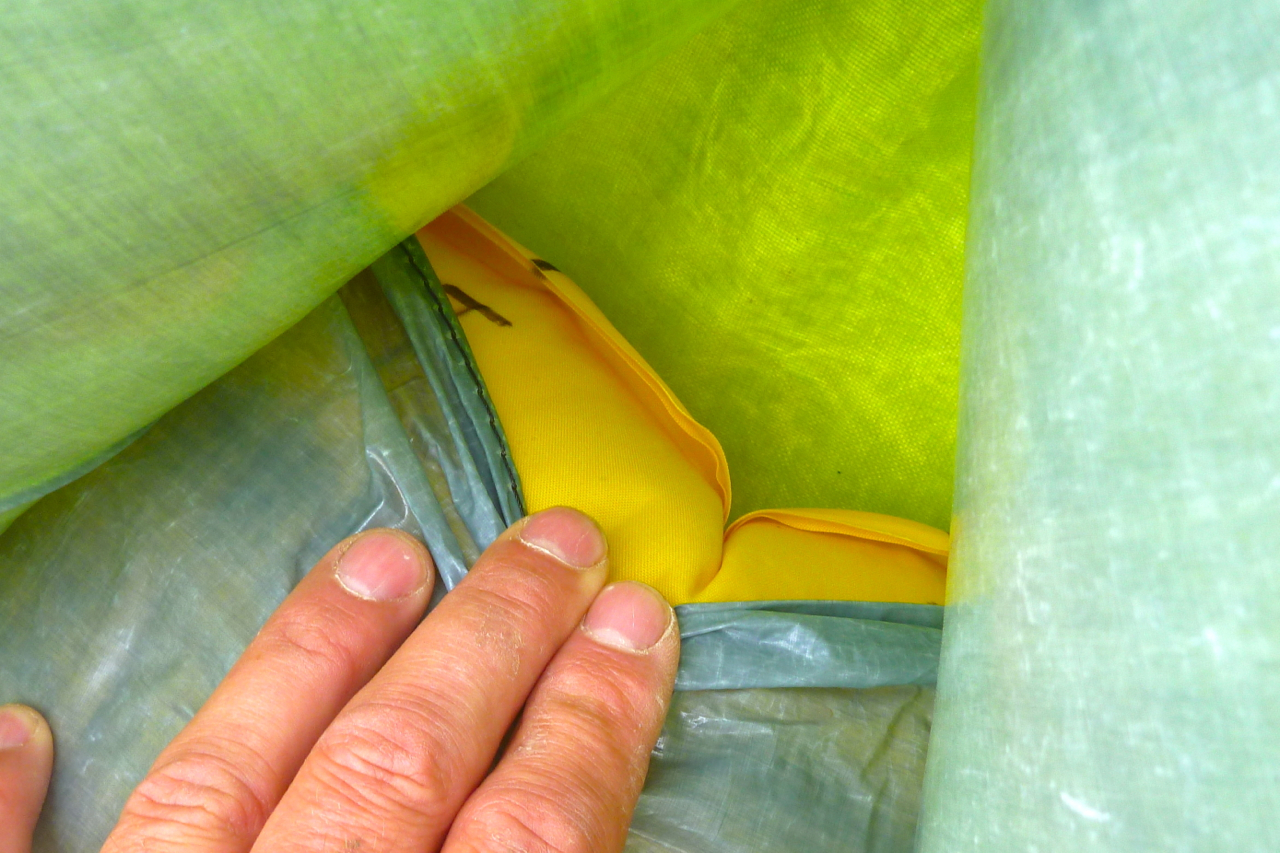
The Aire BAKraft prototype we tested used a thin and slightly stretchy urethane  film ‘inner tube’ or collar supporting the hull, and a much thicker and stretch-free urethane-coated yellow nylon fabric for the I-beam floor (left). These bladders or ‘AIREcells’ as Aire calls them, are contained inside a sewn-up shell of fabric which need not be air- or watertight. If I interpreted the owner’s manual correctly then the BAKraft’s green exterior shell is made of Spectra and the grey interior of lighter-weight Dyneema fabric. You may know stretch-free Dyneema guy lines found on better tents. 

pgtBAK31

The urethane bladder can be accessed for repair via long zips (left); the nylon floor can be pulled out for repair from each end. On packing or refitting care must be taken not to twist the bladders. I’ve never been a fan of it (for reasons explained later) but this AIRECell system has been used by Aire on their PVC whitewater rafts and IKs for many, many years. With minimal seams compared to a traditional packraft hull, air retention is excellent.
On all the boats seatsbackrests and decks (where present) are typically made from urethane-coated nylon with seams or joins heat-welded and maybe taped.

pgtMRS11

Inflation/deflation
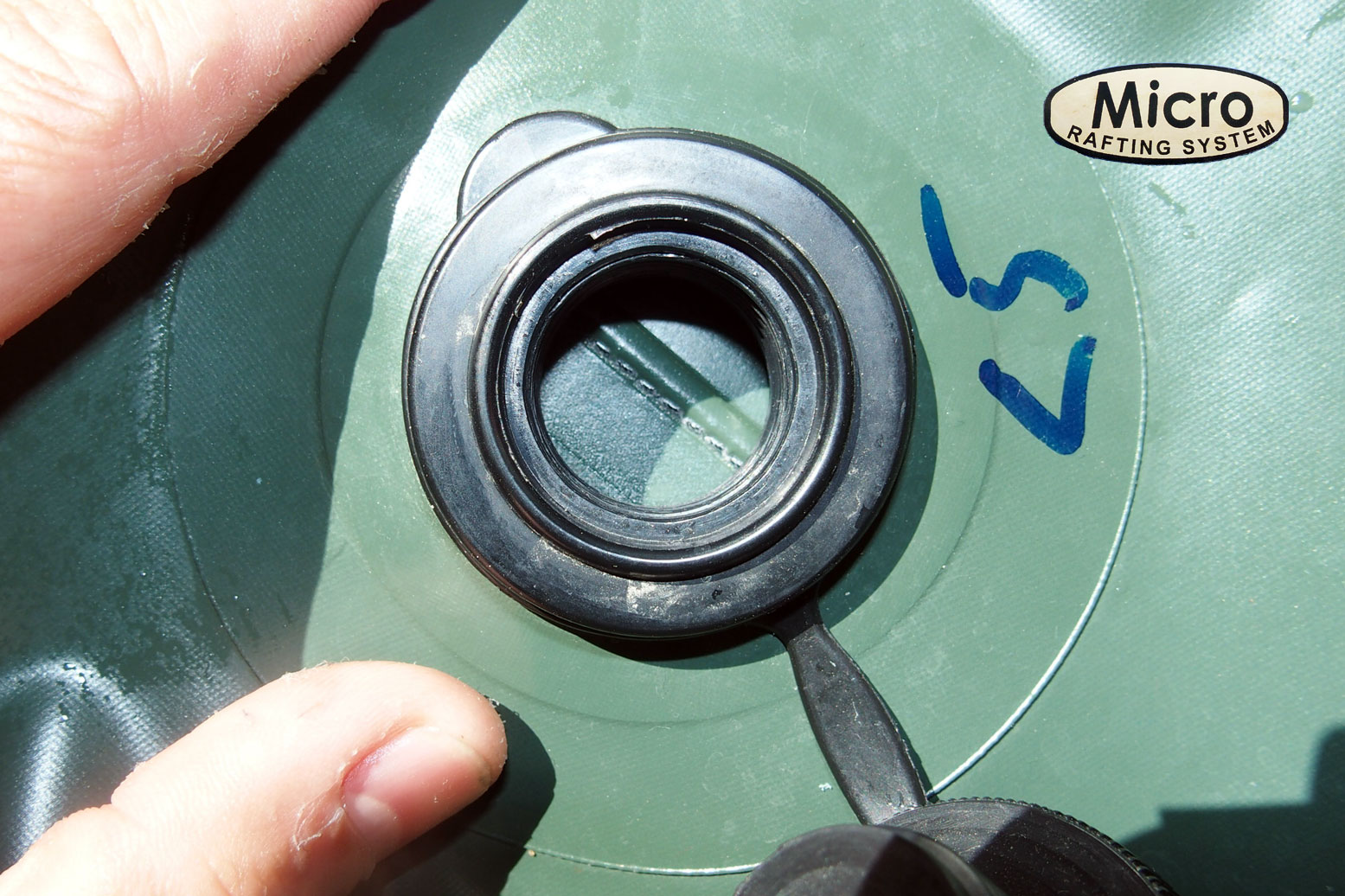
If you’re combining walking with navigating bodies of water – packing + rafting – you want a boat which inflates and deploys without any faffing about. In this respect the Microraft was the best of the bunch. It used the proven screw-in inflation bag (see video below) and, being a small volume boat, took about ten ‘scoops’ to fill up. The main valve cap is attached with a short plastic ring tab – no fiddly bits of string. Top off the air pressure by blowing all you got into the twist-lock valve and with practice you’re good to go in three minutes.

In the video below, from arriving at the beach to paddling away
takes about 8 minutes. Speeded up 15x. A jet passes overhead.

My Yak followed exactly the same inflation procedure, but being a higher volume boat (a little bigger than the one in the video above) took twice as many ‘air-grabs’ to fill up before topping off with lung power. Every time I do this I wonder whether my super-thin airbag will split or unravel at the seams if I scrunch too hard. I can feel the air leaking through the sides.

pgtTRK08

Like the MRS, the Trekraft’s airbag is also made from a reassuringly thick fabric, but is spoiled by a push-in plug, even though there’s obviously a thread in the boat’s port. Compress too hard or if it’s wet and the bag plug might pop out, so inflate gently.
Instead of using the old twist-lock to top-off, the Trekraft has a one-way spring valve stem with a cap (which came adrift and eventually got lost). This valve (above left) is dead easy to use and avoids the risk of over-tightening a cheap plastic twist-lock valve (as on older Alpackas). But when airing down, with the spring valve you can’t suck and seal the remaining air out unless you jam something in the valve as you suck. Packraft or IK, this ability to suck your boat down is handy for compact packing.

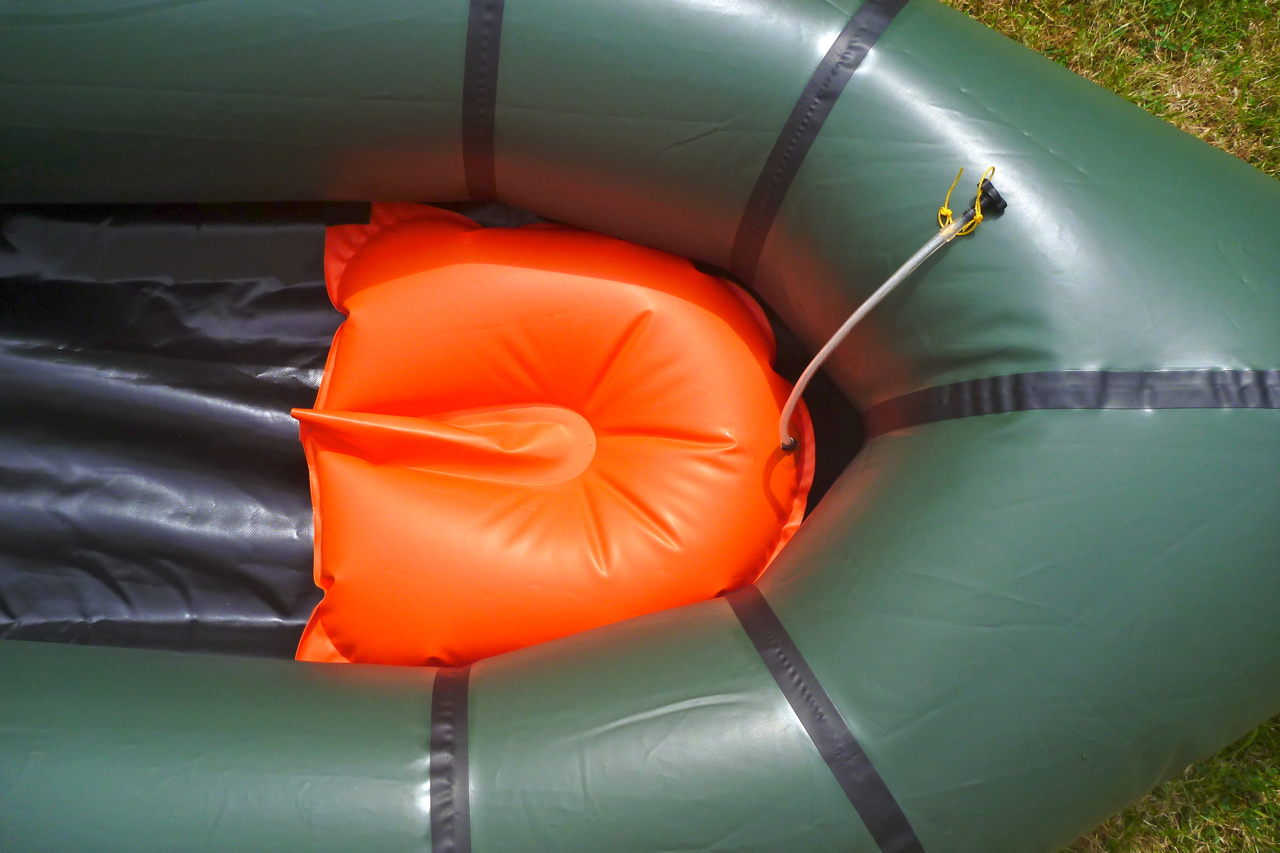
Next comes the Matkat. No airbag supplied even though the Supai website states: ‘We are working on developing an inflation sack to work with our valves hopefully we will have it released in mid-2014.’ When we tried the smaller red Supai Canyon Flatwater II in late 2013 we found it took about fifty breaths to fill, plus topping off. The higher volume Matkat takes about eighty breaths. I like breathing but that’s not something I’d want to do more than a couple of times day to save the 100 grams of an airbag.

supaivalve

Unlike the Alpacka, Nortik or MRS, the Supais use a male threaded dump valve which protrudes from the boat and onto which screws a cap with a thin tube and the twist lock valve on the end (right, red boat) – a neat and simple system that’s just about accessible for on-board top-ups.
Alpacka use an identical threaded valve port but on their air bags; it’s a regular American plumbing ¾-inch size. If I had a Supai packraft I’d get an Alpacka airbag for $20 and then either find a female-to-female plastic connection, or jam on a short section of clear plastic tube to join them together. That way I can save the hyperventilating for Glastonbury.

pgtBAK23


That leaves the BAKraft. Even before I received the boat I had my doubts after seeing pictures of the convoluted inflation system which Aire suggest.

The BAKraft uses Halkey Roberts (or very similar) valves, as found on proper IKs and whitewater rafts: one in the floor and one for the urethane bladder that fills both sides of the hull, or what what they call the ‘collar’. These valves work like car tyre valves (or the Nortik top-up) – a spurt of high pressure opens the seal and a spring seals it shut – except that you can lock them open by pushing and twisting the valve stem. This is necessary to deflate a boat easily, or to loosely pre-inflate it without having to push against the valve spring. These valves are really designed to be used with pumps not flimsy air-catching inflation bags, far less lung power. A simple and compact push-fit pump like a K-Pump will work. A high-pressure stirrup pump with a ‘Summit’ bayonet connector on the end will be even quicker, but is way too bulky to travel with.

gpt-BAKair1


With the BAKraft you’re supposed to use the backrest/cargo bag as an inflation bag and scrunch air into the boat via a tube fitted with a bayonet connector (left). But the backrest bag’s weight, odd shape and relatively small volume makes this task awkward, even past an opened intake valve which is still a restricted airway. I gave it a go  but soon saw that, while I’d get there in the end, it was going to take ages. 

gpt-BAKair2
Bagpiper

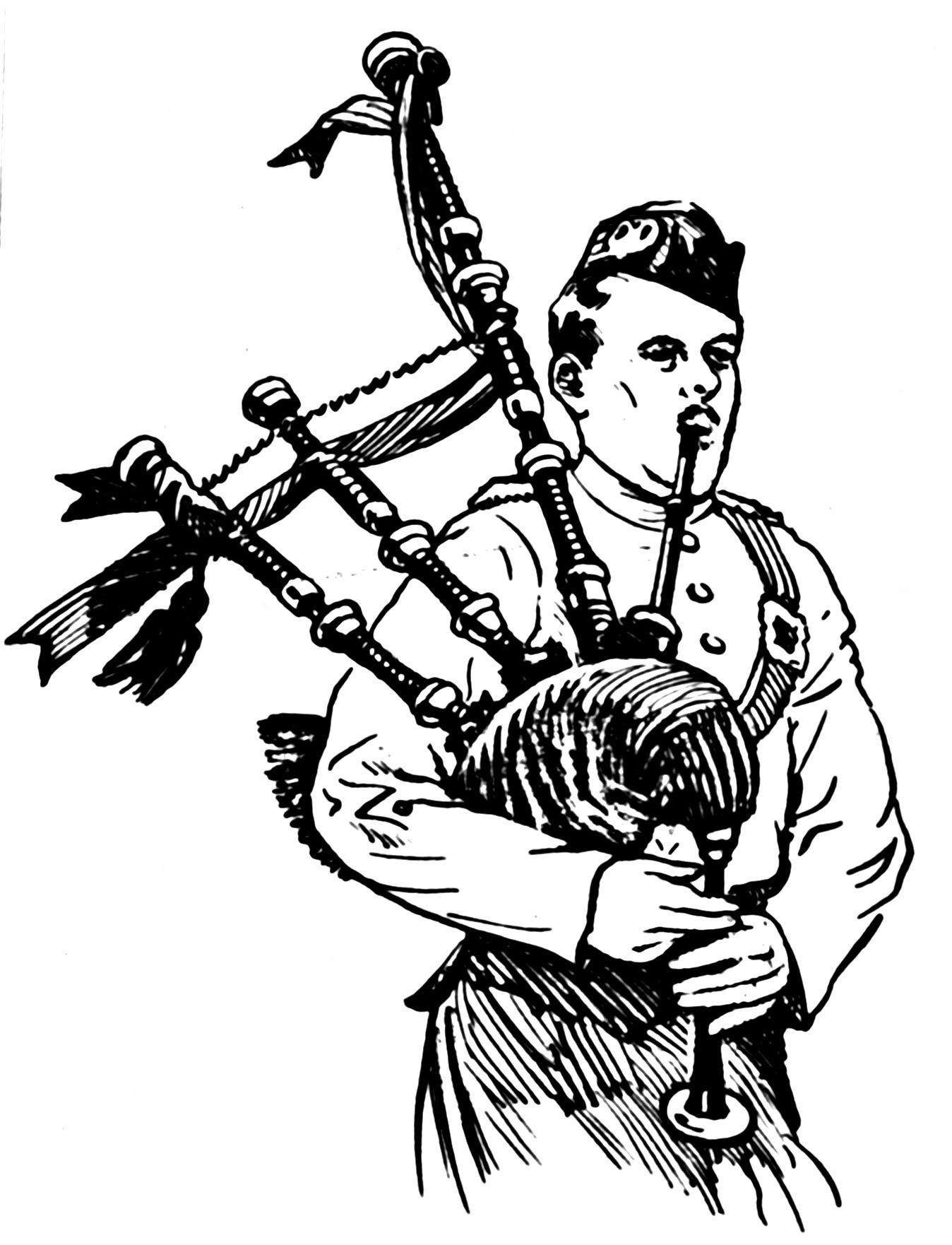
Once the boat has ‘shape’ you’re then supposed to quickly close the boat valve then splice in a low-volume/high-pressure hand-squeeze pump into the ISC bag. The squeeze pump has another one-way spring valve in it: charge it with air from the backrest then squirt air by hand past the closed valve until the boat is firm.
This squeeze pump is quite a clever idea but at about 150cc a go will take a while to do the job. Sorry to say I wasn’t even curious to find out how long – I’d guess at least 15-minutes for the whole inflation, same as it took to pump up my 4.5-metre kayak the other day with the one-litre K-Pump Mini. So instead I reached for my Bravo stirrup pump – it took two minutes – and on test day I brought my compact K-Pump which took about twice as long.

I see now that I’ve actually RTFM I used an alternative method. The image above right suggests you don’t use the backrest bag to charge the squeeze pump, but just blow then squeeze the hand pump directly using an oral tube, like a silent bag pipe. If I’d thought of that I might have tried it as it’s a much less clumsy way of topping off the BAKraft.

pakv1

All the other packrafts here run at an air pressure that’s governed by the lung power you can exert through the top-off twist valve (left). But with a one-way valve you can pump more air into a raft (that goes for the Trekraft’s top-off valve too, now I think of it). The BAKraft is made to run an IK-like 2.5psi although you’re warned not to over-pressurise or allow it to happen. That can be easily done of you get carried away with a stirrup pump or leave the raft out in the hot sun.
It may have seemed clever to give the necessary backrest multiple uses, but it works only a little better for filling the boat with air than it does as a backrest (see review). I’d recommend getting a $20 Feathercraft inflation bag which comes with the ‘Summit’ bayonet fitting from their BayLee packrafts (they also use Halkey-like valves). And if you don’t get on with the oral/hand pump system, then get a 600-g K-Pump Mini too. I’d guess using both these devices will more than halve the inflation time.

From the four corners of southern England the throng gathered at Tonbridge Town Lock, the boats got pumped up, cooled off in the water then topped up some more. Then, after a quick groupie, we set off down the easy first chute. I took it upon myself to get in the Matkat while I was still feeling fresh.

gpt-groupie
 Supai Matkat • MRS Microraft  • Aire BAKraft • Nortik Trekraft • Alpacka Yak • Summary

Packraft Group Test: Nortik Trekraft

Packraft Test Intro • Supai Matkat • MRS Microraft  • Aire BAKraft • Alpacka Yak • Summary

pgtTRK15


After a chilly lunch at East Lock, sheltering against the wind behind a couple of upturned boats, it was my turn to try the Nortik Trekraft. The day before I had all the boats out in the garden and have to say these Russians can cut and assemble a German-designed packraft just as well as anyone else. Maybe it’s not so hard, but I doubt it. The manufacturer Triton has been making folding and inflatable kayaks for years. In Germany slightly different models are sold under the Faltboot brand who are part of Out-Trade who designed the Nortik Trekraft – or something like that. Like a lot of Russian-made gear, I’ve read that some Triton kayaks have an unrefined, agricultural reputation that can be mistaken for ruggedness and durability.

pgtTRK12

Feathercraft’s unsold-in-Europe BayLee ought to get a look in, but if one assumes Alpackas are the current state of the art then, like the MRS, the Trekraft is up there. The early production run Trekraft we had was just under 3.1kg on the water. Newer versions of the same model are said to be some 200g lighter.
The truth will be in the durability of course, as out of the box a €600 packraft floats just as well as a £30 slackraft. As with a lot of outdoor gear, you can pay a lot more to gain a small advantage, which can include image as much as performance.

pgtTRK11

You wonder if heat welding the joins with tape without also sewing each panel’s seams is strong enough? Well, if you assume that, as with welding steel, the two pieces become joined on a molecular level then it must be, though that didn’t work so well on our Matkat test boat. In this way you’d think sewing (as the MRS and Alpacka do) is as redundant as riveting over a steel weld. Sewing may be more to do with aiding reliably accurate assembly without recourse to tape. And anyway, the Trekraft handled the Store’s 0.5 bar pressure test as well as the rest.

pgtTRK01

Other details on the Trekraft include four plastic D-rings on the bow, easier to use than tape loops but possibly prone to sub-freezing brittleness and attached by a relatively small contact area compared to a typical 3-inch patch. The seat (left) is a bit less thick than the other two test boats with seats, and is held in place with four small velcro tabs biting both sides of the loop part (right). If the loop tab on the seat was full length it would enable some forward positioning options – and this raft has the interior room to do that. As it is, velcro does have a finite life span and is a pain to replace compared to bits of Alpackan string (or reusable zip ties which I prefer in my Yak).

gpt-trekdekjoin

A nice touch unique to the Trekraft is taping the floor to the hull inside the boat where otherwise grit can gather and work its way into the join. Same goes for the spraydeck on the decked Trekraft (orange, right – not tested here).

pgtTRK13

For the moment the Trekraft only comes in one size and one thing that put me off when the dimensions became known was it seemed too big inside. Even on flat water a packraft works best when it’s a snug fit in width and length, just like a shoe. On a kayak, footrests do the same. Our Nortik came in at 134cm inside, the MRS and Yak were 117 and 120cm and the MRS felt just my size (helped by the non-tapered foot box). In width too the Trekraft is from 9- to 5cm wider than the other two (the Supai was widest at 43cm). Tube diametre is 29cm; midway between the Microraft and Alpacka.

pgtmu-16

I have to say though, getting in and paddling away I didn’t notice any ‘looseness’, though I and others did stuff some bags down at the bow to take up the slack and stop us sliding down. The raft is actually nearly the same overall length as my Yak in which I am well jammed; the added inches are accounted for by the Yak’s longer stern prong.

pgtmu-13

We noticed that at each changeover (~40 mins) the Trek needed a puff or two up its one-way valve, though not enough to make us bother looking for a leak. All the boats except the pump-pressured Aire needed this, though part of that may be my preference to paddle a boat that’s as hard as my lungs will permit. Also, the afternoon cooled off and showered to the point where I at least was numb and shivering by the time we reached the tea shop in Yalding. So much for early summer in the Garden of England. There’s more on each boat’s inflation procedure on the introduction page; the Trekraft does have a small operational anomaly.

604_12
mod-bilge

On my second spell in the Trekraft I found water oozing up through the floor after a few minutes. It turned out I’d inadvertently been sitting on the bilge pump (right) which had slid under the seat. The edge of the intake had pressed against the floor and pushed a slit a few millimetres wide through the fabric. Normally you’d avoid any edged object pressing under 90 kilos into a packraft’s single-skin floor, but I’m not sure this would have happened so quickly on my Yaks’ more robust floor (but which I’ve also holed one time). I did notice that while paddling the floor seemed to wobble more than it does on my Yak, as if it’s either less rigid or not as taut. You can see it in the groupie photo or here.

extrafloor

Floor fragility was something I addressed (clumsily) with my very first Alpacka (right) and is why I now run a double thickness ‘butt patch’ on my Yak, plus a closed cell foam heel pad at the front. How ironic that the bailing pump caused the need for a bailing pump. A bit of stray tape stemmed the flow and at Yalding Robin pulled out a proper bit of gaffer from his batbelt and fixed it for good.

https://vimeo.com/125670094

beachbo

One benefit of the Trekraft’s generous internal space is the ability of packing your gear low in the boat, not strapped over the bow blocking the view of some oncoming hazard – or inside the hull tubes, as Alpacka’s cunning but flawed Cargo Fly system allows. I imagine that could be adapted to any TPU-coated boat though you could also try packing gear behind you as on the Aire to put you in a more balanced, kayak-like paddling position. Not sure if that’s really necessary with the Nortik and anyway, all the gear at the back would make the boat back heavy. I like the suggested idea of a beachball backrest – gives you something to do at lunchtime, too. Or of course it makes a roomy platform for bikerafting.

pgtmu-10

pgtTRK16

The other useful benefit we found was the ability to fit two smaller adults in the Nortik. With the Supai out of action and the Aire not that effective as a tandem boat, Hannah and Lois didn’t look too cramped, huddled in the now repaired Trekraft for the last short stretch to Hampstead Lock. It shrugged off their 150-kilo load (left). So may have my Yak, but they’d have needed prising out of that one with a hair drier and a spatula.

To me the best thing about the Nortik is the €600 price. That’s over a hundred quid less than  I paid for my Yak, even bought direct in the US. And the (properly) decked Trekraft goes for just €200 more, though it may help to pad out the insides to make a good connection for whitewatering. The weak rouble may have something to do with all this but between them, those are the two best reasons to have a closer look at a Nortik packraft. 

gpt-dimchart

Packraft Group Test: Supai Matkat

Packraft Test Intro  • MRS Microraft  • Aire BAKraft • Nortik Trekraft • Alpacka Yak • Summary

Like ultralight? See Anfibio Alpha XC
pgtMAT10

Among other things Supai Adventure Gear (moto: ‘Where every ounce counts‘) makes what have become to be known as ‘crossrafts’, ultralight packrafts suited to gentle flatwater floats, canyoneering or crossing lakes while avoiding any kind of rough handling. In other words it’s like a slackraft pool toy, but at a fraction of the weight and made from fabric, not PVC film.
We were a bit unlucky with our Matkat so bear that in mind when reading what follows. We assumed the previous user had given our example a hard time and managed to put no less than two holes and a split in it. That’s two more punctures than I’ve collected in ten years with IKs and five years of packrafting. The Packrafting Store has since been informed by Supai that that boat was part of a batch with production flaws. Blowing the boat up out of the box revealed a puncture under the stern (not unexpected in that position) but once that was fixed another leak emerged  from a split seam.

pgtMAT02
hotsun

The seam may well be a manufacturing fault, or the black boat could have been left out in the hot sun for too long (right) – a lesson I’ve learned the hard way with a previous IK and one reason I did this to my current kayak.
Had the Matkat been my boat I’d have either sent it back or hot-ironed the split shut (as I’ve successfully done on an old Alpacka seat). But I didn’t want to risk inadvertently melting a hole in the test raft, so I played it safe with some Bostik 1782. That done, the raft still seemed to lose pressure – or was it just me? I checked the cap and valve and then tried to check the exterior seam for other leaks in the bath, but the Matkat’s bulk makes this awkward to do unless you have a bathroom out of an Imperial Leather advert. So I decided I was being fussy. These ultralight crossrafts are always a bit floppy, aren’t they?

pgtmu-09
pgtMAT16

But now, ten minutes downriver from Tonbridge Town Lock I wasn’t being fussy as the boat got soggier and soggier and my arms strained with the effort of hauling it through the water. Even getting in saw the boat fold up under my weight and take on water; that’s why I’d brought a bailing pump.
Another ten minutes downstream and I had to call in a top-up (I couldn’t reach the short tube for fear of swamping). As air was slowly lost the boat didn’t actually get lower in the water. Instead you sank lower into it as the raft collapsed in on itself. Your backside sags at least six inches below water level making paddling the metre-wide raft even more awkward (you’ll want a long paddle with this one – even with no leaks). Pumped up it was briefly much better – or as good as a Matkat can get, but I needed another top-up before the next chute and a welcome raft change over.

pgtMAT18
pgtMAT19

Looking at the photos it doesn’t look that bad, does it. But that’s because, like a slackraft, the weight of a person on the water gives the the boat form. Step out (above right) and it became unnervingly limp.

fx2-jpad
supai196

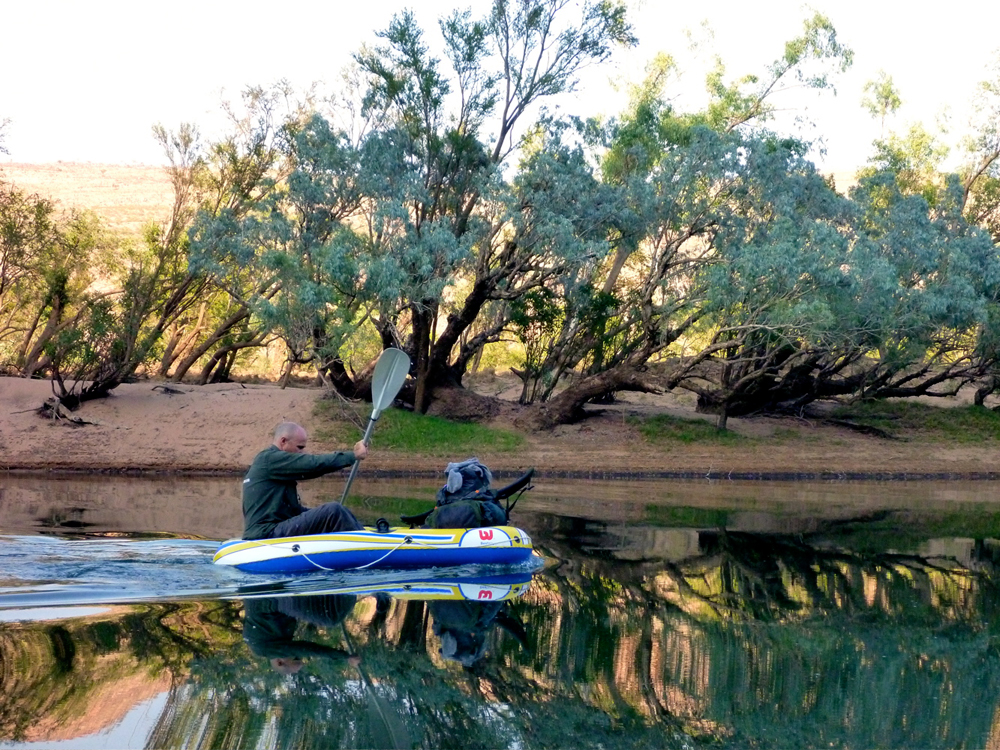
It was the same for everyone in what we christened the ‘Bin Bag’. I now know how my mate Jeff felt a couple of years back, paddling his execrable slackraft for nearly a week along far northern Australia’s Fitzroy River (right). Paddling a wide,  soggy, unresponsive boat is as much fun as cycling on flat tyres. But like a slackraft, even at full pressure I doubt a Matkat’s thin fabric can’t attain rigidity of a conventional packraft. That’s the price you pay for an inexpensive boat that can almost fit inside a large jacket pocket and weighs less than my lightest carbon schmarbon stick.
Robin and I briefly tested Supai’s Canyon Flatwater II (left) in late 2013 and, while both attracted to the ultralight crossraft concept, came away unconvinced. The Flatwater floated with 80-kilo Robin in it, but lacked reassuring buoyancy once anything other than the gentlest of paddling was called for. Robin was inches from shipping water over the stern and settling it off into a bobbing cycle could see it swamp (The near-freezing conditions and inappropriate clothing may have influenced our paranoia). The black Matkat is Supai’s answer to the ‘XXL version’ we hoped to see.

pgtMAT17
su-msrfab

Back on the Medway over lunch I finally tracked down a tiny hole in the top of the raft near the inflation port. I’d expect damage underneath and maybe another seam to blow, but this was the last place I’d look. So however it happened, it does make you wonder if 75D polyester is pushing things a bit too far for the realities of wilderness adventuring rather than goofing about. Incidentally, our Matkat’s fabric didn’t look the same as the red Flatwater II we tested – there’s no embossed diamond pattern. Instead, it has the same texture as the MSR water bags I compared the red boat to (right), though I can’t say the Matkat felt any thinner than the red boat.

pgtMAT20


We’d hoped (and even suggested that) Supai make a longer boat with fatter tubes, something more suited to grown men carrying gear. Instead the Matkat is simply a Canyon with 8cm oversized tubes. Now at least a metre wide and 43cm wide where you sit, we weren’t even sure it would fit down the first chute out of Tonbridge. That makes it wider than the Aire BAKraft but you’re sitting up to a foot lower down, well below water level. That’s made worse with no seat. Knowing that I brought an old Alpacka seat base for everyone to use. Bare that in mind in the pictures. Above left is Lois; at 65kg the trim is just about level but she’s sitting some 4-inches higher than normal.

pgtMAT01

Like the Canyon, the Matkat has seven reinforced attachment points punched out from extension tabs along the peripheral hull seam (left). They may all be better used to thread in a perimeter grab line than for attaching heavy gear. Or maybe tie gear off a grab line to avoid a thin line’s direct force on the tab’s hole. More so than other packrafts, the extremely light Supai’s will take off at the slightest gust – and if that happens on the water following a capsize you could be in trouble. Hence the suggested grab line if not even a tether when paddling in windy conditions.

pgtMAT11

All day the Matkat languished at the back of the pack as each stoically endured their spell in the Bin Bag, periodically asking “how far d’you say to the next chute?” A shower hosed us down and as we neared Yalding tea shop Hannah on her second spell was getting lower and lower in the water until just her head and arms were visible above the sides. It was decided to abandon ship and enact an on-water emergency evacuation. We unclipped the Aire’s bulky backrest, Hannah crawled onto the BAKraft and with Lois they shot off downstream like a skimmed pebble. The Matkat was aired down and stuffed into a raft.

CanyonvsKat


I said as much when the Matkat’s dimensions were announced a couple of months agoBy taking the easy way out and using the same floor pan and internal section, Supai missed a trick by making this a fatter, wider raft (100 x 175cm, but see the intro) rather than a slimmer, longer one. As it is both Supai models could easily lose 5cm of width inside; it’s not like you’re going to be bracing the thing through Grade III whitewater. It reminds me why the Alpacka-style extended stern works so well: it adds buoyancy where it’s needed but without width – and it lengthens the water line for greater speed.

Suapi-Photos

There is a place for an inexpensive sub-1000-gram crossraft. I could have used one myself in Turkey the other month where the 3kg weight and bulk of my Yak became a chore over 200kms. But no matter how flat the water – be it Scotland or Alaska or the Lycian shore – alone you want to feel secure mid-river, estuary or lake if a gust comes up, a swell rolls in or an oil tanker’s wake surges towards you.
The 792-g Matkat has the added buoyancy the Canyon lacks, but the claimed payload of nearly 150 kilos feels improbable in the real world; the momentum of that weight against any wave will see it plough in. The Matkat is now so wide for it’s length it paddles little better than a tractor inner tube wrapped in string (click one back in that slideshow to see what happens to Supais when used too hard).

pgtMAT06
supai06

And with this estimated 30% added volume over the Canyon (right) you could really use an air bag, even if they make it an optional extra. (More on inflation – and a suggested solution – in the intro). A  seat can be up to the user: they could to sit on a pack or buy a 150-gAlpacka for $25.

Sevylor TrailBot

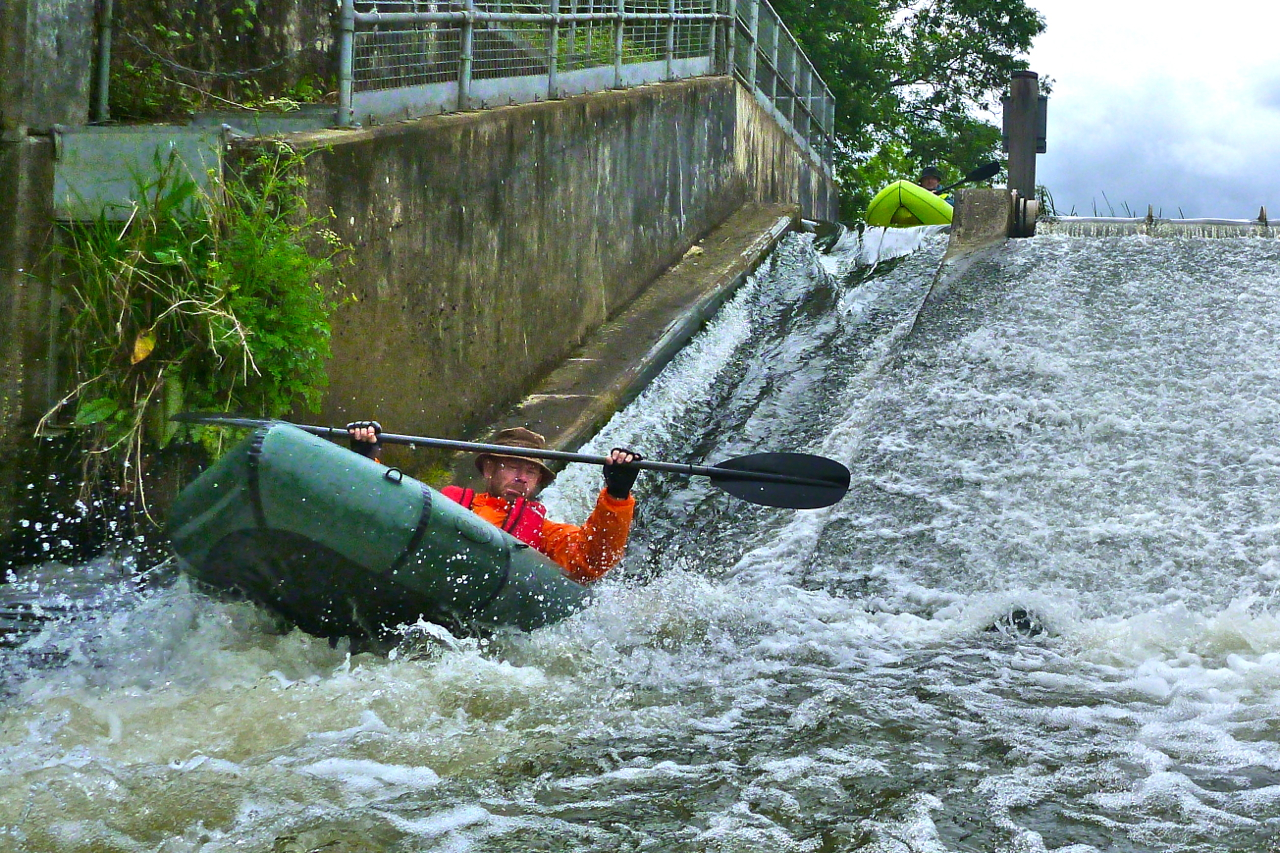
To be fair a full day on a calm river is not a leaking Matkat’s forte, though it’s interesting to note it handled all the chutes, including the steep Sluice Weir, (left) without shipping any more water than the other rafts, including my snazzy Yak. As I mentioned in the Canyon review, what we wanted next was the same boat but just bigger all round (not unlike the long lost Sevylor Trail Boat, above right) because it looks like that would work. Perhaps a 75D crossraft couldn’t contain a longer hull without folding. Whatever the reason, if it ends up weighing 1106 grams, is made of a more rugged fabric and comes with an air bag, then so much the better. For other crossrafts see this.

pgtMAT21
gpt-dimchart