Category Archives: Gumotex IKs

I’ve had several Gumotex IKs

Gumotex Seawave kayak preview – 0.25 bar

Seawave main page (less speculation; more up to date user-info)

seawaves

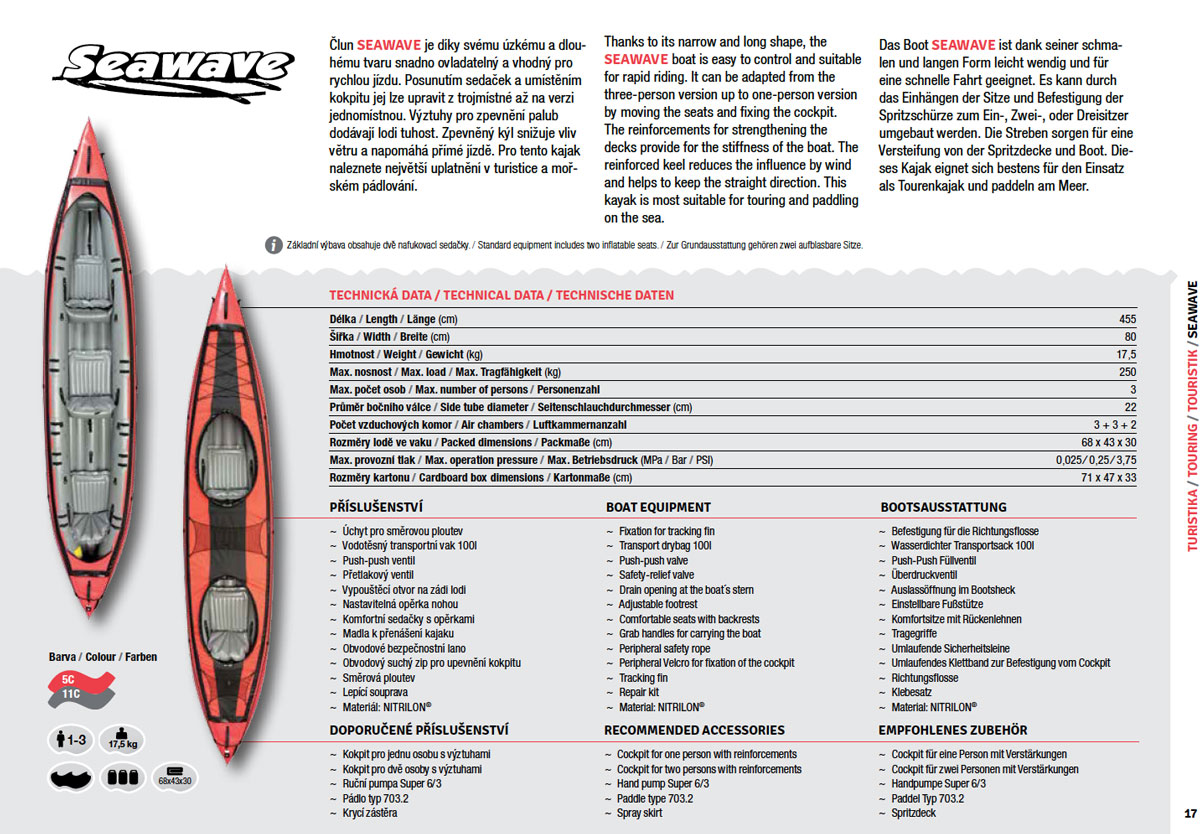
The Seawave was released in 2013 and in 2016 a near-identical model came out with a rudder option. The Seawave can be used as a single, double or triple, and is sold in Euroland for around €1625 or £1425 in the UK. They used to be a bargain. Not any more.
In 2023 the Seashine version came out – a Seawave with a drop stitch floor (like the Thaya and Rush); slightly heavier, wider and longer and a lot more expensive.

My stats for my Seawave are 4.5m x 78cm wide and 17kg plus a claimed payload of 250kg which sounds plausible. Significantly, the Seawave’s pressure is rated at 0.25 bar (3.6psi) all round, midway between the Gumotex IK norm of 0.2 and Grabner’s 0.3 bar. Some of Gumotex’s orange series whitewater boats run 0.25 and their IKs were never that shoddy. Having said that, the PRV in the floor of the Seawave has the same ordinary rating you’ll find in a Twist or a Palava or probably any other Gumotex IK (more here) but the adjacent sticker claims 0.25 bar max. It’s the side tubes that now take 0.25 bar, not 0.2. What they now call Nitrilon is not like the stiff old hypalon-like Nitrilon of my early Gumboats. Increasing hull pressure is one way of getting a more rigid and therefore faster IK, but it’s the integrity of the ‘I-beam’ floor that’s the usual limitation. The Seawave has a pressure-release valve in the floor but not on the side tubes, and I read these pressures are said to be on the conservative side. You can’t over-inflate the floor but these Gumboats can handle more in the side tubes providing you watch it when out of the water in the heat.
seawavecat

The Seawave is long for an IK, but with just a skeg (optional, but there’s a  rudder now), you wonder if this could be hard work to turn into the wind. However, in France kayaks destined for sea use (beyond a certain distance from the shore) must be homologated or approved in some way, and the Seawave has passed this test.
gumtip

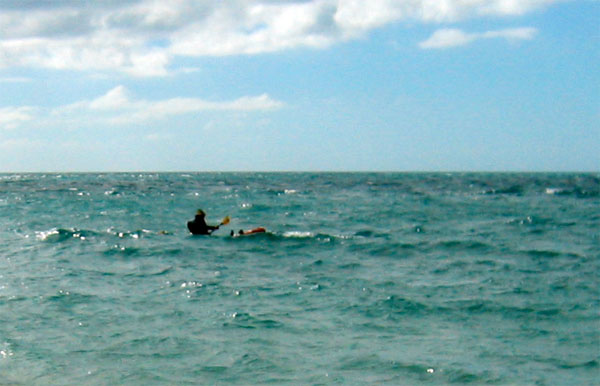
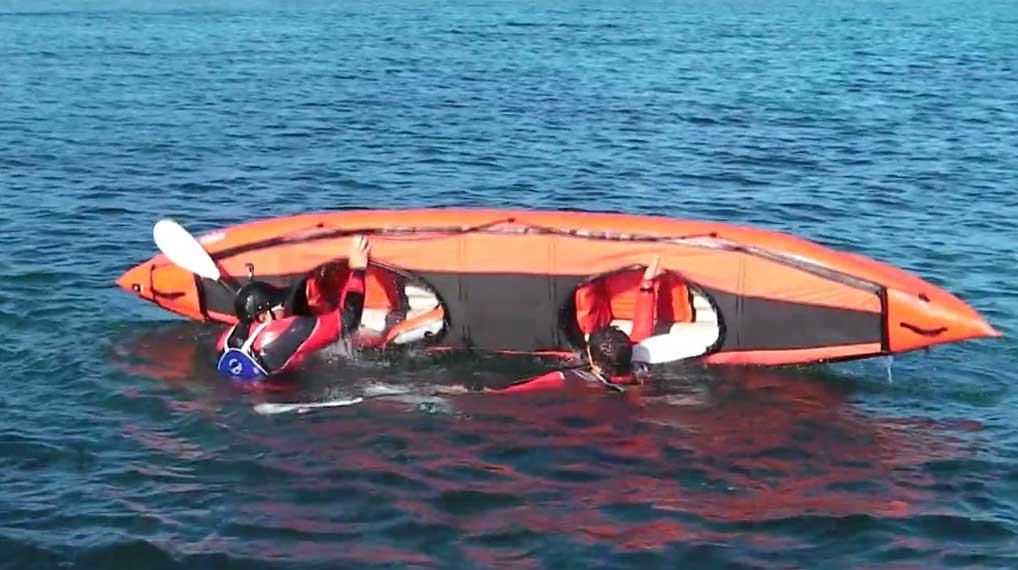
The great thing with the velcro deck (for one or two) is that it can be removed; on my Incept I paddled like this approximately 99.9% of the time, with the deck rolled to one side. Even at the slightly higher pressures, I have to say at one point in the video I noticed the Seawave bending with the swell. My Sunny used to do this, taking on water over the low sides, but with a deck that ought not be less of a problem, even if you imagine there’ll be some seepage through the velcro in heavy conditions or white water.
grabend

Flexing is a problem with any long inflatable and even my short and high-pressure Grabner (left) flexed in certain conditions. Manufacturers get round it with metal frames (Feathercraft, Advanced Elements), twin side tubes (some Grabners, Gumo Seakers, Incept) stiff fabric (Incept) or just high pressures like Grabner, but that demands very good construction. Drop-stich panels are the new way of doing it now.

Scotty

There are more impressions as well as some nice pictures from an actual owner, Norman, right here (translated from French). He ran a 410C for a few years and talks of pumping his Seawave right up to 0.35 (5psi) bar which makes for good speed (6kph average he claims). That is 40% above the recommendation so let’s hope the seams on the Seawave can take it, cap’n.

mod-drainer
sw14

It looks like grey, Halkey-like valves in the back, not the old-style black ones that Gumo used. And I see that Gumotex have again adapted an idea that I had on my Sunny years ago (right), a drain hole at the back. Only theirs features a neat sliding cover. It could all be the normal process of improvement of course, but I recall that after I had some smaller skegs made for my Sunny (and sold to a few others), Gumotex reduced the size of theirs to the current black plastic ones. And then the velcro deck idea. Whatever, it’s gratifying to see ideas I have tried or written about actually making it into production.

Enough of this speculation!
Actual impressions on receiving my boat here, followed by half a decade of very enjoyable Seawave paddling.

Summer Isles Gallery with kayaks

A sixty-six-photo summary of our summer in the Summer Isles with a little bit of Orkney.
See also: Summer Isles Kayaking Guide

Whitewater test: Packraft vs Gumotex IK

A two-minute vid, possibly a bit too long…

Don’t get excited, we’re talking a few hundred metres of Class 1.1, but that’s as good as it gets around here.
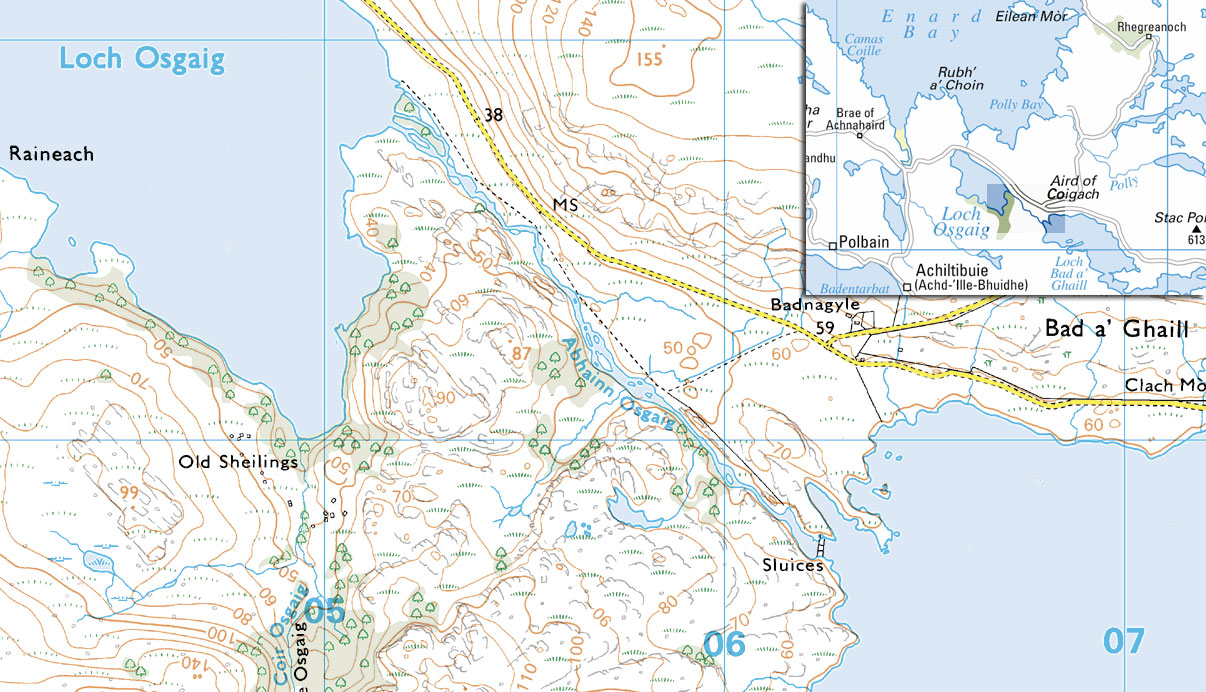
We’ve had a lot of rain in the last week, enough to make the only paddleable river – the short Osgaig – worth a poke with a paddle. I was here with the Yak last year at slightly lower levels, so this time was expecting a smoother run in the Solar (now with an improved seat-foot set up), followed immediately by a comparison run in the Alpacka Yak.

Gumotex Solar IK
The good thing with the Solar is it’s old, worth next to nothing but tough, so can be dragged like a hardshell with the Yak in the back. I considered jury rigging some thigh straps; it could be done now through the new footrest pipe and around the seat mounts, but looking at the river as I drove up, it wasn’t really worth it. Thigh straps are what makes any deckless boat – air-filled or hard-shelled – much more controllable when things get choppy. Even WW packrafters insist straps are the way to go.

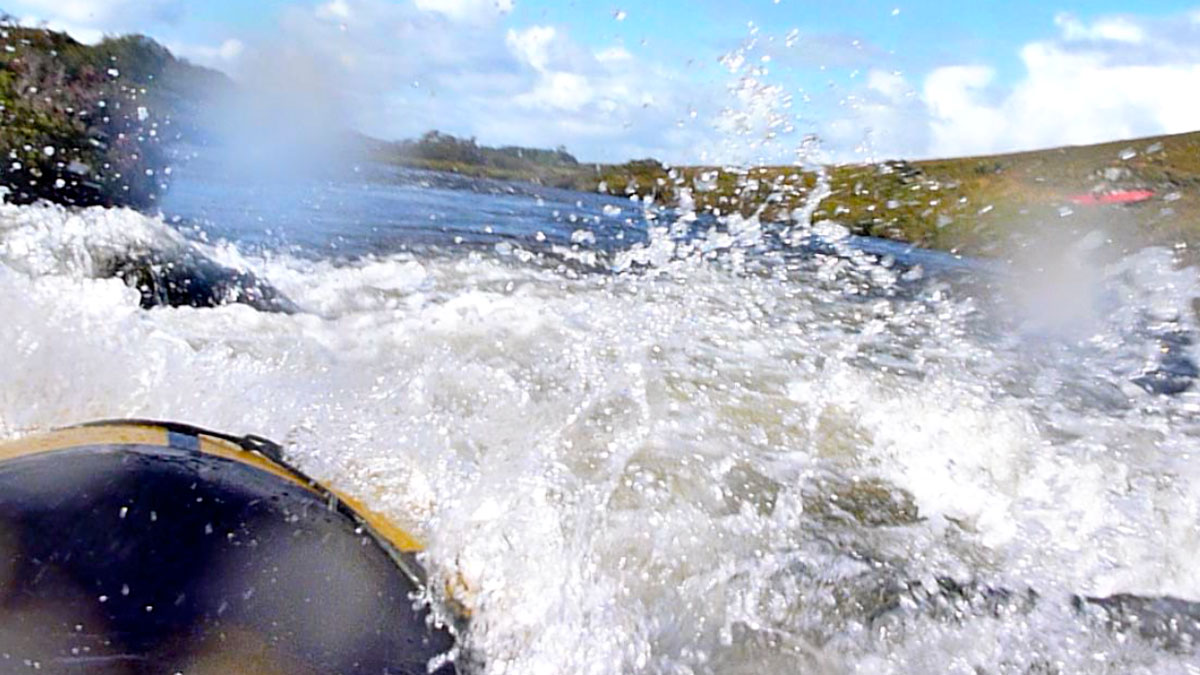
With the skeg off, it’s easy to seal launch off a grassy bank and into the scrum just below the waterfall which looks a bit complicated so was no less inviting this year.  As I spilled over the first little step I tried surfing like people do. But the Solar wasn’t especially dynamic or there wasn’t a strong enough recirculation going on to make it feel interesting. So I swung round and set off. Even at full flow, the Osgaig is a shallow, bony river better suited to an injection-molded TNP ‘spaddle’, not 220 quid’s worth of carbon-light Werner Corry which was picking up new scrapes as I jabbed at the water to keep the boat on line. It was really quite effortful with the Solar, at 3m or nearly 10 feet it’s perhaps a bit long for this sort of thing. I hit the one or two rapids full face, kicking up a satisfying splash and remembering that ‘bring it on’ exhilaration when trying an IK and white watering for the very first time on the Salmon River in Idaho all those years ago.


The river branched near the Loch; left looked all froth but too shallow so I swung right but again scrapped and shoved from one bar to the next. I was hoping to make it all the way to Loch Osgaig but up ahead I saw the tree strainer I recalled from last year so, stuck on another rock and by now steaming out of the ears in my heavy drysuit, I stepped out and walked back upriver.

Alpacka Yak Packraft
A few minutes later I hopped into the snug Yak, spun round and slipped over the first drop. Spinning back, I tried to surf as I’d just done in the Sunny but it wasn’t happening. I guess the Yak is just too wide, light and too much drag to fight the flow.
Off I went downstream, trying to avoid getting snagged while lining up to take the peak of what waves there were. Jammed in the yellow tub, sat lower and with higher sides, it felt much more responsive than the longer Solar and so was less effort to ride. Perhaps part of it was that a good line is less vital; most of the rapids I could have taken backwards and that added up to more fun.
So there it is: a tight-fitting packraft is more fun on easy white water than a 3-metre IK. When I got snagged towards the end, I just stepped out, threw the boat ashore, and staggered out over the slimy boulders. 

IK&P Picture of the Week

Le Grand Gonflateur himself, Gael A sent me this image to illustrate something. Its composition and colouring was so magical I’m compelled to elevate it to the IK&P Picture of the Week.
Captured in 2005, the location is the River Epte, a tributary of the Seine in Normandy and site of Monet’s no less idyllic 1899 painting, ‘Waterlilly Pond’ (left). It looks like Gael is sliding down a burst canal bank on his H2, while his trusty compadre observers from the reassuringly stable platform of a Mk1 Sunny gumboat. Behind him a sign warns ‘Access Interdite – Danger [sauf gonflards] and nearby a docile cow nuzzles the trunk of an oak tree quivering in its prime.
A serene snapshot of rubber boating bliss.

Gumotex Solar 300 improvements

See also
IK&P Glues and Repairs

They don’t make the Solar 300 anymore – it’s been superseded by the lighter Twists, although the similar full-coat, white-water Safari is still made All these Gumboats and a few others may benefit from the footrest mod as described below, as might bigger Gumboats which both use a similarly mushy footrest pillow.
Our Solar dated from 2006 and although (or because) it doesn’t get used much it still looks like new. And it’s lost no air to speak of lying in the garden for over a month (can’t say the same for my Incept K40).

gumsolarstac

But the seat/footrest arrangement is poor, like all Gumos from that era. The seat pivots at the right angle base as you lean on it, because the top edge is attached to the bottom edge instead of the actual boat, like any sensible IK. You lean back, it lifts up – no good. I messed around a lot with my old Sunny before I got smart and simply glued some D-rings onto the top of the hull sides, which Gumo started doing soon after. This way when you lean back or brace against the footrest, you’re locked to the boat and so get more drive.

The pillow thwart footrest is OK, but I ditched that at the same time on my Sunny to use a small Otter box. For the Solar, the g-friend is short and can’t reach the footrest pillow even set right back.

I glued on a pair of big D-rings with Aquaseal, bonding much cheaper PVC D-rings to the Nitrilon hull sides to provide a fixed point to tension the seat back. I did this because the price of RIB hypalon D-rings is crazy: from £20 to £40 for one patch!
I Iused single-part Aquasure urethane sealant/adhesive (‘Aquaseal‘ in North America). Allow Aquasure or similar to half-cure in air for 30 minutes, then stick together and let it ‘seal’ to itself is a way of bonding anything – even non-compatible rubber-based Nitrilon to PVC. SeamGrip is a runnier version of Aquasure to get into cracks and seams and though I’ve not tried it yet, British-made Stormsure is the same thing.
That was years ago. Maybe it worked fine but these days, I’d sooner MYO D-rings from hypalon off-cuts and use 2-part glue.

Then on the Solar I removed the footrest pillow and replaced it with a bit of sawn-off four-inch drain pipe, taping the pipe ends to limit any rubbing against the hull. The seat straps were sewn into a loop and clipped to the D-rings.

This mod will improve bracing in the Solar: the bane of all IKs (and SoTs for that matter) which without bracing are like paddling a log. The footrest (the tape goes through a slot under the pipe) can easily be moved, even when inflated and will transform the Solar which is a nippy IK. The next step would be to fit thigh straps as found on the current Safari – then you can do cool stuff like this – but for the use our Solar gets, the current improvements will do.

Recently I also glued on the later style skeg patch to take the plastic fin. No more faffing about with butterfly nuts and bolts and bits of bent alloy. The patch costs £12 and so does the skeg, which I also fitted to my Grabner Amigo.

gumoldnewskeg

Lurgainn – linking the Lochs

An afternoon’s paddle along the lochs strung out below Stac Pollaidh mountain, with a bit of portaging in between and a jog back to the car to finish up.

Gumotex Swing IKs

Updated: Summer 2020

See also: 2020 Rush models with D/S floors (like the Thaya)

swinginovlites
gumotexfabrics18

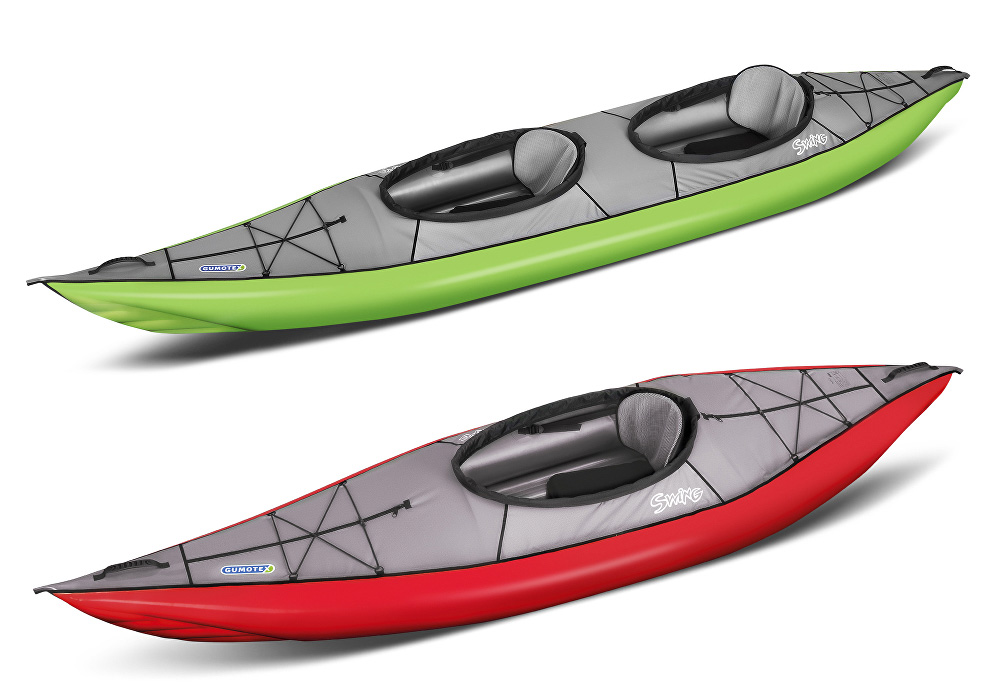
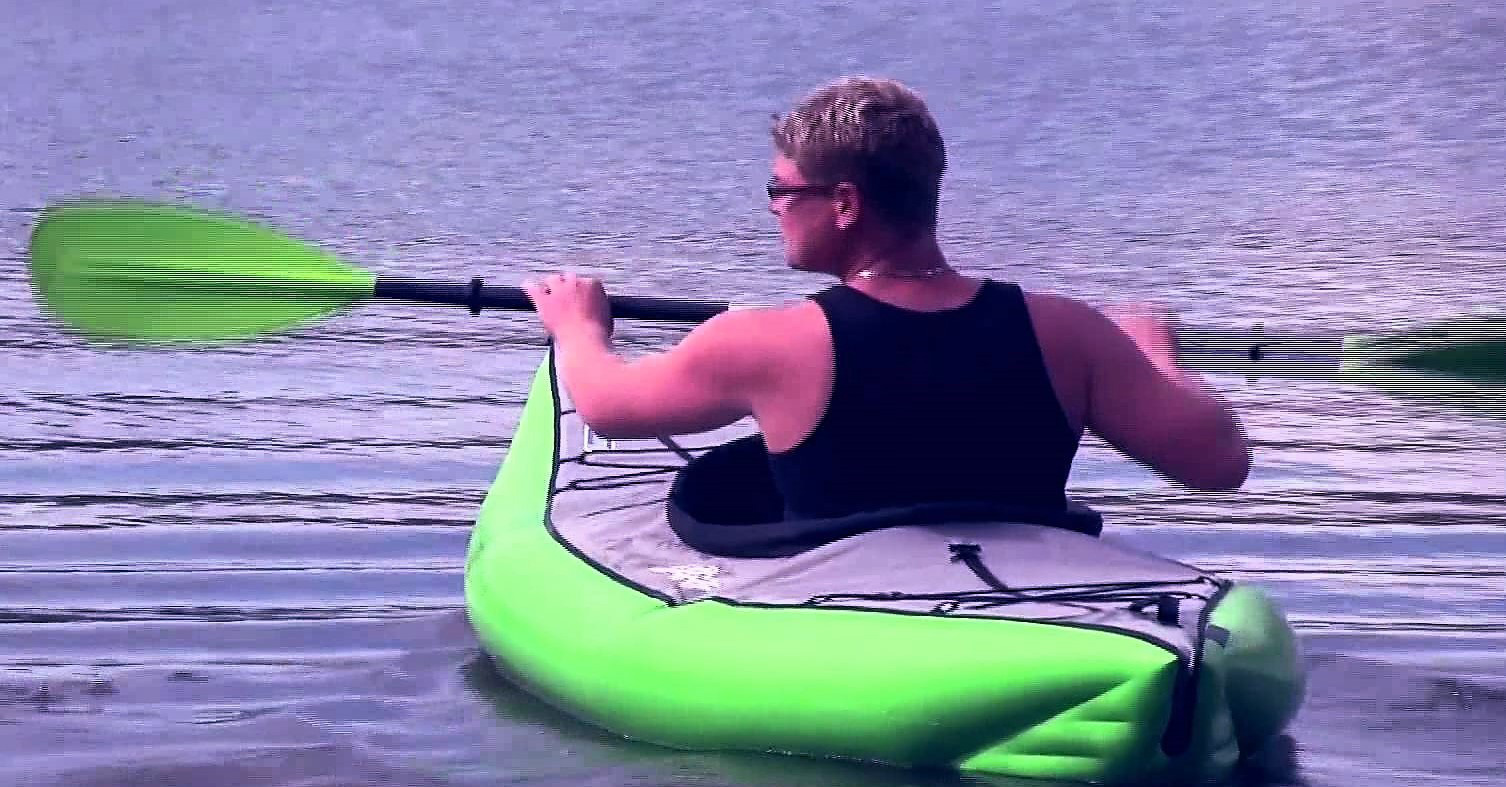
The Swings are fixed-decked solo or tandem IKs pitched at recreational users who seek the reassurance of a very wide boat and the dryness of a deck.

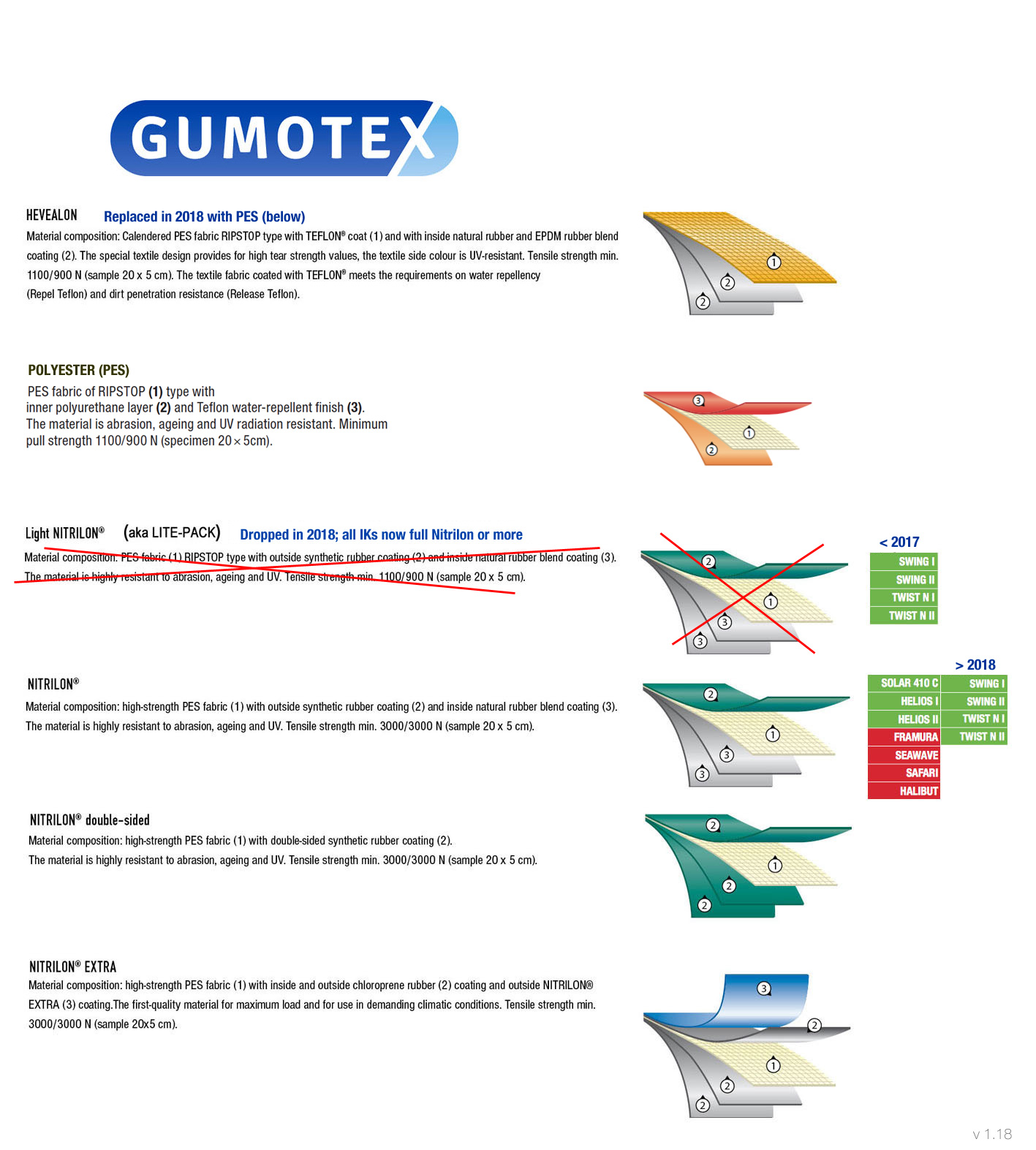
There were once and are maybe still two versions of Swing 1 and 2. Innova distributors in the US show red/black green/grey hulled models which they still list as made from Nitrilon Lite™. Europe and maybe elsewhere never had the black-hulled models and are made in Nitrilon (Nitrilon Lite™ has been dropped). The claimed weights for identical boats from EU/US are the same. You presume the green/grey doubles are now identical. See the table right about IK materials with more here

SWING I ▪ Length 3.16m ~ 10′ 4″ ▪ Width  87cm ▪ Weight 11.3kg ▪ Maximum load 120kg ~ 265 lbs

SWING II ** ▪ Length – 4.02m – 13 feet  ▪ Width  87cm ▪ Weight  14.3kg ▪ Maximum load  220kg ~ 450lbs

Note that what Innova in North America call the Swing EX is a Framura in Europe – a slimmer, fixed-deck, 4.1m IK which is much more suited to solo touring and inshore sea kayaking.

swingbots
swingwide
swingbow

As others have commented, they appear to be taking on IKs from Advanced Elements and even the bird’s-eye view is similar. From the profiles it appears they’re more ellipsoid or ‘lemon-shaped’ than other models, or maybe it’s just that they’re substantially wider which exaggerates this impression.

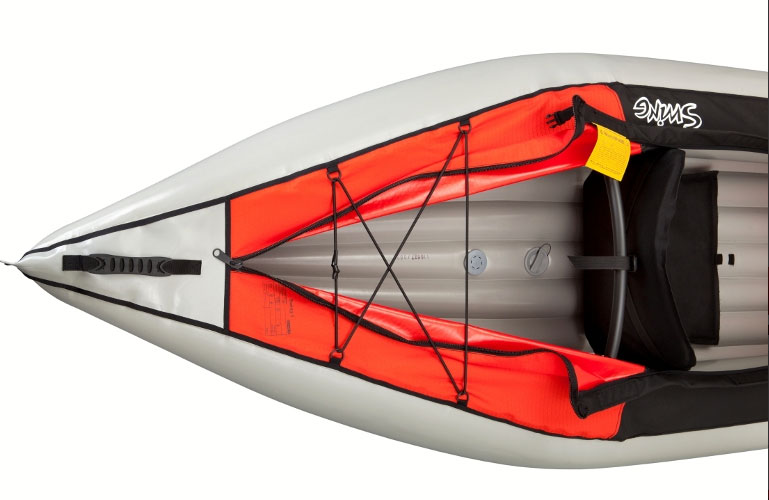
The Swings use 2 or 3 curved alloy crossbars to keep the deck taught (similar system on my Incept and Seawave) and make room for the legs, as well as spread and form the width of the boat. Some blurb states these crossbars make the boat more rigid which may well be true. Constraining the sides (stopping them from flexing out as the boat bends longitudinally) will have some effect in overall stiffness.

As far as the preferred boats for touring, what is desirable is a decked boat the length of a Swing 2, but set up for a single paddler. That is the Framura aka ‘Swing EX’ to Innova – a good-looking, solo-touring, fixed-deck IK for those who think soloing in a Seawave is a bit much. 
Sure you can sit in the back of an SW2 and load the front, but it’s not right, is it? What are the actual benefits of a fixed deck on an IK? (the Swings’ decks unzip partially). Limiting swamping – sure. Keeping the sun off – maybe in sunny lands. Keeping you warm – I suppose so, but that’s what a dry suit ought to do: ‘dress for the swim [falling in], not the paddle [air temps]’ they say.

And many users complain that the zips are far from watertight. And so I conclude that the Swings may well be popular (actually I don’t think they were) but fall into the less desirable ‘bloat’ category: much wider than they need to be which is great for nervous day/rec users. But for the smaller niche of multi-day touring and sea use (space, speed, convenience), they’re not so ideal.

Another review Some Swingers chat

Inflatable kayaks. Part 1: Fabrics and Fabrication

Page updated and moved here

Gumotex Sunny/410C ~ self bailing and hull rigidity

Sunny main page

Gumotex Sunny

Paddling the <a class="wp-gallery mceItem" style="color: #000000;" title="Kayaking and packrafting in southern France Haute Allier in France in a Sunny required frequent visits to the bank. Not to get money out of the ATM but to drain the swamped boat.
And on Shark Bay in Western Australia one crossing of a very windy bay required frequent pumping out. The water came in over the sides as the boat flexed over the swell (below).

On a river, flipping the boat is the quickest way of doing this, but can make a mess of the packing. Tipping it up on-end works less well because of a triangular patch at each end. It’s a handle of sorts but also keeps some water in. I cut a small hole in the back so I could drag it up a steep bank to drain itself (see little fountain, left).

Making the Sunny a bailer?
I’ve considered drilling bailing holes (easily and reliably reversible with duct tape I found on the old Safari, left) but am pretty sure the floor of the Sunny is below the water line with me in it. Loads at either end help, as would the hull sticks or plank described below, along with a thicker seat pad. It could be something worth trying to not end up sitting in water. Lighter solo paddlers in a Sunny may get away with cutting bailing holes without doing all these bodges because the boat won’t sink so low in the water (see graphic below).

ikbailers1

In the end, I decided I didn’t really need self-bailing for the sort of tame touring I did in the Sunny. If I was more into white water I’d get something like a self-bailing Safari. I never used my Java IK long enough to appreciate the benefits of its self-bailing feature and some later IKs (and packrafts) I’ve owned had zip on decks which are an alternative way to avoid water in the boat, although I used them even less. Away from flat water, a bit of splash gets in the boat most of the time but it takes a while before it’s sloshing about. The stiff and high-sided Incept was much less prone to swamping and the similar-to-Sunny Grabner seems the same. Longitudinal hull flex was the problem.

Making the Sunny/Solar 410C hull more rigid 

The Sunny is 3.85-m long but runs 0.2 bar (2.9psi). The replacement Solar 410C is even longer at 4.1metres but runs the same pressure. Since I originally wrote this I’ve realised that higher pressure IKs are indeed more rigid. I have read of people running a Solar 410 at 0.3 bar. I think this would take more than a regular Bravo foot pump could manage (or at least, my old example) and the push-fit valves (as opposed to more secure bayonet fitting) may pop the hose off. A way around that would be to use a push-fit hand pump like a K-Pump. I never tried it, but I have to say my experience with Gumotex IKs suggests that they feel sufficiently well built to take 50% more pressure. But to blow a seam in a tubeless IK like a Solar or a Sunny would be hard to repair.

Can you see any difference whatsoever in the pictures on the right? It’s supposed to show the Sunny with no load (top) – quite bent; the boat equalised with a heavy load – low and relatively level (middle); and at the bottom with a light load with some straight branches jammed in the sides (see below) – less bent than it would be. No, you probably can’t, they all look the same.

While paddling the Tarn Gorge in 2007 I tried ways to help stop the hull on my 13-foot Sunny sagging with my weight. The handy gap where the side tube meets the floor tube was just right for jamming a stick in.
Up to that point I had found that leaning far back on the seat and taking the weight off your butt and onto your heels and shoulders was a way to unsag the middle of the Sunny and could mean the difference between scraping through a shallow shingle rapid without punting or walking the boat through.
I was going to buy a pair of broom handles in France one time but forgot, so later by the Tarn river I found a couple of branches that were pretty straight over 5 feet and jammed them in between the floor and the side tubes more or less in the middle of the boat. My unscientific impression was that the Sunny was indeed more rigid, responsive and faster, leveling the boat out in the water. Later I found some light metal tubes (right) but never did anything about it. The fact that the river sticks popped out through some rapids shows how much the Sunny flexed in rough water.
A year or two later I was reminded what a good idea a pair of stiffening side floor poles could be on a Sunny and how easily that can be achieved. Of course, the poles will be more junk to carry around, but as I was considering using the old Sunny more in the sea it felt worth doing. I cannibalised an old TNP paddle and with a saw and a hot knife trimmed off the blades. Now I had two 1.55-metre long sticks although 1.75 would have been better as this is the distance where the starts to taper in to each end.

A series of attachment points needed to be glued to the 3-inch wide flat strip where floor meets the side tubes. I got as far as this (right) but then someone told about the Incept K40 which seemed a more seaworthy boat so I gave the Sunny away.
But – if I owned a Solar 410C and paddled solo and out at sea, it’s something I’d consider trying. It’s easy to do and harmless to try. There’s more on hull flexing here.