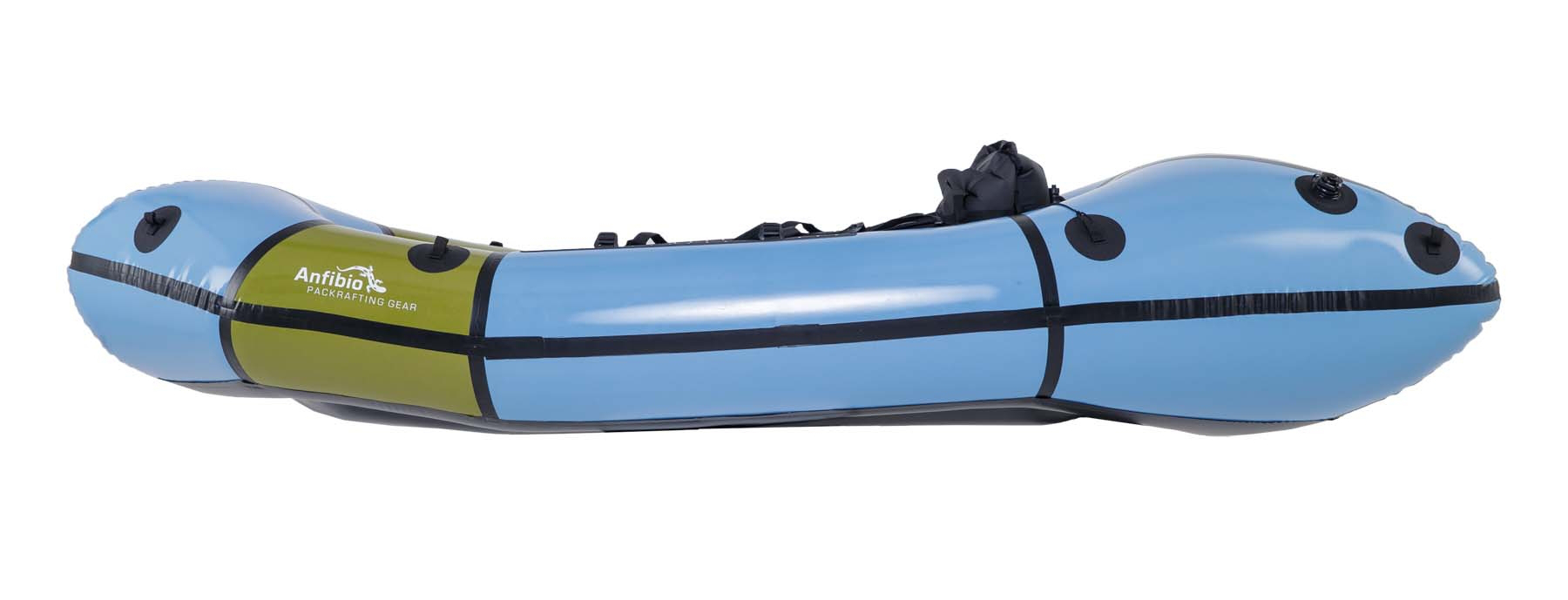
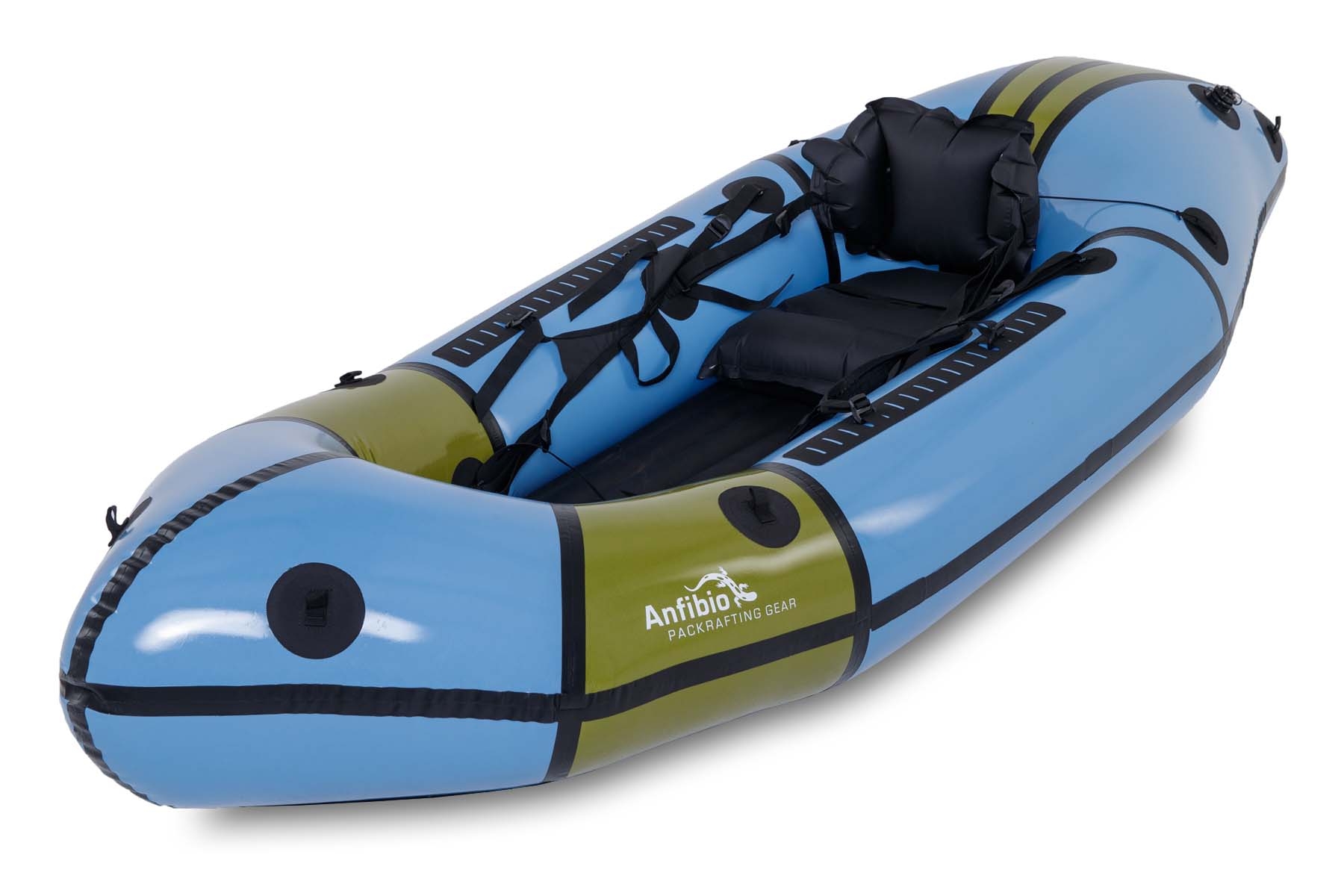
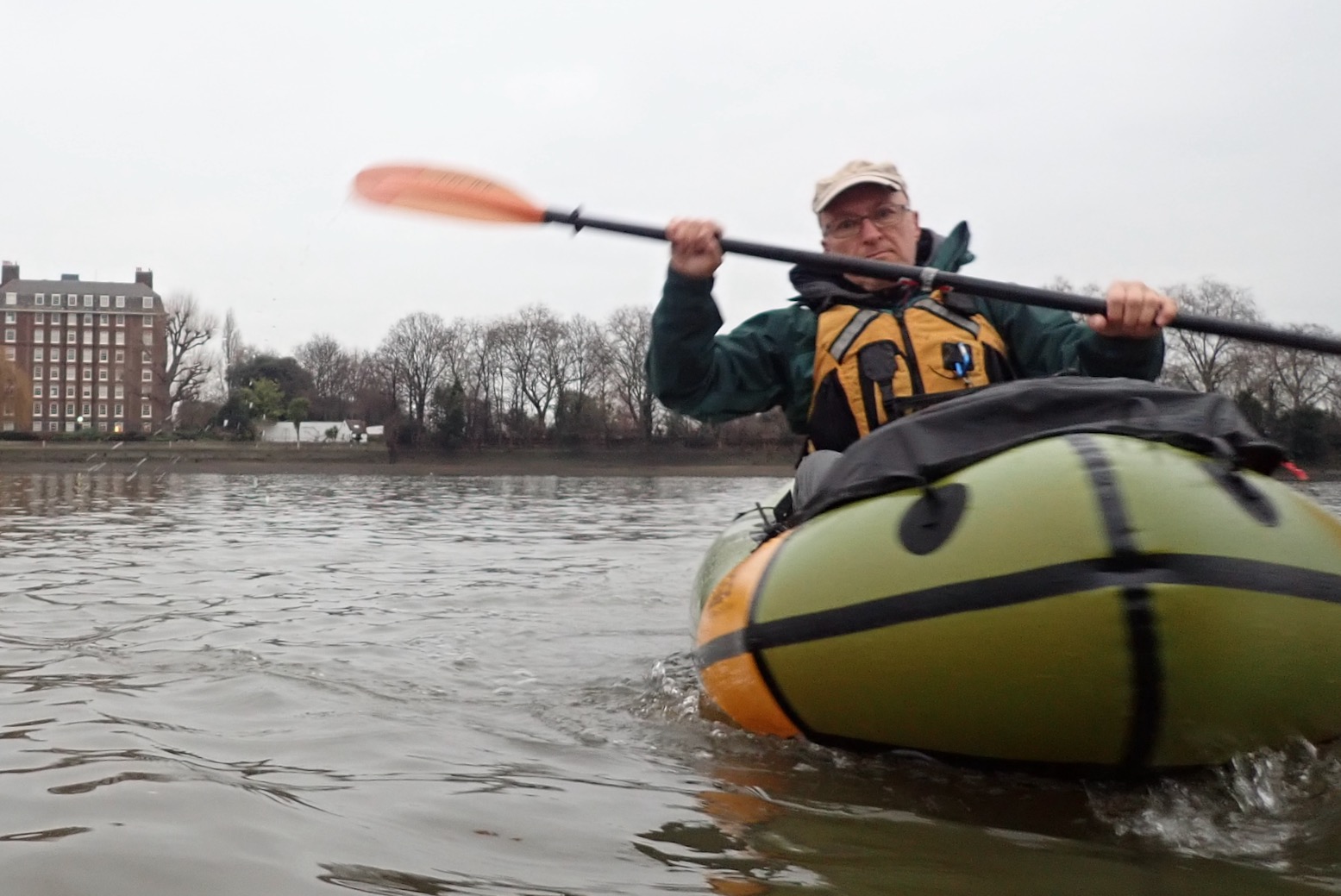
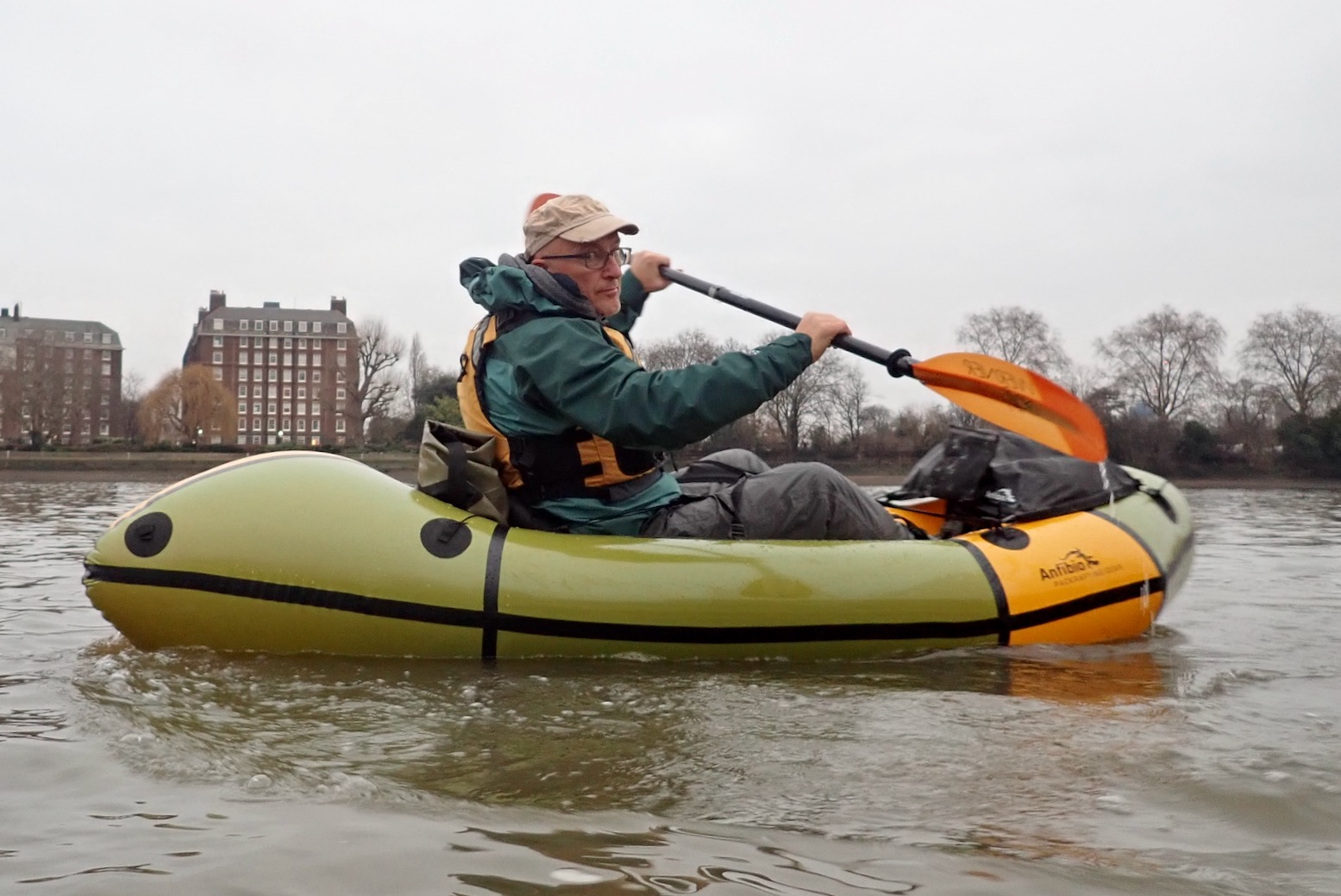
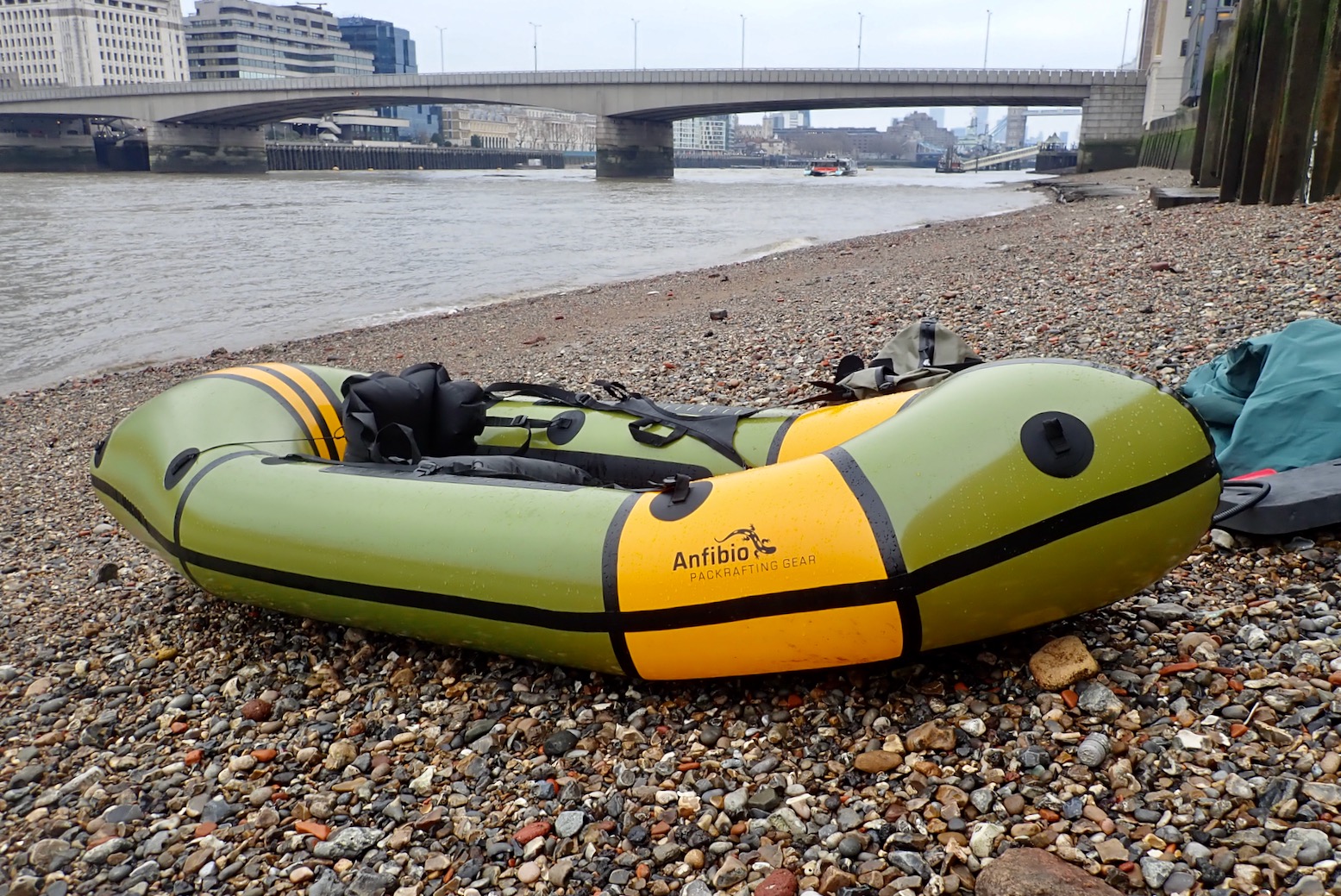
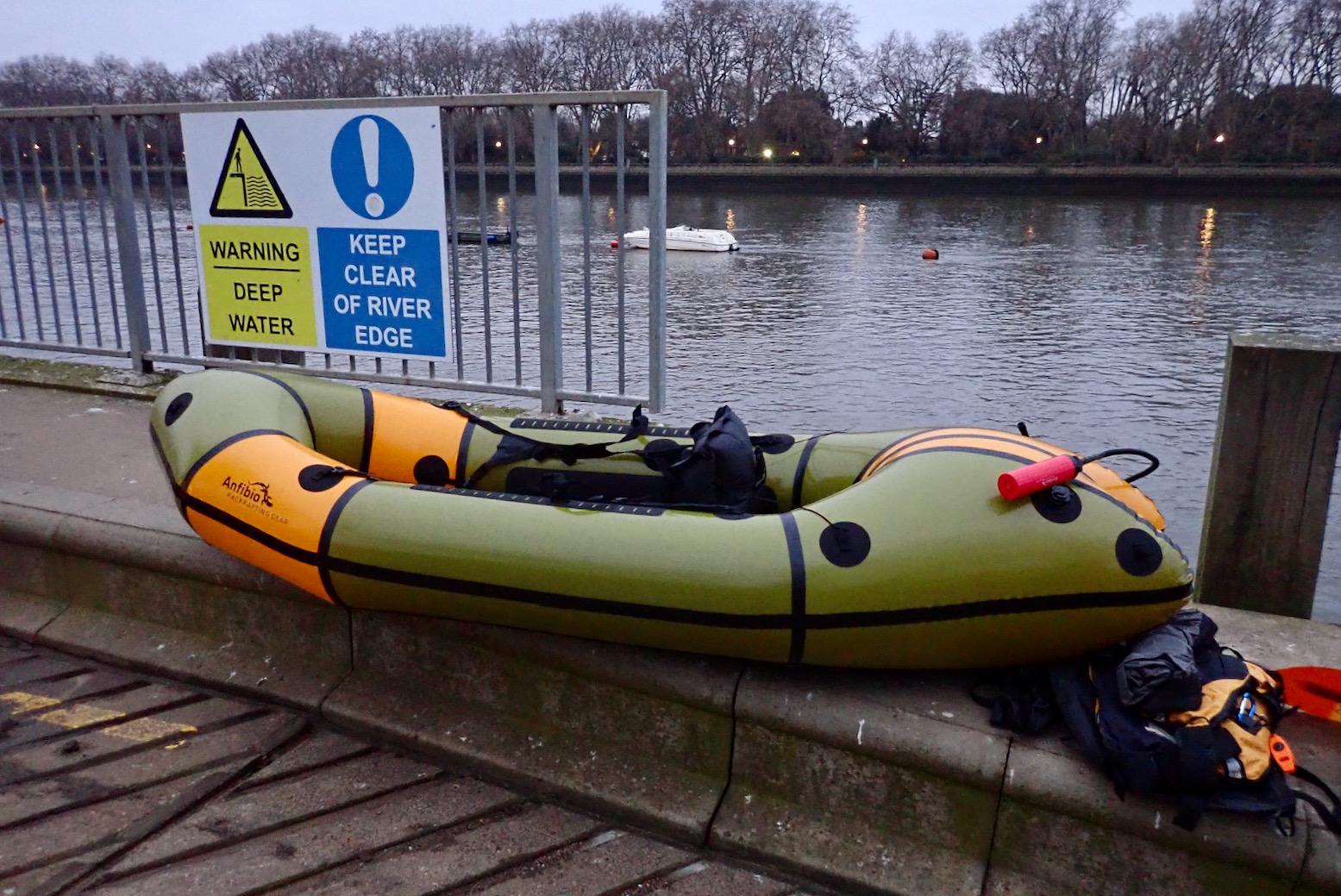
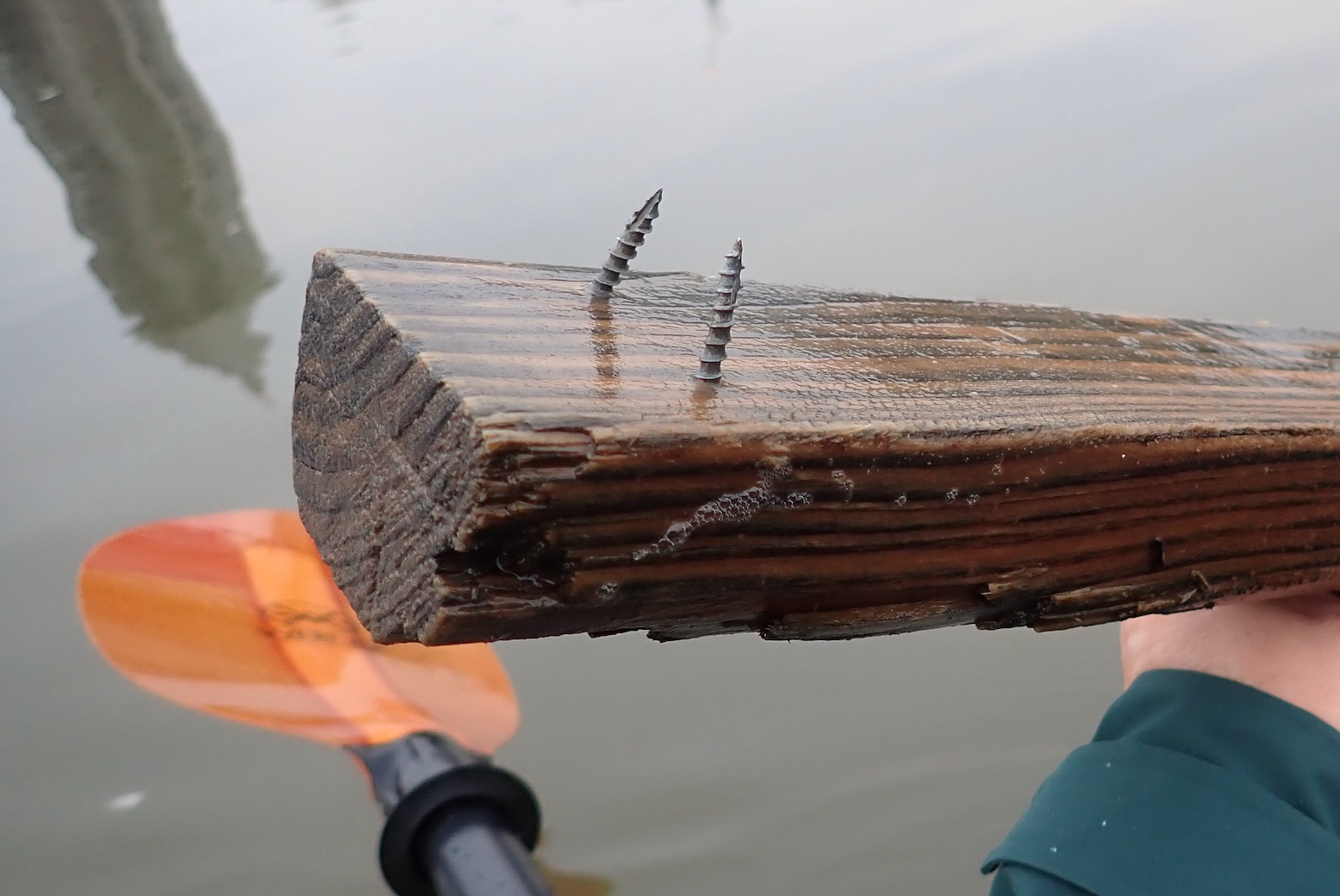
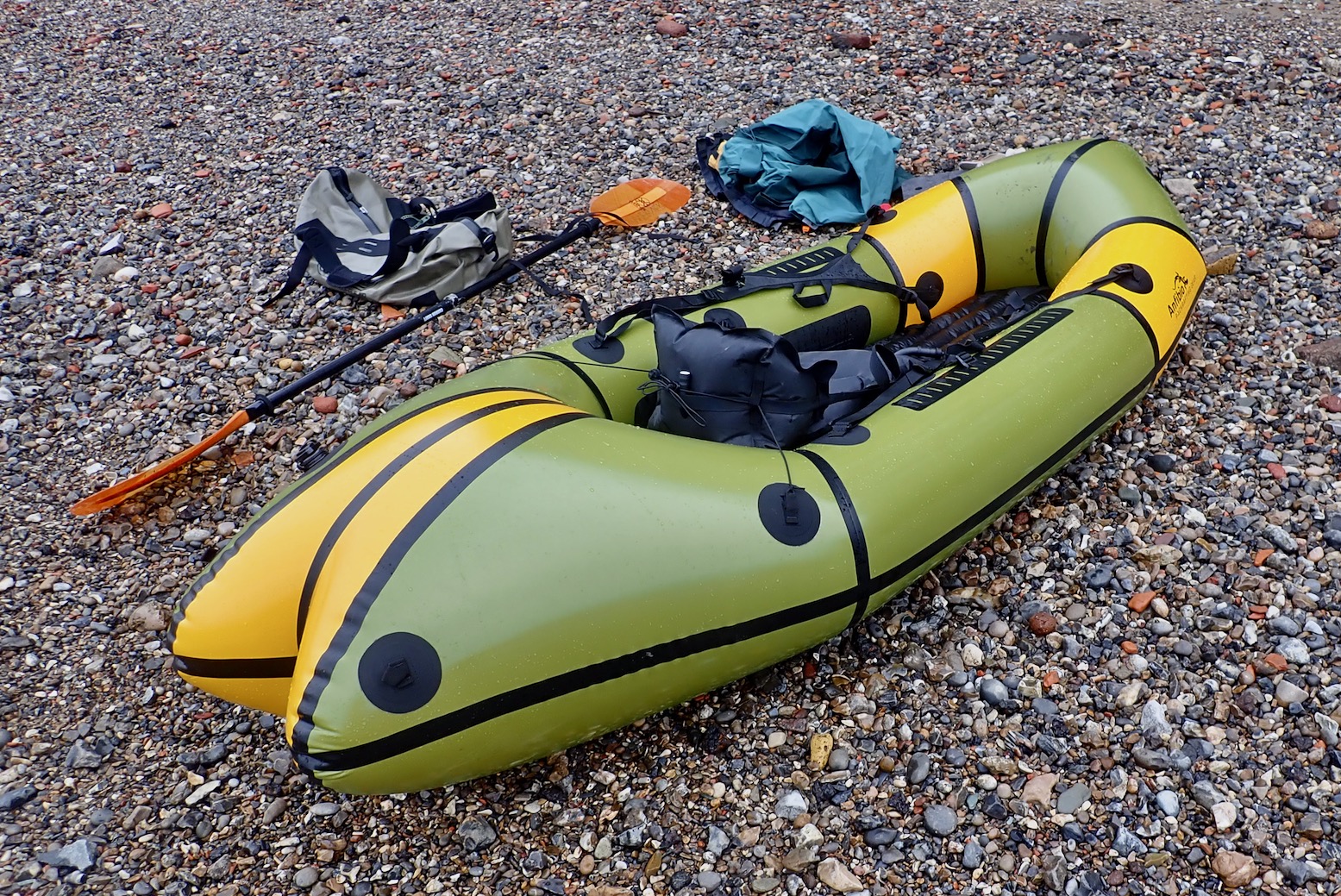
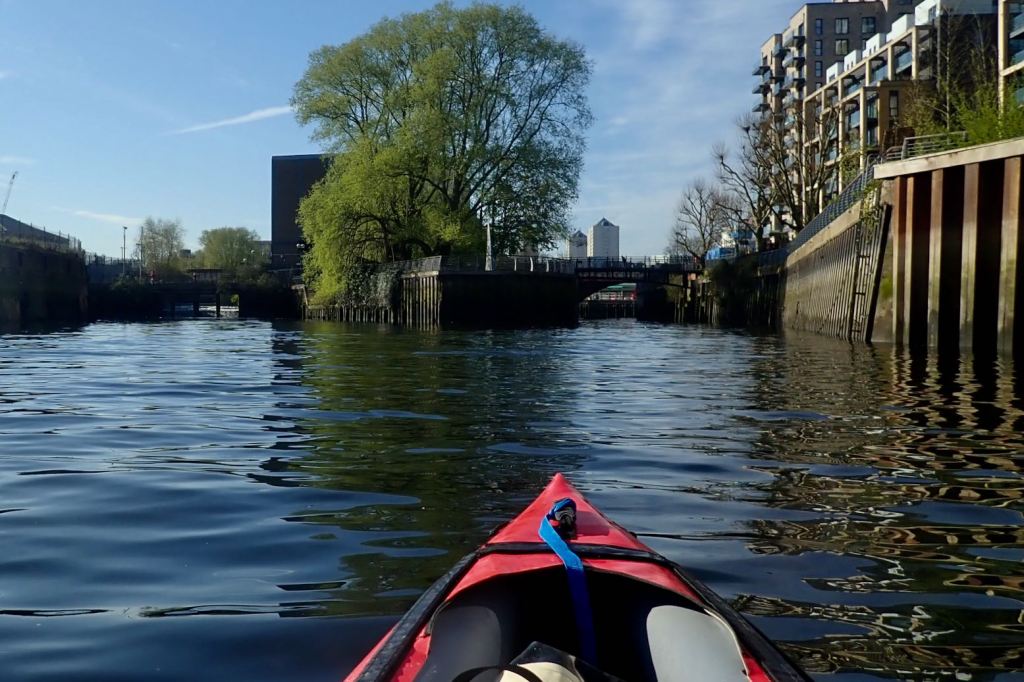
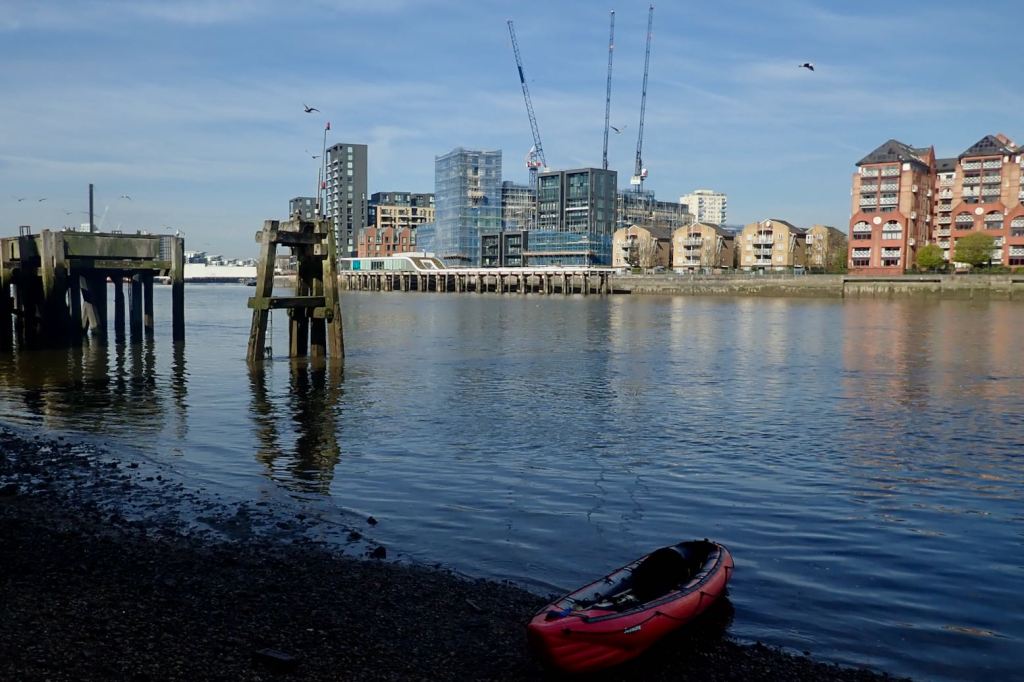
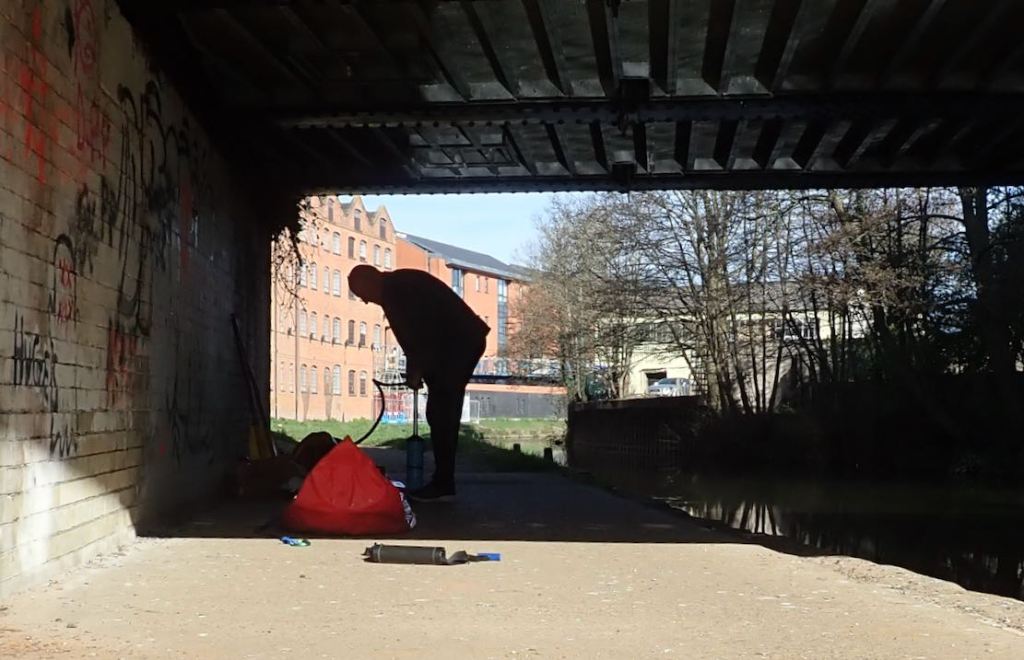
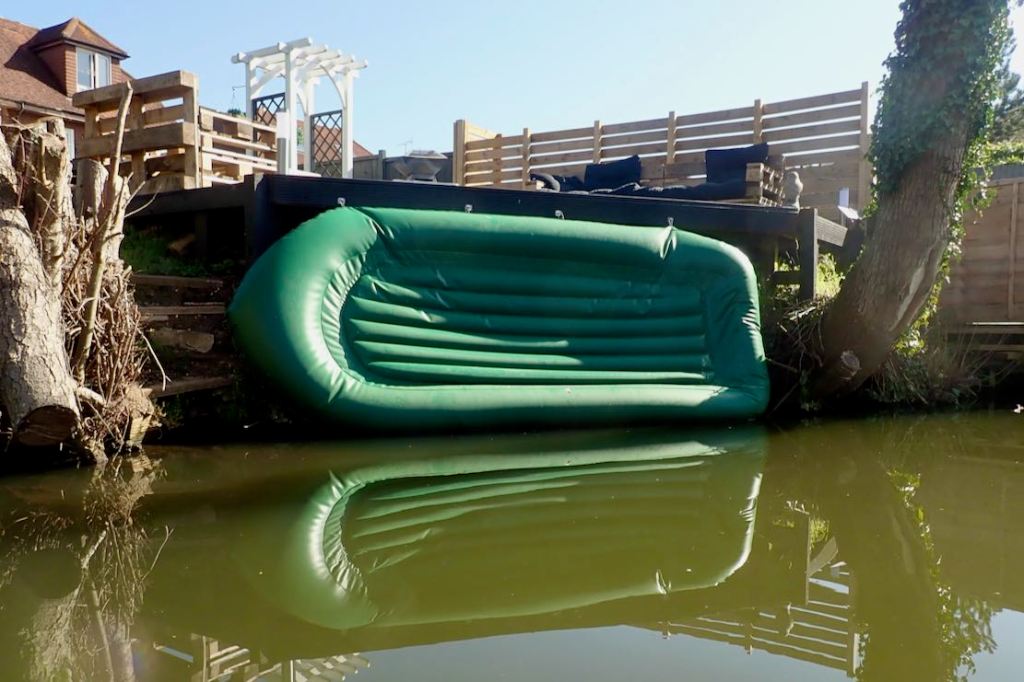
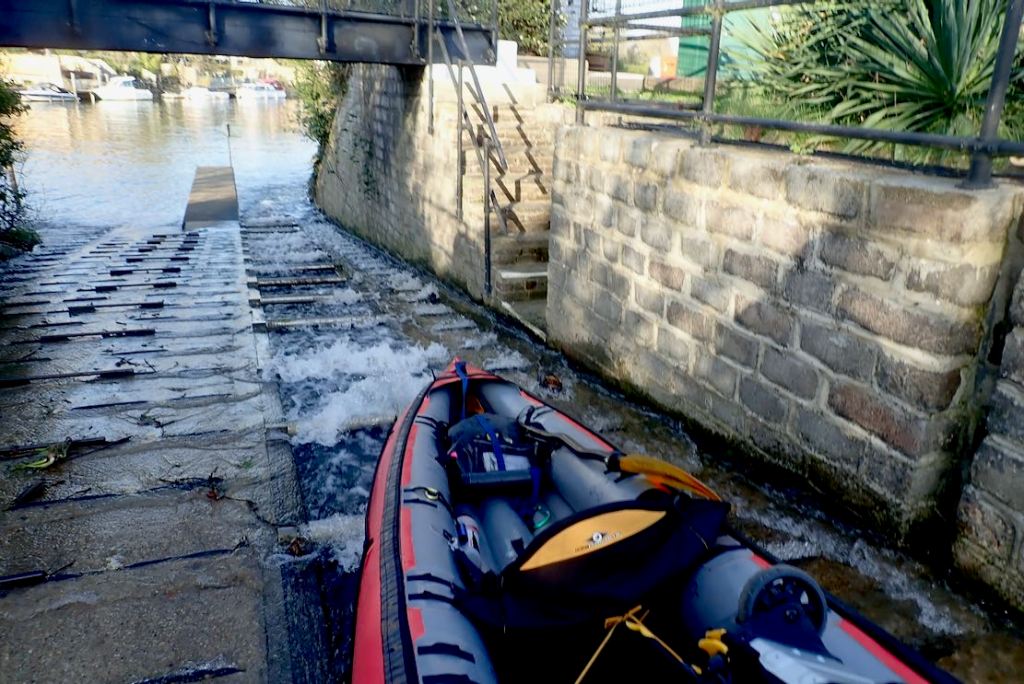
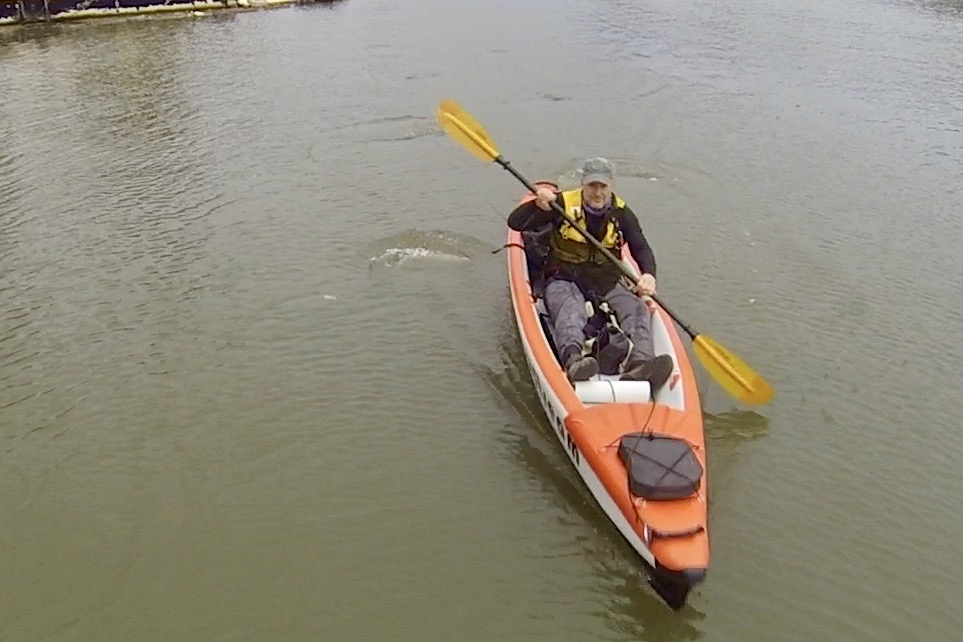
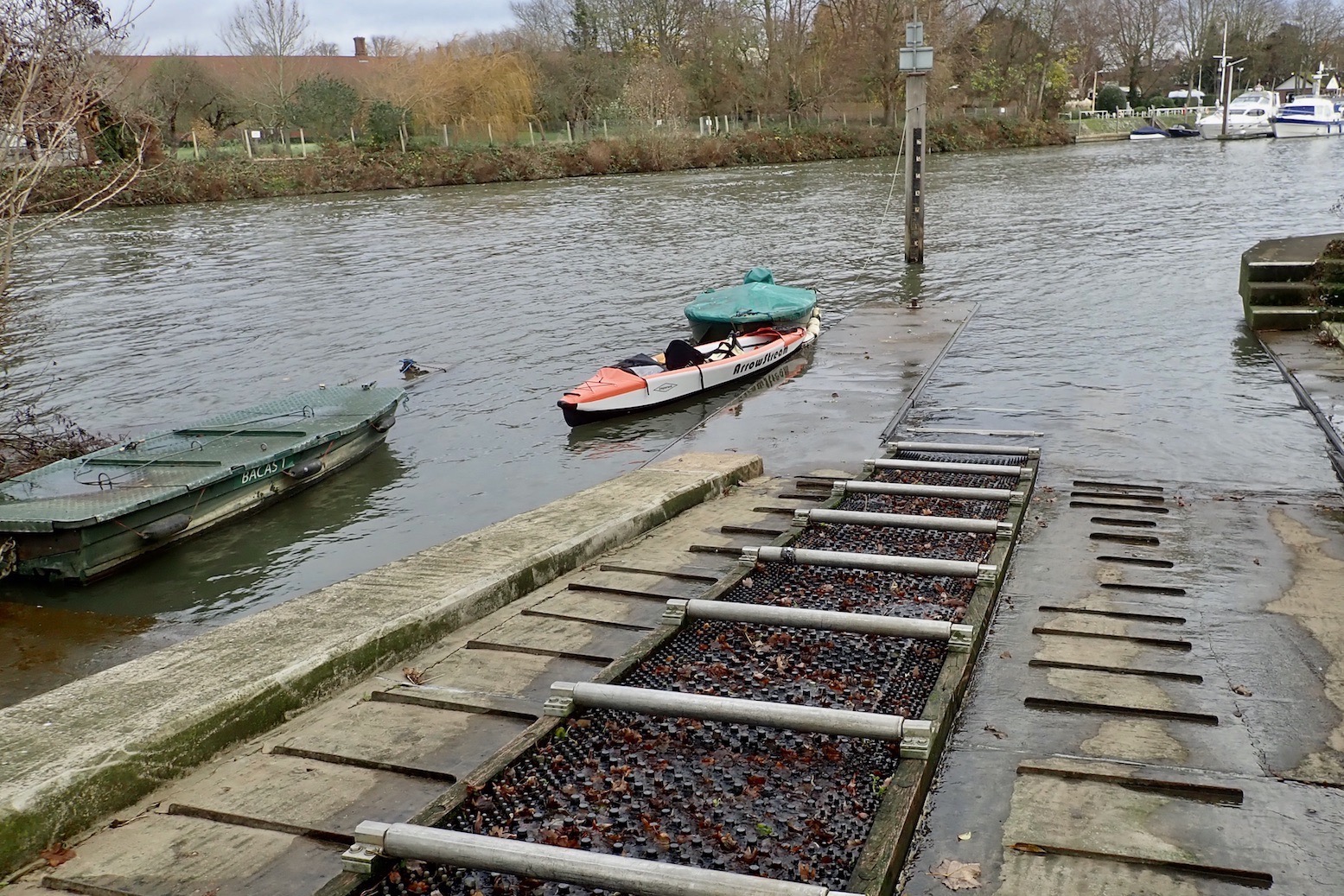
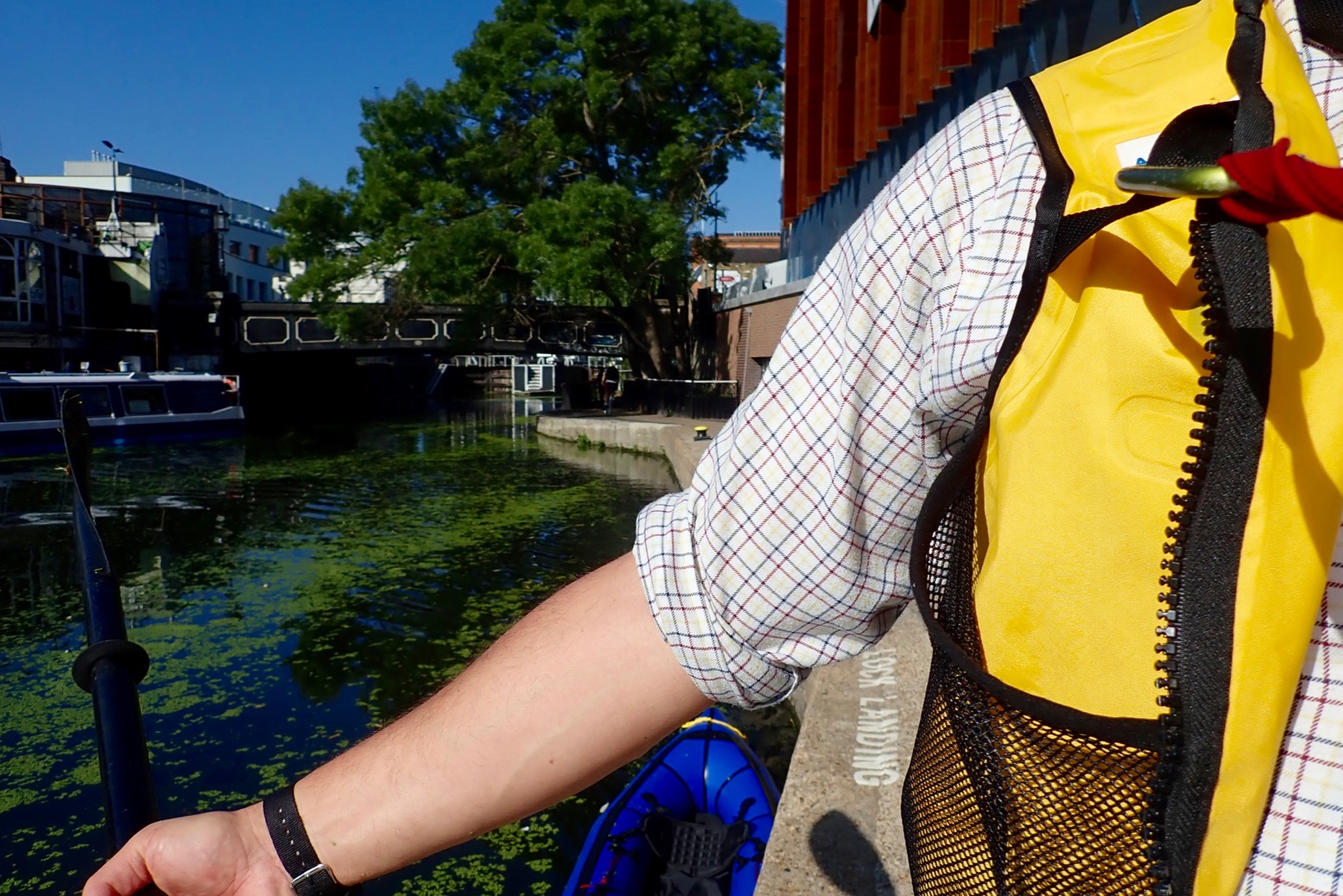
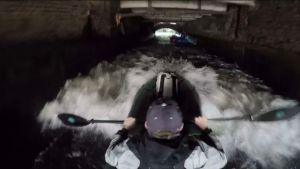
Miraculously, a sunny spell spanned the Easter bank holiday weekend so I took the new TXL down the Thames for its maiden voyage. At Putney I caught the remains of a spring tide but dithered too much so only had a hour until it turned at London Bridge and pushed back up the river. Nevermind, I’ll get as far as I get and hop out anywhere there are some steps or a ladder. With a packraft it’s easily done.
Skeg half out but does the job. One thing I like about longer, centrally positioned packrafts is the the trim is level, not back-heavy as in a conventionally sized rear-sat packraft like my 2K, (unless you are light or it has a hugely voluminous stern, like a Revo)
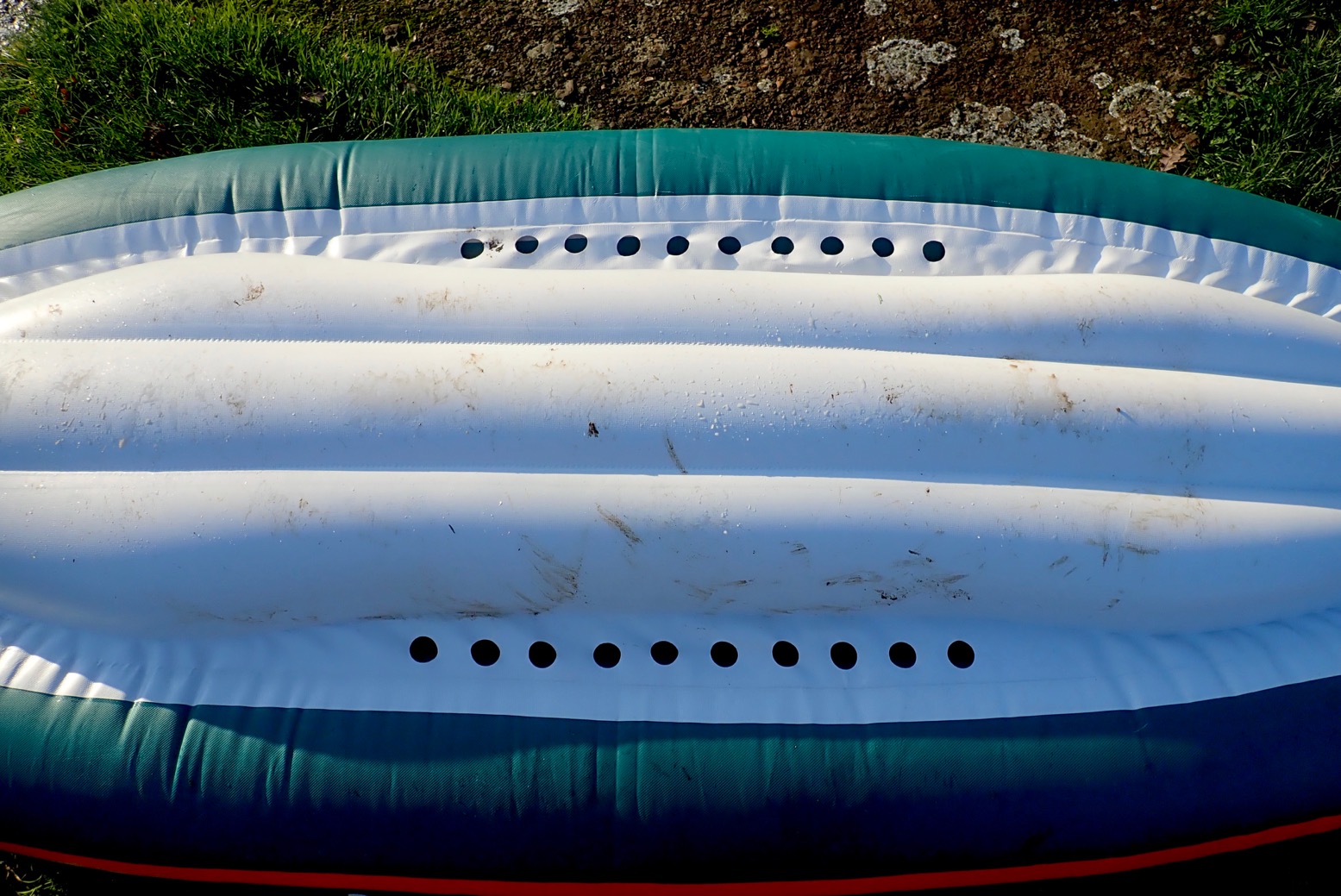
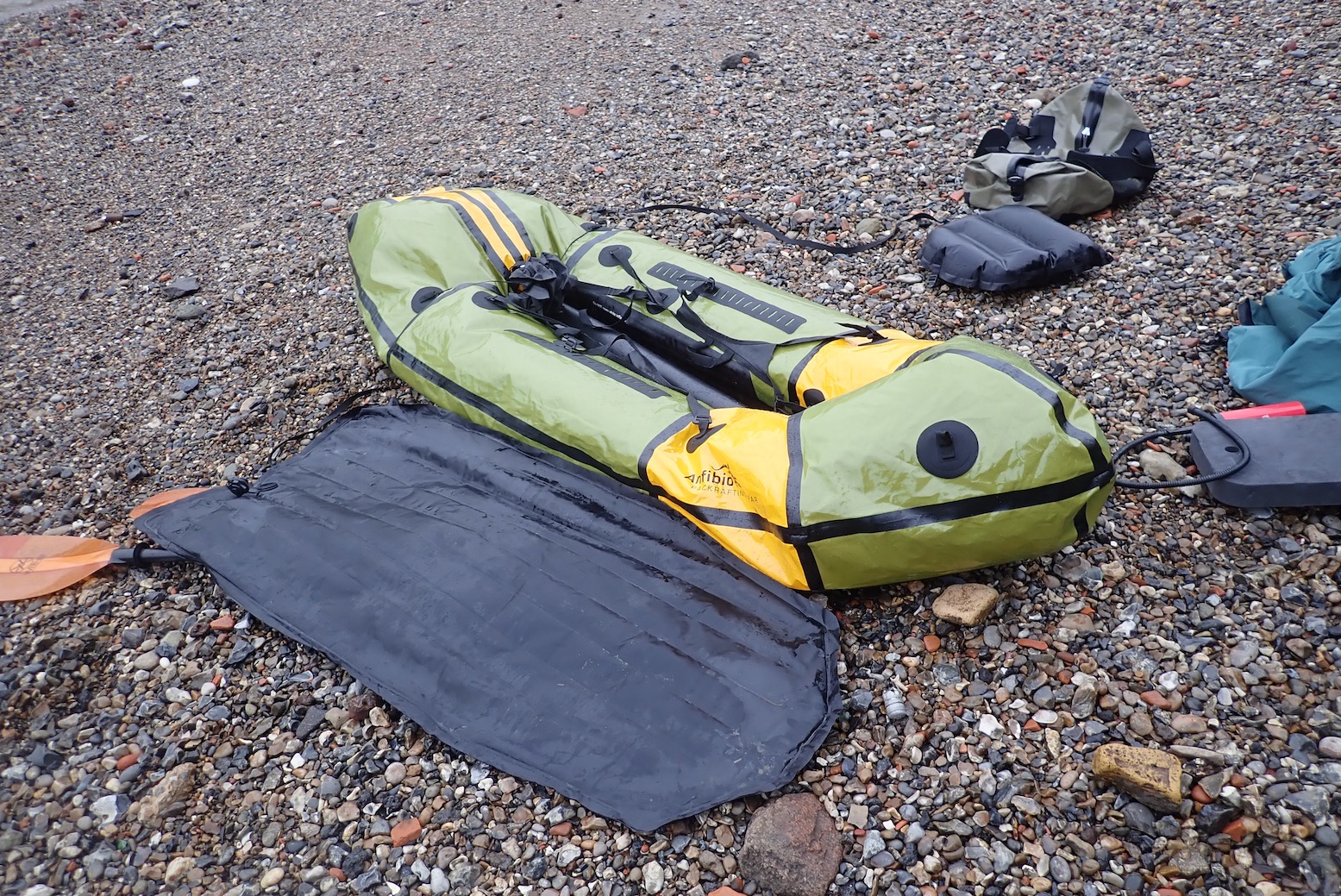
Floor pad and skeg This is a similar run I did a couple of months ago in the dead of the Covid winter with the Revo, but this time I remembered to air up the floor pad good and hard. I’m expecting the 2.8-m long, hard-floored TXL to be nippy, and so it is. Setting off the boat skates across the water so that you can ‘paddle – pause/glide – paddle’ like in a kayak, not spin like a food mixer to keep moving. I fit the skeg but notice from the pix that most of it is out of the water. Don’t think the 2K was like that, but it’s submerged enough to track well. I did wonder why it wasn’t on the flat of the floor for full effect. Perhaps, as with the Nomad S1, it’s not strictly necessary. Something to try next time. As mentioned, I do plan to fit a second skeg on the front to see how that affects crosswinds and sailing.
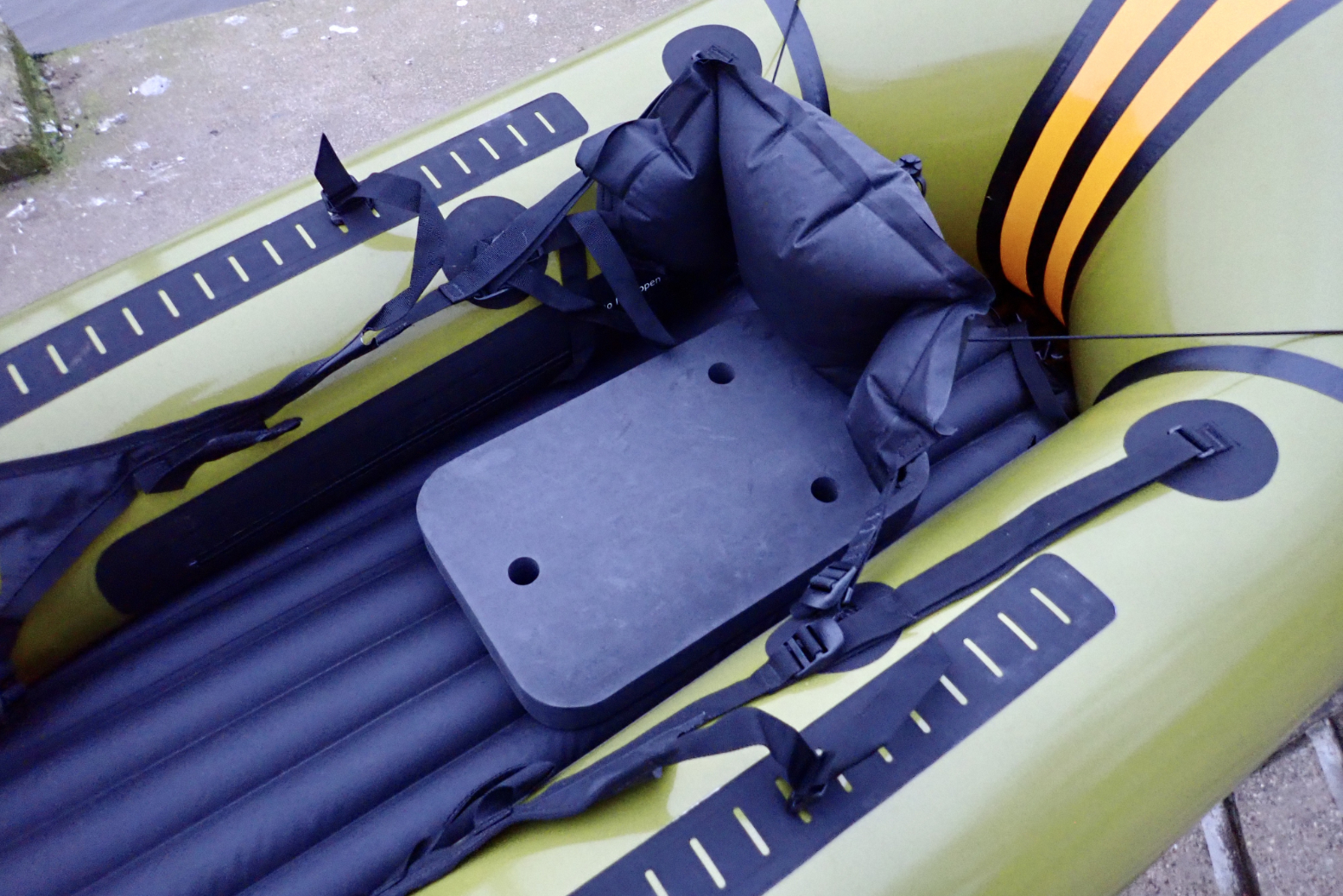
Seat They advise using the foam seat block with the floor pad. It feels a bit of an afterthought, adds packed bulk and, as others have reported, is not so comfortable. After 20 minutes I was getting a sore coccyx which was only going to get worse.
More seats than the O2 Arena
Mid-river I shuffled over the twice-as-large inflatable seatbase but soon found it wobbled around on the hard floor pad (like trying to stand on a soft football) in a way these seats don’t when sat on regular packraft floors. This must be why the block seatbase is supplied but the foam is too hard for flatwater cruising. I aired the seatbase right down (easily done in situ) until I was nearly sitting on the floor, but in rougher waters there would still be a wobble and anyway, by then your butt and heels are nearly level like sitting on an iSup board; not an ideal paddling posture.
OMG – non-locking krabs! (fear not, a solution is at hand)
Overall, the raised position on the floor pad does aid good paddling as you can clear the fat sidetubes with the paddle more easily. Sat higher, I would expect stability in rougher water to suffer; at that time you’d want either thigh straps – or just sit yourself lower by easily airing down the floor pad. The backrest is easily adjusted in the boat too, and is held up by thin bungies so it’s easy to shift it up your back if it slips.
For the moment I feel the seat set up in MRS Nomad was a better affair. Partly because I felt it was part suspended/supported from tabs halfway up the side tubes like a hammock, not sat directly on the floor. That means your body weight is spread broadly along on the side tubes, not pressing down solely into the floor, created sagging. And also the flat foam backrest if fitted was better *and I may do the same with TXL). But, at around half-a-metre square, the TXL seat base is much bigger than previous packraft seatbases I’ve used. Without the floor pad, this broad base may nearly replicate the advantageous load-spreading effect of a Nomad-style side-tab suspended seatbase. An underwater picture will tell all, but I like to think the TXL may be as functional and not much slower without the floor. After all the floor-less Nomad was nippy enough. Since then I think the TXL works well without the floor – or I’ve yet to detect unambiguous advantages.
The TXL’s raised floor jams you less well into the boat sides which is 4cm wider than the Nomad. I quite like a jammed-in feeling but recognise that with a floor pad, added height requires a bit more boat width to maintain stability. Meanwhile, up front there’s plenty of room for feet side by side, unlike in the pointy ended Nomad.
There are a few more evaluations to do with the TXL but it looks promising. Comfortable, supportive seating I know can be an issue with IKs so using the floor pad I’m confident I will either get used to it, find a better seatbase and backrest or find that the pad is not essential for shorter paddles. Fyi, I have now become very used to using the Flextail electric pump to air up the boat (and the floor), before finishing off with the handpump. It can vacuum shrink the boat too, for compact packing, but rolling up is as quick. As you can see the handy BowBag fits on like it should, too.
Anfibio Vertex Tour paddle Anfibio sent me their new, four-part, multi-adjustable Vertex Tour paddle to try. It weighs just 890g on my scales, same as my old carbon Aqua Bound Manta Ray, with same-sized blades. A simple lever clamp allows you to set any offset the carbon shaft left or right, as well as vary the length 15cm between 210 and 225cm which is something new to me. Theoretically I can see using the full length with a backwind or a strong current and a short paddle for battling into the wind in ‘low gear’.
Each piece is 63cm long. The all-round shaft felt a bit thinner than normal, and sure enough, measured up around 29mm ø compared to my 32mm Werners which suit my hands better. Smaller handed persons will prefer the Vertex. The middle clamps up firmly but there was a bit of slack at the paddles; we’re talking less than half a millimetre here but it’s enough to rattle and be noticeable as you release the pressure on lifting the blade out. Does it make difference to non-competitive propulsion? Not really and better too loose than too tight. I wrapped some thin, smooth tape round the ends to eliminate the slack. The Vertex costs €125 – that’s a lot of light and fully adjustable paddle for your money. More here.
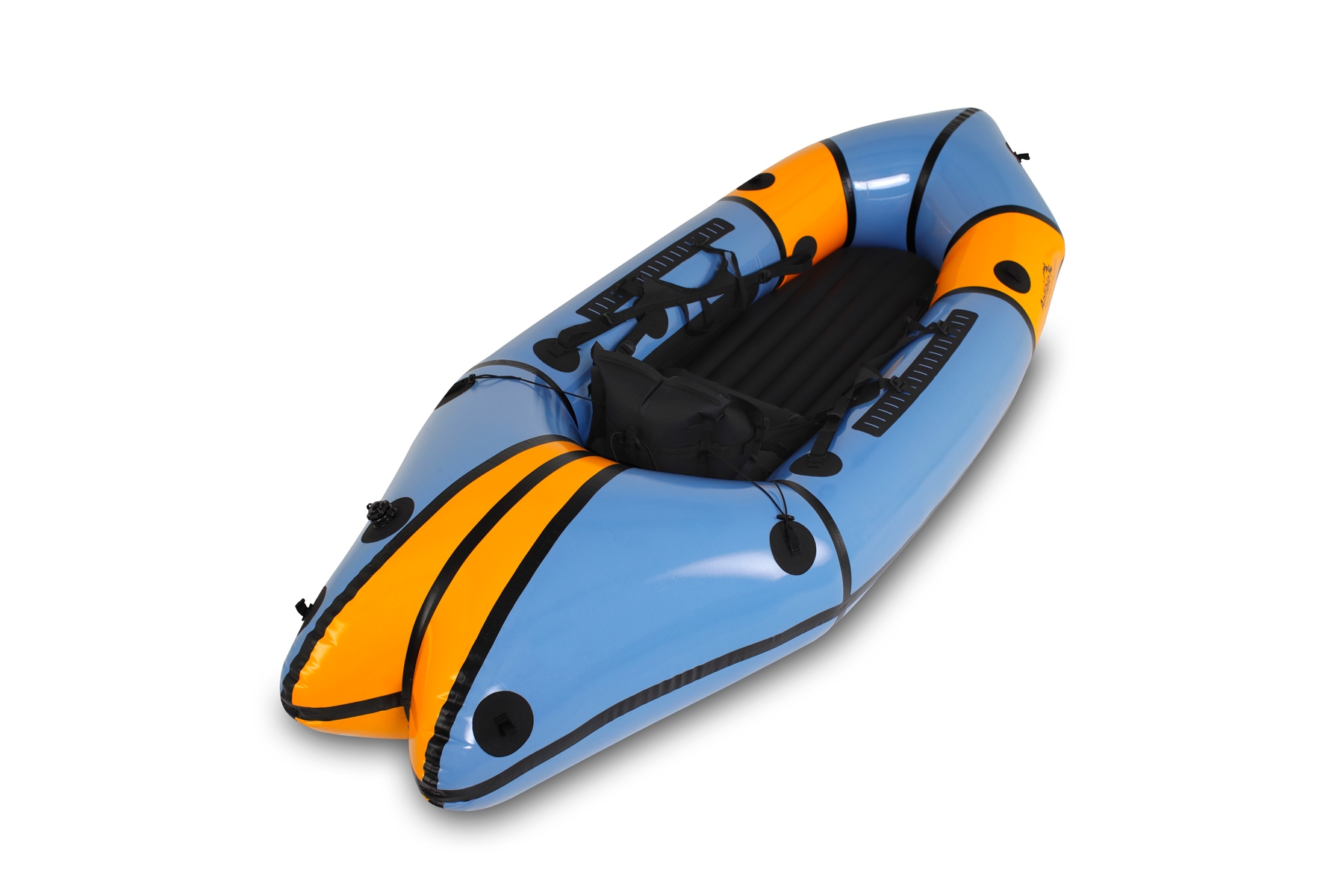
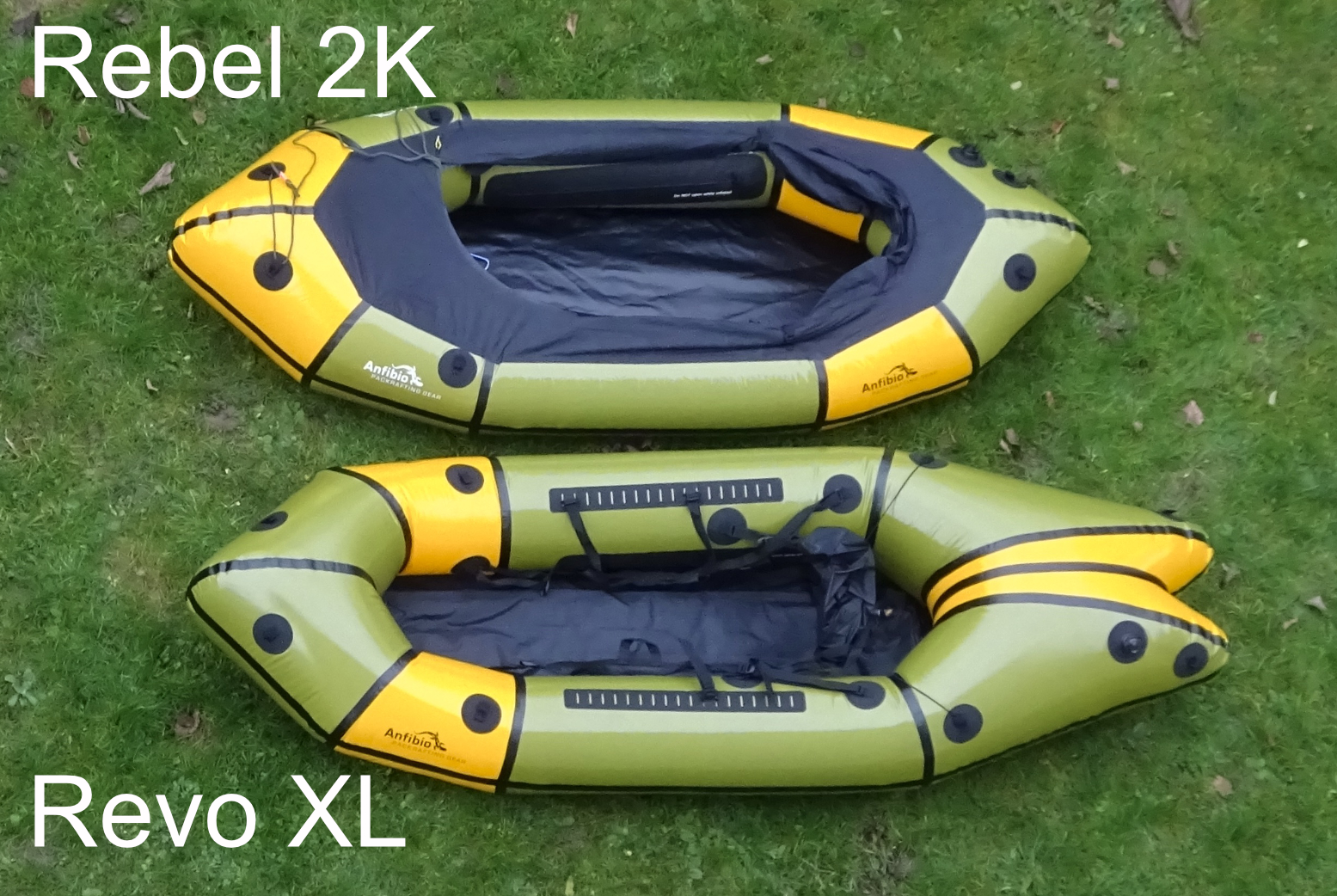
Early in 2022, as the UK’s Omicron surge peaked, I had a chance to try out a pre-production prototype of Anfibio’s RevoXLpackraft. Along with its distinctive forked stern, the Revo introduces a new idea to self-bailing packrafts: a single ~15cm drain funnel under the seat which can be pulled into the boat then rolled up and sealed, like a drybag. I tried the XL version with a 135cm inner length and 28cm sidetubes. The smaller RevoCL is 10cm shorter all round and has 27cm sidetubes. As you can see my test boat came in lemon and olive. The production boats are cornflower blue and olive for the CL which costs from just €759. That’s a bargain and may fit taller folk better than they think. The Revo XL which I tried costs €999, but in-hull storage TubeBags come as standard. I think the lemon and cornflower is also a better colour combo. Both models come standard with inflatable floor mats to help displace any water inside, as well as 4-point knee braces. The sides are 210D, the floor is a thick 840D which wraps generously up the sidetubes for WW protection, and it’s all assembled by heat welding and sewing; no glue.
What they say (Revo CL here) The Revo XL is part of the Revos concept – a combination of (closeable) self-drainage, profiled floor and the new TwinTail . Thanks to bilge (spray water runs out through the floor), the boats come without a spray deck and can also be configured as a light, minimalist boats. This results in a unique range of uses from whitewater to touring. The particular construction is similar to the smaller Revo CL: VenturiTube – the closable bilge hose TwinTail TM – the W-shaped double tail of a surfboard Comfort BackBand – the combination of back strap and rest 5P Thigh Straps – ergonomically adjustable thigh straps Firm floor mat – for a stiff, profiled hull The structure of the boat with and without a floor mat and the various (seat) configurations are the same as in the Revo CL or can be found in the supplied operating instructions. Revo XL/CL Differences The XL variant uses a larger outline. It is 10 cm longer, which creates space and speed. It has 28cm side tubes for increased buoyancy and stability. [The CL runs 27cm. And the XL has yellow contrast panels; the CL has olive]. TubeBags* are standard in the Revo XL, which ensures sufficient payload. In addition, a stronger base is used, which is appropriate for potentially high loads. The boat is a good choice, especially for tall and heavy paddlers, multi-day tours or if extra comfort is required. In the XL variant, tall people with a load of up to 120 kg can sit directly on the mat without a seat.
Revo CLRevo XL
About self-bailing In a packraft there are two ways of dealing with getting swamped: seal the boat with a deck and spray skirt like a kayak (below left), or let the water drain out via holes in the floor, like a commercial whitewater raft (below right) or a hardshell sit-on top. The latter method has the advantage of being immune to water ingress while also making exiting the deck-free boat faster. The weight of carried water and a perforated floor are said to slow a self-bailer down a bit on flatwater.
Sealed deckSelf-bailing drain holesROBfin draining holes and integrated floorTaping the drain holes (on an old IK)MRS Alligator with valve flaps
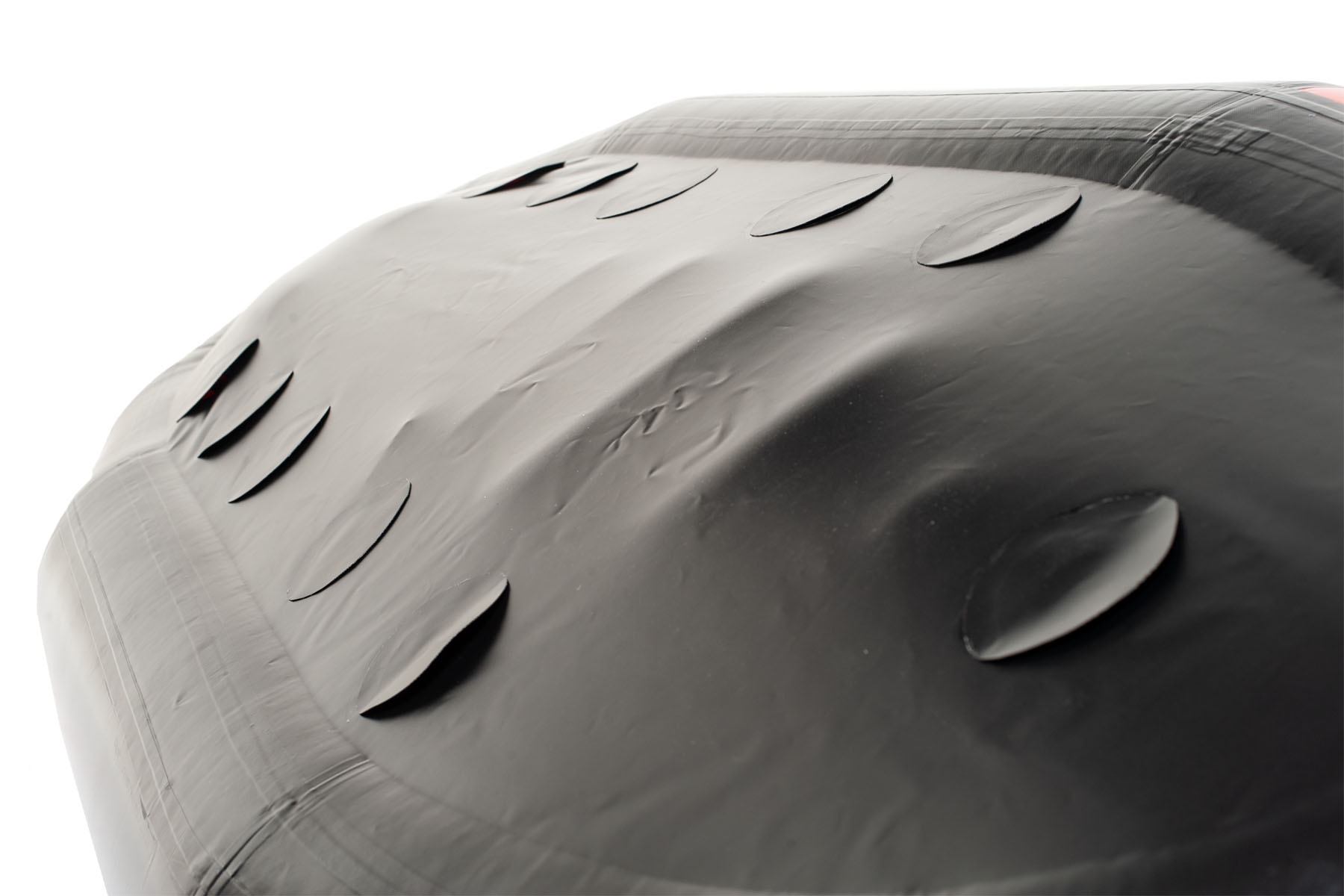
With self-bailing, a thick floor rising above the waterline displaces water carried in the boat, and a seat on top of that means the paddler isn’t sitting in water, even if they may be soaked from waves. Among others, packrafts like MRS, Kokopelli, Mekong and RobFin [link] (more of a small IK) use a line of holes in the floor. You can seal those with some tape, and MRS use valve flaps to smooth the profile and reduce infress. But for the moment only the Revo uses a retractable drain funnel or Venturi Tube, potentially giving you the best of both worlds. They work like similar devices on surf-skis [link]: the movement of the boat over water creates a low pressure zone which sucks water out of the boat provided you keep moving. When you stop the level may rise a bit.
What pours inDrains out (see video below)
Review: Anfibio Revo XL
Along with a voluminous ‘whitewater’ stern, the Revo has a distinctive and trademarked TwinTail which is said to help the back end bite into the water or catch back surf, like the somersaulting playboat below right. Because using a skeg on whitewater is a bad idea, I can see how the forked stern might replicate a similar digging-in effect, but won’t pretend to know what I’m talking about here. I have seen similar designs on surfboards where it’s called a fishtail.
Fish Tail surf boardsFlippin’ ‘eck
Either way, a long stern positions you centrally like a kayak, and the high stern volume ought to stop the boat flipping backwards as you exit small waterfalls. Because of the back’s huge buoyancy, I thought I detected a slightly tipped forward aspect to the trim, even with my hibernating 93kg.
Unfortunately, where I live there are no small waterfalls for miles. Were that the case my whole paddling background might be different. So I wasn’t able to test the self-bailing function or the stern’s finely tuned handling characteristics. I suspect there isn’t much more than aesthetics to the Twin Tales design; a cool, 50s Cadillac look, but whitewaterists will have the final say on that.
The seat uses a suspended inflatable backrest, but as this was the XL version, there was not much adjustment left to move the backrest forward enough for me, even at 6′ 1″. At the back I’d have preferred counter tensioning straps like on the Kokopelli, rather than the thin elastic which makes the backrest wobble about, but you can always use the long packing strap for that. (In fact, the same backrest came with my Sigma TXL which I eventually replaced with a firm backrest and rear straps). The loose seatbase can attach to a strap over the floor pad which is well jammed in. The boat also comes with a hard foam seat base; I didn’t try it on the Revo but did on my own TXL a couple of months later on the Thames and again two-up off the Skye coast: it was soon uncomfortable. I’ve since learned it’s designed to allow bilge water to flow freely to the back of the boat and drain away (the regular air seat would block the flow).
Sat quite high but nice level trim, unlike me in the conventional Rebel 2K
The fitted, Boston-valved floor pad eliminates floor sag and adds overall stiffness to the hull for better response and speed. Sat higher on the pad I thought the Revo might be a bit tippy; not normally a problem with a packraft. On the Thames I soon got used to it; in whitewater not so sure, but too low a centre of gravity can reduce agility.
The four-point knee straps are key to this and I also soon got used to them. Even on flatwater they help your posture and drive by fixing your lower body to the boat. Again, on the XL the mounts were a bit off for me; I ended up using the front tabs, not the daily-chain ladder rungs along the top of the sidetubes.
At nearly 2.5-m long, the Revo looks huge but is actually only 17cm (6.7″) longer than my 2K (left) while having a flatter trim with me in it due to the longer stern adding up to a central seating position. With the stiffer floor, I thought it might have felt faster; perhaps it was but I didn’t notice on the strong outgoing Thames tide. I pulled over and fitted my skeg which reduced some yawing, but realised later I should have topped up the floor mat, as well as the boat, once it had cooled on the water a minute or two.
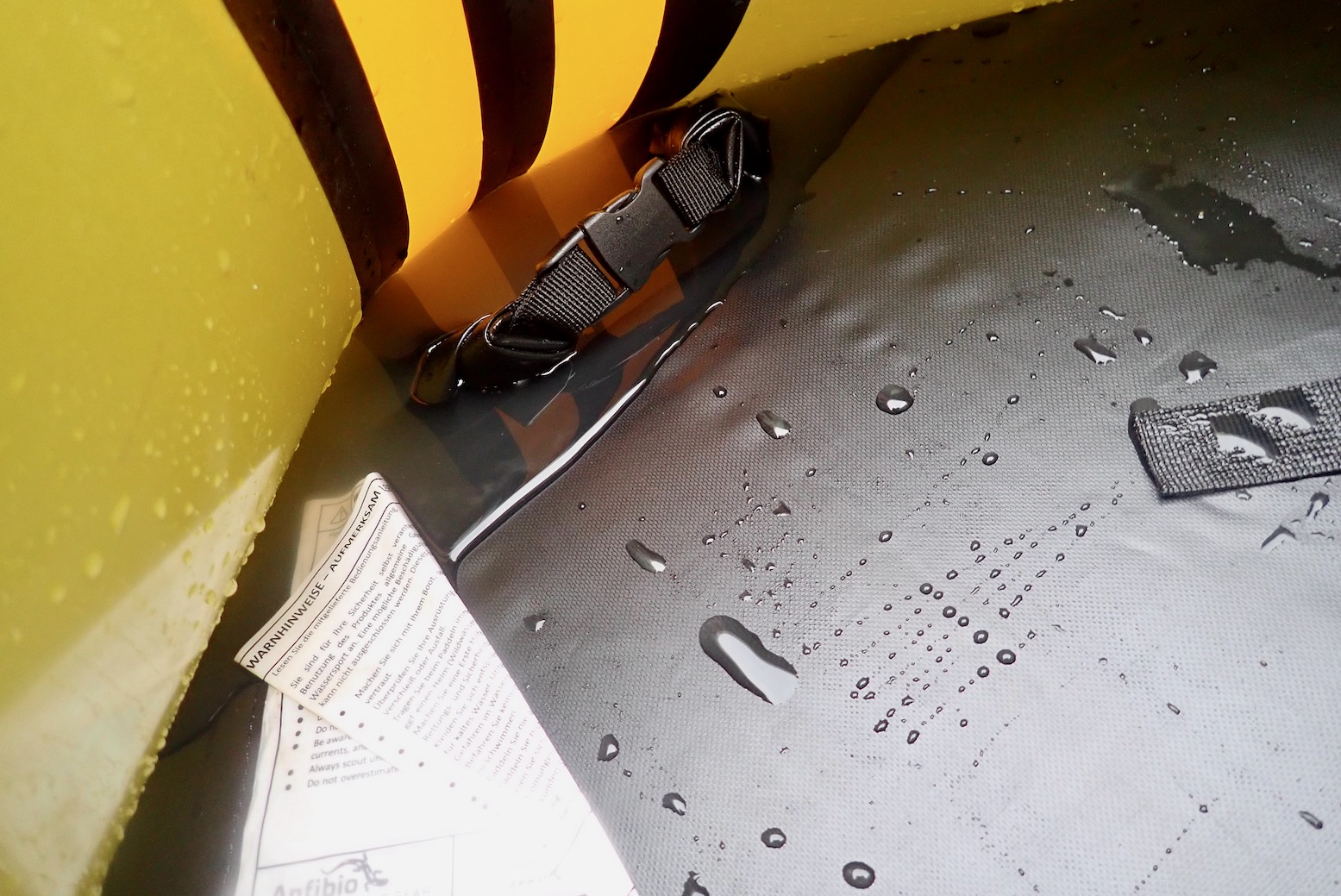
There’s nothing to stop you using the Revo without the floor pad with drain funnel closed (less bulk when travelling). The backrest might end up a bit high, but you’ll be sat nice and low. I was told the drain funnel’s roll-top closure would be improved on production versions, but after going out of my way to make a really tight roll and clip, only a cup had seeped in over an hour, which is barely more than paddle splash. With the drain tube sealed and with no floor pad but just a seatbase, I don’t think you’ll be swilling around in water seeping up from the funnel. I forgot to try paddling with the funnel open, but all that would have done on the Thames is possibly slow the boat down.
So the Revo: a packraft with a hull-stiffening floor pad, optional self-bailing and knee straps. It ticks all the boxes for playing around in whitewater and sea surf, but with the huge TubeBag storage pockets installed in the hull sides (€140 option on the CL; well worth it), the XL is set up for overnight trips too, with the load providing added stability in the rough stuff or when bombing along under sail. I knew before I saw it that a Revo wasn’t really a packraft suited to my kind of use. I don’t do challenging whitewater nor sea surf, so can live without self bailing (though I appreciated the deck on the Rebel 2K). Soon after trying the Revo I bought a more conventional Sigma TXL solo/tandem (also with TubeBags and an inflatable floor pad) and so far am very pleased with it on inshore paddles. I’ve fitted some knee straps, but am not sure about the floorpad and did not get on with the inflatable front backrest or the foam seat block.
An hour and a half before sunrise and I am in the midst of a twitter storm. Up above me unseen in the trees the neighbourhood avians are performing their dawn chorus a little ahead of schedule. I’d been planning to try out a prototype Anfibio Revo for weeks, waiting for a sunny day while failing to pull off more ambitious test venues. In the end they wanted it back so it feel to a transit of the dreary old Thames through London.
But walking to the station, it was clearly far from the predicted freezing night leading to clear skies till noon. No frost glittered on car bodies nor stars twinkled above. Oh well, it’s 6.30am and I’m at the station. I may as well go through with it. Not done the Thames in a packraft before, so there’s that.
At Putney jetty energetic young rowers were hauling out their cheesecutters from the sheds while I fumbled with the Anfibio Revo’s floor pad. At a glance the Revo looks bigger than my 2K so it might be a bit faster. It’s a self-bailer with an unusual drain funnel under the seat (like some Gumotex canoes) rather than the usual lines of holes along the floor’s edge (like the ROBfin; another stillborn test). An 8-mile run along the Thames wasn’t going to test the self-bailing system, but for flatwater the dangling funnel can be pulled in and rolled up like a dry bag to stop the boat filling up.
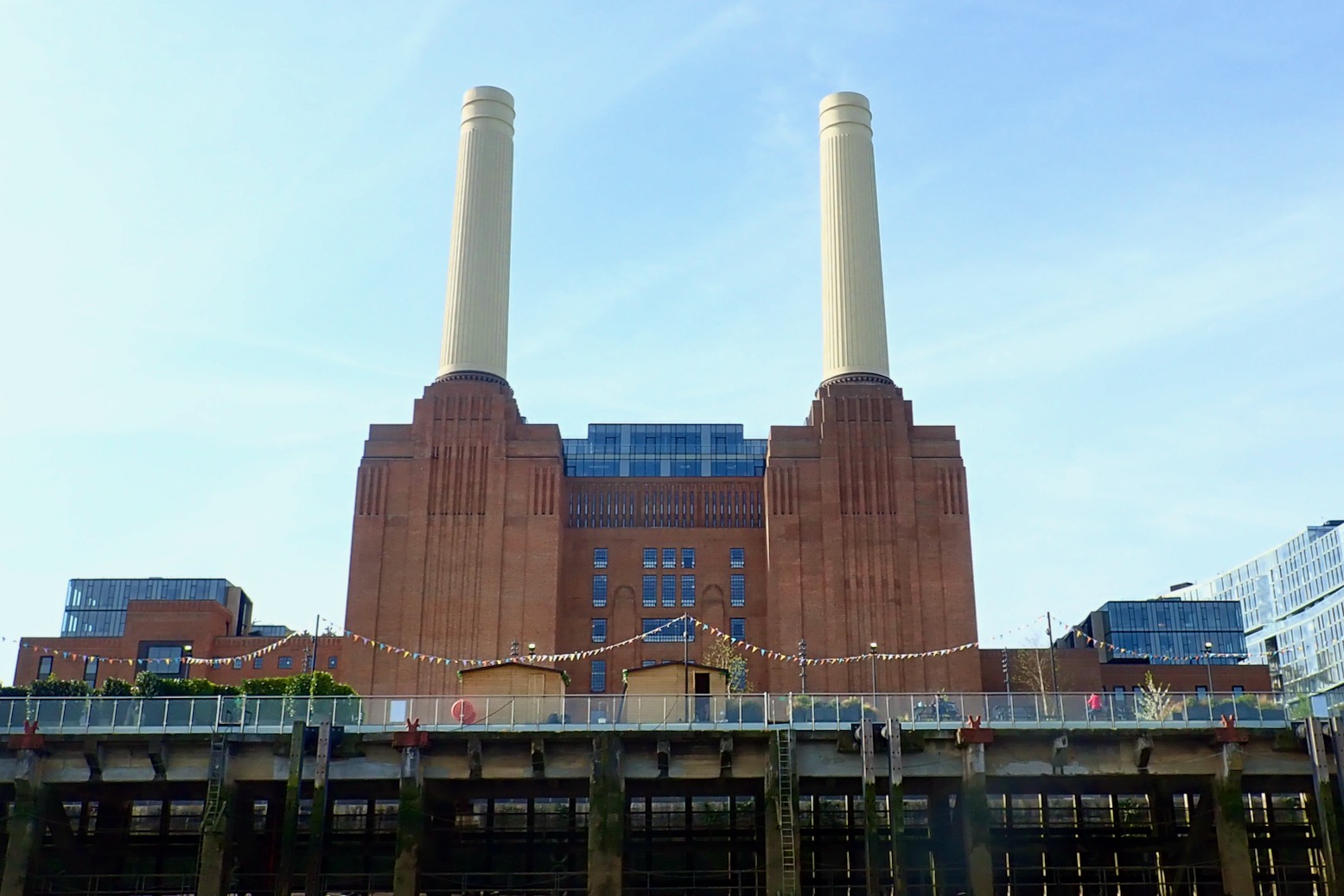
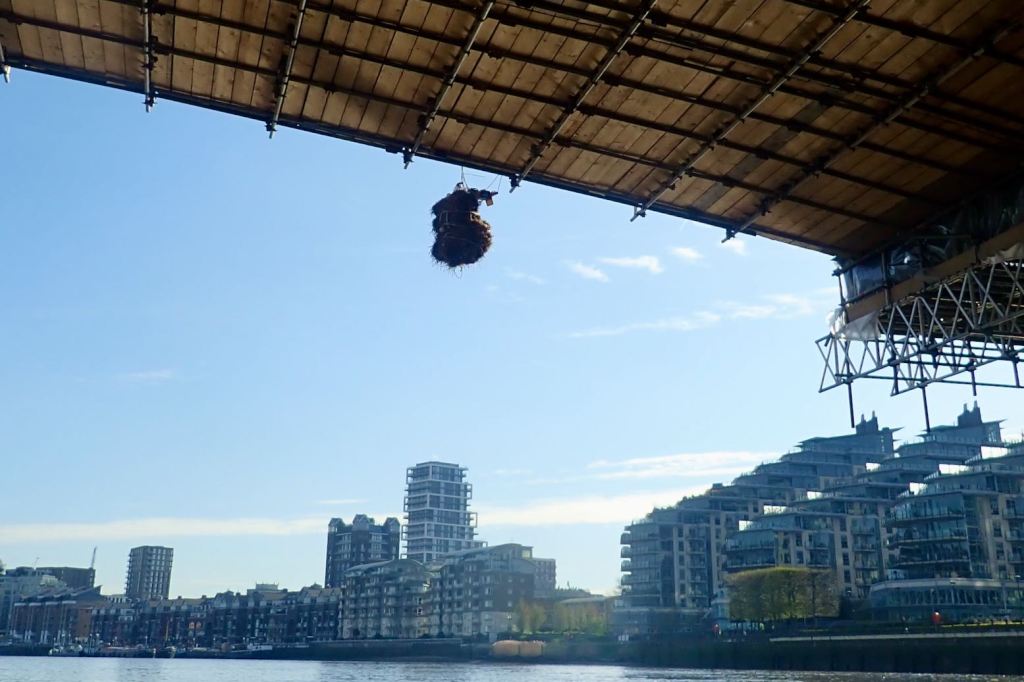
I am on the water midway through a 6-metre ebb; LW is 11am at the Mayflower pub in Rotherhithe. The Revo has a high-volume stern typical of whitewater packrafts to stop them flipping backwards when coming out of rapids (I presume).That old hay bail from my visit last April in the Seawave. It’s an ancient rivermen’s sign indicating ‘arch closed’ or danger. Could make a nice bird nest tooThe Revo seemed to yaw a lot for a long boat. Maybe the floor pad making the floor extra flat doesn’t help. So I pull over and fit my skeg which made it a bit betterYou don’t want to push up against this with 0.55mm of TPU between you and the fetid ThamesIs Battersea Power Station powering again? I hope someone informed the new residents?I am reminded of the famous Pink Floyd LP cover from 1977. People ask: What does the pig symbolize in Pink Floyd? Along with dogs and sheep, pigs are one of 3 animals represented on the album. The pigs represent people, like [Mary] Whitehouse, who feel they are the moral authorities. I was only asking!The latest scandals? Sigh: where to start, but good to see they’re finally getting the flammable cladding sorted.9am, all is quiet on the river but as soon as you pass under Westminster Bridge things gets choppier. My P&S camera is barely coping with this eclipsarian light. What a wash out.Jaunty buildings; journey’s end is nighI try some more selfingtons, but the focus is too lowI pull in just before London Bridge. I averaged 5mph for 7.5 miles, but half of that speed was the tide. Like any packraft, the Revo felt slow at times. You sure miss the g l i d e of a long IK. But it got me here and weighs just 4kg with the floor pad.Jeez, I’m glad I got off before he bombed through!A picture of me rolling up the packraft, so you know I’m not making it up.I decide to climb the ladder for old time’s sake.Back in summer 2005 with the old Gumo Sunny (my first proper IK) and before I knew about packraftsNotice the small standing waves you often get just after London BridgeWhat is the name of this famous ship? And who was the illustrious captain?I find myself in Borough Market for the first time in years, an Aladdin’s souk of upmarket nosebag: Paradoxically, in the middle is a greasy spoon and before I know it I’m sat before my annual Full English. After, I buy a giant sourdough loaf for a fiver and some wafer-thin slabs of Comte and Gruyere at only £45 a kilo.Can I see you ticket, please?London Bridge & APaddleInMyPack
Right now [April 2021] it’s a great time to kayak the Thames through London. It’s only April but due to you-know-what the Westminster tourist barge scene is dormant, making that brief but lively stage a bit less fretful. Down at water level we paddlers may be hyper vigilant, but can the bloke doing a U-turn in his heaving tourist catamaran while doing a commentary see us fending off the standing waves and refracted wakes? As a barge-tourist in a Union Jack bowler hat asked me last time; ‘Is this allowed? Yes it is chum, but a kayak on this part of the Thames is still an incongruous sight. The congestion and the standing waves pushed up by some bridges at certain times can feel a bit like skateboarding in a gale on Runway 3 at Heathrow.
Demanding…
Downloading the PLA’s mammoth 130-pageTideway Code is enough to put anyone off, but I do believe this edition (dated October 2020) is less anti IK than a previous version I read. At the time I recall seeking clarification from the PLA’s media person and got an arsey corporate riposte. Has the Lockdown IK consumer surge turned the tide on the PLA’s prejudice? It’s the old problem of misconflating a clueless beginner in £49.95 Aldi bin bag with an alert and well-equipped paddler in a decent high-pressure hybrid. I say: pick your tide, keep right and be observant. For me the biggest peril was dodging the horizontal scythes of the Putney rowers who seem to go up and down across the whole width of the river as they please. They do need a lot of space.
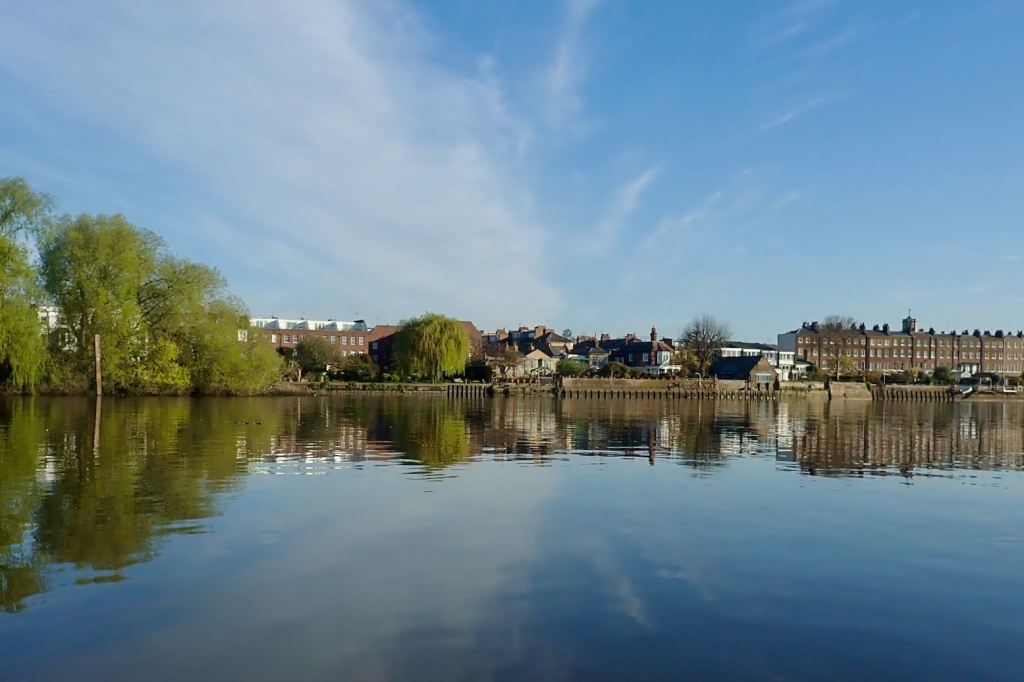
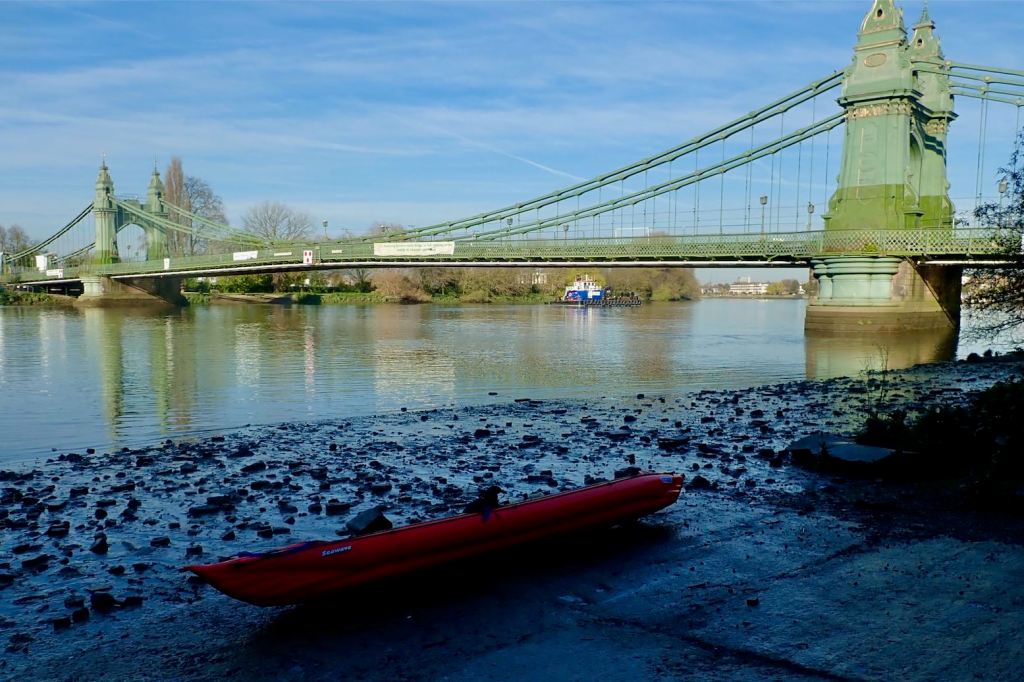
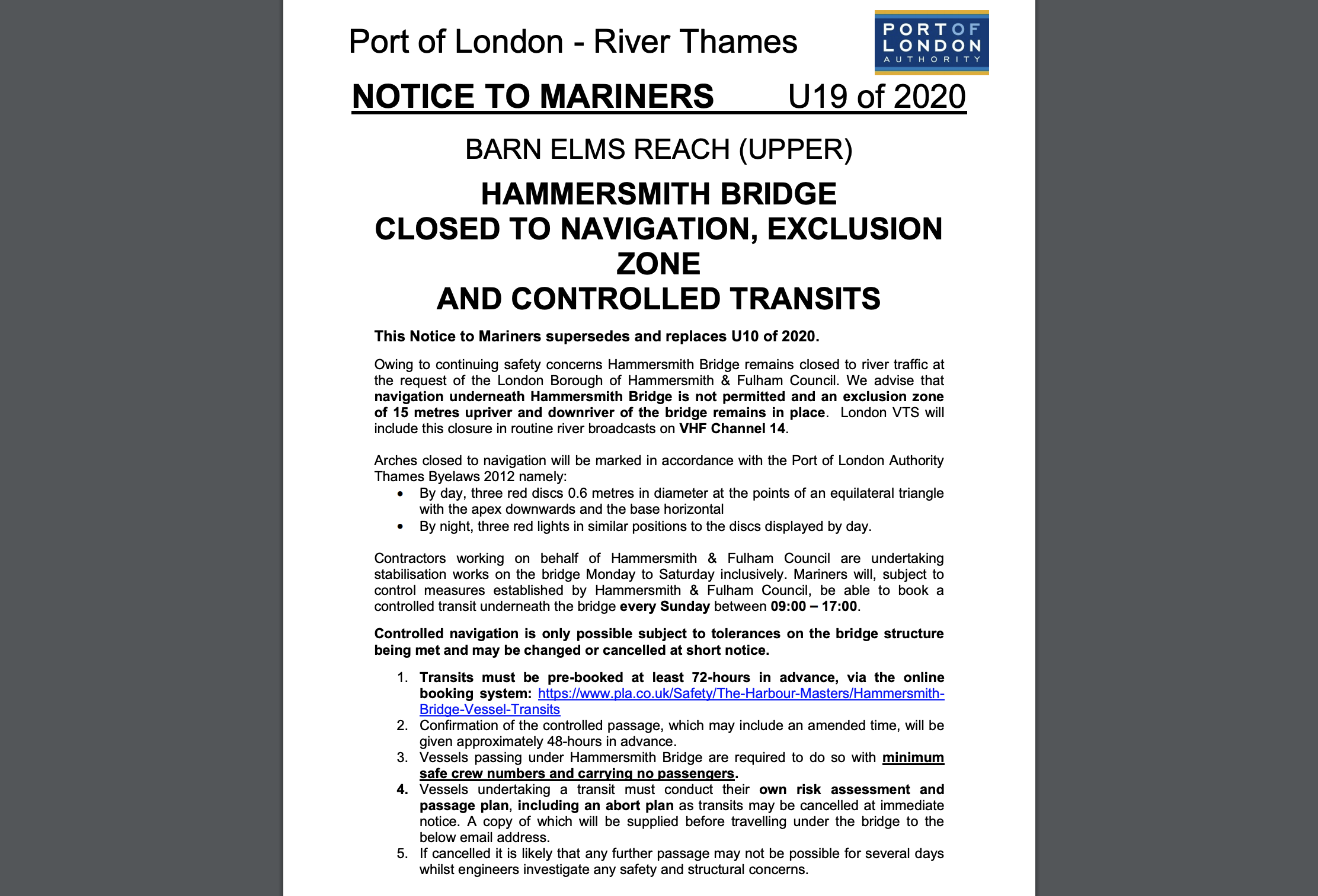
Mortlake to Mayflower (Rotherhithe) This 21-km (13-mile) stretch lined up well with 10-minute walks from stations at either end. By Rotherhithe the excitement, such as it is, is over. And skipping the five miles from Richmond gives an easy three hours on the river; a nice early morning or afternoon paddle with good light for great photos or views of the Thames’ bankside icons.It’s dawn and a Sunday, so it takes two buses and a train to get to MortlakeYadda, yadda…Spacious put-in at Bulls Alley off Mortlake High Street, complete with benches7.15am. All is calmA bit of early morning rumpy-pumpyHead buoyGenteel Georgian waterfront around ChiswickArseache! Hammersmith Bridge is Falling Down and closed to navigation. Ie: you can’t paddle under it in case it collapses on your head. But on the north bank there’s a handy jetty and this slipway (above) on the downriver side is a 5-minute carry
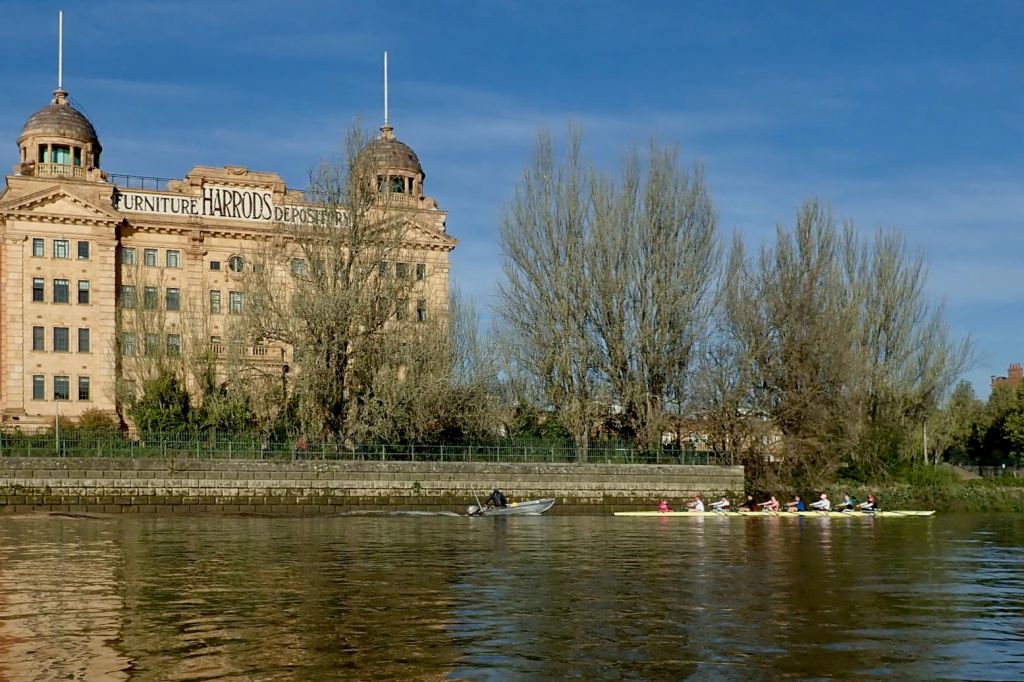
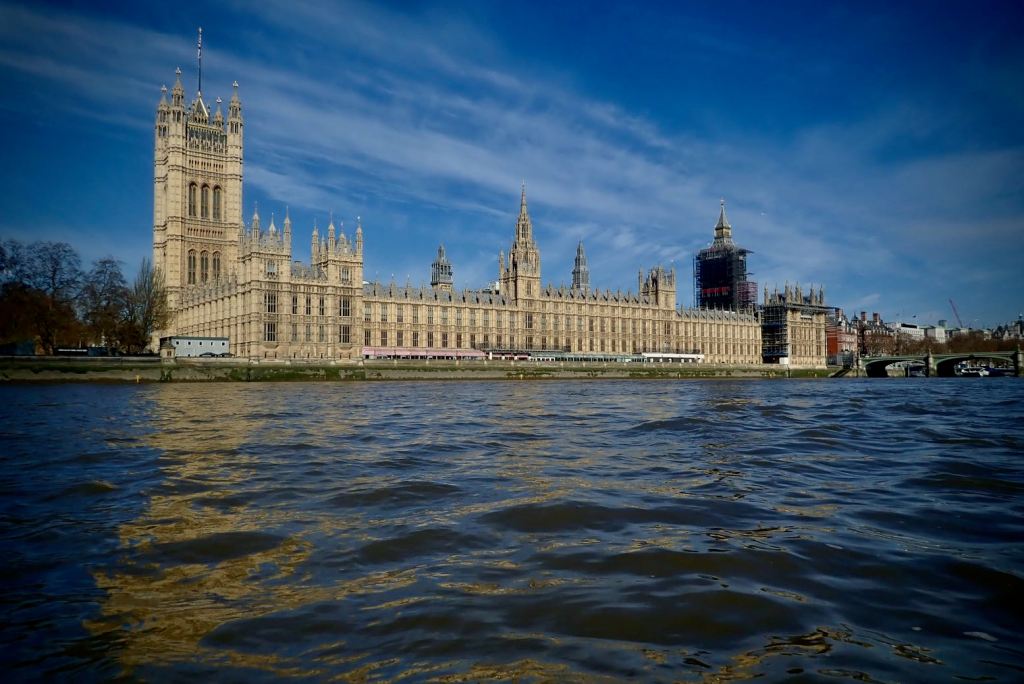
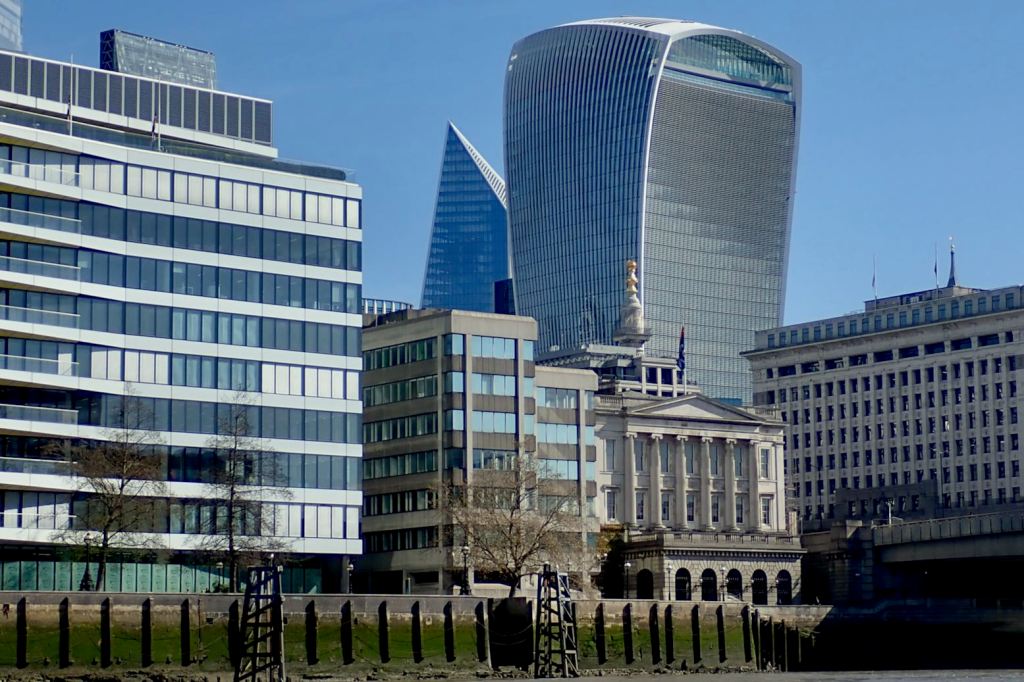
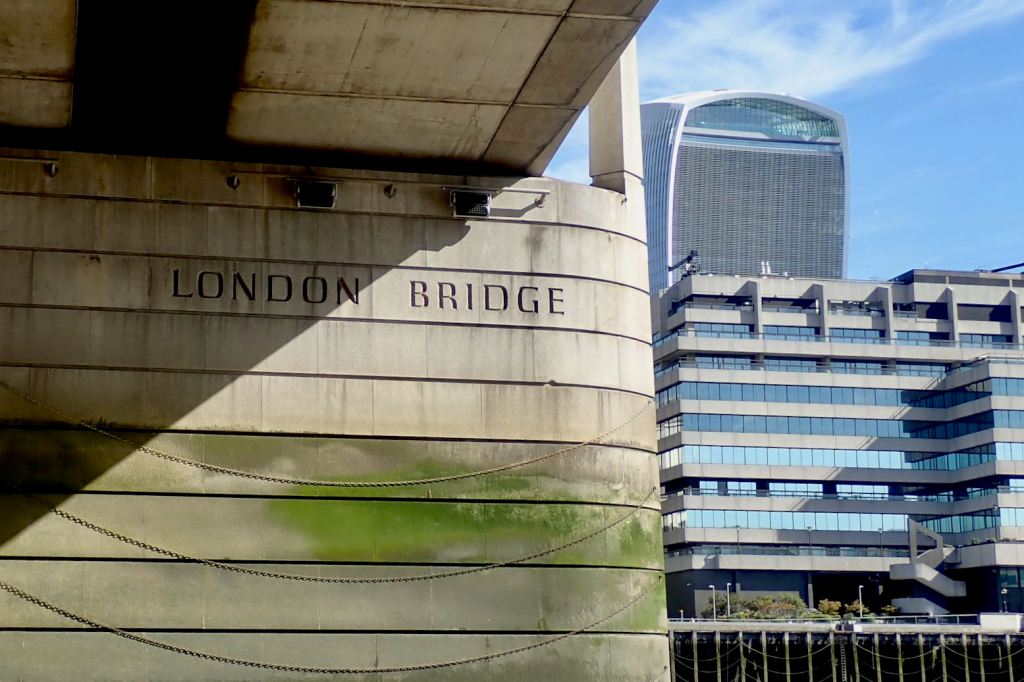
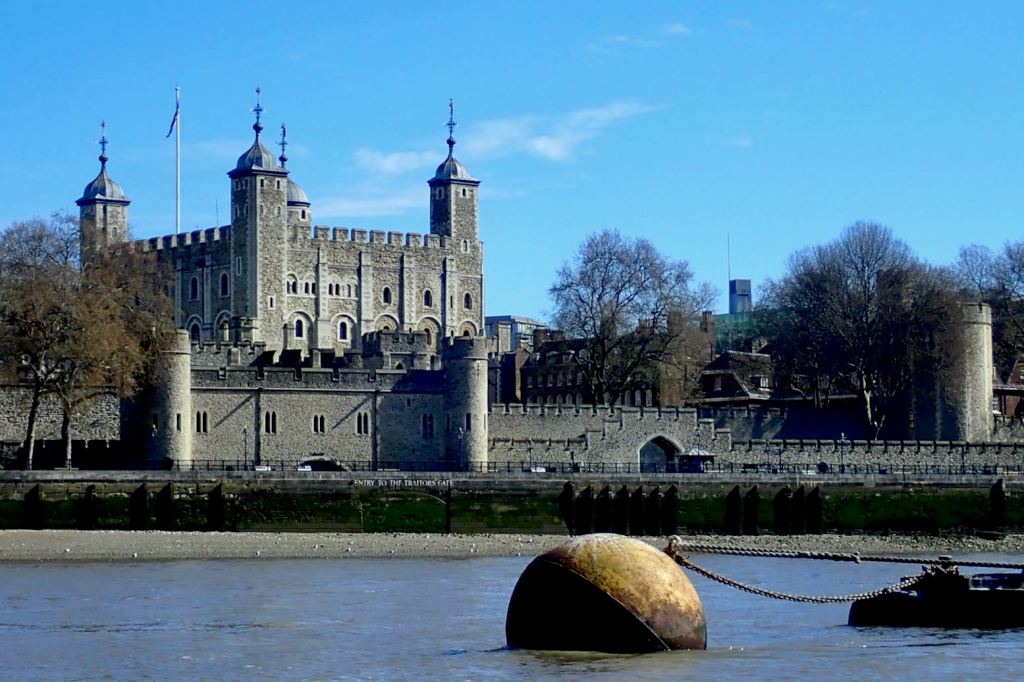
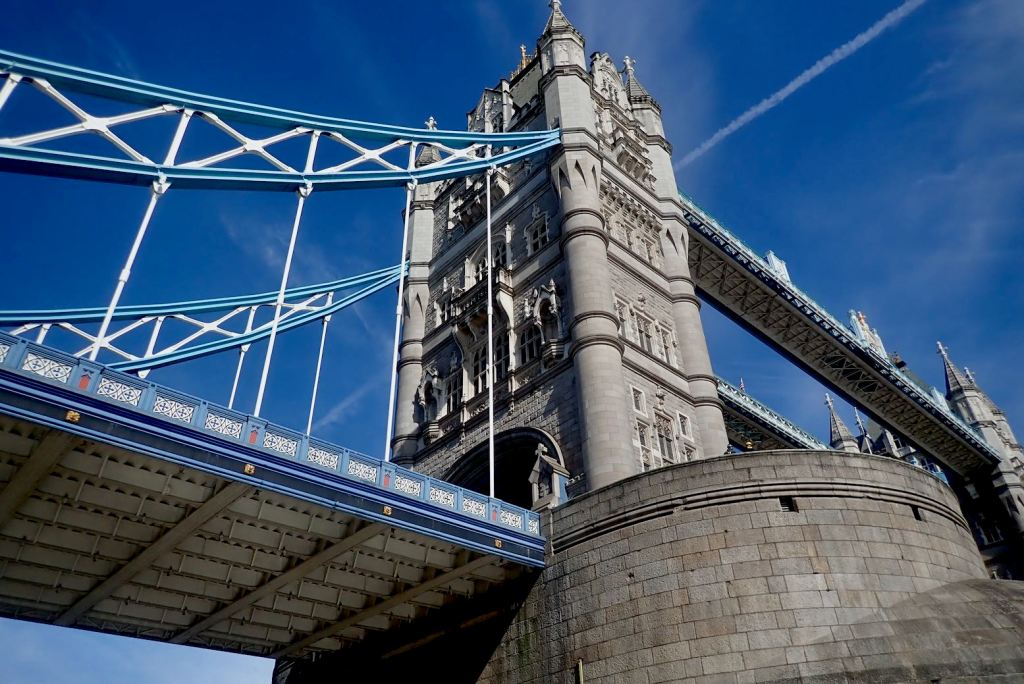
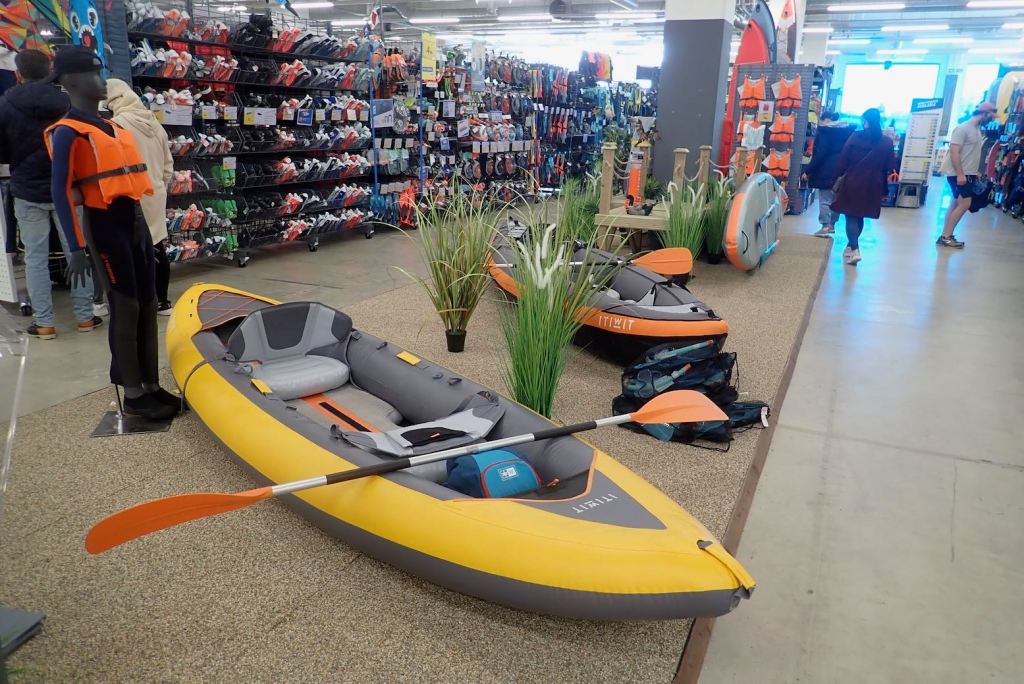
The Hammersmith’s brittle, ageing cast iron dates from 1887 and is suffering from micro-fractures. All together now: “Build it up with iron bars, iron bars, iron bars. Build it up with iron bars, my fair lady“You might try and book a controlled transit (Sunday’s only) with the PLA but I don’t think kayaks would qualify. It will be closed for years.Once a Harrods warehouse, how expensive flats9am. Putney rowers getting their oars on.At Wandsworth I nip up Bell Lane Creek where the Wandle comes in. Big weir drop to the left, and a bit further up on the right, another weir drop at all but HW. See: Wandle: An Urban Packrafting NightmareHanging hay bale? WTJoF? Explanation in the PLA Tideway CodeNo arcane signage here up Wandle creekIt’s chilly. Nature’s call cannot go unansweredRiver racers. My money’s on the YellowsHoly Mother of all Parliaments. The latest scandal? The ‘chumocracy’ of lobbying (there have been a whole load more sinceNamed after the famous HP sauceAlso available as lycra cyclewearIt gets a bit choppier just after Westminster Bridge as the current backs upLondon Eye still looks as amazing as ever. I wonder if they grease the axle and tension the spokes once in a whileRectilinear skyscrapers are just so last centuryA few years back sunlight reflected off the ‘Walkie Talkie’s’ concave face (20 Fenchurch St) and melted a car in the street belowNot falling down any time soon, but small standing waves soon after can make you thinkBy the HMS Belfast it settles down again. On a neap tide at least.‘Send him to the Tower!’This is what Hammersmith needsAfter Tower Bridge the river widens out and the powered craft can gun it A mile downriver, the Mayflower’s looking a bit shabby. Don’t people go to pubs any more? In 1620 the famous ship embarked from here for the New WorldTourists RIBs slalom up and and down the Pool of London like giant jet-skisMy modified seatback worked great. Just what was neededThree hours from Mortlake and plenty of space to dry out.Now that’s what I call a packboatGo west young man. And never come back!From the beach it’s a 10-minute walk to Canada Water station. I pop into Decathlon nearby to admire some Itiwits; quite possibly Britain’s most popular IK
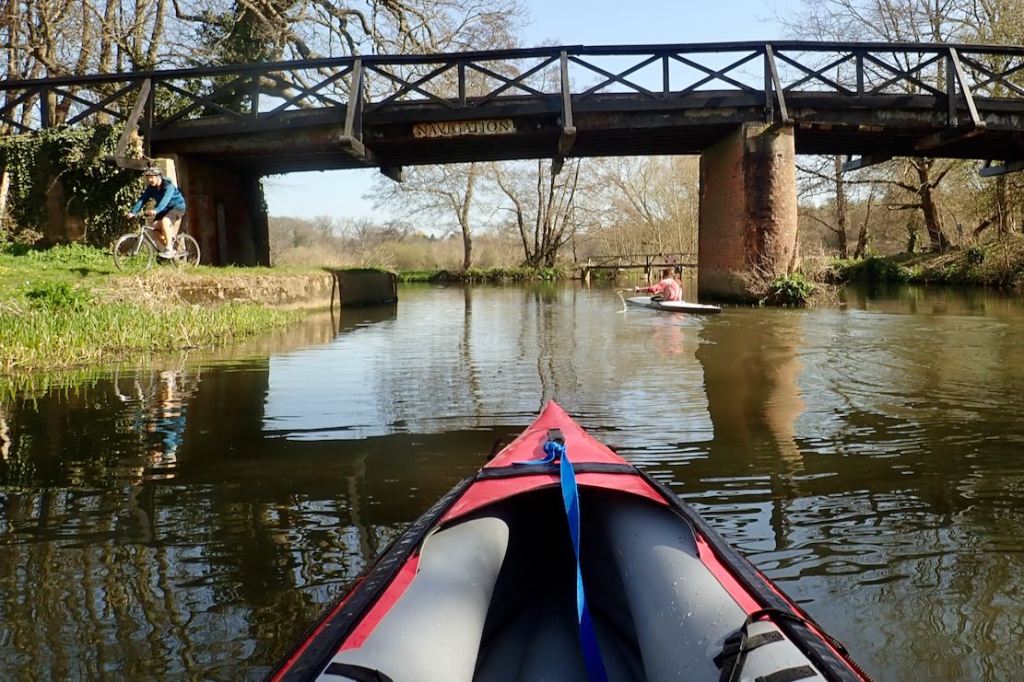
One of England’s first navigations, dating back to 1653. That’s probably why this historic canal feels quite natural and river-like, apart from the virtual lack of current.
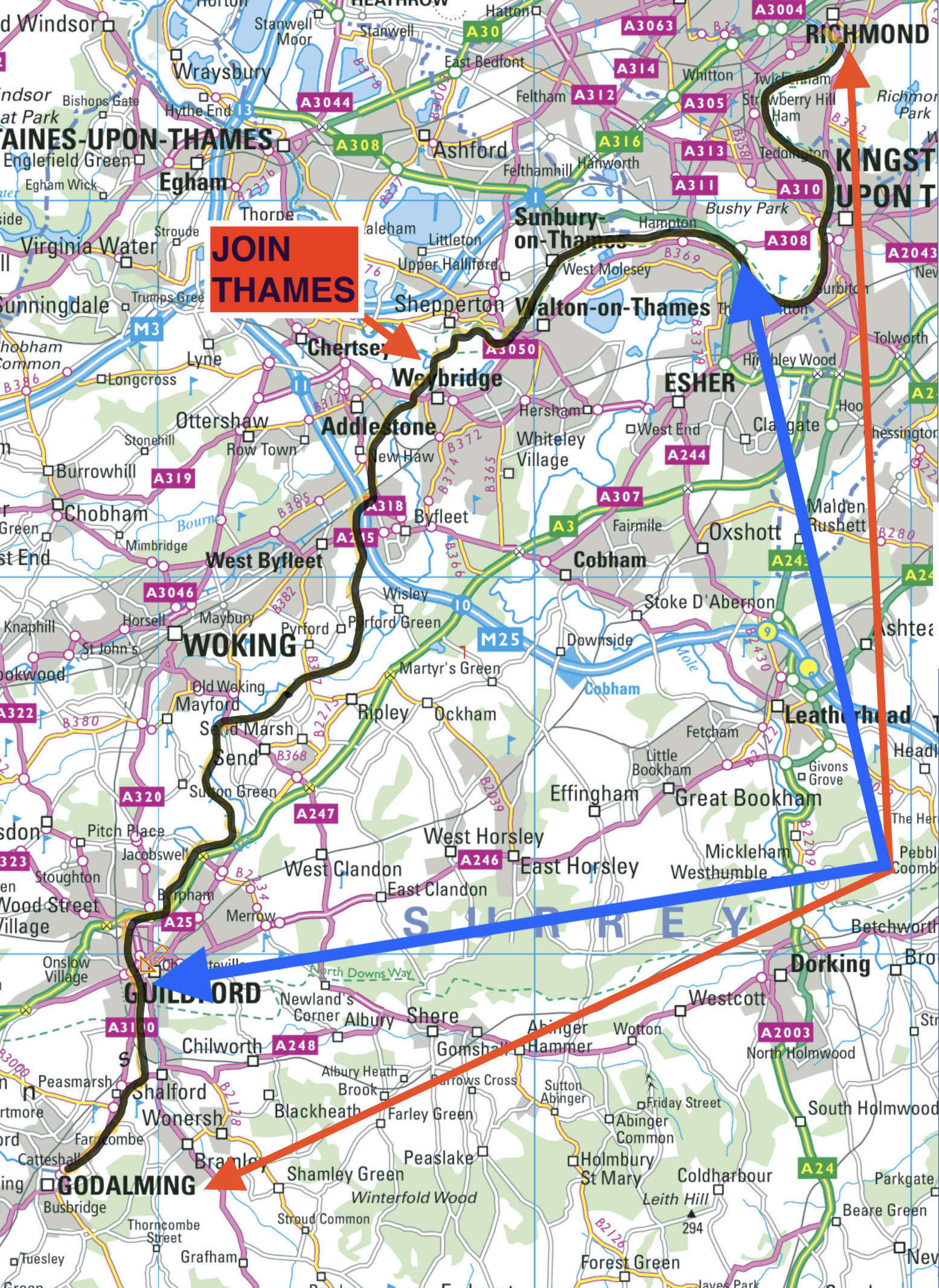
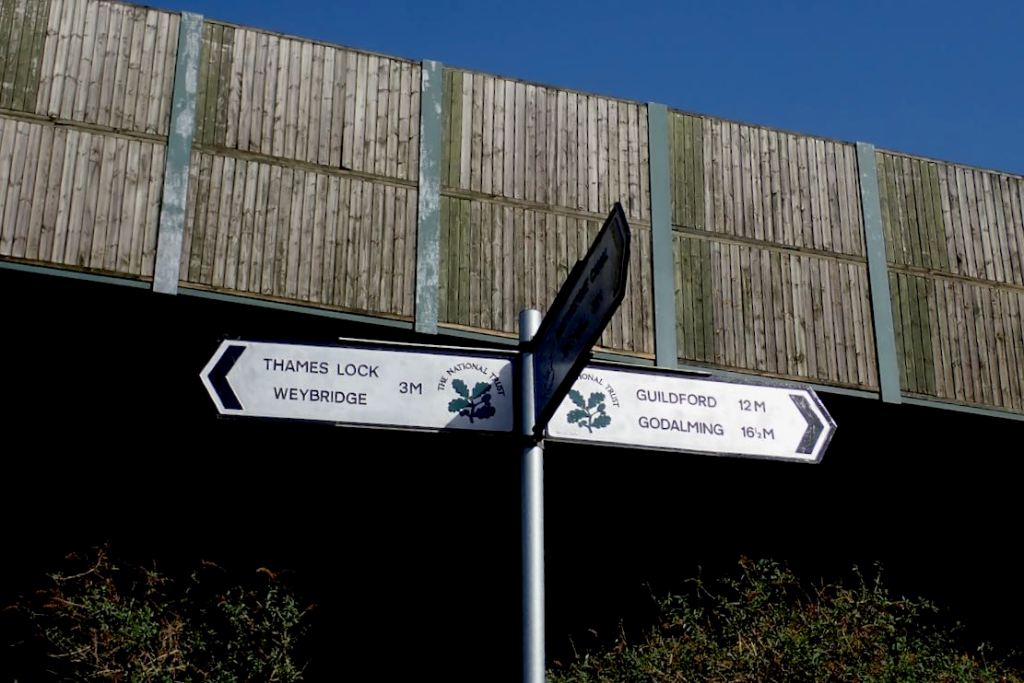
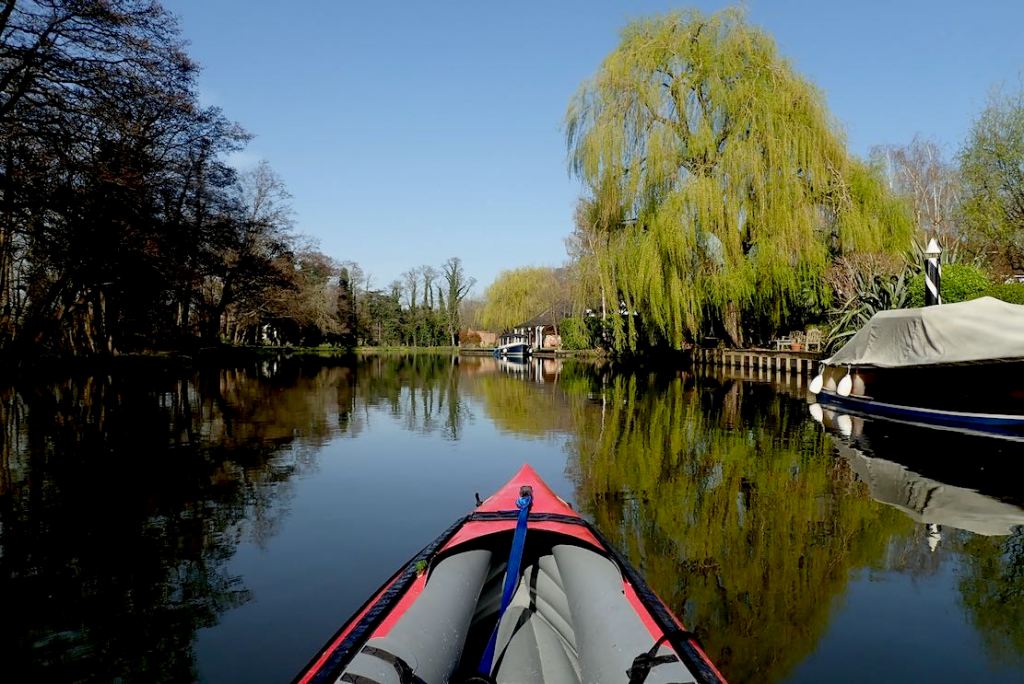
All hands to the barrel pump! The day will be long, sunny and warm. High time to tick off ideas matured over the winter months of Lockdown. First on the list: the River Wey from Godalming to Weybridge in Surrey. Or should I say, the historic canal called the Wey Navigation which is paralleled in places by the old river. It’s one of England’s oldest navigations (commercial inland waterways) which once connected the Thames with the Navy base in Portsmouth. At the time a safe way of transporting stuff, including munitions produced near Godalming, without risking encounters with Napoleonic marauders in the Channel. For years I’ve been unsure whether the Wey was a dreary canal with more locks than the Tower of London, or a grubby, semi-urban river with weirs and other obstructions. Turns out it’s a bit of both but better than expected. All I had to do was RTFM!
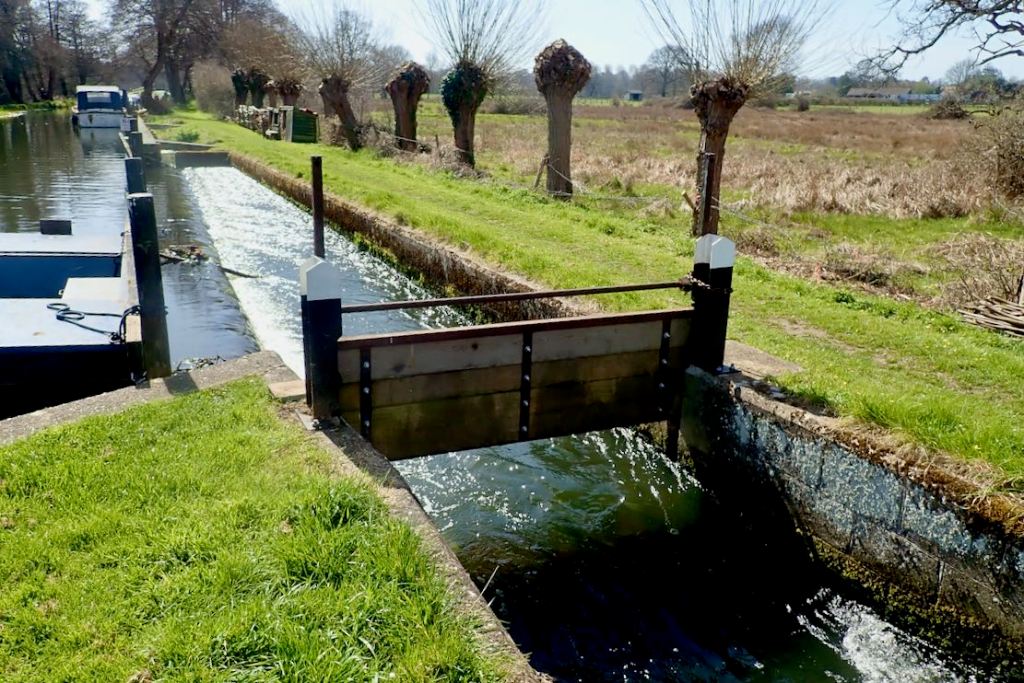
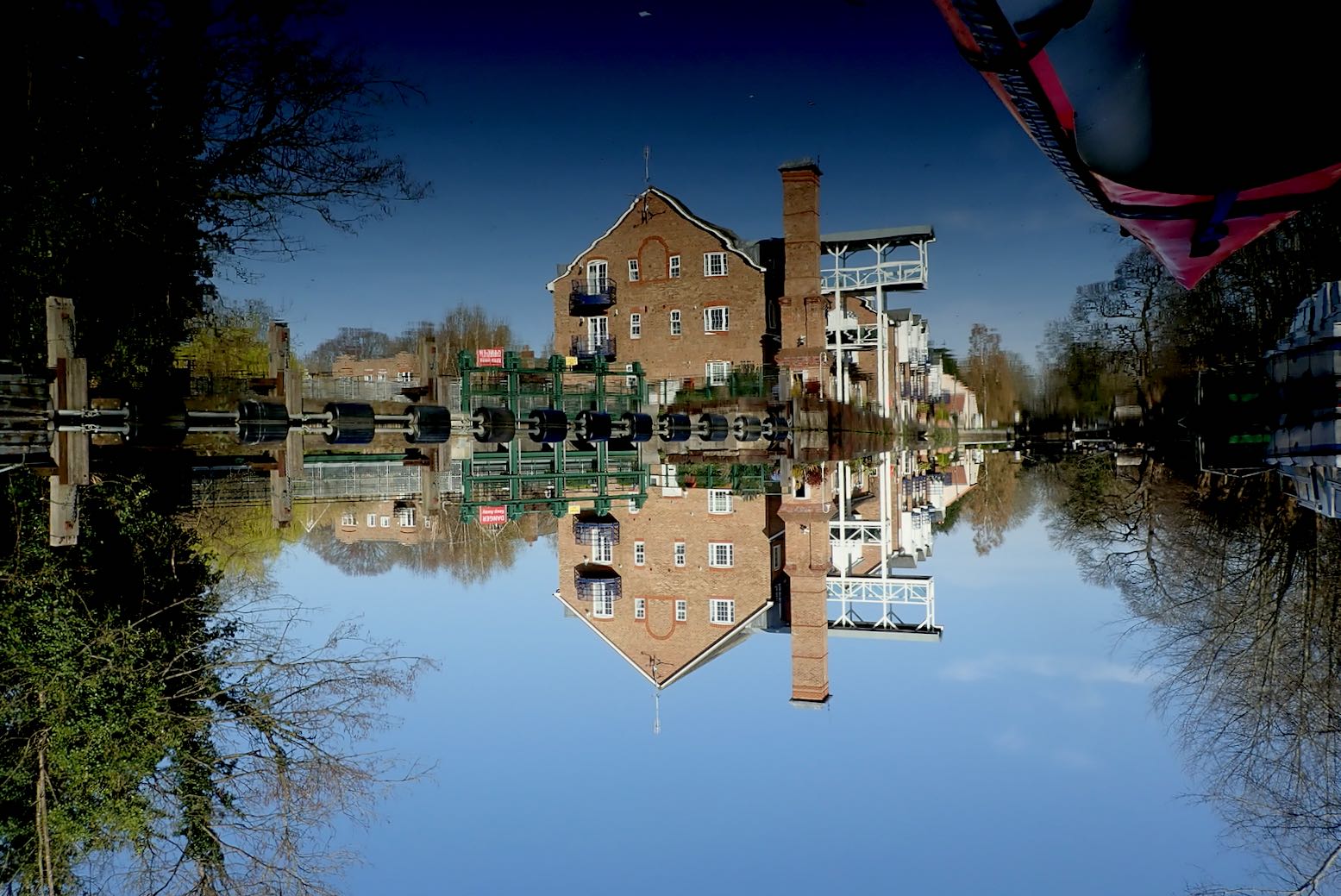
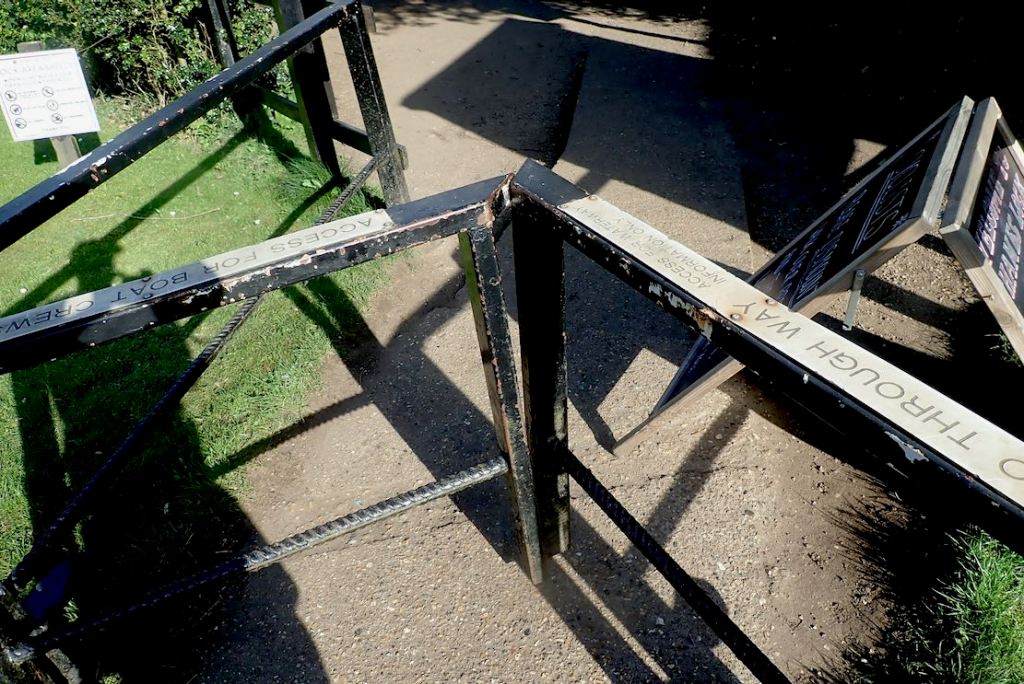
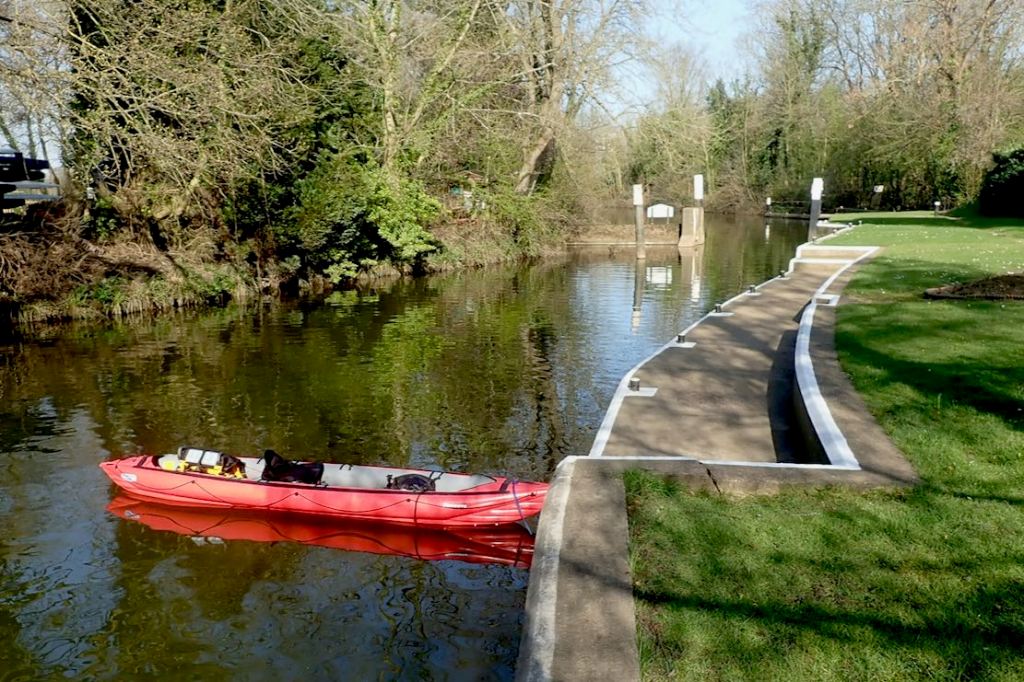
Compared to the similarly popular Medway, which I’ve done loads of times in IKs and packrafts, summer and winter, the Wey Nav feels less agricultural, more scenic and has an interesting history if you slow down enough to look. But it lacks the Medway’s unique canoe passes which scoot you down the side of each lock (right), avoiding up to three laborious carry-rounds per mile. Parts of the original river survive in places to either side of the canal, which is what caused me confusion. I now realise the Navigation (managed by the National Trust) gets priority in terms of water levels and maintenance. As a result the occasionally nearby River Wey might be shallow or chocked up with fallen trees or rubbish. But you can combine both to make loops like this.
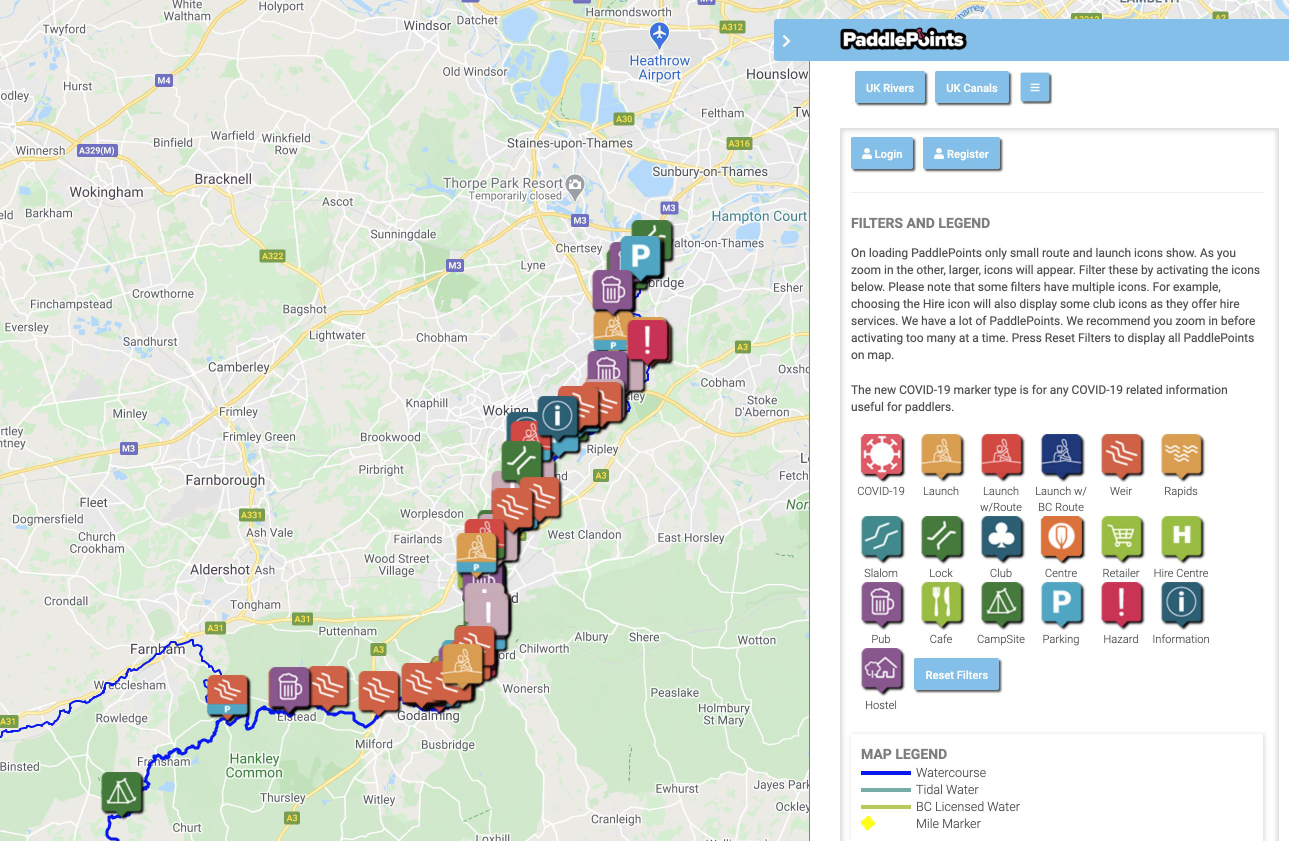
Because of the Wey’s multiple channels and numerous weirs and locks, I tried British Canoeing’s PaddlePoints website, a comprehensive database of paddleable river map routes with handy icons (above) for put-ins, parking, hazards like fallen trees, feral teenagers (I’m not joking) and so on. You can reset to delete extraneous icons (‘Covid-19’ ?); I just wanted to clearly locate the locks and weirs and river’s branches, though on the day ‘Navigation [this way]’ signs at junctions were clear. Closer scrutiny of the map shows that in places the blue line guides you along the old, choked-up river, not the Nav, and not all weirs (an important feature to know about) are shown as icons, even when they’re clearly evident on the Sat view underlay. And so the Map view (as above) can give a misleading impression of which way to go. As you’ll see below, at one point the blue line even guides you over a weir. Common sense prevails of course, but you can imagine some beginner clutching their PaddlePoints app on Map view getting sucked into a weir. I realise now this content is user-generated like OSM or Google Maps, and so errors, inconsistencies and lack of moderation are inevitable. As such, you can report icon-points, but it’s unclear if the route (blue/green line) can be corrected by users. If nothing else, PaddlePoints helps identify which rivers you’re allowed to paddle in England and Wales, and what the rules there might be.
I fancied a full dawn-to-dusk recce: as much as I could fit in from Godalming (where most paddlers start) before my tank ran dry. I might even reach Richmond on the Thames, a section I enjoyed last December in the Arrowstream. That is actually quite a haul: 20 Weymiles plus another 15 on the Thames, including no less than 17 lock portages on the two rivers. But the great thing about ending a paddle in an urban area is I could air down when I got worn out and rail home. Thirty-five miles? Dream on, bro! I’ve only paddled two days since September so was far from paddle fit. Then again, the pre-dawn brain wasn’t on top form either: I set off in the right general direction, but on the wrong train.
Oh! Mister Porter, what shall I do? I want to go to Godalming And they’re taking me on to Hoo [k], Send me back to Woking as quickly as you can, Oh! Mister Porter, what a silly boy I am!
After backtracking, I decided to catch up with myself at Guildford, 5 miles downstream of Godalming and missing out 4 of the Wey’s 14 locks. I dare say I’d appreciate that later.
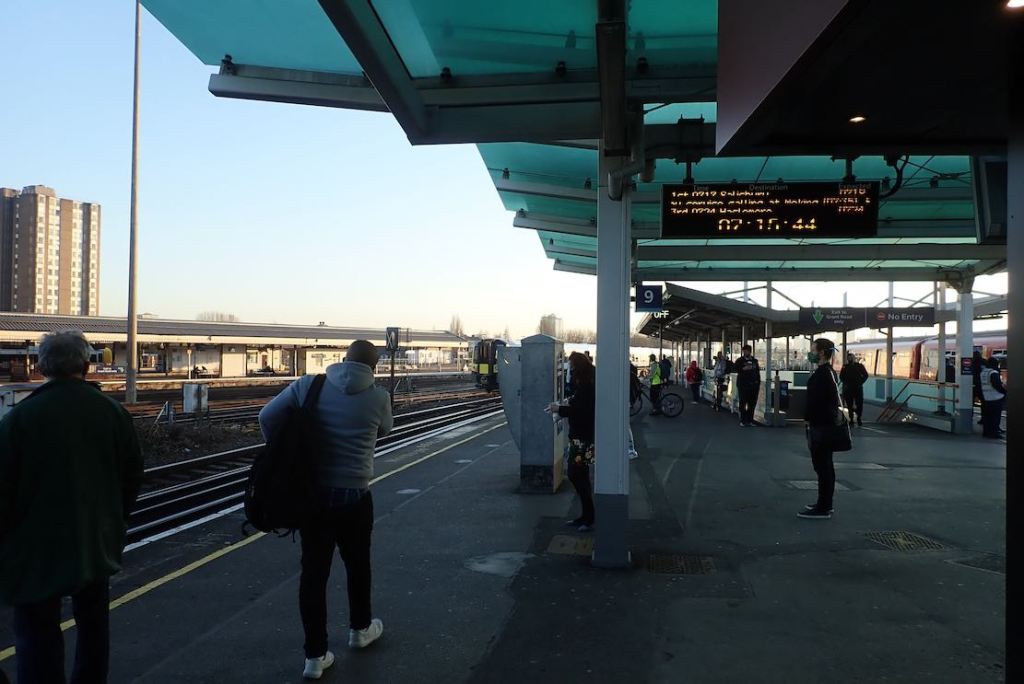
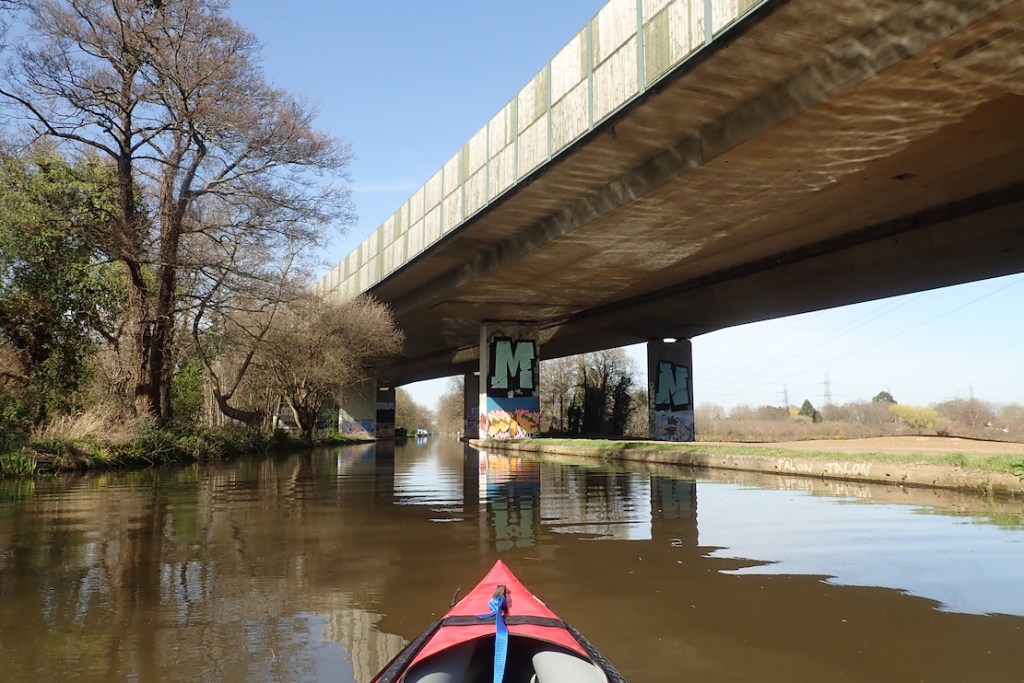
Clapham at 7am. It’s all a bit of a blur.I practise luggage distancing.In Guildford I slip onto a closed towpath and enjoy a quiet set-up without the usual ‘Oh Mr Porter, is that one of those inflatable canoes? I’m thinking of getting one…’Just around here I realised I’d left my Garmin out in the sun to catch a signal… Should have gone to Starbucks. I’m trying out some old runners as water shoes instead of my usual Teva Omniums. Do they really believe this or is it just juvenile baiting?A readable GPS in the net pocket of my Anfibio packraft deck bag didn’t really work on the Seawave. As usual I have a better idea.Alternative use for a big slackraft.At Bowers Lock I spot my first Intex of the day, a 100-quid of K2 Explorer on its maiden voyage with daughter and dad.Under an old bridge a real K1 belts past with barely any wake. Looks like fun but what happens when she stops? Same as the bike on the left, I suspect.As canals go, not so bad.Triggs Lock. With a little work this side sluice could be a fun canoe chute (lens finger shows scale).All they need to do is get rid of the guillotine and add a galvanised chute at the end. How about it, National Trust? It would be like turning Downton Abbey into a Discount Carpet Warehouse!Soon after lunch at Papercourt Lock I pass two chappies also heading for Weybridge in something called a Sea-Doo. Flip yer paddle round, mate, you look like an amateur!Not another lock, TFFT! Just some general-purpose gates to hold back Viking raiding parties.At this scenic and willowy point the canal runs right alongside the M25 London orbital motorway. The tyre noise is like Niagara Falls.Mile 12 at Basingstoke canal junction. By some civil engineering synchronicity the M25, Wey Nav, Basingstoke Canal and a railway mainline all cross or meet at this point. In its way it demonstrates the history of post-medieval commercial transport: rivers > canals > railways > highways and airplanes. That’s my MA thesis, right there!At New Haw Lock I need water but the lawn-mowing lock keeper says there’s no tap for a couple of miles. It’s an awkward portage over a narrow road bridge too. Luckily, this chap helps me out. Thanks, chum!Coxes Lock with a doable weir to the side. I may try it next time and risk censure from the NT.Well, according to BC’s PaddlePoints website, that’s the way to go!Weybridge Town Lock. Another awkward portage over a road bridge on the left.In places the Weybridge backwaters look like an Everglades retirement village.As I approach the Thames Lock at Weybridge things get wobbly and I have an out-of-boat experience.Amusingly lock-themed gates close the footpath so us portageurs can pass.Finally at Thames level, hallelujah. And there’s a tap set into the jetty too. I drink like a camel then me and the boat have ourselves a wash.Over six hours from Guildford, but even with a drink and food to spare, I don’t have another three hours in me to reach Richmond. Maybe I can do two hours to Kinsgton. Now on the Thames, I become a great admirer of roller portages.The game’s up at Hampton Court Bridge if I’m to have enough energy to roll up the boat. The station is right there. It’s a warm evening on the Thames and they’re all out in boats and the riverside parks. The [Covid] Rule of Six? Do me a favour! The skiffs collect bird poo while two lads fire up their Intex Challengers. I’ve seen more Intex IKs today than anything else. Why? Because they cost from under 100 quid, float just like a Seawave but track like a barrel.And he may be saying to himself: ‘My god, what have I done?’Dusk back at Clapham Jct. All up, only 21 miles. I blame ten portages, no resting and my nifty but 3-kilo Ortlieb roller duffle. With too much food, it all made the boat just a bit too heavy to carry easily. Where the lock-side grass was lush I dragged the boat, but I have a better idea.
Just before the GPS packed up at Basingstoke canal junction, I was averaging 5.5kph on the move. Pretty good with no current to speak of. On the livelier Thames I estimate I was moving at up to 10kph before I withered. Same as in the FDS Shipwreck in December. My tall BIC backrest (below left) initially felt great then collapsed on itself. Usual story: needs a stiffer insert. I was trying out my new footrest tube attachment points which worked great. Only when one heat-welded strap broke near Addlestone was I reminded how essential footrests are to comfort, efficiency and stamina. I jury-rigged something up between two D-rings which have been staring in the face all this time.
My 2021 Wey Survey of UK Paddling Trends
Hardshell canoes: 1
Hardshell kayaks: 1 (+ 2 K1 racers)
Hardshell SoT: 1
Vinyl IKs (cheapies): 5
PVC (bladder) IKs 3
iSUPs: 10+ (mostly women on iSuPs, too)
PFDs worn, almost none then again, mine’s more of a handy waistcoat)
FDS spotted: none (interesting as readers here are mad for that page)
In a line Was a great value full drop-stitch tandem IK with all the kit
• Great price • Not excessively wide but stable enough • Everything in the box except a lifejacket and some water • Clean, crease-free finish and assembly • Supportive backrest • Pumps up fast
• Folded-up, the boat is massive • Very hard to turn with the skeg fitted • Felt tippy with (removable) seat pad in place • White surfaces may get grubby • Seat base is hard (as is the floor) • Footrest tubes too small and bendy • Wide sides rub as you paddle
The original 2020 model I tried. New for 2022 version is 5cm wider
What They Said High quality drop stitch kayak comes with everything you need to get started on the water.
Inflated: 440cm long, 80cm wide
Deflated 85cm, 50cm 22cm
Kayak : 18.3 Kgs
Total : 24 Kgs
Maximum load 340Kg
Price: £549 (at time of review; now £779 £689).
I am told the 2022 model is 5mm wider, now 85cm according to the website and still great value.
Test boat loaned for review by Shipwreck in December 2020
Out of the box
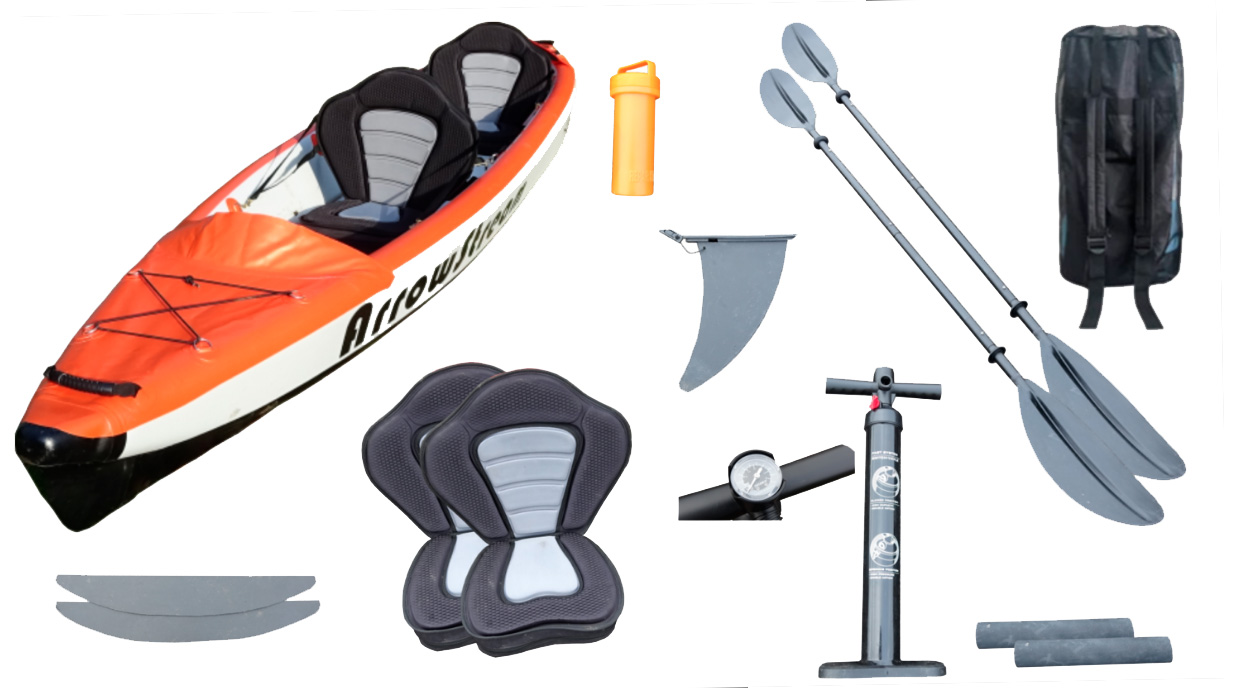
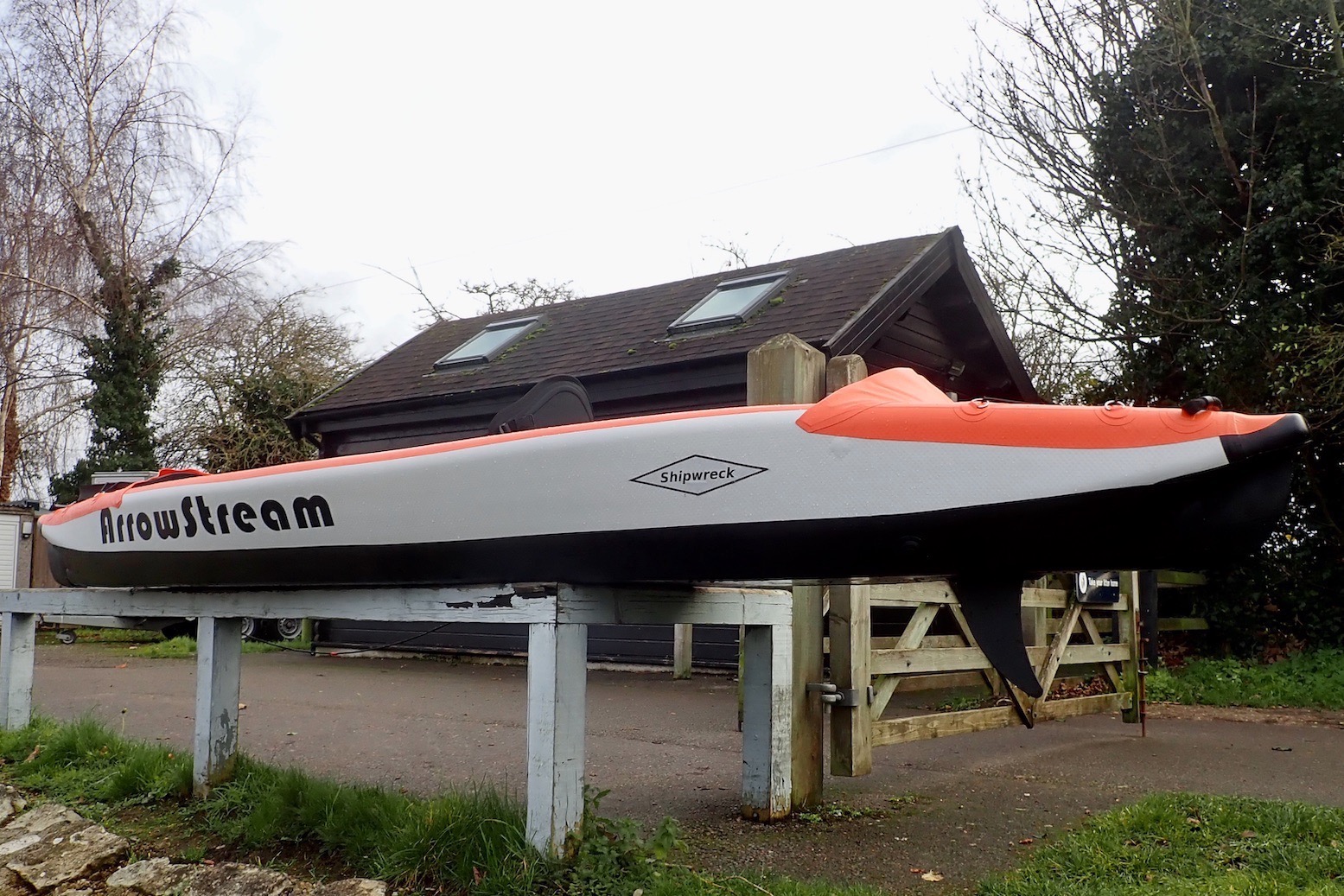
Shipwreck is the latest contender in self-branded full drop-stitch (FDS) IKs customised in China to an importer’s specifications. With the ArrowStream – not a bad name – you get all the kit including two four-part paddles and a two-way barrel pump. The box it came in weighed a staggering 29.5kg – I could barely get up the stairs; it’s twice the volume of my Seawave 2. But once unwrapped, the whole kit: everything in the bag, weighs 25.4kg.
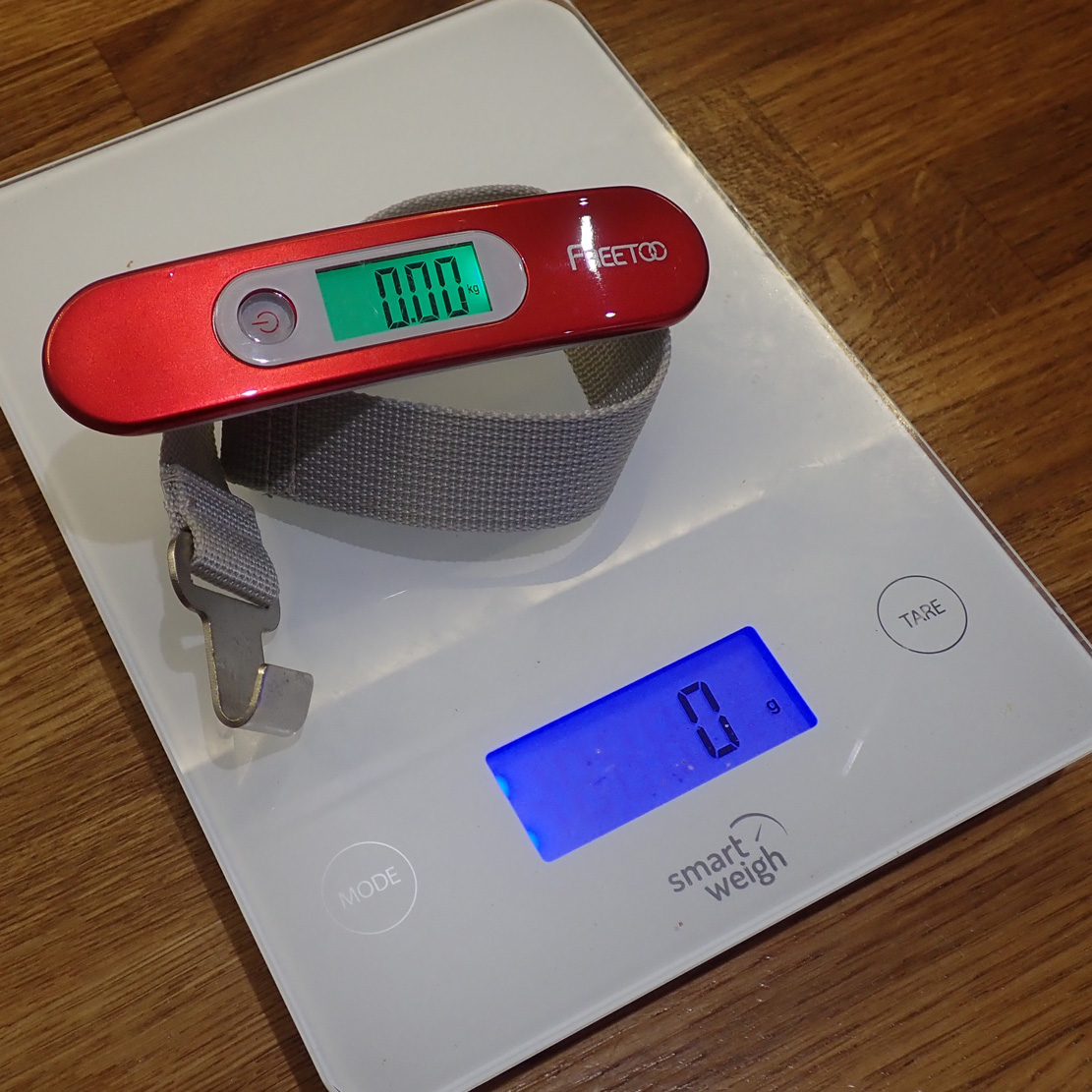
The bare boat itself is only 17.8kg, and with one seat and footrest, the splash vizors and the skeg comes in at 19.7kg on the water (plus pump and bag) according to my kitchen and suitcase scales. By comparison, had I kept the stock seat and footrest on my Seawave 2, it would have been 17.7 kg on the water, so that’s not as bad as the bulk – about 90cm x 70cm x 35cm boat alone in the bag – might suggest. According to my tape it’s 431cm long and 83cm wide. That gives it an LxW ratio of 5.19 which, compared to the table here is also pretty good. And don’t forget the maximum width is measured high up on the outward-angled sides; the actual width at the waterline is around 60cm or 23.6 inches – fairly slender by IK standards. More on that later. The big advantage with these slim, 10cm-thick side panels compared to round tubes is loads more space inside. The interior width is 45cm at floor level and 66cm at the top of the sides.
The seats include a hefty 9cm-thick seat base incorporating a firm, 6cm foam block which can be zipped out. I can see that foam feeling a bit hard sat on the hard, 10psi floor after a few hours, but it could be easily replaced with something softer or lower. Or you could even zip an inflatable cushion in there to reduce the packed volume, but it will wobble a bit. The backrest is tall and wide, with loads of tensioning straps to get the position and angle to your liking. You can reposition a solo seat in the middle, a big benefit with any open tandem IK.
Solo footrest strap loopFootrest drainpipe
The footrests add up to a couple of 4cm ø hard foam tubes. This diametre is too small for a secure foot placement and they squidge once you push on them. For the test I replaced it with a section of 10cm PVC drainpipe. There are two pairs of D-rings on the floor to attach the tube, presumably with the two packing straps supplied. But that means adjustment is only forwards, away from each seat. So if they’re too far away for your feet you’ll need to adjust the seats forward which may not ideal for trim. However, in the tandem video above the attachment D-rings appear to be in the right spot, even if the trim at 2:09 appears a bit front-heavy. For my solo paddle I joined the two straps into a loop (above left) to use the footrest pipe. Pushing off a proper footrest makes sitting more comfortable and less slouchy. The important thing is the D-rings are there.
Flexible plastic splash visors slip under the rims of the short decks, and the slot-in skeg is the usual (for this type of boat) 9-inch monster. There are handles at each end and a pair on the sides.
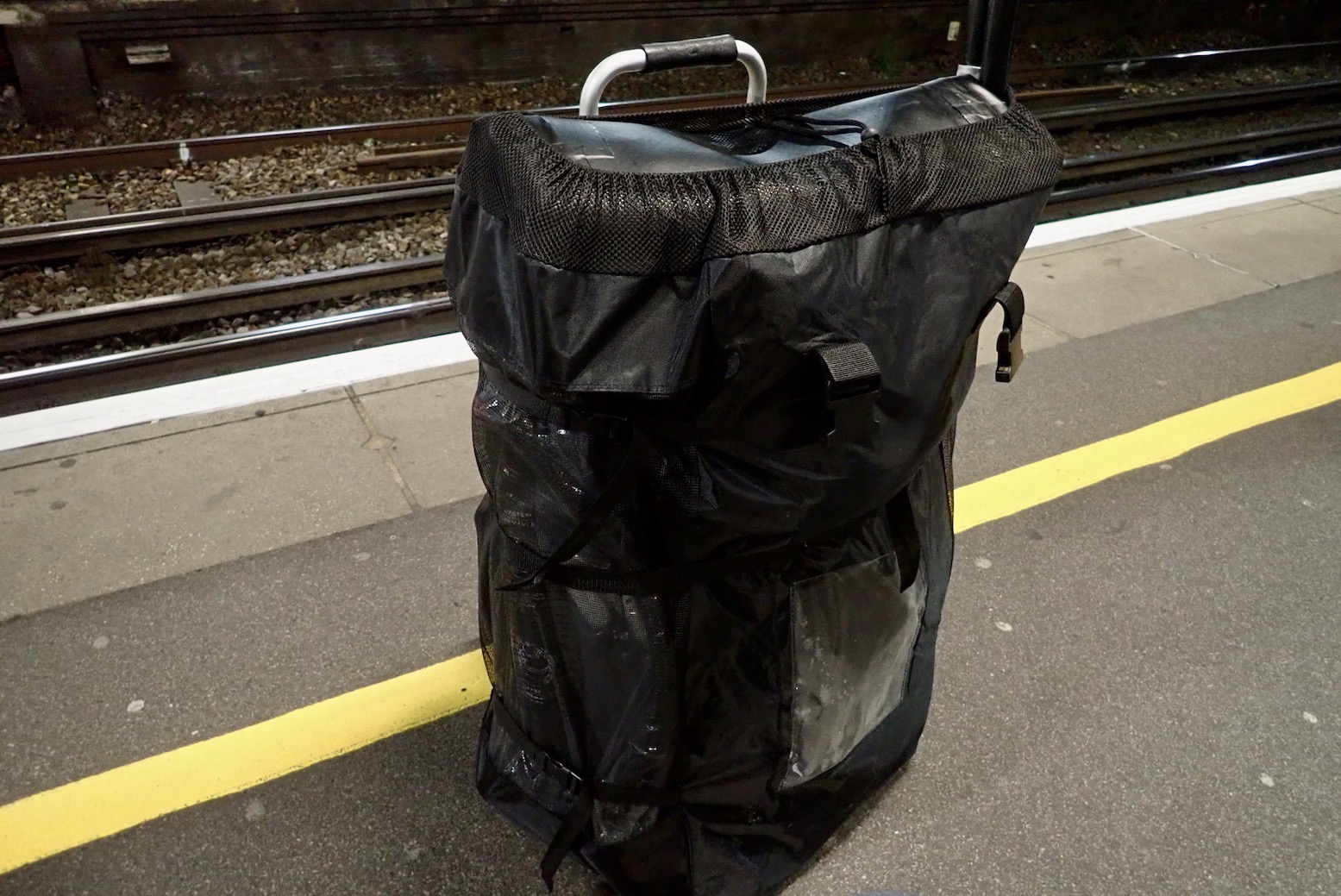
The supplied mesh-sided backpack is commendably huge: big enough to get everything in. There are cinch-down straps on the sides and the top, and a big zip plus a clear pocket on the front. The mesh sides will help a wet boat air off. But considering the weight it’s carrying, you do wonder if the shoulder straps will survive too much heaving on and off on public transport. I know my Gumotex backpack didn’t, and neither did the similarly huge Kokopelli Moki bag.
The whole assembly of the boat is very clean – that’s the wonder of heat-welding compared to messier rubber gluing. An exception are stray thread ends inside where a tape covers the floor–sides cavity (left). Once inflated I could see no blisters in the DS panels which, with threads every 5mm, adds up to an estimated 4 kilometres of space yarn! Maybe that’s what explains the bulk, but once vacuum sucked down, I don’t think so. It’s more that the stiff but soft-textured PVC can only be loosely folded over, not rolled up. Half the bulk is just air. The supplied four-part 220cm alloy paddles weigh only 950g and have blade-angle adjustment holes 45° either sides of flat. The blades also have little hooks cut in the sides which are actually quite handy, now I think about it. Assembled, there’s quite a lot of slack in the three joints which will only get worse with use but they’ll certainly get you moving until you decide to upgrade.
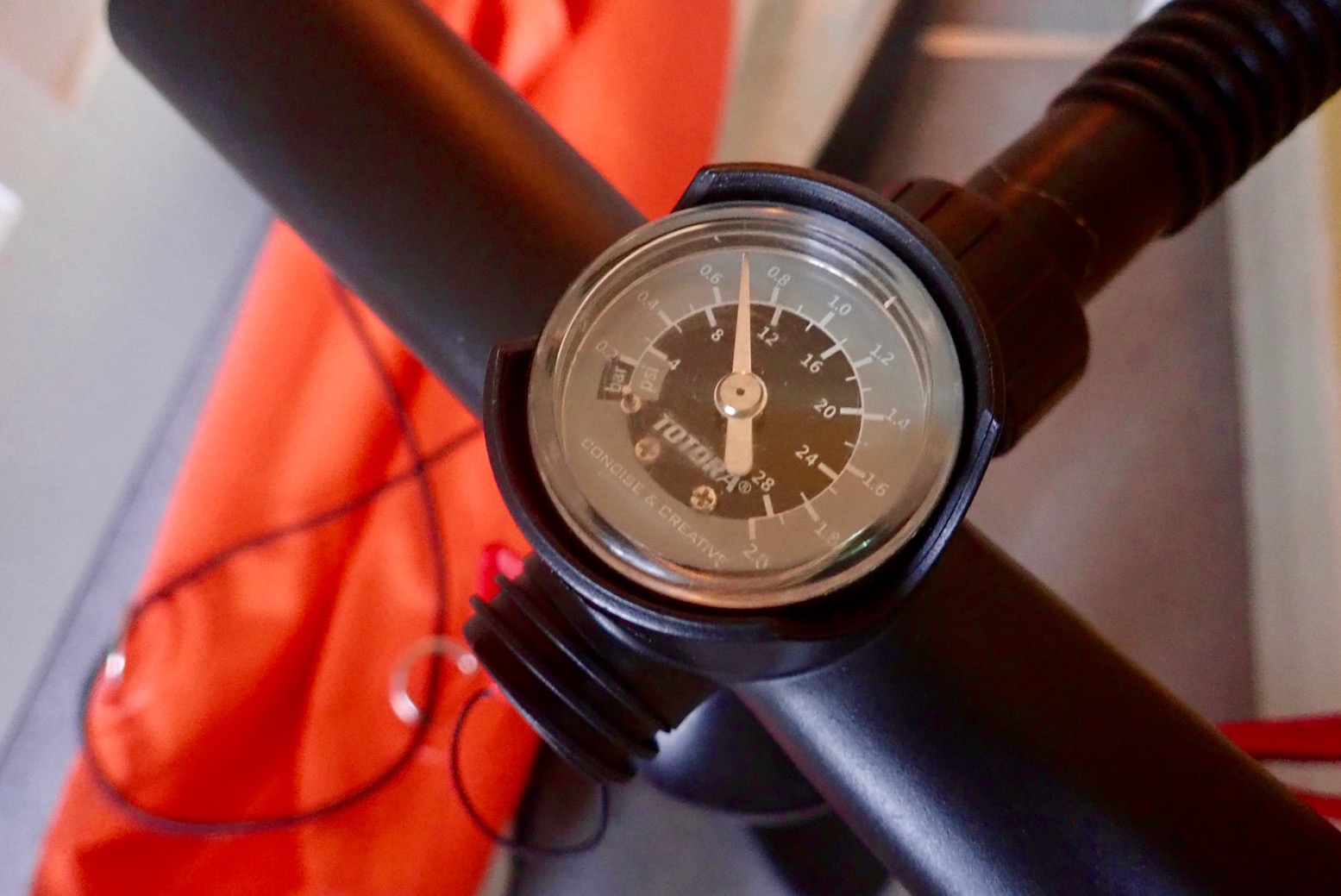
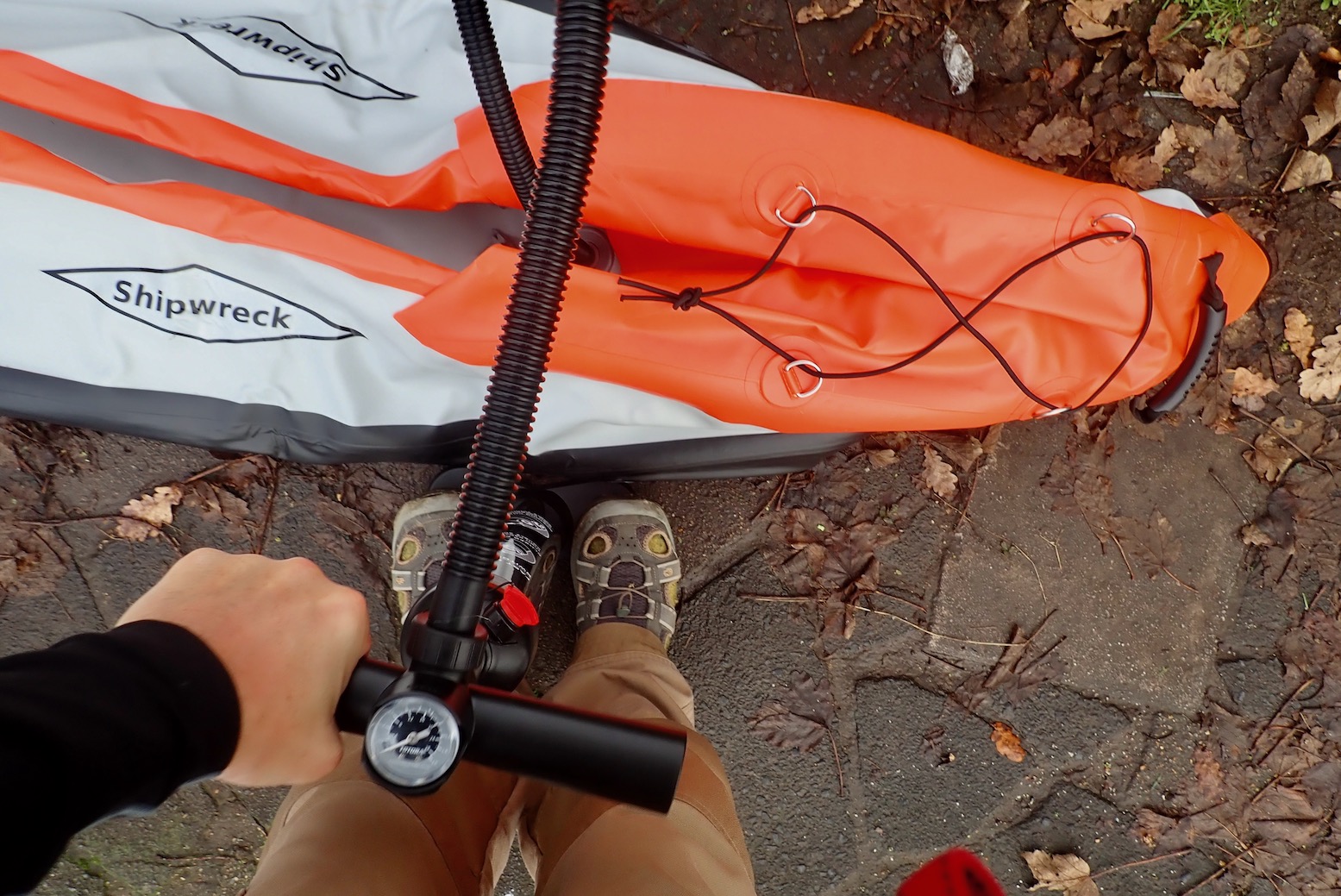
Pumping stations Pumping up the ArrowStream to an indicated 10psi measured by the 1.7-litre barrel pump’s built-in manometer took less than 90 seconds for the floor and a minute for each side. The pressures may be high but there’s much less volume here than a tubed IK. The pump comes with a nifty red cap which you easily unscrew to switch to downward-action-only to help attain higher pressures. I actually managed those times on double action all the way to 10psi. It’s manageable, but others will welcome the lighter pumping option as pumping effort increases. Checking against my accurate Bravo hand manometer, the 10psi figure on the dial was spot on. Good to know.
One good thing about the 64cm tall pump is that, I at least, stoop less compared to my 45cm Bravo. That makes pumping a whole lot more comfortable, though conversely shorter pumpers may find the height awkward. As mentioned here, a barrel pump suited to higher D-S pressures needs to be relatively tall but slim. The raft valve nozzle on the end of the hose had the bridge inside to press open the inflation valve once clamped on, so as to ease the pumping effort. This also enables sucking the boat down to maximum compactness. I’ve only just realised these nozzle bridges are the key to compact suction packing, as long as you have push-push valves. After shrink-packing, as you quickly remove the nozzle the valve closes and virtually no air in sucked back in. One thing you don’t get on a self-branded boat like this is a conformity table stating recommended pressures, HIN, payloads, ISO rating, CE stamp and so on. But there’s a one year warranty against manufacturers defects.
On the Water
I’ve been speculating about these boxy, hardshell-stiff full drop-stitchers for years and finally had a chance to try one. I picked a 21km (13 mile) section of the Thames from Shepperton to Richmond with three lock portages on the way. From where I live it’s an hour and a half by train, then a 20-minute walk to the river: a good test of real-world packboating. All I had to do now was sit back and wait for a sunny, mid-December day. In the end I settled for a dry day and once I got there, it dawned on me I’ve not been to my local train station for 9 months or more (this was Covid Year One). To spare the mesh backpack, I used an old folding trolley. It can hack rough treatment but these days most London stations have lifts, so the whole trip was rather effortless.
Shepperton to Richmond: 21km via three locks
A 15-minute walk from Shepperton station, I’d located a perfect put-in off Google maps: a paved dock down a bank tucked between trees and just a foot above the water (left). As so often happens when setting up in the more populated south, a passing chap was curious about the boat. Little do these people know they’ve stumbled upon the UK’s self-styled inflatable guru! A comprehensive exultation of The Packboating Way may have been more than he bargained for.
The planned route broke down as: 4km to Sunbury Lock; about the same to Molesey Lock; another 8 to Teddington and 4 or so to Richmond. As I wrote recently in my IK guidebook: first time in a new boat choose a quiet, safe and easy spot and if in doubt, do the tippy test before you let go of the river bank. Perched on the thick 9cm seatbase, the ArrowStream felt wobbly on its relatively narrow hull that’s about 60cm wide at the waterline where you sit. At a guess my Seawave 2 might be 70cm or less at the water level, but the difference must be that the Seawave sags a bit and leans over onto round side tubes (below right) which vaguely maintain the waterline width; the Shipwreck’s super-stiffness and near-vertical sides are what I’ve decided to call a ‘flowerpot’ profile (below left) which quickly narrows and has less to support it as it leans over.
Full drop-stitch hull profileSidetube IK hull profile
Had it been a lovely summer’s day in a shallow pool, it would have been interesting to push the tippy test past the limit. And also find out how easy it was to re-enter the ArrowStream from deep water. But it was a cheerless mid-December day on the Thames. I suspect the Shipwreck is more stable than it feels: what they call low primary (upright) stability but good secondary (leaning) stability, though some think latter concept is bollocks; a kayak either feels stable to you or it doesn’t. As for deep-water re-entry, like a canoe, the tall, thin sides may make that tricky, depending on how well you can dolphin-launch yourself up and into the boat without pulling more water in. Luckily I had the option to zip out the 6cm foam block from the 3cm padded seatbase envelope and sit nearly on the floor. I could try the block later when I was more accustomed to the boat. Sat lower, the boat felt normal. It can be rocked side-to-side more readily than my Seawave and you have to make sure you sit right on the centre line. As others have said it may tip off centre but it won’t go right over, at least on flat water.
On this first stage, in the interests of analytical rigour I planned to use the four-part paddle before switching to my trusty Werner. In fact it worked perfectly well for an alloy straight-shaft. You don’t really notice the slack joints, though the width of the boat’s high sides caused the paddle to brush against them. It was the same with my Werner later, so it might be an idea to tape this area against wear. Sat on the seat foam block or other added padding would get you higher for more paddle side-clearance. Once I got on the move the biggest problem was as anticipated: the tendency of the ArrowStream to track straight as a streaming arrow. Normal inputs to fine-tune the direction had no effect and progress became an annoying succession of straight lines broken by occasional hard hauling or jamming in a stern rudder/forward pry (it’ll all be in the book!) to get it on track. This was the same issue we had with the Moki a few months back. Is it the stiff DS floor? Is it the huge skeg? The sculpted hard plastic bow and stern prows? Read on, but I got to Sunbury in less than half an hour which was a pretty good 5mph with help from the current.
Here I didn’t think to investigate what had looked on Google like a fish-ladder/mini weir on the left of the lock. I now realise it was a very handy canoe roller ramp: a slopping drop which would have made portaging near effortless. I’ve never seen these before; with a little more excavation they could be made into chutes as found uniquely on the Medway but perhaps the Thames’ current gets too strong for them. Instead, I hauled the kayak up onto the towpath, carried it past the lock and clambered back down a dockside ladder. Grabbing one side-handle, a solo paddler can rest the boat on the hip and carry it a short distance.
Paddling off with the weight (trolley, pump, spare paddle) now in the back and my Werner in hand, progress improved. A favourite paddle of 15 years fits like a well worn pair of boots, except boots would never last that long. I still hadn’t got to grips with steering nuance. There is just no way skipping a few strokes on one side will make any difference: the Arrow Streams full ahead like a rocket sled on rails. Of course, it’s better that way round than the other. Somewhere downriver a mate who lived nearby was standing by to grab some drone footage, but you’ll see better video at the top of the page. A few stills below.
With half an hour spent chatting or in a holding pattern while the drone buzzed overhead, annoying all in earshot, I wondered if I’d left it too late to get to Richmond before dark. At Molesey Lock I nearly made the same portaging mistake had not a kayaker catching up scooted down the ramp (below). They may not be as much fun as a chute, but with shallow water on either side, you can hop out and portage in a minute, even without using the rollers. It’s probable the day’s three locks (plus Richmond’s tidal barrier, just downstream of town) are the only such roller-ramps on the Thames’ 45 locks.
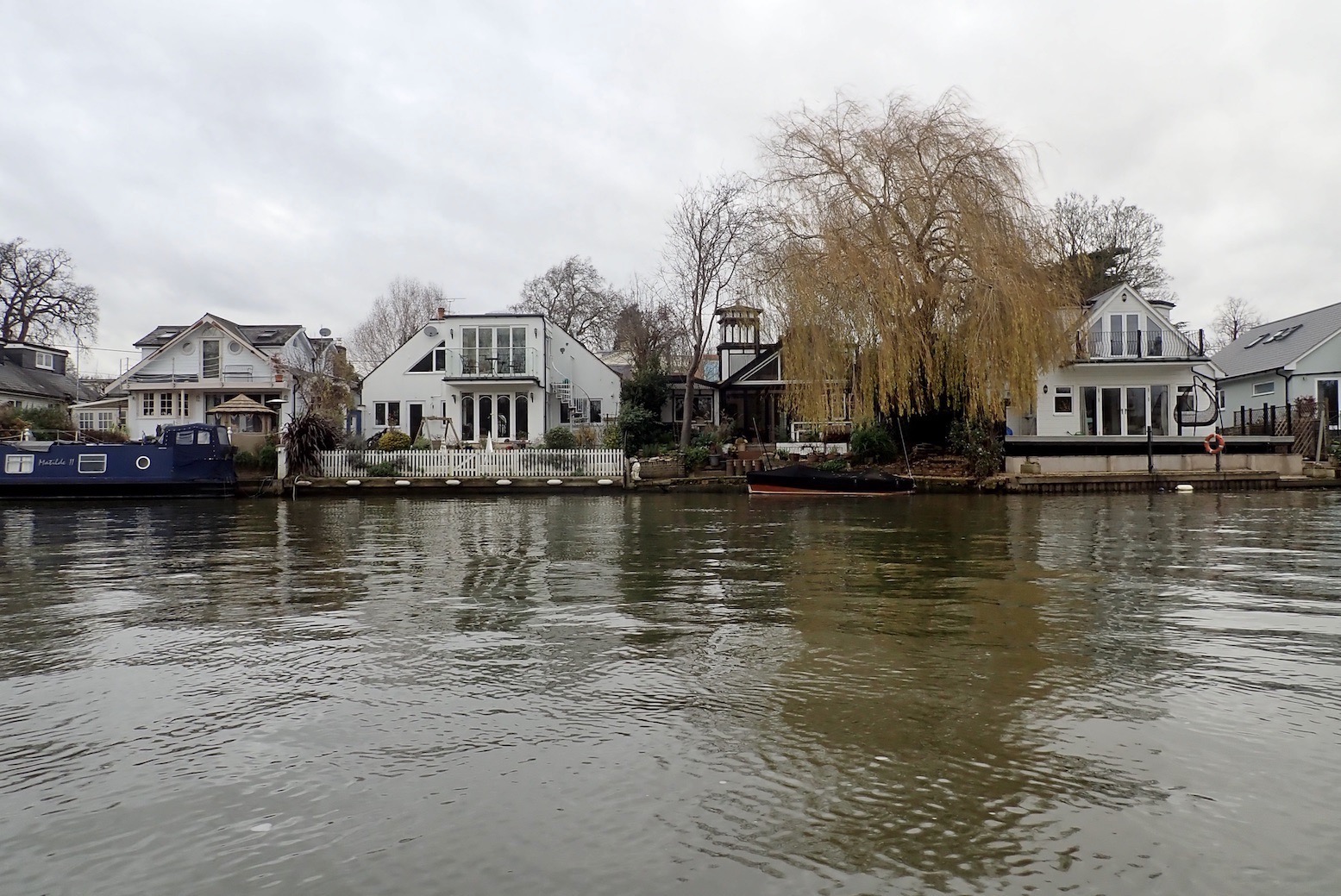
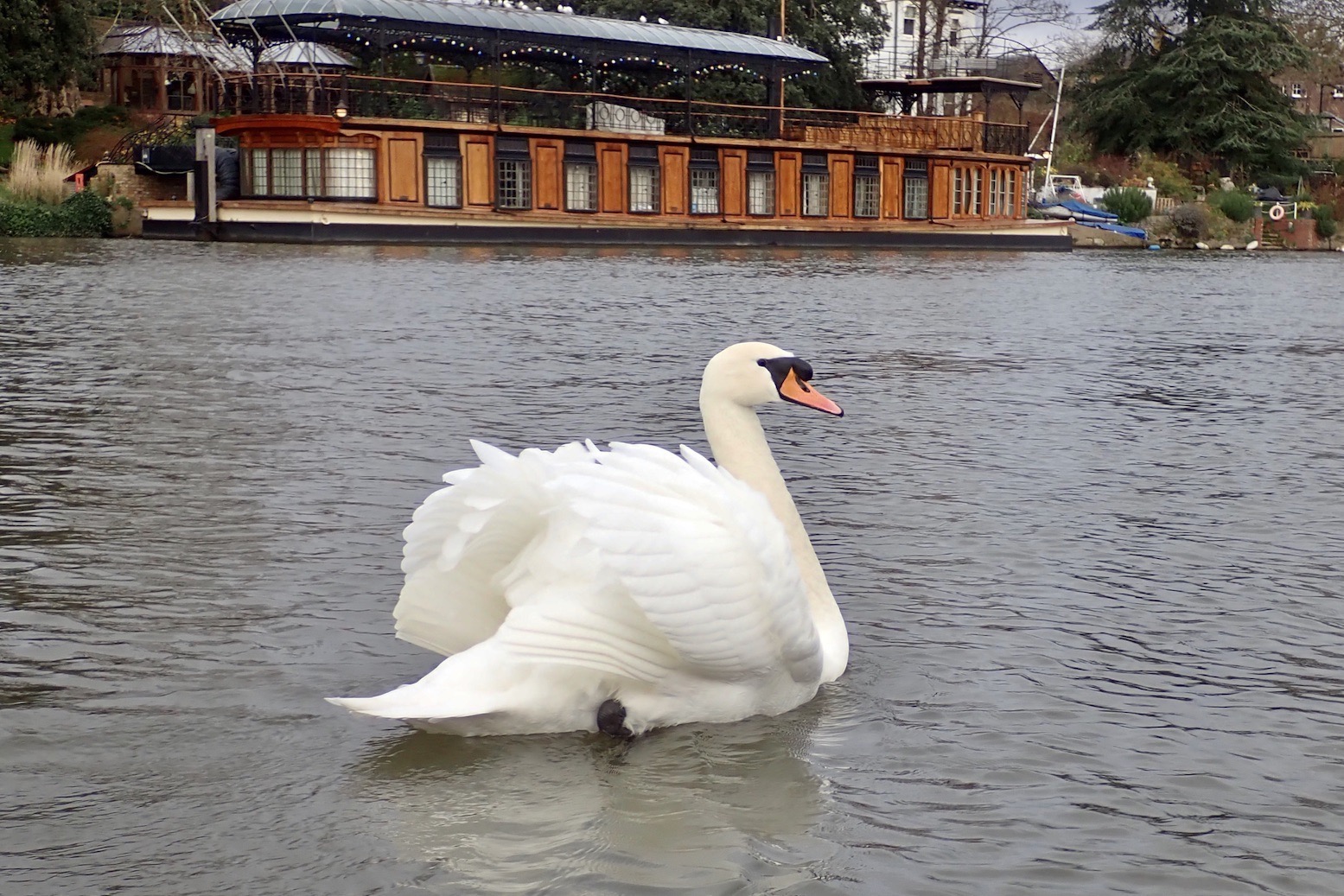
From here it was an 8-km stretch to Teddington where I thought I might bail if I felt tired. That’s the great thing with a packboat: you can change plans as you go. After passing rows of cute riverside dwellings and many seemingly abandoned boats, from here on the river was less grubby and urbanised as it passed the vast grounds of Henry VIII’s Hampton Court Palace. Right from the start I’d been surprised at the number and variety of birds on the Thames, not least the hordes of swans (which were protected by ancient royal decree until 1998). I noticed one had a cunning way of fluffing its wings out into a pair of downwind sails to tale advantage of the tailwind.
Like a weary traveller, I came upon a glittering riverside metropolis and for the life of me couldn’t work out where this was. Happy shoppers and joggers where cruising along the waterfront. Cafes, bars and patisseries were making the most of it before Covid restrictions ramped back up in a few days. Was Thames Ditton really like a mini-Manhattan? Or have I been cooped up indoors a little too long. I asked a passing boatman what was this place of wonder. “It’s Kingston, mate. Why, wherja think it was?” I hadn’t the heart to tell him.
As I paddled past, I clocked the distinctive slabby flanks of an Aqua Marina Tomahawk tucked between two raptor-like speed boats. That particular boat was about as good value an FD-S IK as you could buy until this Shipwreck washed up on the ebbing tide.
I drifted under Kingston Bridge which I must have ridden over scores of times in a past life, whereupon the Miracle of Kingston delivered one final benefaction: the setting sun burst out from beneath the carpet of clouds which had smothered the London skies for the past week. The shock was so great and the light so stunning against the steel-blue clouds, it could not have been a better time for the cold to get to the camera’s battery. I managed to rub it into delivering one last shot of the stately riverside plane trees before it packed up for good. This illuminated setting invigorated me for the final lap to Teddington Lock and Richmond beyond, but three hours in, the old butt was getting sore. One good thing with the ArrowStream and similar is you can lift yourself up on the hard sides to aire le derriere. This turned out to be one of the nicest stretches on the Thames I can recall. The riverside sticky-beaking, enigmatic islands and doubtless loads of history if you care to investigate, makes me realise that without its sporty chutes, Kent’s Medway is just another ordinary, agri-saturated Southeastern drain.
Converging on Teddington Lock with a quartet of silver-haired sea kayaking ladies, like a well-conditioned lab rat, I knew the form by now: canoe ramp, river left. Here I decided to remove the skeg. Straight away I set off at a faster paddling rhythm and found the boat much more lively, but in a good way. Yes, small corrections were needed to keep track, but now I was off the monorail and could wander and weave around like a normal IK. I wish I’d done this earlier. As suggested elsewhere; the sweet spot must lie with chopping that dorsal fin down. At the lock I also slipped the seat block back under the seat … for as many nano-seconds it took to realise that was still a bad idea. Something softer but less thick is needed, but watch the IoW video at the bottom of the page to see proof that this IK can be manageable at sea.
The trees of what I thought was Richmond Park (actually the near-contiguous Ham Lands) glowed orangey-red as I cruised below Richmond Hill and under another familiar road bridge to arrive at the ramp where Steve and I had set off for Greenwich nine years ago, just after the last London riots. Lord know there’s plenty more to riot about these days, but now it’s all conducted online which is much more hygienic. Like Kingston, twilight on Richmond waterside was throbbing with ducks and Christmas revellers. I took my time draining and folding up the boat (chatting IKs with another curious chappy), rather pleased I’d managed the distance in exactly four hours without ending up too knackered. Part of that must be down to a backwind and the Thames’ swift winter current, but most of it’s owed to the Shipwreck ArrowStream, a fast flatwater cruiser whose potential is released once you dial in the right amount of skeg which may be none at all.
Drying The twin drain plugs at the back worked fairly well on the ramp at Richmond; a pint or two spilled out from the cavity formed between the sides and the floor and which will almost certainly not dry out fully. The mesh-sided backpack helped, but you could tell it would take more to dry the boat off fully prior to long-term storage. In our flat I left it in the warm hallway (with an appropriate warning sign) and gave it what I thought was a final wipe down, but folding it up more water splashed out from somewhere, possibly the hollow prow beaks at either end. If you have the space the best way would be to lean it inflated on a wall in a warm room (or out in the sunshine), let what’s in there run to one end and deal with it there. If you’re really serious about the side cavities, you might get to them from either end with a hose attached to a hair dryer set on low.
The plan was simple. Put the IK in at Limehouse Basin where I finished up last week, and take an easy canal-paddle up around what are collectively known as the Bow Back Rivers threading through the Olympic Park, then portage over Three Mills Lock onto what becomes Bow Creek. Here, we’d ride its tight meanders on an ebbing tide down to the Thames at Trinity Wharf. Hard left and, keeping on the north bank (naughty), for what looks like an easy beach take-out at Lyle Park, a mile downstream.
Another possible east London paddle route.
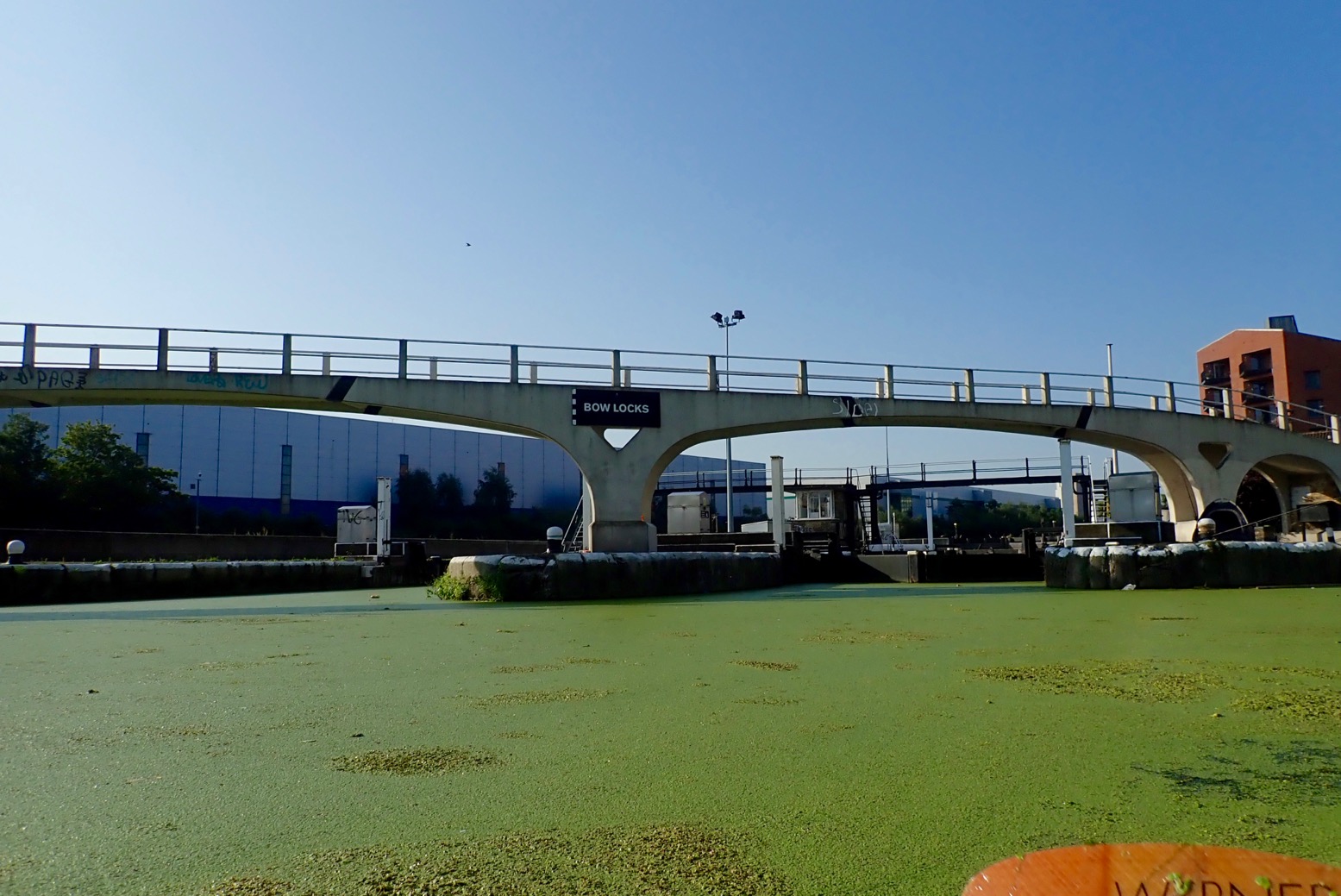
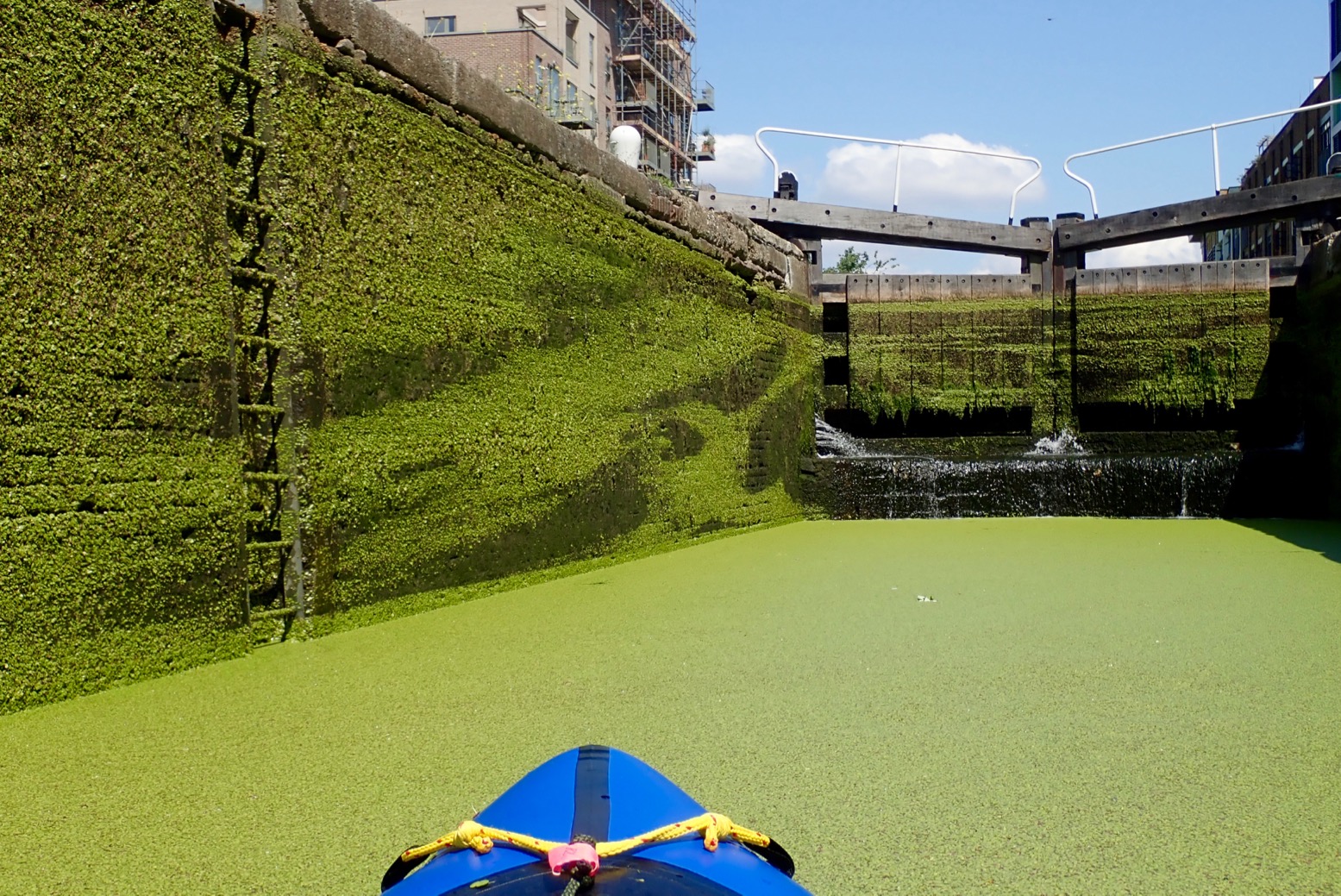
The whole 8-mile run included just two locks to portage. Compare that to 13 locks and two closed tunnels for the similarly long Regents Canal I pack’ed last week. Things didn’t get off to a great start, but next day we were back and on the water before 8am. We set off up arrow-straight Limehouse Cut. Dating from 1770, it’s London’s oldest canal, built to evade the Lee River’s final twisting meanders on Bow Creek which we hoped to paddle on the wat back. (Very detailed history of this river). Two miles on, a thick mat of spongey duckweed backed up around Bow Creek Tidal Locks. Tendrils of weed caught on the paddles and flicked all over the boat. Bow Creek ebbs and flows right alongside the near-stagnant Limehouse Cut/Lee Navigation, but this was surely once a single river system. The River Lee’s (or Lea) source is in the hazy Chilterns of north Luton, and reaches the Thames via Bow Creek, 42 miles later. The Lee River Navigation is paddlable from at least Hereford (Mile 27.5). In England, a ‘navigation’ in fluvial terms means a public right of way for all craft, with a precedent going back centuries. Not all rivers in England are a navigation. This whole underused wasteland between Strafford and Hackney was massively redeveloped for the 2012 Olympics, including the two new tidal locks mentioned. Before that, on the spring tide you could paddle up Bow Creek all the way to Hackney Marshes for some fish and chips. But while great for towpath activities, it seems the developers behind the refurbished network of waterways and new bridges didn’t consider paddleboat access either side of the locks. Odd, seeing as it was the Oh Lympics and all.
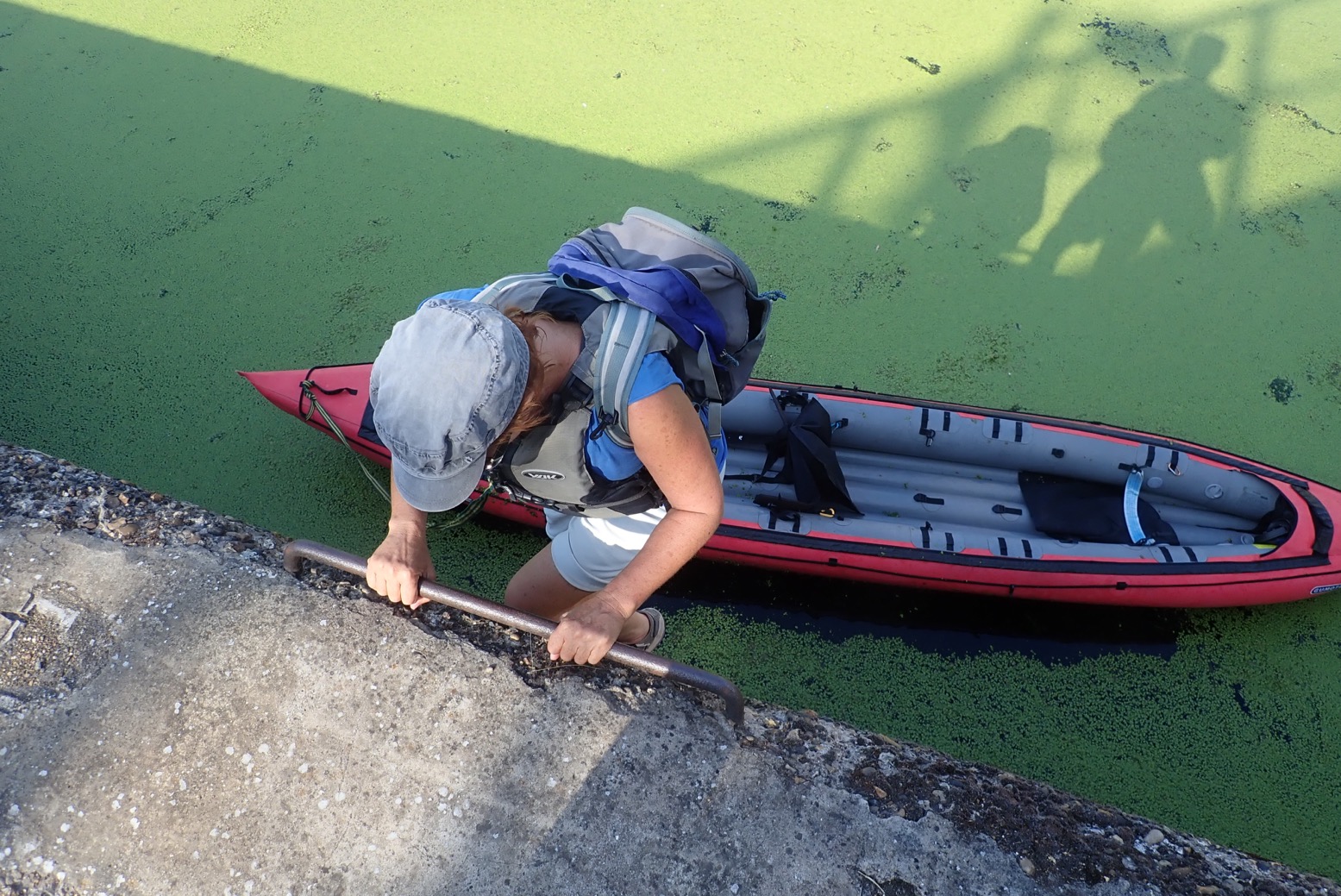
Our first trial came at Carpenters Road Lock (booking required a week in advance). It has a unique radial design with gates lifting a bit like a bulldozer blade. The CRT is very proud of it. Even though it’s permitted, as a single kayak I wouldn’t expect to use this or any lock; portaging is always quicker. But I would expect it to be fairly easy to get out and portage around a lock, just as I did 13 times or more last week on the Regents Canal. Maybe I’m going soft, but clambering up a 12 feet of rungs set in the canal wall, hauling the boat up, and then carrying it half a kilometre to the next accessible put-in doesn’t encourage paddling. What next; the cliff climbing finale from Deliverance (right)?
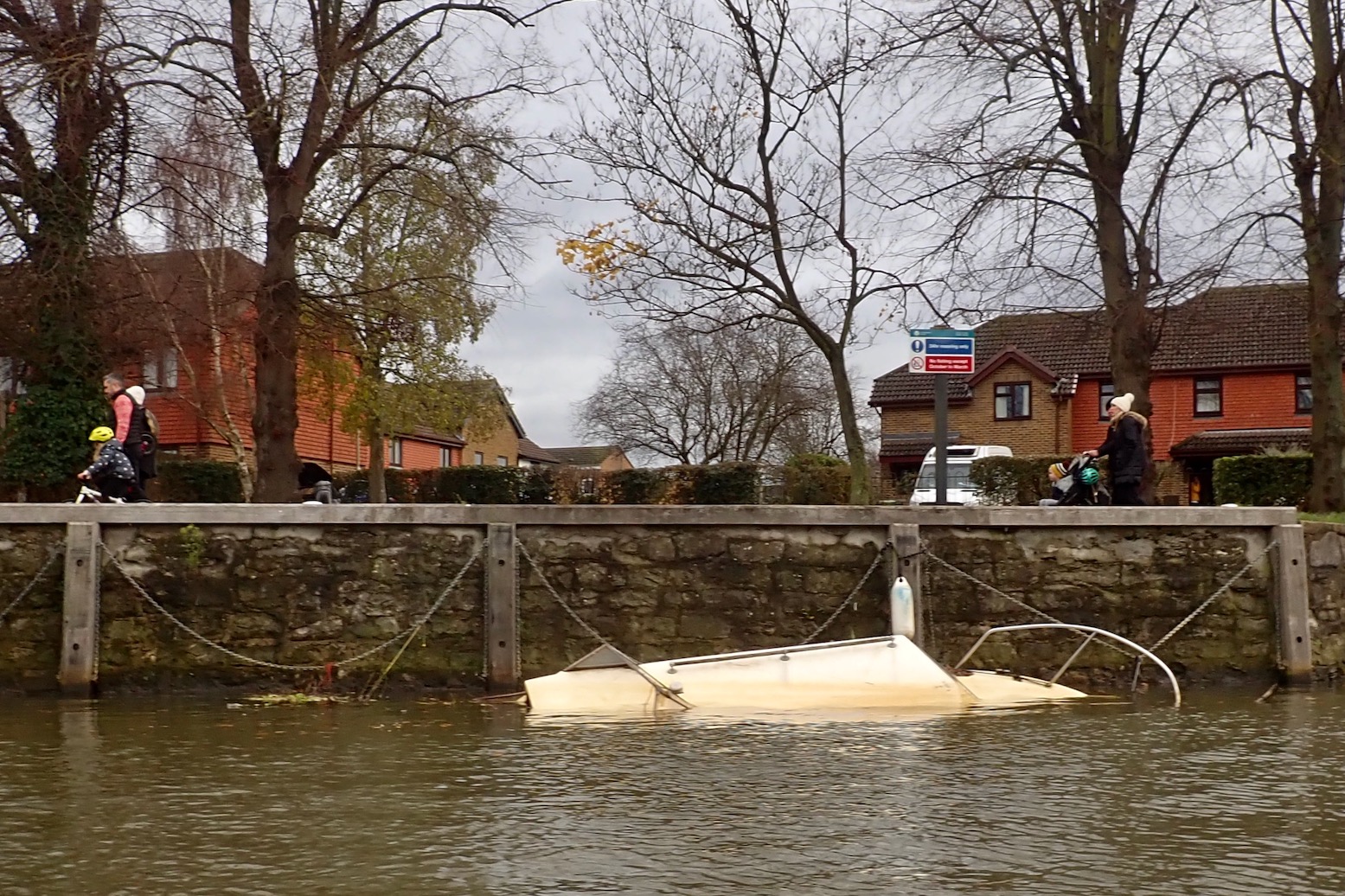
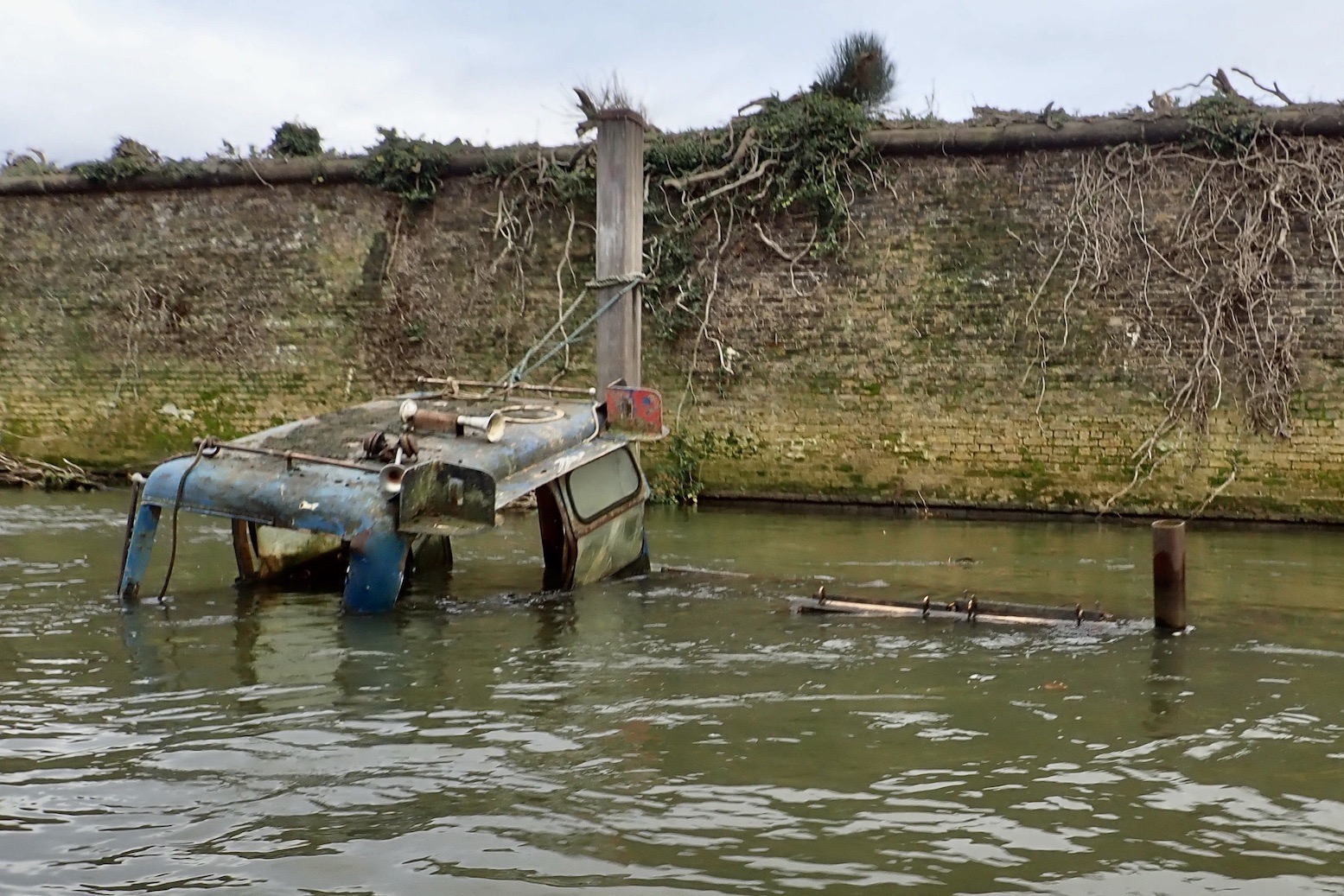
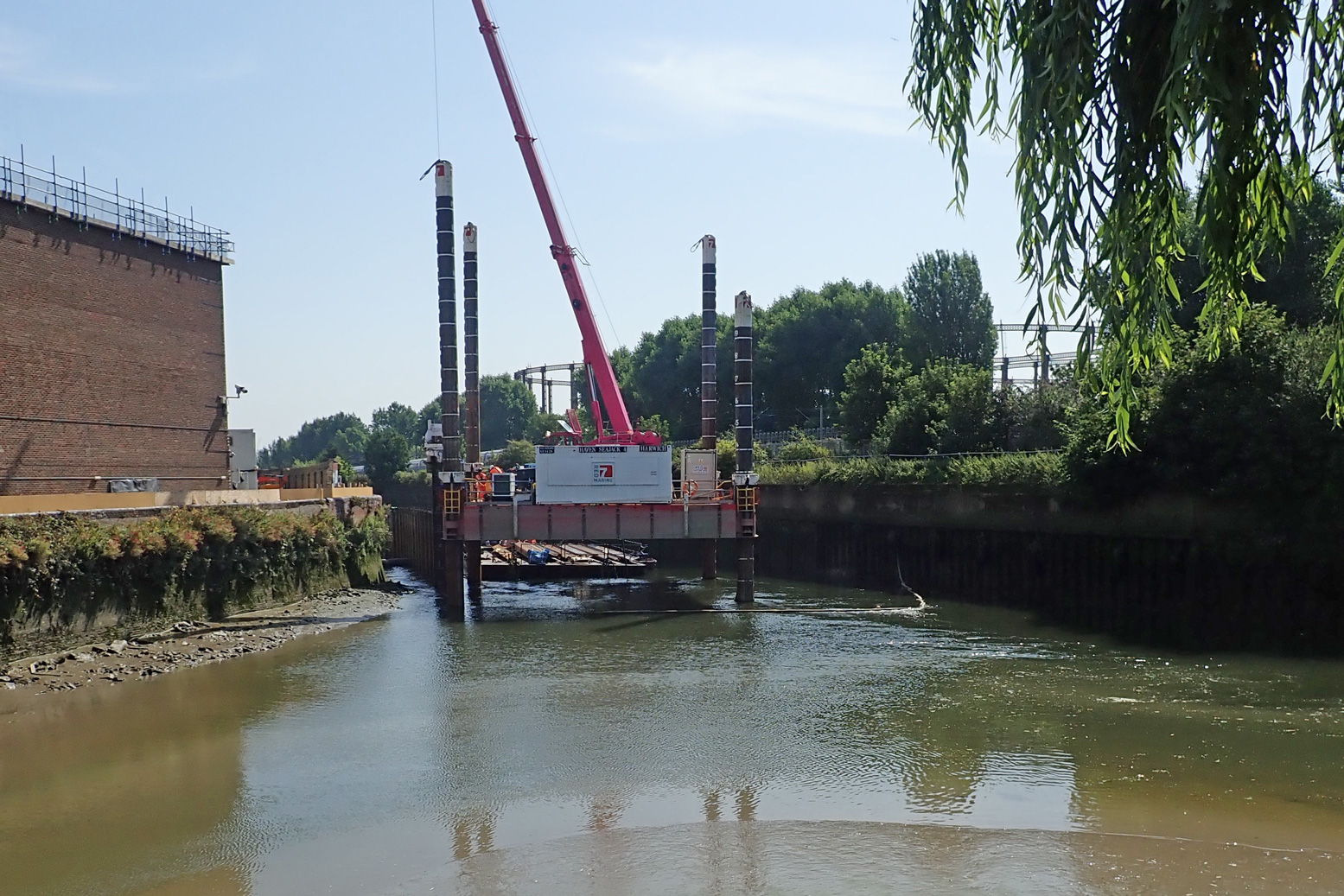
Two miles downriver at Three Mills Lock, (which I read was closed for repairs) we had to get up an even-higher ladder jammed behind a derelict? barge. To access the tidal stretch downstream of the lock, the only way was another long wall ladder, but it was behind temporary barriers. I could have wandered on to the Channelsea River to look for an easier put in, but where it joined Bow Creek (right), a cable or pipe to the crane floated across the surface, blocking the way. On a wild river you portage as long as necessary, sometimes miles. But either side of a lock on an urban waterway, how far do you go?
To be fair I’d timed the tide all wrong. I thought (correctly) that mid-ebb could be a fast run on the Bow, but in my greed for speed I’d failed to appreciate that at the tidal extent (the lock and adjacent Three Mills Island, left, 3 hours before LW at Bow Creek mouth), mid-ebb has already gone shallow. You’d need ropes to get down to a boat. I suppose the easiest way to do Bow Creek is to paddle up with the tide and then let it take you back – this must be what local hardshellers do. With a packboat you can dodge such backtracking. But not here it seems. And whichever direction you do it, once you’re in Bow Creek, I don’t think it’s easy to get out of the high-walled channel. Our East London paddle occurred during a mini-heatwave with temperatures up in the mid-30s. What better place to be than on the water. But not in it: that morning the news reported a staggering three drownings yesterday, all on the Thames and all separate incidents. Lacking the hoped-for thrill of the Bow Creek finale, the route we took wasn’t so interesting from the water, though would be a nice walk or cycle if you’ve never seen the Olympic Park in real life. From the water, you see a lot of high rises or backs of factories or construction to make more of the former. Even with its dozen or more portages, I found the Regents Canal much more diverse and interesting.
Below, some pictures from our day out.
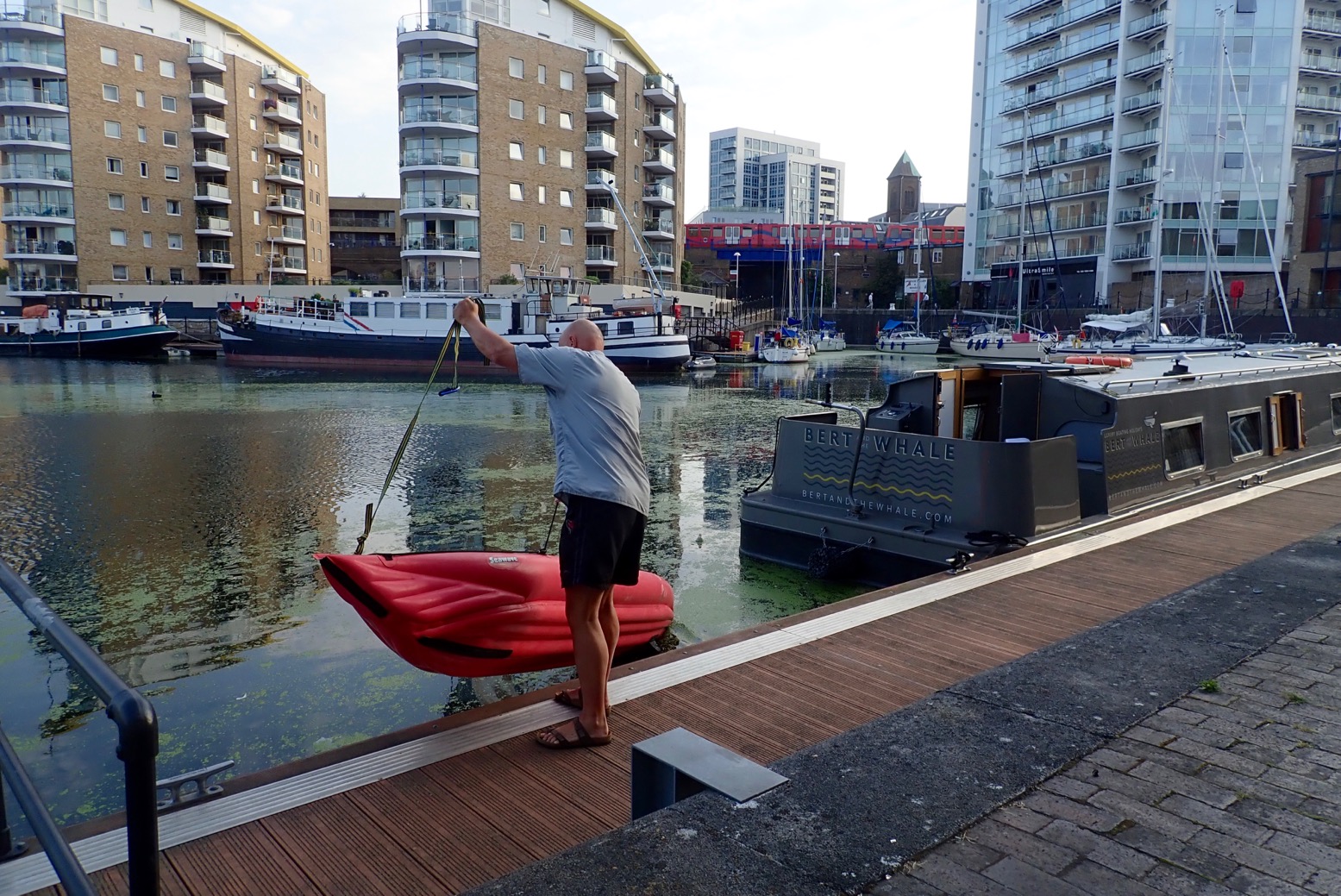
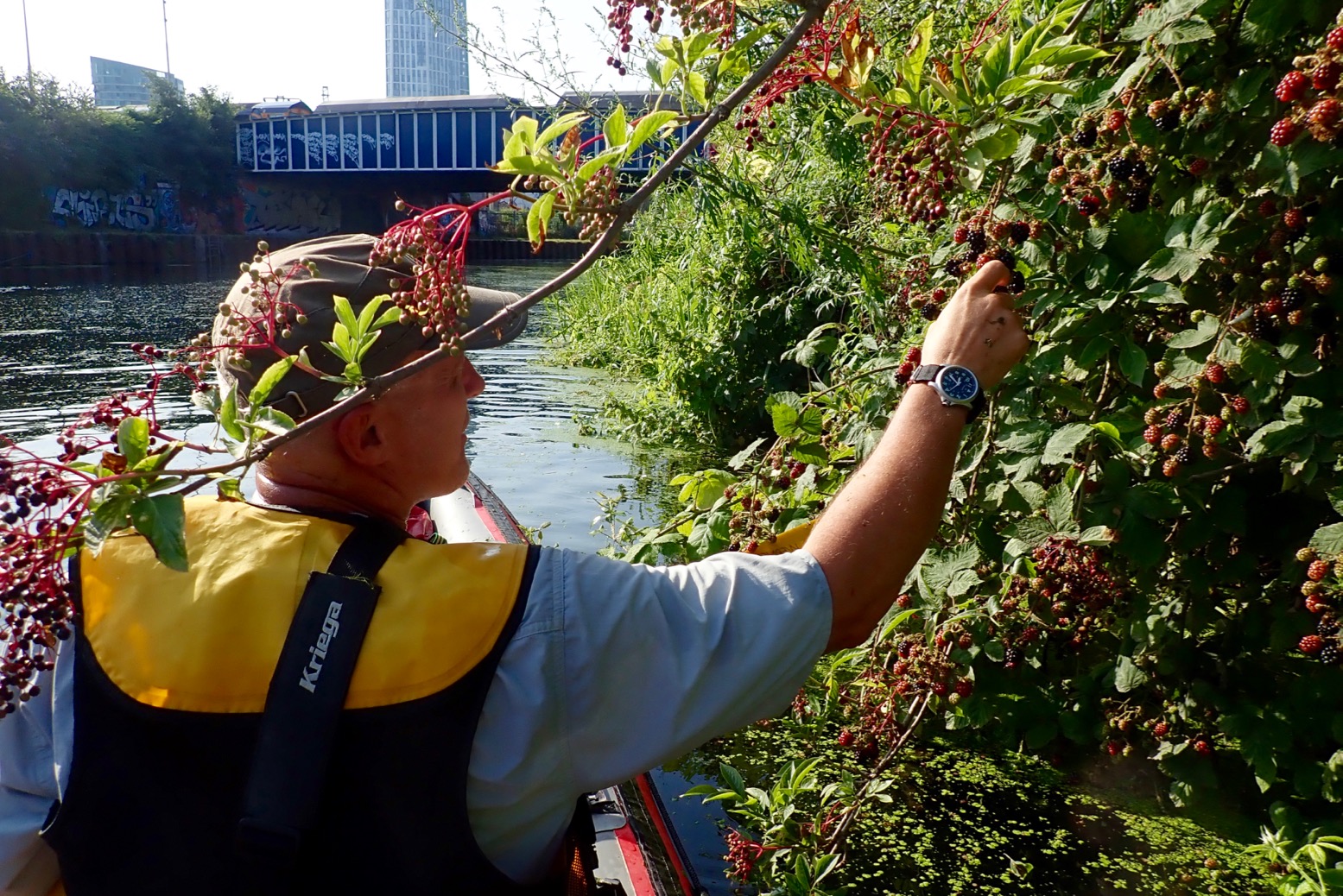
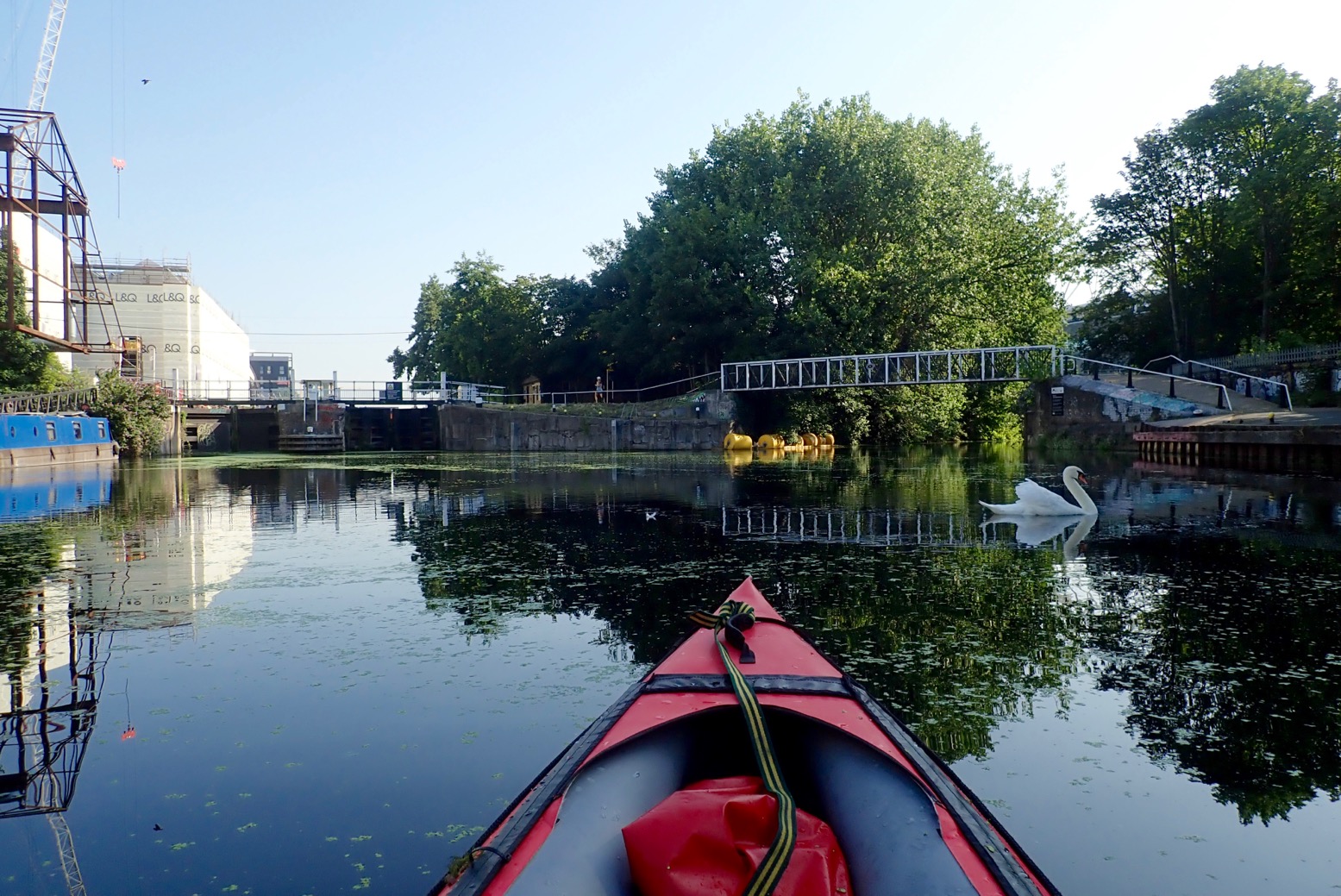
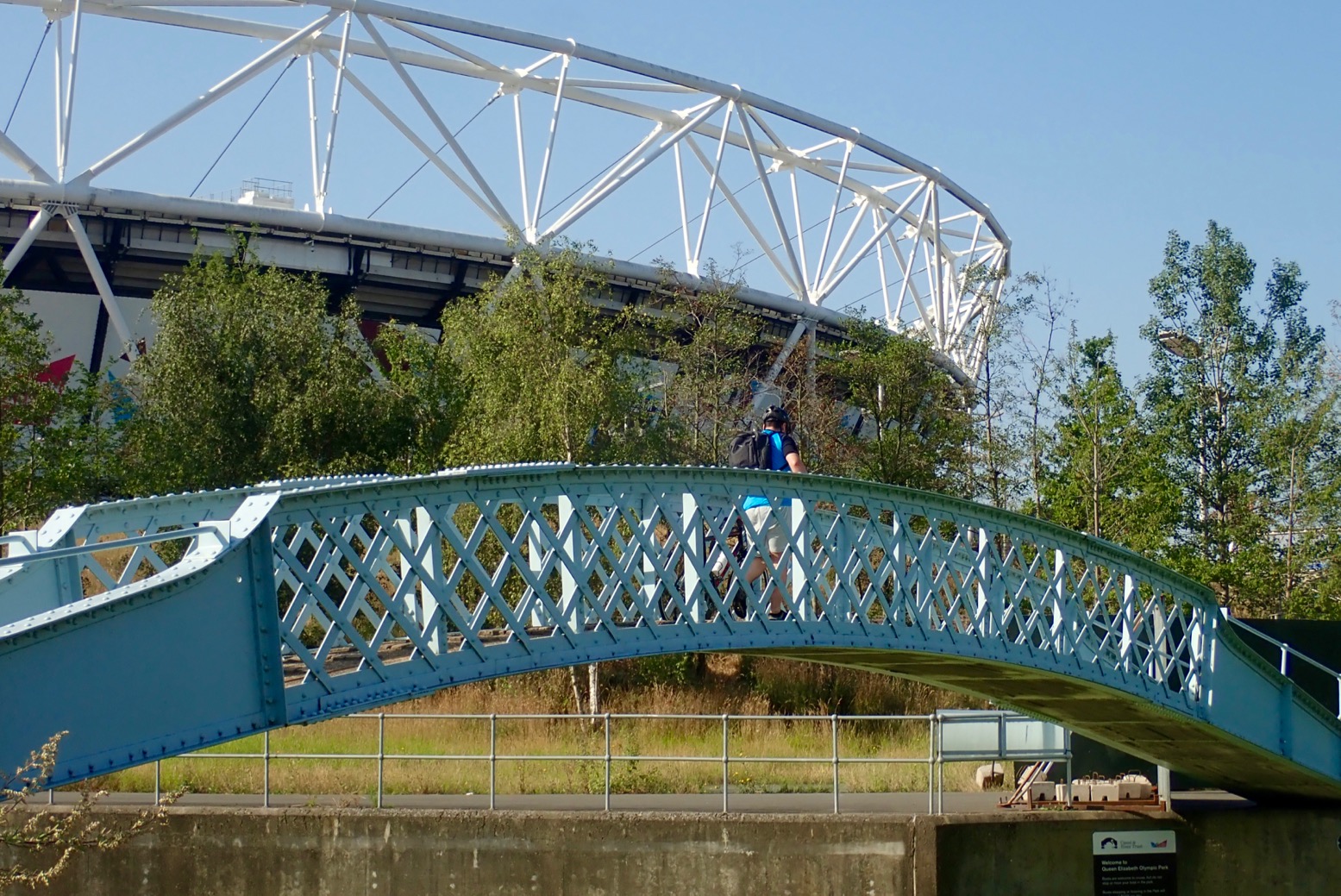
Limehouse Basin 7am.A week earlier, covered in duckweed.A normal-height floating jetty on the east side of the Basin. More of these needed upriver.Thick weed clogs Bow Docks which drop to tidal Bow Creek for the Thames. But there is no easy way to access Bow Creek from the bank. You must book the lock in advance.Three Mills Island complex – there’s been a tidal mill here since Saxon times they say. There’s a cafe.Under the Bow Flyover. The Lee is the notional boundary between the East End and East London. In some pubs it pays to know the difference. Aabout 1200 years ago in Alfred the Great’s time, it was the frontier between Danelaw (Vikings) and Wessex (Anglo Saxon England).Loads of building all around. London will be utterly brilliant when it’s finished.How deep is a canal, you ask? This deep, but often less on the sides.Belladonna and blackberries.Old Ford Lock (Lee River Nav) to the left. Just after, Hereford Union canal leads back west to the Regents Canal near Victoria Park. We follow the Swan right under the footbridge along the Old River Lea, passing below the stadium. Note the two different spellings of Lee/Lea, Ley being the original Medieval spelling. I realise that nearby Leyton + Leytonstone have the same derivation.Nesting heron.Carpenters Road Lock. How do you get up there? How indeed.Actually quite easy out of an open IK. Don’t drop the lead!We could have turned south here under this bridge and taken City Mills River back to the Lee River Nav just north of Three Mills Island and so back down to Limehouse (see map below). A closed loop with no locks which would be an OK canoe or even a SUP. You can rent Moo Canoes at Limehouse.Instead, we portage for 500 metres to the Waterworks River. A superb trolley surface.
9am – time for brekkie in a park before crossing the bridge. There are a couple of snack huts here.
Round the corner from the lock, yard-high put in on the west side of Waterworks River. Gate by the steps locked for no reason so down the ramp past a site entrance. Below the bridge is a short ladder and the gravel riverbed is only a few inches deep.
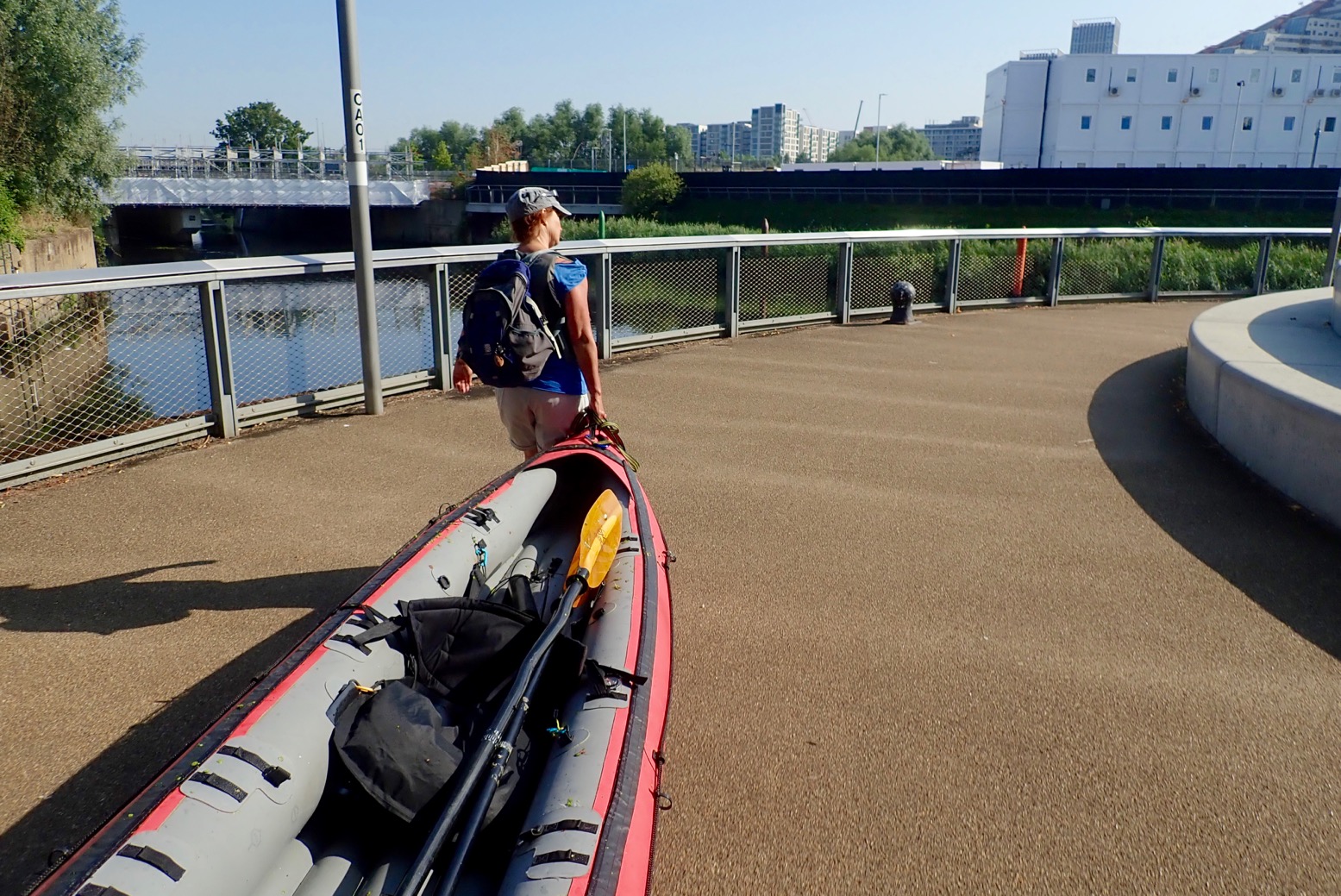
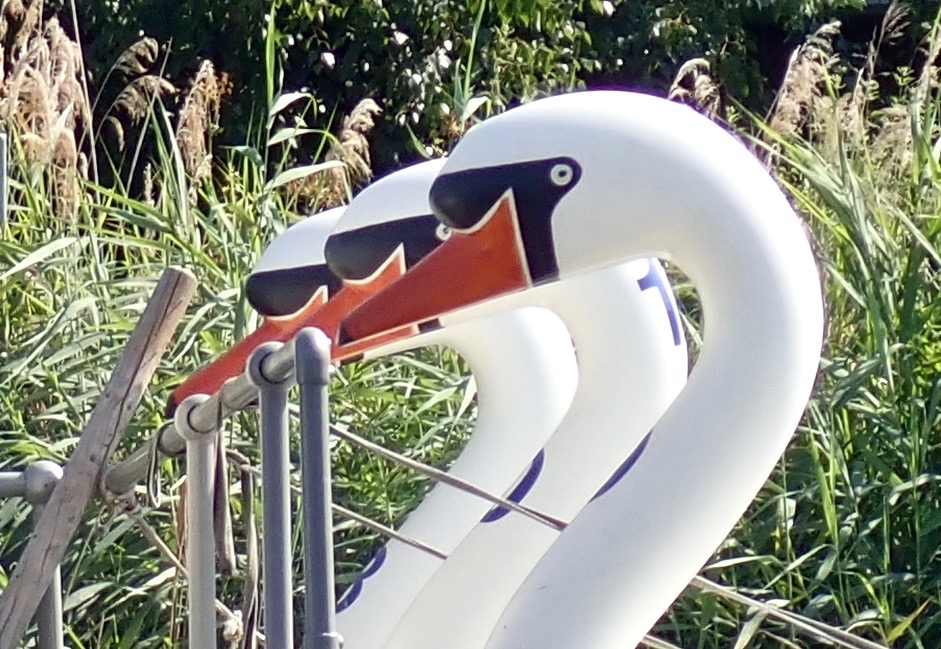
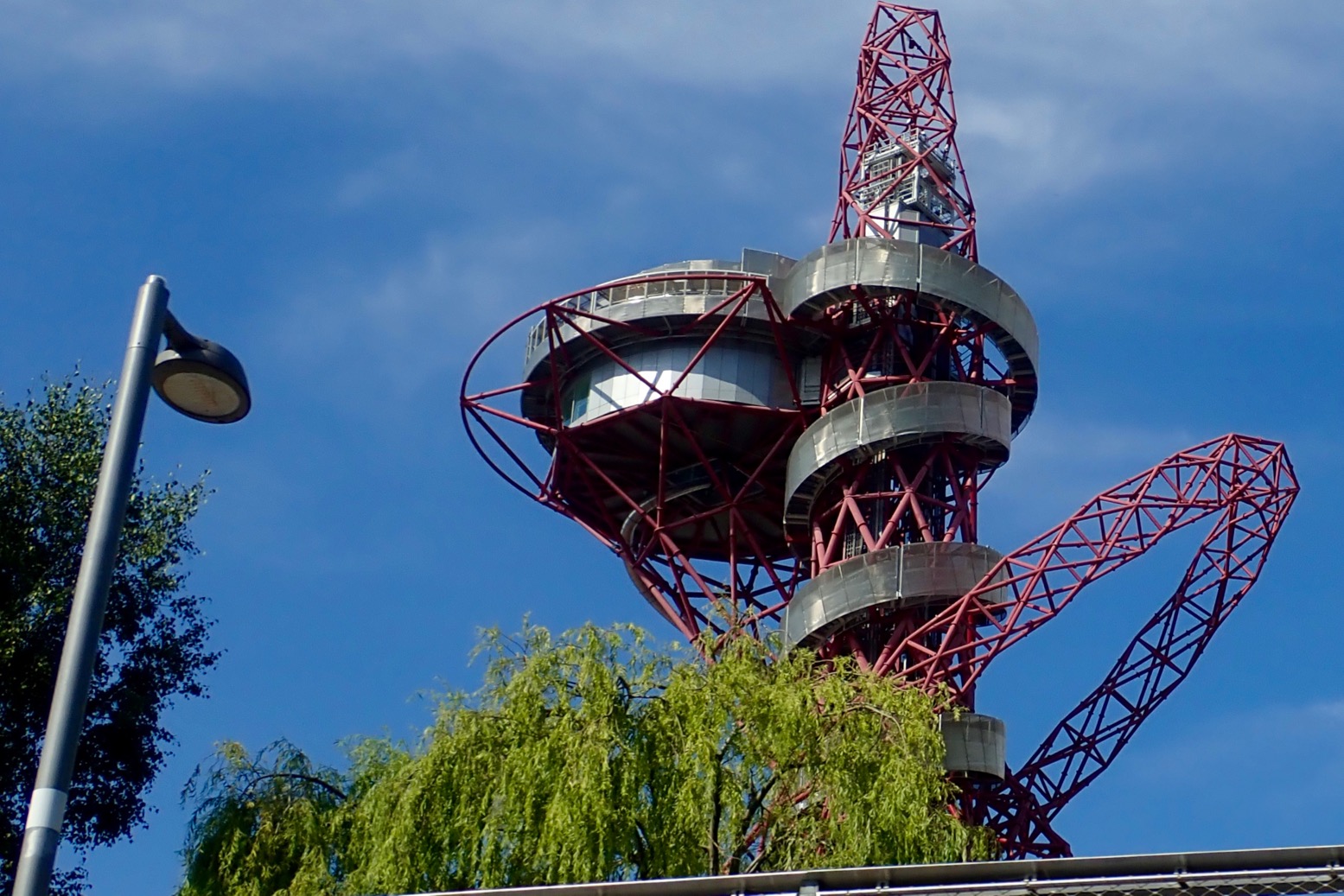
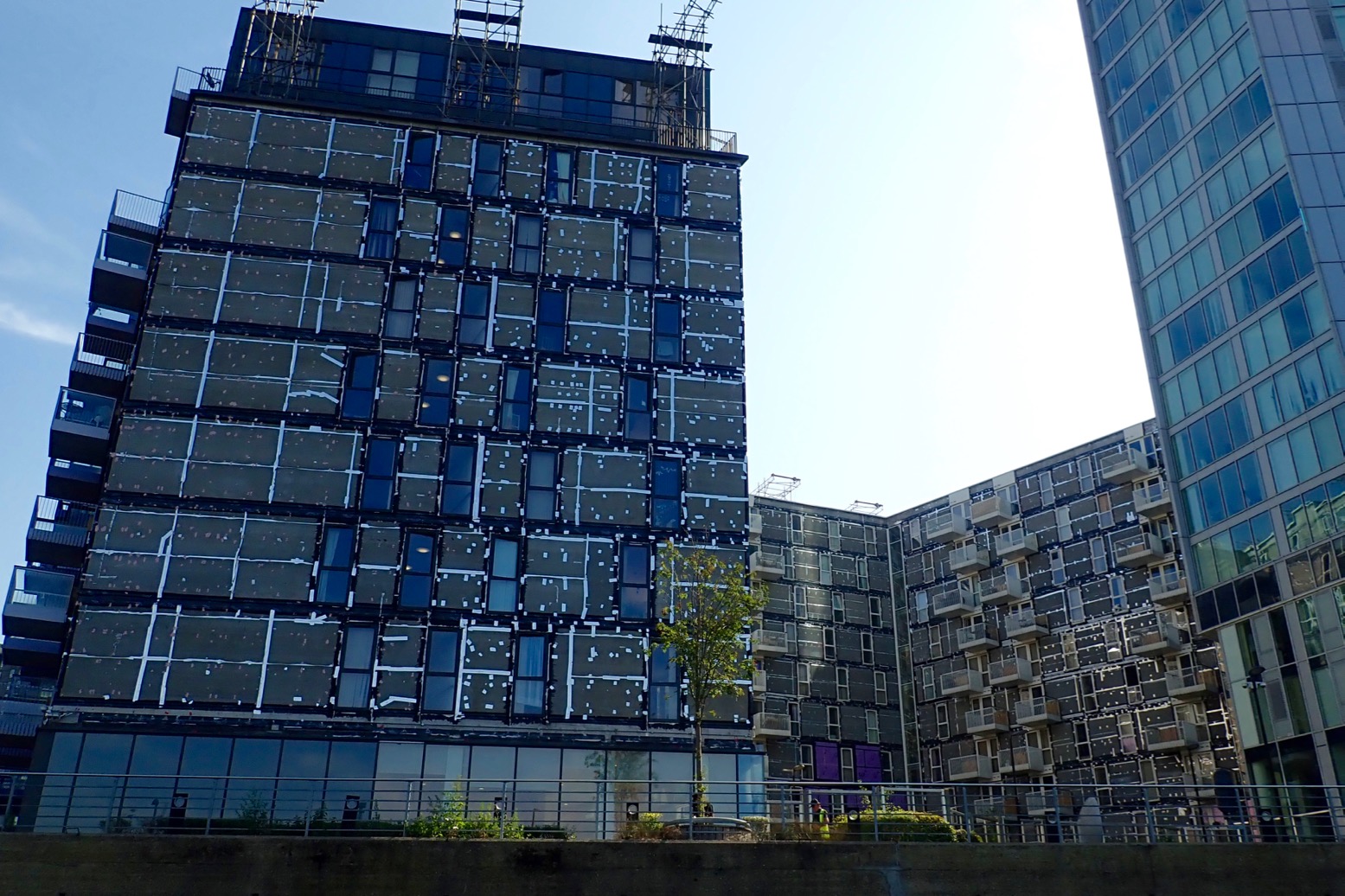
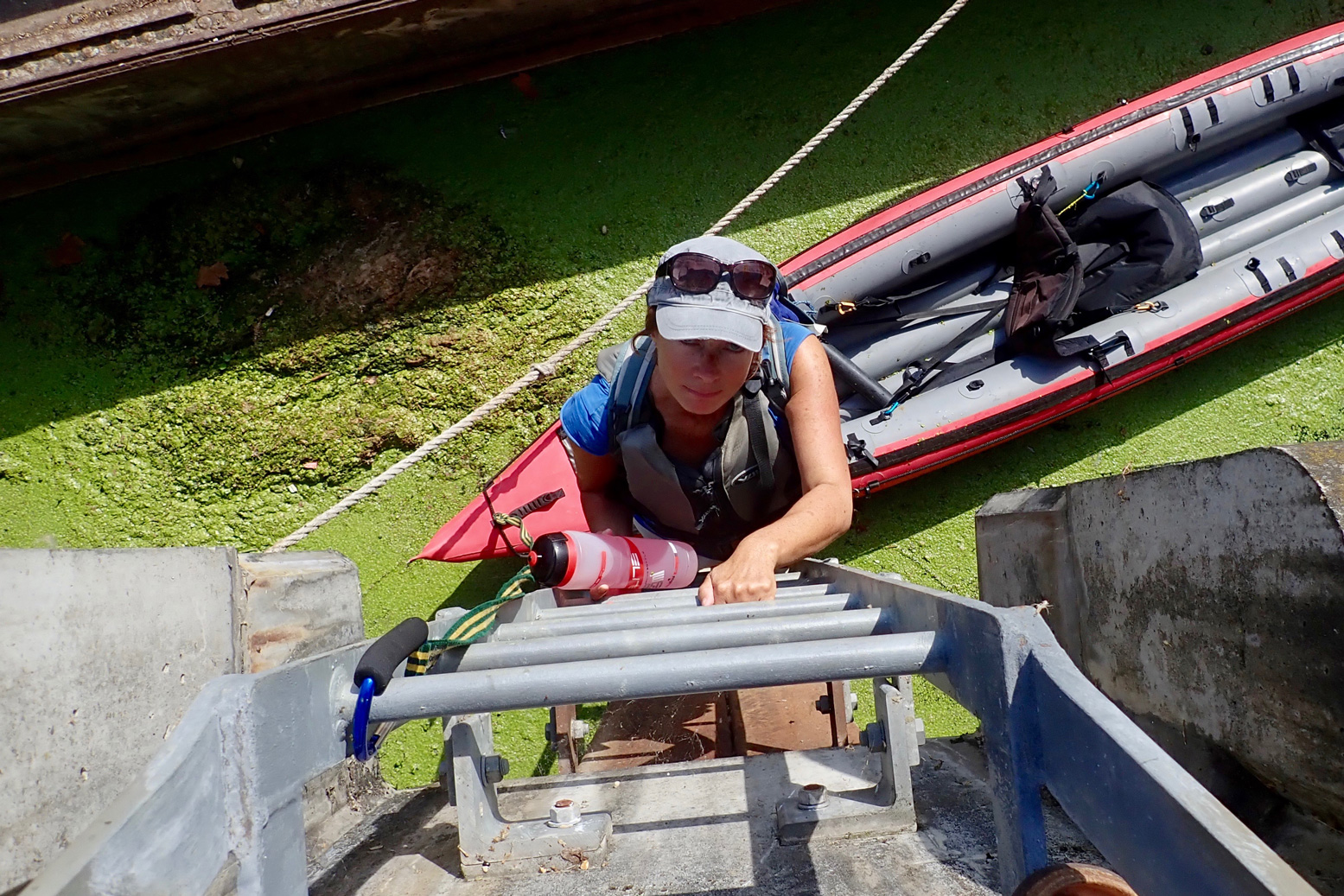
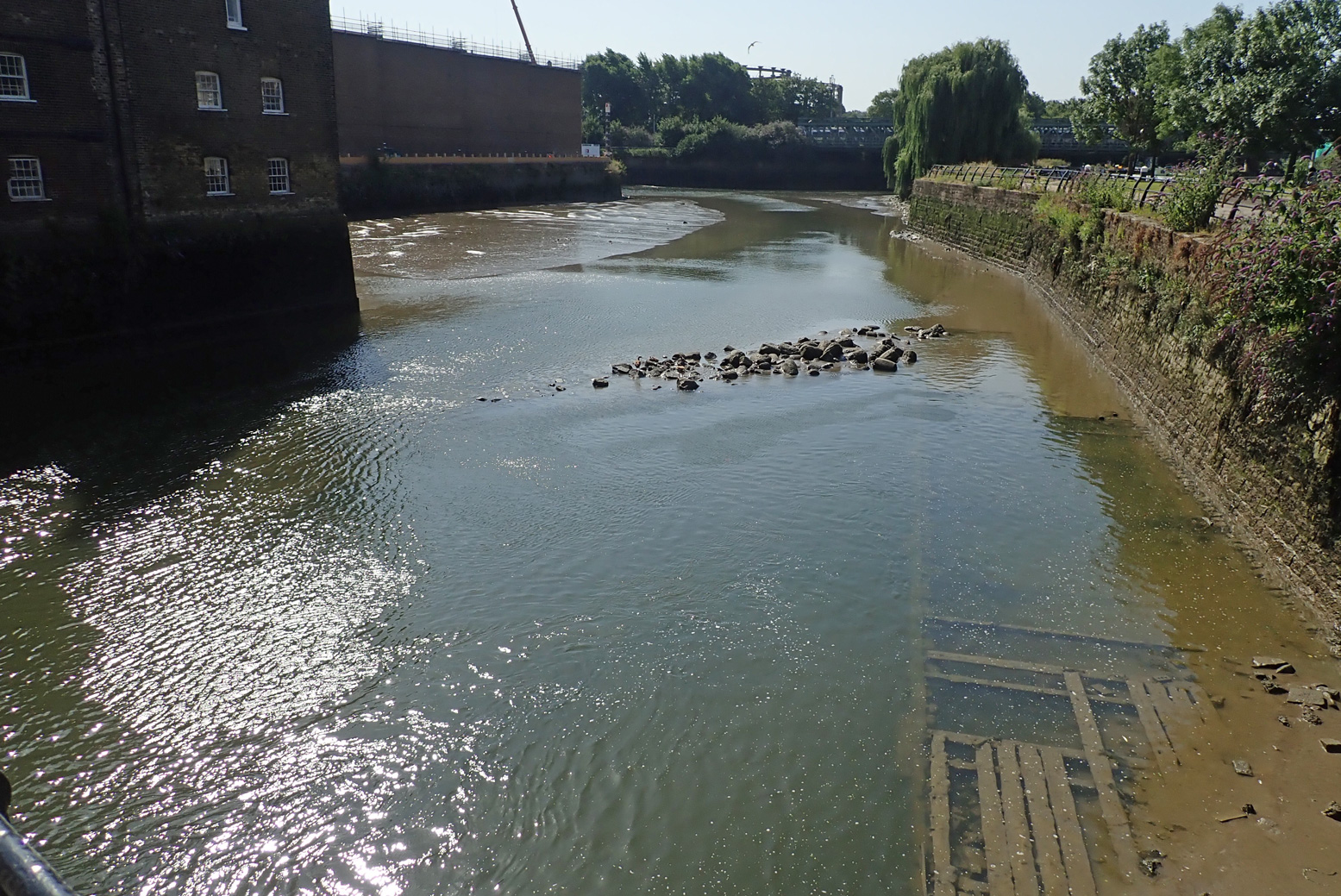
The Swan Highway Patrol.The famously elegant Mittal sculpture – and some twisted red thing on the right.Once a quick way to tart up old flats, cladding removal now in progress.You want your water bottle or what?Awkward and mucky take-out at Three Mills Lock. This is where your 3-metre lead comes in handy.Good thing with IKs: light and bouncy.I walked off for a recce all the way down to Bow Locks but found nowhere to put in – not even ladders. This spot above was about the easiest place, but still required clambering over fences to get to a walkway 9 feet above the bank scrub. With all the attendant construction and secretive film studios, you’d need to be quick to dodge the hi-viz jobsworths. This point is just north of the Three Mills complex where……you’d pass almost immediately under the Mill building. There’s a very shallow weir at low tides; maybe nothing at higher water.
View downstream on the bridge above that mill race. This is 3 hours before LW at Bow Creek mouth, but even at HW access is still awkward.
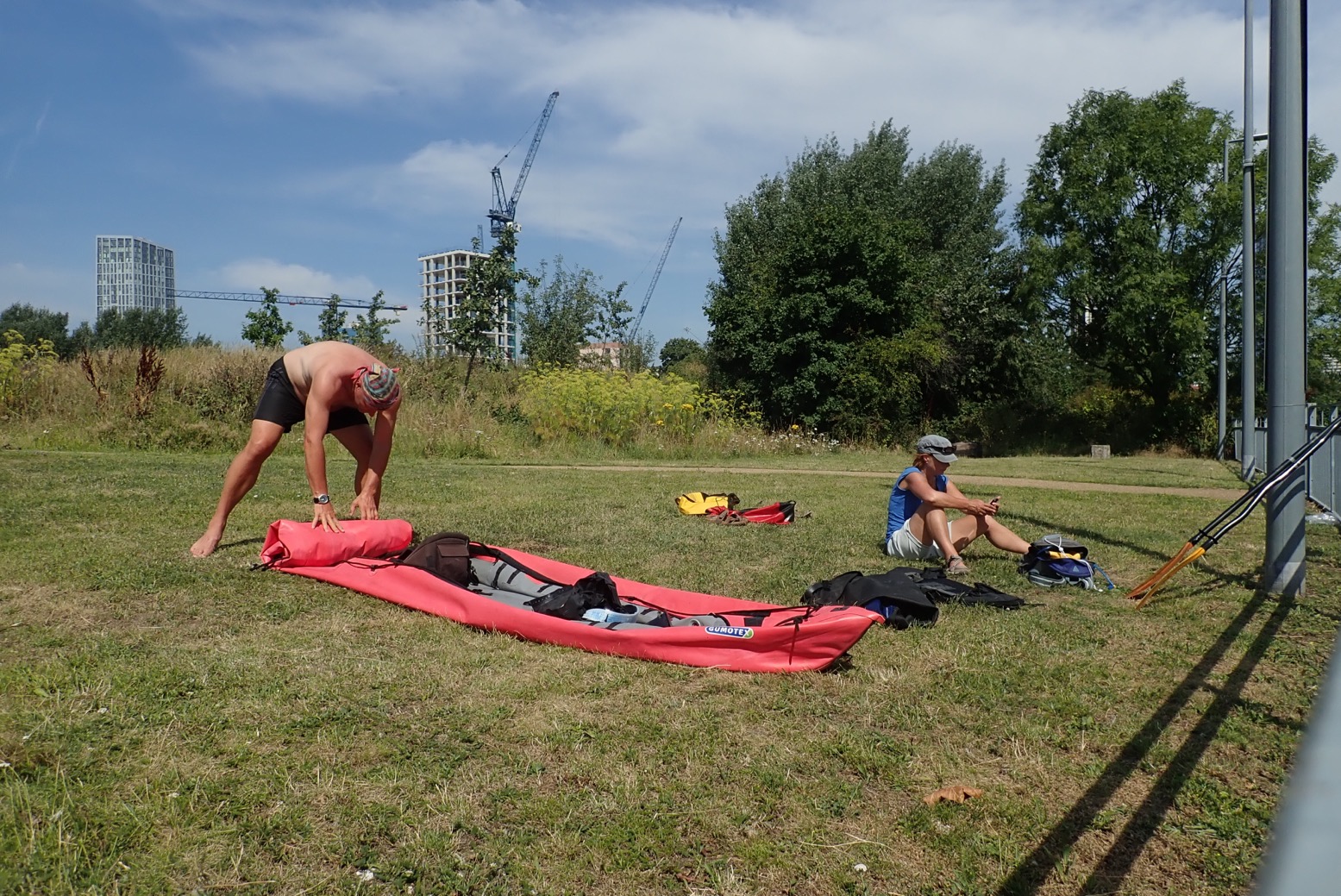
Reluctant to retrace the nearby Lee Nav back through the weed morass and down the Cut to Limehouse, I wipe off the duckweed and roll up.We set off for the hot two-mile walk back to Limehouse.Wouldn’t be an urban paddle without one of these!
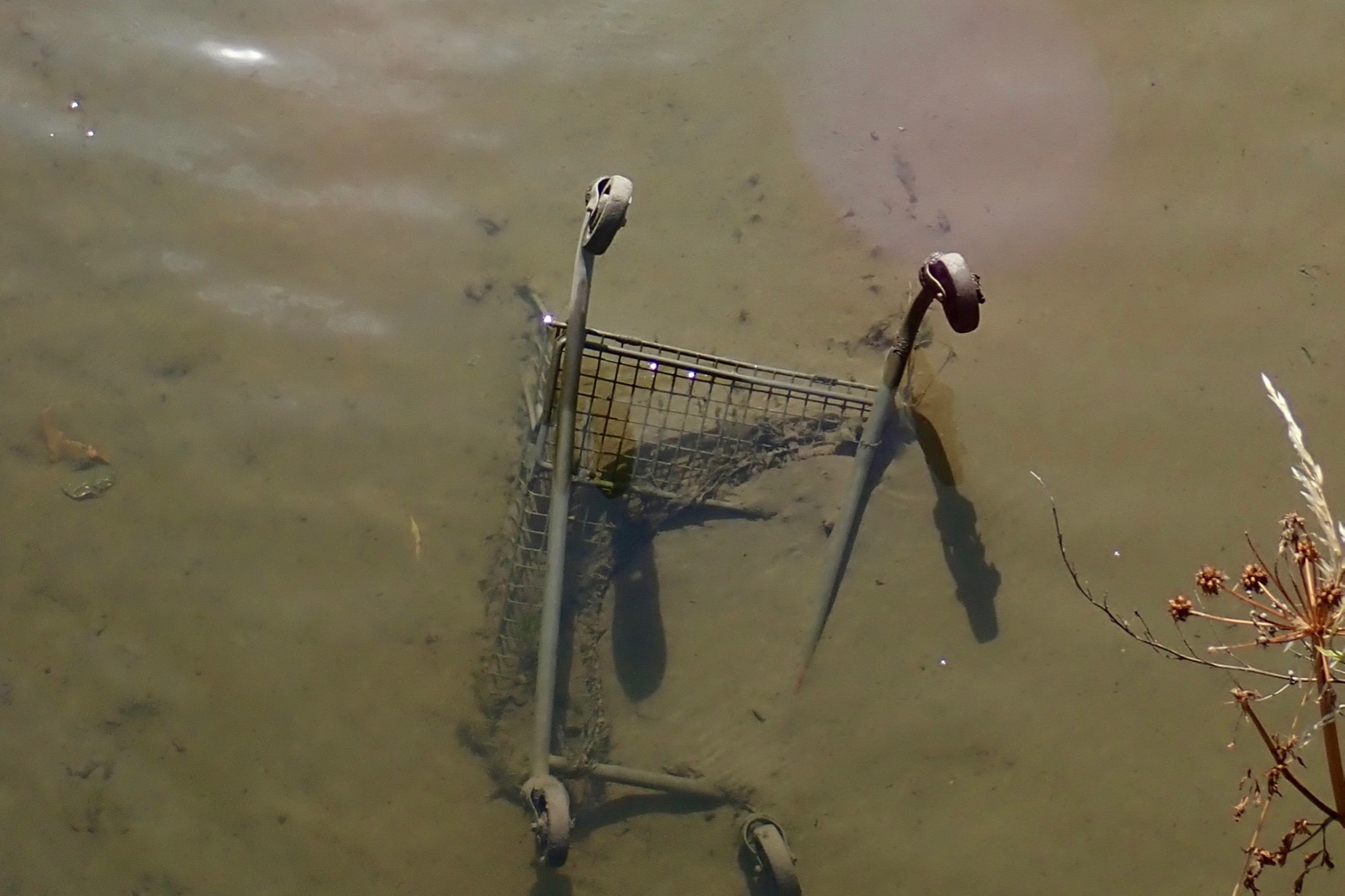
Urban canals have long been rediscovered as quaint, idiosyncratic backwaters for boat dwellers, joggers and cycle commuters, or have seen adjacent industrial wasteland redeveloped into glitzy apartment blocks or waterside business parks complete with mouth-watering eateries and amusing sculptures. The old cliche of filthy neglected ditches where joy-riders dumped scooters and drunks hurled traffic cones or shopping trollies is outdated, at least in central London.
These days, if Doctor Who needs a grotty urban canal to stand in for a toxic sewer where evil Cybermen are spawning The Invasion (1968; 00.57), they’d probably have to go abroad or something. All of which means that, once you include London’s excellent transport links, the capital’s fascinating canals make for great packboating.
The 200-year old Regent’s Canal is inner London’s best example, arcing nearly 9 miles (15km) across London from near Paddington eastwards to the old docks at Limehouse on the Thames. It starts at the dreamy, willow-rimmed mooring of Little Venice, passing Regents Park’s neoclassical mansions and the chattering apes of London Zoo before turning for Camden Lock Market where Jimi Hendrix bought his first Rosetti Airstream. Here the canal drops down a few locks to unrecognisably redeveloped Kings Cross, home of Google UK and where giant Victorian-era storage tanks have been converted into luxury flats. East of here, your water-level view flits between bohemian, suburban, light industrial and even rural parkland, until you arrive at the marina of Limehouse Basin by the Thames. On the way you’ll have portaged 13 locks and two tunnels (marked in red on the map below).
The Regent’s Canal
Britain’s canals helped kick off the world’s first industrial revolution. Canals linked or added to long-established river navigations and enabled inexpensive and reliable cross-country transportation of heavy, bulky or fragile commodities, like pottery. At this time the decrepit road network was still suffering from 1500-years of neglect following the Roman era. Packhorse trains were superior to wheeled carts but were way too costly. Around 1805 the Grand Union Canal linked the burgeoning industrial heartlands of the Midlands with Paddington – then a village on the western edge of London. The advent of Napoleonic Wars included attacks on coastal shipping, necessitating secure inland transportation to help provision the war effort. (The Wey-Arun Navigation linking London with the navy fleet at Portsmouth, was another example). The Regent’s Canal followed London’s northern perimeter to link the Grand Union with the deep tidal Thames at Limehouse (above) near the new West India Docks. Here, lock-controlled ‘wet docks’ were regarded as more efficient and secure than London’s old bankside wharves. The map below is from 1830 and shows that even a decade after the canal opened, most of it passed through open countryside. Within a few decades railways gradually brought about the demise of commercial canal transportation. I pinched most of this information from Jack Whitehead’s detailed version.
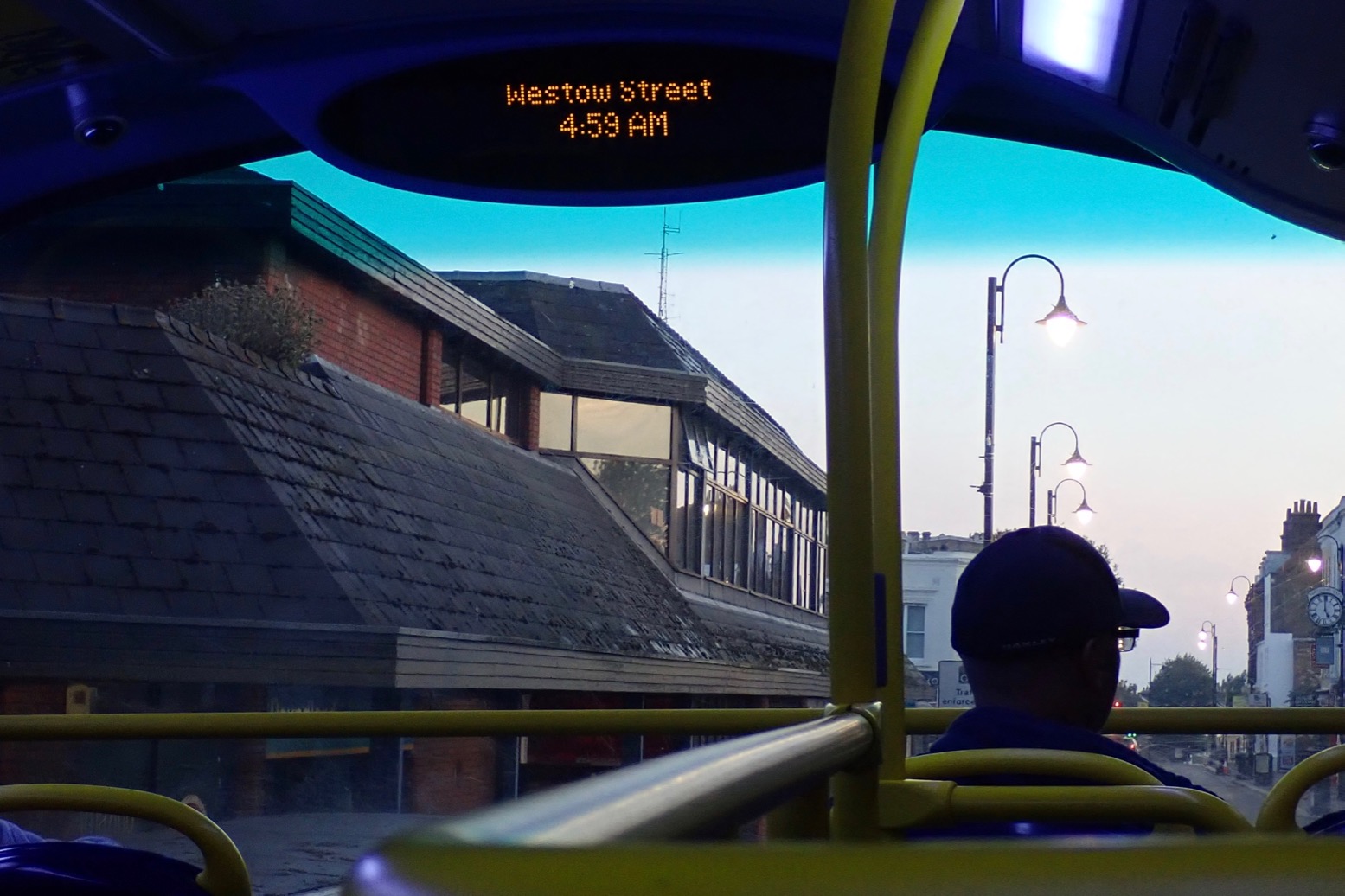
Time to go. I was on the bus before sunrise.
Bear with me, I’m still waking up.
Cables and cladding at Edgware Road tube.
New apartments, offices and the Fan Bridge at Merchant Place in Paddington Basin, the ‘Paddington Arm’ terminus of the Grand Union from Birmingham.
The canal ahead of the lifting Fan Footbridge is cordoned off so you can’t actually put in here. Along with the similar ‘Curling‘ Bridge nearby, a cynic might say these are eye-catching engineering solutions to non-existent problems while other celebrate innovative urban art. Both bridges make scheduled performances on weekends.
The Paddington Arm of the Grand Union. Regents Canal actually starts by the former barge turning-point known as Brownings Pool; today’s Little Venice.
Just up the way below a footbridge is a strange retracting weir whose purpose may be to keep the scourge of duckweed from spoiling Paddington Basin’s clear-water vibe.
You can put in anywhere around here but…
Maida Hill Tunnel Before you start assembling your boat, know that in about 5 minutes you’ll need to backtrack from and portage around the 250-metre-long Maida Hill Tunnel which is closed to ‘non-powered craft’. And it’s not a quick 250-m hop-around either. Because of a private towpath along Blomfield Road, and closures for repairs, currently it’s nearly a mile before you re-access the water below the Casey Street footbridge east of Lisson Grove. Knowing this, you may prefer to do as I did, and walk to (or start from) Casey Street Footbridge, about half a mile north of Marylebone tube. See map below.
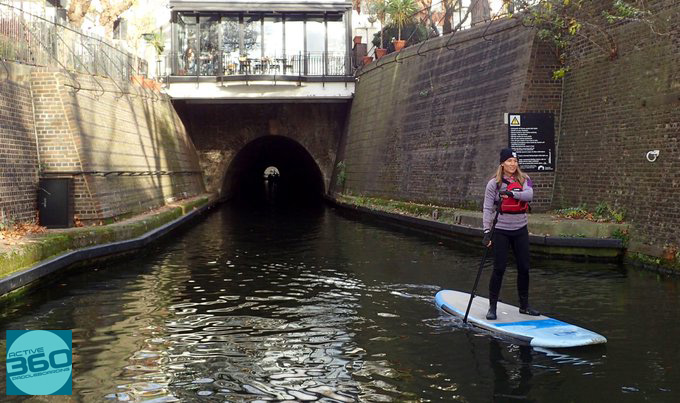
The temporary towpath closures (left) are to repair electric cables stemming from the power station at the end of Aberdeen Place at the tunnel’s eastern end. When it reopens the portage distance will halve, but that may be a while. So, you can paddle up to the western tunnel entrance from the Little Venice end (paddleboarder, below left), but you can’t get out here onto Blomfield Road because of a locked gate to the moorings. You have to backtrack to Little Venice, but it’s probably still worth it for a peep into the short if forbidden void.
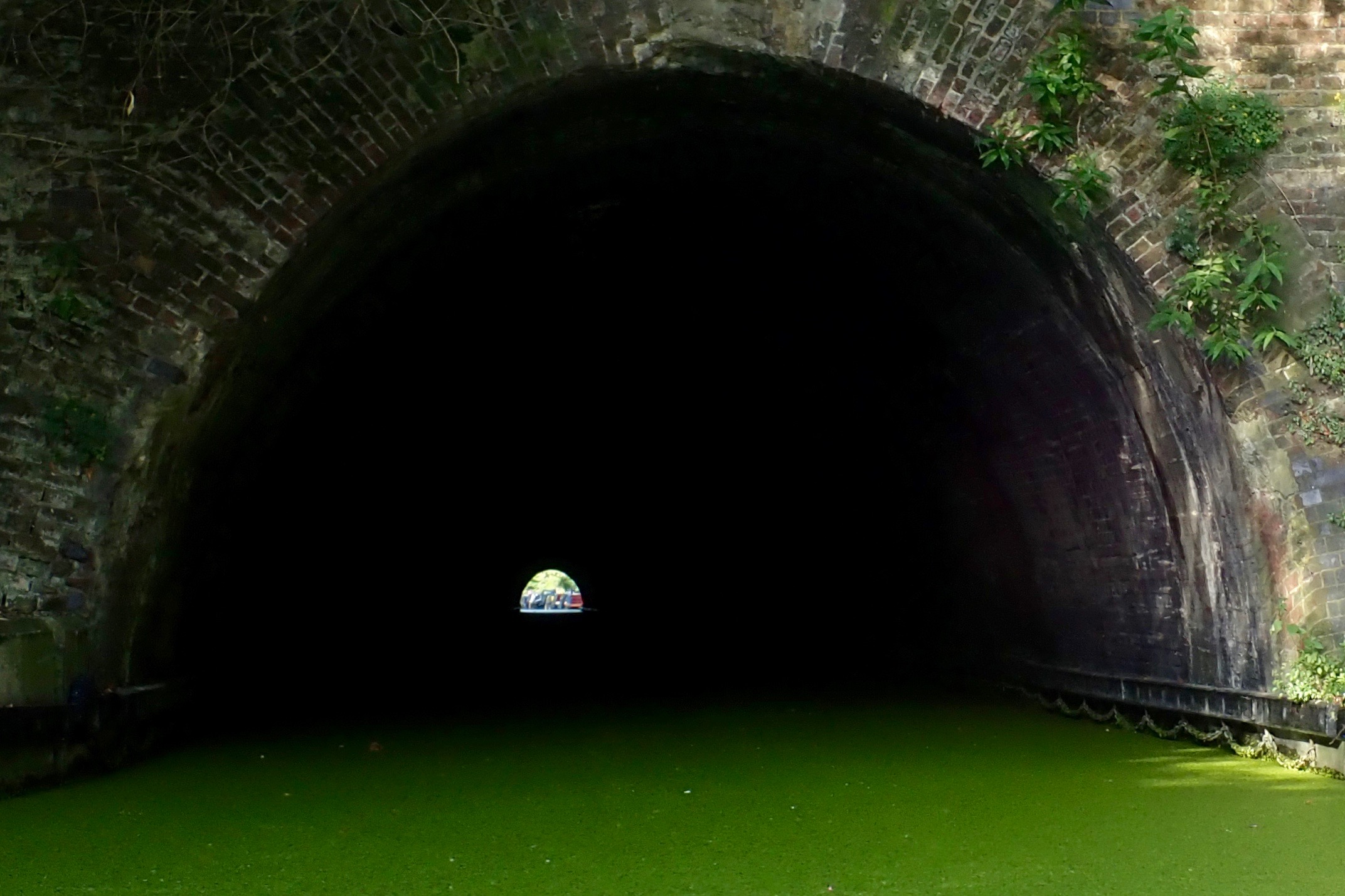
In 2018 the Canal & Rivers Trust (formerly British Waterways) provisionally opened the 250-metre-longtunnel to paddle-powered craft. (Consultation document.) According to their own regs, any straight canal tunnel of less than 400m can be paddled. At Maida Hill you can clearly see the other end, anything coming at you will be silhouetted or lit, and the whole drama takes a couple of minutes to paddle, including taking pictures.
But to saves costs the tunnel is narrow and without a towpath (barges were legged through by ‘walking’ off the walls). Passing isn’t allowed or even possible, even in a slim kayak. Or a boat operator may not notice low-in-the-water kayaks, even with the mandatory headlight. Tour boats run via the tunnel daily from 10am between Camden and Little Venice.
‘Thank you for your enquiry. We do not allow kayaks through the Maida tunnel unless it is part of a special event”. Three months notice is preferred for your special event and solo transits are not allowed anyway. The website additionally warns: Non–approved unpowered craft shall not transit the tunnel eg. rafts and other types including inflatable arrangements designated for ‘fun’ use.
Clearly, they’re no more clued-up about modern IKs and packrafts than the BCU, or assume we’re all intoxicated pillocks goofing about on inflatable unicorns.
What could possibly befall a typically open and unsinkable IK, canoe, packraft or iSUP board in the tunnel? Do they assume such boats are inherently more dangerous than a beginner capsizing mid-tunnel in a tippy hardshell? Maybe the CRT has had problems with ‘inflatable arrangements’. Who knows, but I’ve also encountered this anti-inflatable prejudice on PLA media about padding the tidal Thames. I suppose it’s too much to expect these officials to know the difference between an Intex bin bag and a €3000 Grabner, but the common denominator must surely be the required BCUlicence (or a more expensive and limited pass direct from the CRT). I wouldn’t be surprised if it’s a canalised version of road-tax paying car drivers [cruise operators] vs freeloading pushbikes [kayakers]. The resentment the former feels towards the vulnerability of the latter generates irritation.
Here’s a suggestion: mount some traffic lights at each end on a 5-minute turnaround, and perhaps some low-level motion-activated illumination inside. That way the Maida Hill Tunnel could be safely and easily open to all users. Apparently, it’s currently being considered.
Long story shortened a bit, I enjoyed my exploratory walk and finally got to air-up my MRS Nomad below Casey Street footbridge looking down on the Lisson Grove Mooring (aka Marylebone Wide).
The canal surface was thick with a lush carpet of floating pennywort or, as I prefer to call it, Hydrocotyle ranunculoides. This lurid green matting covered the canal from bank to bank just about the way to Limehouse. At times it was so thick birds easily stood on it, but it didn’t noticeably impede my paddling…
… because an MRS Nomad doesn’t exactly slice through water like Poseidon’s scythe. Once on the water I paddled back west, under the Lisson Grove or Eyre’s ‘tunnel’…
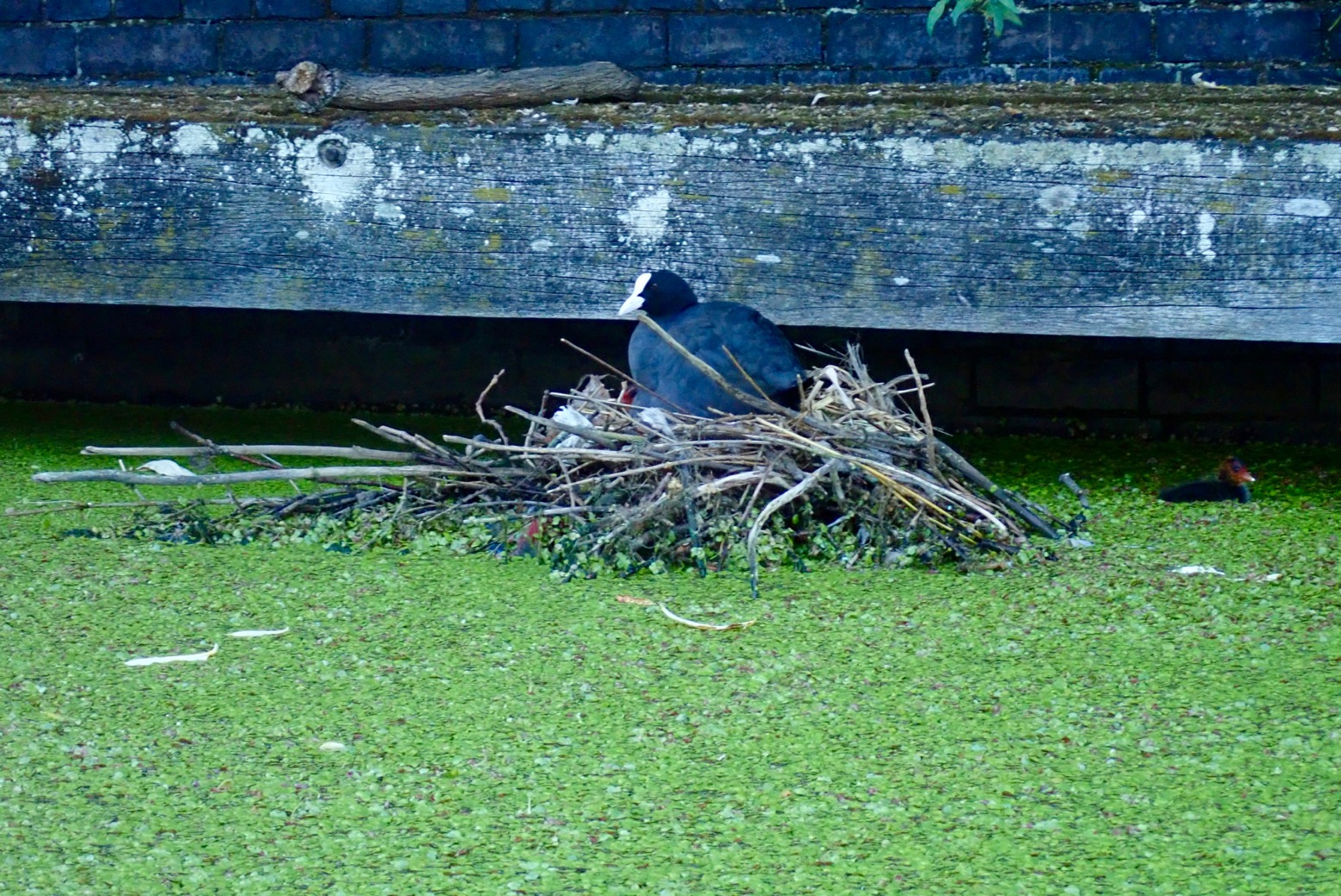
… for a peek at the eastern, ‘Doctor Who’, end of the Maida Hill tunnel. It didn’t look that far or that deadly. Then I paddled back, passing nesting coots…
… and preening fowl. By 8am I was on my way to Limehouse.
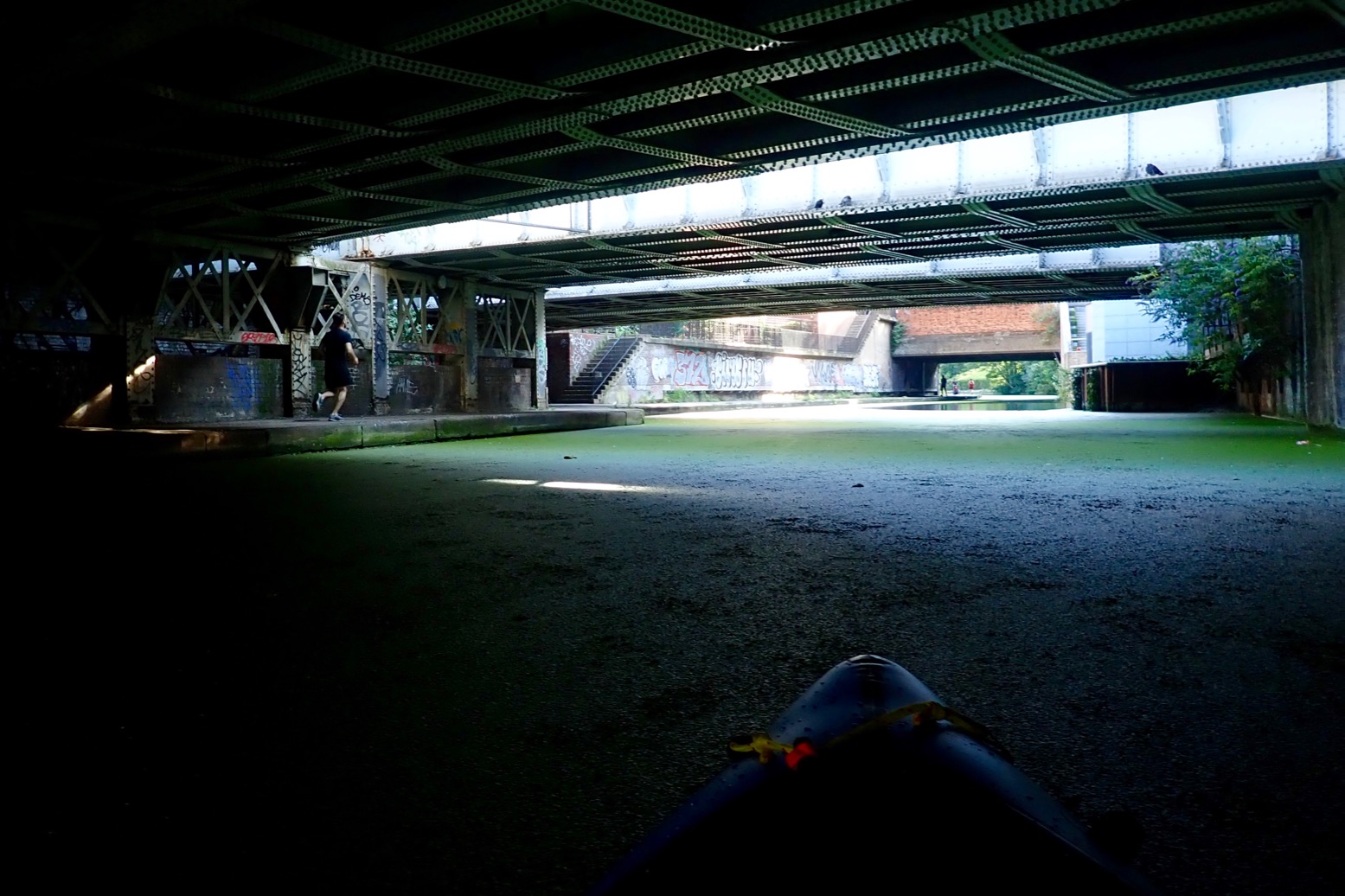
Under the Chiltern Line rail bridges and Park Road (A41).
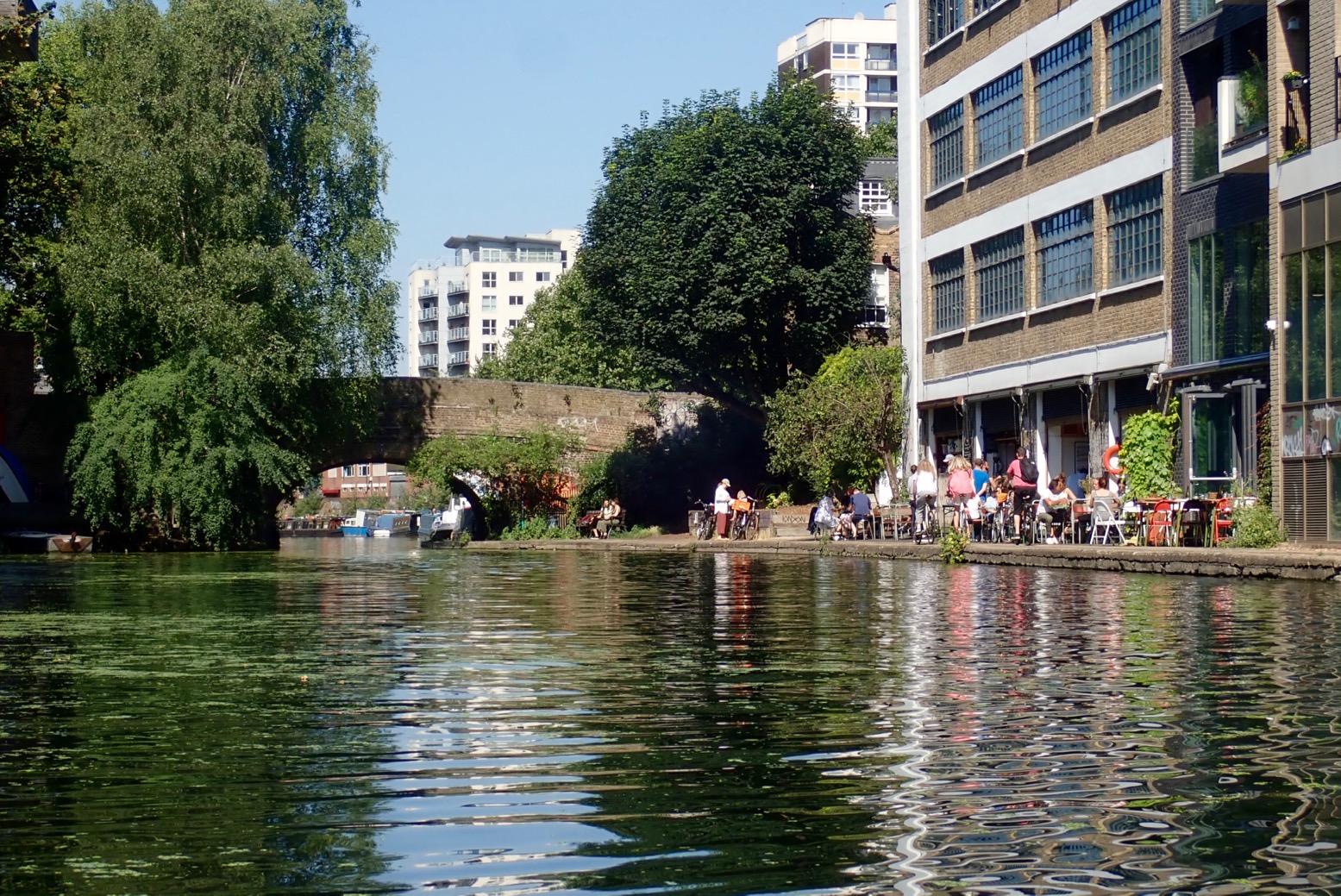
And into the bucolic enclave of Regent’s Park, passing elegant mansions and accompanied by a phalanx of pushbikers and joggers dashing and dodging other joggers and pram-pushing nannies.
At London Zoo all was quiet. Not a squawk, a yelp or a roar.
Regents Park was built around the same time as the canal, and one reason the canal didn’t simply cut directly east from Paddington towards the City along today’s A501 Marylebone Road (called ‘New Road’ back then, blue below) is because the well-connected park developer objected under the Tudor Statutes of NIMBY. The dirty canal diggers were forced to burrow like badgers through Maida Hill before swinging off on a northerly arc, all adding hugely to the cost and completion time. Funding the canal was a real stuggle.
At now-filled in Cumberland Basin (red, above), by the famously top-heavy Chinese pagoda restaurant the canal, appropriately, takes a left turn into the borough of Camden. Soon I arrive at Camden Lock Market but it’s too early on a weekday morning for the place to be busy with beret-wearing tourists.
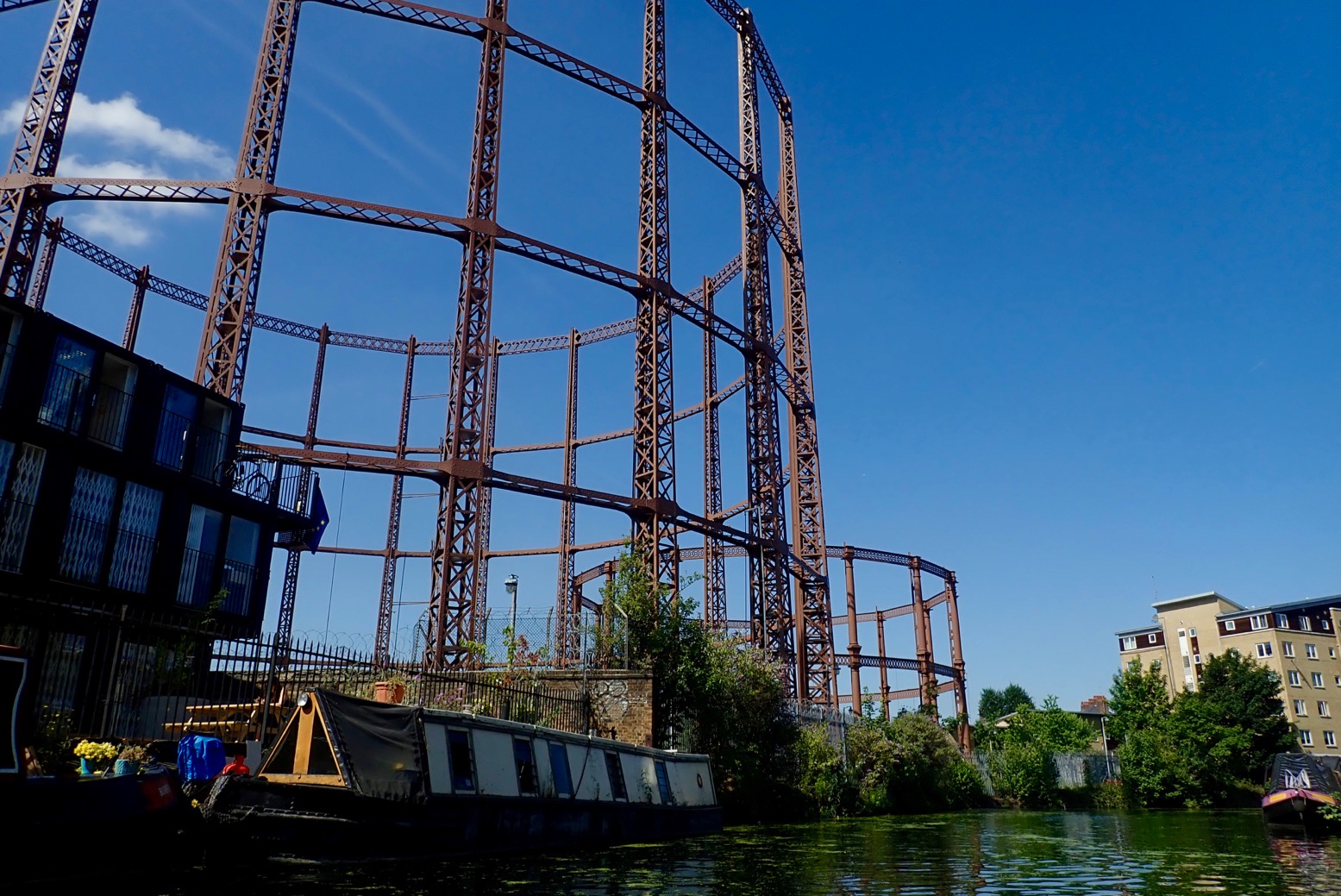
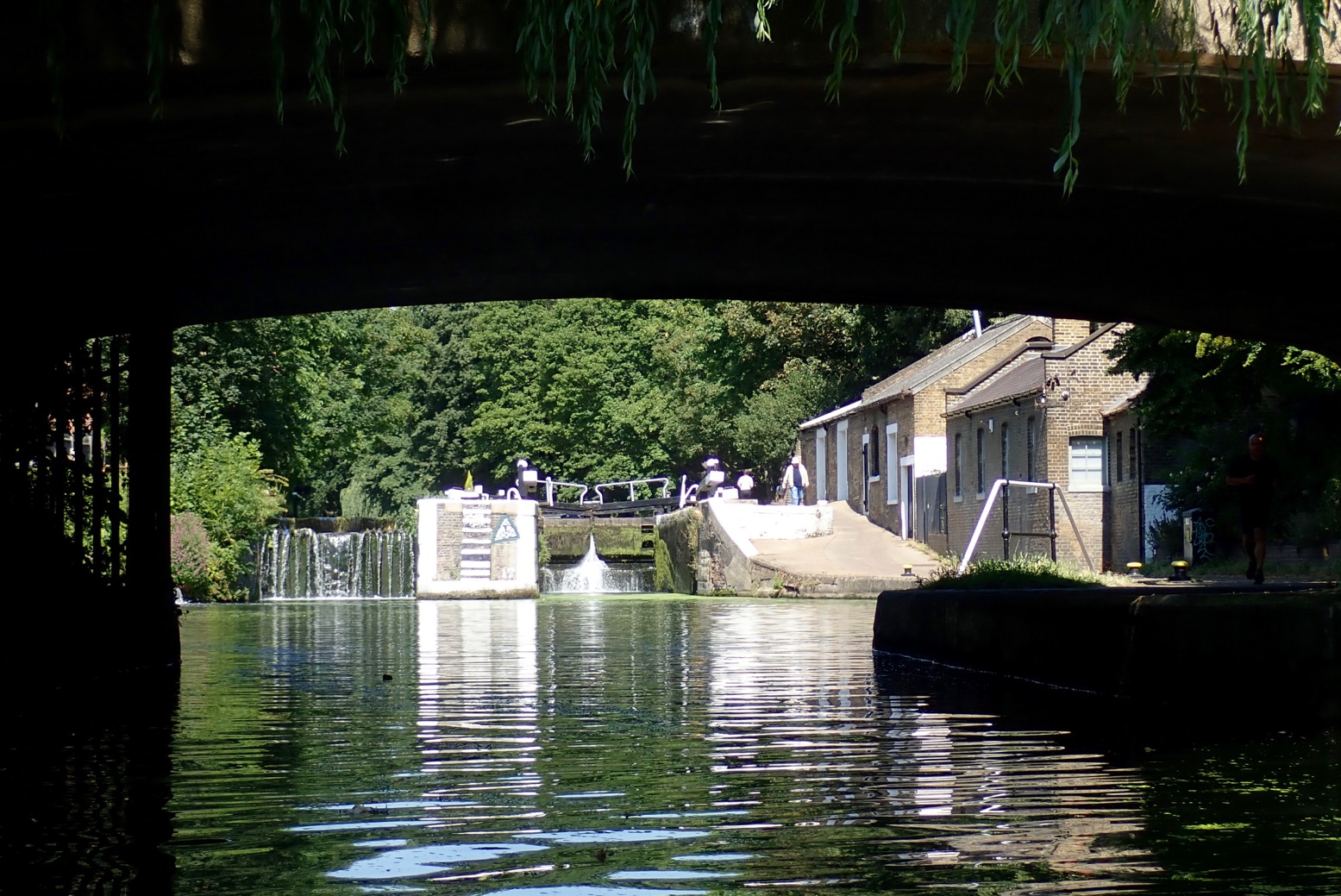
There are three locks here in less than 300 metres, so I line the boat along the bank like a Yukon voyageur. I paddle away from trendy Camden and soon pass under the deafening Eurostar rail lines at St Pancras before entering what they now call Gasholder Park. Old Kings Cross is long gone and some of the gas storage tanks have been turned into flats. Welcome to trendy Kings Cross.
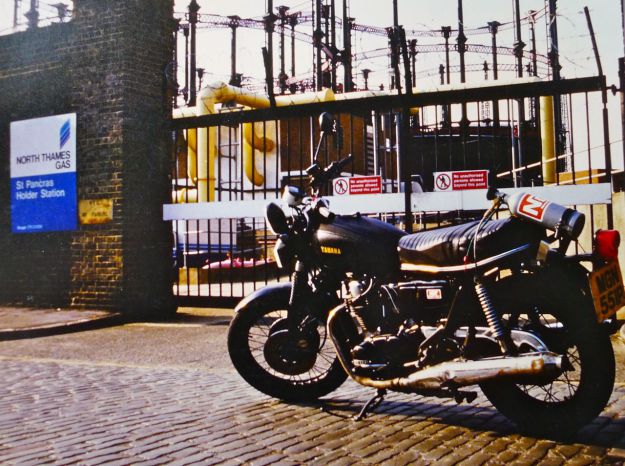
In the Eighties when I squatted near here, ‘trendy’ + ‘Kings Cross’ were not recognised combination. This was probably the seediest corner of central London and the real thing with junkies, prostitution and porno studios – a far cry from quaint, touristy Soho. One time we used the gas tanks as a backdrop for an article I’d written about a motorbike running on Nitrous Oxide or laughing gas. Fans of Mad Max will know about that. Mike Leigh’s High Hopes (1988) was filmed around the corner. Funnily enough, the story was about a lefty-slacker moto messenger, his woebegone mum and some pantomime-vile yuppies. Oh happy days!
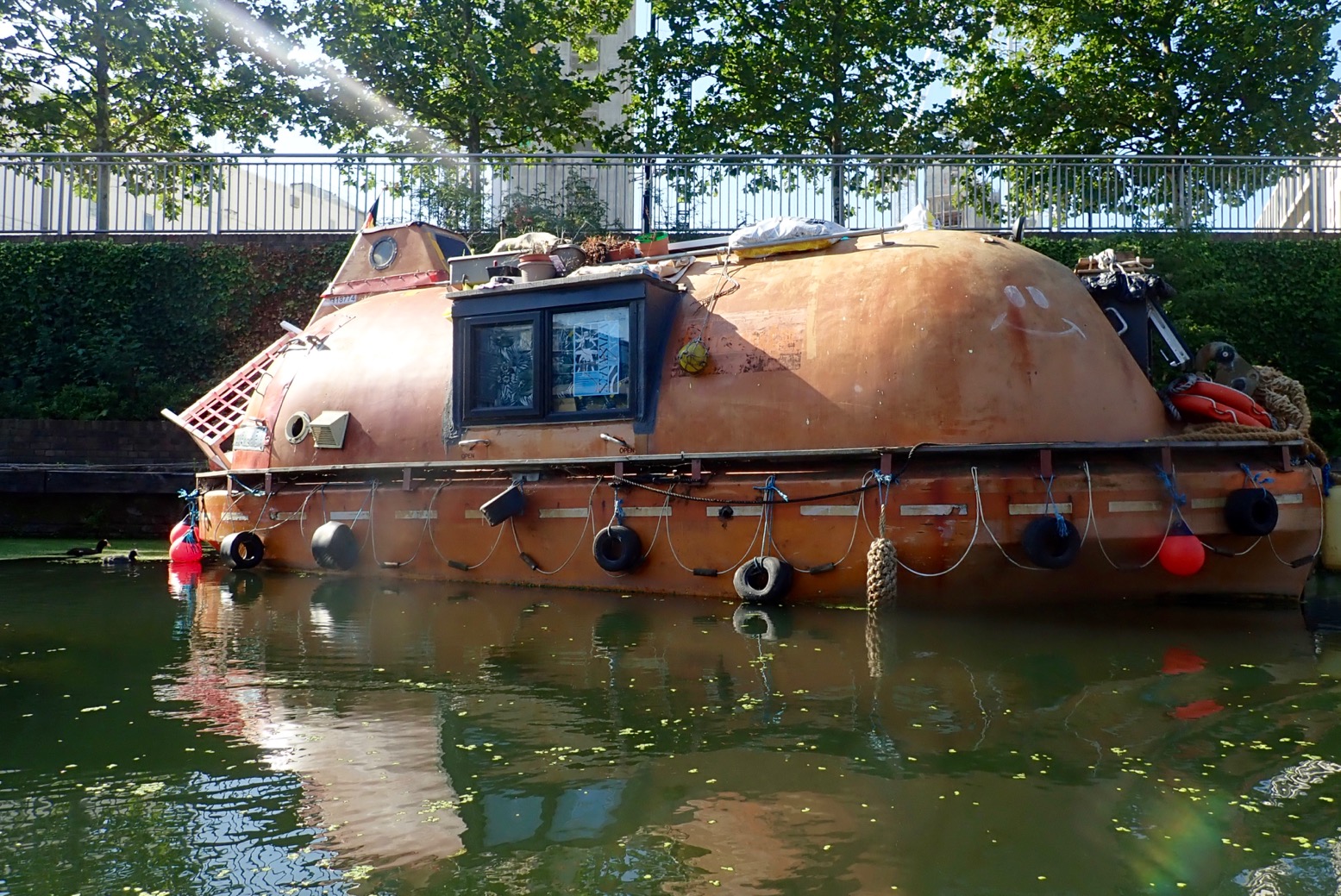
A lifeboat houseboat. No worries about rising sea level or tsunamis here.
The Word on the Water floating bookshop. I can’t quite square where I am with what lies around. I think back in my day it was all once a huge goods yard behind high walls. I swing into Battlebridge Basin but the museum isn’t open yet.
Up ahead is the 880-metre-long, Islington Tunnel. Again, as straight as a broomstick but closed to hand-powered boaters for similar reasons as Maida Hill. I was kind of hoping a barge might rock up and let me hook on for a lift, but the only things I’ve seen on the water are wildfowl, plastic bottles and Spirodelapolyrhiza. The museum organises boat tours through the tunnel two days a week. Maybe they’d agree to some slipstreaming.
I read that the portage follows helpful plaques set in the pavement. Cross the A1, Upper Street and head for Duncan St. It’s about a kilometre and would be somewhat of an arseache in a hardshell. Either way, I emerge at the eastern portal…
… and in need of a waterside snack at City Road Lock. It’s only 9.30.
By 10am I’m refreshed and on the move again. I put back in below the lock with a plop.
The canal turns north into Haggerston where, just after the Whitmore Road bridge, there’s a handy knot of cafes on the left. A better choice than City Lock if you want more than coffee and cake. It’s all yummy mummies round here, not the snarling, bottle-throwing punks I’d feared.
Kingsland Basin to the north, with a somewhat baffling kayak slalom course. Soon you pass under the Kingsland Road bridge, edging ever closer to south Hackney. or ‘Acne’ as some call it.
The canal is actually about 4 feet deep. near here I can see traffic cones and other junk on the bottom. But a prod with the paddle reveals two centuries of anaerobic silt, so don’t expect to be able to stand if you fall in.
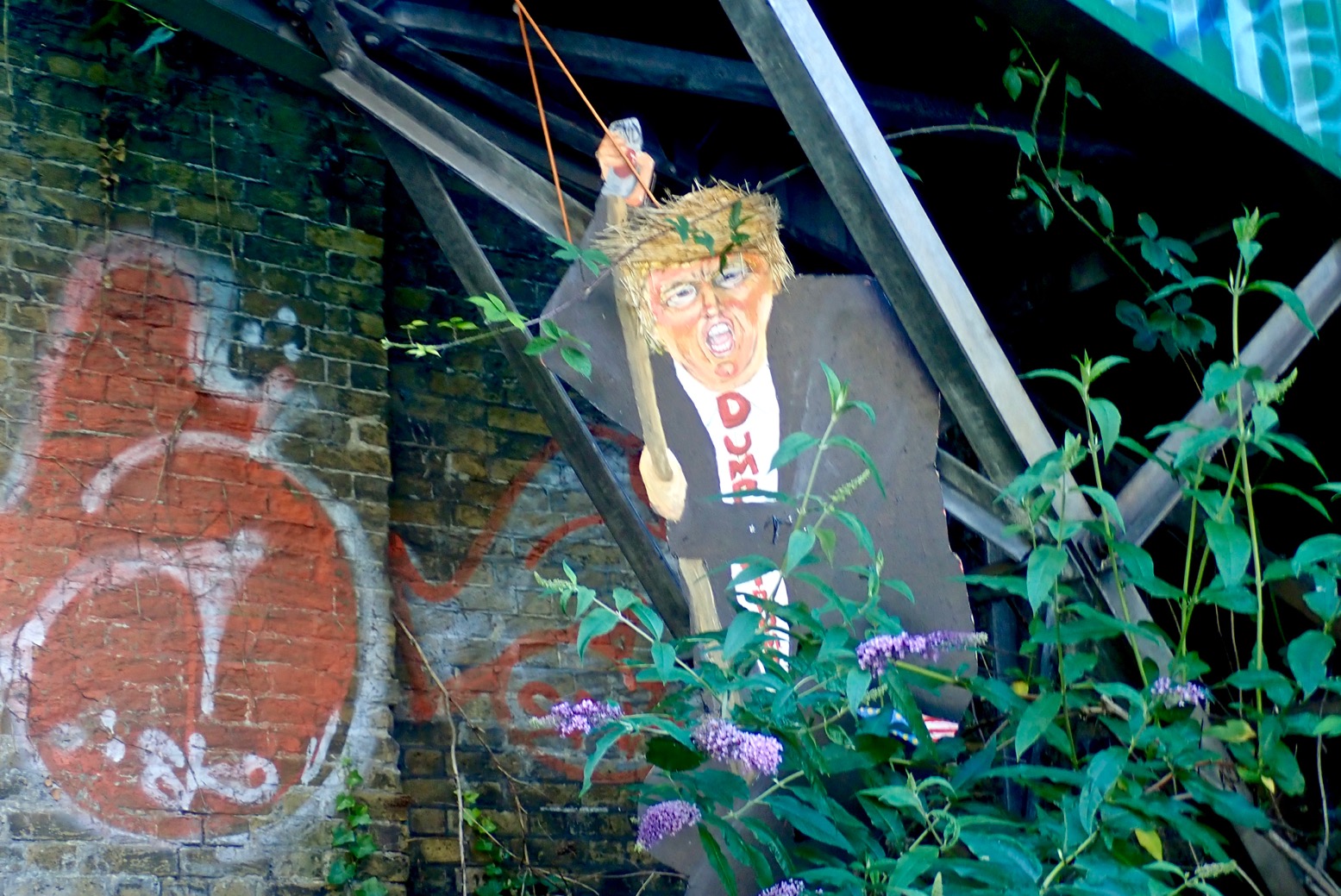
A populist ambush. These Eastenders are such wags.
Swan narcissus. There’s a fairy tale in there somewhere, a swan that fell in love with its image and was turned into an ugly duckling.
Another trickling spillway below a lock. I’ve lost track where.
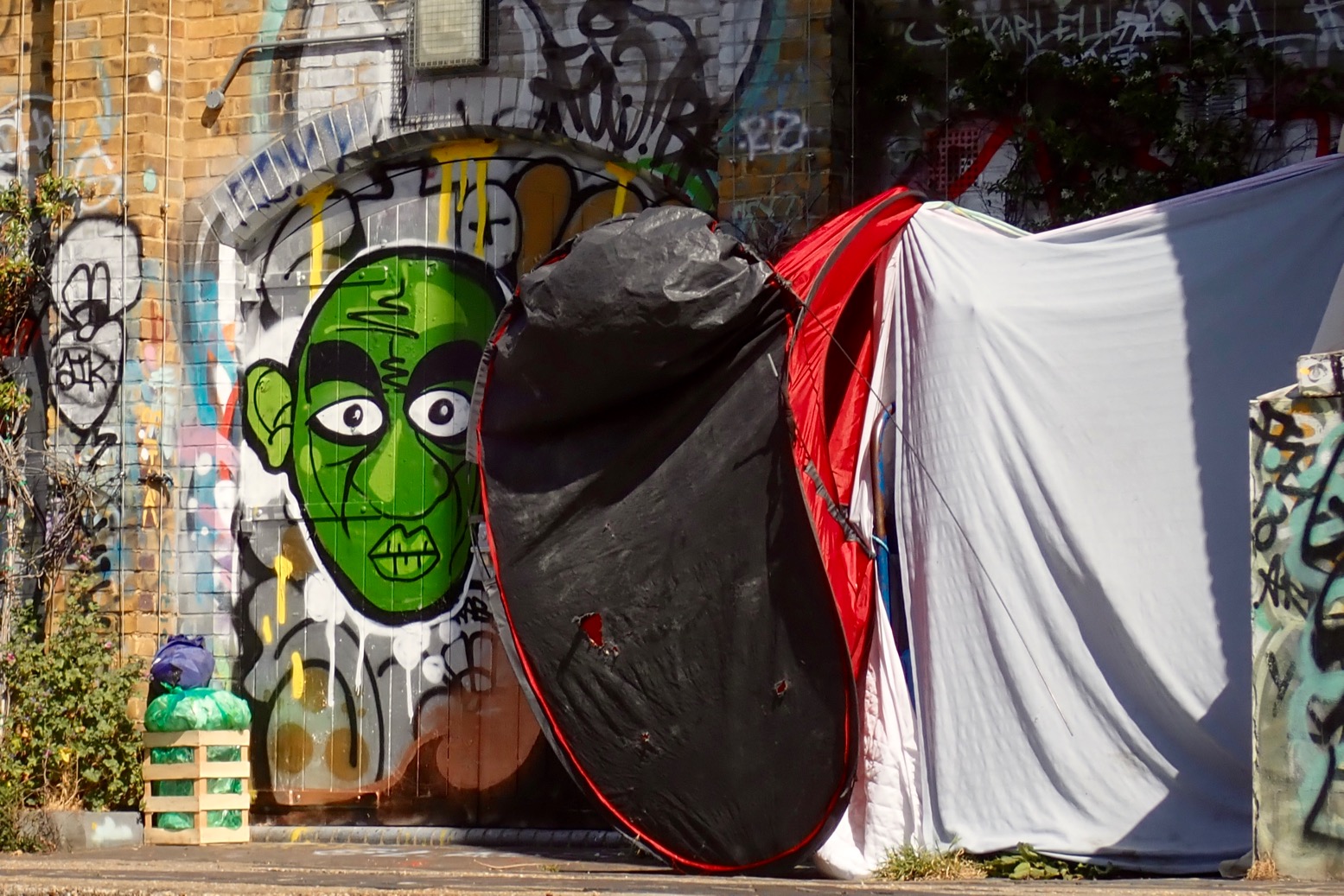
Nosferatu guarding someone’s tent. Sure beats a shopfront on the Strand.
More gas holders near Cambridge Heath Road. You always find them near canals as the huge tanks need to float on water.
They’re actually like an upside-down cup resting buoyant on water and are as much about producing an even pressure as storage. Gas from a nearby factory is pumped in to the cavity above the water depending on demand, and the weight of the lid keeps the low pressure steady as it’s released out into the network (in an era before regulators).
New graffiti; 28-speed revolutions.
It’s that Nosferatu again. You just can’t get rid of him.
I’m approaching Victoria Park near Bethnal Green or South Hackney, it’s hard to tell. The precise name of your neighbourhood is very important to Londonders.
By Old Ford Lock (named after a car they dredged out of the canal in 1981) are the first canalside public toilets I’ve seen. Good to know. A nutty, bin-rummaging vagabond in a top hat has a quick chat and warns me of heavy weed ahead.
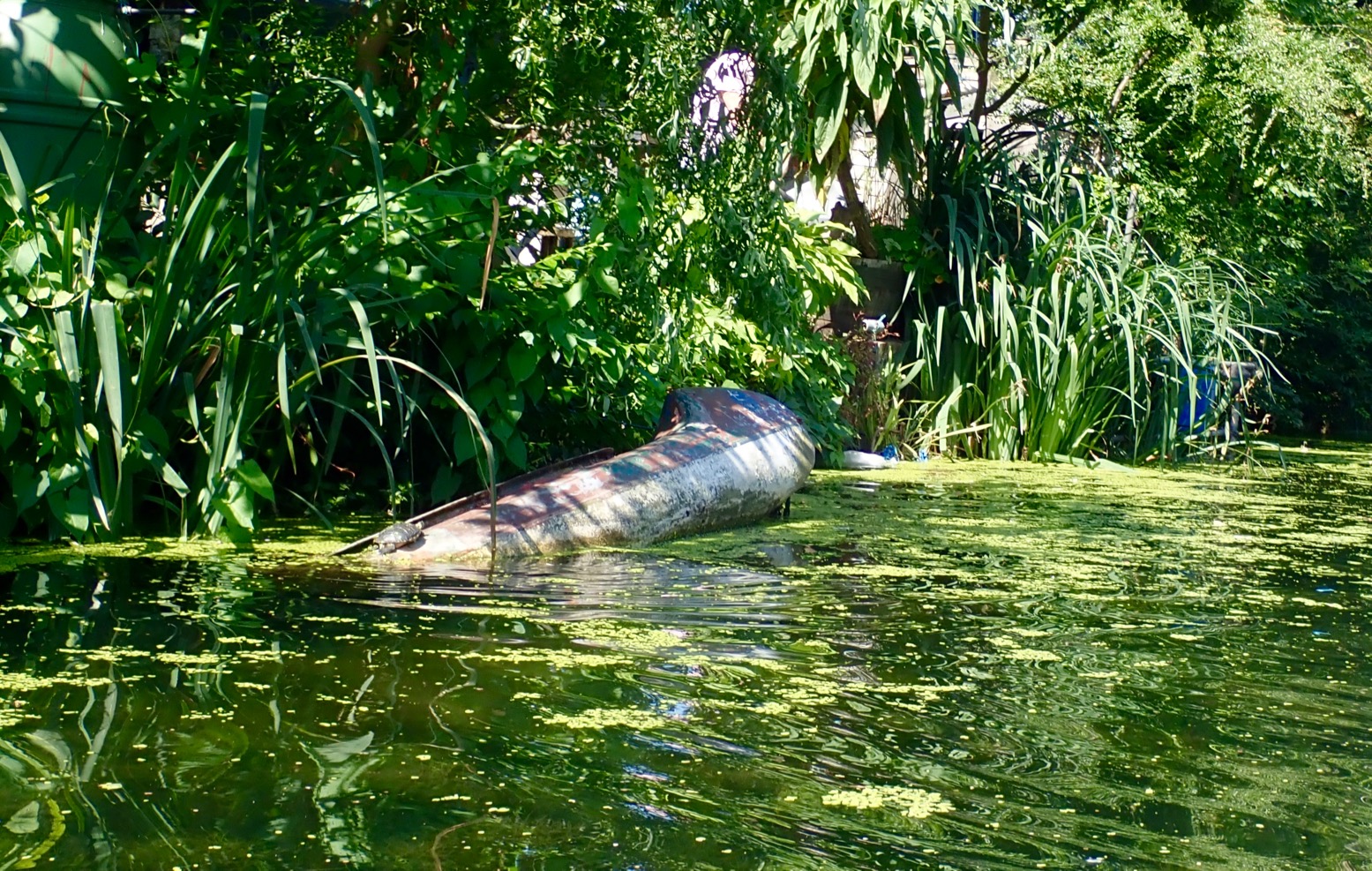
Is that a real turtle on the sunken kayak or a rubbery Hacknean joke?
On the left the Hereford Union which leads two clicks up to the Olympic Park and the River Lee Navigation. We’ll be exploring there shortly.
More of yer Acne ‘umour? Someone report these ratbags to the CRT, pronto! You won’t see such frivolity in la-di-da Little Venice.
Architecture-spotting: new, old, industrial, domestic, elegant, ugly – is all part of the fun on the Regents.
I probe a weed-clad lock. Locks are creepy places.
Canary Wharf ahead – the former Docklands of London which was the Regents’ very raison d’etre.
And here we are at Limehouse Basin and the first actual moving boat I’ve seen since Paddington.
A lot of weed to clean off.
All wiped down and rolled up.
I set off to walk upstream along the Thames for a bit.
The river looks really quite choppy and a strong spring tide shoves an abandoned kayak upstream towards Wapping.
Bored [sic] as a coot? Not on the Regents Canal!
Thanks for reading.
Want to head back and beyond. Watch this series of vids from The Londonistas
We had a good look, then shot this underground weir and were spat out the other end, grinning and alive.
Screenshot
Years ago I recce’d South London’s Wandle ‘River’ from Merton Abbey Mills to the Thames at Wandsworth – a varied urban run of just a few miles – and all from the safety of my pushbike. It’s not far from where I live but I decided the Wandle held too many elements which played to my watery phobias, not least near the end where the current sucks you into a series of sunless tunnels (left) under a shopping centre and former brewery. Sounds like a perfect setting for a macabre Gothic horror story.
But not everyone is so timid. Tim from Longshore International (defunct) followed tnhe Wandle with a couple of his boats. Full story with a description of the real hazards and more photos on Medium.