I fell in love with the idea of packrafting as soon as I read about it. Sadly, when I started looking at prices I almost had a heart attack… an average Alpacka or Kokopelli costs more than 900€ in Spain – that’s a lot of money for me. But then I found the Klymit Litewater cost only 200€ including transport and import tax. I decided it deserved a try.
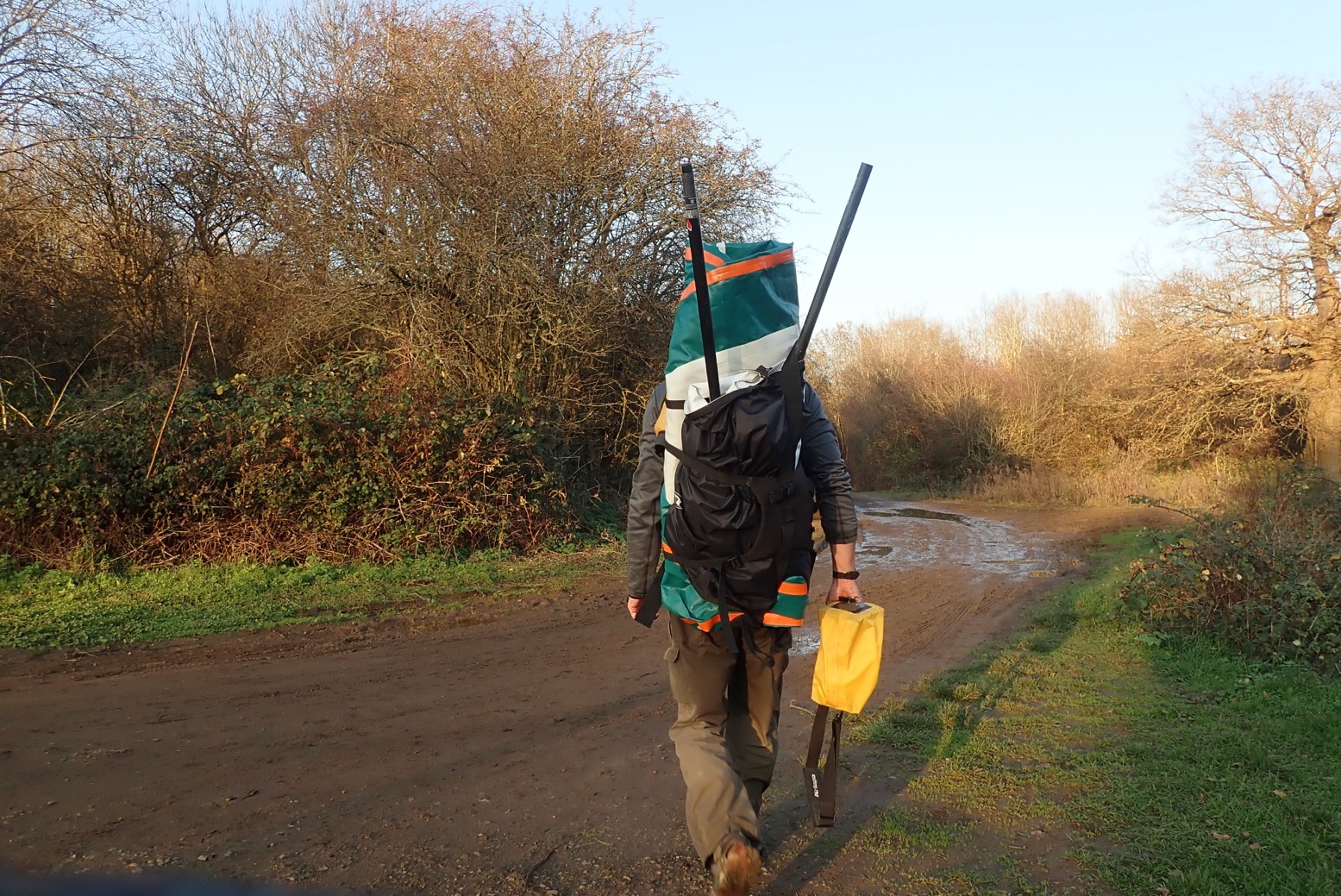
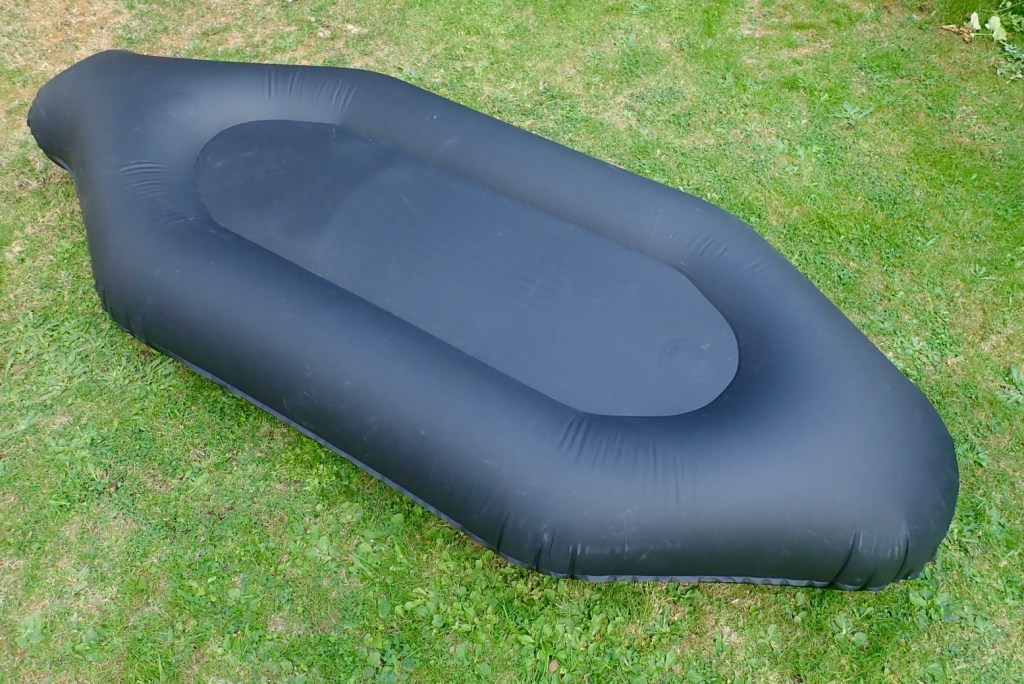
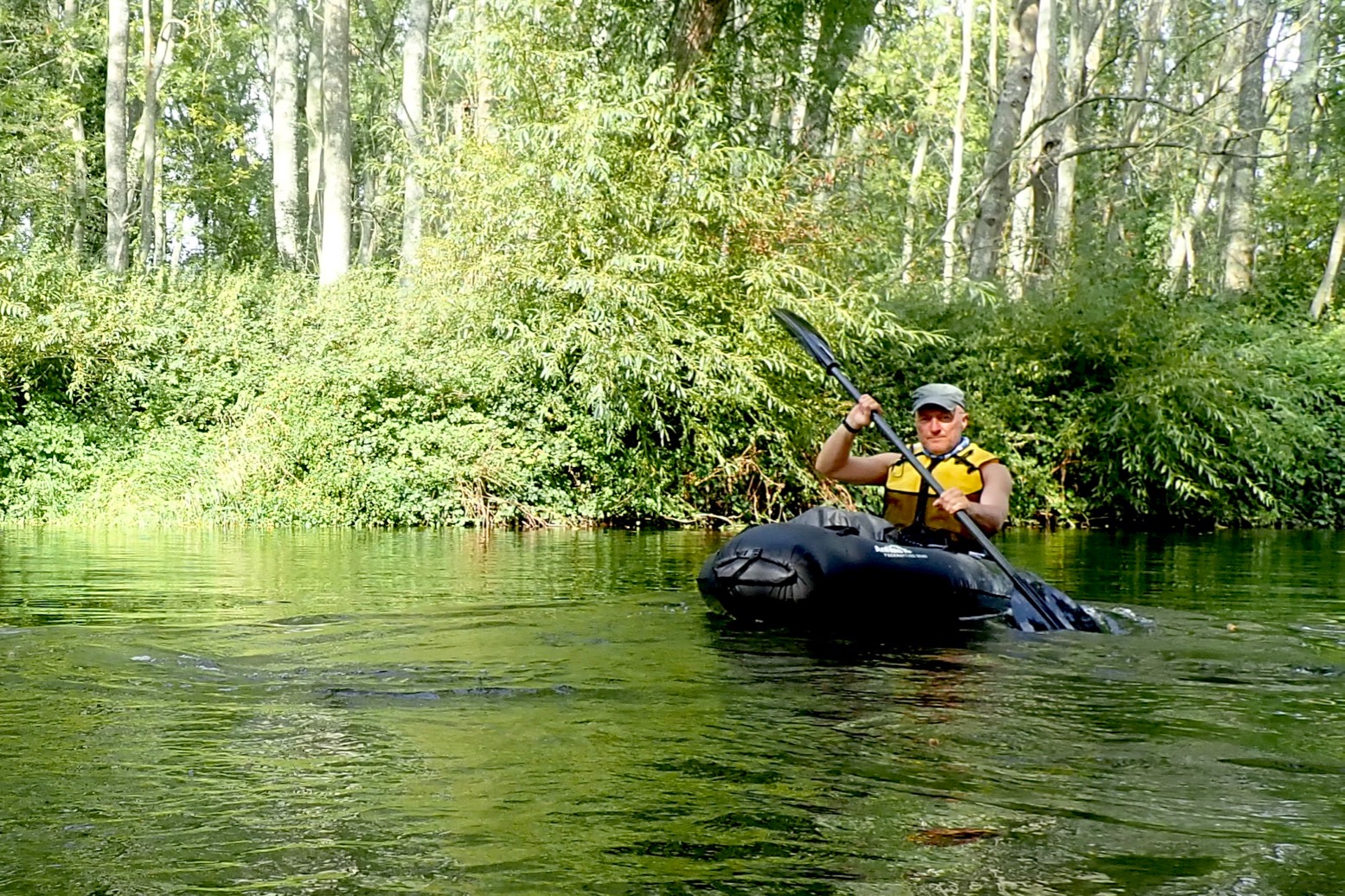
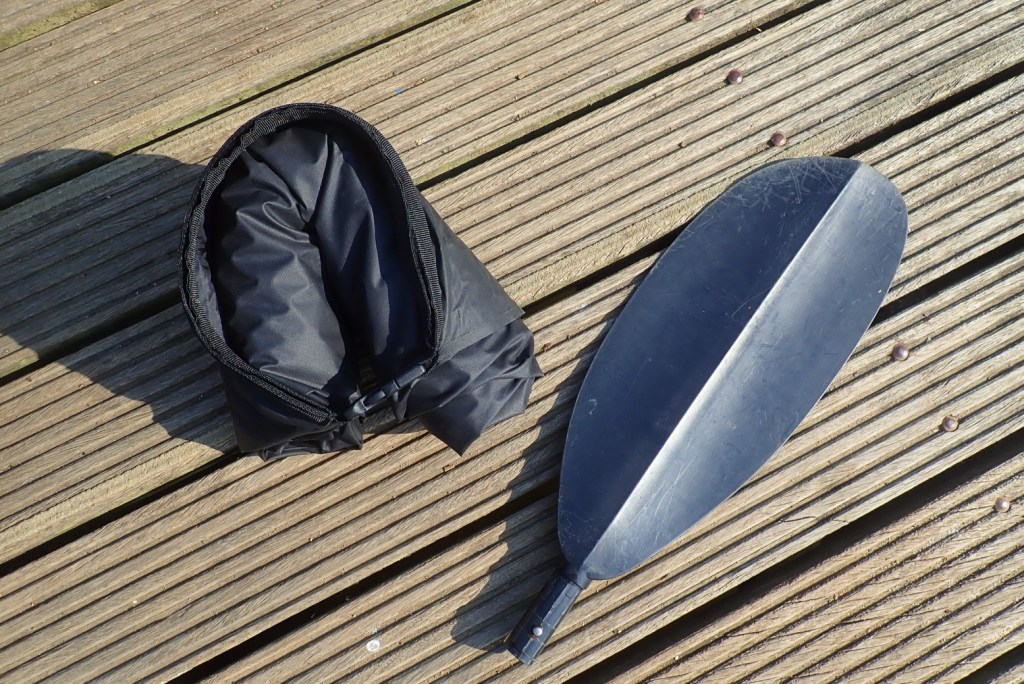
Two weeks later the first thing that surprised me was it’s really light (1300g in my scales) and easily packable. At a toy shop close to home I got a] cheap 7-piece paddle. The boat, the paddle and my everyday gear all fitted in a 5-litre Decathlon backpack. From March to October I always carry it with me so if I have a couple of hours free, I can go to the nearest water body for a paddle. That’s the whole point of ultralight boats like this.
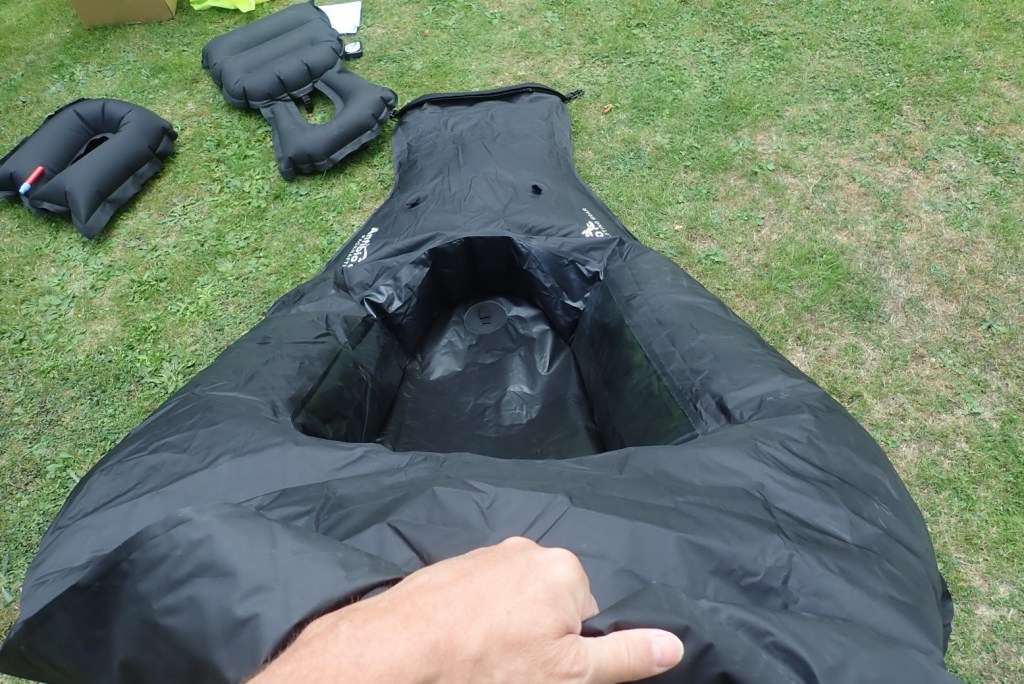
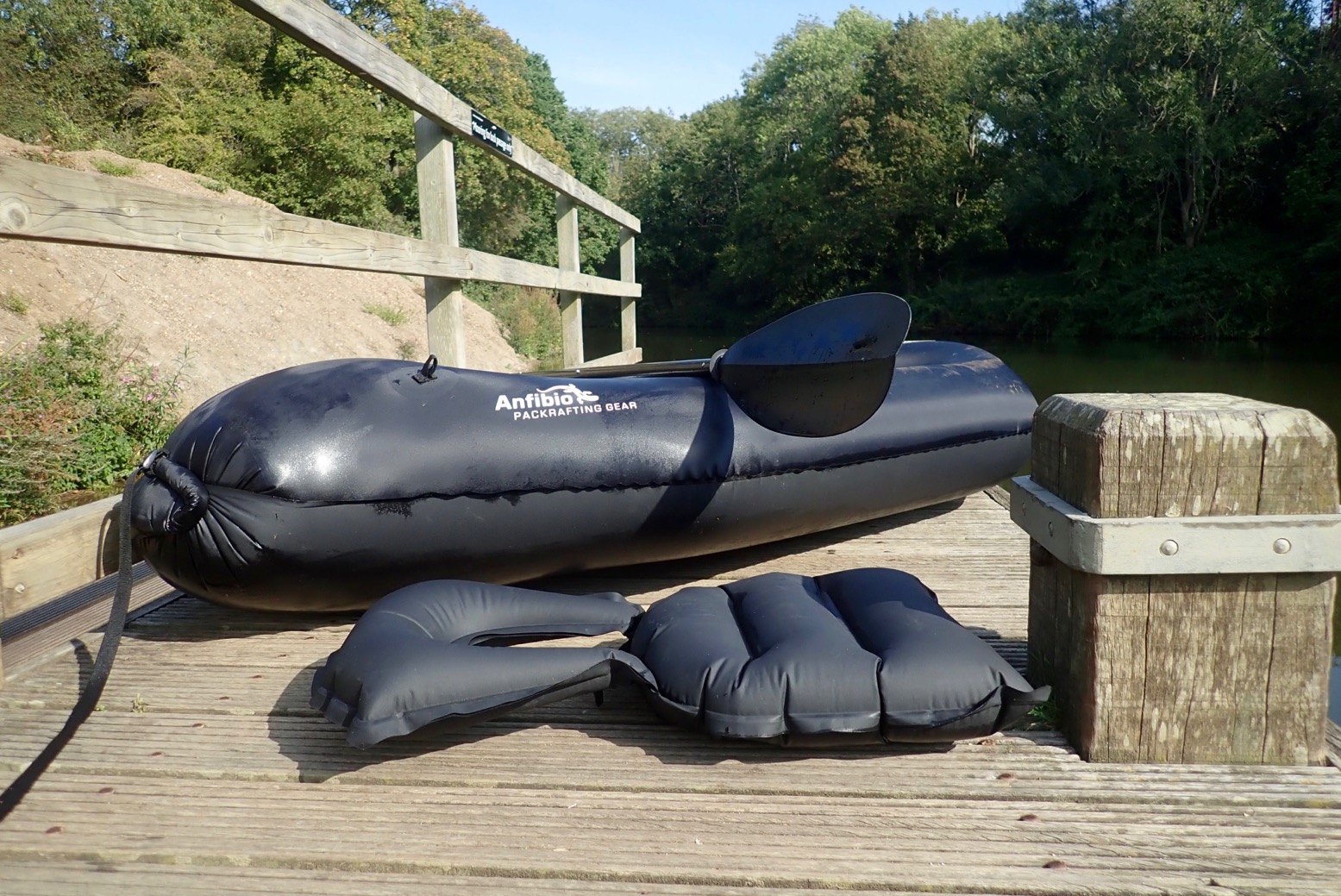
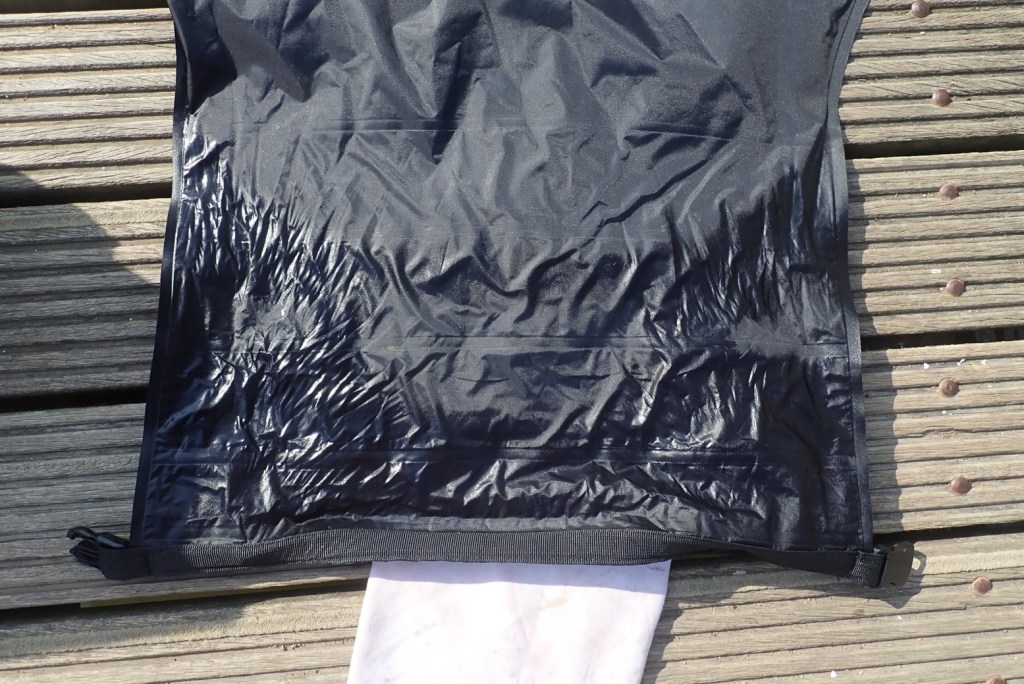
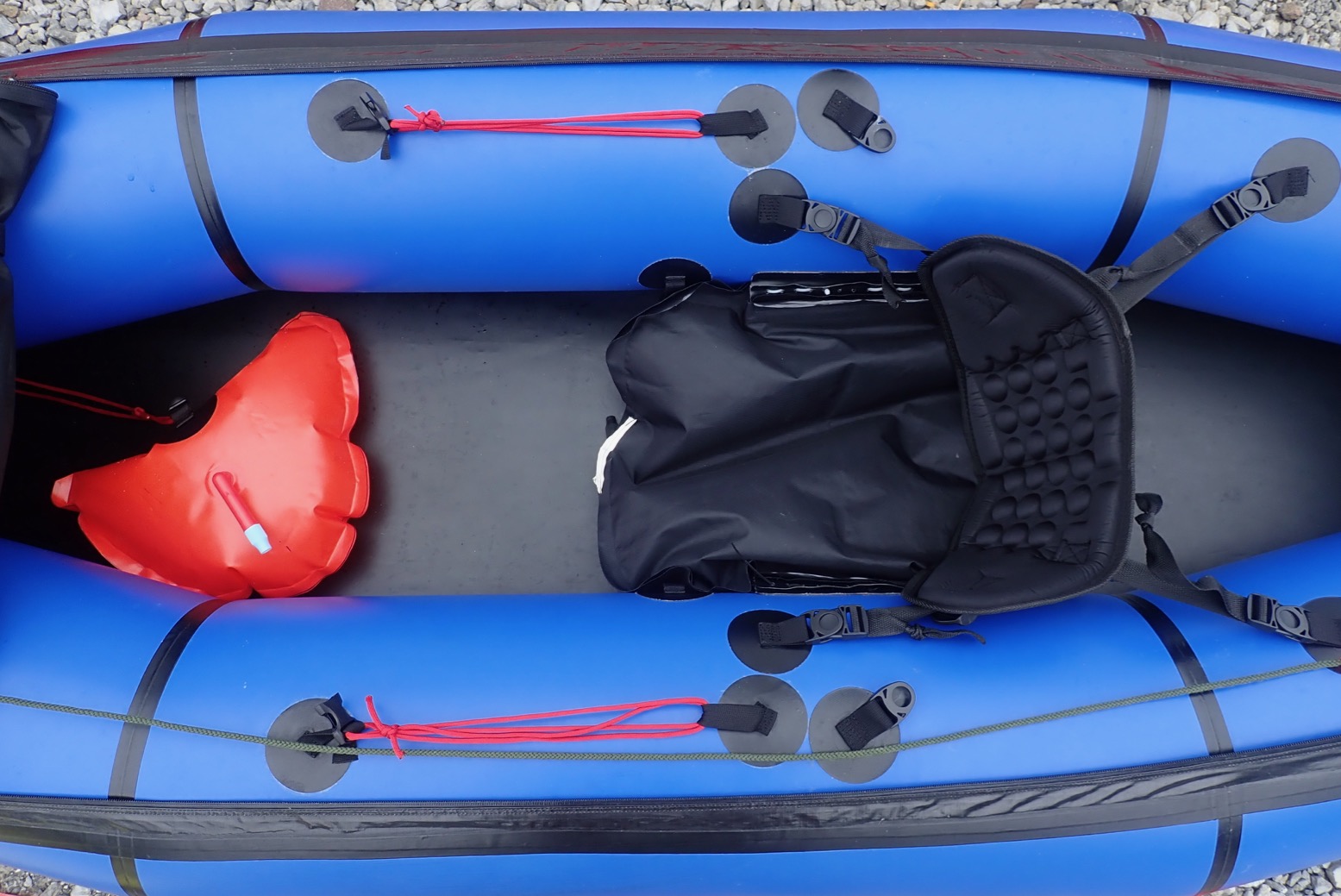
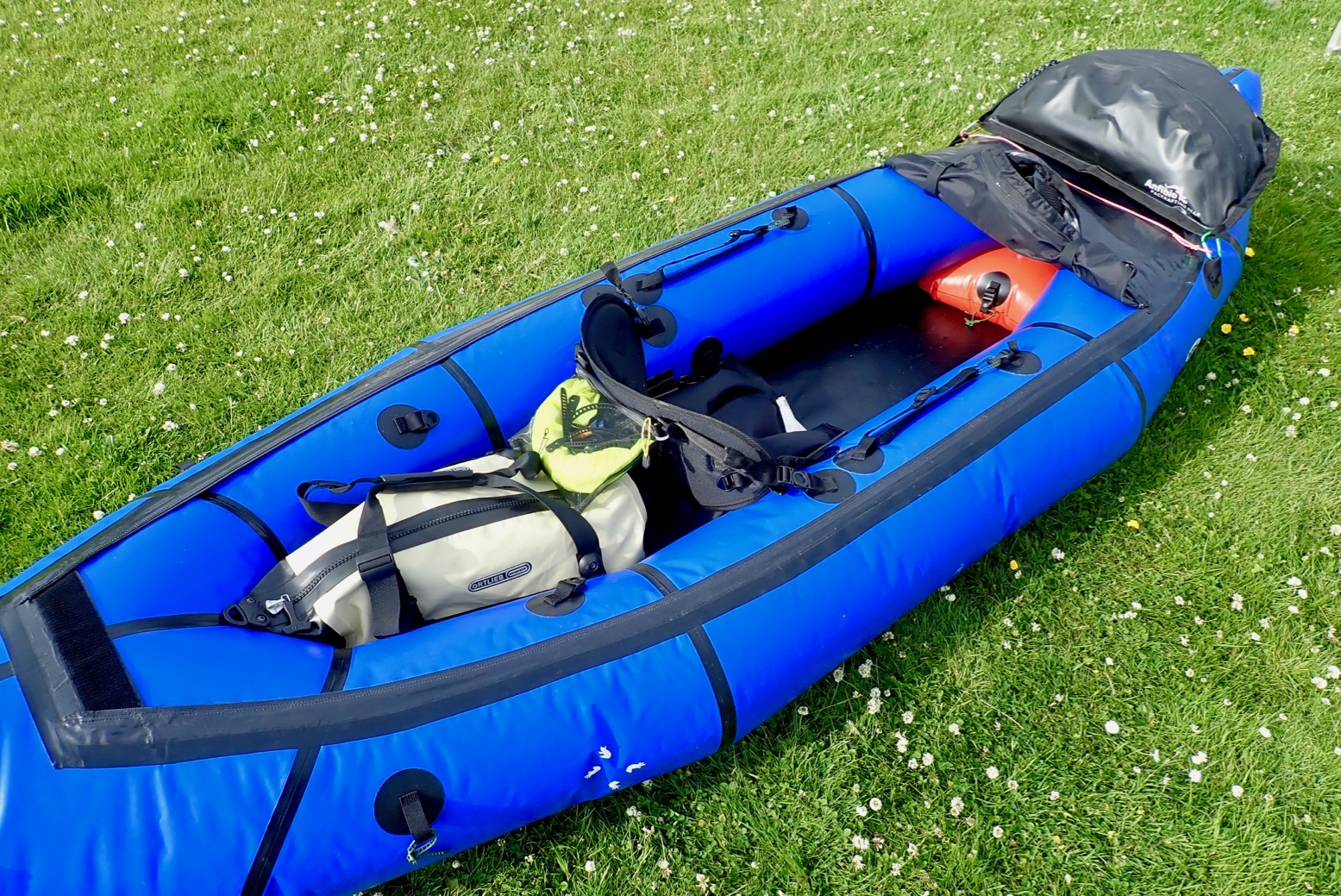
The inflation bag is small, but is sturdy and waterproof. It serves to carry the boat and once inflated, a place to keep your belongings safe and dry. It takes between 5 and 10 minutes to inflate, after which it needs to be topped by mouth. The integrated seat is mouth-inflated. Once done the shape feels a bit odd as it’s short (1.93 m) and wide (1.15m). It has six tabs around the outer edge of the tubes for securing your belongings.
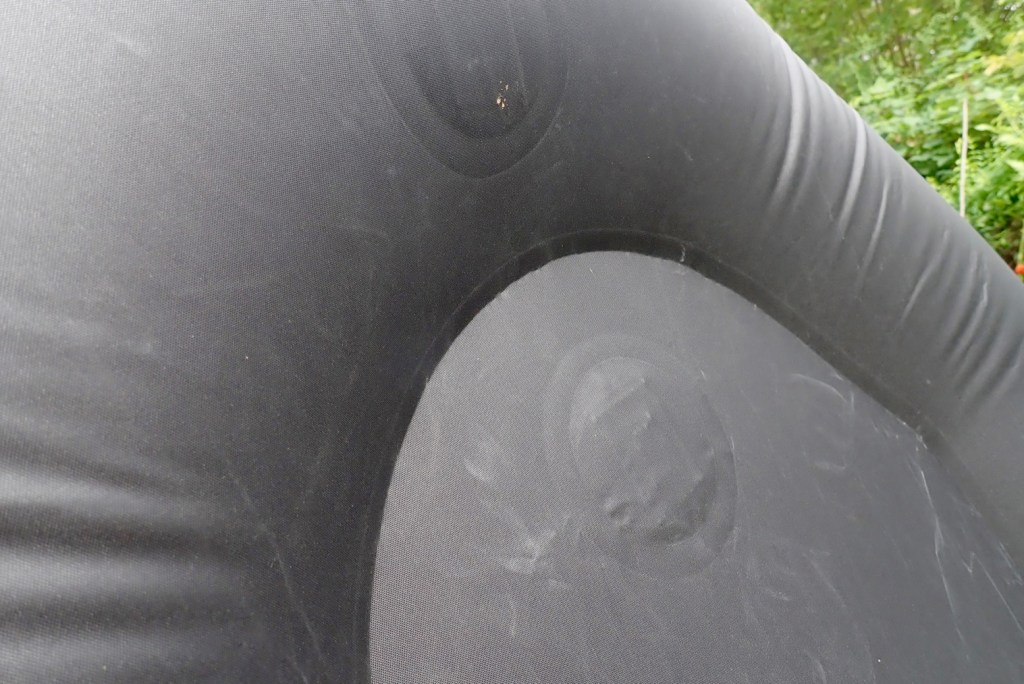
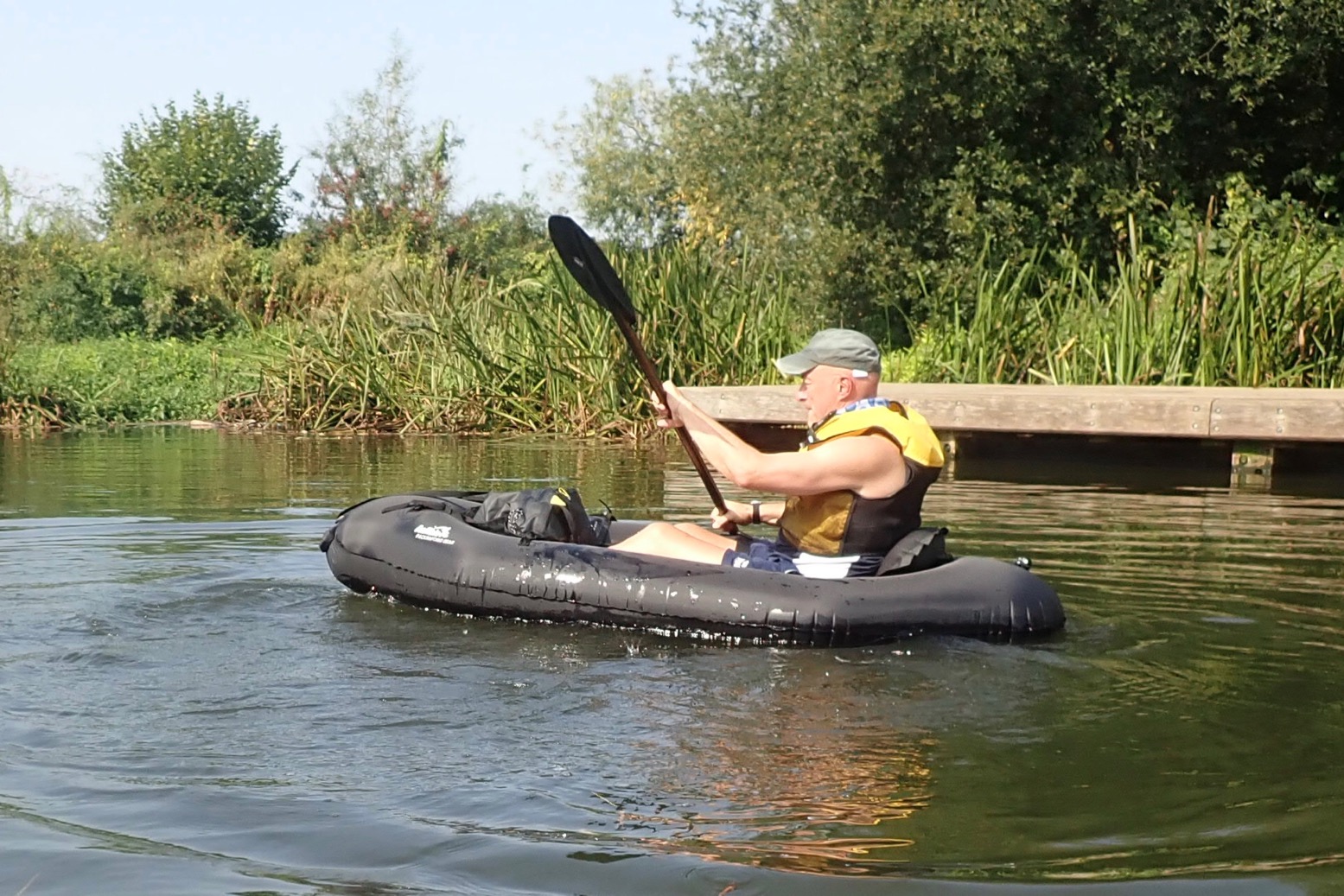
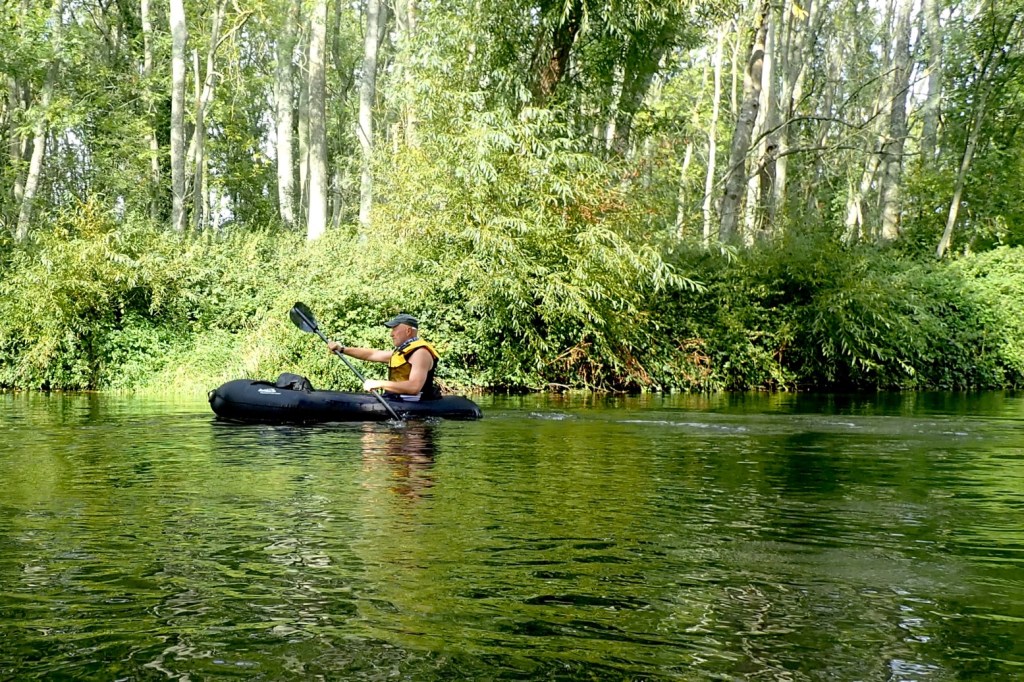
The paddling position is surprisingly comfortable: the sidewalls are low, but the stern provides good back support. The boat is long enough for me (I’m 1.83 metres) to keep my legs fully stretched. The material feels REALLY thin, but in three years my Litewater has rubbed against sand, gravel, rocks and concrete, and it still looks good. No punctures. The valve is simple, but doesn’t leak. This summer I kept the Litewater inflated for more than a month with no need to top up The deflation valve is a simple dump valve and one good feature of the Litewater is it dries fast.
I’m an atypical packrafter, as I use my boats in the sea. I alternate the Mediterranean (Costa Brava) and Atlantic (Ria de Arousa, a very large bay in northwest Spain), so all my comments will be related to the behaviour of the Litewater at sea. On the water it’s slow, but this is to be expected, as it’s short, wide and low-pressure. I don’t think I’ve ever gone more than 3 km/h. On the other hand, it’s more seaworthy than I expected, can hold its own quite well in the waves, and you can make headway against a moderate wind. Once I found myself in an unfavourable situation: the sea and the wind were calm, so I paddled for 20 minutes to a small island one kilometre off the beach. But, when it was the time to come back, a strong wind had risen up, blowing across my course. There was also a noticeable swell, and a tidal current against me. It took me almost an hour to get back, but the Litewater managed it. Of course, with such low sides, you get pretty wet but overall, I’m very satisfied with it. I now have a Kokopelli Rogue Light but am keeping the Litewater for when I need to travel light, or for my son or guests.
In a line Nippy self-bailing 3-chamber PVC / high-pressure packraft/IK made in Czech Rep and suited to white water and surfing.
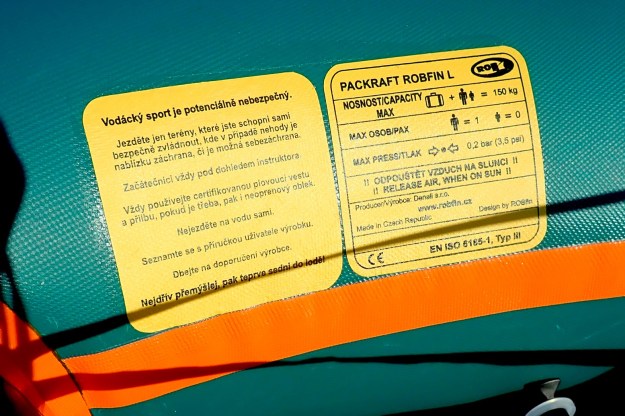
A nippy, light, taut IK with raft valves Tough, German-made 1.1mm PVC Mini barrel pump will get it to 3psi eventually Integrated thigh straps/footrest work well Thick floor forms a keel to limit yawingIt’s heavy for a packraft Heavier paddlers will still get a bit of wet bum on flatwater 0.2 bar ≠ ‘3.5psi‘ as printed on the yellow label
What They Say Completely new concept of packrafting. Instead of mushy packraft, you get a High Pressure Packraft from extremely heavy duty fabric, that takes you anywhere and make it fun! Stable and self–bailing (realy self-bailing) packraft with performance of hardshell boat. Fast and manoeuvrable, good for beginners, for experienced boaters or experts as well. Packraft for bigger boaters or for long expeditions, sometimes called Big Bro. For paddlers and gear up to 140 kg. Fast and responding boat from extremely tough fabric. High profile bottom with comfortable seat, self-bailing up to 5 secs completely full boat (with standard load). Price: €750
Out of the box
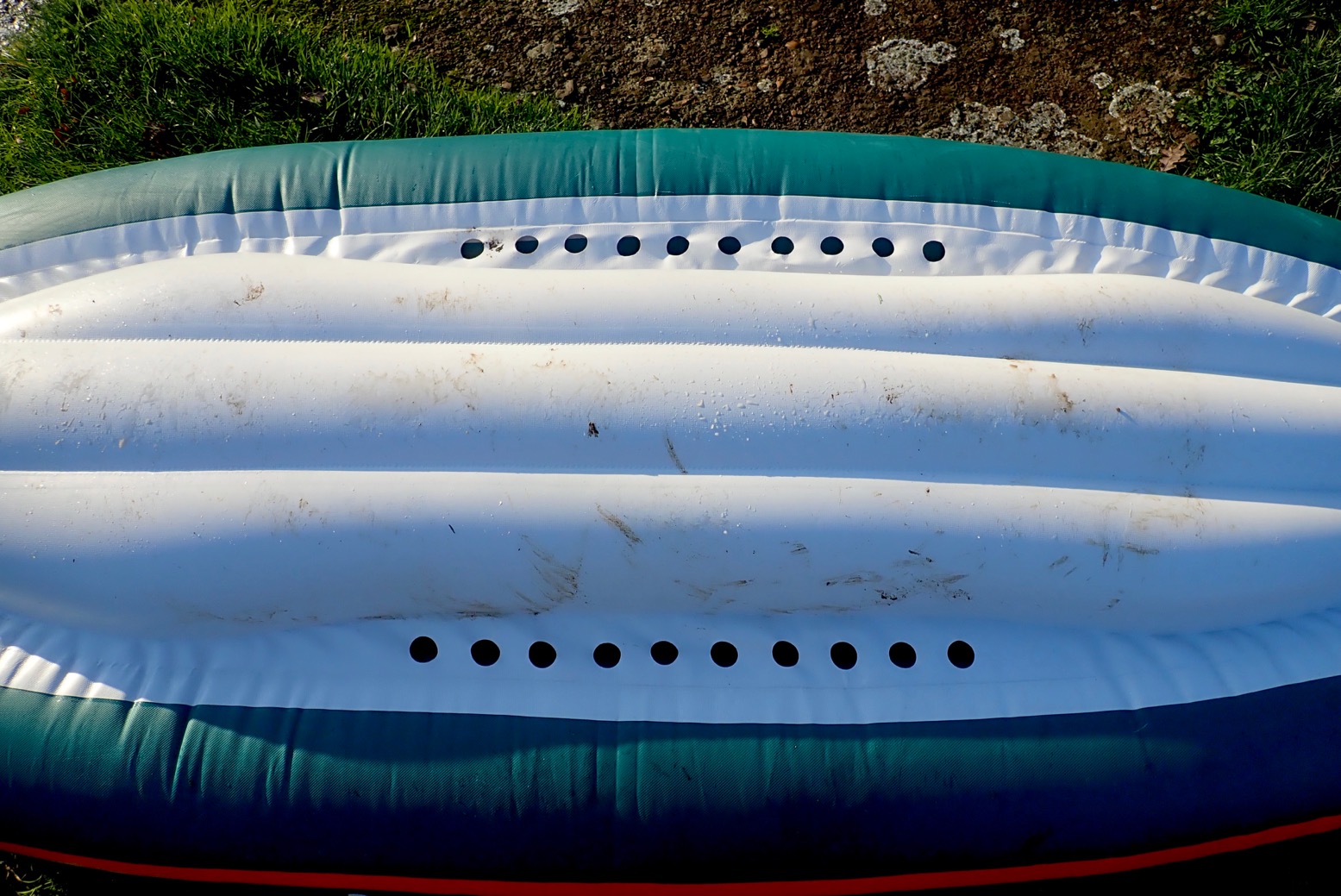
The Big Boy is the second largest in ROBfin’s range of four packrafts, rated for loads of up to 140kg. Self-bailing holes in the floor set limits on payloads; tape them up and you may well be able to carry more without sitting in water, but heavy hauling is not what a self-bailer is about.
Out of the box: quite bulkyThe floor tiles are 25cm
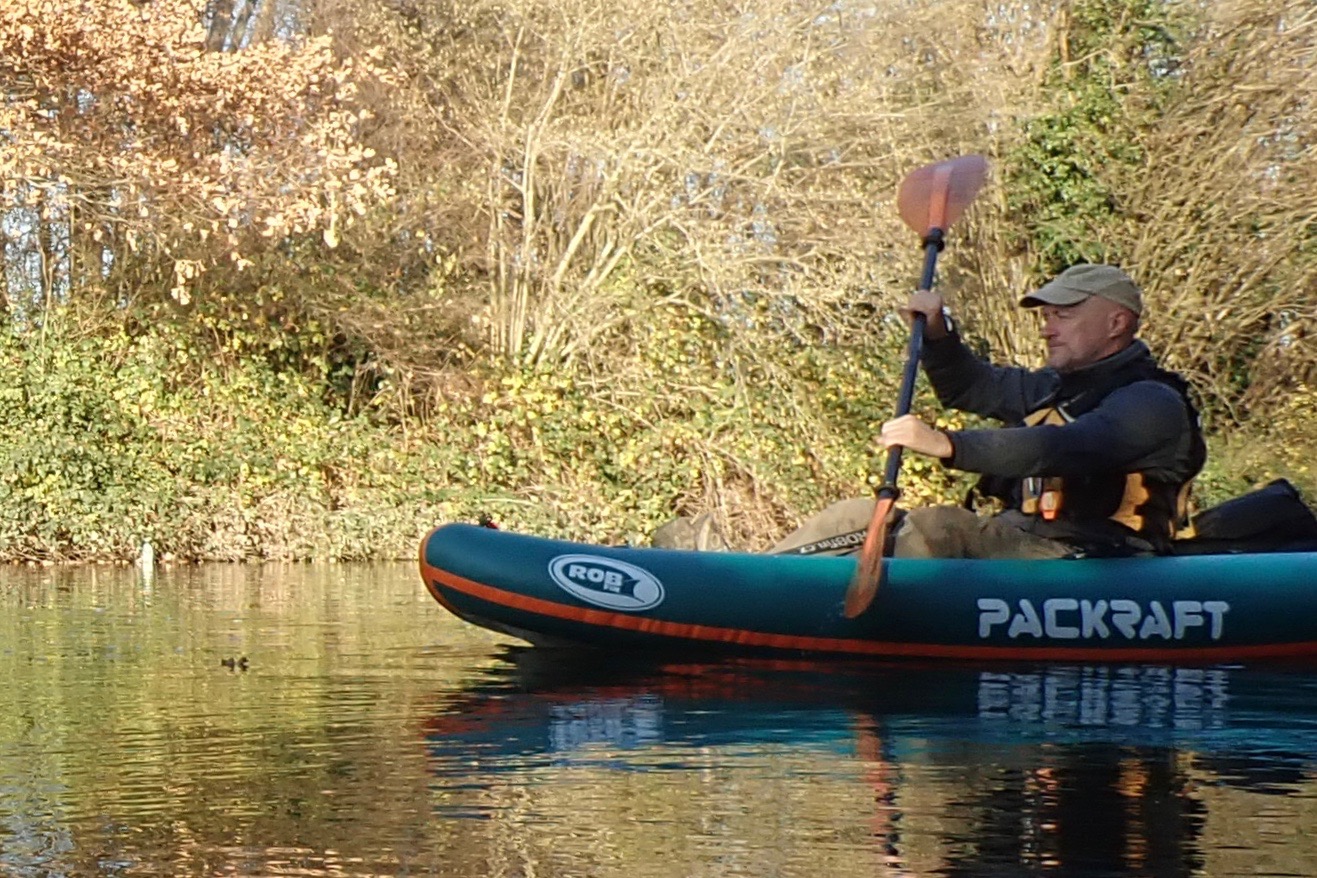
Although PACKRAFT is emblazoned boldly along the sides, this is not your typical, single-chamber TPU Alpacka or Anfibio, but more like an IK with three chambers including an inflatable floor.
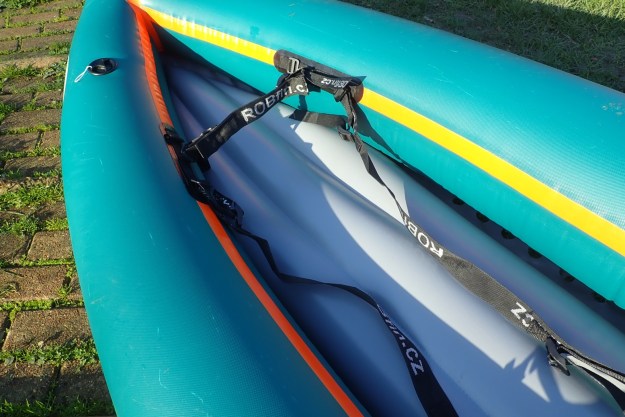
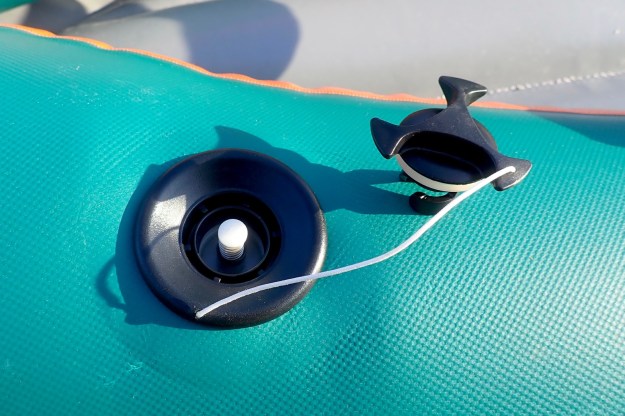
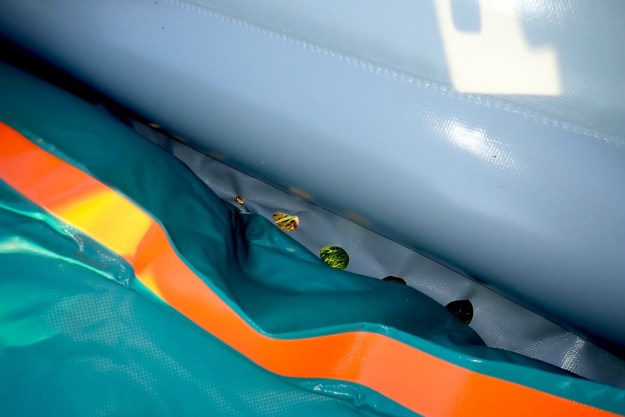
Thigh/footrest strapsProper push-push raft valvesRated at 0.2 bar (2.9psi)Thin seat pad and backrestIntegrated thigh/footrest strapsConformity labelDraining holesFloor and rear chamber inflated
Made from stiff, 1.1mm PVC and with raft valves, the small Bestway Air Hammer will get 3psi (0.2 bar) in there eventually. The stiff hull works well with the integrated footrest/thigh straps for a better connection with the boat. You may notice below left how the floor expands and thickens towards the back to add more buoyancy in the seating area where it’s needed.
Back of the floor is wider and thicker
On the Water
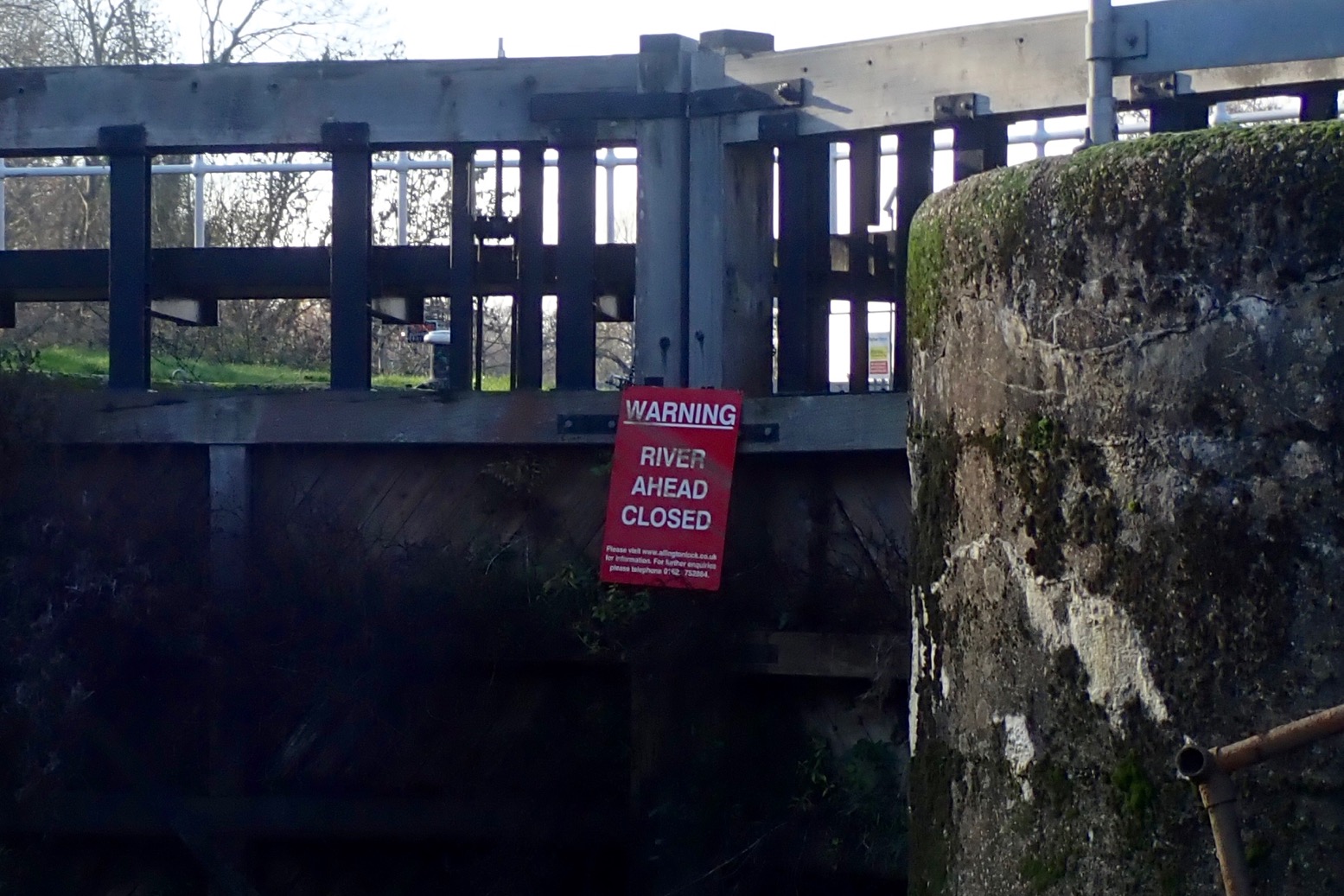
Where I live there’s no white water for miles. The Lee River White Water Centre on the other side of London would have been fun to visit, but was closed for Lockdown and requires passing an assessment course before they let you loose on the two short artificial courses. So the ever-reliable Medway and its sporty canoe chutes would have to do. And with the recent rains the river should be moving right along. But on arriving at Sluice Weir there were barriers everywhere, and the river level above the lock was several feet below the jetty. The upper Medway was closed for winter maintenance works. I’ve been caught out like this on the Medway before. Better to check at http://allingtonlock.co.uk.(click ‘river status’). So after waiting weeks to try out the ROBfin on a sunny day, all I got was a muddy, flatwater paddle. It was altogether a bit of a washout.
My big IK barrel pump inflated the boat in no time. The yellow conformity label says ‘0.2 bar/ 3.5psi’, but 0.2 = 2.9psi, so that’s what I put in. At this pressure the PVC ROBfin was firm like an IK and not mushy like a packraft. Setting off downstream, the way the floor drops like a keel helps the boat track reasonably well, though you can’t power on without the need to correct once in a while. If you stop it veers off to one side, like an unskeged IK or packraft. With gentle strokes, you move along with none of that bow yawing you get with a packraft. The packraft-like ~1-metre width meant it was stable too, even with the higher seating position.
As it is, the water level in the boat was only about two inches below where I sat, so any fast moves or turns brought it up momentarily. You will get a bit wet. Judging by some brisk riverside walkers, the boat was managing over 3mph against the current, and back at the lock it was easy to wipe down and dry.
It’s a pity I wasn’t able to get splashy with the ROBfin; it would have been fun to belt flat out down the bigger chutes to test out the bailing, and mess about below them. The taut hull means the thigh straps work well and the short length would make it agile in the rapids. And should you tip over, getting back on would be dead easy. For playing in white water I’d sooner get a boat like this than a decked packraft. But they make self-bailing packraft too. Packraft or IK? I’d settle on the latter which might put it up against a 12-kilo, 3.3m Gumotex Safari at more or less the same price. The shorter, wider ROBfin would be more stable a fun boat in the right element. What a shame I never got there.
I had a chance to take a prototype Anfibio Rebel 2K out for a short paddle the other day. A couple of hours trapped between weeds and weirs on an obscure urban waterway meant I wasn’t able to properly try out the test boat’s many features. Just another packraft you might say. There’s now a booming cottage industry of packraft makers, each seeking ways to make their very similar looking boats stand apart from the competition. How is the Rebel 2K different?
The Rebel 2K derives its name for a claimed weigh of under 2000 grams without the optional TubeBags: Anfibio’s answer to in-hull storage (more below). The boat we used was not standard and with the seat removed weighed about 15% more (as listed above. * Anfibio reweighed the same seatless boat and got 2450g). Saying the Rebel ‘… hardly takes up more space than a 2L drinking bottle..’ is a bit wide of the mark. That’s broadly true of the Nano RTC I tried the other week but, like most similar-sized TPU packrafts, the Rebel (210D hull and seat, 420D floor; 75D deck) rolls up to about the size of a compact 2-man tent. I like the ‘olive & lemon’ colour scheme and the whole boat looked put together as well as any packraft I’ve tried over the years. They’re really can’t be that much to it!
Besides the fitted TubeBags, the boat we tried had handy grab lines front and rear and a second patch for a frontal skeg. It may also have had patches for thigh straps inside. The front and rear tracking fins are a novel idea I’ve only seen on some drop-stitch IKs. Neither were fitted on our short spin. They weren’t needed and as you can see, they’d have probably stopped us in the thick weeds. I know that my blue, 60-cm longer Nomad certainly never needed the rear skeg (tracking fin) the way many IKs do.
Sure, like all packrafts the Rebel waggles its bow left and right in response to paddle input, but it still goes where you point it, gales notwithstanding. It would have been interesting to see how the frontal skeg affected this yawing. Assuming it eliminated it, would it have made the Rebel easier to paddle faster but at the same time harder to turn? That could be useful for longer crossings where a packraft’s relative lack of speed can hold you back. One for next time.
We used the Anfibio hand pump (left) to firm up the boats but had to back off the Rebel a bit to get the curved deck zip to close. With that done the 2K was taught and crease-free.
Normally I’m not a fan of decks, certainly not fixed ones, but on a chilly October day both I and Bob were glad to be tucked in and protected from splashes. One thing I’d like to see added is a tab on the right tube to secure the unzipped deck. [Edit: I’ve since been told it is a standard feature on production models.]
The TubeBags are also an interesting concept. Even before hearing of early failures, I was never won-over by Alpacka’s Cargo Fly (hull zip) innovation of 2014. Benefits in visibility and stability by storing luggage in the hull tubes were genuine, but is it a good idea to meddle with hull integrity in a single-chamber inflatable? The fewer failure points the better and who hasn’t had a zip jam or break? Now these airtight zips are commonly seen options on all packrafts and must be more reliable, but the zipper will always need care to seal well, especially in this era of pump- assisted hull pressures.
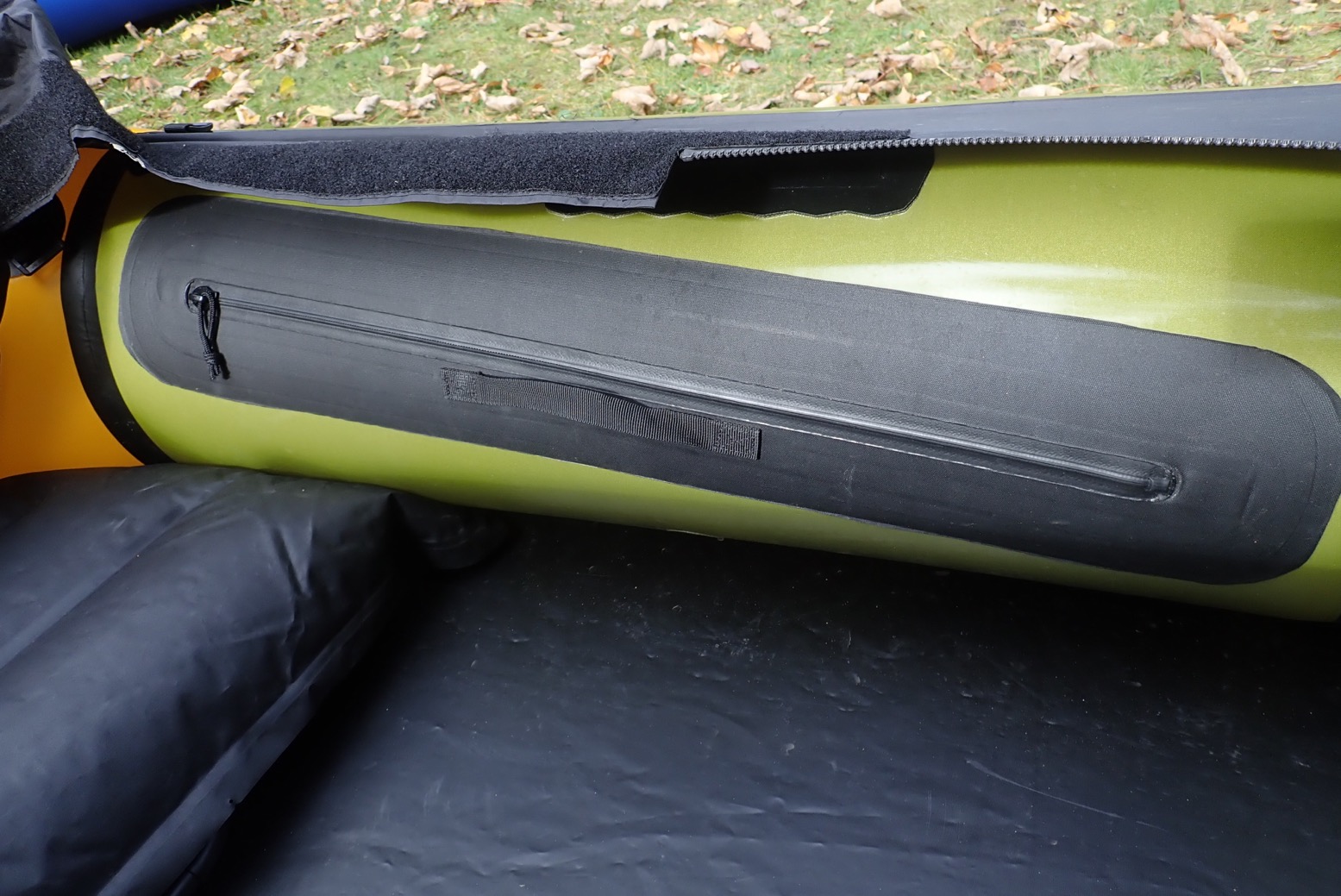
Like a hand pocket in your jeans, the TubeBags are pouches fitted into the side tubes and accessible from the cockpit via IPX7 zippers (left). But the 70-litre pockets must be packed and zipped up before the boat is inflated. Then once inflated and on the water they cannot be opened because the hull pressure behind them will cause the contents to disgorge until the pouch itself spews itself inside-out, leaving a slight drop in hull pressure. So if they’re not a handy ‘glove box’ what’s the point? Well, for starters once the boat is inflated the surrounding hull pressure keeps the bags’ contents pressed in place a bit like reverse vacuum sealing. Leave the pouch zip a little open as you inflate the hull and the contents will all be squished firmly in place. Then close up the zip up. Plus separate chambers add some back-up emergency buoyancy, and a faulty zip need not be critical to hull pressure. As with all in-hull storage, TubeBags won’t be that handy for day paddles but are a great way of storing stuff securely and out of the way on over-nighters. Once at camp you loosen the main valve to drop hull pressure a bit (as below). Then you can access your TubeBags. This will only work well when you’re on the water all day without interruptions. Portages with a loaded boat might be awkward compared to unclipping your bag from the bow and the rhythm of classic packrafting: walking then paddling then walking then paddling, might be slowed down a bit. But as long as you have a drybag or pack big enough, you can always bung it on the bow. You don’t have to use the TubeBags.
Other than that, the Rebel is fairly normal packraft. I found plenty of room my legs and hopping in off my kayak-like Nomad (my last paddle in it, as it turned out), it sure was nice to have something solid to lean on. As it came, with deck, tube storage and two fins, the Rebel would cost around €1000 and looks like a great do-it-all expedition boat. I can see it being ideal on a big French river where weirs are easily bypassed by shooting down glissieres (chutes). The cached baggage will be out of sight when leaving the boat moored and popping into a village for a pan au choc and visibility and stability in rapids will be improved.
In a line Super-light but sturdy packraft with a low-maintenance solution to in-hull storage.
Simple but well-detailed design 210-D fabric feels durable Optional mini-hand pump works very well and can be deployed on the water Holes easily sealed from the inside with a stick-on patch Compared to TiZips, RTC is a simpler, lower-maintenance way to achieve in-hull load carrying Raised floor lifts paddler, limits wear and may help limit yawingLike most short packrafts, it’s not a joy to paddle on flatwater for hours RTC will need care and may need practice to achieve a good seal Floor is same thickness as hull, not double-weight, as is usual.
What They Say Extremely light packraft with roll closure (RTC), which enables luggage to be stowed in the tube and thus offers higher transport capacity. Minimal pack size, 1kg light and robust enough for calm and tame waters allow combined adventures with increased payload. Price: from €335
Out of the box This pre-used Anfibio Packrafting Nano RTC came with an optional backrest seat (€57), the airbag, an optional mini top-up hand pump (€10), a strap and 3 patches but no glue or instructions. The latter appear online. On the IK&P scales the boat alone came in at 1002g. The full seat adds another 237g with the horseshoe seat base weighing 135g. All the other dimensions in the image above closely match Anfibio Packrafting’s own data.
The rolled out Nano RTCThin TPU film layer to ensure a good seal
This is not your usual shiny-exterior packraft; the Nano’s coating is instead on the inside like the plain Nano SL model. The woven texture of the 210D nylon fabric still gives a sense of sturdiness which I can’t say I felt with the 75D Supai Flatwater and Matkat we tried a few years ago. Such perceptions are important when bobbing about in the middle of a breezy loch or tackling some light whitewater. Maybe it’s the black colour, but the Nano also managed to look bigger and tougher than the virtually same sized Alpha XC (left) we tried a year or two back.
The RTC is a new idea to Anfibio Packrafting, though the Rapid Raft in the US uses a similar closure. The Nano differs by being a more sophisticated design, with a hull made from just three pieces of fabric: hull top; lower hull and floor; inner ring. This adds up to just two long seams which ought to mean fewer chances of errors during assembly as well as less weight. You can have the closure up-front (normal) or at the back where, with just four folds rather than five, it creates an elongated stern which adds more buoyancy where most of the weight is and acts as a skeg to limit the side-to-side yawing endemic to short packrafts. Payload is 135kg.
The RTC has an extra TPUfilm bonded inside to ensure an airtight seal, as long as you roll it up tight with no wrinkles. Providing it works, as a way of enabling in-hull load-carrying, I’d sooner put my faith in this than a TiZip which must be kept lubed and clean and dried properly to work well. At the RTC-end you have four mounting tabs on the tube top. On this you can mount Anfibio’s DeckPack, as pictured below. Bigger exterior loads may also be more convenient here if your route includes many awkward portages where carrying the otherwise heavily loaded and inflated boat may be tricky. Otherwise, there’s a tab inside the hull to secure loads and keep them towards the RTC end. You get seat mount buckles at both ends too, though I found the fully inflated seats jammed in well by themselves. There will be the age-old annoyance of the backrest flopping forward as you get in, but used RTC-sternward you can hook it upright to one of the tabs. This backrest design hasn’t changed since I had my first Alpacka Denali over 10 years ago. What is actually wanted is lumber support which is best achieved from strap-braced backrests, as in my Nomad, but that gets complicated.
Boston valve – ideal for packraftsHorseshoe seat optionClean seams all round
No you can’t inflate it by opening the RTC to the wind unless there’s a gale on, but it helps to fluff the boat out, and using the usual airbag, 5-7 scoops fills the boat, after which you top up the one-way Boston valve or by mouth. If you find the latter a bit awkward, I find a section of half-inch garden hose works as a ‘blow-straw’. Or use the top-up handpump (137g) to get maximum firmness. On the Nano it worked very well and for only €10 I’d say is a worthwhile addition for any Boston-valved packraft.
“The RTC cannot be compared to the usual roll closures of simple pack sacks [dry bags]!” proclaims the website, and I can believe them. We all know that Ortlieb-like roll-top dry bags don’t have a proper seal; water will seep through and air will leak out. But the multiple rolling of the film layer, as well as the fact they’ve dared use RTC on a packraft, gives a sense of confidence. Time to get paddling and see if that confidence is warranted.
Nano on the water Mid-September and it’s nearly 30°C: too good to pass by so I head for a short run up and down the Medway. Airing up at Sluice Weir Lock, I had a good feeling about the Nano, even if at 95kg I expected to be on the limit, as I was on the Alpha XC. The extra 6 centimetres all round looked enough to make a difference, and one way to help the trim (level) would be to run the RTC at the stern and as long as possible (four folds) while perched forward on the backrest seat option. In the end I didn’t feel the need to do this.
Once inflated by bag and topped up by mouth, I knew the Nano would need a damn good tempering today. A boat firmly inflated by hot ambient air will go soft once cooled in the water. Sure enough, after some splashing the Nano went as limp as a stunned trout. While doing this I was reminded of the indispensability of a bow line to manage a boat at the water’s edge. I hooked the metre-long strap through the RTC (left); better than nothing. Back on the jetty I tried the two-way hand pump: 20 pumps firmed it up. After over a decade of proven hull integrity, it’s become the norm to top-up packrafts with mini-pumps and not by lung, raising pressures up to 2psi or more. This added tautness is what differentiates packrafts from slackrafts and has a huge benefit on paddling efficiency and satisfaction.
They say don’t overdo the pumping but how are you to know? A well-made packraft may well handle a massive 0.5 bar or more before it blows a seam, but assuming the Boston one-way valve can handle it, I think the mini PRVs I tested the other day would be a useful addition to packrafts. They cost only 4 quid and you just keep pumping away until they hiss, knowing the boat’s reached the valve’s purge pressure which cannot be exceeded. It’s like an in-built pressure gauge. Fitting one to the open-ended Nano (or any TiZip packraft) would be especially easy. I decided to try RTC bow first (it made using the DeckPack easier). Once in the boat I felt fine, though from the pictures it’s clear the trim looks nearly as back-heavy as on the Alpha. Too many pies! But on these ‘calm waters’ that didn’t seem a problem.
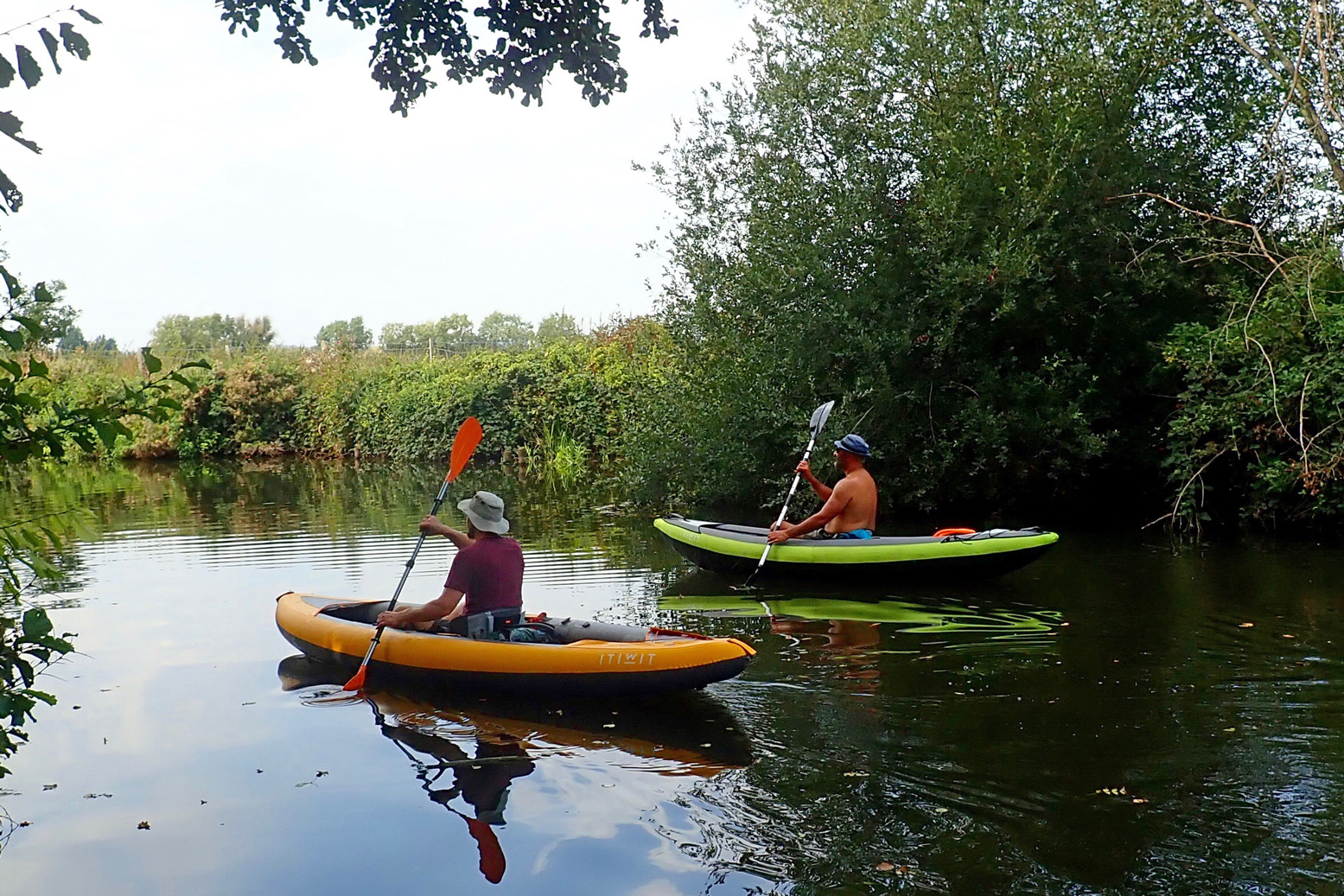
Confident I wouldn’t wet myself, I set off 2km up river for Oak Weir Lock, passing some happy Itwiters on the way (left). Those things are everywhere these days! Good on Decathlon for satisfying the huge demand. Within a few minutes it became clear the Nano had cooled further and needed another 50 pumps off a handy concrete slab below the steep riverbank. I also remembered that, unlike my IKs, low-floored/high-sided packrafts want the seat base pumped right up to give height so as to get the paddle over the fat sides.
Back on the move, speed and response increased dramatically, but not having paddled a normal-sized packraft for a while, I’ve forgotten how slow they are, topping out at maybe 2.5mph/4kph. Riverside walkers were outpacing me; normally it’s the other way round on the Medway, albeit heading downstream. Where noticeable, the current here is about half a mile an hour. I took off to explore some mysterious side creeks which I’d normally shoot past on my downstream burn-ups, careful to avoid the many brambles which line the river here. There’s a perception that the Nano’s textured woven surface could snag a bramble more easily than a smooth one, but should that happen it would be easy to open the RTC and slap a stick-on patch on the inside: the best place for such a repair. The heat and dense, overhanging vegetation reminded me of a boat trip I took years ago up the remote Roper River in Australia’s Top End.
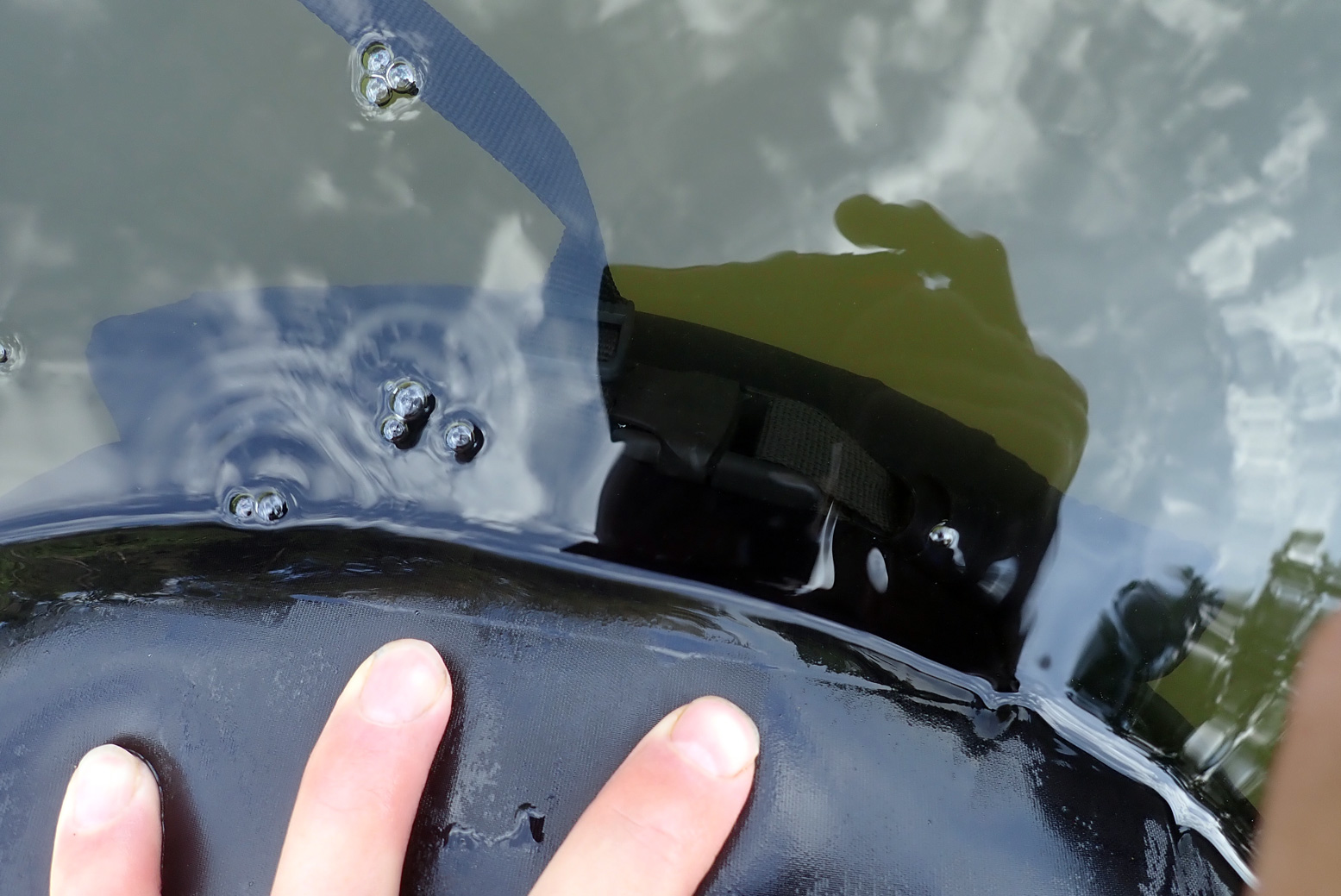
Back out on the main channel and heading upstream, after a while it took some effort to move the Nano along, with the tell-tale bobbing of a soggy slackraft. A squidge of the sides showed they were soft again. More tempering needed or a slow leak, probably from the inexpertly sealed RTC? I hacked on and at Oak Weir jetty got my weight over the bow to push the RT closure underwater. A couple of tiny bubbles popped up occasionally, but they may have been just trapped air escaping the folds.
The picture above makes it appear worse than it was, and being a hot day on cold water, I felt one more tempering may do the trick. I often have to do this with my bigger Nomad; which takes a good few minutes on the water to fully cool on a hot day. I did my best to check for tell-tale bubbles elsewhere, but anything easily spotted would have seen the boat droop in minutes.
I realised the seemingly redundant hand pump hose was actually ideal for topping up on the water. I reached behind and carefully undid the upper cap of the Boston valve (you don’t want to undo the main valve…), pushed on the pump hose nozzle and gave it another 50 jabs + 10 for luck (about 8-9 litres). With the Nano taught again, I couldn’t resist hopping out and sliding back down the shallow Oak Weir canoe chute which the Nano took in its stride. This boat could easily manage river riffles; the caveat would be too much scraping in the shallows. The exposed fibres can probably take some rubbing but it’s the coating inside that counts. I wonder if spraying a slippery coating (303 Protectorant springs to mind) on the undersides may help reduce possible wear.
I’d asked for the backrest seat option to push my bulk forward off the overloaded stern, but comfort, or a relaxed all-day paddling posture, will take some experimenting. With the unusual raised floor and seat base pumped right up, the now higher backrest had less to lean against so I tipped backwards. I should have tried deflating the seat base a bit. Even at my height (1.82m) I can still stretch my barefoot legs flat out, when in fact a bent leg is better for paddling. So you might want to fit Antibio’s footrest (as I use on my Nomad), shove a bag or shoes up there, or better still (for trim), put something behind you to act as a thicker backrest and centralise your weight (as we did on the Alpha). However you achieve it, a solid back–to-foot brace improves paddling efficiency which means it takes longer to get tired.
Trim not too bad
Running back downstream to Sluice Weir felt like it took half the time, and I got there with the boat still firm. I do wonder if wetting the inner film surface provides a better seal, just as licking a suction cup before sticking it to glass. One to try next time. I also noticed that for a short, wide raft, the Nano barely yaws left to right. Besides my fine technique honed over the years, the profile of the raised floor may help the side tubes ‘bite’, like ice skate blades. Or it may be the subtle protrusions (below) under each end of the boat which my 2.9-m Nomad also has and which are said to have a skeg/keel effect.
Either way, I was confident I’d survive the sporty Sluice Weir chute, catching only a cupful of water as I hit the frothing base. With that ticked off, I paddled over to the portage jetty, crawled out and aired down. Being a black boat on a hot day, the Nano dried itself off in no time.
Packing the boat up, I checked for seepage into the RTC when it had been submerged for a minute or two. As expected, water crept along the textured outer nylon surface but the inner film was dry, though as Gore Tex will tell you, air can pass where water can’t. If that was the issue, not just heat, I’m sure getting a good seal is a knack that can be acquired.
=
Conclusion Providing they can handle the added pressure of a hand-pump, I wouldn’t be surprised to see RTC-type closures becoming more common on packrafts. Using zippers for such a critical seal always seemed a bit dodgy to me, though I’ve only read of them playing up. Besides that novelty, the sturdy 210-D Nano makes a great crossraft at a price that’s competitive with the thinner Supai boats. It’s very light, compact (3 litres rolled up), comes fitted with enough useful tabs and can be paddled RTC-stern to level off the trim, if needed. Seats are quite a lot extra, but you can sit on your gear, and for a tenner, the little handpump is a no-brainer to get the most from your boat. And if the Nano’s RTC arrangement is not for you, choose the conventional Nano SL costing about 15% less. Either could make a great entry-level packraft or an ultra-light crossraft.
I fitted over-rated 4.8psi Ceredi PRVs to my Seawave’s side tubes a few years back. I like the idea of not having to worry about the boat getting hot in the sun (and exploding), just as much as gaining some extra rigidity by fitting PRVs rated a little higher than recommended side tube pressures.
I bought a pair of unbranded Chinese PRVs off eBay (<£9 posted – about 30% of Ceredi/Leafield prices) to consider for my next IK. Some sold on eBay don’t even mention the purge pressure! These ones did: 4psi or 0.27bar, just a bit over the 0.25 of the boat I have in mind.
Out of the bag, the quality of the molding looked no worse than a Ceredi. I was a bit surprised they’re smaller than usual PRVs, (the listing gave these dimensions), but what does it matter as long as they work. I worked out a way of testing them by removing the backing ‘nut’ and screwing the ‘male’ PRV housing onto a rubber motorcycle throttle grip. The other end of the grip I jubileed to the barrel pump nozzle. Pumping the pump, the pressure built up and PRV ‘burped’ suddenly at an indicated 0.4 bar. But as my manometer needle zeros at 0.1 bar and not zero, we can probably subtract that 0.1 and call that 0.3 bar which is 4.34psi. Close enough to 4psi. Now I can fit these PRVs with confidence.
The hole which must be cut in the boat to fit this valve is 24mm ø, but to get the back nut inside the hull you’ll need to go in via the larger inflation valve aperture. So cut the PRV hole close to the inflation valve. Once loosely screwed together, the knurled outer housing can be tightened with some wrench or another.
Accounting for manometer error, the PRV burped at 10% more than claimed, which is pretty good.
Urban canals have long been rediscovered as quaint, idiosyncratic backwaters for boat dwellers, joggers and cycle commuters, or have seen adjacent industrial wasteland redeveloped into glitzy apartment blocks or waterside business parks complete with mouth-watering eateries and amusing sculptures. The old cliche of filthy neglected ditches where joy-riders dumped scooters and drunks hurled traffic cones or shopping trollies is outdated, at least in central London.
These days, if Doctor Who needs a grotty urban canal to stand in for a toxic sewer where evil Cybermen are spawning The Invasion (1968; 00.57), they’d probably have to go abroad or something. All of which means that, once you include London’s excellent transport links, the capital’s fascinating canals make for great packboating.
The 200-year old Regent’s Canal is inner London’s best example, arcing nearly 9 miles across London from near Paddington eastwards to the old docks at Limehouse on the Thames. It starts at the dreamy, willow-rimmed mooring of Little Venice, passing Regents Park’s neoclassical mansions and the chattering apes of London Zoo before turning for Camden Lock Market where Jimi Hendrix bought his first Rosetti Airstream. Here the canal drops down a few locks to unrecognisably redeveloped Kings Cross, home of Google UK and where giant Victorian-era storage tanks have been converted into luxury flats. East of here, your water-level view flits between bohemian, suburban, light industrial and even rural parkland, until you arrive at the marina of Limehouse Basin by the Thames. On the way you’ll have portaged 13 locks and two tunnels (marked in red on the map below).
The Regent’s Canal
Britain’s canals helped kick off the world’s first industrial revolution. Canals linked or added to long-established river navigations and enabled inexpensive and reliable cross-country transportation of heavy, bulky or fragile commodities, like pottery. At this time the decrepit road network was still suffering from 1500-years of neglect following the Roman era. Packhorse trains were superior to wheeled carts but were way too costly. Around 1805 the Grand Union Canal linked the burgeoning industrial heartlands of the Midlands with Paddington – then a village on the western edge of London. The advent of Napoleonic Wars included attacks on coastal shipping, necessitating secure inland transportation to help provision the war effort. (The Wey-Arun Navigation linking London with the navy fleet at Portsmouth, was another example). The Regent’s Canal followed London’s northern perimeter to link the Grand Union with the deep tidal Thames at Limehouse (above) near the new West India Docks. Here, lock-controlled ‘wet docks’ were regarded as more efficient and secure than London’s old bankside wharves. The map below is from 1830 and shows that even a decade after the canal opened, most of it passed through open countryside. Within a few decades railways gradually brought about the demise of commercial canal transportation. I pinched most of this information from Jack Whitehead’s detailed version.
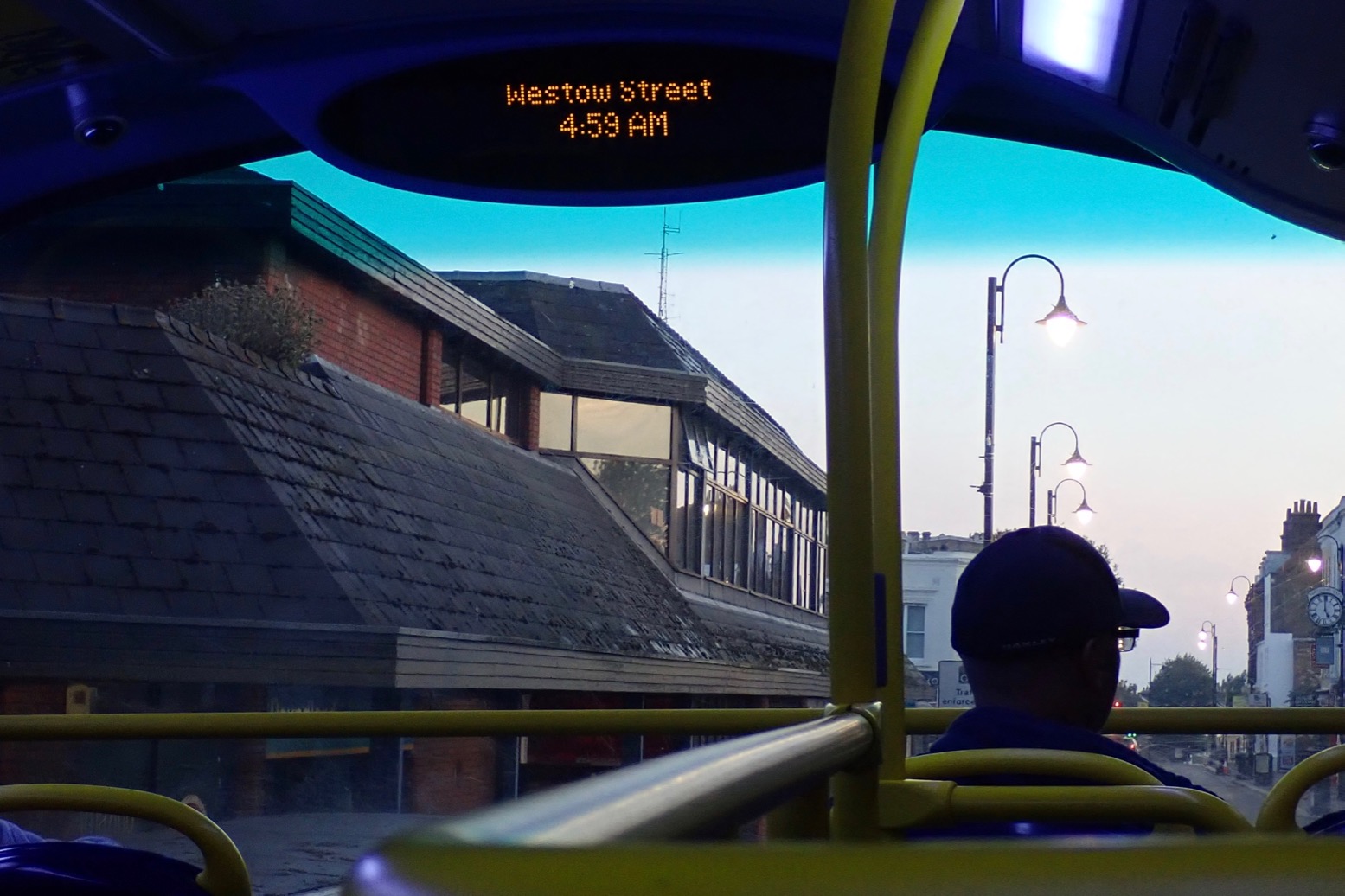
Time to go. I was on the bus before sunrise.
Bear with me, I’m still waking up.
Cables and cladding at Edgware Road tube.
New apartments, offices and the Fan Bridge at Merchant Place in Paddington Basin, the ‘Paddington Arm’ terminus of the Grand Union from Birmingham.
The canal ahead of the lifting Fan Footbridge is cordoned off so you can’t actually put in here. Along with the similar ‘Curling‘ Bridge nearby, a cynic might say these are eye-catching engineering solutions to non-existent problems while other celebrate innovative urban art. Both bridges make scheduled performances on weekends.
The Paddington Arm of the Grand Union. Regents Canal actually starts by the former barge turning-point known as Brownings Pool; today’s Little Venice.
Just up the way below a footbridge is a strange retracting weir whose purpose may be to keep the scourge of duckweed from spoiling Paddington Basin’s clear-water vibe.
You can put in anywhere around here but…
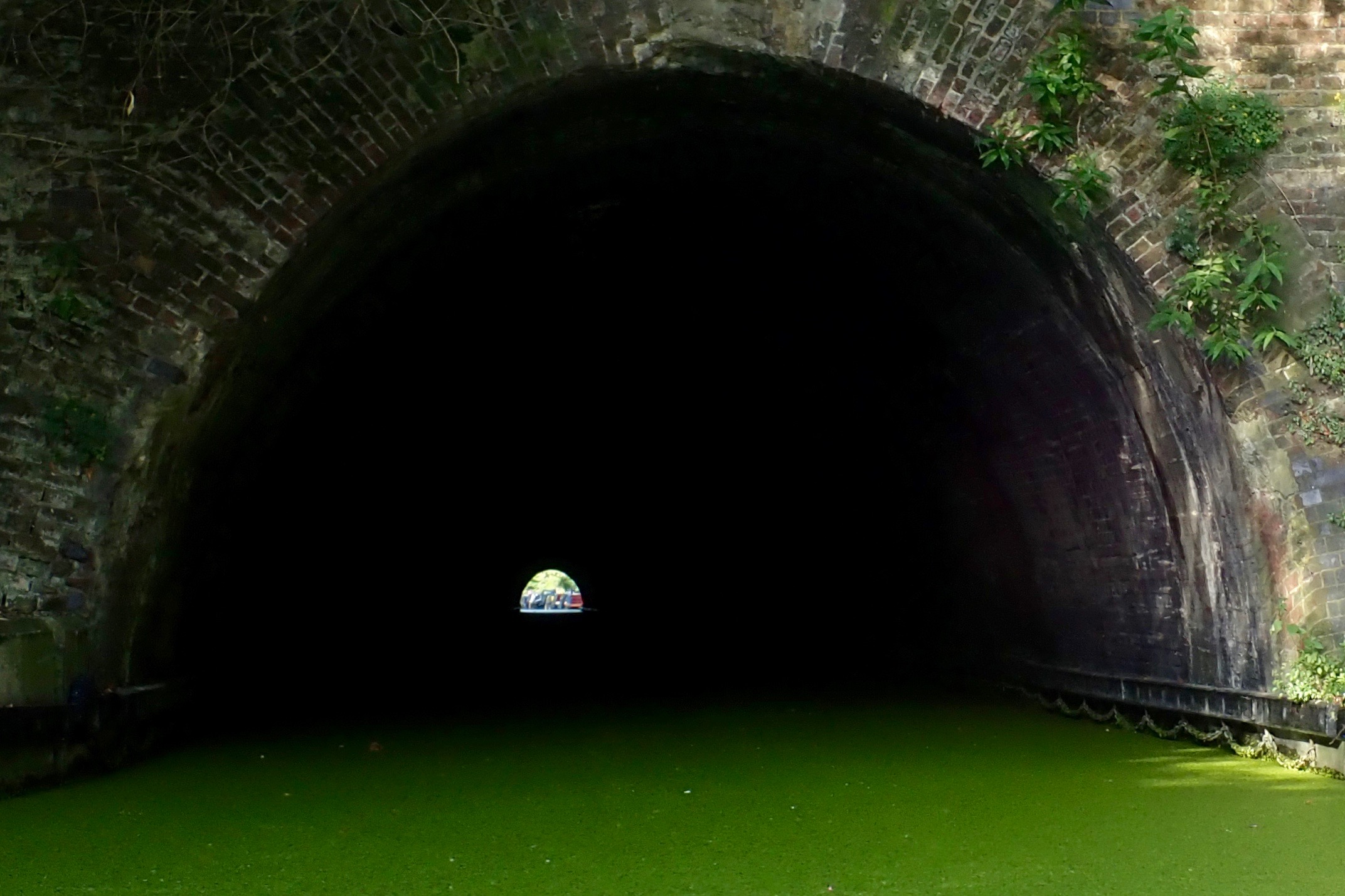
Maida Hill Tunnel Before you start assembling your boat, know that in about 5 minutes you’ll need to backtrack from and portage around the 250-metre-long Maida Hill Tunnel which is closed to ‘non-powered craft’. And it’s not a quick 250-m hop-around either. Because of a private towpath along Blomfield Road, and closures for repairs, currently it’s nearly a mile before you re-access the water below the Casey Street footbridge east of Lisson Grove. Knowing this, you may prefer to do as I did, and walk to (or start from) Casey Street Footbridge, about half a mile north of Marylebone tube. See map below.
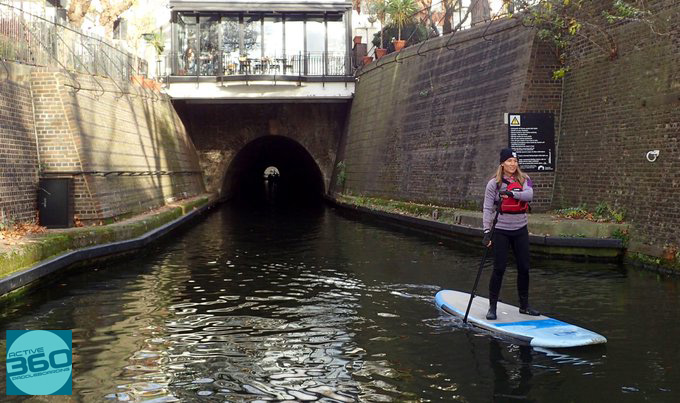
The temporary towpath closures (left) are to repair electric cables stemming from the power station at the end of Aberdeen Place at the tunnel’s eastern end. When it reopens the portage distance will halve, but that may be a while. So, you can paddle up to the western tunnel entrance from the Little Venice end (paddleboarder, below left), but you can’t get out here onto Blomfield Road because of a locked gate to the moorings. You have to backtrack to Little Venice, but it’s probably still worth it for a peep into the short if forbidden void.
In 2018 the Canal & Rivers Trust (formerly British Waterways) provisionally opened the 250-metre-longtunnel to paddle-powered craft. (Consultation document.) According to their own regs, any straight canal tunnel of less than 400m can be paddled. At Maida Hill you can clearly see the other end, anything coming at you will be silhouetted or lit, and the whole drama takes a couple of minutes to paddle, including taking pictures.
But to saves costs the tunnel is narrow and without a towpath (barges were legged through by ‘walking’ off the walls). Passing isn’t allowed or even possible, even in a slim kayak. Or a boat operator may not notice low-in-the-water kayaks, even with the mandatory headlight. Tour boats run via the tunnel daily from 10am between Camden and Little Venice.
‘Thank you for your enquiry. We do not allow kayaks through the Maida tunnel unless it is part of a special event”. Three months notice is preferred for your special event and solo transits are not allowed anyway. The website additionally warns: Non–approved unpowered craft shall not transit the tunnel eg. rafts and other types including inflatable arrangements designated for ‘fun’ use.
Clearly, they’re no more clued-up about modern IKs and packrafts than the BCU, or assume we’re all intoxicated pillocks goofing about on inflatable unicorns.
What could possibly befall a typically open and unsinkable IK, canoe, packraft or iSUP board in the tunnel? Do they assume such boats are inherently more dangerous than a beginner capsizing mid-tunnel in a tippy hardshell? Maybe the CRT has had problems with ‘inflatable arrangements’. Who knows, but I’ve also encountered this anti-inflatable prejudice on PLA media about padding the tidal Thames. I suppose it’s too much to expect these officials to know the difference between an Intex bin bag and a €3000 Grabner, but the common denominator must surely be the required BCUlicence (or a more expensive and limited pass direct from the CRT). I wouldn’t be surprised if it’s a canalised version of road-tax paying car drivers [cruise operators] vs freeloading pushbikes [kayakers]. The resentment the former feels towards the vulnerability of the latter generates irritation.
Here’s a suggestion: mount some traffic lights at each end on a 5-minute turnaround, and perhaps some low-level motion-activated illumination inside. That way the Maida Hill Tunnel could be safely and easily open to all users. Apparently, it’s currently being considered.
Long story shortened a bit, I enjoyed my exploratory walk and finally got to air-up my MRS Nomad below Casey Street footbridge looking down on the Lisson Grove Mooring (aka Marylebone Wide).
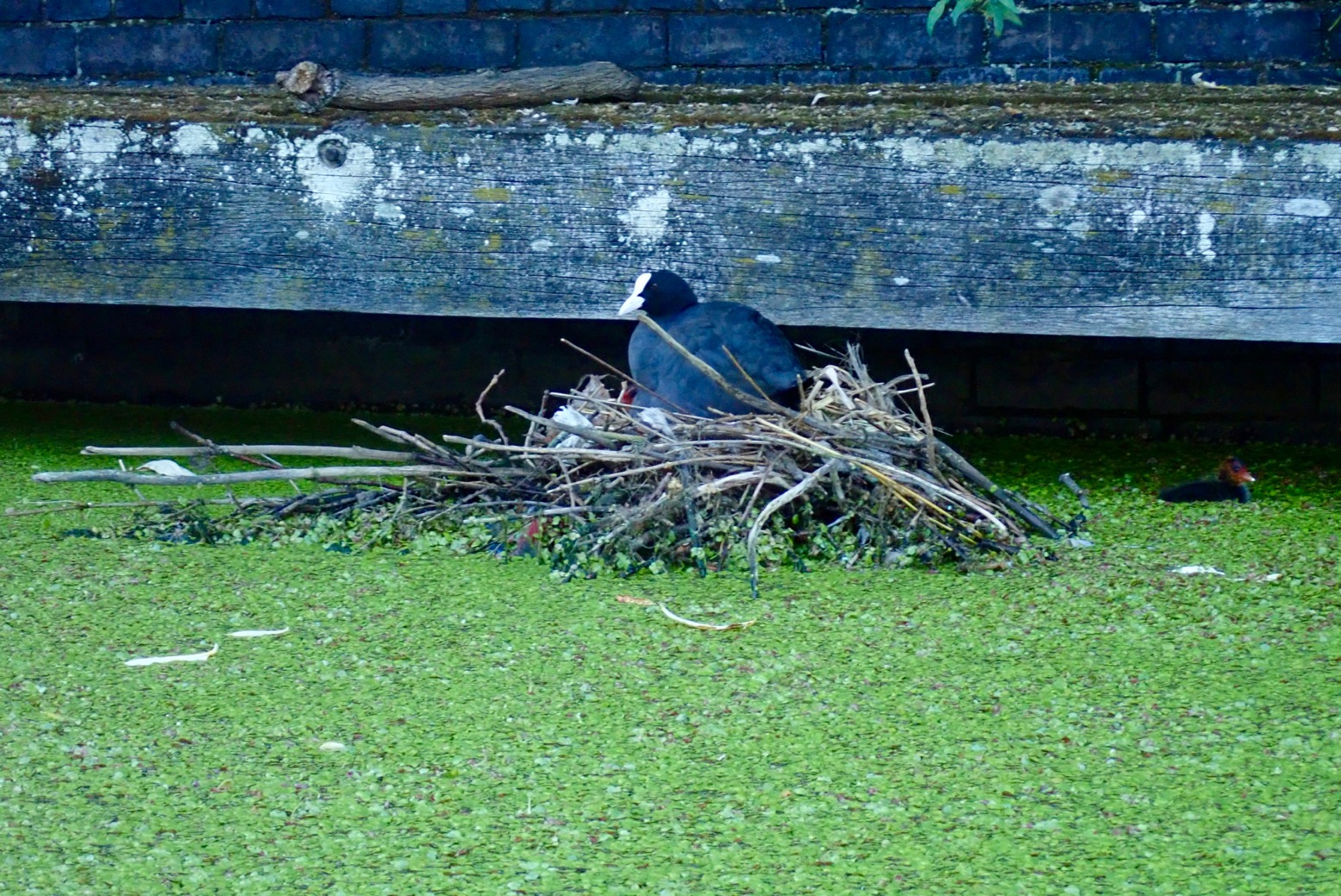
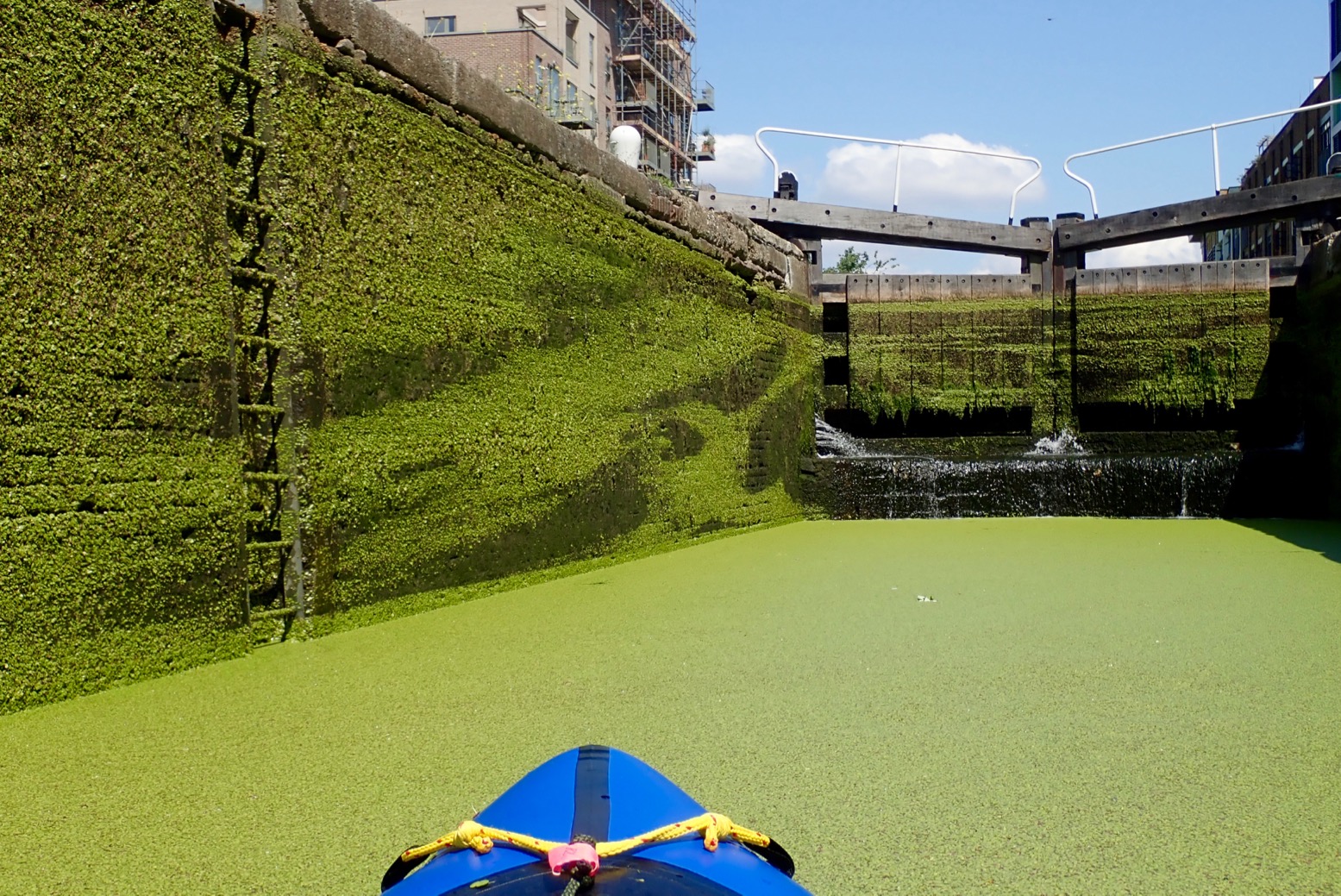
The canal surface was thick with a lush carpet of floating pennywort or, as I prefer to call it, Hydrocotyle ranunculoides. This lurid green matting covered the canal from bank to bank just about the way to Limehouse. At times it was so thick birds easily stood on it, but it didn’t noticeably impede my paddling…
… because an MRS Nomad doesn’t exactly slice through water like Poseidon’s scythe. Once on the water I paddled back west, under the Lisson Grove or Eyre’s ‘tunnel’…
… for a peek at the eastern, ‘Doctor Who’, end of the Maida Hill tunnel. It didn’t look that far or that deadly. Then I paddled back, passing nesting coots…
… and preening fowl. By 8am I was on my way to Limehouse.
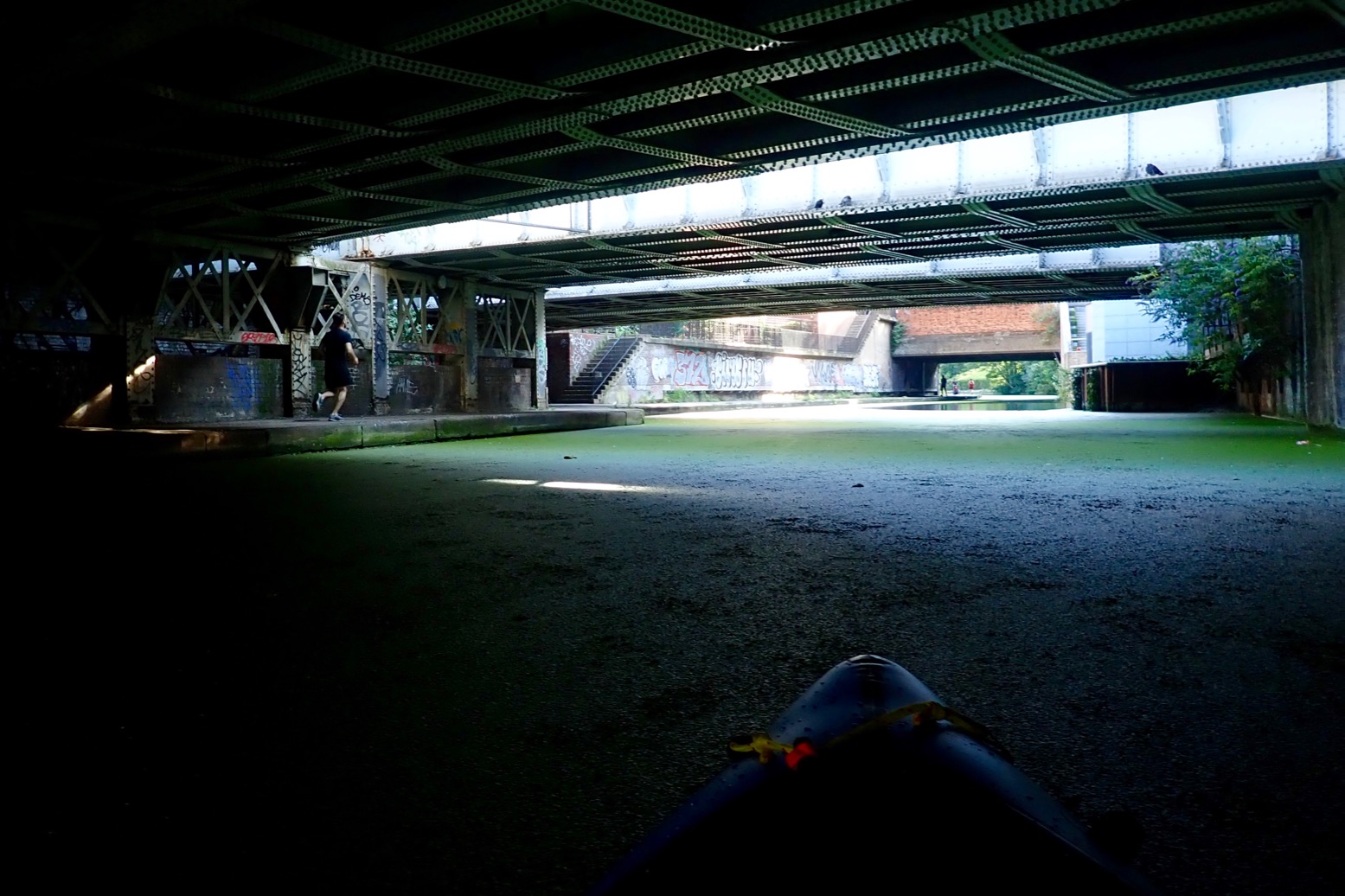
Under the Chiltern Line rail bridges and Park Road (A41).
And into the bucolic enclave of Regent’s Park, passing elegant mansions and accompanied by a phalanx of pushbikers and joggers dashing and dodging other joggers and pram-pushing nannies.
At London Zoo all was quiet. Not a squawk, a yelp or a roar.
Regents Park was built around the same time as the canal, and one reason the canal didn’t simply cut directly east from Paddington towards the City along today’s A501 Marylebone Road (called ‘New Road’ back then, blue below) is because the well-connected park developer objected under the Tudor Statutes of NIMBY. The dirty canal diggers were forced to burrow like badgers through Maida Hill before swinging off on a northerly arc, all adding hugely to the cost and completion time. Funding the canal was a real stuggle.
At now-filled in Cumberland Basin (red, above), by the famously top-heavy Chinese pagoda restaurant the canal, appropriately, takes a left turn into the borough of Camden. Soon I arrive at Camden Lock Market but it’s too early on a weekday morning for the place to be busy with beret-wearing tourists.
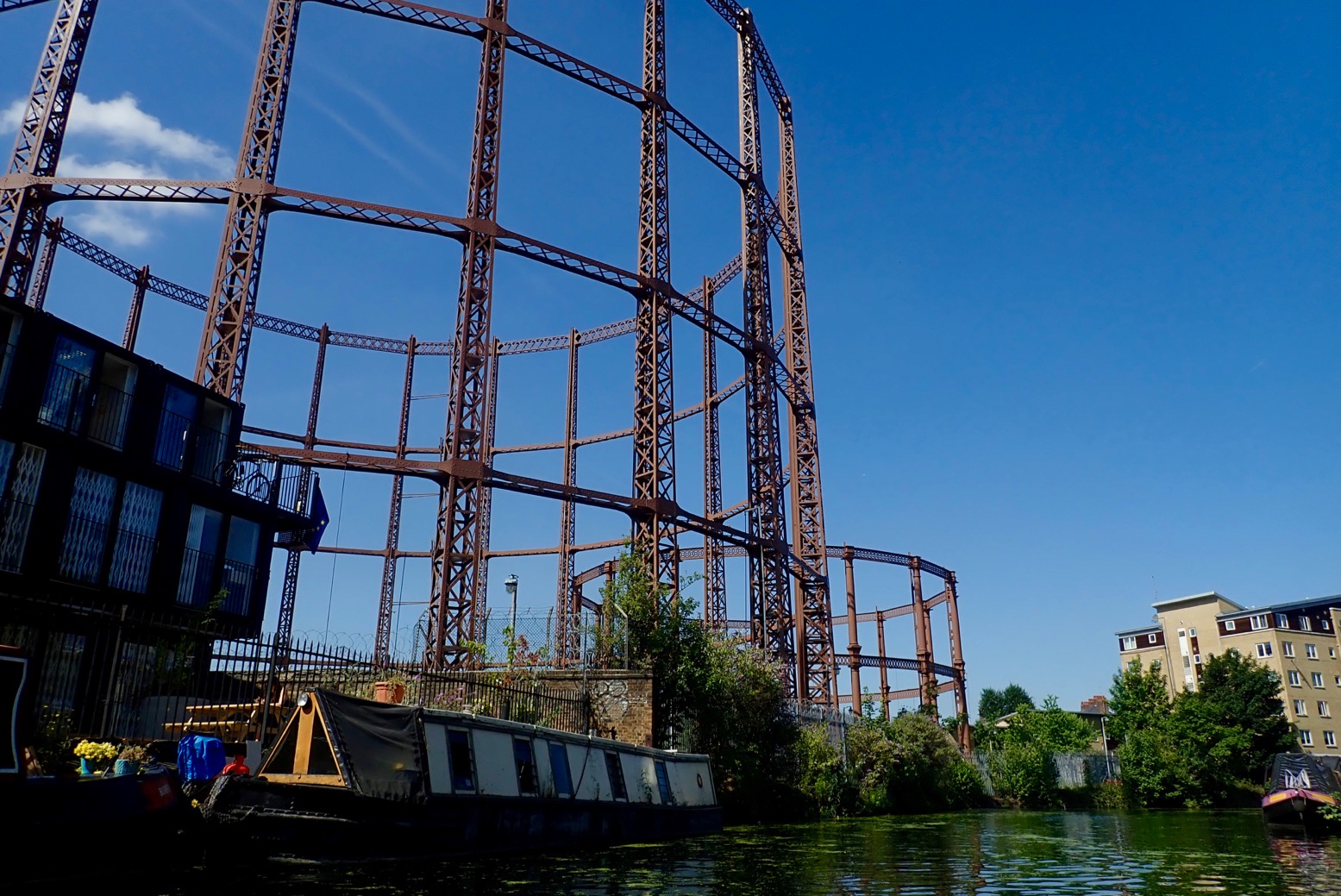
There are three locks here in less than 300 metres, so I line the boat along the bank like a Yukon voyageur. I paddle away from trendy Camden and soon pass under the deafening Eurostar rail lines at St Pancras before entering what they now call Gasholder Park. Old Kings Cross is long gone and some of the gas storage tanks have been turned into flats. Welcome to trendy Kings Cross.
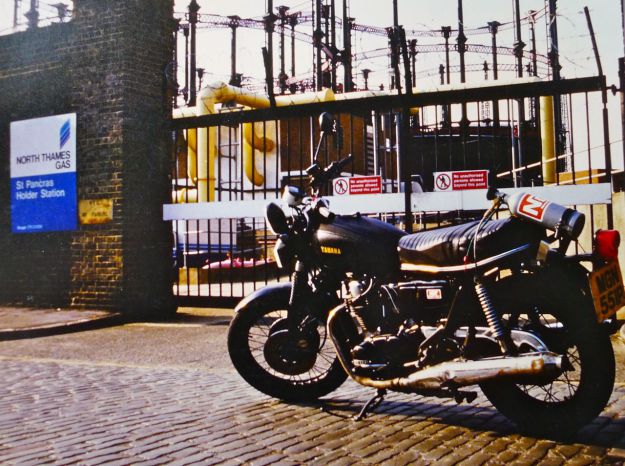
In the Eighties when I squatted near here, ‘trendy’ + ‘Kings Cross’ were not recognised combination. This was probably the seediest corner of central London and the real thing with junkies, prostitution and porno studios – a far cry from quaint, touristy Soho. One time we used the gas tanks as a backdrop for an article I’d written about a motorbike running on Nitrous Oxide or laughing gas. Fans of Mad Max will know about that. Mike Leigh’s High Hopes (1988) was filmed around the corner. Funnily enough, the story was about a lefty-slacker moto messenger, his woebegone mum and some pantomime-vile yuppies. Oh happy days!
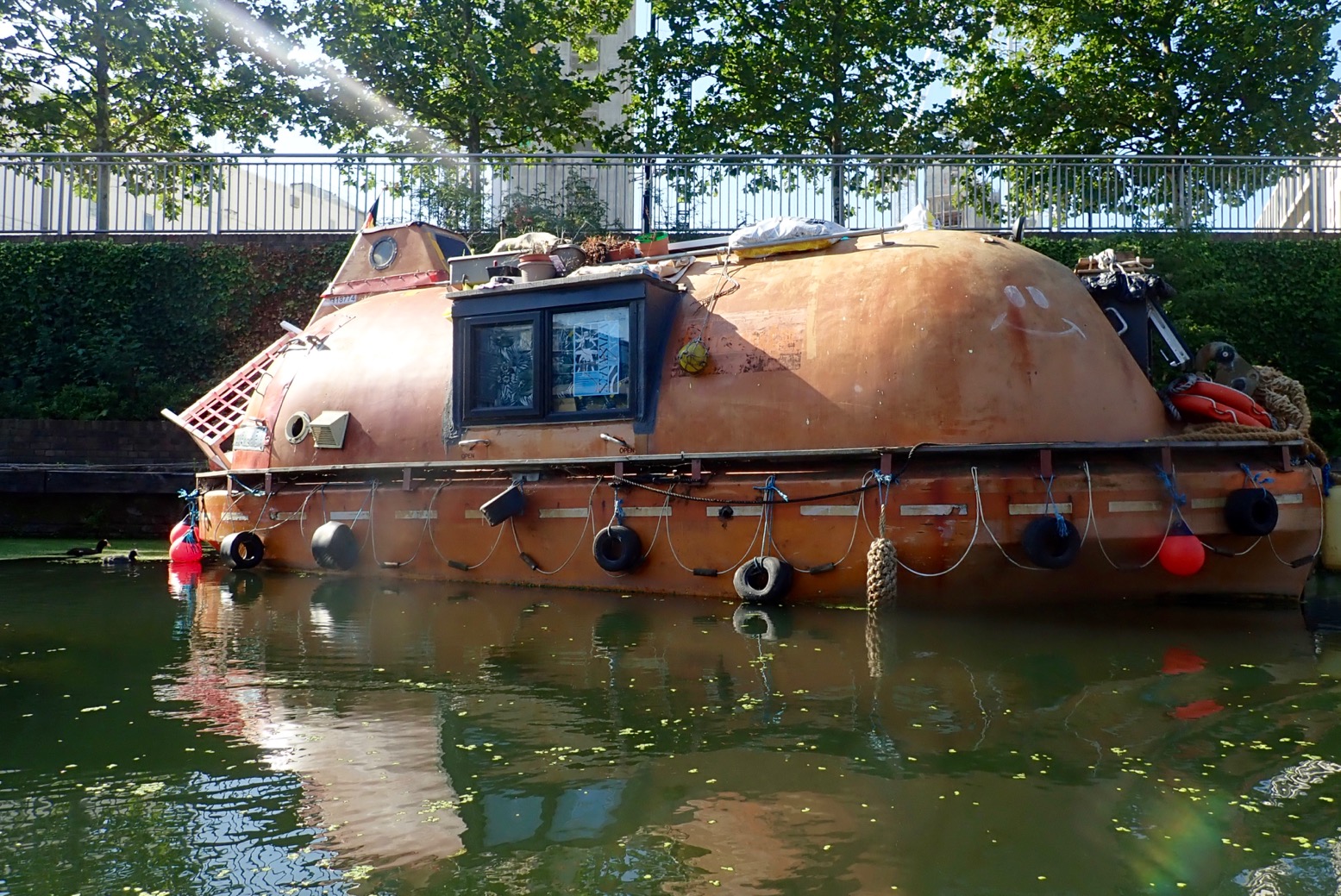
A lifeboat houseboat. No worries about rising sea level or tsunamis here.
The Word on the Water floating bookshop. I can’t quite square where I am with what lies around. I think back in my day it was all once a huge goods yard behind high walls. I swing into Battlebridge Basin but the museum isn’t open yet.
Up ahead is the 880-metre-long, Islington Tunnel. Again, as straight as a broomstick but closed to hand-powered boaters for similar reasons as Maida Hill. I was kind of hoping a barge might rock up and let me hook on for a lift, but the only things I’ve seen on the water are wildfowl, plastic bottles and Spirodelapolyrhiza. The museum organises boat tours through the tunnel two days a week. Maybe they’d agree to some slipstreaming.
I read that the portage follows helpful plaques set in the pavement. Cross the A1, Upper Street and head for Duncan St. It’s about a kilometre and would be somewhat of an arseache in a hardshell. Either way, I emerge at the eastern portal…
… and in need of a waterside snack at City Road Lock. It’s only 9.30.
By 10am I’m refreshed and on the move again. I put back in below the lock with a plop.
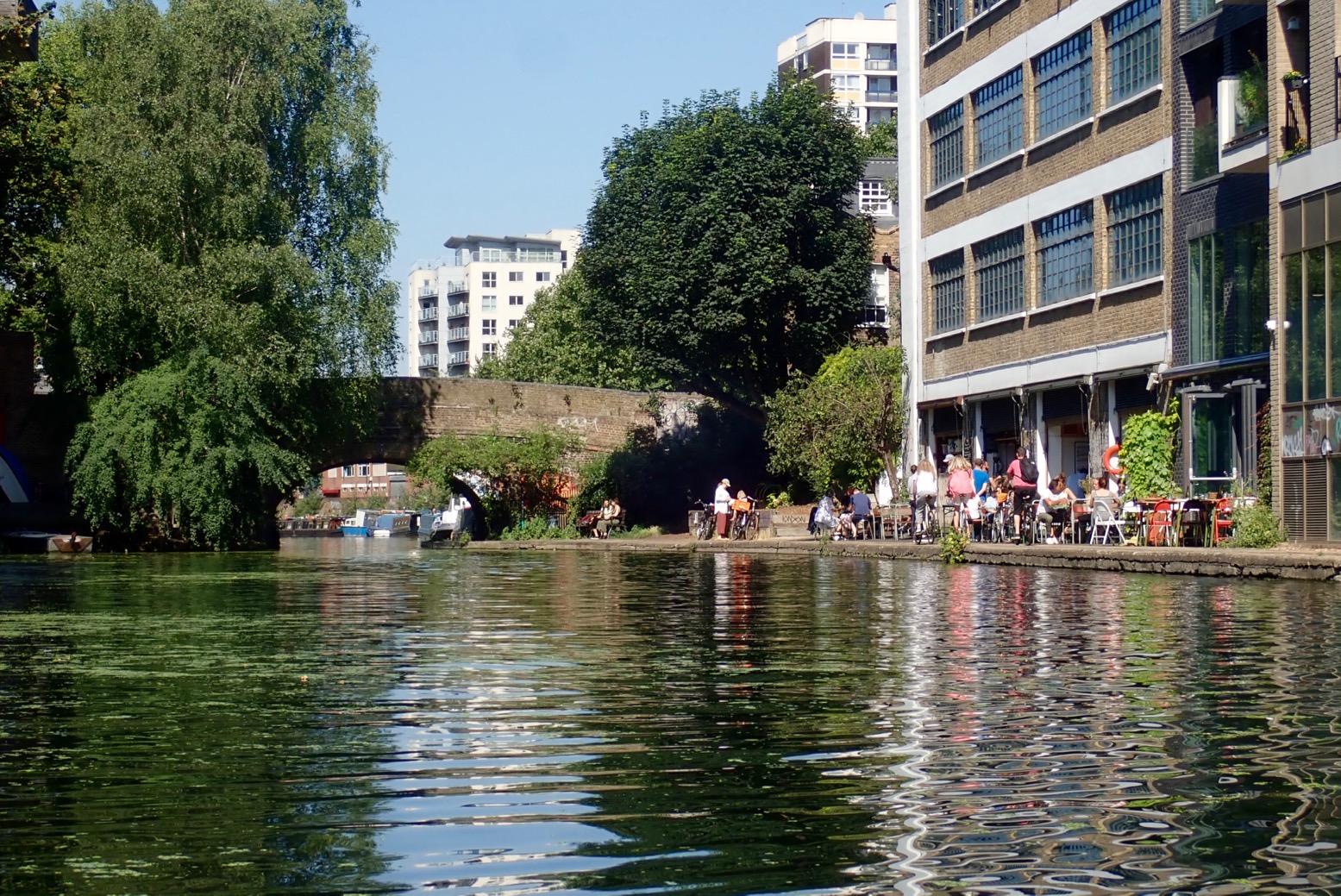
The canal turns north into Haggerston where, just after the Whitmore Road bridge, there’s a handy knot of cafes on the left. A better choice than City Lock if you want more than coffee and cake. It’s all yummy mummies round here, not the snarling, bottle-throwing punks I’d feared.
Kingsland Basin to the north, with a somewhat baffling kayak slalom course. Soon you pass under the Kingsland Road bridge, edging ever closer to south Hackney. or ‘Acne’ as some call it.
The canal is actually about 4 feet deep. near here I can see traffic cones and other junk on the bottom. But a prod with the paddle reveals two centuries of anaerobic silt, so don’t expect to be able to stand if you fall in.
A populist ambush. These Eastenders are such wags.
Swan narcissus. There’s a fairy tale in there somewhere, a swan that fell in love with its image and was turned into an ugly duckling.
Another trickling spillway below a lock. I’ve lost track where.
Nosferatu guarding someone’s tent. Sure beats a shopfront on the Strand.
More gas holders near Cambridge Heath Road. You always find them near canals as the huge tanks need to float on water.
They’re actually like an upside-down cup resting buoyant on water and are as much about producing an even pressure as storage. Gas from a nearby factory is pumped in to the cavity above the water depending on demand, and the weight of the lid keeps the low pressure steady as it’s released out into the network (in an era before regulators).
New graffiti; 28-speed revolutions.
It’s that Nosferatu again. You just can’t get rid of him.
I’m approaching Victoria Park near Bethnal Green or South Hackney, it’s hard to tell. The precise name of your neighbourhood is very important to Londonders.
By Old Ford Lock (named after a car they dredged out of the canal in 1981) are the first canalside public toilets I’ve seen. Good to know. A nutty, bin-rummaging vagabond in a top hat has a quick chat and warns me of heavy weed ahead.
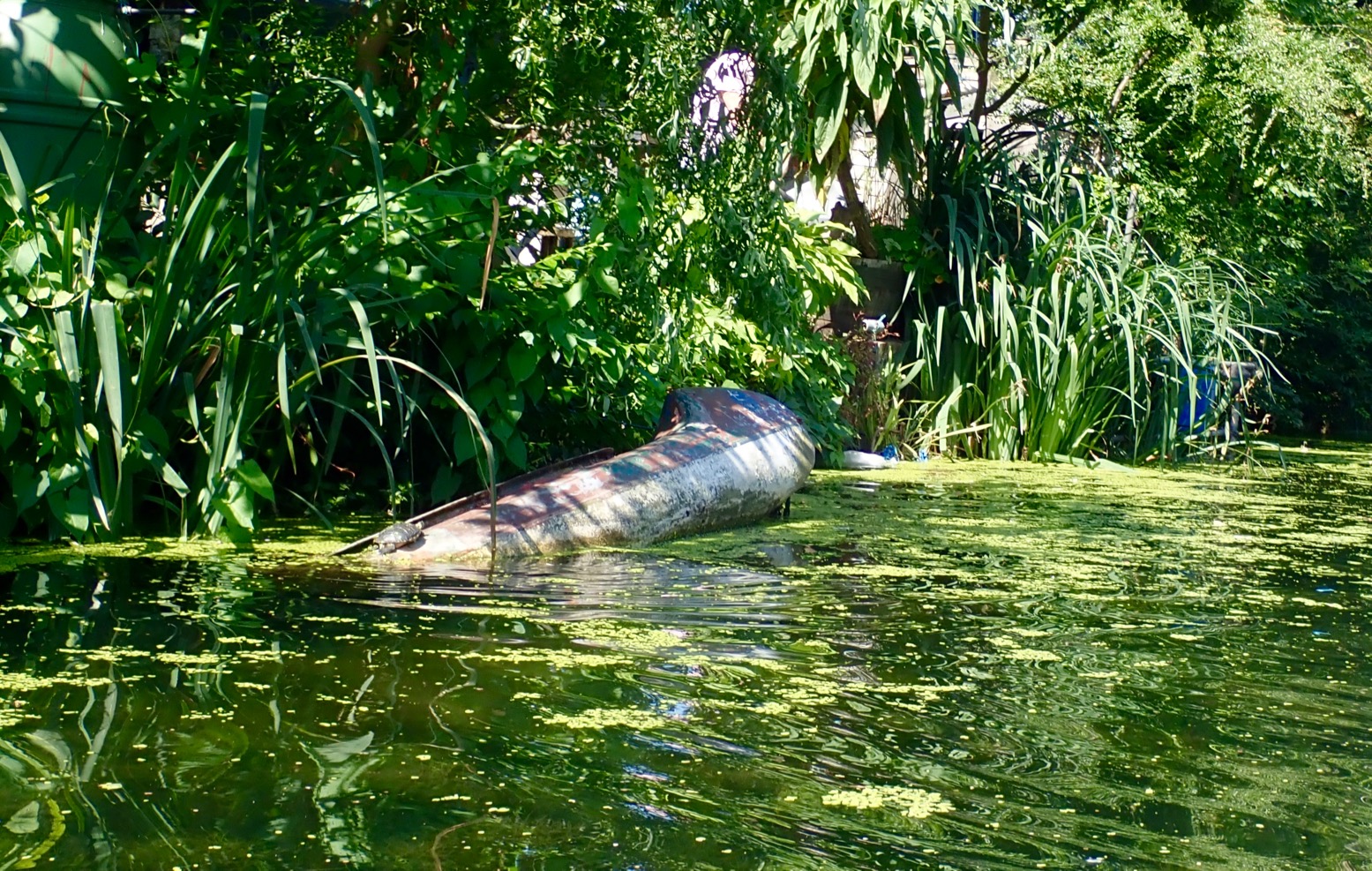
Is that a real turtle on the sunken kayak or a rubbery Hacknean joke?
On the left the Hereford Union which leads two clicks up to the Olympic Park and the River Lee Navigation. We’ll be exploring there shortly.
More of yer Acne ‘umour? Someone report these ratbags to the CRT, pronto! You won’t see such frivolity in la-di-da Little Venice.
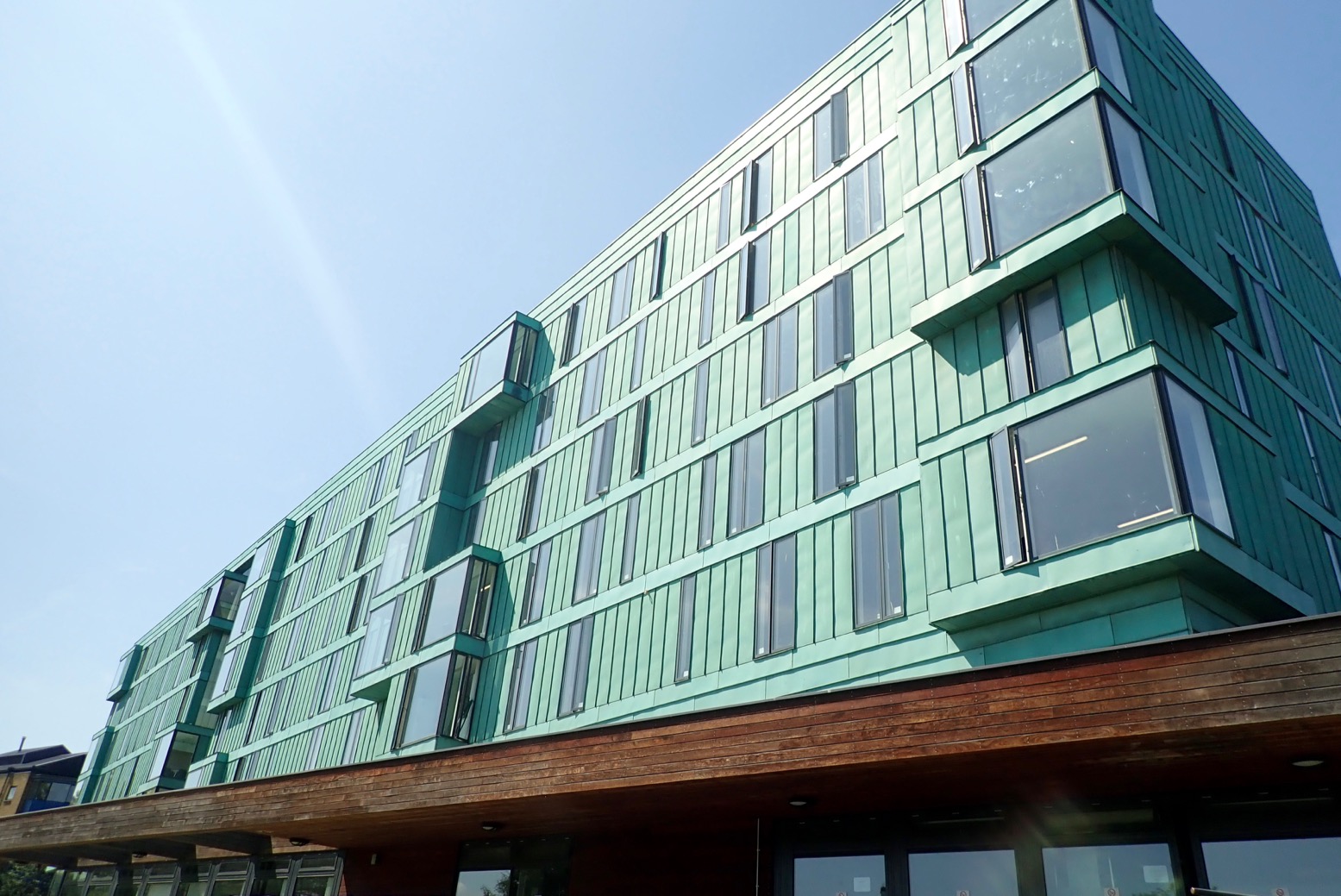
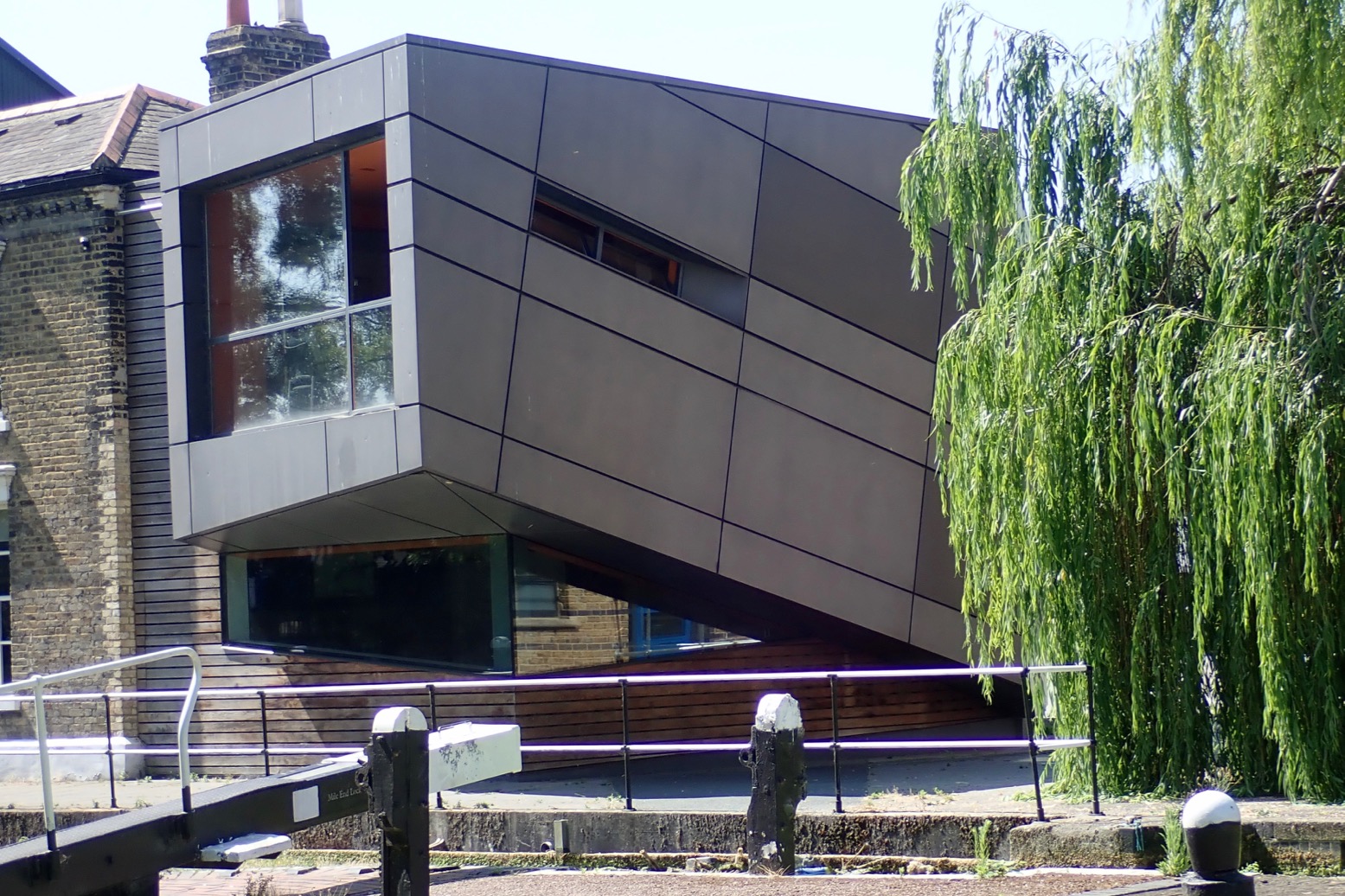
Architecture-spotting: new, old, industrial, domestic, elegant, ugly – is all part of the fun on the Regents.
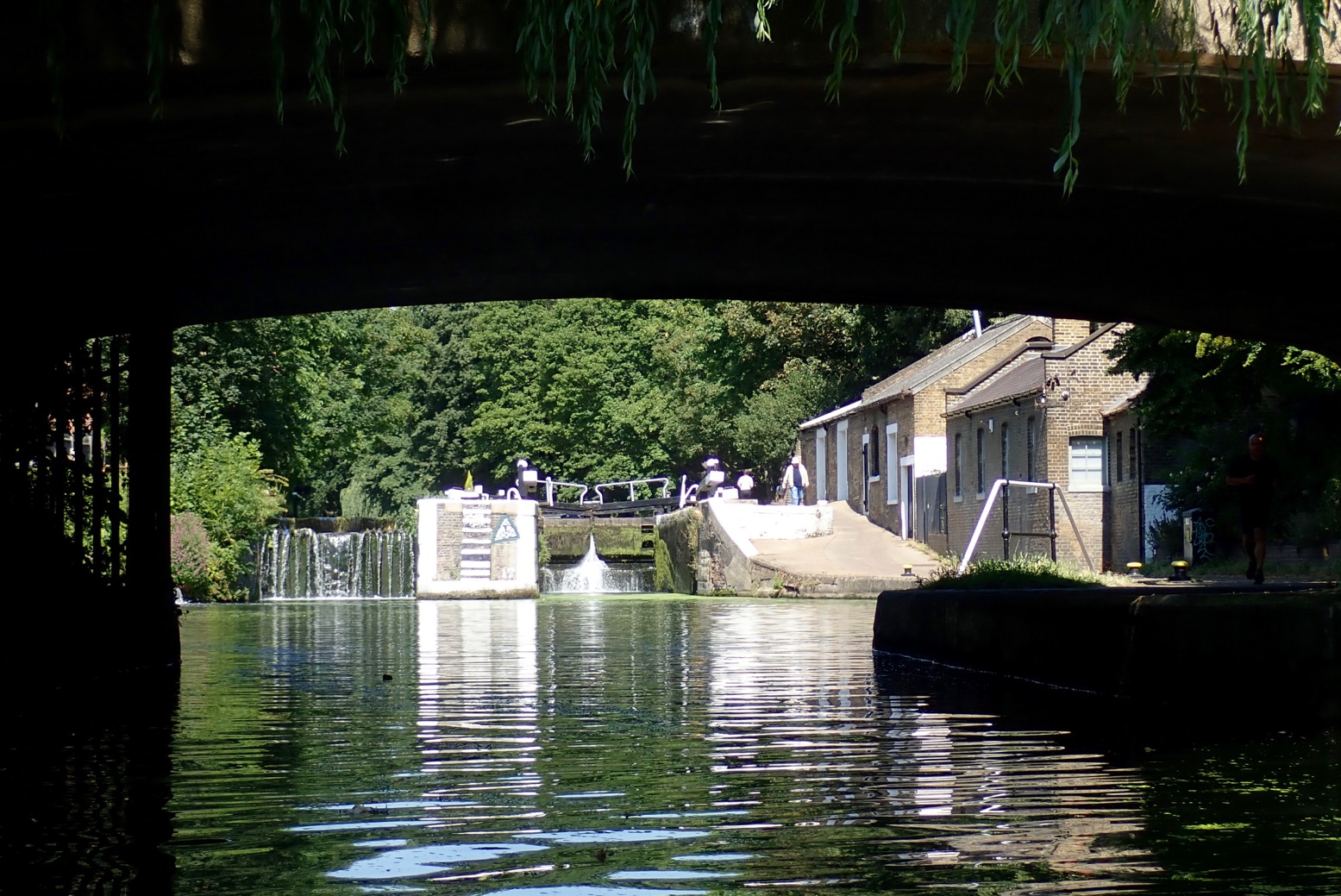
I probe a weed-clad lock. Locks are creepy places.
Canary Wharf ahead – the former Docklands of London which was the Regents’ very raison d’etre.
And here we are at Limehouse Basin and the first actual moving boat I’ve seen since Paddington.
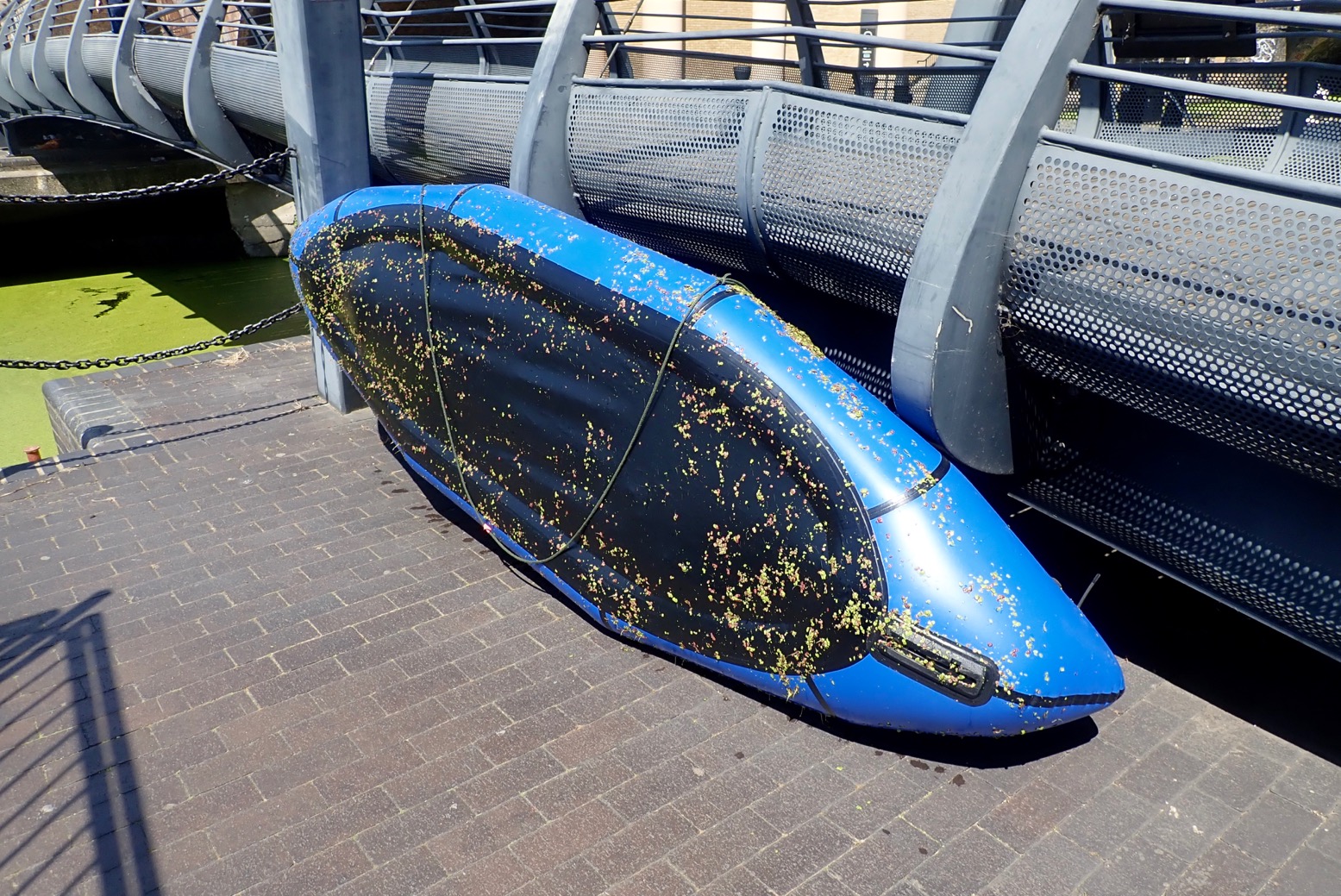
A lot of weed to clean off.
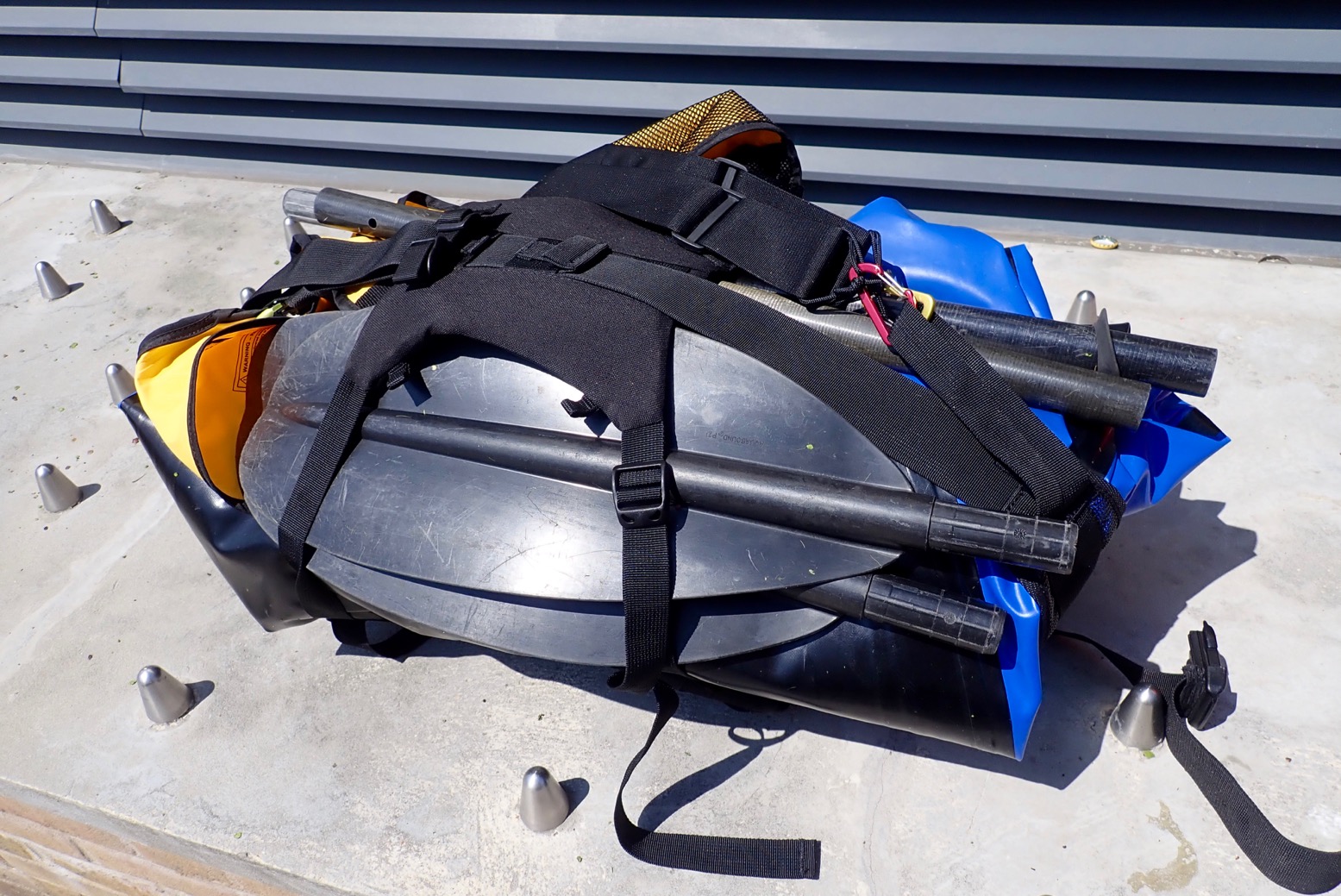
All wiped down and rolled up.
I set off to walk upstream along the Thames for a bit.
The river looks really quite choppy and a strong spring tide shoves an abandoned kayak upstream towards Wapping.
Bored [sic] as a coot? Not on the Regents Canal!
Thanks for reading.
Want to head back and beyond. Watch this series of vids from The Londonistas
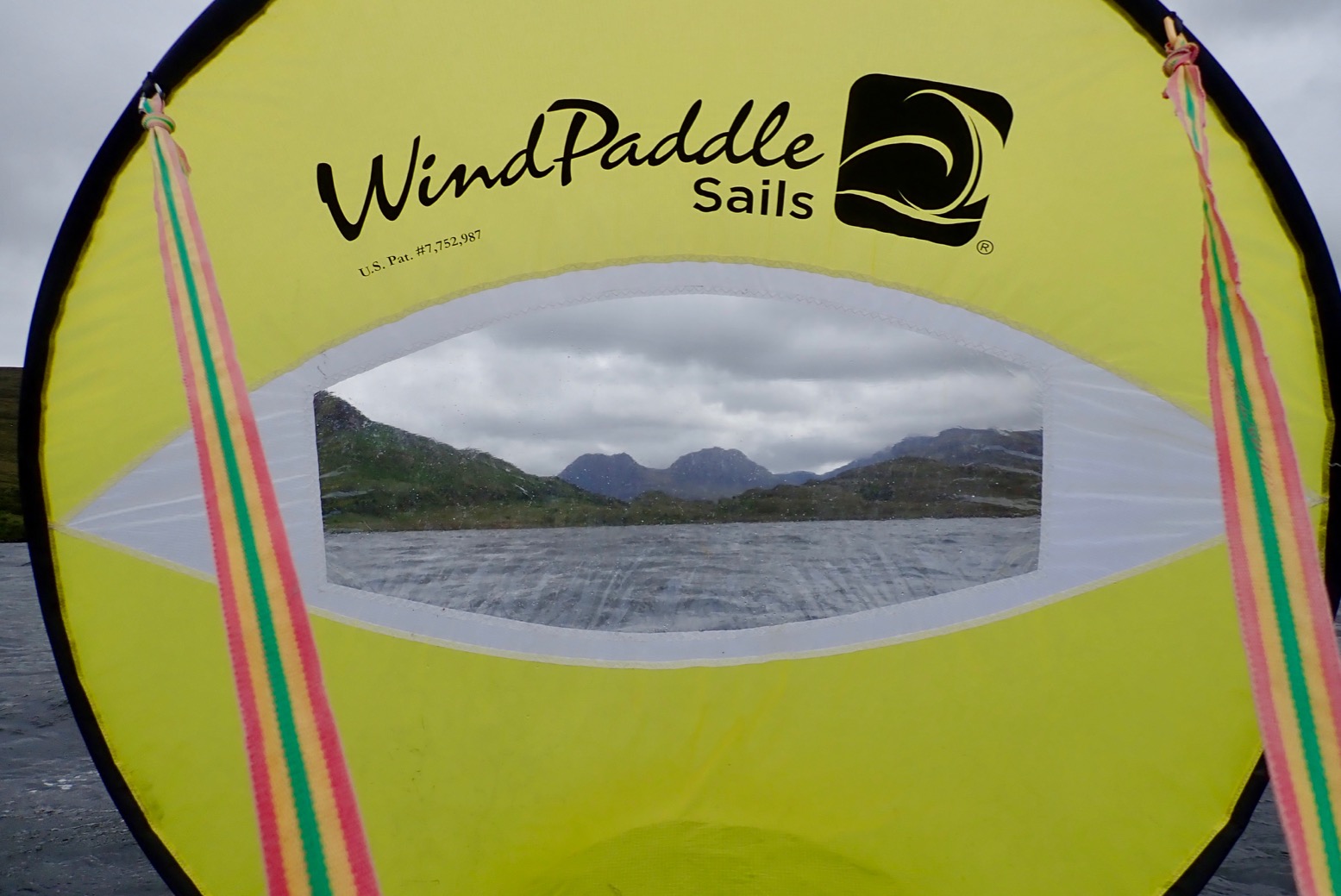
In 2021 WindPaddle.com stopped trading. But Anfibio now make the very similar PackSail for just €119.
WindPaddle Adventure II Weight: 385g (+ 45g ‘reins’ with 2 mini carabiners) Folded 3 times: (takes a knack) 40 x 45cm ø Folded twice: (easier/quicker on the water) 60cm ø Open: 116cm ø
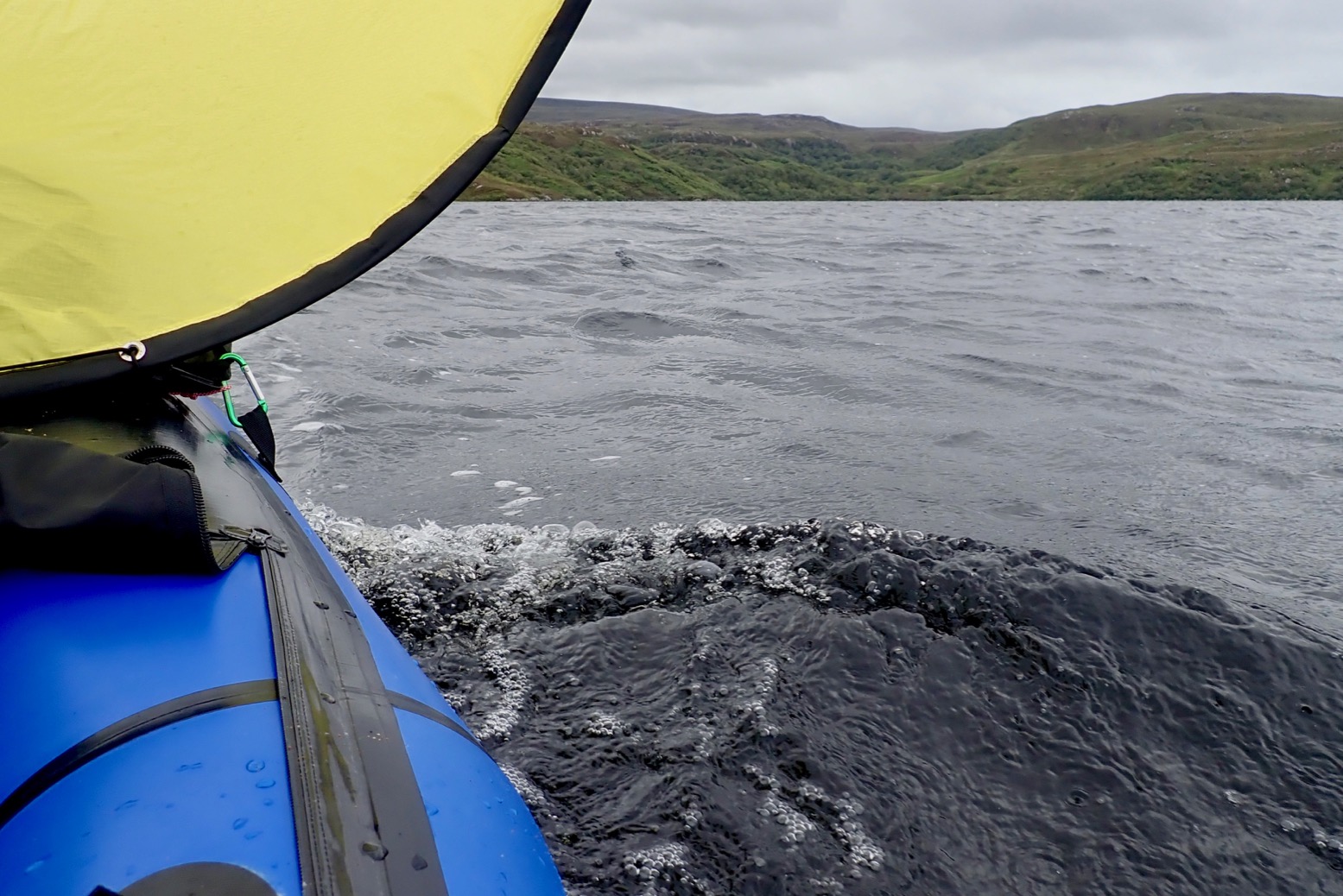
I’ve been waiting for the right kind of wind to have a proper go at WindPaddling my MRS Nomad. Sunday was not that day with SW gusts up to 25mph. Yesterday was more like it: direct from the west at 10-15 meant a chance to run down the full length of Loch Ossian with the wind erring towards the road for the walk back or if it all went wrong.
You forget that starting at the upwind end all is relatively smooth and calm, but soon the fetch kicks up and stays that way. Progress gets a bit lively so you need to be on top of things which includes stashing the paddle safely. I found tucking it across the boat under some red sidelines (left) worked well and are more often useful for manhandling the boat. Lunging after a lost paddle would be bad; so would letting go of the sail’s ‘reins’ and having the boat run over it. The sudden drag and deceleration might see the racing boat slew sideways and flip you out. And before you come up for air your packraft is skimming across the loch like a crisp packet.
I don’t know if gusts vary in direction but you also need to constantly modulate the reins left to right to keep on course. It’s said downwind sails like the WindPaddle have a narrow windspeed window which tops out around 15mph. After that, they start fluttering left to right in an effort to shed the load, as mine did a couple of times. Going out in stronger winds may be too hard to handle or very exciting. As it is, the maximum hull speed of a packraft must be less than half that and, just as a cyclist’s energy to overcome wind drag grows exponentially with speed, so to you can only push a paddle boat so far. A packraft is about as hydrodynamic as a training shoe.
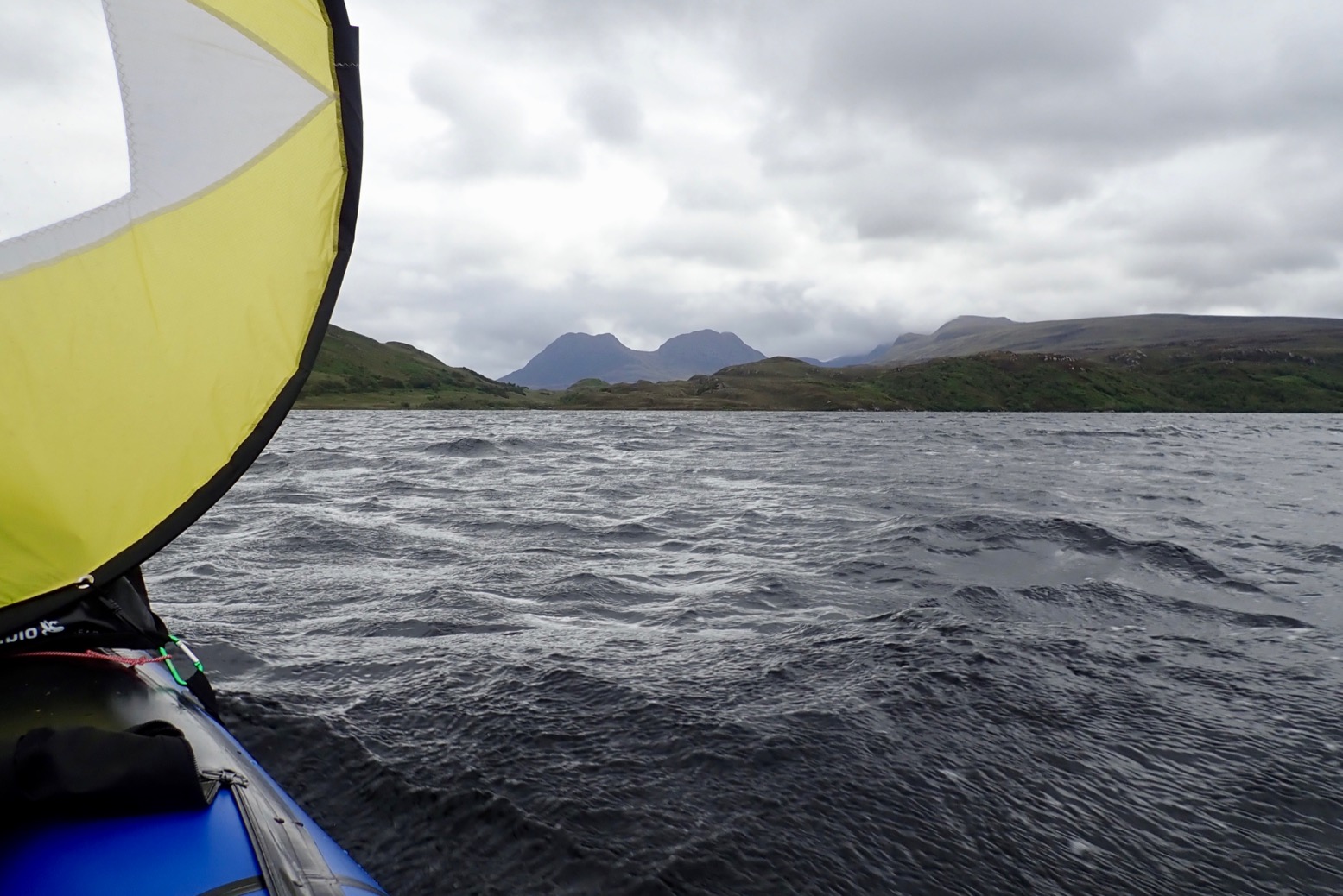
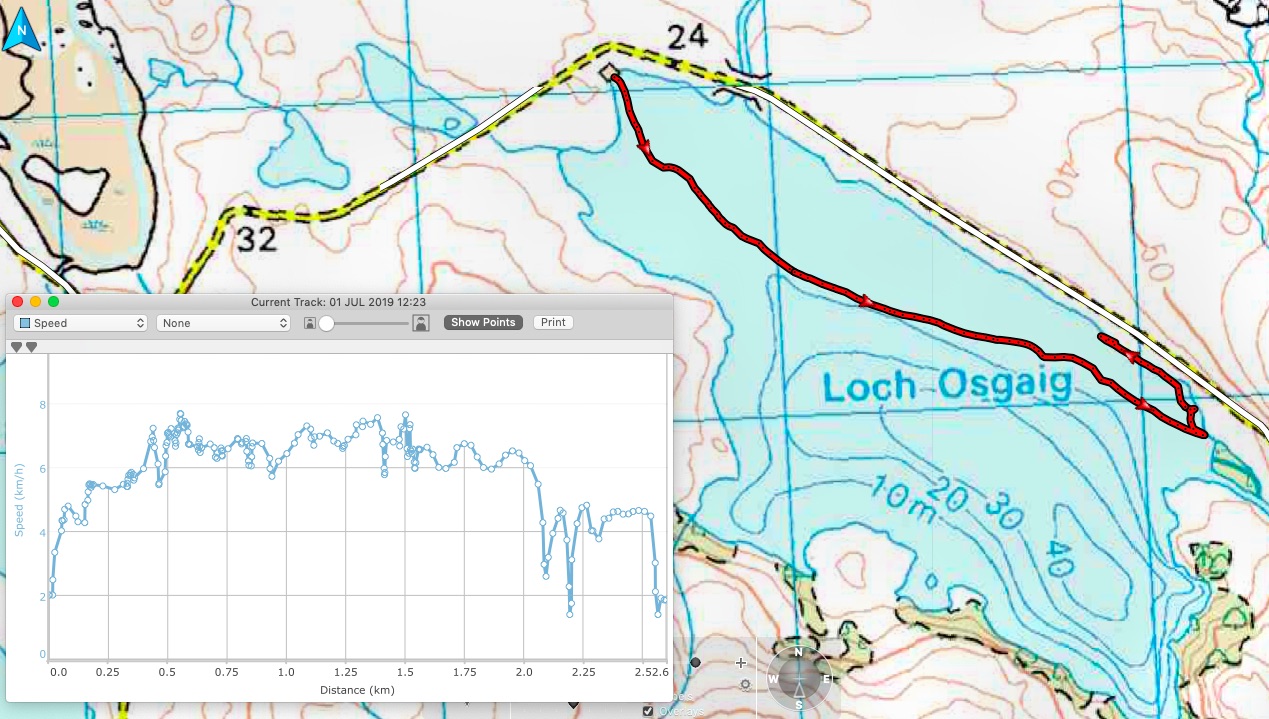
With the gloomy skies I was initially a bit nervous. Controlled by the wind and without a paddle in your hands felt disconcerting; a sunny tropical locale would have fixed that I’m sure. As usual with packboat sailing, it’s never just sit back and skim along like yachts seem to do; you have to keep correcting. At nearly 3m with the skeg fitted, the MRS is longish which must help keep it on line. And as mentioned before, with the WindPaddle you can steer at least 30° off the wind. According to the GPS, 9.3kph (5.8mph) was the peak speed, though most of the time I was zipping along at about 7.5kph. It felt faster as wavelettes broke to either side and occasionally over the bow. With the big Corry paddle, at maximum paddle exertion on flatwater I can hit 6kph for a couple of seconds. So once you relax, sailing can be a fast and energy-saving way of covering distance, and the WP folded up and stashed easily under the DeckPack.
I was expecting to walk back but gave paddling a go and stuck with it, hackling along at 2kph with rests every 10 minutes. Fifteen minutes sailing downwind = a 50-minute paddle back. I still think for the price, weight, bulk and ease of fitting and use, a WindPaddle is a worthwhile packboating accessory.
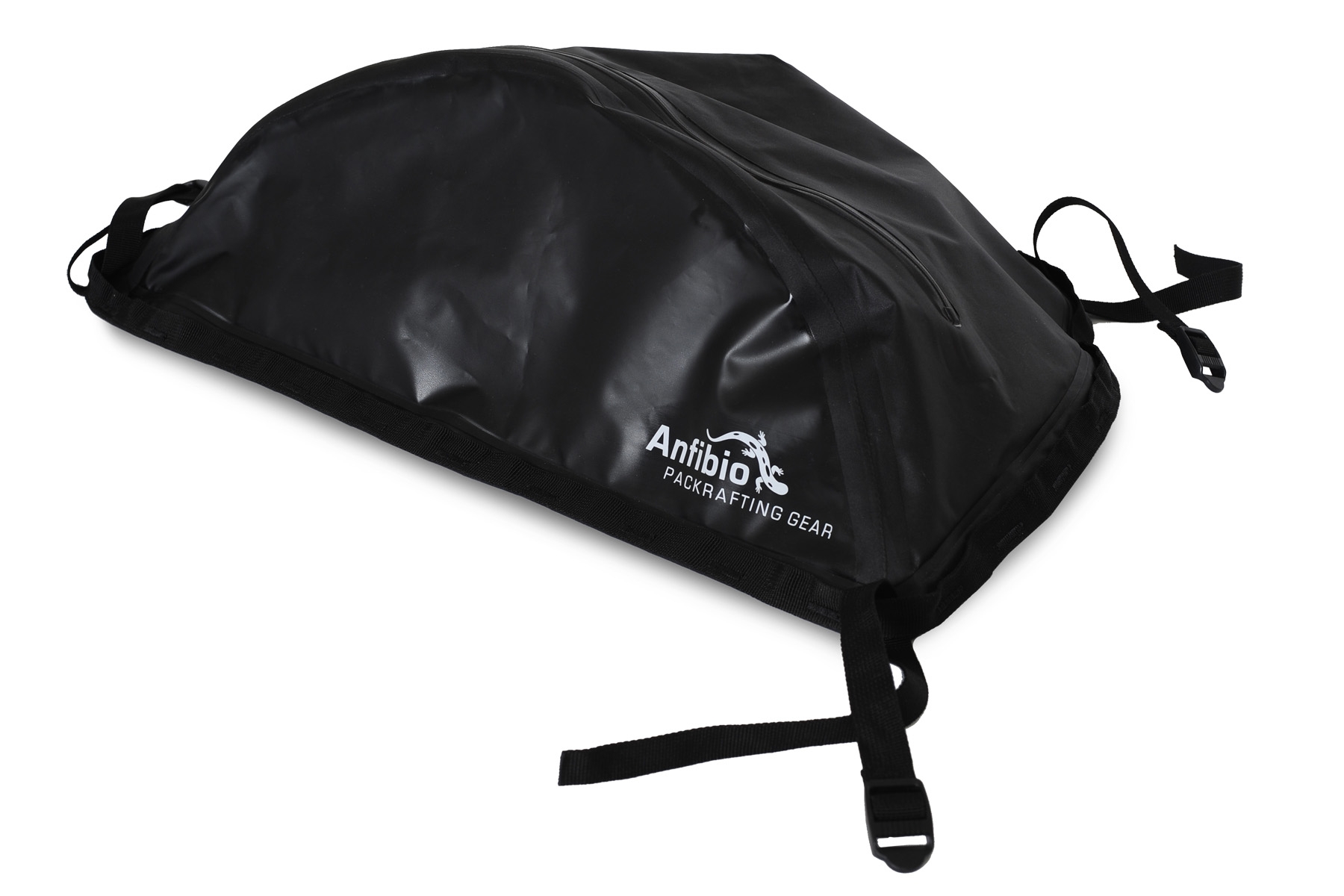
Weight, Size & Volume Bag: 224g; straps 11g each (verified) 59cm wide, 43 cm long and ~15 high when full. Volume: 22 litres.
Where tested Northwest Scotland, Medway, Knoydart, Jurassic Coast
• Waterproof construction including IPX7 zip • Light • Variety of attachment options, providing you have the mounts • Four 58-cm straps included • Works great on the trail as a shoulder bag too • Handy Molle rim tapes • You can easily tuck a once-folded WindPaddle underneath or even inside
• On the bow of my Nomad was a bit of to reach; better on the Rebel 2K and TXL • Not convinced it works well as a floor bag • Won’t stay up to be a pillow • A white interior and external mesh pocket would be really good • Drop the straps and use reusable zip ties – quicker and easier
What they say Waterproof zippered packraft bow or stern bag for easily accessible essentials on the water. Fits any Packrafts (and a lot of other boats) by full perimeter daisy chain (for variable fastening). With the Anfibio DeckPack you can transport your essentials safely and securely in all conditions. Splash-sensitive valuables like a camera, keys or documents as well as emergency equipment and spare clothing are always at hand on the bow, the stern or on the floor beneath your knees. The DeckPack can also be quickly converted into a daypack for excursions on land or the use as hand luggage on your journey.
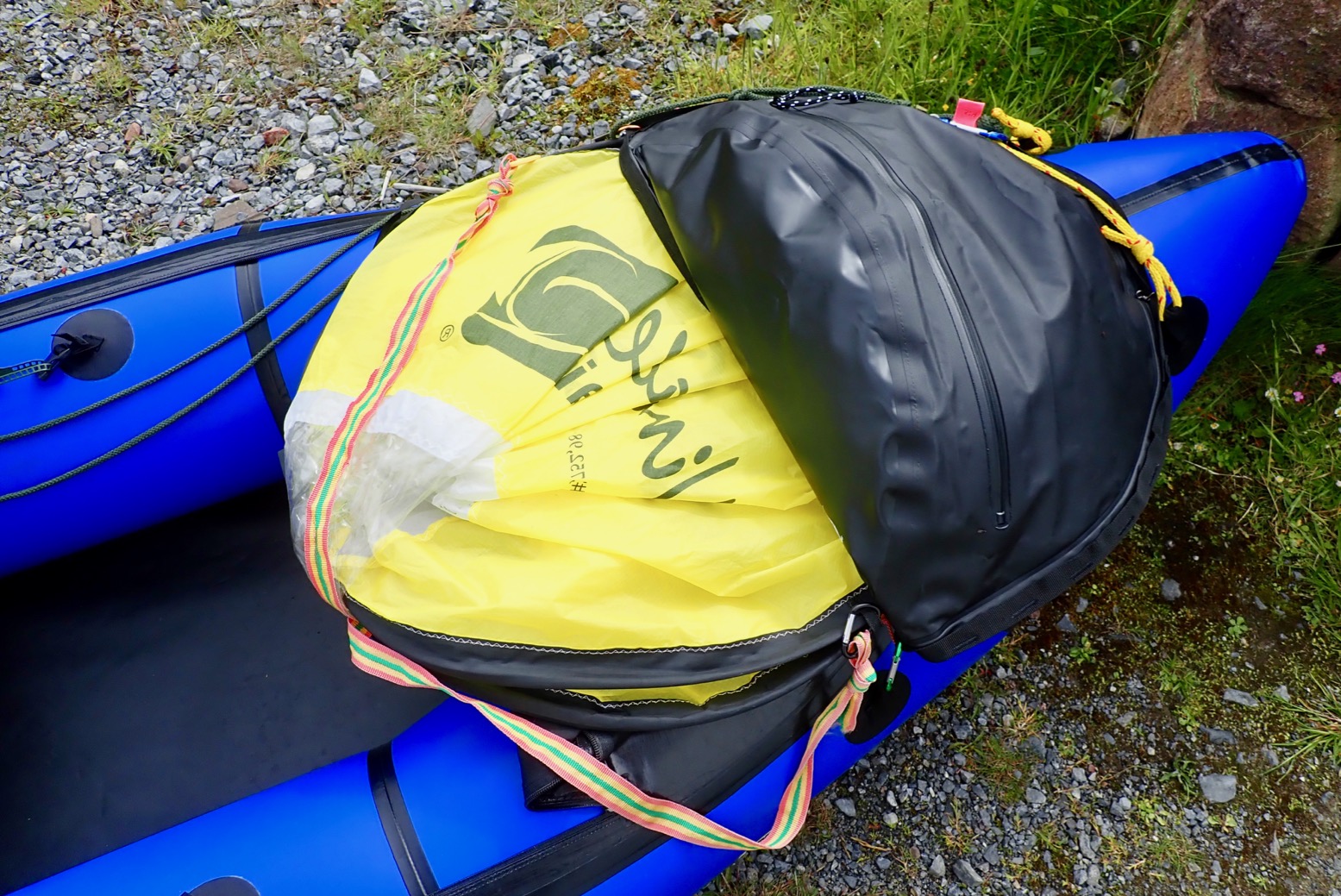
One great side benefit of a DeckPack is that a WindPaddle sail easily folds down and half tucks under the bag securely in seconds. A paddle can also tuck in under the bag securely while sailing.
Review The problem with packrafts is there’s nowhere to put your stuff other than the bag it comes in, usually a backpack. I wrote more about it here, before making my own small Pakbag.
Otherwise, I like a 20-30L holdall, like my old Watershed Chattooga, or my current Ortlieb Travel Zip (right) with a handier TiZip and mesh-zip external pockets. These bags sit accessibly, but out of the way, under my knees, and on previous packrafts attached to a tab mount glued to the floor for when you flip.
Anfibio DeckPack with added mesh outer pocket
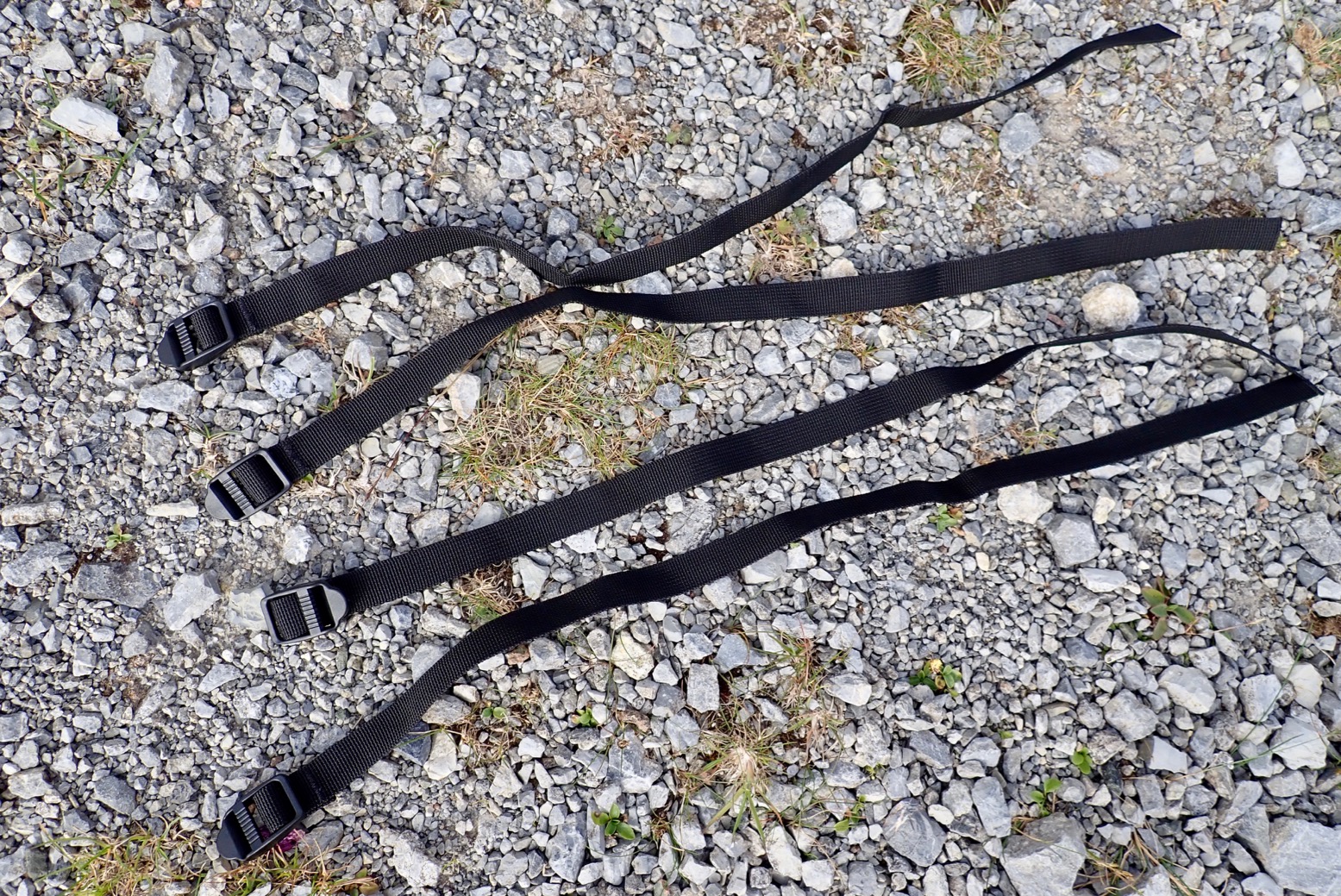
Anfibio’s DeckPack is another way of doing it. It resembles Alpacka’s larger, 24-litre Bow Bag but costs 25% less at current $/€ rates. It’s a vaguely semi-circular, PU-coated bag of around 22 litres which, unlike the Bow Bag, has a perimeter of daisy-chains (continuous attachment loops, a bit like Molle). It fits most obviously on a packraft’s bow, as this is where most packrafts have four tabs and where the weight trims the boat best. But you could as easily mount it on flatter sterns (as on my Nomad) if you already have a big backpack up front. Anfibio also suggest it can go inside on the floor too. Using the supplied straps, I’ve also used the pack as a shoulder bag while on the trail.
On my Nomad it just so happened the bow mounting tabs where just right to fit the bag without using the supplied straps. Reusable zip ties (below) are best. But mounted on the bow it was a bit of a reach on my Nomad unless I shuffled off the seat.
Too far forwardMore better
In fact there were enough hull mounts on my Nomad to position it further back (above right) using two front straps. Here it acts as a splash guard extension and was much more accessible on the water without making getting in and out too awkward.
Another very handy aspect of a DeckPack is that a mounted WindPaddle (left) or similar can be quickly folded in half and tucked under the bag out of the way when you’re setting off or need to change direction and start paddling. In strong winds this stashing of the sail is an important thing to be able to do easily and quickly; without a deck you can jam it under your knees, but with a deck the DeckPack or similar enables reliable stashing. Then, when you’re ready to sail again, you just pull out the sail and it’s up in a jiffy.
I submerged the DeckPack in the bath and, pushed underwater (ie: under some pressure) air bubbles slowly leaked out via the zip head. But Anfibio tell me:
Please note, the zipper is one-way air penetrable, that means it will release air to the outside under some pressure along the zip, not only the head, but it remains watertight. It is actually rated IPX7. Under any circumstances, it can withstand submersion.
Without pressure, there may be no leakage and so the DeckPack doubles as a secondary buoyancy aid – always reassuring on single-chamber packrafts.
Once I realised it would work well on the IK, I ended up liking the Anfibio DeckPack a bit more than I expected, but here are a couple of suggestions: • Drop the price and make the straps (right) optional. Most paddlers will have their own mounting means or ideas. I use four reusable zip ties.
• A curved, meshed exterior zip pocket would be really handy for knick-knacks or having a GPS in a readable position. Or, run a line of daily-chains alongside the main zip, so you can DIY a mesh pocket to the outside without interfering with the main zip or bodging as I have done (left). It would make the DeckPack even more versatile and save over-working the waterproof zip to access stuff while on the water.
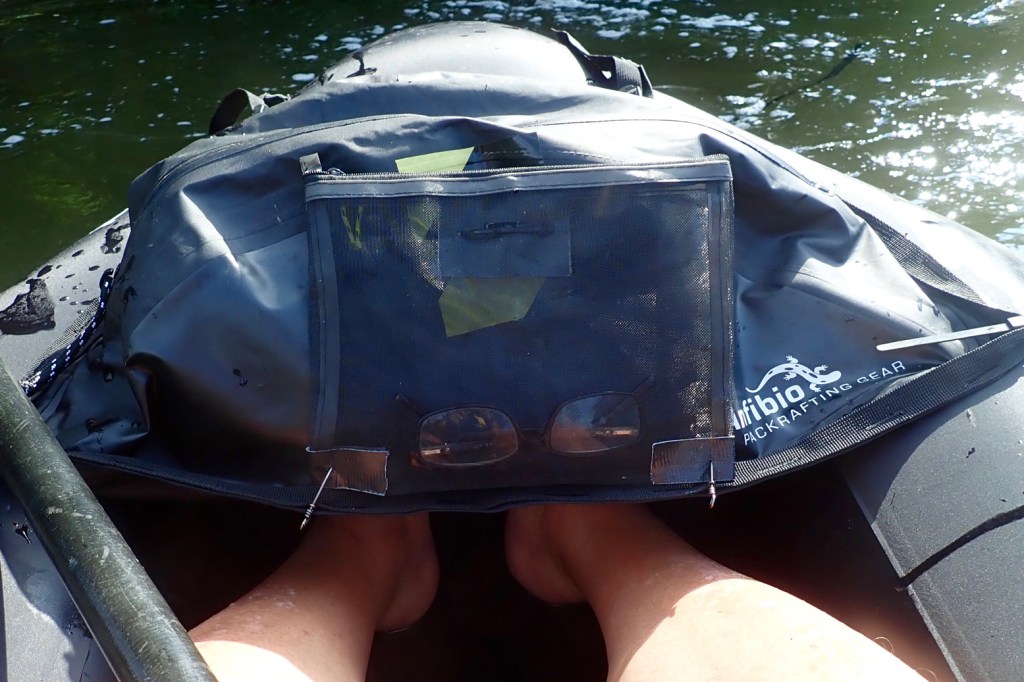
MYO Seatback Mesh Pouch As mentioned above, zipped mesh pouches on exterior surfaces are dead handy. You can put stuff in them, they drain or dry fast and they enable handy access without digging into a main bag. It’s one of the things I like on my Ortlieb Travel Zip.
On eBay I found 9″ x 7″ zip mesh pouches for makeup at about 3 quid each and quite well made. I zip-tied one around the side hem to the buckles on the back of my packraft’s foam backrest (above and below). It’s a handy place to stash the inflation bag, some cord, snaplinks, zip ties and the top-up adapter for my K-Pump. I even fitted one to my Anfibio DeckPack.
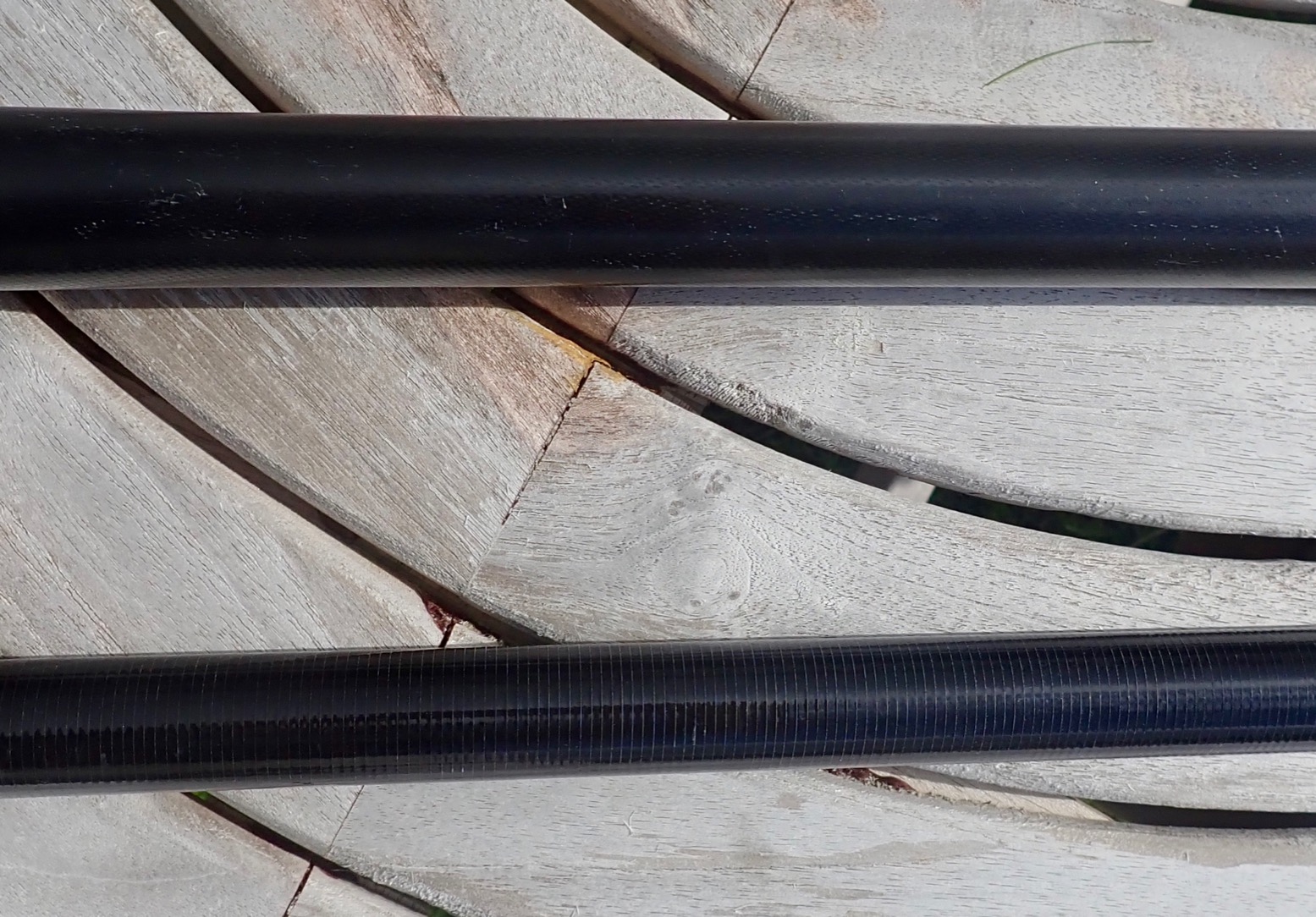
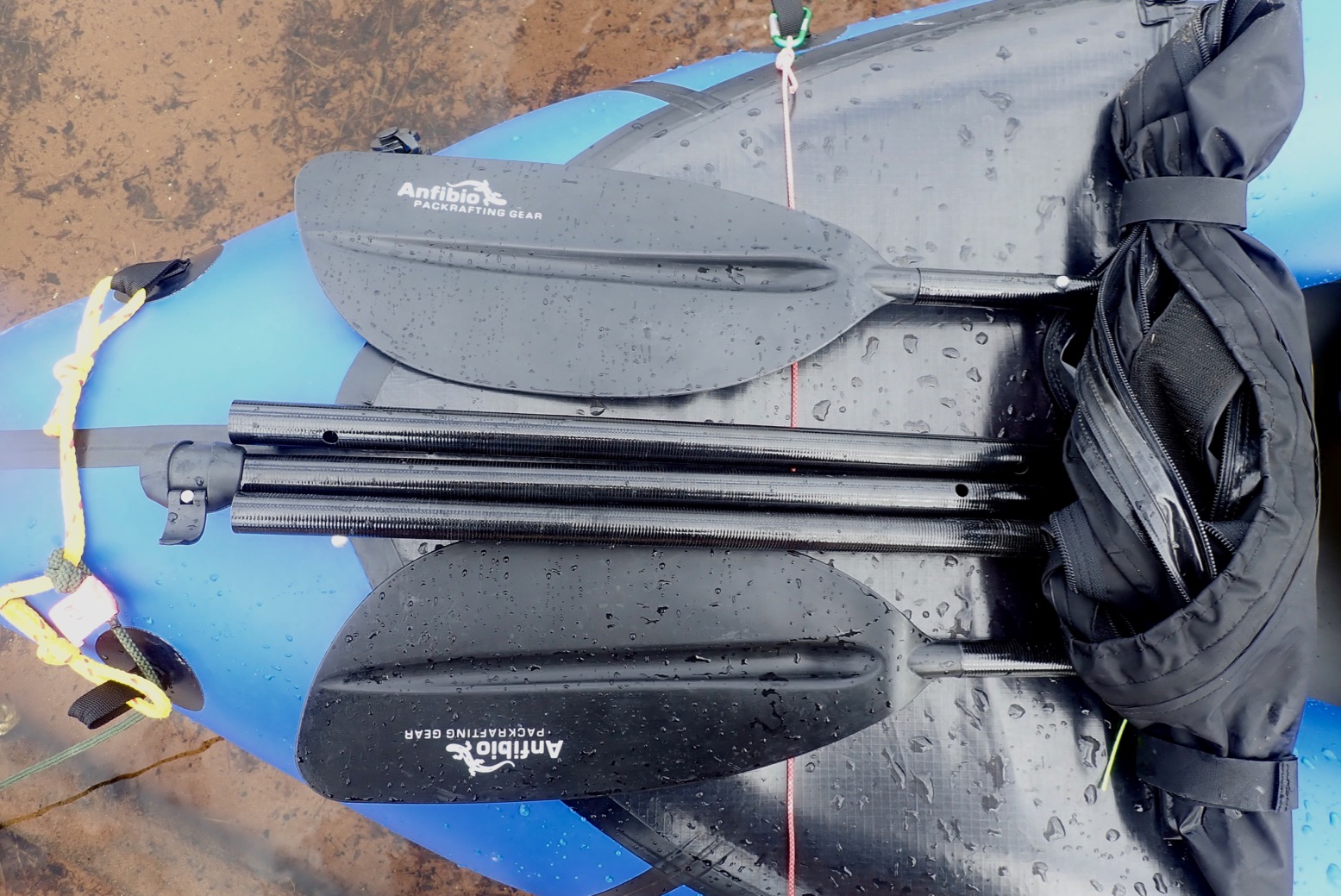
Weight:451g (verified); length: 178-210cm, shaft 24mm; blades 34cm x 15.5cm
Where tested: Sardinia sea and lake kayaking; loch packrafting in Scotland
• Very light • Inexpensive • Collapses into 5 parts of 49cm or less • Single lock clamp to vary length and blade offset • Telescopes down to 178cm – good for short paddlers or kids • Would work as an adjustable tarp pole
• Feels flimsy • Small, 34cm flexy blades • Thin 24mm shaft diametre • 210cm is a minimal useful length for chubby packrafts
What they say Those who pay close attention to boat weight and packability should also make the right choice with the paddle. The Anfibio Fly has a minimum weight of just 460g making it an ideal ultra-light companion. It can be broken down into five segments none longer than 49cm so can be easily stored in any daypack. Despite its minimalist features, the Anfibio Fly is well featured for a wide range of uses.
Review:
Fly set at 178cm and a big-bladed, 220cm Werner Corryvreken
Held up and powered by your arms all day, a paddle wants to be light, but it also needs to be rigid so none of that input is lost in power-sapping flex. Combining the two effectively usually means spending hundreds while still compromising a little on durability. The Anfibio Fly is about as light and compact as a usable paddle gets (a Supai Olo is lighter still). Paddling my packraft downwind I found the 5-piece Fly’s OK,
but the thin shaft and small, bendy blades lacked the solid feel of a conventional, full-sized paddle. Add my ‘Maori-war-party’ paddling style (as I was told, once), and the Fly’s flex didn’t produce the sort of confident propulsion needed in a principle paddle. Even the much lighter and less energetic g-friend didn’t take to it – though that was in our 17-kilo kayak. Used back-to-back against my Werner Corrywrecken, I paddled about 15% slower (5kph vs 6kph max). My other Aqua Bound Manta Ray 4-parter (left) may weigh all of 880g, but without spending at least $500 on something like a Werner Ovation (from 460g), this is simply the mass needed to get the job done at a reasonable cost.
A day later I was paddling into a 10-15mph wind with the solid Corry. It was hard on my arms and hard on the paddle; I needed to rest every 10 minutes and progressed at about 1mph. I’m sure I would have damaged the joints and maybe even broken the Anfibio Fly in such conditions, and yet at some stage, you may find yourself having to do paddle like this to get to shore.
In calm conditions or as a back-up it will be fine and would suit a packrafting trek in a light packraft like an Anfibio Alpha XC where you’re crossing small calm lakes or briefly following benign rivers where you don’t need to power through rapids. The thin-diametre shaft, light weight and length adjustment down to a flex-minimising 178cm would also make the Fly an ideal children’s paddle.





































































 Inflatable Kayaks & Packrafts