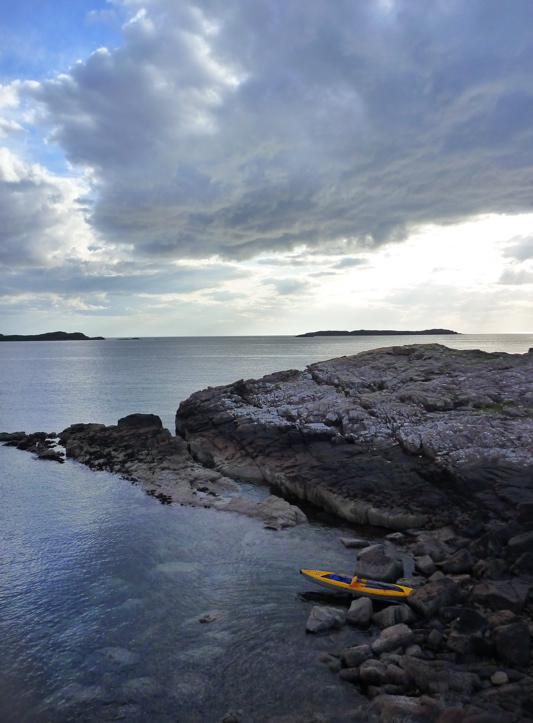
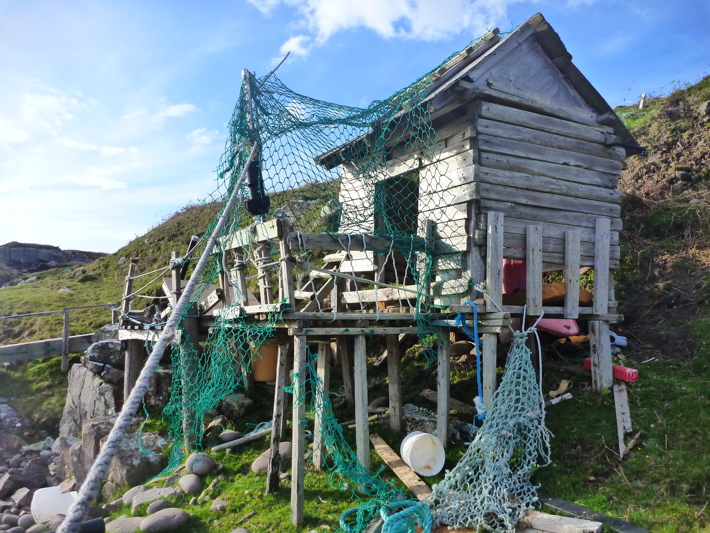
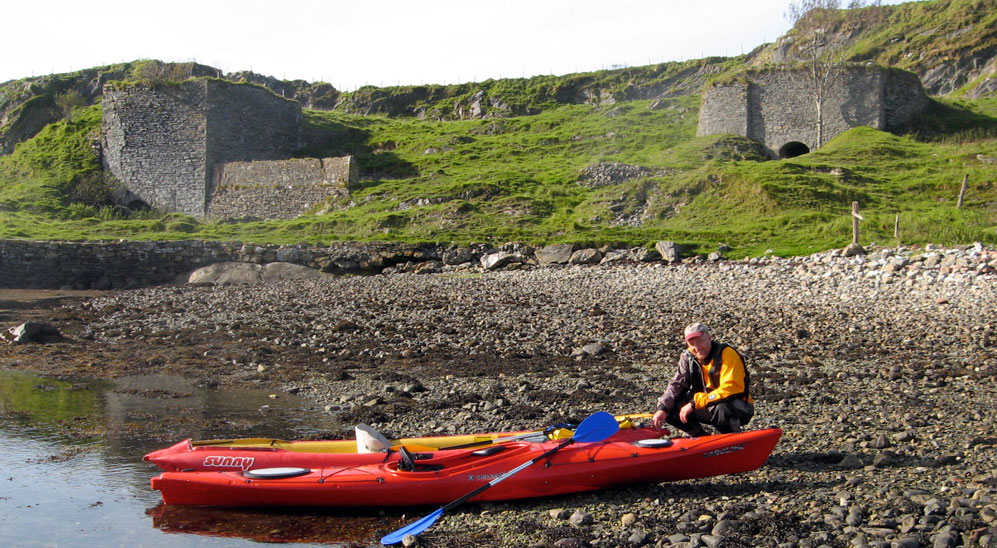
I’ve been watching a range of weather forecasts in a bid to try and get a feel for things around here. With no hurricanes predicted, last night I went out for a paddle along the shore. Even now it’s light here till 10pm. On a quiet beach I came across a strange installation, an abandoned Wasp Factory or maybe just some kids’ flotsam beach house. In some places the masses of washed-up fishing industry junk is depressing in the otherwise unpolluted surroundings, but it’s also part of what makes beach-combing so intriguing. Whose chopped down wellies were they (different sizes, made in Holland)? When was Calmac man’s (Hebridean ferry service) hard hat blown overboard and did he go with it? All messages without a bottle. If nothing else, as Gael observed last year along the SSKT, there’s always plenty of rope, netting and more usefully, firewood to be found on less visited beaches.
Eight years later it finally succumbed to the Hebridean gales.
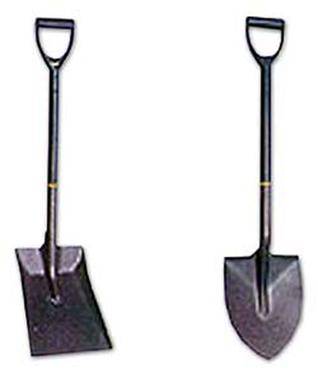
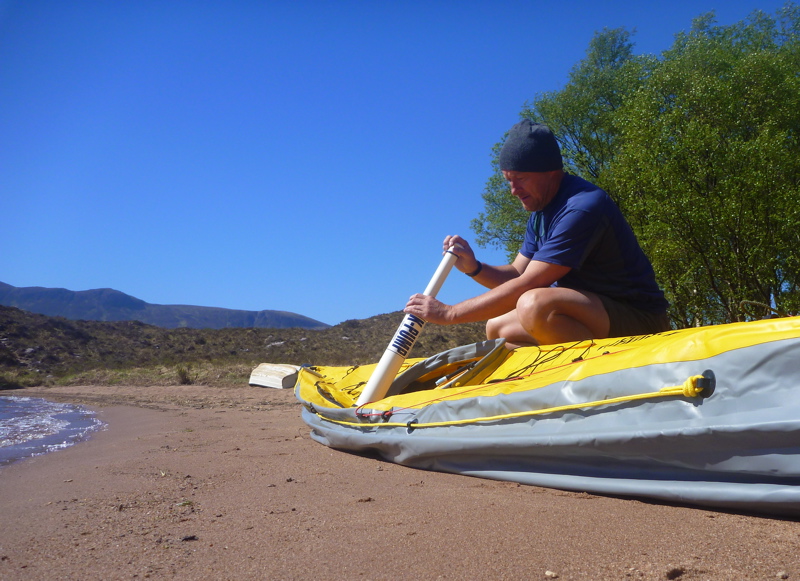
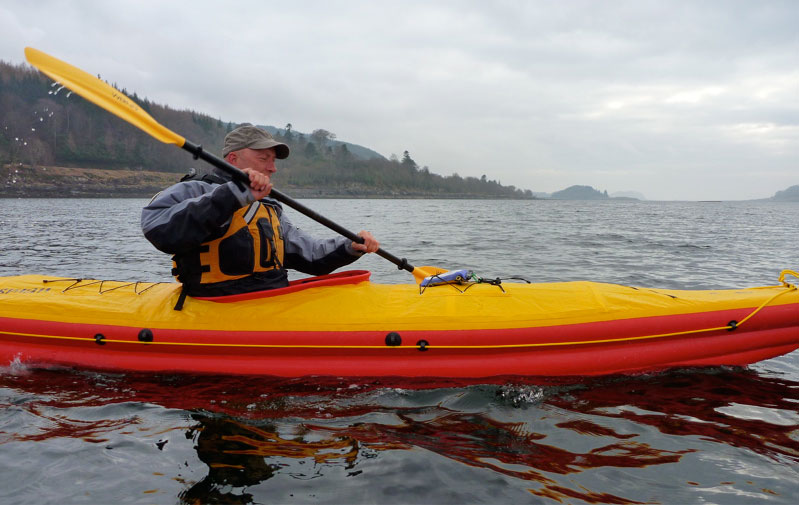
Spade or shovel? I paddled open deck that evening and along the way attempted to compare my good old, bent-shaft Werner Camano with my newer Corrywrecken (both discussed in more detail here). In short, over a couple of hours I could hardly tell the difference in operational terms except that the Corry initially felts amazingly light and taught after using the Camano, but going back to the Camano doesn’t exactly feel like falling headfirst down a well. Both are great paddles when compared to a spade tied to a shovel with duct tape. Can’t say the bigger Corry made the boat go any faster, but perhaps the lighter pull of the more ergonomically bent, low-angle Camano felt more natural and sustainable. It’s hard to tell if that’s a genuine impression or just a pre-conditioned response to what sea kayak paddle lore suggests. I think in the Incept I’ll stick with the Camano, only because it continues to work so unobtrusively plus I don’t want to mash or lose the newer Corry any sooner than necessary. Despite being named after a famous tidal whirlpool off Jura, I’d say the Corry is a great white water blade, where you want to pull fast pivots and brisk acceleration to navigate complex rapids.
No rudder I paddled back 2 miles or so with the rudder up under a very light wind and with perhaps a bit of back tide and swell. I’m getting the knack of tracking the K40 a lot quicker than in the Sunny without a skeg – but then I only discovered the Sunny worked skeglessly by mistake after a few weeks. My conclusion in the Incept is that you’re maybe 1kph down on a typical 6.5kph cruise (I had a GPS) because of the correcting finesse and concentration required. Maybe that will subside, but it all takes a little more out of you physically, as your hands are doing the steering/tracking as well as the pulling. Just like in the Sunny, every few minutes you spin offline for no reason you can fathom. So then either you pull hard to bring the front back, or you just spin right out and check out the view behind, then paddle backwards for a bit as if you were planning to turn all along. After a bit of that you lose it anyway, let it swing back around pointing forward and carry on your way.
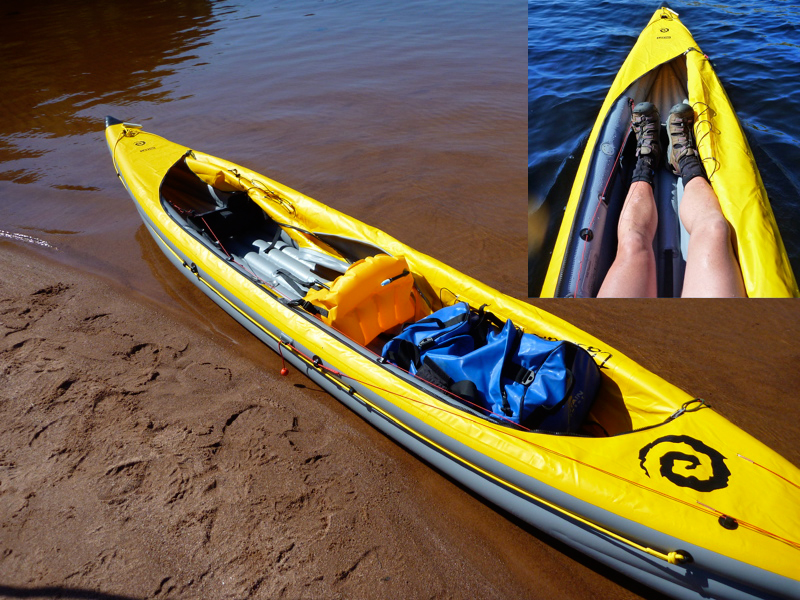
What’s in the bag? The other night I tipped out the contents of the blue bag and unrolled the boat from a factory-packed volume which, like a new Alpacka, it’s never likely to regain (see below in red). It all added up to:
Blue roll top dry bag Boat with deck lines and all rudder controls/lines Rudder assembly Flexible hatch coaming rod Inflatable seat Four GRP battens which slip into the deck to give it form K-Pump in a bag with adaptors and grease Boat repair kit (glue, a dozen patches and a valve adaptor, see red) Basic instructions and an NZ leaflet on safe sea kayaking
Dimensions According to my atomically calibrated measuring instruments, the boat alone weighs 14.8kg + 2.2kg for rudder, seat, repair kit and pump. It’s 4.3m long, 69cm wide and 45cm wide inside (32.6 lb + 4.8 lb; 14′ 1″; 27″; 18″). The table from this post compares dimensions on similar IKs. At 17kg the K40 actually feels pretty light and as long as it’s empty, not too windy and the path is easy, I can carry the kayak on my head or the back of my shoulders.
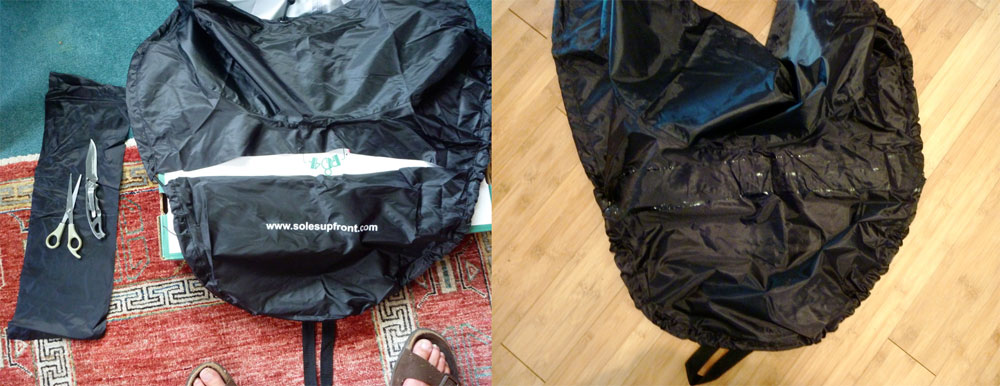
What’s not in the bag – a spray deck. You get the impression that it’s a special shape/item and so ought to be included, but I’m told it’s €103 euros for the one Incept recommend. It’s hard to ascertain exactly what you’re buying from the small image buried on their website, but similar skirts go for around half that price in the UK. I bought a nylon cheapie to be getting on with. It’s actually not badly made for 19 quid, with taped seams and a decent coated material; it’s just way too long, so I had to cut it down.
Aa K40 sits a lot higher than a regular hardshell kayak, so I imagine a skirt would only be necessary when it gets really rough (by which time you probably have other issues) or cold, or you confidently expect to be able to extract yourself from capsizing with one smooth swipe of your blade. It would be nice to master a roll, but I suspect that crawling back into a K40 with decks unzipped is less difficult, especially with a paddle float. More on that here.
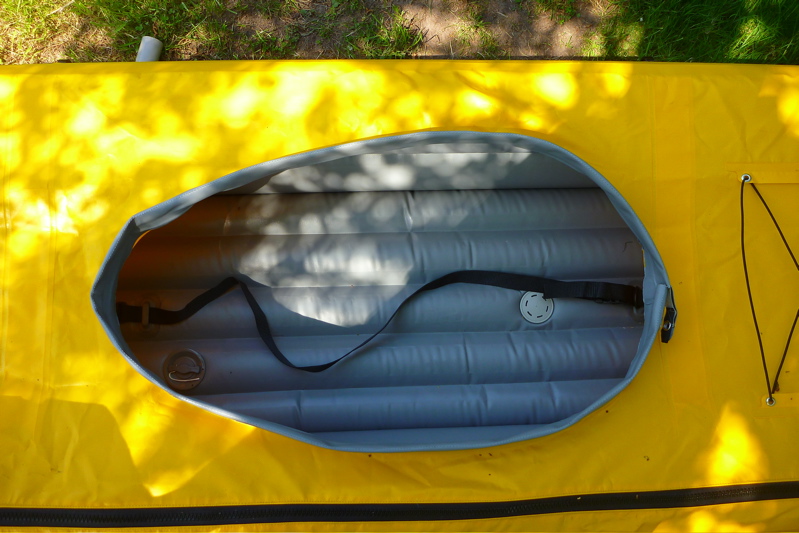
The hatch is 71cm long, 41cm wide and 186cm circumference (28″ x 16″ x 73″), if that helps you select a spray deck. Although it’s statistically small, I’ve sat in worse and as it’s not rigid, even I can pull my legs up to get out while still seated.
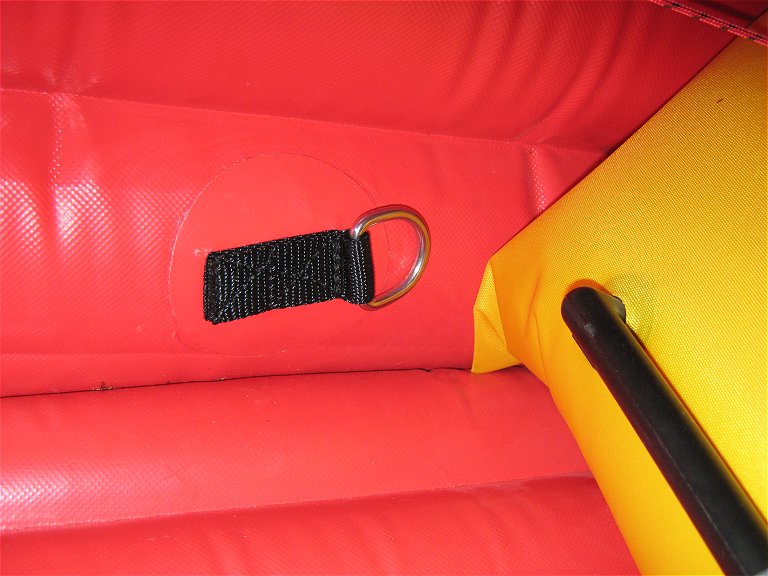
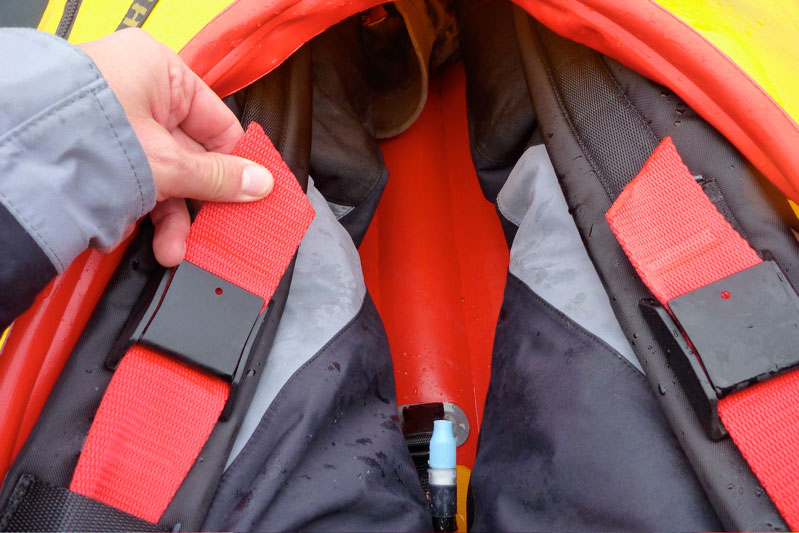
Thigh straps are a €66 option. Fair enough, but my boat has no D-rings (left, Incept’s pic) for the straps, just markings where to fix them. Some boats get patches, some don’t I was informed (probably heat-welded, left). Otherwise it’s a lot messy work gluing some on (below left), which will either cost you over £50 for four Incept patches sent over from NZ. Or you can spend hours on the internet looking for alternatives. I fretted, thinking I must buy actual Incept ones which are made from the same PVC-urethane material as the hull. As well as clean surfaces and a good roller, on inflatables the adhesive/material combination is critical for a good, permanent seal.
D-rings setting under heavt rocksThigh straps
The actual Incept PVC patches cost $NZ12, similar to the UK from places like PolyMarine. Or good old NRS have all sorts of patches here and among other places, they now have an outlet in Ireland (so all import taxes paid (until Brexit happened).
I bought a dozen #2097s (left) which are a bit big at nearly 5″ (120mm) but can be trimmed. NRS said that Aquaseal (aka: Aquasure in Europe) will do the job on PVC-to-PVC as well as anything, but actually one D-ring stuck on with Aquaseal came off three times. Probably my bad application so eventually I tried the small unbranded tube of Ultraseal 777 which came with the boat’s repair kit. It’s a much thinner and runnier than Aquaseal and smells like classic Bostik, and because it was not ‘filling’ but just adhering, I thought it made a better, more pliant seal and it cured quickly too. I’ll find out for sure how the 777 patches worked in comparison with the Aquaseal. Unfortunately, though it’s made by Bostik, I couldn’t divine whether 777 has a magical formula that perfectly suits Incepts polyurethane alloy fabric, but in future I’ll clean off with MEK solvent and use Bostik 1782 – the nearest I could guess and found cheap on ebay. While my back was turned Bostik seem to have diversified into scores of glues from my youth when the classic, pink-tubed all-purpose glue did it all. Now they sell a glue for scores of uses which the cynical consumer can’t help thinking is marketing- rather than function led.
The SeakayakOban test boat I tried had thigh straps – straight, not as comfortable as pre-curved ones I recall having on other IKs. Pre-curved straps hook better over the knees, so I got a pair for an SoT off amazon for £33 (left). With those brass-plated clippy things they’re heavy, but seeing as they’re so fat they could double up as cushier backpacking straps on a boat-hauling packframe.
One more annoyance: I was expecting to get the Bravo footpump which the shop I bought it from pictured and confirmed by email. I received the better, hard plastic K-Pump after I went out of my way and bought one. This inconsistency with Incept’s info (including images of models with old colour schemes, velcro decks and talk of ’25 D-rings…’ in current brochures) gets frustrating. You get the feeling Incept aren’t focussed on promoting these IKs, as if they’re a sideline to the raft business. But as long as the people on the factory floor with the scissors and heat guns are on the ball, I’m sure I’ll get over it.
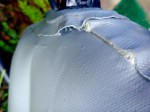
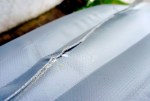
Sadly, quality of construction is also inconsistent. Most of the boat is heat-welded but closer inspection revealed a lifted seam at the glued-on rudder patch (below left). The cavity here was an inch deep and took repeated injections of Aquaseal to fill, but I presume this is a patch glued on the hull, otherwise I’d have a pretty flaccid boat by now. Nearby, a couple of hull seams had also lifted a mil or two (middle pic). It’s hard to think these would have slipped past any inspection (assuming there is one), so I presume they lifted after that point. These are the only manufacturing flaws I’ve spotted on an otherwise clean job. And to be fair the rudder patch glues around a curve where two other layers meet, so it’s a difficult join. I’ve laddled the whole area with Aquaseal (last pic) and it’s now sealed for good.
Incepts are made from 1100 dtex Polyester fabric coated in a PVC-urethane blend. It’s notably less thick than an old-style Gumotex. Stiffer is harder to glue into tight forms (as proved above) but makes a faster boat on the water. It’s also more awkward to pack, especially when cold. I can’t see me ever rolling it up as compact as the image at the top of the page (see red text , below). I go on further about IK materials here and once, theboatpeople spoke sagely about Incepts, though it’s unclear if they’ve actually seen one in the raw (never stopped me!).
As the enclosed instructions say, the biggest risk to damaging a PVC craft is when a sharp and stiff corner of a rolled up boat scrapes on concrete or tarmac; it grinds off the coating real quick. I must remember never to do that. It’s unlikely that the PVC-U is as durable as synthetic rubbers like Nitrilon or Grabner’s EPDM, but with care, regular rinsing, squirts of 303 and the odd dab of glue, it should last. In fact the K40 is the only IK I’ve ever punctured: a tiny thorn tip picked up while pumping up on Loch Moidart. The second owner’s similarly punctured the side while pushing past a thorn three on a river, and again at sea later. Knowing all this in retrospect I would say Incept’s choice of fabric for the K40 may not be durable enough, but the only other owner of an older red and yellow boat has had no flats at all. It’;s possible earlier boats used different fabrics.
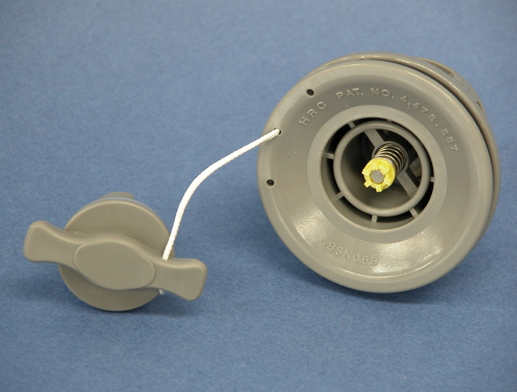
Out of the bag I pumped it up for the night and fitted and adjusted the rudder which was dead easy. Next morning all was still pleasingly firm, so off to one of the local lochs. Down on a small beach near a road, again I was surprised how effortlessly the K-Pump inflated the K’s three chambers until the PRVs start hissing at 5 psi or 0.34 bar – as high as any non-DS IK. I like the idea that on the water you’re able to top up the pump from inside the cockpit as all the valves are located accessibly by your lap, though over the course of that warm day – leaving it in the sun here, there and on the car’s roof – it wasn’t necessary. And I sure like the fact that the Halkey Roberts’ valve caps (left) twist off easily and back on securely, unlike my old Sunny’s horribly stiff and awkward items which never relented in all years or use.
Packing up a Tasman As mentioned, the stiff PVC which responds so well on the water makes rolling and packing up a K40 a bit of a challenge, especially if space is important and it’s not warm. After a few weeks of ownership I finally gave it a go. First thing to do is the suck all the air out that you can’t do by just rolling; this is something a K-Pump does not claim to do (despite what you may read), but I’ve only lately discovered a Bravo pump (left) can do once you switch the hose to the other port. With the Halkey valve opened (pressed down) the spring in the Bravo’s bellows sucks stoically until you can hear the PVC creaking. All you have to do then is yank off the push-fit hose and close the valve quick against the boat’s partial vacuum – tricky with fingers; you may need pliers.
The ABS K-Pump is heavier and as bulky as a Bravo footpump, but it’s more robust and for a hand pump is amazingly effortless. The K is the pump to use even if it doesn’t suck, but the boat comes with a bayonet valve adaptor in the spares kit. Pop that on a short length of hose and you have a manual – or oral – sucking tube to compact the K40 for transit. If this is all TMI, just say ;-).
First impressions on the water were a bit shaky compared to the test day a few weeks back when conditions were about the same, if not even calmer. Maybe because I was alone, ill-dressed for the very cold water, and the valley caught the odd gust off the big mountains. Who knows what was up, but I doddered around like a beginner, then parked up on another beach for a walkabout, and on the way back paddled with the deck unrolled which was fun. This convertible deck arrangement is such a great idea. It’s like owning a brolly or a mac: you don’t always want it but sometimes you need it.
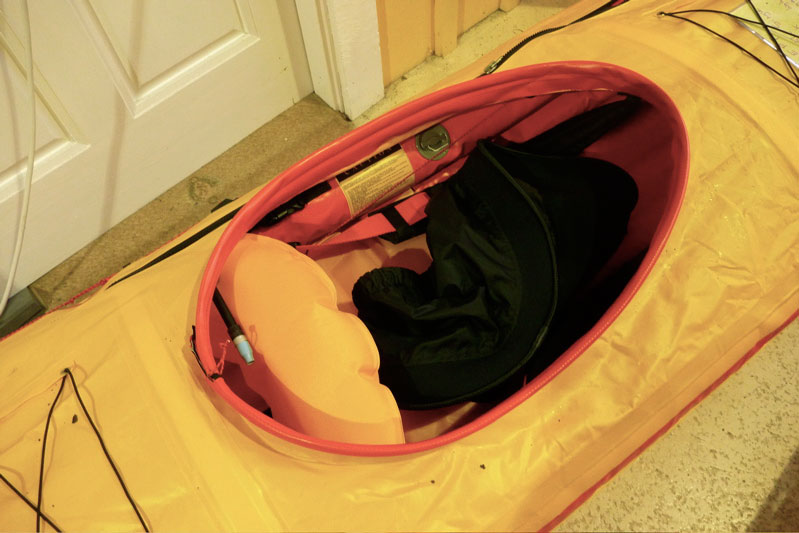
Part of the reason deck-free is possible is that the K uses a removable bendy nylon rod for the hatch rim or coaming (left). Remove the four chunky GRP deck-supporting battens, roll the deck back to the right side and hey presto, the legs can breath, you can get in and out gracefully and maybe even carry a light passenger. Though thick and strong, the battens don’t seem to have any influence on pushing the boat’s sides out as far as I could tell, it’s more likely a zipped up deck holds the sides in if anything, so inhibiting longitudinal flex of the hull in rough conditions with a heavy paddler.
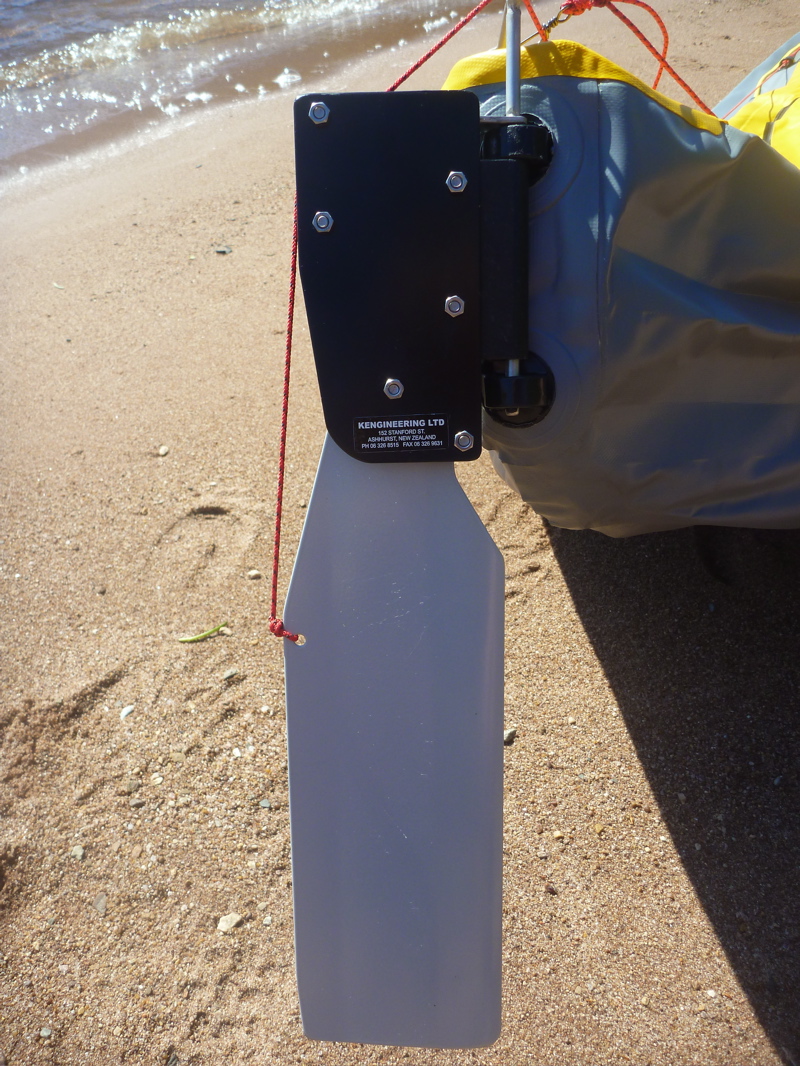
The rudder mounts easily and looks like a well made unit, though again, I’m no expert. Foot control is off some flaps on an adjustable air bag footrest using string and elastic. Not surprisingly, it’s all a bit mushy, but I don’t think any IK or even any K will have a system as solid as the Amoco Cadiz. It centres naturally and so works fine as a simple straight tracking skeg which is all you want most of the time. For an impression of rudder free paddling, read this. If you want to slide forward down the boat (perhaps to pull the deck on or have a snooze) you can easily slip your feet under the semi-inflated footrest/rudder pedal air bag. Turning circle on full rudder lock is about 10 metres, same as our Nissan, and I also observed that you can do a 360 in this boat on the spot with 5 back strokes; in other words: less strokes than you’d imagine. Backing up is also easy with the rudder up and the rudder lift line works fine. A rudder of course came into its own to correct tracking when paddling downwind or at 45° to the wind in either direction, though here is where the mushiness was noticeable. A bit more experimentation with the footrest/rudder pedal air bag pressures and seating/footrest positions may tighten things up. So far the seat is fine and I’ve had no complaints since. It’s light and simple, but made from thick nylon (compared to an Alpacka) with two elbow valves – and it clips out in seconds, just like the modified seat in my old Sunny. But like on my old Alpacka Llama, you sometimes sit on the squashed down backrest when getting in with the deck on, which could be a pain if the situation was choppy or awkward. There is more back support with the deck on I’ve found, as you lean on the back coaming a bit. I’ve also since found even at sea it’s safe and stable to sit sideways on the seat with your feet in the water.
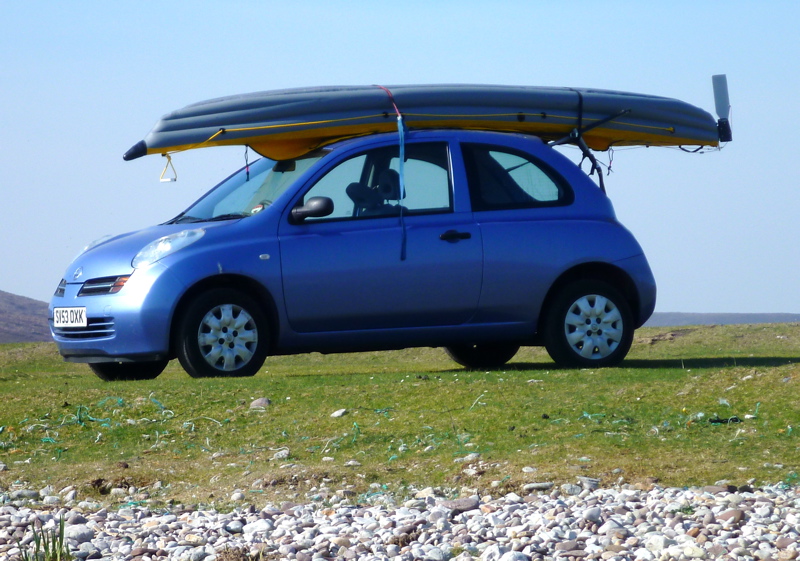
By the time I got back a couple of hours later I was in the mood for more so I strapped the boat onto the car (another great aspect of frameless IKs) and scooted over to the main beach opposite the Summer Isles. That morning there’d been no less than nine cars or vans with kayak racks heading out for the day. Quite right too as it was amazing weather, so much so that the blooming gorse in the hills caught fire. As I came back, the village fire engine dashed past me, trailing cobwebs and heading for the smoke palling over the Assynt to the north. Out in the bay a pair of late hardshellers were heading out and it seemed a bit less gust prone out in the open water. After dicking about for a bit, I headed across to Tanera Mor island, about two miles across the bay. We look over to Tanera all day from our place, and on many previous occasions in the Sunny I’ve thought about it but never dared. I suspect the relative speed and higher sides of the Incept gave me the edge and the confidence. In the island’s anchorage, flushed with the success of my monumental traverse from the mainland of Britain, I pulled over by a salmon pen and watched the caged fish flit across the surface, I presume enacting their instinctive upstream spawning surge, but here destined only for the slicer and the smokehouse. On the way back I decided to deck up for no other reason than I could, noting that when fully unzipped, I can just about reach the zip ends fore and aft to pull them closed, as long as I used the fishpen side for stability. Out at sea if it was rough a boat alongside would be needed. I’ve since lengthened the tabs on the zip ends to make them more reachable. A small island ferry left the nearby jetty at the same time as me, and mid-crossing its parallel wake crept ever closer until at the last minute I panicked a bit and turned into it to be on the safe side. Later, a bigger fishing boat came across my bows leaving a bigger wake which was no bother taken side on. I’ve since found the K40 is fine in side waves that can make a slinky hardshell a little nervous. No GPS but I timed myself; 25 mins to cover 2 miles which were a bit choppier than on the way out. That’s 7.2kph or 4.5mph or 3.9 knots if you must. Not bad at all and it all rather neatly validates exactly what I ruminated on earlier about getting a better boat for my time up here: dashing alone across what I would classify as ‘open’ water was one of the main reasons I wanted a faster, decked IK. The Incept has delivered on Day 1.
Some observations made here have been corrected once I actually bought and used a K40.
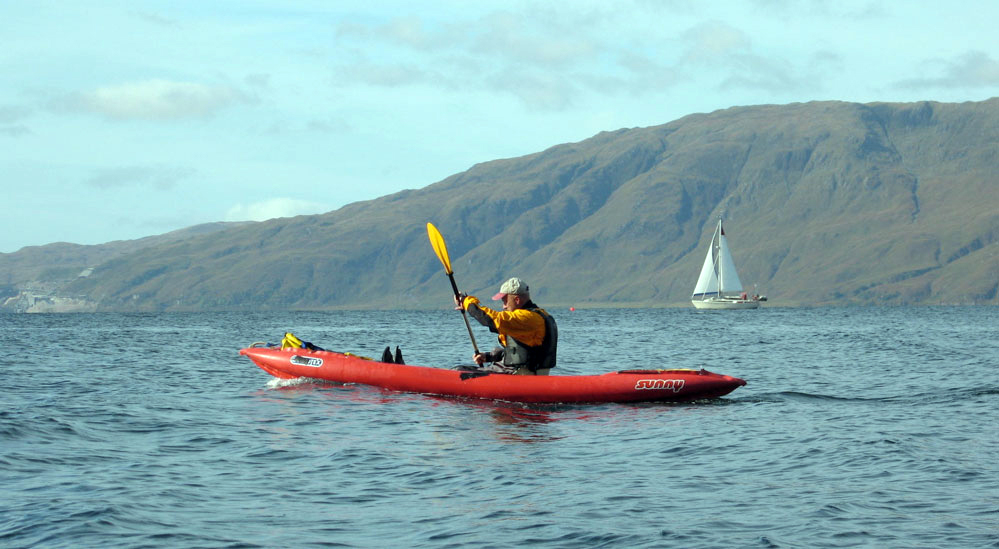
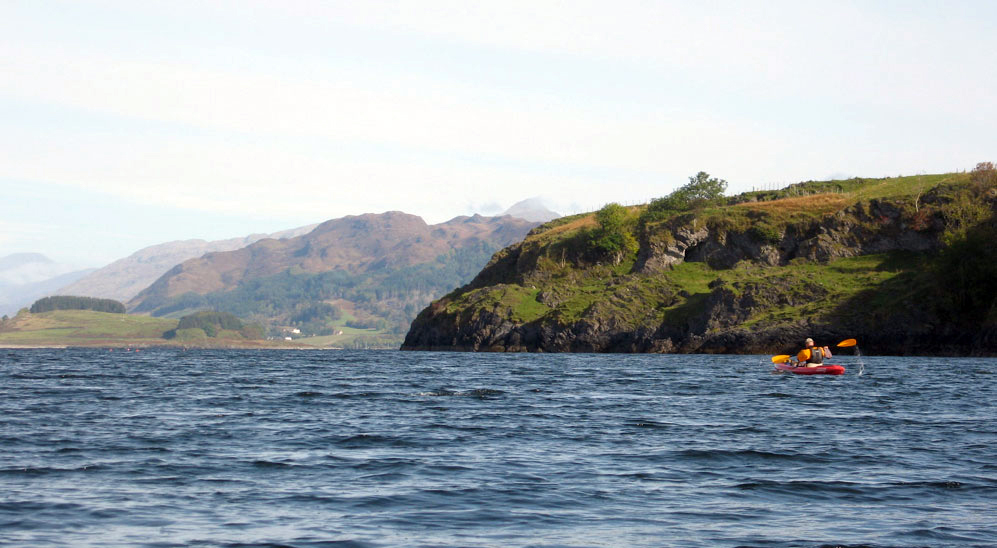
A couple of months ago I speculated that the Incept K40 may well be the long-sought successor to my ageing Gumotex Sunny, a great IK which I feel I’ve taken to the limit over the years. You may want to read the bottom half of that page first to get the drum on the Incept, but now I’ve actually spent an afternoon paddling a K40 around Shuna Island north of Oban and can conclude that apart from price, the Incept K40 ticks all the boxes. The other boat you see in the pictures is Jon’s P&H Scorpio LV – or SinK to you and me.
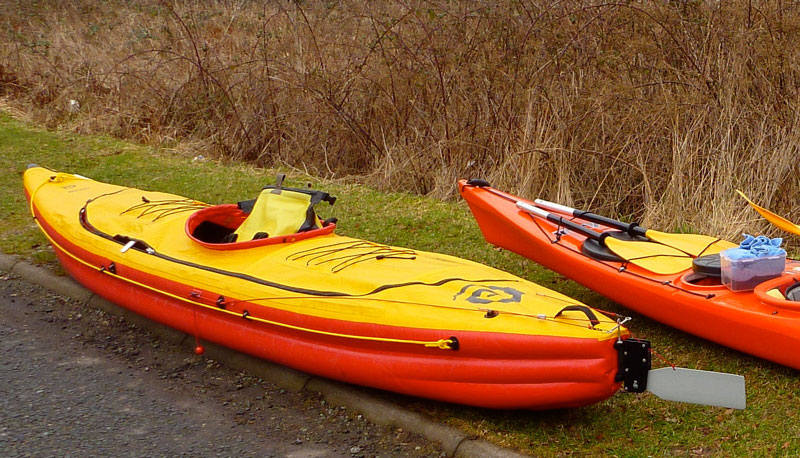
Weight in dimensions I didn’t get a chance to measure and weigh the boat. The K40 is said to be 4-6 inches narrower than a Sunny and a foot and a half longer. It’s nowhere near as narrow as that sounds, as you can see on the left (Jon’s P&H Scorpio LV is only 21″ wide – cripes!) but the twin side tube construction gives higher, swamp-proof sides and more internal storage space. And it certainly looks higher in the water than a Sunny which is both good and bad.
Material and construction According to the brochure the K40 is heat-welded from “a heavy-duty but light weight high-tech Polyurethane alloy [with PVC coating] … with 1100 dernier Polyester reinforcing [which is] exceptionally strong and hard wearing and is UV protected…”. Handling the deflated boat out of the water my impression was that it felt no heavier than my 14-kilo Sunny, while the fabric felt harder, stiffer, less elastic and possibly a tad thinner than Sunny-era Nitrilon; a bit more like lino compared to a Sunny’s rafting fabric. That means when you deflate it it doesn’t collapse flat like a Sunny and it may take some effort to get it into the holdall supplied. On the Incept website they admit the material they use is less foldable than Hypalon. The stiffness (good thing for performance – less good for packing) shows when you inflate it using the supplied K-Pump K100 hand pump. I was expecting many minutes and a sore arm, but before I knew it and with very little effort the three chambers were purging their pressure release valves (PRVs) at a claimed 5psi/0.34bar and the boat was suddenly as stiff as a board. Yes, the K40 has PRVs on all three chambers, probably because there are I-beams in the sidetubes.
It’s notable that the K40 has it’s inflation valves set in the cockpit. Should you lose pressure via the PRVs over the course of a hot day (and so lose some rigidity and performance) you could top-up on the water. One valve on the test boat was a bit stiff to release for pumping (left). The seat and footrest pump up quickly by mouth with elbow valves, like an Alpacka, but with notably thicker fabric than Alpacka uses for its seat. Once set up for your size and with the rudder attached, I imagine the boat takes no longer to get on the water than a Sunny, that’s about 10 minutes. I can’t say I scrutinised it very closely, but the quality of construction on this example looked pretty good; at least as good as a Gumo. They say heat welding means no glue to deteriorate over the years and maybe less weight too (though some parts of the boat are glued).
Getting in and out Before I saw the boat I feared the cockpit was on the small side, but it’s not. With one leg down in the boat and sat in the seat, I can bend the other leg and slide it inside; and this with full dry suit and other clobber on. No real need to sit on the back deck like on a hardshell or a Big Kahuna and best of all, while doing so the boat remains pretty stable. For getting out you can just pull out a leg, put it on the ground/seabed and stand up. Knowing this, my idea of stepping into the boat with the deck unzipped, pulling the hatch over me and then zipping up wasn’t necessary, except perhaps when you’ve unzipped to crawl back aboard after capsizing – something we tried later.
This zip-off deck really is a great idea for access, cooked up they say by IK pioneer Audrey Sutherland. How many folders and hard-shellers struggle cramming little bags through awkward deck hatches and then squeeze gingerly into their boats? I watched Jon doing just this after lunch on Shuna island. It’s the price you pay for speed on the water. With the Incept I can bung my Watershed UDB in the back, lash the other bag or a lunch box to the front deck and put more in front of my feet so I can easily see a week’s worth of supplies fitting with room to spare. I don’t recall seeing any lashing points, easily glued on one imagines, and not strictly necessary with a deck, anyway, but then again spec sheets say there are 25 of them somewhere [not on this boat]. As for paddling undecked, it can be easily achieved by removing the stiff hatch coaming road. The deck also features four curved GRP batons which slip into sleeves and are very chunky while not being bulky like Gumo Seawave alloy frames. It would still be desirable to be able to ride the K40 with the top down on a sunny summertime river in France.
I didn’t get fully to grips with the thigh straps and anyway didn’t really need them in the calm conditions, but it sure is nice to have them there as standard [they’re not], with easy-to-hand micro adjusters. I had a feeling the Java or some boat I had (the Safari?) had curved straps which sat over the knee better. It did take a conscious effort to brace against them and power on, but with the unusual stiffness of the Tasman that all helped achieve the surprisingly high speeds I recorded. In choppier conditions I’d imagine you’d use them to brace against tipping, or of course for rolling the boat, a trick I may yet learn one day.
Speed, stability and tracking The weather conditions for the test day in early March were very calm with a high pressure, white cloud and some mist, all clearing by the afternoon. On the water we headed out southwest against an incoming tide backed by a wind said to be 4mph (6kph), about as calm as it gets out on Loch Linnhe. In a couple of days it was forecast for 30mph+ out of Oban and was much calmer than our previous visit here. In these conditions stability was hardly tested but felt fine which was a relief considering the boat is 4-6 inches narrower than a Sunny and less even than the Java which was less confidence inspiring for me.
Although I took it pretty easy I never had ‘a moment’ in the K40, not even getting in and out. So with stability not an issue, next test was to see what this baby will do flat out! Jon had already cranked up 9kph on his Scorpio while I was faffing about, and hammering away with the 220-cm paddle the shop lent me (20cm shorter than I’m used to) I clocked 9.8kph (6mph) at some point against the breeze and tide, with a more readily sustainable 6-7kph (4mph).
This boat is definitely faster than my Sunny and these are about the same speeds I recorded in my Feathercraft Java a few years ago, also in calm conditions. The Incept is about 15% narrower and longer than the Sunny and a foot (30cm) shorter than the Java which is apparently wider but I very much doubt it. It has to be said that after less than 10km on the water that day I was worn out and aching, but I hadn’t paddled for nearly two months. Out with a speedy hardshell, I was sometimes ahead, not because I was faster than Jon’s P&H, but because compared to previous runs in my Sunny with him, it took him more time than he expected to catch me up when I was ahead. We had a bit of a race as you do, and he certainly pulled away faster, but I had a feeling I caught up and if I’d had my normal paddle and spandex ski jumping suit I’d have had him! One day soon we’ll do a race round two points on a loch somewhere to see how our speed and turning match up, boat for boat. We did a similar test once in the desert, jump starting a loaded Honda XR650L. I lost that one and it’s gnawed at me for years.
Speaking of which, I’ve never owned a boat with a rudder before, though I’ve tried others here and there and it was fun, especially when engaged in ramming (above). Initially I didn’t bother with steering and just used it as a trailing skeg. Foot pedal actuation seemed a bit vague as you press flaps on top of the inflatable footrest thwart to move the rudder lines, but by the end of my session I’d got the knack and with the wind and tide behind us, I was ruddering a lot more and finding it useful. A bit more experimentation with positioning and tension would pin it down. Early on I tried paddling with the rudder up, and into the wind the K40 did spin out after a few strokes if I didn’t correct hard, but then so did my Sunny before I got the knack of skeg-free paddling. Jon in his Scorpio was also deploying his retractable skeg in the same conditions and explained that in a proper Brit-style sea kayak you’d edge a bit to counteract the deflection of the wind on the front; the skeg is there to balance the defelction more than aid racking. Anyway, with the rudder always there and not vulnerable to fouling like a fixed skeg, why would you not use it except when paddling backwards, in which case it’s dead easy to flip it up and reverse all engines.
So there it is… What in Neptune’s name is there not to like about the K40 apart from the hefty price and I suppose the IK’s bete noir: appearance? Looks like a sort of over-buoyant torpedo to me, sat high in the water, but I can get over that if it takes me to more places than my Sunny.
2020: The K40 is hard to find new other than direct from Incept in NZ. Prices are high but you get a lot for your money. The rudder is not an extra and they should come with an K-Pump and a big dry bag and repair kit, but spray deck and thigh straps may be extra. The ’25 D-rings and attachment points’ you read about were not present on the test boat or the one I eventually bought. More on this post. It’s worth noting with boats like the similar Grabners, many of these basic items are expensive extras.
A short slide show of an afternoon’s paddling we did a couple of years ago after the Spey. Jon in the Carolina found this route description in this book, winding in and out of a few islands and so never far from a shore which was fine by us. It’s hardly ‘out there’ but for us it was quite a step up, calculating the tides, wind, currents, UV refraction index and negotiating the swell that might have exceeded two feet at times – plus dealing with some dodgy rip on the way back that was there just where the route description said it would be. After the castle, coming back in between Shuna island and the shore, the wind or tide or something was against me while Jon glided effortlessly forth in his hard plastic boat. That’s the good thing with an IK, you get a free work out! All in all, a lovely October’s day on the Scottish west coast.
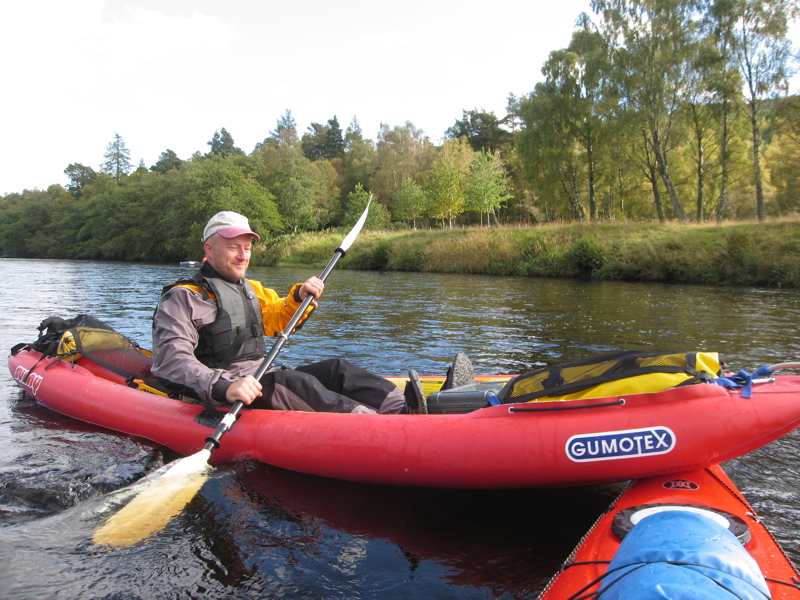
Here’s my gallery of a run down the Spey river we did one September in 2007; three days from Aviemore to the sea – about 85 kms or 53 miles, camping two nights. Me in my Sunny and a new dry suit, Steve in a Pouch tandem folding battleship, Dave in a Klepper folder and Jon in a red kayak made of rigid, hard plastic called a Carolina; quite robust and fast it was, but a bit heavy and not something he could transport easily on a bus. It remains to be seen if these ‘hard shells’ will catch on. The Spey is a famous Scottish canoe run; it’s also famed for salmon fishing and its malt whiskey distilleries. Although the river is said to be open all year to paddlers (see the online guide below for details), when an estate is charging an overseas tourist hundreds of pounds a day to fish off their banks, they don’t want you getting too close and upsetting the client’s concentration. As far as we knew we were there on the last weekend of the salmon season and only once got waved away from a bank of anglers.
That year the river was a bit shallow in places, though none of us quite needed to get out and walk. Even then my Sunny filled on a couple of occasions, despite some piffling rapids, so a dry suit was a good call. Jon was the only one to fall out which just goes to show what lethal boats these SinKs can be – that thing is less than 26 inches wide! It is of course very satisfying to follow a river down to the sea, watch it change and paddle right into to the waves (oddly the tides only reach in a few hundred metres at Spey Bay). Whatever boat you’re in it’s a great run with easy white water, and easy side access. Anything rated for a canoe is fine in an IK. ForDave unfortunately it all ended on the morning of Day 2 when his Klepper snagged on an embedded metal stake (an old fence post?) and ripped a foot-long hole in his hull. Kleput!
There’s a road close to the Spey all the way and he managed to get a lift back to his car and was there that night to drive us to the campsite in Aberlour, 2.5kms from the river. I do recall a very nice meal in the pub that night, in a bar with scores on malts lined up on the back shelf. Dave was also able to pick us up from Spey Bay where there’s a formica-era cafe. The nearest station is Elgin, about 13 miles away. You could packraft the Spey too; it would be fast enough and if you combine it with the Loch Morar stage I packrafted last summer down to Gairlochy, after a 40-mile transit up the A86 to Newtonmore (20 miles upstream from Aviemore) you’ve completed a ~150-mile Scottish coast-to-coast run; Atlantic to the North Sea. I know of a couple of packrafters who have done most of it, including these two guys in the freezing winter of 2009-10. Along with many other reports, there’s a detailed online guide here. Harveys make a waterproof map of the Speyside Way walk which of course follows the river closely.
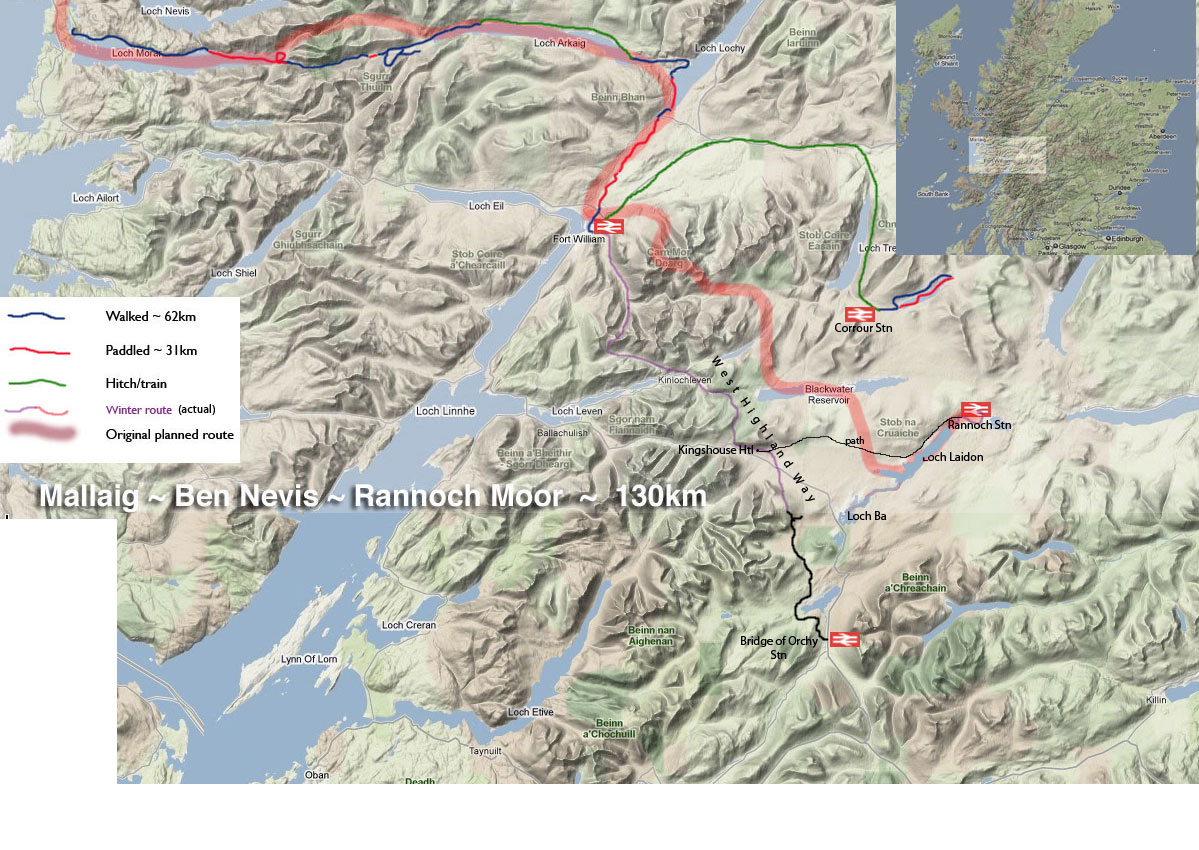
I should have been off to France in early November to packboat down the Allier River, but the current job drags on. So despite the very short days, it struck me I ought to finish off my summer’s packrafting plan. On that occasion, I ran out of time at Fort William while realising my idea of traipsing merrily across the bogs of Rannoch Moor from loch to river was – as usual – over-ambitious. Being my first packing trip, I also learned a bit about what gear works for this sort of travel. End of November I’ll walk southeast for two days down from Fort William to west Rannoch along the West Highland Way, like any normal person. Then I’ll put-in near the road bridge at Loch Ba and paddle northeast for two slow days onto Loch Laidon for Rannoch station to train back home. Another perfect mini adventure!
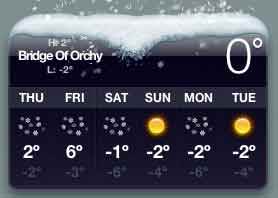
Looks like the forecast is freezing and snowy, so I’m a little concerned that a weekend of sub-zero temperatures may be enough to thinly freeze the lochs by Monday when I reach Loch Ba, making it too thin to walk on but too hard to paddle across. (a couple of weeks later we indeed experienced a paddling-through-ice scenario on a local river. Wind is forecast at 18mph headwind, but not till Tuesday which on top of -2 ought to chill things down. But that’s the final day’s paddle to the station so it can be endured or walked.
On the way I’ll be trying out some new gear:
Full-length Seal Skin socks for bog-wading immunity.
Self-draining trail shoes (normal hiking shoes with a hole melted through the sides). My Keen Arroyo drainers were not up to loaded walking.
Watershed UDB drybag/backpack and W’shed Chattooga day bag.
A waterproof Panasonic FT2 camera that can just hang off the neck come rain or splash. No more scrabbling with a Peli box while watching out for camera-killing drips and the rocks ahead.
December 5 ~ All Pack and no Paddle
I ended up only packwalking for three days, reversing the West Highland Way (WHW) from Fort William to Bridge of Orchy. It was nice enough, especially the last day after a bit of snow to improve grip. The only other person I met was this guy who’d cycled the WHW from Glasgow (95 miles) in 2 and a bit days. Pretty good going as I soon found out it’s not all rideable or even easily walkable in icy conditions.
On the first day I misjudged what I needed to wear a couple of degrees below freezing and ended up overheated and worn out after a long climb out of Fort William. After 13 miles I descended to Kinlochleven, a former ally-smelting company town for which the Blackwater reservoir had been built a century ago. From above it looked like some sinister gulag hidden in a valley. With snow on the hills I thought the hostel here would have been packed out with climbers, but there were only 4 others in and close up Kinloch doesn’t look so bad. The smelting works have now been converted into an ice climbing centre, while I imagine plenty of excess hydropower still pours down the pipes to get fed off to Fort William.
Day 2 was a slog up along the pipeline towards the reservoir and then breaking off on the WHW path towards the walk’s 560-metre high point at the Giant’s Staircase before dropping to Glencoe. From the top the Blackwater reservoir looked grim but was clearly unfrozen which boded well for tomorrow when I hoped to paddle the nearby lochs to Rannoch station.
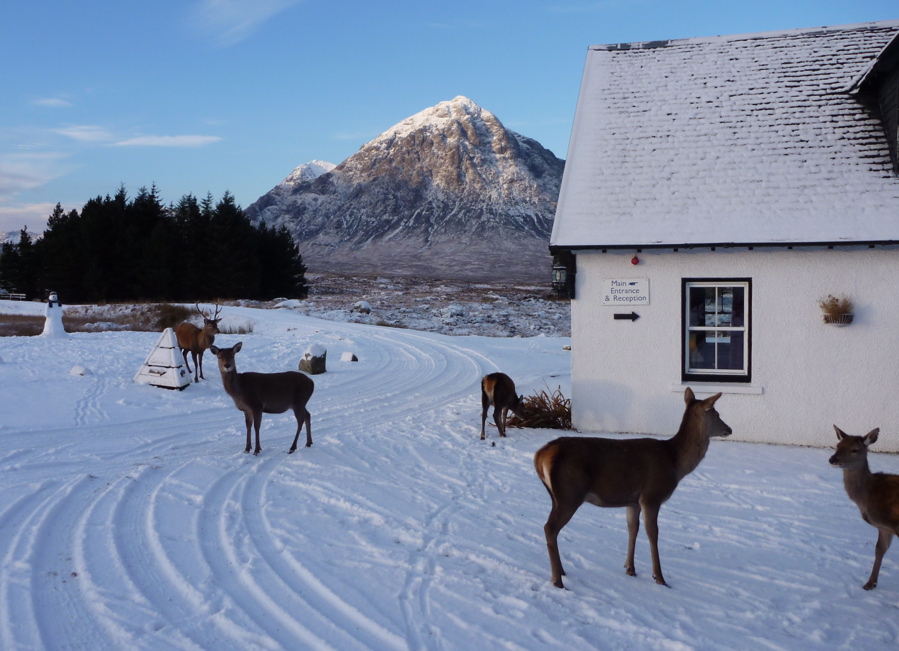
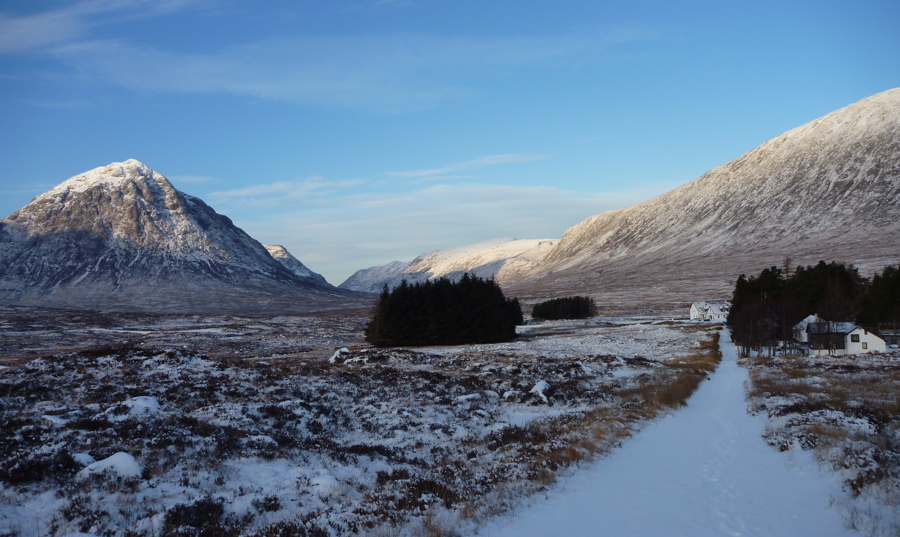
For the second time that day, I went flying on ice, ripping off my metal watch strap, tearing my trousers, and bashing my knee. The heavy pack amplified the impacts. Then later, walking on the flat towards the isolated Kingshouse Hotel at the head of Glencoe, I slipped again on and landed hard with the heel of my hand on a sharp rock which hurt a lot. With three similar falls on the previous day, after 9 miles I staggered into the hotel feeling pretty beaten up, but what a lovely cosy old place to spend the night! There was a fantastic view out of my room across to the pyramid peak of Buachaille Etive Mòr, while deer gathered below my window in the dusk.
It snowed overnight and leaving Kingshouse Hotel, after a few miles I was expecting to get a view east over to Loch Ba from a high point cairn on the WHW, to establish whether it was worth schleping cross country to get to the water. The previous night had been forecast at -10°C and at the viewpoint all to the east was just a snowy tundra, with a small, snow-covered frozen loch south of Loch Ba for sure. Was Loch Ba frozen too? I couldn’t see from there nor from any other point further on the WHW, despite scooting without a pack up a hill for a better recce. Only back home when I zoomed in on the photos could I see a thin blue line of the bigger Loch Laidon which was clearly unfrozen. So I probably could have managed it after all.
It has to be said it was a lovely sunny day on the trail with only me, the stags, and some scurrying tracks, so with days short, I was happy to stick with what I knew and plod on to Bridge of Orchy station, rather than paddle to Rannoch station (the next one up) as planned.
So, a 40-mile walk in the snow with a heavy load. Nothing new there. What I should have done is taken the path from Kingshouse east to Rannoch, passing north of the lochs, but that would have missed out Loch Ba and the easy and shallow chute between the two lochs (though that may well have been frozen).
If nothing else it proved that you can set off for a walk with a camping load including a packraft as an option. If the walking is more pleasant or the packrafting not worthwhile, the modest extra weight is no drama. It would have been nice to go for a paddle but it’ll all be there next time and on the way to the station at Bridge of Orchy I was sizing up the Orchy River which drains from the moor to enter Loch Awe which I’d never heard of but whose north end is right on the Oban rail branch line. Sounds like a couple of nasty waterfalls need the be walked around on the Orchy soon after the bridge, but in tame water that’s too low for any hardshell it could be another little adventure with packboat and paddle. With roads, rails, and trails, the more you look at a map of Scotland, the more packable stuff is out there.
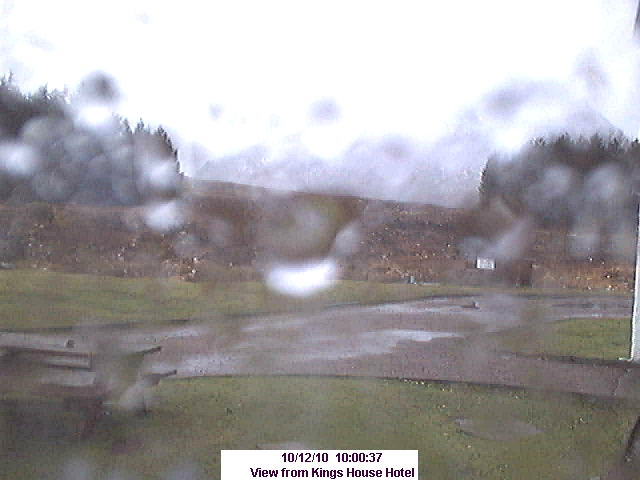
A week back home and the temperatures have jumped, even in Scotland, so the papers have to write about something else. Today, December 10th, the webcam at Kingshouse is the standard miserable Scottish highland vista. We’re going back in a month to walk back from Orchy to the hotel and from there to Rannoch station. Bring on some more Siberian winds.
I was back in the area a month or so later in mid-January 2011 – still snowy but less thick cover. This time I could clearly see the path off the WHW leading down to the road bridge being repaired, the rushing torrent of the river Ba leading to the loch, and even the isles on the loch, not totally icebound. Maybe my eyesight improved over Xmas.
Gear
Seal Skin socks – very good while they last. Warm but not sweaty considering they’re initially waterproof. The knee-length ones ought to make great waders.
Self-draining Karrimor trail shoes. No real wading to test them, but certainly better to walk in with a heavy load than the thin-soled Arroyos, even if proper tight lacing (which could be adapted onto the Arroyos) had a lot to do with it. I may adapt a decent pair of decent trail shoes from Meindl or whatever with a better sole, if some turn up half price. It would be nice to get some plain, non Gore-tex trail shoes for packboating but I don’t think they exist these days.
Watershed UDB drybag backpack was surprisingly good when you consider the 16kg load I carried just on shoulder straps with another smaller yellow Watershed over the front. Part of the tolerable comfort I feel was that the UBD’s relatively rough fabric grips across the back like weak velcro and so spreads the load. The packstaff paddle shaft saved a few tumbles and so means the 4-part Aquabound paddle is well suited when trail walking and paddling.
The Panasonic FT2 never got to be splash tested either but was otherwise easy to use (once you know Pana interface) and took some great shots and video. It does lack the full 25mm width of my normal Lumix TZ6 and I wonder if on full zoom the relatively tiny lens is on the limit. A great back up camera for watery places. I’m still using one in 2016.
I hopped on the Go-Pro bandwagon way back in 2010 but was shocked by the crumby, underexposed results above. They’ve clearly got a lot better since, but I just film with my P&S camera now.
It was a bank holiday weekend in Scotland and the West Highland Line from Glasgow to Mallaig was packed out, but only one person got off the train at Morar station. Me. There was nothing here other than a few houses, a B&B and a lovely sandy beach facing the isles of Rhum and Eigg. The waters of Loch Morar spill out onto those sands and meander down to the sea. I was heading the other way, inland alongside the loch’s 20-km long north shore on a back road that turned into a track and finally a narrow path rising above the waters.
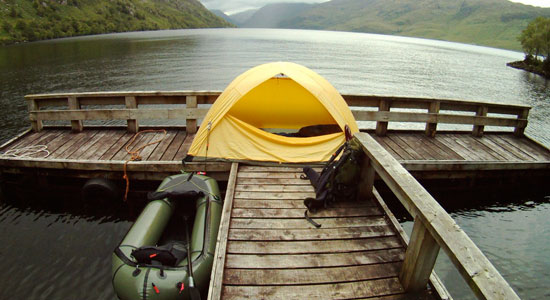
I was of course taking a very keen interest in the state of those waters. As must be normal around here, the wind off the North Atlantic was blowing up the loch with me, but not enough to make hauling the 20-kilo backpack on soft rafting shoes any easier. It looked like a downpour had recently smothered the area; transient waterfalls were running down the valley sides and occasional squalls rushed up the glen. By the time I got past Swordlands Lodge – a WWII-era spy training base for the predecessors of MI5 – all I wanted was a flat patch of dry land to pitch. I’d got further than I thought, covering about 14kms in 4 hours and was now just 7kms direct from the bothy (refuge) at the far end of the loch. The wind had calmed, but the bothy could wait till the morning. I spread out on a narrow jetty, inflated the boat and went for a walk north over to Tarbert Bay, a few houses on the tidal Loch Nevis where a ferry drops in from Mallaig every other day on a circuit serving the otherwise inaccessible community on the Knoydart peninsula. The paddle up Loch Morar and short portage over to Loch Nevis to follow the coast back to Mallaig was a popular day trip for sea kayakers.
Never mind about that. The thought of my first real, fully loaded packrafting paddle alone on the 1000-foot deep Loch Morar was a little unnerving. Even fresh water inland lochs like this are prone to sudden storms that have drowned ill-prepared canoeists. How would my boat handle in a swell with a 12-kilo pack strapped to its bow? When the time came next morning I found I just went through the motions, knowing that I’d done my best to get it right. Sealed inside a heavy dry suit, I pushed off and tried to keep a respectful distance from the steep shore, as the bay I’d sheltered in overnight opened out into the winds. Out there, funnelled in by the 1000-foot ridges, whitecaps furled the foot-high swell, but despite my dry mouth and hyperactive paddling, there was really nothing much to worry about other than worrying too much. With an open deck and the wind to my back, the loaded raft sat on the water as reassuringly as a wet mattress.
At one point the sun came out and soon after the white speck of Oban bothy came into view at the base of the narrow, cloud-filled valley which would lead me over to the next loch. Coming back to shore I felt a small sense of achievement; I’d managed seven whole kilometres across a windy loch carrying all my needs. With the wind and hard paddling, it had taken only one and a half hours, much faster than following the shore on foot, but that was enough adventure for one day. Though it would put me behind schedule, I decided to spend the rest of the day in the bothy, drying out the tent soaked by overnight rain and my dry suit soaked by over-anxious paddling.
On the map only intermittent paths lead to Oban bothy which seems rarely visited and as you can see from the video, is pretty basic but a very welcome shelter set in a brilliant location. Across the loch abandoned crofts reminded me that that this part of Scotland was not always the wilderness we like to think, but a land abandoned two centuries ago when poverty and inland expulsions to enable sheep rearing forced the inhabitants to the coasts, cities or overseas. Amazingly, in the next bothy the logbook showed a recent visit by some Canadians whose forbears had abandoned Glen Pean in 1793. With the gear drying on the line I went for a walk up the valley to confirm just how mushy the track would be. Later that evening I scooted off in the empty raft across the loch just because I could.
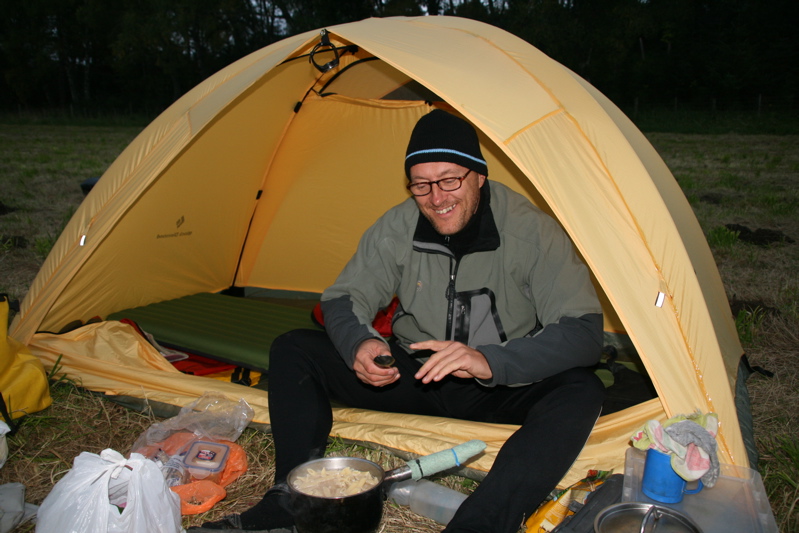
Over the pass Next day was going to be a short-haul, just 8km by GPS up the valley and down the other side to another bothy in Glen Pean. I’d rather taken to bothy life. Though these places are basic and grubby, with no facilities other than a fireplace, some bed bases, left-over food and rubbish, the simple presence of space, shelter and mouse-eaten furniture is so much better than sodden tent camping.
While a packraft does open out your mobility options, especially in the Scottish Highlands, it does increase a typical 12kg camping payload by 50% once you add in a dry suit. Carrying that sort of load over the boggy, hummock-ridden terrain, where the high summer grass and reeds obscure knee-deep ditches and peat channels is probably more dangerous than bobbing around in the middle of a windy loch. To this end I’d adapted a sawn-off piece of paddle shaft to slot on the end on my AquaBound paddle to make a packstaff – something I’m still using over a decade later. It proved to be one of my best ideas on this trip, useful as a probe boggy-looking ground that was often actually firm (and vice versa) and a balancing- or weight-bearing aid. Climbing or descending, it helps take the load off the kknees and saved a lot of the energy expended in avoiding or trying to hop over peaty trenches which could suck you in down to your knees. I’ve been using the pack staff for packrafting and Scottish hill walks ever since. This attempt at dancing around the mire while hauling 25% of my body weight was partly what had worn me out on the walk in from Morar station, not helped by trying to keep my feet dry in my quick-draining ‘canyoneering’ Keen water shoes. Today I decided to try out my Seal Skinz socks which had ssat in a drawer for years. Even though once wet, wool socks keep warm, the waterproof but bbreathable Skinz were as good and should mean less chance of trench foot. All I need for next time is a wade-proof, knee-high pair, though I soon learned the waterproofing or membrane in the Seal Skinz doesn’t last. With an improved packing set up, I set off for the pass, no longer skirting the puddles and putting my weight onto the packstaff when needed. Taking it slow, I felt much safer with the staff as I plodded steadily up to the watershed. Here, still surrounded by boggy the steep valley sides, a faint sheep trail descended steeply to a water-logged valley where it disappeared altogether. Even with a staff and wet-proof feet, the valley still took some negotiating, inching around outcrops while leaning on the firmly planted staff which would have pretzeled a Leki walking pole. In the end, it was simpler to follow the stony river bed. Presently I came upon Lochan Sagairt as marked on the map, unreached by paths from either side and jammed in among dense contours in a gorge. Either side would be a tiring climb with the load I carried and so here was a perfect evocation of the Packrafter’s Choice: to expend effort but possibly save time by keeping on land – or to deploy the raft and scoot across the lochan effortlessly and maybe even catch a bit of a ride off the stream on the far side. (If you’ve watched the vid, it’s here that the film and my photos end – my 8-gig SD card filled up). It took just 12 minutes from stopping to paddling out through the reeds onto the lochan. (Here’s another version.) Following the stream gave me up to a kilometre of paddling distance, but soon that became too shallow and worse still, up ahead seemed to drop through a small gorge. Very keen to play it safe, I rolled up the boat and took to what was now a quad bike track which brought me through a jungle of ferns to the deserted bothy in Glen Pean, nine kilometres walk and four hours from Oban.
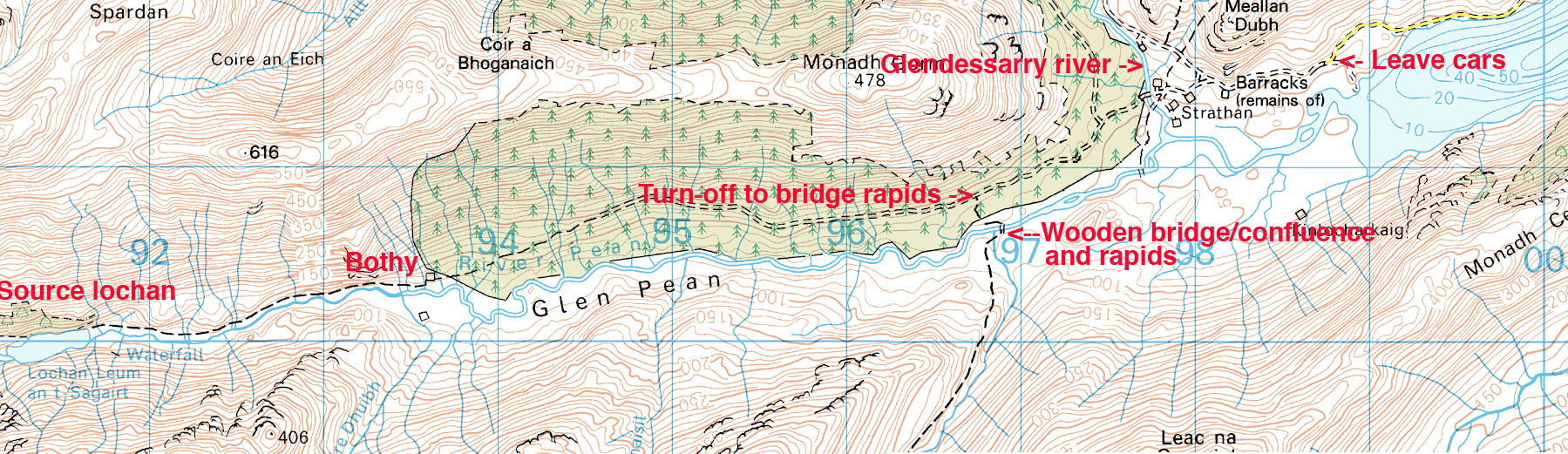
Glen Pean The plan here had been to track the Pean river on foot and put-in as soon as it became paddleable, hoping that that would lead smoothly into Loch Arkaig, the next big body of water. I had my doubts it would be as simple as that, and after lunch set off, first up to an interesting-looking waterfall on the far side of the valley, and then back down into the valley to recce the river downstream. This exposed one of the flaws of packrafting in this sort of wild terrain. Walking the water courses in the valley bottoms, you’re in the worst, waterlogged terrain, fit only for birds and slugs trapped in a squelching morass of saturated peat and spongy moss. Up here the meandering Pean river flipped between deep, Guinness-coloured pools and clear, shingly shallows. No big problem in an unloaded raft as I’d found in France where we’d spent the last few months, but with a load you ground out sooner, meaning getting out and pulling or even unpacking and carrying; not an efficient use of energy. I tramped downstream around the deepest mire where the forest plantation met the river, and up ahead noticed an ominous dip in the tree line between two knolls. Deadly, Alpacka-shredding rapids!
A perfectly walkable track led through the forest to the head of Loch Arklaig and a group of houses known as Stathan. I looked closely at the 1:50k map and sure enough, where a path came down the valley to bridge the river and join the forest track to Strathan, two 25-metre contours crossed the river within a quarter kilometre. To confirm that paddling the Pean may be more effort than it was worth, at 6pm I set off along the forest track to that bridge and suss out the river. An hour later I looked down on a two-metre drop before it led into a boulder-chocked funnel. My hunch had been right, though of course, terrified as I am of being swept unwittingly into a mini Niagara, I’d have surely heard the waterfall and done something about it.
Back at the bothy, I was satisfied with my recce. The upper Pean was navigable with a little effort for about 4kms from the bothy to the bridge, but at the bridge you’d need to pack up and haul up a messy track into the forest and walk on down to Strathan, or stagger along the banks until the river cleared up. (I’ve since returned and paddled the Pean from that bridge down to Loch Arkaig).
Loch Arkaig to Gairlochy Next morning I stood on a bridge in Strathan, a few buildings of the Glendessary estate at the west end of Loch Arkaig. Below me the Glendessary river rushed towards the Pean in a tumble of white water, while the Pean river itself wound placidly into Loch Arkaig. Like Morar, Loch Arkaig ran for 19kms end to end, a long paddle that might take most of the day and certainly most of the day’s energy. A back wind was rushing along, maybe only a little worse than on Morar; here would be a good place to experiment using an umbrella as a sail. A narrow road also trailed the loch’s north bank and having lost a bit of time hanging out in the bothies, I thought I’d try and hitch a lift towards the Great Glen and Loch Lochy where the Lochy River lead south to Fort William. If I could get there tonight I’d have caught up with a chance to carry on to Rannoch as planned. Plodding along the road eyeing up the loch, I passed a bunch of young canoeists on a course and figured if I couldn’t get a ride I’d be better off getting on the water and riding the swell down to the east end. Before that decision became necessary, a car squeezing past saw my thumb his mirror and half an hour later dropped me at the loch’s east end. Rich worked for the local Outward Bounds kids camps and spent his spare time adventuring himself on the islands and highlands. He told of some canoeists last winter who’d portaged the way I’d come yesterday. One ended up breaking her leg somewhere near Lochan Sagairt and getting helicoptered out (in fact I found the thread on that event here and there’s a video here). Portaging a canoe from Loch Morar? Have these people not heard of packrafts?! Either way, I was sure glad I didn’t have to trudge down that long, lochside road; I’m sure whitecaps or not, eventually I’d have taken to the water. It brought up another flaw in my gear: I was wearing Keen Arroyos which gave little more support. Luffing a 20-kilo load over rough ground, I should be wearing boots for hiking. They did the job but the insides of my Arroyos were being ground to a pulp and my feet were beginning to suffer. Rich dropped me off somewhere near Clunes, a shopless wooded hamlet surrounded by retirement homes. I was back in tourist lands on the Great Glen Way footpath. Possibly as a result of yesterday’s efforts, I suddenly became ravenous and tore into my food bag to boil up a mug of soup and some stew-in-a-bag paste while the wind howled through the trees. The freeze-dried food I’d been eating was pretty tasty and very easy to prepare, but for once, I wasn’t eating enough. Twenty kilometres away, Fort William would see to that.
All that remained to see was whether Lochy loch was paddleable in all this wind. Sure enough, the west bank was sat in a wind shadow. With a swell running at a couple of inches, this was a loch I could do business with. No need for the drysuit, just zip on the skirt to keep the insides try. How nice it was to paddle on a calm loch. Back in phone range, I called the g-friend to fill her in on my triumphant achievement. A lighthouse marked the top lock on the canal: right for the canal and Gairlochy, left for a weir which led down to the river. Camping by the lock on trimmed grass was free, and many recreational boaters were berthing for the night. Fort William and a seafood basket with salad, chips and a cappuccino would have to wait. I pitched the tent, de-aired the raft, and went to suss out the state of the Lochy River from the towpath. Between the trees and the wild raspberry bushes I spotted some fly fishermen by a couple of sporty rapids and found a good place to put-in tomorrow just past the lock. I was getting a bit desperate for proper food, but Gairlochy had nothing except all-you-can-eat wild raspberries. The nearest resto was up towards Spean Bridge, more than my blistering feet could manage.
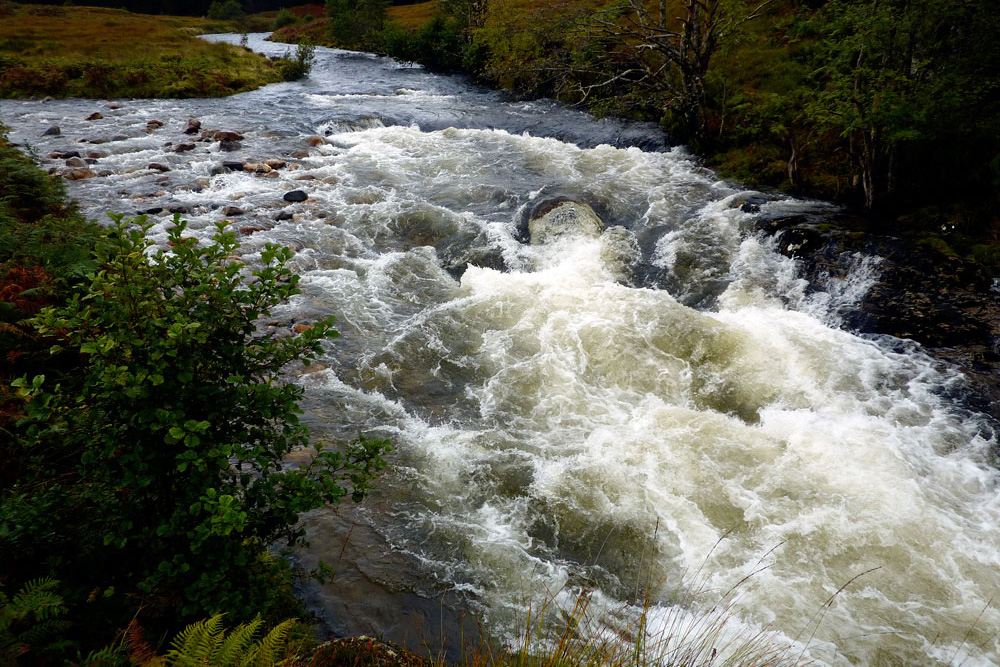
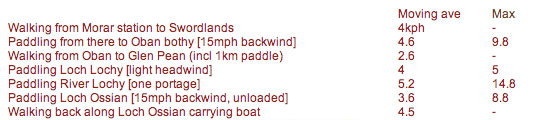
River Lochy to Fort William: Riding the Wavy Trains I was fairly sure I had the measure of the River Lochy, a canoeable river that led down to Fort William and tidal waters, interrupted only by one Grade 3 rapid which the Scottish canoe guide warned of but didn’t locate. A look on Google Earth had pinned down the probable location where the river took a hard left with a telltale smudge of white. I put it in my GPS. I set off down the Lochy, knowing I’d be having a lunch of real food off a plate, not out of a bag. It was great to be riding the wavy trains again, with nothing above WW1 as long as you chose the right chute. At one point I hit 14.5kph (9mph) according to the Garmin and safe in my drysuit, what control I had steered me from tedious shallows or boat-flipping boulders. The grade-three waypoint was right on the money, where some young boys where being tutored in the art of fly fishing by a ghillie (river gamekeeper) dressed in full regalia, including a deer-stalker hat and a crimson face. Inspecting the rapid, I’d have been curious to see how even a proper kayaker could manage to fly down the chute and stay upright where it ramped up to the left to flip you right, straight onto the rock. UK Rivers rates the Lochy quite lowly and barely mentions this rapid, but then goes on to add that a poacher and no less than a dozen commandos have drowned here over the years. The mossy, muddy portage was another job for the packstaff, and now a little braver, I took the hardest lines through the remains of the rapids and presently rocked up at the rail bridge at Inverlochy, a suburb of Fort William.
Loch Ossian It was Wednesday lunchtime and my train out of Rannoch was due in 48 hours. If I was to make it I’d have to move on that afternoon, but after checking into a hostel I was dizzy with hunger. The afternoon would have to be spent answering the call of the stomach. In between I paid my respects to the outdoor gear shops in search of bargains, but merely confirmed the daunting truth: other than a couple more dried meals and some 2-for-1 mini karabiners, there was nothing I needed. The next day the train dropped me off at lonely Corrour station, a mile away from the lovely wind-powered SYHA hostel alongside Loch Ossian. All that remained was to spend the afternoon paddling down with the wind to the Corrour estate lodge at the far end of the loch and walking back along the shore to satiate another ravenous appetite.
I now have an idea about packrafting in Scotland: what sort of routes are optimal and what gear works best. The recce around Glen Pean made me realise that no matter how up for it you might be, hiking cross-country across bogs and tussocks as I’d planned to do from Glen Nevis over to Blackwater and from there to Loch Laidon, would have been a hiding to nowhere while hauling a heavy pack. If I’d had the time I’d have followed the West Highland Way out of Fort William to Kinlochleven and on to the Kings House hotel in Glencoe (40kms – two days). From there an eastbound moor path passes close to Loch Laidon (we did it years later, below); either can be taken to reach Rannoch station.
Speeds The raft can be pretty quick on a loch, paddling hard with a backwind, even with a load, and so some sort of sail would reduce the effort and so give more range. I never expected to try and paddle the full length of Morar or Arkaig (19+ kms). Loch Ossian (6kms long) was surprisingly slow as at one point I headed across the width of the loch with a stiff sidewind to see how the unloaded boat handled (pretty flappy but probably more secure than an IK).




































 Inflatable Kayaks & Packrafts