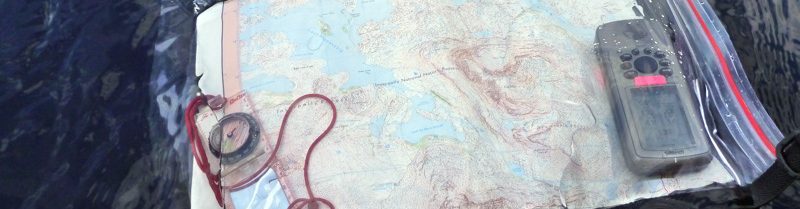
Category Archives: Scotland & Summer Isles

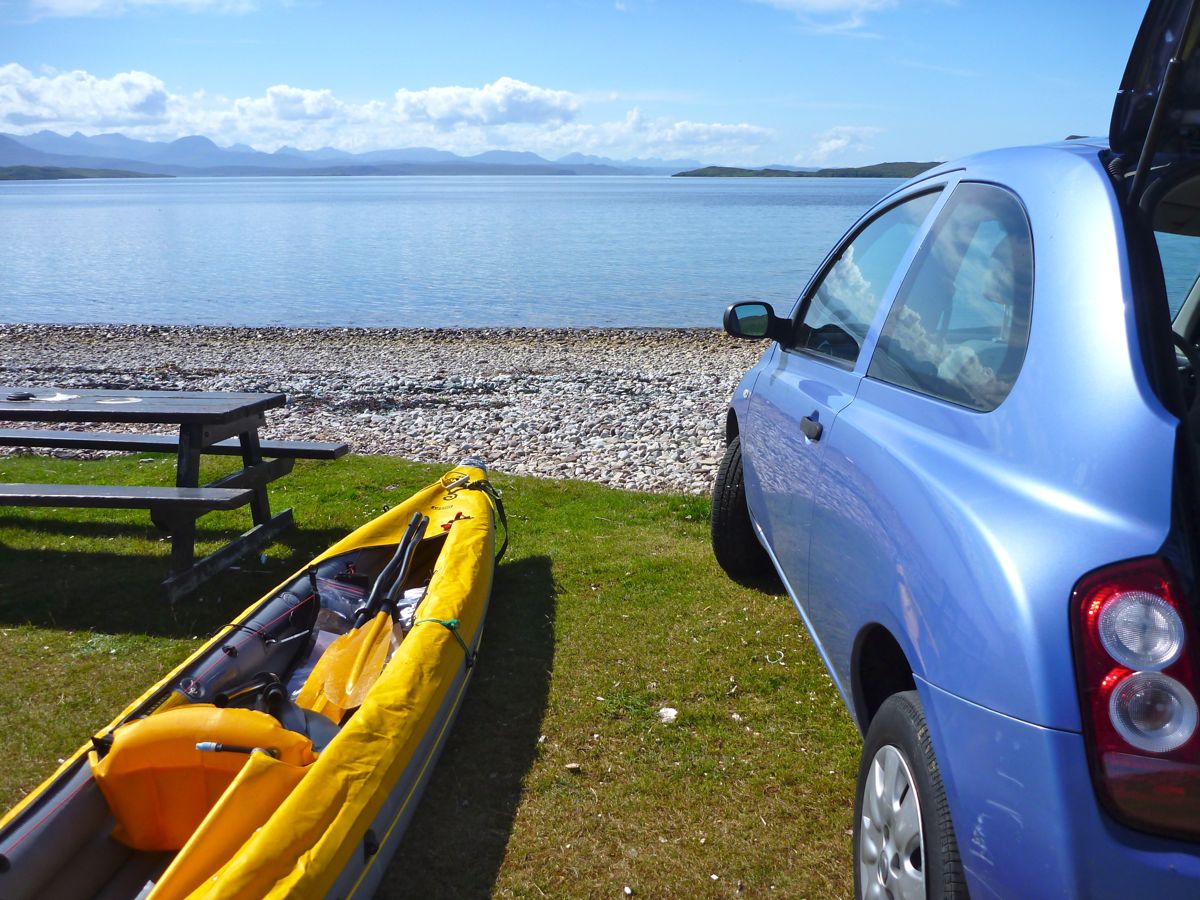
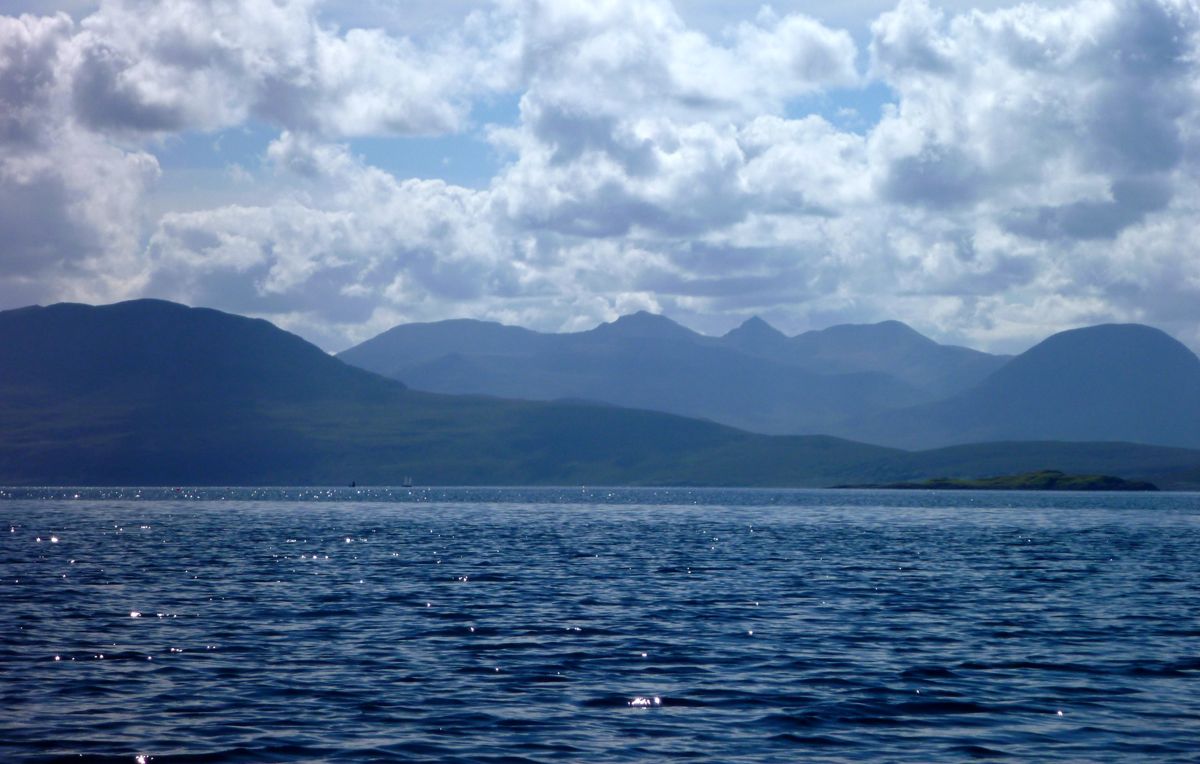
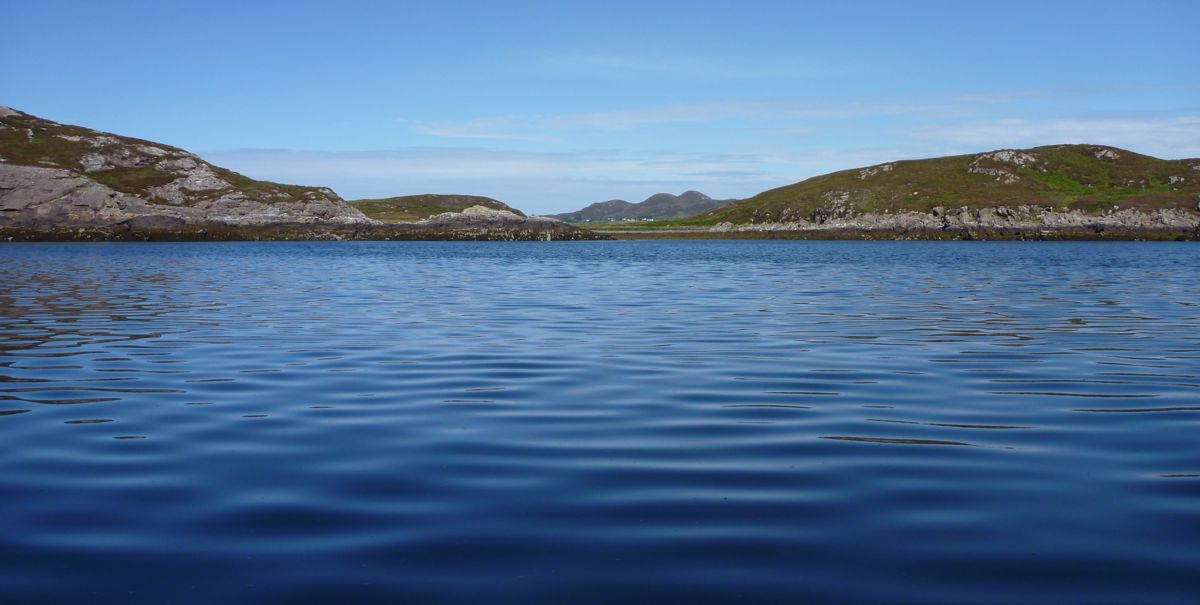
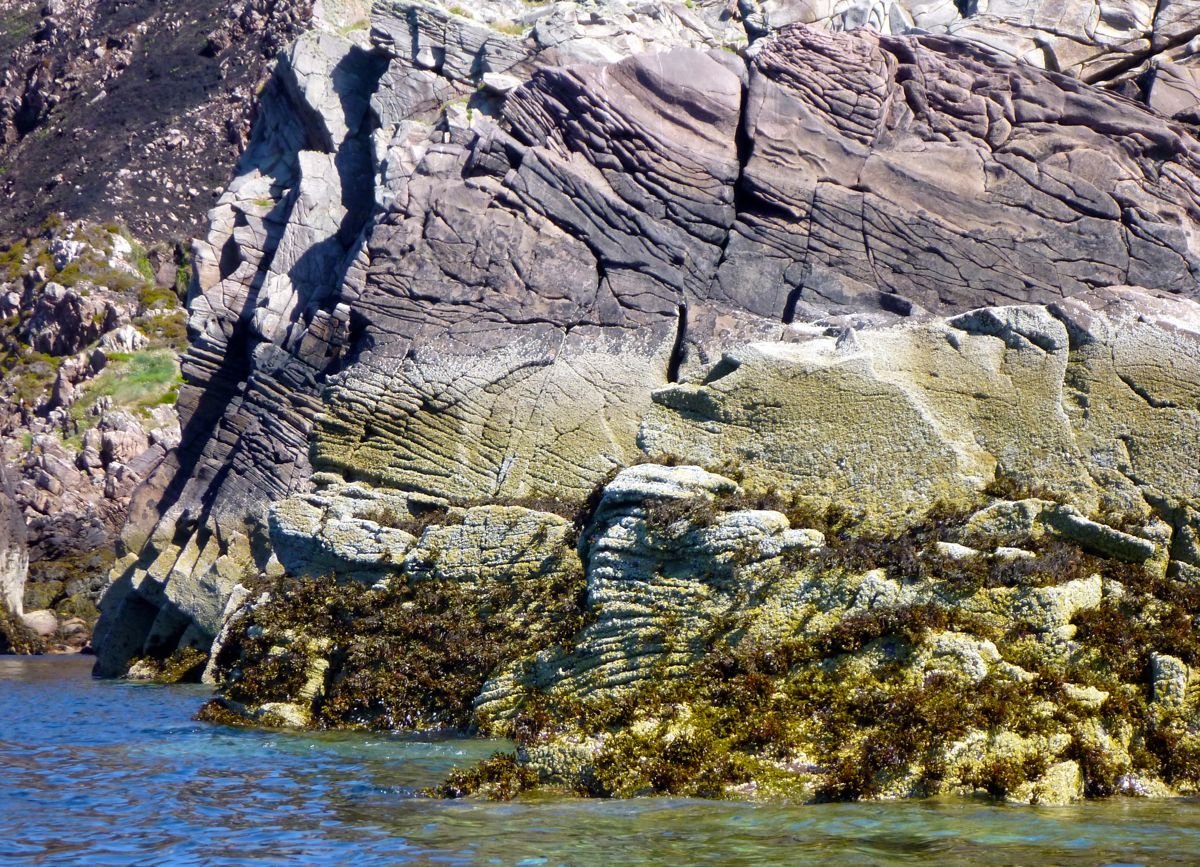
We paddle here a lot

Packrafting around Suilven mountain

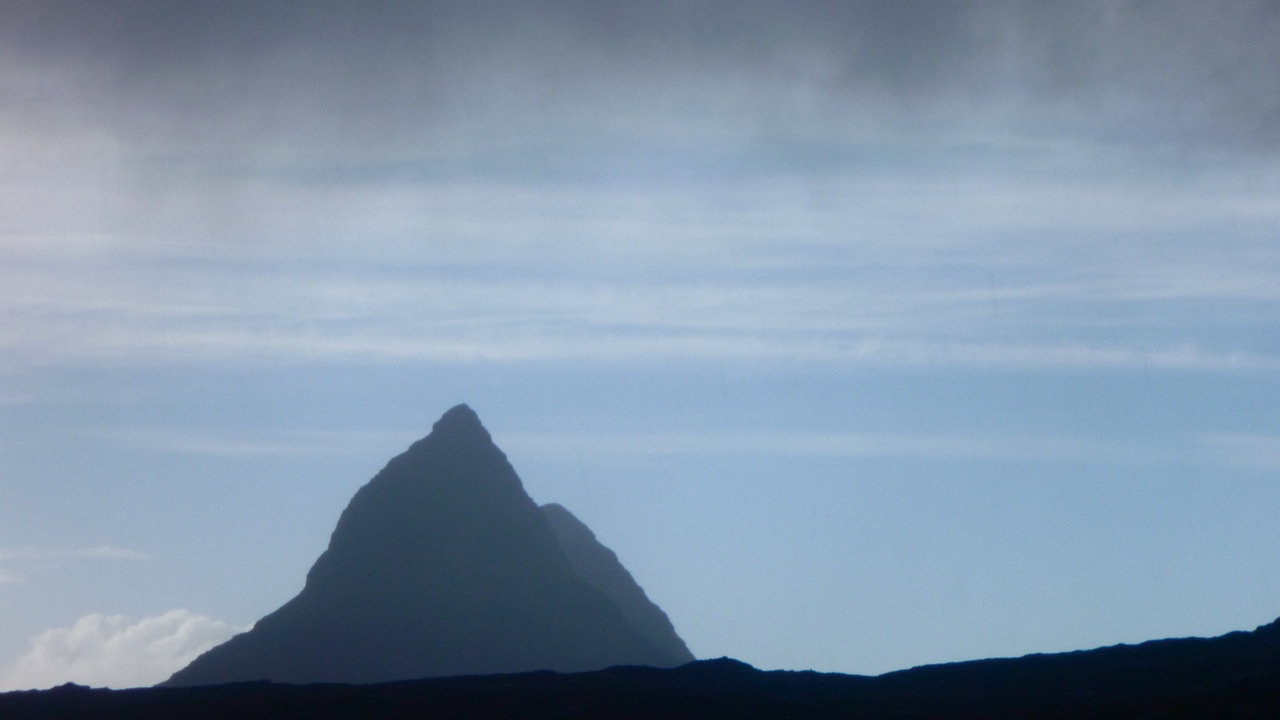
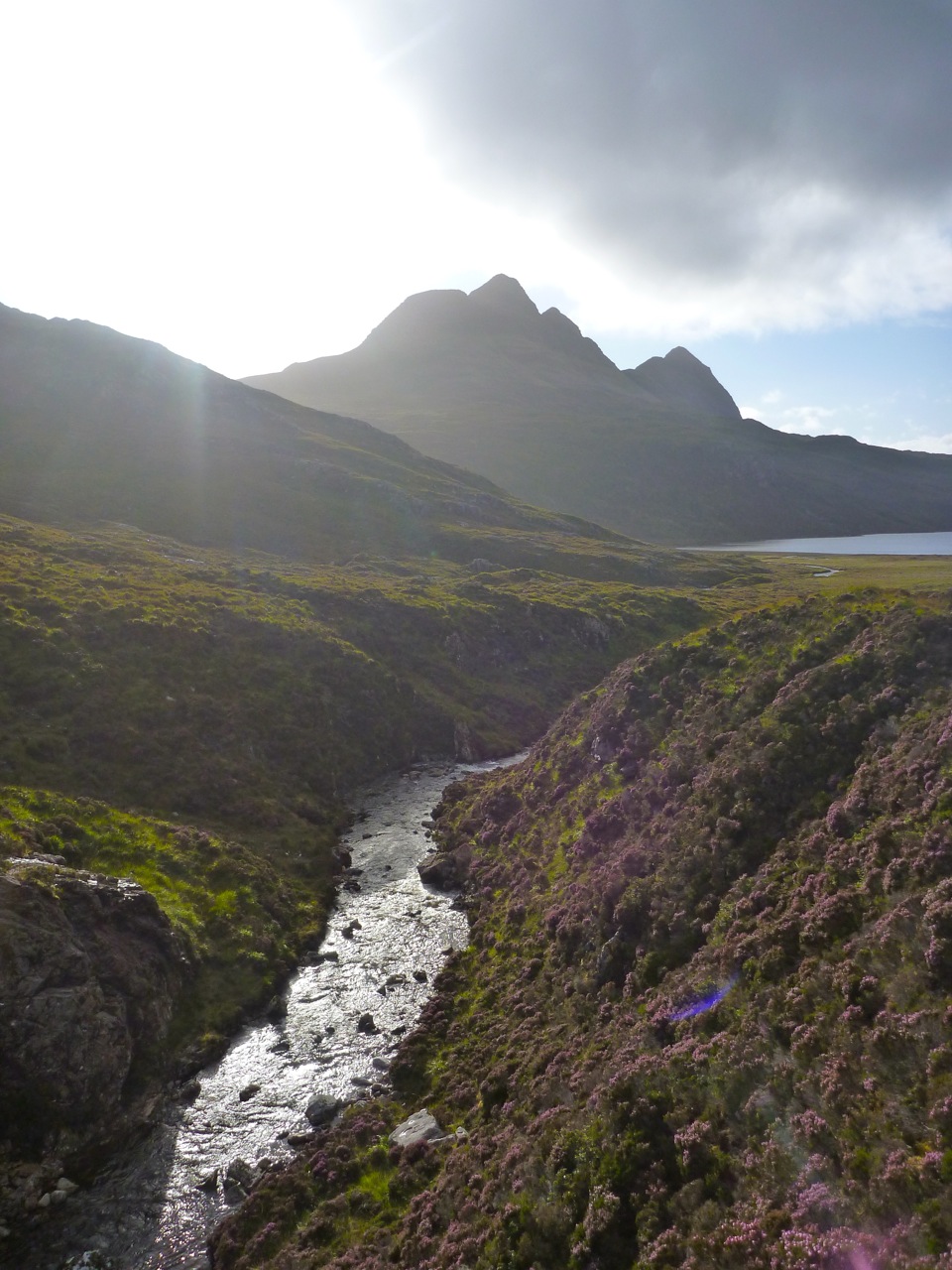
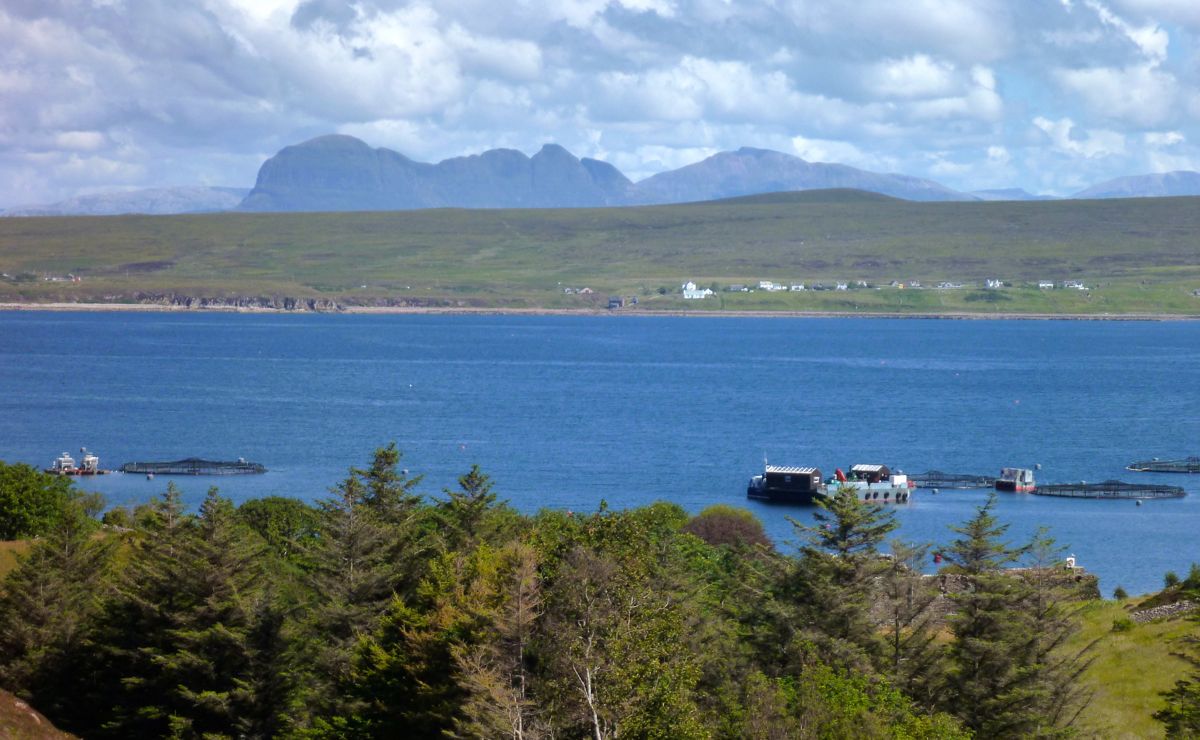
I’ve already done a couple of great packrafting excursions around the charismatic mass of Suilven mountain (left, viewed from the east). Last year we did a ‘triathlon’ loop up one side and down the other using bikes, feet and two-up in the Yak; and before that I did an overnighter from Loch Sion to have a look around. That second link has an intro to the region you may like to read.

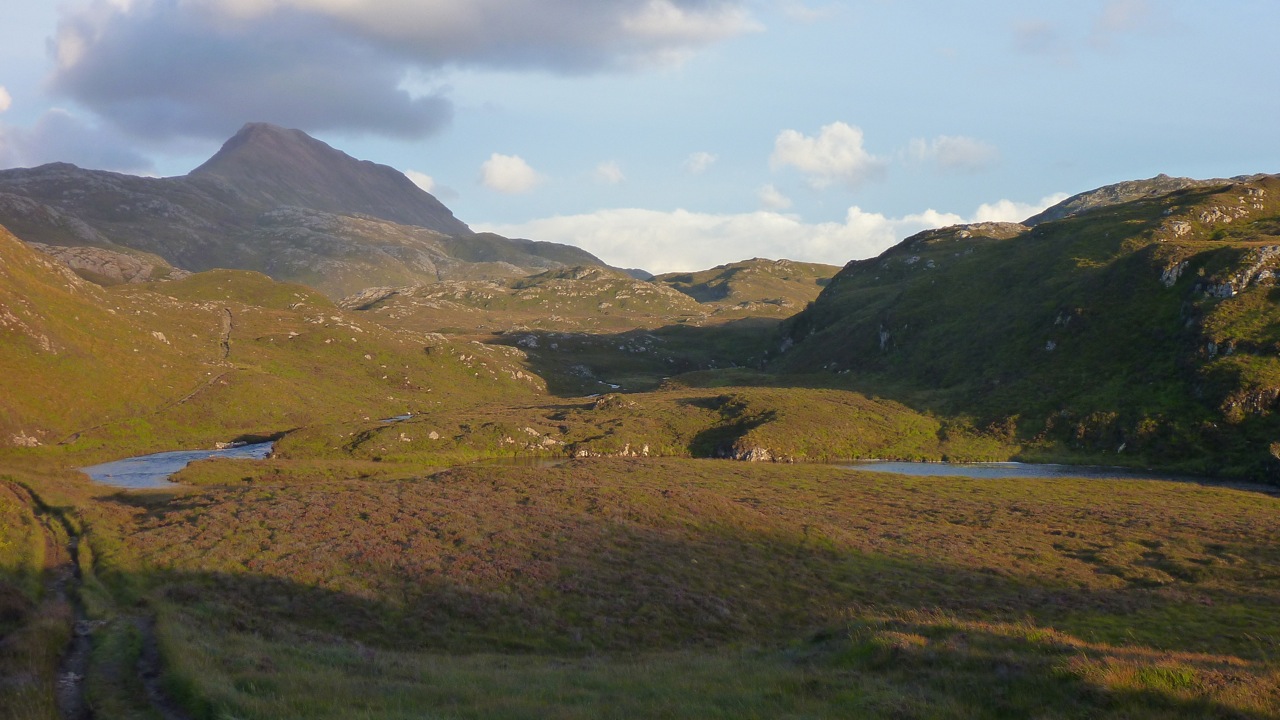
So you’d think I’d know the local pack-potential well, but looking yet again at the map, I clocked an interesting if lengthy day out, packrafting around Suilven. I could walk east out of Inverkirkaig past the Falls to Fionn Loch, then paddle several miles of continuous water south of the mountain to cross a headland and then another short loch. From there I’d turn back passing a couple more lochs to Lochinver back on the coast. That was around 23 miles, plus another 3 or 4 back to the motorbike at Inverkirkaig. An eleven hour day for sure so unusually, I packed a torch.


The day of least bad weather arrived (today’s grim weather, right): overcast and 12°C with winds building up to 25mph bringing showers and afternoon sunshine. It would have to do; the rest of the week was forecast as much worse and at least I’d have backwinds paddling out.

lochanss

Should they become hard to handle I knew I could hop ashore – that’s the great thing about packrating. But I also knew that cross country hereabouts is usually a gnarly combination of boot-sucking mires, moss-clad boulders and ankle-snapping tussocks of clump grass. Unless you’re a ground slug or sport a rack of antlers, when off piste in the trackless wilds of the far northwest, you’re often better off in a boat.
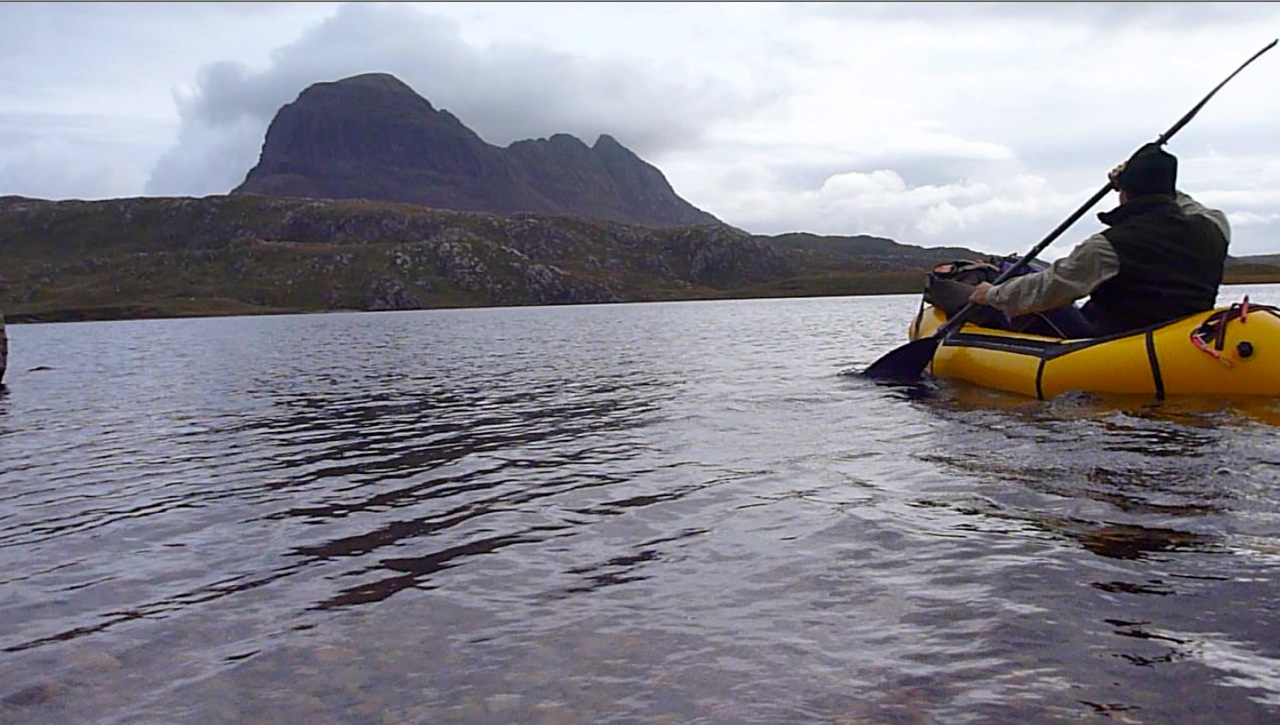
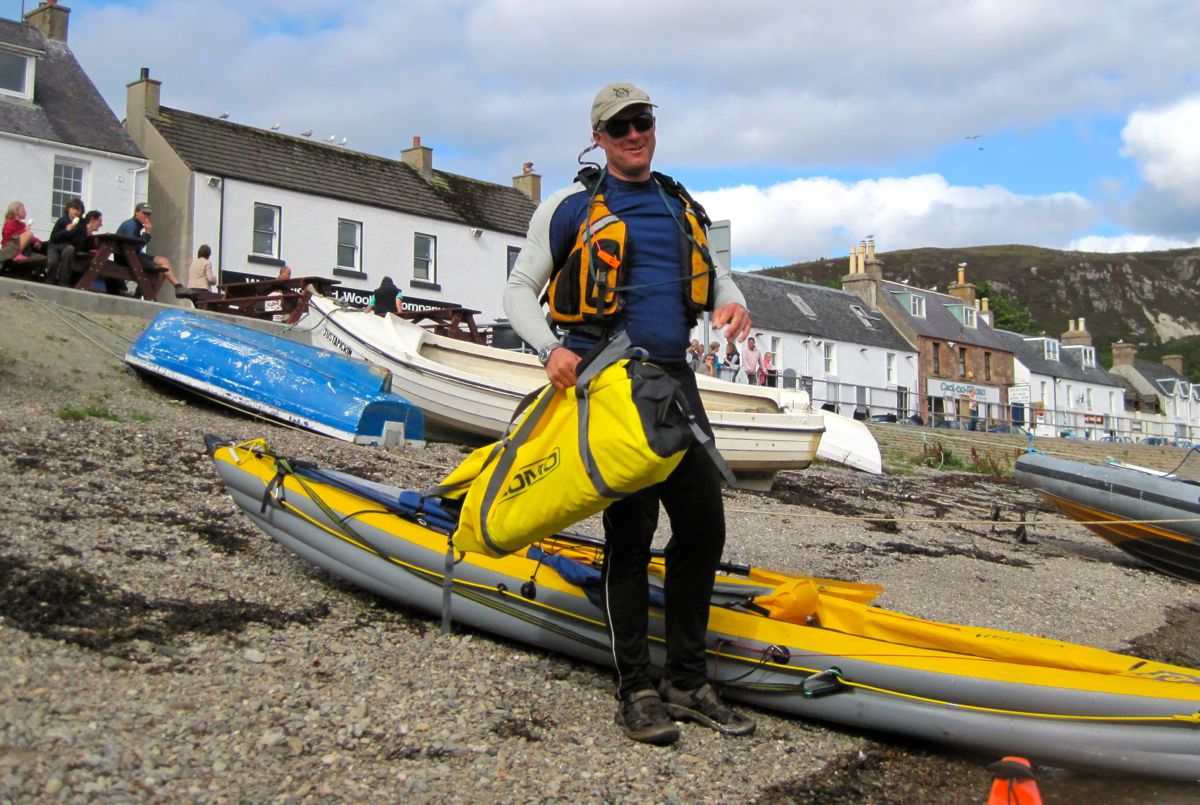
Nine 15 and I was out of Inverkirkaig with two fat sandwiches, two bananas and a cup. The thickly wooded valley with it’s not quite paddle-worthy river rose up to the 60-foot Falls of Kirkaig, but with filming and whatnot, it wasn’t till 11am that I paddled onto Fionn Loch (left) under a ceiling of thick cloud on the verge of incontinence. The rounded west prow of Suilven loomed above, trailing its cone-like tail like the giant goldfish in the Singing Ringing Tree.

I was reversing the section we paddled last year on the triathlon, and at a narrow point passed some small standing waves indicating a current flowing back to the river. Hmm, strange I thought. Approaching the mile-long narrows which maps call Uidh Fhearna, it was a stage which I’d somehow got into my head flowed east into Loch Veyatie, based partly on this picture I took last year. Turning south round a reedy bend and fighting what I thought was just the headwind, I took another turn and, like some astonished Victorian explorer, found the water flowing west, right at me. Of course it does. At the other end Loch Veyatie, Cam Loch drops through a series of waterfalls, and if Fionn here did the same, where did Veyatie drain – down some tectonic plug hole? There would be no Fellowship of the Royal Geographical Society for me this year.


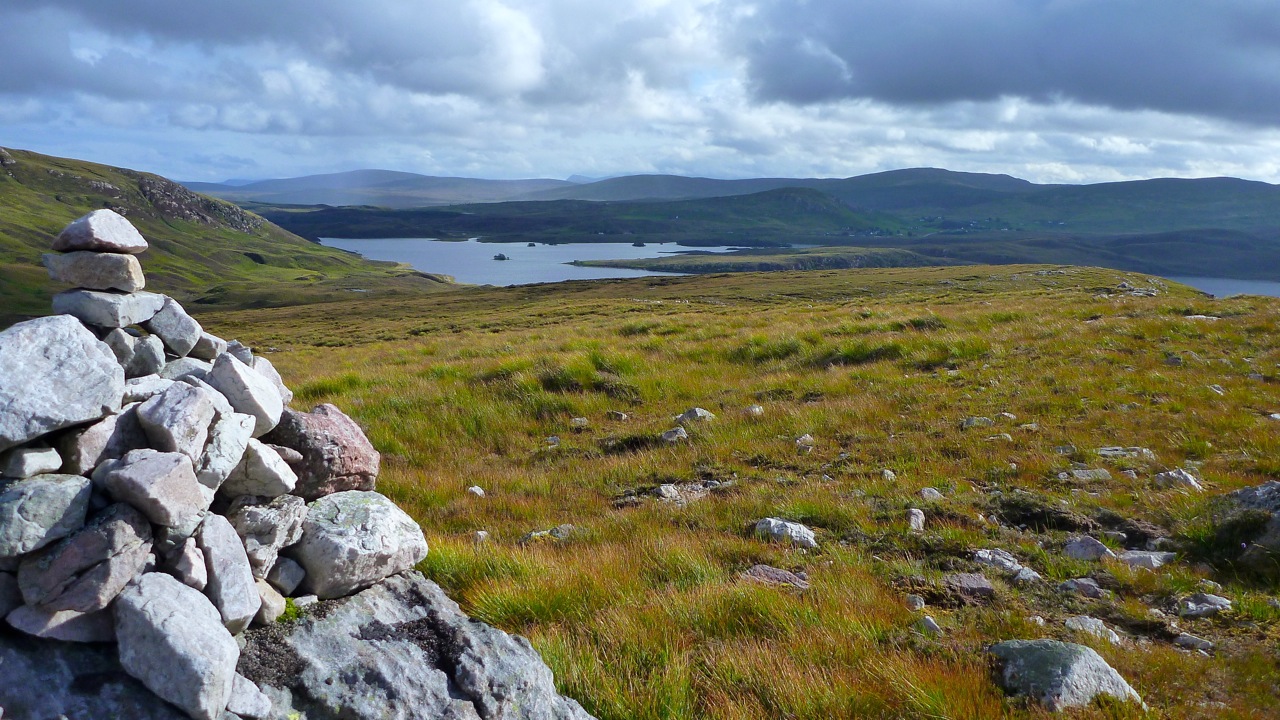
Even with a backwind, there was no paddling up this Uidh (left), though I’ve read of hardcore canoeists poling it. So I  unplugged the Yak and set off along the north bank to the far end where the Uidh opened out onto Loch Veyatie and lost its current. With no free ride to help outrun the afternoon’s predicted winds, my schedule slipped away.
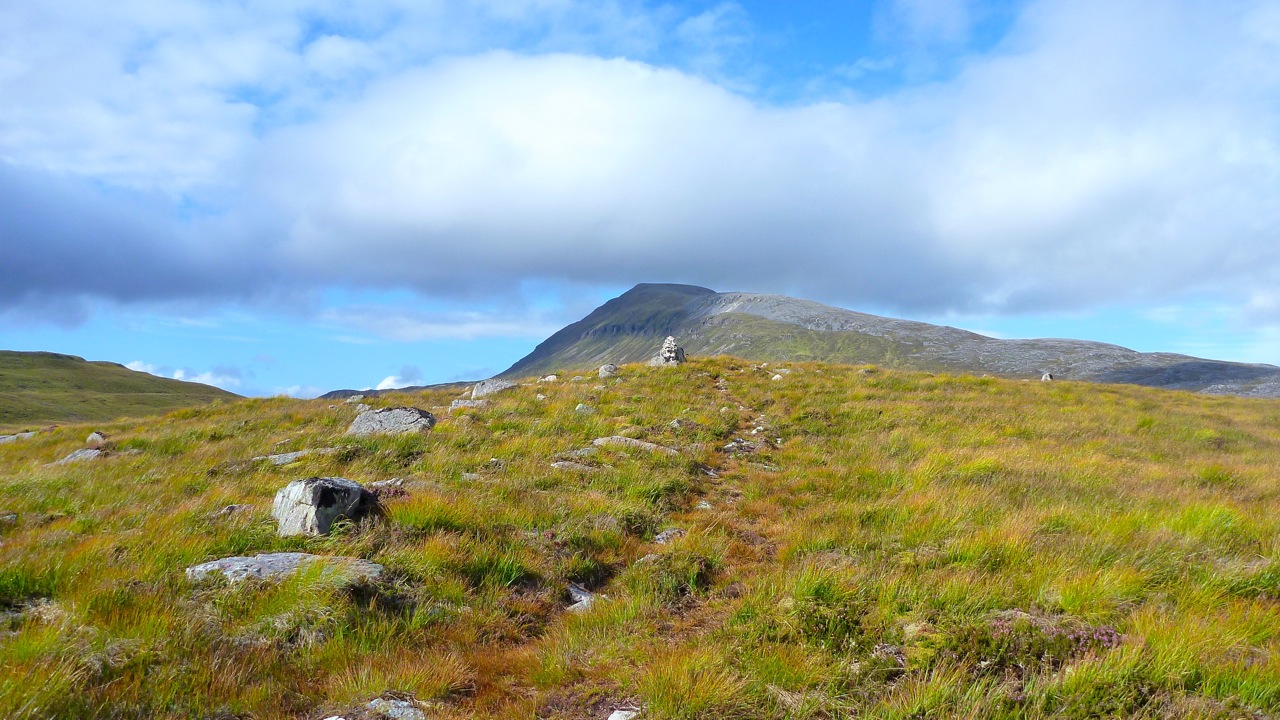
As the OS map shows initially, there’s a path as far as a stream a mile away. Who knows why, maybe that’s where folk fish, but of course the path itself becomes a mini river. I should have worn my long Seal Skin socks today, the short ones were already sodden but they still kept my feet warm. After fording the river I decided to continue cross country until it became too hard. That took less than 20 minutes by which time I’d already stumbled twice and, while negotiating one steep bank, actually feel a few feet into the loch! Luckily, no damage done so just up ahead I set my sites on a beach to deploy the raft.
It was now 1pm and with that walk covered at around 1.5mph and getting slower; better to get on the water. But first, for amusement purposes I filmed myself from unrolling the Yak to paddling away. It took 8 minutes, something that you’ll see below is made a little less boring to watch by speeding up fifteen times.

An exposed hour’s paddle down Loch Veyatie ensued. I turned out of the cove into the wind, hurrying for the south shore to get into the southwesterly’s lee until the next narrow point where I’d cross back to the windier north side to line up for my take-out. As I passed across the mouth of the sand-spit inlet of Loch a Mhadail, gusts blasted out fetching up some whitecaps. It’s all in the mind of course, but I really don’t enjoy bobbing about alone, mid-loch and out of sight on a chilly September’s day without a drysuit or PFD. One good thing with the Animas backpack I was using for the first time was that like my UDB, it doubled as a reliable float bag. Although there was virtually nothing in it bar my lunch and a cag, that was the reason I sealed it full of air.


The overhead gloom and rising wind was eating up a lot of nervous energy, but that wind was also pushing me along at what turned out to be 3mph, more than double what I’d have managed staggering along the shore, and more direct too. Another reassuring surprise was spotting the buildings at Elphin on the A837 at the head of the Loch. I’d forgotten how close I’d be getting to the other end.
Paddling with the wind past the south shore, cascades ran off Cul Mor and scraggy patches of original woodland clung to the foreshore. I counted them off on the map as markers to my take-out, and with a dash over to the north side, that came up just as it looked on Google Earth last night. What a great WYSIWYG navigation aid GE is. Let Google harvest all my dreary browsing data to throw back at me as targeted ads. It’s a price worth paying for their sat mapping services.
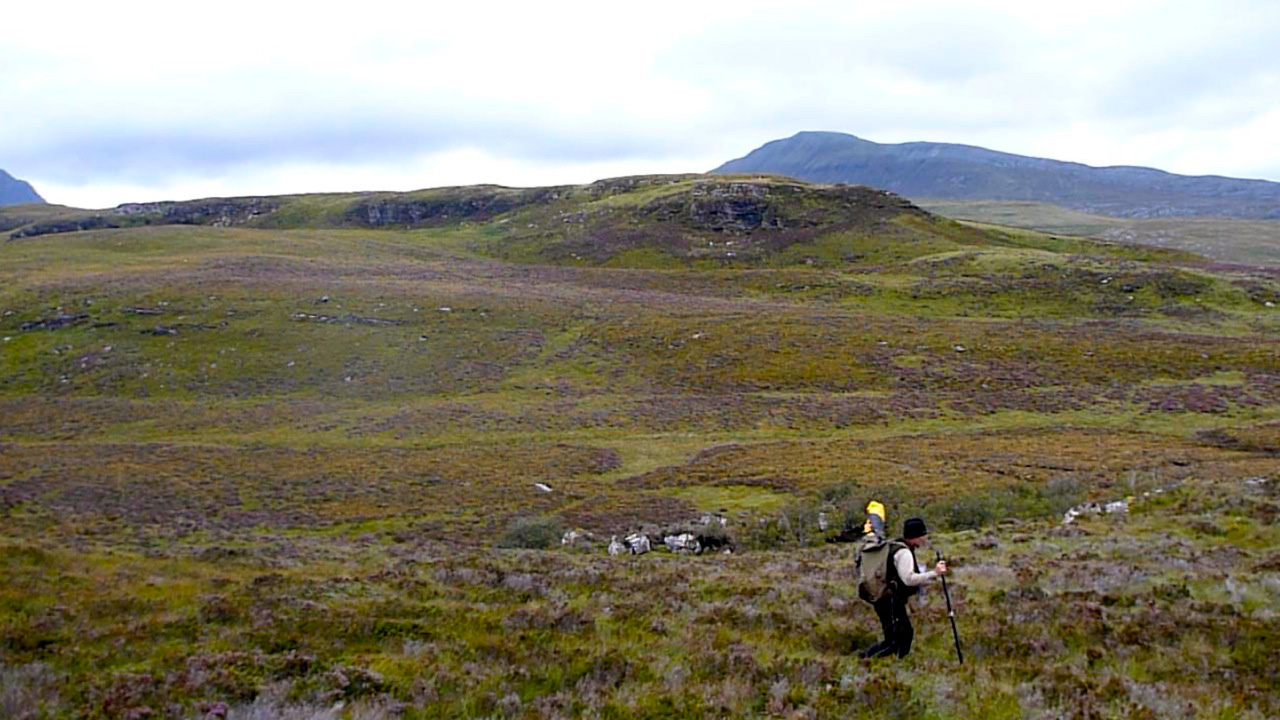

It was only when I crawled out of the boat and stood still that I realised how strong the wind really was, roaring over the hills and bating down the grass. Even though it was less than a mile’s walk to the other side of Creagan Mor headland, there was no chance of leaving the Yak inflated. Instinctively I headed for higher ground, scattering some deer far ahead, but my route soon led to a cliff so I dropped back into the bog and tussock valley that brought me to Cam Loch’s shore. Here I felt I could relax sufficiently to eat something. My cup was MIA, out on the loch somewhere, so I scooped up a drink by hand.

One more loch to cross; easily done no matter how windy it’s become. Somewhere on the north side the map promised a path that led 12 miles back to Lochinver. All I had to do was slot myself onto it and ride it out for as long as it took. Whitecaps rolled passed me as I neared the north shore of Loch Cam, but what had had an edge of dread on Veyatie just an hour or two ago was becoming familiar and a bit of a laugh as the promised sun stuck its nose out for a sniff at the day. After airing down I soon hooked up with the stony trail, but found I was wavering a little, probably through not eating or drinking enough. It was now 3pm; six hours on the go but I’d only actually walked some 4 miles up to that point, so the legs had plenty left in them and there was drinking water running down the paths.

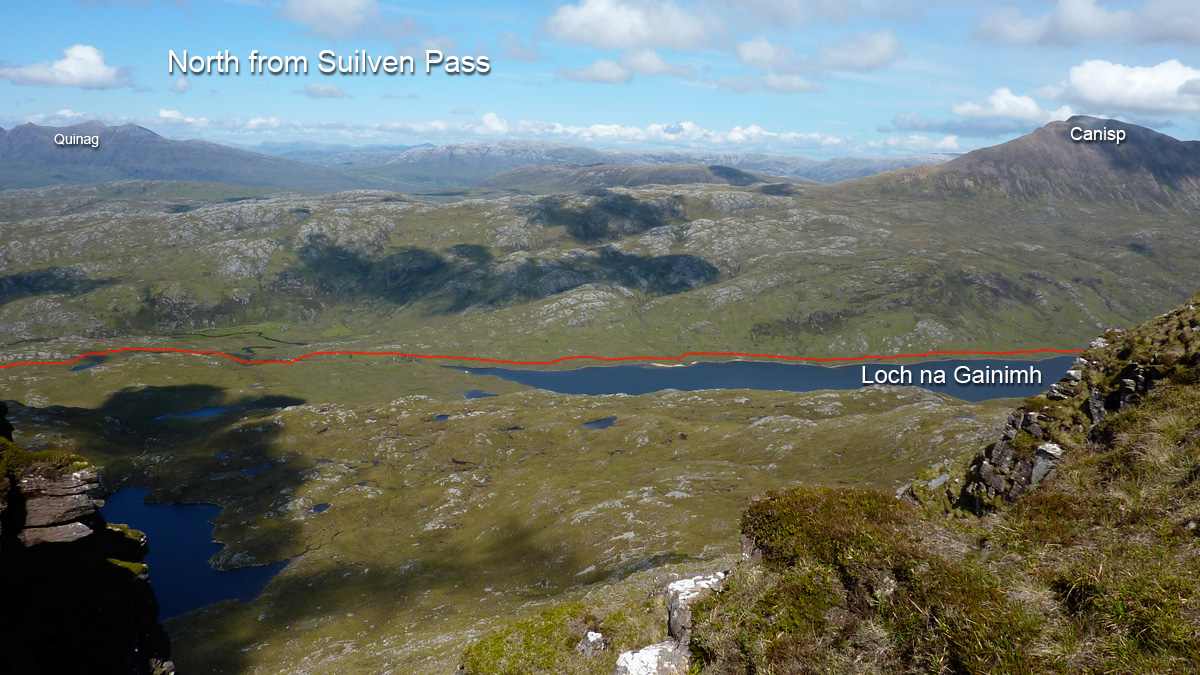
On occasions I’ve harboured thoughts of cycling this path from Lochinver to the A road, but from the state of it at this end I’d not get 10 feet. It followed a hard, white rim of exposed stony rubble that’s visible on a sat image, but I suppose was better than the mush to either side. Light grey and crystalline, I’ve since read it’s Lewisian gneiss or quartzite which gives the appearance of snow to some of the Assynt’s mountains like Canisp or Foinaven (see long image below). This whole region is marked with monoliths, the most striking of course being the remnant sandstone outliers like Stac or Suilven which resisted their brush with the glacier’s claw as it passed through, exposing the ancient base of lighter coloured gneiss.

I’ve kept missing the interesting ranger-led talks at Knockan Crag, just south of Elphin, he site of the Moine Thrust which literally turned geology on its head a century ago.
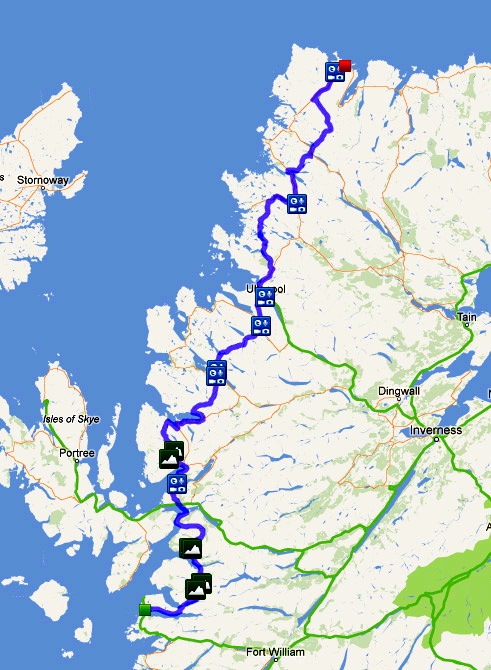
Trying out bikerafting

I’ve had Alpackas a couple of years now but I’ve been a bit slow about trying out bikerafting. I like pushbiking, walking or packrafting in the wilds and combining walking with paddling (aka: packrafting) is well suited to northwest Scotland, as several posts here show.
But add a bike and any off-roading becomes marginal up here. Most of the time you’ll be pushing or carrying, especially with an overnight load. No MTB is really rideable on the footpaths up here, although unlike England and Wales, since 2003 Open Access allows cycling on footpaths (there are no bridleways). Off the footpaths, at times you can barely walk, let alone ride a bike.

I like the simplicity of walking with paddling – you can traverse both surfaces most anywhere you like. A pushbike requires rideable terrain and on an Alpacka gobbles up payload, space and buoyancy, requiring you to design routes that combine flat water with ridable terrain, or even roads to make the most of the configuration. Then you got the faff of securing the bike reliably to the boat (or so I thought); the last thing you want mid-loch is 15 kilos of Cro-Mo steel slipping off and turning into an anchor just as the wind kicks up.

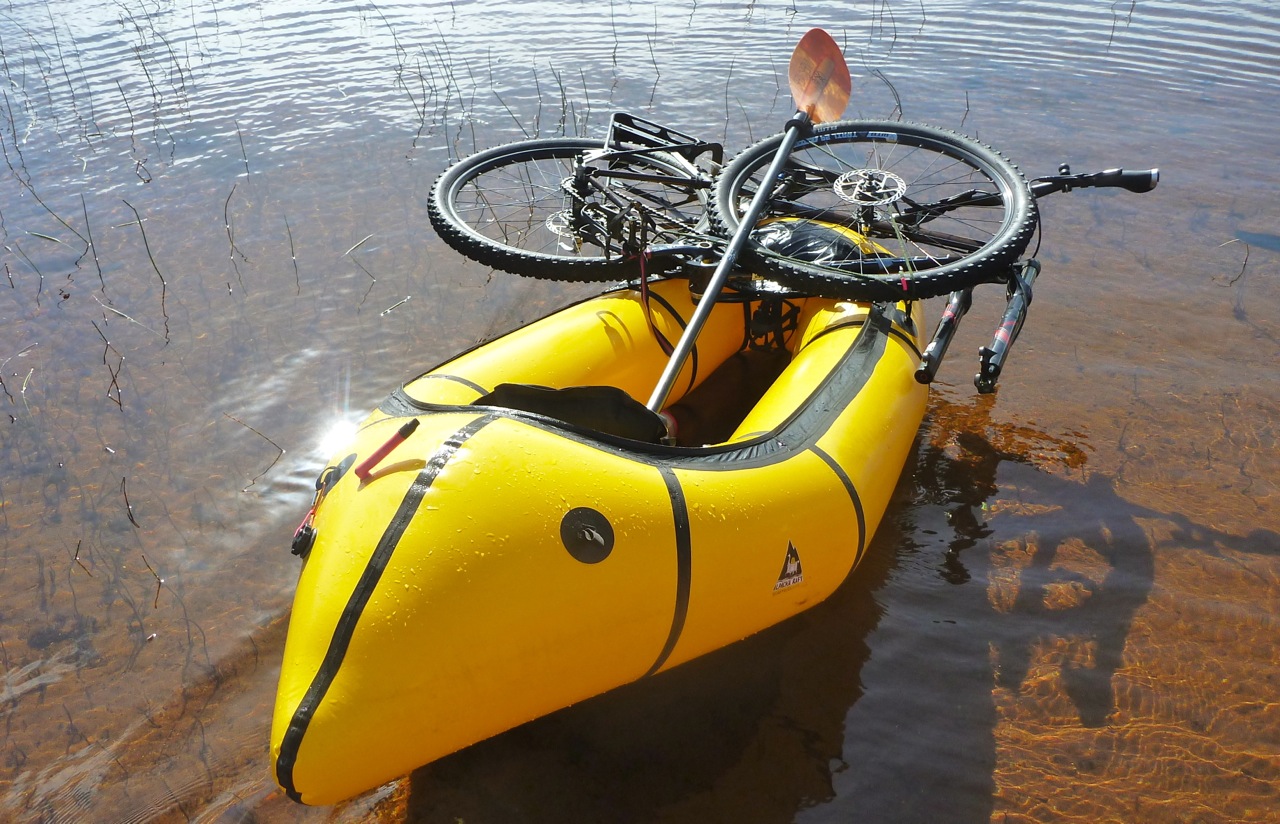
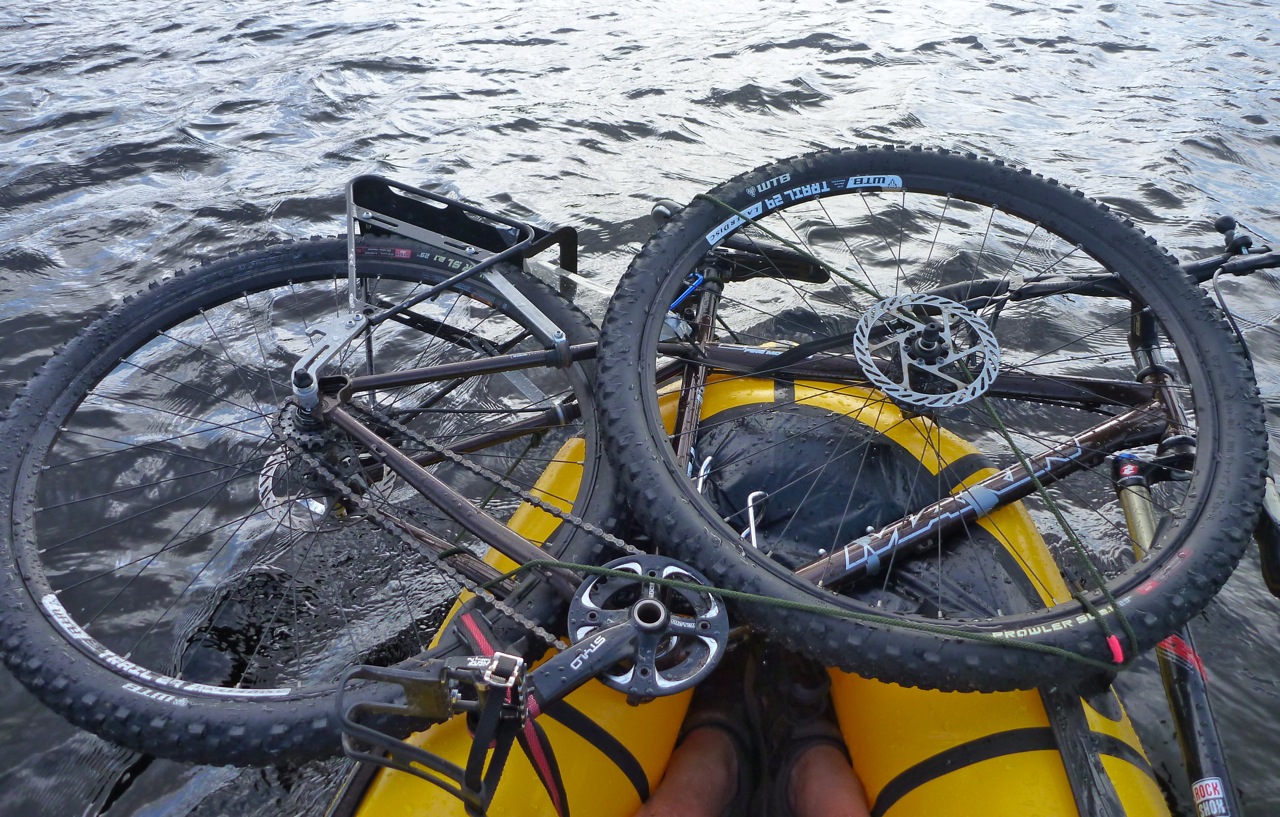
But let’s give it a try. The winds had backed down to a forecast 15mph (yesterday it was three times that) so we nipped out with the Gumotex Solar for a scoot around Loch Oscaig. I hadn’t tried it before, but with the front wheel off, strapping the bike on was actually pretty easy. The four Alpacka loops line up just right and two short straps plus the boat’s bow line were enough to secure the load without even a smear of chain grease. A loop of inner tube was handy to hook the handlebars around the top tube to stop one end dragging in the water. Once on the water, my arrangement was by chance correctly balanced, too.

My bike’s at the time was a single-speed Marin with hydraulic brakes so there were no cables to worry about rusting, but on the move it was clear the back wheel got in the way of a full stroke on the left, making for unbalanced paddling. I got used to it but for a longer stage it would be better removed, even if it leaves the chain flapping around. To me it’s a light bike, but the Marin probably weighs 14kg, about the same as overnight loads I’ve carried. The good thing is, such a weight on the front of the Yak only improves the tracking by reducing yawing.

The wind got up while we were out and at the downwind end of the loch it got a little choppy with splash coming over the sides, but the Yak bobbed over it. Here the Mrs set off against the wind for the two clicks back to the boathouse, while I hopped out, unloaded, aired down, rolled up and rode back along the road. 

Having now tried it I’m a bit less sceptical about bikerafting. On the boat it was less of an encumbrance than I thought. I’m not sure it would work well up here in the Assynt without contriving a route, but maybe all packraft trips are contrived to a certain extent, and anyway the motorable roads here are very quiet.

I suppose the real advantage of a bike with a raft over walking is that, providing the terrain is amenable, greater distances can be covered off the water which extends your range. But combining a multi-day trip with a bike away from roads gets challenging. I’m thinking of something like the 2008 Lost Coast bikerafting trip in Alaska I read about a few years ago, which ran northwest from Yakutat. Roman Dial, Erik Parsons (from ’08) and a couple of other guys did a similar route last year, but heading southeast towards Glacier Bay this time. Check out their superb vid below or Roman’s blog post and pics. The vid doesn’t not show much rafting but look at the route maps: they sure put in the days on the water.

Packrafting in a Force 6 Gale

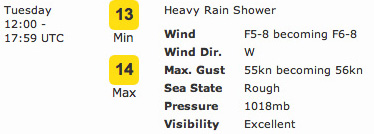
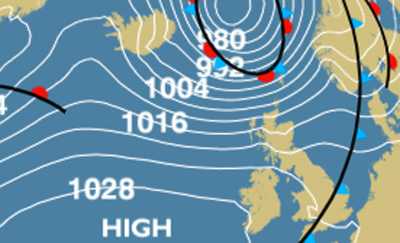
I do like a good storm. On the left today’s coastal forecast for the Minch. You might call it the first big storm of the autumn. Some 250 miles to the north, out on the Faeroes and towards Norway it’s blowing at Force 10 with 40-foot waves, like something out of the Perfect Storm movie before it gets really scary.

What can it be like to paddle a packraft against a wind gusting up to 50mph, I wonder? Is it even possible? Many times I’ve surprised myself how fast an IK can move – 2-3mph – into a headwind of around 25mph. You can’t sustain that all day, but last year I managed to plough along like that for an hour or two when I gave up on the Ningaloo Reef and turned back into the wind. Seeing as gale-force is the only paddling available for the next few days, I rolled up the Alpacka and went to find out.
Sorry to disappoint you but heading out to sea alone, even on the beach with the onshore wind felt too risky. I figured there was a good chance of a gust flipping the back-heavy Yak in a kind of ‘frontal bandersnatch’ as it crested a wave. Better to stick to my ‘play-loch’, site of many paddling experiments and where there’s just wind and not much wave to deal with.
In the given conditions inflating the Alpacka in the back of the car was effortless; it took just six bagfuls to fill up the boat, instead of the usual ten. Getting my yellow windsock onto the water was less easy, so once I slapped it down I jumped in quick, clipped the raft to myself via the paddle and tried to leave the shore at the downwind end of Loch Raa.


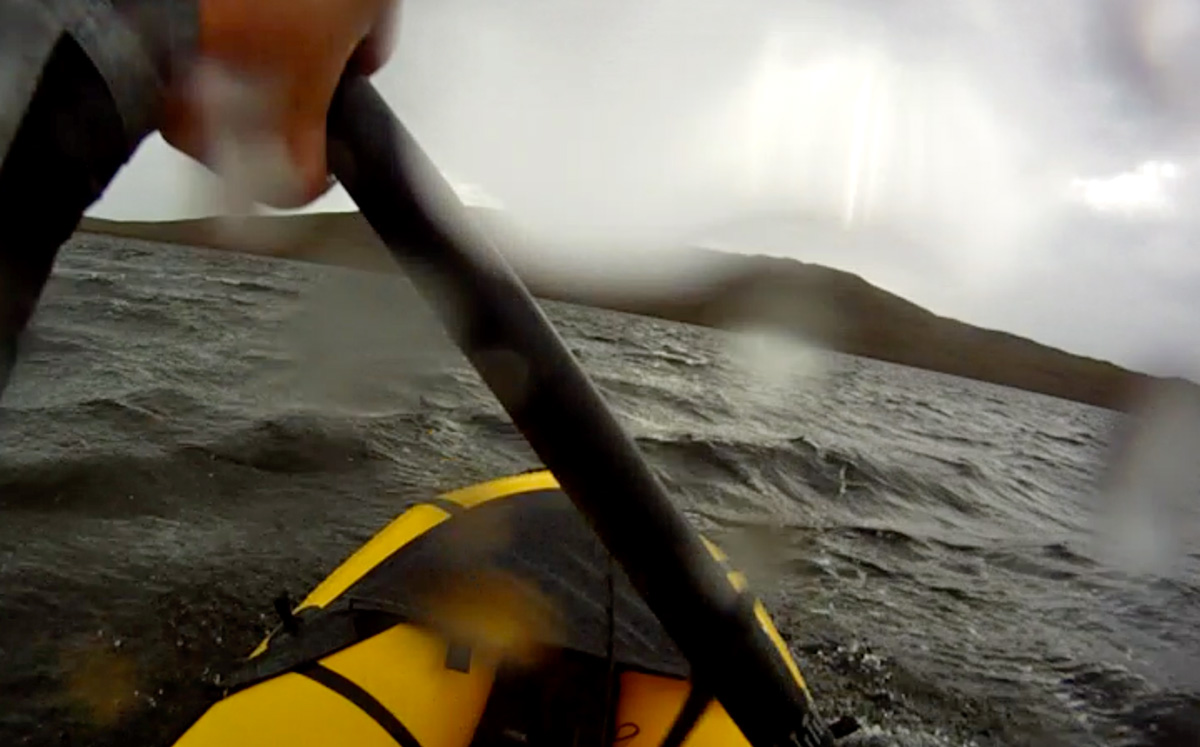
There was no fetch to speak of and using my large-bladed but light Werner Corrywrecken paddle, I jabbed at the water head down, trying to make headway. The waves rushing by gave the impression I was flying but a sideways glance to the shore showed the raft was barely creeping along. And when a gust hit, it didn’t actually move at all despite my huffing and puffing.
Even though I’d probably missed the peak of the day’s winds, not surprisingly I’ve never experienced a paddling effort like it. It felt like some sort of horizontal pull-up machine in a gym set on ’10’ and my hands gripped way out on the ends of the shaft to increase the leverage. Soon any ideas about paddling to the far shore, only 700 metres away, were surrendered. From a video’s timeline it seems it took me 8 minutes of flat-out effort to cover 250 metres – just over 1mph with brief rests every couple of minutes.


I felt safe in the Yak; the gust-borne waves weren’t even a foot high and it was actually a good little workout. Once I’d had enough, I swung round and shot back to shore at what turned out to be 4mph, but felt like sitting still while the wind blew past from behind. Interestingly the raft was easy to handle; no weathercocking. 
Walking the empty Yak to shore, it took off like a kite. Had I not been strung onto that thing it would have been on it’s way to Inverness quicker than the RAF Tornadoes which tear across the skies hereabouts on a fine day.

Kayaking Summer Isles to Ullapool (Incept K40)


Incept K40 Index Page
Weather data from Ardmair Point Campground
Summer Isles Guide

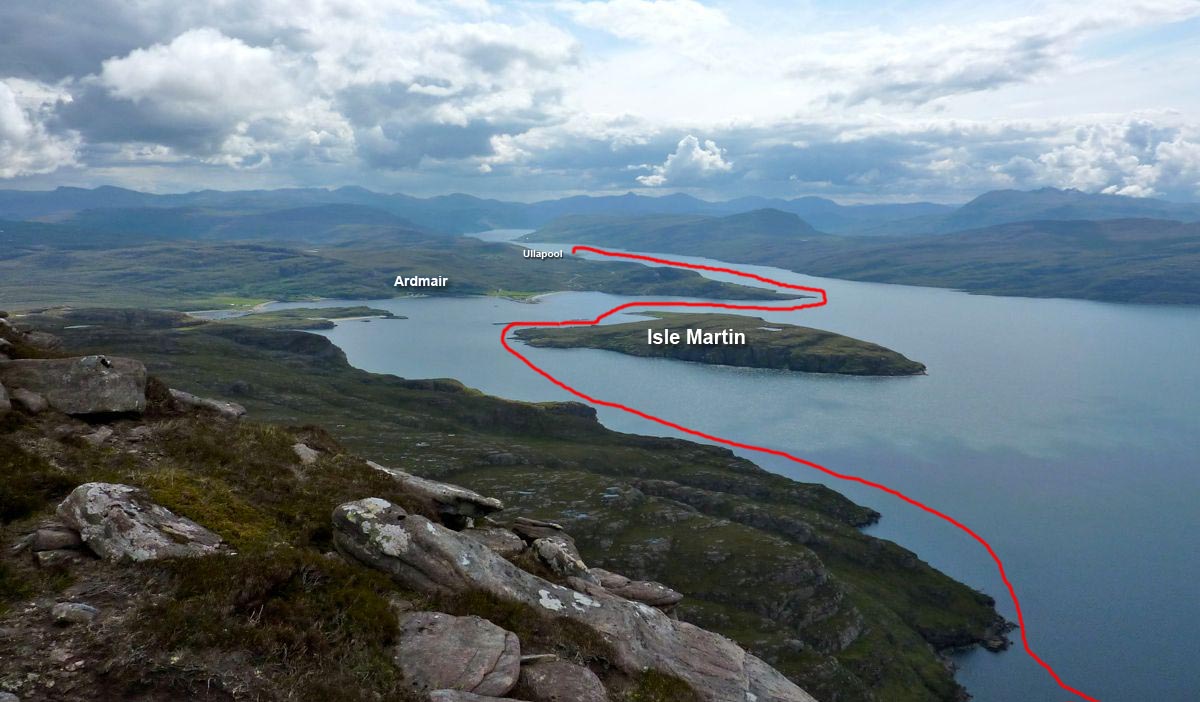
Right now the skies are slate grey while white horses gallop across the sound and the washing hangs horizontally. Ardmair just recorded 49mph. But as often happens up here, Sunday was forecasted as sunny with winds of just 4-5mph; a perfect day to paddle the 15-odd miles to Ullapool.
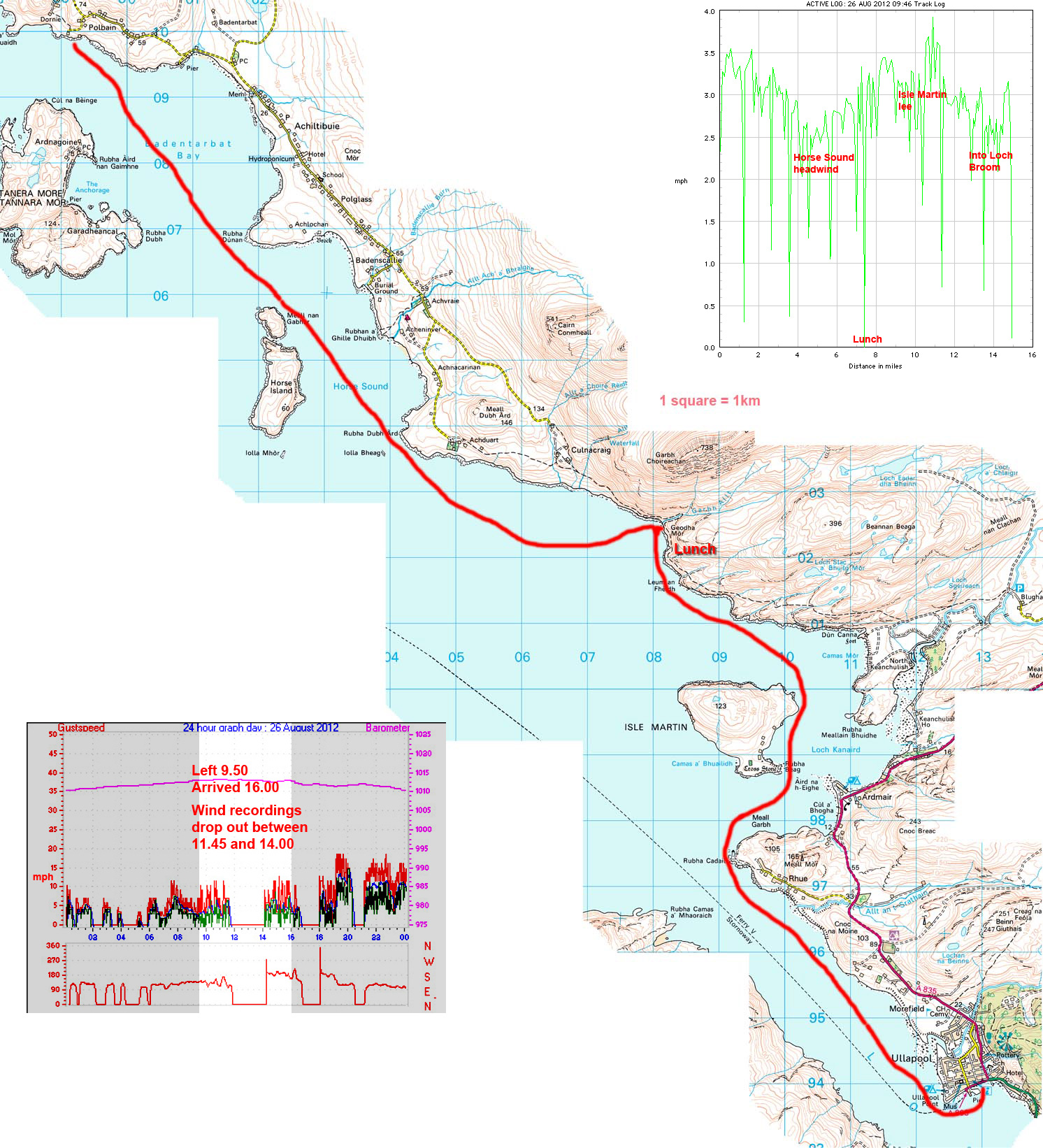
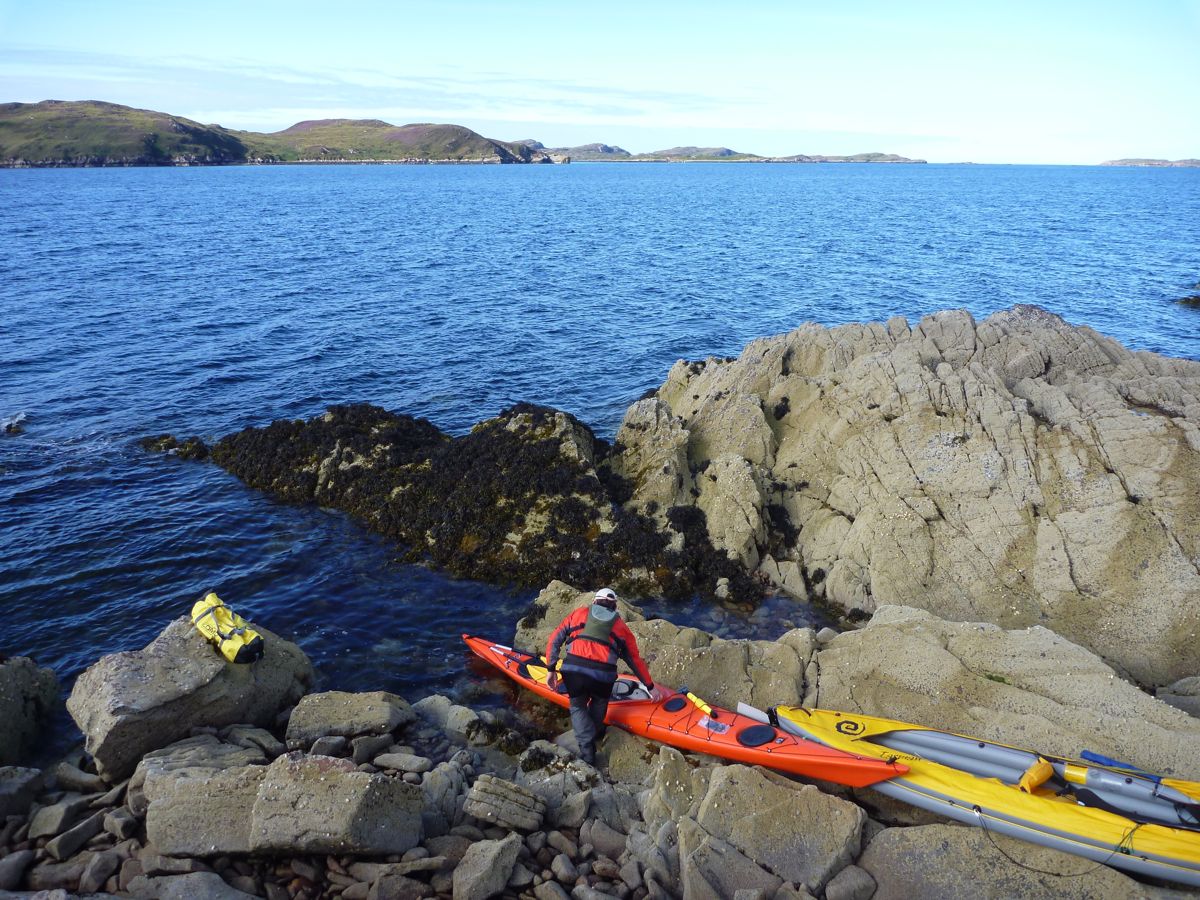
Come the morning the predictions had inched up to 6-7mph, still manageable. Even the three-metre tide was with us, turning as we set off from the awkwardly rocky shore below my place (below left) for a run that we figured would span the six hours until high water at Ullapool.

Six of seven mph winds don’t sound much, but coming right at us from the SSE it was enough to raise a chop of up to a foot over which my K40 slapped like a RIB. Jon’s Scorchio LV cut stealthily through the wavelets like a blacked-out  commando with a knife in his teeth. You got to hand it to these proper sea kayaks, they look as good as they go, until you need to hop in or out of one, or carry it on your head. As it was, in the conditions we had we were pretty evenly matched.

An hour in we were abreast of Horse Island and heading out into mare incognita. But not before I’d lost half my paddle. I was just thinking I really must get a leash for this thing for windier days, even if it means yet more tangleable cordage lying across the cockpit. As I made this vow I decided to wipe the sweaty right grip in the crook of my elbow, and in doing do, popped the button and flung half the paddle over the side. Mayday-mayday! Jon took a while to manoeuvre his 17-foot cheese-cutter into position, although I probably could have retrieved it using the single paddle. Must remember not to do that again.
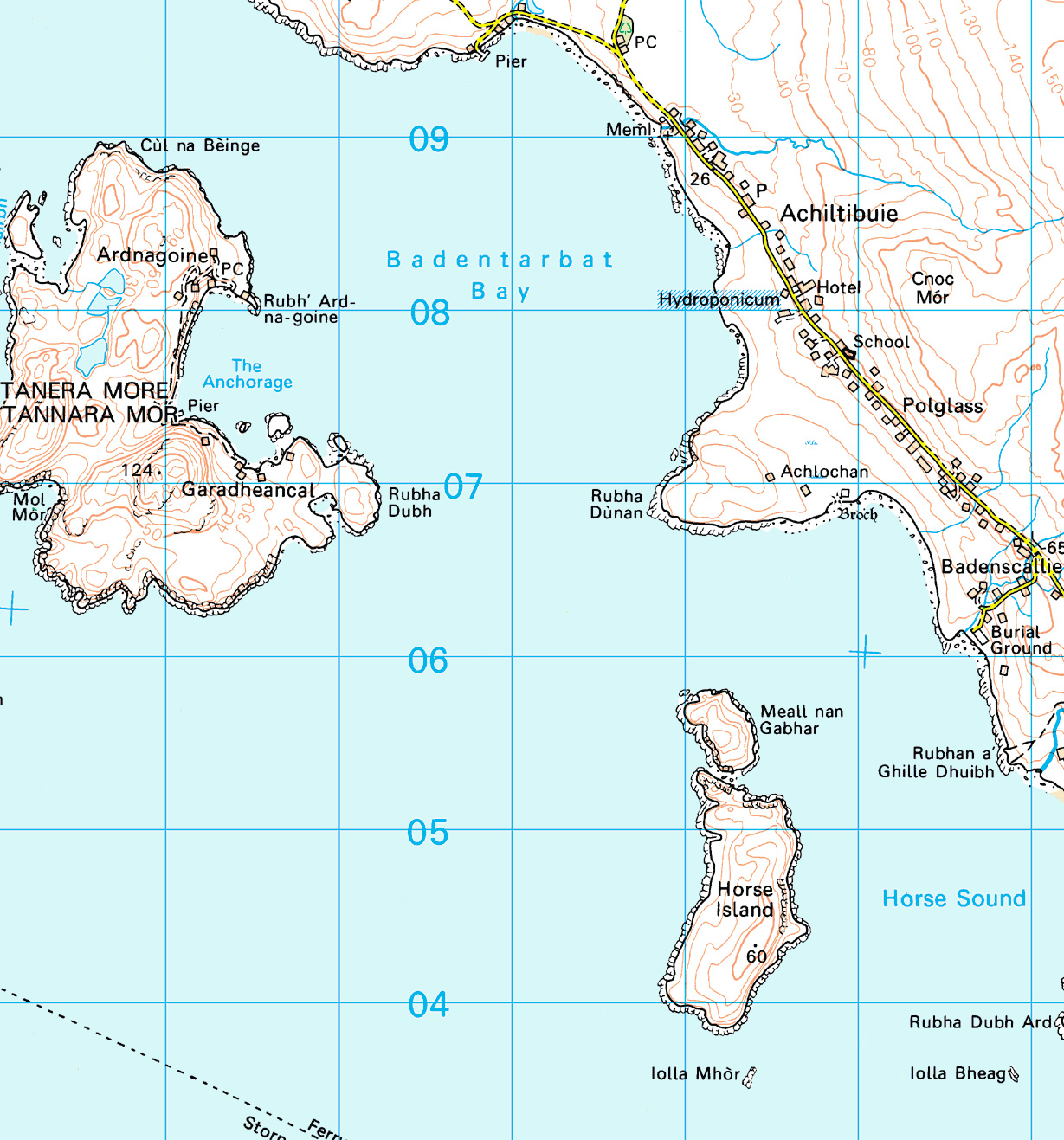
As we entered Horse Sound the wind rose into double figures and white caps formed so we bowed our heads towards the point at Rubha Dubh Ard opposite the guillemot-clad skerry of Iolla Beag (see map). We then passed the last of the dwellings around Culnacraig and edged towards the 2400-foot mass of Ben Mor Coigach which tops out just a mile from the shore. I wouldn’t be surprised if that is the steepest summit-to-sea gradient in the UK. Slip up there and you’d roll uninterrupted straight down into the sea with a huge splash.

Two hours hard work on deck and it was high time for a refuel, so we set our sights on a beach formed by the creek which runs off the back of Ben Mor. But with more slip, slap and slop over the waves, it took twice as long as it looked to get actually there (left). It’s since occurred to me why. In this pic the ordinary-looking mountain seems quite near, but its actually an unusually big 2400-foot (730m) mountain far away. Or we were just slow.

After the spell of fairly intense paddling, walking on the stony shore took some adjustment, but it sure was good to unbend. Up above a lone walker was pacing the thin Postman’s Path which runs along this steep, exposed coast east towards Ardmair. We did that one bleak December with packrafts. During a snack I kicked about among the usual enigmatic flotsam: a giant tennis ball, a baby elephant’s welly and a Filipino flip flop. I also picked up a bit of old rope to sell on ebay later while Jon pinched some nice stones for his giant aquarium back home.
During our break the wind abated a little and as we set off again through a seal patrol, Isle Martin helpfully blocked the wind-borne fetch from the southeast. The creased, folded and weathered sandstone of guano-covered red cliffs drifted by, suggesting a second visit on a calmer day, but it was after 2 o’clock so we decided to save our energy and clipped the edge of the Isle. We didn’t want to leave it too late and end up paddling tired up the narrow part of Loch Broom on a turning tide and a headwind.

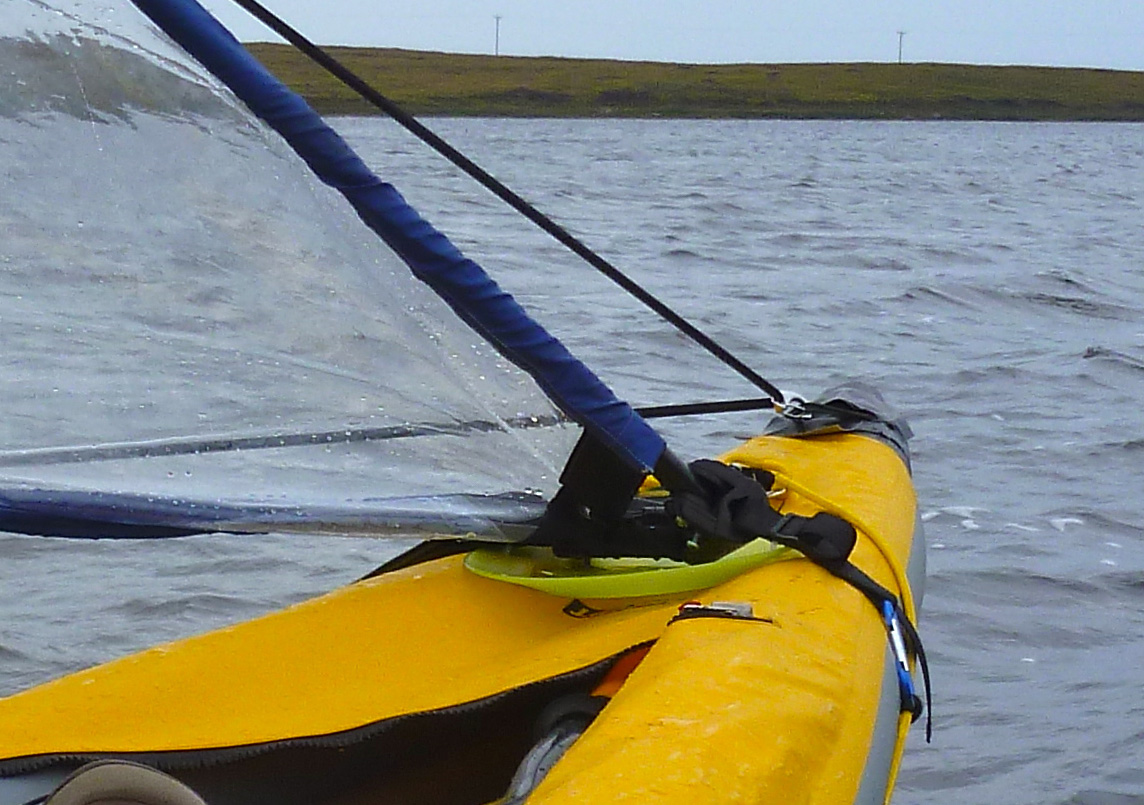
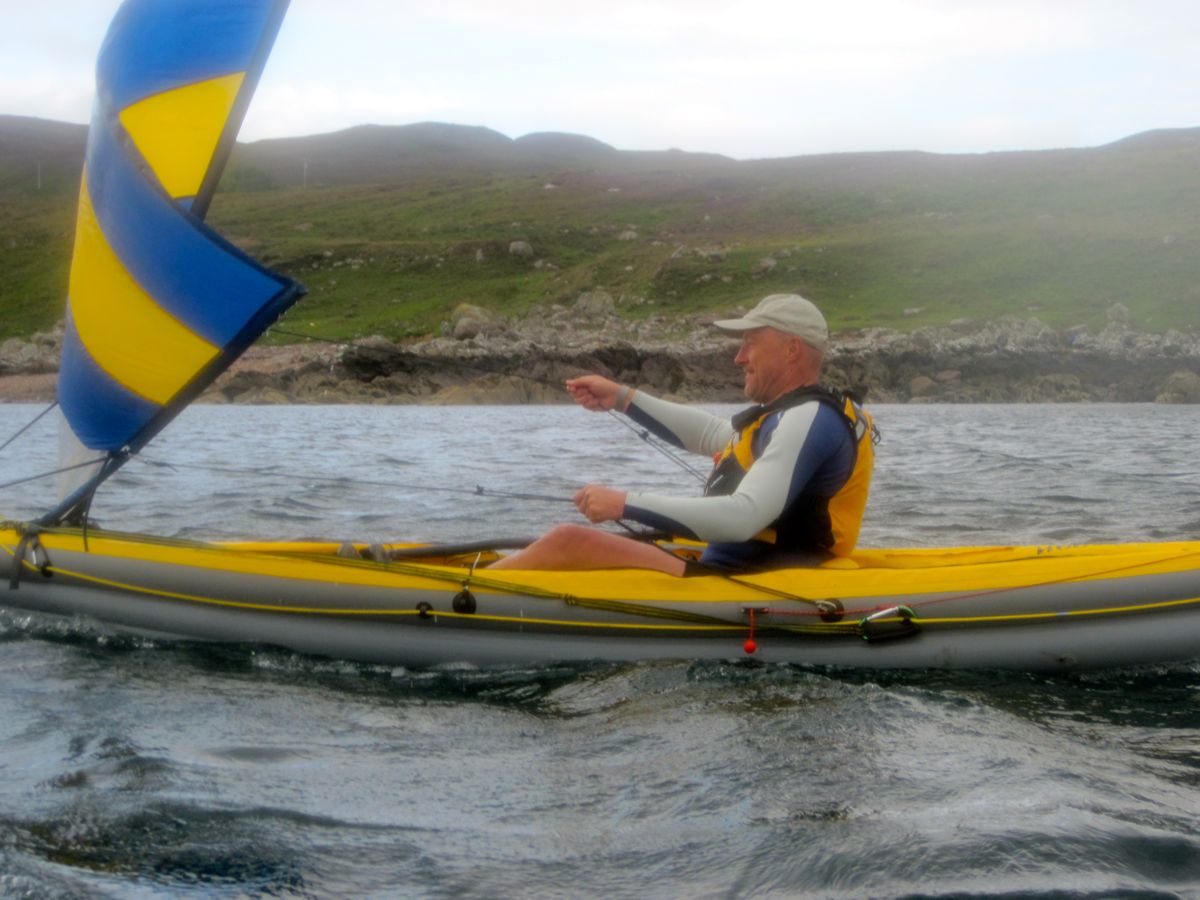
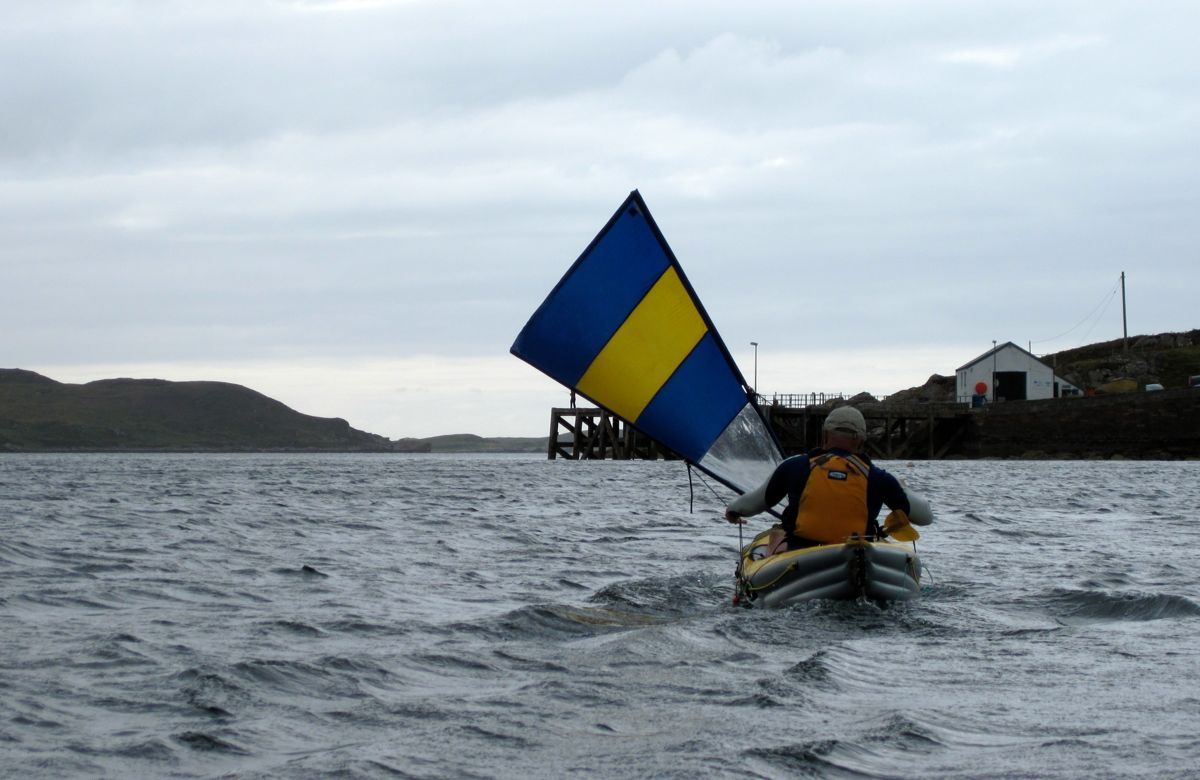
As it was I was hoping to snatch a quick sail (above) as we turned briefly southwest towards Rubha Cadail lighthouse, but while I did creep forward perceptibly, it was hardly worth it; bad angle and too much lee off the point. Still, the good thing with the Pacific Action sail is that it’s light, lies out of the way and is no effort to flick up on the off chance of a breeze.
Rounding the stumpy lighthouse near Rhue, (below), we could look back across outer Loch Broom to Polbain and the Summer Isles – maybe we should have planned the day in the opposite direction. Whatever, now it was time for the final 3.5-mile stomp into the wind to Ullapool jetty, hoping that the afternoon ferry from Stornoway wouldn’t sneak up from behind and wash us into the middle of next week.

I observed that Jon typically cruised at four strokes for my five and put it down to the superior glide of his hip-wide LV. In fact he was deploying a textbook exemplification of PPT or ‘proper paddling technique’, instilled by his personal paddling trainer (also PPT). I’d read about this technique in books: put blade in by your feet while turning torso and pull back by re-pivoting the torso, not just pulling on the arms like an ape climbing a vine. I tried doing this and was a bit faster but it all felt a bit stilted and robotic, not the way I naturally paddle, for better or for worse.

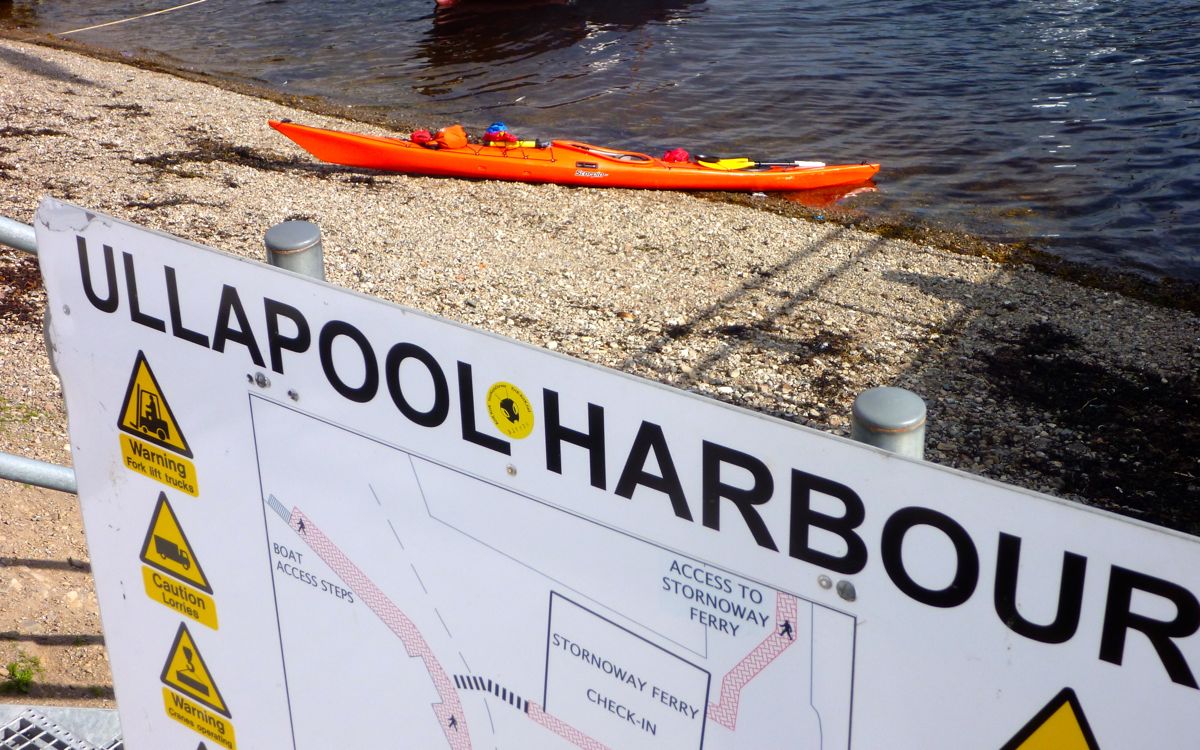
However you do it – ape-vine or PPT – it’s fun to paddle a little kayak into a port used to big boats coming and going from who knows where. Ullapool seafront milled with late-summer tourists and it’s possible to interpret one’s arrival as faintly heroic in their eyes, at least compared to a gannet floating beak-down in an oil slick.
Sunburned, crusted with wind-dried salt and not a little stiff, we pulled our boats ashore just over six hours after leaving Polbain. With probably five hours of actual paddling to cover what was indeed only 15 miles but felt more, that’s a fairly ordinary 3mph moving average. Not something to get Ullapool’s summertime bunting in a flutter. Had the headwind been stronger it would have turned into a right old slog, but always with the option of a take-out and an ice cream at Ardmair then an a hour’s walk to the car.

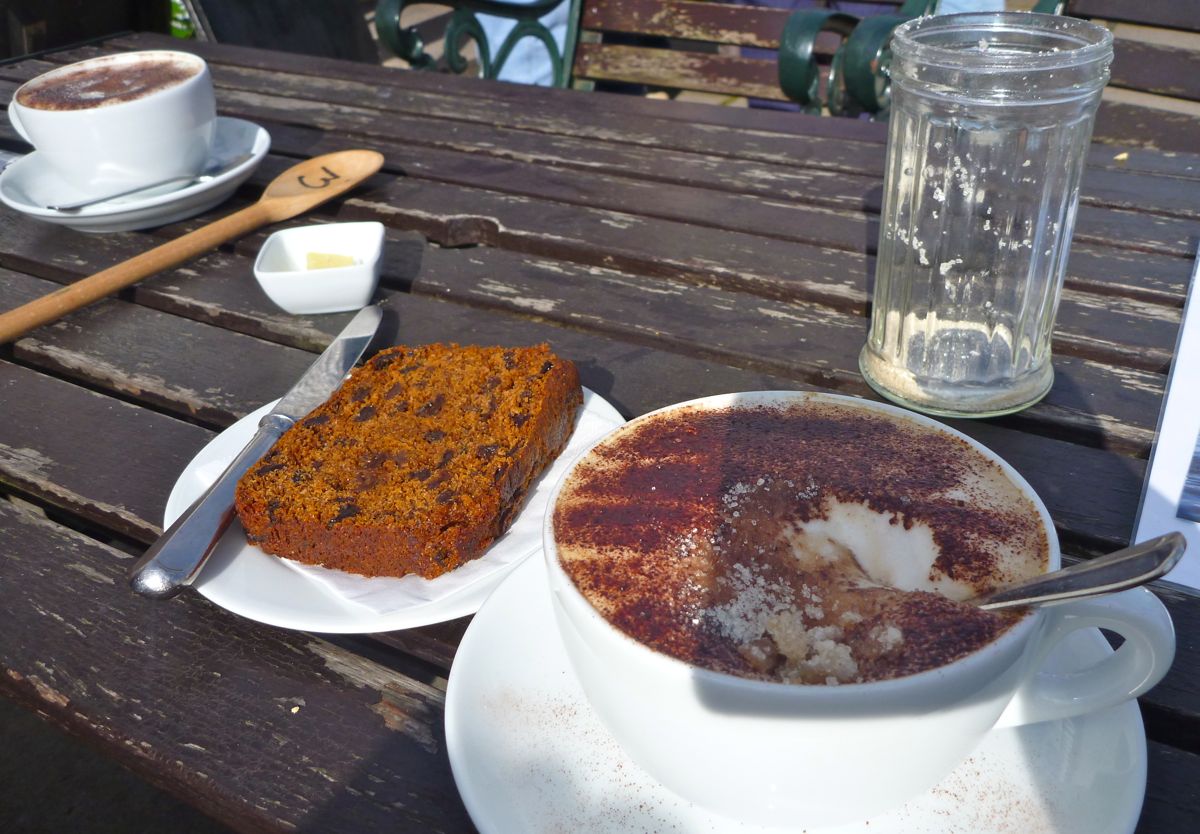
We did wonder what it must be like doing this day after day out here as say, Gael has done lately. We celebrated with a creamy cappuch’o and a slab of buttered fruitcake at the Ceilidh Place (as good as it gets in Ullapool). Recharged and with the anatomical creaks re-oiled, we reckoned we could have pushed on for another three hours if we really had to. But we didn’t so we popped into Tescos for more saccharine tucker and drove home.

Slackraft Sea Trials

Slackrafts main page

Chopping down my Sevy pooltoy into a slackraft lost too much buoyancy to take my gross weight, but it works fine for the Mrs who’s about half my weight. So on a very calm, sunny morning – realistically, it’s inshore limits – we took the Sevy out to the Bay for a swim. I’d glued on an extra outer covering of ballistic nylon to save the vulnerable floor, as we had planned to take it down the Escalante river in Utah a couple months back, but it was way too hot for that when we got there and since then, as you may know, much of the US has been suffering a terrible drought.


As often, the first paddle in a short boat like this sees the operator yawing from left to right like a crowd watching a ping pong final. After a while, though the paddling technique adapts to reduce this effect, but even then the boat is still much slower than an Alpacka. This Slackie is only 28″ wide by 56″ long – 2:1 – (my Yak is 88″ x 36″; 2.44:1) and the Mrs found the best trim was sitting in the middle, even if this meant nothing to lean back on and was not sustainable. Next time out we’ll take a fishing buoy or something to lean against, although I do wonder if some sort of trailing skeg – a board sticking out the back rather than an under hull skeg like on an IK– might help subdue the yawing and so direct the effort in a straight line rather than zigzags.

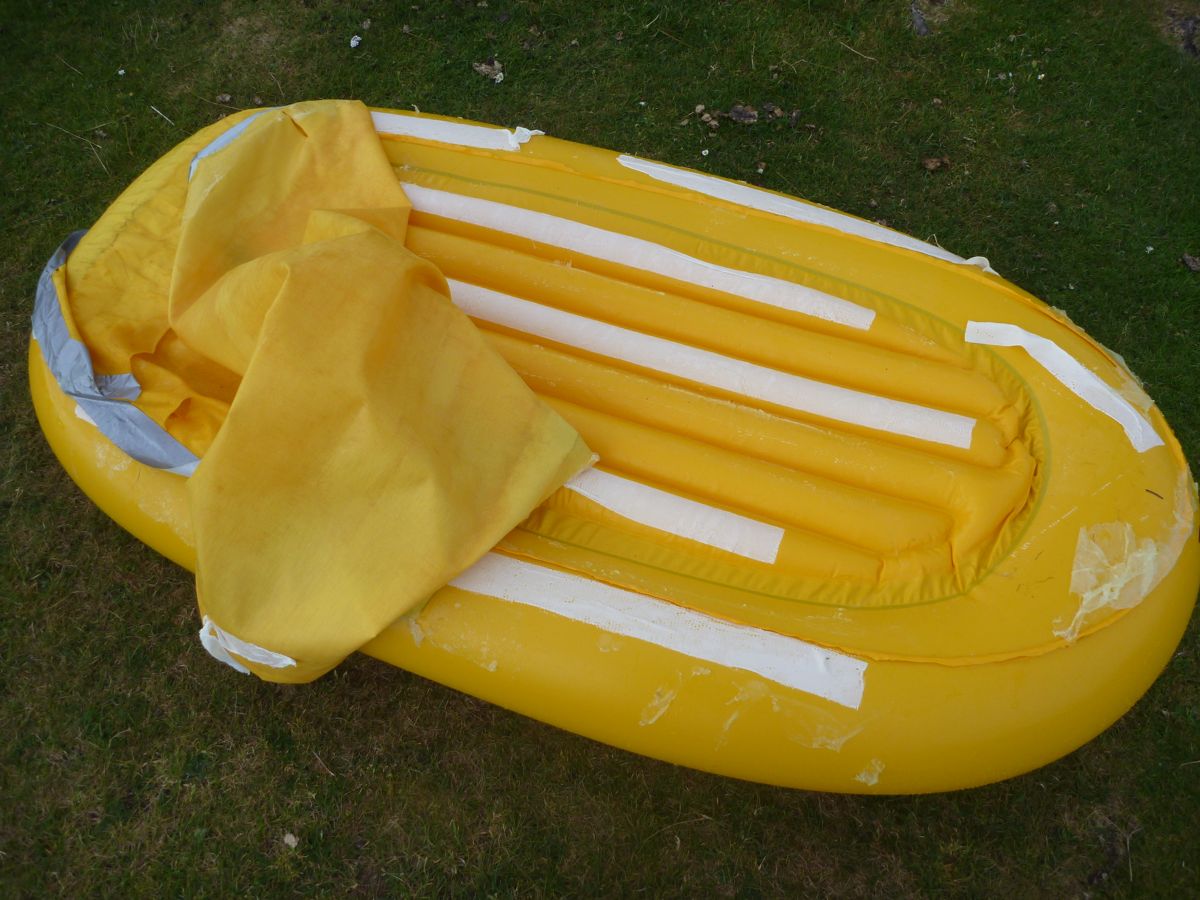
My Alpacka skims along just like it always does; what a great boat it is. Annoyingly the backrest is leaking again from the twist valve base, even though it’s been glued up once. I find you do need that backrest to sit correctly in the boat, so another repair is due.
We dipped about, followed the river channel and out to sea and on to the rocks. As the tide turned we headed back up the river, against the flow the slackboat soon slowed to a near stop and it was faster led on its string through the shallows until a tailwind helped blow us back to our shoes, by now stranded some 200m from the water’s edge in just an hour.


A post-sea trail inspection showed that my carefully glued floor was coming away from the Sevy’s PVC hull like damp wallpaper; that may have explained why the boat got so slow coming back. The Evo Stik didn’t take to the hull at all, or if it did, seawater soon dissolved it. At the time I was trying to save on my nice Bostik 1782 which I used elsewhere on the slack boat with no problems. Anyway, it’s not worth wasting any more glue on this boat. And who knows, perhaps the ribbed floor which has been exposed again may help restore some tracking. We’ll see next time. We’ve half a mind to repeat last year’s fabulous Suilven triathlon, but this time in a boat each.

Pacific Action V-sail revisited

Packboat sailing main page

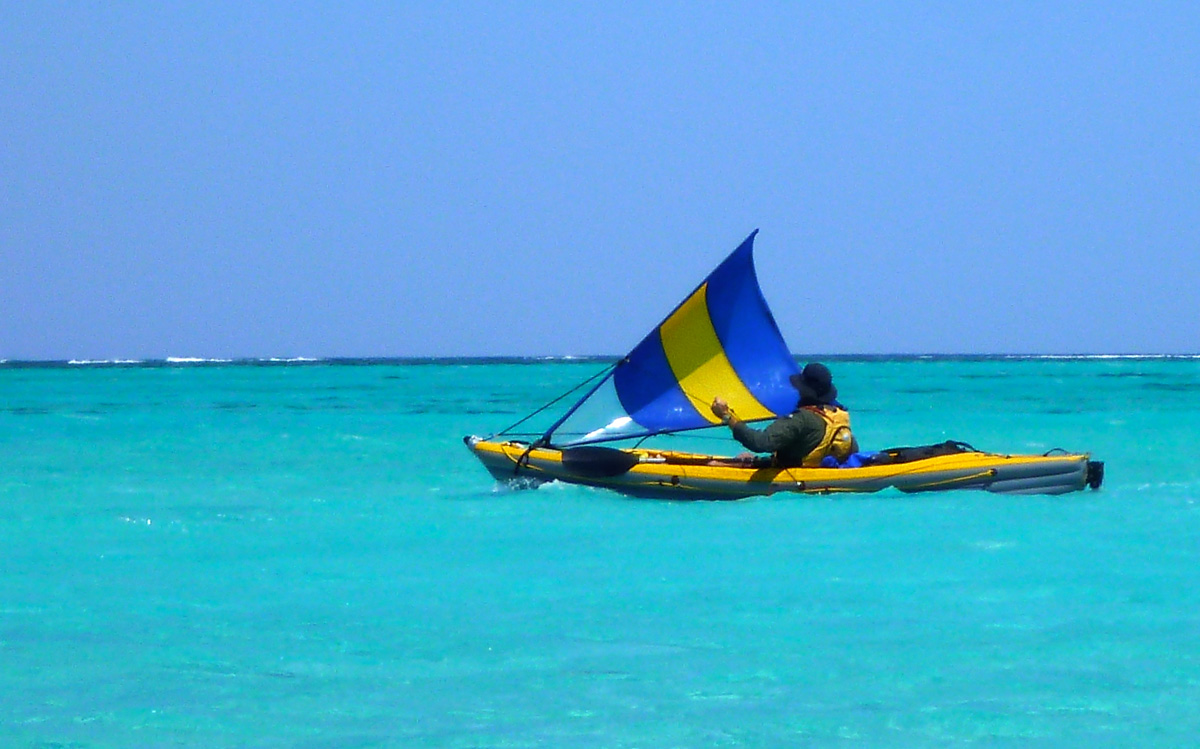
Windy but warm and dry thanks for asking – a good afternoon to take the IK out sailing. I’ve not done that since Ningaloo last September (left) when I was blown away so to speak, but not in a good way.
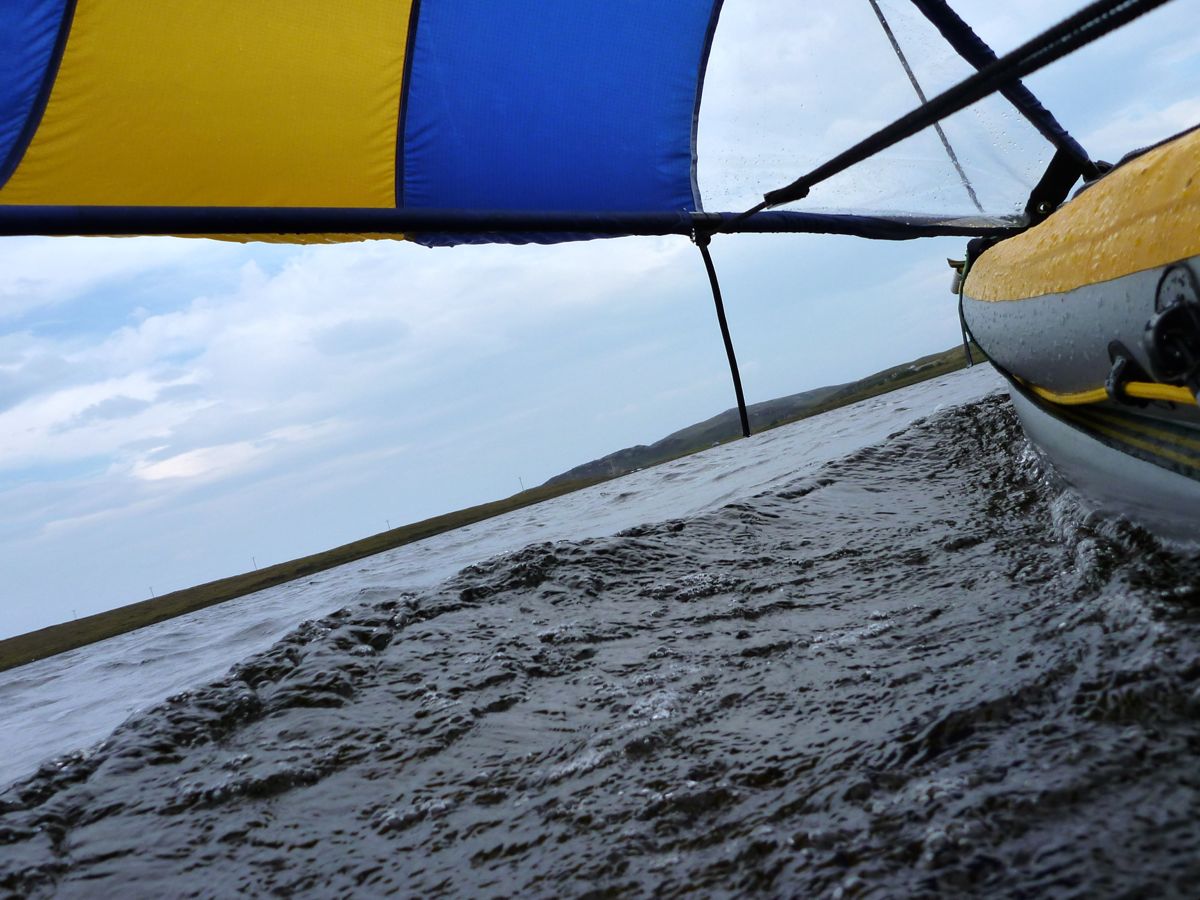
Even before then I can’t say I’d got the hang of the Pacific Action V-sail which should add up to either hurtling from crest to crest with all hands on deck – or kicking back and getting a free ride while looking around at 3mph. Both are good fun but neither scenario seems to last more than a minute for me.

Remounting the V-sail to the K40 was easy. I clipped the front ‘sail-hoisting’ bungie about 8 inches further forward, right out on the boat’s nose using a loop of string and tape (right) as opposed to using the boat’s lift handle-ring. Fixed here it ought to help keep the sail up when pulled down low to one side by increasing the angle and distance from the sail’s feet. It’s an idea we came up with in Australia in an effort to make the K40 controllable in the strong winds.

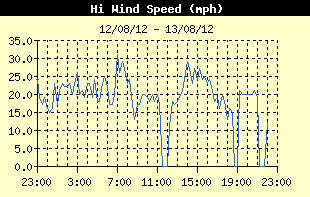
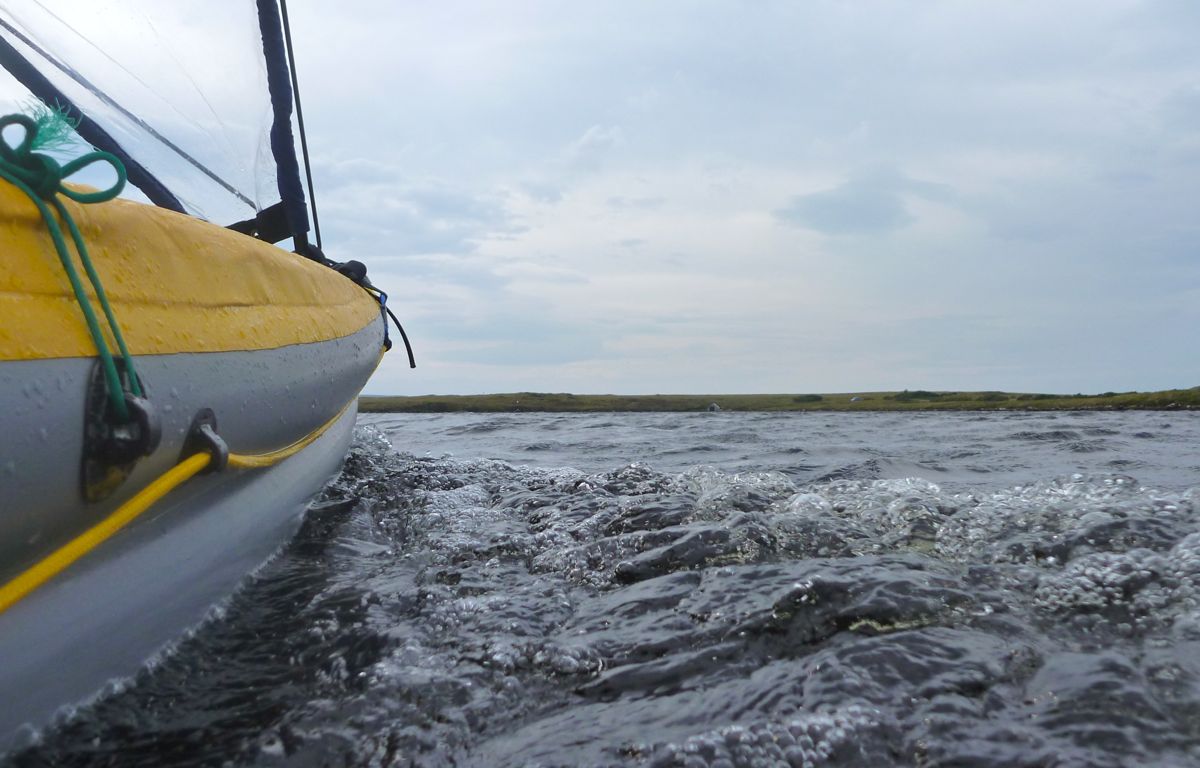
Winds today (left, from 3pm) weren’t quite as strong as WA but were getting there. And anyway, I was out on small lochs with no rudder-lifting ocean swell to deal with – another reason we thought the K40 got squirrely in strong winds out in WA. The K40s large draught but low weight acted like a sail of it’s own, weathercocking the boat.
To reacquaint myself, I first took a spin on the smaller Loch Raa. I’m never really sure what I’m doing so just try various angles and approaches until the kayak catches the wind. I’m told that sailing directly downwind with the sail fully upright is less efficient (or is that with regular, fixed-mast sails?). With the PA you can get a good speed for a while, but soon the sail starts rocking violently from side to side as it sheds the excess blast – my strong recollection from Ningaloo. I assume that’s just a sign of the sail exceeding it’s speed limit, though I think Jeff’s hardshell did it less.

Off the wind about 45° and up to 90- or even 100° (ie; slightly upwind) seems more stable but slower, with the sail cranked down low to one side. But even then a consistent speed or direction seems hard to maintain for long. Is it my poor technique, the design of the sail when applied to my IK, or just an aspect of gusting and shifting wind? As it was I felt the unloaded boat was rather light, though in Ozzie last September 20+ kilos of ballast didn’t help much either.

Big sailboats and windsurfers seem to manage OK, but it seems hard to get a smooth, steady run while sat back with the cleated-off sail doing the work. Usually I’m yanking hard on the rudder to get in line, or have handfuls of lines trying to trim the sail for best effect. The tiny ‘finger-and-thumb’ cleats are just too fiddly to use in a hurry or mild panic, and often require two hands to release the jam. I wonder if hand-sized cleats exist for the thin cord, or some better device all round? Something like a sliding tube you could grab, but with a release button, a bit like a mountaineering jumar (left).

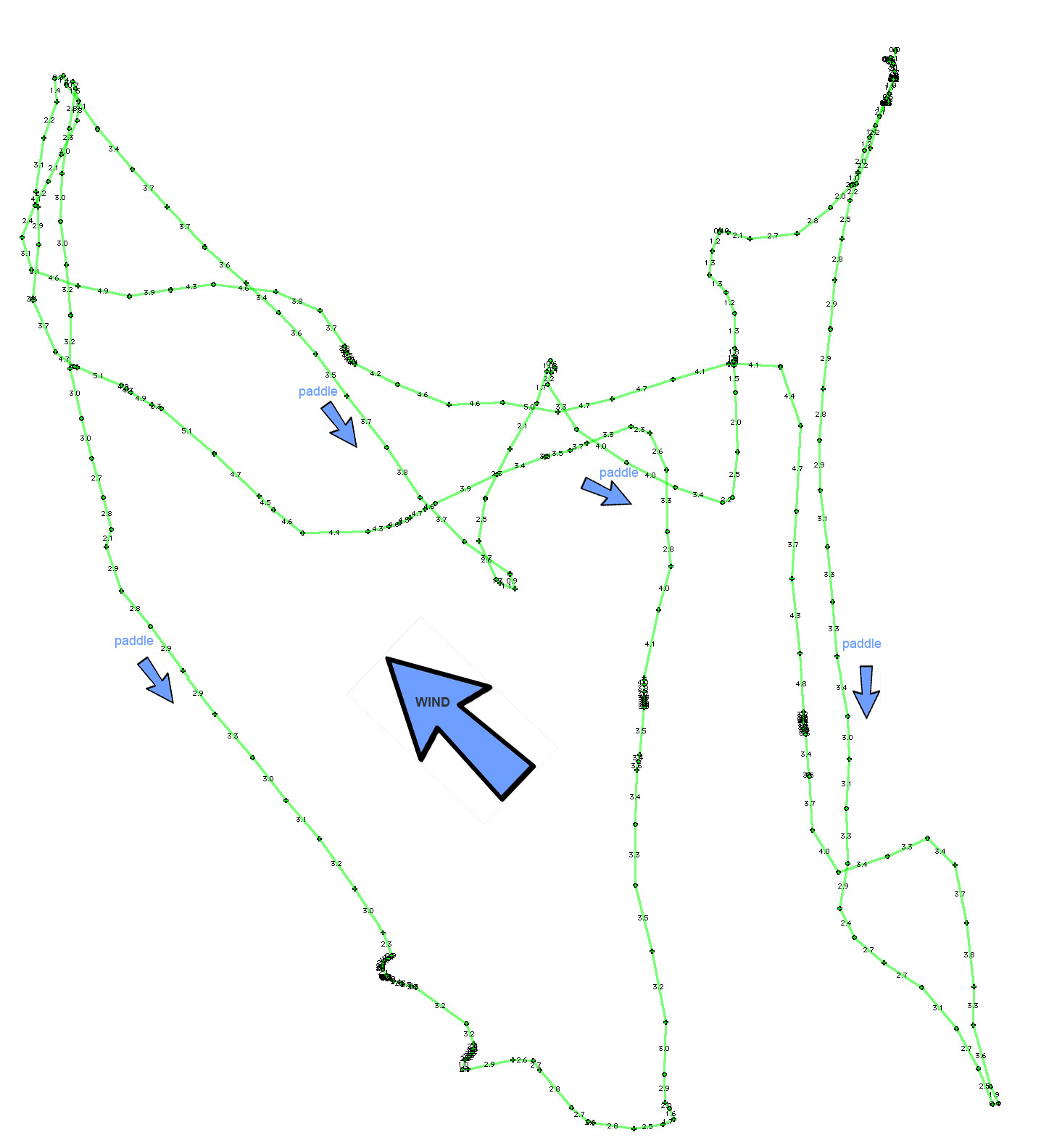
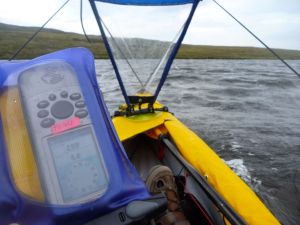
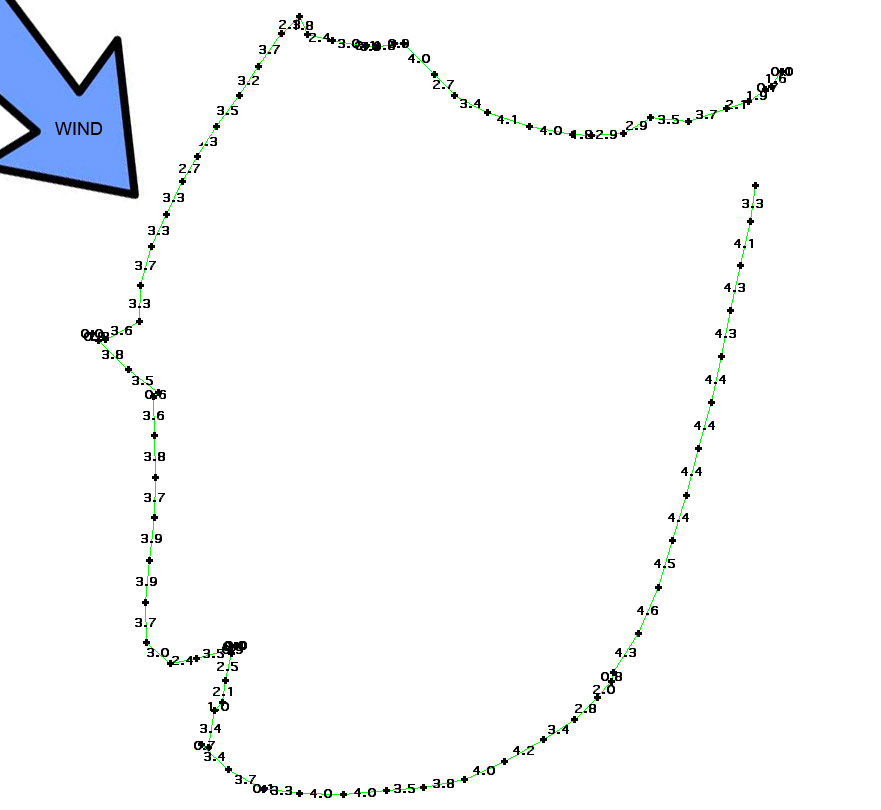
Even then, on seeing the speed readings (above), it surprised me how fast I could hack into the wind at 2.5–3mph, admittedly with some effort (needed to keep the kayak pointed ahead). Coming back with the big sail I only got over 5mph a couple of times, and often moved barely more than upwind, although using much less energy of course.

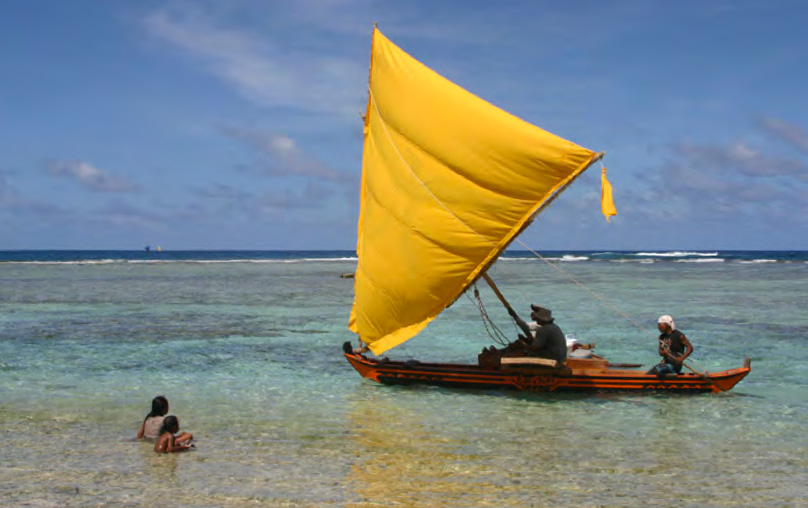
I came across this image of a Micronesian waharek boat newly built on an ancient design. Looks like a big V-sail to me but crucially, it has an outrigger.


After crisscrossing Loch Raa a few times (above right), I went around the corner onto Loch Osgaig. Out in the open and with the wind bouncing off nearby Stac mountain, there should be room enough to get some speed up, providing I could hold on.

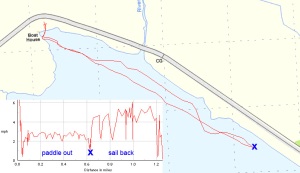
I set off and sliced the waves as best I could and stuck at it until I got opposite the small plantation. Here I stowed the paddle securely, got blown round and unfurled the v-sail, ready to snatch it back down should it all be more than I could handle. In fact, there were only a couple of hairy moments As you can see from the speed graph (right), my paddle out was pretty steady and straight, but under sail, speeds and direction were all over the place. A couple of times either a gust or the optimal line saw the boat fly at along at over 5mph (left), but it never lasted.

saijeff

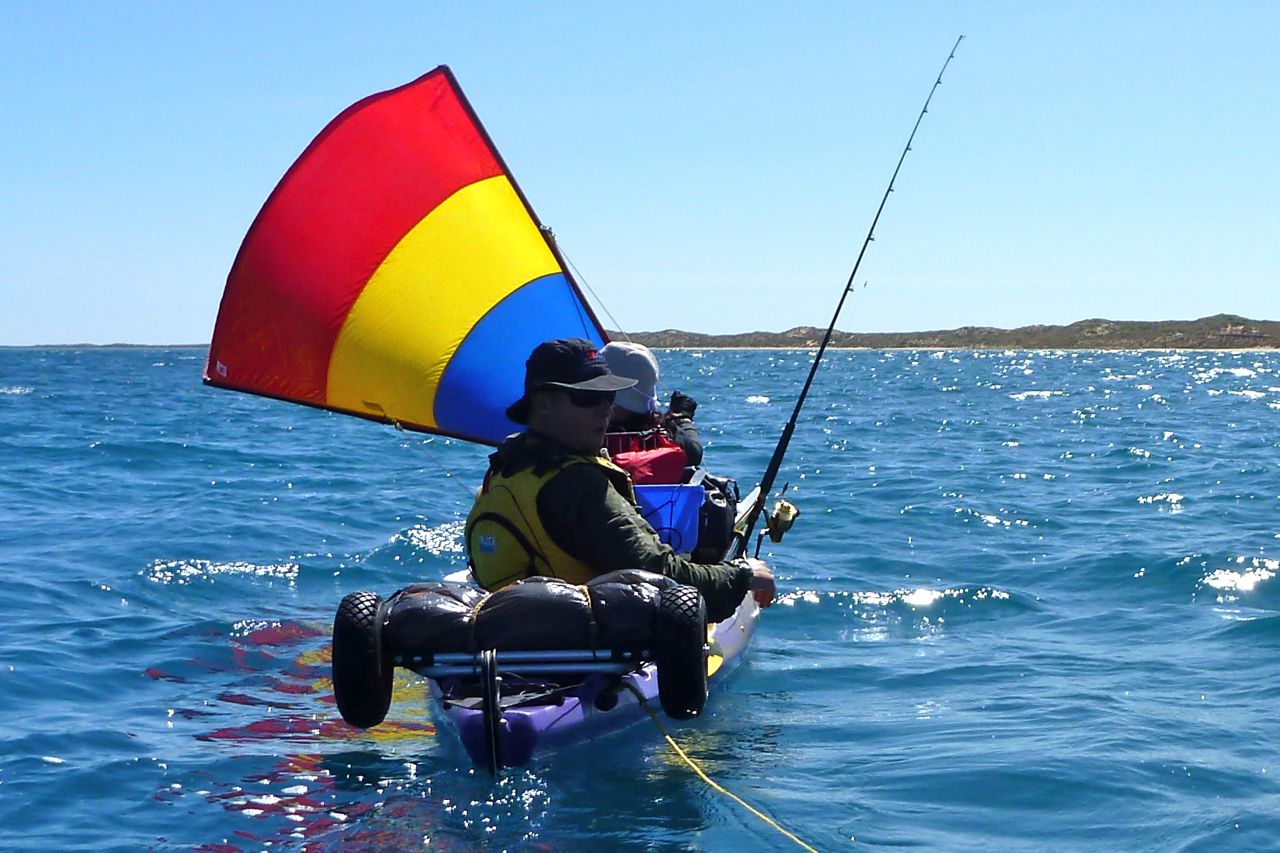
It does make me wonder what the PA sail is good for on my K40. In winds of over 15mph it seems hard work to maintain. Is it an inherent flaw of a lose, articulated mast – and one whose feet are not pressing directly onto a solid hardshell hull (I use a plastic dinner plate to spread the load/reduce wear). The fact is, Jeff managed fine on Ningaloo (right), ripping along in a boat that was four times heavier than the Incept. And in Shark Bay a few years earlier in the same tandem tanker, he was towing me in my Gumboat.

A 10-15 mph breeze does often correspond to a nice steady sail, but that does seem a rather narrow margin of operation – something I recall someone else saying to me about V sails. I think it’s a combination of more practice required, hampered by the fact I’m in a light, buoyant, flaccid-chined IK. It makes me wonder if the WindPaddle is worth another look (it was and I did), though I’m fairly sure the PA V-sail is more versatile; I doubt you could ride at 90°+ to the wind with the deeply dished WindPaddle. Another good thing about the PA is that it’s out of the way when down but dead easy and fast to deploy or stash. Just throw it up and see if it takes to the wind. Out this time I also felt that the thigh straps were particularly useful when edging the boat against the gusts.

Summer Isles Kayaking ~Tanera Mor (Incept K40)

Incept K40 Index Page
Tanera Beg here

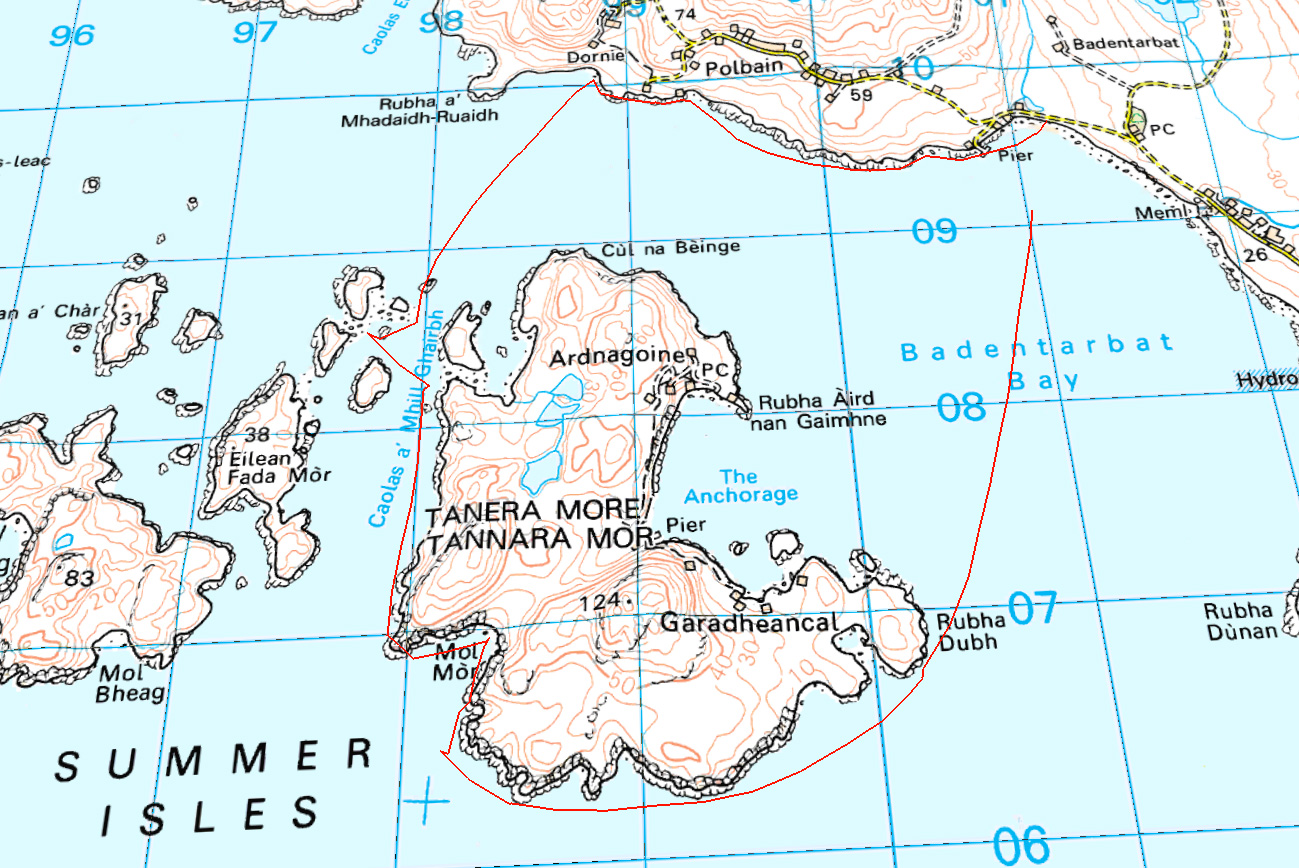
A sunny and wind-free morning coincided with the definitive wrapping up of my current job that’s dragged on for years. I could not pack up the gear quick enough before the calm spell flipped. And this time I wasn’t messing about – I was going to paddle right around Tanera Mor! All of a mile off shore it is, but you never know what to expect on the unseen ‘ocean’ side.
Just before midday I stuck out for Rhuba Dubh Dubh, the island’s most easterly point (see map, above) and would decide how things went from there. Less than half an hour of speedy, flat-water paddling I arrived at the point, the smokey blue Torridons brooding in the background and the creased and weathered sandstone cliffs to my right.


Rounding the bend to Tanera’s south side I wasn’t hit by the expected churning swell and whirlpools but pressed on, reluctant to relax until there was something to relax about. That turned out to be the inlet of Mol Mor which invited me in for a walkabout.
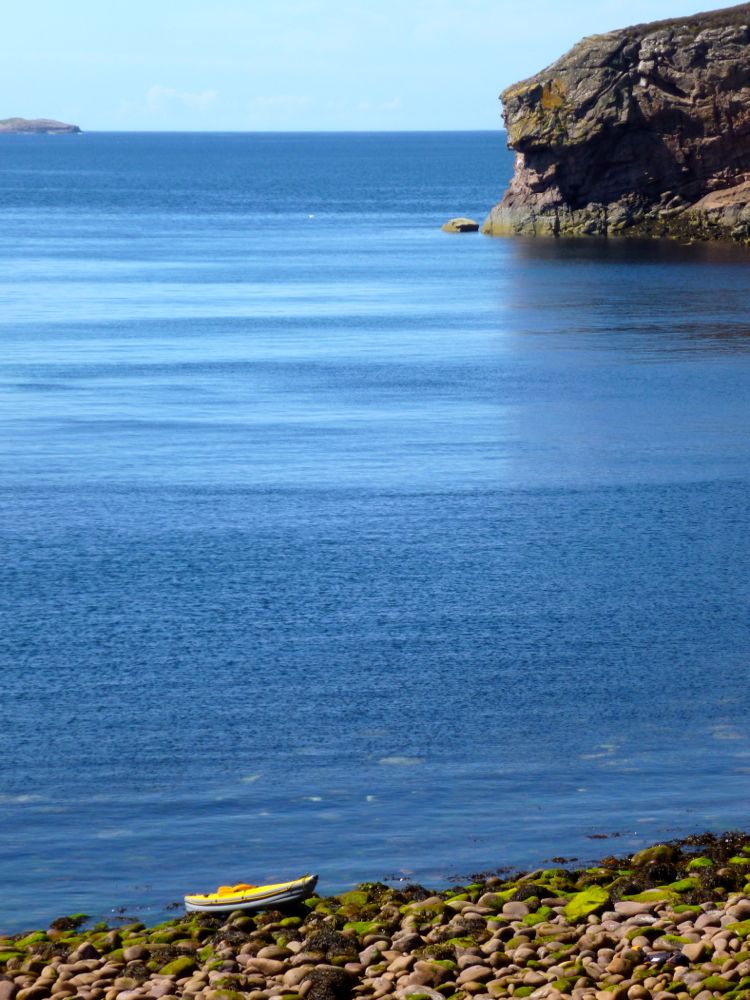
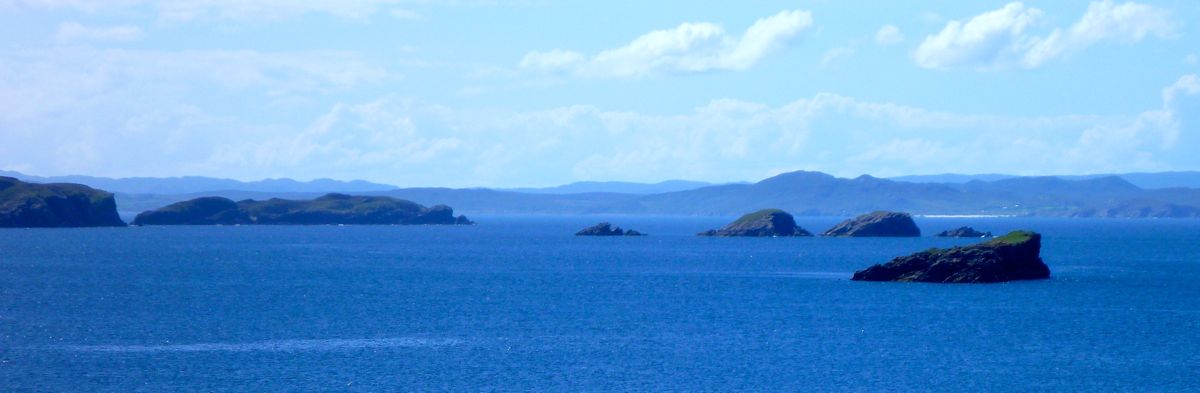
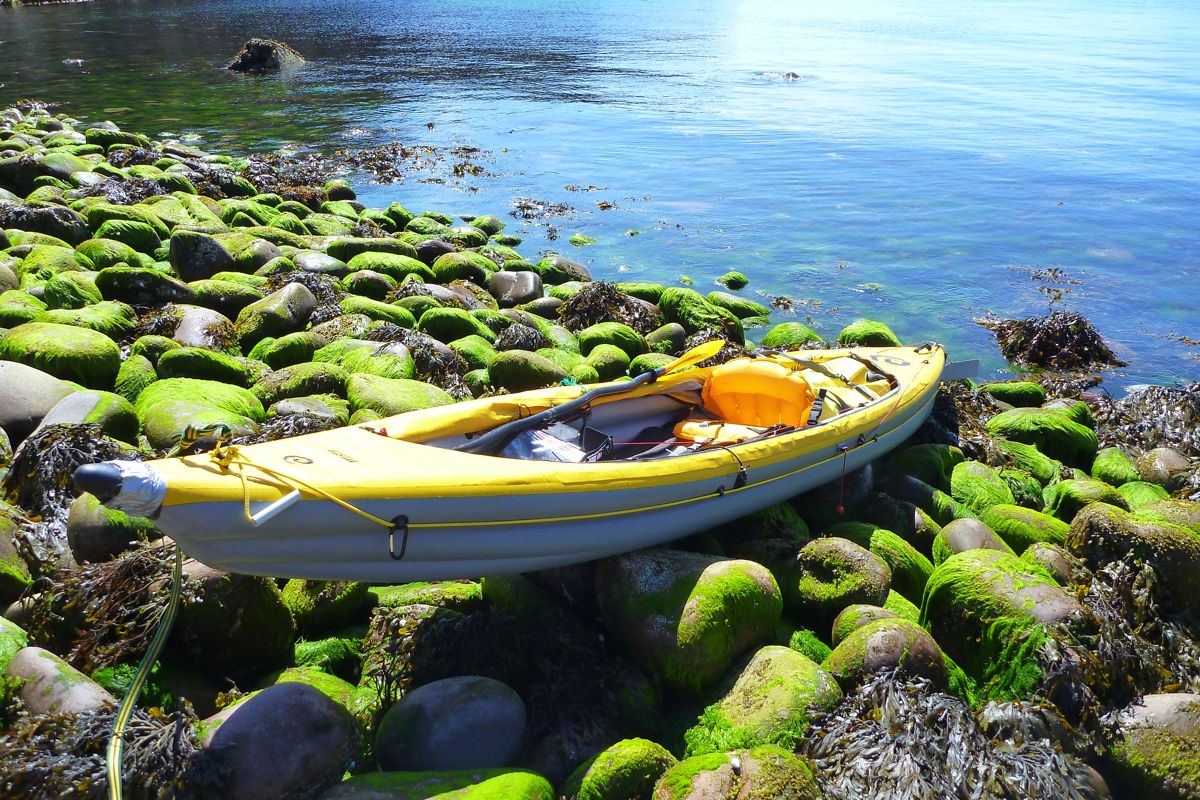
It has to be said, at lower tide levels these islands don’t make getting ashore easy; a jumble of glistening wet, seaweed-draped boulders as big as melons bite at your ankles. And on proper land, it’s no better, with more unseen ankle traps under the thick heather, or plain old sphagnum sludge juiced up from the recent rains. But as always, from a high point the little yellow boat down below looked striking. Green sea-over-sand and the far headlands of Wester Ross backing the tempting (but not today) outer Summer Isles of Eilean Dubh, Bottle Island and Priest Island with the distant strand of Mellon Udrigle shining bright.


I clambered up to a pass for a view back north over the fish farm to Achiltibuie and the loaf of Suilven behind. Must go back up there one time soon. On the water again I turned up between Tanera Beag where a north wind had come up and gave me something to get stuck into. I didn’t want to push my luck but to string things out I popped onto one of the three islands north of Fada Mor which become one mass at low tide. Causing a seabird commotion overhead, I crawled to a high point and took in another great view back at the Fisherfield   and Torridons.
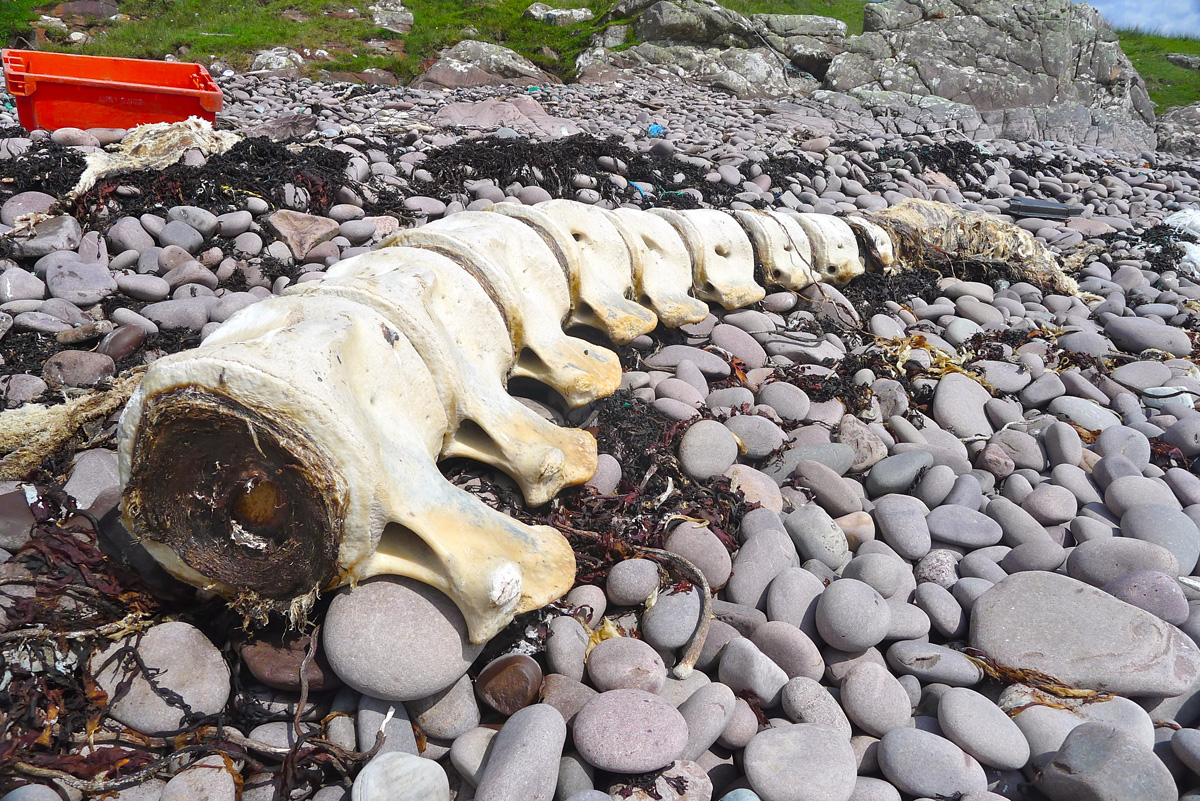
As on Tanera, the colours of the vegetation jumped out at me – was it the light, the recent rains after a long dry spell or just my shades?  All that remained was a hack over to Dornie and back to Whalebone beach (now all gone). It was just beginning to whitecap which I regard as the red flag, especially when blowing from behind.

The spray kicked up over the sides but at times like these I’m reassured by the K40’s reliable turn of speed – about 3.5mph the readout said. It’s good to know it can be done, even if most of the time I prefer bumbling around in calmer weather, looking at stuff.

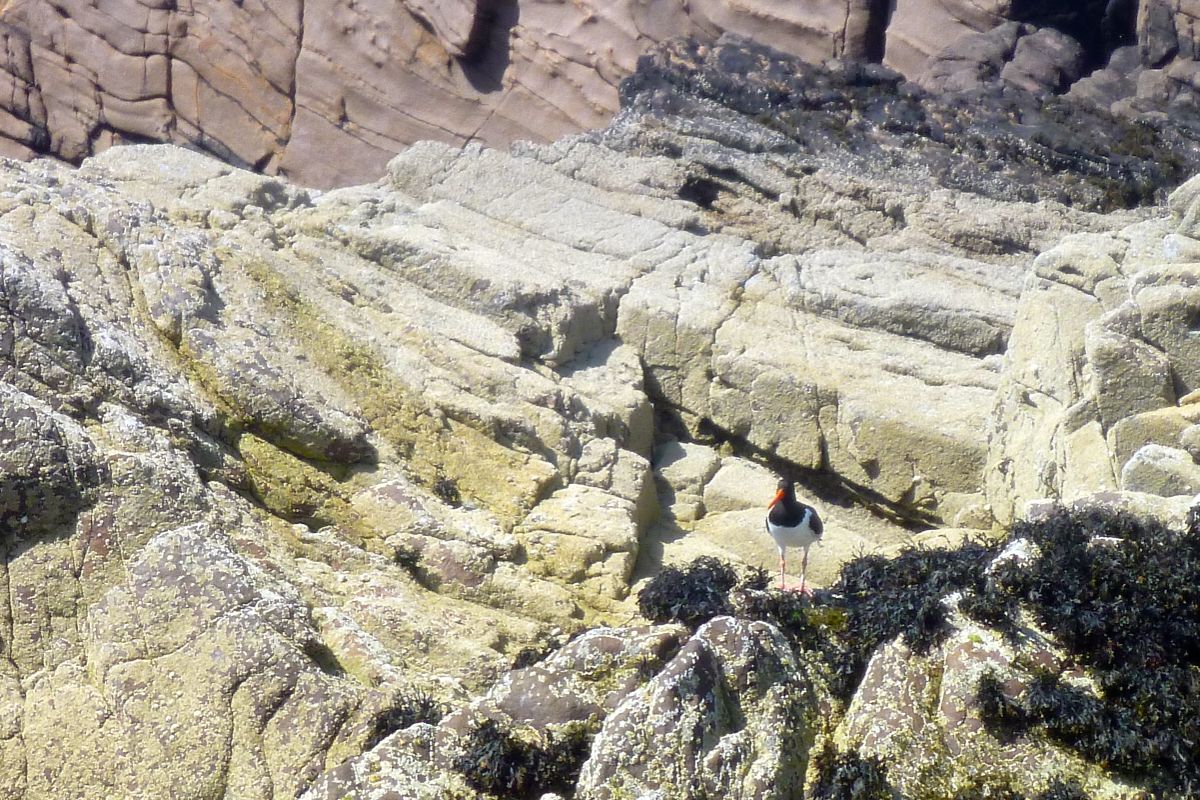
Once over, I pottered back tucked under the mainland shore out of the wind. A beaky oyster catcher eyed me suspiciously just as I neared the beach where a guy setting out with his toddler on his Sevy 200, doubtless the only two IKs for miles around. A few more days like that please, Mr Weatherman.

Lurgainn – linking the Lochs

An afternoon’s paddle along the lochs strung out below Stac Pollaidh mountain, with a bit of portaging in between and a jog back to the car to finish up.

Landfall on Horse Island (Incept K40)

Incept K40 Index Page

Sadly it looks like the amazing start to the summer may be over up here – or rather it’s back to normal. Since March it’s been one of the driest periods for years. June just gone was the driest ever while down south in places it was the wettest ever.


But the jet stream has flipped back into position and so it’s business as usual: the south is getting its overdue share of sunshine again while right now the wind howls periodically, it’s lashing down and I can barely see a mile across the bay.

It was the same deal last weekend, but midweek the winds dropped and so did the pressure of finishing the current job. So I slipped out one evening across Badentarbet Bay to try and thread a loop through Horse Island.
Not having paddled for weeks, as usual I went through the usual neuroses as I parted with the shore (“Crikey, this water really looks dark and deep”. “I really must take a spare paddle.” etc, etc…) while cautiously tracking some low cloud or mist coming up with a southern breeze.
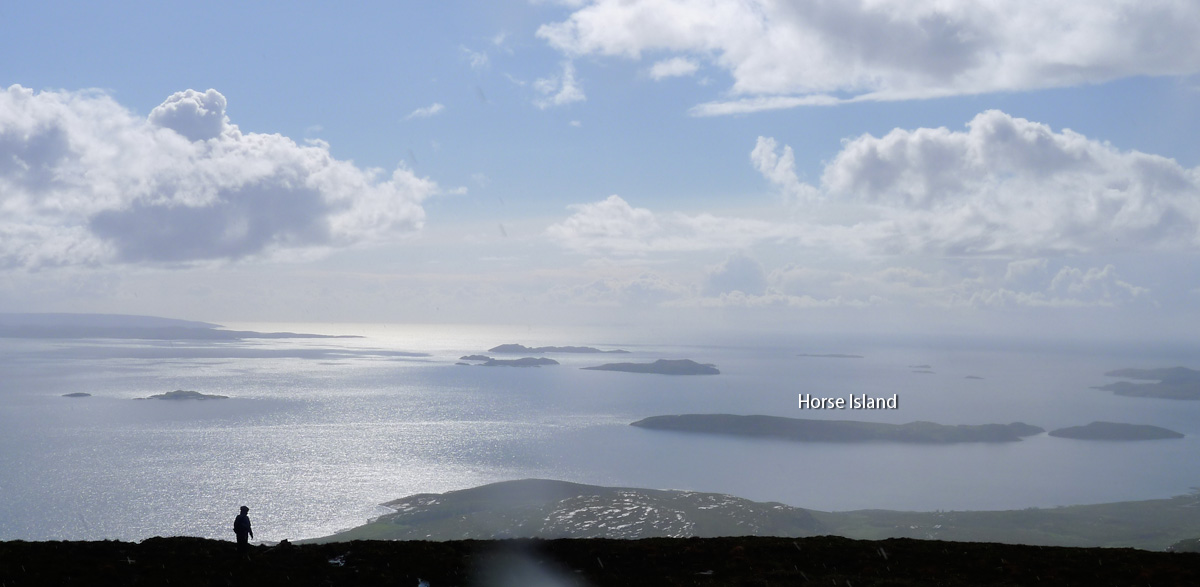
Horse Island is actually further than it looks, about 5km from the pier, and once I decided I’d survive the crossing I planned to slip through the gap between Meall nan Gabhar (see map, above) and head back. The passage is no longer pictured right by Gael who passed that way a couple of months back in his Incept at the culmination of his epic run up the Scottish Sea Kayak Trail.


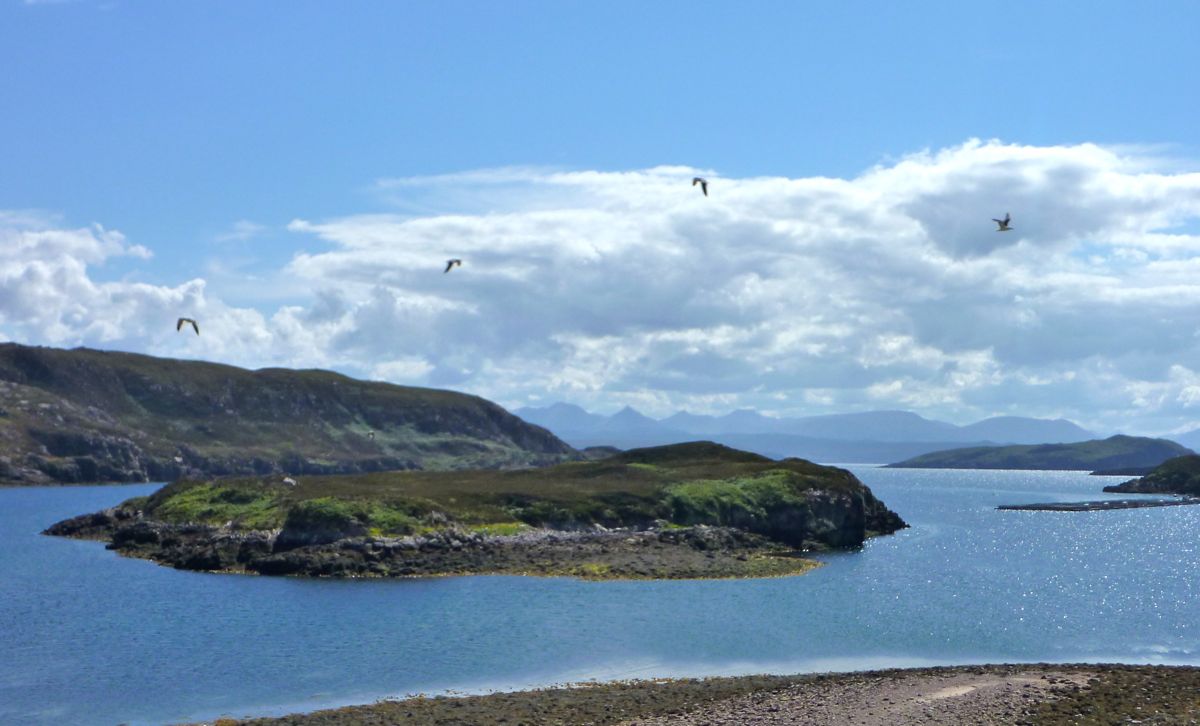
As I rounded the corner and frightened some seals with a splash, it turned out Meall (a ‘hill or mound’) is a separate island only during the top half of the tide. On my arrival with the tide bottomed out, a bank of seaweed-covered boulders rose two metres out of the sea (below), creating a broad causeway between Meall and Horse.
No matter, it made getting out easy and as a seal popped up and eyed my movements, I scrambled up the knee-high heather and scrub for a look around Horse, finding a broad grassy platform with various sheltered nooks for a sheltered camp. It’s said local farmers periodically drop off their sheep here to graze, but the only presence was the high-pitched caw of a large bird of prey hovering over its nest up on the hill. The clouds parted briefly to shine onto Ben Mor (above) and pleased with my offshore excursion, I powered back to the pier.