What air pressure does a typical packraft run? 1 psi, 1.5, 2.5? Answer at the bottom of the page.
Air bagging. Air bagging. Oh isn’t it wild?
Most inflatable devices come with an air pressure rating at which they perform best, including inflatable kayaks which run from 2psi/0.14bar up to 10psi/0.7bar in drop stitch. On the cheapest vinyl Intex or Sevylor dinghies, as well as slackrafts there won’t be a number, instead you get a ‘stretch gauge‘ (left). With a Sevy you keep pumping until a sliding black tab settles between A and B; your squishy slackraft is probably now at less than 1psi but is good to go. Add a bit more air to try and make it feel less of a water sofa and the thing will burst a seam. It may do that anyway if you give it a week or two or look at it too long.
Right from the start packrafts never had air pressure ratings. You just aired it up with a flimsy nylon airbag (above) until you couldn’t get any more in. The airbag idea was surprisingly effective once you got the knack, and the bag weighed next to nothing. You then unscrewed it without trying to lose any air, quickly screwed on the cap, then topped off by mouth via the separate twist lock elbow valve (left) with all you had in your lungs. The more you blew the firmer you boat became – and that definitely made a difference to response on the water. It helped if you didn’t smoke and played lead trumpet in the local jazz band.
Once on the water all inflatable boats cool down and the hard-won air pressure inside drops a bit so you have to top it up again to get the boat firm. What was the air pressure? As much as possible but what did it matter as you couldn’t overdo it with your lungs. Stronger lunged paddlers and opera singers paddled firmer boats. And anyway, such very low pressure would be difficult to measure with a normal handheld manometer.
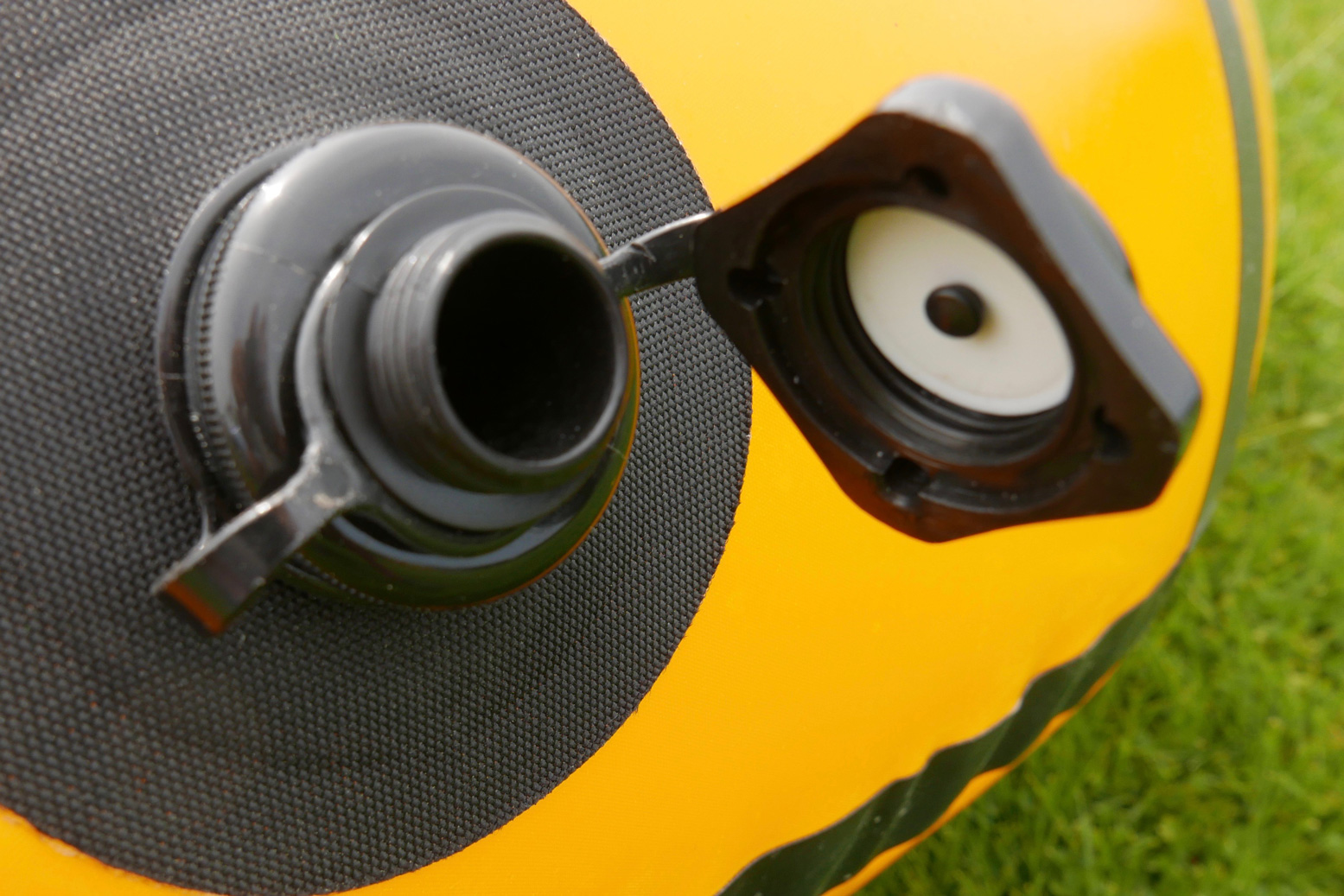
These days most packrafts use simple and effective one-way Boston-type valves (left) which screw off for a wide open ‘fast inflation’ port for airbagging, but have a one-way valve built into the cap for topping up, just like a car tyre. What goes in, stays in so you can build up pressure and get the boat good and firm. No more crumby twist-locks and undignified topping up by mouth.
Mini electric pump; ditch the airbagMini handpump to top up
Better still, inexpensive pocket electric inflators like Flextail (above left) do the job of airbagging while mini handpumps (above right; adapted from party balloon inflators) can do the important topping up without giving yourself a lung hernia. But what’s the air pressure!? Who cares, it’s better than it used to be provided you could pump the handpump with all you had – I find it takes 100 jabs. A Flextail or similar will burn out long before it can get close to a handpump’s final pressure.
Tip: all these pumps are handy but I always leave an airbag in my packraft’s storage pockets in case the Flextail packs up or I forget it. Otherwise it will be a lot of blowing or handpumping to air a boat up. And with a Boston-type valve as above, a short section of half inch garden hose makes inflating by mouth much easier should you’re topping-up handpump pack up too.
Kokopelli and French-made Mekong packrafts (and maybe others) feature a RIB-style Leafield D7 push-fit inflation valve. That’s push-fit as opposed to more secure bayonet fitting as on proper IKs and iSUP boards. It’s what Gumotex IKs used years ago and is actually not a bad idea on a packraft as the pump nozzle on the end of a hose will blow off the valve as pressure climbs, meaning you have to try hard to over-inflate the boat.
Black boat and Englishman
But these one-way valves have now made over-inflation a possibility, and we know how that can end. However, one thing we’ve learned with TPU packrafts over the last decade or two is that it’s virtually impossible to burst a well-made packraft using a human-powered pump, even a high-pressure iSUP barrel pump. You would really have to go at it or leave a fully inflated black boat out in the midday sun. The fabric and simple but strong sewn and heat-welded assembly spreads forces equally across the single chamber hull ring. So much so that MYO packrafts have become a thing for individuals with a big table and a sharp pair of scissors.
With a D7 valved packraft you could use a handheld manometer (left) with a push-fit adapter to read the boat’s pressure. Such manometers have a pin in their throat which pushes open the D7’s sprung valve stem just as the gauge body seals around the valve housing, so getting get a live pressure reading.
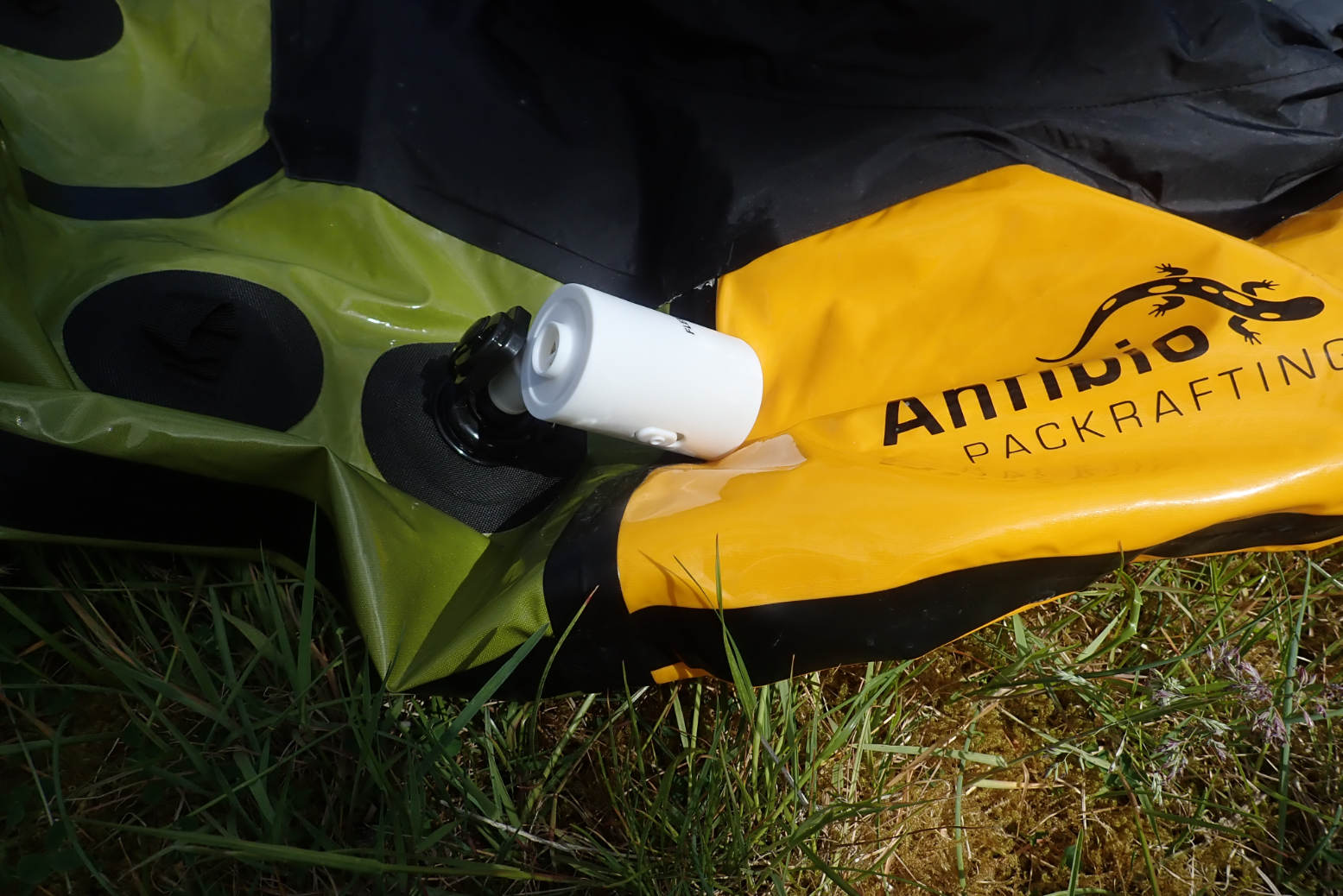
I don’t have a D7-equipped packraft at hand, but I do have a Bravo Alu 4 R.E.D barrel pump fitted with a 14.5psi/1 bar inline manometer (left). With an adapter jammed in the Boston’s threaded port I ought to be able to get a full-pressure reading off my Anfibio TXL.
I’m guessing about 2psi / 0.14bar to get a pinging firm TXL. It’s what my early Gumotex IKs used to run, using the now obsolete footpump. When the Seawave came out, rated at 3.6psi/ 0.25 bar, that was quite a revelation, though before that I ran a 4.3psi/ 0.3bar Grabner Amigo and you could have battered down a wall with that boat, proving that rigidity didn’t require drop stitch panels as long as the boat was solidly assembled. At Grabner prices, you’d expect that to be the case.
Back to the test. And the answer is…. just 0.1 bar or 1.4 psi. And this was with the TXL as tight as a drum such as I could never manage with the balloon handpump but might have with a K-Pump Mini. Now we know.
On Google Maps an ebbing tide spins out an eddy of sand out into Swanage Bay.
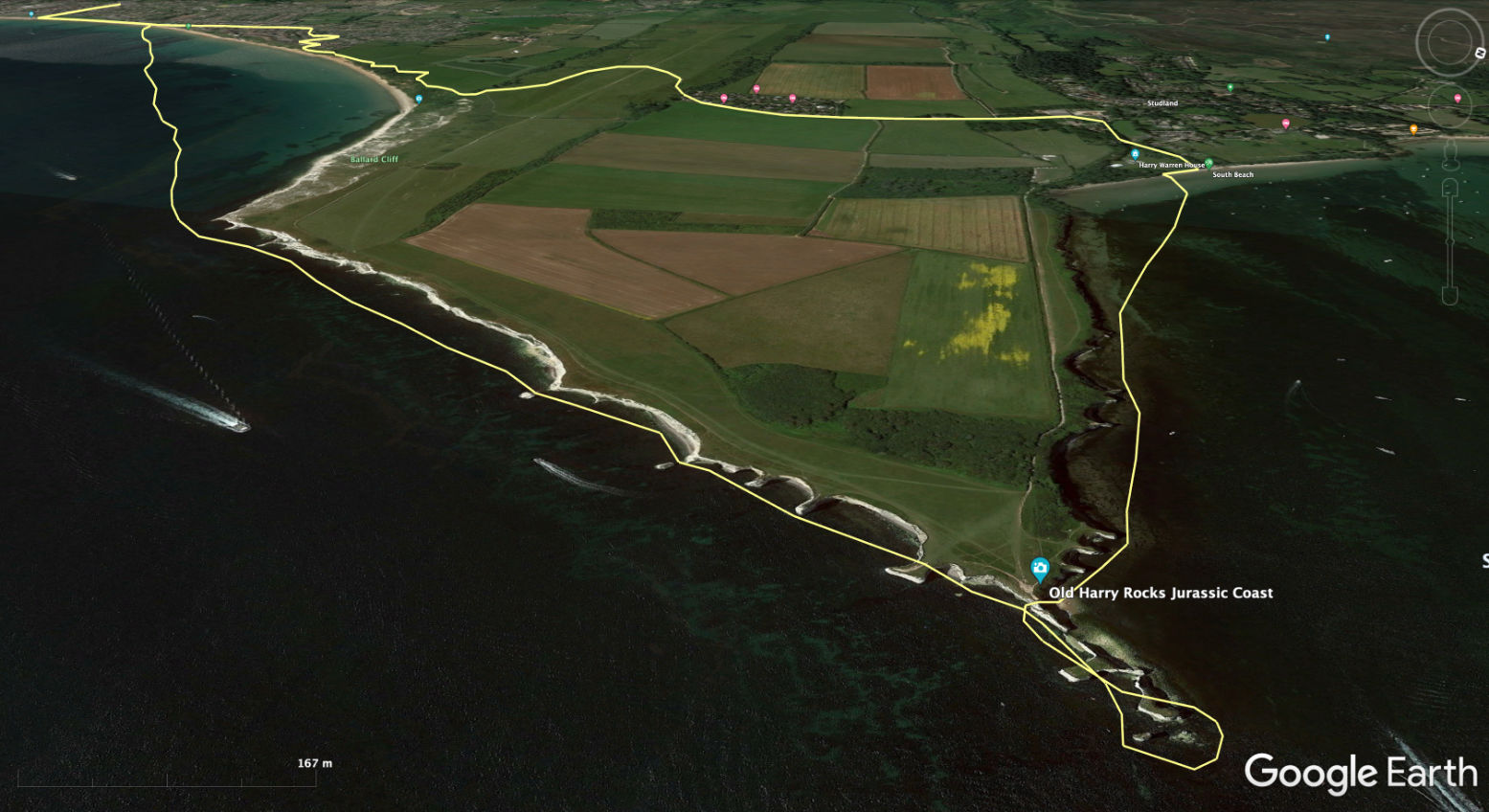
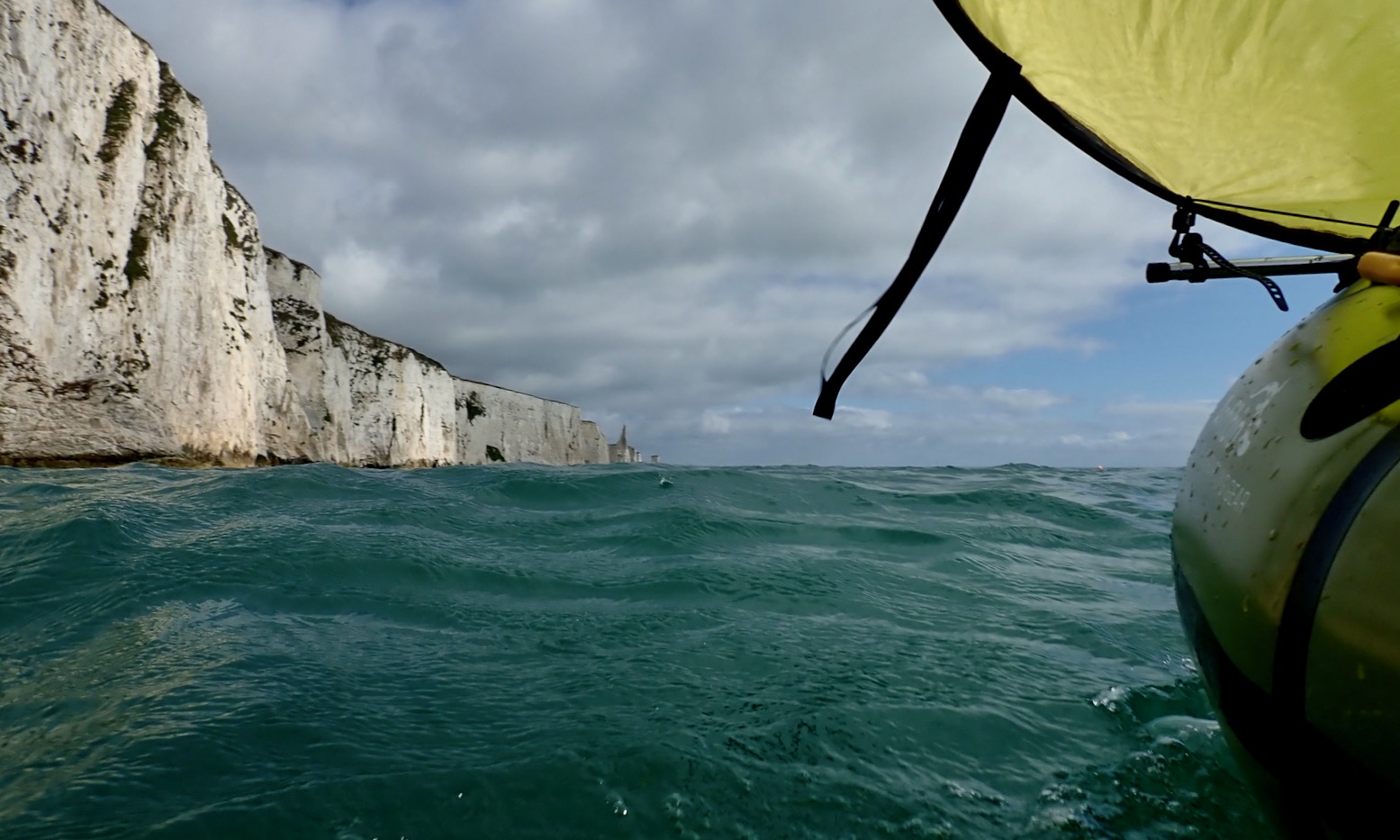
Swanage to Studland past the Pinnacles is one local paddle I don’t mind repeating. In normal conditions it’s the most dramatic, easy paddle I know on the Jurassic Coast, sheltered as it is from the Channel swells. Today I’m going to make a loop of it: packraft round to Studland and walk back to Swanage over the downs (map left). All up about 11km which should be doable in the 4 hours I’ve put in the meter.
It’s always further than it looks to the north corner of Swanage Bay at Ballard Point, so I sit back and let the wind do the work. But apart from the odd gust, it doesn’t feel like 12mph – like sailors say, it’s either never enough or too much. GPS recordings later reveal no records were broken.
Leaking Multimat
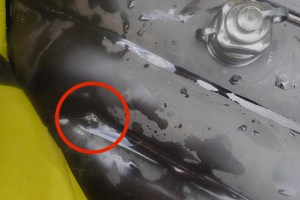
Around here I was expecting to top up or ‘temper’ the TXL’s sagging hull with the handpump once the air inside had cooled down and softened following 20 minutes immersion (as explained on the previous outing). But remembering the Multimat floor mat this time, there was no tell-tale crease in the TXL’s sidetubes, even with a slow leak I noticed at the beach from one of the mat’s seams (left). So the mat must do the job in supporting the hull, even if, sat higher, I felt a bit wobbly on setting off. The mat’s not been left out in the sun, let alone sat on since I filled it in advance, but I’m not surprised a leak has sprung, with probably more to come; I-beams are weak under pressure but it’s a necessarily lightweight design that still weighs nearly a kilo. You pump the mat up as firm as you dare, otherwise what’s the point; I must have gone a bit far. I’ve picked up similar, wide, I-beam seats from Anfibio with the same damage; all easily repaired with quick wipe of Aquasure sealant. I know it would need a stronger pump (like my K-Pump Mini), but, despite added cost and probably weight, a 2-3 inch thick dropstitch floor mat – either TPU or nylon – would be a more durable floor mat. The AE Packlite+ packrafts use them.
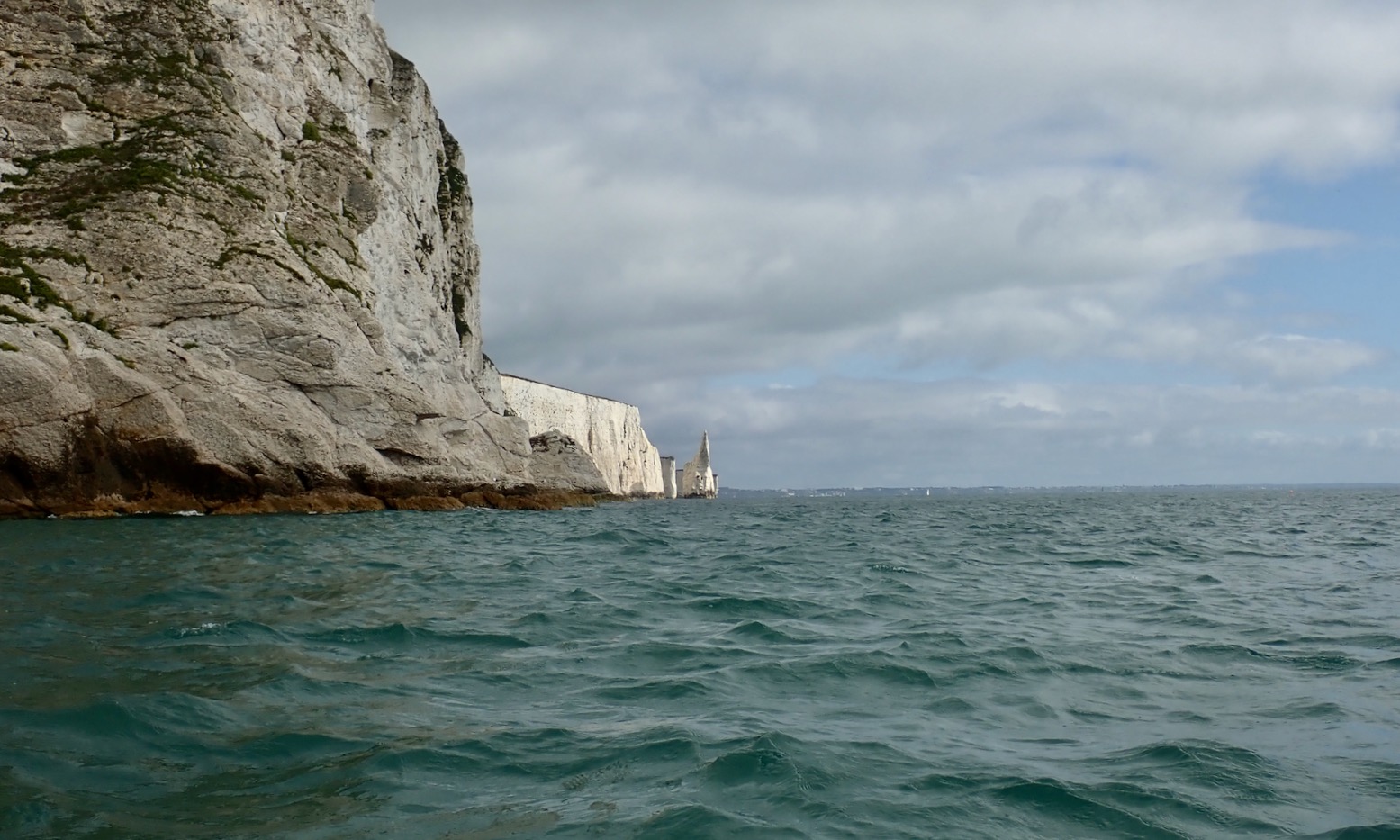
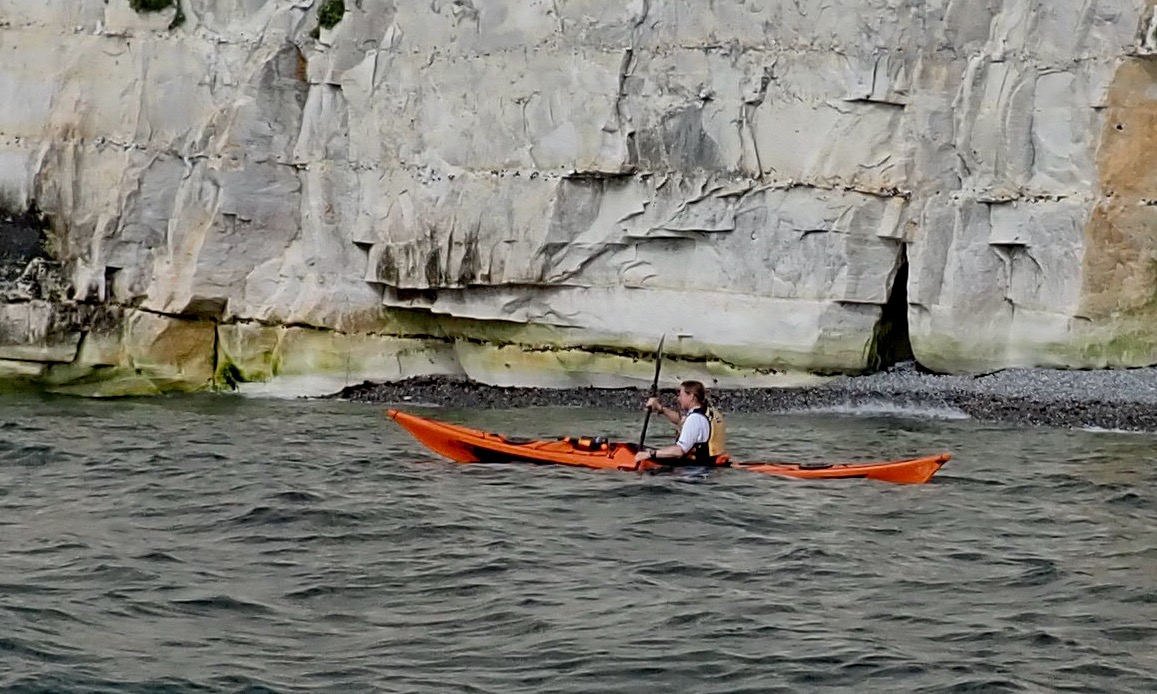
Round the corner the wind eddies out and drops a bit, and up ahead the big spiked pinnacle is still such a surprise I initially mistake it for a big moored yacht. You’d think I know by now. A couple of sea kayakers are heading the other way, into the tide and breeze. They’re curious about the sail and raft.
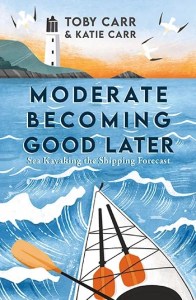
I admire their sleek, water slicing craft. I’ve just finished reading Moderate Becoming Good Later, Toby Carr’s attempt to kayak in the 31 Shipping Forecast zones (right) before he succumbed to cancer in early 2022, aged just 40. He pushes himself hard, starting with Iceland, a lap of some Faroes, out to Utsire island 40km off Norway and the full coast of Galicia [Biscay, Fitzroy], as well Bishops Rock lighthouse beyond the Scillies [Plymouth, Sole, Fastnet, Lundy] before his health collapses.
He reached some amazing places and it reminded me what a uniquely effective boat the modern sea kayak is in experienced hands. Combine today’s lightweight composite materials with inexpensive GPS tracking, satellite comms and ever more accurate forecasts, and radical paddles like the ones listed above become possible if you have the nerve, the strength and the wits to know when to wait it out.
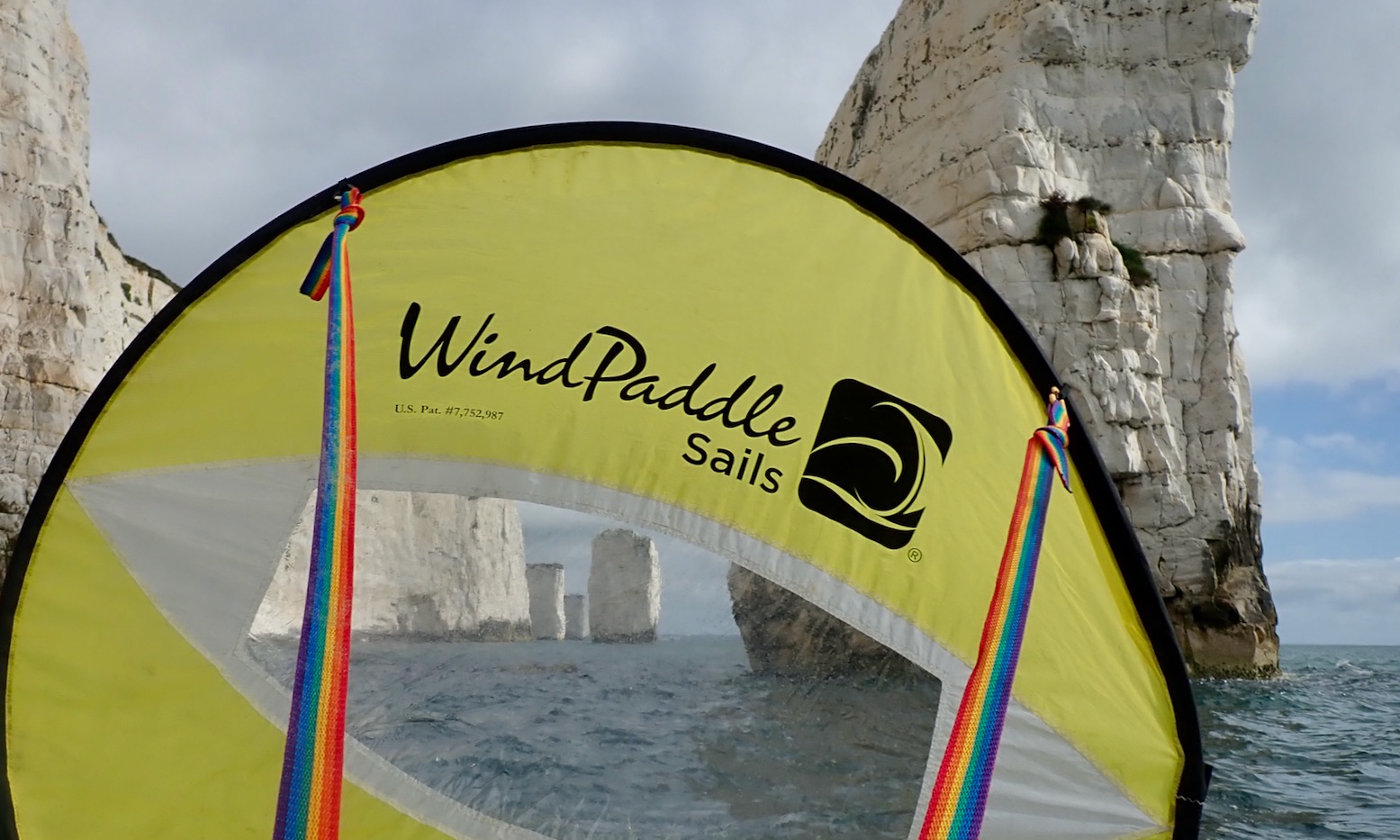
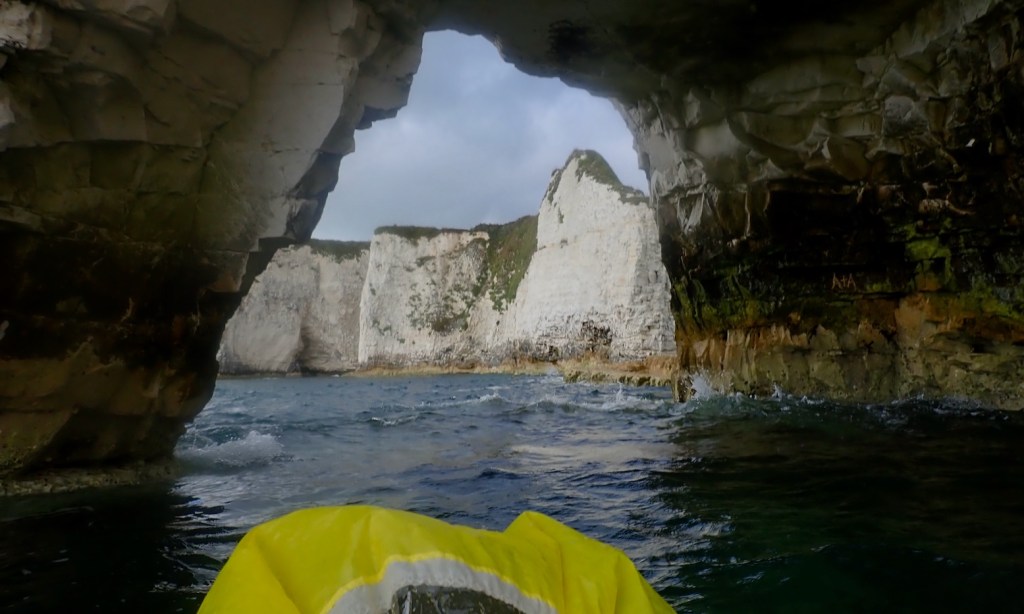
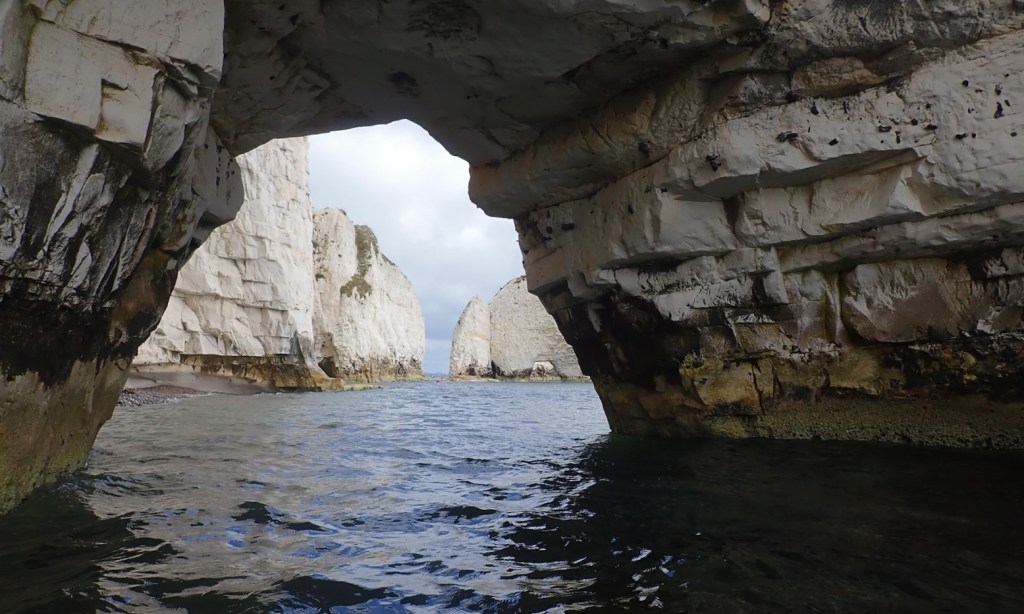
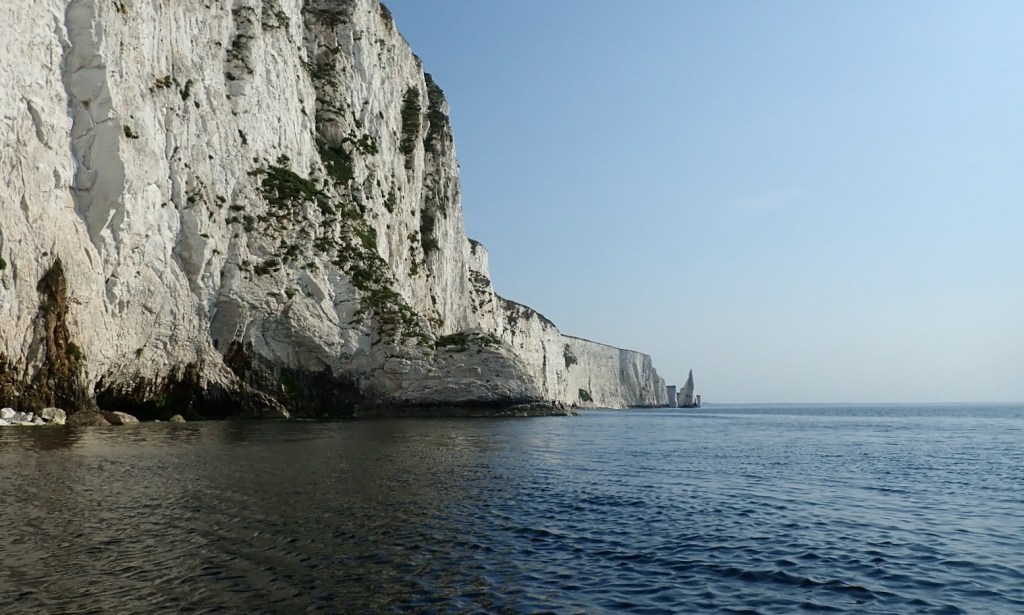
But I’m bobbing along in a packraft, also a great tool for more amphibious adventuring. More kayaks come through, including some SoTs and all clearly unpatriotic types disinterested in how England’s women might be doing in today’s World Cup Final. Luckily we can look forward to days of analysis and debate when we get back ashore. As I near Old Harry I tuck the sail under the deckbag and wait for some paddle boarders to squeeze through on their knees before threading all the arches I can; there must be over half a dozen here, not all full or wide enough for the TXL at the current tide level.
No PFD?
As this news report from a few weeks ago shows, it doesn’t always end well for paddle boarders taking the 1.2-mile run from Studland beach to Old Harry’s. But at least the guy rescued after 7 hours was wearing a PFD which I rarely see among paddle boarders. It’s just never become a custom, same as with Thames rowers. I don’t get it myself but maybe the lack of required clobber is part of iSUPing’s appeal. It is of course easy to crawl back aboard so out at sea – always a sketchy idea – an ankle leash is probably more important.
Arch bagging at Old Harry Rocks
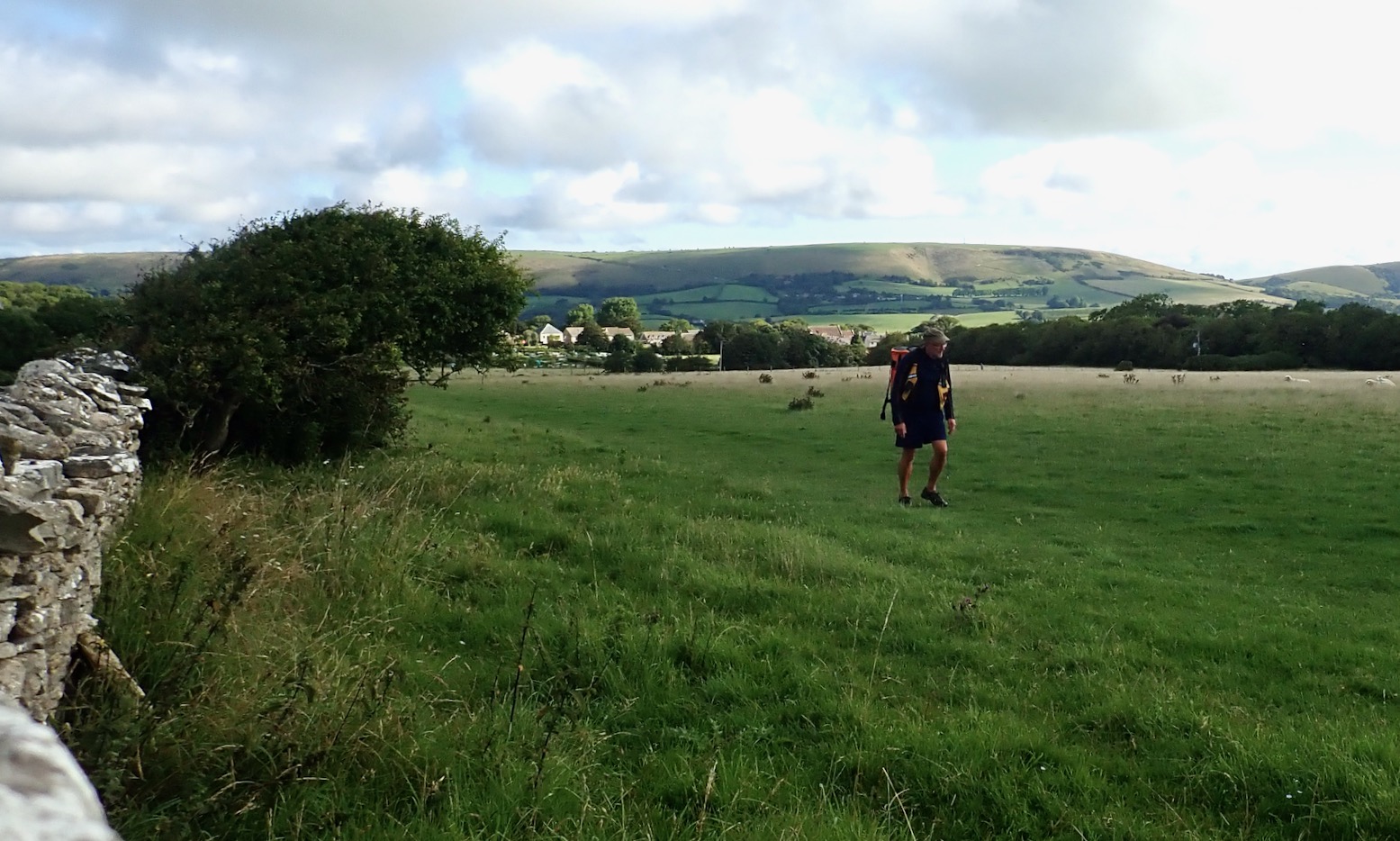
That done, all that remains is a paddle along the northern lee of Ballard Downs to a busy beach all of 6 feet wide, pack up and a walk back over the Downs to Swanage.
Looking back north from Ballard Downs to Studland Bay and the entrance to Poole harbour.Turn round and Swanage Bay lies up ahead.It’s that time of year.
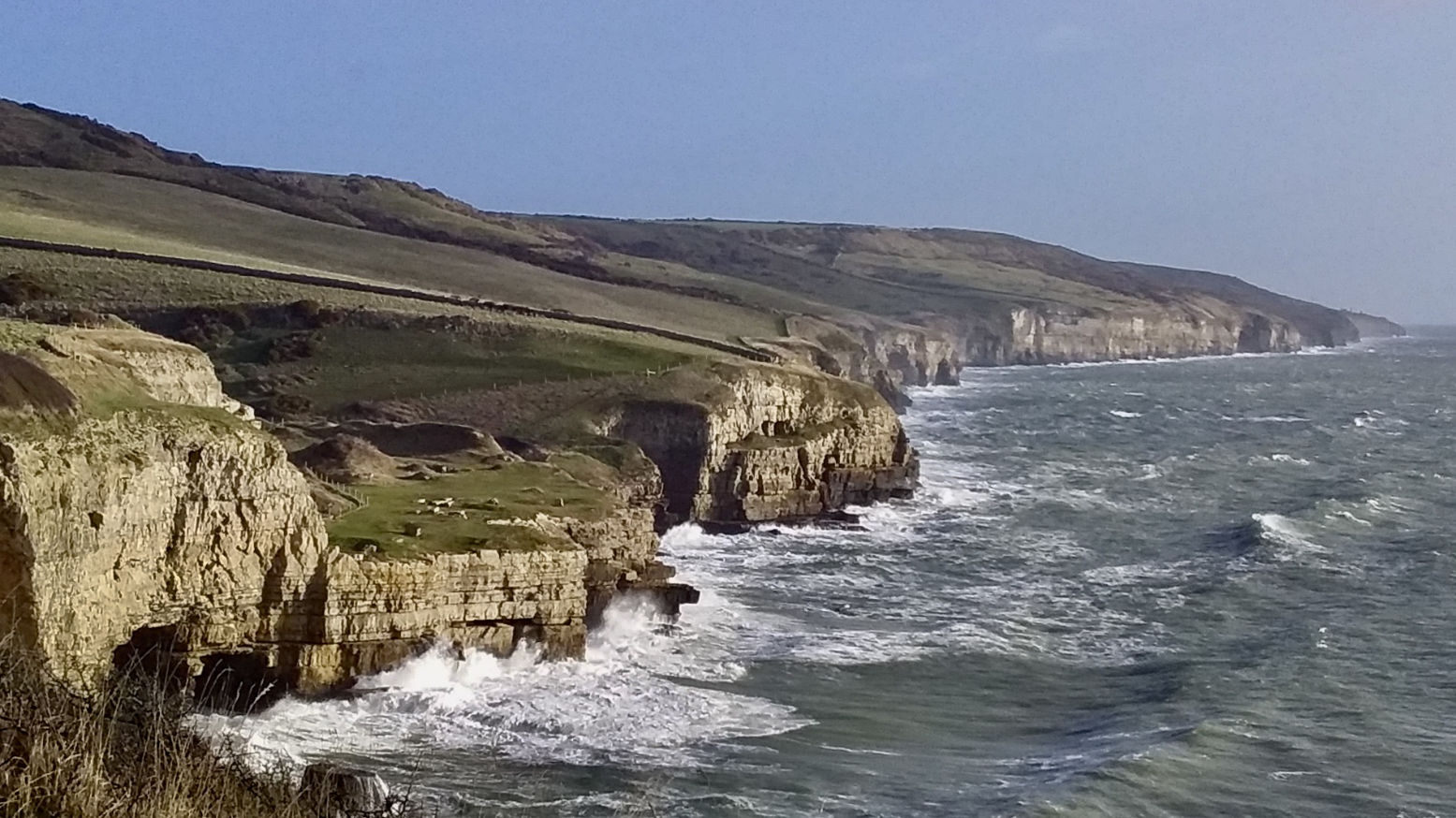
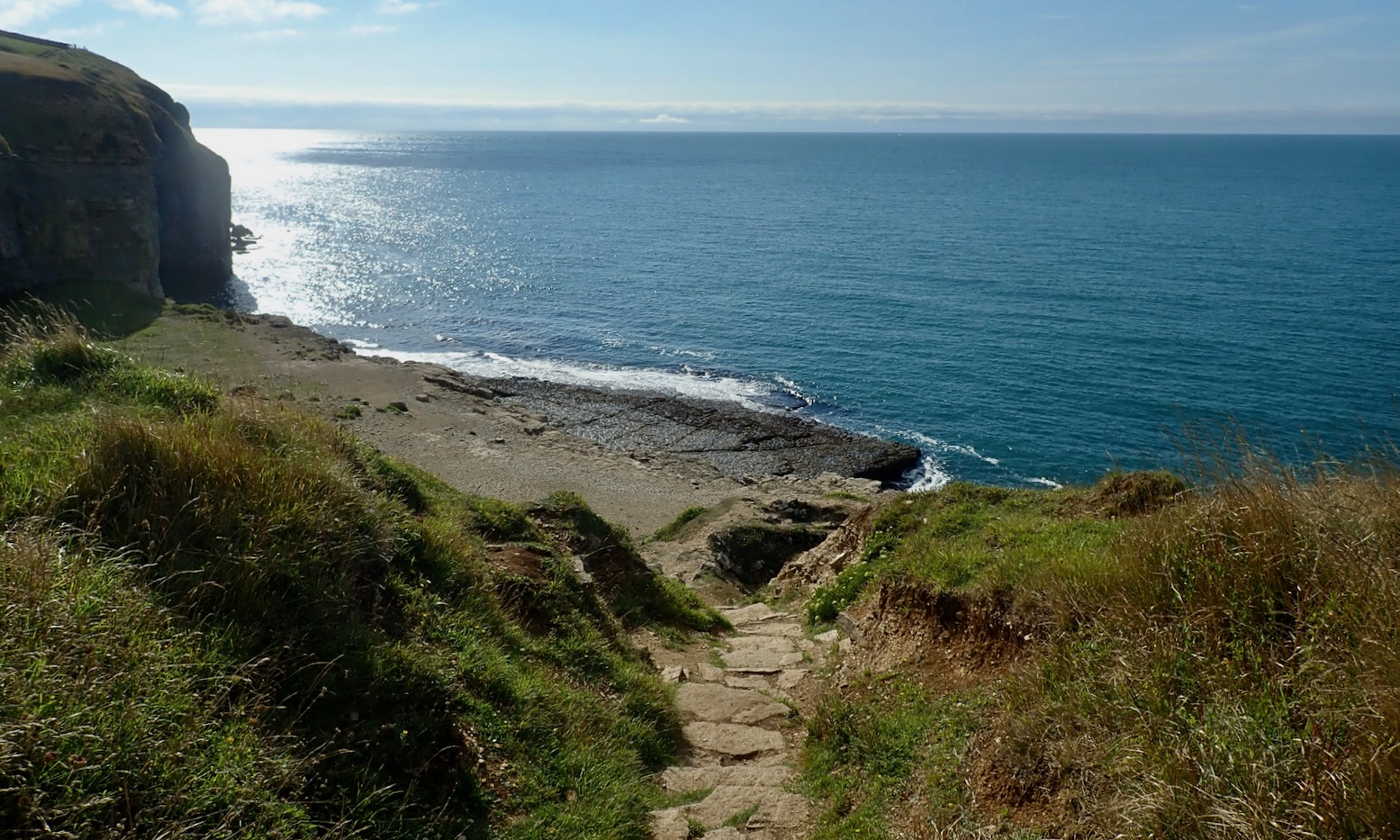
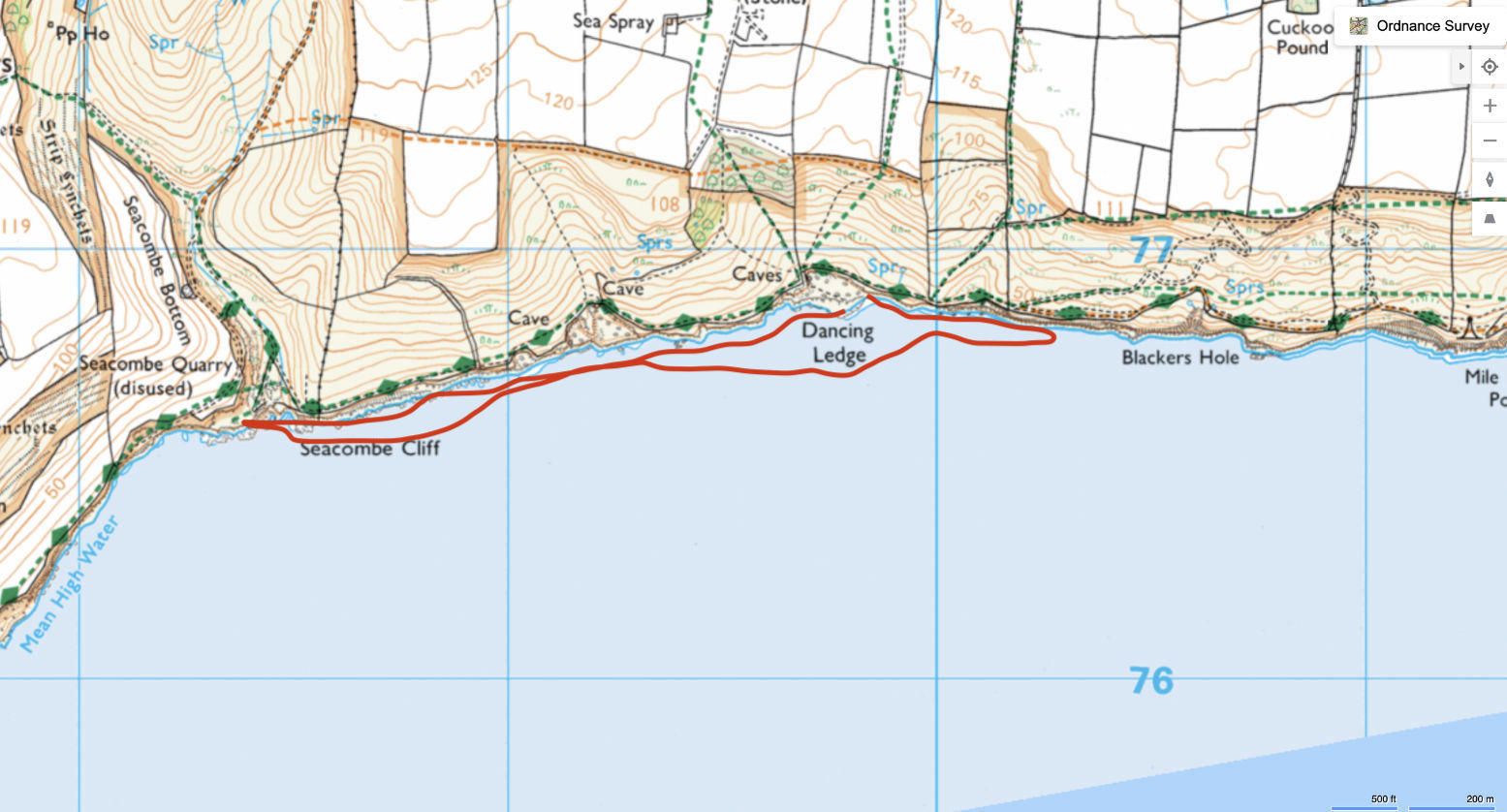
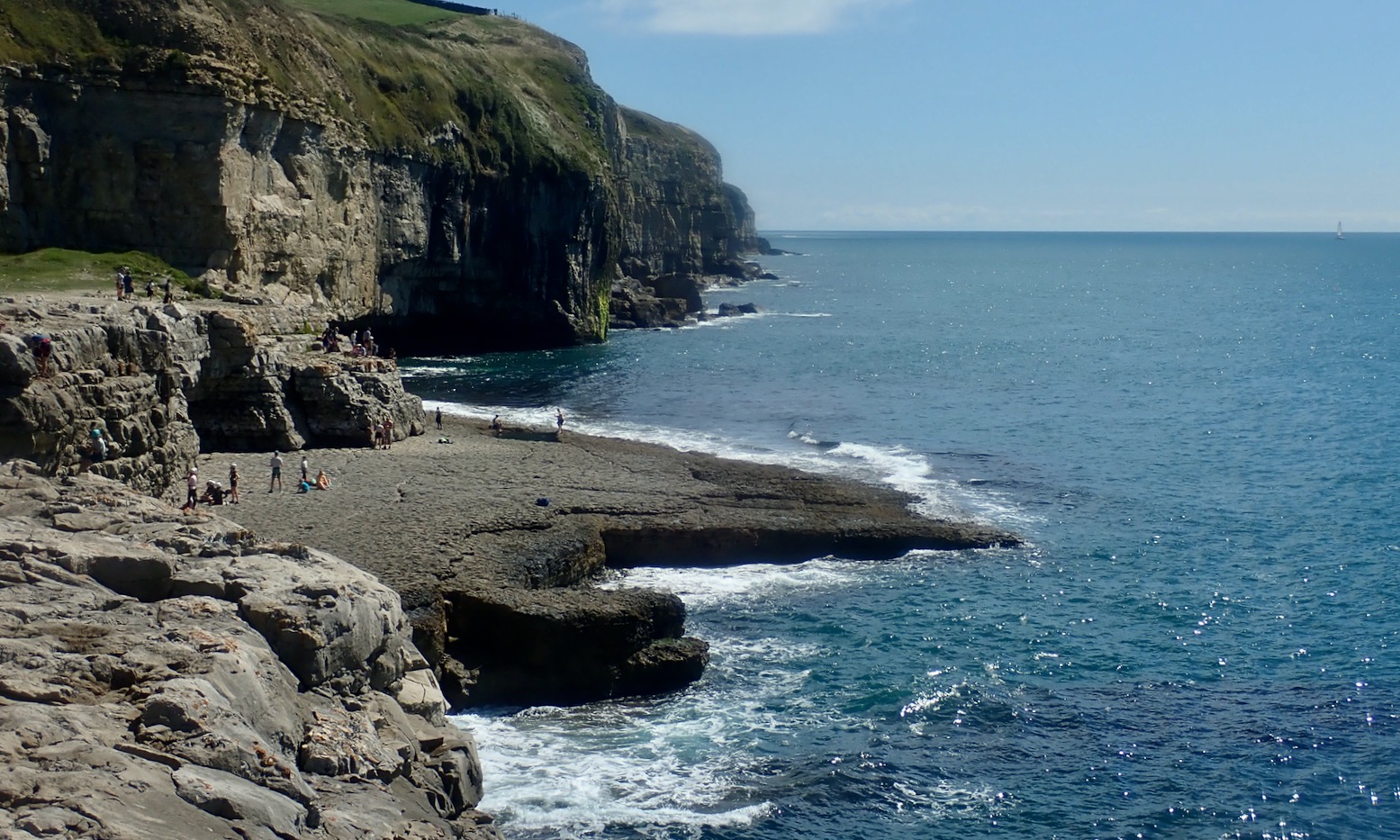
You wait weeks for a calm, sunny day to come along – and then one does. So in my back pocket I had a modest sea excursion planned for the TXL: the cliffs and caves west of Dancing Ledge. It’s a mile’s walk from Langton Matravers village across the fields to the coast where the downs drop steeply to the former Portland stone quarry. From Swanage, about four miles to the east, Dancing Ledge is the first of the few sea access points along this cliff-bound Jurassic Coast.
Approach to Dancing Ledge
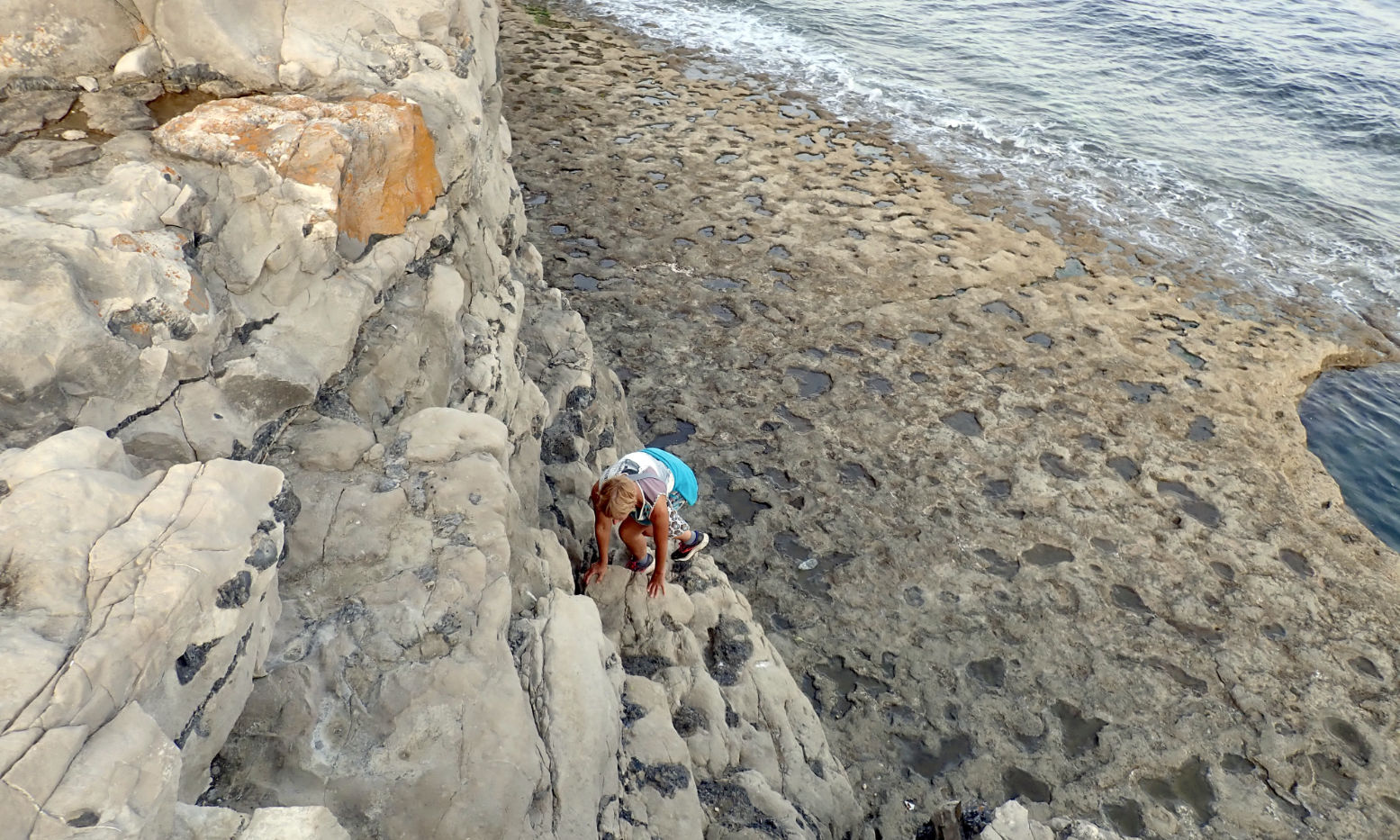
At low tide the lower, natural ledge is revealed, making getting in and out relatively easy. But to reach it you still have to scramble down a small cliff (below). It was easier to chuck the packraft backpack down before descending after it. Alone, rolled up or inflated, getting this far with an IK would be a struggle. This is why we like packrafts – and sea-going packrafts, so much the better.
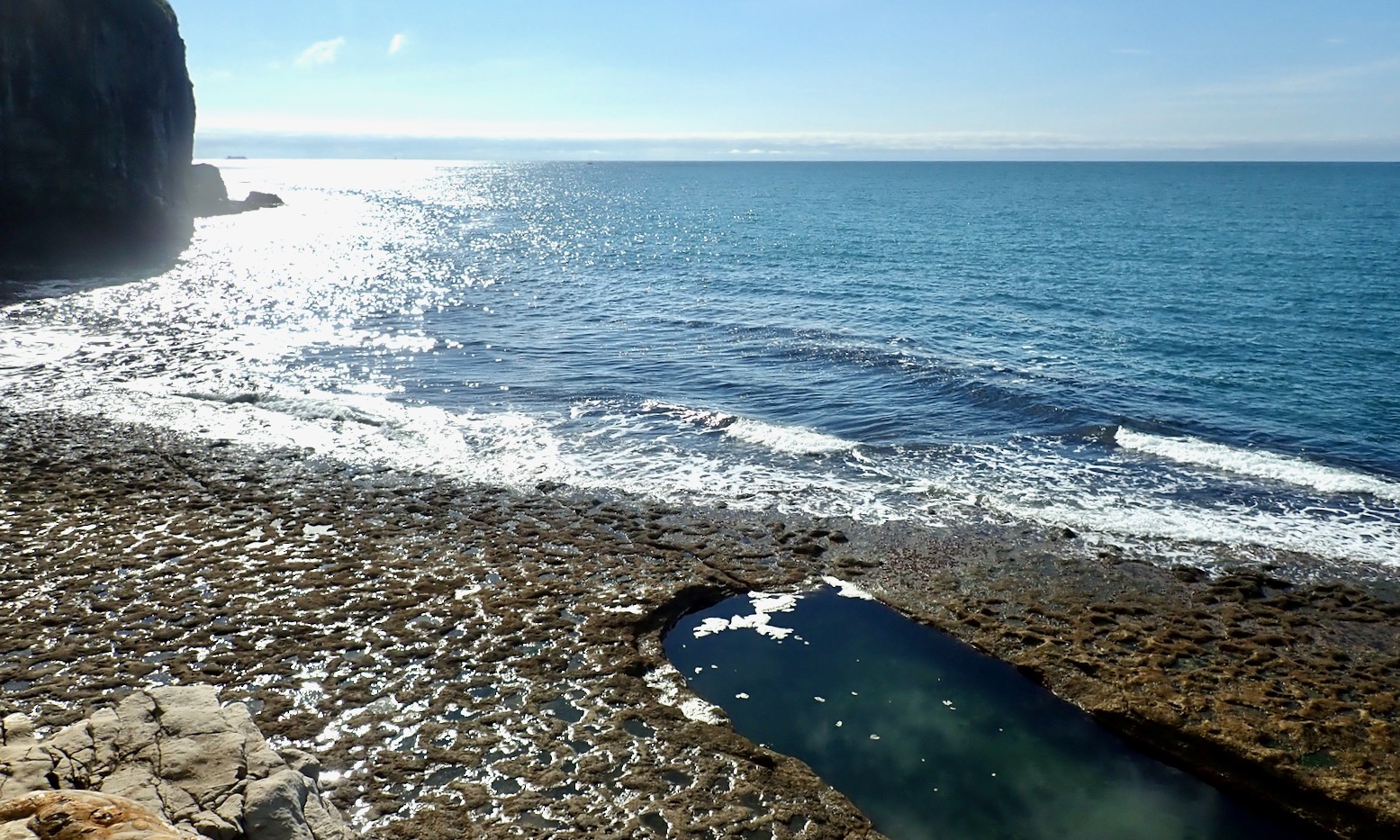
The point where you scramble down overlooks the Bathing Pool (below). It was blasted out of the rock in the late 1800s by the strict headmaster of the local Durnford school in Langton. Pupils then trotted off to the pool each morning for the character-building ritual of ‘strip and swim’, but with a now reduced risk of being swept out to sea. Decades later, James Bond author Ian Fleming attended the Durnford prep school and endured various torments before moving on to the more benign, towel-flicking environs of Eton. Unsurprisingly his Dorset years left a deep impression and later he named his 007 hero after a prominent Purbeck family, the Bonds of nearby Creech Grange. By 1999, when Bond 007 filmmakers had run out of Fleming’s dozen book titles, they chose ‘Non Sufficit Orbis’ or The World Is Not Enough, starring Pierce Brosnan. It was claimed as 007’s family coat of arms in On Her Majesty’s Secret Service, published in 1963, but was also the real Purbeck Bonds’ 16th-century motto. There’ll be a short exam later.
Back by the sea, even with wind speeds forecast at a lowly ‘4mph’ there was no balmy flat calm today, but that’s just the way it probably is with the wide open Atlantic to the west. Portland Bill or even nearby St Adhelm’s Head don’t do much to reduce the oceanic fetch driven by weeks of wind and squalls.
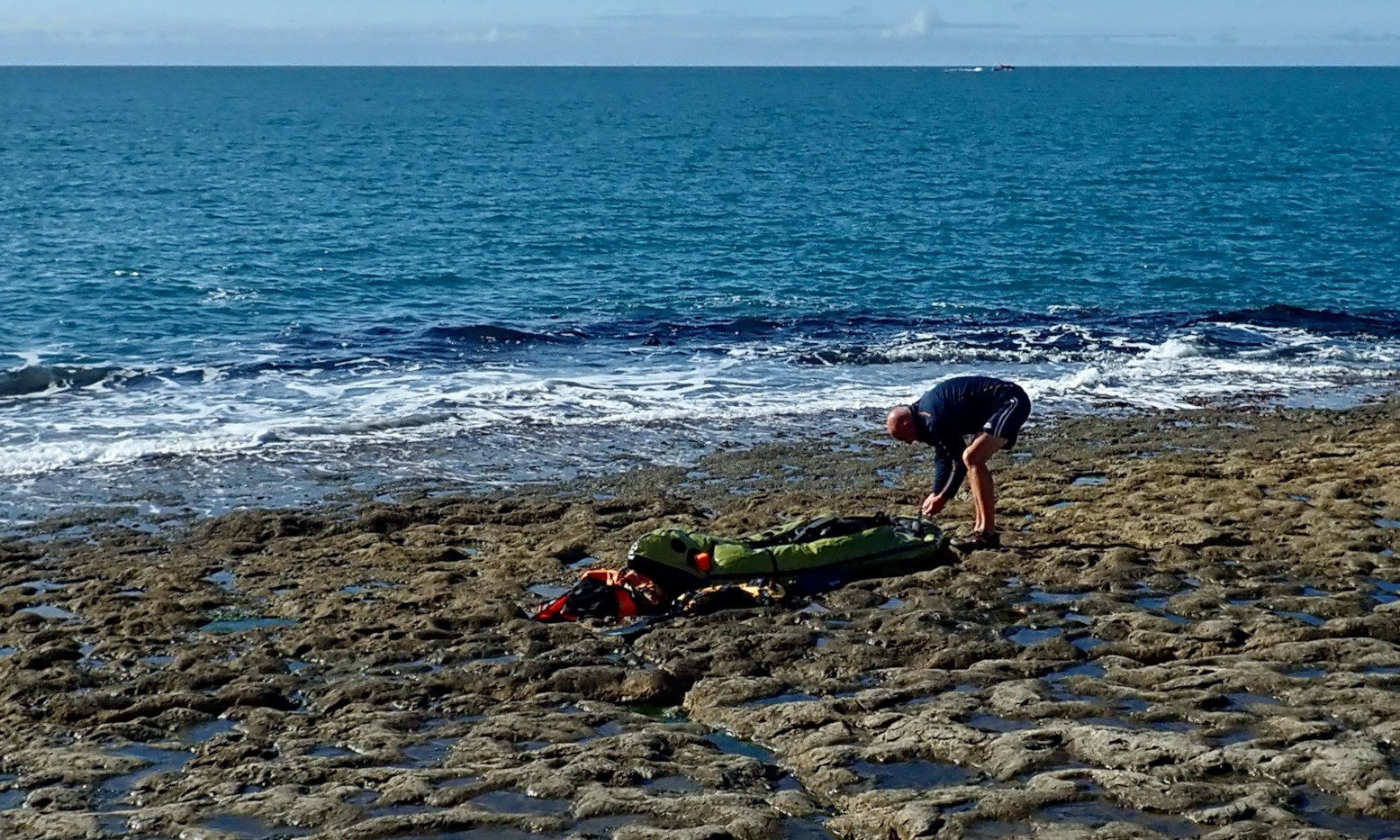
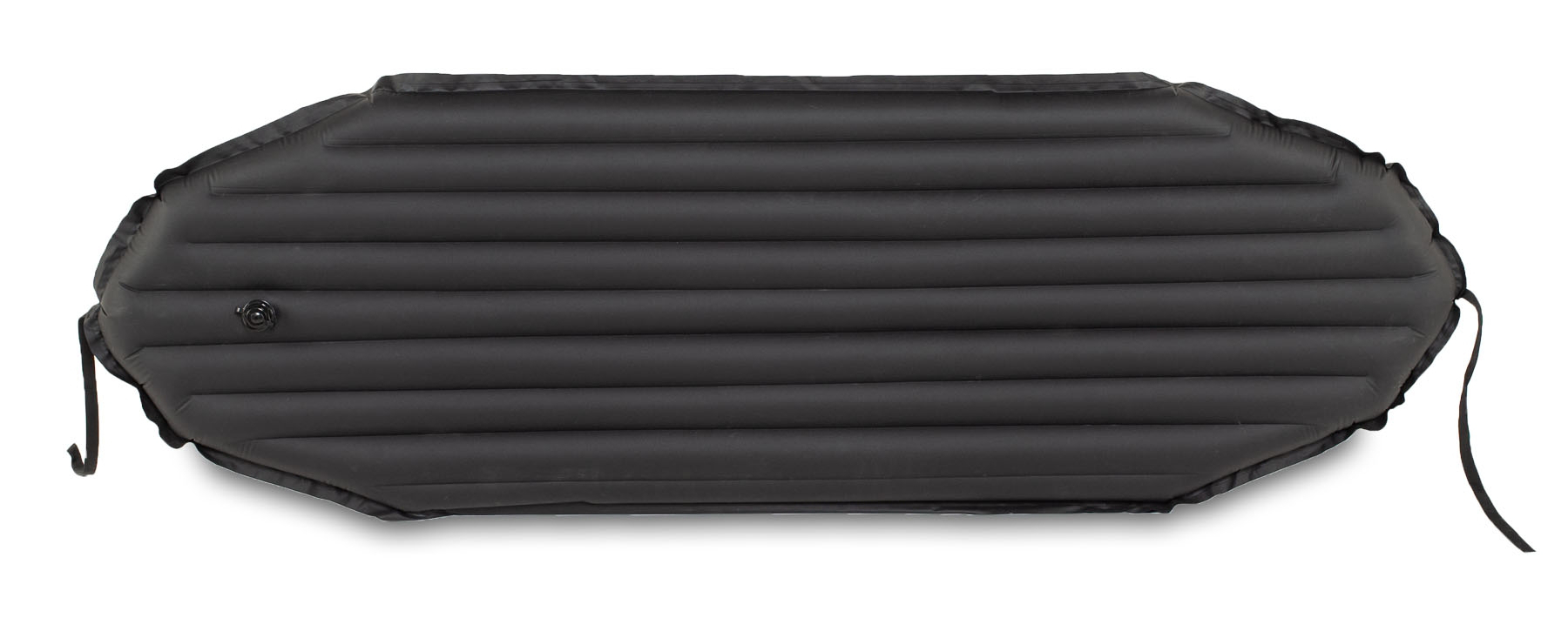
While setting the boat up I find today’s #ForgottenItem was the floor pad (left), which I was wanting to try again, despite being not entirely convinced. Two up, as we did near Skye last year, meant reduced legroom with the mat, but solo with my centrally positioned weight, I still like to think it will limit hull droop and floor sag to improve paddling response. (It does).
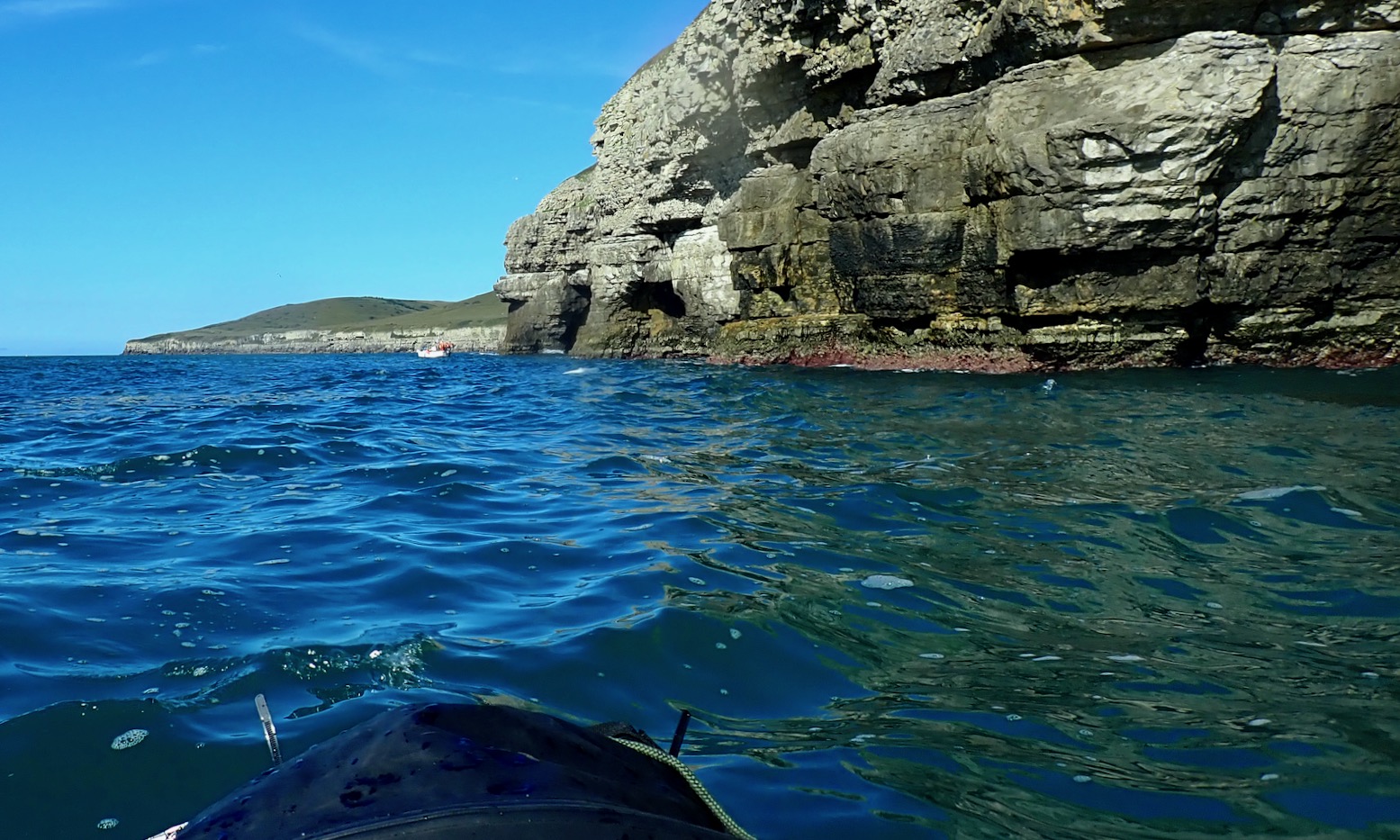
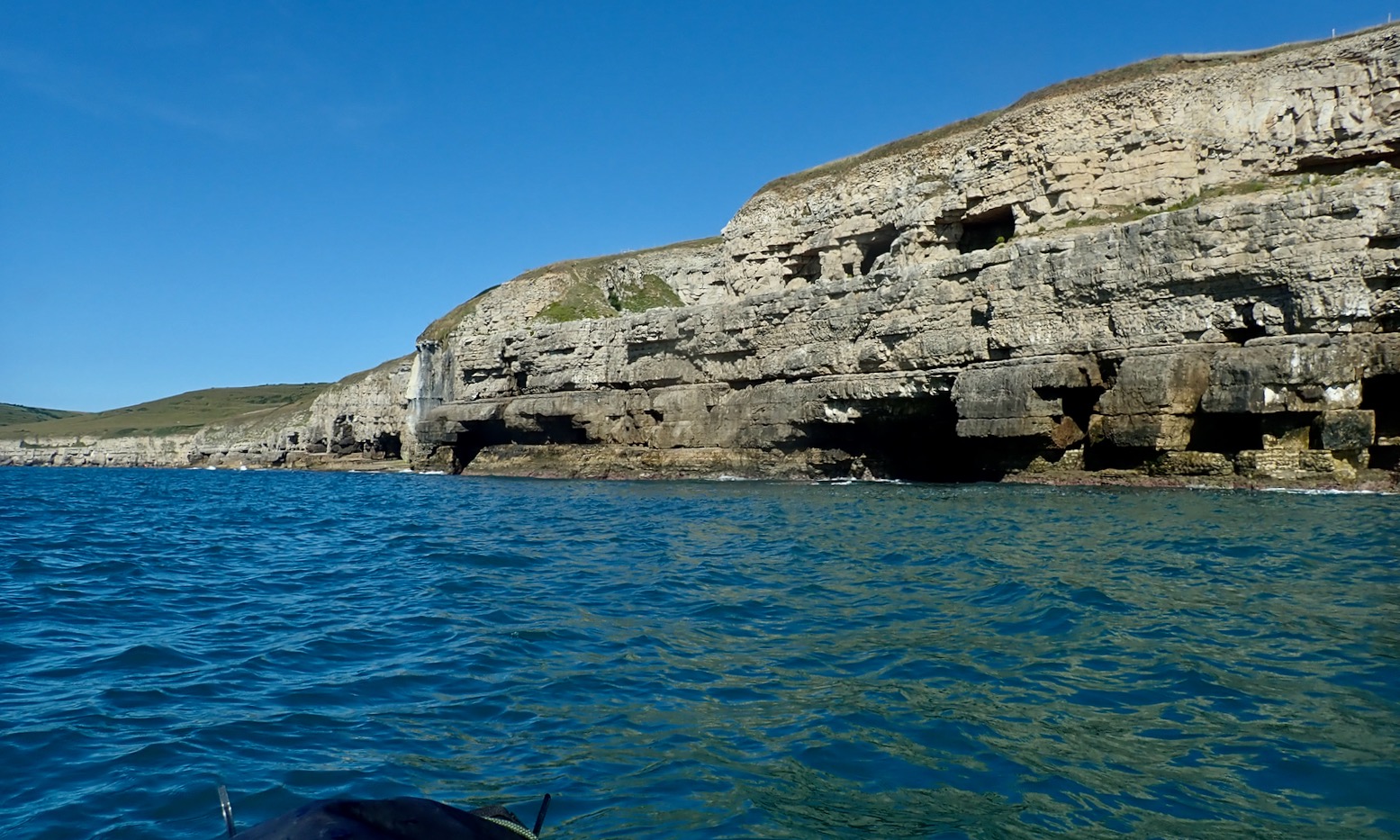
Alone, these exposed sea cliff paddles make me quite nervous, and a regular-sized packraft like my old Alpackas or Rebel would feel even more unnerving. The TXL’s healthy 2.8-metre length reduces that impression with less pitching, but I never fully relaxed today, so was happy it was only a mile to Seacombe inlet at which point I could get out and walk back if I wanted. Away from Dancing Ledge things calmed down a bit or I just get used to them, but elsewhere I needed to keep an eye seaward as bigger waves rose up.
With my old MRS Nomad S1, I learned that with longer, high-volume packrafts like a TXL, no matter how hard you pump them up with warm, ambient air, after 10 minutes out on cooler water, a crease develops midway along the side tubes as the air in the hull cools and contracts and the boat effectively loses a few fractions of psi. Though beginners might worry they have a slow leak, this is normal with inflatables. Ashore, I made use of Bond’s Pool of Torment (said to be the next film title) to pre-cool the TXL but knew it wouldn’t really work. Flooding the inflated boat for a few minutes is probably the answer. A little hand pump can only pack in, say, 2 psi at 18°C. Any more air forced in may burst the pump or stress the boat’s seams if done too often. But once part submerged by my weight on 12°C sea water, the hull cools and drops to, say, 1.8psi. It won’t get any lower, but it’s enough to lose its edge and means the boat paddles less efficiently. We can’t be having that!
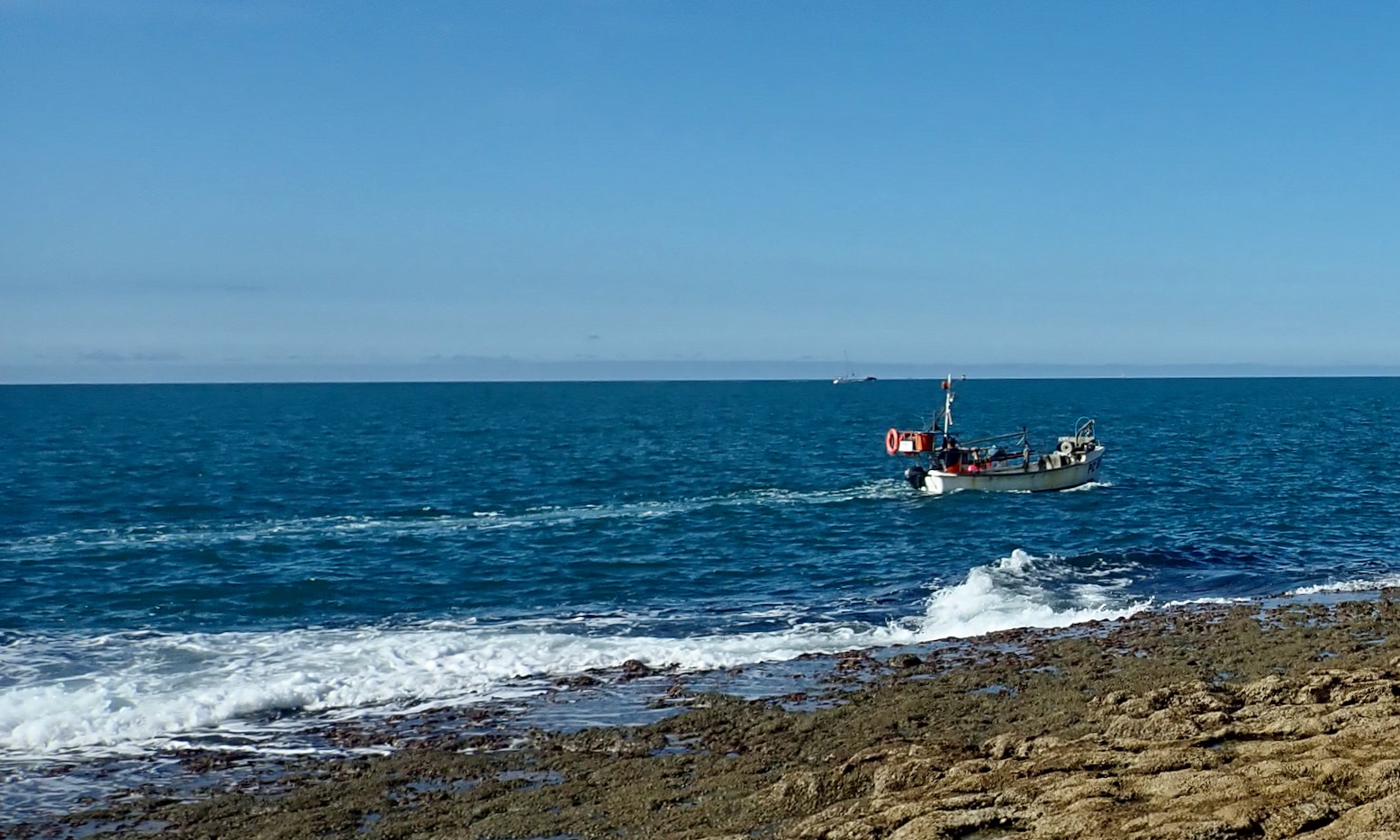
In my heightened state of anxiety at paddling a new, exposed locale, I was pleased to see a lobster boat passing my way (above). Later on I catch up and and meet the Chatty Fisherman. For a while I was worried the tide might turn before I got to drag myself away, but, Purbeck born and bred, he was a local quarryman who used his summer hols to snag a few lobsters and had lots to say about everything, including reduced catches of late. “We used to get hundreds [of lobsters] here before the seas got warmer. Now I barely get a handful.”
There was no place to hop off and top up the boat, though I could always flip round in the seat and do it on the water. That said, I wonder if longer packrafts like TXLs could benefit from repositioning the inflation valve closer to the central seat, like my old Incept K40 solo IK. The MRS Nomad had the valve on the bow, which was handy. I suppose this might make expelling the air on rolling up more difficult, but we now have mini pumps with suction settings, making valve position less important. With a passenger or another paddler alongside, on-water topping up is less of an issue, but had I thought it through before adding the second skeg patch, I could have glued it at the other end, as the TXL is symmetrical, but then is the bow bag tabs would be at the back. So halfway down one side would be better, Anfibio. Sorry, I did I say something?
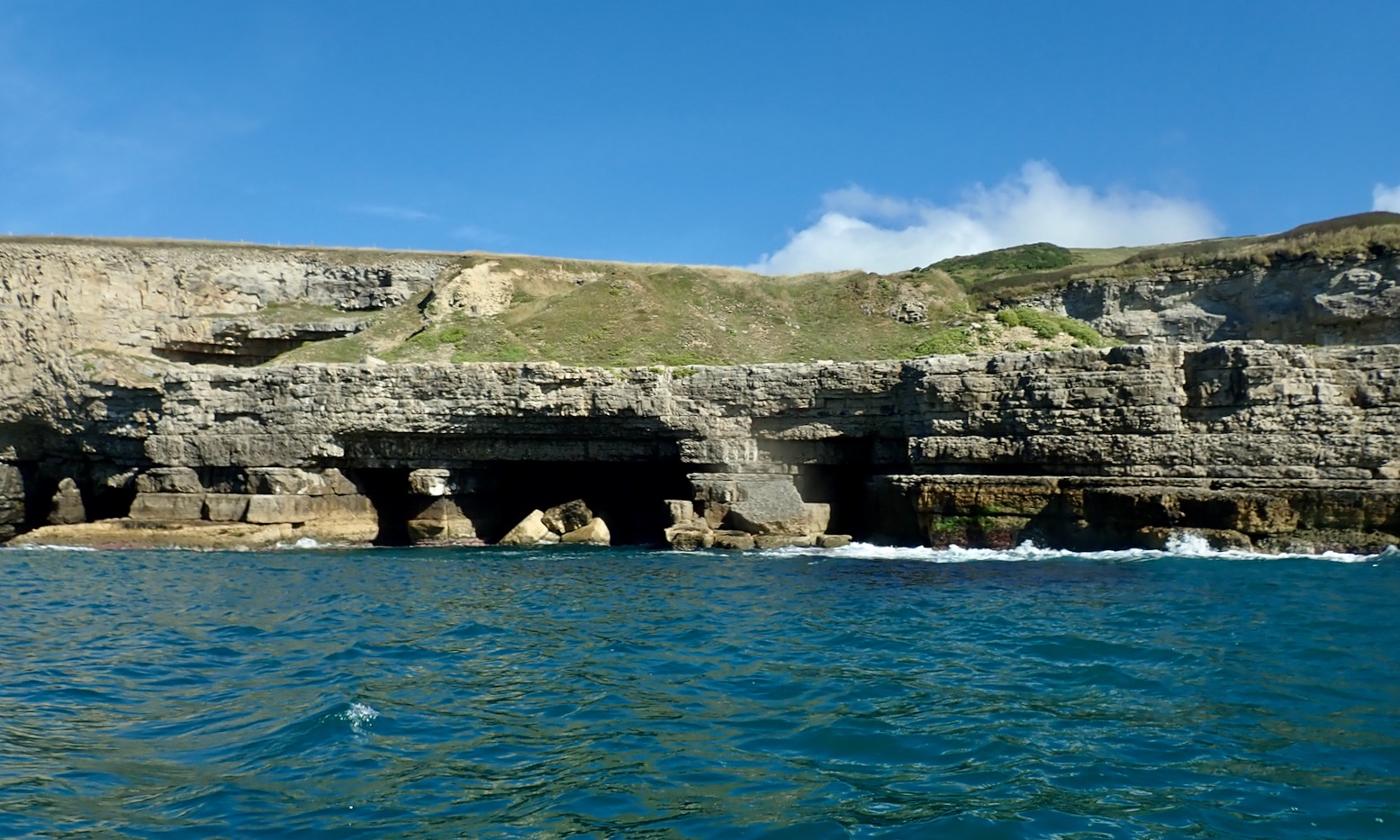
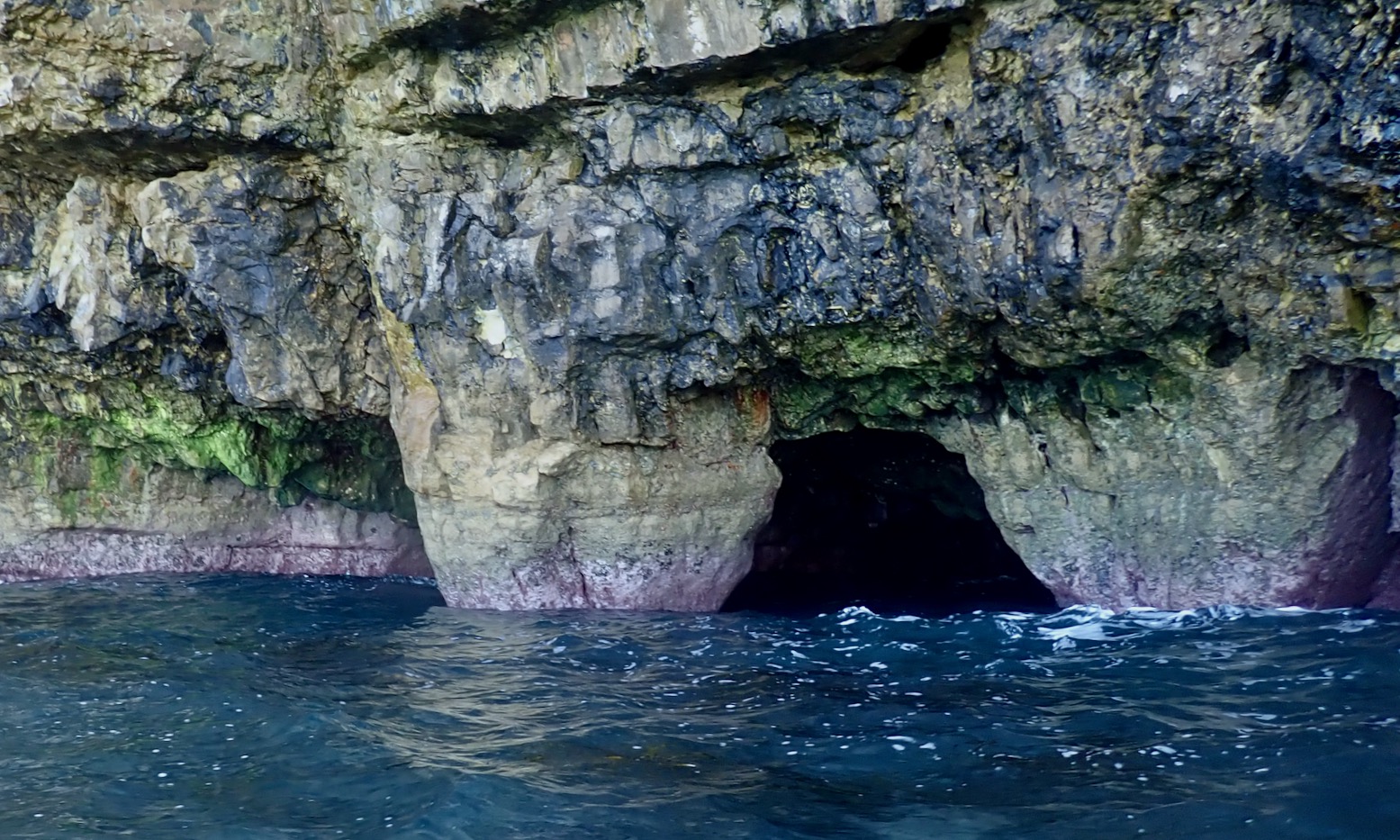
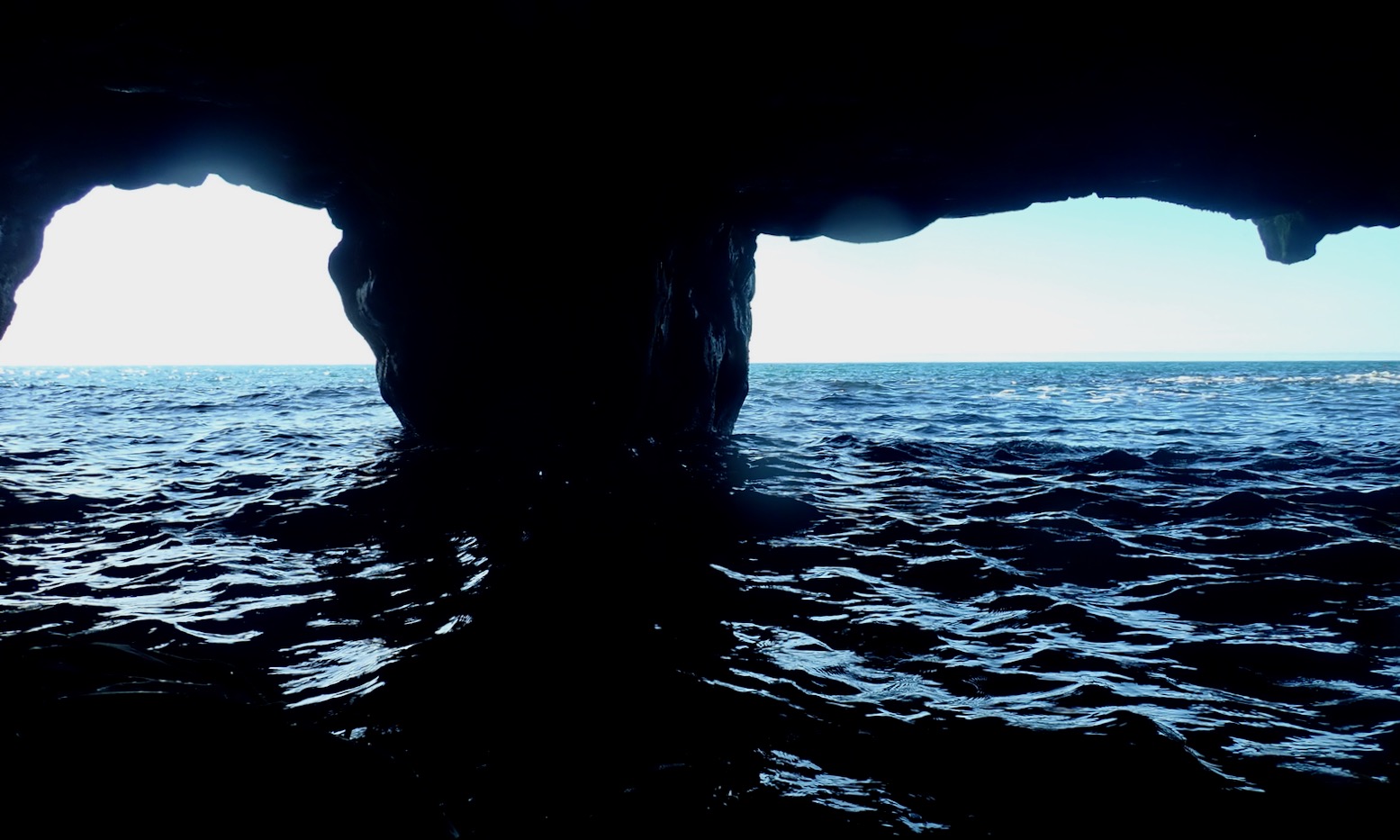
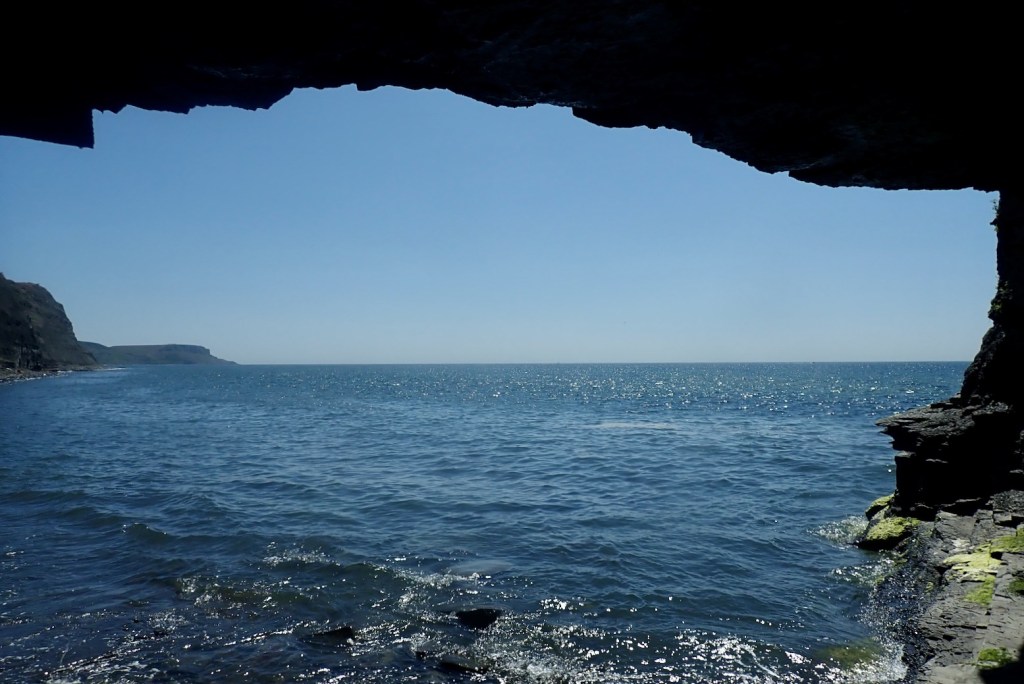
I paddle onward. Most of the caves have too much intermittent swell rolling in to get close, but one twin-mouthed cavern (above) looks like it could be safely threaded in the nippy TXL without me getting lifted by a sneaky swell and knocking myself out on the cave’s roof.
Inside the cave
Further west I see a few people wandering about on the foreshore ledges, announcing the inlet at Seacombe, another old quarry. As I get near, I line myself up to get lifted by a wave and dropped onto a ledge. It ought to be easy but ends up a bit of a bundle. Before I can climb out I get sucked backwards into another wave, which drops onto the boat. But though it looks ungainly, timing isn’t that crucial in a stable packraft that’s easy to hop out of quickly. Lord knows how a sea kayak would manage. Up on the ledge I drain the TXL before flipping it back over and giving it a few jabs of the handpump so it’s pinging firm again.
Seacombe cliffs
Putting back in, I’m alarmed to see my skeg lying on the rocks. My to-and-fro landing must have dislodged it. (It happened again on my next TXL; this is a fix). It is for moments like these (or, more commonly, distractions while packing up) that I wrapped it in hi-viz yellow and black tape. Had I lost it, the downwind paddle back would have been a bit squirrely, giving me something new to worry about until I realised the cause. Passing the twin-mouth cave I threaded earlier, the tide is already too high to repeat the stunt.
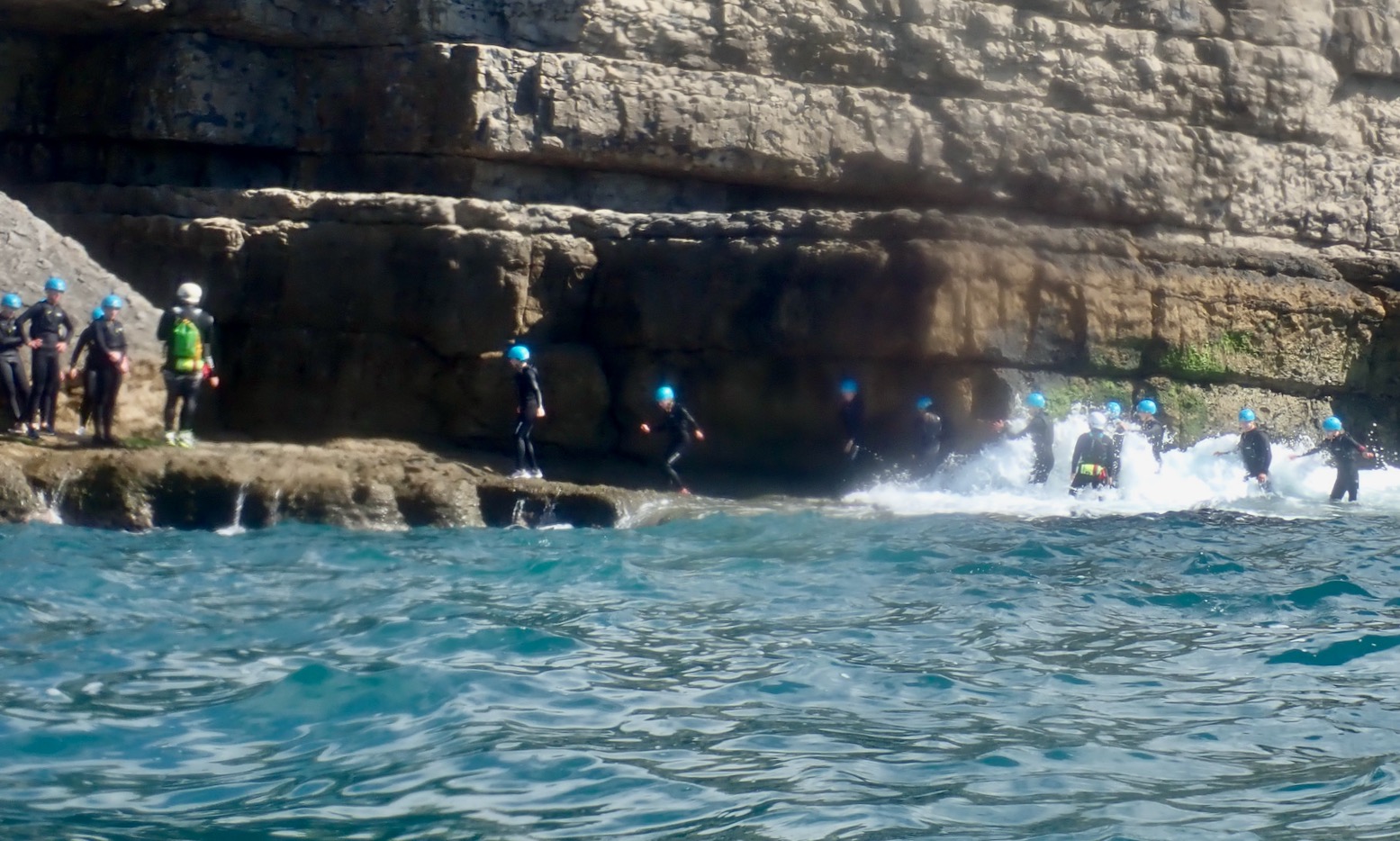
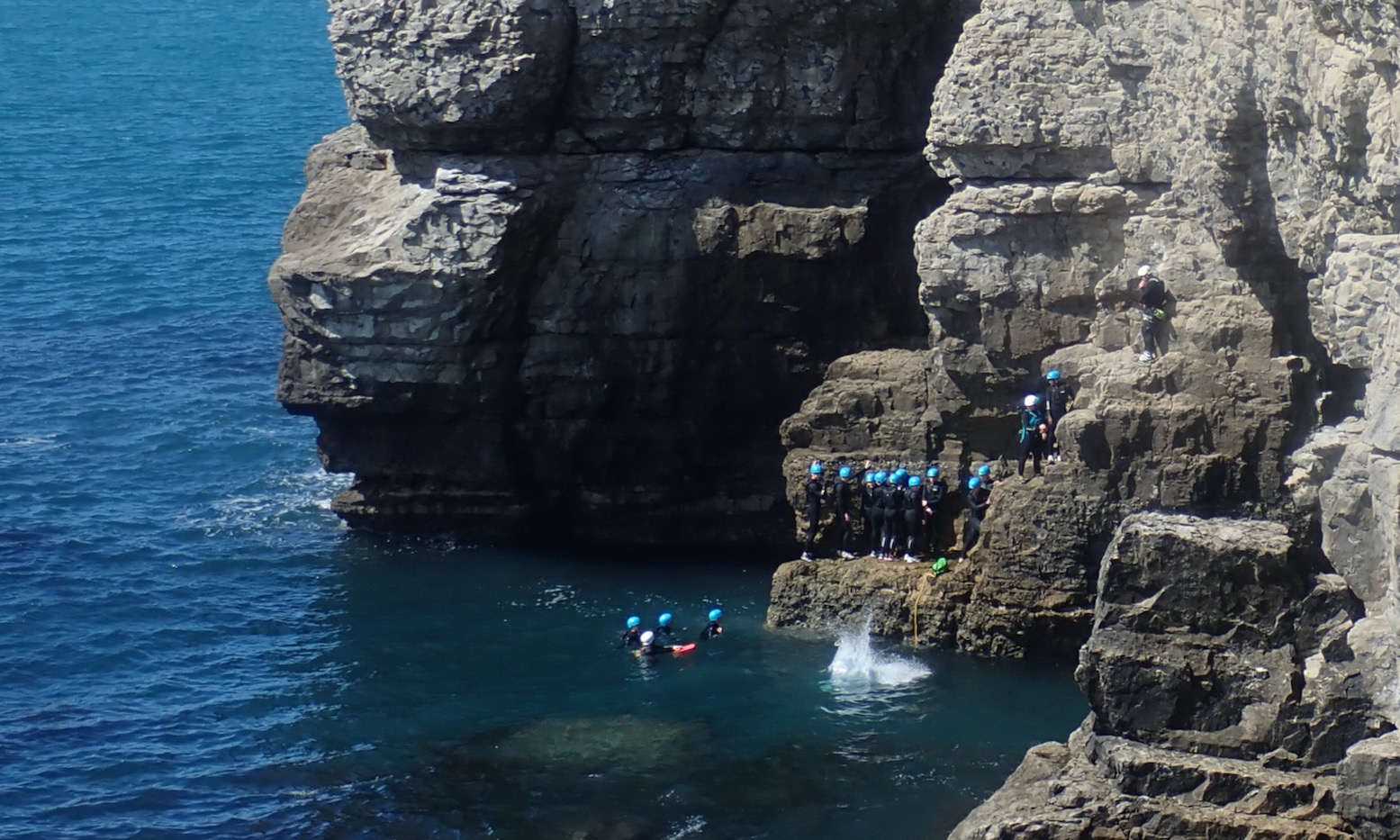
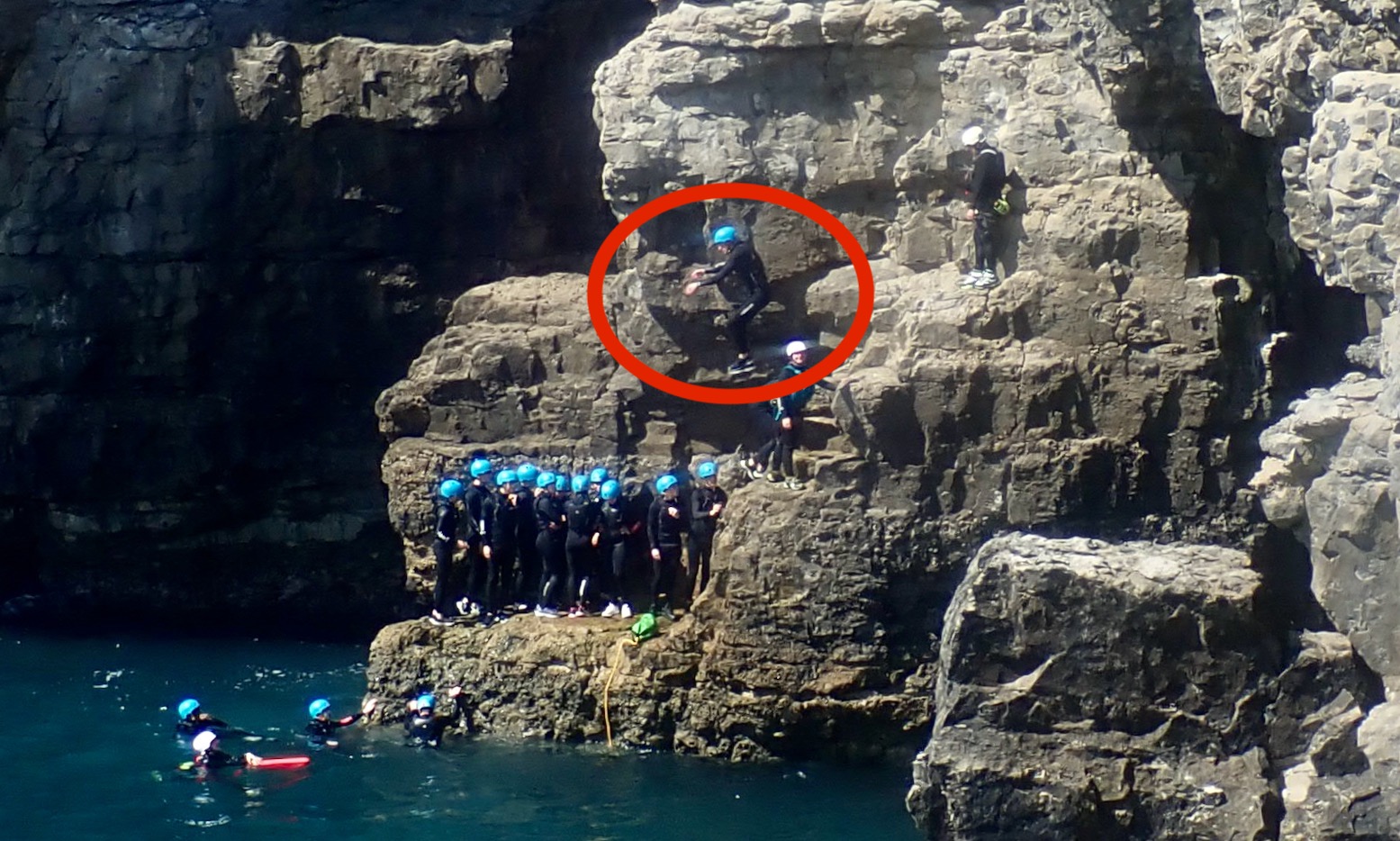
By the time I returned, Dancing Ledge was packed with day-trippers including groups of coasteering wetsuit-clad kids. They inched along the ledges, swam across cave mouths, and then clambered up to a narrow ledge to jump in. The next group was already lined up to follow so it all looked a bit sketchy and congested with just two guides for over a dozen kids (turns out it can be), but I bet they all loved it.
‘Beyonsaaaay! (or whatever kids shout these days).
As had happened so many times, a spell on the water without incident calmed the nerves. So I continue past the Dancing take-out and cast a wistful glance eastwards. It was only 2.5 miles, or an hour or so with the tide and wind and cliffs to the Isle of Purbeck’s southeast corner at Durlston Head, before a more sheltered turn northward to Swanage, another mile away over the Pevrill Ledge, the final hurdle into town. One for the next ‘calm’ day perhaps.
Looking east over Dancing Ledge
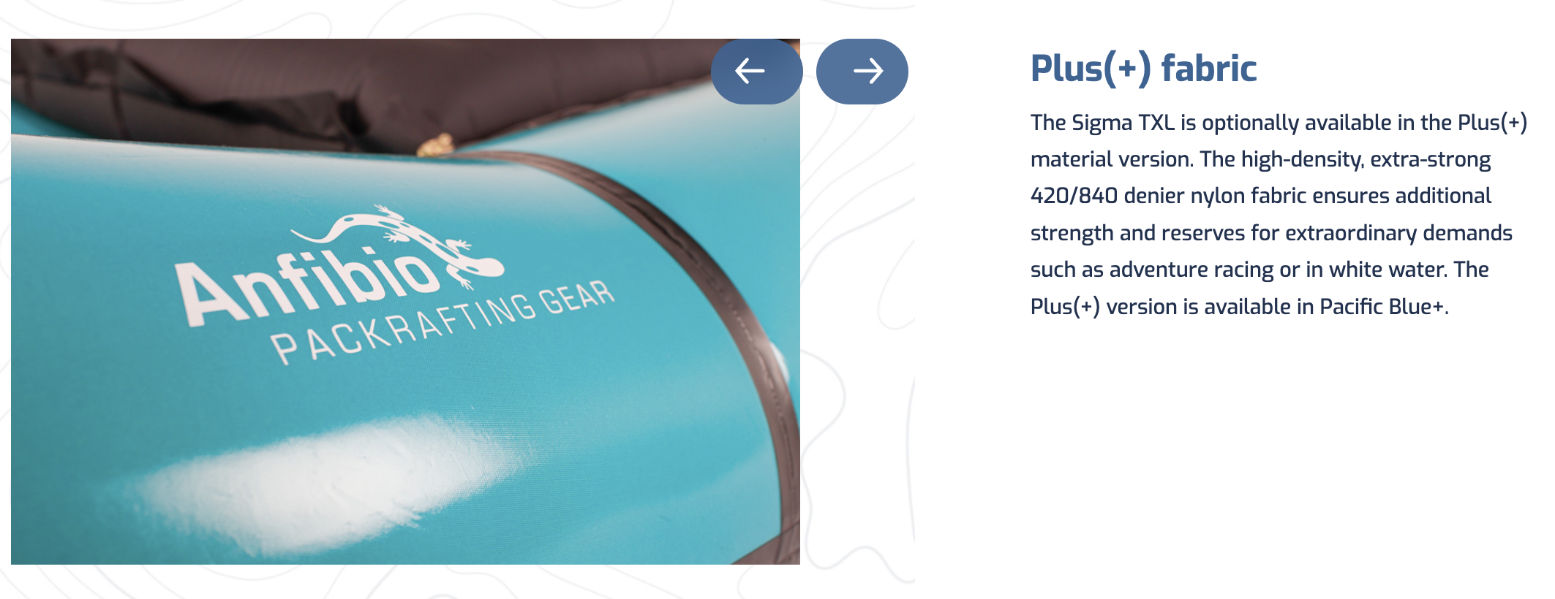
Anfibio Plus(+) fabric Checking out Anfibio’s TXL page later, I see they’re offering the option of the TXL and similar long/double models in chunkier Plus (+’) fabric. It’s only 17% heavier but 80% more tear-resistant, depending on how you measure that, but costs only €70 extra. It looks like it might be similar to floor fabric or comparable with Alpacka’s much more expensive Vectran option.
Anfibio don’t fully explain why they’re now offering thicker Plus(+) fabric; has the standard proved a bit less durable? I admit Anfibio do focus a bit too much on the ultra lightweight side of things which, alone in a single-skinned inflatable, is not where my priorities float. From my experience with stiffer PVC IKs versus more flexible rubber kayaks, I do wonder if a Plus(+) TXL or similar might be more rigid on the water without the need to pack it full of air. It may even exclude the need for the 900-g floor pad (it doesn’t). Along with what I estimate to be a <500g weight penalty, I imagine a Plus(+) TXL will roll up less compactly, but other than that it’s something worth looking into.
Quick-deflate seat While I was never a fan of the mushy, twist-lok stem valves on the early Alpackas, I’m not a huge fan of the sprung, one-way inflation valves Anfibio use on their seats and backrests. Great for easy inflation and holding high pressures, but a pain to deflate when packing up; you have to jam a fingernail in the valve and scrunch the seat while it ever so slowly deflates. At least with an old twist-loks you could suck the air out. And anyway, you don’t need full pressure in a seat. Far from it. There was talk of Anfibio modifying the seat valves for easy deflation but it’s not happened yet. Now the TXL is my sole packboat, I’m minded to set it up well. I failed to find anything other than Boston valves online. They’d work of course and will dump air really fast, but are a bit OTT and would need gluing in properly.
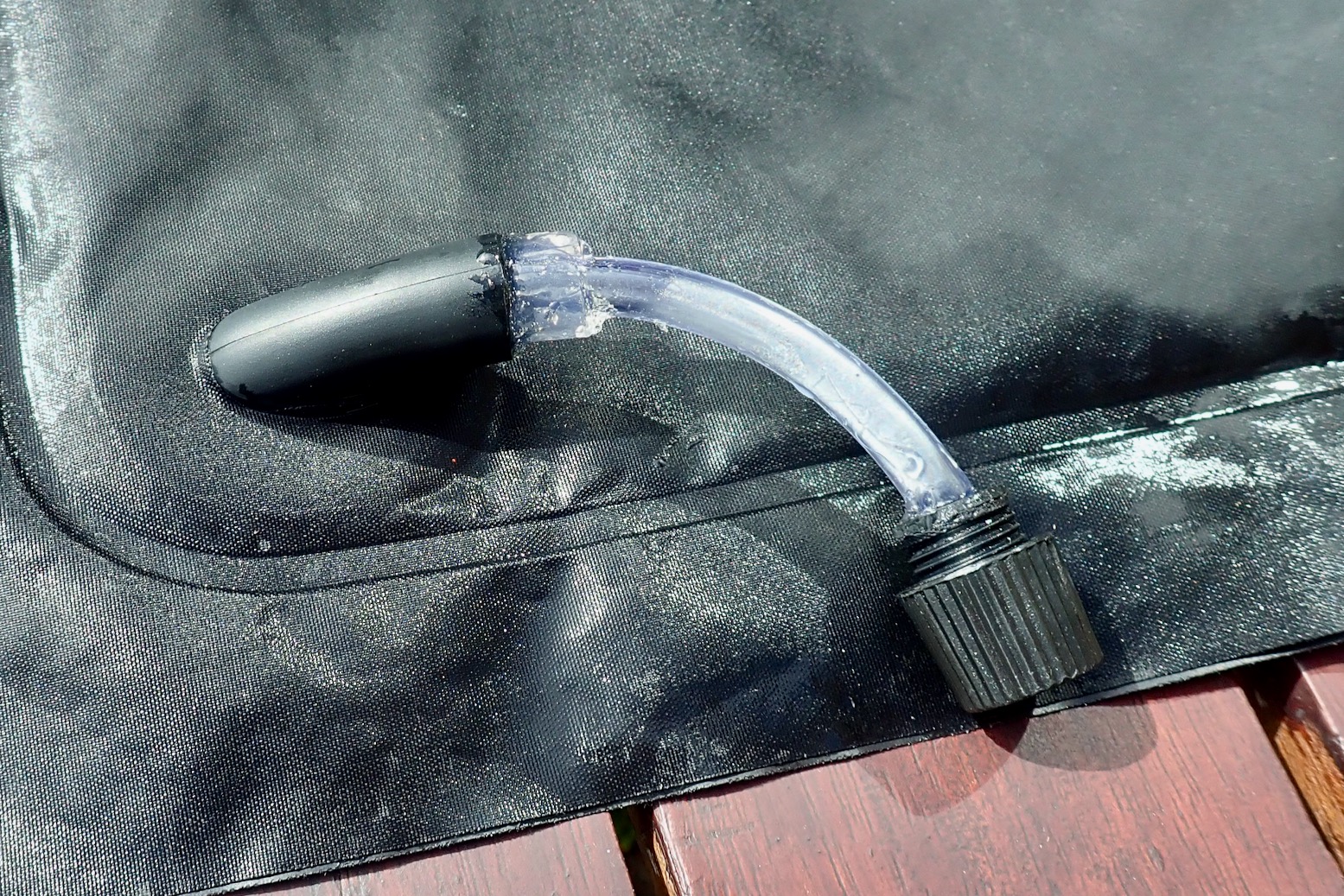
I had a spare dry bag with a neat twist lock valve a bit like Thermarest sleeping pad valves. But marrying it to the chopped off sprung one-way valve in the seat was tricky to do neatly. So I managed to do it not neatly (above left) with a bit of clear tube and lashings of Aquasure. Unfortunately the tube is narrow which slows things down or increases effort; win-lose. For the moment it works; I can unscrew the valve and roll up the huge seat, purging the air as I go. Looking back on this dramatic episode, next time I’ll just cut a hole and glue in a Boston valve (left) which are easily found online for under a tenner.
Eastwards from near Tyneham Cap: Kimmeridge Bay and the Ledges beyond on a very windy day
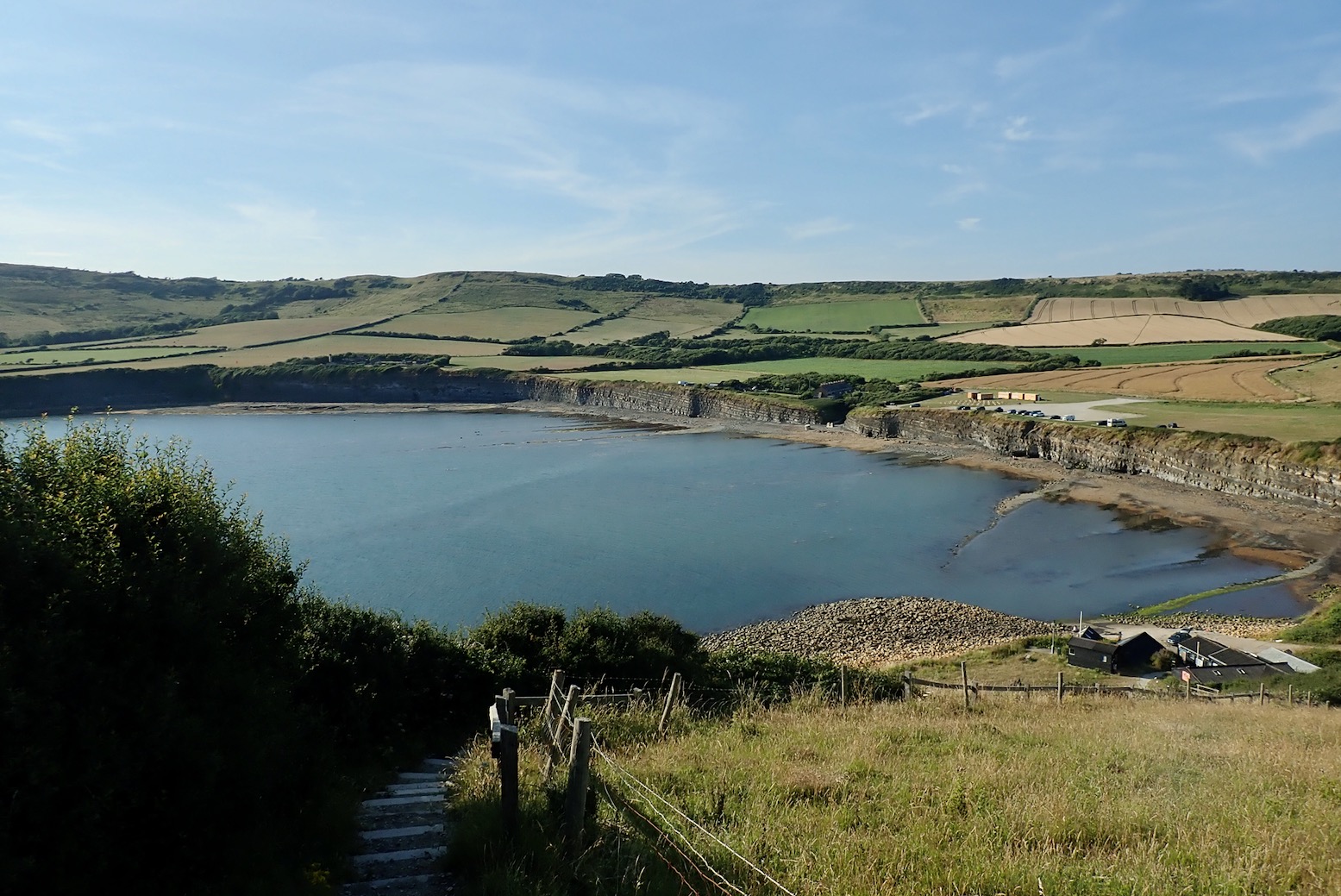
We took a lovely evening walk along the Purbeck coast east of Kimmeridge Bay, where for millennia the bands of bituminous shale have been burned or squeezed for their oil, like Kalamata olives. Good page here on Kimmeridge and its geology over the eons.
Just west of Kimmeridge Bay there’s even a lone oil well (right), nodding away incongruously since 1959 in the pastoral Purbeck idyll that inspired Enid Blyton’s Famous Five adventures which I devoured like Opal Mints in the Sixties. Blyton holiday’d for two decades in Swanage and elements of some distinctive Dorset icons, like Corfe Castle, find themselves transposed onto her book covers (left). There’s even an Enid Blyton Trail, which lists Kimmeridge.
East of the bay are the notorious Kimmeridge Ledges, submarine clay or dolomite beds which reach out to sea a few hundred metres. With the right sort of swell or wind (top of the page and below) they can catch out unwary paddlers when waves suddenly rise up and break far from the shore.
Windy day looking east across Kimmeridge Bay to the jetty below the Clavell Tower
Our evening walk coincided with low tide and calm conditions exposing parts of the ledges. They’re said to be rich in fossils and over the decades a local man, Steve Etches has collected enough to fill a museum in Kimmeridge village. We walked as far as the outlook over Egmont Point where the path turns inland on its way over Houns Tout to Chapman’s Pool, just before St Alban’s Head (below).
Chapman’s Pool, just before St Alban’s Head
Kimmeridge Bay
To reach Kimmeridge Bay you continue past the village onto a private toll road to a huge car park with a daytime cafe. On both visits no one was at the toll booth which saved a few quid. The east end of the bay has a handy slipway by the Wild Seas Centre. What a luxury it is to drive down to the sea’s edge and pop the kayak straight into the water to let it cool down and soften up while I parked the car. The high tide was just on the turn, but out here away from the headlands, the effect of any tidal current is minimal compared to the wind.
Jetty put in
I’ve got into the habit of opening the two side PRVs plus airing down the floor a bit at the end of a paddle for the drive home. Providing it’s not baking hot, I paddle with the PRVs closed which keeps the boat as rigid as a stick. Today I realised you can’t top up with a push-pull barrel pump stood in the boat on the water; you need to drag it all back ashore to stand on the ‘stirrups’. It takes just a few strokes to fully inflate the Igla back to 0.5 bar.
Round the corner the south easterly feels a bit more than the predicted 8mph. Perhaps the tall cliffs channel and accelerate the wind along their face. At least it should make for a good sail back.
Heading southeast, I can’t help but feel a bit exposed out here; open sea to the right, rocky beach below a steep, crumbling cliffs to the left, and lethal ledges lurking ahead. What next – fireballs falling from the sky? But away from the corner the seas settle down a bit. The Igla cuts through the headwind at around 3mph.
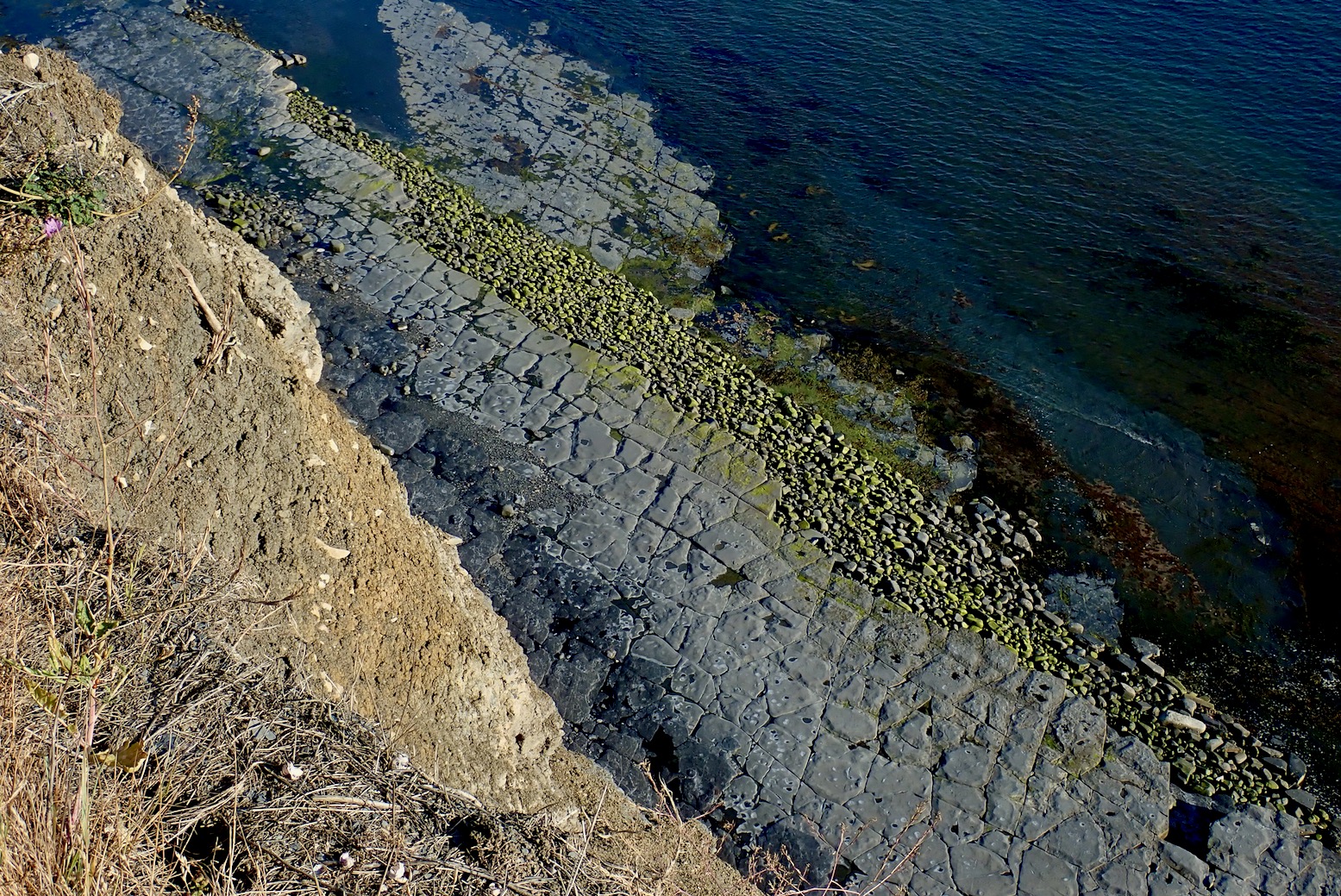
Nearer the cliffs the water turns green over the clay ledges not far below. But bigger waves rise up occasionally so I prefer to stay out which means I see less. As there are no sea caves to paddle into on this stretch and no skerries to paddled around, in a packboat I decide this unusual area might be more interesting to explore at low tide. You can easily hop in and out of an IK or packraft and wander across the ledges which few people ever access, looking for ammonites and other curiosities. Next time I’ll know.
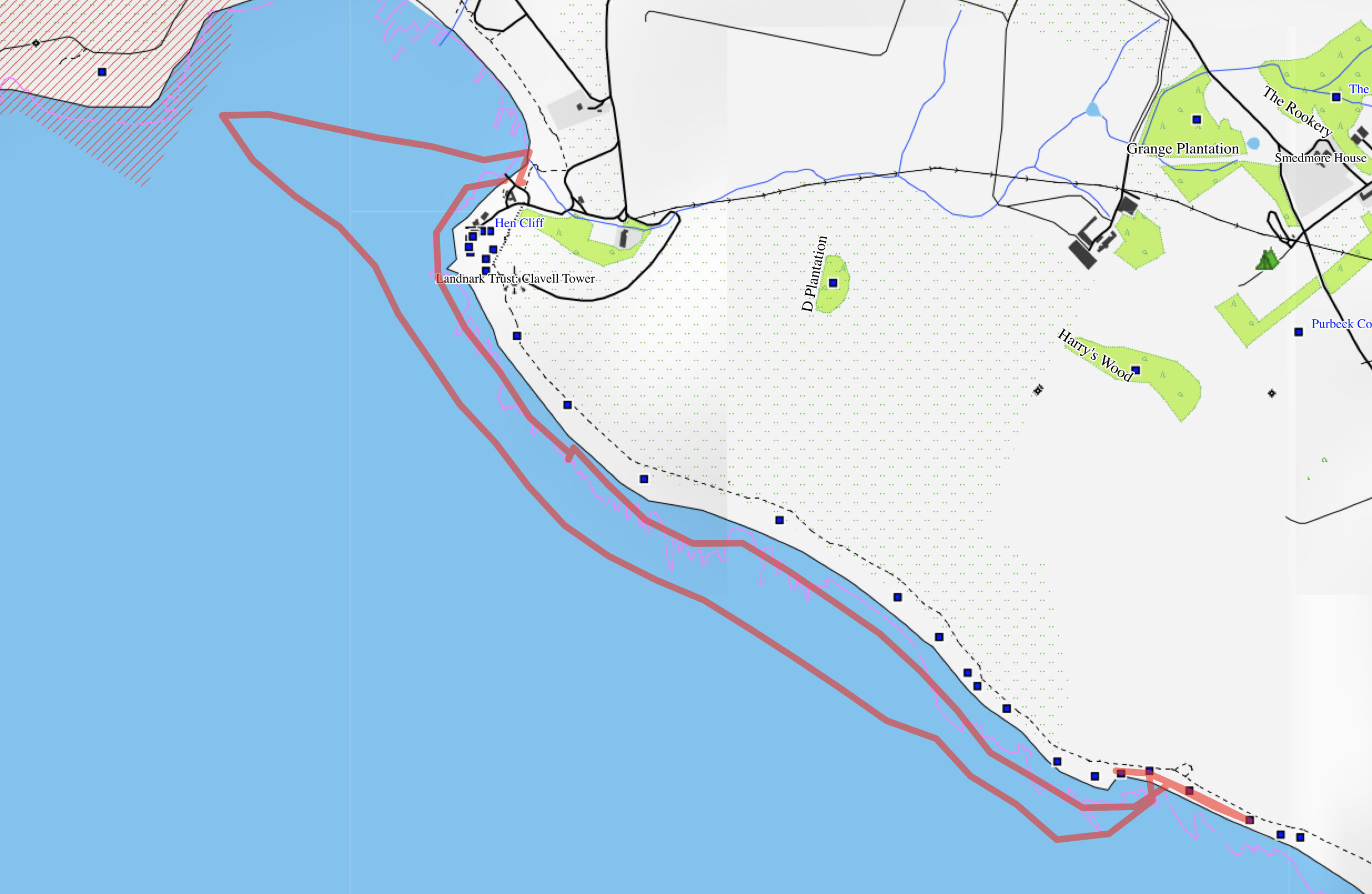
Otherwise, with linear cliff paddles, in a kayak this Jurassic Coast can be all or nothing. You either commit yourself to a full run to the next normal take-out, or go somewhere and come back. It’s only 3.6 miles to Chapman’s Pool, but I wasn’t ready for that today. (I packrafted it in 2025). As it is, once there, with a 4-metre boat on your head it’s an unrealistic take-out up a 400-foot climb over a mile to the nearest parking.
It’s the same at the next possible take-out at Dancing Ledge. We checked that out on midsummer’s eve. In calm conditions it’s an easy enough landing providing the lower ledge is exposed, but you’d then need ropes to haul an IK, either inflated or rolled up, up a 15-foot scramble (left) before another steep walk up to Langton village via Spyways Barn. One for a packraft noseabout on the next calm day.
As it is, Dancing Ledge is on the far side of St Alban’s Head where the tide can kick up a bit (left). Good timing and some nerve are required, even if a kayak can tuck in close to the shore inside the race. This is why Mark R says in his South West Sea Kayaking book. [Kimmeridge to Swanage is 19km and …] “… a commiting trip with big tides races and few opportunities to land. This also happens to be the author’s local (and favourite) paddle.”
View from above, give or take.
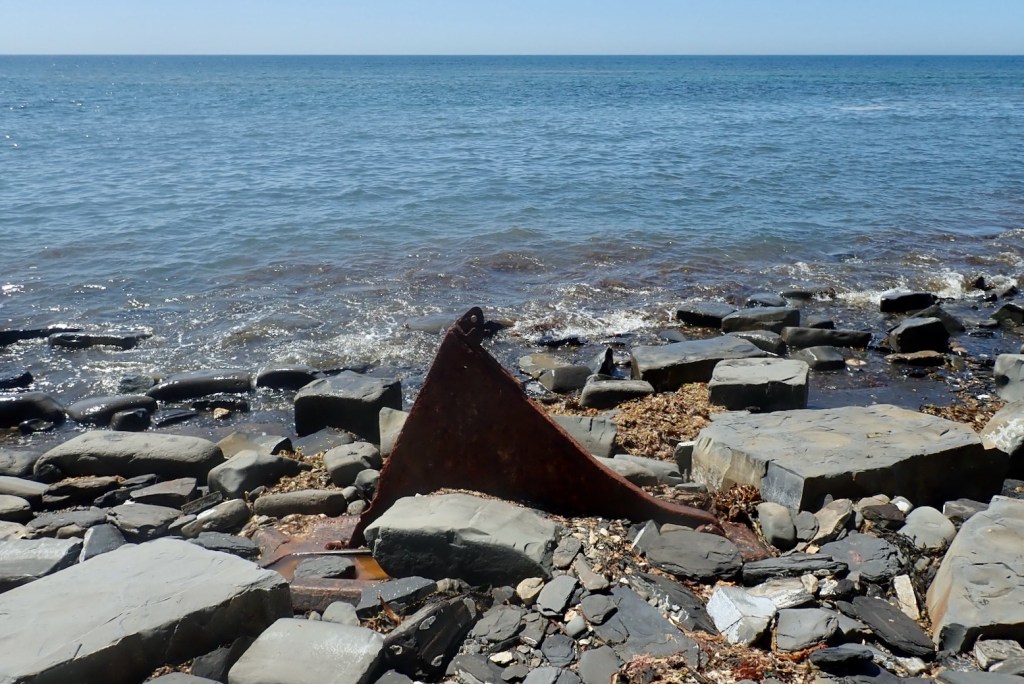
Back to the present. Lured by a curious triangle jutting up from the stones, I park up on a narrow beach and hop out for a bit on a look around. This is Clavell’s Hard, site of former shale mining. At ordinarily inaccessible spots like this you’re bound to find something interesting.
Like a beached red plastic ‘fake clinker’ dinghy.
Anywhere near seaweed there are masses of aggressive ‘sea-horse’ flies. The other week nearby Weymouth beach was blanketed in this kelp which soon started rotting during the hottest month ever. ‘Clear it away! cried the holidaymakers. ‘Stop your whining; it’s a natural phenomenon!’ responded the local council. ‘Get a grip‘ suggested Springwatcher General Chris Packham. Buckets and spades were flying and Trip Advisor turned molten with rage.
“This decision [to ignore the seaweed] supports our commitment to preserving the ecosystem’s integrity and avoiding any potential harm that may arise from interfering with its natural course.” chirped the council unconvincingly. A week or two later later they caved in and cleared the beach. Honestly, it’s just one scandal after another these days.
Compared to northwest Scotland, I’m surprised how little fishing detritus there is here. Are southern fisher-folk more tidy? I help that effort by snagging a superb, self-draining crayfish crate-bench to add to my collection.
I approach the mysterious shark’s fin.
It looked like the upper half of a retractable drop skeg (fixed rudder) with its mounting plate, similar to kits you can buy for hardshell sea kayaks (left), except it weighed tons, not ounces. I thought it might be off some old wreck.
You can see a pivot pin up front. A cable might have winched it up and down. But then any ship that size would obviously have a rudder. Who knows, but I now think it’s abandoned mining junk.
The fin made me think of the SS Treveal which broke in two on the ledges about 1.5 miles southeast of here in January 1920. The Belfast-built steamer was on the return leg of its maiden voyage from Calcutta to Dundee, and had left Portland earlier that day where someone observed that the too northerly heading was inauspicious. Most of the 46 crew drowned when their lifeboats capsized near the shore. It’s said the tug which came to salvage the cargo also sank alongside. There’s no trace of the Treveal now, even on marine charts and wreck maps. But how do you dispose of a 5000-ton steamer snapped in two? Bit by bit I suppose.
It’s unlikely subsequent storms washed that huge hunk of angular metal a mile and a half to the base of this cliff. More probably it was placed there by shale miners. There’s more on the SS Treveal on Ian West’s geological pages here (scroll to the bottom of the long page).
I wander into a nearby cave, perhaps excavated during the ‘Blackstone’ mining era.
Inside I see just how friable this oily shale is. I can easily peel bits off.
Underneath Silurian millipedes inhabit the tiny cracks, feeding off microbes that feed off the oil. Probably.
Time to head back. I’m all fired up for a good sail with the tide.
Benign, weed-covered ledges lurk not far below. On the far horizon the chalk cliffs of Mupe Bay, just next to Lulworth Cove. Might try there next, but the army firing ranges restrict weekday access. We’ve been hearing machine gun fire all week; Ukrainian soldiers getting trained for the front line.
I throw up the sail but it’s not happening. I creep along at barely 2mph. Maybe I’m too far out (left) and the wind got intensified near the cliffs.
I paddle back to the corner of Kimmeridge Bay…
And carry on to the other side where waves are breaking off Broad Bench ledge. On the left horizon is Portland Bill dangling below kelp-clad Weymouth.
I turn back to the jetty, de-air the Igla a bit and strap it to the car roof.
And though I haven’t really earned it today, I treat reward myself to a seaside seafood basket by the seashore.
Some great Gumo deals from UK outlet K&P, with discounts up to 40% on a Solar or Framura. Prices like they were a few years ago. Grab a Nitrilon bargain!
For the last fortnight the Wessex skies have been clear, and warm winds have blown from the east. After six months in the garage I finally get round to taking the Igla for a day out. Hard to believe I’ve only been out in the Zelgear IK once in mid-winter. A closer look at the south side of Poole Harbour is the plan, and a 25-minute drive drops me off just before the Sandbanks ferry inlet which we crossed last year in packrafts.
The tide was inbound and the forecast 13mph from the east, rising later and with gusts predicted at twice that according to some sources. Ideal for some downwind sailing action! The plan was to explore as much of the Harbour’s southern shore as wind, curiosity, energy and draught would allow.
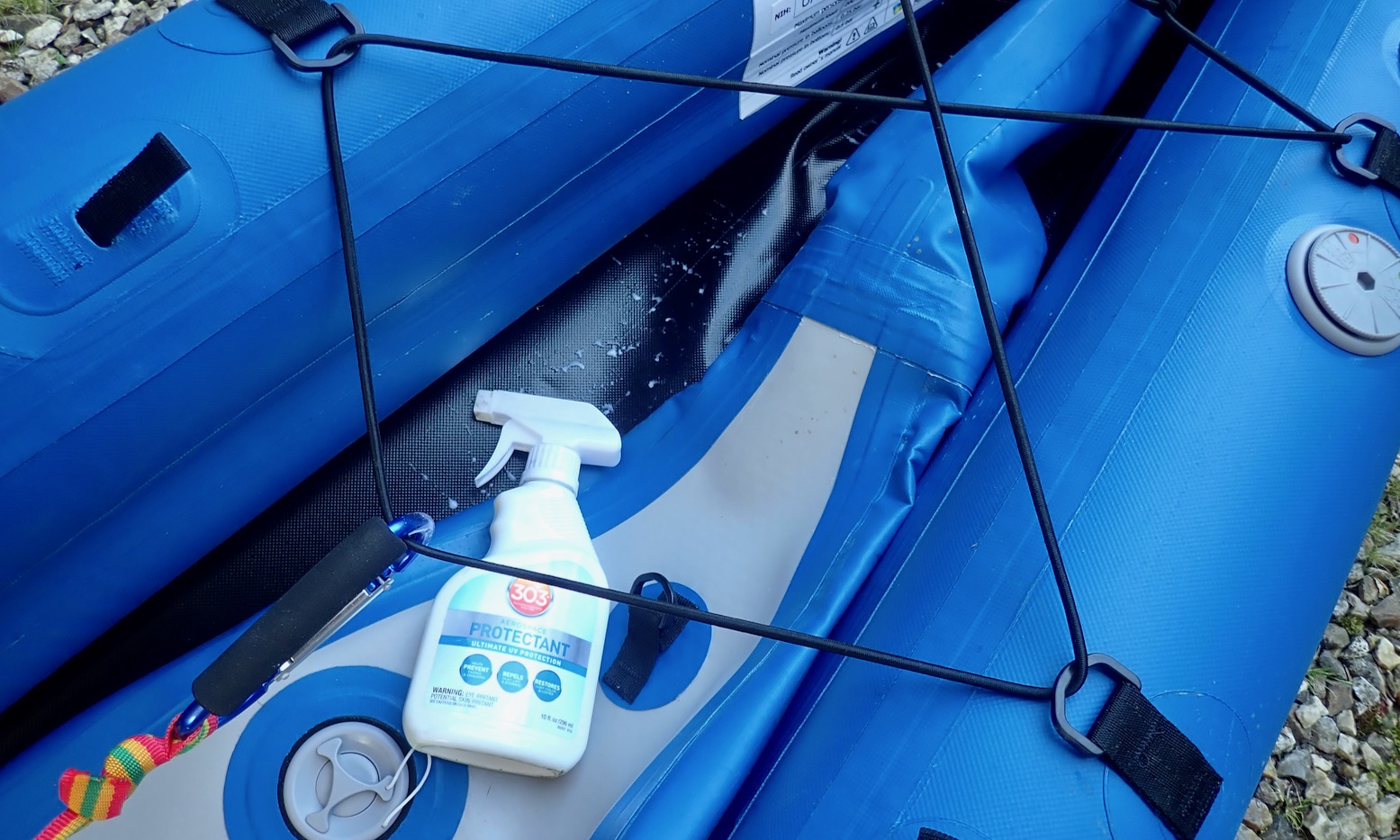
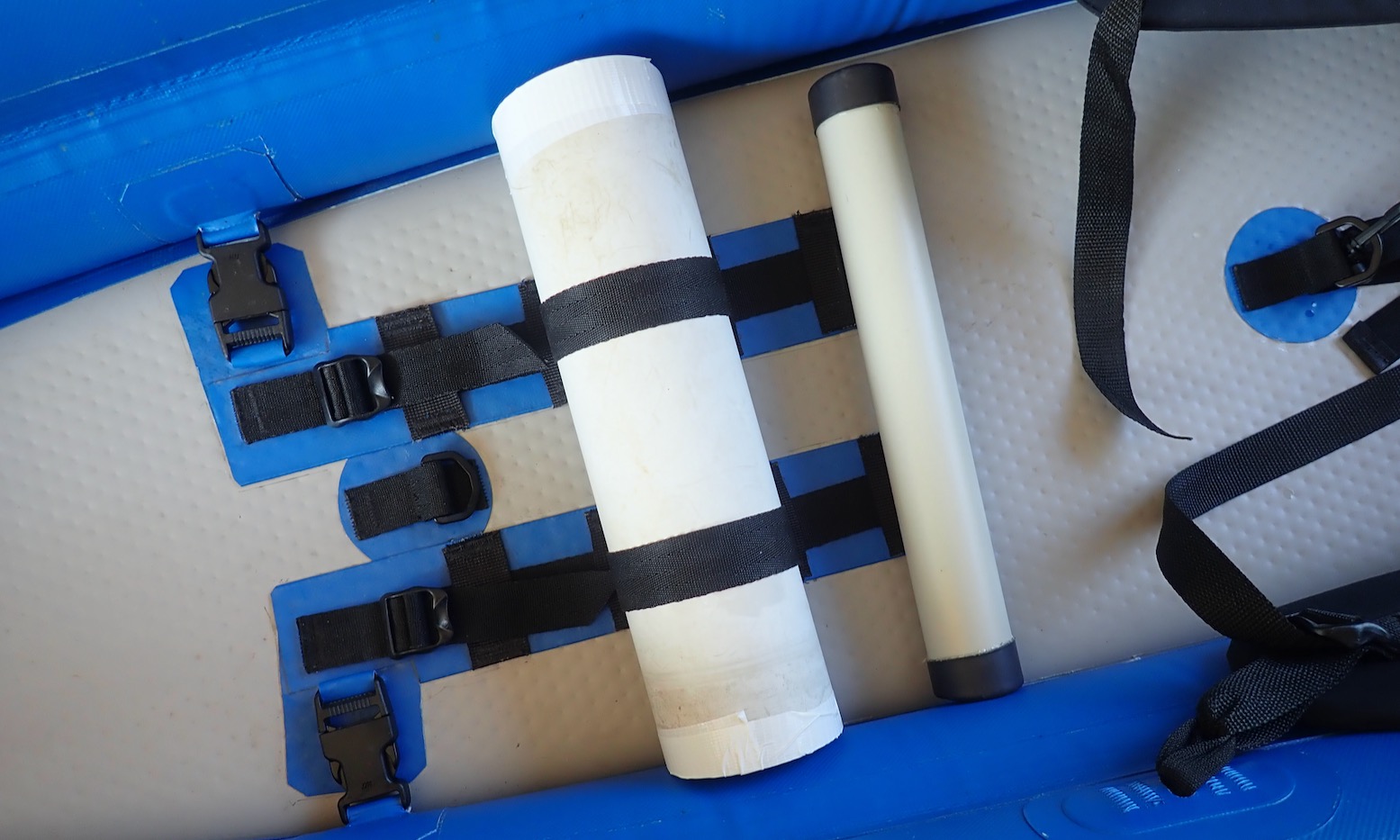
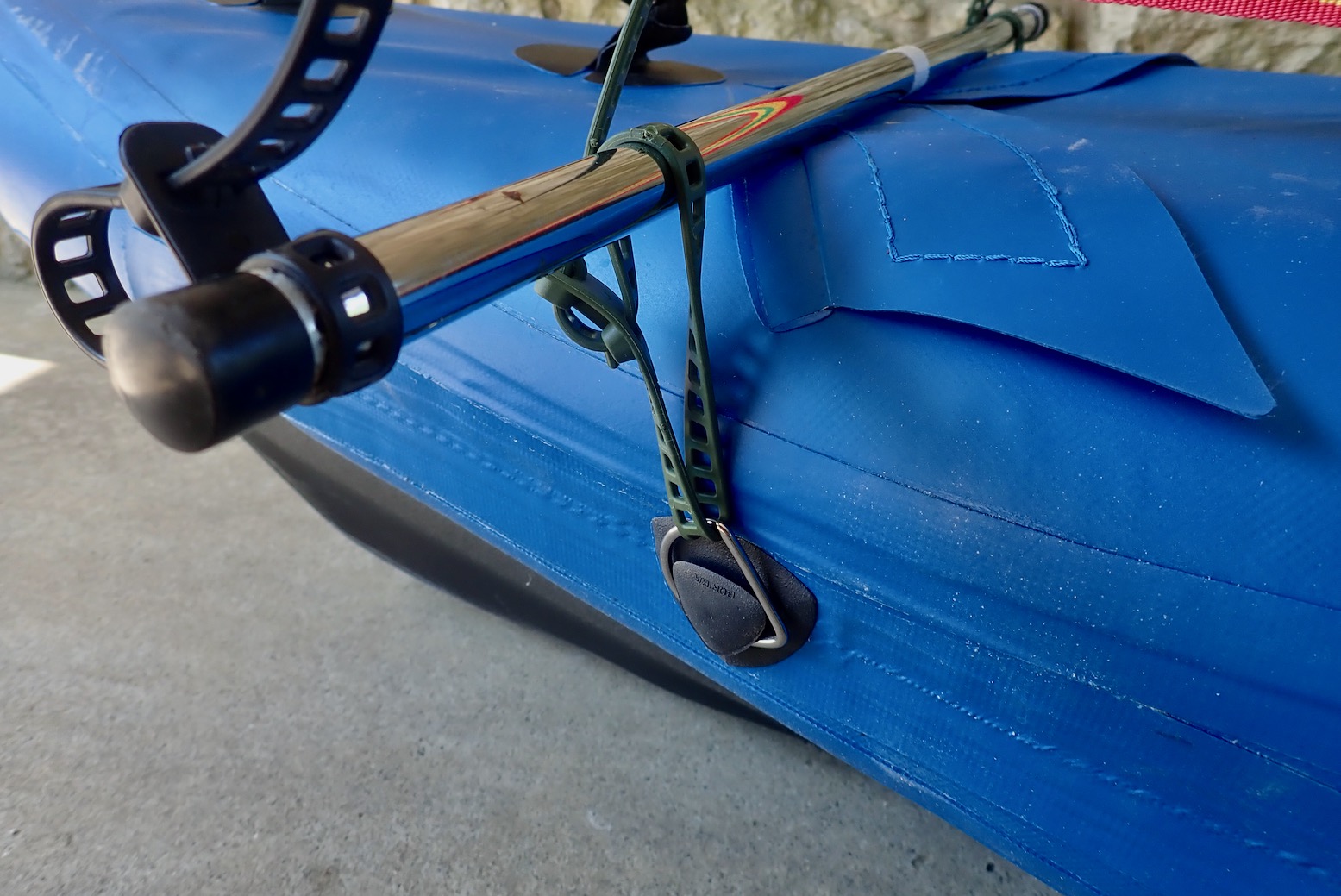
The 0.25 bar hull has been inflated for six months and lost a little pressure. I’d fully deflated the removable 0.5 bar DS floor and refitting it, decided a quick squirt of 303 anti-UV lube underneath and on the ‘horns’ would help it slide snugly into the correct position.I sawed off a bit of 12cm drainpipe to make a bigger footrest tube for my bigger feet. (Original Zelgear footrest tube on the right).I also found a way to fit my packraft ‘transverse bowsprit’ using ever handy Rovaflex straps.The wide bar stabilises the sail mounts to limit sideways swaying or rocking.It’s only a two-minute carry through the trees from road to beach, but requires passing through the ‘TPZ’ or toilet paper zone.I drop my lunch into the boat. It’s going to be a hot paddle. At the back, Brownsea Island.Oo-er, the Igla (‘Needle’) feels a tad wobbly, but then it’s an IK not a packraft. I deflate the seat with the handy twist-valve tube until I’m just resting on the DS floor. That’s better and once hooked into the cushy knee straps I feel secure and snug. The Igla’s seat is by far the most comfortable IK seat I’ve tried. It doesn’t have to be complicated or heavy.Like a migrating gannet, I venture forth in search of the wind.Soon it finds me.I glide past the southern cliffs of Green Island. Signs discourage landing. Nearby chaps are doing tight circles in small dinghies, dredging or fishing for something. Not knowing the landmarks yet, I keep having to refer to my Garmin’s OS map to go the right way.
Right now I’m reading We, the Navigators; The Ancient Art of Landfinding in the Pacific by David Lewis (1972, open source pdf). In it he explains how Oceania (or Micronesia, Melanesia and Polynesia) were populated by intrepid Asian seafarers – contrary to what the famous Kon Tiki expedition sought to prove. Some had mastered the art of navigating hundreds of miles of open Pacific without any kind of instruments, memorising instead a combination of stars (rising and setting points were like compass bearings) as well as prevailing winds and waves, refracted swells from unseen islands and unseen currents (flying fish always jump down-current; fyi). Travelling with the incredulous author, after days at sea aged South Sea navigators regularly found a tiny pin-prick of an island bang on time. It’s a fascinating topic but the book focuses purely on the techniques, rather than the adventures they all clearly shared for months. David Lewis’s earlier book, Daughters of the Wind (catamaran from UK to NZ via Cape Horn with young family) may be a more engaging read, and was a voyage on which Lewis practised the instrument and chart-free techniques he later documented in the Navigators.
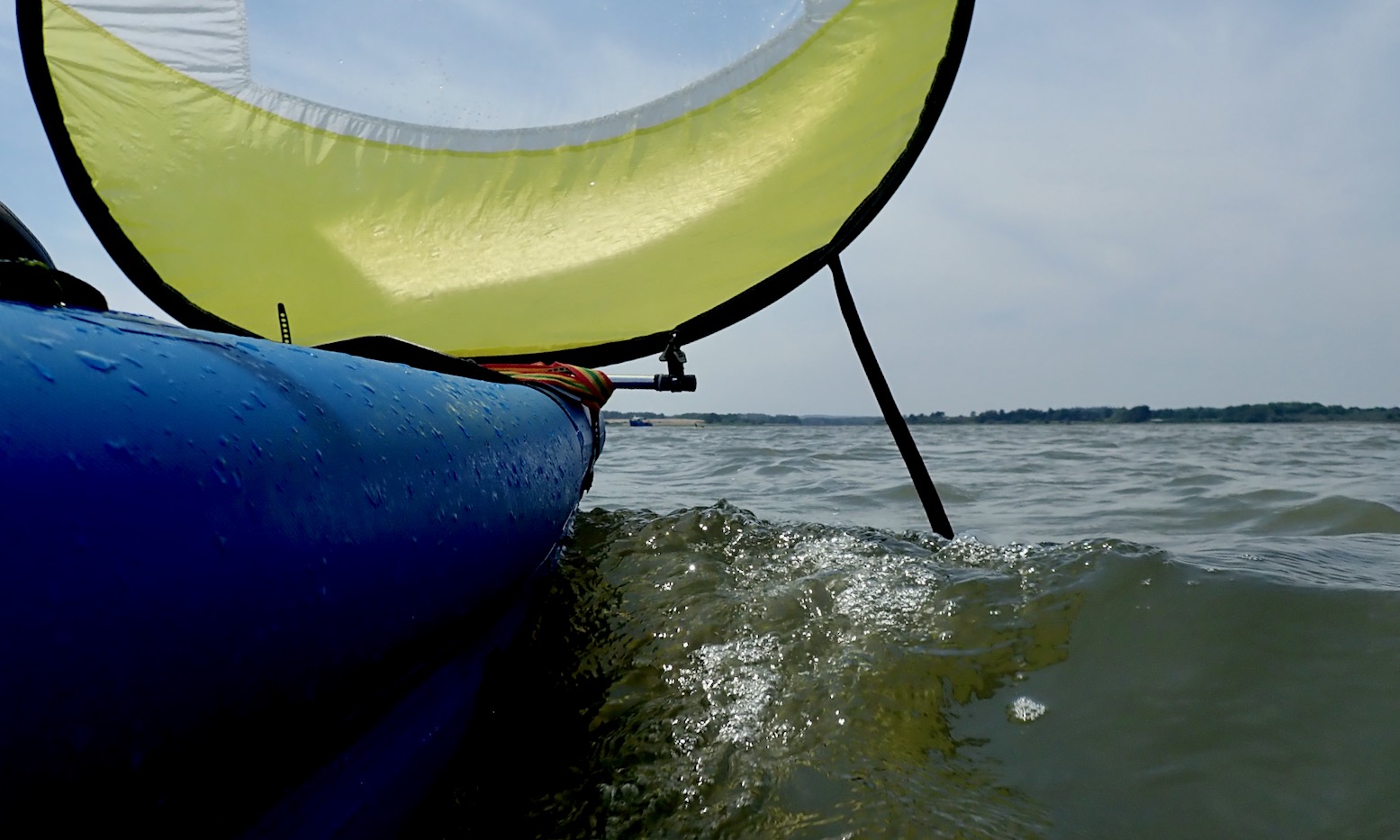
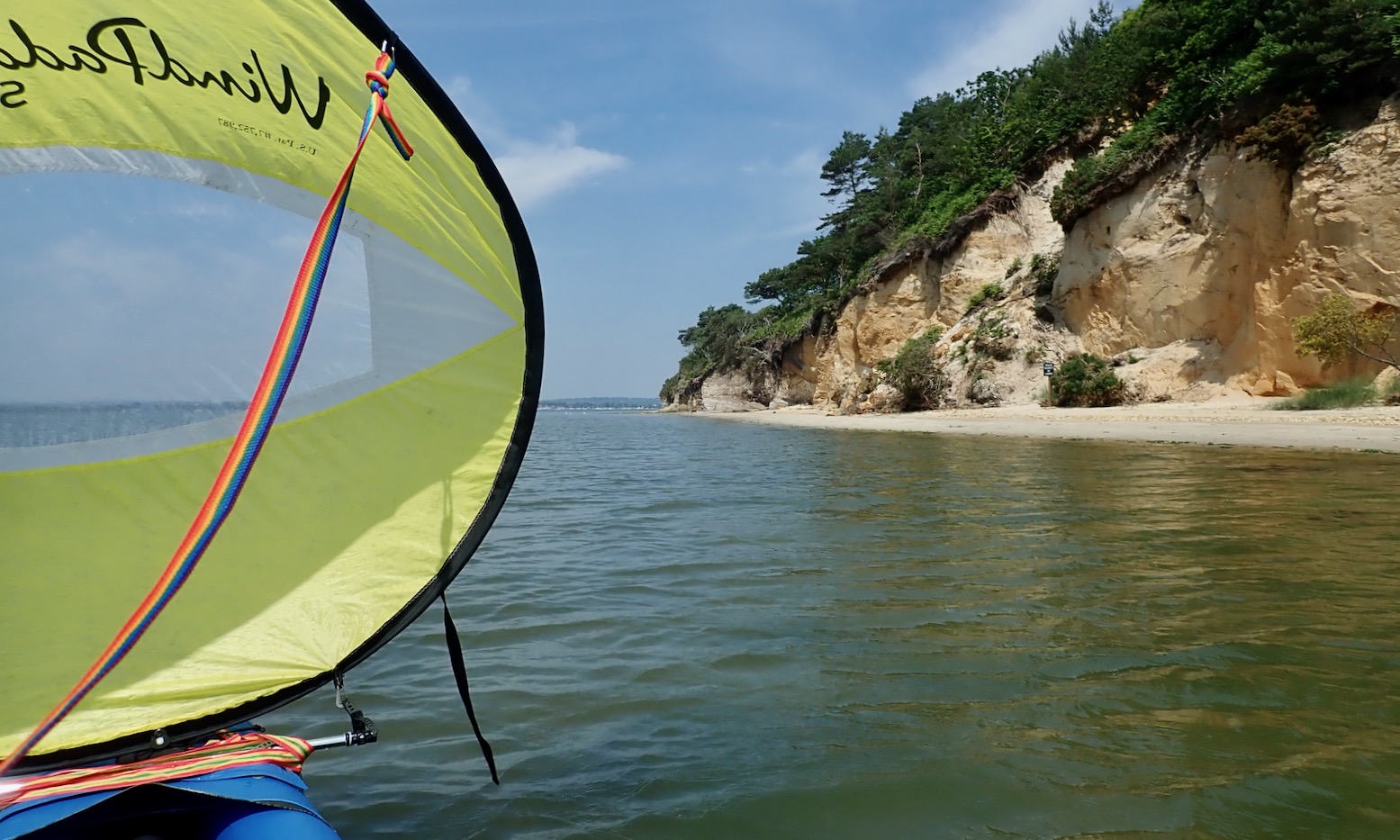
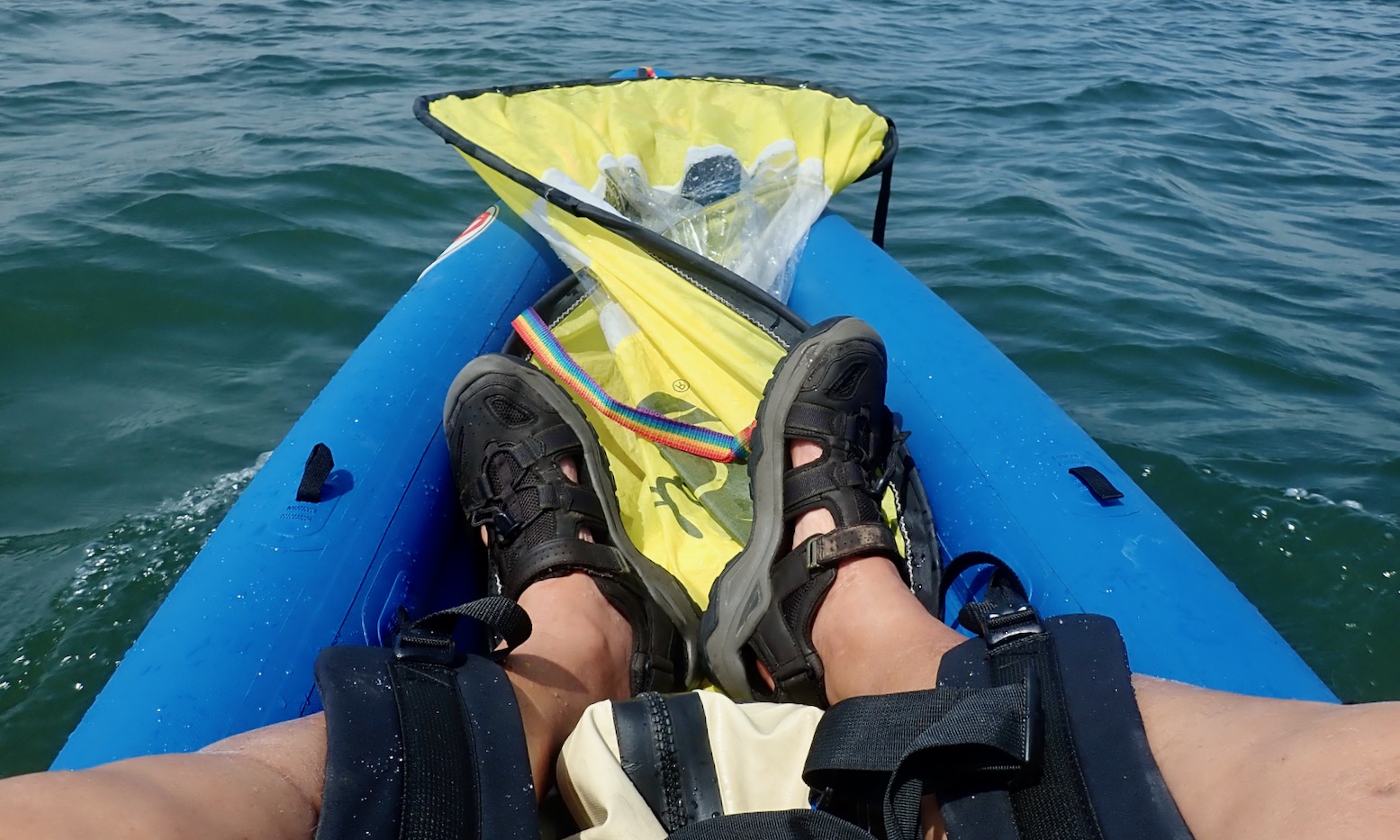
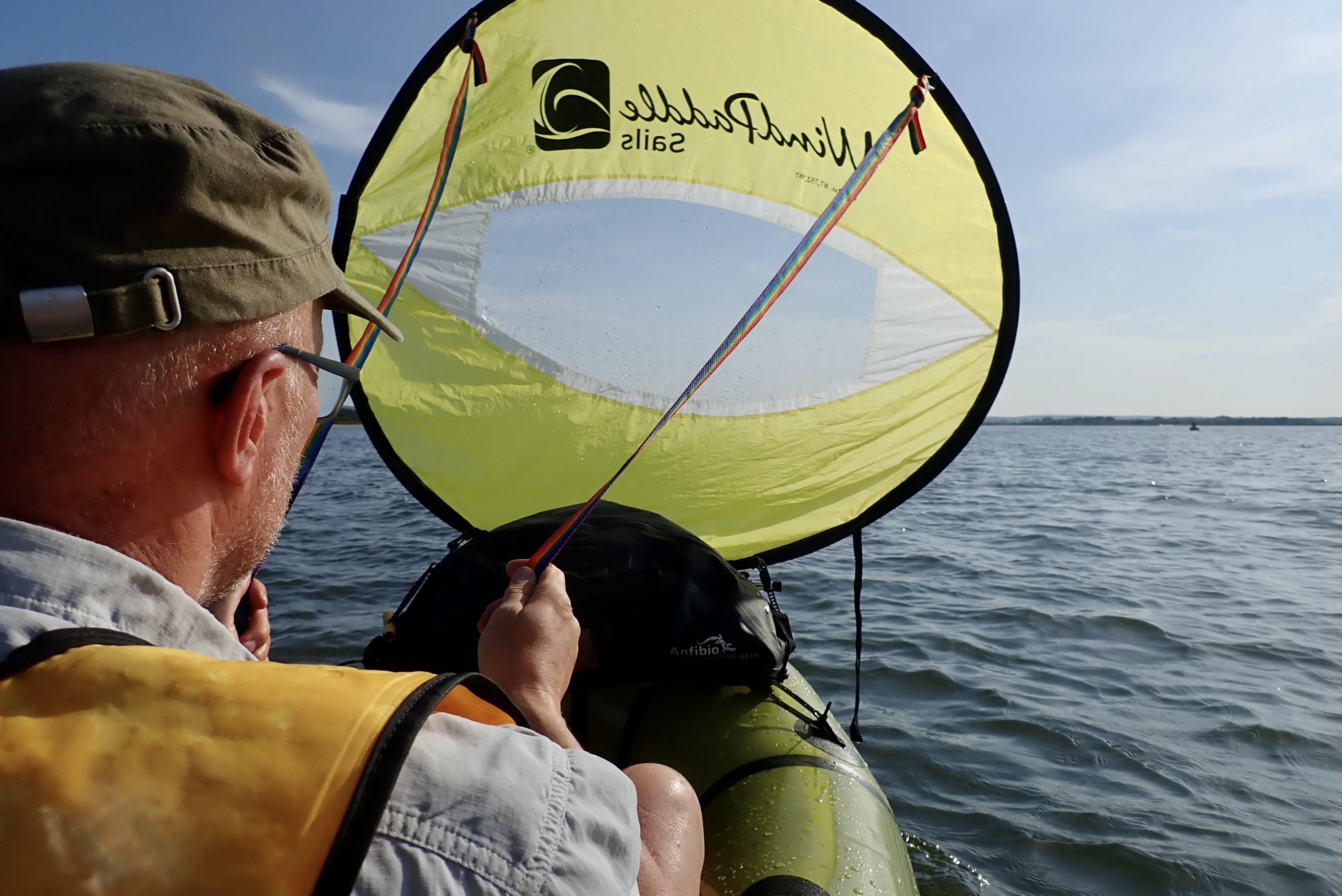
It’s blowing nowhere near 13mph and when the wind drops or I turn off it, one twist of the sail and it tucks easily under a foot, ready for redeployment in seconds. The system works very well.
We cycled a trail along the southern shore the other day, branching up to the harbour at a cottage on Ower Bay. From there I couldn’t work out what the wooded island was to the NW. Turns out it’s the south end of Round Island. Sgurr nan Cruinn, that might be in Gaelic.
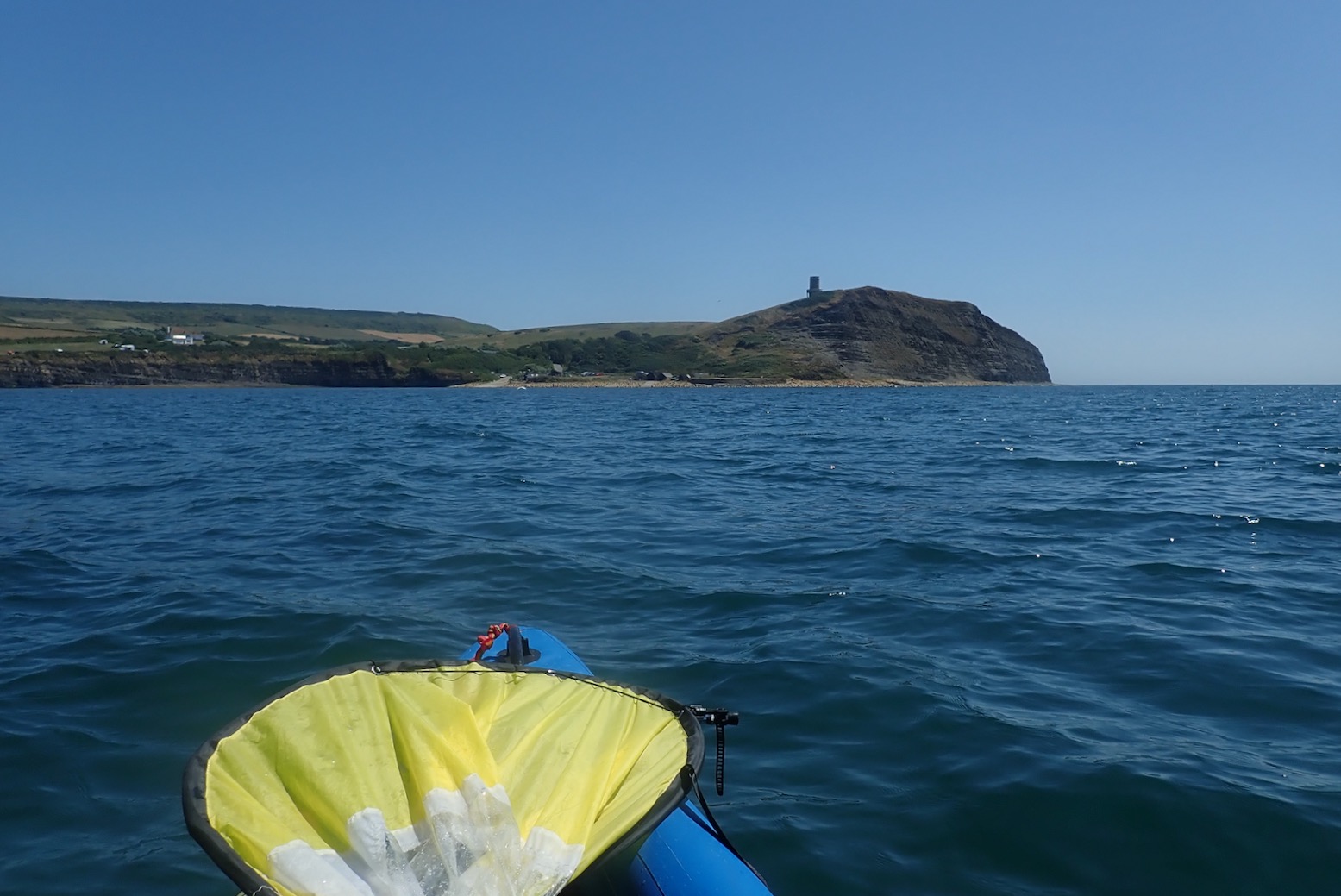
I rounded the southern end of Round Island, passing more dinghymen doing full-lock burn-outs. There’s the long jetty as shown on maps. On the left the mainland shore of Arne.I ride up past Shipstal Point, one of the few points where footpaths reach the sea. A couple of SoT’s are beached up ahead, including a Sandbanks Style Optimal which I tested here a couple of years back. They’re going to have a rum old haul eastwards back to Sandbanks against the rising wind.I’m not wearing my glasses so don’t see the low spit of Patchams Point until I’m right on it. I have to turn east into the wind to get round it, scattering Oyster Catchers as I go. The taut Igla responds well.I pull over to inspect that state of regeneration and other incisive environmental initiatives. Soon I’ll pass Russel Quay where we put in the packraft the other day. I’m hoping for a good run with the wind towards the Frome river mouth.I get it but it’s not the high speed thrill I was hoping for. Plus it’s blowing me west, when I need to be going southwest. One flaw with my bowsprit idea is the lack of slack reduces the angle you can pull the WindPaddle to steer off the wind, especially when it’s not very strong.
The wind picks up, or get its fetch on at the downwind end of the Harbour. I’ve squeezed all the west i could from the wind and must now turn south. So I stow the sail and paddle a crosswind pushing me towards ancient stakes and into the reeds.
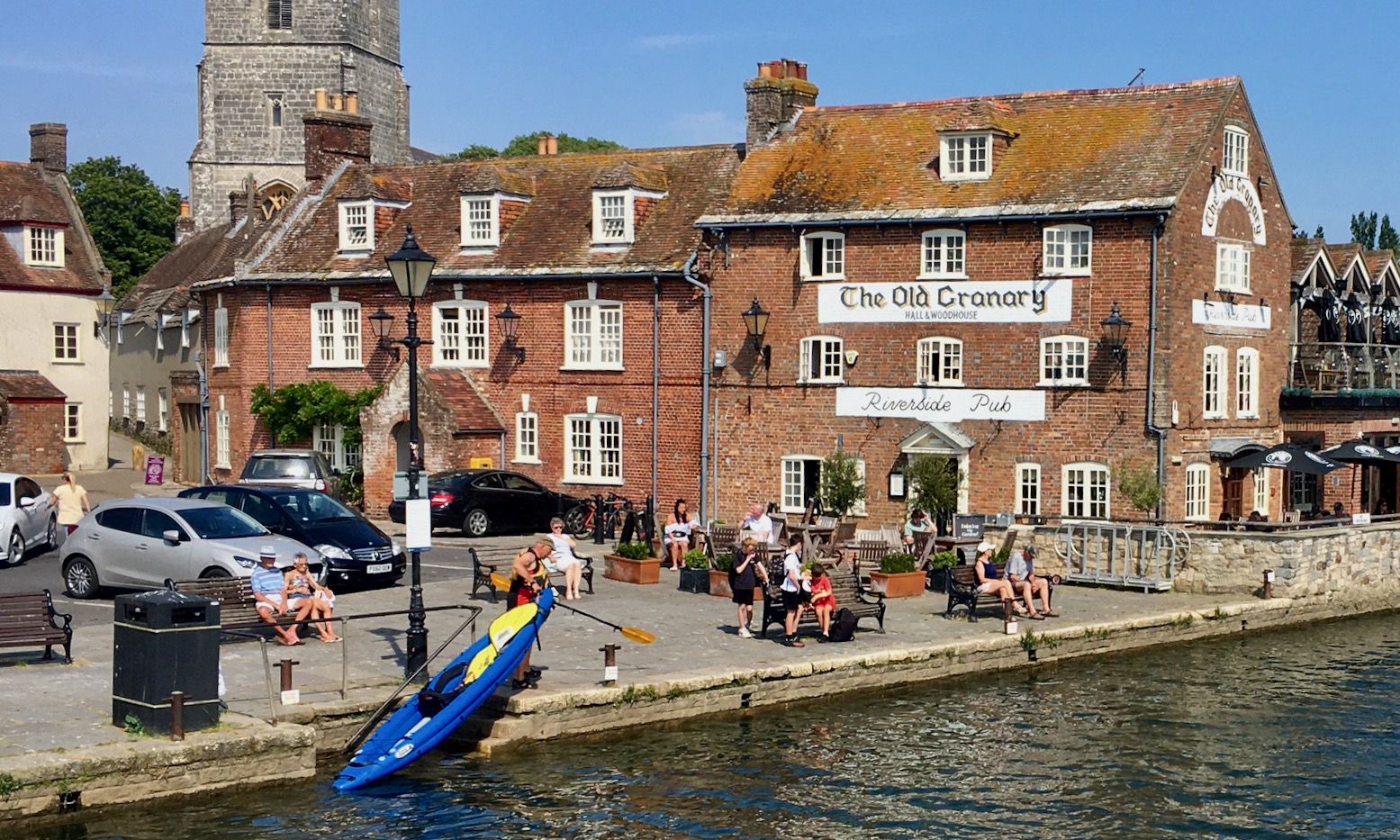
I follow a boat into the hidden river mouth and, with the wind now up to 20mph, I can sail a lot of the river’s meanders the two miles west to Wareham Quay.
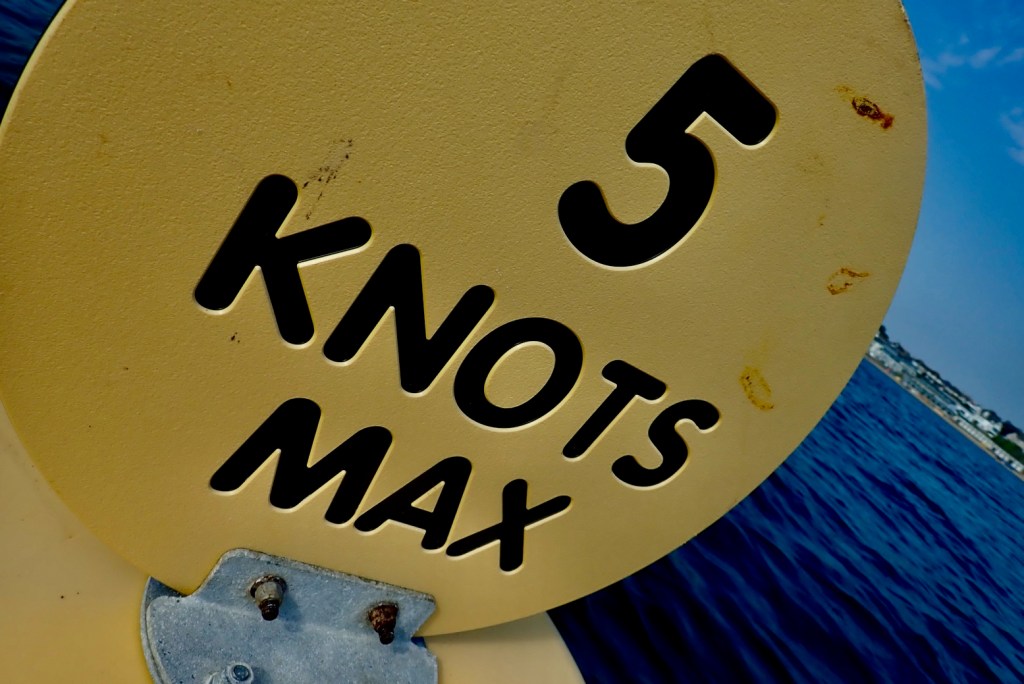
With the wind whistling through the rigging, I hear a ‘Bloody hell, wow…’. It’s a moored boater expressing surprise as my kayak sails by as close to the 4-knot limit. I learned a new sailing trick: to micro steer the boat drag a left hand in the water to bring the bow round to the left. It worked well zig-zaging up the Frome.
Like a Polynesian master navigator, after my ten-mile traverse of the Harbour, I sail right up to the Quay…
.. casually hop out, and look around for my taxi.
IK or packraft, I wonder to myself. Environment or geography (as well as intended use) help define the best suited packboat. My TXL would have managed this outing fine, if a tad slower, but it sure is nice when the Igla slices through the water, either under sail or into the wind. The problem in this corner of Dorset is, once one tires of noisy, busy, drab but safe Poole Harbour, apart from Swanage (below), getting the inflated 17kg IK down to the exposed Jurassic Coast in suitable conditions is a bit of a faff, even with wheels, let alone getting back out and closing the loop with cars in place. You may as well use hardshells. That’s why I chose the long but still light TXL packraft. Down here I’m not straying out to islands where speed and efficiency are important. For plain old calm-weather mainland coast hugging, a large packraft does the job and enables public transport, an easy scramble ashore followed by a walk back. But for an effortless coastal tour with plenty of room for two, the Igla has its benefits. It’ll easily paddle at 8kph on a breeze too light to hold up a sail and that’s an extra 30% more speed or so less sustained effort over a few hours.
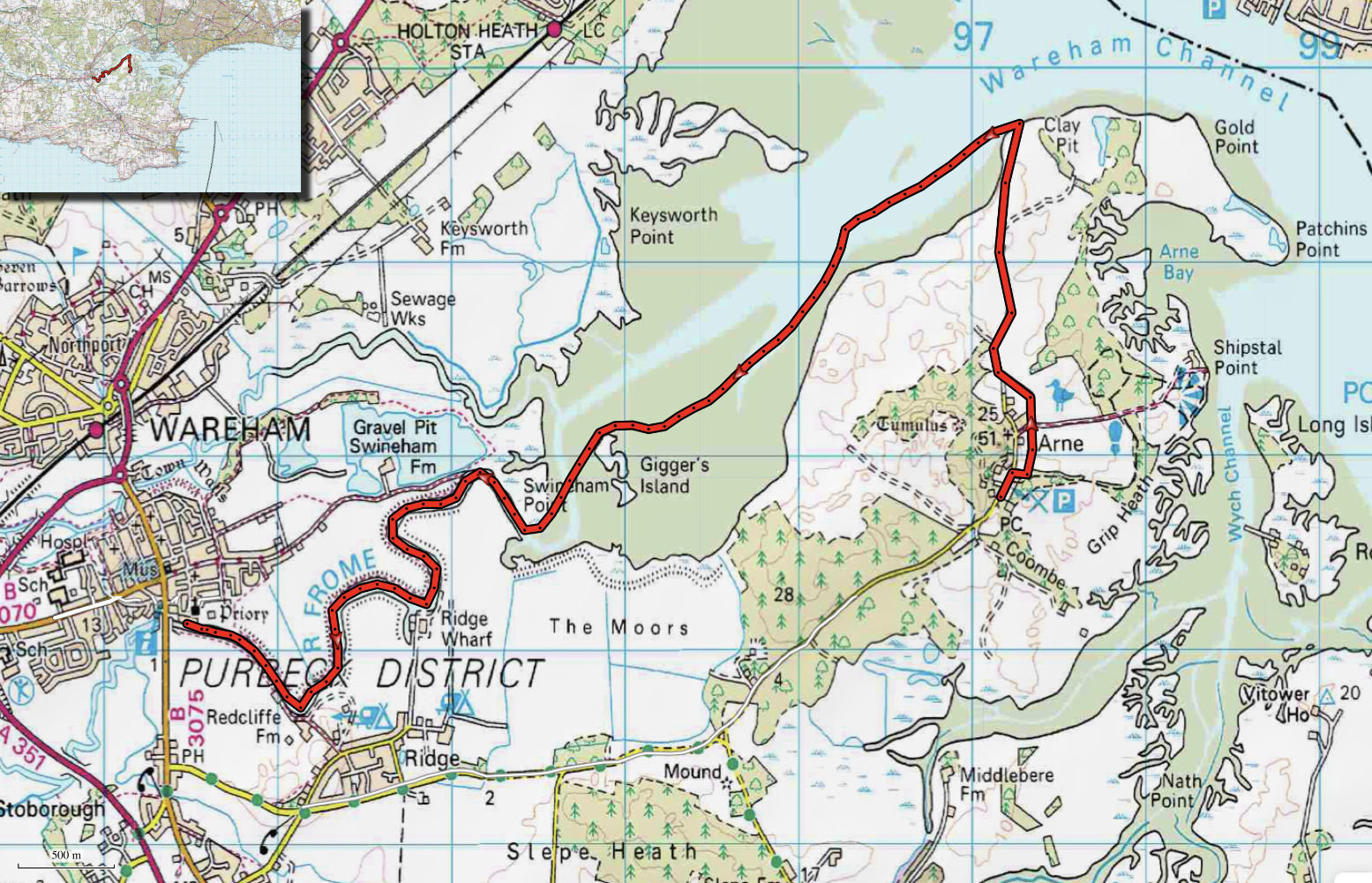
Holy moly, end of May and first paddle of the year? It’s been a busy winter and the arm’s been playing up so time to break in with an easy packraft across a back corner of Poole Harbour, our locale for the summer. Sailing Russel Quay back to Wareham with the tide and the wind sounded like a good one – a mile’s walk + 5 on the water. Although it clashes with our hitherto pristine eco credentials, we have two cars down here, so we leave one in town and the other at Arne.
Teetering on the edge of Open Access land.
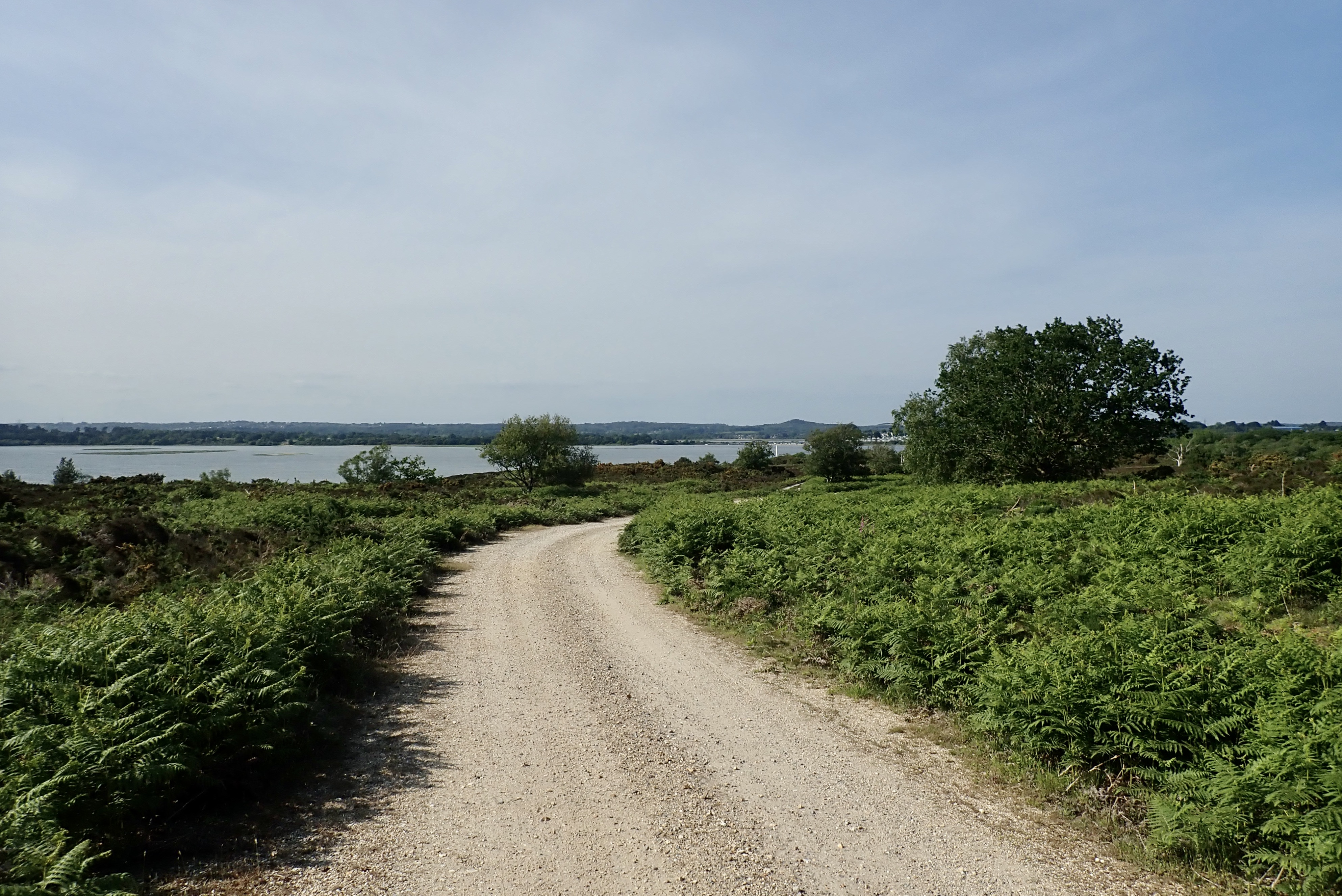
This whole area south of the Harbour is a largely undeveloped heathland with rare wildlife and part of an RSPB ‘super reserve’. On the day the famous BBC Springwatch crew were installed for a fortnight or more, motion sensing cameras probing various nests and burrows. Thick power cables lined our track leading up north to the put in near long gone Russel Quay. I’m not fully sure it was a right of way. Dodging irate English Nimbies is going to take some practice after the freedom of the Scottish northwest coast we became accustomed to. But ironically this area also has the biggest knot of land-based oil wells in western Europe. They’re the small, nodding donkey type, not towering rigs but a couple of months ago one of the pipelines sprung a leak in Ower Bay near the processing plant on the less accessible south shore. Luckily it wasn’t an Exxon Valdez event and at higher tides there could be some good packboat exploring in this inlet-rich area. It’s all we’ll have here bar the more exposed Jurassic Coast.
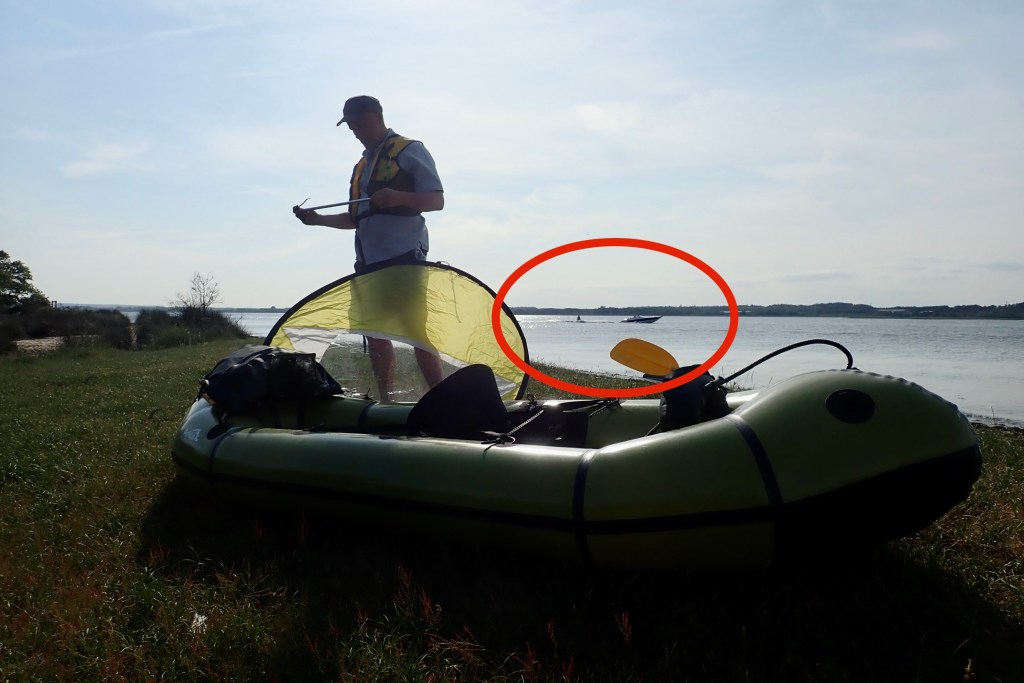
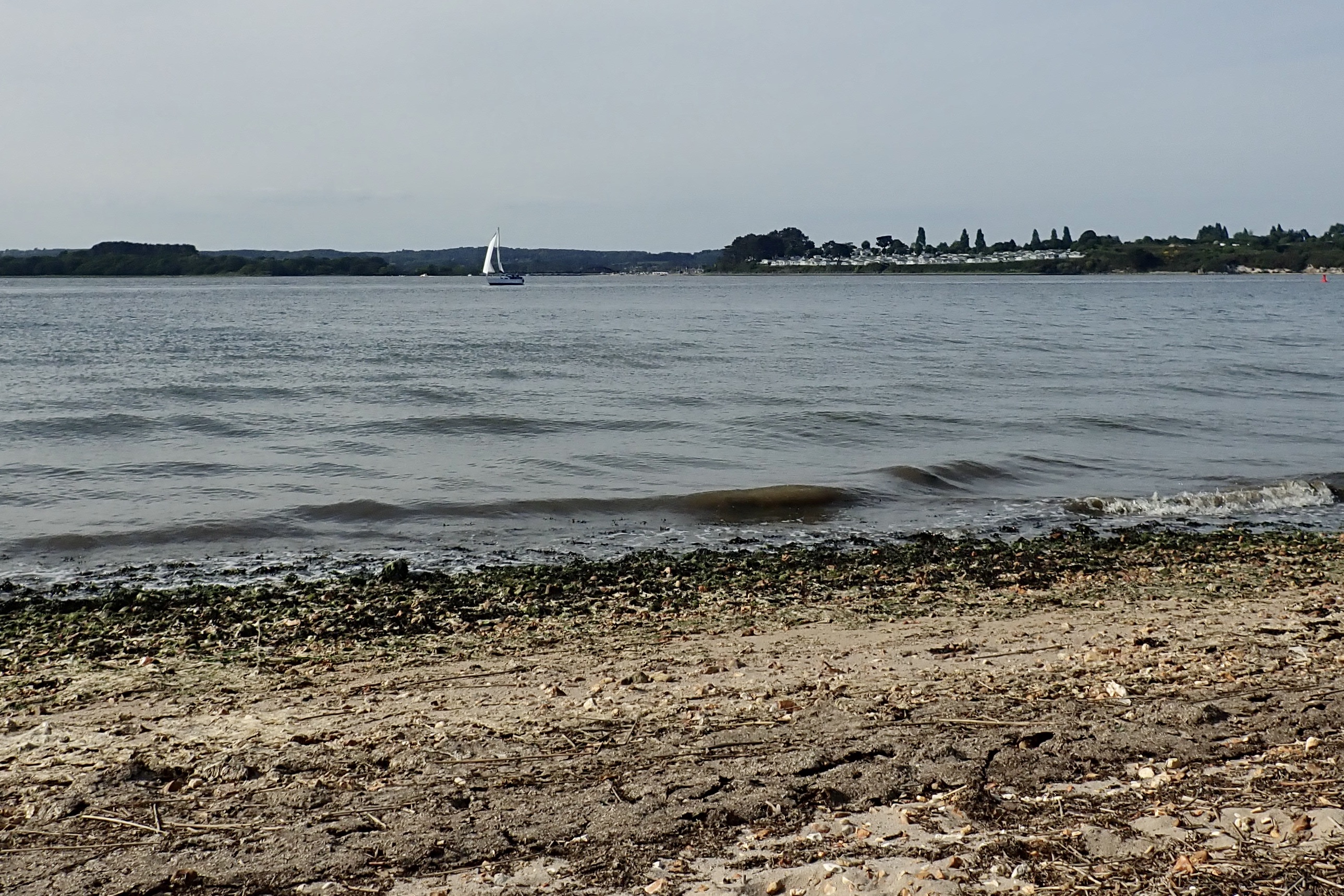
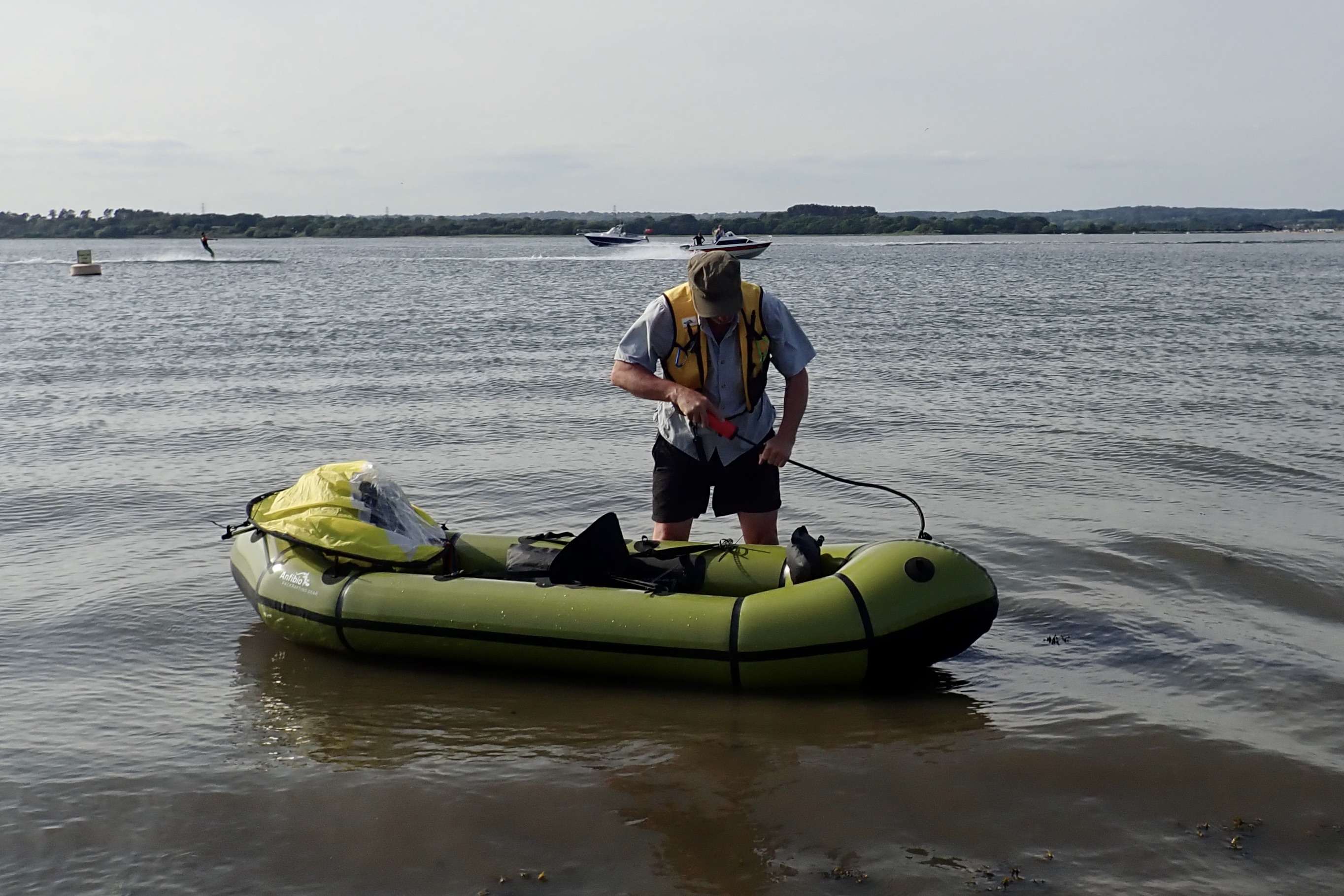
Not exactly the Summer isles, but it’ll have to do. You don’t get a May week of 20°C+ and full sun up there.I try to remember what to do and in what order.Note the water skier. With my typical ‘let’s-wing-it’ lack of due diligence, we’d stumbled on one of the few ‘PWC’ zones on Poole Harbour. (The link’s map is missing but may be what’s at the top of the page.)Well, stood at the shore it looked like a good north-easterly for a while.OMG, more menacing water-hoons! It’s a bank holiday Sunday and turns out we were right on their sole permitted skiing corridor. RTFM!Once on the water there’s barely enough wind to blow out a scented candle from Purbeck Handicrafts.But according to the GPS, paddling most of the time we did momentarily zip along with the tide.As it is, tides in the Harbour have quite a prolonged high water period which will be useful. This is a spring tide in a few days.Newbie on Poole Harbour back in 2005.Gumo Safari, my very first IK.We should have just cruised close to the shore where motorboats fear to tread. Next time we’ll know. Near Gigger’s Island we pass a motionless hardsheller, like a heron deep in thought.Without my GPS, first time finding the Frome river entrance would have been tricky. Soon impenetrable reeds line the banks, our speed drops and pot-bellied boaters cruise by at 4 knots. I can see this 2.5-mile river stretch might soon become a chore at the end of a long paddle and an ill tide.
Never get out of the boat? We couldn’t if we tried, but near the river mouth there’s a small jetty and a track back to town. Good to know but with an IK, I’ll need some wheels.
That night we catch a bit of Springwatch on the iPlayer but, as expected, I can stomach the hyper-saturated, happy-clappy ‘Phil & Holly of Wildlife’ for only so long. It’s the final finale of Succession – what are we waiting for!? A probing bike recce of the south shore is needed. More Poole Harbouring to come.
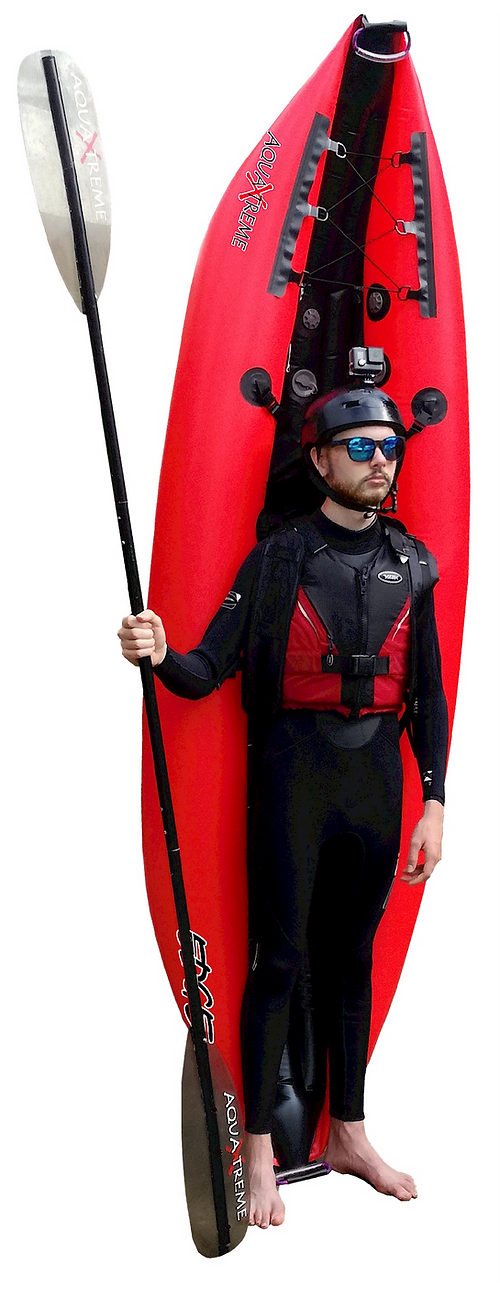
Thanks to IK&P reader Pavel for pointing me towards newish IKs from Israeli brand, AquaXtreme. To look at, the 4.2m (13.8′) x 90cm wide Explorer II is nothing special, the familiar profile of a round tube, non-dropstitch IK. AquaXtreme also make some slick-looking folding kayaks so, as rodeos go, they’ve been around the paddock.
What makes the Explorer and similar Edge models (left) different is that they’re made from up and coming TPU, like AquaXtreme’s range of packrafts (or just about all packrafts, in fact). And as we know, TPU folds up more compactly and is much less heavy per square metre than PVC while being strong enough, as well over a decade of TPU packrafts have proved. TPU also dodges PVC’s perceived ‘toxicity’ issues. TPU being thin, the only thing a 4.2-m Explorer might not be is innately rigid once pumped up, to which the answer is: more psi assuming the welds can hack it, This has been proved to work with packrafts in recent years. Rigidity is especially important in any longer IK with a single paddler sat in the middle, hence the advent of drop-stitch IKs a few years ago – a solution that in my opinion was not always elegant or functional.
Explorer II details and imagery on AquaXtreme’s website are skimpy: payload is claimed at 220kg while the all-important pressures look good at 2.5psi (0.2 bar) in the side tubes/floor?, but just 1psi (0.14 bar) in the floor.
It’s unclear if the floor is a loose insert ‘lilo’ sat on a packraft-like red floor sheet, as appears below, or integrated as a skeg photo (left) suggests.It’s possible it’s both (‘i-beam floor’ is mentioned) plus the ‘1psi ‘insert’ floor to allow it to be a self-bailer via the 4 floor drain valves shown. With valves open the insert would displace pooled water inside the boat to sit you above what’s left. But fitting self-draining ports in a complex I-beam floor is not a thing I’ve ever seen in an IK, so something doesn’t add up with the details and photos available. I also see what must be PRVs alongside the side tube inflation valves as well as the (insert?) floor. These are always a good precaution to stop an IK over-pressurising and rupturing if left in the heat, but something which many manufacturers are oddly coy about.
Weight is said to be 8.2kg; a bit more than half of what you’d expect in a PVC or rubber (hypalon) IK of the same length and the price is $999 with free post, plus tax where you live. There’s no mention of a barrel pump included, but you’ll need more than the air bag listed with their smaller, 2-psi rated Edge IKs.
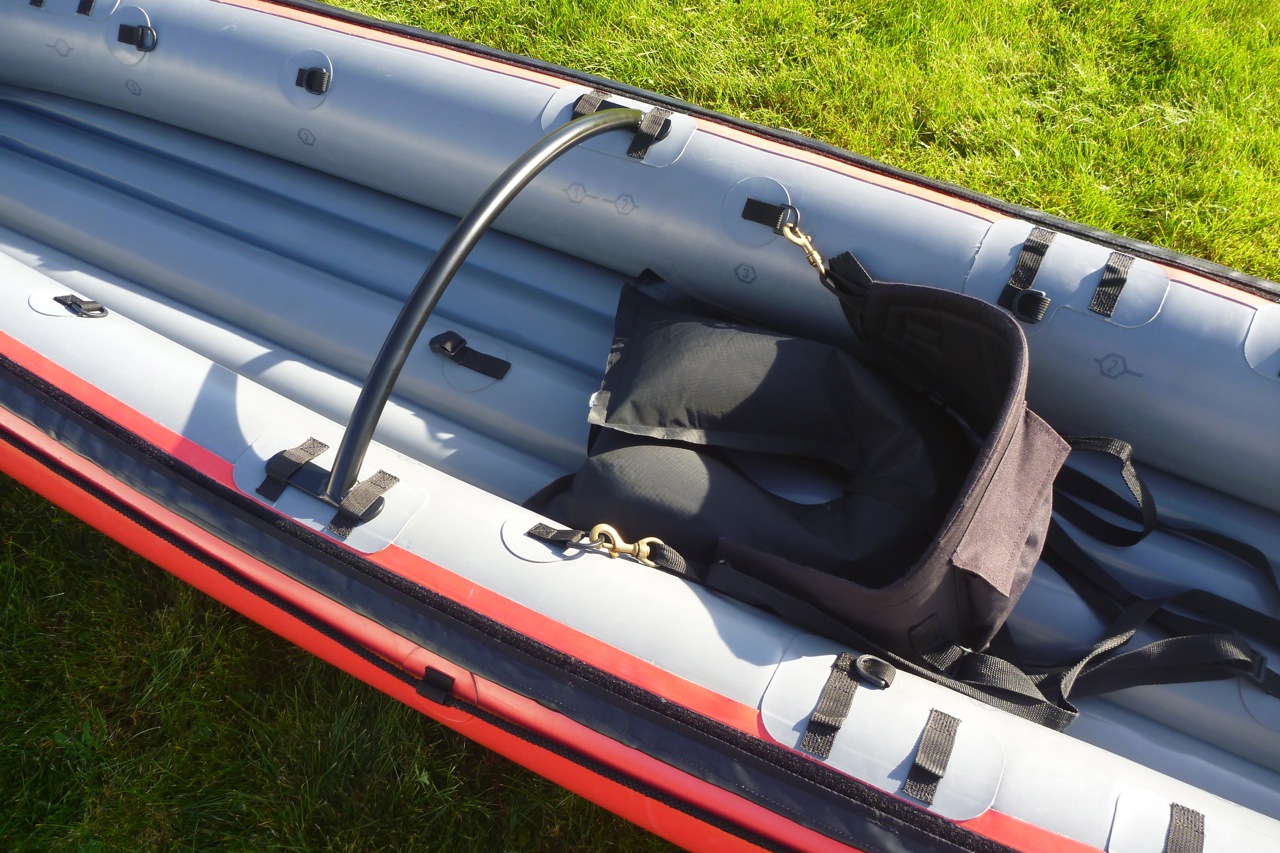
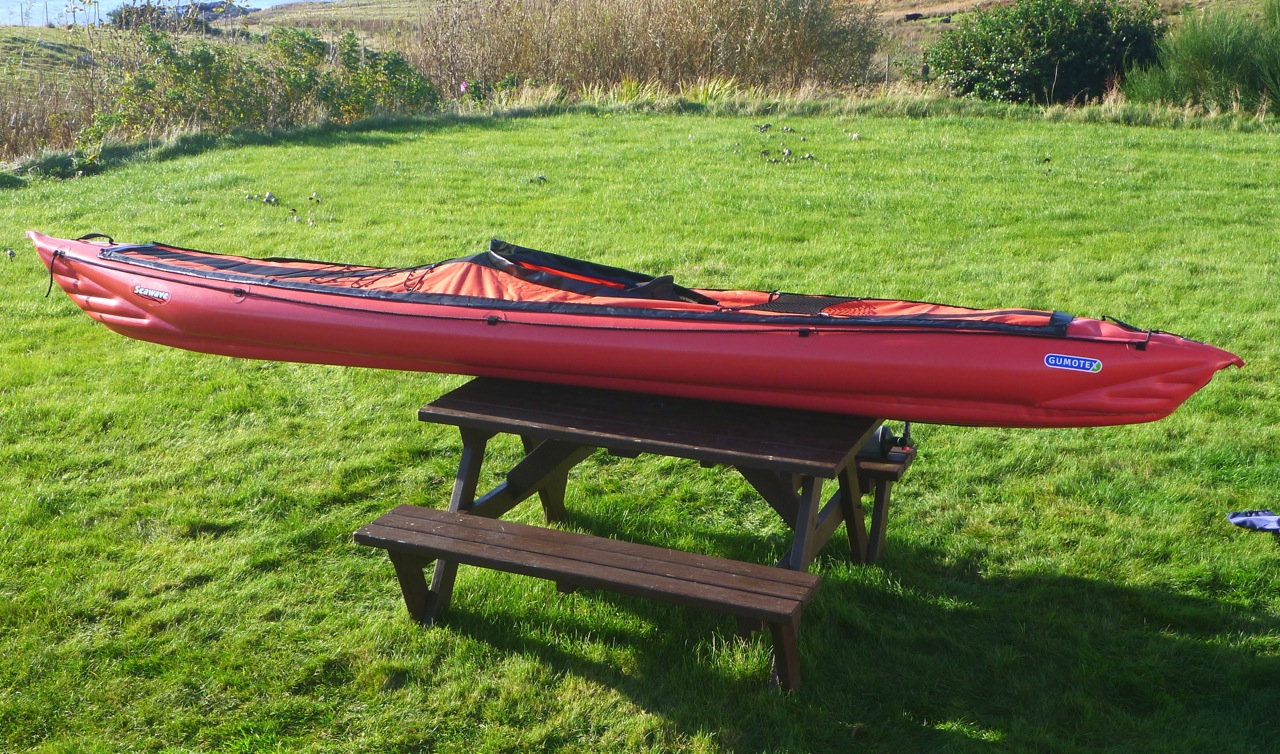
I got the optional deck with my first Seawave back in 2015 and as expected, didn’t really take to it. But decks can keep you warm and dry and you don’t have to use them. Gumotex made a neat job of velcroing it to the boat securely but dropped the ball with their crude, bulky and-over engineered set of 4 alloy bars to support the deck (left) so that water readily runs off. Something much lighter, flexible and compact would do the job. This only matters if you travel with boat and deck, but that’s why we have IKs, no?
Gumo Seawaver Jules writes:
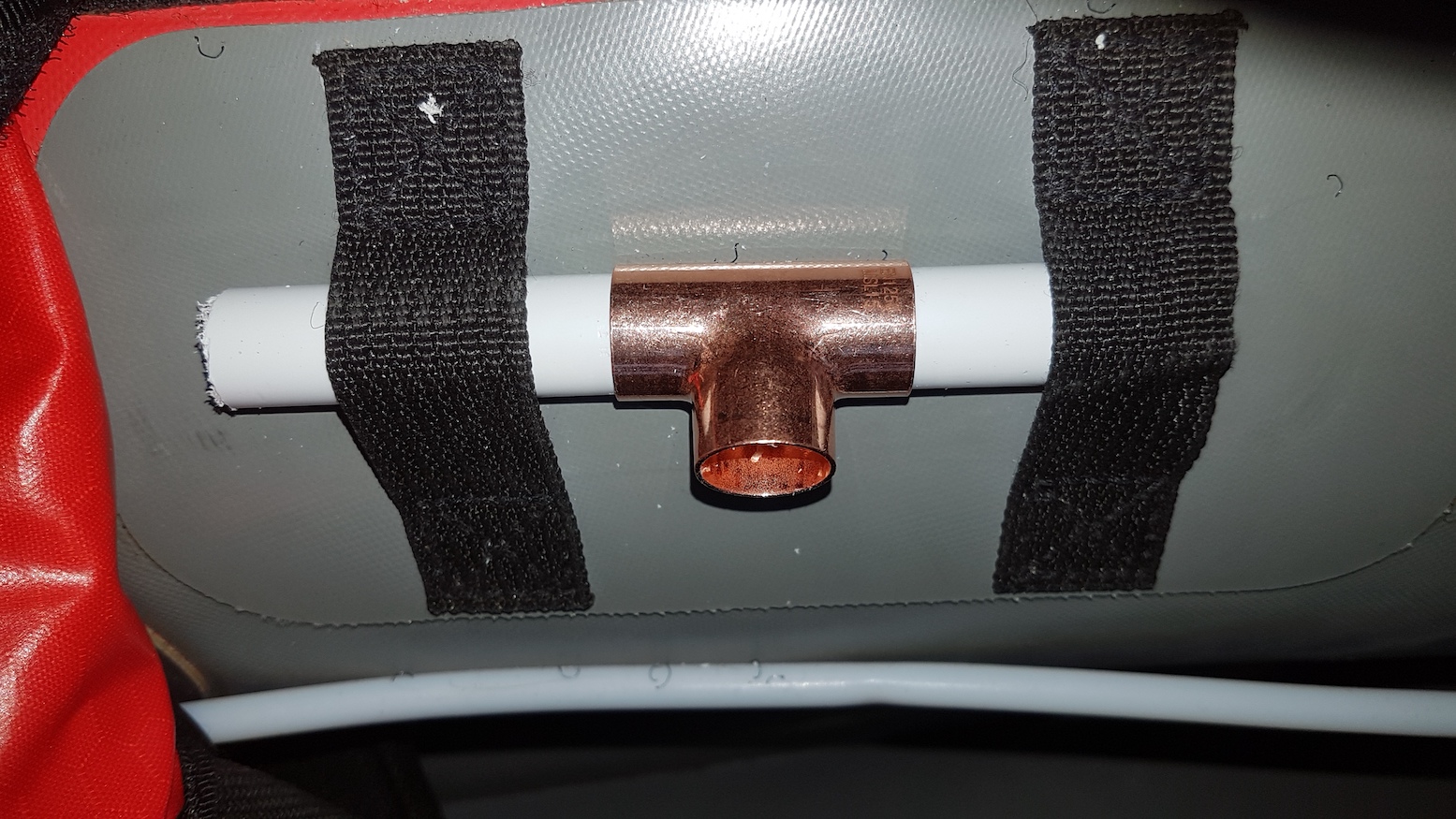
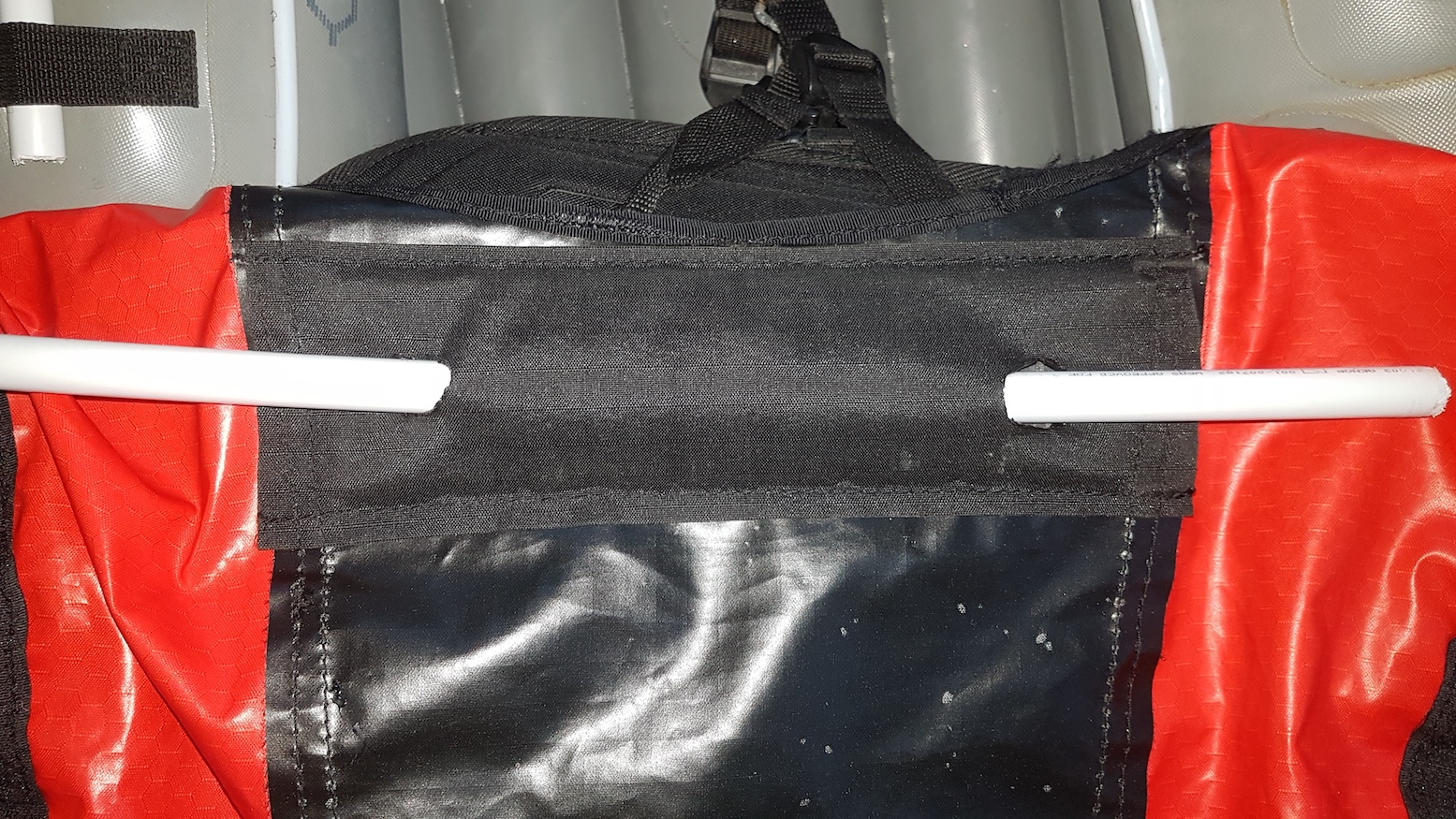
I’ve finally got round to making the Seawave deck supports after a couple of dud attempts and the design works great. What I did was to use 15mm speedfit pipe for the arch with a T piece to make the foot that goes in the tabs on the boat’s side tubes. The beauty is you can leave the deck velcroed on ( saves wear) and roll the lot up with at least 2 of the supports in place and it still goes in the rucksack.
The tubes are 44cm for the short and 62 for the 2 longer centre pieces and 4.5 and 6.5 cm for the pieces to go in the T piece foot. I melted a hole near each end of the black nylon that holds the padding on the inside of the deck, this keeps the arch in the correct plac
So far it works well and sheds the water off the deck; I’ve not tested it in rough weather yet.













































 Inflatable Kayaks & Packrafts