Tag Archives: Anfibio Multimat

Packrafting Jurassic: Lulworth to Kimmeridge

Anfibio TXL main page
Kimmeridge ledges
Swanage stacks
Dancing Ledge
Packraft sailing to Lulworth
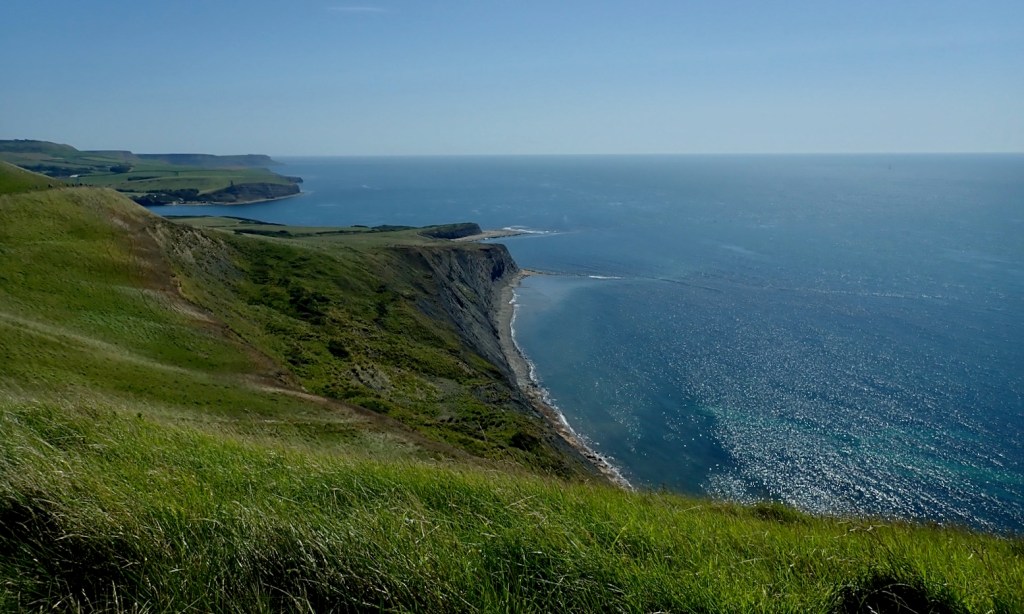
Kimmeridge to Chapman’s Pool

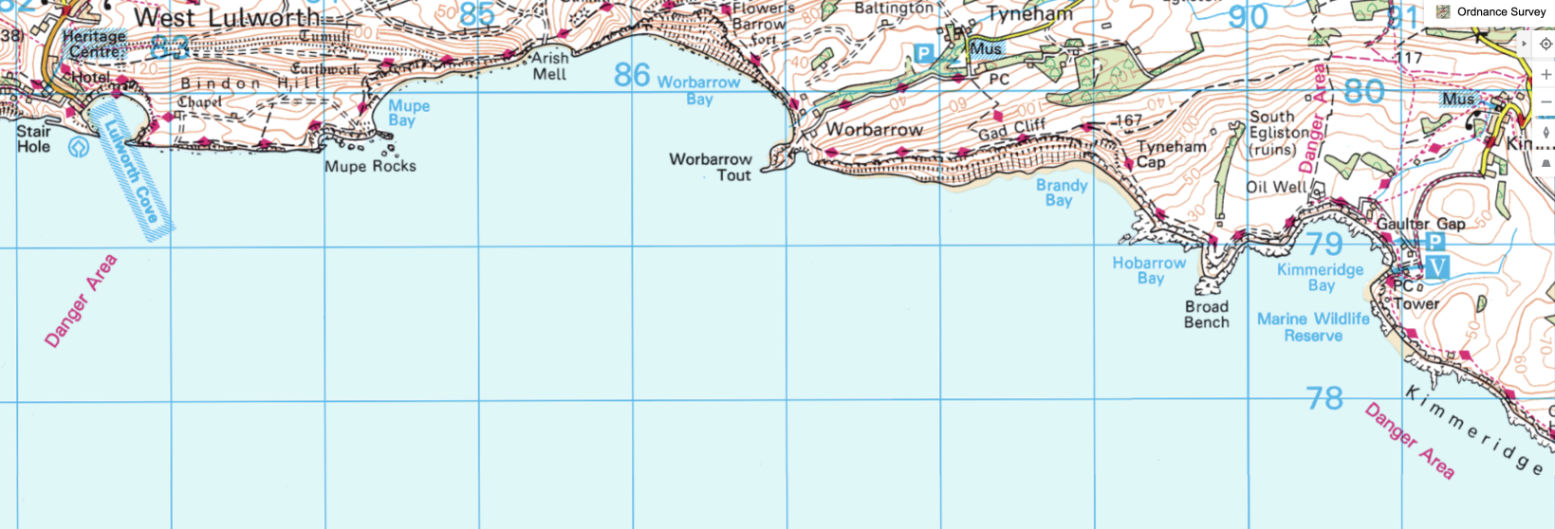
Lulworth to Kimmeridge
Map with most place names

‘Calm… caaaaalm’. It’s what you say to a hyperactive child. But it’s also what you observe as you scan a weather forecast: 3-4mph onshore southerly, backing southeast later. With sunshine too, it could be the Last Good Day of the Summer.
I left my moto just as they’re opening the gate down to Tyneham ghost village. From there the Mrs drives me on up the coast to lovely Lulworth Cove for a sneaky 9am bacon buttie. I do worry about my B12 levels sometimes.
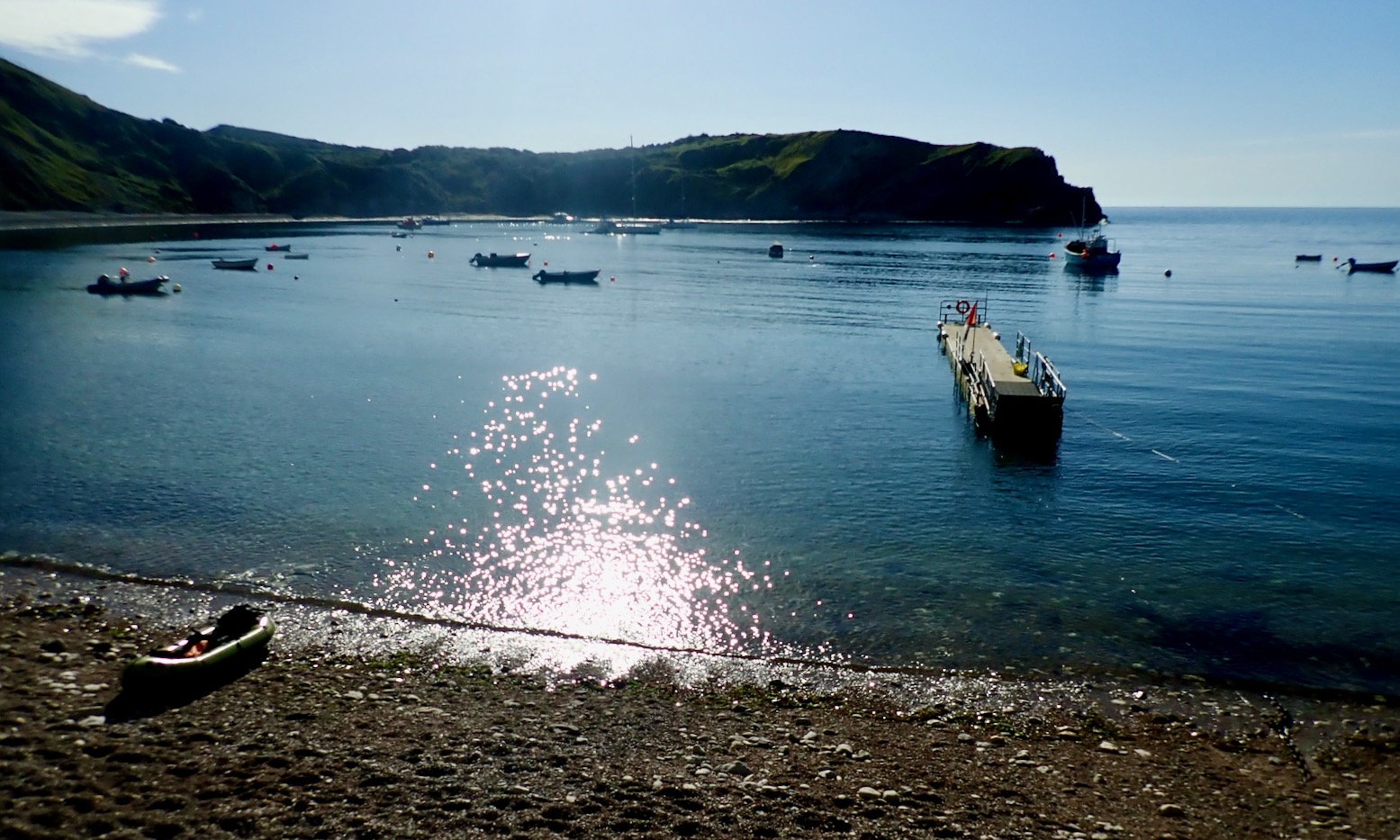
All calm at Lulworth

“Oh wow!” squealed a little girl as she also arrived with her family at Lulworth beach. And you can see why; it’s an amazing natural feature which along with others help make Dorset’s Jurassic Coast a World Heritage site. Within an hour the renowned amphitheatre would be standing room only but hey, it’s August on the South Coast; if you want a lone beach, pack a mac and go to the Outer Hebrides.

Red shaded area is army firing range which – land or sea – is usually closed.

Today’s plan was head east 9km to Kimmeridge Bay as I gradually joined the dots packrafting Dorset’s Jurassic Coast.
This time last year Barrington and I sailed here from Ringstead Bay near Weymouth, before getting sent into Lulworth Cove by an army patrol boat. The following eastward section of coast is an army firing range that’s only open to the public on weekends or throughout the August holiday season. And even then, some landing spots are closed, and inland you have to stick to the paths in case you step on an unexploded bomb. Tragically that happened in 1967, though thankfully only once and as a result, today warning signs along the footpaths are everywhere.
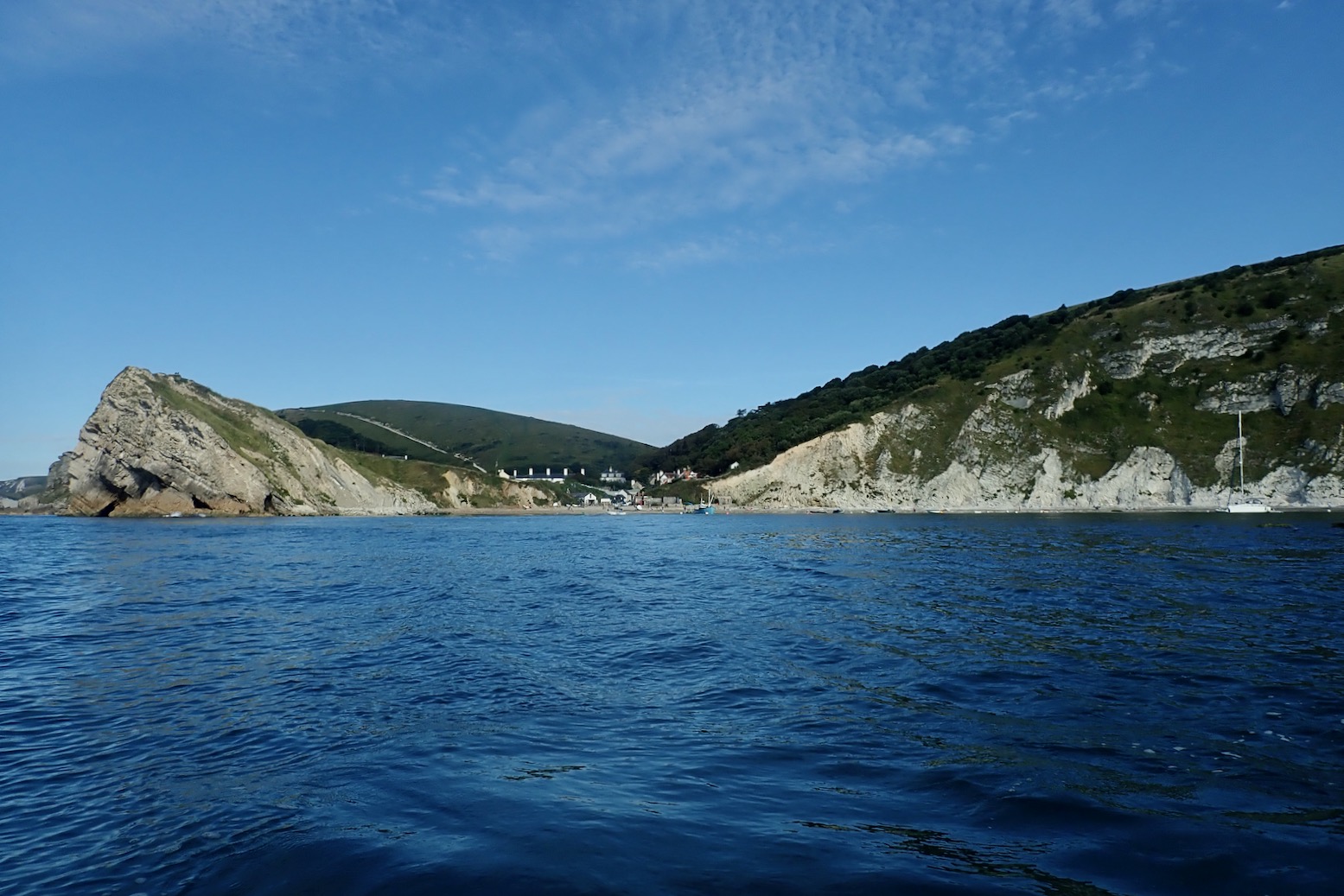
Leaving Lulworth

Once out of the cosy Cove, the first section should be easy enough, but if not I could hop out at Warbarrow Tout, walk a mile to the bike at Tyneham and ride home. Continuing all the way to Kimmeridge depended on confidence and energy levels, and how the sea actually looked once out of the sheltered Cove.

Today I’ve remembered everything, including my repaired Multimat floor pad. All you need is to get into a routine; let me know how to do that. And as I set off towards the Cove’s mouth the TXL definitely has its glide on. I have two hours before the tide turned and the wind with it, but right now the boat felt great. I even remembered to pull up my knees straps, and felt nicely connected between the TXL and my paddle blades
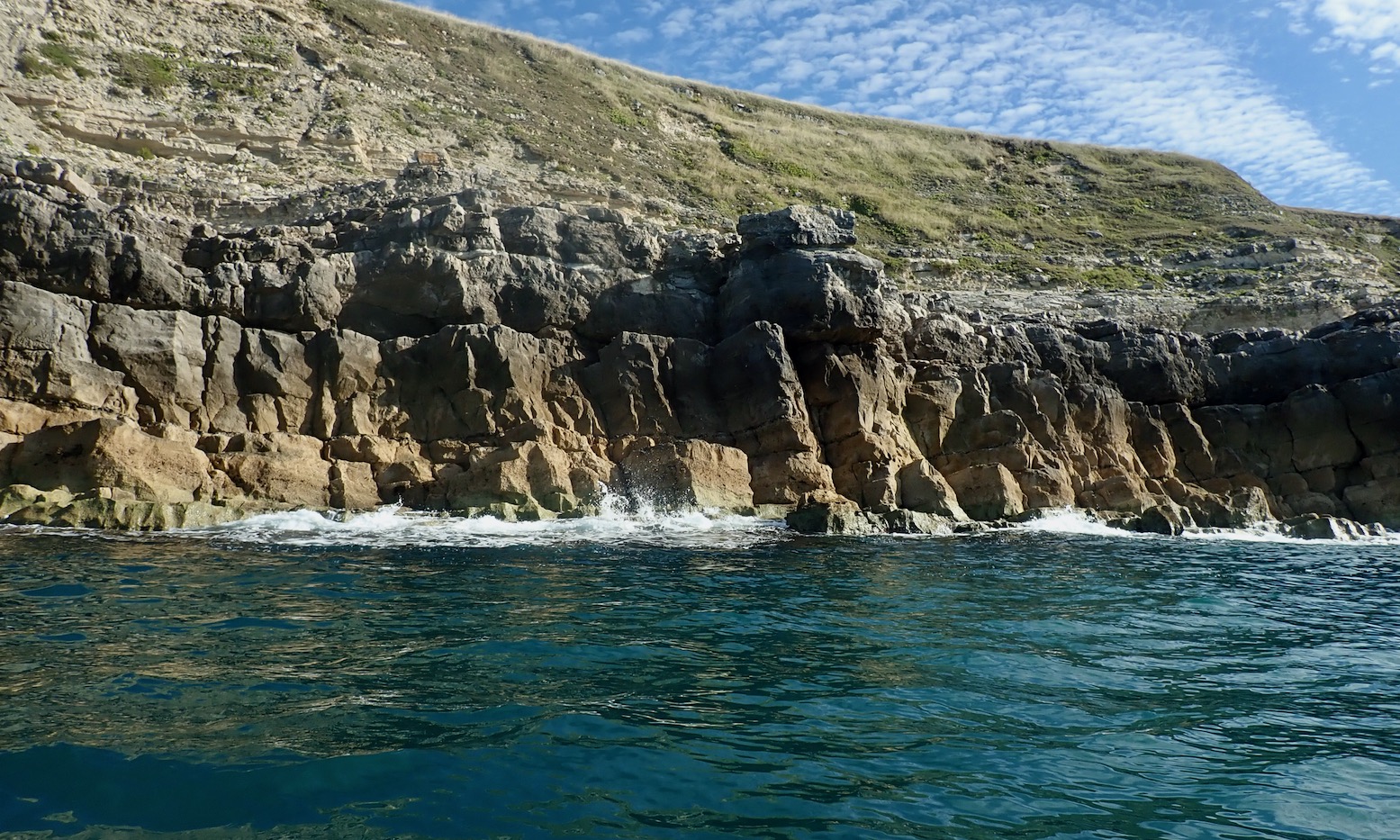
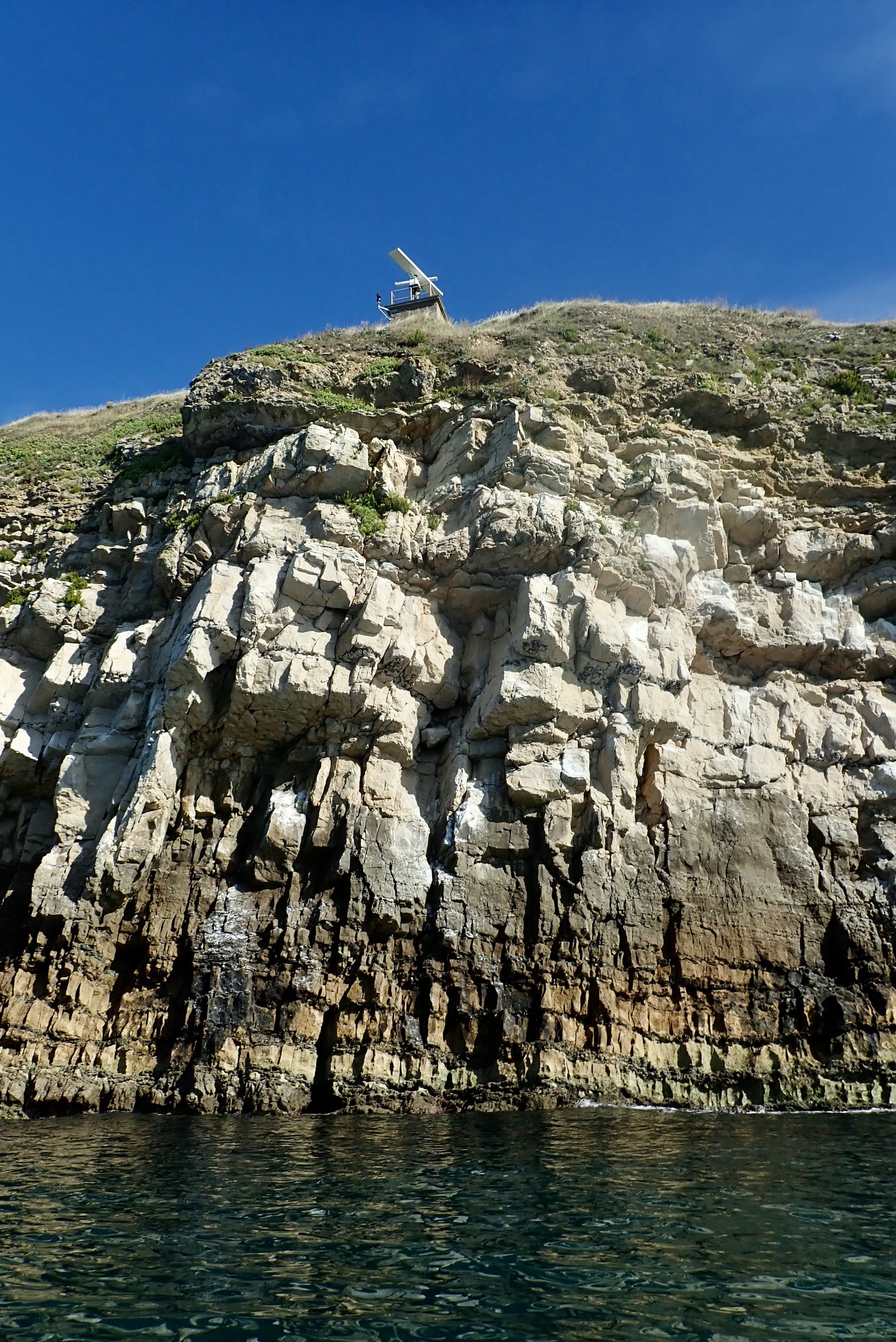
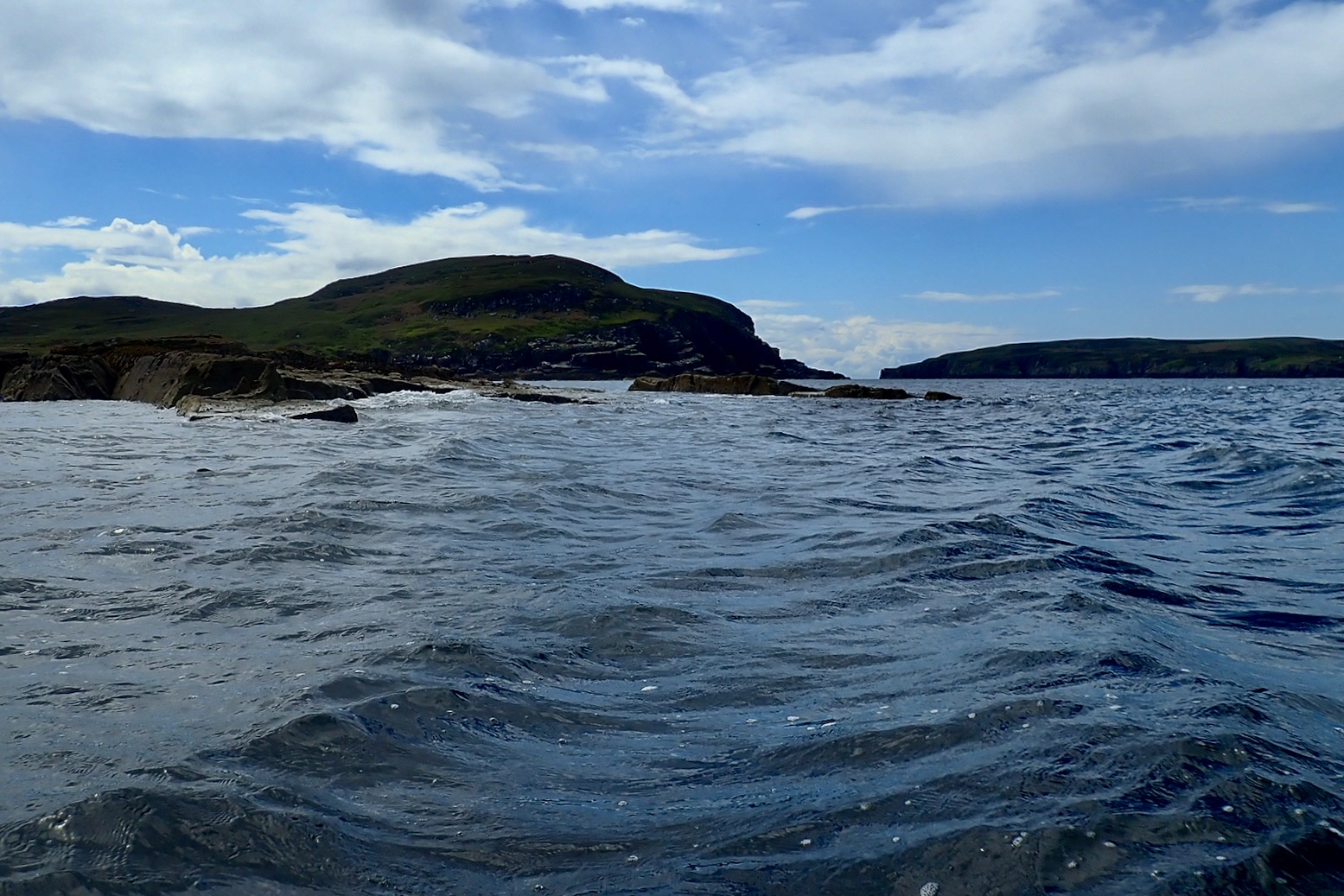
Towards Mupe Rocks I had the odd sensation of offshore waves bouncing off the cliffs – it made getting close tricky. I see on an online marine chart (below) the seabed drops off quickly here so the swell just rolls in and boings back out.
They say there’s a petrified tree here somewhere – or ‘Fossil Forest’ in over-heated tourist-speak. But I learn later it’s by a path on the cliff top where there are also periodic radars (left) and other sinsiter MoD installations.

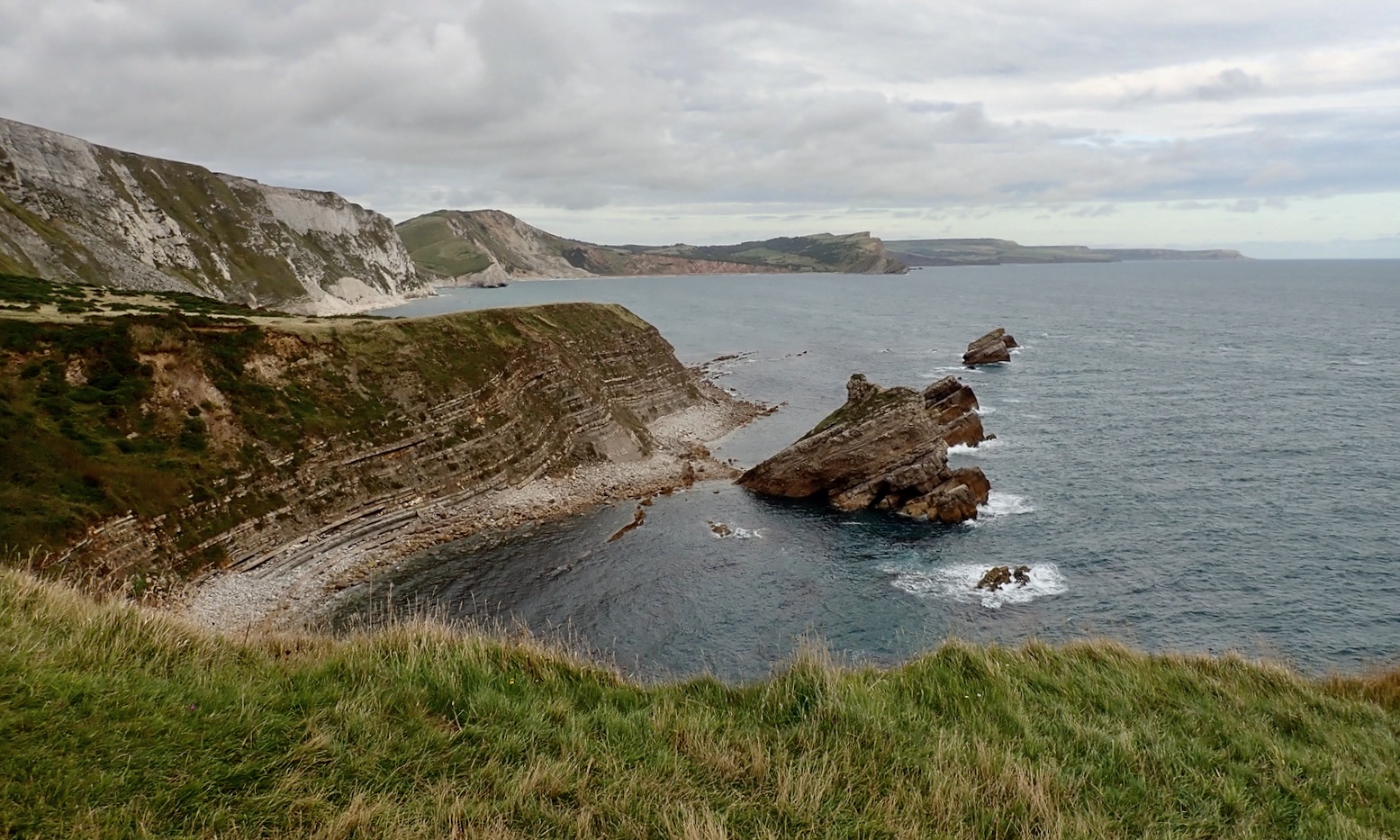
Mupe Rocks from the path

Mupe Rocks turn out to be rather ordinary remnants of fallen cliff, not like the gleaming white chalk stacks I paddled last week near Old Harry. With no interesting arches or caves, I thread about but they’re a bit disappointing.

Mupe Rocks

Seaweed streams reassuringly eastwards with the rising tide, and as I round the corner Mupe Bay opens up, revealing half a dozen moored sailing boats. Behind them rise the steep chalk cliffs which you can see for miles down the coast.

Mupe Bay
Mupe Bay and Warbarrow, a day or two later.
Landslide

I wonder about putting ashore at a gap in the cliffs called Arish Mell because I can. But perhaps I can’t, even in August, if I have interpreted the map warnings correctly.
Behind the beach I spot some huts, shipping containers, pickups and activity. As it is, my equilibrium is disturbed by some strangely large waves rolling in across the middle of otherwise calm Warbarrow Bay. A submarine shelf? They’re not crashing ashore as far as I can see, but I decide to stay out in the Bay.
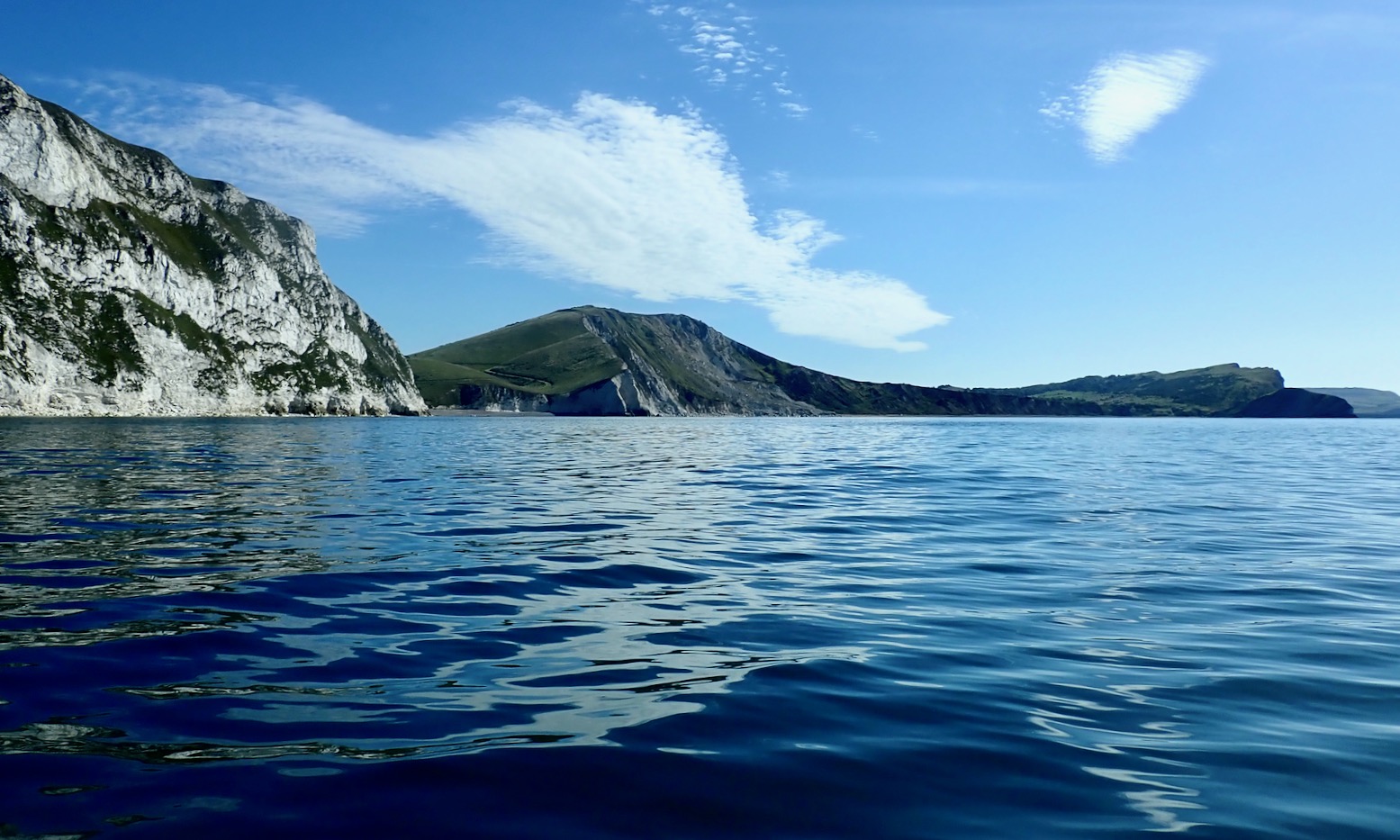
Arish Mell gap
Activity on the Mell

Turns out Arish Mell is off limits 24/7/365, using the proven UXO gambit which didn’t seem to be bothering the chappies ashore today.
Another possible reason may be that from around 1959-1990 give or take, ‘slightly radioactive effluent’ was piped out here from the former Winfrith nuclear research facility a few miles away near Wool. They’ve been decommissioning Winfrith ever since, and we should be grateful that with much effort they saw fit to extend the outfall pipeline two miles out to sea. You can see the pipe on that marine chart above. Coincidentally, this week Japan started doing the same thing at the damaged Fukushima reactor, raising the ire of seafood enthusiasts in China. Meanwhile, this well-produced 1959 Atomic Energy Authority promotional film describing the pipeline project seems very proud of itself.

So I set course for the conical headland of Warbarrow Tout (old English for look-out) at the far end of the Bay. The sinister waves subside and something else changes: the TXL glides across the smooth surface effortlessly. I am able to draw a long, slow, kayak-like paddle cadence, not the usual thankless spinning.
Later the GPS data revealed the combination of windless conditions and the Multimat helped the raft skim along at up to 6.2kph or 3.8mph. I’m not sure it’s ever sailed that fast so, even aided by the final hour of a modest, metre-high tide, that’s quite impressive.
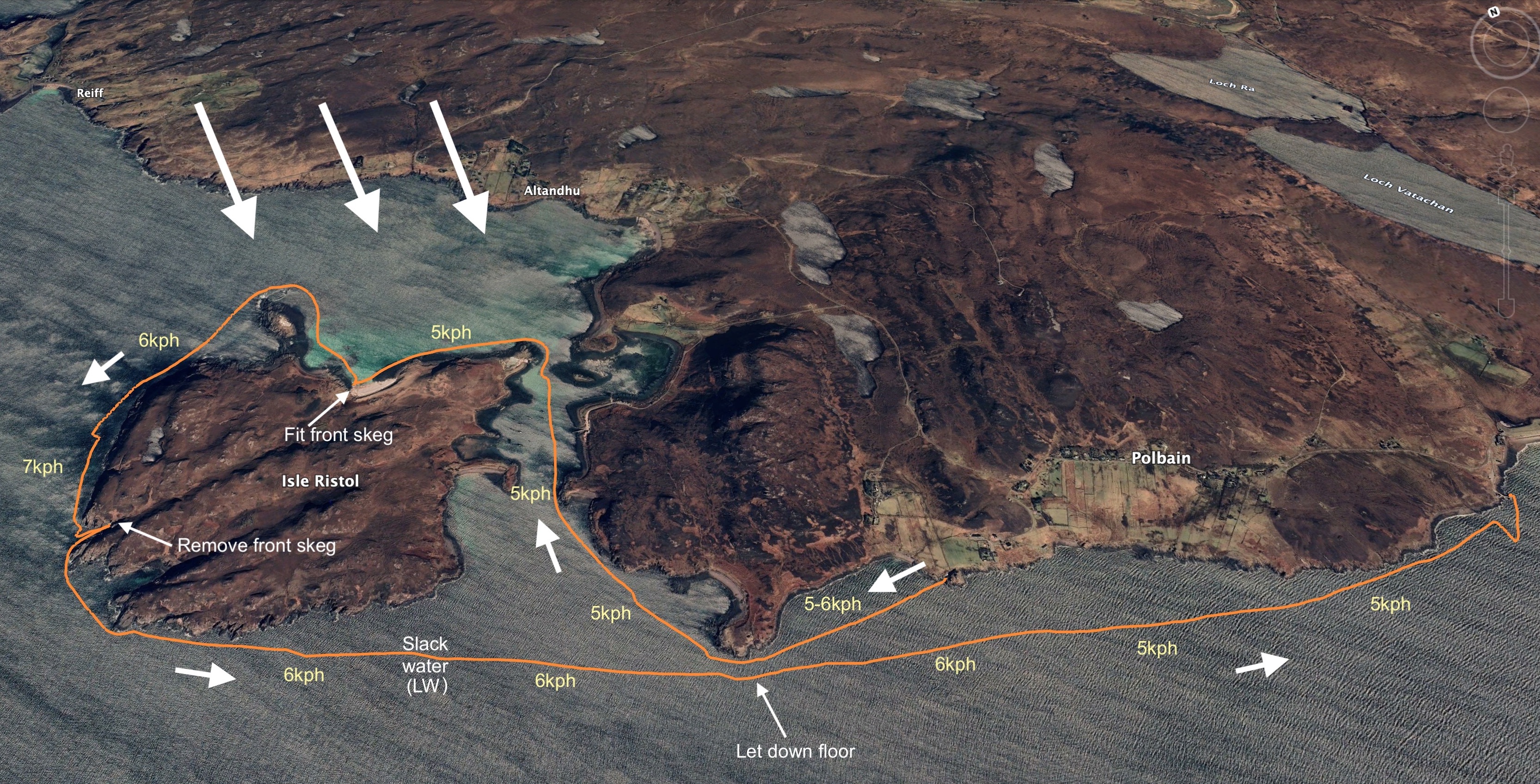
Actually, I don’t know why I’m so surprised. Although I seemed reluctant to admit it initially, the first time I tested the TXL with the Multimat in the Summer Isles, the evidence was right there (left), even if it wasn’t night and day.

Approaching Warbarrow Tout

As I neared the Tout I was anticipating some sort of disturbance from an eddy being pushed out by the eastern hook of the Bay. Sure enough, the TXL passed over a patch of clapotis without breaking it’s stride, but as I moved on past Pondfield Cove (a mini Lulworth) something changed again – the boat seemed to slow to a crawl. The coastline was creeping along but a check the GPS only registered a slightly slower speed.

Warbarrow Tout and Gad Cliffs beyond

As usual with winds, other anomalous currents and flotillas of irate pirates, I wondered if this would set in or get worse all the way to Kimmeridge, with get-offs but no take-outs along the way. I decided to carry on below the Gad Cliffs to the prominent Wagon Rock and if nothing changed, I’d turn back and walk out to Tyneham.

Gad Cliffs. Dorset’s cubist Mount Rushmore

But by Wagon Rock the countercurrent had subsided and the GPS later showed I resumed the steady 6kph pace. Sea paddling alone an semi-appropriate boat makes you more alert to minute changes in conditions which a sea kayak would pass with barely a shrug. I later wondered if it was possible the eddy from the hook formed by Warbarrow Tout could draw back or suck in a current ‘beyond’ itself, as shown below. Who can fathom the mysteries of fluid dynamics?

Beyond Wagon Rock the grey sweep of Brandy Bay‘s oily shale cliffs plunged down to the sea. Up ahead I was reassured by the sight of Clavell Tower, just 3km away, marking the far side of Kimmeridge Bay. Less comforting was the breaking water between me and it: the ledges of Broad Bench spotted when I paddled the Igla here a few weeks ago. It would be alarming to have one of these rise up on you out of the blue (below).
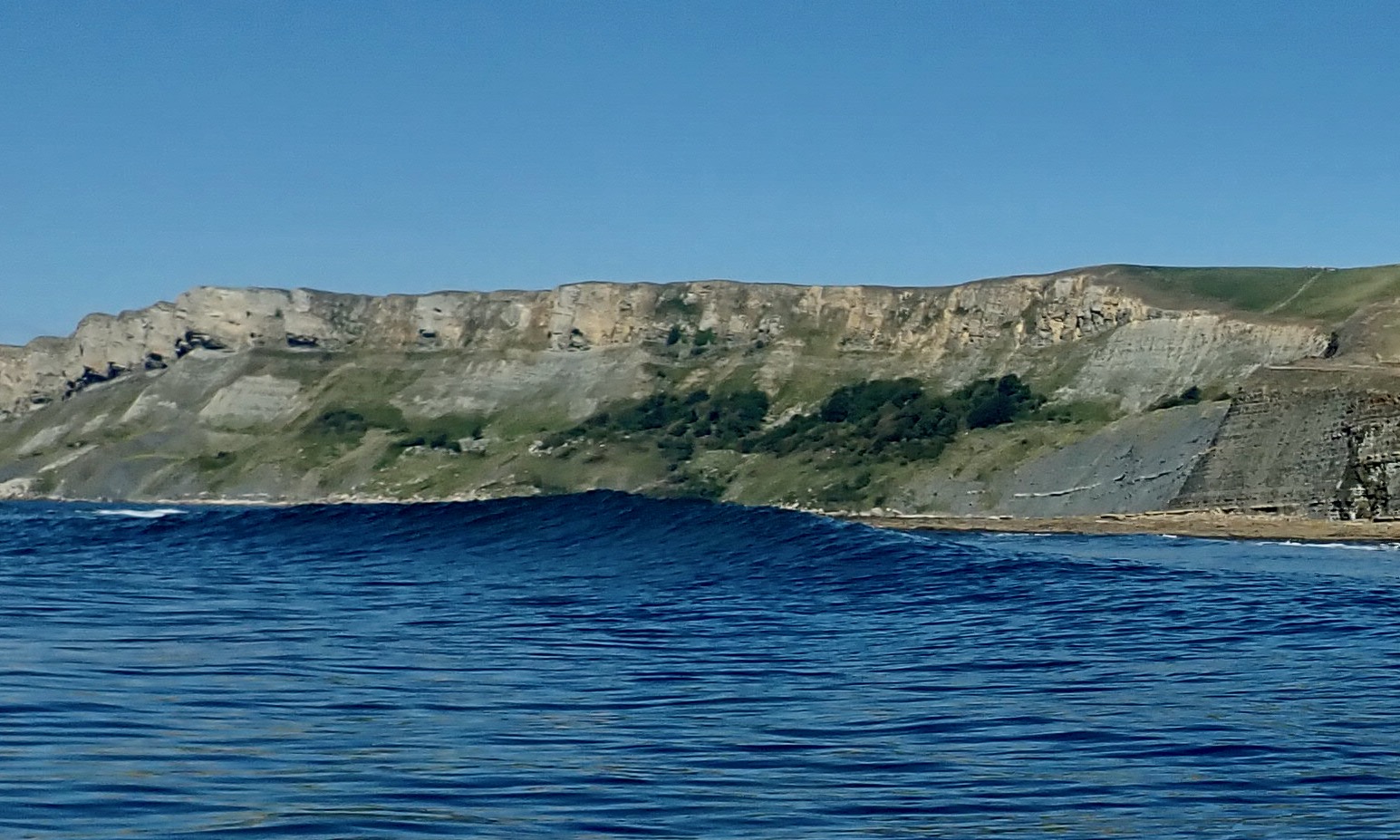
Sneaky wave

As always, the solution to such unpredictable seaside disturbances was to paddle further out, even if the instinct (and interest) was to hug the shore. I aimed for the distant St Adhelm’s Head and safely rounded the churning maelstrom of Broad Bench, with the bedrock visible a few feet below. That done, the crossing was in the bag and I worked my way towards the beach where crowds were streaming down to the shore with their dogs. Nine clicks covered in less than two hours from Lulworth. Not bad.

Brandy Bay in a gale.
Interesting shelf

A few weeks ago we walked the coast from Tyneham on a very windy day. At low tide the ledges at Brandy were a froth of white foam (above). Today, walking back 4km to Tyneham, the Long Ebb shelf delineating Hobarrow Bay was already emerging from the retreating tide. Looking back, I was reminded the nearby big shelf (left) behind Broad Bench was worth a nose about for fossils or dubloons, even if MoD poles discourage this and you can only access it by boat. It’s one for next time.

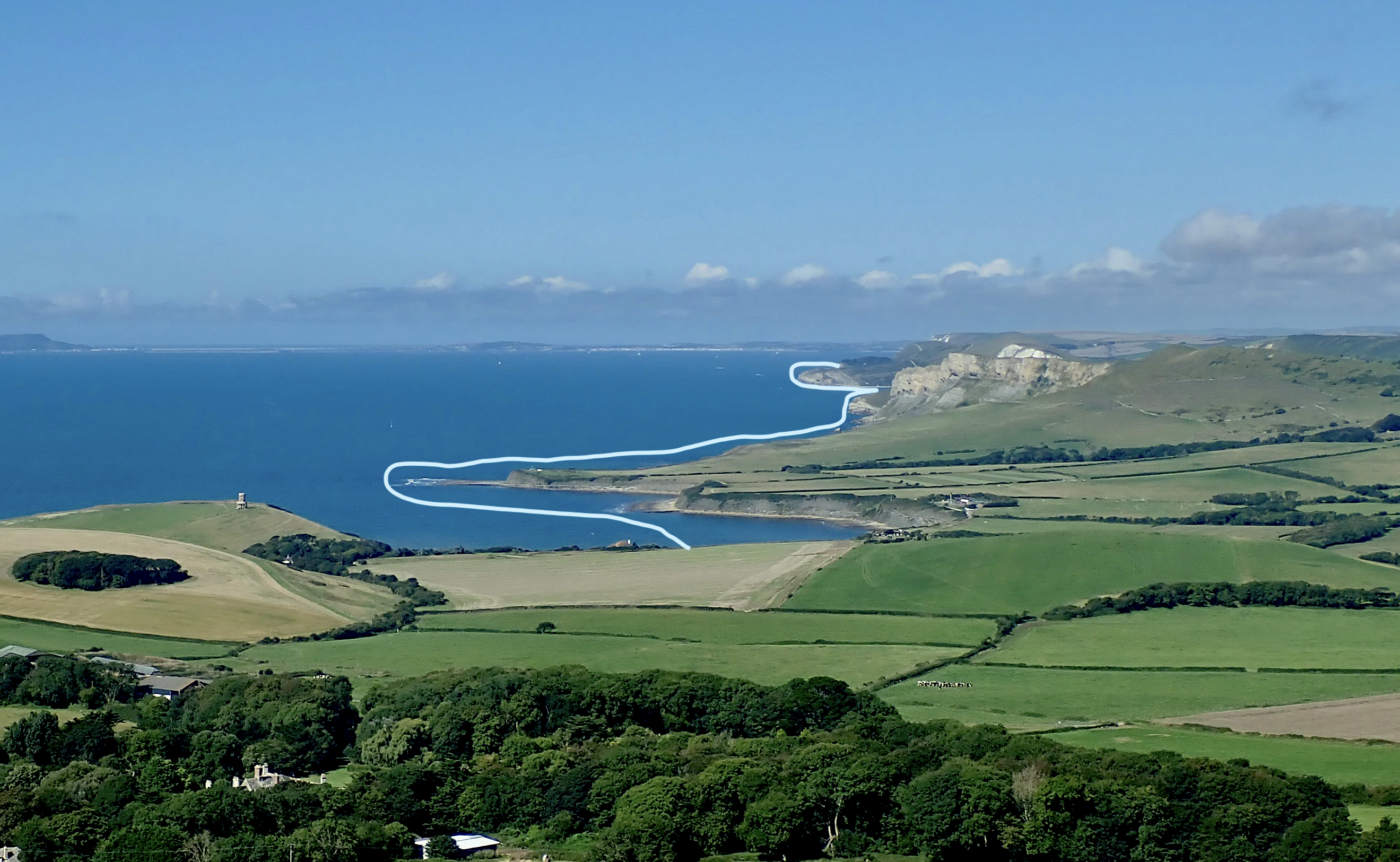
Above Tyneham looking back to Mupe Bay

Midday and Tyneham car park is already packed. Another section of the Jurassic ticked off or recce’d for another pass. Hopefully there’ll be a chance to do the 6km from Kimmeridge to Chapmans Pool before we roll up for the winter. That will leave the two points of St Adhelms and Durlstone for the next caaalm day.
Sigma TXL: seat and sailing sorted (videos)

Sigma TXL Index Page

The winds here have been belting out at up to 40mph for days, but I grabbed a quickie during a lull the other afternoon to try out some final mods.

Foam backrest: much better

My centrally seated TXL is like a small TPU kayak – the missing link, some say – so it needs a backrest that works. I was never won-over by the Anfibio inflatable backrest on the Revo or my boat; it manages to be both mushy and wobbly.
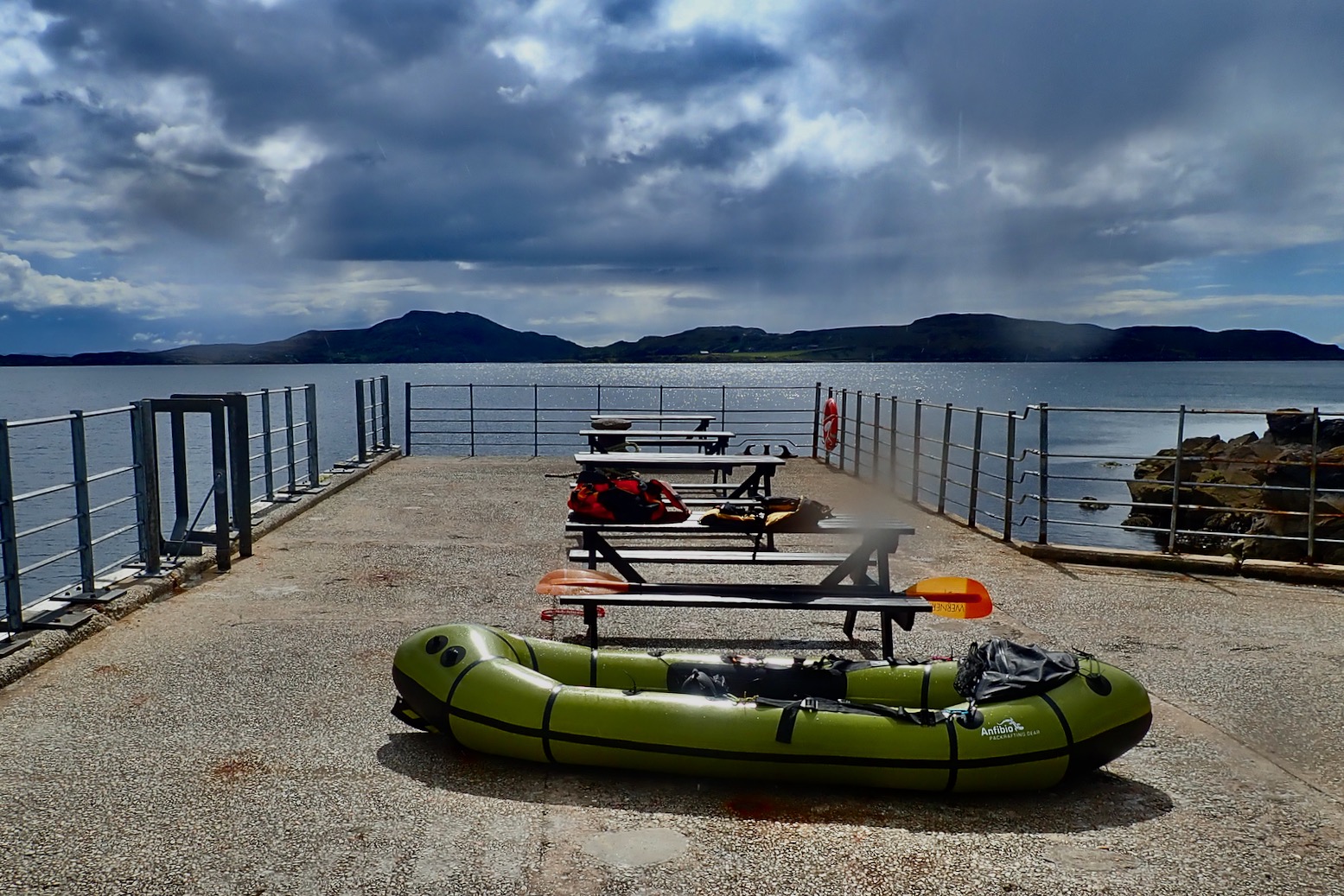
But once on the water it was soon clear that, combined with my Lomo holdall wrapped into a footrest bundle (below left), the foam SoT backrest felt much better. The broader, firm pad spreads across the back supportively and is held up with straps, not thin elastic. Plus being able to press feet side-by-side against a flat, firmish surface, not jam feet into the bow, is also much more comfortable. It felt just like my old Seawave!

I was giving the Multimat air floor one more try. It must do some good and I admit it may have helped replicate the IK feel. And unlike initial impressions, the half-inflated seat base is actually pretty stable sat on the stiff floor, not wobbly as I originally thought. Plus the pad protects the floor from impacts below, and heel scuffing inside.

I did feel again that the TXL skates across the water a little, bobbing on the stiff air floor. This flat-floor effect makes sense on a shortish 3:1 ratio boat and was one reason I thought a front skeg might be helpful (it wasn’t with the stock rear skeg). The air floor lifts the boat a bit higher in the water and the sliding left to right is more from wind and waves than in reaction to paddling strokes (like normal packraft bow yawing). But until conditions get too rough I don’t think it really hampers paddling progress that much. It’s a packraft after all, not a jet ski!

While I had the floor in, I tried the 15-cm thick seatbase fully inflated and sure enough, like Anfibio say, it’s too high and may get unstable on anything other than flatwater, even with my repositioned knee straps for added support (left). That’s why they offer the 5cm foam block (it’s on ebay, fyi). A thinner inflatable seatbase would be less agonising but it seems, like on an IK, the half-inflated stock seatbase actually works fine.

Only one skeg needed

The other test was a skeg repositioned on the floor for full submergence – this is only needed for sailing; the TXL tracks well enough with the semi-submerged stock skeg position and goes OK without one. Had I not seen the selfies (left) and not tried sailing, I’d probably not have noticed.

The afternoon’s glassy calm had turned already. I pushed into the breeze out towards a low-tide skerry just off Tanera Mor, then heeled round for the mile back to Badentarbet beach and flipped out the WindPaddle. I left the stock skeg in place which was cheating a bit, but I’m pleased to say my earlier problems with weathecocking (stern blowing round, side to the wind) have been solved. No surprise a fully submerged skeg makes the TXL sail as well as my Rebel 2K and MRS Nomad.
This was an important thing to pin down as I want to be sure my bloaty, IK-replacing Sigma TXL has something up its sleeve when the wind allows because, like any inflatable, in the other direction it will struggle as headwinds reach 15-20mph. Sailing still needs constant micro-adjustment, but it’s great to feel a gust tugging at the handlines as the Sigma ploughs a trough through the surf like a water buffalo wading across a mudhole. The boat was definitely hitting 7kph or more at times.

I was also trying an idea I didn’t get round to testing on my narrower-bowed Seawave before I sold it: a WindPaddle transverse bowsprit™. Those cunning Chinese will be copying it on ebay any day now.

TXL vs MRS Nomad spacing

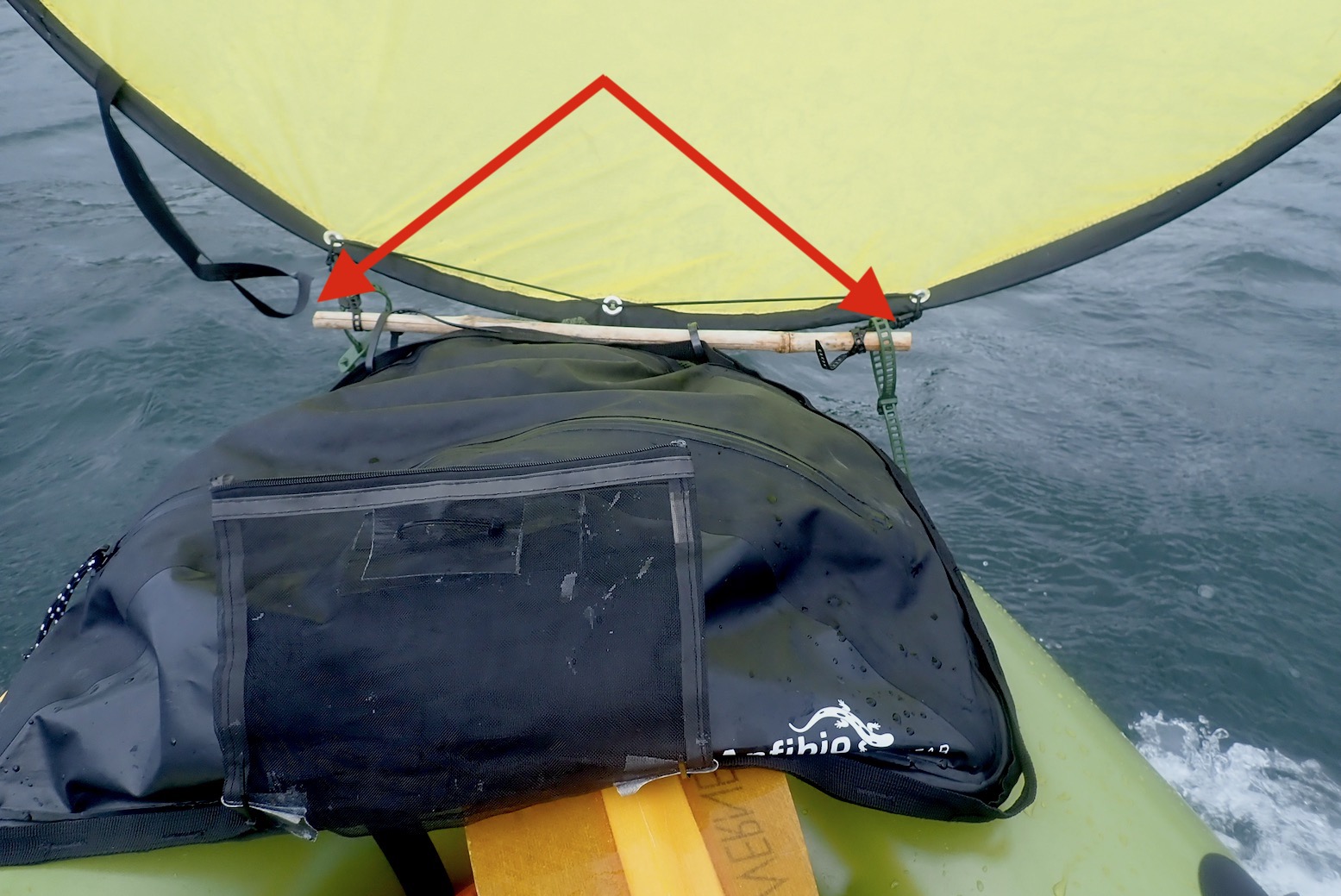
A WindPaddle disc sail starts bobbing madly left to right when winds get much over 10-15mph – it can’t unload the air fast enough. This is a side effect of mast-less downwind sails, but I figured if the bow sail attachments were further apart and more taught, the bobbing might be constrained. You want a downwind sail at the very front of a short boat, but on the TXL thr frontmost mounts are quite close together (compare to a Nomad, above left).
My ‘transverse bowsprit‘ is a stick which extends the sail mounts out to the sides, like ship rigging. I used a foot-long bamboo stick with some Rovaflex loops on the ends and for the weight and minimal faff, I like to think it worked. A bit longer would be better; I have a 50cm rod lined up for next time.
A few days after posting my sailing vid, YouTube thoughtfully directed me to a ten-year old video where a bloke with a hip-wide surf ski had the same idea (above right). Only he managed to zip along at a breathtaking 15kph in a 40kph breeze!

Heading towards shore, again, I aired-down the Multimat but again, can’t say performance deteriorated noticeably. After all, the MRS Nomad manages fine. The stiffening breeze rushed me towards the rarely exposed sands of Badentarbet beach and a short walk home.

So. Good to know the TXL is now largely sorted. Weather-wise, it’s been a wash-out in the far northwest this year, but there’s still enough summer left in the heatstruck south to do some trips.

Sigma TXL: Multimat floor and front skeg test

Sigma TXL main page
Other Summer Isles paddles

There were two things I wanted to try out while paddling the Sigma TXL solo:
• whether the inflatable Multimat floor pad made a noticeable difference to speed
• what effect fitting a front skeg along with the usual back one might have on handling. Would it shapen the tracking to sea kayak levels?

I put in at a handy little slot a mile or so from the house and set off with the usual rear skeg and the floor pumped up and with the nozzle accessible at my feet. All was flat calm in the lee of the light northerly until I turned north at Fox Point into a headbreeze up to Old Dornie harbour.
As before, paddling along I can’t say the boat felt responsive or glided better – it’s a packraft! – but looking later, the GPS record showed I was moving along at a steady 5kph – as good as I’d expect from a boat like this.
I wasn’t sure which way the dropping tide flows through the narrows at Old Dornie (they dry up into an isthmus linking Isle Ristol as very low tides), but now saw it was southbound – against me but barely noticeable.

Once through, it was a bit more wavy and at Ristol beach I hopped out to fit the front skeg, curved edge forward, as well as the WindPaddle sail on the off chance the breeze might pick up. Then I gave the floor and boat a top-up until it was all pinging like a drum. Had I looked more closely at the skegs on the upturned boat (below), I may have guessed what the problem was going to be. The TXL’s bow and stern are symmetrical, fyi, and both patches are glued in identical positions.

Double skegging
Turning the spit on north Ristol.
Choppier water ahead

Setting off into the wind to carry on round the spit and down the back of Isle Ristol, tracking felt a bit worse, then really became a handful once I turned southwest across the small bay filled with clapotis bouncing off the cliffs.
Here I couldn’t pull two strokes without having to correct, as if I was stuck in some odd current or in an IK with no skegs at all. The wind wasn’t that strong and the tide was nearing slack, but forward progress seemed agonisingly negligible.
Barely in control, I couldn’t put my finger on it, and at one point had that unnerving feeling of a swimmer caught in a riptide. I’ve noticed odd conditions on this corner of Ristol before, so decided to just keep paddling south in the hope of getting out of the bouncing waves.

Photo before things got sketchy: front skeg bites deeper than the back. Not good for tracking.

If I could have easily got ashore to remove the front skeg I’d have done so right there, but knew of an inlet 500m further on when I could do just that. With the wind behind me, I thought I might sail my way out or trouble, but lifting the sail the boat just pulled itself sideways to the wind. Very odd. I could not get the boat to point down wind and catch the breeze.

By now the water had settled down a bit and with relief, I slipped into the inlet and pulled off the wretched front skeg (left), then went for a wander and a sip from the burn.
Looking at the pictures later, it’s clear the front skeg digs deeper than the rear, even if both are halfway out with the Multimat floor fitted (lifting the boat out of the water).
You could say the front neutralised the effect of the back skeg so the boat paddled as if it had no skegs. But that wouldn’t have made it so hard to handle. It was the fact that the front bit deeper than the back – the last thing you want.

Little did I realise that the TXL was in fact moving through the clapotis at 6kph, and even hit 7kph just before I turned into the inlet. It just goes to show how misleading the impression of forward progress can be, even if the shore seems to be barely inching by. Despite my floundering around with the paddle, I was zipping along.

Back on the water normal rear-skeg service was resumed with a few inches of yawing from the bow. I came across a sea kayaking group who, like last year near here, seemed to be drifting around like they were killing time, when they had all these amazing islands to explore. Put your backs into it!

I eased past them in a packraft half as long and more than twice as wide, and set off for the straight, 5-km run to Badentarbet pier. By now my paddling cadence had found a good, steady rhythm.
About half way, opposite Fox Point, I let down the floor and fully inflated my seat. Positioning the big, unattached seat can be a tight fit between the side tubes, but I’ve learned to lift myself on the side tubes and kick it backwards with my heel. You want to be sat in the middle of the cushion, not falling off either edge.
As we found last week near Skye, de-flooring makes the hull go a bit soft, as if the sagging floor was bending the hull a bit (the floor certainly makes the boat feel more rigid). In future, better to prioritise hull pressure over the floor.

Speeds up to 7kph with a backbreeze.

Did I notice any drag from the deformed floor sheet sagging under my weight? Not really, but after a while the cruise dropped to 5kph. This wasn’t a conclusive test in identical conditions; that might be better done there and back with floor/no floor on a freshwater loch. But I do now believe a Multimat does add a kph to paddling speeds.
It also occured to me that doing sea paddles like this in a single, 0.5mm chamber boat, there is some benefit to the back-up buoyancy from the Multimat floor pad (and up to a point the Tube Bags, when full). It was something I used to worry about much more when I first started packrafting; unsure if these unproven boats might go pop. Time has shown that that does not happen; at worst you might get a slow leak. But out here better to wear a proper foam pfd than a skimpy Buoy Boy.

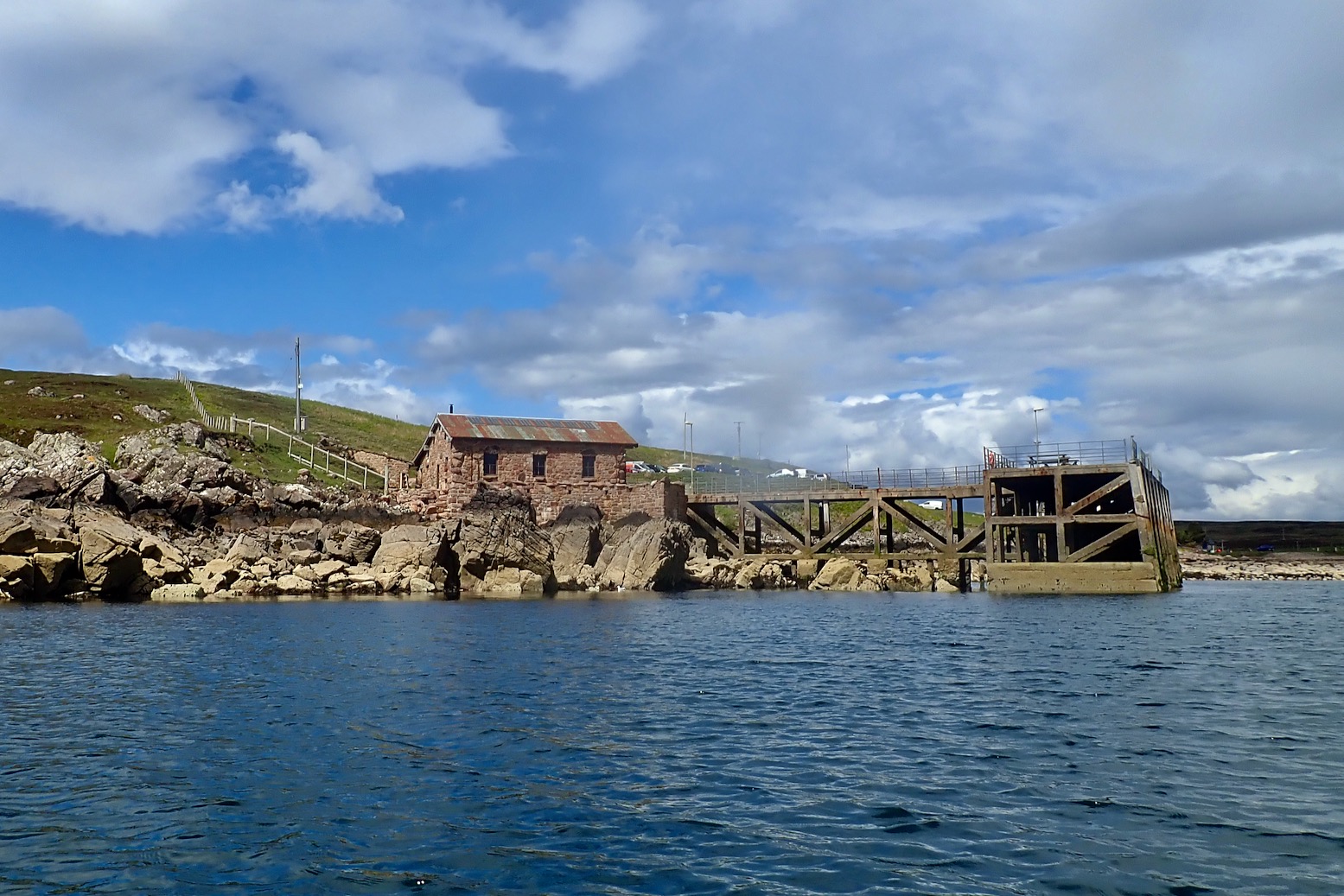
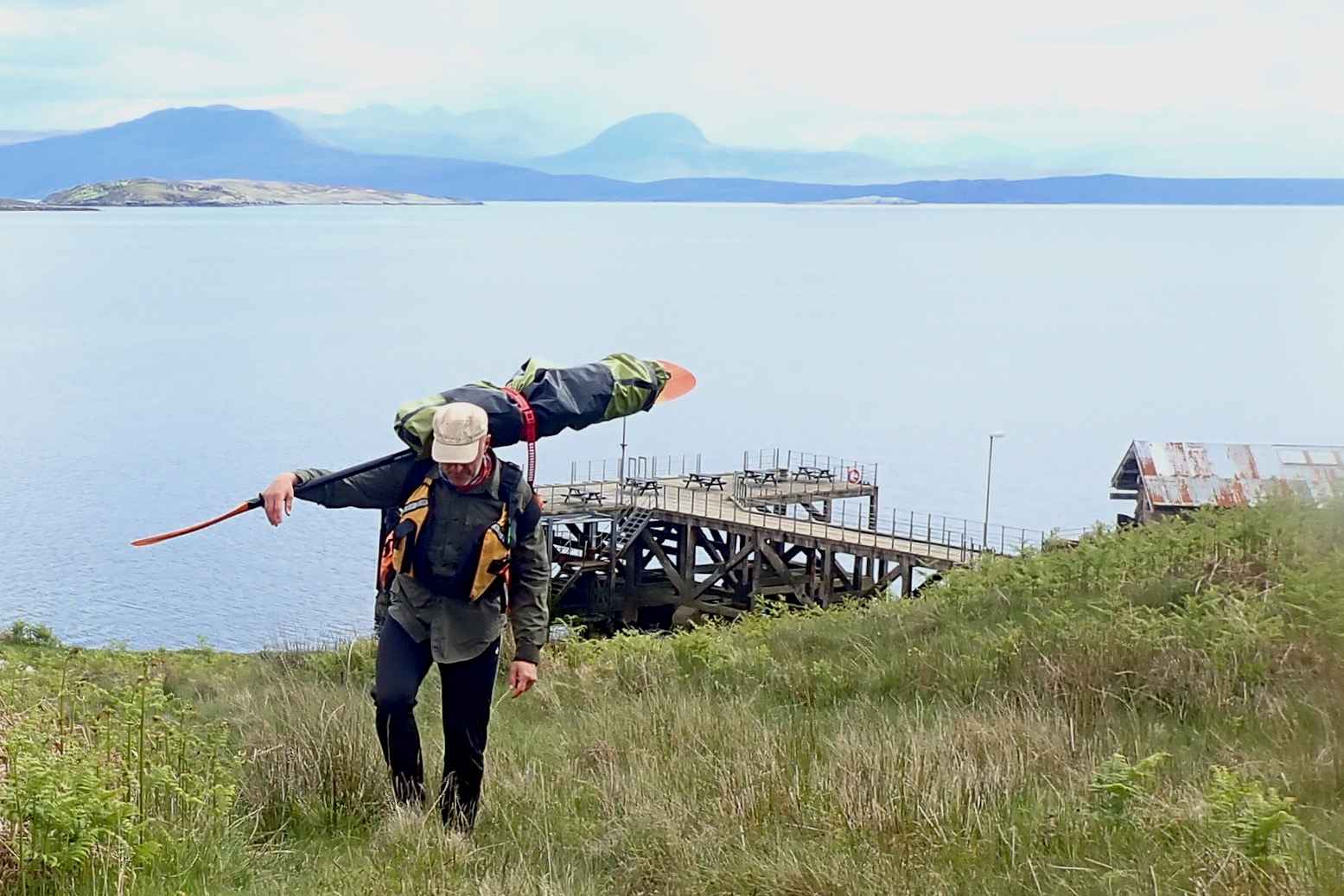
The new owner of Tanera has built a lovely sandstone coffee bar/waiting room alongside the repaired pier. I’m not sure who it’s for.
Watch out for those sharp-edged mussels

But I’m definitely in no hurry to use a front skeg again, though fitting it back to front might put less in the water (matching the back), and doing so with no air-floor might put both an inch deeper in the water. I might try the back skeg on backwards next time, too. More snag-prone but puts more plastic in the water. Anfibio ought to offer a deeper ‘sea skeg’, (easy enough to make). A while later I repositioned the rear skeg to the floor (below). Anfibio now position the skeg further forward on TXLs.

Anyway, now we know: rear skeg helps for sure but combined with front skeg, not so good; inflatable Multimat floor feels marginal but does add glide.
Either way, this 11-km paddle isn’t something I’d ever have tackled in any of my previous solo packrafts, except perhaps the similar Nomad S1. And considering I’ve not paddled this far alone since last year, I didn’t feel any more tired dragging a yard-wide packrafts than hauling my old IK at four times the weight. And of course I was able to follow the newly ratified Packraft Protocol: never take-out where you put in ;-)