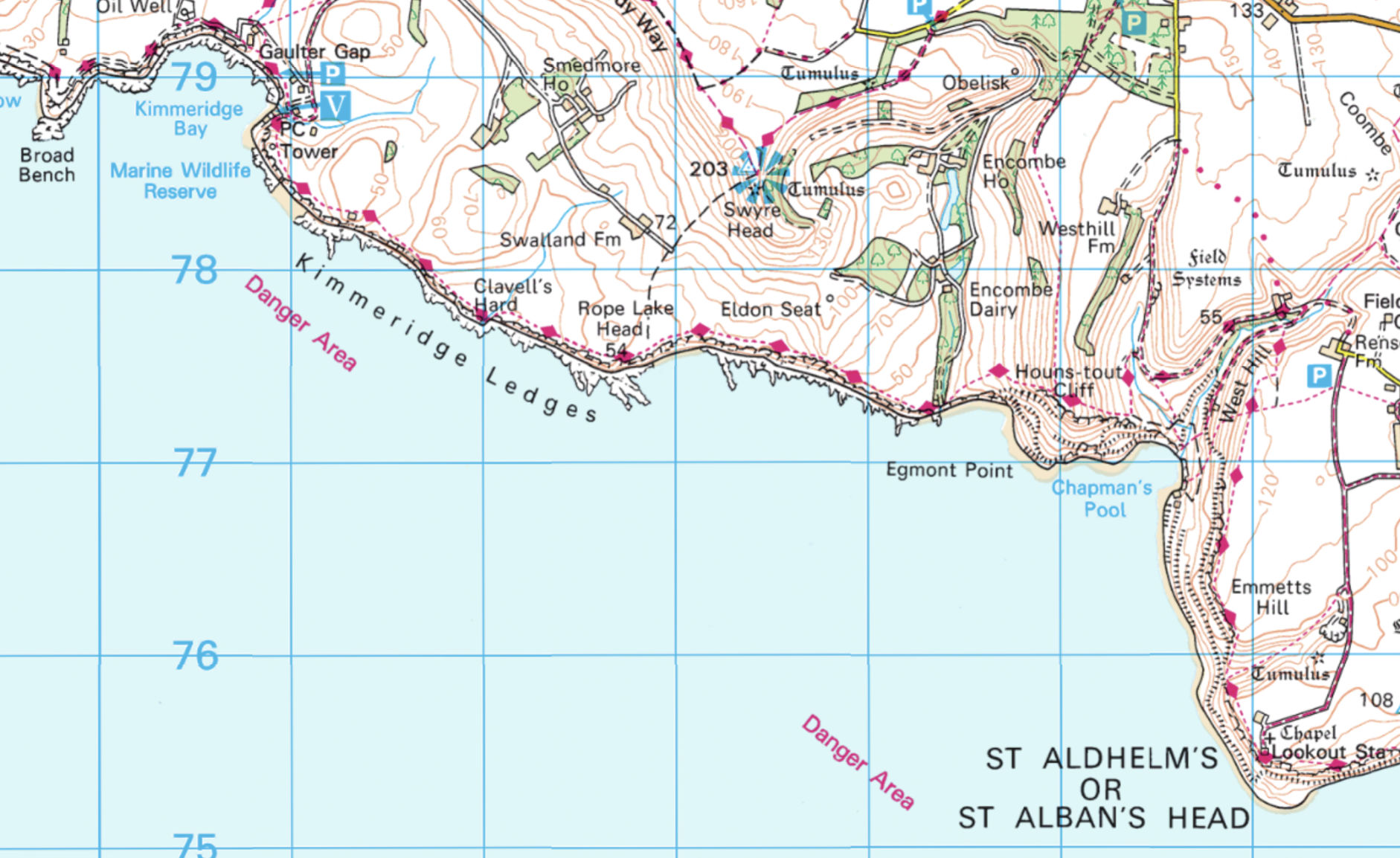
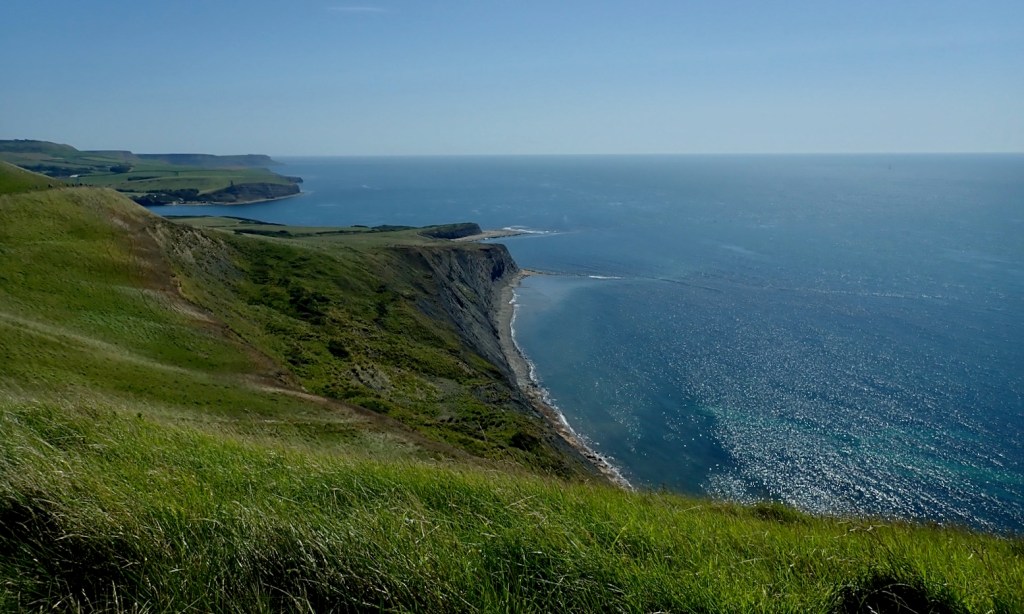
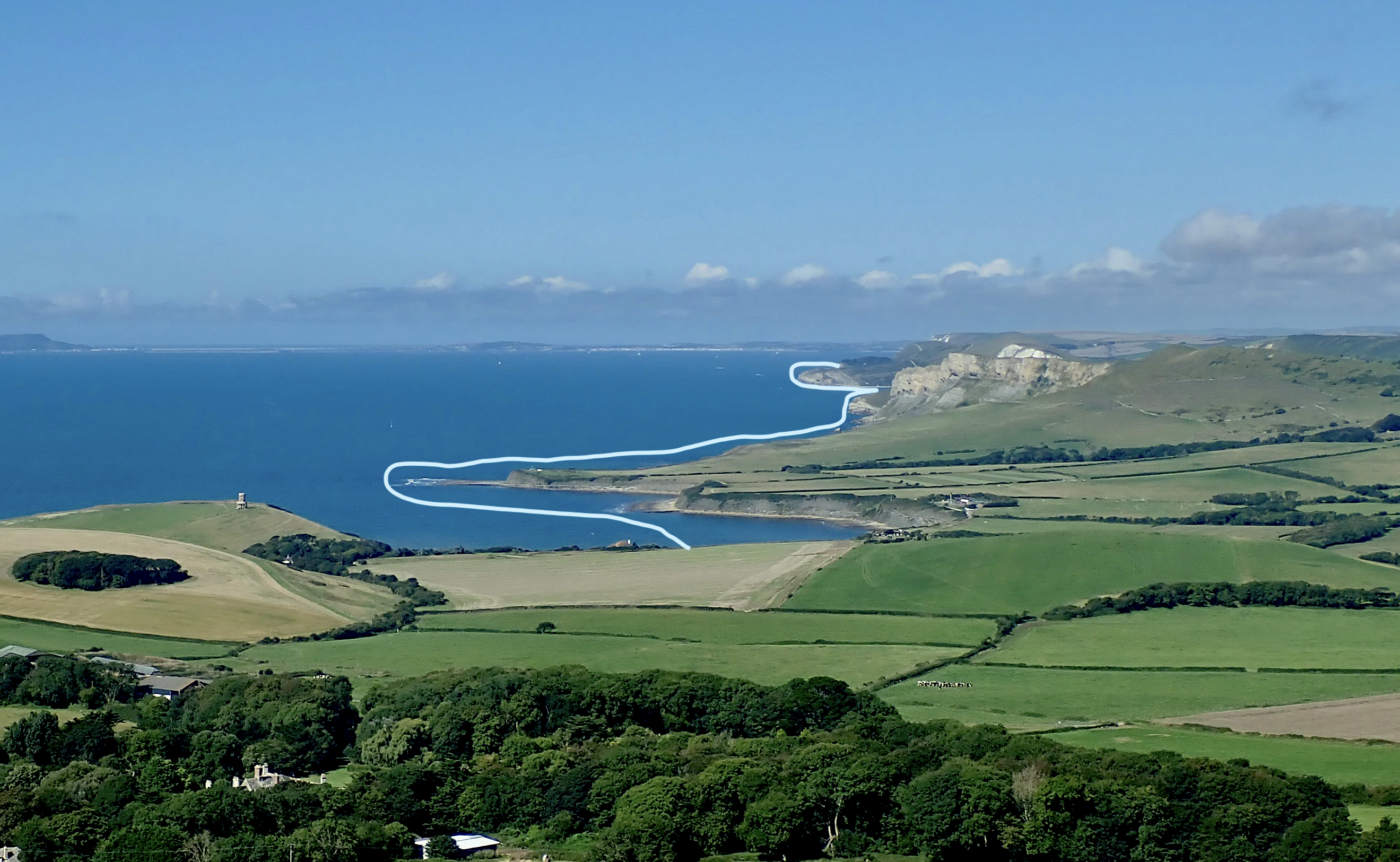
The short run between Kimmeridge Bay and Chapman’s Pool was on my pack list, part of what remains to packraft between Weymouth and Poole. St Alban’s Head near Chapmans, and Durlston Head near Swanage will need ideal conditions as there’s virtually no getting off anywhere in between, so they will have to wait.
A quick look at next day’s wind and tide put Kimmeridge broadly in the ballpark. High water 10am at Chapmans receding east, helped by a 10-12mph easterly. Ten is my self imposed limit for packing at sea so it felt a bit sketchy, plus it would be a hot walk with the boat back to the car near Kingston. It feels more than the forecasted mid-20s around here right now. I was also unsure what the Kimmeridge Ledges do in such conditions, other than force you away from the shore. It was all a bit hot for an otherwise sensible clifftop recce from Kimmeridge car park to Chapmans’ with the boat, to gauge the sea state below. I’d have to carry loads of water too, as the springs trickling into Chapman’s Pool are probably minging with farm run-off. But whatever happened, it would sure be a sporty ride to Kimmeridge clutching the sail like something out of Roadrunner.
There’s a wind in this willow
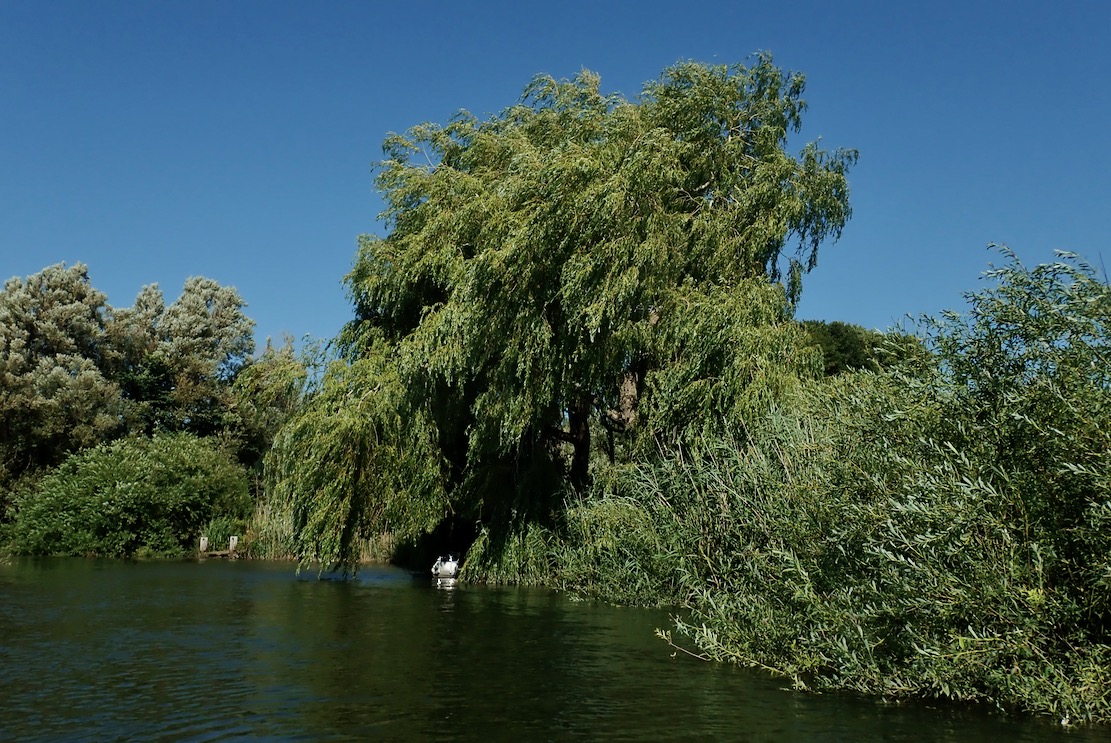
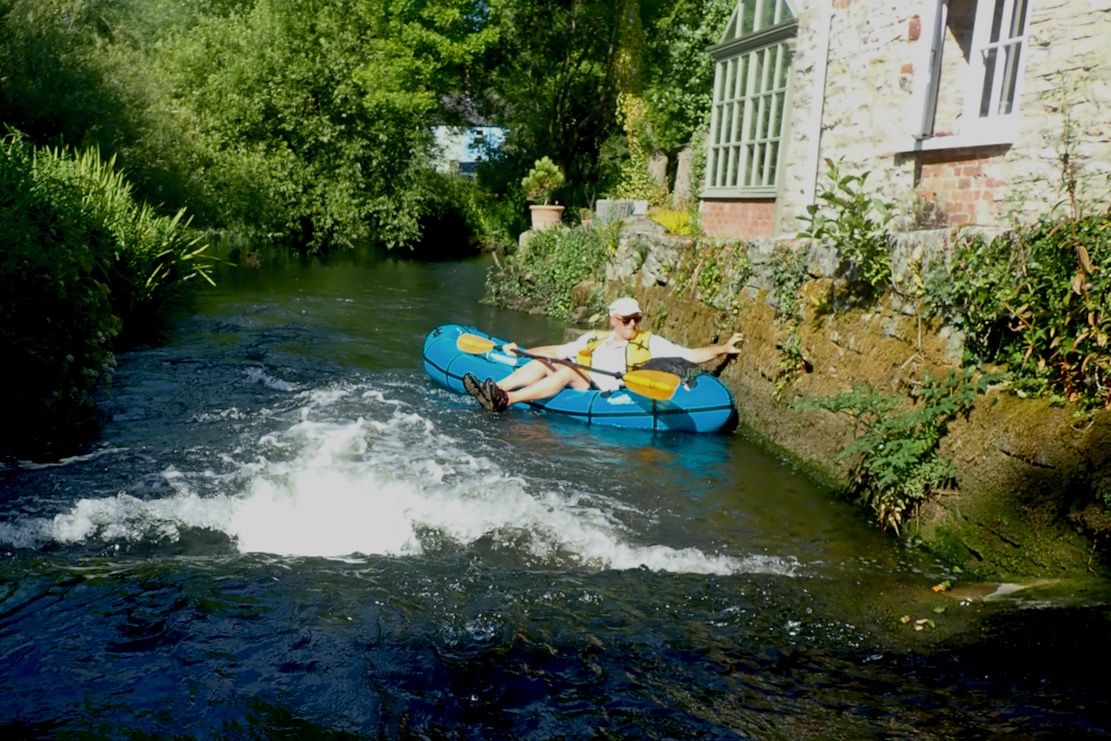
Came the early morning I let myself off and decided to paddle upriver from Wareham instead. I’ve not been up there either. I left the quayside ducks around 9am, and passing the already swaying riverside willows confirmed I’d made the right choice. Ten-12mph predictions are always more in my experience, and they say easterlies off the continent are more gusty. Six to 10 with a tide would be more like it, alone in a packboat.
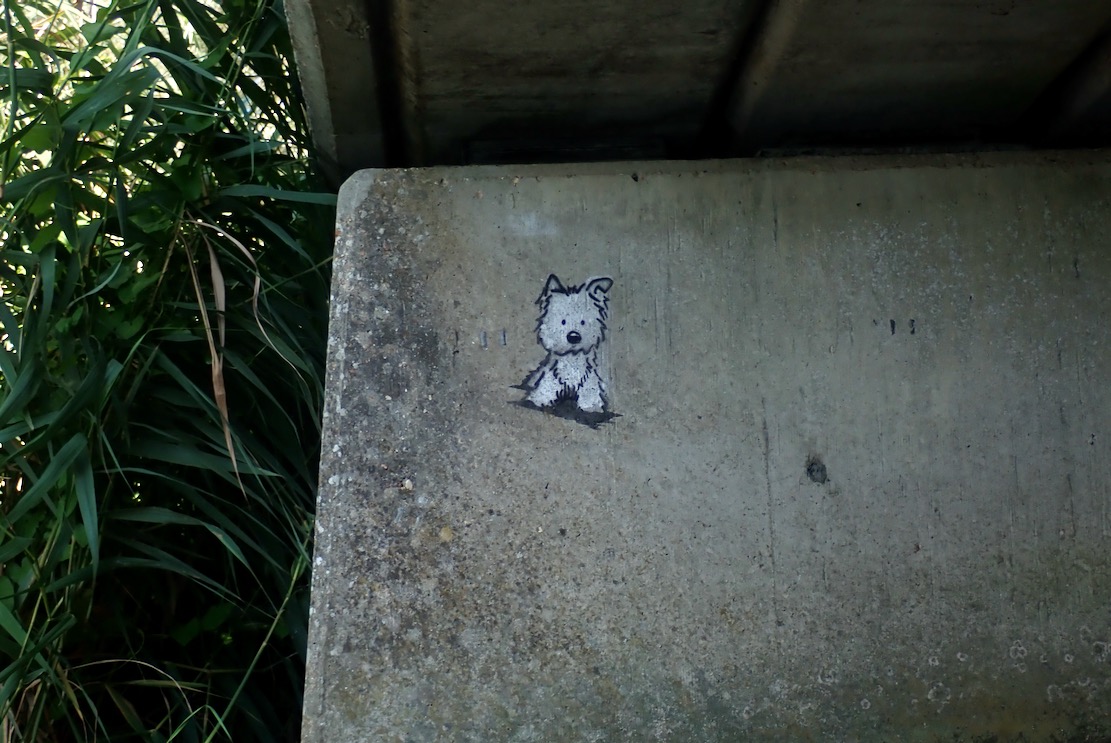
Tagged by the Wareham RiverBanksy
The Wareham tide and wind were with me and reaching the A35 bypass bridge (left) – the tidal line according to the OS map – I expected a big, ‘Paddlers Turn Back!’ sign, as rental SoTs and SuPs venture up this way. No sign, so I had an excuse to carry on in ignorance until I got either shouted at or the Frome’s current got too strong. As it was, the riverbanks hereabouts were still thick with reeds, making angling without a periscope difficult. Further up nearer Holmebridge was angling country.
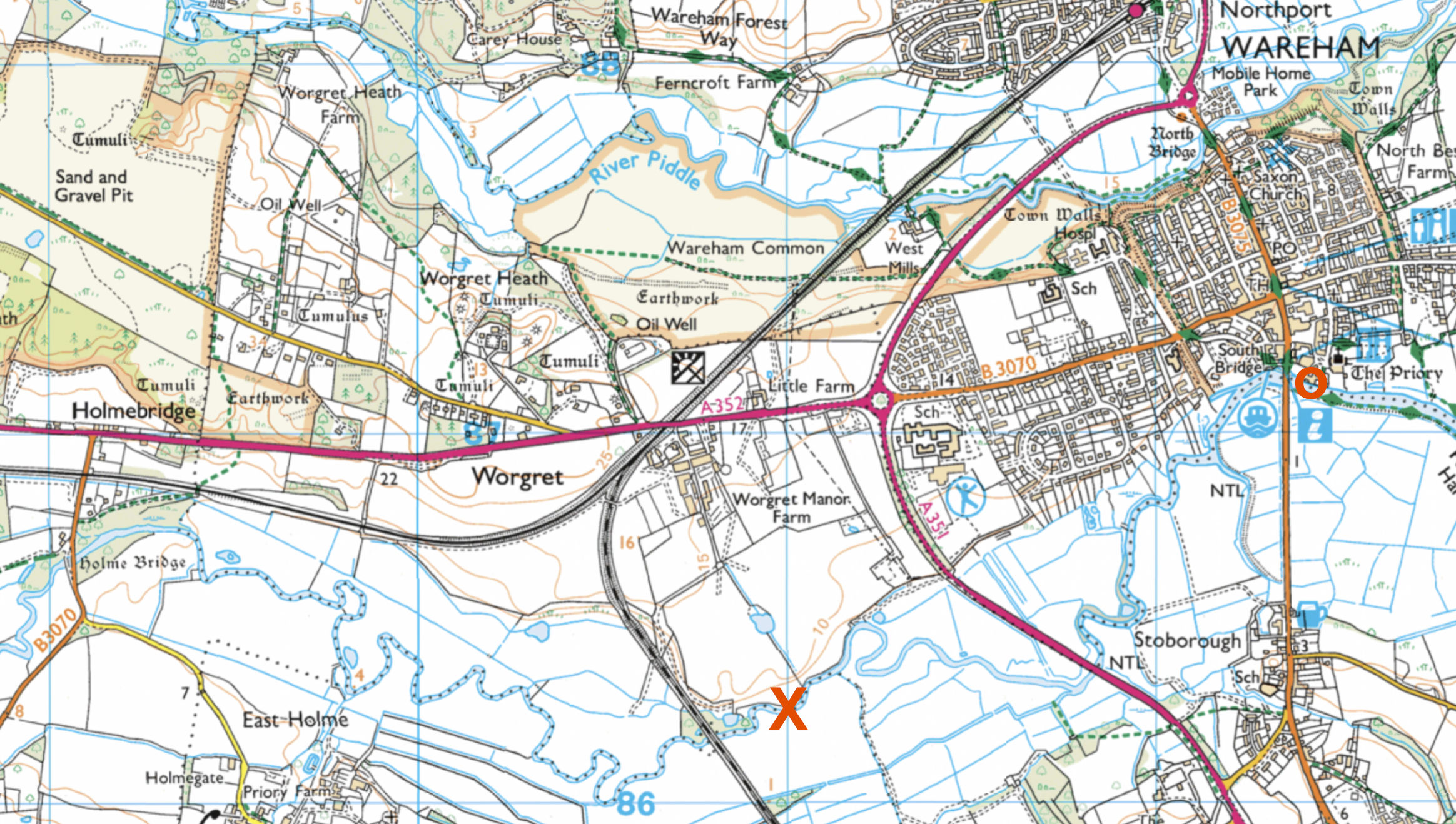
Frome meander from O to X and back to O
The river meanders like rivers do, covering double the distance as the gannet flies, so at some points I was into the wind which was now bending the trees. A good time not to be hanging onto the WindPaddle while launching from one Kimmeridge ledge to the next. Up ahead I could the vanside banners fluttering briskly at the annual Volksfest campsite (below) whose music we can hear until nearly midnight.
Turns it down, volks
I wondered if I might make a run through the water meadows to Holmebridge, but by now the incoming tide had dissipated and I was against the Frome’s rising current. That would better done as a stealthy dawn mission, but I felt I’d seen enough of the inland Frome, so I flipped round and enjoyed the cooling breeze in my face back to Wareham town.
Wareham Quay
It was a short, easy paddle so I’d not bothered checking the tides, but back home I was curious to know how Wareham – tucked right at the back of Poole Harbour – compared with Kimmeridge out in the Channel. Taking out at Wareham Quay around 10.15, the tide looked nearly full and had turned 30 minutes ago at Kimmeridge.
BBC tide
But the BBC (above right) which I usually look at first appeared to be hours out. According to their graphic (left), after I got out at 10.15 the river would rise another 800mm in the next 3 hours, flooding the quayside carpark a foot deep! tideschart.com, which I also refer to, showed identical times for anywhere in Dorset, so it (or my computer, or as likely, me) needed a cooling drink in the shade. I deleted tideschart.com bookmark and found dorset-tides.com (above left) which gave a more plausible Wareham High Water about 90 minutes away (11.46). These are all BST, but this is the first time I’ve noticed such an anomaly. Both claim to use the UKHO. Only the BBC matches UKHO data, while seeming to be way out on the water. Today is the peak of the spring tides and maybe the east wind pushed Poole Harbour’s mass up the Frome a bit more than normal, but that’s not what a tide table can predict. Meanwhile I wait for a fair wind at Chapman’s.
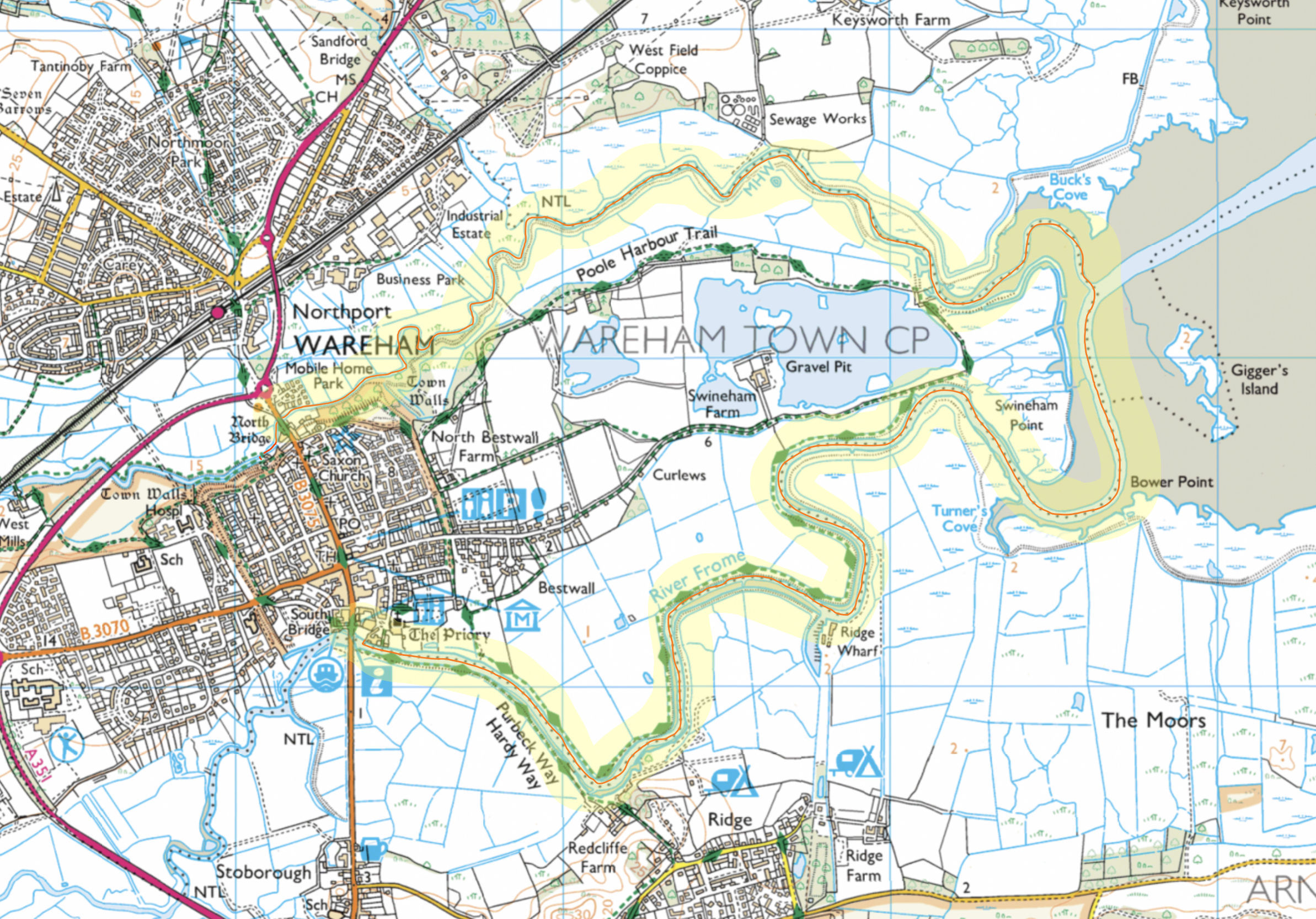
You do one paddle in two years then do two in a row. Honestly, you could not make this up! Take the Saxon walled town of Wareham – wrested back from the beardy Viking hordes by King Alfred in 875. It sits snuggly between the tidal reach of two rivers: the Frome to the south, and the smaller Piddle (aka: Trent) on the northern edge. East of Wareham there’s a Two Rivers Walk which more or less replicates this paddle: down one river and up the other. I’ve paddled up and down the Frome loads of times. In fact 20 years ago last week I wobbled along the Frome in my very first IK – an early Gumotex Safari (left) that was tippier than a hog on ice.
The Piddle flows below the northern remnants of the old Saxon walls, and I’d long assumed it was clogged, weir-ed, patrolled by angling militias or otherwise inaccessible to the recreational paddleur. Not so, said our paddle-boarding builder who ID’d a put-in near the pre-Norman church of St Martin’s on the Wall, the oldest in Dorset. I recall checking it out in the 1990s while updating a UK guidebook, looking for the tomb-like effigy of T.E.Lawrence (left) who was died on his motorbike up the road at Bovington.
We walked down a private drive/footpath to North Mill (above; a self-catering) and put in by the brick bridge (left). It felt like their front garden, so next time I’d cross the bridge through the gate and put in somewhere on the north bank. It’s a brambly, 3-foot drop either way into the swift but foot-deep Piddle. Piddle is of course a Naughty Word, so I should not bandy it about, willy-nilly, but in the ancient Saxon dialect of Dorse, it means a small stream. Along its upper course, several west Dorset villages: Tolpuddle, Affpuddle, Piddlehinton Puddletown, Mein’dapuddle and Piddletrenthide, take their names from it. (Test: one of those names is made up).
We left about 4 hours before HW at Wareham so we’d be against the tide (and a SE wind) as we neared Poole Harbour, but later have both at our backs as we heaved wearily up the Frome back into town.
Below the bridge the old mill weir was easy to walk down (to spare the skeg). It’s not always so; sometimes the water meadows here get inundated. I bundled in and held on while the Mrs caught up. Once in the boat we felt like kids wearing oversized trench coats. I’d forgotten that when not using the Multimat floor (which makes less space inside when two-up) you inflate the seat bases right up. That done, we navigated down an overgrown channel, dodging overhanging branches and other rampaging midsummer verdure.
Soon we passed under Wareham North Bridge and its famous 18th-century sign strongly discouraging bridge vandals with a life sentence to Botany Bay.
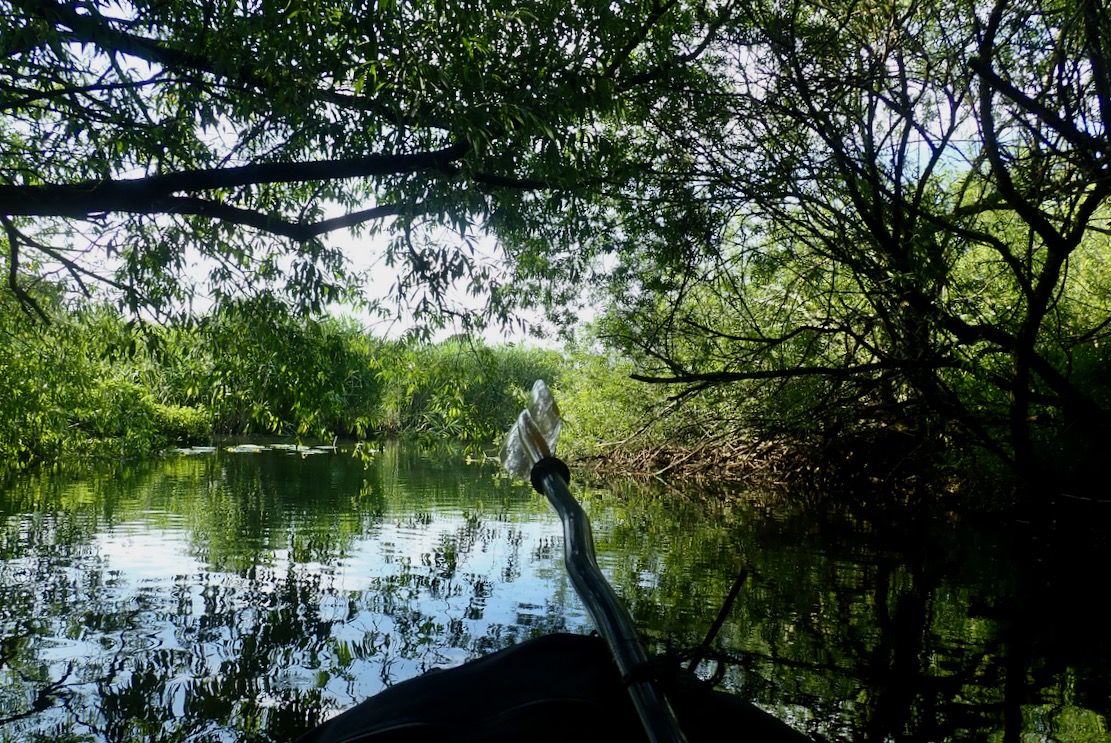
We paddled through a hidden world of drooping willows and silent lilies. At times it all closed right in and we were pushing and pulling through the dense overgrowth and branches, while getting pelted by dropping insects.
The detritus of bawdy summer parties.
Gradually the Piddle opened out. Somewhere around here we reached the tidal reach and entered a dreary, reed-lined corridor. The pace slowed down as tide and wind pushed against us.
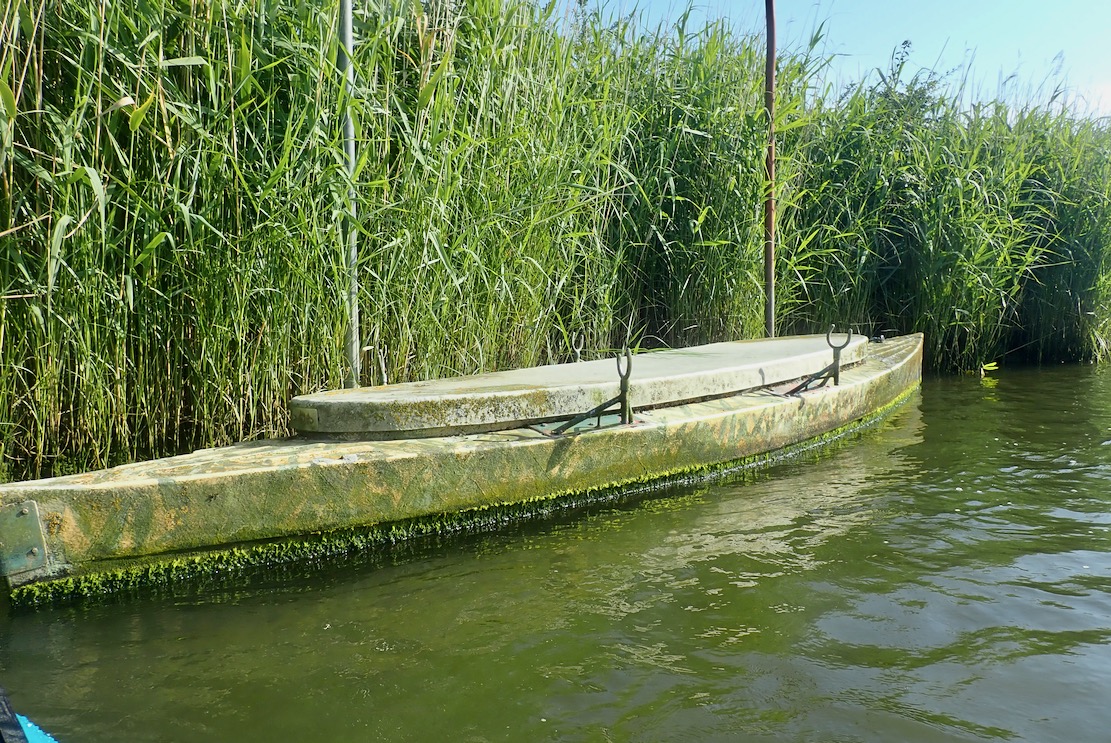
Near Poole harbour a few of these old rowing canoes caught my eye. They looked like something left over from D-Day training. Or maybe just long unused fishing club water craft. Anyone know more? Waterfowl punts I hear from the back.
Out in Poole Harbour the water was less than a foot deep so we aimed for the red and green deep channel markers leading south to the mouth of Frome. Up ahead, the Arne peninsula. We turned into the Frome and the long hack back inland began. Even with a backtide, the Frome meanders to all corners of the compass so at some points you’re into the wind. Thick reeds to either side make you wonder how you’d get ashore if the call to abandon ship was announced.
A nice red boat – a sloop perhaps?
Paddling onwards, energy levels were also beginning to sloop, but we finally pulled in at Wareham Quay where early evening revellers were feeding the ducks. Originally bequeathed to the town by Alfred the Great following his expulsion of the Norsemen, a Purbeck legend has it that should the ducks ever leave Wareham Quay the kingdom will fall. It was fun to try something new, but we’d not rush back to do the Wareham Two Rivers Loop.
Down the Piddle, into Poole Harbour and up the Frome to Wareham Quay. 8.5km and about 3 hours
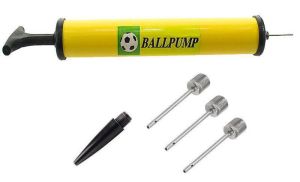
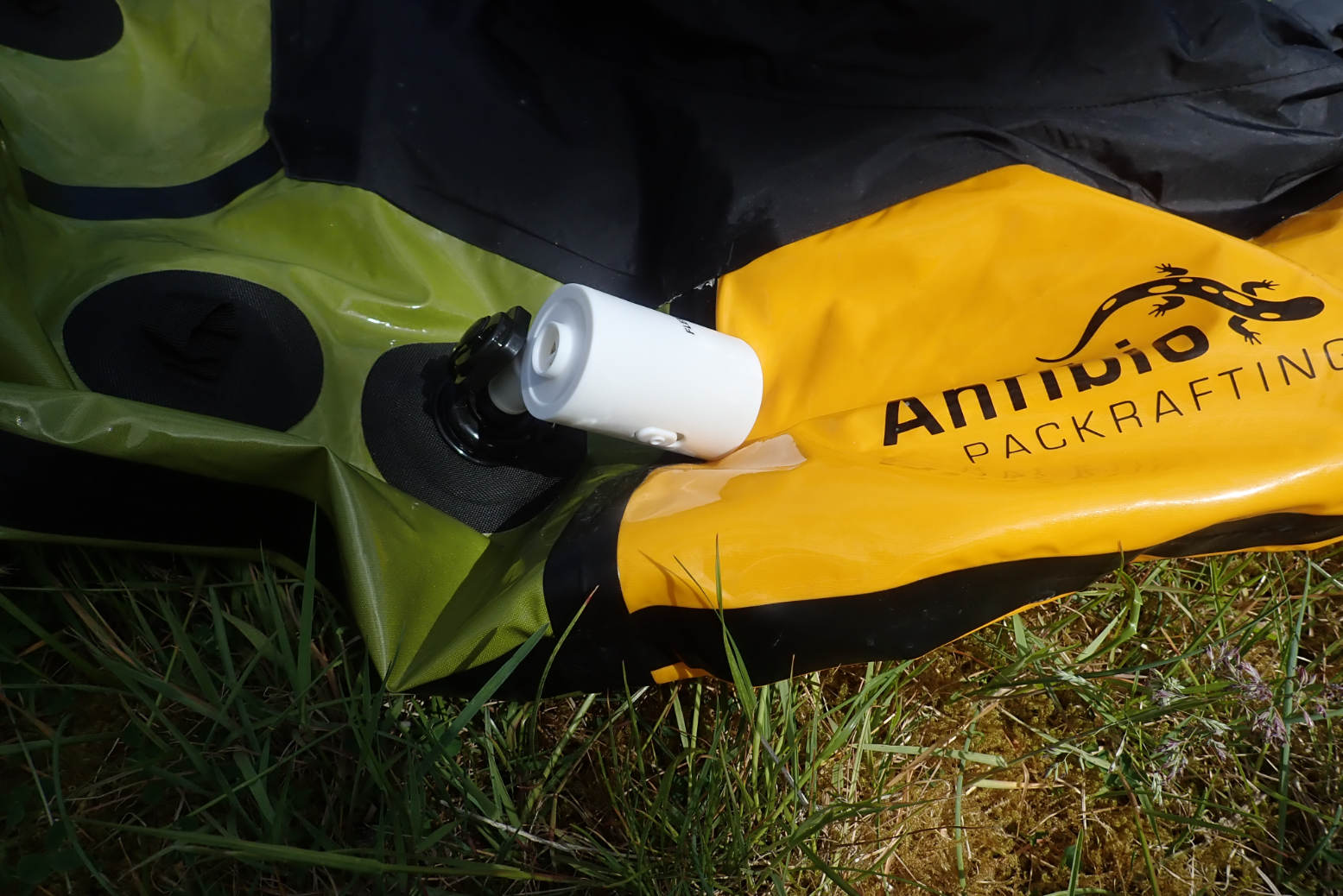
Back home disaster struck me down. As anticipated, my Anfibio handpump’s vulnerable handle snapped off in transit. Anfibio revised the pump by making a screw-off handle (below right), but mine was the old type. A new one is £15 posted in the UK so I bodged mine by simply gluing and cable-tying the hose directly to the shaft, then adding a bit of garden hose to make a hand grip while pumping. Assuming it lasts, it ought to be much less snap prone. You can’t buy this type of balloon pump on eBay any more, but I found a smaller ball pump for 6 quid (left) which could be as good with the black adaptor modified. We shall see. Every inflatable needs a pump or two.
Snapped handleMk2 version with unscrewablehandleBodge. It didn’t last. I surrendered an bought the Anfibio screw-on, top right.
A recent picture on BBC News of David Attenborough plugging his new Ocean film (or lamenting the ravaged state of the seas) reminded me that the dramatic Swanage Pinnacles and arches are just down the road. Having paddled just once last year, this would be a good first paddle to break in the shoulders. Last summer got nixed by a big book job, which was tackled full-on and did in my back for months and months – all compounded by finally catching the Covid (or so it felt).
Ballard Point
As beach towels and brollies were getting unfurled, I unrolled my boat and left Swanage Bay (above) at the bottom of the tide. It would carry me north against a light breeze that would flip and get behind me around noon. But setting off towards Ballard Point (left), the TXL was all over the place, handling like a 1psi vinyl bath toy. Had I forgotten how to paddle straight in the last year? I groped under the stern with the paddle to see if it clanked against the skeg. Either I missed it or it wasn’t there.
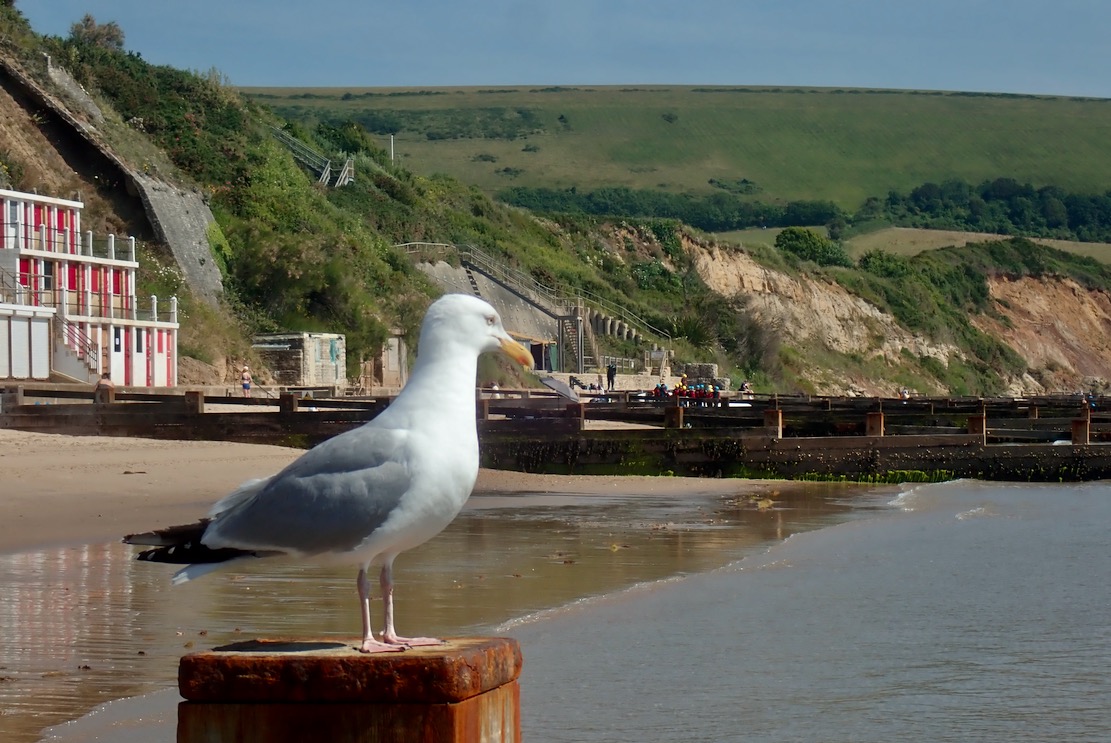
Back on the beach, sure enough – no skeg; probably dislodged while putting in. This happened once before, landing on a rocky ledge where the fore and aft of the shallow surf saw the skeg slip its mount. After that I wrapped it in hi-viz tape. I couldn’t see how it had happened today on a smooth, sandy beach, but I spent the next 40 minutes wading up and down, juggling estimates of longshore drift with onshore breezes, but unsure exactly which of the 20 Swanage groynes I’d set off from. I finally accepted the skeg was MIA: some errant doggie must have snapped it up and rushed it back to its bemused owner. Drat – and I’d paid for 6 hours parking too! I went for a swim anyway, ate my sandwich, then packed up while a beaky seagull dryly observed the lambent folly of human endeavour.
Look for my Skeg, ye Mighty, and despair!
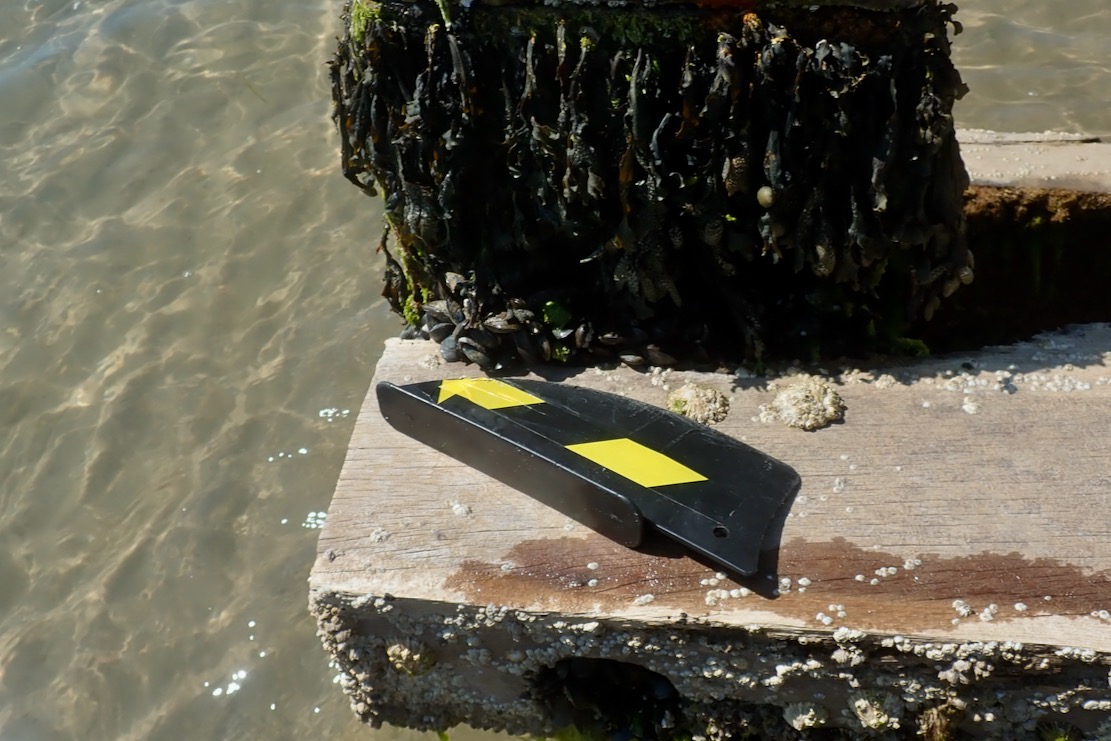
Heading back, I recognised a little sandcastle I’d passed on my way down to the shore, all of 2 hours ago. Was it here I put in? I wandered back to the nearby groyne on the off chance, but soon got distracted by the flash of some sunglasses. I waded round the end of the groyne to pick them up and there sat my skeg! Like a lost desert traveller expiring just one dune short of a palm-ringed oasis, my search had been one groyne short. Saved by a thoughtful beachcomber, I grabbed my skeg and left the shades: this show was back on the water ;-)
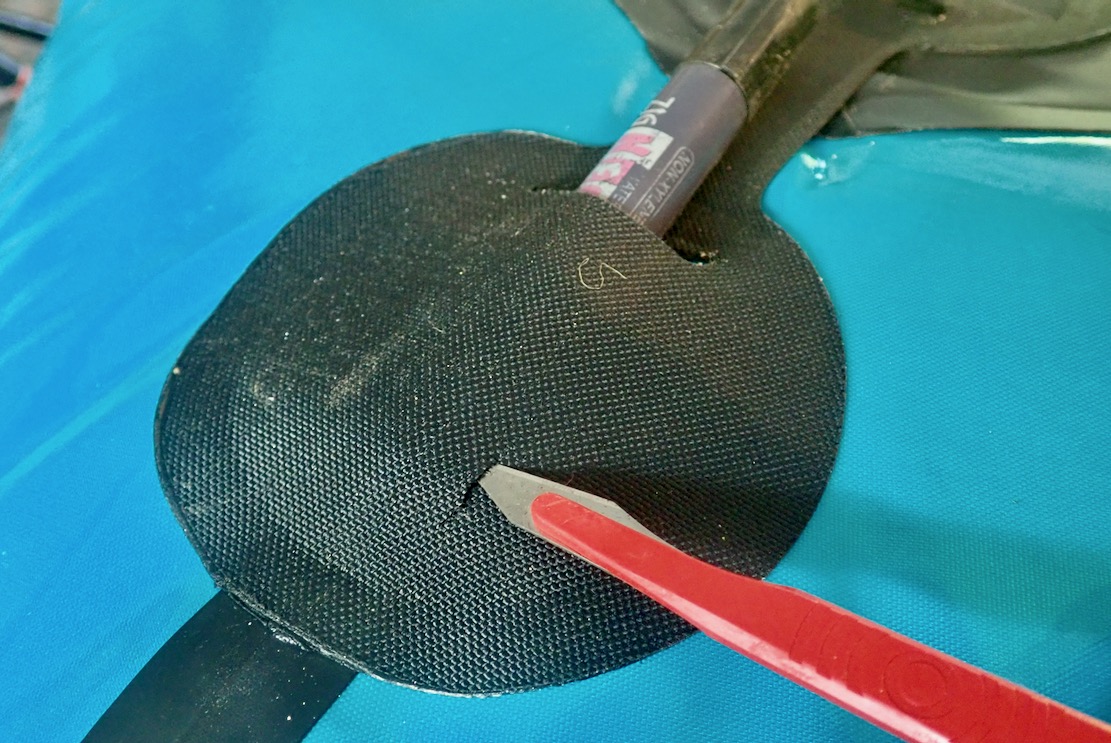
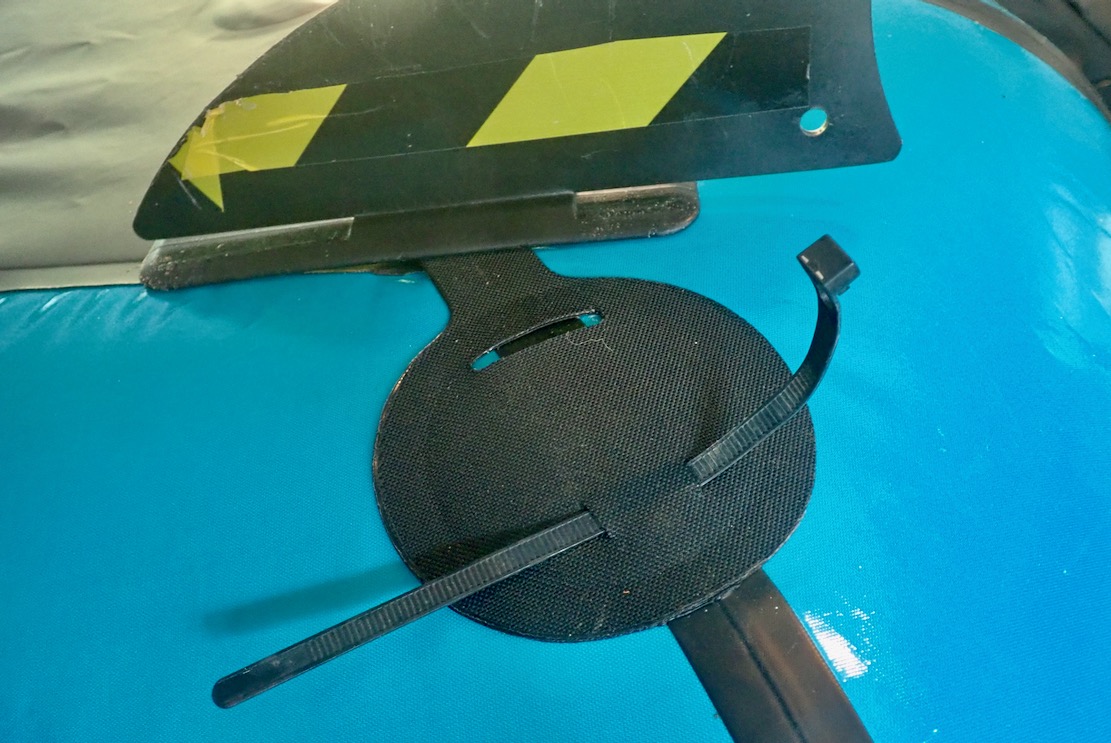
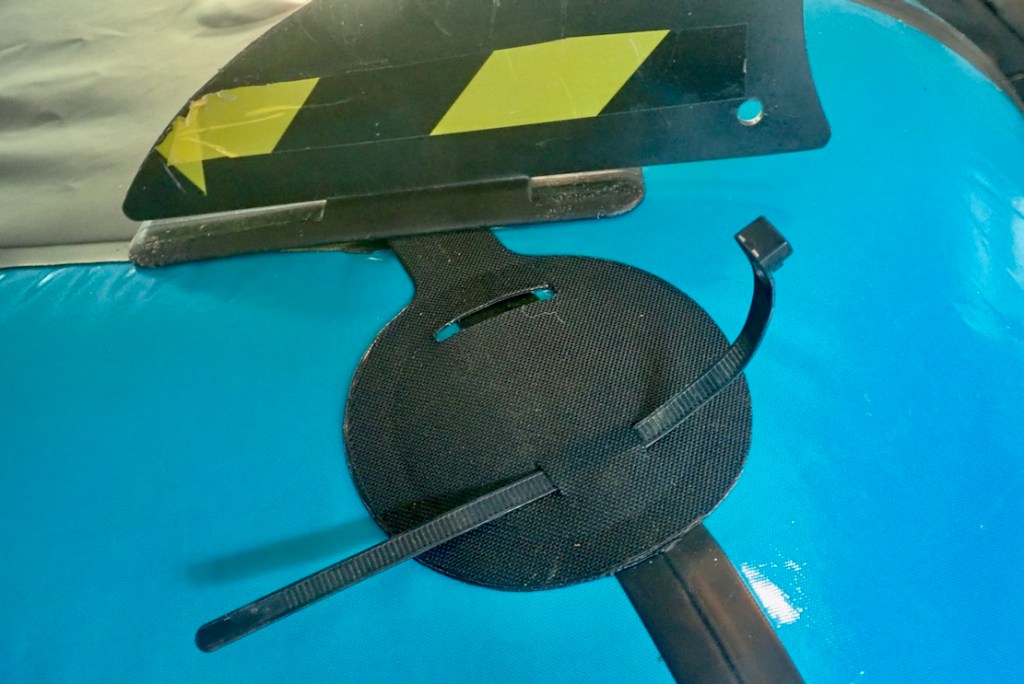
Don’t lose your skeg The lack of tension, even once inflated, can dislodge an Anfibio skeg following a small fore and aft movement of the hull pressing on the sea- or riverbed. On a flowing river, skeg-free is not so bad and you might need the clearance anyway, but at sea you definitely want a skeg for good tracking. Here’s one solution. • Stick something like a fat sharpie under the rear skeg patch to lift the fabric away from the hull; you don’t want to stab your packraft • Make two incisions which line up with the hole at the back of the skeg • Feed a reusable cable tie through the slits and leave it in place. The skeg will now be secure
CutThreadLock
Skeged up, the TXL sliced NE towards Ballards Point like a troupe of dolphins late for the ball. I was sitting on the optional floor inflata-mat, which stiffens the long hull, reducing drag). Edging towards the Point, I could feel the boat slowing down against the eddy hooking back southwest into the bay (left; LW+3). Passing over the corner some clapotis (below) was jingling about, pushed up by the eddying current.
Once round the corner, with the wind and tide now behind me, I was expecting record speeds. As usual though, with a backwind you lose the ‘wind-in-your-face’ impression of speed, which can be quite dissatisfying. To my right, jet-skiers were thrashing about, making me feel uneasy. Paddling quietly along, it’s hard not to feel intimidated, far less any aquatic fraternity towards these wave-jumping motocrossers. The sooner they all go electric the happier we’ll all be. But either way, I bet they’re a blast to ride!
Awesome!
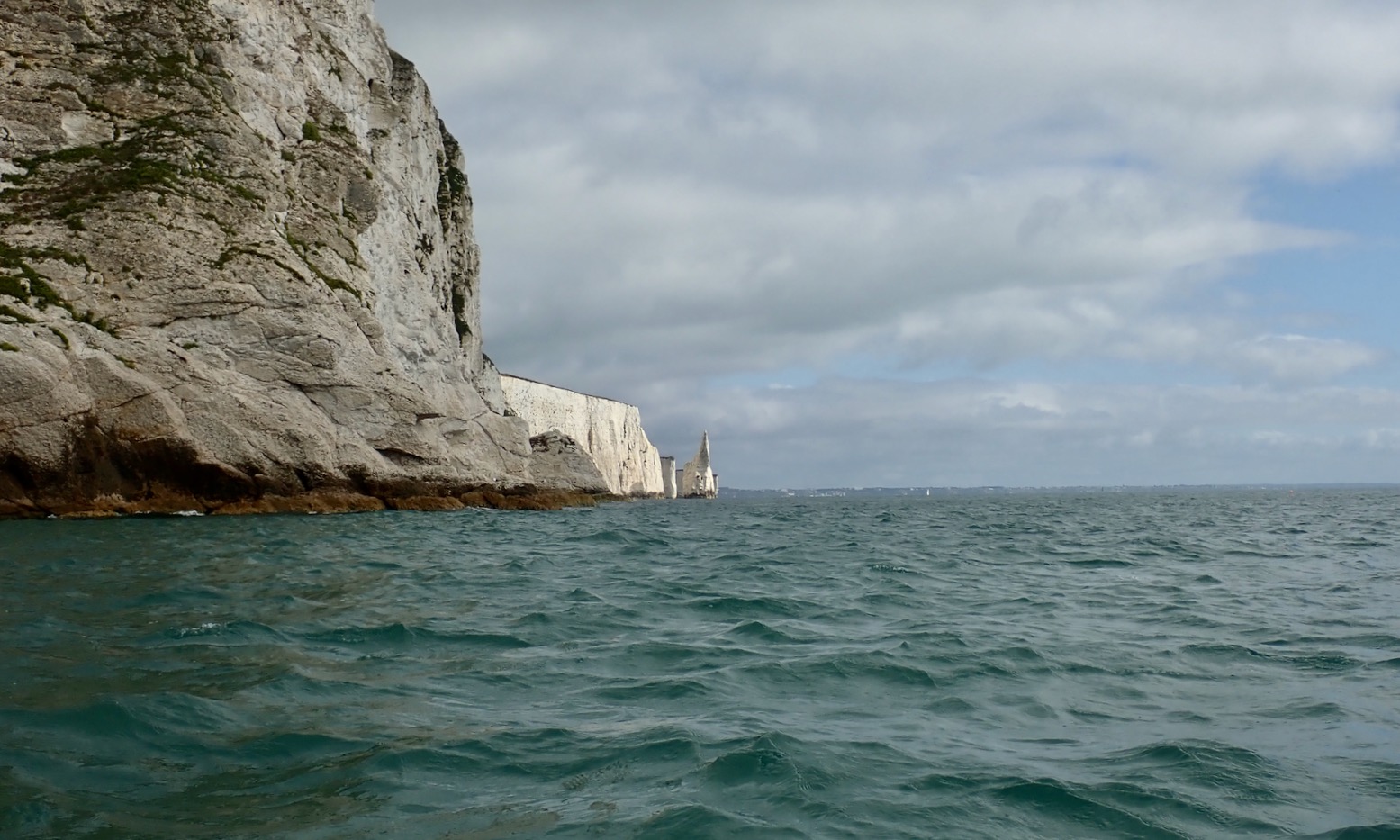
Up ahead rose the oddly nameless Jurassic fang, seen behind Attenborough at the top of the page. All the other outlying pinnacles hereabouts are flat-topped. When you work out the thin rib of chalk where they got DA to stand to get the shot, you’d hope there was an unseen safety line securely attached to Britain’s most treasured national. As I passed between the fang and the cliff wall, a gust shoved me through, and I saw later the GPS had hit a dizzying 9kph.
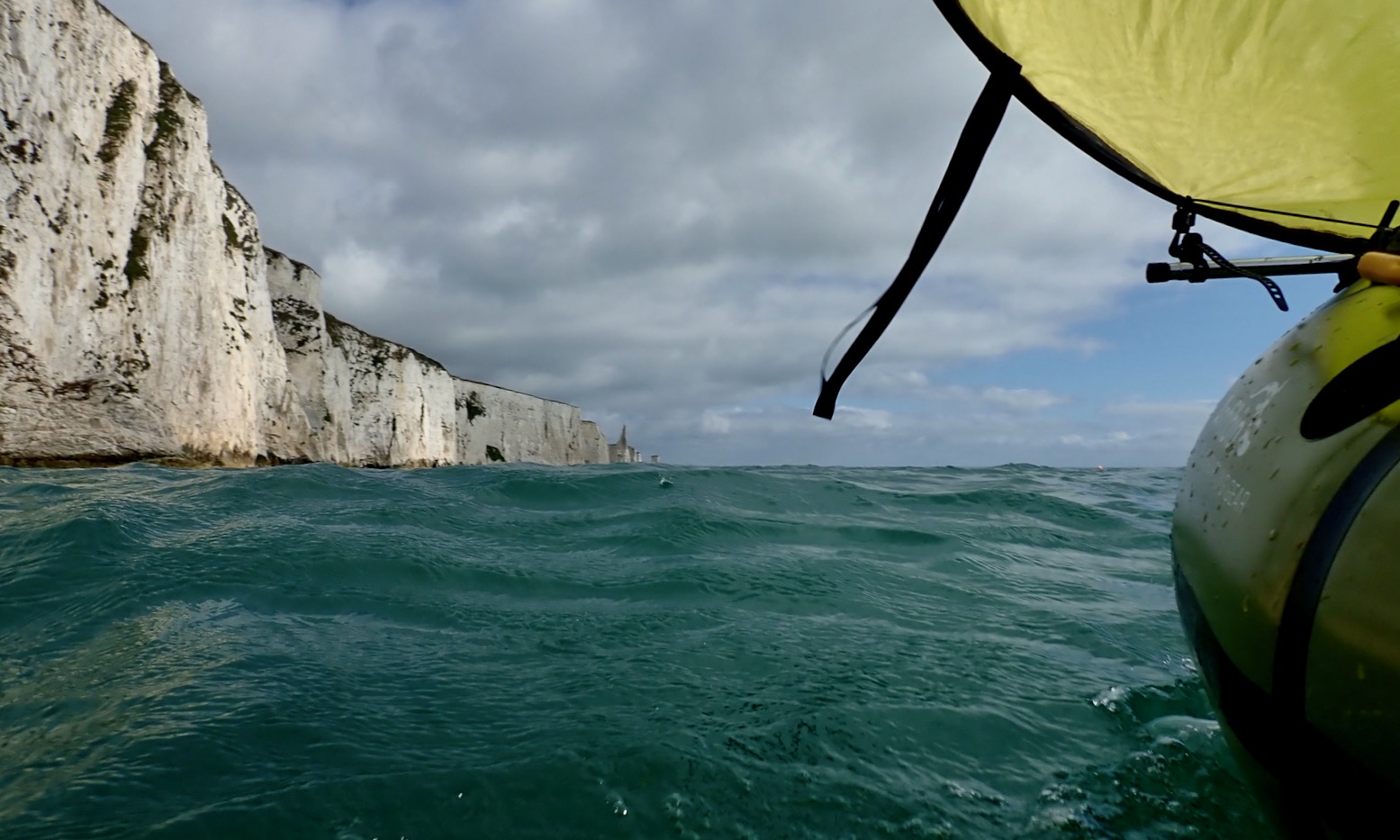
Beyond lay the first of the chalk arches which make this paddle so special, and why it got featured on the title page of my IK beginner’s guidebook (below). At the first small arch the wind bounced me back off the high walls, then whooshed me through the calcified portal like a popped cork. On the far side some paddle-boarders out of nearby Studland were taking a break on a tidal ledge.
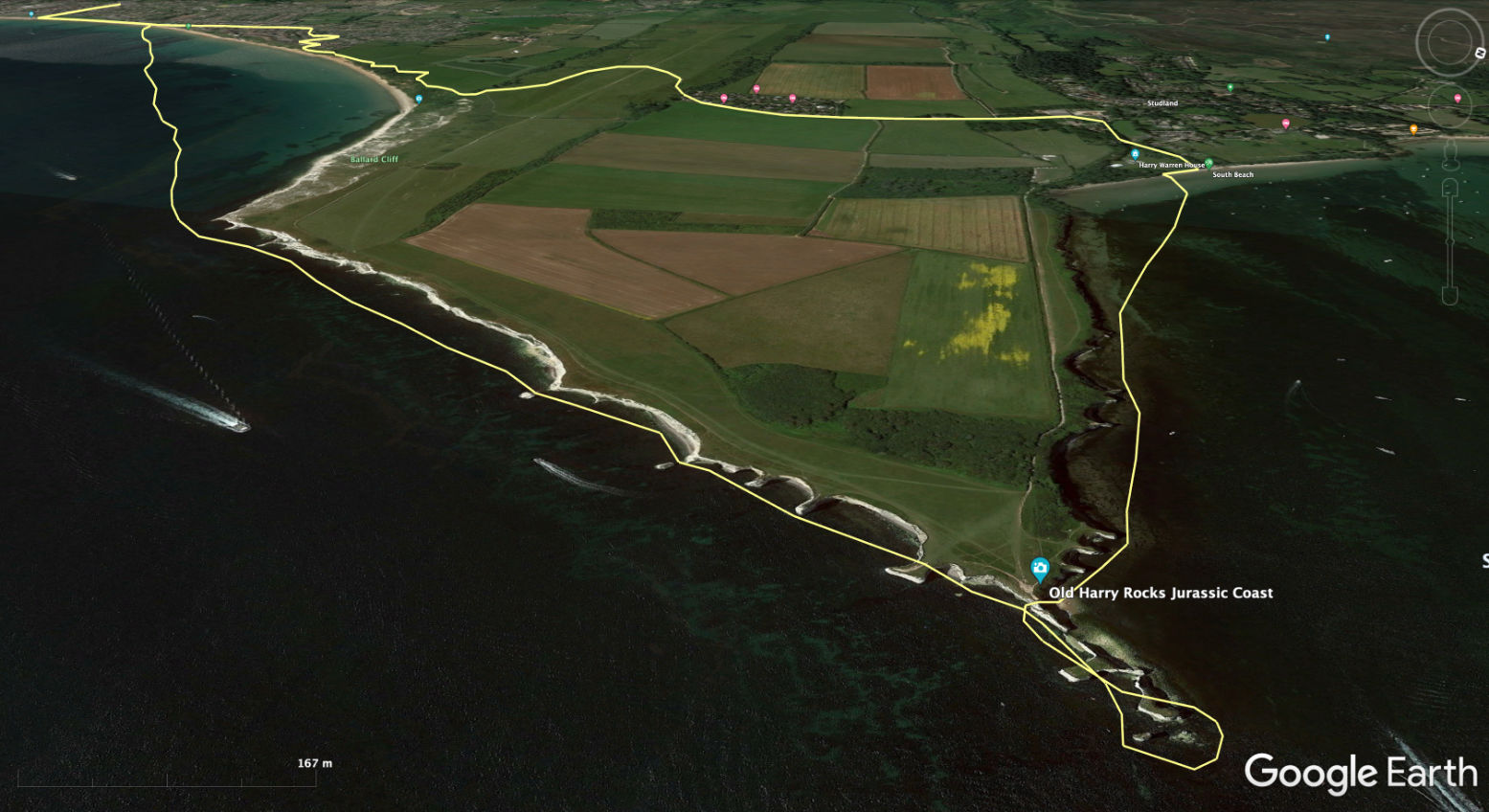
With the tide about halfway in, I threaded the passable arches around Old Harry’s (above), while other paddle sports enthusiasts milled about at the geological wonder of it all and from the cliffs above, walkers looked down with envy. Once round the corner and in the lee of Ballard Downs, all that remained was to head west for Studland South Beach and pull the plug.
Convincing
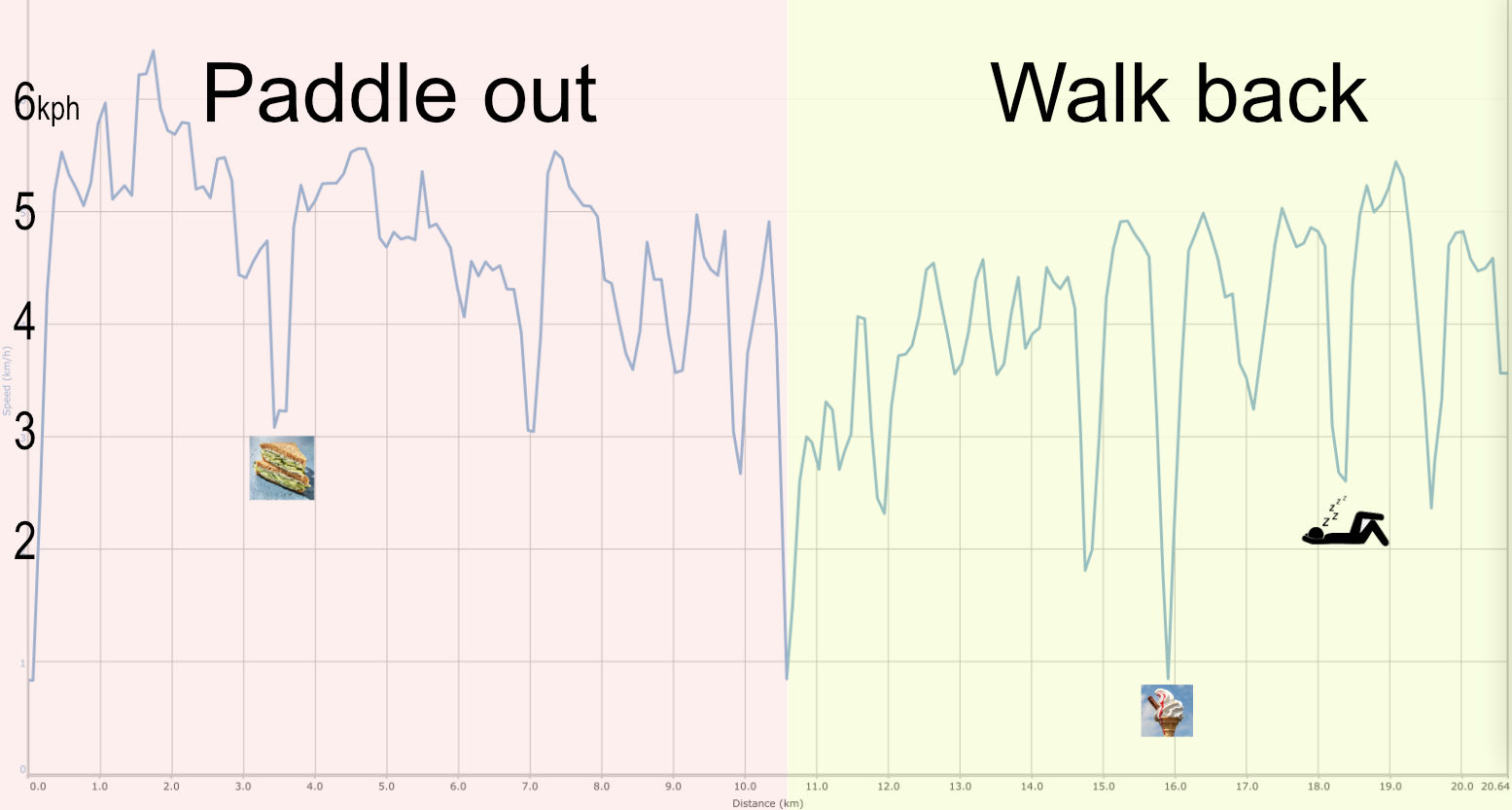
With a bit of energy to spare and nothing to lose, at one point I put my head down and powered on to see ‘what she’ll do [mister]’. The GPS data log revealed a blip from a steady and sustainable 5kph to a limited-endurance 6kph, which would soon drain the batteries. Six kph must be the maximum hull speed of a TXL on near still and windless water. Better to save such efforts for unwanted offshore headwinds. Even then, looking at the data below, I’m again amazed what a portable raft which you can easily pack up and walk with anywhere will do on the open sea. ISuPs may be loads more popular, but to paraphrase former Met Police commissioner, Robert Mark, ‘I’m convinced packrafts are a major contribution to paddle sport adventures’.
Fast
On South Beach oiled-up heliophiles were laid out like seals. It reminded me of a radio doc about boredom I’d caught the previous evening. In an experiment, apparently 70% of males preferred to self-administer a light electric shock rather than sit still in an empty room for 15 minutes. They should give them a sun bed next time, but perhaps I’m missing the point.
I could have walked back the couple of miles over Ballard Downs to Swanage, but what with the time wasted on the skeg search-and-rescue mission, I didn’t want to risk getting back late to the parking before something terrible happened.
So I treated myself to the 20-minute open-top #50 bus ride back to town.
All together now: We’re all goin‘ on a Summer holi-day…’
It’s less than two weeks to the autumnal equinox, but at nearly 33°C, today will be the hottest day of 2023 so far. It’s been over 30 for days now so you do wonder what it’s going to be like in 5 or 10 years time. More sea to paddle, that’s for sure. Today there’s barely a breeze; a fine day for a 10-km paddle around Beachy Head and the chalk cliffs of the Seven Sisters to Cuckmere Haven before walking back. I’ve had this one on the list for years as an IK trip. Today is the day, but with a packraft.
Tottering on Safari, 2004. Does my body look big in this?
It was Christmas Day, 2004 that I took my first ever IK for a tentative spin on the Cuckmere estuary and thought: shite, what have I done! The used Gumotex Safari was tippier than a one-legged stool and meandered more than the Cuckmere river itself. Luckily it was mostly the boat, not me. I soon swapped it for a Gumo Sunny and never looked back. No worries about stability today. In the intervening decades packrafting got popularised and I’m trying out my new Anfibio TXL+, the length and width of a patio door.
Down in Eastbourne the forecast was a moderate 25, but at 8.30am it felt like that temperature already.
I cheat by putting in at the westernmost end of Eastbourne, a south coast town associated with genteel retirement homes. A neap tide is two hours into its ebb and light easterly winds were following it.
Looking for possible traps, I found a 15-year old kayaking report with pics of offshore breaking waves. I study a marine chart and am none the wiser, but realise that, like the Jurassic Coast, submarine ledges (or wave-cut platforms as I recall from geography) are a fairly normal thing off the South Coast, and breakers will move in and out depending on tide heights and the wind.
As I put in a swimmer bobbed up from the depths and asked: ‘Is that one of them Blowie things?’ I’d not heard this expression outside of the fly-ridden Outback. ”ow much do they cost, then?’ I delivered the fatal, four-figure Euro-sum. He dipped back down and slinked away like a seal. Another paddleboarder is born.
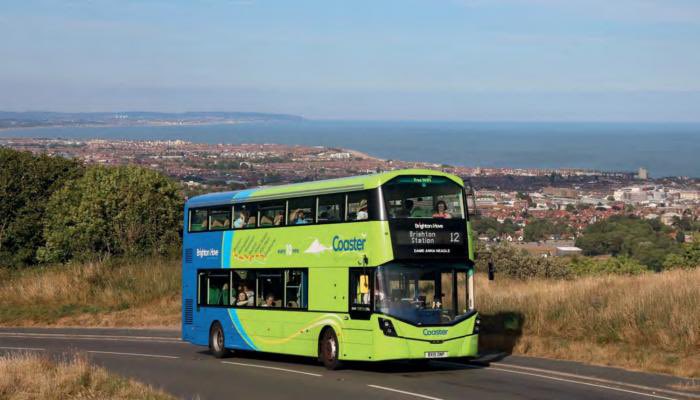
Initially the TXL+ feels dog slow – an unseen back eddy off Beachy Head? I now know it will pass so I keep going. It’s unbroken cliffs all the way to Cuckmere with one exit halfway at Birling Gap where a staircase climbs up from the shingle to a car park and cafe. I can take out there, and if I’m knackered at Cuckmere, there’s the scenic bus 12 every 15 mins from nearby Exceat. There’s also an option to carry on all the way to Land’s End then ride the back of a whale to the Azores.
Sea kayakers coming in. They don’t have to carefully plot trips around tides and winds and bus routes.
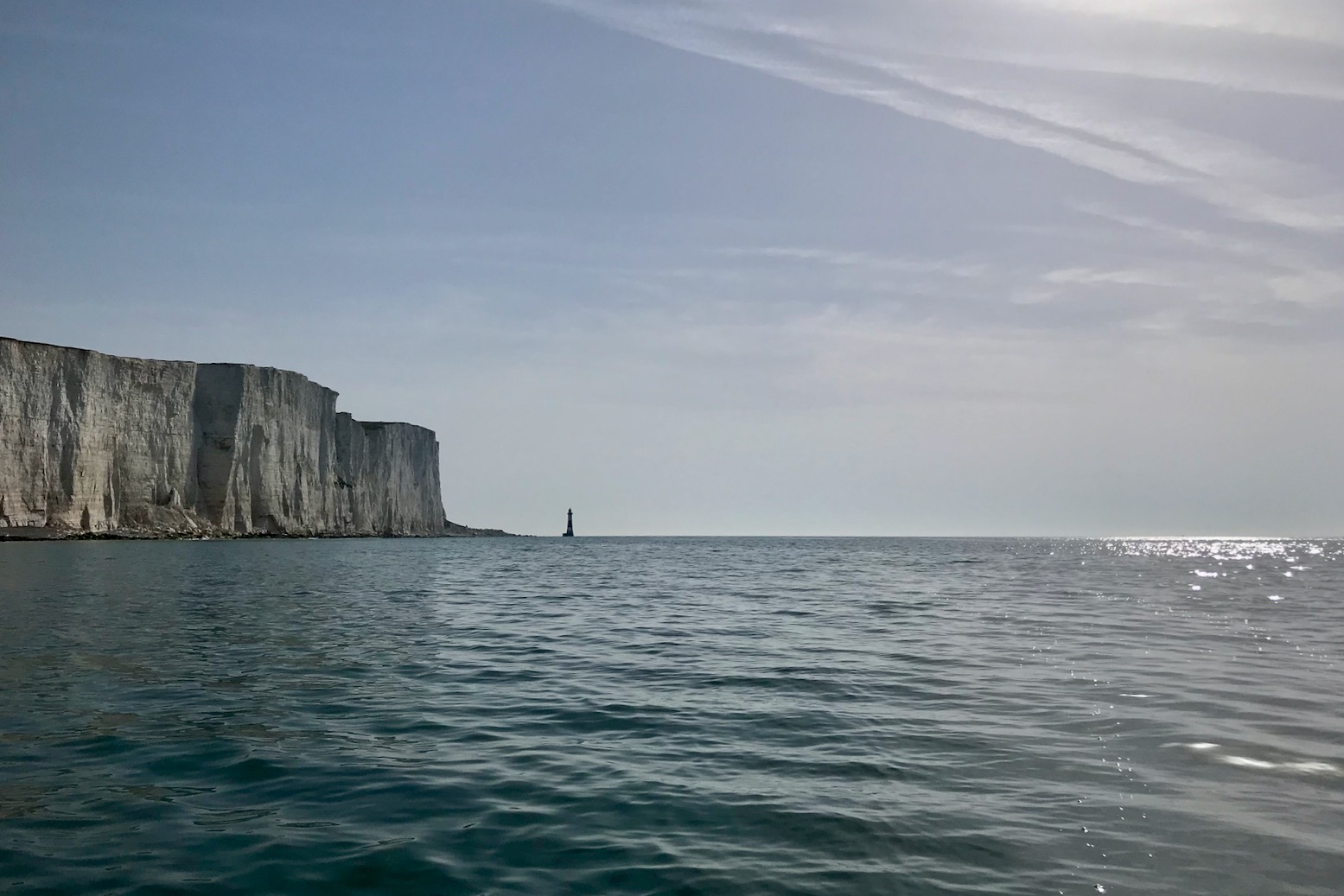
As I round the corner towards Beachy Head the impression of speed picks up as I join the westward stream. Up ahead the lighthouse, but before it some breaking waves on Head Ledge. White breaking surf is easy to see on a day like this, but you still need to keep your eyes left for bigger swells which rise up out of the blue.
The children’s book outline of Beachy Head lighthouse alongside the highest chalk cliffs in Britain (162m; 530′). I gave up trying to find taller chalk sea cliffs anywhere in the world.
Round the corner I pull in for a yellow-label sandwich. Something about the sunshine, warmth and the gleaming white rock makes the way ahead less intimidating. I remember feeling the same in tropical Australia in much less calm conditions.
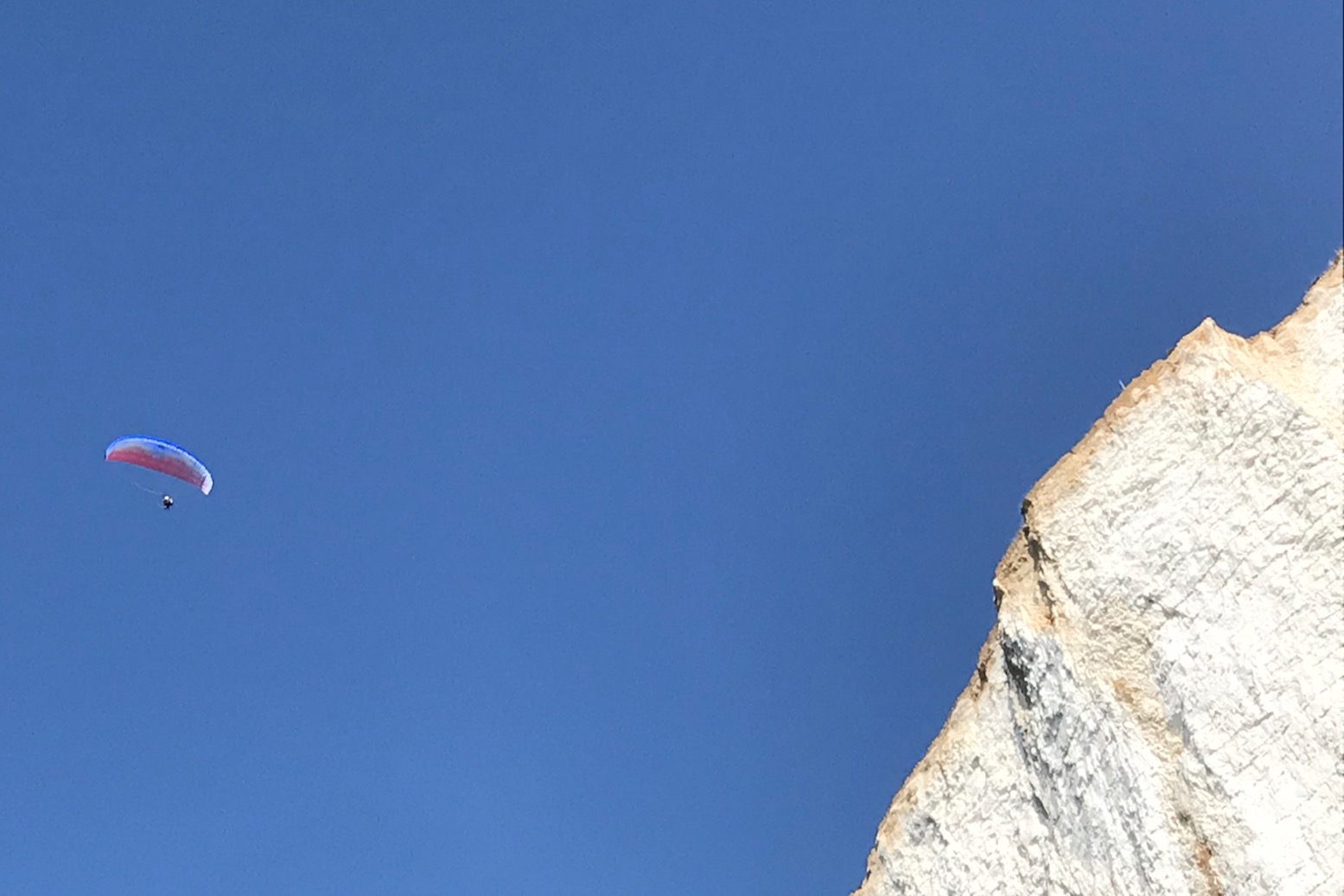
An overhead paraglider eyes up my seafood and florentine wholemeal bap and prepares to swoop.
Who remembers the 1968 film, Chitty Chitty Bang Bang? The magic car’s first airborne sortie is at Beachy Head and its distinctive red lighthouse, though I see they spliced a bit of IoW Needles in there too. Did they really think people would let it slide and not contact their MPs?
And in Quadrophenia released a decade later, depressed Mod Jimmy decides to do a ‘Thelma & Louise’ and end it all on Beachy Head (as many sadly do in real life) while The Who sing ‘I’ve Had Enough’.
I remember reading in the 1970s that with ice axes and crampons, this soft but vertical chalk was good practice for ice climbing. No need for all that sub-freezing clobber.
On the geologically contiguous Isle of Wight, these Red Bull lightweights are top roping.
At the peak of the modest ebb and I hit 6.4kph and get a nosebleed. I look back and say goodbye to Beachy Head lighthouse…
… before bidding bonjour to Belle Tout lighthouse up on the cliff top. It got decommissioned in 1904 after 80 years as it was too foggy too often up there. Beachy Head lighthouse nearer sea level replaced it. Apparently both mean the same thing: ‘fine headland’ (beau chef became ‘beachy’). You can learn so much from Wikipedia.
Sooner and with less effort than expected, I approach Birling Gap where there is road access. But first I have to paddle out around more deadly offshore breakers. Beyond stretch the Seven Sisters to Cuckmere. Suddenly it all seems eminently doable.
Paddleboarders. Must be getting close to their lair at Cuckmere.
Heck, I even see one of those FDS IKs! Good to see one in actual use.
Strange buttress and cave formations appear. Would be fun to investigate out of Cuckmere or Birling one time.
At one point the TXL+ starts aquaplaning. I recognise this feeling so tighten the straps and respond in kind, doing the full torso pivot thing. I’m aiming for 7kph, but only hit 6 briefly with the waning ebb. Oh well, that must be the terminal hull speed of a dumpy TXL.
A flotilla of gulls patrol the entrance to Cuckmere Haven, as they have done since the Domesday Book was compiled.
In the warm backwinds my new Kokatat PFD has been much less sweaty than expected. It also has loads of pockets.
Cuckmere beach.
Before I get there I pull over and stagger around on seaweed-clad boulders for a bit.
And take one last sea level glimpse along the Seven Sisters. What an enjoyable paddle that was. Another long standing ‘WLTD’ ticked off, but in a packraft, not a nippy IK. I fail to find the river inlet which must have moved a bit since my GPS map was made. I’ve got it in me, but it’s going to be a hot old slog back to Eastbourne.
I flip the TXL+ and let it drain. An effortless 2.5 hours that took.
In the bag. Now for the hard bit.
What’s going on up there? Nothing much, just sunshine and enough space to enjoy it. Plus Taylor Swift handing out NFTs.
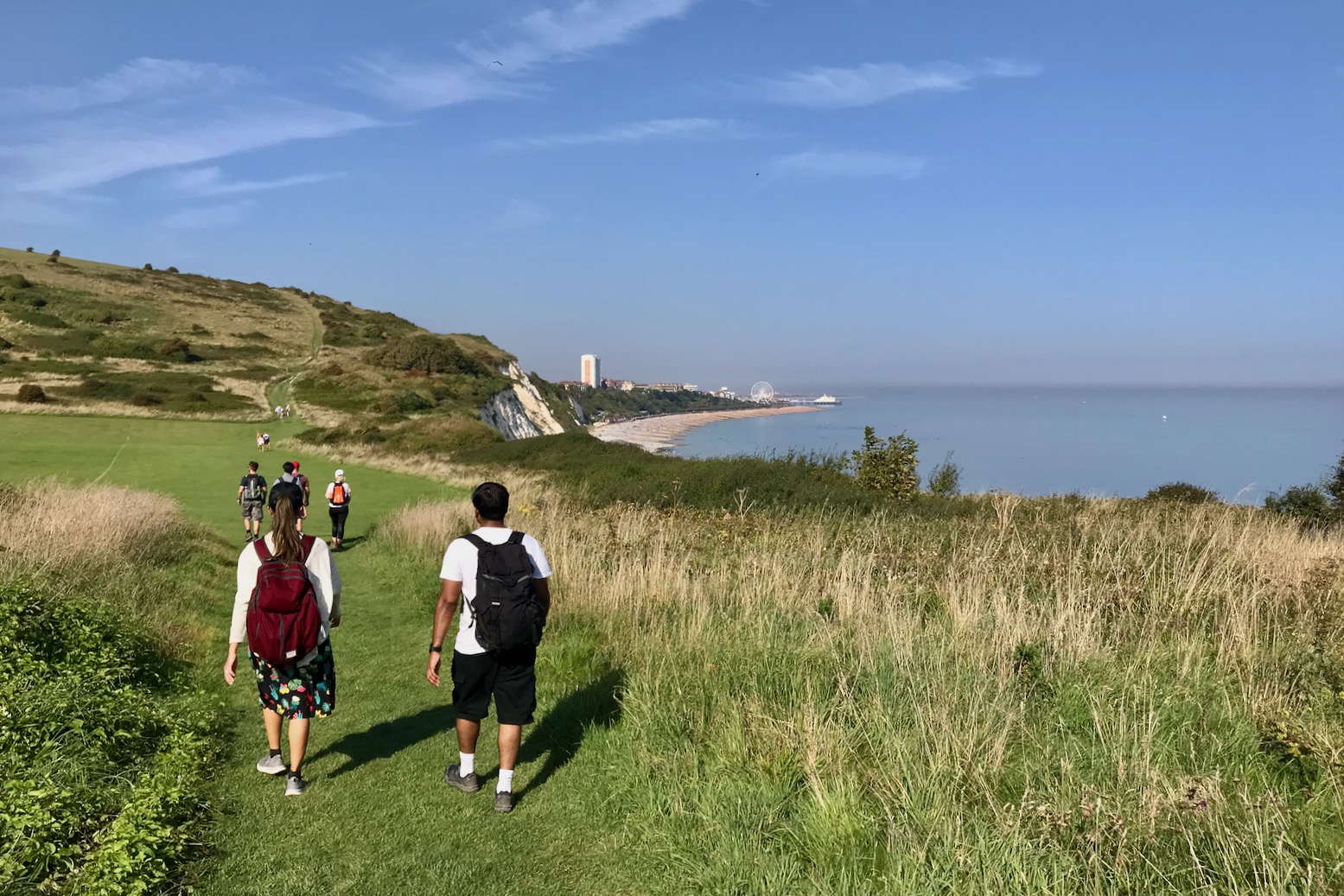
Seven Sisters means at least 7 brotherly ascents. It’s baking hot and I’ve got 500ml water left and dodgy knees, so for once I pace myself and use the paddle as a stick. Up top you can see why this is such a popular walk; there’s loads of room to spread out on the vast expanse of magically trimmed grass with lovely sea views alongside.
Up on the cliffs it’s like some sort of diversity sponsored walk. I hear Spanish, Polish Urdu, Japanese, Estuarine, and what seems like a lot of first dates, judging by overheard chatter. I know no one’s carrying a packraft and all, but how do these fragrant young persons manage to not look like they’ve been dragged through a seaweed sauna by a JCB?
I make a mess of the toilets at Birling by indulging in a basin shower, but by Belle Tout lighthouse tout is not belle. I’m as parched as Pharaoh’s frog. Luckily there’s a smidgen of shade and a cafe selling reasonably overpriced ice lollies.
Local entrepreneurs have trained gulls to ride the thermals in search of dropped iPhones. Talking of them, this is the first time I’ve used a cheap cracked iPhone or any phone as a camera. The pics are pretty good, but you need two hands to hold and shoot, the lens is 28mm and any zooming soon gets ropey. As I walk into Eastbourne the battery is spent after only 130 shots and some mistaken video, but as a light day-camera I might get used to it.
Leaving Belle Tout with ice-chilled innards, it suddenly feels like it’s 5°C cooler. And the sight of stripey Beachy lighthouse suggests it’s not so far to go.
That was me down there not so long ago. The ice’s cooling effect doesn’t last, so after the long climb up to the 500-foot Beachy Head summit, I pull over for a cliffside rest which turns into a snooze.
I wake up and the cliff edge is cracking. Guard ropes are intermittent, broken and much ignored. Much refreshed after my nap, a head breeze has kicked up and I’m now less of a dripping mess. Someone needs to write a new self help book ‘The Power of Resting’. Oh, they already did. This groundbreaking book takes a fresh look at the role that rest plays in the quality of your life, offering a proven program to enhance your health, help you look younger, and feel restored. The Power of Rest provides a low-cost, low-risk answer to … Give it a rest!
Eastbourne by George! But a steep, knee exploding descent lies just ahead.
Weary, lovelorn pilgrims make their way towards the finish line to collect their certificates. ‘Fancy getting a pizza later?’
Paddling Seven Sisters, highly recommended, whatever you got.
My 18-month-old TXL sold on ebay and I’ve just received a TXL Plus+ which I discussed earlier. Same boat but a lovely blue, heavier and with 80% more tear resistant hull fabric thanks to a denser weave and thicker 420D fibres. The floor is now full-weight 840D with extra coating. All that and it only costs €70 more than a standard TXL. Anfibio TXL page. Put that down to advances in TPU fabric technology. What is not to like?
Who knows how the ‘80%’ is calculated, but for the small weight increase, I’m in. For me, mostly paddling the coast alone, durability trounces light weight. If there’s a heavy duty version of anything, I’ll usually take it.
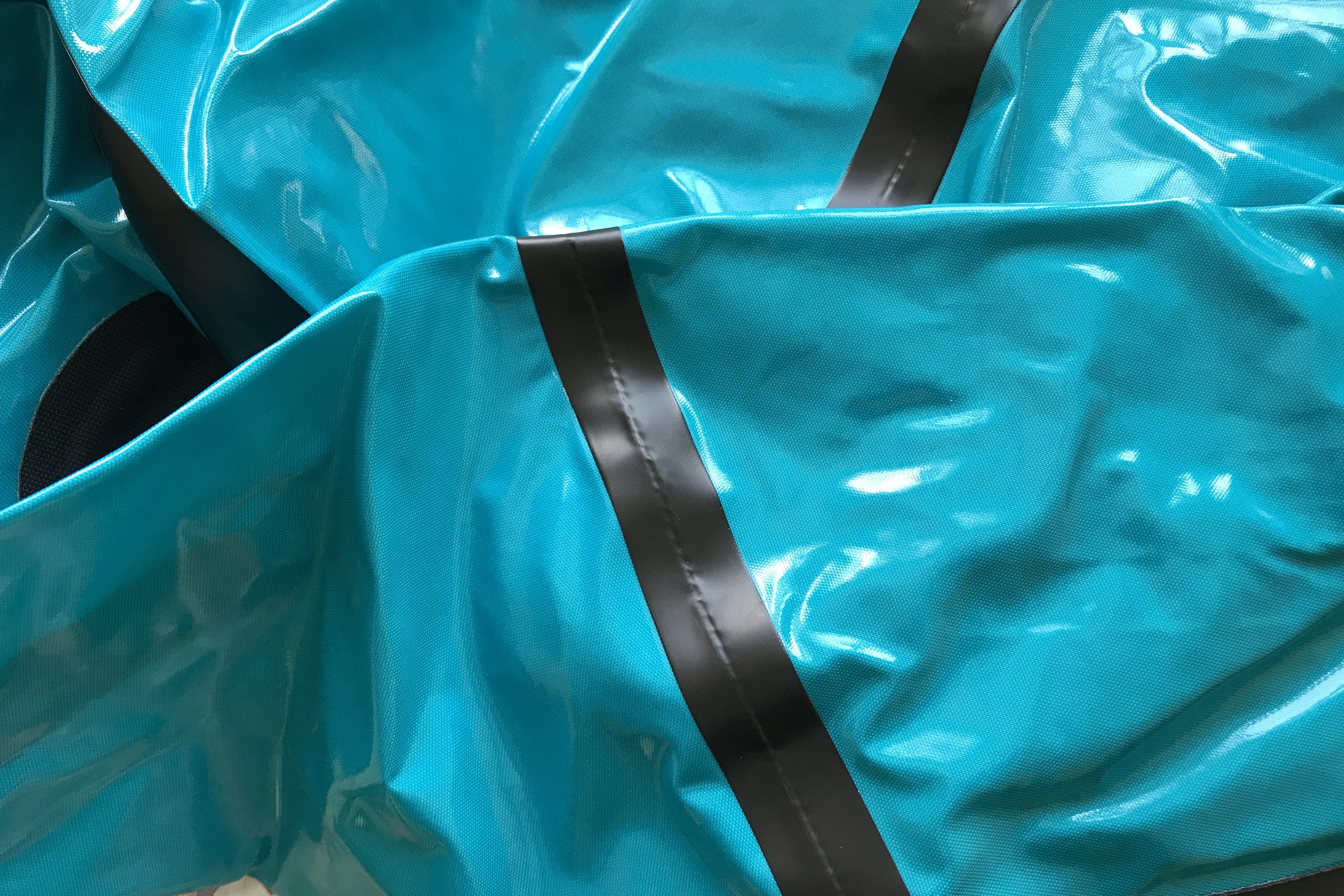
My TXL+ comes in a striking colour they call Pacific Blue but whose true hue can be hard to replicate on screens. I know from book cover printing that blue can be maddeningly inconsistent – WYS is not WYG. You will see the variations on this page – and that’s before we get into the subjective ‘was the dress gold or blue?’ argument. Anyway, I love my TXL+’s dark turquoise with tealy backnotes.
One thing I was pleasantly surprised by was the lightness of the box when I picked it up from the parcel depot. Did they miss something out? Nope, but back home, rolled up on the trusted kitchen scales (calibrated to <1% error, fyi), my bare TXL+ came in at 2971g or just201g heavier than my green one. Weights may vary a bit but the dimensions are as below.
Blue TXL+ is the same size but 200g heavier: 2971g
All Sigma TXLs now have the skeg mounted further forward. On the first batch the skeg was only half submerged (left) and not fully effective. Anfibio haven’t moved the skeg onto the floor, as I did with mine, but straddling the stern and the floor (below left). On my new boat it’s one less gluing job and thinking about it, it’s actually a better position, too. The curvature of the inflated stern where it meets the floor adds tension which holds the skeg securely in place (but not always; see below) and it’ll probably still stay submerged on flatwater.
With my version on the floor sheet, there was more submergence but less tension. The other day the skeg got dislodged as I got washed to and fro onto a rocky ledge while landing. I thought it was a fluke, and luckily I noticed the skeg lying in a rock pool before I set off again. It happened again a couple of years later off a beach, so I fixed that (see below). It’s one reason I stick hi-viz tape on my skegs (the main one being while packing up it’ll get forgotten in the shingle).
Don’t lose your skeg Even on the curve of the stern, the lack of tension, or perhaps the low-friction woven-nylon skeg-mount patch, can dislodge an Anfibio skeg following a small fore and aft movement of the hull pressing on the sea or riverbed. On a flowing river, paddling skeg-free is OK and you might need the clearance anyway, but at sea you definitely want good tracking. Here’s one solution. • Stick something like a fat sharpie under the rear skeg patch to lift the fabric away from the hull; you don’t want to stab your packraft • Make two incisions which line up with the hole at the back of the skeg • Feed a reusable cable tie through the slits and leave it in place. The skeg will now be secure.
CutThreadLock
The TXL+ comes with the same, huge TubeBags giving 200L of in-hull storage (right). The new zips are exceedingly stiff and the tiny zip pulls don’t help. As before, I zipped on a zip tie and even then it was quite a tug until all was lubed with silicon and it now runs like a rocket sled on rails.
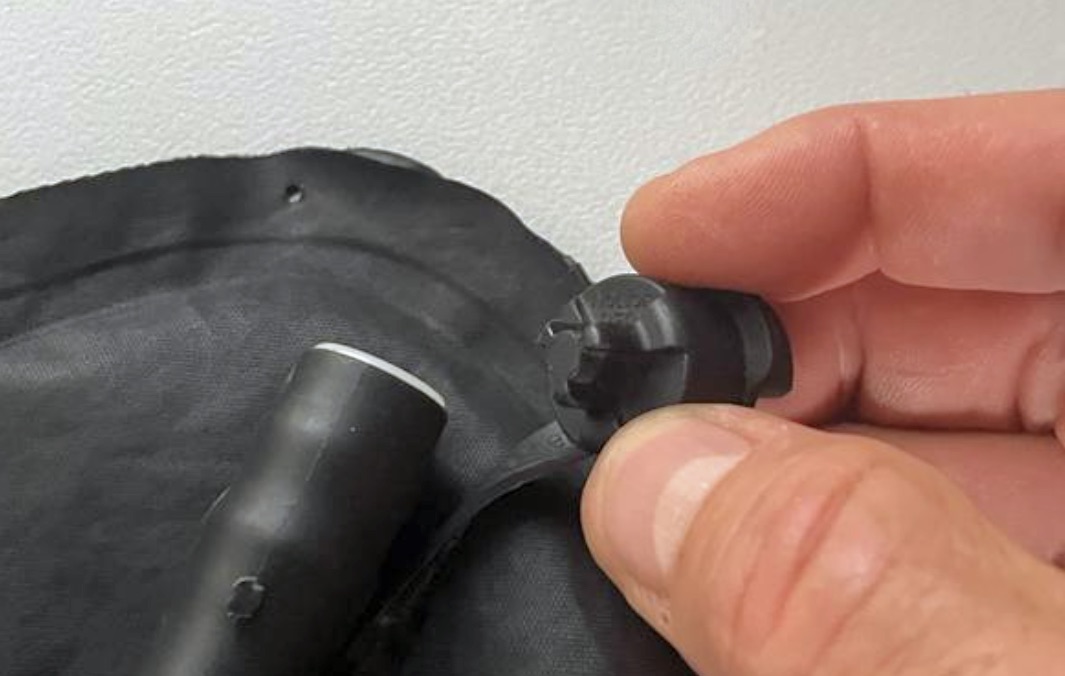
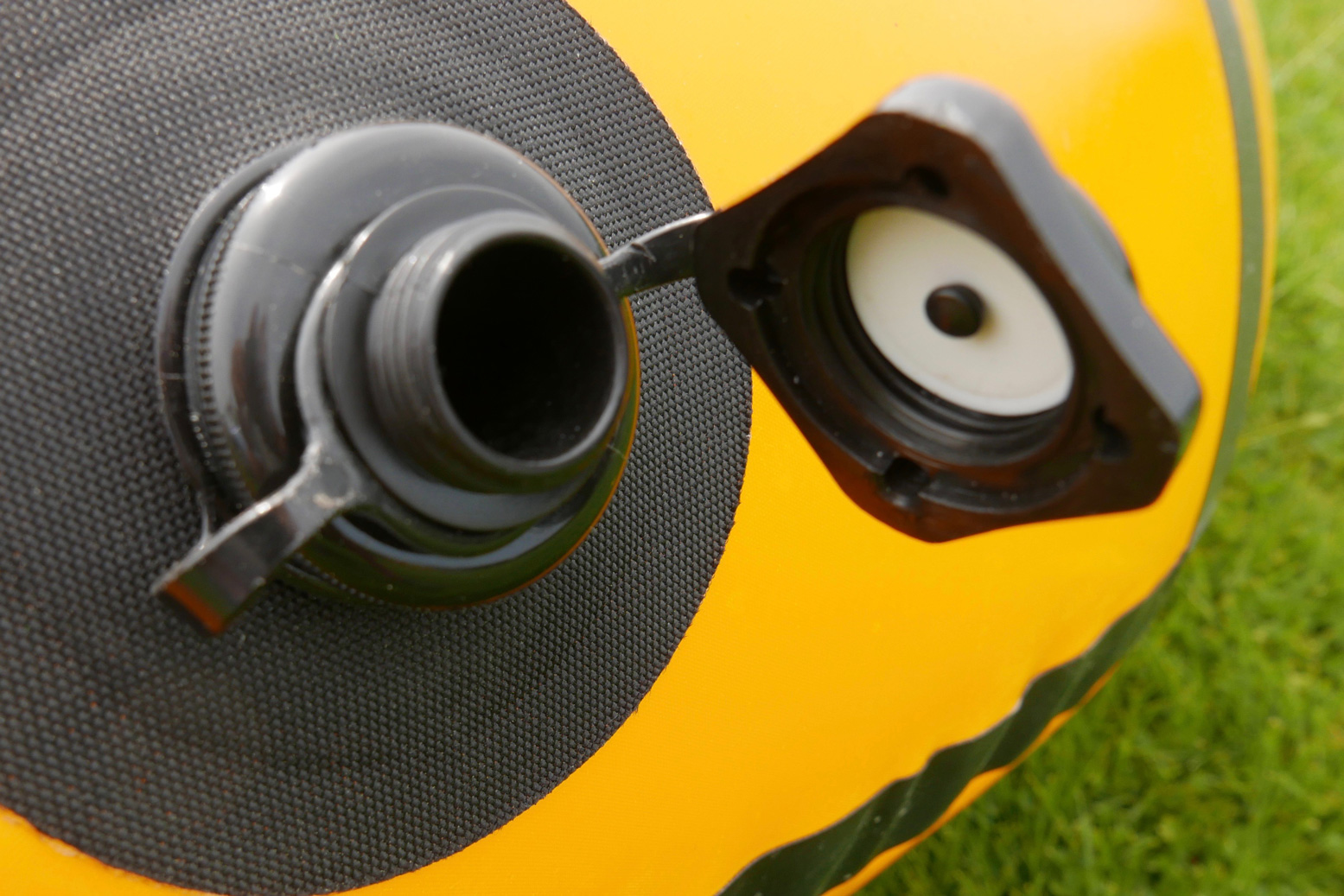
I included the +’s BNIB seats with my green TXL as my own seating is too bodged and ‘specialised’, but am told that the valve caps can now jam the sprung one-way valve open (left) for hands-free deflation. That’s a big improvement on the ‘press-valve-with-fingernail’ version that I crudely adapted to a Twistlok, and now means you can fully deflate the seatbase easily, even if it won’t be that fast.
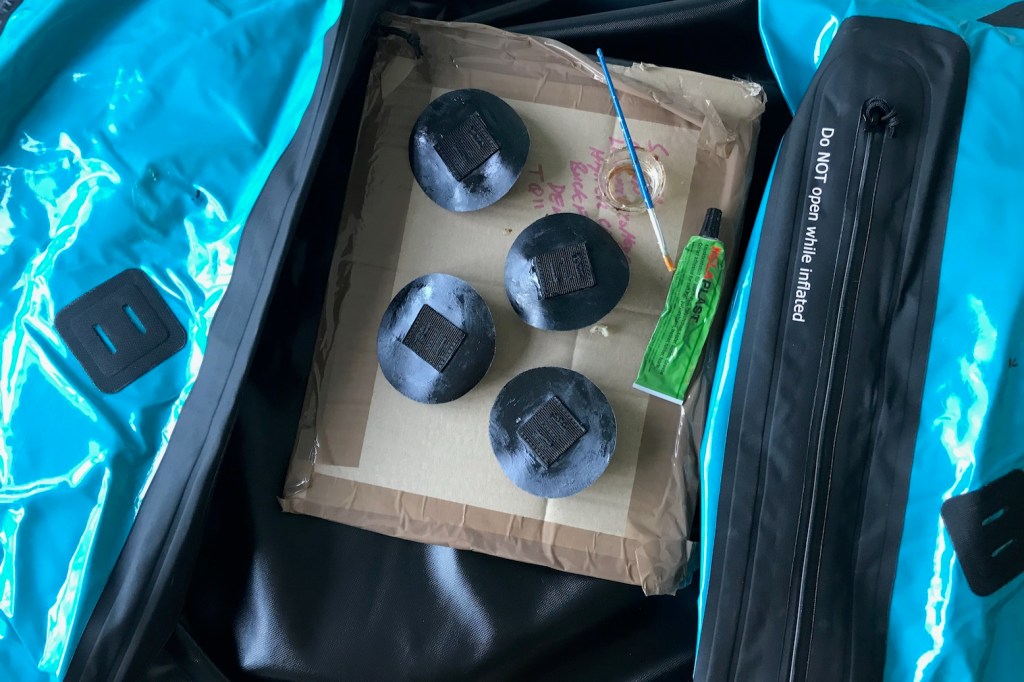
As on my green TXL, I’d glued on 4 tabs for my knee straps. I don’t have the green TXL at hand, but it did look like the OEM threadable strap loops on the top of the side tubes (right) are a bit chunkier. Knowing how little tension I actually put on the knee straps, I thought I might risk using them for the rear strap attachment point. But in the end I decided the further back position (as on the green TXL) was better, especially as I’ve lately noticed that with Multimat and MRS footrest fitted, I sit quite a lot further back.
Top left: The bits you will need to stick on 4 attachment loops. Top right: Watching attachment loops dry. Below: Wait a bit then apply another coat, wait a bit more then position the loop and heat with a hair dryer to reactivate glue (it was so hot today it kept shutting down; I had to ‘suction cool’ it with a hoover). Bottom left: Put on a hard surface and get stuck in with the roller. Bottom right: Stuck on after rolling I love the way dried Helaplast magically turns sticky under some heat. Full gluing procedure described here.
New screw-down pump
I didn’t receive one, but Anfibio have refined the mini handpump too. It’s basically an adapted party balloon pump and costs only €10, but their version now has a screw-off nozzle handle (left). Good idea as I can see it getting snapped with an unlucky whack while in transit. In fact that’s exactly what happened to my old version after unpacking one time. I eliminated the handle, glued the hose direct to the shaft and added a bit of garden hose to be handle.
Broke ;-(Bodged ;-))
I mentioned here about repositioning the main hull inflation valve forward for easier topping up on the water when solo. Big-volume packrafts like a TXL can get a little saggy after a few minutes paddling on cold water – you will notice the light crease in the side tubes when sat in the middle. But on my last couple of outings with the Multimat, that didn’t happen; the flood pad did its job in constraining sag. Not having to over-inflate to get the boat firm is desirable; just enough pressure to get the job done. Problem is, my Multimat has already been repaired once and weighs nearly a kilo. Oh well, at least you can sleep on it too.
The 840D floor is reassuringly heavy duty, with a textured interior and a smooth, waxy exterior to glide across the brine. On my last Alpacka I went through a phase of light 420D floors then reverted back to a full 840D. Floors are at the sharp end so need to be durable, though of course they’re dead easy to repair. In the end it’s hard to tell if my blue, TXL+ hull fabric is thicker than the plain TXL. It’ll all be in the mind, like the blue/gold dress.
‘Calm… caaaaalm’. It’s what you say to a hyperactive child. But it’s also what you observe as you scan a weather forecast: 3-4mph onshore southerly, backing southeast later. With sunshine too, it could be the Last Good Day of the Summer. I left my moto just as they’re opening the gate down to Tynehamghost village. From there the Mrs drives me on up the coast to lovely Lulworth Cove for a sneaky 9am bacon buttie. I do worry about my B12 levels sometimes.
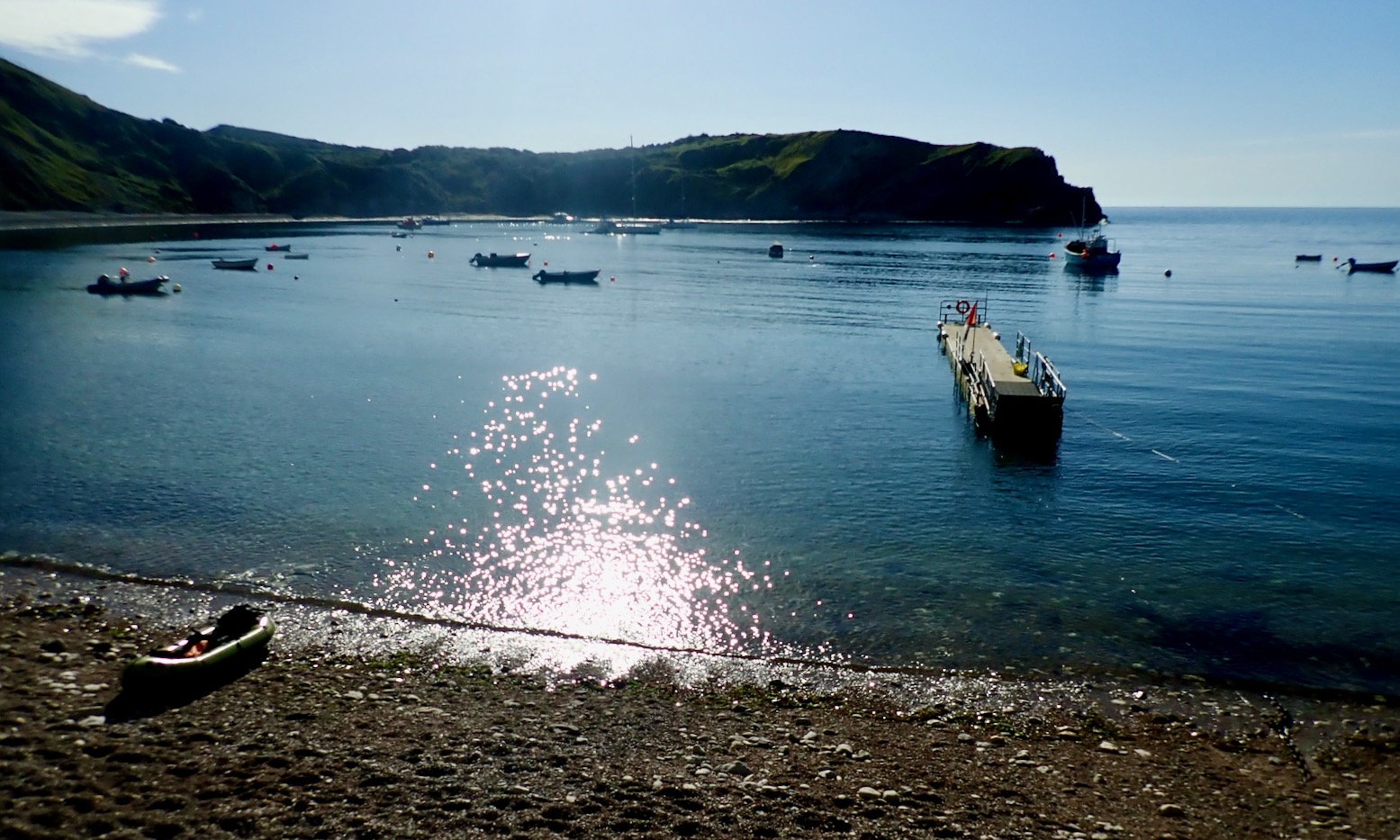
All calm at Lulworth
“Oh wow!” squealed a little girl as she also arrived with her family at Lulworth beach. And you can see why; it’s an amazing natural feature which along with others help make Dorset’s Jurassic Coast a World Heritage site. Within an hour the renowned amphitheatre would be standing room only but hey, it’s August on the South Coast; if you want a lone beach, pack a mac and go to the Outer Hebrides.
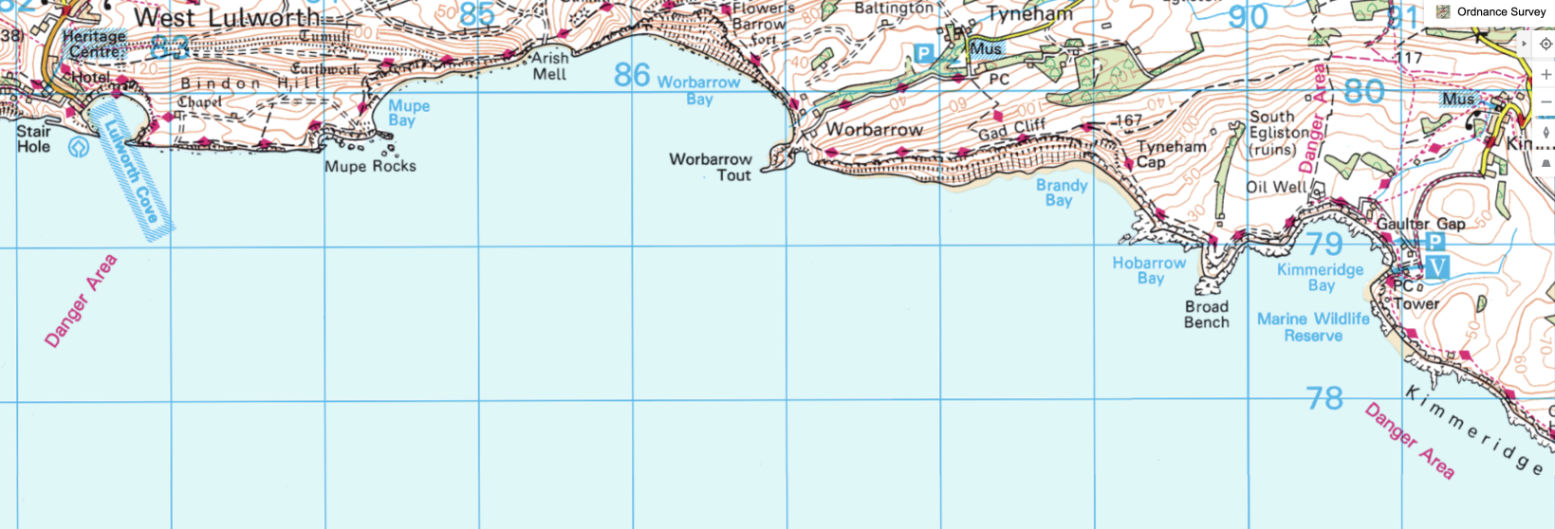
Red shaded area is army firing range which – land or sea – is usually closed.
Today’s plan was head east 9km to Kimmeridge Bay as I gradually joined the dots packrafting Dorset’s Jurassic Coast. This time last year Barrington and I sailed here from Ringstead Bay near Weymouth, before getting sent into Lulworth Cove by an army patrol boat. The following eastward section of coast is an army firing range that’s only open to the public on weekends or throughout the August holiday season. And even then, some landing spots are closed, and inland you have to stick to the paths in case you step on an unexploded bomb. Tragically that happened in 1967, though thankfully only once and as a result, today warning signs along the footpaths are everywhere.
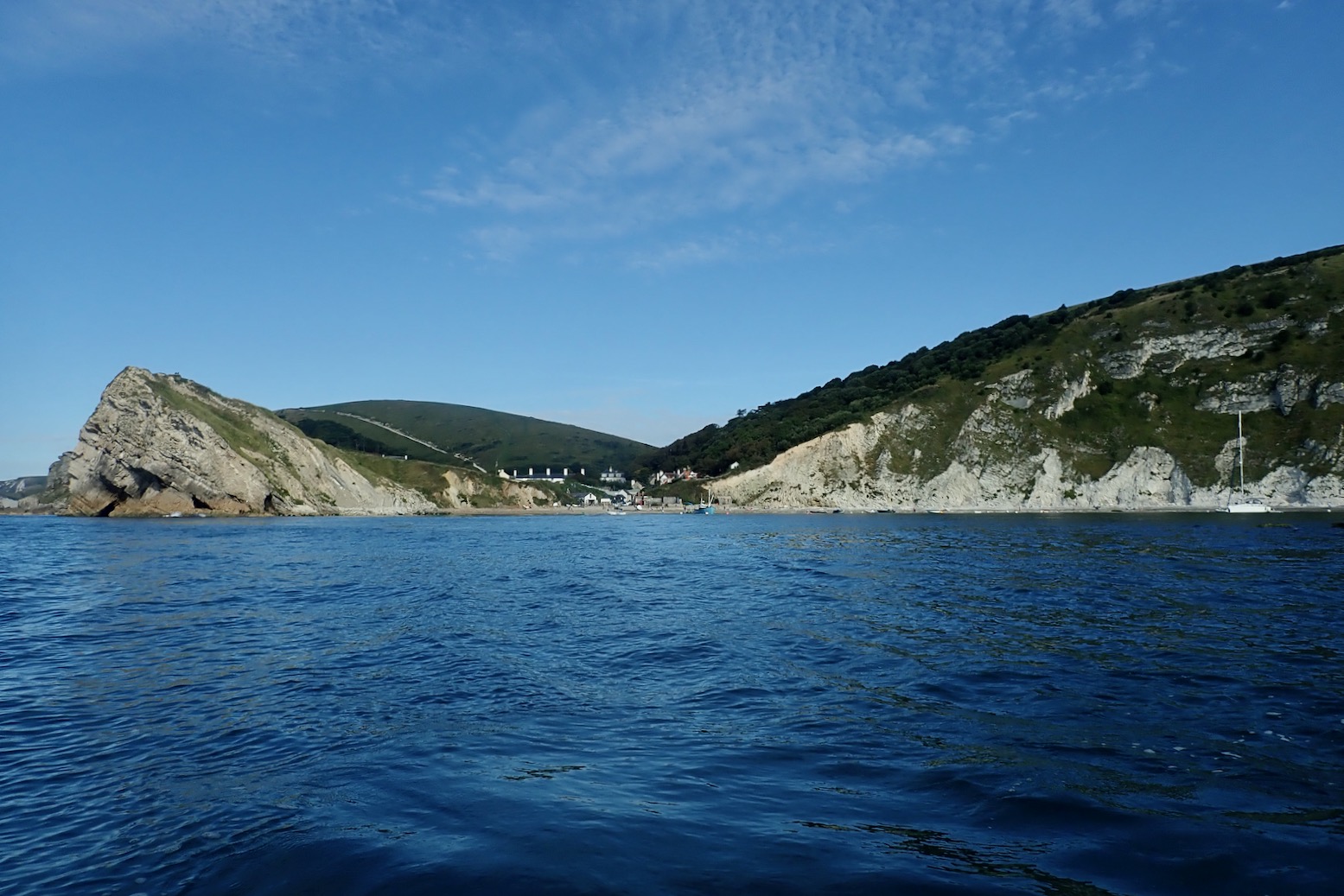
Leaving Lulworth
Once out of the cosy Cove, the first section should be easy enough, but if not I could hop out at Warbarrow Tout, walk a mile to the bike at Tyneham and ride home. Continuing all the way to Kimmeridge depended on confidence and energy levels, and how the sea actually looked once out of the sheltered Cove.
Today I’ve remembered everything, including my repaired Multimat floor pad. All you need is to get into a routine; let me know how to do that. And as I set off towards the Cove’s mouth the TXL definitely has its glide on. I have two hours before the tide turned and the wind with it, but right now the boat felt great. I even remembered to pull up my knees straps, and felt nicely connected between the TXL and my paddle blades
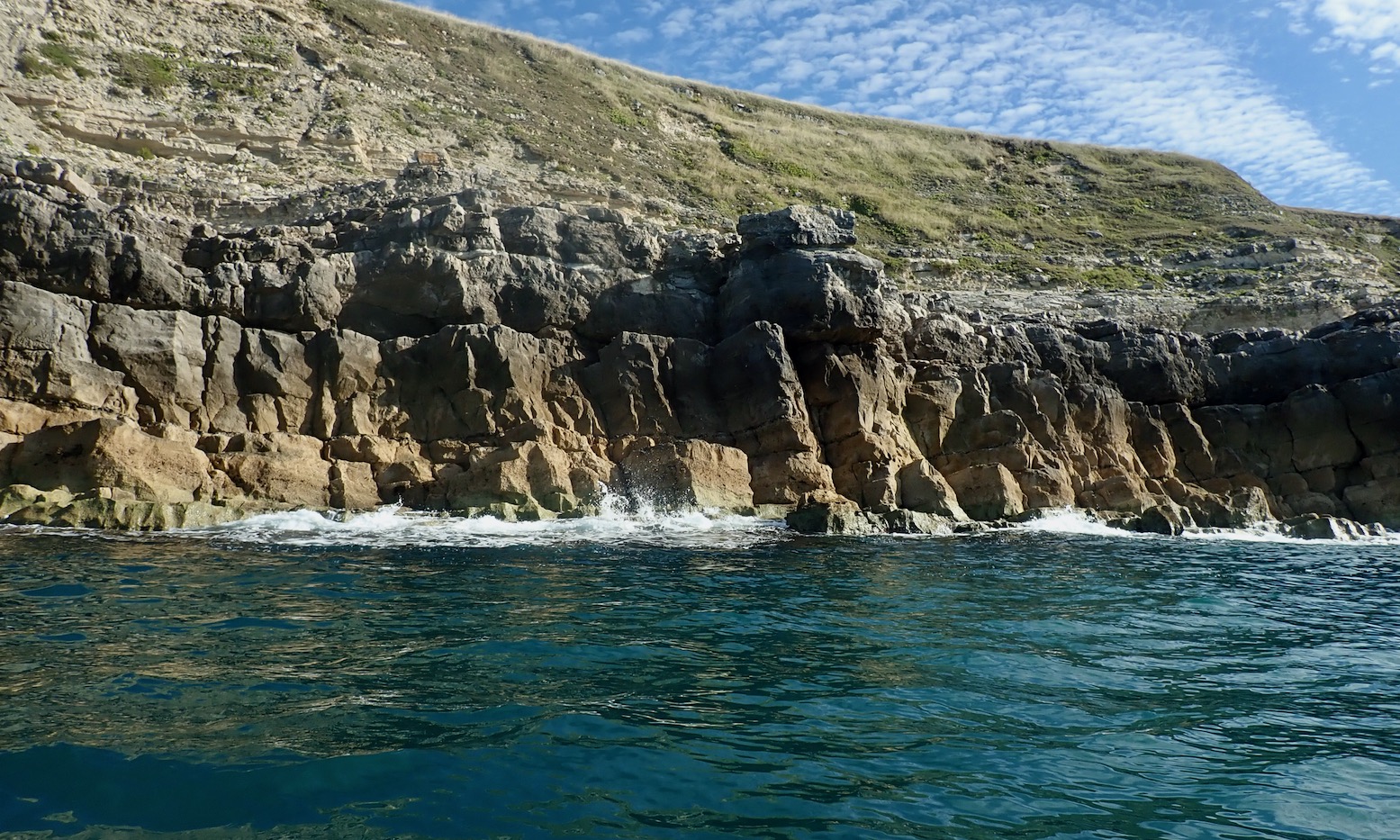
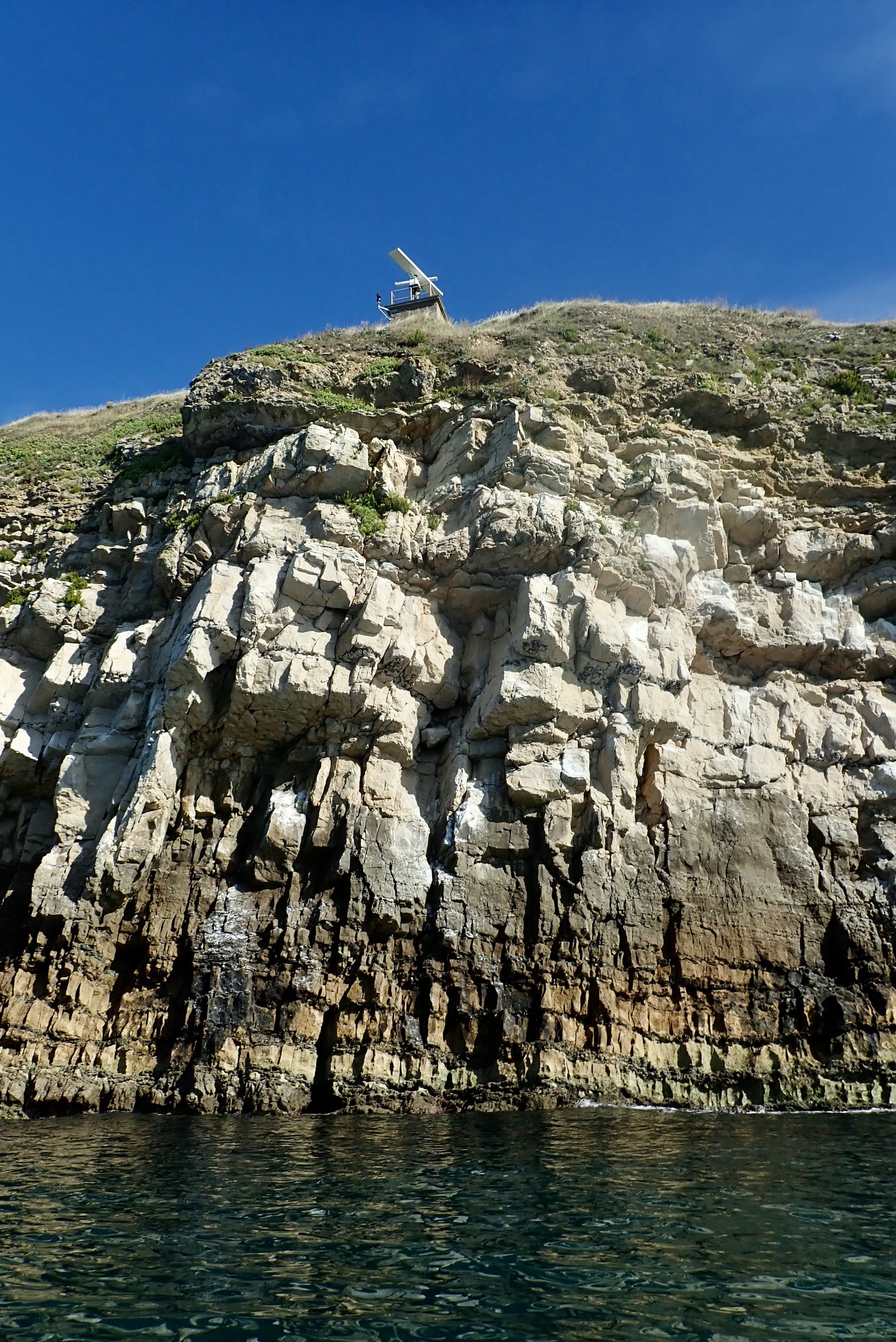
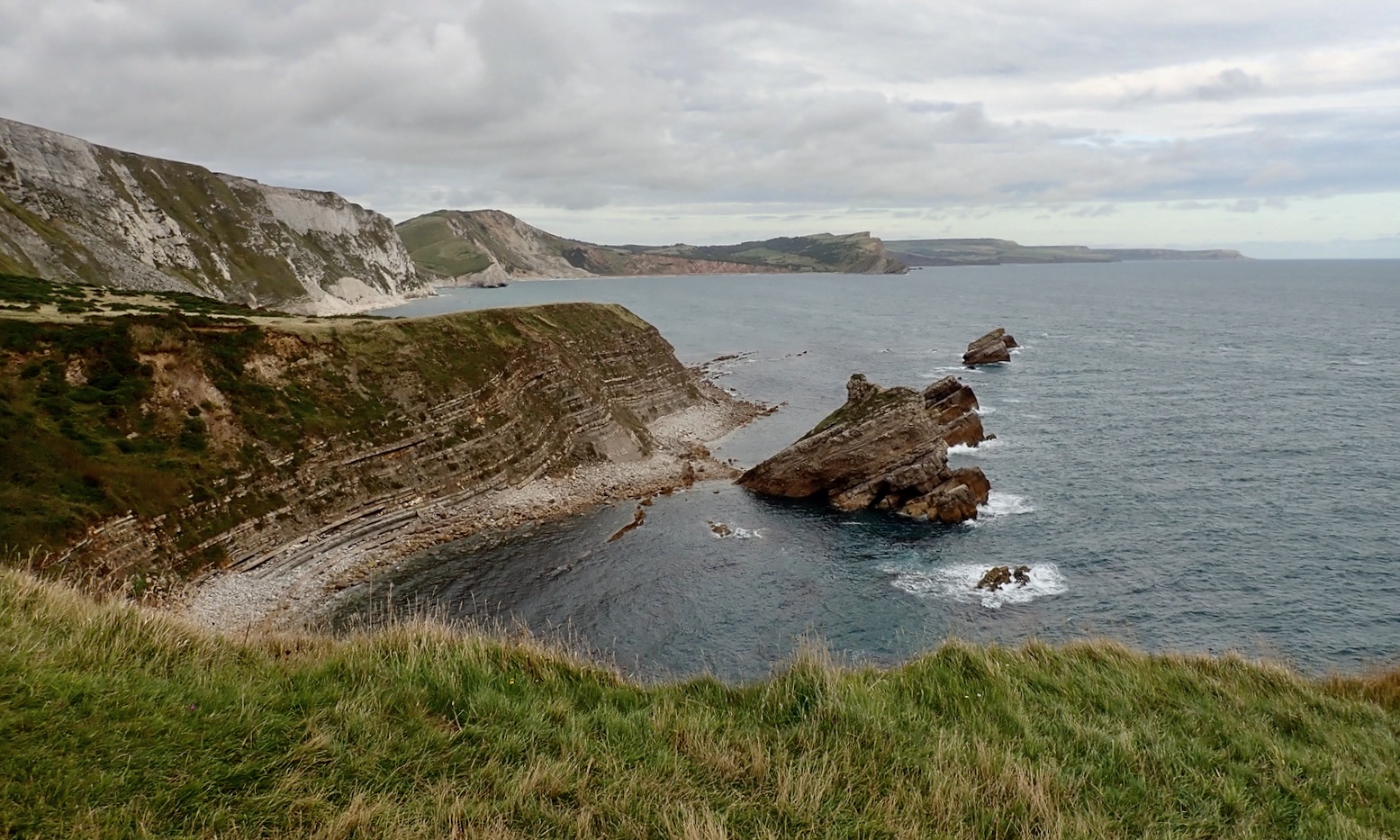
Towards Mupe Rocks I had the odd sensation of offshore waves bouncing off the cliffs – it made getting close tricky. I see on an online marine chart (below) the seabed drops off quickly here so the swell just rolls in and boings back out. They say there’s a petrified tree here somewhere – or ‘Fossil Forest’ in over-heated tourist-speak. But I learn later it’s by a path on the cliff top where there are also periodic radars (left) and other sinsiter MoD installations.
Mupe Rocks turn out to be rather ordinary remnants of fallen cliff, not like the gleaming white chalk stacks I paddled last week near Old Harry. With no interesting arches or caves, I thread about but they’re a bit disappointing.
Mupe Rocks
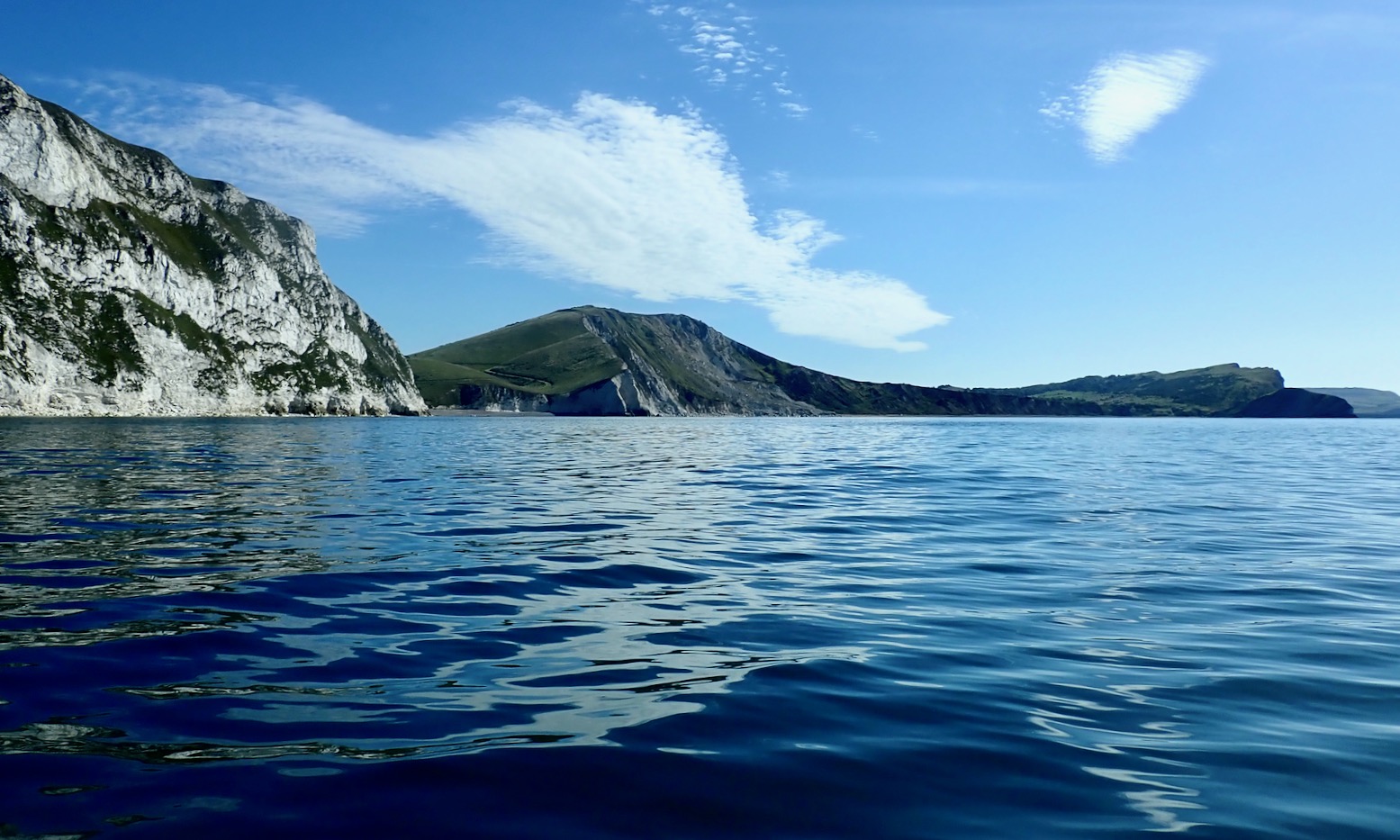
Seaweed streams reassuringly eastwards with the rising tide, and as I round the corner Mupe Bay opens up, revealing half a dozen moored sailing boats. Behind them rise the steep chalk cliffs which you can see for miles down the coast.
Mupe BayMupe Bay and Warbarrow, a day or two later.
Landslide
I wonder about putting ashore at a gap in the cliffs called Arish Mell because I can. But perhaps I can’t, even in August, if I have interpreted the map warnings correctly. Behind the beach I spot some huts, shipping containers, pickups and activity. As it is, my equilibrium is disturbed by some strangely large waves rolling in across the middle of otherwise calm Warbarrow Bay. A submarine shelf? They’re not crashing ashore as far as I can see, but I decide to stay out in the Bay.
Arish Mell gap
Activity on the Mell
Turns out Arish Mell is off limits 24/7/365, using the proven UXO gambit which didn’t seem to be bothering the chappies ashore today. Another possible reason may be that from around 1959-1990 give or take, ‘slightly radioactive effluent’ was piped out here from the former Winfrith nuclear research facility a few miles away near Wool. They’ve been decommissioning Winfrith ever since, and we should be grateful that with much effort they saw fit to extend the outfall pipeline two miles out to sea. You can see the pipe on that marine chart above. Coincidentally, this week Japan started doing the same thing at the damaged Fukushima reactor, raising the ire of seafood enthusiasts in China. Meanwhile, this well-produced 1959 Atomic Energy Authority promotional film describing the pipeline project seems very proud of itself.
So I set course for the conical headland of Warbarrow Tout (old English for look-out) at the far end of the Bay. The sinister waves subside and something else changes: the TXL glides across the smooth surface effortlessly. I am able to draw a long, slow, kayak-like paddle cadence, not the usual thankless spinning. Later the GPS data revealed the combination of windless conditions and the Multimat helped the raft skim along at up to 6.2kph or 3.8mph. I’m not sure it’s ever sailed that fast so, even aided by the final hour of a modest, metre-high tide, that’s quite impressive.
Actually, I don’t know why I’m so surprised. Although I seemed reluctant to admit it initially, the first time I tested the TXL with the Multimat in the Summer Isles, the evidence was right there (left), even if it wasn’t night and day.
Approaching Warbarrow Tout
As I neared the Tout I was anticipating some sort of disturbance from an eddy being pushed out by the eastern hook of the Bay. Sure enough, the TXL passed over a patch of clapotis without breaking it’s stride, but as I moved on past Pondfield Cove (a mini Lulworth) something changed again – the boat seemed to slow to a crawl. The coastline was creeping along but a check the GPS only registered a slightly slower speed.
Warbarrow Tout and Gad Cliffs beyond
As usual with winds, other anomalous currents and flotillas of irate pirates, I wondered if this would set in or get worse all the way to Kimmeridge, with get-offs but no take-outs along the way. I decided to carry on below the Gad Cliffs to the prominent Wagon Rock and if nothing changed, I’d turn back and walk out to Tyneham.
Gad Cliffs. Dorset’s cubist Mount Rushmore
But by Wagon Rock the countercurrent had subsided and the GPS later showed I resumed the steady 6kph pace. Sea paddling alone an semi-appropriate boat makes you more alert to minute changes in conditions which a sea kayak would pass with barely a shrug. I later wondered if it was possible the eddy from the hook formed by Warbarrow Tout could draw back or suck in a current ‘beyond’ itself, as shown below. Who can fathom the mysteries of fluid dynamics?
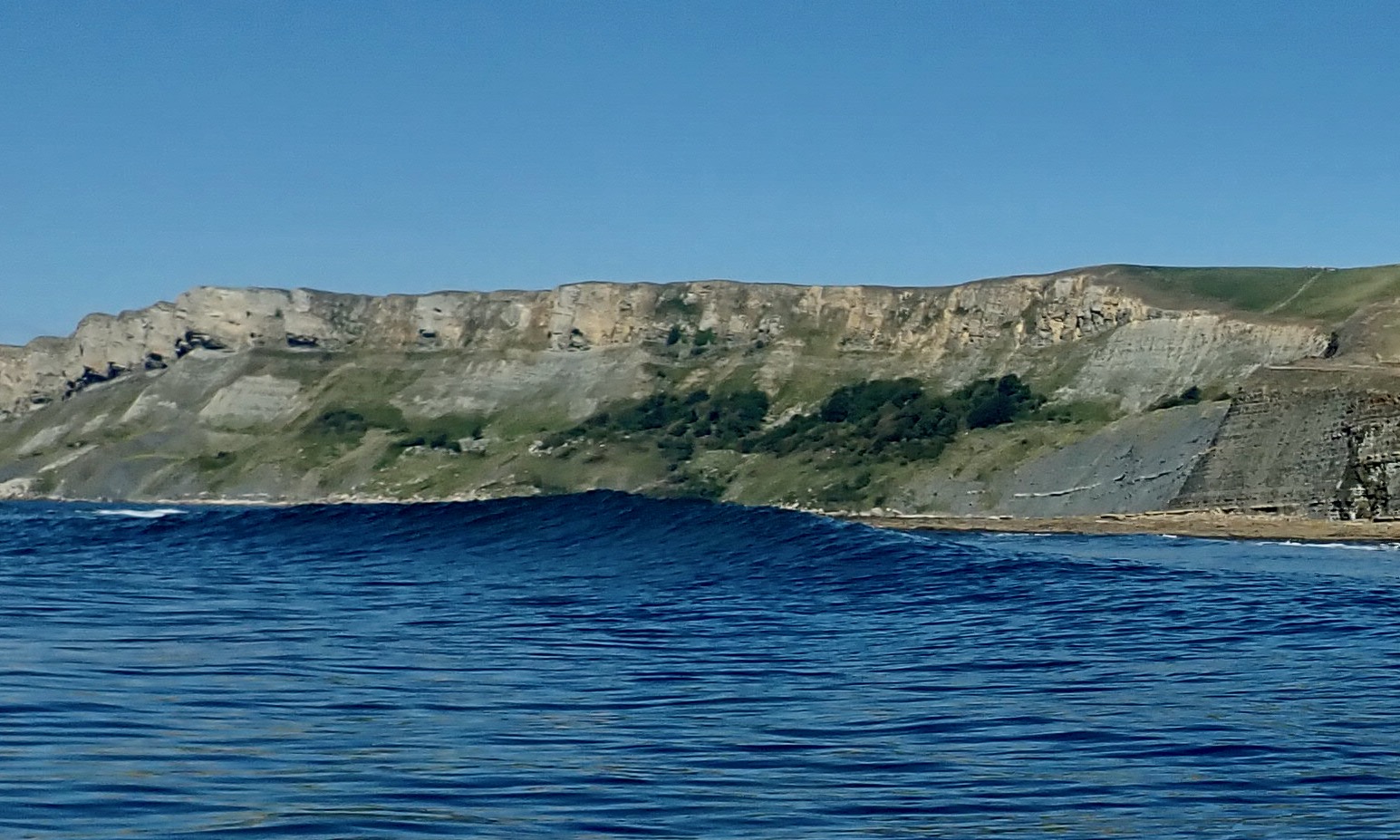
Beyond Wagon Rock the grey sweep of Brandy Bay‘s oily shale cliffs plunged down to the sea. Up ahead I was reassured by the sight of Clavell Tower, just 3km away, marking the far side of Kimmeridge Bay. Less comforting was the breaking water between me and it: the ledges of Broad Bench spotted when I paddled the Igla here a few weeks ago. It would be alarming to have one of these rise up on you out of the blue (below).
Sneaky wave
As always, the solution to such unpredictable seaside disturbances was to paddle further out, even if the instinct (and interest) was to hug the shore. I aimed for the distant St Adhelm’s Head and safely rounded the churning maelstrom of Broad Bench, with the bedrock visible a few feet below. That done, the crossing was in the bag and I worked my way towards the beach where crowds were streaming down to the shore with their dogs. Nine clicks covered in less than two hours from Lulworth. Not bad.
Brandy Bay in a gale.
Interesting shelf
A few weeks ago we walked the coast from Tyneham on a very windy day. At low tide the ledges at Brandy were a froth of white foam (above). Today, walking back 4km to Tyneham, the Long Ebb shelf delineating Hobarrow Bay was already emerging from the retreating tide. Looking back, I was reminded the nearby big shelf (left) behind Broad Bench was worth a nose about for fossils or dubloons, even if MoD poles discourage this and you can only access it by boat. It’s one for next time.
Above Tyneham looking back to Mupe Bay
Midday and Tyneham car park is already packed. Another section of the Jurassic ticked off or recce’d for another pass. Hopefully there’ll be a chance to do the 6km from Kimmeridge to Chapmans Pool before we roll up for the winter. That will leave the two points of St Adhelms and Durlstone for the next caaalm day.
What air pressure does a typical packraft run? 1 psi, 1.5, 2.5? Answer at the bottom of the page.
Air bagging. Air bagging. Oh isn’t it wild?
Most inflatable devices come with an air pressure rating at which they perform best, including inflatable kayaks which run from 2psi/0.14bar up to 10psi/0.7bar in drop stitch. On the cheapest vinyl Intex or Sevylor dinghies, as well as slackrafts there won’t be a number, instead you get a ‘stretch gauge‘ (left). With a Sevy you keep pumping until a sliding black tab settles between A and B; your squishy slackraft is probably now at less than 1psi but is good to go. Add a bit more air to try and make it feel less of a water sofa and the thing will burst a seam. It may do that anyway if you give it a week or two or look at it too long.
Right from the start packrafts never had air pressure ratings. You just aired it up with a flimsy nylon airbag (above) until you couldn’t get any more in. The airbag idea was surprisingly effective once you got the knack, and the bag weighed next to nothing. You then unscrewed it without trying to lose any air, quickly screwed on the cap, then topped off by mouth via the separate twist lock elbow valve (left) with all you had in your lungs. The more you blew the firmer you boat became – and that definitely made a difference to response on the water. It helped if you didn’t smoke and played lead trumpet in the local jazz band.
Once on the water all inflatable boats cool down and the hard-won air pressure inside drops a bit so you have to top it up again to get the boat firm. What was the air pressure? As much as possible but what did it matter as you couldn’t overdo it with your lungs. Stronger lunged paddlers and opera singers paddled firmer boats. And anyway, such very low pressure would be difficult to measure with a normal handheld manometer.
These days most packrafts use simple and effective one-way Boston-type valves (left) which screw off for a wide open ‘fast inflation’ port for airbagging, but have a one-way valve built into the cap for topping up, just like a car tyre. What goes in, stays in so you can build up pressure and get the boat good and firm. No more crumby twist-locks and undignified topping up by mouth.
Mini electric pump; ditch the airbagMini handpump to top up
Better still, inexpensive pocket electric inflators like Flextail (above left) do the job of airbagging while mini handpumps (above right; adapted from party balloon inflators) can do the important topping up without giving yourself a lung hernia. But what’s the air pressure!? Who cares, it’s better than it used to be provided you could pump the handpump with all you had – I find it takes 100 jabs. A Flextail or similar will burn out long before it can get close to a handpump’s final pressure.
Tip: all these pumps are handy but I always leave an airbag in my packraft’s storage pockets in case the Flextail packs up or I forget it. Otherwise it will be a lot of blowing or handpumping to air a boat up. And with a Boston-type valve as above, a short section of half inch garden hose makes inflating by mouth much easier should you’re topping-up handpump pack up too.
Kokopelli and French-made Mekong packrafts (and maybe others) feature a RIB-style Leafield D7 push-fit inflation valve. That’s push-fit as opposed to more secure bayonet fitting as on proper IKs and iSUP boards. It’s what Gumotex IKs used years ago and is actually not a bad idea on a packraft as the pump nozzle on the end of a hose will blow off the valve as pressure climbs, meaning you have to try hard to over-inflate the boat.
Black boat and Englishman
But these one-way valves have now made over-inflation a possibility, and we know how that can end. However, one thing we’ve learned with TPU packrafts over the last decade or two is that it’s virtually impossible to burst a well-made packraft using a human-powered pump, even a high-pressure iSUP barrel pump. You would really have to go at it or leave a fully inflated black boat out in the midday sun. The fabric and simple but strong sewn and heat-welded assembly spreads forces equally across the single chamber hull ring. So much so that MYO packrafts have become a thing for individuals with a big table and a sharp pair of scissors.
With a D7 valved packraft you could use a handheld manometer (left) with a push-fit adapter to read the boat’s pressure. Such manometers have a pin in their throat which pushes open the D7’s sprung valve stem just as the gauge body seals around the valve housing, so getting get a live pressure reading.
I don’t have a D7-equipped packraft at hand, but I do have a Bravo Alu 4 R.E.D barrel pump fitted with a 14.5psi/1 bar inline manometer (left). With an adapter jammed in the Boston’s threaded port I ought to be able to get a full-pressure reading off my Anfibio TXL.
I’m guessing about 2psi / 0.14bar to get a pinging firm TXL. It’s what my early Gumotex IKs used to run, using the now obsolete footpump. When the Seawave came out, rated at 3.6psi/ 0.25 bar, that was quite a revelation, though before that I ran a 4.3psi/ 0.3bar Grabner Amigo and you could have battered down a wall with that boat, proving that rigidity didn’t require drop stitch panels as long as the boat was solidly assembled. At Grabner prices, you’d expect that to be the case.
Back to the test. And the answer is…. just 0.1 bar or 1.4 psi. And this was with the TXL as tight as a drum such as I could never manage with the balloon handpump but might have with a K-Pump Mini. Now we know.
On Google Maps an ebbing tide spins out an eddy of sand out into Swanage Bay.
Swanage to Studland past the Pinnacles is one local paddle I don’t mind repeating. In normal conditions it’s the most dramatic, easy paddle I know on the Jurassic Coast, sheltered as it is from the Channel swells. Today I’m going to make a loop of it: packraft round to Studland and walk back to Swanage over the downs (map left). All up about 11km which should be doable in the 4 hours I’ve put in the meter.
It’s always further than it looks to the north corner of Swanage Bay at Ballard Point, so I sit back and let the wind do the work. But apart from the odd gust, it doesn’t feel like 12mph – like sailors say, it’s either never enough or too much. GPS recordings later reveal no records were broken.
Leaking Multimat
Around here I was expecting to top up or ‘temper’ the TXL’s sagging hull with the handpump once the air inside had cooled down and softened following 20 minutes immersion (as explained on the previous outing). But remembering the Multimat floor mat this time, there was no tell-tale crease in the TXL’s sidetubes, even with a slow leak I noticed at the beach from one of the mat’s seams (left). So the mat must do the job in supporting the hull, even if, sat higher, I felt a bit wobbly on setting off. The mat’s not been left out in the sun, let alone sat on since I filled it in advance, but I’m not surprised a leak has sprung, with probably more to come; I-beams are weak under pressure but it’s a necessarily lightweight design that still weighs nearly a kilo. You pump the mat up as firm as you dare, otherwise what’s the point; I must have gone a bit far. I’ve picked up similar, wide, I-beam seats from Anfibio with the same damage; all easily repaired with quick wipe of Aquasure sealant. I know it would need a stronger pump (like my K-Pump Mini), but, despite added cost and probably weight, a 2-3 inch thick dropstitch floor mat – either TPU or nylon – would be a more durable floor mat. The AE Packlite+ packrafts use them.
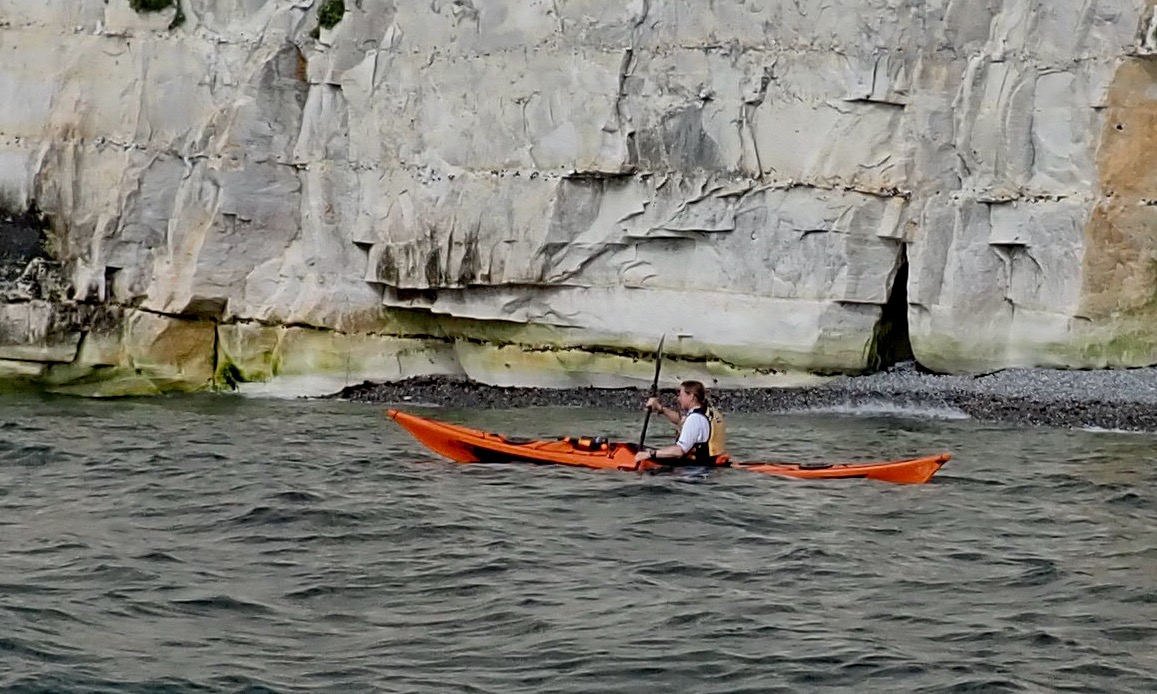
Round the corner the wind eddies out and drops a bit, and up ahead the big spiked pinnacle is still such a surprise I initially mistake it for a big moored yacht. You’d think I know by now. A couple of sea kayakers are heading the other way, into the tide and breeze. They’re curious about the sail and raft.
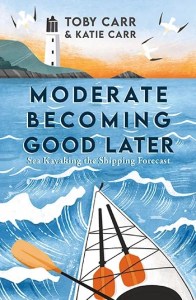
I admire their sleek, water slicing craft. I’ve just finished reading Moderate Becoming Good Later, Toby Carr’s attempt to kayak in the 31 Shipping Forecast zones (right) before he succumbed to cancer in early 2022, aged just 40. He pushes himself hard, starting with Iceland, a lap of some Faroes, out to Utsire island 40km off Norway and the full coast of Galicia [Biscay, Fitzroy], as well Bishops Rock lighthouse beyond the Scillies [Plymouth, Sole, Fastnet, Lundy] before his health collapses.
He reached some amazing places and it reminded me what a uniquely effective boat the modern sea kayak is in experienced hands. Combine today’s lightweight composite materials with inexpensive GPS tracking, satellite comms and ever more accurate forecasts, and radical paddles like the ones listed above become possible if you have the nerve, the strength and the wits to know when to wait it out.
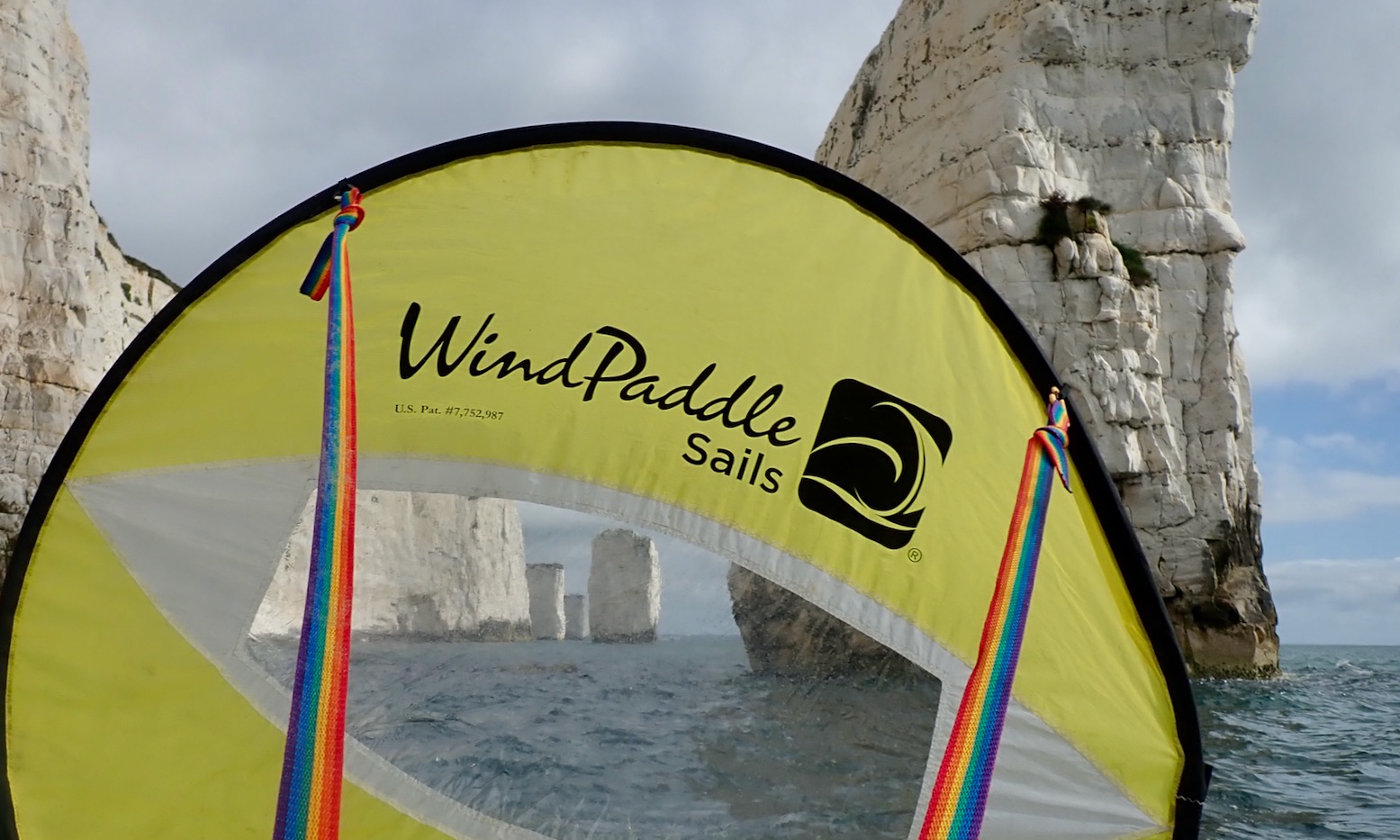
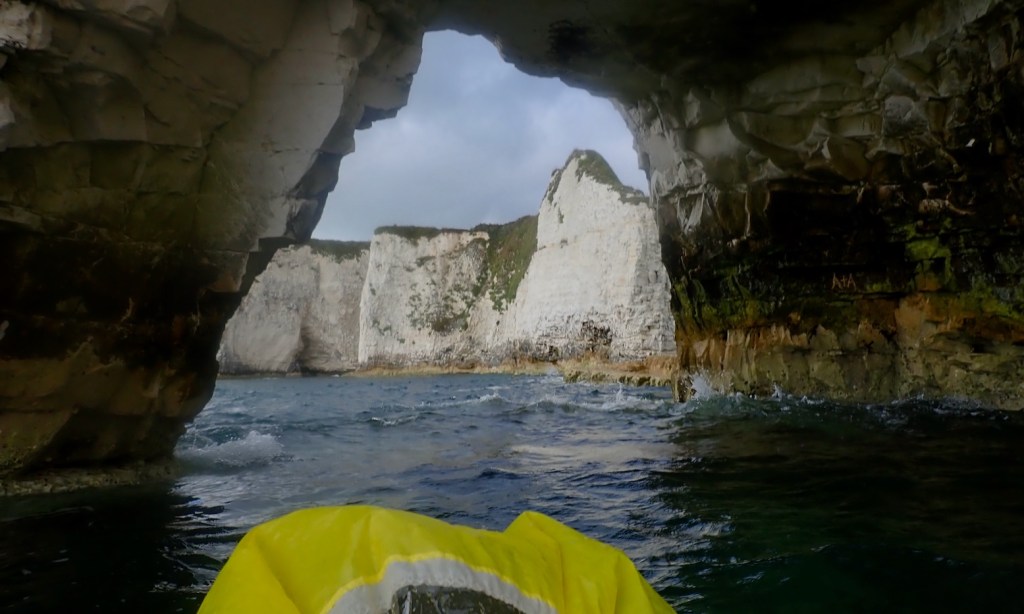
But I’m bobbing along in a packraft, also a great tool for more amphibious adventuring. More kayaks come through, including some SoTs and all clearly unpatriotic types disinterested in how England’s women might be doing in today’s World Cup Final. Luckily we can look forward to days of analysis and debate when we get back ashore. As I near Old Harry I tuck the sail under the deckbag and wait for some paddle boarders to squeeze through on their knees before threading all the arches I can; there must be over half a dozen here, not all full or wide enough for the TXL at the current tide level.
No PFD?
As this news report from a few weeks ago shows, it doesn’t always end well for paddle boarders taking the 1.2-mile run from Studland beach to Old Harry’s. But at least the guy rescued after 7 hours was wearing a PFD which I rarely see among paddle boarders. It’s just never become a custom, same as with Thames rowers. I don’t get it myself but maybe the lack of required clobber is part of iSUPing’s appeal. It is of course easy to crawl back aboard so out at sea – always a sketchy idea – an ankle leash is probably more important.
Arch bagging at Old Harry Rocks
That done, all that remains is a paddle along the northern lee of Ballard Downs to a busy beach all of 6 feet wide, pack up and a walk back over the Downs to Swanage.
Looking back north from Ballard Downs to Studland Bay and the entrance to Poole harbour.Turn round and Swanage Bay lies up ahead.It’s that time of year.
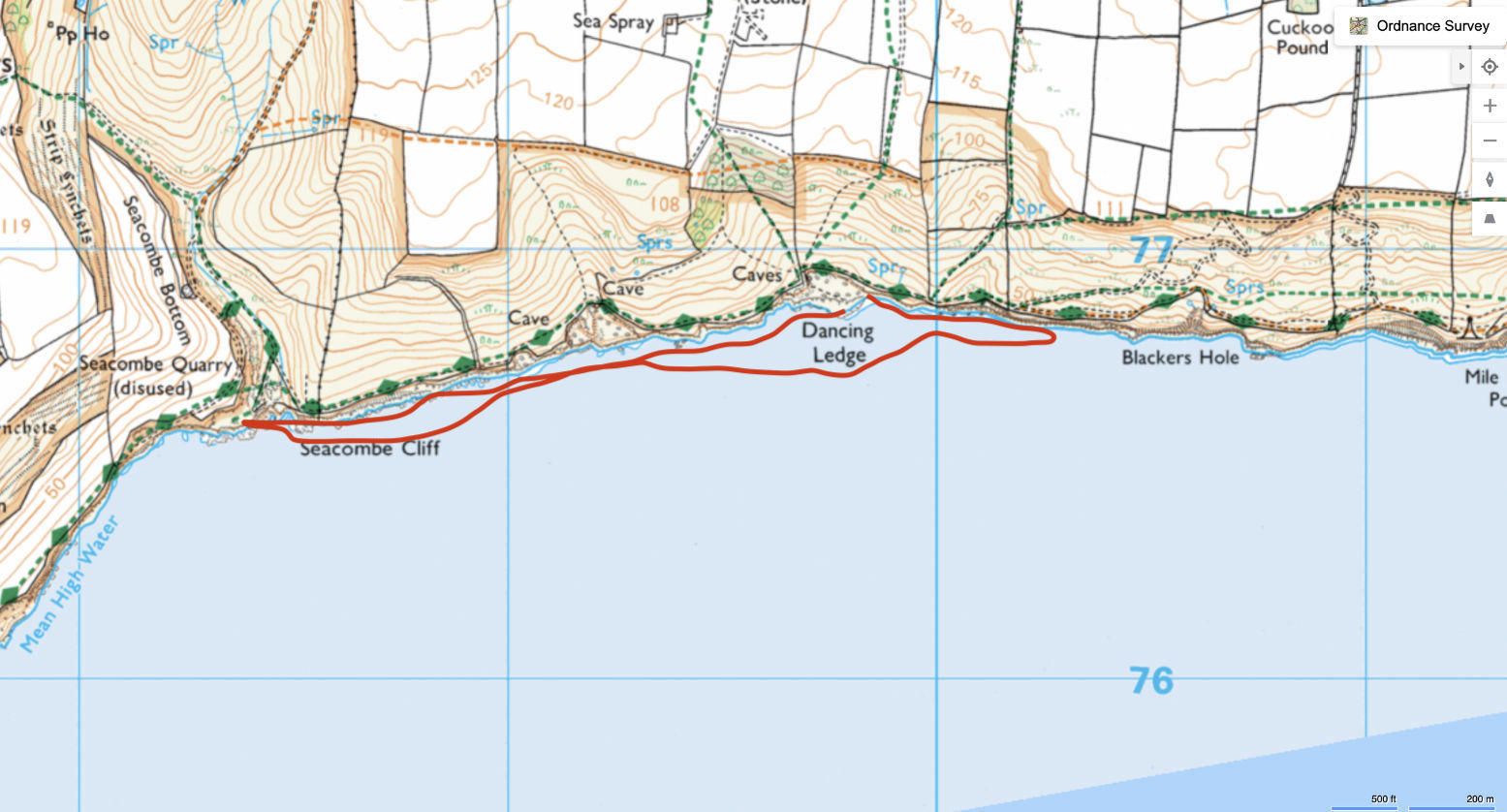
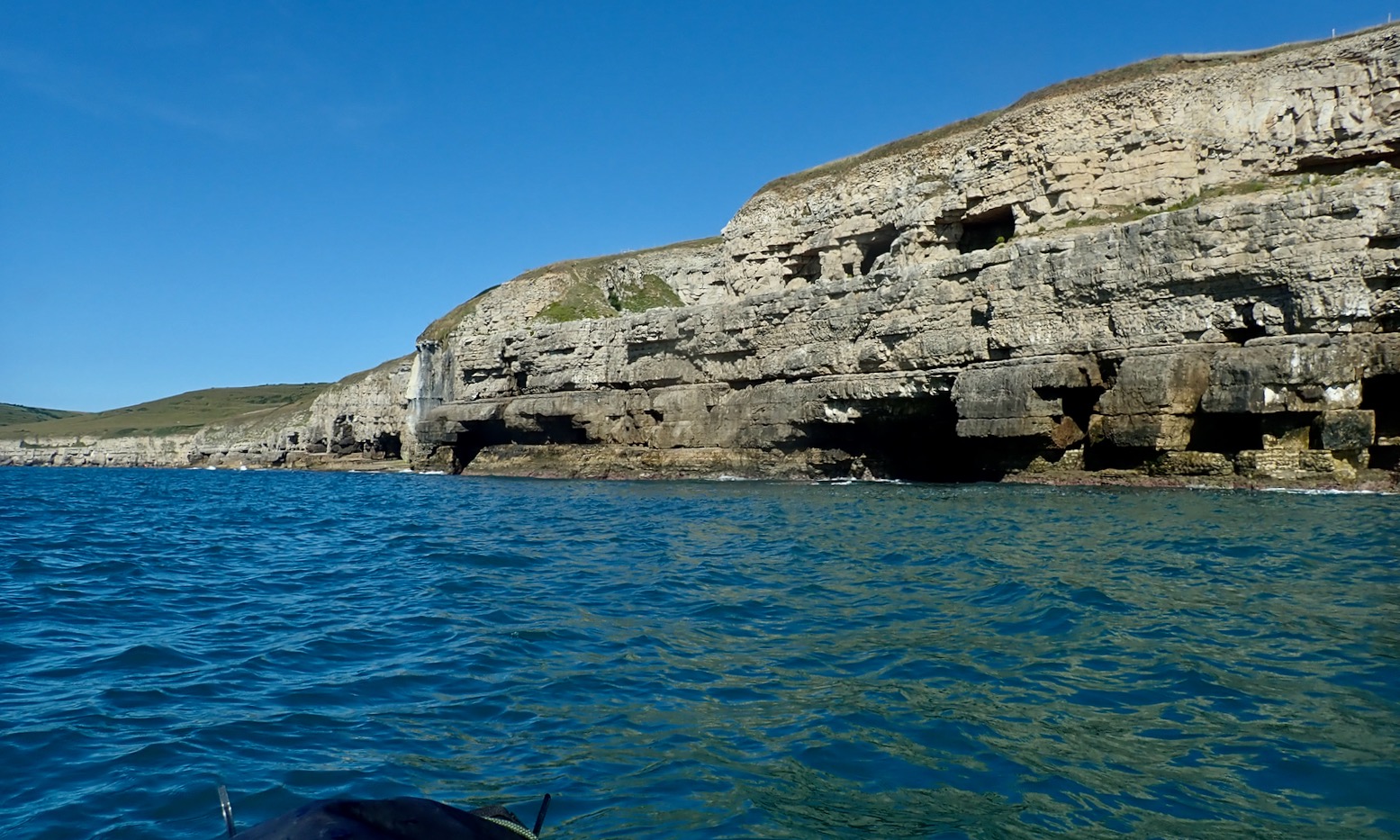
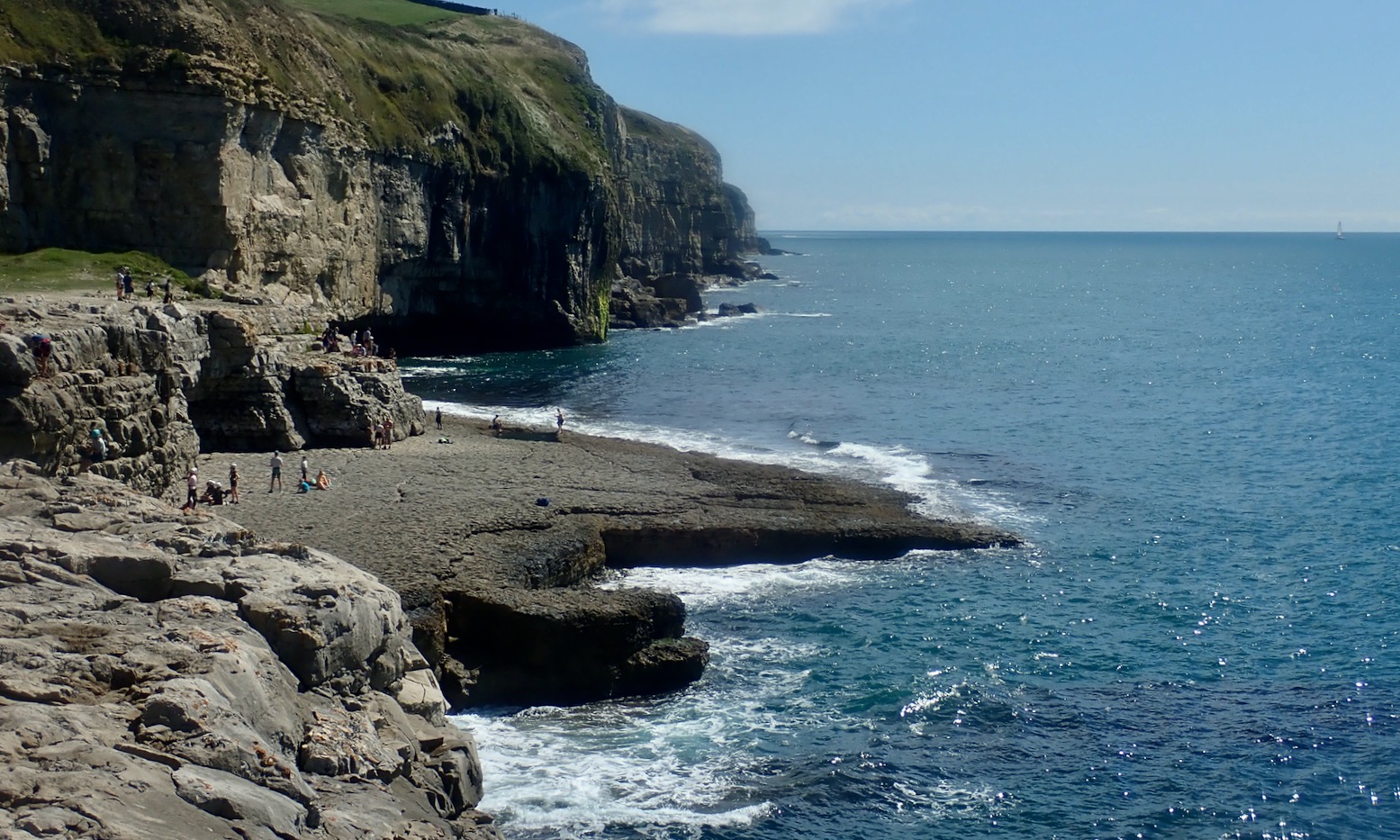
You wait weeks for a calm, sunny day to come along – and then one does. So in my back pocket I had a modest sea excursion planned for the TXL: the cliffs and caves west of Dancing Ledge. It’s a mile’s walk from Langton Matravers village across the fields to the coast where the downs drop steeply to the former Portland stone quarry. From Swanage, about four miles to the east, Dancing Ledge is the first of the few sea access points along this cliff-bound Jurassic Coast.
Approach to Dancing Ledge
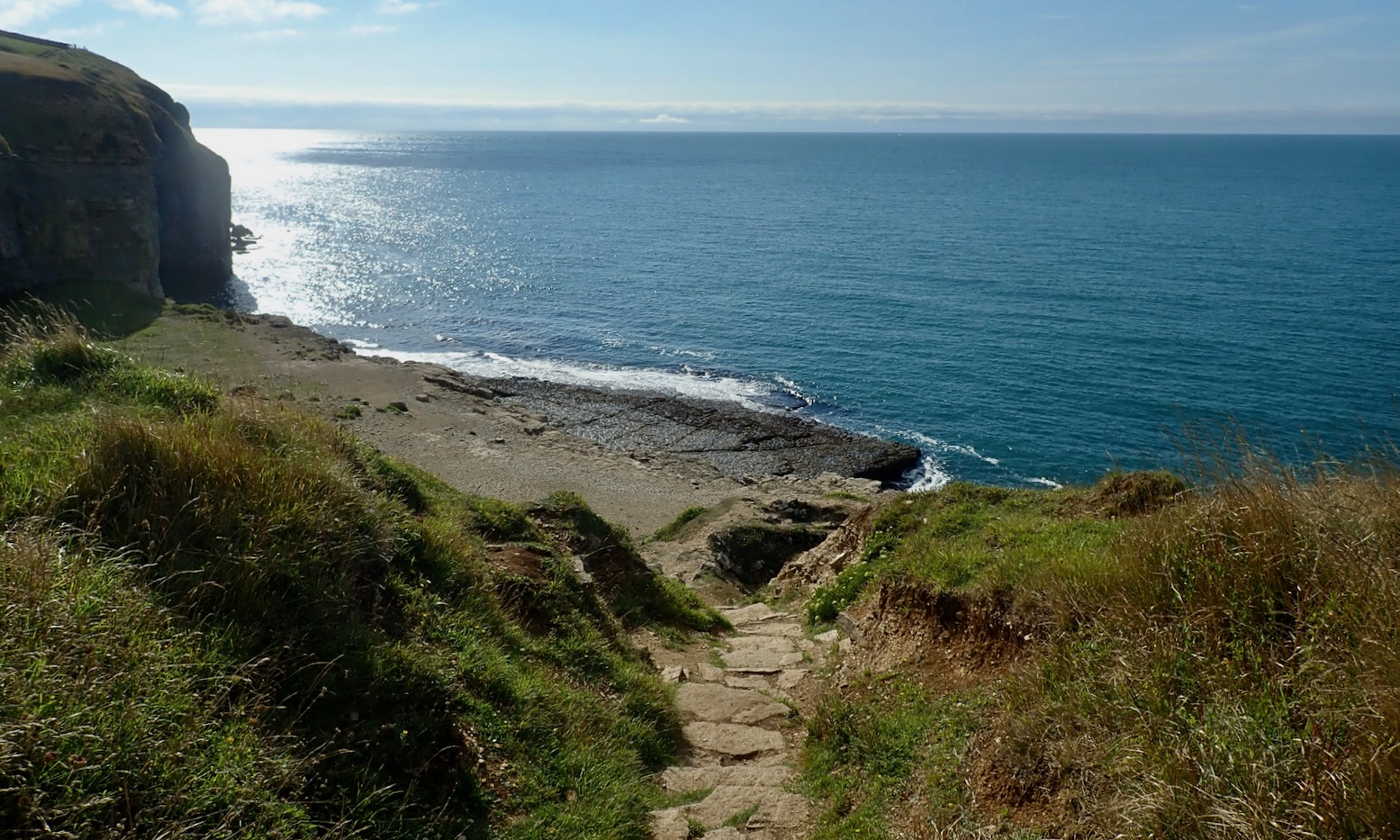
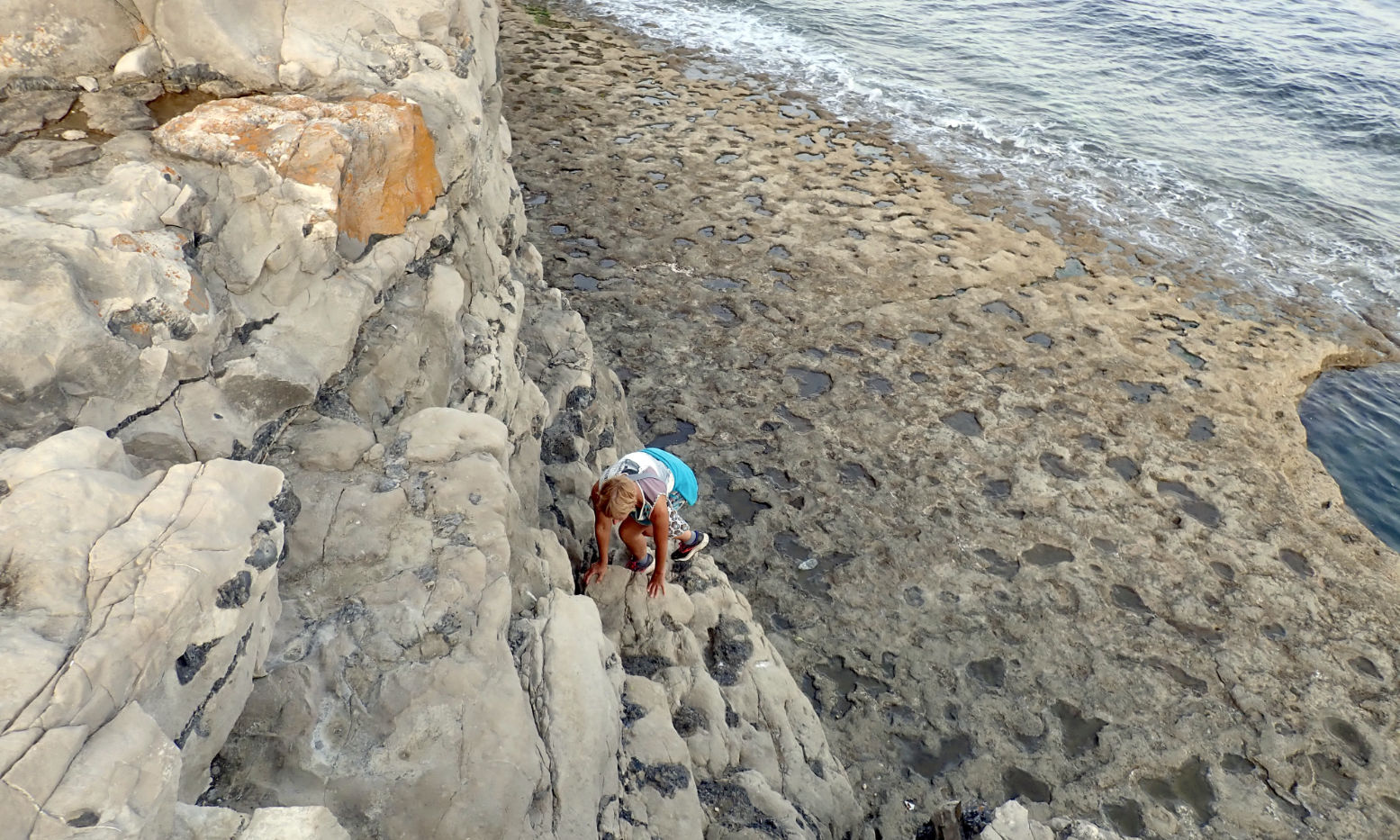
At low tide the lower, natural ledge is revealed, making getting in and out relatively easy. But to reach it you still have to scramble down a small cliff (below). It was easier to chuck the packraft backpack down before descending after it. Alone, rolled up or inflated, getting this far with an IK would be a struggle. This is why we like packrafts – and sea-going packrafts, so much the better.
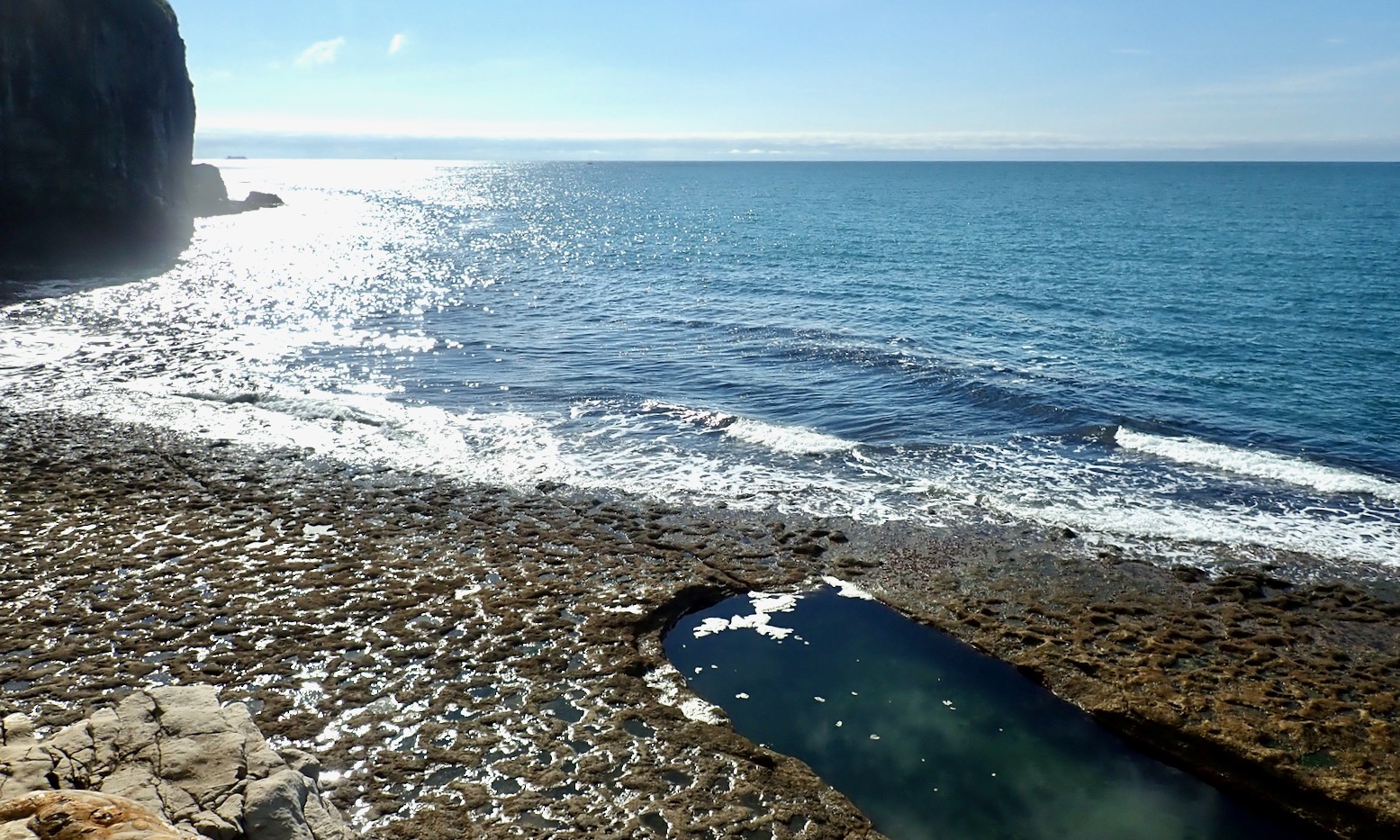
The point where you scramble down overlooks the Bathing Pool (below). It was blasted out of the rock in the late 1800s by the strict headmaster of the local Durnford school in Langton. Pupils then trotted off to the pool each morning for the character-building ritual of ‘strip and swim’, but with a now reduced risk of being swept out to sea. Decades later, James Bond author Ian Fleming attended the Durnford prep school and endured various torments before moving on to the more benign, towel-flicking environs of Eton. Unsurprisingly his Dorset years left a deep impression and later he named his 007 hero after a prominent Purbeck family, the Bonds of nearby Creech Grange. By 1999, when Bond 007 filmmakers had run out of Fleming’s dozen book titles, they chose ‘Non Sufficit Orbis’ or The World Is Not Enough, starring Pierce Brosnan. It was claimed as 007’s family coat of arms in On Her Majesty’s Secret Service, published in 1963, but was also the real Purbeck Bonds’ 16th-century motto. There’ll be a short exam later.
Back by the sea, even with wind speeds forecast at a lowly ‘4mph’ there was no balmy flat calm today, but that’s just the way it probably is with the wide open Atlantic to the west. Portland Bill or even nearby St Adhelm’s Head don’t do much to reduce the oceanic fetch driven by weeks of wind and squalls.
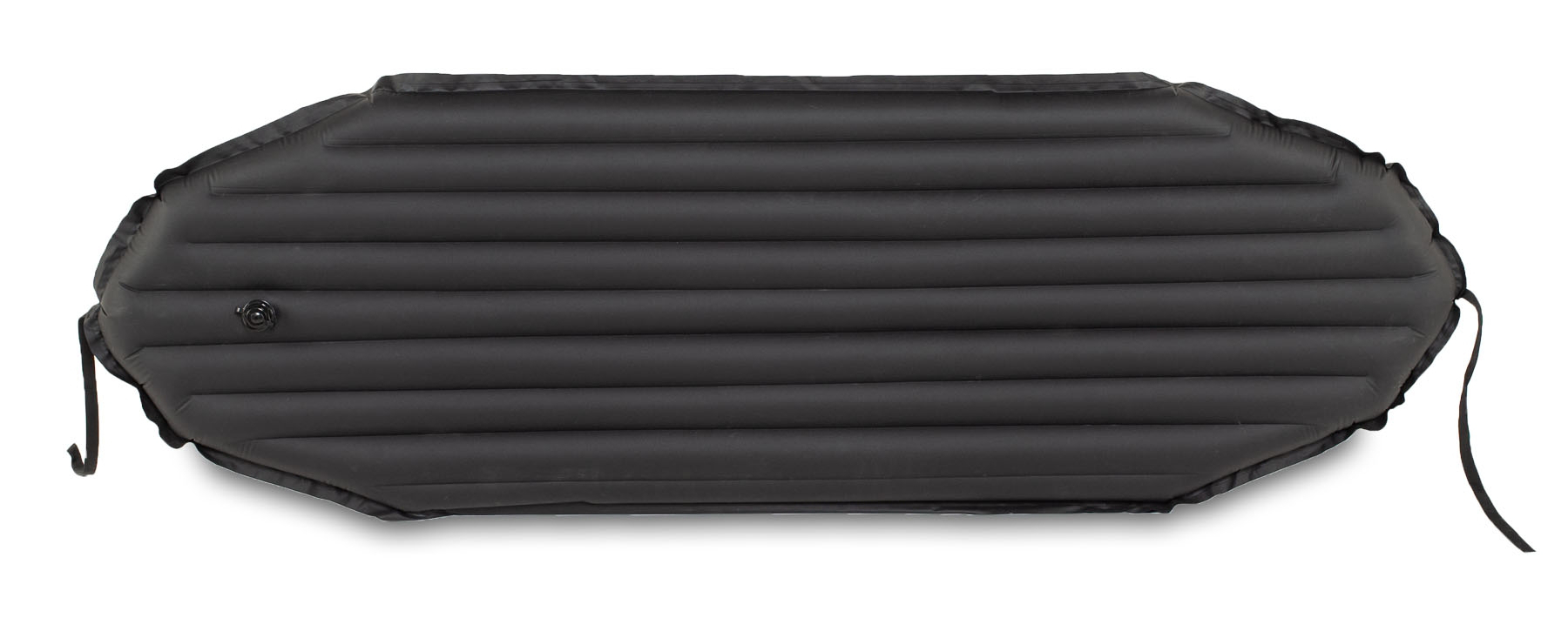
While setting the boat up I find today’s #ForgottenItem was the floor pad (left), which I was wanting to try again, despite being not entirely convinced. Two up, as we did near Skye last year, meant reduced legroom with the mat, but solo with my centrally positioned weight, I still like to think it will limit hull droop and floor sag to improve paddling response. (It does).
Alone, these exposed sea cliff paddles make me quite nervous, and a regular-sized packraft like my old Alpackas or Rebel would feel even more unnerving. The TXL’s healthy 2.8-metre length reduces that impression with less pitching, but I never fully relaxed today, so was happy it was only a mile to Seacombe inlet at which point I could get out and walk back if I wanted. Away from Dancing Ledge things calmed down a bit or I just get used to them, but elsewhere I needed to keep an eye seaward as bigger waves rose up.
With my old MRS Nomad S1, I learned that with longer, high-volume packrafts like a TXL, no matter how hard you pump them up with warm, ambient air, after 10 minutes out on cooler water, a crease develops midway along the side tubes as the air in the hull cools and contracts and the boat effectively loses a few fractions of psi. Though beginners might worry they have a slow leak, this is normal with inflatables. Ashore, I made use of Bond’s Pool of Torment (said to be the next film title) to pre-cool the TXL but knew it wouldn’t really work. Flooding the inflated boat for a few minutes is probably the answer. A little hand pump can only pack in, say, 2 psi at 18°C. Any more air forced in may burst the pump or stress the boat’s seams if done too often. But once part submerged by my weight on 12°C sea water, the hull cools and drops to, say, 1.8psi. It won’t get any lower, but it’s enough to lose its edge and means the boat paddles less efficiently. We can’t be having that!
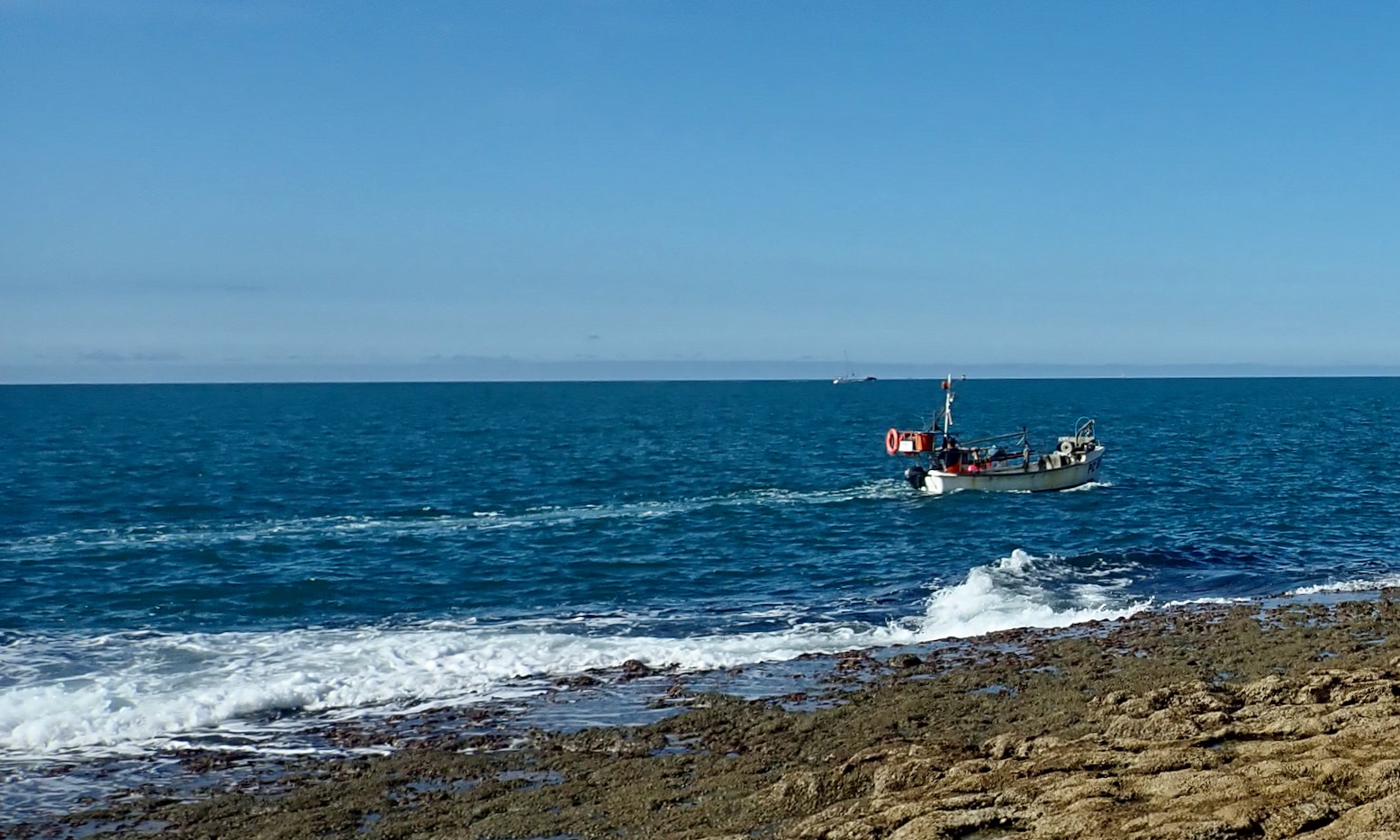
In my heightened state of anxiety at paddling a new, exposed locale, I was pleased to see a lobster boat passing my way (above). Later on I catch up and and meet the Chatty Fisherman. For a while I was worried the tide might turn before I got to drag myself away, but, Purbeck born and bred, he was a local quarryman who used his summer hols to snag a few lobsters and had lots to say about everything, including reduced catches of late. “We used to get hundreds [of lobsters] here before the seas got warmer. Now I barely get a handful.”
There was no place to hop off and top up the boat, though I could always flip round in the seat and do it on the water. That said, I wonder if longer packrafts like TXLs could benefit from repositioning the inflation valve closer to the central seat, like my old Incept K40 solo IK. The MRS Nomad had the valve on the bow, which was handy. I suppose this might make expelling the air on rolling up more difficult, but we now have mini pumps with suction settings, making valve position less important. With a passenger or another paddler alongside, on-water topping up is less of an issue, but had I thought it through before adding the second skeg patch, I could have glued it at the other end, as the TXL is symmetrical, but then is the bow bag tabs would be at the back. So halfway down one side would be better, Anfibio. Sorry, I did I say something?
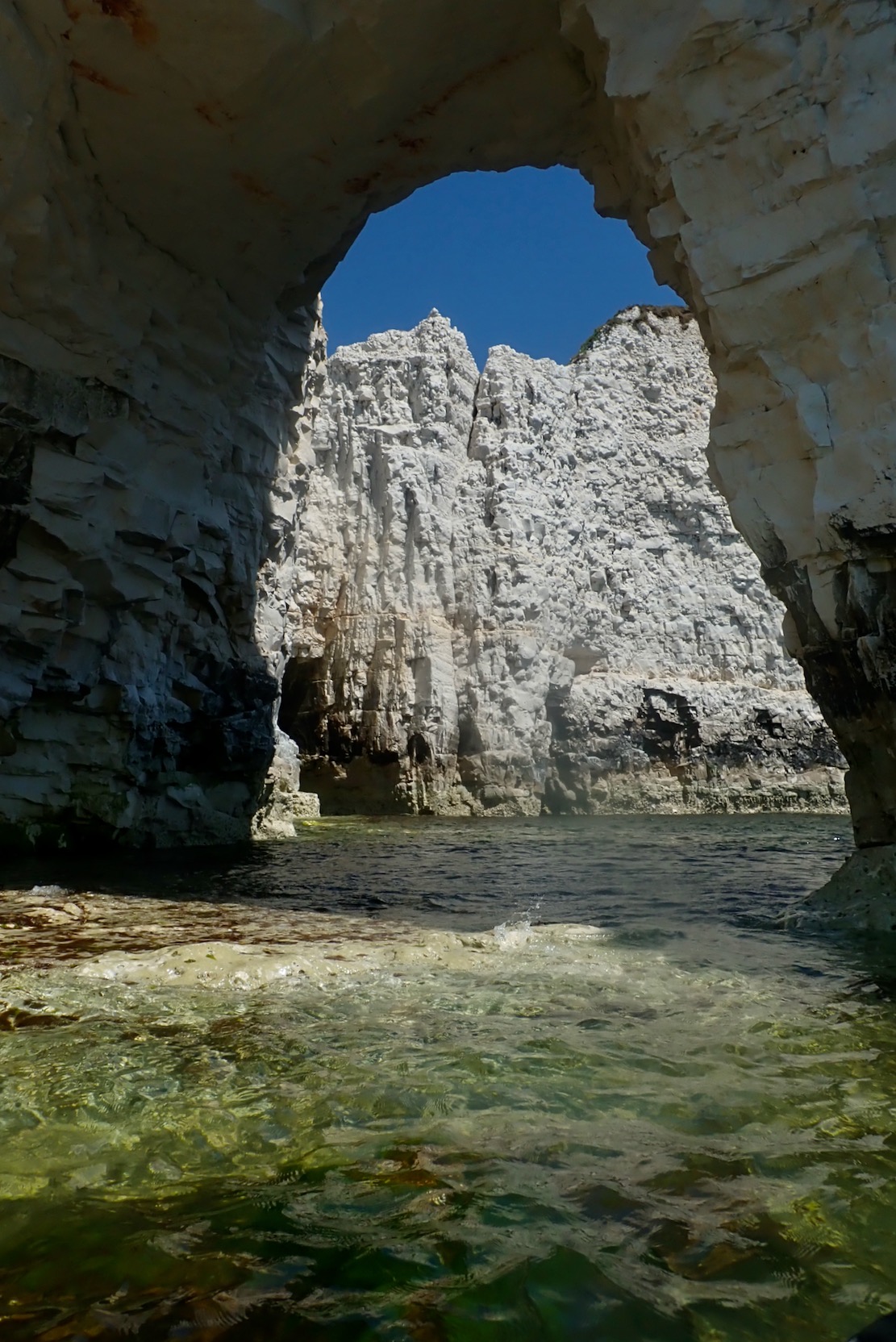
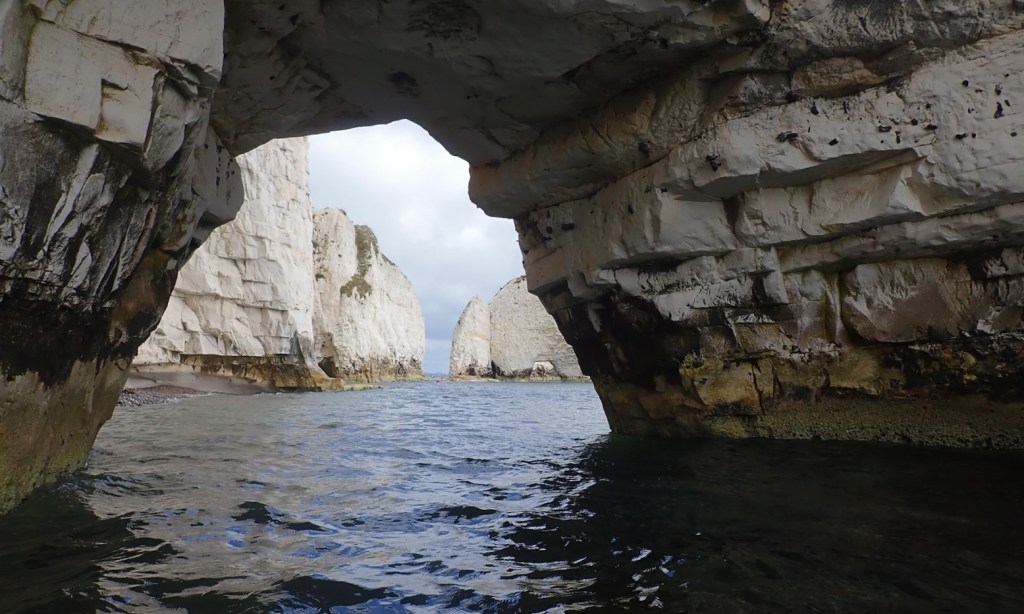
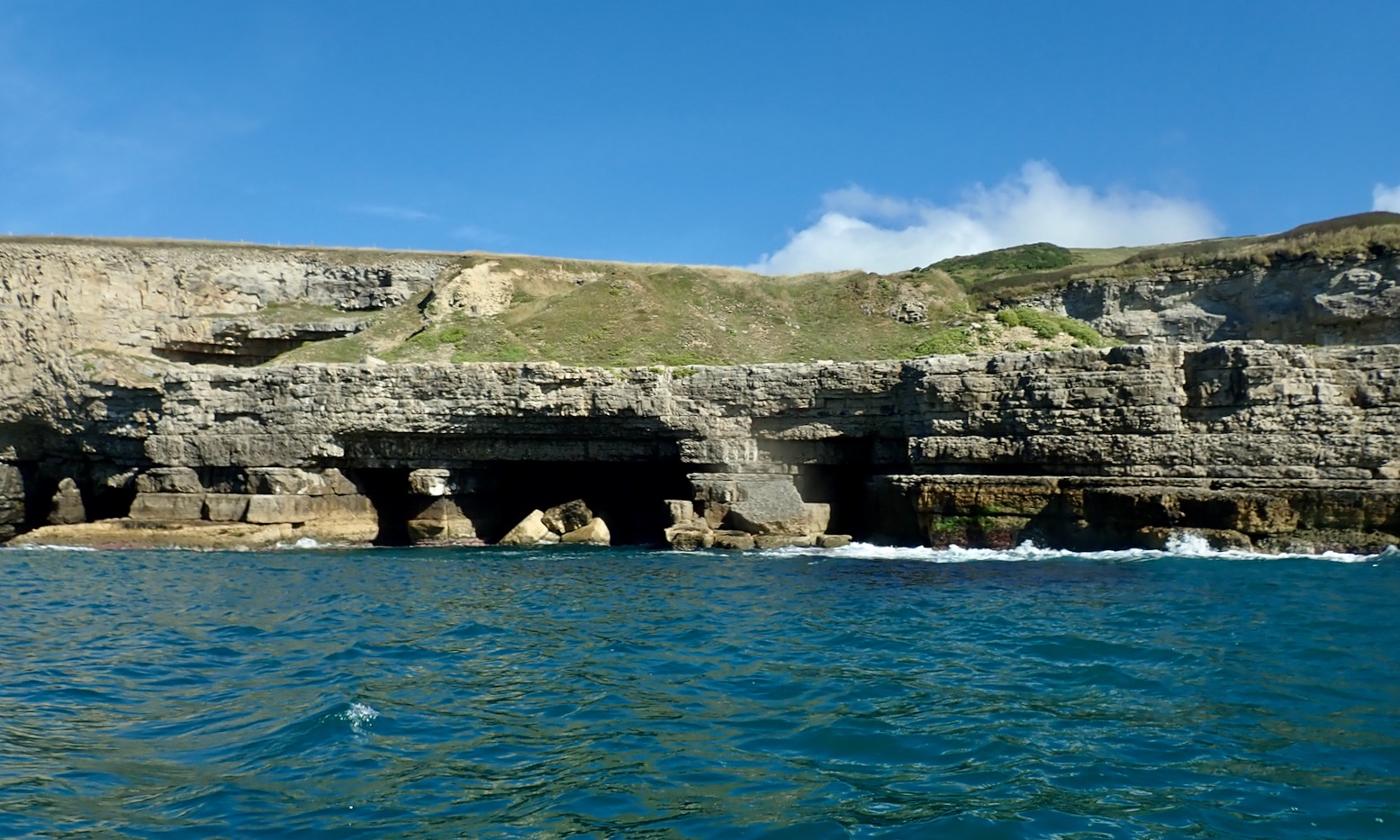
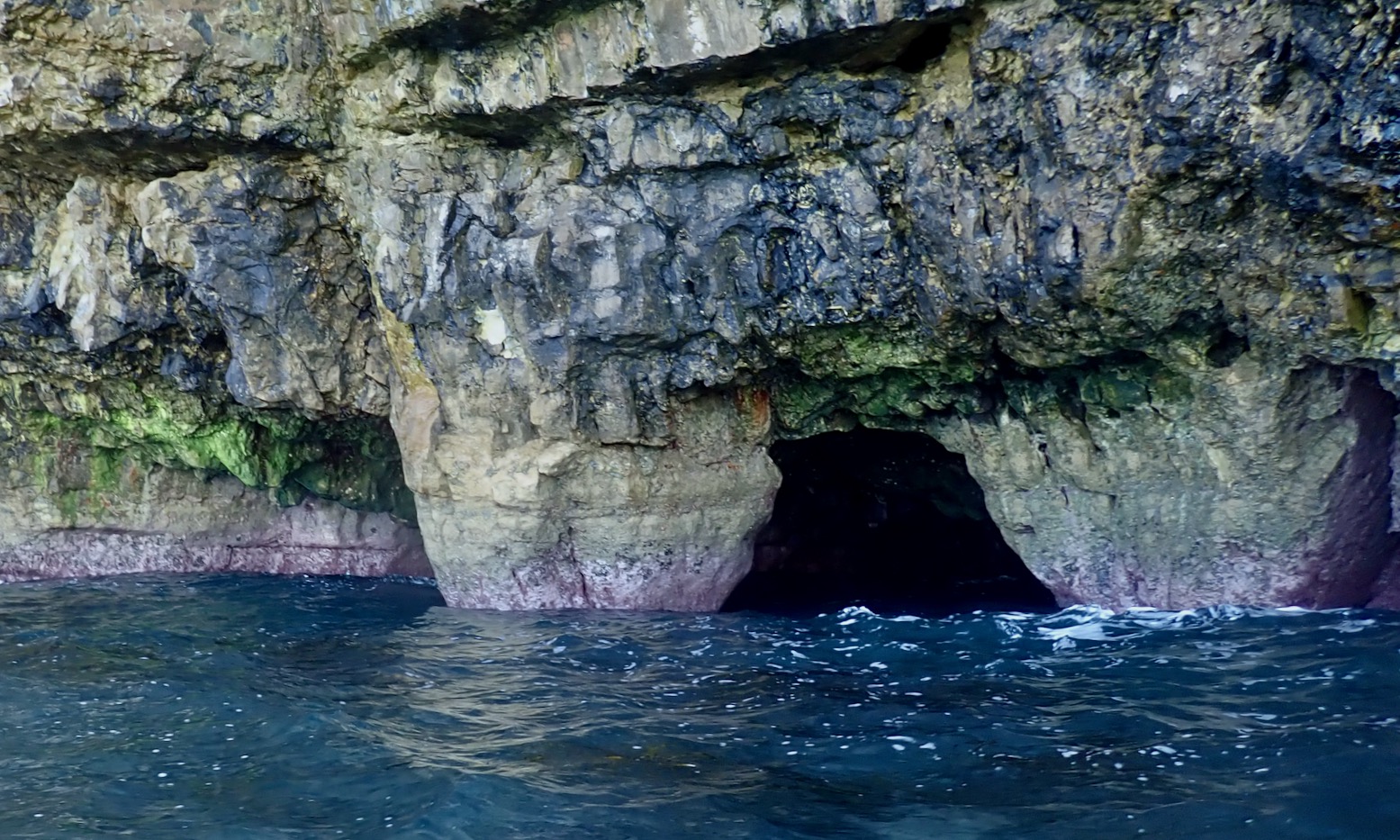
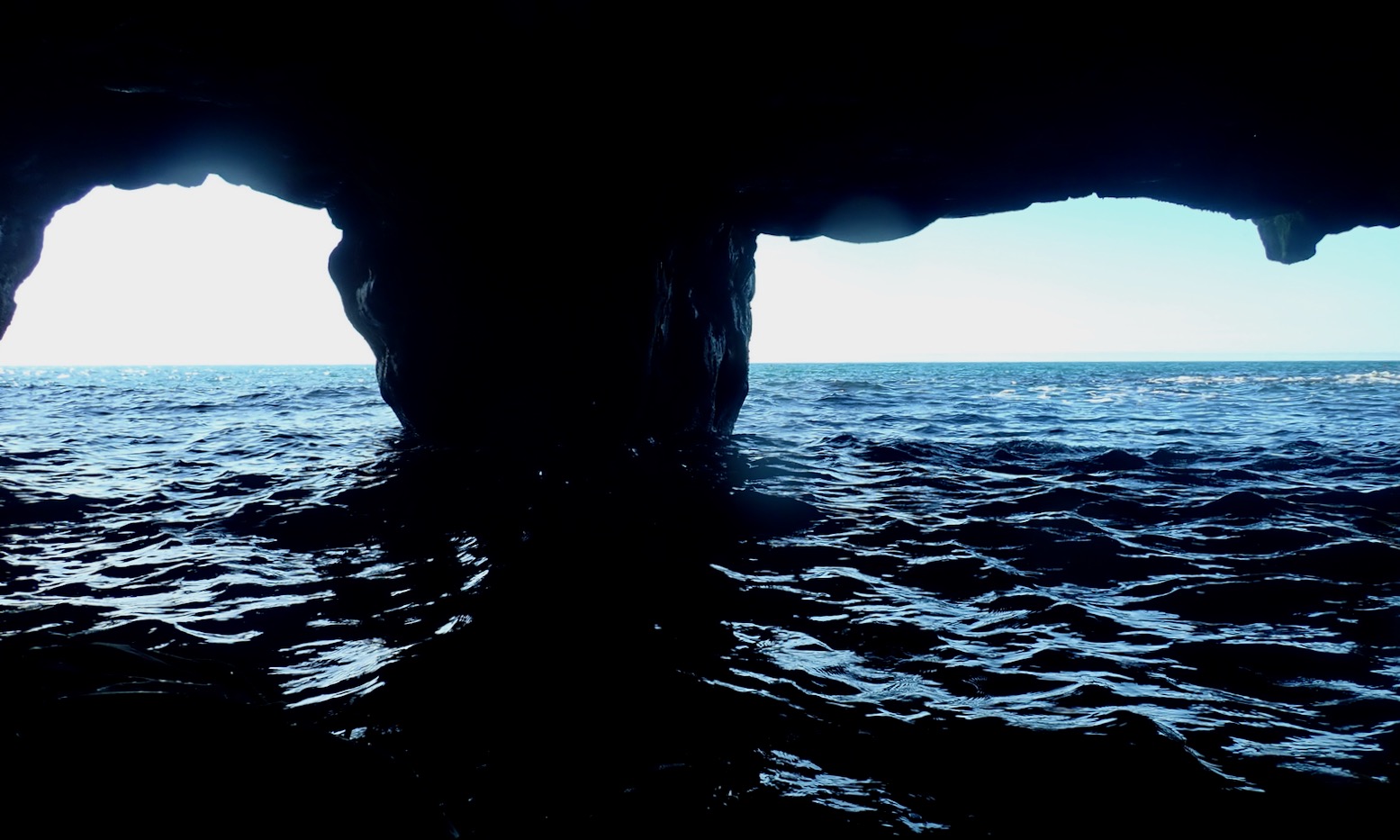
I paddle onward. Most of the caves have too much intermittent swell rolling in to get close, but one twin-mouthed cavern (above) looks like it could be safely threaded in the nippy TXL without me getting lifted by a sneaky swell and knocking myself out on the cave’s roof.
Inside the cave
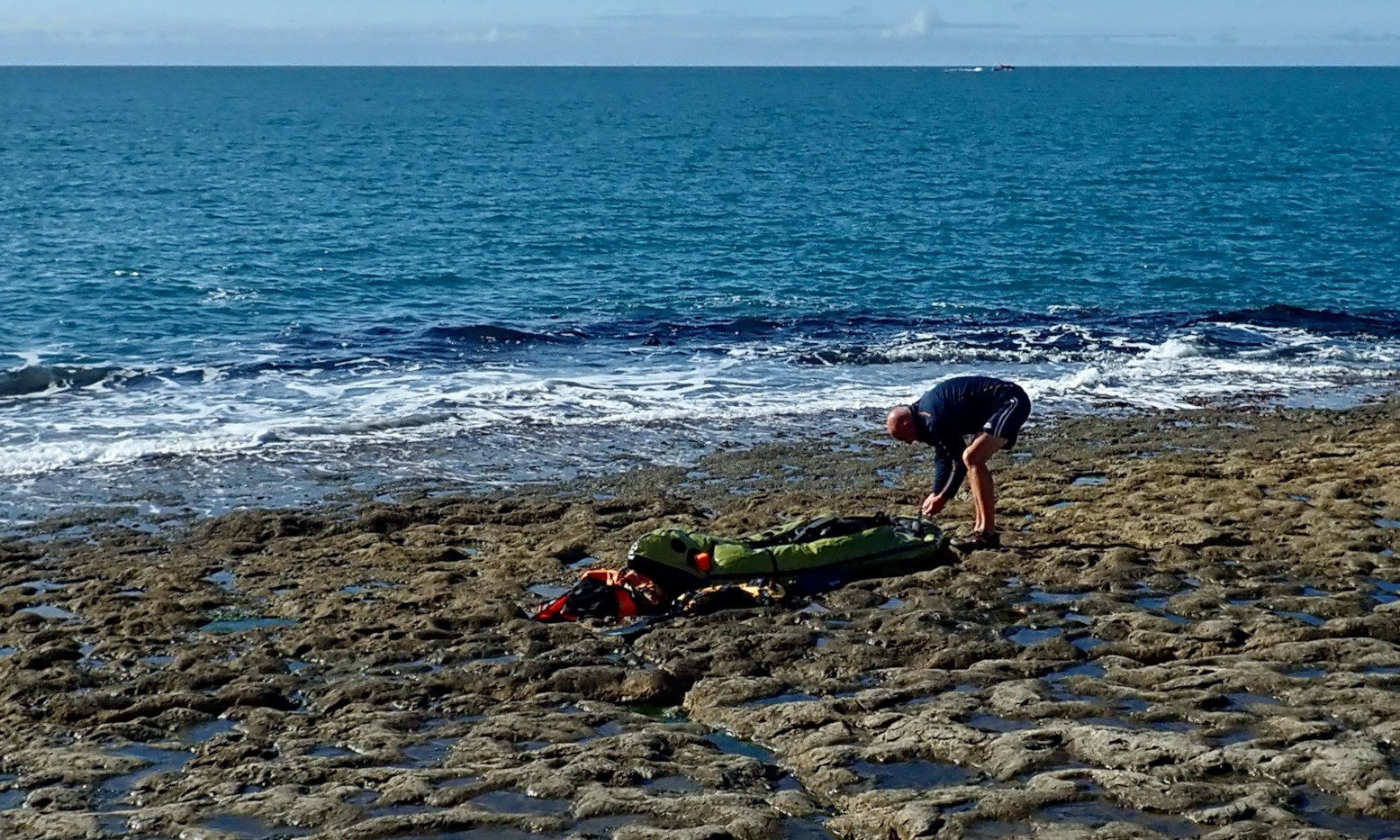
Further west I see a few people wandering about on the foreshore ledges, announcing the inlet at Seacombe, another old quarry. As I get near, I line myself up to get lifted by a wave and dropped onto a ledge. It ought to be easy but ends up a bit of a bundle. Before I can climb out I get sucked backwards into another wave, which drops onto the boat. But though it looks ungainly, timing isn’t that crucial in a stable packraft that’s easy to hop out of quickly. Lord knows how a sea kayak would manage. Up on the ledge I drain the TXL before flipping it back over and giving it a few jabs of the handpump so it’s pinging firm again.
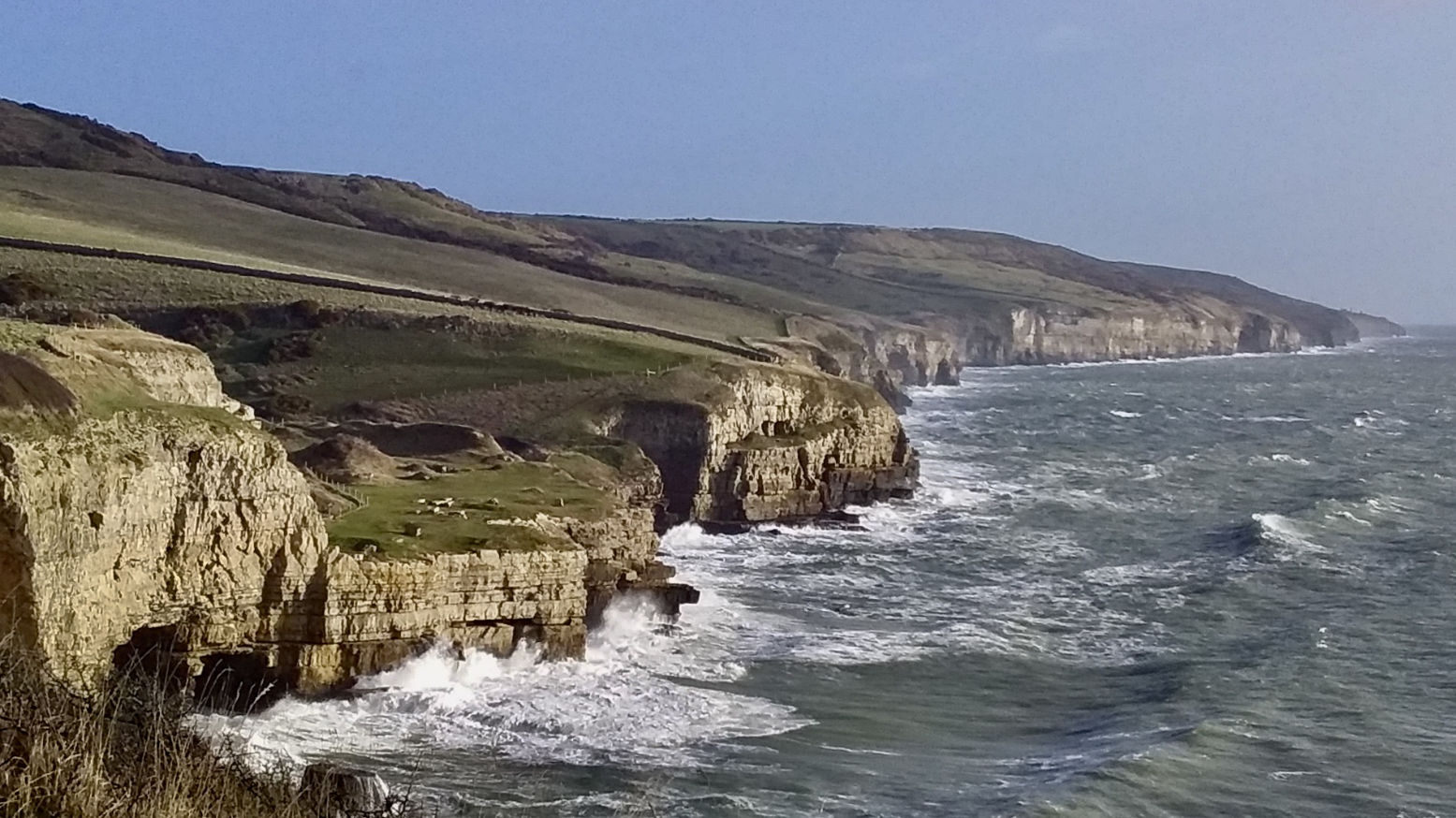
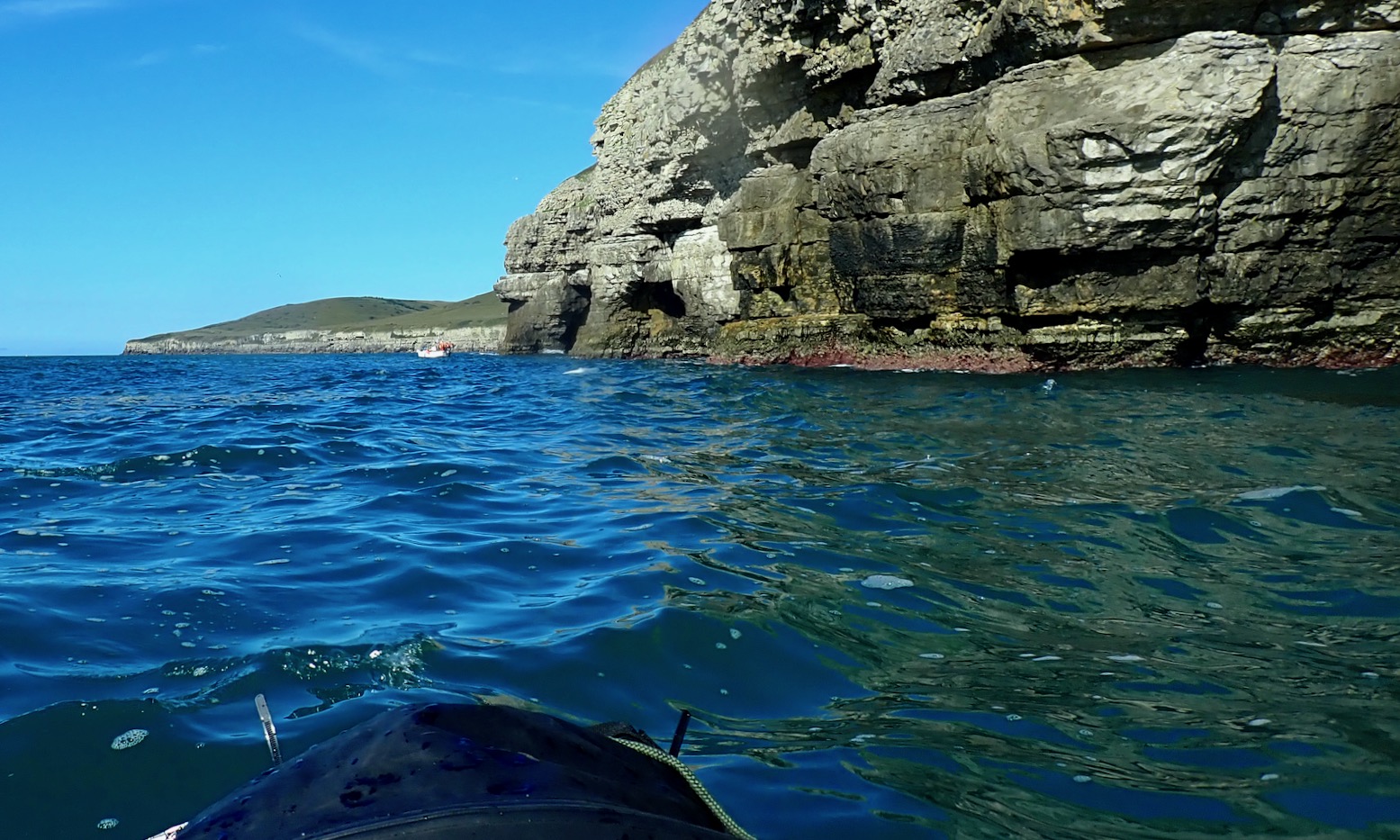
Seacombe cliffs
Putting back in, I’m alarmed to see my skeg lying on the rocks. My to-and-fro landing must have dislodged it. (It happened again on my next TXL; this is a fix). It is for moments like these (or, more commonly, distractions while packing up) that I wrapped it in hi-viz yellow and black tape. Had I lost it, the downwind paddle back would have been a bit squirrely, giving me something new to worry about until I realised the cause. Passing the twin-mouth cave I threaded earlier, the tide is already too high to repeat the stunt.
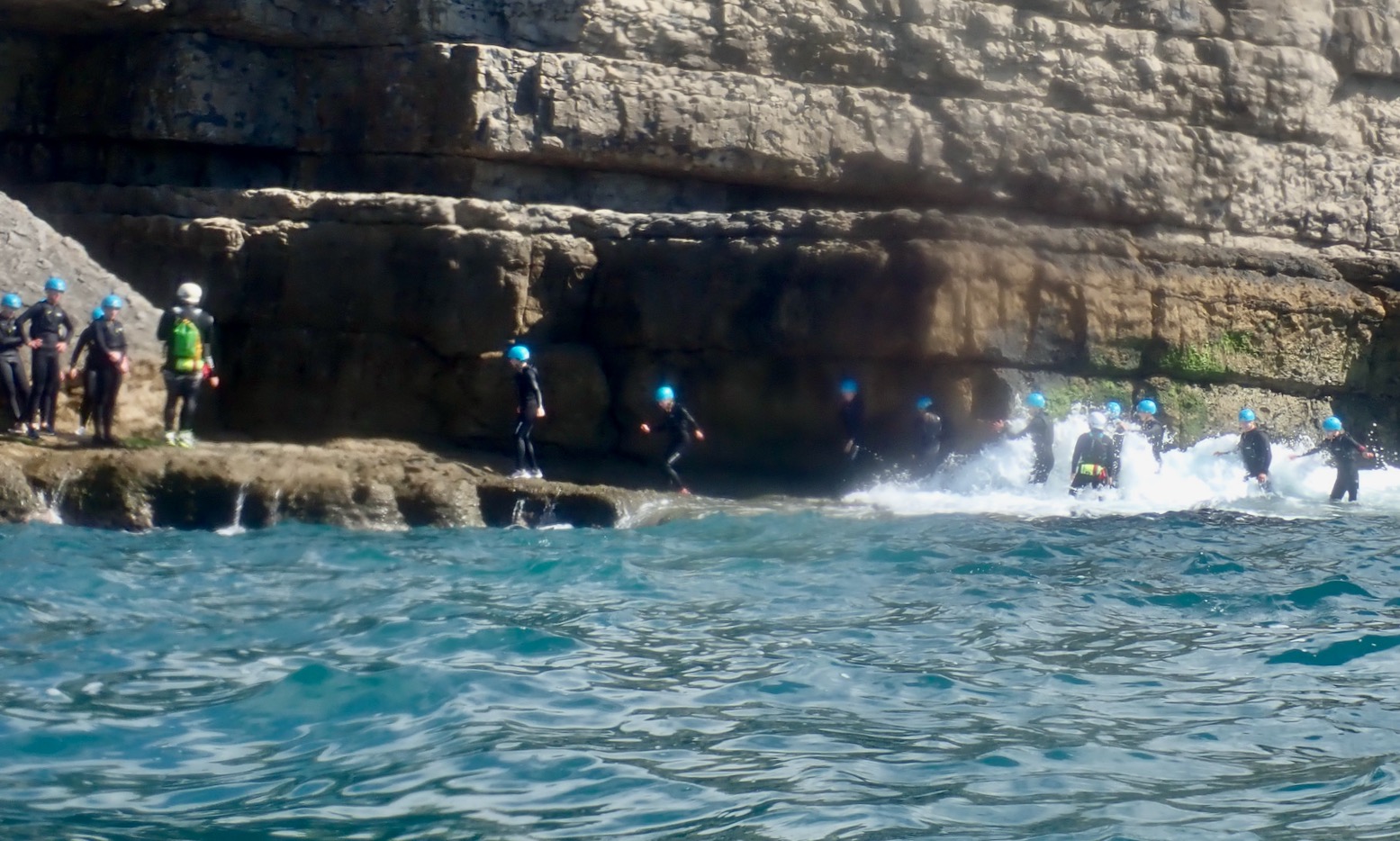
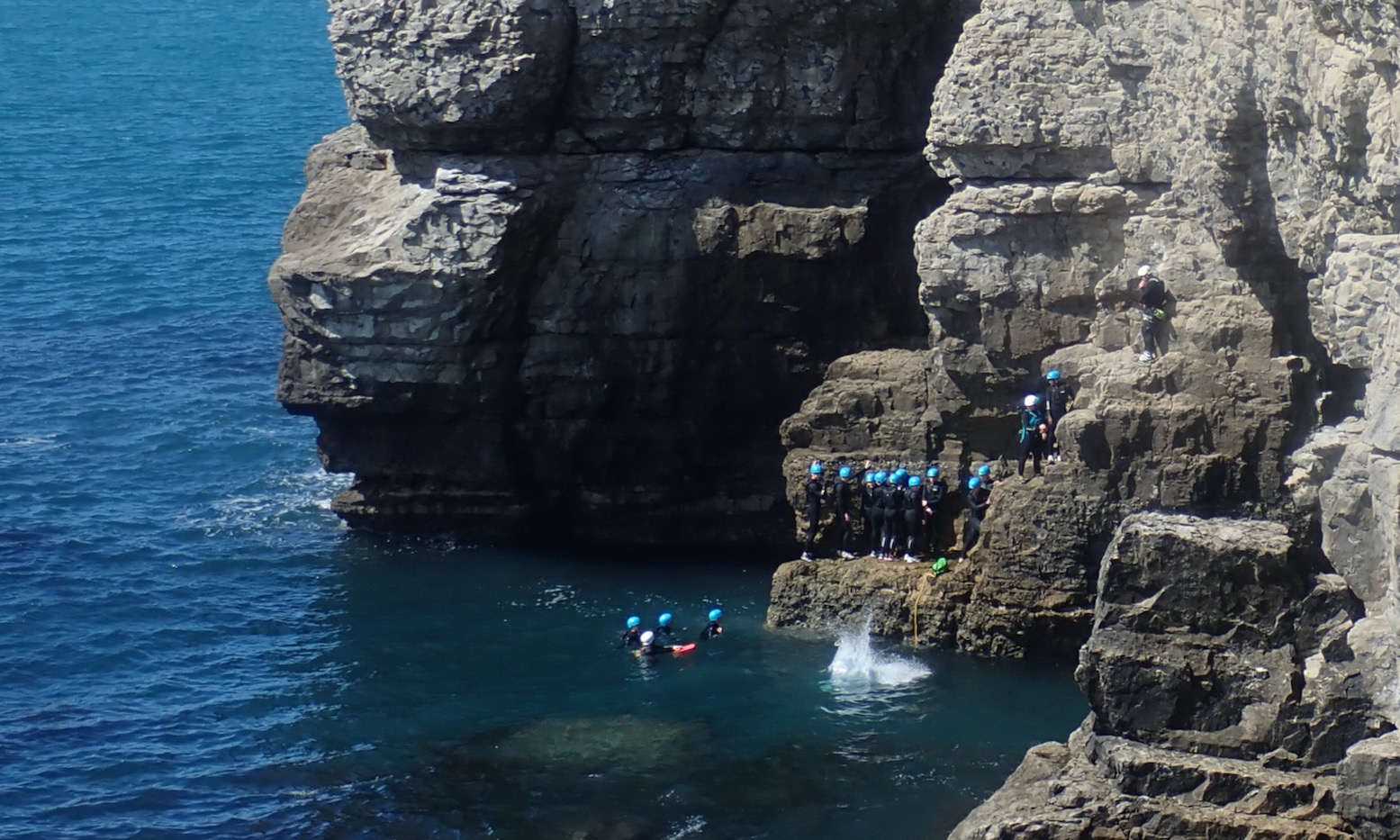
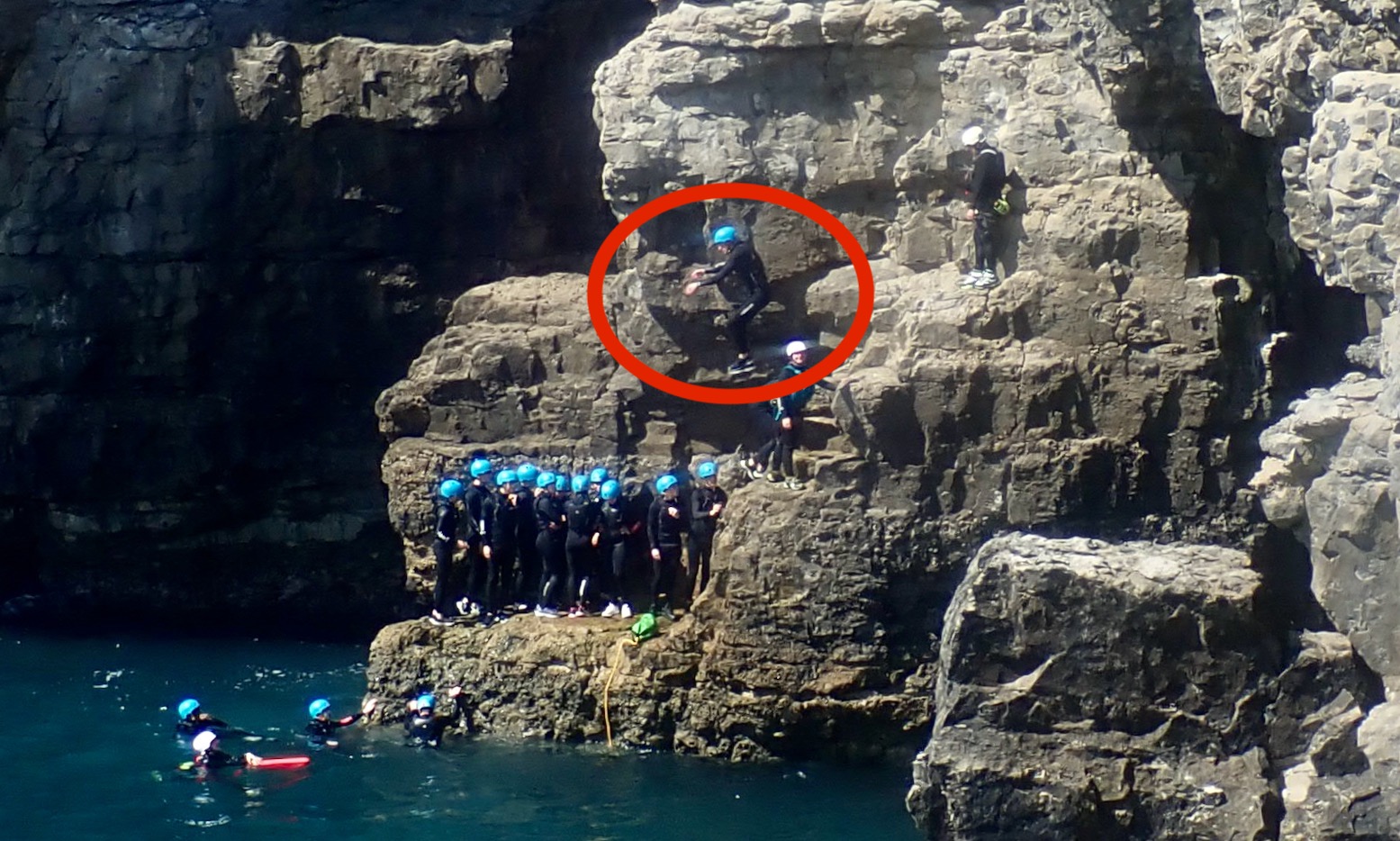
By the time I returned, Dancing Ledge was packed with day-trippers including groups of coasteering wetsuit-clad kids. They inched along the ledges, swam across cave mouths, and then clambered up to a narrow ledge to jump in. The next group was already lined up to follow so it all looked a bit sketchy and congested with just two guides for over a dozen kids (turns out it can be), but I bet they all loved it.
‘Beyonsaaaay! (or whatever kids shout these days).
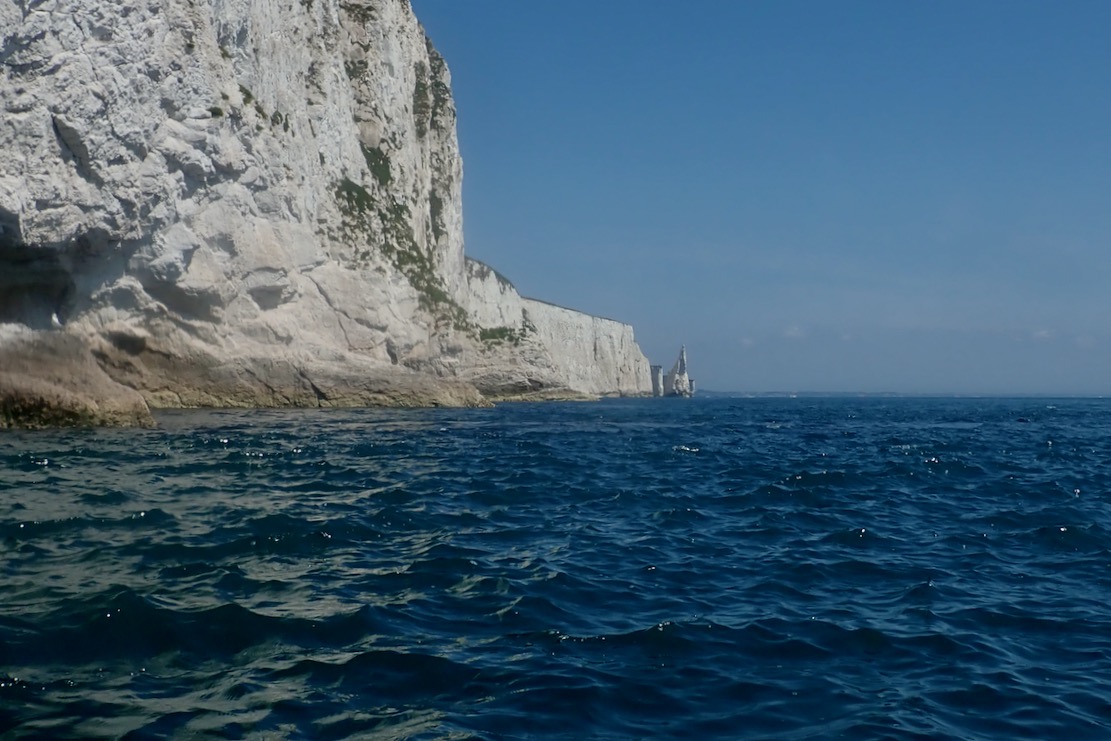
As had happened so many times, a spell on the water without incident calmed the nerves. So I continue past the Dancing take-out and cast a wistful glance eastwards. It was only 2.5 miles, or an hour or so with the tide and wind and cliffs to the Isle of Purbeck’s southeast corner at Durlston Head, before a more sheltered turn northward to Swanage, another mile away over the Pevrill Ledge, the final hurdle into town. One for the next ‘calm’ day perhaps.
Looking east over Dancing Ledge
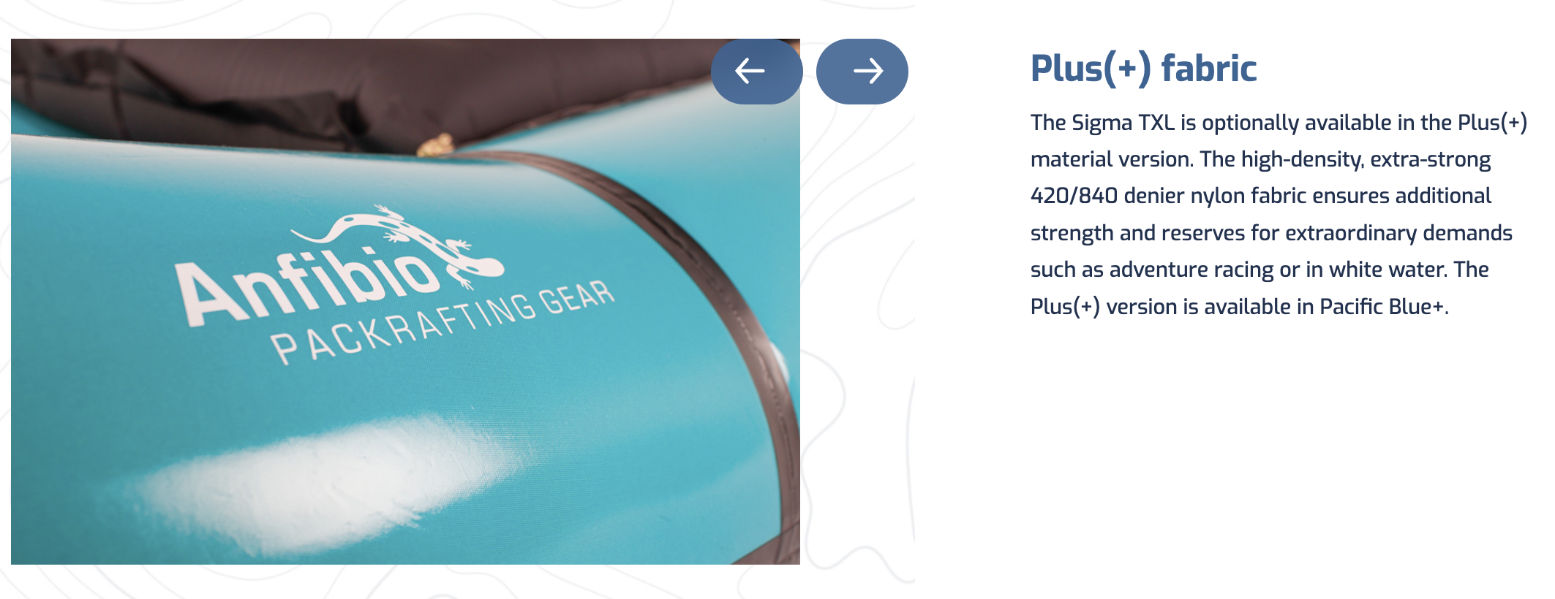
Anfibio Plus(+) fabric Checking out Anfibio’s TXL page later, I see they’re offering the option of the TXL and similar long/double models in chunkier Plus (+’) fabric. It’s only 17% heavier but 80% more tear-resistant, depending on how you measure that, but costs only €70 extra. It looks like it might be similar to floor fabric or comparable with Alpacka’s much more expensive Vectran option.
Anfibio don’t fully explain why they’re now offering thicker Plus(+) fabric; has the standard proved a bit less durable? I admit Anfibio do focus a bit too much on the ultra lightweight side of things which, alone in a single-skinned inflatable, is not where my priorities float. From my experience with stiffer PVC IKs versus more flexible rubber kayaks, I do wonder if a Plus(+) TXL or similar might be more rigid on the water without the need to pack it full of air. It may even exclude the need for the 900-g floor pad (it doesn’t). Along with what I estimate to be a <500g weight penalty, I imagine a Plus(+) TXL will roll up less compactly, but other than that it’s something worth looking into.
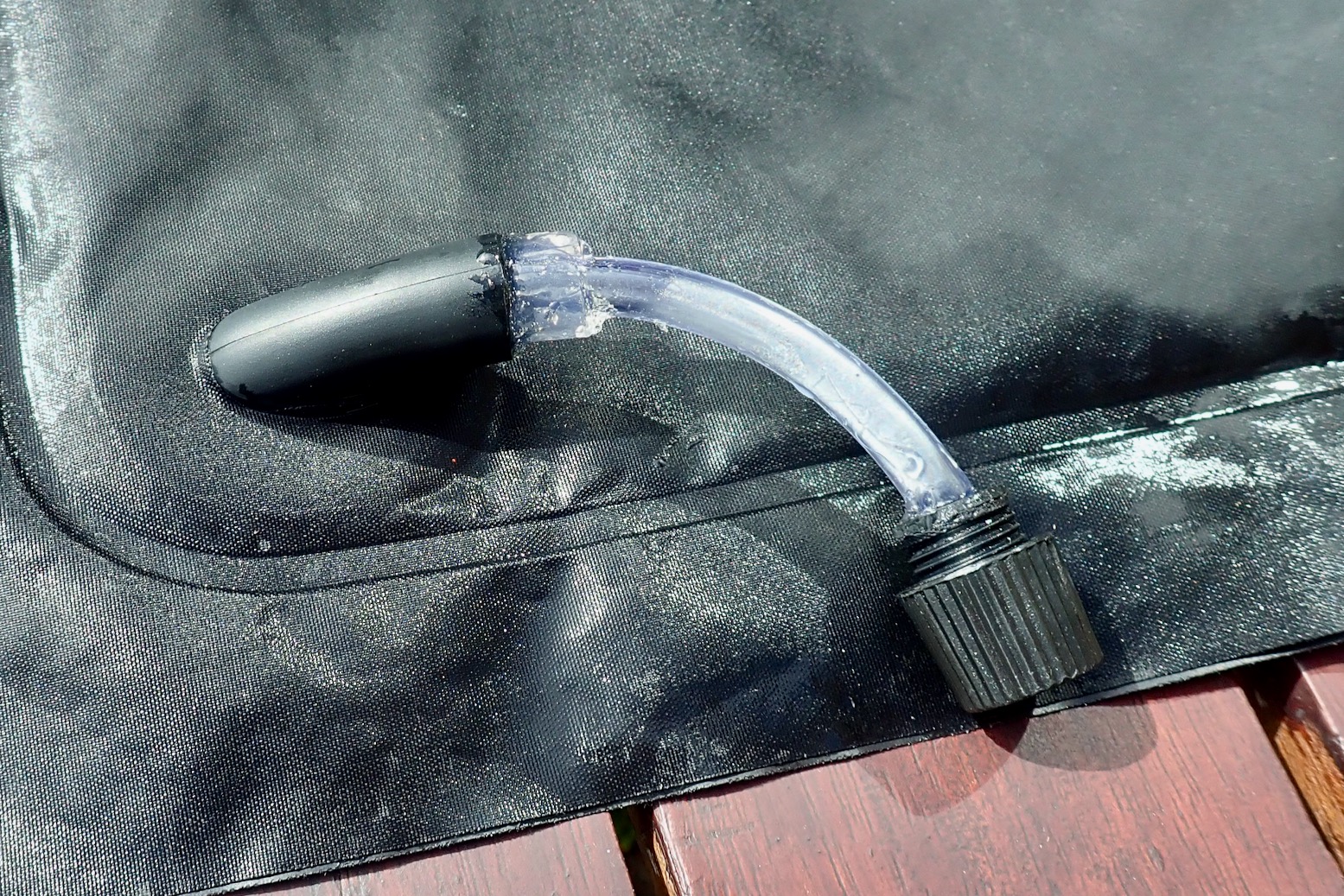
Quick-deflate seat While I was never a fan of the mushy, twist-lok stem valves on the early Alpackas, I’m not a huge fan of the sprung, one-way inflation valves Anfibio use on their seats and backrests. Great for easy inflation and holding high pressures, but a pain to deflate when packing up; you have to jam a fingernail in the valve and scrunch the seat while it ever so slowly deflates. At least with an old twist-loks you could suck the air out. And anyway, you don’t need full pressure in a seat. Far from it. There was talk of Anfibio modifying the seat valves for easy deflation but it’s not happened yet. Now the TXL is my sole packboat, I’m minded to set it up well. I failed to find anything other than Boston valves online. They’d work of course and will dump air really fast, but are a bit OTT and would need gluing in properly.
I had a spare dry bag with a neat twist lock valve a bit like Thermarest sleeping pad valves. But marrying it to the chopped off sprung one-way valve in the seat was tricky to do neatly. So I managed to do it not neatly (above left) with a bit of clear tube and lashings of Aquasure. Unfortunately the tube is narrow which slows things down or increases effort; win-lose. For the moment it works; I can unscrew the valve and roll up the huge seat, purging the air as I go. Looking back on this dramatic episode, next time I’ll just cut a hole and glue in a Boston valve (left) which are easily found online for under a tenner.









































































 Inflatable Kayaks & Packrafts