Le Grand Gonflateur himself, Gael A sent me this image to illustrate something. Its composition and colouring was so magical I’m compelled to elevate it to the IK&P Picture of the Week. Captured in 2005, the location is the River Epte, a tributary of the Seine in Normandy and site of Monet’s no less idyllic 1899 painting, ‘Waterlilly Pond’ (left). It looks like Gael is sliding down a burst canal bank on his H2, while his trusty compadre observers from the reassuringly stable platform of a Mk1 Sunny gumboat. Behind him a sign warns ‘Access Interdite – Danger [sauf gonflards] and nearby a docile cow nuzzles the trunk of an oak tree quivering in its prime. A serene snapshot of rubber boating bliss.
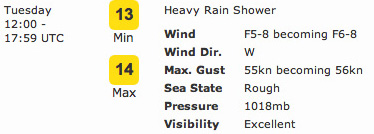
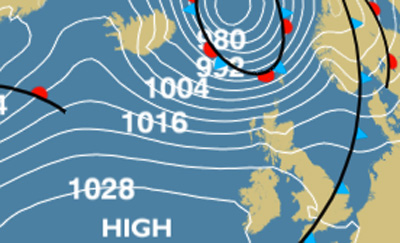
I do like a good storm. On the left today’s coastal forecast for the Minch. You might call it the first big storm of the autumn. Some 250 miles to the north, out on the Faeroes and towards Norway it’s blowing at Force 10 with 40-foot waves, like something out of the Perfect Storm movie before it gets really scary.
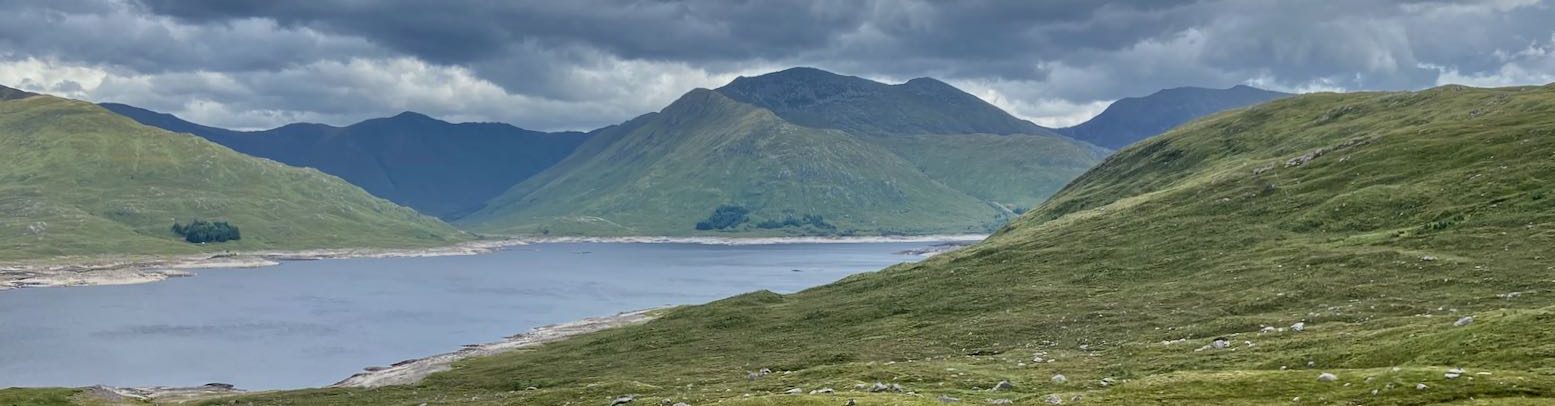
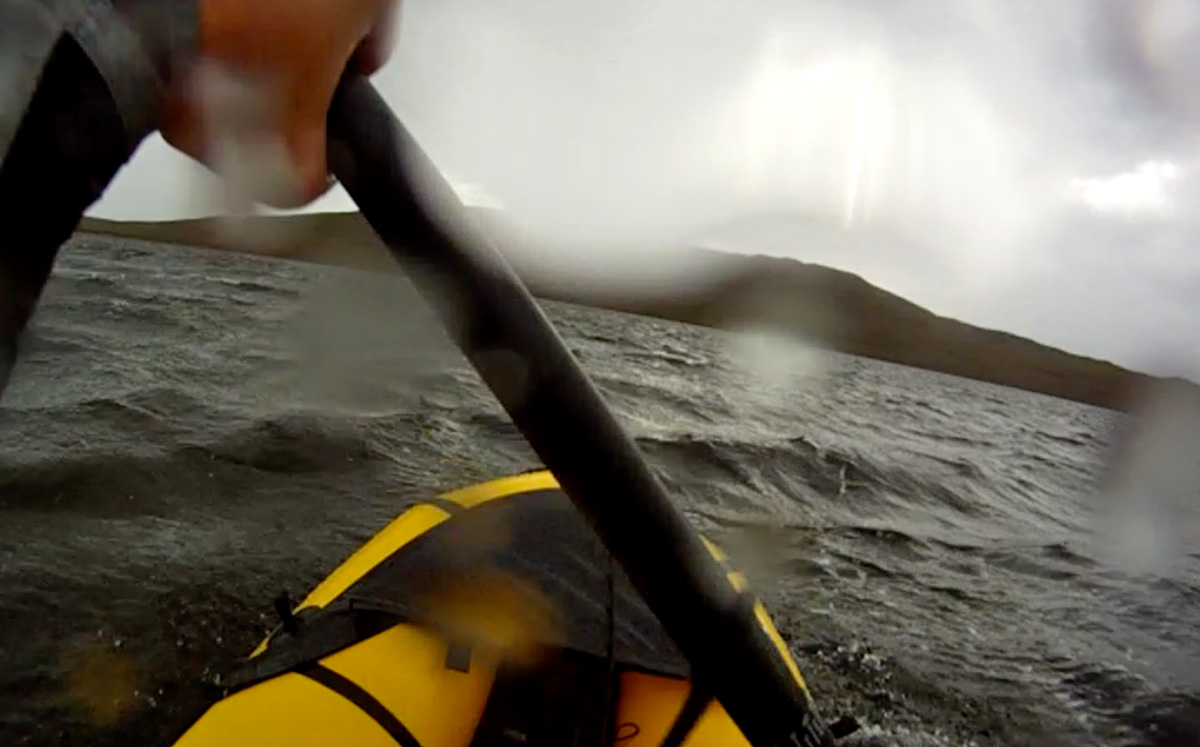
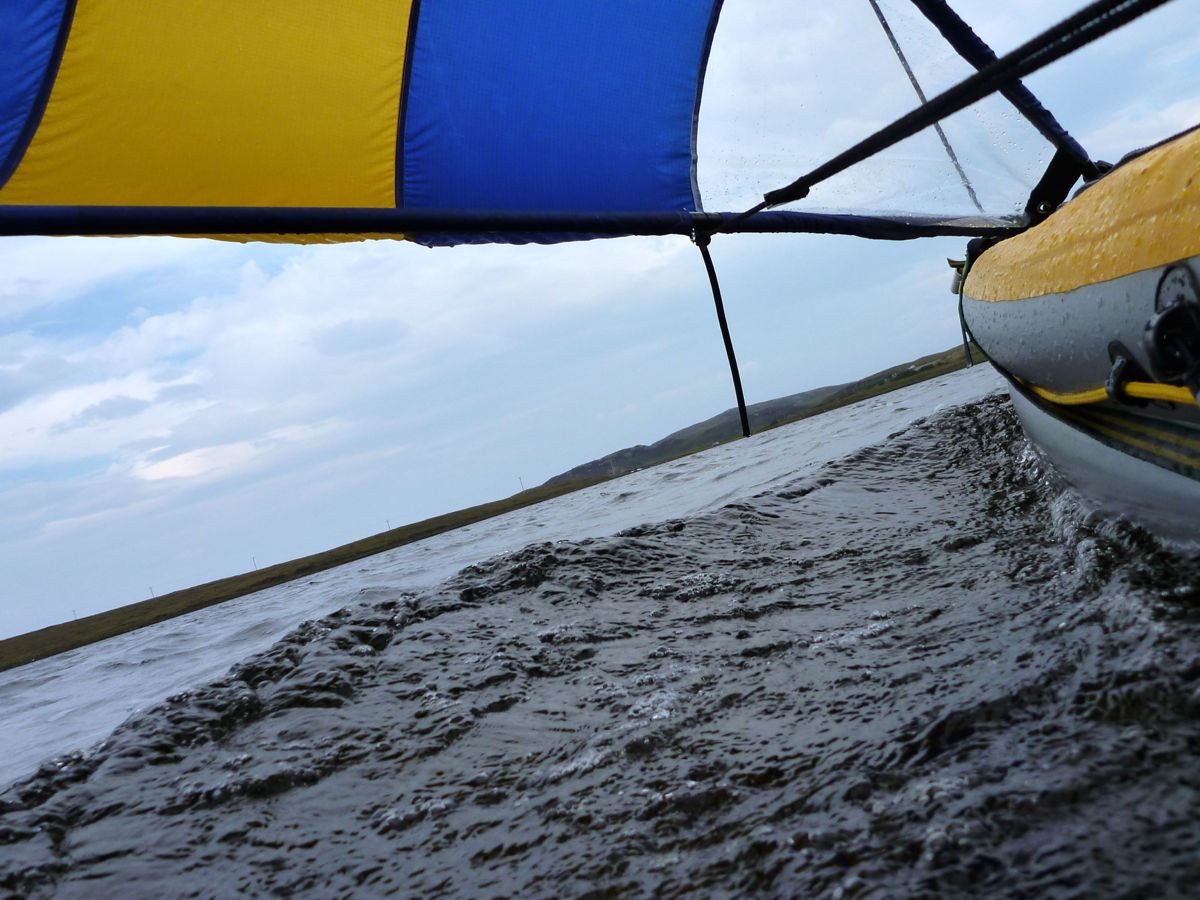
What can it be like to paddle a packraft against a wind gusting up to 50mph, I wonder? Is it even possible? Many times I’ve surprised myself how fast an IK can move – 2-3mph – into a headwind of around 25mph. You can’t sustain that all day, but last year I managed to plough along like that for an hour or two when I gave up on the Ningaloo Reef and turned back into the wind. Seeing as gale-force is the only paddling available for the next few days, I rolled up the Alpacka and went to find out. Sorry to disappoint you but heading out to sea alone, even on the beach with the onshore wind felt too risky. I figured there was a good chance of a gust flipping the back-heavy Yak in a kind of ‘frontal bandersnatch’ as it crested a wave. Better to stick to my ‘play-loch’, site of many paddling experiments and where there’s just wind and not much wave to deal with. In the given conditions inflating the Alpacka in the back of the car was effortless; it took just six bagfuls to fill up the boat, instead of the usual ten. Getting my yellow windsock onto the water was less easy, so once I slapped it down I jumped in quick, clipped the raft to myself via the paddle and tried to leave the shore at the downwind end of Loch Raa.
There was no fetch to speak of and using my large-bladed but light Werner Corrywrecken paddle, I jabbed at the water head down, trying to make headway. The waves rushing by gave the impression I was flying but a sideways glance to the shore showed the raft was barely creeping along. And when a gust hit, it didn’t actually move at all despite my huffing and puffing. Even though I’d probably missed the peak of the day’s winds, not surprisingly I’ve never experienced a paddling effort like it. It felt like some sort of horizontal pull-up machine in a gym set on ’10’ and my hands gripped way out on the ends of the shaft to increase the leverage. Soon any ideas about paddling to the far shore, only 700 metres away, were surrendered. From a video’s timeline it seems it took me 8 minutes of flat-out effort to cover 250 metres – just over 1mph with brief rests every couple of minutes.
I felt safe in the Yak; the gust-borne waves weren’t even a foot high and it was actually a good little workout. Once I’d had enough, I swung round and shot back to shore at what turned out to be 4mph, but felt like sitting still while the wind blew past from behind. Interestingly the raft was easy to handle; no weathercocking. Walking the empty Yak to shore, it took off like a kite. Had I not been strung onto that thing it would have been on it’s way to Inverness quicker than the RAF Tornadoes which tear across the skies hereabouts on a fine day.
Gael’s H2 review here, Compared with other kayaks here Solo paddle up the Scottish Sea Kayak Trail: Part 1 – Part 2
After more than 12 years my tandem Grabner H2 IK was showing signs of wear all over. The most visible appeared behind the fore half deck where two grommets fed the grab lines (below left). Around those grommets the rubber coating had worn off, showing the bare woven core material of the Hypalon fabric.
I knew Grabner could provide an MRO service as stated on their web site and the French Grabner reseller confirmed he could send my boat to the factory in Austria for a quotation. That came the week later in German, but what didn’t need translating was the substantial figure at the bottom which added up to something like “you’re better off buying a new boat”. Another major concern was a crack that developed under the aft backrest bracket (middle). This ill-designed bracket has a sharp edge that gets pushed into the skin under the weight of the paddler. After some years of chafing it had worn a small hole that proved difficult to patch reliably.
I must to admit the H2 is not as perfect and tough as I’d claimed so loudly. Encounters with various submerged obstacles and a number of uncontrolled landings had resulted in many scars and scratches all over the hull. I now also own a similar Incept K40 for solo paddles, but as I intended to keep the H2 as a tandem boat, I thought it was time to give it a serious makeover.
Grabner’s attitude to those requiring a more seaworthy kayak than an H2 was get an Explorer or the framed but now discontinued Discovery, but those IKs are way too bulky and heavy (26kg and 29kg respectively) for transportation when shuttling about.
My H2 weighs just 16kg. Plus they are just about the most expensive IKs in the inflatable world (left). I discussed the money issue with the other half of the H2’s crew who happens to also be the purser. She too wanted to keep the H2 and was not as appalled by the cost as I was, so after a short deliberation we decided to proceed. Three weeks later my local reseller informed me enthusiastically that my H2 was here and beautifully refurbished. Save for the numerous patches it looked like new.
The Grabner folks had done a great job; even the foredeck grommets had been neatly repaired.
All backrest brackets had been replaced with new parts of a much better design. A new pair had been added at my request to enable solo paddling from a central position. Up till then I’d sat in the back of my H2 when solo.
Most cockpit fittings like footrest and D-ring brackets which had started coming loose had been reglued.
There was a keel strip on the bottom as well. Surprisingly the Austrian guys hadn’t paid attention to the colour of the patches (left). While the inside the H2 is yellow, they applied patches in external red. I should have supplied them the yellow patches I’ve got in my repair kit. Anyway, I’m happy the boat is in such great shape again, if not better than before. I can’t claim it’s worth as much money as I’ve spent on it, but I’m sure my H2 will go for another 12 years.
Chopping down my Sevy pooltoy into a slackraft lost too much buoyancy to take my gross weight, but it works fine for the Mrs who’s about half my weight. So on a very calm, sunny morning – realistically, it’s inshore limits – we took the Sevy out to the Bay for a swim. I’d glued on an extra outer covering of ballistic nylon to save the vulnerable floor, as we had planned to take it down the Escalante river in Utah a couple months back, but it was way too hot for that when we got there and since then, as you may know, much of the US has been suffering a terrible drought.
As often, the first paddle in a short boat like this sees the operator yawing from left to right like a crowd watching a ping pong final. After a while, though the paddling technique adapts to reduce this effect, but even then the boat is still much slower than an Alpacka. This Slackie is only 28″ wide by 56″ long – 2:1 – (my Yak is 88″ x 36″; 2.44:1) and the Mrs found the best trim was sitting in the middle, even if this meant nothing to lean back on and was not sustainable. Next time out we’ll take a fishing buoy or something to lean against, although I do wonder if some sort of trailing skeg – a board sticking out the back rather than an under hull skeg like on an IK– might help subdue the yawing and so direct the effort in a straight line rather than zigzags.
My Alpacka skims along just like it always does; what a great boat it is. Annoyingly the backrest is leaking again from the twist valve base, even though it’s been glued up once. I find you do need that backrest to sit correctly in the boat, so another repair is due. We dipped about, followed the river channel and out to sea and on to the rocks. As the tide turned we headed back up the river, against the flow the slackboat soon slowed to a near stop and it was faster led on its string through the shallows until a tailwind helped blow us back to our shoes, by now stranded some 200m from the water’s edge in just an hour.
A post-sea trail inspection showed that my carefully glued floor was coming away from the Sevy’s PVC hull like damp wallpaper; that may have explained why the boat got so slow coming back. The Evo Stik didn’t take to the hull at all, or if it did, seawater soon dissolved it. At the time I was trying to save on my nice Bostik 1782 which I used elsewhere on the slack boat with no problems. Anyway, it’s not worth wasting any more glue on this boat. And who knows, perhaps the ribbed floor which has been exposed again may help restore some tracking. We’ll see next time. We’ve half a mind to repeat last year’s fabulous Suilven triathlon, but this time in a boat each.
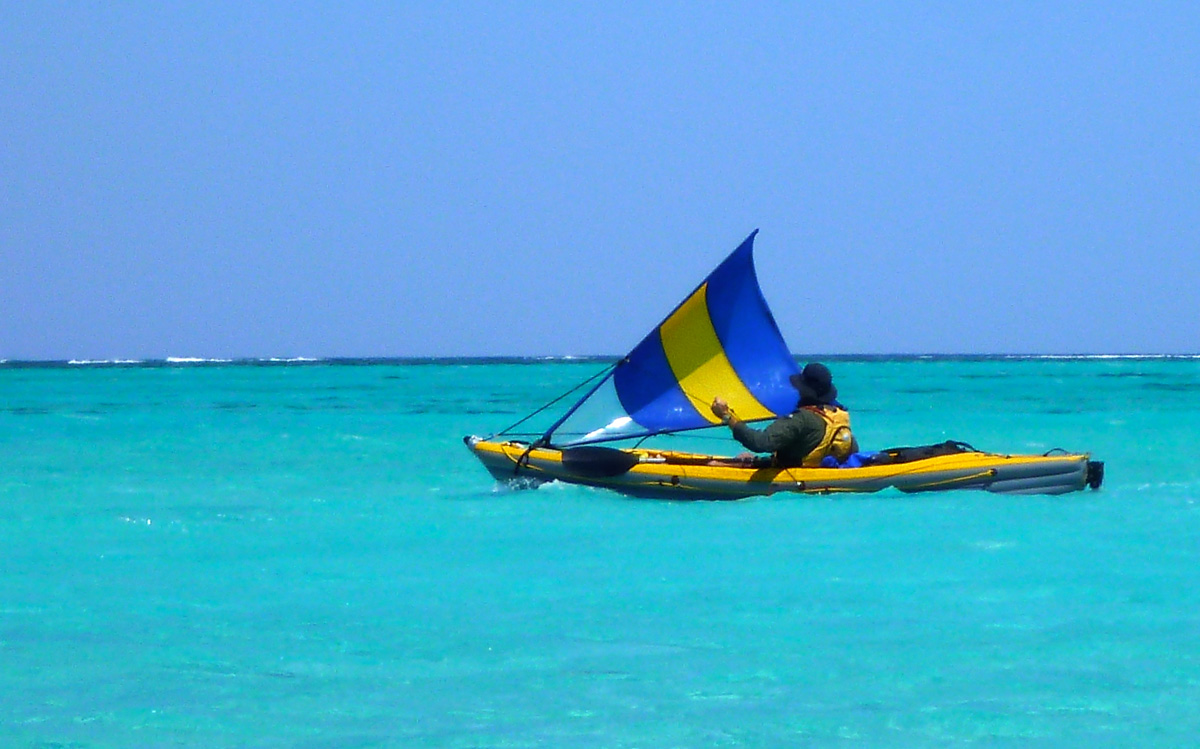
Windy but warm and dry thanks for asking – a good afternoon to take the IK out sailing. I’ve not done that since Ningaloo last September (left) when I was blown away so to speak, but not in a good way. Even before then I can’t say I’d got the hang of the Pacific Action V-sail which should add up to either hurtling from crest to crest with all hands on deck – or kicking back and getting a free ride while looking around at 3mph. Both are good fun but neither scenario seems to last more than a minute for me.
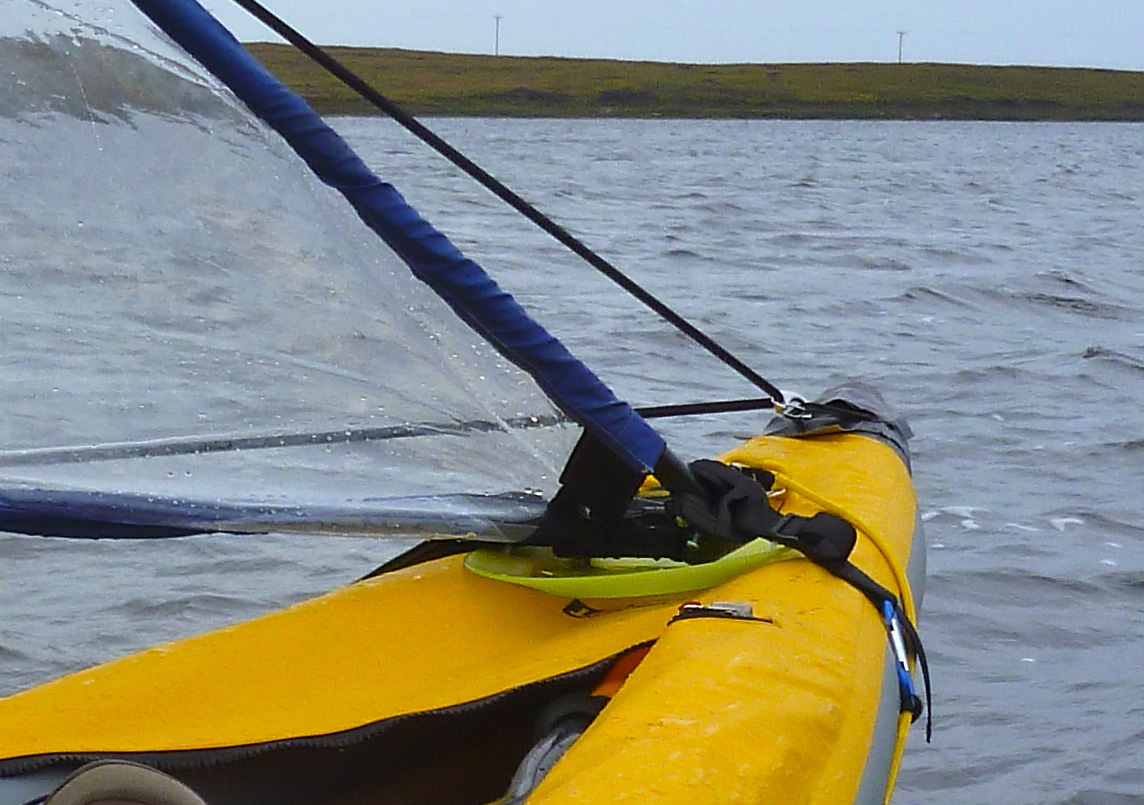
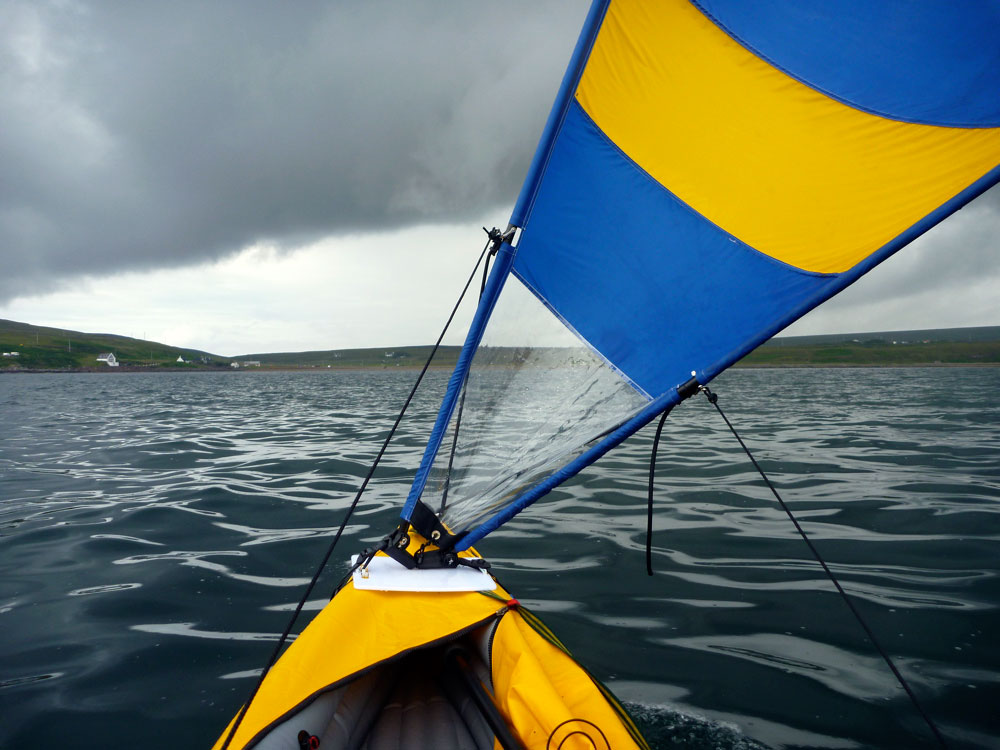
Remounting the V-sail to the K40 was easy. I clipped the front ‘sail-hoisting’ bungie about 8 inches further forward, right out on the boat’s nose using a loop of string and tape (right) as opposed to using the boat’s lift handle-ring. Fixed here it ought to help keep the sail up when pulled down low to one side by increasing the angle and distance from the sail’s feet. It’s an idea we came up with in Australia in an effort to make the K40 controllable in the strong winds.
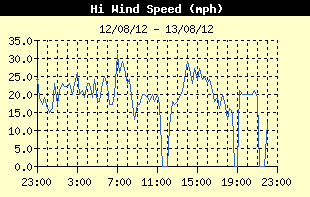
Winds today (left, from 3pm) weren’t quite as strong as WA but were getting there. And anyway, I was out on small lochs with no rudder-lifting ocean swell to deal with – another reason we thought the K40 got squirrely in strong winds out in WA. The K40s large draught but low weight acted like a sail of it’s own, weathercocking the boat. To reacquaint myself, I first took a spin on the smaller Loch Raa. I’m never really sure what I’m doing so just try various angles and approaches until the kayak catches the wind. I’m told that sailing directly downwind with the sail fully upright is less efficient (or is that with regular, fixed-mast sails?). With the PA you can get a good speed for a while, but soon the sail starts rocking violently from side to side as it sheds the excess blast – my strong recollection from Ningaloo. I assume that’s just a sign of the sail exceeding it’s speed limit, though I think Jeff’s hardshell did it less.
Off the wind about 45° and up to 90- or even 100° (ie; slightly upwind) seems more stable but slower, with the sail cranked down low to one side. But even then a consistent speed or direction seems hard to maintain for long. Is it my poor technique, the design of the sail when applied to my IK, or just an aspect of gusting and shifting wind? As it was I felt the unloaded boat was rather light, though in Ozzie last September 20+ kilos of ballast didn’t help much either.
Big sailboats and windsurfers seem to manage OK, but it seems hard to get a smooth, steady run while sat back with the cleated-off sail doing the work. Usually I’m yanking hard on the rudder to get in line, or have handfuls of lines trying to trim the sail for best effect. The tiny ‘finger-and-thumb’ cleats are just too fiddly to use in a hurry or mild panic, and often require two hands to release the jam. I wonder if hand-sized cleats exist for the thin cord, or some better device all round? Something like a sliding tube you could grab, but with a release button, a bit like a mountaineering jumar (left).
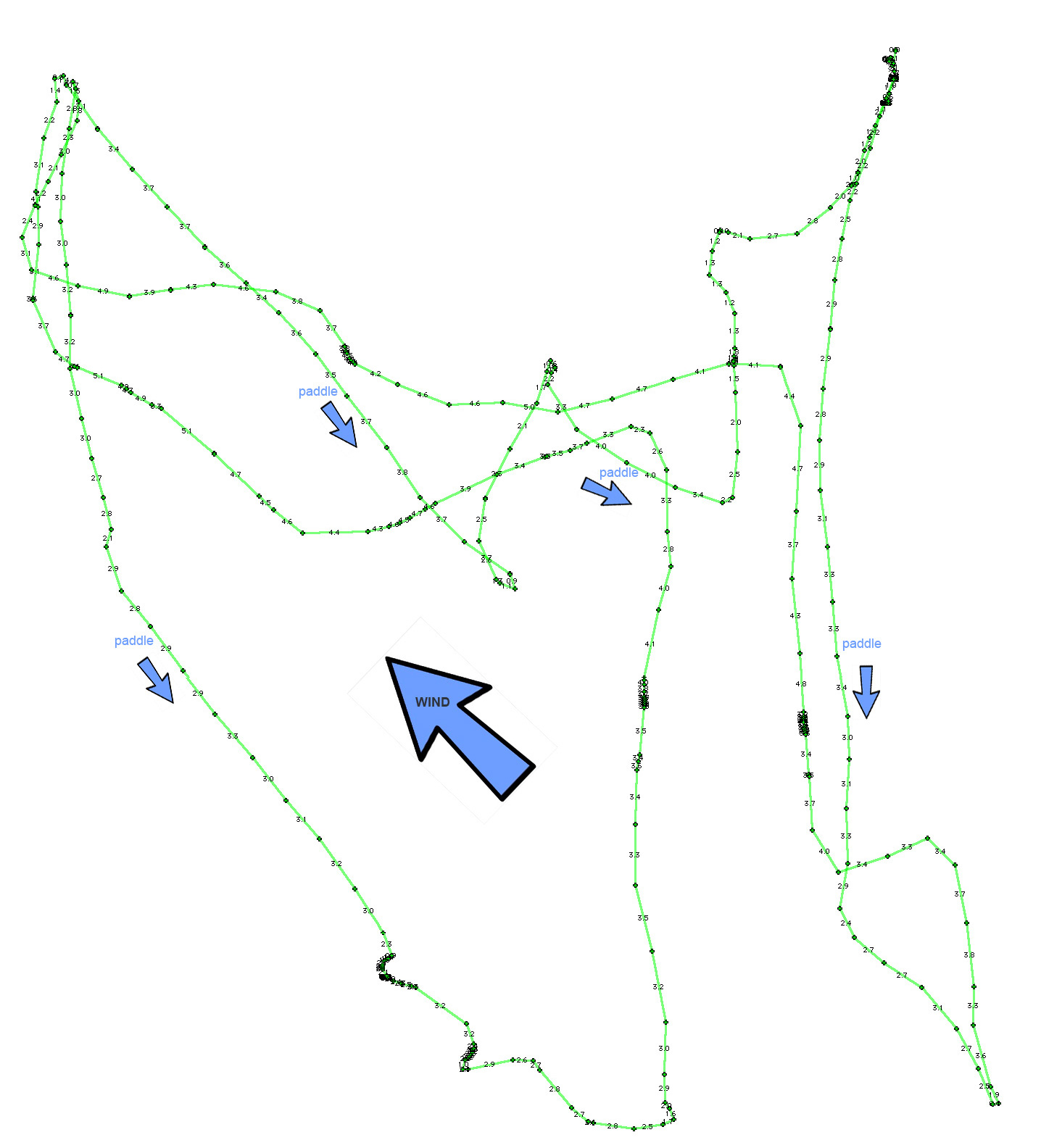
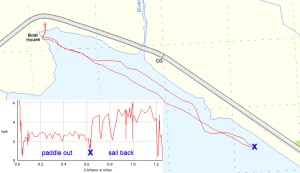
Even then, on seeing the speed readings (above), it surprised me how fast I could hack into the wind at 2.5–3mph, admittedly with some effort (needed to keep the kayak pointed ahead). Coming back with the big sail I only got over 5mph a couple of times, and often moved barely more than upwind, although using much less energy of course.
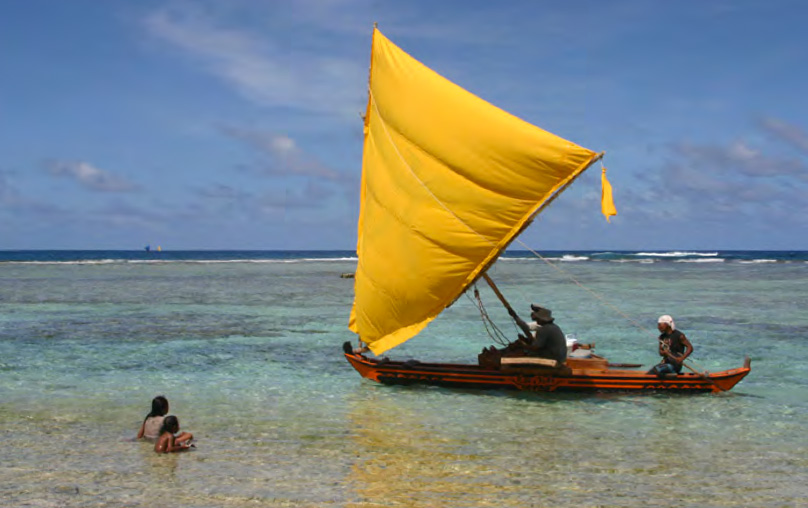
I came across this image of a Micronesian waharek boat newly built on an ancient design. Looks like a big V-sail to me but crucially, it has an outrigger.
After crisscrossing Loch Raa a few times (above right), I went around the corner onto Loch Osgaig. Out in the open and with the wind bouncing off nearby Stac mountain, there should be room enough to get some speed up, providing I could hold on.
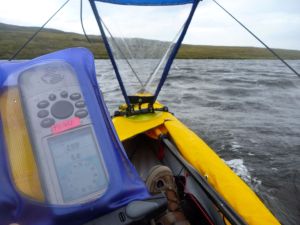
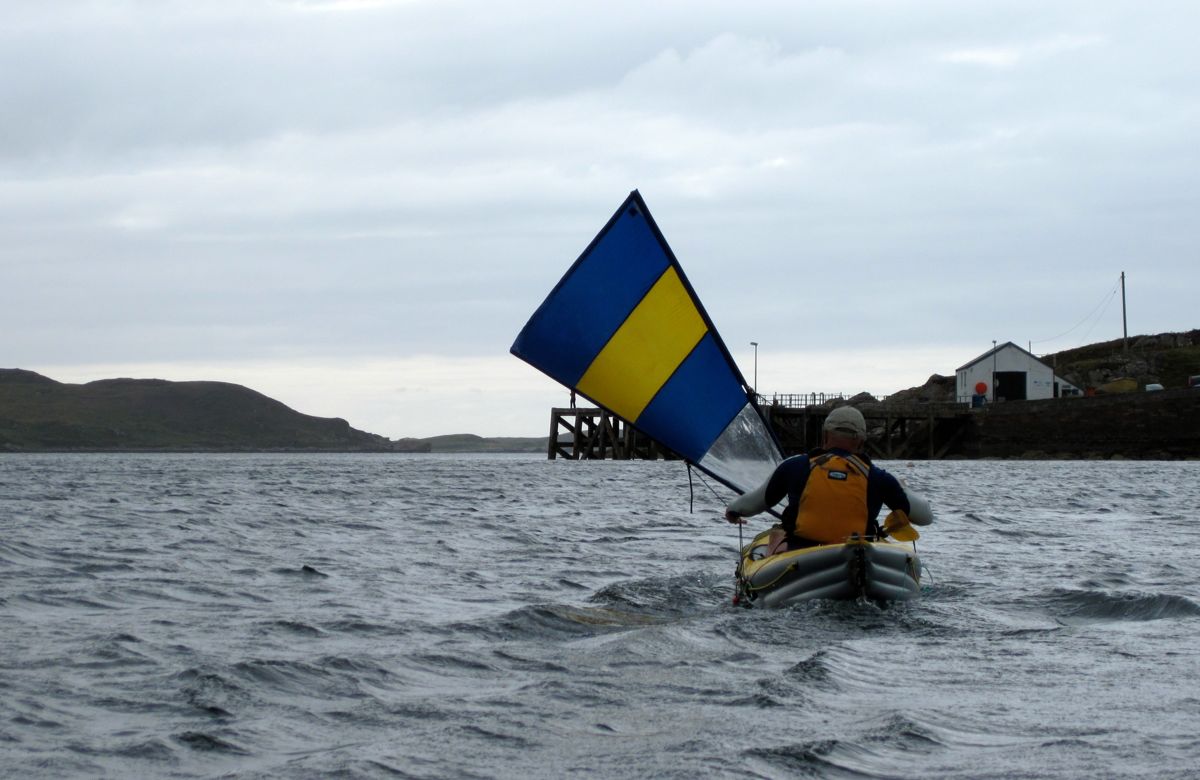
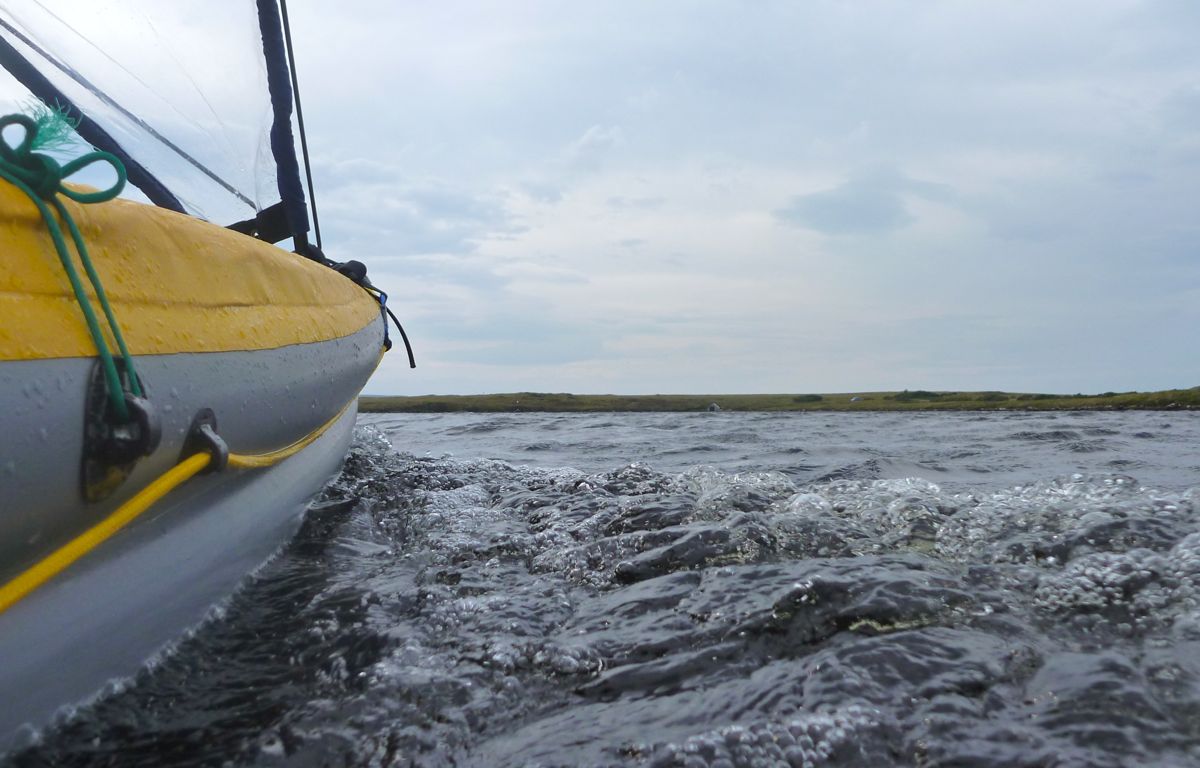
I set off and sliced the waves as best I could and stuck at it until I got opposite the small plantation. Here I stowed the paddle securely, got blown round and unfurled the v-sail, ready to snatch it back down should it all be more than I could handle. In fact, there were only a couple of hairy moments As you can see from the speed graph (right), my paddle out was pretty steady and straight, but under sail, speeds and direction were all over the place. A couple of times either a gust or the optimal line saw the boat fly at along at over 5mph (left), but it never lasted.
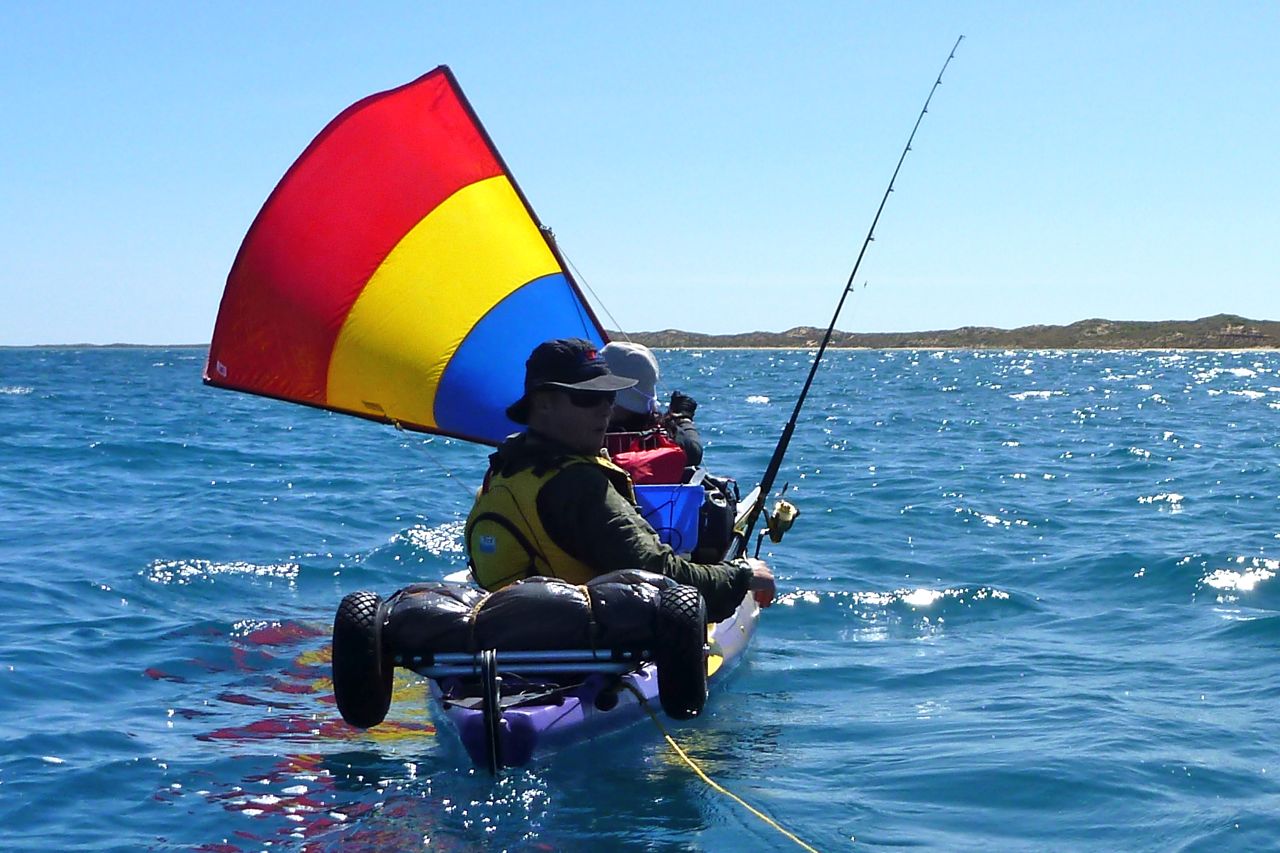
It does make me wonder what the PA sail is good for on my K40. In winds of over 15mph it seems hard work to maintain. Is it an inherent flaw of a lose, articulated mast – and one whose feet are not pressing directly onto a solid hardshell hull (I use a plastic dinner plate to spread the load/reduce wear). The fact is, Jeff managed fine on Ningaloo (right), ripping along in a boat that was four times heavier than the Incept. And in Shark Bay a few years earlier in the same tandem tanker, he was towing me in my Gumboat.
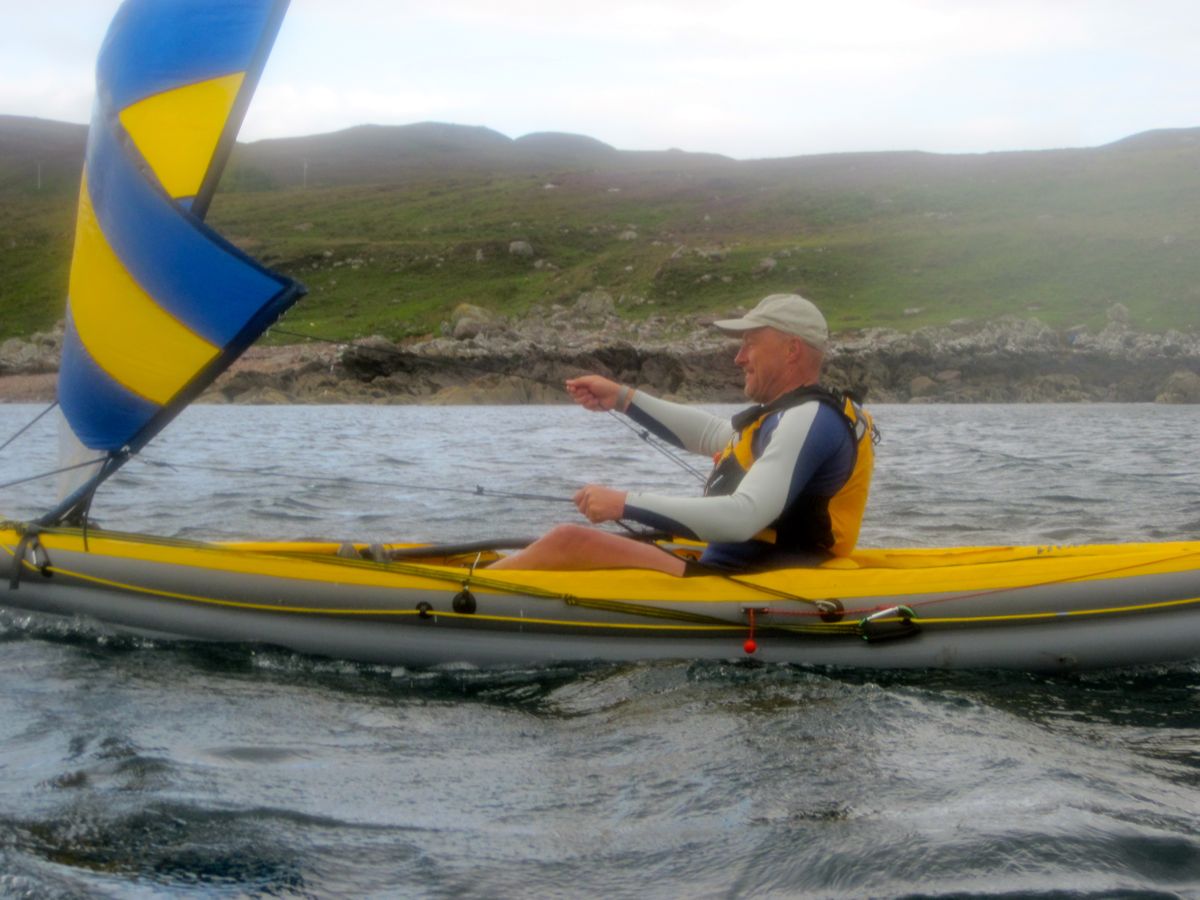
A 10-15 mph breeze does often correspond to a nice steady sail, but that does seem a rather narrow margin of operation – something I recall someone else saying to me about V sails. I think it’s a combination of more practice required, hampered by the fact I’m in a light, buoyant, flaccid-chined IK. It makes me wonder if the WindPaddle is worth another look (it was and I did), though I’m fairly sure the PA V-sail is more versatile; I doubt you could ride at 90°+ to the wind with the deeply dished WindPaddle. Another good thing about the PA is that it’s out of the way when down but dead easy and fast to deploy or stash. Just throw it up and see if it takes to the wind. Out this time I also felt that the thigh straps were particularly useful when edging the boat against the gusts.
As promised, I’ve invested in a Sevylor Caravelle PVC dinghy. Cost: £34 delivered complete with pump, oars, repair kit, manual in ten languages and a box which is bound to come in useful one day. The heavy-duty Super Caravelle model, as modified by Narwhal, is out of stock in the UK until next summer, although an Intex Sea Hawk is the same thing and can be ‘skinned’ of its outer hull (as in the graphic, right) in the same way to make a lighter, narrower and nippier ‘PVC packraft’ – see bottom of the page. That’s the purpose of what is being done here, in case you’re wondering.
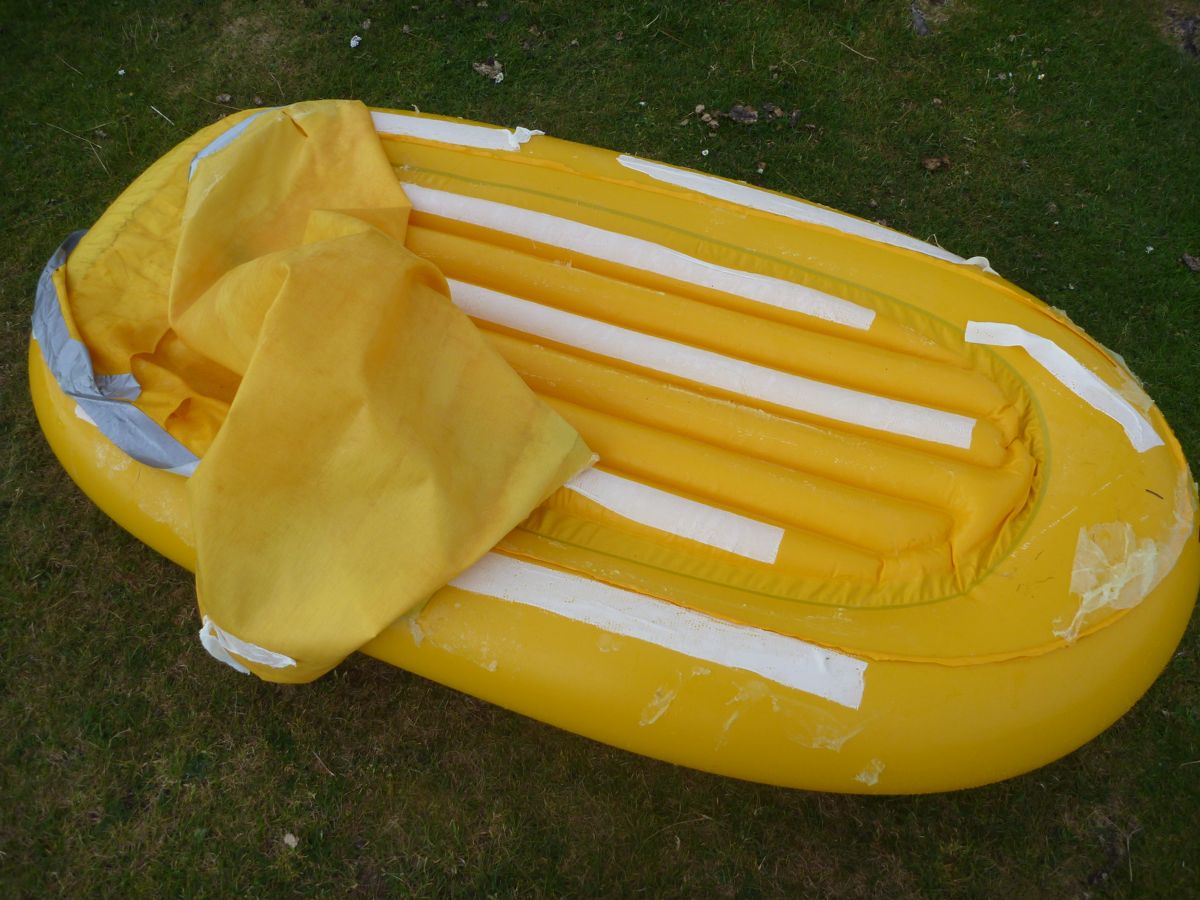
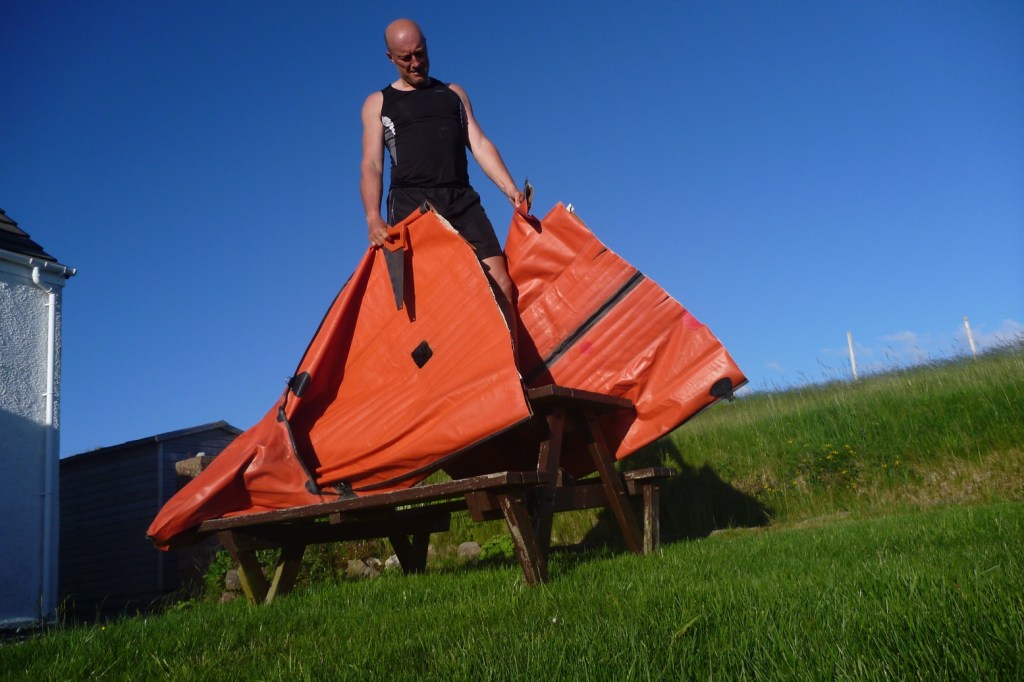
Pre-skinned and rolled up, the Sevy was about the size and weight of a proper Alpacka packraft, but awaft with that dizzying scent of PVC which takes you back to Mallorca in the late 1960s. Fully inflated, it’s too wide to take seriously, but it stayed like that long enough to enable the outer chamber to be surgically removed with a bread knife. Unfortunately, it’s on this outer chamber that the half-decent ‘high volume’ Boston valve is fitted – all the rest (2 floor chambers and the inner hull) get poxy, beach ball-style push-in valves which, in the latter case, take a while to inflate due to the pencil-thin aperture. Perhaps the Boston can be grafted onto the inner hull; what’s the worst that can happen? I’ll find out soon enough as it also took so long to deflate the remaining hull by squishing the push-in valve I decided to cut it out there and then and slap on the Boston valve from the trashed outer hull over the hole (above left). This was the first time I used MEK solvent to clean PVC. This stuff is pretty damn potent and ‘cleans’ the PVC a bit like paint stripper removes paint! Tellingly, it’s also known as polystyrene cement and has uses for welding too, so use it sparingly on PVC pool toys or they’ll dissolve before your eyes.
The squidgey little foot pump (right) is very light, but slow, especially when trying to get enough pressure into the main chamber for the slide-marker to move down and line up with the ‘A’ on the SevyScale™ (below left). This is a pressure guide so you don’t burst your new pool toy – easily done with thin, stretchy PVC and sharp words. But by chance the Sevy valve plug fits neatly onto the end of my K-Pump which is much quicker at inflating. The Alpacka air bag sort of screws into the Boston valve too, but you need a K-Pump to get max pressure.
Testing the newly glued on Boston valve, the boat was losing air, but it didn’t look like the glued-on valve was at fault. As it happens the bath was full so a check revealed a tiny, half mil hole near one of the seams underneath. I’m fairly sure I didn’t jab the boat with the knife while skinning it, so it must have come like that or my carpet is sharper than I think. Lesson: test all chambers in your cheap pool toy before running a coach and horses through the warranty by attacking it with a knife – that’s if you can be bothered to send it back instead of dab some glue on the hole, should it also be faulty. The oars are mere fly swatters as previously noted. It’s possible they could be joined together into a packrafting paddle, but why bother; there are decent Werners and Aqua Bounds under the bed so the oars can join the scrapped outer hull at the local dump.
It has to be said, once skinned it’s 36″ (91cm) wide, 60″(152cm) long, and no more than 12″ high at the bow, so there doesn’t look to be a heap of buoyancy left over for the likes of bloated boaters like me, but the floor also holds air unlike an Alpacka so a spell on a river will reveal all. As mentioned, if it’s enough to stop me sinking, I may invest in gluing a spare sheet of tough nylon onto the base. It may add weight but will make the Caravette unstoppable; that’s unless a sharp-clawed bird lands on the deck or it gets splashed with MEK.
With half a dozen attachment points cannibalised from the outer hull and glued onto the stripped-down packboat with some Bostik 1782 (right), it now weighs 1550 grams; about half the weight of my current Alpacka Yak and about half the volume once rolled up. So compact, it could even make a flat-water towing platform for the Yak – for carrying a bike for example, as I’m not sure it would so easily fit on the bow, especially with camping gear.
River trials will follow shortly, or I may well head straight out to Rannoch Moor for an overnighter with Intex chum Jon who lives up there – see the vid above from last summer. He has also been inspired to skin his SeaHawk 1 bloat into a purposeful packslab. Might be good to take the Yak as a spare up there; if Loch Laidon freezes up round the edges the ice spikes might be too much for our pool toys.
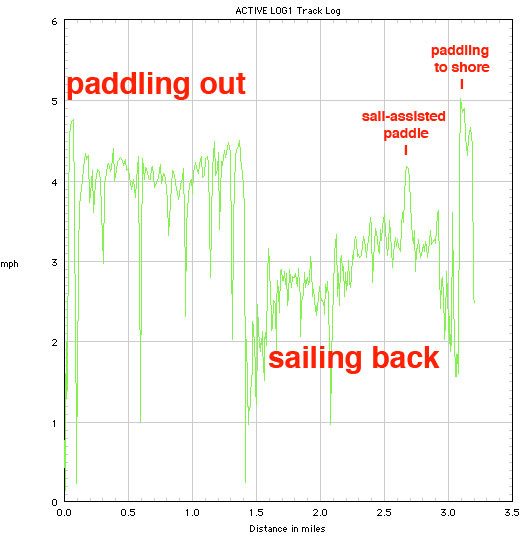
Not much wind today, but with a few refinements to try out it was worth taking the Pacific Action sail out on a regular ride over to the island. I chose my big-faced Corry paddle and it has to be said it’s quite a strain (the opposite of a Greenland paddle) when you’re a bit out of condition. But then I bought it primarily for the packraft. What felt like a worthwhile breeze heading out to the island was probably more than doubled by the 4mph I was chucking out. Knowing I could afford to be, I was pretty tired once I reached Tanera Mor’s rocky shore. The state of the tide? who knows – coming in I think so it was with the wind, but I really think it makes little difference around here most days. As the graph left and the video below both show, I had a bit of trouble getting it up and never got close paddling speeds while sailing back. But once I did get on the wind, it was a bit of a revelation to find I could pin the sail at a certain stance and, providing the rudder was on the case to, just sit back and enjoy the slow ride. It may have taken me longer to get back, but I could have easily read the Sunday papers, checked my email or just looked around and enjoyed the scenery, had most of it not been suffocated by the clouds of an imminent downpour.
It was also a surprise to learn I was not the prisoner of a given wind angle, but could modify it by up to 180° or maybe even more. At one point back near the beach, from the lapping of the passing waves across my beam it looked like I was paddling a few degrees upwind. Conditions were exceedingly tame but the cord-lock things worked pretty well and their position alongside the cockpit was just fine to slide them up and down. At one point I tried paddling with the sail which I’d assumed would be rather tricky. Sure, the control cords got in the way a bit, touching my hands as I paddled, but it was possible to paddle lightly and so – as the graph shows – raise the speed with little effort to 4mph. Had I tried paddling harder I think I’d have outrun the sail, but it proves a good point: it need not be either paddle hard into the wind or sit back and sail; you can sail and paddle too if conditions allow- or enable it, gaining a bit more speed and exercise. I may try fixing the shock cord a little further forward to the nose which may help keep the sail up at marginal (low) angles or low wind speeds. I also need to tighten the webbing a little more, so the mast feet touch directly toe-to-toe so that, at the angle they’ve been locked against the masts, they’ll splay the sail out more readily. The Google Earth screenshot of the GPS track on the right features the long-sought OS layer – useful as GE’s close-up resolution hereabouts is terrible. With it you can depict all the accuracy of a true GPS track over a detailed OS map. It’s a simple kml file found here. Download and open with GE and it’s there to click in the sidebar on the left when/if you choose to view OS maps in GE. Thanks to Gael A. for sending the link. As things stand today I’m pleased I bought the PA sail; primarily for its simplicity of installation, deployment and possible repairs, its ease of use in the hands of a sailing beginner like me, the compactness when furled, as well as its ability to pulled down fast and attached/removed from the Incept in a minute or two. All that remains to be assessed is the kayak’s stability in rougher and windier conditions. The forecast shows a bit more wind on Tuesday so hopefully, there might be some surf-slicing sail action to grab then.






.jpg "cloggy")



 Inflatable Kayaks & Packrafts