Tag Archives: Anfibio Sigma TXL packraft

Sigma TXL: Sailing struggles and skegs

Sigma TXL main page
see also:
Sailing with Rebel 2K
Sailing with MRS Nomad
Other Summer Isles paddles
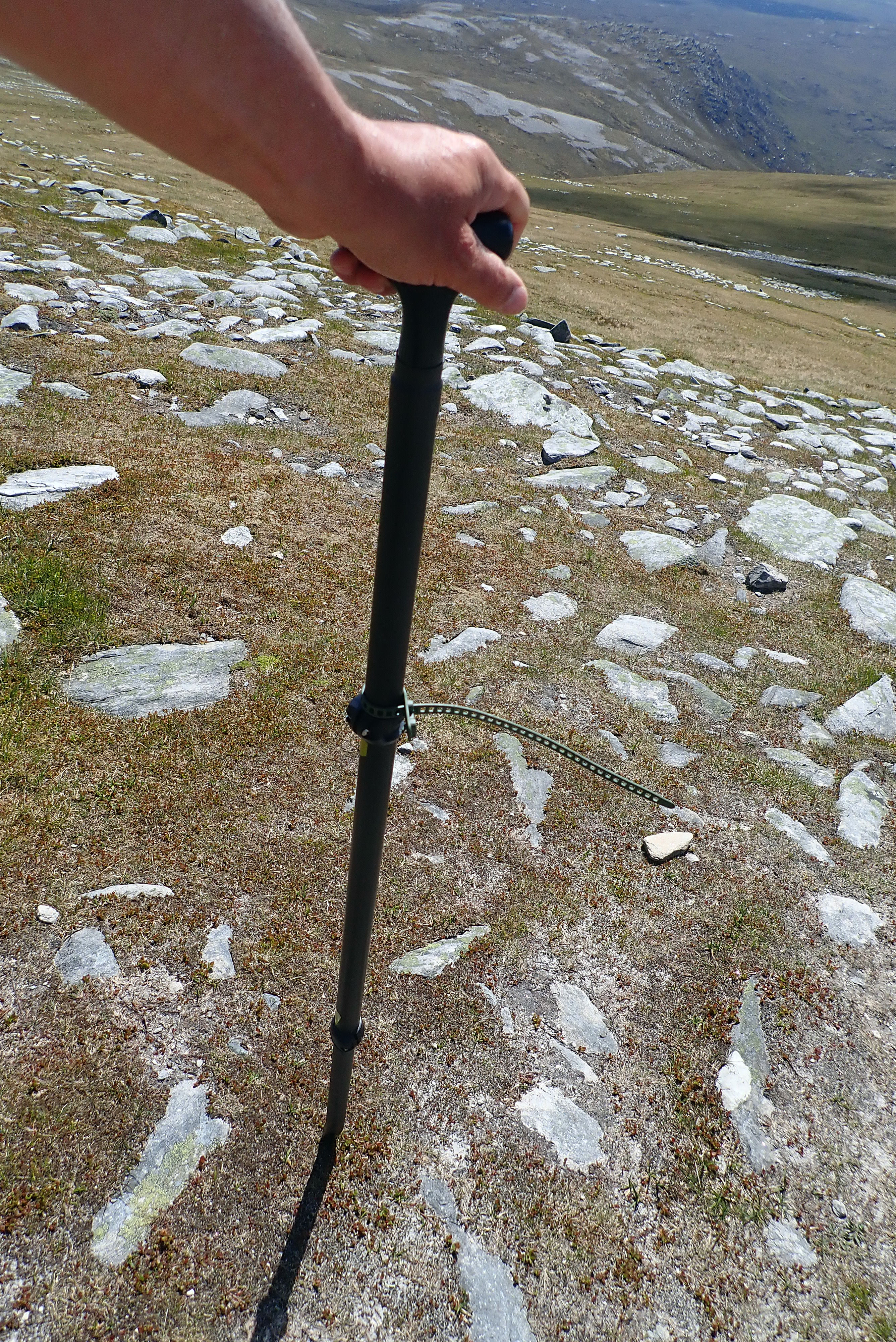
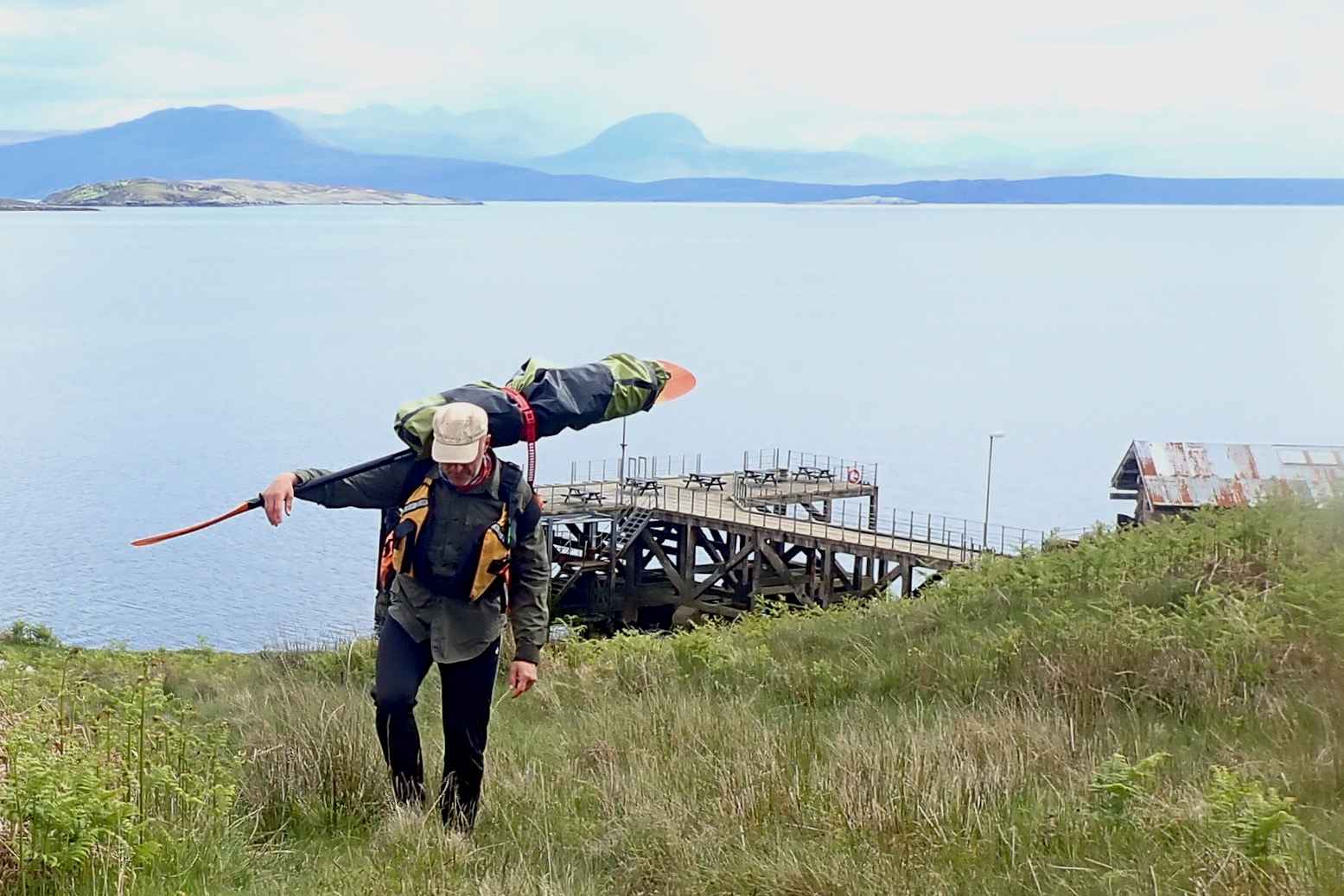
As the calendar flipped into June the crap May weather – worst for decades locals say – had finally broken, and northwestern Scotland sits under a High with cool, light winds and blue skies. After weeks of the opposite, it can all look a bit miraculous. The other day we climbed Ben Hope, Britain’s most northerly 3000-footer. It’s a short, steep climb, and coming back down I was sure pleased to lean on my packstaff (right).
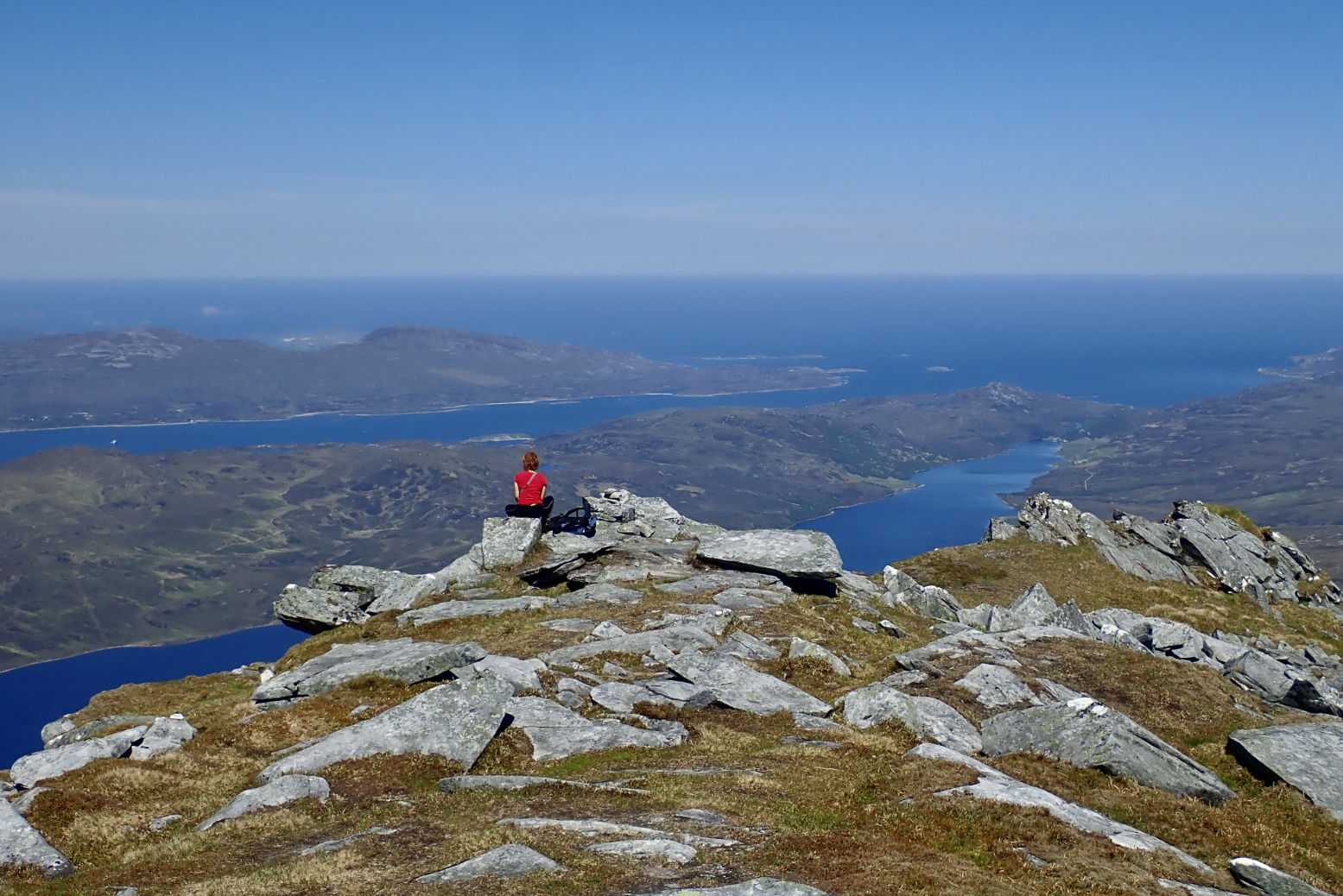
Ben Hope and Britain’s north shore.

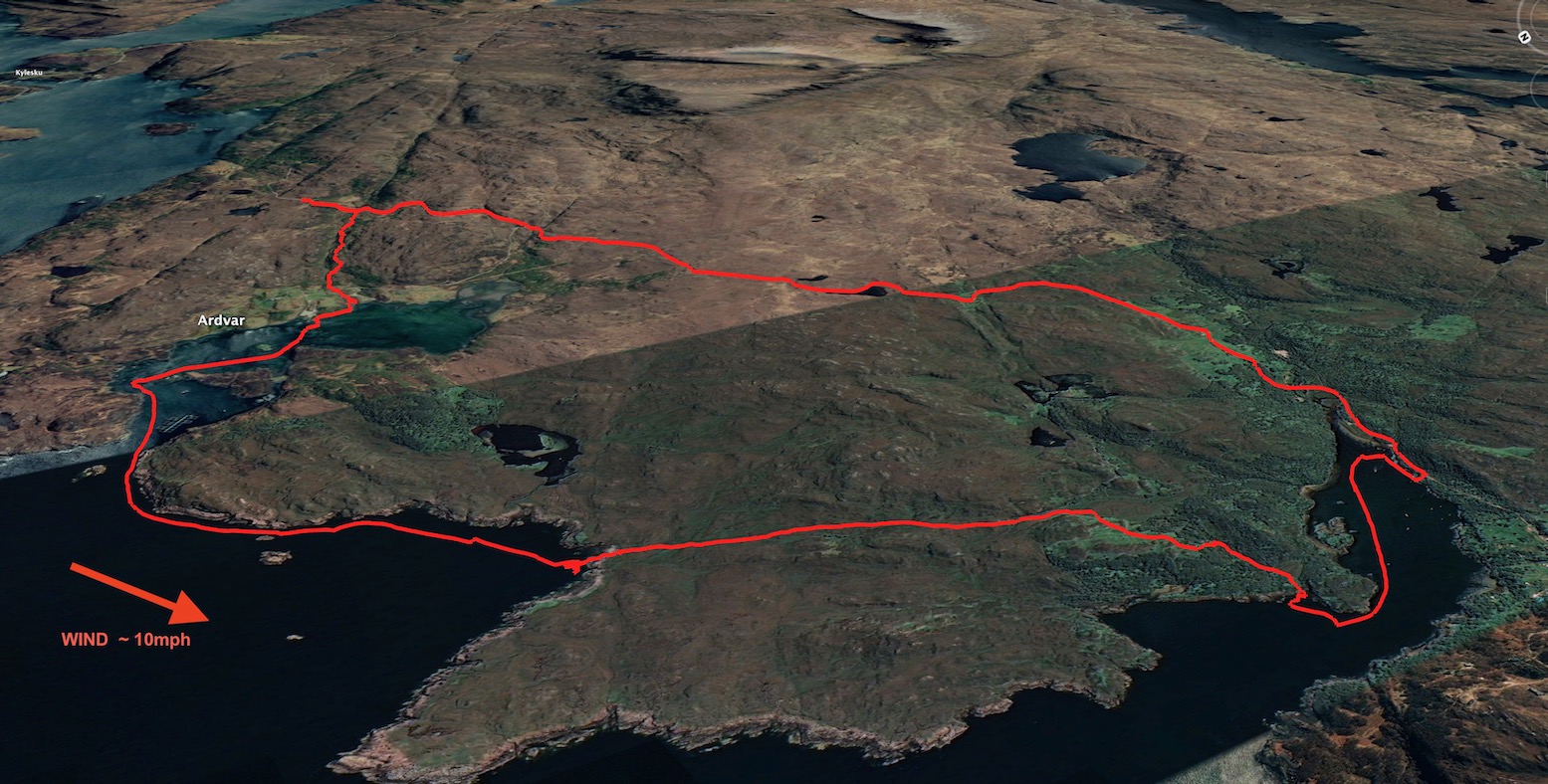
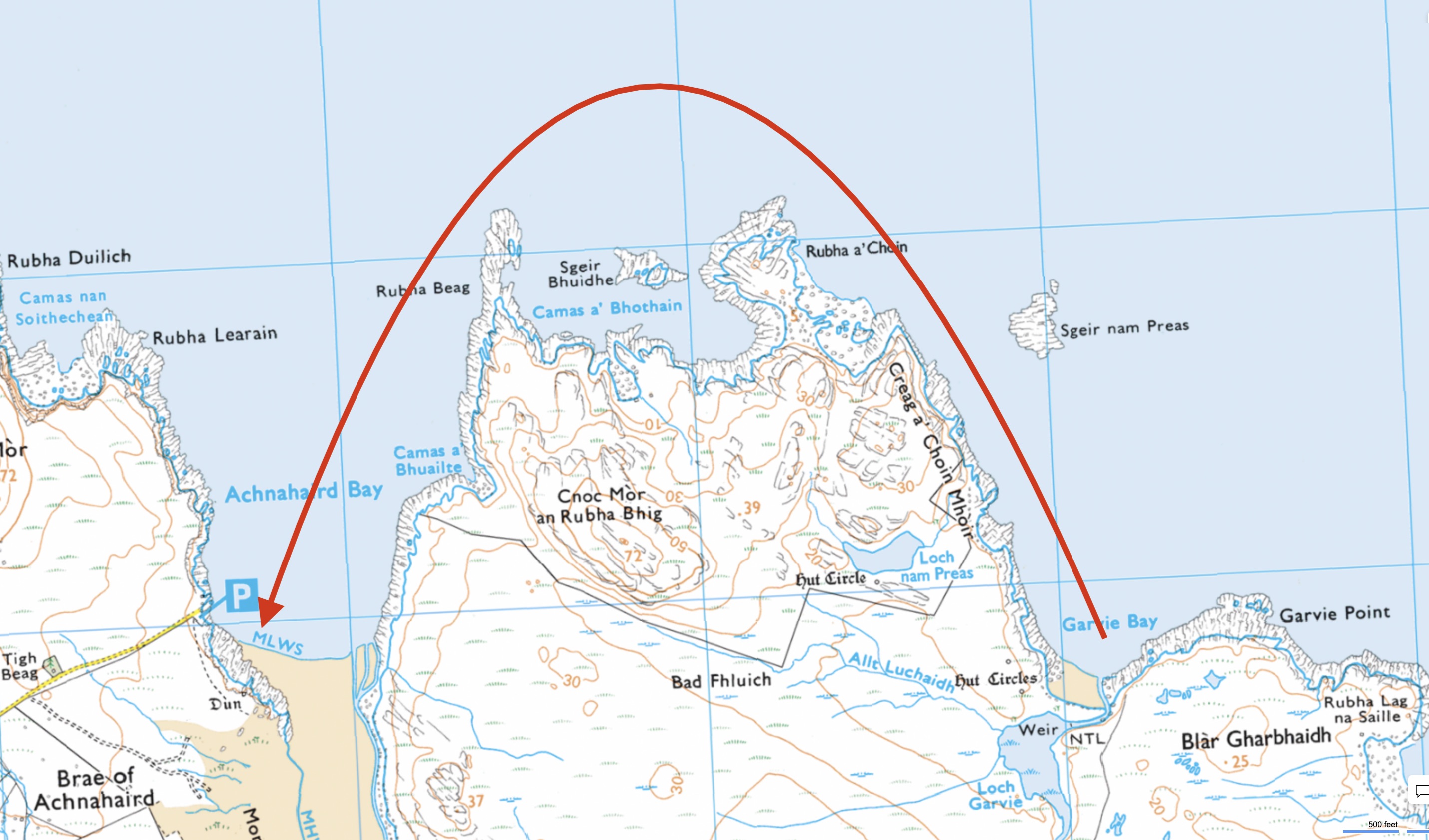
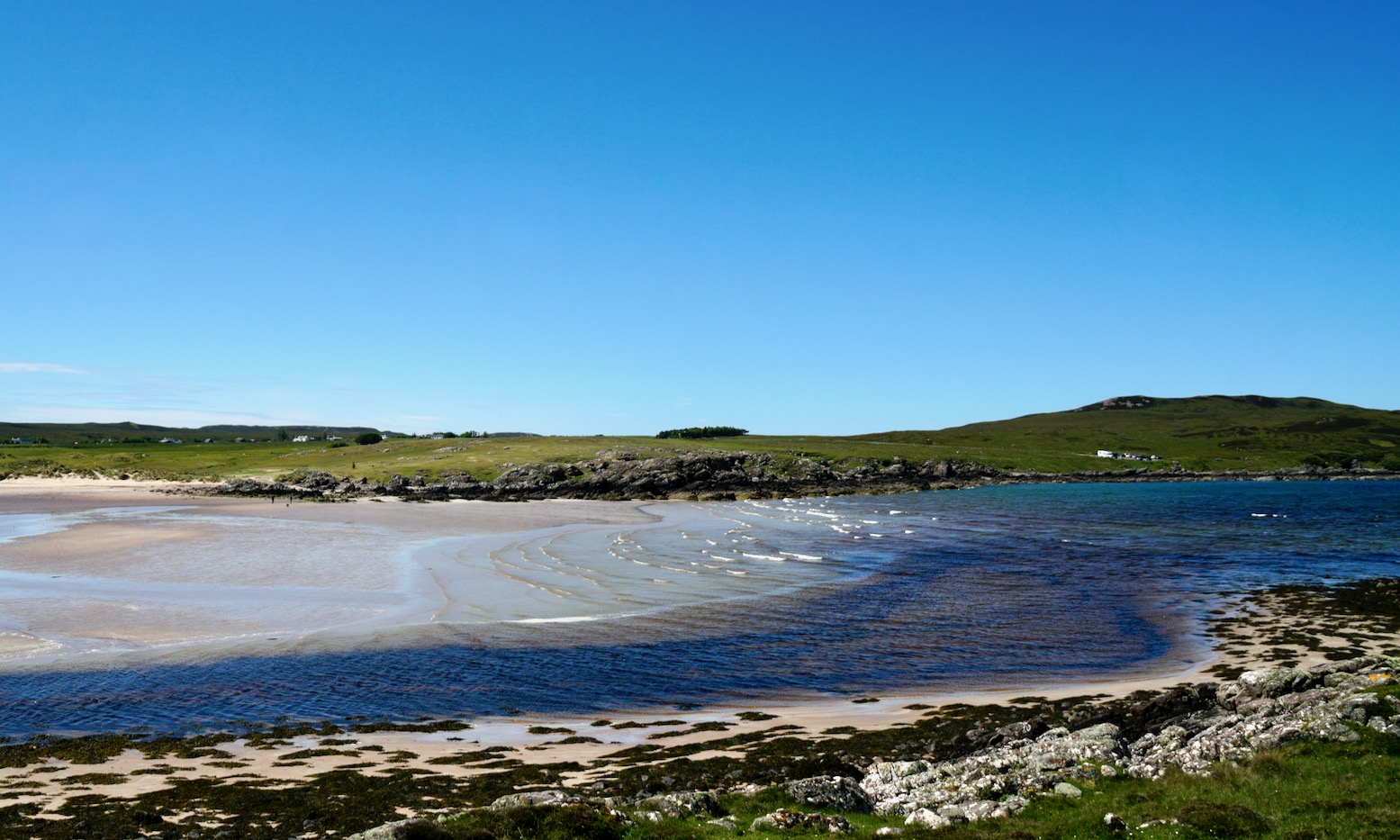
Back home, paddling the southern edge of Enard Bay in an arc from Garvie Bay around to Achnahaird beach (left) was another easily realised sea packrafting outing. It’s also our favourite local half-day walk and with today’s strengthening northerly breeze, I ought to be able to sail down into Achnahaird, wade up the stream to the twin freshwater lochs, and carry on sailing nearly all the way back to Badentarbet. All up that would be about 18 kms of paddling and walking.
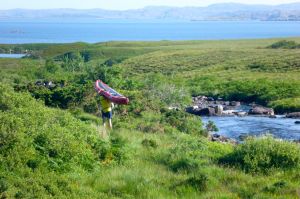
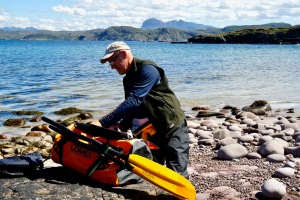
It’s a muddy kilometre’s walk from the road bridge down to Garvie beach which, unlike popular Achnahaird, is usually deserted. I did carry my old Grabner IK down on my head one time for a paddle to Lochinver, but a packraft in the pack is so much easier. This car-free and approach/portaging ease was part of the rationale in putting all my eggs in the TXL basket and flogging the Seawave.
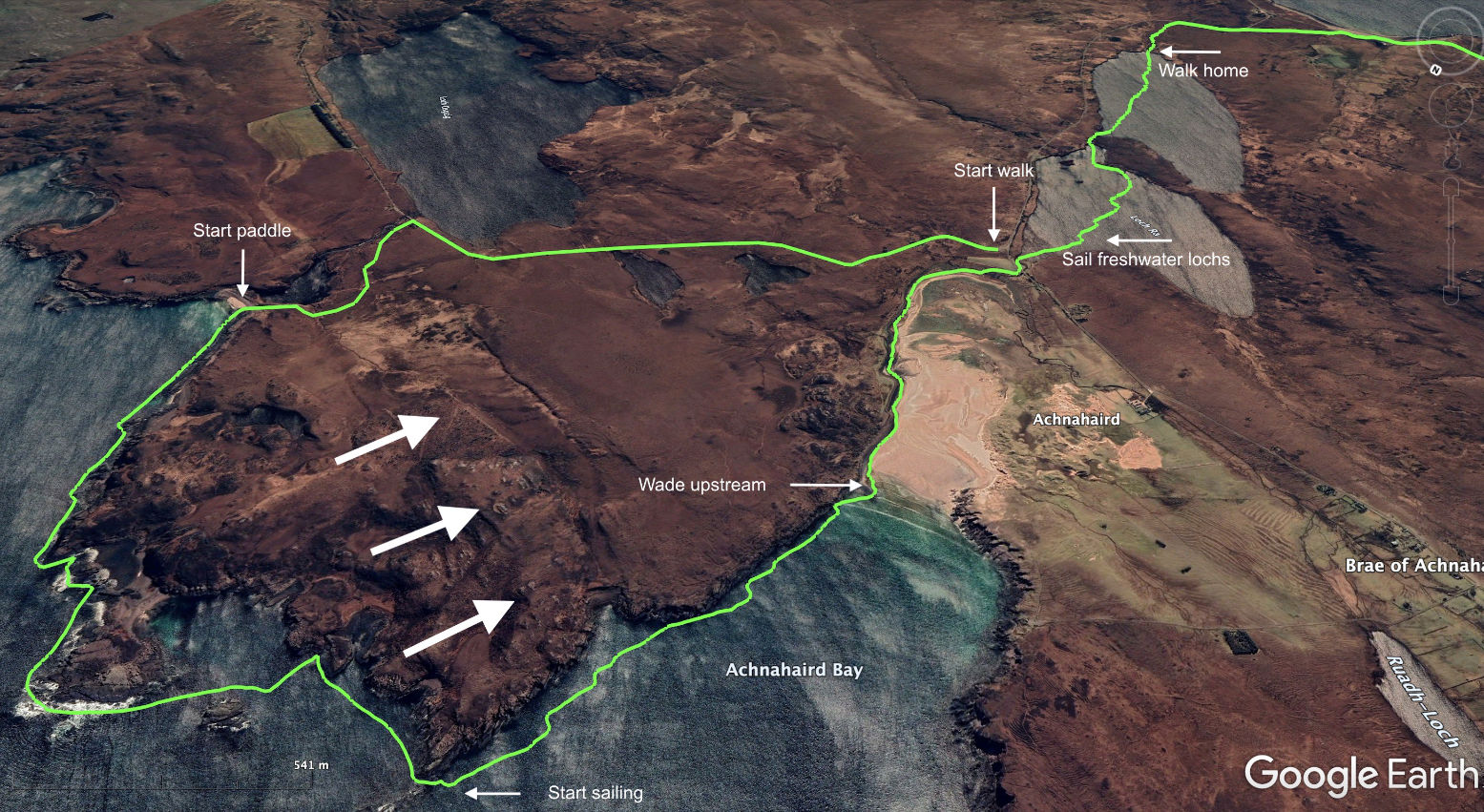
Even before I reached the shore it was clearly a bit windier than the predicted 6mph, but as long as white capped waves held off (the easily spotted warning sign for inflatables) it should be OK. The chilly northerly coming off the sea was steady; less gusty (or so the forecasts suggested) so I was glad I grabbed the dry-suit last minute.
As you can see from the Google image above, the rough shoreline and reefs can kick up some breakers, but if it all got a bit much I knew plenty of take-outs to join the Mrs who was doing the walk and taking photos from above.
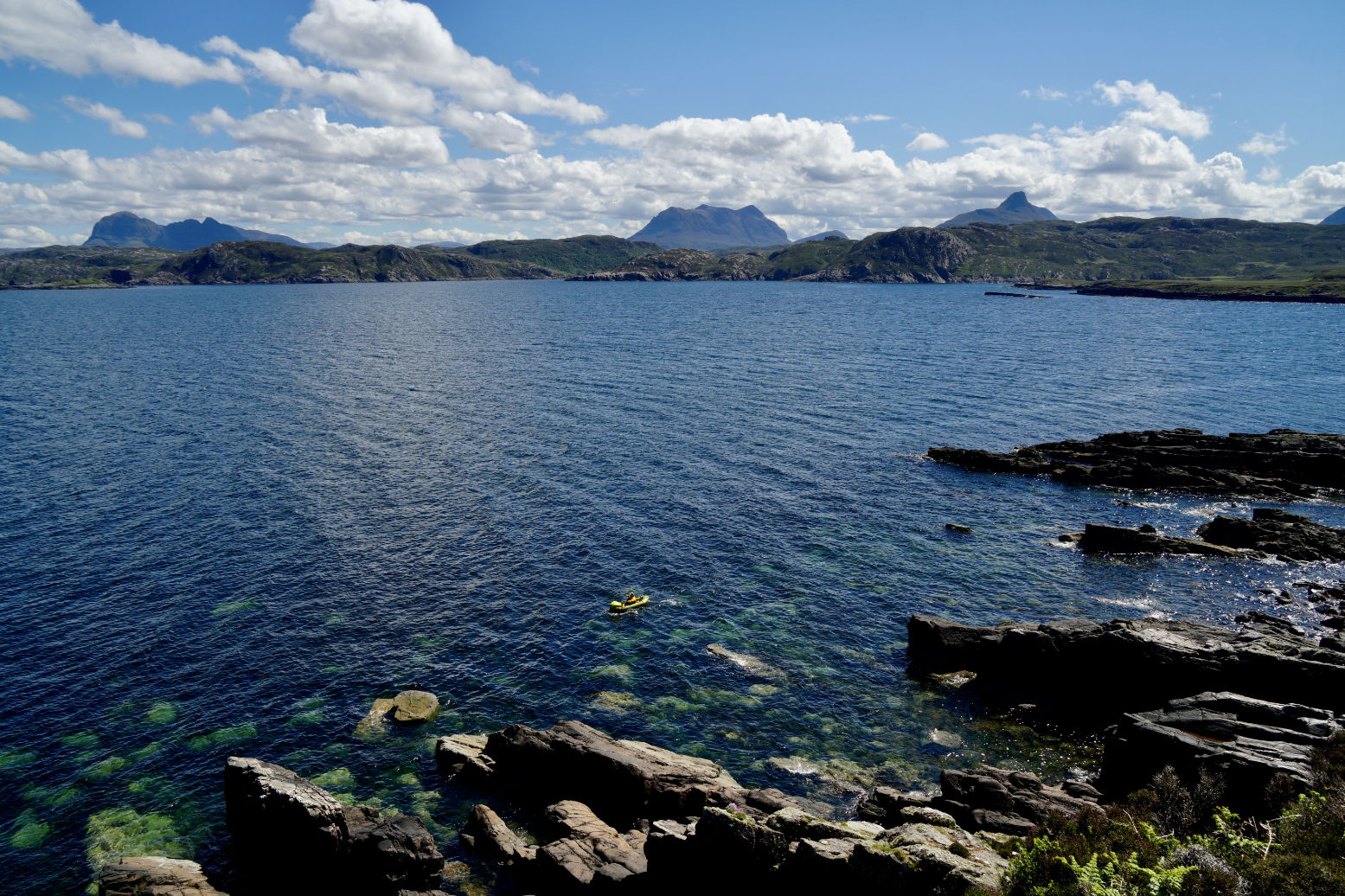
Garvie Bay with Suilven, Cul Mor and Stac Polly; mountains of the Assynt.

Skeg effectiveness
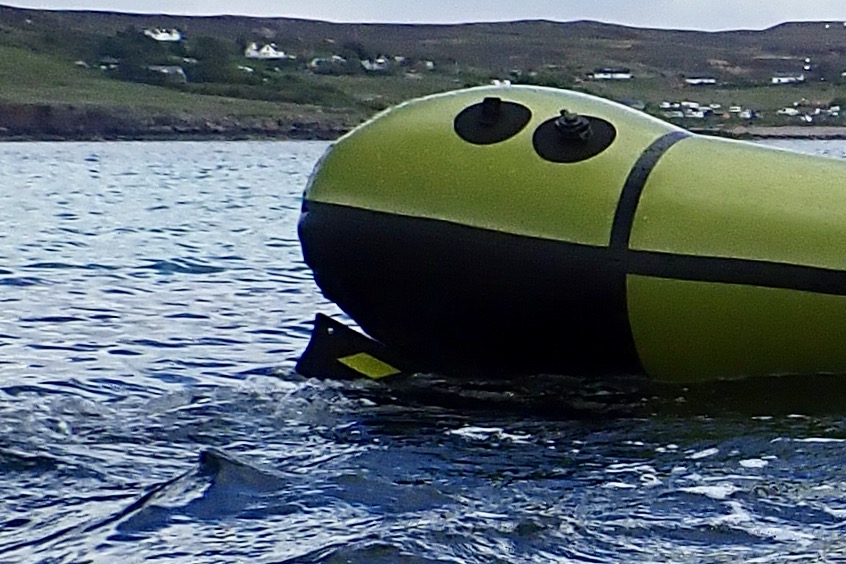
Anfibios mount the skeg sloping down on the hull’s short stern. Selfies I’ve taken on previous TXL paddles show the skeg halfway out of the water, unless the boat is very heavily loaded. The air floor lifts the boat higher still.
This was not an issue in my rear-weighted Rebel 2K single seater where I pushed the back end down. On the level-trimmed and more buoyant TXL, the skeg is ill positioned or too small.
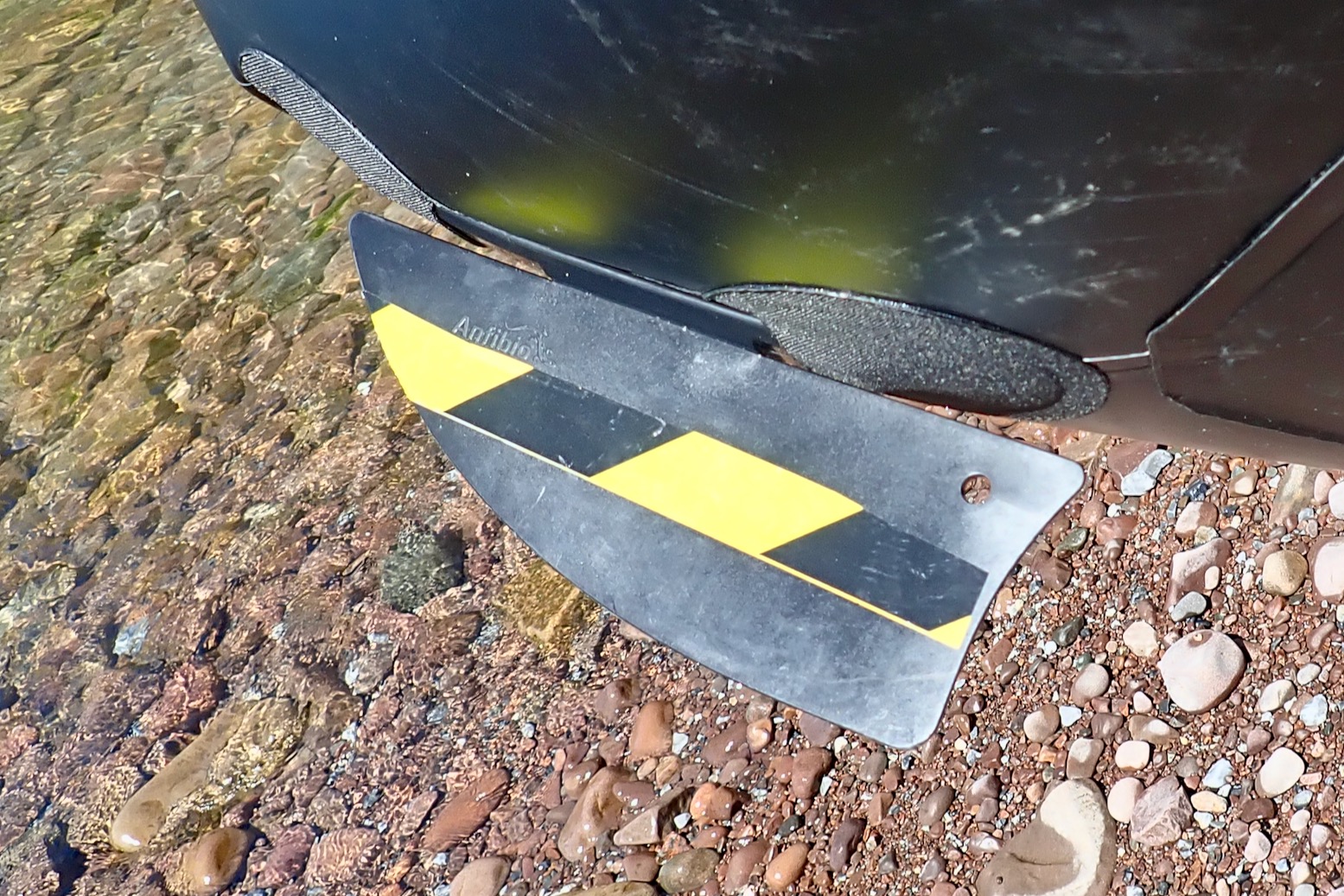
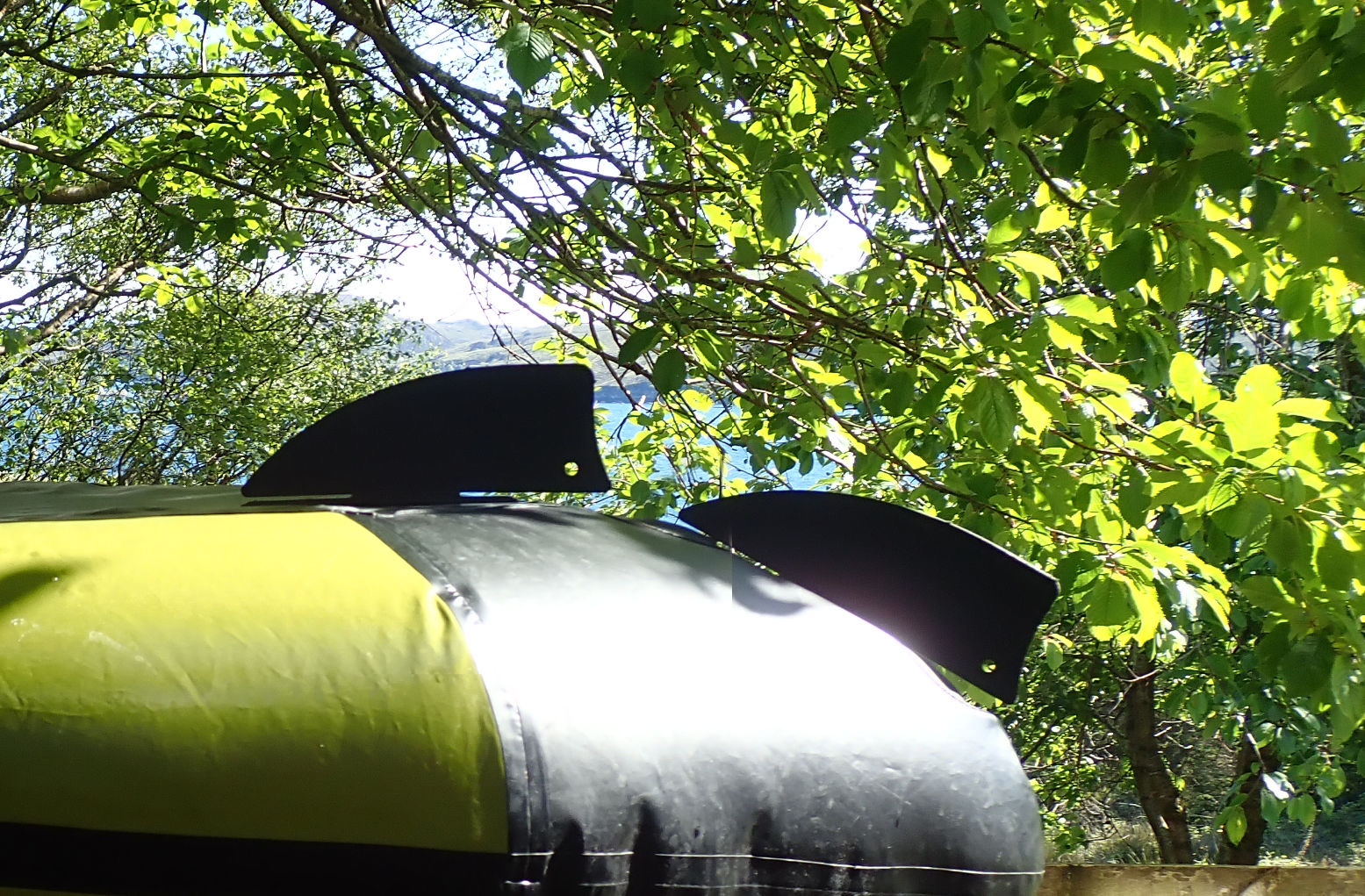
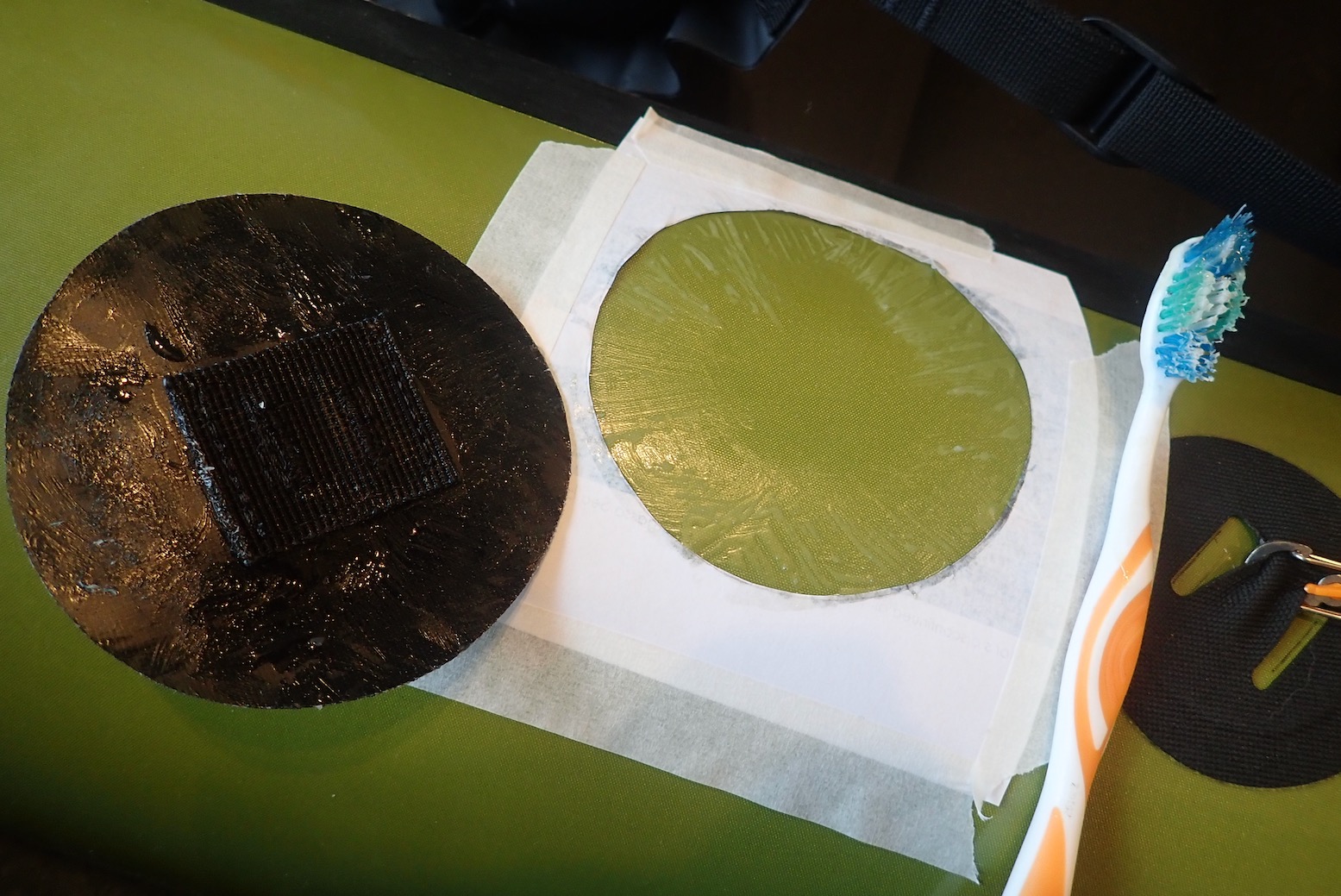
Fitting the skeg backwards puts more in the water, but sticking another mounting patch at the back of floor sheet like an IK (above right) is fully effective. People ask: would the lack of inflated skeg support be that bad without the firm backing of the air-floor or a rear paddler’s seat? No; and the long, low stock Anfibio skeg is just the right shape.

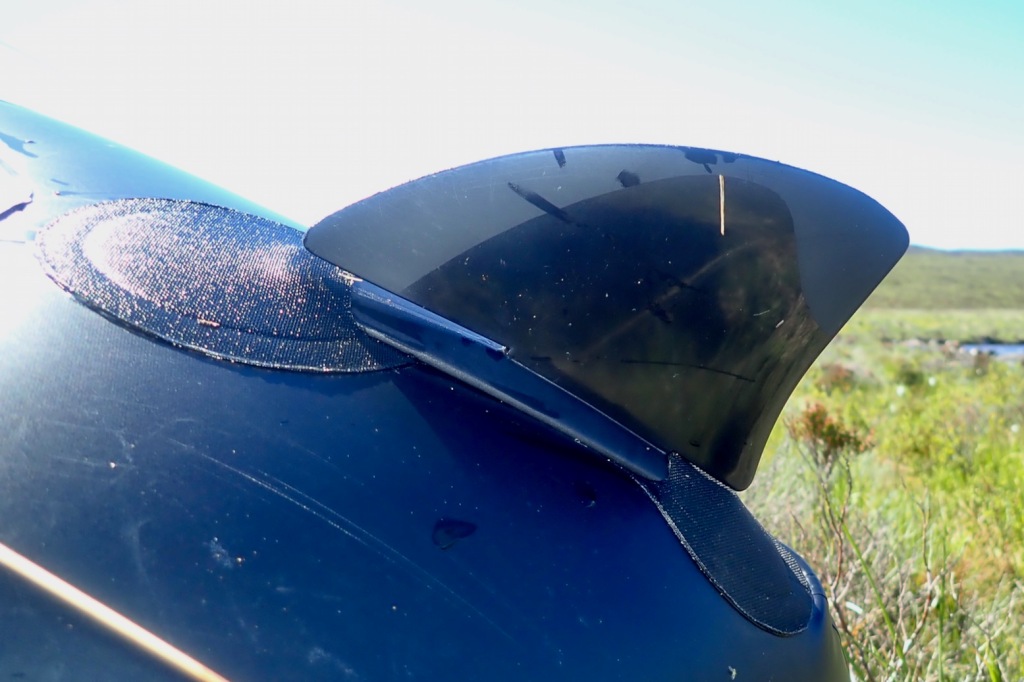
Mounting another skeg patch on the floor is a bit time consuming is what I ended up trying so I can keep the stock skeg. Today I’m trying a spare Gumotex skeg (right) whose slip-in mount system the Anfibio skeg copies, but which has a deeper profile putting more plastic in the water. It’s only less than half a hand’s worth, but is worth a go before fabricating a skeg extension or repositioning it.
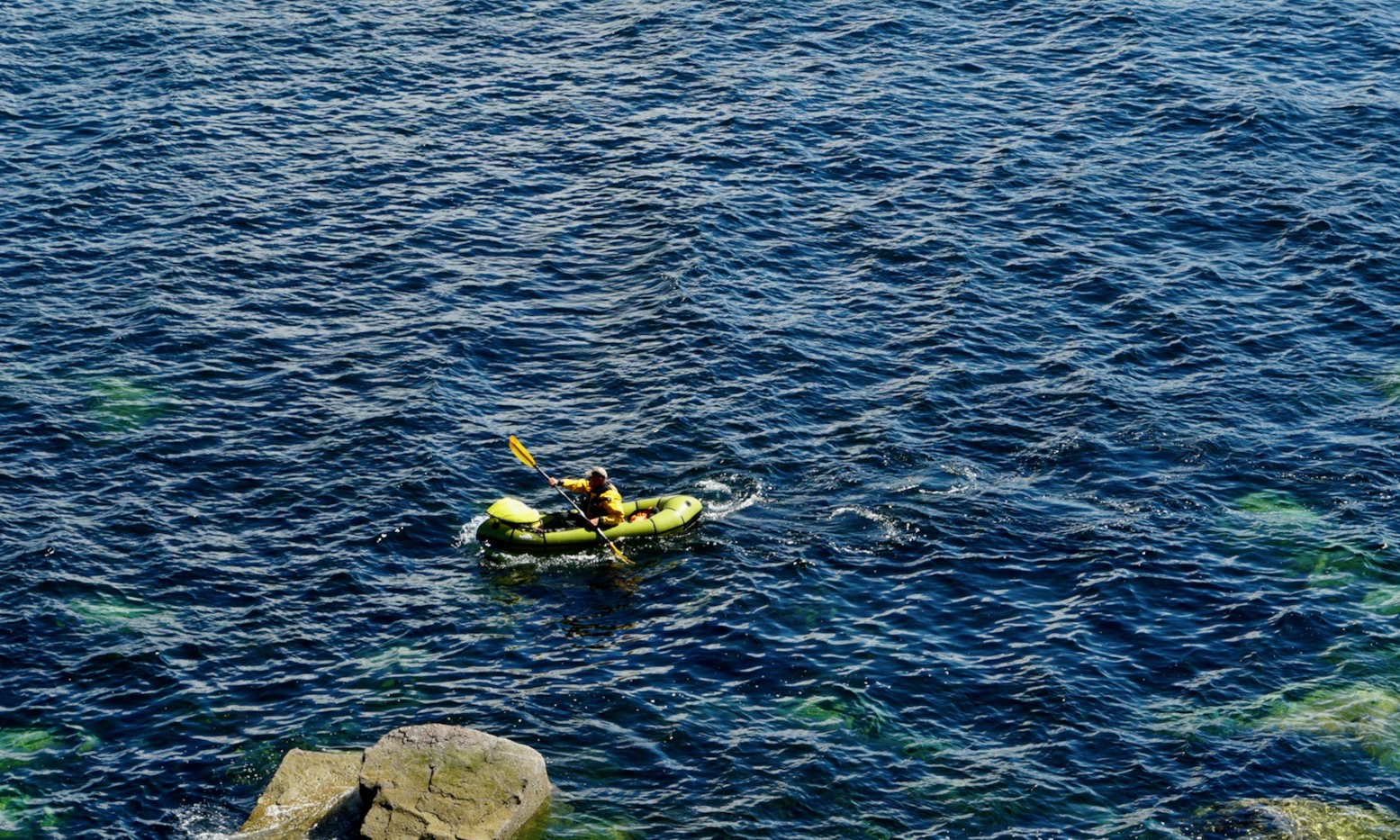
Today I’m also trying my longer, smaller-bladed, 230-mm Camaro sea-kayaking paddle more suited to steady cruising into the wind than the over-sized, white-water Corryvreckan I’ve been using so far. Initially I can feel the paddle’s extra weight, but that’s soon forgotten which suggests the slimmer blades are just right. Progress is a bit sluggish into the northerly, but I’m getting the feeling it’s always like this with the bloaty TXL until the arms warm up.
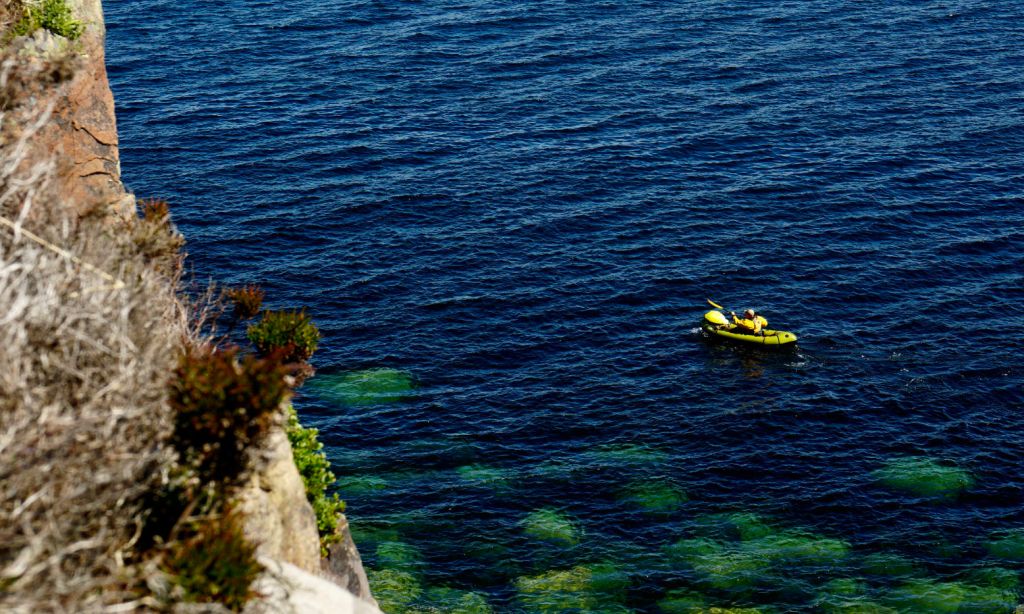
I wonder if coming round the point and turning west into Camas a Bhothain (‘bothy bay’) may get a bit lively, but the TXL takes it all in it’s stride. It’s easy to spot where waves break over reefs and, sat low on the broad, 15-cm-thick seatbase, stability is never an issue and for a packraft, the TXL tracks well across the side wind and waves, perhaps helped by the Gumboat skeg and my masterful technique.
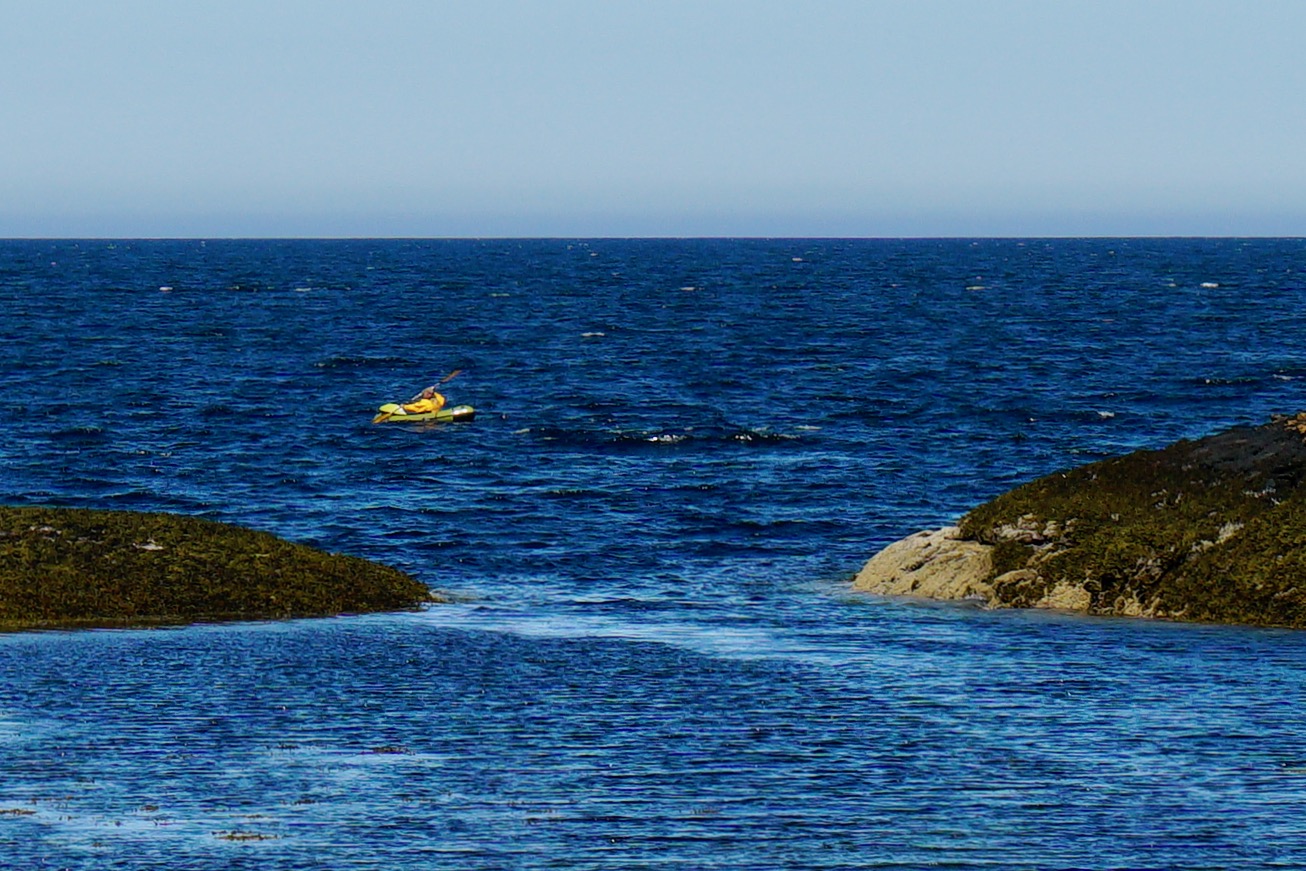
It’s only 4km beach to beach and soon I’m threading through the western Rubha Beag skerries and turning south with the wind for Achnahaird.
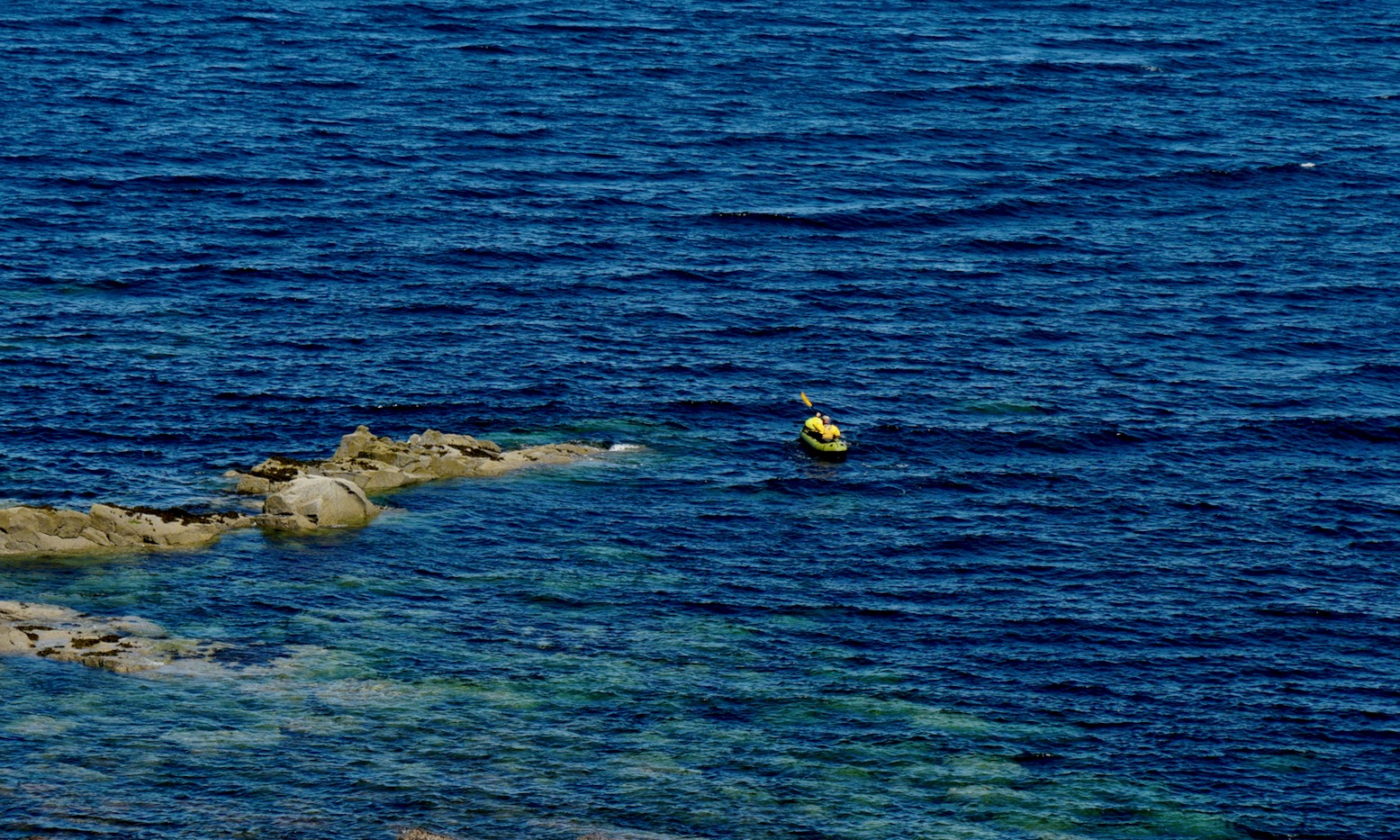
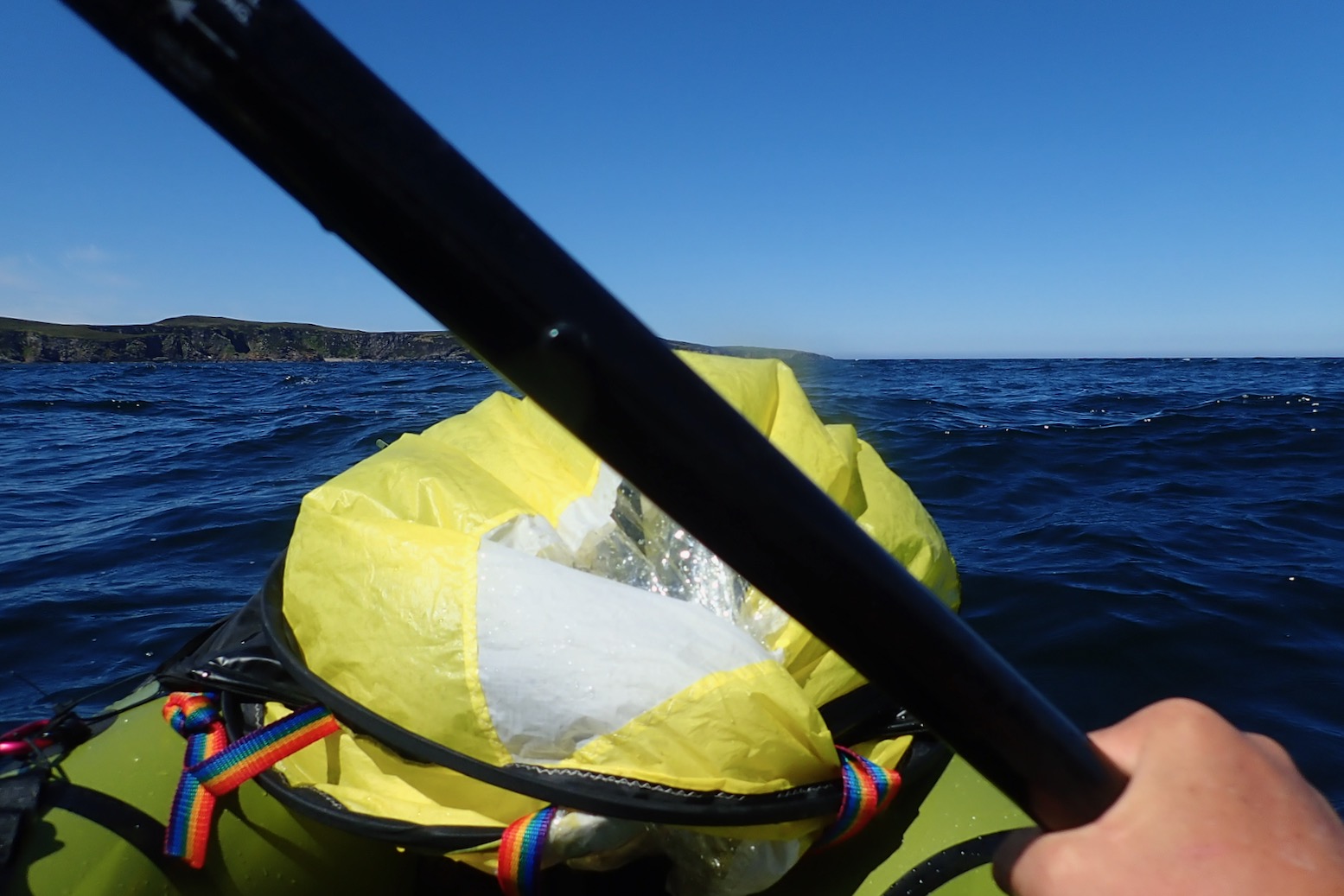
Out here in the open the waves are bigger with the odd white cap rolling past, but incredibly the boat feels fine. In a normal solo packraft I suspect I’d be a bit freaked out. The bigger boat makes you feel less vulnerable and the high sides keep the splash out and don’t seem that affected by ~10mph side winds (something I discovered on my first sea outing in Dorset).
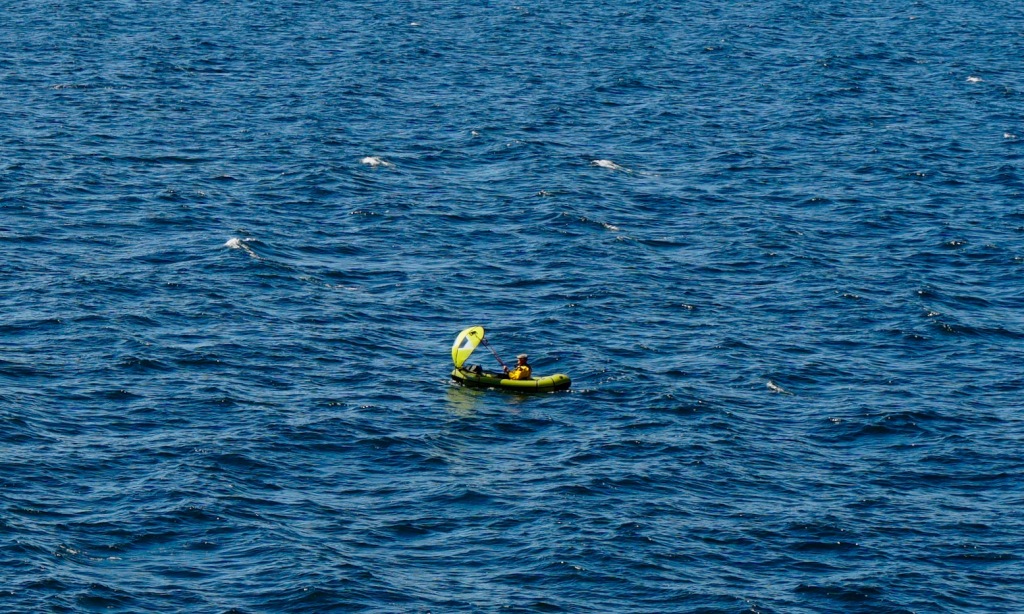
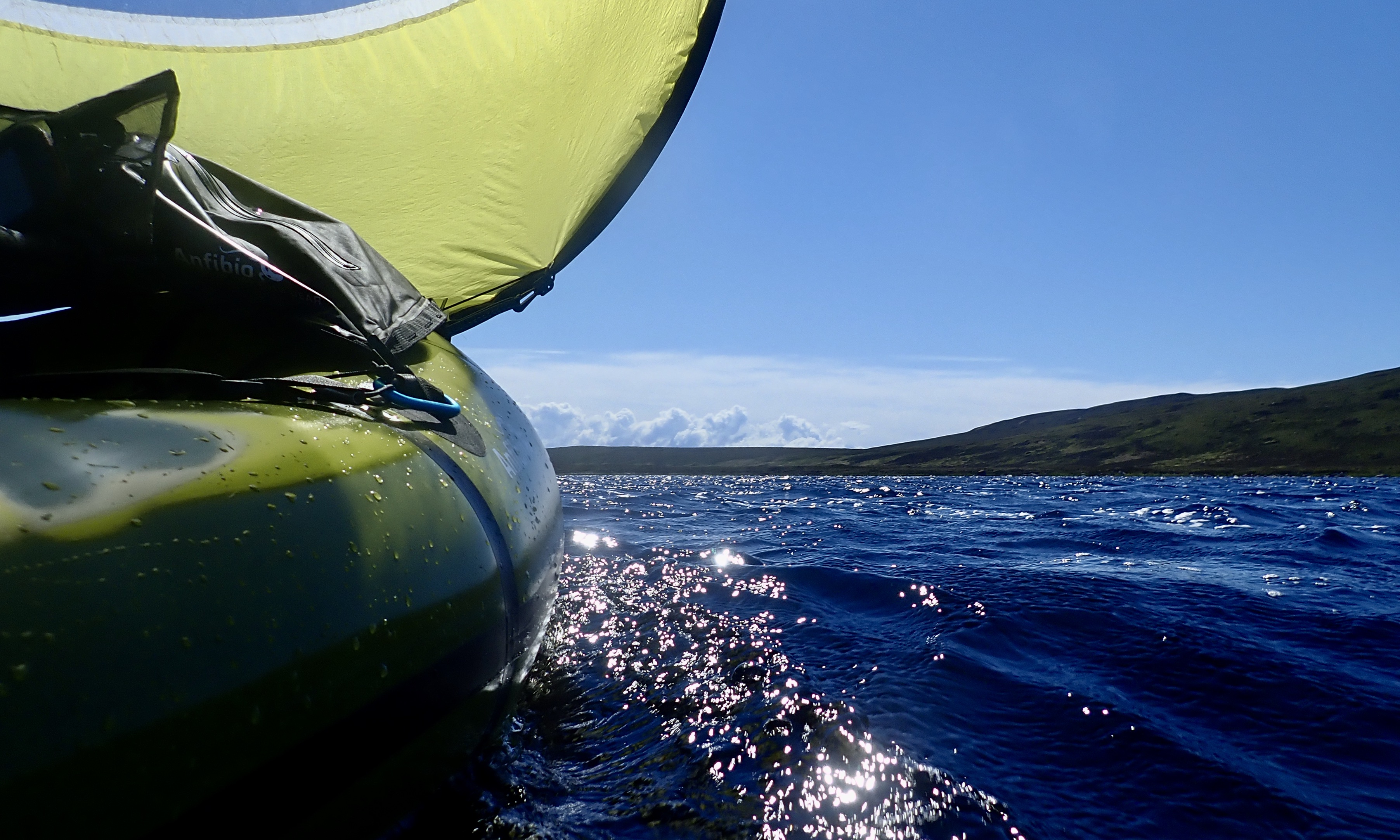
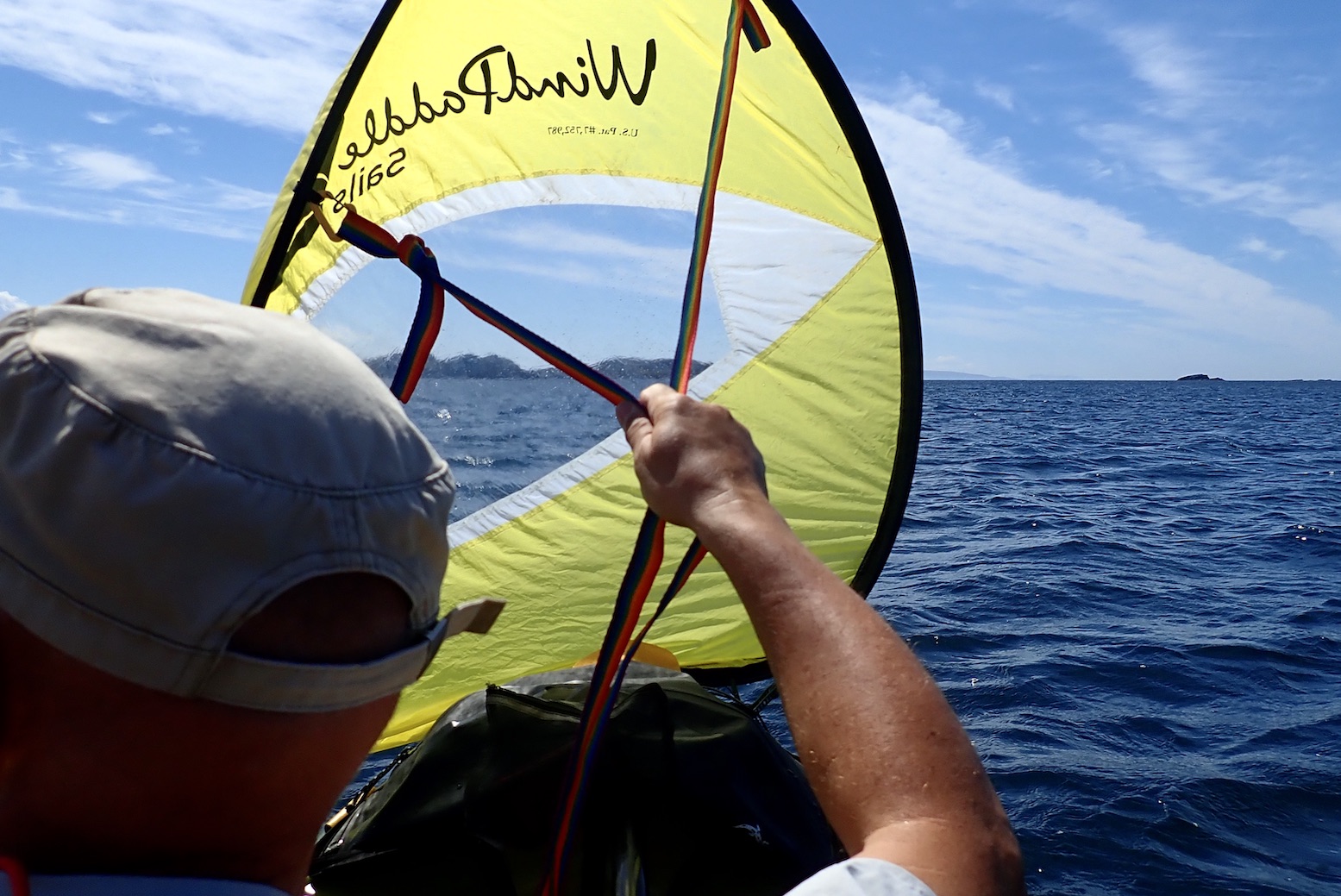
I paddled out into Achnahaird Bay (or so I thought) to get a straight run for the beach, then flipped out the WindPaddle. Only things don’t go so well. Just like the other day when I blamed the front skeg, the TXL is weathercocking (back coming round, below). This time I blamed a too shallow skeg lifting out on wave crests at which point the wind pushes the untethered stern around – the boat pivoting around the sail’s ‘mast’ on the bow.
I’ve had this before sailing a IK on Ningaloo Reef in northwest Australia (tall-sided Ik and too short a rudder for the winds). In the TXL my central ‘kayak’ rather than rearward ‘packraft’ seating position doesn’t help. The (loaded) Rebel 2K sailed fine in similar conditions; so did my unloaded Nomad S1 one time, as well as Barry’s loaded Nomad last year in Knoydart. With its skeg on, the MRS Nomad sailed well, with or without a load. Along with its pointy ends, I put that down to its fully submerged skeg.
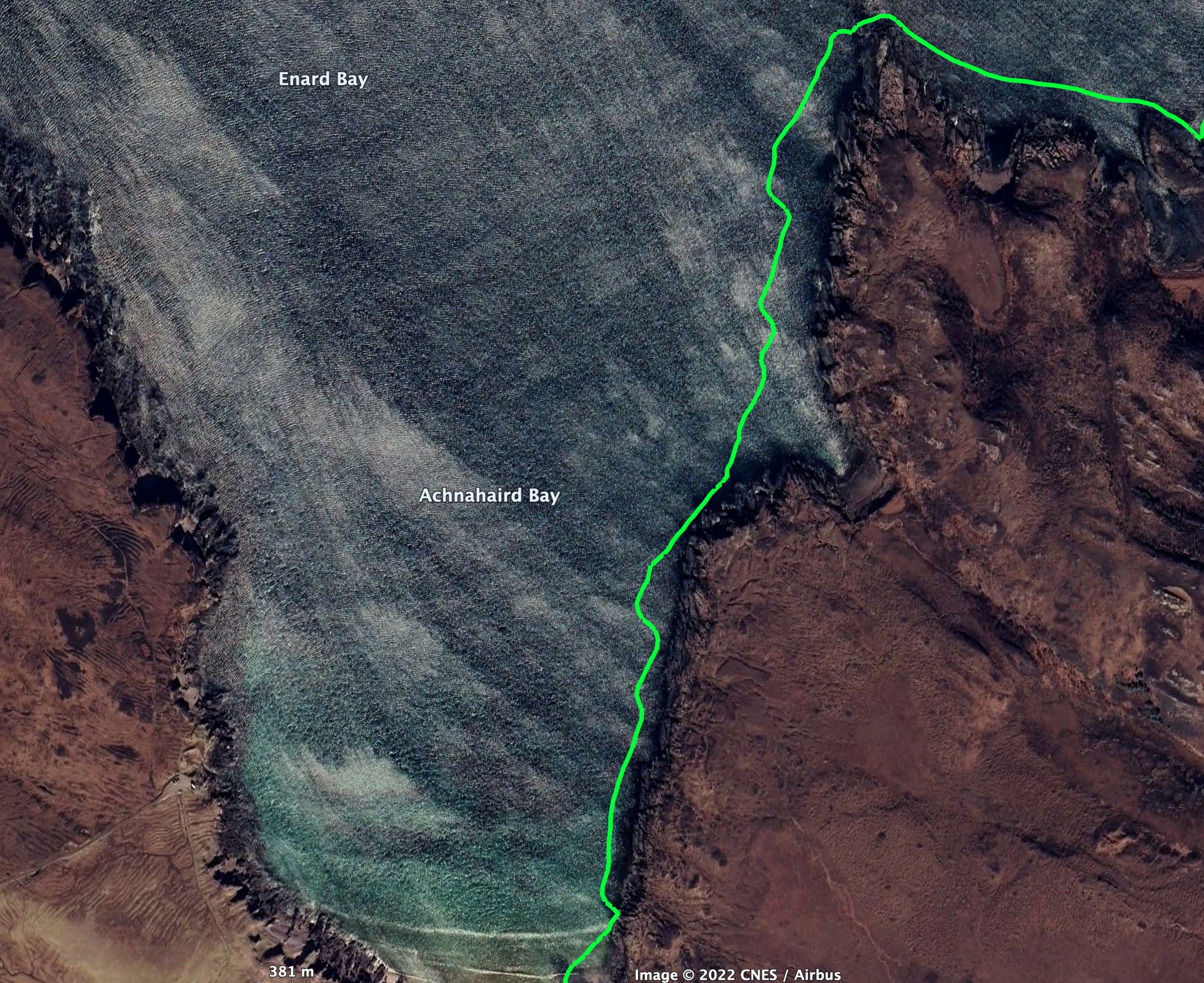
Meanwhile in the TXL you can see my annoying zigzagging track on the left. Hoping to slice across the bay like a blue-fin tuna, it was all a bit frustrating, but I inched in the right direction quicker than it felt and was pretty sure weight distribution and skeg depth were the culprits. And in fact I saw later the GPS was logging a steady 6kph, it just wasn’t the steady linear progress I’ve had sailing other packrafts.
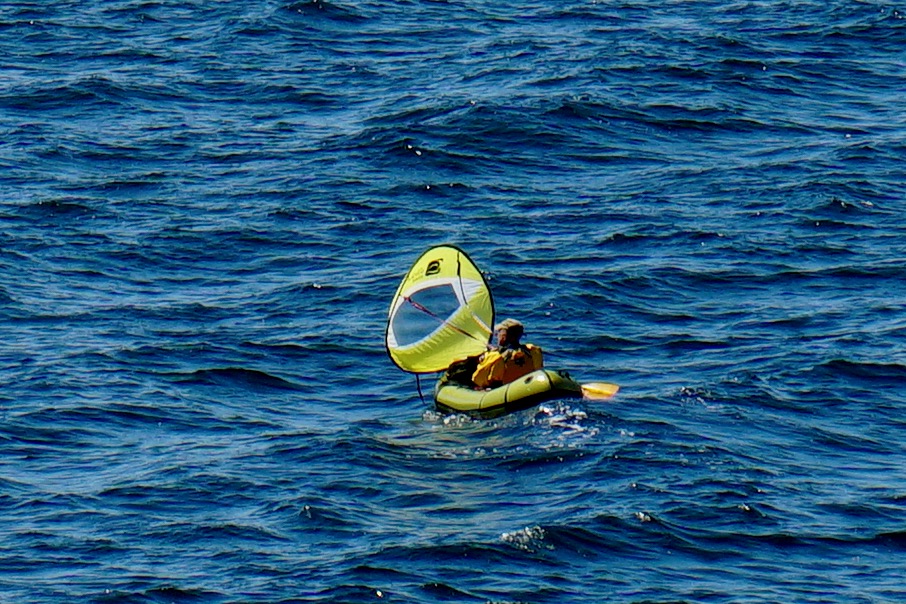
Once at Achnahaird I paddled as far as I could up the burn running alongside the beach, then hopped out and waded upstream – easier than carrying the boat in the wind.
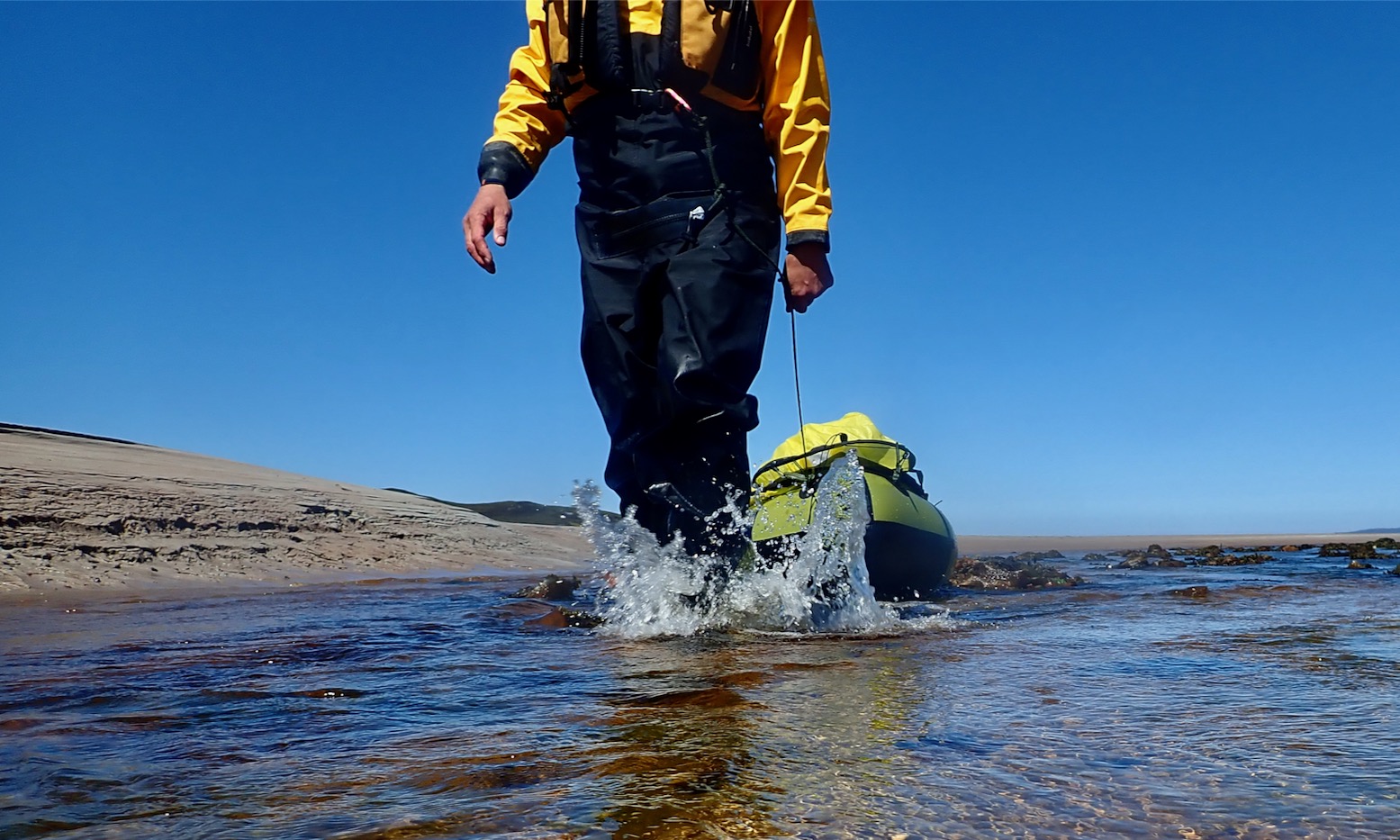
Near the road junction it’s a 2-minute carry over to freshwater Loch Raa where I hoped the lower waves would give the skeg some traction. But it was the same zigzagging progress. Waves combined with a shallow skeg were not causing the weathercocking (as they had in the Bay). So the problem had to be weight distribution. I remembered a canoeing adage: “sit up front into a headwind; sit at the back downwind“. You are the flagpole from which the boat should trail downwind. After a short portage over into Loch Vatachan, I sat right at the back and progress did seem a bit straighter, as the GPS tracklogs below show. I was no faster: 6kph downwind and 5ph on the ‘off-wind’ zags, but there was less zigzagging.
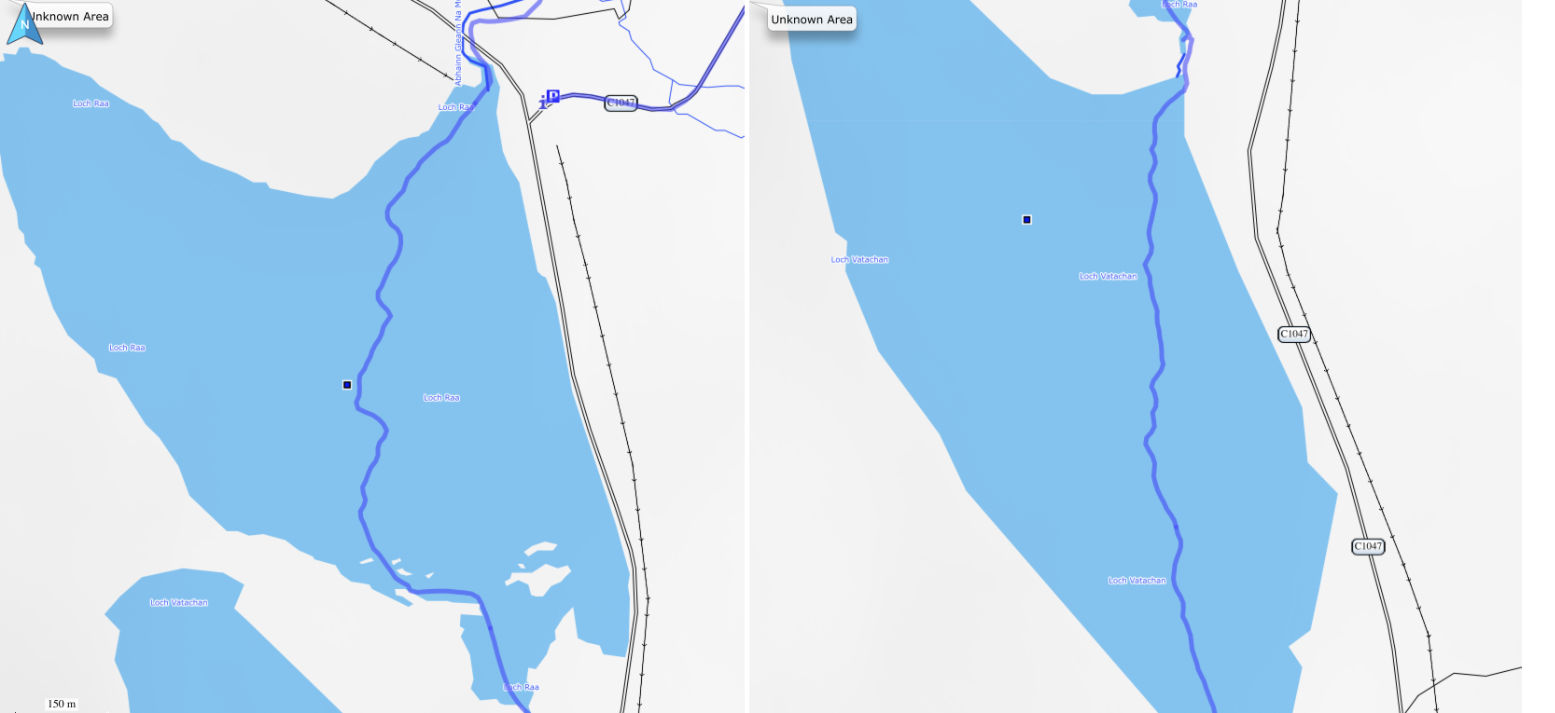
Left: sailing sat centrally. Right: sat at the back. With a bigger skeg I’m hoping for a straight line.

By the time I reached the south end of Loch Vatachan to pack up, the wind was fairly brisk (left). Packraft sailing should be better than this but moving to the back of the boat to enable reliable tracking under sail is not so practical. The answer must be a bigger or repositioned skeg.

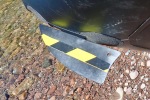
A couple of days later we went for a short paddle in a reasonable sailing wind. The stock skeg was on back to front (right) and with the Mrs’ added ballast I hoped it might bite under sail.
Unfortunately it was the same story of the stern coming round even if the speeds were again OK. On a beach we went for a wander and found a nice bit of broken plastic fish crate. We’re gonna need a bigger skeg.
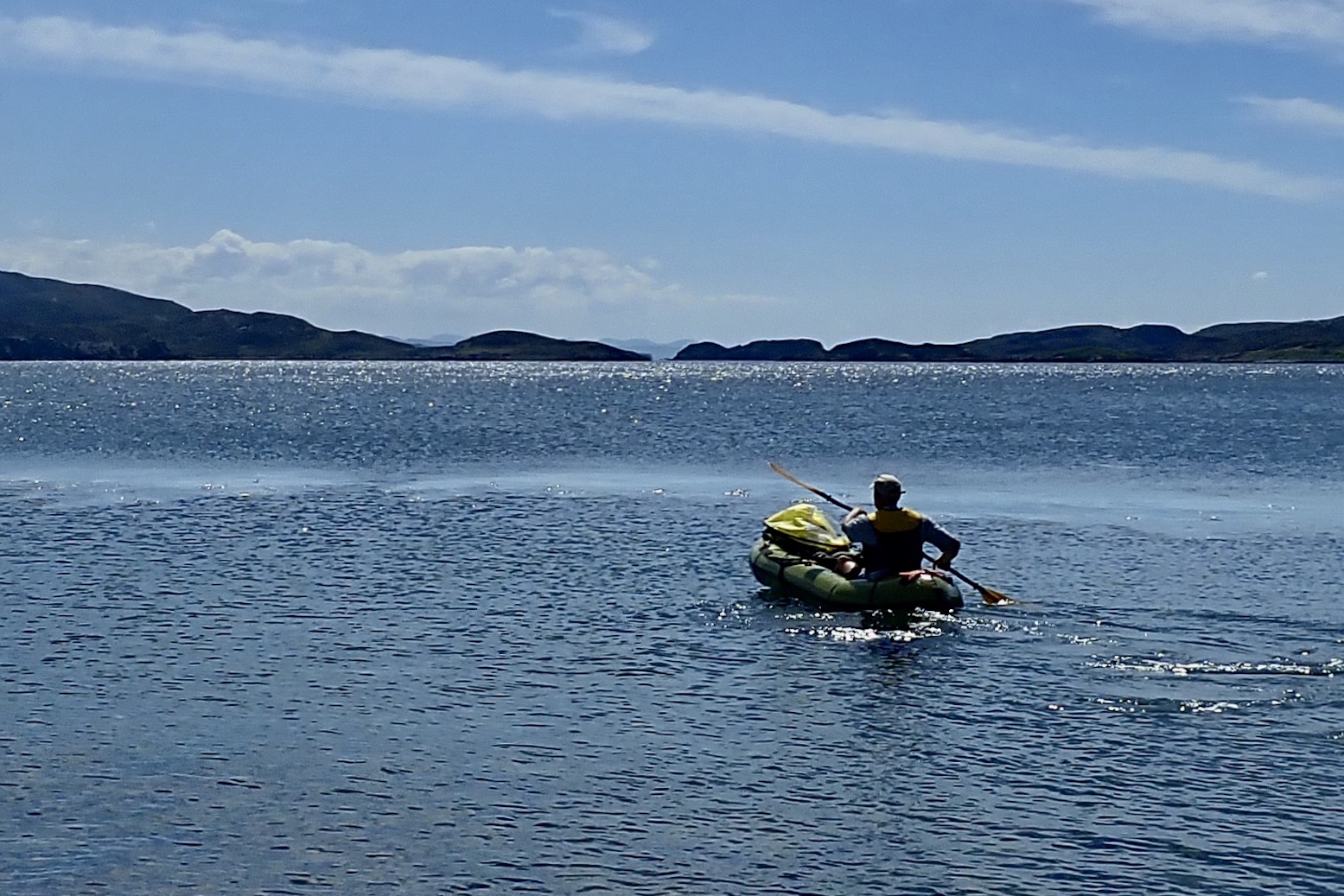
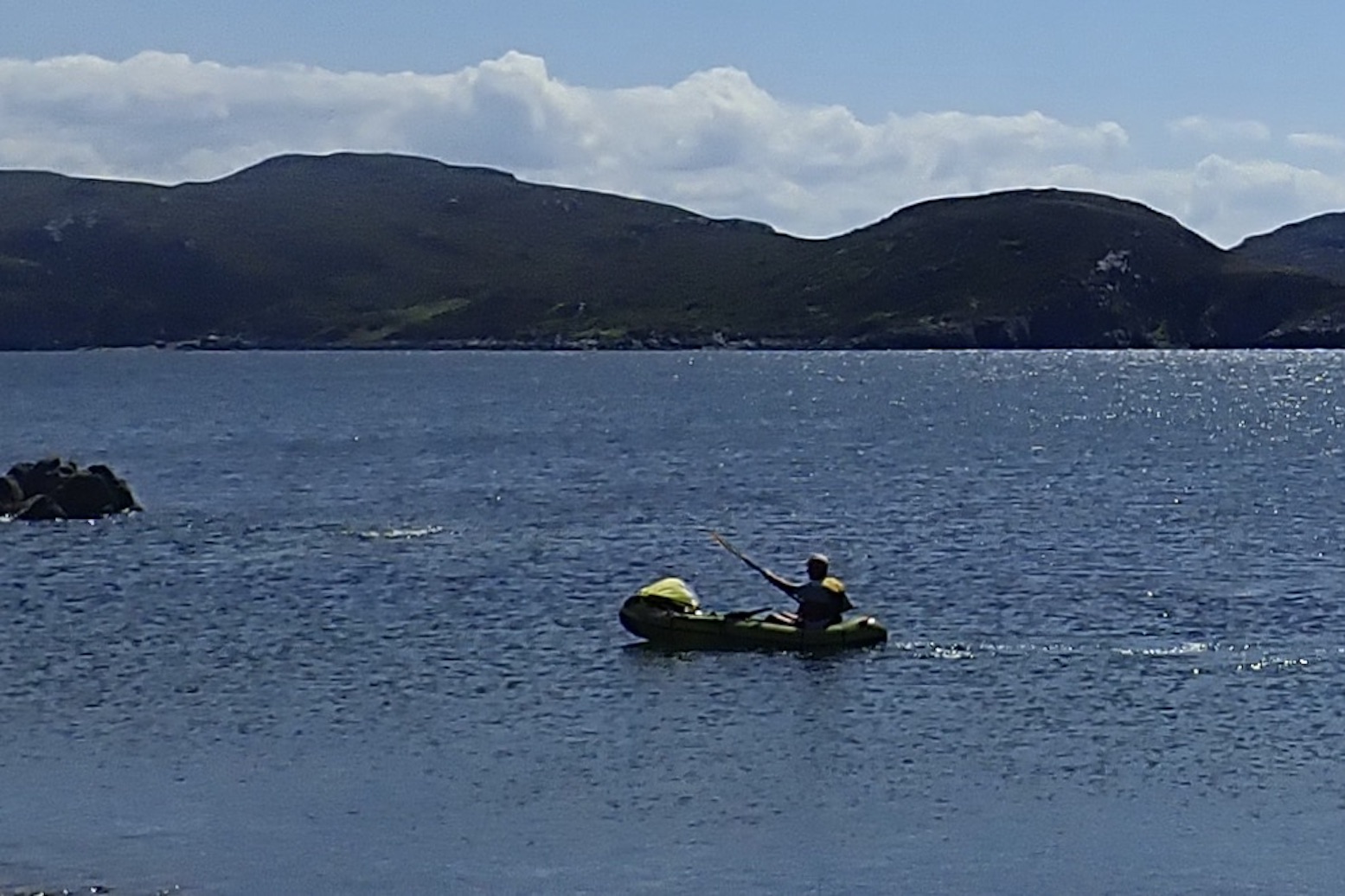
During the stop I took the TXL out for a spin sat in the back. Of course the bow was up in the air and yawing like a giraffe, but it was quite a revelation to have a spacious boat extending out in front of me like a kayak. My front seatbase made a spacious footrest and I could lean on the back like a normal sized packraft. Sat in the back, as a way of touring or bikerafting, a bike over the bow and baggage in the front would correct the trim a little. And with the 200 litres of dry storage capacity inside the TubeBags, you could probably move house with the TXL.
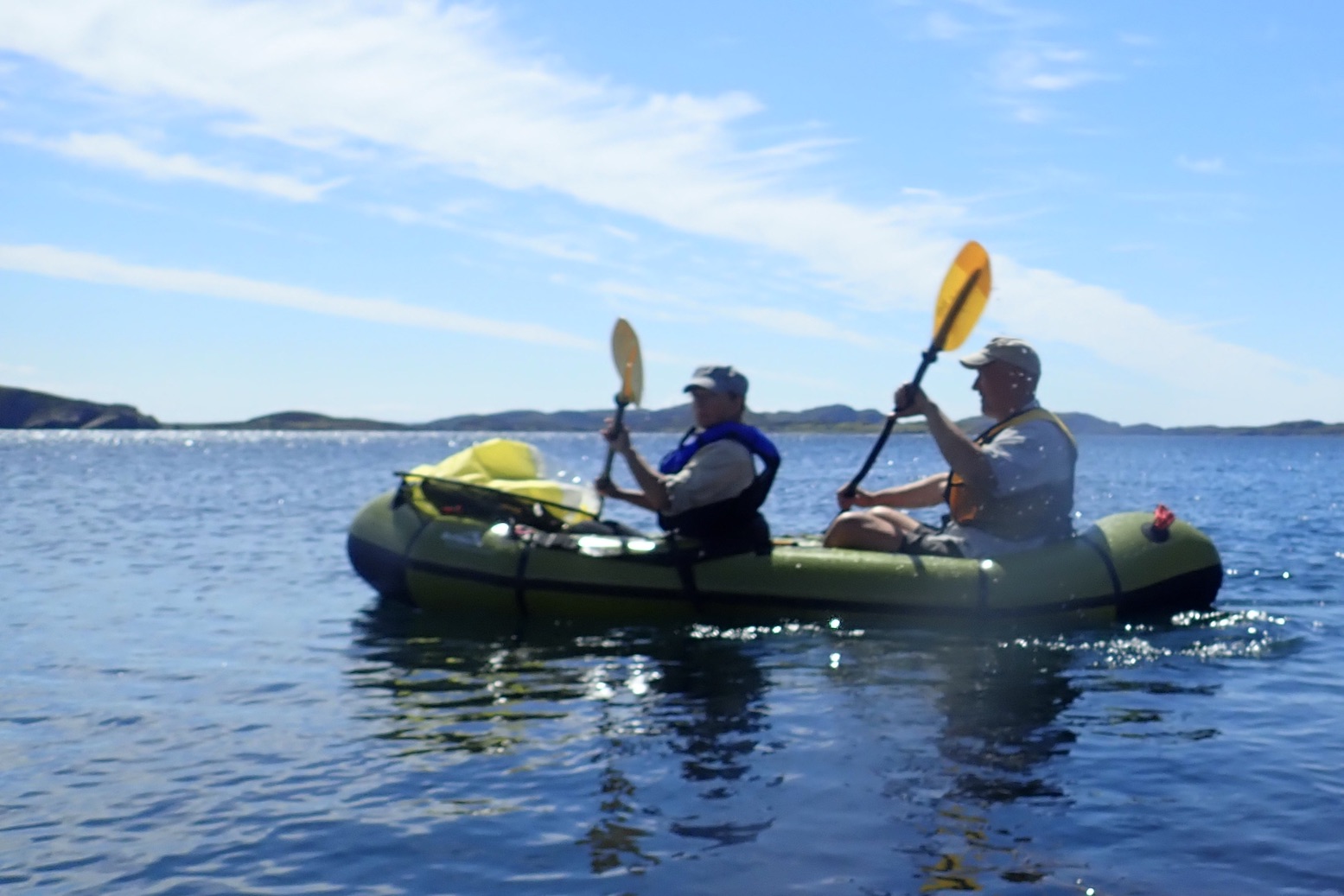
We paddled the last mile to Badentarbet with me in the back. Again this felt much more comfortable for me – it must be the ability to lean on the stern. Meanwhile the Mrs said she felt no more cramped than the back. Yes the trim was still off (left), but so it always was on my 2K and I got around in that with no problems.
That’s the great thing with the TXL: there are all sorts of ways of using it.
Sigma TXL: Multimat floor and front skeg test

Sigma TXL main page
Other Summer Isles paddles

There were two things I wanted to try out while paddling the Sigma TXL solo:
• whether the inflatable Multimat floor pad made a noticeable difference to speed
• what effect fitting a front skeg along with the usual back one might have on handling. Would it shapen the tracking to sea kayak levels?

I put in at a handy little slot a mile or so from the house and set off with the usual rear skeg and the floor pumped up and with the nozzle accessible at my feet. All was flat calm in the lee of the light northerly until I turned north at Fox Point into a headbreeze up to Old Dornie harbour.
As before, paddling along I can’t say the boat felt responsive or glided better – it’s a packraft! – but looking later, the GPS record showed I was moving along at a steady 5kph – as good as I’d expect from a boat like this.
I wasn’t sure which way the dropping tide flows through the narrows at Old Dornie (they dry up into an isthmus linking Isle Ristol as very low tides), but now saw it was southbound – against me but barely noticeable.

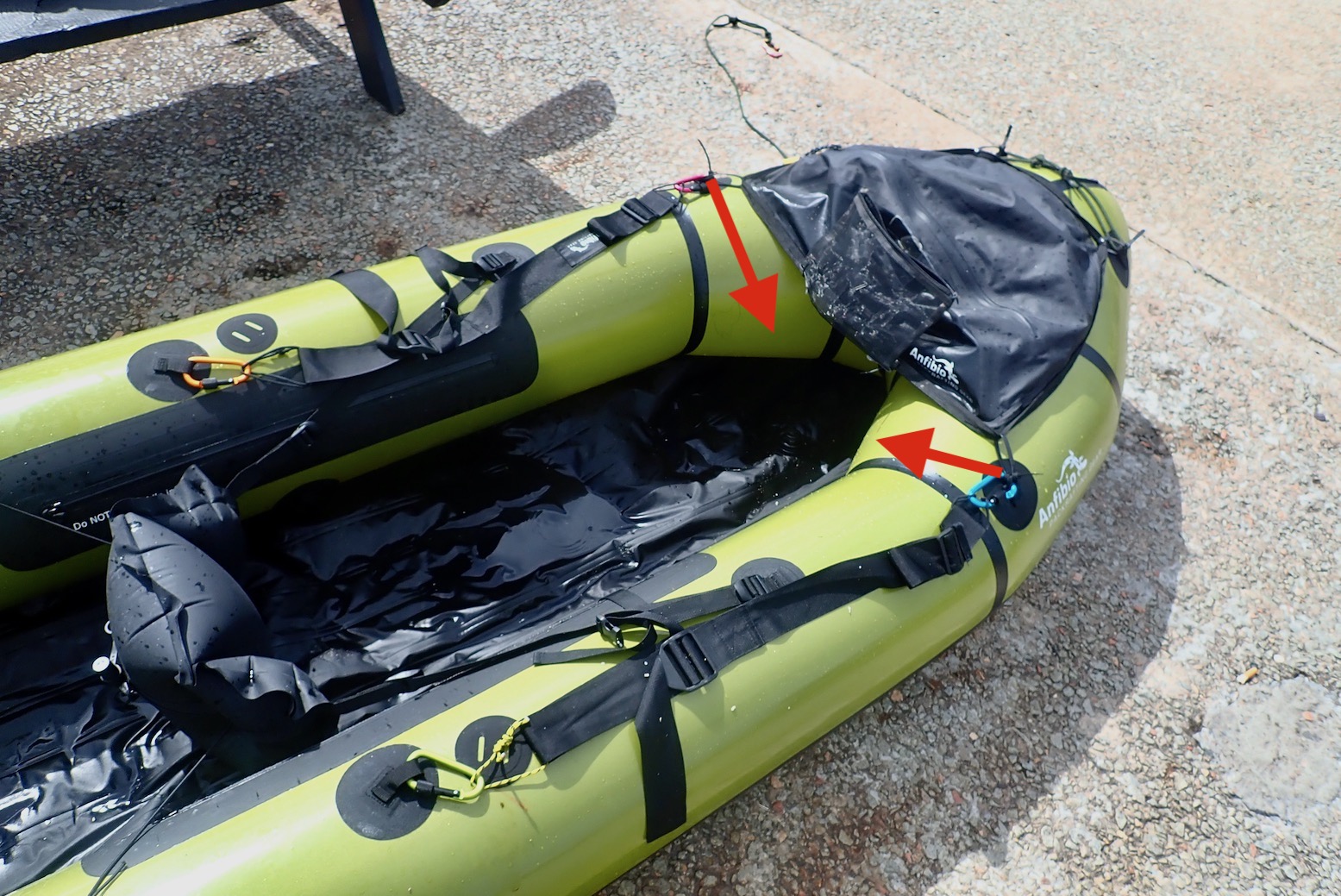
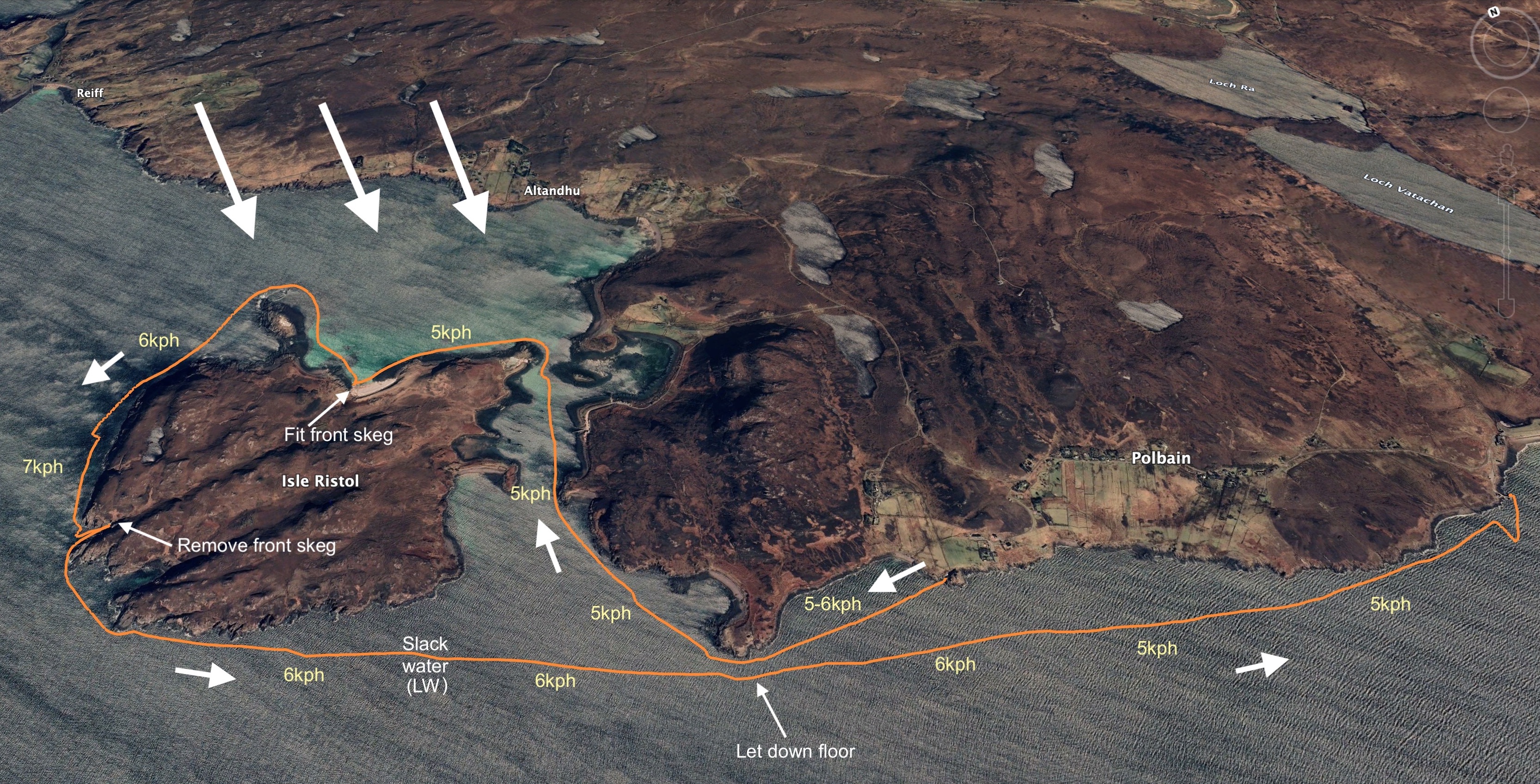
Once through, it was a bit more wavy and at Ristol beach I hopped out to fit the front skeg, curved edge forward, as well as the WindPaddle sail on the off chance the breeze might pick up. Then I gave the floor and boat a top-up until it was all pinging like a drum. Had I looked more closely at the skegs on the upturned boat (below), I may have guessed what the problem was going to be. The TXL’s bow and stern are symmetrical, fyi, and both patches are glued in identical positions.

Double skegging
Turning the spit on north Ristol.
Choppier water ahead

Setting off into the wind to carry on round the spit and down the back of Isle Ristol, tracking felt a bit worse, then really became a handful once I turned southwest across the small bay filled with clapotis bouncing off the cliffs.
Here I couldn’t pull two strokes without having to correct, as if I was stuck in some odd current or in an IK with no skegs at all. The wind wasn’t that strong and the tide was nearing slack, but forward progress seemed agonisingly negligible.
Barely in control, I couldn’t put my finger on it, and at one point had that unnerving feeling of a swimmer caught in a riptide. I’ve noticed odd conditions on this corner of Ristol before, so decided to just keep paddling south in the hope of getting out of the bouncing waves.

Photo before things got sketchy: front skeg bites deeper than the back. Not good for tracking.

If I could have easily got ashore to remove the front skeg I’d have done so right there, but knew of an inlet 500m further on when I could do just that. With the wind behind me, I thought I might sail my way out or trouble, but lifting the sail the boat just pulled itself sideways to the wind. Very odd. I could not get the boat to point down wind and catch the breeze.

By now the water had settled down a bit and with relief, I slipped into the inlet and pulled off the wretched front skeg (left), then went for a wander and a sip from the burn.
Looking at the pictures later, it’s clear the front skeg digs deeper than the rear, even if both are halfway out with the Multimat floor fitted (lifting the boat out of the water).
You could say the front neutralised the effect of the back skeg so the boat paddled as if it had no skegs. But that wouldn’t have made it so hard to handle. It was the fact that the front bit deeper than the back – the last thing you want.

Little did I realise that the TXL was in fact moving through the clapotis at 6kph, and even hit 7kph just before I turned into the inlet. It just goes to show how misleading the impression of forward progress can be, even if the shore seems to be barely inching by. Despite my floundering around with the paddle, I was zipping along.

Back on the water normal rear-skeg service was resumed with a few inches of yawing from the bow. I came across a sea kayaking group who, like last year near here, seemed to be drifting around like they were killing time, when they had all these amazing islands to explore. Put your backs into it!

I eased past them in a packraft half as long and more than twice as wide, and set off for the straight, 5-km run to Badentarbet pier. By now my paddling cadence had found a good, steady rhythm.
About half way, opposite Fox Point, I let down the floor and fully inflated my seat. Positioning the big, unattached seat can be a tight fit between the side tubes, but I’ve learned to lift myself on the side tubes and kick it backwards with my heel. You want to be sat in the middle of the cushion, not falling off either edge.
As we found last week near Skye, de-flooring makes the hull go a bit soft, as if the sagging floor was bending the hull a bit (the floor certainly makes the boat feel more rigid). In future, better to prioritise hull pressure over the floor.

Speeds up to 7kph with a backbreeze.

Did I notice any drag from the deformed floor sheet sagging under my weight? Not really, but after a while the cruise dropped to 5kph. This wasn’t a conclusive test in identical conditions; that might be better done there and back with floor/no floor on a freshwater loch. But I do now believe a Multimat does add a kph to paddling speeds.
It also occured to me that doing sea paddles like this in a single, 0.5mm chamber boat, there is some benefit to the back-up buoyancy from the Multimat floor pad (and up to a point the Tube Bags, when full). It was something I used to worry about much more when I first started packrafting; unsure if these unproven boats might go pop. Time has shown that that does not happen; at worst you might get a slow leak. But out here better to wear a proper foam pfd than a skimpy Buoy Boy.

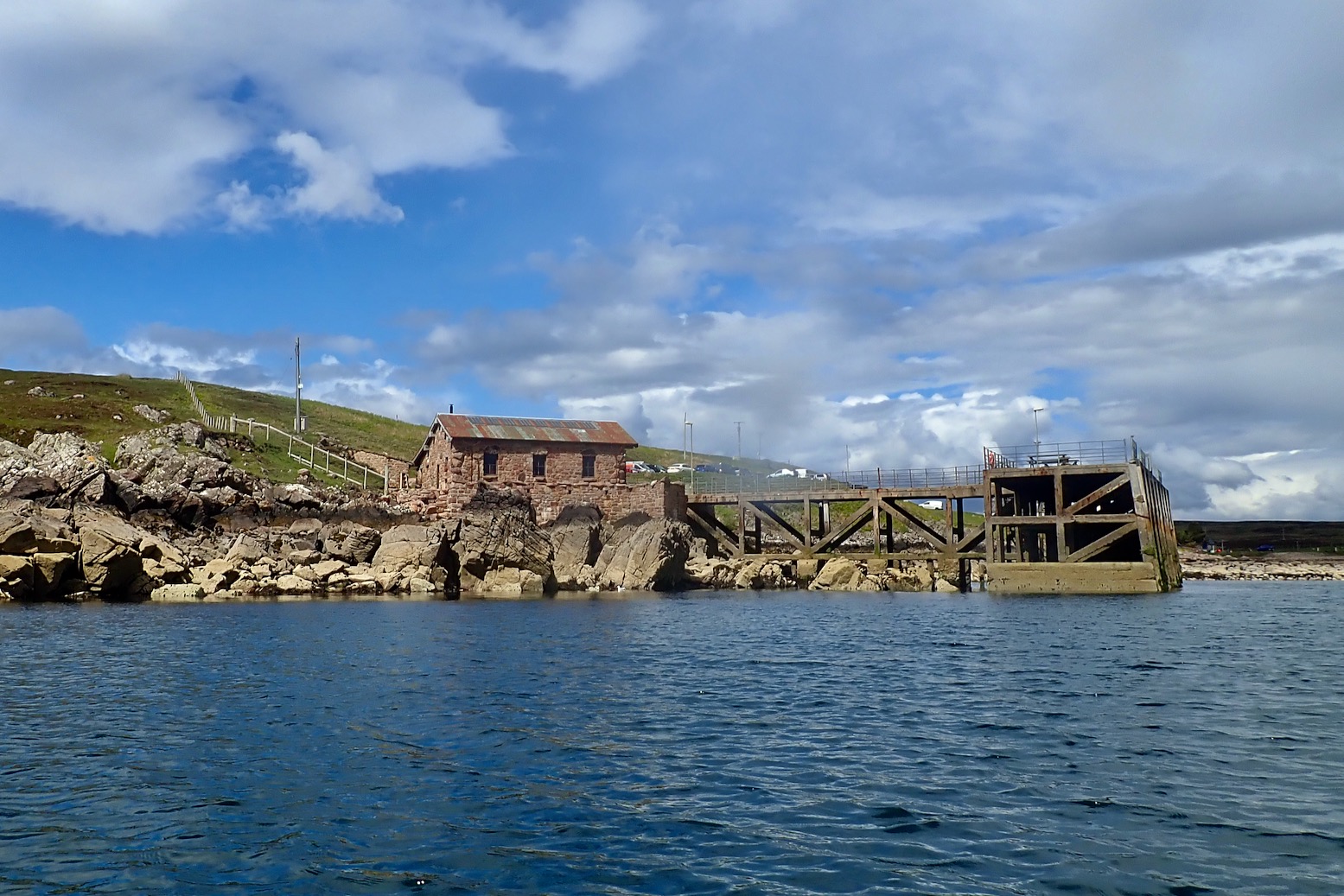
The new owner of Tanera has built a lovely sandstone coffee bar/waiting room alongside the repaired pier. I’m not sure who it’s for.
Watch out for those sharp-edged mussels

But I’m definitely in no hurry to use a front skeg again, though fitting it back to front might put less in the water (matching the back), and doing so with no air-floor might put both an inch deeper in the water. I might try the back skeg on backwards next time, too. More snag-prone but puts more plastic in the water. Anfibio ought to offer a deeper ‘sea skeg’, (easy enough to make). A while later I repositioned the rear skeg to the floor (below). Anfibio now position the skeg further forward on TXLs.

Anyway, now we know: rear skeg helps for sure but combined with front skeg, not so good; inflatable Multimat floor feels marginal but does add glide.
Either way, this 11-km paddle isn’t something I’d ever have tackled in any of my previous solo packrafts, except perhaps the similar Nomad S1. And considering I’ve not paddled this far alone since last year, I didn’t feel any more tired dragging a yard-wide packrafts than hauling my old IK at four times the weight. And of course I was able to follow the newly ratified Packraft Protocol: never take-out where you put in ;-)

Sigma TXL: Footpath to the Shore

Sigma TXL main page

Kyle and Plockton
This way please

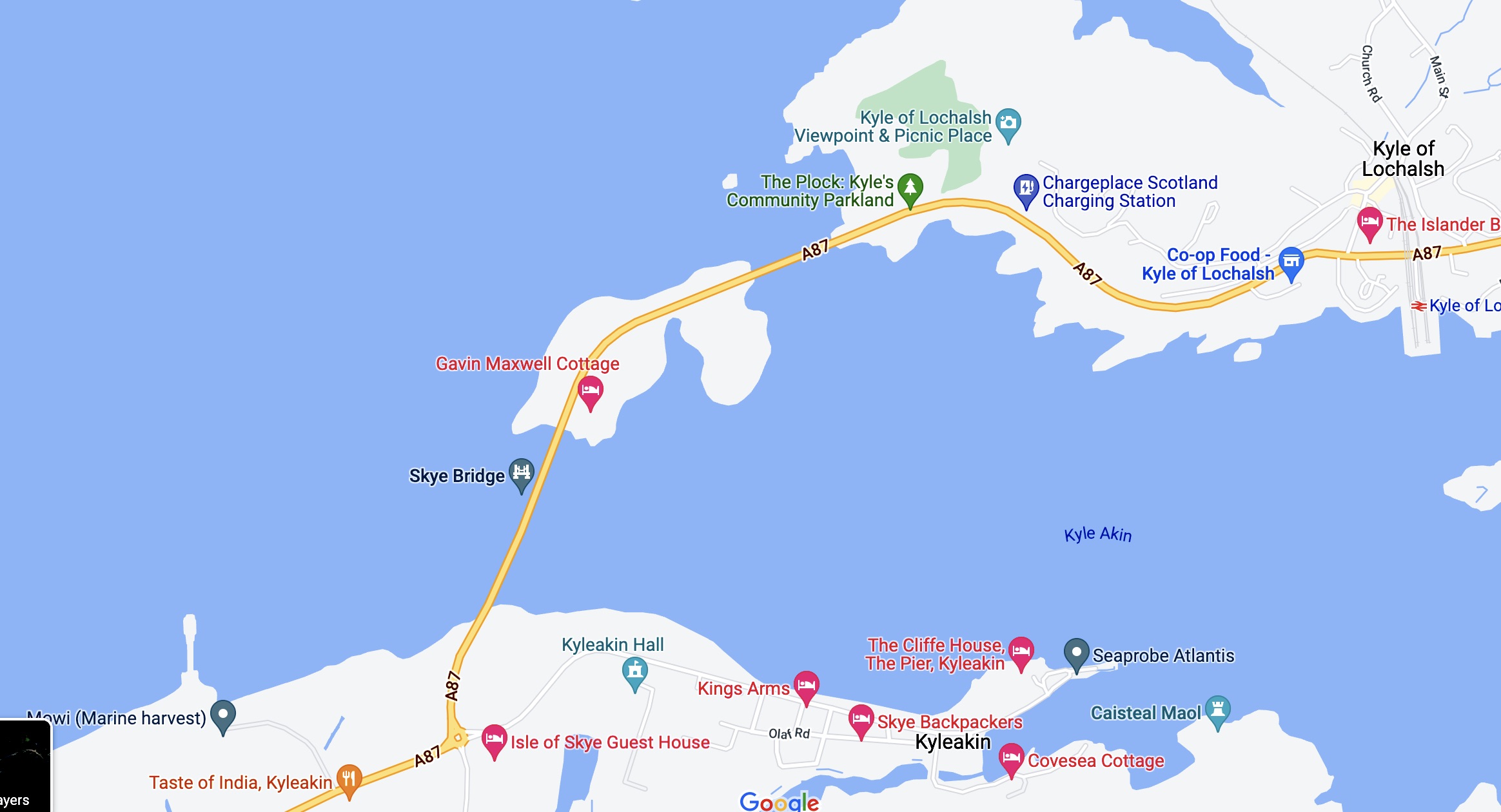
I remember plotting this IK excursion years ago. Set off with some wind and the tide from Kyle of Lochalsh by the Skye bridge, then wind among the skerries north and west into Loch Carron as far as Attadale station near the loch’s head. Once there, hop on a train 39 minutes back to Kyle. The line and single-carriage train comes down from Garve on the Inverness-Ullapool road before following the shore of Loch Carron with a couple of stations to Kyle where ferries served Skye before the bridge was built over the narrows in 1995.

Gumo gone

It’s over 100 miles from our place to Lochalsh but today everything lined up: a lull in the wind; a well-timed tide, and all subsidised by the delivery of my two-year-old Seawave 2 to its new owner at Kyleakin on Skye.
I decided to sell my 4.5-m, 17-kilo Gumotex as I was becoming increasingly sure I could do most things in my new 2.8-m, 3.5-kilo Anfibio TXL, including paddling with the Mrs, packing or carrying multi-day loads and probably sailing too. I might lose some speed but could walk the boat to or from anywhere without difficulty.

The only midge in today’s ointment was Scotrail’s newly reduced timetable which now brought just two trains a day to the terminus at Kyle. We heard the 13.32 trundling past while on on the water; the other one was that evening after 8pm.
No matter; we were in a packraft so decided to paddle 12km to Plockton – the more interesting part of the coast – then walk 8km back to Kyle along backroads.

Seawave delivered, I admire the Plock of Kyle inlet, just a minute’s walk from a car park.
Unfortunately this Footpath to the Shore appears to lead to the municipal sewage outlet.
It’s nearly 8 miles so I try out the floor pad which ought to help the boat slip across the water.
There is always something, and today’s Forgotten Item is the GPS. Shame, it would have been handy to weave among the isles more ambitiously. Instead we follow a less complicated seaward route, passing the outside of most islands.
The floor doesn’t noticeably improve the glide and the boat skates a bit (rear skeg fitted).
Worse still, with two in the boat the 10cm lift reduces interior space, end to end.
And it isn’t helped by me giving the foam seatbase block one last try before consigning it to my private foam collection. After 45 minutes I can bear the agony no more and fit the inflatable seat instead. Much better, and it doesn’t wobble too much on the stiff floor, as it did on the Thames the other month.
The cramped conditions provoke undisciplined outbursts from the crew.
But actually we’re moving along fairly quickly and after 90 minutes are 5 miles in. Just 3 miles to go.
I’m finding the hauling hard, though. Later I realise perhaps my large-bladed white-water Werner Corry paddle is ill-suited to tandem paddling.
That’s almost IK speed if not IK comfort. I let the floor down and gain a couple of inches to stretch out the feet. Much better. I also try out my thigh braces which are OK; probably more effective for solo paddles.
Even without a map you can tell it’s an isthmus. Sure enough it’s a 2-minute walk over a meadow to the other beach. Plockton village is actually less than a kilometre away, but round the headland is another 5km.
As predicted, the wind picks up with the odd whitecap, but the TXL manages fine. We see some kayakers.
The lighthouse on Eilean Chait marking the turn south into Plockton Bay.
Annoyingly, I turn into the the wrong bay. I thought it didn’t look right.
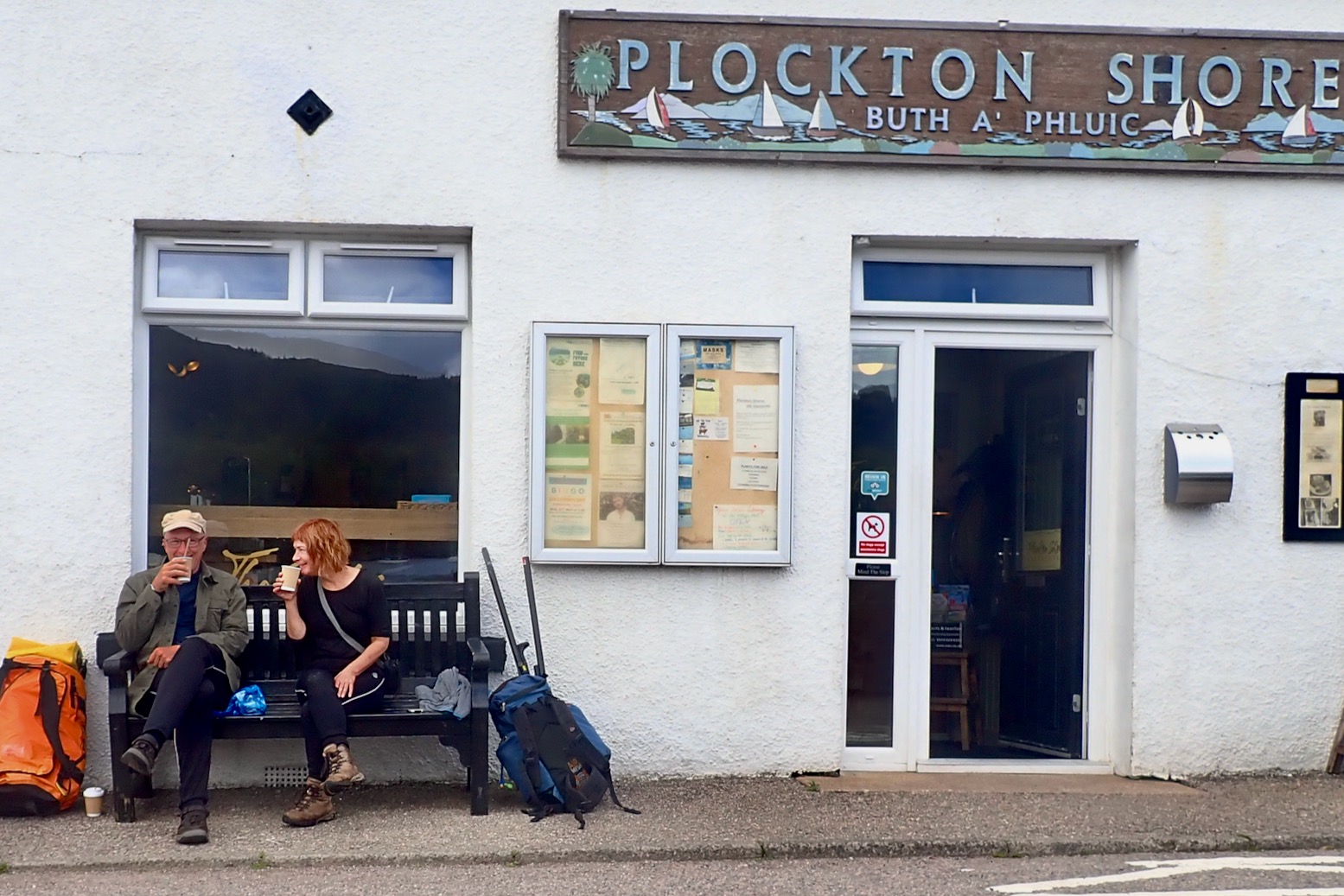
Never mind, it’s the edge of Plockton and pretty as a picture.
Time to bag the boat…
… and track down a coffee.
It’s all a lot softer and twee round here, compared to the windswept, treeless Summer Isles.
Double coffee while tourists shuffle purposelessly by.
A chance to rest tired arms with a two-hour walk back to Kyle. How did that oil rig get there?
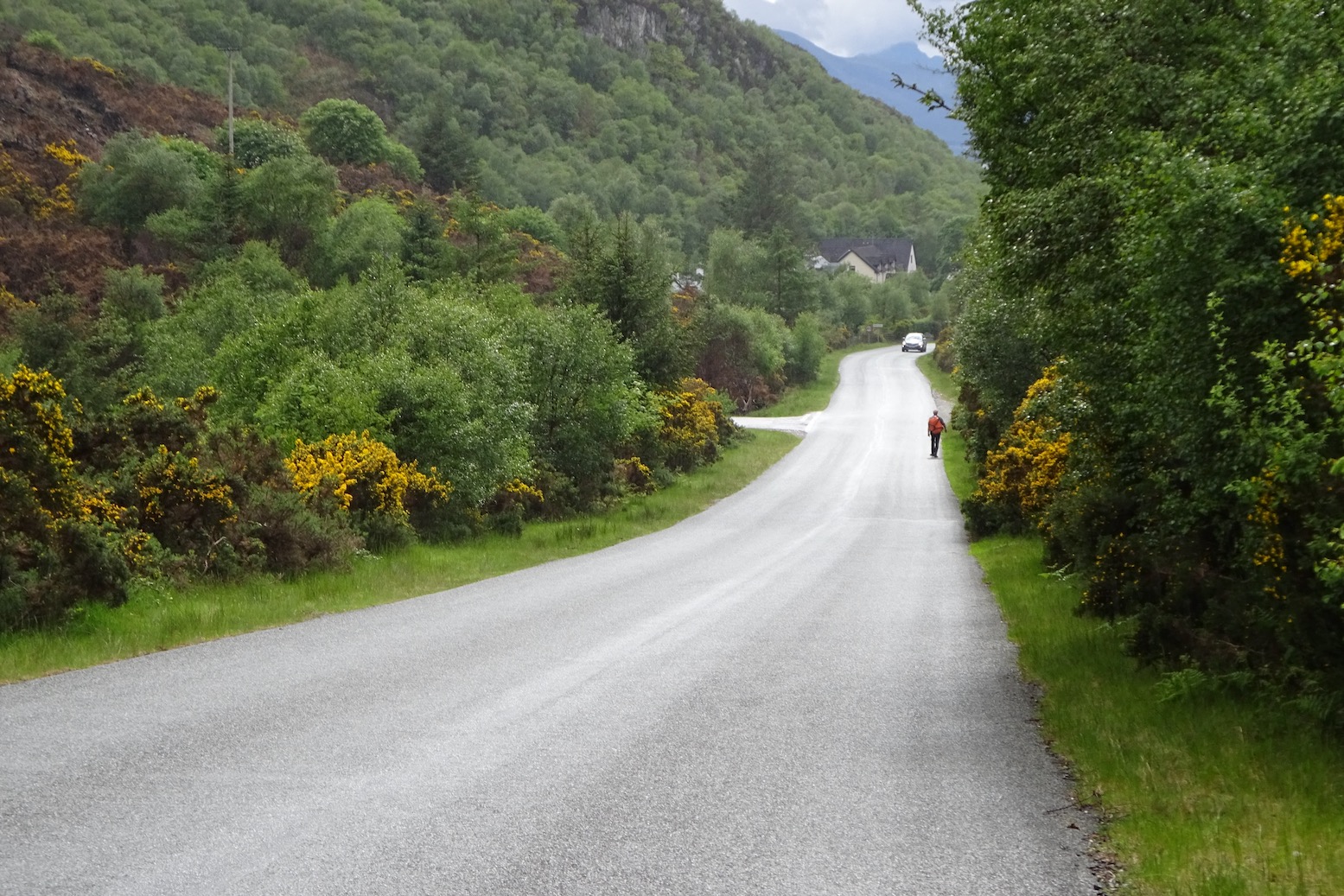
It’s fun to pass through quaint villages at walking speed.
And meet the hirsute locals.
Full marks to Erbusaig for not going for grey pebble dash.
Nearing Kyle. Look at all those trees!
Unusual view of Skye bridge.
The glowering mountains of Skye.
Arrival in Kyle as the washes down our salty limbs.
We find the Fisherman’s Kitchen down by Kyle harbour.
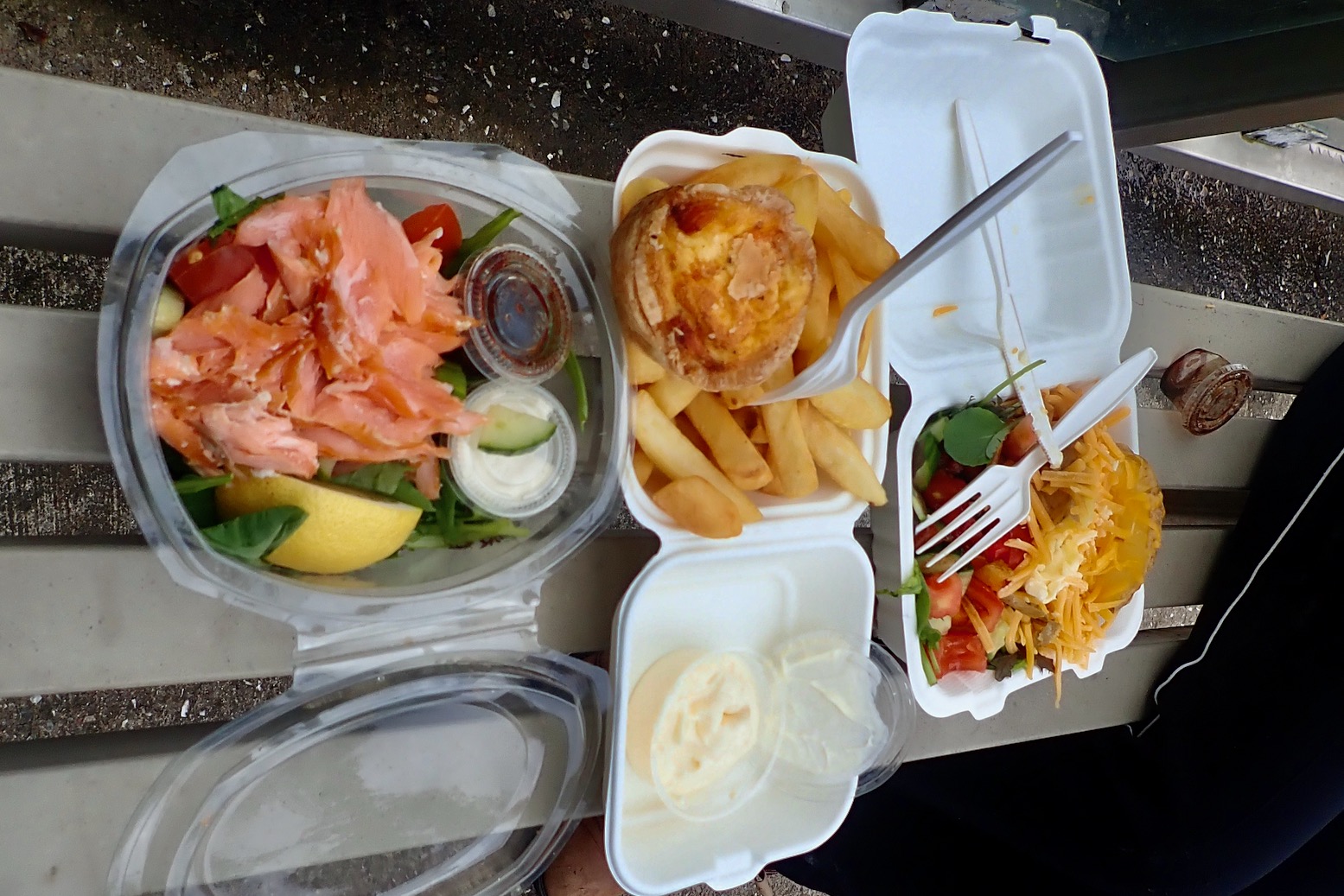
Fifty Ways to Eat Your Salmon; just what was wanted!
We tuck in in a bus shelter.
A good day out. More like that please.

Sigma TXL • bow skeg and knee straps

Sigma TXL main page
Glues and Repairs

Pivoting

Years ago I remember when the value of fitting packraft rear skegs was debated. Then, the now common longer sterns were introduced by Alpacka and positioned the paddler more centrally which greatly reduced excessive bow yawing. The problem was largely solved.
On a packraft you’d think a skeg under the bow would eliminate the yawing endemic to short, wide rafts while compromising turning agility. In fact, I wonder whether a packraft might yaw nearly as much at the back but you never notice. Like one of those Turkish dervishes, you’re actually pivoting from the middle of the paddle shaft, or perhaps a bit behind, at the centre of mass (left).

Rear skegs certainly improve tracking on IKs; you can manage without, but with a skeg you can paddle harder without constant micro-correctioning. On rivers I’ve found solo packrafts paddle fine without a rear skeg; or they’re too short to demonstrate noticeable improvements. There’s a bit of nodding as you move off which soon settles down with some momentum and a steady cadence. Even my symmetrical Rebel 2K (left; stern identical to bow, not extended) paddled fine down the Wye without a skeg. But when getting pushed around by a swell or on sea lochs (especially when sailing) fitting a skeg was worthwhile.
Either way, rear skegs are a thing now with packrafts even if you don’t have to fit them every time. Certainly on my longer TXL I like to think the stock rear skeg aids coastal paddles; though we found a brief stint with no skeg was only slightly noticeable, paddling into the wind in a sheltered loch (no swell). Anyway, I’ve been curious to see what effect a frontal skeg has, so on buying my TXL I ordered a spare skeg and patch which Anfibio also sell separately for €21 + €6.

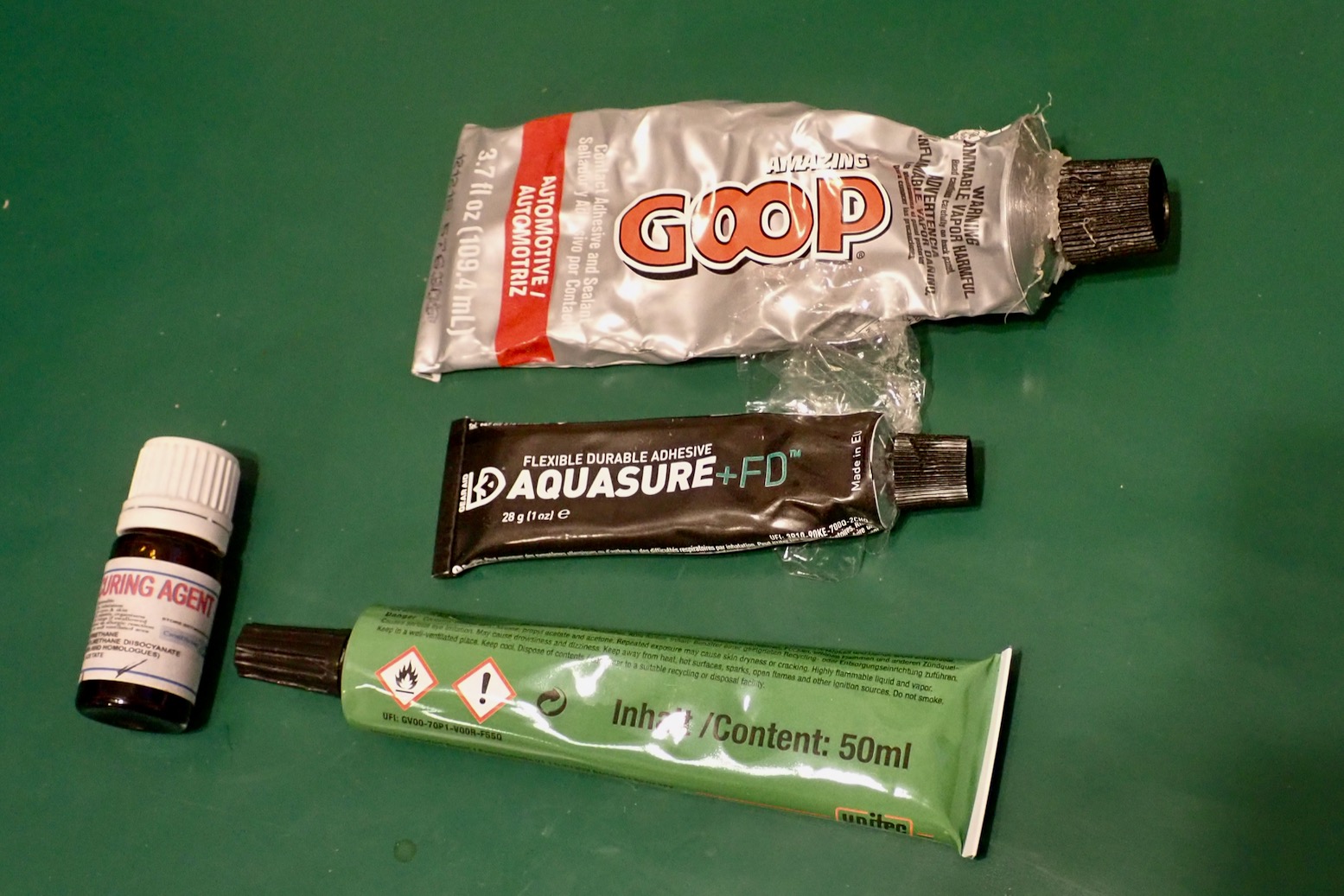
Goop no good; Aquasure OK; Helaplast better

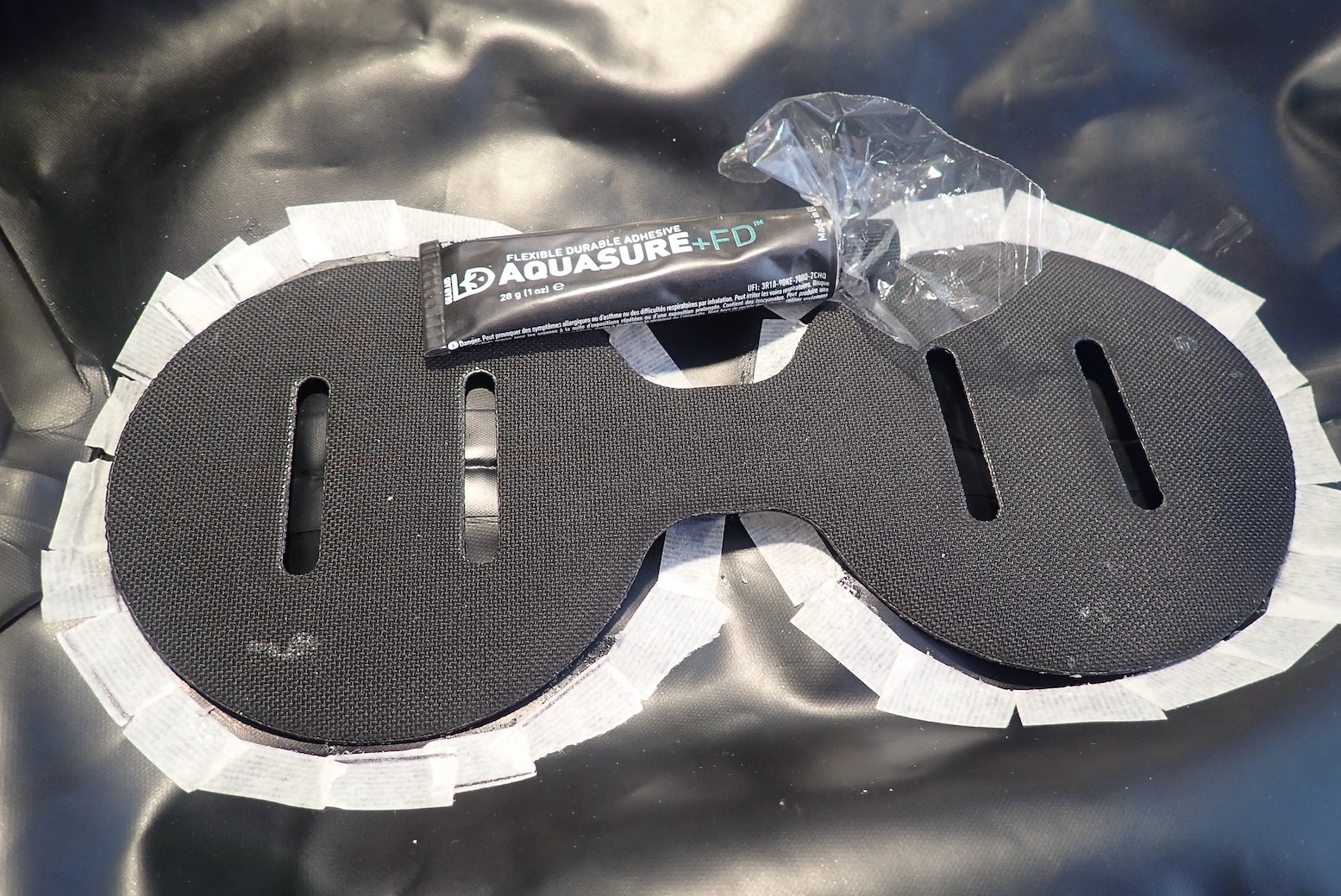
Gluing on a skeg patch
As stick-ons go, this is not a mission critical job but you want to line it up dead straight which I now see is better done with the boat inflated. I just used the rear seam, hoping it was along the middle line. Anfibio recommend Helaplast which they can’t post outside of Germany, but which you can buy on ebay.uk (from Germany…) for €7 for 50ml.
There must be something similar in the UK, but the problem is identifying it against something that provenly works. I had some Goop contact adhesive, but whatever their ‘Automotive’ variant is, it did not stick at all. So I decided to try some Aquasure+FD, leaving it to cure for half an hour before sending in the roller. That seems to have worked.

Using stock TXL mounts sort of works

Knee straps
Part of me likes to think I’ll be using my nippy TXL the way I use my IK: fair weather, open-water sea paddles rarely more than a mile from shore. As this might require sustained periods of paddling I figured some knee straps would help, as they do in my IKs. It’s not so much for hardcore bracing or even rolling, the way they’re used in white water, but just to lock-out the legs so the core is more connected and you get good drive.

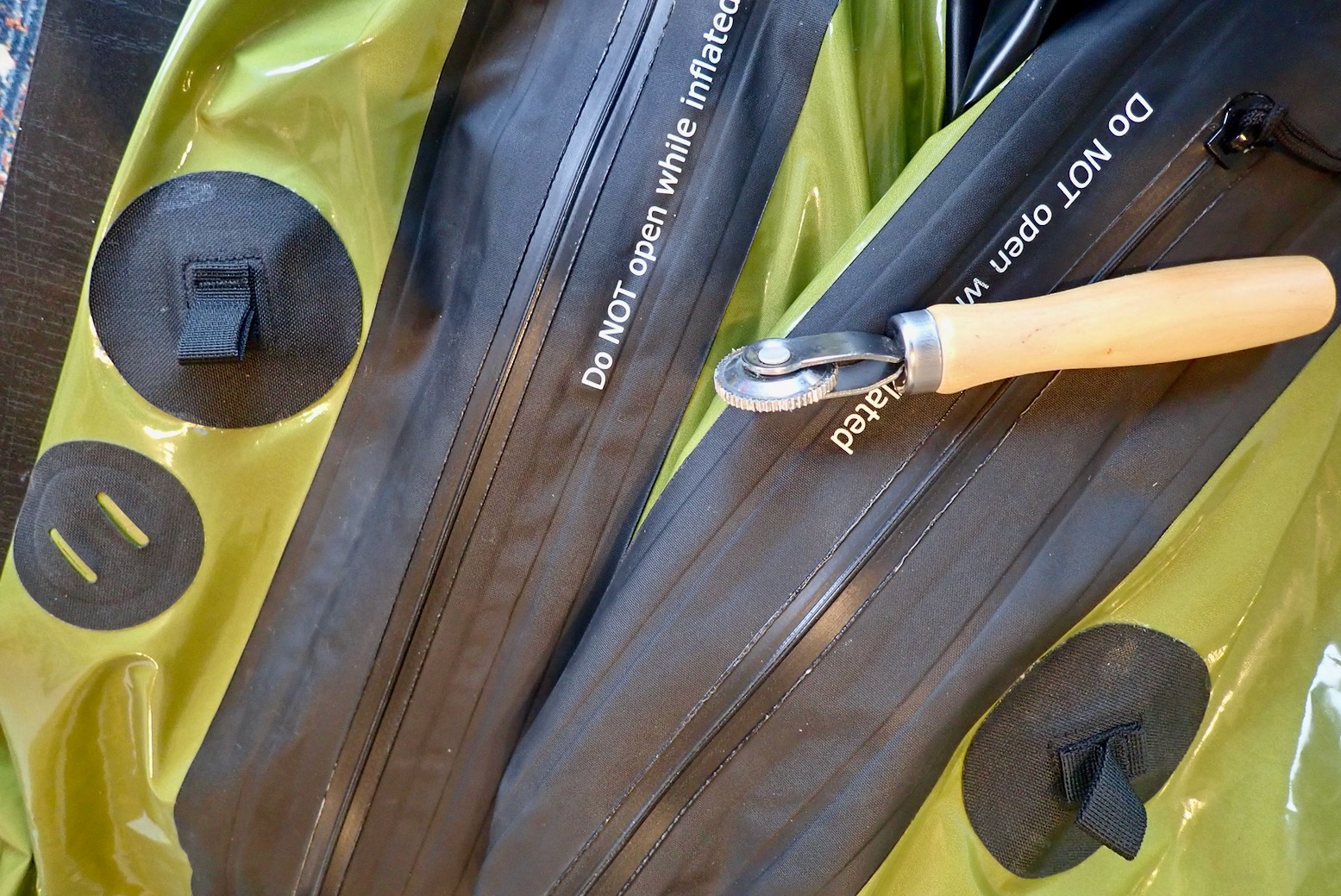
Anfibio sent me their latest 5-point thigh straps which I tried and liked on the Revo (left). But to make full use of them would require gluing on up to 8 extra patches (if not ideally the ladder patch; left).

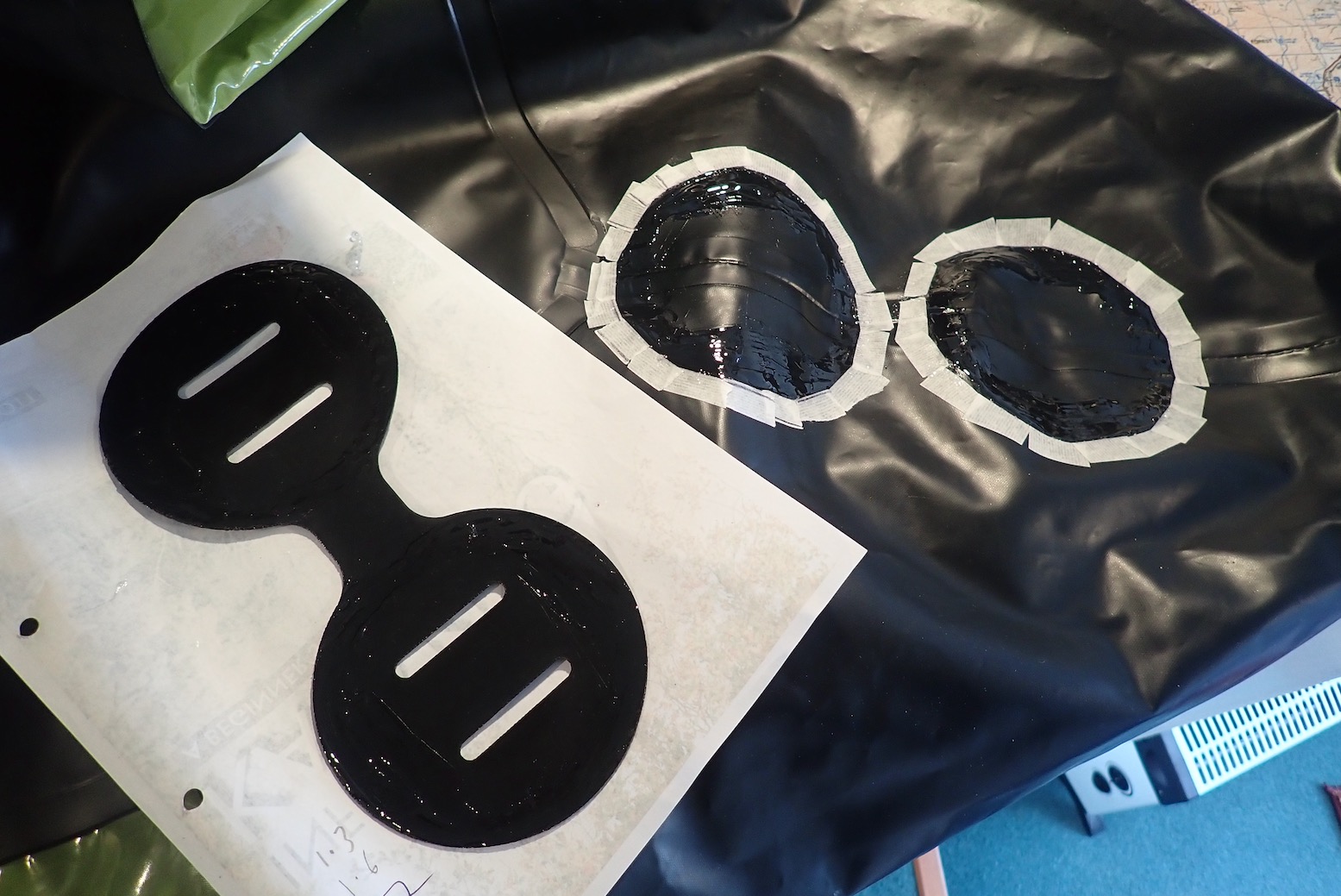
I decided my old Anfibio 3P straps which I’ve used for years in my IK would be OK for my low-tension, flatwater use. They require adding just two pairs of attachment straps. I could have got away with the unused flat patch by the seat, but the direction on tension was off centre and would eventually wear, stretch and maybe break. These small patches are not really designed for such loads and now my Helaplast has arrived, I decided to try it. An old post on the Anfibio blog explains how to use Helaplast:

  • mark off area on hull
  • mix hardener 20:1
  • clean surfaces with solvent
  • apply a thin layer to both surfaces and wait 30 minutes
  • apply another thin layer and wait another 10 minutes
  • Position patch; it won’t adhere properly
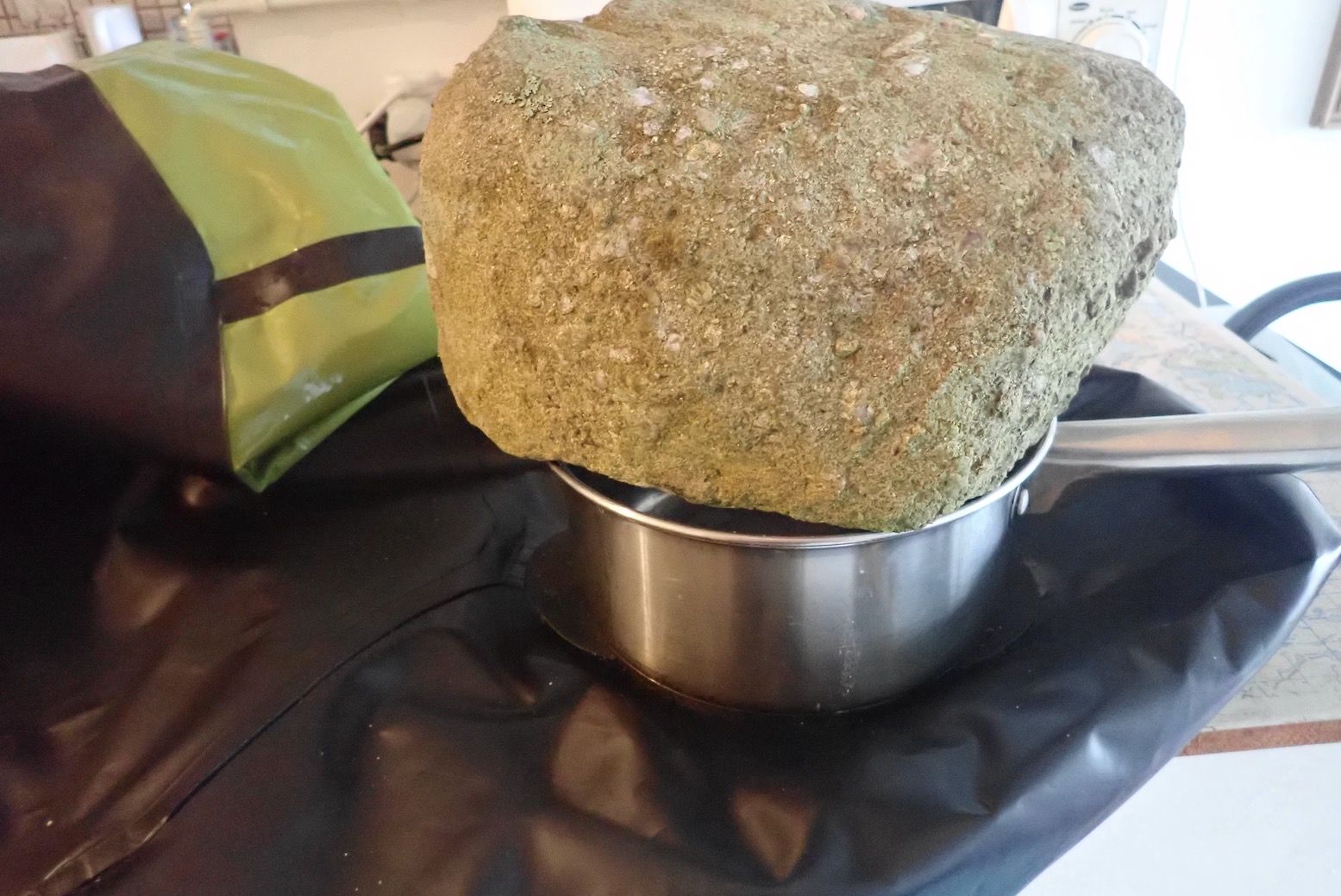
  • Heat with hair dryer to reactivate glue and press down hard with roller. It’s better if the boat is deflated to do this on a hard surface.

The heat reactivation trick was not one I’ve heard of before with glues (except to loosen stuff), but you could see it worked. Where the positioned patch was lamely stuck to the boat, a bit of heat saw it bond down well with some added rolling. You can tell when something looks well glued and this feels like it, though I’m sure glad I didn’t have to do that another six times.

Update
Having paddled about with the straps a bit, they work OK, but the front mounts need to be lower to hook well over the knees without using the cross-link strap to pull each strap inward (not what they were intended for – entrapment hazard!). I did this a few days later. Knee straps also make a good set of handles for moving the boat about like a giant holdall.

Thigh strap attachment points are better off set low at the front.

Sigma TXL • Tandem sea packrafting

Sigma TXL Index Page

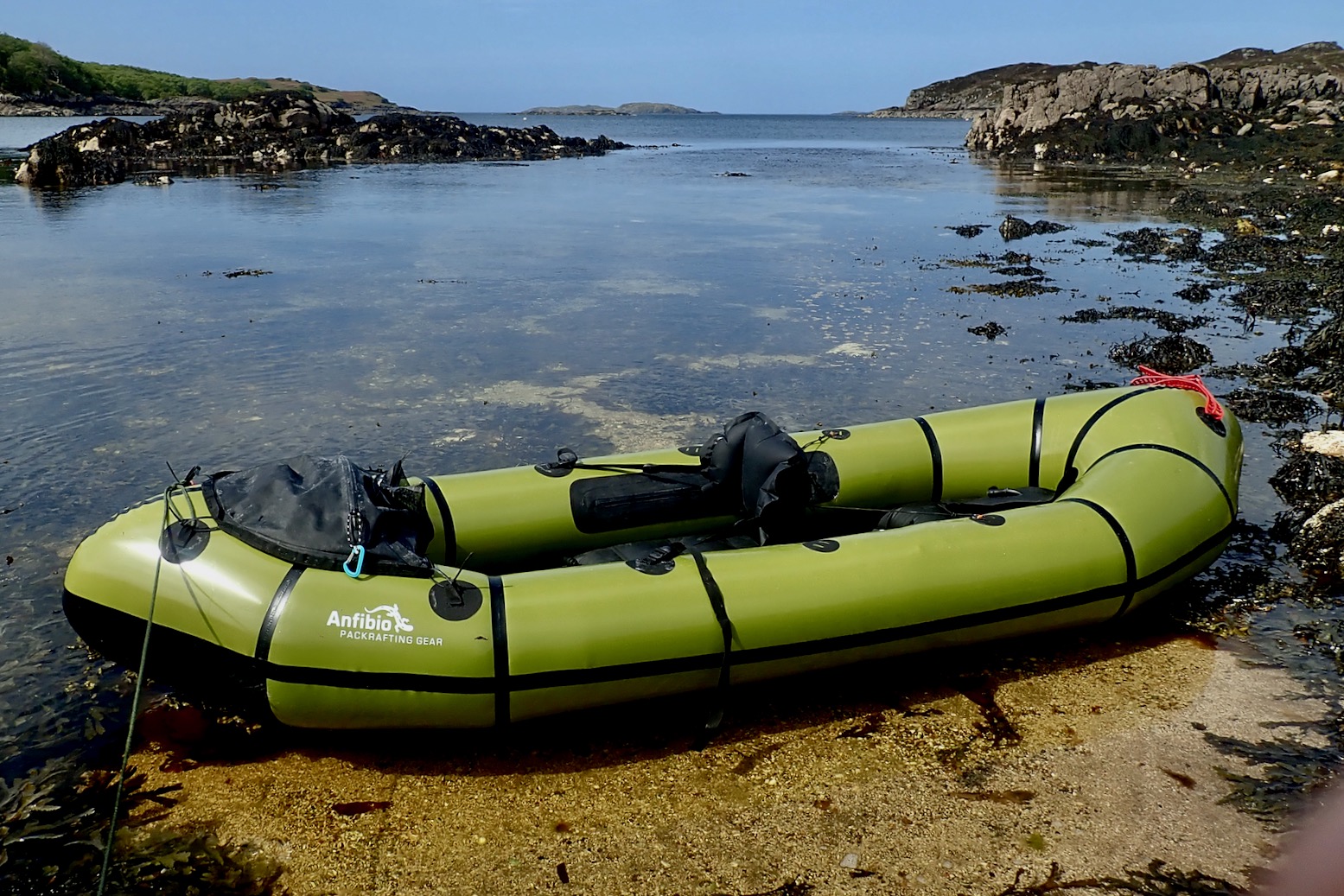
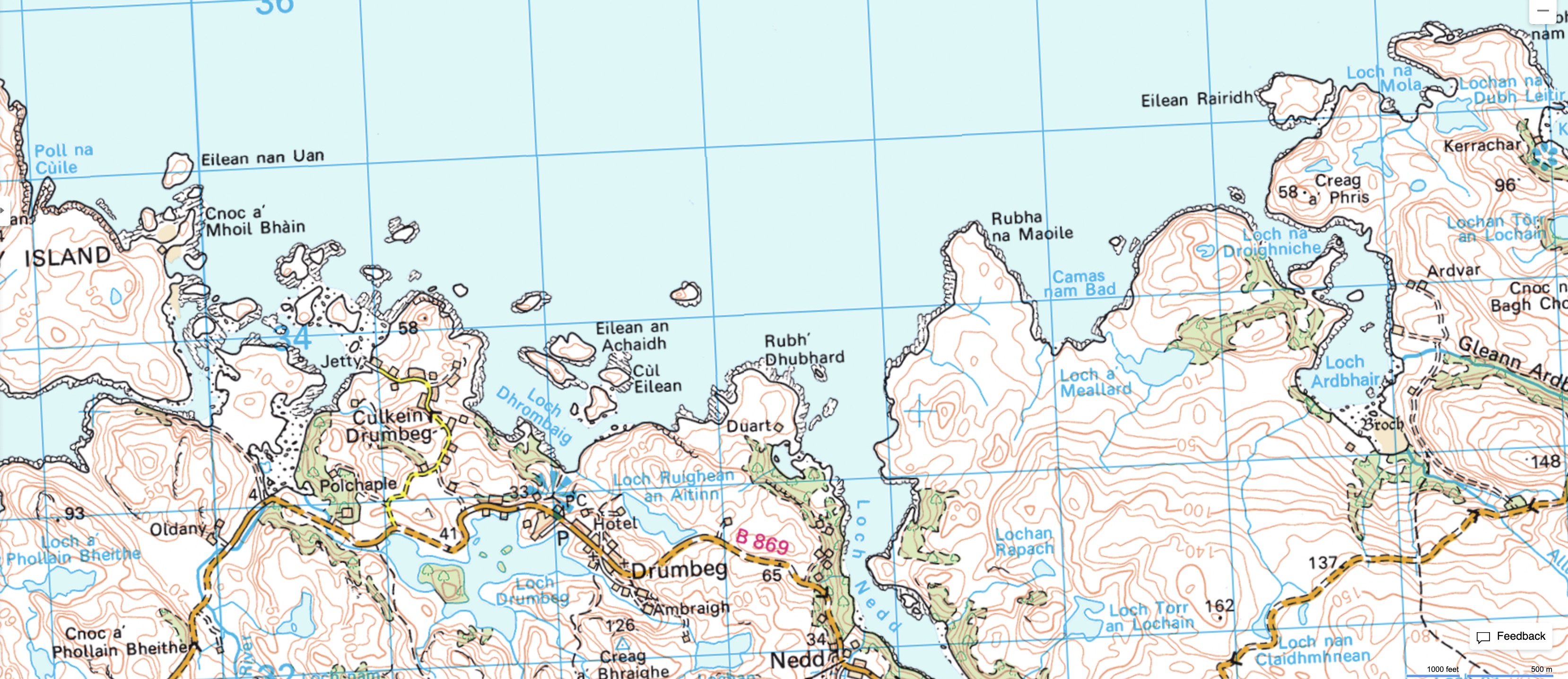
Up in northwest Scotland’s Summer Isles we are having a one-day break from the wind and rain – a chance to try the TXL in tandem mode. We could have gone somewhere familiar, like just outside, but decided to explore the coastline of Eddrachillis Bay near Drumbeg, an hour or two away. We planned to cross from one inlet-loch to the next.
On the day winds were 10mph but building, and the tides were nearly 4.5 metres (14-feet) springs (there was a rare blood moon / eclipse that night), so in the packraft we had to pick our moment.

Full of northern promise: the isle and inlet riddled south shore of Eddrachillis Bay around Drumbeg

The great thing with the TXL or any packraft, as opposed to my IK, is it weighs 80% less, so walking cross-country to the water and getting off pretty much anywhere is easily done. With the longer hull you get at least 80% of an IK’s speed, but the reassurance of a larger boat compared to a most of my previous solo packrafts. I already knew from the recent Dorset run that the long TXL was better in choppy seas than I expected, even without the stiffening floor airmat. It remained to be seen how we’d both manage in the boat on the wilder northwest shores.

We size the boat up in the kitchen; looks like we’ll fit
The roller-coaster single-track road to Drumbeg. Turn right at the bridge into the woods
We follow a faint path and animal trails west along the Gleann Ardbhair to Loch Ardbhair
Nice to be in some native woodland; not a lot of it in the northwest
Narrow trail above the stream; I should have deployed my packstaff
First sight of Loch Ardbhair
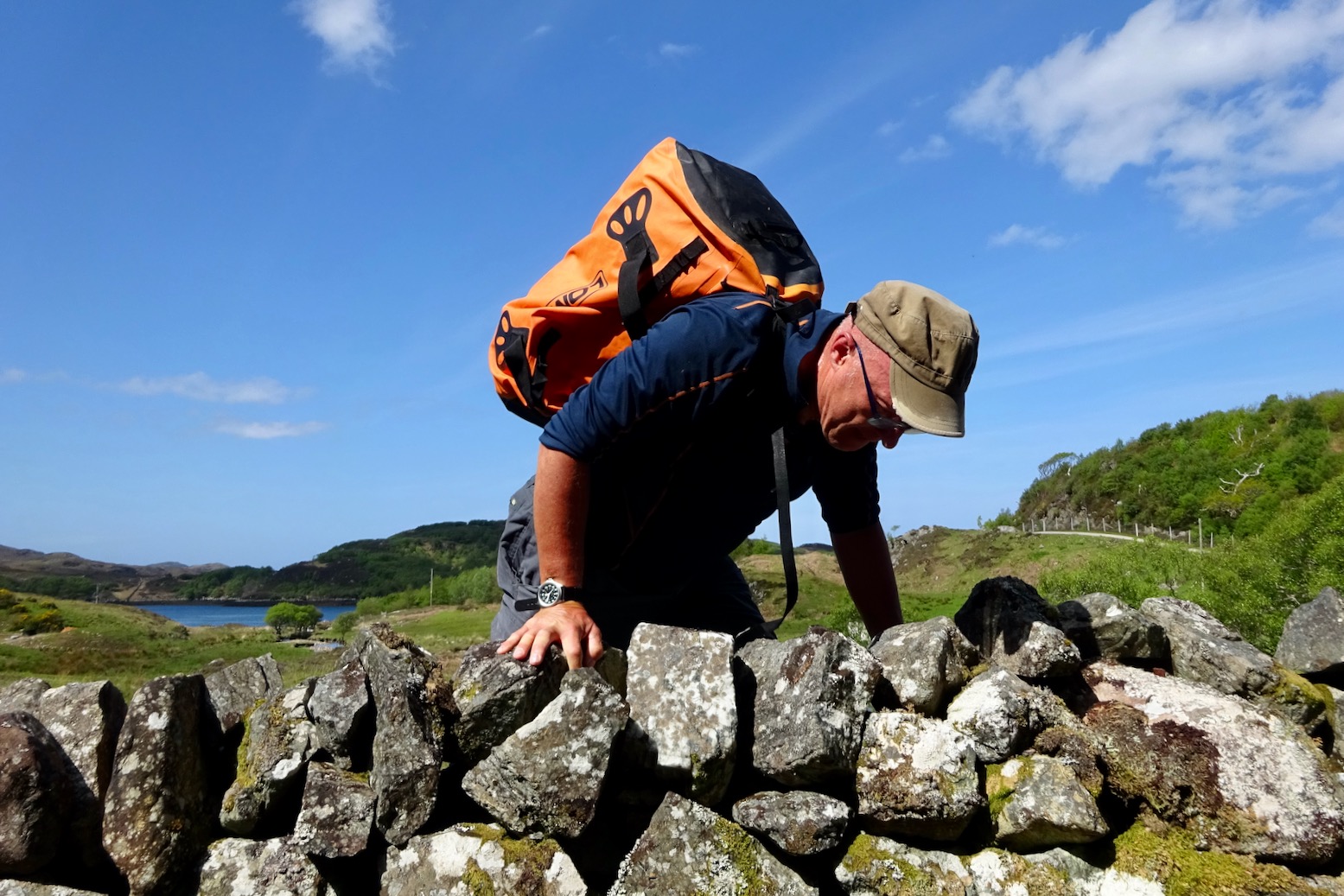
A path on the map does not mean a way of crossing any dry stone walls at the end
A herd of 20 deer scattered just as we got here
My Flextail electric mini-pump packed up after just a year so it’s back to old-school airbagging
Just 30 mins before low water a lethal sea-rapid still rips out through Loch Ardbhair narrows
Out in Eddrachillis Bay it’s choppy but manageable. The boat feels a little sluggish and soft so we’re paddling hard. Like the high-volume MRS Nomad, it needs a second top-up once on the water
In fact we’re doing 6-7kph with the wind at near slack water which makes things appear deceptively slow
I decide we’d left it too late to get round the spikey headland of Rubha na Maoile (left of pic)
Who knows what the turning tide does around there
So we turn into the in-between-bay of Camas nam Bad and make for the far shore
There’s still too much of a swell to rest the gorillapod on a rock for a passing selfie
Faster than we felt
In Camas nam Bad the Mrs nips ashore and I go for a little scoot-about. Feels nippier solo, but no faster.
Need to watch out for spiny sea urchins exposed at very low tides
Awkward scramble to the grass to deflate in comfort
I know they’re better than twist locks, but sometimes I wish these seats had a fast dump valve
It’s an easy mile’s walk to a point on Loch Nedd where I could be sure access was easy
This time I pack the gear in the side tubes for more room
And this time I remember to re-top-up once on the water a few minutes
The boat now feels more responsive but we’re into a headwind now so only do about 4.5kph with the tide
Loch Nedd was a bit boring or over too soon. We should have put in further up after all
Next time it might be fun to leave from here at HW and head west to the isle-filled bay of Loch Drumbeg
A long hike back to the car
At the back, Quinaig mountain, 809m
On Quinaig one time, looking back towards Drumbeg, Oldney Island and Point of Stoer
Need to do a bit more floating next time

Sigma TXL • Packrafting Swanage

Sigma TXL main page
Kayaking Swanage
MRS Nomad S1 main page

I’ve been looking forward to getting back to Dorset’s amazing chalk pinnacles near Studland which we paddled in the Seawave one calm morning back in 2019. Today the tide was right and the sun was out; it was just a bit chilly and on the windy side; a good day to see how my Sigma TXL might perform at sea.

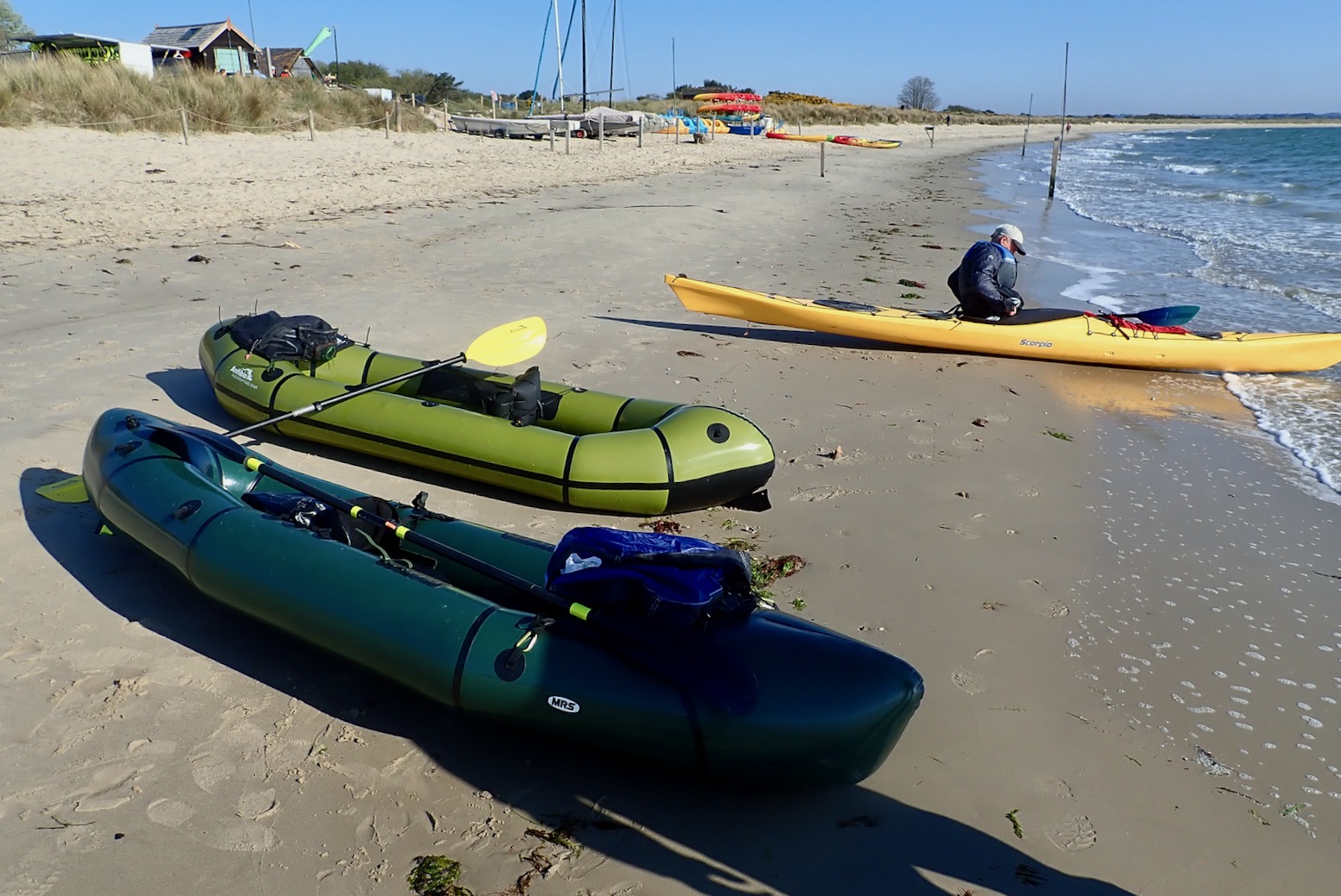
A couple of paddlechums were also up for a pre-dawn departure; Barry rode down with his similar MRS Nomad S1, while Nimbus – yet to fully embrace inflatable paddlecraft – brought his 17-foot, plastic P&H Scorpio sea kayak (left). Even at ~30 kilos, it was a proper boat for the conditions and we imagined he’d run rings round our packrafts.

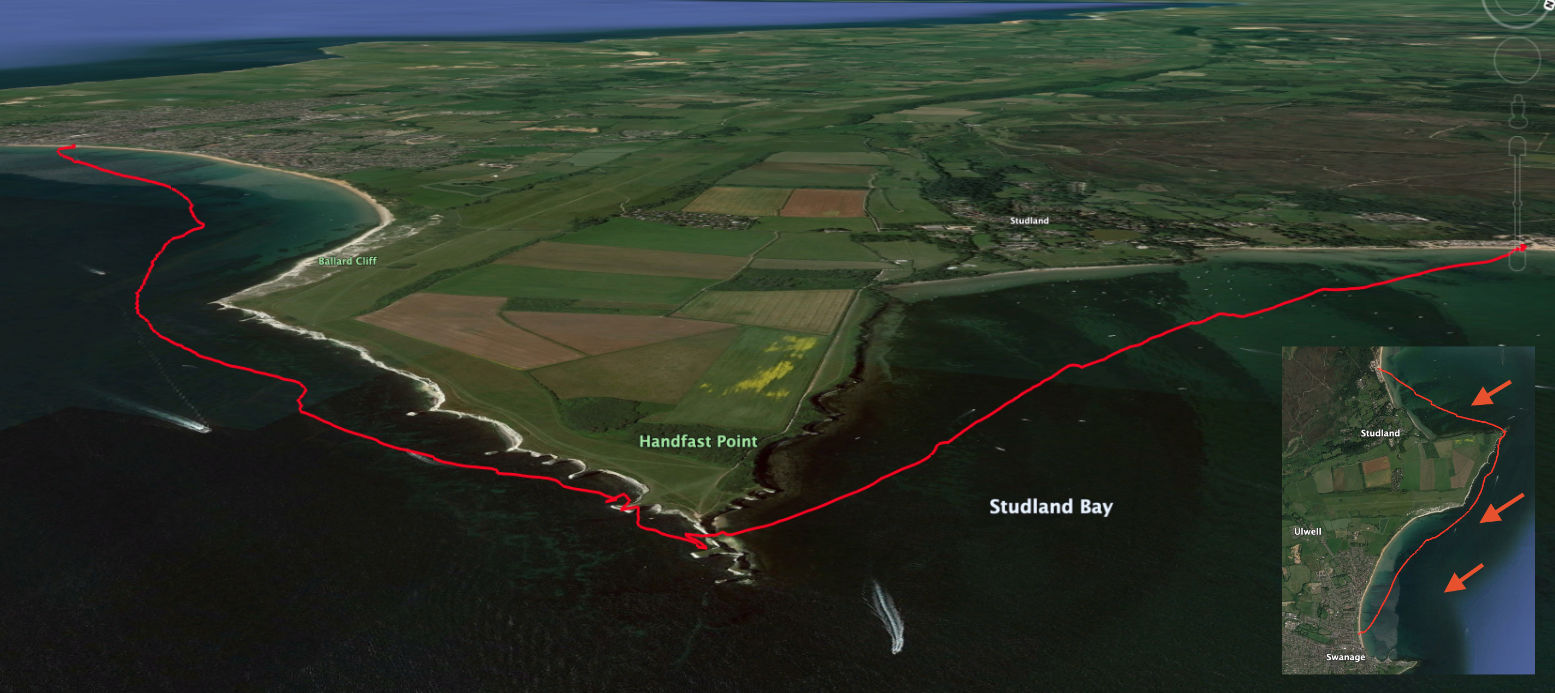
The plan was to paddle the four miles from Studland beach to Swanage town, leave the kayak somewhere then retrace the route over the downs to the vehicles.
Half the length, over twice the width, but a tenth of the weight of a sea kayak.

Early all-day parking is a problem at Studland as the car parks don’t officially open till 9am and anywhere else you’ll get towed and Twitter-shamed. But we slipped into Knoll Beach parking at 8 and were on the water before 9am.
By this time a one-metre tide was about 90 minutes after HW, and we set off into a steady onshore 12-mph northeasterly which would stop Barry and me running away with ourselves. By the time we turned the right angle at the Point for the run SSW along the cliffs, we ought to be able to put up our sails to catch up with Nimbus, except I forgot my WindPaddle. Oh well, I’d just have to paddle the full four miles and get medevaced out.

Swanage tides

The tides at Swanage aren’t the classic sine wave. Every other tide rises and falls normally, but in between is a mini low and high. Who knows how or why but I suppose the reservoir of Poole Harbour, plus the English Channel funnel have something to do with dampening every other surge. Either way, the range was only a metre today and is hardly ever more than two down here; not enough volume to raise any strong currents. Nimbus later calculated a southerly flow of around 1mph which may help explain our higher than expected packraft speeds.

Nimbus sets off for the Point, far right.
Could the packrafts keep up?

Part of the reason I got the longer TXL was to try more coastal packrafting, even if the extra bulk and weight (actually only 450g more than my previous Rebel 2K) might set me back on overnighters. This is not a paddle I’d have attempted in my backheavy 2K, even with a deck; it’s just too slow to be enjoyable. But having owned a 2.9-m Nomad S1 like Barry’s, I was fairly sure the TXL’s near identical length, buoyancy and similar ‘footprint’ would make a difference. There is something about sitting in the middle, not the back end of a boat, that makes it feel more reassuring.
Unlike my Thames paddle a week earlier, I decided not to fit the TXL’s inflatable floor pad in search of a better glide. As things were, in today’s wind and chop the stability from a lower seating position would be more important.

It was about 1.5 miles to the arches at Old Harry’s headland, so I set off directly across the bay, hoping for flatter conditions further out. That wasn’t the case; the odd wave was breaking, but the TXL moved across the water purposefully. Sure, it rolled, pitched and yawed in the side waves, but sat down low I felt completely at ease, maybe even more than in my Seawave IK?
Barry was clearly having the same bouncy fun in his MRS and I’d assumed the P&H would have raced off, if for no other reason than to maintain stability. But later Nimbus said the Scorpio felt a little on edge in the high-frequency chop and couldn’t have gone much faster than us on this stage.

You’d think the two long, light packrafts’ would have been blown about, but the central, kayak-like position and added buoyancy made them easy to control (with skegs fitted) and the high sides kept most of the water out. I picked up maybe a litre over a mile and a half and didn’t miss a deck at all (though I did appreciate the drysuit).

Swanage Bay sets off a tidal eddy

Even with photo faffing, we reached the stacks of Old Harry in about half an hour, and it hadn’t felt like any more of a struggle than in an IK. It was really quite a revelation how well the TXL (and Nomad) were performing with just an extra 50cm or 20% in the waterline over a regula packraft. The lightness of the boats must have something to do with it.
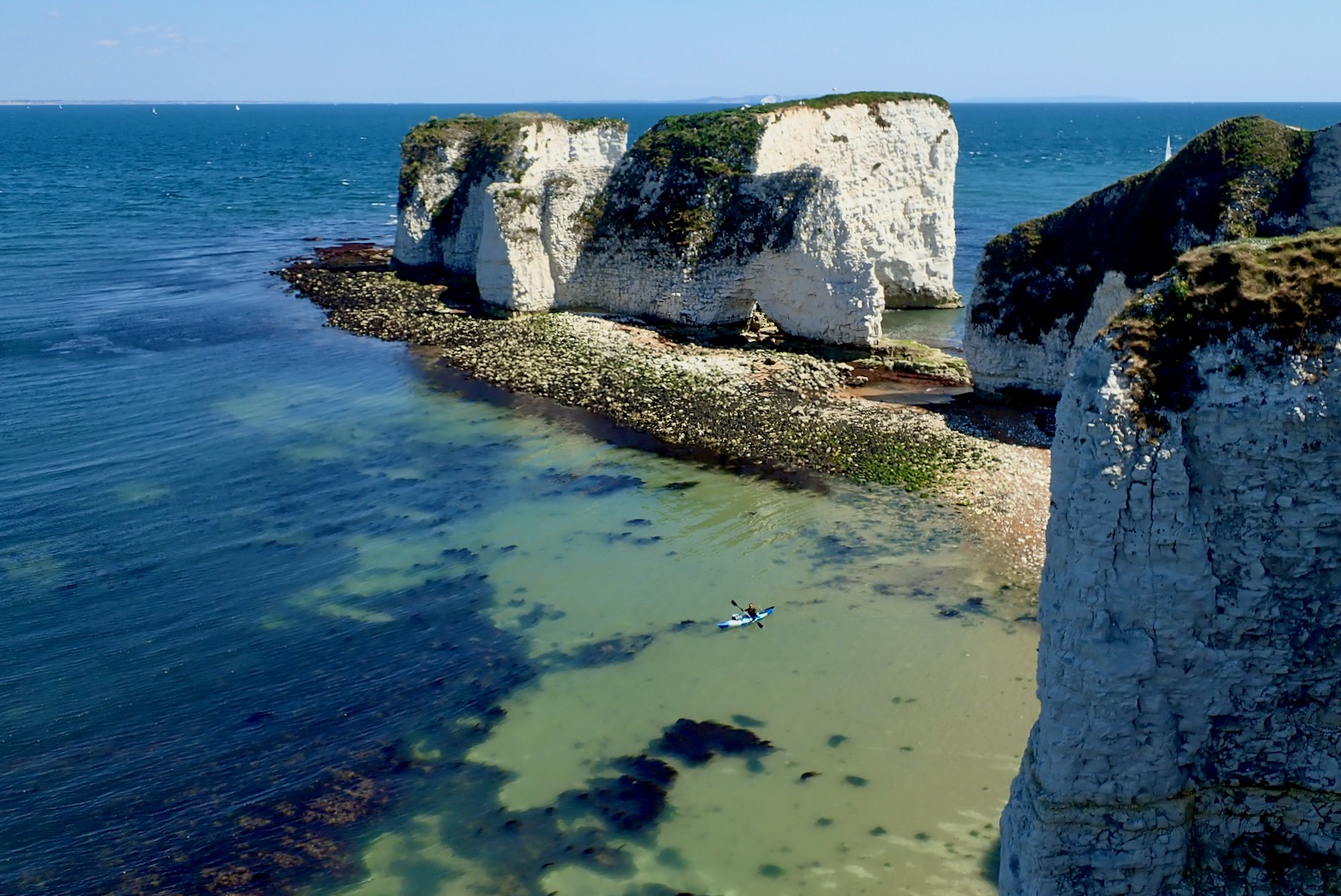
Round the outside of the Point the wind and tide were fighting it out in a tidal race. It made me realise how well timed our visit in the Seawave had been three years ago. We’d arrived here in much calmer conditions but also around mid-tide with a less nasty looking race. Going round the outside today may well have been doable but set aside unpredictable currents, waves can also stand up and break out of nowhere. It was more fun to slip through on the remnants of the outgoing tide between the mainland and Old Harry’s stack. Next time I come here, I’ll make sure to arrive at the top half of the tide so all the arches can be threaded.

View from above about three hours later. Low water but still a bit of a race off the point.

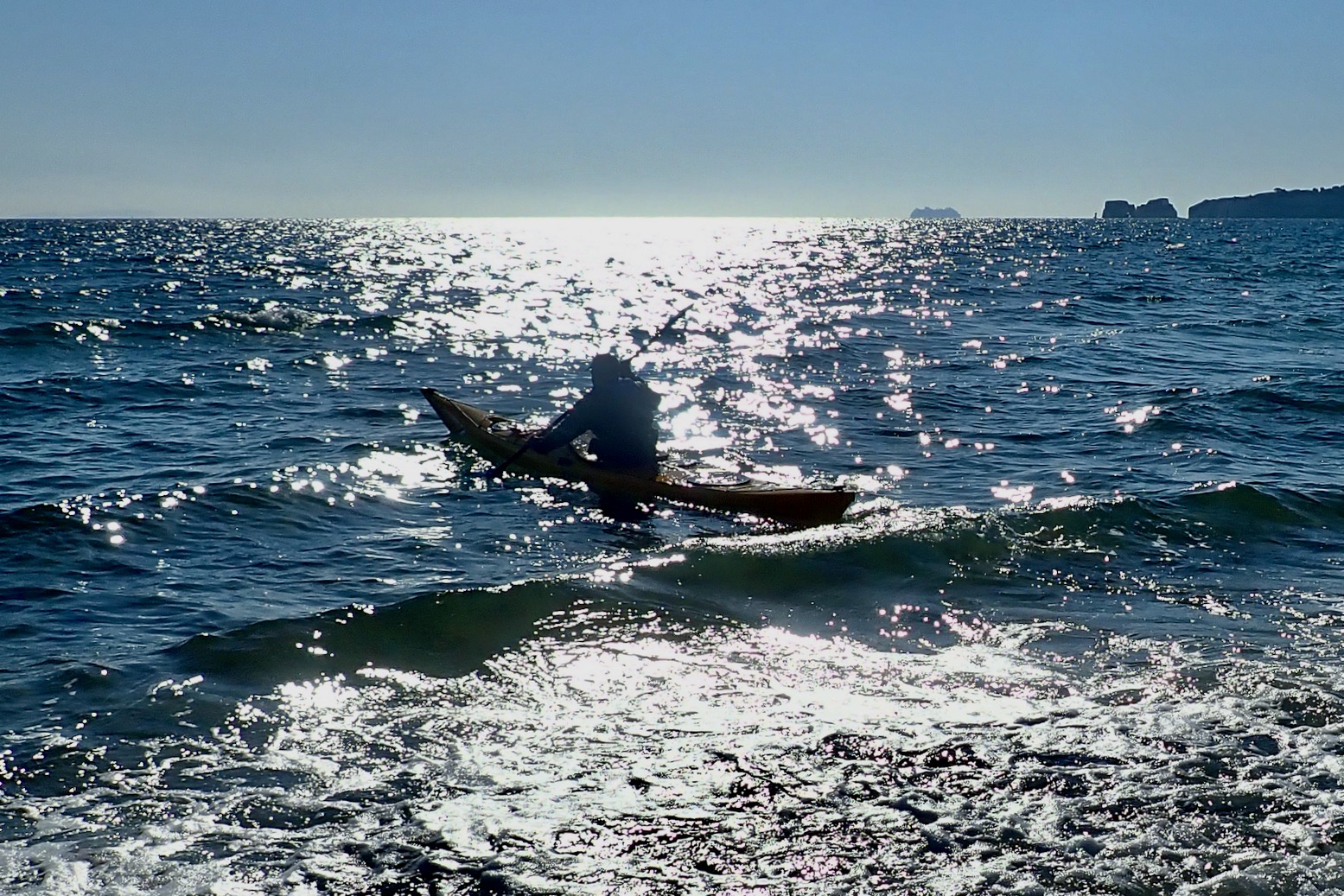
After a bit of promo filming for the new book, we turned 120° to the southwest and expected to have the wind behind us, but it remained a case of dealing with sidewaves plus cliff rebounds, so we kept out to sea. Despite the packrafts jigging about like popcorn in a hot pan, we managed to make progress south along the cliffs, the Scorpio now edging ahead.

After being jostled around, Barry decided to air up his AirSail, but even with two of us, pumping it up properly in the chop proved too tricky. For easy deployment on the water, the sprung-hooped Packsail (like the old WindPaddle) is a much better idea, even if it’s more bulky to carry.

We rounded Ballard Point where the cliffs turned into Swanage Bay, and with the wind now on our backs, the GPS recorded 6kph (see graph below). As usual though, it didn’t feel that fast as the boat squirrelled around from the stern. I thought about moving myself further back (relatively easily done in the TXL unlike the fixed solo Nomad) so the lightened bow trailed downwind, but it wasn’t really that bad, it just felt sloppy. Sailor Barry was now keeping up with Nim until we all rolled up on Swanage Beach, aired down the packboats and made a beeline for the cafe for a superb Full Swanage Breakfast.

The cafe let us leave the boat among their bins out back, but I was overruled on walking the four miles back over Ballard Downs back to Knoll Beach. Barry clearly had a liking for taxis which I consider more of an emergency service.
“It is not the Packrafting Way!” I squealed as he put a bag over my head and shoved me in the back. Nimbus kept a diplomatic silence.
Back at Knoll Beach, Barry roared off on his motorbike while Nim and I wandered back the way we’d paddled to check out at Old Harry’s from above. The tide was now at its extended low period and the wind had swung to the southeast, sheltering Studland Bay. Down below, a lone kayaker was just setting off.
“That looks fun, a. We should try that sometime.”

Judging by this outing, the TXL has proved to be just what I’d hoped: a dependably agile coastal cruiser with all the other benefits of a packraft. More sea paddles to come.

Sigma TXL on the Thames

Anfibio Sigma TXL Main Page
Anfibio Revo on the Thames
Gumotex Seawave on the Thames
Gumotex Sunny Incept K40 on the Thames

Order! Orrrrdeuuuurrr!!
TXL on the riverbank

Miraculously, a sunny spell spanned the Easter bank holiday weekend so I took the new TXL down the Thames for its maiden voyage. At Putney I caught the remains of a spring tide but dithered too much so only had a hour until it turned at London Bridge and pushed back up the river. Nevermind, I’ll get as far as I get and hop out anywhere there are some steps or a ladder. With a packraft it’s easily done.

Skeg half out but does the job. One thing I like about longer, centrally positioned packrafts is the the trim is level, not back-heavy as in a conventionally sized rear-sat packraft like my 2K, (unless you are light or it has a hugely voluminous stern, like a Revo)

Floor pad and skeg
This is a similar run I did a couple of months ago in the dead of the Covid winter with the Revo, but this time I remembered to air up the floor pad good and hard. I’m expecting the 2.8-m long, hard-floored TXL to be nippy, and so it is. Setting off the boat skates across the water so that you can ‘paddle – pause/glide – paddle’ like in a kayak, not spin like a food mixer to keep moving.
I fit the skeg but notice from the pix that most of it is out of the water. Don’t think the 2K was like that, but it’s submerged enough to track well. I did wonder why it wasn’t on the flat of the floor for full effect. Perhaps, as with the Nomad S1, it’s not strictly necessary. Something to try next time. As mentioned, I do plan to fit a second skeg on the front to see how that affects crosswinds and sailing.

Seat
They advise using the foam seat block with the floor pad. It feels a bit of an afterthought, adds packed bulk and, as others have reported, is not so comfortable. After 20 minutes I was getting a sore coccyx which was only going to get worse.

More seats than the O2 Arena

Mid-river I shuffled over the twice-as-large inflatable seatbase but soon found it wobbled around on the hard floor pad (like trying to stand on a soft football) in a way these seats don’t when sat on regular packraft floors. This must be why the block seatbase is supplied but the foam is too hard for flatwater cruising. I aired the seatbase right down (easily done in situ) until I was nearly sitting on the floor, but in rougher waters there would still be a wobble and anyway, by then your butt and heels are nearly level like sitting on an iSup board; not an ideal paddling posture.

OMG – non-locking krabs! (fear not, a solution is at hand)

Overall, the raised position on the floor pad does aid good paddling as you can clear the fat sidetubes with the paddle more easily. Sat higher, I would expect stability in rougher water to suffer; at that time you’d want either thigh straps – or just sit yourself lower by easily airing down the floor pad. The backrest is easily adjusted in the boat too, and is held up by thin bungies so it’s easy to shift it up your back if it slips.

For the moment I feel the seat set up in MRS Nomad was a better affair. Partly because I felt it was part suspended/supported from tabs halfway up the side tubes like a hammock, not sat directly on the floor. That means your body weight is spread broadly along on the side tubes, not pressing down solely into the floor, created sagging. And also the flat foam backrest if fitted was better *and I may do the same with TXL).
But, at around half-a-metre square, the TXL seat base is much bigger than previous packraft seatbases I’ve used. Without the floor pad, this broad base may nearly replicate the advantageous load-spreading effect of a Nomad-style side-tab suspended seatbase. An underwater picture will tell all, but I like to think the TXL may be as functional and not much slower without the floor. After all the floor-less Nomad was nippy enough. Since then I think the TXL works well without the floor – or I’ve yet to detect unambiguous advantages.

The TXL’s raised floor jams you less well into the boat sides which is 4cm wider than the Nomad. I quite like a jammed-in feeling but recognise that with a floor pad, added height requires a bit more boat width to maintain stability. Meanwhile, up front there’s plenty of room for feet side by side, unlike in the pointy ended Nomad.

There are a few more evaluations to do with the TXL but it looks promising. Comfortable, supportive seating I know can be an issue with IKs so using the floor pad I’m confident I will either get used to it, find a better seatbase and backrest or find that the pad is not essential for shorter paddles.
Fyi, I have now become very used to using the Flextail electric pump to air up the boat (and the floor), before finishing off with the handpump. It can vacuum shrink the boat too, for compact packing, but rolling up is as quick. As you can see the handy BowBag fits on like it should, too.

Anfibio Vertex Tour paddle
Anfibio sent me their new, four-part, multi-adjustable Vertex Tour paddle to try. It weighs just 890g on my scales, same as my old carbon Aqua Bound Manta Ray, with same-sized blades. A simple lever clamp allows you to set any offset the carbon shaft left or right, as well as vary the length 15cm between 210 and 225cm which is something new to me. Theoretically I can see using the full length with a backwind or a strong current and a short paddle for battling into the wind in ‘low gear’.

Each piece is 63cm long. The all-round shaft felt a bit thinner than normal, and sure enough, measured up around 29mm ø compared to my 32mm Werners which suit my hands better. Smaller handed persons will prefer the Vertex.
The middle clamps up firmly but there was a bit of slack at the paddles; we’re talking less than half a millimetre here but it’s enough to rattle and be noticeable as you release the pressure on lifting the blade out. Does it make difference to non-competitive propulsion? Not really and better too loose than too tight. I wrapped some thin, smooth tape round the ends to eliminate the slack. The Vertex costs €125 – that’s a lot of light and fully adjustable paddle for your money. More here.