A muddy bank below Porters chute and it was my chance to mount the BAKraft – that’s ‘BAK’ as in Backcountry Airlight Kayak. The concept was developed in Idaho by a guy called Cory Walker until nearby Aire in Meridian, ID stepped in to help finish the job. The result is a ‘packraft’ that resembles Aire’s shorter whitewater IKs like their 2.9-m Force, right down to the rockered ‘banana’ profile, bladdered ‘AIRECell’ construction and high, self-bailing floor.
I’ve long admired Aire’s IKs from afar and came close to buying one a couple of times, but besides being unknown in Europe, the weight, price and the bladdered design always put me off, even though some are guaranteed for up to a decade. As a packraft-like-kayak I wasn’t so sure about the BAKraft either. Intrepid wilderness adventurer Forrest McCarthy took an earlier prototype down the Grand Canyon last autumn, but a promised full review has yet to appear. In fact, the long post had surprisingly little to say about the new BAKraft: “very responsive yet amazingly stable” was the limit of it.
The BAKraft pitches itself as a hybrid IK/packraft or maybe even an ‘SoT’ packraft that seems more suited to whitewater than packraft trekking. It’s important to note that the boat we had was a prototype and at the time of writing Aire were midway through a ‘production/material’ cock up that had set them back a few weeks. It’s unclear exactly what that was but it’s possible that some of the reservations you will read below may be addressed.
Whatever turns out, we’re assured the final version will be much lighter because both the Aire and BAKraft websites claim BAKrafts will be ‘7lbs 2oz’ (114oz or 3.23kg). On the water our prototype weighed in at 4.25kg with seat and thigh straps – that’s over a kilo or nearly a third more than their target weight. The final production BAKraft will have to go on quite a diet, even if this claimed weight follows the supposed ‘industry standard’ of a stripped out boat with anything removable removed (that’s how Alpacka do it).
There’s more on each of the test boat’s construction in the intro page but the most obvious place to save weight will be in the heavyweight material used for the backrest. It’s a PU-coated nylon which feels about 500 denier and weighs 458g.
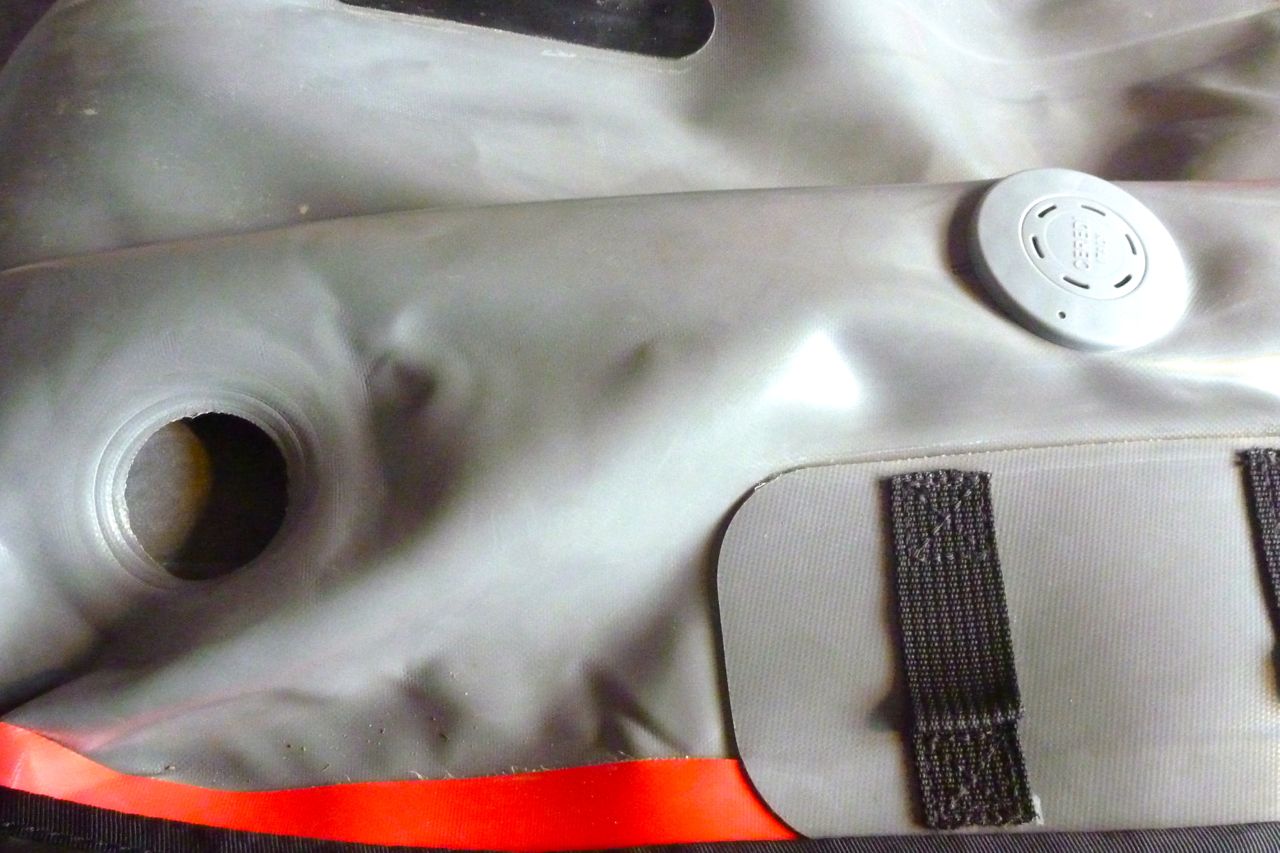
In our prototype it looks like the same fabric was used in the I-beam floor where you’d imagine it might be needed. So Cory the designer explained in an email when I was trying to square the weight anomaly. You may agree with him when you undo the side zips and see how thin a urethane AIRECell actually feels. I’ve never actually seen one before and I wonder if this is the same weight as used on their IKs and rafts. Other than that our prototype was a bit over-generous with attachment points: a line of eight along each side of the floor (similar to Aire IKs), four more on the deck and two under the bow and stern with metal rings. There are even what look like carry handles midway under the boat (right). For portaging, perhaps? Who knows but there’s some scope for a little weight saving before the floor takes a urethene AIREcell.
The first thing they might consider is ditching the whole ‘ISC’ (‘inflation, seat, cargo’) bag idea. As an inflation device you’ll have read it’s cumbersome and unless I’m missing some trick it doesn’t work for long as a backrest either, because a roll-top seal is not an airtight seal.
I anticipated this and sure enough, the backrest slowly collapsed as you tip further and further back until you look like someone in a deckchair on Brighton beach. This is partly because the semi-rigid seal strips in the bag opening are folded and sewn into the uncoated side of the fabric which is textured, rough and therefore not airtight. Rolling the fabric the other way – PU coating out – to make sleeves for the strips would have made a more effective seal. It’s hard to think someone like Aire of all people didn’t anticipate this. There is a twist-lock valve at the back of the bag (part of the convoluted inflation system described on the intro page) but you can’t reach it on the water without getting on your knees and turning around (a long Supai-like top-up tube might help if they persevere with this idea).
Fact is, the best use for this ‘ISC’ bag is simply a trunk. Right from the start we piled all our stuff into it in the vain hope of making it a more supportive backrest, but it’s not in an ideal place for weight distribution and trim. Everyone who paddled the BAK looked back heavy. With the raft’s bow sticking up, a sudden gust on steep wave might flip you over backwards, surely not a good thing in a creek boat. As it is the BAKraft’s high bow and buoyancy would make it hard work touring all day into a headwind, wherever you stash your gear.
I say ditch the ISC which ruins the elegant lines of the boat anyway. Let the user sort out their own baggage requirements if needed. Then supply something like a Feathercraft BayLee-air bag or their handpump (just $35) and concoct a simple stiff-backed, non-inflating backrest. Aire knows all about that; I used one of their IK seats years ago on my Gumotex Sunny. It was the best thing around at the time. Otherwise, fit a TiZip in the ISC bag or revert to the sealed inflatable pillow or thwart backrest shown above left.
On the water you sit high on the inflated floor – a necessity to keep you out of the water that sloshes around the self-bailing ports. On getting in I instinctively pulled on the thigh straps; they helped a bit from sinking backwards against the backrest, but interestingly I didn’t feel the lack of a seat pad made my paddling stance uncomfortable which makes me think shoulder-to-water height may have more to do with it than bum-higher-than-feet. That height helps you reach past the metre-wide sides and, with the pump-assisted 2psi pressure in the tubes, the BAKraft skims along quite efficiently, even if I was leaning back at 15°, 16°, 17°… Sagging backrest apart, a much longer paddle would be needed to genuinely assess comfort.
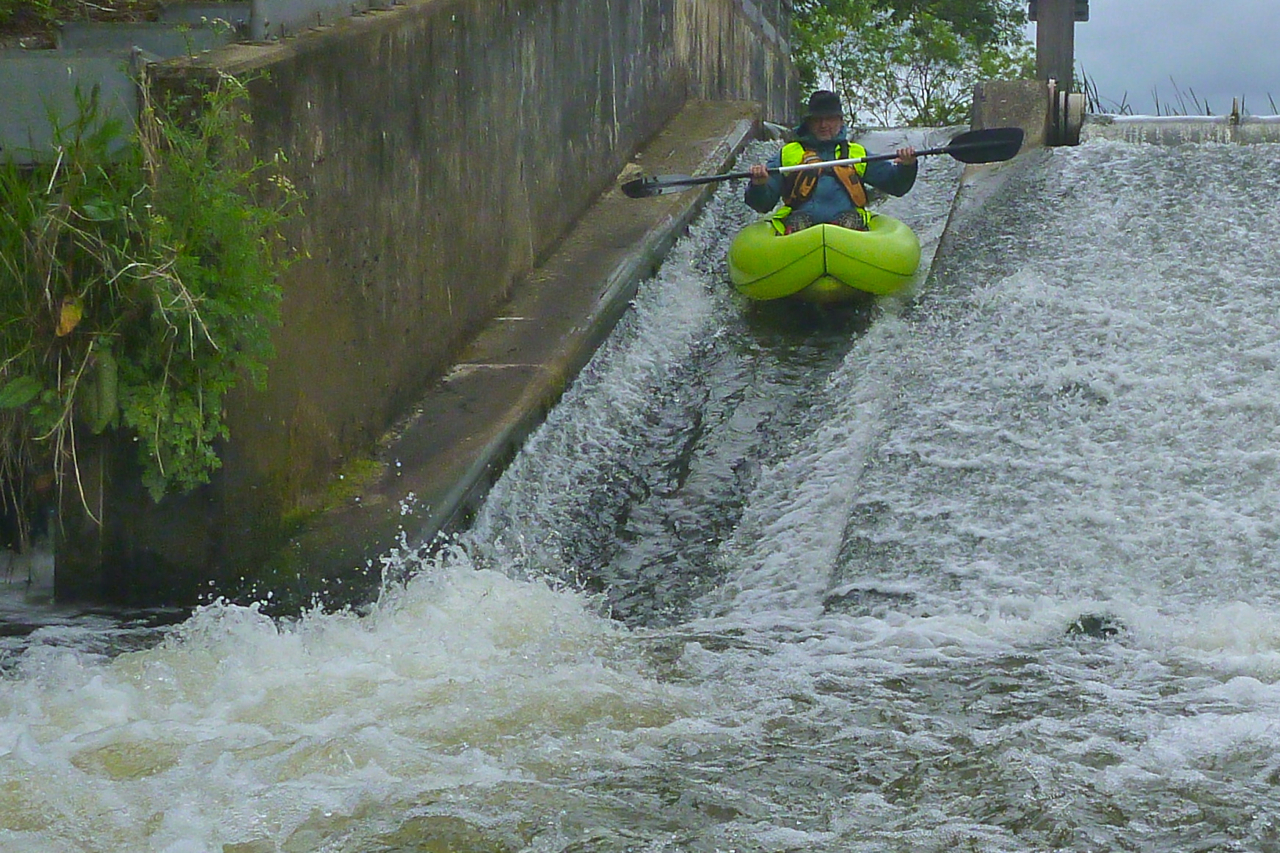
I can’t say I perceived any drag from the bailing ports, the comparatively high pressure saw to that and the pronounced rocker saw the raft easy to turn (though no packraft is exactly short on turnability). Obviously, the chutes didn’t give the Aire any grief; this raft was gagging for some meaty white water which in southeast England is as commonplace as a herd of stampeding wildebeast.
Not being a white water thrill-seeker I wasn’t inspired by the half-finished BAKraft. It’s too heavy and bulky for packraft travels and the backrest and inflation system needs rethinking. The thigh straps are a start, but a footrest is also needed for steep impacts or just general paddling efficiency (easily done with all the attachment loops).
But even if they do get the weight down to the claimed 3.23kg, I feel the BAKraft is much better used as a creek boat than a traditional packraft for wilderness travel. And even then, Sven from the Store admitted in the rapids it was quite a steep learning curve compared to regular spray-skirted whitewater packrafts with a much lower centre of gravity and so better stability. The buoyancy is massive but it’s a tippy boat, both side to side and front to back. Doubtless, I wouldn’t last five minutes in it. He also found the Dyneema floor a bit slippery when wearing nylon clothing and the thigh braces not so comfy (I find fitting braces floor-to-floor works best, as shown in the video below).
Towards the end of the test we got a chance to test the BAKraft’s payload claims when we abandoned the Matkat. Lois and Hannah paddled it two-up with a total weight of 150kg with all the gear. Lois at the back found herself sitting in water until Hannah hung her legs out over the bow to counterbalance things. But for her it wasn’t a viable paddling stance and it’s not designed to do this of course. If you’re looking for a small double packraft, the Trekraft worked better.
The BAKraft will suit experienced whitewater rafters who prefer not being hemmed in by spray skirts and can handle the boat’s lively characteristics. I can see skirt-scorning BAKrafters scrambling way up to some inaccessible mountain river to pull off a first descent which would have been a chore to get to with any other type of boat.
When it was all over I was reminded of the other factor that’s always put me off bladder (‘inner tube’) boats. They take ages to dry while leaves and other riverine detritus collected in the nooks and crannies which all need a good hosing. With a TPU packraft it’s just a quick wipe, shake and vac. (The black Supai dried even faster.) A production BAKraft won’t get around that, but hopefully some of the flaws we found in this prototype will get sorted in the final version.
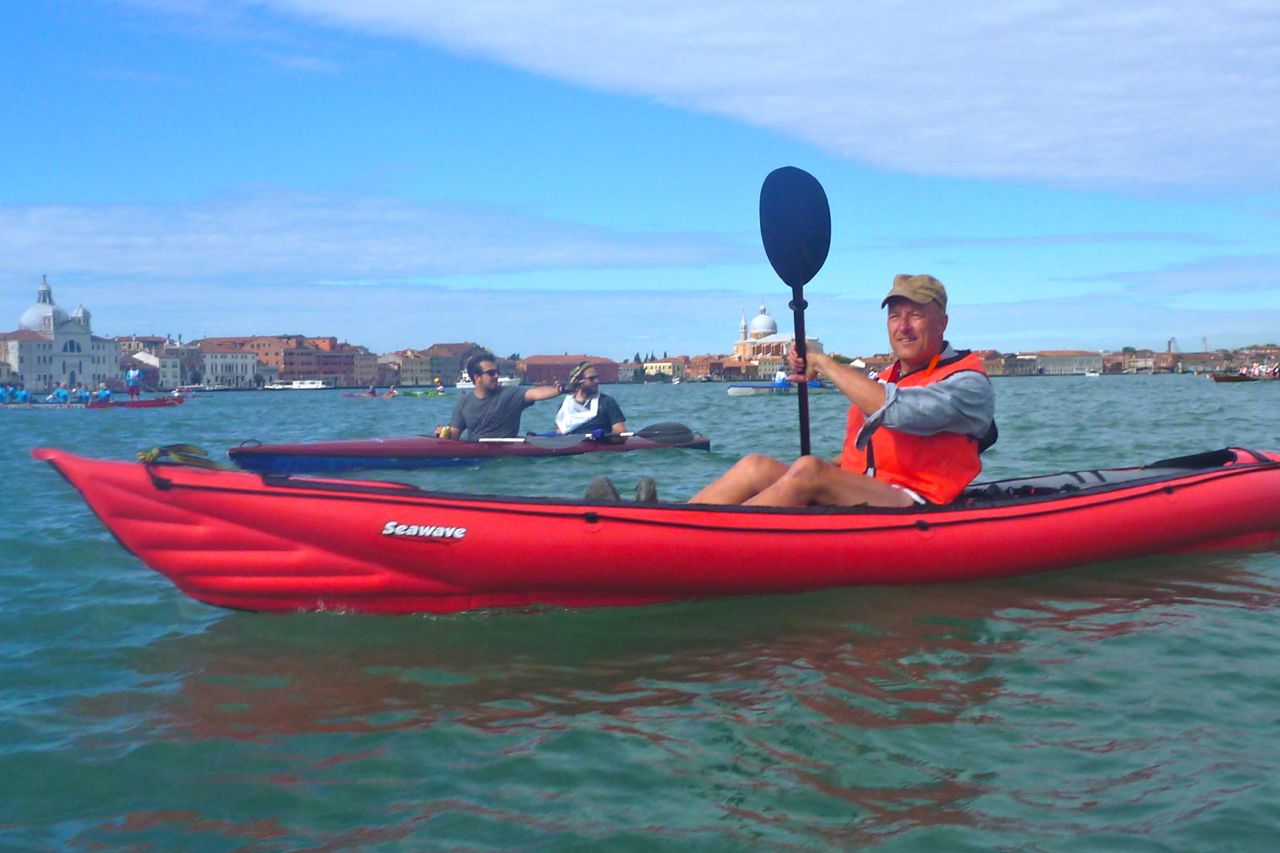
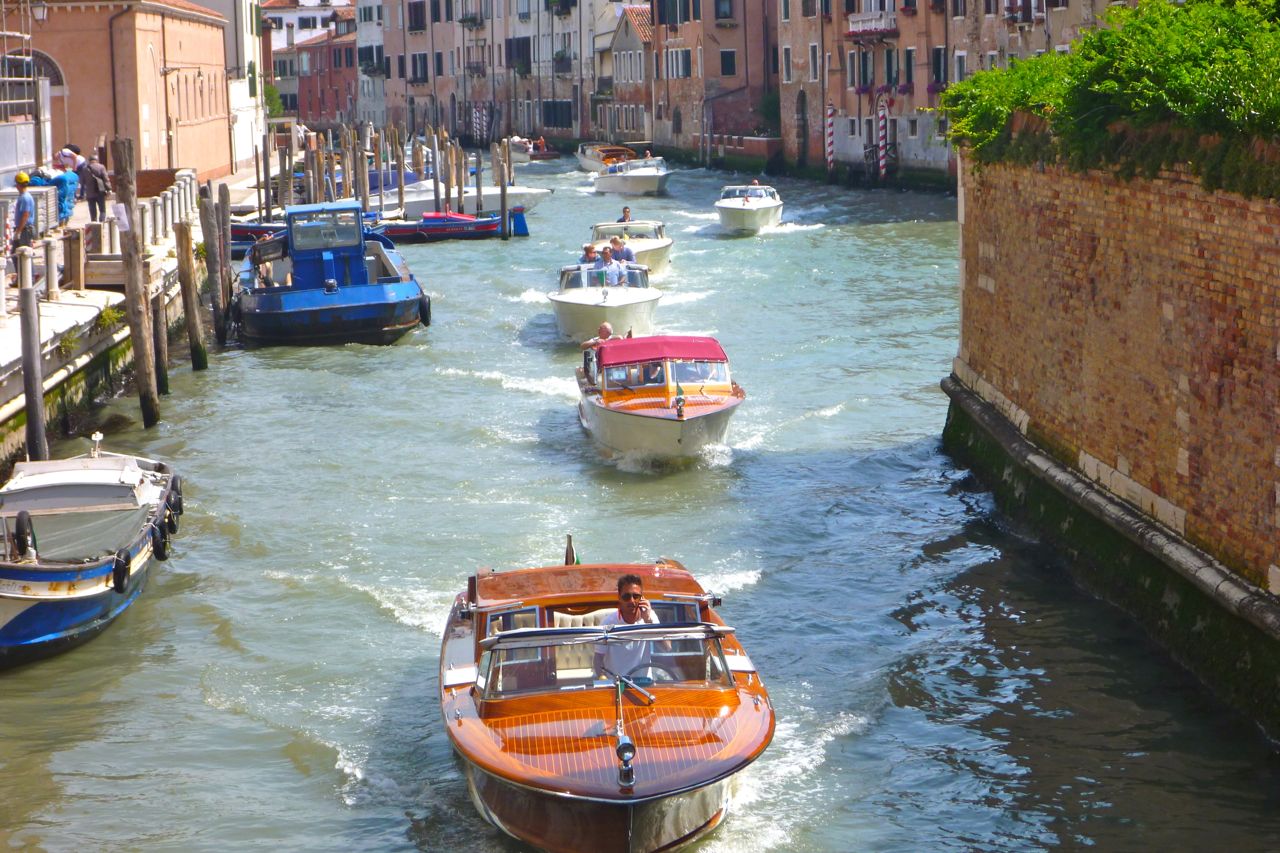
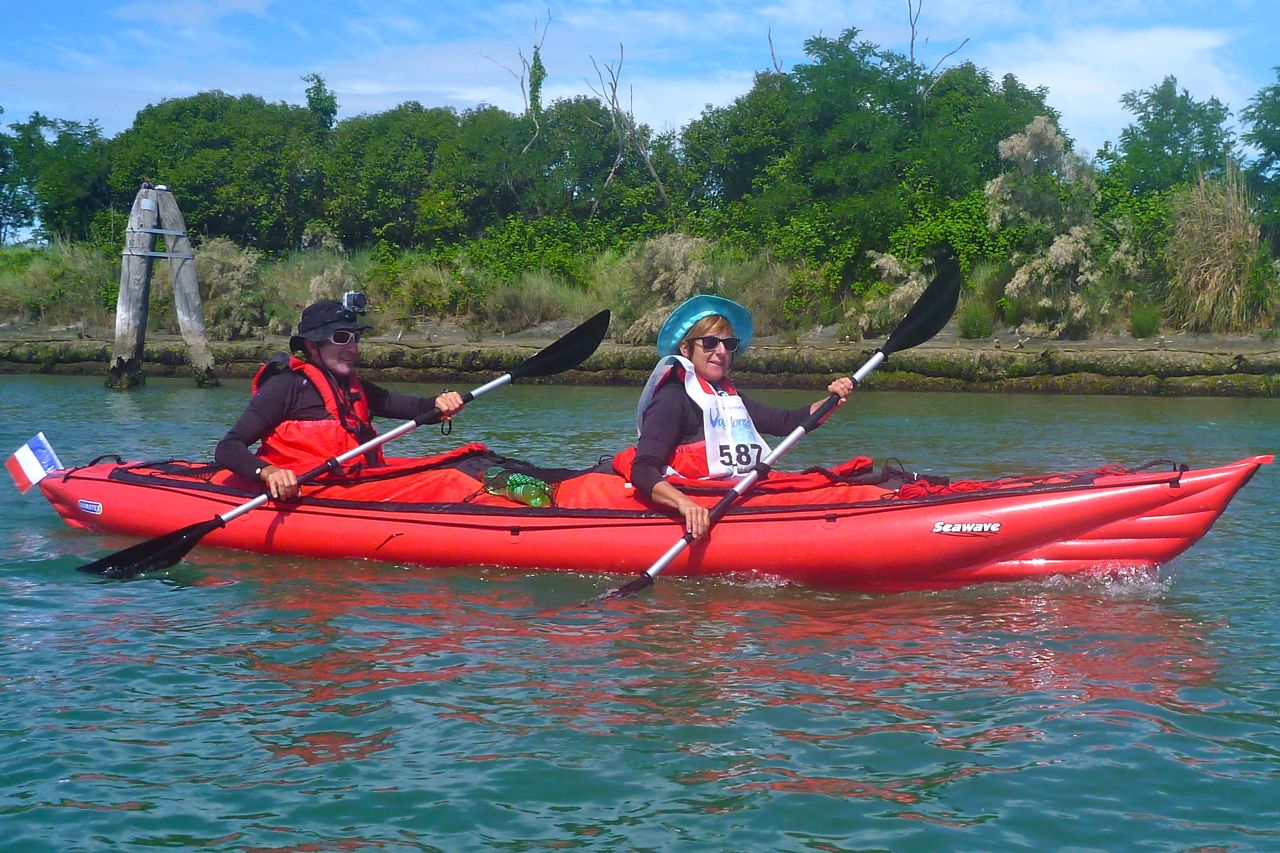
I’ve had the Seawave a few months but paddling in Venice last week was my first proper outing. Venice lagoon was pretty calm on the day – there was more wash inside the Grand Canal from the vaporetti water taxis. It may have been calm but some 34kms without a river current and some tidal flow is still a pretty good outing.
It was an opportunity to try my high pressure modification. I’m running 35% more pressure in the side tubes (4.8psi as opposed to the advised 3.6) but have fitted PRVs (pressure release valves) rated at the higher pressure to prevent the boat getting damaged if it gets hot. Full story on how I did that here.
It took about 15 minutes to pump up the Gumotex with the compact K-Pump (left) but before we lowered it down to the canal (above) it went flat. Oh dear – did I do something wrong? Turns out one side-chamber inflation valve (not new PRV) was leaking. I unscrewed it, blew at it, put it back and it held all day. Probably just a bit of grit, though that’s never happened to me before.
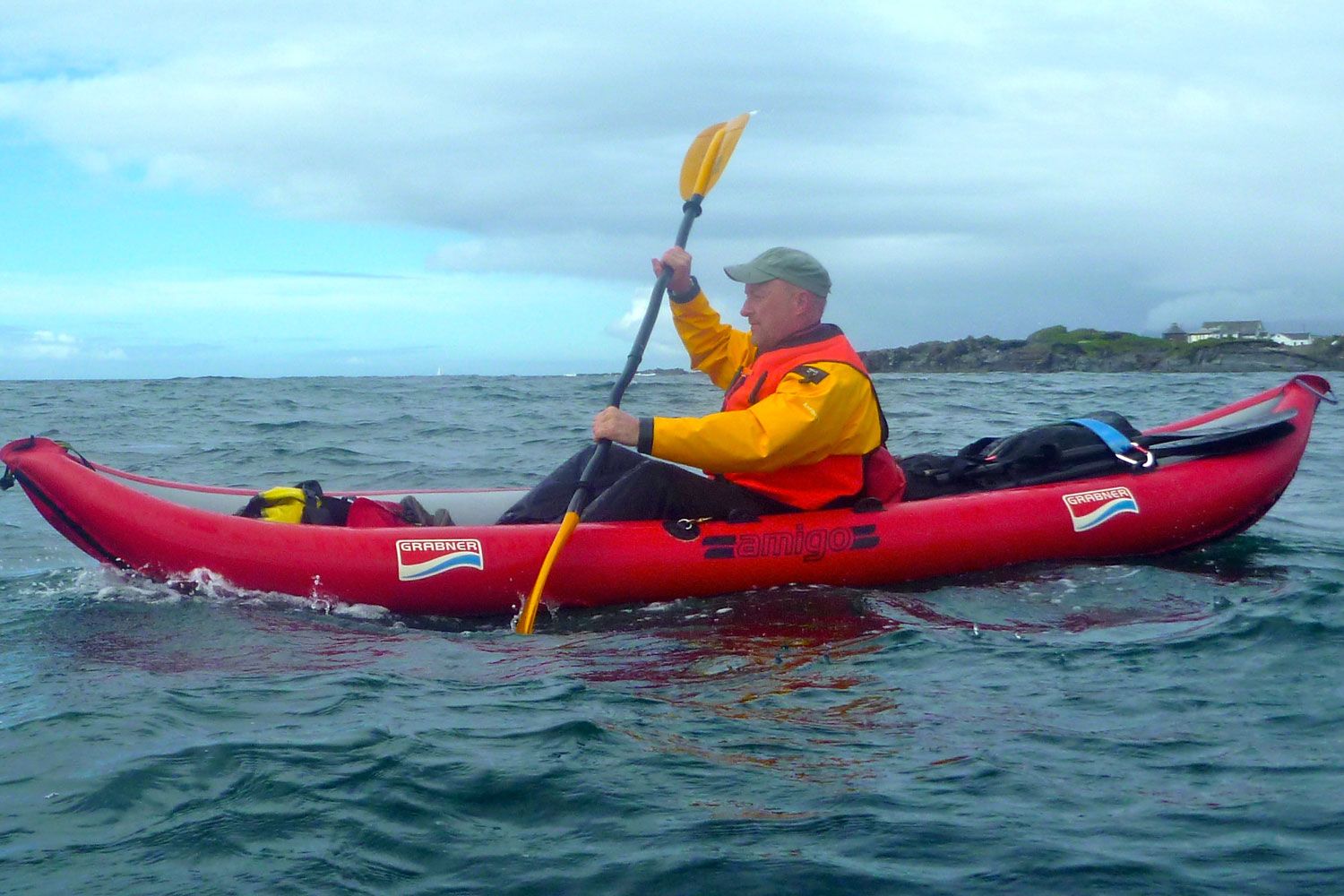
My impression was the high pressure sides made the Seawave faster and more responsive – well it’s bound to, isn’t it. Returning to the apartment I didn’t feel like I’d paddled 21 miles, though I can’t say I was full of beans next day and my hands were swollen from using my 4-piece paddle (easier on Easyjet) instead of my bent Werner Camaro. I found it easy to keep up with Steve in his big yellow Kahuna and even found myself passing the odd hardshell sea kayak or double folders. On earlier trips in the Amigo I couldn’t catch the Kahuna. All those benefits might change in windy or choppy conditions, though there’s much to be said for an IK’s stability when things get gnarly.
So three cheers for my Seawave HP. The short terms gains of high-pressure sides are not so elusive, of course. What remains to be seen is if running the boat 35% over the factory-advised pressure affects durability – ie; did I go too far choosing the PRV setting. I doubt it as poking the sides felt very much like my previous 2psi Gumo kayaks on a hot sunny day. The sides being less in the water will always be prone to getting warm and tight but have no I-beams to get stressed like the floor. Those boats never suffered so I’m sure the Seawave can hack it.
‘Viva La Vogalonga! Viva Venezia! VIVA SAN MARCO!’
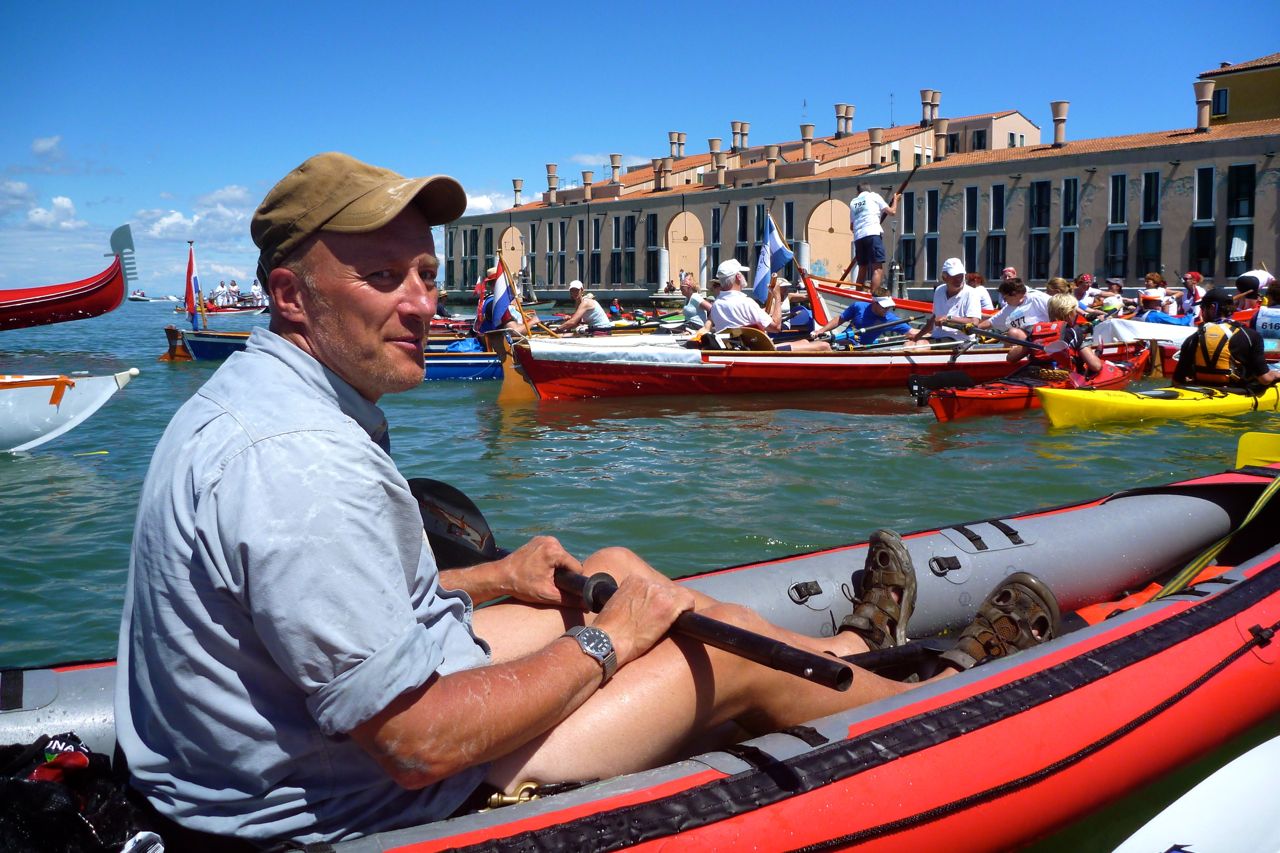
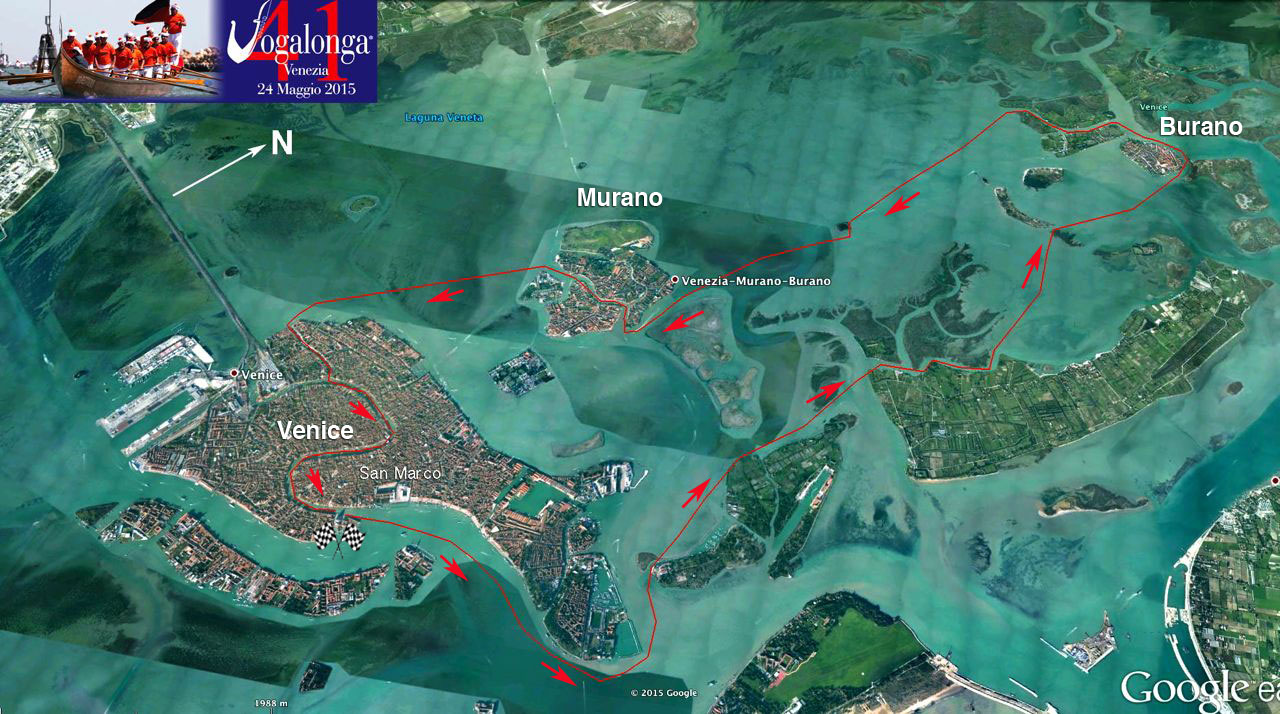
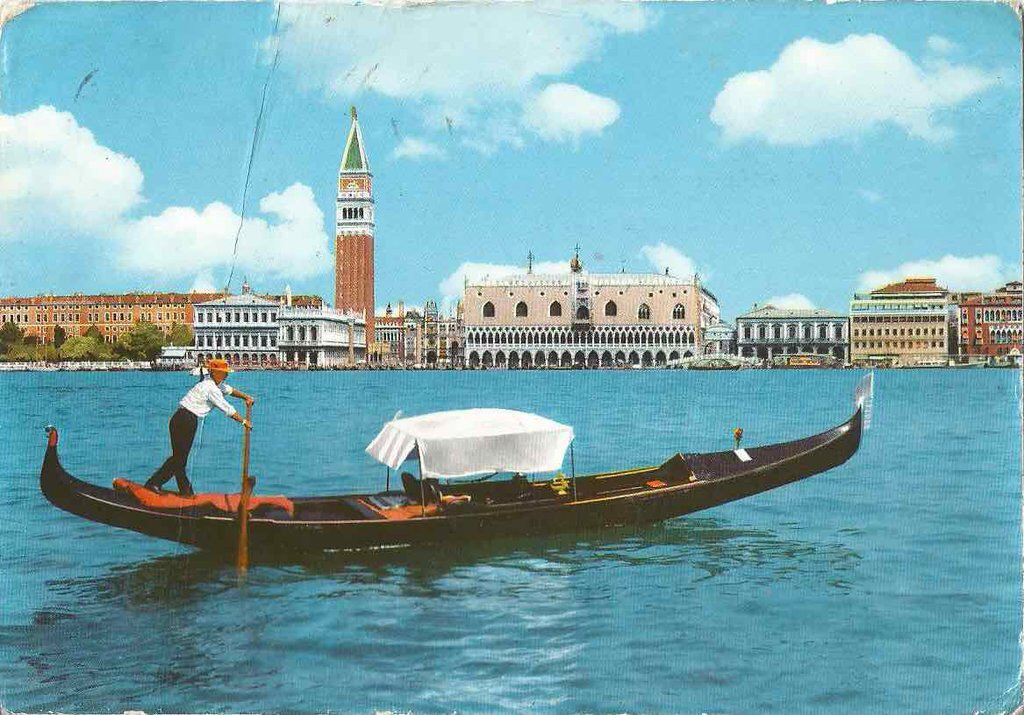
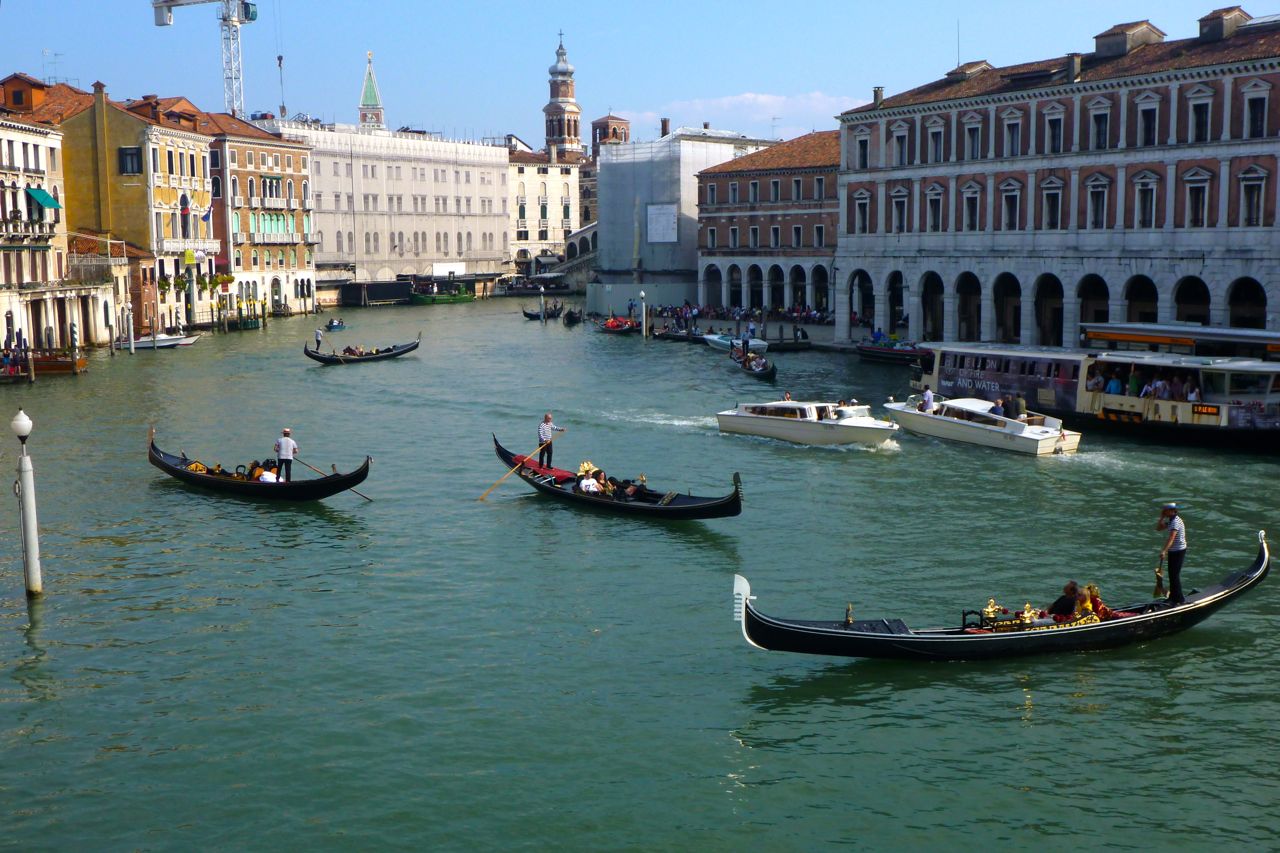
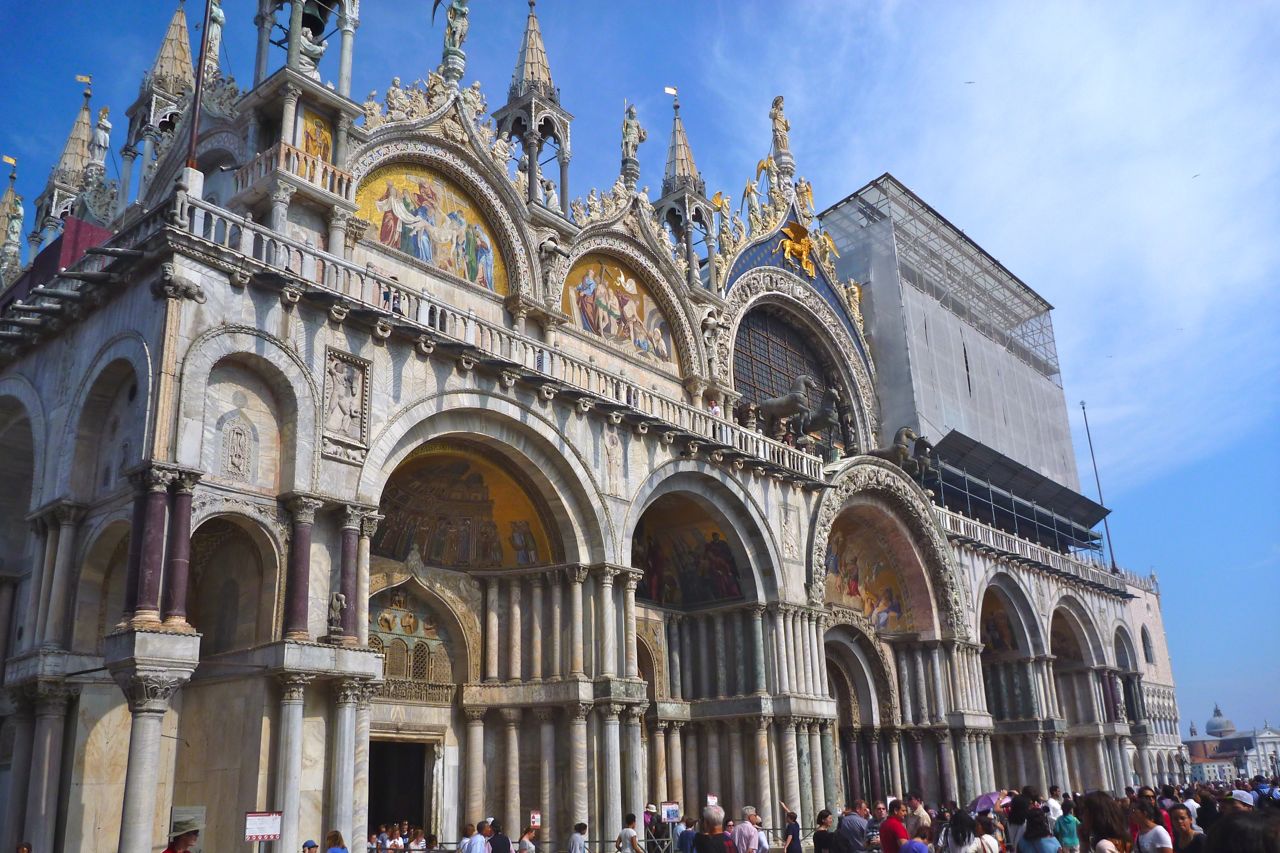
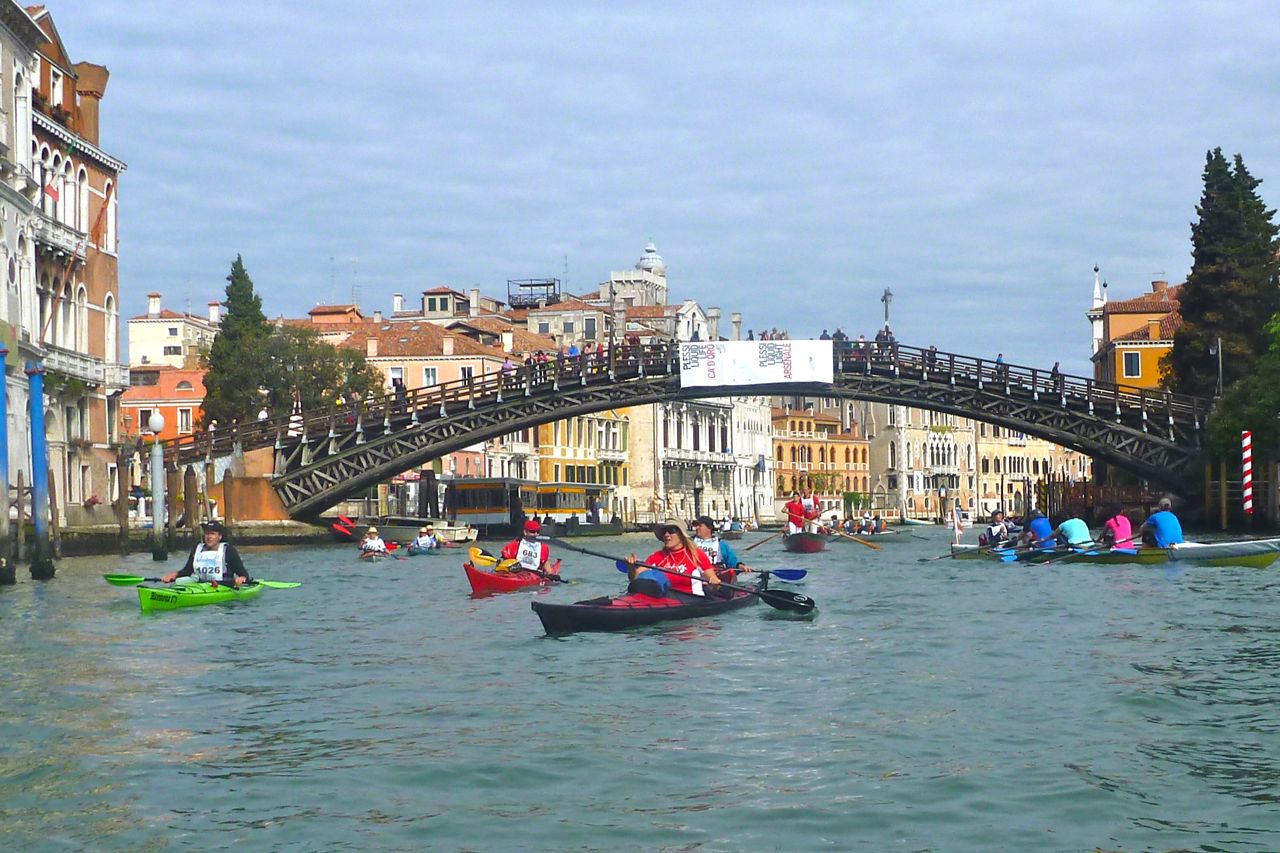
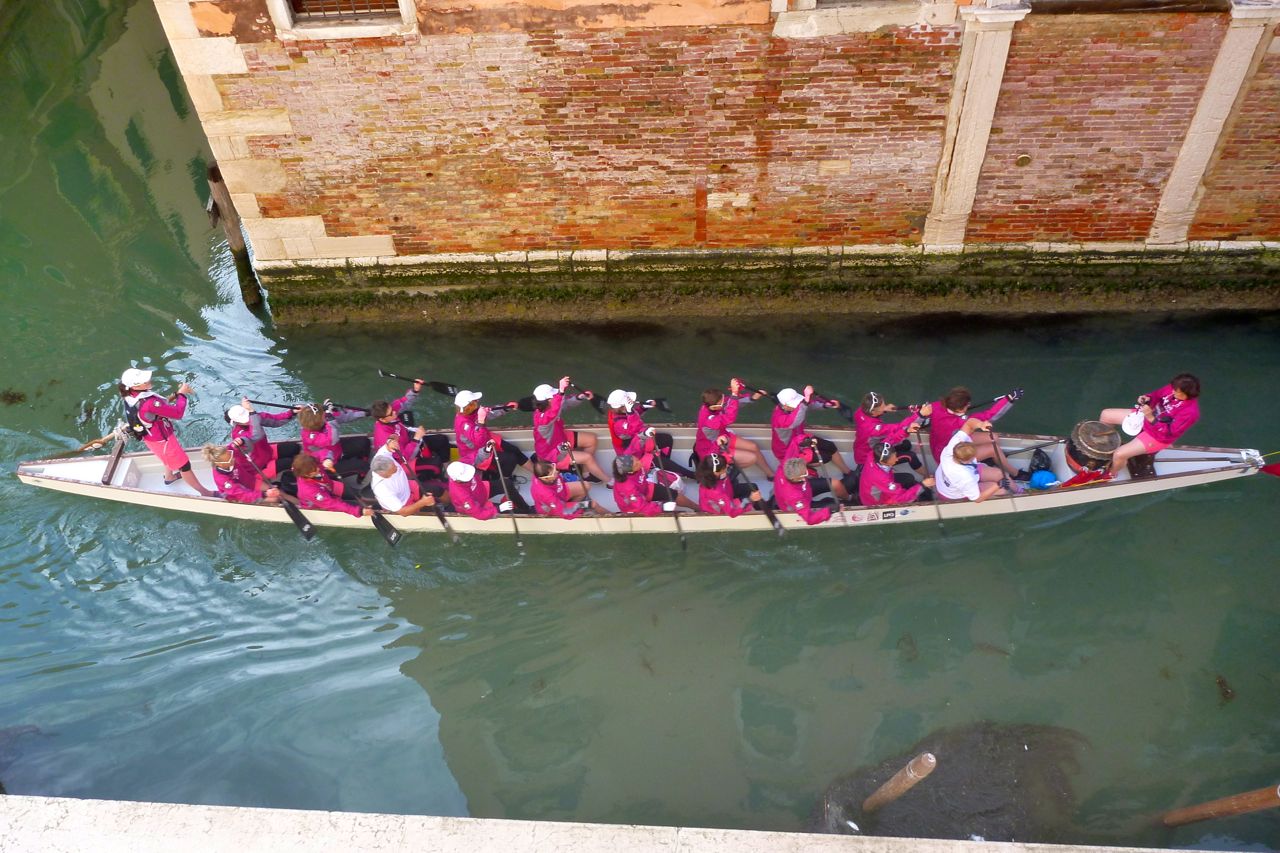
With the above proclamation and a shot from a cannon the 41st Vogalonga, a huge paddling regatta, got underway.Fettuccini’s stirring aria, La Forcola boomed from the speakers and the colourful, hand-powered flotilla pulled away from of the east end of Venice’s Grand Canal opposite Piazza San Marco and set off alongside the classic Venetian vista.
Not that it was any kind of race, you understand – and it was pure coincidence we happened to be at the start on time. You took as long as you chose over the 30-odd kilometres up to Burano and back via Murano to re-enter Venice from the other end of the Grand Canal. There was no starting line or prizes for first place or wackiest outfit.
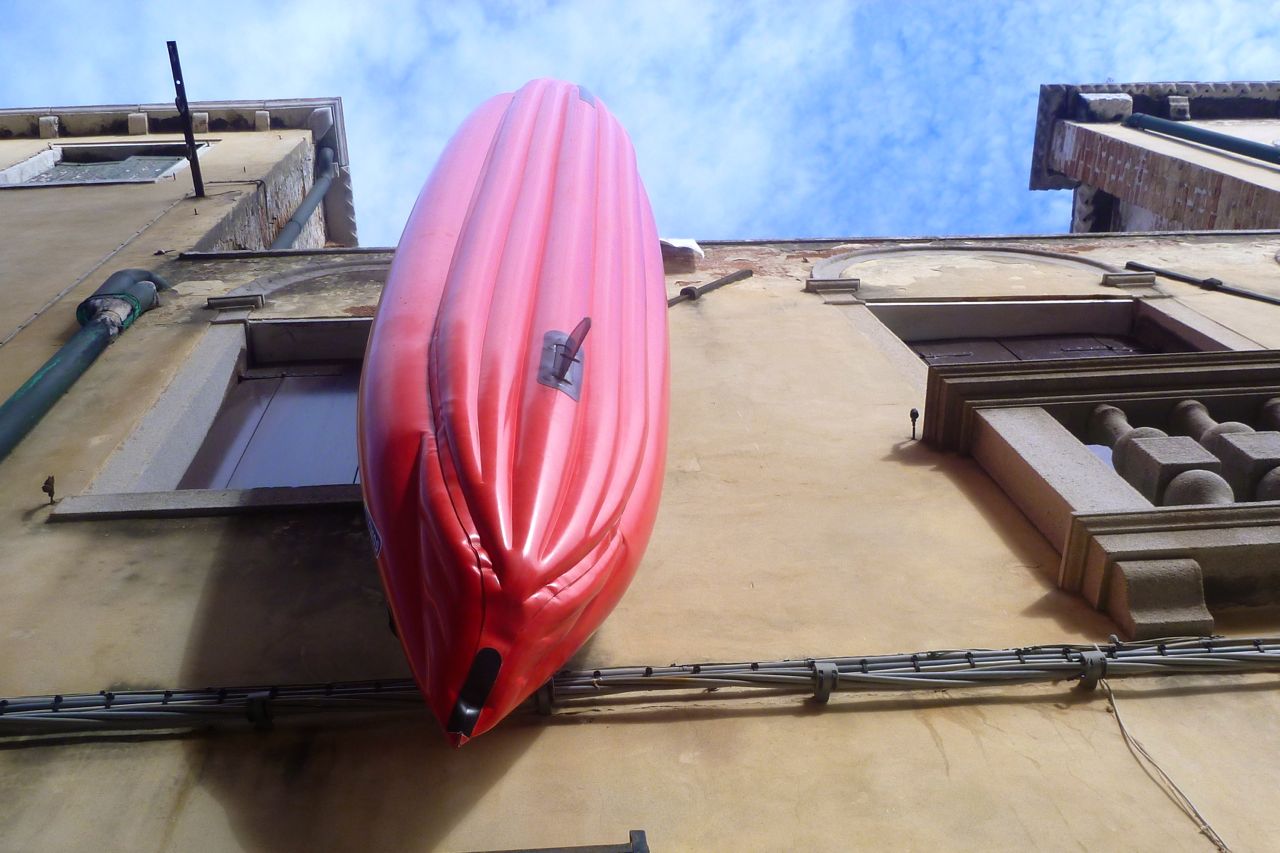
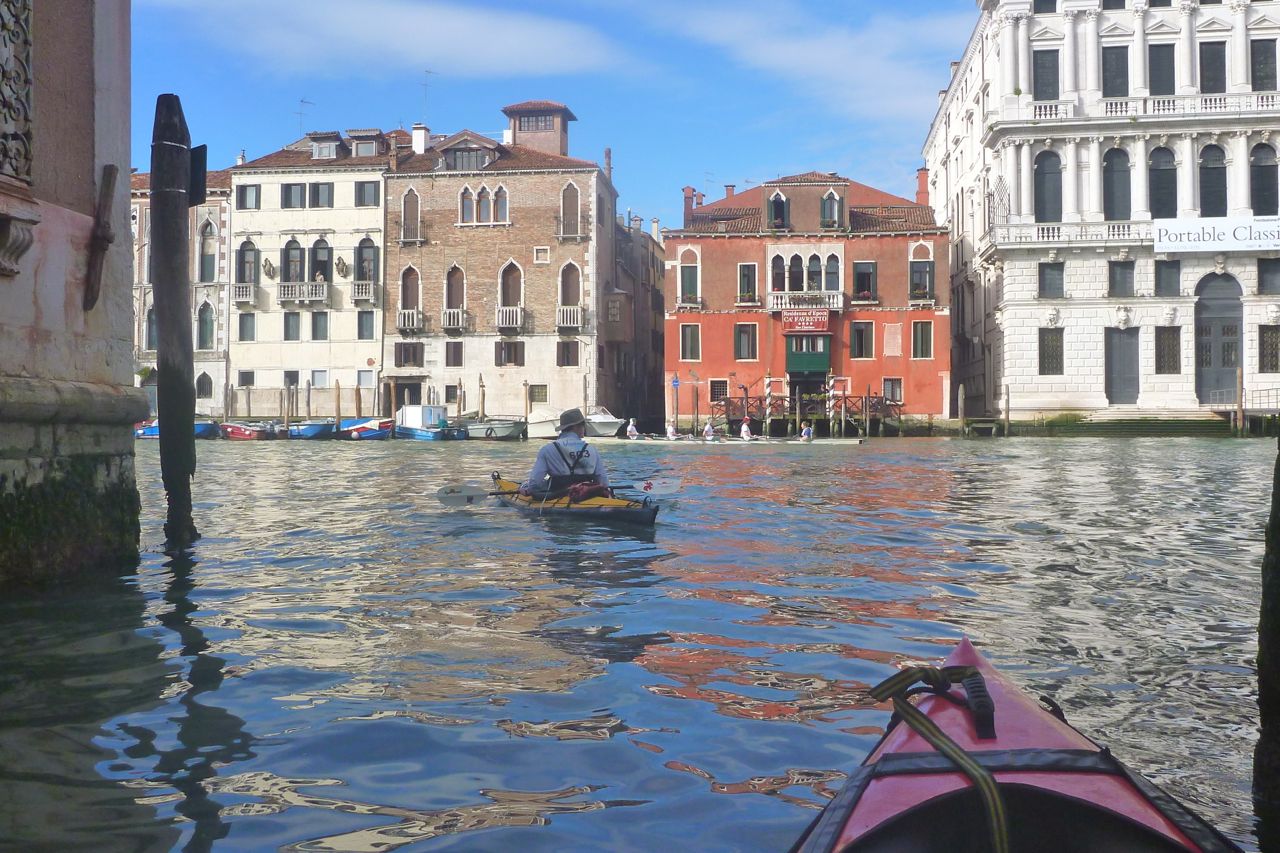
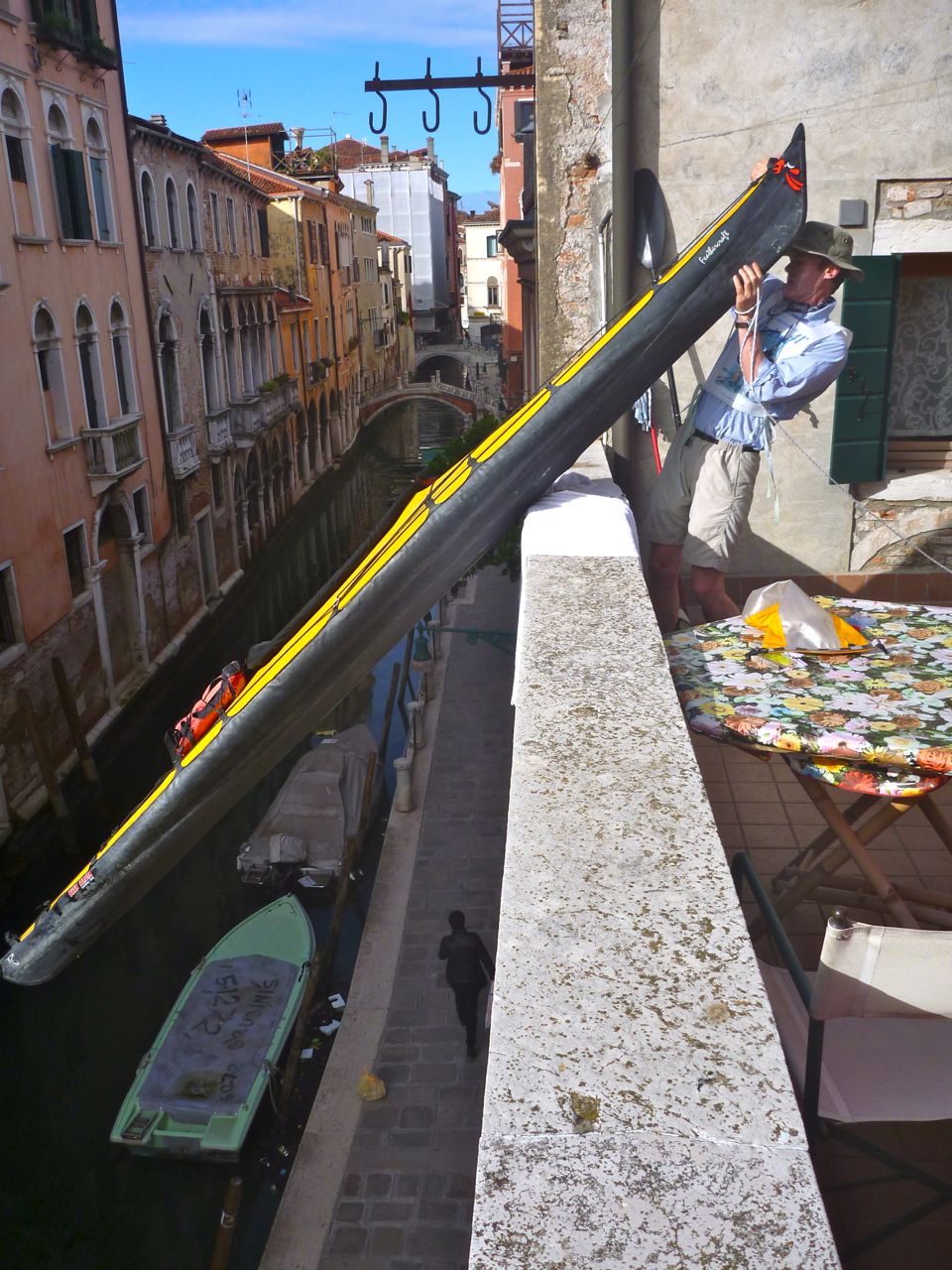
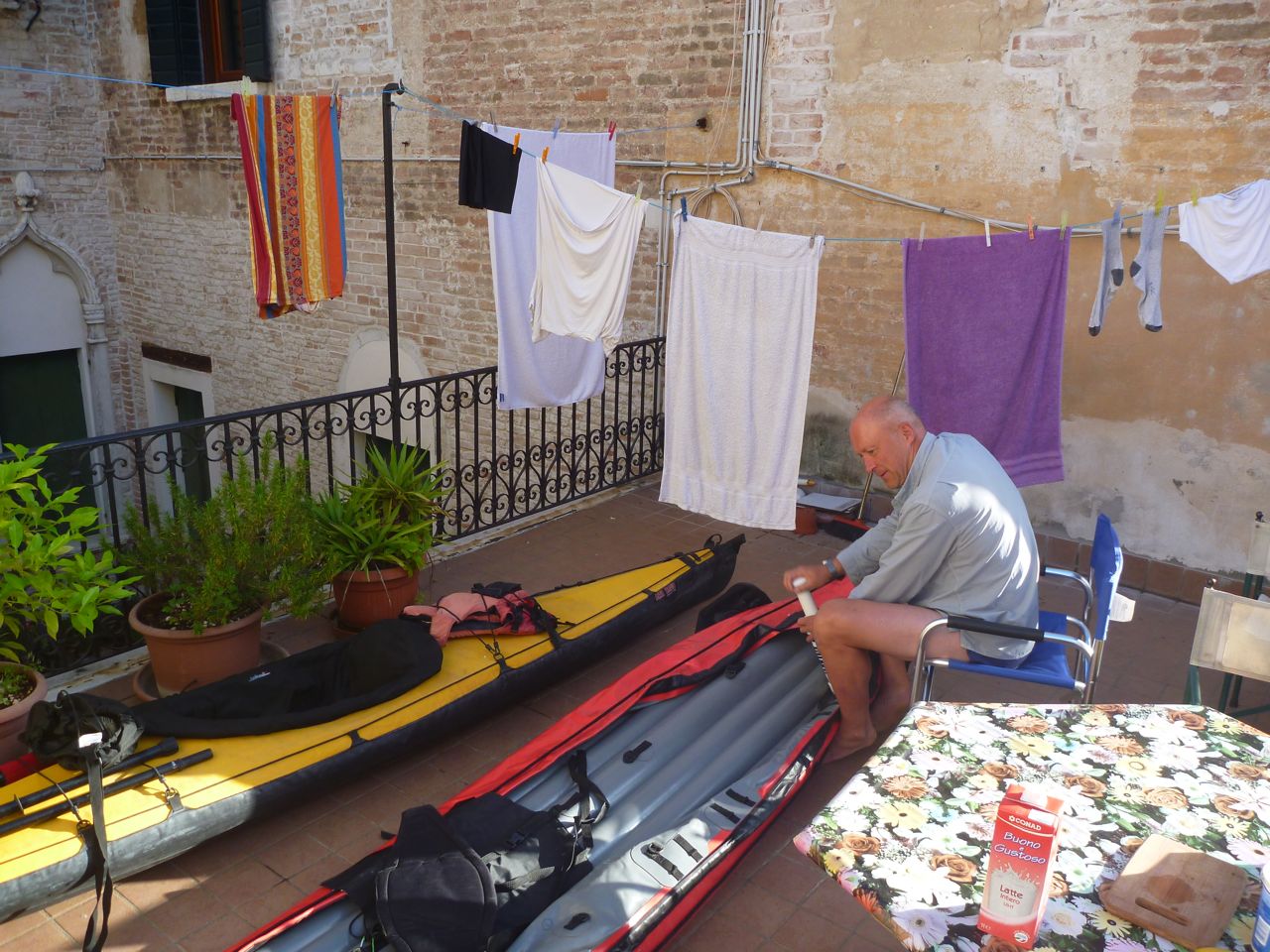
I flew in the night before and on the day Steve and I lowered our boats off his mate’s canal-side apartment balcony and set off to join the melee. Soon I realised I was in Italy not in a BCU training video: the official bibs were optional (included in the €20 entry fee along with a t-shirt, poster and certificate) and so were pfds. After all, who’s ever seen a rower or a gondolier in a pfd?
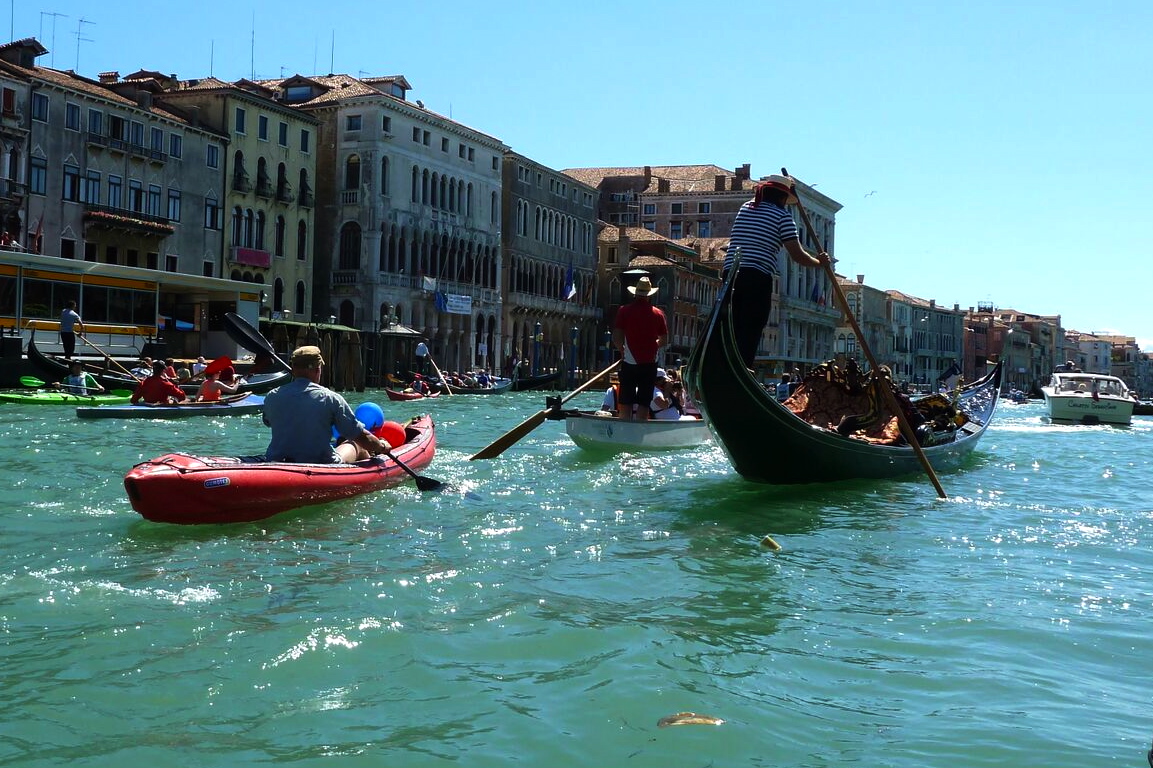
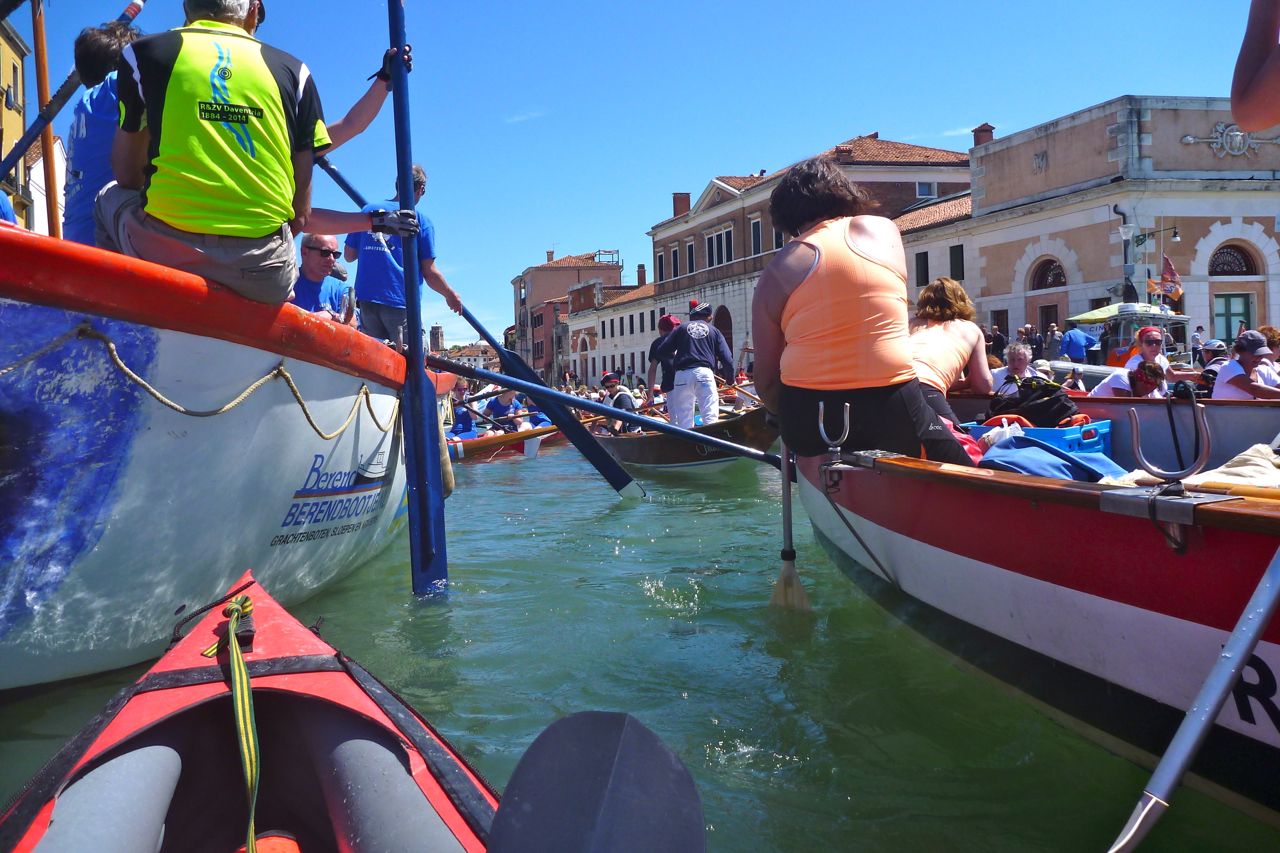
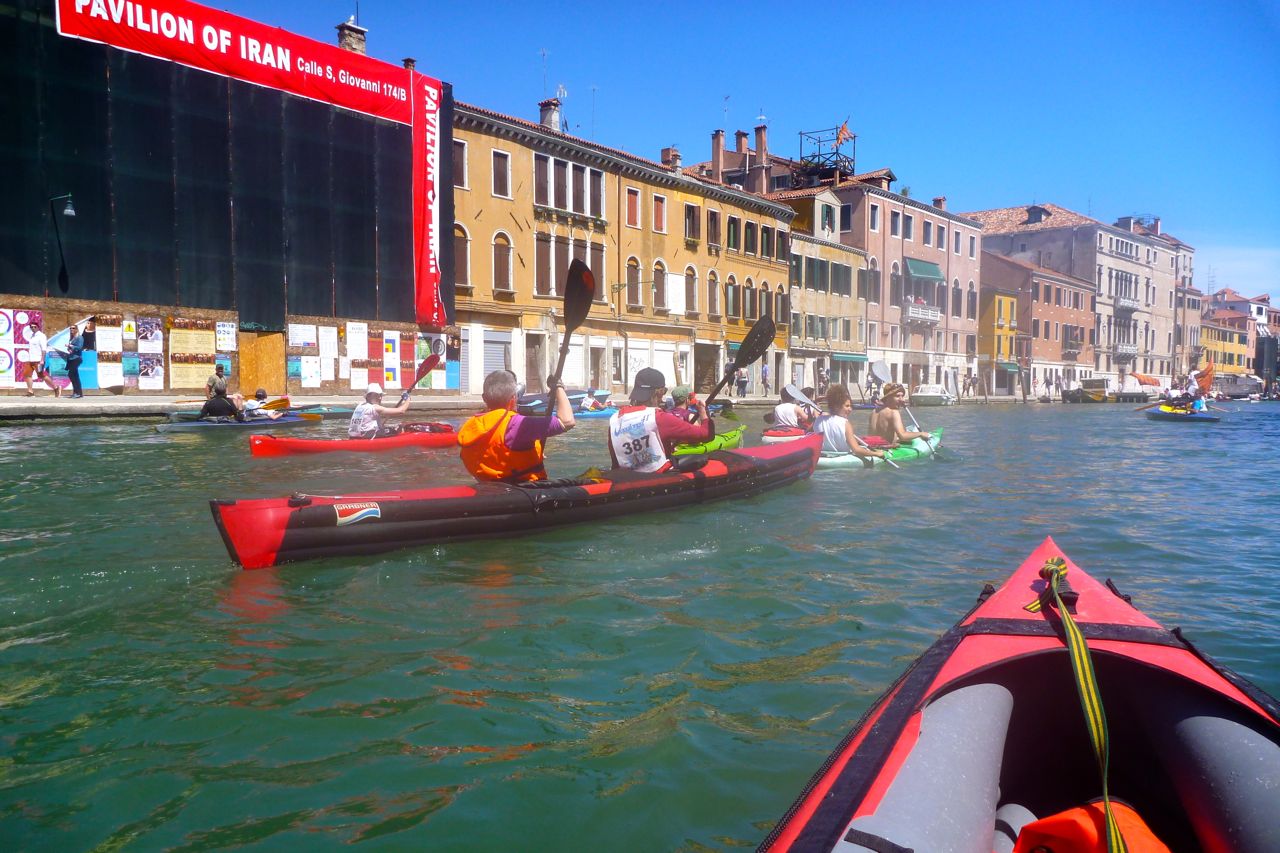
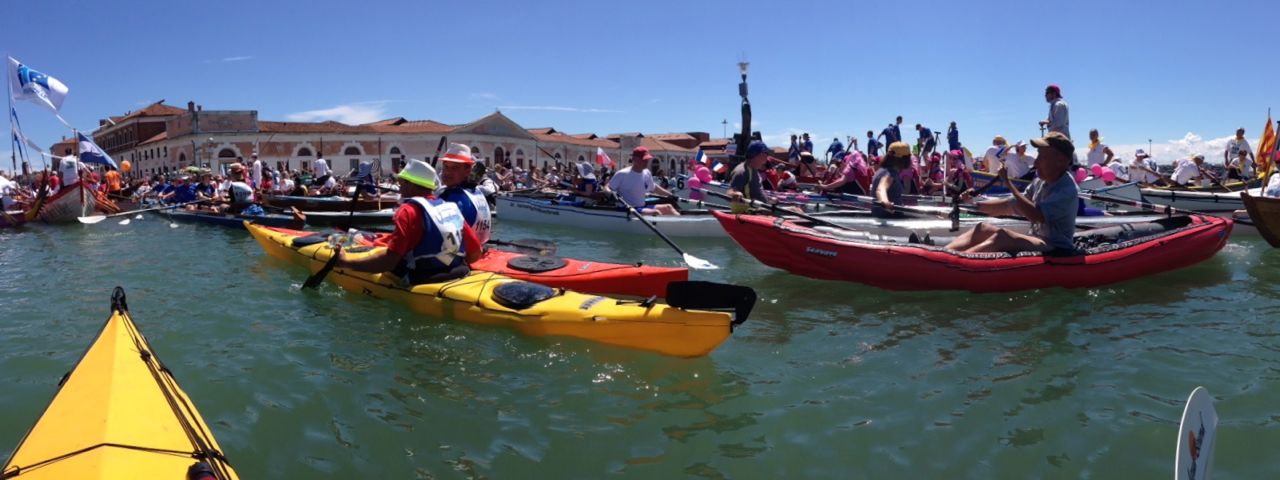
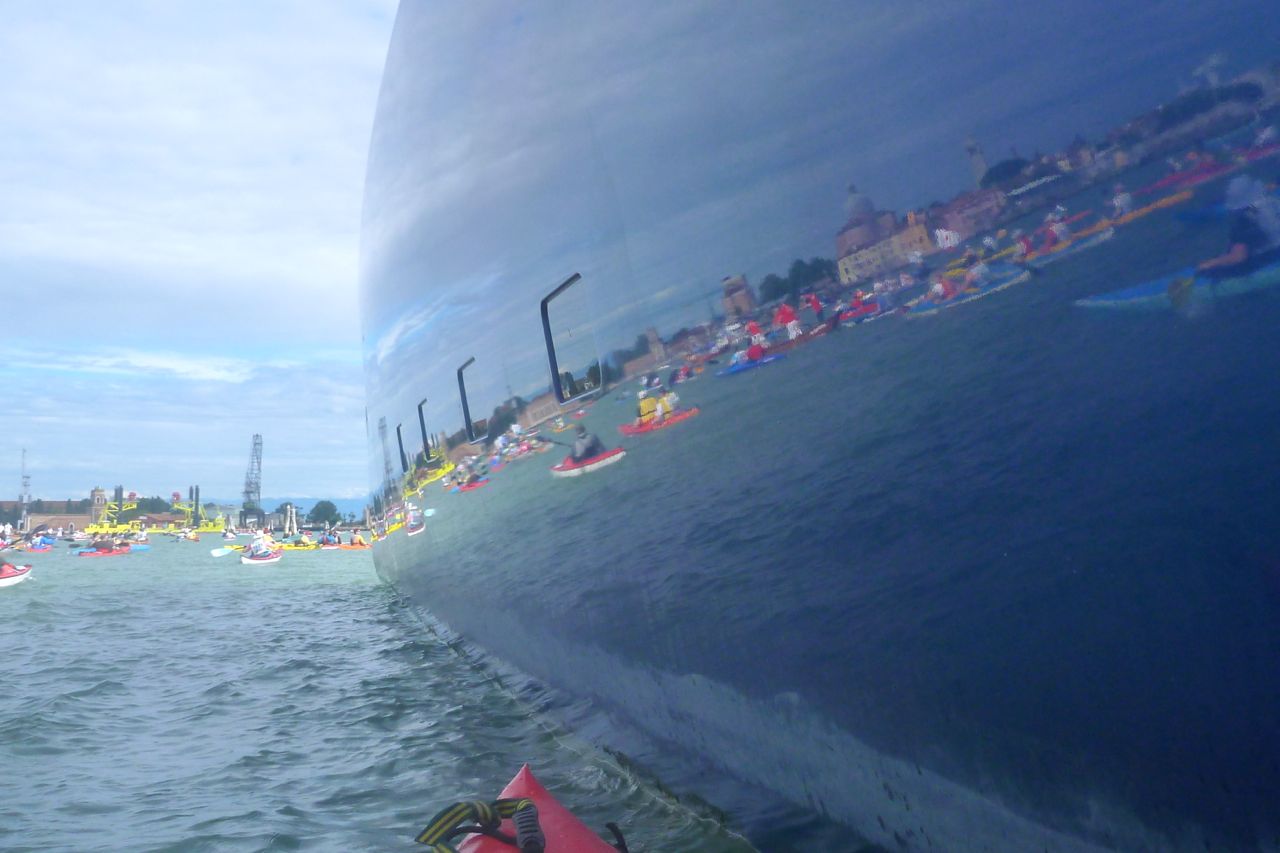
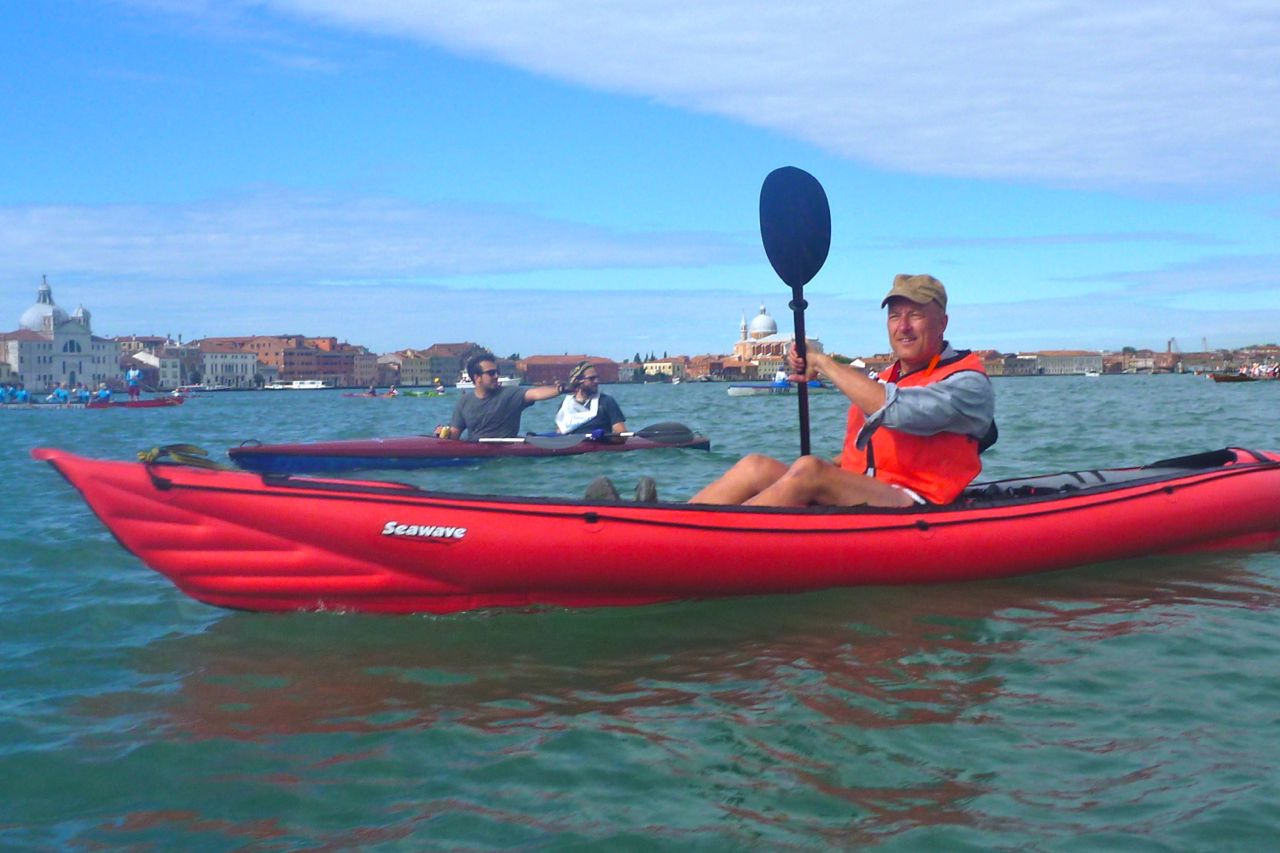
Around us was every type of paddle or oar boat under the sun, from 20-oar-power dragon boats paddling to a drum beat like in Ben Hur, four-up forward standing ‘frontelli‘ rowing skiffs, right down to inflatable SUP boards you could carry under your arm. Kayaks were probably the most numerous craft as this is one day you can cruise down the Grand Canal without getting terrorised by the vaporetti water taxis and their wake.
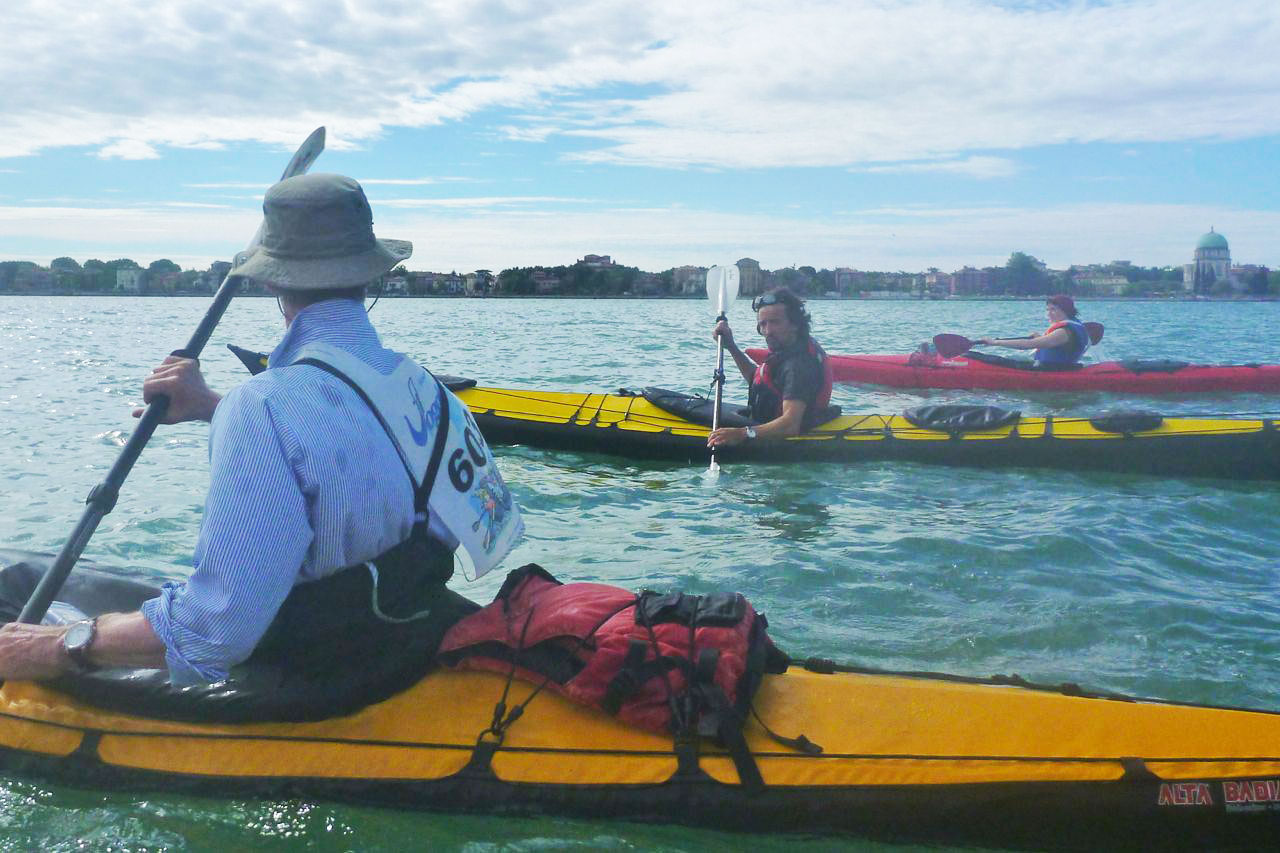
Out past San Elena point we dragged our left blades and pivoted north. The snow-clad Dolomites appeared on the horizon (left) which also sent in a light breeze giving us something to lean against. IKs and packboats of all shapes and sizes bobbed around me: Gumos, Kleppers and their klönes, Grabners, Feathercraft and Sevies. Passing islands or tidal mud flats became uninhibited pee stops as people joined in the paddle-powered cavalcade.
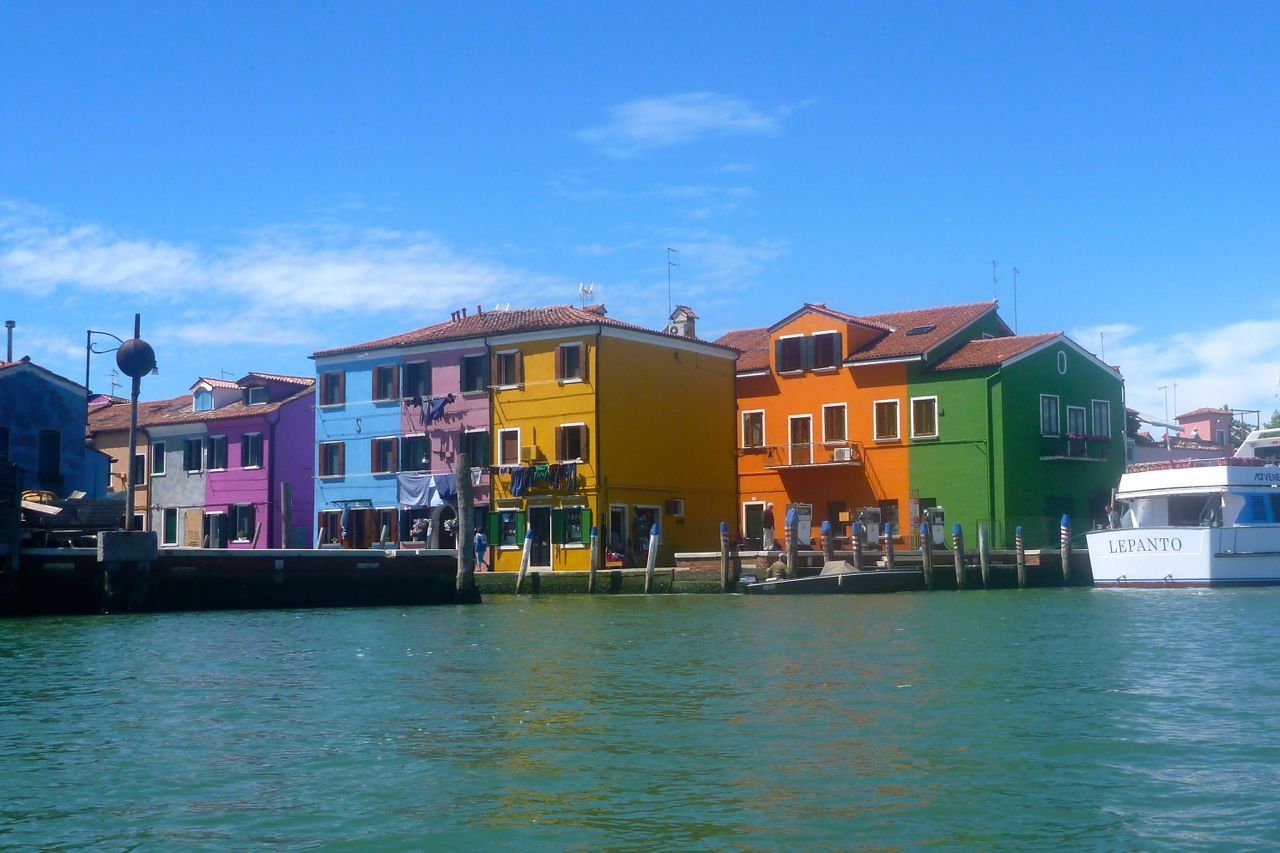
Turning round at Burano, the cooling effect of the breeze dropped off and the 5km open water haul to Murano was hot work. Three hours in and you could see all around the pace was flagging, not least when some tidal eddy made the last stretch into Murano a bit of an effort. It was here that Venice’s precious medieval glass industry flourished; I’ve come across Venetian glass beads in places as remote as Tichit in Mauritania.
Just two Sorbettos – only €15 – then we rocked up at the other end of the Grand Canal where a huge bottleneck of paddle boats had built up at the entrance. It turned out the narrow Ponte dei Tre Archi was the cause – it could only take one rowed boat at a time and with some 2000 boats to filter, the police were trying to keep some order. Dodging low flying oars and prodding prows, it was all a good-natured bundle back into the canal where things quickly eased up for the home run back to San Marco, passing the Grand’s iconic palazzos, well-wishers cheering from the ponti and the acclaimed waterside vistas of La Serenissima.
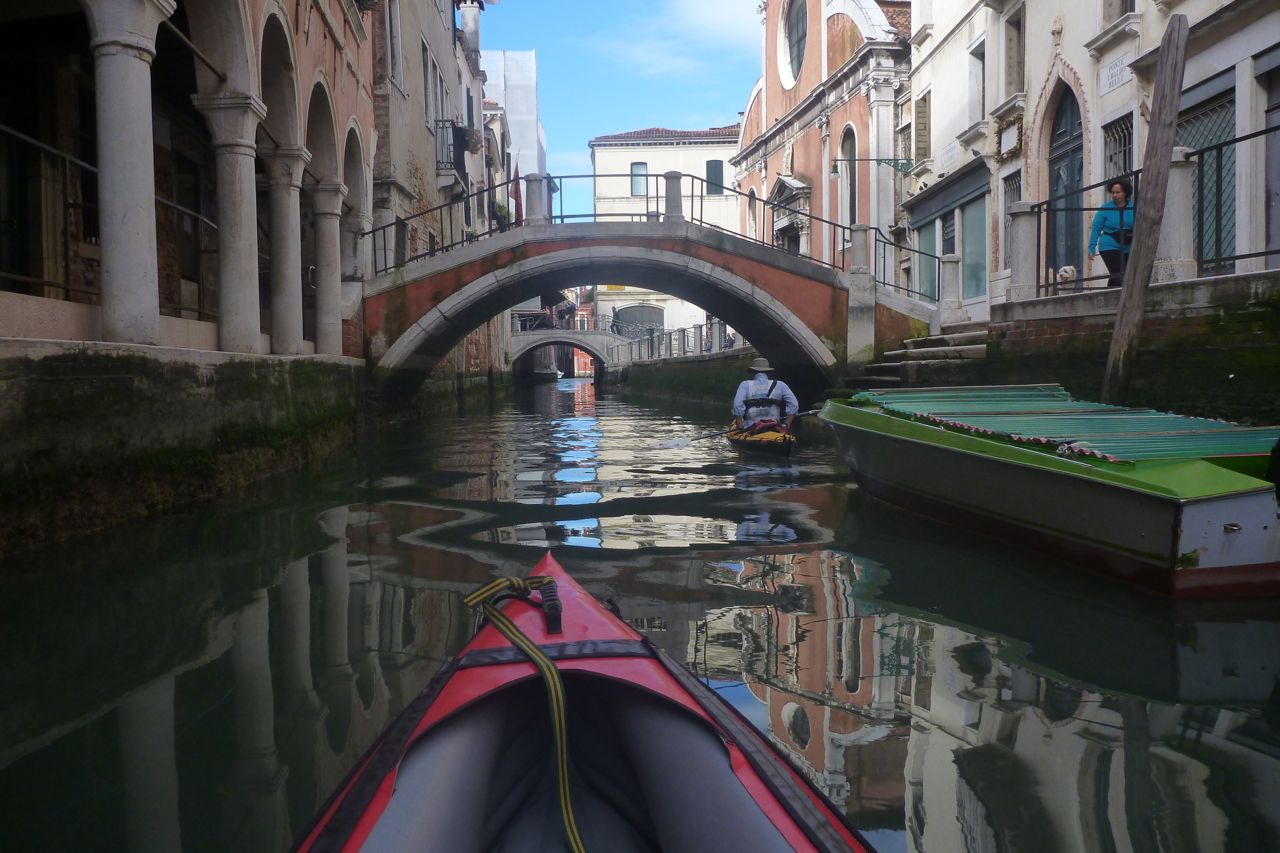
Within hours the vaporetti taxiboats had reclaimed the Canal from which it’s said kayaks and the like are excluded except to quickly nip across. But I see now that you can still have a great time paddling around Venice and the lagoon as long as you keep off the main canal and ferry channels, and out of the congested gondola tourist circuit between Ponte Rialto and the Bridge of Sighs. That still leaves plenty of quiet back canals to explore as well as the sheltered lagoon and its countless islands. Bring your packboat to the 42nd Vogalonga. If like me you’ve never been before, it’s a great way to tick off Venice.
I gave myself about two weeks to get as far as I got along the Lycian Way (above; ~500km), with plans to paddle here and take days off there.
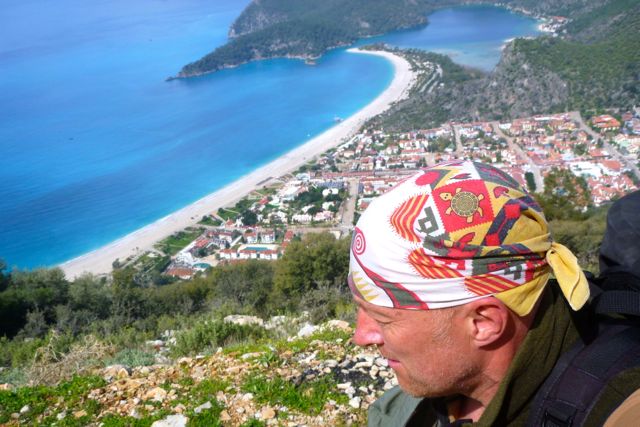
The walk starts just south of the village of Ovaçik, a 20-minute bus ride out of Fethiye, and soon gets stuck into a long, rubble-path climb up and around the 700-m headland below Baba Dag mountain – a pattern which turned out to be a typical day on the walk. Up here above the pines tandem tourist paragliders dangled just overhead on their descent to the much-photographed beach at Oludenizlagoon (left).
I filled up from one of the many springs and had a relaxed soup lunch, trying out my new stove on a grassy bank. But by the time I reached Faralya village 12km in, I was in need of a quadruple pancake and a fresh OJ. There were lodgings here but despite a late start it was only 4pm so I carried on to Kabak village and, having covered 20km, camped just beyond on an old olive terrace. A few others were doing the same as it became clear this walk was more popular than I’d expected.
The great thing with camping is you’re on the road at 8am – the best way to get the miles in and a cool time of day. The trail’s shady inland option (left) climbed and contoured round a steep valley strewn with small landslides and popped out into the sunshine at Alinca village overlooking the sea from nearly 800m. Though I was searching for it, I missed the waymark near here for the coastal route to Bel so ended up taking the inland option via Bogaziçi village (shop) and the deserted ruins of Sidyma. I’d not bothered referring the guidebook once I realised how poor the map was and how plentiful the red-and-white waymarks were most of the time. It was actually a very agreeable stroll along empty roads past wildflower meadows, vine-drapped farmhouses and gushing springs.
Sidyma was my first sighting of the distinctive, free-standing Lycian tombs carved from solid limestone (left). With all the spring-fresh verdure and distant snow-capped mountains it added up to a classic Lycian vista. And this was only day two. In the adjacent village ancient inscribed blocks were embedded in the mosque wall. I stopped for a double chai in the pension then tackled an annoying section up an unmarked streambed but just a short distance from a parallel road. The trees and gorge nixed the GPS for a waypoint so I hacked out through the undergrowth onto the road. From here it was a tiring haul up to a pass where a bucket and cistern were just what I needed. I was carrying just 500ml of water and I wasn’t snacking or resting unless knackered – more or less the opposite of what I do at home and what you should do on the trail. But I had some excess winter fat to shed and tend to press on when alone. Refreshed and on the way again, not every LW deviation is futile: an enjoyable path dodged the road down to Bel village (left) where a boy led me to Fatma’s great pension: a warm welcome and the works for just 50TL. It had been a 22km day.
I teamed up with Christine and Fred who’d also stayed at Fatma’s and recommended the vertiginous southern route via Gey. I admired their professionally produced and pocket-sized German LW guidebook. That plus six eyes being better than two, we untangled the morning’s route anomalies until we reached the long, steep, loose descent back to sea level (left). Fred was zipping along with his twin poles but I wasn’t on form today, slithering and tripping on the rocks and vegetation until I finally fell onto a knee. Was it my clumpy, stiff-soled boots, the 17-kg pack or cumulative dehydration? Probably a bit of all that and more but to the very last day I never shook off this unbalanced and unusually fatigued state on the LW.
At one point we stepped over a chain of nose-to-tail caterpillars on the march. I’d never seen anything like this but it brought to mind the challengingly scatological film, TheHuman Caterpillar. Trust me, do not Google it. As we lost height I caught sight of the deserted expanse of Patara Beach (left) which I hoped to paddle in a day or two. At the bottom I was talked into a breather under the shade of some olive trees (below left). These levelled terraces make some of the best camping or lunch spots on the walk, especially if there’s a water source nearby. We blundered through the few houses that make up Gavuragili and then – as you do when chatting in a group – failed to note our books’ instructions to walk back along a newly sealed road on joining it, rather than onward as we did. RTFM, MF. At the next waymark a couple of clicks later the LW was returning to the road but we thought the opposite and followed it into the hills in the wrong direction for half a sweaty hour. There were other occasions when I got into a muddle and temporarily lost track of whether I was going in the right direction, especially away from the generally eastbound orientation. The answer of course is an iPhone and app with tracklog, but I’m still too old school for that. In the meantime, I could sense I’d become badly dehydrated and reaching boiling point. Breaking the pace, I took time out and knocked back a Rehydrat with my last 200ml of water. When you’re that far gone it’s amazing the difference this stuff makes – it’s like having an injection. Within a minute I knew I had another hour in me before I’d start staggering again.
We retraced our route down to the road and a short while later were sipping fresh orange juices at the riverside Ozlek Pension near Pydnai fortifications (left), a castle wall but with nothing inside the battlements, like a film set. We’d done only 15km but by now it was too late to try to reach Kinik/Xanthos as planned, so we lodged here for the night. The 45TL B&B raised my suspicions. Why not half-pension as there’s no resto for miles? Sure enough the genial owner finds a way to charge as much again for an evening meal, despite proffering gifts of fruit and other promises. Paying 45TL for B&B is OK, but be warned if you eat more here. I guess business is business – that’s how empires grow.
We’d reached a broad flood plain where the Xanthos or Esen river meanders to the sea. To either side the marshes have been reclaimed and crammed with a dense canopy of tomato greenhouses (left), the biggest in the land they say. It’s not a picturesque sight – a vegetarian abattoir or factory farm – but that’s where food comes from these days and I love tomatoes.
This contemporary monoculture quite literally pressed right up against the remnants of the Lycian state. My plan had been to continue to Kinik town to inspect the former Lycian capital of Xanthos (left), then leave the LW and ride the winding river 15 km back to the sea and paddle the shore 6km southeast to Patara where I’d re-join the LW. This idea worked all the better as hereabouts the LW takes what’s said to be a dull inland excursion around the intensive cultivation before dropping back down to Patara (see map, right). Many walkers choose to bus it.
Still with me? Well now I was at Ozlek alongside a smaller stream and just a kilometre from the sea. So next day I checked out amazing Xanthos by dolmus with the Germans, said goodbye then walked 8km back to Ozlek via Letoon ruins and instead prepared to paddle the full 12km of beach to Patara next day (I told you to click that map, above right). We’d walked over to the seashore one evening (left) for me to get a measure of the beach and confirm a sea paddle was doable.
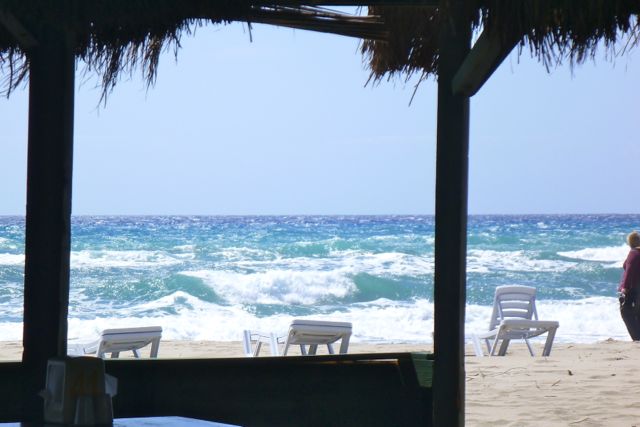
Things had looked nice and calm that evening but came the day, as I inflated the boat I could hear the sea a kilometre away – not a good sign. I put in and set off anyway down the Ozlem stream towards Pydnai and the sea as I could always just walk along the beach if the sea was too rough. And sure enough at the estuary, a southeast headwind was kicking up a chop better suited to surfing than solo packrafting (right). I tried surf-hauling for a bit (left) but that didn’t work so I yanked the Alpacka’s cork and set off for the walk to the Xanthos river estuary which would have to be paddled, no matter what.
Despite apprehensions about whirlpools thrown up by the tide meeting the river current, that crossing was completed in about 55 seconds. As I’d anticipated, the masses of greenhousing to either side had sucked the power out of the turbid current I’d seen under Kinik bridge yesterday. I could probably have swum the river using my UDB as a buoyancy aid. One little bridge or hand ferry and this would make a fun detour for boatless walkers on the LW. As I neared Patara a mini convoy of Turkish women in full burkas passed by on quads.
I rocked up at the Patara beach shack where no one was swimming. I scoffed a couple of Magnums, pleased to have actually achieved something that needed the boat, even if it wasn’t the full day’s inshore paddle I’d planned. There might be another chance for a longer beach paddle at Finike in a few days. I walked into Gelemiş village, slipping past the Patara entry station from the ‘inside’ and checked into a cushy pension out of the LP guide. Then that evening went back to check out the extensive ruins of ancient Patara, Lycia’s former seaport, still dodging the now unattended entry station. All up that added up to 18km + 1 in the boat.
After a great meal at the Carpe Diem resto in Gelemiş, next day I tried to follow the southern coastal route via Yeliburun to Kalkan, but this time couldn’t dodge the entry fee at the booth.
‘But Sir’ I mewled. ‘I’m not going to Patara ruins. I am a poor wayfaring stranger on the Likia Yolu bound for Yeliburun.’
‘No matter my friend, it is all Turkish heritage‘ he said with a grin, having clearly dealt with hoards of penny-pinching backpacking scum over the years. So I coughed up my 5L and told him about my beach walk and epic estuarine traverse.
‘So you are like bear grease?’ Bear grease? Some local anti-mosquito remedy?
‘Oh Bear Grylls!’ He was taking the piss out of me. Touché amigo, that was well worth the £1.32p. Seeing as I’d been hammered with the fee, I figured I may as well return to Patara and inspect the now-open grand Assembly Hall of the Lycian League in full daylight.
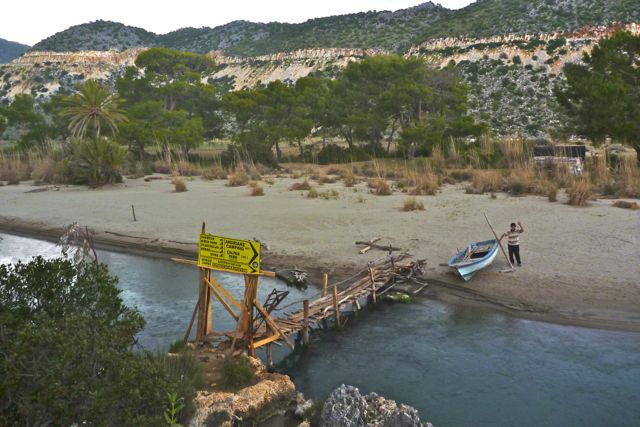
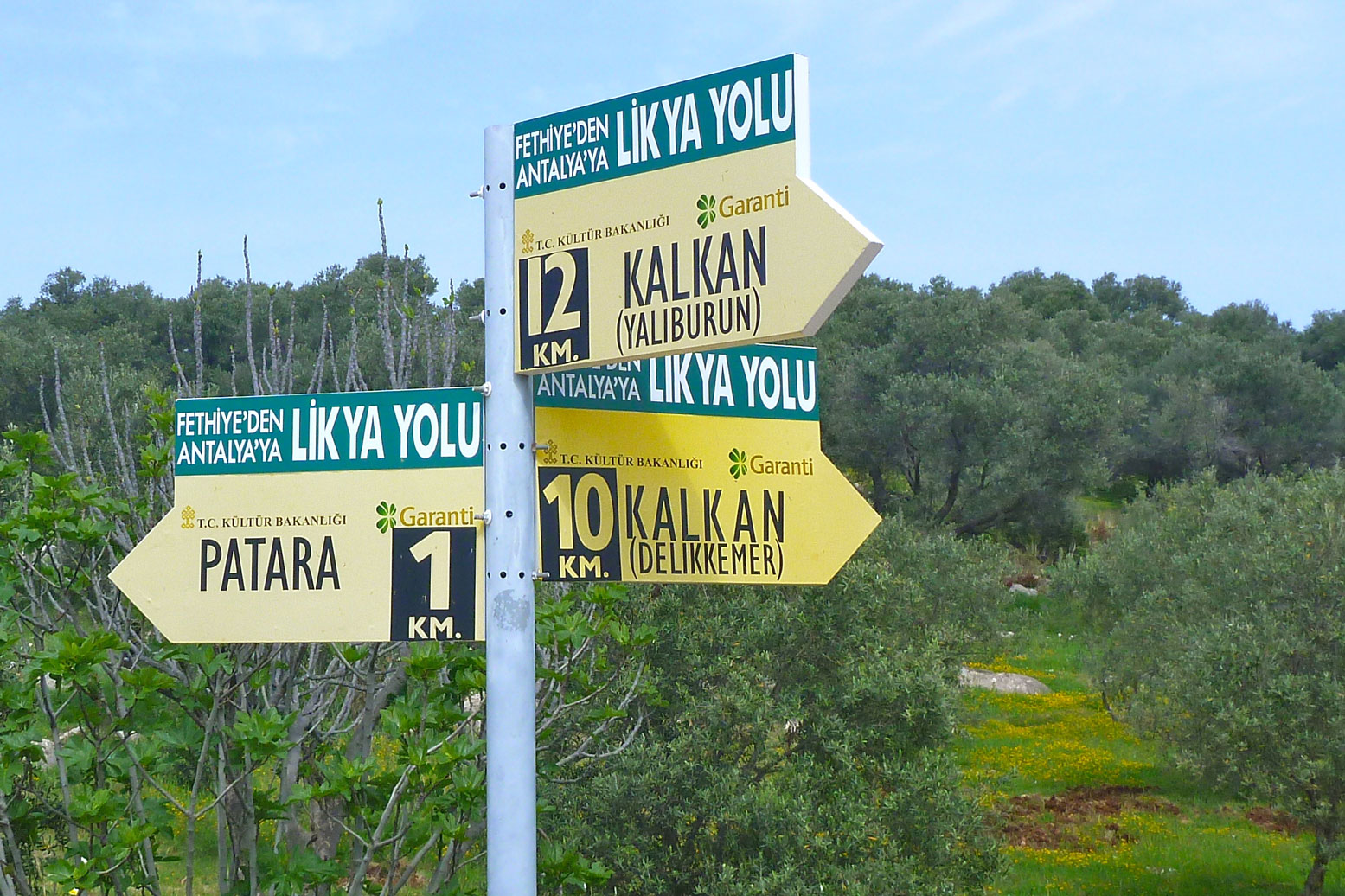
With that done, the karmic currents were still against me. Though I may have misread the book and map (making my surroundings fit the map – a common mistake with navigation) I was still following the odd red and white waymarks but which only led to a dead-end of dense scrub. Confused not for the first time, I reoriented myself with the GPS and an oblique interpretation of the map, then nailed it cross-country to a waypoint where the incoming and outgoing routes of the LW met (above left). These yellow signs, sponsored by a bank, are fairly infrequent by the way. They’re supposed to be set where the LW leaves a road but can appear anywhere. You might see a couple a day compared to a couple hundred red and white waymarks.
Finally back on track, I’d eaten into the day with my haggling and ruin-spotting so decided to take the shorter northern route towards the Delikkemer Roman aqueduct. The book describes the aqueduct as a ‘siphon’ which sounded intriguing if not a little far-fetched. In fact, it’s an ‘inverted siphon’ which is nothing more than a downhill hose with a bit a of slack in it (click image left for more info). The wall supporting the channel bows as it drops between two hills but all it did was save on the stonework or arches of a full-height aqueduct rather than bend the laws of nature like Uri Geller in the twilight zone. Clearly, by now I was becoming unfairly blasé about the monumental achievements of the ancients.
At this point the book had advised I send my pack onward by bus as the coast-hugging trail to Kalkan entailed some exposed scrambling. How and where I organised this portage was not explained but by now I was becoming accustomed to the book’s tendency to underplay the practicalities and difficulties while rabbit on lucidly about the Way’s historical marvels and the genus of the fauna underfoot. In my experience, it’s rare that a guidebook author can master both the practical/logical and literary/historical elements of a guidebook like this. It’s either left brain or right brain. So I set off overloaded but forewarned and took my time inching my way at 1kph to the outskirts of Kalamar, a villa-packed outlier of Kalkan. The waymarking was good bar one unnerving occasion – and it needed to be. I wouldn’t have wanted to be some casual day hiker tackling this in their cotton deck shoes and slacks. As with many coastal stages on this walk, one inopportune tumble ending with a cracked skull and you could not be found until it’s way too late.
It was a humid, overcast afternoon and as usual my perspiration index or ‘PI’ was off the scale. In retrospect I’d have been much better off scrambling down to the cove where a pair of yachts were moored, but wasn’t sure about tackling the steep clamber only to find a 1-in-1 rock slope dropping into the water, making deploying the packraft awkward. In fact I see now in the photo left and on Google Earth that there’s a small beach about 700m directly south of Delikkemer. that was a missed packrafting opportunity.
I arrived in Kalamar as a few spits of rain rinsed my salt-encrusted face, feeling really quite pooped from the effort. I took a selfie and seeing it later didn’t recognise myself. The last time I looked like that, red-eyed and hollow-cheeked, was towards the end of a 29-miler on the Pennine Way.
With waymarks now absent or not worth following, I ricocheted east towards Kalkan centre, passing sun-dried ex-pats living the Mediterranean Dream while I tucked into a tub of Håagen Dazs with my knife. I really was a sweaty, grubby mess. With the help of the map in the LP I located Gul Pension run by a cool guy who didn’t lay on any fake ‘hey traveller, howya doin’?’ charm like the place in Gelemiş. A bit like dune driving in the Sahara, on the Lycian Way you become protective of your hard-won elevation and Gul was way up at the top of town, close to the bypass. Just over the road was a Carrefour supermarket and here my strict dietary vows collapsed as I drooled dizzily among the dazzling aisles like an Aborigine plucked from the bush. Gul man recommended a local cafe a few doors up and like most nights, after only 13km I was out by 9pm.
It was a much colder next morning in Kalkan. Up at over 3400-feet it would be downright chilly and probably raining. Long-trouser weather. After breakie on Gul’s panoramic terrace, I set off for the short walk along the bypass to the point where the path headed up to an 840-metre pass for Bezirgan village, a world away from Kalkan’s chic eateries and estate agents on every corner.
Later I met others who’d also got lost leaving the road after which the track ended with no waymarks. My solution was to simply set off directly uphill towards pylons probably from a small village where a domed cistern marked the way to the next stage of the climb. But by chance, I stumbled across the red and whites, followed them for a bit, lost them again and arrived at the cistern where a long mule path led up to the pass. A week in, my legs were now hitting form and I crunched up the zig-zags like a WWI landship, passing a party of urbane Turks clamped to their huge backpacks (above).
Cresting the pass where sheep mulled around a well, on this day the grassy basin across which Bezirgan village (left) spread wasn’t quite the rural idyll painted by the guidebooks. A freezing wind was blowing off the mountains, walnut-face grannies scuttled between houses like cockroaches and the village shop sold nothing with a sell-by date less than 90 days.
‘Got bread?’ I asked. ‘Eat cake’ he said.
I filled up off a tap and with a long afternoon’s walk ahead, dicked about for ages with the recalcitrant woodgas stove (left) until I extracted my pint of warm soup. I was getting the measure of the author’s route choices now and atop another 850-metre pass on a road, I could see how the route dropped steeply into a valley only to climb back up again, while the road contoured to the same spot. Had there been some glittering Lycian Atlantis down there I’d have made the hike; as it was it was just a recipe for more staggering about on loose rock followed by a sweaty climb.
An hour on at Sidek village the LW split off the broad track leading east to Gokçeoren (left) to meander round the seaward side of a weathered ridge. But it was 13 clicks and now gone 3.30pm. I knew it would take four hours to cover that distance while any route-finding issues I’d get for free. When pressed for time I couldn’t fully trust the book, its map or the inconsistent waymarking. So I tramlined the 8km to Gok’ village, rising to over 1000 metres and facing down more aggressive dogs. As I marched the wily pension host from Gok’ drove up to remind me of his lodgings, in case I’d not clocked his many advertising boards earlier on. He was heading back towards Sidek to collect the packs of those Turks as well as one of their weary party. It looks like they did stick to the 13-km LW stage because they didn’t get to the pension until 10pm that night.
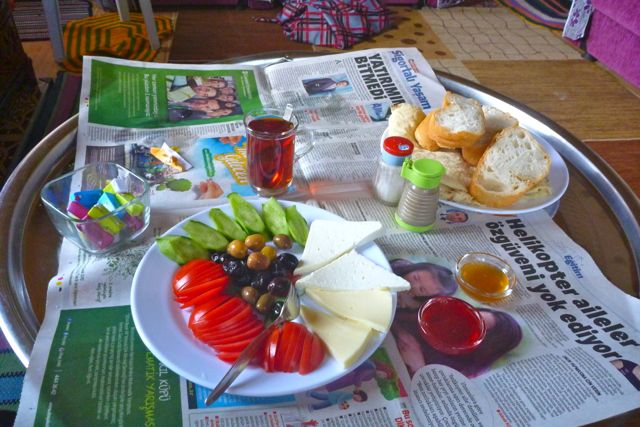
That was a 22-km day and at 75TL the rudimentary Gok pension was rather pricey, even if I got my money’s worth in food. The dishes kept coming that evening and next morning at breakfast too. But I was beginning to wonder if these Turkish brekkies (left): an egg, cucumber, tomato, bread and cheese – had enough calories for a day’s Lycian tramping with just soup and bread for lunch. A lot of the time I was worn out, though that could have been down to the terrain and not enough drinking too.
The sun had put its hat on next day. The route followed a trickling stream into a cool pine forest before rounding the north side of a mountain and turning back for the coast, with no villages on the way. The road became a jeep track blocked by landslides and ended in a clearing. According to a yellow signboard, I was 8 clicks from Gok with 16 to Çukurbag, but those signs were always overestimated. The book reckoned a total of 18, though it never spelt out distance clearly, preferring to give bafflingly overlong durations instead. Tip: on a walk distance is fixed, time is not. Anyway, however far it was, it was back onto rubble paths, winding uphill through shin-scratching scrub while leaning on the trusty packstaff. A couple of times the waymarks gave out and I staggered about to the four points of the compass trying to relocate the trail. The second time I got so fed up I dumped the pack and stomped back to check there was indeed a gap in the continuity, then bridged it with a bombproof line of cairns.
Lunchtime brought me out to a clearing at the broad pass. It was a relief to get away from the thorny scrub and rubble to which I was becoming a little phobic. My shins were scratched to buggery and over three weeks later the scabs are still healing. Cotton gaiters with shorts might not have been a bad combo for coolness and protection plus knee-drag-free agility.
Down in the valley the wind carried the shepherds’ cries across the hills. I was low on water as usual but near some sodden earth stopped and listened for the drip-drip of a nearby spring. I was becoming a regular Bear Grease. I tracked it down under a rock and pushed my cup through to enable a good feed with a hunk of bread I’d pinched from Gok’ pension.
That should have set me up for the afternoon, but as I’ve learned in the desert, it’s never over till it over. The day continued with another trawl between scant waymarks, logging operations obliterating the path and missing an important but discreet turn-off. Here I built another more conspicuous cairn chain and thought ‘That will do it!’ but on my way a few steps later saw someone had already done something near-identical. Problem is, looking for a pile of chalky white rocks perched on chalky white rubble requires x-ray specs. Next time I’ll come with a red spray can, as others have clearly done.
Compared to the early days, springs and cisterns were getting scant now and after the long trudge up to Phellos ridge I was hoping for a coffee break. But the only water here was a festering algeanous broth stewing inside the upturned lid or a tomb carved 2222 years ago (left).
Even then, deserted Phellos was a magical place, dramatically perched atop an 800-metre ridge looking north to the snowy Taurus mountains and south to the island-specked deniz, or sea. It seemed an unlikely place to build a settlement and as the guidebook suggested, was probably a lookout post or a religious site. That explained the many tombs.
I know limestone is relatively soft and all, but you do wonder how many weeks or months it took to quarry, carve, engrave and then position a free-standing Lycian tomb. A cubic metre of the rock weighs over two tons so you can work out what the tomb on the left would have weighed. Even if by the Lycian era stone carving was an established craft, it’s still quite staggering.
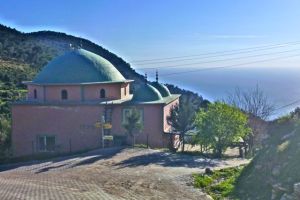
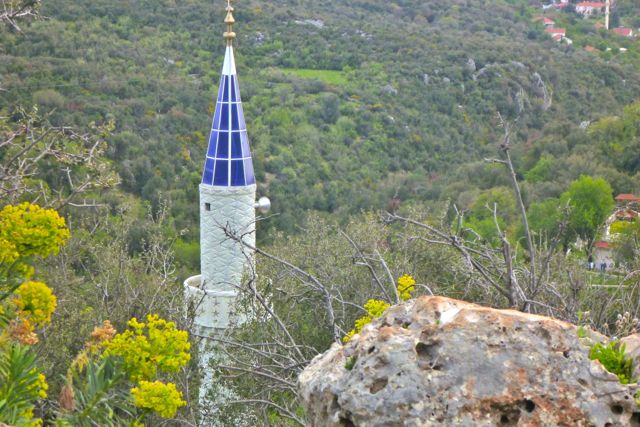
I was also staggering but in a wobbly legged kind of way. With a steep descent down to the village, I picked my way carefully, eventually passing the incongruous tip of Çukurbag mosque’s minaret (left), poking up like Thunderbird 5 ready for lift off. Once I reached it and with 18km under my hipbelt, I filled up my tank at the village spring then walked straight into the nearby Dere pension that looked like something out of a fairy tale. Sixty lira half-board and no questions asked; it was one of my favourites on the Way.
Today was a short walk – only 8 clicks down to Kaş resort where I planned a day off for maybe a bit of boating along the inviting shoreline. As a path neared the cliff a waypoint put me back on track until I reached an improbable 1000-foot drop which tumbled away towards Kaş’ terracotta roofs. It was another descent I really didn’t want to slip on but that actually turned out fine. After all, this has been a trade route for over two millennia, though I wouldn’t have wanted to be the postman taking the run from Antiphellos (modern-day Kaş) up to Phellos around Christmas time. Kaş felt a bit quainter to what little I saw of Kalkan – a tourist town rather than a colony of ex-pat villas. As the LP advised, Kaş is pronounced ‘cash’ so spend wisely: the same items in the Carrefour near the pension cost double in the cute café lined town square by the harbour.
Wandering around down here I picked up the 2014 edition of the Lycian Way and set about a forensic comparison with my 2009. My conclusion: while the design was a little less awful, I’d not be much better off with the text, while the redrawn map had thrown a few babies out with the bathwater. Seventy lira down and more weight to carry; I didn’t bother referring to it again. Kaş shore seemed a little exposed to the westerlies so instead of going on a rather pointless there-and-back paddle I got stuck into my holiday read, some interneting and gorging.
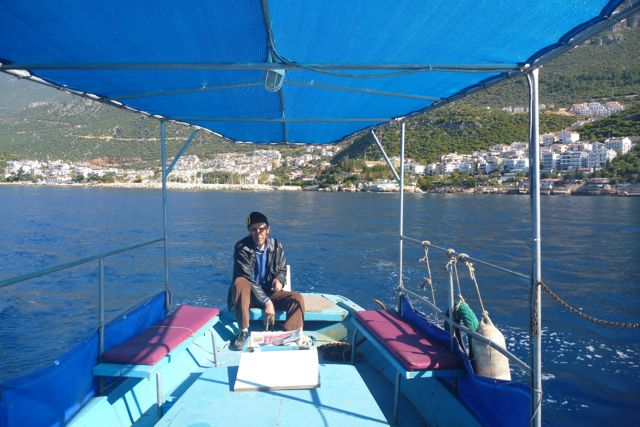
Next day I should have aired up and paddled the three kilometres from the harbour over to Limazi but I was feeling paradoxically lethargic, as you can do after a day spent eating but not moving. Plus the day was getting on and was set to be a warm one – up to 24°C. So when no one was looking I impulsively blew 50 lira on a solo boat ride to Limazi (left, normally 10L). It certainly was agreeable to glide across the bay at four knots with the thud of a marine diesel at my back and the slap of the swell against the bow.
Later on I was glad I’d done this as the walk to Bogaçik turned into a tough old day, much of it on gnarly sloping rubble, rock and scrub and, as the book warned, with meagre water resources. The coastal route was listed as ‘16km’ in the old edition but less than 10k in the current one – another typo I assumed. One panel on the newer map even has north pointing the wrong way! As someone on a forum observed, what this book needs is the attention of a proper guidebook publisher, but if that hasn’t happened yet it’s not likely to as in the face of apps and GPS, the era of paper guidebooks is in decline.
A full day of this walking can take it out of you and even with now doubled water reserves, a cistern out of Limazi and extra water at Fakdere Mevki Bay over lunch, 4 or 5km on at the bay opposite Kormen island (car accessible but a great camp spot) I was all out. I calculated my chances of doing the last two hours on spit, but decided that was a bad idea so set of to walk up the track to a house until I spotted a couple of taps by some newly built toilets. That will do nicely. I knocked back a pint, filled up two more with Zero tabs – my lifeline – and set off for what looked like two kms to a GPS waypoint where the track turned inland and uphill for Bogaçik.
Halfway up that hill a shepherds’ camp blocked the path – or should I say a shepherd’s snarling guard dog forced me to make a wide detour back into the shrubbery. I learned later that these kangal dogs (left) are amongst the most powerful in the world, bred up in Roman times from something called a ‘molussus’ to guard against wolves and bears. I really didn’t want to take a chance provoking these black-mouthed monsters; they’d have made short work of my packstaff and probably spat any hurled rocks right back in my face. Stick ‘kangal’ into youtube and you can enjoy a variety of forthright viewers’ commentary along the lines of ‘my kangal would fuck your pitbull up the ass’.
With help from the GPS I re-found the track further up, just as it left a perfectly negotiable jeep track to stumble through an ill-marked, ankle-twisting rock garden to eventually rejoin the track and the road to the Bogaçik pension by the mosque (left). It could have been me but there was a bit of an odd vibe here. No chai was offered – instead I was led into a spare room, told to close the curtains and take a shower then summoned upstairs for dinner. Today was 16km plus 3 on the boat.
It was warm again next day but my overnight laundry was drenched with dew. Still, I wasn’t too bothered as this day would surely end with a long-for paddle! I set off with Tyrone, a Canadian guy who’d run out of daylight trying to get to the pension last night so camped among the kangals and came in for breakfast. A lot of chattering saw us lose the way until we turned back and followed the Germans. They all had the yellow pocket guide and never put a foot wrong.
Down by a lagoon near the scattered tombs of Aperlae (left), the Purple House pension was a groovy, chilled-out spot for a lunch break (below left). It was spoiled only by the owner claiming his gushing spring water was undrinkable, that it was three hours to the next water but hey, he had 1.5 litre-bottled for 5L a shot. Only the last bit was probably true but this has been the wayfarer’s burden ever since weary Silk Road traders stumbled upon a remote caravanserai – or indeed service areas sprung up alongside motorways.
There was water 20 minutes away at the next lagoon. I could have put in here but it would have meant rolling up for a one-km portage to the final lagoon into Uçagiz. So I stuck it out on the trail with Tyrone and some Belgian women I’d been running into over the last few days. We talked about the fearsome dogs we’d encountered: she’d been bitten by a town dog (as was I in Myra next day) and had taken a day out for a rabies shot, even though it’s not been known here for decades. Tyrone too had had a close call with a snarling kangal. The Myra dog that went for me came out of nowhere as I rounded a corner. Maybe these dumb mutts can sense that I don’t feel the same way about dogs as I do about tomatoes.
The Belges didn’t need a packraft to set a cracking pace on the LW, camping all the way. Part of me envied them that freedom and adventure. I was equipped and had planned to do the same some of the time, but for fifteen quid half-board, I really enjoyed the cushy pensioner’s life: rinse my salt-caked clothes while having a shower, get fed then get some reading in before flaking out. Perhaps two-up the camp chores are more manageable but come the evening I know I can’t carry enough food to stave my appetite.
The time had come to deploy my underused secret weapon and despite a messy put-in across tidal mud (left), it was of course divine to be afloat again, paddle in hand. I wasn’t racing but it was nippy too. Even with their head start I covered the couple of clicks to Uçagiz harbour ahead of the others. As I arrived a young German girl from last night’s pension was bathing her sore feet off the quay. ‘That’s a good idea’ said her partner, eyeing up my boat. That will be 16 clicks please, plus 3 for the boat. Sorry, I got no change.
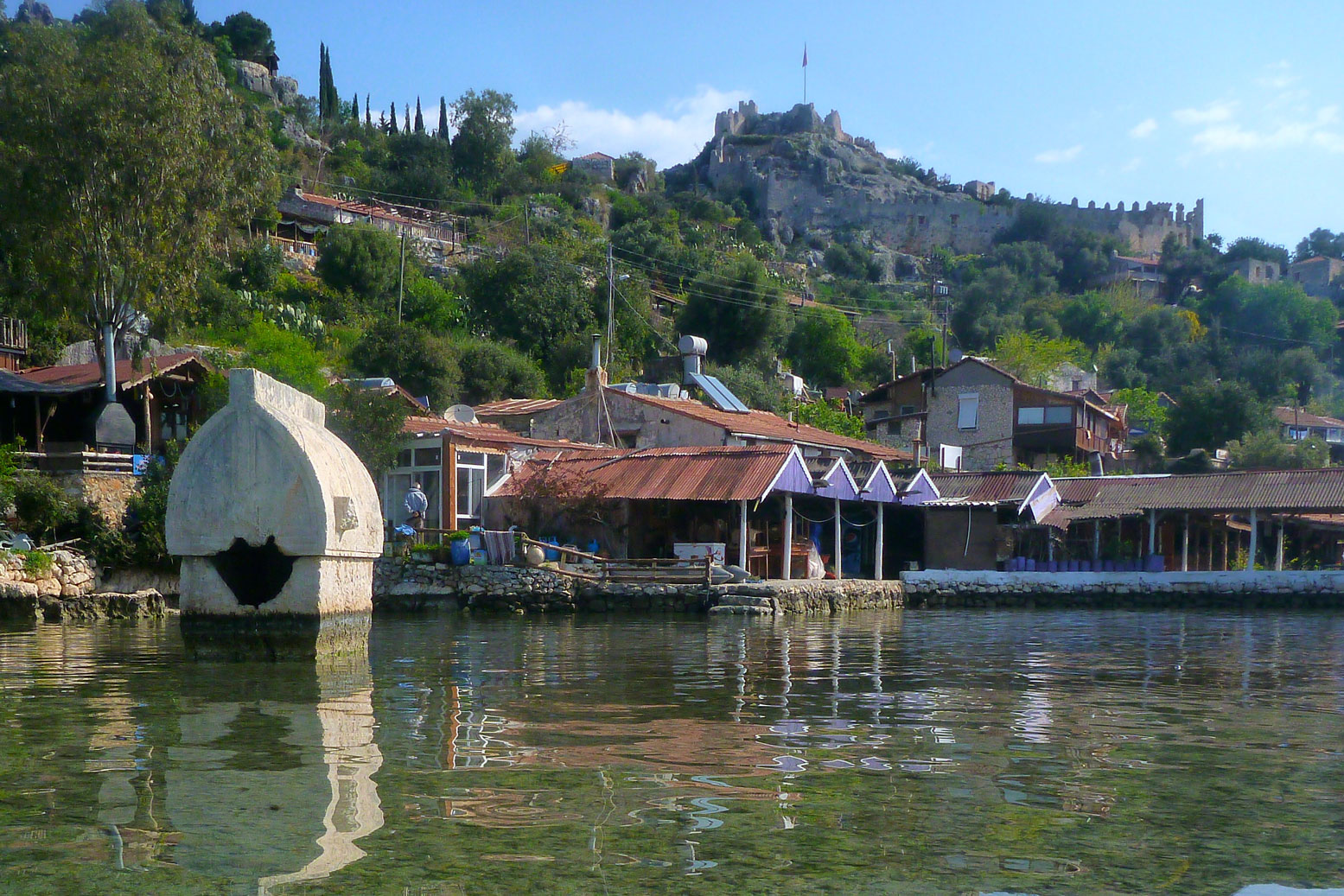
I looked out across the mouth of the lagoon next morning and decided I could surely paddle out to unseen Simena / Kaleköy and pick up the LW from near there. Now this was a much better way to start the day! I was so excited I forgot to pay my respects to the nearby ruins of Teimiussa, Out in the lagoon small islands showed evidence of other ancient buildings and bobbing into the harbour of Kaleköy, I passed the well-known sunken tomb.
Off the island opposite is the famous sunken city of Kekova, the consequence of an earthquake dropping the whole coast a few feet. But a guy in Kaş advised me that Kekova wasn’t quite the underwater Atlantis it was made out to be. Scuttling round to Kaleköy harbour past million-dollar boats with black-out windows, I clambered onto a rude concrete pier, aired down the Yak then helped some locals heave a refurbished skiff back into the water (left) before heading up to the hilltop castle.
This could be my last day on the trail as the next stage was a 32-km walk inland up to 1800m and back down to Finike. Most did it with two-nights wild camping, but I only had one day to spare before needing to head back to Dalaman airport and from a transport point of view it made sense to wind it up in Demre.
The trail that day provided pleasant interludes through wildflower pastures but by the afternoon reverted to the gnarly, toe-snagging coastal terrain. Another shepherd’s camp and more rabid kangals with barks that made your hair stand on end. Out of water, I had to hang half into a well to just reach the water with my bottle strapped to my packstaff hanging from my fingertips (left). Like the book suggested, organise a handy cup or bucket on a string. Just ahead was a stray cove of white stones backed by an olive grove and an empty shack. With the handy water nearby, I contemplated an early cut and a camp. I eased over the barbed wire and rested a bit in the grass while mozzies whined at me, but thunder was rumbling up in the hills and without a tent I was equipped for neither rain nor tormenting insects.
So I got back on the trail and followed the coast eastwards, at one point tripping and pressing my week-old knee wound into the rock. Well, I suppose the surge of adrenaline gave me the handy boost I needed. Presently I dropped down to a rickety bridge over a beachside stream (left) and a hermit in a nearby shack invited me in for a coffee just as the storm let go. Great timing and he was a nice guy, a crustacean diver still in the game but estranged from his family after doing 21 months inside. I didn’t ask what for – abalone poaching? – but his coffee and good company hit the mark as the rain hammered against his plastic-sheeted cabin. Once the shower passed I moved on across the beach to the old harbour of Kale, now a marina and boat yard for tourist boats doing the famous Blue Cruises.
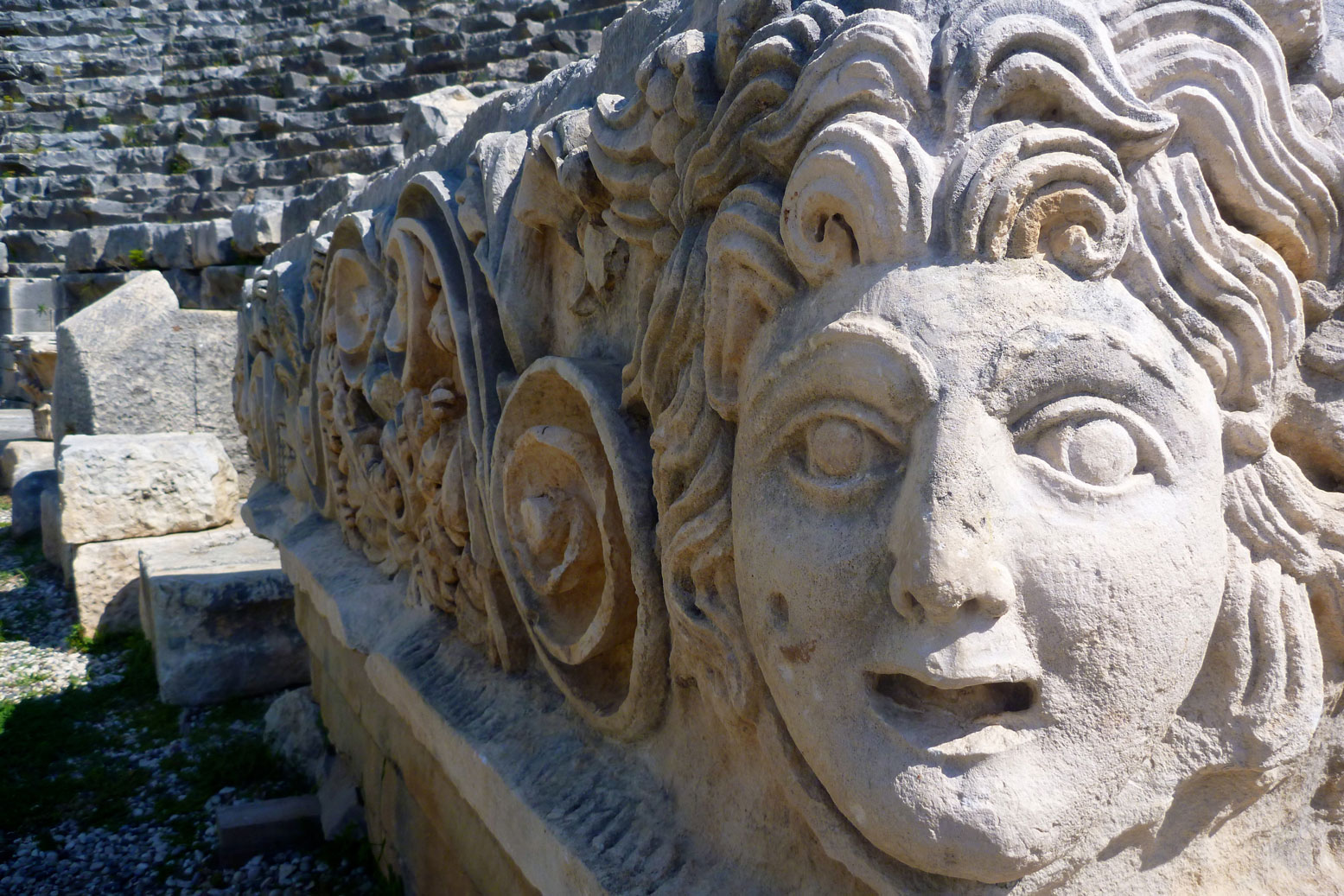
The guy advised there was a pension near the Myra ruins in Demre town, about seven clicks road walking making about 21 with 2 in the boat. I spent two nights here, taking a morning to explore magnificent Myra’s carvings, theatre and cliff-bound rock tombs. It was one of the most impressive sites so far, even if the approach was a minefield of Myra-themed souvenirs and overpriced snacks. Round the corner at a roadside fruit-picker’s snack shack, drinks were a fraction of the price and the welcome far more genuine. There were more rock tombs round the hillside: the so-called River Necropolis set behind some orange groves. Few come here as it’s a bit of scramble to reach them, but I did and so signed off my Lycian trek.
•
Knowing what I know now, with better preparation I could have done a bit more sea paddling. As it was I failed to get into the rhythm of this walk in my 12 days on the trail; probably a combination of equipment, terrain and mindset. But I did lose 3 kilos! The windy Patara beach day was just bad luck, but without proper maps or forecasts, scuttling solo between remote coves and around headlands felt too risky. With company it would have been another matter and paddling some sections – like into Kalkan, out of Kas and Sidema to Andriake/Kale certainly would have been a whole lot more fun than walking on a calm day. Had I appreciated that the book’s map and my GPS’s OSM display were inadequate I’d have lugged my MacAir to view the OSMs full detail on Base Camp, or printed sections along with Google sat images in advance, but that’s how it is first time in a new place: coulda; shoulda; woulda… But the fact is, unlike a kayak (even an IK) or with no boat at all, the great thing with a packraft is that it gives you the option to walk when you must or want – and to paddle when you can or dare.
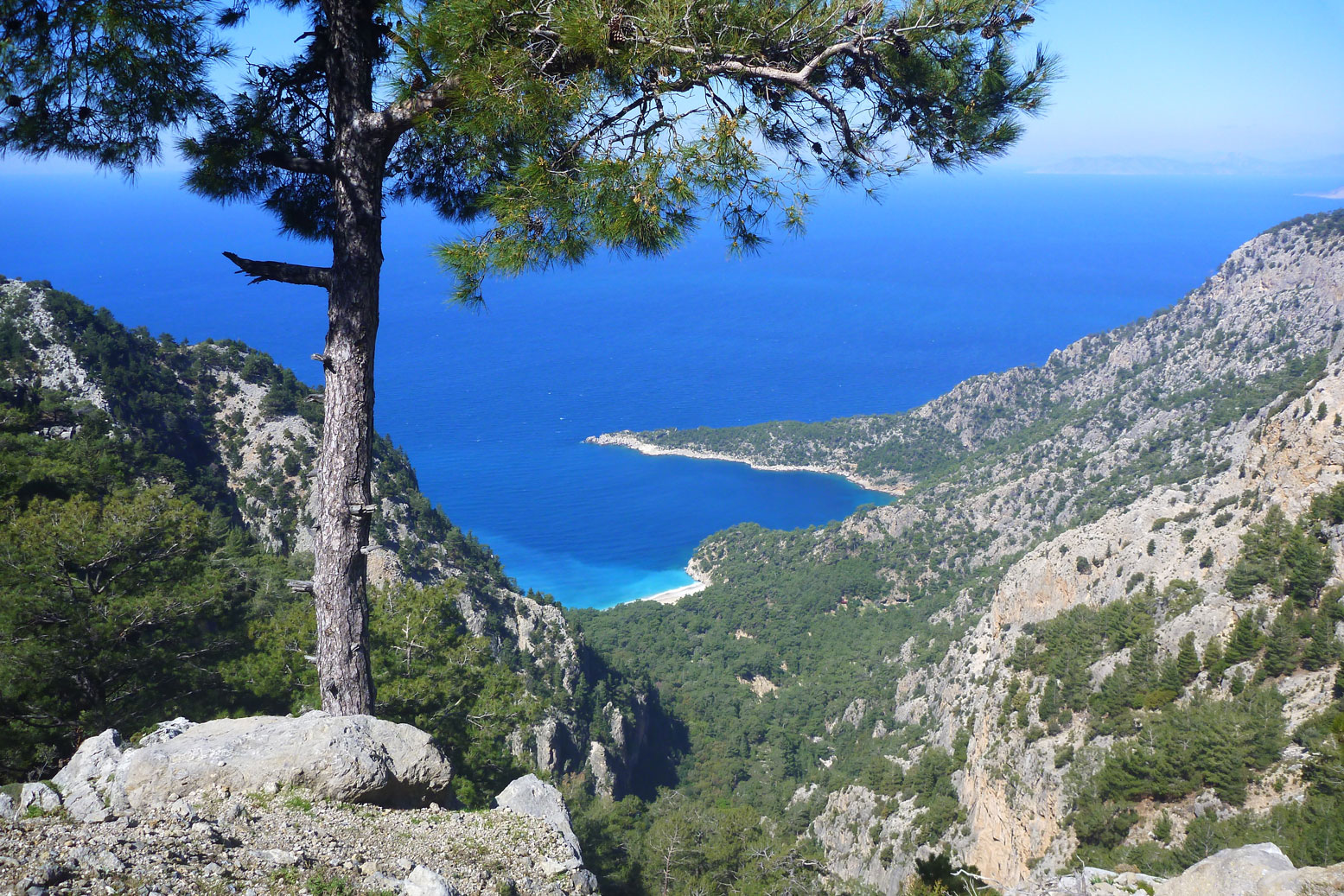
The Lycian Way is a 450-km path in southwest Turkey between the towns of Fethiye and Antalya in the east. Established in 1999, it links a network of paths and tracks along the coast and through the adjacent mountains, passing sites of ancient Lycia.
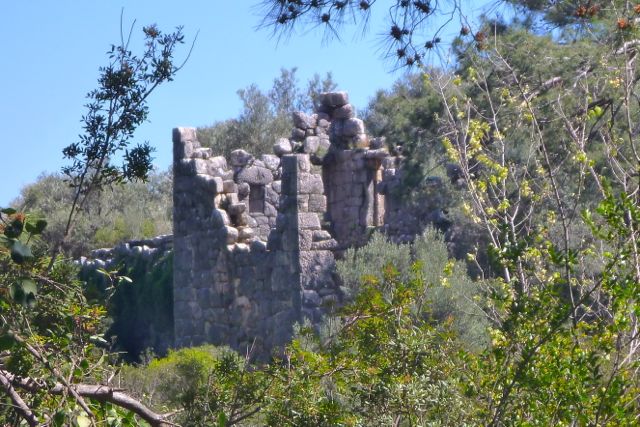
Along with encountering rural Turkish culture, the agreeable Mediterranean backdrop and the springtime wildflowers, it’s these fascinating ruins that set the Lycian Way apart from most other long-distance walks. Turkey has no shortage of impressive historical sites of course, but on the Teke peninsula where Lycia flourshed from 500BC there’s a particular concentration of such monuments. Some, like the huge complex of Myra (above left) are fully-fledged tourists sites with entrance fees. Others, like tiny mysterious Sidyma (right) or Phellos poke out from the scrub high on a ridge and are all the more atmospheric for being virtually unvisited.
At times you’ll find yourself literally walking over the jumbled rubble of some long collapsed temple (left), along a clay-lined Roman aqueduct or up a steep cliff path that’s been a trade route for millennia. These’s nothing that significant about the obscure Lycians – a mini-state that in turn fell under the influence of the Greeks, Persians and Romans over the centuries before fading away as more recent empires made their mark. But one of their legacies are their distinctive rock-carved tombs which dot the landscape, alone or in clusters, along the entire walk and survive in the most unexpected places (right).
Looking at the intricate topography of the coast I figured it might be worth carrying the 3.5-kilo penalty of my packraft and paddle blades, even though I knew I’d walk at least 90% of the time. I didn’t expect to finish the entire walk in two weeks either, but was sure my feet, legs and shoulders would enjoy the odd respite on the water.
Note that the information that follows is only based on me doing the first half of the walk.
Guidebooks and Maps A local ex-pat Kate Clow conceived the original walk in the 90s and wrote a guidebook, now in its 4th (2014) edition. I used the 3rd (2009) edition bought years ago and anticipating dealing with out-dated info. The guidebook includes a tear-out colour map that unfolds to show four panels covering the route. They produce an iPhone app too with an all-important tracklog, and you can get a few hundred free waypoints if you can prove you bought the book.
Out of curiosity and with some hope, I picked up the 4th edition a few days into the walk. As a historical guide to the ruins and their context it’s very good, but as a practical walking guide and despite four editions and some 15 years in print, frustration with the Lycian Way book was a common complaint among walkers. There’s a German guidebook (above right; I heard no complaints from users) and I was told of the Trekright app which you can read about here or buy here. I don’t use iPhones but one walker who used both apps said the Trekright app was ‘…the best $5 I ever spent’. There’s a very good summary of the walk from 2011 (the whole thing in 17 days!) on BPL. And this is another website of a couple who walked the walk and give lots of good info.
TOther than that you can download OSM mapping and try to install it into your device or GPS. I did that but all I could see on my Garmin 60CSX was a not so useful mass of contours behind the imported waypoints – no path or other detail which showed up on Garmin Base Camp on my Macbook (screengrab, left). Maybe my Garmin can’t handle all the detail or I did something wrong. I also tried to load a 2011’ tracklog into my GPS (see link below). That may have worked but I deleted it by mistake. A tracklog (‘breadcrumb trail’ or a continuous line displayed – no points to aim for) would almost make it too easy. But while 90% of the time the red and white waymarks (below left) are all you need, there are times when you’re lost and either hot/cold, tired/aching, fed up or perched on an exposed and loose slope where you just want to get back on track.
Routefinding The route gets modified from time to time as new roads get built or areas get logged, but despite a warning I was given, old waymarks remain so there must now be a few variations. The route often seeks out parallel side paths to a road or car track, even if these roads see just a few vehicles an hour. At times it’s an agreeable diversion, elsewhere it becomes a pointless and frustrating blunder up some river bed that you hope will work itself out. While I’d prefer to wind along grassy, flower-lined paths bedecked with fluttering butterflies, I don’t mind tramping along a jeep track or quiet road once in a while. If nothing else it gives you a break from concentrating relentlessly on where to place each step.
The lazy depiction of the official guide’s edition 3 trail map (left) made it hit and miss as a route-finding aid. Accuracy and orientation is improved on the 4th edition map (below left) but along with some clutter this map drops a lot of detail showing springs, wells and other water sources along the trail so overall it’s actually worse. Without the GPS waypoints in places I’d have struggled to follow or re-find the track.
In terms of route finding, this was my order of usefulness:
Red and white waymarkers, where present
Cairns – often built when waymarks missing
Waypoints in the GPS
Guidebook map (edn 3)
Winging it cross-country in a likely direction
Yellow signposts (infrequent, irregular and with inaccurate distances)
Ask other people (where present)
Guidebook (it was often impossible to interpret what you’d just walked)
We all agreed that, as with many guidebooks or poorly marked walks, after a few days of occasional blundering you develop a sense of the path’s logic even when the map is vague and the book is baffling. This lack of faith in the book, the map, the waymarking as well as the unnecessarily tiresome or boring route choices can encourage you to take short cuts or even bus rides or trailblaze your own Lycian Way. I doubt any two walkers follow exactly the same route but eventually we all got to where we were going – just not without occasional frustration.
Terrain Just about the whole walk is on limestone and much of the path is on narrow limestone-rubble mule tracks hemmed in by thorny Mediterranean scrub with occasional clambering over bedrock. And when I say hemmed in I mean at times a few inches apart meaning you or your clothing will get scratched and poked and snagged. As maintaining the vegetation let alone anything else on a 500-km path is a major task, you just have to get used to it.
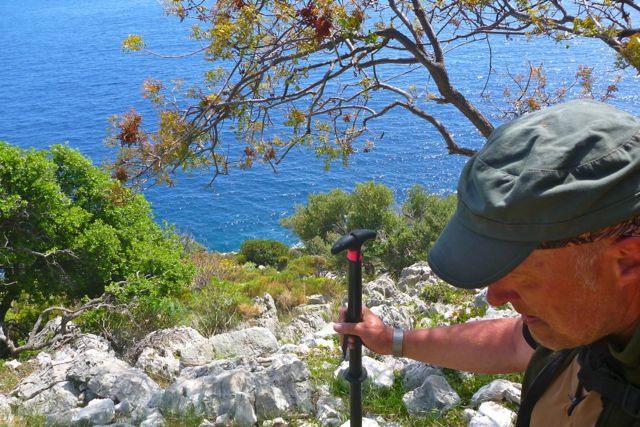
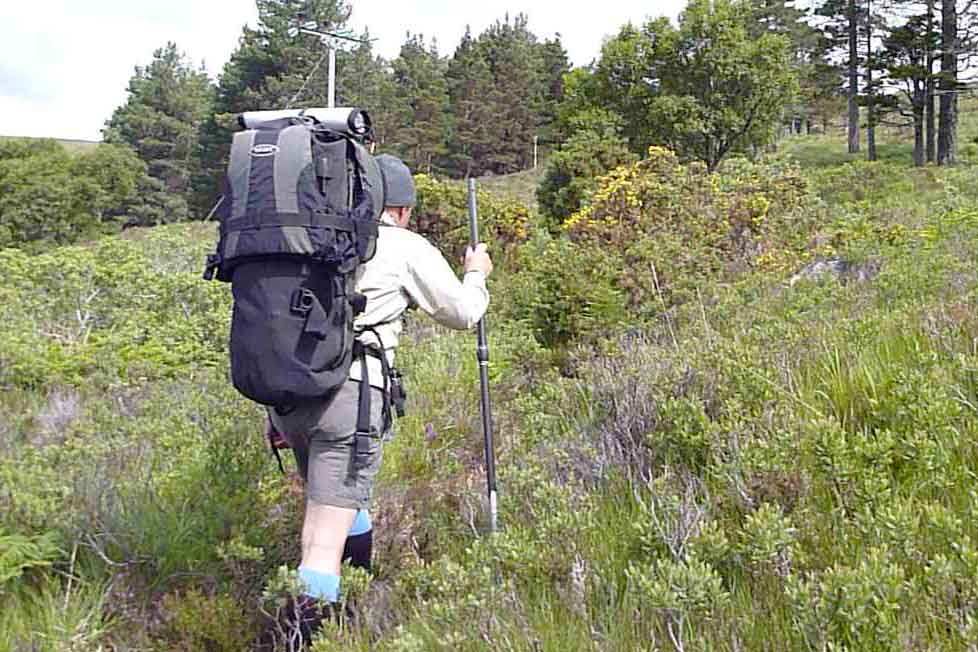
The Lycian Way is not a walk in the park and is most taxing when negotiating an incline on a steep coastal side slope while tramping on loose rubble or sharply weather bedrock as thorny bushes torment you from head to toe and the drop to the sea focuses the mind. I was very glad of my packstaff (below right) and the boots I chose for this walk with thick shoes that were immune to what lay underfoot. Other walkers I met were suffering or even taking days out to seek out more rugged footwear. Elsewhere the route follows jeep tracks or dirt roads (right), quiet backroads and very occasionally and briefly, main roads. And sometimes there’s no discernible path at all (right) but in these places the waymarking is usually very good or you’re lost.
Paddling In a kayak it would be different, but at sea passing sometimes remote rocky shores and exposed headlands alone in a packraft was a bit intimidating. Mediterranean tides are minimal, currents – who knows – but the prevailing westerlies and afternoon sea breeze limited my choices to either sheltered lagoons or being able to easily get ashore onto a beach if the wind got up. With hindsight I now see where I could have paddled more had I been braver or had access to a reliable inshore forecast.
Accommodation Pensions offering half board (if there’s no resto option nearby) have cropped up in all the villages along the route in response to the Lycia Way’s popularity. Apart from the first night near the airport I never booked, never knew exactly where I might stay (often just one place in a village) but never had trouble getting a bed nor had to share a room. And there were many more walkers on the Lycian Way than I expected – some doing two-week’s worth like me, others doing sections between bus rides and a few going all the way and beyond. Pension prices ranged from 50L half board in a tiny room in Bel, up to 99TL in an inadvertently nice place in Uçagiz.
Besides a shower and a comfy bed, for me one of the big attractions of pensioning as opposed to wild camping (left – easy, providing you had water) was the fresh food. If it’s there I’m happy to use it and pay for it and as I only carried a sleeping bag, mat and a stove, the weight penalty wasn’t too drastic. At a couple of points alone the official route (just after I finished in Demre) there’s no accommodation up the mountain and you have to wild camp for at least one night. Along with help with lodgings in bigger towns and guidelines on transport, I downloaded and printed the Lonely Planet Antalya chapter. Well worth £3 and some ink.
Getting there and local transport I flew with EasyJet from Gatwick to Dalaman where, if I’d been smarter I could have hopped onto a bus direct to Fethiye which is a resort. But my plane arrived late, I had a local hotel booked and I’m not sure the Fethiye buses were still running. From Fethiye a 20-minute dolmus ride up to the pass before Olu Deniz cost 50p. At the end of the walk, from Demre I covered the 200-odd kms back Dalaman with changes in Kas and Fethiye over four hours and for about 25L. It was all very easy as most people outside of the villages spoke English. Locally, where there’s nothing, hitching is a viable alternative. Dolmus are local minibuses covering short village-to-town routes and modern air-con coaches cover longer routes at about 20p or less a kilometre.
Food and Water As mentioned, early on there were plenty of gushing springs by the track possibly fed by the still snowy mountains not far inland. After Kalkan springs got fewer and wells and cisterns became spaced out (as did I for lack of water). I didn’t filter my water – most of it is as natural as it comes. At lower elevations in the intensively agricultural areas I may have thought twice or used a tap. The big towns every few days have all the shops you need (with saliva-inducing Carrefours in most places) but village shops were disappointing, selling mostly long life stuff like cakes, biscuits and crisps plus maybe bread and cheese and spam-like sausage. What they lack is fresh fruit and veg. In rural Turkey most people grow their own.
Costs I averaged about 100TL a day over 18 days, pension-ing all but one night. That’s about £27, mostly on the half-board pensions. ATMs are surprisingly plentiful from the moment you land to the bigger towns. It’s possible to pay in Euros at some pensions.
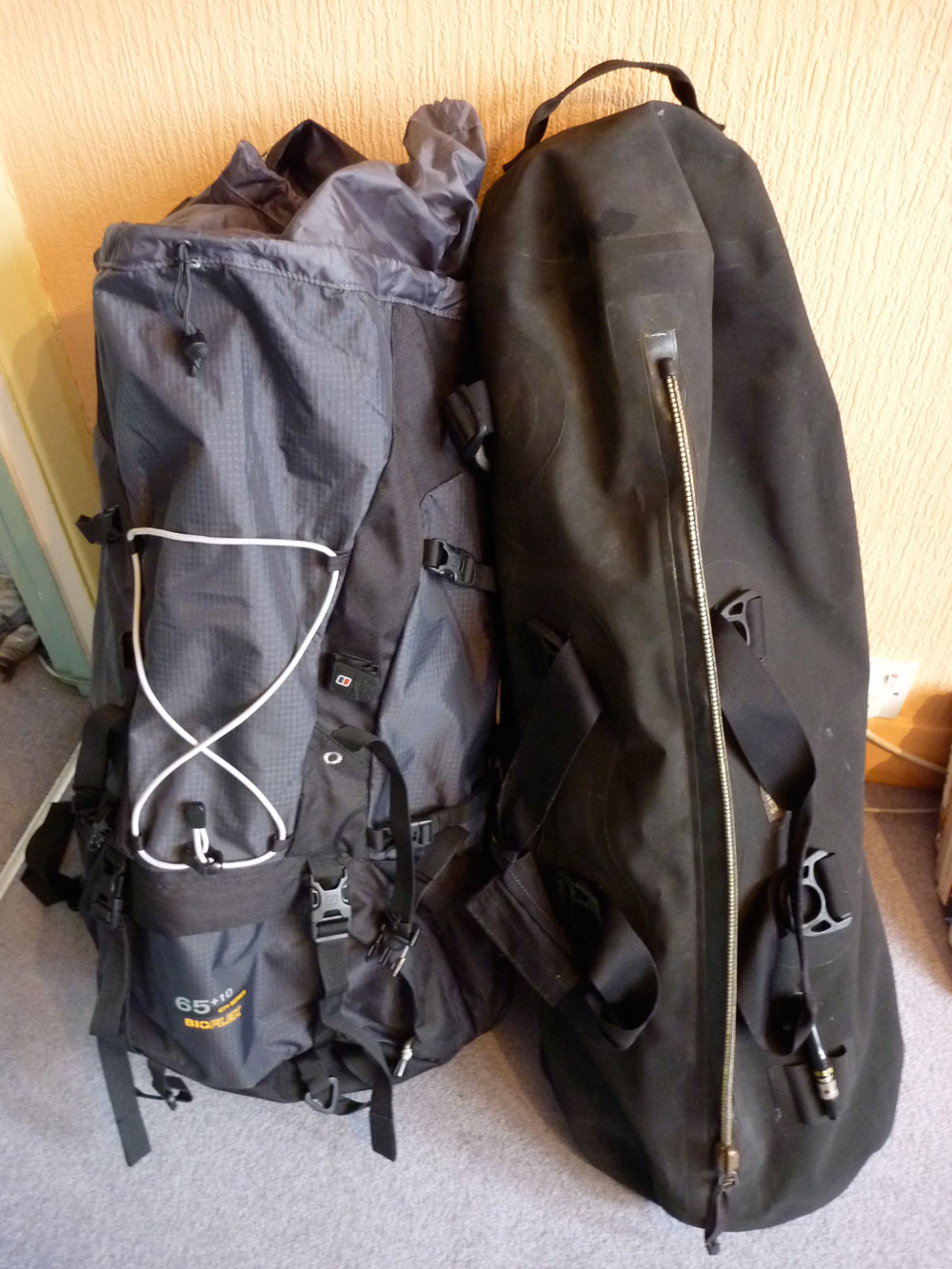
Size (fully ‘inflated’) 90cm long x 38cm wide. Circumference 120cm
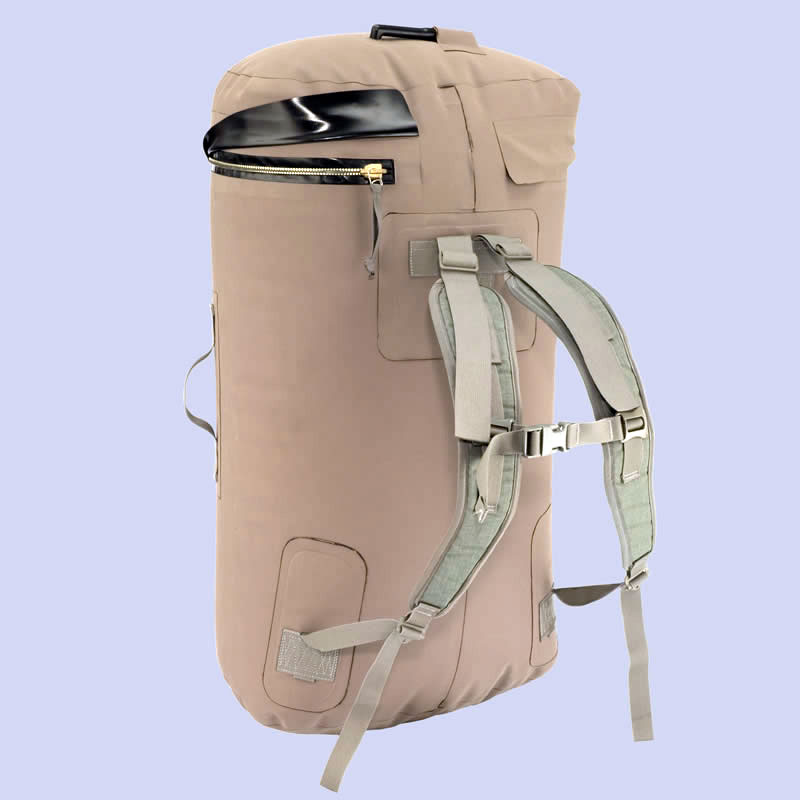
Features Grab handles at each end; holdall handles; basic backpack harness; small zipped mesh inside pocket; one-way inflation/purge valve
Fabric: Don’t know exactly, a tough, abrasion-proof nylon fabric with a glossy coating on the inside
Cost About £120 in 2011. No longer made
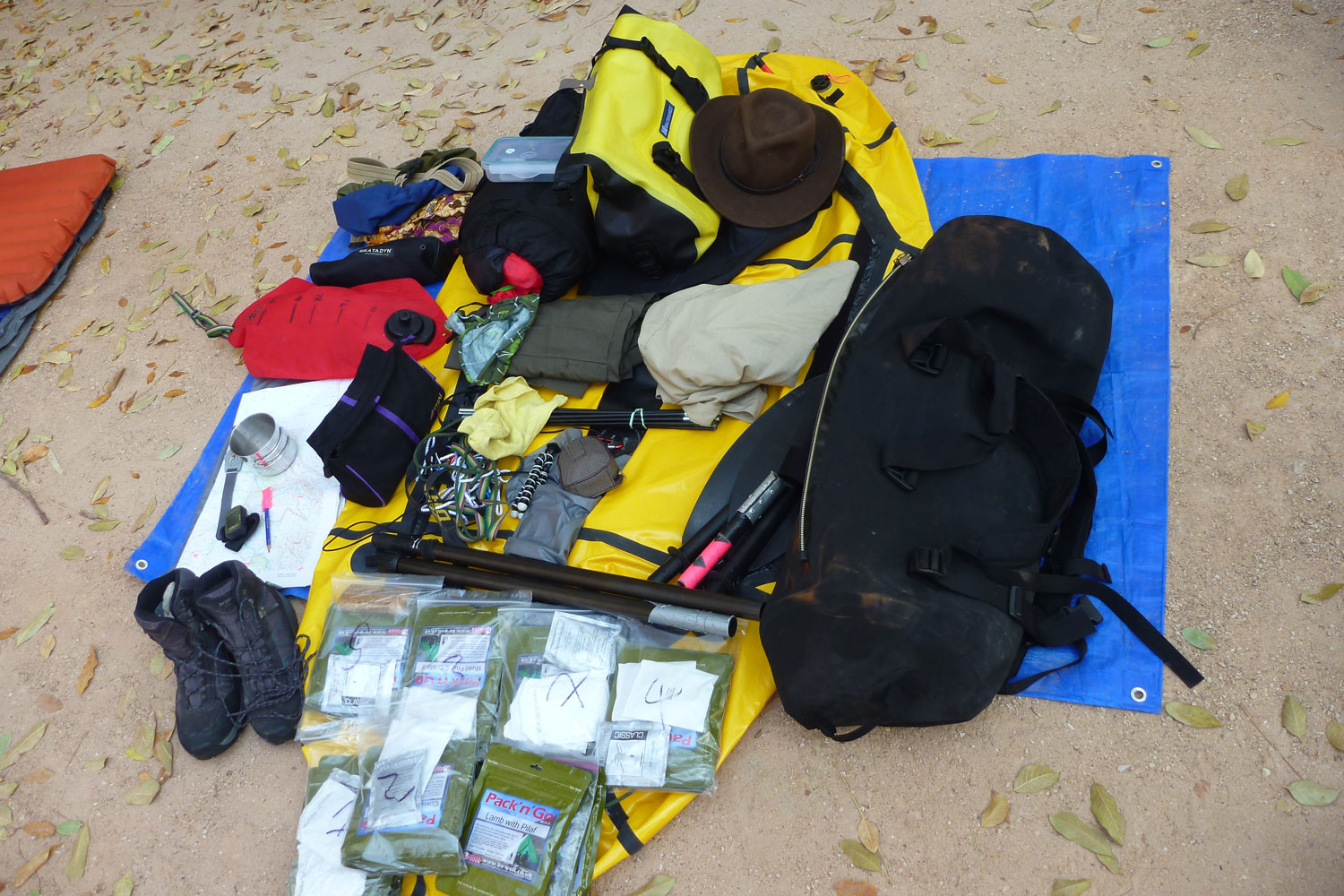
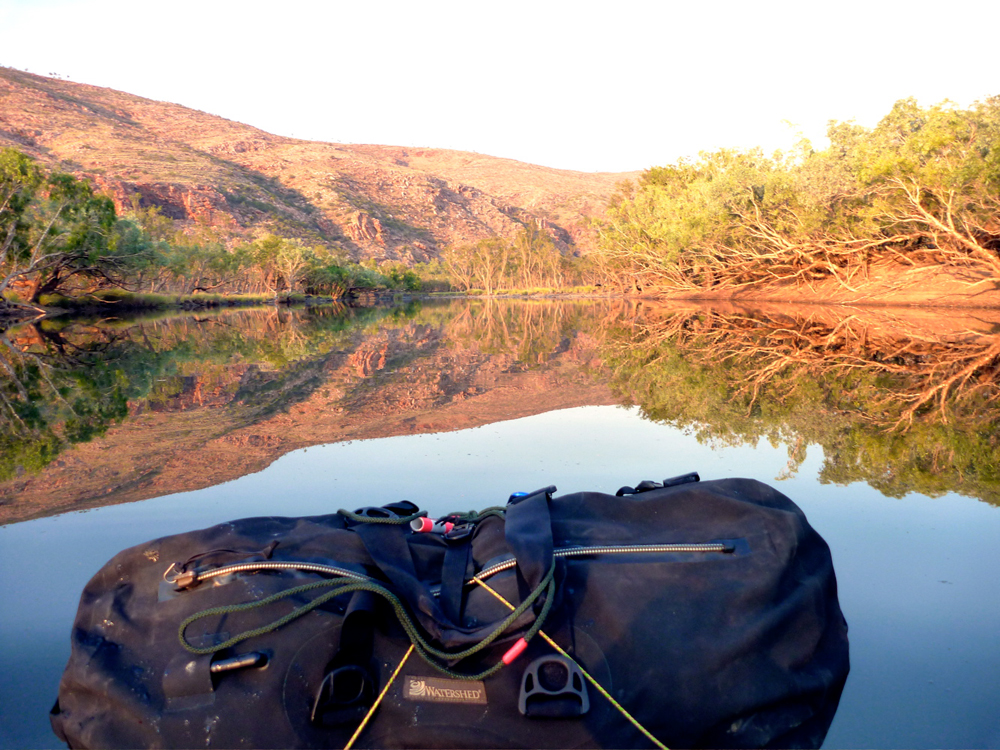
I’ve been using this big holdall for ten years on kayak and packraft trips in France, Australia, Turkey, the US and in the UK, as well as a side bag on my motorbike. As it’s among my favourites it gets its own page. ‘One dry bag to rule them all’ I wrote back then and my UDB still ticks that box. Your typical roll-top dry bags aren’t submersion proof, yet in paddle sports submersion is a likely scenario. Using roll-tops I found myself packing drybags inside dry bags to keep important things like clothes and down bags dry. With the UBD you can just chuck it in and zip it up.
Initially, I tried using the UDB as a backpack (left) but, like trying to do that with any holdall, it’s only a short term solution that puts a huge strain on your shoulders. Plus I found the harness was poorly positioned so the pack sat high on my back, further increasing the centre of gravity, but running the shoulder straps loose (as left) didn’t work either. It became clear the included harness was not intended for anything more than short hauls. What was needed was a frame of some sort, or a better harness. You can read a summary of my experiments here. In the end the NRS Paragon pack harness and later Six Moons suited my needs best.
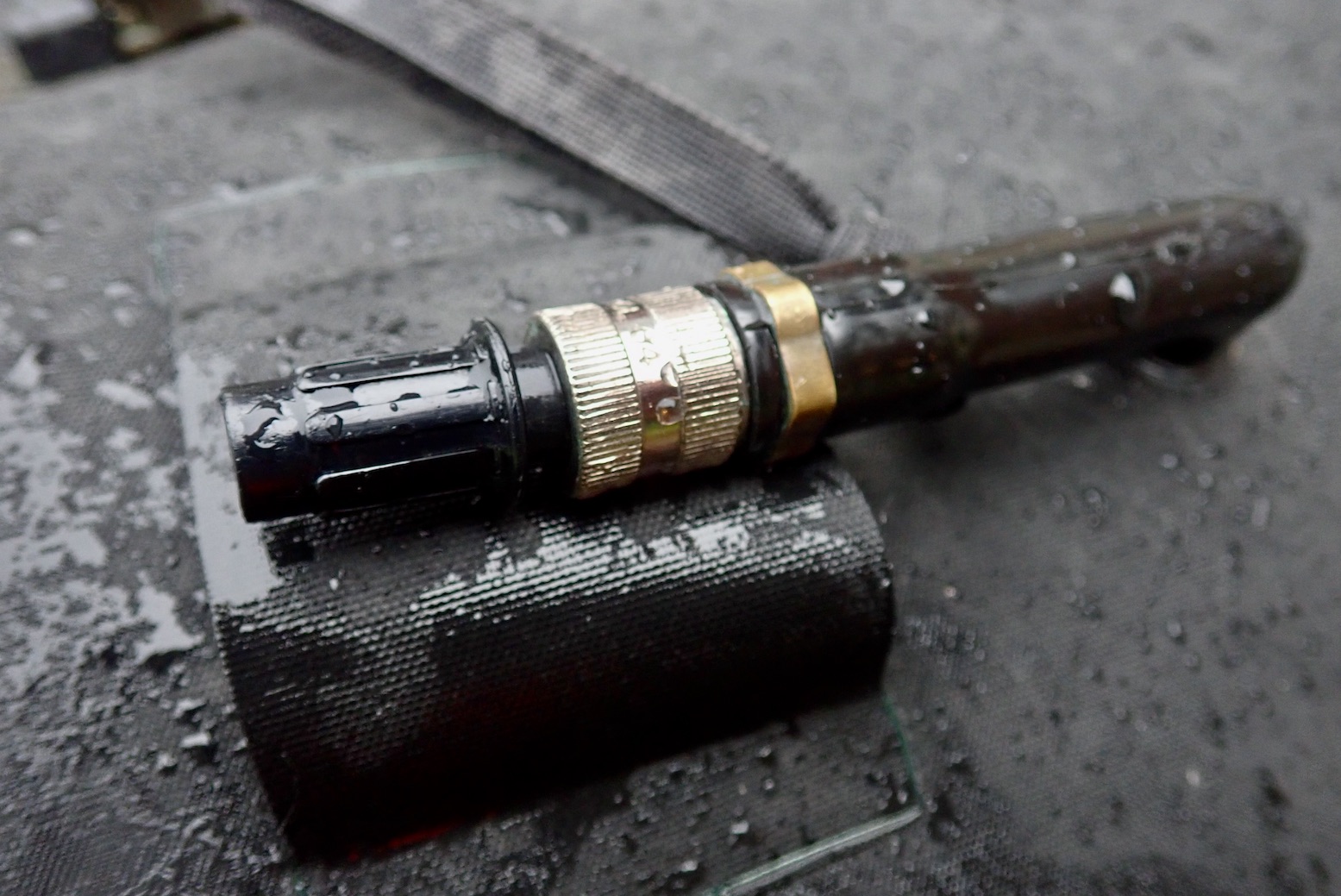
What I like about my UDB is that it’s a simple, rugged and basic big-ass bag with handy handles and a reliably submersion-proof closure. There are no gimmicks unless you count the purge valve. On the water it eliminates any worries about stuff getting wet and of course it’s something to hold on to if your boat get shot out from under you by a dozy spearfisherman.
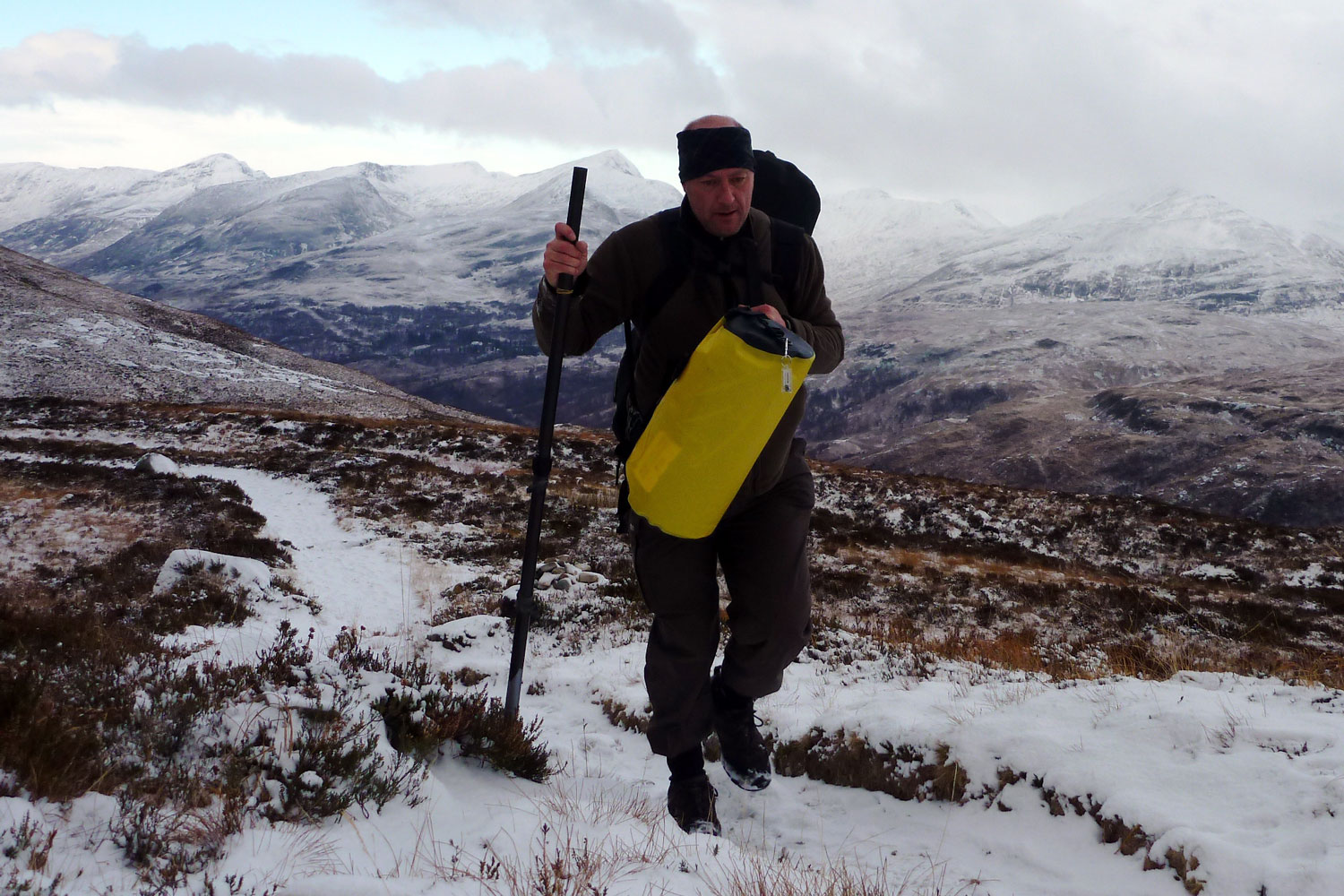
Watershed still make bags with drysuit zips – see the gallery below or the website. But they’re either huge or or are priced for military procurement departments only. I also used Watershed’s 80-litre Westwater (above – more like 70L) for packrafting day trips, but pushed it a bit hard on one cross-country MTB ride which ripped out one of the strap fixtures.
Like their handy 30-litre Chattooga day holdall (left, yellow), the Westwater has their slick watershedding fabric which is tough for sure but less agreeable or grippy when pressed against your back all day. And like the UDB the straps have the legal minimum paddling (though are easily replaced). Both use their chunky giant fold-over zip-lock closure which I’m sure works as well as a drysuit zip. But if it had to be one bag it’s my UDB – ‘One dry bag to rule them all’.
What more is there to say about the Watershed UDB? How about that in 2019 I adapted it with a cheap, chopped-down lightweight, big-wheeled folding trolley (right) from previous packboating trips to carry my packraft to Australia and New Zealand. With zip ties and straps, the trolley frame lashed securely to the rugged UDB’s harness tabs and I could roll it with the top handle. It weighed in at 2.7kg. Interestingly, the rigidity provided by the UDB once fully inflated (as above) helped make it more comfortable to wheel and less of a sack on wheels. But one thing I did notice is that without a full-length telescopic metal frame the set up tends to bob up and down annoyingly as you walk.
The thinking was that once packrafting a river for a few days (I never made it), the UDB trolley would still be more compact than a regular wheeled travel bag, while enabling wheeling along paths and long gravel roads to get to the river. It was all an attempt at not blithely splashing out the huge but pricey Ortlieb Duffle RS 140 (left) which I’d been eyeing up. A few months later I eventually did buy a used RS140 for the Seawave but can still see plenty of years use in the UDB.
Update 2022: Using it in Morocco as a general holdall I noticed a separated seam where the body fabric attached to the zip, with another lifting a bit nearby. An easy repair with Aquaseal one-part sealant.
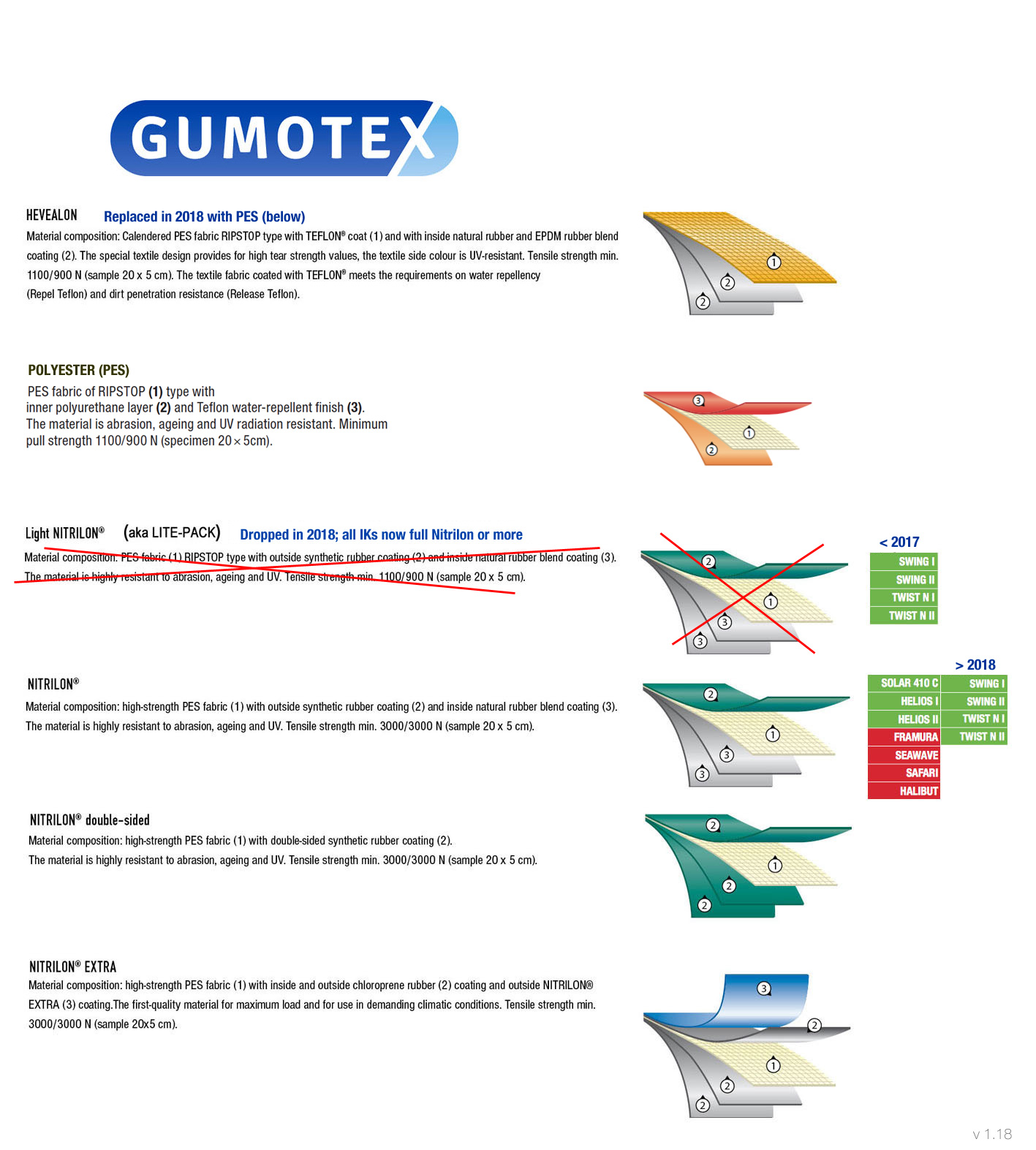
News of the new 3psi/ 0.2bar Gumotex Twists made of slicker, full-coat Nitrilon Light came out in 2015. Then in 2017 they dropped that fabric and returned to regular Nitrilon. Weights went up, so did the price, but the boats ought be bombproof which you could not say for the original models. (But see below). The 3.60-metre x 83cm T2 double now goes for around £500 and weighs 13kg. The 2.6-metre x 79cm T1 (green, left) costs £400 and weighs 9kg. This >2018 model should have three pairs of D-ring seat mounts on the hull top.Now with the slick fabric coated on both inside and out, the boat ought to be tougher and will certainly be much quicker drying.
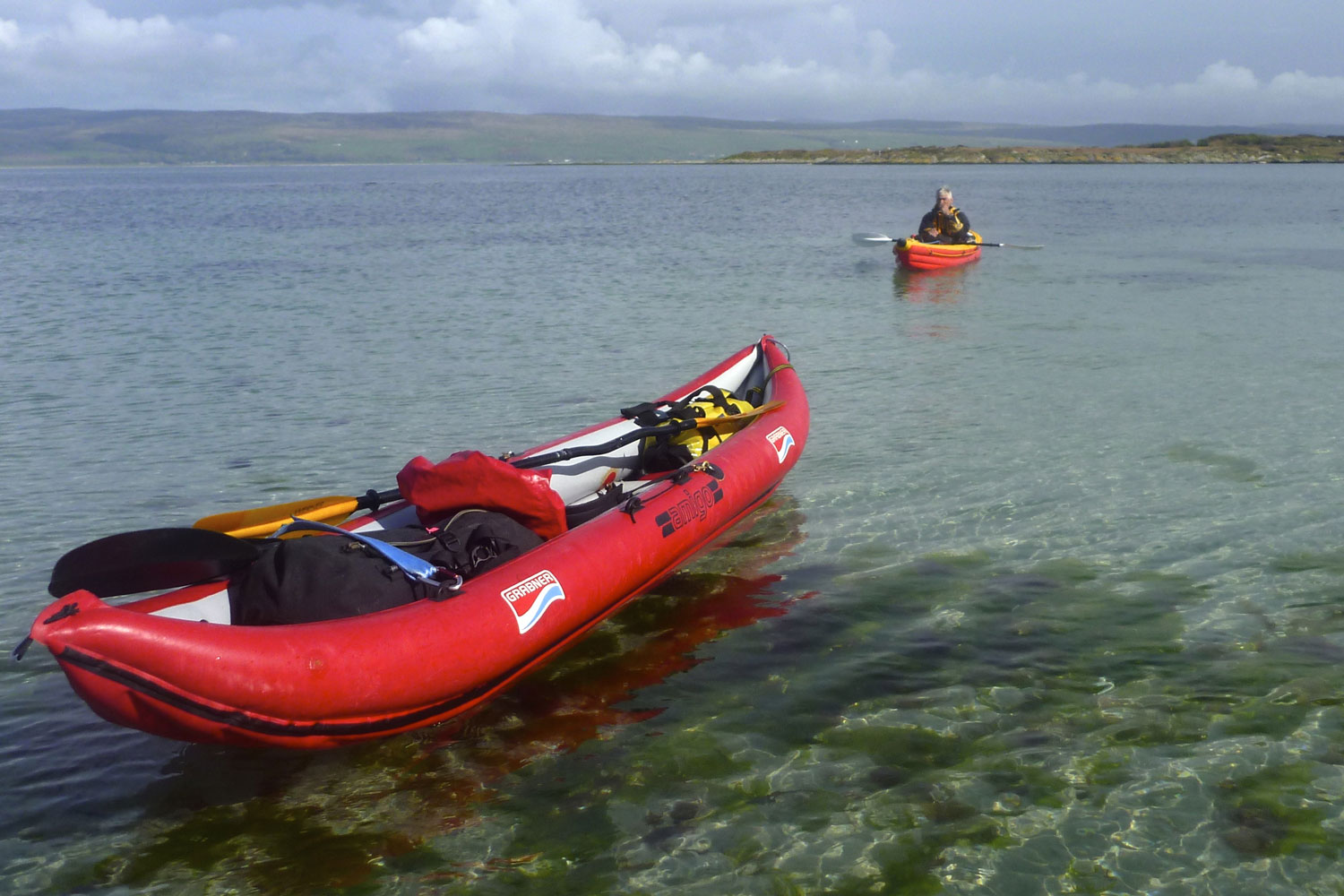
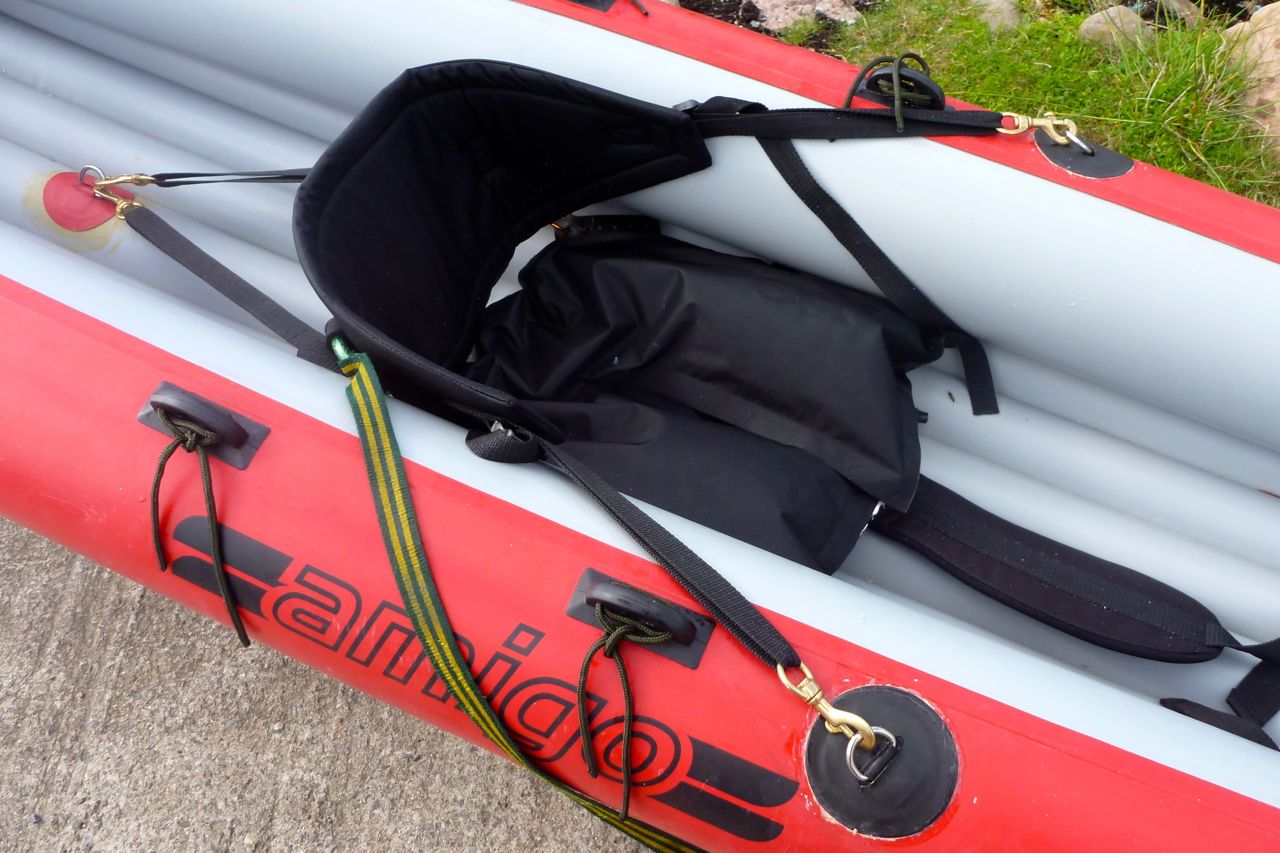
They have the usual removable and adjustable but rubbish seats which Gumotex is still famed for. I think it’s a way of getting through off-cuts of Nitrilon. For long trips I’d ditch them to save bulk, weight and inflation, and fit lighter and much a more supportive SoT backband + packraft seatbase (below left), as I’ve done to all my Gumos since my Grabner Amigo.
The inflatablefootrests are also a mushy pillows, either a simple pillow, or the extra rubbish, heavy, corrugated pillow (above left). Improve your Twist by ditching them too (cut up into useful Nitrilon patches), and fit a piece of hard PVC drainpipe for a proper hard footrest.

















































































 Inflatable Kayaks & Packrafts