Fitzroy article in The Paddler magazine
My four videos from last year’s trip – about 45 mins all up.
To read a longer version, start here.
You’ll find Jeff’s version of the same trip in 5 parts (about an hour) right here.

Fitzroy article in The Paddler magazine
My four videos from last year’s trip – about 45 mins all up.
To read a longer version, start here.
You’ll find Jeff’s version of the same trip in 5 parts (about an hour) right here.
See also: Wandle: An Urban Packrafting Nightmare
Packrafting London’s Regents Canal
Urban Kayaking: East London

The other day a friend relatively new to yaking invited me and a mate to paddle a river near her home. The Colne runs between the edge of Greater London and the M25 motorway just a stone’s throw from Heathrow airport.
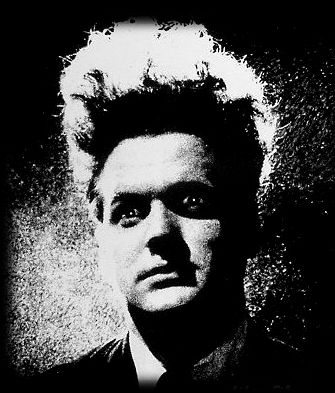
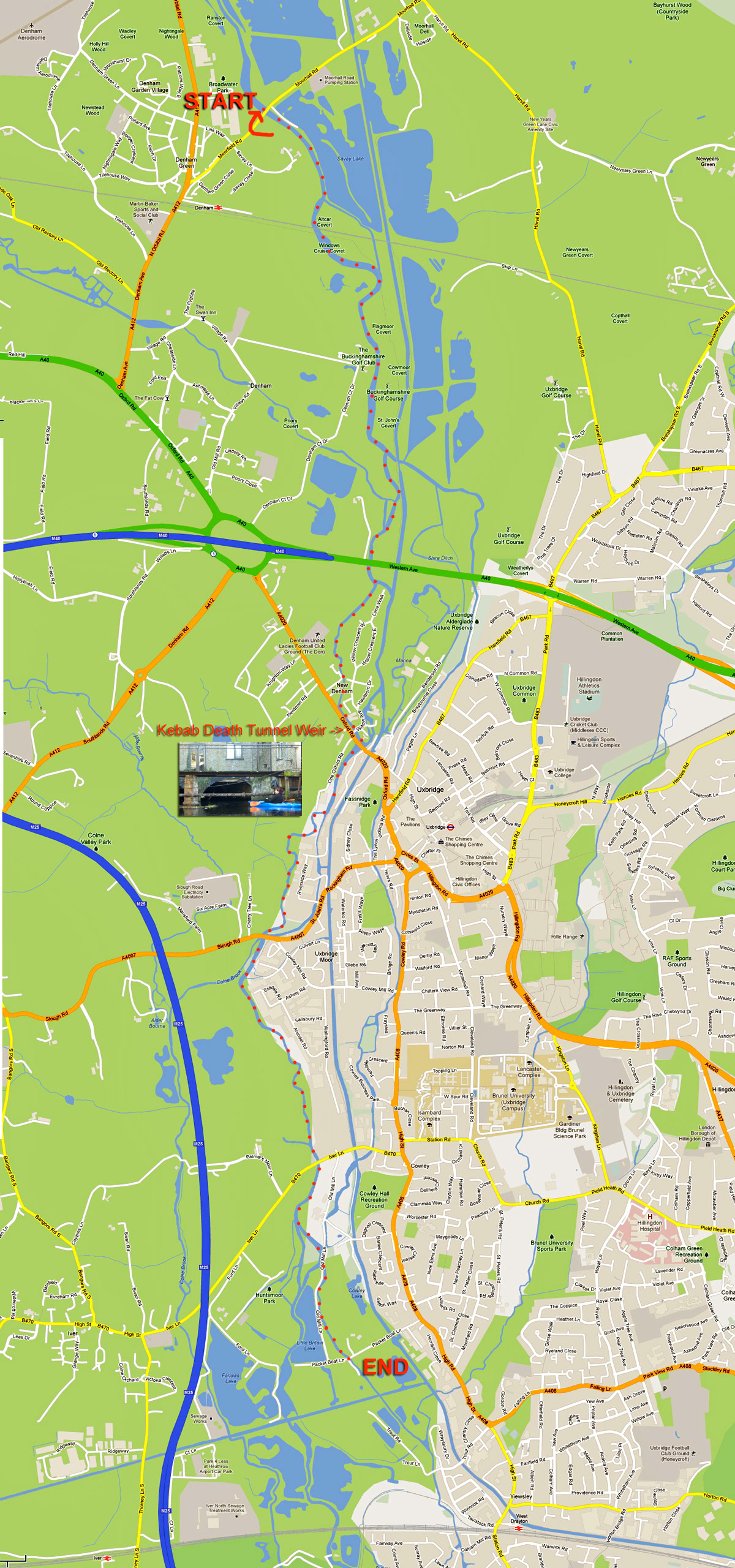
Looking at a map (far below) and more so at a sat image, it’s hard to distinguish the actual course of the Colne among the many waterways, reservoirs, overgrowths and the Grand Union canal which all fill this part of west London’s perimeter, but Lois had already recce’d a route which included half a dozen fun weirs and other challenges along the way – all up a run of around six miles. Chief among these tests was what must surely be an urban paddler’s nightmare; a weir drop inside a low tunnel that passed under a kebab shop and which we dubbed The Kebab Death Tunnel Weir (the word order is interchangeable). The thought of being spun in a dank, sunless hydraulic or jammed against a rusting grate as clammy kebab fat dripped onto your forehead from cracks in the overhead brickwork was surely the makings of a deleted scene from David Lynch’s Eraserhead.

All that was far from our thoughts as we bundled over a bridge parapet and inflated Lois’ Sunny IK which Robin was borrowing. Lois was using her newish hardshell Dagger and I was in my Yak packraft. Lois quite rightly rationalised her controversial IK betrayal by explaining that as she lived on a canal she just wanted a boat to hop into anytime (her Gumos having sprung slow leaks). I can relate to that though I wouldn’t go as far as actually buying a plastic coffin.
We swooshed off under the bridge and downstream on a lovely autumn’s day, along what transpired to actually be a proper river with a kosher current, far from my expectations of a concrete lined culvert awash with urban detritus and pestilent scum. We passed under a huge arc of brickwork supporting the westbound mainline railway and soon sidled up alongside the Grand Union canal. Not that we could see it. Even the OS map gets quite confusing, marking rivers or other waterways passing across lakes and wetland reserves. But once on the river the way ahead was usually obvious.
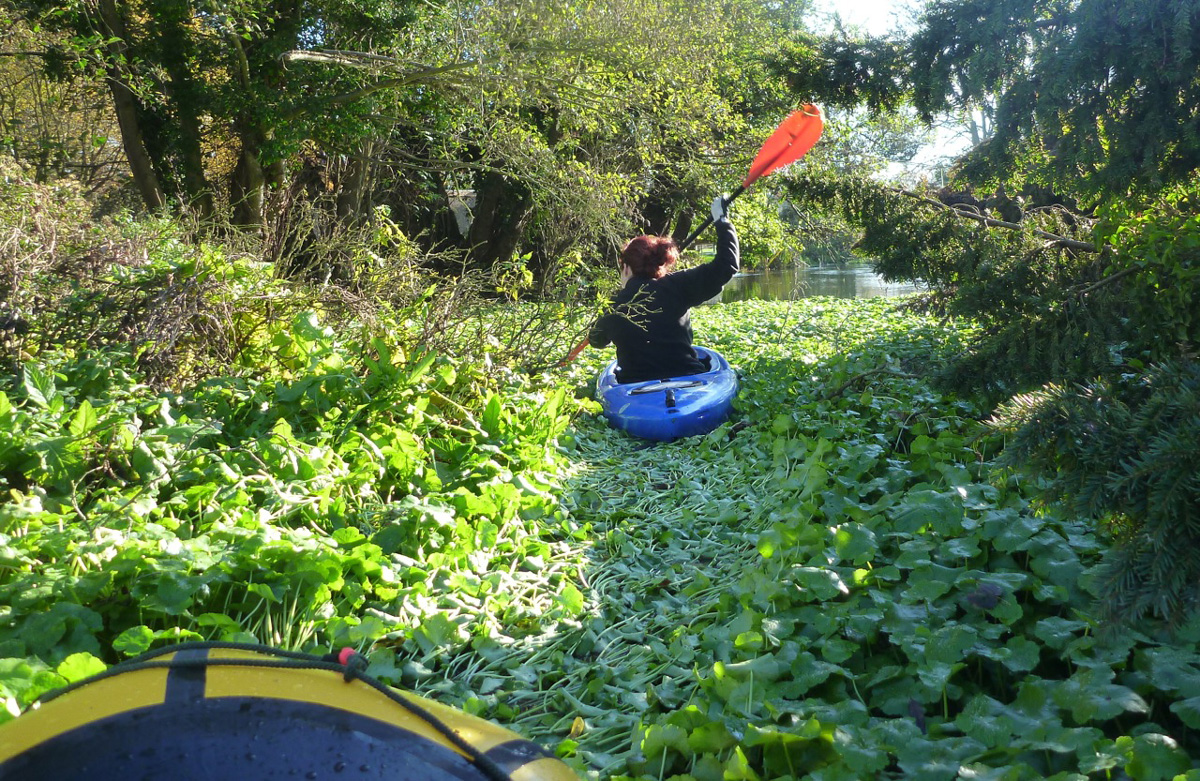
At one point what looked like thick mat of giant watercress carpeted the river bank to bank (actually pennywort, a very troublesome weed I am informed). Up ahead Lois’ Dagger ploughed into the vegetation (left) which amazingly proved to be paddleable, although with my wide, flat-hulled ‘packa I found reaching out and tugging on the floating wortrug worked best.

Soon we came to our first weir, a drop of a foot or so but where we did the right thing and hopped out to check we weren’t tipping over onto some gnarly boat spike. All clear so Lois slid over effortlessly into some shallows, then Robin beached himself inelegantly on the rim in the possibly under-inflated Solar. Knowing this, I sped the Yak up to warp speed and scrapped over with a splash.

More riverine bliss ensued with barely a crisp packet to sully our glide. Delicate foot bridges led to cosy cottages. Another double weir looked deadly from above but recce’d from below was no drama. No having yet recognised the benefits of spray skirts, Lois’ Dagger was taking a cockpitful on some of these weir drops. The Solar too scooped up some swill, but this was the first occasion where I zipped on the Alpacka’s spray skirt – mostly to keep my legs warm but also proving it did what it was supposed to.

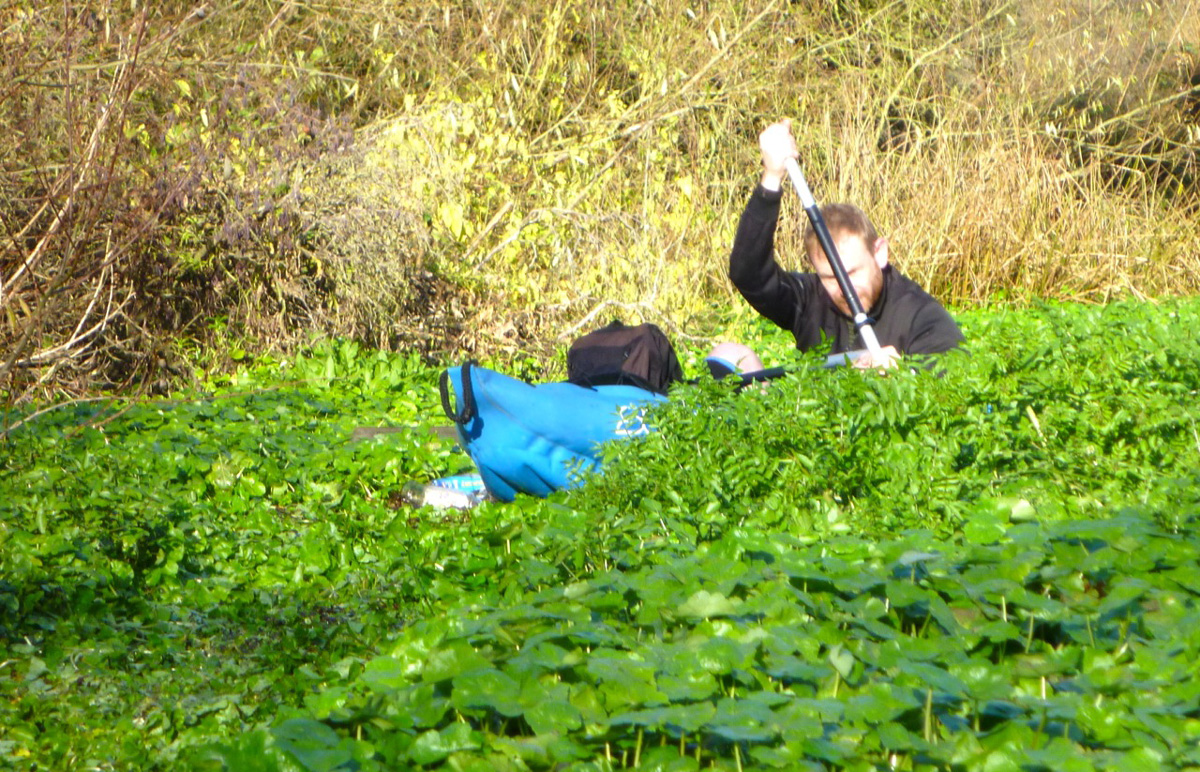
Up ahead, another clot of creswort choked the channel, but this had got thick enough to catch some crap so we hauled out stinky twigs and other rancid mush before hacking our way in. The rigid hardshell was best; my Alpacka (above) while broad was at least light, while the Gumboat put up a fight and Robin split his paddle all the better to dig his way through (right). Another weir with a drop of a couple of feet gave Lois a fresh rinse as we neared the outer London suburb of Uxbridge.

Bankside trees gave way to razor-topped railings protecting the back end of industrial units and things turned decidedly less serene as we neared the gaping twin maws of the Death Tunnel. It burrowed under a parade of shops, the pride of which was unquestionably the broad, handsome frontage of the Burger Kebab Galaxy restaurant.
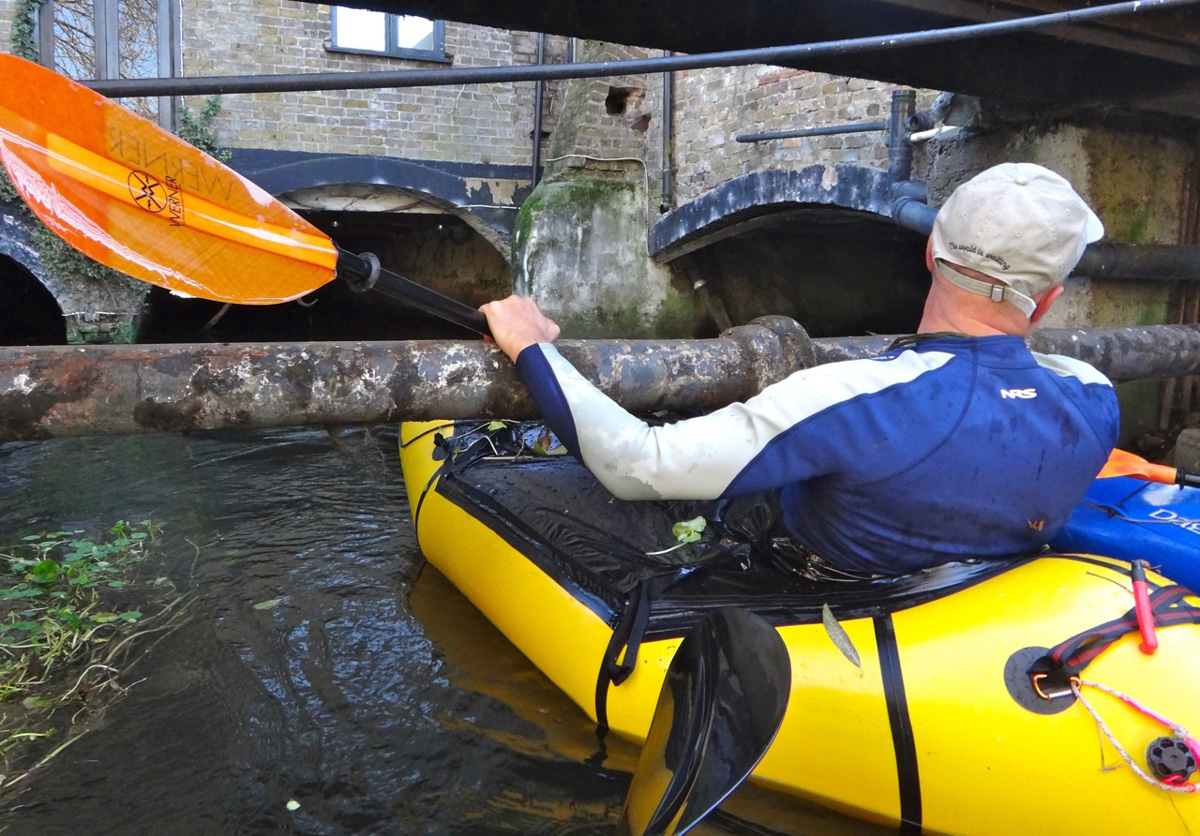
Two limbo-low bridges lead to an even lower rusty sewer pipe spanning the canal, and up ahead two arches reached into the watery gloom like a farmer’s rubber glove and where the rank stench of congealed doner fat choked the air. A chink of light marked the far end of the 70-foot tunnel (left) where the roof – strung with electrical piping, rotting rafters and mummified bats – pressed down to just a couple of feet right over the edge of the drop. Lois said last time the water was higher and they couldn’t even see the end, but they’d edged in anyway, slid over and survived.
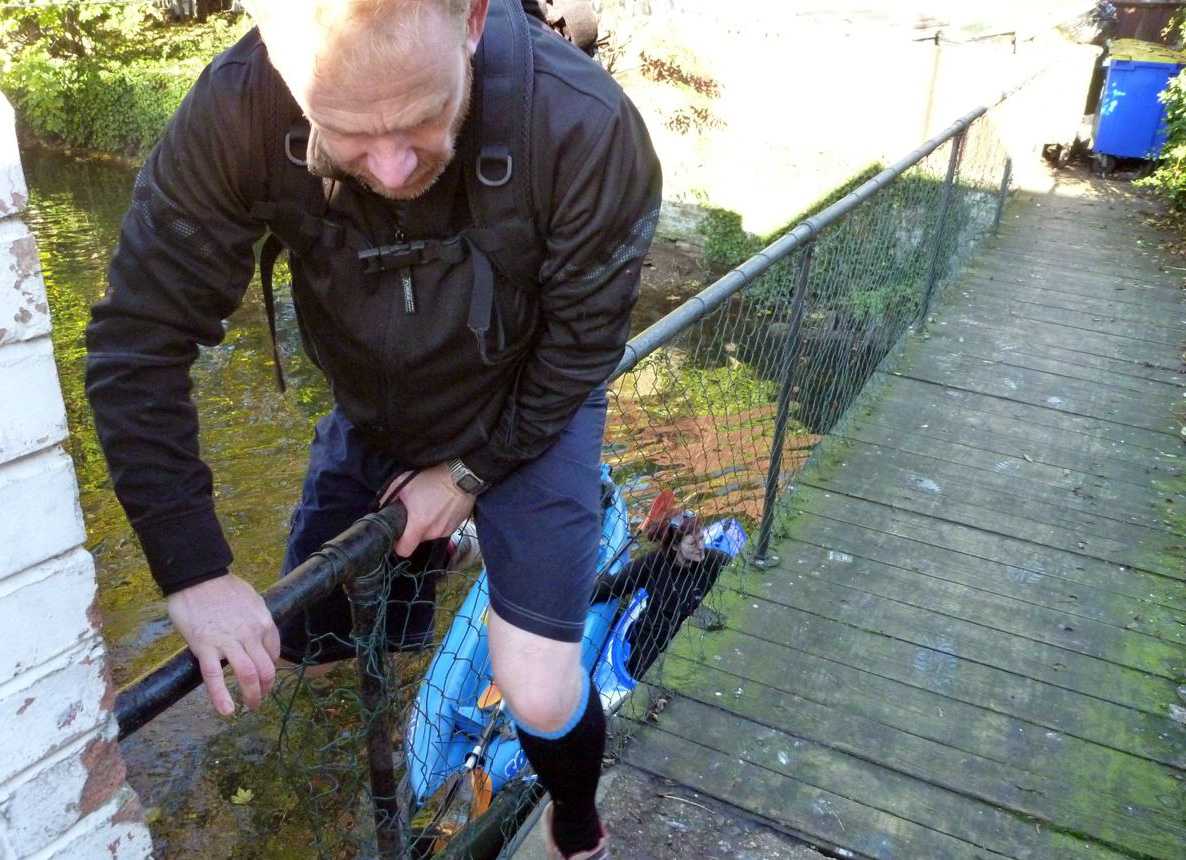
Even then, you never know when a burned-out scooter or half a tree might be poised to spoil your weir and anyway, Lois was sure this weir was higher than anything we’d done so far. So Robin and I clambered up onto the footbridge (left), walked round the far side and waded up into the tunnel as far as we could against the current. With the help of my camera’s flash I was able to get far enough in to see that the three-foot weir was actually a narrow 45° slide of about 3 feet, not a straight drop. Much less risky.


Now reassured that I wouldn’t be pitched out of the packraft to smack, face-first into to a span of festering, greasy brickwork, back at the boat I squeezed myself under the sewer pipe (right) and let the speeding current draw me in, making sure to keep well away from a broad side tunnel which led off to the right and didn’t look like it had a happy ending. I didn’t want to end up being squeezed out of someone’s kitchen tap like rubber-boned Janus Stark. In the main tunnel, the roof bore down and I stowed the paddle as I tipped down the chute, getting shoved against the right wall as I ran out towards the light like a near-death experience.
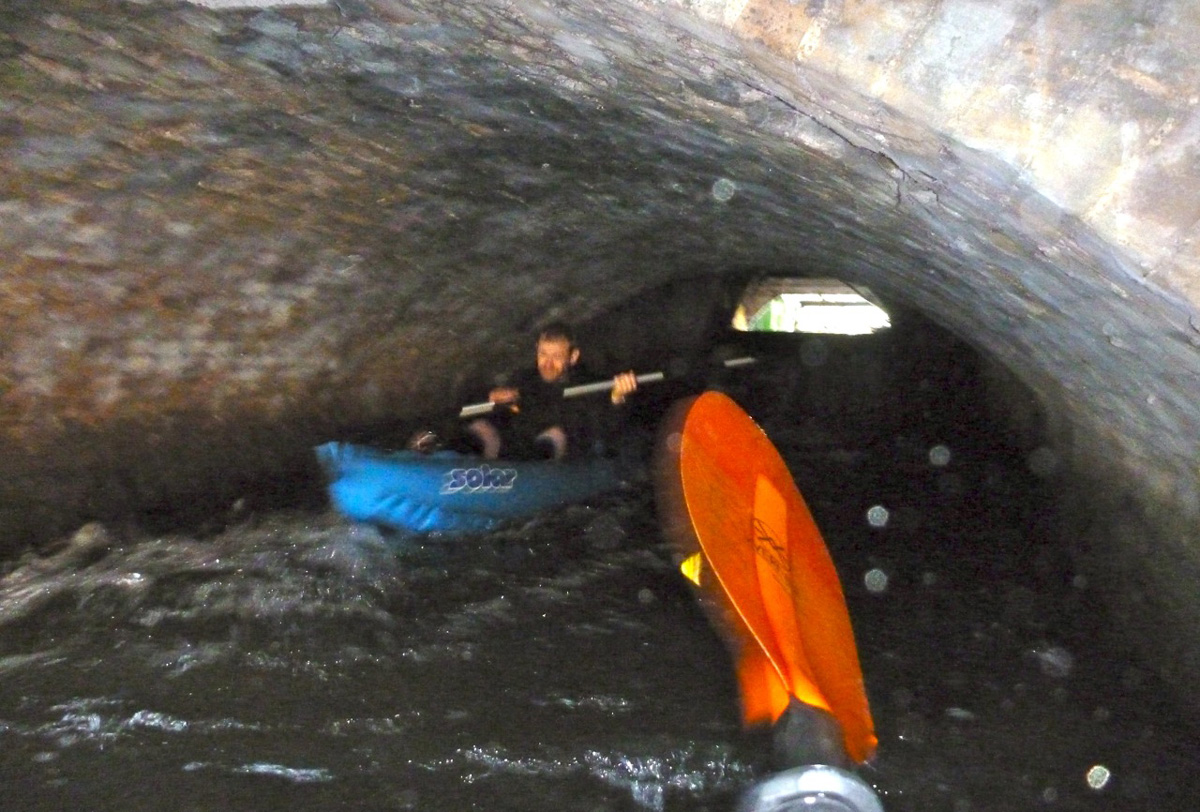
Lois came down next (faintly visible above left) and also got pushed right at the base of the chute and semi capsized.
Her paddle floated down towards me but before I could grab it the eddy caught it and floated it back up towards the chute. Meanwhile, soggy arsed Lois hopped out and dragged her waterlogged Dagger into the piercing daylight. Robin came down next (left), got pushed over but kept it together. It seems the tunnel weir had set up a long, thin anti-clockwise circulant or eddy which came upstream and looped back down just below the chute and explained why we’d all got pushed into the right wall as we came off the slide.
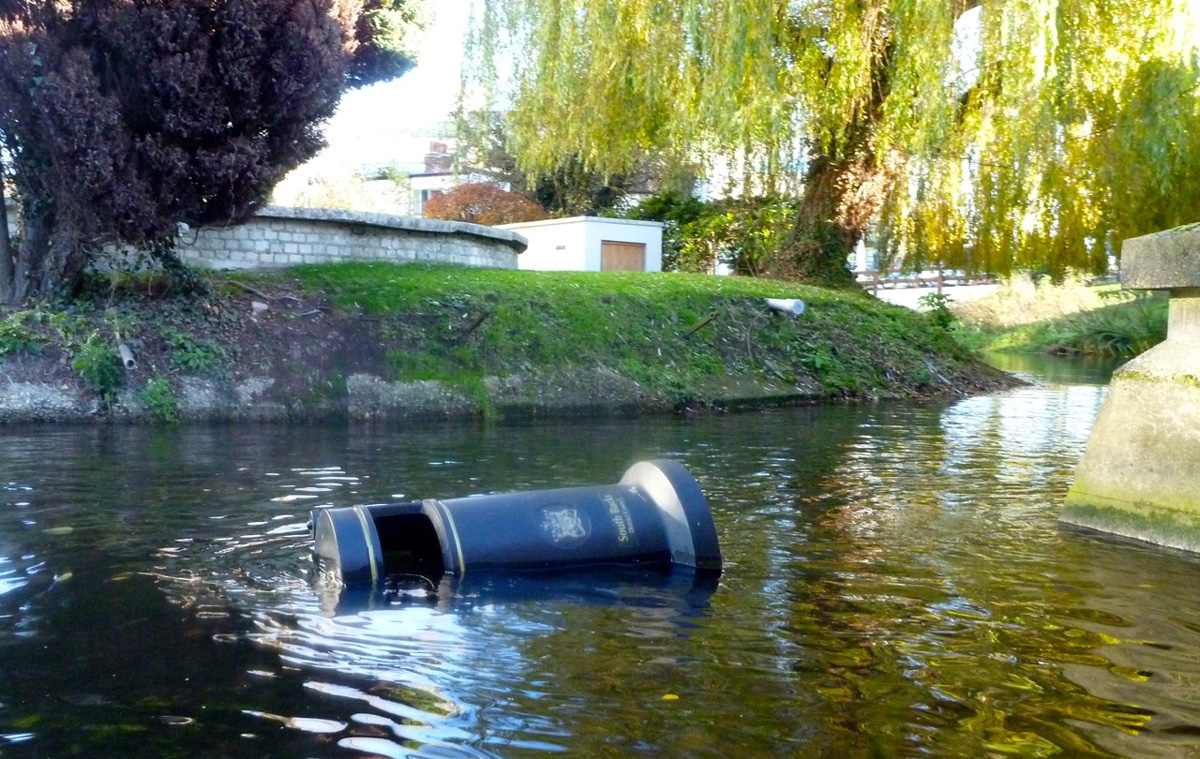

But we’d survived the KWDT and soon cruised past a striking municipal bronze statue depicting a trio of naked nymphs grappling over a giant Christmas pudding (left), a scene plucked from the otherwise unexceptional Lost Chronicles of Uxenbride discovered not far from Kebab Galaxy in 1892. And here at last! A plucky South Bucks District Council dustbin uprooted from it’s roadside vigil and flung into the Colne by some beer-crazed revellers high on nitrous oxide. Now that’s what you call urban packboating!
There was more to come. What is a paddle in merry England without getting a bollocking from a vexed bankside angler. We’d seen a few upstream who’d mostly ignored us (I don’t waste greetings on anglers anymore), but as Robin and I rounded a bend following another weirlette, some grumpy git wearing rubber up to his neck let us know his feelings, concluding with:
‘You coming back?’ (demonstrating his lack of understanding about how kayaks and rivers interact).
‘No sirree‘
‘Good!’
His mate just down the way was more civil and explained ‘there’s no navigation on this beat, it’s in the agreement…’ pointing to a sign, rather ineffectively positioned downstream that merely said Private Fishing or some such. I didn’t know the paddling status of the Colne and maybe Lois didn’t either, but a quick Google later on showed up threads on the SotP and ukrivers that indeed suggested the Colne hereabouts had been leased by a bankside golf club to Uxbridge Anglers Club, and their £80 membership fee helped entitle them to exclude paddlers on parts of the Colne. What about the Magna Carta and all that? Which parts are off-limits is hard to determine unless there is a blanket paddling ban.
We certainly saw no ‘ No Canoeing’ signs so it all left a sour taste for a while, but that’s the way paddling is in England thanks to Edward the 1st’s short-sighted bequest to his loyal noblemen (or so the story goes).

The last mile or two down to Packet Boat Lane passed without rancour as the late autumn sun seeped through the falling leaves. The current was speeding along by now and negotiating a squeeze around a fallen tree and some brambles, Robin managed to low side the unskeged Gumotex at exactly the point where Lois had tipped in on a previous occasion. Luckily he was also in shorts and hopped back in the Solar. Somewhere here there was a blockage of fallen trees and flotsam which we couldn’t paddle through and so made our only short portage.
‘Take out, rrrrrrriver left!’ yelled Lois, scarring the crows into the flight path of several 747s lowering their landing gear. Incredibly, Packet Boat Lane (near Iver) is actually a drivable ford across the Colne, rated at no less than five stars by the peer-reviewed wetroads.co.uk.

Once back at Lois’ cosy houseboat Robin couldn’t resist nipping back and having a crack at the car-swallowing ford on his well-travelled trail bike. I stood in the middle with water halfway up my thighs and filmed the action, thinking, ‘rather you than me, mate – it’s a long push back to Crawley’. Sure enough, before he got even halfway his Yamaha spluttered to a stop and we pushed it back like a couple of spotty teenagers trying out their first stolen bike.
Back on the barge the throbbing woodburner and a hot bowl of soup soon thawed our chilled limbs as we tried to analyse what the heck was wrong with Robin’s moto, other than acknowledging an engine can’t run on water like a kayak can. We left Robin to it, I rolled up my Alpacka and rode back home across London.
Thanks to Lois P for organising a great day out.
A sixty-six-photo summary of our summer in the Summer Isles with a little bit of Orkney.
See also: Summer Isles Kayaking Guide


Don’t get excited, we’re talking a few hundred metres of Class 1.1, but that’s as good as it gets around here.
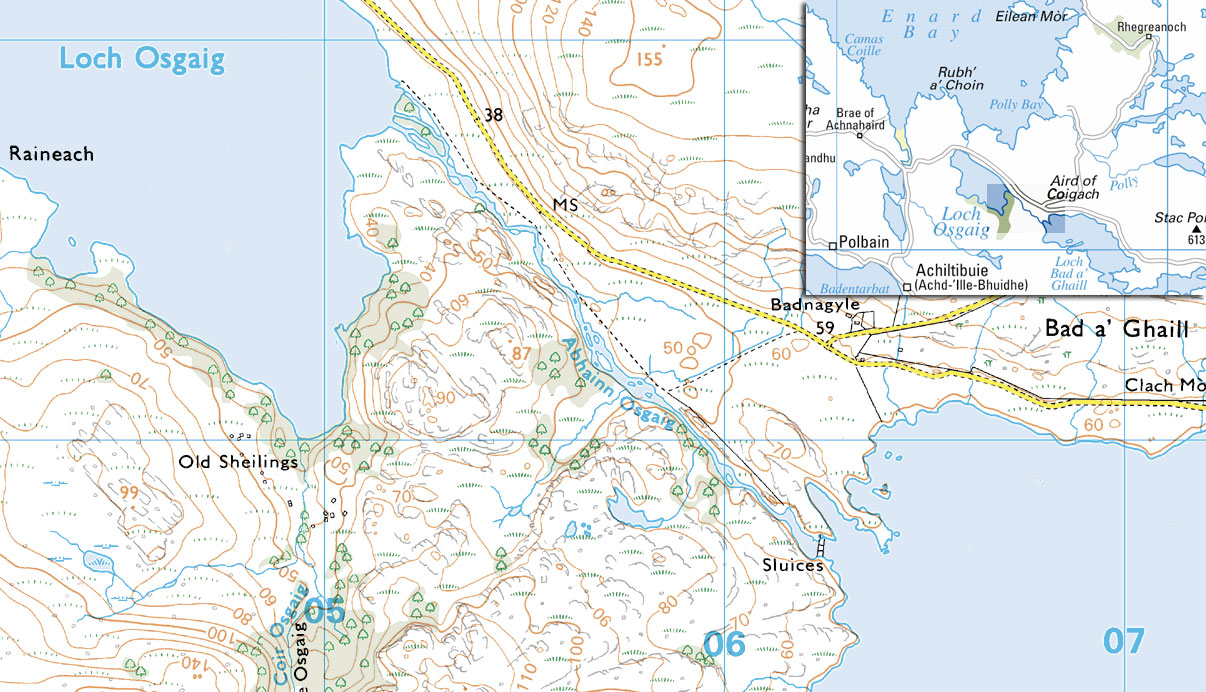
We’ve had a lot of rain in the last week, enough to make the only paddleable river – the short Osgaig – worth a poke with a paddle. I was here with the Yak last year at slightly lower levels, so this time was expecting a smoother run in the Solar (now with an improved seat-foot set up), followed immediately by a comparison run in the Alpacka Yak.

Gumotex Solar IK
The good thing with the Solar is it’s old, worth next to nothing but tough, so can be dragged like a hardshell with the Yak in the back. I considered jury rigging some thigh straps; it could be done now through the new footrest pipe and around the seat mounts, but looking at the river as I drove up, it wasn’t really worth it. Thigh straps are what makes any deckless boat – air-filled or hard-shelled – much more controllable when things get choppy. Even WW packrafters insist straps are the way to go.
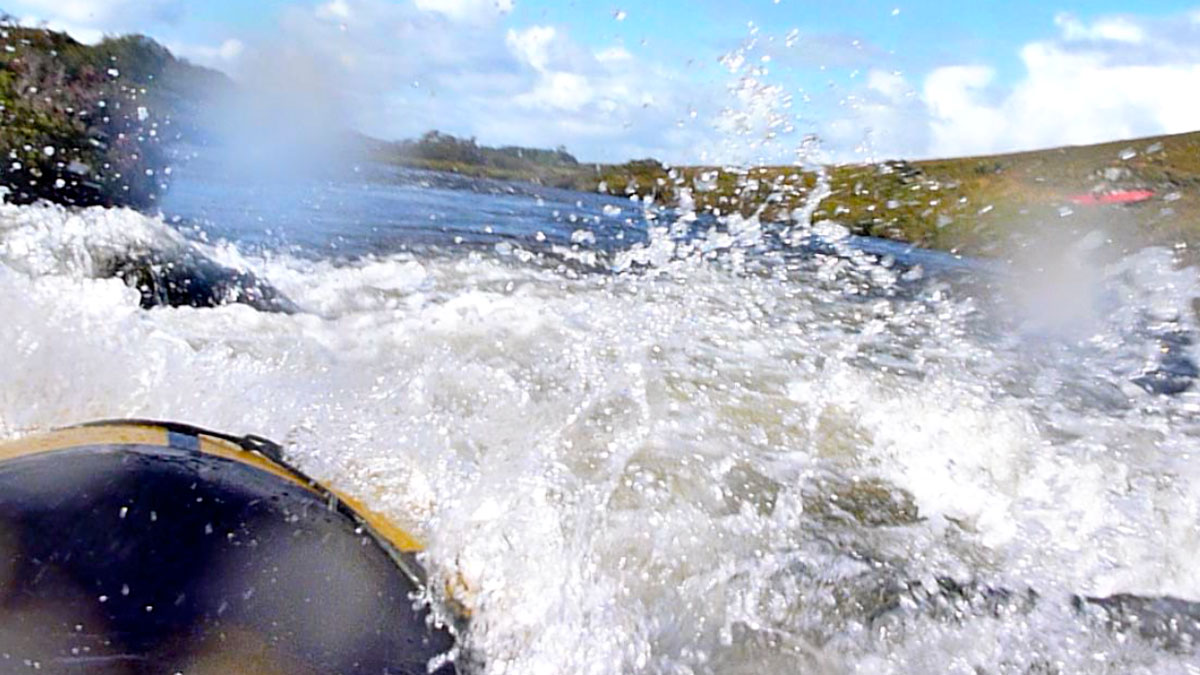
With the skeg off, it’s easy to seal launch off a grassy bank and into the scrum just below the waterfall which looks a bit complicated so was no less inviting this year. As I spilled over the first little step I tried surfing like people do. But the Solar wasn’t especially dynamic or there wasn’t a strong enough recirculation going on to make it feel interesting. So I swung round and set off. Even at full flow, the Osgaig is a shallow, bony river better suited to an injection-molded TNP ‘spaddle’, not 220 quid’s worth of carbon-light Werner Corry which was picking up new scrapes as I jabbed at the water to keep the boat on line. It was really quite effortful with the Solar, at 3m or nearly 10 feet it’s perhaps a bit long for this sort of thing. I hit the one or two rapids full face, kicking up a satisfying splash and remembering that ‘bring it on’ exhilaration when trying an IK and white watering for the very first time on the Salmon River in Idaho all those years ago.

The river branched near the Loch; left looked all froth but too shallow so I swung right but again scrapped and shoved from one bar to the next. I was hoping to make it all the way to Loch Osgaig but up ahead I saw the tree strainer I recalled from last year so, stuck on another rock and by now steaming out of the ears in my heavy drysuit, I stepped out and walked back upriver.
Alpacka Yak Packraft
A few minutes later I hopped into the snug Yak, spun round and slipped over the first drop. Spinning back, I tried to surf as I’d just done in the Sunny but it wasn’t happening. I guess the Yak is just too wide, light and too much drag to fight the flow.
Off I went downstream, trying to avoid getting snagged while lining up to take the peak of what waves there were. Jammed in the yellow tub, sat lower and with higher sides, it felt much more responsive than the longer Solar and so was less effort to ride. Perhaps part of it was that a good line is less vital; most of the rapids I could have taken backwards and that added up to more fun.
So there it is: a tight-fitting packraft is more fun on easy white water than a 3-metre IK. When I got snagged towards the end, I just stepped out, threw the boat ashore, and staggered out over the slimy boulders.


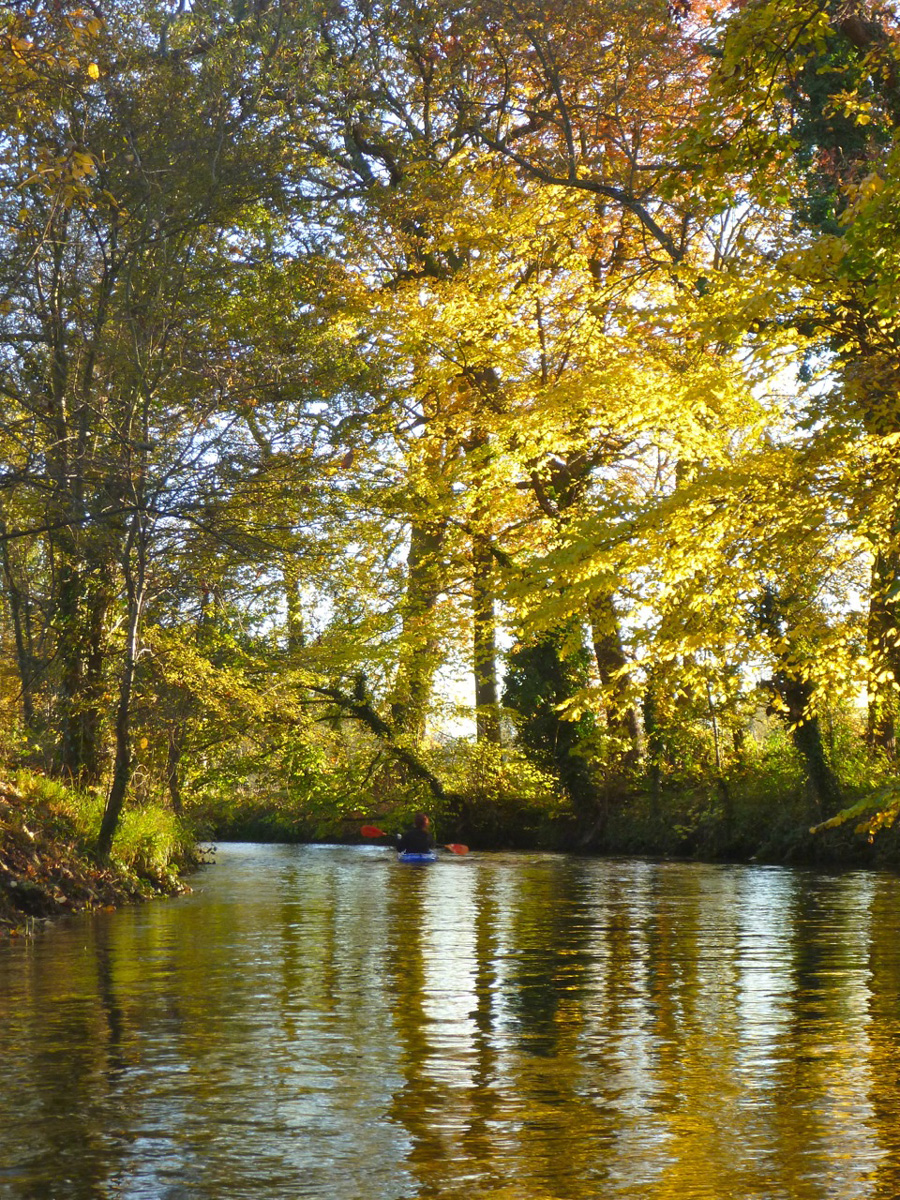
Le Grand Gonflateur himself, Gael A sent me this image to illustrate something. Its composition and colouring was so magical I’m compelled to elevate it to the IK&P Picture of the Week.
Captured in 2005, the location is the River Epte, a tributary of the Seine in Normandy and site of Monet’s no less idyllic 1899 painting, ‘Waterlilly Pond’ (left). It looks like Gael is sliding down a burst canal bank on his H2, while his trusty compadre observers from the reassuringly stable platform of a Mk1 Sunny gumboat. Behind him a sign warns ‘Access Interdite – Danger [sauf gonflards] and nearby a docile cow nuzzles the trunk of an oak tree quivering in its prime.
A serene snapshot of rubber boating bliss.


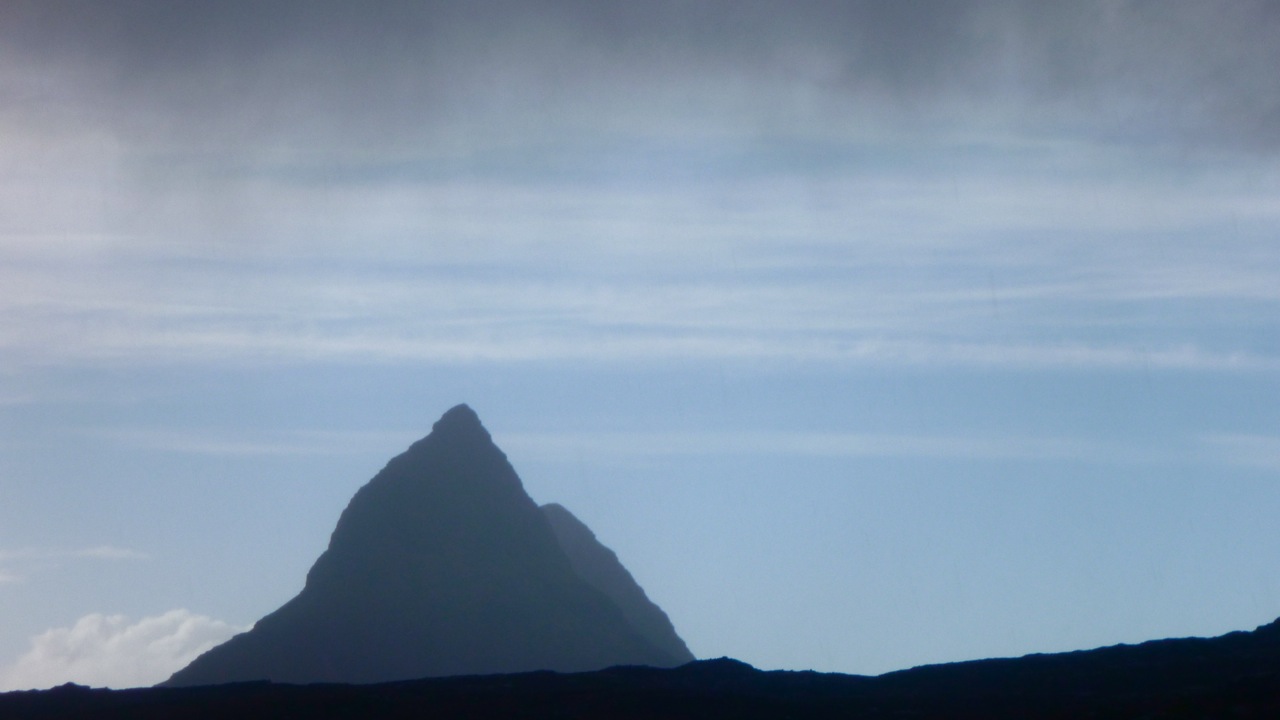
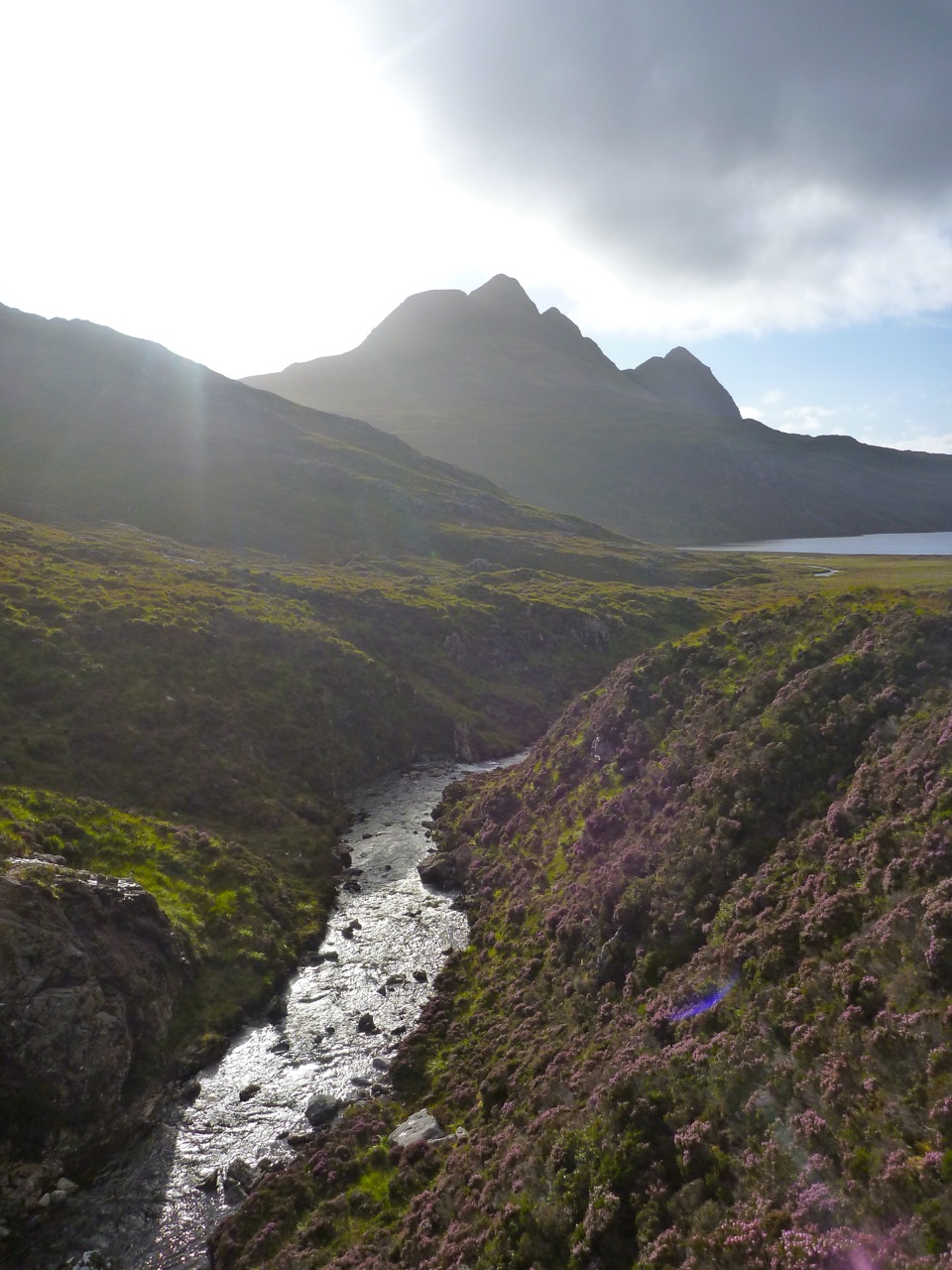
I’ve already done a couple of great packrafting excursions around the charismatic mass of Suilven mountain (left, viewed from the east). Last year we did a ‘triathlon’ loop up one side and down the other using bikes, feet and two-up in the Yak; and before that I did an overnighter from Loch Sion to have a look around. That second link has an intro to the region you may like to read.

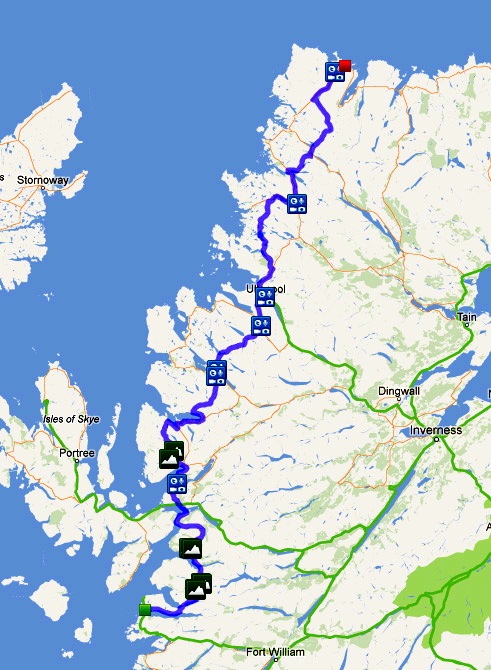
So you’d think I’d know the local pack-potential well, but looking yet again at the map, I clocked an interesting if lengthy day out, packrafting around Suilven. I could walk east out of Inverkirkaig past the Falls to Fionn Loch, then paddle several miles of continuous water south of the mountain to cross a headland and then another short loch. From there I’d turn back passing a couple more lochs to Lochinver back on the coast. That was around 23 miles, plus another 3 or 4 back to the motorbike at Inverkirkaig. An eleven hour day for sure so unusually, I packed a torch.


The day of least bad weather arrived (today’s grim weather, right): overcast and 12°C with winds building up to 25mph bringing showers and afternoon sunshine. It would have to do; the rest of the week was forecast as much worse and at least I’d have backwinds paddling out.

Should they become hard to handle I knew I could hop ashore – that’s the great thing about packrating. But I also knew that cross country hereabouts is usually a gnarly combination of boot-sucking mires, moss-clad boulders and ankle-snapping tussocks of clump grass. Unless you’re a ground slug or sport a rack of antlers, when off piste in the trackless wilds of the far northwest, you’re often better off in a boat.
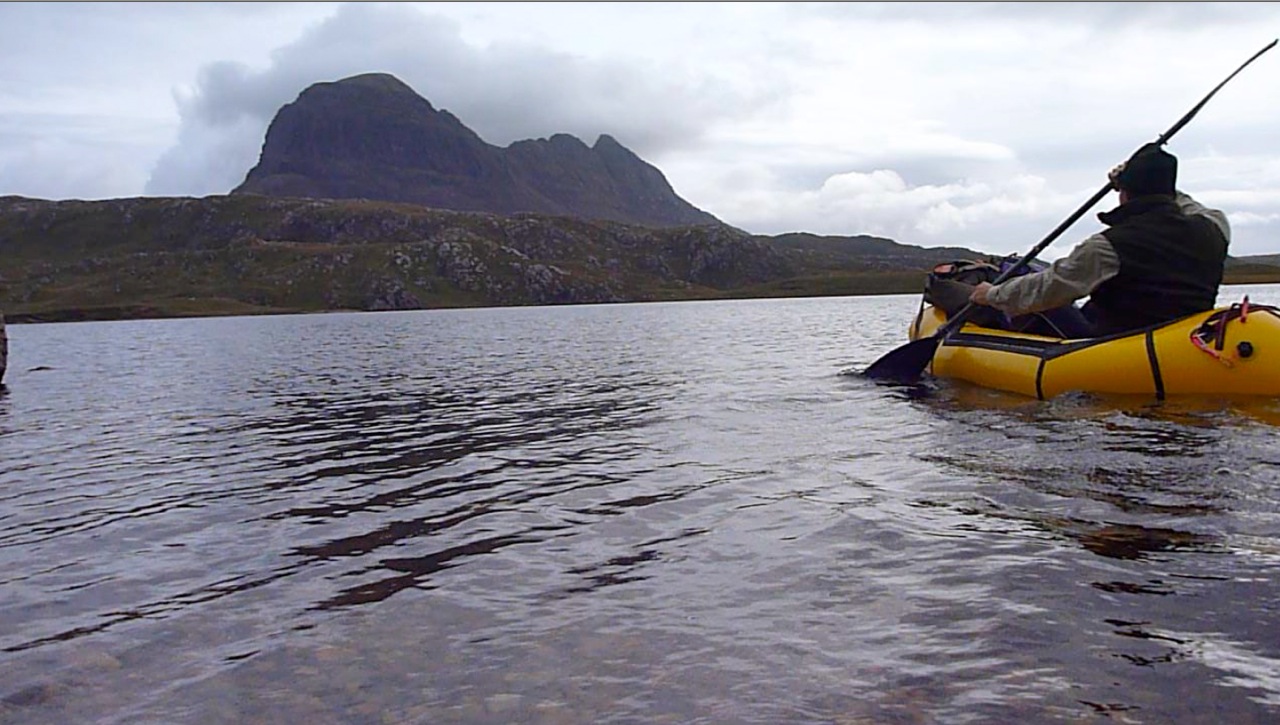

Nine 15 and I was out of Inverkirkaig with two fat sandwiches, two bananas and a cup. The thickly wooded valley with it’s not quite paddle-worthy river rose up to the 60-foot Falls of Kirkaig, but with filming and whatnot, it wasn’t till 11am that I paddled onto Fionn Loch (left) under a ceiling of thick cloud on the verge of incontinence. The rounded west prow of Suilven loomed above, trailing its cone-like tail like the giant goldfish in the Singing Ringing Tree.

I was reversing the section we paddled last year on the triathlon, and at a narrow point passed some small standing waves indicating a current flowing back to the river. Hmm, strange I thought. Approaching the mile-long narrows which maps call Uidh Fhearna, it was a stage which I’d somehow got into my head flowed east into Loch Veyatie, based partly on this picture I took last year. Turning south round a reedy bend and fighting what I thought was just the headwind, I took another turn and, like some astonished Victorian explorer, found the water flowing west, right at me. Of course it does. At the other end Loch Veyatie, Cam Loch drops through a series of waterfalls, and if Fionn here did the same, where did Veyatie drain – down some tectonic plug hole? There would be no Fellowship of the Royal Geographical Society for me this year.

Even with a backwind, there was no paddling up this Uidh (left), though I’ve read of hardcore canoeists poling it. So I unplugged the Yak and set off along the north bank to the far end where the Uidh opened out onto Loch Veyatie and lost its current. With no free ride to help outrun the afternoon’s predicted winds, my schedule slipped away.
As the OS map shows initially, there’s a path as far as a stream a mile away. Who knows why, maybe that’s where folk fish, but of course the path itself becomes a mini river. I should have worn my long Seal Skin socks today, the short ones were already sodden but they still kept my feet warm. After fording the river I decided to continue cross country until it became too hard. That took less than 20 minutes by which time I’d already stumbled twice and, while negotiating one steep bank, actually feel a few feet into the loch! Luckily, no damage done so just up ahead I set my sites on a beach to deploy the raft.
It was now 1pm and with that walk covered at around 1.5mph and getting slower; better to get on the water. But first, for amusement purposes I filmed myself from unrolling the Yak to paddling away. It took 8 minutes, something that you’ll see below is made a little less boring to watch by speeding up fifteen times.

An exposed hour’s paddle down Loch Veyatie ensued. I turned out of the cove into the wind, hurrying for the south shore to get into the southwesterly’s lee until the next narrow point where I’d cross back to the windier north side to line up for my take-out. As I passed across the mouth of the sand-spit inlet of Loch a Mhadail, gusts blasted out fetching up some whitecaps. It’s all in the mind of course, but I really don’t enjoy bobbing about alone, mid-loch and out of sight on a chilly September’s day without a drysuit or PFD. One good thing with the Animas backpack I was using for the first time was that like my UDB, it doubled as a reliable float bag. Although there was virtually nothing in it bar my lunch and a cag, that was the reason I sealed it full of air.

The overhead gloom and rising wind was eating up a lot of nervous energy, but that wind was also pushing me along at what turned out to be 3mph, more than double what I’d have managed staggering along the shore, and more direct too. Another reassuring surprise was spotting the buildings at Elphin on the A837 at the head of the Loch. I’d forgotten how close I’d be getting to the other end.
Paddling with the wind past the south shore, cascades ran off Cul Mor and scraggy patches of original woodland clung to the foreshore. I counted them off on the map as markers to my take-out, and with a dash over to the north side, that came up just as it looked on Google Earth last night. What a great WYSIWYG navigation aid GE is. Let Google harvest all my dreary browsing data to throw back at me as targeted ads. It’s a price worth paying for their sat mapping services.
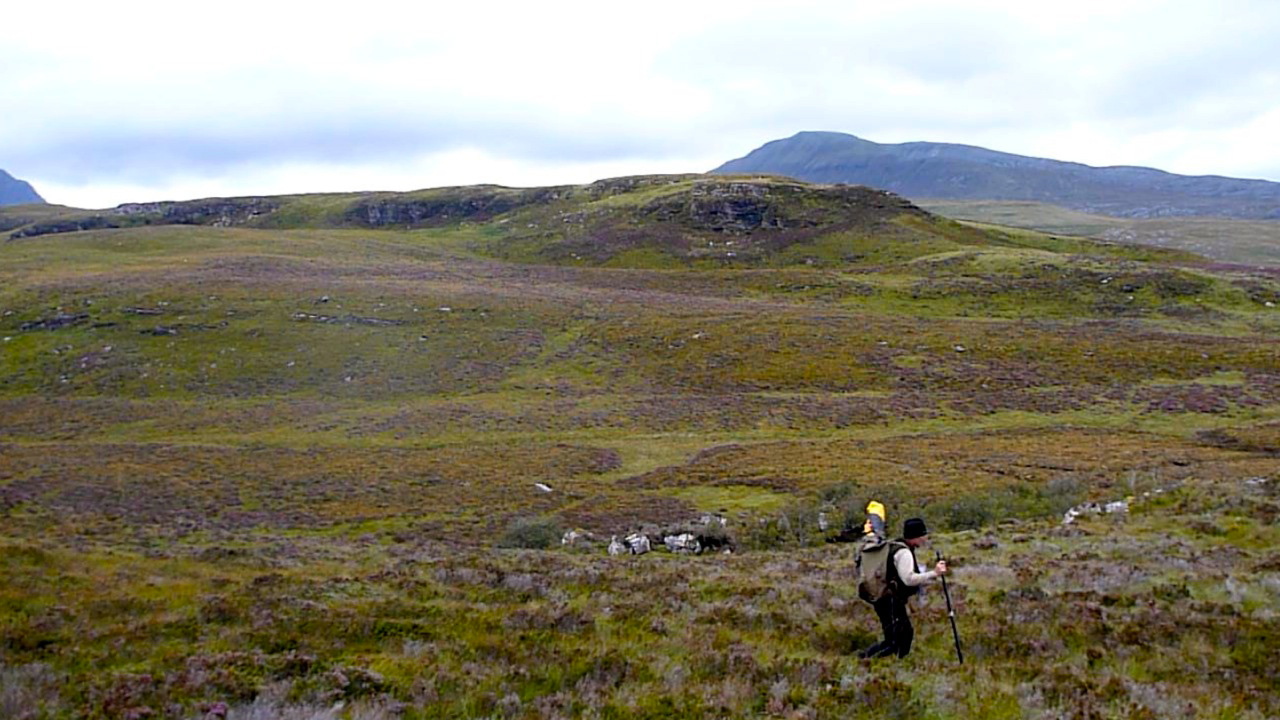
It was only when I crawled out of the boat and stood still that I realised how strong the wind really was, roaring over the hills and bating down the grass. Even though it was less than a mile’s walk to the other side of Creagan Mor headland, there was no chance of leaving the Yak inflated. Instinctively I headed for higher ground, scattering some deer far ahead, but my route soon led to a cliff so I dropped back into the bog and tussock valley that brought me to Cam Loch’s shore. Here I felt I could relax sufficiently to eat something. My cup was MIA, out on the loch somewhere, so I scooped up a drink by hand.
One more loch to cross; easily done no matter how windy it’s become. Somewhere on the north side the map promised a path that led 12 miles back to Lochinver. All I had to do was slot myself onto it and ride it out for as long as it took. Whitecaps rolled passed me as I neared the north shore of Loch Cam, but what had had an edge of dread on Veyatie just an hour or two ago was becoming familiar and a bit of a laugh as the promised sun stuck its nose out for a sniff at the day. After airing down I soon hooked up with the stony trail, but found I was wavering a little, probably through not eating or drinking enough. It was now 3pm; six hours on the go but I’d only actually walked some 4 miles up to that point, so the legs had plenty left in them and there was drinking water running down the paths.

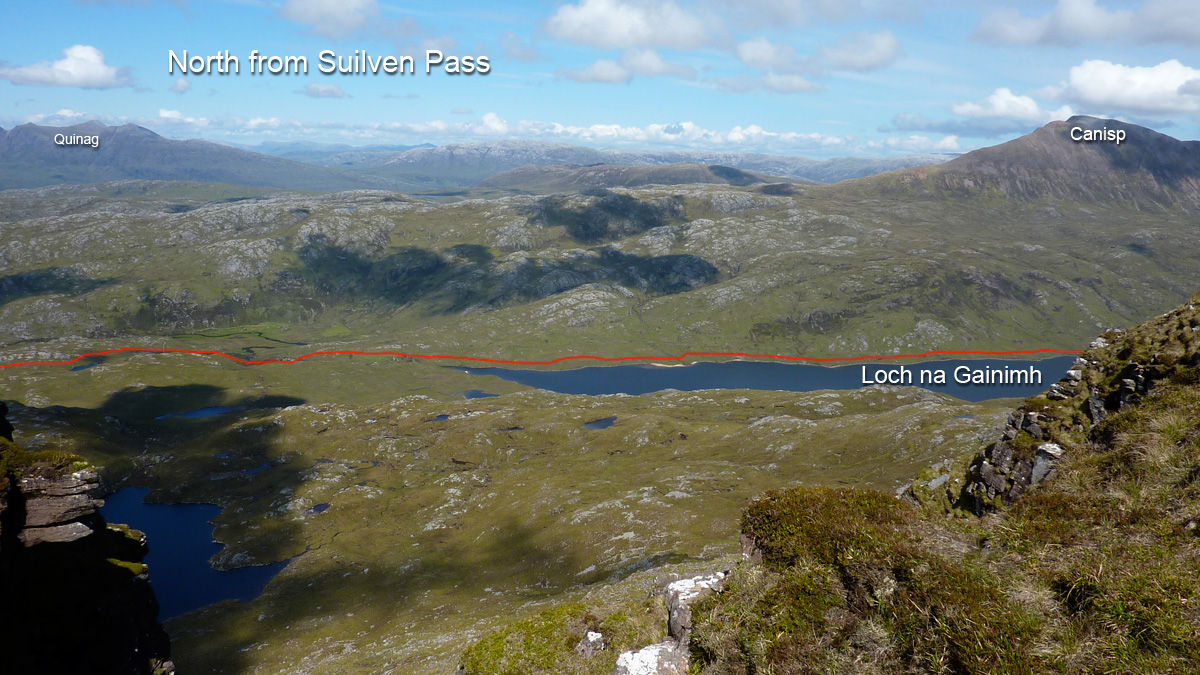
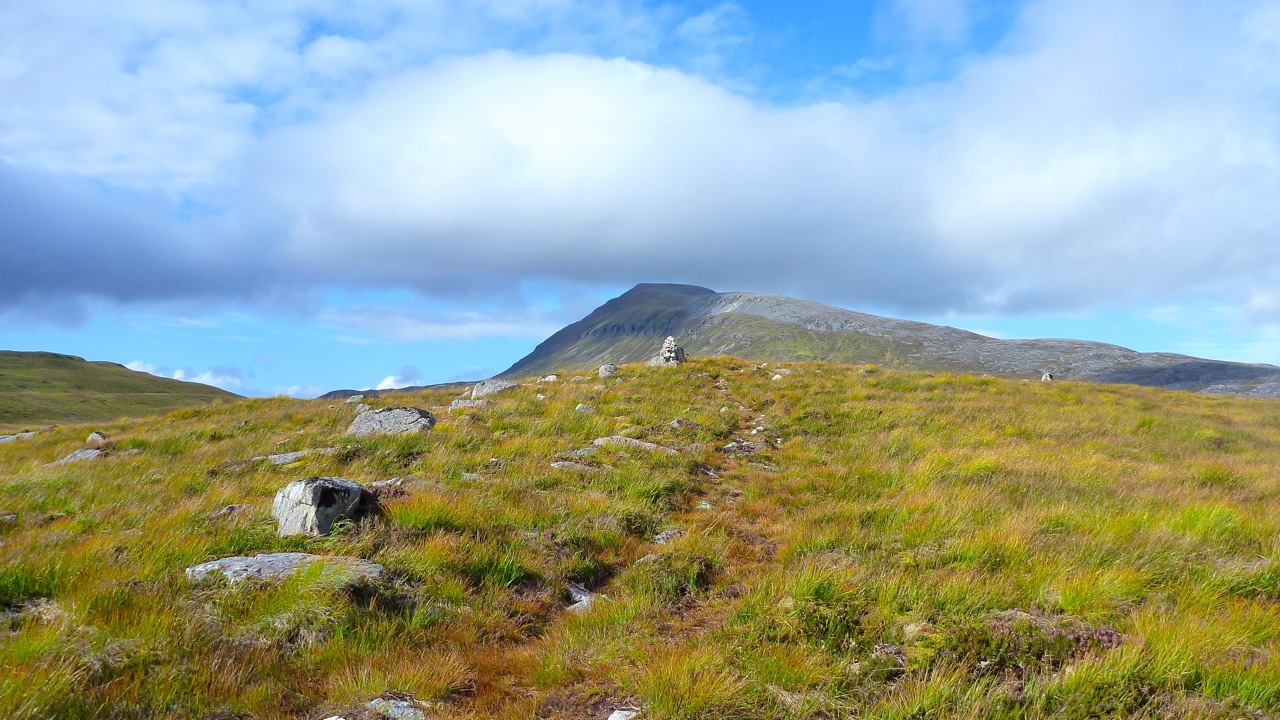
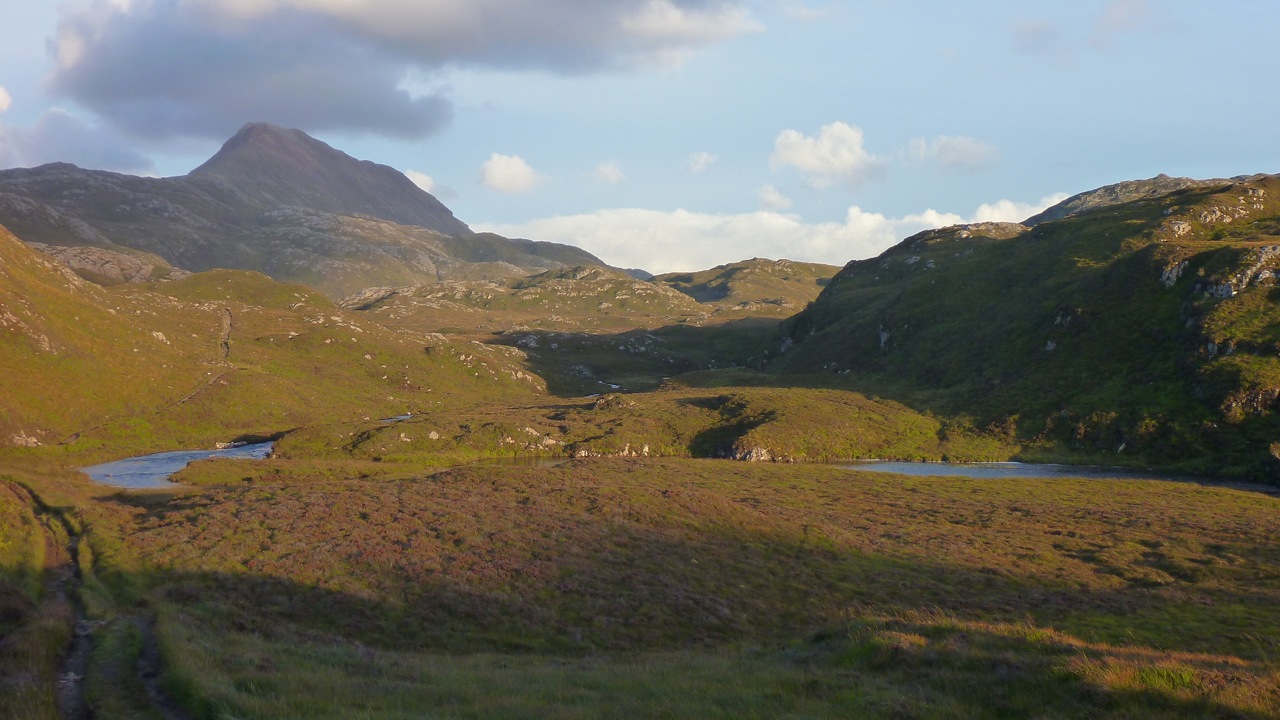
On occasions I’ve harboured thoughts of cycling this path from Lochinver to the A road, but from the state of it at this end I’d not get 10 feet. It followed a hard, white rim of exposed stony rubble that’s visible on a sat image, but I suppose was better than the mush to either side. Light grey and crystalline, I’ve since read it’s Lewisian gneiss or quartzite which gives the appearance of snow to some of the Assynt’s mountains like Canisp or Foinaven (see long image below). This whole region is marked with monoliths, the most striking of course being the remnant sandstone outliers like Stac or Suilven which resisted their brush with the glacier’s claw as it passed through, exposing the ancient base of lighter coloured gneiss.

I’ve kept missing the interesting ranger-led talks at Knockan Crag, just south of Elphin, he site of the Moine Thrust which literally turned geology on its head a century ago.







See also
IK&P Glues and Repairs

They don’t make the Solar 300 anymore – it’s been superseded by the lighter Twists, although the similar full-coat, white-water Safari is still made All these Gumboats and a few others may benefit from the footrest mod as described below, as might bigger Gumboats which both use a similarly mushy footrest pillow.
Our Solar dated from 2006 and although (or because) it doesn’t get used much it still looks like new. And it’s lost no air to speak of lying in the garden for over a month (can’t say the same for my Incept K40).

But the seat/footrest arrangement is poor, like all Gumos from that era. The seat pivots at the right angle base as you lean on it, because the top edge is attached to the bottom edge instead of the actual boat, like any sensible IK. You lean back, it lifts up – no good. I messed around a lot with my old Sunny before I got smart and simply glued some D-rings onto the top of the hull sides, which Gumo started doing soon after. This way when you lean back or brace against the footrest, you’re locked to the boat and so get more drive.

The pillow thwart footrest is OK, but I ditched that at the same time on my Sunny to use a small Otter box. For the Solar, the g-friend is short and can’t reach the footrest pillow even set right back.

I glued on a pair of big D-rings with Aquaseal, bonding much cheaper PVC D-rings to the Nitrilon hull sides to provide a fixed point to tension the seat back. I did this because the price of RIB hypalon D-rings is crazy: from £20 to £40 for one patch!
I Iused single-part Aquasure urethane sealant/adhesive (‘Aquaseal‘ in North America). Allow Aquasure or similar to half-cure in air for 30 minutes, then stick together and let it ‘seal’ to itself is a way of bonding anything – even non-compatible rubber-based Nitrilon to PVC. SeamGrip is a runnier version of Aquasure to get into cracks and seams and though I’ve not tried it yet, British-made Stormsure is the same thing.
That was years ago. Maybe it worked fine but these days, I’d sooner MYO D-rings from hypalon off-cuts and use 2-part glue.
Then on the Solar I removed the footrest pillow and replaced it with a bit of sawn-off four-inch drain pipe, taping the pipe ends to limit any rubbing against the hull. The seat straps were sewn into a loop and clipped to the D-rings.

This mod will improve bracing in the Solar: the bane of all IKs (and SoTs for that matter) which without bracing are like paddling a log. The footrest (the tape goes through a slot under the pipe) can easily be moved, even when inflated and will transform the Solar which is a nippy IK. The next step would be to fit thigh straps as found on the current Safari – then you can do cool stuff like this – but for the use our Solar gets, the current improvements will do.
Recently I also glued on the later style skeg patch to take the plastic fin. No more faffing about with butterfly nuts and bolts and bits of bent alloy. The patch costs £12 and so does the skeg, which I also fitted to my Grabner Amigo.

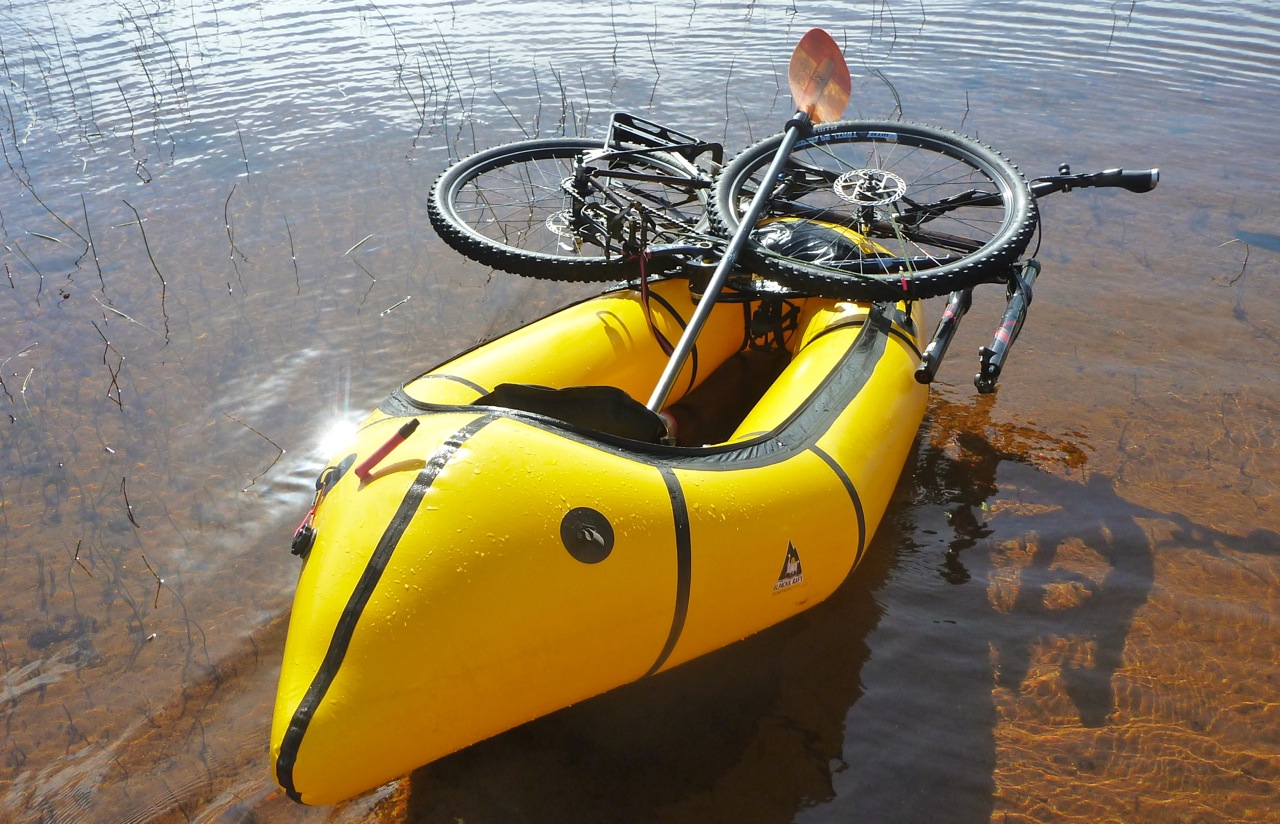
I’ve had Alpackas a couple of years now but I’ve been a bit slow about trying out bikerafting. I like pushbiking, walking or packrafting in the wilds and combining walking with paddling (aka: packrafting) is well suited to northwest Scotland, as several posts here show.
But add a bike and any off-roading becomes marginal up here. Most of the time you’ll be pushing or carrying, especially with an overnight load. No MTB is really rideable on the footpaths up here, although unlike England and Wales, since 2003 Open Access allows cycling on footpaths (there are no bridleways). Off the footpaths, at times you can barely walk, let alone ride a bike.
I like the simplicity of walking with paddling – you can traverse both surfaces most anywhere you like. A pushbike requires rideable terrain and on an Alpacka gobbles up payload, space and buoyancy, requiring you to design routes that combine flat water with ridable terrain, or even roads to make the most of the configuration. Then you got the faff of securing the bike reliably to the boat (or so I thought); the last thing you want mid-loch is 15 kilos of Cro-Mo steel slipping off and turning into an anchor just as the wind kicks up.
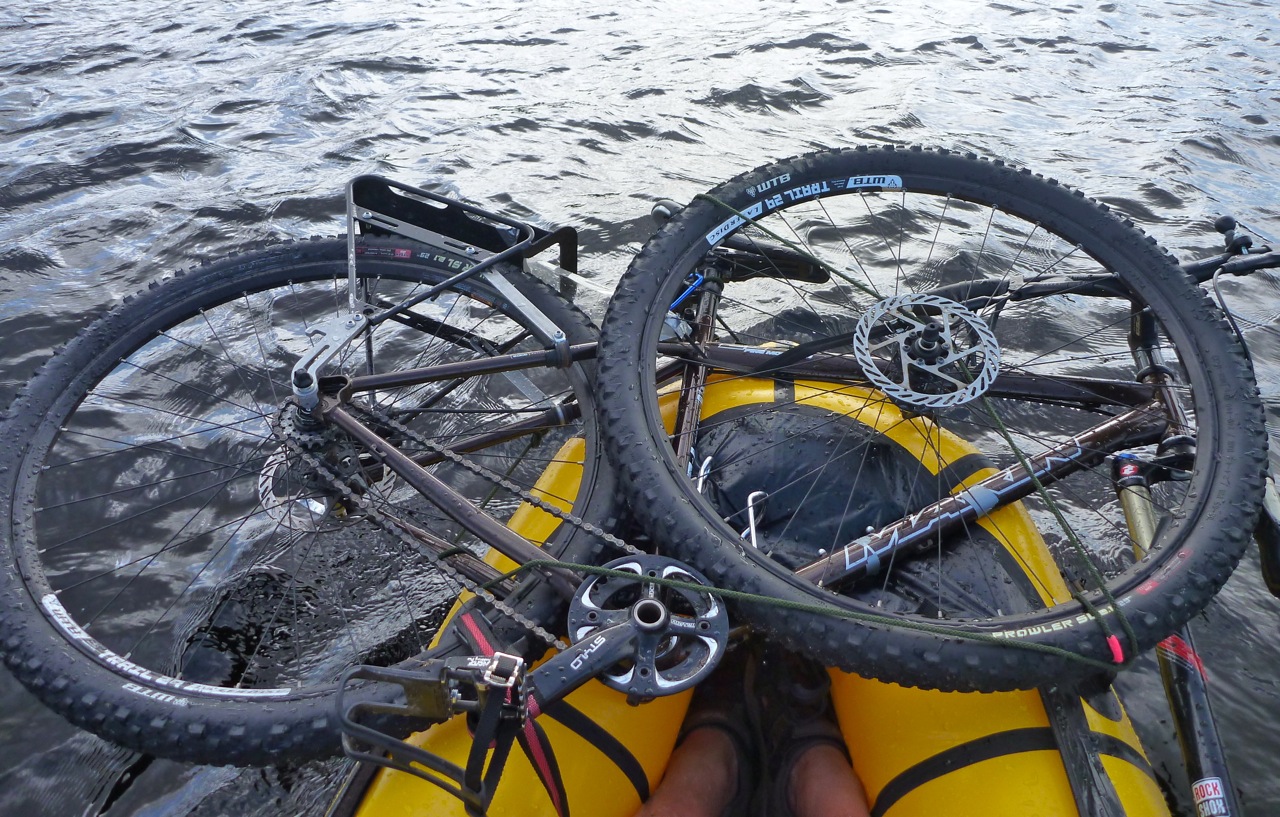
But let’s give it a try. The winds had backed down to a forecast 15mph (yesterday it was three times that) so we nipped out with the Gumotex Solar for a scoot around Loch Oscaig. I hadn’t tried it before, but with the front wheel off, strapping the bike on was actually pretty easy. The four Alpacka loops line up just right and two short straps plus the boat’s bow line were enough to secure the load without even a smear of chain grease. A loop of inner tube was handy to hook the handlebars around the top tube to stop one end dragging in the water. Once on the water, my arrangement was by chance correctly balanced, too.

My bike’s at the time was a single-speed Marin with hydraulic brakes so there were no cables to worry about rusting, but on the move it was clear the back wheel got in the way of a full stroke on the left, making for unbalanced paddling. I got used to it but for a longer stage it would be better removed, even if it leaves the chain flapping around. To me it’s a light bike, but the Marin probably weighs 14kg, about the same as overnight loads I’ve carried. The good thing is, such a weight on the front of the Yak only improves the tracking by reducing yawing.

The wind got up while we were out and at the downwind end of the loch it got a little choppy with splash coming over the sides, but the Yak bobbed over it. Here the Mrs set off against the wind for the two clicks back to the boathouse, while I hopped out, unloaded, aired down, rolled up and rode back along the road.

Having now tried it I’m a bit less sceptical about bikerafting. On the boat it was less of an encumbrance than I thought. I’m not sure it would work well up here in the Assynt without contriving a route, but maybe all packraft trips are contrived to a certain extent, and anyway the motorable roads here are very quiet.
I suppose the real advantage of a bike with a raft over walking is that, providing the terrain is amenable, greater distances can be covered off the water which extends your range. But combining a multi-day trip with a bike away from roads gets challenging. I’m thinking of something like the 2008 Lost Coast bikerafting trip in Alaska I read about a few years ago, which ran northwest from Yakutat. Roman Dial, Erik Parsons (from ’08) and a couple of other guys did a similar route last year, but heading southeast towards Glacier Bay this time. Check out their superb vid below or Roman’s blog post and pics. The vid doesn’t not show much rafting but look at the route maps: they sure put in the days on the water.
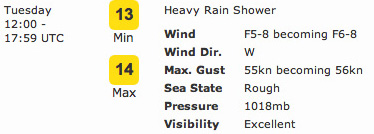
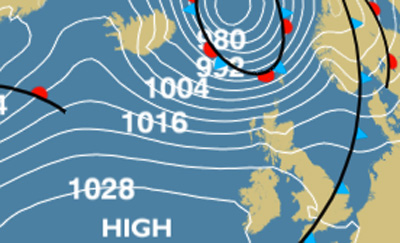
I do like a good storm. On the left today’s coastal forecast for the Minch. You might call it the first big storm of the autumn. Some 250 miles to the north, out on the Faeroes and towards Norway it’s blowing at Force 10 with 40-foot waves, like something out of the Perfect Storm movie before it gets really scary.
What can it be like to paddle a packraft against a wind gusting up to 50mph, I wonder? Is it even possible? Many times I’ve surprised myself how fast an IK can move – 2-3mph – into a headwind of around 25mph. You can’t sustain that all day, but last year I managed to plough along like that for an hour or two when I gave up on the Ningaloo Reef and turned back into the wind. Seeing as gale-force is the only paddling available for the next few days, I rolled up the Alpacka and went to find out.
Sorry to disappoint you but heading out to sea alone, even on the beach with the onshore wind felt too risky. I figured there was a good chance of a gust flipping the back-heavy Yak in a kind of ‘frontal bandersnatch’ as it crested a wave. Better to stick to my ‘play-loch’, site of many paddling experiments and where there’s just wind and not much wave to deal with.
In the given conditions inflating the Alpacka in the back of the car was effortless; it took just six bagfuls to fill up the boat, instead of the usual ten. Getting my yellow windsock onto the water was less easy, so once I slapped it down I jumped in quick, clipped the raft to myself via the paddle and tried to leave the shore at the downwind end of Loch Raa.
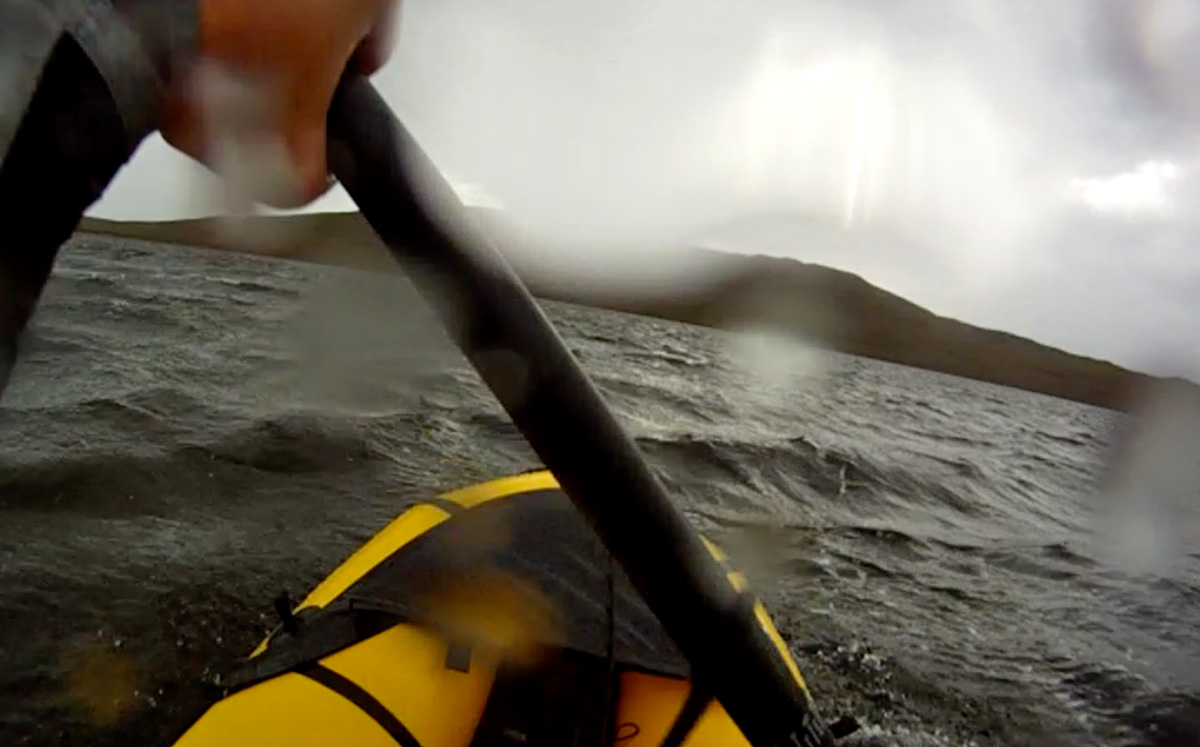
There was no fetch to speak of and using my large-bladed but light Werner Corrywrecken paddle, I jabbed at the water head down, trying to make headway. The waves rushing by gave the impression I was flying but a sideways glance to the shore showed the raft was barely creeping along. And when a gust hit, it didn’t actually move at all despite my huffing and puffing.
Even though I’d probably missed the peak of the day’s winds, not surprisingly I’ve never experienced a paddling effort like it. It felt like some sort of horizontal pull-up machine in a gym set on ’10’ and my hands gripped way out on the ends of the shaft to increase the leverage. Soon any ideas about paddling to the far shore, only 700 metres away, were surrendered. From a video’s timeline it seems it took me 8 minutes of flat-out effort to cover 250 metres – just over 1mph with brief rests every couple of minutes.

I felt safe in the Yak; the gust-borne waves weren’t even a foot high and it was actually a good little workout. Once I’d had enough, I swung round and shot back to shore at what turned out to be 4mph, but felt like sitting still while the wind blew past from behind. Interestingly the raft was easy to handle; no weathercocking.
Walking the empty Yak to shore, it took off like a kite. Had I not been strung onto that thing it would have been on it’s way to Inverness quicker than the RAF Tornadoes which tear across the skies hereabouts on a fine day.
 Inflatable Kayaks & Packrafts