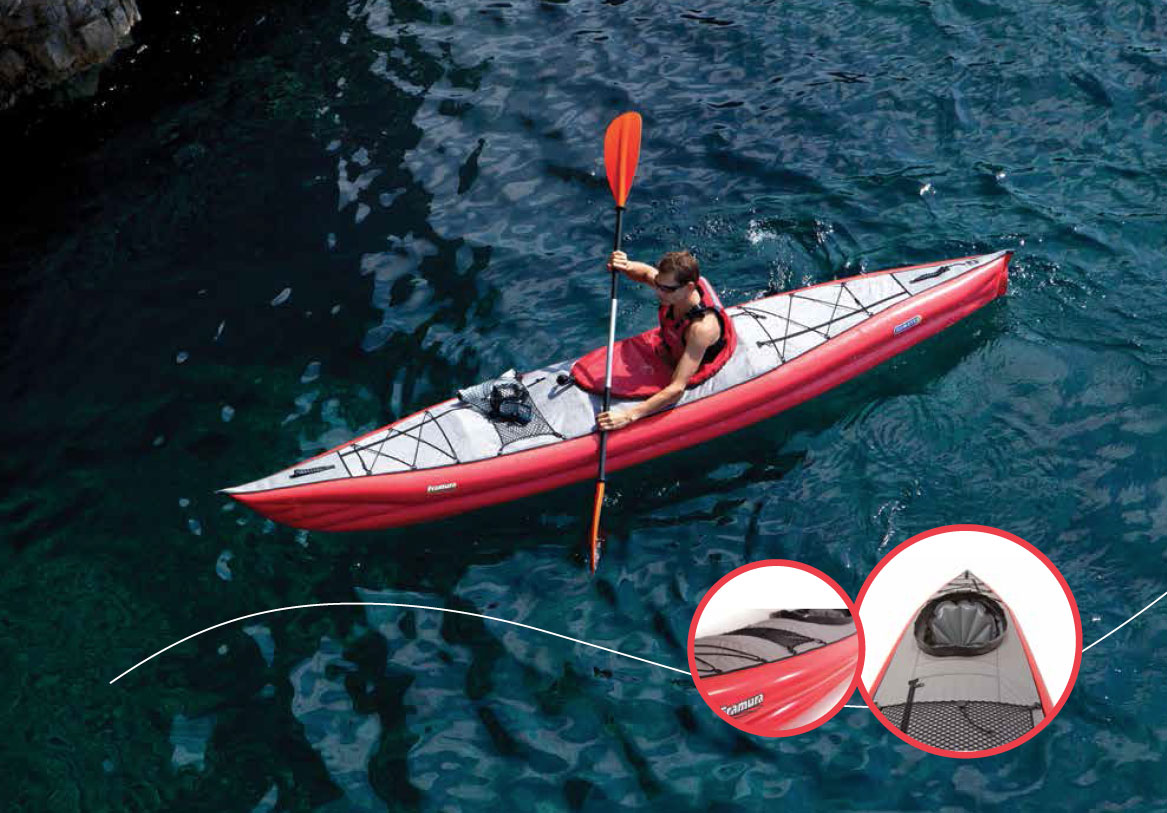
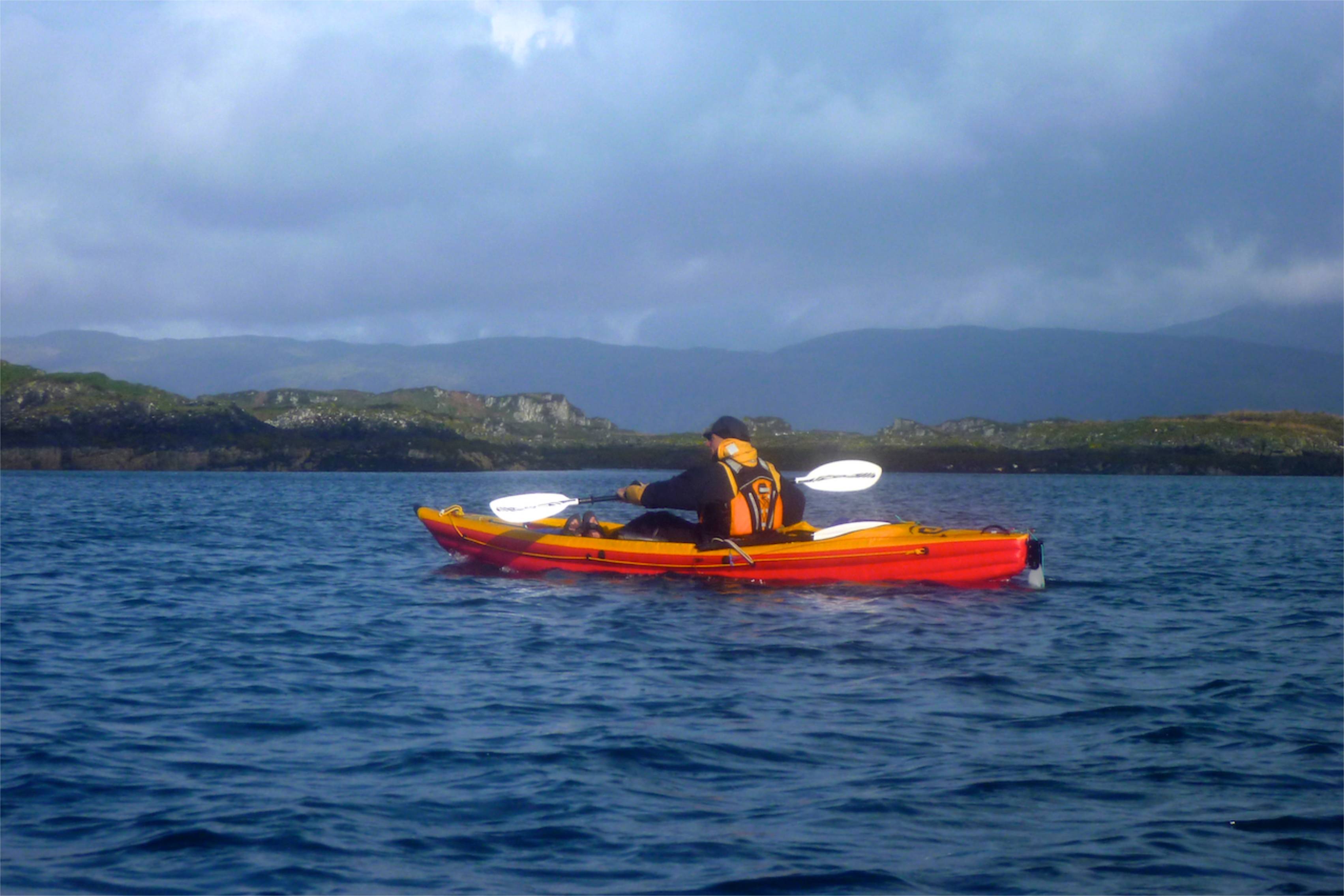
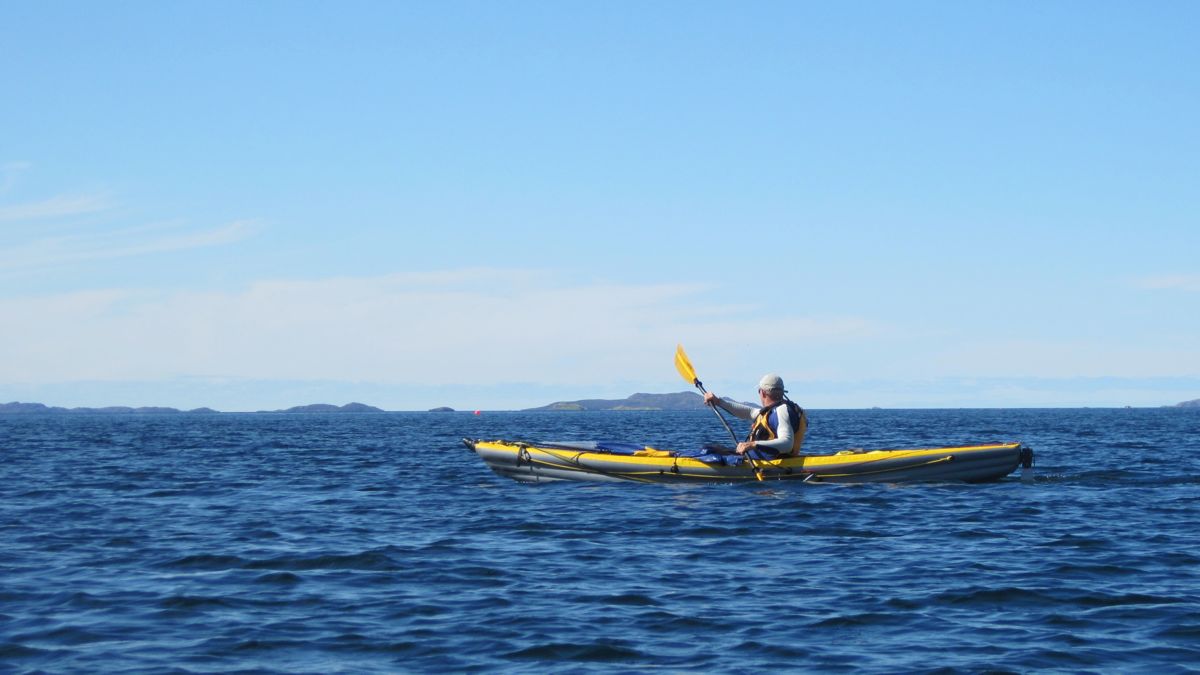
Even with the Rush models for 2020, Gumotex still claim their Framura IK is their fastest boat. For coastal ‘yaking the numbers certainly look great: 16kg + 4.1m x 75cm wide That’s 29.5″ and about as wide as you’d want to be in a proper IK. I see that in France it’s homologated for use as a kosher ‘Cat C, 10km from shore’ sea kayak while in North America it’s sold as a Swing EX.
Oi! Not sure I’d be dragging my IK over the sand like that.
From the bow shape it looks like it’s based on the slightly shorter but much wider Swing 2 – or the longer but also wider and higher pressure Seawave. That lightweight deck is fixed and has Swing-like struts to keep it up and shed water. Access is by straight zips or down the hatch. Like the Swings, they leak until the Swings were upgraded in 2025 along with the new Aurion, a hybrid Framura.
As for pressures, the Framura runs a disappointing 0.2 bar/2.9psi, not the 0.25 bar of the Seawave. But I read that Gumo-recommended max pressures are on the conservative side: the side tubes can be run up to 50% higher with great improvements in rigidity, and the floor runs an 0.2 bar PRV so can’t be over-pressured). I also read somewhere they got 12kph out of a Framura while testing at sea. The best I ever got out of my Java or Incept was a short burst of 10kph, so that is fast.
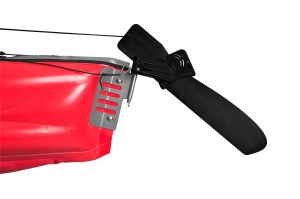
In 2016 they introduced a rudder kit (left) for the Framura/EX. I made one for my Seawave but in the end, could not be bothered with it on day paddles. On multi-day runs where you get the weather you’re given, a rudder may be a good idea.
Slim, not like an otherwise similar Swing
I like the look of the 4.1-metre-long Framura but I liked my Seawave more. Framura, by the way, is a nice spot on the Italian Riviera, not far from Portofino. Not, as I thought, a hint that the new boat uses a frame(ura) to maintain rigidity. That rarely works with IKs, in my experience. You do wonder if the new hybrid Rush 2 supercedes the 2015 Framura.More Framura in this video. See also this.
I’m not convinced the 0.2 bar Framura is that much faster than a longer, stiffer Seawave. And I also suspect it has not been such a sales success either. Perhaps claiming the former has something to do with the latter.
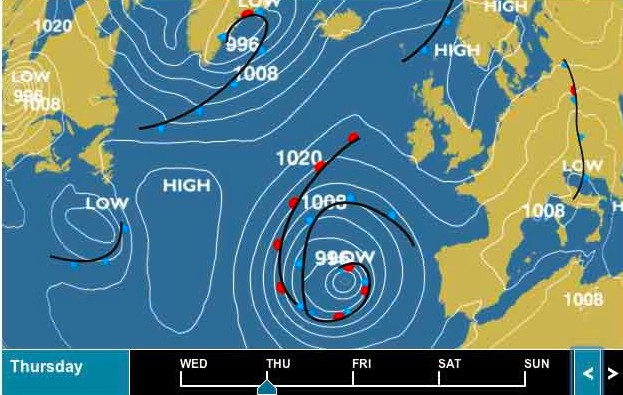
With the heather turning purple, mushrooms all over the lawn and a chill in the air, I thought it was all over for this season. But this week we’ve had a reprieve. Sat between isobars so far apart they’re in different time zones, today the Summer Isles are getting one final spell of calm, summery conditions. It could be my one and only chance to tick off the last of the Summer Isles.
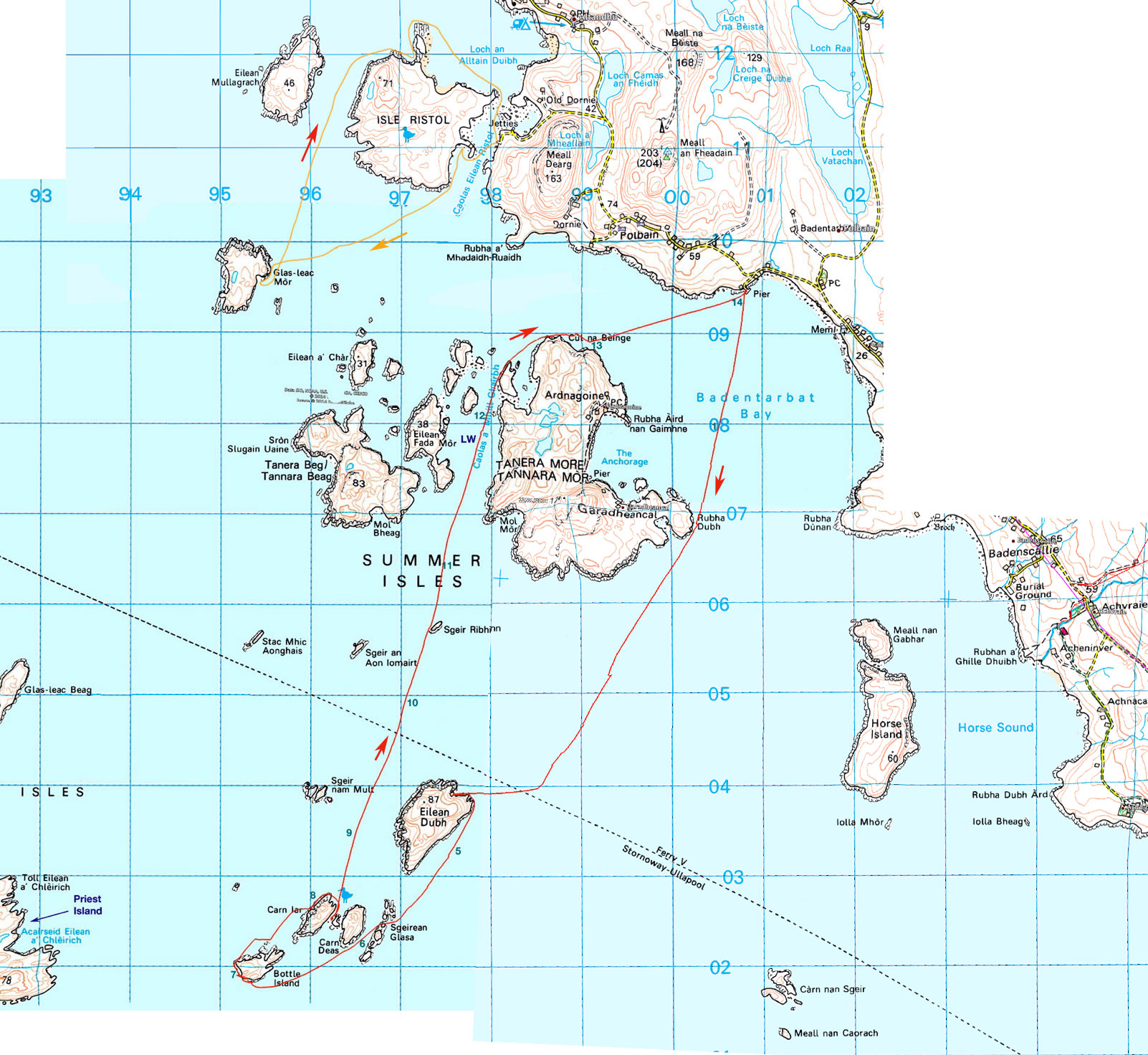
Yesterday we nipped out from Old Dornie to Glas-Leac Mor (map left), another as-yet unvisited isle less than two miles out. Paddling 2-up took a bit of ‘readjustment’ and isn’t half as comfortable for me as my fuly-braced DIY solo set-up. But following a short cruise alongside Glas Mor, we were fully synched for the long way back between Ristol and Eilean Mullagrach.
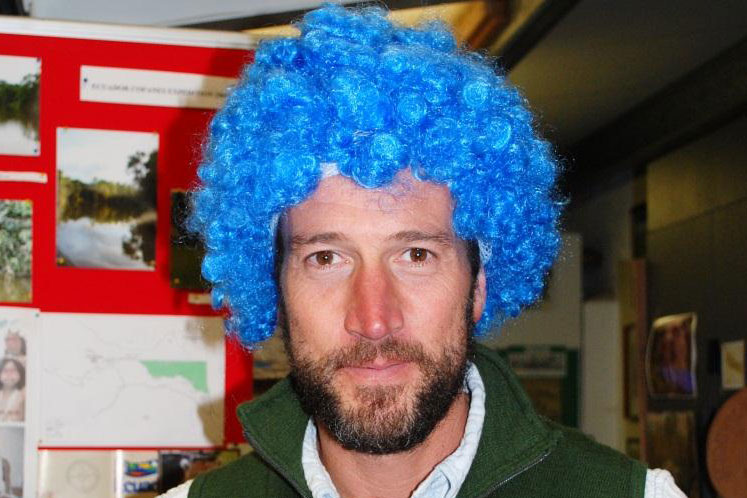
Local internet chatter talked of helicopters dropping equipment to build a dwelling on Eilean Mullagrach, which we could see on the south side. Apparently professional castaway and Lego brand ambassador, Ben Fogle, tried to buy Mullagrach ten years ago, but bid too low, perhaps to the owner who’s developing to now. (Had he bought it, he could have named the 46-metre-high summit ‘Ben Fogle’). With no easy sea access that I’ve seen, you do wonder how they’re going to get to that house. As we paddled through the sound, a little dolphin popped up, huffing and puffing, and some colourful kayaks were taking a guided tour around the isles. The following day’s forecast was for similarly light winds, so I dropped the kayak off at Badentarbat jetty and next morning walked down with my gear.
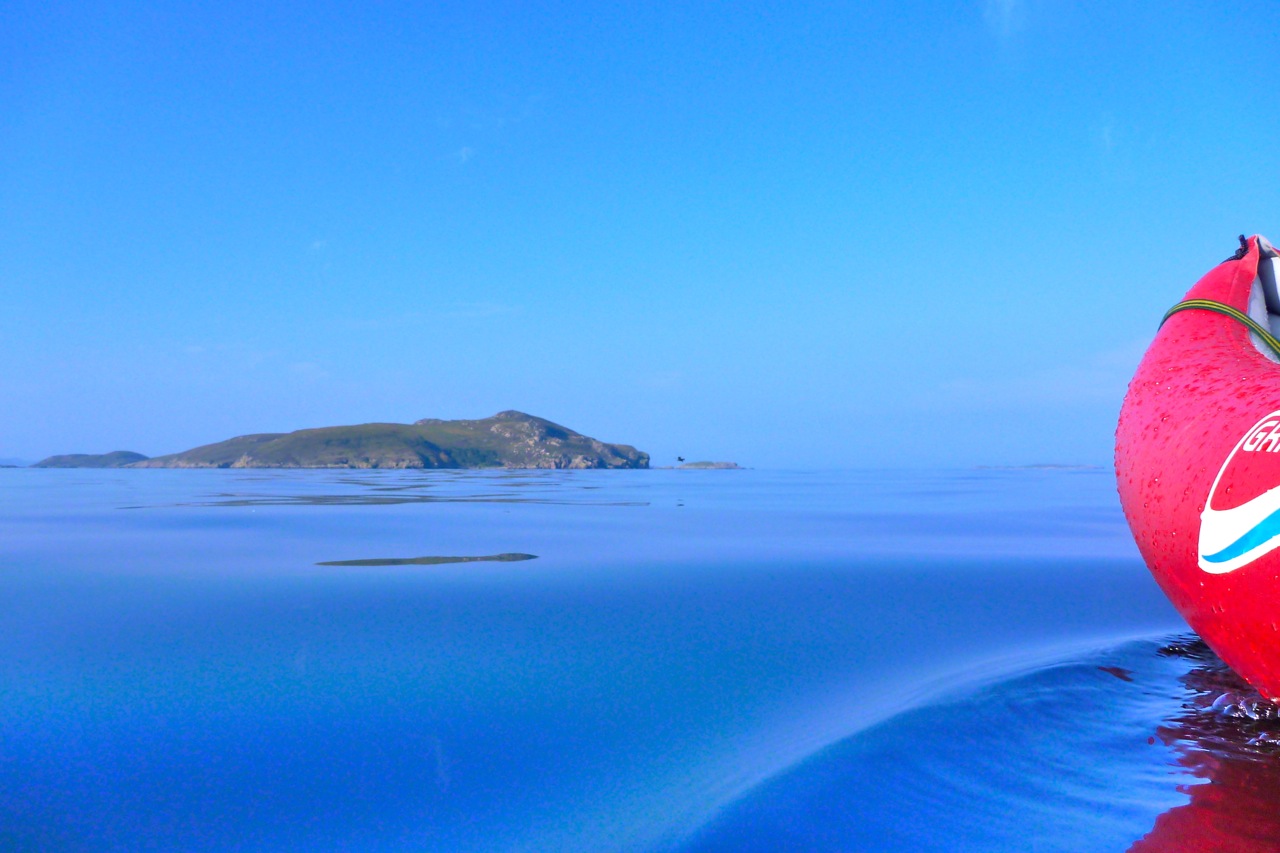
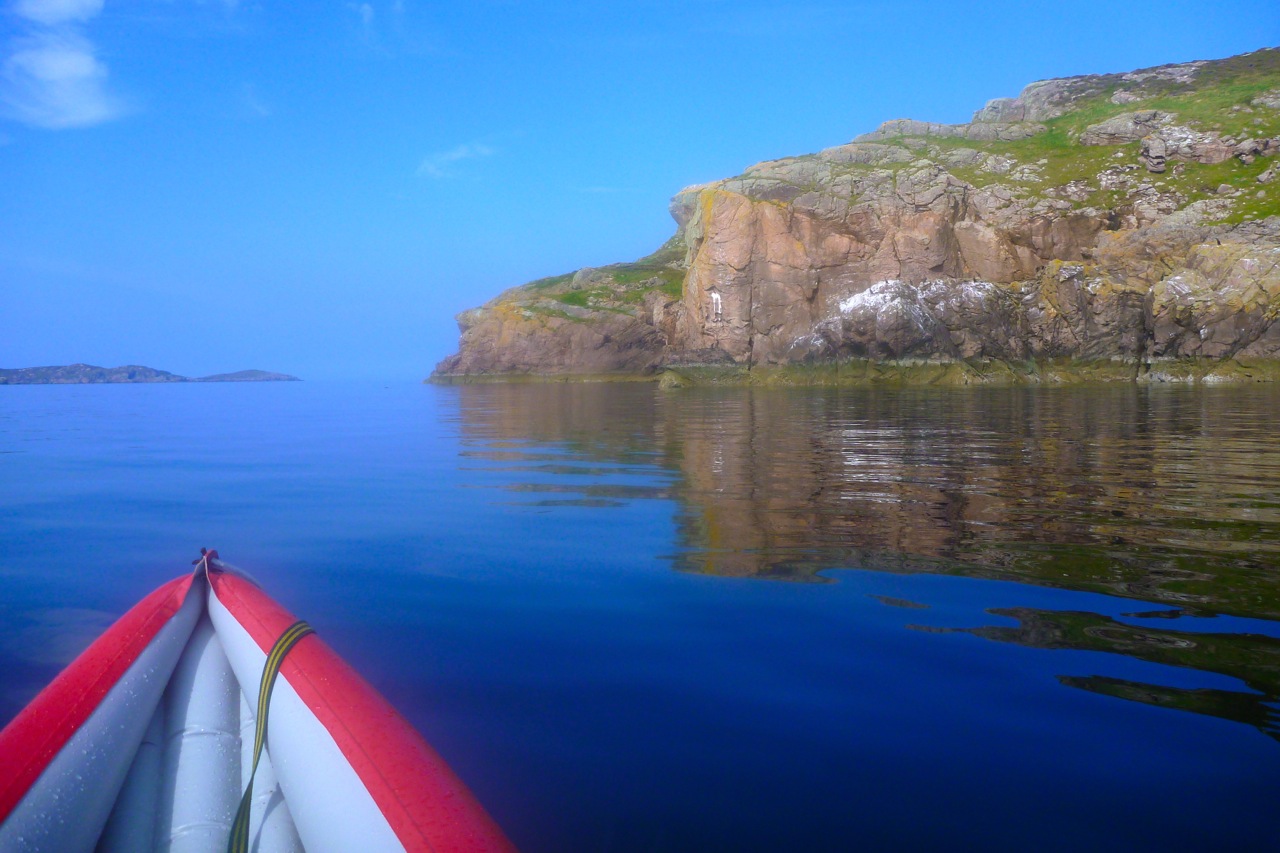
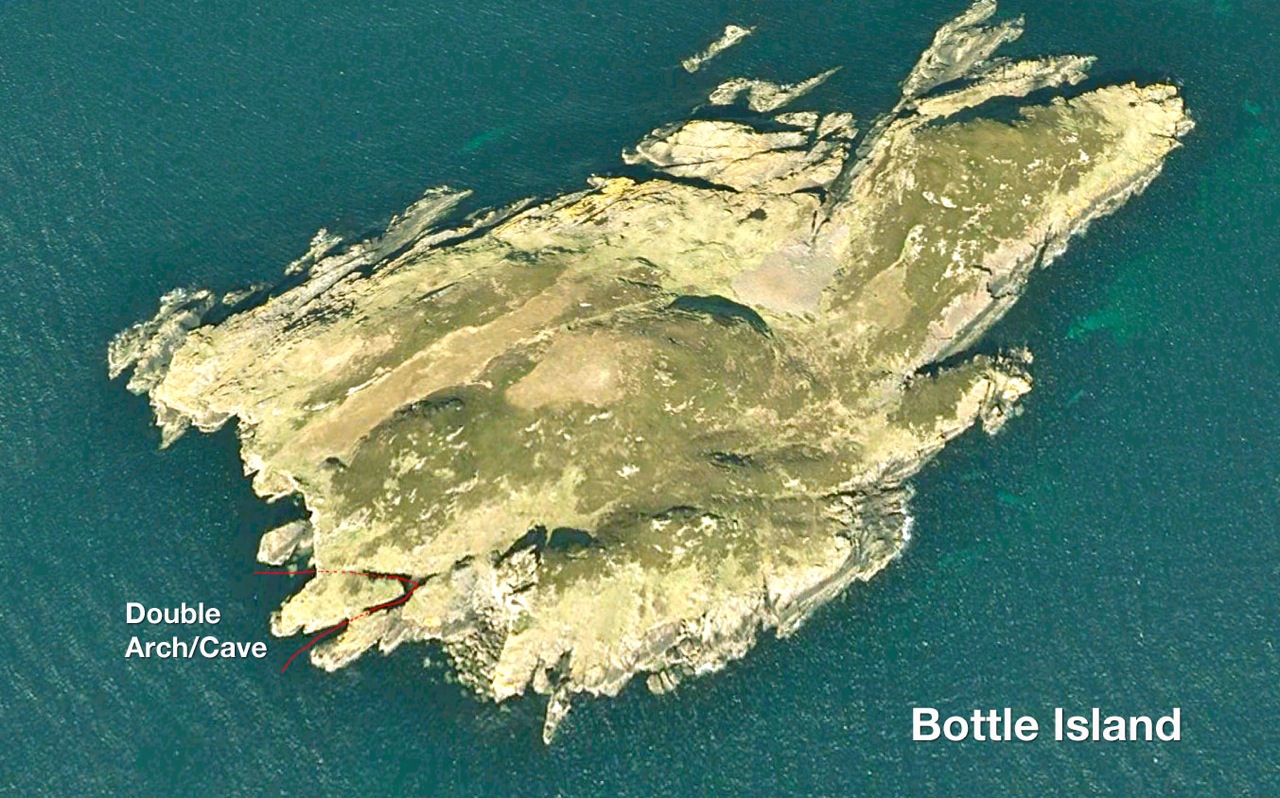
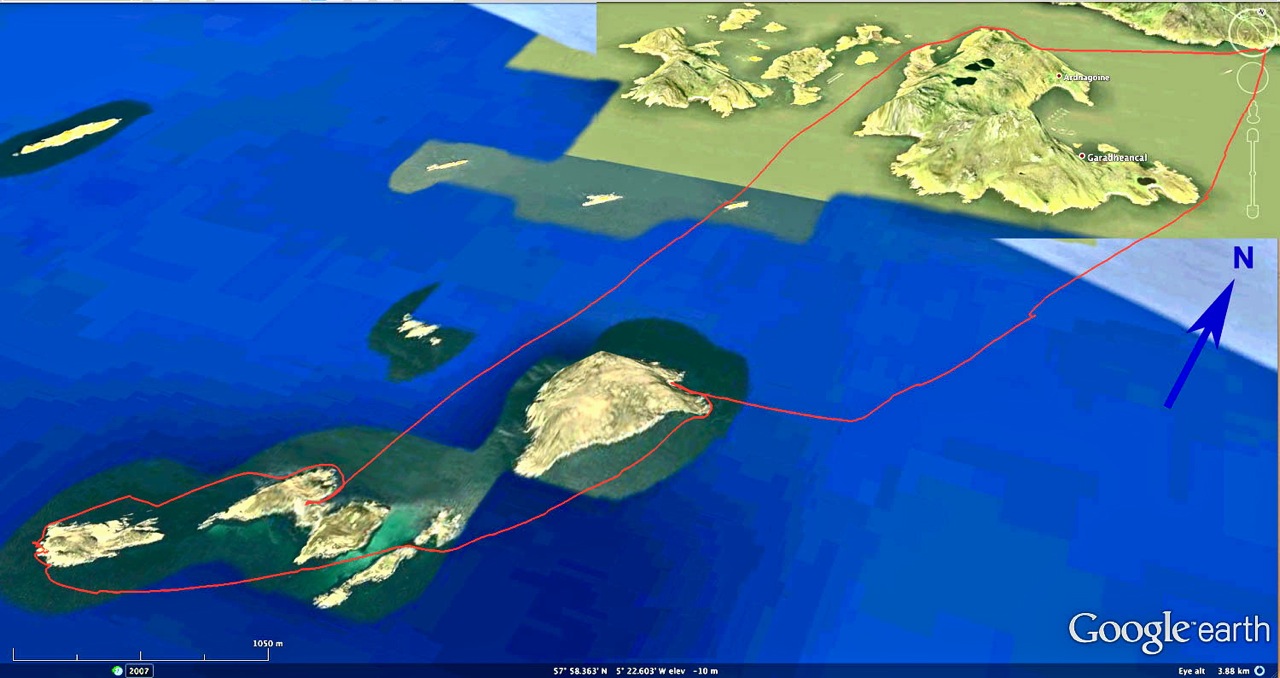
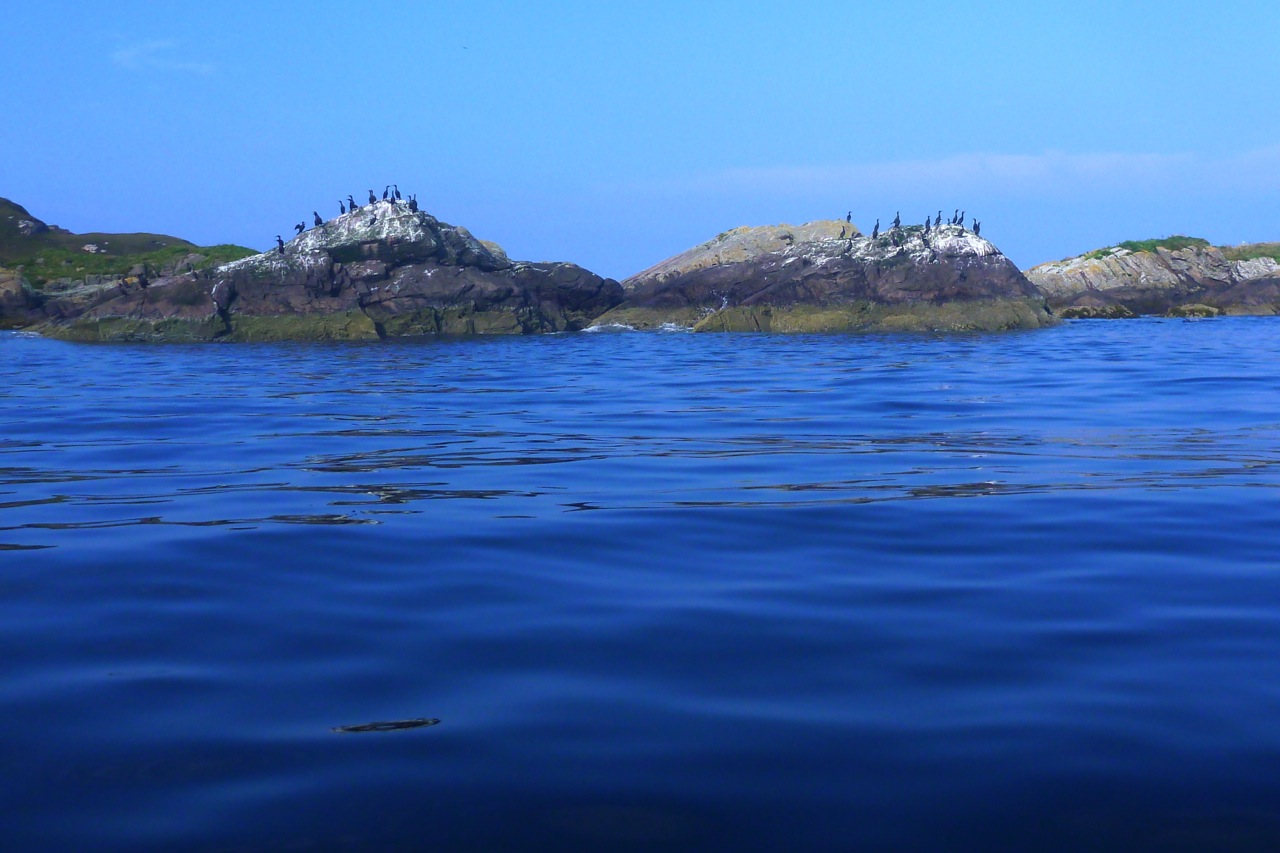
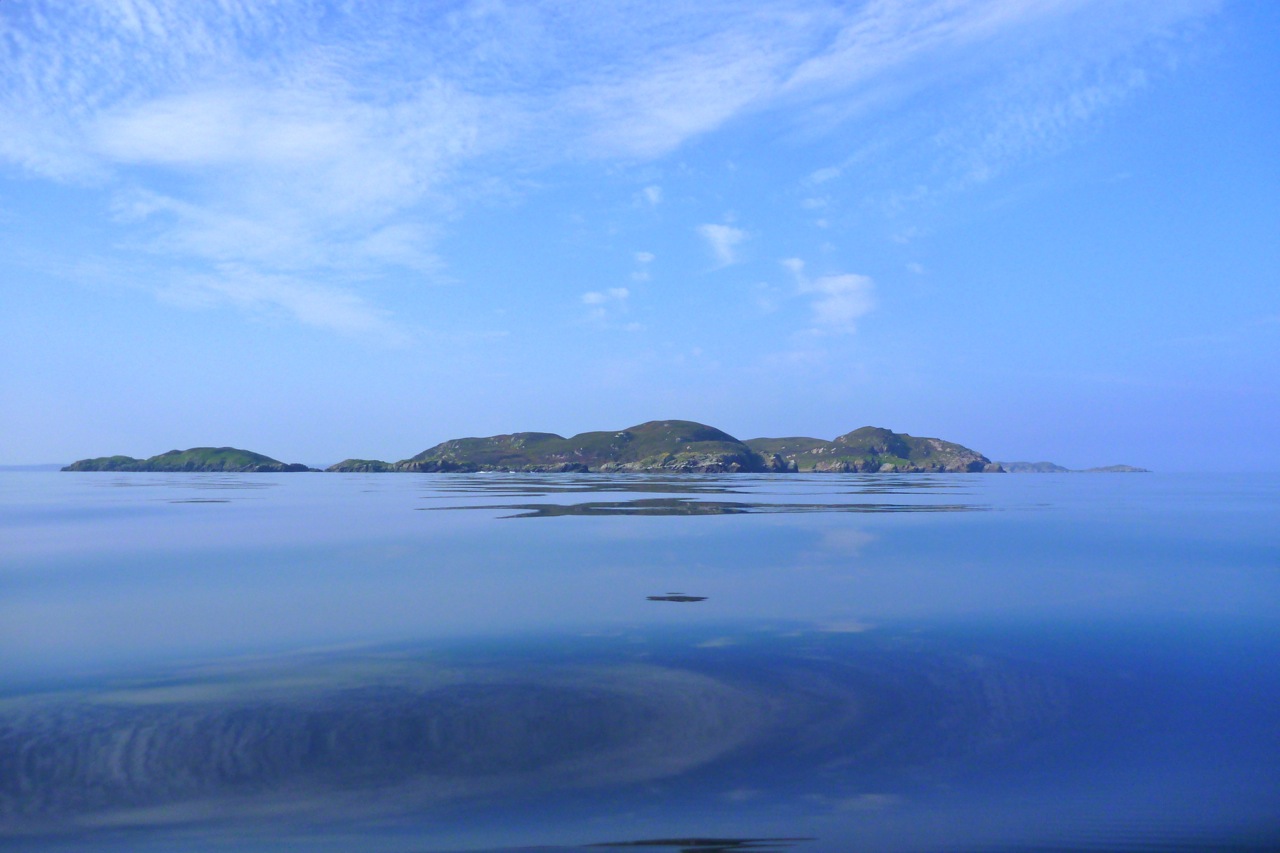
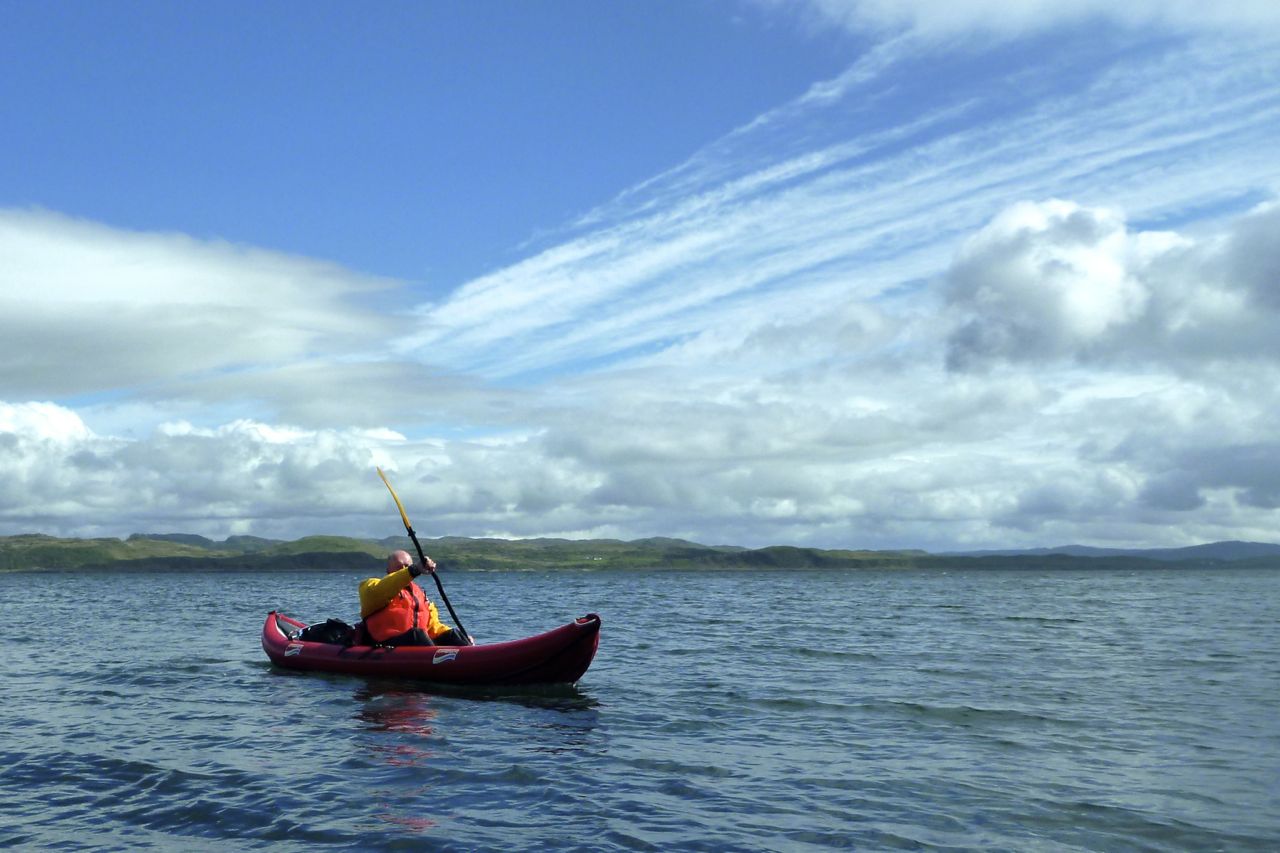
You don’t need a flat calm to visit the inner Summer Isles: the Taneras, ‘Ristols’ and Horse Island. But alone in an IK the outer Summers can feel like a bit of a reach. Priest Island is the most distant and adds up to an 18-mile tour via all the other outer isles, even though you need never be more than a mile or so from an island or inaccessible skerry of some sort. I settled on Bottle Island at the end of a cluster of isles and a 14-mile round trip from Badentarbat jetty. That’s about the same as our run to Ullapool a couple of years ago, but more open water than coastal hop.
The winds would be barely a factor until the afternoon, but a spring tide was at its 5.5-metre peak. I asked tidemaster Gael whether there was anything to consider on my route: he advised the books and charts didn’t list any dodgy currents. I was expecting a bit of flow through channels or around points at peak ebb around 11am, but could always find another way round.
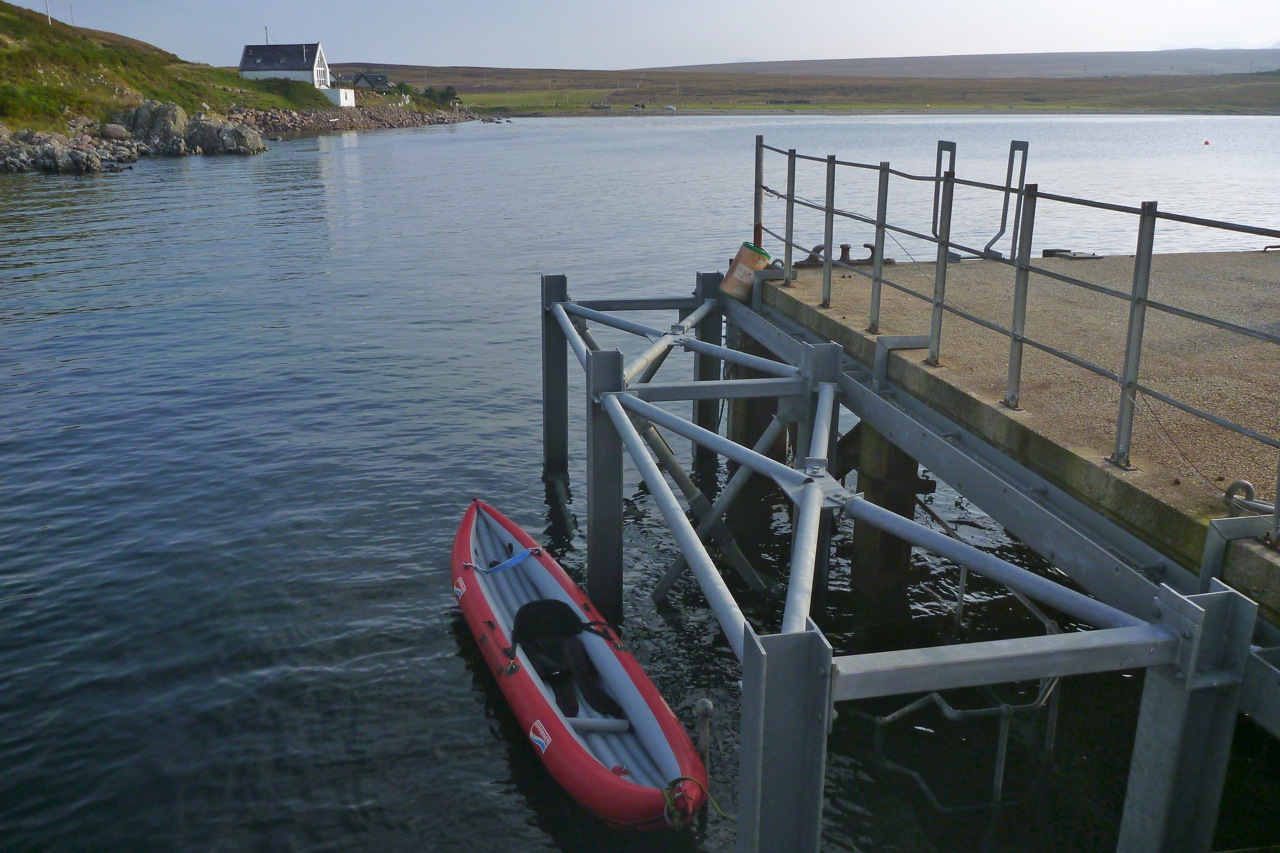
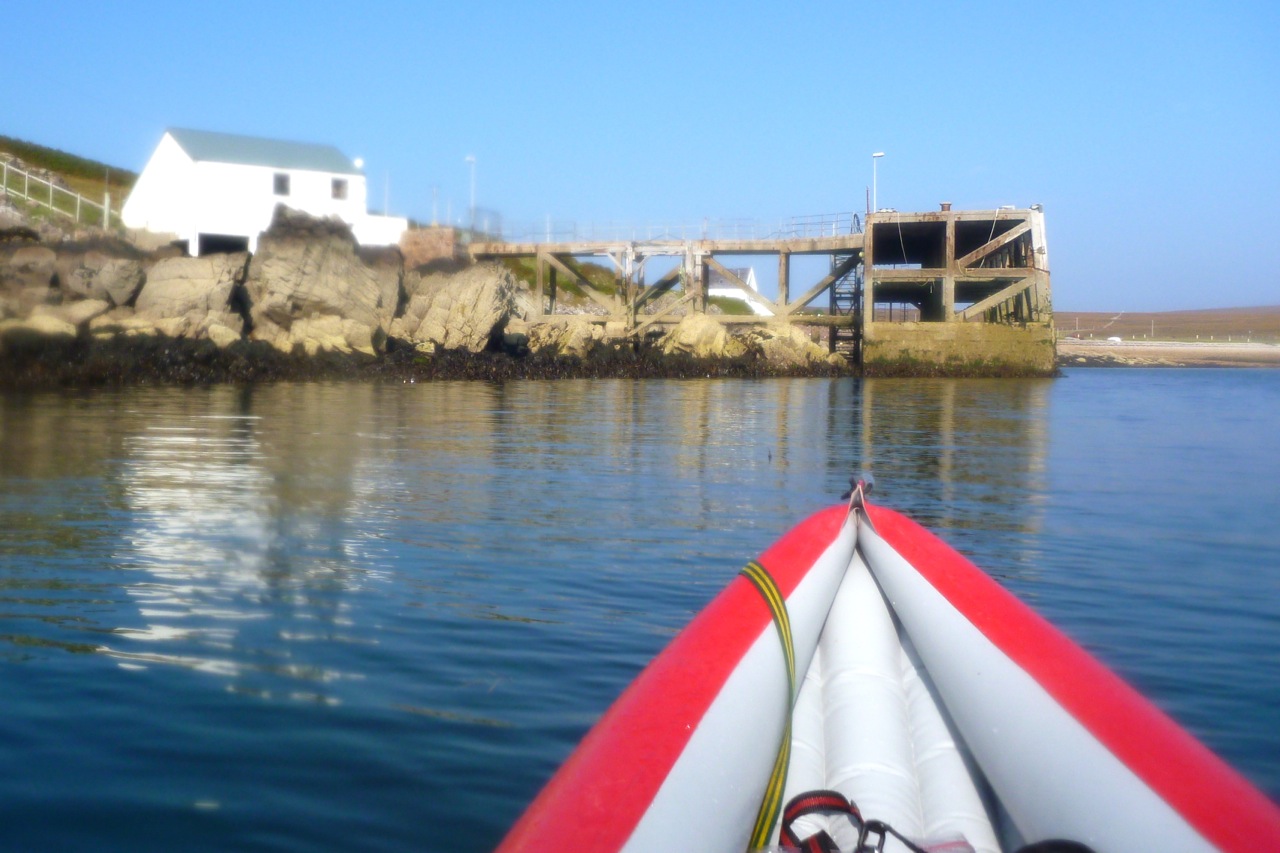
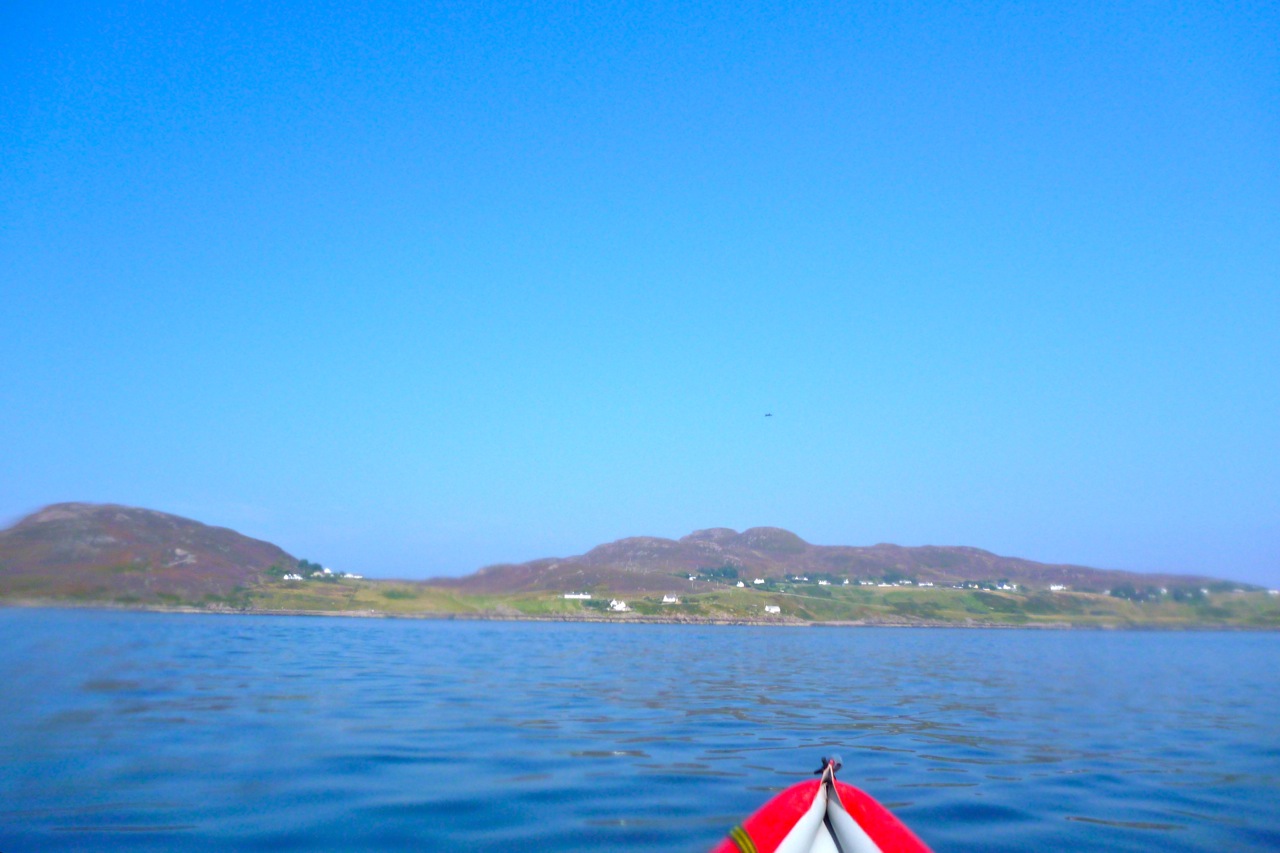
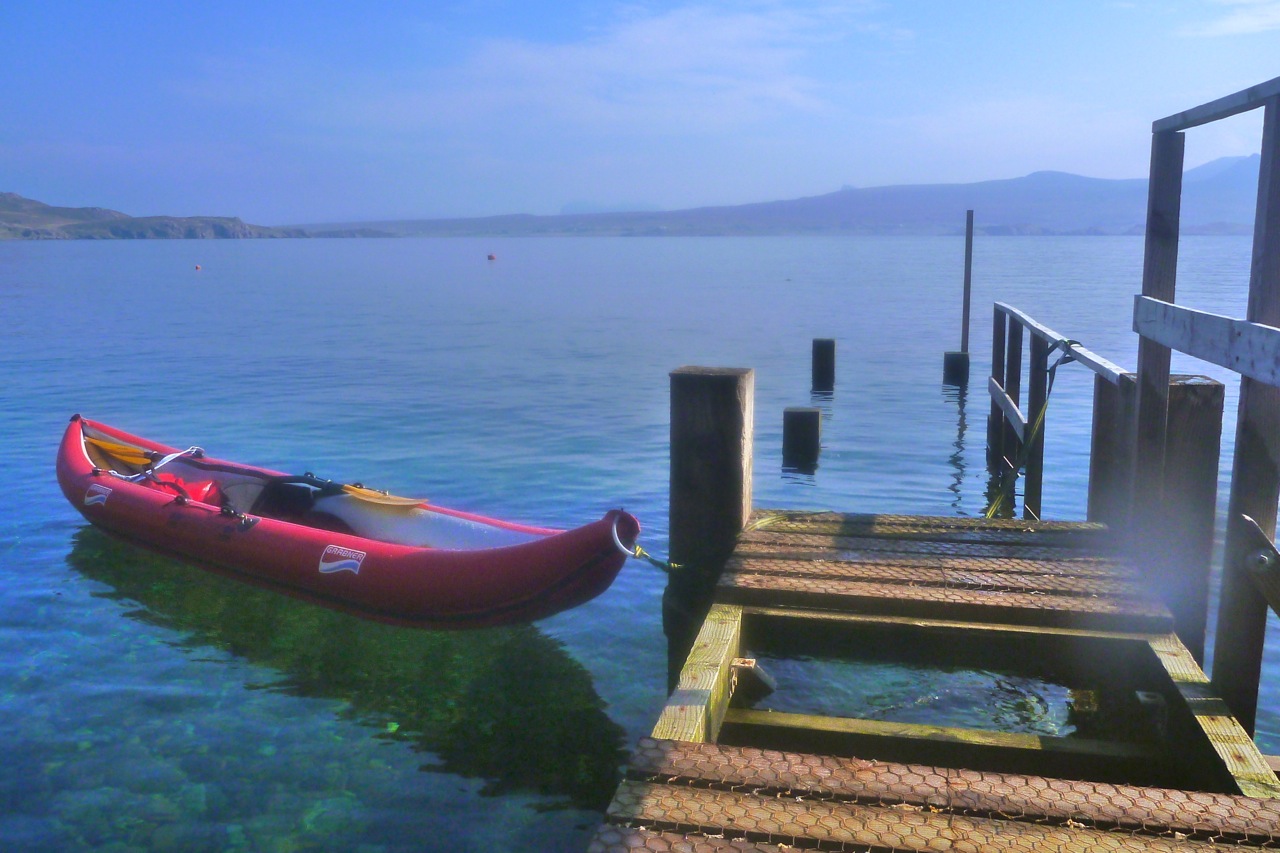
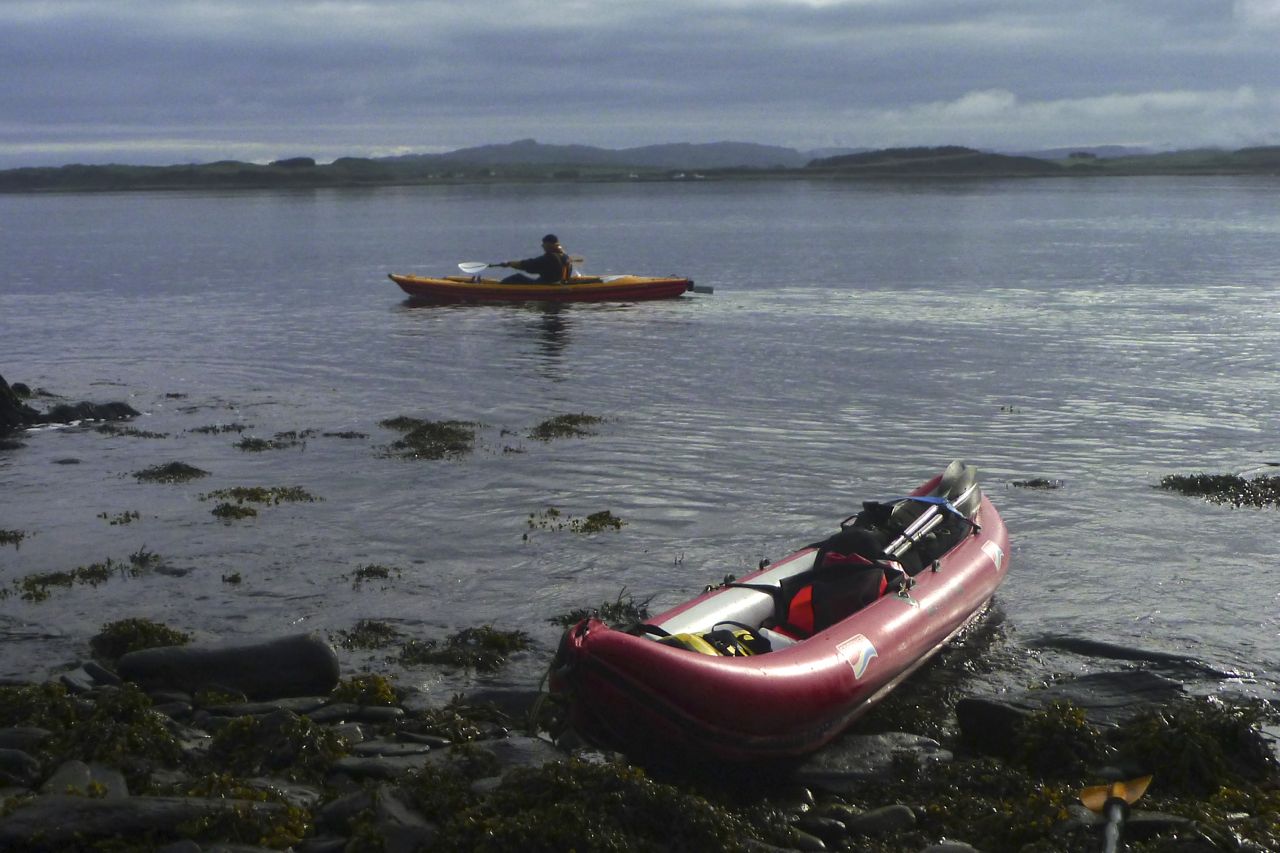
The pier at Badentarbet is condemned and blocked off with a barrier, but locals clamber round for a spot of fishing. I dropped the boat over the barrier, carried it down the steps to the water (right) and was on my way at 9.30, an hour after very high tide. Forty minutes later, I turned the east corner of Tanera Mor (still for sale, btw. Currently under £2m), rubbed the sweat from my eyes and clocked Eilean Dubh, nearly 2.5 miles ahead. Coming round Tanera put me back in a cooling breeze and the boat slid silently across the water as if on rails. To the southeast was Horse Island and Carn nan Sgeir, a remote skerry I visited last year and now floating on the glassy surface like a jellyfish with gout.
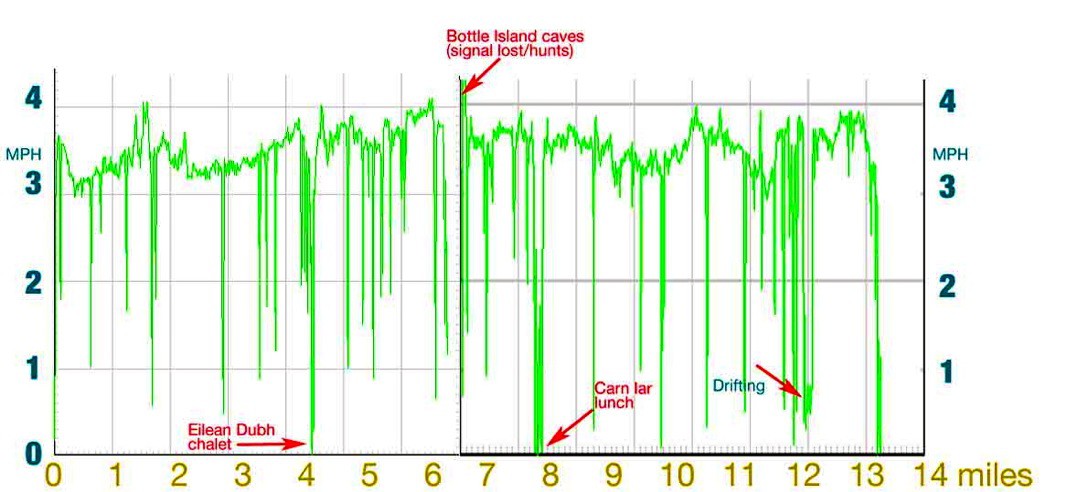
An hour before peak flow, at one point I was convinced I was being pulled west on the outgoing tide. I stopped to try and read any drift on the GPS, but couldn’t determine a direction. Turned out later I was drifting at 1mph east or inland with the breeze. So much for the impression of deadly currents. It was a lesson for the day: what you feel is happening (drift, current, ‘wind-in-the-face’ velocity) doesn’t always match the unassailable facts of the GPS. But alone on an all-day run it’s important to know what’s going on: is it ‘me’ or is it due to the conditions – so you can judge how much you have left in the tank.
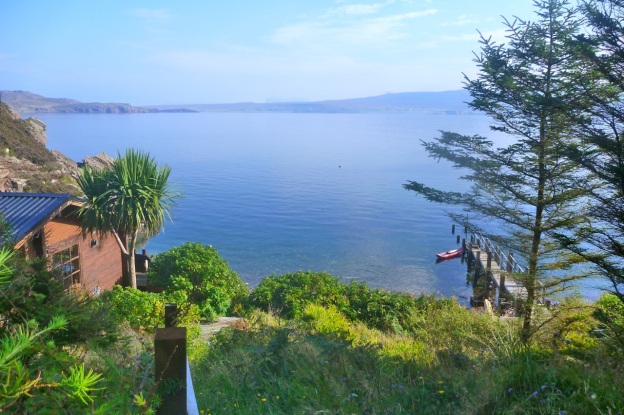
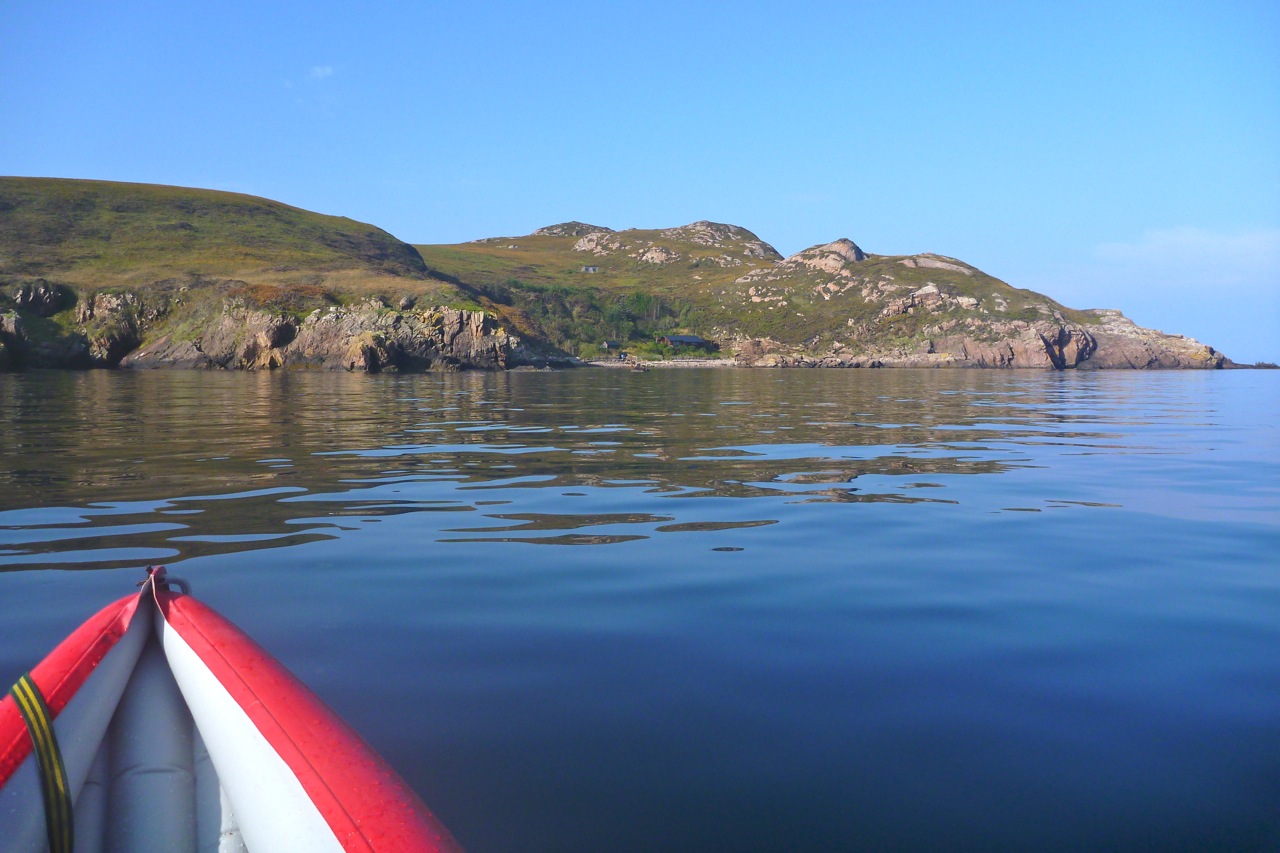
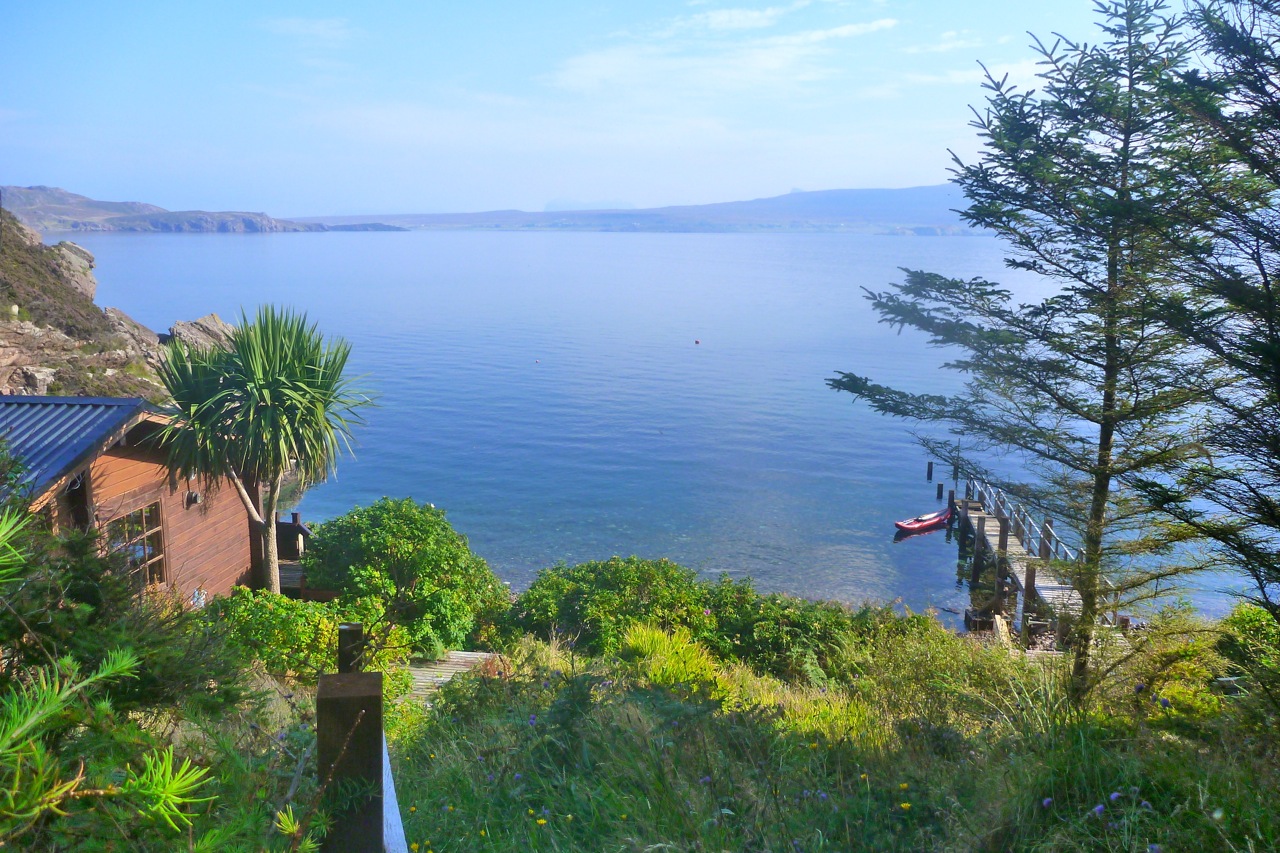
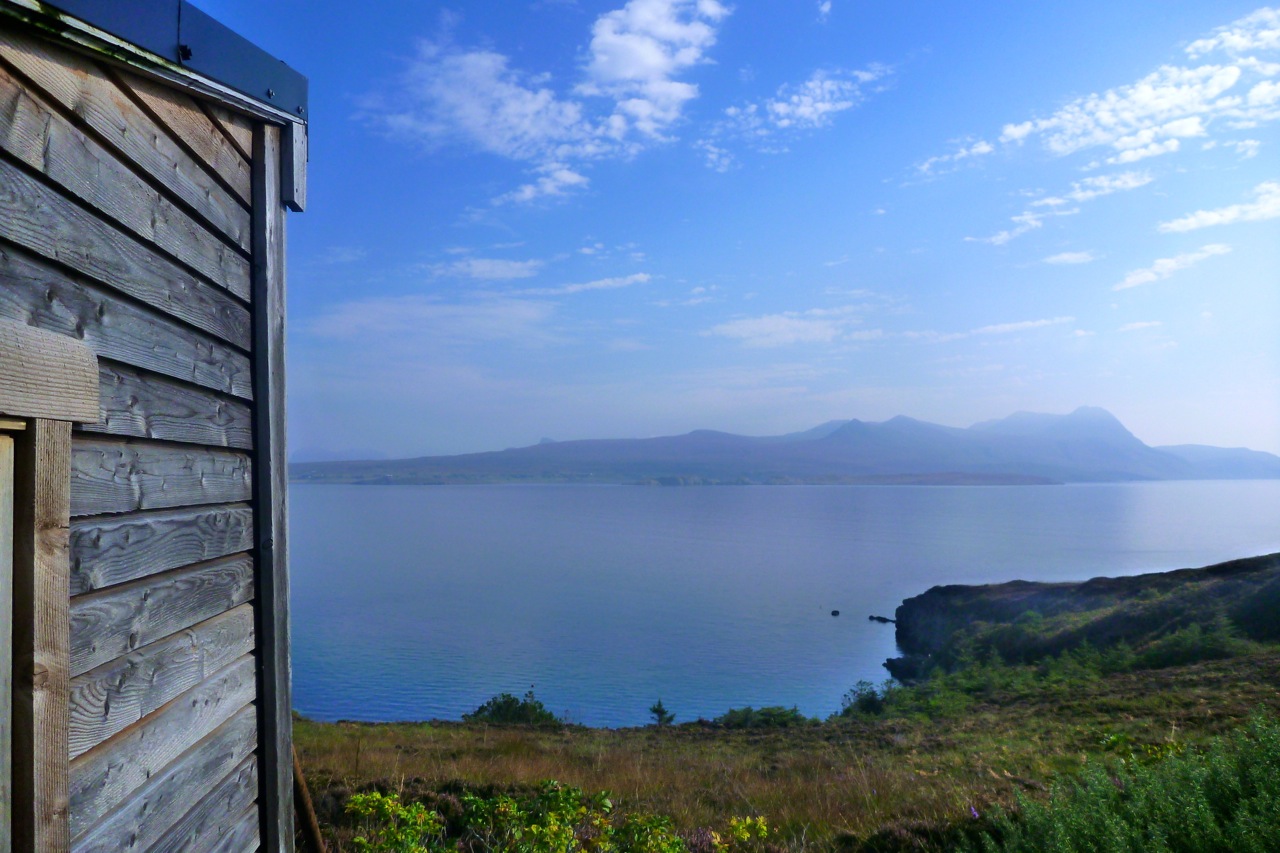
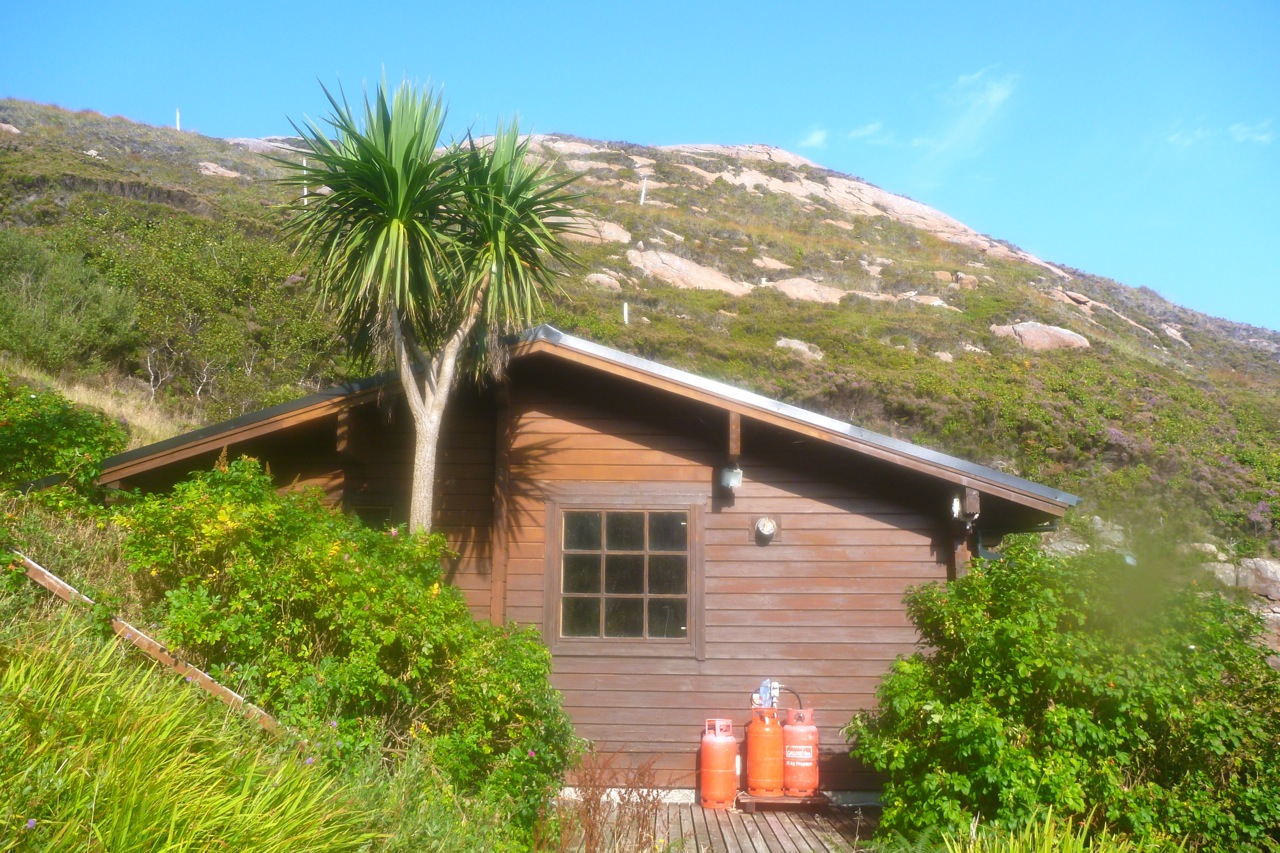
As I neared Eilean Dubh I saw what looked like a chalet in a tiny north-facing bay. A couple of years ago I’d heard about a house in an outer Summer somewhere but couldn’t find it on Google. This must be it (left). With no boat moored at the jetty, I diverting for a closer look. It was certainly the protected setting to build a dwelling: small stony beach for access; sheltered northeast aspect and a burn trickling down for water. Once ashore, the chalet reeked of lovely warm creosote and there was even a palm tree among the firs and other trees. Up the hill in the heather was little shed /painting studio. It didn’t look like anyone had been here for months.
Back on the water and coming round onto the east side of Eilean Dubh, I expected to be paddling against the ebb spilling southwestwards round either end of the island. And that’s how it felt, though again the GPS showed I was doing a normal speed or even faster, briefly hitting 4mph. It’s all in the mind. But when I came through a gap into the channel between Sgeirean Glasa and Carn Deas, I was definitely fighting against something, so moved away for the shores. Just as I did so a Tornado ripped past low overhead, close enough to see the undercarriage.
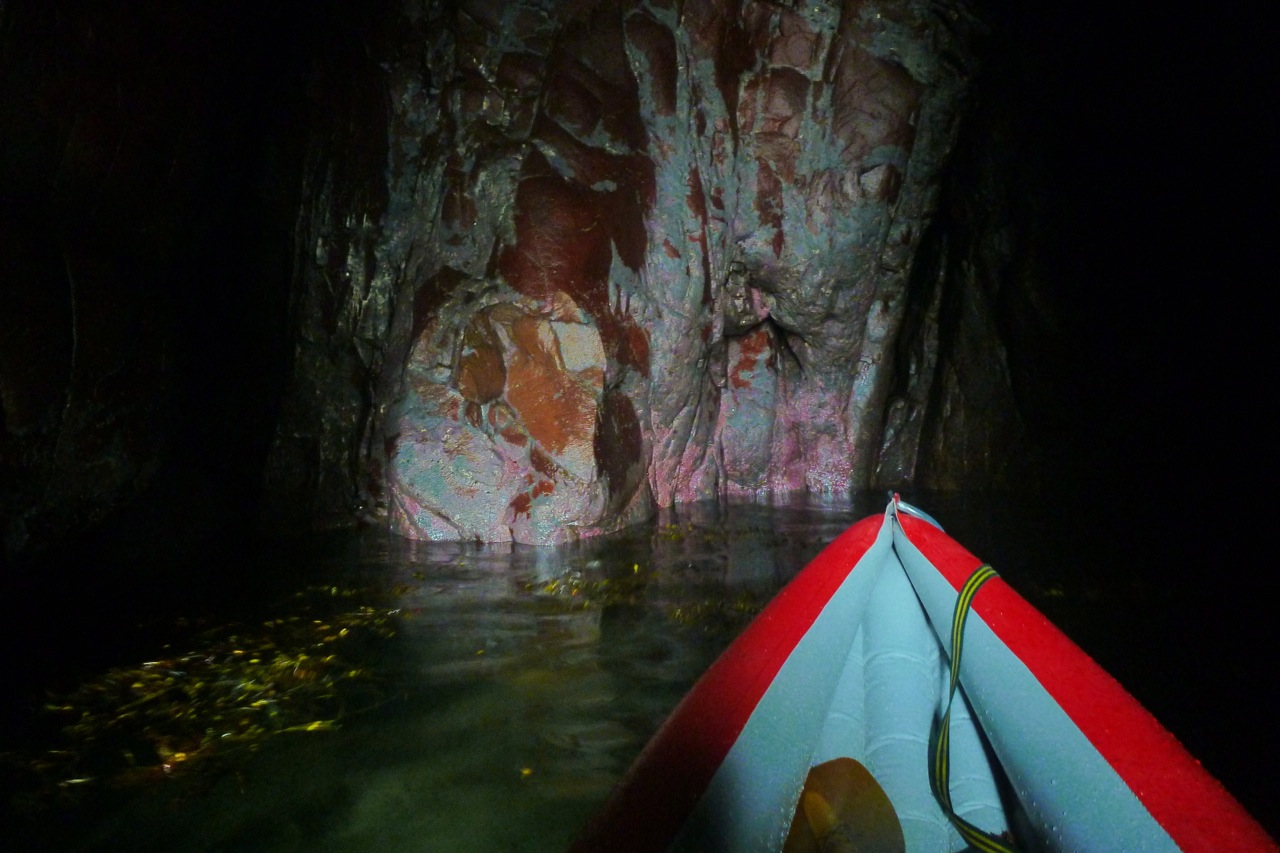
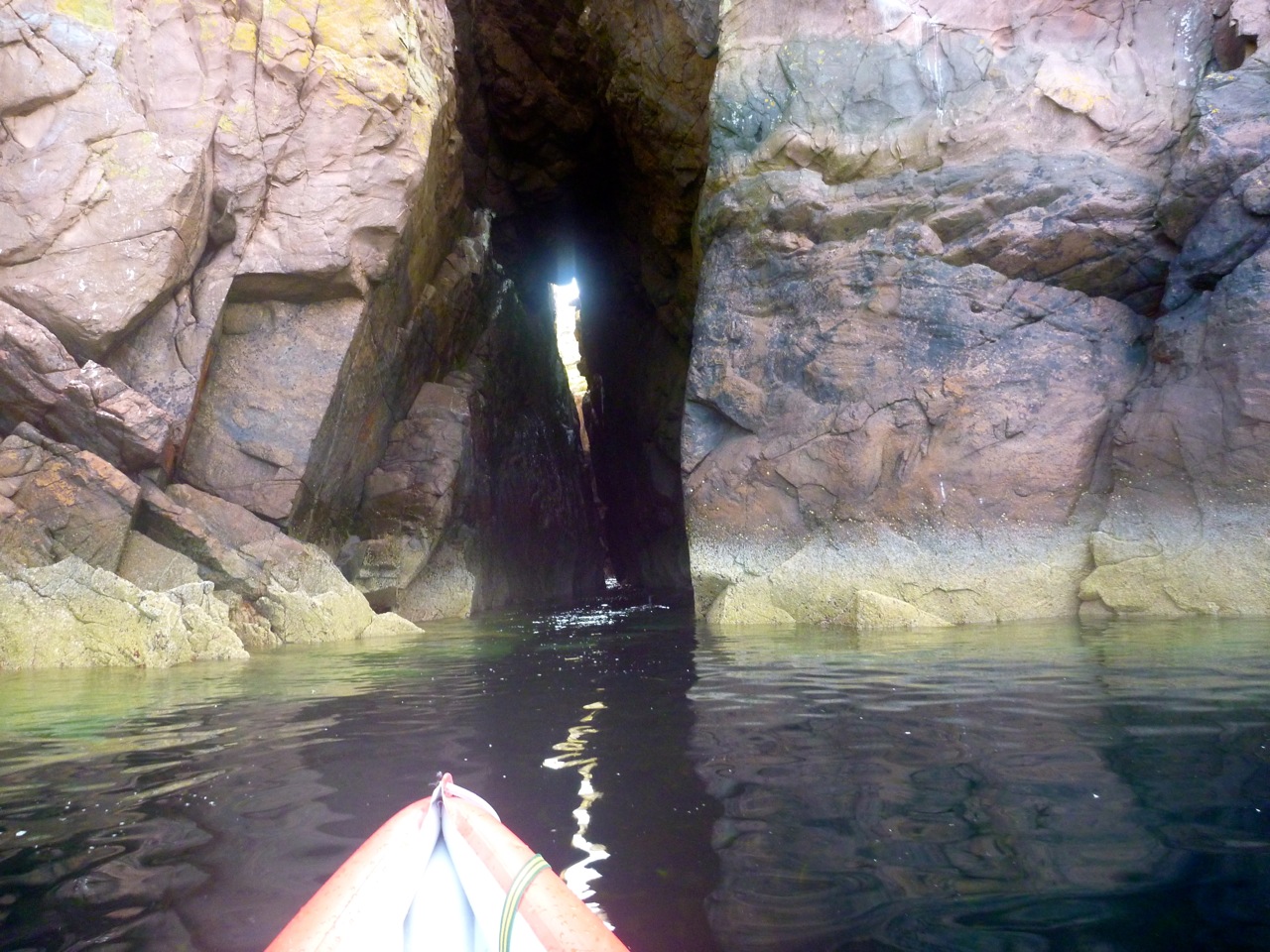
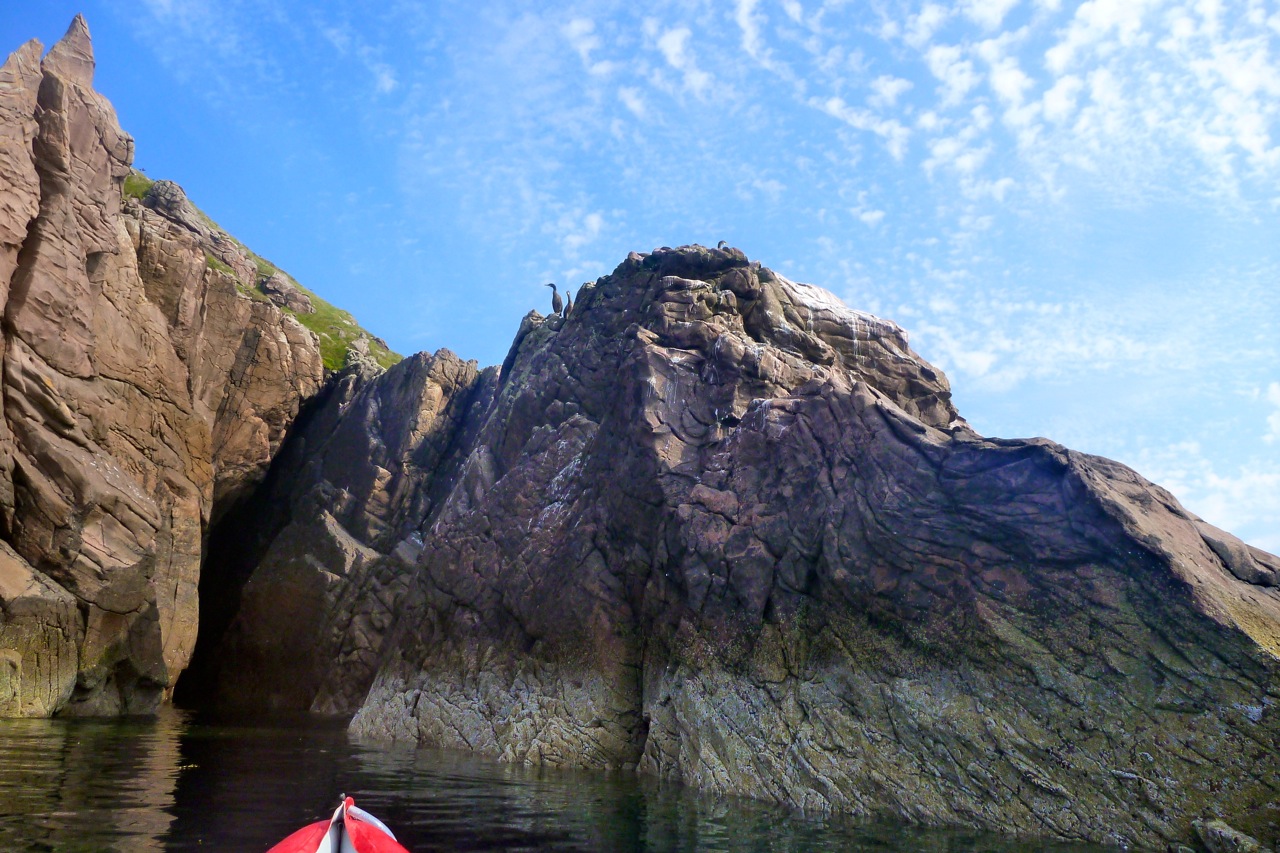
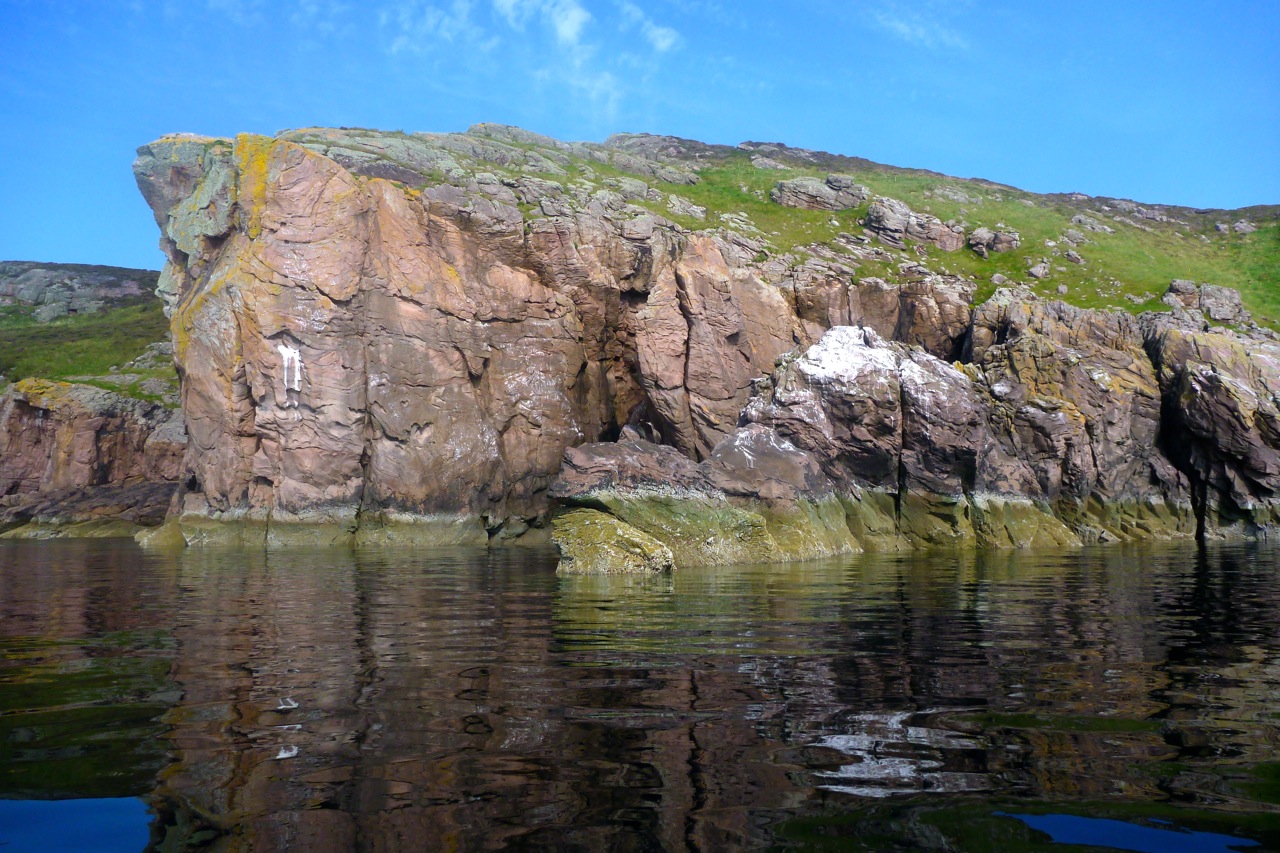
Up ahead, Bottle Island was now only a kilometre away. So far so good: I got there in two hours from the pier after deducting 25 mins nosing around on Eilean Dubh: 3.5mph cruising average. Here I nosed about some more, this time deep into a slotted geo on the south side of the island, where plinky-plonk drips and splashes echoed in the cleft. On the back of the cave the minerals in the Torridon sandstone looked like a gaudy, modern art mural (right) – or maybe petrified viscera.
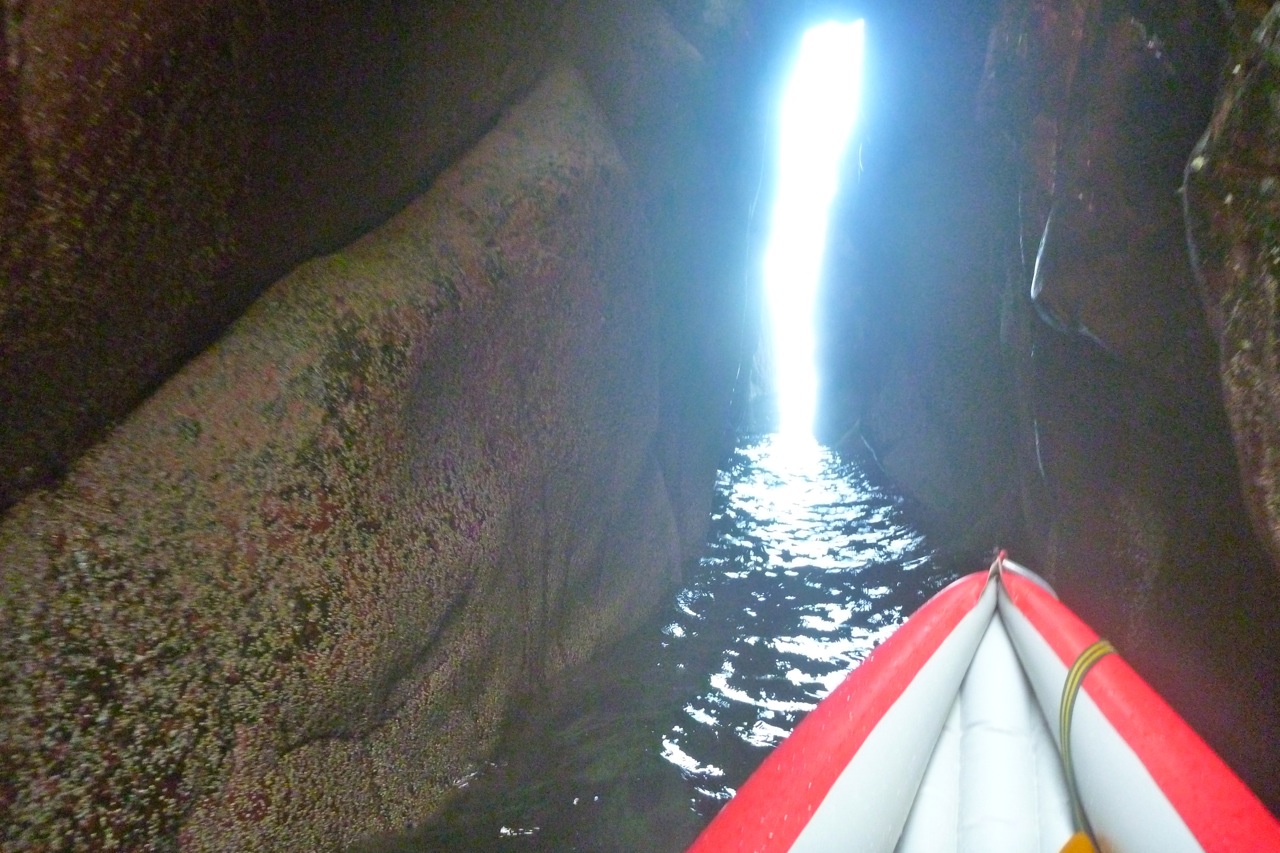
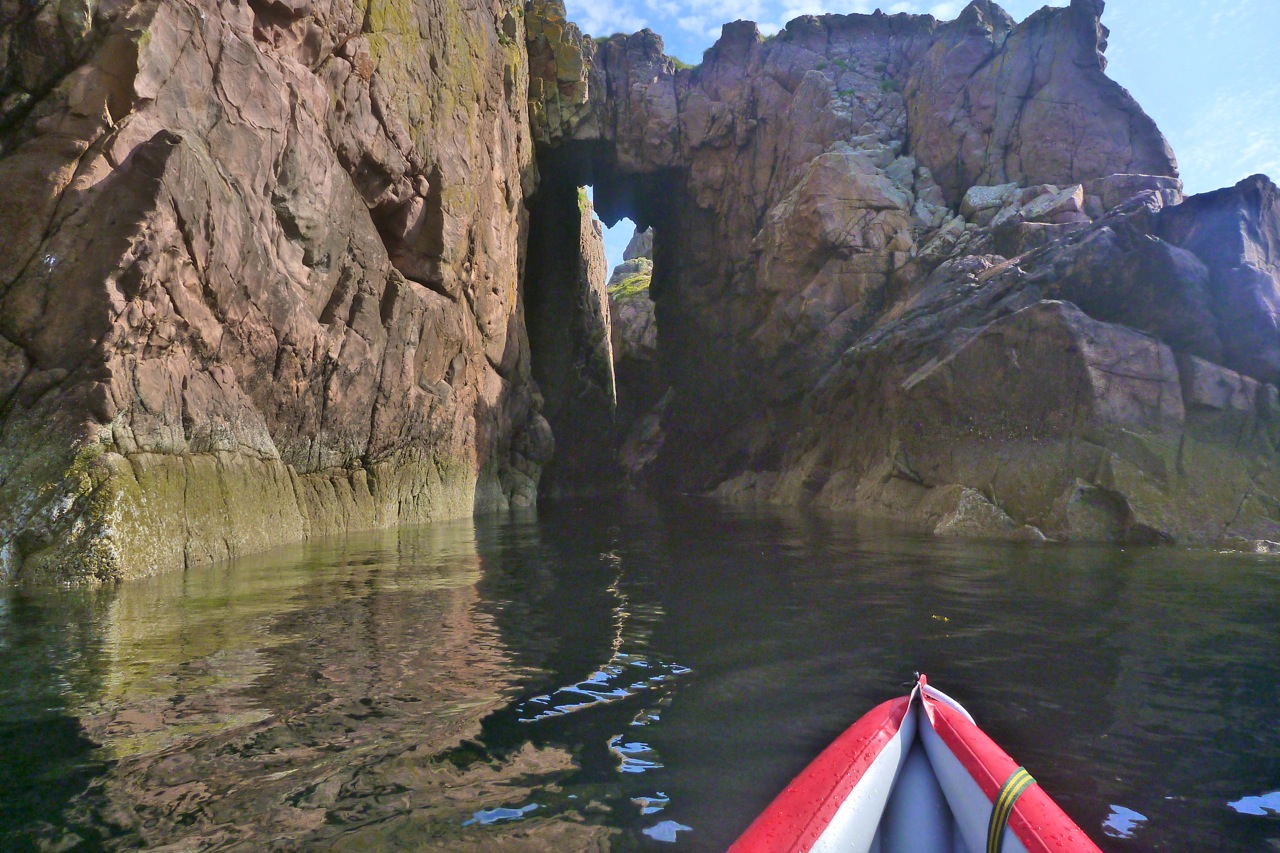
There was just enough room to turn around in there when an incoming swell revealed another way out. In a corner was a chasm under another arch with an even narrower tunnel leading back out to sea (right). I inched in to see if it was wide enough and safe, then stowed the paddle and pushed through off the walls back out into the open. A double arch sea cave – who would have known!
Two clicks to the west Priest Island looked far enough away to stay that way for now. It’s nice to leave something for next time (aka: ‘hold back to give an impression of calculated caution’).
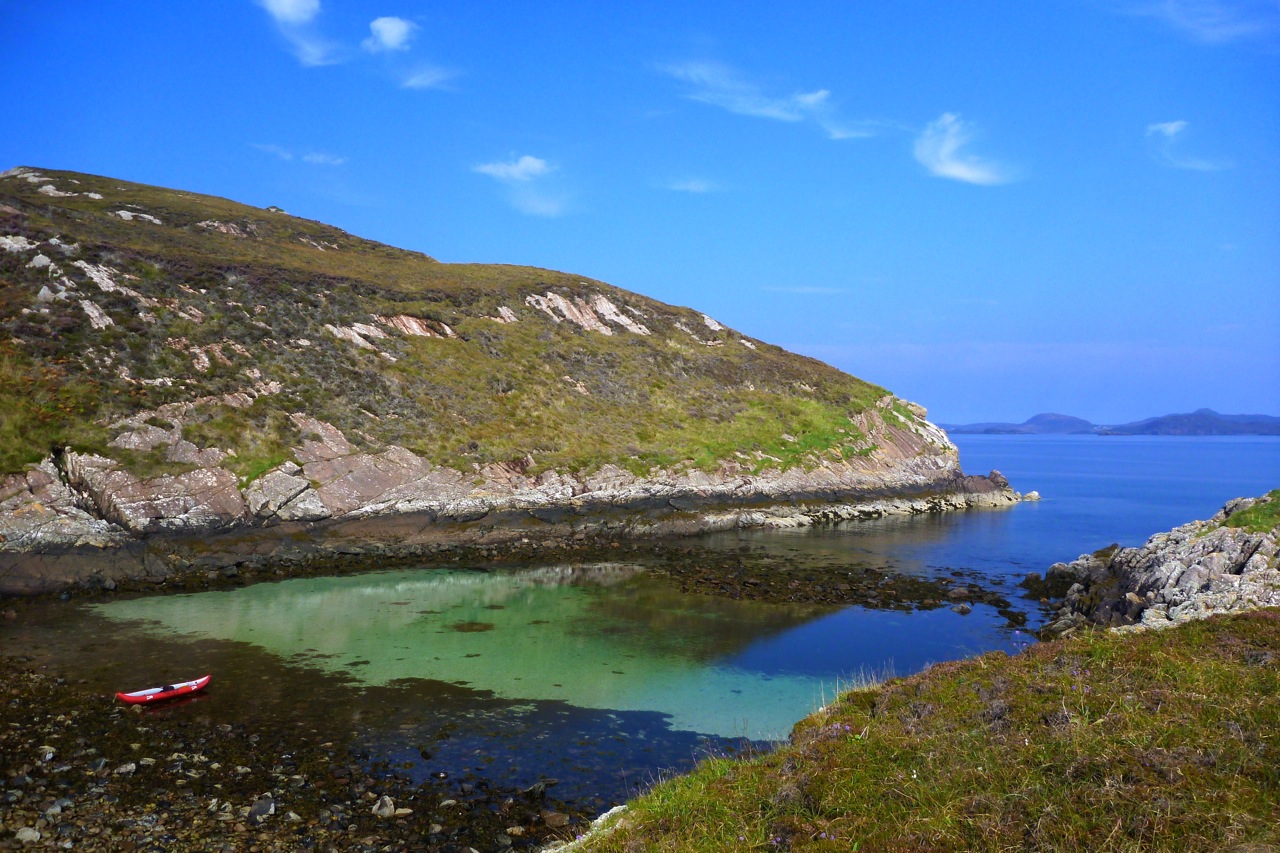
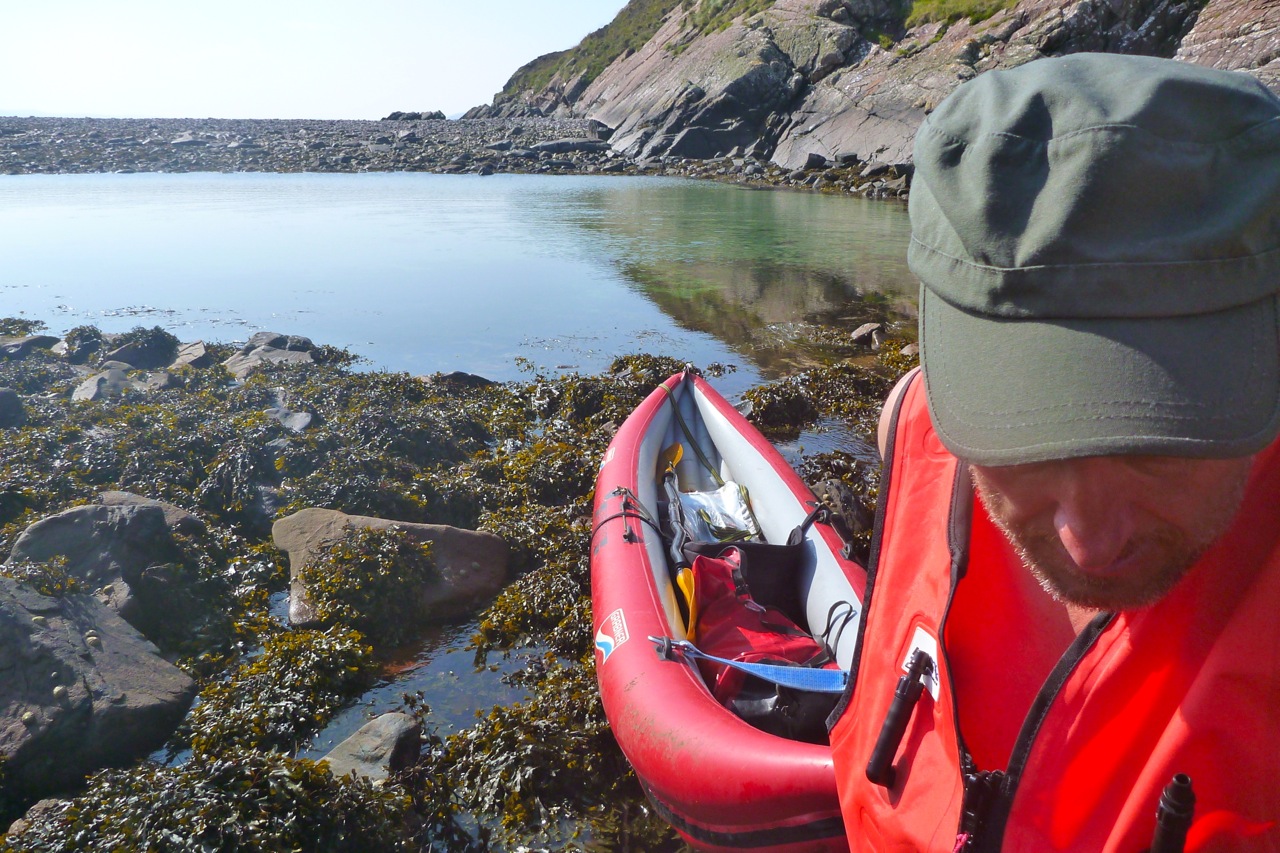
So I turned back north and on the way tried and cut east between Bottle and Carn Iar to get to Carn’s beach for lunch. I didn’t want to eat in the boat if I could help it. But the flow between the islands felt too strong and I didn’t want to burn up energy I might need later. Instead, I got to the north side of that stony isthmus beach that links Carn Iar to Carn Deas, very similar to the ones on Carn nan Sgeir or Horse Island. To get onto it I just about scraped over a rock and seaweed bar into a sandy pool (left), knowing I wouldn’t get back out without a portage. But I wanted to get out of the boat, walk around a bit then have a sit-down.
Up on the grass and heather I ate and drank just about everything I had while down below a gang of seals quietly observed. As I’ve noticed before, these sheep-free islands have verdant and varied vegetation all of their own. I took a doze on a lovely machair sofa, then packed up and waded across the pool to tackle the ankle-breaking portage back out to the sea which has dropped half a metre in the meantime.
Now for the long haul back: 3 miles out in the open to Tanera Sound. I should have dozed in that machair sofa a bit longer: the big feed has taken out my energy and I found myself counting the strokes towards Sgeir Ribhinn skerry, pushing into a light northwest breeze that rippled the surface. After the glassy morning conditions, even waves a few inches high give a noticeable resistance, and for a moment I wondered if the east side of Tanera Mor might be easier. But the speeds later showed I was doing as well as ever at around 3.5 mph – it’s more likely I was unfit for all-day paddling, not having done any since we got here. Again, it makes me think that a speedo (or legible GPS readout) is a good idea as you can verify you’re going better than you feel, despite the impressions of currents and wind. It’s not like moving on land.
Alone out here, too far to swim to even the nearest skerry, you can’t help thinking ‘what if’. What if I somehow caught a stinging jellyfish with the paddle and it landed slap in my face? But the most likely ‘what if’ isn’t that or a sustained swordfish attack, but getting separated from your boat. That’s easily done when thrown out of an IK in an F5, but on a day like today it’s hard to come up with a plausible disaster scenario that would raise the slightest bit of interest in Hollywood. That’s why I ventured right out to Bottle Island.
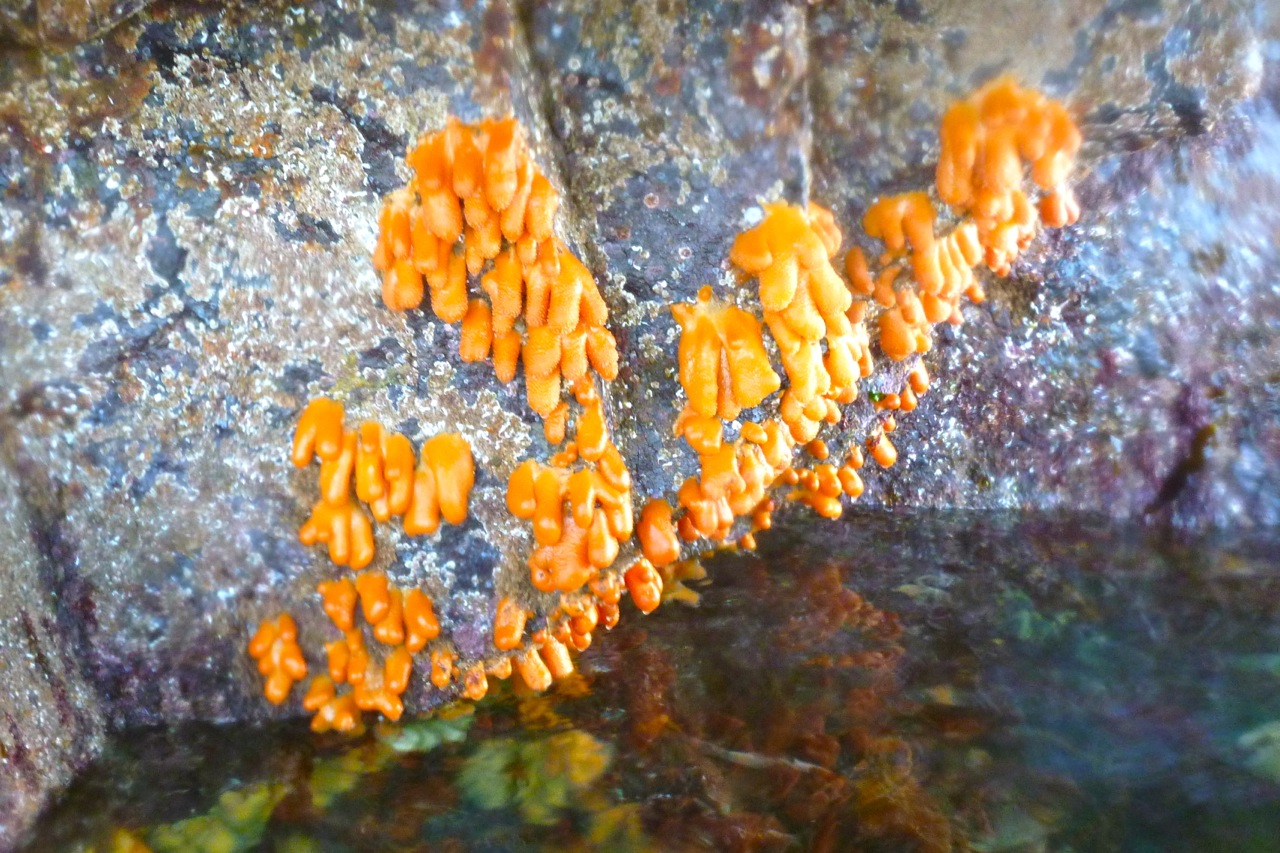
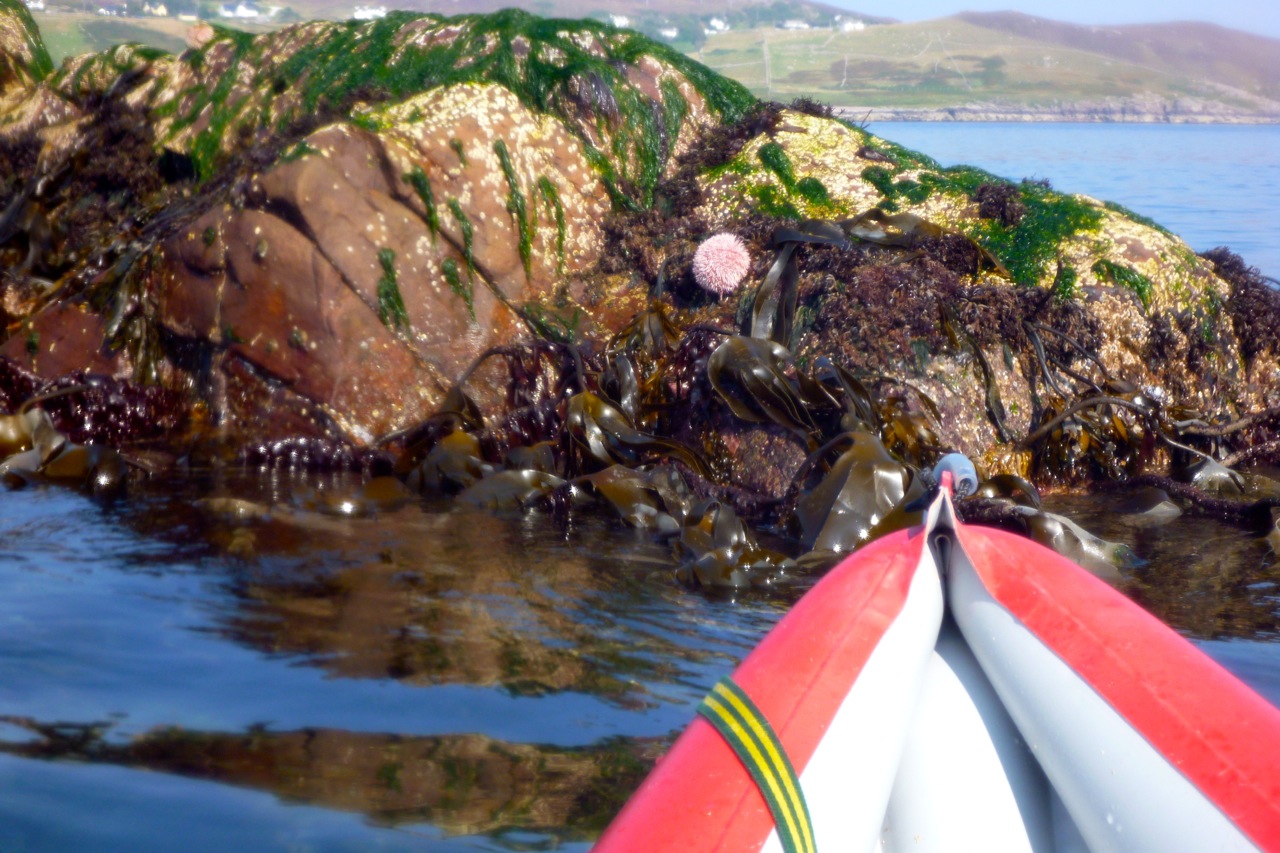
By Low Water I was right in the middle of Tanera Sound. You see new things when the tide is very low: some pendulous orange sponges tucked under an exposed overhang. And on a tidal skerry visible from our window, a prickly urchin of some kind. Don’t want to ram that with my IK.
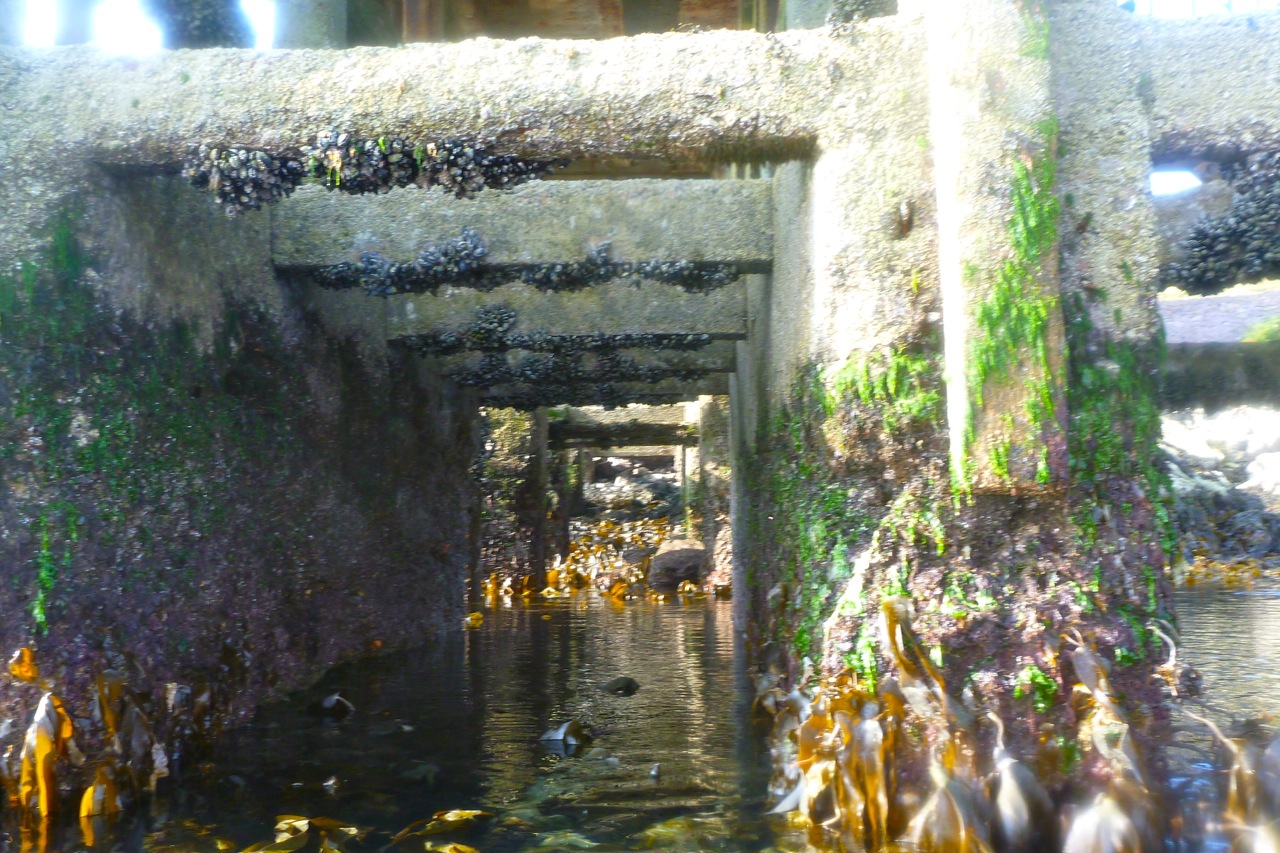
I can see our isolated house on the headland and with only a mile to go, I lie back and drift with the incoming tide drift for a bit. Then it’s back to the pier where the sea is at least 3 metres lower than it was this morning, exposing lower beams encrusted with mussels.
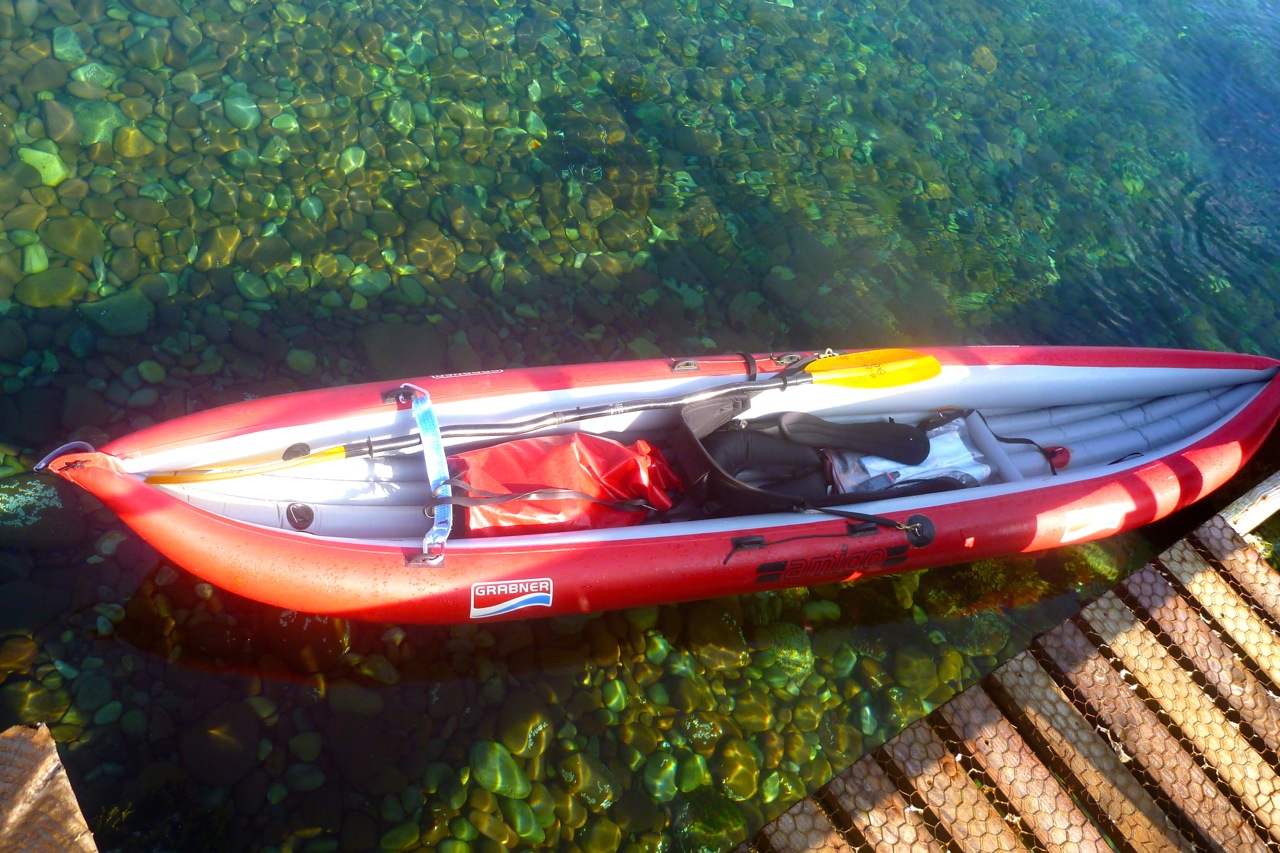
Fourteen miles and 5.5 hours; moving average (not always cruising): 3mph. On a long trip like this I have to say I miss the old Incept’s effortless glide (compare this Incept speed graph with the one below – or read this comparison post). I miss the speed not because the Incept was a bit faster, but because you definitely feel the effort required to push the wider and half-metre shorter Amigo along. The Amigo is even shorter (though much more rigid) than my old Sunny: the shortest IK on my IK comparison table.
All things being equal, that extra bit of speed can enable you to go further or get back quicker. But let’s face it, it’s always a compromise: there are days for fast boats and days for fun boats. I’m here and still breathing. My Amigo is an easy boat to live with – and a lot better than pushing a bathtub around on a trolley.
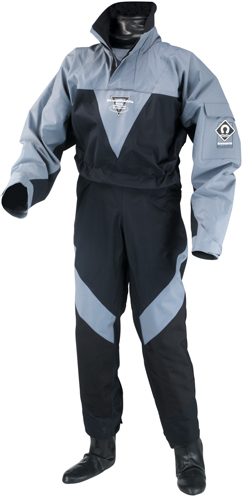
For my sort of paddling integrated latex socks, latex wrists, neoprene at the neck plus a front entry zip and a relief zip add up to the best all-round combination.
About Drysuits Even in summer the benefits of a drysuit for northern British paddling are worthwhile. Like wearing overalls to get stuck into a messy job, you know you’re covered. You can wade in as deep as you like and take all the splash that’s going without risking getting chilled should your underclothes get soaked when a waist or limb seal leaks. And for me, nervous of the deep and often paddling alone in the northwest (even if it’s rarely more than a mile from shore), it’s an added layer of security.
My chunky old Crewsaver Hyperpro drysuit (left) cost only £180 and did the job amazingly well. But even at 2kg, it was heavy enough to need internal braces and was often too hot and sweaty for active paddling. I don’t tend to get cold easily but wonder do if it was more of a sailing suit less well suited to energetic paddling.
When it comes to exposure, should you fall in, being wet from trapped sweat is nearly as bad as getting wet from seawater. Once pressed against your body by water pressure, I’m told the actual benefits of a drysuit in slowing down hypothermia are only measured in a few extra minutes. To be agile enough for paddling, drysuits are not immersion or survival suits (above right) made to snuggly bob around for hours until the RNLI find you. In such a scenario it’s the fleece underneath that can make a difference, and I have a Gul one-piece (left) for those chilly days. At anything above single-digit temps, it’s just too warm, but if anyone remembers romper suits from their toddling days, they know how comfy it is to wear a onesie over their nappies. They go for about £25 and many outlets throw them in for free with the drysuit.
Re-entry training and drysuit testing
Whatever membrane fabric the Crewsaver used, like many sub-Goretex fabrics it was more waterproof than breathable. As it is, I’ve never experienced the true magic of breathable membranes which work under a much narrower set of parameters than we imagine (temperature gradients, fabric saturation, and cleanliness), even if they’re surely better than being wrapped in bin bags and duct tape.
Before the Hyperpro I briefly owned a much lighter Kokatat Tropos (below) which I sold in haste and which closely resembles my Anfibio Packsuit. Kokatat are known for their high-end Goretex expedition kayaking drysuits, but they don’t use two-layer ‘Tropos’ membrane fabric anymore so maybe it’s just as well I flogged it. The closest thing Kokatat now sell is the better breathing three-layerHydrus 3.0 Swift Entry which goes for over £700 in the UK.
Relief zipper: don’t even hesitate; it’s chilly out there. Might work for women using a SheWee, too
Semi drysuit I’d often wondered what exactly a semi-drysuit was – a half-arsed fabric that sort of keeps water out? Sven at Packrafting Store explained: it’s a drysuit with a comfier neoprene rather than a latex neck seal. Latex (as on my Hyperpro) seals very well but worn all day gets uncomfortable. I recall reading about some guys who paddled South Georgia in the South Atlantic fitting ‘venting hoops’ into the latex neck seals of their top-of the range Kokatats during less stormy episodes to stop them choking or boiling over. Unless you expect to be frequently immersed in storm- or whitewater conditions, you may prefer a neoprene neck seal. The rationale is that because the head and neck are usually above the water when wearing a buoyancy aid, the seal here is less critical than on submerged wrists or ankles/feet.
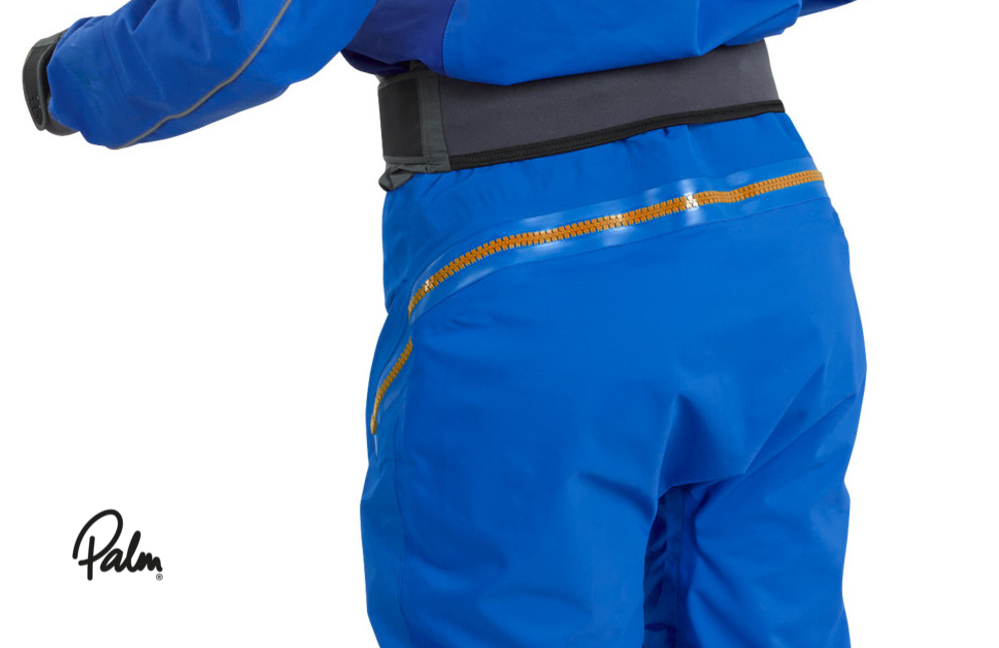
Relief zips; responding to Nature’s call Presumably you won’t be paddling the tropics in a drysuit so, at the very least, the need for a slash can become paramount, especially as the years pile on. Get a suit with a relief zipper or, as I did with the Tropos, pay an extra 100 quid to have one fitted later. A woman could use a front relief zip with a SheWee, otherwise women-specific drysuits feature a dropseat zip across the back of the hips for the same purpose. note the waist drawcord or seal too; also helpful to retain body heat.
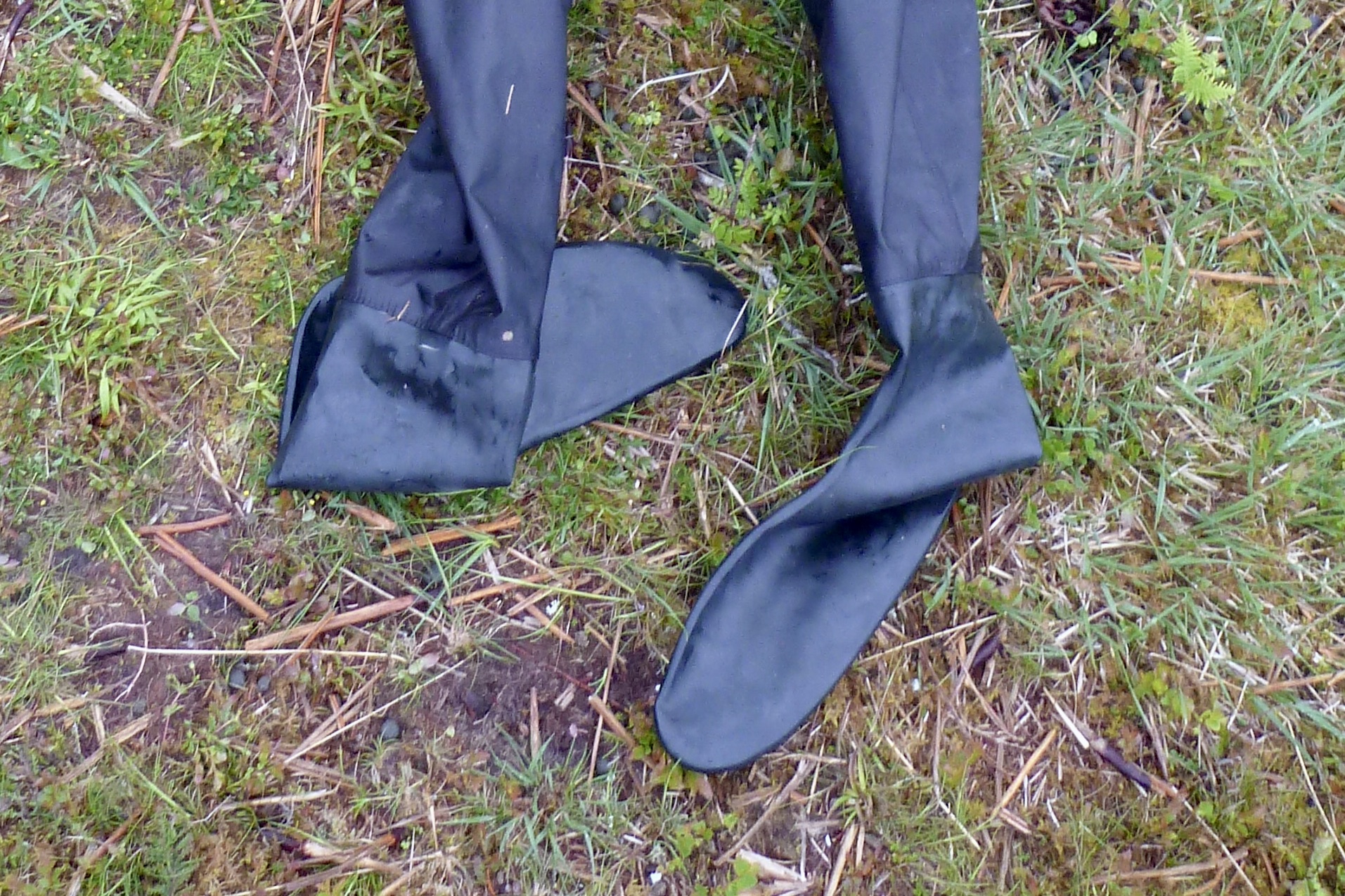
Integrated socks or ankle seal? It’s a drysuit so you want to be dry, and that includes your feet. Far better to have integrated socks than ankle seals and then find another way of keeping your feet dry or at least, warm. Looking at drysuits again recently, I see that nearly all come with integrated feet laboriously made of sewn and taped membrane fabric, yet the benefits of any breathability in the feet are minimal, while the membrane will eventually fail and be difficult or expensive to repair or replace.
Get latex socks
Not fabric
Sven at Anfibio confirmed what I felt: integral latex rubber socks are the way to go; they may be heavier than membrane versions but are much easier to repair, more robust for walking as well as reliable. Wear some thick socks and a pair of wet shoes on top and the feet will be dry and warm.
Drysuit zips The Crewsaver had a horizontal back zip, the Tropos was front diagonal while the Anfibio is front horizontal. The back zip may look neat (right) but when tired or cold, I found the articulation required to unzip myself was quite an effort. It does mean you can open it on the water to vent off while guarding against frontal splash, but it would be hard to zip up in a hurry. Front diagonal doesn’t seal so well with spray skirts they say (not an issue with IK&Ps) and so it’s hard to find fault with the front horizontal format.
Anfibio Packsuit I found the Anfibio Packsuit easy to get into, light enough not to sag and the zip easy to work and check that that you’ve sealed it properly. The Anfibio suit uses a plastic TiZip Masterseal dry zip (top of the page) that’s lighter and easier to slide than old-style brass YKKs. Wax or silicon spray is all the TiZip needs, as with YKKs.
Anfibio’s Packsuit can weigh as little as 800g in smaller sizes. My XL version was custom tailored and with the latex socks and the relief zip options at 1332g and rolls up to about half the volume of my old Hyperpro. Weight is saved with no cuffs covering the latex parts which are said to be vulnerable to UV. A regular dose of 303 Protectorant (right) should see to that. There are also no pockets or other features, just what you need to keep you dry.
Best of all, on our four-day paddle around the Slate Islands I found the Packsuit unobtrusive to wear. Unlike previous drysuits, I rarely felt the need to peel off at the slightest stopover, and the relief zip is a no brainer, enabling on-water ‘defuelling’, if necessary, just like a B52 on a long-range mission. Wearing just a shirt and runner’s leggings, I never felt hot on the water nor got chilled, and during a downpour on land one evening, was happy to wear it right up to the point we scurried for our tents.
I’ve yet to do an immersion test but have found that stretching made the inside coating peel off the neoprene neck seal but don’t know what this coating is actually for. It’s certainly not waterproofing so doesn’t really matter. Other than that, no issues.
I received the Packsuit in return for editorial work on the Anfibio Packrafting Store website. It costs from €419 with tax and in my custom spec would have cost €550.
Fellow IKer Gael proposed we meet up during his May visit to the Hebrides; his chance to get a closer look at places he’d passed on the SSKT. Once he’d done his own thing on Mull I suggested Coll and Tiree as a satisfying and remote offshore destination. Those two outer Inner Hebs may claim to be the sunniest places in the UK and looked interesting in Google sat, with many sandy coves. But it also became apparent that all that sunshine required unusually strong winds to blow away the clouds. Whatever’s blowing in the Inner isles on a given day, on Coll and Tiree you can bank on double. Sea Kayak Oban admitted that they’d only managed to run two tours there in six years.
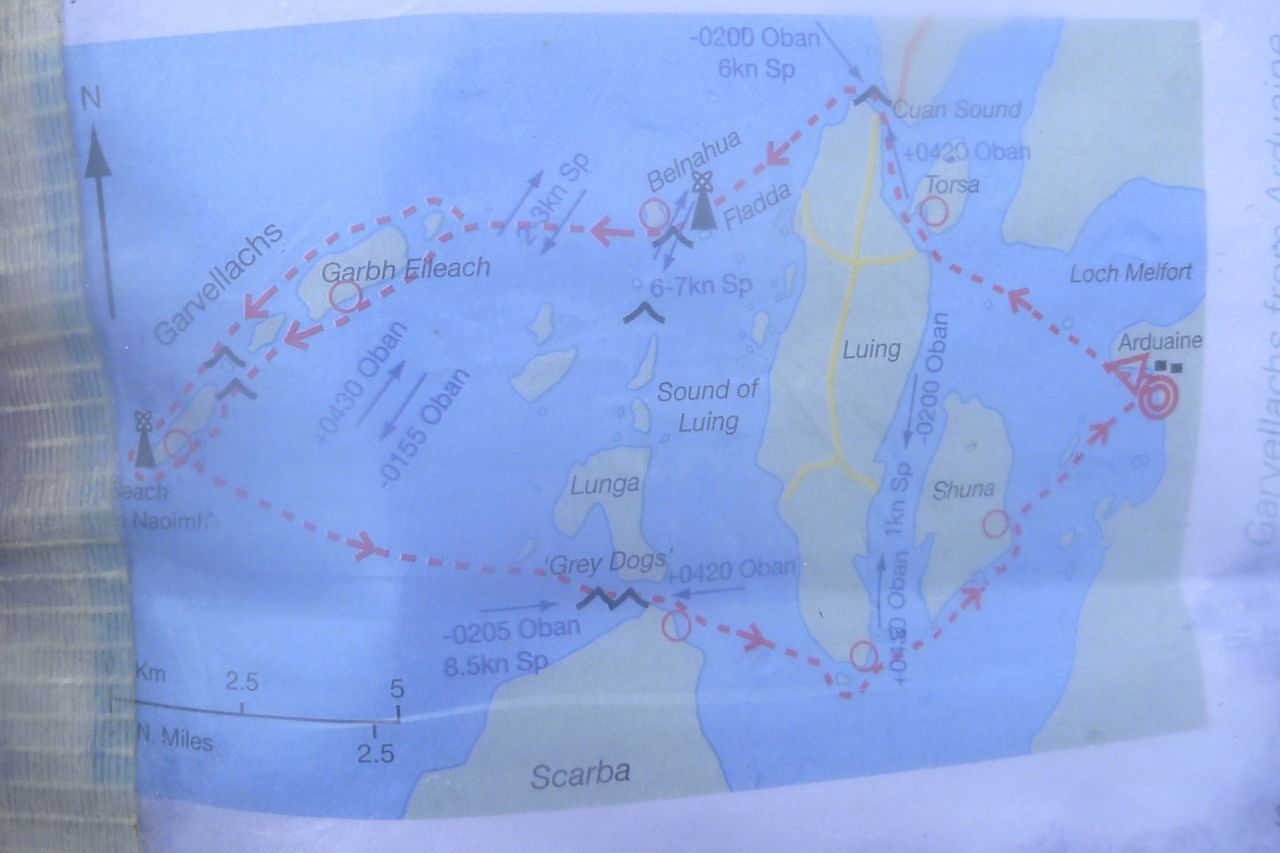
When we met up in Oban, Gael had already made contingency calculations, multiplying several locations by the state of the tide and then dividing the result by the 5-day forecast and subtracting our IKs’ average speed in knots. According to his complex computations, a three-day run out of Arduanie around the Slates would work out best for us.
After a brilliant seafeed at EE Usk on the waterfront (left), we squeezed my moto into Oban Backpackers’ storeroom and set off to Arduanie where a sleet shower pelted us while we loaded the boats. The rest of today was actually going to be OK weather, a bit windy. Tomorrow less bad but Friday might be a tent bound zip-in according to the forecast, so our Kindles were charged up.
I was snuggly wrapped in my new, lightweight Anfibio drysuit as we set off for a late lunch on Shuna’s east shore before curving around into the wind to cross to Luing. From here we worked our way down to its southern tip then made a dash to Scarba, eyeing up the sinister and all too near Gulf of Corryvrecken which gave me the heebie-jeebies.
Gael had been told of a camp spot overlooking another tidal phenomenon, the Grey Dogs, and once pitched up on the moderately dry platform, we walked over to survey the Dogs where a metre-high standing wave rose up and collapsed every few seconds. Even though we were in neap tides it did this continuously all evening; only at 6am did I see the waters briefly still.
That night the rain closed in and pelted down. We huddled under a tarp – a good last-minute decision to take that – then made the delicate acrobatic contortions to get out of our gear and into our tents without spreading the wet.
Early next morning the Dogs dozed under clear skies, but by the time we were on the water they’d risen again from their submarine lairs and water rushed along the channel’s shores like a river. Even Google sat snatched its picture with the Dogs in spate. In fact, during neaps, either side of the breaking waves looked flattish water, but who knew how a boat would react in there so I assumed we’d head directly north. But when Gael turned his K40 purposefully into the Dogs’ maw I gulped and bleated, ‘We’re not going in there are we?’ Too late, the current had caught me and the ride was on.
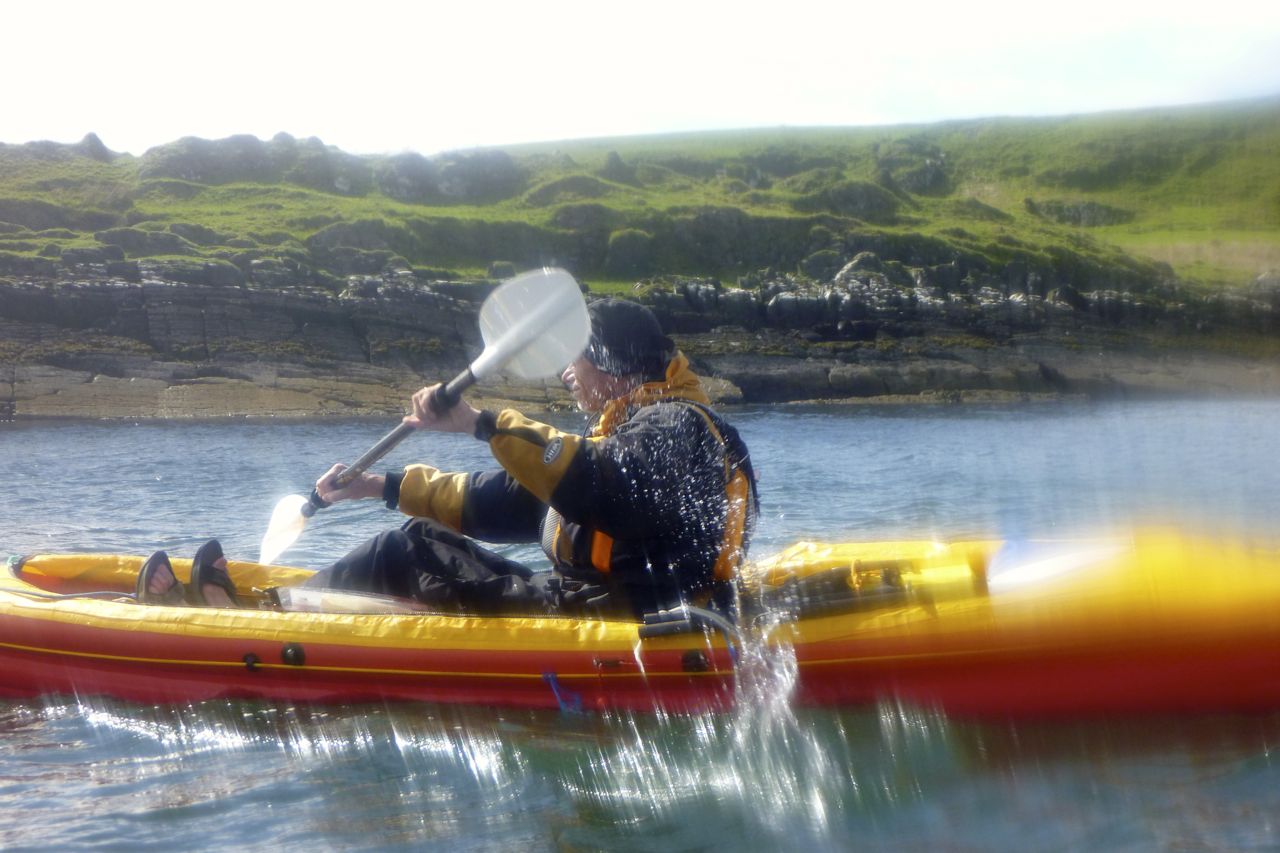
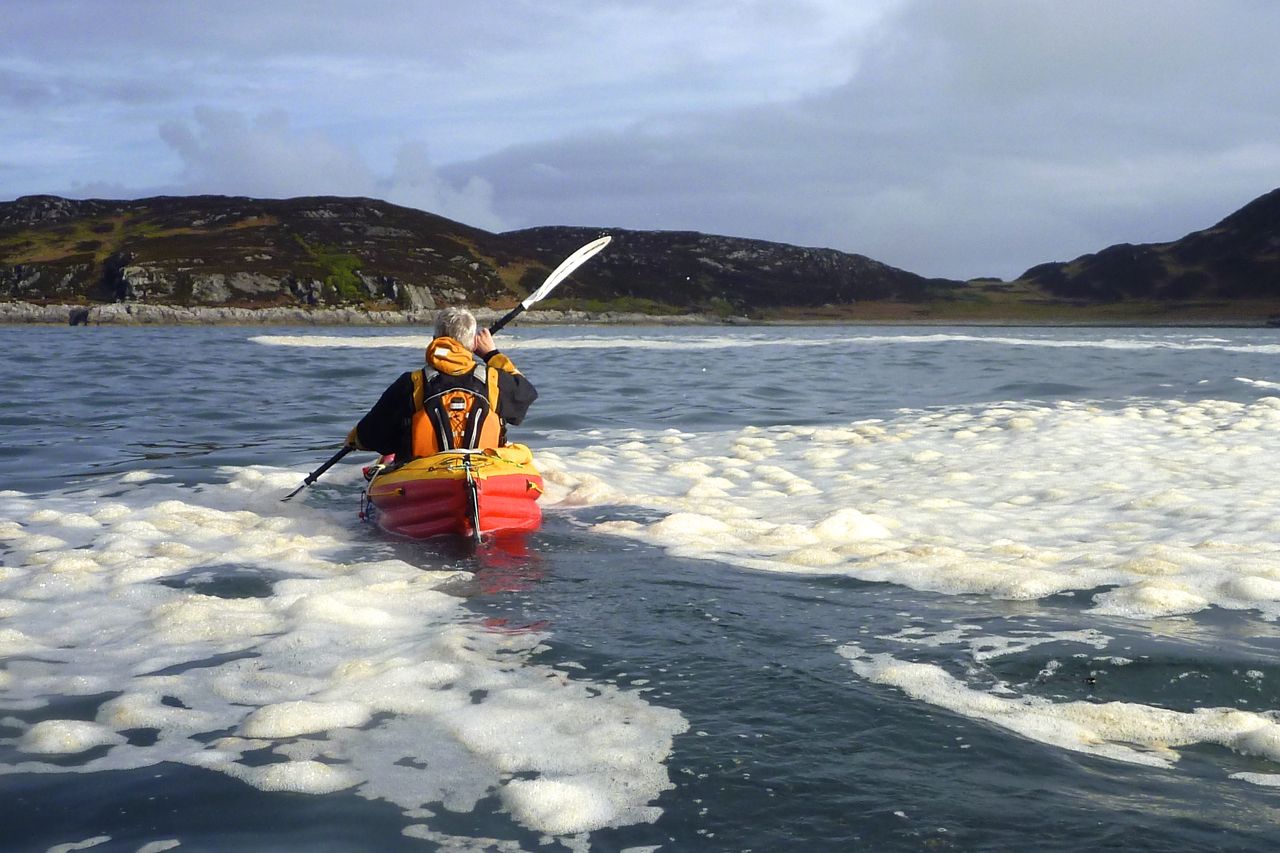
What looked like flat water between the boiling shore and the midstream surf zone was actually a rolling swell a metre or two high but easily manageable in an IK. Gael rode into the middle for a play – the picture left shows the turbid water between us – and soon we were flushed out into the Firth of Lorn on Lunga’s west shore where the sea state was more placid. What that place must be like to paddle in spring tides doesn’t bear thinking about, but obviously some lap it up (below). There’s probably less risk than tackling the same sort of white water on a river.
Strictly speaking, Scarba isn’t part of the Slate Islands to the north, but this whole area is well known to boaters for its convoluted tides and associated races. For a paddler, the water pushing up and pulling past the isles and channels creates all sorts of complexities in route planning, something which Gael grasped far better than me.
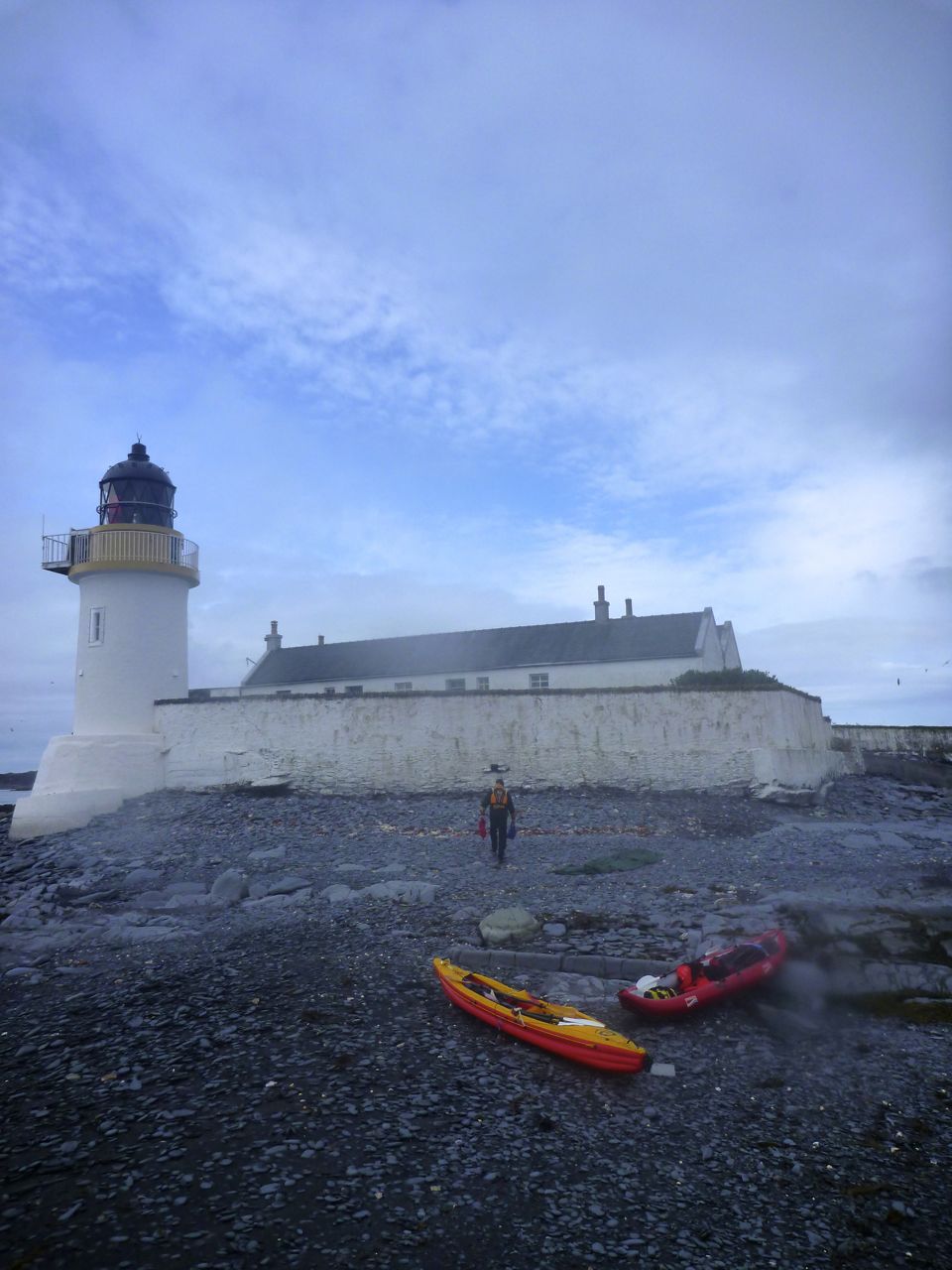
As we approached the lighthouse at Fladda he pointed out a cross-current where he advised we pieleffe. What was ‘pieleffe’, some kind of French nautical term? No: ‘paddle like fuck’. Oh, OK then. Now safely on Fladda’s slatey beach we took a tea break, me still a little frazzled after running [alongside] the Grey Dogs [in neaps] and not being torn limb from limb by clashing whirlpools.
Fladda had a big walled garden and similarly well-protected longhouse attached to the lighthouse. On the adjacent island of Belnahua the 19th-century ruins of quarrymen’s lodgings survived. Apparently, there was another island somewhere here which they’d excavated well below sea level until there was only a rim left. Then came a great storm and washed it all away.
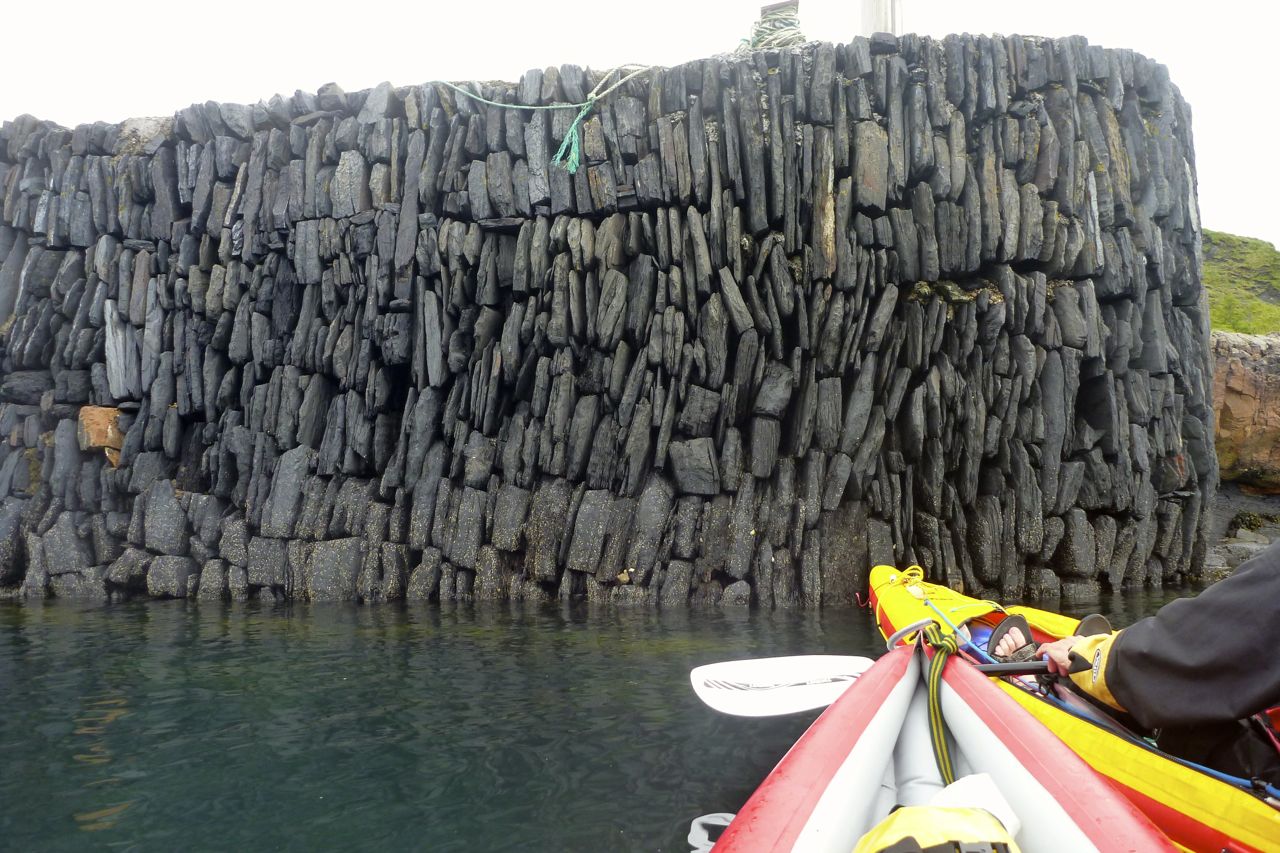
We headed with the brisk tide over to Cullipool harbour on Lunga; the unusual jetty is built of vertically set drystone slates, not something I’ve seen before. From here it was up to the Cuan Sound as the sun began to creep out. Once inside we hit dogwater so that the proposed lunch at the pub by the bridge became overruled by our appetites. A grassy shore on Seil island did just as well and provided space to dry out the tent.
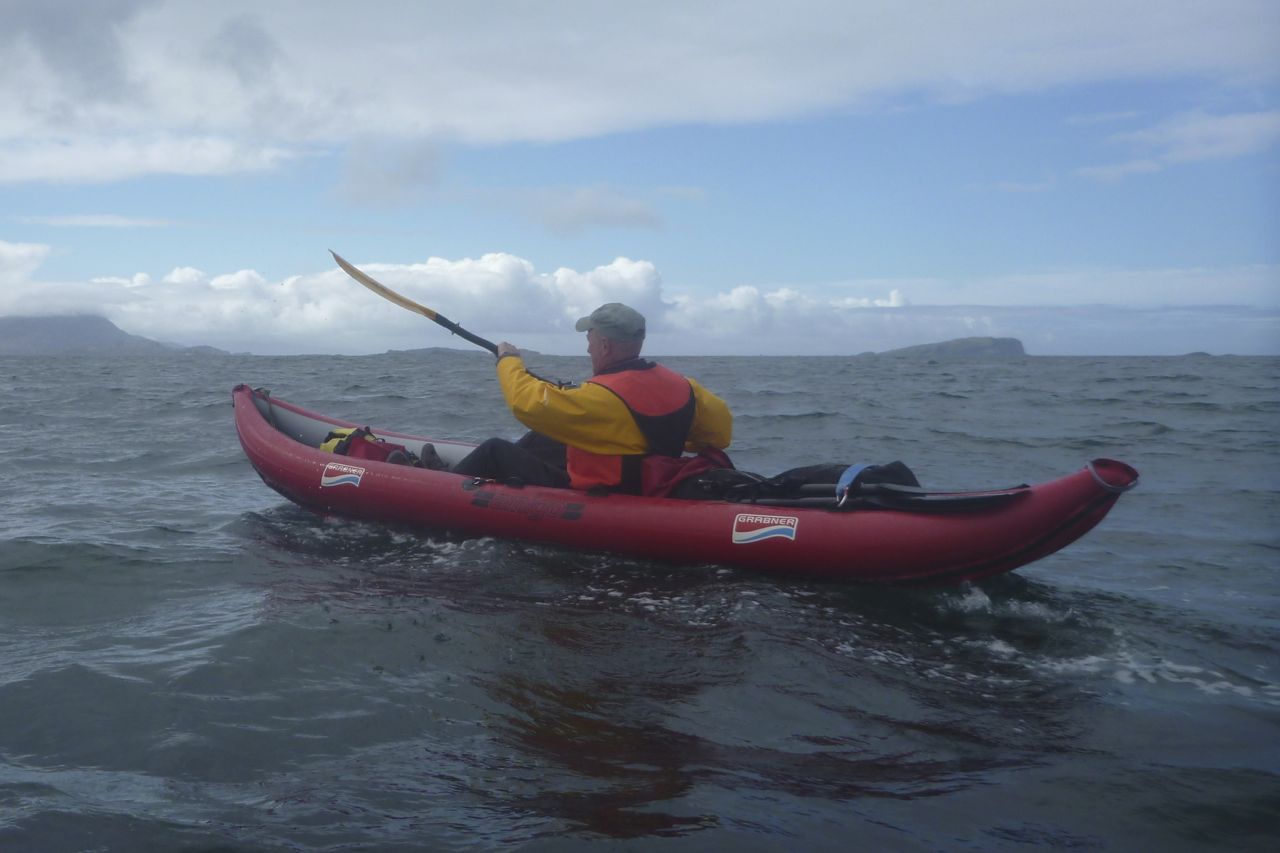
The channel narrowed and became lined with expensive-looking holiday homes which rather tainted our exposure, and as we neared the bridge we passed the only other paddlers we saw, a couple in a canoe letting the tide wash them south. At Telford’s late 18th-century [Clachan] Bridge over the Atlantic we swapped boats. While I shot ahead in the K40, against the current Gael’s impression of my Amigo wasn’t so amicable. Compared to my Grabner, his Incept is a good 20% faster (or less effort, if you like). A lot of the time on this trip Gael was coasting while I felt like I paddled non stop which may have explained my fatigue. I dozed off at lunch and slept like a log overnight, no matter what fits the tent was having. Near the top of Seil we pulled past some sailboats to the back of an inlet and pitched the tents with taut guys in preparation for Windy Friday.
In fact, that day dawned fair; a cold front from the northwest brought in lovely clear air in which the Incept seemed to glow. Gael suggested we edge out to the outside of Seil to see if the sea was manageable to Easdale. We probed outward and while I’d not have gone on alone, by the time we were committed it was only two miles to Easdale. There were no actual whitecaps, just large waves that didn’t even swamp my boat but required momentum to maintain direction. A plastic coffin would have been in its element here, slicing the waves like Bruce Lee attacking a jelly.
Turning into Easdale port was a welcome relief but it had only taken me two nights out to find people annoying and the place suffering from what I perceived as tourism fatigue. Coaches pulled in and disgorged passengers who milled about for a few minutes then moved on. The so-called village shop looked like nothing more than a stockpile of porcelain and lace trinkets; I couldn’t wait to move on. What must locals think when their village becomes colonised like this? Make hay I suppose.
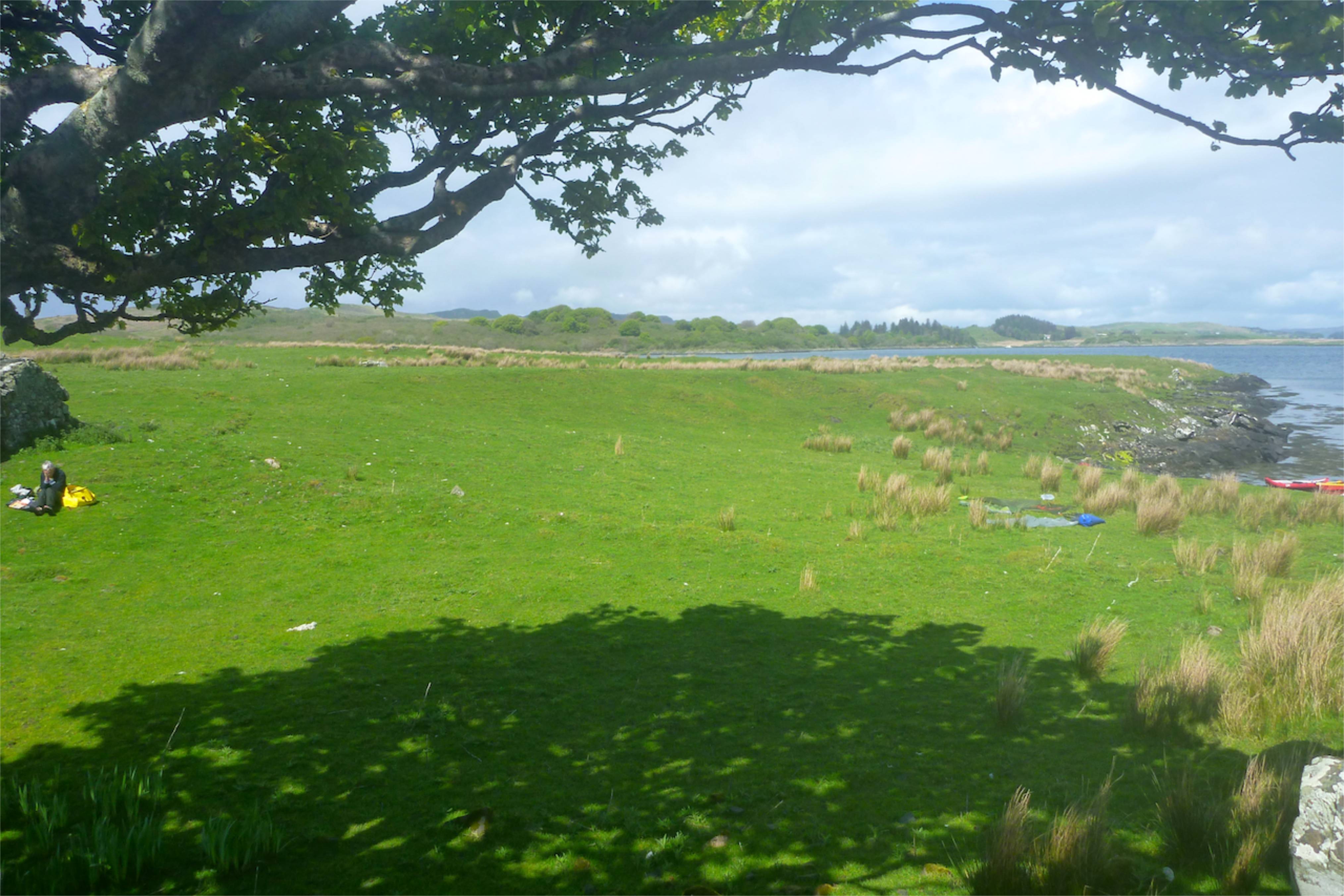
We decided to head back to the car, across the bay’s side waves, back through Cuan Sound then more dogwater and a grassy extended lunch by the big tree on Torsa island. Then it was back out into the sideslap across the mouth of Loch Melfort to Arduanie.
After some 33 miles of island hoping I’d caught enough sun to turn my head into a beetroot and we’d tackled a variety of easy sea conditions. It had been fun exploring the more commonly visited locales of Hebridean sea kayaking, all accessible and escapable, notwithstanding the complex tides. And a chance to do so with someone who grasped the concept of ‘3D’ sea kayak navigation was an added bonus, like a free course. Plenty more to see down here. Back at the jetty we lashed the boats to the roof and headed south to the Mull of Kintyre.
With a day to spare after our two-night run around the Slate Islands, Gael suggested we head down to Gigha off the Mull of Kintyre. I’ve always wanted to visit this Scottish appendage and for Gael, Gigha had a special resonance as the starting point of the Scottish Sea Kayak Trail which he completed two years ago. Quite an achievement alone in an IK.
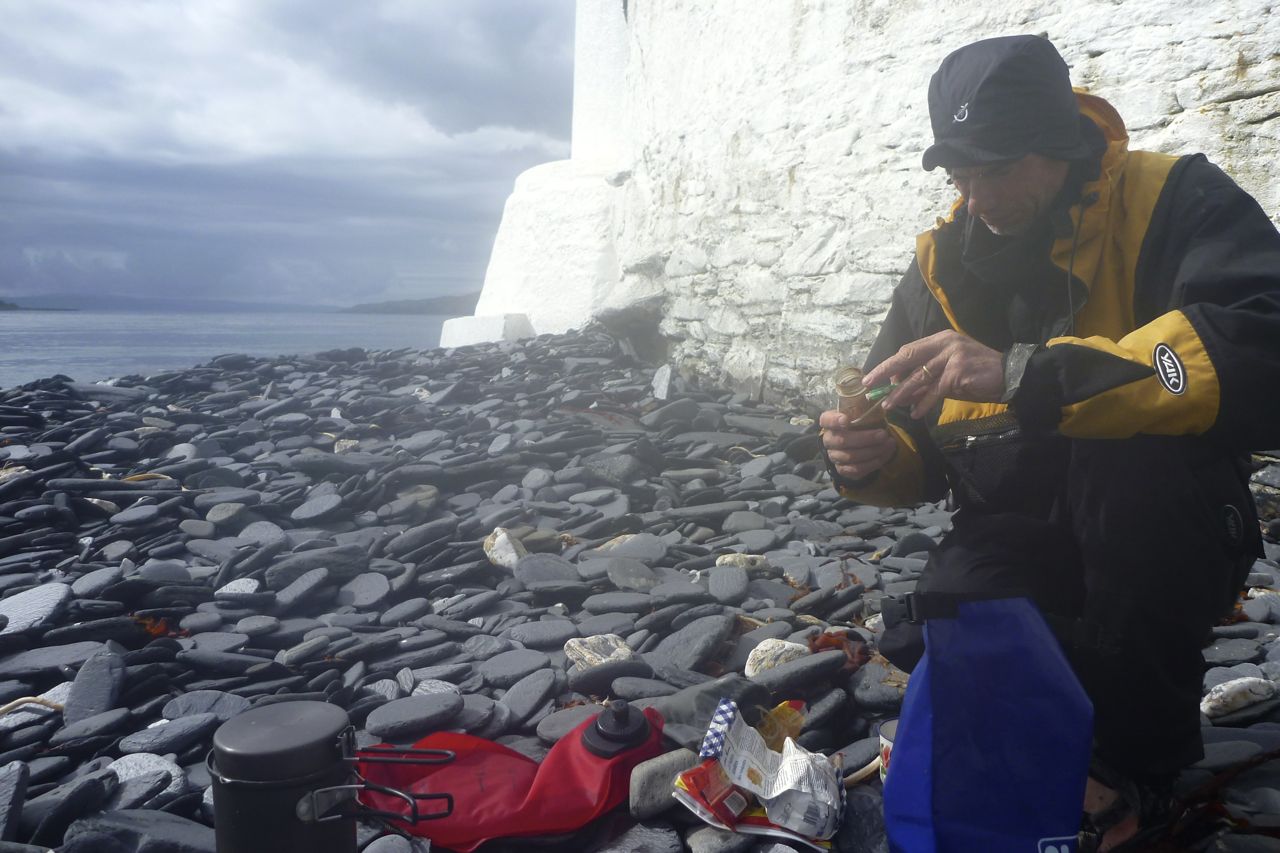
First of all though, I was ravenous for food on a plate not mush in a bag. We pulled into a cafe in the pretty port of Tarbert for some 1980s decor and food to match (right), then marched over to the Co-Op to see what was going cheap. Whatever I’d been eating on the Slates, it hadn’t been enough
We camped opposite the island, then once the wind abated next morning, carried the boats onto the ferry. Once underway I came over all lethargic on account of the Slate paddle (or perhaps the gluttonous Tarbert episode). It wasn’t helped by pushing a headwind up to Gigha’s northern point on our anticlockwise lap.
Finally we turned downwind, portaged the sandy isthmus at Eilean Garbh and moved on to the next sandy beach for a long lunch break and what had become my customary doze. Out on the northwest horizon pale blue humps marked the Paps of Jura. I read this short book partly about Jura recently (no so satisfying); among the Inner Hebrides Jura seems to have a certain allure.
Whether it was a pumped up seat, a good rest or the benefits of three days’ sea kayaking, I got belatedly reacquainted with my paddling mojo. I sat up straight, drew like a pro and soared across the waves like a surf ski, while Gael dabbled along the shore. The ocean side of this narrow island was a bit wilder, but for me lacked the features and interest of the far northwestern coast. Or maybe is was pre-doomed by the stigma of being too far south to be exotic.
We covered the 5.5 miles to Gigha’s southern tip in an hour thirty; a good pace for a pair of bloats. Back on the sandier mainland side we dipped about looking for a secluded wild camp but there were too many properties or not enough space. And with little wind now, the boathouse campground looked less inviting than a 3-mile scoot back to the mainland.
We set off, giving the day’s last ferry a wide berth by aiming for a big green buoy about halfway across. Once there and still feeling on form, I decided to PLF to the mainland jetty just to see if I could. Halfway there, with steam pouring from my drysuit’s vents and the tide pulling us south, Gael passed in the Incept without too much effort. I hammered away regardless as the jetty crept closer and touched down in 48 minutes, a minute after Gael. A good, end-of-tour burn up to clear out the cylinders. It was good to see some other islands and with easy access and escape routes, Gigha would make a great first circumnavigation for a beginner. But as always, the wilder isles to the north and west hold more intrigue.
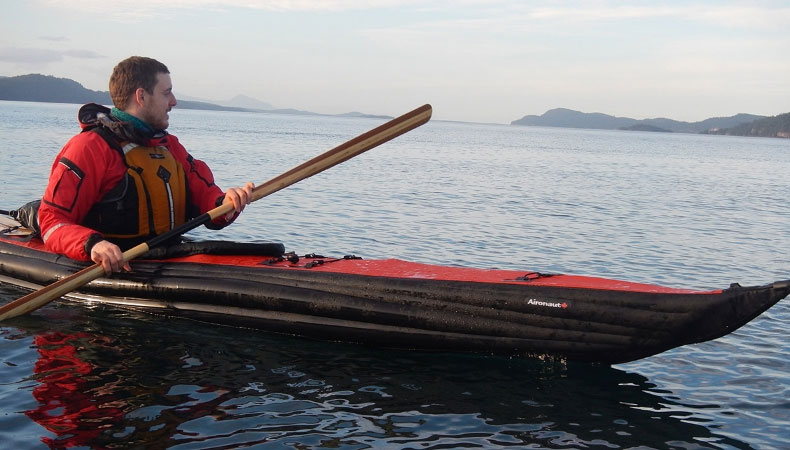
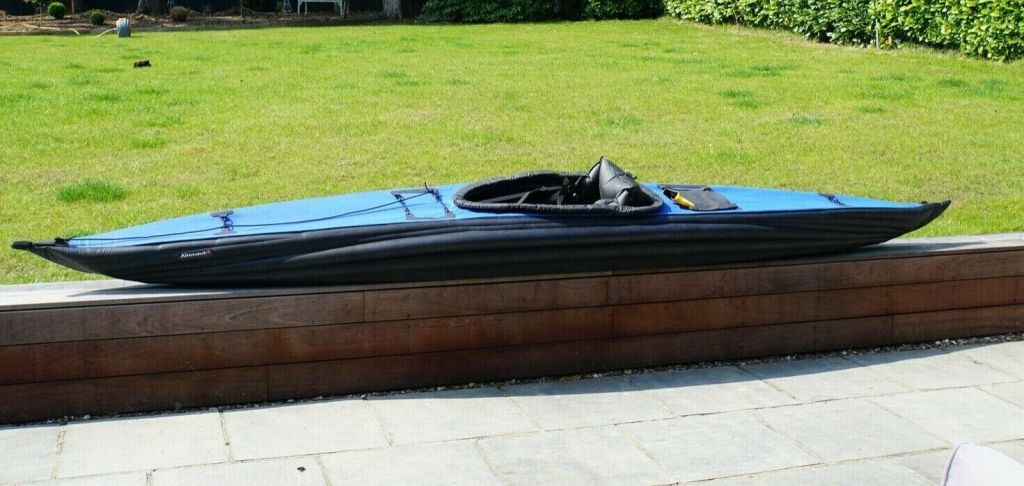
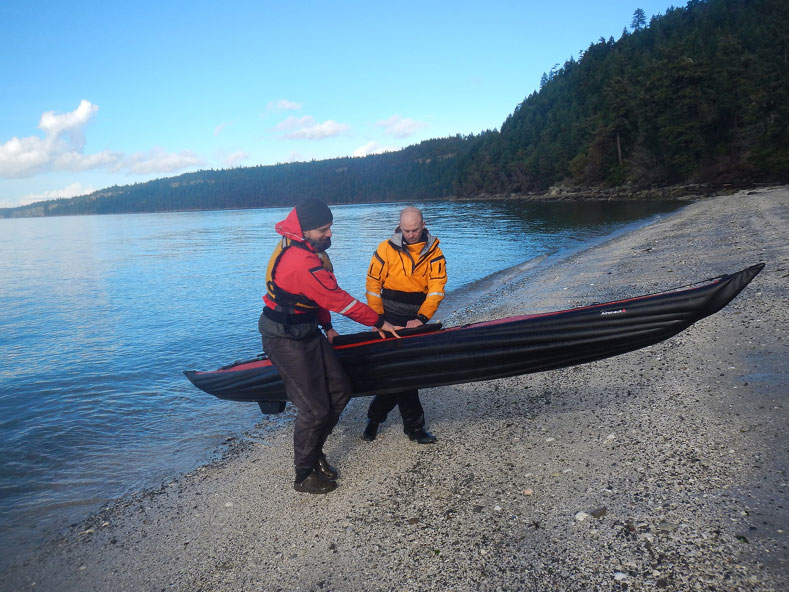
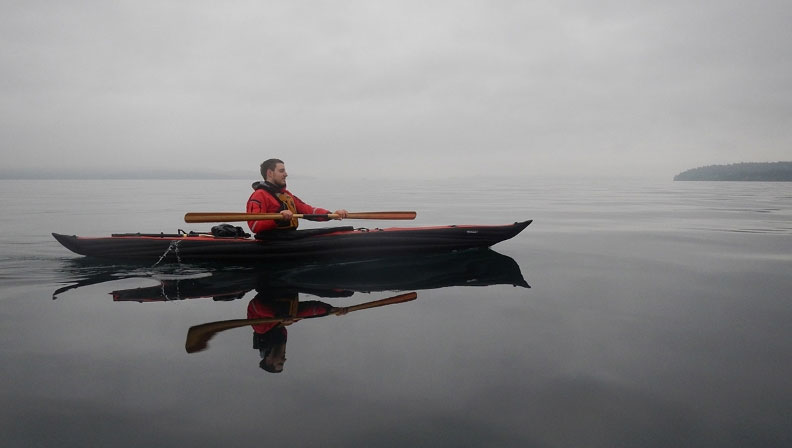
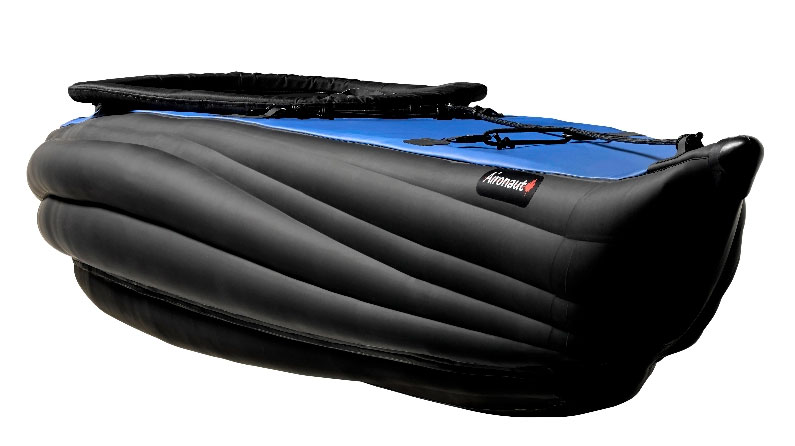
Feathercraft’s short-lived Aironaut IK looked like a breath of fresh air. As with their folders, FC managed to turn the usual IK sow’s ear into a very silky looking purse. With all kayaks, it’s the sensation of gliding or responsiveness to paddle strokes that has as much appeal as being in the outdoors. And judging from looks alone, the Aironaut did that better than other IKs even if the concept may have been flawed and the boat was discontinued.
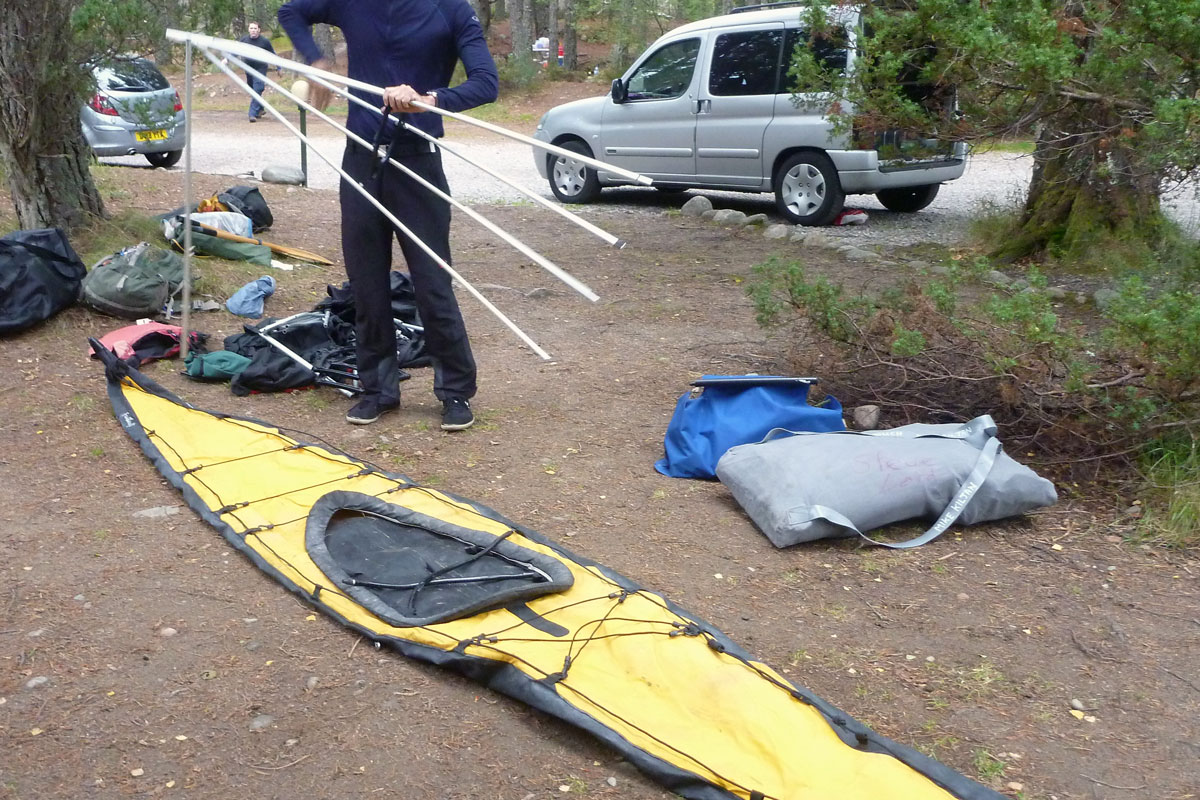
The Airo’ was pitched as a nippy recreational day boat for folks who find Feathercraft folding kayaks a faff to set up on the spur of the moment (left) and a pain to store or transport fully assembled. It’s the relative effortand complexity as well as assembly time that can kill spontaneity, especially if you’re at an age when you’re no longer as supple as a leaping salmon. I’ve also encountered the fragility of ally-framed folders – something to which IKs are immune, though both are susceptible to cuts and abrasions.
A few years ago I briefly owned Feathercraft’s Java, what they rightly called a ‘sit on top’ IK, but I didn’t get on with it (read the link). The Airo was a conventional sit in IK, complete with a fixed deck like the Gumotex Framura. By IK standards, even the Aironaut name was clever too, suggesting a light, cutting-edge boat. From the images it’s got to be the slickest-looking IK out there, though the competition isn’t that great.
The magic numbers are: 4.5m (14’ 9”) long, just 66cm (26”) wide, a weight of only 9kg (20 lbs) but a modest payload of 136kg. The rest you read here is my usual speculation based on those details and the photos I have pinched from the Feathercraft Aironaut webpage and eBay.
As with my old Incept K40, using ‘plastic’ coated fabrics means it can all can be heat-welded together, which you presume is cleaner and less expensive than gluing by hand. Urethane-coated nylon may not sound such a ‘high quality, technical fabric’ (to quote the FC blurb), but packboat manufacturers are notoriously cagey about fabric specifics. As with Alpacka packrafts, exactly what type of urethane is key, as is the composition of the nylon base. Both may be custom specified from a source manufacturer to deliver certain properties. A nylon weave base fabric is supposedly more stretchy than polyester which is good against spikes, but less good in containing a rigid inflatable form. That’s probably why it needed to run a such a high pressure.
My Incept was a fast IK, aided by a notably slick PVC-urethane coating over a ‘1100 polyester dtex’ (= about 1000D) base. Knowing that, suddenly the Airo’s 420D doesn’t sound so robust, but that’s how Feathercraft managed to halve the weight of a K40, which otherwise has very similar dimensions. Another clue might be in the payload of 136kg; the Airo’s many tubes may add up to a relatively small volume. The Incept was rated at 160kg.
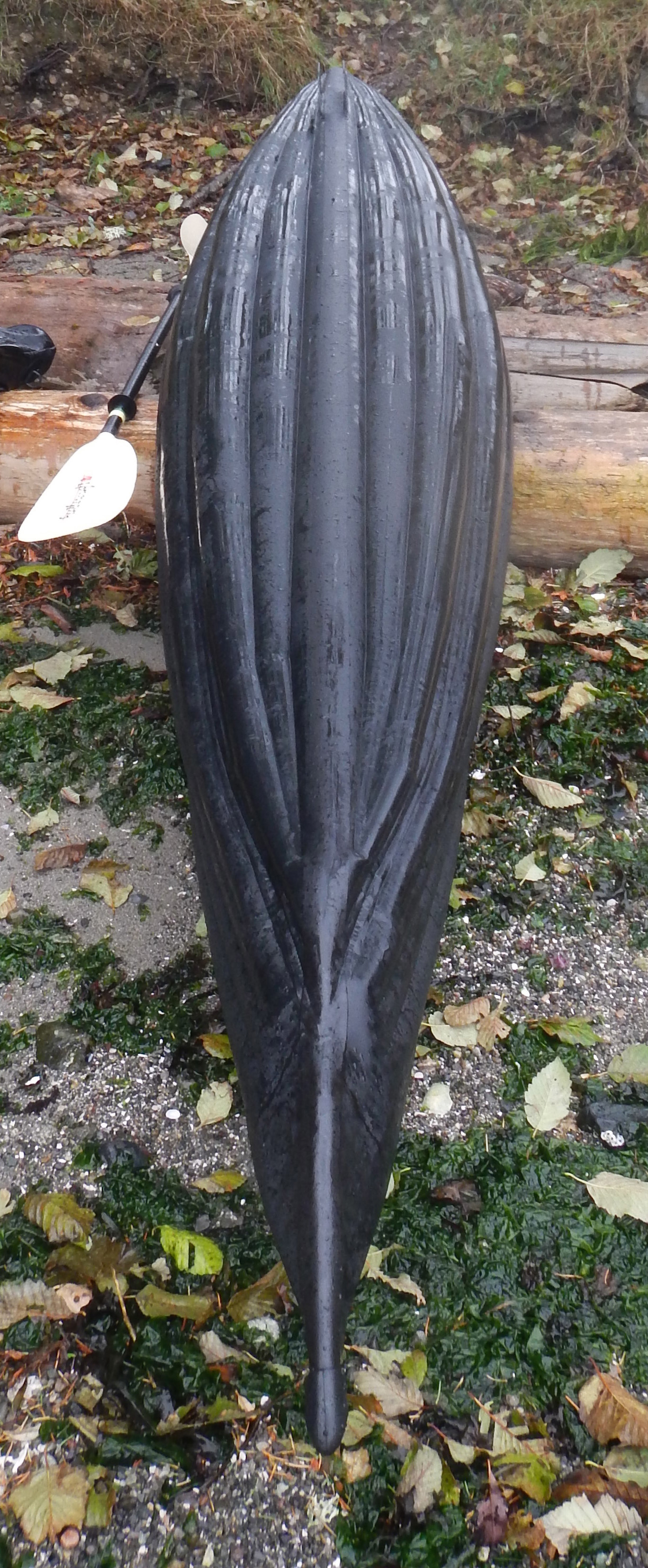
They achieve that amazing weight by fabricating the Airo from 210D urethane-coated nylon on the deck and multi-tubed black sides, and 420D in the hull (hard to tell the later two apart in most pics). So it’s a regular three-chamber IK. When I recall the Supai packraft was made from 75D polyester, triple that for the sides and six times for the hull sounds reassuring, though direct denier comparisons are misleading. It’s about weave density not actual fabric thickness.
The Airo had Halkey inflation valves like the Incept, and pressure-release valves on all three chambers. PRVs are vital so the seams won’t stress and pop if it gets hot (as happened to my Java). I’m always a little perturbed that my high pressure Grabner had no PRVs and added them to my Gumotex Seawave’s sides for protection with sun-induced over-pressurisation.
However, see the link at the bottom of the page. It seems the combination of a long, solo IK made from a thin fabric needed a high 5psi rating to not sag in the middle, but even with PRVs all round, there were reports of a couple of Aironauts blowing apart irreparably which may be why it was discontinued (FC claimed ‘high costs’). Soon after FC sadly closed down for good. You might think: fit lower-rated PRVs to spare the hull, but if the boat was designed to work at 5psi, anything less would see it sag like a Sevylor bloat, especially with a girthsome paddler.
A blown I-beam in the floor. Hard to repair without opening the boat right up.
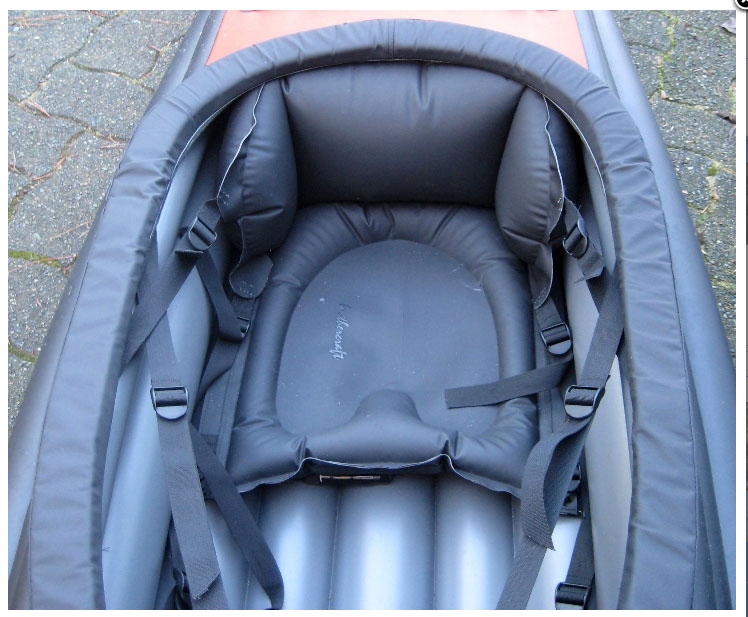
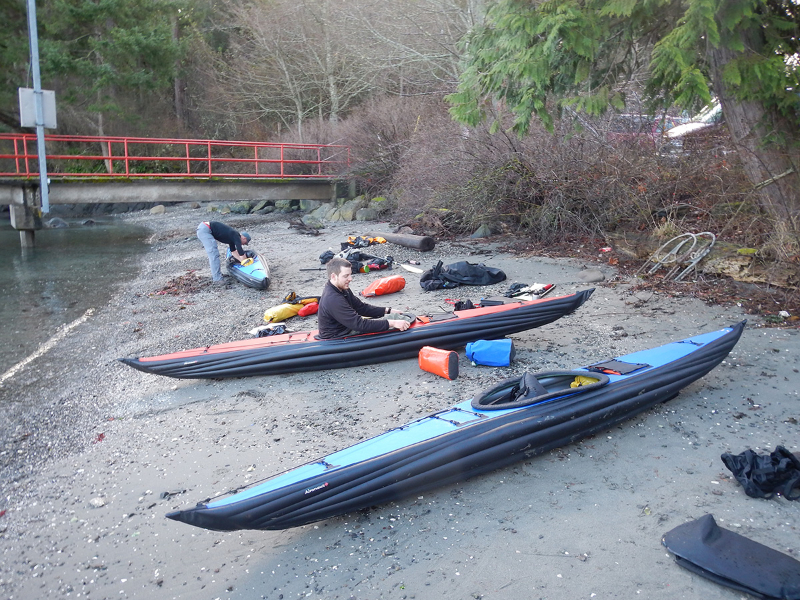
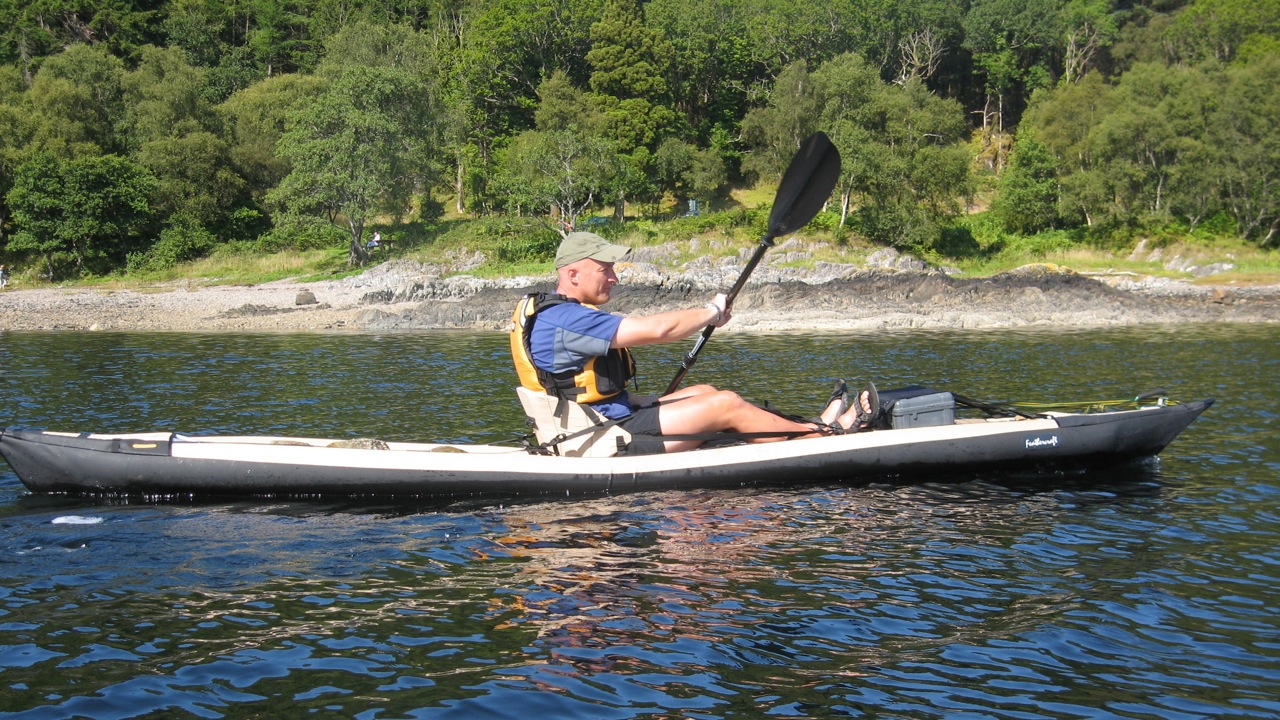
Also, like my old Sunny, Incept, Grabner and Seawave (left, alongside and Airo), the Aironaut is a European-style ‘tubeless’ IK with no slip-in sponsons (‘inner tubes’) to give a hull shell its form. Perhaps that too was necessary to run a high 5psi (0.34 bar) pressure,something which requires a good pump as well as good construction if it’s not to leak at weak points. Once on the water though, high pressure hulls have real benefits in terms of hardshell-like hull rigidity and paddling efficiency. Look at the pictures and see how straight the kayaks appear, even allowing for light paddlers (and compare to my Java here). Then factor in the Airo’s Java-like cheese-cutting bow and I suspect this may have been a fast IK, and all without clumsy and bulky stiffening rods or dropstitch floors. It’s no great surprise that it was Feathercraft who managed it, but it seems it the design was flawed.
FC seem keen on you using their sea sock insert which fits around the coaming and stops the boat filling right up in a capsize. The thought of snagging that while trying to get out in a hurry would be a worry. It’s also a little unnerving that they include a paddle float in the package (left), admitting perhaps that the 26-inch wide Aironaut was a tippy IK and getting back into the cockpit would be tricky on the high and buoyant Aironaut. I tried it with the Incept once, but as we know, practicing near the shore with a mate taking photos is not the same as tipping over out at sea, especially when alone. You would be better off getting the knack of rolling.
At 75cm long (26.5 inches) the Aironaut’s cockpit hatch is the same as my mate’s Big Kahuna. In all my clobber and fluctuating girth I wouldn’t want it any smaller, though I imagine there is more’ squidging’ space and no Kahuna alloy bars getting in the way; instead there are the thigh straps – essential for rolling and bracing. You also got a spray skirt plus a detachable, low profile skeg which is also a good idea at sea; the latter in my experience is much less faff than a rudder which I’ve found to be inadequate anyway once a tailwind gets beyond a certain strength. Good on FC for including all this in the package. Grabner and others take note.
The Feathercraft Aironaut was made in Canada and went for around CAN$3000 or the same price as the otherwise similar Incept K40 or a good Grabner.
Compared directly with the K40, the Aironaut was nearly half the weight, had a fixed deck which to me limited the appeal, had a simple skeg instead of a complex rudder, was a little narrower but a little longer, ran less payload and was supposedly tippy which, however they managed it, the K40 never was. Judging by other FCs I’ve tried and owned, I bet the Airo was better made than the K40 too, though that weight-saving fabric choice appears to be at the a cost of durability.
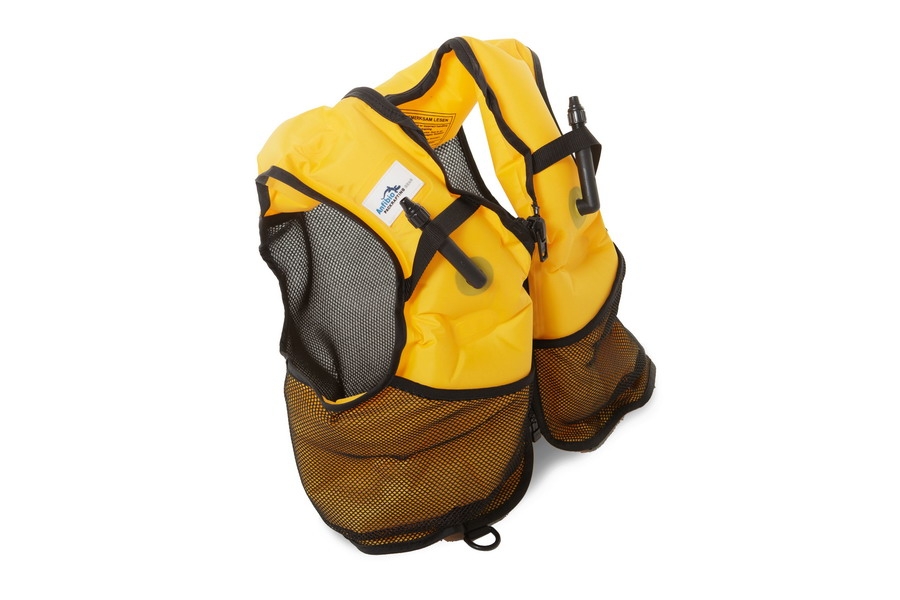
Back in 2015 the Packrafting Store in Germany sold us a couple of pre-production Anfibio inflatable packrafting vests to try out. These came without the big mesh pockets, unlike the current production item, left. Called a Buoy Boy, an ‘inflatable jacket’ or buoyancy aid is all they claim to be, not a PFD, far less life jackets. They don’t even claim to have the rescue/harness elements suited to white water recoveries, as found on better PFDs. A warning label inside spells it all out. Instead, your Buoy Boy bad boy is just a compact, unobtrusive buoyancy aid that’s well suited to sedate packraft touring.
You clip the waist clip and hook the strap under the crotch to stop it riding up, as can happen with a regular PFD, then zip up the front. Our prototypes had two ‘push and blow’ valve tubes inflating the two chambers (three breaths each). These chambers don’t cover the lower back which is composed of a thick, stretchy mesh below the inflated collar (left), so avoiding that inelegant ‘pushed-up PFD’ look in your packraft. The rear collar around the neck might even float you unconscious, face up, like a proper life jacket, but that would be a happy coincidence and despite the appearance, it is not a design element.
We weren’t even planning to take our regular PFDs on this mid-winter trip, so a compact option came in welcome, especially when a late-night boat ride required them. Best thing: it’s unobtrusive to wear deflated, doubling up as a high-viz vest whose benefits we also appreciated when road walking in the Scottish mid-winter gloom. We even inflated them while walking in freezing conditions to act as extra insulation, while at other times the Buoy Boy will be less hot than a regular PFD; another problem I’ve found when foam PFDs and paddling in 25°C+.
Weight is from 340g to 400g for a Med/Large. My ‘M/L’ was a snug fit once fully inflated over all my mid-winter clobber (I’m normally 42″ chest). A great bit of kit that I can see becoming my regular day-tripping BA, especially when I have to wear one due to regs rather than need to due to conditions.
Update. I used my orange BBoy proto just about all the time as most of my paddling is flatwater and it’s great not to feel cluttered. I bought myself a larger L/XL with horizontal valve straps and very handy large frontal mesh pouches just what was needed. Unfortunately it was black – I prefer brighter colours for safety and photos. Now in 2018 colours are blue (S), yellow (M/L) and black or yellow (L/XL) – hooray! A roomy Large on me weighs 450g with crotch strap. Price is €99. More details and photos here.
Sadly my pics area bit ropey; camera was set on 640px…
We last did the Spey from Aviemore to the sea in 2007 when I still had the Sunny. This time round Michael was in Steve’s old, 19-foot Pouch double, Steve was in his Feathercraft Big Kahuna and I was in the Grabner.Levels were low again, if nor lower, it was the last week in the fishing season but at least the weather was looking good.
The first day is just 12 miles and not so interesting, with the best views behind you. With the hour-long assembly of the Pouch completed and the van stashed at Spey Bay, we set off about lunchtime. Strong backwinds made my skeg-less Amigo hard to handle and I found myself expending a lot of energy trying to stop the back end coming round. Or perhaps I was yet to learn the knack with the Amigo, having paddled it on the sea with a skeg all summer. After a few hours we arrived at the Boat of Balliefurth bankside camp field and paid our three quid. Dinner was a freeze dried mash up from stuff I’d had lying around for months, made easier to prepare and eat with Steve’s half-hoop Eureka annex tarp.
Next morning was another sunny, late-September day and we were relived to pass the point where one of the Kleppers got disemboweled last time by a submerged, mid-river fence post. On this occasion the boat-killing spike was visible a few inches out of the water. We’d thought about doing the river a week later, when the fishing season was over, but timing put us here now, with the fisherfolk getting their last casts in before closedown. The tension between rod and paddle is an old story in England, but up here is exacerbated by the fact that the tweed and wader-clad anglers are paying – who knows? – hundreds of pounds a day for the privilege of fishing the famous Spey. With that cost comes the use of the many ‘day huts’ we saw on the finely manicured banks, as well as optional instruction from a ghilie. And then three kayaks blunder right through the spot where you’re prize salmon is lurking, like it’s a right of way or something. We did our best to paddle round the back of the many anglers – some ignored us, some grumbled and a few lone ones appreciated it or were able to wave or indicate where they’d prefer you go. Struggling behind one bunch wading in the shallows, Steve got pushed across the current and flipped harmlessly while they just smirked and carried on casting.
Once free myself, I shot off downstream chasing what some said was Steve’s paddle, but within a mile another fisherman said he’d not seen it float past. I walked back wondering how we’d get out of this one, but soon came across Pouch and Kahunaman paddling along. Seems the paddle had got submerged right by the boat, so all was well bar a lost pair of shades. Luckily that morning Steve had fitted his FC ‘sea sock’ – a body bag attached to the cockpit rim which stops the whole boat getting flooded if it flips. It was about that time so once back at my boat we spread out for an early lunch, letting out dew-soaked tents dry as some canoers from last night’s camp passed by.
Aberlour was our destination that evening. We’d managed it last time, even with the ripped Klepper, but it seemed we were even further behind today. As we paddled on, the shallows and rapids piled up and the folding boats were getting a bashing, while I took on a couple of inches of water bouncing through the wave trains. Occasionally, if we misjudged the route we had to wade (left). The famous and actually straightforward Washing Machine rapid was only running a half-load that day, but nevertheless succeeded in giving the inside of my Grabner a full rinse which took a few minutes to pump out. More white-water followed, and still I have to say the Grabner didn’t seem to handle well, requiring vigorous paddle yanking to avoid rocks or get in the right spot. Even in the pools, it still took some concentration to track straight before pulling back repetitive bow draws or momentum-losing stern rudders to keep the nose downriver. I’m sure the very similar shaped Sunny wasn’t so bad.
Barely a mile went by without passing a fisherman. One grumbled that we should whistle as we came through, but that seemed like it would raise more antagonism, though passing them on the opposite bank may have been right on their target area. Trout were jumping for sure, but we never saw anyone actually catch anything. I’m not sure fly fishing is about that. After a while riding the bouncy wave trains lost its shine in the face of the after-pumping required, though the swamping was certainly less bad than the Sunny which was best drained by pulling over and standing the boat on end. The canoers we were leapfrogging were getting knocked about and hung up in some rapids too. Shallow rapid followed shallow rapid while we had the feeling that the ghilies, aware of where boats were late in the day, patrolled the banks to make sure we wouldn’t camp on their land.
The easy white water had kept us occupied so that round dusk the old Victorian foot bridge of Aderlour came into view. We camped on the bank right there, a long day of around 26 miles in about hours. The great thing with camping by the bridge is that toilets, the Mash Tun pub and a Co-op are all just a few minutes walk away.
Restocked next morning and off by 9am, it was a 20-miler to the North Sea, during which time the riverside scenery got a little more interesting, the rapids kept you guessing and so did the fishermen. With no other dramas the breakers of Spey Bay rocked up at around 4pm but, just like last time, no one had the energy to go out and mount the surf.
The old wooden-framed Pouch slipped through unscathed yet again and 70-year old Michael had handled the ungainly barge very well, helped by a rudder. The decks of Steve’s lower Kahuna were often swamped in the rapids but towards the end the Feathercraft sustained a bent alloy member (only $30) plus a small rip in the hull. The Amigo was of course immune to the knocks and easy to hop out of, but I’m again wondering about fitting an articulated skeg high on the stern. A bit like a fixed rudder that pivots up harmlessly as it scraps the river bed, and with a retractable and locking line (again, like a rudder) to pull it up out of the way when you don’t want the back pushed round in a sweeping current. I have an idea and it would be easy to fit.
It’s fun to paddle the 60-odd miles from Aviemore to the sea, but next time on the Spey I’d miss out day one, hope for higher water levels and do it out of the fishing season. It would also be fun to do the sporty Day 2 in the packraft with a skirt. They say the Spey is one of the best canoe paddles in the UK but that just shows how few good, long rivers there are here and why sea kayaking, or short-range hair boating are much more popular. The stony shore of Spey Bay is a bleak place the paddle, but the van was intact and there was a welcome cafe for a sit-down snack before piling the van up to the roof with our packboats and heading south.
It’s understandable to worry that something like an inflatable boat is a bit of a liability when out in the middle of a deep lake, hairing down some white-water or when far out to sea. This is especially pertinent if your only experience is a beach toy made of a thin and stretchy PVC film.
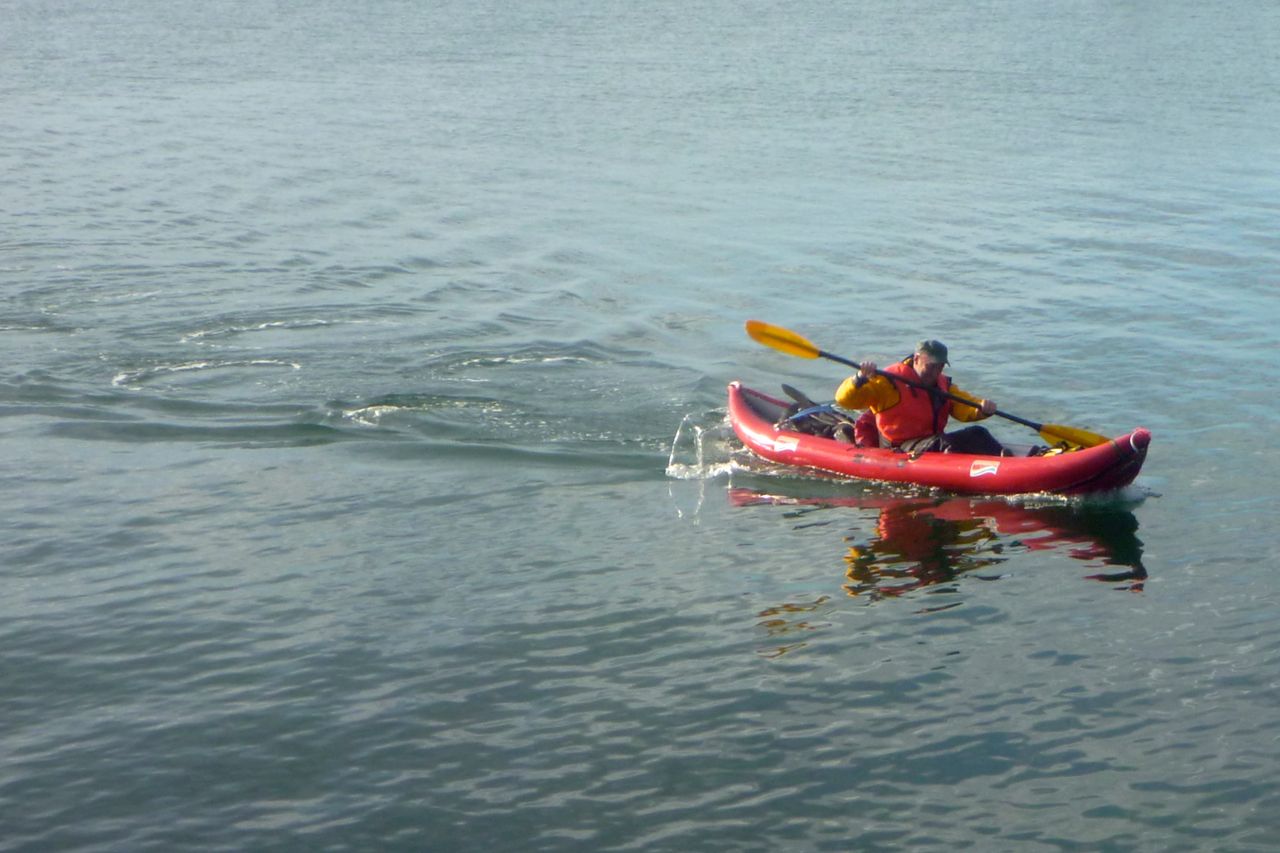
I’ve owned over a dozen inflatable boats and have only had one tiny thorn pinprick in the Incept, age-related fabric perforation on an ancient Semperit and a hole worn through careless transportation in my Seawave.
Once on the actual water it’s hard to think of anything actually puncturing my full Nitrilon Gumotex IKs or the old Grabner. What more often happens is some kind of accidental wear or rubbing when not paddling or during transportation, like the trolley wheels which wore a hole in my Seawave, or the windy tree branch which rubbed (but did not puncture) my Grabner (left). I also snagged my packraft’suninflated floor on submerged concrete once, then added protection to the outside and padding on the inside to stop that happening again.
I’ve also travelled with cheap slackrafts that have got ruined within minutes and punctured every other day. You do get what you pay for. So when it comes to glue I’ve learned that preparation and application are vital to getting a good repair: rough it up; wipe it down with solvent, apply the right glue to both surfaces, wait, then slap on the patch and press down hard with roller to achieve a long-lasting bond. More below.
Is your boat plastic or rubber? As explained here, broadly speaking IKs are made of either rubber- or PVC-coated fabrics. Rubber-based Hypalon, EDPM or Nitrilon is much less used now and most with the tubeless construction method. On a boat like this, rough up the surface, clean with solvent (see below), apply the right glue and a same-material patch, all which needs to be done well as the patch is vulnerable on the outside. Or, you can just dab some Aquaseal directly onto a small hole in the hull to protect it from wear, as shown above left (not an actual puncture).
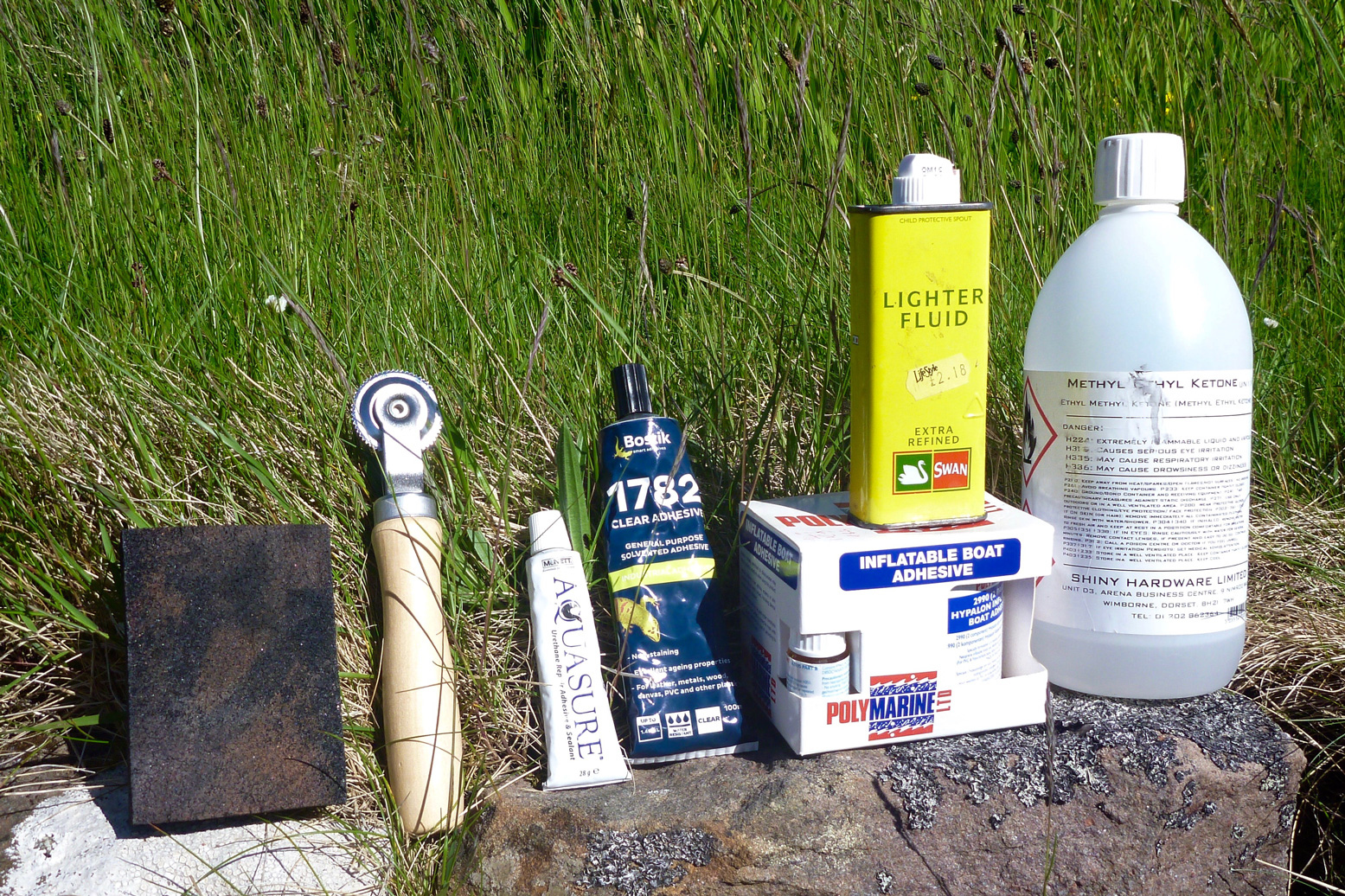
One-part glues I’ve succeeded in gluing on non-critical D-rings onto Gumotex Nitrilon and Grabner EDPM (Grabner), as well as PVC to Nitrilon using single-part Aquasure urethane sealant/adhesive (‘Aquaseal‘ in North America). Allowing Aquasure or similar to half-cure in air for 30 minutes, then sticking together and letting it ‘seal’ to itself is a way of bonding anything – even non-compatible rubber-based Nitrilon to PVC, as I did here. SeamGrip is a runnier version of Aquasure to get into cracks and seams. Though I’ve not tried it yet, British-made Stormsure is the same thing. Apply a thin film of Aquasure to both surfaces; wait half an hour, then bond with all you’ve got.
In the UK you can buy Aqausure in 28g tubes from £6, or 250g for around £24. Unless you have a lot to glue/seal jobs, be wary of saving money with the big, 250-g tube. Give it a chance and it’ll split and harden before you get to use it all, even if it’s effectively over half price. Alternatively, I’m told a good tip is to store it in the freezer once opened.
The other one-part glue I used on my PU/PVC Incept IK, Slackrafts and used recently on an old hypalon Semperit is Bostik 1782, not least because it once went real cheap on ebay.
I can’t say it worked that well on my Incept; two-part adhesive is always better. Even on the slackraft the Bostik softened and shrivelled the thin PVC. But on non-critical applications (D-rings and none-huge tears), 1782 seems to work well on hypalons (rubber is always easier to glue than plastic PVC) and at £10 for 100ml was good value. Plus it’s a nitrile rubber/resin-based solution and I’ve found won’t go off and harden in the tube like Aquaseal often does. It’s my favourite, do-it-all, one-part glue.
For years Gumotex supplied rubbish Chemopren Universal gluing in their repair kits. It looked like the brown rubber solution you’d use on a bicycle inner tube. I tried to use it on my Gumotex Sunny years ago and found it was crap. Back then it may have been me, but I tried to use Chemopren again recently on my hypalon Semperit and it wouldn’t even adhere to a roughed up, MEK’d surface! To be fair, it might have been many years old, but so are my other glues.
The glue that came with my second Seawave in 2020 was a small tube of Elastick (left). It looks like a generic polyurethane do-it-all glue, like Aquasure. It will probably remain unused with the boat until it turns solid. I’d sooner rely on Nirtile-based 1782 or Aquasure for field repairs. Tbe problem with these urethane glues is once you open them or the alloy casing cracks they dry up and harden.
Two-part glue
For important jobs use much stronger two-part adhesives suited to actually assembling air boats as well as making more permanent fittings and bomb-proof repairs. At about £15 posted for a 250-mil tin, PolyMarine 2990 Hypalon adhesive is much cheaper per ml than Aquaseal or Bostik 1782. In the UK Ribstore and Ribright sell similar stuff, and Bostik 2402 is the same but prices vary wildly. Just make sure you buy for Hypalon or PVC. I’ve used it to glue D-rings onto my Grabner (more here), floor patches to my Alpacka, latex socks to my dry trousers and patches as well as repairs to my Nitrilon Seawave and Sunny. It sticks like shit to a s***el.
The trick is to measure out the correct quantity. Above: the small bowl about half full of glue and hardener – about 10cc or 2 tablespoons? – was enough to fit two 80mm D-rings. Each surface: the back of the Ds and the hull, need two applications half an hour apart.
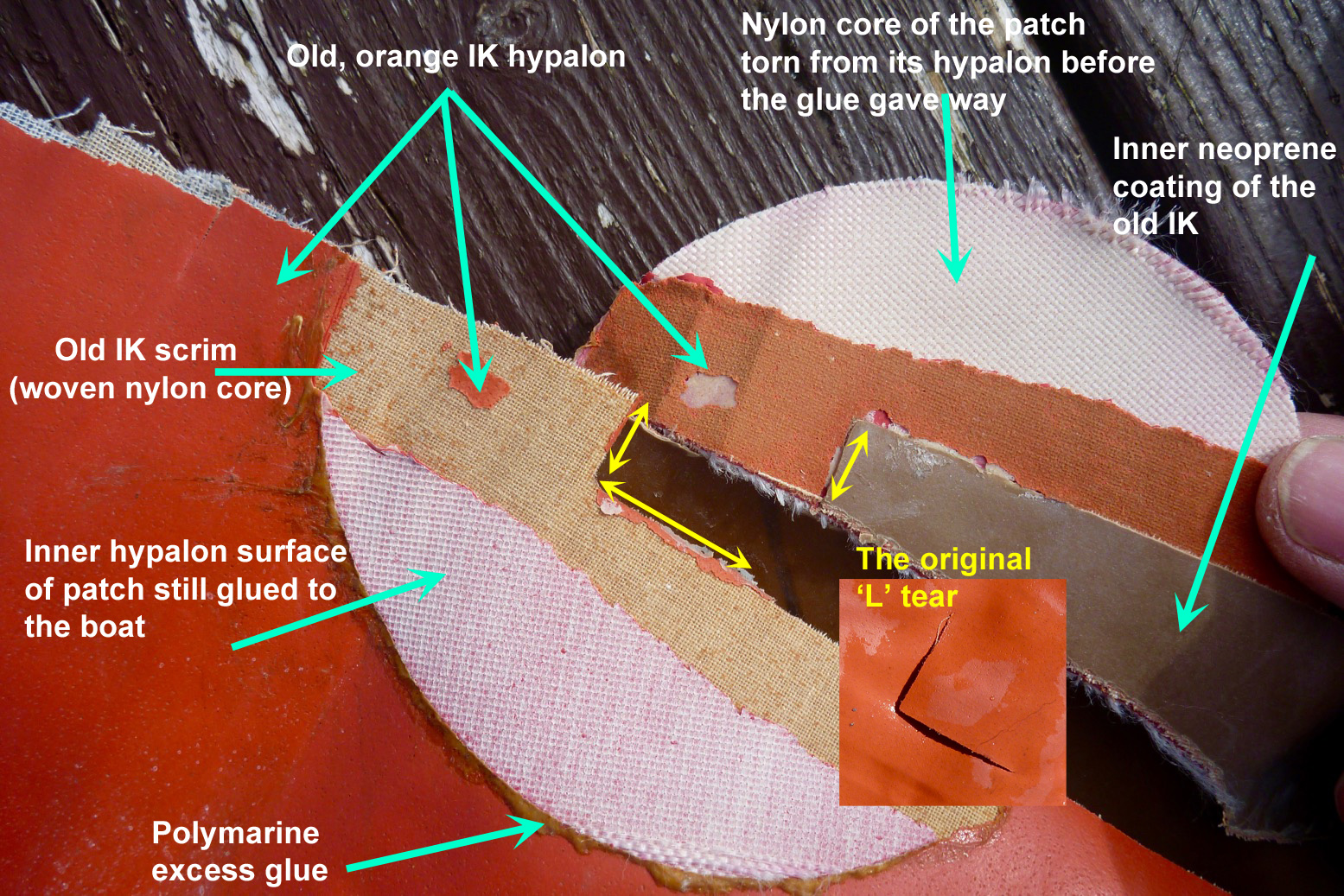
In 2017 when I dismembered an old IK, I was easily able to pull off recent patches glued on with Bostik by hand. But I could only pull off Polymarined patches with a pair of Knipex hydraulic trench pliers and even then, the patch coating pulled away from it’s core (lighter exposed weave below) or the patch remained stuck to the boat and instead pulled off the dead’s boat’s hypalon coating revealing the fabric’s yellowed core or scrim. The two recently glued surfaces could not be separated. They say the mixing of the two components causes a chemical ‘vulcanisation’ and molecular cross-linking which creates a very strong bond. Mixing and applying two-part is a pain, but it works.
Get a good roller
Single or two-part, once you apply your patch, roll it very hard with something like the classic Baltic-pine handled Sealey TST15 stitch roller (left) aka: tyre repair roller used for innertube and tyre repairs. The knurled metal wheel set in a solid handle applies much greater pressure than a wide plastic roller I used to use, and they’re only about a fiver on eBay. Buy one now so you’re ready.
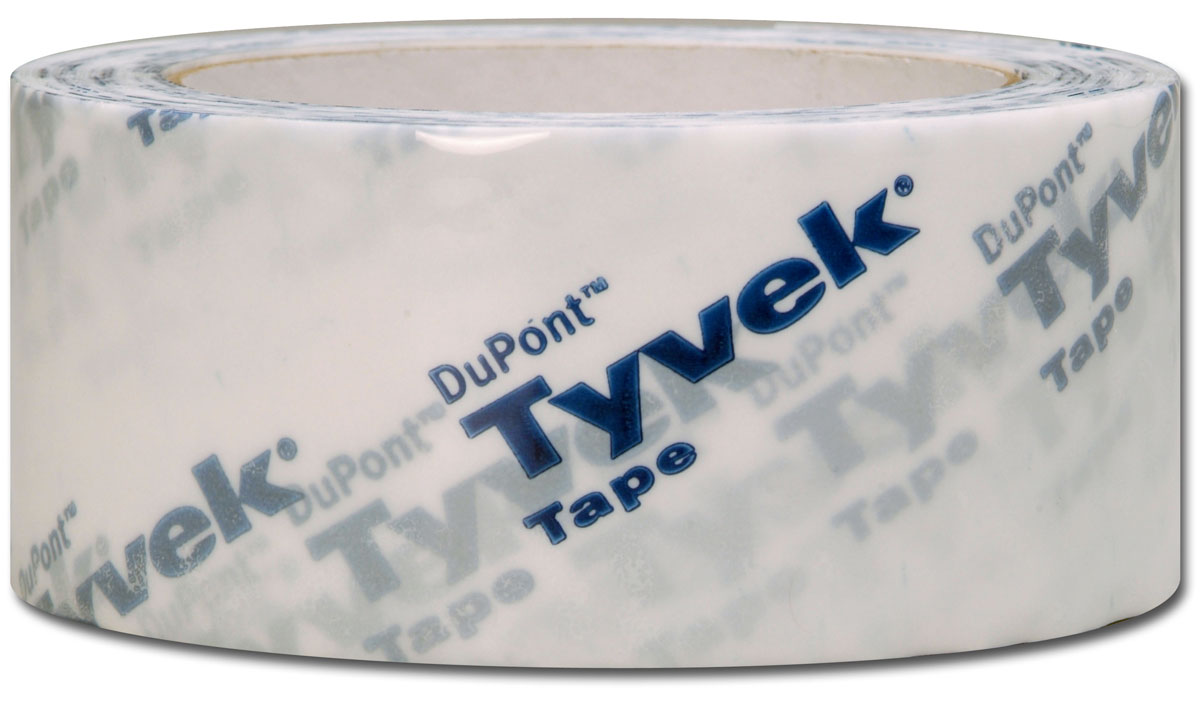
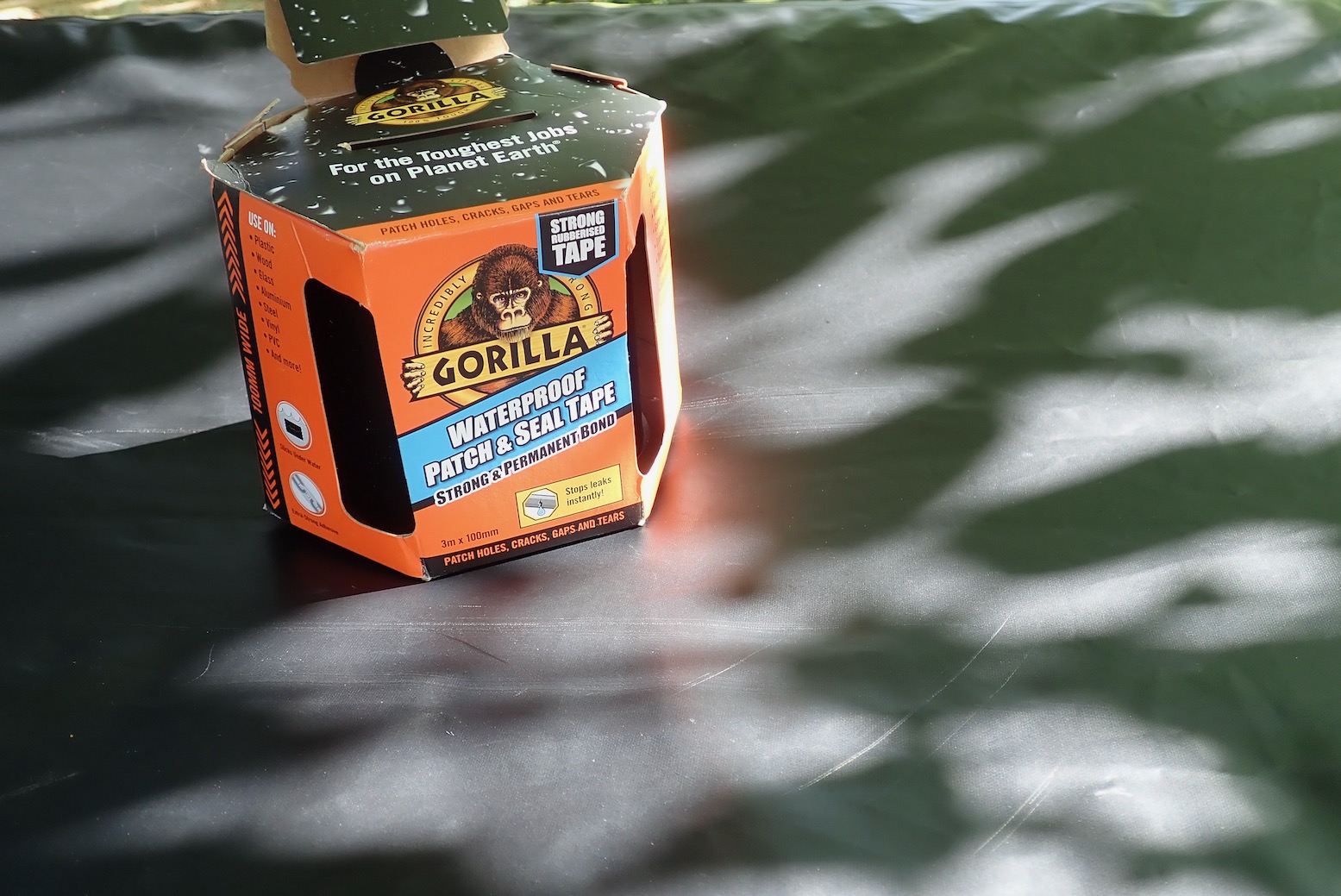
Bladder boat and packraft repairs With smooth-skinned packrafts use two-inch wide Tyvec tape produced by DuPont. Just peel off the back and apply a section to pricks or small tears once the surface has been cleaned and dried. No need for roughing up, but a quick wipe with solvent won’t do any harm. Larger tears can be sewn then taped. Tyvec will work on urethane IK bladders or use ultra tacky Gorilla Patch & Go tape for deep floor scratches and cuts. It will remain impermeable even once immersed.
Helaplast to stick things onGorilla P&G for repairs
Aire-style bladder boat repairs are actually easy. According to Aire’s youtube vid, you unzip the hull shell, slap on a bit of Tyvec on the split, tape up the inner side of the hull shell gash to keep out grit, reflate and off you go. You can glue up in the usual way later, if necessary. I had the feeling that on my Feathercraft Java the urethane-coated sponsons made of thin ripstop nylon fabric (like tent flysheet material) couldn’t have been securely repaired with tape. In fact, it would be difficult to bond anything well to the slippery nylon fabric compared to smooth urethane plastic or hypalon-like surfaces, but perhaps once inflated the seal would have been fine.
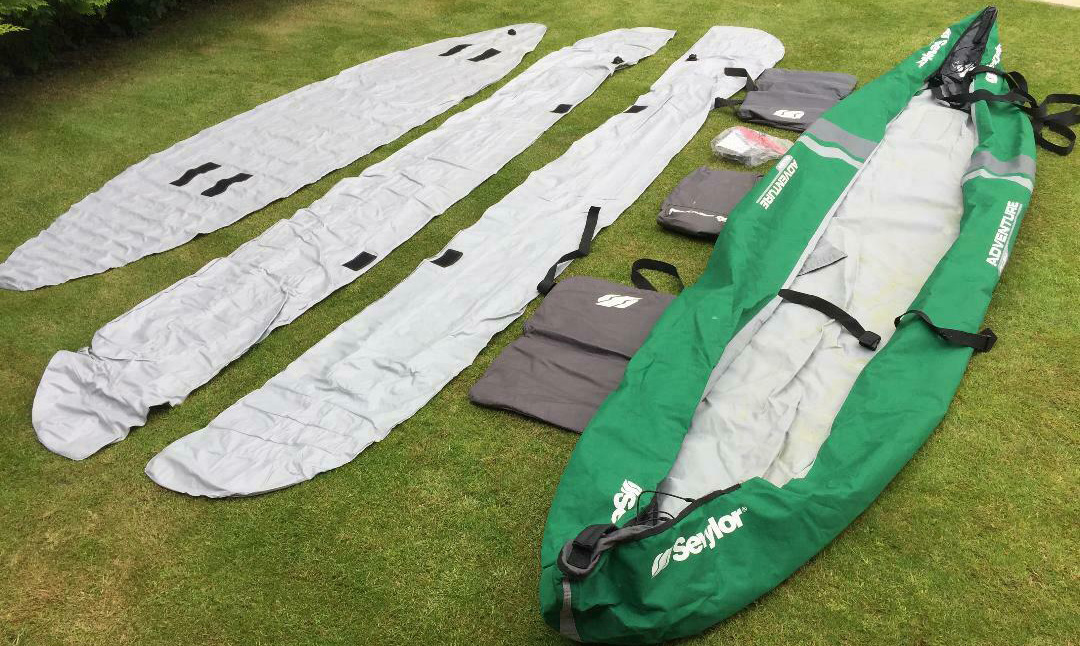
On this Sevylor it was the green envelope which ripped a metre long on the second outing! The owned may have over-inflated on a hot day – it only runs 1-1.5psi. The envelope is just a nylon fabric shell so would be an easily sewn repair. Usually it’s the inserted bladders which go. They can be patched.
Once you’ve done your roughing up (sandpaper or a foam abrasive sanding block, left) you need to clean off the residue as well as any oil or grease present. Anything will do in a pinch; alcohol and spirits, after-shave or nail polish remover (acetone), lighter fluid, white gas or petrol of course, but not oilier diesel, aviation fuel or Nivea for Men. Bleaching agents aren’t the same thing. In the end just use water to remove the dusty, post-roughing residue, and on a cold day it can help to warm up the damaged surface to cure the glue more quickly.
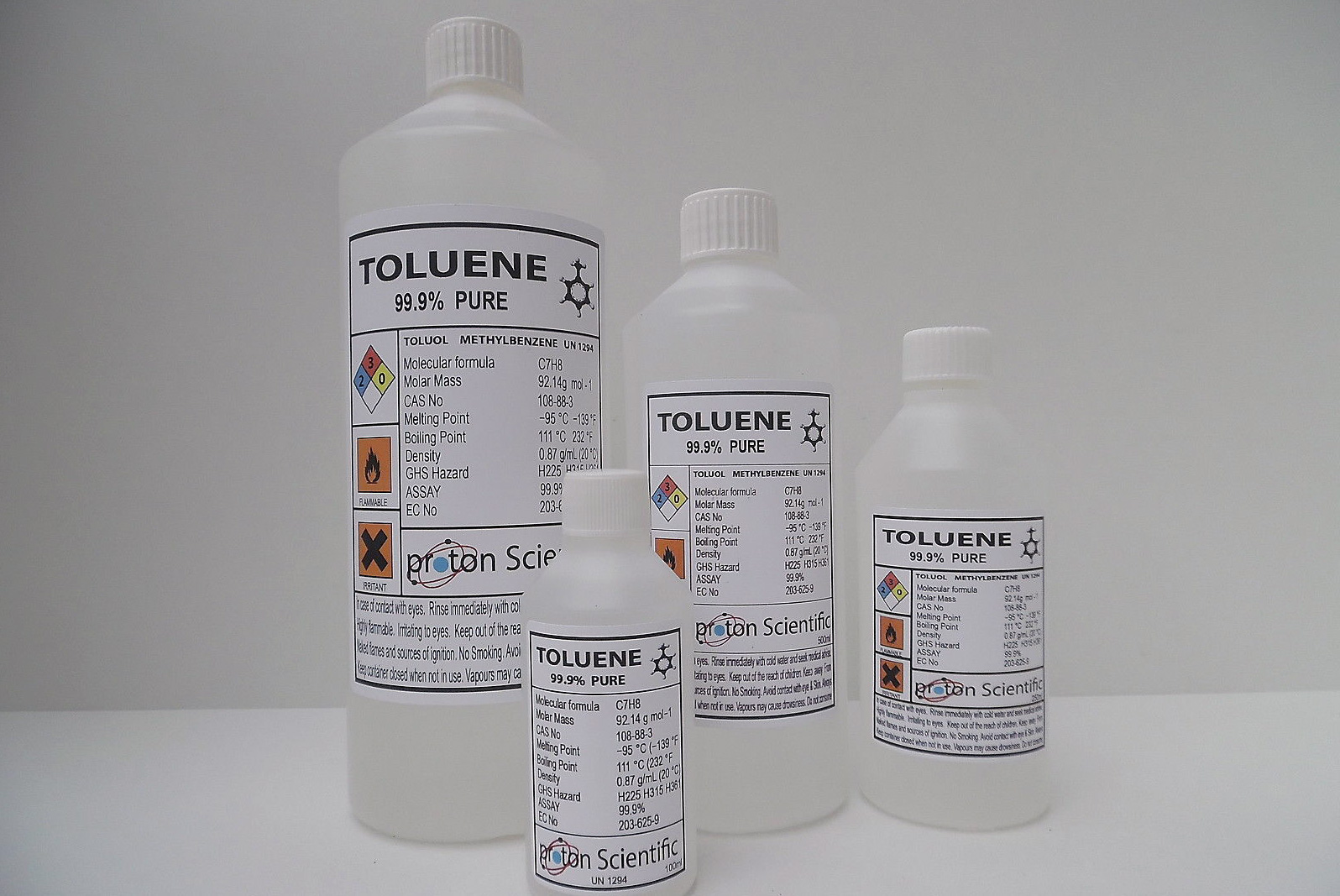
Tri Nitro Toluene (TNT)
For a travel repair kit a tin of lighter fluid (same as white gas) or nail polish remover (acetone) are easy to buy and handy to pack. Back at home I’ve found MEK (Methyl Ethyl Ketone) is inexpensive at £9/ltr and hideously effective. Acetone is even cheaper and perhaps less extreme – all we’re really talking about is cleaning off any grease and the dust after sanding. They say MEK is for PVC boats rather than Hypalon, but on a thin plastic slackraft the PVC will shrivel up before your eyes once MEK’d. Even on rubber-based coatings use MEK or similar toluene sparingly. Expect some colour to come away on the cloth and the coating to soften at bit: good for adhesion. Note the NRS video above specifically recommends toluene (the second ‘T’ in ‘TNT’ explosive, fyi) for hypalon. On ebay uk it’s the same £9/ltr but they won’t post this stuff around the USA.
Huge tears and bear bites
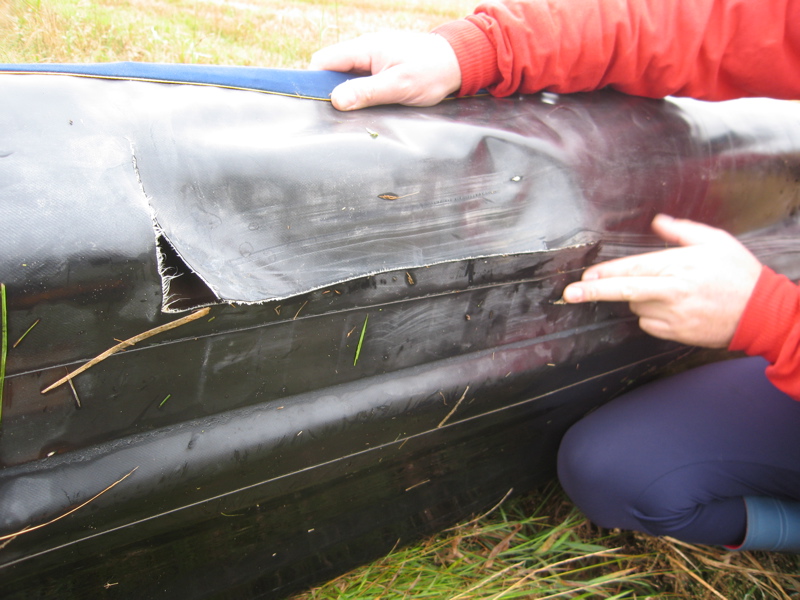
If you have a huge gash, as in the folding Klepper’s hull below, sewing is the only way to contain the tear when applied to an IK. Then apply a huge patch with adhesive, as normal. The boat below caught a cut-down metal fence stake buried in a shallow river bed and was actually sent back to Klepper for professional repair. It’s tempting to think an IK’s pressurised hull would have skimmed over the stake rather than snagged it. The smaller 1-inch L-tear on the left was glued with a 5-inch patch but the 30-year-old IK proved to be totalled.
This huge tear…was carefully sewn up..and patched. Good as new.This old Klepper caught a metal stake buried in a riverbed. Rrrrrrrip. Even then, sewing up the tear and a big enough patch, that would be an easy repair

















































 Inflatable Kayaks & Packrafts