Category Archives: Inflatable Kayaks

Summer Isles Kayaking ~Tanera Beg

Tanera Mor

beg06

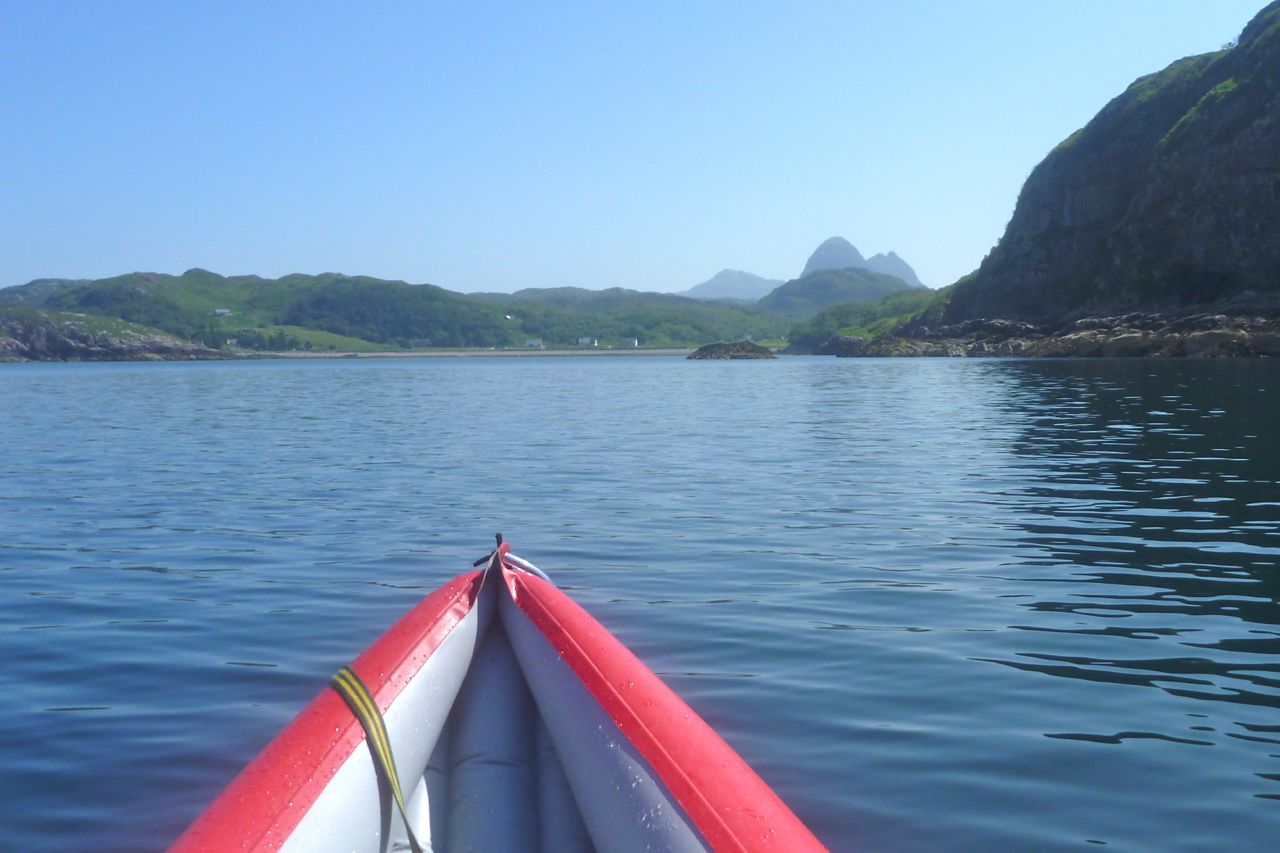
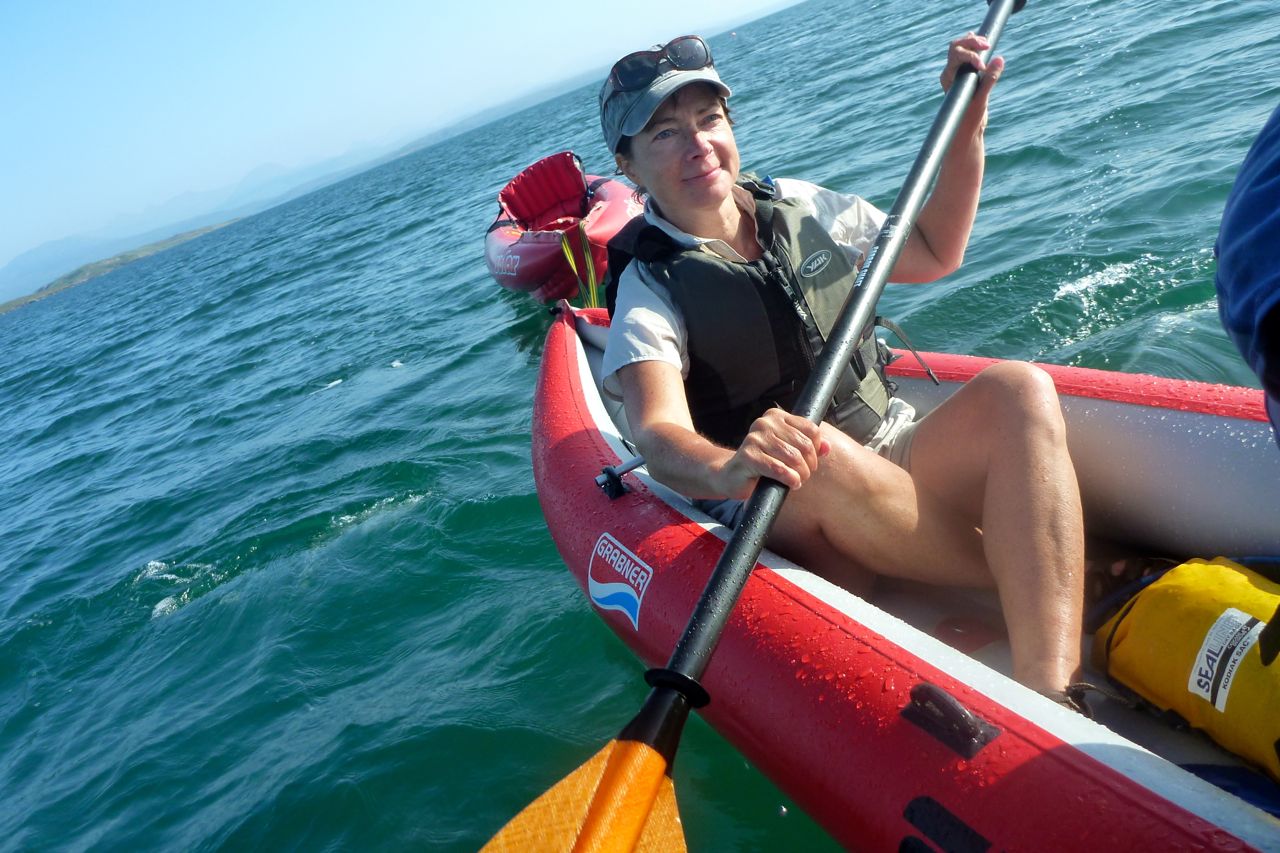
The calm continued and with it the paddling. Today we tried the Grabner Amigo two-up around Tanera Beg island out of Old Dornie. I’d <a class="wp-gallery mceItem" style="color: #000000;" title="Summer Isles Overnighter camped on the island with Jon one time but have never been right round it.
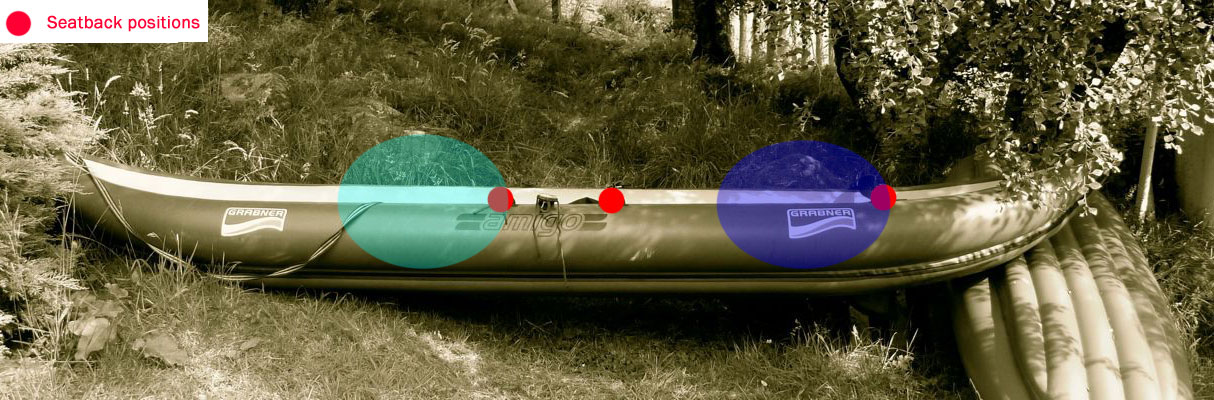
For some reason I assumed better the greater weight of me in the back and half-my-weight Mrs out front. But looking at the seating positions (image below right), back is quite far back and full frontal is only a little more forward than the solo position. So the heavier person out front centres the mass a little better on the boat which must be better for control and response.
amigt


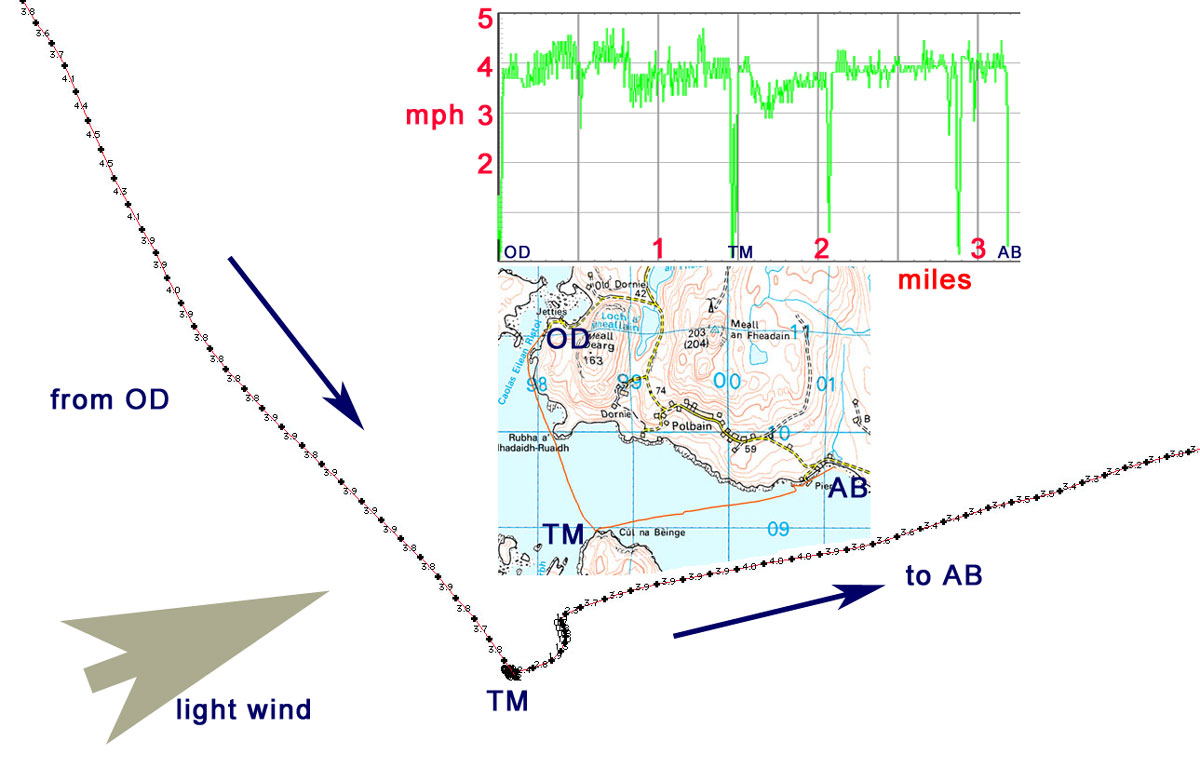
We set off me in the back, but suggestions on improving the forward operator’s poor technique and asymmetric delivery led to discord and erratic progress, as the speed recordings below testify. To be fair the g is way out of practice and also hadn’t had two hard days of paddling to tone up. However, claims that her inability to paddle straight was due to my diet and general girthlyness in the stern will have to be settled in due course by BCU lawyers.

beg2

Meanwhile, in the narrower back it was a tight squeeze for my (allegedly fat) arse and soon my legs – like my ears – were going numb. I’d initially perched on a spare Gumotex thwart but that felt unstable. It was better sat on the floor, jammed in. In this position my feet were against the back of the gf, so there’s only just enough room for my legs.
As we passed between the two Taneras where a fishing boat was checking pots, I spotted an easy portage over Eilean Fada Mor, an island between the two Taneras. It gave a bit of a short-cut, but more usefully a chance to restore circulation in my legs.

grablug

We swapped places here too, although one lean back on my new q/d back strap arrangement (left, a replacement for the alloy Grabner bar which bends too easily) broke the black plastic clip. I fed a spare krab through the seat strap and tied off the other end with some cord so that clip wouldn’t break too. I was expecting such issues and anyway, big karabiners are easier to use when swapping seats (see Grabner Mods). With the force on the Grabner rubber mounting lugs now coming from an unintended angle rather than directly back when using the seat bar, I’m trying to spread and articulate the loads with cord. But with only 3 square inches of contact, even if the lugs were factory glued, I feel I ought to glue on some 4.5-inch ø D-rings instead (as on the Solar; over 15 square inches of contact). Whether it’s just my clumsiness or all this weight I hear about, it’s clear that the strain on seat mounts is greater than I thought, especially with footrests to push back off.
As it was, with no footrests in the full-forward position I couldn’t rest fully against the prototype back strap, but as I noticed before, proper paddling is much easier out front as the boat narrows towards the bow. That’s another thing with big, single sidetube IKs: they’re over wide for good paddling. As it happens, should I want a footrest tube I do have a D-ring glued on the front floor in about the right place.

beg04


Back to the story. We were now back in paddling harmony and heading into mare incognita, the southeast corner of Tanera Beg where I’d heard there was an arch. And there it was – a very nice one too that could be paddled right through (this was 90 mins after spring HW). Its exposed position made the roof deeply scalloped by storms and weathering, reminding me of the similarly carved limestone walls of northwest Australia’s Geikie Gorge which we packrafted a year or two back.
Amazingly, out here on the ocean-side of the Summers there was barely a swell or a breeze to disturb our composure. Though an hour’s paddle away, Priest Island looked enticingly near. And from Priest it’s less than 5 miles to Mellon Udrigle beach at the top of Gruinard Bay on the south side of Loch Broom. Or from either Tanera island you can take a 10-mile loop south to Priest and back north via the smaller Eilean Dubh and a few other ‘Outer Summers’. One for the next calm day and a paddling chum for back up.

beg10


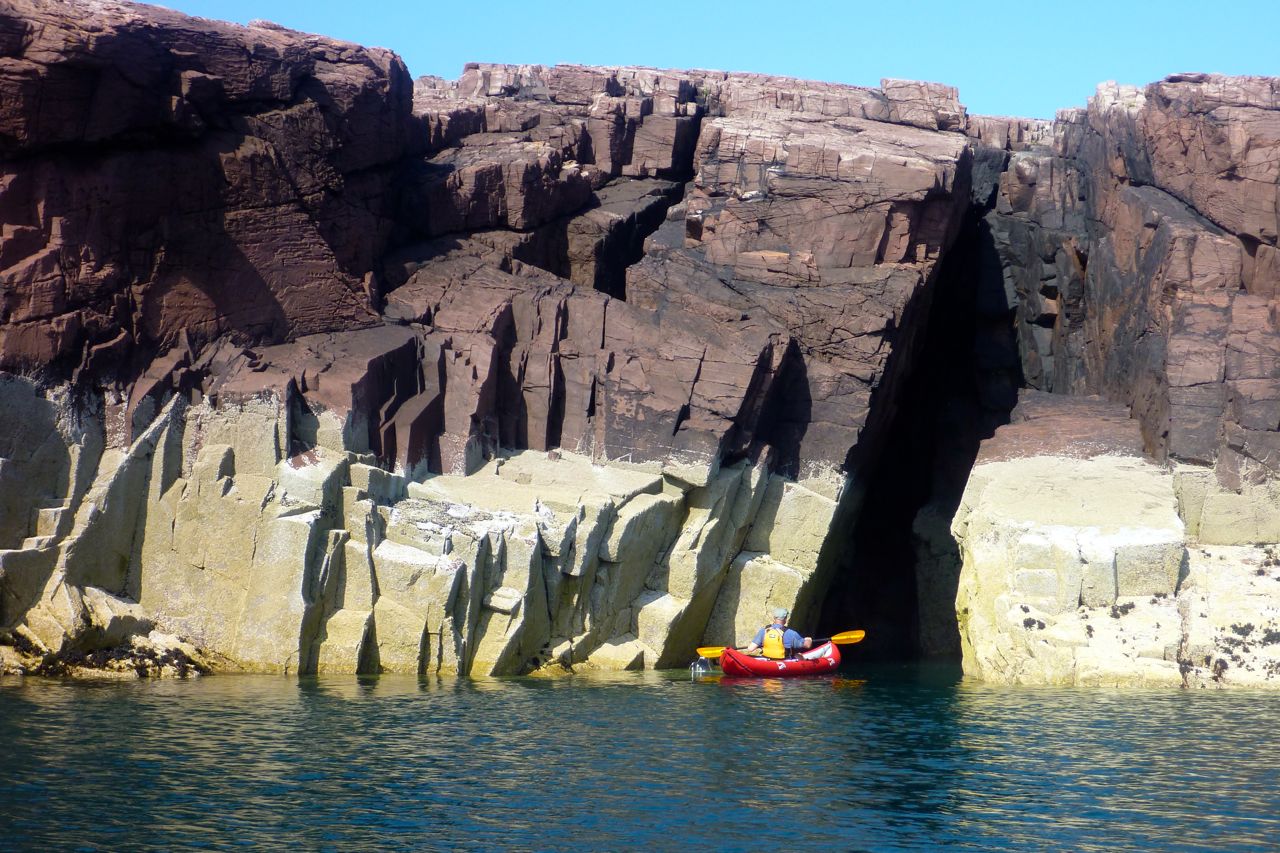
We felt like we were making good speed across the south side of Tanera Beg, although rarely got over 4mph. At the southeast corner was a huge cave – big enough to break the GPS signal. With a small window at the back this will become another full arch by around AD6565. This whole exposed side of the island has deeply weathered Torridon sandstone cliffs full of interestingly rounded cracks and fissures. Tanera Beg, like the bigger Mor has the same ‘waisted’ kidney shape presumably carved by the icecap along existing fault lines. Like mountain col, the ‘waists’ usually correspond with bays backed with a handy stony beach though flat camping needs a bit more of a walk. Had the Ice Age been a bit longer (or when the polar ice caps are gone) there’ll be a few more Summer Isles to go round.

beg13

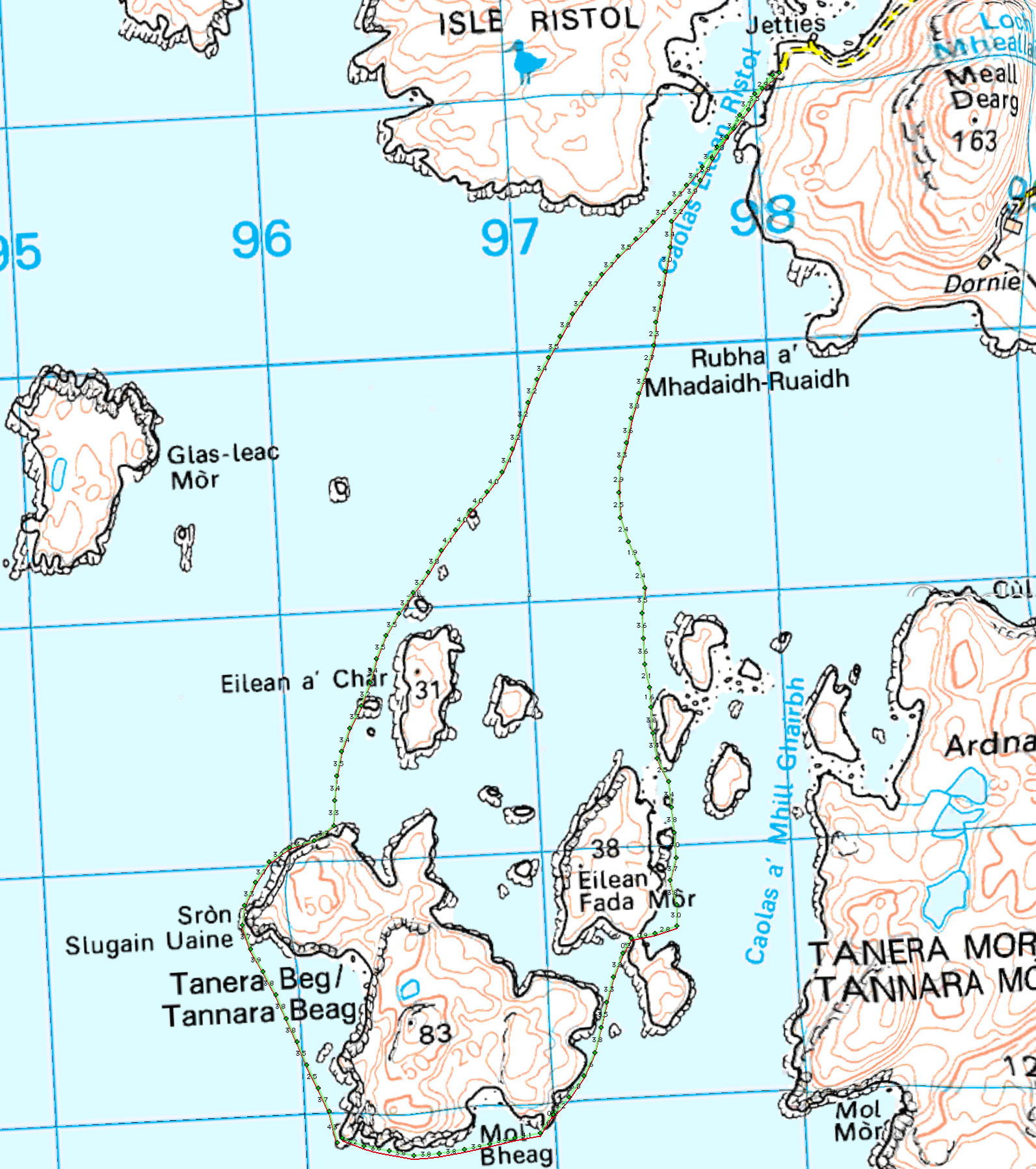
We then paddled below the 20-m cliffs on the north edge of the island (left). On a stormy day they reflect the brunt of the swells and throw up plumes of white spray over the cliffs themselves which can be visible from the road, miles away. Today, all we had to worry about was the peak of the ebbing spring tide in an hour’s time. Who knows if it mattered, but I’d deliberately circumnavigated Tanera Beg clockwise so as not to be in the inter-island channel where the current ebbing against us might have been more noticeable.
tanbegmap


Heading back to Old Dornie the speeds indeed seemed to drop, even though we were going as fast as possible in an effort to catch the weekly fish van down in Achiltibuie. At one point the kayak slowed right down as it passed over some unseen current or eddy thrown out by Isle Ristol. But that soon passed and with a quick turnaround in Old Dornie, it’ll be fresh local halibut for dinner.
So, closely analysing the data in the speed graph it seems that two-up doesn’t make the Amigo much faster than solo after all – perhaps it’s the same with tandems? I suppose the additionally weighted hull can only be pushed through the water so fast and then an IK’s unsophisticated hydrodynamics come against a wall. Instead, two-up enables greater potential duration as the paddling load is shared – and let’s not overlook the companionable element of two in a boat, as long as everyone is sitting in the right place and on form.
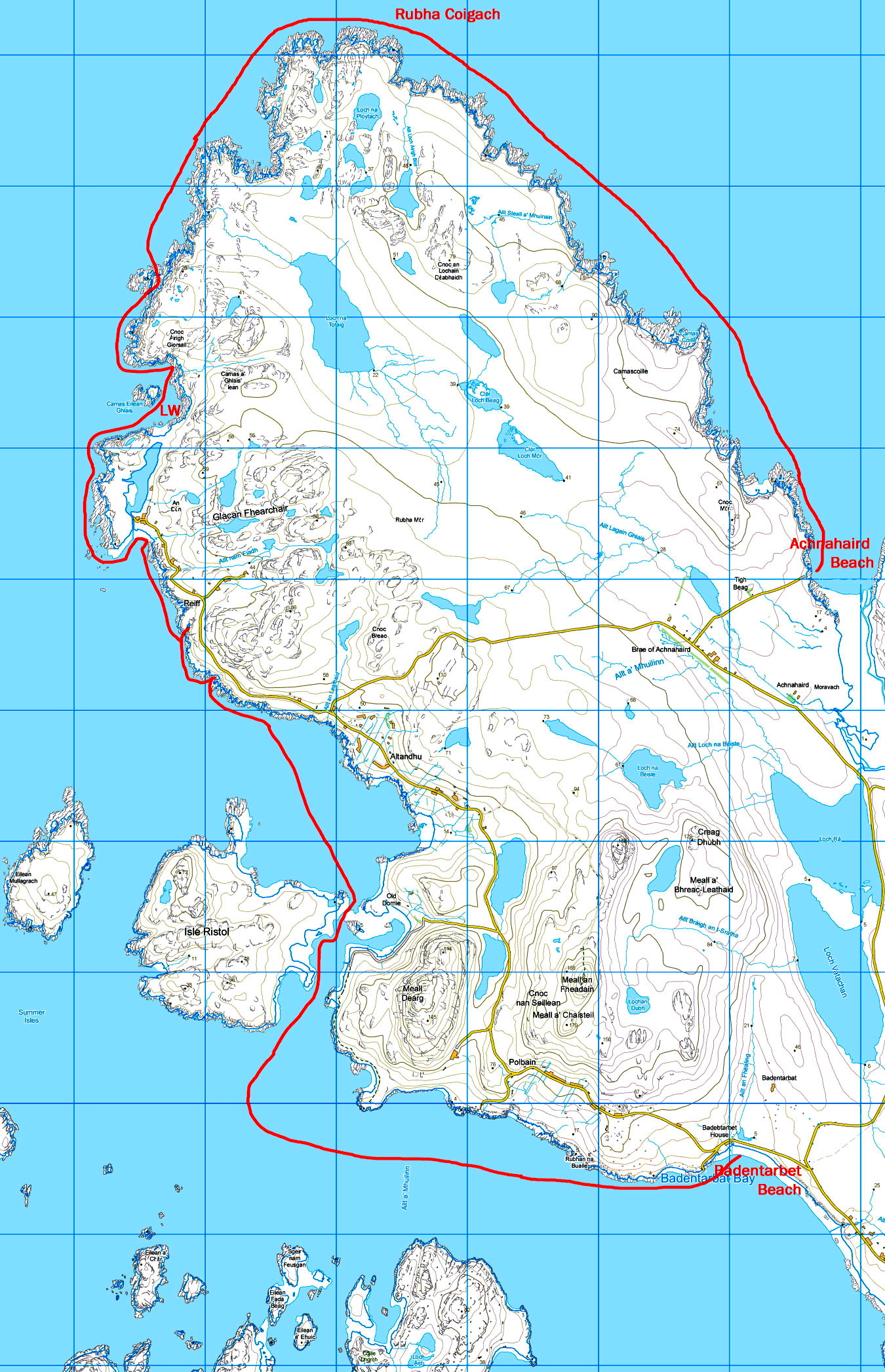
Around Rubha Coigach (Summer Isles)

Summer Isles Kayaking Guide

rubccoiheader

I set off from Achnahaird thinking I’ve left it a bit late. I must get to Rubha Coigach – the northern prow of the Coigach peninsula – by 11.40 BST or my kayak will turn into a sea pumpkin and my paddle into a wicker broomstick.

cogachmap

I was reversing Route #25 from the Scottish Sea Kayaking guidebook, a ‘Grade B’, (C being the hardest). And although spring tides were kicking off next day, the forecast was for very light winds and a warm sunny day; a good day to try and ‘turn the point’.
Knowing that capes and headlands can be hairy places, I’d given this local ‘Cape Wrath’ a wide berth, but current conditions could not have been more benign. So for once I RTFM closely and decoded the perplexing tidal calculations of when not to be seen dead in a bloat at Rubha Coigach, the headland of Rubha Mor. The red period started at 11.40 which didn’t quite make sense in respect to slack water, but tidemaster and experienced NW Scottish sea kayaker Gael confirmed my calcs. I wasn’t going to argue.

rubcoi02

It’s about 3.5 miles from Achnahaird northwest to the tip, and as I paddled along I tried to visualise possible scenarios. What unpredicted Corrywrecken-like horrors awaited me up there if I strayed into the red zone and got caught in a frothing maelstrom of lashing foam and bruised fish? A north-easterly breeze pressed in from the right and a gentle swell lifted the boat pleasantly. Up ahead white foam was periodically slapped off low rocky shelves, but it was nothing I couldn’t handle, and it was easy enough to turn back. I neared the jumbled cliffs which we’d walked to a few weeks earlier (some pics here from then), knowing that whatever it’s like now, it’ll be different once I got round the corner. And I was right.

rubcoi05

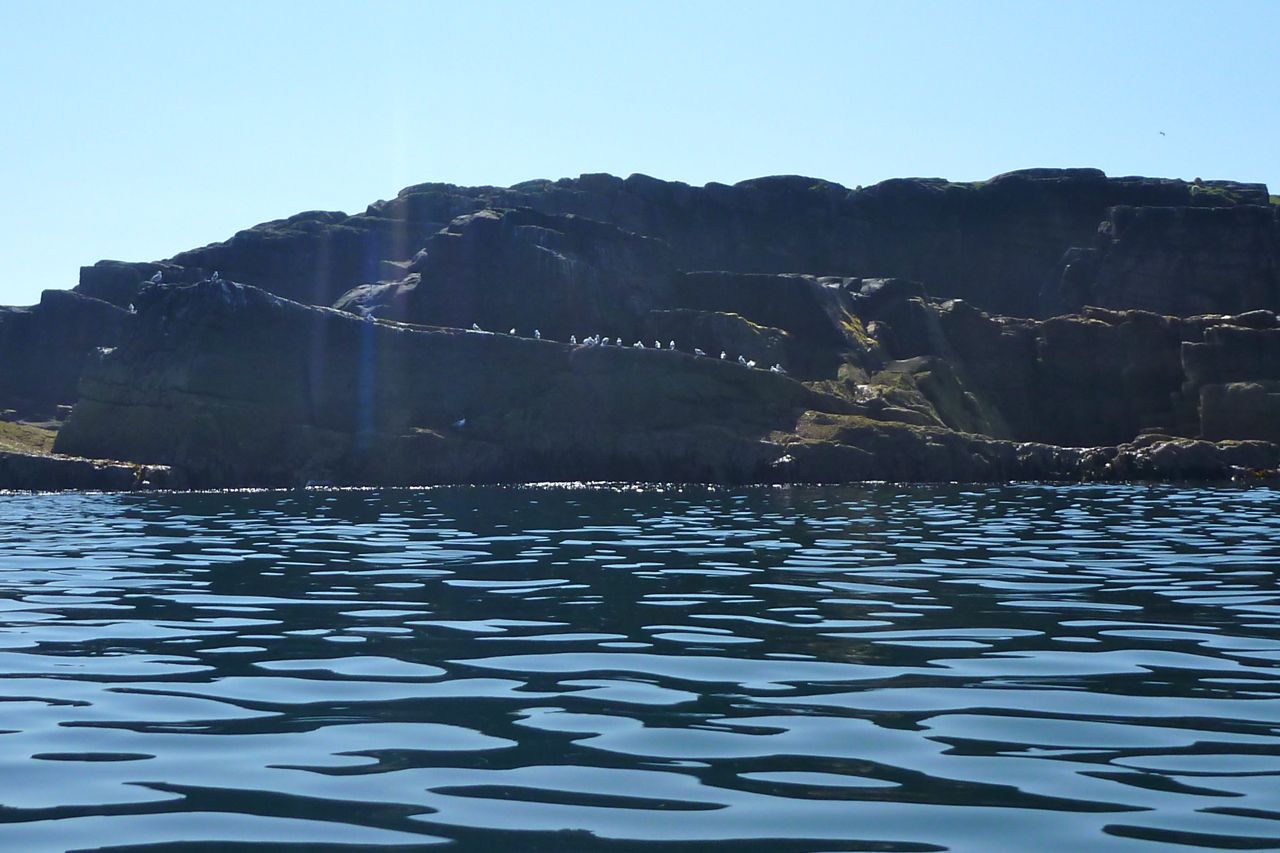
On turning Rubha Coigach the chop dropped right away and I entered a windless Caribbean calm, divided by a hazy line far to the west blurring sea from sky. Lined up along a ledge to my left, a welcoming committee of seabirds nodded approvingly then waved me on with oily wings, pointing insistently at their watches. You don’t want to be here at 16.36 tomorrow, sunshine.

rubcoi06

I could afford to take my foot off the pedal now, but cut across Faochag Bay anyway; up ahead what I thought was a cluster of bobbing gannets miraged into a party of a dozen sea kayaks (left), presumably being guided round to Achnahaird by one of the local outfitters. That was more kayakers than I’d seen here in six weeks or more. The amazing weekend weather had brought them all out likes midges.

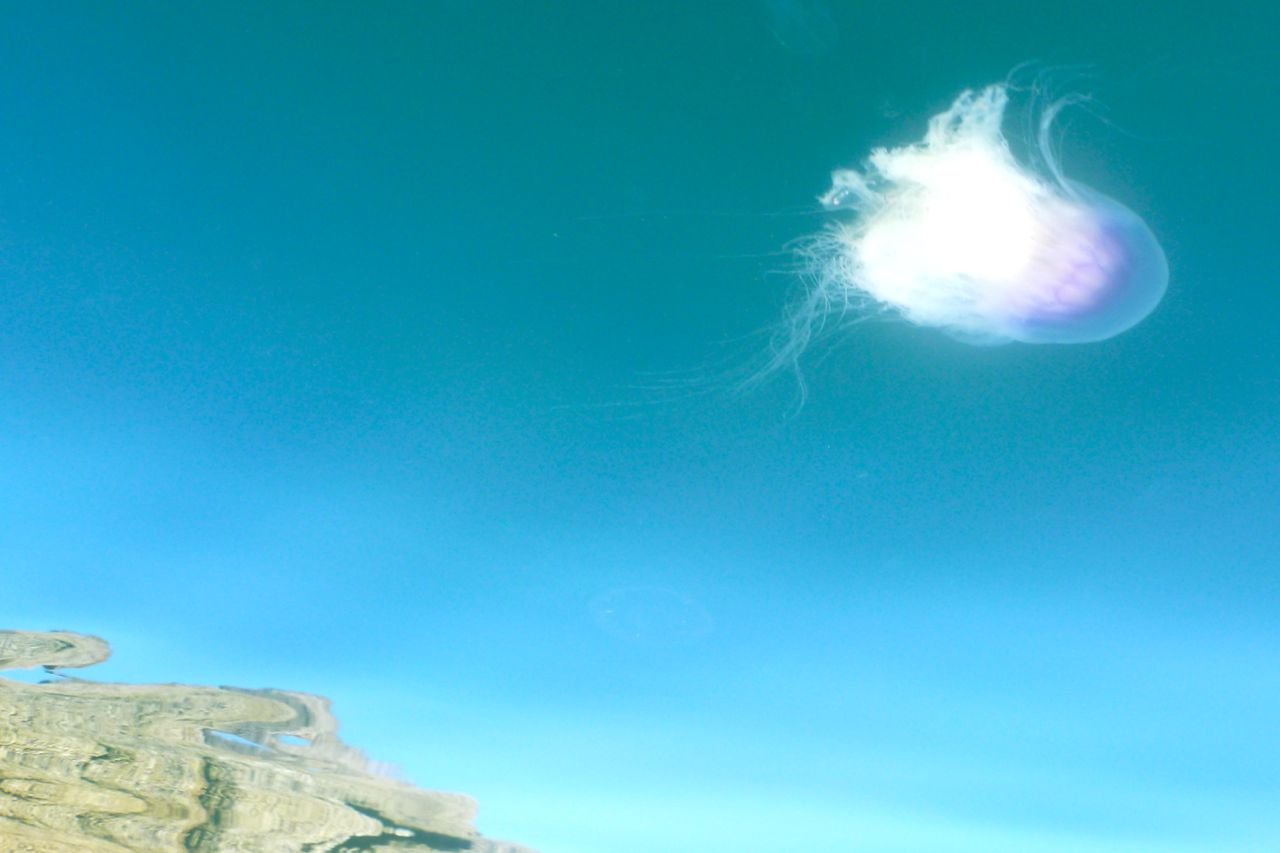
Like yesterday across Enard Bay, the land kept what breeze there was off the sea making a surface as smooth as polished bronze. Beneath that, at least half a dozen varieties of jellyfish morphed and drifted weightlessly like organic spaceships. I’d never seen so many here; do jellyfish spawn?
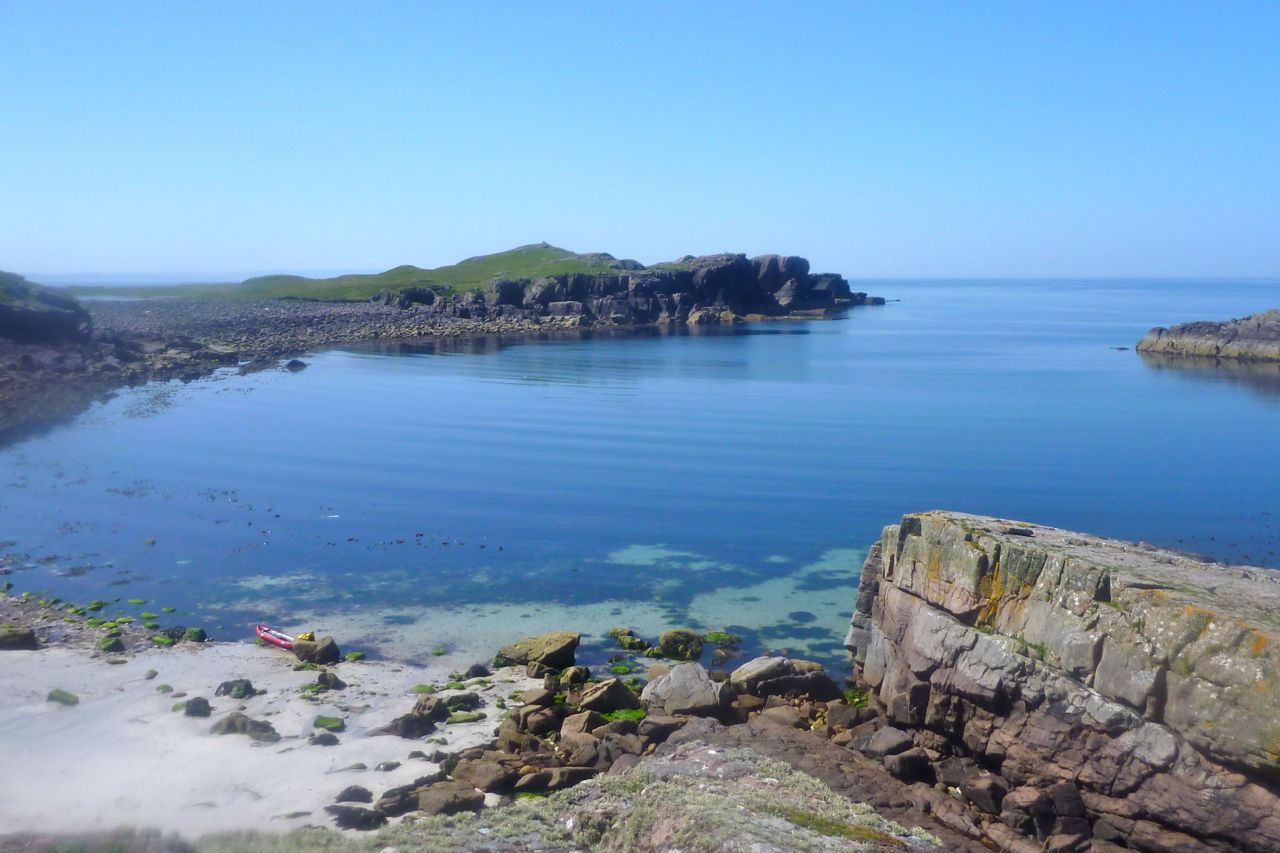
I was intending to keep going after Reiff where Route #25 started, so before I got there I turned in at Camas Eilean Ghilais bay and an unknown sandy beach. Unfortunately, a lone sunbathing couple sent out bad vibes, so knowing that feeling, I moved on following a quick look around. There were plenty more secluded spots I could reach that most couldn’t.

rubcoi12
reeferai

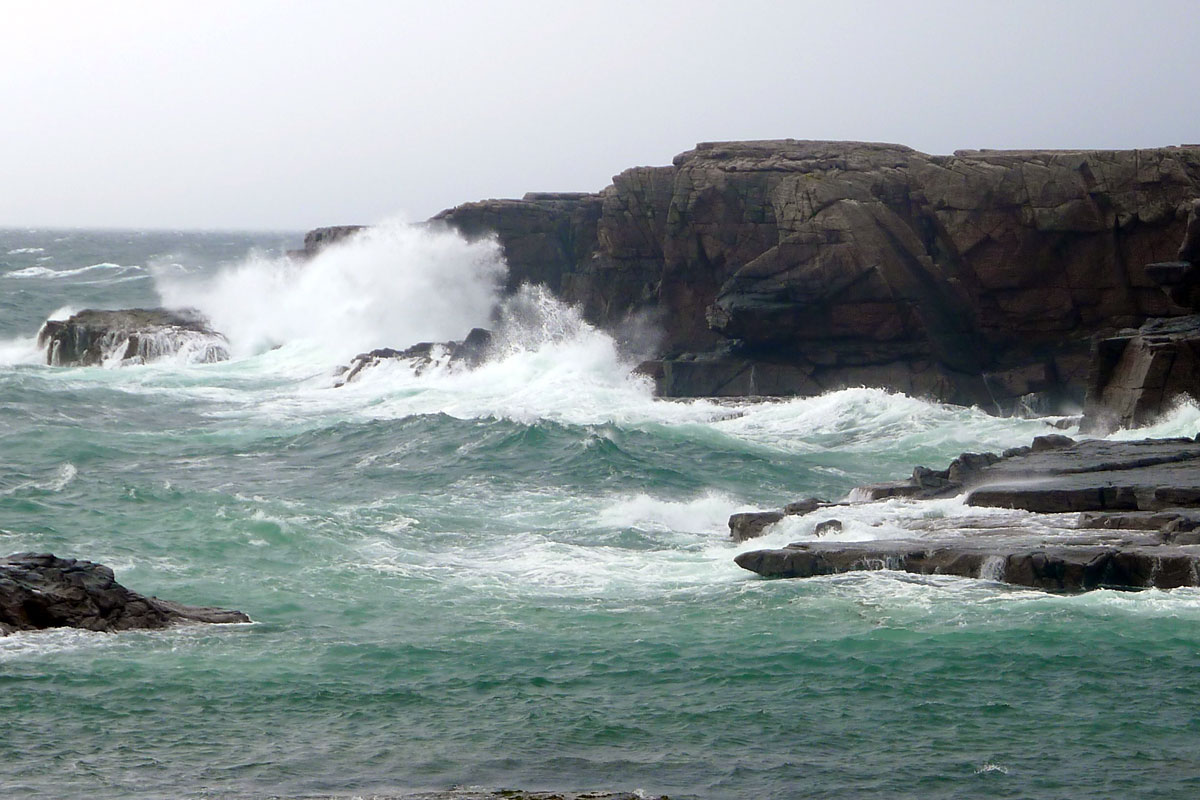
Just south of here are some crags popular with rock climbers and a few were out today. I also knew this was a great place to watch Atlantic storms beating against the same cliffs (left), although today was as calm as an atoll.
The low reefs at Reiff which the SSK guidebook warned about were easy to miss and the sandy seabed off Reiff beach itself (below) maintained the tropical theme.

rubbcoi2

I was hoping to get up the tidal channel that led under the bridge into the Loch of Reiff. The loch holds water once the tide drops and I’ve been on the bridge at a spring tide with the water rushing in to top up the loch, making a fun-looking horizontal version of  a Medway chute. But today I needed at least two more metres of water to get into the loch; a portage looked like too much work.

Just as I was thinking I must come back to shoot the chute in the packraft, one of the R-clips holding the Amigo’s backrest bar in place gave way and fell in the drink. So after lunch I wandered up to a sheep fence and broke off a bit of stray wire to replace the missing pin. That Grabner seat bar is reaching the end of its probation. I suppose the problem is I inadvertently treat it like a fabric IK seat, leaning back to pull out the thigh straps or adjust the seat base. Doing so bends the bar slightly and alloy can only be bent back so many times. Rigid objects attached to an IK (including a skeg) don’t work so well. I’ve a strap-based alternative in the works which will doubtless appear on the Grabner Mods page.

rubcoi16


I trickled on down the unknown shoreline from Reiff to Althandu, nosing into geos crammed with yet more jellyfish, and then headed across to Old Dornie harbour. Other IK-ers and canoes were fanning out from the campsite, enjoying the sunny weekend, but by the time I got into the harbour with 10 miles behind me I was beginning to feel it. Over a forgotten Snickers bar I pondered over heading out to the Summers for a look around.

The breeze had now turned to the southwest, running with the incoming tide although it was still flat enough to roam. I  headed out towards Tanera Beg, but about halfway across admitted that the anticipated sugar rush wasn’t happening. I’d had a great day out, ticked off the feared headland and found some nice places to revisit, so headed for Badentarbet. As I did so I noticed the occasional 10mph gust was pushing the back round; not quite enough to require double ‘correcting’ stroke, but noticeable. Add some swell, waves and more wind and the stern would get pushed offline for sure, but then that’s IKs for you. Not a suitable craft for very windy conditions at sea, although a deeper skeg (old-style Gumotex) and a full payload might minimise this weathercocking.
To make up for my sloth and with a Cadbury’s power surge coming on, I had nothing to lose by hammering away at the last half mile, hoping to crack the 5 mph barrier. But that wasn’t happening either; 4.9 was the best I could wrench from my strangled paddles. Today’s tally: 13.1 miles in about 5 hours and a moving average of 3.2 mph. On the beach I hauled the Grabner over to the freshwater pool for a rinse and called in the taxi.

Kayaking Enard Bay

enard04
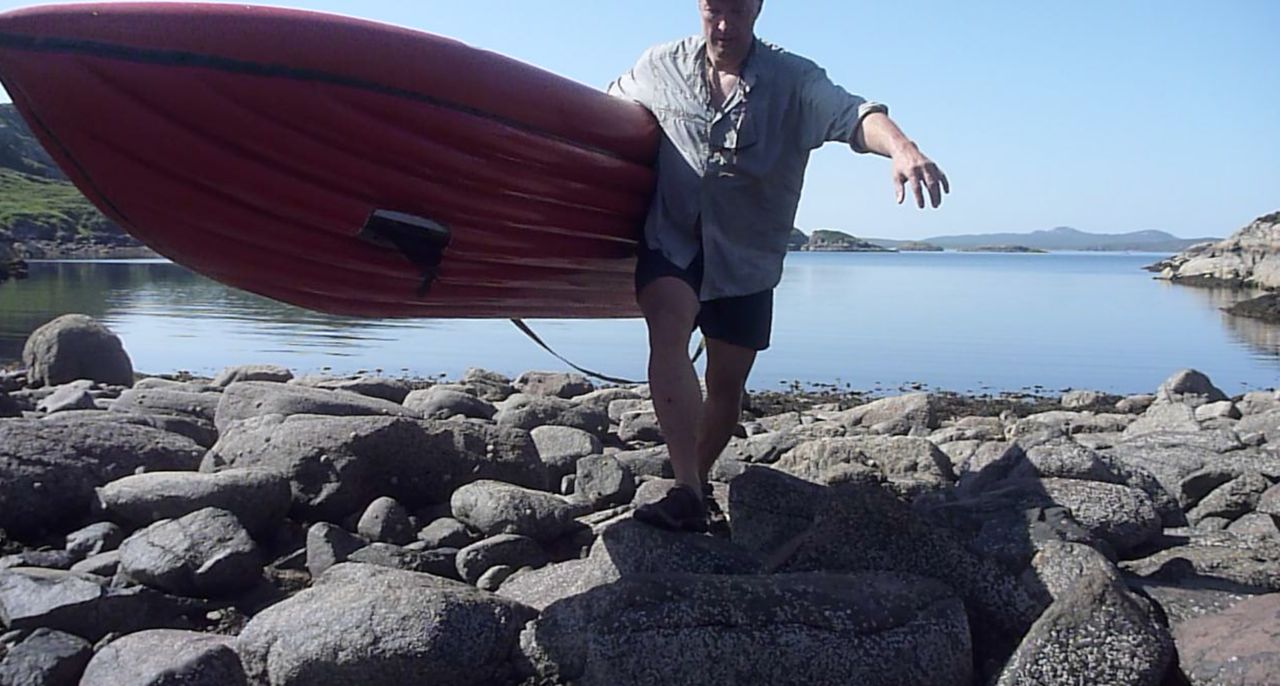
It's not heavy, honest!

The heatwave which we hear has been tormenting the southerners finally crept onto the Coigach last weekend, like an overdue dog looking for its dinner. Warm, sunny and no wind. Hallelui-yay!

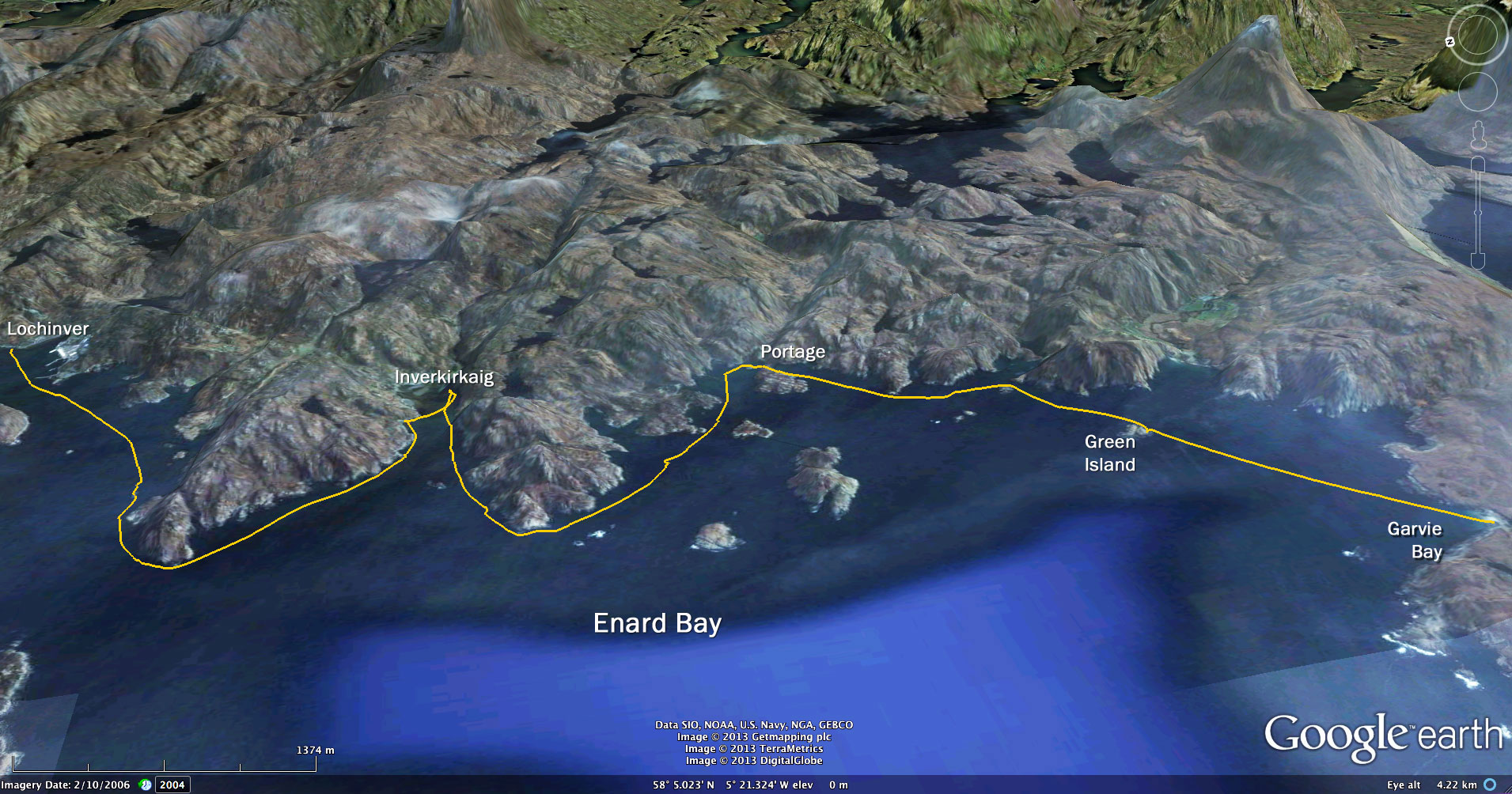
I planned to diligently hug the coast east round to Polly Bay were the Polly river drained Sionasgaig Loch, a fun stage which I packrafted last year. But once I actually got out on the water Green Island looked a doable 2km across mackerel-infested water rippled by an easterly breeze, so I took the direct line with wavelets slapping at my boat.

enard05
en-warm


This was my first long solo run in the Amigo and initially, the usual neuroses bobbed to the surface: ‘must get a paddle leash’; ‘what if fish farm toxins have caused mackerel to mutate into piranhas’… and so on. In fact, the biggest problem was the heat. I’d put in already dripping from the walk to the beach and would stay like that for most of the day. They’d forecast a pleasant 21 but I’d guess it got well over 25.

enard06

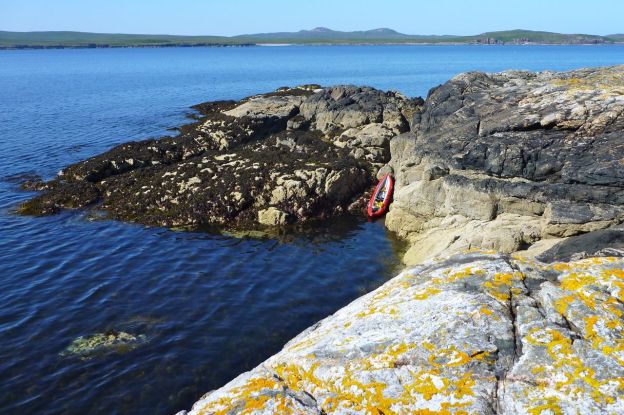
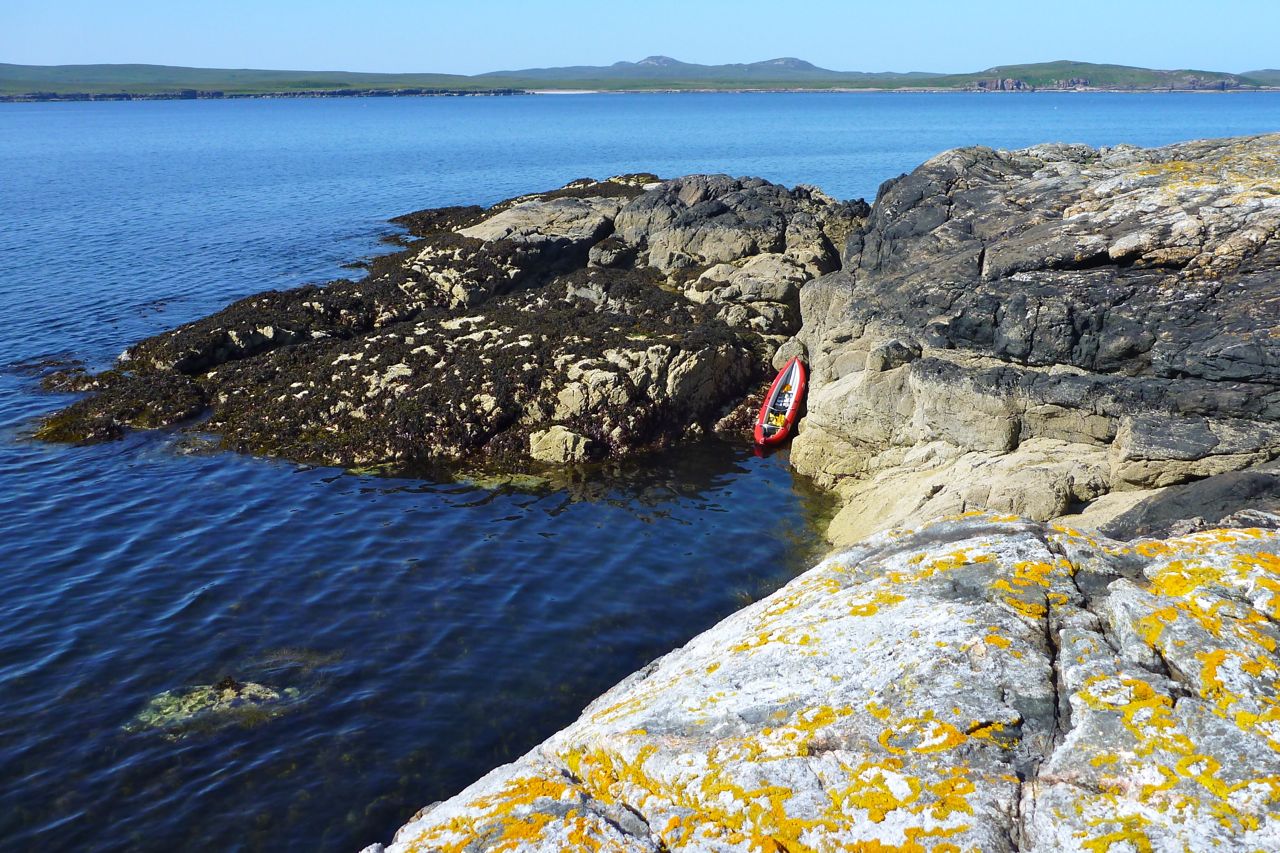
By the time I pulled alongside Green Island I’d calmed down enough to spare time for a quick look around. Finding a place to get out elegantly without slithering across a web of slimy boulder-covered seaweed was tricky, so I jammed the Amigo up a barnacle-covered slot and stumbled ashore.

coisuili
enard07

These tiny, uninhabited and unsheeped islands preserve a unique ecology, or at least a distinct botany that makes them look different to the mainland. I climbed over the sooty lichen rocks into the sweeping grass and wildflowers, causing an avian scramble, and a few minutes later planted a footprint on the 20-metre summit. I looked all around and as before, imagine Newfoundland was like this, a wild, windswept panorama under a pale northern sky with a surrounding coastline ground down by long-extinct ice caps. To the east was a sandy beach at Polly Bay – one for next time – with Suilven rising behind. In the other direction was Rubha Coigach which I was also eyeing up as a paddle during this calm spell. Heading back to the boat (‘what if it’s drifted off…?’) I came across a lone pink Croc flung into the grass during an especially violent winter storm.

I headed for the mainland, squeezing between an islet to what looked like a dormant fish farm above Rubha Phollaidgh (‘Dun’ on the map). We’d cycled to this point a couple of weeks ago, following the private road past Inverpolly Lodge which controls the freshwater loch fishing around here. Pushbiking seemed safely innocuous, but you’re never quite sure if some irate ghillie in a tartan strop will come after you. I’ve read of kayakers getting aggro for trying to put in at that bay.

ennardspd

As I left the bay something felt wrong, had I caught some weed in the skeg, was the boat going flat or a current suddenly against me? There was no sensation of speed as I clawed at the water although I was moving. I checked the GPS – 4mph, good enough. It seems the 4mph breeze was now directly behind me and I was paddling in a bubble of perfectly still air – never noticed that before. I became uncomfortably hot and soon began pouring with sweat; the insulating pfd didn’t help. On a day like today adapting the pfd to hold a 2-litre bladder loaded with Nuun tablets was a good idea, but it reminded me how much more satisfying it always felt paddling into a wind, even if you weren’t going so fast.

enard11


The single-track WMR comes right down to the sea at a bay known as Loch an Eisg Brachaigh. When driving or cycling by I’d long wanted an excuse to splash a paddle around here; it looked like a magical sheltered place. From the south the map showed a short cut into the bay over an isthmus linking the tidal isle of Rubha Bhrocaire. Had I arrived at high water I might just have scraped over with a few inches to spare. As it was, my timing was right off, but a wee portage (right) is always good for the legs and the bladder.

enard13

I plopped around the bay’s islets, scaring a seal that may have been a glistening mermaid just moments earlier. I seemed to be making better time than expected, too. Closer to the shore I was in the lee of the breeze and gliding over a flat calm. But it sure was hot and my eyes were permanently stinging with sweat which I presumed a sea wash would do little to alleviate.
North of here the rocky, cove-riddled shore lead round to another deep inlet; the hamlet of Inverkirkaig on the WMR. A short, steep river ends here, running off Fionn Loch below Suilven and another great packrafting excursion, although the river itself seems usually too boney to packraft for more than a short distance.

enard16

Less than two-and-a-half hours from Garvie, I paddled in at low water where I found it was too much of an ankle-twisting bother to get to the distant shore and a bench. All around was manky seaweed so I satisfied myself with a desalinating rinse in the estuary and headed back out for lunch on a sandy beach on the north side.
Refuelled, I decided sod this pfd, I’m as likely to drown in my own sweat and the RNLI would be stretched to the limit on a day like today. So I stripped off and cooled right down. At the rate I was going I was looking good to meet the Mrs passing through Lochinver at 3pm and turned Kirkaig Point for the final 2.5 miles into Lochinver seafront.

enard18

On the way in I got a striking view of Quinaig mountain (on the left) which rises over 800m like the rim of a crater behind Lochinver town. (A couple of days later we walked the three summits of Quinaig – definitely one of the best of the Assynt mountains.) And south of that was the reliable dome of Suilven behind Strathan hamlet, also a great climb as is well known.
Past the harbour and marina and the baronial Victorian edifice of the Culag Hotel which had the misfortune to have an ugly fish factory built right in front of it. There are more nice old pics of Lochinver here.

Culag Hotel and Pier_ Lochinver

So there we have it. Calm conditions or perhaps a pessimistic estimate meant I got to Lochinver at 2.10, just 4.5 hours from put in. The GPS logged 3.5 paddling hours and a 3.1 mph moving average over 11 miles. Peak speed was an unnoticed 4.6 coming in with the tide into Lochinver. In fact that compares well with the only other long run I’ve done here: Ullapool run, though that was into the wind at times and clocked up 15 miles.

Conditions this time couldn’t have been easier; it’s so often windy up here compared to just 60 miles down the coast in the vicinity of Skye. I felt like I could have paddled any open crossing that day and so Enard Bay proved a bit of an anticlimax. The Amigo didn’t feel especially slow or tiring to paddle just because it’s not a K40, and so now I have a better idea of what the Grabner can manage in a day.

enardmap

IK&P ~ Picture of the Week

burano
bur1
bur2

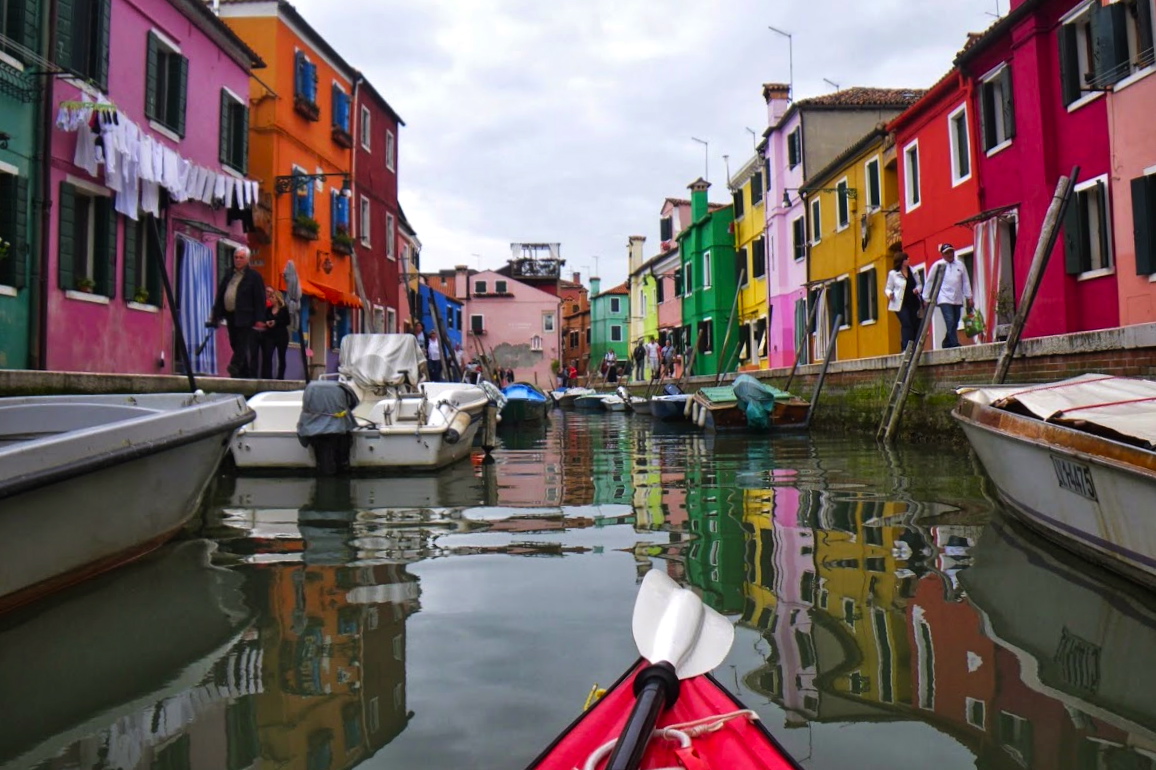
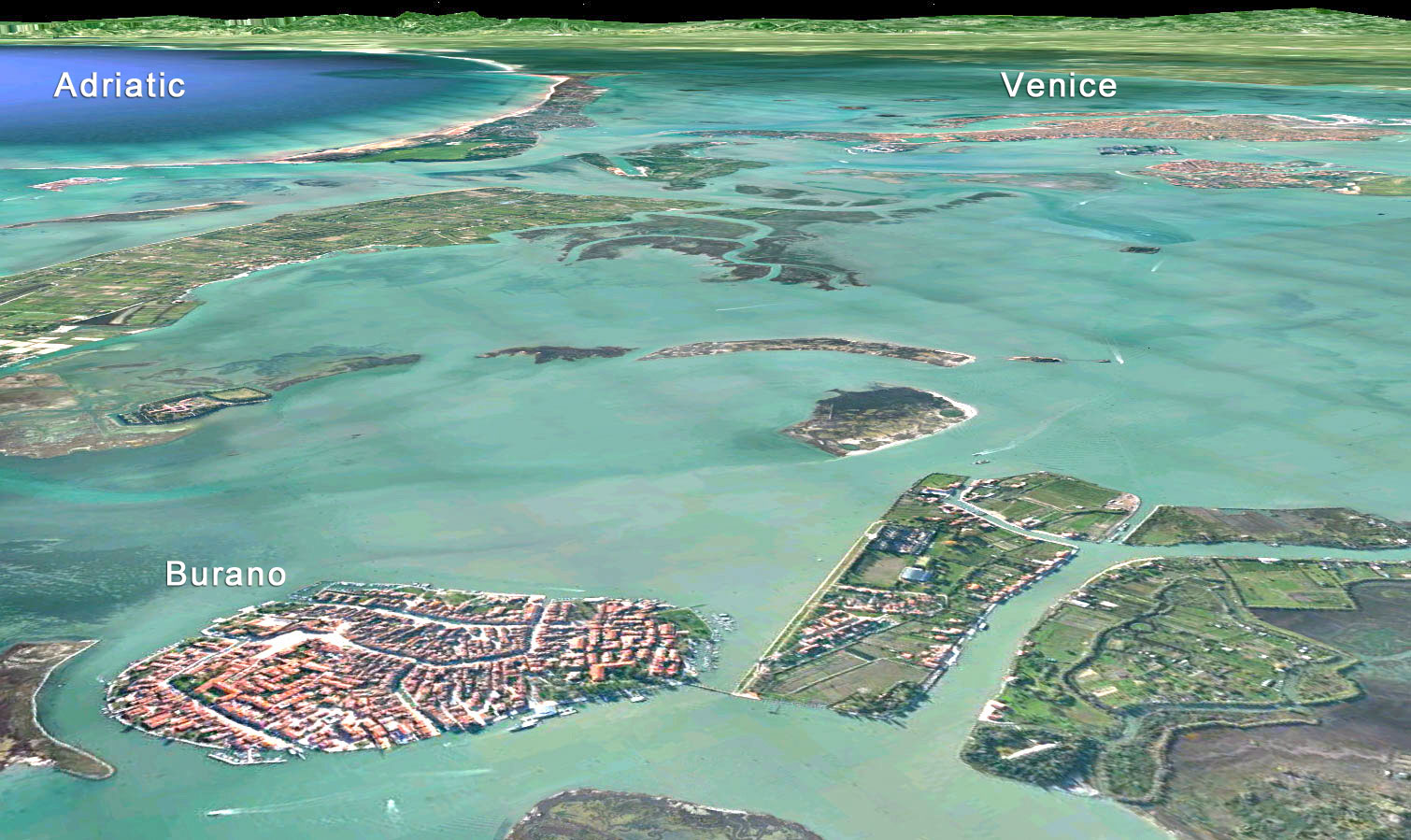
Paddling a Grabner H2 through Burano, a Venice-like collection of islands and canals (right) about 8km northeast of Venice itself.

Wiki says: Burano is also known for its small, brightly painted houses… The colours … follow a specific system originating from the golden age of its development; if someone wishes to paint their home, [they] must send a request to the government, who will respond by making notice of the certain colours permitted for that lot.

Picture by Gael A.

Grabner Amigo: sea trials and speed test

Amigo main page

keven

A couple of years ago I did a speed test on my then-new Incept K40 over three and a bit miles from Old Dornie to Badentarbet beach via Tanera Mor island.

gocompo

I recall setting out flat-out on a cool, calm evening, cruising hard close to 5mph at times, with a burst after a rest up to 5.2, after which my energy levels tailed right off because I was well and truly pooped. I recently decided to replicate that route in similarly calm conditions and see how my new Grabner compared.

Prior to that we were out yesterday in windier and choppier conditions when, with a 10-15mph back wind I averaged about 4mph with a burst up to 5.3. Coming back into the wind we decided to try the Amigo two-up, as it only requires the front backrest moving forward. Towing the Solar together we managed a steady and sustainable 3mph with a burst of 3.8 into the stiff breeze. And on a quick spell downwind we got up to 4.8mph. It’ll be interesting to see what we can manage two-up when not towing a kayak

grabspod


Though twice the weight of the g’f, I sat in the front and got pretty wet from the chop, but up here found the Amigo’s narrowed beam and lack of annoying finger-snagging seat lugs made paddling easier, even without a footrest to brace off. We seemed to clash paddles less than the last time we did two-up in the Sunny on the Vezere in France. Perhaps there’s more space between the seats in the Amigo even though it’s overall 10cm shorter than a Sunny.

410cc


As it happens once back on the beach, a French couple in a motorhome were drying off their Gumotex Solar 410C. They’d also been put off from exploring the Summer Isles by the offshore wind. They set out this morning and I see that the two seats do look quite close (ropey photo at max zoom on the right). I mention this because, as a reminder, I rate my discontinued Grabner Amigo as very similar to Gumo’s Solar 410C (see table below). Main difference is more pressure in my Amigo make it a stiffer and probably faster boat – but at twice the price of the Solar while you can still buy it. Back to the speed comparison test. Today was a calm day with a light wind from the southwest and when I set off the tide just beginning to ebb.

I’m getting accustomed to the thigh straps and the homemade footrest is great. Pulling inwards with the knees to brace off the straps and so transmit more power in the stroke isn’t something I could do for too long, I decided. I think the straps are more useful for last-ditch bracing against tipping in rough seas or rapids. But even then, allied with the footrest they do help connect you as well as you can be in an open-decked IK.
Yesterday I’d found the backrest made my back hurt, perhaps because I have those footrests to push off. I’m still not convinced by this rigid backrest arrangement anyway. The cut-down packraft seat is fine (while it lasts) but that bar keeps disengaging from the rubber lugs (since fixed) and I think I’ve already bent it just be leaning too hard while moving about. It won’t be too hard to either get a thicker-gauge backrest bar made or dispense with it altogether and fit something like an Incept blow-up seat using the current lugs (although I see from what I thought here that maybe that’s not the answer). And as mentioned, those forward lugs painfully snag my fingers every once in a while.

g-sped

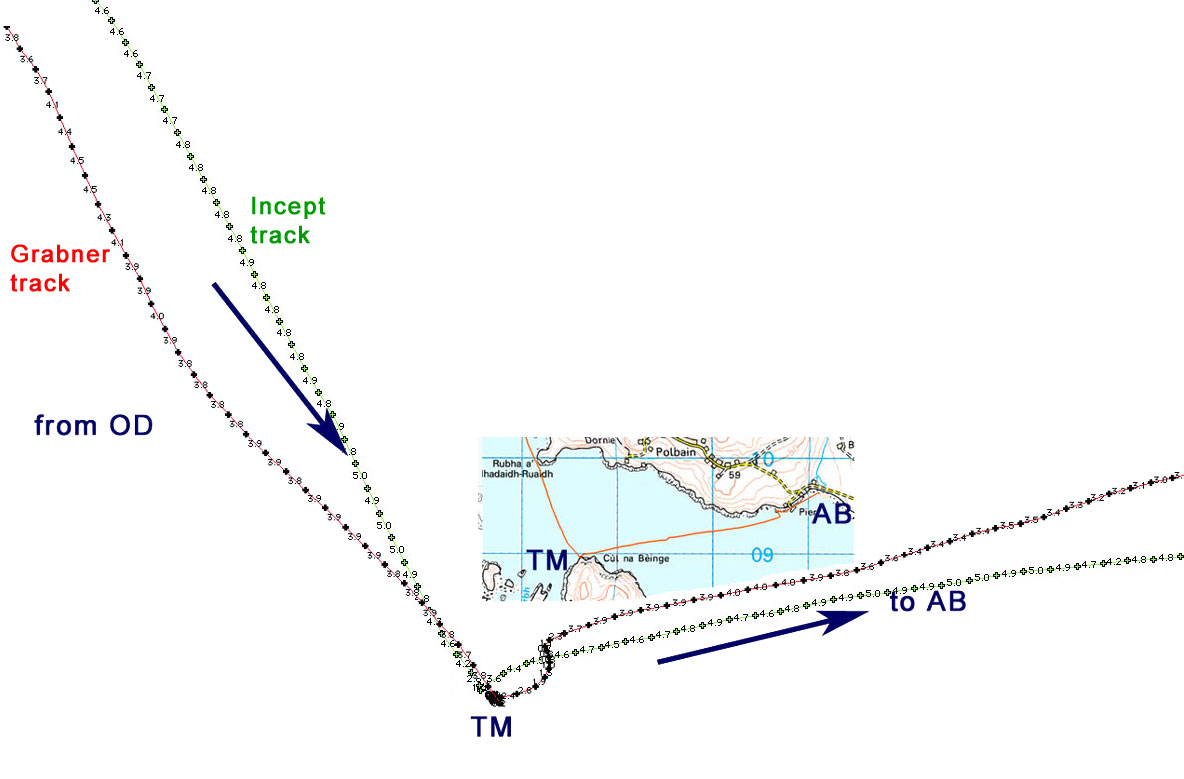
Anyway, with barely a break I belted across to Tanera as fast as I could, leaning on a bit of karrimat taped to the seat back which did the trick. I averaged just under 4mph where the Incept had managed about 4.6. That’s also the top speed I clocked in a flat-out burst in the Grabner just before reaching the island, although on both occasions this sort of effort was not sustainable.

On the second leg back to the beach I had a light wind behind me but as I neared the pier I thought I could feel the pull of the outgoing tide. Unlike in the Incept, my energy and speed didn’t drop off much as I approached the beach and I got across at what felt like an all-day sustainable 3.8, with some spells recorded at up to 4.5mph without trying.

grabincesped

What the heck does it all mean? Well, it’s the not-so-startling revelation that the slimmer and two-foot longer Incept K40 was indeed a faster IK than the Grabner (two tracks overlaid on the left). Overall the Grabner is around 20% slower than the Incept.

grabpusch

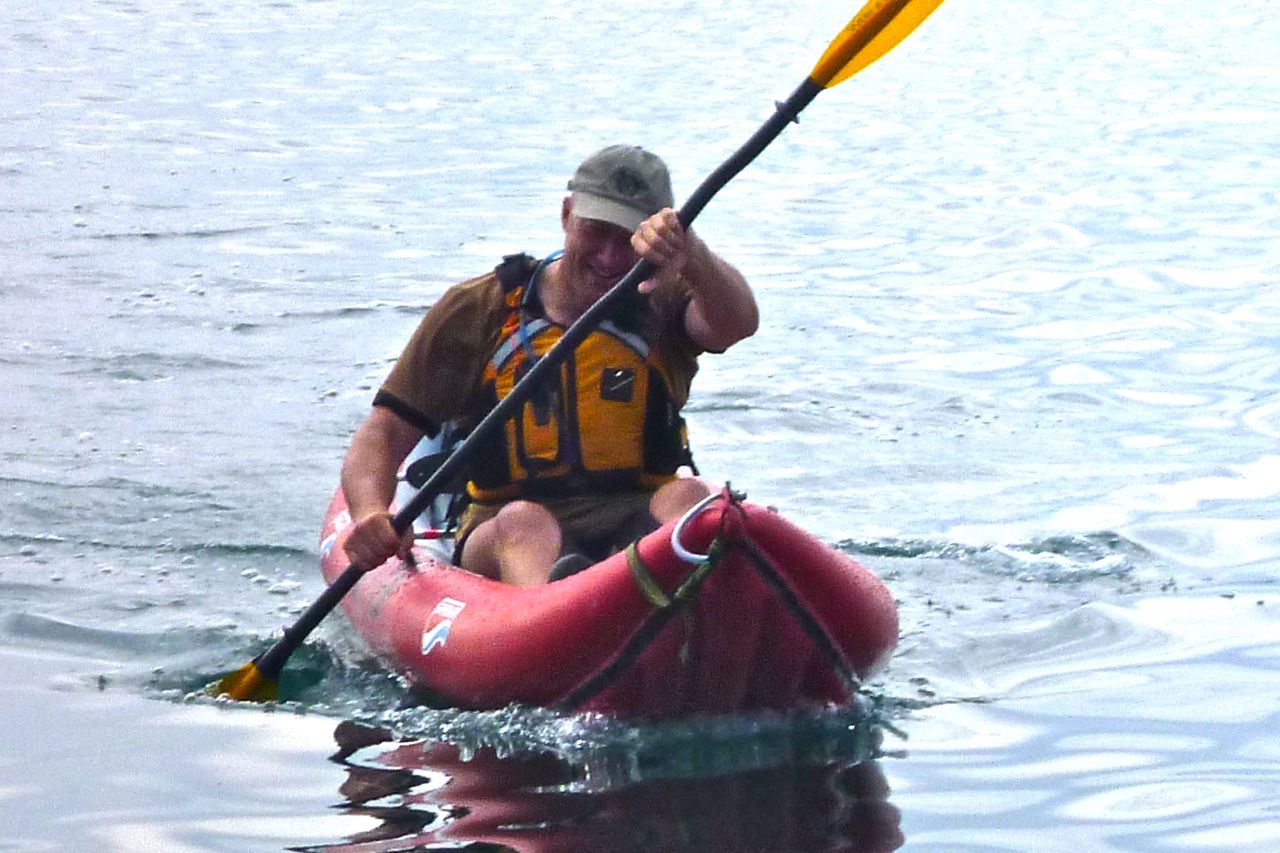
At times at sea or on near-still rivers I do feel like I’m pushing the wide-nosed Grabner like a packraft. That’s another benefit of twin-side tubes, I now realise: a sharper bow is formed, as found on Grabner’s Holiday models too. On the right you can see that’s more plough than bow and must add up to a more effort over a long day, limiting compatibility with hard-shells for full-day runs like this.

grabwake


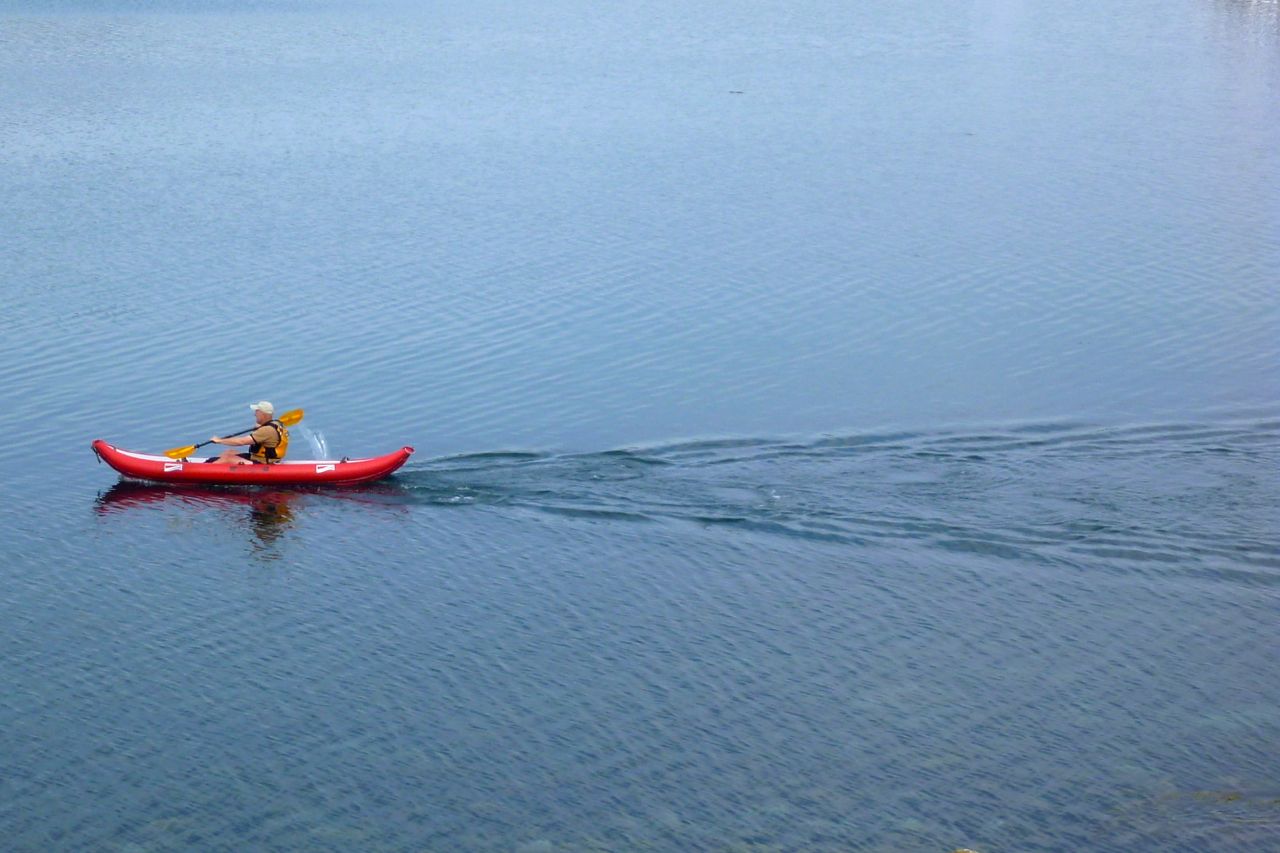
And look at that wake I recall forming a similar conjecture (picture) about how the Sunny ruffled the water when compared to a hardshell’s sculpted bow. Or indeed look again at the Incept’s moderate wake at the top of the page. But then this is all for flatwater operations. In a swift river like those of the <a class="wp-gallery mceItem" style="color: #000000;" title="Kayaking and packrafting in southern France Massif I’m sure the shorter Amigo will be easier to handle than a K40 and so the compromise stands. It’s just that up here the best paddling is in the sea. Surprisingly I don’t miss the Incept’s rudder, having spent years in skeg-only IKs before getting the Incept.

grabspud

K-Pump Mini review

Inflatable Kayak pumps

beg02

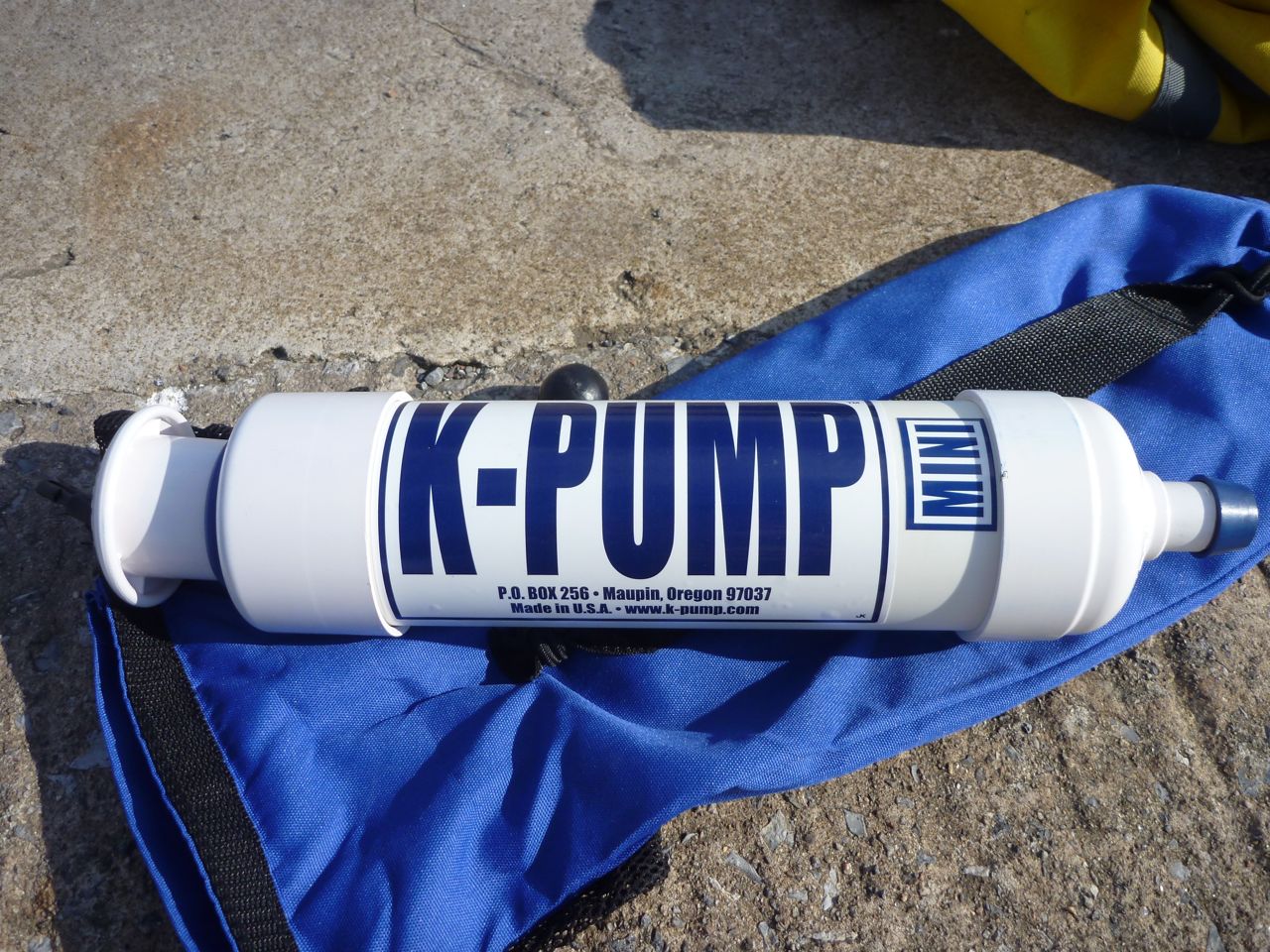
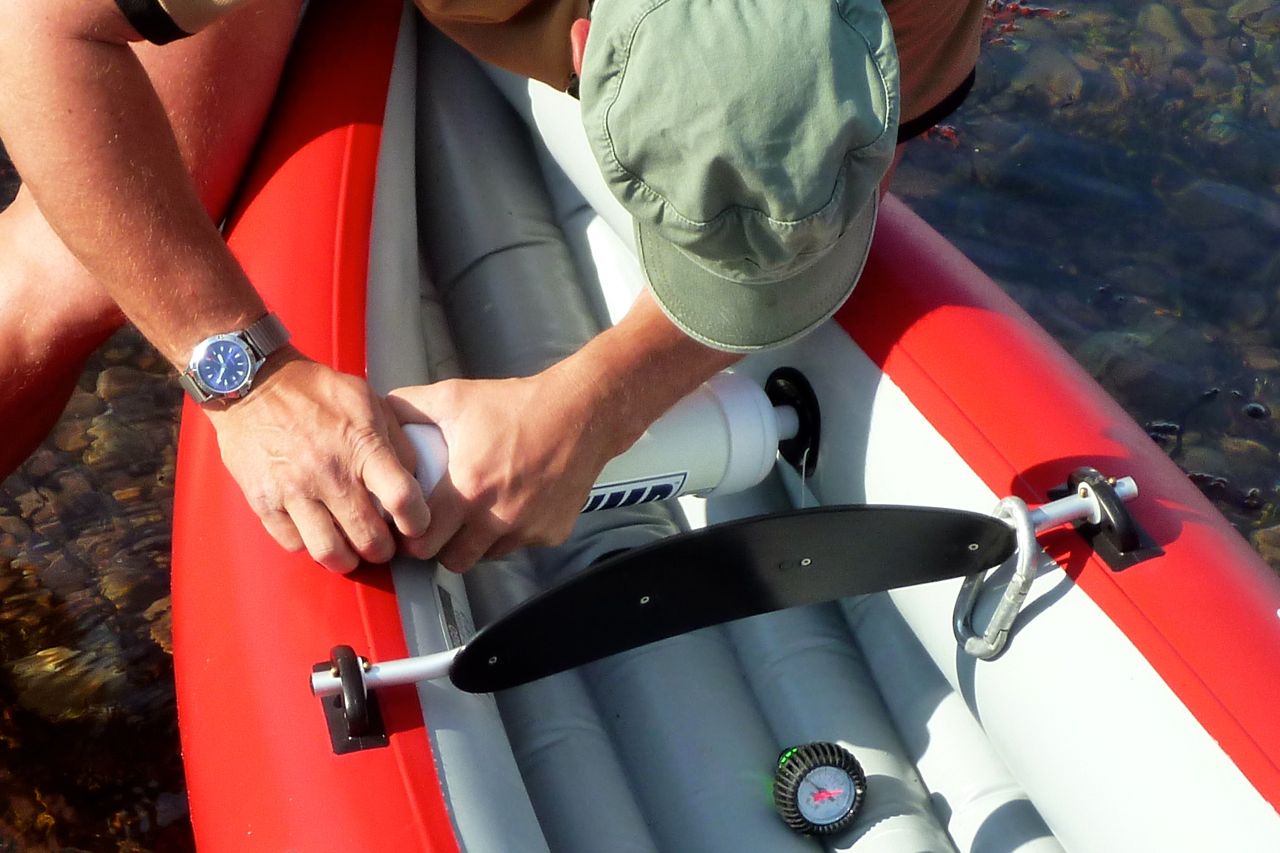
Guess what! I got my Mini K-Pump the other day (left, 600g in the bag; ~$73) and gave it a go, topping up the Amigo at Old Dornie. The fat, 15-inch pump easily banged in the required psi into the floor, but getting to the side chamber valves wasn’t so easy (below). That required the angled nozzle supplied in the kit. Before I got a chance to fit that, the plunger or piston inside the housing got knocked off the shaft. Without a crosshead screwdriver I couldn’t fix that, but luckily I had the barrel pump at hand, so we achieved operational pressures in the end.

beg15

A quick reply from K-Pump apologised for the lack of adequate gluing on the plunger. With all the grease around the seal and the plunger / piston, I decided it was less work to fix the plunger to the shaft (right) with a couple of self tappers, rather than glue. Don’t know what I’m on about? Never mind ;-)

beg01

sw05

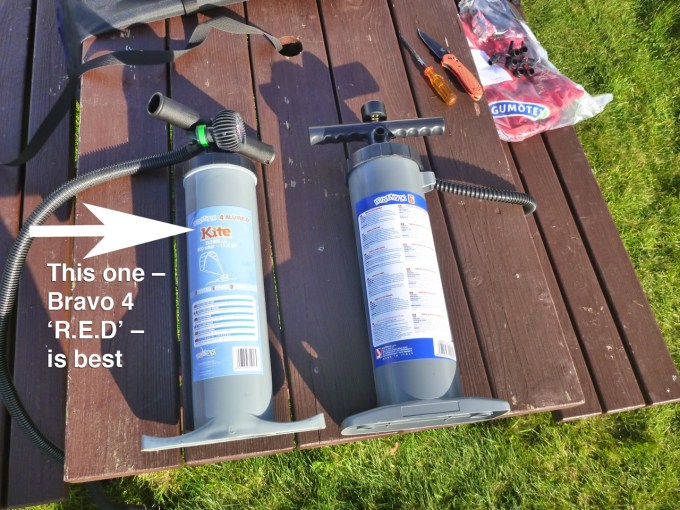
My very cheap Bravo two-way  R.E.D ‘kite pump (left) is much faster at effortlessly inflating a rolled up IK out of the bag, but is of course too bulky to take on a plane. With the angle nozzle (right), the K-Pump Mini is a much handier and more compact top-up pump: I estimate it takes less than ten pumps to top up a chamber; about twice as many as the bulky Bravo kite pump. And I’ve since found it can inflate my Gumotex Seawave from flat in about 15 minutes (picture below, in Venice).
Years later, it’s still my back-up or top up pump, especially handy on my Seawave which had PRVs all round and so would purge, and also to get bigger packrafts like the Nomad S1 over lung pressure to make them good and taught.

It’s hard to buy a K-Pump in the UK and I’m not sure there is anything similar. A Decathlon 1.4L D/A barrel is not that much bigger, easy to buy and just 15 quid.

Pankanel in Greece has this to say: 
I would also like to comment on the K-Pump Mini. I was looking for something compact and bought it from an online shop in Poland. When I first saw it, I was disappointed. It looked small for the job. Like a very fat version of my bike pump. But when I used it I was astonished. Side by side, it inflates the boat as fast as my high-pressure Bravo foot pump or an electric Bravo foot pump. Using an extension I made using a little garden hose, some duct tape, and three of the included adaptors (vinyl tubing, Boston adaptor, universal adaptor), I can now inflate the boat very fast, standing up, or even in the water. It is the best pump I have ever seen. I Imagine the bigger models will do miracles.

voga-03

Grabner Amigo kayak modifications

Amigo main page

amigomods

ami-data

Unlike my previous new IKs, out of the bag you don’t get much with a Grabner Amigo. In fact you don’t even get a bag. With Grabner IKs just about everything except the repair kit and air you pump in is an extra which undermines the otherwise striking 14kg weight. To make up for this dearth of equipment, in the catalogue they even list the specification label (right) as among the boat’s standard features!
So my Amigo added up to the bare boat with carry loops at each end and two backrest bars. No seat, skeg, pump, lashing points (D-rings). On purchase, I ordered half a dozen D-rings and a pressure gauge. The rest I’ll work out myself. Having learned what’s needed over the years, that suits me fine.

View Post

Manometer

grabguage

With the high pressures an Amigo runs it’s great to finally have a pressure gauge that’s easy to use (left). There are no pressure release valves (PRVs) to stop an Amigo splitting a seam if left out in the hot sun, so it’ll be a quick way of keeping tabs on the boat’s pressure or ascertain it’s at full charge. I’ve added a marker in pink to easily line up with the Grabner’s rating of 0.3 bar (4.3 psi) – not 4.3 bar as I mistakenly did once (the old eyes are going…).

Fitting a tracking fin

gumonewskeg

Before the Amigo even got wet I glued on a Gumotex skeg patch (left, £12) and thick plastic Gumo skeg (another £12). All up cheaper and stronger than Grabner’s similar slip-on €60 alloy version. I took a chance using MEK to wipe and one-part Aquasure to glue the Nitrilon patch to the Grabner EPDM hull as I didn’t have proper two-part adhesive to hand. I figured it would work OK as a skeg isn’t under great strain like thigh- or footrest D-rings, for example. Years later, no problems. Apply a thin film of Aquasure to both surfaces; wait half an hour, then press down with all you’ve got.

A skeg is a pain in the shallows or when dragging a heavy-laden boat over the heather; that’s one thing I liked about the Incept’s hinged rudder, but I can’t think how to make an effective hinged skeg except the way Feathercraft do it on their self-bailing Java (it slips up and down through a slot in the self-bailing floor).

A slip-in skeg can’t be slipped off a fully pumped up boat, at least one like a high-pressure Amigo, though actually after a couple of months it’s less tight and can be done. Being able to do that is very handy for portages or grass-dragging, though the skeg itself looks pretty tough. Of course, an IK works without a skeg, but on coastal waters they’re a good idea. More on that topic here.

Pump

ami-barrel

The Amigo uses more secure bayonet inflation valves which with the right adaptor (see inset below left) don’t pop out at the high pressures (0.3 bar/4.3psi) this boat requires.).
Pump hose-end bayonet adaptors are easily bought in the UK from RIB suppliers on ebay. Inset left, the black one is what Grabner sell with a fitted fibre sealing ring and steps in the bayonet to suit different valve depths. The ‘butterfly’ finger tabs make this easy to twist in place, too. The green one uses plastic spacers held in place behind a black rubber washer to get a good seal. You wouldn’t want to lose these push-on seals and it’s hard to twist in place, so for the moment I’d say the Grabner one is better. Write that down, quick!

A now almost extinct yellow-hosed Bravo foot pump that suits some Gumotex can’t manage Grabner pressures, at least not my aged Bravo which hisses from various leaks before you can get a full charge. I’m amazed it’s lasted as long as it has. I got myself a bulky 2-litre barrel pump (above left, £20) rated at over 11psi. As you can imagine, on a low-volume IK this works fast, not least because it pumps on up and down strokes. Like Bravo foot pumps, it also has a second port to suck out ever last dram of air – handy for compact packing at the end of a tour.

kpumpmini

The Bravo barrel is bulky so I’ve got a K-Pump Mini (right, review here) from i-canoe in Ireland who can import anything from the NRS catalog in the US, and without a huge mark up too (€80 delivered, not sold in the UK). My longer K-Pump 100 worked surprisingly well inflating the Incept; we’ll see how the Mini model performs on the Amigo. If nothing else it will be a handy top-up pump; Grabner cover themselves very comfortably by claiming that anything under a 20% pressure loss over a 24-hour period is not a warranty claim, though I’ve never owned an IK that lost that much air in weeks let alone a day. K-Pumps can’t suck out air like Bravo pumps, but using a loose hose with the bayonet fitting it can be done by lung.

Additional D-rings

ami-dee

Next, I glued on my half-dozen D-rings (left). Front and rear will hold down gear; the other four locate my cut down packraft seat as well as an adjustable footrest tube similar to what I made for the Solar last year. The seat and foot rings will also double up as thigh strap location points.
I’ve not always been that successful at gluing on previous boats, so this time did it by the book: roughen with sandpaper, wipe clean with MEK or alcohol, apply glue to both surfaces thinly and wait half an hour, glue again and wait less, then apply and press down hard with the roller.

ami-poly

Doing this I had a feeling the two-part Polymarine 2990 adhesive (right) was more effective than whatever I used doing the same job on the slipperier PVC-U Incept a year or two ago. I suspect Hypalon/Nitrilon is easier to glue; ‘plastic’ PVC-U is more effectively heat welded.

Thigh straps

ami-th2
ami-log

Over the years I never really got into using the thigh straps on my Incept or Java – perhaps the need for ruddering the Incept made them more tricky to use, or perhaps I’m just an idle paddler. But with the  Amigo, I want to have that option to help it shift. In any case, it’s worth persevering with thigh straps as this is one of the main things that separates IKs from hardshell kayaks in terms of boat control in rough conditions and optimal torso-centered paddling efficiency. Straps are not quite as effective as bracing your knees under the top deck of a hardshell, but they’re all you can do with an IK. Otherwise, you’re just sitting in a canoe or on a floating log. I’ve now got fully used to the straps on the Amigo and use them without thinking, just like I feel much more secure with the toe clips on my bike’s pedals.

Footrest

ami-th3

In my opinion, you need some kind of footrest too, if a braced body is to make an efficient paddle sweep – it’s probably more important than thigh braces. Last year I improved this on the old Gumo Solar that’s occasionally used by the g-friend. The Gumotex footrest cushion (same as my old Sunny) was too far away for the 5-foot Mrs to use effectively and is squidgy at best. On the Amigo I was able to use the front thigh strap D-rings to hook up the 4-inch footrest pipe (above left) with an adjustable strap looped through. It works fine.

Seat

ami-th1

At the other end I’ve separated the toilet-like seat base of my old Alpacka Denali packraft from the backrest section. It clips to the rear thigh strap hardware with mini snaplinks (left). This ultralight seat has already been repaired once by re-heat sealing the flat seam and another hard bounce may pop it again. It’s lasted the summer but if that happens I’ll come up with something better; any inflatable pad or IK seat base will do. The Incept seat was pretty good, so was the firm-backed Feathercraft Java seat which didn’t fold under strain. Right now, at about 50 grams, the cut-down Alpacka seat base is about as light as a kayak seat can be.

The hard plastic Grabner backrest was comfortable enough to lean on once I added a bit of karrimat, though it kept coming adrift from the lug holes when the bar pivoted down, usually when manhandling the boat, but occasionally on the water too. At sea it’s quite awkward to refit the bar into the black rubber lugs as the hull sides push apart. The only way I found was to face backwards in the boat, swing the legs out into the water and squeeze them against the hulls to repeg the seat bar.

To keep the bar in place while retaining a tool-free, quick detach element I hammered out the outer brass peg and replaced it with an R clip (above left). But that didn’t last too long – one clip bent and fell out and, as expected with footrests, the alloy bar was bending against the strain. I tried a blue seat strap instead (right), but hooking that to the rubber seatrest lugs looked like it put too much strain and distort them. Ripping those lugs off would be a pain. No way round it but to glue on another two D-rings as I did on the Solar; a 4.5-inch patch has four or five times the glued surface area of the seatbar lugs so ought to take the strain. D-ring prices seem high so I settled on what I knew – chunky Grabner items at €15 each (right). Grabner deliver fast from Austria.

grabner-D-rings

The seat strap was a crude solution so I figured I may as well try a proper, full-height backrest off an SoT. On ebay the ‘heavy-duty‘ item (left) with long adjustment straps and even a back pocket went for £24 – less than the two D-rings which hold it in place. As far as I can tell the rear straps’ only purpose is to hold the backrest upright, but it’s proved very comfortable – like a proper seat and with no inflation required. I’ll keep the original seat bar for less frequent two-up paddling where I don’t have a footrest to put a strain on it.
So after a couple of months use I have optimised my Amigo by completing the adaptions listed here, making a comfortable and more practical boat for coast hopping and river touring. The cost has been six D-rings £80; seat £24, glue £15, seat base and straps already had; Gumo skeg and patch £24, and two pumps, gauge and adapters £110.

sai14

Grabner Amigo and Medway Canoe Chutes

River status

A sunny day in the south of England saw me back on the water with the Big Kahuna Man  after many months off. It was a chance to anoint my new Grabner Amigo’s slick, factory-oiled hull with the Medway’s occluded discharge. If you’re interested, there’s more on why I got myself an Amigo right here.

mapmap

amiassem

BK Man and I started out of Tonbridge with a plan to replicate our icy winter run of last year when at times we had to crack our way down the river. Assembling the Amigo for the first time was of course simple once I had the bayonet adaptor fitted to the end of my aged Bravo foot pump, but that pump could barely manage to get the requisite 0.3 bar (4.3psi) the Amigo runs. More about all that malarkey on the mods page.

amitownchute

We slipped down the rather tame Tonbridge Town Lock chute (right) where it soon became obvious the Amigo was not going to break any speed records. This may be a false impression as there was a stiff head-breeze, negligible current and my lack of paddling fitness and of course the Amigo’s 3.75m and 80cm width – over half a metre shorter and 11cm or 4.3 inches wider than my old Incept. All that made for hard yakka while the slick Kahuna glided effortlessly by.

amishooter
amiportrait

On a positive note the Medway hereabouts now appears to be fully chuted up for canoes – we could have got all the way to Yalding without getting out. As mentioned, some chutes are rather dull affairs where fixed bristles churn up the water and slow a boat down. Others, as we knew well, were steeper and more sporty numbers that you attack at full pelt (left). We like those!

amiportchute

The recently fitted Gumotex skeg tracked flawlessly but still kept the curly ended Amigo turnable. It will be good to try paddling without it; not such a good idea at sea but always handy in shallow rivers where the current should provide the speed you otherwise gain from being able to paddle harder with a skeg.

amidasbo

In between the fun chutes, the simpering Medway crept by. BK Man combed the water as gently as if he was brushing Kate Middleton’s perfumed hair, while I hacked away like the Barber of Seville with my too-large Corryvreckan paddle; very light and stiff it may be but it’s not the blade of choice when unfit. Also, the boat’s secondary seat lugs tended to catch my thumbs, the spare packraft seat was a bit sloppy on the factory oil and I was in dire need of a footrest: all things to refine or fit once relocated up north.
Later I just rested on the seat back with no air padding from the Alpacka seat and that was fine and enabled a good back posture, though I do worry about snapping that seat bar in a hard hit or clumsy moment. It did dislodge a couple of times as the boat flexed down steeper chutes. I suppose a stick or even just a strap will make do as a replacement.

amiamio

You can see from the pic on the right that even with my weight and only .25 bar in the side tubes, the Amigo is as straight as a boiled hardshell and unlike the Sunny of old. In future I’ll pump it up to 0.33 or so to compensate for the cooling once it gets in the water.

amisloocer

amisluicer

By the time we got to the sporty Sluice Weir Chute (lef and right) I was knackered, sore and starving, a torment made worse by the gusting breeze and the succulent aroma of wild garlic emanating from the lush, green river banks. Southern England in early summer really is a great place to be an insect.

amikinder

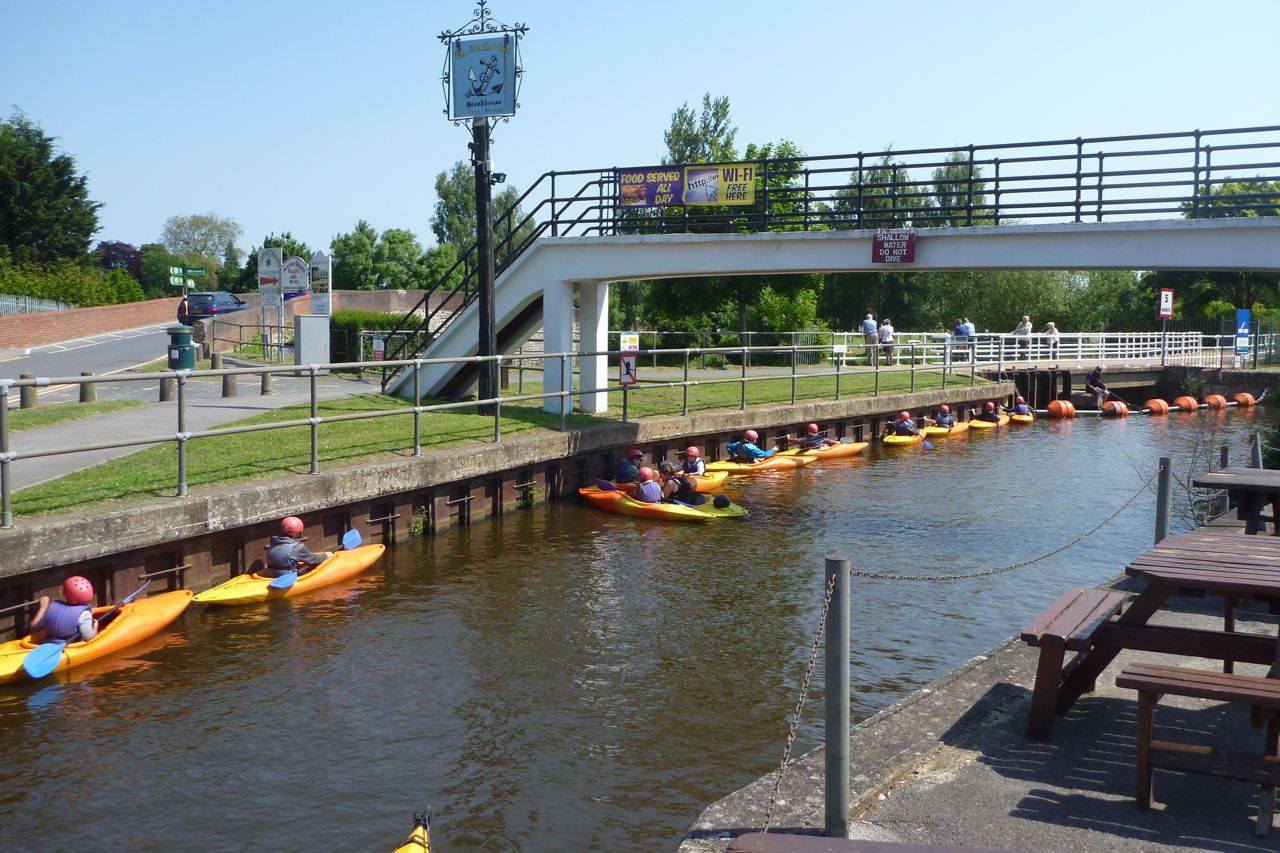
We had high hopes of snaring a good feed at Ye Olde Anchor Inn at Yalding, but it was so poor it wasn’t even worth a picture. I ate as well in primary school back in 1968. What a waste of a great location; someone keel-haul the chef! Next time we’ll revert to the tea room on the other bank. As we approached the Inn we were puzzled by a string of schoolkids in mini kayaks lining up to slip down the flat Yalding weir face. Like some neoprene Pied Piper, their teacher or guide was actually pushing away the orange safety booms so the little mites could slip through and potentially plummet to their deaths. I suppose the river police must allow it. At the low levels we knew  the flat slide down the weir face was not so suited to our long boats – the Kahuna’s nose would dig in to the concrete at the base and spin the back around while I’d scrape my skeg all the way down to the sound of melting plastic. Btw, check out this vid of what happens at Yalding when they open the taps. Scary!

amidrier


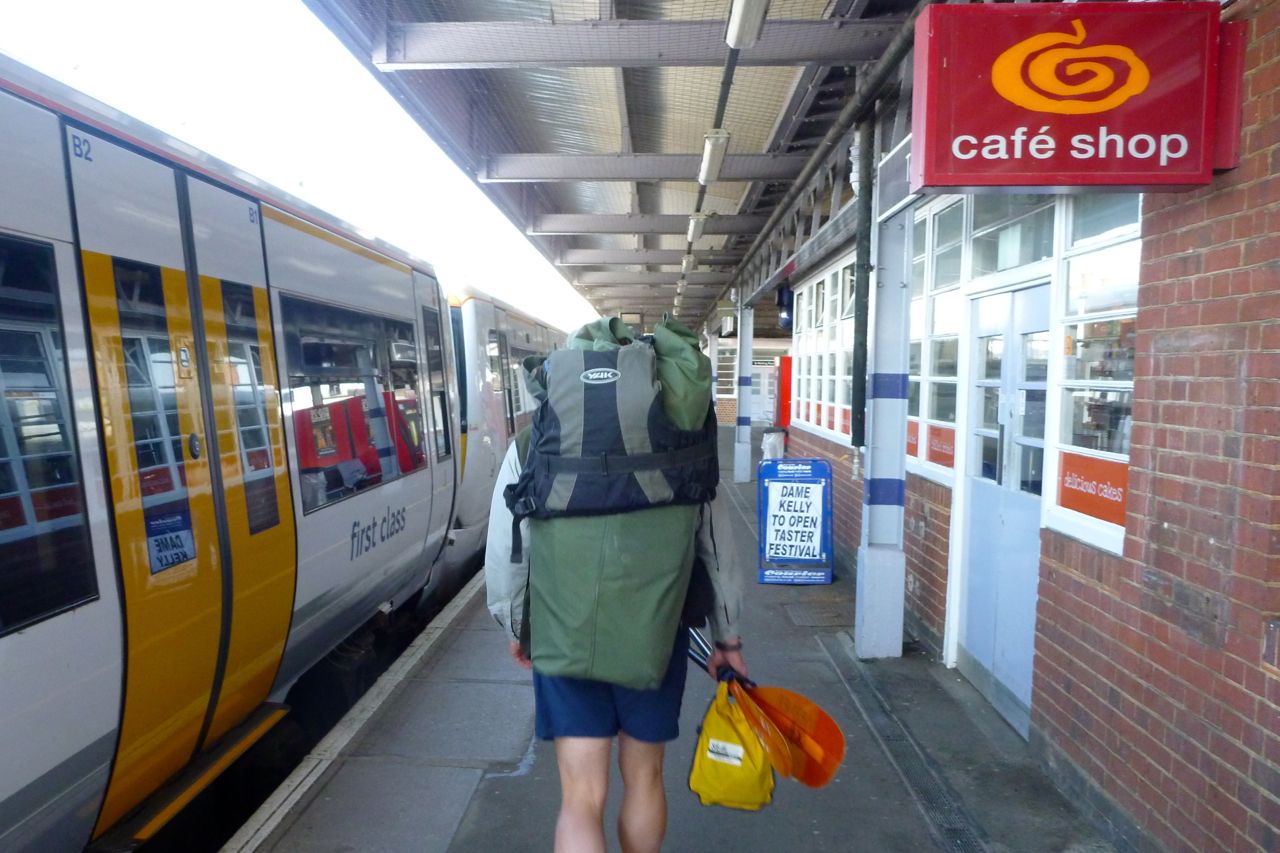
Gastronomically unsatisfied, we lowered ourselves back into our boats for the short hop to Hampstead Lock (no chute). Here, in the full spirit of The Pack Boating Way, we dismantled our boats, walked 5 minutes the station and caught the train back to Tonbridge. I can confide that like a Sunny, an Amigo is so easy to dry, just splay it out (right) like a Peruvian hamster entree, give it a wipe, roll it up and off you go.

amidame

One thing I can to say about the Grabner – you do appear to get what you pay for. Construction appears to be flawless – far superior to the Incept, better than Gumoes I’ve had and with not a smudge of stray glue or ill-adhered creases, gaps or lumps. Once the set up is optimised it’s an IK that ought to last many, many years. More Amigo action to come up in the Summer Isles in the next couple of months

Gumotex Seawave kayak preview – 0.25 bar

Seawave main page (less speculation; more up to date user-info)

seawaves

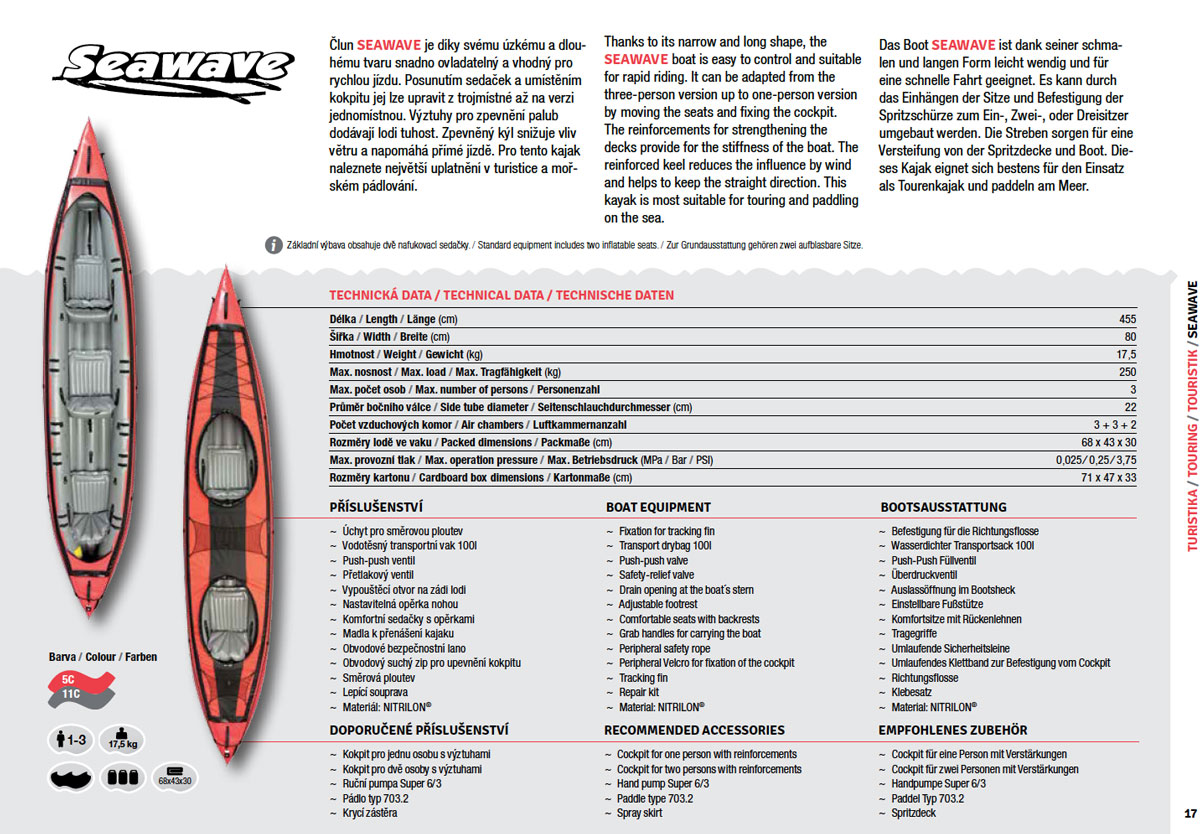
The Seawave was released in 2013 and in 2016 a near-identical model came out with a rudder option. The Seawave can be used as a single, double or triple, and is sold in Euroland for around €1625 or £1425 in the UK. They used to be a bargain. Not any more.
In 2023 the Seashine version came out – a Seawave with a drop stitch floor (like the Thaya and Rush); slightly heavier, wider and longer and a lot more expensive.

My stats for my Seawave are 4.5m x 78cm wide and 17kg plus a claimed payload of 250kg which sounds plausible. Significantly, the Seawave’s pressure is rated at 0.25 bar (3.6psi) all round, midway between the Gumotex IK norm of 0.2 and Grabner’s 0.3 bar. Some of Gumotex’s orange series whitewater boats run 0.25 and their IKs were never that shoddy. Having said that, the PRV in the floor of the Seawave has the same ordinary rating you’ll find in a Twist or a Palava or probably any other Gumotex IK (more here) but the adjacent sticker claims 0.25 bar max. It’s the side tubes that now take 0.25 bar, not 0.2. What they now call Nitrilon is not like the stiff old hypalon-like Nitrilon of my early Gumboats. Increasing hull pressure is one way of getting a more rigid and therefore faster IK, but it’s the integrity of the ‘I-beam’ floor that’s the usual limitation. The Seawave has a pressure-release valve in the floor but not on the side tubes, and I read these pressures are said to be on the conservative side. You can’t over-inflate the floor but these Gumboats can handle more in the side tubes providing you watch it when out of the water in the heat.

seawavecat

The Seawave is long for an IK, but with just a skeg (optional, but there’s a  rudder now), you wonder if this could be hard work to turn into the wind. However, in France kayaks destined for sea use (beyond a certain distance from the shore) must be homologated or approved in some way, and the Seawave has passed this test.

gumtip

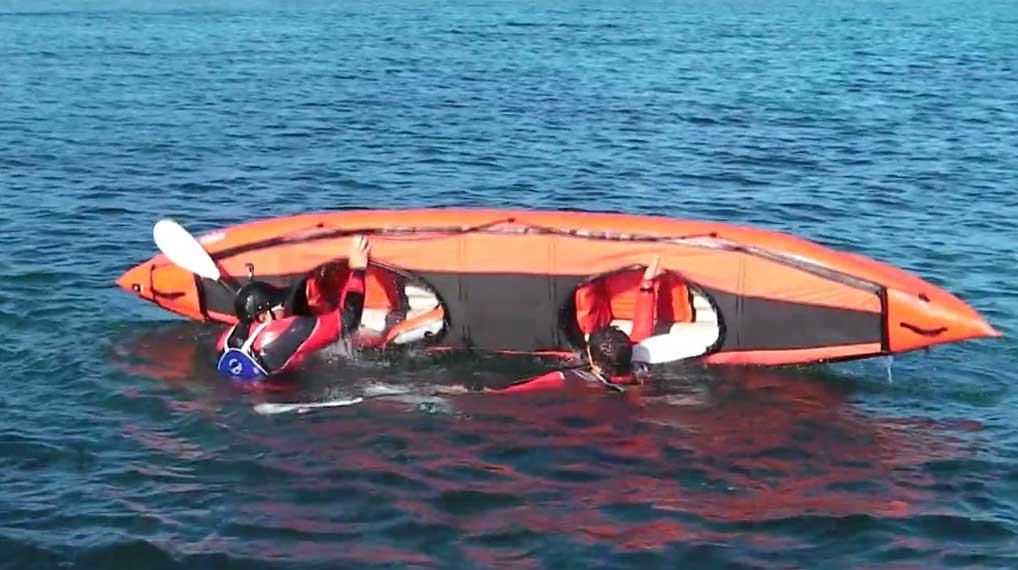
The great thing with the velcro deck (for one or two) is that it can be removed; on my Incept I paddled like this approximately 99.9% of the time, with the deck rolled to one side. Even at the slightly higher pressures, I have to say at one point in the video I noticed the Seawave bending with the swell. My Sunny used to do this, taking on water over the low sides, but with a deck that ought not be less of a problem, even if you imagine there’ll be some seepage through the velcro in heavy conditions or white water.

grabend

Flexing is a problem with any long inflatable and even my short and high-pressure Grabner (left) flexed in certain conditions. Manufacturers get round it with metal frames (Feathercraft, Advanced Elements), twin side tubes (some Grabners, Gumo Seakers, Incept) stiff fabric (Incept) or just high pressures like Grabner, but that demands very good construction. Drop-stich panels are the new way of doing it now.

Scotty

There are more impressions as well as some nice pictures from an actual owner, Norman, right here (translated from French). He ran a 410C for a few years and talks of pumping his Seawave right up to 0.35 (5psi) bar which makes for good speed (6kph average he claims). That is 40% above the recommendation so let’s hope the seams on the Seawave can take it, cap’n.

mod-drainer
sw14

It looks like grey, Halkey-like valves in the back, not the old-style black ones that Gumo used. And I see that Gumotex have again adapted an idea that I had on my Sunny years ago (right), a drain hole at the back. Only theirs features a neat sliding cover. It could all be the normal process of improvement of course, but I recall that after I had some smaller skegs made for my Sunny (and sold to a few others), Gumotex reduced the size of theirs to the current black plastic ones. And then the velcro deck idea. Whatever, it’s gratifying to see ideas I have tried or written about actually making it into production.

Enough of this speculation!
Actual impressions on receiving my boat here, followed by half a decade of very enjoyable Seawave paddling.