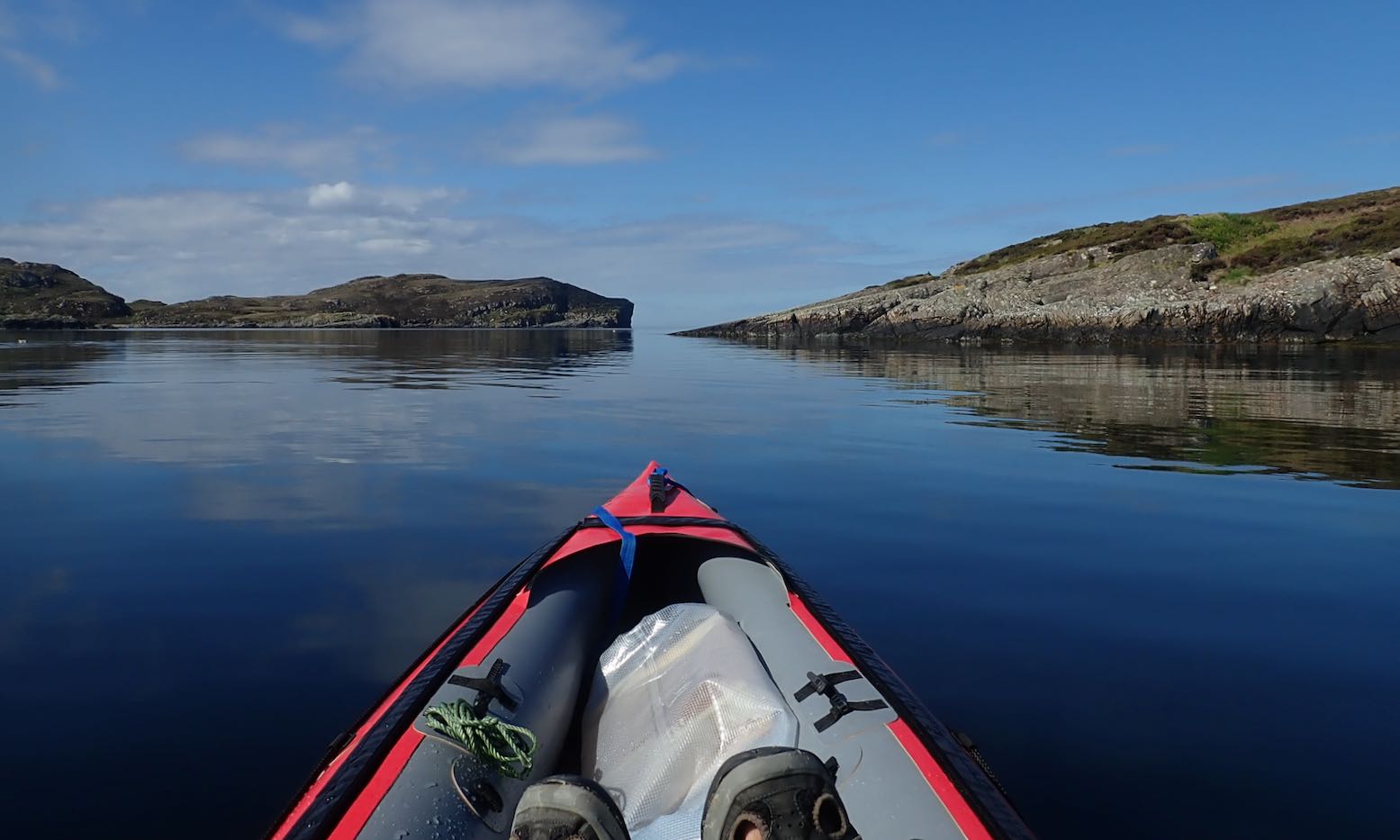
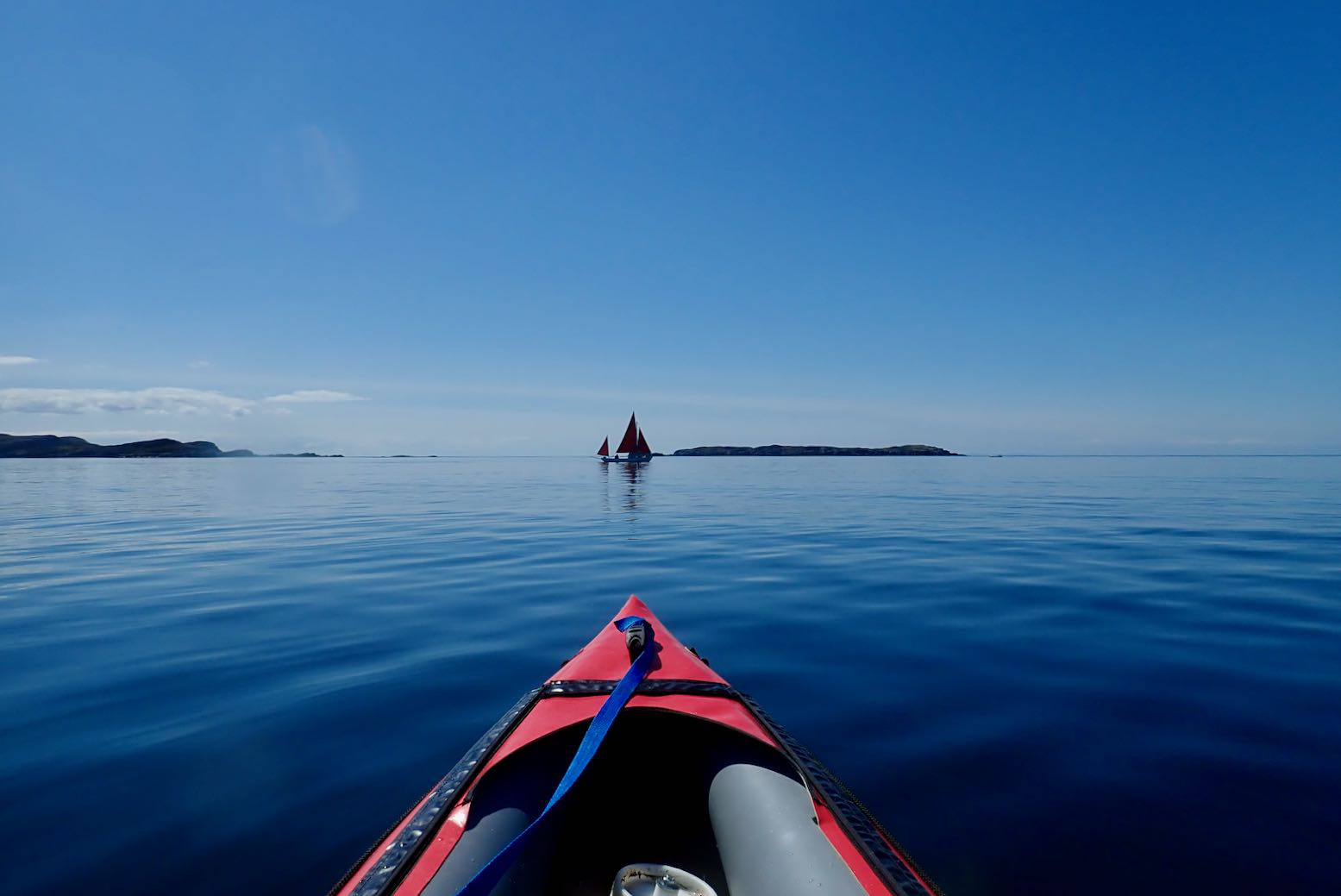
Another forecast of calm winds in the Summers. Or is it? The BBC and YR reports are contradictory: the former has too-strong-for-IK winds from the south; the latter shows light winds from the north. Others show light winds from the south. How can they all be so different? Maybe I should just look out across the water? All looks serene so let’s make paddle while the sun shines. I wheel back down to False Man’s Harbour and set off with two hours before high water.
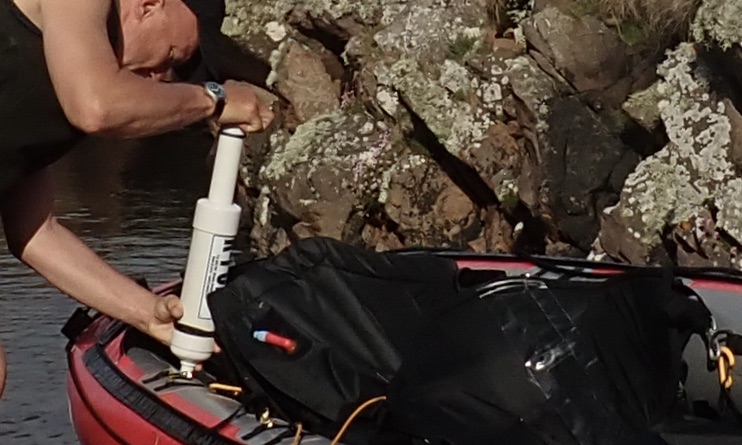
No side PRVs? Am I missing not having added pressure release valves in my side tubes, as I did to my original Seawave? Not really. I am running 0.3+ bar in the sides (official: 0.25) but temperatures up here in NW Scotland are hardly tropical. I try and leave the boat in the shade at the house and de-air the side tubes for a couple of seconds after a paddle, effectively manually depressurising the sides to about 0.2 bar, rather than having fitted PRVs do it for me automatically. The more vulnerable stock PRV in the floor purges automatically at 0.25. On my next paddle I have to top up all three chambers with the K-Pump as I would have to do with all-round PRVs anyway. About 30 kpumps brings the sides back up to over 0.3 bar. The difference now is I use a manometer to check the sides are about right. Before I would just pump until the side PRVs purged. It’s about a minute’s more faffing. As with a lot of things I do to my IKs: sails, rudders, decks and now, trolleys and headwind weight transfer – it’s fun to experiment. But in the end they’re all largely over-shadowed by the simple enjoyment of paddling. With sides pumped to >0.3 bar I find I can cruise easily in the near-still conditions at 6kph.
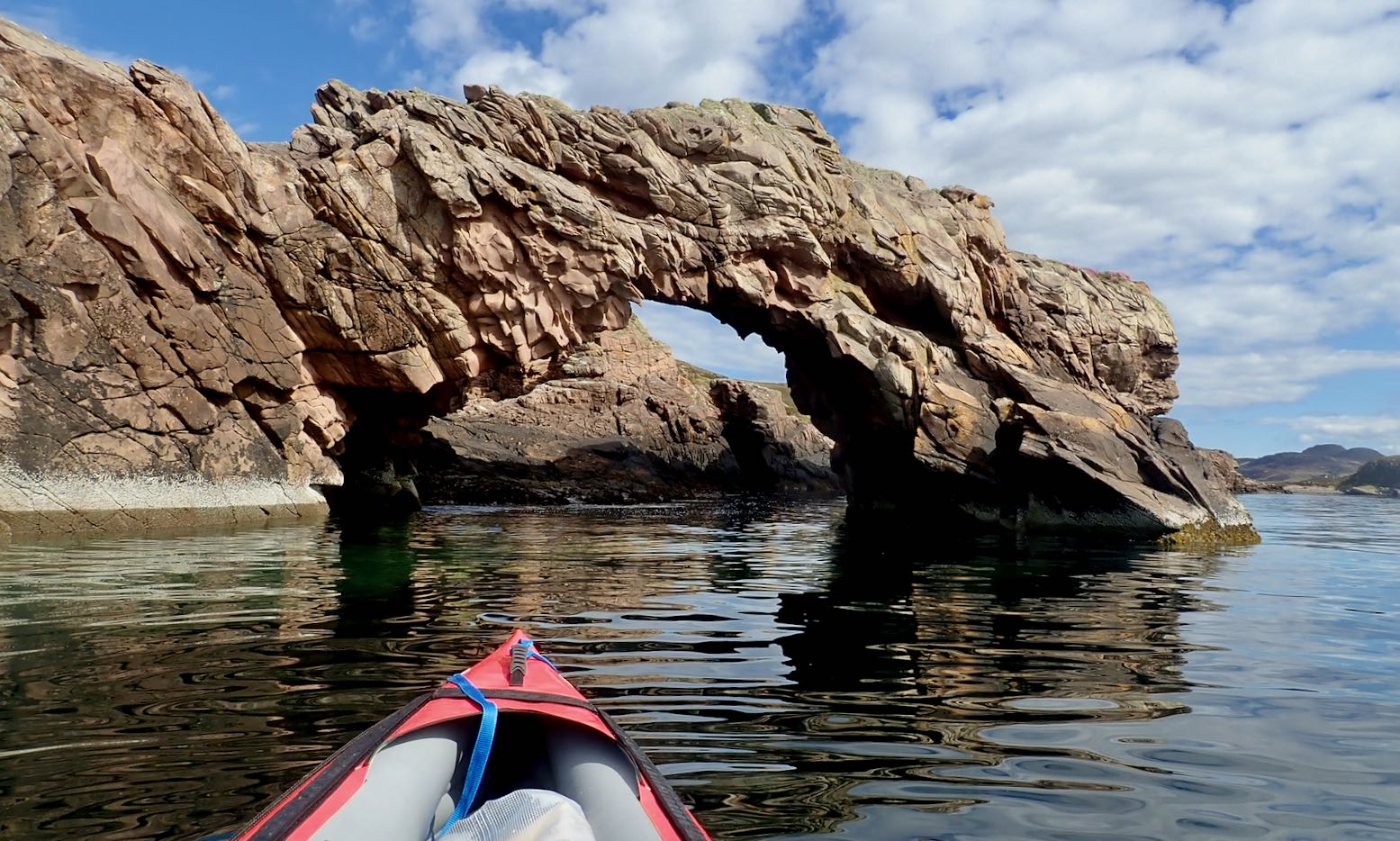
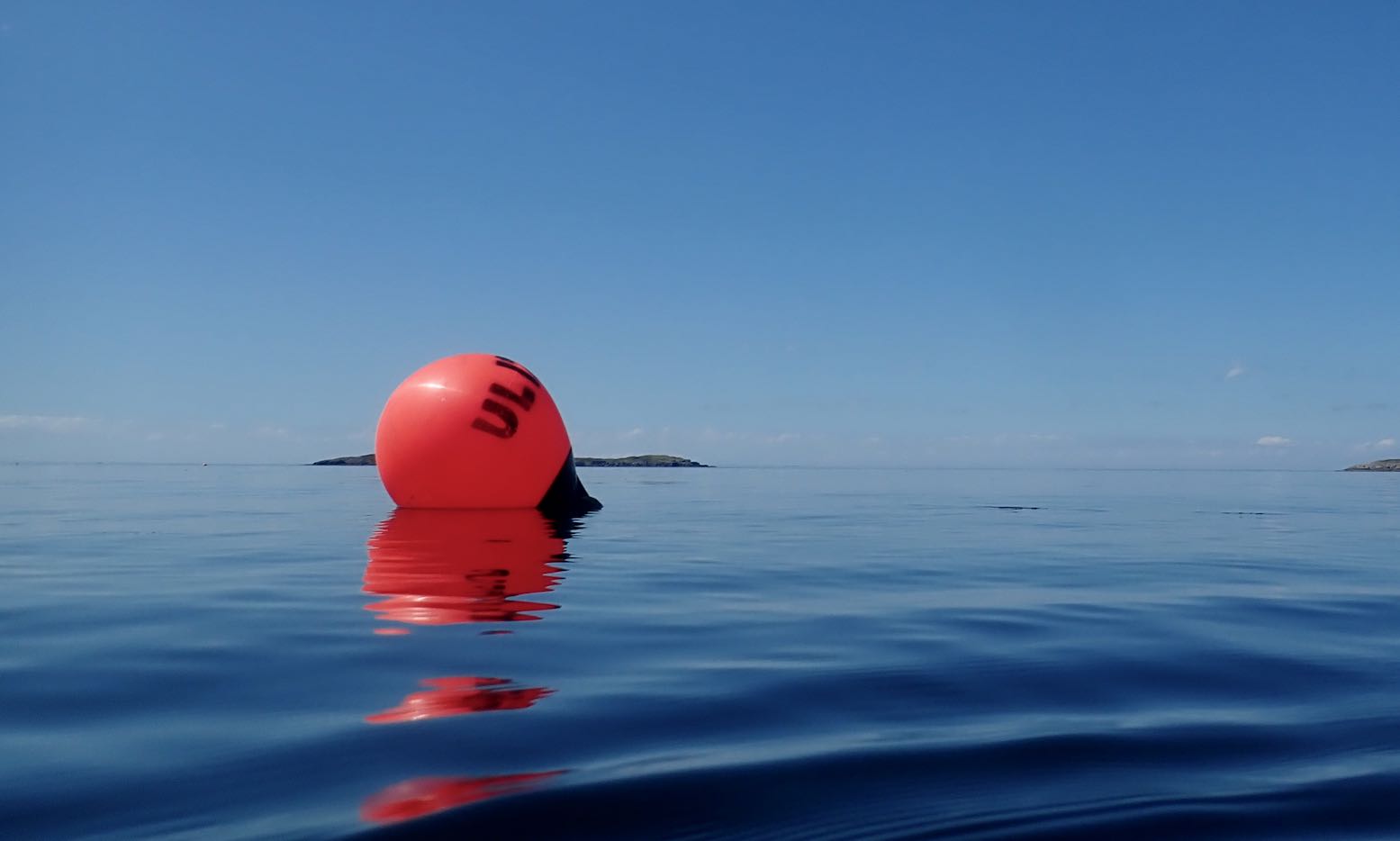
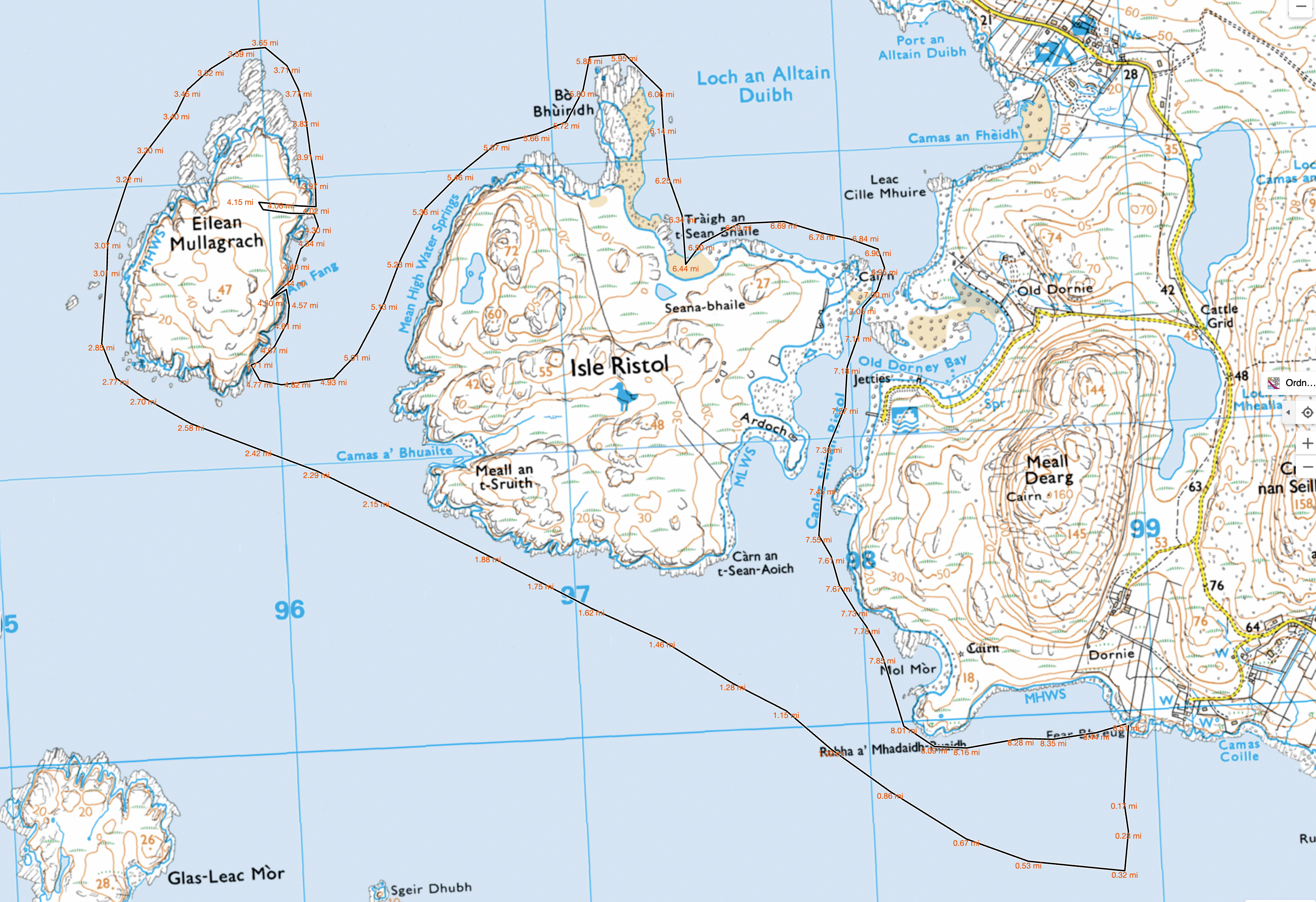
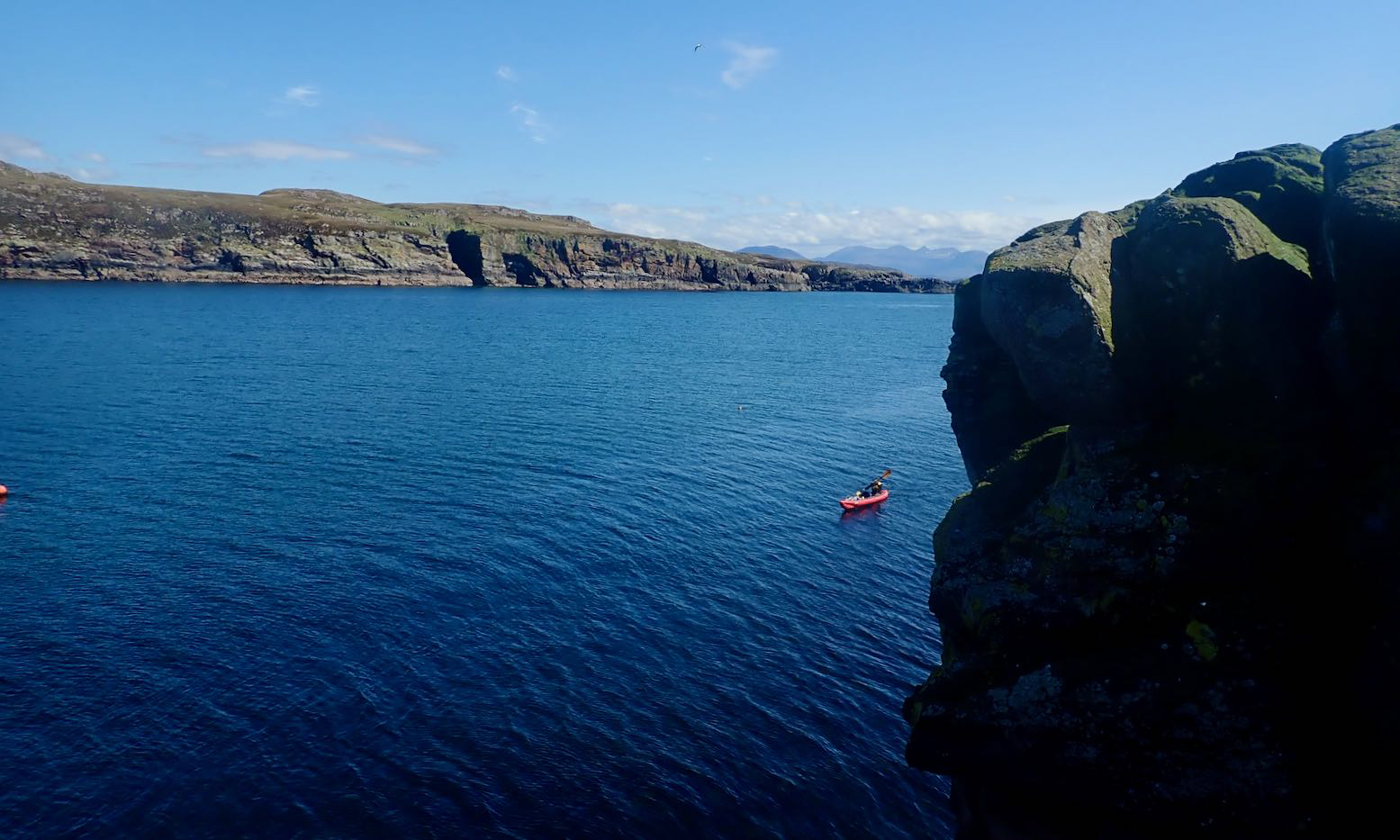
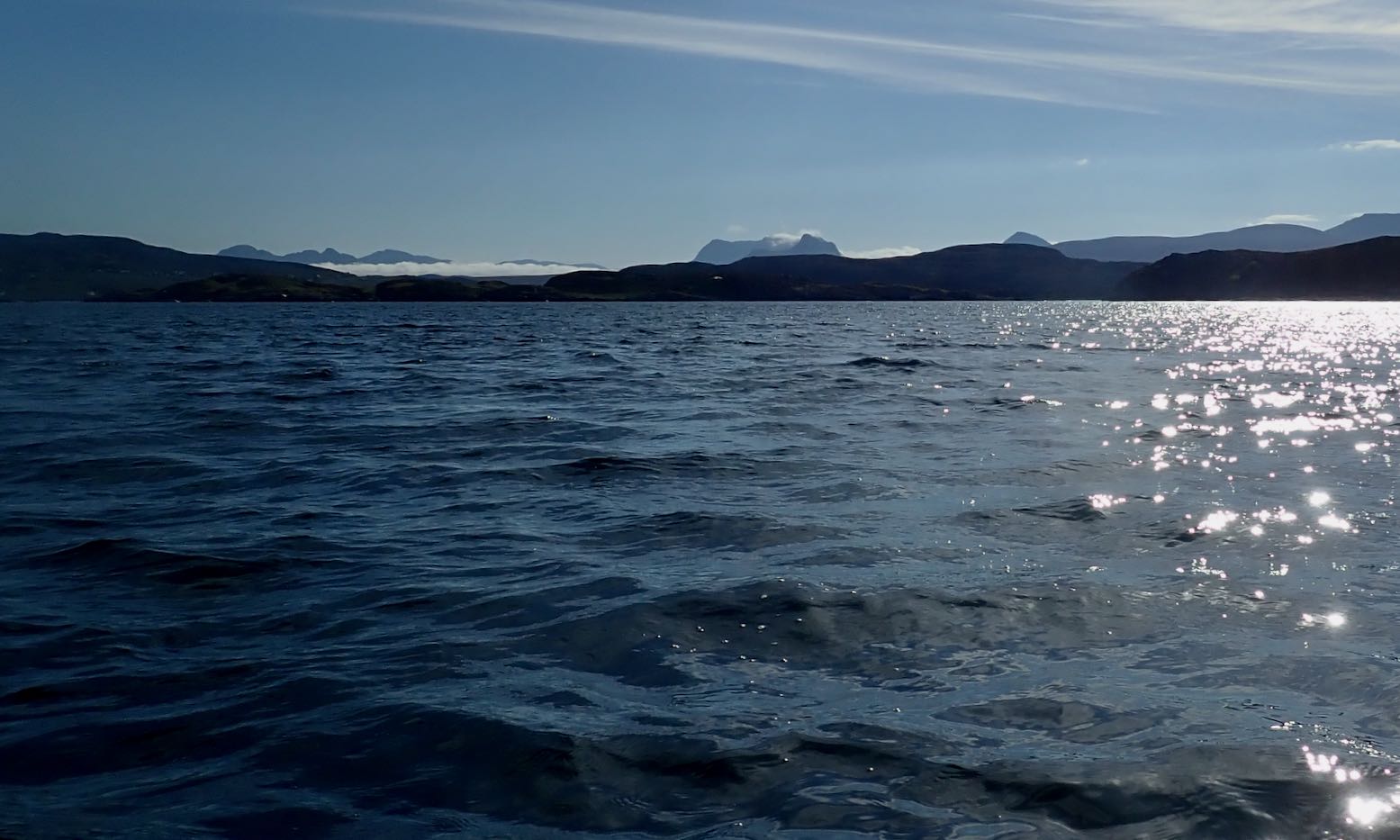
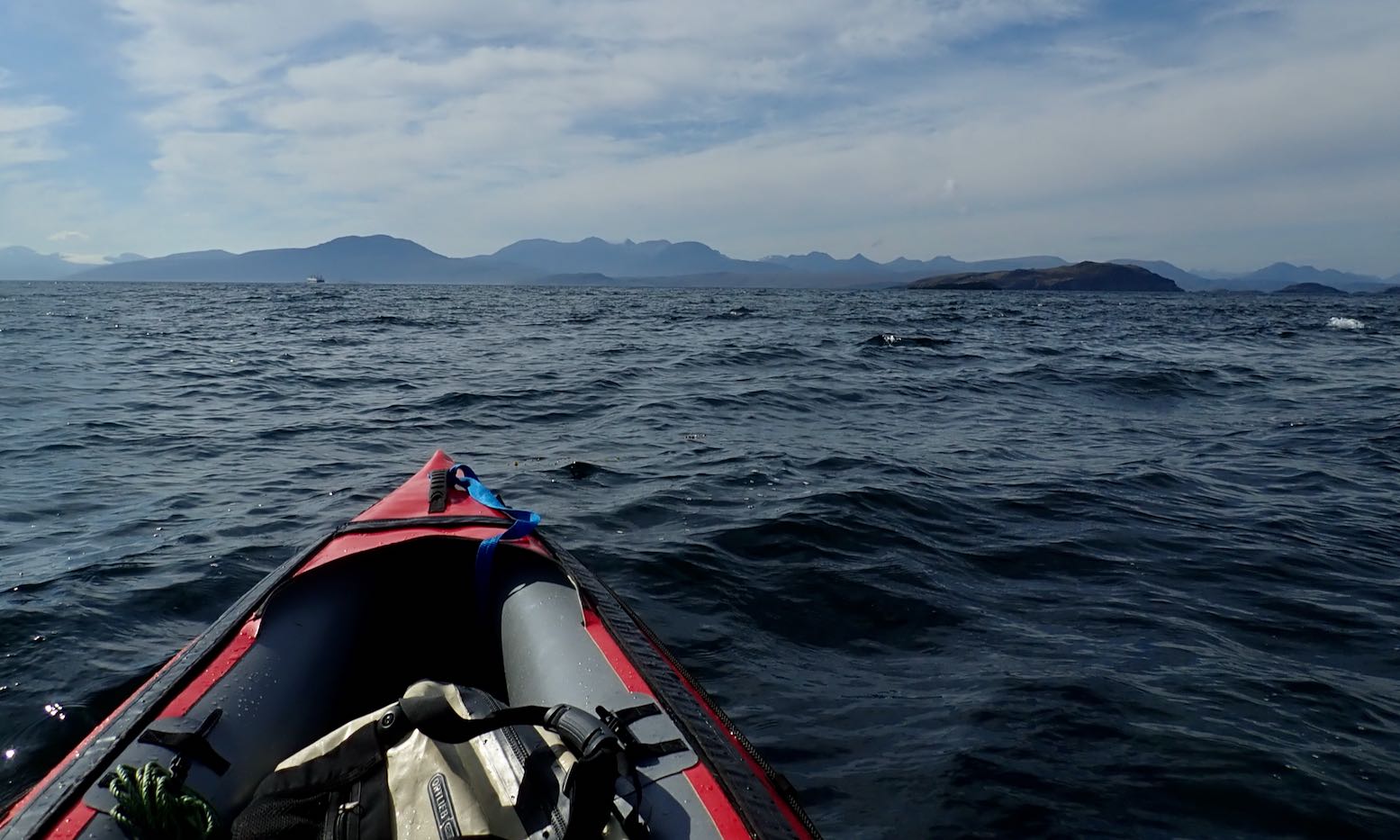
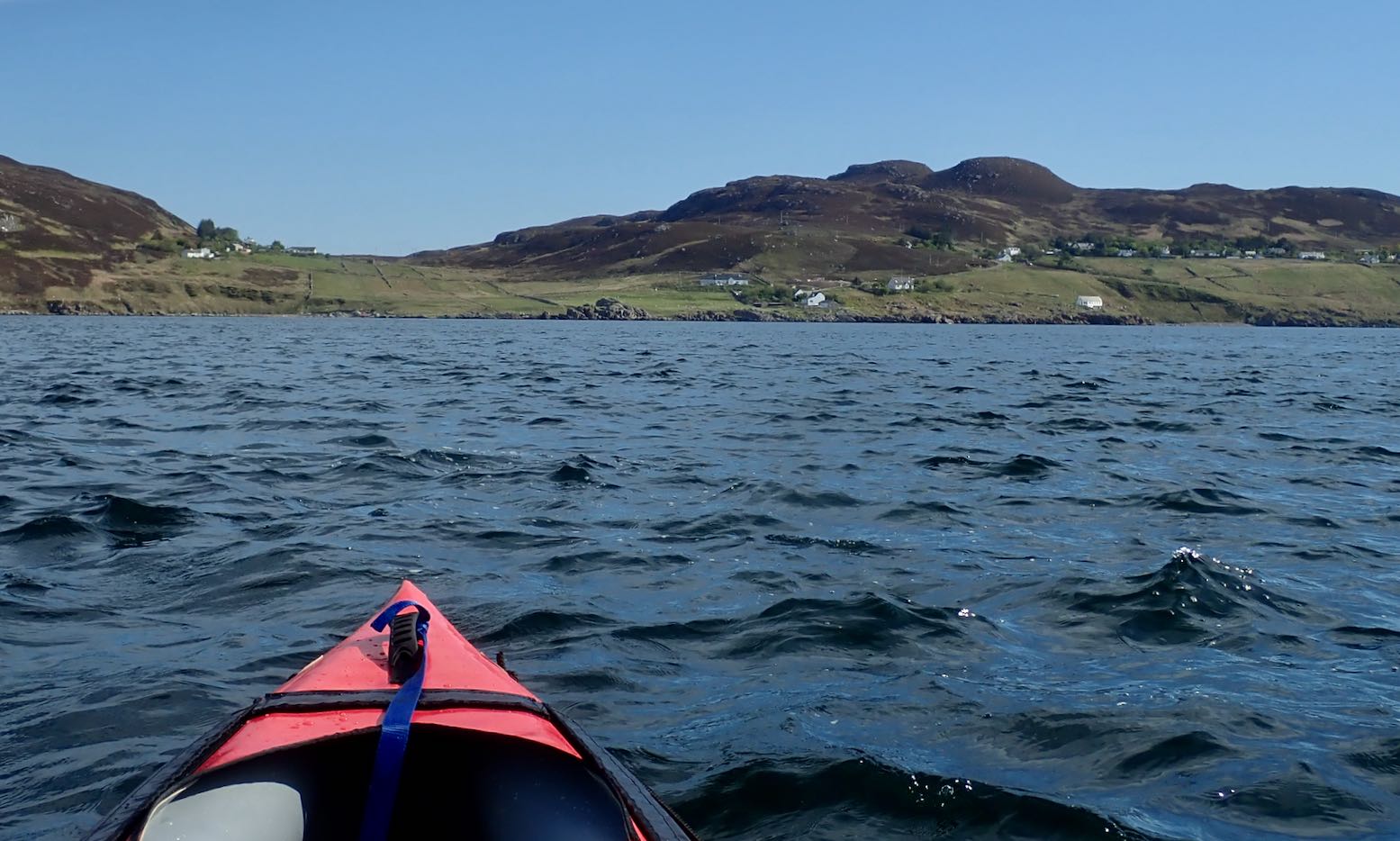
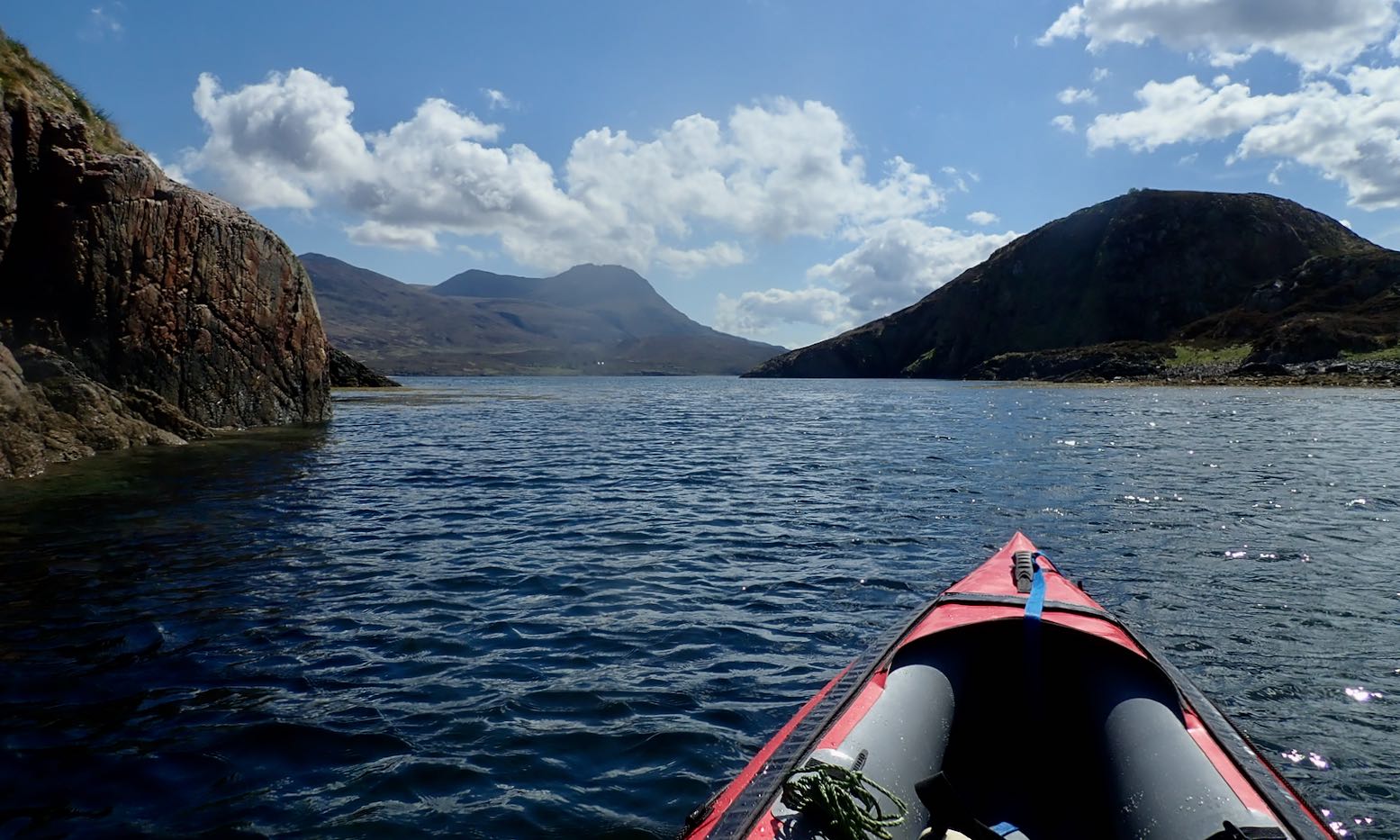
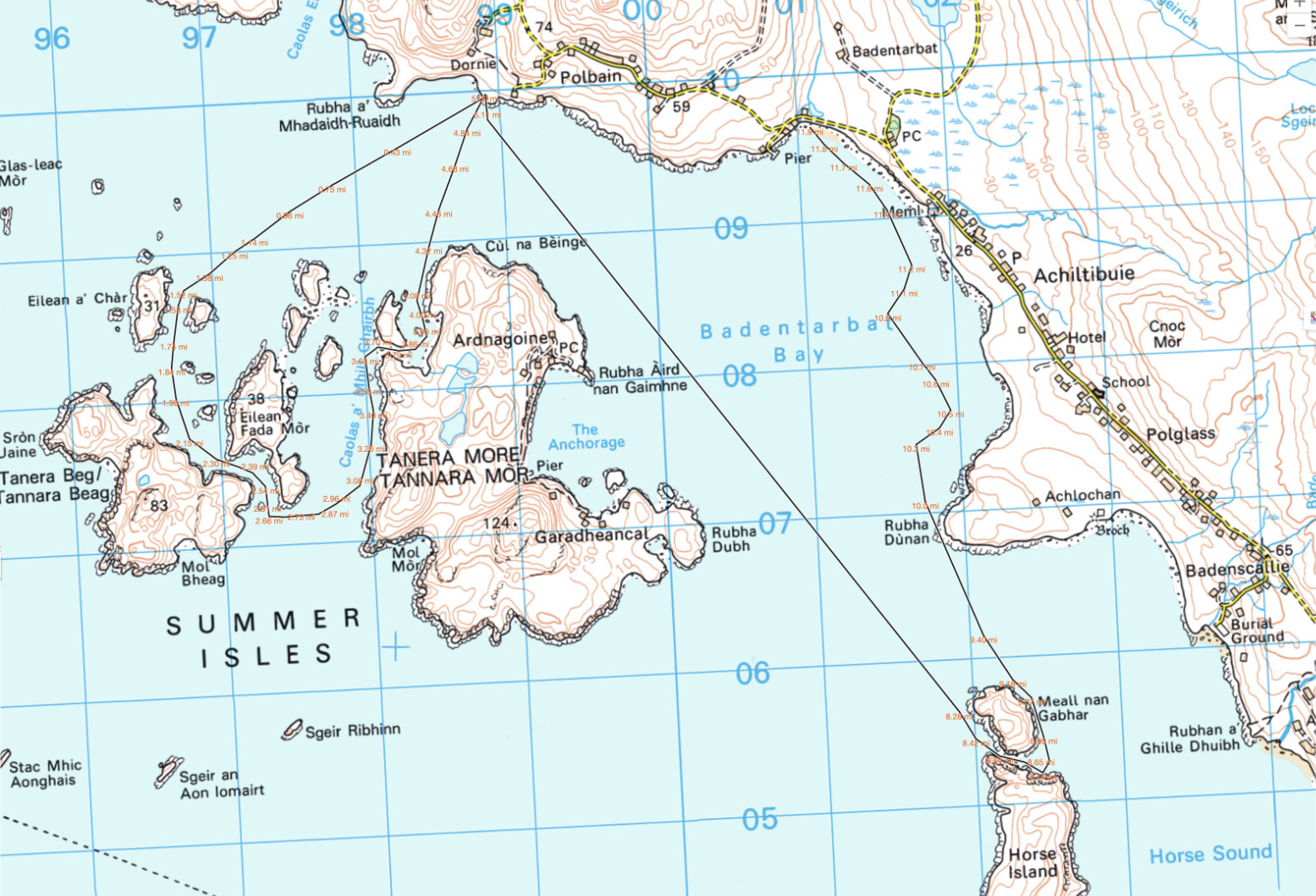
Let’s try and make the outside of Tanera Beg again. Two days ago I got blown off that idea.I fit a compass so I know which way the wind blowsAnd try out my deckbag GPS RAM mount so I can measure, not guess, distancesKayaking tour party mustering at the north cliff of T. Beg.But they seem to be dawdling, as if unsure whether to go ahead.I paddle past and on to the big cave on T. Beg’s south side. That crack at the back might be passable at max HW.The view out south towards the Wedge of Angus and Priest Island beyond.I slip through the popular arch at Tanera Beg’s southeast end.I notice a small second arch. The water is too high and gap too narrow to squeeze through with my Seawave, but it’s only a foot deep below, so the window of opportunity is as narrow as the arch. What would Freud have made of all this arch-threading.Being more exposed to the southwest, Tanera Beg has some deeply weathered sandstone cliffs.Midway through, I decide crossing over to Tanera Mor seems too easy. In the prevailing calm the three skerries to the south don’t look that far. It’s just over a kilometre to Sgeir Ribhinn (‘Stack C’) according to the GPS. That will take 11 minutes. Once there, I fail to notice the double-arched cave we found last time. But this is HW. A guard-bird observes.Over to the south side of Tanera Mor. The new owner is employing scores and spending millions here. New cottages here and there, plus tracks to isolated beaches (for building stones, I was told). They now ask you not to land in the more built-up Anchorage on the north side.There’s even a new house and other construction alongside the tidal lagoon of An Lochanach where I stop for a snack. Two kayakers pass by. Earlier, I could clearly hear them talking behind me across the flat water, long before I could see them.I cross the Bay and stop off on the mainland below our place to collect something.Looking west: a buoy with Glas Leac Mor behind. I recently read that a hazy horizon (Outer Hebrides not visible) means stability; warm, humid air. Good viz and crisp detail = cold air and wind. I head to Altandu, near the campervan-packed campsite.I drop-off and pick up a bucket. Coming back through Old Dornie harbour, a quarter headwind kicks up, pushing the bow left. I use the chance to load the bow with 10 litres of bucket-water. It does seem to make a difference: the bow bites better; no correctional paddling needed, unlike the other day. A good trick to know (I’d brought the drybag up front for that purpose).Another 13-mile day in the Summers, but I could have managed twice as far. How easy IK-ing is without wind. As is portaging with a trolley.
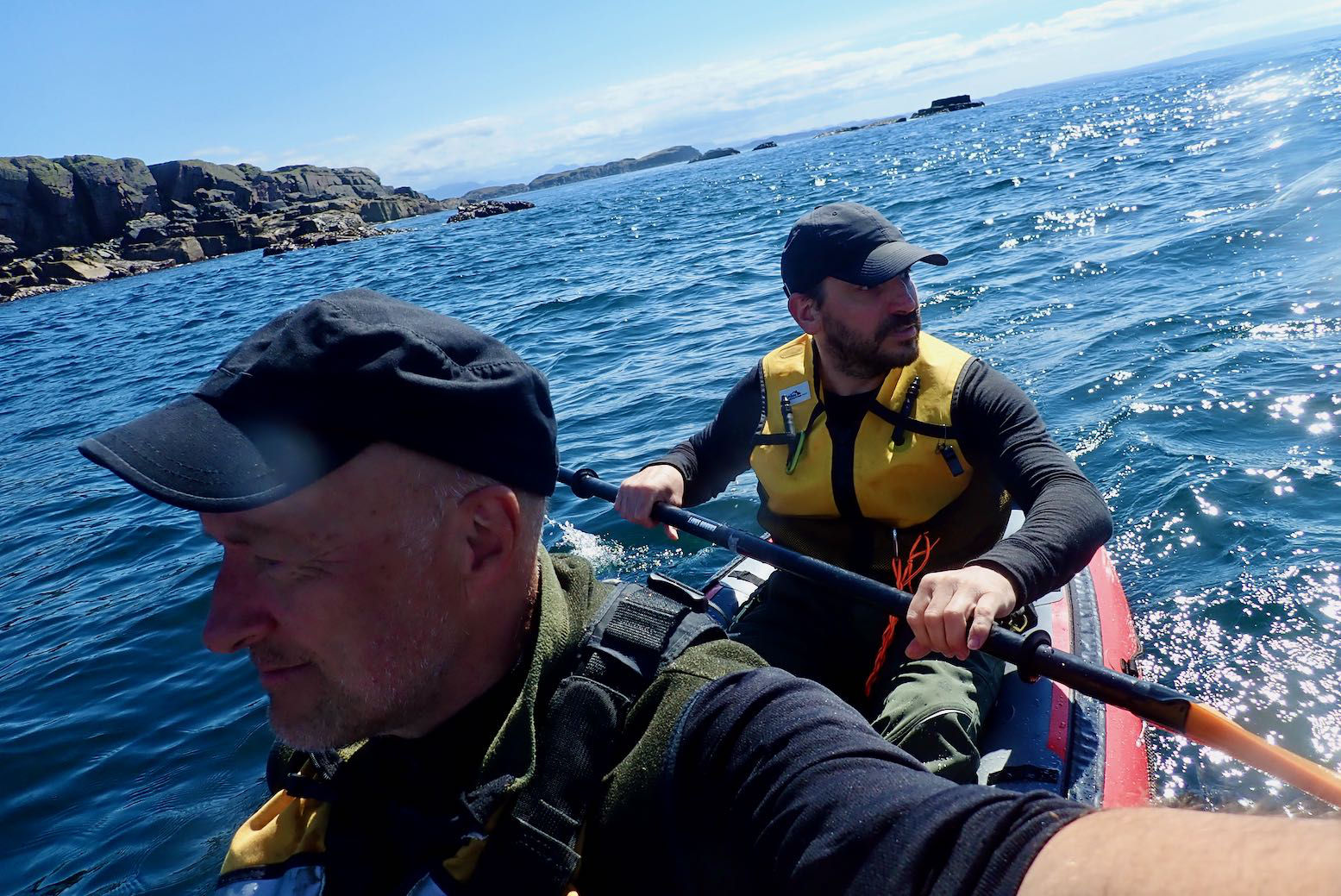
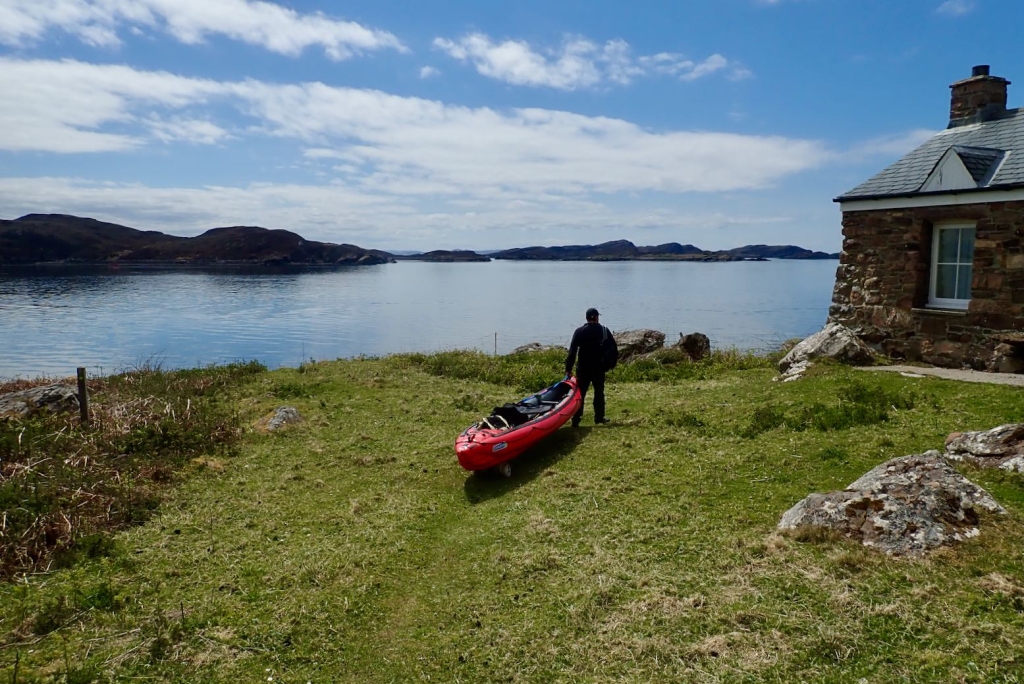
After a fortnight of chilly north winds and a diminishing woodpile, today was one of those rare days in the Summer Isles (far northwest Scotland) where you could paddle pretty much where you liked in an IK. It was also a chance for me to try out my new skeg-wheel trolley which Jon, who was staying down the road, had made for me. With no boat of his own this time, we set off in mine to see what we might see.
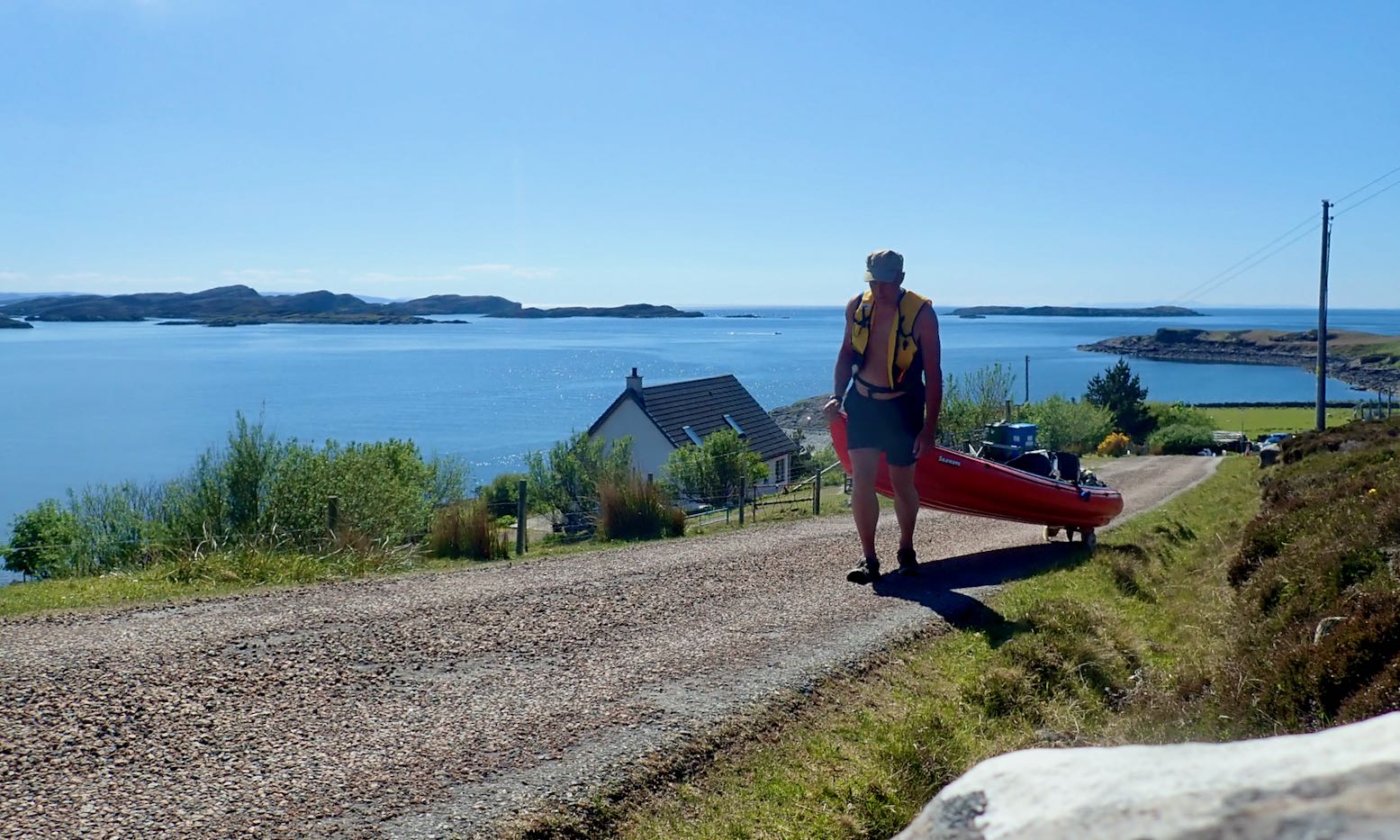
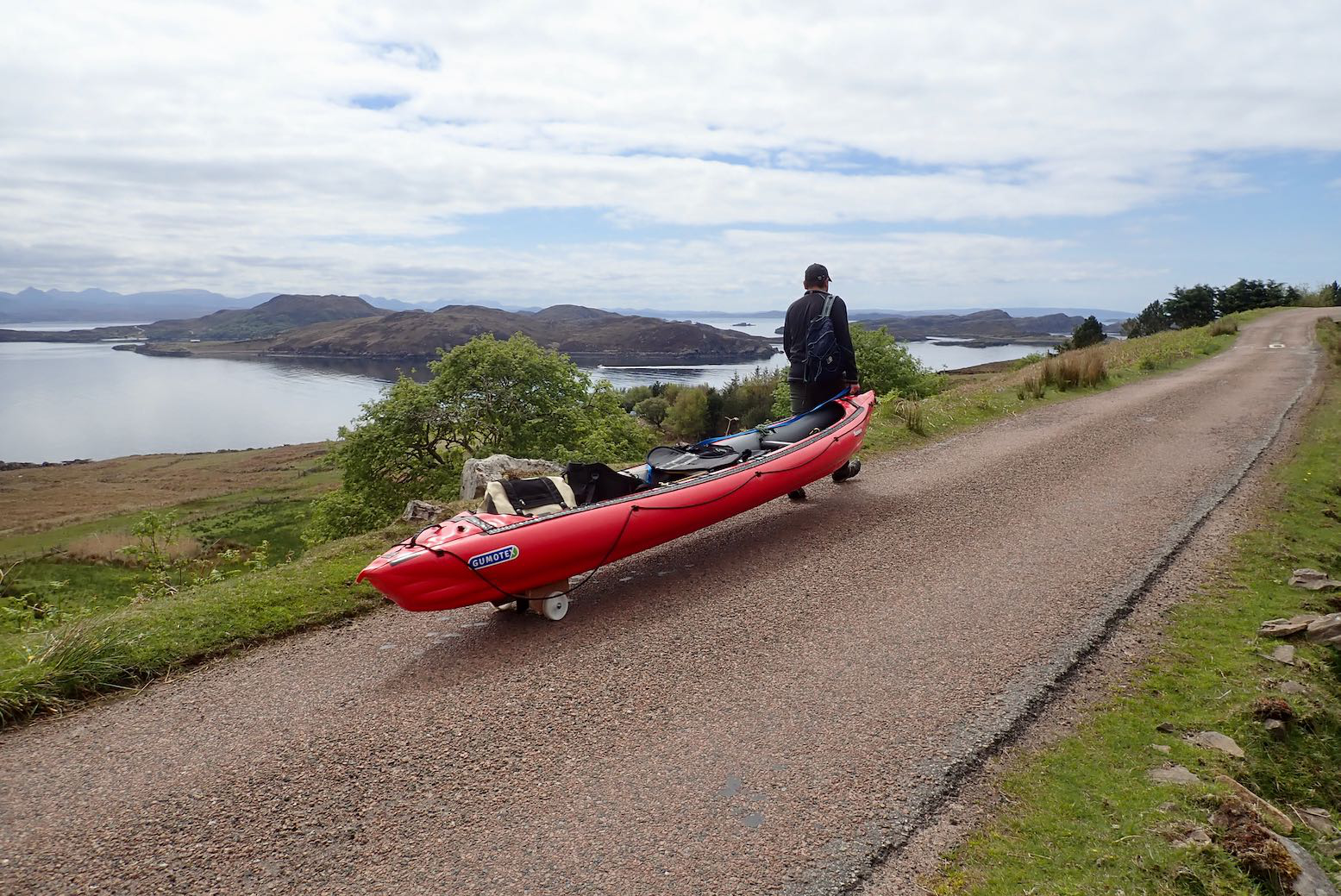
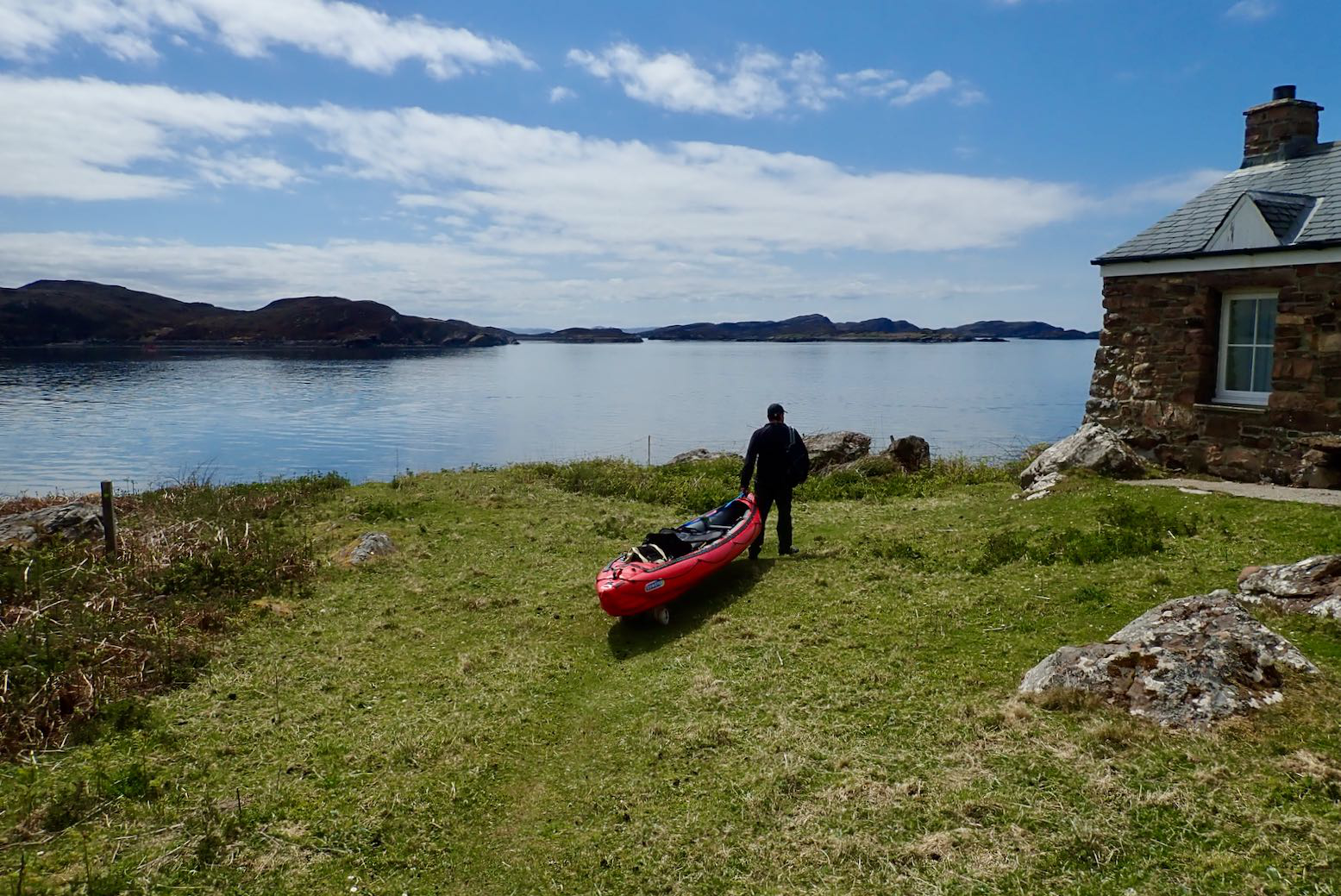
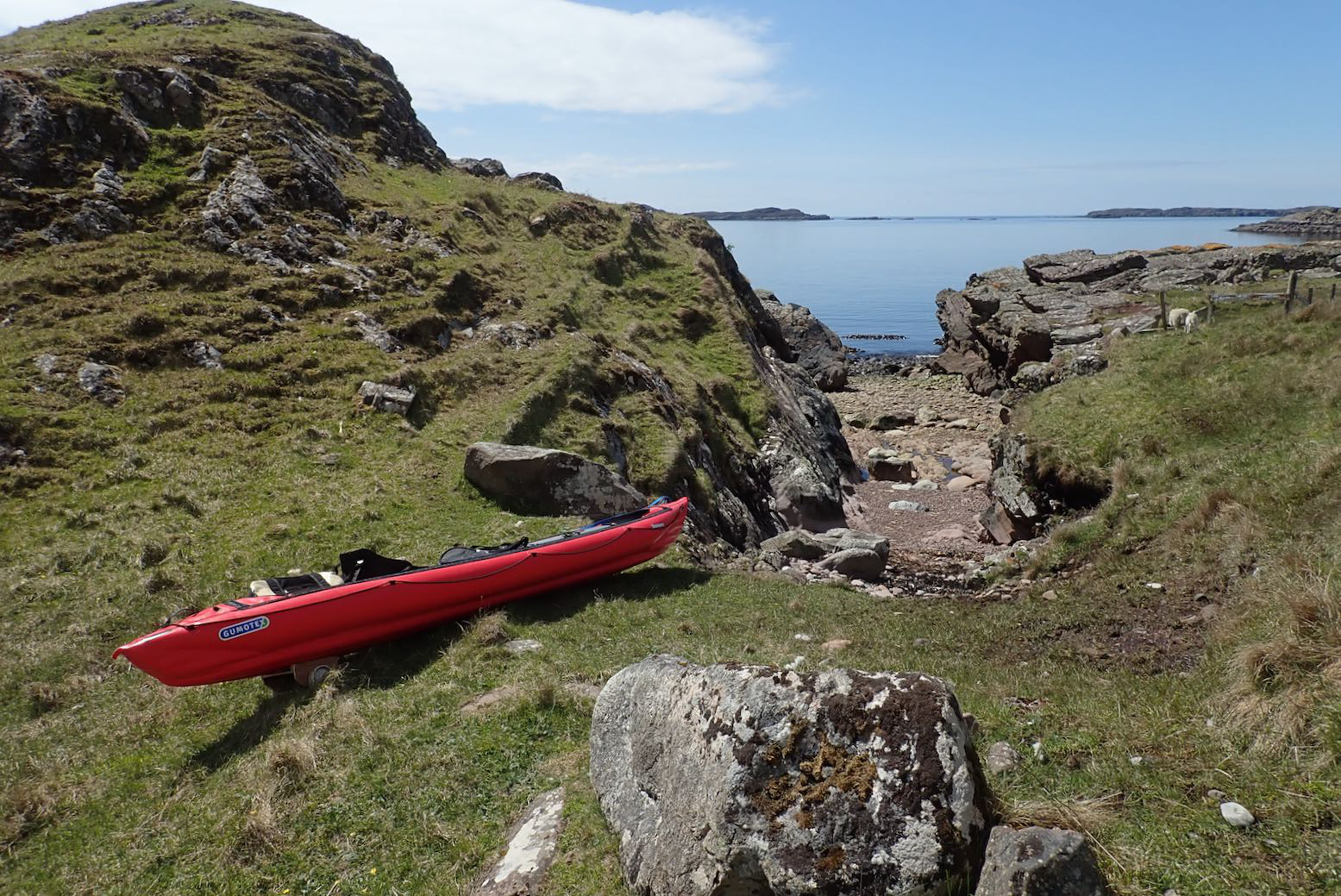
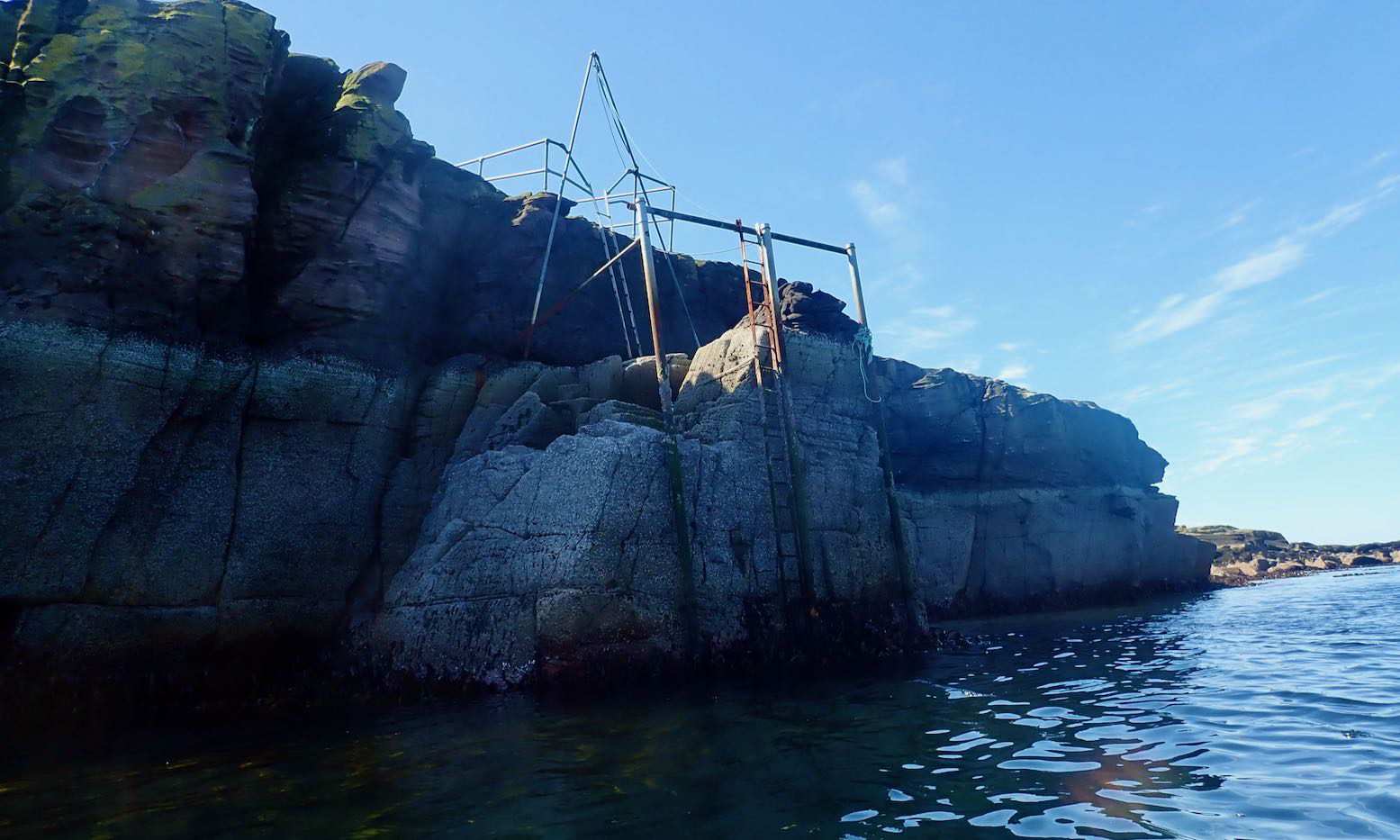
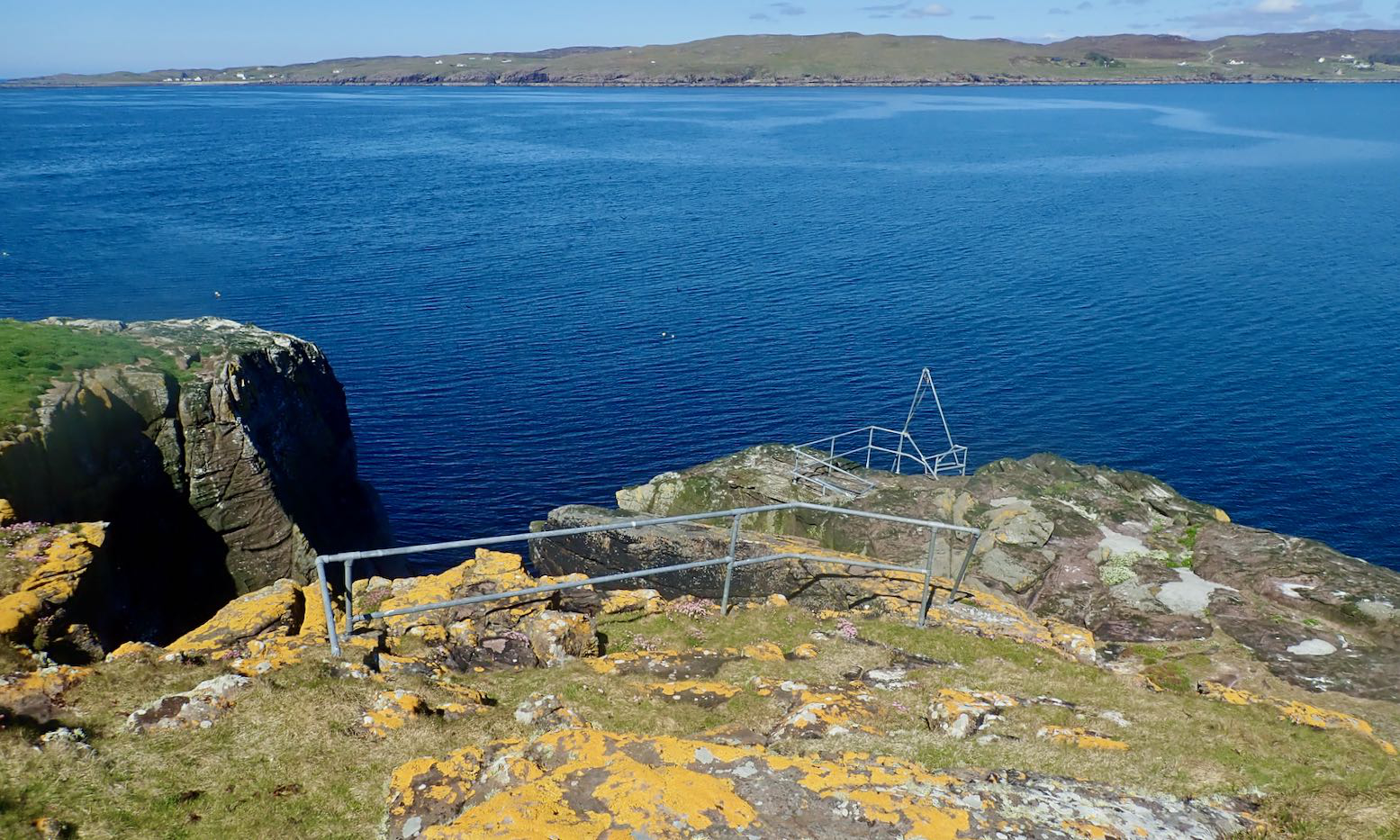
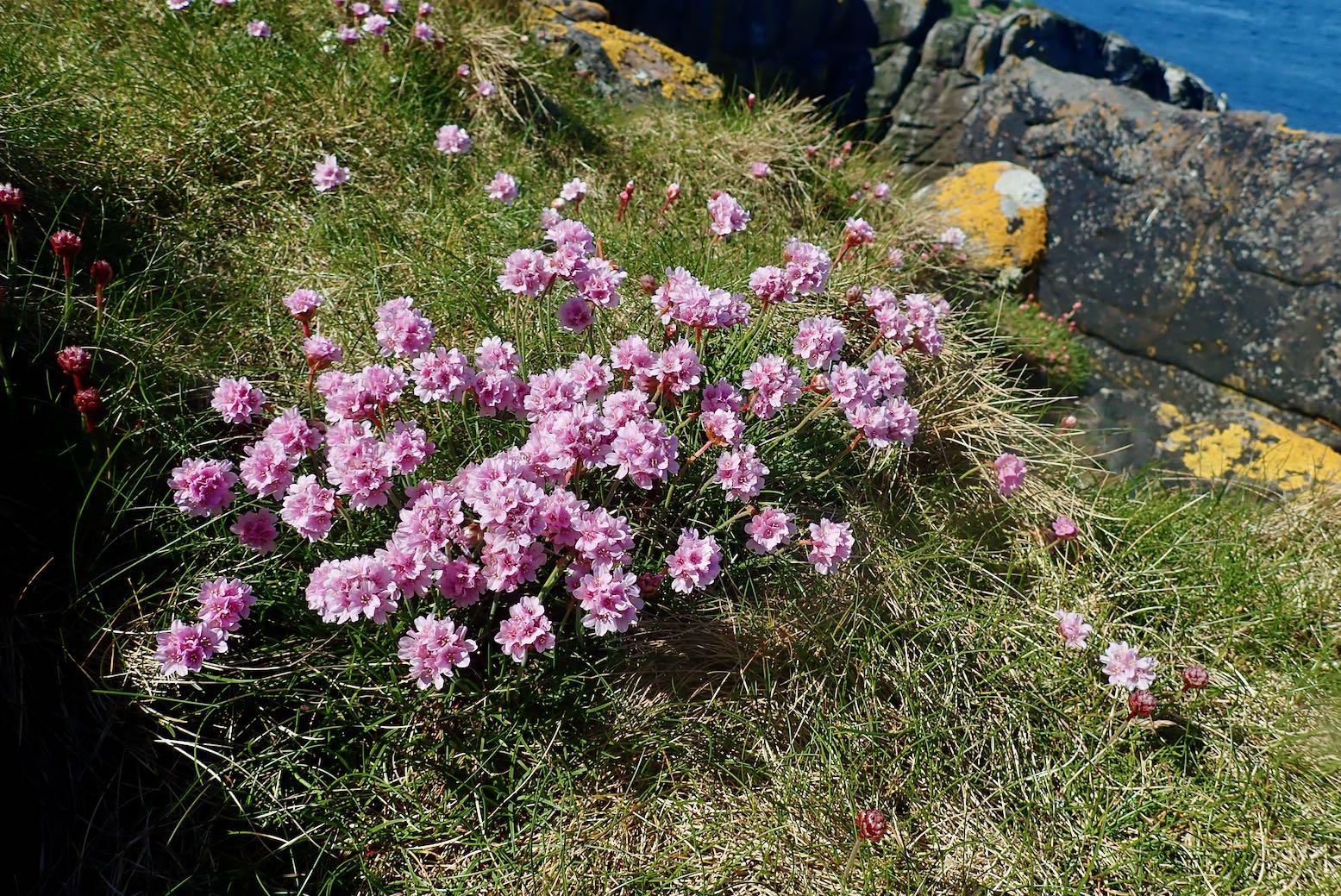
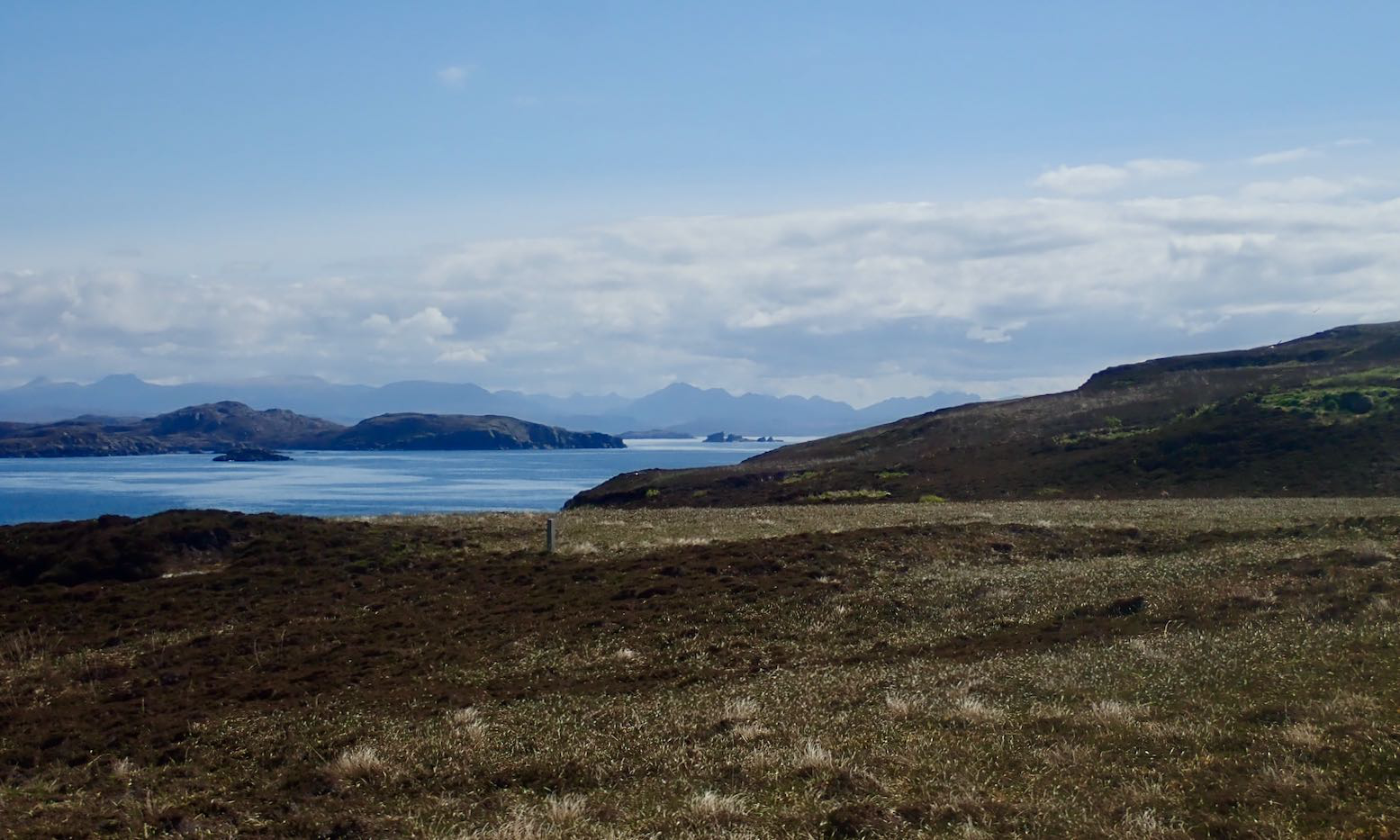
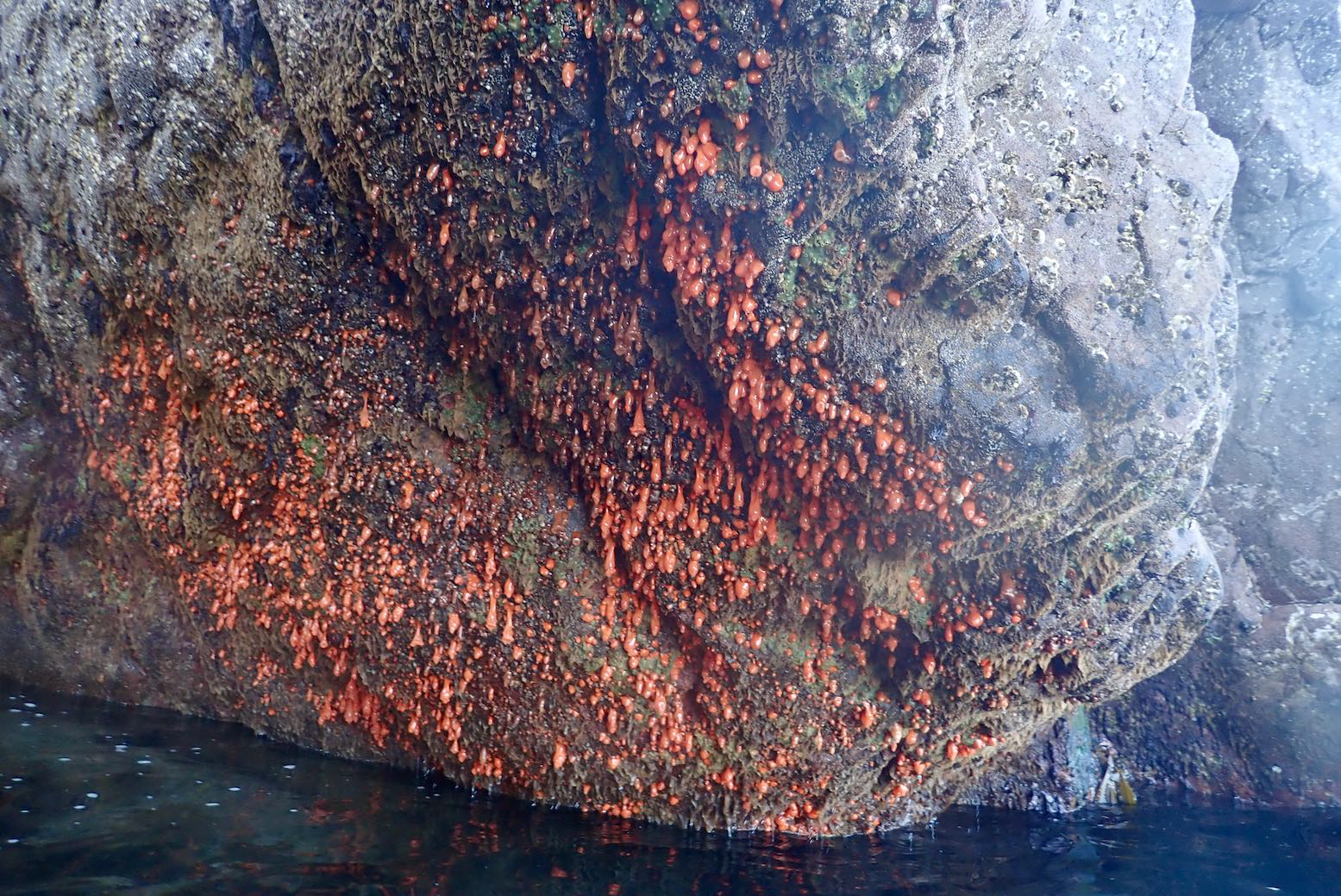
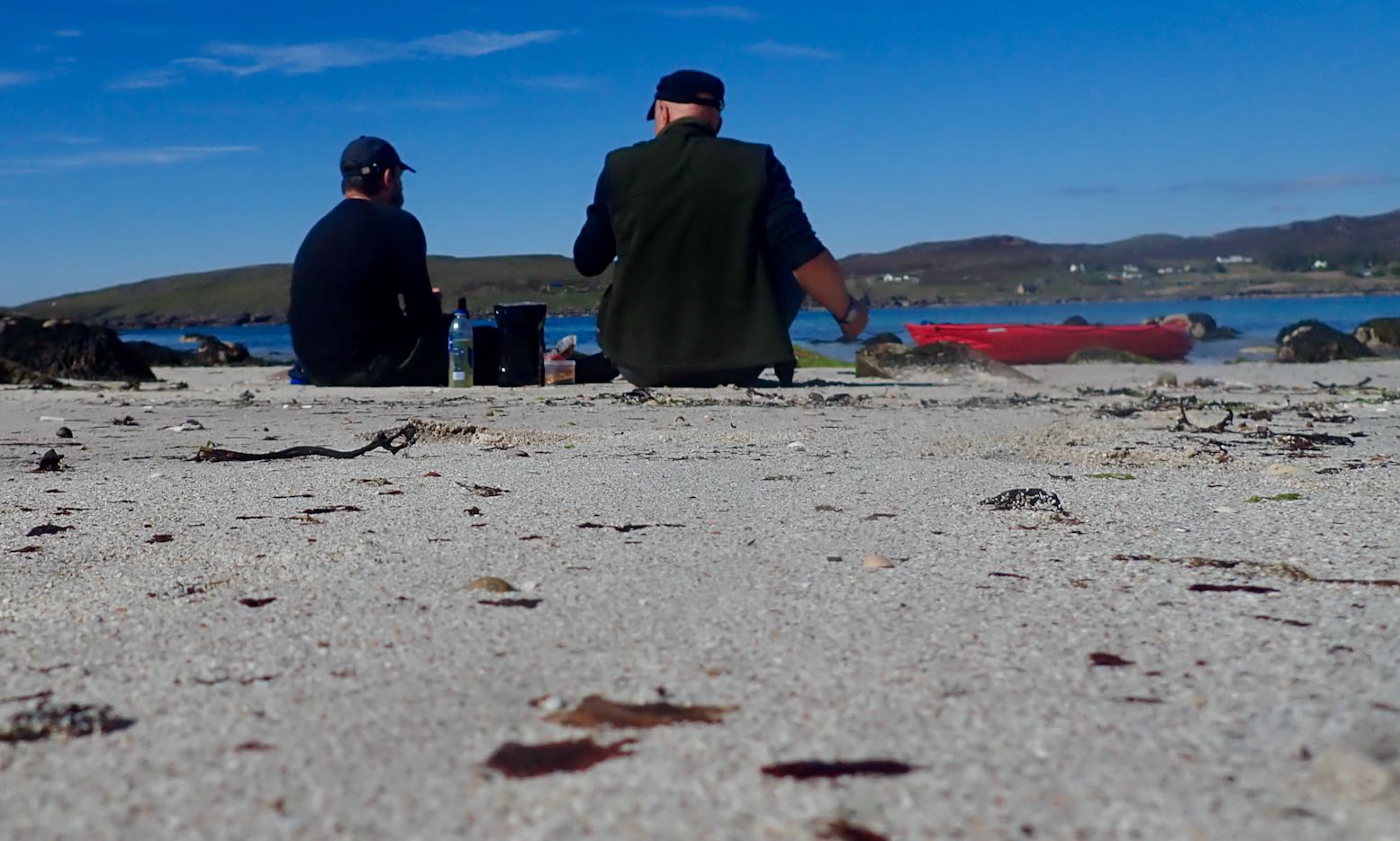
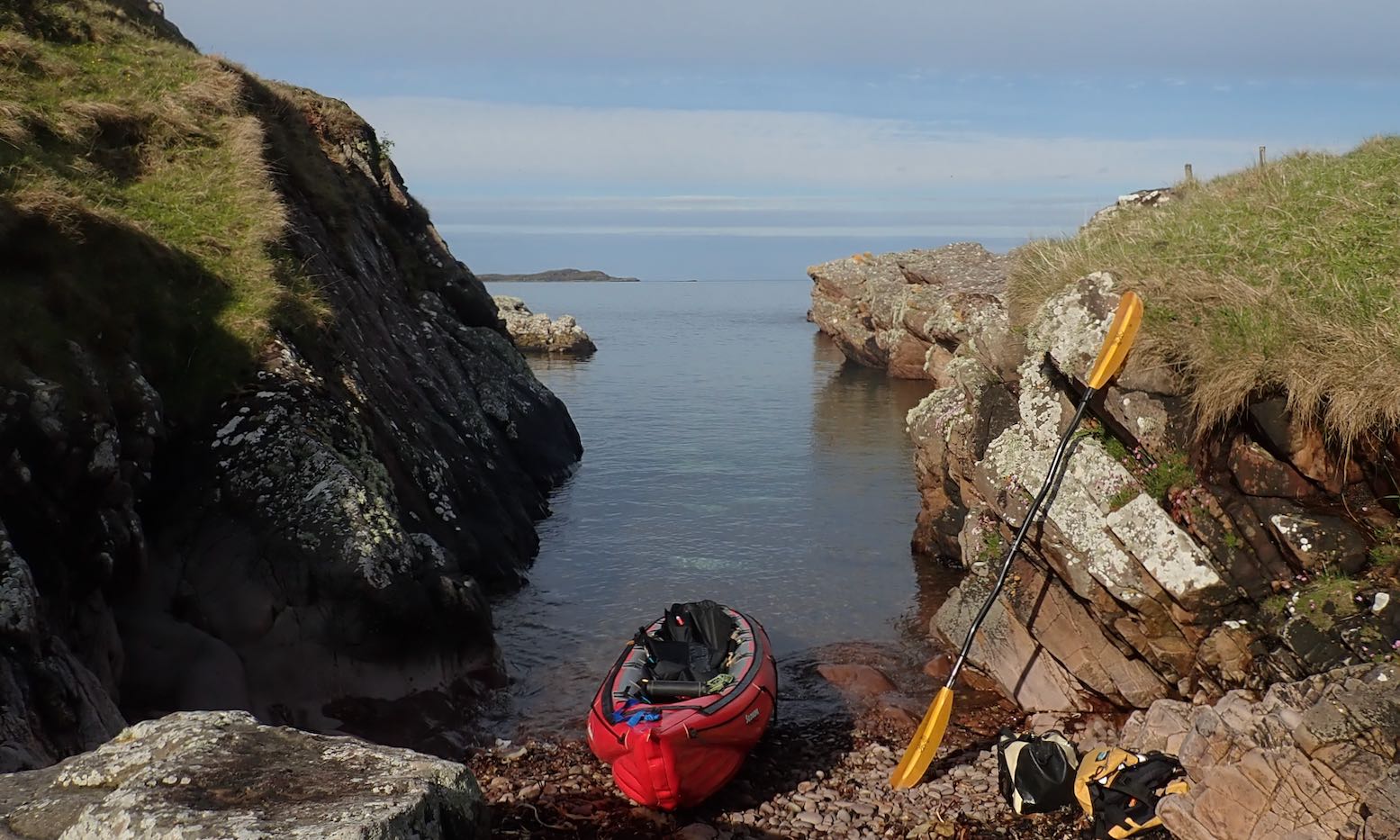
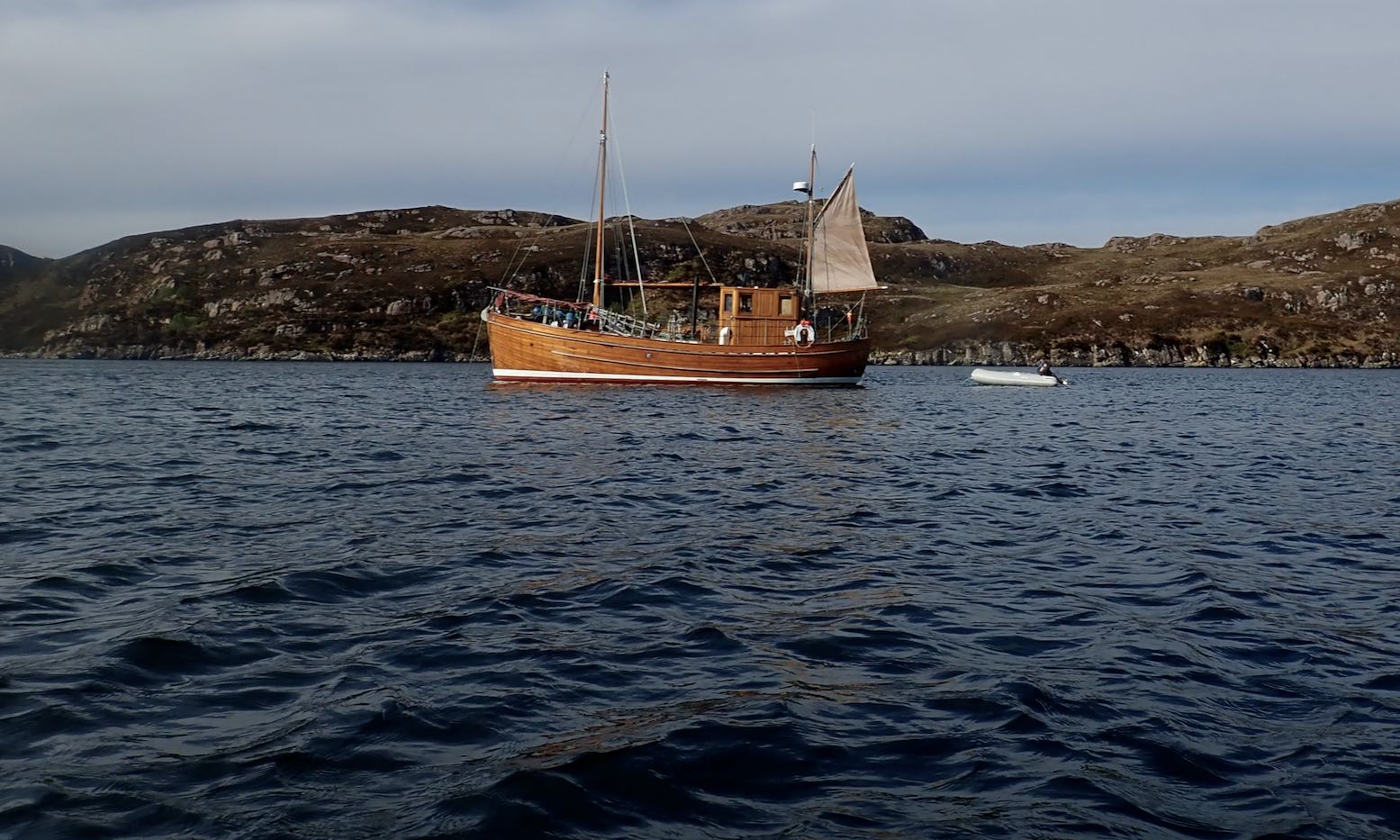
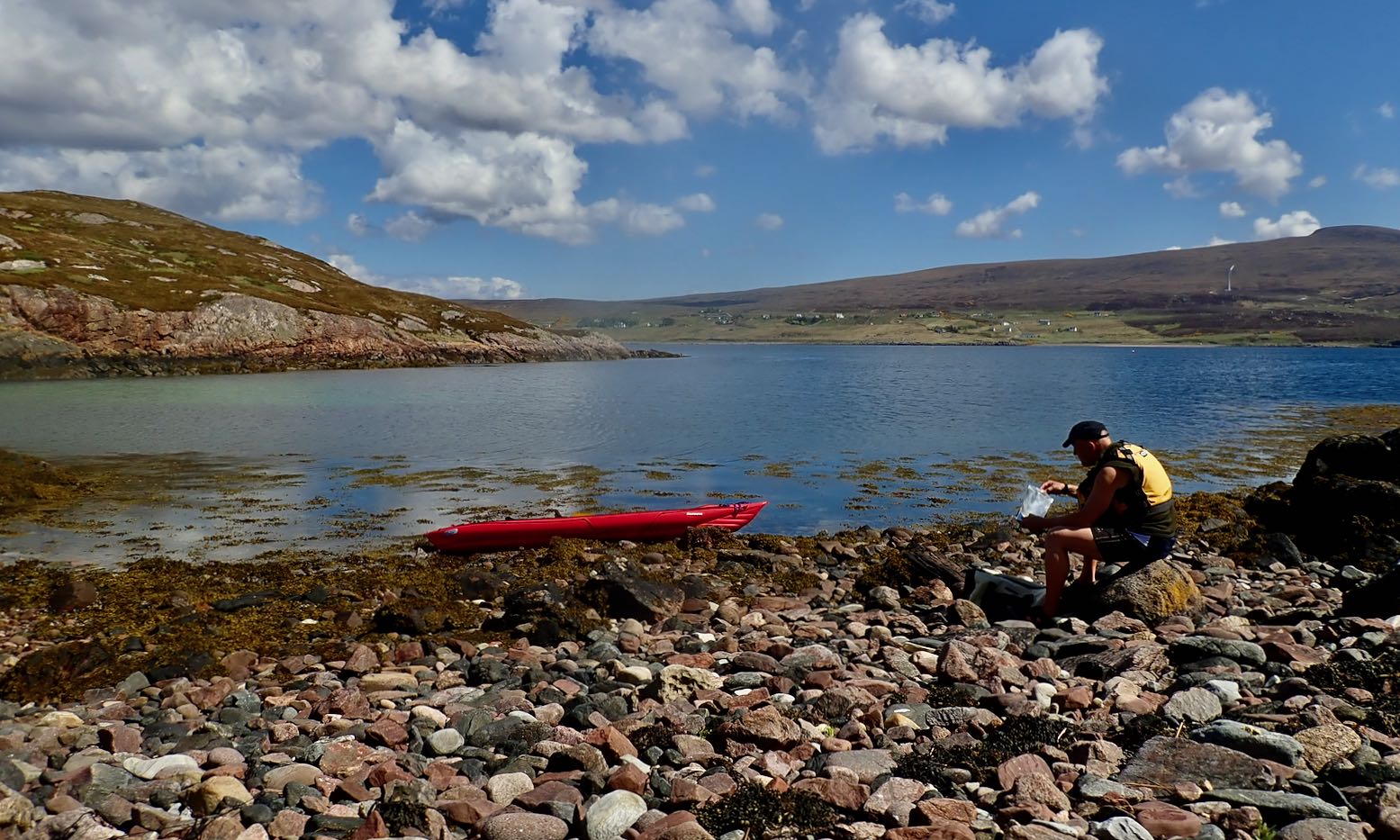
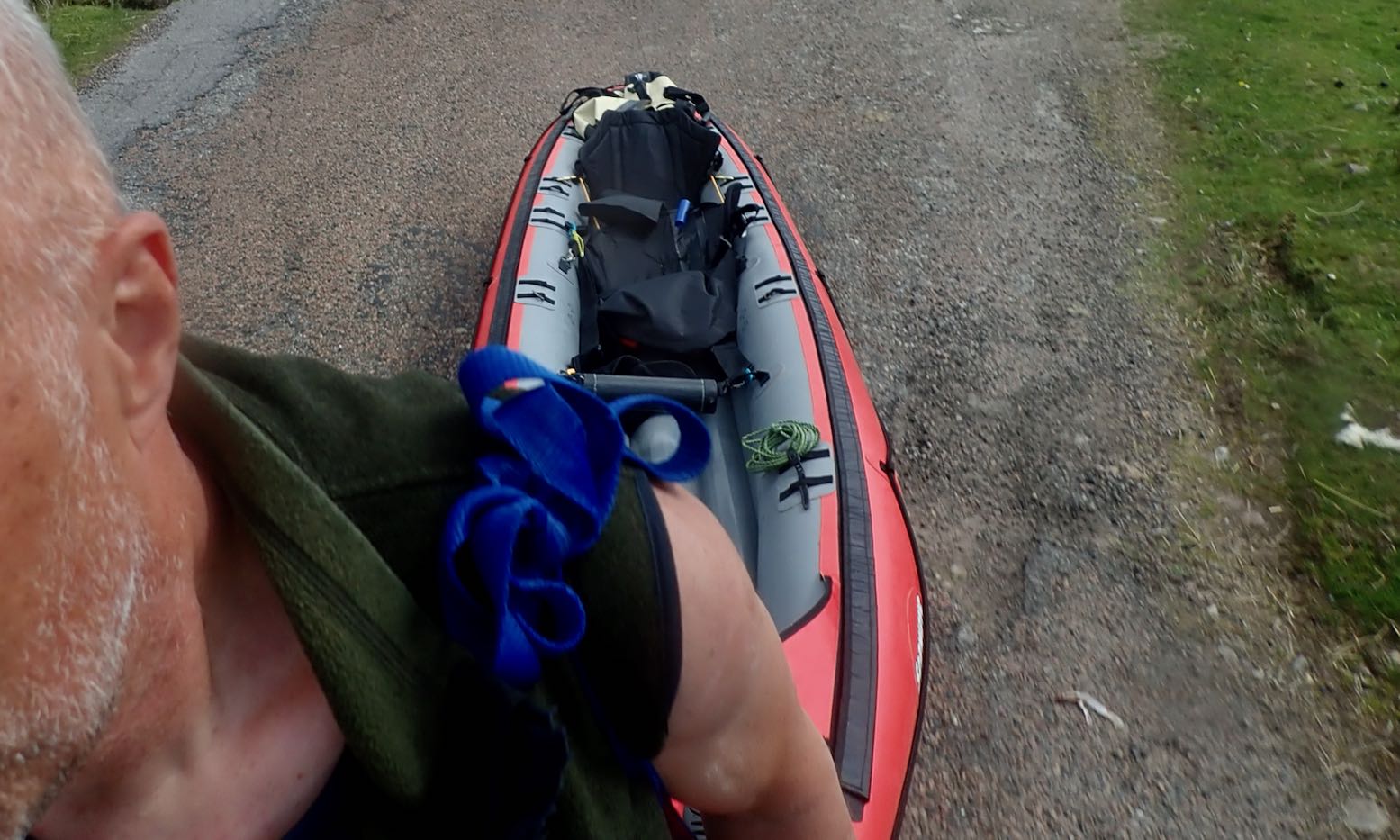
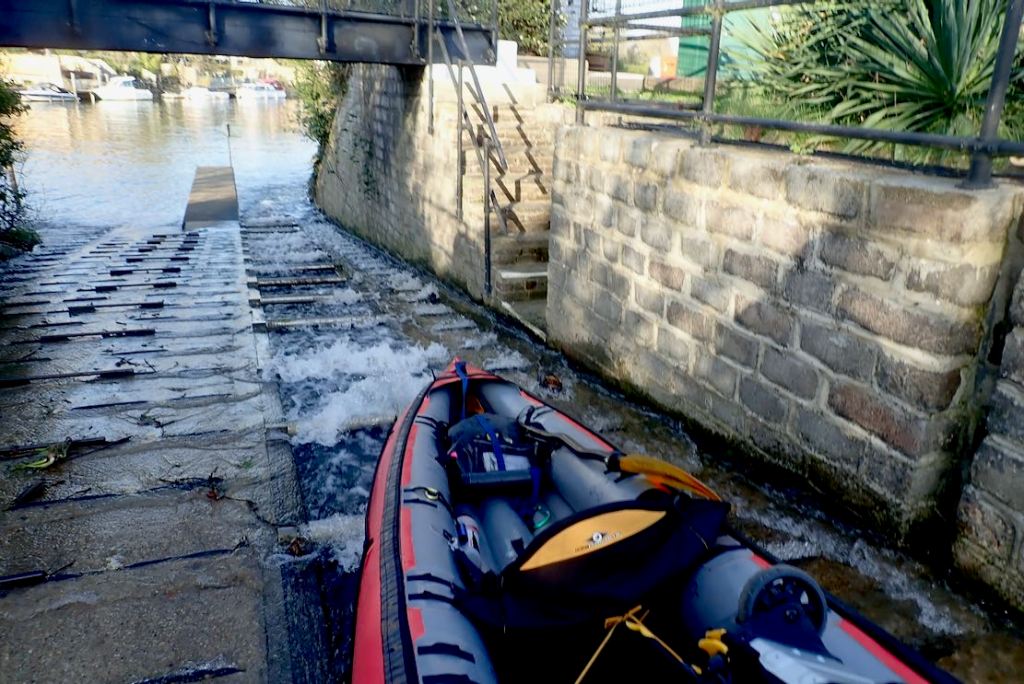
We rolled down the road to the Fox Point, the nearest and least effortful shore access from where I’m staying. Apart from the clatter of the solid wheels, the set up worked perfectly: stable and smooth.The spring tide had bottomed out so we looked for the least ankle-twisting put-in.Fear Bhreug (False Man) slot harbour looked just rightJust a few wet, slime-covered wet stones to negotiateWe have no plan so head towards the Ristol Islands across a glassy sea.With the calm, we take on the outside shore of Eilean Mullagrach; here the refracting northern after-swell makes it a bit choppier with some alarming waves breaking over reefs.Unless you’re a gannet, this is the only way to get onto Mullagrach, a gantry at the northeast tip. Usually alone, I’ve never done it, but with Jon to tend the boat, I climb up.With access so difficult, Eilean Mullagrach was never occupied or crofted. I think it’s now owned by a bird protection enterprise. Perhaps they built this guardrail and cut the steps. There’s what looks like a hut at the island’s south end, just past the (not very) high point.Nice to see sea pink and yellow lichen again. The former mostly found on the sheep-free islands and skerries.View south over the Summers to the Fisherfield mountains.The channel with Ristol behind. Better get back; the taxi’s meter is running.We visit the narrow twin-cave and nearby archPendulous sea growth emerges at very low tidesWe scoot back north out of the channel and take a break on Ristol beach before cutting through Old Dornie harbour back to False Man inlet. I leave my kayak overnight with a plan to come back for more tomorrow.Next morning I’m relieved to see my Seawave hasn’t floated off into the Minch. I top up and decide to head round the outside of Tanera Beg for starters.All is calmish as I cross Badentarbet Bay, but as I near T. Beg an unforecast southeasterly kicks up and keeps on kicking. The west side of Tanera Beg would be too exposed, so I divert into the Tanera Channel, using the lee of the smaller eileans.Nice looking wooden trawler.I’m hoping to at least visit the arch at the southeast end of T. Beg. It’s only 500m away but it’s quite lively and gusty now so I don’t risk it. Instead, I turn east to get into the lee of Tanera Mor, and take a diversion through the usually cut off pool of Acairseid Driseach (these Gaelic words just roll off the tongue).A bit disappointed, I head back to slot harbour but the wind seems less bad or may have passed. So I collect my trolley and strike out for Horse & Goat Island. I estimate it’s about 2 miles across Badentarbet Bay. The wind drops and even becomes a NW tail breeze.It’s actually more like 3.5 miles to the tidal channel between Horse & Goat. By now the spring tide is at full flow against me and I wonder if the two islands have joined up yet. I needn’t have worried; the NW breeze is stronger than any tidal current and there’s at least a foot of clearance.I pull over for a snack and a drink. Last time I was here was with my failed Semperit project. What a nice boat that could have been. I knew from here it would be a 2-mile into the wind hack to Badentarbet beach. Or even more annoyingly, a three-quarter headwind. It’s less than 10mph, but despite pushing hard with my left arm, the boat kept getting pushed right. Where is my rudder now?! I should have picked up some rocks to weight the bow at Horse Island to see if that trick works. Next time I’ll carry a waterbag to do the same; it’s something I’ve read of but never tried.From Badentarbet Beach it’s a stiff climb – 1st gear pushbike – back up the road to Polbain, but on the road the skeg-wheel trolley again makes for easy, hands free towing with the boat hanging from my shoulder via a knotted mooring line. I can walk at normal speed with loads less effort (and time) than carrying the deflated IK. Having a trolley like this makes the IK nearly as versatile as a packraft: a boat you can start here, end there and easily transport back across the difference.
So ends another great 12-mile day out in the Summer Isles whose configuration enables numerous ways to spin out a trip as pirates, winds and stamina allow, and all without getting too far out.
The effort of portaging the dozen locks of the River Wey the other month wore me out. On some portages you can drag the boat along harmlessly on lush grass. Others involved narrow gates, or crossing busy or narrow road bridges. It all got quite effortful, especially towards the end as my energy faded like a dying salmon.
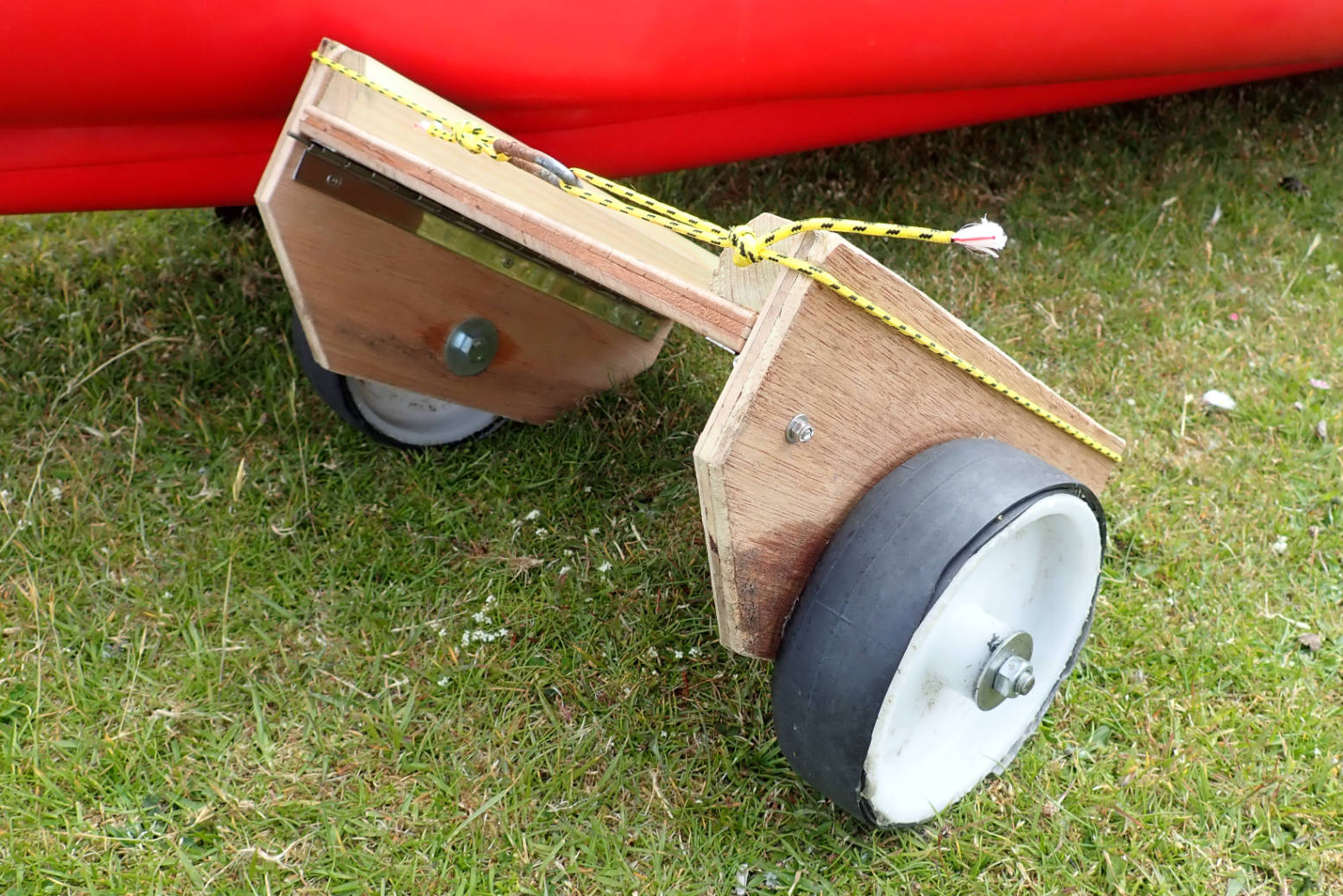
I quickly worked out what was needed: a simple and easily deployed alternative to the typical strap-on canoe trolley, like the 60 quid Decathlon example (left) with identical examples on eBay for nearly half that price. A closer look at some images shows them to be needlessly high (unstable) and the clip-out joints don’t look that sturdy in the long run, though the tyres are nice and fat and clearance is great. With these trolleys I think the V of the alloy frame would sit better in line with the hull, not across it (with bends in the tubes). But crossways simplifies the wheel axle set up. My idea was to use the IK’s own weight with the skeg to locate and fix a trolley in place. Quick to use; no strapping needed.
With workspace-and-tools mate Jon, we came up with a stable two-wheel folding platform with a drop-in skeg slot and hinged wheels which folded out to both roll and support the hull either side of the skeg. To portage, lower the boat’s skeg into the platform’s slot, pick up at the bow and roll it away.
On getting the trolley, the too-high sides were easily sawn down by an inch, and another inch got sawn off the bottom to improve ground clearance, as in the graphic. We hadn’t pinned down a way of stopping the hinged wheel plates folding inwards on the move. The trolley actually worked OK on smooth surfaces without any hinge lock, but eventually a bump would knock one side in. Until a neater idea springs to mind, the easiest way for me was stringing a loop of stretch-free Dyneema cord round the top to keep the wheel plates from folding in.
At 1.7kg it’s not that light, but as a prototype it was dead easy to make and the thing needs to be durable. Something similar out of alloy tubing (like the Decathlon trolley above) might be half the weight, but is less easy to fabricate in the front garden.
After a few miles… By chance, I was left car-less during a few days of great weather. In either direction it’s less than a mile and a 50-metre drop along a quiet road to the seashore: an ideal trolley testing scenario. What extra weight there is sits best over the wheels, and at the bow I tie a shoulder loop into the mooring line, leaving me hands-free to check my messages. Coming uphill for a mile from the beach, I could walk at normal speed with much less effort (and time) than carrying the deflated IK. It seems the width and height proportions are pretty good for stability, and the cord works well enough to keep the hinged sides up. A couple of times over rough stony ground the cord came off and the trolley folded up, or on steeper side slopes it just fell over. So maybe another 10-15cm of width would be good, but without much added height. And there must be a simple latch or lock idea for securing the sides.
Smooth on roadStable on grass
The solid plastic wheels (£12.50 for two pairs) make a racket or hard surfaces and will transfer shocks and eventual wear to the wheel mounts. Some near-identical rubber wheels cost about the same and ought to feel less harsh. But first, I may waste some time wrapping some spare motorbike inner tube around my current wheels.
Dom from Devon’s version 2022
Having a trolley makes an IK nearly as versatile as a packraft: a boat you can start here, end there and easily transport back across the difference.
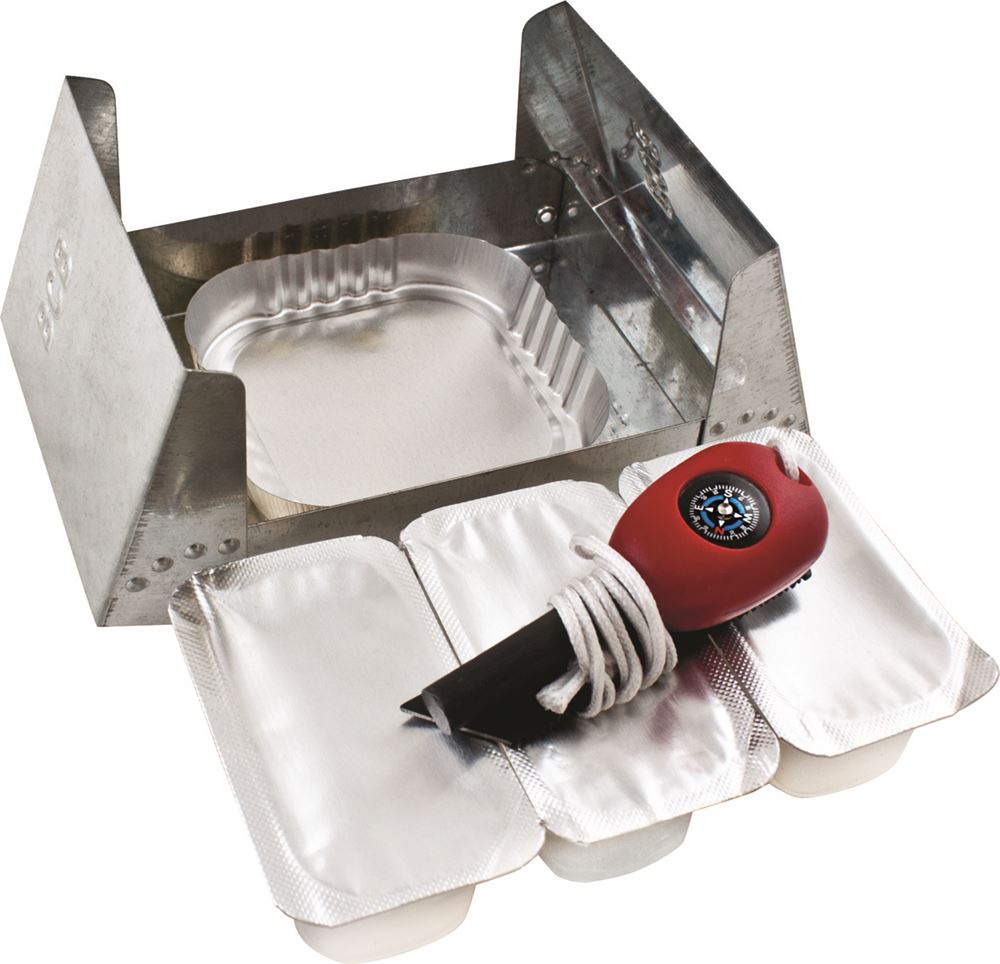
In a line Lightweight, compact, airline friendly ‘day’ or back-up stove using ethanol solid fuel blocks 9which are also hand sanitisers).
Cost ‘Shoe polish’ tin (from £1) + optional band + cross-stand (from £5) + FireDragon blocks (from £1.14 a filled tin). Total: around £8.
Weight Tin (25g) packed with fuel: 133g. Cross-stand 28g, 10cm wind shield 7g. All up: 168g + lighter.
Where used River Wye, Knoydart.
Light, simple, compact Fast set-up, easy to light Sits low (stable and out of the wind) Tin makes a large burning area and is refillable Tin fits inside a 400ml Tatonka folding-handle mug No noise, no smoke, no smell, no residue on the pot Fuel cools and resolidifies quickly and will relight later Presumably can be carried on a plane, especially if you label it ‘hand sanitiser’ (which it also is). So light and compact it can be used alongside or to back-up a gas stove or a woodburner
Expensive at around 37p to boil a big mug Fuel may be harder to find than gas cans at outdoors stores, but sold in ‘home & garden’ stores like B&Q
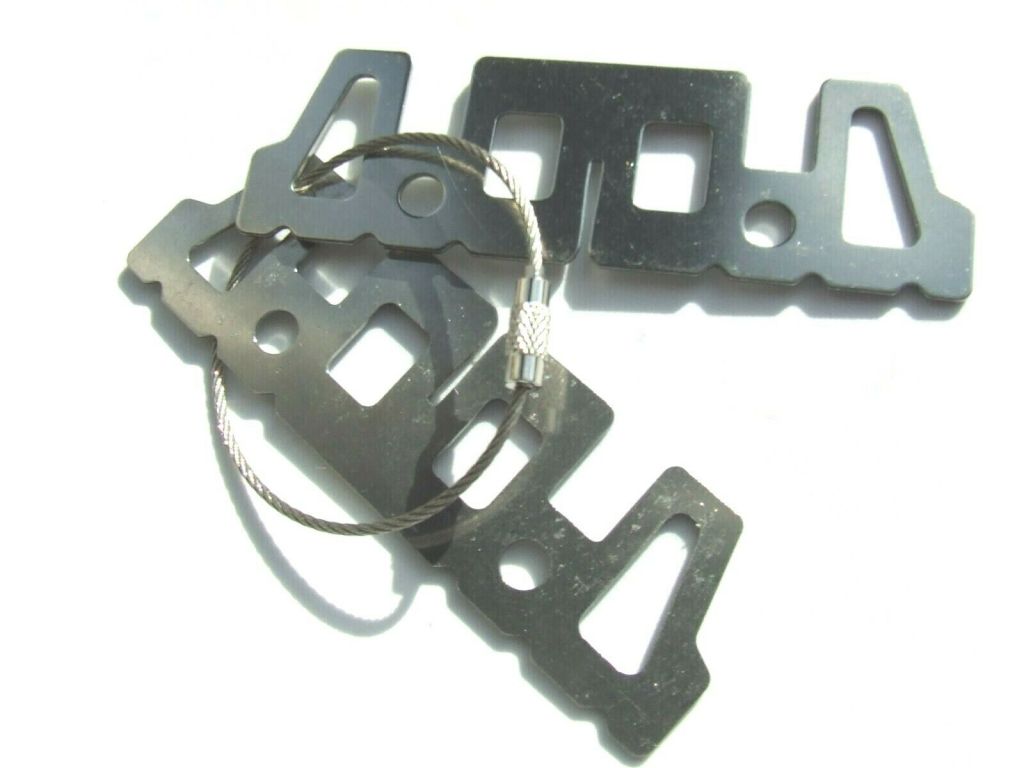
‘Shoe polish’ tin (mine was 30mm)Stainless cross-stand + pointless wireFireDragon fuel blocks
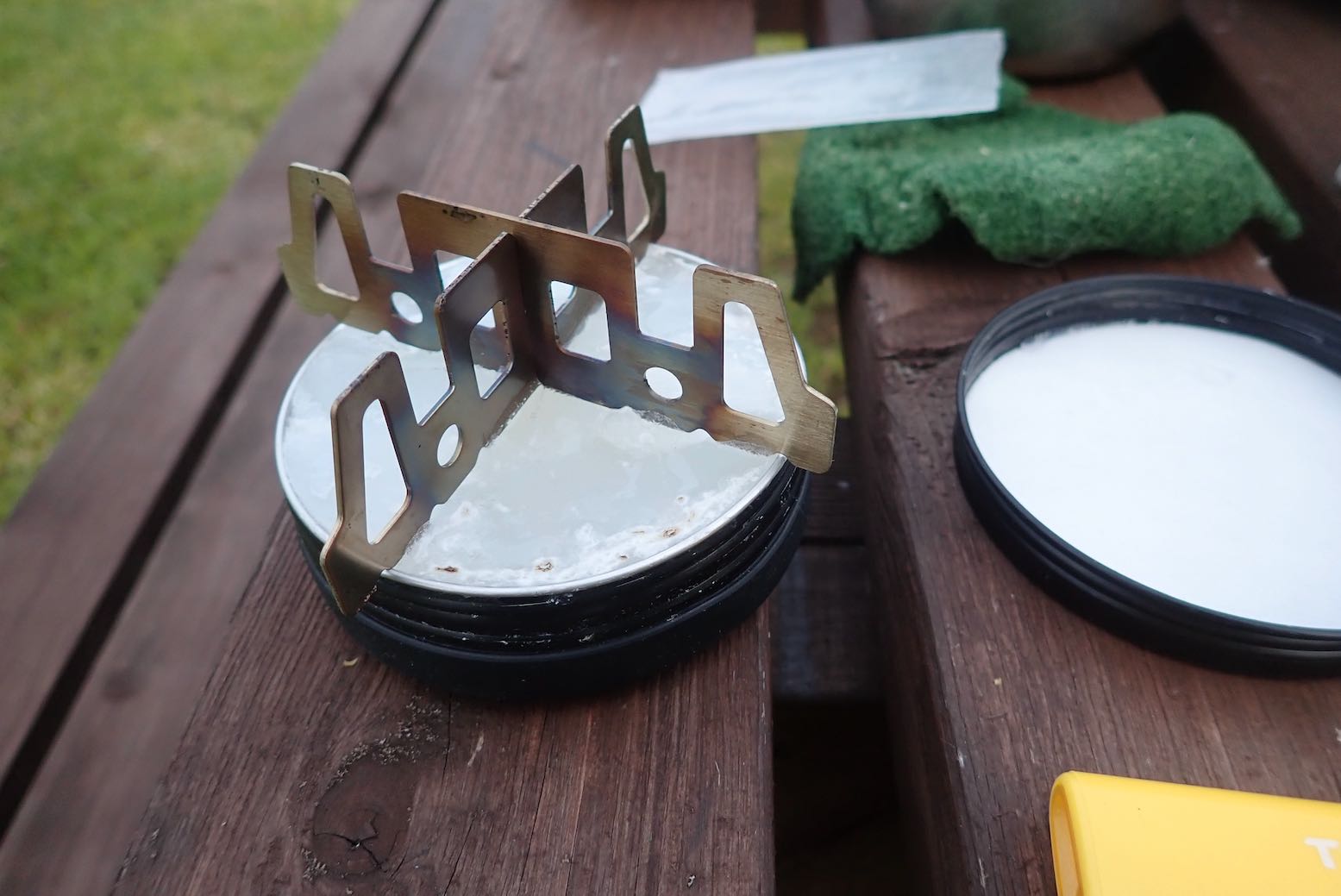
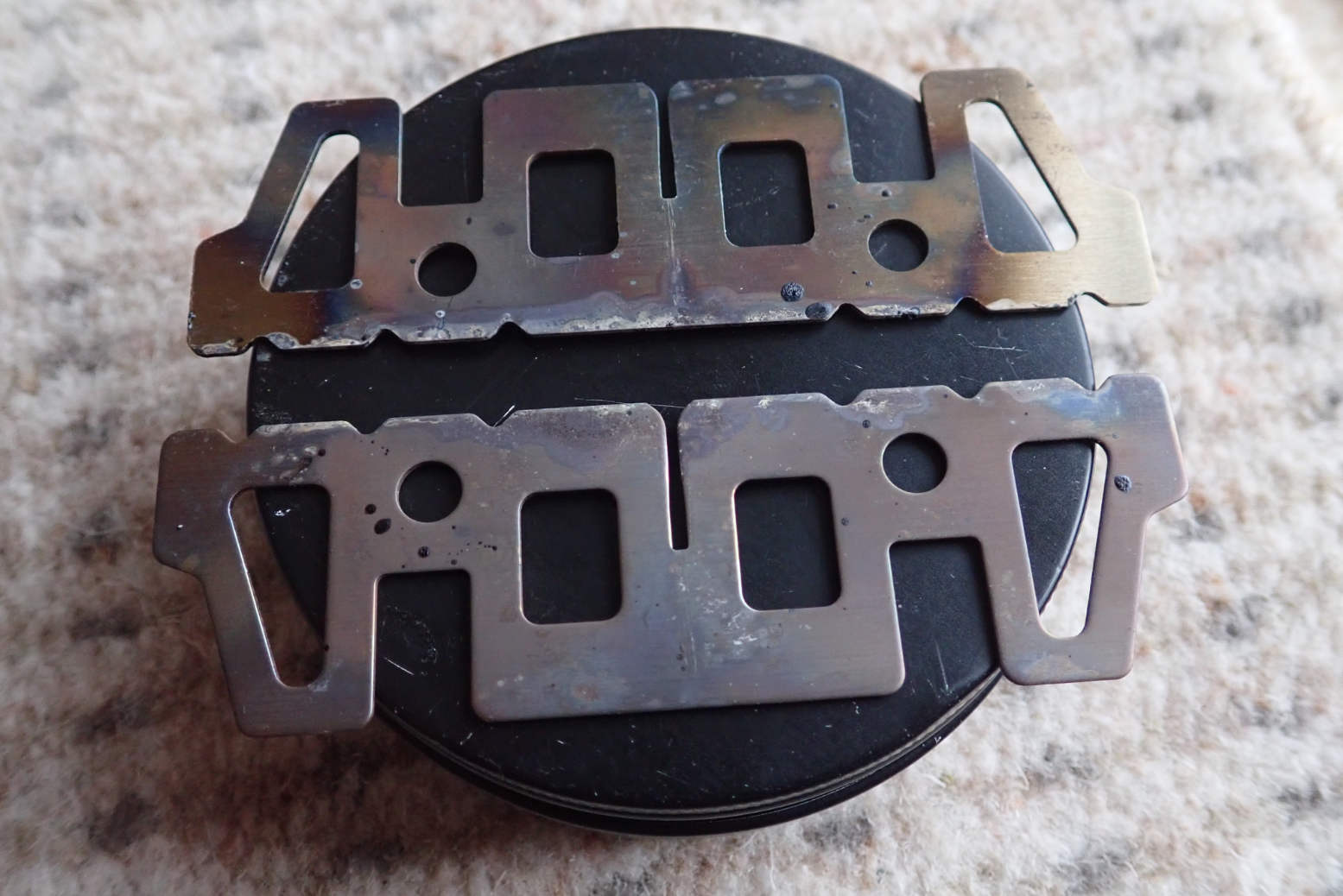
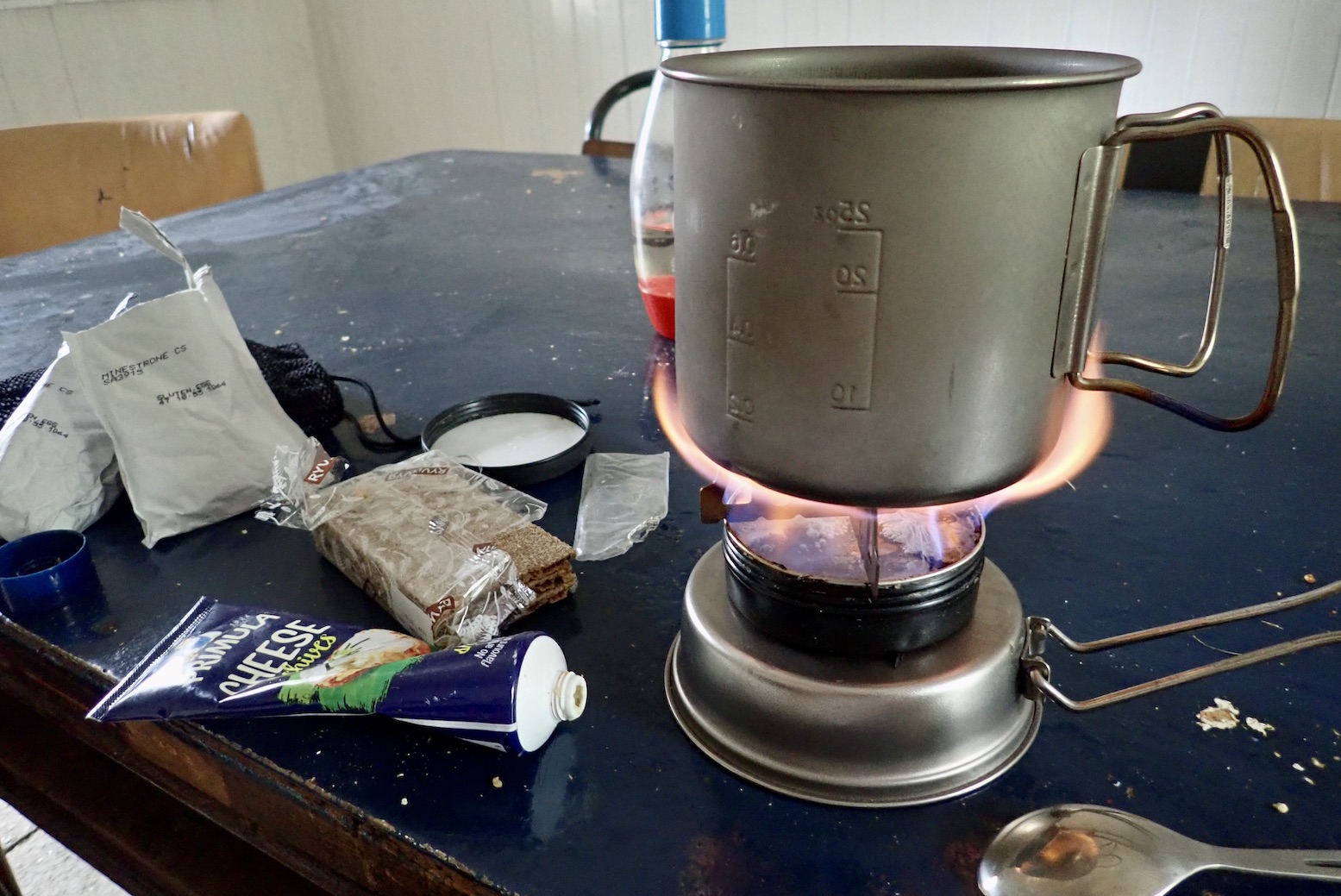
Review: This Gimp Stove (a military acronym, apparently) isn’t something you can buy off the shelf. My bush-crafty mate put it together once he learned FireDragon ethanol firelighter blocks could be packed into a ‘shoe polish’ tin and easily refilled and re-lit. He identified a small, screw-top tin (multi-buys off eBay or amazon) with the right diameter to fit the notches of the CNC-cut stainless steel cross-stand also widely sold online from around a fiver. For a stable set-up, finding a tin to fit this cross-stand’s notches is the key. Or you can as easily make your own stand to suit any tin you like, but the tin’s lid needs to be airtight so the fuel doesn’t dry up. My mate even added a silicon wrist band round the base so you can seal it good and tight.
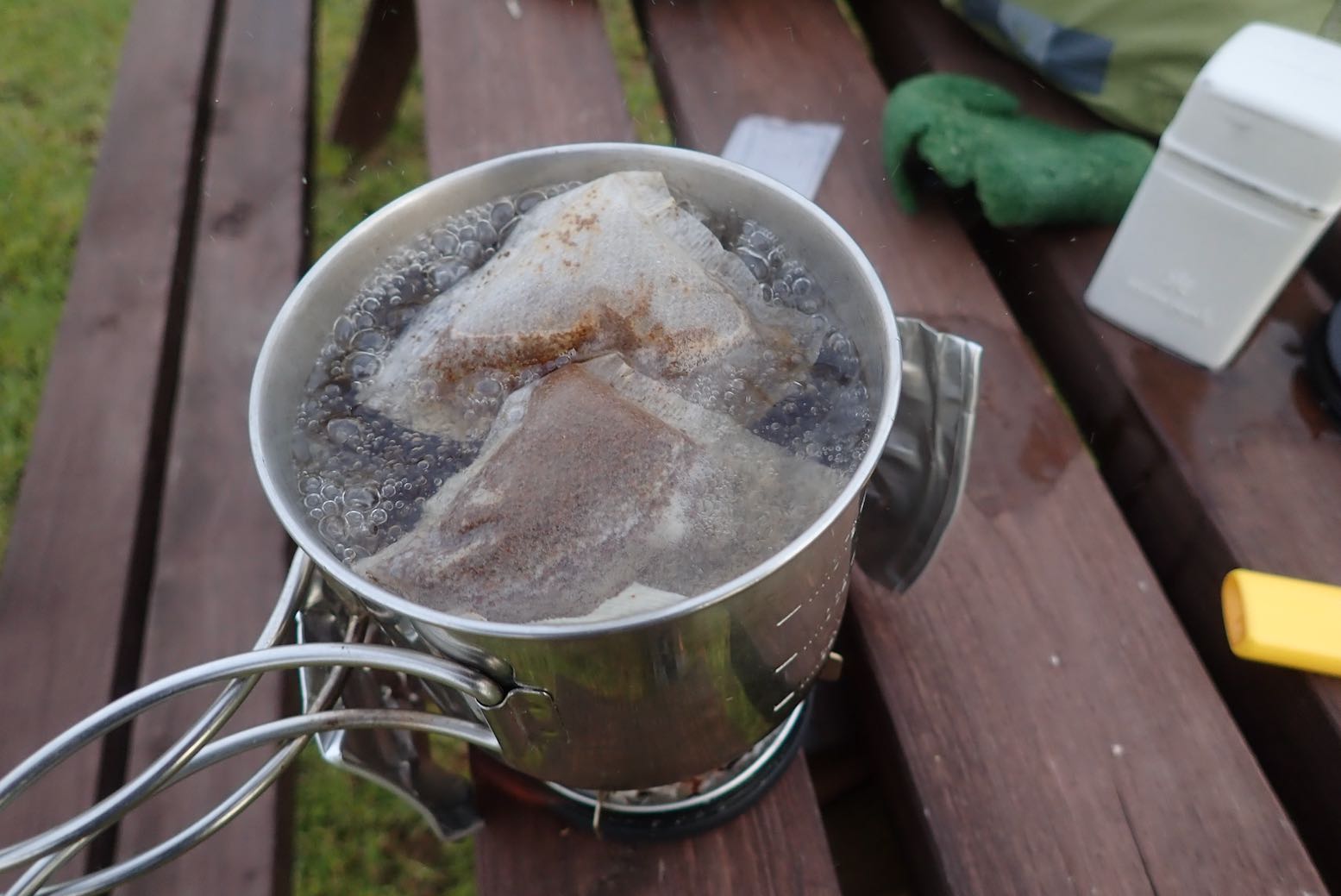
I managed to cram about four blocks (108g) into my ‘100ml’ tin (actually more like 130ml). From this I got three 360-ml (big mug) boils in the field. To extinguish blow it out, or smother with the lid. The liquified gel quickly cools and resolidifies and will readily re-ignite next time. Timings were 4 minutes tested indoors, and about 7 mins outdoors, using a thick tinfoil windshield from the base of a fruit pie or a take-away curry. There is no noise, no smoke, no smell and unlike toxic hexamine tabs, no residue on your cup or toxic smoke. On the first freezing morning of our Wye trip, even though I’d slept with a 45% full gas can inside my sleeping bag, it failed to boil my water once out in the freezing morning air. The Gimp would have lit up readily and done the job. And the fact that you’re easily able to place a windshield on the ground, and need clever, faster but totteringly unstable, bulky and pricey JetBoils is another tick for the Gimp. All in all, the Gimp is a handy, cheap and foolproof pocket stove. I used the Gimp again on a four-day Scottish trip to heat up water for lunch soup. Light and compact enough to carry in your day pack, it made the whole business effortless, while saving gas for other meals.
Full tin + stand = Gimps stoveNote the rubber band to help seal / open the tin
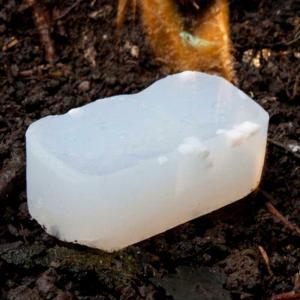
A one-ounce block of FireDragon
FireDragon Fuel Made by BCB International from waste vegetable matter, the blocks come in individual sealed 27g (1oz) pods, bought 6 or 12 at a time. It’s the same (and can be used) as hand sanitiser. Once the packet is opened, the block (a mashable wax of ethanol or denatured alcohol, left) will evaporate and shrivel, but sealing in the screw tin works fine, at least for a few days. Long term you may want to verify this. The good thing with a full tin or two is you have no packaging to get rid of responsibly; you just come home with empty tins to refill. Apparently you can ignite with a flint (BCB’s stove kit, right). I tried but couldn’t do it on used fuel, even with some magnesium shavings (the fuel lit right up with a lighter). I may try again with a fresh block, but honestly Bushcrafters, a lighter takes one second. The best price in the UK works out about 28.5p a block by the dozen, so a penny a gram with a big mug boil at 37p – quite expensive. And you’ll struggle to find it at that price; very often it’s nearly double, or gets that way with postage. Your best bet seems to be larger Go Outdoors stores. I would guess you could get at least 30 same-sized boils from a typical 220g can of gas costing around £4 which is more than half price.
I skimmed through an online review (one guy was even wearing camo gloves!) and apparently the FireDragon boiled loads faster than hexamine (which I’ve never considered trying). I’m told the Brit army now use FireDragon instead of hexamine.
Right now [April 2021] it’s a great time to kayak the Thames through London. It’s only April but due to you-know-what the Westminster tourist barge scene is dormant, making that brief but lively stage a bit less fretful. Down at water level we paddlers may be hyper vigilant, but can the bloke doing a U-turn in his heaving tourist catamaran while doing a commentary see us fending off the standing waves and refracted wakes? As a barge-tourist in a Union Jack bowler hat asked me last time; ‘Is this allowed? Yes it is chum, but a kayak on this part of the Thames is still an incongruous sight. The congestion and the standing waves pushed up by some bridges at certain times can feel a bit like skateboarding in a gale on Runway 3 at Heathrow.
Demanding…
Downloading the PLA’s mammoth 130-pageTideway Code is enough to put anyone off, but I do believe this edition (dated October 2020) is less anti IK than a previous version I read. At the time I recall seeking clarification from the PLA’s media person and got an arsey corporate riposte. Has the Lockdown IK consumer surge turned the tide on the PLA’s prejudice? It’s the old problem of misconflating a clueless beginner in £49.95 Aldi bin bag with an alert and well-equipped paddler in a decent high-pressure hybrid. I say: pick your tide, keep right and be observant. For me the biggest peril was dodging the horizontal scythes of the Putney rowers who seem to go up and down across the whole width of the river as they please. They do need a lot of space.
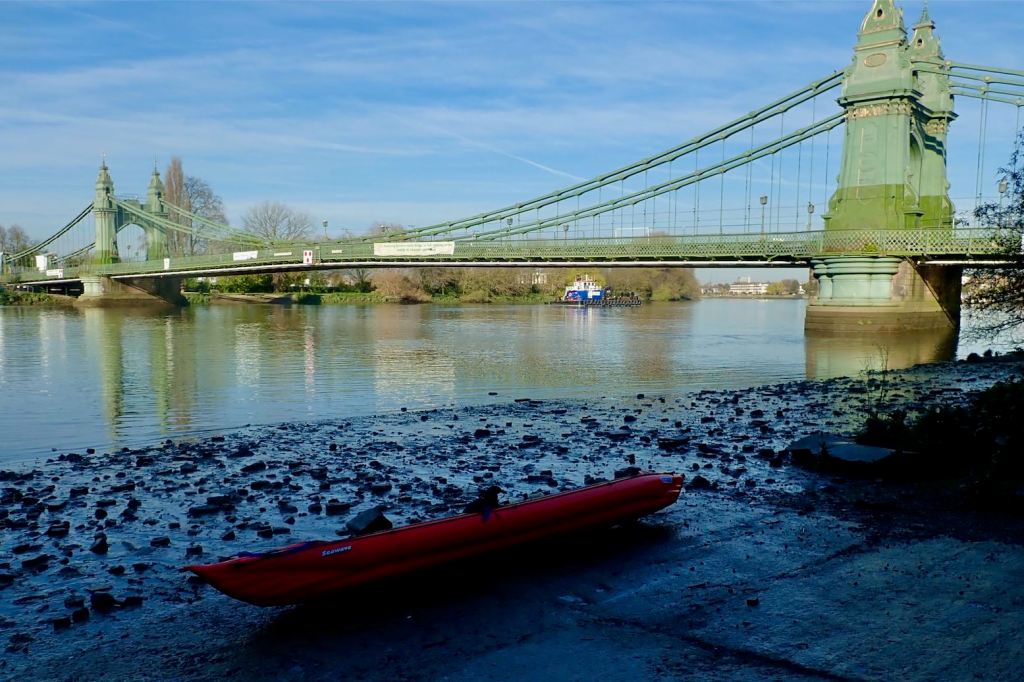
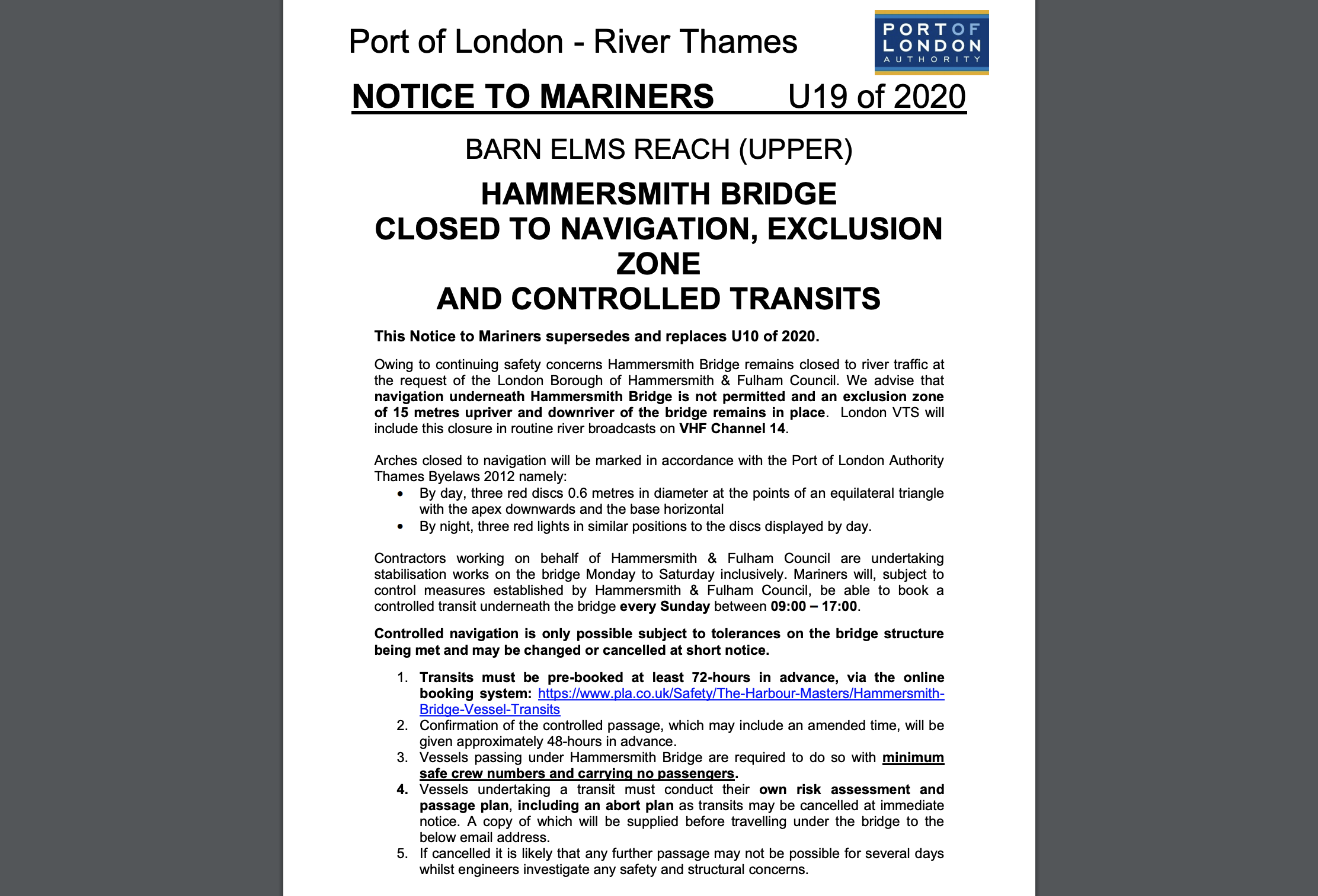
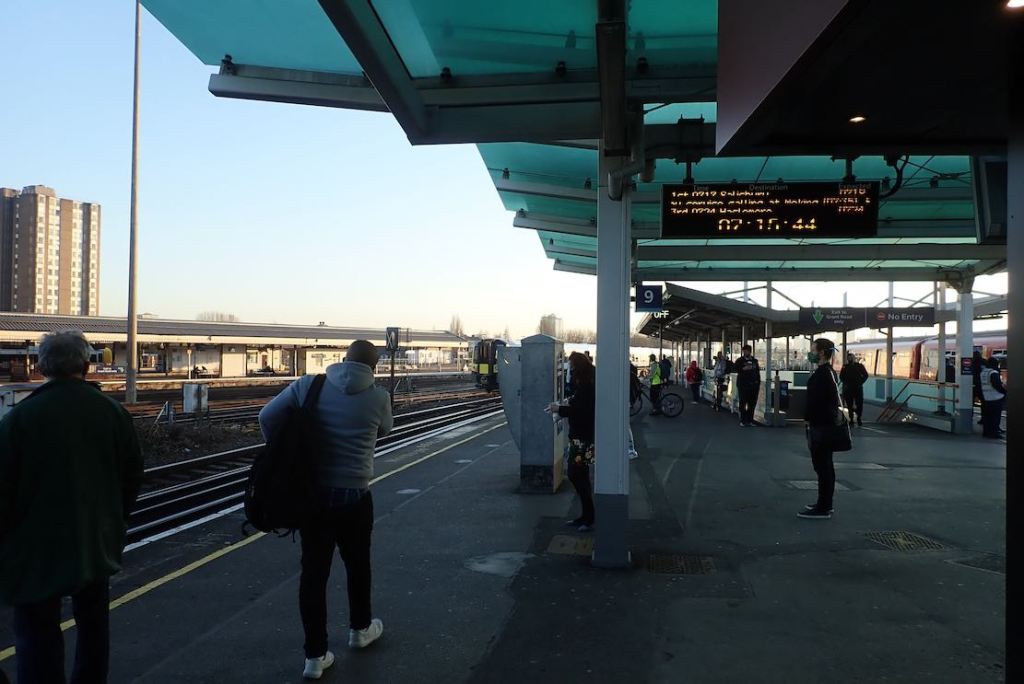
Mortlake to Mayflower (Rotherhithe) This 21-km (13-mile) stretch lined up well with 10-minute walks from stations at either end. By Rotherhithe the excitement, such as it is, is over. And skipping the five miles from Richmond gives an easy three hours on the river; a nice early morning or afternoon paddle with good light for great photos or views of the Thames’ bankside icons.It’s dawn and a Sunday, so it takes two buses and a train to get to MortlakeYadda, yadda…Spacious put-in at Bulls Alley off Mortlake High Street, complete with benches7.15am. All is calmA bit of early morning rumpy-pumpyHead buoyGenteel Georgian waterfront around ChiswickArseache! Hammersmith Bridge is Falling Down and closed to navigation. Ie: you can’t paddle under it in case it collapses on your head. But on the north bank there’s a handy jetty and this slipway (above) on the downriver side is a 5-minute carry
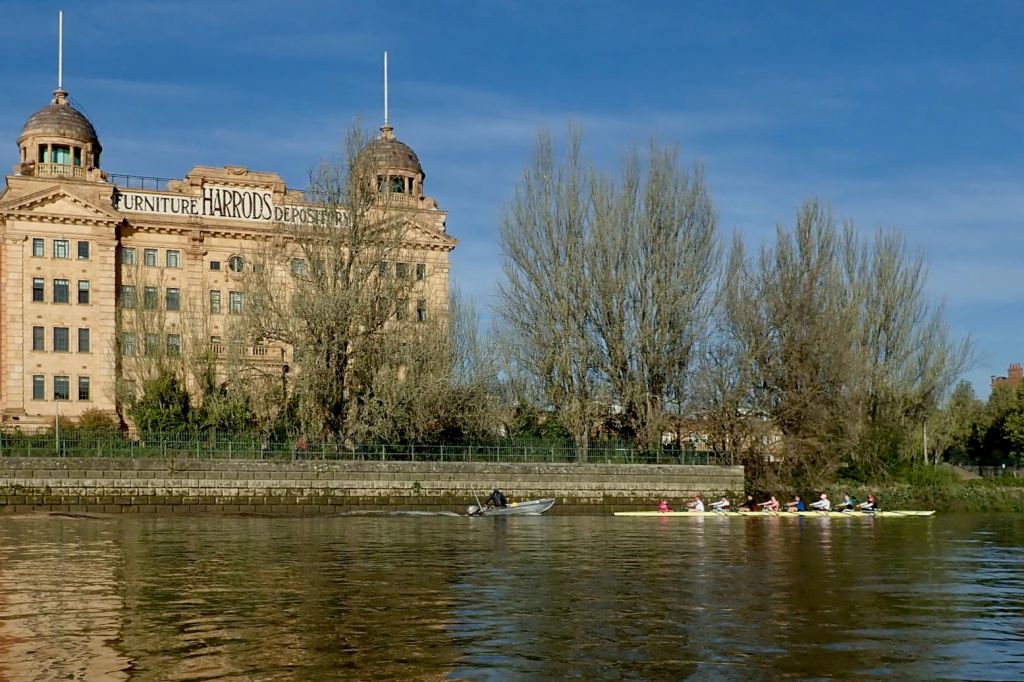
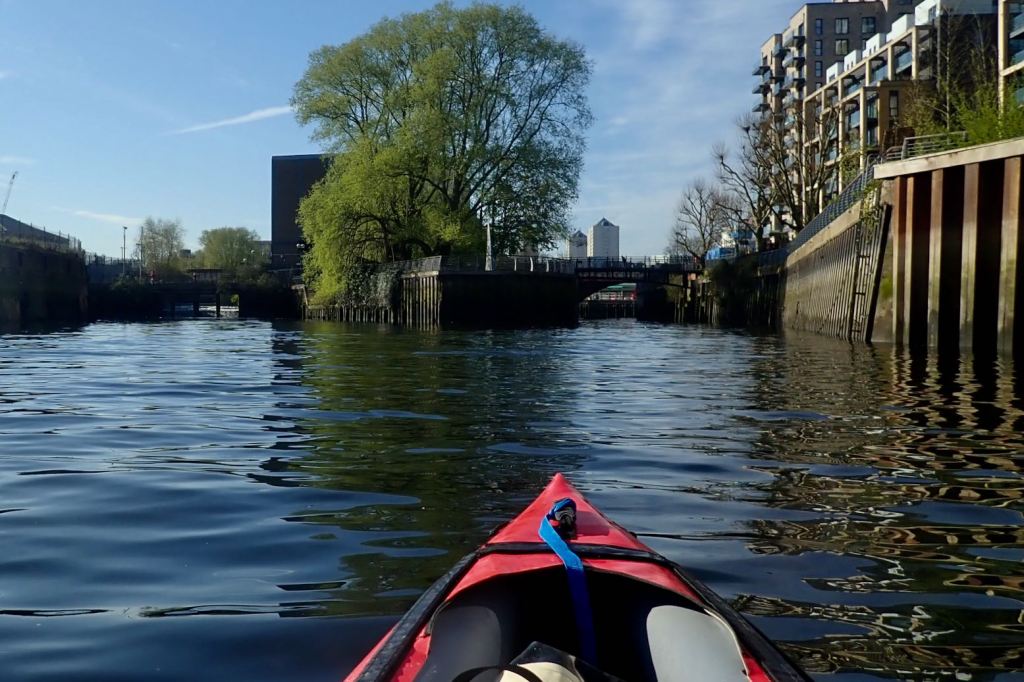
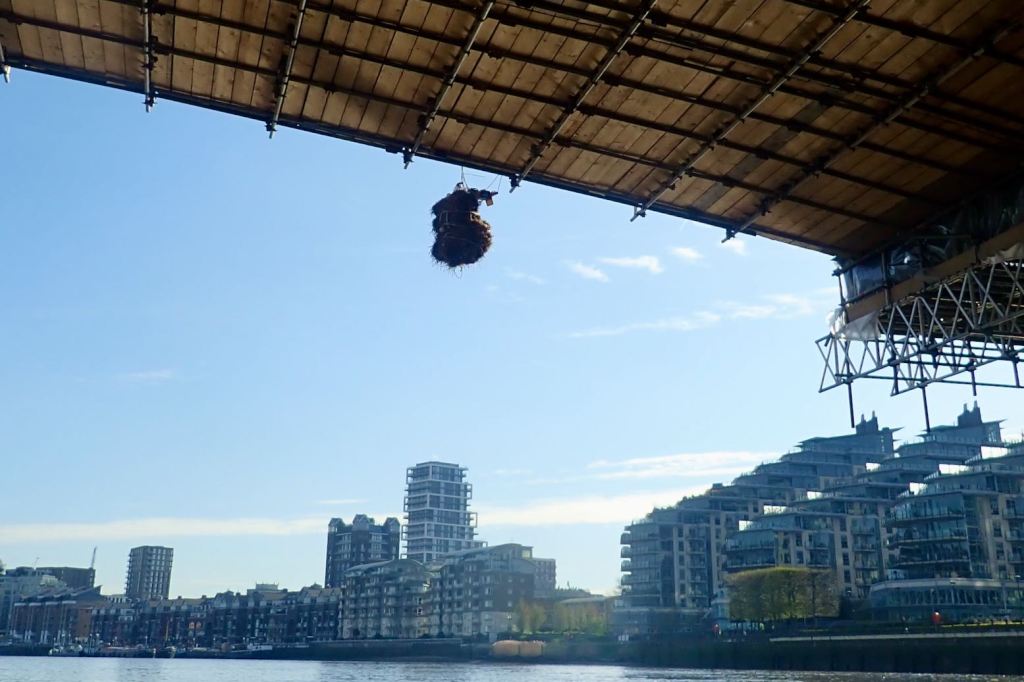
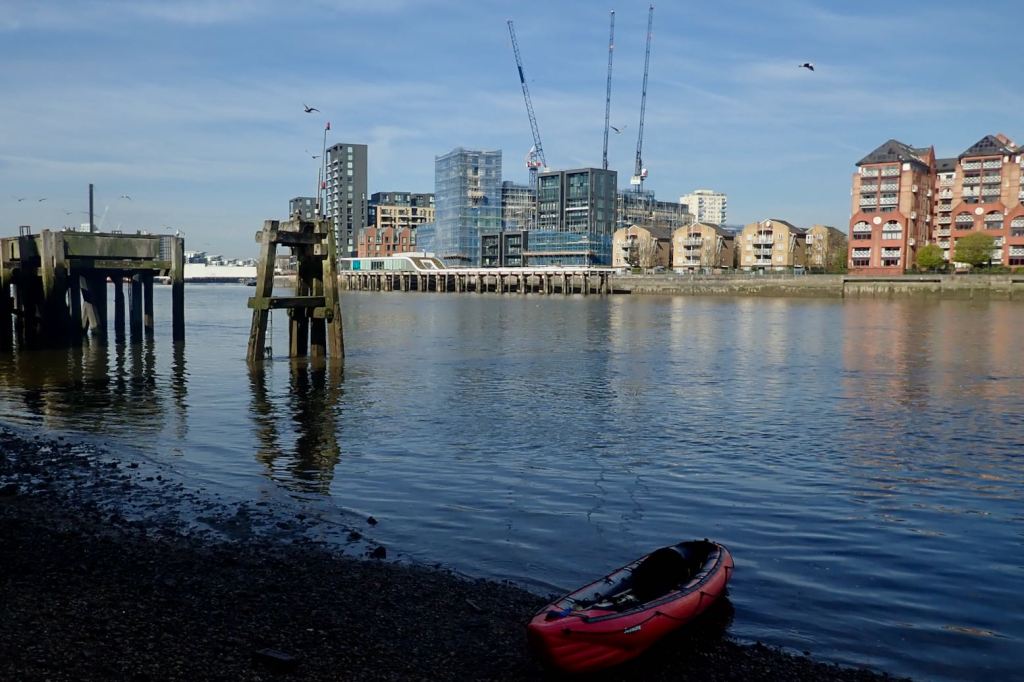
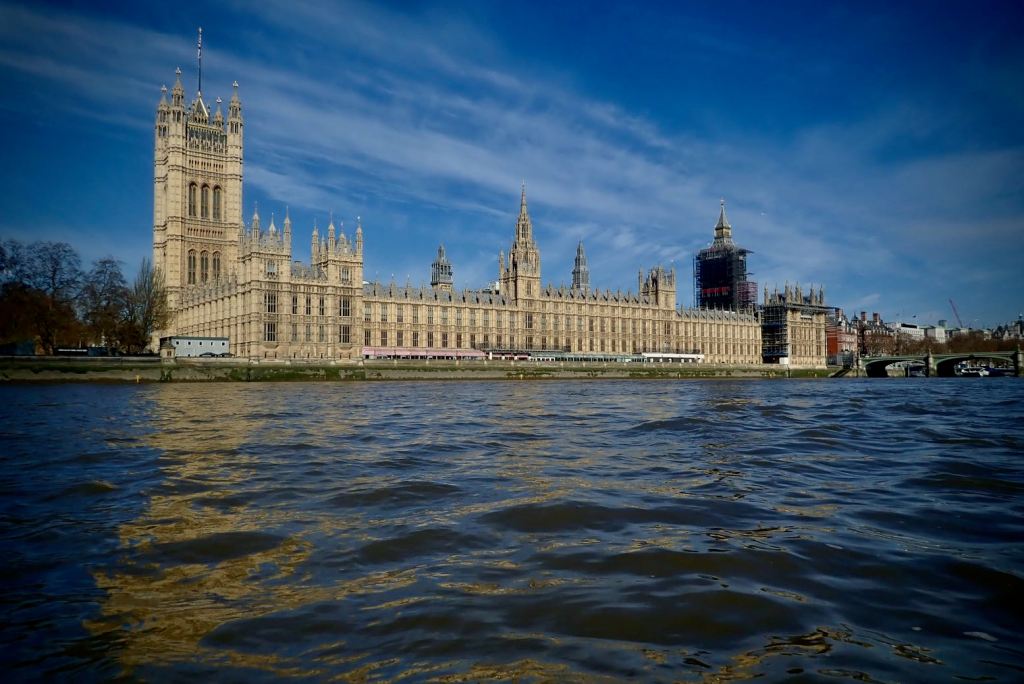
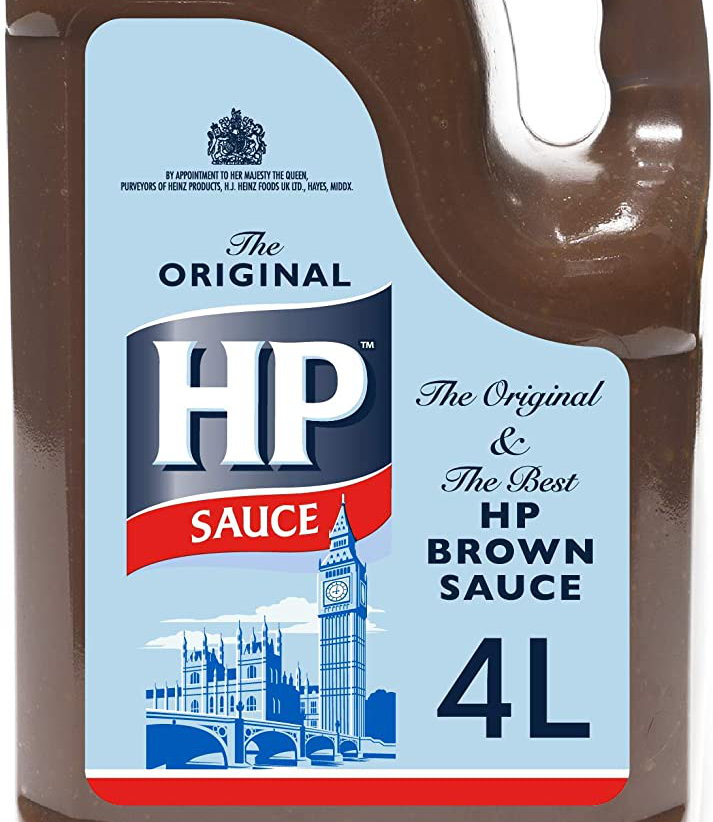
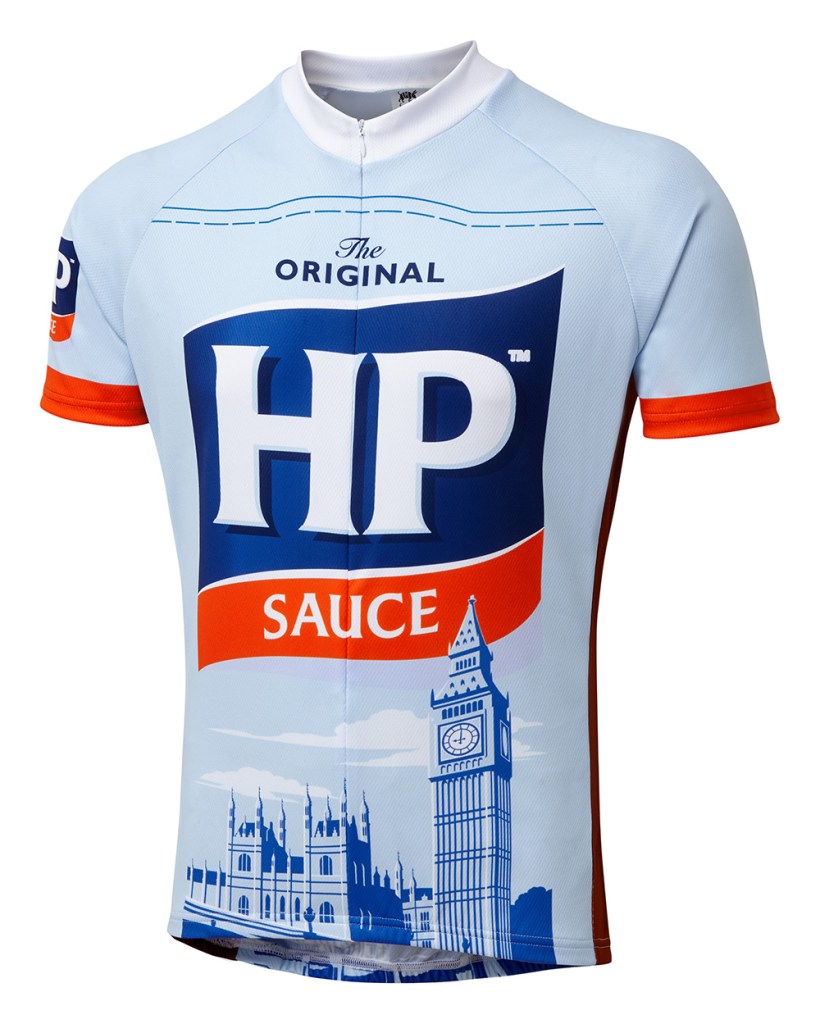
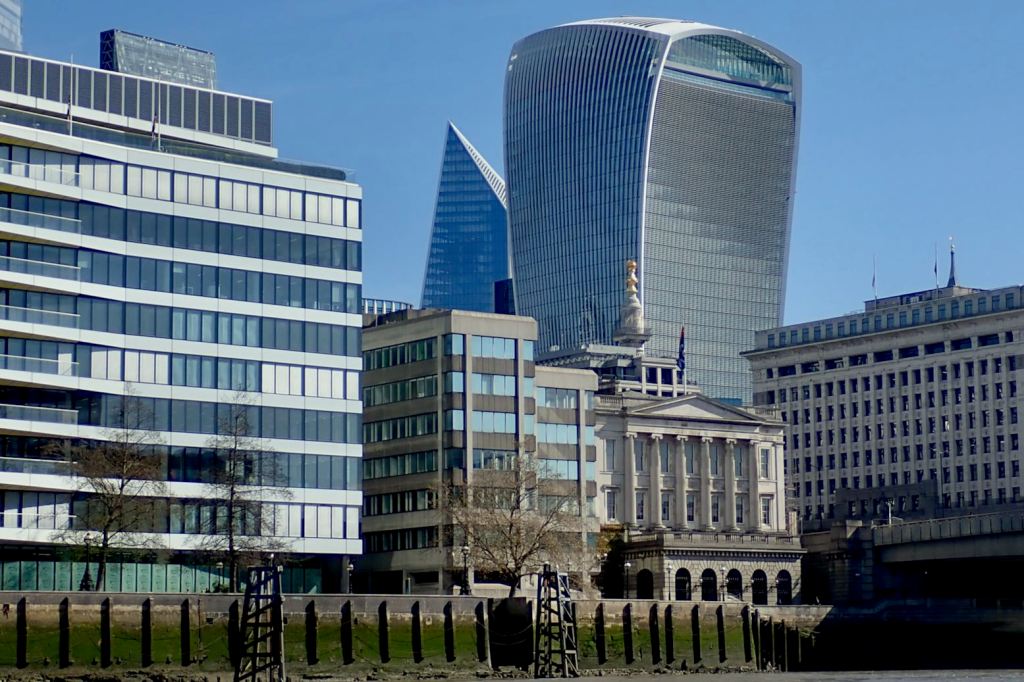
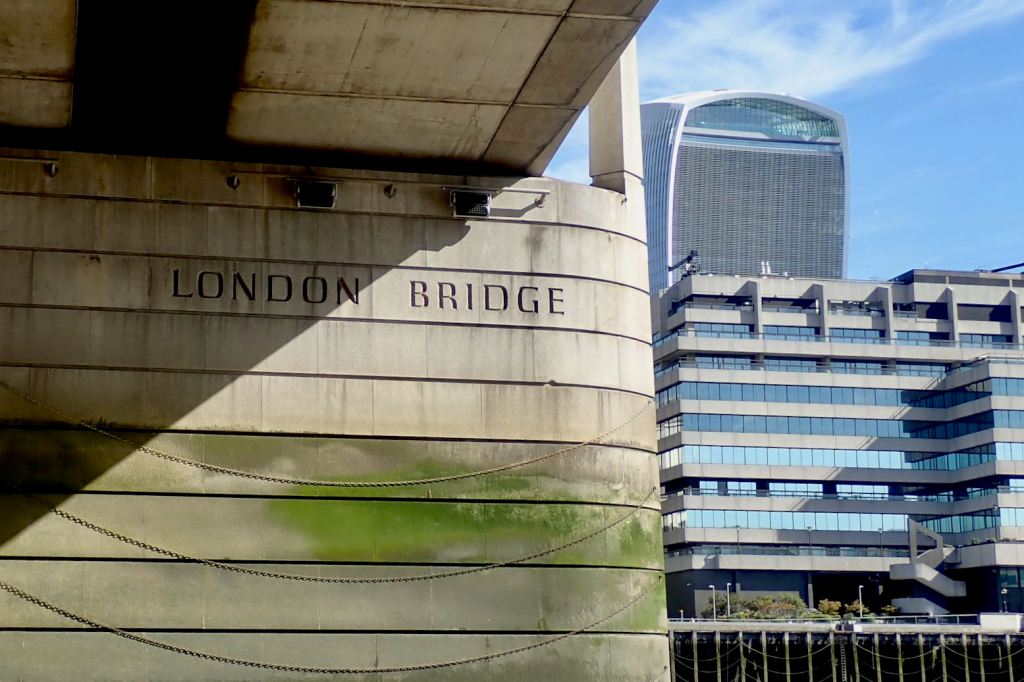
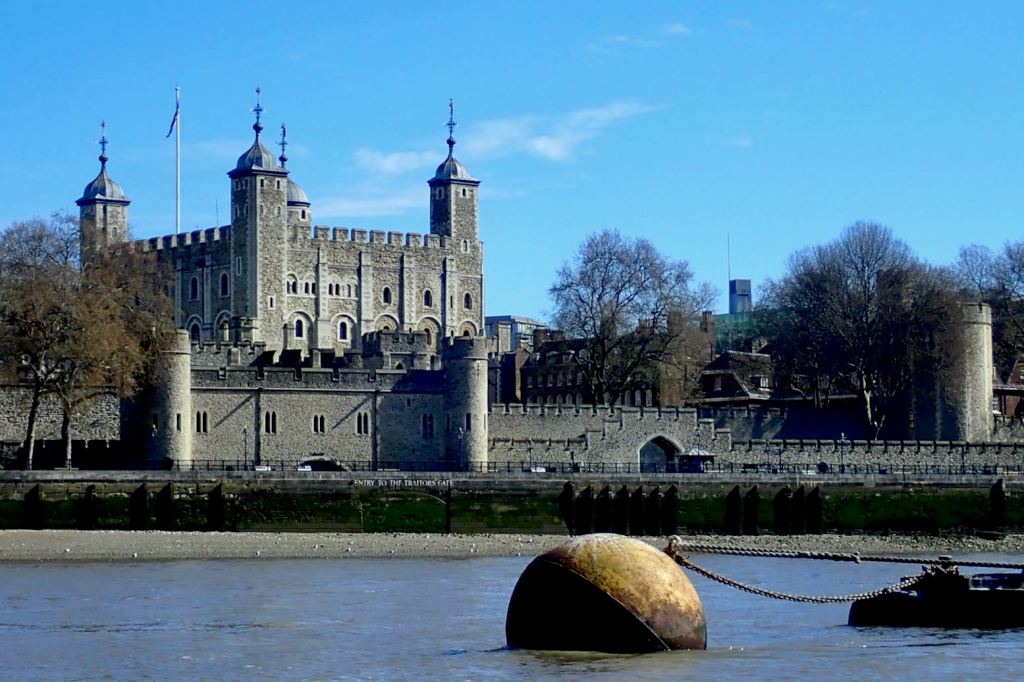
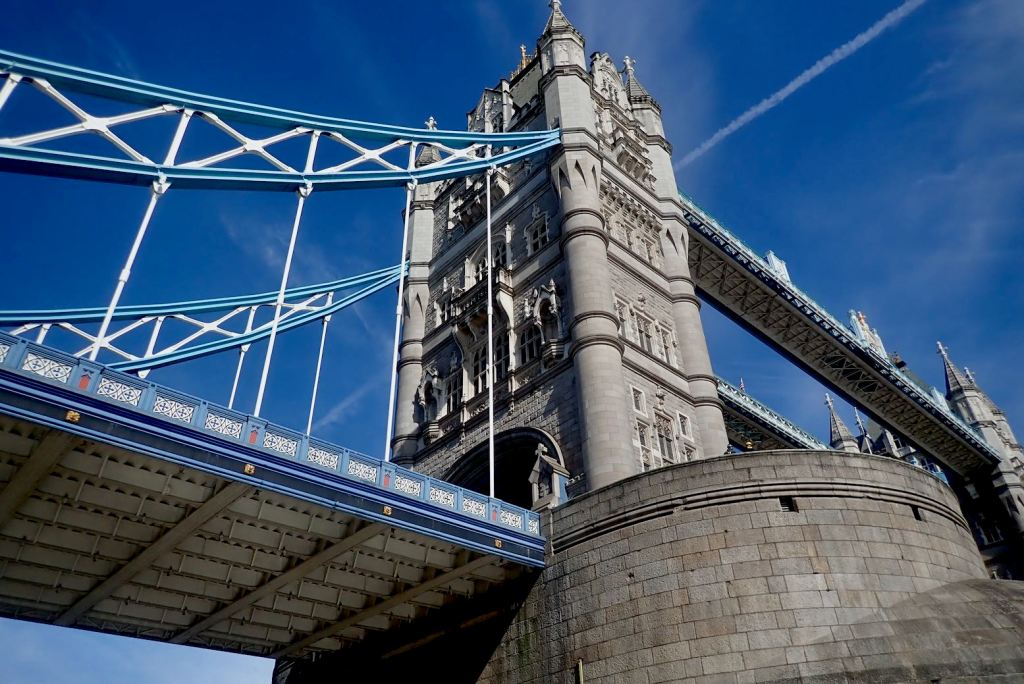
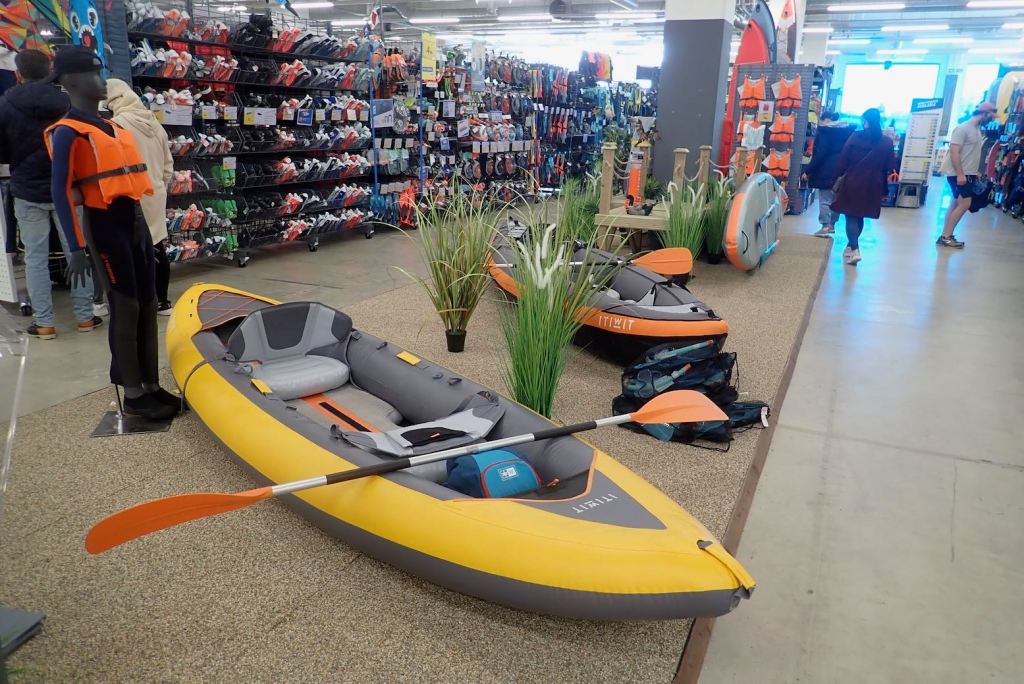
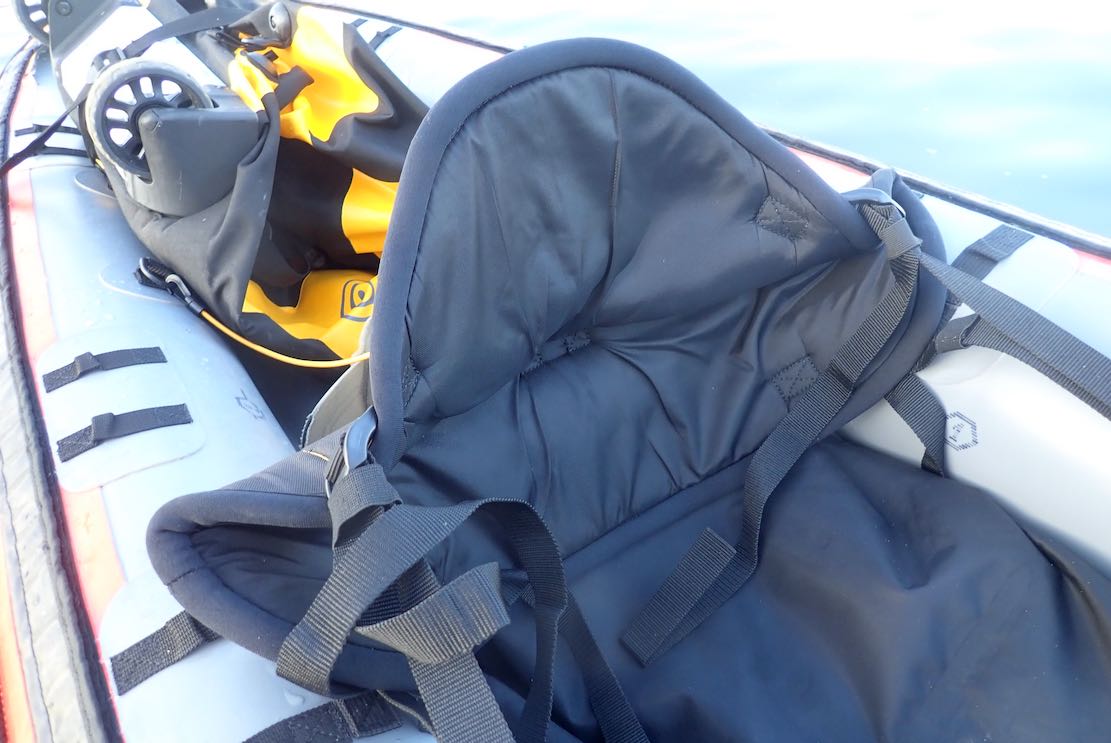
The Hammersmith’s brittle, ageing cast iron dates from 1887 and is suffering from micro-fractures. All together now: “Build it up with iron bars, iron bars, iron bars. Build it up with iron bars, my fair lady“You might try and book a controlled transit (Sunday’s only) with the PLA but I don’t think kayaks would qualify. It will be closed for years.Once a Harrods warehouse, how expensive flats9am. Putney rowers getting their oars on.At Wandsworth I nip up Bell Lane Creek where the Wandle comes in. Big weir drop to the left, and a bit further up on the right, another weir drop at all but HW. See: Wandle: An Urban Packrafting NightmareHanging hay bale? WTJoF? Explanation in the PLA Tideway CodeNo arcane signage here up Wandle creekIt’s chilly. Nature’s call cannot go unansweredRiver racers. My money’s on the YellowsHoly Mother of all Parliaments. The latest scandal? The ‘chumocracy’ of lobbying (there have been a whole load more sinceNamed after the famous HP sauceAlso available as lycra cyclewearIt gets a bit choppier just after Westminster Bridge as the current backs upLondon Eye still looks as amazing as ever. I wonder if they grease the axle and tension the spokes once in a whileRectilinear skyscrapers are just so last centuryA few years back sunlight reflected off the ‘Walkie Talkie’s’ concave face (20 Fenchurch St) and melted a car in the street belowNot falling down any time soon, but small standing waves soon after can make you thinkBy the HMS Belfast it settles down again. On a neap tide at least.‘Send him to the Tower!’This is what Hammersmith needsAfter Tower Bridge the river widens out and the powered craft can gun it A mile downriver, the Mayflower’s looking a bit shabby. Don’t people go to pubs any more? In 1620 the famous ship embarked from here for the New WorldTourists RIBs slalom up and and down the Pool of London like giant jet-skisMy modified seatback worked great. Just what was neededThree hours from Mortlake and plenty of space to dry out.Now that’s what I call a packboatGo west young man. And never come back!From the beach it’s a 10-minute walk to Canada Water station. I pop into Decathlon nearby to admire some Itiwits; quite possibly Britain’s most popular IK
As soon as I received Seawave 2 last year I ditched the heavy and squidgy Gumotex seats (right), and implemented my proven packraft inflatable seatbase + SoT backrest idea (left and below right) at a fraction of the weight and bulk.
The seatbase is fine of course; it weighs next to nothing and lifts you off the unavoidably soft floor for a good ‘raised-bum’ paddling stance. I’ve been using it for years, but sometimes I think I could use more back support than the SoT foam backrest. It presses nicely into the small of the back, but like a low-backed chair, is not something you can lean on. You could say in a kayak you shouldn’t be leaning on anything, but sitting bolt upright, knocking out a series of ‘searchlight beam’ torso rotating powerstrokes. But after too much of that you just want to lean back on something.
I picked up a used BICSport Power Backrest (for an SoT; right) which looked like it might be more comfortable. At 37cm, it was tall but lacked a hand rear pocket and instead had a centrally positioned adjustable bungy to counter-tension the back and keep it upright. Using it for the first time on the Wey last week, it started well but after a few hours collapsed as the pull from the front and back straps crumpled the backrest.
Collapsed backrestNo good
The problem: lack of stiffness. A backrest needs to be stiff like a chair back, while a seatbase wants to be soft like an armchair. One provides support; the latter takes your weight. The best way to fix the backrest was to insert a firm plastic plate. It just so happens I kept that very part from a rotting old Aire Cheetah seat bought 15 years ago for my Sunny. I got that boat back last year, did it up with new seats and sold it. How’s that for recycling!
Through-stitching complicated thingsPlastic insert trimmedIncision madeFoam wouldn’t support a gnat in a spaceshipStuffing in the insertNearly thereTrying to seal the edges for sewingBut over-gluing was best. I should be a Caesarean surgeon
To be honest I’m beginning to think separate backrests and seatbases are a bit of a faff to fit and especially getting the seatbase just right under you when getting in and out a lot (did someone say ‘Wey‘?). It was ot that hard to attach the packraft seatbase to the BIC backrest, and like all these mods I do, is easily reversible.
For the back I bought another Chinese cheapie IK seat (left and below right; with back pocket; about £25) as I did for the refurb’d Sunny. The seatbases on these one-piece seats are just an inch or so thick; OK of a molded SoT but too low for the flat floor of an IK. So I attached a packraft base to it which provides the all-important raised position. The backrest is just more bendy foam so may need stiffening but we’ve found works fine as a second seat as the Mrs who never paddles like a Maori raider anyway.
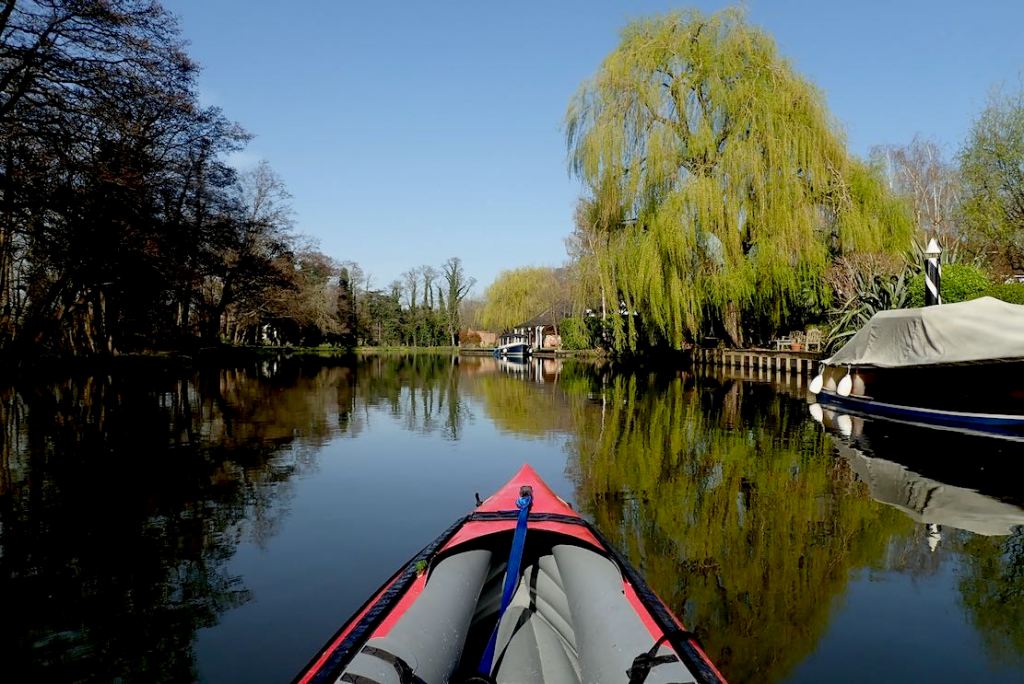
One of England’s first navigations, dating back to 1653. That’s probably why this historic canal feels quite natural and river-like, apart from the virtual lack of current.
All hands to the barrel pump! The day will be long, sunny and warm. High time to tick off ideas matured over the winter months of Lockdown. First on the list: the River Wey from Godalming to Weybridge in Surrey. Or should I say, the historic canal called the Wey Navigation which is paralleled in places by the old river. It’s one of England’s oldest navigations (commercial inland waterways) which once connected the Thames with the Navy base in Portsmouth. At the time a safe way of transporting stuff, including munitions produced near Godalming, without risking encounters with Napoleonic marauders in the Channel. For years I’ve been unsure whether the Wey was a dreary canal with more locks than the Tower of London, or a grubby, semi-urban river with weirs and other obstructions. Turns out it’s a bit of both but better than expected. All I had to do was RTFM!
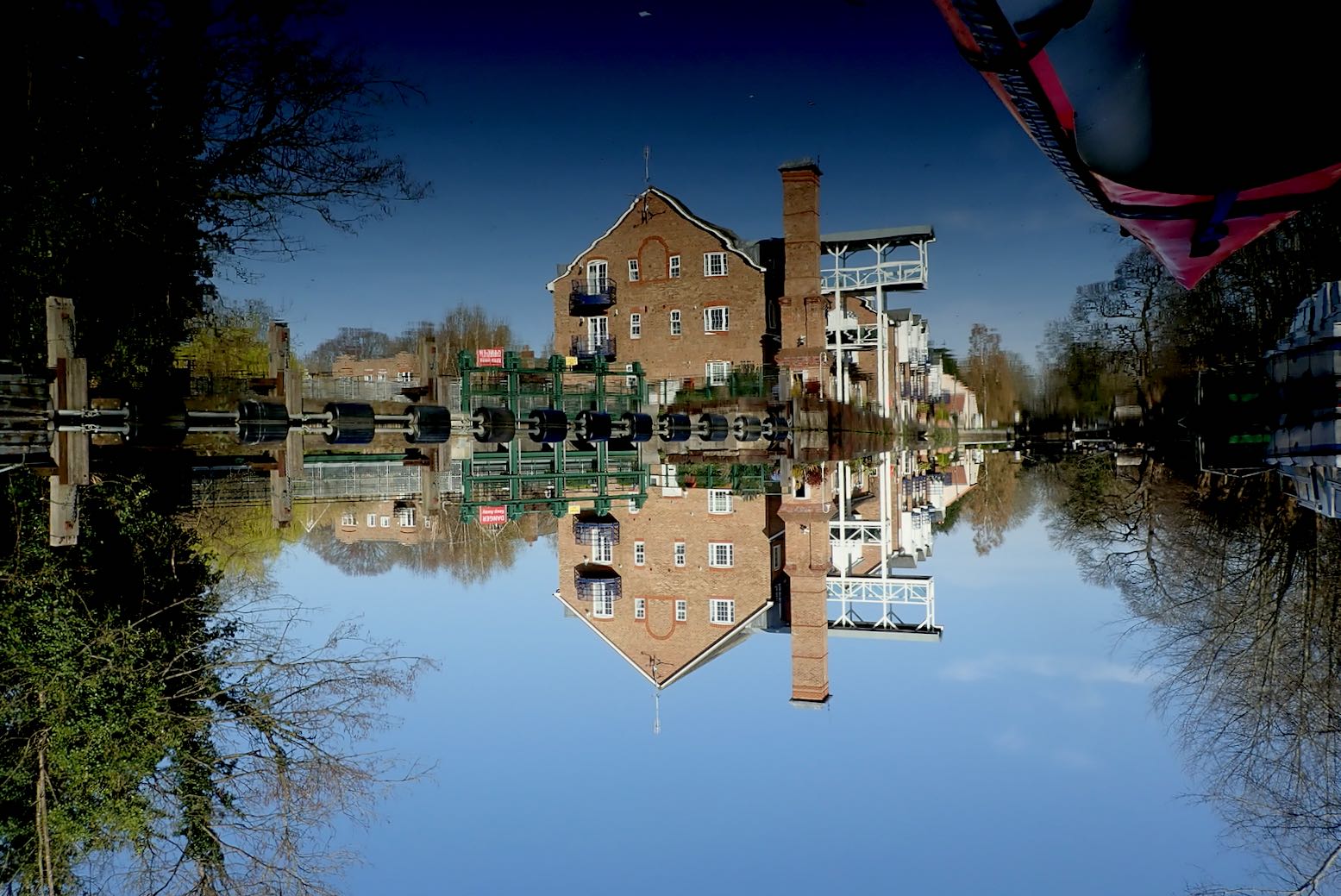
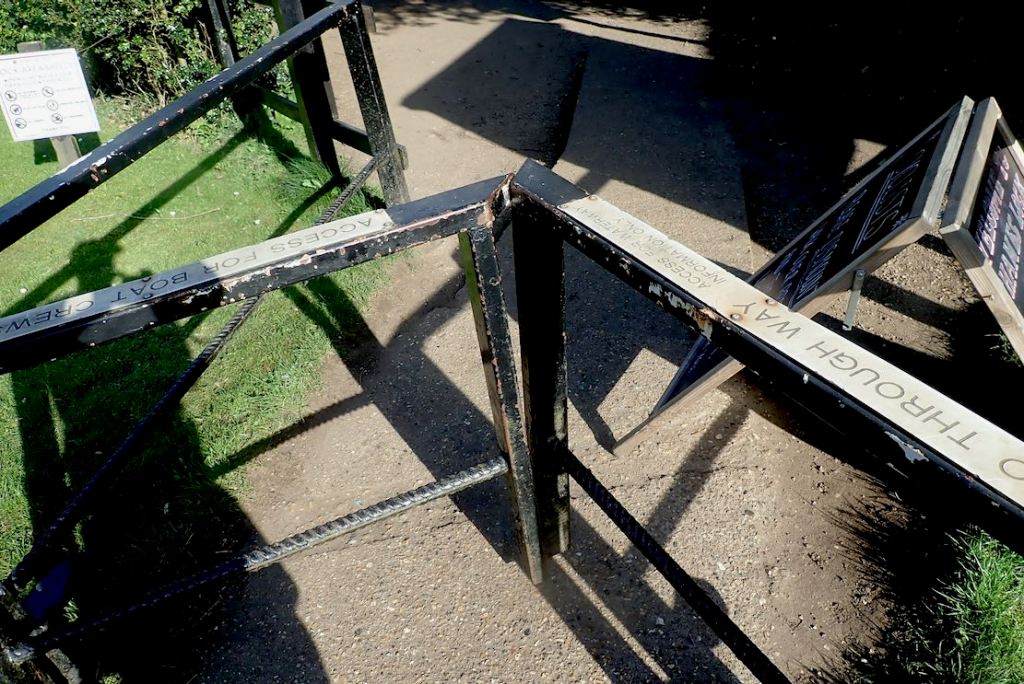
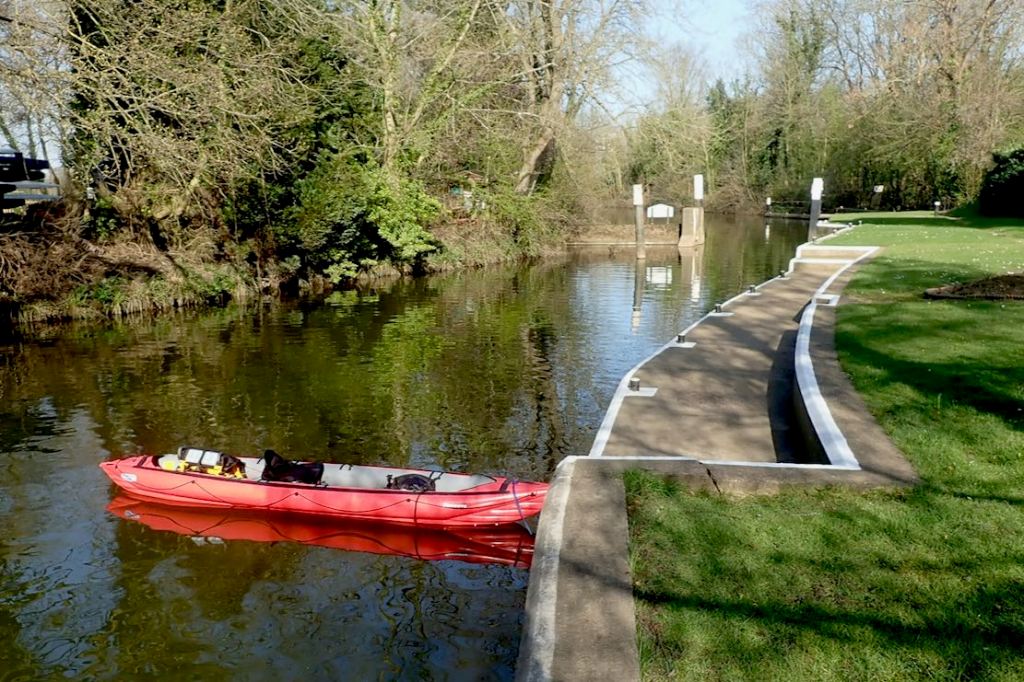
Compared to the similarly popular Medway, which I’ve done loads of times in IKs and packrafts, summer and winter, the Wey Nav feels less agricultural, more scenic and has an interesting history if you slow down enough to look. But it lacks the Medway’s unique canoe passes which scoot you down the side of each lock (right), avoiding up to three laborious carry-rounds per mile. Parts of the original river survive in places to either side of the canal, which is what caused me confusion. I now realise the Navigation (managed by the National Trust) gets priority in terms of water levels and maintenance. As a result the occasionally nearby River Wey might be shallow or chocked up with fallen trees or rubbish. But you can combine both to make loops like this.
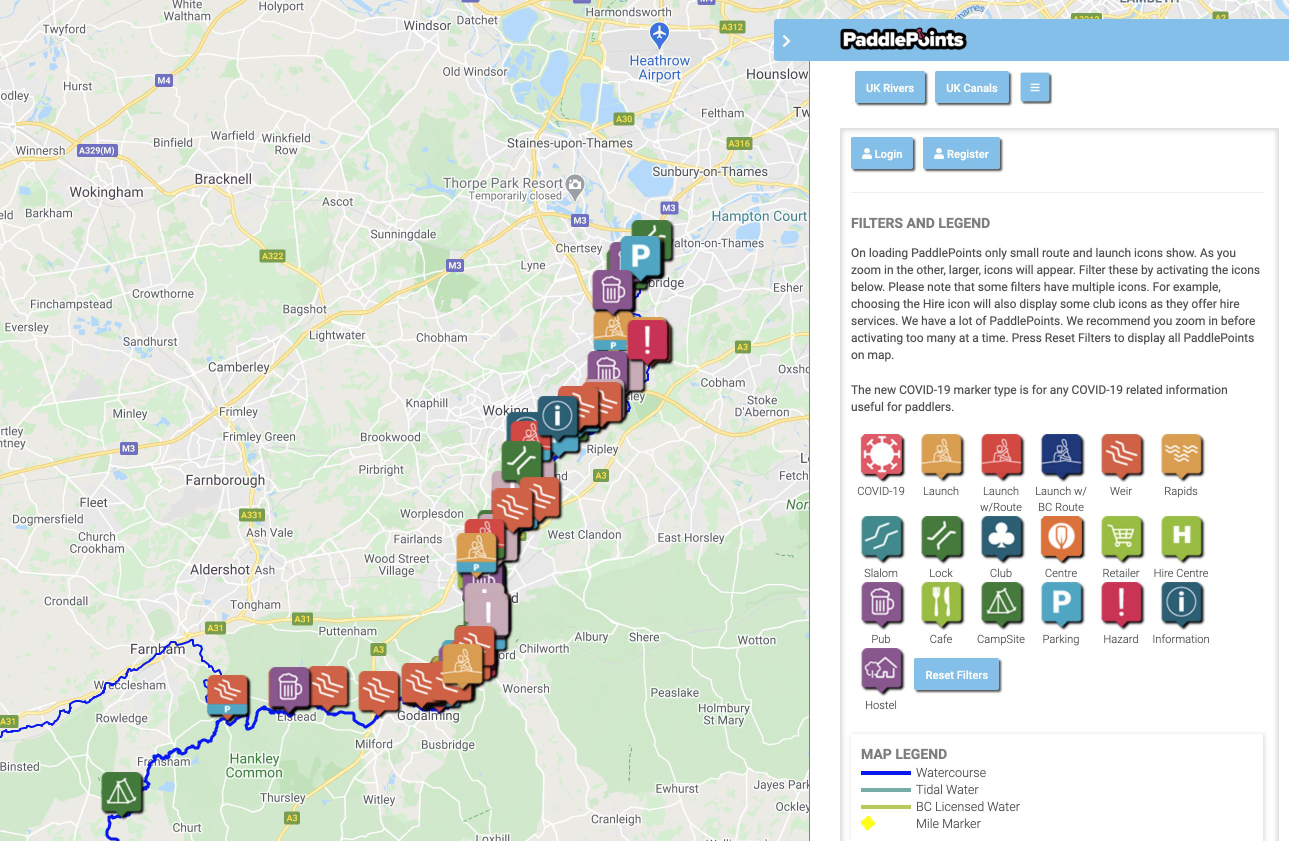
Because of the Wey’s multiple channels and numerous weirs and locks, I tried British Canoeing’s PaddlePoints website, a comprehensive database of paddleable river map routes with handy icons (above) for put-ins, parking, hazards like fallen trees, feral teenagers (I’m not joking) and so on. You can reset to delete extraneous icons (‘Covid-19’ ?); I just wanted to clearly locate the locks and weirs and river’s branches, though on the day ‘Navigation [this way]’ signs at junctions were clear. Closer scrutiny of the map shows that in places the blue line guides you along the old, choked-up river, not the Nav, and not all weirs (an important feature to know about) are shown as icons, even when they’re clearly evident on the Sat view underlay. And so the Map view (as above) can give a misleading impression of which way to go. As you’ll see below, at one point the blue line even guides you over a weir. Common sense prevails of course, but you can imagine some beginner clutching their PaddlePoints app on Map view getting sucked into a weir. I realise now this content is user-generated like OSM or Google Maps, and so errors, inconsistencies and lack of moderation are inevitable. As such, you can report icon-points, but it’s unclear if the route (blue/green line) can be corrected by users. If nothing else, PaddlePoints helps identify which rivers you’re allowed to paddle in England and Wales, and what the rules there might be.
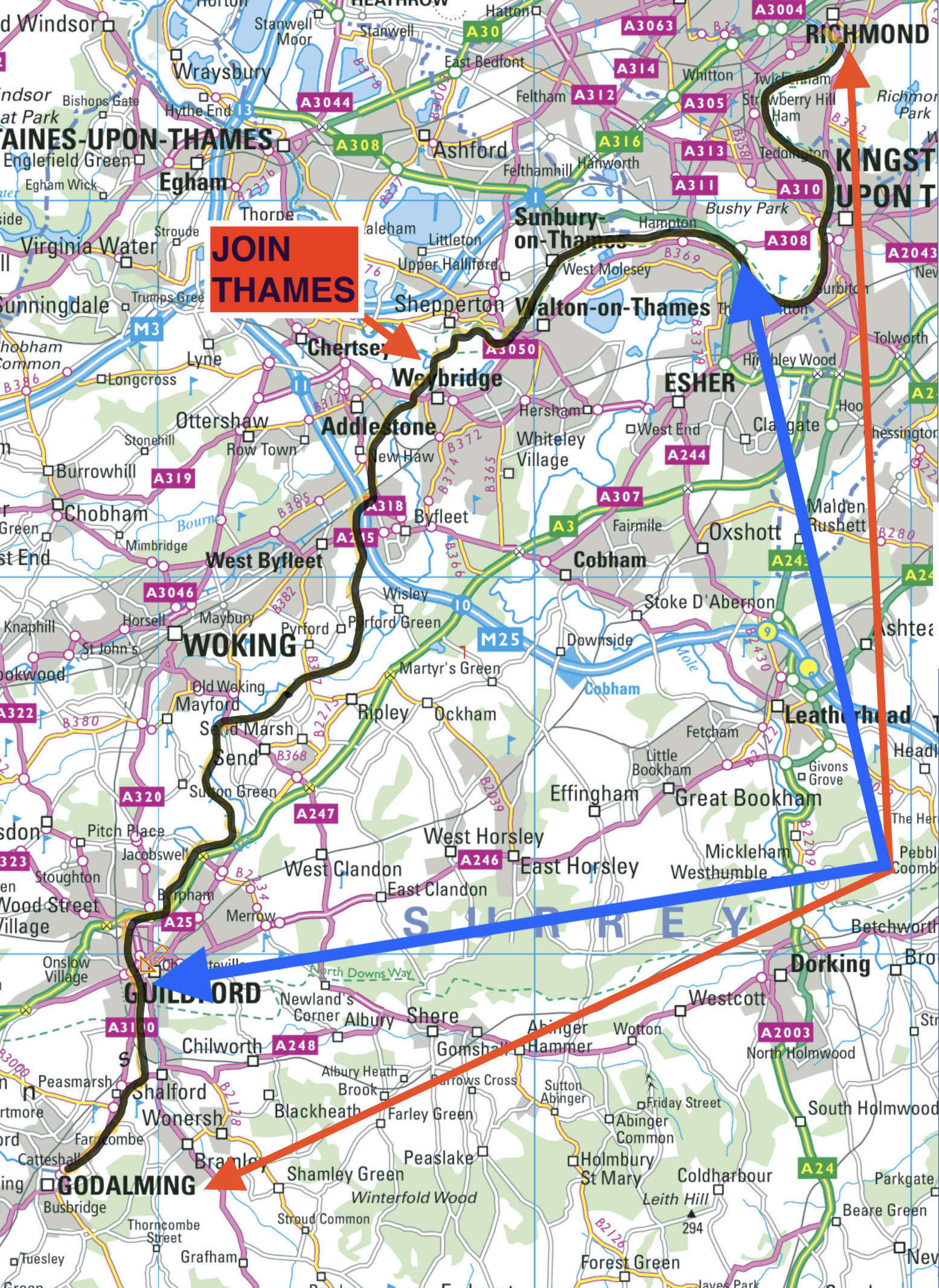
I fancied a full dawn-to-dusk recce: as much as I could fit in from Godalming (where most paddlers start) before my tank ran dry. I might even reach Richmond on the Thames, a section I enjoyed last December in the Arrowstream. That is actually quite a haul: 20 Weymiles plus another 15 on the Thames, including no less than 17 lock portages on the two rivers. But the great thing about ending a paddle in an urban area is I could air down when I got worn out and rail home. Thirty-five miles? Dream on, bro! I’ve only paddled two days since September so was far from paddle fit. Then again, the pre-dawn brain wasn’t on top form either: I set off in the right general direction, but on the wrong train.
Oh! Mister Porter, what shall I do? I want to go to Godalming And they’re taking me on to Hoo [k], Send me back to Woking as quickly as you can, Oh! Mister Porter, what a silly boy I am!
After backtracking, I decided to catch up with myself at Guildford, 5 miles downstream of Godalming and missing out 4 of the Wey’s 14 locks. I dare say I’d appreciate that later.
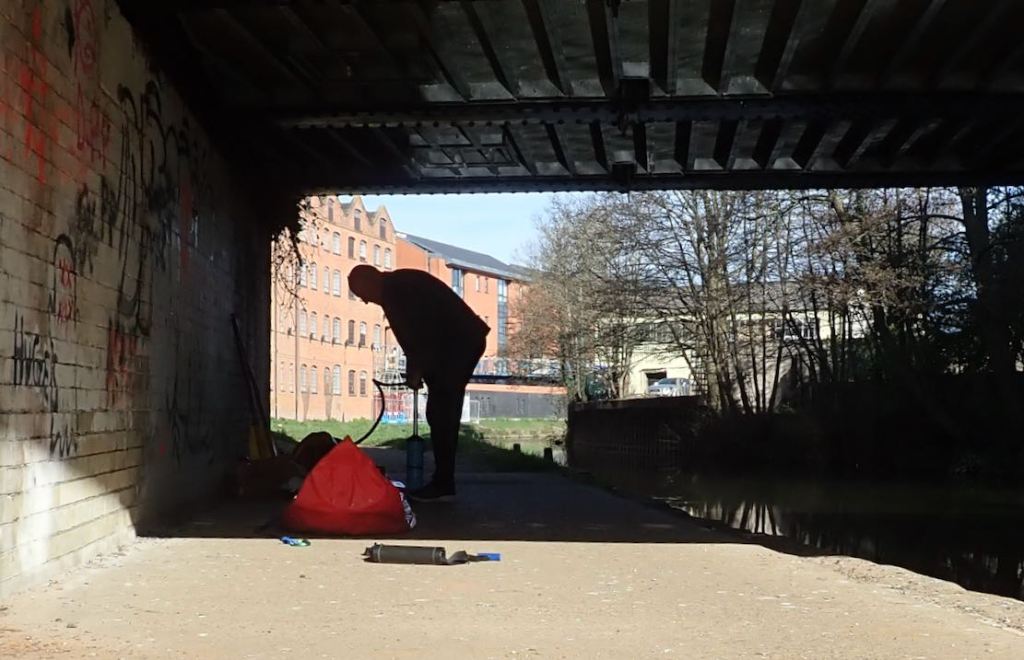
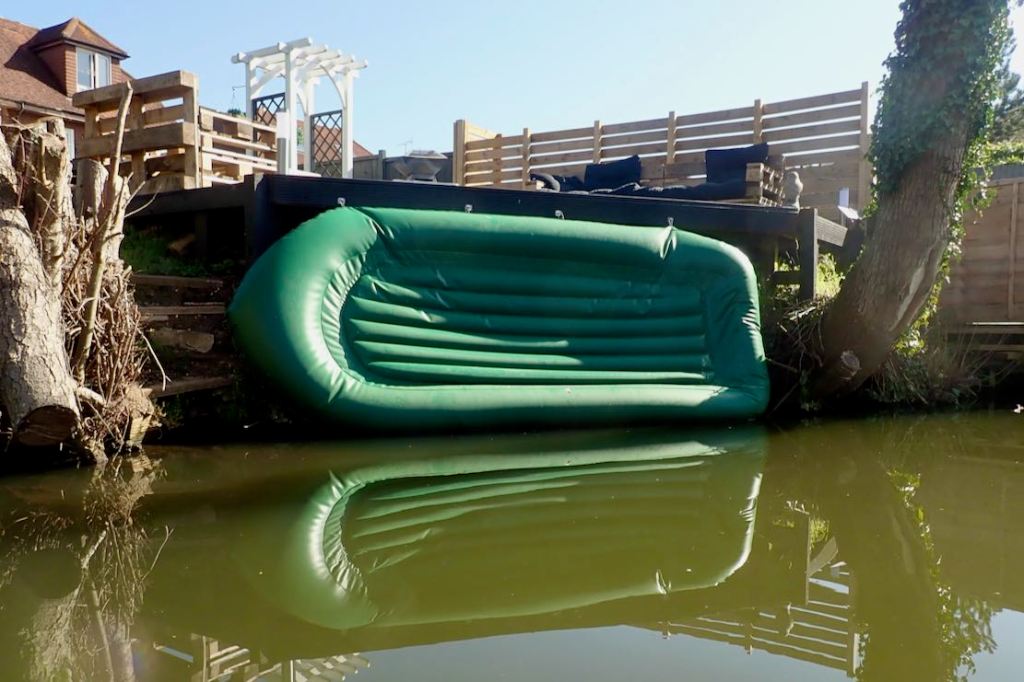
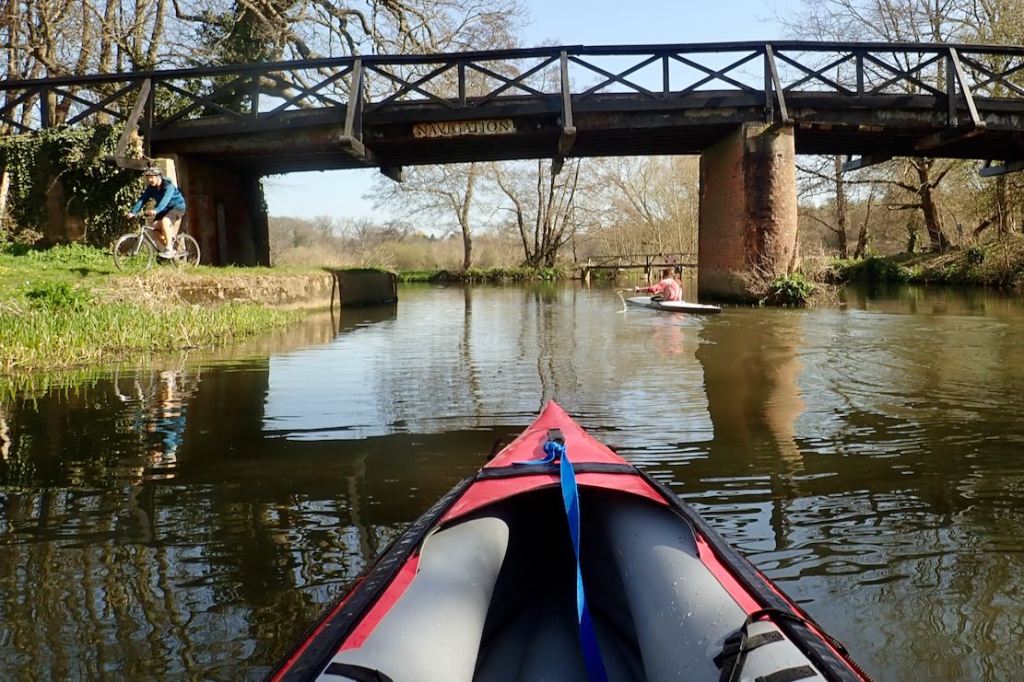
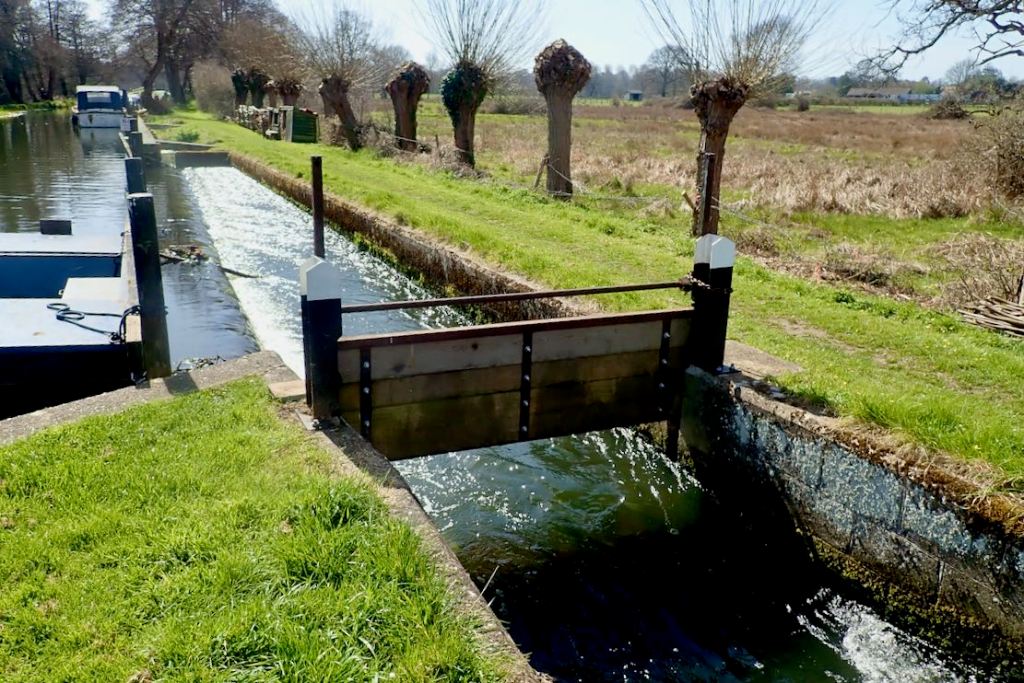
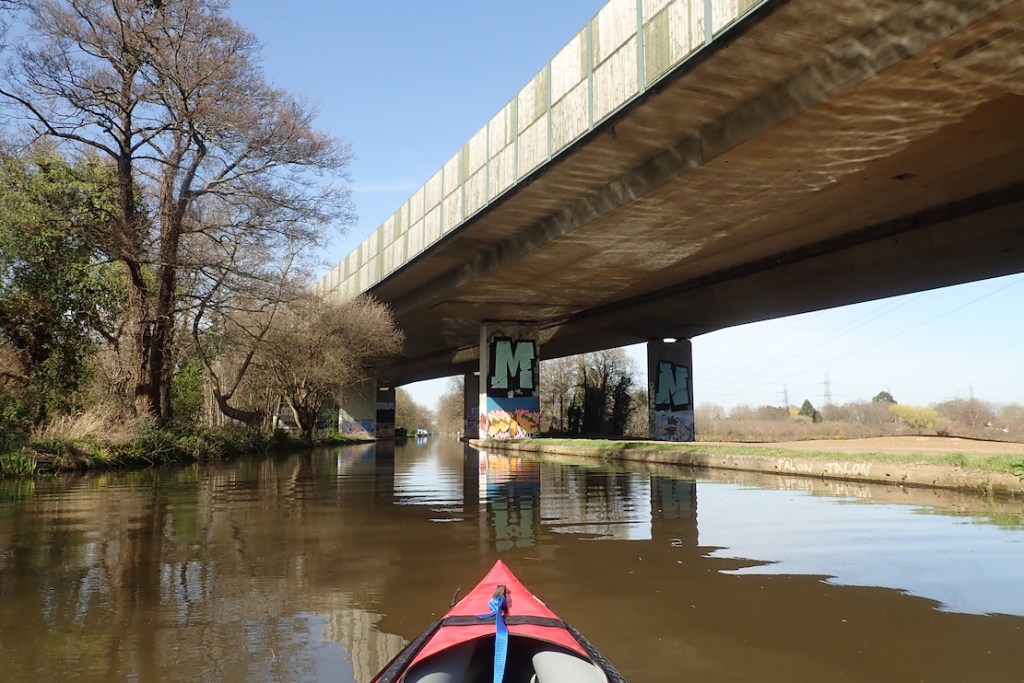
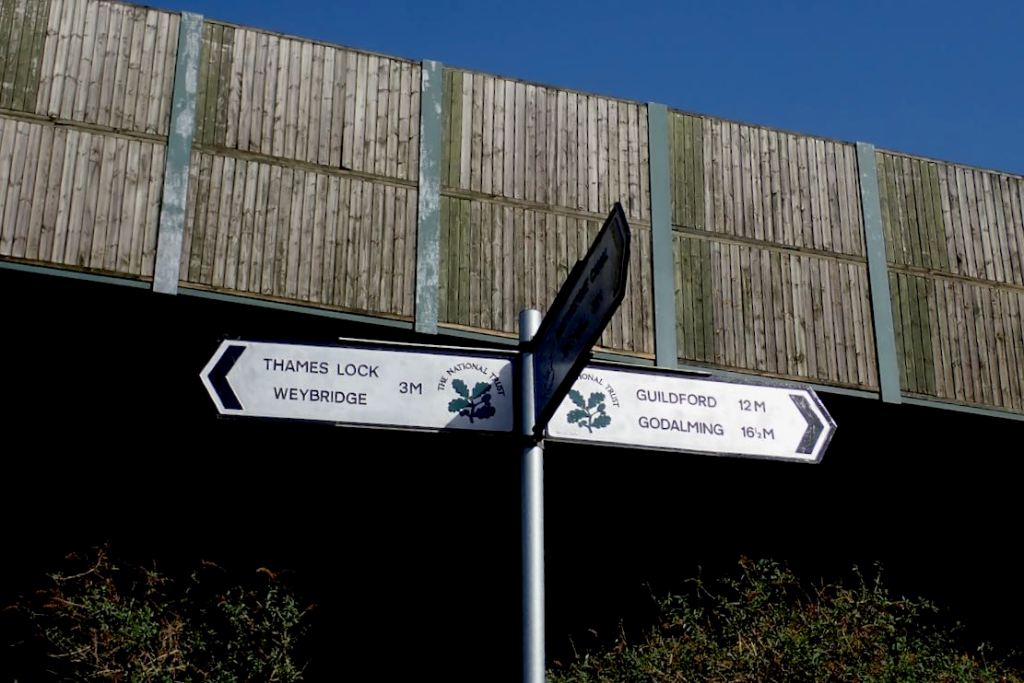
Clapham at 7am. It’s all a bit of a blur.I practise luggage distancing.In Guildford I slip onto a closed towpath and enjoy a quiet set-up without the usual ‘Oh Mr Porter, is that one of those inflatable canoes? I’m thinking of getting one…’Just around here I realised I’d left my Garmin out in the sun to catch a signal… Should have gone to Starbucks. I’m trying out some old runners as water shoes instead of my usual Teva Omniums. Do they really believe this or is it just juvenile baiting?A readable GPS in the net pocket of my Anfibio packraft deck bag didn’t really work on the Seawave. As usual I have a better idea.Alternative use for a big slackraft.At Bowers Lock I spot my first Intex of the day, a 100-quid of K2 Explorer on its maiden voyage with daughter and dad.Under an old bridge a real K1 belts past with barely any wake. Looks like fun but what happens when she stops? Same as the bike on the left, I suspect.As canals go, not so bad.Triggs Lock. With a little work this side sluice could be a fun canoe chute (lens finger shows scale).All they need to do is get rid of the guillotine and add a galvanised chute at the end. How about it, National Trust? It would be like turning Downton Abbey into a Discount Carpet Warehouse!Soon after lunch at Papercourt Lock I pass two chappies also heading for Weybridge in something called a Sea-Doo. Flip yer paddle round, mate, you look like an amateur!Not another lock, TFFT! Just some general-purpose gates to hold back Viking raiding parties.At this scenic and willowy point the canal runs right alongside the M25 London orbital motorway. The tyre noise is like Niagara Falls.Mile 12 at Basingstoke canal junction. By some civil engineering synchronicity the M25, Wey Nav, Basingstoke Canal and a railway mainline all cross or meet at this point. In its way it demonstrates the history of post-medieval commercial transport: rivers > canals > railways > highways and airplanes. That’s my MA thesis, right there!At New Haw Lock I need water but the lawn-mowing lock keeper says there’s no tap for a couple of miles. It’s an awkward portage over a narrow road bridge too. Luckily, this chap helps me out. Thanks, chum!Coxes Lock with a doable weir to the side. I may try it next time and risk censure from the NT.Well, according to BC’s PaddlePoints website, that’s the way to go!Weybridge Town Lock. Another awkward portage over a road bridge on the left.In places the Weybridge backwaters look like an Everglades retirement village.As I approach the Thames Lock at Weybridge things get wobbly and I have an out-of-boat experience.Amusingly lock-themed gates close the footpath so us portageurs can pass.Finally at Thames level, hallelujah. And there’s a tap set into the jetty too. I drink like a camel then me and the boat have ourselves a wash.Over six hours from Guildford, but even with a drink and food to spare, I don’t have another three hours in me to reach Richmond. Maybe I can do two hours to Kinsgton. Now on the Thames, I become a great admirer of roller portages.The game’s up at Hampton Court Bridge if I’m to have enough energy to roll up the boat. The station is right there. It’s a warm evening on the Thames and they’re all out in boats and the riverside parks. The [Covid] Rule of Six? Do me a favour! The skiffs collect bird poo while two lads fire up their Intex Challengers. I’ve seen more Intex IKs today than anything else. Why? Because they cost from under 100 quid, float just like a Seawave but track like a barrel.And he may be saying to himself: ‘My god, what have I done?’Dusk back at Clapham Jct. All up, only 21 miles. I blame ten portages, no resting and my nifty but 3-kilo Ortlieb roller duffle. With too much food, it all made the boat just a bit too heavy to carry easily. Where the lock-side grass was lush I dragged the boat, but I have a better idea.
Just before the GPS packed up at Basingstoke canal junction, I was averaging 5.5kph on the move. Pretty good with no current to speak of. On the livelier Thames I estimate I was moving at up to 10kph before I withered. Same as in the FDS Shipwreck in December. My tall BIC backrest (below left) initially felt great then collapsed on itself. Usual story: needs a stiffer insert. I was trying out my new footrest tube attachment points which worked great. Only when one heat-welded strap broke near Addlestone was I reminded how essential footrests are to comfort, efficiency and stamina. I jury-rigged something up between two D-rings which have been staring in the face all this time.
My 2021 Wey Survey of UK Paddling Trends
Hardshell canoes: 1
Hardshell kayaks: 1 (+ 2 K1 racers)
Hardshell SoT: 1
Vinyl IKs (cheapies): 5
PVC (bladder) IKs 3
iSUPs: 10+ (mostly women on iSuPs, too)
PFDs worn, almost none then again, mine’s more of a handy waistcoat)
FDS spotted: none (interesting as readers here are mad for that page)
Aquaglide is a US brand producing over a dozen Chinese-made IKs as well as iSUP boards and even floating waterparks. It’s been around for a few years, but their high-spec Chelan range, particularly the spacious 155 (formerly Chelan HB Tandem XL) has now been designated an IK of Interest. In the range’s three models, the numbers loosely relate to their length in feet; the actual stats are in the table below. These figures are copied off the internet, so accuracy cannot be guaranteed and anyway, sources vary. Like the similar Sea Eagle FastTrack 465, or bladdered Kokopelli Moki, By 2025 UK Chelan prices have dropped massively to a much more reasonable £899 for the 155.
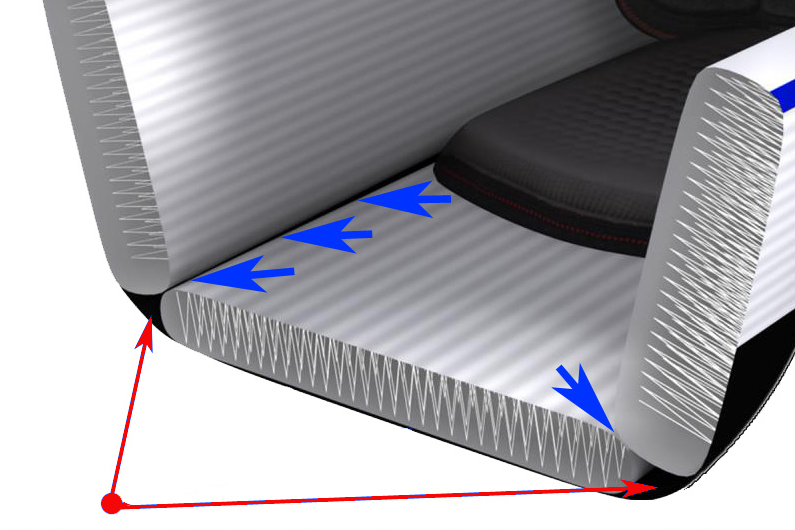
All Chelans feature a 6psiremovable DS floor with conventional 3psitubeless PVC side tubes – what’s becoming known as a hybrid IK. Hybrids are usually more stable than the slimmer, boxy Full Dropstitch (FDS) IKs, because the round side tubes make them wider, but higher pressures add rigidity which can compensate for reduced performance. It’s a shame there are no pressure release valves, but they’re easily added in the sides if you paddle in hot climates. The relatively low 6psi in the floor – and the fact that’s it’s fully in the water – makes it less vulnerable to passive heating and ruptured panels. With 10-inch tubes and at a yard or 91.5cm wide, the 155 has a Length Width Factor of 5.03. By comparison, the similar Sea Eagle 465 is 5.1. Both are pretty low (more square) compared to the table here, but for many other reasons, an IK with a higher rating (ie: long and thin) may not necessarily be more efficient. I find most IKs over-wide, but nervous beginners may feel differently.
3psi sides6psi DS floor
Chelan side tubes have no bladders (same Sea Eagles and all rubber IKs) which helps explain the high price, and they’re all made of Duratex PVC which they’ve managed to print on to give a sleek, distinctive look to the 2021 models. As you can read in the Comments, it took a while to clarify, but all Aquaglides featuring drop stitch floors are removable. This includes the Blackfoot, Chelan, Chinook and Navarro ranges. Actual new owner Dave Klein (see Comments and video below) assured me his new 155’s floor was removable. It’s odd that it’s not mentioned in the blurb, shown in the imagery or even explained in the pdf manual under cleaning and maintenance. This is an important and beneficial feature as it eases cleaning and speeds up drying.
Grit collects in the side
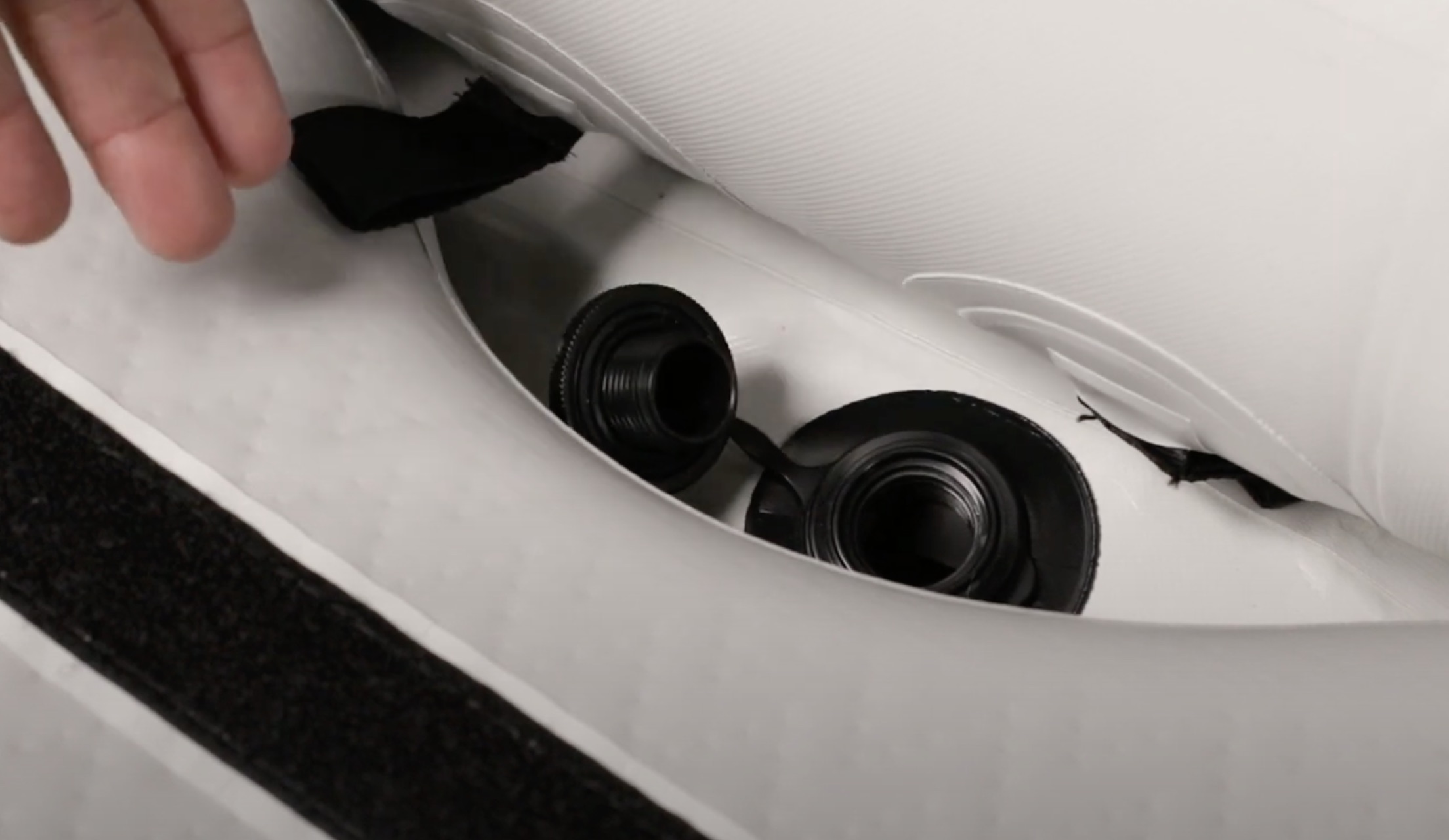
The 7 so-called ‘closable floor drains‘ are also odd, when the one at the back will do. If they’re just to drain the boat once on land, are seven – or indeed any – really needed? Especially as we now know the floor comes out easily. Just flip the boat over and let it drip dry. Many FDS IKs come with these multiple stern floor drains to help shed water and, more importantly, the grit, from inaccessible side cavities between the floor and sides (left). But the floor comes out on a Chelan so it’s not such an issue. The suspicion is that they might be a self-bailing feature and, although again, you won’t see it in the bullet-point blurb, the manual does say:
This product can be used in self-bailing mode. In this case, all cockpit drains should remain open. Some water will enter boat in self-bailing mode but will not accumulate.
Or to quote the video below
… [open drains] allow the boat to be paddled in rough water, surf or white water
In other words, the Chelans could be called optionally self-bailing which sounds like the best of both worlds. As mentioned, the blurb wisely steers clear of bragging about this, too much because, chances are for most people it won’t work so well. A boat is either designed to be self bailing – in which case it simply has bailing holes below an extra thick floor like the ROBfin I tried or AG’s Mackenzie range – or it isn’t. The heavier the load (or the smaller and less buoyant the model) the more the boat will fill up with water which will slow it down and become annoying as the water swills about. (On much slimmer hardshell sea kayaks this in-hull sloshing can lead to critical instability). The optional-bailing element may explain the unusually thick seat bases to ensure you’re not sitting in water.
DrainFloor velcro
The now improved, or higher-spec seats were a complaint on earlier models for their lack of back support – it’s a common issue with all IKs. They’re now positioned on velcro floor bands, like the Kokopelli Moki we tried. This is the quickest way to adjust seat positions for a level trim. There are small pockets along the seatbase’s front edge and on the backrest, and they’re braced off the sidetube tops. As mentioned, at five inches the bases are unusually fat. But you don’t have to inflate them fully, even if a taller seatbase makes paddling more comfortable; the 36-inch width Chelan has stability to spare.
Thick seatbase doesn’t need pumping right upPosition the seatbase on the velcro
Footrests use the same velcro bands to get the positioning just right. Not a bad way of doing it, providing that tube isn’t too squidgy.
Note the lateral strap with buckle which holds the removable floor in place.
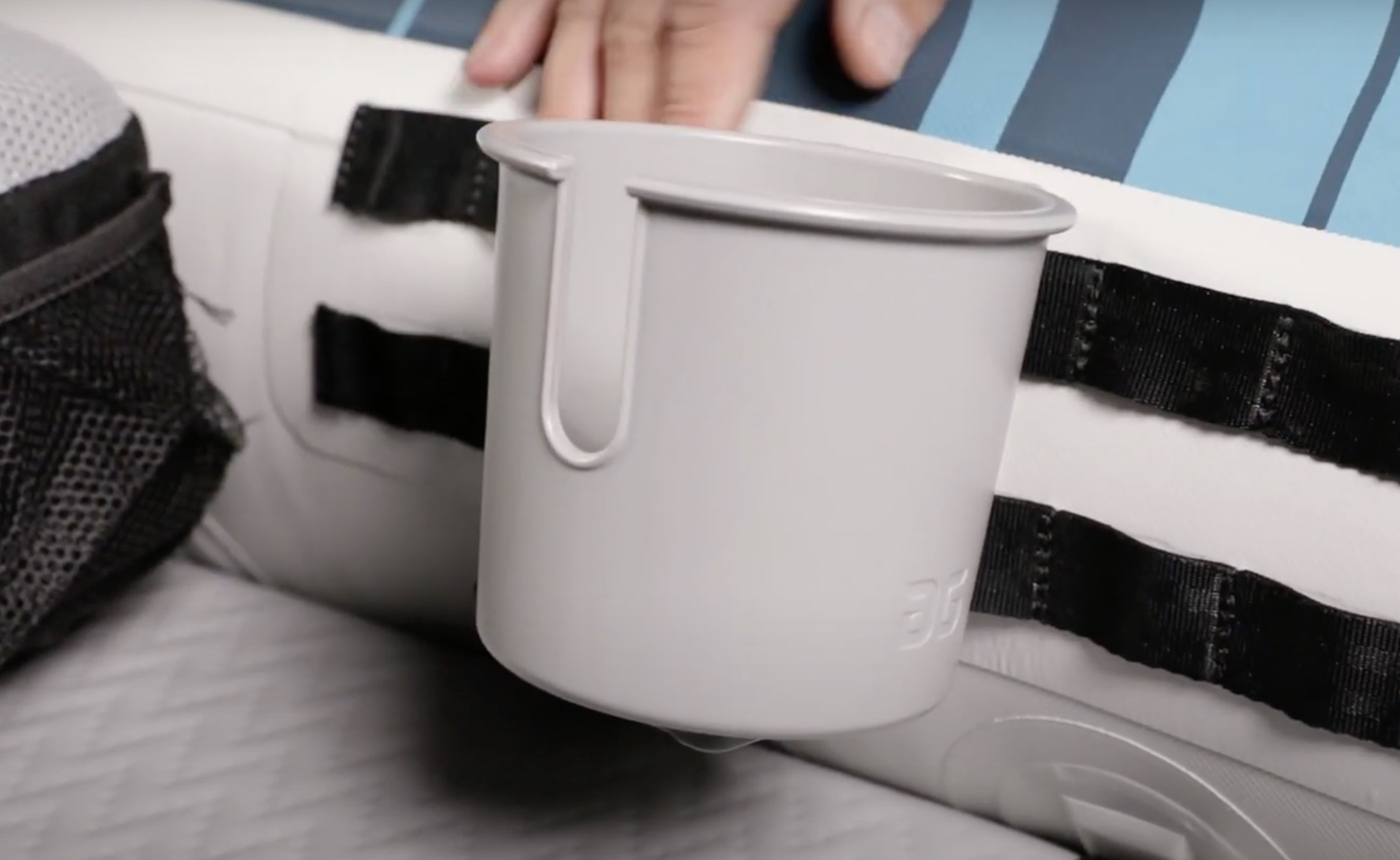
One of the best things on the Chelans is the attention to detail: handles at each end plus the sides, loads and loads of attachment points along the floor and side tubes, as well as Molle webbing which is becoming a thing on all sorts of outdoor gear now, and the usual deck bungies. Plus there’s an accessory mount floor plate for fishing gear or a GPS. I could do with one of those and it’s one of the side benefits of flat and firm DS floors. There’s even a beer cancup holder. I suppose it was only a matter of time before an IK got those.
Accessory mountCup holderMolle
They sure have made a meal of the skeg fitting which uses a tiny and easily lost screw bolt and backing nut (left and right) which reminds me of the rubbish old Gumotex alloy skeg. Why complicate things like this when there are so many easy-to-use, no-loose-parts slide-in skegs around (as on the Moki). Up front there is a shallow keel strake to protect the floor from wear and help with tracking. A better way of doing it than Sea Eagle’s bulky DS keel. You do wonder if the 155 might be as hard to turn as the Moki was.
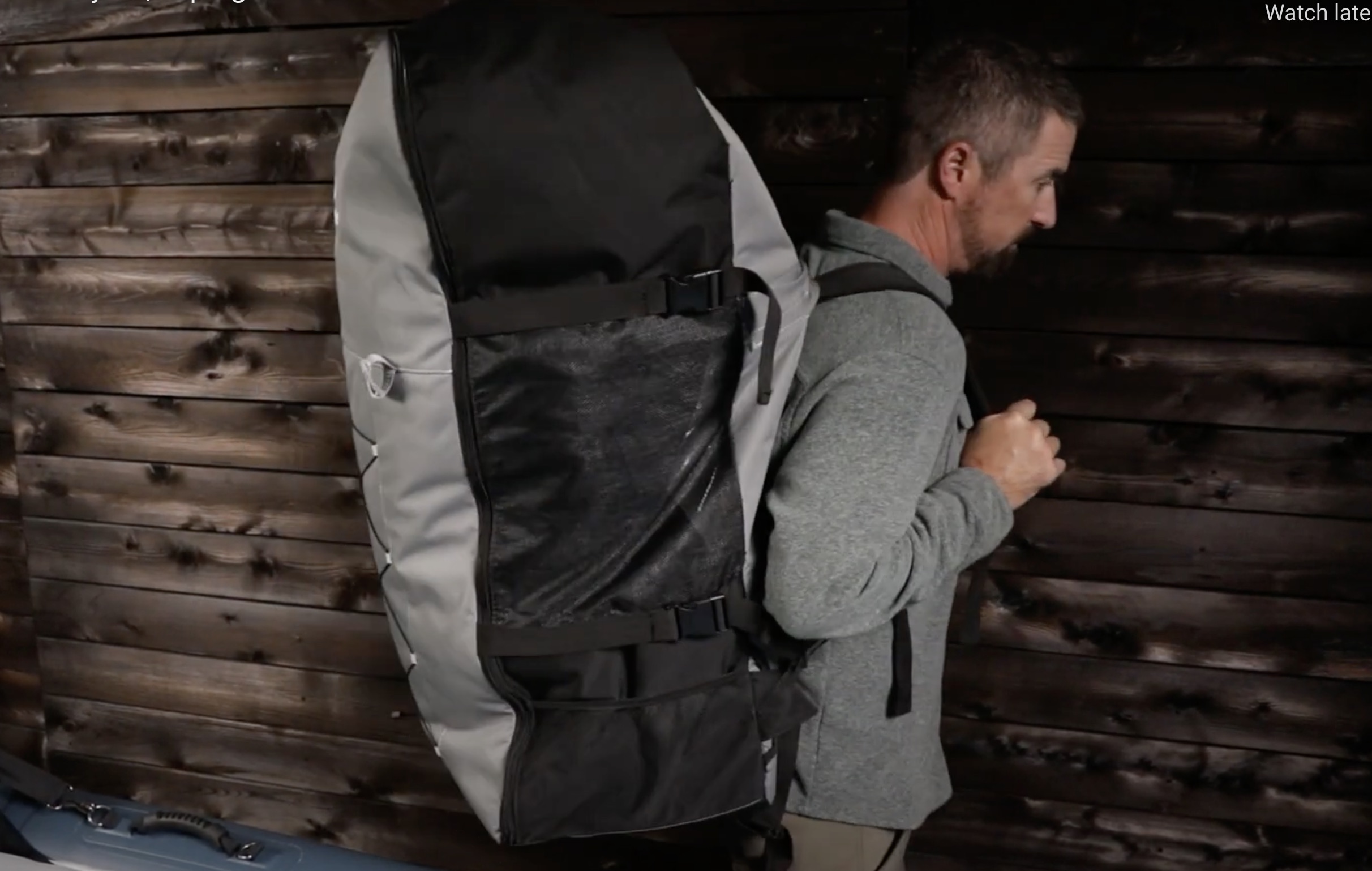
The whole boat all folds down into a huge, 170-litre back pack. The 155 may not be that heavy at 19kg, but like many PVC boats, it sure has a lot of bulk.
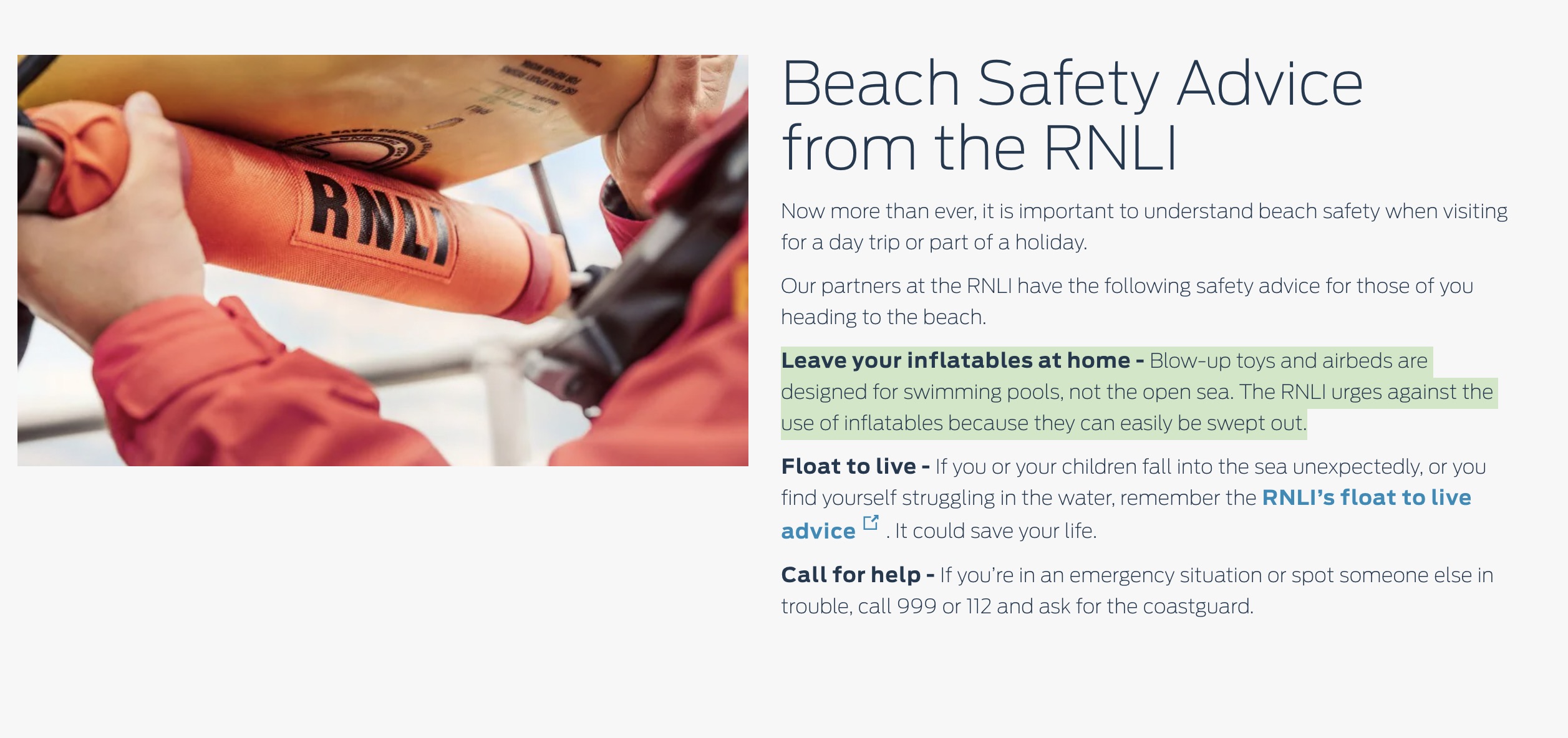
I just came across an RNLI campaign sponsored by Ford from August 2020, at which time paddling in the UK and elsewhere had gone ballistic. As some may recall, beaches in the UK were packed with a consequent rise in call outs Among the pithy safety advice they found room to print on a Ford Ranger’s specially moulded tyres – ‘RNLI Ford‘, ‘Emergency? Call 999‘ and ‘Float to Live‘ (a good case for inflatables, you’d think) – they also chose to include the rather blunt: ‘No Inflatables‘. As the Ford press release linked above says:
‘In 2019, RNLI lifeguards aided more than 29,000 people on UK beaches in more than 17,000 incidents, saving a total of 154 lives. They also helped to reunite nearly 1,800 lost children and teenagers with their families and aided 346 people in incidents involving inflatables.
In other words, 0.5% of incidents involved inflatables. Another statistic in the report may explain why inflatables got such prominence:
• 40% of people who say they would take an inflatable into the sea in the UK admit to previously getting into difficulty
How would you interpret this? Reckless stupidity or learning from your mistakes and being a bit more careful next time? Is the suggestion that ‘getting into difficulty’ required a rescue?
‘Stay together’
A fourth moulded-tyre message advising what looks like ‘Stay Together‘ (right) was given far less prominence in the press release and photos. It presumably referred to the >10% of incidents of children getting separated from their families at the seaside. That can be very unnerving for all concerned but is less perilous than being blown out to sea. It will be interesting to read the 2020 stats if they become available.
Inflatables…… some are better than others
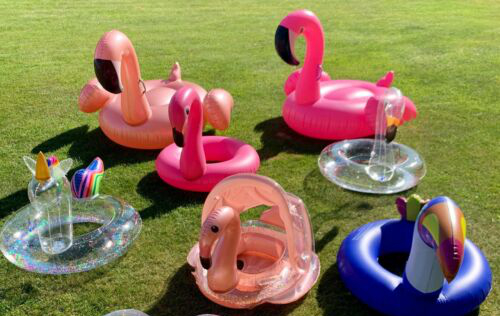
It was a Ford publicity stunt, of course, capitalising on their support of the RNLI which is a voluntary organisation part-assisted by donations. A link makes it clear by ‘inflatables’ they mean pool toys as above left or the inflatable toucan ring the little girl is seen wearing at the start of the video (below), running across a deserted beach towards the surf. But you’d think there was a better way of saying it. After all, the RNLI use inflatables themselves.
Allow me to pull a publicity stunt of my own and refer to the Weather & Safety chapter in the new book. The advice is clear: compared to a relatively heavy hardshell sea kayak which sits low in the water, much lighter more buoyant and wind-catching IKs can become difficult to manage in windy sea conditions, even if you are young and fit. Unless you know better, never go sea kayaking with a strong offshore wind, and think twice about going alone, especially to explore an unfamiliar area. At sea always wear a buoyancy aid. The summer sun may be hot on your back but in the UK, the water is cold. It’s the initial involuntary gasping reflex caused by cold water shock which leads panic, flailing about and drowning. That’s what they mean by Float to Live: once you’re over the initial shook and the breathing has stabilised, spread your limbs out and relax (assuming you can’t get back to you boat). Obviously a buoyancy aid makes this all much easier.
Last time I looked, you won’t find anything on the RNLI specifically addressing IK and iSUP limitations, and yet it is inexpensive IKs which tend to be bought by holidaymakers with no knowledge of how they handle at sea in windy conditions. I suggested to the RNLI writing such a piece but was told they have their own safety experts.
The Ford RNLI video below was shot at Minnis Bay, near Margate. I’ve never been paddling there but it does look like a particularly exposed beach where a typical southwesterly wind would blow you straight out into the Channel.


























































 Inflatable Kayaks & Packrafts