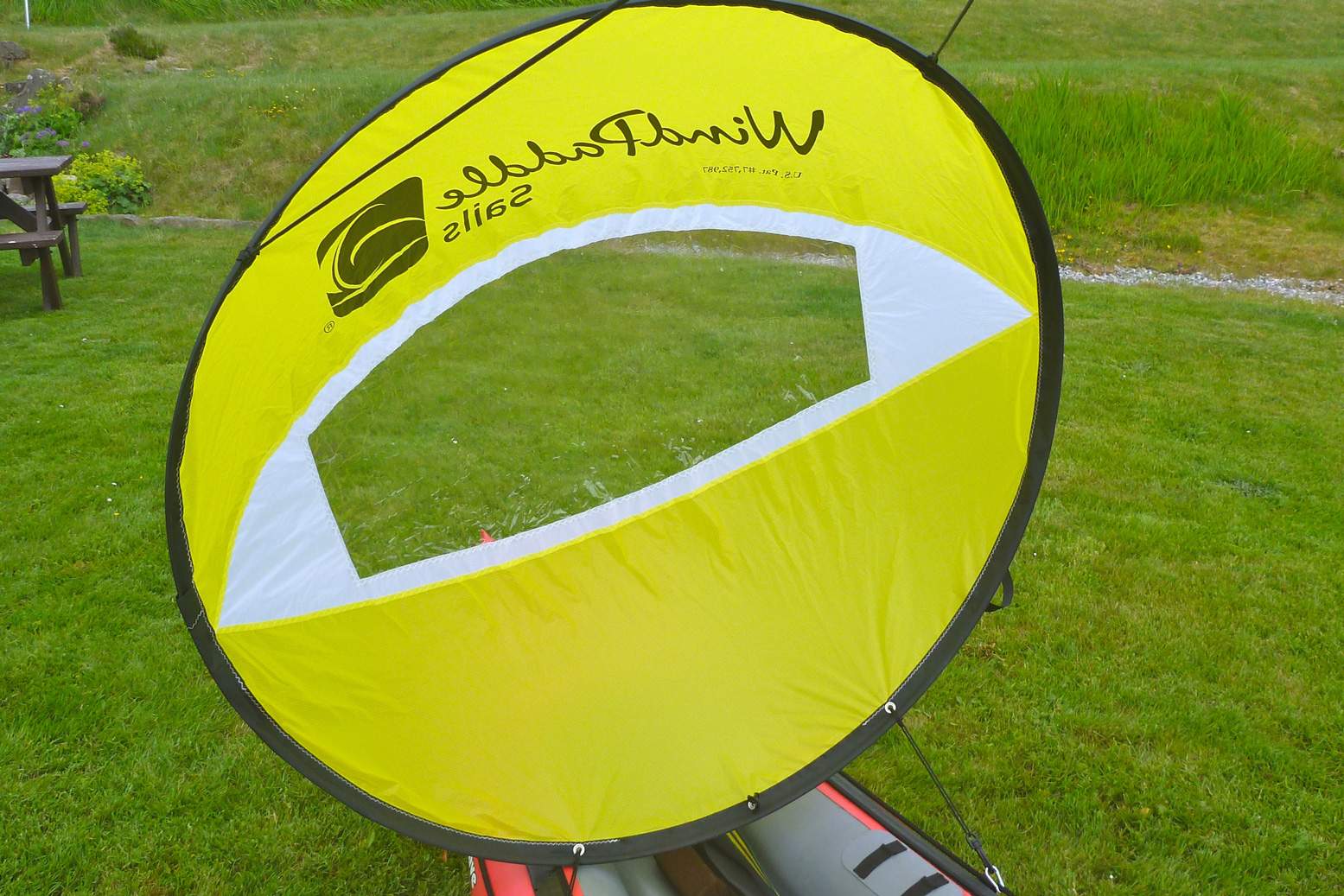
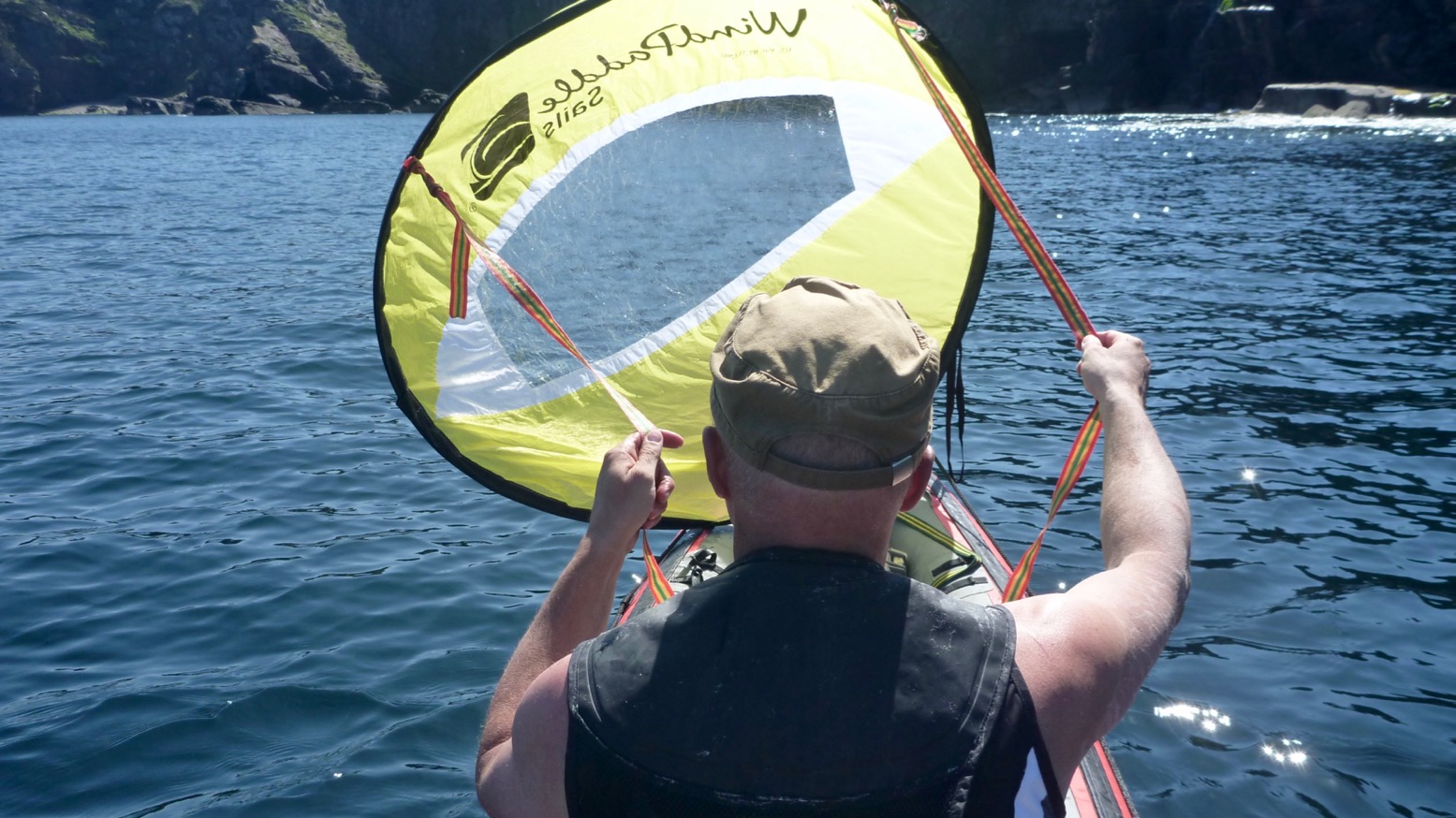
Adding a rudder to the Seawave inspired me to drag out my cheapo disc sail. I last tried it three years ago on the Amigo (below) when it worked OK, even without a rudder. But of course, a rudder is much better for keeping the boat on the wind while sitting back with the paddle on your lap and your hands on the sail lines.
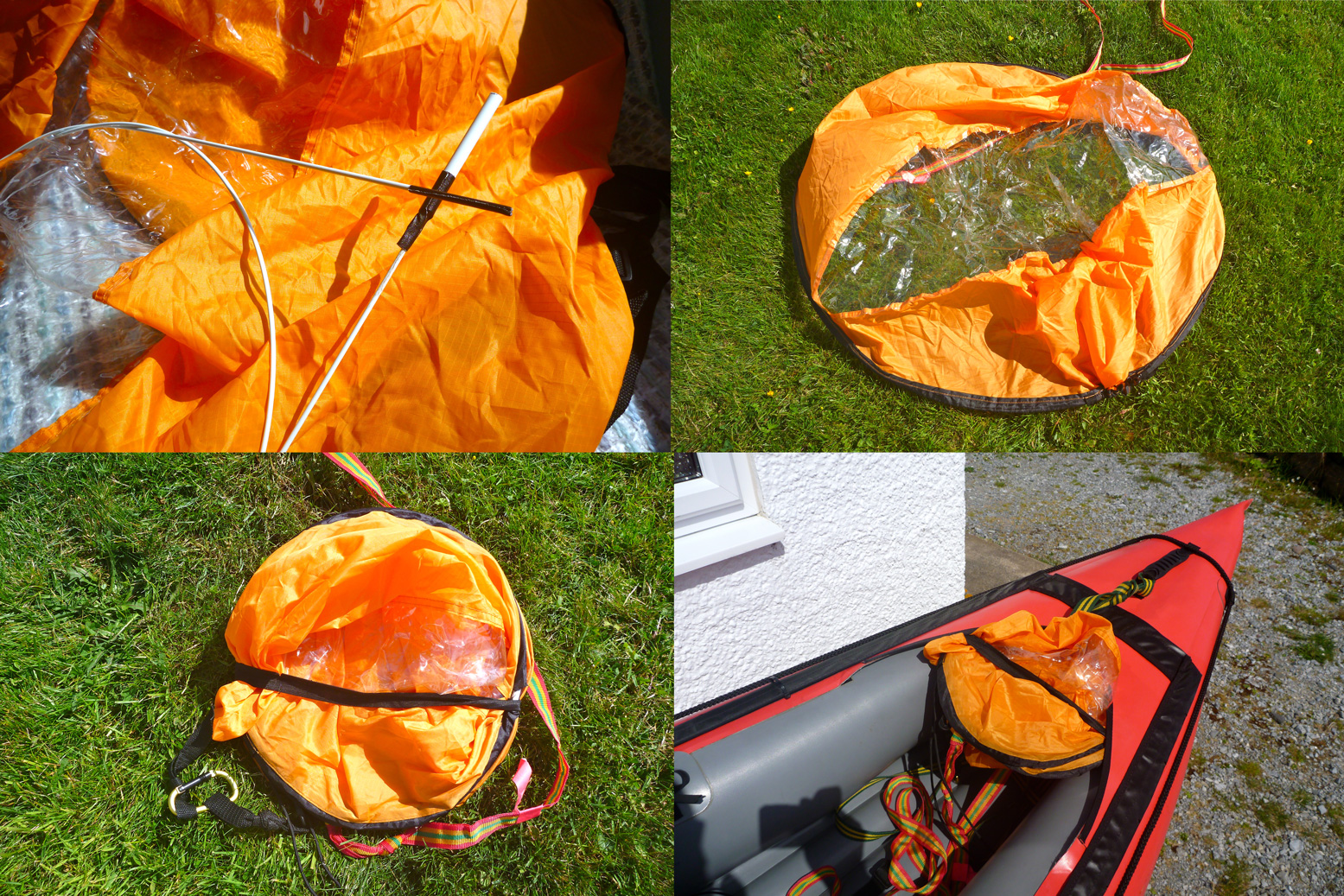
Pulling the sail out the 3mm fibreglass rod or ‘batten’ broke. I bought some more which, if anything, felt more pliable than the original but before I took it out it was broken in two places. Long sections of fibreglass rod in greater diameters can’t be sent bent so incur much higher postage charges which made reviving my KnockOffPaddle uneconomical. Worse still, removing the splintered rod from the sail (before I decided to ditch it) filled my hands with glass splinters for days. Nasty stuff.
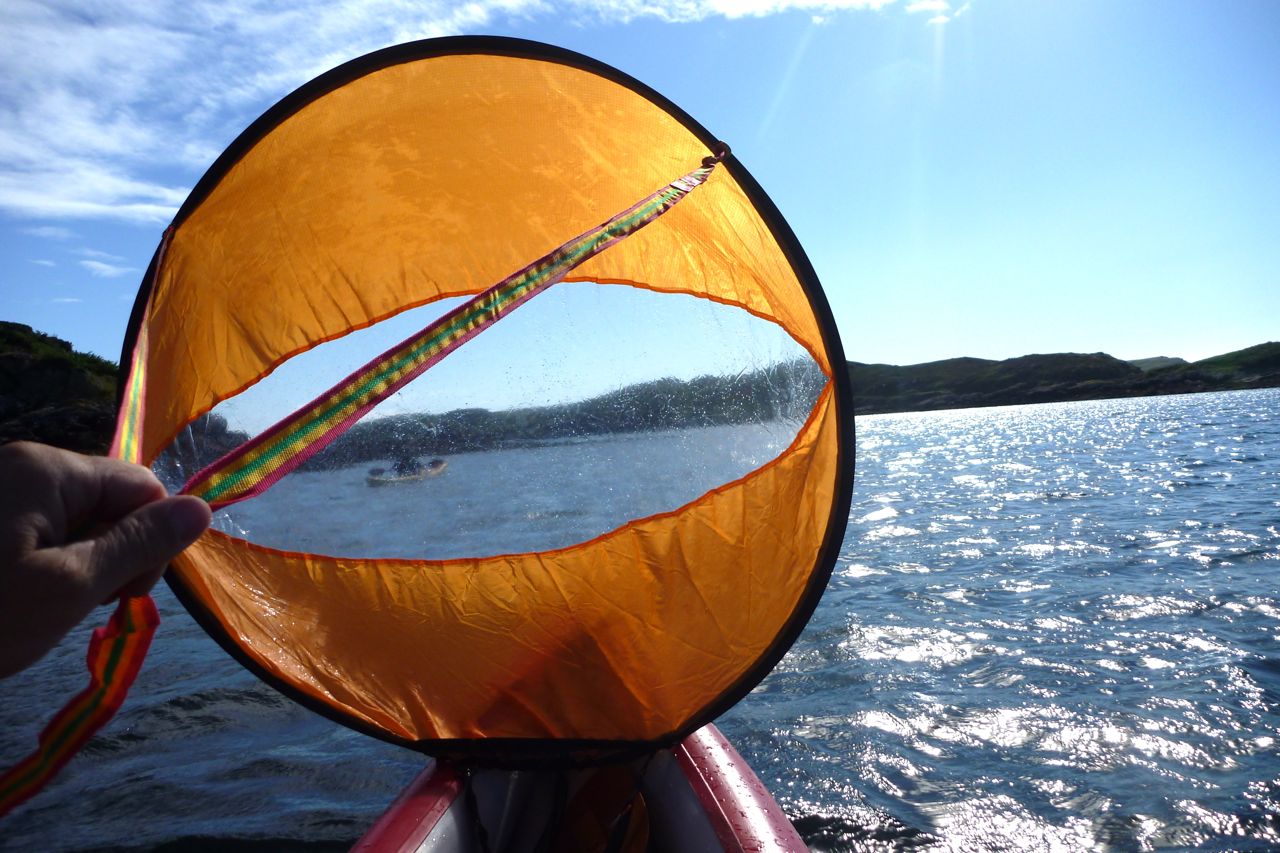
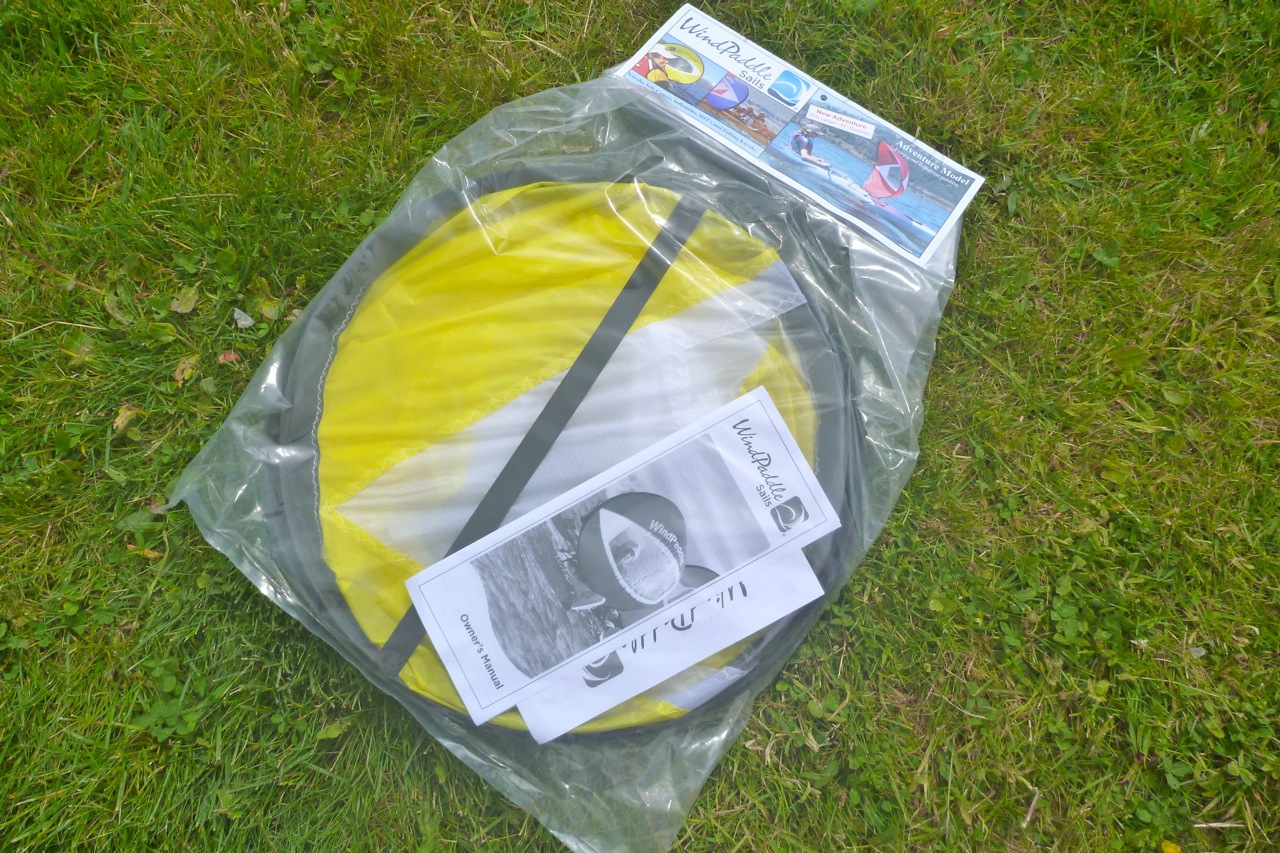
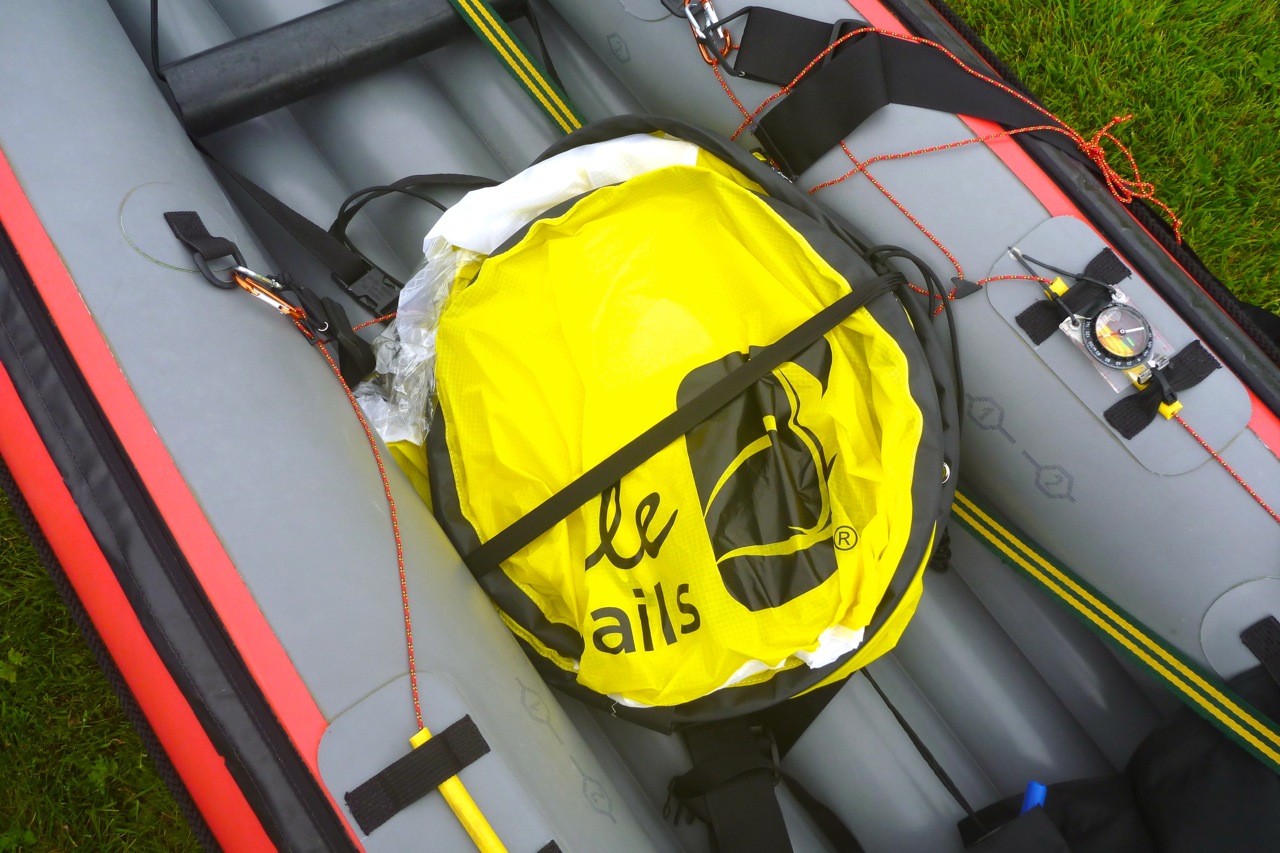
I looked again at the original WindPaddle whose prices have dropped in the UK. Their Adventure II model is up by 13cm to 119cm or 47″ in diameter, making a claimed area of 1.42m (as usual, π x r2. doesn’t add up to ‘1.42’ but never mind). It folds down to 42cm or 16 inches diameter but with squidge some more (ovalise) to tuck securely into the floor of your boat, and weighs just 400g (+30g for a control line). I asked about the cheaper Scout sail and why it’s rated at 4–15 knots when the new Adventure II is rated at 6–30kn. It’s not just the bigger area; the Adv II has a significantly stiffer composite batten to help hold its shape. That’s important and why ships don’t have rubber masts.
A problem with all sails is that they can start swinging from side to side in a recirculating frenzy before either settling down, collapsing or diving for the drink, possibly when the wind is more than they can handle. I recall with previous V and disc sails that lot of your time is spent managing that motion, rather than galloping across the waves like a flying fish, but the promise of achieving that is why I persevere. Update 2021: After having much better results with a AirSail on a packraft, I think some of this swinging could be down to clipping the sail to slack decklines, and not directly to mounts on the boat’s hull. I will try that next time.
When the £116 sail arrived, it certainly had a better quality feel than my smaller knock-off which went for under £20 on eBay and are now under a tenner. The sail fabric feels thicker and the crucual perimeter batten isn’t a regular GRP rod-like in a tent, but a flat flexible composite band about 8mm by 1mm. It takes significantly more effort to fold the Adventure II three times into its 16-inch hoop, but that should result in a more stable sail in action. Sea trials here.
A few shots from our first visit to the Summer Isles in 2006 with my original Gumotex Sunny and Mk1 Safari and when it seems the weather was unusually good for August. One day we paddled out as far as Tanera Mor and Tanera Beg, as well as Achnahaird and Loch Sionascaig and Osgaig and thought it was all a huge adventure.
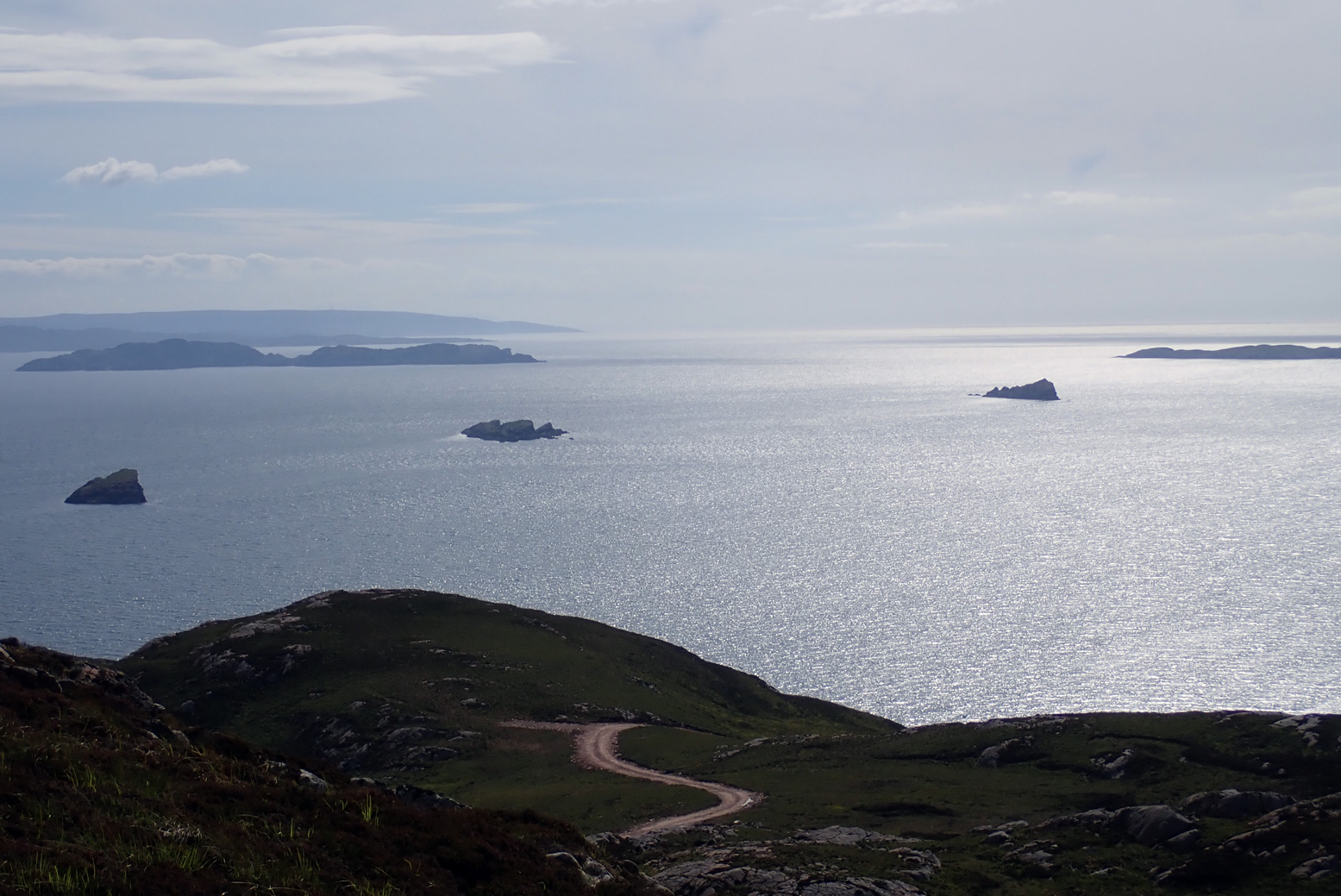
But I knew before I got on the water the tide was not with me and nor was the wind. Hauling myself through the Tanera channel, by the time the cheese-wedge profile of Angus came into view to the southwest it looked a long way away, with only Glas-leac Beag (on the right, below) between it and the inky depths of the Minch.
I paddled out into the Summers the other afternoon to see how far I’d get. What I was really eyeing up was Stac Mhic Aonghais or ‘Precipitous rocky feature of Angus’, one of three skerries bobbing just south of the Tanera islands. I only really clocked it on last year’s crossing from Carn nan Sgeir to Tanera Beg. I suppose now I’ve visited just about all the Summer Islands I’m looking more closely at the bits in between.
So I swung east around the south side of Tanera Mor and, now with the wind and tide behind me, at the last minute decided to make a ‘training dash’ towards ‘Goat Sound’ (left) – the tidal passage between Horse and ‘Goat’ island which I guessed was flooded by now. From there it was a weary hack back against the squalls to the beach and an XL dinner.
A few days later I persuaded visiting paddlechum Jon that a tour of the Summer Isles Skerries was good use of his holiday up here. He’d just returned from a gruelling, two-day bike ride through the Assynt – part of the HT550 – so his arms were in need of some exercise.
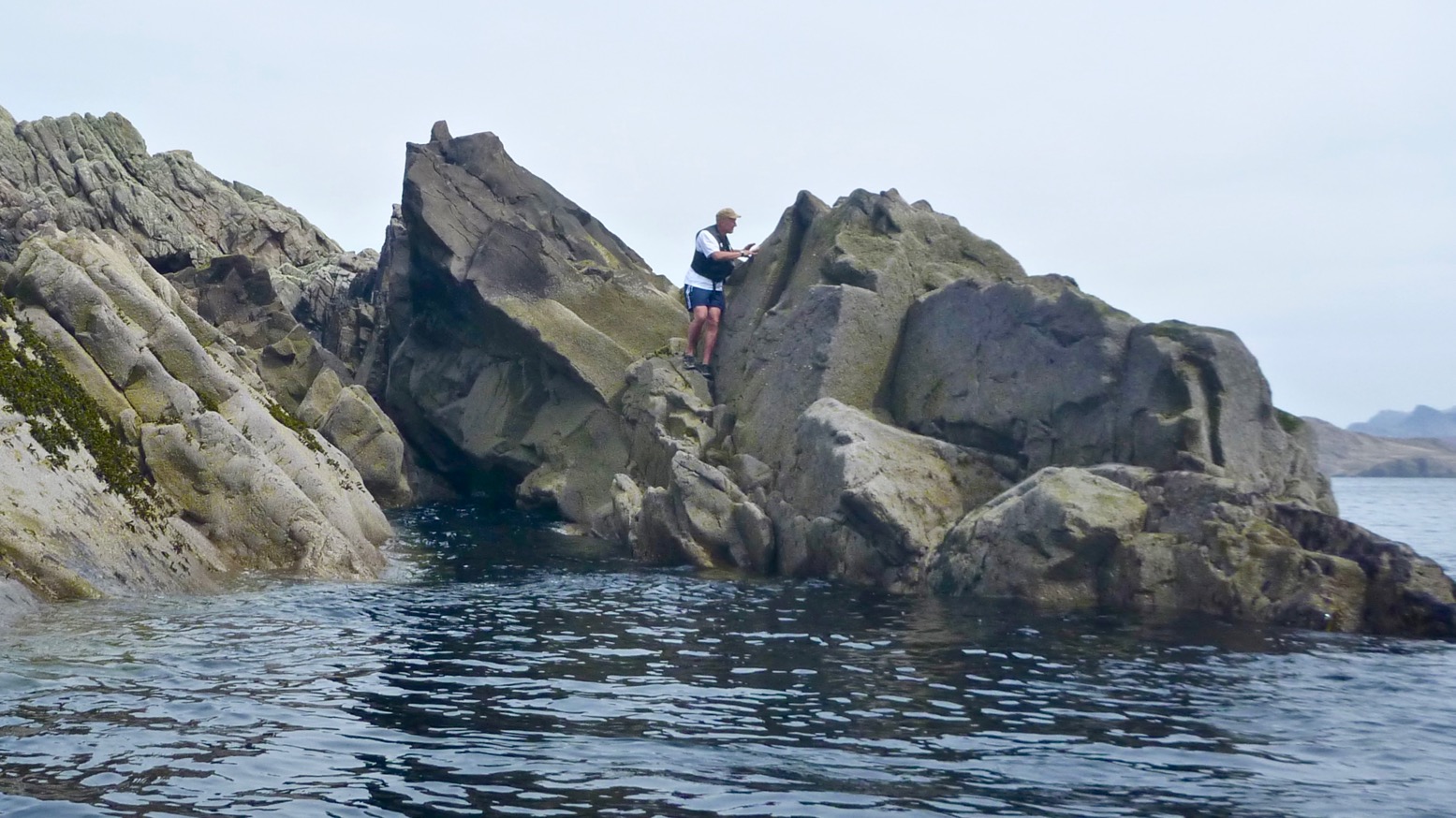
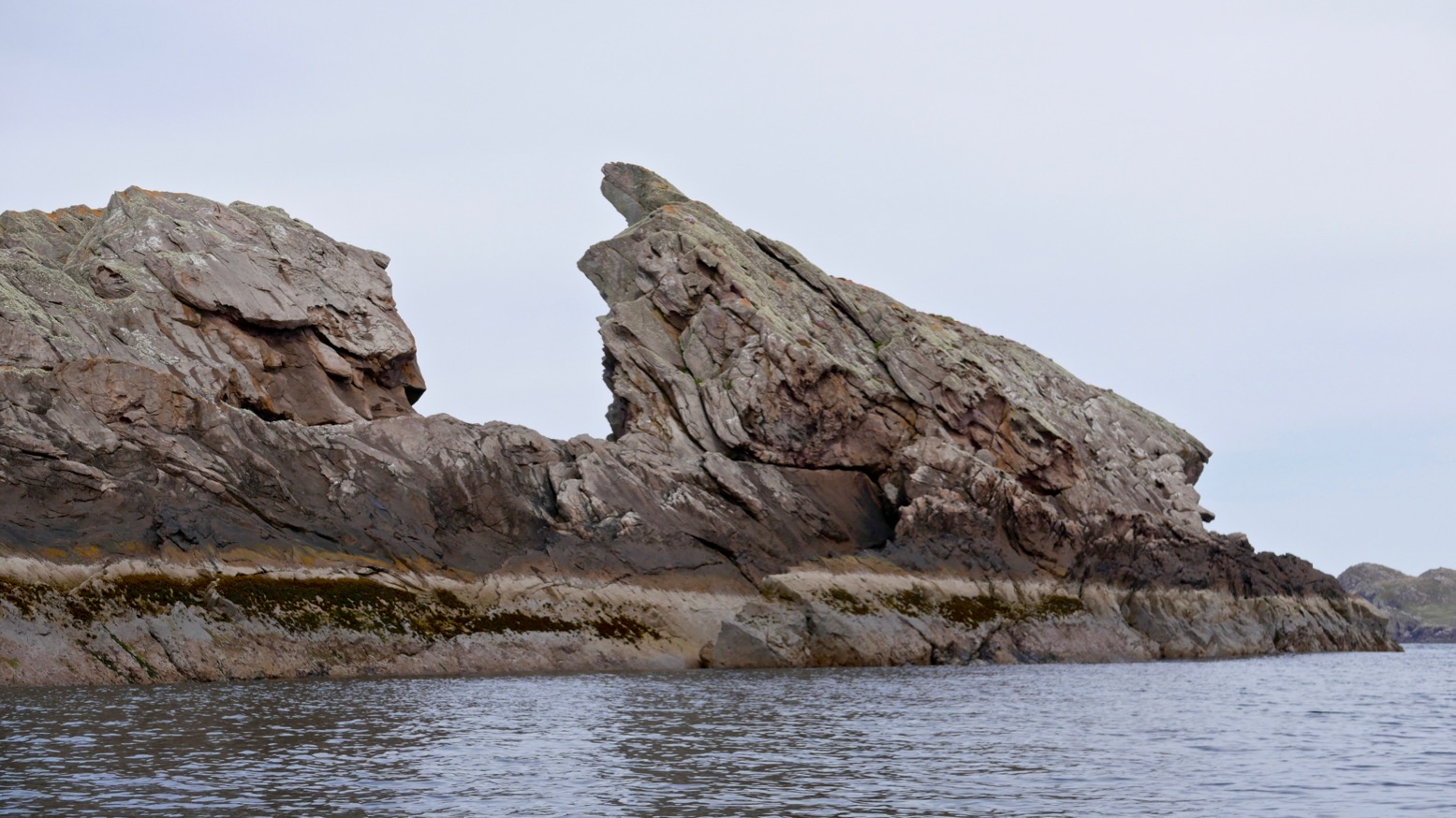
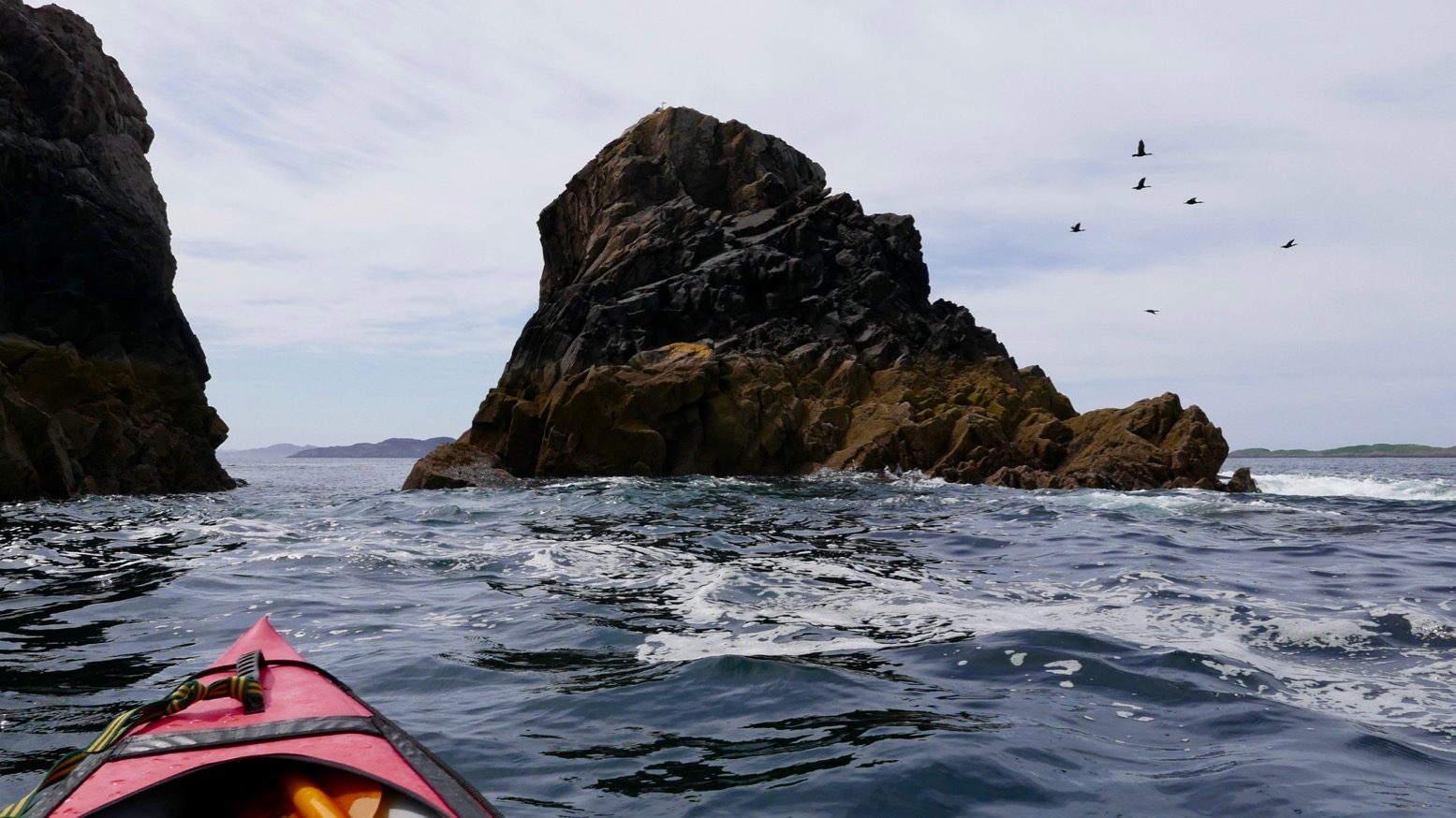
As skerries go, the supposedly 78-foot-high (26-m) Stac of Angus (see below) has a dramatic profile. From some angles a homesick Norseman pining for his mead might even call it a dragon’s tooth. It also looked fairly easy to climb to the top to get a nice shot of a kayak below.
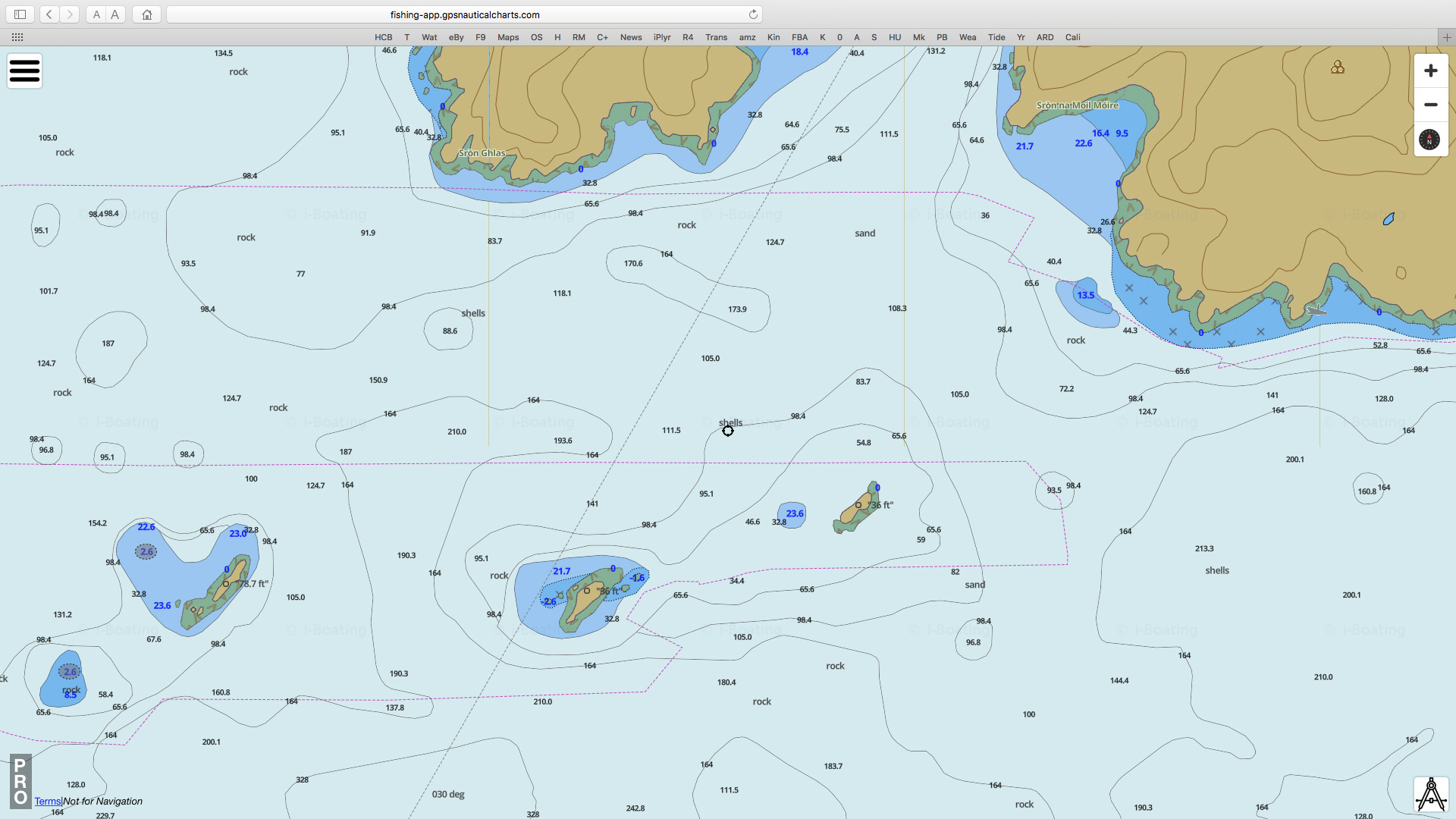
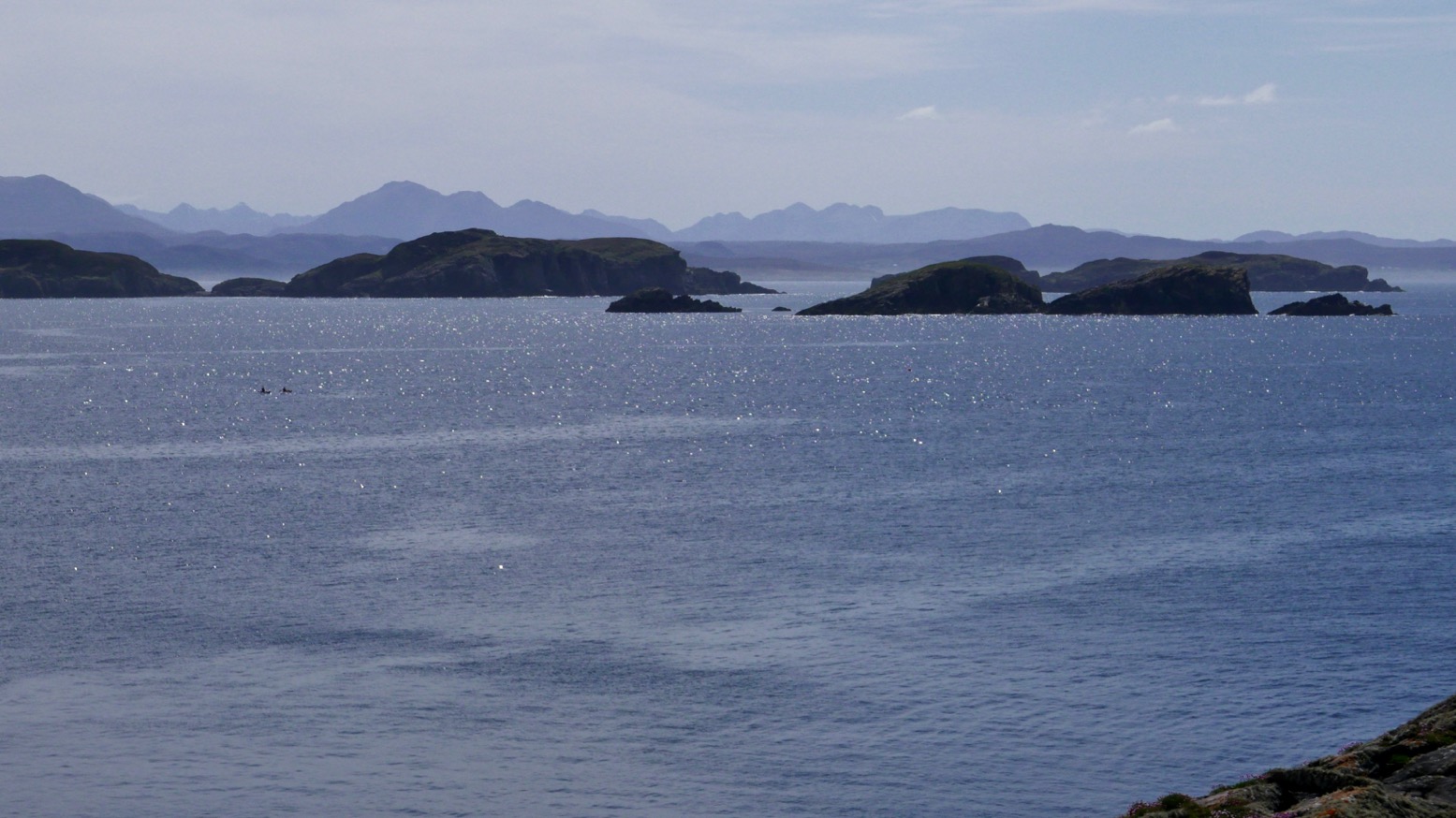
Stac Mhic Aonghais, Sgeir an Aon Iomairt and Sgeir Ribhinn or Revan. All three line up with about a kilometre between each; long thin skerries aligned on a SW/NE axis, as is much of the lower elevation topography up here; valleys and trenches carved I assume, by glaciers advancing from Scandinavia. This report suggests that 12,000 years ago during an anomalous cold spike following the end of the last Ice Age ‘…climatic factors, combined with the availability of large quantities of subglacial debris, led to the development of distinctive glacial landsystems, which may have no direct modern analogue.’ As we know, the dramatic Assynt has no topographic analogue elsewhere in Scotland and the angular claw of Stac of Angus is one of its many remnants. (Btw, that marine chart screenshot above left is from a very handy and editable online nautical ‘mapp’).
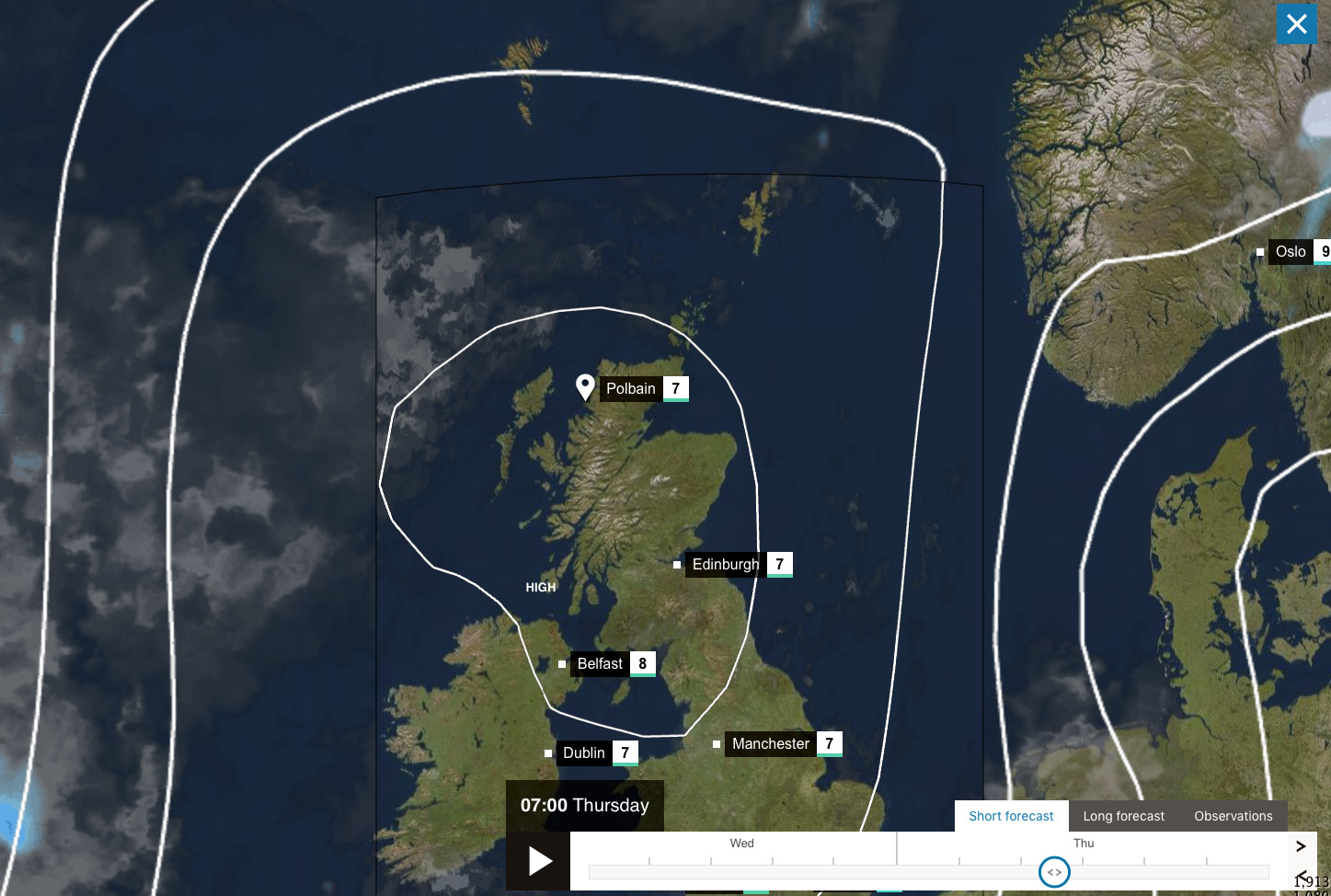
Planning paddles up here is of course a lottery but came the day, by some miracle a High had parked itself over the northern British Isles, put on the handbrake and tipped the seat back. The 4.5-m tide may have been at the peak of its fortnightly cycle, bottoming out at 2.30pm, but that could be handy if we used it right. If we left Stac around low tide, it should be an easy ride back up to Old Dornie, assisted by the rising afternoon breeze. We paddled down between the Taneras with the tide, passing some other kayakers on the way. I mentioned the Tanera Beg arch just round the corner to them, but after a quick check the tide was too far gone to thread the arch.
In little more than an hour we were approaching the gnarly, storm-wracked northern prow of Angus. It’s hard to think how the 1:25,000 OS map arrives at the oft-repeated height of 26m. The picture below of Angus’ high point is about 90 minutes before a low spring tide at around 0.5m above Ordnance Datum – which is the lowest astronomical tide – ‘LAT’ – at Newlyn. So even if you add about 2m or 6 feet to measure the skerry at LAT, or just use the more likely MSL, there’s no way that adds up nearly 80 feet; it’s more like half that. It’s odd because the two other skerries we were heading for had entirely plausible heights.
Anyway, we paddled along the exposed west side looking for a landing spot but found nothing but 45-degree slopes. I was sort of hoping that low tide might reveal a platform or at least give us more rock surface to choose from, but very low tide also exposes seaweed, kelp and other crap; there’s probably as much chance of getting alongside a handy ledge at higher tides.
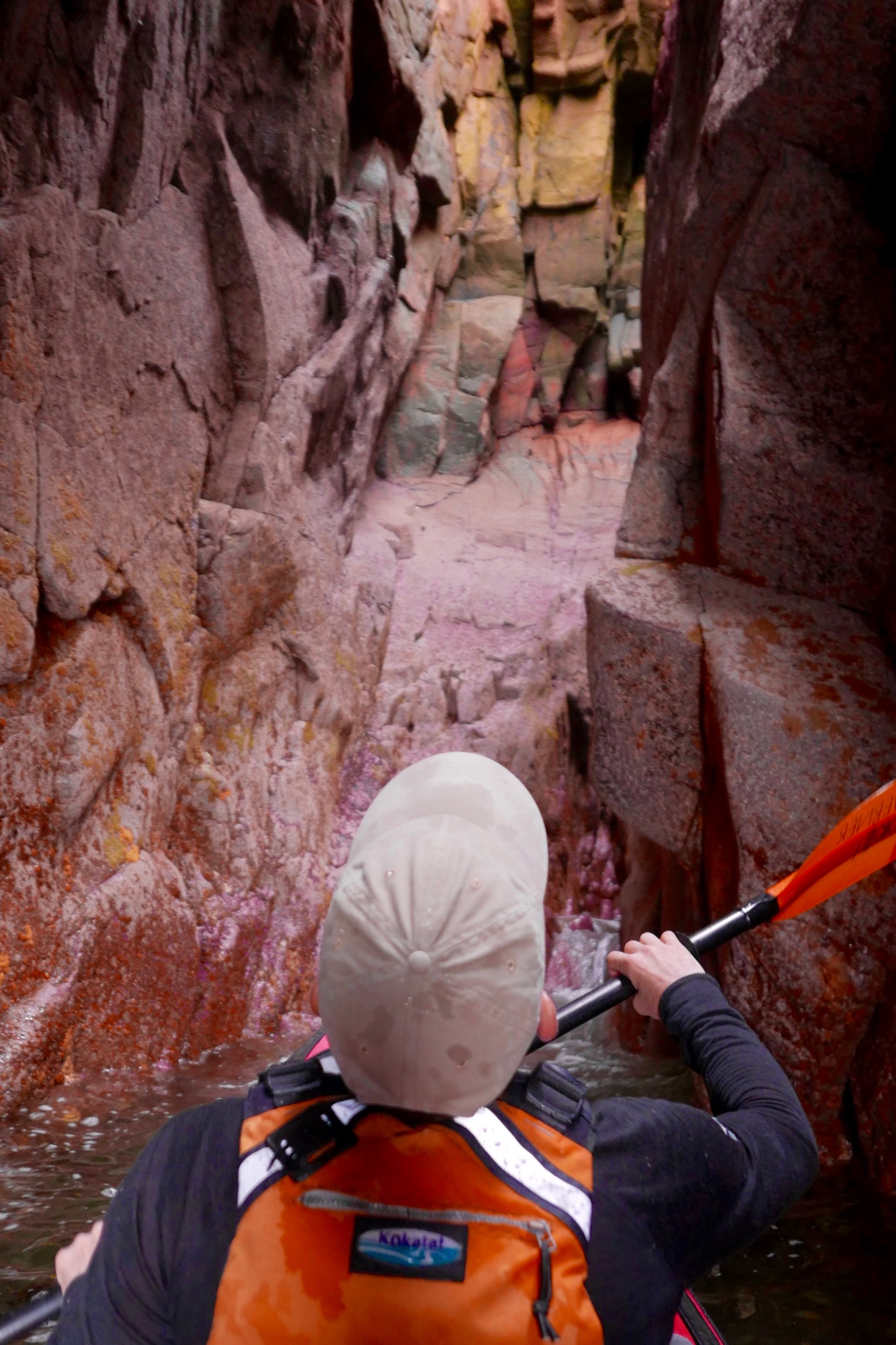
As we passed between the two outcrops on the south end, Jon smacked me in the head with his paddle (left). Lifted through by a 1-m swell, on the inshore side we found the least unlikely looking parking slot, where between bigger swells I could crawl out (right). If you think about it, sitting as you are on the floor of a bobbling narrow boat at sea level, there’s nothing harder to get out of than a kayak, especially once you’ve attained a certain age. IKs are easier than a proper sea kayak of course, but even a canoe’s bench seat might be easier to spring or step off.
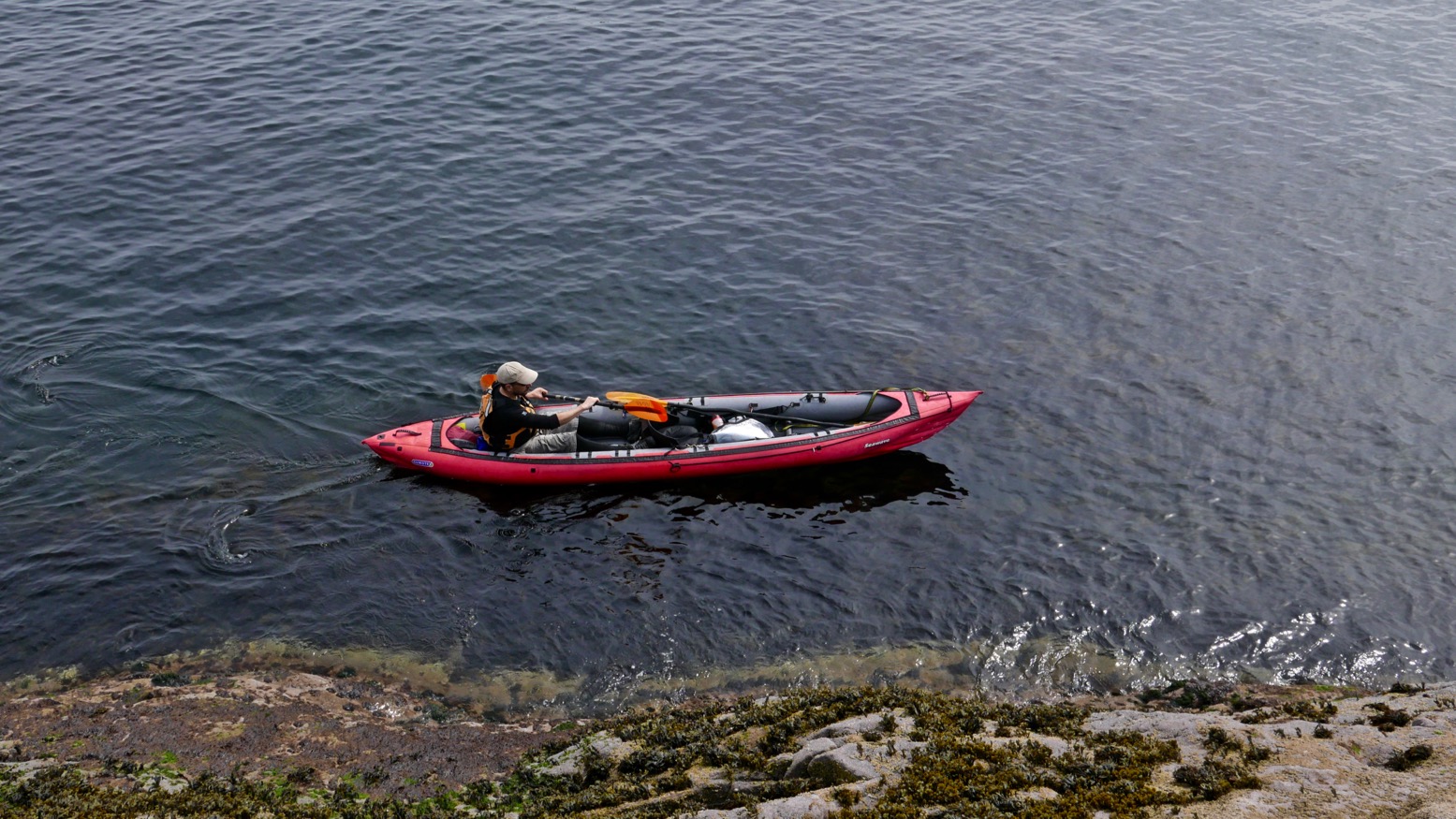
Stac Angus is nearly bisected by a punched-out breach (left) through which storm waves tumble; the higher part is in the north. Problem was getting there from the lower half of the skerry where I’d landed. Even if it wasn’t 26m above MLWS or LAT or even M&S, accessing that northern spike was a lot more of a rock-climbing challenge than I was prepared to take on. So I left it to the squawking guillemots and settled with just enough elevation to get an OK shot of Jon gliding by (below), then scrambled back down to the slot and hailed down my water taxi.
With Stac of Angus ticked off, we scooted over towards Sgeir an Aon Iomairt (in the picture above, on the right), hoping it would provide an easier landing for a civilised terrestrial lunch.
Iomairt has a similar NW-facing cliff and on its NE corner has a parking slot of sorts (right) where a kayak can wedge itself as the tide drops away below it.
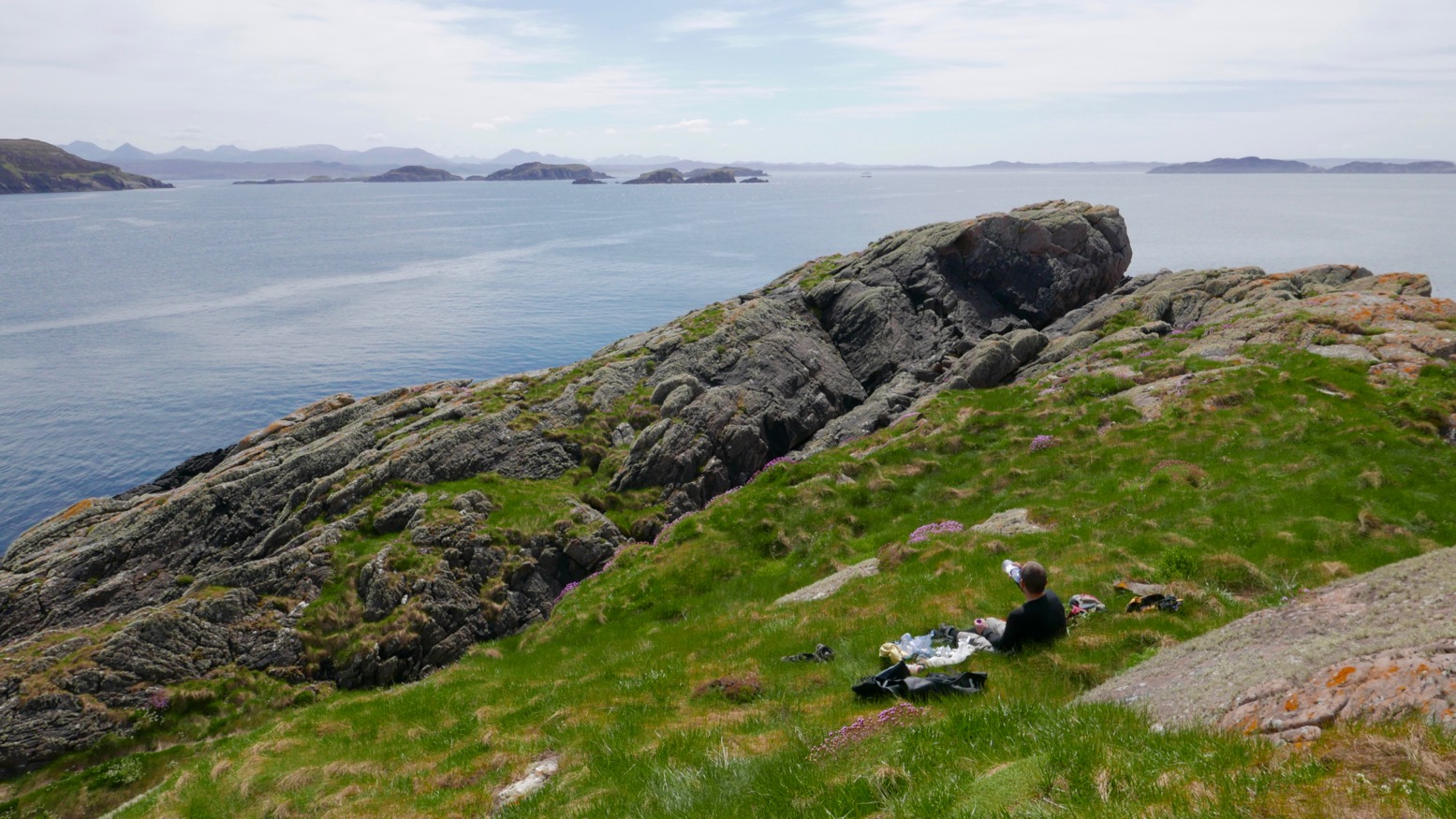
The surprise here was the thick cushy duvet of soft grass and thrift flowers which capped the island. Picture left: looking south from, near the summit towards the Carns, Bottle and Priest Island. Whatever it is that makes Iomairt agreeable to lush vegetation and sea pink thrifts, while Angus makes do with lichen and bird shite, it’s found here. Perhaps because it’s less of a jutting flake and flatter, with many crevices where rainwater and sludge can gather and foment.
Who knows, but it was nice to be able to walk around, rather than teether on acute, barnacle-covered slabs, as I’d just done on Angus. We settled down out of the breeze – May temperatures are still barely in double figures up here – and unpacked our munchies. We had with less than an hour before the tide turned and lifted the Gumotex away. As we ate we spotted another couple of paddlers enjoying the calm conditions out to the southeast, near the two Carns which join up at low tides, like today. Though you’re not spoilt for choice out here in the Summer Isles, you could easily camp on Sgeir an Aon Iomairt. There’s brackish water in some pools, good enough for a wash, and enough flat patches to sleep in comfort. Hardshell or IK, for peace of mind you’d still want to lug you’re boat above the high water line unless you can find a bombproof anchorage. And the elevation of around 16m is, you’ll be pleased to know, about right. When our time came the tide had dropped a metre but was on the turn. Getting back in was as always an awkward shunt, slipping around on kelp and slimey molluscs to get the Seawave back on the water, but once in the pool it did manage to paddle itself out over the slimy kelp towards Sgeir Ribhinn (‘Maiden’s Skerry’), the last of our Summer Island skerries.
Coming round the eastern side of Ribhinn, even this skerry managed to sustain a small capping of grass. We nosed into a kayak-wide geo and found ourselves in a twin-arched cave, another paddleable arch (above) to add to my list.
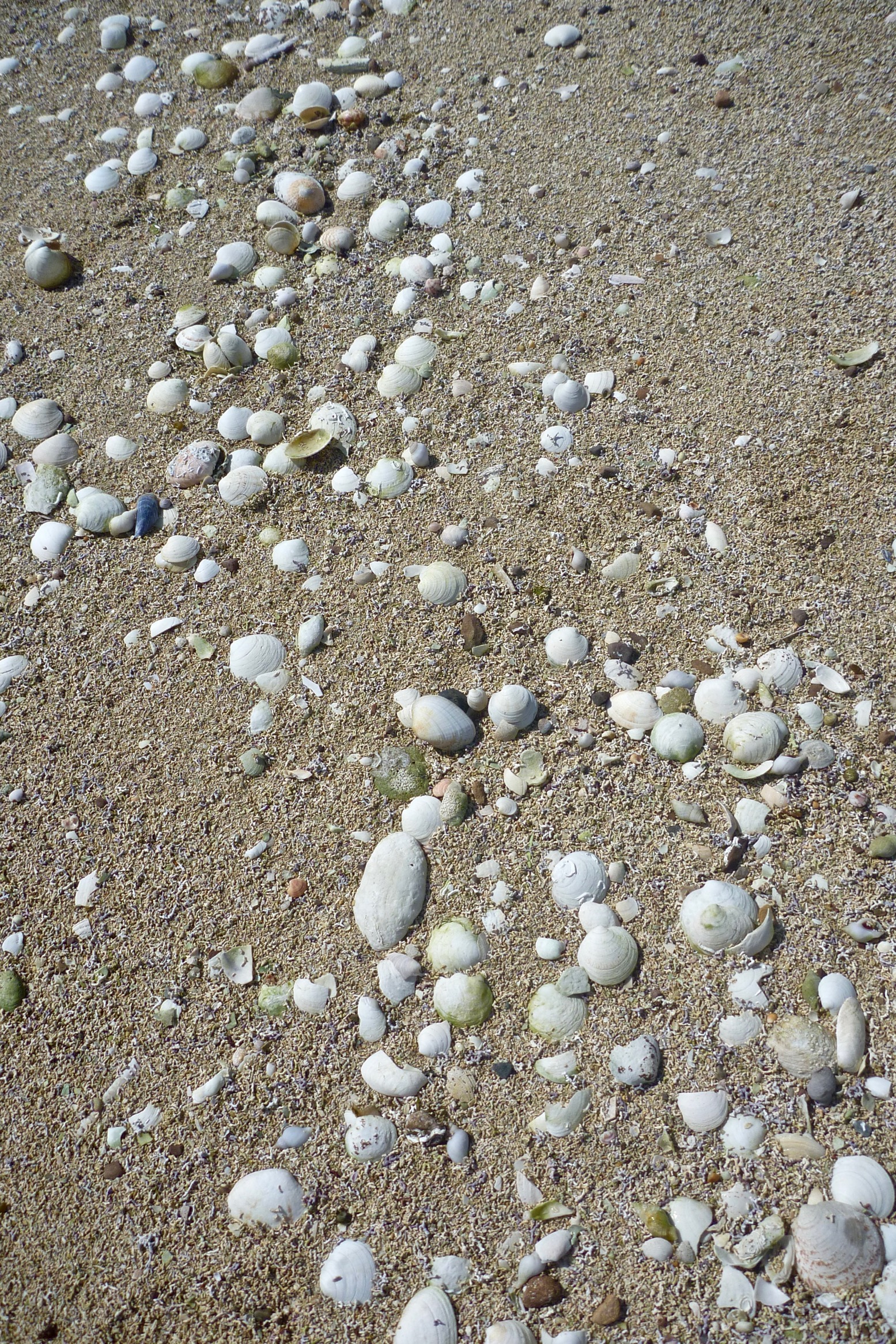
All that remained was to paddle back the way we came through the western passage of ‘Tanera Sound’, between Tanera Beg and Eilean Fada Mor. With the spring tide still low, all the shell beaches were out sunning themselves. After looking for it for years, I finally recognised a cove and beach on Tanera Beg (left) where we’d spent a lovely afternoon 12 years ago with my Gumotex Sunny and ancient Safari when we first started coming to the Summers.
Back to now, I hopped off at Eilean Fada to top up the air that had purged while out of the water over lunch, and to get a shot of Jon floating over the azure Bahaman sands (below). My kayaks have got a lot better since 2006, but the Summer Islands remain the same great place they always were for a quiet paddle.
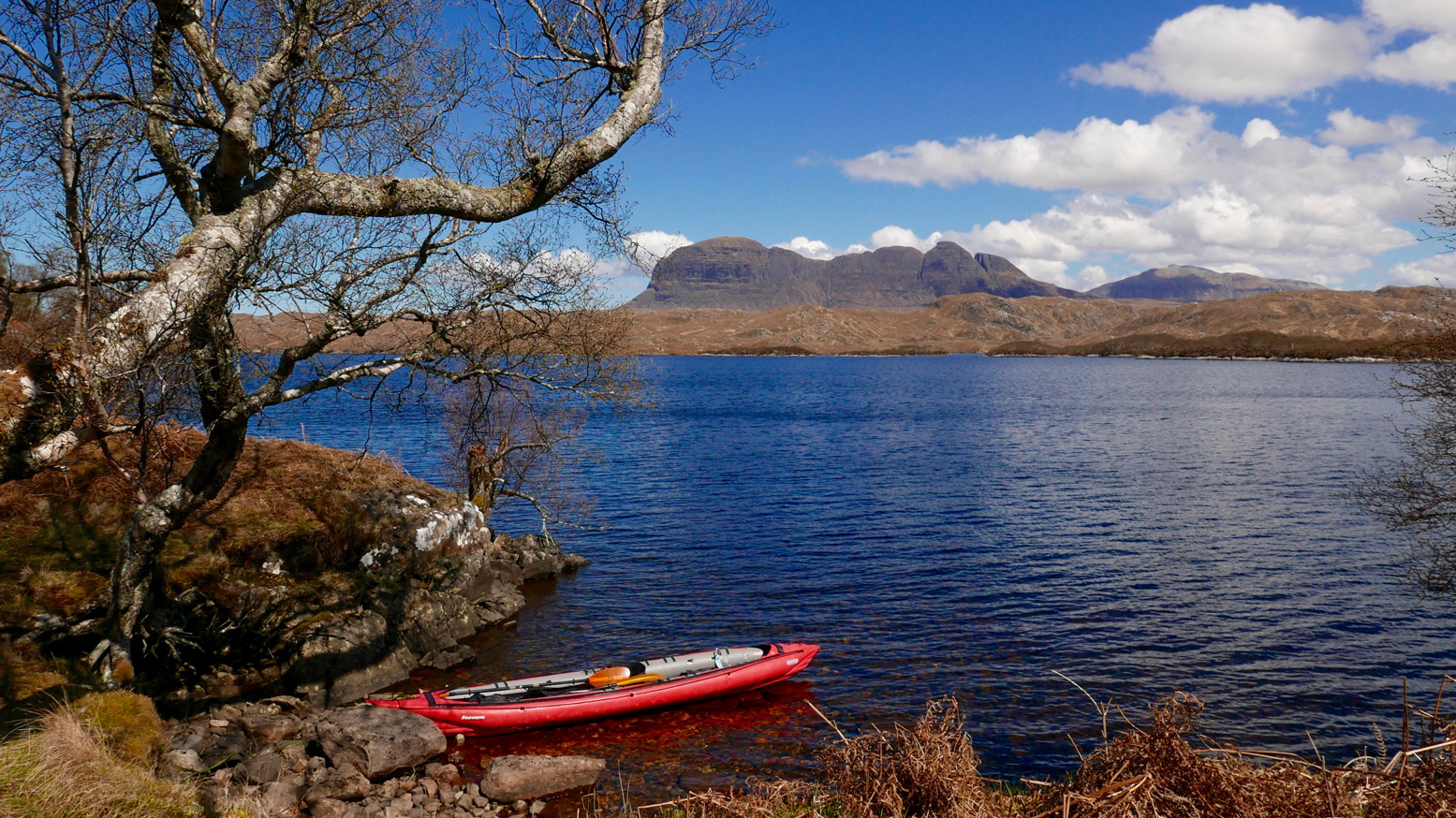
First paddle of the year and it’s nearly May! I need to get out more. It was a calm day but as we’d not been there for ages, we decided to go inland to the ever-reliable Loch ‘Sion’, spread below a cirque of dramatic Assynt peaks. From the lay-by on the WMR it’s a half-a-mile’s trudge down to the west shore at Boat Bay, dipping through the hazel woods then tip-toeing over rotting walkways spanning slimy quagmires.
Down at the bay – bother! The skeg, clipped to hull through a zip tie, was MIA. The zip tie had probably succumbed to the UV, as they do. Oh well, I claimed years ago these IKs are controllable without a skeg, let’s see if that’s still true.
Below Suilven
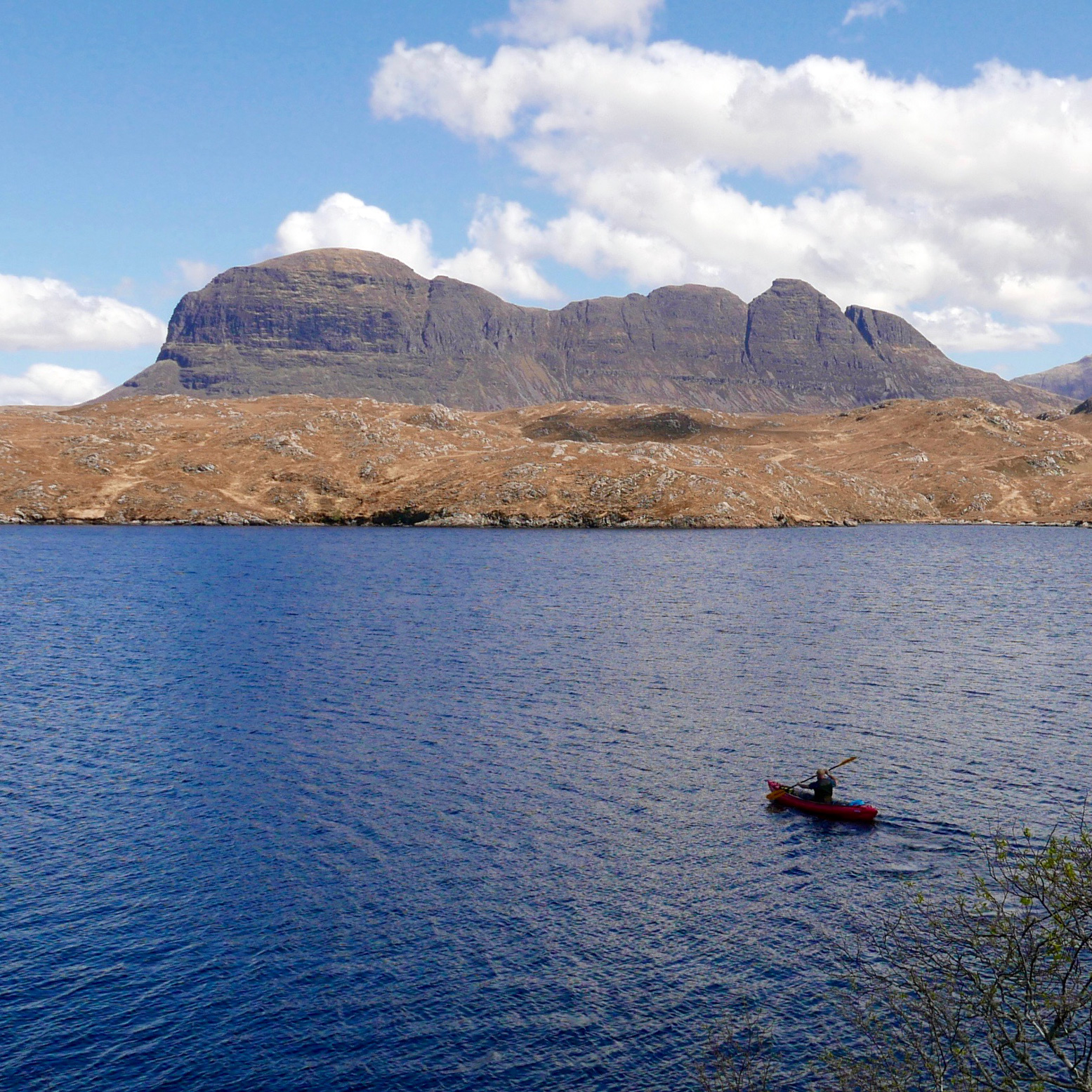
On a flowing river, finessing the paddle strokes while solo, it works well at the cost of some flat-out speed. But two-up and with a tail breeze – that aeolian nemesis of paddlecraft – we scratched a scruffy traverse out to the mouth of Boat Bay where it was quicker to let the funnelled wind push us out into the main loch. Suilven sat to the north, Cul Mor was straight ahead and the ever-popular Stac Poltroon was to the south where panting lines of day-trekkers were eyeing us right now, some with what I liked to think was mild envy. By and by we reach Eilean Dudh, the islet just north of Eilean Mòr, where I went for a solo spin to see if the boat was easier to track solo. It was a bit, especially once off a tailwind.
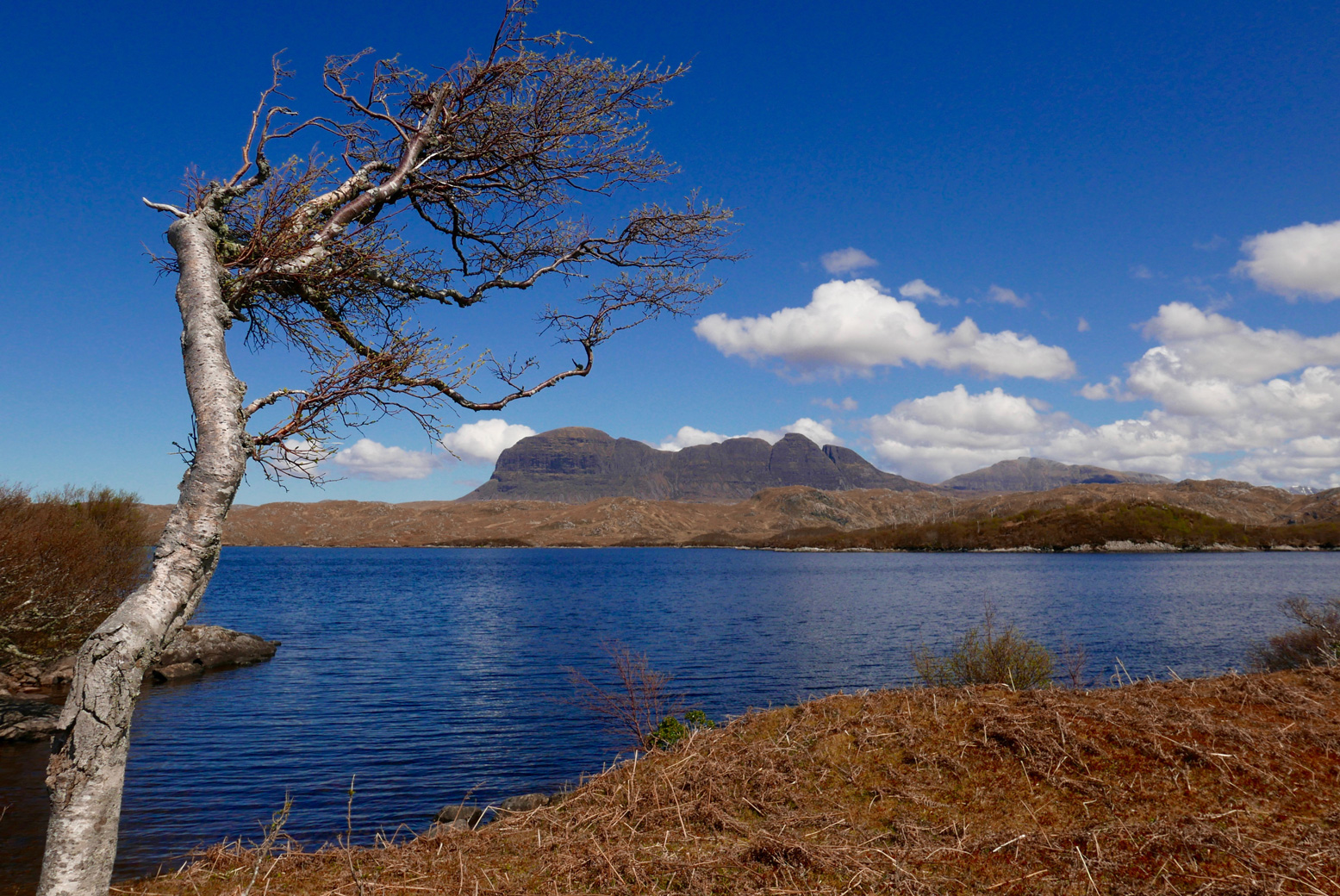
That done, we paddled over to Eilean Mòr, parked up on the east side out of the breeze and found a flatish, dryish patch where some woodsman had made a rudimentary camp. I went off for an explore through the mossy-barked woodlands, like something from a fairy tale, then up to the unusually bald summit which in a month or two will be waist-deep in thick, green ferns. or is it bracken? All around the heather-clad hills still clung to the tawny hues of late winter and the branches of gaunt, leafless trees, deformed by the prevailing winds, reached northeast like some toga-clad heroine in a Romantic painting. May’s reliably sunny spells will soon put an end to all this drabness.
When the time came to paddle back, set against the wind the skegless Seawave was much easier to handle and satisfying to paddle. In fact I got so engrossed in the effort that amid the perspectiveless blur of yellows and browns I missed the small entrance back into Boat Bay and was steering us west towards the Polly Lochs.
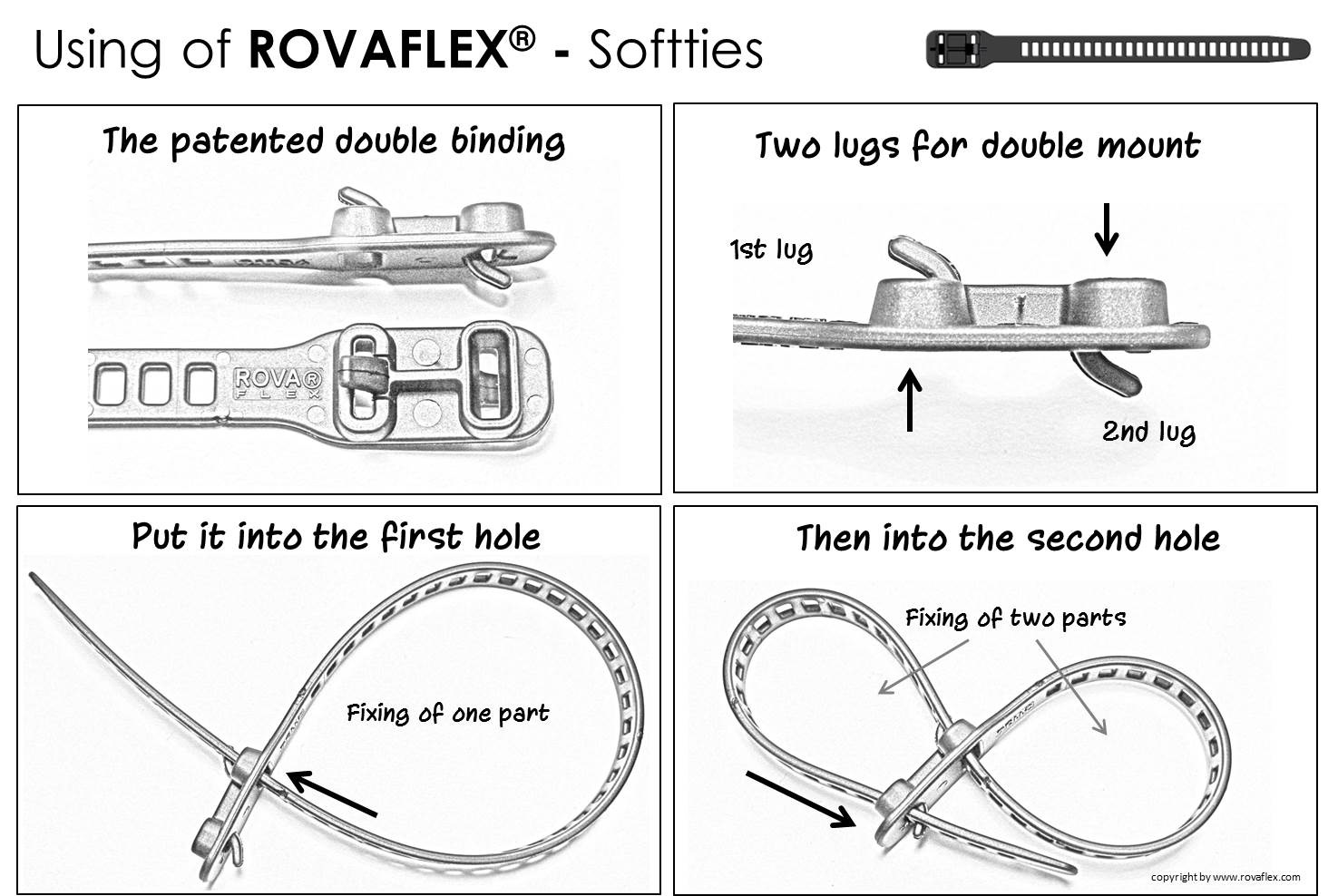
‘This doesn’t look right’. And I was right, it wasn’t. A quick glance at the map and a turn to the northwest delivered us back to the right shore. Back home, the skeg lay in the gravel by the wall alongside a broken zip tie. Have I mentioned tough, TPU RovaFlex reusuables yet?
A fortnight later (that’s the frequency of sunny days up here) we looked down on a new perspective of Suilven and Eilean Mòr island from the windless 2800-foot summit of Canisp mountain, still clinging to the last of the winter snows.
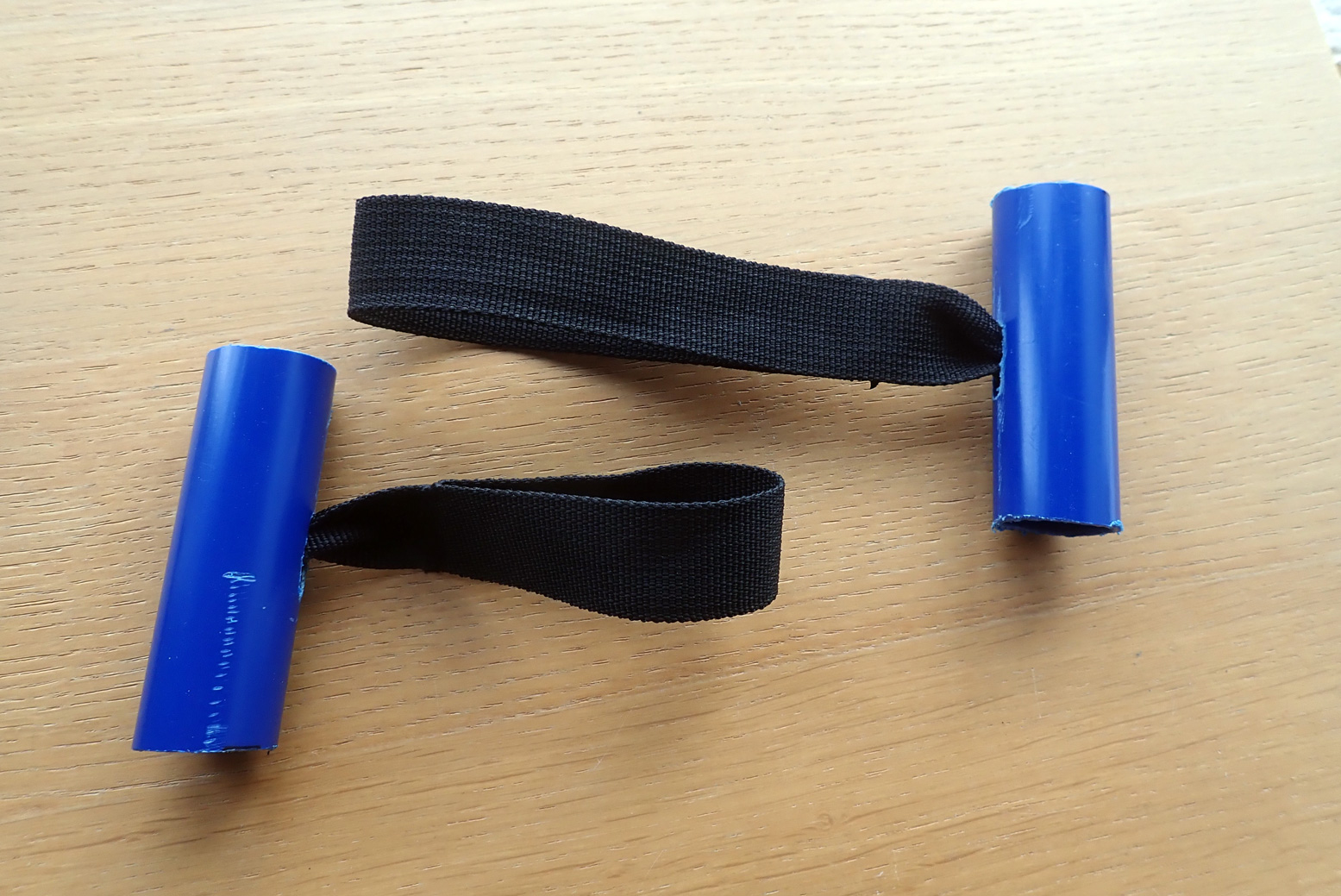
Michael S from BC came up with a good idea for securing stuff, seats or thigh straps to the floor of your IK without resorting to the faff gluing on D-rings – something that takes application and the right glue to do well. He suggests the cavity formed between the floor and the sides when you pump an IK up can be used to jam in short tubes attached to tape loops. Example left is a Sea Eagle Full D-S, but I know Gumotex and other IKs I’ve owned have a similar space along the sides.
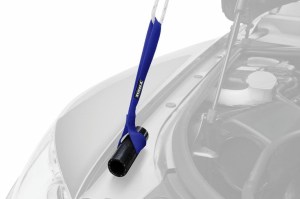
Pictured below are some Sherpak Quick Loop tie-downs which go from $15 a pair on amazon US. You can buy Thule ones for six times as much or search eBay for <Kayak Hood Trunk Tie Down Loops> sent from China for 7 quid. The idea is you shut them under your car’s bonnet, tailgate or doors (right) to help lash on stuff including boats.
But they could also be lodged in an IK’s floor/side cavities as you pump up, and of course can be positioned anywhere and slid forward or back. It’s possible the 1-inch diameter tubes shown may be too small and pull out, so make your own using larger conduit from a hardware store, or just a shore-side stick and washed-up rope. Below: I made my own. To be tested. Neato mosquito as my Kiwi mate used to say.
We set out to paddle from Chichester Town Basin, down the old ship canal into the tidal Chichester Harbour at Birdham Lock. Lois and Austin in two do-it-all, drop-skeg Venture Flex 11s (left) Robin and Elliot in an old Gumo Twist 2 and a newer Nitrilon one, both of which fitted into carrier bags. Plus my Seawave lashed to a trolley.
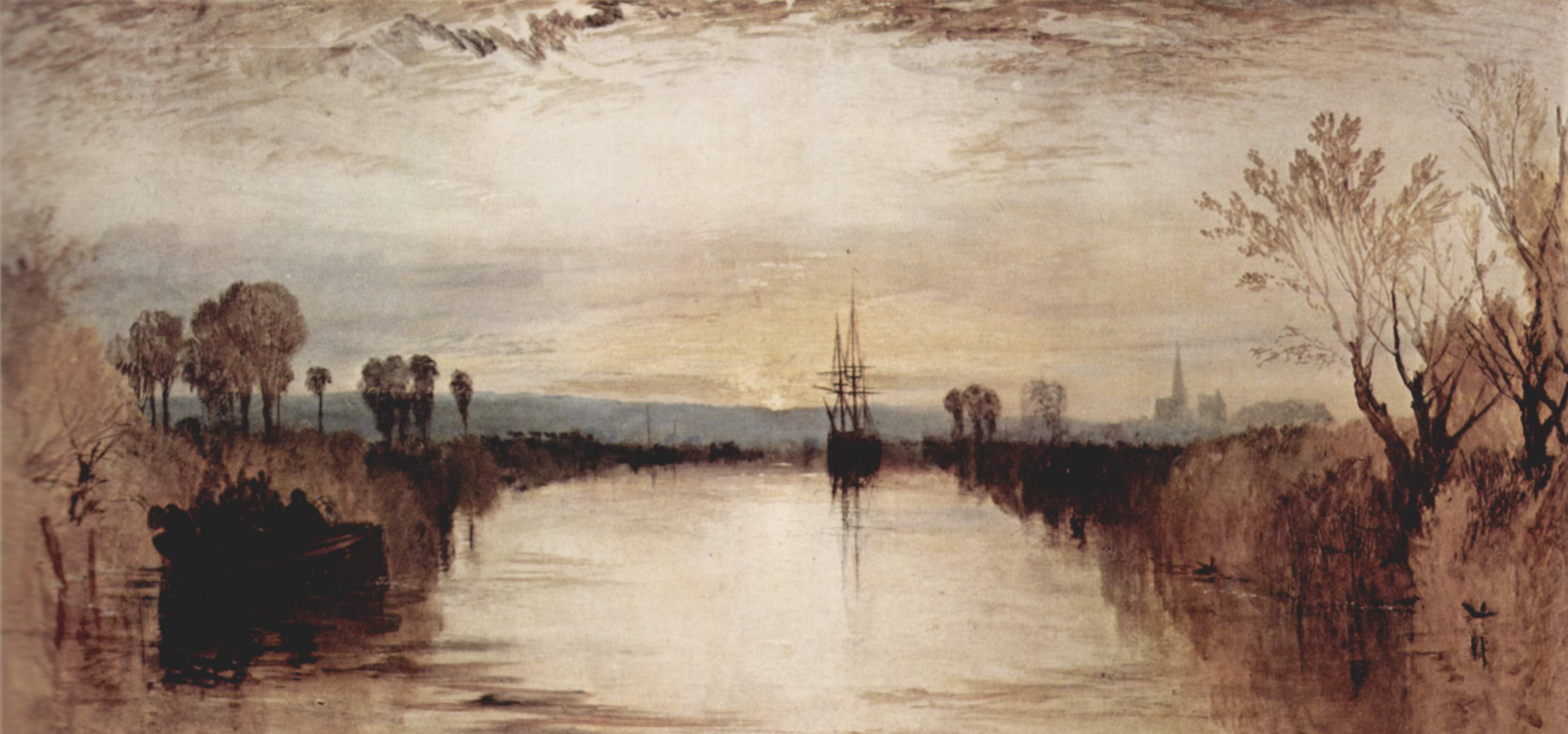
Nearly two hundred years ago Turner depicted tall ships gliding serenely along the then new 4.5-mile canal (above). During the canal boom preceding the railways, it linked Roman-era Chichester with the huge natural inlet of Chichester Harbour and the adjacent naval fleet at Portsmouth. To the east was a canal to the Arun & Wey navigation (left) which was a short-lived inland link between London and Portsmouth commissioned at a time when Napoleonic fleets threatened the English Channel.
Our original plan had been no less Napoleonic in its grandeur: a 15-mile lap of Hayling Island, but today the tides and winds were all wrong for that, and even with Plan B we’d arrive at Birdham at low tide to face an undignified, sludgey put in.
On Google maps the canal looked clear, with maybe a quick carry around a lock or two. But just two miles from the basin, a thick mat of Sargasso frogweed clogged the channel at the B2201 Selsey Road bridge (below), reducing speeds to a crawl. Worse still, over the bridge this unallied carpet of errant biomass ran on like forever, and probably all the way to Birdham Lock.
Was it a high-summer frogweed bloom? The initial two miles are kept clear by rowers, paddlers and the 32-seater cruise boat which hooted past us with a lone passenger tapping at his phone. But nothing bar the Solent breeze stirred the canal west of the B2201, allowing the thick Sargassian spinach to fester and choke navigation for even the pluckiest of mallards. A picture from 2008 (above) shows less weed at the bridge and a rather squeezy thrutch through a spider-clogged culvert under the road.
Abandon Plan B all ye who Venture Flex here. Austin called in an Uber: ETA 4 mins; ET back to his Volvo: 6 mins. Total elapsed recovery time: 16 mins, give or take. The internet of things – how modern! Soon the hardshells were lashed to the roof and the rolled-up IKs heaved into the spacious boot of the Swedish landraft with class-leading crumple zones.
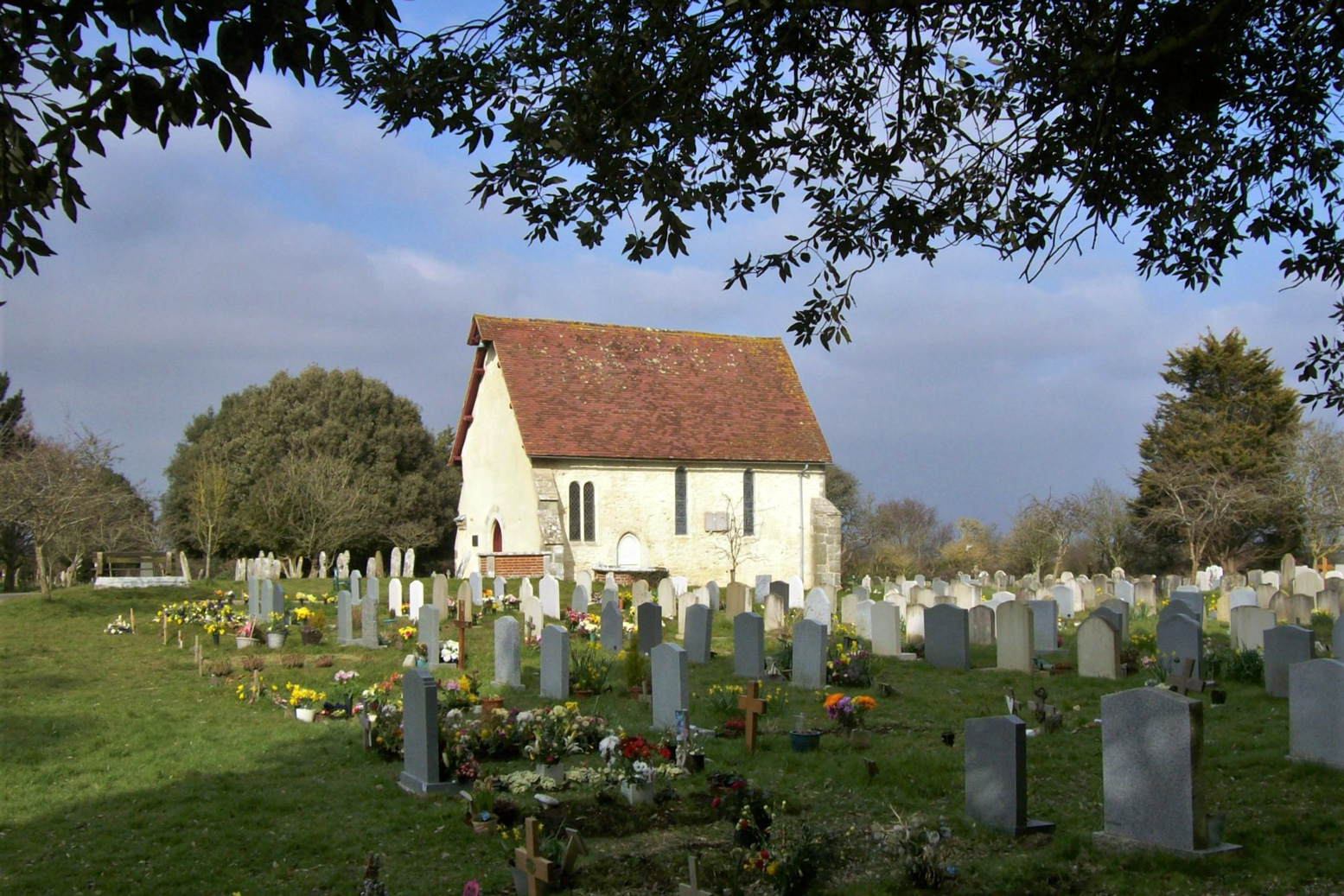
A quick map check and I proposed Plan C: Pagham Harbour just down the road and out of the rising southwesterlies. I’d never heard of this medieval-era port which was now a bird sanctuary-cum-sludge repository, but Elliot had been spotting here so knew the way to the chapel at Church Norton, thought to be the mythical 7th-C source of the overdue Christianisation of pagan Sussex.
A 5-minute haul led to the shore, except the tide – which should have turned over an hour ago – was still way out, leaving only snaking channels accessible down muddy banks. We ate lunch, waiting, like Al Gore, for sea levels to rise. But when the time came nothing but irksome clouds of marsh gnats stirred as we padded over the springy salt-scrub to the nearest channel (above).
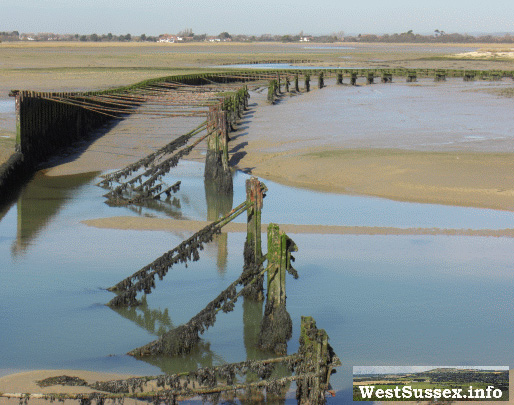
All around, collapsed jetties, concrete groynes and other arcane structures recalled Pagham’s 19th-century heyday. Back then the sea had been successfully sealed off and the land reclaimed for farming until a storm in 1910 broke through the embankment, reflooding the harbour for fair and fowl.
Another portage over a shingle bank got us to the main outlet leading to the sea and where the water was rushing out when it should have been filling. I realised that narrow-necked inlets like Pagham Harbour act like reservoirs, releasing their tidal fill gradually for hours after the sea tide has turned. In the tropical fjords of northwestern Australia’s Kimberley it can produce bizarre spectacles like the Horizontal Waterfall (left).
We drifted and boat-hauled through a strange, desert-like landscape of barren shingle banks speckled with forlorn fishermen and demure nudists until the spit spat us out into the English Channel like five bits of unwanted, flavourless chewing gum.
According to images and video on Save Pagham Beach (left), it’s staggering how fast the spit has grown once shingle management ceased around 2004; part of a new ‘natural coastline’ [money saving] policy. The spit has repositioned tidal erosion eastwards and along the shore, accelerating the scouring of Pagham’s foreshore and endangering the homes immediately behind. Recutting the Harbour’s outlet to the west (bottom picture, left) is thought to be a solution, but may transfer the flooding risk inside the harbour. Add in the protected SSSI status of the Harbour and the ‘homes vs terns’ debate becomes complex. Who’d have thought we just went out for a simple paddle.
Eastward along the coast, the assembled infrastructure of Bognor Regis rose from the horizon, while behind us the promontory of Selsey Bill kept the worst of the wind off the waves. With a helping tide and backwind we bobbed with little effort in the swell which gradually grew and started white-capping once clear of the bill. But as I often find, a sunny day and not paddling alone reduced the feeling of exposure and imminent watery doom. Only when a stray cloud blocked the sun for a minute did the tumbling swell take on a more malevolent tone. The buoyant Twists – hardly sea kayaks – managed the conditions fine and the lower, unskirted Ventures only took the odd interior rinse.
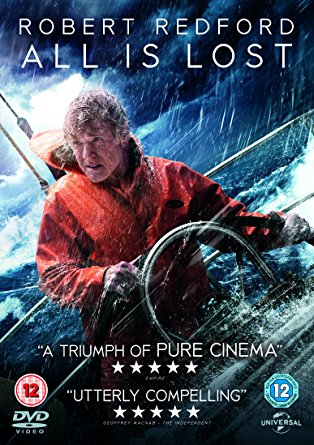
Talking of which, All Is Lost (right) was on telly the other night. Lone yachtsman Robert Redford battles against compounding reversals in the Indian Ocean after a collision with floating cargo container wrecks his boat. A great movie with almost zero dialogue.
Just near Bognor all was lost for real (above and left). Only a fortnight earlier, a similar, lone-helmed sailing boat had lost its engine and unable to sail, drifted onto Bognor’s serried timber groynes. Less than two weeks had passed and already the hull was now cracked like an eggshell and the masts were gone (maybe removed). But unlike the doomed Redford character, on the day the Norway-bound sailsman had been able to scramble ashore.
These groyne stumps – designed to limit longshore shingle drift – could also be a bit tricky in a hardshell if the swell dropped as you passed over one. And just along the shore was another wreck (above) protruding gnarly, rusted studs which may well have sliced up an IK. Mostly submerged when we passed, some post-facto internetery revealed it to be the remains of a Mulberry Harbour pontoon, one of many built in secret during WWII as far as northwest Scotland, then floated out on D-Day in 1944 to enable the sea assault on Normandy.
Our own beach assault ended at the truncated remains of Bognor pier, proving the sea eats away at this whole coast. Bognor is a step back to Hi-de-Hi! Sixties Britain when we did like to be beside the seaside. All together now! So ended a great day of paddle exploring. Uber!
See also: the similar but wider and DS-floored Thaya
Gumotex have rebranded 2013’s Solar 410C as a Solar 3 (some call it ‘Solar 019’). Everything about the two boats appears to be the same.
Actual differences only add up to a longer front splash deck (left) with a metal support to stop sag – and a drain slot at the back (right; an idea copied off my old Sunny, just so you know!).
The 410C evolved from the slightly shorter Gumotex Sunny (left), in its day a brilliant IK which I used for years and years, until the flexing and size outgrew my needs.
Pressure in the Solar 3 remains the standard 0.2 bar, but this only becomes an issue when used solo at sea (the boat sags in the middle and can swamp more easily). Two or three up on flat water, it won’t be so noticeable or will be part of the fun. The Solar 3 is pitched as an easy river-touring or family recreational boat where price and space matters more than pressure and performance; for that you have the 0.25 bar Seawave which costs 40% more. For now the Solar remains the an all-tube and inexpensive option to a wider, dropstitch Thaya and is the last of the classic Gumotex longboats.
Performing my cutting-a-kayak-in-half trick gave me a long overdue chance to see exactly how they’re put together, as well as other stuff, like why it was failing and how well certain glues stuck.
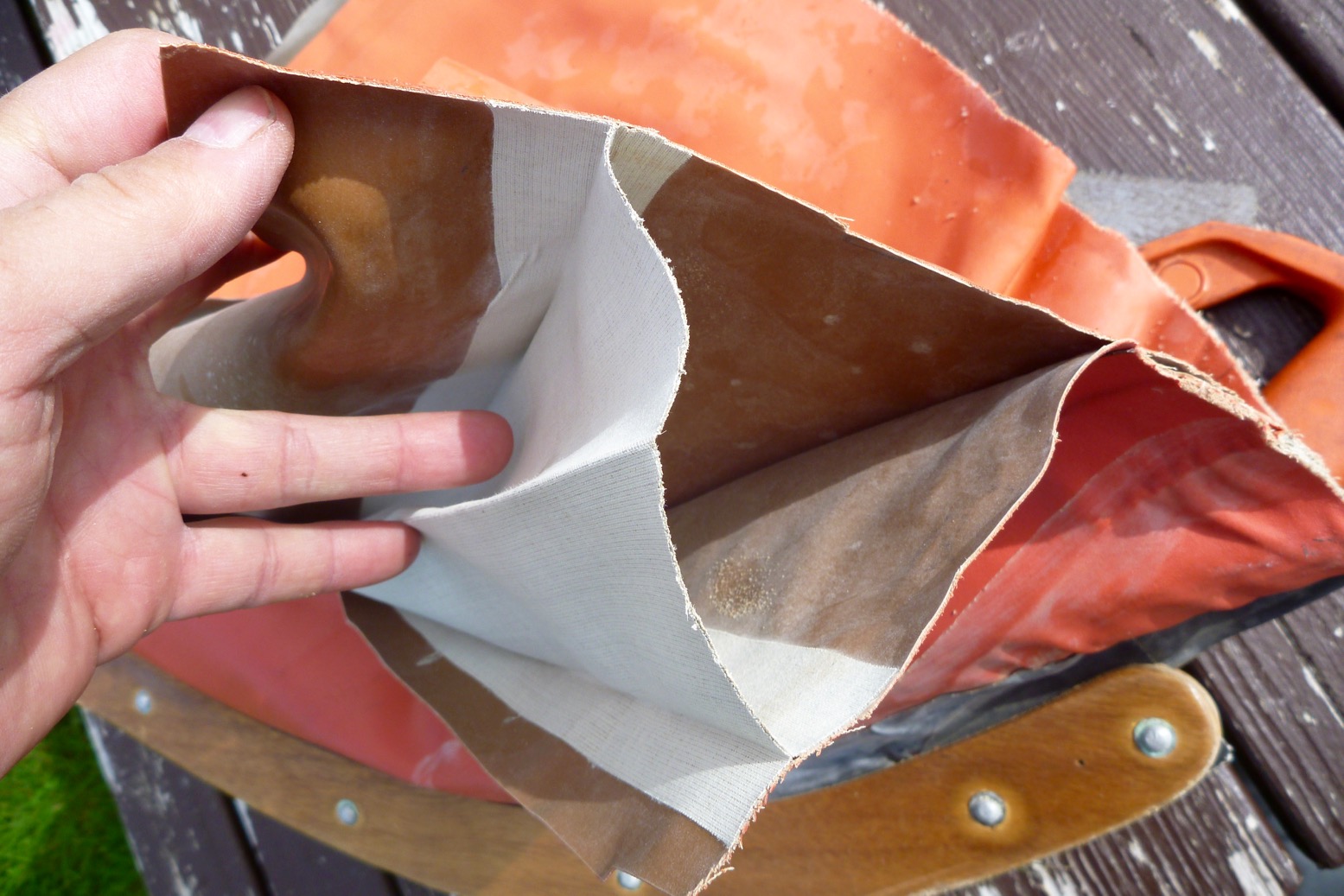
The neoprene inside I used to assume it was the same coloured coating inside the boat as out; it’s just simpler. But of course, the diagram left is clear: what’s outside and what’s inside an IK hull is not the same stuff. There’s no need to waste UV-resistant hypalon coating (or colouring or that matter) inside the boat’s benighted chambers. All it needs to be is the same durable and airtight coating, and neoprene – the brown rubber-like coating left – does that fine. I bet I’m not the only one to mistake ‘neoprene‘ as simply that closed-cell sponge used in wetsuits or laptop sleeves. In its solid form it’s a durable synthetic rubber, but I presume lacks the full-on UV resistance of hypalon which DuPont invented shortly after.
I-beam floor As mentioned here, an inflated vessel will seek equilibrium by attaining a rotund form, be it tube or sphere. A flat inflated plane such as an airbed or an IK floor needs to be a series of parallel tubes unless it’s just a non-inflated sheet, like packraft- and white-water raft floors. So this is an IK I-beam floor (above): probably the same tough core of nylon or polyester scrim, but without the impermeable hypalon and neoprene coatings of the exterior panels. Note the pre-folds or creases to help the Semperit pack flat. I imagine modern IKs do the same, but it all explains the necessary attention to detail which makes ‘tubeless’ IKs like this so labour intensive, compared to ‘bladder’ designs like Aire.
Twin side-tube IKs like this Forelle, the Incept and Grabner Holidays, have two smaller tubes one on top of the other, rather than one fat side tube like my Seawave (below, red) or Amigo. It gives the same buoyancy, more freeboard (above water height), a slimmer profile (more speed) and more volume inside (easier loading). The red Seawave below is 82cm wide; the Semperit is 72. It makes the boat look a whole lot better too and overall, because it’s also as stable, I’d say it’s the best design for an IK, but it also needs I-beam sections to constrain the two side tubes.
I can’t say I could suck air through the scrim easily, but I’m pretty sure it’s porous – I didn’t find any transfer holes to allow air to flow between adjacent tubes – they might be a weak point. When an IK like this is over-inflated (or left in the sun) and has no PRVs (none on the Semperit), it’s this scrim which either tears apart, most probably at the T-join where it’s glued to the neoprene. I tried tearing sections of scrim by hand; impossible where it was uncut, but as soon as you nick it with a knife it would tear quite easily, like thin cotton cloth. This fabric was at least 40-years-old and had one or two patches of mildew, but was still tough and the whole assembly of the boat has held together amazingly well over the years.
Where mine failed Inspecting the fatal second leak alongside the earlier repair, it seemed air was pushing through where two sections of I-beam scrim butted against each other. Perhaps the old coatings stretched differentially here or were just worn out. It did look like the hypalon was simply flaking away. I could have fixed that leak but, as mentioned, another would probably pop up whack-a-mole style somewhere else, quite possible while at sea in either my- or a new owner’s hands.
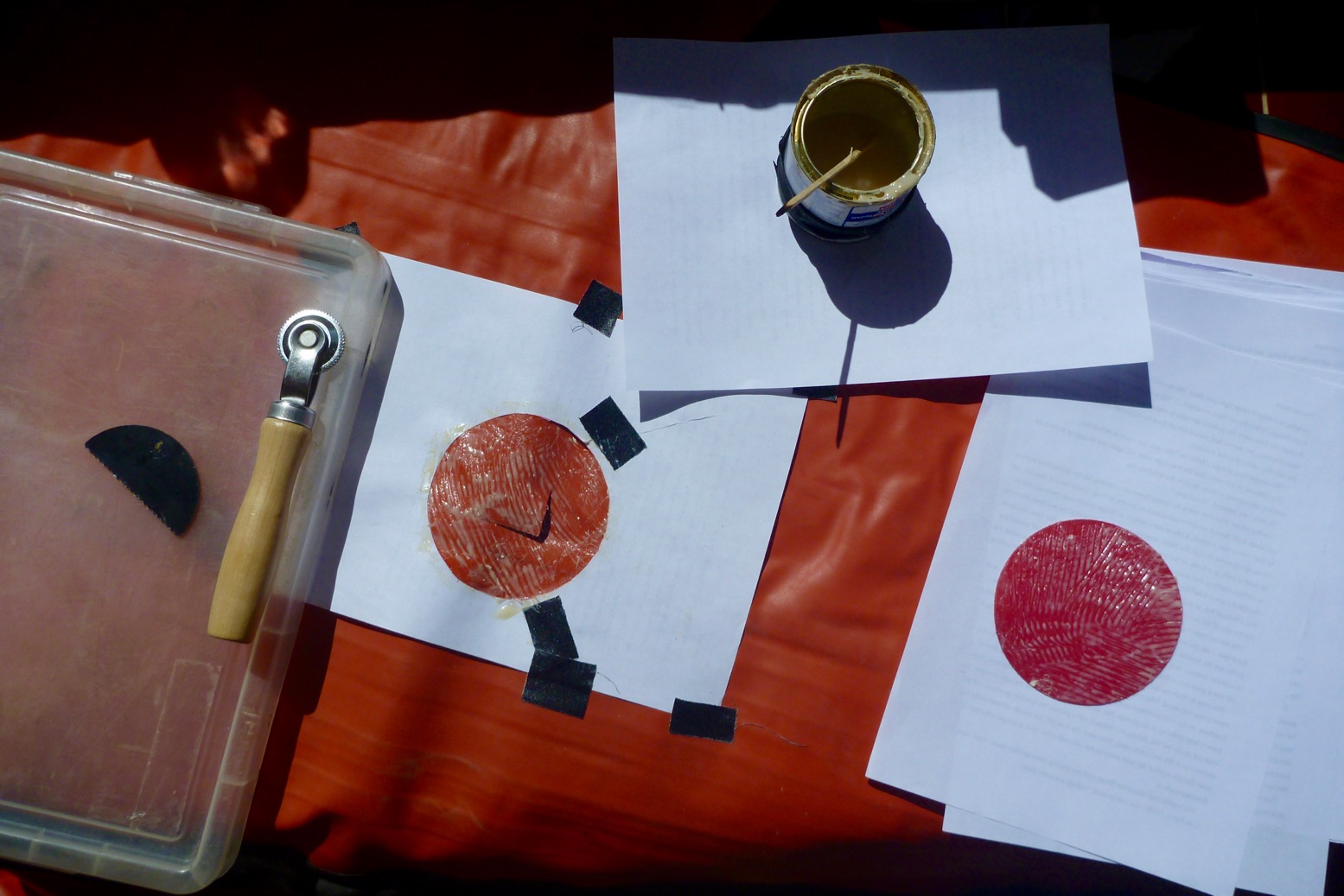
Glue test I repaired the big original ‘L’ tear with a 5″ round patch of hypalon and two-part glue (above and left). I then patched a down-to-the-scrim scratch under the hull with one-part Bostik 1782 (left). I used the same glue to repair the initial new leak inside (bubbling water, above).
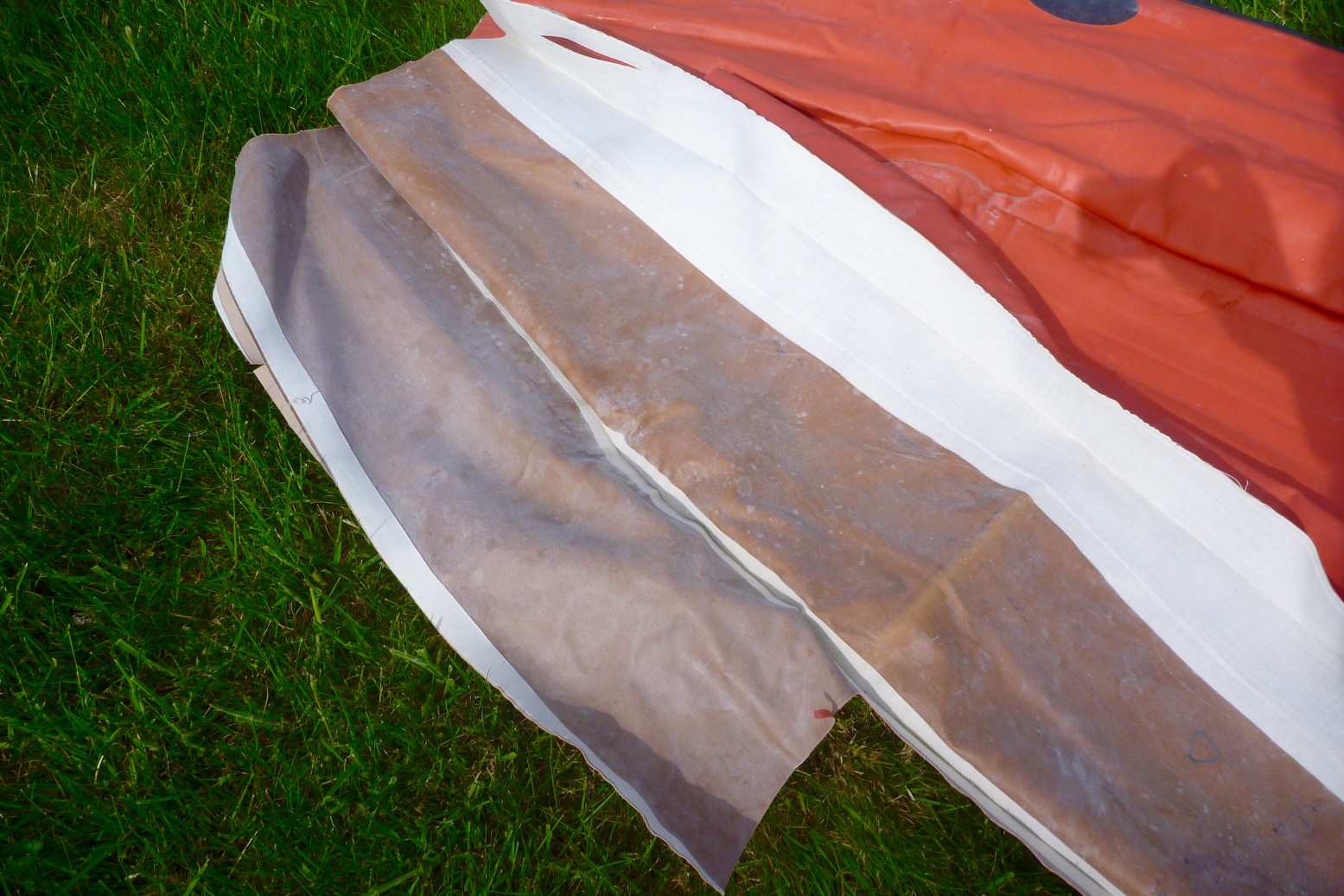
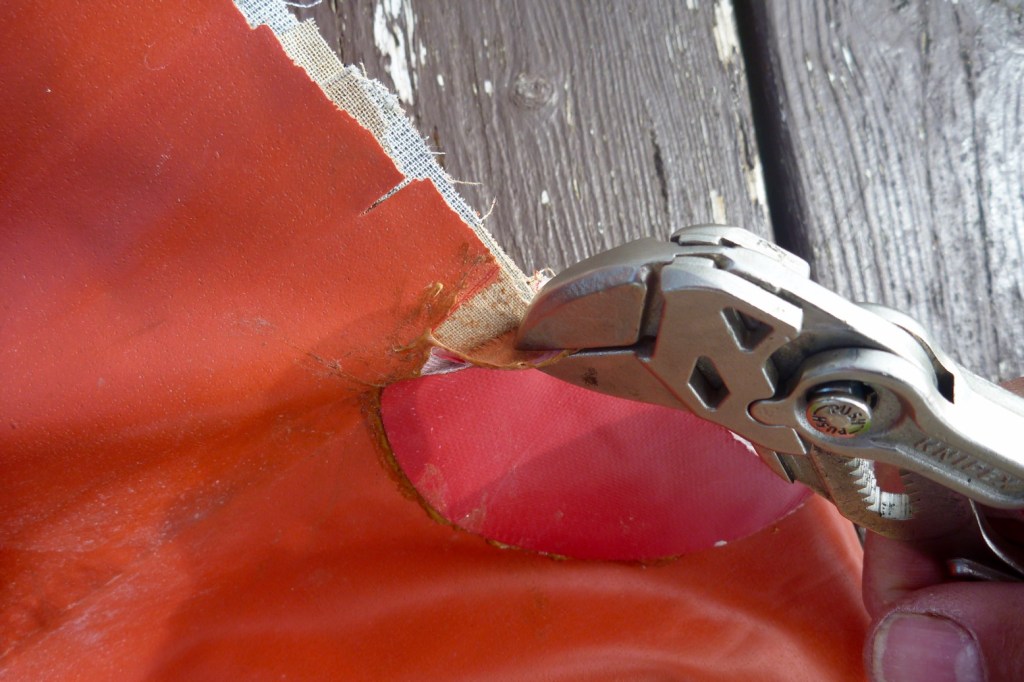
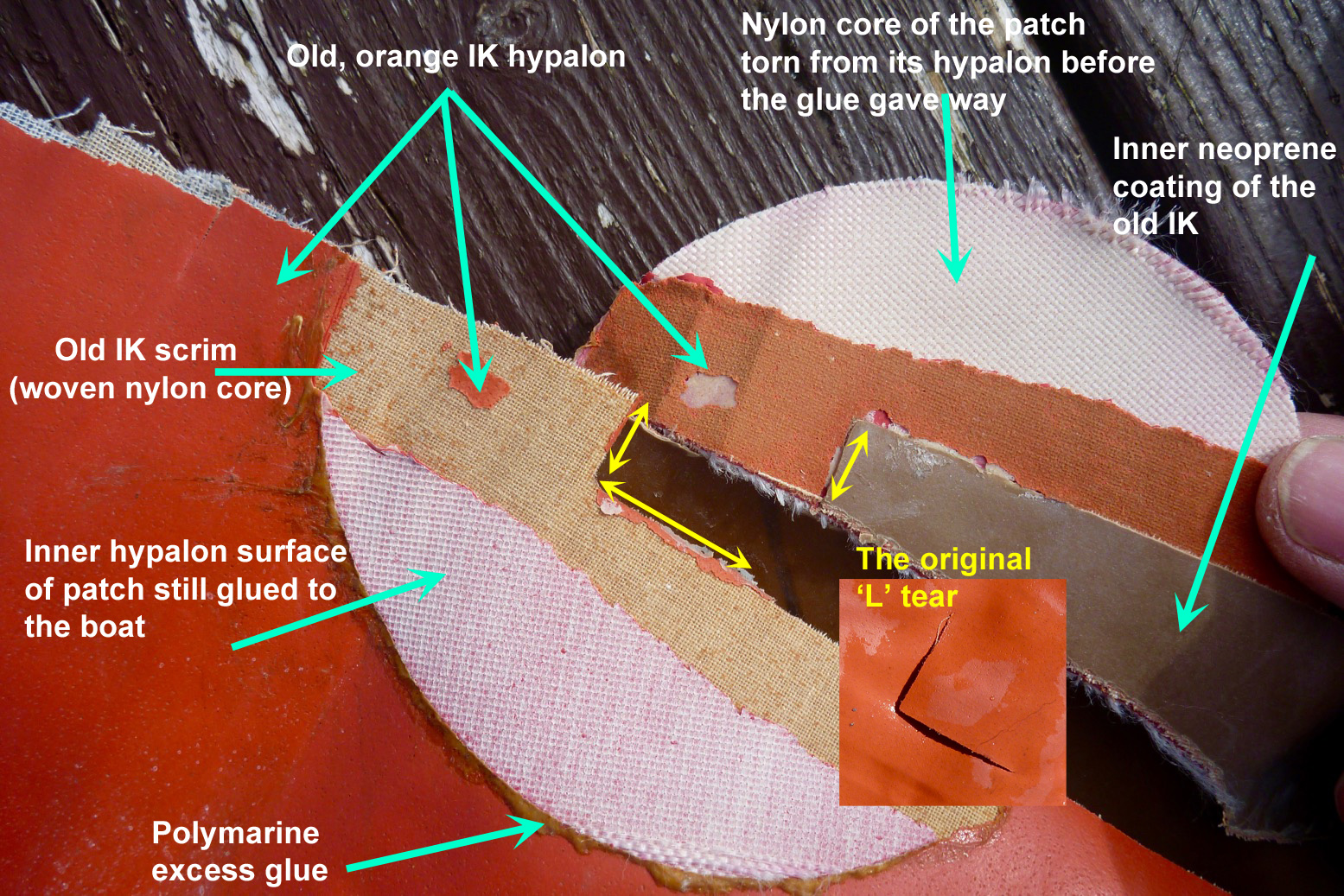
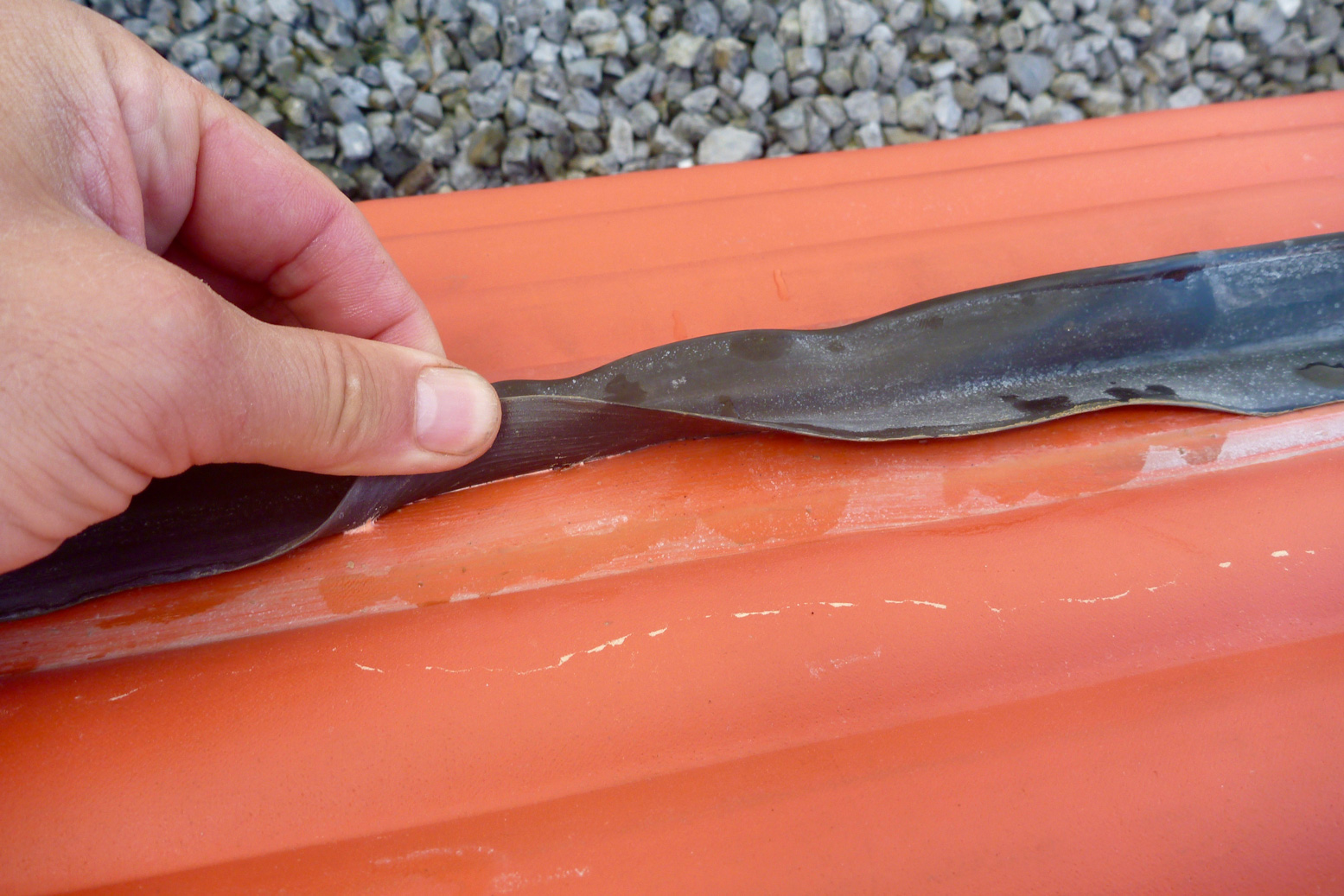
Although I’m pretty sure they’d have lasted, I could easily pull off the Bostik patches by hand. Pulling off the big round Polymarine’d patch was another matter. It just so happened I’d sawn through the round patch but, only once I got some pliers under a lip (above left) was I able to separate it from the hull. As you can see in the big image below, either the ancient orange hypalon coating of the IK, or the newer red hypalon of the patch separated from their respective nylon cores – the glue’s bond was stronger than the actual hypalon coatings, new or ancient.
I get a bit lazy about having to faff about with two-part glue, and I also wonder if I ever guestimating the 25:1 ratio correctly. But as you can see, this stuff sticks. If you absolutely, positively want things to stay stuck or sealed, use two-part adhesives. I still don’t know if the second part curing agent merely speeds up the drying process, or is chemically integral to creating the very strong bond. I’d think it’s the latter, otherwise why bother.
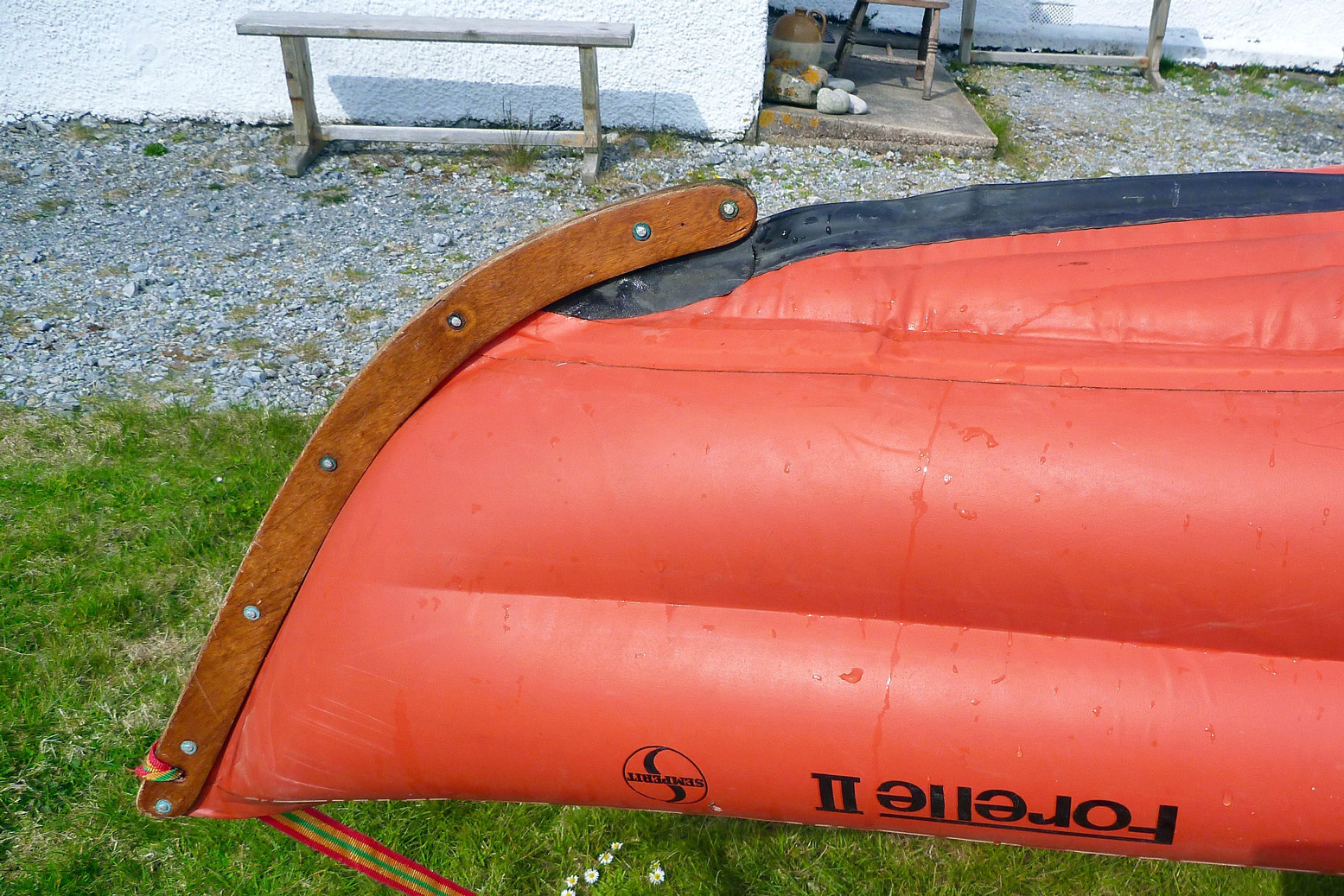
Other stuff The distinctive marine plywood bow has lasted fine – no warping at all and the rivets are still intact. It may have been an early design solution to easily joining the three sections of the hull in a nice sharp point, though they managed that join easily enough at the back. Maybe it was as much for protection and a frontal tracking aid.
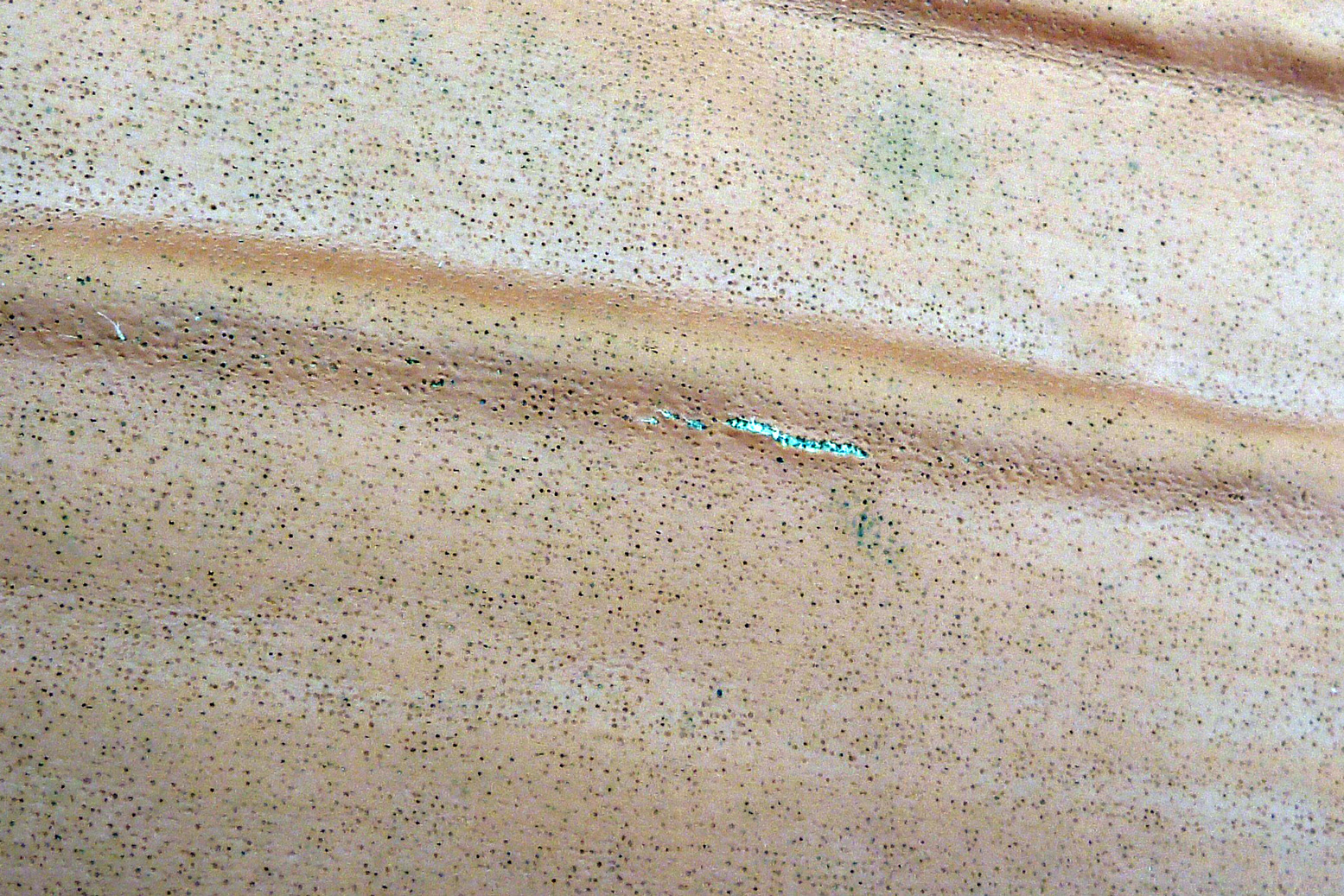
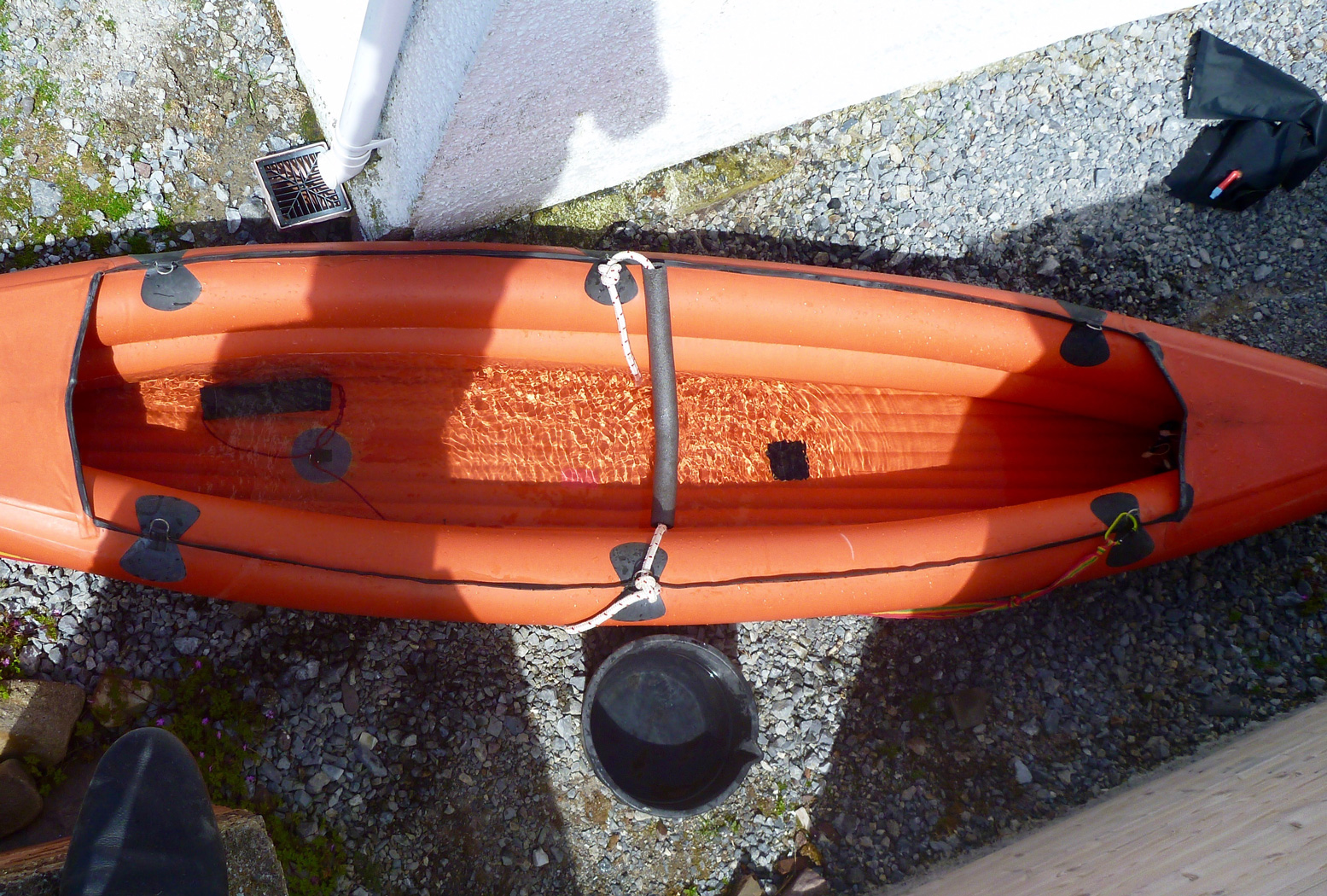
A couple of days after trying out the Semperit I noticed a scratch on the hull bottom (left) so decided to pre-emptively patch that with Bostik 1782 (less faff than 2-part). It looked like an old scratch which had opened up by reusing the boat. I reinflated a day or two later, but a few days on noticed the floor was flat. I pumped it up again – air was hissing from a crack in the hypalon coating inside the boat, more or less under the seat (below; colours enhanced for clarity).
This seemed a bit odd. The boat hadn’t been over-inflated or left in the baking sun, and there wasn’t any obvious rubbing in the two hours I’d used it, though I suppose this is a high-wear area and an old boat.
I suspected general, age-related delamination or entropic porosity. The outer orange hypalon coat can be rubbed or scratched down to the fabric core, as with the hull scratch I’d just repaired. But inside should be an airtight layer of neoprene. There’s no way of checking that without open boat surgery. To be honest, it’s what I half-expected from a 40-year-old IK, which is why I’d kept the refurb and expenses to a minimum. I suspect sudden use after many years possible neglect had accelerated decay. I see the keel-strake is coming away too, as are some other black patches holding the rusting D-rings.
I’ve experienced similar deterioration when buying old vehicles for long trips. They seem like a bargain and have a solid ‘they-don’t-make-’em-like-they-used-to’ reputation. But reviving them, or just asking them to perform as they once did, can lead to a string of failures until it’s just not worth it (left). Much depends on how they’ve been maintained over the years. I recall writing in one of my books (or maybe on here): “you can’t give your old gran a pair of trainers and expect here to run a marathon without having a heart attack“.
I patched the wear-hole with more 1782, reluctant to waste good two-part PolyMarine. I pumped up and filled it with water: all good, but an anomalous perforation somewhere else can’t be ruled out. That’s another thing I’ve learned with old cars and bikes: you replace the clapped-out engine then the clutch goes; you replace the clutch and the gearbox goes; you replace the gearbox and so on… The strain of refurbishment gets passed on to the weakest point, and when that’s repaired, to the next weakest point. An IK will get you to shore on two chambers, especially if it’s just the floor that’s gone. I had that once with the Incept. Out with your pals on a warm summertime river that’s no drama. Elsewhere, alone with the wind picking up; not so trivial.
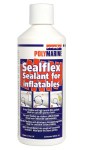
Years later I learned PolyMarine make SealFlex – a latex sealant (right) to revive old inflatables, PVC or plastic. You pour some in each chamber and roll the boat around for a couple of days. It costs £26 posted for 500ml – possibly worthwhile on your cherished RIB; not so sure on this old IK but had I known of it I may have given the old Trout a pint’s dose. After that you’ve got to know when to call it a day, and that day may have come. It might be fine for a guest or a rec river boat, but I don’t do so much of that nor have space for more stuff than I need.
A few hours later the floor was soggy – this time it had let go a few inches up from the recent patching. Up to then I’d been considering putting it back on ebay with a clear semperit caveat emptor. But then I decided sawing it in half would be more fun and educational. I always wondered what exactly an I-beam floor looks like. More here.










































 Inflatable Kayaks & Packrafts