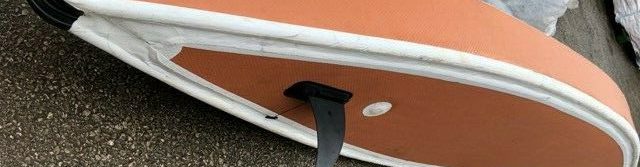
Author Archives: Chris S
Packrafting the Jurassic Coast (video)
Leave a reply

See also
Sigma TXL Index Page
MRS Nomad
Rye to Hastings
Newhaven to Brighton
Chichester to Bognor
Hayling Island
Swanage Stacks
Studland to Swanage
South West Sea Kayaking guidebook
Kayaking the Kimmeridge Ledges
Packrafting Kimmeridge to Chapman’s Pool
In Search of the Kimmeridge Pliosaur
I’ve done a few IK paddles in Southeast England between Rye and Portsmouth, but the Sussex and Hampshire coasts aren’t that inspiring. So it’s about time I started exploring the far more interesting and much more extensive Southwest Coast. From the Isle of Wight to Cornwall and back up to the Severn there are scores of inshore excursions possible in an inflatable. Just as in the far northwest where I mostly sea paddle, all you need is a fair tide and paddle-friendly winds, the latter a bit less rare down south.


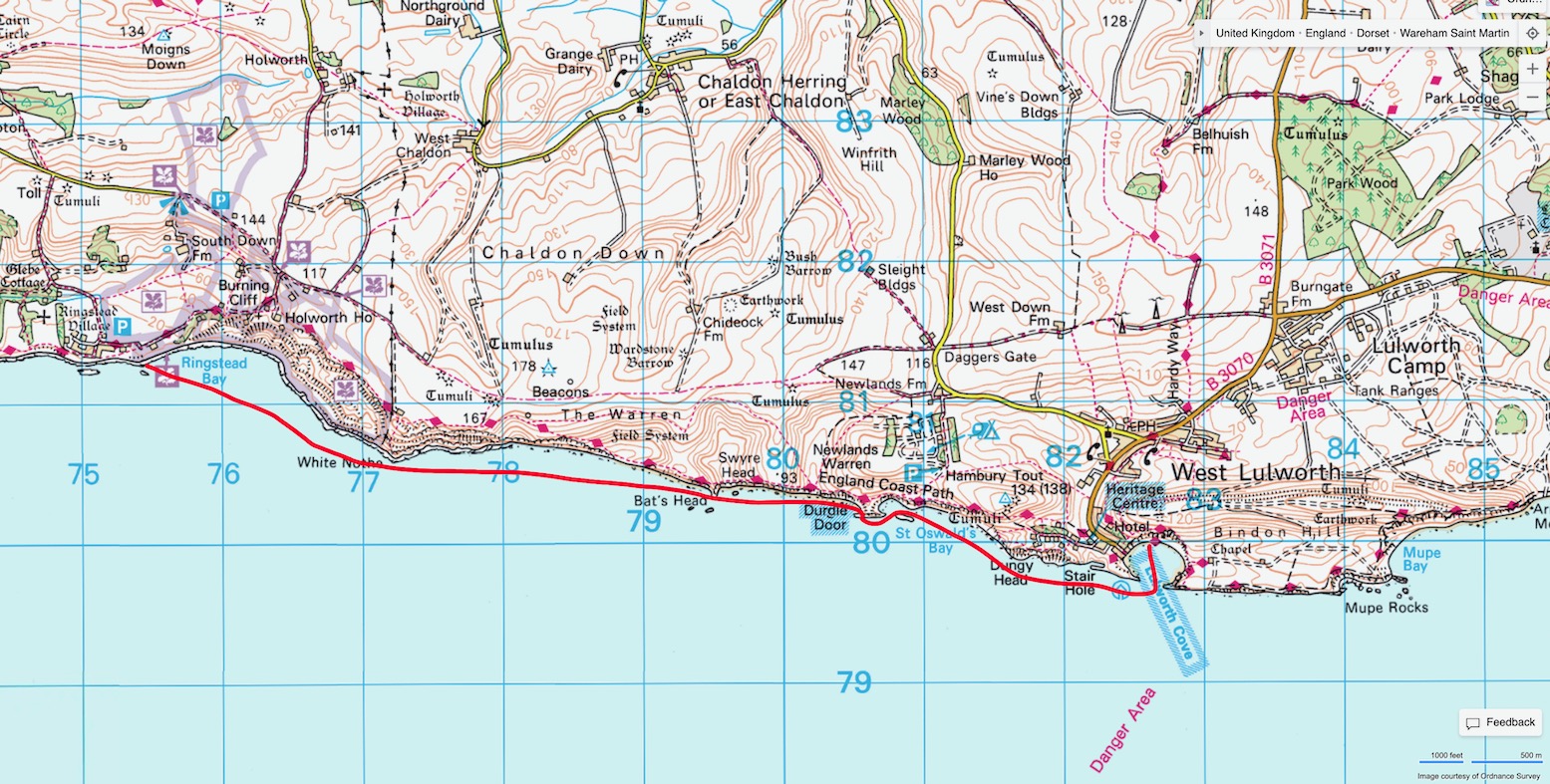
So in the face of predicted moderate winds I cooked up a 50-km Jurassic overnighter from Weymouth to Swanage in Dorset. I’m pretty sure they opportunistically rebranded the plain old Purbeck or just ‘Dorset’ coast as the ‘Jurassic Coast‘ soon after that 1993 movie and haven’t looked back since.
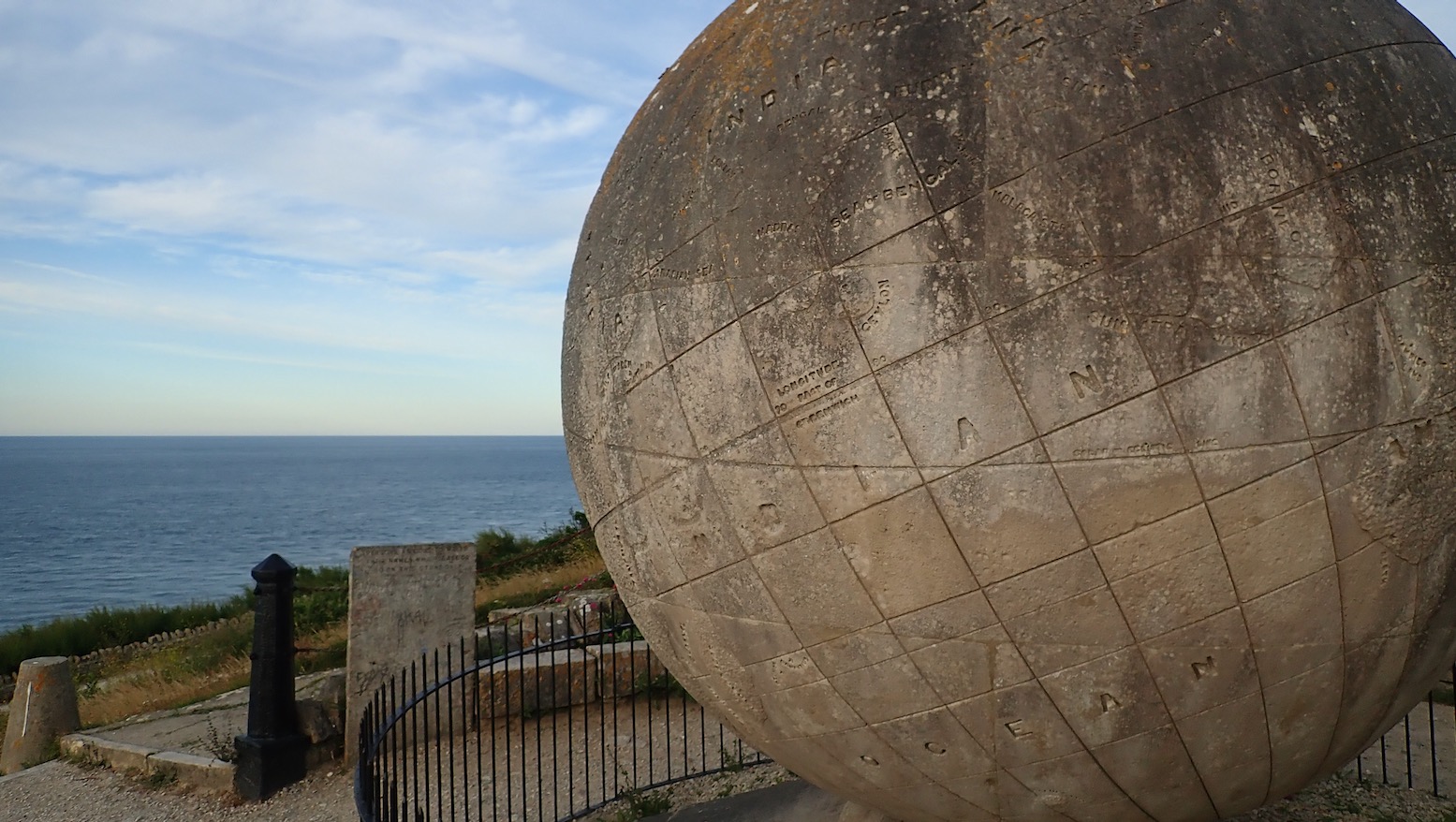
Like much of the Southwest coast, the beaches and country lanes become a logjam of holidaymakers on a warm summer’s day. On the water, our paddle would pass below sections of cliffs a couple of miles long and take us to the famed landmarks of Lulworth Cove, Durdle Door arch (top of the page) and Dancing Ledge. We could even carry on back north past Old Harry’s Rocks and across Studland Bay right into Poole Harbour to catch out trains home.

Compared to using regular (solo) packrafts, my confidence in my TXL for sea paddling is a revelation. After all, it’s still just another blobby, single-chamber packraft. It must be a combination of the added size giving a kayak-like perception of security (as I found in my MRS Nomad), as well as the responsiveness and speed from a longer waterline and, I now recognise, the sometimes noticeable added glide from the Multimat floor. There’s also the fact that paddlechum Barry was up for the Dorset run in his similar MRS Nomad, making this untypical packraft outing less daunting.
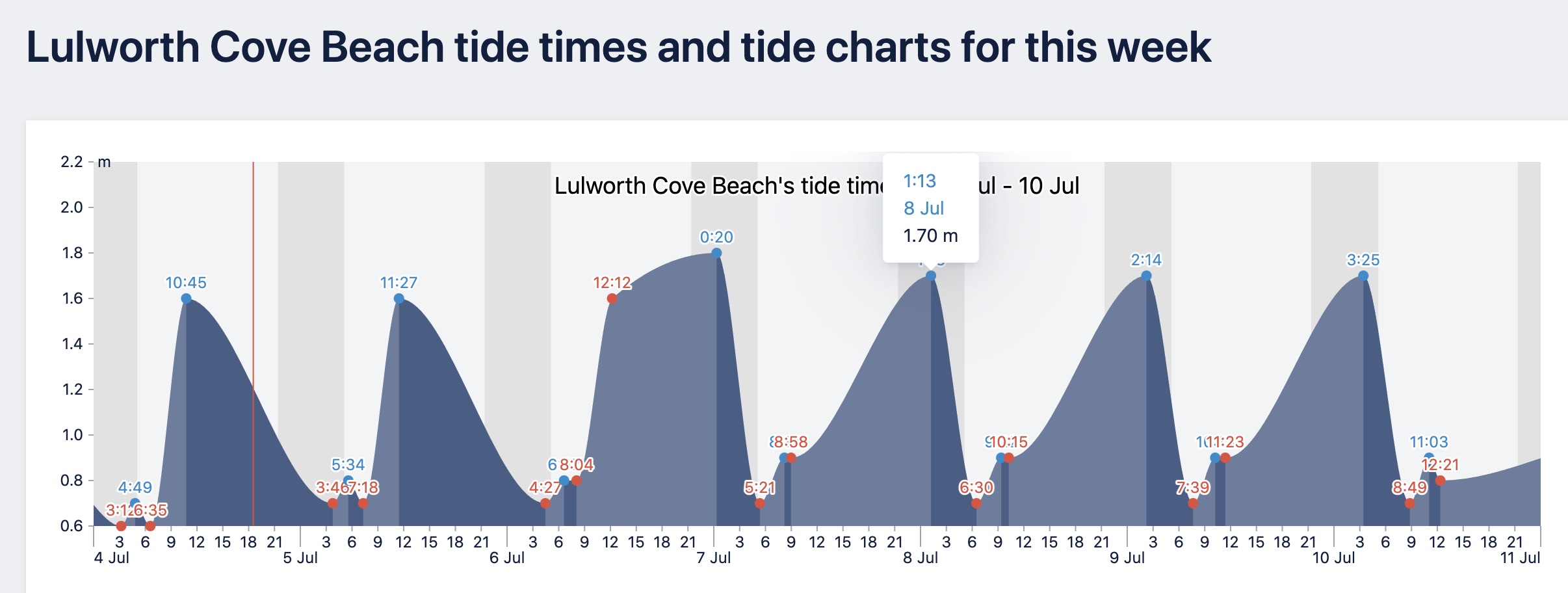
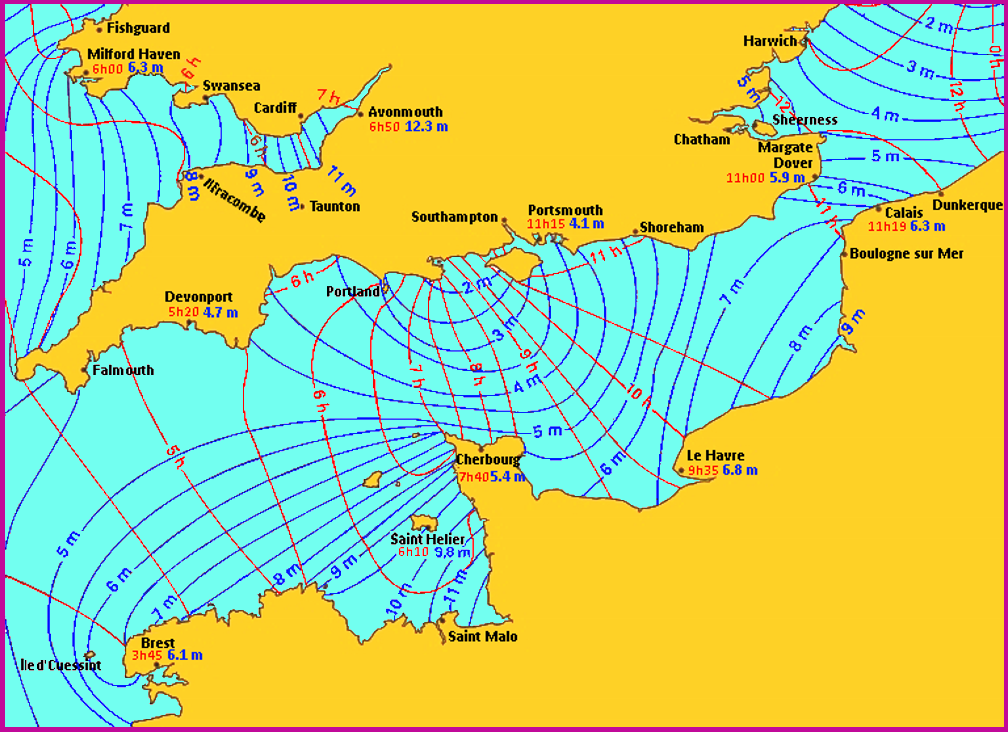
For some bathymetric reason – possibly the Atlantic tidal surge backing up in the Straits of Dover, plus hidden offshore shelves – the tides off the east Dorset coast are very odd: they can rise or drop all day, but have a range of just two metres, about as low as it gets in the UK. That ought to mean moderate ebb flows pushing up against prevailing westerlies, plus we were heading into neaps. And while often cliff-bound, if we stayed alert to escape routes we could easily bail and walk or climb out with our packrafts.
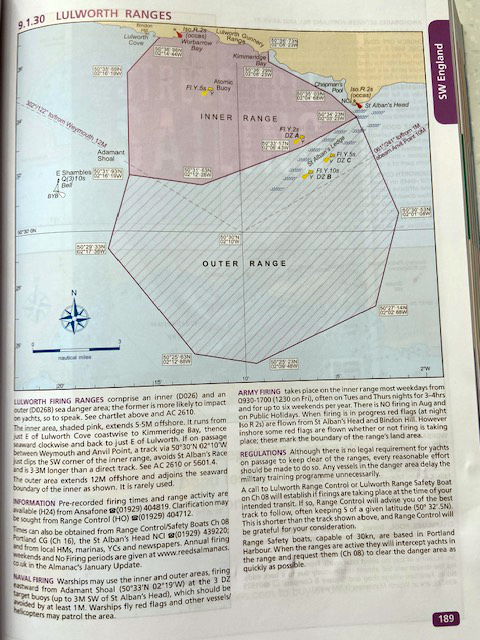
East of Lulworth Cove the Jurassic Coast‘s bucket & spade Babylon is interrupted by a 5-mile wide Danger Area – an army firing range. This was probably not one of UNESCO’s criteria for World Heritage status, but the SW coastal path also gets closed for a similar distance. Barry’s Reeds Almanac had a page or two on this (left), as well as useful tidal flow charts (drops to the west; rises east). I left it to Barry to call the ‘0800 DUCK!’ number, but imagined surely they’d leave the target practice to the off season. In fact they’re all it most of the time Mon–Fri, including an evening session 9pm to midnight: all we had to do was click this.
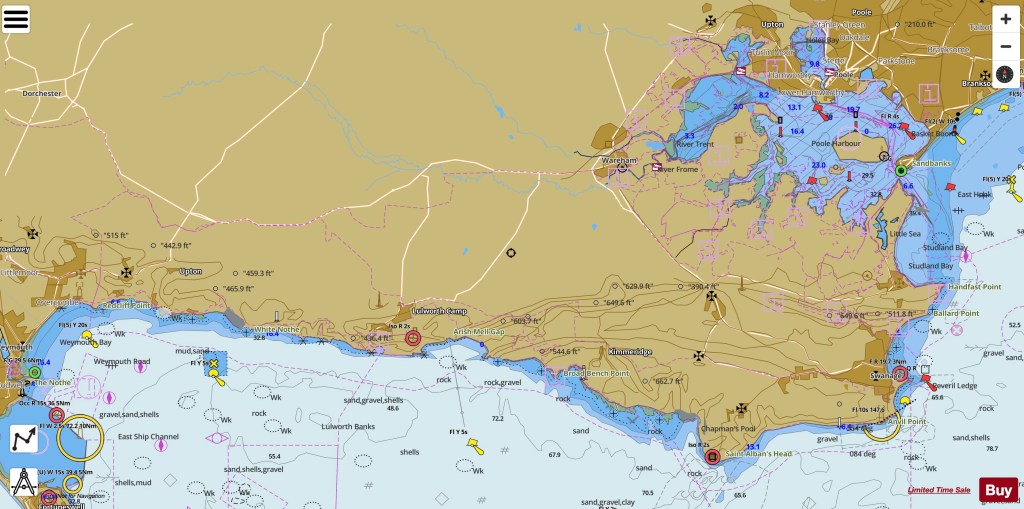

With a plan taking shape, I in turn bought a copy of Pesda’s South West Sea Kayaking in the hope of being alerted to local anomalies. I’m glad I did. It turned up with just hours to spare and identified that the run from Kimmeridge Bay round the Purbeck corner to Swanage was a grade up from the easy section from Weymouth. With headlands, submarine ledges and long lines of cliffs, without a foot recce I decided we may be better off skipping this bit.
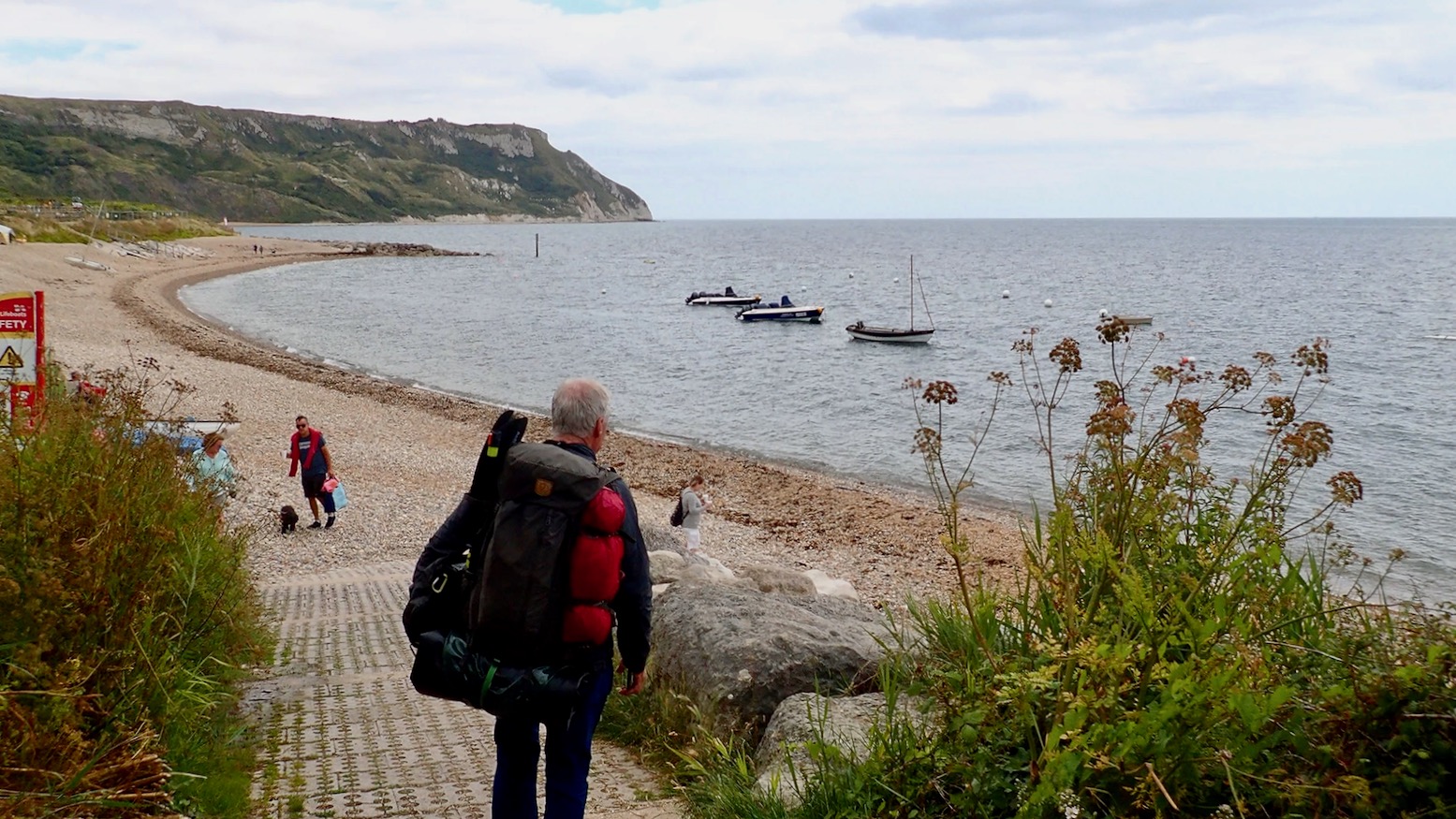

I’m giving the Multimat floor yet another go too, all the better to skim over the water.

But around 5pm winds are said to veer offshore and strengthen, so we’ll see.
We sail at about 5-6kph – not much faster than paddling – but I note my TXL creeps forward about half a click faster than the MRS – must be the stiffening Multimat.


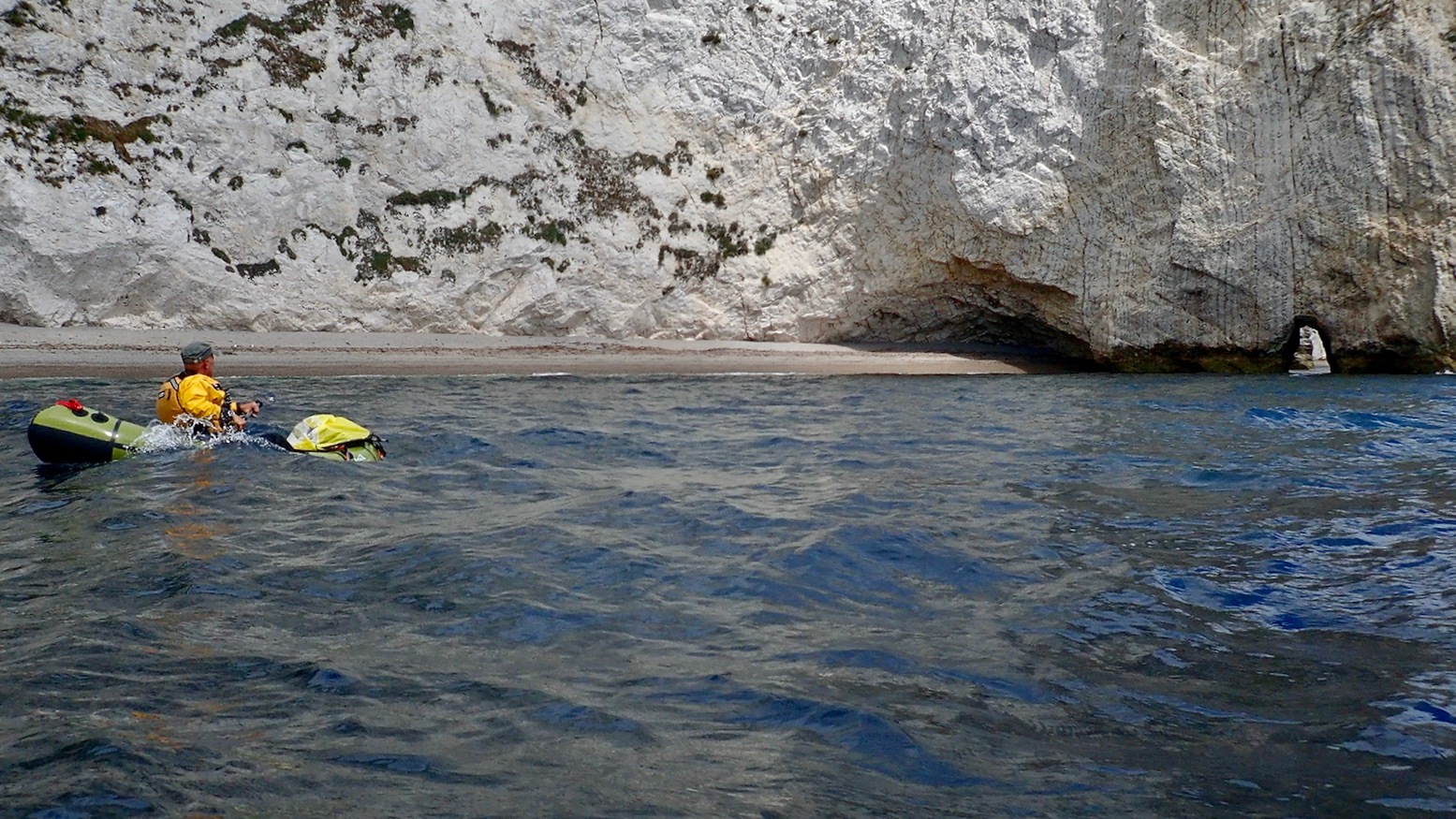
Note how the layers of chalk beds here have been pushed up to nearly vertical.
Give it half a million years and Bat’s Head will be as big as nearby Durdle Door.
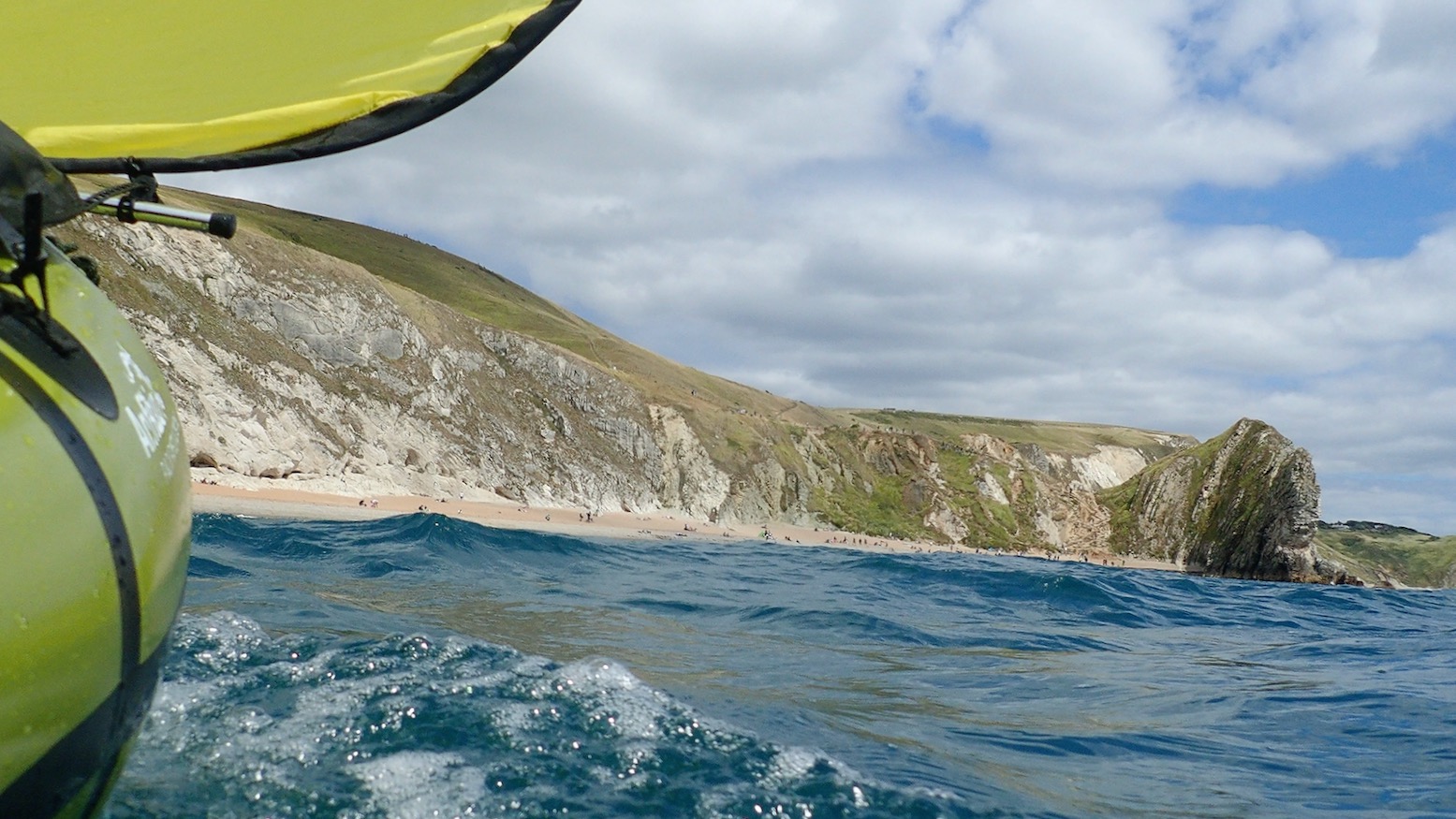
The TXL still weathercocks a bit under sail; I keep having to steer hard inland, but the bowsprit ‘stick’ limits the sail’s ability to twist. Or maybe the wind’s bouncing off the cliffs and blowing us offshore a little.
Sitting further back to weight the back end over the waves may help.


In high summer young bloods jump off the 60-metre arch. Appropriately, it’s called ‘tombstoning’.

‘I thought you said you were going call them, Barry? You had one job to do…’
‘But you said they hardly ever do this on a balmy, July’s day!’
And so it went on…


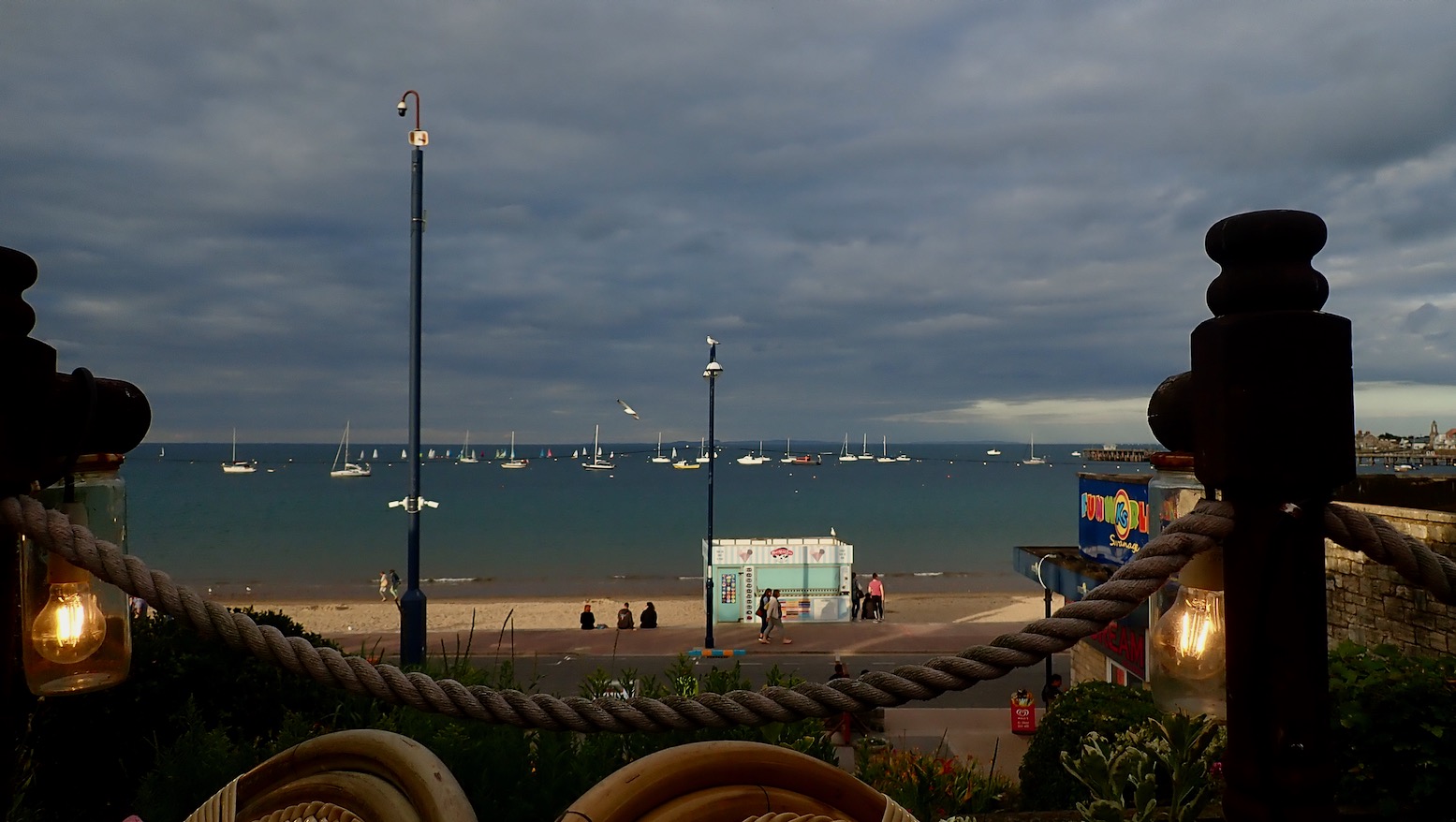
As we slurp a 99 with sprinkles the odd gust blows offshore.
We can’t even pack up and walk the cliff path; it’s closed too, and so is the B3070 road.
Barry wants to paddle on a 5pm, but I propose we bus to Swanage rather than risk being be left high and dry.
Tomorrow we’ll paddle north towards Poole – or as far as the predicted headwinds allow.

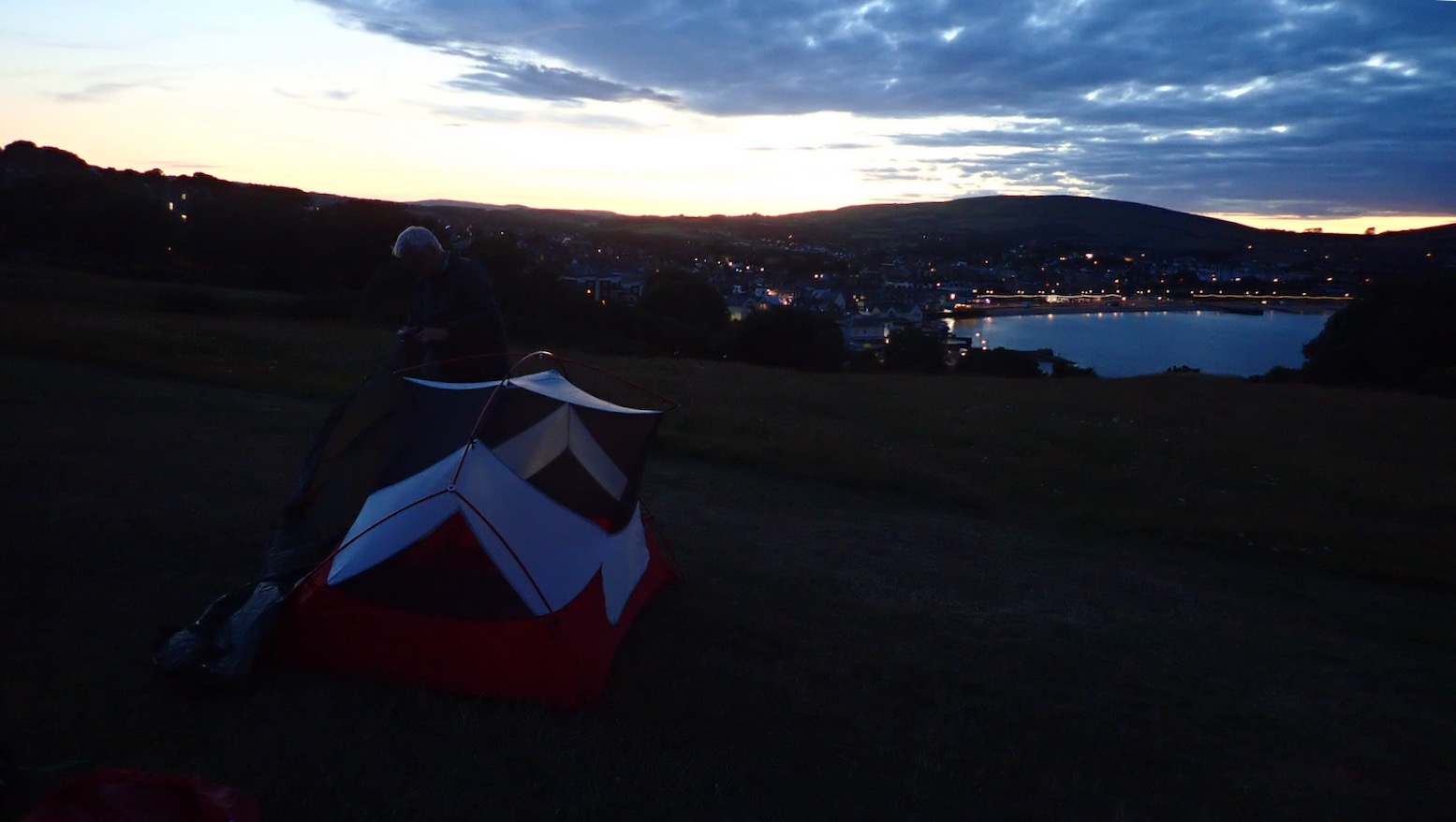

The Anfibio Multimat passed the sleeping test, too.

Above, a ferry heads from Poole to the Channel Islands.


Ballard Down chalk cliffs and pinnacles stretch out beyond, and Bournemouth’s at the back.


We may carry on to Poole itself, but a strengthening wind may nix that idea.

We reversed this trip a couple of months back.


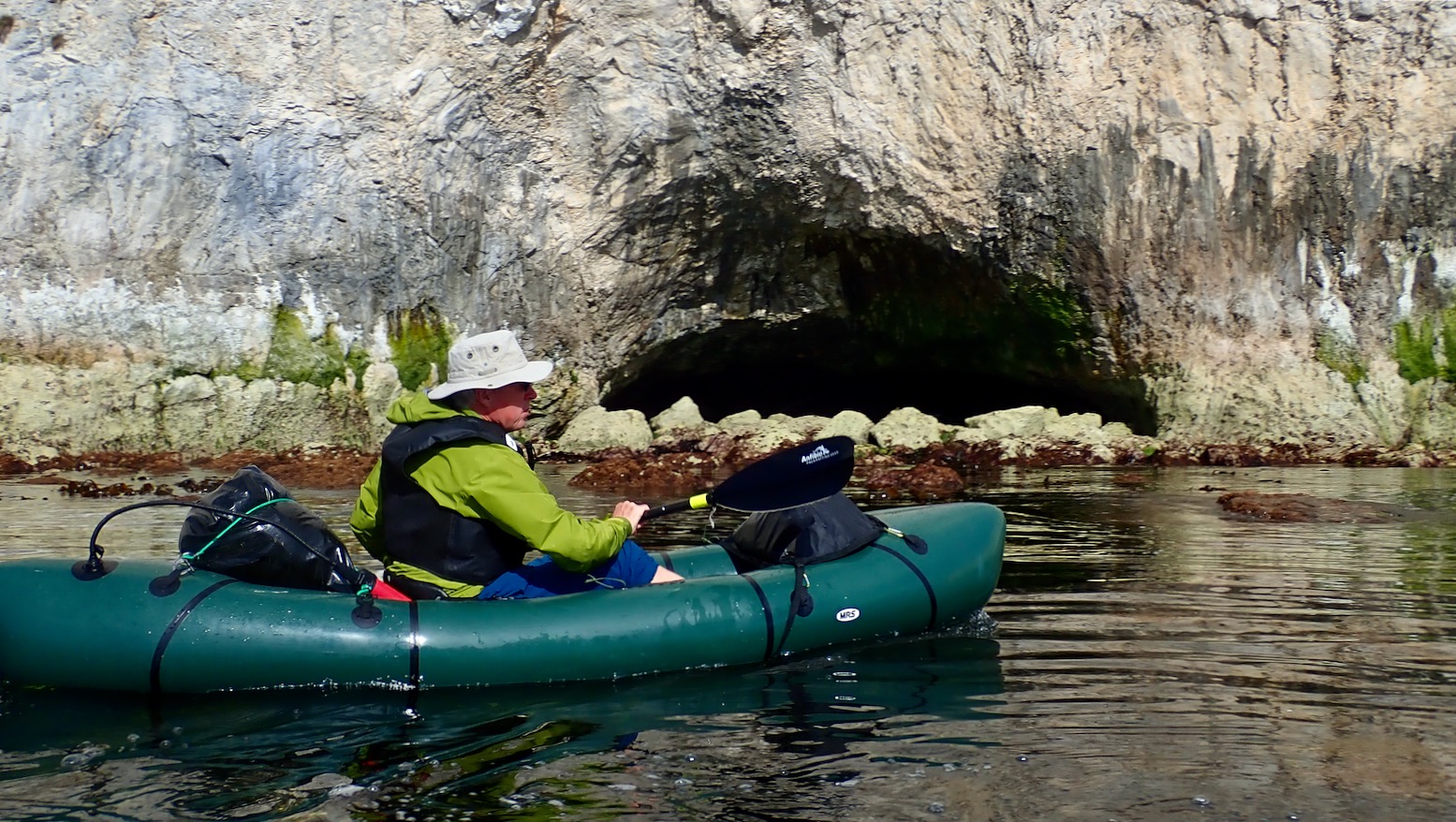


Halfway across, I remove a metre-long, kilo of Swanage string-weed caught in his skeg.

But the GPS revealed we kept plugging on at 5kph, just with a lot more effort.
As Barry observed, it was a slog but good to know our packrafts can progress against this sort of wind.


Anfibio Sigma TXL • Top 10 mods & tips
Updated Summer 2025
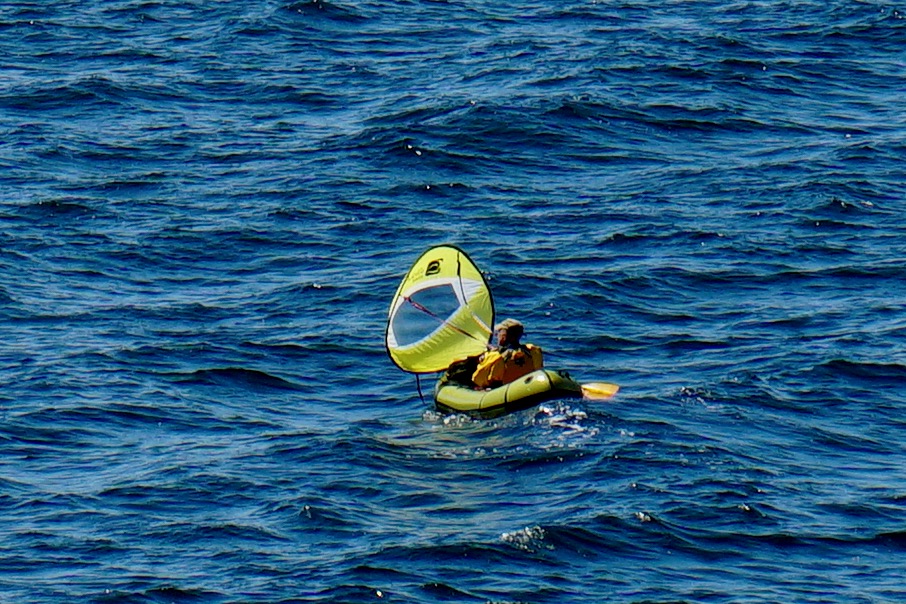
I’ve owned Anfibio Sigma TXLs for over three years and am now on my second, a blue TXL+. I’ve done several day trips two-up, solo and some sailing. It’s all helped give me ideas on how to refine this boat to my needs.
On buying the first green one I got the optional Multimat airfloor, additional foam block seat, paddle leash and use my old Anfibio DeckPack on most trips. I also got a spare skeg patch and mounted a second skeg under the bow – it made things worse. Here’s a reappraisal of the Sigma TXL+ followed by a list of mods which have worked for me.

Spacious solo
Light for its size
Room for 1.9 people
TubeBags very handy, even for day trips
Level solo trim (unlike Rebel 2K and similar)
Multimat floor’s benefits are noticeable (OK to sleep on, too)
Broad, thick front seatbase jams in and spreads the load: less floor sag when solo
Thicker 420-D floor extension ‘bumpers’ over bow and stern
Variety of set-ups and sitting positions, solo or two-up.

Stock skeg mounted too high (or too small)
Inflatable front backrest lacks support
Optional foam seat block unusable
For me, the paddle leash was inferior to my regular mooring line
An Exped-style dump valve in the seatbase would be nice (instant deflation)
Reduced floor space when two-up with Multimat (depends on your sizes)
Best Sigma TXL Modifications & Tips
1
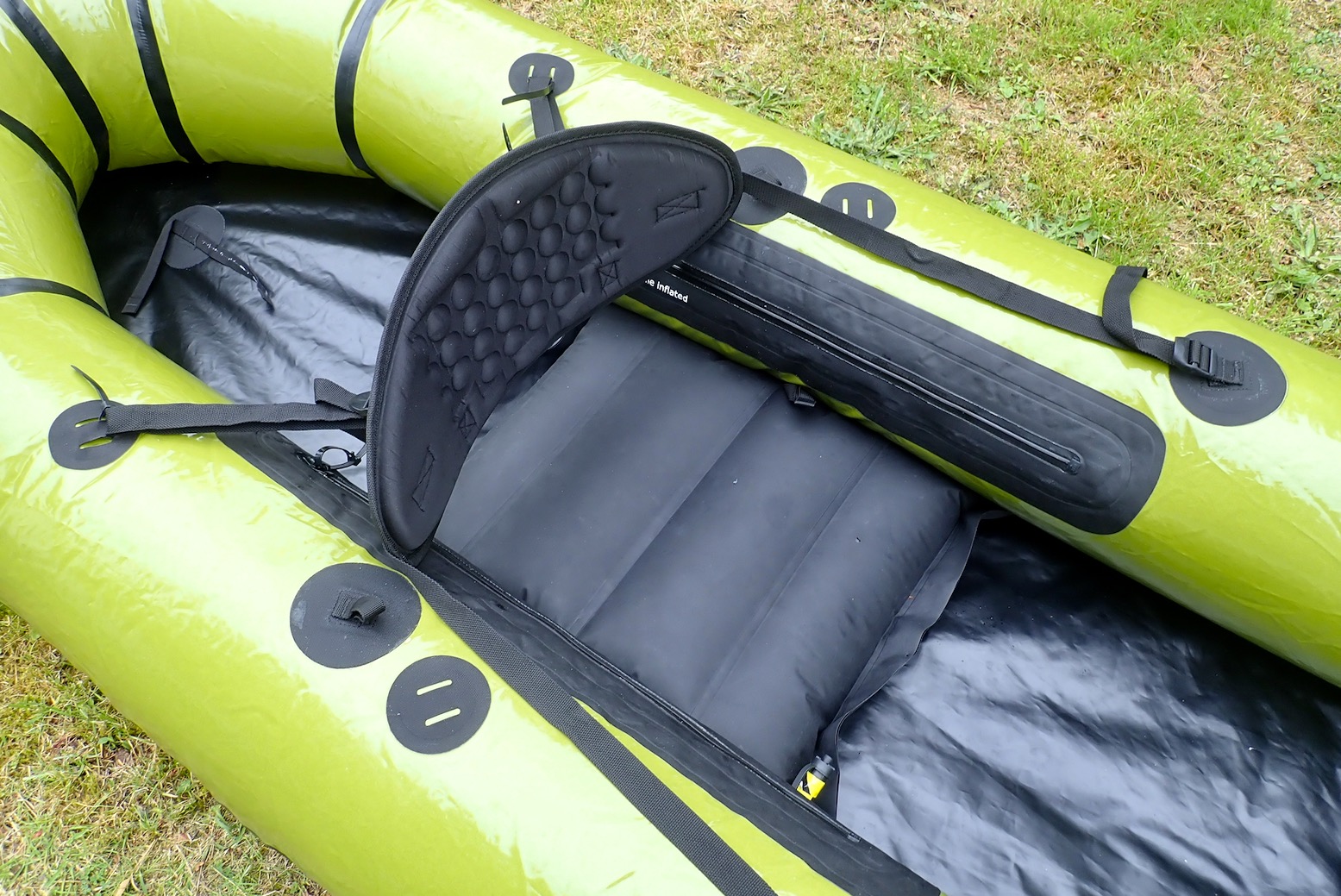
Fits with no mods bar some helpful zip-tie slip-rings at the back. Works best with a footrest (6).
Anfibio now fit and sell the Performance BackRest for €32
2

Otherwise reversing the stock skeg improves submergence a bit, or make a bigger one.
[Both skegs shown, only one needed for paddling]
(Anfibio now position the skeg further forward on their longer boats)
3


Knee straps improve boat connection both on flatwater and when waves get lively, plus they help bracing into a headwind and are handy lifting handles on land. Above is the old Anfibio version which requires gluing on 4 tabs as none of the stock ones line up or are robust enough. Anfibio do a ‘5-P’ thigh strap – even more gluing needed but better for whitewater.
Newer TXLs come with ‘ladder’ fitting tabs on the hull sides
4
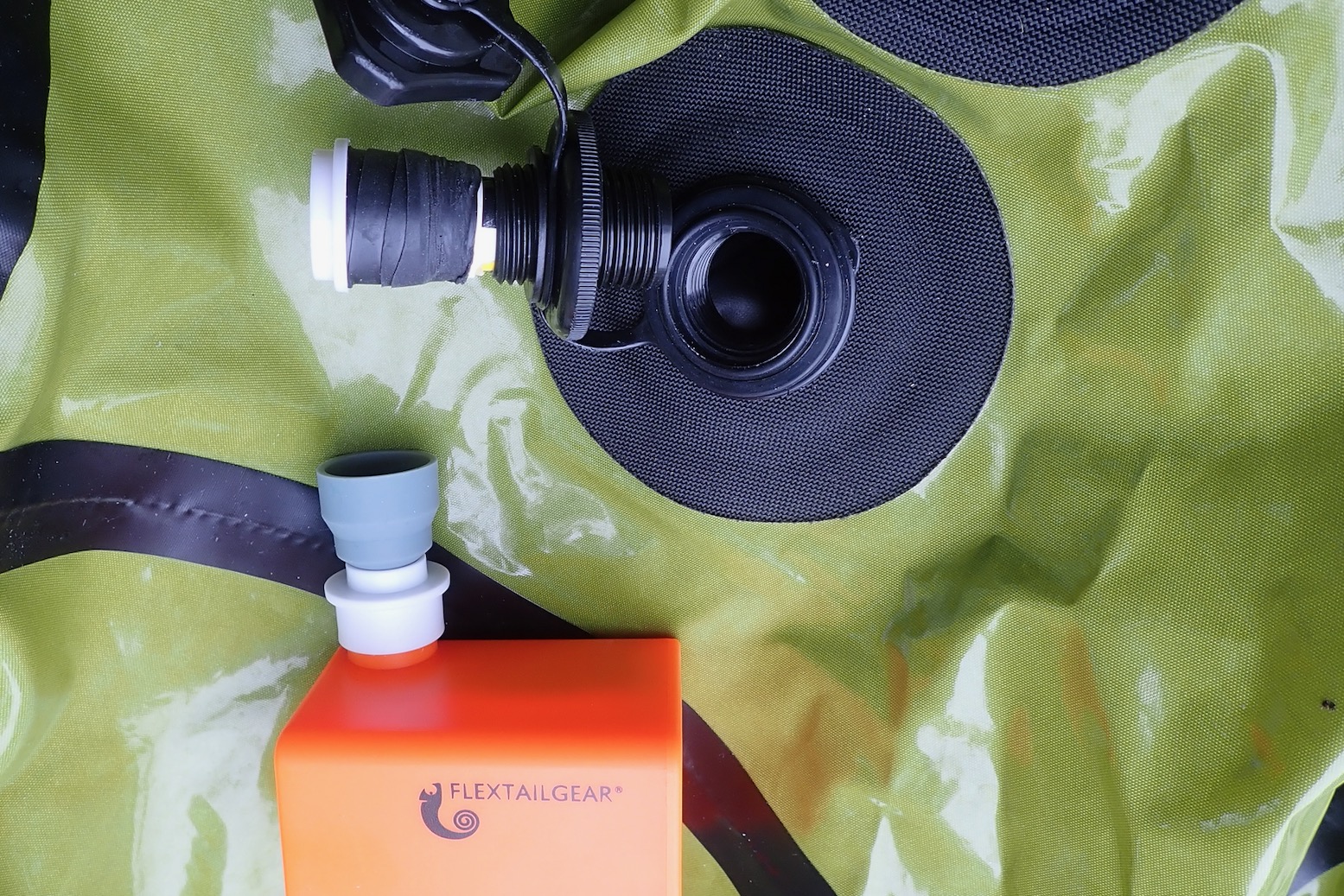
Using rubbery, self-amalgamating tape, I adapted a spare nozzle to fit both Boston valve ports (top).
The soft grey adapter supplied (bottom left) fits the main port but could pull off and fall inside. If you use it, glue it on.
5
6
7
8

Initially I wasn’t convinced but now I am: the 900-gram Anfibio Multimat reduces sagging, especially solo, and helps the TXL glide. Yes, it’s another thing to have to carry and pump up, and I’ve already repaired mine once, but one time I paddled at 6kph on a calm sea for nearly an hour which I’m sure was made easier with the Multimat. Why Multimat? You can sleep on it too.
9

10
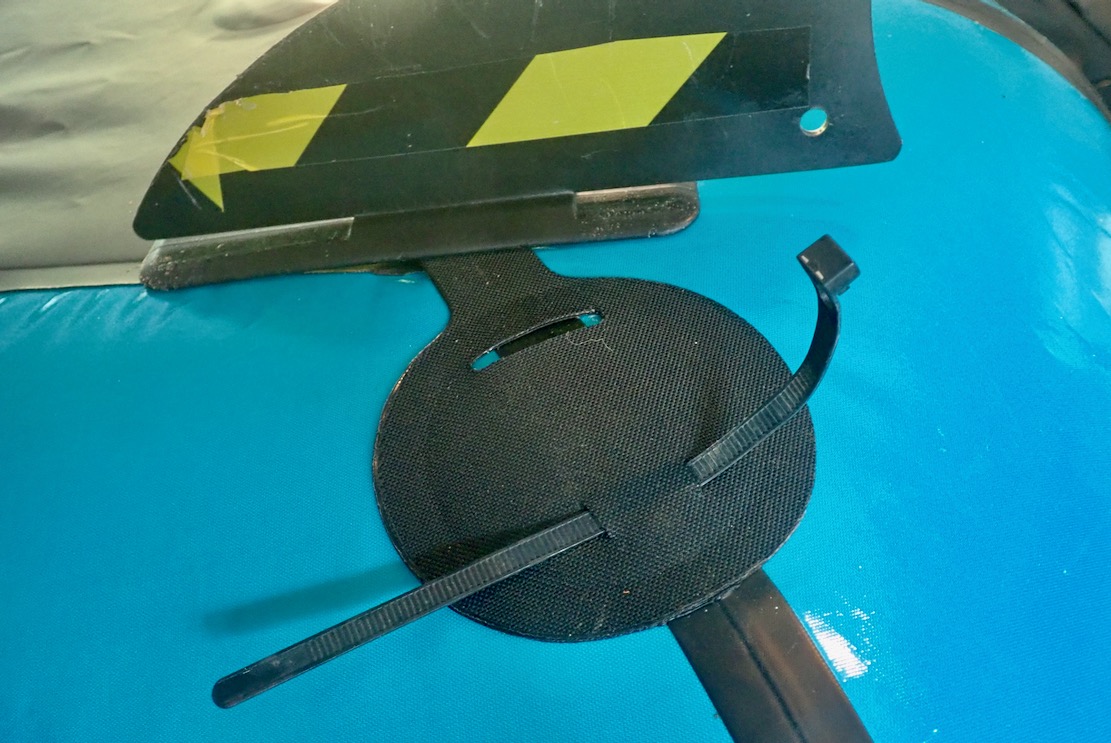
Twice my skeg has dislodged, pushing and pulling on the seafloor. They say it’s just me but I’ve now fitted a reusable ziptie into the skeg mount and thread it through the skeg hole. No more dislodged skegs ;-)
Sigma TXL: seat and sailing sorted (videos)
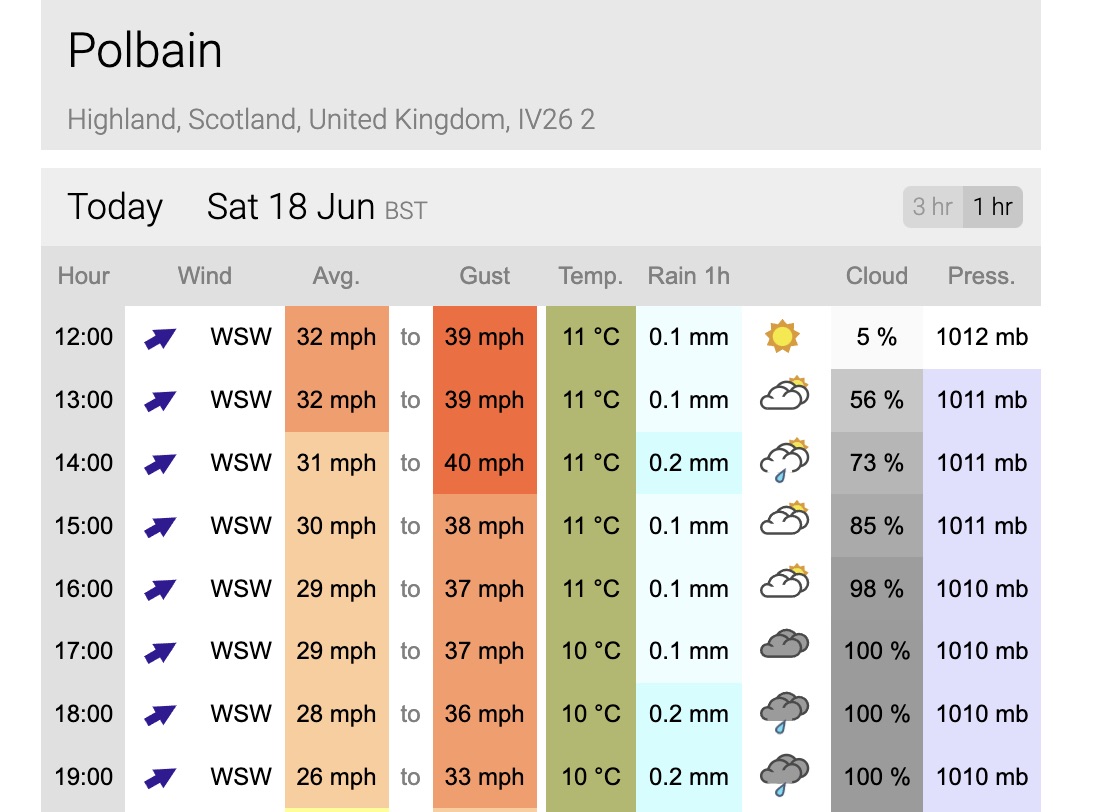
The winds here have been belting out at up to 40mph for days, but I grabbed a quickie during a lull the other afternoon to try out some final mods.

My centrally seated TXL is like a small TPU kayak – the missing link, some say – so it needs a backrest that works. I was never won-over by the Anfibio inflatable backrest on the Revo or my boat; it manages to be both mushy and wobbly.
But once on the water it was soon clear that, combined with my Lomo holdall wrapped into a footrest bundle (below left), the foam SoT backrest felt much better. The broader, firm pad spreads across the back supportively and is held up with straps, not thin elastic. Plus being able to press feet side-by-side against a flat, firmish surface, not jam feet into the bow, is also much more comfortable. It felt just like my old Seawave!


I was giving the Multimat air floor one more try. It must do some good and I admit it may have helped replicate the IK feel. And unlike initial impressions, the half-inflated seat base is actually pretty stable sat on the stiff floor, not wobbly as I originally thought. Plus the pad protects the floor from impacts below, and heel scuffing inside.
I did feel again that the TXL skates across the water a little, bobbing on the stiff air floor. This flat-floor effect makes sense on a shortish 3:1 ratio boat and was one reason I thought a front skeg might be helpful (it wasn’t with the stock rear skeg). The air floor lifts the boat a bit higher in the water and the sliding left to right is more from wind and waves than in reaction to paddling strokes (like normal packraft bow yawing). But until conditions get too rough I don’t think it really hampers paddling progress that much. It’s a packraft after all, not a jet ski!

While I had the floor in, I tried the 15-cm thick seatbase fully inflated and sure enough, like Anfibio say, it’s too high and may get unstable on anything other than flatwater, even with my repositioned knee straps for added support (left). That’s why they offer the 5cm foam block (it’s on ebay, fyi). A thinner inflatable seatbase would be less agonising but it seems, like on an IK, the half-inflated stock seatbase actually works fine.


The other test was a skeg repositioned on the floor for full submergence – this is only needed for sailing; the TXL tracks well enough with the semi-submerged stock skeg position and goes OK without one. Had I not seen the selfies (left) and not tried sailing, I’d probably not have noticed.
The afternoon’s glassy calm had turned already. I pushed into the breeze out towards a low-tide skerry just off Tanera Mor, then heeled round for the mile back to Badentarbet beach and flipped out the WindPaddle. I left the stock skeg in place which was cheating a bit, but I’m pleased to say my earlier problems with weathecocking (stern blowing round, side to the wind) have been solved. No surprise a fully submerged skeg makes the TXL sail as well as my Rebel 2K and MRS Nomad.
This was an important thing to pin down as I want to be sure my bloaty, IK-replacing Sigma TXL has something up its sleeve when the wind allows because, like any inflatable, in the other direction it will struggle as headwinds reach 15-20mph. Sailing still needs constant micro-adjustment, but it’s great to feel a gust tugging at the handlines as the Sigma ploughs a trough through the surf like a water buffalo wading across a mudhole. The boat was definitely hitting 7kph or more at times.

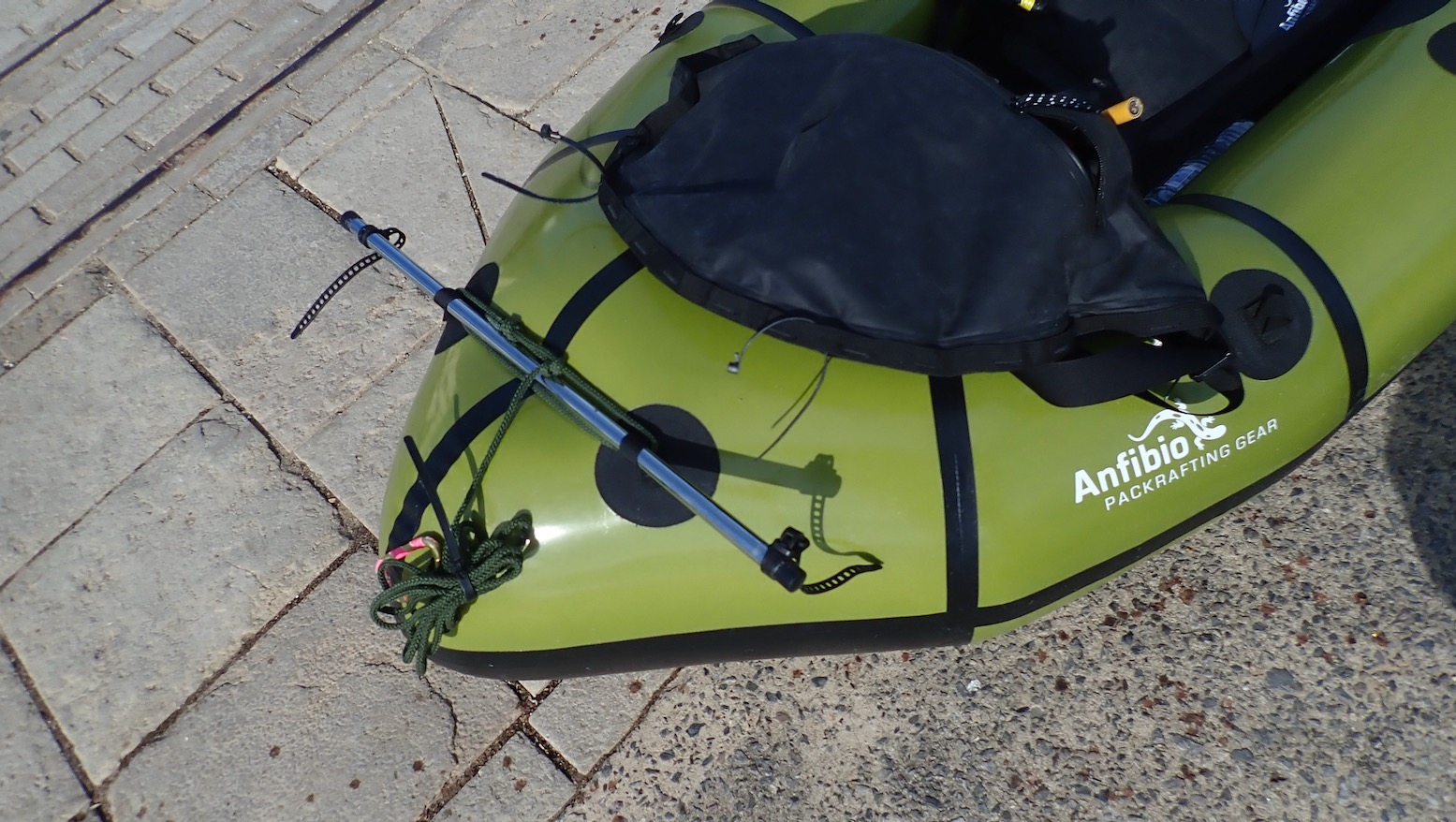
I was also trying an idea I didn’t get round to testing on my narrower-bowed Seawave before I sold it: a WindPaddle transverse bowsprit™. Those cunning Chinese will be copying it on ebay any day now.
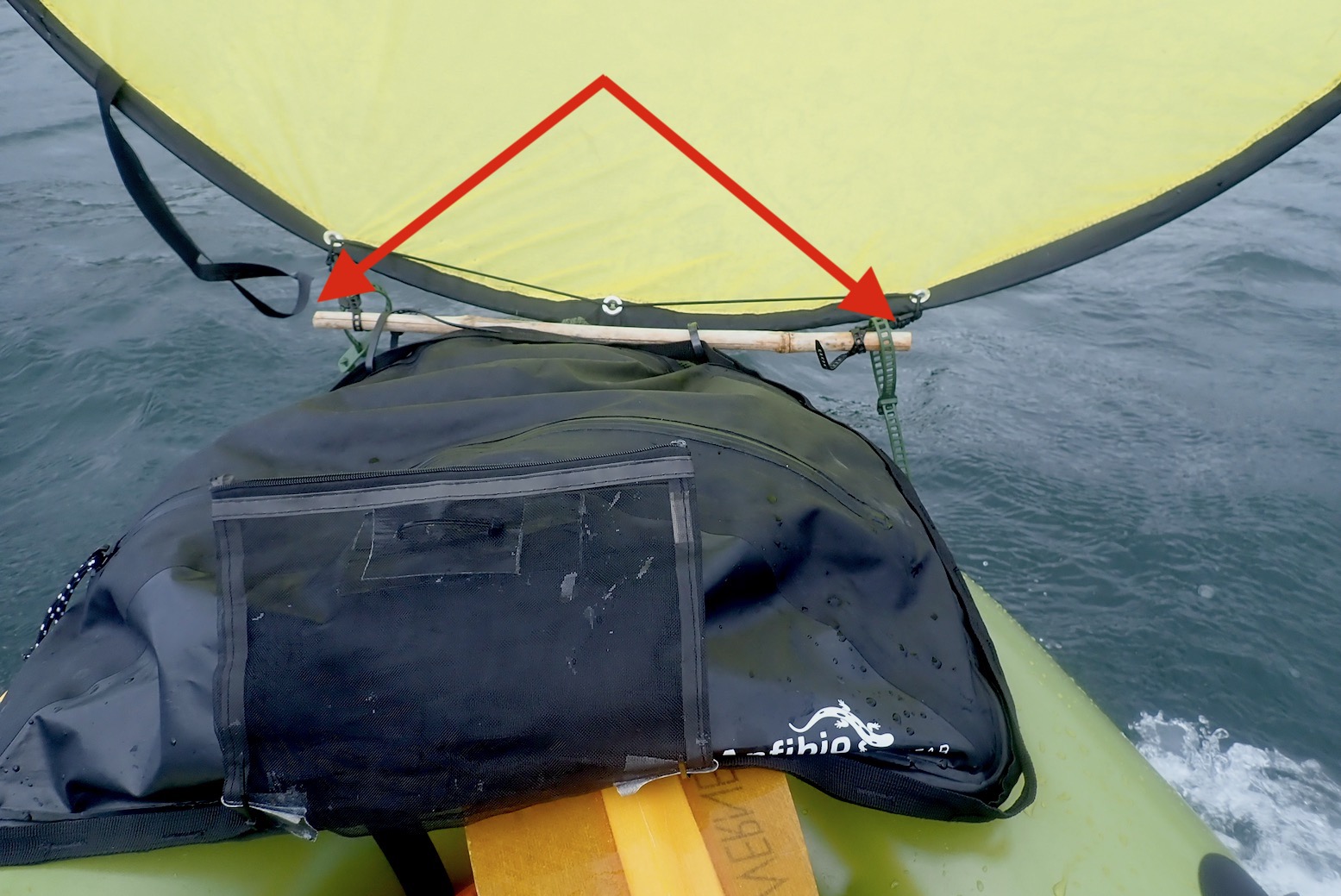


A WindPaddle disc sail starts bobbing madly left to right when winds get much over 10-15mph – it can’t unload the air fast enough. This is a side effect of mast-less downwind sails, but I figured if the bow sail attachments were further apart and more taught, the bobbing might be constrained. You want a downwind sail at the very front of a short boat, but on the TXL thr frontmost mounts are quite close together (compare to a Nomad, above left).
My ‘transverse bowsprit‘ is a stick which extends the sail mounts out to the sides, like ship rigging. I used a foot-long bamboo stick with some Rovaflex loops on the ends and for the weight and minimal faff, I like to think it worked. A bit longer would be better; I have a 50cm rod lined up for next time.
A few days after posting my sailing vid, YouTube thoughtfully directed me to a ten-year old video where a bloke with a hip-wide surf ski had the same idea (above right). Only he managed to zip along at a breathtaking 15kph in a 40kph breeze!

Heading towards shore, again, I aired-down the Multimat but again, can’t say performance deteriorated noticeably. After all, the MRS Nomad manages fine. The stiffening breeze rushed me towards the rarely exposed sands of Badentarbet beach and a short walk home.
So. Good to know the TXL is now largely sorted. Weather-wise, it’s been a wash-out in the far northwest this year, but there’s still enough summer left in the heatstruck south to do some trips.

Sigma TXL: floor-mounted skeg and foam backrest
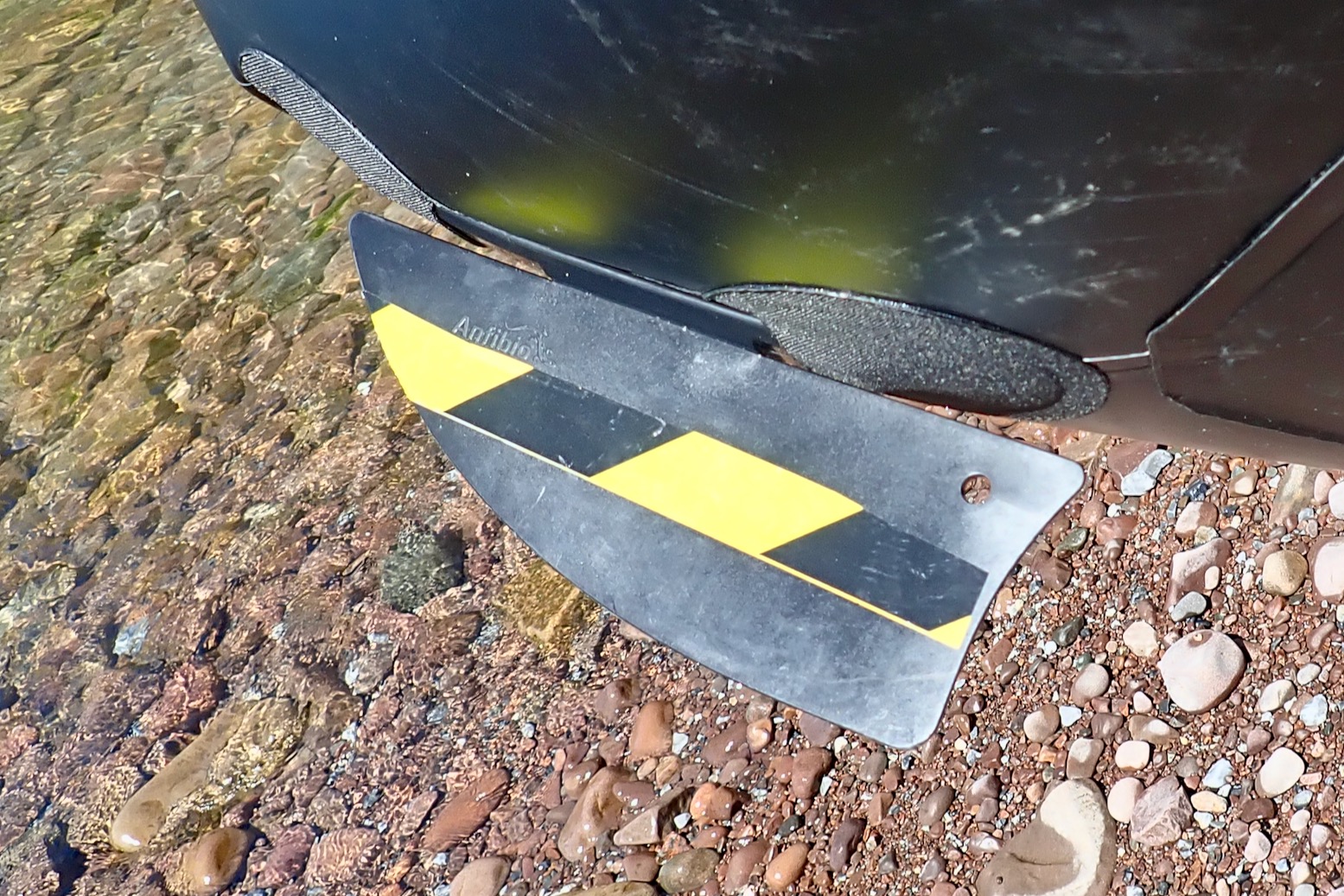
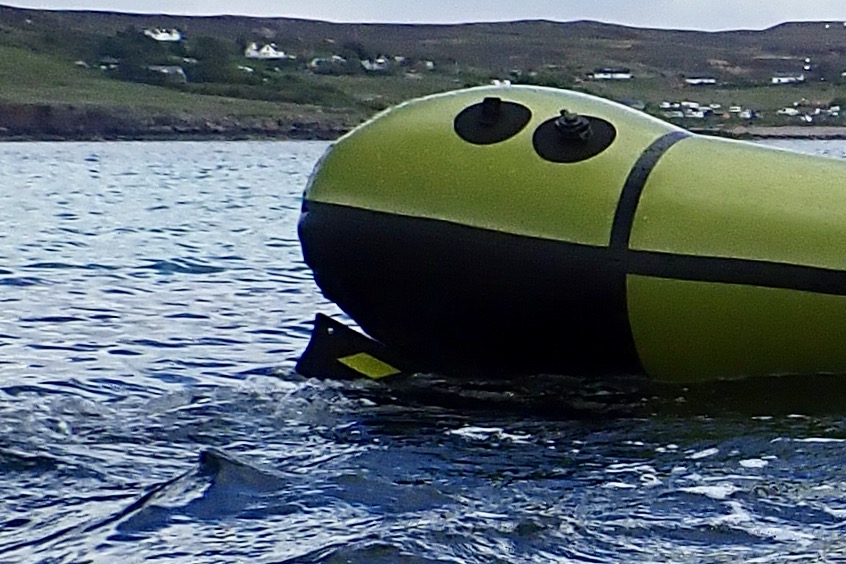
After various trials I decided for sailing the TXL would benefit with a skeg on the floor where it would be fully submerged except momentarily when cresting bigger waves. The standard position angled on the stern (left) sits too high on the buoyant TXL so doesn’t have much effect, though the TXL tracks pretty well on flat water, with or without the air floor, solo or two up. You can mount the skeg back-to-front (right) for more bite, but I hope tracking when sailing will be greatly improved with a fully immersed skeg. When the wind allows, I want the TXL to be a reliable sailer on longer paddles.
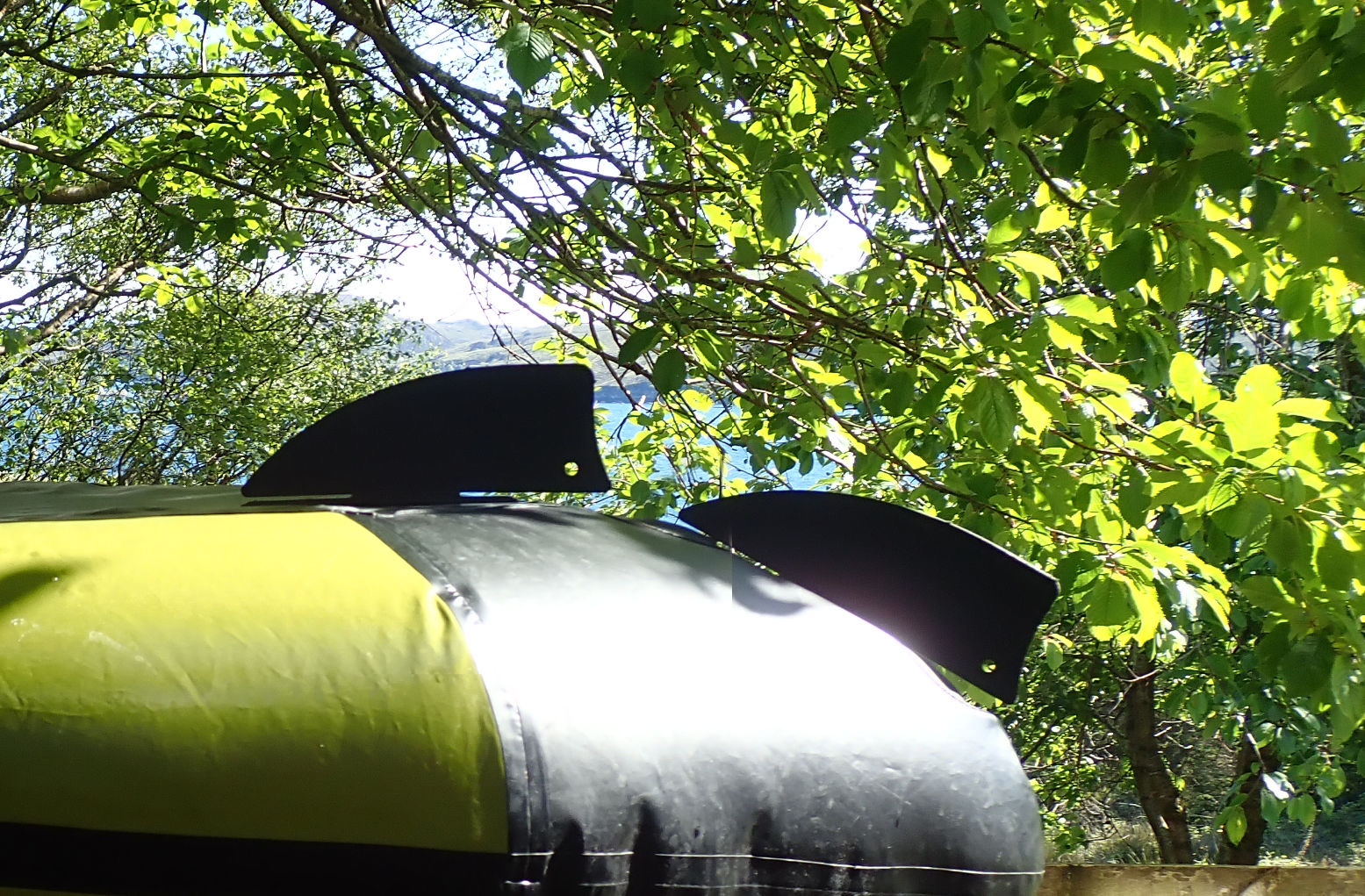
I could’ve simply made an extension to the stock skeg, but decided having two positions for the stock skeg would be less bulky. Like on an IK or a SUP board, the long but shallow Anfibio skeg would work well mounted horizontally under the floor (above, left). I’d already tried a skeg under the bow, but that did not work well at all. Waiting for good glue, I’d stuck that front skeg patch on with Aquasure and was surprised how easily it peeled off with less than a minute with the hairdryer.
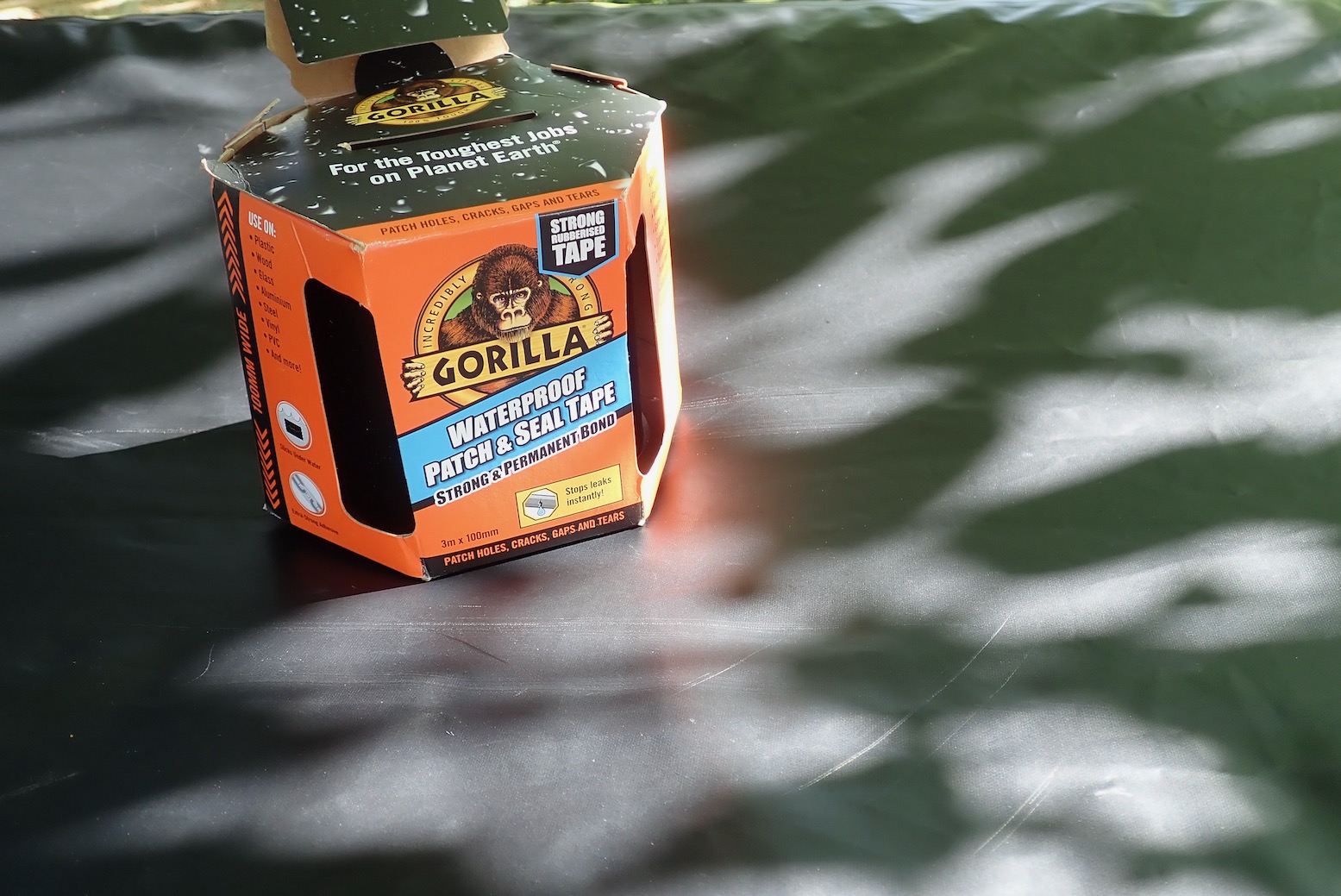
Just as I was about to clean the removed patch and glue it on with Helaplast (recommended by Anfibio), I thought super tacky Gorilla Patch & Seal tape would be even easier, using the spare Anfibio skeg patch as a template. But I decided P&S is just thick ‘rubber’ tape suited to sealing, not supporting a knocked about skeg. In fact regular, string backed Gorilla ‘duct’ tape would have worked (a good way to test the idea), and I’ve found lasts surprisingly well on a packboat. In the end I decided the liberated fabric-backed Anfibio patch would be best.
The most important thing is to mount the patch straight along the centre line otherwise you’ll be going round in circles. This is best judged with the boat inflated. After that, it’s the same Helaplast sequence as detailed here. While gluing, I decided to add a couple of tabs low in the front to make the thigh straps hook more effectively over the knees.


The benefit of having two positions for the rear skeg instead of a bigger fin is that you can choose: use the standard position for shallow rivers (if a skeg is even needed) and use the floor mount on open water where wind and waves may push the boat around more, and if you hope to sail in a straight line.
Foam backrest
Sat up front, the stock inflatable backrest (below left) does the job, but in a low-pressure boat, the air cushion just adds more mushiness where you want support. As I say in the book or on Seats: sit on air; lean on foam. There is no advantage to inflated backrests other than saving a bit of packed space (might they also be cheaper to produce?). In this way, regular solo packrafts, where you lean on the back of the boat are better. Seated centrally in the TXL, you need a supportive IK-style backrest.

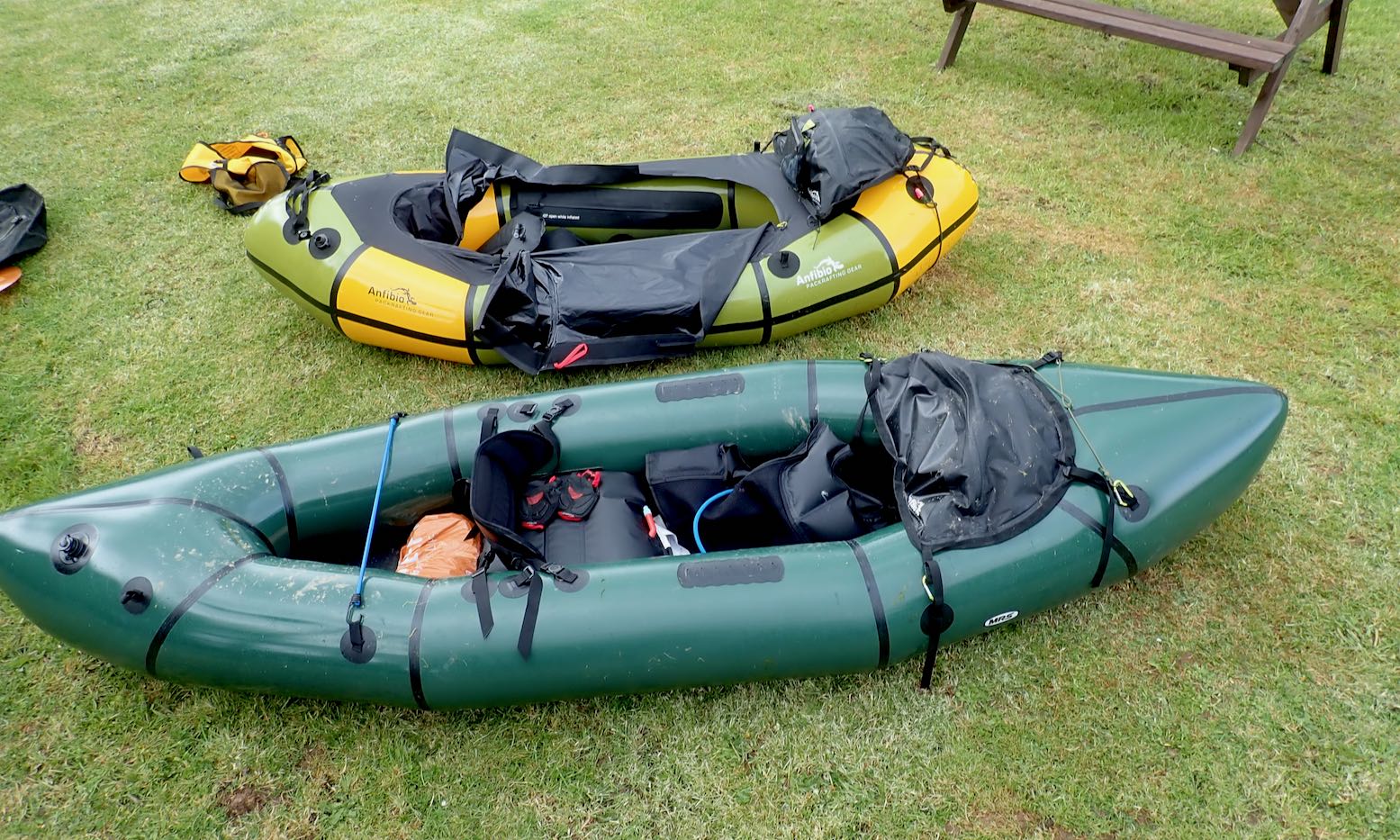
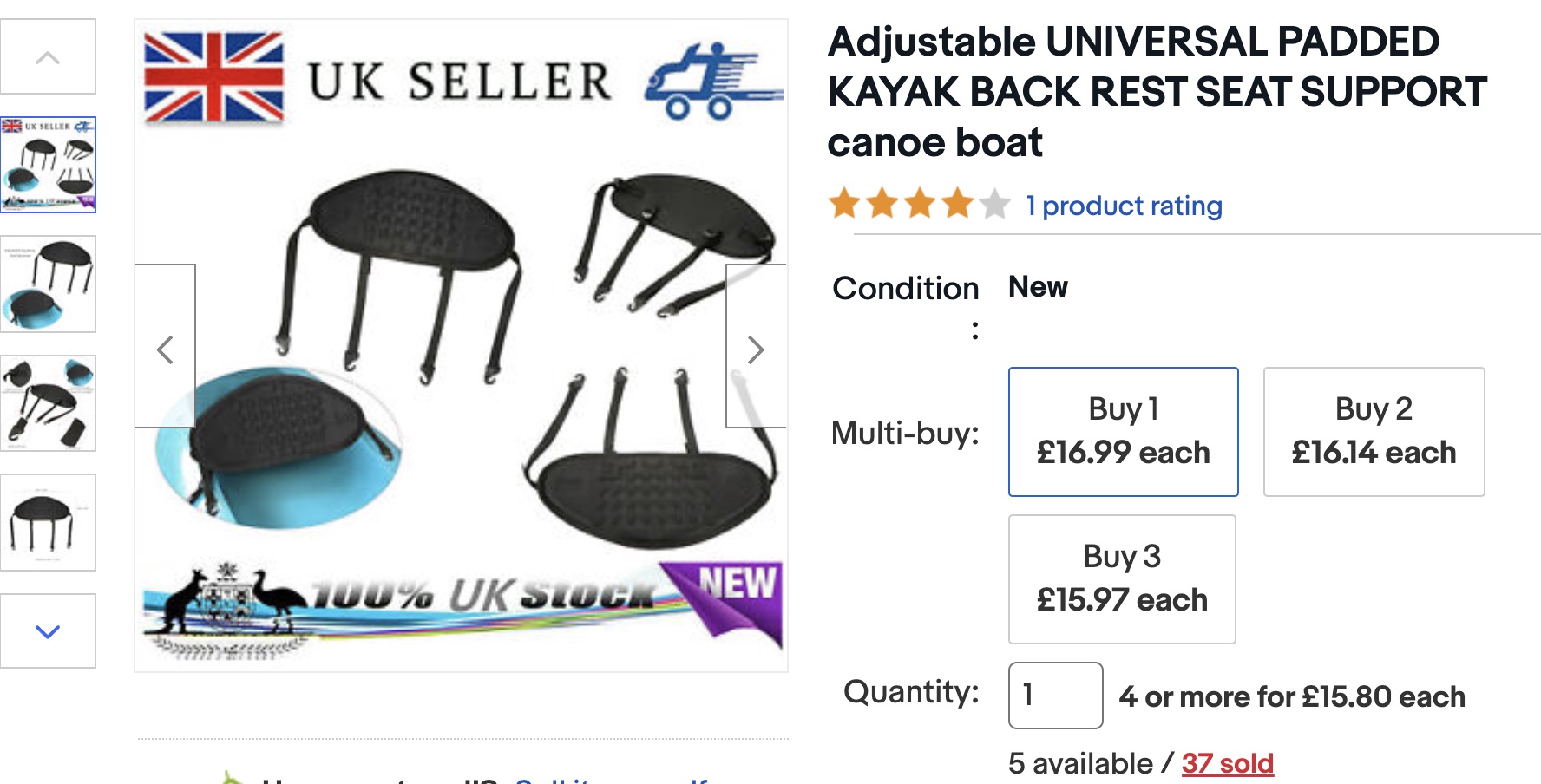
After a few outings I’ve decided to replace it with a spare foam SoT backrest (below), an idea which has worked well on my IKs for years. IK makers too have a blind spot when it comes to front seats. Today’s price for the backrest on ebayUK is 17 quid (left). Once I ditched the heavy ‘brass’ clips which came with mine, it weighs 200g, only 40g more than the Anfibio item (the ebay one shown left uses lighter plastic spring clips).

The foam backrest fits right on the TXL: the long tapes reuse the TXL’s front buckles and, less well, the rear straps come back through the flat tab mounts. A slide ring would work better here. I could have reused the thin, cinchable elastic cord which came with the Anfibio backrest but I suspect it was part of the problem (and thought so on the Anfibio Revo too). Counter-tensioned, non-elastic straps attached to a firm panel add up to better support. Up to a point the thinner foam backrest also makes more room behind it, too. And I won’t miss deflating the stock backrest to save on packed space, neither!


Sigma TXL: Sailing struggles and skegs
Sigma TXL main page
see also:
Sailing with Rebel 2K
Sailing with MRS Nomad
Other Summer Isles paddles
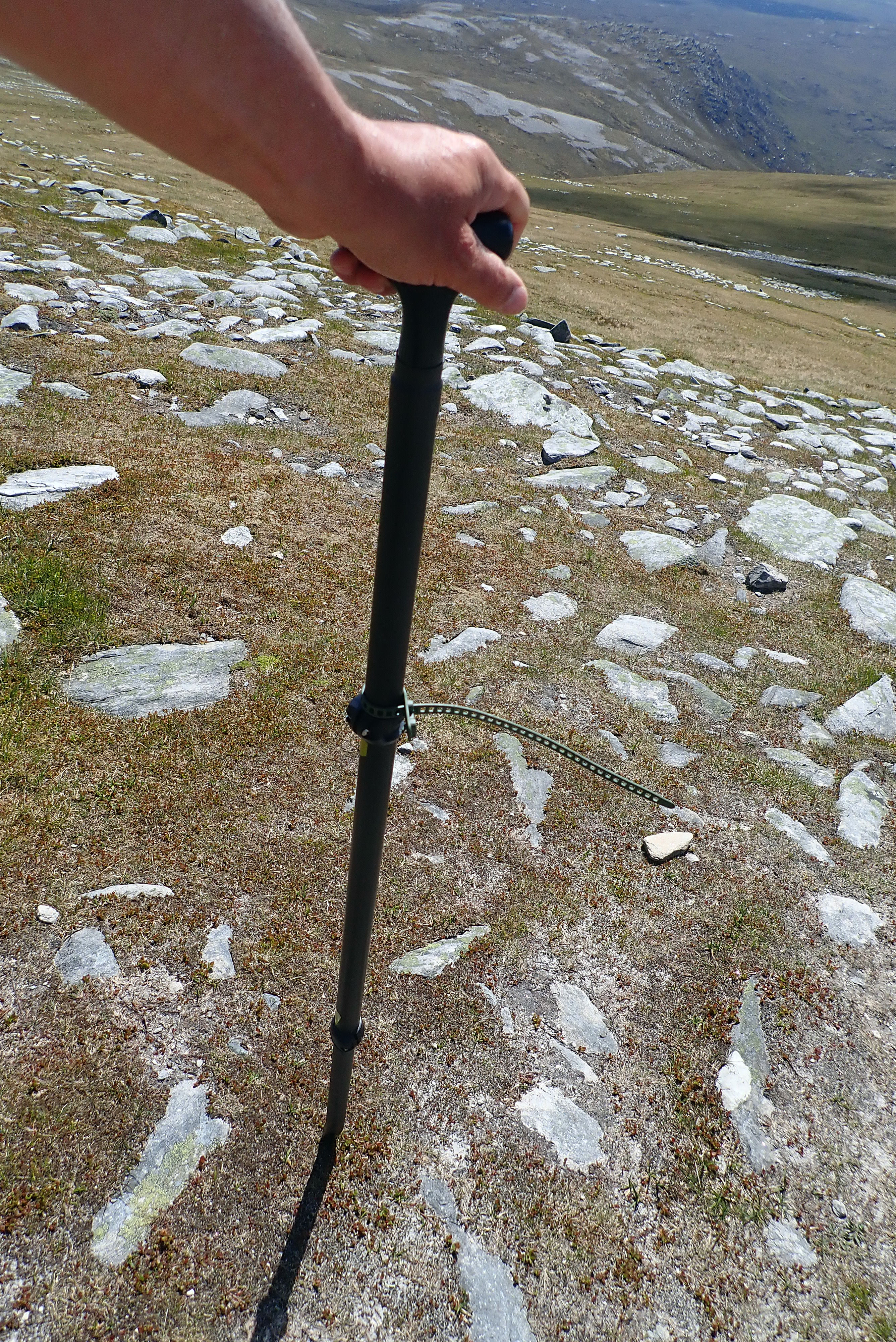
As the calendar flipped into June the crap May weather – worst for decades locals say – had finally broken, and northwestern Scotland sits under a High with cool, light winds and blue skies. After weeks of the opposite, it can all look a bit miraculous. The other day we climbed Ben Hope, Britain’s most northerly 3000-footer. It’s a short, steep climb, and coming back down I was sure pleased to lean on my packstaff (right).
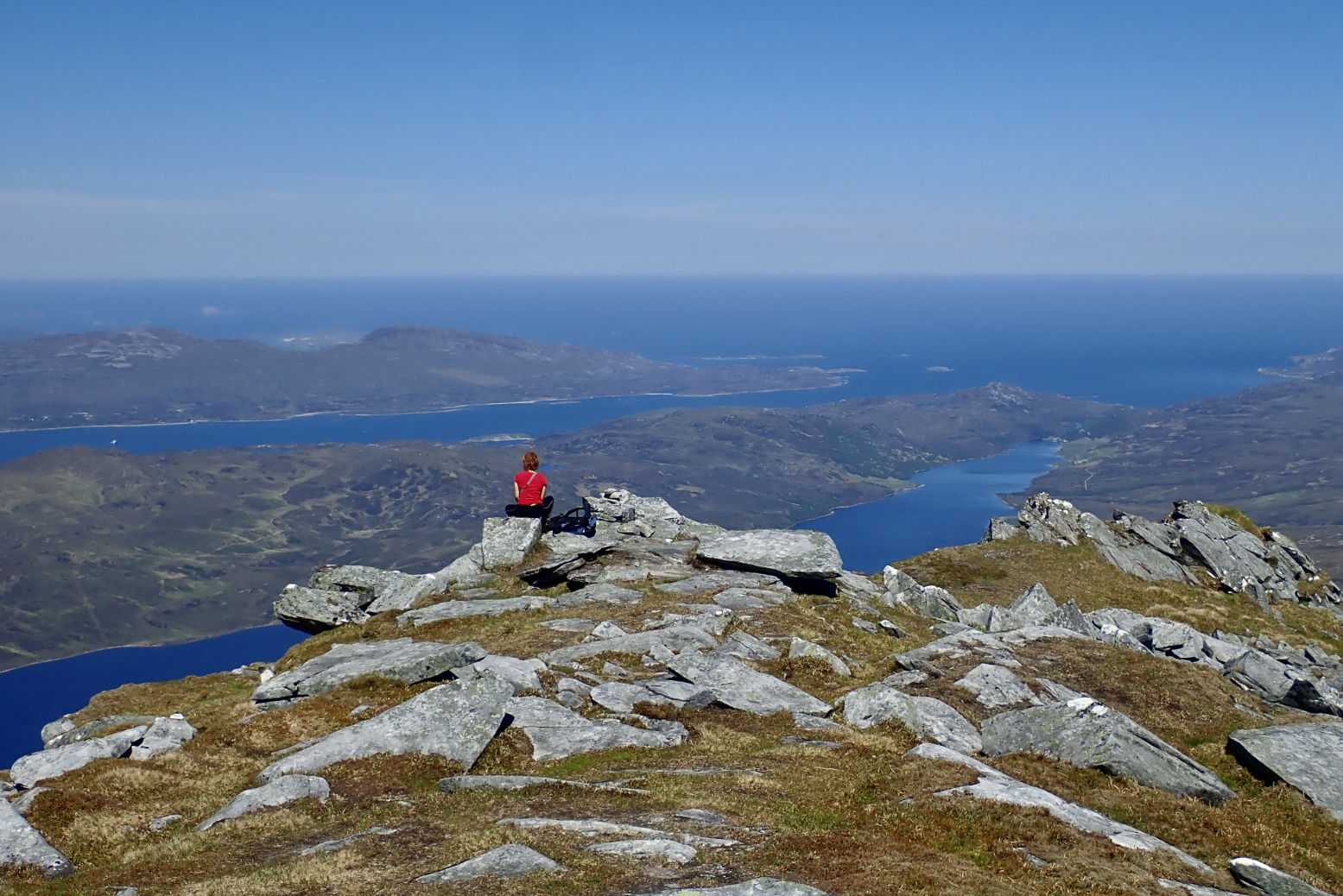
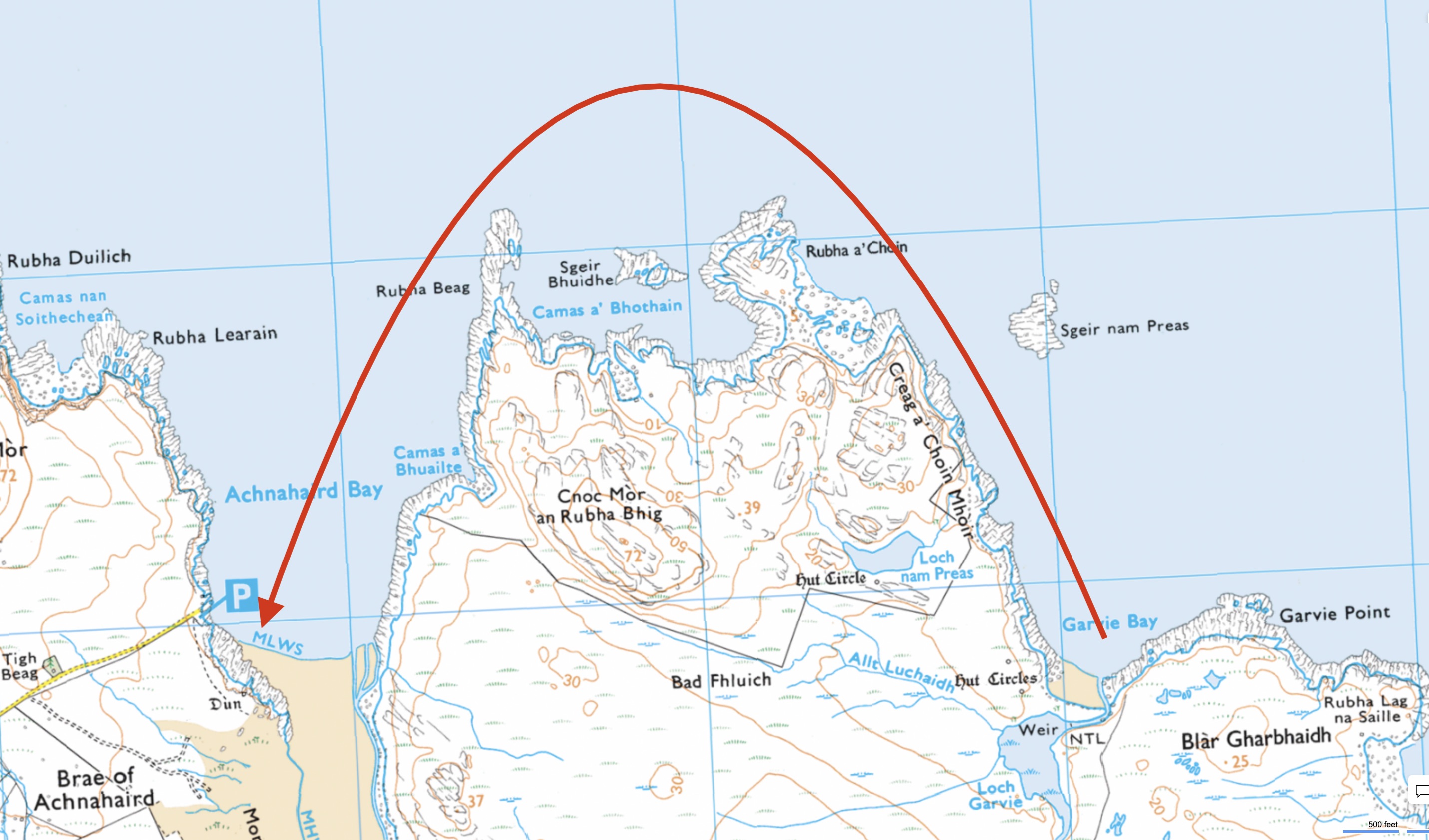
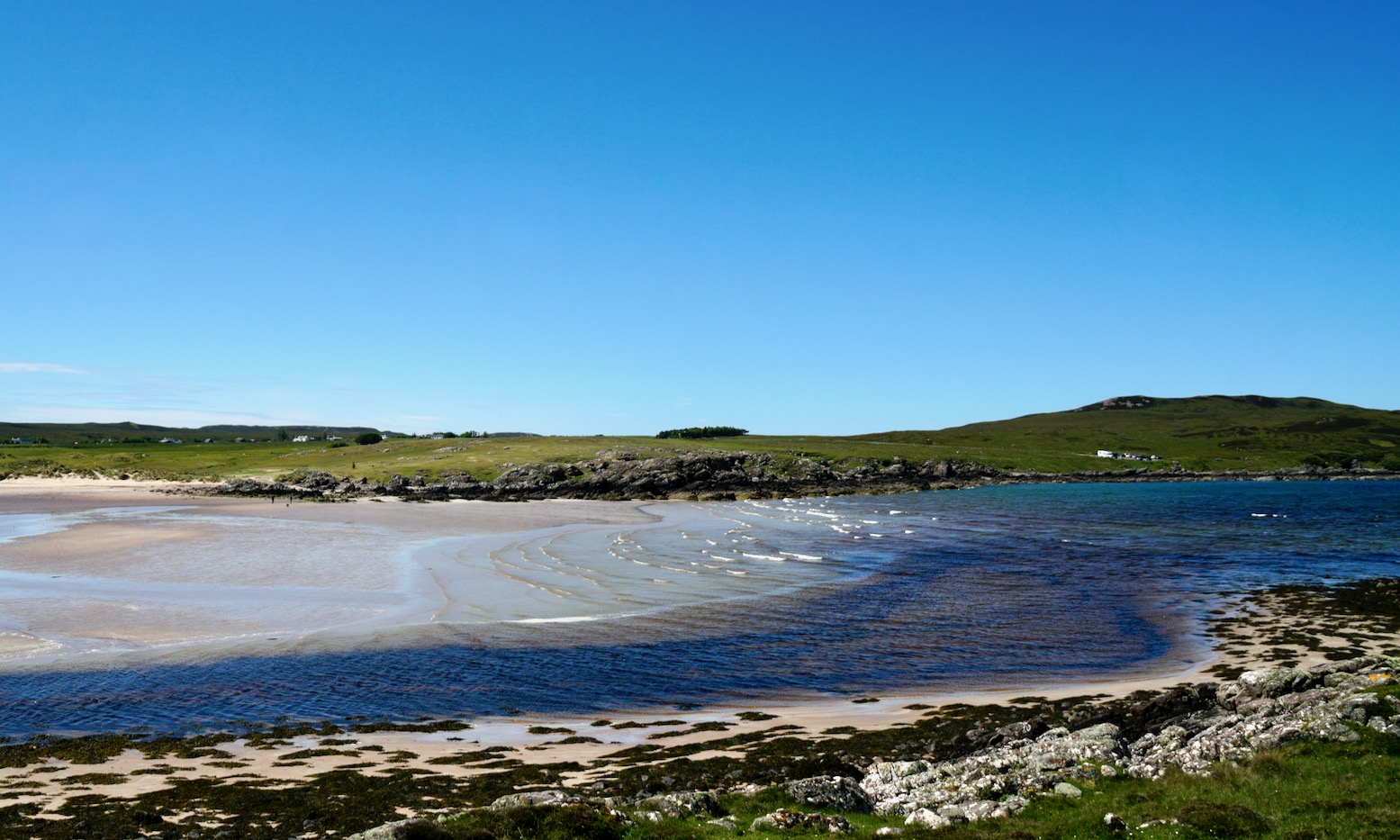
Back home, paddling the southern edge of Enard Bay in an arc from Garvie Bay around to Achnahaird beach (left) was another easily realised sea packrafting outing. It’s also our favourite local half-day walk and with today’s strengthening northerly breeze, I ought to be able to sail down into Achnahaird, wade up the stream to the twin freshwater lochs, and carry on sailing nearly all the way back to Badentarbet. All up that would be about 18 kms of paddling and walking.
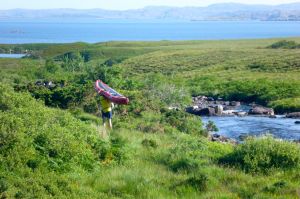
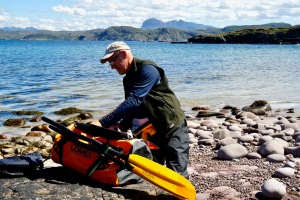
It’s a muddy kilometre’s walk from the road bridge down to Garvie beach which, unlike popular Achnahaird, is usually deserted. I did carry my old Grabner IK down on my head one time for a paddle to Lochinver, but a packraft in the pack is so much easier. This car-free and approach/portaging ease was part of the rationale in putting all my eggs in the TXL basket and flogging the Seawave.
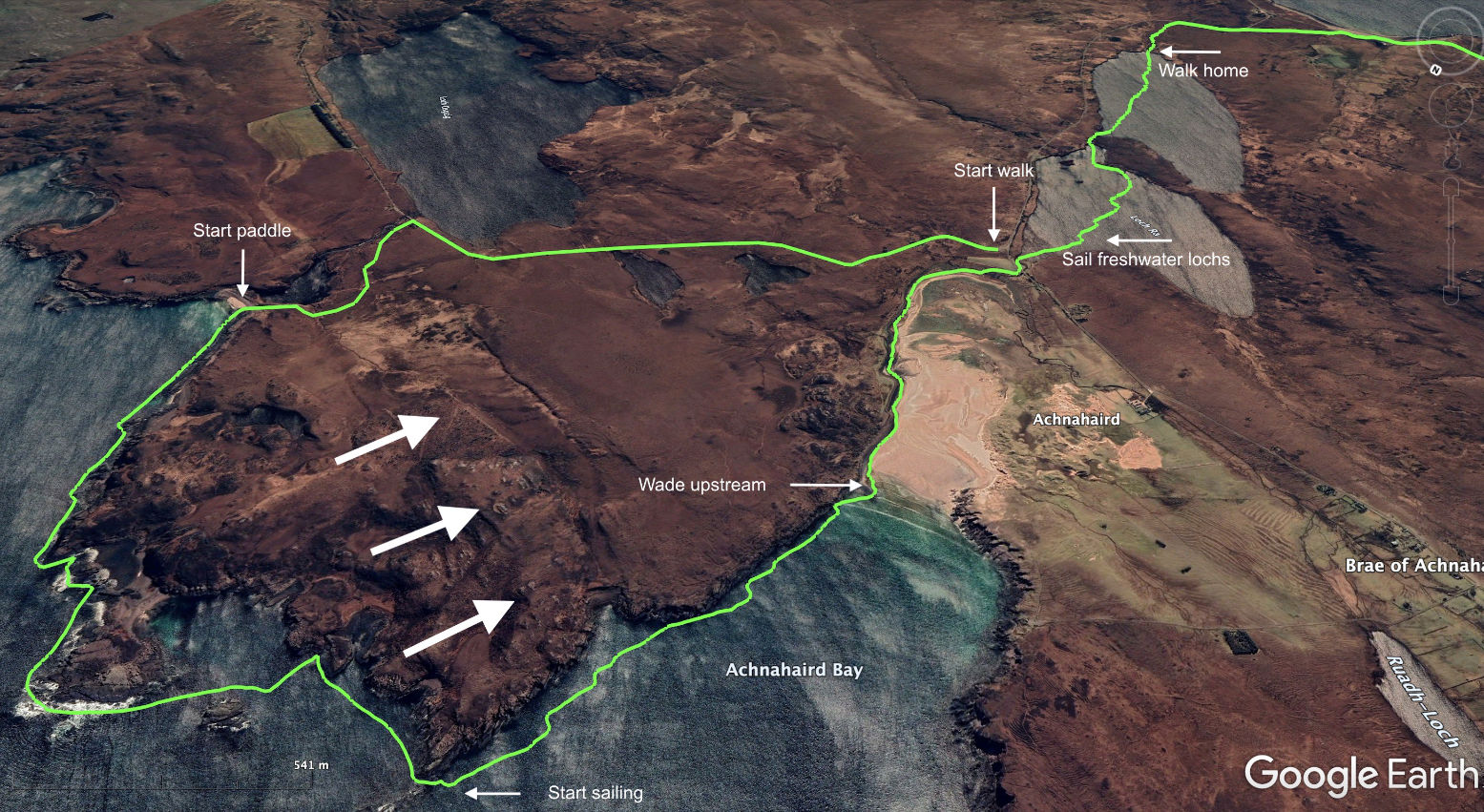
Even before I reached the shore it was clearly a bit windier than the predicted 6mph, but as long as white capped waves held off (the easily spotted warning sign for inflatables) it should be OK. The chilly northerly coming off the sea was steady; less gusty (or so the forecasts suggested) so I was glad I grabbed the dry-suit last minute.
As you can see from the Google image above, the rough shoreline and reefs can kick up some breakers, but if it all got a bit much I knew plenty of take-outs to join the Mrs who was doing the walk and taking photos from above.
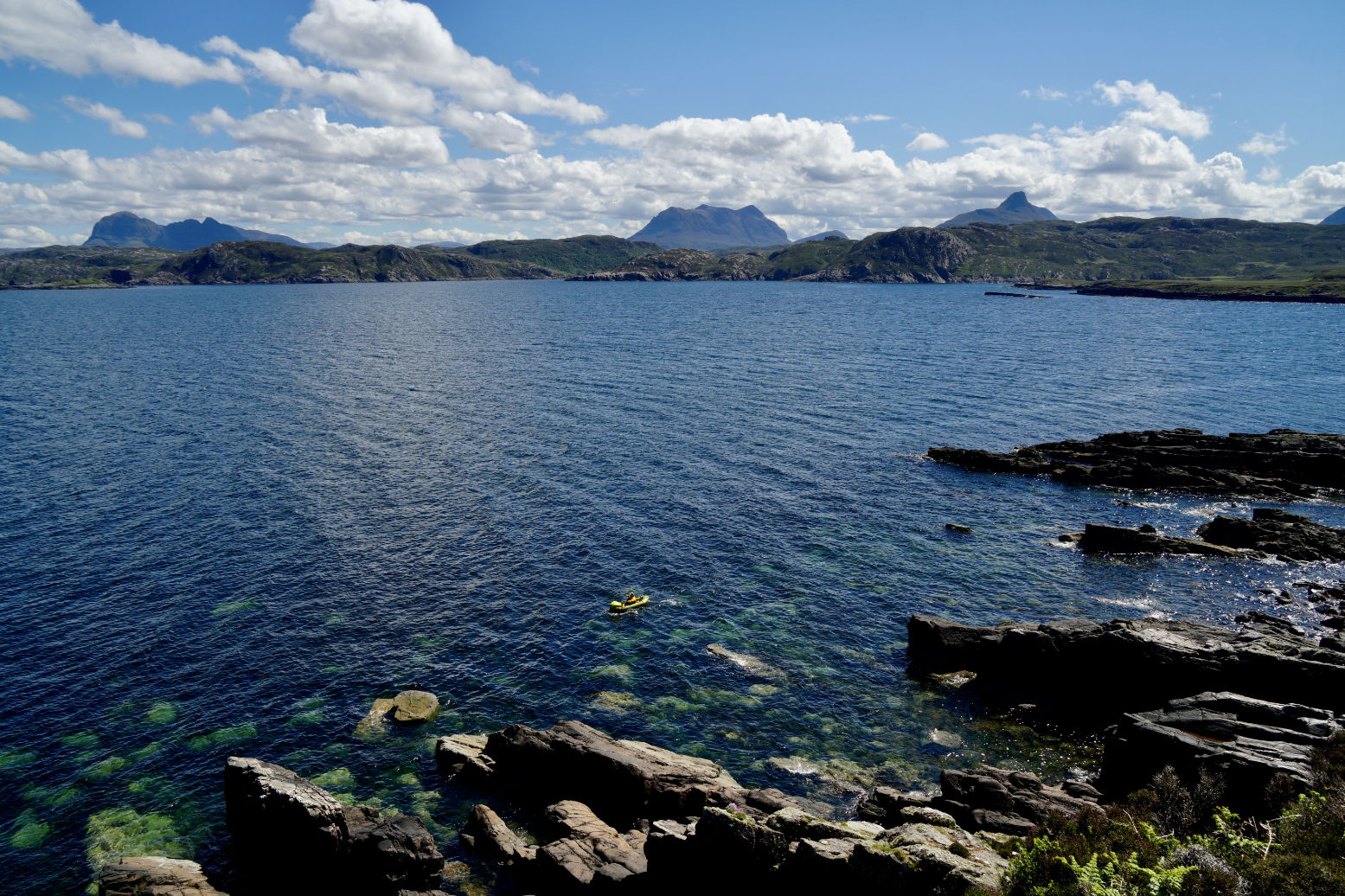
Skeg effectiveness
Anfibios mount the skeg sloping down on the hull’s short stern. Selfies I’ve taken on previous TXL paddles show the skeg halfway out of the water, unless the boat is very heavily loaded. The air floor lifts the boat higher still.
This was not an issue in my rear-weighted Rebel 2K single seater where I pushed the back end down. On the level-trimmed and more buoyant TXL, the skeg is ill positioned or too small.
Fitting the skeg backwards puts more in the water, but sticking another mounting patch at the back of floor sheet like an IK (above right) is fully effective. People ask: would the lack of inflated skeg support be that bad without the firm backing of the air-floor or a rear paddler’s seat? No; and the long, low stock Anfibio skeg is just the right shape.

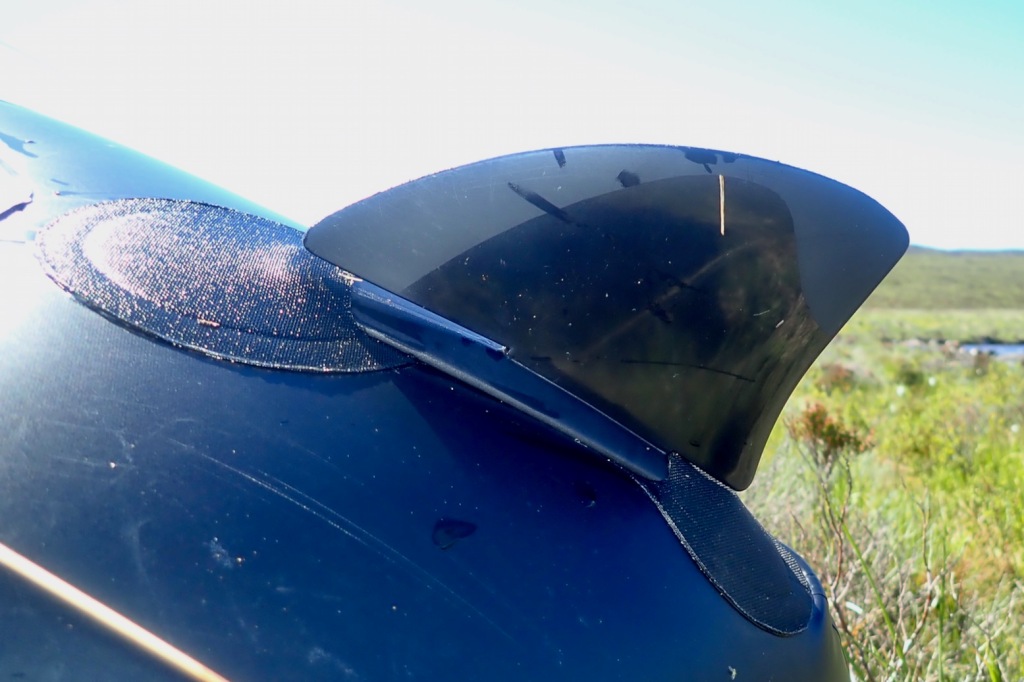
Mounting another skeg patch on the floor is a bit time consuming is what I ended up trying so I can keep the stock skeg. Today I’m trying a spare Gumotex skeg (right) whose slip-in mount system the Anfibio skeg copies, but which has a deeper profile putting more plastic in the water. It’s only less than half a hand’s worth, but is worth a go before fabricating a skeg extension or repositioning it.
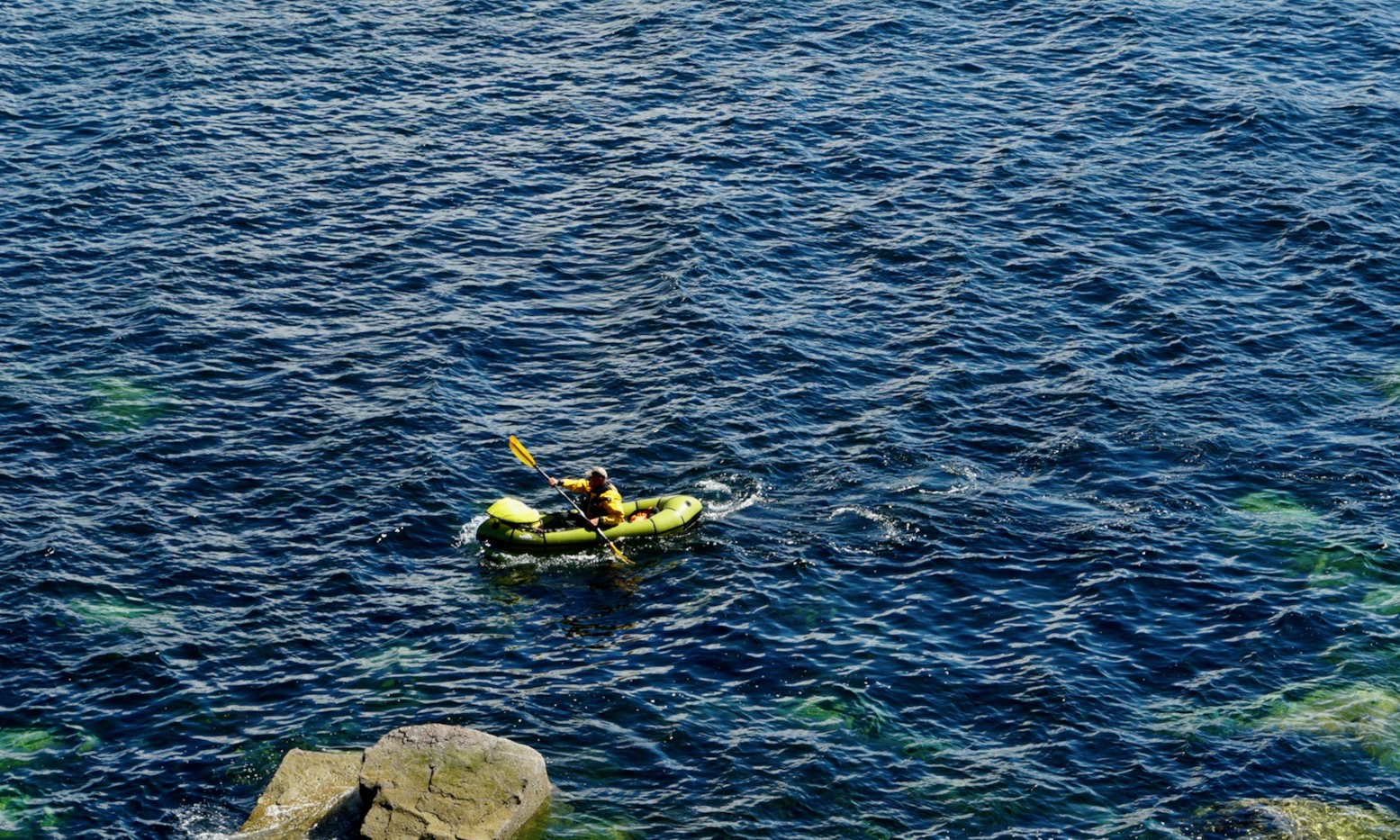
Today I’m also trying my longer, smaller-bladed, 230-mm Camaro sea-kayaking paddle more suited to steady cruising into the wind than the over-sized, white-water Corryvreckan I’ve been using so far. Initially I can feel the paddle’s extra weight, but that’s soon forgotten which suggests the slimmer blades are just right. Progress is a bit sluggish into the northerly, but I’m getting the feeling it’s always like this with the bloaty TXL until the arms warm up.
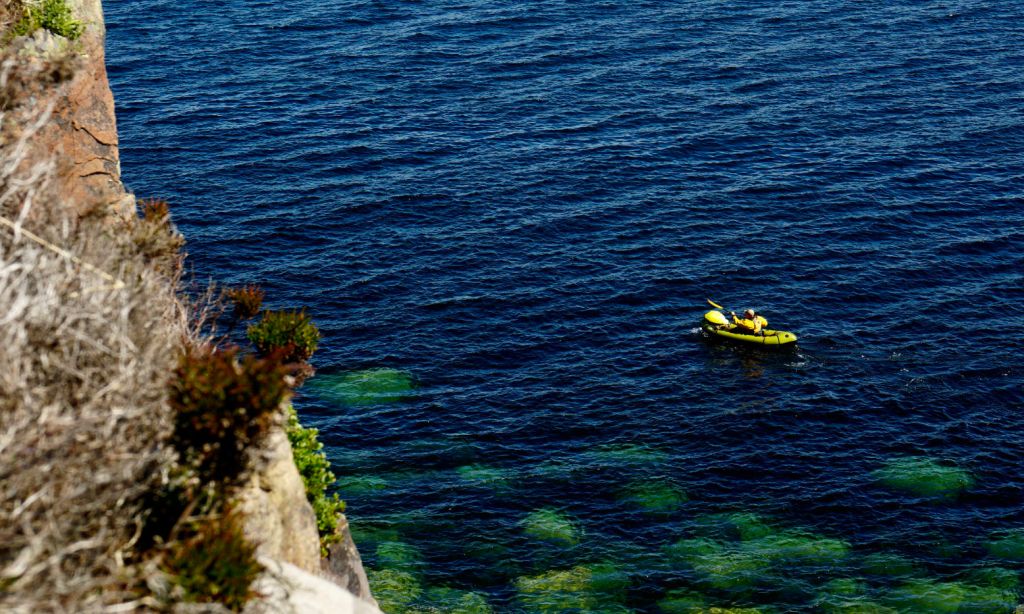
I wonder if coming round the point and turning west into Camas a Bhothain (‘bothy bay’) may get a bit lively, but the TXL takes it all in it’s stride. It’s easy to spot where waves break over reefs and, sat low on the broad, 15-cm-thick seatbase, stability is never an issue and for a packraft, the TXL tracks well across the side wind and waves, perhaps helped by the Gumboat skeg and my masterful technique.
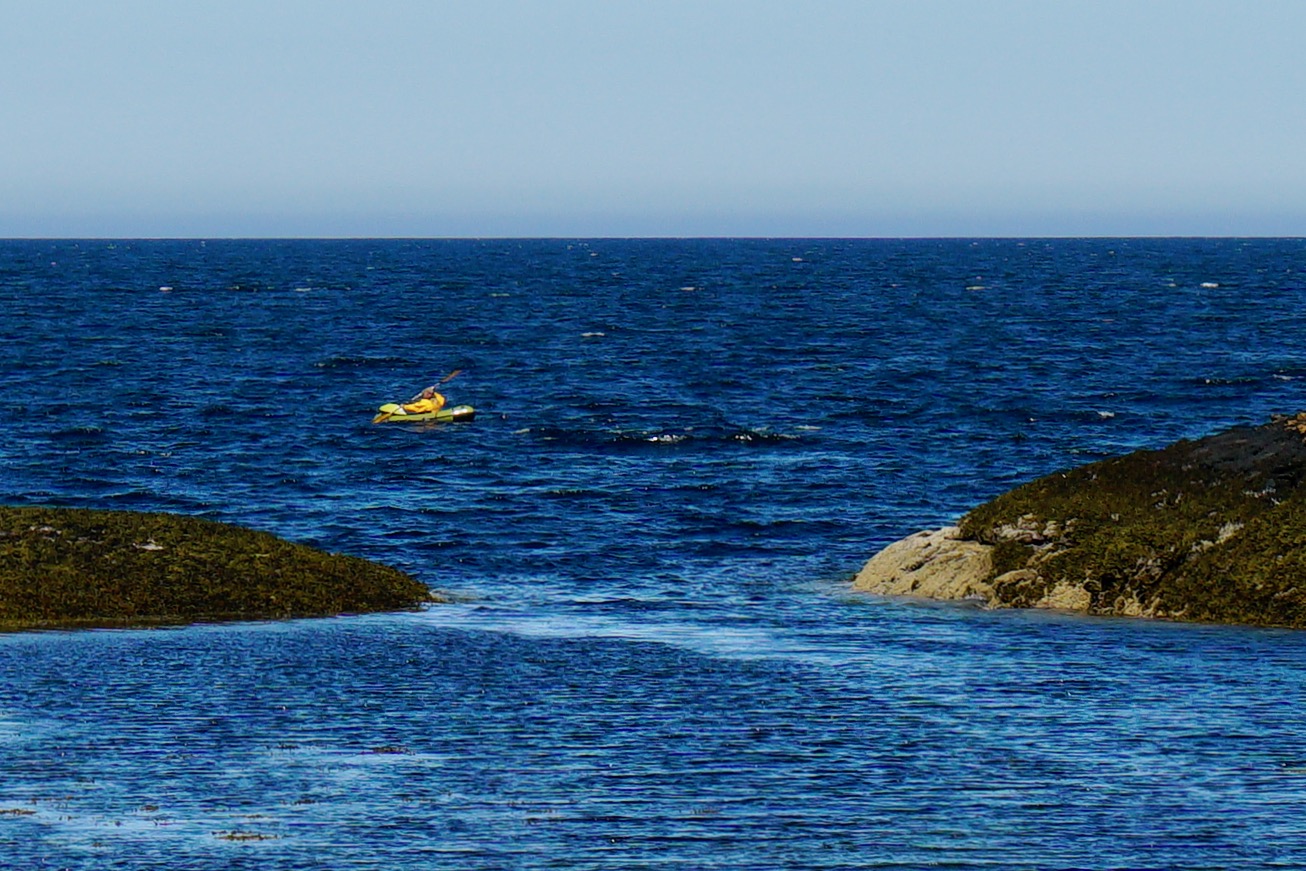
It’s only 4km beach to beach and soon I’m threading through the western Rubha Beag skerries and turning south with the wind for Achnahaird.
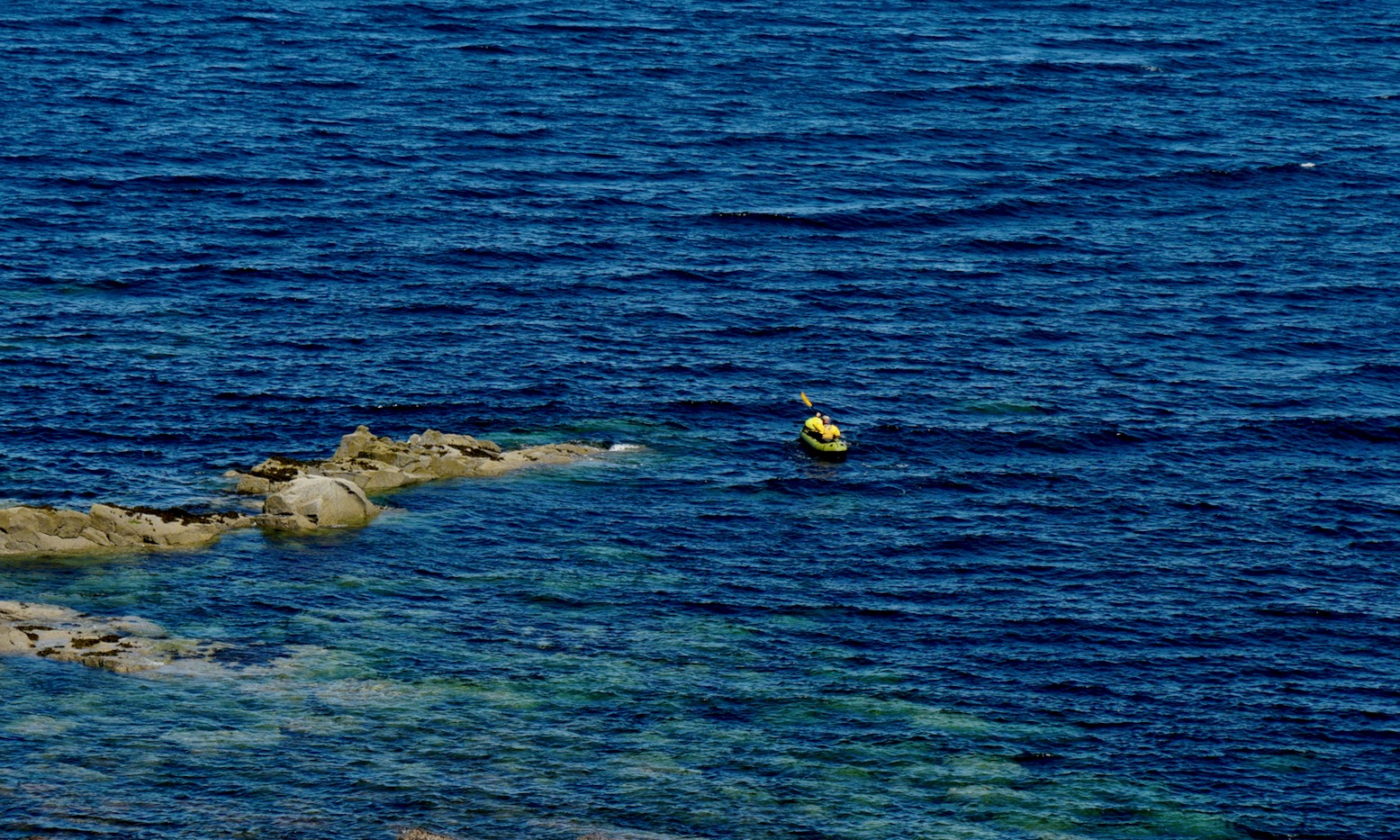
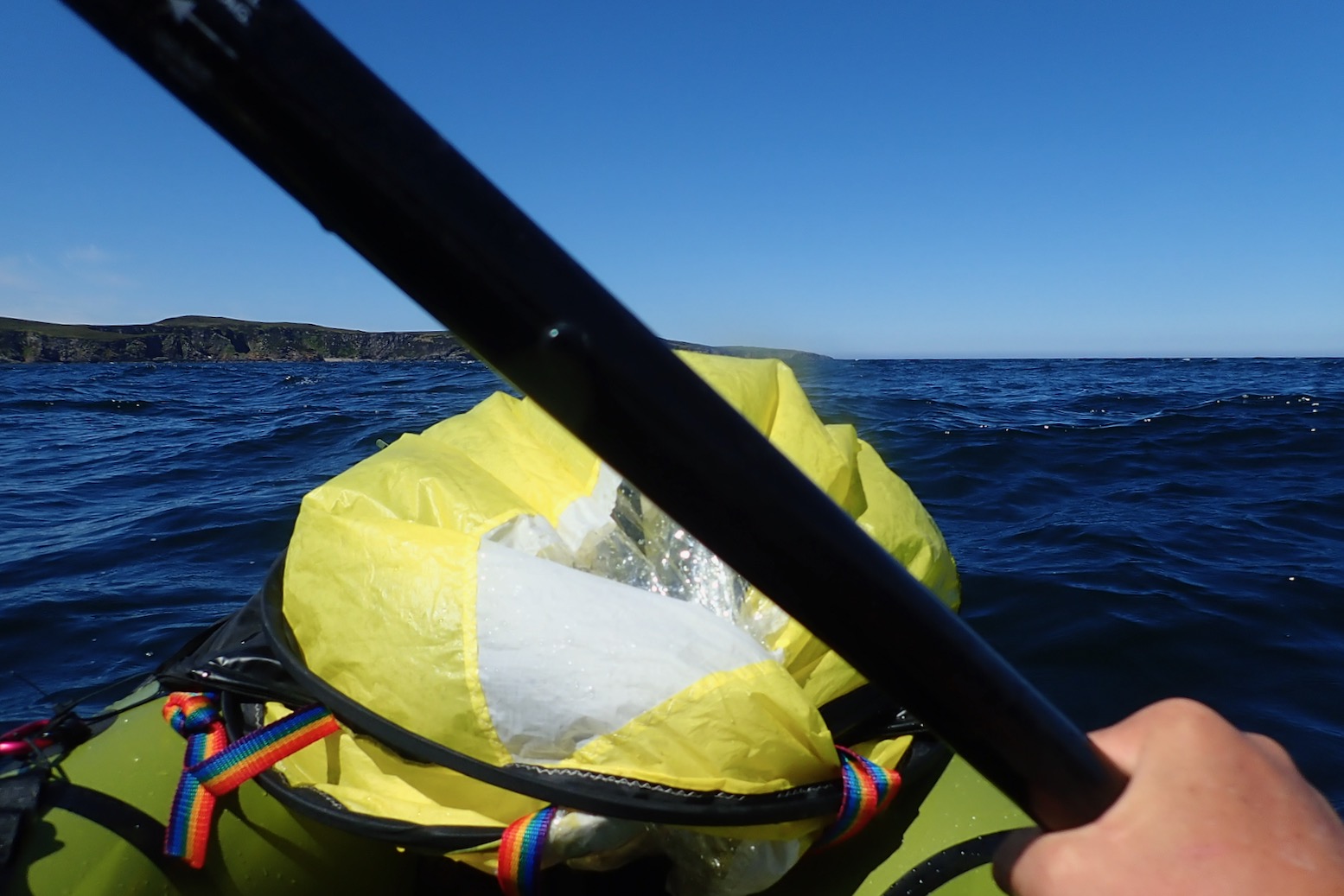
Out here in the open the waves are bigger with the odd white cap rolling past, but incredibly the boat feels fine. In a normal solo packraft I suspect I’d be a bit freaked out. The bigger boat makes you feel less vulnerable and the high sides keep the splash out and don’t seem that affected by ~10mph side winds (something I discovered on my first sea outing in Dorset).
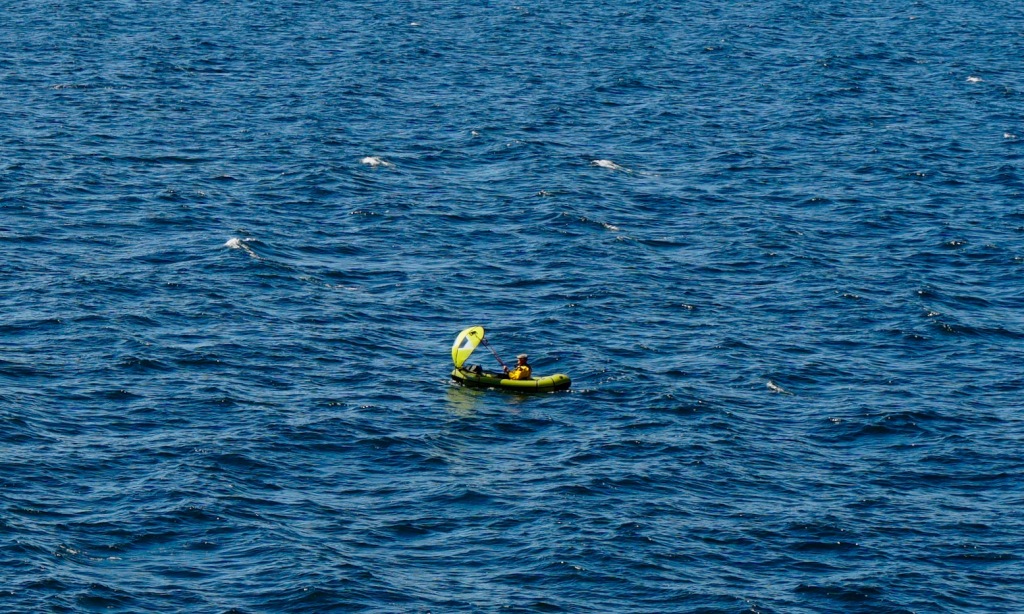
I paddled out into Achnahaird Bay (or so I thought) to get a straight run for the beach, then flipped out the WindPaddle. Only things don’t go so well. Just like the other day when I blamed the front skeg, the TXL is weathercocking (back coming round, below). This time I blamed a too shallow skeg lifting out on wave crests at which point the wind pushes the untethered stern around – the boat pivoting around the sail’s ‘mast’ on the bow.
I’ve had this before sailing a IK on Ningaloo Reef in northwest Australia (tall-sided Ik and too short a rudder for the winds). In the TXL my central ‘kayak’ rather than rearward ‘packraft’ seating position doesn’t help. The (loaded) Rebel 2K sailed fine in similar conditions; so did my unloaded Nomad S1 one time, as well as Barry’s loaded Nomad last year in Knoydart. With its skeg on, the MRS Nomad sailed well, with or without a load. Along with its pointy ends, I put that down to its fully submerged skeg.
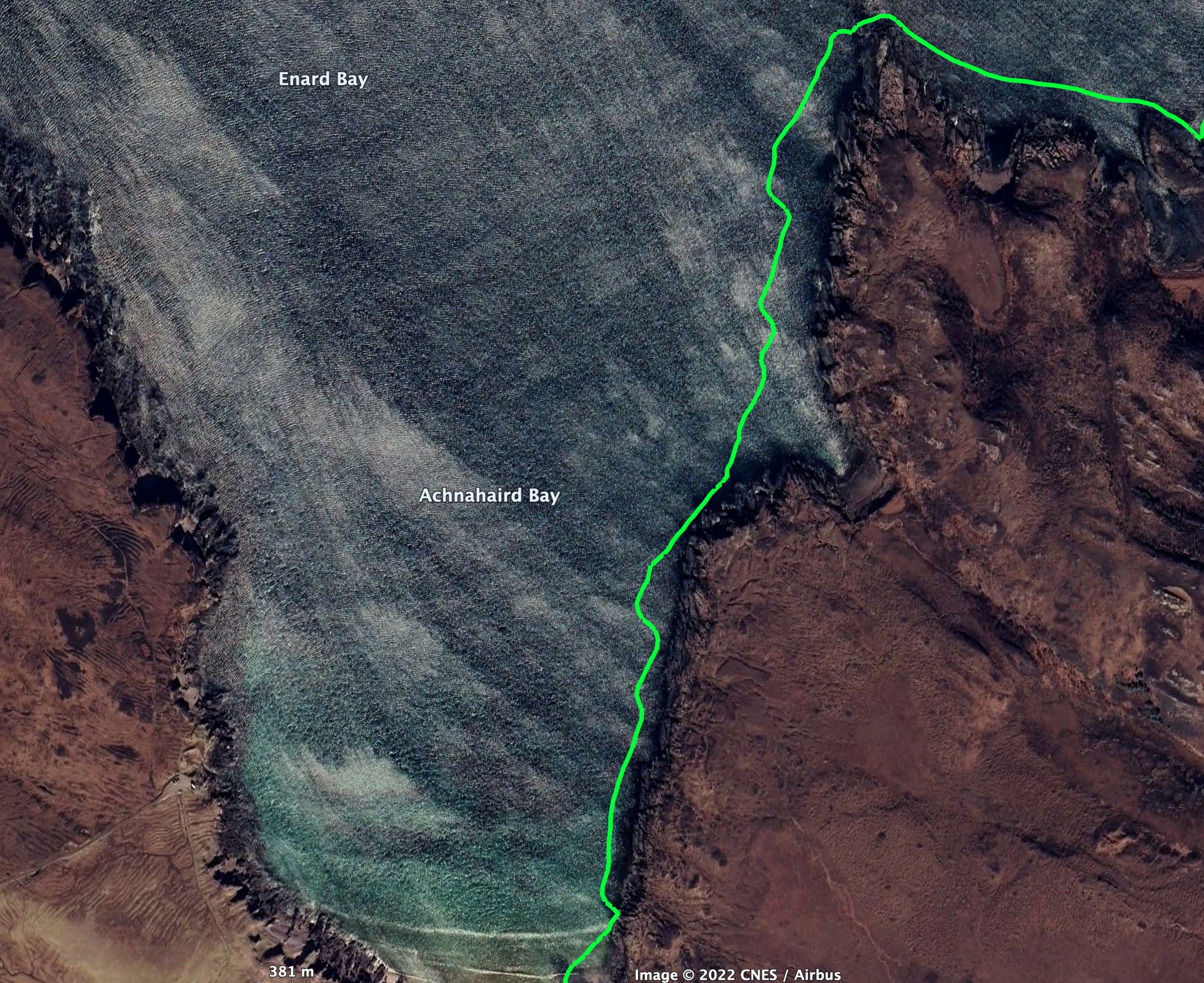
Meanwhile in the TXL you can see my annoying zigzagging track on the left. Hoping to slice across the bay like a blue-fin tuna, it was all a bit frustrating, but I inched in the right direction quicker than it felt and was pretty sure weight distribution and skeg depth were the culprits. And in fact I saw later the GPS was logging a steady 6kph, it just wasn’t the steady linear progress I’ve had sailing other packrafts.
Once at Achnahaird I paddled as far as I could up the burn running alongside the beach, then hopped out and waded upstream – easier than carrying the boat in the wind.
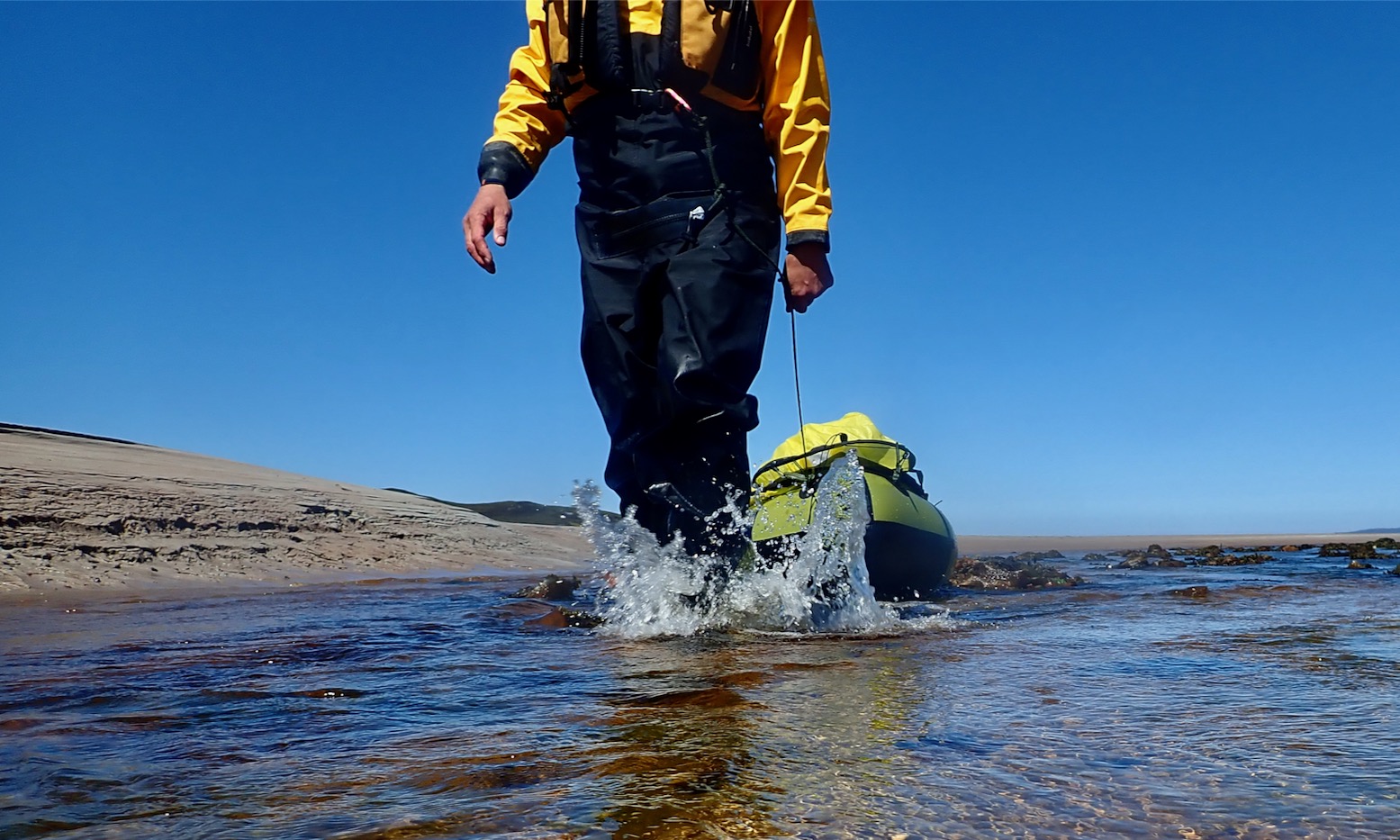
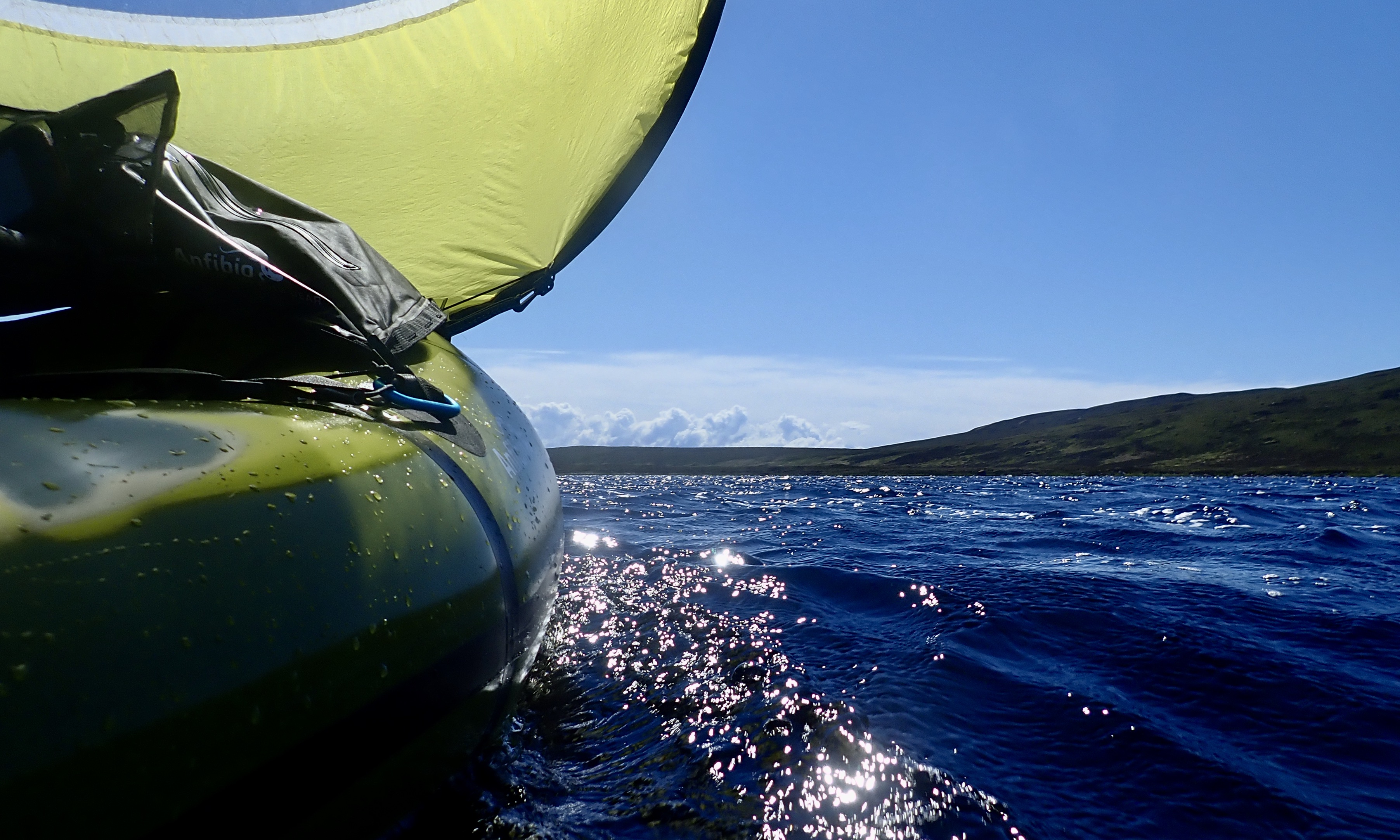
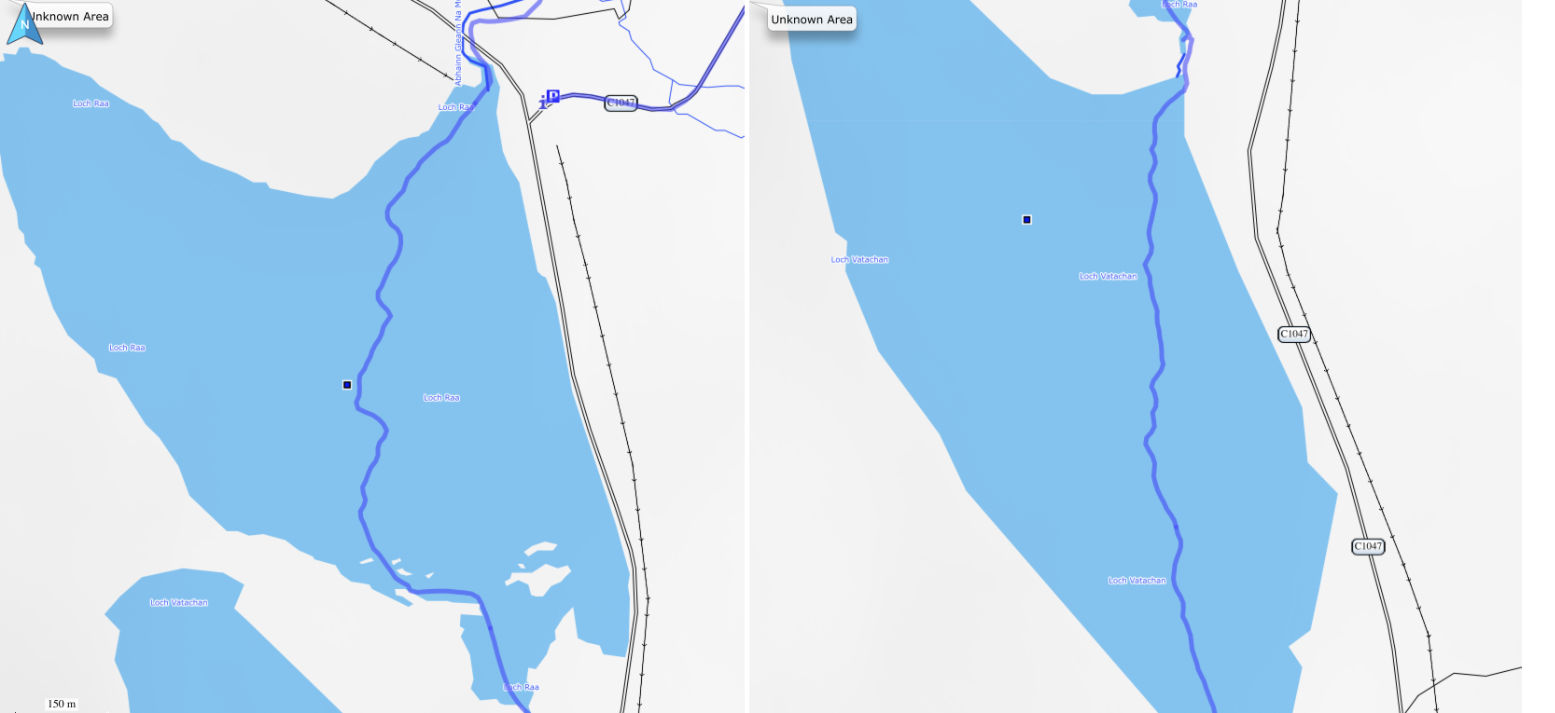
Near the road junction it’s a 2-minute carry over to freshwater Loch Raa where I hoped the lower waves would give the skeg some traction. But it was the same zigzagging progress. Waves combined with a shallow skeg were not causing the weathercocking (as they had in the Bay). So the problem had to be weight distribution. I remembered a canoeing adage: “sit up front into a headwind; sit at the back downwind“. You are the flagpole from which the boat should trail downwind. After a short portage over into Loch Vatachan, I sat right at the back and progress did seem a bit straighter, as the GPS tracklogs below show. I was no faster: 6kph downwind and 5ph on the ‘off-wind’ zags, but there was less zigzagging.
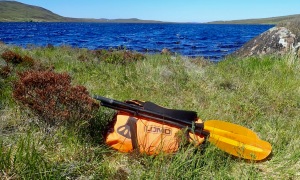
By the time I reached the south end of Loch Vatachan to pack up, the wind was fairly brisk (left). Packraft sailing should be better than this but moving to the back of the boat to enable reliable tracking under sail is not so practical. The answer must be a bigger or repositioned skeg.

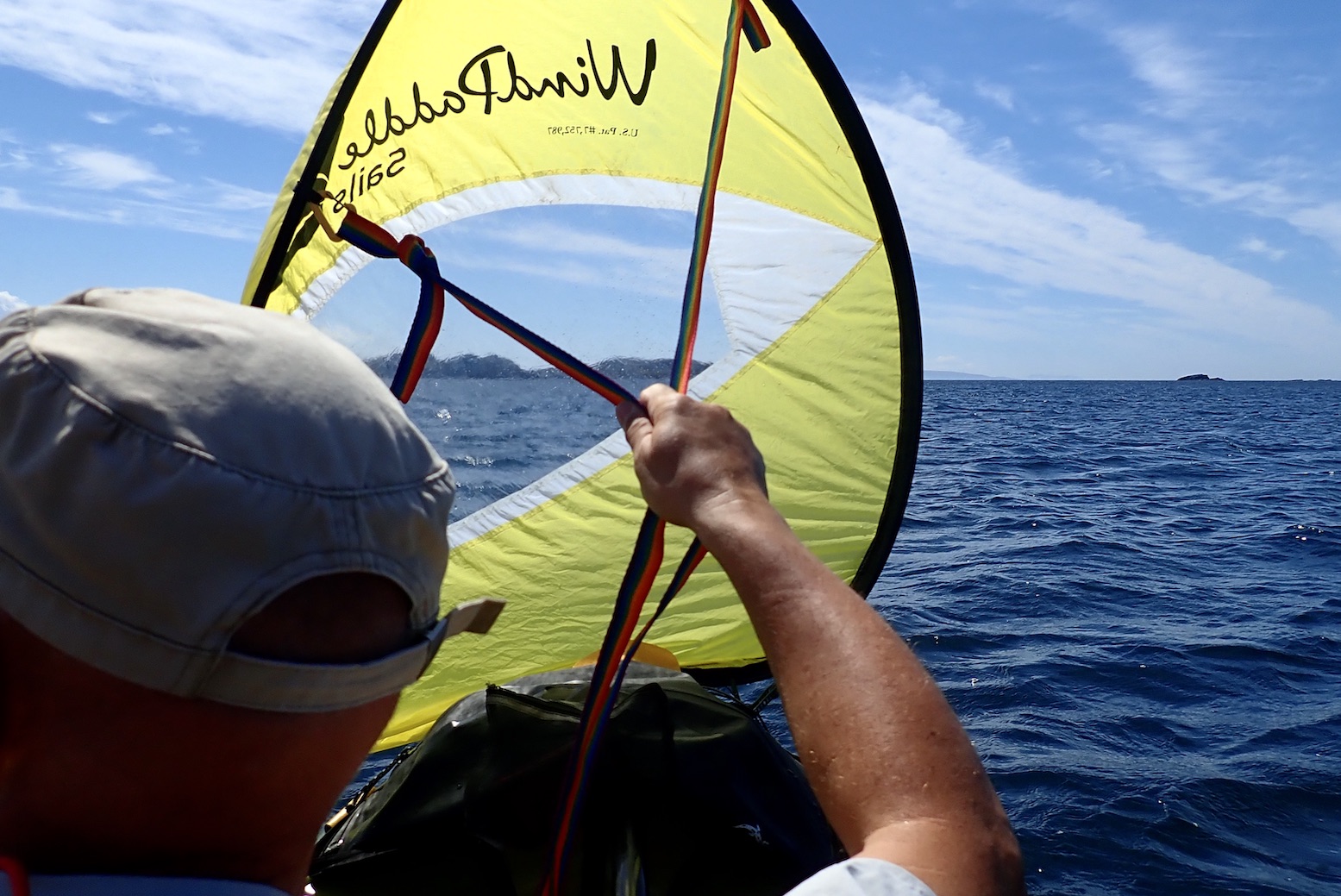
A couple of days later we went for a short paddle in a reasonable sailing wind. The stock skeg was on back to front (right) and with the Mrs’ added ballast I hoped it might bite under sail.
Unfortunately it was the same story of the stern coming round even if the speeds were again OK. On a beach we went for a wander and found a nice bit of broken plastic fish crate. We’re gonna need a bigger skeg.
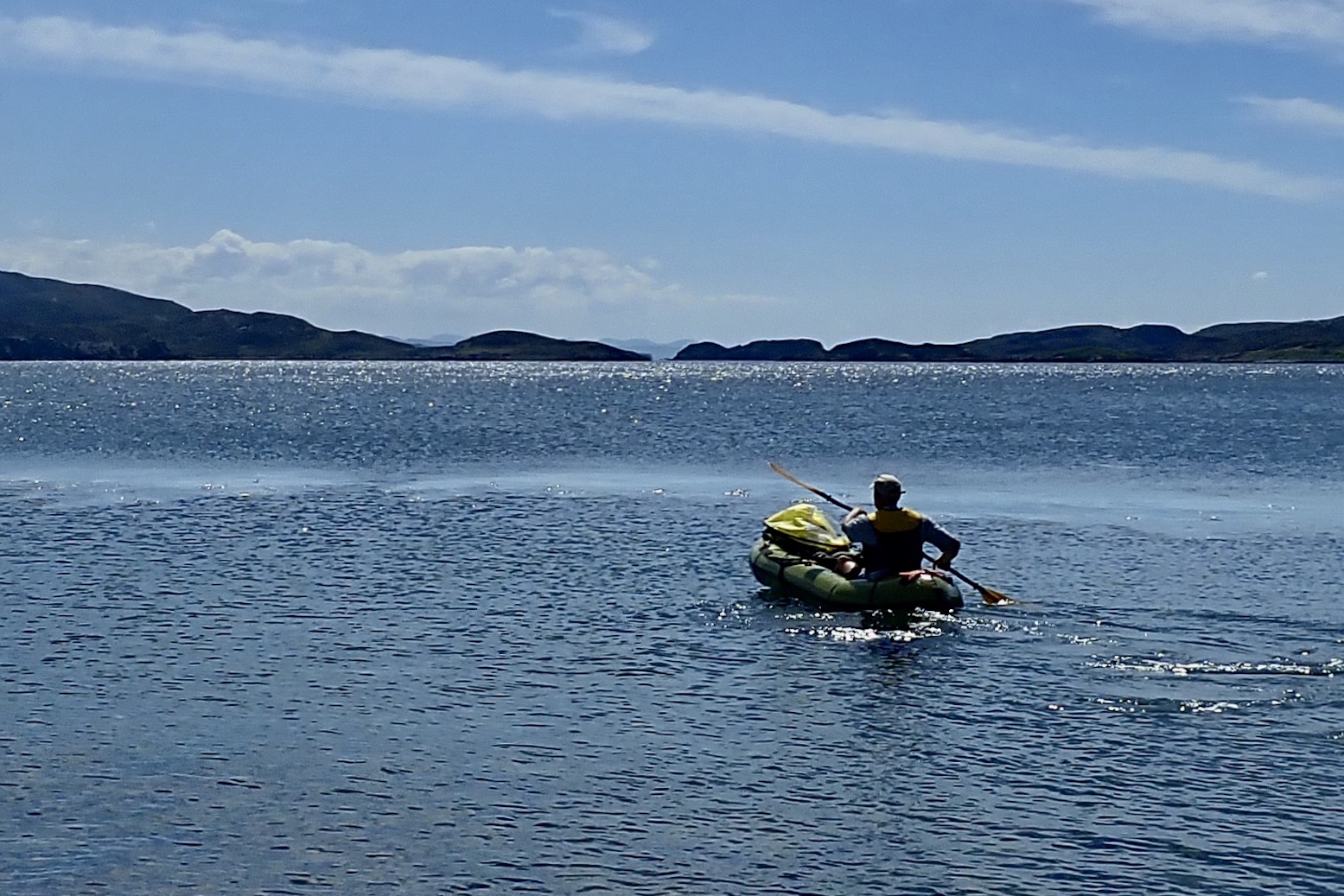
During the stop I took the TXL out for a spin sat in the back. Of course the bow was up in the air and yawing like a giraffe, but it was quite a revelation to have a spacious boat extending out in front of me like a kayak. My front seatbase made a spacious footrest and I could lean on the back like a normal sized packraft. Sat in the back, as a way of touring or bikerafting, a bike over the bow and baggage in the front would correct the trim a little. And with the 200 litres of dry storage capacity inside the TubeBags, you could probably move house with the TXL.
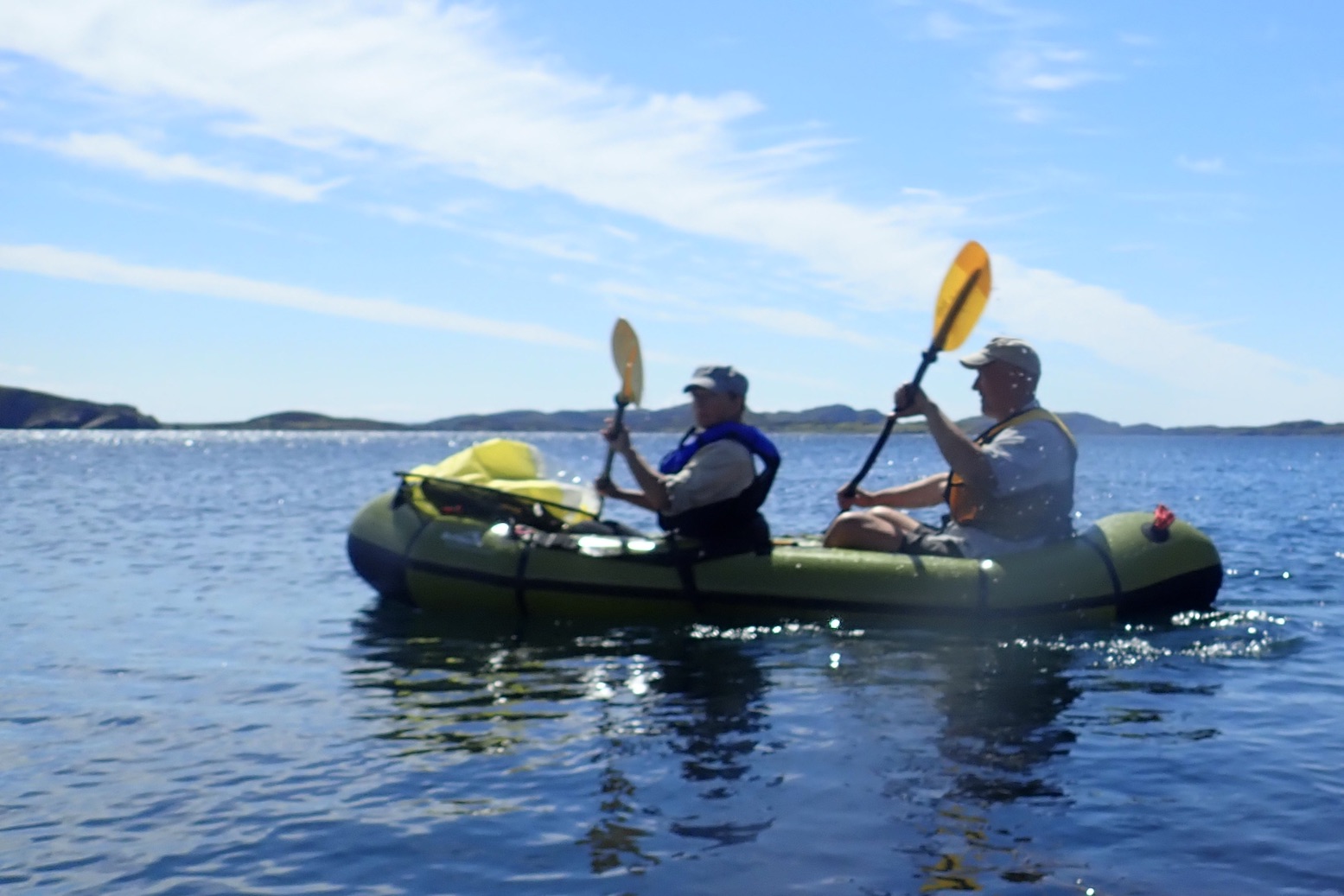
We paddled the last mile to Badentarbet with me in the back. Again this felt much more comfortable for me – it must be the ability to lean on the stern. Meanwhile the Mrs said she felt no more cramped than the back. Yes the trim was still off (left), but so it always was on my 2K and I got around in that with no problems.
That’s the great thing with the TXL: there are all sorts of ways of using it.
Sigma TXL: Multimat floor and front skeg test
Sigma TXL main page
Other Summer Isles paddles
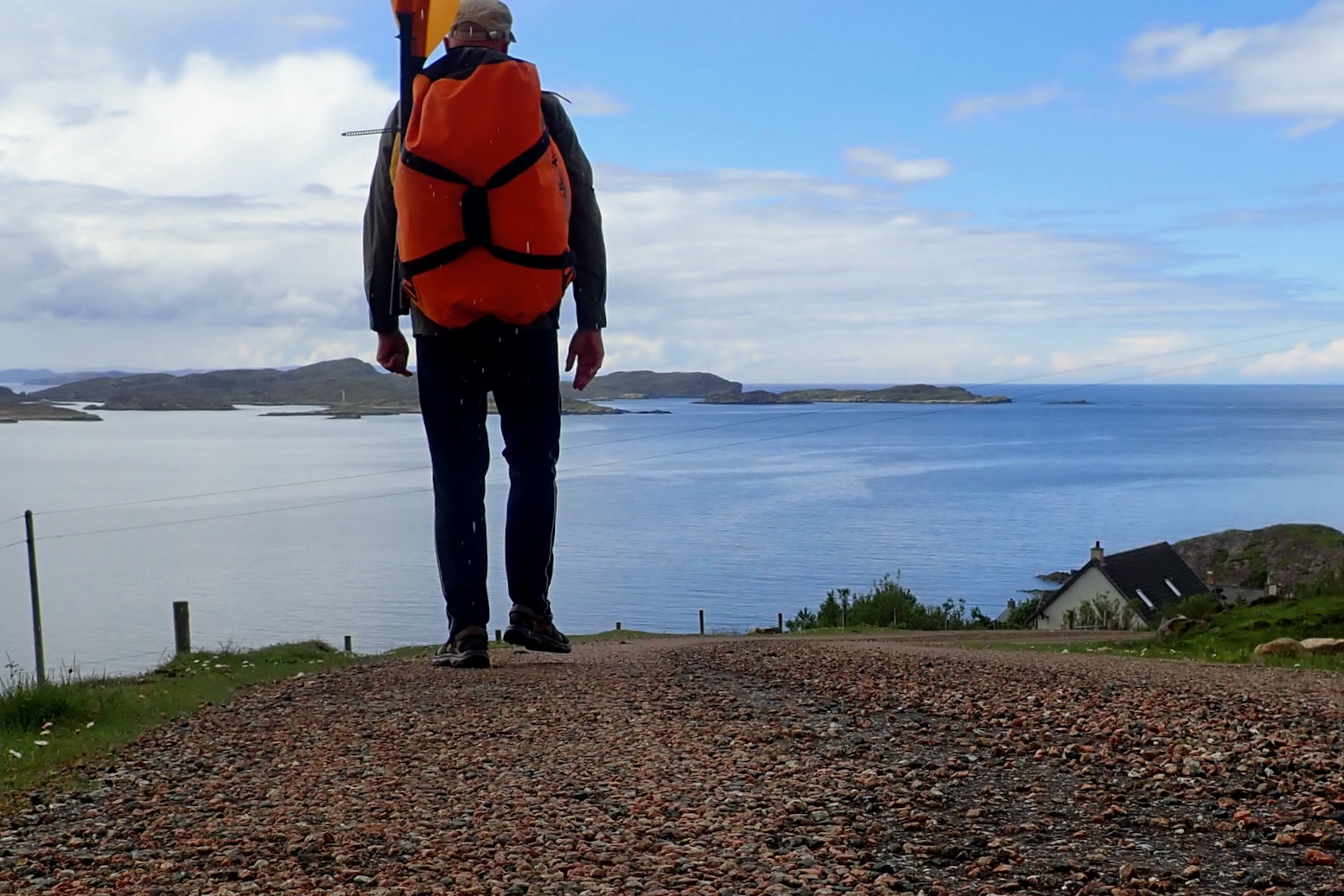
There were two things I wanted to try out while paddling the Sigma TXL solo:
• whether the inflatable Multimat floor pad made a noticeable difference to speed
• what effect fitting a front skeg along with the usual back one might have on handling. Would it shapen the tracking to sea kayak levels?
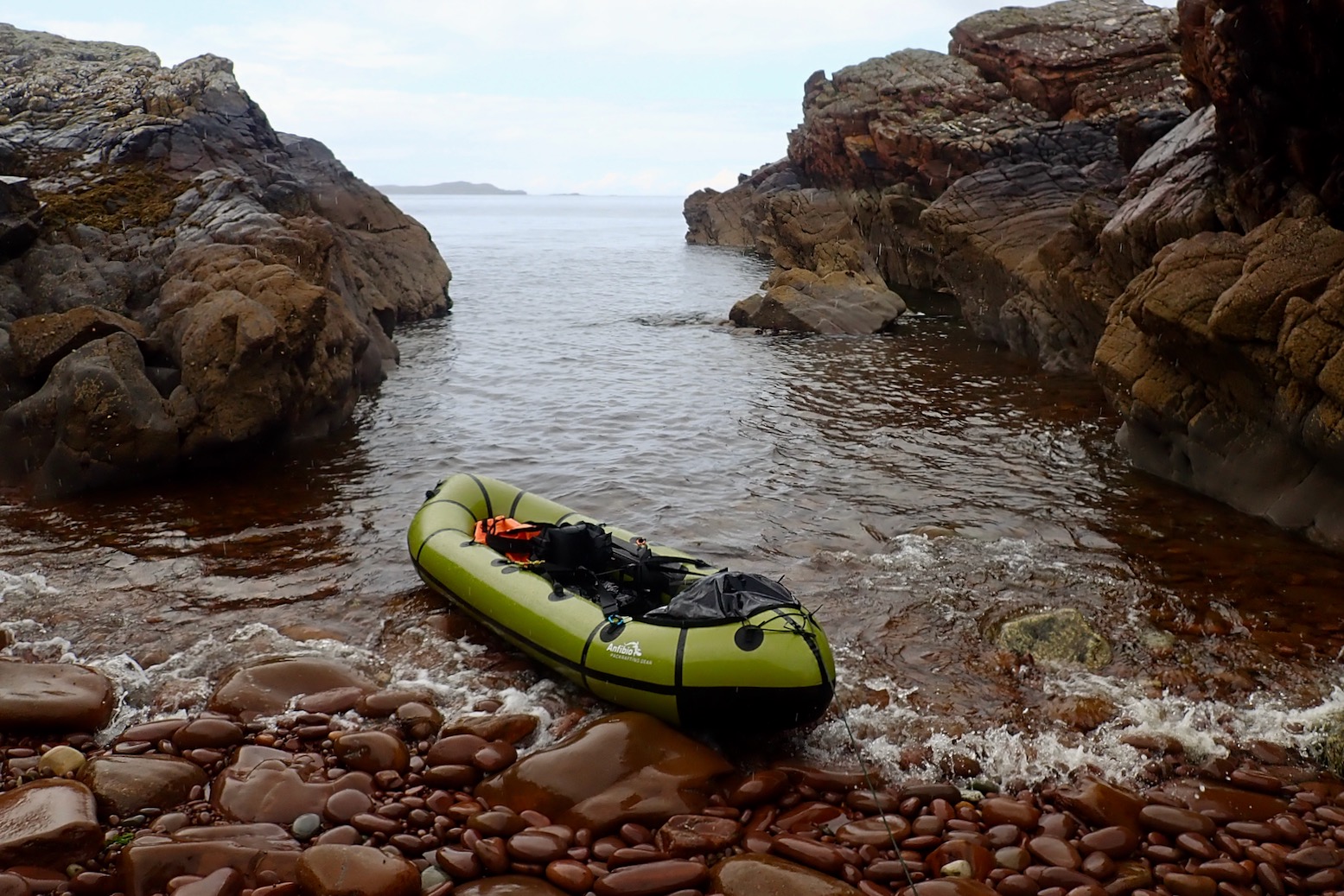
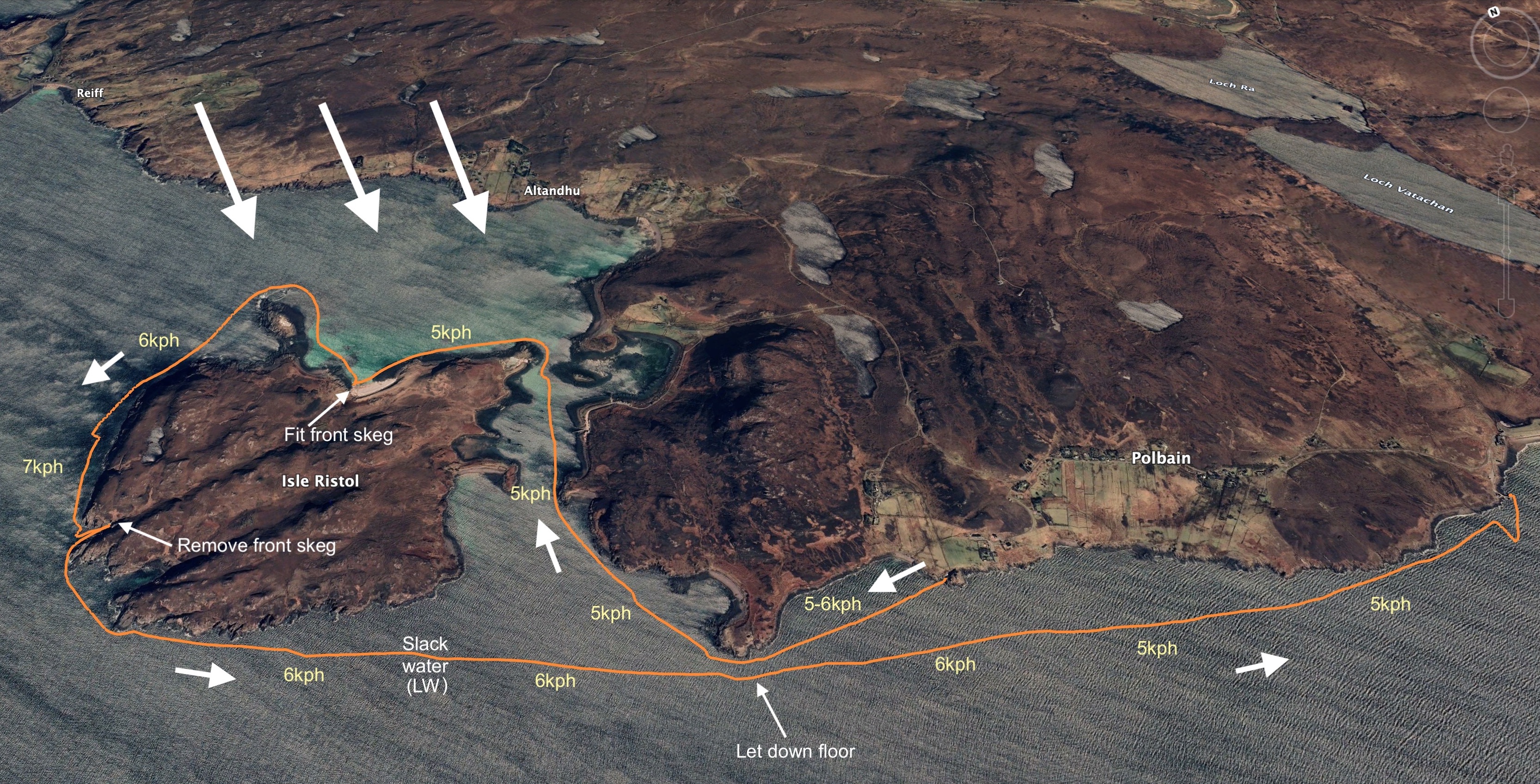
I put in at a handy little slot a mile or so from the house and set off with the usual rear skeg and the floor pumped up and with the nozzle accessible at my feet. All was flat calm in the lee of the light northerly until I turned north at Fox Point into a headbreeze up to Old Dornie harbour.
As before, paddling along I can’t say the boat felt responsive or glided better – it’s a packraft! – but looking later, the GPS record showed I was moving along at a steady 5kph – as good as I’d expect from a boat like this.
I wasn’t sure which way the dropping tide flows through the narrows at Old Dornie (they dry up into an isthmus linking Isle Ristol as very low tides), but now saw it was southbound – against me but barely noticeable.

Once through, it was a bit more wavy and at Ristol beach I hopped out to fit the front skeg, curved edge forward, as well as the WindPaddle sail on the off chance the breeze might pick up. Then I gave the floor and boat a top-up until it was all pinging like a drum. Had I looked more closely at the skegs on the upturned boat (below), I may have guessed what the problem was going to be. The TXL’s bow and stern are symmetrical, fyi, and both patches are glued in identical positions.

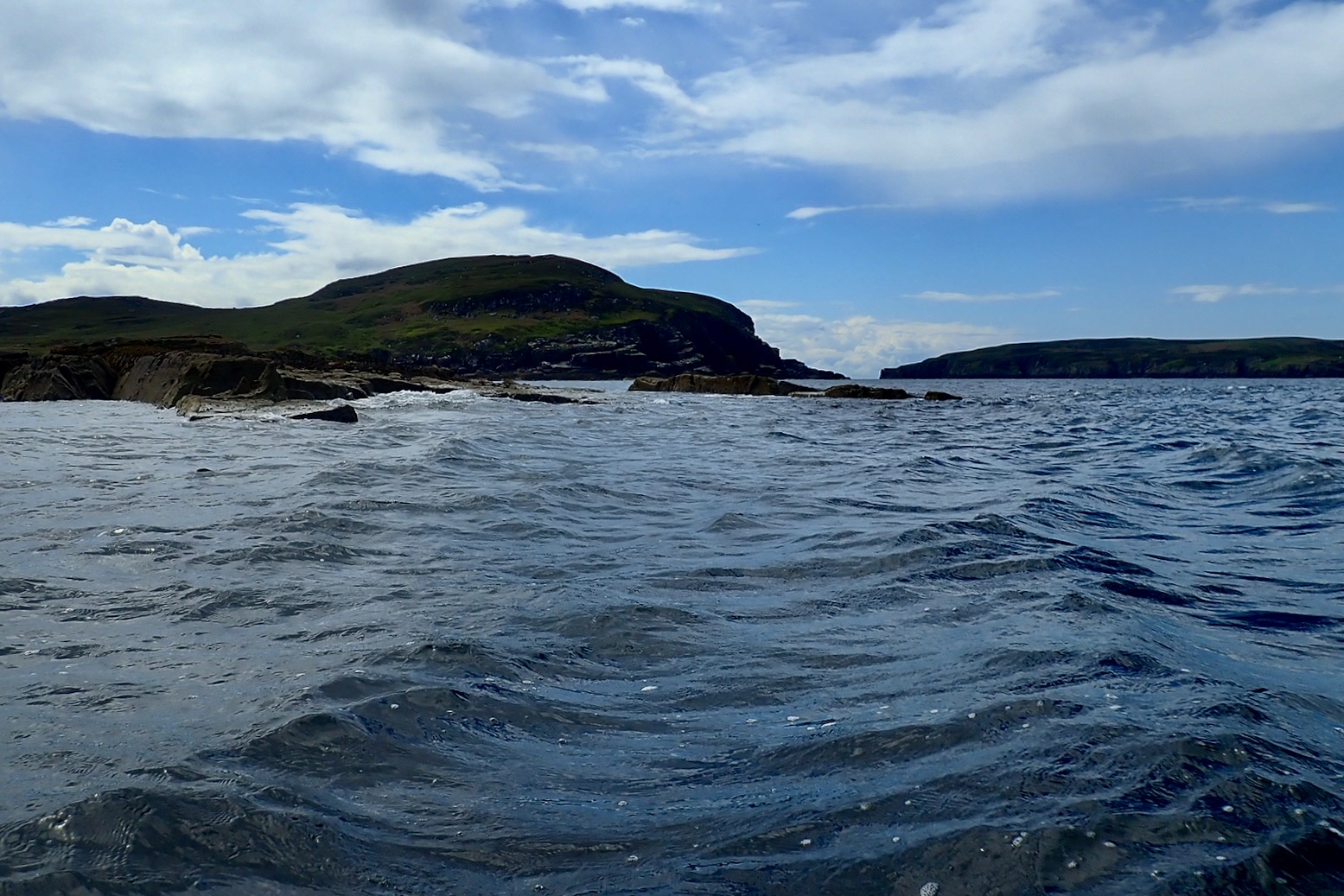
Choppier water ahead
Setting off into the wind to carry on round the spit and down the back of Isle Ristol, tracking felt a bit worse, then really became a handful once I turned southwest across the small bay filled with clapotis bouncing off the cliffs.
Here I couldn’t pull two strokes without having to correct, as if I was stuck in some odd current or in an IK with no skegs at all. The wind wasn’t that strong and the tide was nearing slack, but forward progress seemed agonisingly negligible.
Barely in control, I couldn’t put my finger on it, and at one point had that unnerving feeling of a swimmer caught in a riptide. I’ve noticed odd conditions on this corner of Ristol before, so decided to just keep paddling south in the hope of getting out of the bouncing waves.

If I could have easily got ashore to remove the front skeg I’d have done so right there, but knew of an inlet 500m further on when I could do just that. With the wind behind me, I thought I might sail my way out or trouble, but lifting the sail the boat just pulled itself sideways to the wind. Very odd. I could not get the boat to point down wind and catch the breeze.

By now the water had settled down a bit and with relief, I slipped into the inlet and pulled off the wretched front skeg (left), then went for a wander and a sip from the burn.
Looking at the pictures later, it’s clear the front skeg digs deeper than the rear, even if both are halfway out with the Multimat floor fitted (lifting the boat out of the water).
You could say the front neutralised the effect of the back skeg so the boat paddled as if it had no skegs. But that wouldn’t have made it so hard to handle. It was the fact that the front bit deeper than the back – the last thing you want.

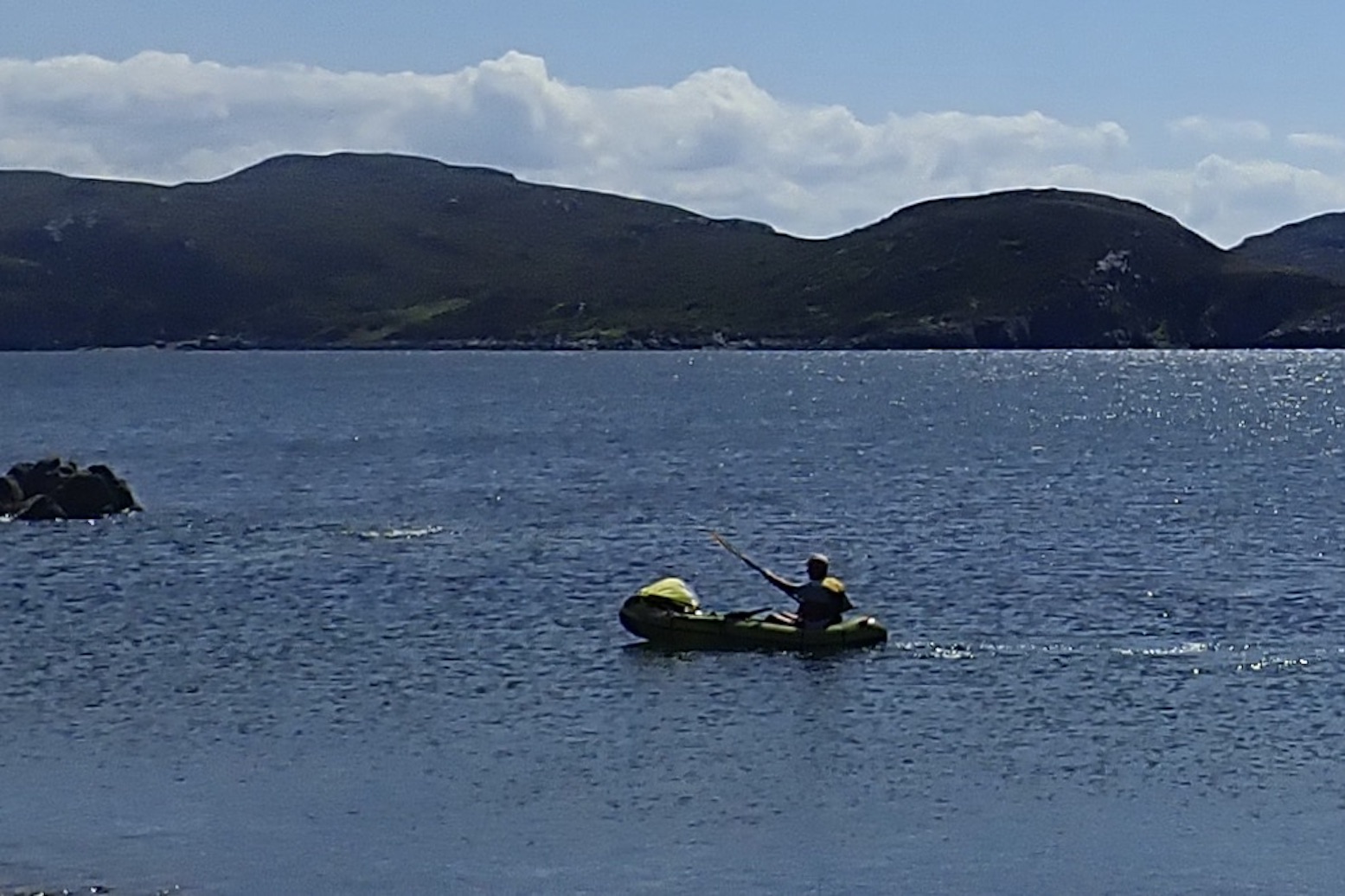
Little did I realise that the TXL was in fact moving through the clapotis at 6kph, and even hit 7kph just before I turned into the inlet. It just goes to show how misleading the impression of forward progress can be, even if the shore seems to be barely inching by. Despite my floundering around with the paddle, I was zipping along.
Back on the water normal rear-skeg service was resumed with a few inches of yawing from the bow. I came across a sea kayaking group who, like last year near here, seemed to be drifting around like they were killing time, when they had all these amazing islands to explore. Put your backs into it!

I eased past them in a packraft half as long and more than twice as wide, and set off for the straight, 5-km run to Badentarbet pier. By now my paddling cadence had found a good, steady rhythm.
About half way, opposite Fox Point, I let down the floor and fully inflated my seat. Positioning the big, unattached seat can be a tight fit between the side tubes, but I’ve learned to lift myself on the side tubes and kick it backwards with my heel. You want to be sat in the middle of the cushion, not falling off either edge.
As we found last week near Skye, de-flooring makes the hull go a bit soft, as if the sagging floor was bending the hull a bit (the floor certainly makes the boat feel more rigid). In future, better to prioritise hull pressure over the floor.

Did I notice any drag from the deformed floor sheet sagging under my weight? Not really, but after a while the cruise dropped to 5kph. This wasn’t a conclusive test in identical conditions; that might be better done there and back with floor/no floor on a freshwater loch. But I do now believe a Multimat does add a kph to paddling speeds.
It also occured to me that doing sea paddles like this in a single, 0.5mm chamber boat, there is some benefit to the back-up buoyancy from the Multimat floor pad (and up to a point the Tube Bags, when full). It was something I used to worry about much more when I first started packrafting; unsure if these unproven boats might go pop. Time has shown that that does not happen; at worst you might get a slow leak. But out here better to wear a proper foam pfd than a skimpy Buoy Boy.
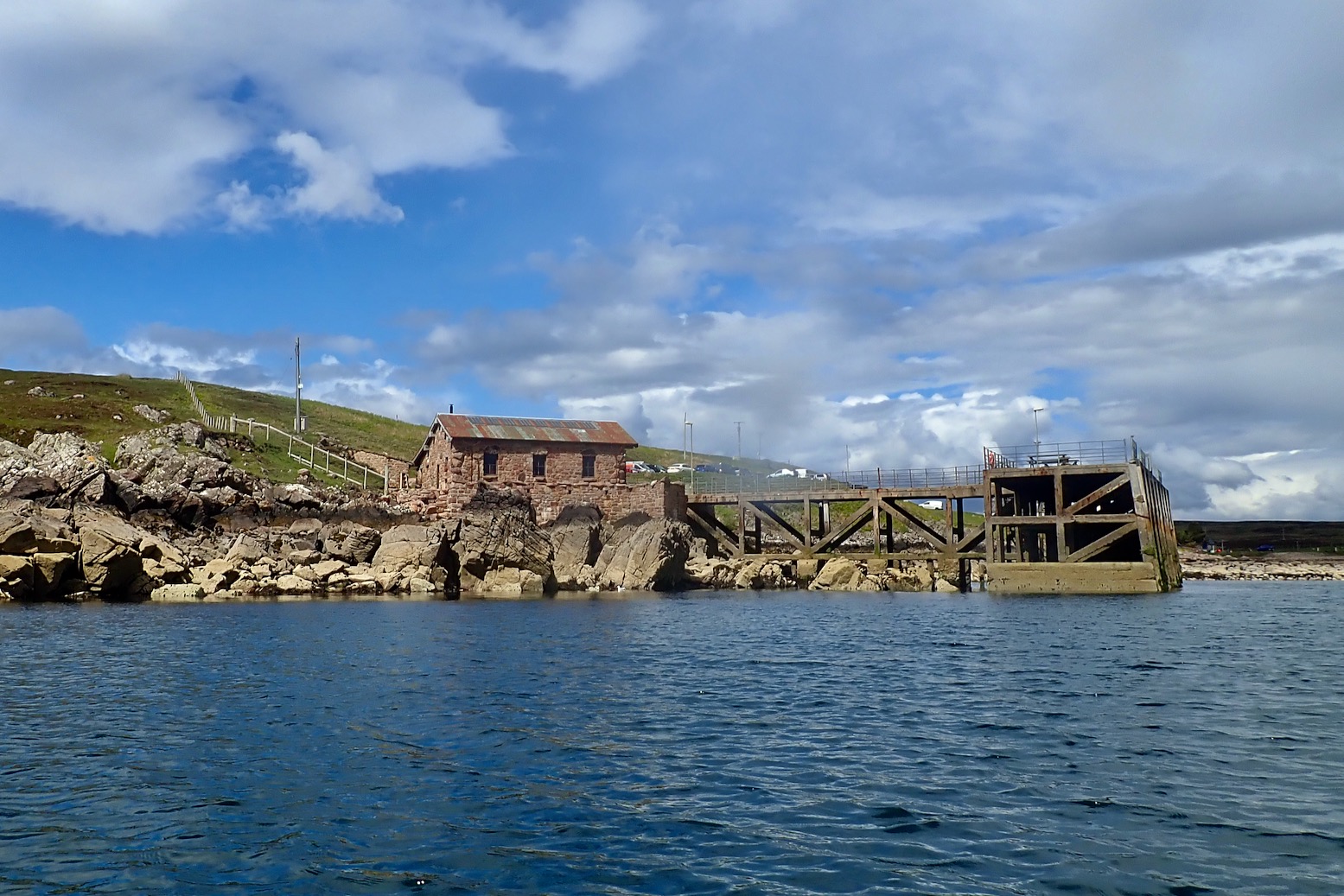

But I’m definitely in no hurry to use a front skeg again, though fitting it back to front might put less in the water (matching the back), and doing so with no air-floor might put both an inch deeper in the water. I might try the back skeg on backwards next time, too. More snag-prone but puts more plastic in the water. Anfibio ought to offer a deeper ‘sea skeg’, (easy enough to make). A while later I repositioned the rear skeg to the floor (below). Anfibio now position the skeg further forward on TXLs.


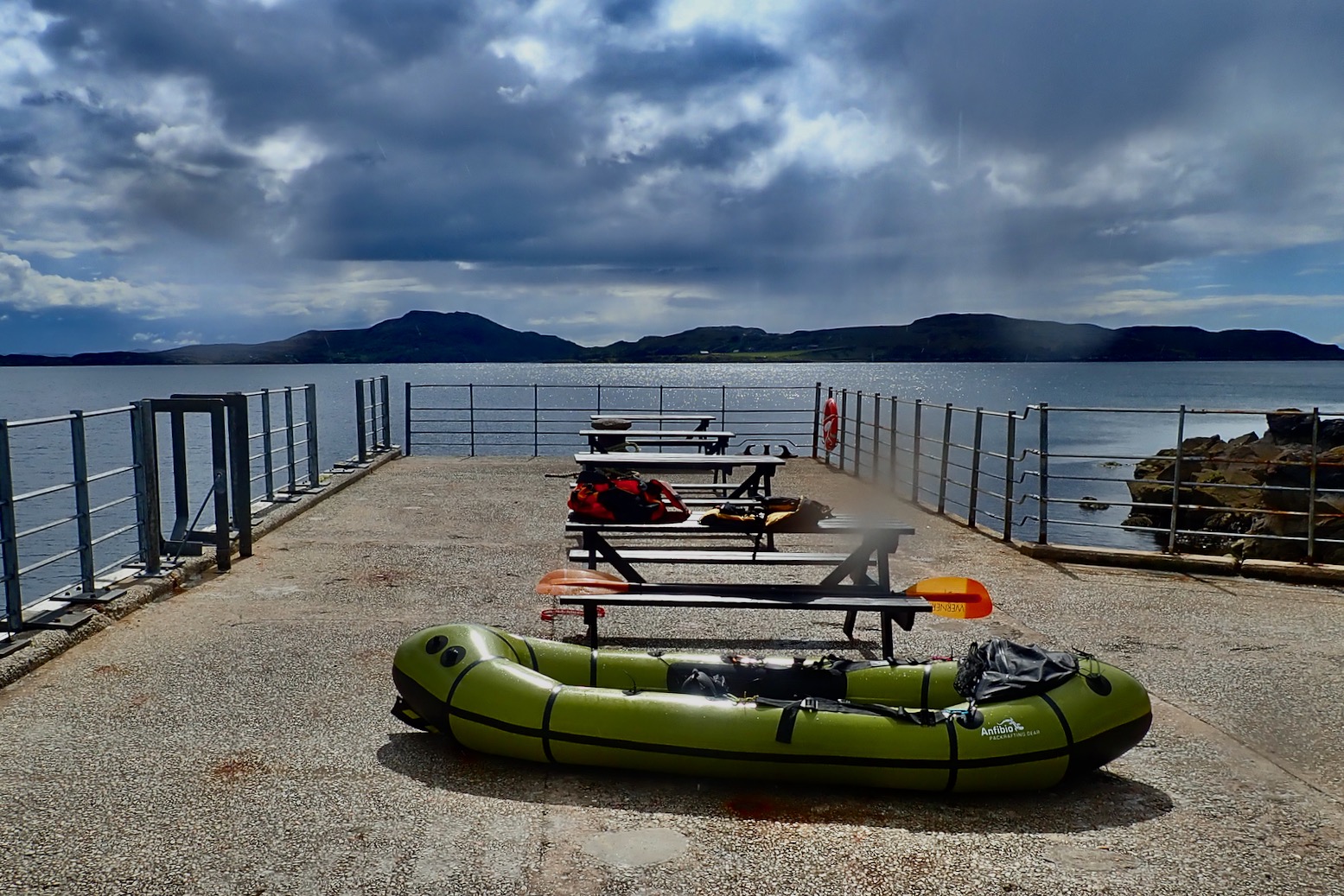
Anyway, now we know: rear skeg helps for sure but combined with front skeg, not so good; inflatable Multimat floor feels marginal but does add glide.
Either way, this 11-km paddle isn’t something I’d ever have tackled in any of my previous solo packrafts, except perhaps the similar Nomad S1. And considering I’ve not paddled this far alone since last year, I didn’t feel any more tired dragging a yard-wide packrafts than hauling my old IK at four times the weight. And of course I was able to follow the newly ratified Packraft Protocol: never take-out where you put in ;-)
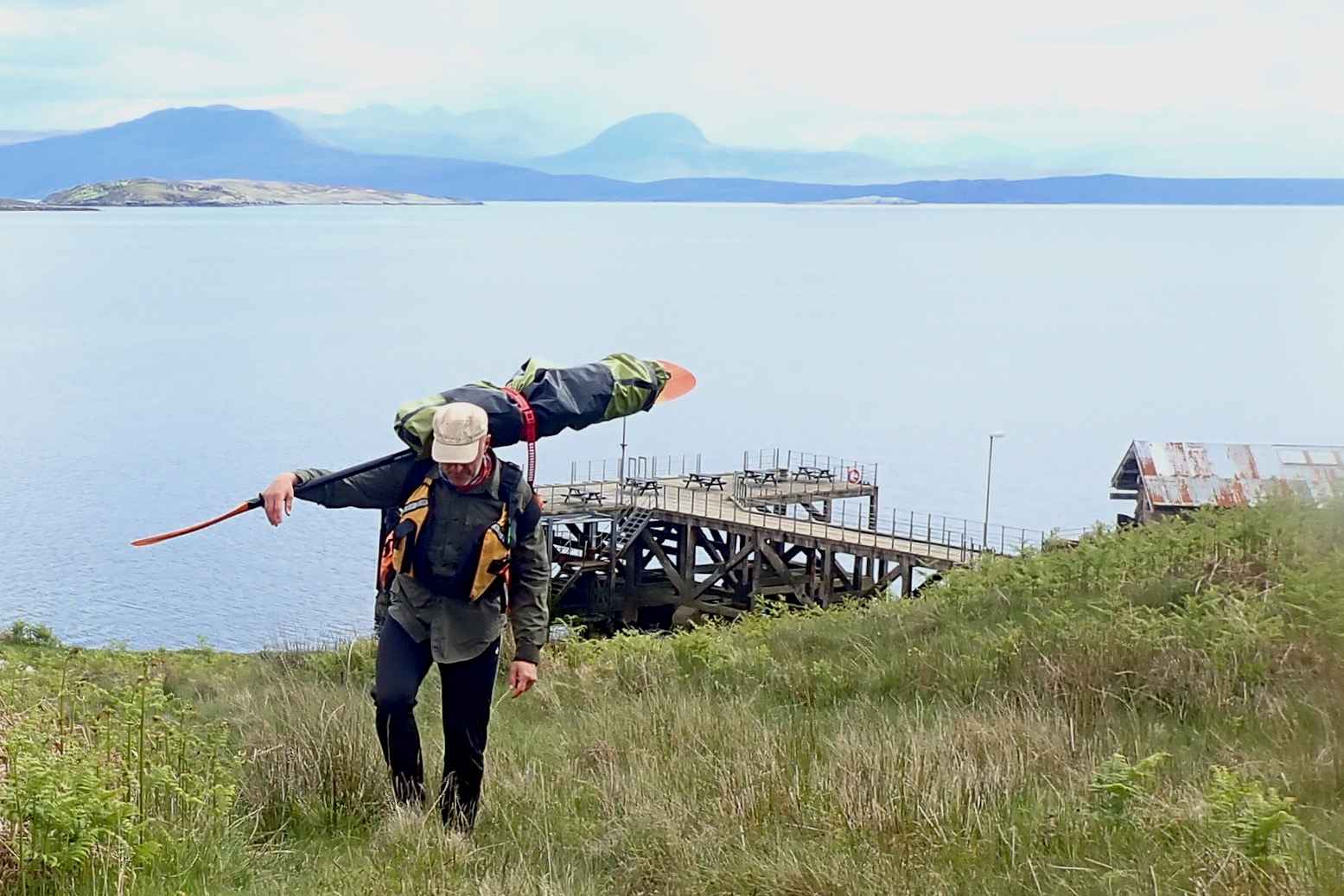
Sigma TXL: Footpath to the Shore


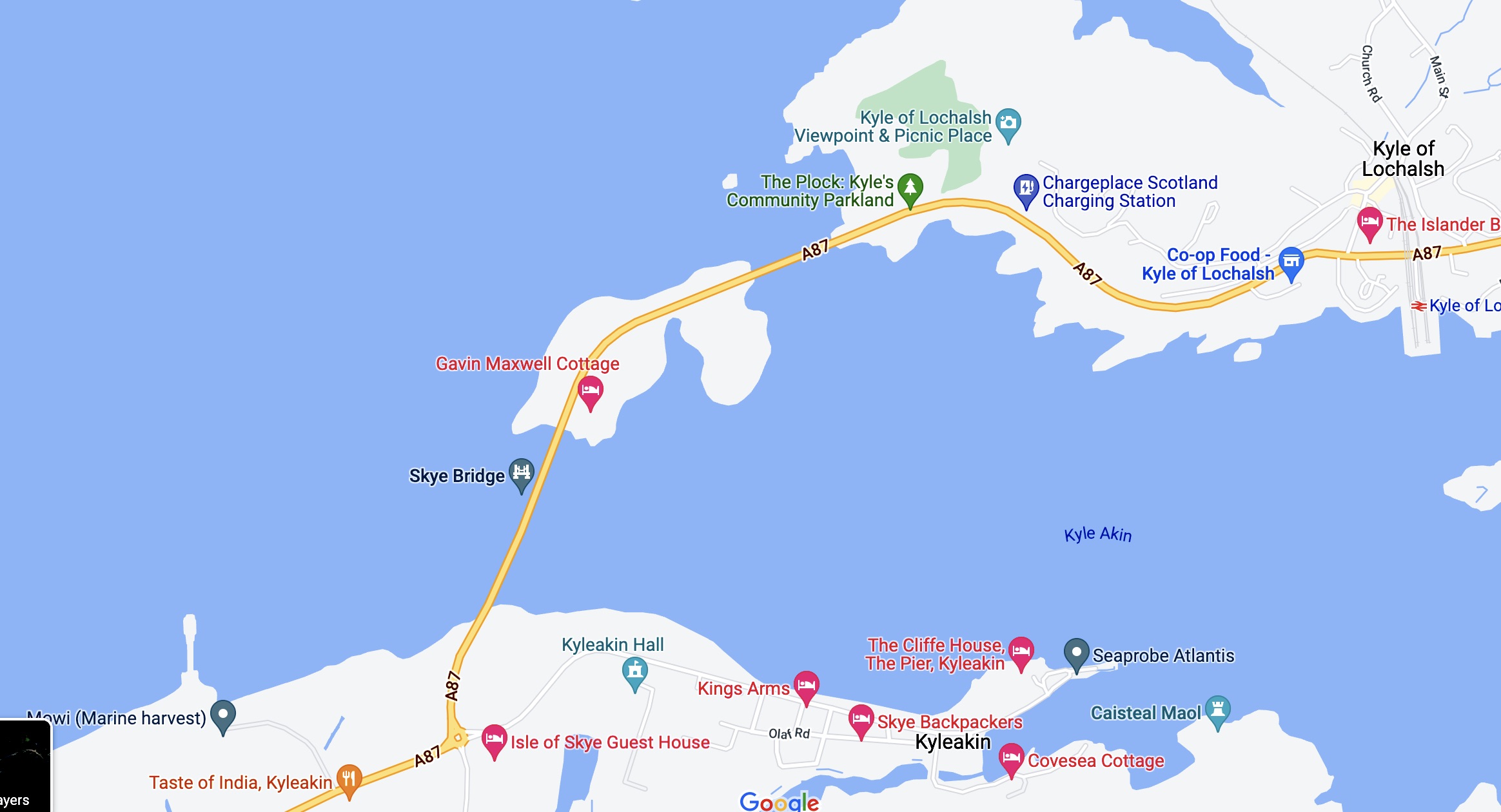
I remember plotting this IK excursion years ago. Set off with some wind and the tide from Kyle of Lochalsh by the Skye bridge, then wind among the skerries north and west into Loch Carron as far as Attadale station near the loch’s head. Once there, hop on a train 39 minutes back to Kyle. The line and single-carriage train comes down from Garve on the Inverness-Ullapool road before following the shore of Loch Carron with a couple of stations to Kyle where ferries served Skye before the bridge was built over the narrows in 1995.
It’s over 100 miles from our place to Lochalsh but today everything lined up: a lull in the wind; a well-timed tide, and all subsidised by the delivery of my two-year-old Seawave 2 to its new owner at Kyleakin on Skye.
I decided to sell my 4.5-m, 17-kilo Gumotex as I was becoming increasingly sure I could do most things in my new 2.8-m, 3.5-kilo Anfibio TXL, including paddling with the Mrs, packing or carrying multi-day loads and probably sailing too. I might lose some speed but could walk the boat to or from anywhere without difficulty.

The only midge in today’s ointment was Scotrail’s newly reduced timetable which now brought just two trains a day to the terminus at Kyle. We heard the 13.32 trundling past while on on the water; the other one was that evening after 8pm.
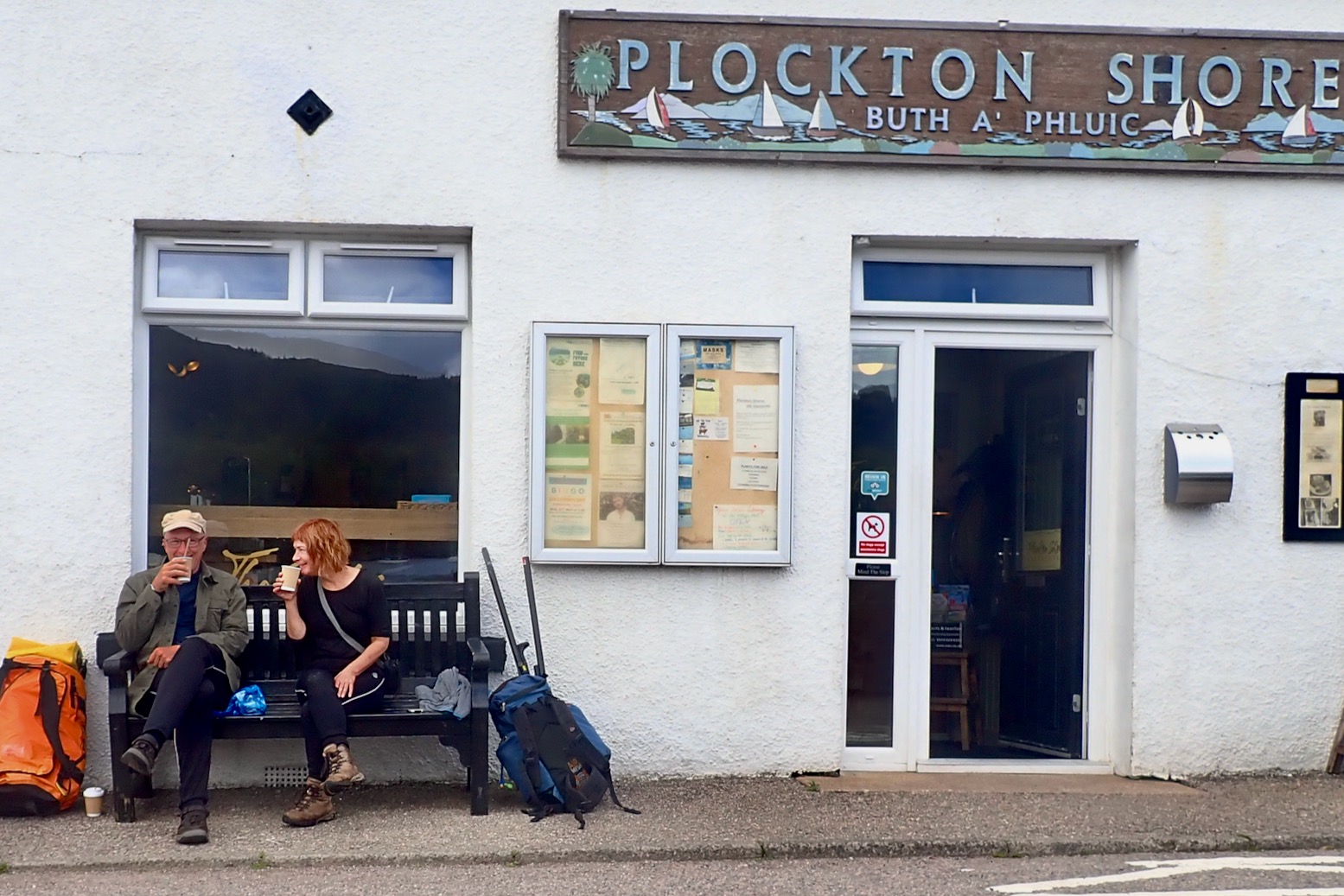
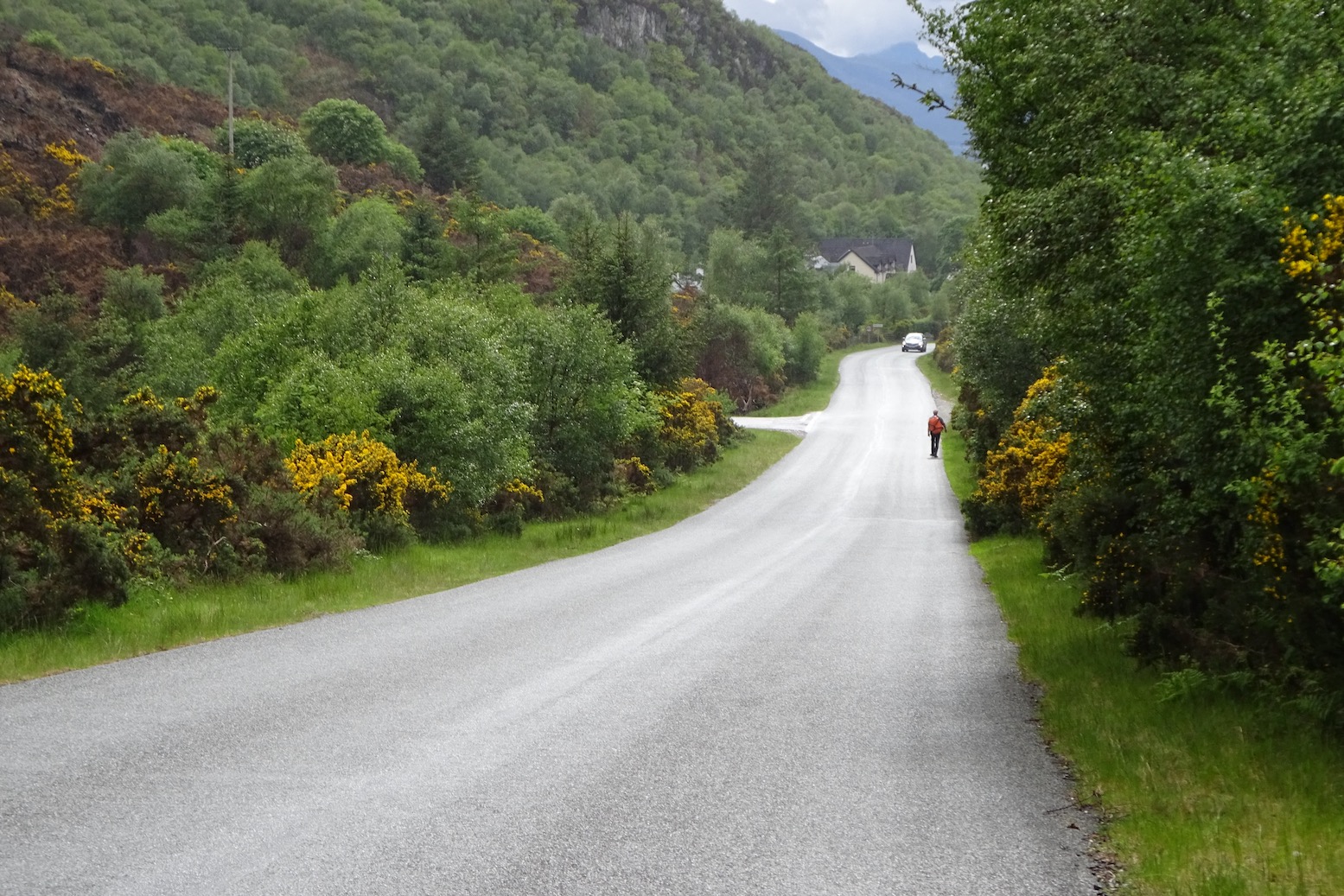
No matter; we were in a packraft so decided to paddle 12km to Plockton – the more interesting part of the coast – then walk 8km back to Kyle along backroads.

Unfortunately this Footpath to the Shore appears to lead to the municipal sewage outlet.

There is always something, and today’s Forgotten Item is the GPS. Shame, it would have been handy to weave among the isles more ambitiously. Instead we follow a less complicated seaward route, passing the outside of most islands.

Worse still, with two in the boat the 10cm lift reduces interior space, end to end.
And it isn’t helped by me giving the foam seatbase block one last try before consigning it to my private foam collection. After 45 minutes I can bear the agony no more and fit the inflatable seat instead. Much better, and it doesn’t wobble too much on the stiff floor, as it did on the Thames the other month.


I’m finding the hauling hard, though. Later I realise perhaps my large-bladed white-water Werner Corry paddle is ill-suited to tandem paddling.


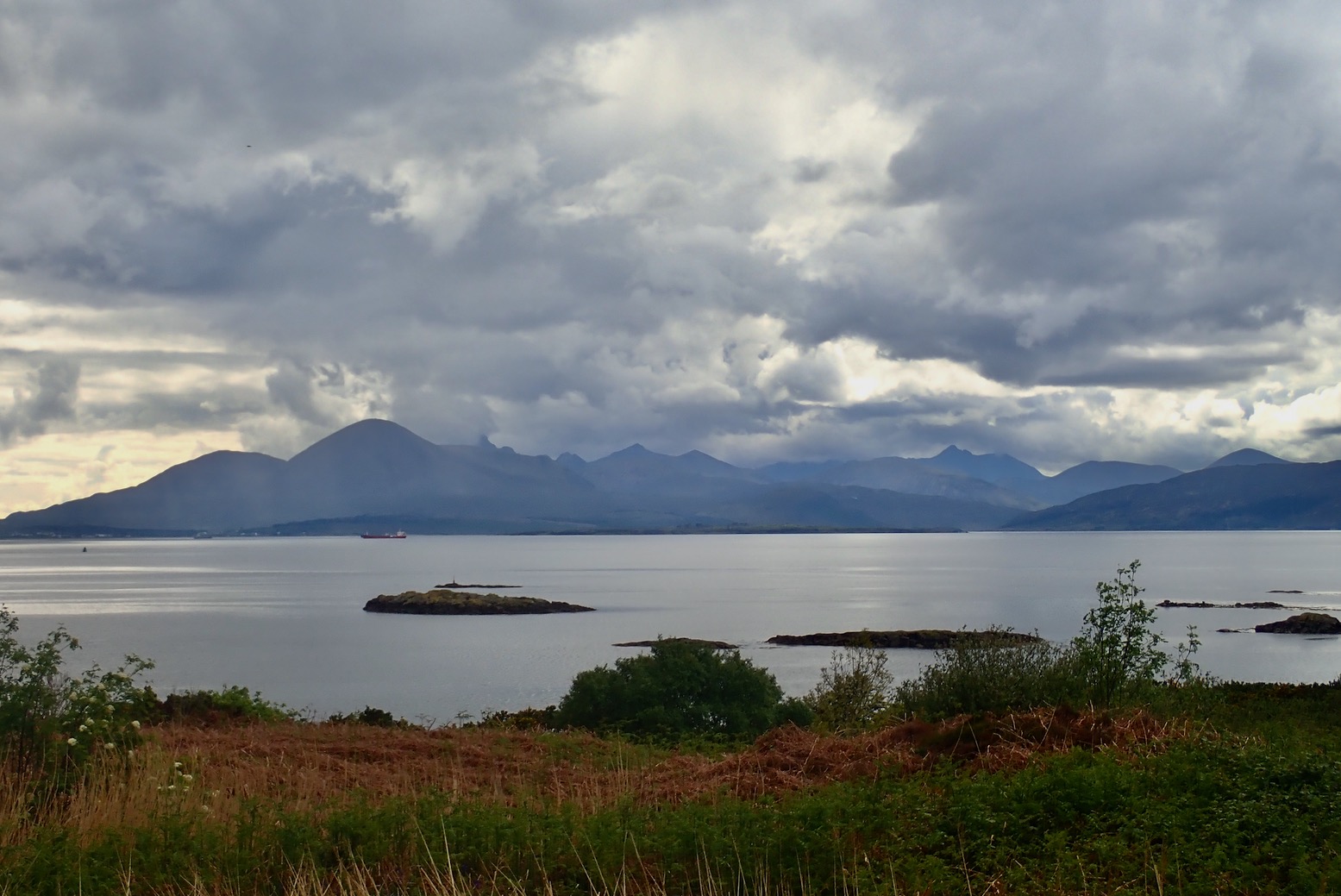
It’s all a lot softer and twee round here, compared to the windswept, treeless Summer Isles.




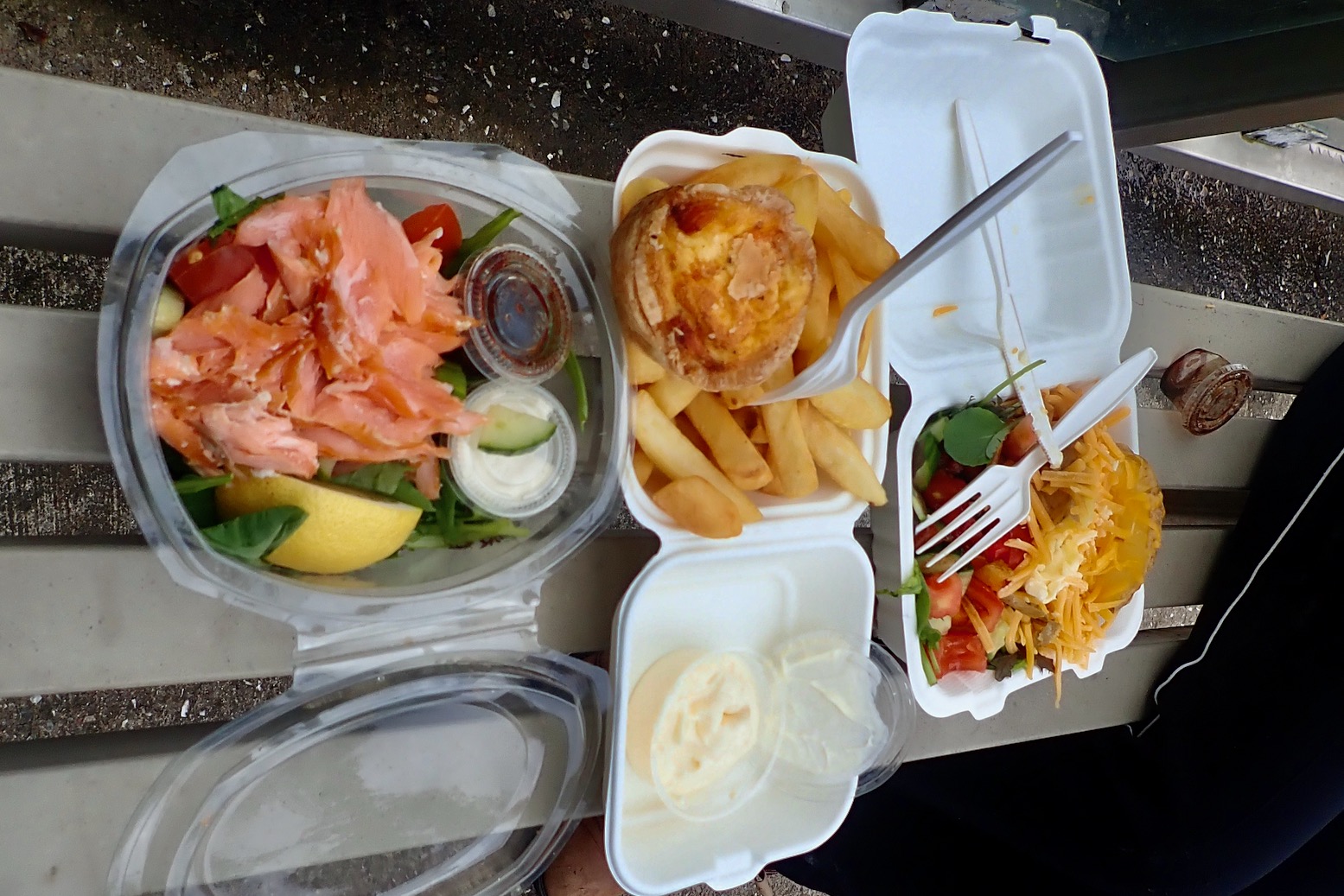
Fifty Ways to Eat Your Salmon; just what was wanted!


Sigma TXL • bow skeg and knee straps
Sigma TXL main page
Glues and Repairs


Years ago I remember when the value of fitting packraft rear skegs was debated. Then, the now common longer sterns were introduced by Alpacka and positioned the paddler more centrally which greatly reduced excessive bow yawing. The problem was largely solved.
On a packraft you’d think a skeg under the bow would eliminate the yawing endemic to short, wide rafts while compromising turning agility. In fact, I wonder whether a packraft might yaw nearly as much at the back but you never notice. Like one of those Turkish dervishes, you’re actually pivoting from the middle of the paddle shaft, or perhaps a bit behind, at the centre of mass (left).

Rear skegs certainly improve tracking on IKs; you can manage without, but with a skeg you can paddle harder without constant micro-correctioning. On rivers I’ve found solo packrafts paddle fine without a rear skeg; or they’re too short to demonstrate noticeable improvements. There’s a bit of nodding as you move off which soon settles down with some momentum and a steady cadence. Even my symmetrical Rebel 2K (left; stern identical to bow, not extended) paddled fine down the Wye without a skeg. But when getting pushed around by a swell or on sea lochs (especially when sailing) fitting a skeg was worthwhile.
Either way, rear skegs are a thing now with packrafts even if you don’t have to fit them every time. Certainly on my longer TXL I like to think the stock rear skeg aids coastal paddles; though we found a brief stint with no skeg was only slightly noticeable, paddling into the wind in a sheltered loch (no swell). Anyway, I’ve been curious to see what effect a frontal skeg has, so on buying my TXL I ordered a spare skeg and patch which Anfibio also sell separately for €21 + €6.
Gluing on a skeg patch
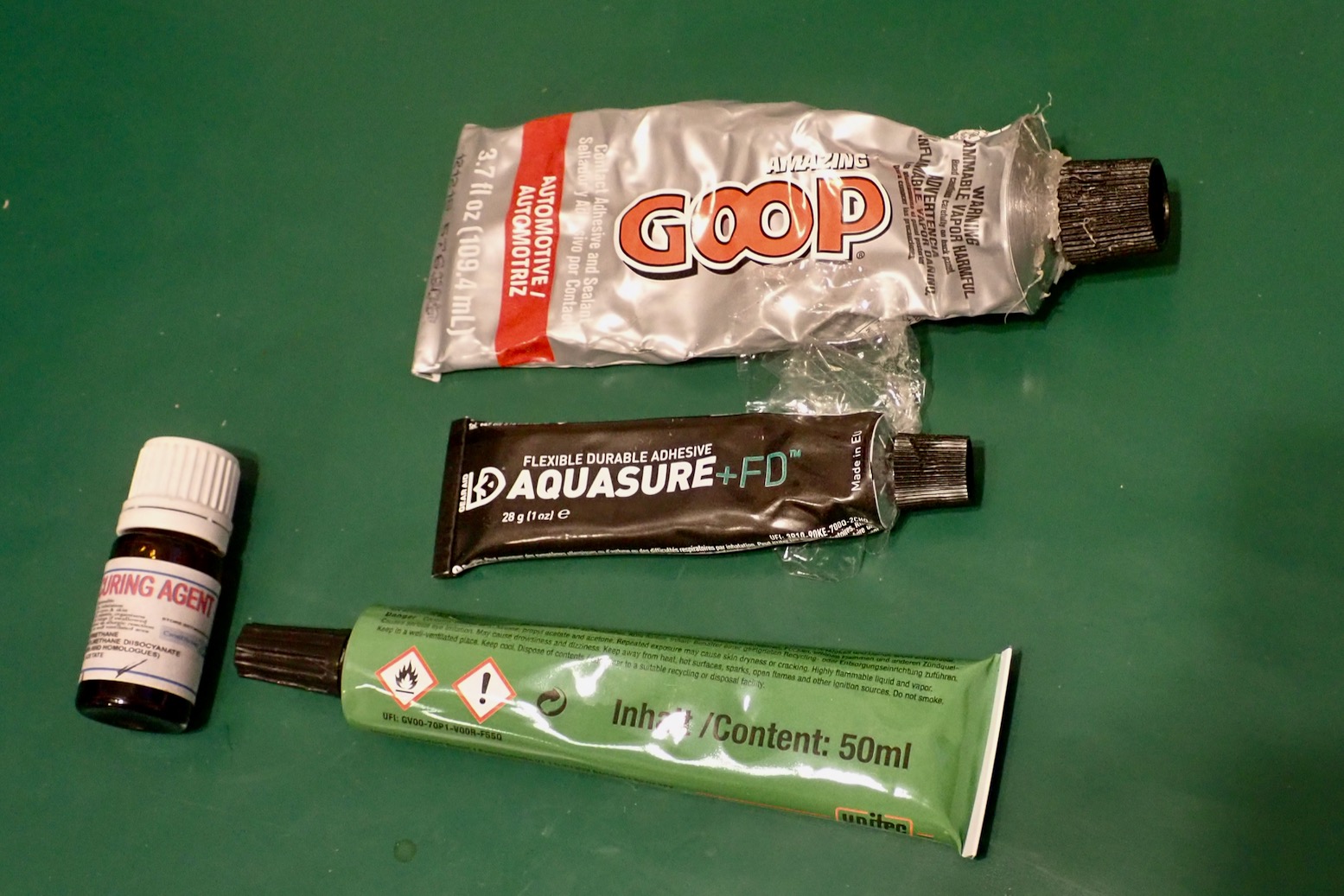
As stick-ons go, this is not a mission critical job but you want to line it up dead straight which I now see is better done with the boat inflated. I just used the rear seam, hoping it was along the middle line. Anfibio recommend Helaplast which they can’t post outside of Germany, but which you can buy on ebay.uk (from Germany…) for €7 for 50ml.
There must be something similar in the UK, but the problem is identifying it against something that provenly works. I had some Goop contact adhesive, but whatever their ‘Automotive’ variant is, it did not stick at all. So I decided to try some Aquasure+FD, leaving it to cure for half an hour before sending in the roller. That seems to have worked.
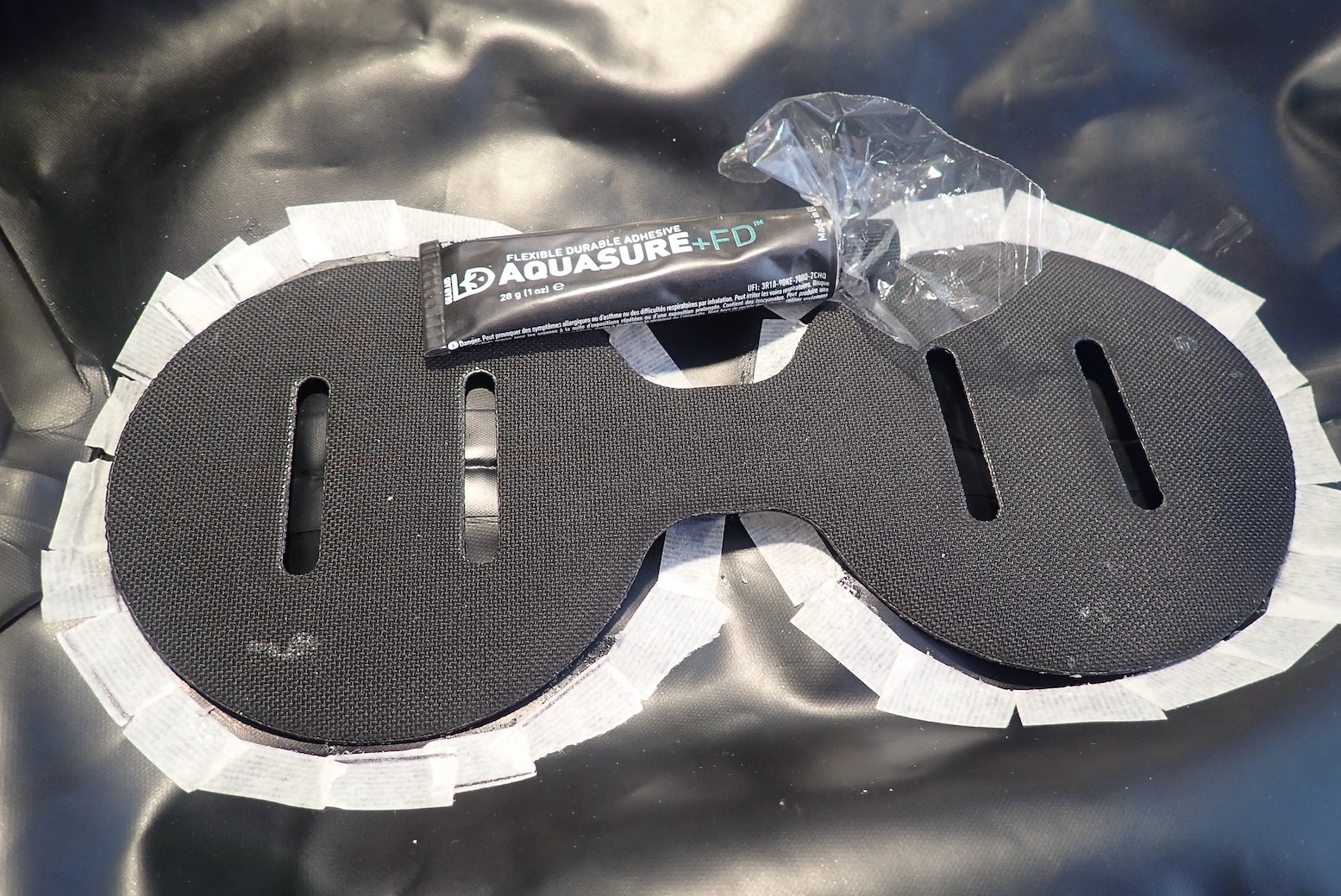


Knee straps
Part of me likes to think I’ll be using my nippy TXL the way I use my IK: fair weather, open-water sea paddles rarely more than a mile from shore. As this might require sustained periods of paddling I figured some knee straps would help, as they do in my IKs. It’s not so much for hardcore bracing or even rolling, the way they’re used in white water, but just to lock-out the legs so the core is more connected and you get good drive.

Anfibio sent me their latest 5-point thigh straps which I tried and liked on the Revo (left). But to make full use of them would require gluing on up to 8 extra patches (if not ideally the ladder patch; left).
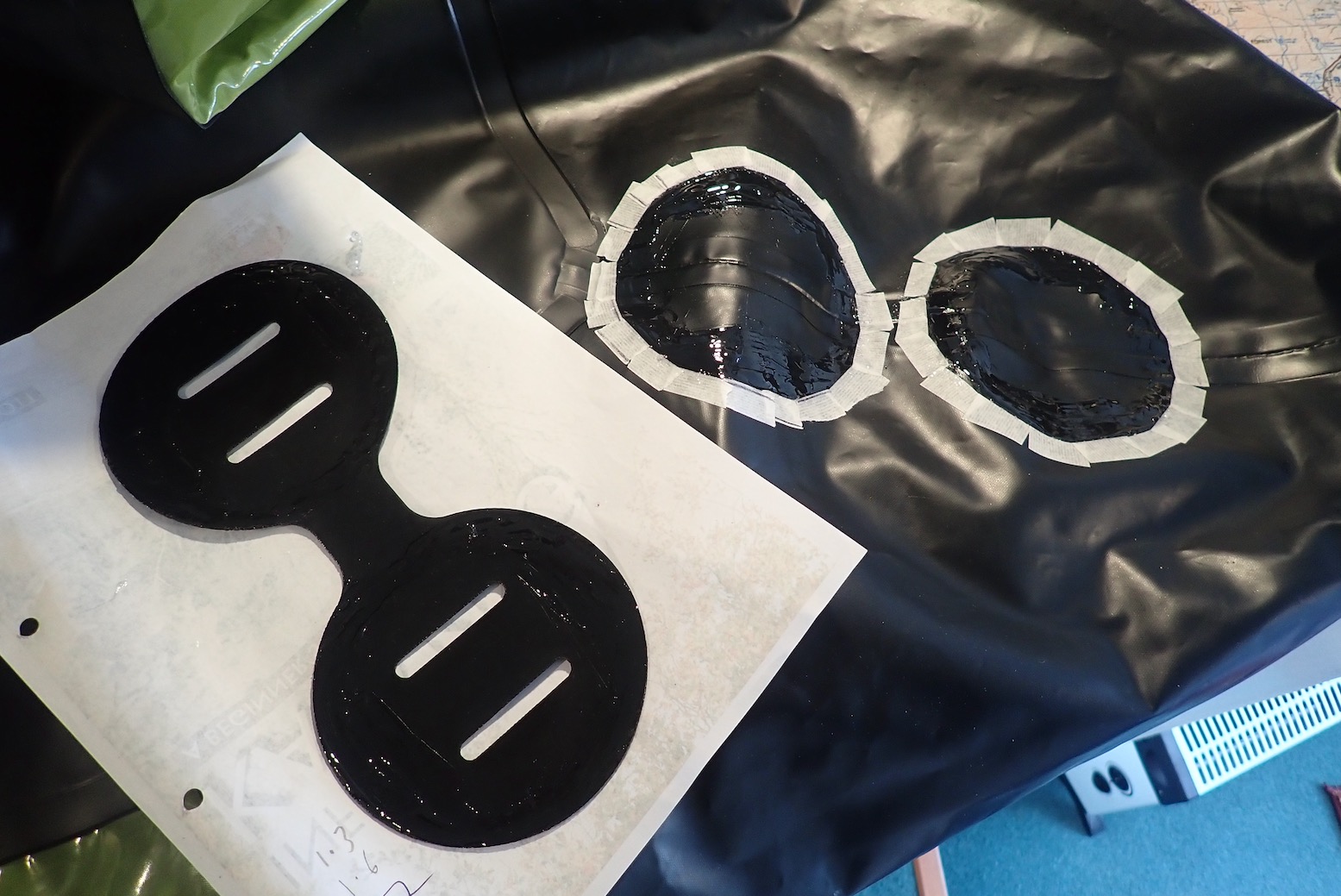
I decided my old Anfibio 3P straps which I’ve used for years in my IK would be OK for my low-tension, flatwater use. They require adding just two pairs of attachment straps. I could have got away with the unused flat patch by the seat, but the direction on tension was off centre and would eventually wear, stretch and maybe break. These small patches are not really designed for such loads and now my Helaplast has arrived, I decided to try it. An old post on the Anfibio blog explains how to use Helaplast:
- mark off area on hull
- mix hardener 20:1
- clean surfaces with solvent
- apply a thin layer to both surfaces and wait 30 minutes
- apply another thin layer and wait another 10 minutes
- Position patch; it won’t adhere properly
- Heat with hair dryer to reactivate glue and press down hard with roller. It’s better if the boat is deflated to do this on a hard surface.

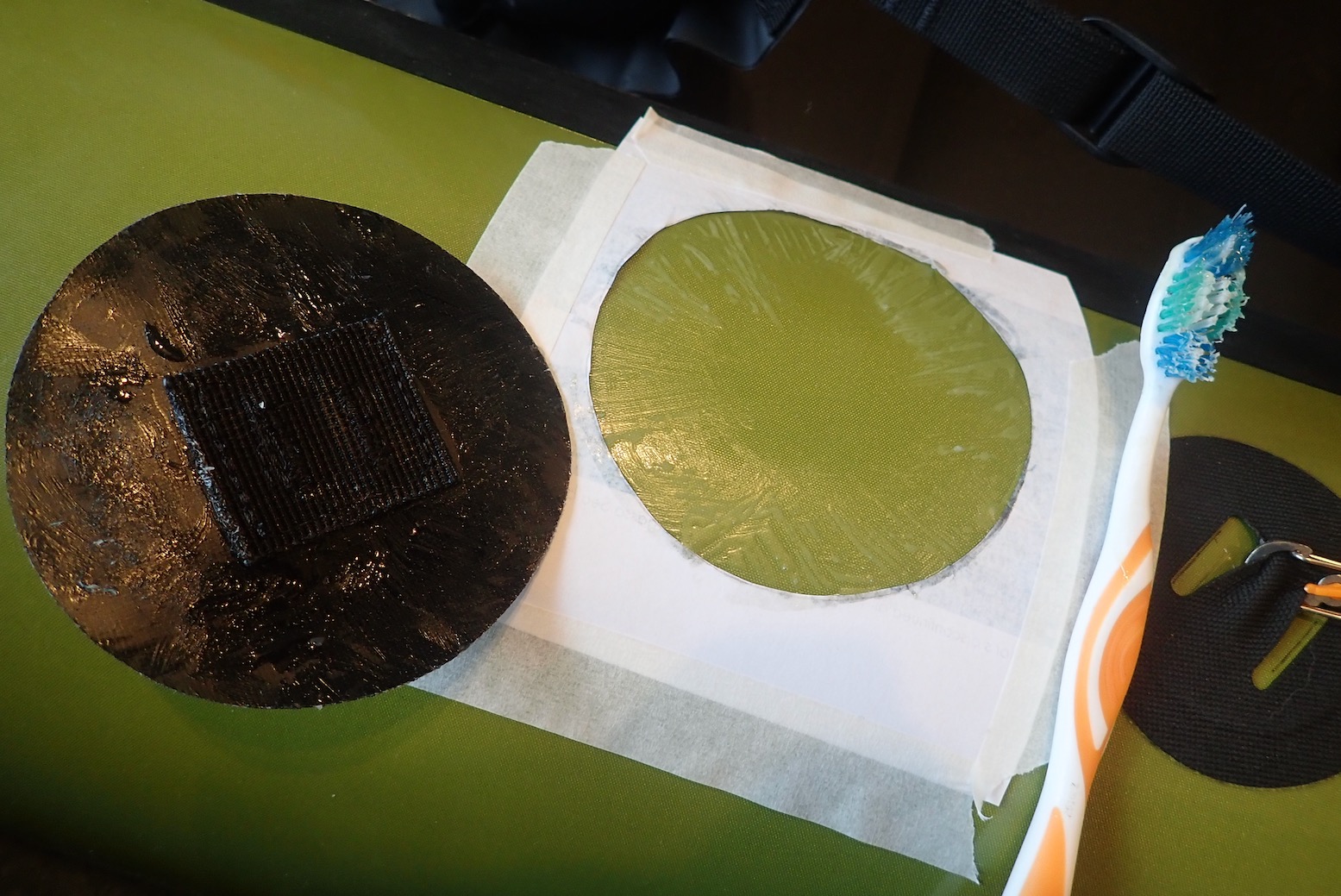

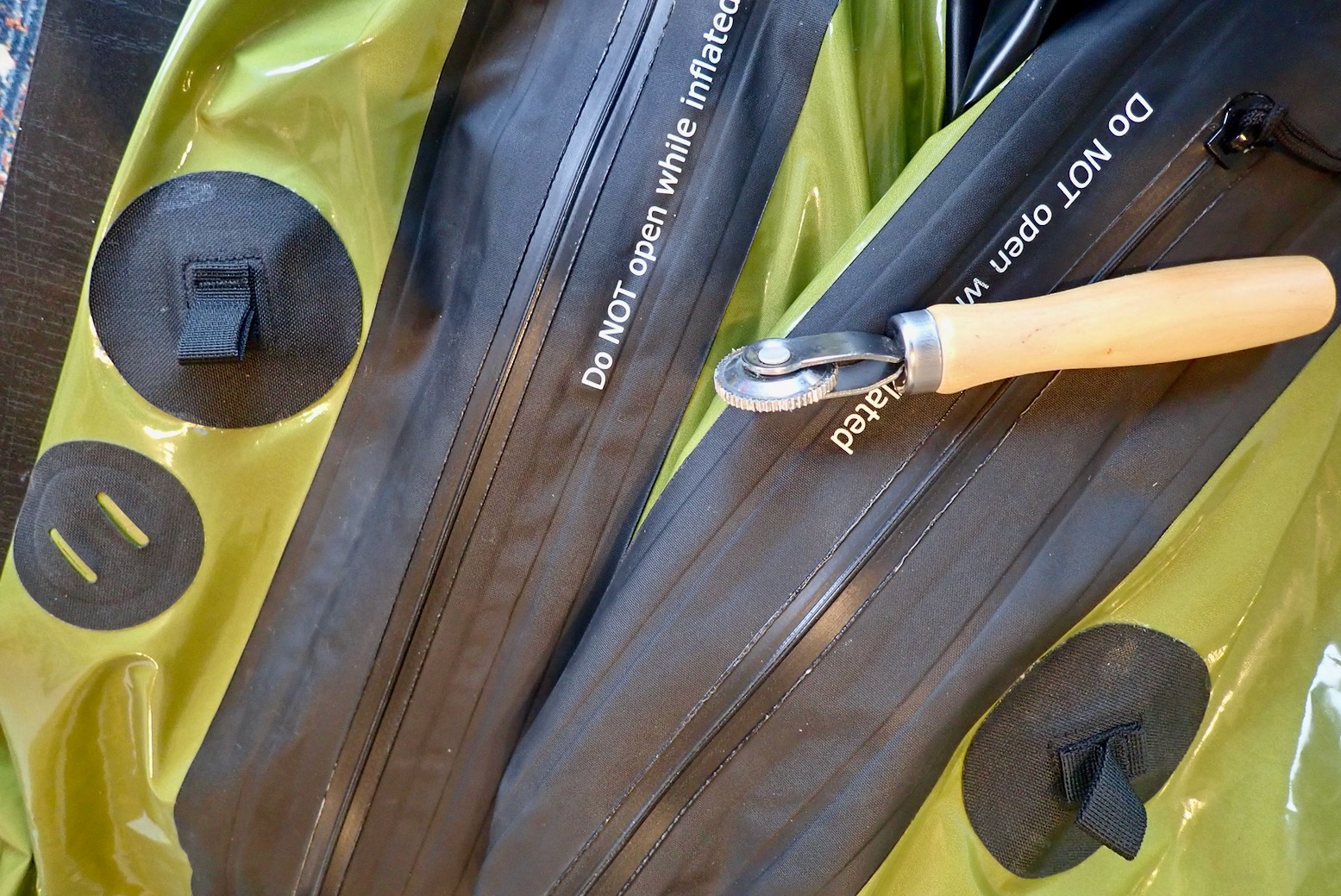
The heat reactivation trick was not one I’ve heard of before with glues (except to loosen stuff), but you could see it worked. Where the positioned patch was lamely stuck to the boat, a bit of heat saw it bond down well with some added rolling. You can tell when something looks well glued and this feels like it, though I’m sure glad I didn’t have to do that another six times.


Update
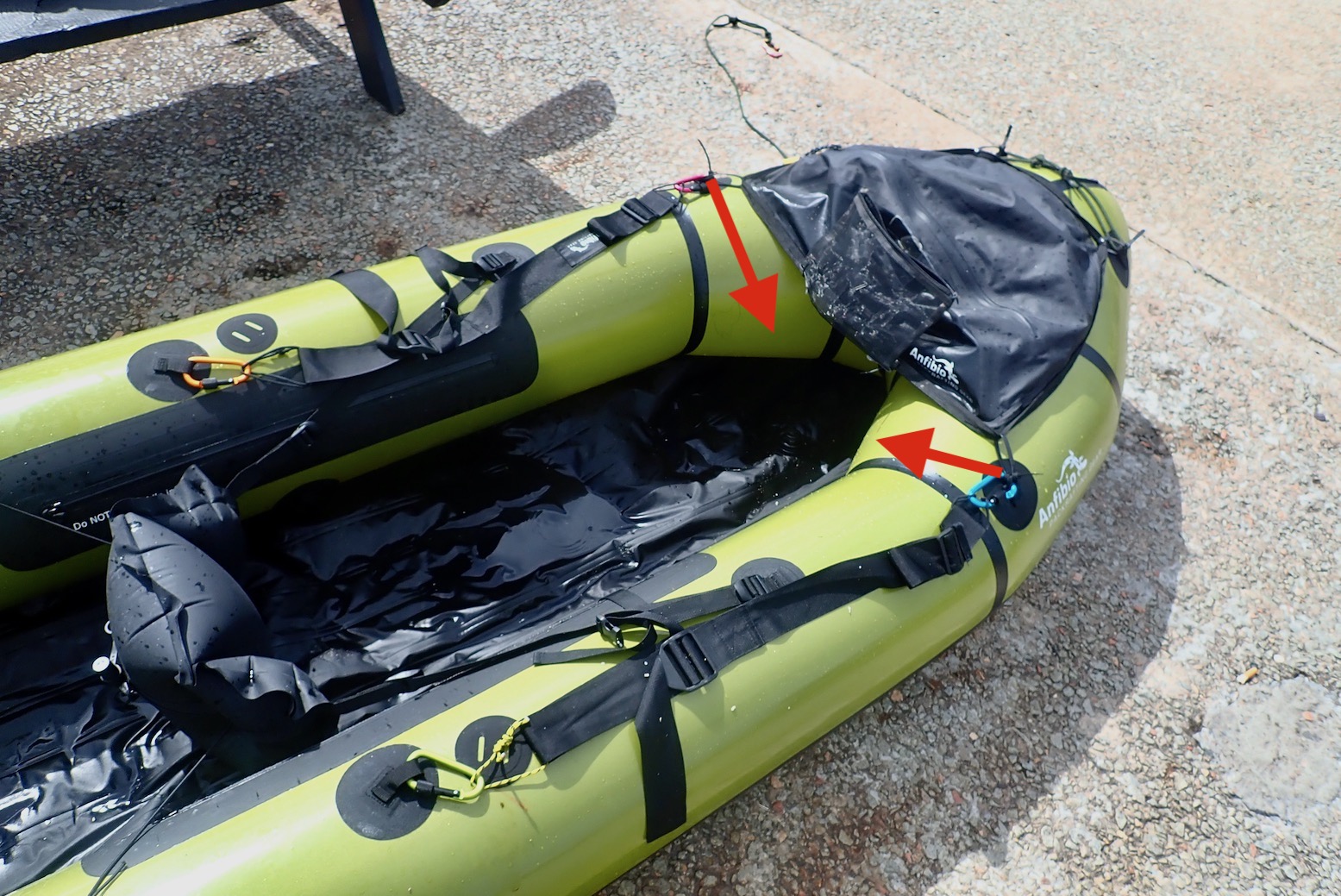
Having paddled about with the straps a bit, they work OK, but the front mounts need to be lower to hook well over the knees without using the cross-link strap to pull each strap inward (not what they were intended for – entrapment hazard!). I did this a few days later. Knee straps also make a good set of handles for moving the boat about like a giant holdall.
 Inflatable Kayaks & Packrafts