First Gumotex and now Europe-wide, French sports retail giant Decathlon have turned to dropstitch (DS) technology in a bid to improve rigidity and so, the performance of their inflatable kayaks. The Strenfit X500 is again sold in UK Decathlons, currently reduced to £599. A drop stitch bargain.
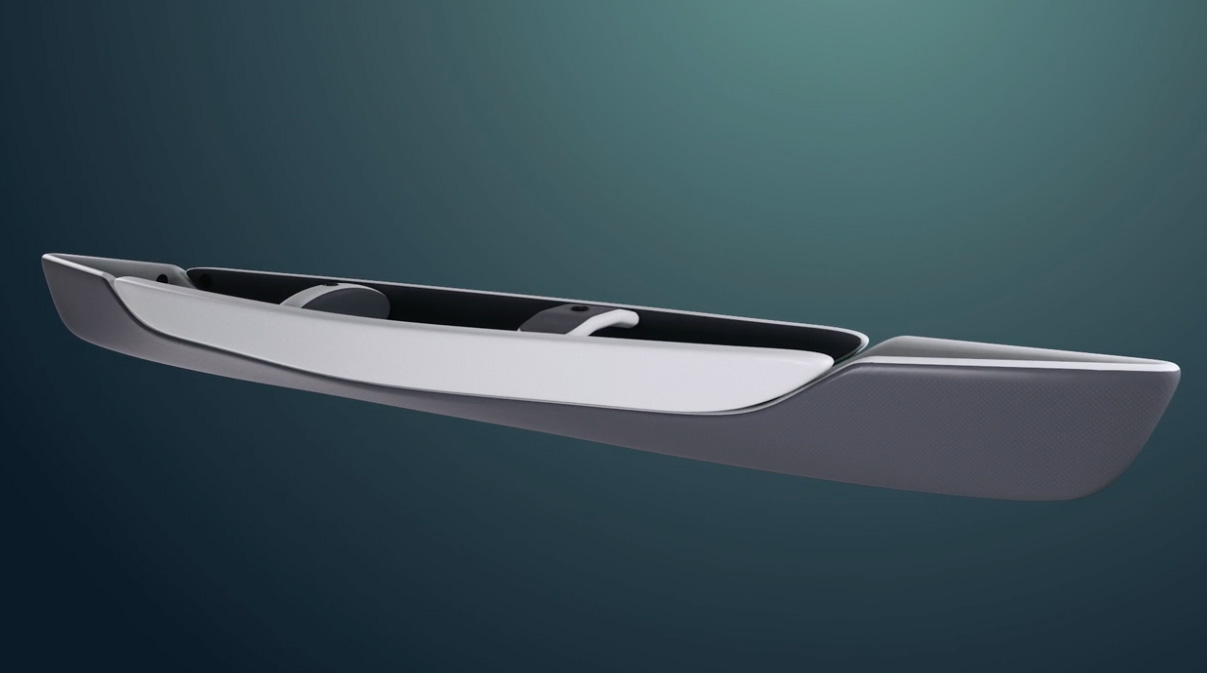
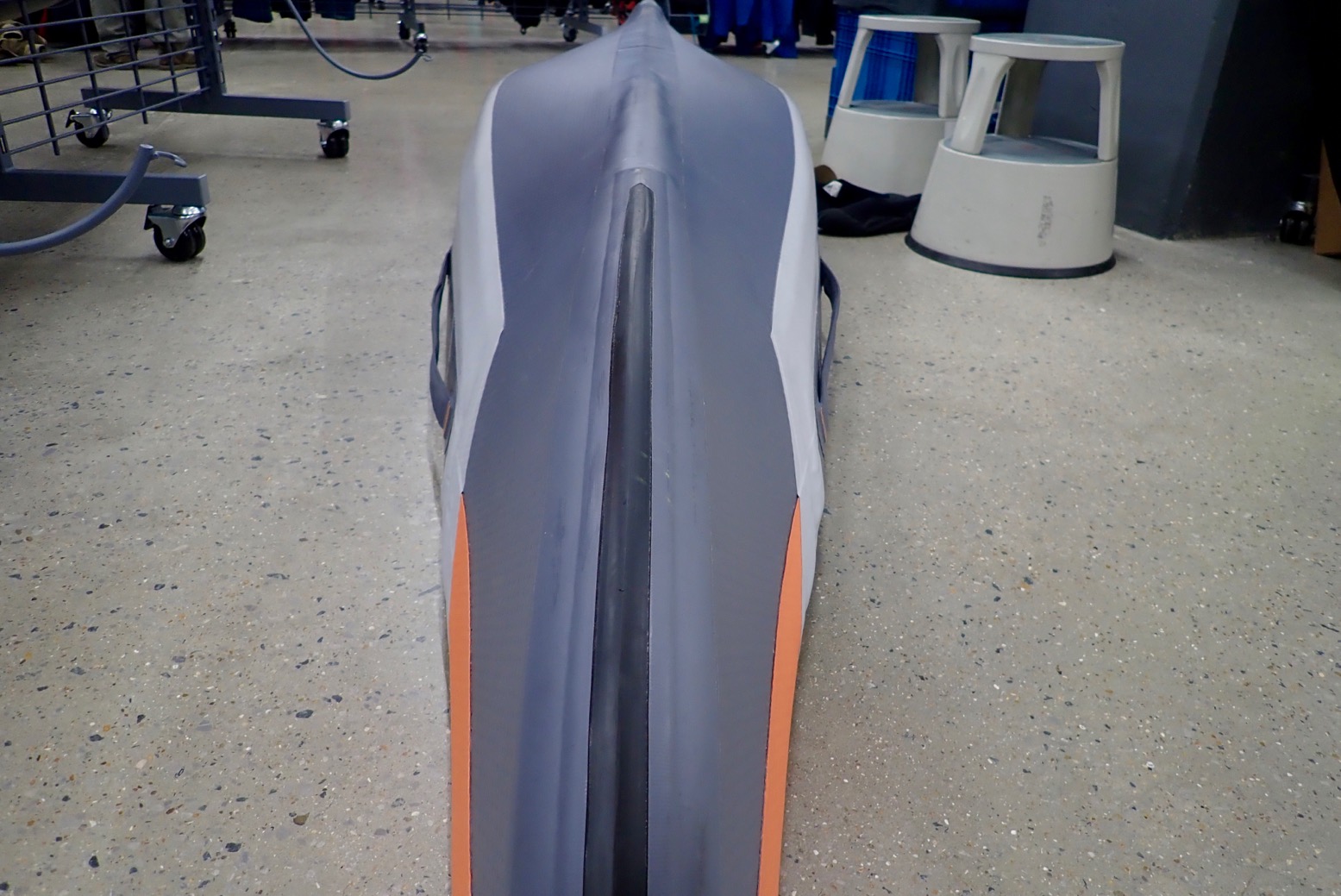
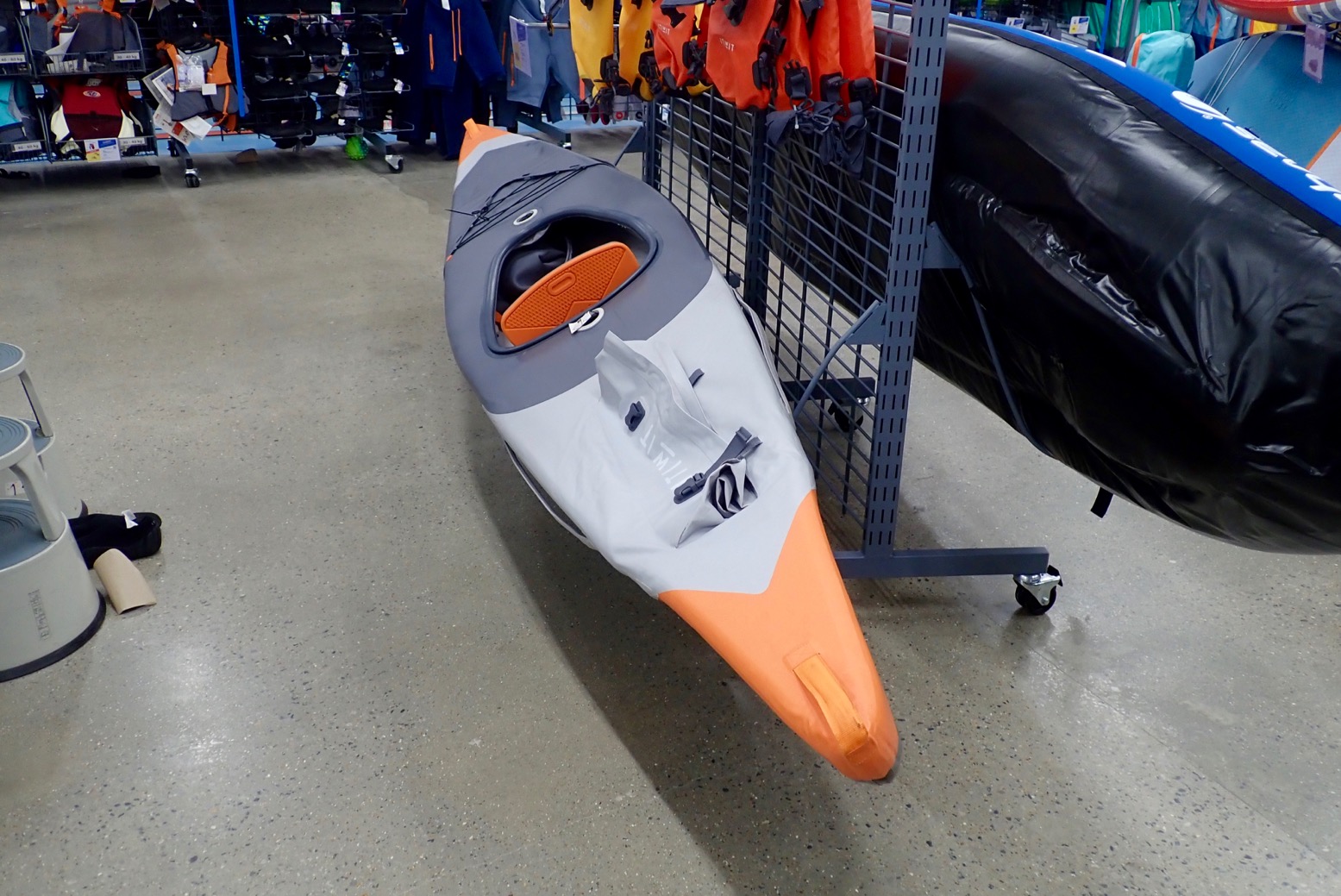
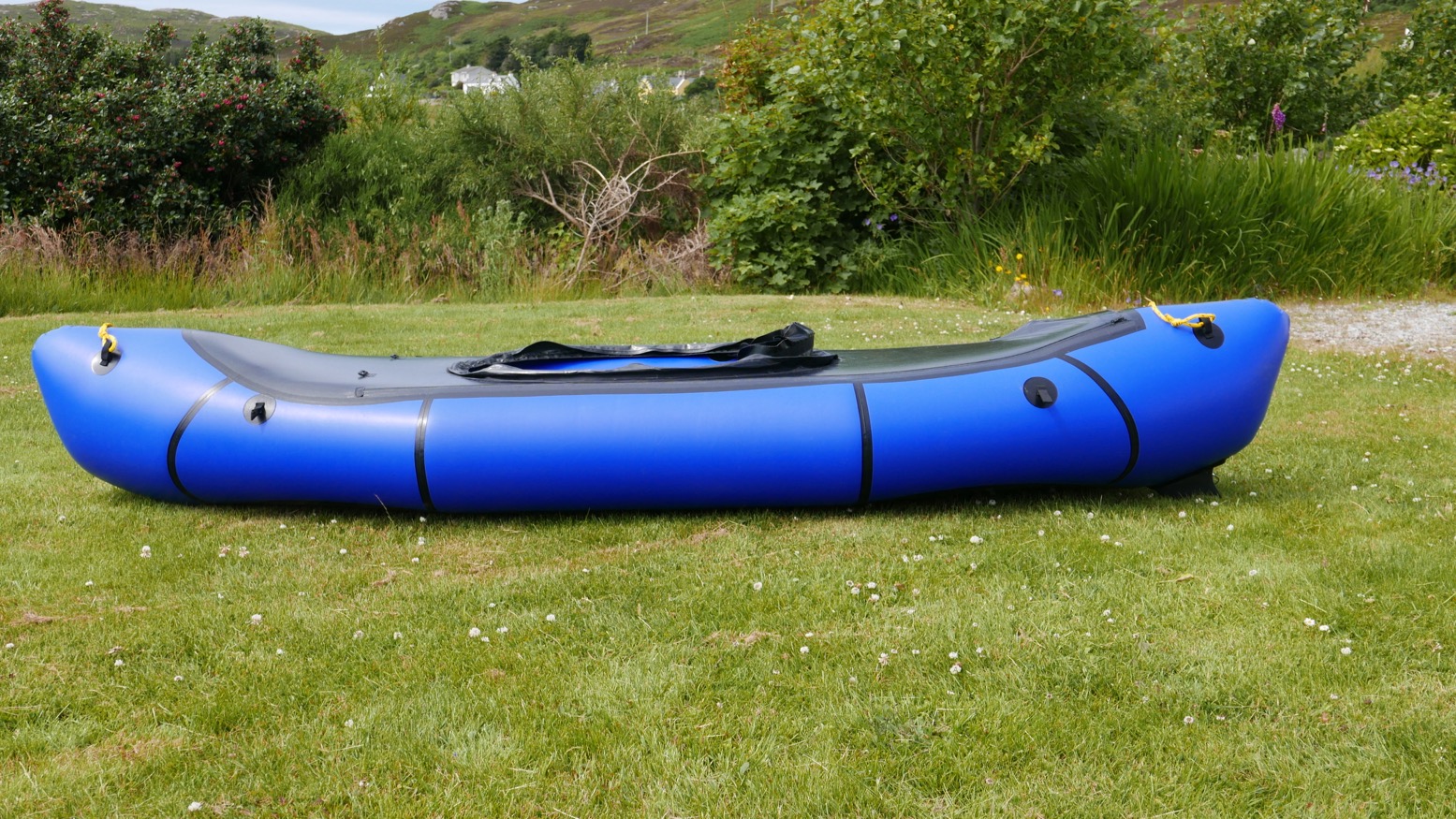
Only Decathlon haven’t just added a DS floor to an existing model, but with the single-seater X500 Strenfit have designed an entire 10psi (0.7 bar) DS hull, complete with a deck and coamed hatch supported by two D/S beams. (Do you need a deck?) Above left, Serge and Nanook take their X-boats for a spin. UK price is very reasonable and delivered with a two-year guarantee, although the essential SUP two-way pump (right) is another 30 quid.
‘Itiwit‘ is a Decathlon water-sports brandword, contracted from ‘itinerary’ and ‘Inuit’, the latter being fur-clad denizens of the Arctic who invented sea kayaks all those centuries ago. I suppose it sounds better than ‘Inuary’. Watch the slick vid below to get your head round the unusual design. It looks like the dark grey V-floor panel is one chamber, plus a lighter grey sidewall panel each side and then the two deck-supporting thwarts or beams. And being French-designed, it conforms with their national watersports regs which allow it to stray a full 300 metres or more from the sea shore.
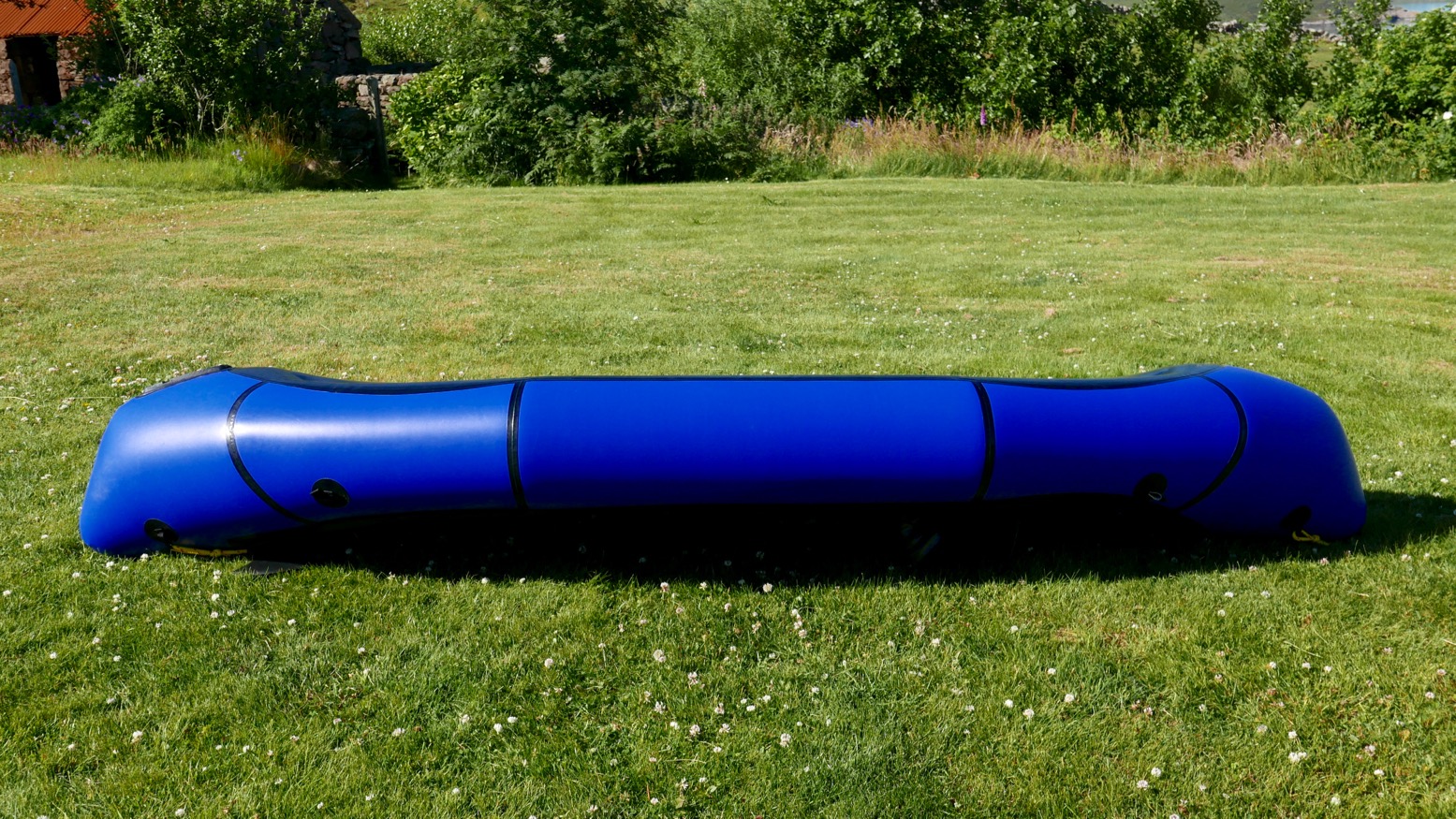
Vital stats are 3.8m long by just 64cm wide and 18kg,making it similar to an undecked but flat-floored Kxone Slider 375, and between a Gumotex Twist 2 and a decked Aurion or Swing II. It’s made of PVC and, like most other FDS IKs, you can be sure it’s made in China. But there have been reports that the fabric cracks when folded and creased hard. Sounds like cheap PVC and is why we like old school rubber IKs. Because DS hulls have less air volume than regular tubed IKs, they’re slimmer (thinner walled, giving more space in the boat) and are quicker to pump up (3 mins, claimed on the X500). But that lower volume explains a modest payload of just 125kg. No dims are given on the hatch size, but based on the length, I’d guess it’s 80cm long.
Below, watch Nanook film Serge as he effortlessly assembles, paddles and then disassembles his X500 in what may be real-time. The roll-top rear hatch is a clever idea; not seen that before, though it looks like water may pool there. And the proper wave-slicing V-hull dispenses with the need for a skeg to aid tracking, although the boat may benefit from a rudder or skeg in cross winds. Like most IKs, the X500 sits fairly high in the water, unlike a proper hardshell sea kayak which is barely above it. With the narrow V-hull and poor knee bracing, many report it feels unstable until it’s moving. Lighter paddlers have found dropping the pressure a bit make the boat float lower and improves stability. But this also adds up to a fast boat, making it most sea-kayak-like IK since Feathercraft’s short-lived Aironaut. It’s not an exaggeration to say it’s a revolutionary DS IK, but with the mentioned flaws in durability.
Below a review by a sea kayaking chap on what looks like the balmy Med. I agree with his suggestion: it would be good to see a longer version, but that will probably be a tandem which, with the fixed deck, won’t adapt to solo long-range touring. They produced that tandem version, but it’s since been dropped. The X500 has strap–adjustable footrests but he also mentions poor knee bracing – often an IK weak spot, even with decked boats. Nevertheless, he still manages to bang out a pretty smooth eskimo roll, and it would not be impossible to glue or somehow clip on some thigh bracing straps which would greatly improve the connection with and control of the boat.
In 2020 they released a two-seater X500: 5.3 metres x 70cm but weighing a true 30 kg in the bag.
One the way back from the Regents Canal the other day, I dropped into my local Decathlon to have a closer look at the X-boat. First impressions were it wasn’t half as narrow as I expected – at least at cockpit level. The hatch is nice and big and it sure looks more kayak-like than the rest of the Itiwit range of bloats. That sure isn’t a typical flat DS floor which might explain the tippiness some report.
The yellow boat is an all-PVC X100 with a DS floor and 3psi sides. The others are all 1.5psi bloats
The boat wasn’t at all saggy as you’d expect from an Intex watersofa sat in a showroom for months. But as mentioned, if your boat has a slim V-hull, you really need some knee-bracing to control any rolling. The deck felt quite slack but as always, the good thing is others will see how Decathlon took a big step forward in DS IKs, and try to improve.
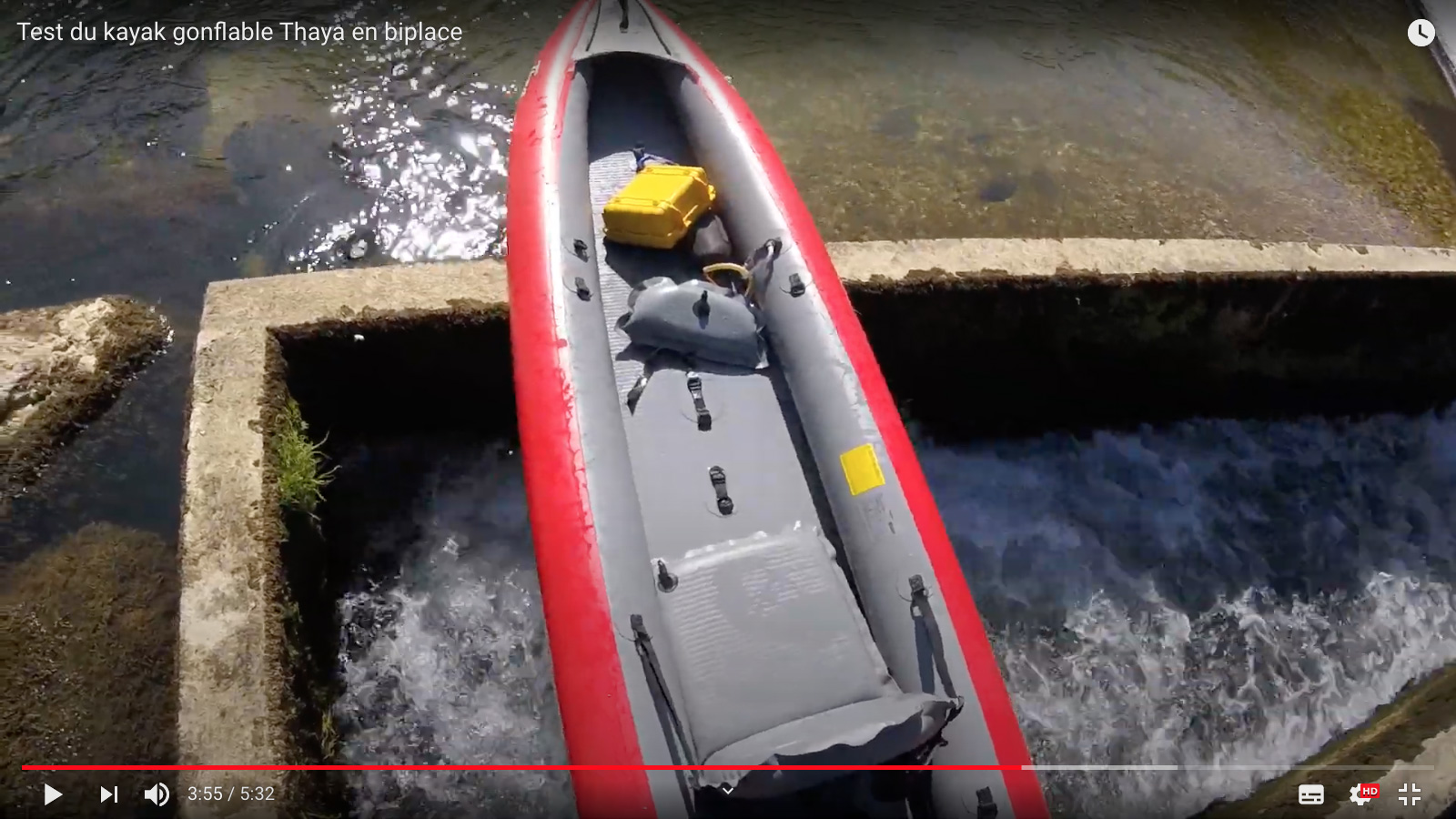
Since 2019 the Gumotex Thaya sits alongside the near-identical and 25% cheaper 4.1-m Solar on which it’s based, but with a drop-stitch (DS) floor to greatly improve rigidity. The Solar was not unlike my old Sunny, running just 3psi (0.2 bar) all round. That can get a bit saggy with a well-fed solo paddler. This was the first of Gumotex’s DS-floor boats, but a basic exercise in simply replacing a floor rather than trying anything more fancy like the Rushs of 2020.
Drop-stitch fabric now makes the complicated hand assembly of pressure-vulnerable I-beam floors (left) redundant. A DS floor is a flat panel with effectively 3-4 zillion ‘I-beams’ (see top of the page) all spreading the pressure load evenly to constrain the form into a plank shape, but at a much higher pressure than an I-beam floor can safely handle. In an IK, high pressure = a more rigid hull = better glide/less effort for barely any additional weight. The only drawback is that you need a more powerful high pressure barrel pump (above right). Your old Bravo foot bellows won’t do anymore.
DS is normally PVC and made in China, but Gumotex have found a way to manufacture threading and bonding a D/S floor with their durable, flexible and environmentally right-on Nitrilon rubber fabric. It can’t be that hard. The regular, normal-pressure 3psi sidetubes ought not need the higher pressures I ran on my adapted Seawave because the 7psi (0.5 bar) DS floor greatly aids rigidity (see action video below). Gumotex’s new tag line rubs it all in: ‘Made in EU[read: ‘not China’], made from rubber[read: ‘not PV … spit … C’].
The promo video below suggests something revolutionary, but combining DS with Nitrilon can’t be that much different from doing the same with PVC. It will certainly simplify or speed up assembly. One assumes drop-stitch floors supposedly don’t need a PRV necessary to protect I-beam floors from internal ruptures when they overheat in the hot sun. Some UK outlets where claiming the Thaya has a “Safety relief valve [PRV] in the bottom of the boat” but it’s probably just a copy and pasting error from the Solar. I can’t see one in any pictures and have yet to see a DS panel with a PRV until the AE AirVolution came out in 2020. The assumption is they don’t need it if it runs a modest 7psi, but some claim high-pressure DS floors won’t last as long as I-beams. Without a PRV, that may be true and much will depend on running the correct recommended pressure, the quality of manufacture/assembly and where possible, leaving the boat in the water on hot days so the large water-contact area keeps things cool.
One positive thing about old-style I-beam floors is the parallel I-tubes (left) probably don’t hurt tracking (even without a skeg). They also enable the desirable curved hull profile of a boat rather than the flat floor of a barge (for the moment DS panels can only be flat or maybe with a slight curve).
Payload ratings seem to have settled at 230kg and the movable seats are also made from DS panels. Initially I thought why? For the backrest and footrest that makes sense but who wants to sit on DS seat base on a DS floor? Of course you don’t have to pump DS up to the max to get its flat form constraining benefits and it looks like valves are regular twist-locks so you’d couldn’t get more than a couple of psi in there. Footrests are the usual inflatable pillow rubbish, but possibly also DS? I’d replace them with a section of sawn-down plastic drainpipe so you get a solid block to brace against. It makes efficient paddling much easier.
I’ve never tried one, but I do wonder how a flat-floored DS IK might handle in windier, choppier conditions where an IK isn’t exactly a hydrofoil at the best of times. A flat, raft-like floor will be stable, sure, but it will roll and pitch about more. Also, according to the specs (left) at 89cm the Thaya is a disappointing 6 or 9cm (3.5″) wider than the all-tube Solar 3 (Actual verified width seems to be 34″ or 86cm). Great for family-friendly stability; not so good for solo paddling speed and efficiency. My Seawave was 2cm narrower than a Solar 3 and with the usual care getting in, stability is not an issue. Out at sea my Seawave would swamp long before I’m tipped out. But then again, the near-rigid floor may cancel out the drawbacks of the greater width. At 18kg the Thaya is heavier than a Solar 3.
For most recreational, flatwater users the Thaya ought to be a nice family boat, but then so is a Solar 3. The Thaya costs 30% more than the Solar 3 whose days may be numbered, but it’s 2022 so maybe not.
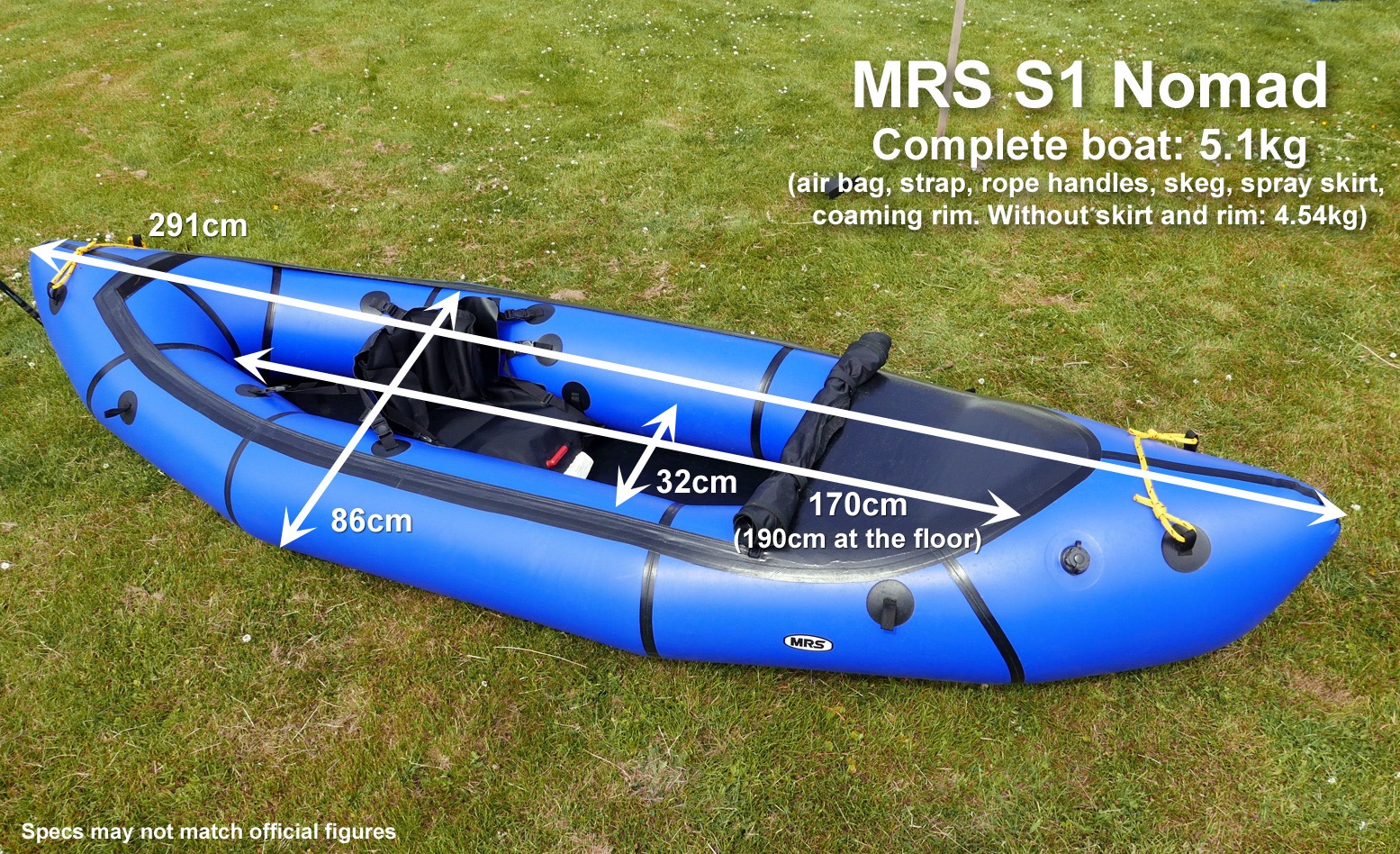
The application of what has proved to be durable, light and compact packraft fabric and reliable construction methods into slimmer, kayak-like forms was bound to happen. MRS’s 2.9-metre Nomad S1 is among the first solo examples I know of, co-designed with Germany’s Anfibio Packrafting Store whose Alpha XC we tested a couple of weeks ago. Fyi: in December 2018 I sold my 2014 Alpacka Yak and bought this ex-demo boat. Fyi2 Anfibio don’t sell MRS anymore.
Is it a very light solo kayak or a long packraft? I’d classify it as the former, a boat that ought to paddle better than a packraft on current-free, flat water, and even manage some calm coastal paddling. The Nomad could be mistaken as the solo version of MRS’s tandem undecked Barracuda R2 double. But the R2 is a boat with seats which can be adapted to canoe-style kneeling, much fatter tubes and has a different bow/stern as well as not having a deck. The 1299-euro Nomad S1 is a stand alone boat.
What they say: Once packrafts broke conventions in water sports. Now the Nomad S1 is breaking conventions in packrafting. The central seating position and symmetrical bow and stern are similar to a conventional kayak, producing similar paddling dynamics. At 5kg, the gross weight is more than most solo packrafts, but the Nomad remains a very packable boat for easy travel and exciting adventures.
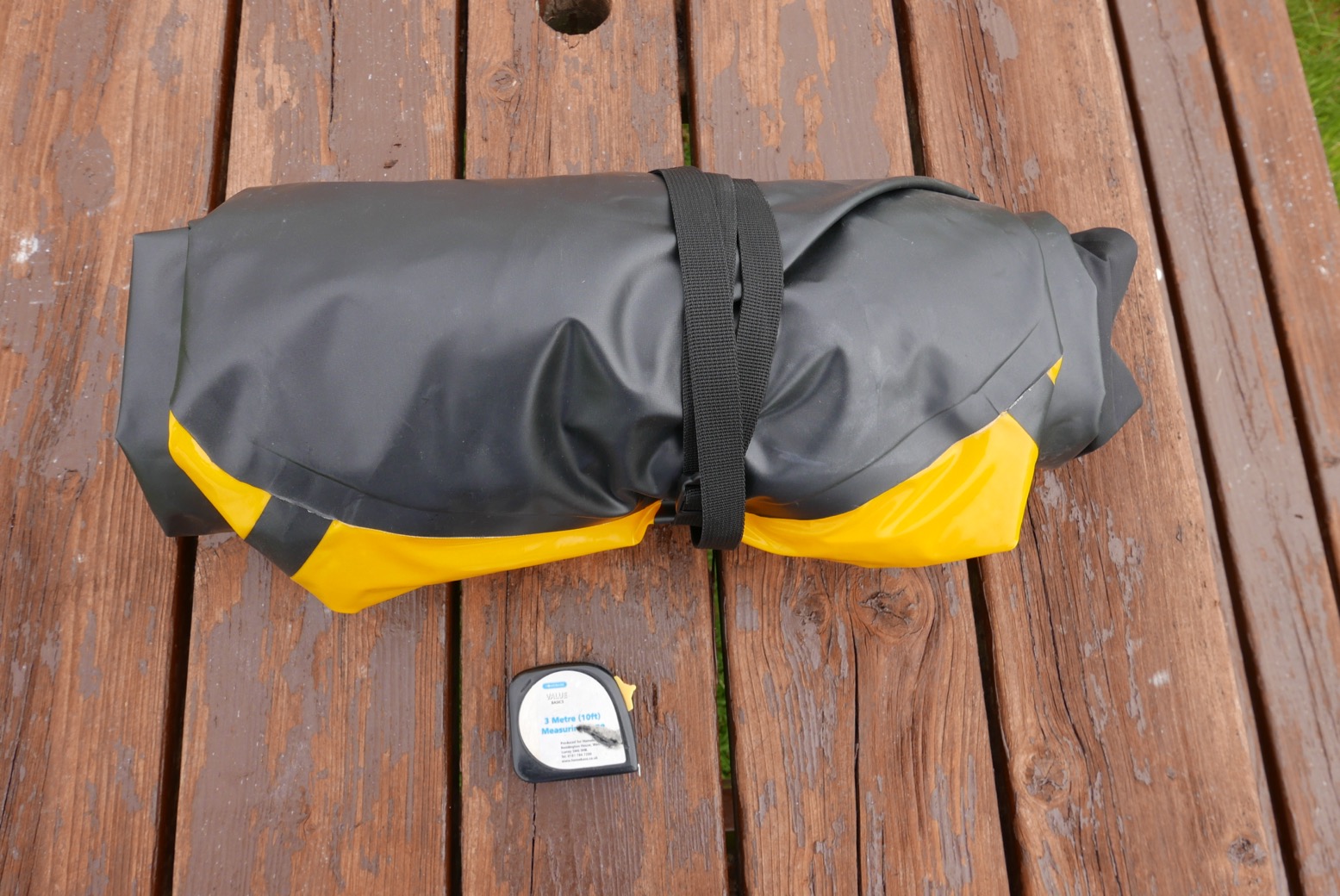
‘Sign here please’ Off the van, out of the box and straight onto the kitchen scales. Kerching: that will be 5.1kg please. Take away the large skirt and coaming rods and it’s down to 4.5kg, and a year later rigged up to my specs with a long lanyard, footrest, alternative non-inflatable seat back with a mesh pouch with bits in it, it is a real-world 4.7kg ready to go (right).
Hull fabric is your usual 210D TPU but coatedinside and out (like old Alpackas) for improved rigidity, with a floor in chunky 410D with aramid (kevlar) fibre reinforcement. The hull panels are stitched, then heat welded with tape; the floor gets glued to the hull and all the joins look neat and crease free. The deck and seat parts are lighter PU-coated or ripstop nylon.
Unrolled, it looked like a lot of boat to have to blow up with the air bag. So I decided to speed things up with my IK barrel pump, using a bit of garden hose as an adaptor via the air bag screwed into Boston-style valve. More on those here. It took less than 5 minutes pumping. Later, I decided to try regular airbagging and found it only took 15 bagfulls to get it ready for topping off – less than you’d think.
To top off I found a shorter section of garden hose fitted neatly into the one-way valve port and makes it much easier to give the boat a few lungfulls and get the high-capacity boat nice and firm. A short bit of hose also fits into one adapter on my K-Pump which I usually use to top up my IK. With a K-Pump you can get it good and firm (but you can with much cheaper mini, balloon pumps too). The Packrafting Store offer a small Bravo foot pump for those who don’t have the lungs of Dizzy Gillespie. You do want to get this long boat as firm as possible, especially if you’re well-fed. But the Store recommends not to overdo it with a pump, and in the current warm spell I’ve been careful to air off a bit if the boat gets left in the sun all day following a max top off in cold water.
Once aired up the boat has a good shape – nice pointy ends; a promising sign in boating circles. The S1 is symmetrical like many IKs, and each end has a generous volume helping achieve a claimed buoyancy rating of 200kg. I can believe it; two of me in it and I bet it would still have plenty of freeboard.
The deck seems to be less flimsy ripstop fabric than I recall on my previous Alpackas. And unlike those boats which had a long perimetre zip, the Nomad has two parallel zips along each side right to the back which makes it dead easy to partly open and get to the ‘trunk’ without complete removal. Good design. You also wonder if the zipped-up deck might help tension the boat by constraining the sides when getting bent about in rough water. Maybe.
The 80cm x 49cm hatch is nice and big; I (1.85m) could get in and out with ease, though maybe not just after Christmas while wearing a drysuit and thick fleece. There are zips along the hatch rim to insert the 4-piece coaming rod (left) to make a firm seal for the spray skirt elastic. It struck me paddling later with the deck deployed that fitting the rods would create a 1–2-inch high lip which would keep out some water rolling down the front deck. The supplied spray skirt looked huge and had braces; but I never actually tried it. Rolled up to the front, the rolled up deck’s retaining velcro straps seem way too long. It didn’t really matter, they tucked in well enough. Maybe the extra strap length is to roll the unused spray skirt in there too.
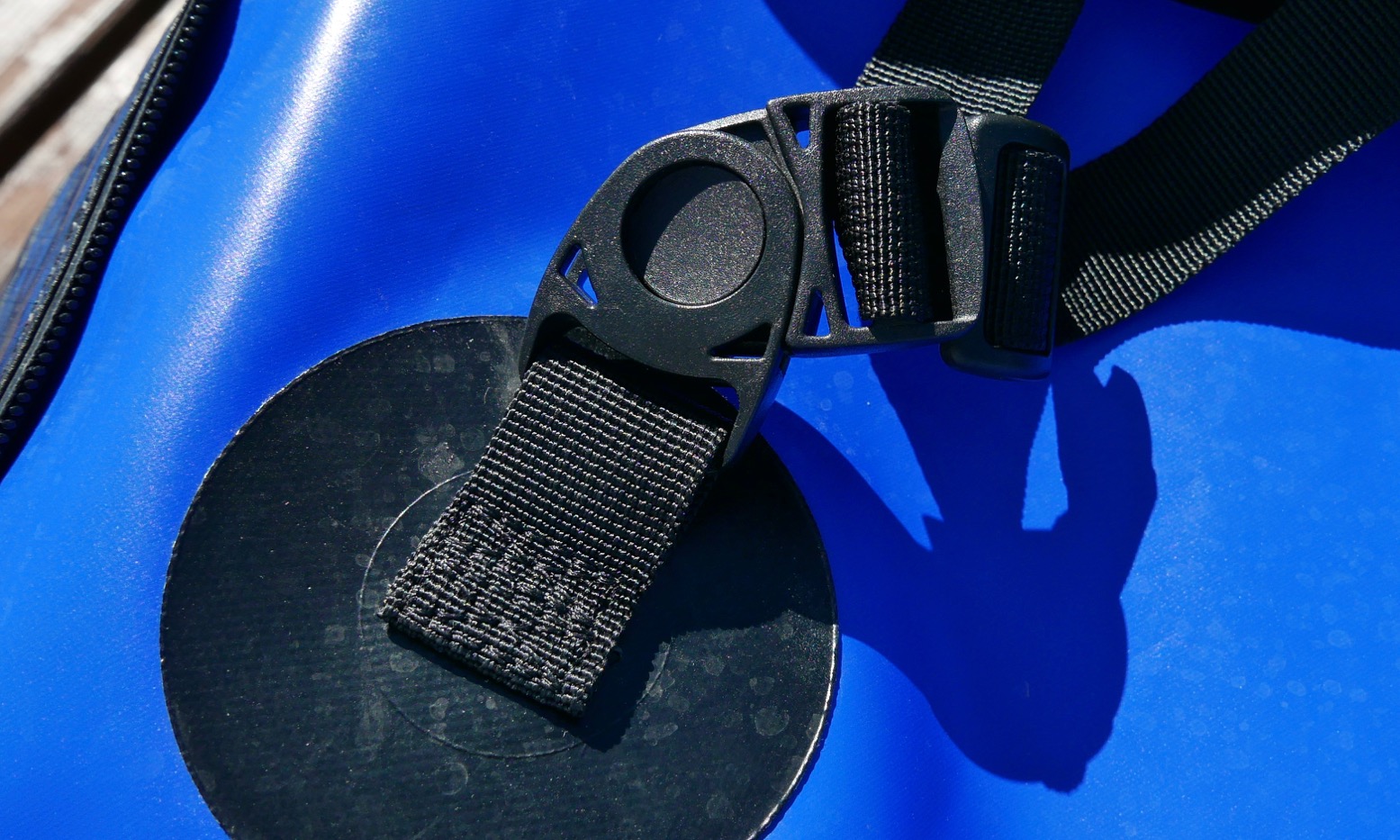
The two-piece inflatable seat and backrest are not your ordinary packraft affair. The anatomically curved backrest hangs from no less than six adjustable pivoting mounts using q/d clips (right) to reduce stresses on the mounts and help fine-tune your back support. A TPU sheet sewn to the back rest back takes the buckle tension. This backrest won’t flop forward as on some packraft one-piece backrest/seats – very handy when clambering in, especially through the hatch. The whole backrest weighs 310g and costs €39 if you want to fit one to your boat. It detaches in seconds, handy to allow a passenger to temporarily hop in.
Solo, the mass of your weight settles on the thick, seat pad. It’s attached via the usual, very much not easily adjustable or removable lace-up tab mounts, except they’re glued on halfway up the hull sides at the 32-cm narrow point (left), not down on the floor’s edge as on regular packrafts. One problem with this laced set-up is if you want to move the seat much more than an inch or two forward or back. Depending on your weight there will be fewer holes taking the load. It can’t be beyond the wit of packboat design to allow easy removal or repositioning.
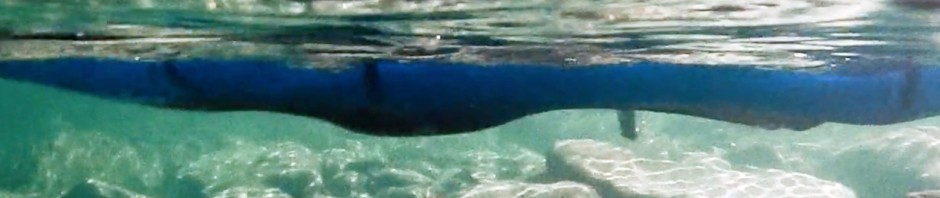
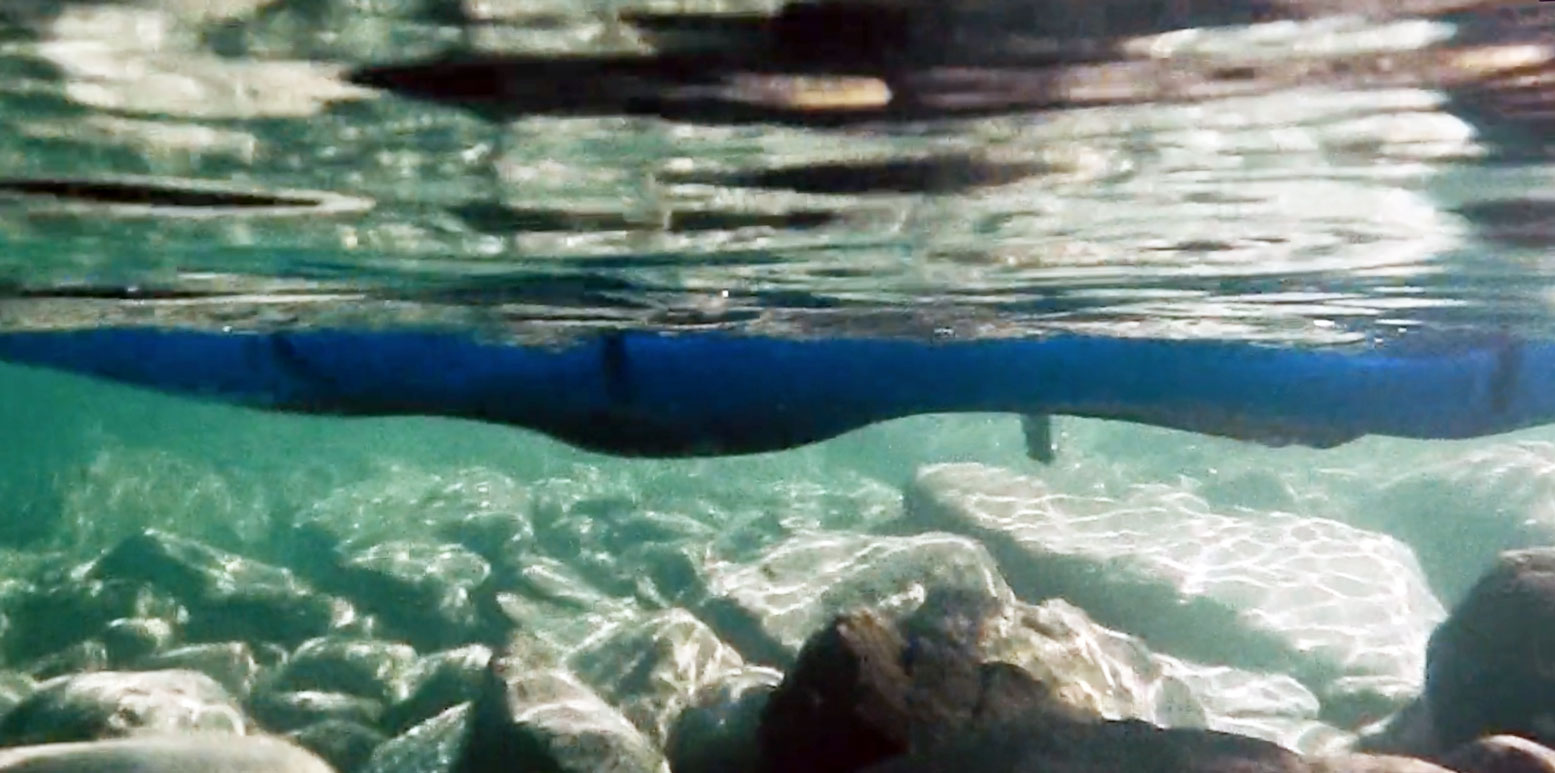
The S1’s clever seat arrangement partly supports the paddler’s weight from the big side tubes and so limits undesirable ‘bum sag‘. The Nomad does not sag like the underwater image above (an unknown packraft). In this boat the weight of the paddler presses directly on and deforms the floor which can’t be good for hydrodynamics or floor wear and tear in the shallows. Paddler weight pressing down midway in a long, low-pressure boat – even with an inflatable floor – tends to make it bend in rough water or a swell. You can see they thought about this with the longer-than-normal Nomad. It was the problem that limited my old Gumotex Sunny (water came over the sides in rapids or a swell) which was eventually solved by getting the more rigid, higher pressure Seawave (and which is solved entirely by drop-stitch technology).
Flip the boat over and you can see that there are slight bulges at each end (left). I’m told it’s a cunning design feature to produce ‘negative rocker’ (opposite of upswept ends) and help with tracking and speed. The similar-sized EX280 we tried was flat floored and I must say it seemed to work. The S1 tracks fine without the skeg.
The 410D floor has a good overlap of glue where it attaches to the 210D hull tubes covering the tube seams (glued because I think you can’t easily heat weld two different deniers of TPU). The quality of the taping is all as neat as you like, with not a single strand of stray glue or malformed creasing.
The skeg (directional fin) is Gumotex size but slips on like a Sea Eagle IK (‘American box fitting’ iirc, same as on iSUP boards) into a moulded plastic slot glued up the stern. It locks in place with a flat pin on a string so when removed you can secure the skeg somewhere via this pin and string. I do the same when packing my Seawave so as not to misplace the sometimes vital skeg. Even when not mounted, that skeg pad is the lowest part of the boat which scrapes first so usefully sparing the floor from damage. Other than that you have four well-positioned attachment loops, with a broad base to secure anything up to a bike. There’s the same arrangement on the stern. These mount points become less essential because you have space behind the seat to stash stuff low and retain stability and visibility. There are two more long loops inside, with another pair of mount points at the front for thigh straps. The test boat also had some handy string handles knotted on to the outermost attachment loops.
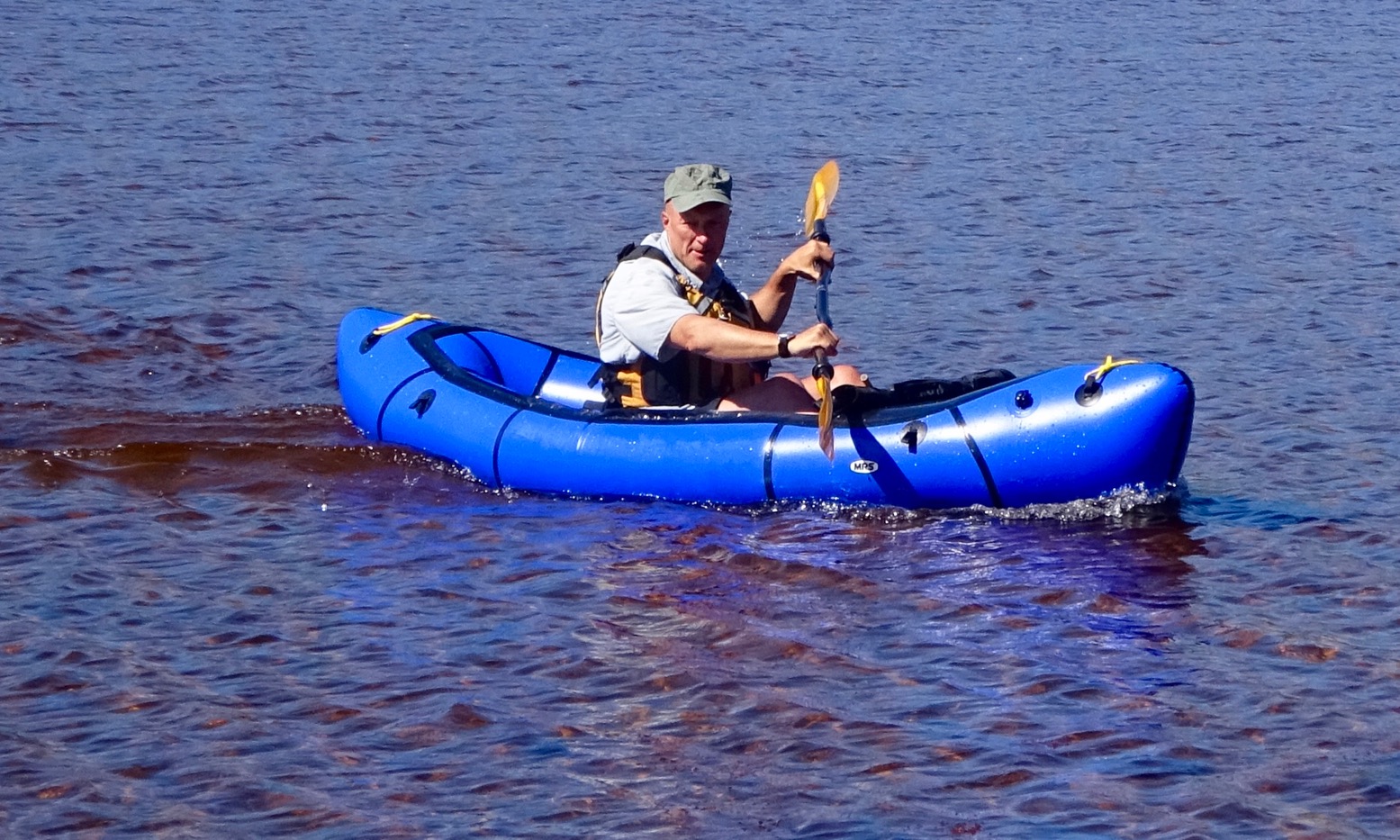
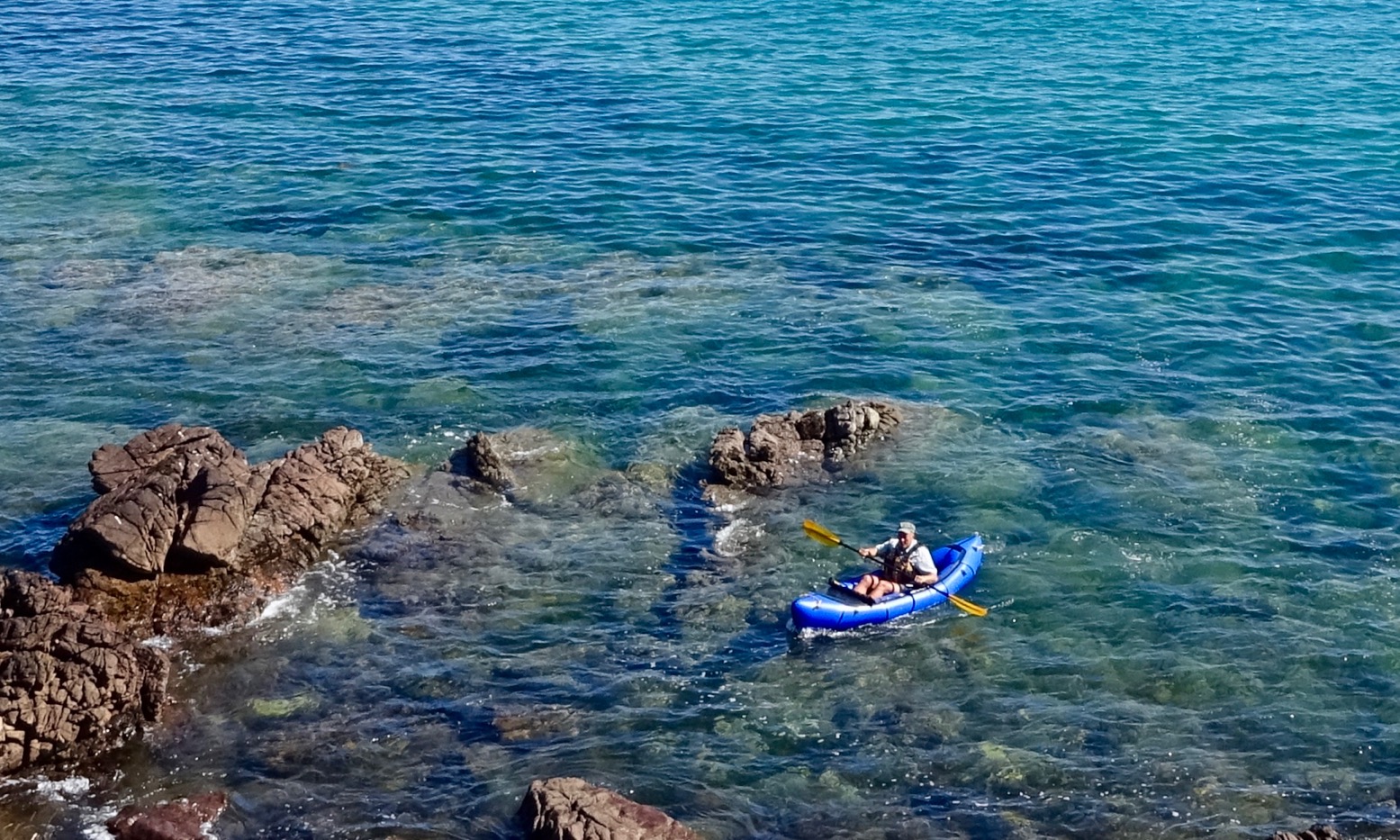
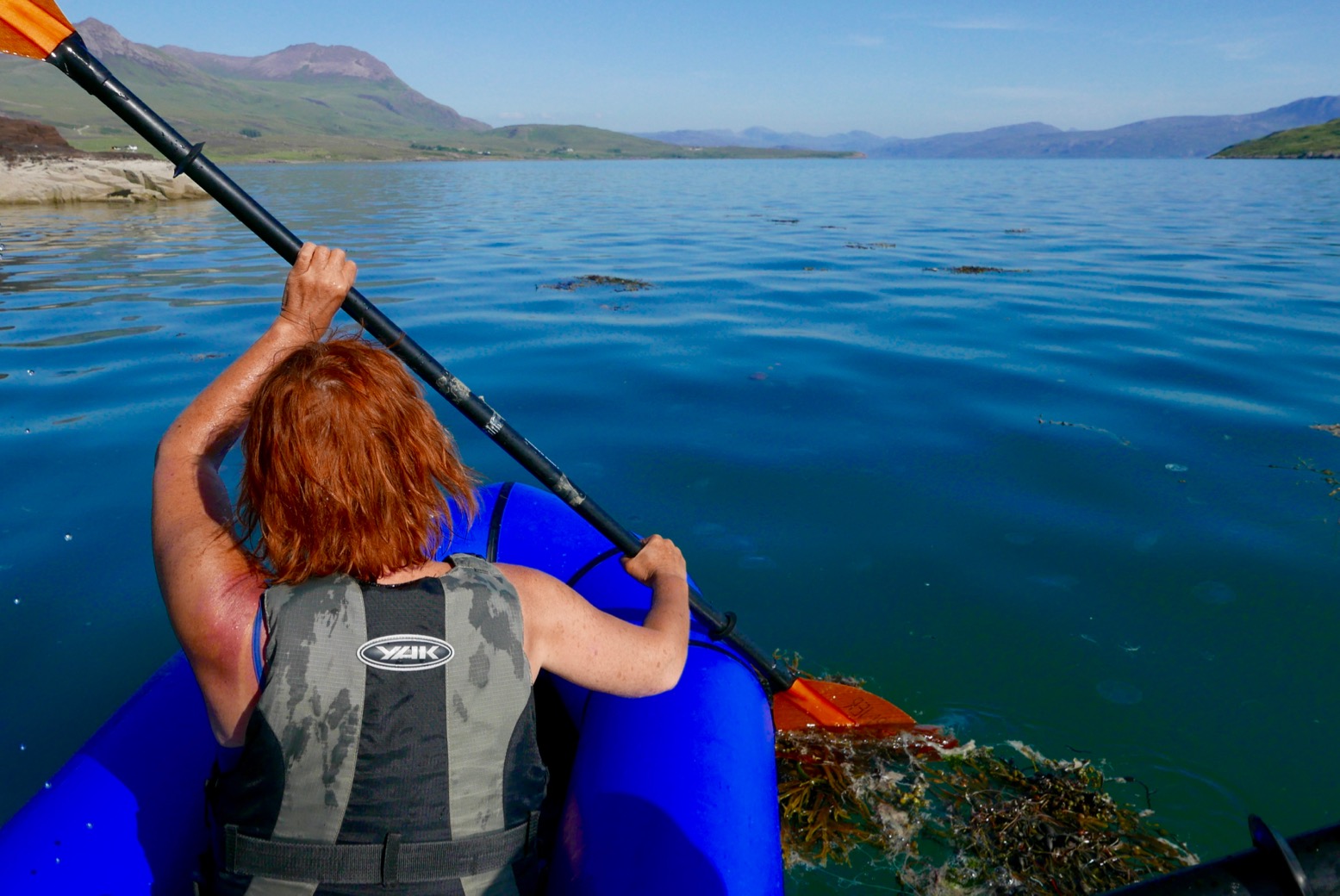
S1 at Sea There are no rivers near here bigger than a boulder-filled burn right now, so we took the S1 out along a rocky coast, along a slightly surfy beach, then rinsed it off with a quick sail down a freshwater loch. I don’t know if it’s the greater size, the kayak-like handling, the reduction of front-to-rear yawing or the elevated seat, but on a less than smooth sea I took to the S1 straight away. Despite being another single chamber packboat, it inspired confidence that I’d not necessarily experience in my smaller Alpacka Yak. I paddled it without the skeg and as expected, can’t say I missed it. The Nomad tracked very well and, compared to my Seawave kayak, doesn’t really produce enough glide per stroke to send it drastically off course, notwithstanding the small corrections you subconsciously make as you paddle along. I wonder if the lightness of the boat as well as its flat floor are what makes these intuitive micro-adjustments in tracking so effective. Who knows, but if attempting longer, more exposed sea crossings (I’m talking a mile or more, not Nova Scotia) a skeg must be a good idea to stop the boat getting pushed about from the sides, especially with a tail wind.
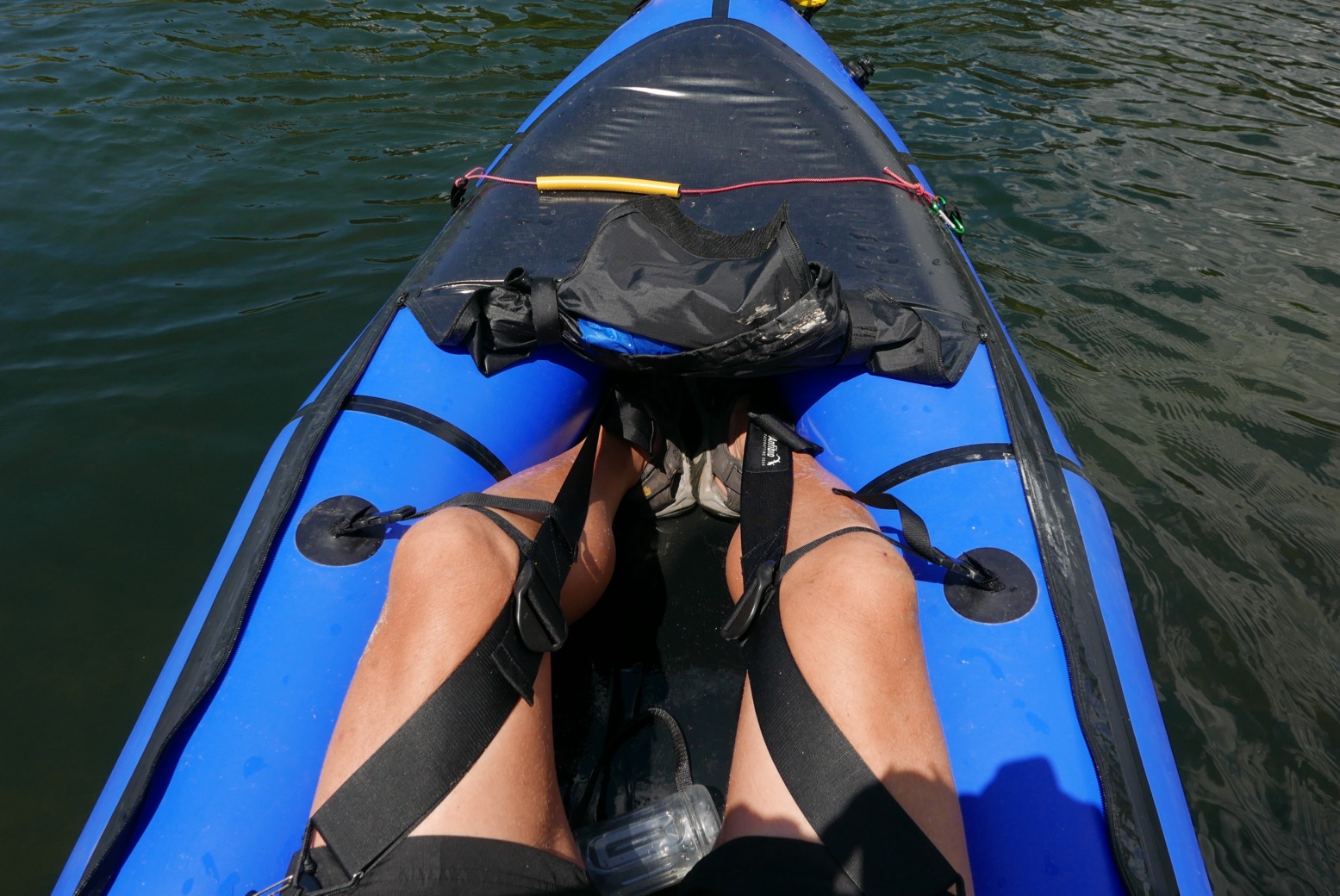
Without the skeg I appreciated the S1’s agility nudging in and out of the rocks as a light swell rolled in. Stability was very much not an issue; being jammed in more or less at the narrow 32-cm width with feet touching the distant bow and the well-designed backrest all helped. My hips are 40-cm wide but I didn’t really notice the squeeze as I would were I down on the floor. Up to a point you can brace with your shins which are so close together there wouldn’t be much play to pull on thigh braces (actually not so – they work OK; right).
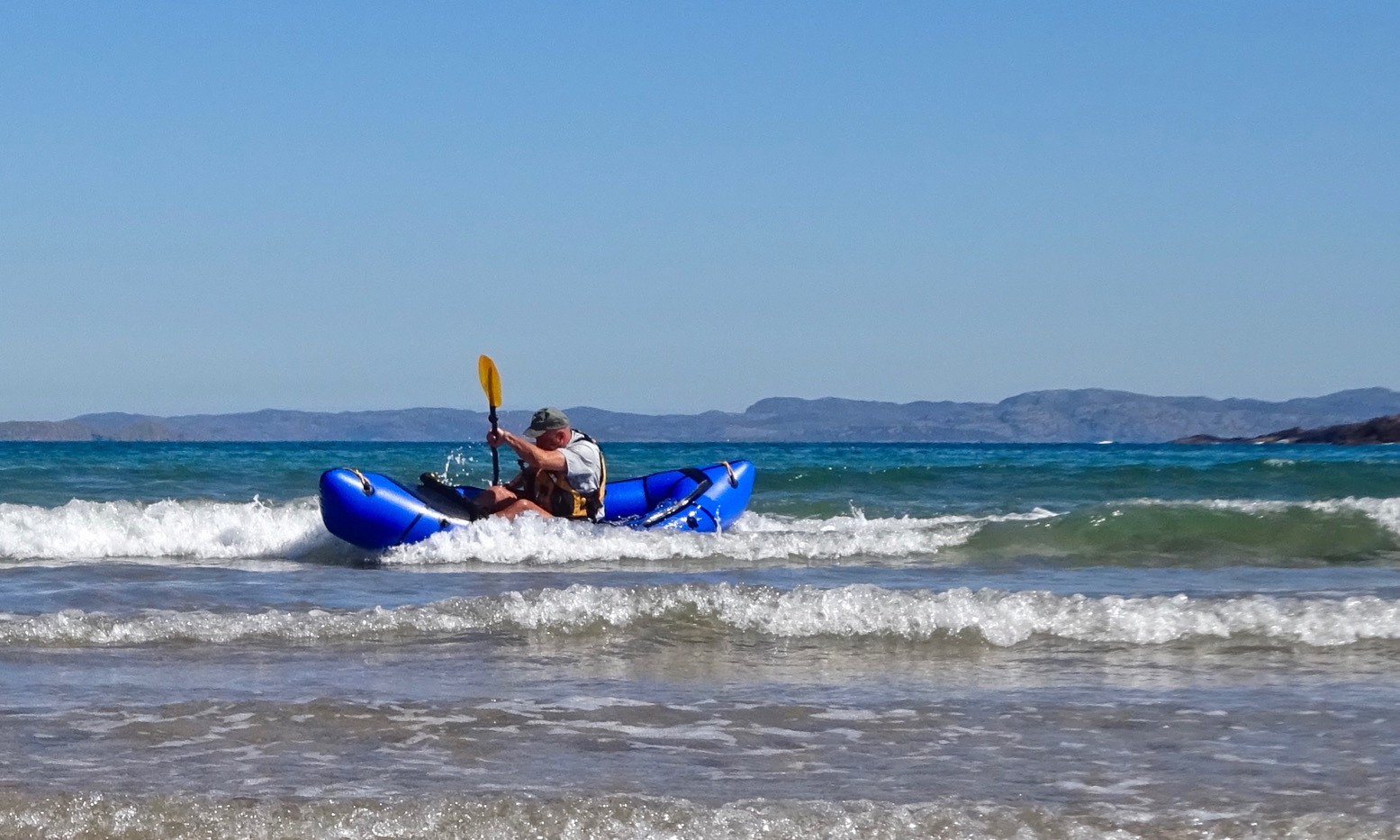
Over by the beach occasional foot-high waves were thundering on the shore; a chance to get knocked about a bit and have some fun. The stability made it easy to play around, with enough agility, clearance and central weight to spin quickly in the shallows before getting beached. Sure, some water came in, but on a warm day it’s a lot more fun playing with an open boat. To drain it just hop out, flip over, flip back and hop back in.
Even without the skeg, the central, kayak-like paddling position, as well as the length (Length-Weight Index 3.38 – about half that of a typical hardshell sea kayak), pretty much eliminates your typical packraft yawing. Not so sure about crossing over and circling the Summer Islands – it’s still a single-chamber craft – but I can see coast-hopping being enjoyable in the way it wouldn’t be in a regular solo packraft. On the way back from the beach against a quartering wind, the GPS recorded a brief high of 4.1mph paddling along normally.
We nipped over to freshwater Loch Ra which is now so low I had to wade a couple of hundred metres to find some depth. The skeg was now on but I can’t say I felt like it made much difference the way it would do on my IK. We went out on my Seawave a few weeks ago and the forgotten skeg was a right pain downwind. Upwind it’s barely necessary. I hooked up the WindPaddle to the yellow string handle. The breeze was blowing only about a 6-8mph but the Nomad picked it up and ran with it up to 3.5mph – as fast as I could have paddled. Again, I don’t think the skeg helped with the tracking as the boat was effectively being dragged along by its nose like a wet towel. Later in the afternoon I went back out onto the loch, paddling up briskly to the windward end where I let the sail take me back down. It wasn’t blowing enough to break any records but it’s nice to sit back and listen to the plink-plink of the water slapping under the bow. Mid-loch it felt like it was doing a good 4mph.
I’m really getting into this WindPaddle; I like the way you can steer up to 30° either side of the wind. On this boat it was easy to pull the sail down, cross it over once and tuck it under the knees, even with the deck on. There’s more Nomad WindPaddling here. Back at the bank I removed the sail and the skeg and went for a scoot upwind, across-wind and downwind, but still can’t say the boat was hard to track. Maybe with more of a backwind it would get out of shape, but by then the waves would briefly lift the skeg out on the crests and possibly push it around. It’s nice to have the option but also good to know the Nomad handles well enough without a skeg on loch and coast.
Fyi: if you think your boat also needs a skeg (directional fin), the Store sells an inexpensive skeg and glue-on patch from 420D floor fabric. There’s a template here.
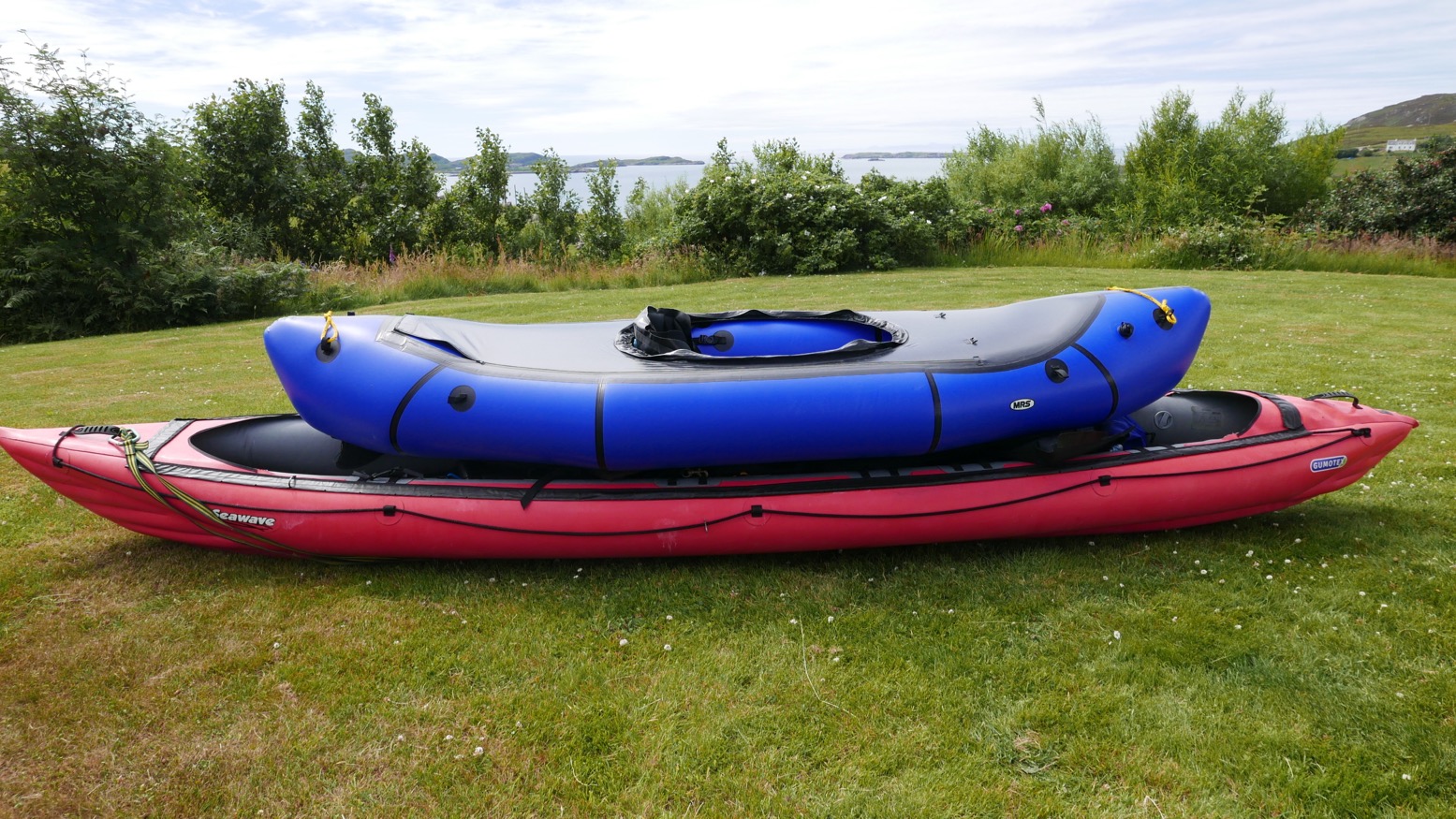
Nomading it Up Good to know first impressions can be correct. I saw the promise in the Nomad S1 when I first clocked it on the Packrafting Store’s website. It is nearly the same length but more than half the weight and rolled-up volume of our old Gumotex Solar 300, but longer than the current 9-kilo Gumotex Twist 1 which, at just 2.6m has only half the buoyancy (ie: not much at all).
Trying it out on sea and surf-ish and loch, with sail and without skeg, I could seriously consider replacing my Yak with a Nomad (later, I did). I think there’s a potential for a skirt-free model and I’d even suggest the skeg could be an option too (P-Store make one of those too, now: S1 Light; right no skeg, deck, or braces and a 4-mount foam backrest). The main drawback is the €1299 price – that’s about £1150 or the same as a top-of-the-range, made-in-Europe Gumotex with a deck or rudder option and a signed certificate from Brzeslaw Gumotek. Longshore sell the less sophisticated EX280 double in what looks like the same fabric for half that price, and the Store themselves have albeit basic packrafts from €470. They say the deck costs a lot to make and fit but fabric and assembly in China can’t be that disparate. Of course the price you pay is right for a boat which gives you years of fun, as I have found. An Austrian Grabner double IK can cost over €3000, so can an Incept.
Alternatives to S1 As for alternatives there is really nothing like the Nomad at the moment, partly it’s because the extended stern idea has greatly improved the dynamics of many packrafts, positioning the paddler more centrally but adding length without interior space. Best choice would be Anfibio’s TXL+ which is now my main boat.
A Nomad or TXL may be on the weight limit of classic land-and-water packraft camping, but they certainly make travelling somewhere by plane or a train or on a pushbike much less of an effort than with even the lightest IK, while giving IK-like performance once on the water, be it a gnarly river, a windy loch or a rocky seashore. Kayakraft? Packayak? It’s definitely not a kakraft.
Thanks to the Anfibio Packrafting Store for supplying another test boat. More about it here.
“The Nomad is another co-development between Anfibio Packrafting and MRS (Micro Rafting System). Combined with MRS’s manufacturing expertise and fabric know-how, our years of packrafting experience helped refine the design of the final product. Serial production takes place in the Far East with manufacturing carried out in small, hand-built batches. All products have an extended three-year warranty.”
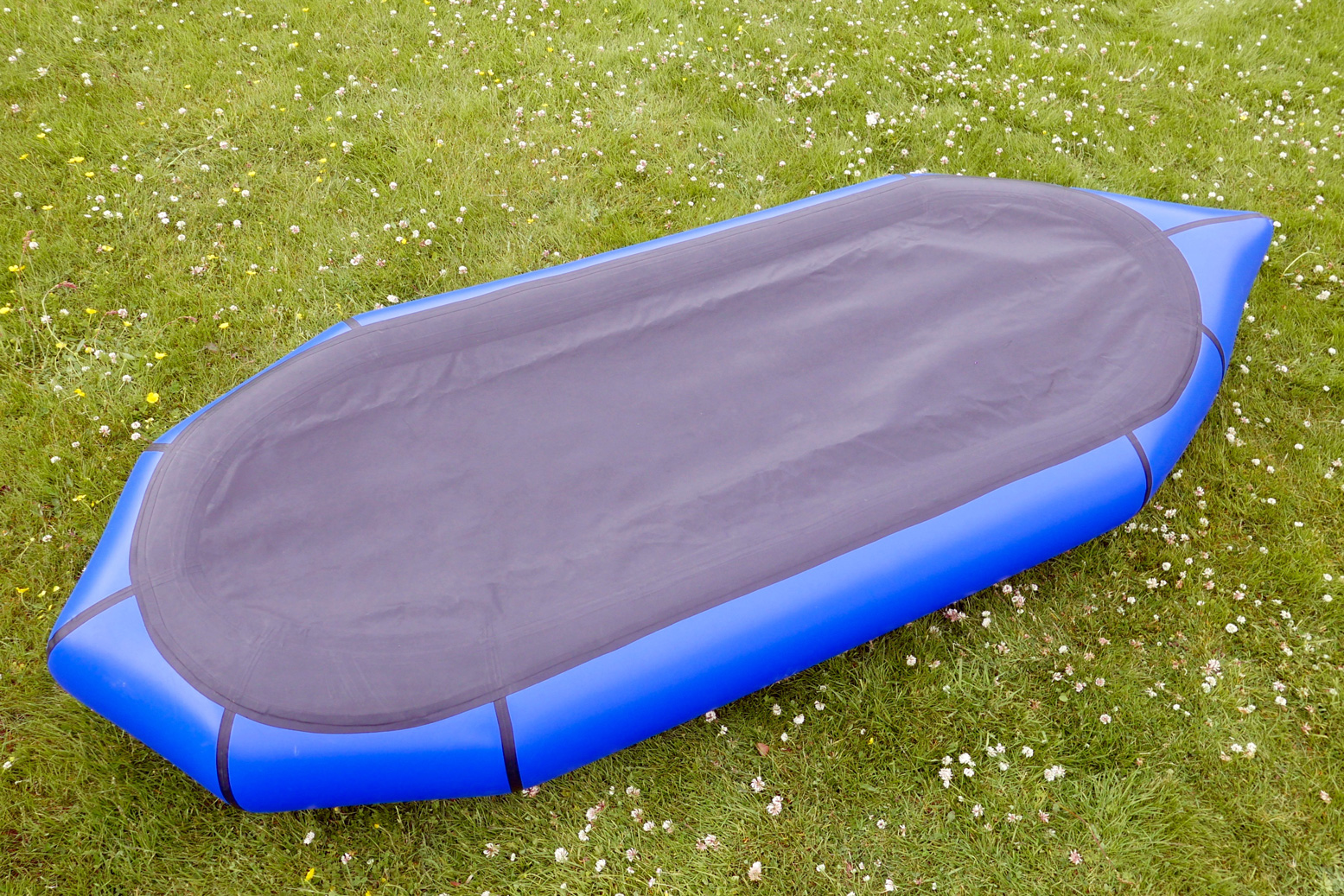
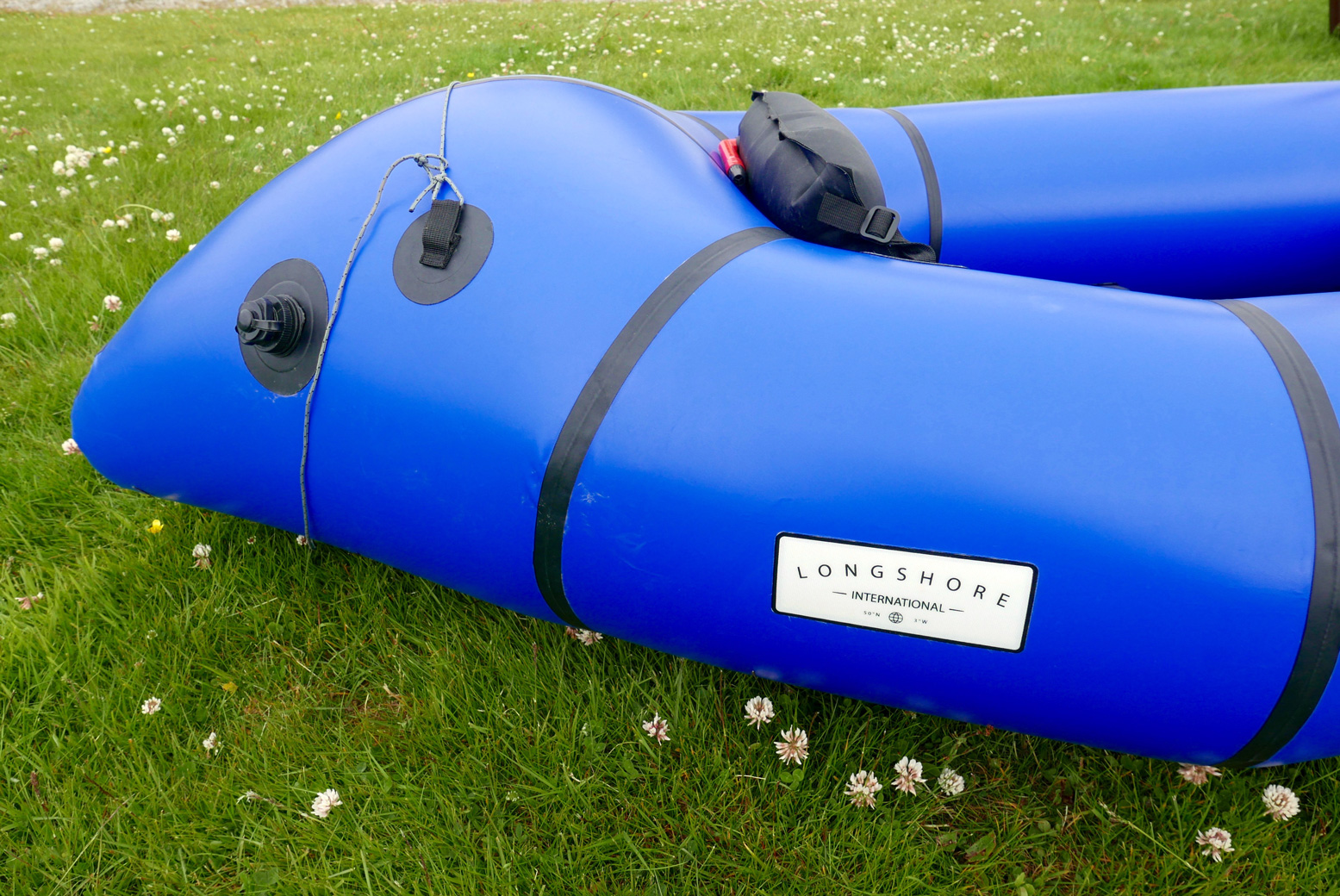
For a couple of years Longshore International was the first and only UK-based outlet to offer self-branded packrafts sourced from China. As far as I know, up till that time the only option to buy new packrafts in the UK has been the Alpacka outlet up in Aviemore.
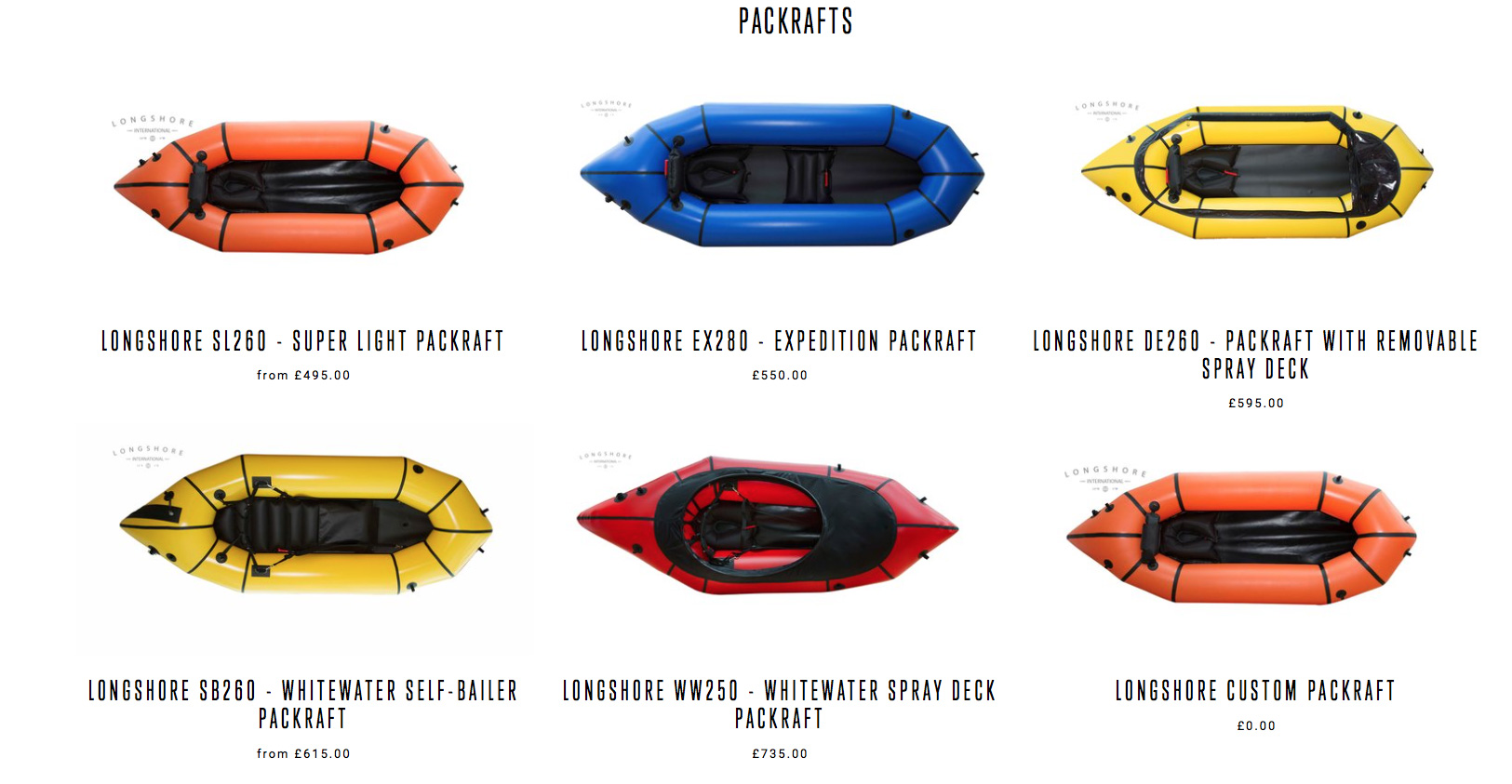
At the time of writing this in 2018 Longshore had five models (right) starting at £495 as well as a custom option, all laid out a particularly well-designed website which keeps it all simple.
Their boats all closely resemble Alpackas new and recent. No surprise there: the Alpacka cat is well and truly out of the bag. But as with bicycles or an axe, there are limited ways of doing packrafts. Without resorting to gimmicks, most of the genuinely worthwhile ideas and innovations have all been done. All that remains is for prices to drop to attract more than enthusiasts, or possibly lighter and stronger fabrics like Vectran. The boat we tested was the EX280 Expedition, pitched as a heavy hauler or a tandem.
Quite big, actually
What they said: The EX 280 is ideal for river, estuary or coastal cruising and can be paddled by either one or two people. It could also be used for fishing or as a tender to a small yacht. As our longest packraft it tracks well and is the fastest and easiest to paddle.
Out of the box The EX280 cost just £550. We chose to try it as a double rather than a load carrier as it’s something new to me and I imagine is also an attractive idea to other recreational paddlers; a compact, light boat for enjoying time on the water. At my request the EX we got differed from the website images in that it had a backrest fitted for the front paddler. I can’t see paddling being comfy upfront without one of these.
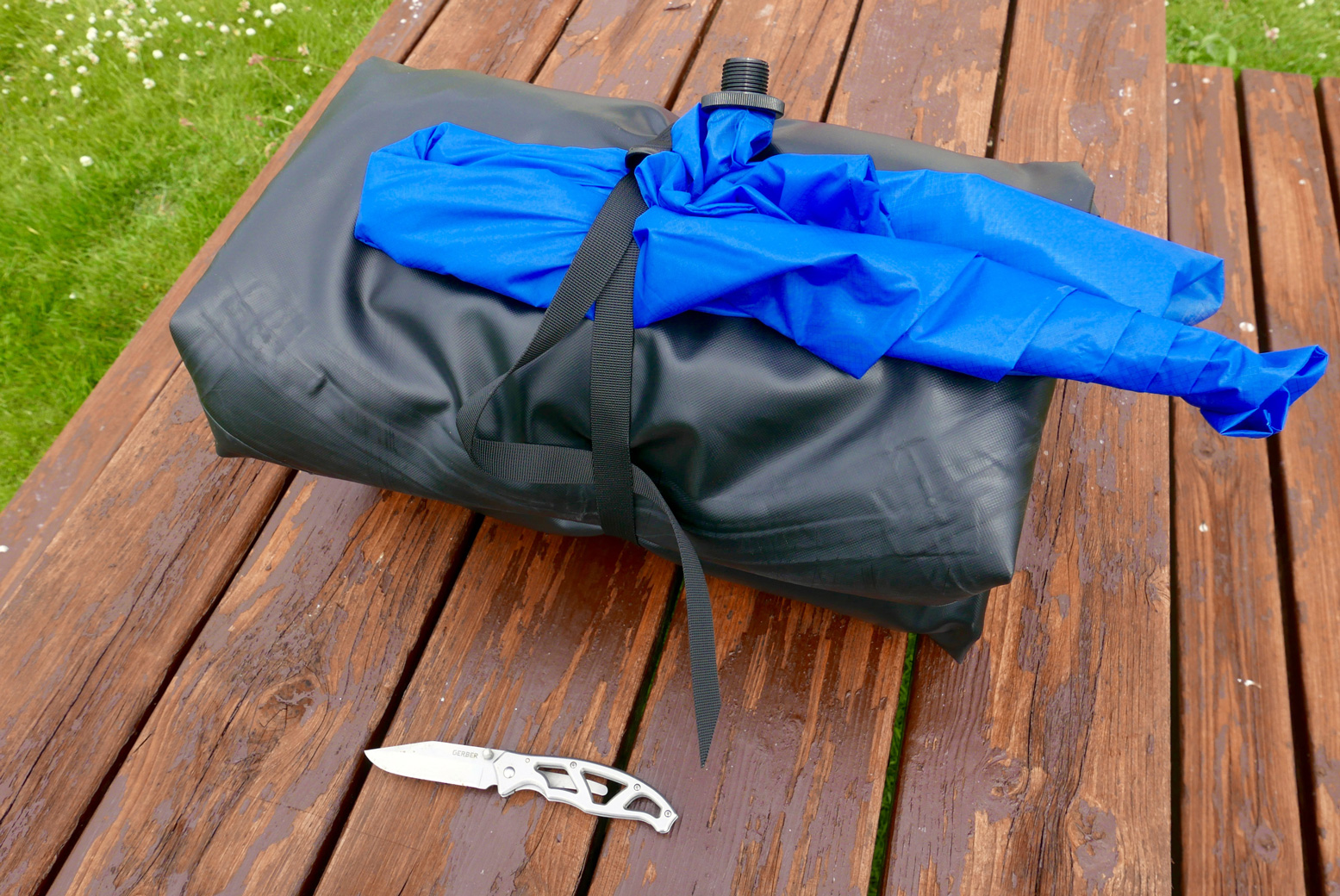
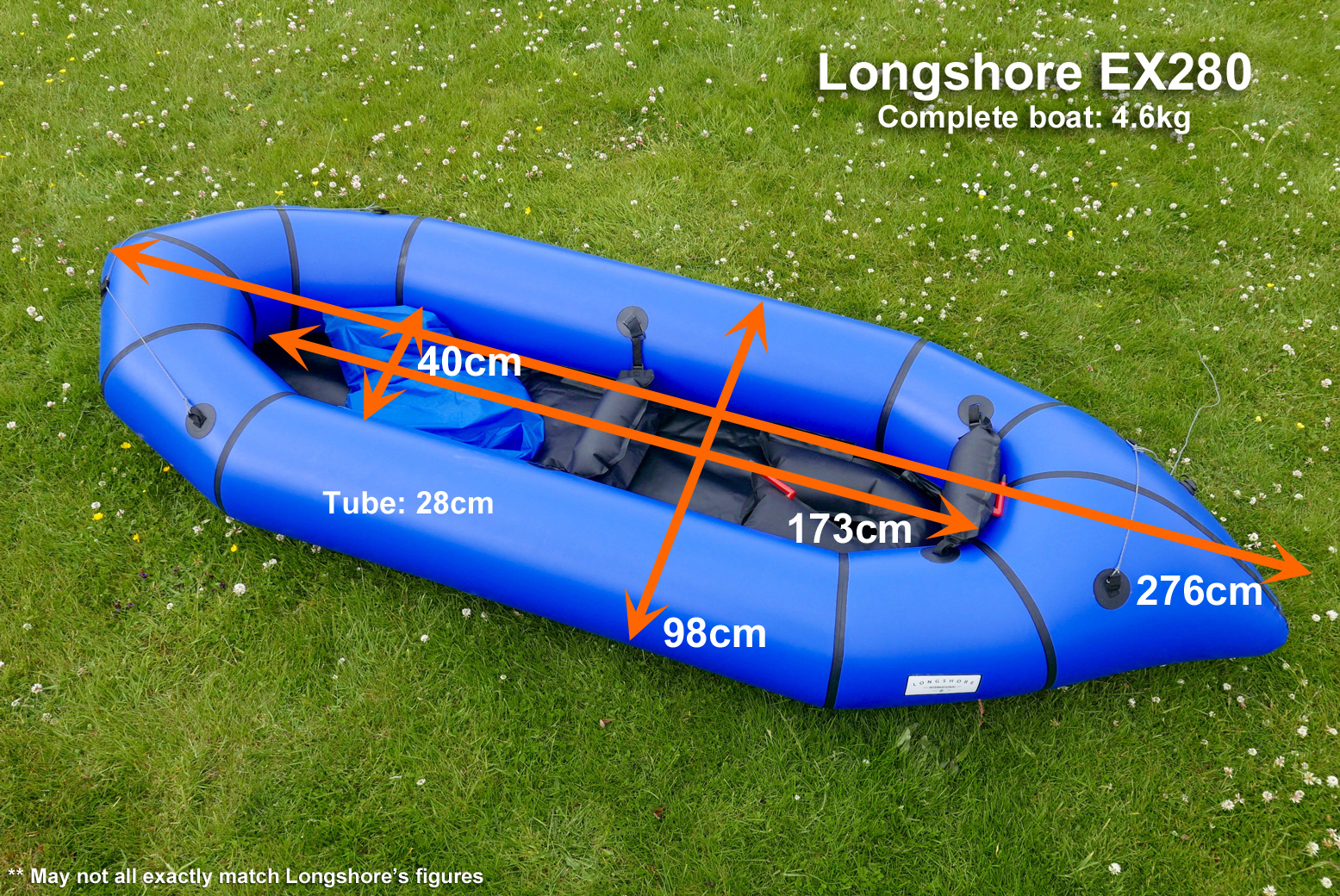
After weighing in at 4.6kg with strap and air bag, once unrolled I was pleased to see how long it looked; I’ve had IKs that are nearly as long. Solo or two-up, that ought to add up to steadier tracking which packrafts do well anyway, but also less bow yawing which can slow a packraft down. The EX uses the usual 210D nylon-core TPU for the hull, but on this boat it’s coated inside and out like the original Alpackas. A few years back Alpacka quietly slipped in single-sided hull fabric; it saves weight, price and bulk of course, but counterintuitively they also claimed single-sided was more tear resistant. Can’t see how unless the core fabric is different, but Longshore reckon a double-coated hull is stiffer – and longitudinal rigidity becomes important once a low-pressure inflatable boat (packraft or IK) exceeds a certain length. I know from my IKs that a stiff PVC like my old Incept can help make a boat more rigid compared to more pliable synthetic rubbers like Nitrilon or Hypalon. To fill the EX up took about 18 airbag-fulls.
Side tubes are 28cm and parallel, as are most of their models. The consistent 40-cm interior width makes the EX nearly a metre wide which for smaller persons or those sat low can interfere with paddling. It’s also a roomy 173cm long inside with the whole boat clocking in at 276cm in length. At that length two adult paddlers need to cross their legs, but hopefully not so much that knees get in the way of paddling.
The seat bases are a horseshoe at the back and a flat pad in the middle, both with solid-looking twist-lock inflation nozzles. But they imitate Alpacka’s overkill lace-up attachment system which makes removal or adjustment a faff. There’s got to be a better way of doing it and, at least at the back, the Anfibio Alpha XC we tried the other week had it – a simple strap and buckle; easy to lift, adjust or remove the seat for cleaning and drying (or sitting on at camp). On my Yak seat I’ve eliminated much of the lacing and fitted reusable zip tie. If the EX was my boat I’d work out something similarly for the forward seat which wants to be easily adjustable or removable. The rear inflatable backrest aids comfort a bit, and the front is better than nothing although an SoT-style backpad (as on my Seawave IK) would provide better support. Tim from Longshore says he’s getting some in.
Seats for long packrafts With a regular short packraft it makes sense to sit and lean against the back. With the now usual extended sterns the boat sits level enough and you stretch your legs out forward, braced off the bow with a slight knee bend. Some whitewater singles do have a back brace to position you more centrally off the back to improve agility and reduce the chance of bandersnatching (backflips) when coming out of rapids. Putting a second paddler in a packraft loses the important solid backrest. A back band helps, but unlike an IK, the non-inflatable floor can’t help sagging a few inches in the middle, lowering the critical bum-to-heel level to zero or even less. Pictured left: the bum is on a seat so probably just a little higher than the heels. For comfort and an efficient paddling stroke, you want your bum higher than the heels; just a couple of inches makes all the difference, especially if wearing a lot of cold-weather clobber. Added height also helps get the paddle over the inherent width of a packraft; away fron gnarly whitewater packrafts have stability to spare. As usual, those micro-dosing dudes at Alpacka worked it out by inventing the seat tube for the discontinued Gnu which you straddled like a horse or a jet-ski, knees down. The tube gets you higher and spreads the load across the floor, but depending on the elevation you do wonder how comfy that will be all day. It gives a good ‘forward attack’ position for racing but you lose on easy floor storage for touring which is why they invented the TiZip cargo storage solution for inside seat tube or the hull around the same time. The other way round it is to have a seat or even a plain net suspended from four points on the side tubes which support most of your spinal weight, virtually eliminating floor sag. Again you lose on backresting, but canoers have managed like this for years; the higher your bum the less a backrest is needed as the paddling action pulls your weight forward. Alpacka had three types of seats for the Gnu: the full-length straddle tube; shorter individual kneel seats and an inflatable suspension bench seat – all pictured right and it’s possible the replacement model will be similar. All are also suited to canoe style paddling and all of these ideas could be adapted or experimented with on a double like the EX280.
The EX features a moderately extended stern common to most packrafts these days. When paddled solo at the back it adds buoyancy where it’s needed, trimming the boat, while solo or two-up acting as a skeg and increasing the waterline, helping tracking and reducing bow yawing which all helps with speed. Here you’ll find the simple but effective Boston valve – see this for how they work. I wish my Yak had one of those. There are also two tape attachment loops with another four at the front. I didn’t use them but it looked like the foremost front ones could be a little higher up the hull sides and the rear ones back a bit behind the taped seam. That would give a broad platform for a pushbike which this big boat could easily handle.
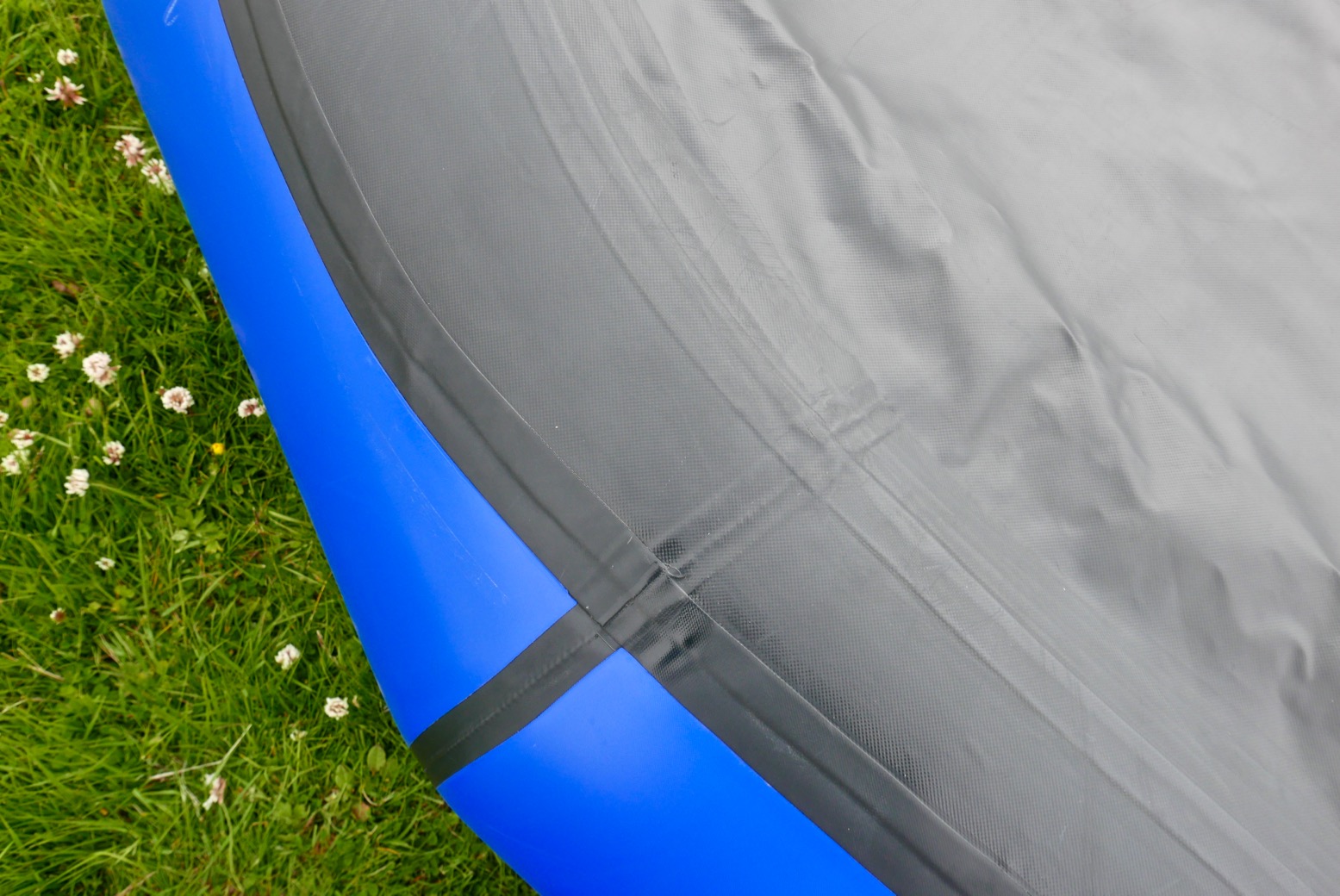
At 840D double-coated, the chunky floor does not spare the grams either and has a generous, 4-inch glued overlap with the hull tubes. The tidiness of all the taped heat-welded seams matches my own Yak which you’d assume is a standard to match. Either packrafts are dead easy to assemble once you have a system and training, or factories have worked out how to reliably manufacture them without any distortions which I’m sure I’d end up with if they handed me some scissors and a heat gun.
On the water Too much work meant plans for an overnight trip got shelved, but what I was more interested in was how it handled as a double. We nipped out one evening to try the EX for size. I assumed that my 92kgs would be best sat at the back but with the standard position of the laced-in front seat there was more room for me up front. The much lighter and one-foot shorter g-friend snagged the proper back support at the stern, but looking at photos of both of paddling it (below), the boat floated perfectly level with this arrangement which must be right. Up front my crossed ankles tucked under the bow comfortably enough but once inflated, the back rest felt squidgy and unsupportive. When deflated it made more room and less squidge but put me off the back edge of the seat pad which, as said, was too much hassle to move back.
I also realised that with my weight pressing down the centre of the boat, the floor sagged so that even after fully inflating the ~4-inch thick seat, I was still probably sitting level with my heels – not really a sustainable paddling posture. Sat low also made it initially awkward to clear the near metre-wide sides with my 230-cm paddle until I adjusted the technique. At the back the g-friend with a 220-cm stick was also not always getting a clean draw. Depending on your height, I’d say a 220-cm paddle would be a minimum for this wide boat, but see below. It didn’t take long before the pool-toy hoon in me wanted to see ‘what’ll it do’ [mister]. A couple of flat-out bursts recorded a brief high of 4.3mph, with a much more sustainable 3–3.5mph in the near flat calm conditions. Even two-up, in a paddle boat max speed is determined by the hull shape which soon hits a wall. I snatched a 4.2mph paddling alone sat in the middle. But of course with the shared effort, two of you can sustain cruising for longer or with less cumulative fatigue. We’re not much faster in my twice-as-long Seawave, though the paddling effort is much less as that thing glides like no packraft ever will. As expected, the length of the EX allied with the action of two paddlers pretty much eliminated any distracting yawing at the bow common to packrafts paddled solo and without extended sterns. Tracking (maintaining a heading) was easiest with me adding steering input from the front, though I think it’s more normally done by the rear paddler.
We both briefly tried paddling solo in both positions. You’d expect less yawing with me sat in the middle of the boat and I suppose that was the case, but it sure was nice to stretch out for a change. This long boat won’t be so manoeuvrable in white water; shorter, more agile packrafts are available for that, with decks or even self-bailing floor.
Next evening we set off for the ox-blood red sandstone cliffs on Rubha Dunan below Achiltibuie township.
All was calm but I took the sail on the off-chance and on getting in after a damn good tempering, I slotted it under my seatpad for more support. Good idea! It raised me a couple of inches into an efficient paddling posture and the whole boat felt transformed. I’d topped up the air with all I had and have to say on the water the EX was surprisingly stiff for its length which must be helped by the relatively thick fabric. Despite being nearly 3 metres long this is no soggy slackraft.
The warm weather had brought in swathes of dying jelly fish which was a reminder we were in a single-chambered boat about a millimetre thick. If a seal mistook it for a tasty blue sea-pastille all we’d have is our pfds and the seat pieces. It’s all in the mind of course, but out on the water in an untried packraft you can feel vulnerable so I kept close to the shore. There’s more to look at here anyway, but things like a thick floor and double-sided hull were reassuring.
We found ourselves rounding the point sooner than expected so decided to paddle back the way we came and on along the beach towards the hostel, before hopping out, rolling up it and walking back to the car.
The EX280 is a spacious solo boat with heaps of room for easily stashing gear accessibly on the floor, so improving visibility. And it has buoyancy to spare if you also want to lash a bike across the bow without jabbing your shin on the pedals or oily chainrings. (I felt rather cramped bikerafting in my Yak the one time). Solo, I’d consider setting up a proper seat midway between the two as they are now to centralise my weight more like a kayak; if you have the room why not use it
As a double it makes a fun rec boat that’s surprisingly nippy for a packraft, helped by negligible yawing. The width means you want to pump those seats right up and consider a floor pad below to add height for adequate paddle clearance over the sides. At nearly a metre wide, there is stability to spare. And for day-long use the front paddler would benefit from the better support of a back band, as mentioned above.
Alternatives include Alpacka’s Explorer 42 available in the UK from £995 but 23cm shorter inside, their interesting Gnu (from £1180 but discontinued in 2018) with a longitudinal seat tube for two to straddle, or a solo canoe seat bench, both giving good height to get over the 101.5-cm width. Then at the Packrafting Store in Germany from €800 to €1270 you have the very light Sigma TX (160cm internal); MRS Adventure X2 (170cm) and the Kokopelli Twain (225cm) and Barracuda R2 (215cm); these later two look like they have enough room to uncross the legs.
So at £550 with two-week returns and a year’s warranty on workmanship, the Longshore EX280 is a well-made and robust packraft which is amazingly good value and available in the UK. It’s suited to two paddlers with an average height of 5′ 6″, or solo paddlers with heavier payloads who don’t mind carrying nearly 2kg over the absolute lightest alternatives.
Thanks to Tim at Longshore for supplying the test boat.
See also… The intriguing new 5-kilo, hybrid decked, 2.9-metre MRSNomad S1 ‘pakayakraft’. Kakraft or snackraft? Click and learn.
The Anfibio Packrafting Store in Germany was one of the first Alpacka dealers in Europe, but now sells other brands of packrafts from China, Russia and the US. It’s probably the only ‘packrafting supermarket’ of its kind and in 2015 we group tested a selection of their boats.
They also produce their own Anfibio branded packrafting gear, like the dry suit and inflatable jacket I use myself; the latter has become my go-to ‘pfd’ for tame paddles. In cooperation with MRS in China whose boats they were the first to import into Europe and whose design they’ve influenced, they’ve now added three lightweight Anfibio packrafts to their lineup of over a dozen boats: the Sigma TX double; Delta MX single and smallest and lightest Alpha XC which we tested here. I knew the XC would be too small for me so that job went to my g-friend who’s over a foot shorter and 40+ kilos lighter. It costs just €470 plus one type of seat or another.
Alpha symmetry In a bid to keep costs down and make them the lightest in their class, Anfibios are all symmetrical, with identical bows and sterns and parallel sides. Unless it’s like their double-elongated Barracuda R2, a conventionally short stern can make a boat back-heavy without a balancing load over the bow, as right. Even my original, first-generation green Alpacka Llama had a fattened stern to compensate for this.
This is why Alpacka’s now much-copied elongated stern from 2011 (my 2014 Yak, left) was such a clever innovation. It trimmed (‘levelled’) the boat by effectively positioning the paddler more centrally, and also acted as a skeg to further reduce the side-to-side yawing of the bow which short, wide packrafts are prone to. (It’s important to recognise this yawing is just an annoying left and right ‘nodding’ of the bow; people often confuse it with tracking (‘steering’ or going where you point it) which packrafts do better than some kayaks.
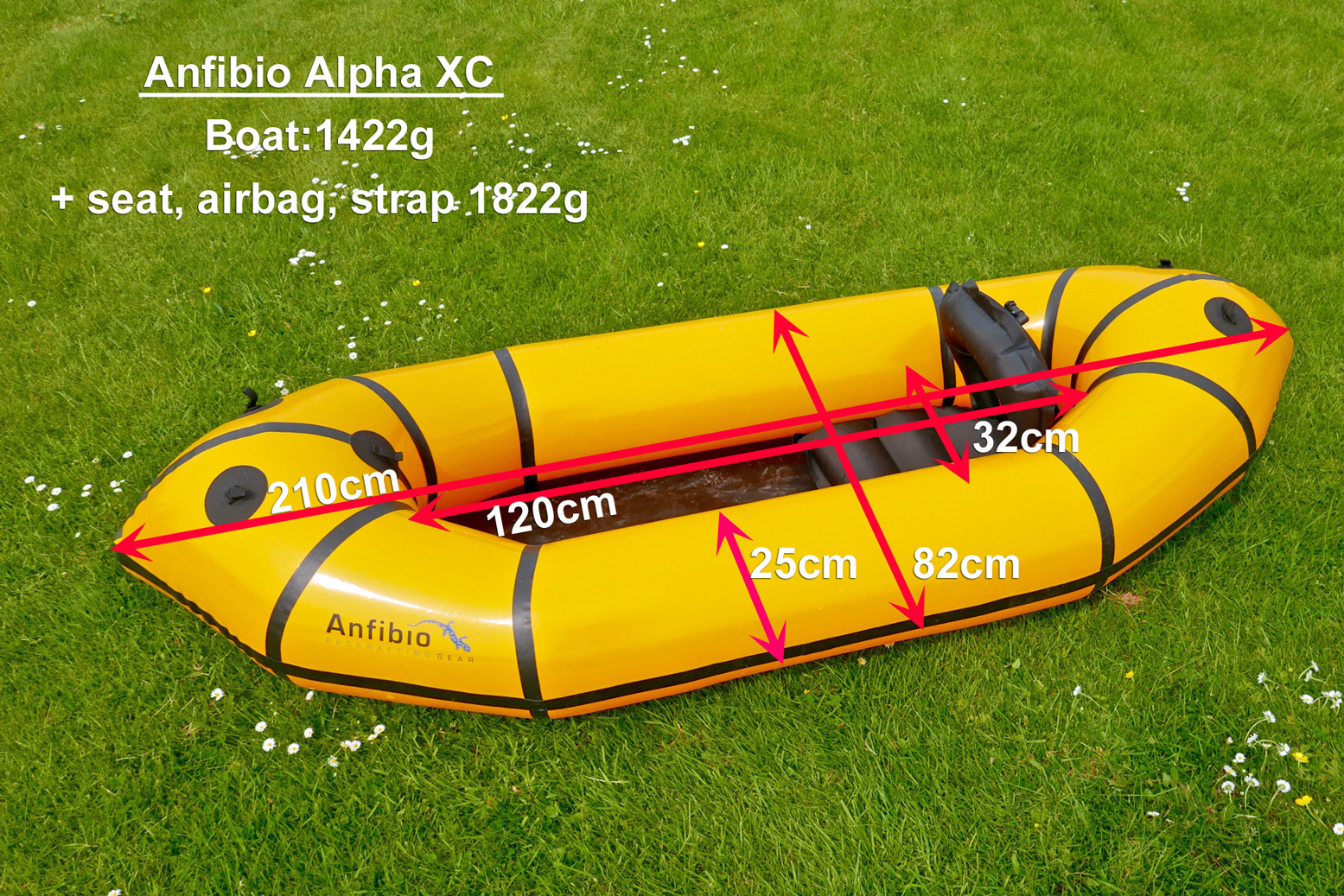
Weights and measures ** After verifying the kitchen scales (1000ml = 1000g: √) the Alpha weighed in at 1822g out of the box; the bare boat was 1422g. Interestingly, at 120cm the interior length is actually a bit more than my Alpacka Yak. At 185cm tall, I can sit in the Alpha with backrest deflated and with the same comfortable knee-bend as my Yak. Meanwhile, with legs flat on the floor, g-friend has some 15cm of foot room to spare up front.
Anfibio have missed a trick here. Assuming I’m at the upper level of average adult height and weight, and geef is at the other end, I think Anfibio could offer another model 10 or even 20cm shorter, more like Alpacka’s ultrabasic Scout (left); let’s call it an Omega XS. There are many, many packrafts for people of my height or more, but very few for 5-footers if you take the view as I do, that in a packraft you want to fit snugly, feet pressing against the bow with knees slightly bent. Being shorter would make the ‘Omega’ at least 200g lighter and enable that snug fitting for the majority of shorter-than-me persons. Like a shoe that fits right, that means better control, comfort and efficiency and is one reason I choose to replace my original Llama with the shorter Yak.
Too many pies?
Perhaps there are buoyancy issues in such a short boat which means tubes need to be fatter, speed suffers and you effectively end up in a slackraft. You don’t want that. The 25-cm side tubes are the slimmest of the Store’s dozen-plus boats, but we both found the 32cm interior width, a bit tight for comfort. Slimmer hipped individuals will feel right at home. All this doubtless carefully juggled volume, length and width adds up to a recommended payload rating of just 110kg. That’s plenty for most folks who are lighter than me. The next-size-up Anfibio Delta MX weighs only another 225g but is rated at a massive 180kg.
**May not all match Anfibio’s figures
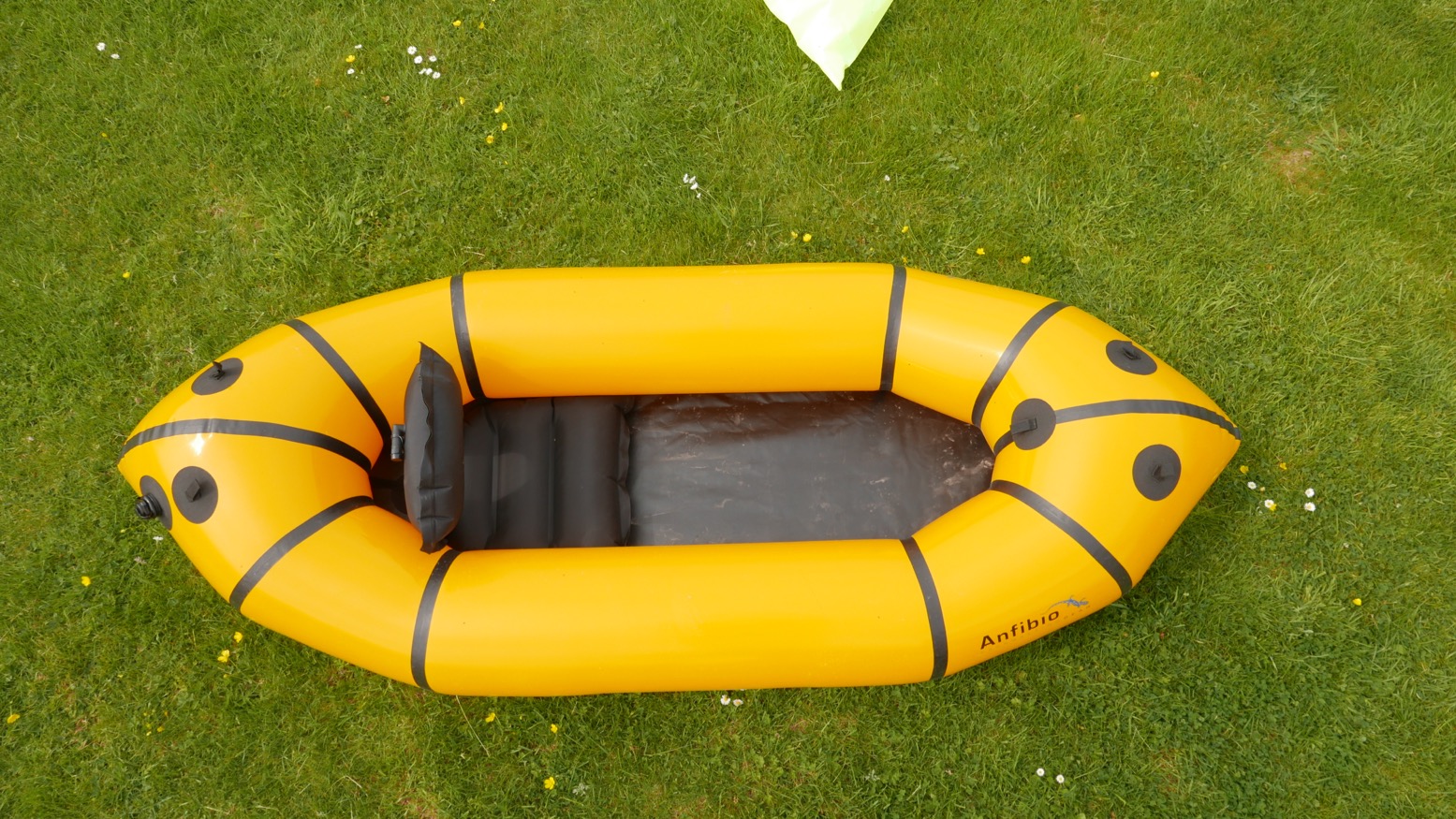
The hull is made from the 210D, single-coated TPU, sewn and heat welded (no glue). Most packrafts are made from this wonder fabric. I think the slight translucence of the yellow Alpha makes it appear thinner than my Alpacka Yak, but feeling the fabrics up, they’re very similar. You’ll notice that, unusually, the taped join of the tubes is around the perimeter of the boat, not hidden under where the floor attaches to the hull.
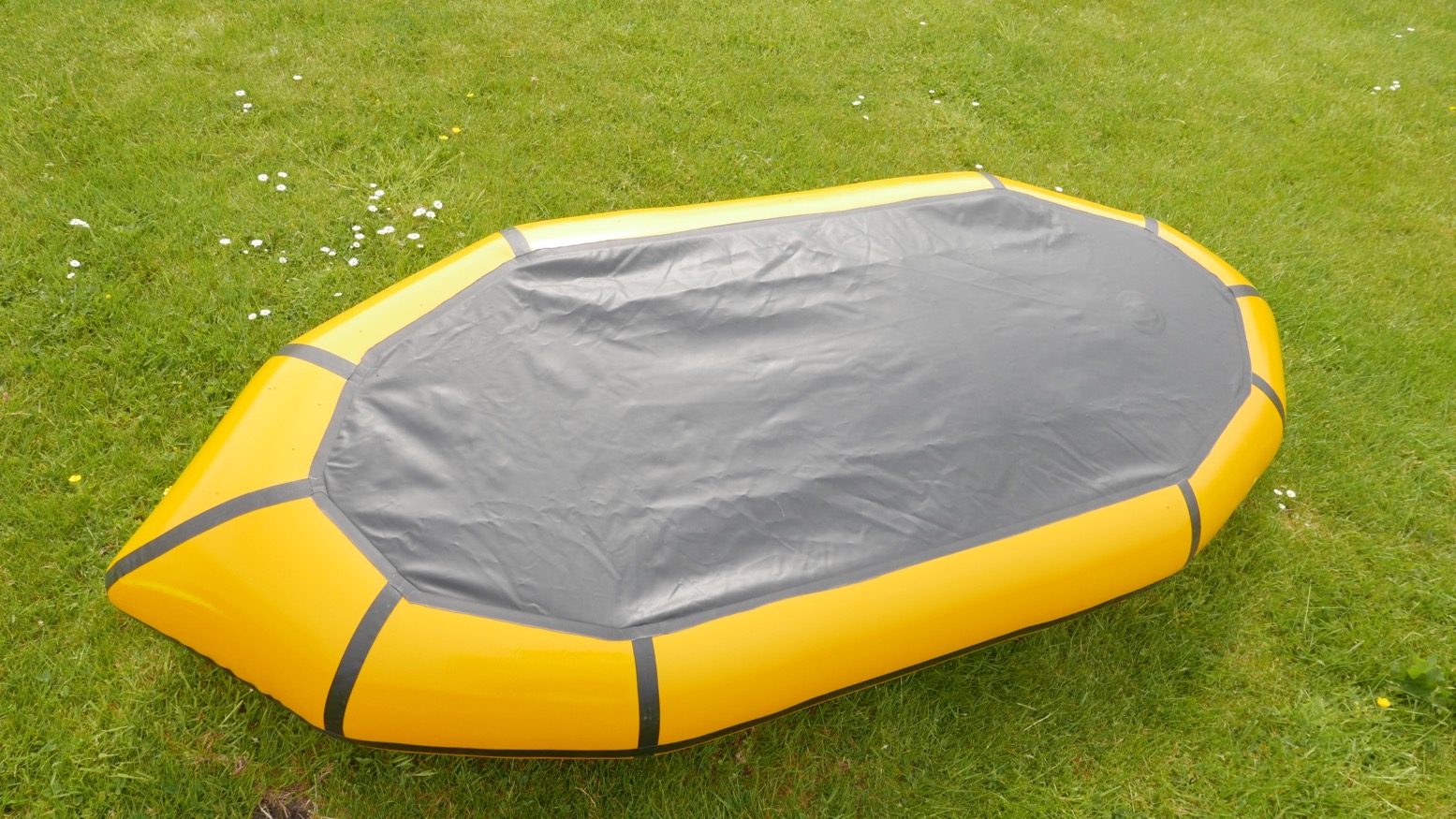
The floor is smooth, double-coated 420D TPU and feels tough without making the boat bulky when rolled up. The width of the heat-welding attaching it to the hull is little more than a centimetre in places. Perhaps putting the side tube join elsewhere eliminates a weak spot at the floor and reduces the need for excessive overlap, as with the 8cm on my Yak or the Longshore. As it is, we’re assured that TPU hull fabric will tear before a properly heat-welded join separates, but as with any packraft, I’d be careful putting too much pressure on the floor. “Get in bum first!” I had to remind my tester.
Fittings and finish The Alpha comes with 5 taped loops with a pleasing textured Cordura finish to the patches. As other reviewers and the commenter below have mentioned, the three on the bow look too close together to securely lash down a load, far less a bike; the ‘triangle’ is too small and positioned over the domed bow. I also feel the fitting points are the wrong way round: you want the single central point at the front and the other two behind on the next panel back. Glue two here and you’ll have a stable, 4-point lashing base with another tab to spare. I don’t really see the value of attachment points on the already over-loaded stern of a packraft, especially when it’s not elongated. I’d sooner load stuff centrally, under my knees and have a single loop here to hang shoes off or for towing.
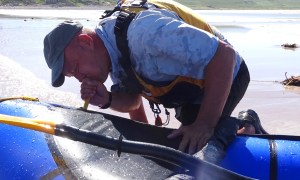
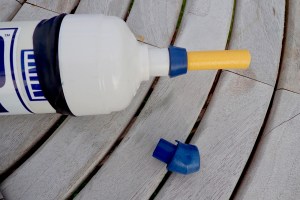
The inflation valve follows MRS’ innovation in fitting a Boston valve as commonly found on cheap Slackrafts (about the only useful thing on them). For a short, low-pressure boat like a packraft (as opposed to an IK) Boston valves are ideal. A Boston valve has two caps; the bigger one opens the main port for fast inflation / deflation. On top of that is a smaller square cap; unscrew that to access the one-way mushroom/flap valve and top-up the boat by mouth. Both caps also have nifty swivelling attachment collars so you can’t lose them while also making the caps easy to turn. The whole set-up is so much better than my old-Alpacka style dump valve which you need to secure with a line which gets in the way as you try and quickly screw it up. It also eliminates the separate twist-lock elbow valve which never felt that solid and being small bore, are harder to blow through and get a good fill, unlike the 2cm-wide Boston. The supplied air inflation bag (see video here) is a denier or two up on my flimsy Yak one which I often think is on the verge of ripping apart. I also like the fact that it’s a bright dayglo green; you never know when you might need a signalling device.
The seat resembles an old-style Alpacka base with backrest, except that it cleverly attaches to the back of the floor with a single adjustable strap and buckle. Simple and effective; that is all that is needed to keep the light seat in place compared to my Yak’s OTT arrangement. You also suspect that the length of this strap may have been designed to enable a shorter paddler to position the seat a little forward so as to shove a bag behind it (below). Doing this centralises their weight and helps level off the trim to reduce yawing. We tried this idea on the water – see below.
One thing I recall of a similar seat on my old Llama was the annoyance of the backrest flopping forward every time I got in (an elastic fixed that). Taller Alpha XC paddlers: consider saving €34 by ordering the plain seat base and simply lean on the back of the boat instead of using the €59 backrest version. That’s what I did briefly paddling the Alpha and it felt fine.
As for build quality. With only my 2014 Alpacka to compare, all the taping and fitments are as neatly applied. The lack of tape over the floor panel join exposes a slightly uneven cut in places and, as mentioned, the welded band interface looked rather slim. As a result of all this weight saving the Store rates the Alpha’s durability accordingly, but it’s unlikely they’ve gone too far as Alpacka may have done with their short-lived Ghost. Yes but what about the strap, you ask? Well that weighs in at 22g but is a good half-a-metre longer than it needs to be to cinch the rolled-up bundle (below), so some weight could be saved by snipping it.
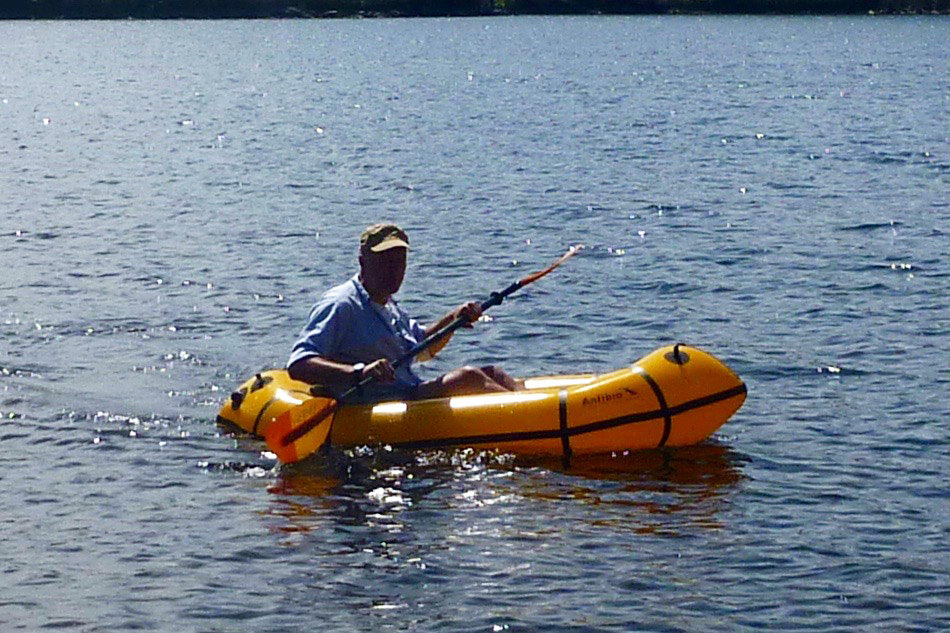
On the water With light winds forecast, we picked an easy circuit with about 4km of loch paddling and a couple of short portages where we could carry the inflated boats. We often paddle together in the Seawave but I’m not sure if the g-friend has paddled a packraft since a quick go in my Llama back in 2010. So this would be a good test on how a beginner handled the Alpha.
Once the Alpha was inflated, geef went out for a spin to get a feel for the boat, then came back and went out again with my empty Chattooga dry bag behind the seat back (this bag seals 100% against air leakage – a true ‘dry bag’). No surprise: she yawed less and felt more in control sat more centrally.
With another bag of stuff under her knees the boat sat almost level. Watching her paddle she still looked a bit low in the boat which interfered with a good paddling technique, so we pulled over and pumped the seat right up and I advised trying a high-angle paddling to clear the sides and get a fuller draw from the blades. As it is, on flat water no packraft is actually that satisfying to paddle – unlike a slick kayak there is no glide. The fun lies in the places they can reach and the ease of getting them there.
We emerged onto the west end of Sionascaig loch (above) surrounded by the dramatic mountains of the Assynt, and turned south for the sluice. Being thorough, we tried sat right back without the bag one more time, but got the same high-bow yawing. Even with the bag I still observed some yawing, but as it was intermittent it could be down to my test pilot’s as yet unrefined packraft paddling knack, just as it can be trying to get a hardshell to go straight the first few times. Yawing is not tracking – this boat will go where you point it, but you’d imagine pivoting is inefficient. A bit like moving off from standstill on a bicycle, my Yak also yaws wildly as I set off, but settles down once there’s some directional momentum, nodding maybe six inches left and right.
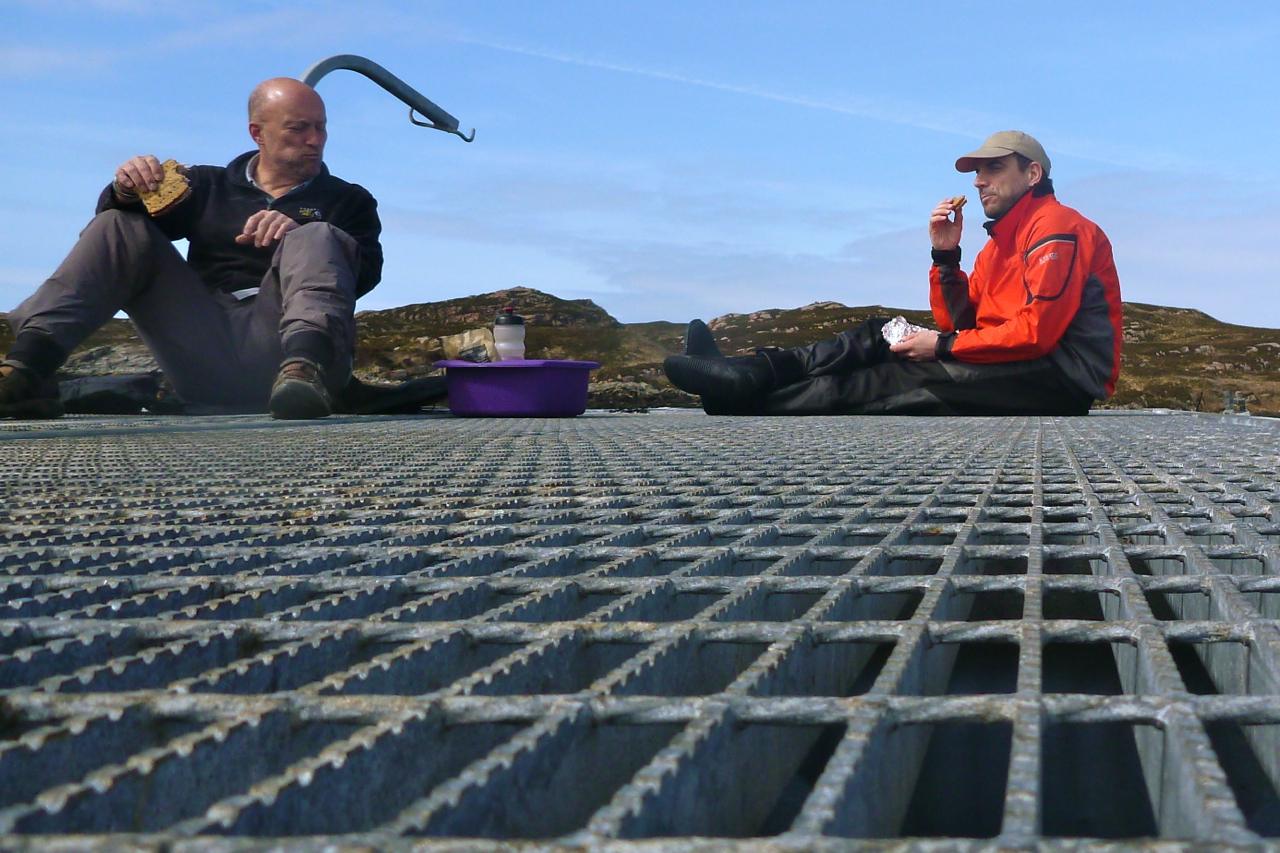
We clambered around the sluice (above) and sat down on a tiny beach below for a snack, then I went out for a quick spin in the Alpha. At nearly twice the weight and of course without the dry bag behind, the boat was back heavy and very easy to spin. A light breeze was now blowing little wavelettes up the loch and powering on too hard, it shipped a little water over the back sides.
I reached back and felt the horizontal tape line was below the water, but the Alpha was nowhere near as edgy as the Supai Flatwater Canyon II in which I dared not even breath in too fast. Yes it yawed more than my Yak but long, smooth strokes minimise that. I’d be more concerned in less calm water, but then I’m clearly on the weight limit for the Alpha. I probably could have done this whole circuit in it but it would have not conducive to relaxation.
Through the shallow narrows we passed, arriving at the next ‘sluice’ at the end of the loch. It’s actually a runable two-foot drop if you take it fast. Like last time I came here, I wondered about trying it for fun, but chickened out. Beyond the pool below it becomes steep, narrow burn dropping to the next loch. So we tramped through the springy heather made crisp by over a fortnight without rain. We chucked the boats over a nasty wire fence then set off across the last little loch and the short walk back to the car.
Bravo Alpha Being a large person, the benefits of saving a kilo or two add up to not much in my overall packrafting mass. Therefore I don’t resent the weight of my Yak for its benefits in durability and functionality. But not everyone thinks like me. Adventure racers, canyoneers and something called ‘fast-packers’ focused on absolute minimal weights while undertaking short or easy crossings will love this boat. So too might a travelling cyclist or a light person who just wants a handy, inexpensive packraft for the odd evening splashabout rather than an expedition-ready heavy hauler. The yawing is something you can minimise with good technique or balance-out with frontal loads or weight shifting, as we did. For the price of just €470 + seat, this must be the cheapest decent packraft around. No one likes excess weight but I know I’d feel more confident paddling a proper TPU packraft like the Alpha over Supai’s amazingly light but unnervingly skimpy alternatives The extra 700 grams I can save in peace of mind.
No doubt about it; since flogging my much-used Sunny in 2011, followed by a flawed experiment with a Feathecraft Java, I’ve become spoiled by high-pressure IKs like my fast Incept K40 (based on the Forelle’s design), the brick-hard but slower Grabner Amigo and my current lightly modified Seawave. Just 25-60% more pressure makes all the difference, especially once the boat gets usefully long.
I only had my K-Pump Mini to inflate the Forelle after its repair and mods. I’d hand-pumped it up as hard as I dared but was probably a bit too cautious to not over-stress the old trout. Getting in I was reminded of that uninspiring slackrafty squidginess. I should have topped it up after putting in the cold water, but anyway there’s no easy way to accurately check the pressure off lilo plugs (I tried jury-rigging my manometer). Presumably in the 70s the idea of using tough, one-way rafting valves on IKs hadn’t been thought of yet.
In this under-inflated state and with a slight breeze, tracking away from a headwind was tricky, though I knew that new boats require a quickly acquired knack. As expected, the crumpled keel strip didn’t really do much, perhaps that’s why the Forelle 2 came with a rudder mount. As you can see there’s some taco-ing (folding) going on below me – and this was before lunch! Without a skeg or a rudder such sagging won’t help good tracking either.
My over-pressure caution was understandable, but thinking it over, I decided the Semp was under-inflated. What this boat needed was a better pump. A couple of days later a £10 Sevylor stirrup pump turned up (I left my super-duper Bravo kite pump down south) and I whacked in what felt like Sunny pressures. With the position of the lilo tubes tucked under the stern cover, and the need to yank off the hose adaptor while pinching the tube to stop air escaping, and jam in the lilo plug, it’s a bit awkward. These plugs really do grip/seal well.
That’s another great thing with running calibrated PRVs on all chambers: you just pump away until they hiss and the boat is correctly inflated while being protected from over-pressure. No need for manometer faffing.
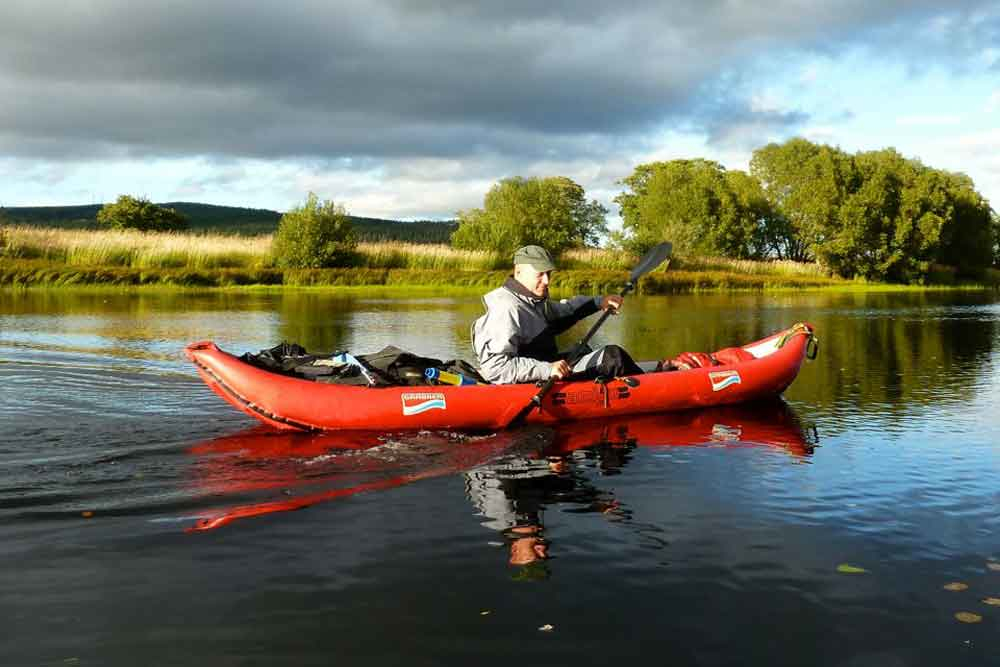
I am on Gumotex Seawave 2 and a while back had the InceptK40 for a year or more. IMO, these are still two of the best IKs around for sea kayaking and touring. Fast, stable and firm. Like my paddle with my former Grabner Amigo, a longer trip with a K40 also gave me a chance to reappraise the pros and cons of these two IKs. Gael’s red K40 is the same one I tested back in 2012.
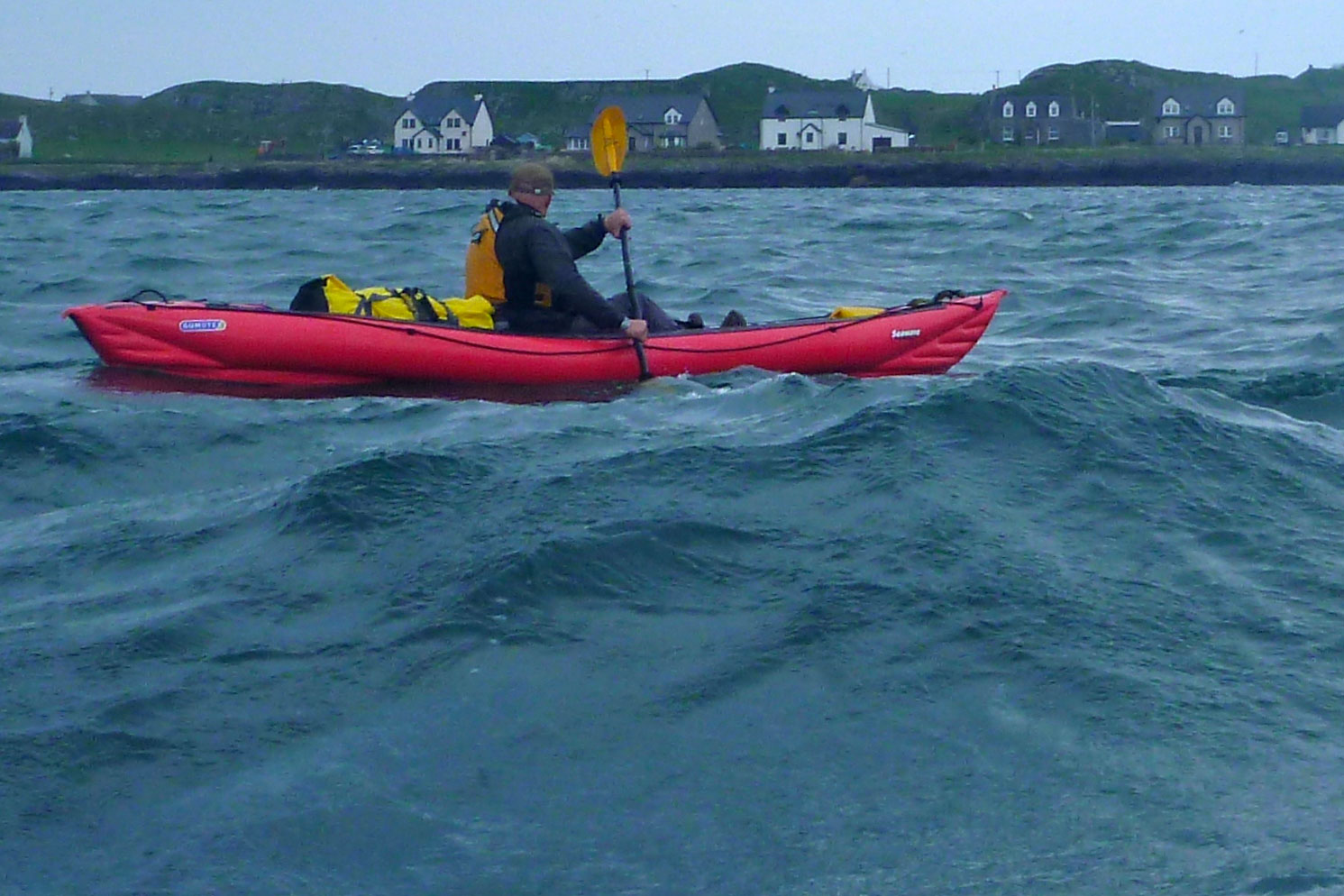
As you can see in this table, the Nitrilon Seawave is a little longer, quite a lot wider but less spacious inside. It claims a much greater payload, has space for up to 2.5 paddlers as well as fitting an optional fully removable deck and a fixed skeg with a rudder kit available.The K40 is made from a stiffer ‘PVC-urethane alloy’ fabric, has a zip-up/roll-back deck, a rudder and a single seat. The twin side-beam hull explains its slimness as well as the greater internal width. Both these IKs weigh around 17kg. Paddling with the K40 for a couple of days, it was a little faster than my Seawave. Gael’s K40 was loaded a little more heavily, but my added weight easily exceeded that. Both boats run similar pressures but the slimmer, stiffer fabric’d K40 had the advantage, even though it’s a shorter. Gael may also have a more efficient paddling technique, but overall we agreed that in the windy conditions we were experiencing, it was his rudder which made the difference when it came to maintaining steady progress.
Simply put, with a bit of rudder correction to compensate for winds pushing the boat off course, Gael could carry on paddling normally. At the same time, I had to correct my steering by pushing hard on the upwind arm and trailing the other to maintain a course, so I was only powering with one and a bit arms. This gave the K40 about 5–10 minutes over an hour, while also reducing – or at least balancing – paddling effort.
Seawave left, K40 right.
Running a Grabner Holiday, Gael is a rudder fan and thinks adding one to a Seawave would make it a perfect IK. Me, I wasn’t so sure the added complexity and risk of breakage was worth it, but I I talked myself into it. As long as my system is not like the Incept’s horribly mushy rudder actuation. It was less effort to paddle Gael’s K40, but pushing hard on the inflatable pedals was a bit like using a cushion for a steering wheel.
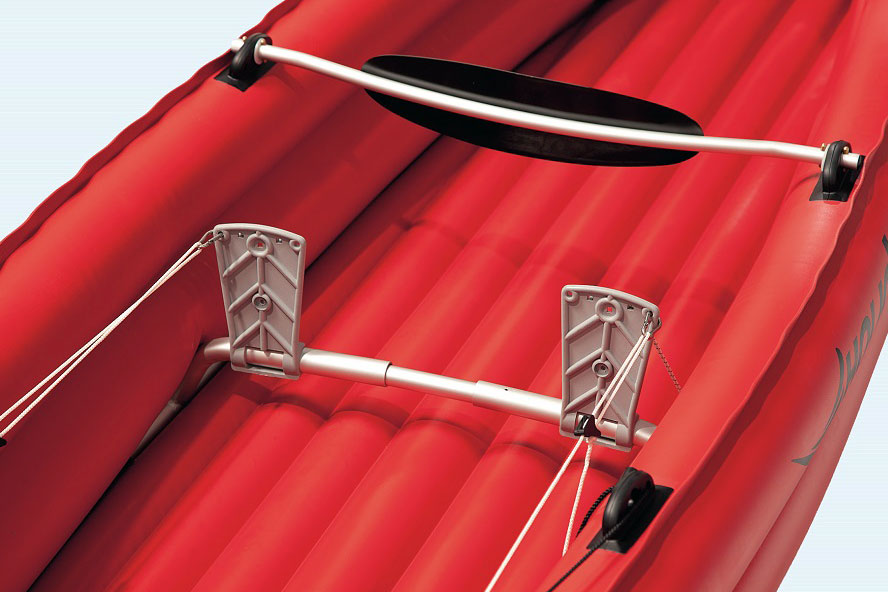
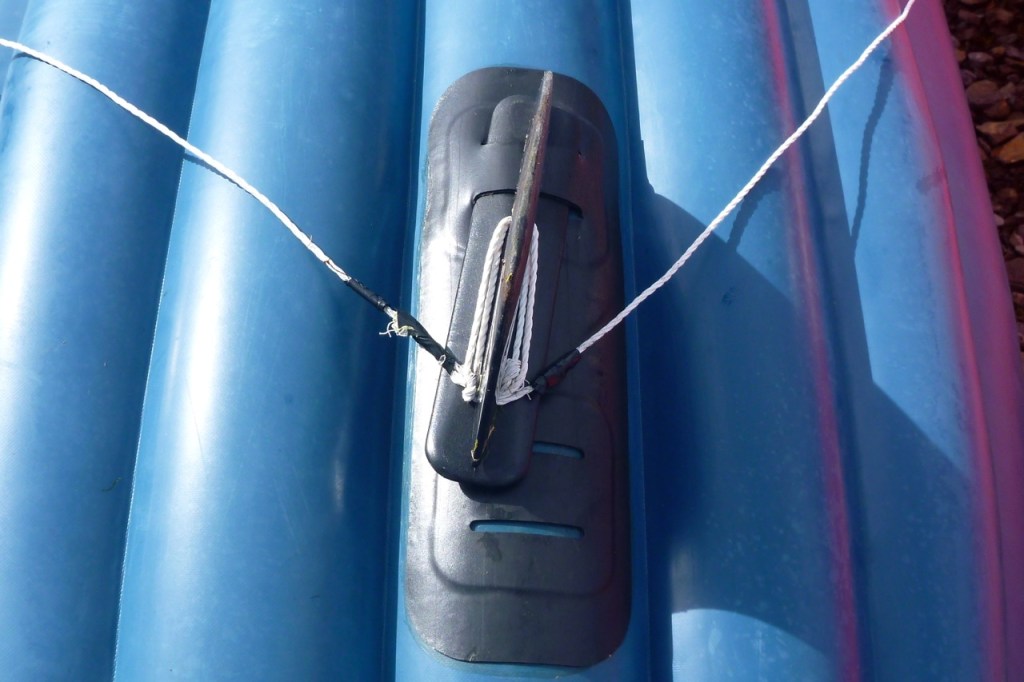
A great way to improve the K40 would be to fit something like Grabner plastic pedals pivoting on a rigid bar (below left). Or even a pivoting footrest tube (middle) as show here. The actual pivoting- and rudder-lifting mechanism at the back looks like a standard sea kayak arrangement with a rudder pin. We both agreed the K40’s generic hardshell rudder blade is too small or short for this boat when the seas get lumpy or the winds exceed F4. Maybe better to accept an IK’s limitations and not go out in those conditions, as I found once, though I’ve just remembered the hand-skeg-steering idea a visitor suggested to me: pivoting the half inserted Gumotex skeg using cords (right) to fix an angle against a steady wind.
Grabner rudder pedals
Pivoting footrest
Skeg hand trimming
Especially when loaded, my Seawave’s fixed skeg can be a bit of a pain at the shore. I don’t like the idea of the heavy IK pressing on the skeg so look for a rock, use my Pelicase or lean on the K40. But that’s all a small price to pay for the benefits the skeg brings at sea. I’ve thought of fitting a retracting/trailing skeg to get round this, but if I go that far I may as well install a rudder. Generic SoT rudders on eBay go for just 20 quid and could help review my dormant sailing experiments which I recalled fondly during the backwinds of Mull.
The other impression of the K40was the initial tippiness – yikes, it’s been a while since I’ve experienced that. In fact it soon went away and anyway, was helped by the thigh straps which again, I’m reminded, don’t snag the knees as securely as my set ups in the Amigo and Seawave – possibly because the front mount is too far forward (using the rudder pedal mounts). But then again, I should have adjusted the rudder-footrest towards me a good few inches. The Incept was also much more roomy thanks to the slim side tubes. That makes the thigh straps more important, and I actually missed the packraft-like jammed-in feeling between my Gumotex’s fat side tubes. The seat didn’t feel as comfy and secure as the packraft/SoT set up on my Seawave, and all-in-all I felt a bit out of sorts in the Incept which helped me realise how well my Seawave is suited to my sort of paddling. About time; it’s taken a few IKs to get there.
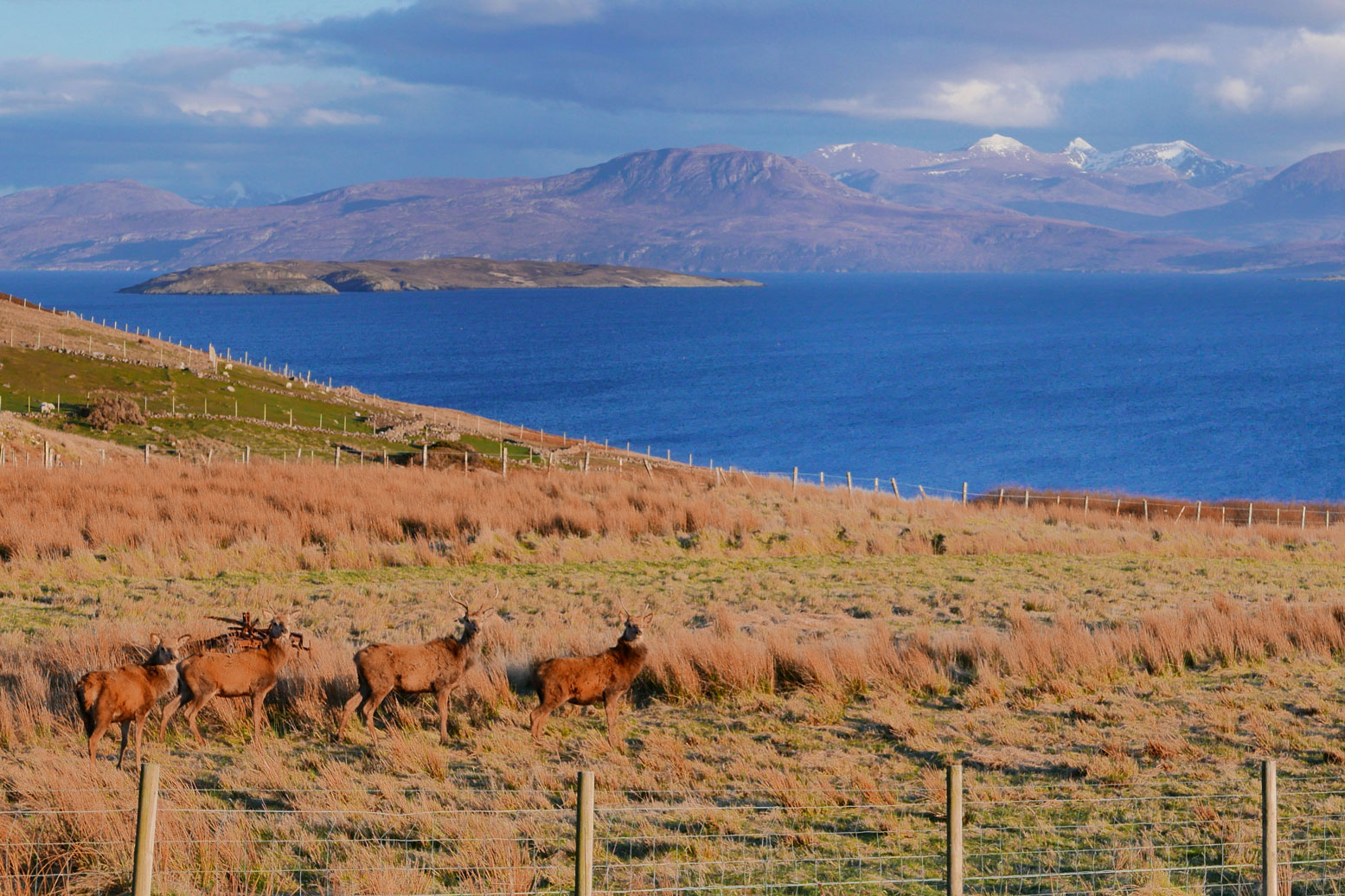
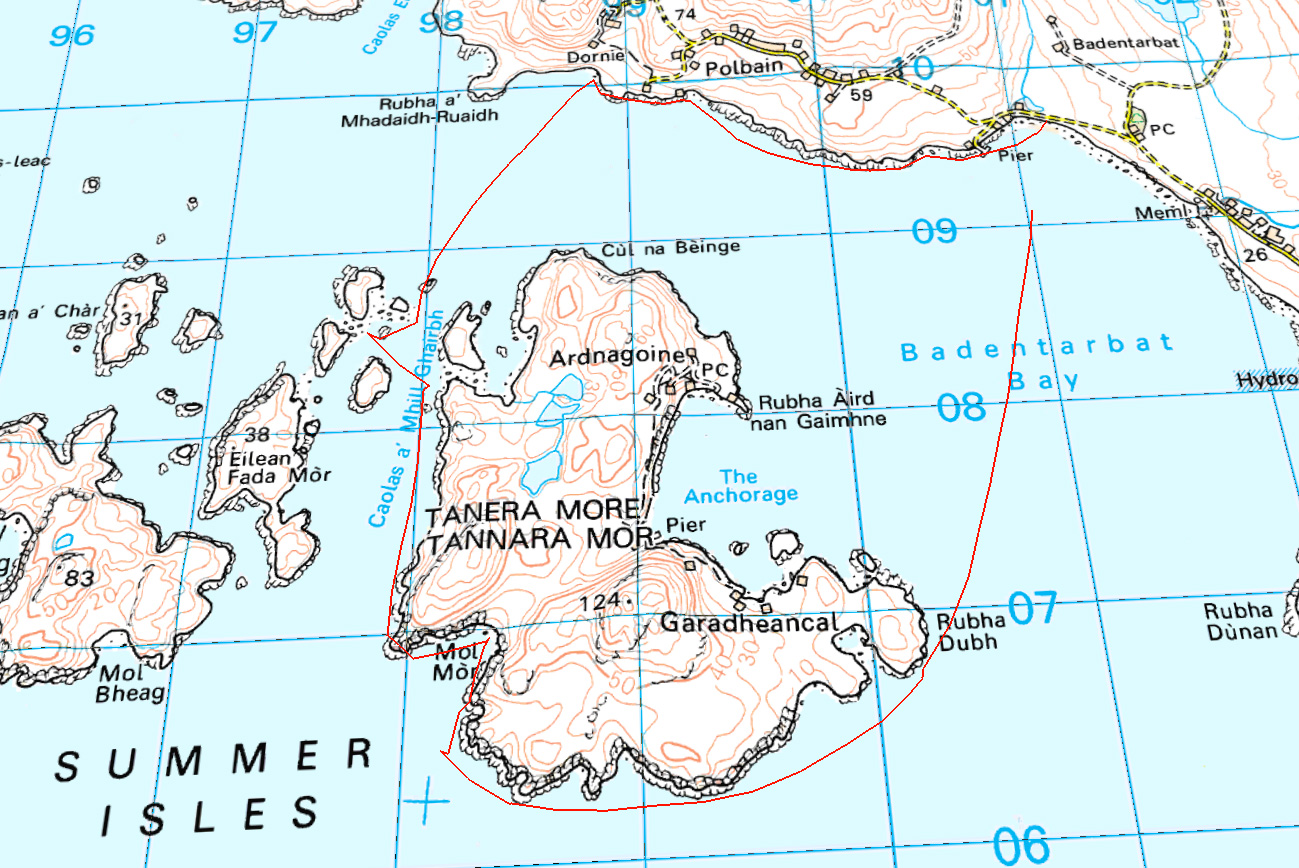
First paddle of the season, although it’s still far from spring-like. The last few days snow has been blanketing the Torridons (left), the Assynts and even BM Coigach (above). But after three days of howling, the winds abated and Jon and I went for a spin round Tanera Mor. I remember first time I did that in the new K40 it felt like an expedition. This time with two of us it was just a jaunt to get the old shoulders cranking again.
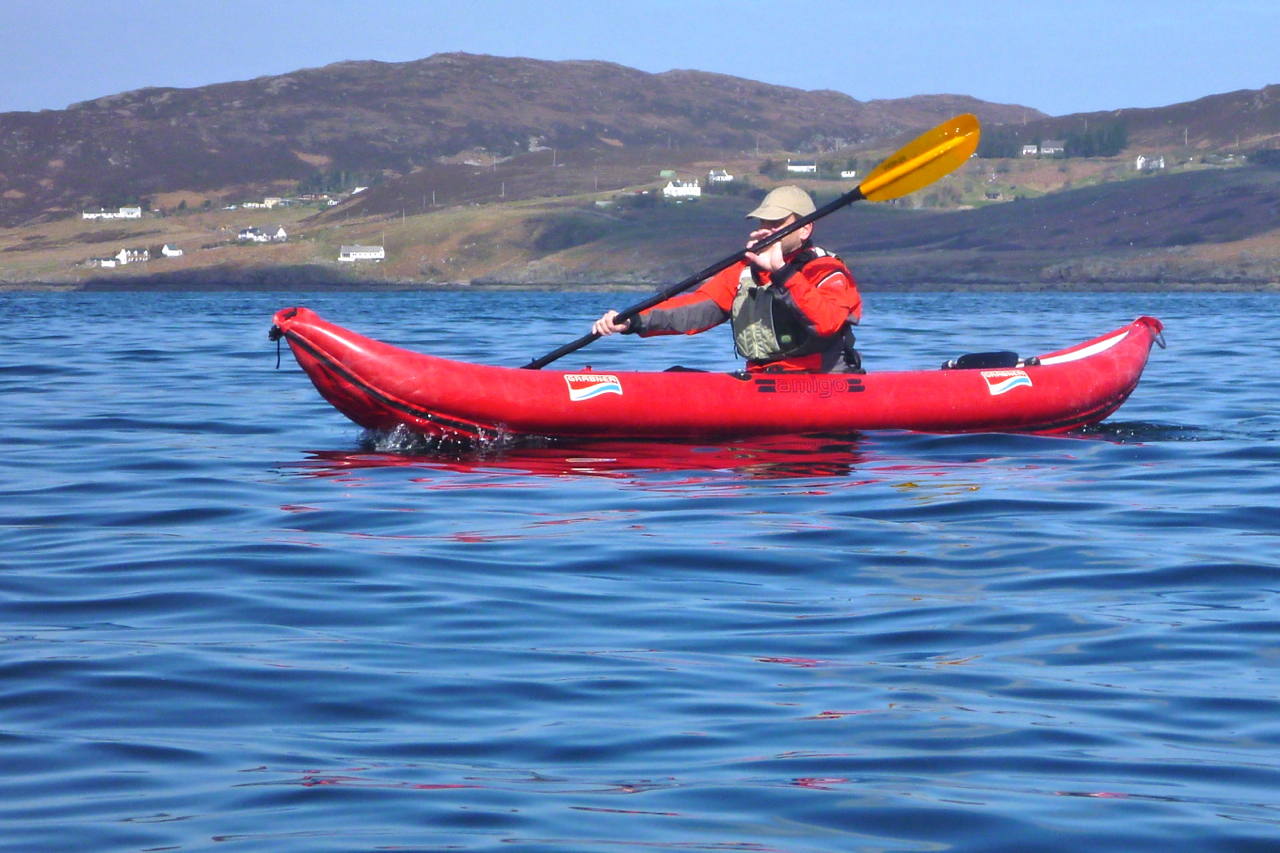
Jon bought my previous IK, a Grabner Amigo, but had yet to use it, so this was a chance to compare it with my current Seawave. I sold the Amigo after a run out to Bottle Island when it dawned on me it literally wasn’t cut out to be a swift sea kayak. Still, I managed a pretty good tour of the Slate Islands that year with the Amigo.
Off Badentarbet beach heading for Rubha Dubh-Dubh, Jon was notably slower in the Grabner. For a moment I felt a bit bad – Jeez, did I really sell him such a dud? I’m sure it wasn’t that bad. It was only later when we swapped boats and were more of less evenly matched, that it transpired years of paddling slick, hydro-dynamically efficient hardshells had had a catastrophic effect on Jon’s pulling power. Either that, or a winter’s pushbike training had similarly atrophied his arms, giving him the physique of a T Rex.
Still, it was good to break the arms in gently, and before we knew it we were turning back northwest for the Tabera channel. With the tide bottomed out, we had lunch on a fish farm platform to the sound of salmon skimming and thrashing up non-existent rapids to their blue remembered breeding grounds. With that sort of daily exercise, at least they won’t end up like T Rexes. From here I rowed the Amigo back. Sure, the flat nose was more snow plough than arrow-like bow, but you’ve got to admire the Grabner’s solid, no-nonsense build. PRVs? Kiss mein schkegg!
Proper seat and attachment points? Opzional, Freund. And compared to the slight flex I noticed in the Seawave – even at .25 bar all round – the 0.3 bar and 750-cm shorter Amigo was as stiff as a stretcher.
As before, the seat-bar mounts caught my fingers as I paddled, but Jon found similar protuberances on the Gumboat. The bomb-proof Amigo would make a great river touring boat: tough as nails, upswept ends to ride over whitewater and as stable as any IK – though the upswept stern might be a backwind catcher when running skeg-free, as I did on the shallow Spey one time (left).
All in all though, living as I occasionally do by better sea than big, boaty rivers, the Seawave works for me, even at just half an mph faster. The price new was about the same, but there were a lot more extras with the Gumotex, including a deck (I never use). I gave the OE seats away with the Amigo and made a lightweight and q/d seating arrangement which I’ve adopted on the Seawave: a packraft seat base, SoT backrest plus packraft thigh straps and my patented elasto-cantilevered drainpipe footrest (left). Read all about them here.
I had a visit from former Olympic slalom trainer and canoeist Jim the other day. He bought a Solar 410C after browsing IK&P and declares it one of his favourite boats. I ran the previous version Sunny for years before I felt I’d squeezed all the potential from it and started changing IKs every year. The Sunny was a tough do-it-all boat and the 410 is the same, but 20cm longer. It was more space but also the greater rigidity of higher-pressure boats I was after.
We were hoping to go out for splish-splosh but for the last few days a cold offshore F4-5 northerly has been spinning off a North Atlantic High and bearing down on the Summers so games are off. Right now the chilling drizzle is nearly horizontal as it blows past the window. Oh hold on, it’s gone sunny now. Is it autumn already?
The 3-seat, 410cm Solar went for as little as £550 in the UK or up to £100 less from Boatpark in Czech when on special. Both do free delivery anywhere. The Seawave costs about half as much again. The 410 is a foot shorter than my Seawave, an inch wider maybe, less slim and pointy at the ends and runs 0.2 bar/3 psi compared to my Seawave’s 0.25 (I run my Seawave sides at 0.33/4.8psi). The old style Nitrilon is thicker so the weight’s the same at 17kg, maybe less with one seat. The Seawave has a bit of a more pronounced keel rib along the middle too, but neither struggle to track without a skeg. It’s just that a skeg enables you to spend less time and effort correcting and so you can power on. Handy at sea, less essential in flowing rivers.
Jim showed me an interesting mod to make his skeg into a rudder to enable paddling into steady winds. By simply not fitting the back of the skeg into the sleeve, he’s able to pivot it off the front and modify the angle with a bit of string attached to the back of his seat (right). No probs with the skeg sliding out and if it does on a rock, chances are you’ll be close to shore and the boat won’t exactly become suddenly uncontrollable anyway.
I usually deal with quartering – ’10 or 2 o’clock’ – headwinds by just pulling harder on one arm, leaning into the wind or repositioning the paddle in my hands longer on the leeward side. I rather lost faith in rudders on the Incept in Australia when it was maddeningly ineffective in controlling the boat in strong backwinds, although I fitted one on the Seawave in the end. But without all the foot control faffery this could be a simple, non-permanent mod to any Gumboat which runs the robust, slip-in black skeg. And unlike my Incept rudder, it won’t come out of the water and be ineffective on steep backwaves.
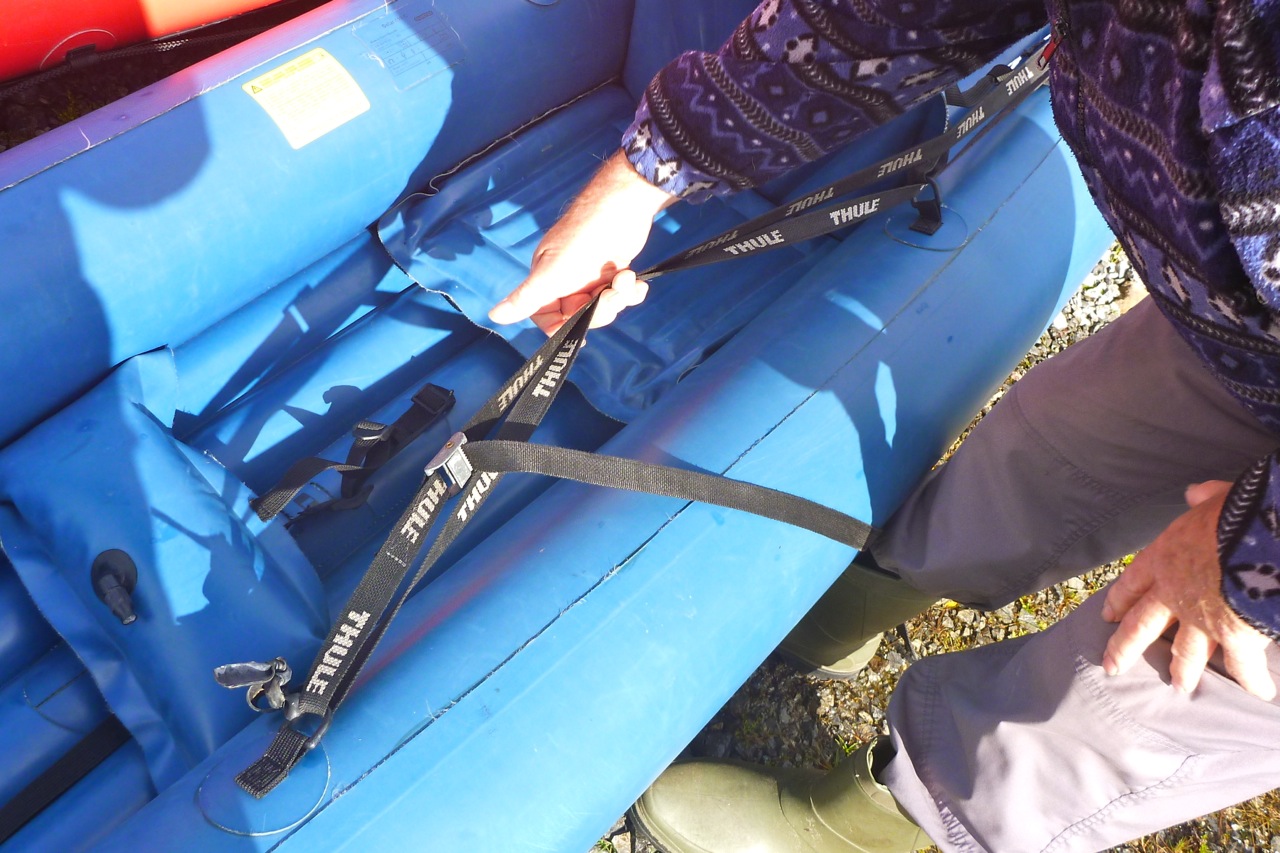
He also showed me a way of simply rigging up his roof rack tie-downs into thin knee braces (left). Like me, Jim agrees they’re a great benefit to paddling efficiency in an otherwise unbraced IK. I have some Packrafting Store ones on the Seawave – a lot lighter than my old SoT braces. And he also said he’s successfully tried an idea I thought of in my Sunny days, but never tried: hull rigidity rods to make the long but low-pressure boat flex less. Either two on the sides which requires gluing fixtures to work best, or as he’s found, simply putting a thick broomstick or whatever under the seat in the middle of the boat



























































 Inflatable Kayaks & Packrafts