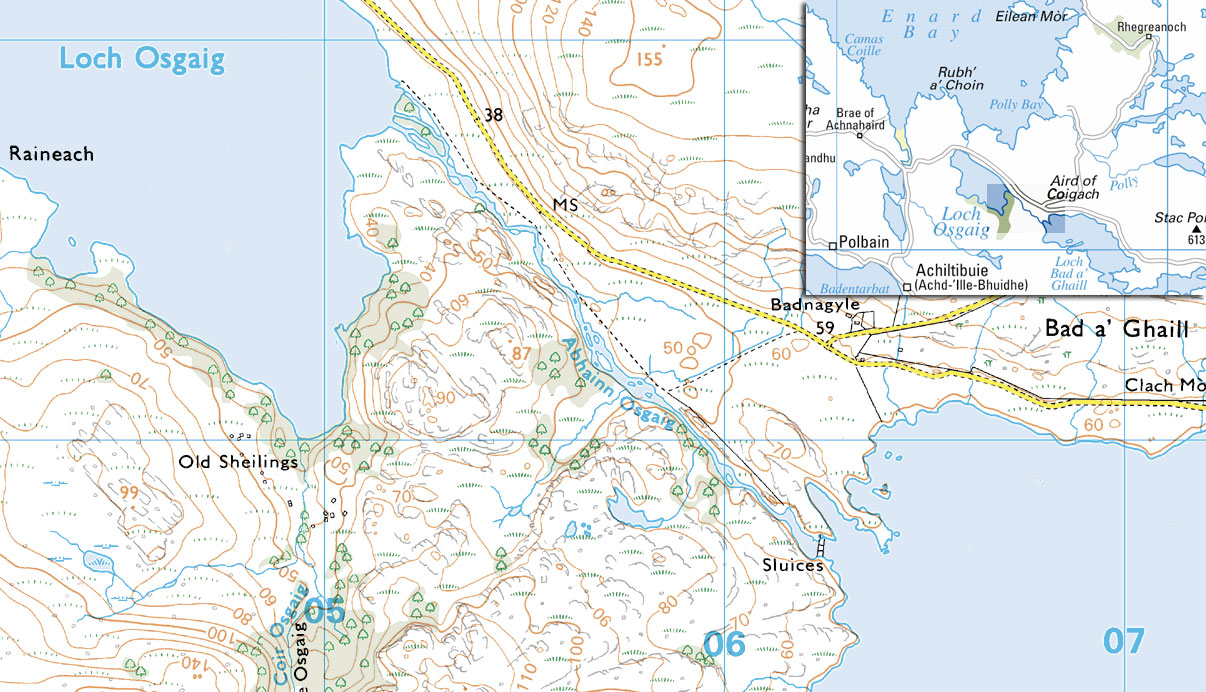
Don’t get excited, we’re talking a few hundred metres of Class 1.1, but that’s as good as it gets around here. We’ve had a lot of rain in the last week, enough to make the only paddleable river – the short Osgaig – worth a poke with a paddle. I was here with the Yak last year at slightly lower levels, so this time was expecting a smoother run in the Solar (now with an improved seat-foot set up), followed immediately by a comparison run in the Alpacka Yak.
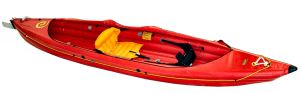
Gumotex Solar IK The good thing with the Solar is it’s old, worth next to nothing but tough, so can be dragged like a hardshell with the Yak in the back. I considered jury rigging some thigh straps; it could be done now through the new footrest pipe and around the seat mounts, but looking at the river as I drove up, it wasn’t really worth it. Thigh straps are what makes any deckless boat – air-filled or hard-shelled – much more controllable when things get choppy. Even WW packrafters insist straps are the way to go.
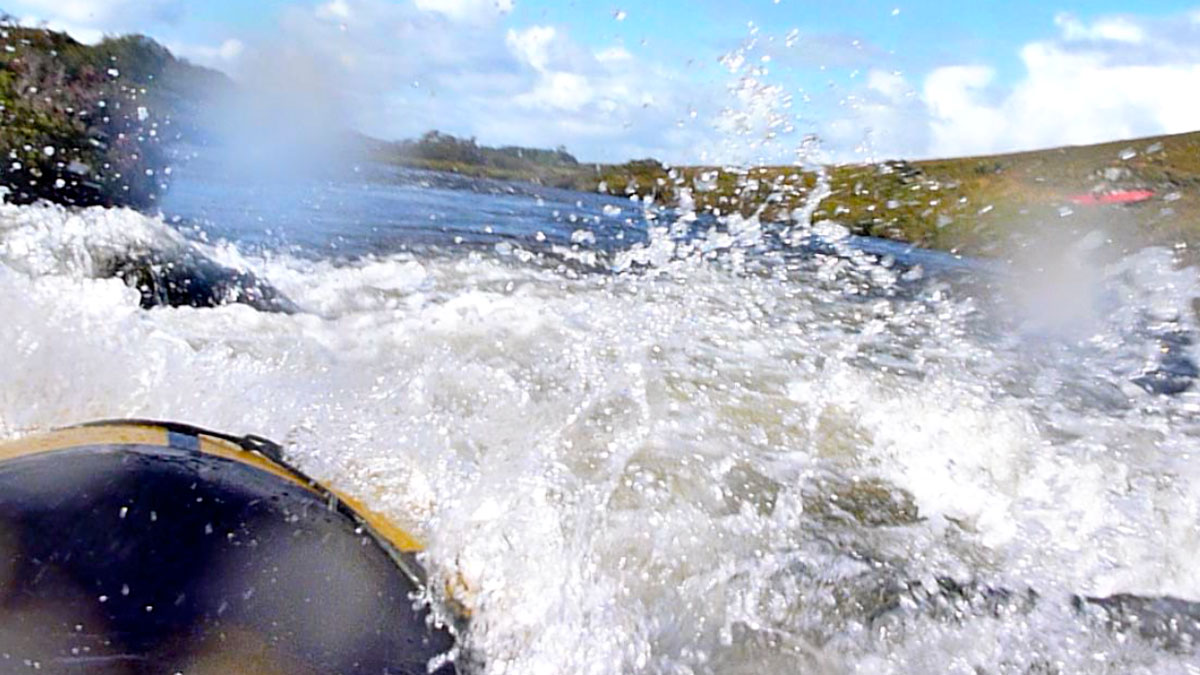
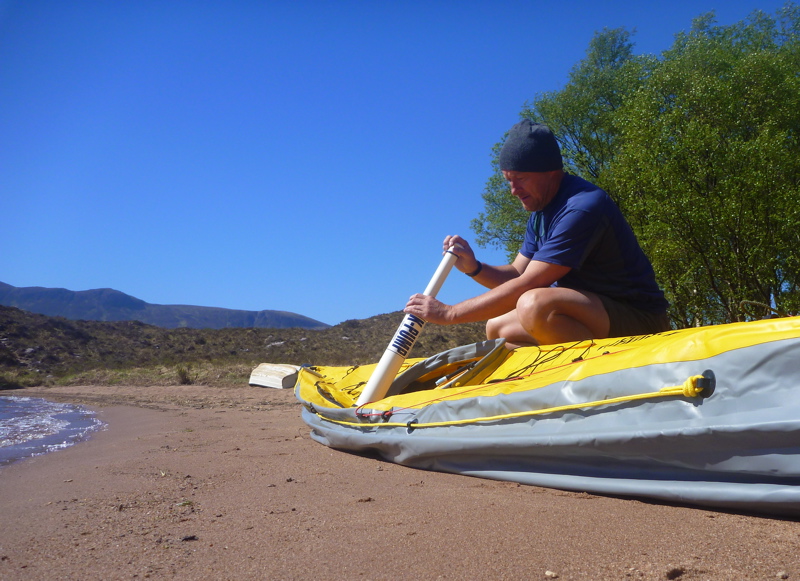
With the skeg off, it’s easy to seal launch off a grassy bank and into the scrum just below the waterfall which looks a bit complicated so was no less inviting this year. As I spilled over the first little step I tried surfing like people do. But the Solar wasn’t especially dynamic or there wasn’t a strong enough recirculation going on to make it feel interesting. So I swung round and set off. Even at full flow, the Osgaig is a shallow, bony river better suited to an injection-molded TNP ‘spaddle’, not 220 quid’s worth of carbon-light Werner Corry which was picking up new scrapes as I jabbed at the water to keep the boat on line. It was really quite effortful with the Solar, at 3m or nearly 10 feet it’s perhaps a bit long for this sort of thing. I hit the one or two rapids full face, kicking up a satisfying splash and remembering that ‘bring it on’ exhilaration when trying an IK and white watering for the very first time on the Salmon River in Idaho all those years ago.
The river branched near the Loch; left looked all froth but too shallow so I swung right but again scrapped and shoved from one bar to the next. I was hoping to make it all the way to Loch Osgaig but up ahead I saw the tree strainer I recalled from last year so, stuck on another rock and by now steaming out of the ears in my heavy drysuit, I stepped out and walked back upriver.
Alpacka Yak Packraft A few minutes later I hopped into the snug Yak, spun round and slipped over the first drop. Spinning back, I tried to surf as I’d just done in the Sunny but it wasn’t happening. I guess the Yak is just too wide, light and too much drag to fight the flow. Off I went downstream, trying to avoid getting snagged while lining up to take the peak of what waves there were. Jammed in the yellow tub, sat lower and with higher sides, it felt much more responsive than the longer Solar and so was less effort to ride. Perhaps part of it was that a good line is less vital; most of the rapids I could have taken backwards and that added up to more fun. So there it is: a tight-fitting packraft is more fun on easy white water than a 3-metre IK. When I got snagged towards the end, I just stepped out, threw the boat ashore, and staggered out over the slimy boulders.
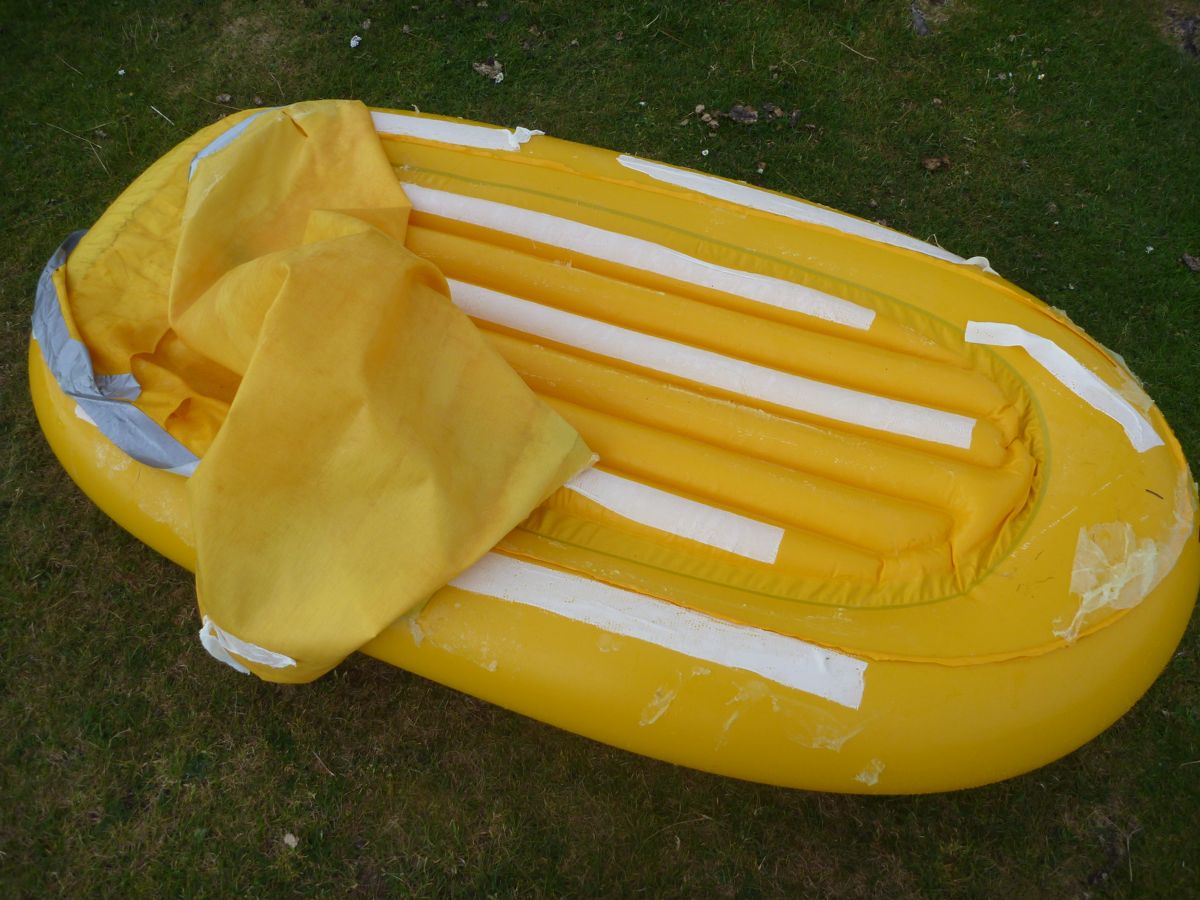
Chopping down my Sevy pooltoy into a slackraft lost too much buoyancy to take my gross weight, but it works fine for the Mrs who’s about half my weight. So on a very calm, sunny morning – realistically, it’s inshore limits – we took the Sevy out to the Bay for a swim. I’d glued on an extra outer covering of ballistic nylon to save the vulnerable floor, as we had planned to take it down the Escalante river in Utah a couple months back, but it was way too hot for that when we got there and since then, as you may know, much of the US has been suffering a terrible drought.
As often, the first paddle in a short boat like this sees the operator yawing from left to right like a crowd watching a ping pong final. After a while, though the paddling technique adapts to reduce this effect, but even then the boat is still much slower than an Alpacka. This Slackie is only 28″ wide by 56″ long – 2:1 – (my Yak is 88″ x 36″; 2.44:1) and the Mrs found the best trim was sitting in the middle, even if this meant nothing to lean back on and was not sustainable. Next time out we’ll take a fishing buoy or something to lean against, although I do wonder if some sort of trailing skeg – a board sticking out the back rather than an under hull skeg like on an IK– might help subdue the yawing and so direct the effort in a straight line rather than zigzags.
My Alpacka skims along just like it always does; what a great boat it is. Annoyingly the backrest is leaking again from the twist valve base, even though it’s been glued up once. I find you do need that backrest to sit correctly in the boat, so another repair is due. We dipped about, followed the river channel and out to sea and on to the rocks. As the tide turned we headed back up the river, against the flow the slackboat soon slowed to a near stop and it was faster led on its string through the shallows until a tailwind helped blow us back to our shoes, by now stranded some 200m from the water’s edge in just an hour.
A post-sea trail inspection showed that my carefully glued floor was coming away from the Sevy’s PVC hull like damp wallpaper; that may have explained why the boat got so slow coming back. The Evo Stik didn’t take to the hull at all, or if it did, seawater soon dissolved it. At the time I was trying to save on my nice Bostik 1782 which I used elsewhere on the slack boat with no problems. Anyway, it’s not worth wasting any more glue on this boat. And who knows, perhaps the ribbed floor which has been exposed again may help restore some tracking. We’ll see next time. We’ve half a mind to repeat last year’s fabulous Suilven triathlon, but this time in a boat each.
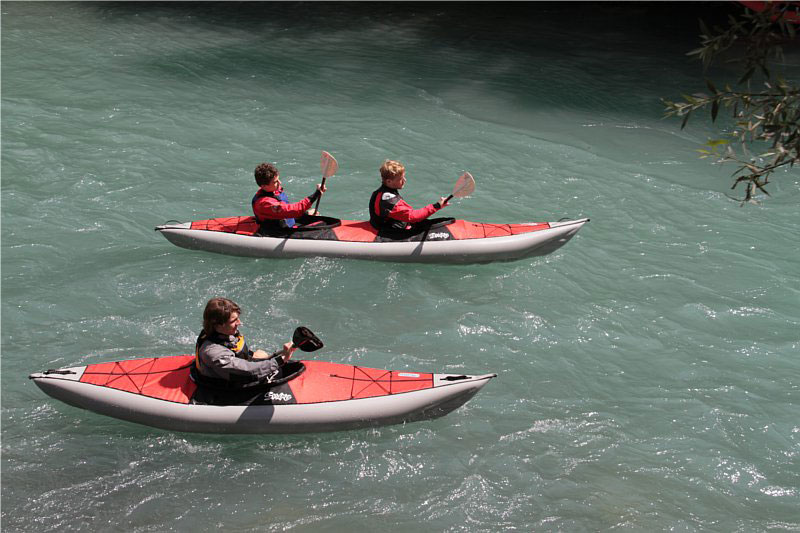
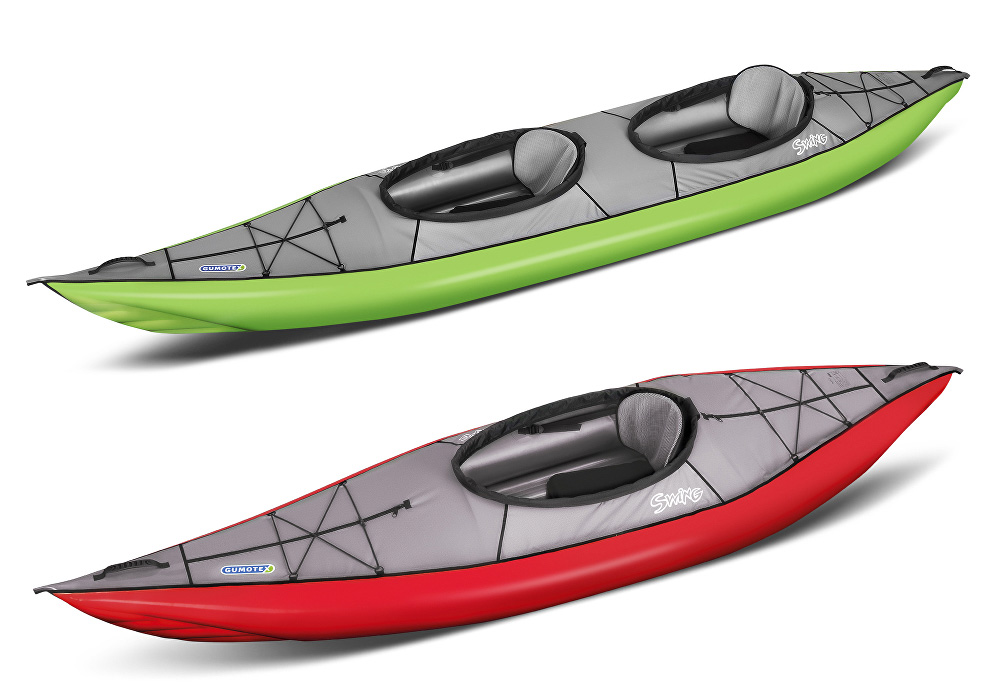
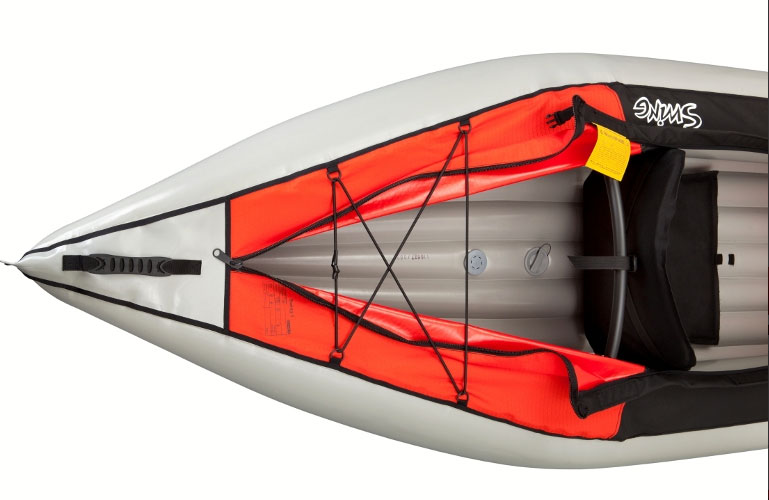
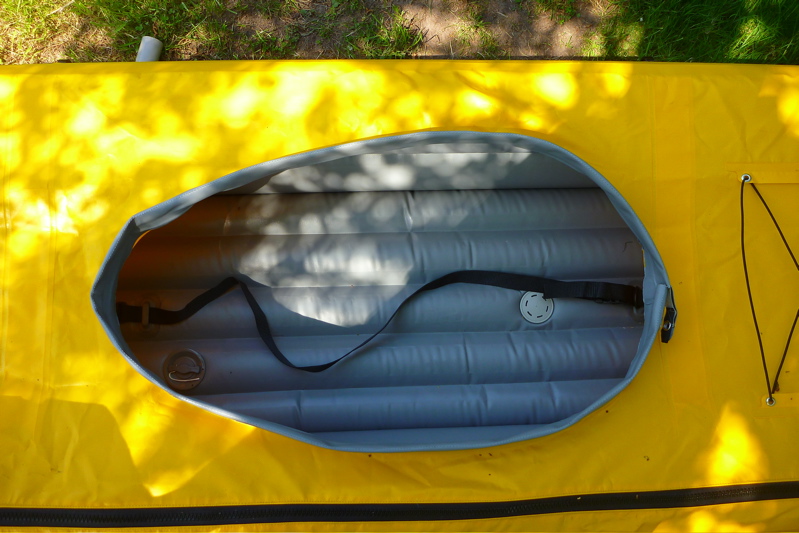
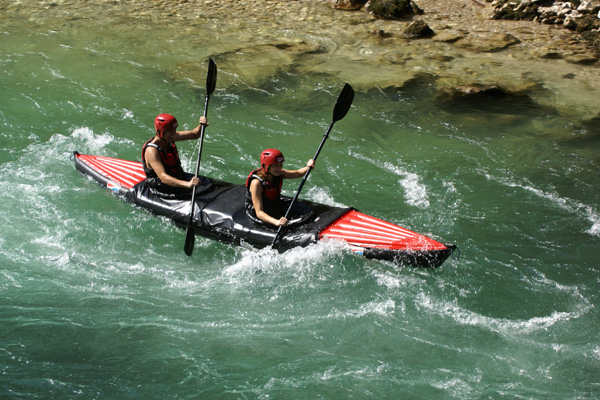
The Swings are fixed-decked solo or tandem IKs pitched at recreational users who seek the reassurance of a very wide boat and the dryness of a deck.
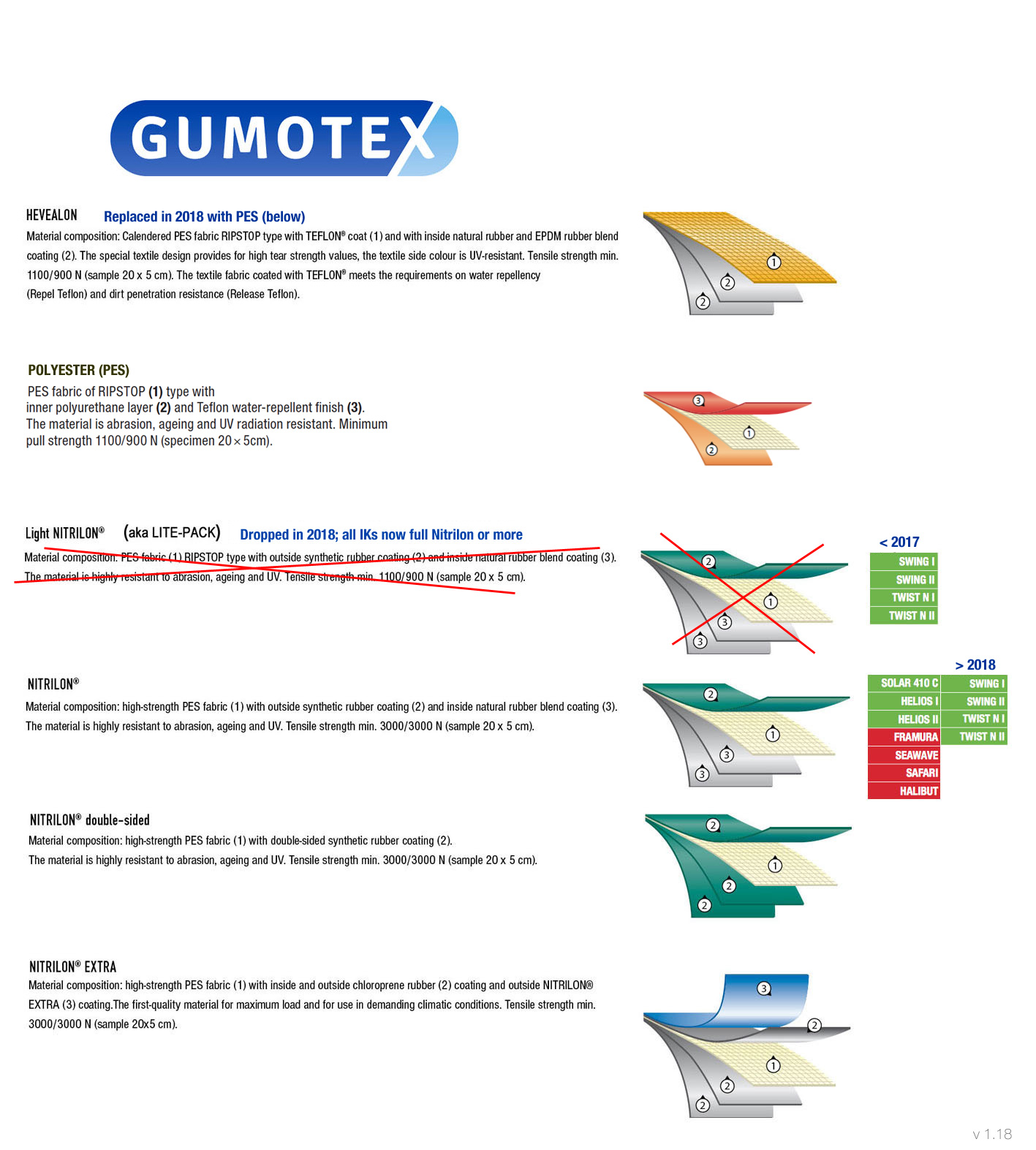
There were once and are maybe still two versions of Swing 1 and 2. Innova distributors in the US show red/black green/grey hulled models which they still list as made from Nitrilon Lite™. Europe and maybe elsewhere never had the black-hulled models and are made in Nitrilon (Nitrilon Lite™ has been dropped). The claimed weights for identical boats from EU/US are the same. You presume the green/grey doubles are now identical. See the table right about IK materials with more here.
Note that what Innova in North America call the Swing EX is a Framura in Europe – a slimmer, fixed-deck, 4.1m IK which is much more suited to solo touring and inshore sea kayaking.
As others have commented, they appear to be taking on IKs from Advanced Elements and even the bird’s-eye view is similar. From the profiles it appears they’re more ellipsoid or ‘lemon-shaped’ than other models, or maybe it’s just that they’re substantially wider which exaggerates this impression.
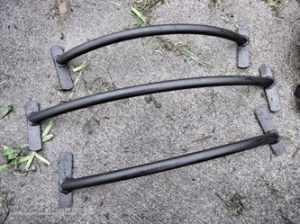
The Swings use 2 or 3 curved alloy crossbars to keep the deck taught (similar system on my Incept and Seawave) and make room for the legs, as well as spread and form the width of the boat. Some blurb states these crossbars make the boat more rigid which may well be true. Constraining the sides (stopping them from flexing out as the boat bends longitudinally) will have some effect in overall stiffness.
As far as the preferred boats for touring, what is desirable is a decked boat the length of a Swing 2, but set up for a single paddler. That is the Framura aka ‘Swing EX’ to Innova – a good-looking, solo-touring, fixed-deck IK for those who think soloing in a Seawave is a bit much. Sure you can sit in the back of an SW2 and load the front, but it’s not right, is it? What are the actual benefits of a fixed deck on an IK? (the Swings’ decks unzip partially). Limiting swamping – sure. Keeping the sun off – maybe in sunny lands. Keeping you warm – I suppose so, but that’s what a dry suit ought to do: ‘dress for the swim [falling in], not the paddle [air temps]’ they say. And many users complain that the zips are far from watertight. And so I conclude that the Swings may well be popular (actually I don’t think they were) but fall into the less desirable ‘bloat’ category: much wider than they need to be which is great for nervous day/rec users. But for the smaller niche of multi-day touring and sea use (space, speed, convenience), they’re not so ideal.
I got round to trying the Sevy ‘packraft’, a cheapo PVC dinghy with the outer hull cut off to make it less wide and hopefully more functional. Compared to the single-chambered Alpacka, blowing it up takes a while. The floor is made of two interlinked ribbed chambers which require a ‘spike’ beach ball inflation adapter that fits on the end of the K-Pump (right). The main chamber fills quickly enough with the K-Pump – a one-way Boston valve ensures you get a good fill of the elastic material and it’s always a surprise to see it stay that way according to the SevyGauge™.
Even then, on the riverbank alongside the Yak it did look very small and rather low in draught so that even with a dry suit, I wasn’t convinced I wanted to get in off a steep, muddy bank. So I set off upriver to Sluice Weir in the Yak, towing the Sevy and intending to shoot the chute for a bit of fun. On the way I spotted a striking blue bird – never seen one of those before. Do you get bluebirds in Kent in mid-winter?
I got in the boat as gently as I could but it didn’t take long to have an inverted Archimedean revelation: the mass of the paddler was nearly equal to the peak buoyancy at the rear of the craft. That’s partly why Alpacka came up with the fastback tail in 2011. Unlike Archimedes, I didn’t jump out yelling ‘Eureka’. I just sat still thinking ‘is it spilling over behind me and if not, why does my back feel cold?’ I took a couple of pics behind my back (below) to establish plimsoll levels, then set off slowly across the pool, with the trusty Alpacka tender bobbing along behind in case the Sevy sank.
This was not relaxed or efficient paddling like in the Yak. I arched forward trying to offload the stern while pulling gingerly through the water for fear of initiating a possibly catastrophic water-bounce that would fill the boat. The Sevy sagged feebly under the weight of my butt and feet, just as I’d seen Jeff’s do on the Fitzroy. However Alpacka do it, it’s the rigidity in their hulls that makes them as good an airboat can be. The multiple coatings on the non-stretch fabric must have a lot to do with that. As expected the short, round Sevyslackraft yawed quite badly, even with the Alpacka in tow to act as a rudder. But that always happens first time out in one of these boats until you adopt a smoother technique. Either way, I was relieved to be wearing a drysuit.
As I bimbled around trying not to sink, the nearby weir boom opened up without warning and suddenly the Medway was kicking out a current such as it had not seen since the end of the last Ice Age. I could barely make headway in the Sev so allowed myself to be swept back to the canoe portage pier where I hopped back into the Yak. Within just a few minutes the river had risen 6 inches or more. I thought it had appeared rather over-full upstream in Tonbridge where I had driven through earlier. Anyway, the 5-minute Sevy Slackraft trial were complete. To paraphrase Right Said Fred, I’m… Too Hefty for My Boat, although it will make a nice packraft for the Mrs who’s a little over half my weight of 95kg + winter ballast.
So, packboating newsflash: the Sevy blow-up boat is not for bloaters like me. But as it’s so light I could still see a use for it as a tow barge for a bike or an extra huge payload (not that you could realistically walk with such a load). Maybe a really long river stage, or one where you want to be well equipped on arrival with a huge tent or something.
In early 2016, Feathecraft dropped the Java/Gemini and Aironaut to stick with folding kayaks. In 2017 Feathecraft closed for good.
In 2007 I was already looking to move on from my Sunny to something a bit longer and self-bailing (I thought this was a good idea at the time). The two boats that appealed to me were Aire’s hefty and wide Super Lynx and a Feathercraft Java (since then many new contenders have come on the scene). I decided to treat myself to the more expensive but lighter Java and picked one up from the clued-up FC dealer in Durango.
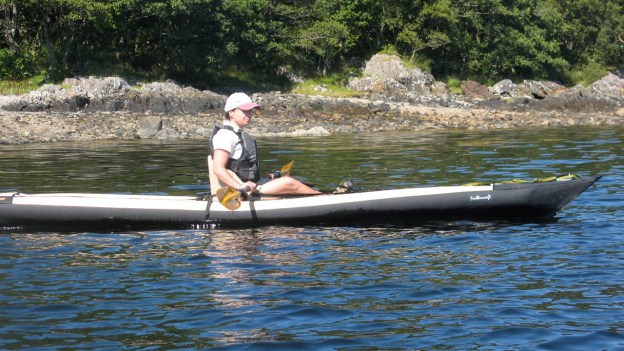
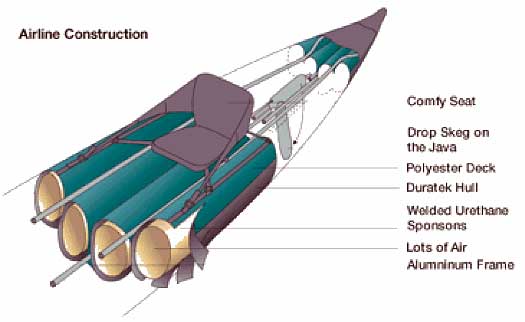
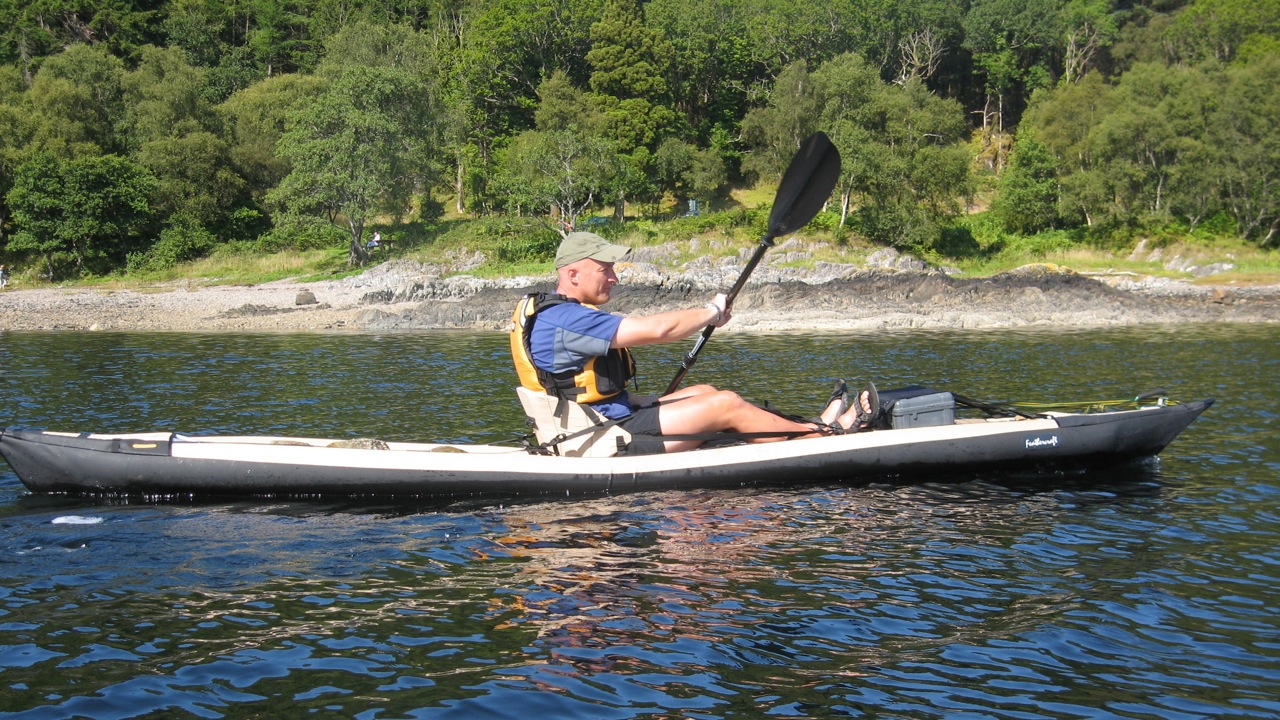
Set up is pretty straightforward: you slot in the alloy keel- and skeg pole and then the side poles, velcro them all in place, attach the seat by too many straps, pump up the four sponsons and off you go. Realistically, 20 minutes is a good assembly time. It’s a sleek-looking boat for an IK; still today nothing else comes close, but one of the biggest hassles are the cheapinflation valves: basic turn-and-lock elbow valves seemingly off the end of a Thermarest (or indeed an Alpacka packraft where they work fine to top up, not inflate). The thin plastic hose on the hand pump supplied pushes on, but when it’s hot or wet it twists off, or if you pump too hard it blows off and the air leaks out. As it’s an open (not one-way) valve, you have to screw it shut quick. Maddening! I thought for a while there was some component missing from the pump but no, this was it. I found holding the hose onto the valve with one hand while pumping the two-way pump with the other was an awkward but more effective way of inflating. Even if it’s bigger, give me a foot pump any day. Or regular one-way Halkey valves and a K-Pump. At 28 inches (71cm) wide, it’s just two inches narrower than the Sunny but feels much morem chiefly because you sit high ON it, rather than in it. FC are right in describing the Java as an inflatable sit-on-top. As you can see in the pics, under my 95kg weight, the poles are more there to aid the hull profile than enable longitudinal rigidity. It’s 15 feet 4 inches (4.65m) long but you can’t get much into the last foot-and-a-half at each end; the usual problem with IKs. The thigh straps are a nice touch or an admission that you may need them to keep upright. I took it out for a scoot across the Vallecito reservoir in Colorado one evening with the two inner (floor) bladders not too firm and was relieved to find it not too tippy. On the way back I struggled with the pump some more to firm up the inner sponsons and found it less stable but still OK, and probably faster. And before I got caught out, I practiced getting back in off the water; as long as I crawled aboard without any sudden movements it could be done in calm flat water. But who ever falls out in calm water?
The retractable skeg is a great idea that’s only really possible on a self-bailer, but with the middle sponsons firmly pumped up the actuating string which comes up between them gets jammed. It’s best to manually make sure the skeg is fully down before setting off – but this negates the retractable feature. At least you know that if it snags on the river bed it will just pivot up (but then won’t come down again). A good fix to help the skeg pivot with the string lever would be to have the string passing through a short section of thick garden hose or plastic tube jammed between the sponsons so enabling it to slide freely. The slot through which the skeg passes is also the bailing hole, designed I am told, to suck water out of the boat with a venturi effect as it moves over still water (less effective in a current going with the boat). Can’t say I noticed water rising as I stopped, but it sounds plausible.
Paddling without the skeg was OK on flat water but with it deployed you can power on. The solid footrests, thigh straps and comfy seat (also inflatable) all help here. One problem with the footrests is the angle they sit on: the poles force your knees outwards into the paddle arc. I also wondered how secure they were, screwed down to merely butt against a protruding rivet in the pole. A flat rather than pointy end to the securing screw pin sitting against the 2mm-high rivet might be better and could easily be done. Anyway they never shifted during the easy paddling I did.
The Java has neat cargo nets: easy to use and secure. I’ve since bought a pair for my Sunny. Inflation valve design apart, workmanship is what you’d expect for over $2000 with good attention to detail. The ‘envelope’ or hull doesn’t really need to be sealed in any way as the four sponsons or bladders slot into their respective cases and, with the poles, make this pile of nylon and rubber into the only IK I know that looks close to a proper sea kayak.
Next day in Colorado disaster struck. I left the boat drying on the roof of the car in the forest camp – black hull side up… and went out very early to Silverton on the steam train. It had been a week of huge storms in the Rockies and camped in the forest I figured it would be OK in the shade and probable afternoon storm. But on the way back, when the bus driver mentioned it was a hot afternoon in Durango I thought “oh dear, I hope it hasn’t…”
It had. The thick black hull rubber had caught the sun nicely as it passed over the clearing and ruptured three of the bladders or sponsons. My lovely new boat, not one day out of the bag was a floppy mess. I yanked out a limp bladders (easily done) and found the rather light, flysheet-like ripstop nylon split, and pinprick holes in the airtight PU coating. That was the end of my Java paddling in CO. (A happy ending. I ordered a full set of sponsons from FC in Vancouver and when they discovered the boat was nearly new they generously offered to supply them free of charge. Good on you FC.)
Back home with new bladders, we went to Scotland and I tried out the re-bladdered Java alongside my old Gumotex Sunny. G-friend’s first impression was that I was too big for it probably due to its SoT stance. She had a point. And also it was too fiddly to set-up for my keep-it-simple prefs. She had a point again, and although it’s amazingly light for what it was, it’s still pretty bulky. In Denver I’d spend hours packing it carefully for the flight back for fear of having the near yard-long hull poles damaged in transit. On my bathroom scales in the blue holdall ready to paddle it weighs 17kg (37.5lbs). The boat’s envelope alone (no seat or tubes) weighs 9kg (19.8lbs). In other words, about the same as my Sunny but two and a half feet longer.
On the lochs the long, thin Java slipped along, with a speedof 10kph (6.2 mph) flashing on the GPS for a second, though 4mph was a more sustainable speed (video above). Let me tell you that is a very good speed for an IK, comparable with the Incept K40 I bought a few years later. (There are more useful speed stats on inlotusland’s blog about a lake near Vancouver in a blue Java.).
The Java kayak didn’t really feel right to me: the old problem of too narrow and me sitting too high for my weight. An experienced hardsheller would probably not have any issues. We went on to a freshwater loch, a little windier by now. I tried to visualise myself in a fairly normal one-metre swell out at sea. The rocks I added for ballast hadn’t really added an impression of stability (as they can do on other tippy IKs) and overall, with the height/width relationship I didn’t feel confident anticipating the less than flat calm conditions I wanted to be able to face.
Back at the chalet the biggest hassle of all: the Java takes hours to dry, maybe even days. But dry well it surely must, especially when rinsed after a sea paddle. Sure, I’d read about this in some reviews, but it now dawned on me that the problem was common to all bladder IKs (like all Aires). Water will always get in the hull sleeves/envelopes holding the bladders as well as other crannies, and once there will always take a while to evaporate. A spin in my basic Gumotex Sunny reminded me what a great boat it was: quick to set up, fast drying and good enough performance. If only it bailed. [2020: I now think self-baling is not essential for a tour boat; i just used my Sunny beyond its abilities].
The Java got itself sold on ebay. Lesson: try before you buy and if it’s not possible (as it wasn’t for me in the UK), be prepared to eat your mistake.
In 2011 I gave my sun-faded Sunny away and got myself an Incept K40 Tasman. The K40 was less fiddly than the Java to set up, though the time taken is about the same, but I still miss the ‘pump and go’ simplicity of the Sunny. That is why I then got myself a Grabner Amigo. But I sold that and got a Seawave, my best IK yet.
There’s some Java chat on FoldingKayak.org. This guy in BC also had a Java then got a Gumo 410C. Looking at his pictures, I’m struck how ‘perched’ he looks while still being high in the water.
Let’s begin at the end: rolling up the K40. I followed the instructions provided in the leaflet. I removed the footrest airbag and the thigh braces before rolling the boat up and it took one or two attempts before I managed to roll the boat exactly as on the leaflet picture. The resulting bundle (right) was a bit thicker than my Grabner H2, but a bit shorter and I could put it back into the wheel bag provided by Sea Kayak Oban without any trouble.
Back to the beginning. I inflated the Tasman on the grass at my parents’ place in Brittany last Friday afternoon and checked the pressure with the gauge of my Grabner pump. The PRVs started hissing at 0.3 bar (4.5 psi) so the Incept runs the same pressure as the Grabner boats, yet is significantly stiffer than my Hypalon H2 once inflated. The H2 collapses flat when deflated, while the K40 keeps most of his shape, hence the initial difficultly in rolling it up into a compact bundle.
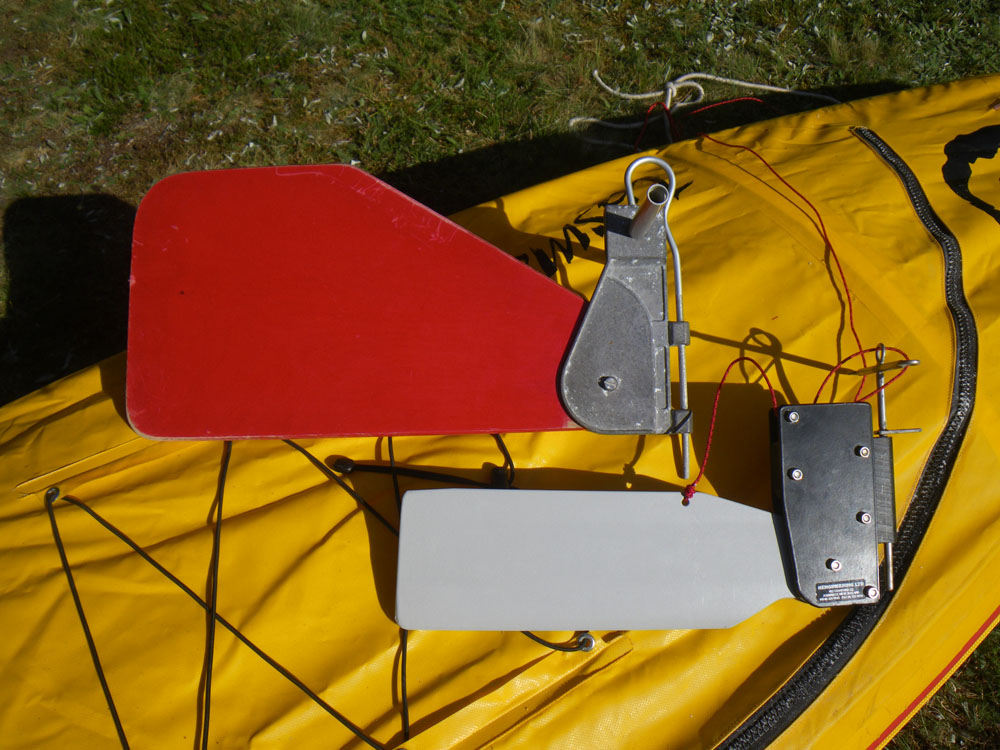
It took me some time to fine-tune the footrest and the rudder controls as I am 6’ 4” (1.93m) tall. I found a much better way to attach the rudder return shock cords to replace the previous messy knots, using a simple taut-line hitch. The lines are too short to make the hitches accessible from the cockpit with the deck on, but I can adjust them in open deck configuration.
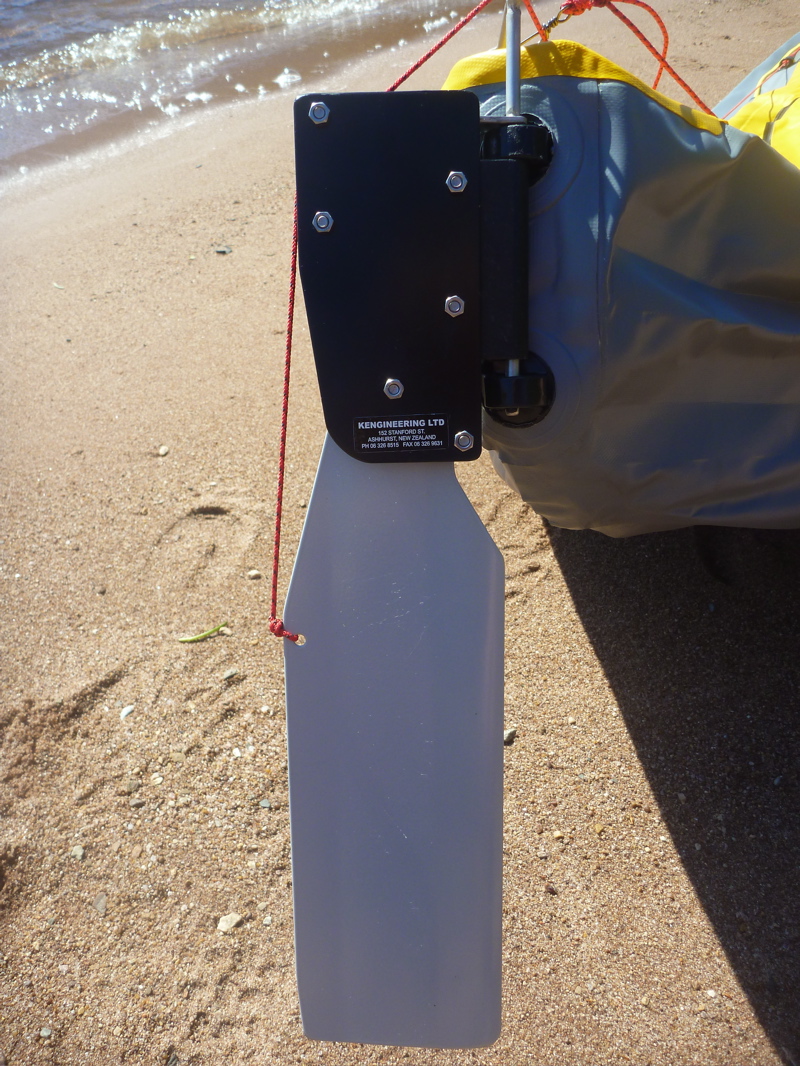
Talking of which, the rudder which comes with the Incept (left, below) is a beautiful piece of gear; much more serious that the piece of plywood and hinge which came with my old Grabner (but is still an expensive option).
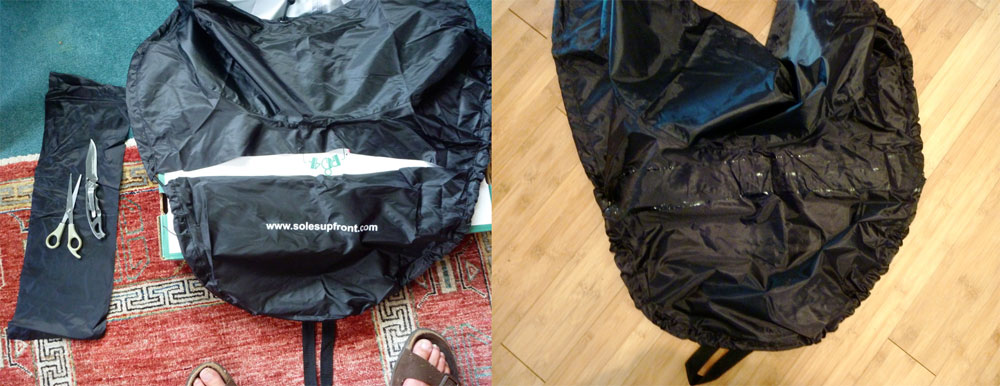
The deck zip didn’t slide so smoothly but was improved by rubbing a piece of soap along the length of the zip. The spray skirt (right) is a rather ordinary piece of neoprene and nylon with braces. It’s been a fight to fit it around the flexible coaming (despite the rod inside) but it should become easier after some practice. The cord tension of the two crisscross bungee lacings fore and aft of the cockpit can be adjusted by cord locks, but I think the 3mm lines are too thin – 5 mm (5/16″) would work better. I don’t trust such flimsy deck bungees, and any item put down under them should be secured to the boat with some kind of leash. A leash can be attached to the perimeter grab line or to some additional D-rings to be glued to the deck. There are two unused fittings on the outer side of the K40 alongside the cockpit, through which I run bungee straps. Inside the kayak they run through the D-rings where the thigh straps are attached. The holds of the K40 lack any D-rings; there is nothing to attach basic kit (bailer and sponge, painter, water bottle, map case, compass, spare paddle) to the boat. I’ve got to order those NRS patches Chris mentions here.
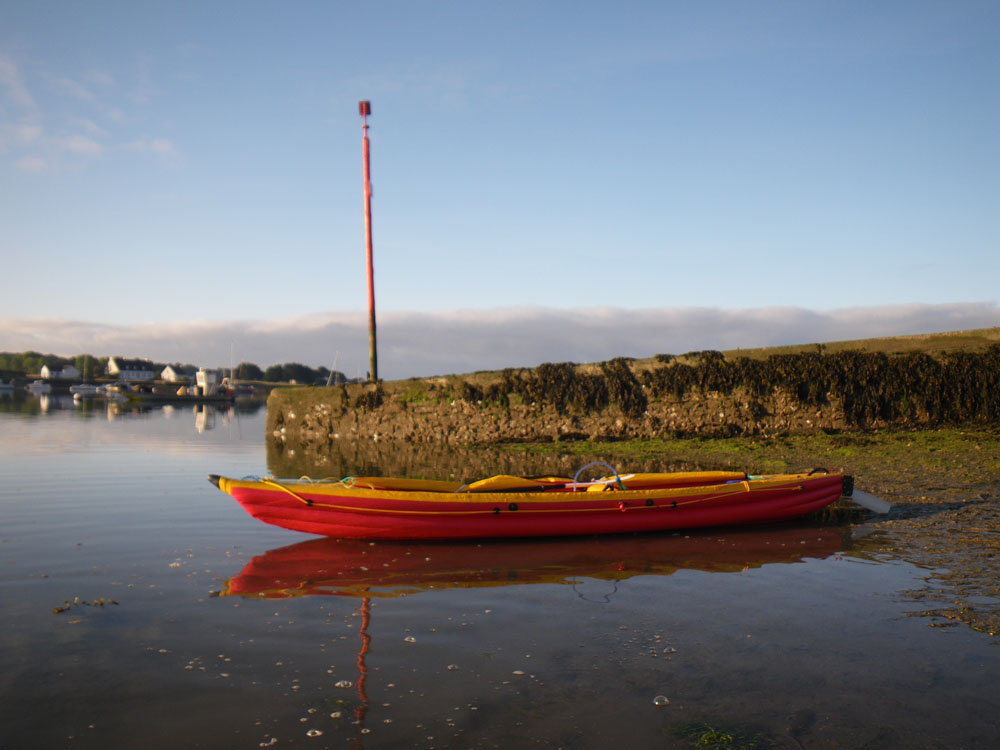
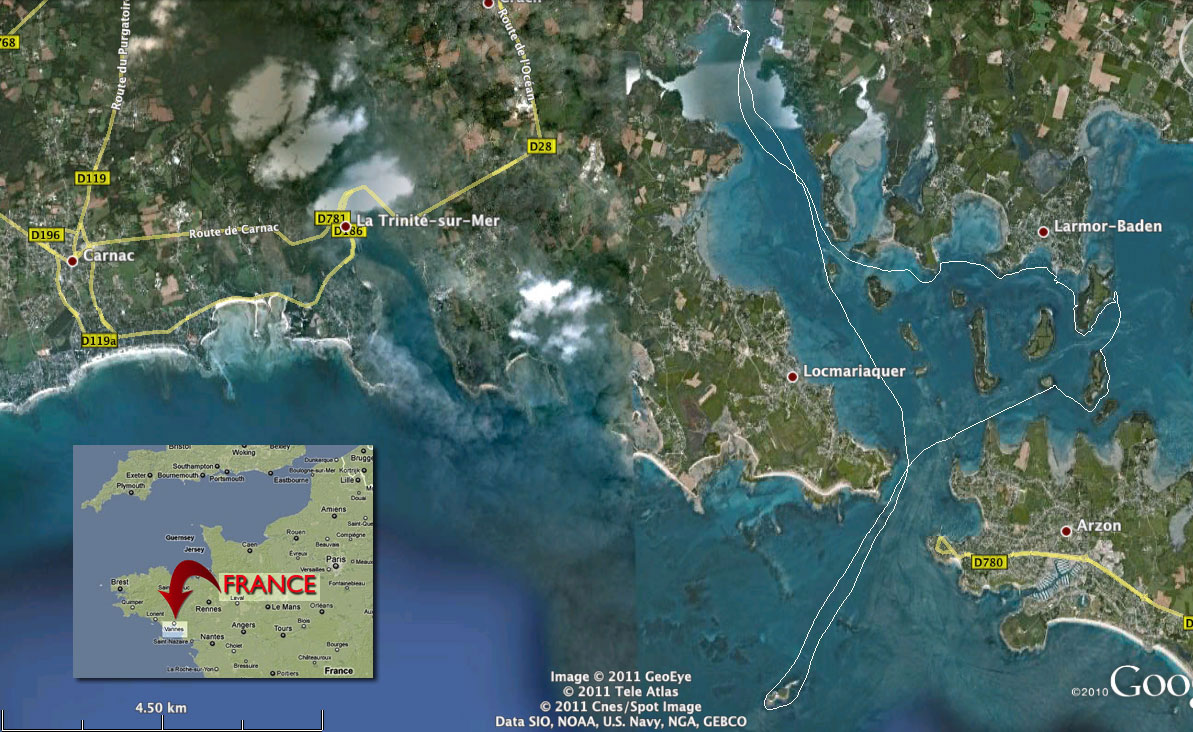
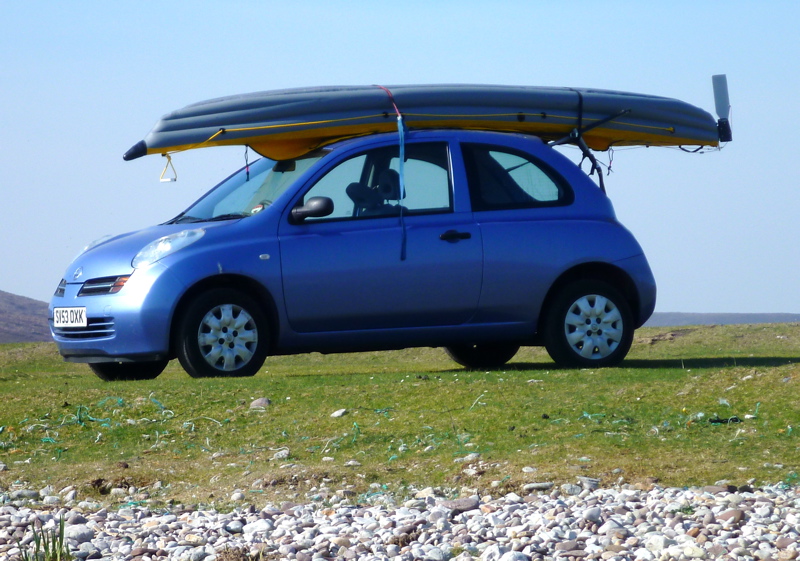
On the water Early on Sunday morning I loaded my K40 on my car roof and drove to a nearby put-in, Fort Espagnol that juts into the placid waters of the rivière d’Auray. It was sunny when I launched but it soon became overcast. I spent the next five hours on the water, riding the lively currents of the Golfe du Morbihan getting up to 10.1kph (6.3mph). Although those currents were rather mild as it was neap tides, they created enough chop in some places to test the behaviour of the K40 on short bumpy waves.
I made a short visit to the stone circles on Er Lannic (below) and made a stop behind the eddy next to the infamous Grand Mouton beacon. The current is still fast although it’s the end of the ebbing tide. The Incept K40 is definitely faster than my H2. It was difficult to assess my average speed because I was paddling in currents most of the time, however I wouldn’t make headway so easily against the tide with my H2. The thigh straps proved to be very effective in handling the boat in rough water and against the current, enabling the paddler to hold a better paddling position and to cling to the boat.
What’s in the bag? The other night I tipped out the contents of the blue bag and unrolled the boat from a factory-packed volume which, like a new Alpacka, it’s never likely to regain (see below in red). It all added up to:
Blue roll top dry bag Boat with deck lines and all rudder controls/lines Rudder assembly Flexible hatch coaming rod Inflatable seat Four GRP battens which slip into the deck to give it form K-Pump in a bag with adaptors and grease Boat repair kit (glue, a dozen patches and a valve adaptor, see red) Basic instructions and an NZ leaflet on safe sea kayaking
Dimensions According to my atomically calibrated measuring instruments, the boat alone weighs 14.8kg + 2.2kg for rudder, seat, repair kit and pump. It’s 4.3m long, 69cm wide and 45cm wide inside (32.6 lb + 4.8 lb; 14′ 1″; 27″; 18″). The table from this post compares dimensions on similar IKs. At 17kg the K40 actually feels pretty light and as long as it’s empty, not too windy and the path is easy, I can carry the kayak on my head or the back of my shoulders.
What’s not in the bag – a spray deck. You get the impression that it’s a special shape/item and so ought to be included, but I’m told it’s €103 euros for the one Incept recommend. It’s hard to ascertain exactly what you’re buying from the small image buried on their website, but similar skirts go for around half that price in the UK. I bought a nylon cheapie to be getting on with. It’s actually not badly made for 19 quid, with taped seams and a decent coated material; it’s just way too long, so I had to cut it down.
Aa K40 sits a lot higher than a regular hardshell kayak, so I imagine a skirt would only be necessary when it gets really rough (by which time you probably have other issues) or cold, or you confidently expect to be able to extract yourself from capsizing with one smooth swipe of your blade. It would be nice to master a roll, but I suspect that crawling back into a K40 with decks unzipped is less difficult, especially with a paddle float. More on that here.
The hatch is 71cm long, 41cm wide and 186cm circumference (28″ x 16″ x 73″), if that helps you select a spray deck. Although it’s statistically small, I’ve sat in worse and as it’s not rigid, even I can pull my legs up to get out while still seated.
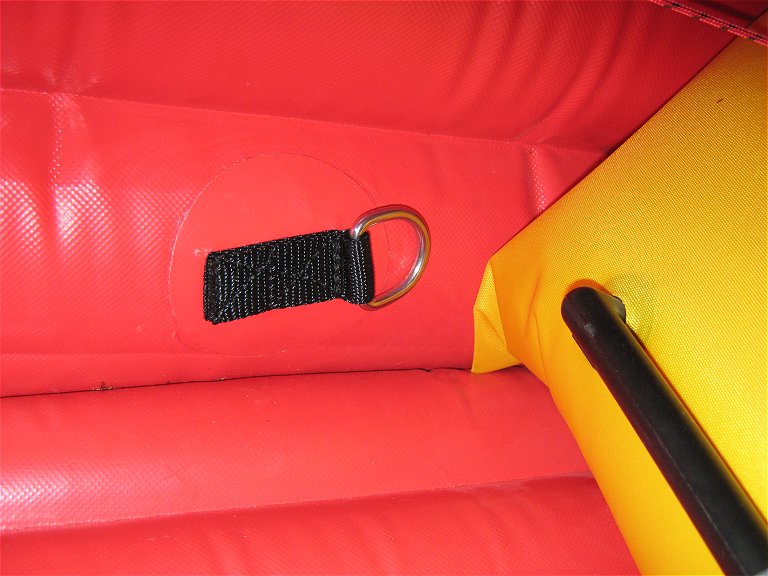
Thigh straps are a €66 option. Fair enough, but my boat has no D-rings (left, Incept’s pic) for the straps, just markings where to fix them. Some boats get patches, some don’t I was informed (probably heat-welded, left). Otherwise it’s a lot messy work gluing some on (below left), which will either cost you over £50 for four Incept patches sent over from NZ. Or you can spend hours on the internet looking for alternatives. I fretted, thinking I must buy actual Incept ones which are made from the same PVC-urethane material as the hull. As well as clean surfaces and a good roller, on inflatables the adhesive/material combination is critical for a good, permanent seal.
D-rings setting under heavt rocksThigh straps
The actual Incept PVC patches cost $NZ12, similar to the UK from places like PolyMarine. Or good old NRS have all sorts of patches here and among other places, they now have an outlet in Ireland (so all import taxes paid (until Brexit happened).
I bought a dozen #2097s (left) which are a bit big at nearly 5″ (120mm) but can be trimmed. NRS said that Aquaseal (aka: Aquasure in Europe) will do the job on PVC-to-PVC as well as anything, but actually one D-ring stuck on with Aquaseal came off three times. Probably my bad application so eventually I tried the small unbranded tube of Ultraseal 777 which came with the boat’s repair kit. It’s a much thinner and runnier than Aquaseal and smells like classic Bostik, and because it was not ‘filling’ but just adhering, I thought it made a better, more pliant seal and it cured quickly too. I’ll find out for sure how the 777 patches worked in comparison with the Aquaseal. Unfortunately, though it’s made by Bostik, I couldn’t divine whether 777 has a magical formula that perfectly suits Incepts polyurethane alloy fabric, but in future I’ll clean off with MEK solvent and use Bostik 1782 – the nearest I could guess and found cheap on ebay. While my back was turned Bostik seem to have diversified into scores of glues from my youth when the classic, pink-tubed all-purpose glue did it all. Now they sell a glue for scores of uses which the cynical consumer can’t help thinking is marketing- rather than function led.
The SeakayakOban test boat I tried had thigh straps – straight, not as comfortable as pre-curved ones I recall having on other IKs. Pre-curved straps hook better over the knees, so I got a pair for an SoT off amazon for £33 (left). With those brass-plated clippy things they’re heavy, but seeing as they’re so fat they could double up as cushier backpacking straps on a boat-hauling packframe.
One more annoyance: I was expecting to get the Bravo footpump which the shop I bought it from pictured and confirmed by email. I received the better, hard plastic K-Pump after I went out of my way and bought one. This inconsistency with Incept’s info (including images of models with old colour schemes, velcro decks and talk of ’25 D-rings…’ in current brochures) gets frustrating. You get the feeling Incept aren’t focussed on promoting these IKs, as if they’re a sideline to the raft business. But as long as the people on the factory floor with the scissors and heat guns are on the ball, I’m sure I’ll get over it.
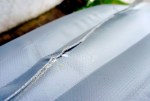
Sadly, quality of construction is also inconsistent. Most of the boat is heat-welded but closer inspection revealed a lifted seam at the glued-on rudder patch (below left). The cavity here was an inch deep and took repeated injections of Aquaseal to fill, but I presume this is a patch glued on the hull, otherwise I’d have a pretty flaccid boat by now. Nearby, a couple of hull seams had also lifted a mil or two (middle pic). It’s hard to think these would have slipped past any inspection (assuming there is one), so I presume they lifted after that point. These are the only manufacturing flaws I’ve spotted on an otherwise clean job. And to be fair the rudder patch glues around a curve where two other layers meet, so it’s a difficult join. I’ve laddled the whole area with Aquaseal (last pic) and it’s now sealed for good.
Incepts are made from 1100 dtex Polyester fabric coated in a PVC-urethane blend. It’s notably less thick than an old-style Gumotex. Stiffer is harder to glue into tight forms (as proved above) but makes a faster boat on the water. It’s also more awkward to pack, especially when cold. I can’t see me ever rolling it up as compact as the image at the top of the page (see red text , below). I go on further about IK materials here and once, theboatpeople spoke sagely about Incepts, though it’s unclear if they’ve actually seen one in the raw (never stopped me!).
As the enclosed instructions say, the biggest risk to damaging a PVC craft is when a sharp and stiff corner of a rolled up boat scrapes on concrete or tarmac; it grinds off the coating real quick. I must remember never to do that. It’s unlikely that the PVC-U is as durable as synthetic rubbers like Nitrilon or Grabner’s EPDM, but with care, regular rinsing, squirts of 303 and the odd dab of glue, it should last. In fact the K40 is the only IK I’ve ever punctured: a tiny thorn tip picked up while pumping up on Loch Moidart. The second owner’s similarly punctured the side while pushing past a thorn three on a river, and again at sea later. Knowing all this in retrospect I would say Incept’s choice of fabric for the K40 may not be durable enough, but the only other owner of an older red and yellow boat has had no flats at all. It’;s possible earlier boats used different fabrics.
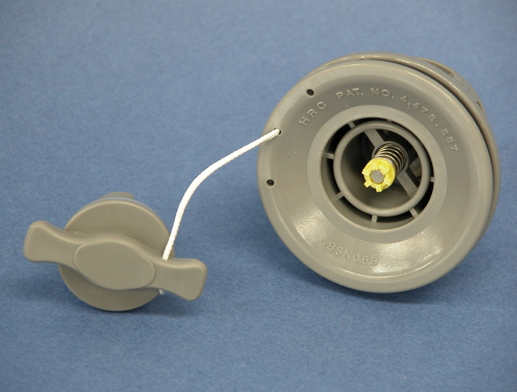
Out of the bag I pumped it up for the night and fitted and adjusted the rudder which was dead easy. Next morning all was still pleasingly firm, so off to one of the local lochs. Down on a small beach near a road, again I was surprised how effortlessly the K-Pump inflated the K’s three chambers until the PRVs start hissing at 5 psi or 0.34 bar – as high as any non-DS IK. I like the idea that on the water you’re able to top up the pump from inside the cockpit as all the valves are located accessibly by your lap, though over the course of that warm day – leaving it in the sun here, there and on the car’s roof – it wasn’t necessary. And I sure like the fact that the Halkey Roberts’ valve caps (left) twist off easily and back on securely, unlike my old Sunny’s horribly stiff and awkward items which never relented in all years or use.
Packing up a Tasman As mentioned, the stiff PVC which responds so well on the water makes rolling and packing up a K40 a bit of a challenge, especially if space is important and it’s not warm. After a few weeks of ownership I finally gave it a go. First thing to do is the suck all the air out that you can’t do by just rolling; this is something a K-Pump does not claim to do (despite what you may read), but I’ve only lately discovered a Bravo pump (left) can do once you switch the hose to the other port. With the Halkey valve opened (pressed down) the spring in the Bravo’s bellows sucks stoically until you can hear the PVC creaking. All you have to do then is yank off the push-fit hose and close the valve quick against the boat’s partial vacuum – tricky with fingers; you may need pliers.
The ABS K-Pump is heavier and as bulky as a Bravo footpump, but it’s more robust and for a hand pump is amazingly effortless. The K is the pump to use even if it doesn’t suck, but the boat comes with a bayonet valve adaptor in the spares kit. Pop that on a short length of hose and you have a manual – or oral – sucking tube to compact the K40 for transit. If this is all TMI, just say ;-).
First impressions on the water were a bit shaky compared to the test day a few weeks back when conditions were about the same, if not even calmer. Maybe because I was alone, ill-dressed for the very cold water, and the valley caught the odd gust off the big mountains. Who knows what was up, but I doddered around like a beginner, then parked up on another beach for a walkabout, and on the way back paddled with the deck unrolled which was fun. This convertible deck arrangement is such a great idea. It’s like owning a brolly or a mac: you don’t always want it but sometimes you need it.
Part of the reason deck-free is possible is that the K uses a removable bendy nylon rod for the hatch rim or coaming (left). Remove the four chunky GRP deck-supporting battens, roll the deck back to the right side and hey presto, the legs can breath, you can get in and out gracefully and maybe even carry a light passenger. Though thick and strong, the battens don’t seem to have any influence on pushing the boat’s sides out as far as I could tell, it’s more likely a zipped up deck holds the sides in if anything, so inhibiting longitudinal flex of the hull in rough conditions with a heavy paddler.
The rudder mounts easily and looks like a well made unit, though again, I’m no expert. Foot control is off some flaps on an adjustable air bag footrest using string and elastic. Not surprisingly, it’s all a bit mushy, but I don’t think any IK or even any K will have a system as solid as the Amoco Cadiz. It centres naturally and so works fine as a simple straight tracking skeg which is all you want most of the time. For an impression of rudder free paddling, read this. If you want to slide forward down the boat (perhaps to pull the deck on or have a snooze) you can easily slip your feet under the semi-inflated footrest/rudder pedal air bag. Turning circle on full rudder lock is about 10 metres, same as our Nissan, and I also observed that you can do a 360 in this boat on the spot with 5 back strokes; in other words: less strokes than you’d imagine. Backing up is also easy with the rudder up and the rudder lift line works fine. A rudder of course came into its own to correct tracking when paddling downwind or at 45° to the wind in either direction, though here is where the mushiness was noticeable. A bit more experimentation with the footrest/rudder pedal air bag pressures and seating/footrest positions may tighten things up. So far the seat is fine and I’ve had no complaints since. It’s light and simple, but made from thick nylon (compared to an Alpacka) with two elbow valves – and it clips out in seconds, just like the modified seat in my old Sunny. But like on my old Alpacka Llama, you sometimes sit on the squashed down backrest when getting in with the deck on, which could be a pain if the situation was choppy or awkward. There is more back support with the deck on I’ve found, as you lean on the back coaming a bit. I’ve also since found even at sea it’s safe and stable to sit sideways on the seat with your feet in the water.
By the time I got back a couple of hours later I was in the mood for more so I strapped the boat onto the car (another great aspect of frameless IKs) and scooted over to the main beach opposite the Summer Isles. That morning there’d been no less than nine cars or vans with kayak racks heading out for the day. Quite right too as it was amazing weather, so much so that the blooming gorse in the hills caught fire. As I came back, the village fire engine dashed past me, trailing cobwebs and heading for the smoke palling over the Assynt to the north. Out in the bay a pair of late hardshellers were heading out and it seemed a bit less gust prone out in the open water. After dicking about for a bit, I headed across to Tanera Mor island, about two miles across the bay. We look over to Tanera all day from our place, and on many previous occasions in the Sunny I’ve thought about it but never dared. I suspect the relative speed and higher sides of the Incept gave me the edge and the confidence. In the island’s anchorage, flushed with the success of my monumental traverse from the mainland of Britain, I pulled over by a salmon pen and watched the caged fish flit across the surface, I presume enacting their instinctive upstream spawning surge, but here destined only for the slicer and the smokehouse. On the way back I decided to deck up for no other reason than I could, noting that when fully unzipped, I can just about reach the zip ends fore and aft to pull them closed, as long as I used the fishpen side for stability. Out at sea if it was rough a boat alongside would be needed. I’ve since lengthened the tabs on the zip ends to make them more reachable. A small island ferry left the nearby jetty at the same time as me, and mid-crossing its parallel wake crept ever closer until at the last minute I panicked a bit and turned into it to be on the safe side. Later, a bigger fishing boat came across my bows leaving a bigger wake which was no bother taken side on. I’ve since found the K40 is fine in side waves that can make a slinky hardshell a little nervous. No GPS but I timed myself; 25 mins to cover 2 miles which were a bit choppier than on the way out. That’s 7.2kph or 4.5mph or 3.9 knots if you must. Not bad at all and it all rather neatly validates exactly what I ruminated on earlier about getting a better boat for my time up here: dashing alone across what I would classify as ‘open’ water was one of the main reasons I wanted a faster, decked IK. The Incept has delivered on Day 1.
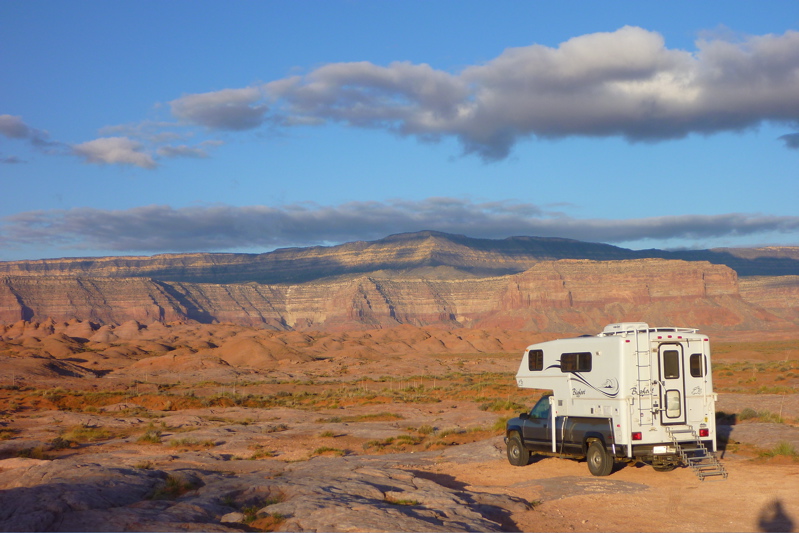
I’d parked the RV at the end of a 55-mile track south of the highway at Hole in the Rock, the top of a gully which drops 500 feet down to Lake Powell and which is bit of a scramble in places. If this was the Australia that I know, the chasm would be plastered with ‘Gorge Risk‘ signs. Looks like the Americans have got over all that, if it ever existed here. What you see – a steep, boulder-chocked gully where you want to take care – is what you get.
Getting down and back up from the lake wore me out for a day, but what was I complaining about? In 1880 Mormon pioneers spent six weeks here lowering two dozen wagons to get across what was then the Colorado river (read right) to get to a new settlement on the far side. Once on the water I only went for a bit of a splash-about in a flooded arm off the main body of the lake as it was a bit windy and I wasn’t sure what weather lay ahead. By the time I got back to the top it had clouded over and stayed that way till I left the GSENM a few days later. Changes on the conventional-looking pre-2011 rafts are summarised here: pointy ends, greater length, extended stern, 2-part backrest/seat and a deck that zips right off. I also have a feeling the floor’s made from a chunkier or stiffer fabric and so the extra butt-patch I had specified (left – done for free) may not be so necessary – but it sure feels worthwhile when scraping along a boney Scottish burn.
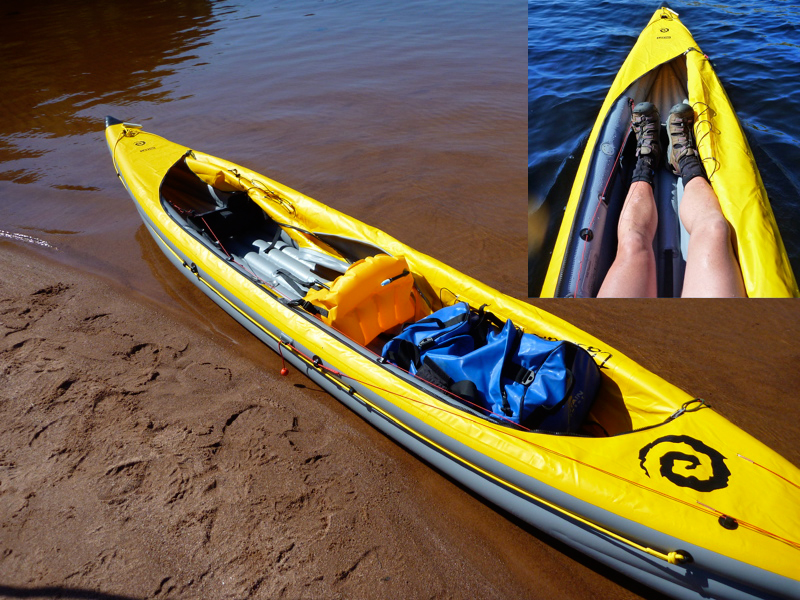
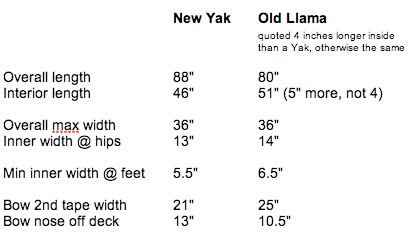
On the water first impression was not so good – oh dear the 4-inch shorter Yak was seemingly narrower at the front than my old Llama and I couldn’t put my feet side by side when pressed against the front (left image on the right) – this wearing size 11 Keen Arroyos (fairly wide). But deflating the backrest from full gave my legs more room and I actually found that both feet placed flat on the floor below the bulge of the side tubes worked fine (right image above right), just not so sure if this is so intuitive for brace control. I checked the front interior width of my Llama against the new Yak and it’s only an inch wider. In the picture left the new Yak and Llama fronts seem near identical in interior front width.
Getting back in the longer Llama, I now see the reason my feet didn’t jam was that I had a few inches gap between the front of my feet and the inner front of the boat where it tapered off. Sat against the back I could never reach the front to brace which is why I got the Yak. Also, the UDB on the new Yak may have constricted my feet a bit that day. Paddling a few days later without the UDB, I can’t say I noticed the foot jam. Got all that?
Other fascinating facts from my comparative measurements (above right) show the new Yak is only 8 inches longer then the Llama, so a new Llama ought only be 12″ longer, not 20 inches as estimated from the Alpacka website’s measurements at the time. The new Yellow Yak is nominally 4 inches shorter inside than an old Llama.
Other than that it feels much like the old Llama. Like they claim, turning/spinning doesn’t seem to be affected by the increase in length, but I’m sure the Yak’s bow yawed less from side to side as I paddled, due I suspect to the extended tail damping the paddle-induced pivoting effect, rather like a rudder or skeg. I did have my part-filled UDB strapped to the front where any weight tends to reduce yawing anyway. It was the first time I used the UDB on the water and have to admit the added guarantee of its girth and buoyancy was reassuring should a Colorado river barracuda make a bite at my Yak. Couldn’t really do any speeding in the conditions – it may be just half a mph faster, but that’s still some 20%.
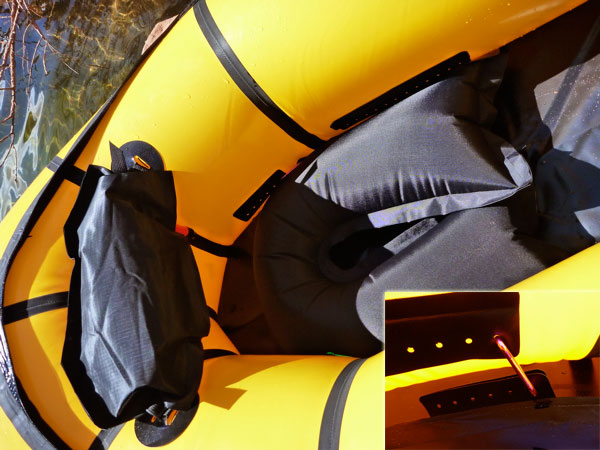
As anticipated, the new 2-part seat is a real improvement. No more having the backrest flop down as you’re trying to get in quick off a steep bank or into a fast flow with a need to line up or burn. Like on my Llama, I just clipped the seat base onto the hull tabs with a single snaplink each side (inset, left) rather than mess about with the string they supply. Makes taking it out and drying/cleaning the insides easier.
Later on, washed up on the wrong side of the Virgin River Gorge in northwest Arizona, I also found the part-deflated backrest a handy way of portaging the empty boat – a bit like a Sherpa’s headband (left). So, bottom line, not a huge difference in operation apart from less yawing which was never that bad anyway once you compensated for it. Can’t say I noticed any added buoyancy/better trim with the longer back, but it might be noticeable from the other PoV. The zip-off skirt is a nice idea; one less thing to unroll and dry after. The added snugness I dare say I’ll appreciate in rougher conditions and it sure is nice to have a yellow boat for a change! There was a discussion on BackpackingLight about the new shape and here Roman D gives his opinion for a harder core of white water utility. More pack-Yak adventures this summer.
With three months on the coast of northwest Scotland lined up for 2011 I was looking for a more seaworthy boat than the Sunny or making the Sunny faster (see this and this). Two weeks watching the weather blow through September 2010 showed it changes a lot up there. First from the east then the west, it blew at up to 50mph so when it’s good you’ve got to drop everything and get out there. But if it changes on the water while most probably paddling alone you want to be sure you can get back fast and not have to jeopardise making progress by either bailing in a frenzy or struggling to re-board. Well, that’s the way I see it. In Shark Bay, it didn’t take much of a swell – maybe a metre – to fill the Sunny up every 20 minutes or so. I’d hook onto Jeff’s tandem and they paddled while I pumped. And that was the warm Indian Ocean not The Minch, off the North Atlantic. It’s not like I’ll be setting off for St Kilda every weekend to pick up half a dozen gannet eggs, but either a deck or self-bailage is needed to be able to paddle alone around there with security. As you do, over the previous months I gone through periodic frenzies of internet research. A hardshell SinK was never in the running. I don’t like being jammed in those things, they’re awkward to transport and would need getting rid of after. Plus I can rent a decent sea kayak locally. Instead, I wondered about the other extreme, an SoT; very popular with the rec paddling masses who may not know a hard chine from a Chinese burn, but have a whole lot of inshore fun nevertheless. Most SoTs are wide enough to do the Can-Can while wearing flippers and come in awful ‘explosion-in-a-paint-factory’ colour schemes.
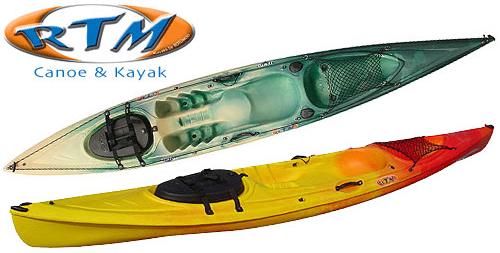
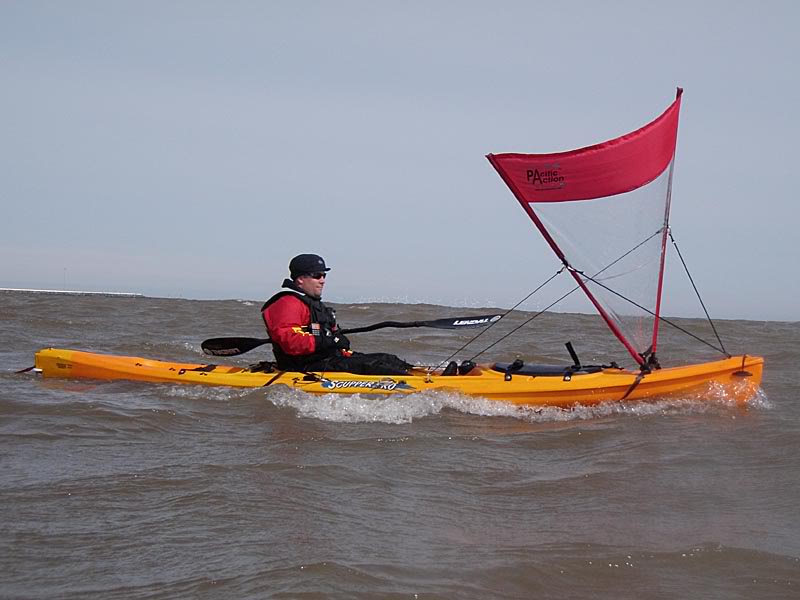
The angler-oriented models are less hideous and I narrowed it down to an Ocean Kayak Prowler 15 (above left) or OK’s slimmer Scupper Pro (above). One went on ebay for just 300 quid while I was thinking about where I could store it. They say an SP is from the same mould as an RTM Tempo (left; 24kg 4.5, on 67cm) and their Disco (below right; 23kg 4.3, on 65cm) looks pretty good too for a plastic sea clog (the shape I mean – not the colour). Fast I imagine, easy as a bike to get on and off, but might require suiting up too often to be fun without getting chilled. Either of these would be a lot of fun if I lived in Florida or the Aegean. Not so sure about northwest Scotland.
So according to my calculations that left a folder, and for me the pick of the bunch has always been Feathercraft’s Big Kahuna (left; 4.5m x 64cm; 16kg – 14′ 9″ x 25″; 35lbs) featuring an extra big cockpit for creaky old men who can’t bend like they used to could. Feathercrafts are expensive and the marked up price new in the UK is so far beyond the pale to give them an admiring cachet among paddlers. I missed one in the UK for £1800 then tracked down another in Hawaii with every last option plus a few extras for £2200. I could have brought it back and then sold it in the UK for what it cost after 3 months paddling.
It then turned out matey down the road had a Big K so we went out for a spin on the local, freezing river this week. Moreaboutthat here. Short version: the BK would be a flaming good yak that could be left assembled for the duration and wouldn’t get turned away by security at the Sea Kayak Christmas Ball. On the scungy Medway it took a bit of turning in my clumsy hands but tracked fine, glided smoothly and weighs only 16kg; easy enough to portage on the shoulder. But it still has that unnerving SinKiness I don’t like and is a bit awkward to get out of – well for a spaz like me with a dodgy shin and who’s used to IKs you can fall into drunk. The Feathercraft would have been a lovely boat up in the Isles, but has the same re-entry issues as any SinK. The way I see it, if it’s bad enough that you tip over, getting back in and staying upright long enough to pump it out is going to take some luck alone. Until I learn how to roll a kayak I don’t fancy that at all. Nevertheless, I was all set on buying the slinky BK as it would cost me nothing once sold on and doubtless have been a pleasure to behold. Then Gael from SSKT slapped me out of it and pointed out that Incept from NZ will be selling their decked K40 IK in the UK next year – and without a usual horrendous UK mark up (Knoydart take note…). UK distributors Seakayakoban tell me they have a demo in stock now with the next delivery in March for around £1500.
The K40 is similar to the Grabner Holiday II which might be classed as one of the original twin-side beam IKs which begat the Gumotex Seakers I and II. The solo Seaker 1 (left; 4.8m x 75cm – 18 inches more than a K40 and 3 inches wider) is officially as expensive as the K40, though has been going at half price ($1500) from Innova in the US. A fellow IK blogger recently got one. At just £1000 that’s a great price, but the problem is the deck is fixed (packing and drying issues, IMO) and it manages to weigh no less than 33 kilos/73lbs according to the Gumo.cz website (US distributors Innova claim 60lbs/27kg). Whatever it is, I had a chance to buy a used Seaker from Czecho a year or two back for just £800, but pulled out when I appreciated you can’t take a boat that heavy on a plane too easily, nor haul it too far.
Readers have occasionally emailed me about decking a Sunny. It could be done I suppose by gluing velcro or a zip onto the sides or maybe some understraps, or even an elastic-edged canopy, like fitted bed sheets. How good will that look if I was left to do it?
It’s actually something that might be a little easier to achieve with a semi-decked Gumo Helios II (above left) were it not for those ghastly sewn-in seats they have. In fact I see Grabner offer such a thing with their Helios-like Explorer II (right; 5m x 75cm) as part of the €600 accessory package. Nein danke.
So, the Incept K40 Tasman Like Gumotex, Aire, NRS and the rest, Incept seems to be an established raft manufacturer who’s turned to IKs. The Incept K40 Tasman (4.3m x 69cm; 17kg. 14′ 3″ x 27; 37lbs) seems to have been refined since I last looked at their website at which time there was no UK distribution that I could see. There seem to have been at least two other versions but this one looks the most complete by far and following this investigation I bought a K40. I don’t know about you but for an IK, that picture below is of a pretty good looking boat. I do wonder about the 27-inch width, being used to the 30-inch Sunny, but at 30-inches I cannot imagine ever tipping out of a Sunny short of getting crossed up against a rock or branch a couple of times. If I measure 27 inches across my lap, it looks just right as long as you’re sat low. The simple answer is of course to go up to Oban for a demo.
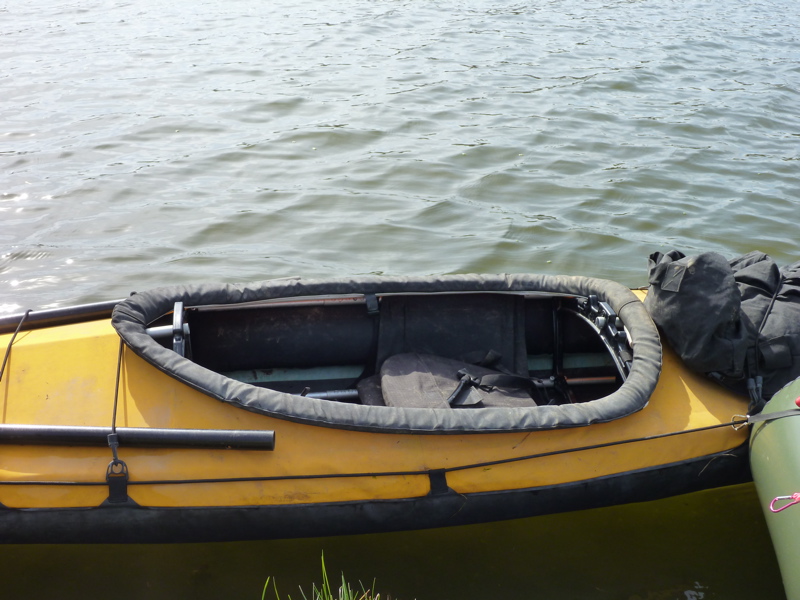
Just like the Alpacka the K40 has a deck that zips across to one side to roll up for sunny, calm days. We like that about IKs; it keeps the legs tanned and makes packing, drying and, if necessary, draining the boat mid-water so much easier.
The hull is composed of three I-beamed chambers with twin-beam sides to help give its 14 feet better rigidity. The Sunny had round, single chamber sides which, although they get nice and taut on a hot day, the boat still flexes with the swell or even just with my weight in it. With I-beam chambers the K40 features pressure-relief valves on all three chambers including the sides rated at 5psi which are out of the water. This reduces the strain on the welded I-beam seams but it’s possible that some air will be purged through the valves as it expands in the course of a hot day. For this reason I see that Incept recommends carrying a small, top-up pump (right) as can be seen on the deck of the kayak pictured above. With it, you can re-pressurise the boat for maximum performance, and this can be done on the move as the valves (grey) are right there in the cockpit (the sidewall PRVs are behind the seat). The twin beams also add up to less width (69cm or 27 inches – 3-4 inches less than my Sunny) and so more speed – although re-entry may be harder and all without – I hope – making it too tippy. It’s got a rudder because those high sides may catch a crosswind at times. Scoffed at by Brit sea kayakers who use boats that have hull profiles designed to turn when leaning out (very odd if you’re a motorbiker!), with a rudder you can paddle normally across the wind and use the rudder to correct the tracking.
A rudder will be good for sailing too. The boat also comes with a neoprene spray deck, a handy K-Pump and even thigh straps to enable control across a swell, better core muscle work-outs I reckon, and even eskimo rolling. In fact my boat came with no spray deck, no straps, no strap fittings (though there are markers), but it did have a K-Pump. Thigh straps are one thing I missed on a Sunny, more for the efficiency of paddling effort against the torso, than balance and control of tippiness (not a problem with that boat outside of hurricane conditions). While getting the drum on the K40 I came across this videoof a Kiwi guy who did an NZ South Island coast-to-coast over a fortnight. That is, upstream from the Tasman Sea, tough portage to a pass, then paddling down to the Pacific. (Ain’t these guys heard of packrafts!) His less driven mate came along in a 100-year old wooden replica boat – they were engaged in a historic C2C re-enactment using old and new craft.
It’s actually three, short videos of two guys having a little Kiwi back country adventure. Have a look at the K40 in action on vid II at 2:20. Many times on the rivers and seas you’ll see how a relatively modest waves wash over the deck of the K40 – a Gumo Sunny would be a brimming paddling pool at this point. And again the vid reminds me of the advantages of an IK when it comes to bouncing off rocks and general abuse that would hurt a hardshell or loosen the joints of a taut folder like a Big Kahuna.




































 Inflatable Kayaks & Packrafts