
In early 2016, Feathecraft dropped the Java/Gemini and Aironaut to stick with folding kayaks.
In 2017 Feathecraft closed for good.
In 2007 I was already looking to move on from my Sunny to something a bit longer and self-bailing (I thought this was a good idea at the time). The two boats that appealed to me were Aire’s hefty and wide Super Lynx and a Feathercraft Java (since then many new contenders have come on the scene). I decided to treat myself to the more expensive but lighter Java and picked one up from the clued-up FC dealer in Durango.

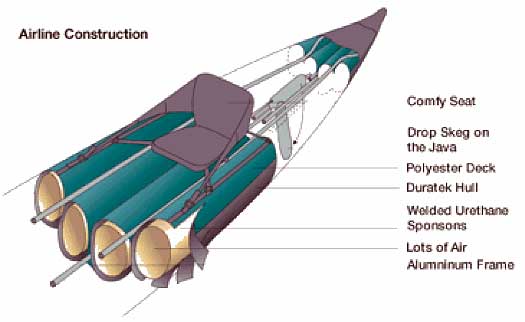
Set up is pretty straightforward: you slot in the alloy keel- and skeg pole and then the side poles, velcro them all in place, attach the seat by too many straps, pump up the four sponsons and off you go. Realistically, 20 minutes is a good assembly time.
It’s a sleek-looking boat for an IK; still today nothing else comes close, but one of the biggest hassles are the cheap inflation valves: basic turn-and-lock elbow valves seemingly off the end of a Thermarest (or indeed an Alpacka packraft where they work fine to top up, not inflate). The thin plastic hose on the hand pump supplied pushes on, but when it’s hot or wet it twists off, or if you pump too hard it blows off and the air leaks out. As it’s an open (not one-way) valve, you have to screw it shut quick. Maddening!
I thought for a while there was some component missing from the pump but no, this was it. I found holding the hose onto the valve with one hand while pumping the two-way pump with the other was an awkward but more effective way of inflating. Even if it’s bigger, give me a foot pump any day. Or regular one-way Halkey valves and a K-Pump.
At 28 inches (71cm) wide, it’s just two inches narrower than the Sunny but feels much morem chiefly because you sit high ON it, rather than in it. FC are right in describing the Java as an inflatable sit-on-top. As you can see in the pics, under my 95kg weight, the poles are more there to aid the hull profile than enable longitudinal rigidity. It’s 15 feet 4 inches (4.65m) long but you can’t get much into the last foot-and-a-half at each end; the usual problem with IKs. The thigh straps are a nice touch or an admission that you may need them to keep upright.
I took it out for a scoot across the Vallecito reservoir in Colorado one evening with the two inner (floor) bladders not too firm and was relieved to find it not too tippy. On the way back I struggled with the pump some more to firm up the inner sponsons and found it less stable but still OK, and probably faster. And before I got caught out, I practiced getting back in off the water; as long as I crawled aboard without any sudden movements it could be done in calm flat water. But who ever falls out in calm water?

The retractable skeg is a great idea that’s only really possible on a self-bailer, but with the middle sponsons firmly pumped up the actuating string which comes up between them gets jammed. It’s best to manually make sure the skeg is fully down before setting off – but this negates the retractable feature.
At least you know that if it snags on the river bed it will just pivot up (but then won’t come down again). A good fix to help the skeg pivot with the string lever would be to have the string passing through a short section of thick garden hose or plastic tube jammed between the sponsons so enabling it to slide freely. The slot through which the skeg passes is also the bailing hole, designed I am told, to suck water out of the boat with a venturi effect as it moves over still water (less effective in a current going with the boat). Can’t say I noticed water rising as I stopped, but it sounds plausible.
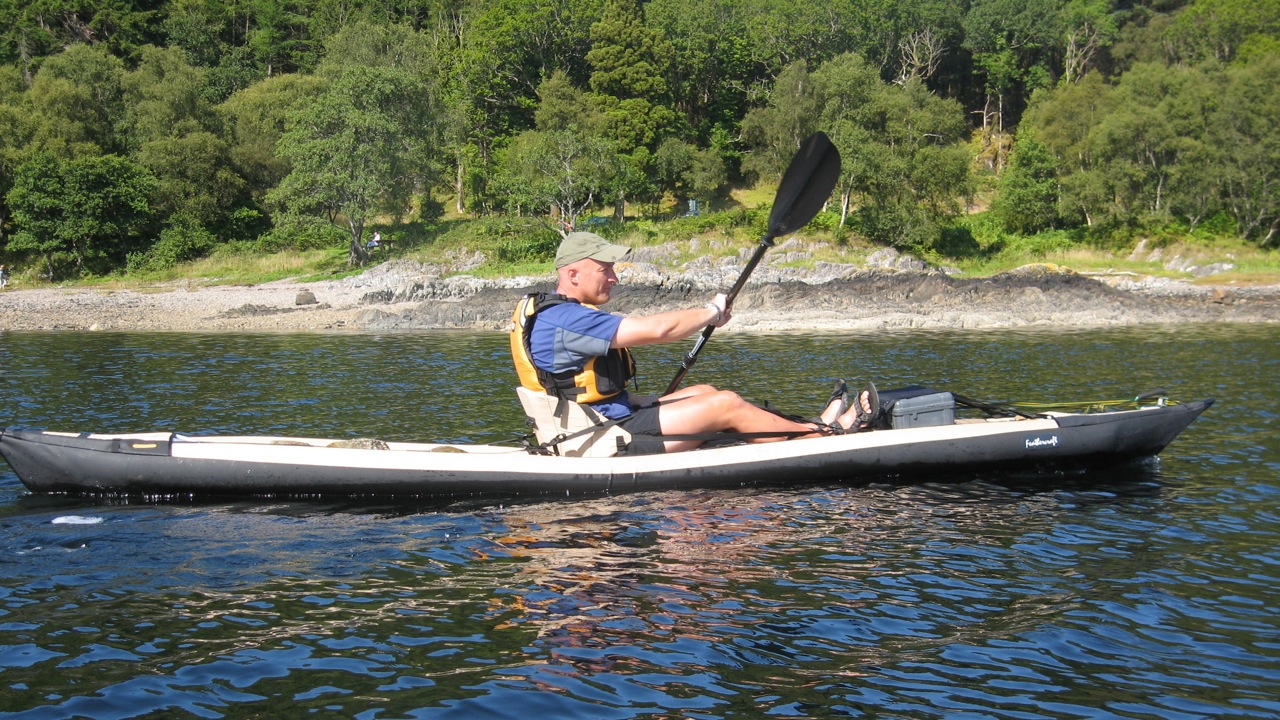
Paddling without the skeg was OK on flat water but with it deployed you can power on. The solid footrests, thigh straps and comfy seat (also inflatable) all help here. One problem with the footrests is the angle they sit on: the poles force your knees outwards into the paddle arc. I also wondered how secure they were, screwed down to merely butt against a protruding rivet in the pole. A flat rather than pointy end to the securing screw pin sitting against the 2mm-high rivet might be better and could easily be done. Anyway they never shifted during the easy paddling I did.

The Java has neat cargo nets: easy to use and secure. I’ve since bought a pair for my Sunny. Inflation valve design apart, workmanship is what you’d expect for over $2000 with good attention to detail. The ‘envelope’ or hull doesn’t really need to be sealed in any way as the four sponsons or bladders slot into their respective cases and, with the poles, make this pile of nylon and rubber into the only IK I know that looks close to a proper sea kayak.


Next day in Colorado disaster struck. I left the boat drying on the roof of the car in the forest camp – black hull side up… and went out very early to Silverton on the steam train. It had been a week of huge storms in the Rockies and camped in the forest I figured it would be OK in the shade and probable afternoon storm. But on the way back, when the bus driver mentioned it was a hot afternoon in Durango I thought “oh dear, I hope it hasn’t…”
It had. The thick black hull rubber had caught the sun nicely as it passed over the clearing and ruptured three of the bladders or sponsons. My lovely new boat, not one day out of the bag was a floppy mess. I yanked out a limp bladders (easily done) and found the rather light, flysheet-like ripstop nylon split, and pinprick holes in the airtight PU coating. That was the end of my Java paddling in CO. (A happy ending. I ordered a full set of sponsons from FC in Vancouver and when they discovered the boat was nearly new they generously offered to supply them free of charge. Good on you FC.)
Back home with new bladders, we went to Scotland and I tried out the re-bladdered Java alongside my old Gumotex Sunny. G-friend’s first impression was that I was too big for it probably due to its SoT stance. She had a point. And also it was too fiddly to set-up for my keep-it-simple prefs. She had a point again, and although it’s amazingly light for what it was, it’s still pretty bulky. In Denver I’d spend hours packing it carefully for the flight back for fear of having the near yard-long hull poles damaged in transit. On my bathroom scales in the blue holdall ready to paddle it weighs 17kg (37.5lbs). The boat’s envelope alone (no seat or tubes) weighs 9kg (19.8lbs). In other words, about the same as my Sunny but two and a half feet longer.
On the lochs the long, thin Java slipped along, with a speed of 10kph (6.2 mph) flashing on the GPS for a second, though 4mph was a more sustainable speed (video above). Let me tell you that is a very good speed for an IK, comparable with the Incept K40 I bought a few years later. (There are more useful speed stats on inlotusland’s blog about a lake near Vancouver in a blue Java.).
The Java kayak didn’t really feel right to me: the old problem of too narrow and me sitting too high for my weight. An experienced hardsheller would probably not have any issues. We went on to a freshwater loch, a little windier by now. I tried to visualise myself in a fairly normal one-metre swell out at sea. The rocks I added for ballast hadn’t really added an impression of stability (as they can do on other tippy IKs) and overall, with the height/width relationship I didn’t feel confident anticipating the less than flat calm conditions I wanted to be able to face.

Back at the chalet the biggest hassle of all: the Java takes hours to dry, maybe even days. But dry well it surely must, especially when rinsed after a sea paddle. Sure, I’d read about this in some reviews, but it now dawned on me that the problem was common to all bladder IKs (like all Aires). Water will always get in the hull sleeves/envelopes holding the bladders as well as other crannies, and once there will always take a while to evaporate.
A spin in my basic Gumotex Sunny reminded me what a great boat it was: quick to set up, fast drying and good enough performance. If only it bailed. [2020: I now think self-baling is not essential for a tour boat; i just used my Sunny beyond its abilities].
The Java got itself sold on ebay. Lesson: try before you buy and if it’s not possible (as it wasn’t for me in the UK), be prepared to eat your mistake.
In 2011 I gave my sun-faded Sunny away and got myself an Incept K40 Tasman. The K40 was less fiddly than the Java to set up, though the time taken is about the same, but I still miss the ‘pump and go’ simplicity of the Sunny. That is why I then got myself a Grabner Amigo. But I sold that and got a Seawave, my best IK yet.
There’s some Java chat on FoldingKayak.org. This guy in BC also had a Java then got a Gumo 410C. Looking at his pictures, I’m struck how ‘perched’ he looks while still being high in the water.

See also:
Incept K40 Index Page
All Quiet on the Waterfront (Thames, 10 years later)

London made worldwide headlines this week for rioting, arson and looting. Along with scores of others, our own high street got done Monday night, and next afternoon all the shops were closed, braced for a re-run that instead moved to other English cities. The map on the right only shows the bigger events in London up to Tuesday; many more passed unreported.


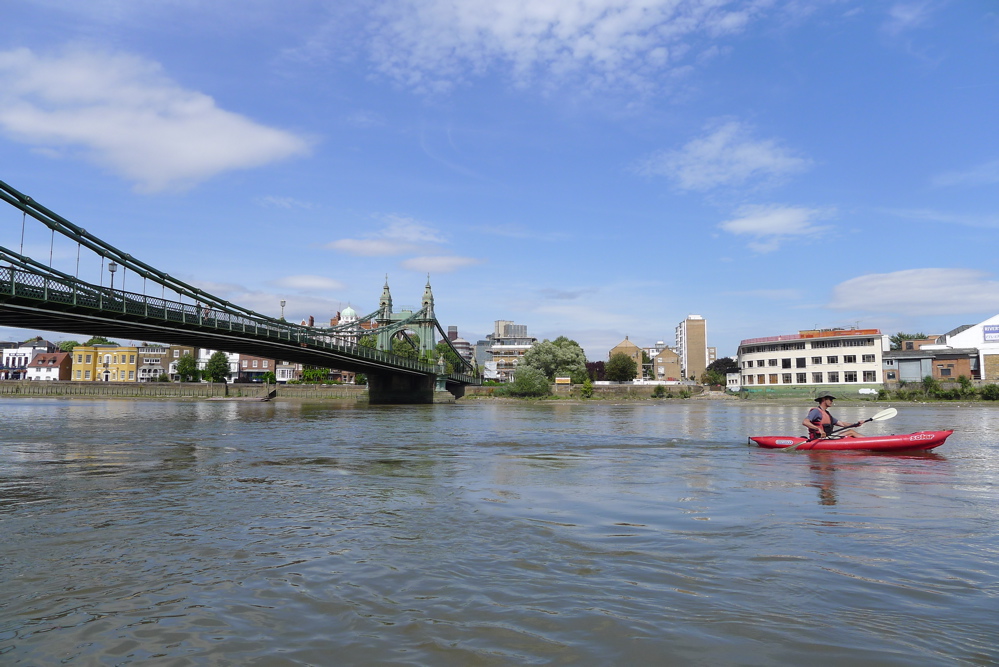
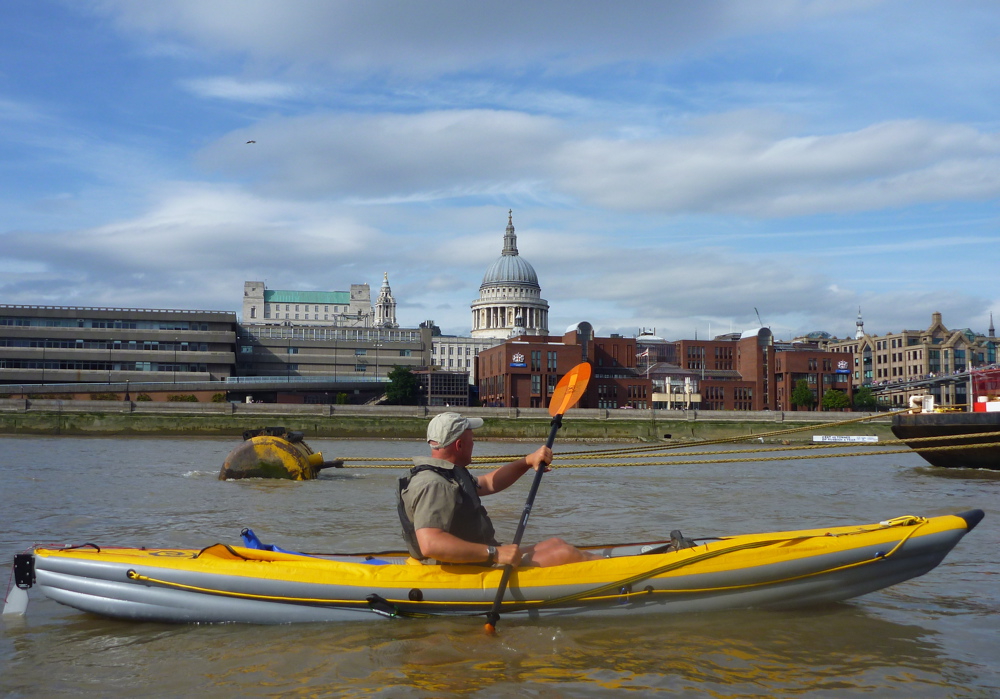
But Wednesday the tides were favourable and the weather were fair for a 17-mile cruise down the River Thames from Richmond to Tower Bridge. We’d planned the run before all this aggro kicked off as I’d not paddled through London for years and fancied doing it in the Incept. In fact we ended up paddling all the way to Greenwich, about 21 fast and briefly hairy miles.
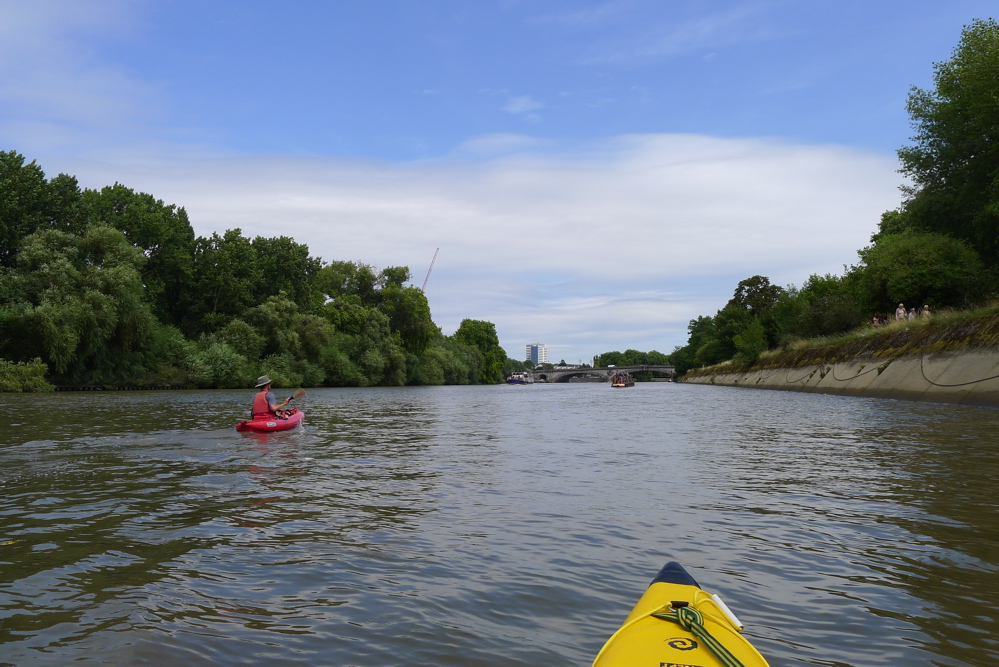
Richmond is a prosperous suburb stuck under the Heathrow airport flight path; no rampaging here, thank you very much. Steve and I set off just below the town bridge at 1pm, right at the turn of the tide, even though 20 minutes earlier the water was still clearly charging upstream. In fact I read that in the upper tidal reaches, the Thames floods quickly and ebbs slowly.
Again, the K-Pump was used to inflate the Solar which Steve was using as his Feathercraft was in detention. I’ve found the K is much more effective at getting a firm fill than the squidgy Bravo footpump.
Maybe it’s a river and gravity thing, but when the tide ebbs with the mild Thames current, it’s on the move almost straight away. With the help of a strong southwesterly that day, very soon we were cruising along at an easy 5 or 6 mph, and that speed barely relented until the very end when we took out just before low tide at Greenwich.
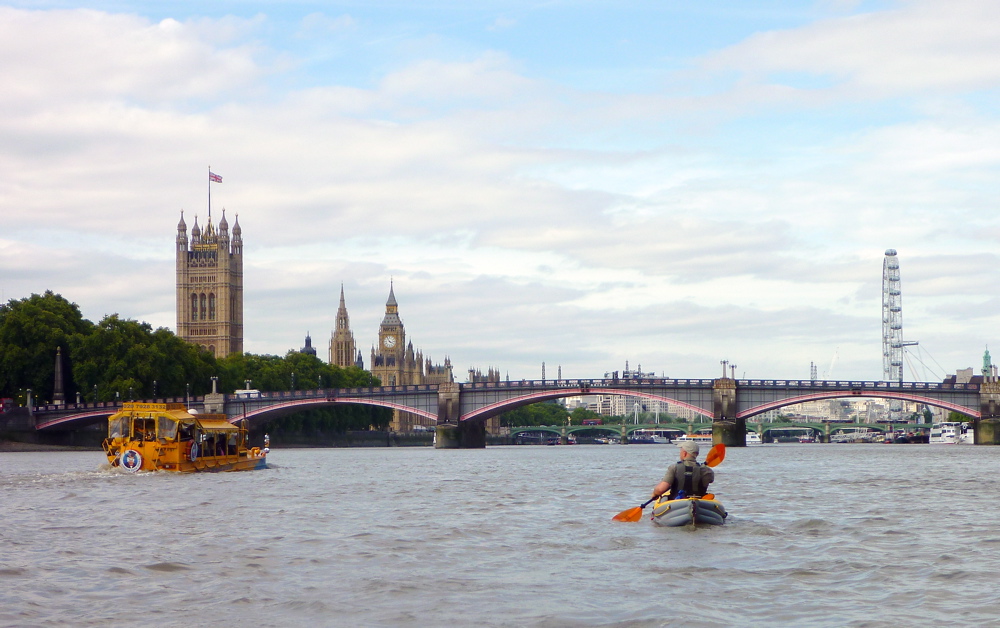
The 15-mile run-up to Westminster initially feels quite rural in places. Riverside willows swung their tresses in the 15mph breeze as we passed the handsome riverside dwellings of affluent west London with barely a high-rise in sight.
By Putney, home of the famous Oxford-Cambridge boat race, we were halfway to Tower Bridge and the greenery give way to urban development and the odd industrial site. Around here you get a few people rowing those slim Oxbridge rowboats, and it occurred to me later that for some reason they’re excused from wearing life jackets. A boy drowned near here in one of these rowboats, a week or two ago.
Near Battersea heliport the wobbling wind sock stuck out sideways like a road sign, pointing downriver towards banks of million-pound apartments built in the last boom-but-one to accommodate London’s growing class of needy oligarchs.
There were more barges and pontoons moored mid-river now. All easily avoided of course and just as well as the way the current was ripping along, their flat prows made a nasty hazard; like an an upside-down weir, that might easily pull a kayak down and drag it along under the entire length of the barge.
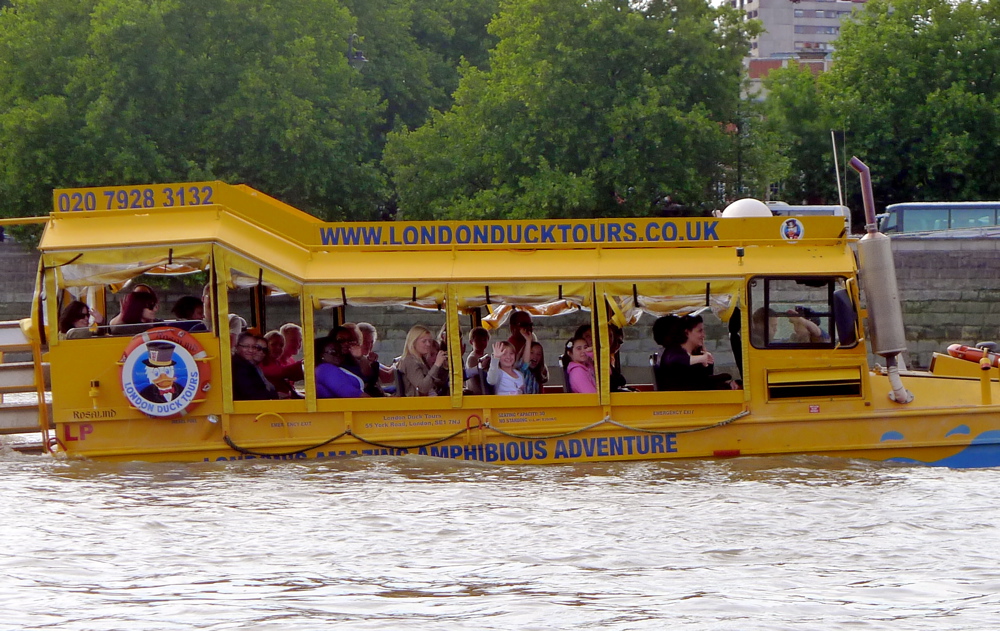
At Vauxhall Bridge, by the snazzy MI5 secret service HQ, we saw one of the London Duck amphibious tourist barge-buses drive down the bank. It submerged itself into the river and chugged past (left), managing to look as ungainly on the water as it does on land. The Ducks do a token 10-minute sweep of the river past Parliament, but having gone on one years ago, I can tell you it’s a hot, noisy ride. I reckon they are more fun to watch than to be in.


We grabbed a few shots as we passed the Houses of Parliament (that how HP Sauce gets its name), and I thought it was going to be a smooth, quiet passage through the busy two-mile section of the river from Westminster to Tower Bridge, as it had been last time.
But as soon as we passed under Westminster Bridge alongside Big Ben, the character of the river changed and waves were standing up to 5 feet high. The flow gets constricted and backs up by the pier supporting the London Eye which, along with the masses of tourist boats, effectively halves the width of the river, while the current and tide pushed through, exacerbated by the wind. I’d heard of these waves below London Bridge but had never seen them this big. We’d come down so fast from Richmond that we’d hit the busiest section of the Thames, packed with manoeuvring tour boats and jetties, at the peak of the tidal flow. Suddenly the river was rather lively.

Rush hour on the river
As always the best kayaking shots are the one you’ll never see: of Steve in the 10-foot long Solar teetering over wave crests and my long bow rising and then slapping down into the troughs. What pics I grabbed were pretty mild. Holy moly, you don’t see all this looking down from Waterloo Bridge with a flat white and a Telegraph in hand, but it may only last a short time or be limited to certain conditions. It’s worrying too, how you’re quickly transfixed with dealing with your own predicament; if one of us had tipped in here, the other would have had real trouble turning back in the current and traffic. But we got through (I’ve probably exaggerated it all) and even got used to the more manageable standing waves, if not always the cross swell flung out by the wake of passing tour barges. These wide, twin-hull Thames Clippers can really shift, accelerating up to 15-20 knots, although it’s actually the older, mono-hull tour boats that punch out a wake you want to watch out for, and is probably why their speed is limited. As it is, I read there’s no speed limit on the tidal Thames below Wandsworth, merely common sense is required, plus a risk of a big fine from the PLA.
I was momentarily freaked out by all this, but although I didn’t dare glance back or try and take photos, Steve seemed to be keeping pretty cool in the tiny Solar. I’d not applied any of the mods I’d lavished on my old Sunny, and with its crap seat and soggy footrest offering little support, paddling the Solar in heavy conditions was a bit like balancing on a midstream log. This was all at times more intimidating than anything we’d done on the Class II Ardeche a couple of weeks ago, and I was thinking it really was high time I slipped on my Incept’s thigh braces. We stopped off for a breather at the South Bank and enjoyed a coffee and lemonade for only £5 each while tourists wrote messages in the sand of the now exposed river bed.
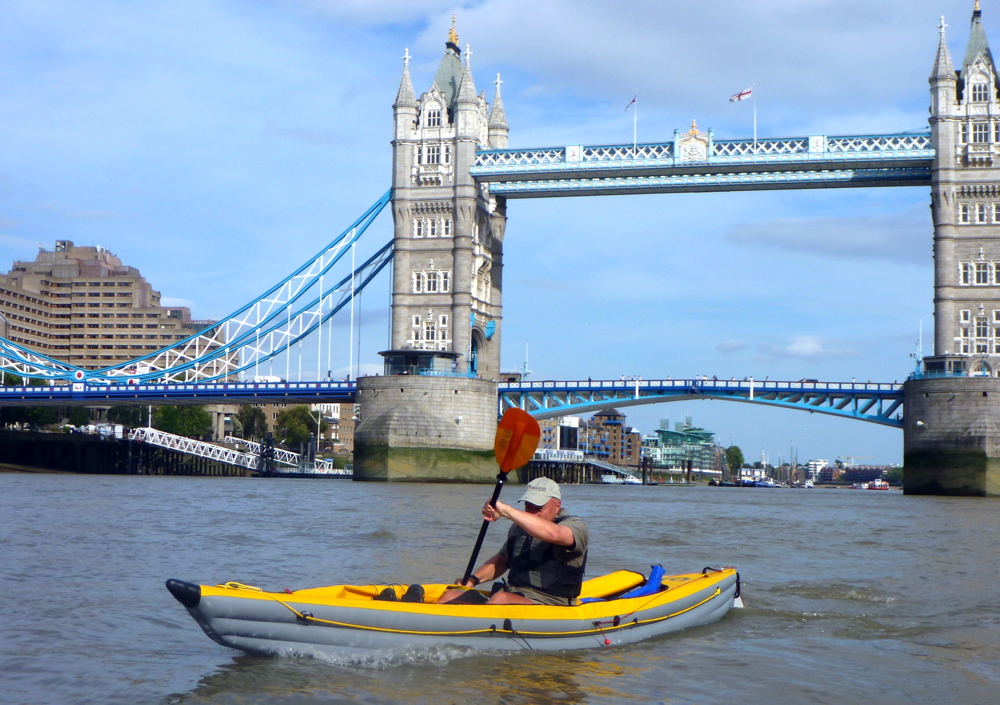

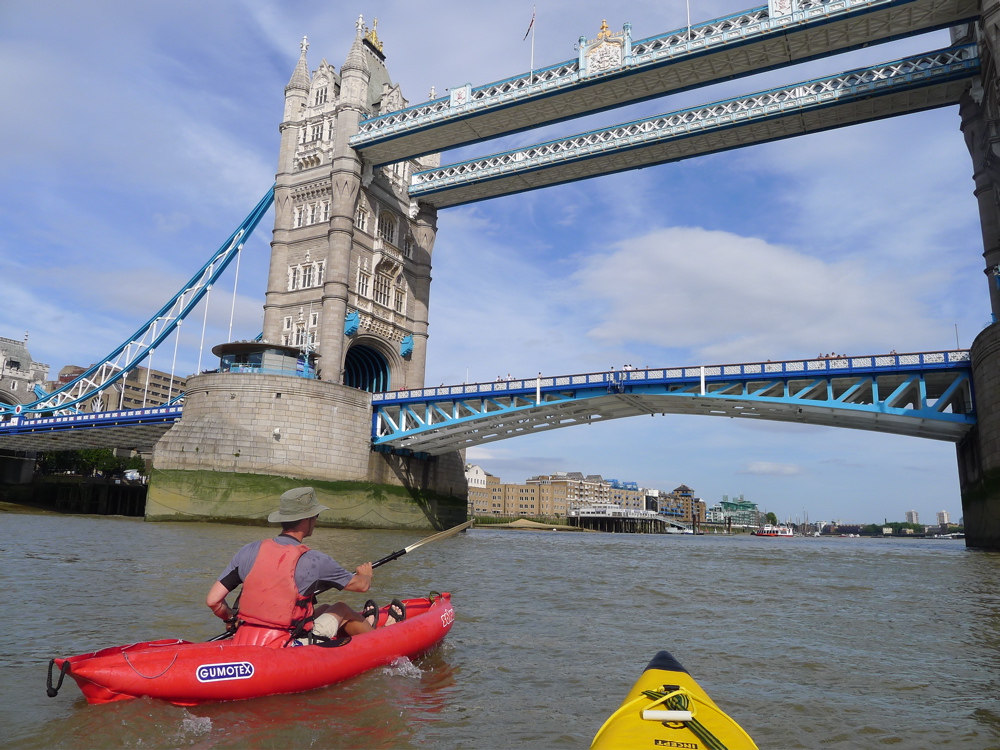
On to Blackfriars, Southwark and London Bridge, where mid-stream there were ranks of frothing, churning whitecaps. We didn’t want to go there, and kept to the right, looking for less speed and flatter water behind the HMS Belfast tourist warship and on to Tower Bridge where all was calm and it was no drama to pass under the middle, as more tourists above waved.
It may sound like a scene from a James Bond movie, but in 1952 a #78 double-decker bus successfully jumped a three-foot gap when one of the ‘bascules’ lifted unexpectedly. The postcard (left) dramatises the event. Having got to this point so fast, we decided we may as well carry on the hour or so to Greenwich, as we knew down here the river opened out, tourist boat traffic dropped off and there were no more bridges or other fluvial furniture to cause weird wave formations.

Out past Wapping and Rotherhithe, the Thames is lined with converted warehouses or new apartments, shielding the less glamorous council estates of the East End. Soon we’re passing Canary Wharf, once the Port of London, now a mini-Manhattan of office blocks built in the 1980s when the financial boom kicked off in London. Those guys weren’t having such a good week either – one trader on the TV news was filmed swatting his Perrier off his desk in frustration at that day’s collapse, but at least they weren’t running amok and setting fire to their ties.

The river meandered south putting us into the wind, but it was good to crank up some solid effort. Even here the odd Greenwich-bound tour boat still threw out their mini tsunamis which crashed with a roar along the banks behind us and were fun to negotiate up to the point where you thought, ‘ooo-er, hold on a minute, am I’m surfing here!?’ Otherwise, the broad river gets a bit dull along this section and soon enough the wooded hill of Greenwich Observatory and the prime meridian peeped out from behind a bend. Steve was a bit pooped for spinning the ill-fitting Solar along at Incept speeds. And having used my huge Werner Corry paddle, I too was suffering from some elbowitis. We came ashore by the Cutty Sark tea clipper, lifted the boats carefully over the broken glass and gravel, up over a fence, aired down and headed for the station.
We did this 21-mile run on a neapish tide of just 3.8m – they drop to 3.5m and rise to 5m this time of year at Richmond (it’s about a metre more at London Bridge). That took us only 4 hours actual paddling which must be the fastest 20 miles I’ve ever done in a paddle boat. Slowed down by locks, inland of Richmond the freshwater Thames can be a bit boring, but I wouldn’t fancy coming through Westminster at the height of an ebbing spring tide on a busy summer’s day with a backwind. At such times it’s probably not a place for total beginners in tippy hardshells, but as long as you’re ready to get stuck in, it is of course good fun and you can be sure of a big audience. Just make sure you clip on a Go Pro to catch the action!
The tidal Thames starts at Teddington Lock, about three miles upriver from Richmond. You need to time Richmond Lock just downstream of the Twickenham Bridge (A316) correctly, 10 minutes downstream from our put-in at Water Lane. I did not notice it as it’s flooded at HW when it’s just another bridge. It’s actually a barrage to hold water upriver around Richmond once the tide turns. There’s a roller pass for kayaks on the left, if you find it closed.

You don’t need any sort of permit or BCU membership to kayak the tidal Thames, as you technically do upstream of Teddington. As long as you’re wearing a pfd, keep right and stay out of the way, the police patrolling the river will probably ignore you.

A fun shorter packboating section would be the 8 miles from Putney to Tower Bridge, both with good transport links and passing all the classic London icons which people of my age will recognise from the idealised Thames TV logo (left) from the 1970s. Once the tide drops enough, exposing the sandy riverbed, taking out is easy enough with a packboat, even if it means climbing up a vertical ladder as we did last time (above). Elsewhere there are several steps or jetties.










Incept K40 Index Page
The first stop of the day, for a snack and a bailing session … was on the beautiful little Isle Ristol, where the curve of a petite beach reached out to embrace the approaching kayak in a shingly grin. Here were the rudiments of rest and refreshment in a spirit of abundance without ceremony, from the free-spirited dreams to the always-islands which soften the horizon and bring comfort to the eye. It would have made a wonderful camp, but I had come only ten miles and was good for a few more yet, heading north, away from the sheltered jigsaw pattern of the Summer Isles.
‘Blazing Paddles’ (1988), Brian Wilson
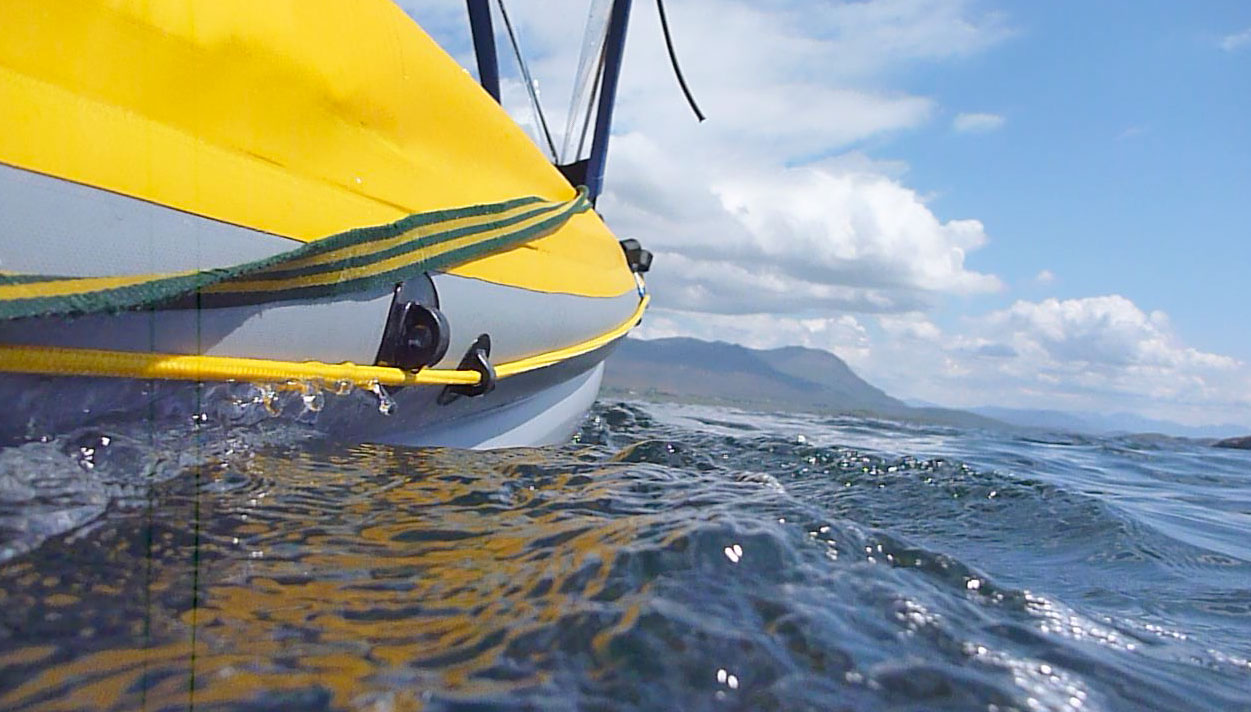
Today was a bad day for sailing. But for everything else, including paddling, it was about as good as it gets up here. The skies were clear, the sea was still and the breeze barely rose above walking pace.
A day earlier I’d paddled off the beach 4km west over to Isle Ristol opposite Old Dornie anchorage. On that occasion, for the first time I actually sensed what must have been a helpful push from the outgoing 2-knot tide which was at its height at the time. Once at the island a lull presaged a change of wind direction and a light headwind rose up. So I popped into a small fissure for a look then sailed slowly back. With no rhythmic splish-spolsh, splish-spolsh, I realised how pleasant it was to be free of paddle noise and amused myself by shooting underwater vid with the rediscovered Go Pro. This ‘hands-free’ PA sail is still a novelty!
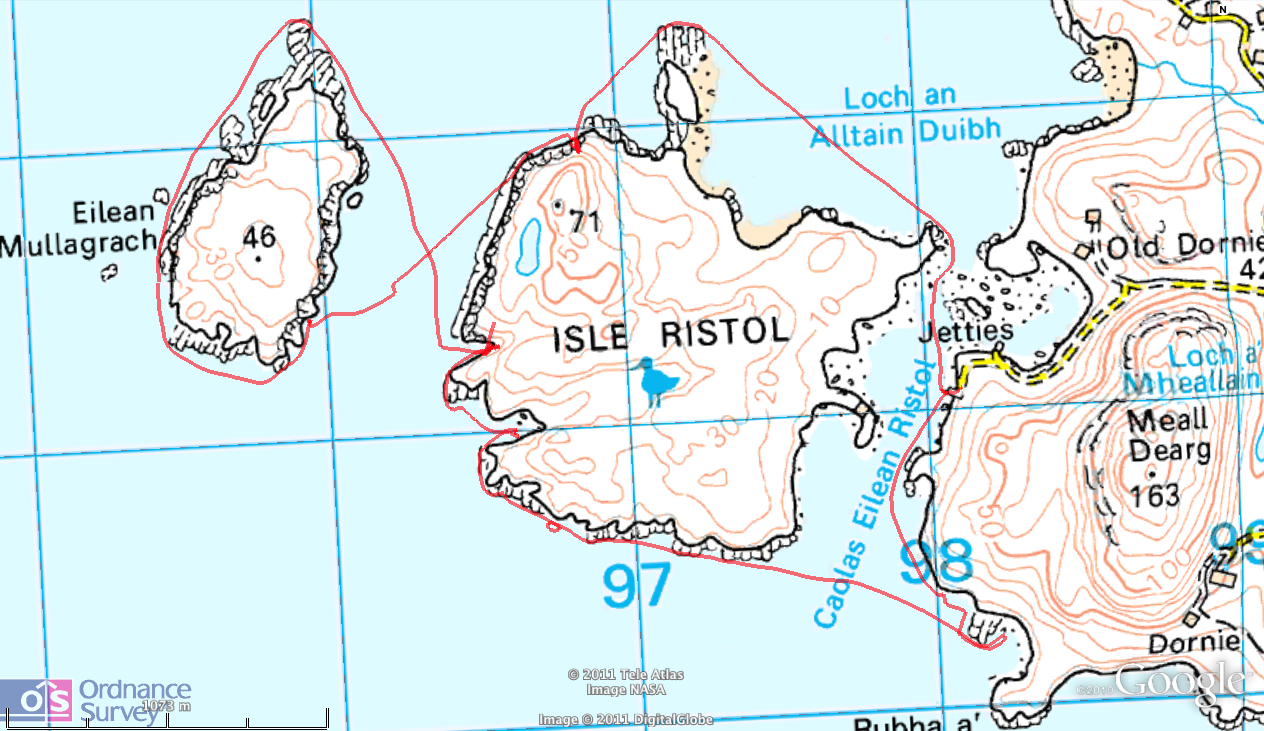
Today was going to require lots of splish and spolsh, but the tranquil conditions encouraged me to try something a little more daring: around Isle Ristol – all 4 or 5kms of it. It may not be Iceland or Tierra del Fuego, but there’s still a sense of accomplishment paddling out to- or right round an island.
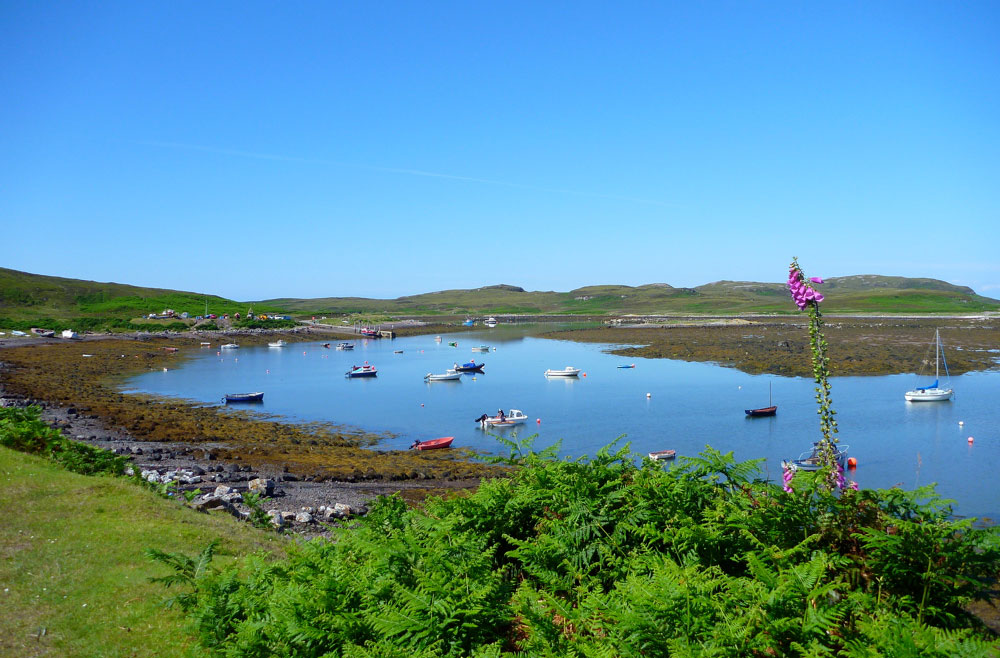
And it’s always fun to paddle out of Old Dornie (left, and bottom of page) as by Scottish standards it’s quite picturesque. A few fishing and rec boats bob around and on a very low tide you can just about wade over to Ristol through the kelp.
I set off at midday; an hour of so before low tide which (by pure coincidence) should have meant negligible currents swirling around between the isles. As it was a warm day and the K40 had been strapped on the car since yesterday, I took the trouble to re-temper the air pressure once on the cool water. The firm kayak responded by gliding swiftly away from the jetty and when I just paddled normally, I was doing just over 4mph.
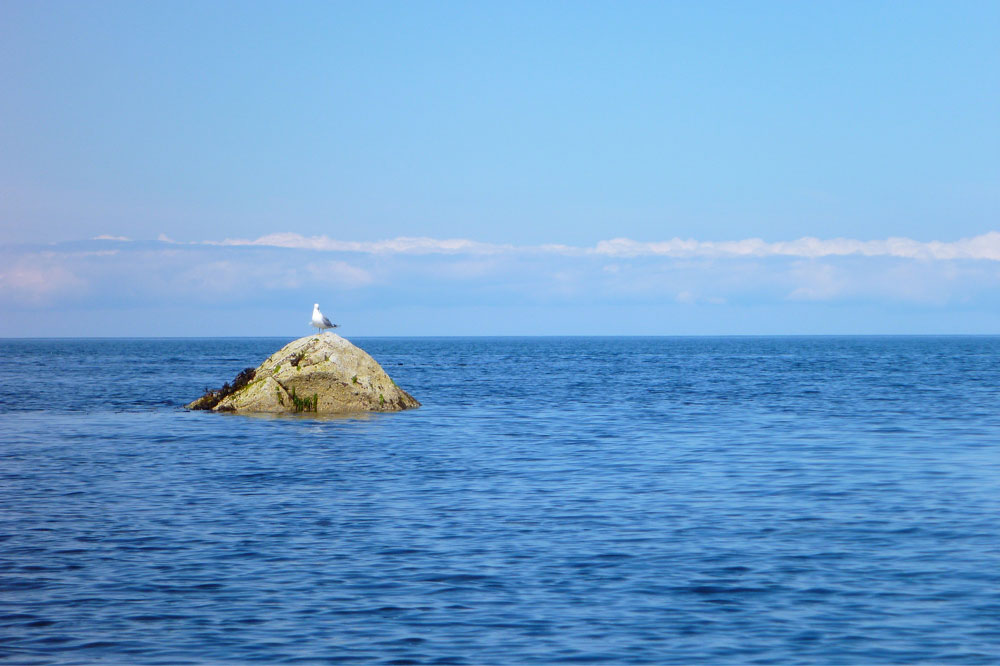
Low tide also meant more land to paddle around and I was forced out around the spur off the north of Ristol by the beach, and out into the unknown. Over the horizon a band of pink clouds lay over the Outer Hebrides as I passed a lone gull (all white seabirds are ‘gulls’ to me) perched on a rock, guarding the way to the open sea. I had a print-out of Ristol on my lap to read each passing inlet if, for some reason I lost my nerve. But beyond the sentinel gull, conditions remained tame.
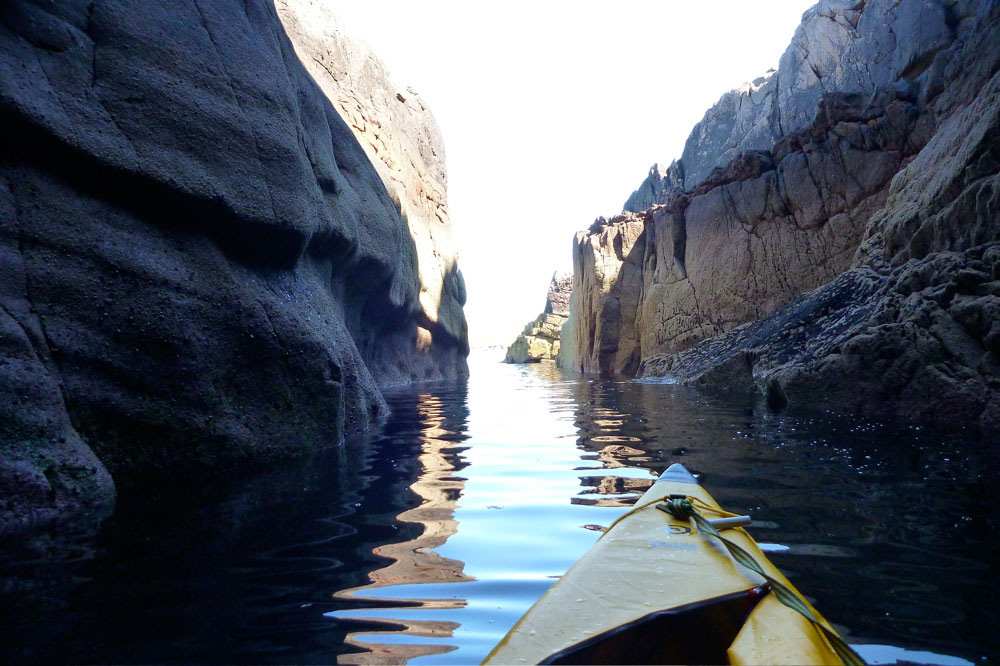
Encouraged, I headed in towards a tumbled cliff and the dark cleft of a sea cave, as wide as my boat is long. New to such probing and aware of the risks, last week while exploring the cliffs along the east side of Achnahaird Bay, I’d dared myself to paddle into a similar cave, catious but intrigued. As here, the over-amplified swell spooked me as it reverberated out from the dank base of the cave, and I was pleased to get out of there quick before some rogue wave came in and pinned me against the ceiling. It didn’t happen so, as with this whole game, you do something scary once and survive unscathed, you get used to it.
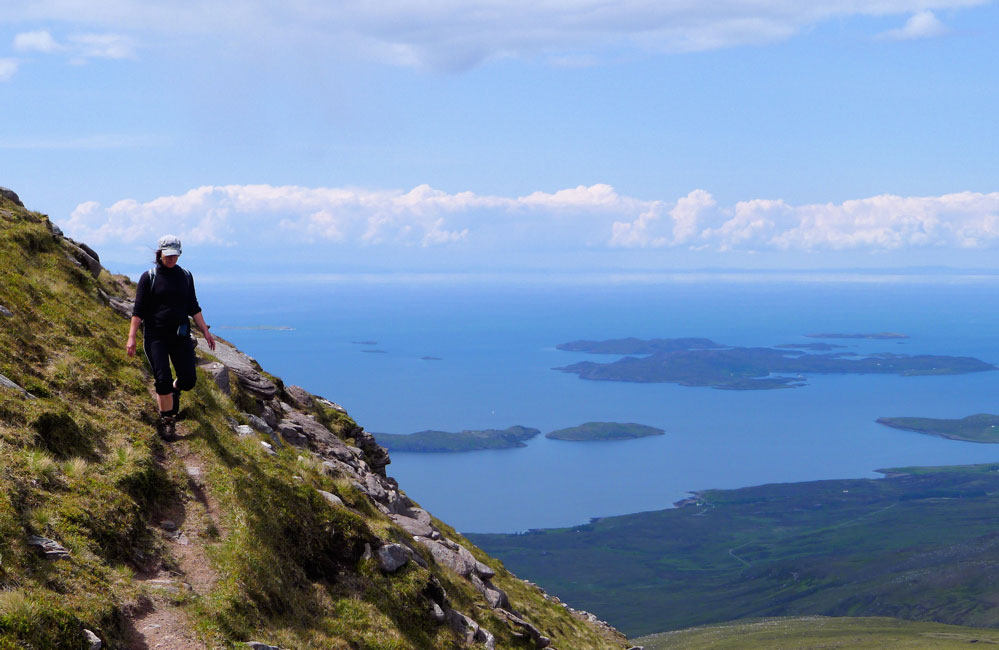
Back in the open and heading further out, I watched for the intimidating swells which never normally reach the lee of the Summer Isles where I usually paddle, but none came. Could it be so easy? I entered the 500-metre passage separating the back of Ristol with Eilean Mullagrach and decided the probability of making it across to that outer isle and back without ending up on the wrong end of an RNLI press release was really quite high. A few weeks ago we’d met some campervaners on Ben Mor Coigach mountain (above left), a great ridge walk that looks down on Loch Broom, Coigach and over to the Assynt. They were also packboaters and mentioned paddling their Advanced Elements double out to Eilean Mullagrach. Crikey, they’re braver than us I thought, as the weather was not so stable back then, but they explained they had a full complement of VHF, flares and all the rest. They’d mentioned an arch and a stack on Eilean Mullagrach which had intrigued me.
I aimed across the passage towards a likely looking inlet of fallen rock, but as I neared it I pulled up, listening and watching the seabirds bobbing about like me, or taking a running paddle back into the air. It was nice to just kick back and relax at will instead of endlessly going somewhere before something bad happens; a common reaction to perceived exposure and anxiety, and not just when a mile offshore!
Fact is I’m morbidly fascinated and scared by the sea, which is partly why I was drawn to those two trans-Atlantic books. I’ve been reading a lot of other sea kayaking literature lately; back issues of OP magazine recounting unprecedented white-knuckle circumnavigations at record-breaking speeds, and just finished, Brian Wilson’s Blazing Paddles (quoted above). These yarns often sound like war memoirs; compelling and character-building experiences for sure, but not something I aspire to. Viewed from the outside, the UK scene seems to be one of testing yourself. Perhaps the prevalent conditions up here on the northwest coast demand it, because if you can handle it the reward is access to what must be one of the best sea kayaking locales in the world. But though I’m motivated by my own mini-challenges, such as reaching an island you could almost swim to, I’ve had my white-knuckle epics over the years doing other stuff.
At my age the appeal of sea kayaking is sedate touring which is what made Shark Bay such a memorable trip. Coast-hopping on calm, sunny days in warm water; what I’d class as ‘Mediterranean’ rather than Hebridean paddling. Like all the other means of transport I’ve used for more adventurous travels, a kayak is just the latest way of reaching and exploring wild places, rather than pitting myself against wild seas. Today, the edge of the Minch was more Aegean than Atlantic, and the calm conditions encouraged me to slow down and smell the sea breeze, nose around aimlessly or even just drift. For once no pressure to keep alert and moving in case an ill wind or foul tide called for the usual over-reaction.
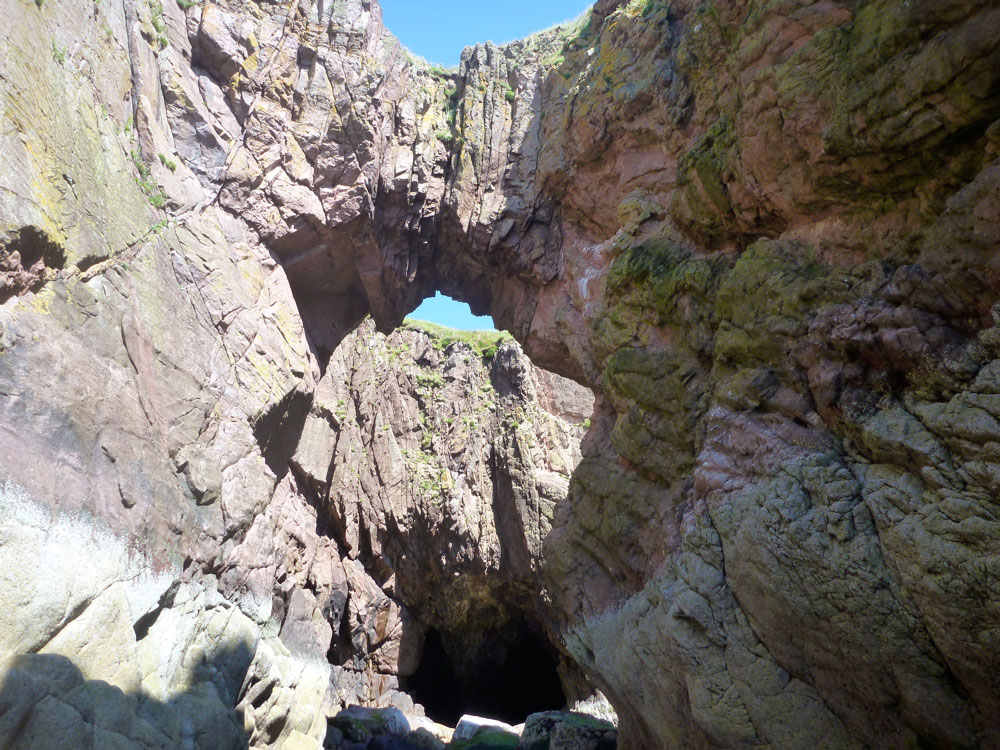
As I turned into the inlet on Eilean Mullagrach, I saw the arch the campers had mentioned unfold before me (left), spanning 40 feet above the shore. At the top of the tide with the sea level 4 metres higher, it would be easy and fun to paddle under it in a low swell.
Pleased with my discovery I decided, heck let’s go crazy and carry on around Mullagrach too – or at least push out as far as I dare. I had no map for this island but knew it was about a quarter of the size of Big Ristol – 2 or 3 kms round – a lot less than an hour’s paddling, surely. As I rounded the southeast corner, there too was the stack I’d been told of, with the very same guardian gull on top, watching me like a beaky coastguard.
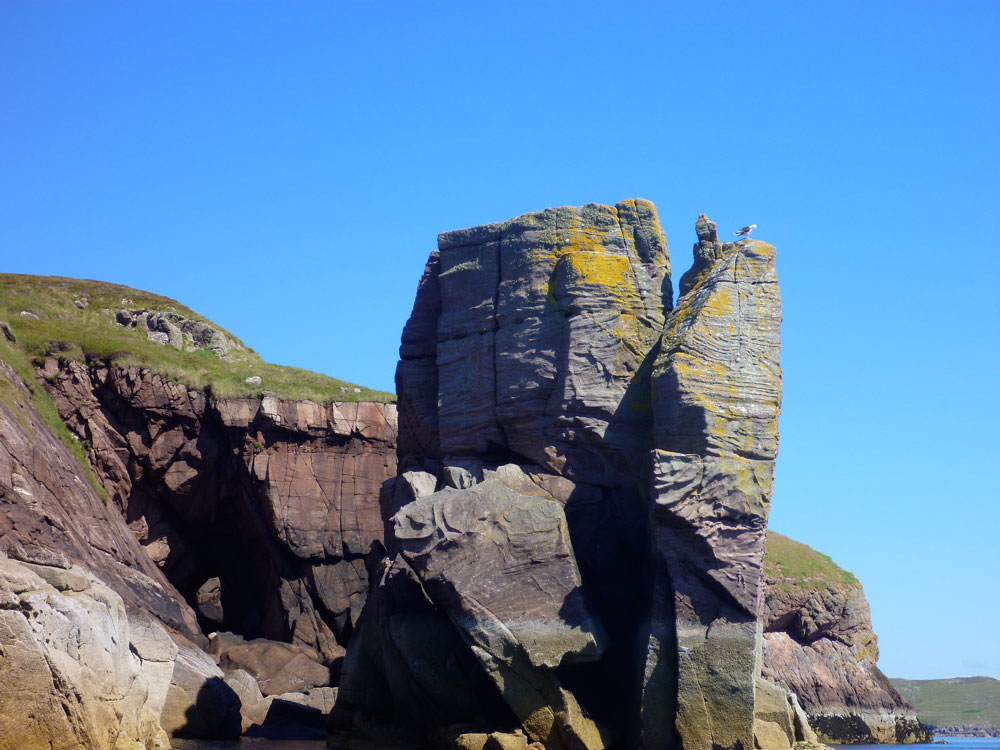
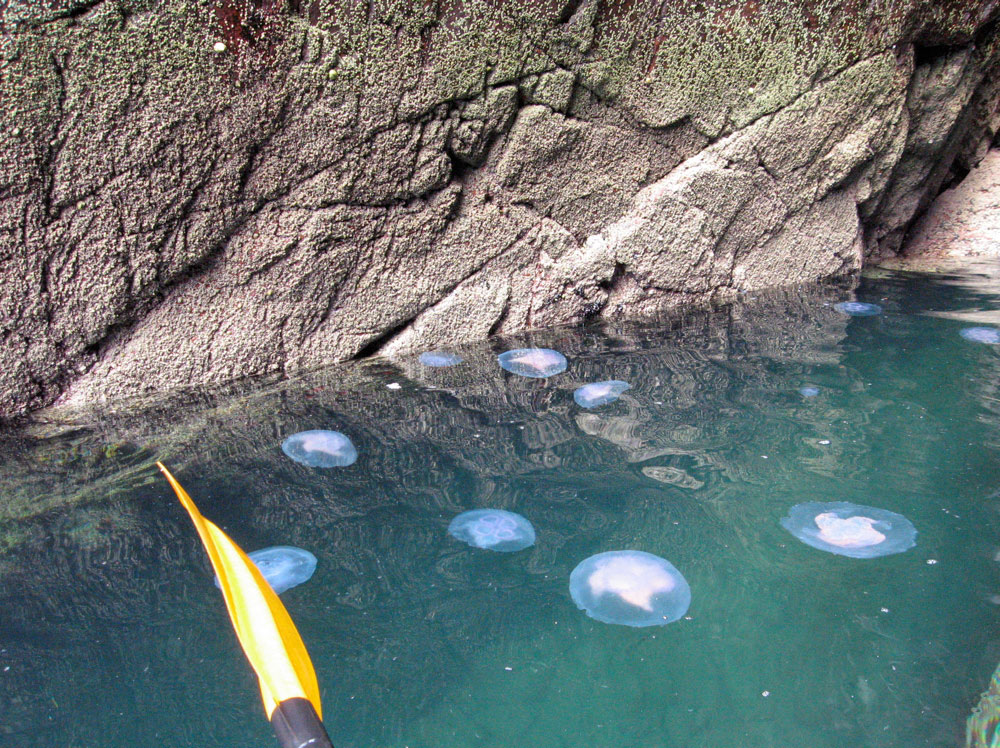
Again, at high water you could probably pass behind this stack; something to try for next time. I moved out west, into the dreaded Minch. With all land behind me, the light was suddenly much brighter, the pale blue sea stretching out to infinity. A light swell was breaking over some flooded skerries where a couple of cormorants looked out to the west as if waiting for something. Small jellyfish drifted past and I remebered how amazed I’d been to first encounter these exotic, dinner-plate sized blobs camping on the beaches of Arran in the mid-70s. Jellyfish? In Scotland? Whatever next – dolphins, harbour porpoises? We saw a pod playing out in the Bay one evening last week. Nice though it was to commune with nature, I was actually rather conscious of my exposure here and so paddled along briskly, keen to catch sight Reiff hamlet at the end of the Coigach peninsula, and the back of Isle Ristol soon after. At one point the swell got a little alarming and the boat squirrelled about, but I steadied my nerves – just keep paddling forward while avoiding the surf and rocks.
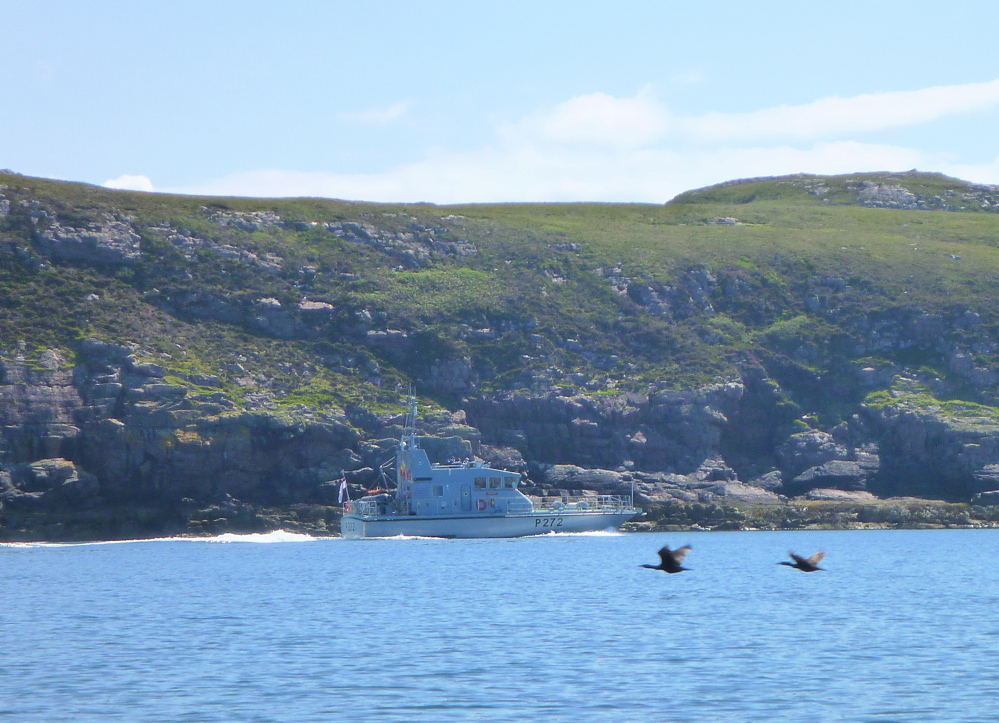
Coming round the north spur of Mullagrach where the low tide had annoyingly prolonged my excursion around another spur, what looked like a navy patrol boat came down from the north. What were they doing up here I wondered, and why were there people dressed as civilians on board? Perhaps it was something to do with the tall ships due into Loch Broom on the weekend, although the probable answer is right here.
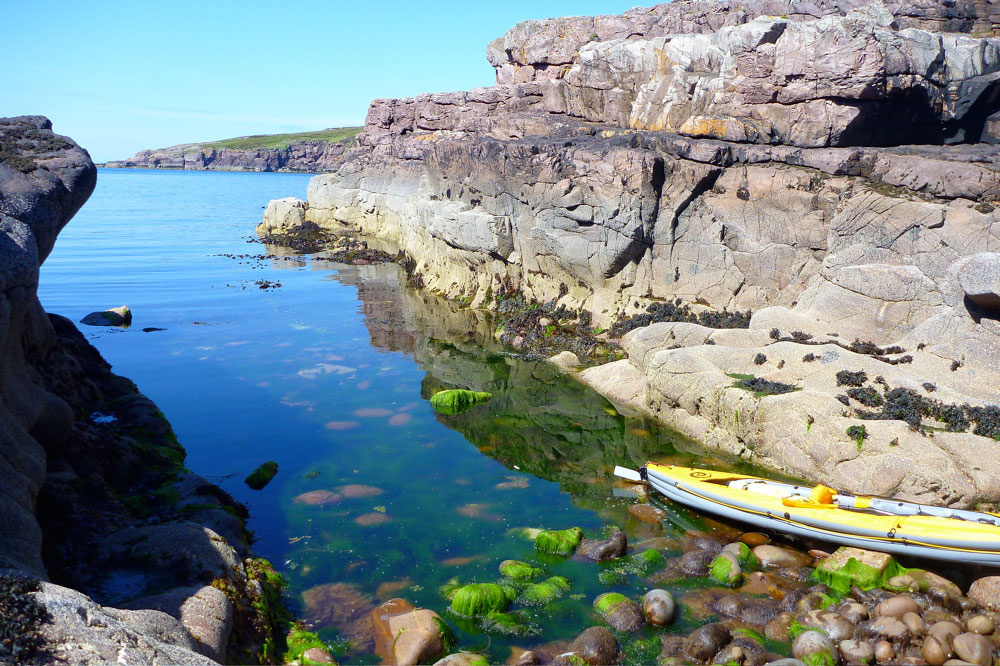
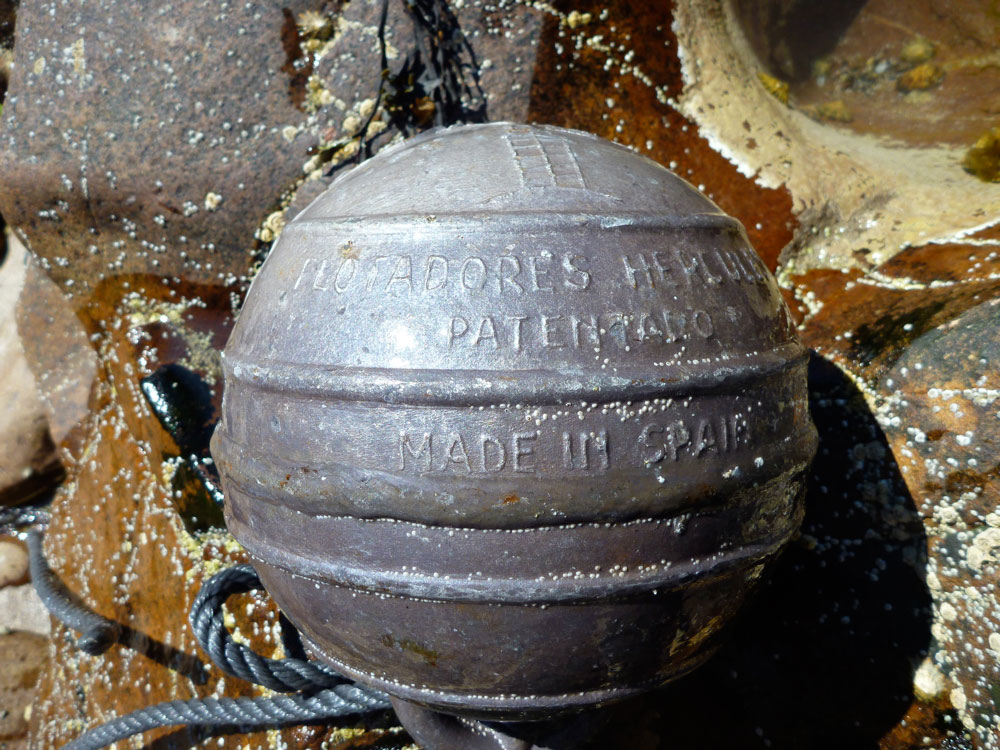
By some geo-tectonic miracle, Isle Ristol turned up just where I’d left it less than an hour ago; with some relief my paddle past the edge of my known world was over. All that remained now was to dawdle back to Old Dornie, dipping in at an inlet or two along the way to see what I could find. At the back of one narrow chasm (left) among all the usual plastic detritus I picked out an odd buoy that looked like it was made of pewter (above left). Most probably it wasn’t a relic from the Mary Rose but merely corroded aluminium, but it struck me looking at it later it could be a circus bomb with a dangling fuse.
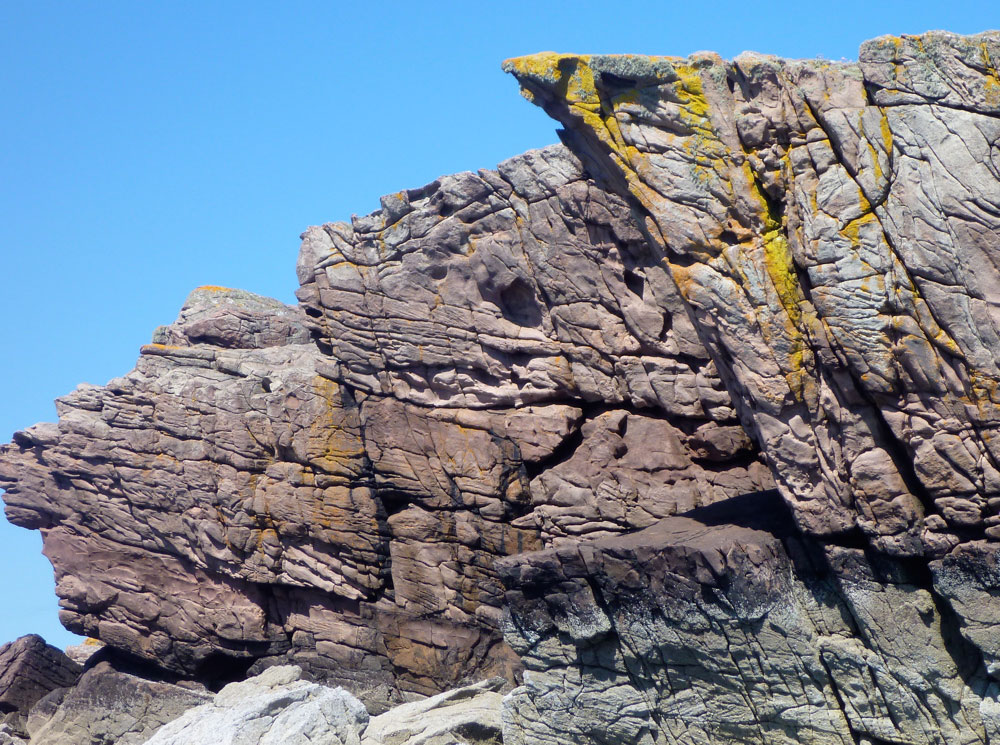
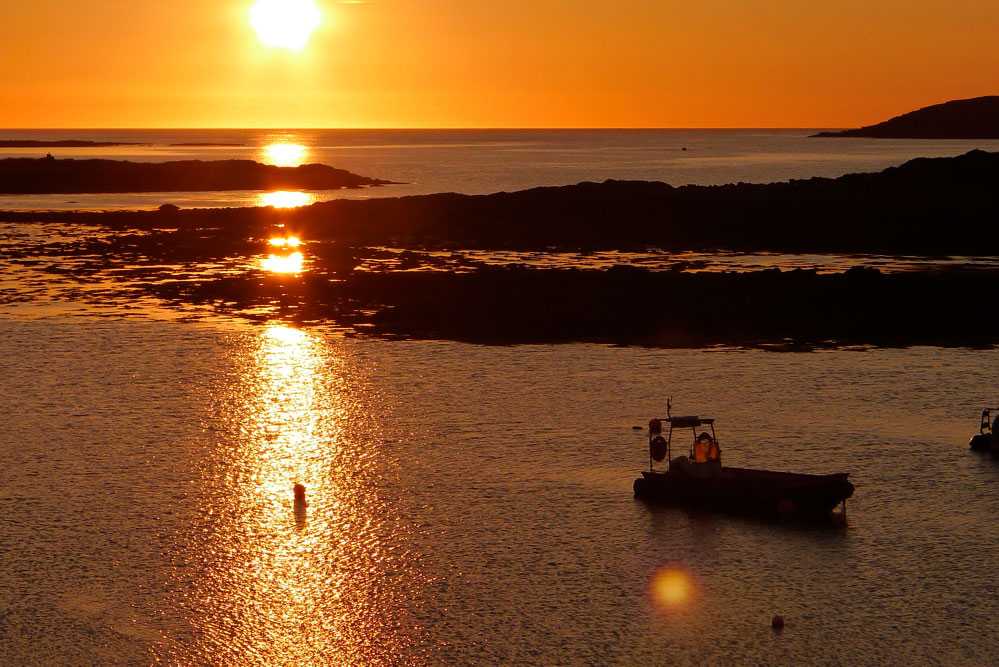
With it all at my doorstep and work that can wait, I’ve done some great paddling around the Coigach these past few months, but just as the weather’s settling it’s time to head back south. So, rounding the Isle I decided to head string things out and across to the ‘Wasp Factory’ bay where I’d had a memorable evening paddle when we first got here back in May. Today’s figure-of-eight tour of the Ristols had been a perfect climax to a short summer’s paddling in the Summer Isles. If you wait long enough, these days will come, even in northwest Scotland.
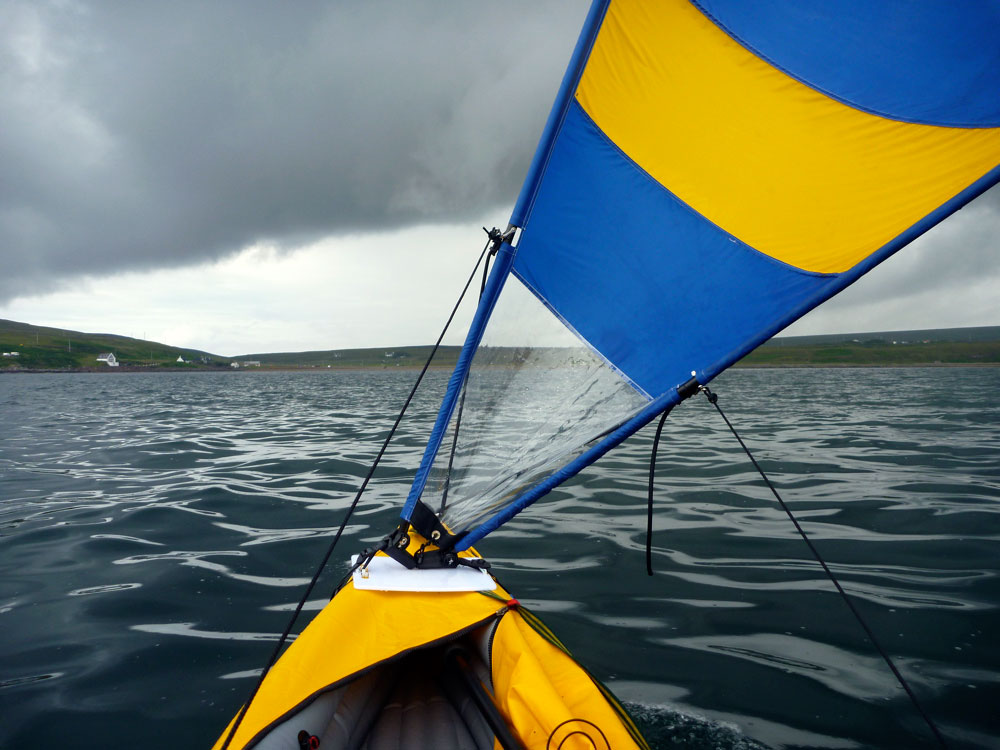
Not much wind today, but with a few refinements to try out it was worth taking the Pacific Action sail out on a regular ride over to the island.
I chose my big-faced Corry paddle and it has to be said it’s quite a strain (the opposite of a Greenland paddle) when you’re a bit out of condition. But then I bought it primarily for the packraft. What felt like a worthwhile breeze heading out to the island was probably more than doubled by the 4mph I was chucking out. Knowing I could afford to be, I was pretty tired once I reached Tanera Mor’s rocky shore. The state of the tide? who knows – coming in I think so it was with the wind, but I really think it makes little difference around here most days.
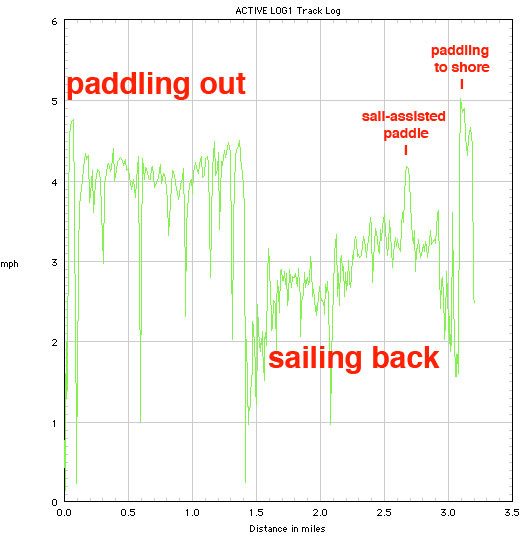
As the graph left and the video below both show, I had a bit of trouble getting it up and never got close paddling speeds while sailing back. But once I did get on the wind, it was a bit of a revelation to find I could pin the sail at a certain stance and, providing the rudder was on the case to, just sit back and enjoy the slow ride. It may have taken me longer to get back, but I could have easily read the Sunday papers, checked my email or just looked around and enjoyed the scenery, had most of it not been suffocated by the clouds of an imminent downpour.

It was also a surprise to learn I was not the prisoner of a given wind angle, but could modify it by up to 180° or maybe even more. At one point back near the beach, from the lapping of the passing waves across my beam it looked like I was paddling a few degrees upwind. Conditions were exceedingly tame but the cord-lock things worked pretty well and their position alongside the cockpit was just fine to slide them up and down.
At one point I tried paddling with the sail which I’d assumed would be rather tricky. Sure, the control cords got in the way a bit, touching my hands as I paddled, but it was possible to paddle lightly and so – as the graph shows – raise the speed with little effort to 4mph. Had I tried paddling harder I think I’d have outrun the sail, but it proves a good point: it need not be either paddle hard into the wind or sit back and sail; you can sail and paddle too if conditions allow- or enable it, gaining a bit more speed and exercise. I may try fixing the shock cord a little further forward to the nose which may help keep the sail up at marginal (low) angles or low wind speeds. I also need to tighten the webbing a little more, so the mast feet touch directly toe-to-toe so that, at the angle they’ve been locked against the masts, they’ll splay the sail out more readily.
The Google Earth screenshot of the GPS track on the right features the long-sought OS layer – useful as GE’s close-up resolution hereabouts is terrible. With it you can depict all the accuracy of a true GPS track over a detailed OS map. It’s a simple kml file found here. Download and open with GE and it’s there to click in the sidebar on the left when/if you choose to view OS maps in GE. Thanks to Gael A. for sending the link.
As things stand today I’m pleased I bought the PA sail; primarily for its simplicity of installation, deployment and possible repairs, its ease of use in the hands of a sailing beginner like me, the compactness when furled, as well as its ability to pulled down fast and attached/removed from the Incept in a minute or two. All that remains to be assessed is the kayak’s stability in rougher and windier conditions. The forecast shows a bit more wind on Tuesday so hopefully, there might be some surf-slicing sail action to grab then.


Pierre B has just sent me a link to his gallery about a recent paddle around Manhatten in his Boat People Trinity II inflatable, along with a mate in a Sevy Colorado.
Until I clocked the bladder-free Incept, the BP Trinity II was a boat I considered once as a replacement for my Sunny. It’s like an Aire Sawtooth but no less than two feet longer and just an inch or two wider than a Sunny. And best of all it bails so the wash off the Staten Island ferry need hold no worries.

Another Trinity post
Incept K40 Index Page
See also this post as well as this post about using the PA in strong winds in Western Australia. There’s a video there too.

I’m pretty sure my 0.78m2 home-made disc sail is too small to push the 4-metre Incept along until wind conditions get beyond the pale. Recognising that, I tracked down a 1.5m Pacific Action for £175 instead of the usual £250 which is a bit much. As I mention here, you can easily make a V-sail yourself from bits of plastic piping and old trousers, but life is short and as I’ve experienced a PA in action in Shark Bay, I’ve treated myself. The nearest B&Q hardware store is half a day away.


They call it a ‘1.5m’ sail, but unless I am very much mistaken it’s more like 1.15m2 if you calculate the area of the Isosceles as 146cm across the top and 174 up the sides (graphic on right; or base x height of about 170 divided by 2). PA round those dimensions up on their website to 150cm and 180cm, but that still doesn’t add up to 1.5m2 or 16 square feet. Maybe I should chill out a bit; a Ducati 900SS is actually 864cc and so on. As you can see left, it’s about twice as big as my 0.78m2 disc sail and it certainly looks like a metre-and-a-half square, so perhaps my sums are wrong. And it’s bigger in the right area too: up high where it counts. Plus you can see where you’re going – always handy in busy traffic lanes.
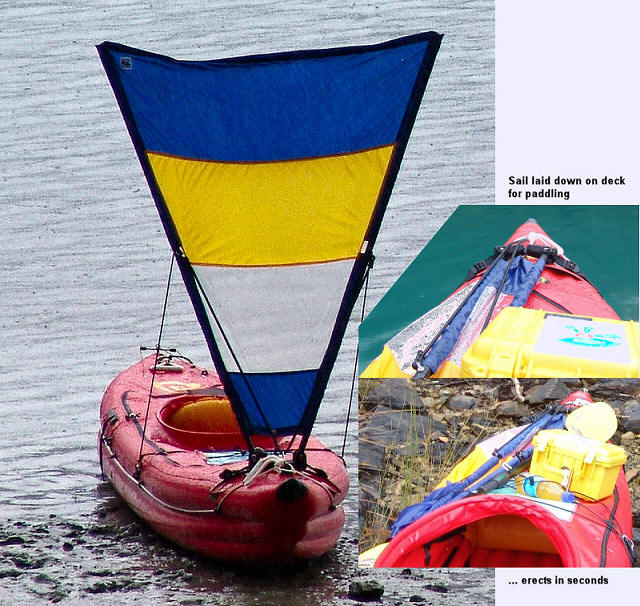
The sail comes in a compact bag of less than a metre. Can’t weigh things here but they claim 1.9kg; could even be less. Inside you get the two, 3-part masts made of thick glass fibre, the sail, fittings and rigging or lines, plus adequate instructions* for what turns out to be a fairly straightforward task. These instructions and fittings are obviously aimed at hardshells, be they SinKs or SoTs. With an IK you have to improvise a little. It helped knowing that there’s a picture of a PA sail on the Incept website (right), as well as this Kiwi guy’s video (bottom of page). The supplied cleats (sliding cord locks) are tiny and I recall Jeff replacing them on his Perception tandem for Shark Bay, but see below. Because of the confusing instructions combined with my congenital density, I misunderstood their simply application. On my first go at sailing the PA I was holding and maneuvering the control string by hand, as I did with the disc sail.
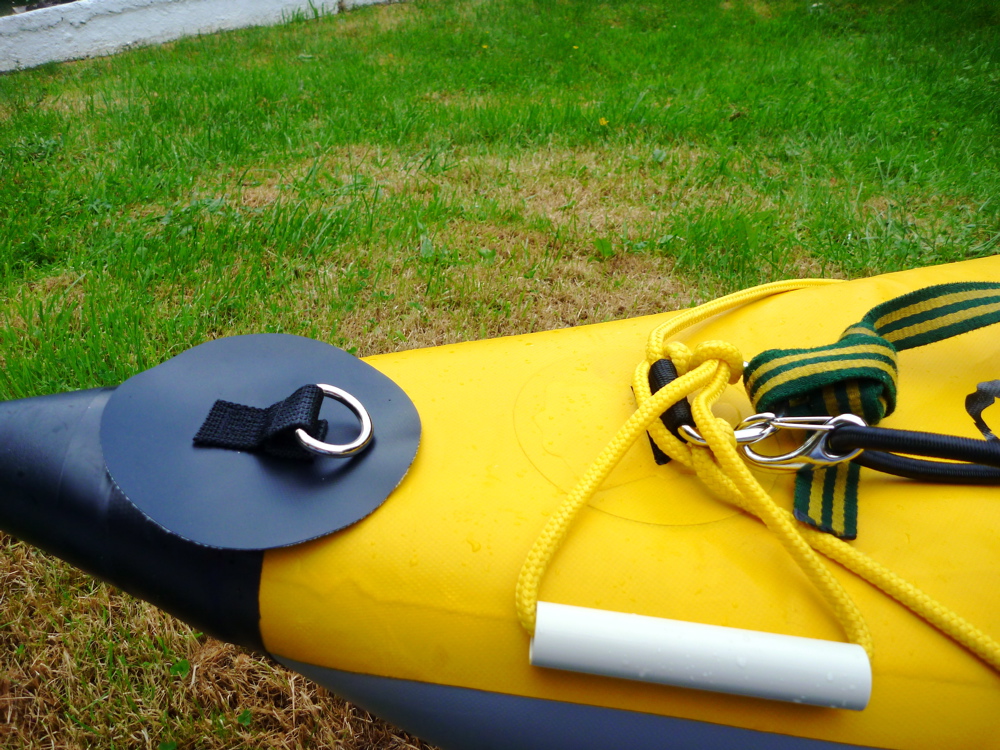
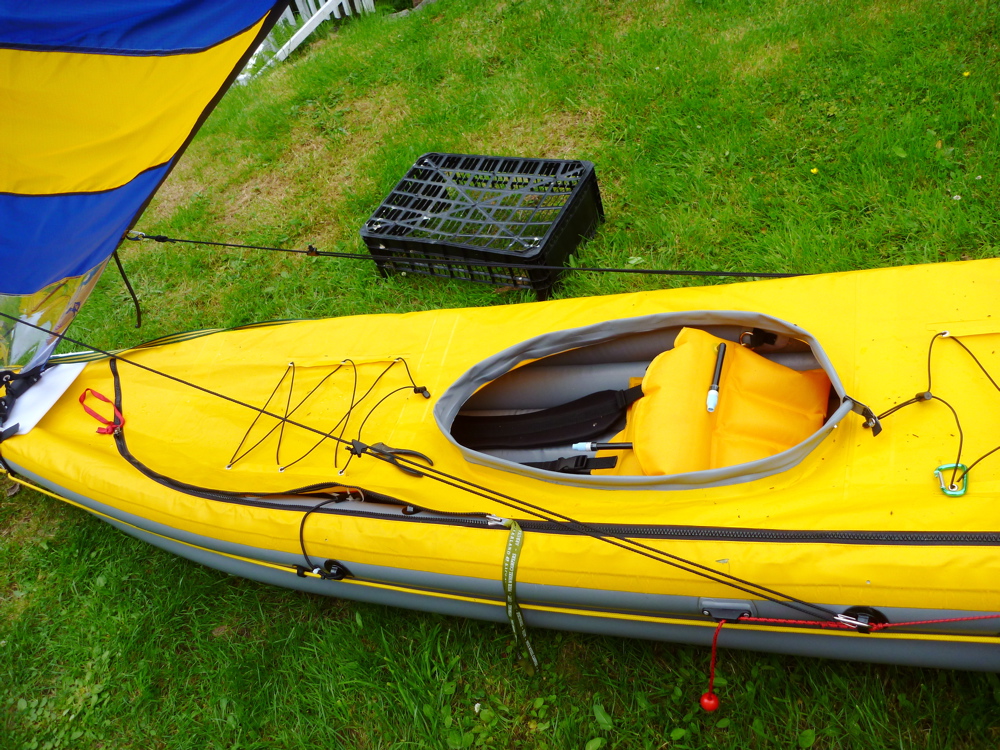
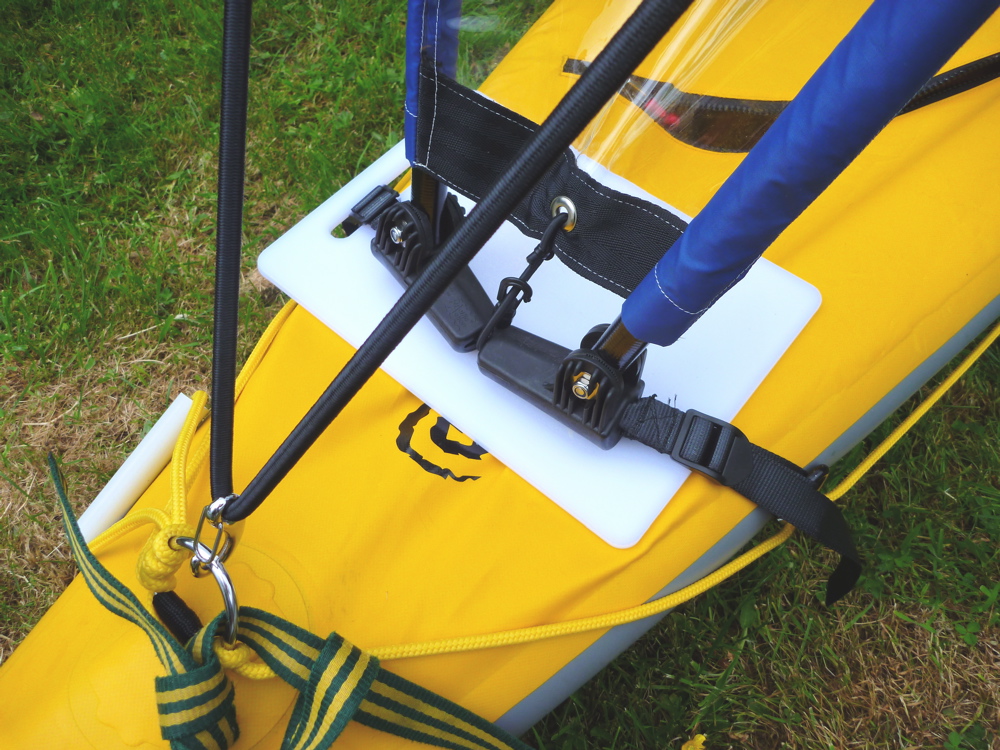
Up front the snaplinks (right) I’ve used to mount the disc sail also happen to be ideal positions for the PA’s webbing loop. And the bow handle ring toggle is the just about the minimum 12 inches ahead of the mast feet to take the shock cord clip (left) with which the sail springs forward when you release it. If that’s not quite enough far forward (as I think may be the case), I can stick a D-ring patch a few inches further forward right on the nose of the boat (as left). This position/angle may be more important than just getting a good spring forward, but also affect the sail support. We’ll see.
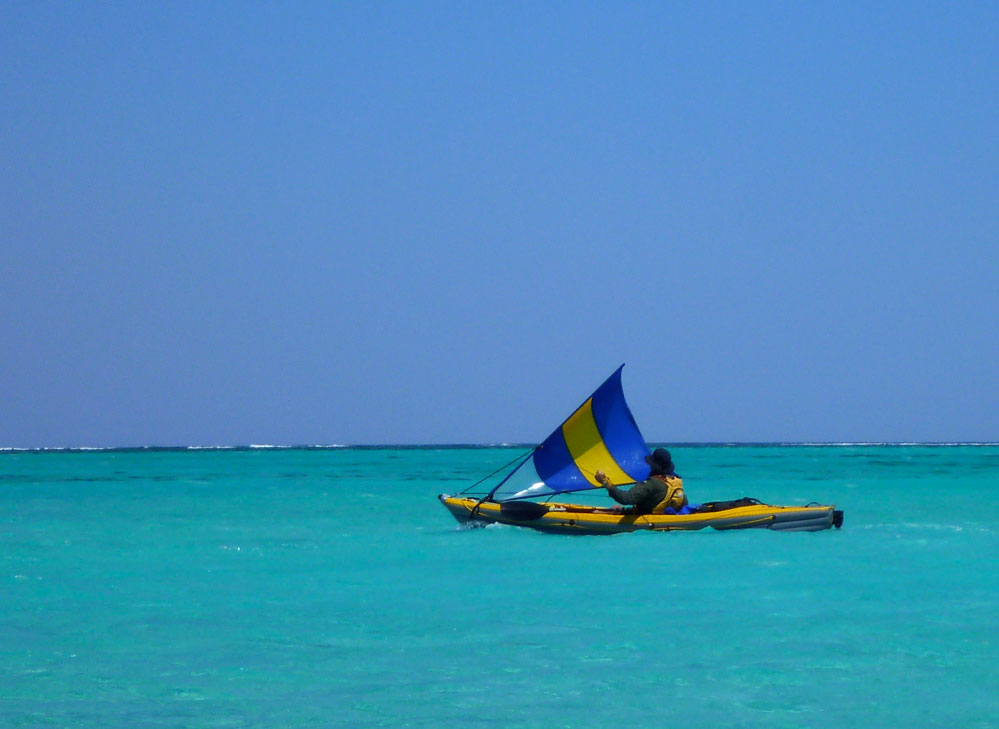
In Australia a few months later we did see. Further forward was indeed better, but I suspect still not optimal. When you think about it, the front attachment for the elastic would be better if it was set higher that the level of the mast feet. That’s because when you’re reaching across the wind with the downwind mast almost horizontal with the hull (as pictured left), the angle of leverage to keep the upper mast up gets very low; at 5-10° the tensioned elastic is almost at the same angle and so the sail collapses as shown in this video at 1.16. This happened to me all the time in Australia as the sail was pulled low to cope with the strong sidewinds. If I go ahead with my nasal bowsprit idea as mentioned here, I’m now thinking it might also be an idea to raise it a bit; have an upcurved bowsprit so the sail is more readily held up when reaching (near-horizontal).

While in Australia I also pushed the snaplinks to mount the sail straps directly through the black lugs and not around them as pictured right. This was because the strong wind was pushing the sail mount (a plastic plate) forward, making it go slack, reducing the elastic tension and causing more problems with handling. But by the time I made all these adaptions we were locked into two days of headwinds so I never really had a chance to see if it made any great difference.
Back to the original mounting story set in Scotland in summer 2011. It all went together easily enough, until it became clear some fittings were missing from the pack which for some reason looked like it had done the rounds with a few previous customers. Most fittings were not needed for my IK, except the four ¾-inch self tappers with which you permanently fix the mast feet position in relation to your kayak’s deck angle and with the sail splayed. According to the instructions* and this picture I found on the web this is an ‘8g ¾-inch’ screw, but that seems way too long to have two from opposing sides – one alone would act more as a bolt than a self-tapper getting a bite, but that is what they recommend; the subtext is these screws are important to make a solid fixture. What’s not made clear (or is perhaps obvious) is that you ought to pre-drill guide holes deep into the plastic mast feet lugs for the screw can get right in there. Some hardshells will have a bevelled or convex foredeck which is why you must set the mast foot angle (MFA) specific to your boat for optimum operation. On my set up, the MFA is horizontal (flat) as I’m using a plastic chopping board idea as PA suggest to give the feet the all-important support and avoid wear on the PVC deck. The feet move around quite a lot under tension as you pull the sail this way and that but, as I found first time out, the angle of those feet against the mast (as well as the webbing tension) must be solid if the sail is to spring up and open or splay out.

The sail rolls down out of the way and doesn’t interfere with paddling, though it does mean yet more cordage hanging around; you could get in a right old muddle if you don’t keep on top of it. PA do advise paddling with a knife or a less pointy rope cutter. I have a quick-grab Benchmark one (left) attached to my PA.
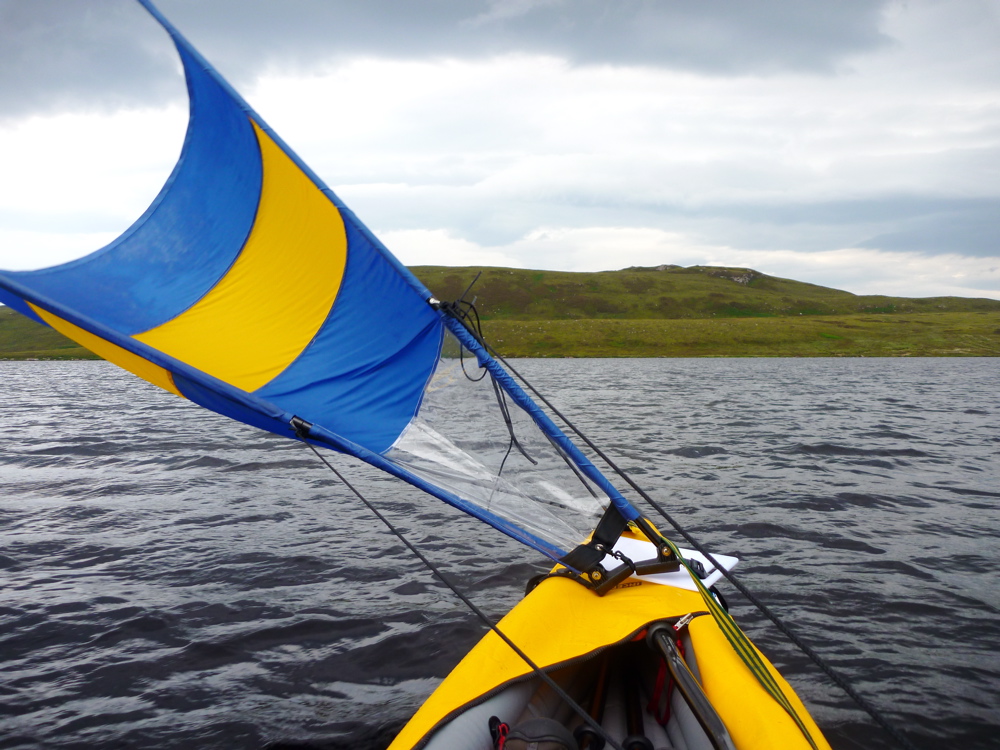
It was gusting up to 40mph before the local weather station packed up, and at times the sea was covered in foam streaks and swell, so I went to a back loch for a spin. Typically by the time I’d crawled into a dry suit in case I fell out and got dragged along by the sail, the wind had just about died, but it gave me a chance to test it out in tame conditions. That evening my paddling speeds back into the wind were greater than anything I managed under sail, but I was getting the hang of it and even got the knack of running almost across the wind. The vid from that session isn’t worth uploading unless you’re having trouble sleeping; I hope to have another session when the wind returns and on a loch that’s longer to the wind.
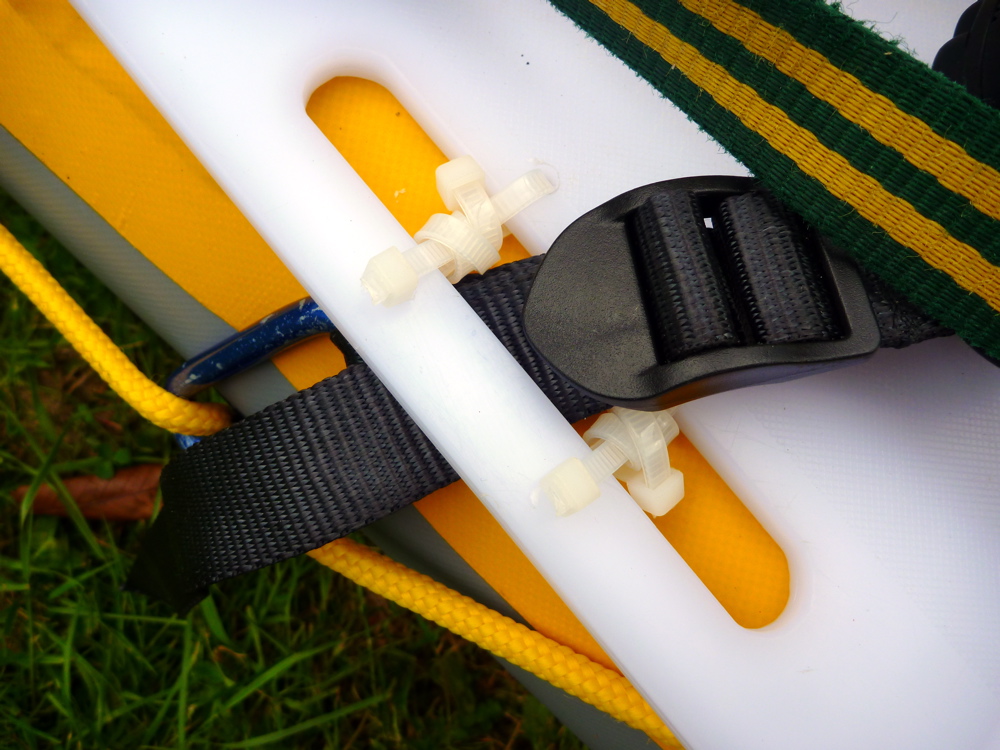
Lessons learned: need those self tappers to lock the feet, luckily the local store had some that may do the job. And I’ve since located that chopping board a bit better to the boat with some slots and zip ties until a better solution is required.
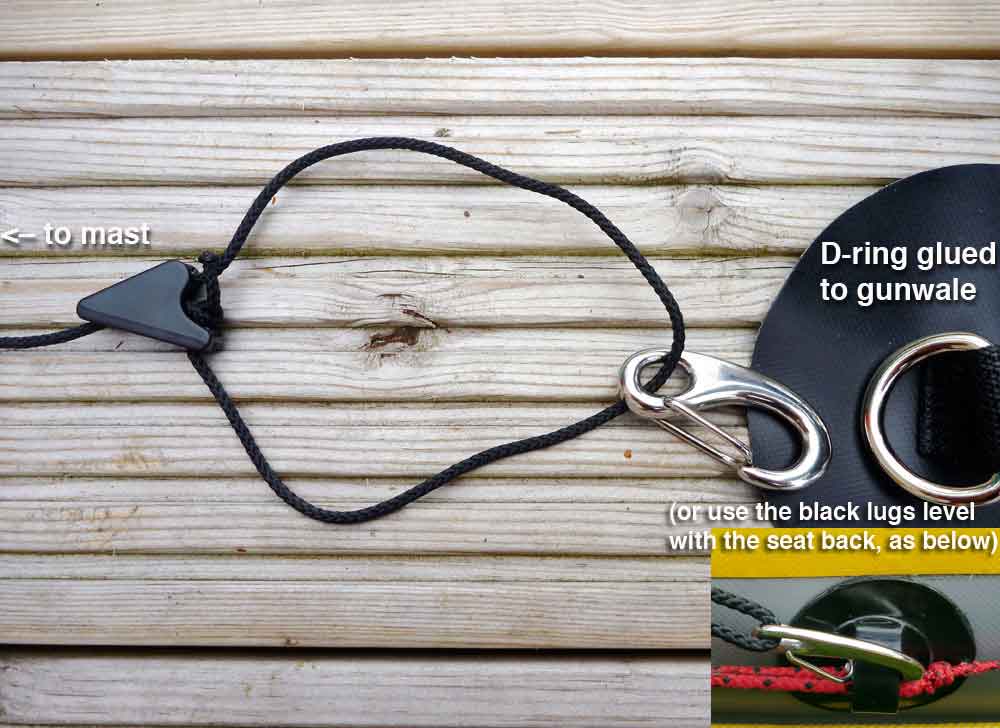
Rigging the sail-adjusting cleat
Working out how to rig the control cord to alter the sail angle was actually rather simple once I put my mind to it. As mentioned, you get some small plastic cleats in the pack whose use is unclear. But digging around online for an alternative cleat (as other PA users tend to fit), I discovered what the PA comes with are very much like, if not exactly Clamcleat Line-Loks. Now I know what they are, their fitting and application is more clear. It’s not illustrated or explained in the PA instruction leaflet* I received; in fact I’d go as far as to say that the tiny yellow picture of the rigged Line-Lok in the PA leaflet is the wrong way round compared to what’s illustrated in the Clamcleat gif on the left. But even though (as I found) it does work crudely when rigged the wrong way round, I think I finally get it now. A Line-Lok a nifty solution to tensioning a tent guy in the Arctic as the link shows, but as Clamcleat’s gif on the above right also illustrates, you need two hands to release it – not something that may be easily available in rough conditions while trying to grab your paddle and not spill your tea. But so far I’ve found in the light conditions I’ve been out in, one-handed works fine and if it’s a real panic you just pull the sail down in a jiffy.
In fact, testing the correctly rigged locking cleat off a chair leg, it’s possible to achieve the release movement by spreading your fingers as long as it’s not too tightly jammed in the cleats, while adding tension (pulling the sail back/down) is certainly easy.
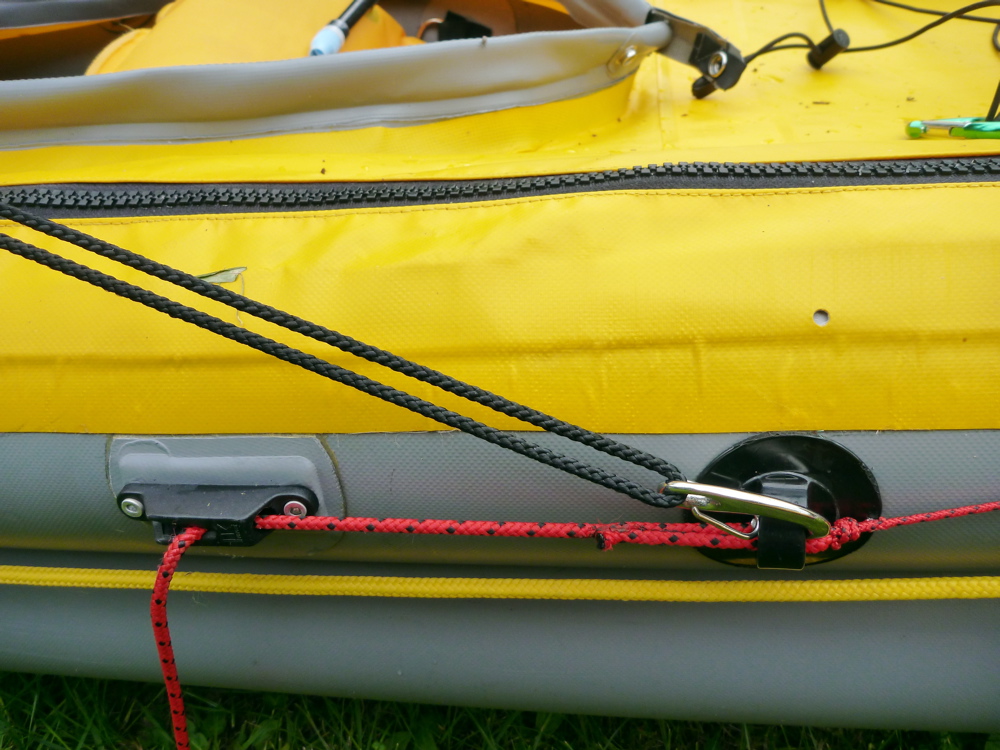
Having worked out how to string them up, the next question is where to attach them to the boat. By trial and error I found that cutting the supplied 4-5m line in half, rigging as above and then clipping the stainless steel clip to the K40 at the plastic lugs just behind the seat seems just right (left; it shares the left side lug with the rudder lifting line). Even though the Incept image with the red boat above seems to use the more forward points, fixed like this it puts the full sliding range of the locking cleat within arm’s reach while sat in the cockpit; or at least that’s how it looks on the lawn. I used the spring clips supplied to fix the control cord to the mast shackles, but at one point while sailing one unhooked itself from the shackle, so better to knot the cords securely to the shackle as PA recommend. To see how it sailed first time out, see this.
NB: A more recent set of fitting instructions were sent to me as a pdf from Pacific Action and are much clearer.
As far as I could see it wasn’t to be found on their website.




See also: Packrafting shoes or boots

I like to go barefoot so when I spotted Vibram’s FiveFinger ‘glove slippers’ a while back I thought they looked fun. Recently I took the plunge and selected the TrekSport model, thinking they were the most heavy-duty and hike-worthy of the range. The price is nuts, up to £100 or more in the UK, and as it is I’m still a bit shocked I actually paid $85 (£55) for these.


A BBC article shows how Vibram hit the jackpot when a bit of in-house experimental fun coincided with a barefoot running craze in the US. Sales went through the roof, and with success came the attack of the clones which the article describes.
Outside of California, you might feel a bit silly going shopping in a pair of 5Fs, but it has to be said they do raise a smile, and where possible, less clumpy footwear is always better. I’ve read rave reviews about the improved feel and ‘back to nature’ ergonomics of 5Fs, allowing the wearer to reconnect their feet with the [mother] earth so as to run not unlike the virile, loin-clothed hero from the 1980s Countryman movie (brilliant reggae soundtrack, btw).

Out the box the TrekSports don’t exactly slip on like a pair of well-oiled Crocs. It took a lot of fiddling to get my smaller toes into the corresponding pockets. Once done, you tug on the velcro band to secure them round the ankle and step out. On the first walk, heading into Willow Gulch down in Escalante, the baking sand on a 105-degree day burned through to my feet, but at least the close fit stopped any of that sand getting in.
Later on, in the shallow creek, they gripped reassuringly on all surfaces, even wet and slimy, and were certainly better than bare feet; the studded tread worked well. But for boulder-hopping they weren’t quite as secure as the Omniums, feeling a bit like the rubber-soled socks that they are. And after a couple of hours of wading some grit did get in which required a rinse out followed by a repetition of the tedious refitting dance. If there’s a knack to putting them on, I haven’t got it yet because next day up in the cooler Box Death Hollow forests, it took Five Minutes to get each Flipping Foot’s Five Fingers into Freakin’ Place. Tracking and crossing the rushing stream along the faint path for a few hours, the inevitable toe-stubbing plus head-on or side glances meant each time we crossed the stream I lingered a bit to let my throbbing toes numb a little in the cold water. I ended that walk deciding that while clearly not pretending to be a hiking boot, the many-toed TrekSports were too flimsy to be trekky after all.


The Emperor’s new shoes?
And so we must ask the five thousand finger question: do individual toe pockets on slipper-like footwear give any actual advantages in comfort, agility and performance against a regular water shoe?
Short of being a chimpanzee, I have to say not that I could tell. Had they been just a pair of snug-fitting, ten-dollar plimsoles or even a wetsuit ankle boot, they’d have worked as well on the trail and in the river. As it is, the thin soles transmit sharper rocks and maybe I’m clumsy, but in particular, the lack of toe protection bashed my toes as painfully as I recall back in my Teva open-sandal days.
But that is for boatless creek wading. For something like a day paddle in my packraft, with its tight foot area for my size 11 feet, the Vibrams may have a use, being light and robust enough to deal with put-ins and portages. On cooler UK paddles where socks can’t be worn, they may not be warm enough.

And then you have to ask: how long will something this thin and stretchy last? About as long as some of my socks I suspect. I did also wonder if just two toe pockets – a ‘foot mitten’ – might satisfy the anatomical ergonomists who believe in the benefits of full toe articulation while making the shoe a whole lot easier to put on?
It seems so with Vibram patent dodging 3T Barefoots from Bodyglove with three toe pockets. They seem to be pitched at SUP paddlers and not trekkers, but if I’d seen them earlier, I may have gone for them instead. I’m pleased to have tried the Fives but since sold them.
It’s worth remembering that you can’t wear socks (including drysuit socks) with such shoes, so for warm weather only.
 Inflatable Kayaks & Packrafts