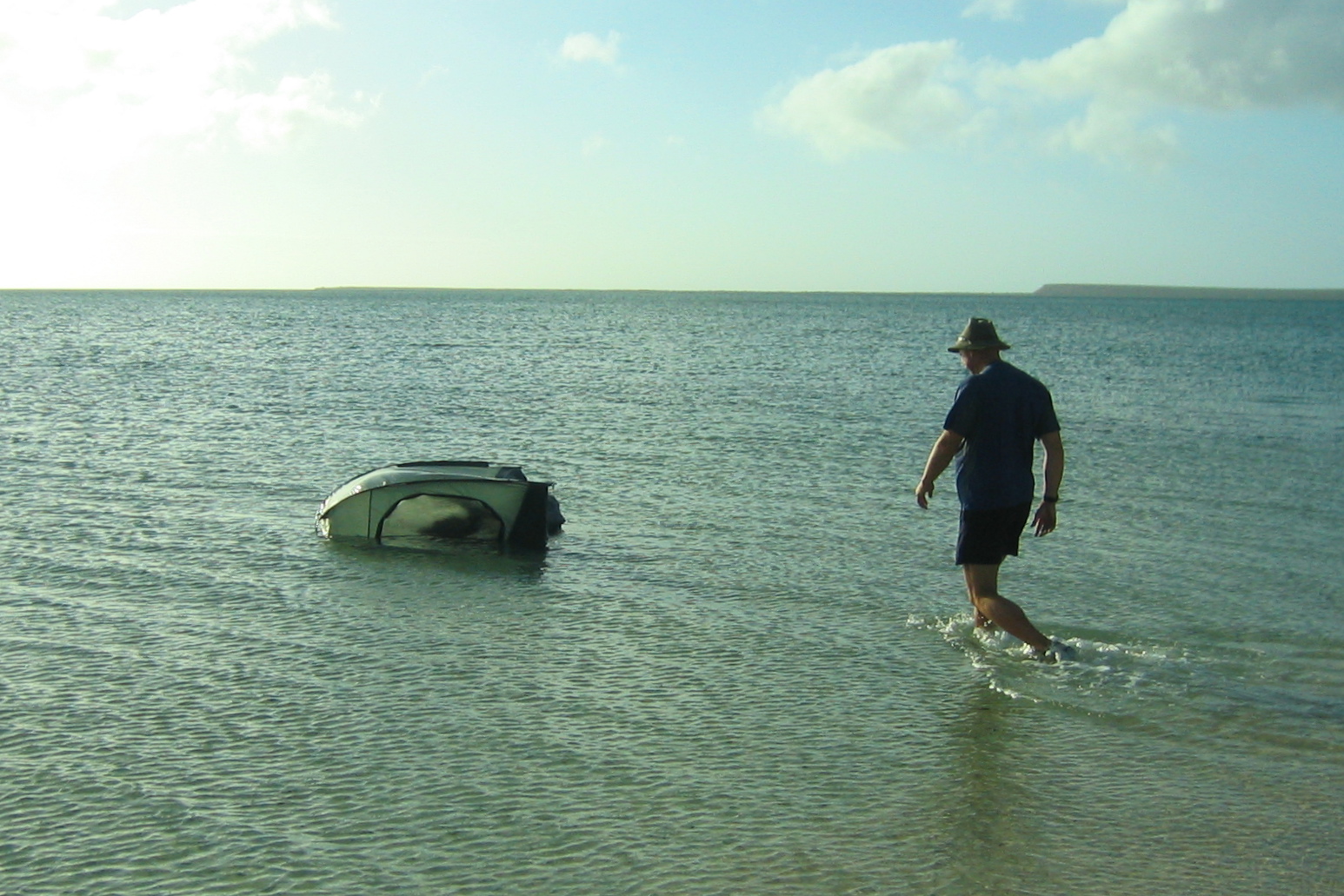
What makes a good packboating tent? For me doing a bit more Scottish sea kayaking than packrafting these days, super light weight is not that crucial. Better to have something that is easy pitching and spacious so you can sit out rough weather. And then when some packrafting does turn up, have the ability to use just the fly or inner to save weight and bulk. On occasions I’ve used a cheapie tent’s inner as a mozzie dome, just as long as I remember to keep it weighed down before frying up the brekkie on a windy morning in Shark Bay (left).
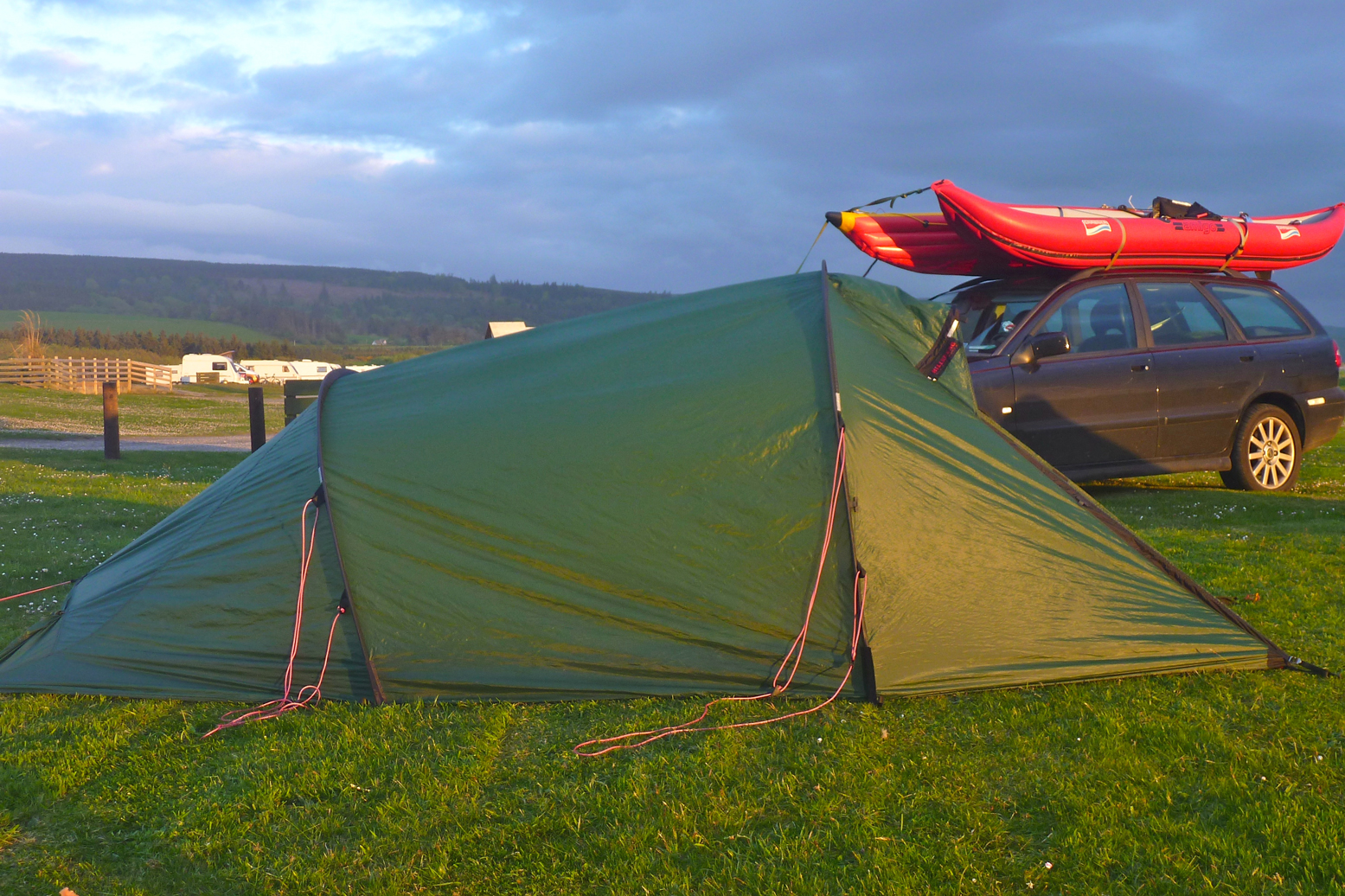
A couple of mates have used the legendary Hilleberg Nallo for years, so when I found one cheap in the US I gave it a try. Sure, for me the Nallo (left) may have been OTT in an ATGNI sense, but with its reputation and residuals, I knew I’d not lose on it. I liked the Hillie’s all-in-one pitching, the options to pitch outer (with footprint), inner only (or an optional inner mesh that was also included). This made it as potentially as light as my old Black Diamond Lighthouse, but much roomier. I also like the roomy front end and porch.
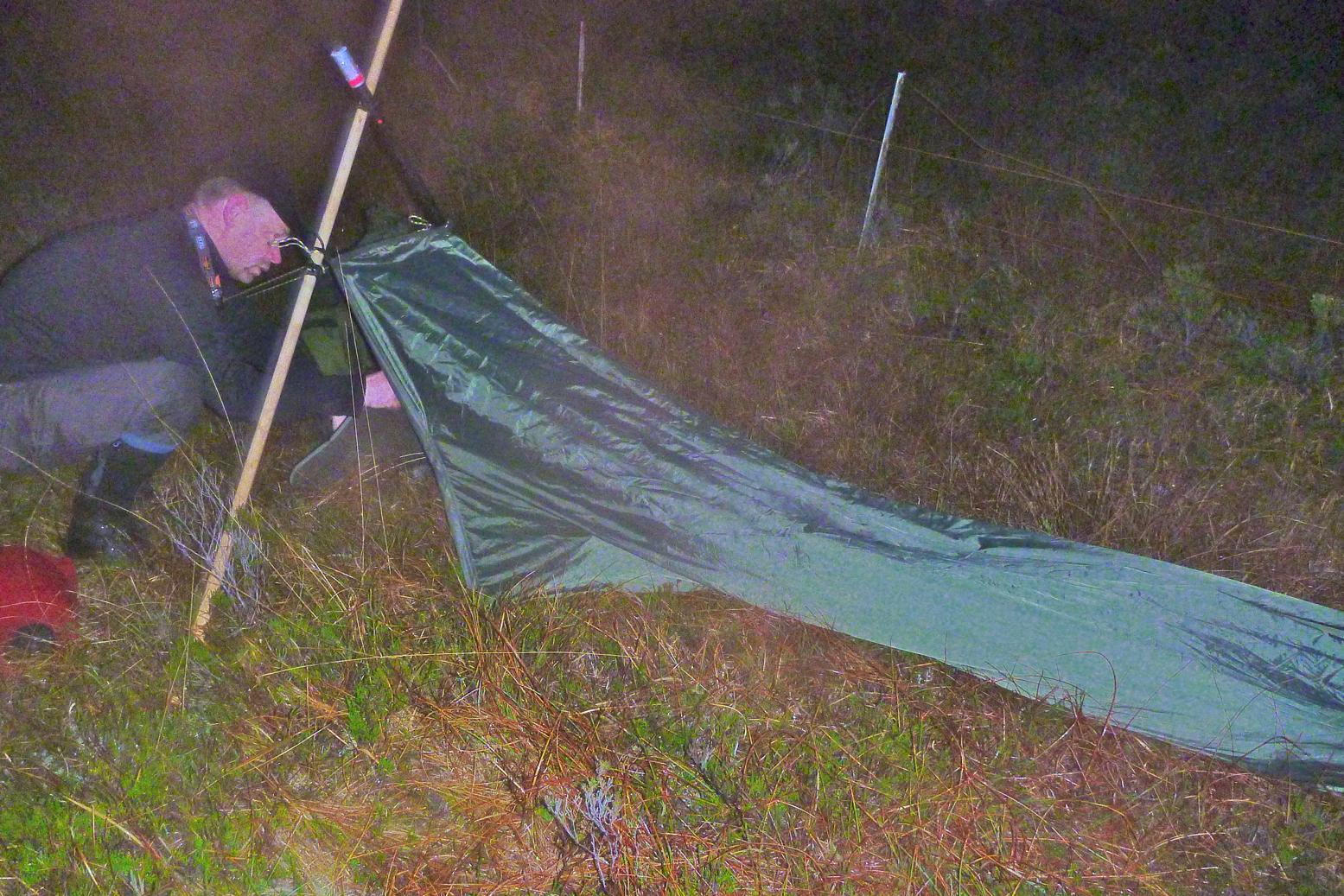
I thought it would fit the bill, but getting caught out one winter’s night on the Postman’s Path on the Coigach (below) proved that, while it may stand up to 60-mph blasts like they say, its unsupported flanks flapped like the flags outside the UN building during Hurricane Sandy. My hardcore mate crammed himself into his bivvy bag (left) and had a quieter night, even if he could barely move. On a windy nor’western night, for all that money the Nallo was no quieter than my old Black Diamond.
On top of that, the Nallo may claim to have a floor that’s 220cm long (a minimum requirement for me) and have a huge porch, but the way it slopes down at the back where the blowing wind presses (right, and in the video below) meant I still ended up with an annoyingly damp end to my sleeping bag. Just like the too short Lighthouse.
I’ve since read that Hilleberg recommends pitching a Nallo porchinto the wind, but as this discussion suggests, that seems rather counter-intuitive – unzip the door and the thing will fill like a sail while blasting you with horizontal rain every time you get in and out. They say the Nallo-style tunnel design gives the lightest weight for volume. I’m not sure that’s true anymore, and those unsupported flanks make a racket plus inside, my Nallo was always a saggy affair (right), however I pitched it (left). While paddling the Slate Islands I took the chance to get some good ebay pics and sure enough, flogged it for more a little more than it cost me.
It was good to try the Nallo experience for free, but now I had a better idea what I wanted for my current camping prefs: the Nallo’s better attributes but not in tunnel form. I considered four-pole mountain tents like the famous Quasar or more obscure Crux X2 Storm, but the doors were small, they didn’t do inner or outer only, and prices were a bit high for my low level of usage. Crux’s foam spacers to separate the inner and fly to enable better airflow was an interesting idea – or an admission that condensation was a problem. More tent spotting uncovered Vaude’s Odyssee which used a similarly stable 3-pole set up while having many of the other features I sought.
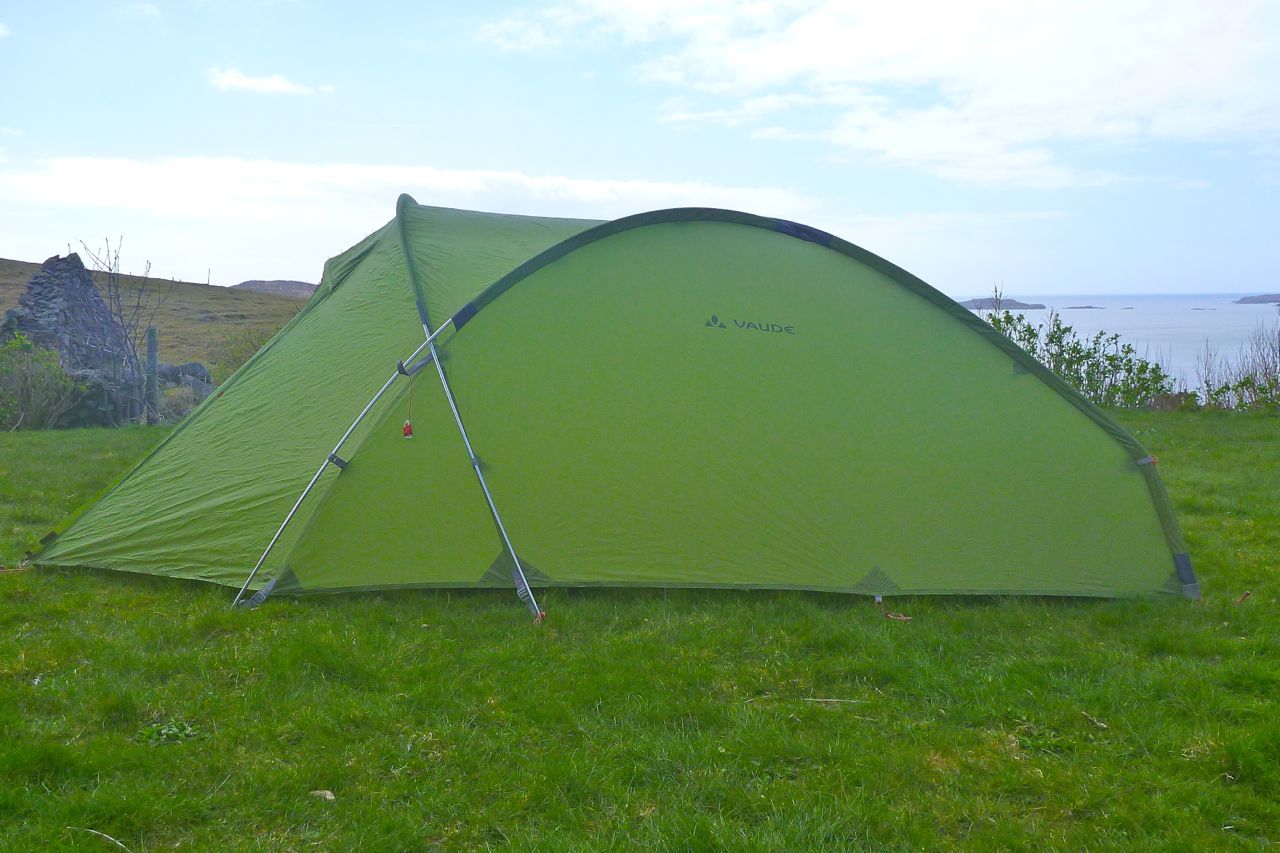
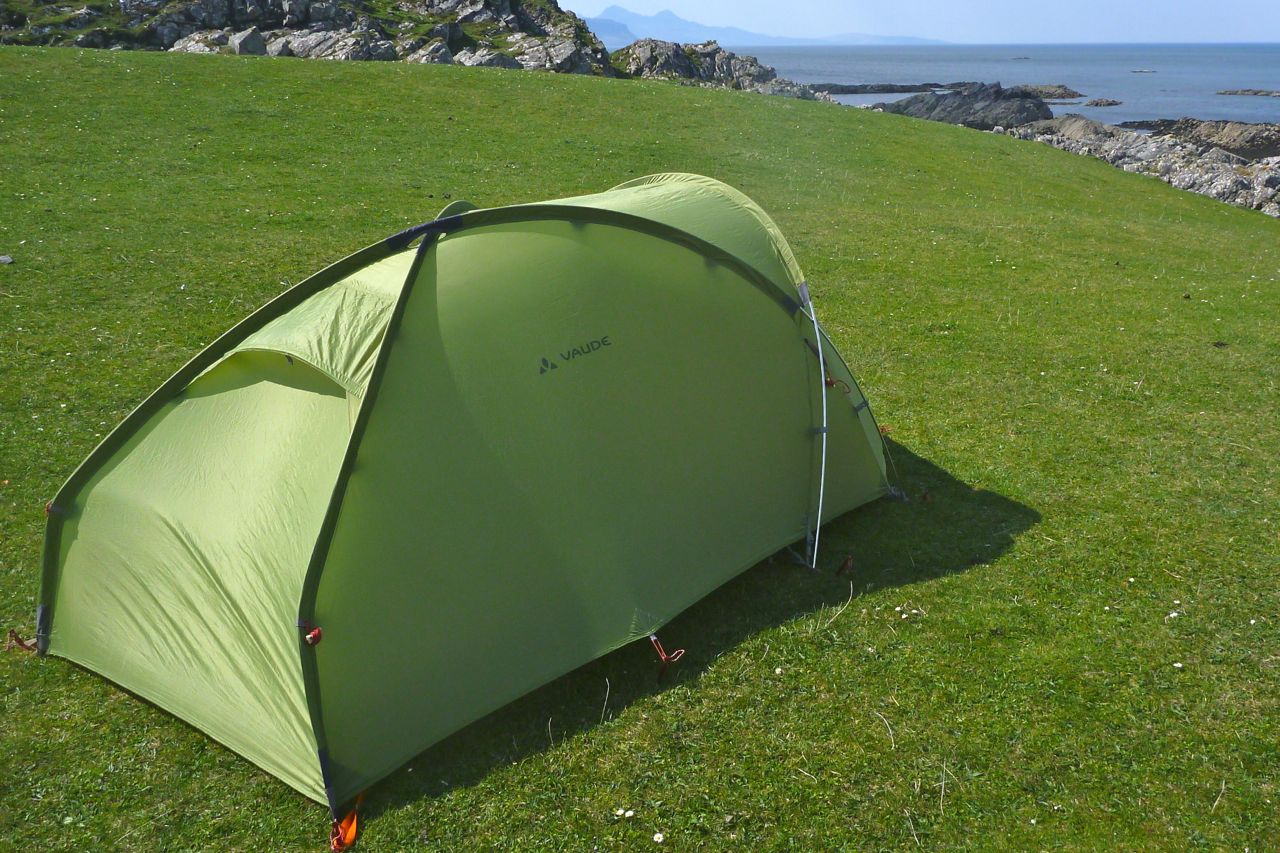
Vaude Odyssee L 2P
The Odyssee ticked all the boxes for my sort of camping out of boats or riding a moto.
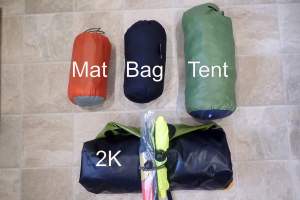
• Inner and outer attached helps speedy, all-in-one pitching • 3-pole system copes in strong winds and makes a taught, flapping-reducing pitch. • Almost self-supporting so can be easily repositioned or pitched on hard surfaces which can’t be pegged • The steep back end may catch more wind but means the full 220cm inner length can be used. This is a great feature for me – no more diagonal agonies or damp sleeping-bag foot from pressing against a sloping inner, as on the Nallo. • You can pitch just the outer, saving 700-odd g*, if insects, moles or temperatures aren’t an issue – and I’m pretty sure you can pitch just the inner (saving nearly a kilo) as a mozzie dome. • Scrunches into a football-sized bundle and the poles break down to 44cm for compact packing.
All these attributes along with the reasonably light weight – ready to go at 2.6kg made the Odyssee 2P a great-value and versatile 1 or 2 person tent. It’s only 280g heavier than my Nallo, and while I presume the fabrics are inferior (“30D ripstop Polyester Silicone/PU coated 3000mm head; floor: 70D Polyamide PU coated 7000mm head”) it was much less than what my Nallo would have cost new.
* My dimensions may not match other sources
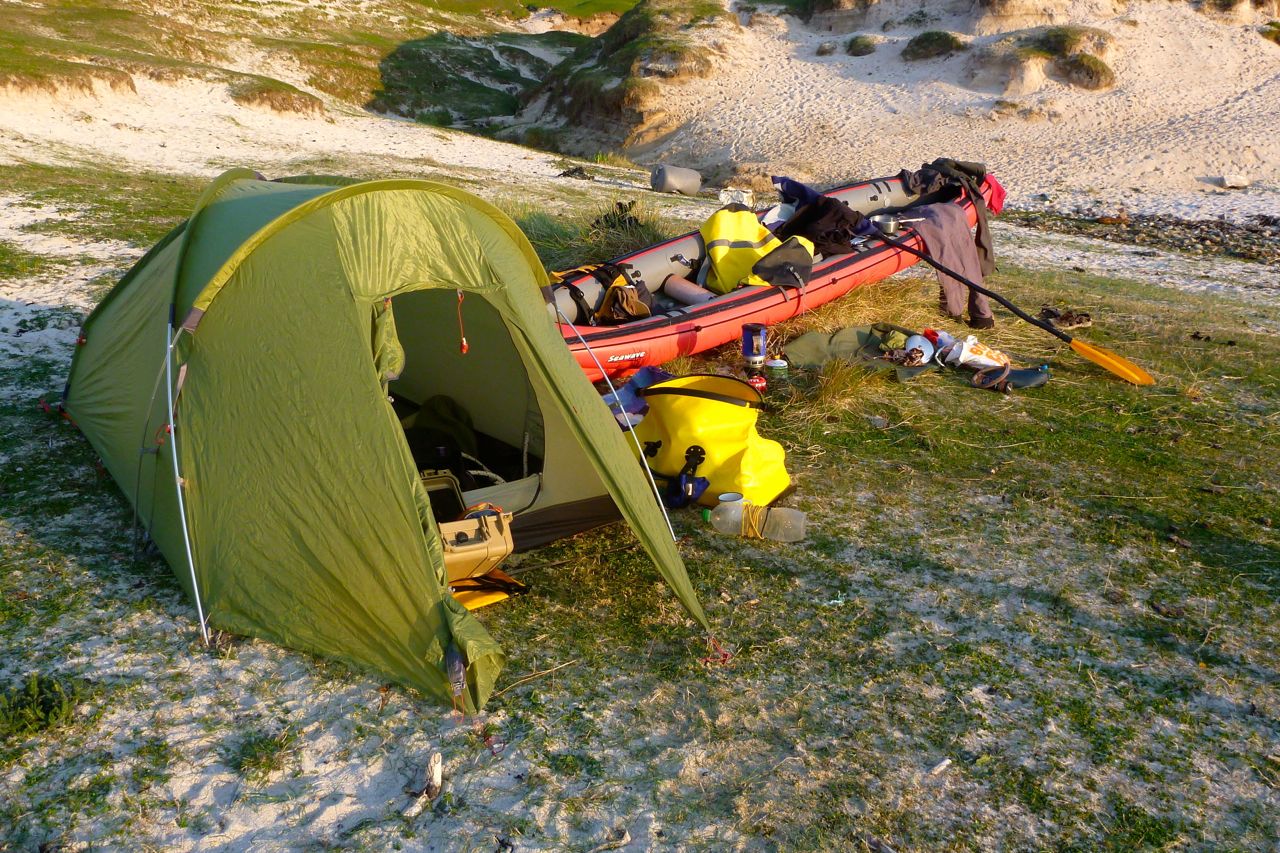
The inner ‘washing line’ and loops to attach an optional roof net are handy, as are the pockets by the door. The 75-cm deep porch is smaller than the Nallo but roomy enough, and the zip arrangements make it easy to control ventilation and maintain privacy. I’ve not had much condensation, but that must be just luck and breezy nights. Even with a breeze, the Nallo was terrible for condensation, partly because the flysheet ran right to ground level. The other night, gusts over 20-25mph in the Odyssee woke me up and I lay there thinking ‘she cannae hold, Cap’n’ until I remembered my earplugs and soon fell asleep. I’m told most modern tents with < 4 poles will make a noise in strong winds. As long as you know it’s as well lashed down as can be and can take the hammering, just turn over, plug up and pass out.
First time out one peg bent when pressed in by foot. So I pulled out my bombproof MSR Groundhogs with nifty pull-out loops (right). The Odyssee takes about ten minutes to pitch without hurrying and some faffing with the footprint (from the old Exped), and will stand with a minimum of two pegs staking out the porch. Two more at the back help make good tension, and using every dang loop and all six guys needs 16 pegs – you’re now ready for a gale and I suppose a pole will snap before it rips (there a pole repair sleeve included).
Other small annoyances are the two long poles catch the fabric pocket seams at the back – make sure the pole ends sit fully in the end of the pockets or you’ll over-tension them when clipping in the front end. And the pole-end locating pegs sometimes come away on the elastic cord which can be fiddly to reposition with the cord knot. I’ve fixed that with a dab of rubber glue.
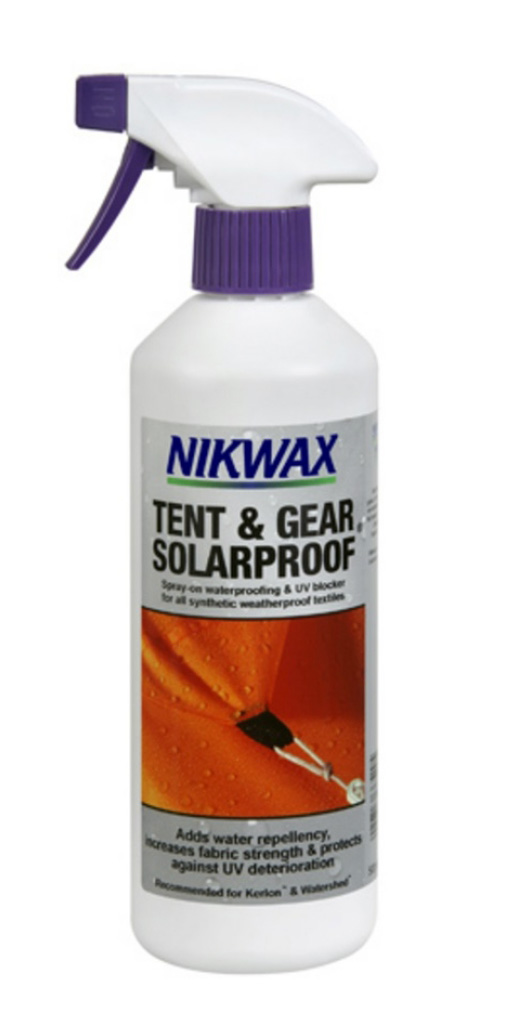
I’ve only had normal rain until 2018 when I used it on the Tarn without the inner. In really pelting rain verging on hail a light spray came through the fly and there was the odd drip from the seams. Had I used the inner would have settled on that and evaporated later, but it didn’t so all was a little damp. The flat roof doesn’t help. I wonder if even a 3000mm hydrostatic head (over twice normal) is not enough for really heavy and prolonged downpours. I see the Kerlon 1200 on the Nallo is rated at 5000mm. When I got home I sealed most of the roof seams and sprayed it all with Nikwax. We’ll see if it made any difference on the next big downpour.
Inner hangs from the fly; pitches all in one, like a Nallo Can pitch inner or outer only Nearly self-standing Roomy inner in all dimensions Long, flat roof gives good headroom Roomy porch; quite easy to get in and out Stable 3-pole set up
Boring old green Bendy stock pegs In pelting rain a light spray passes through the fly if no inner used. Since re-proofed and seam-sealed Collapsed poles are a bit long at 44cm
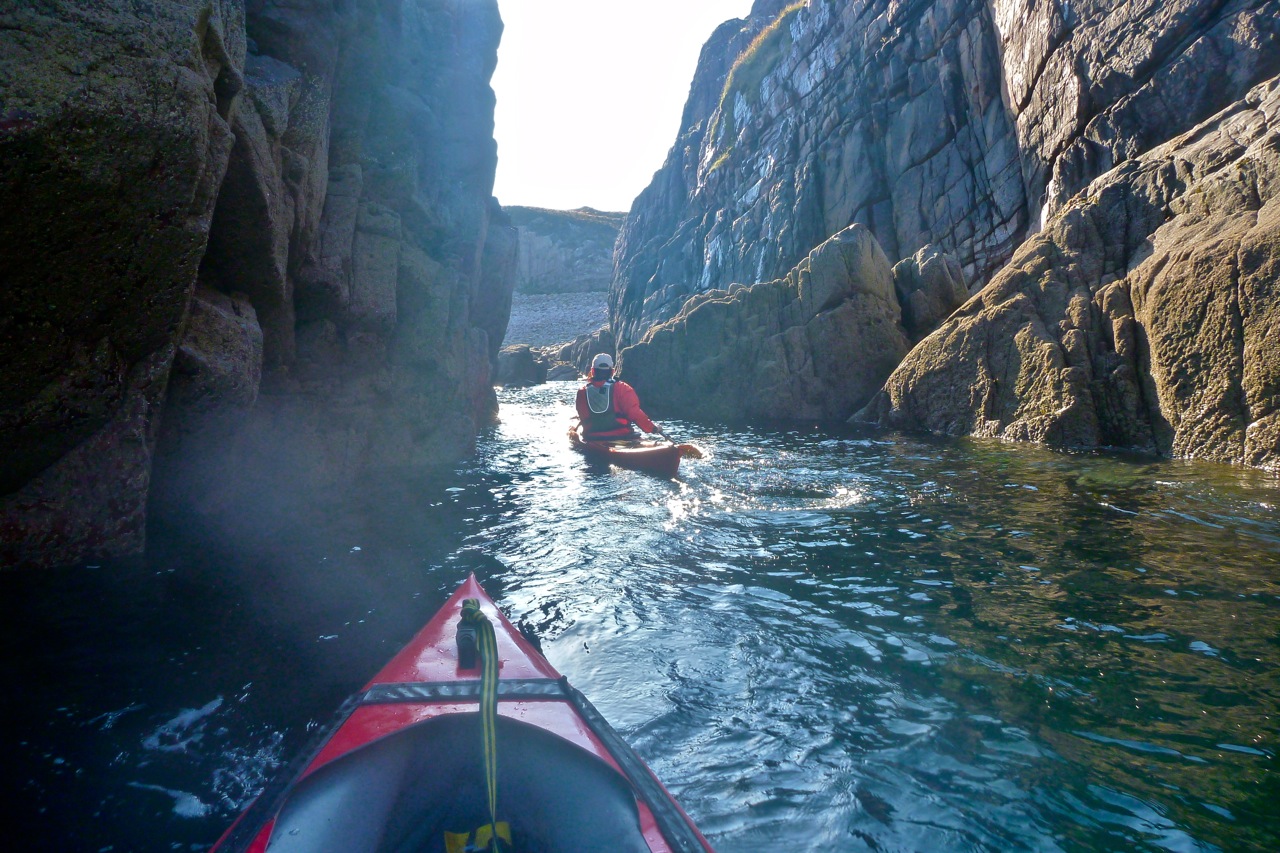
What paddler can resist the thrill of poking their bow into a cave or threading a natural rock arch? Paddling under a bridge or into a boathouse just doesn’t have the same transgressive buzz. Here are a few of my favourites, tracked down over many summers bobbing among the Isles. Most of the arches will need the top half of a tall tide, but add spring highs and a swell and some caves may require a hard hat too, or may just be too risky.
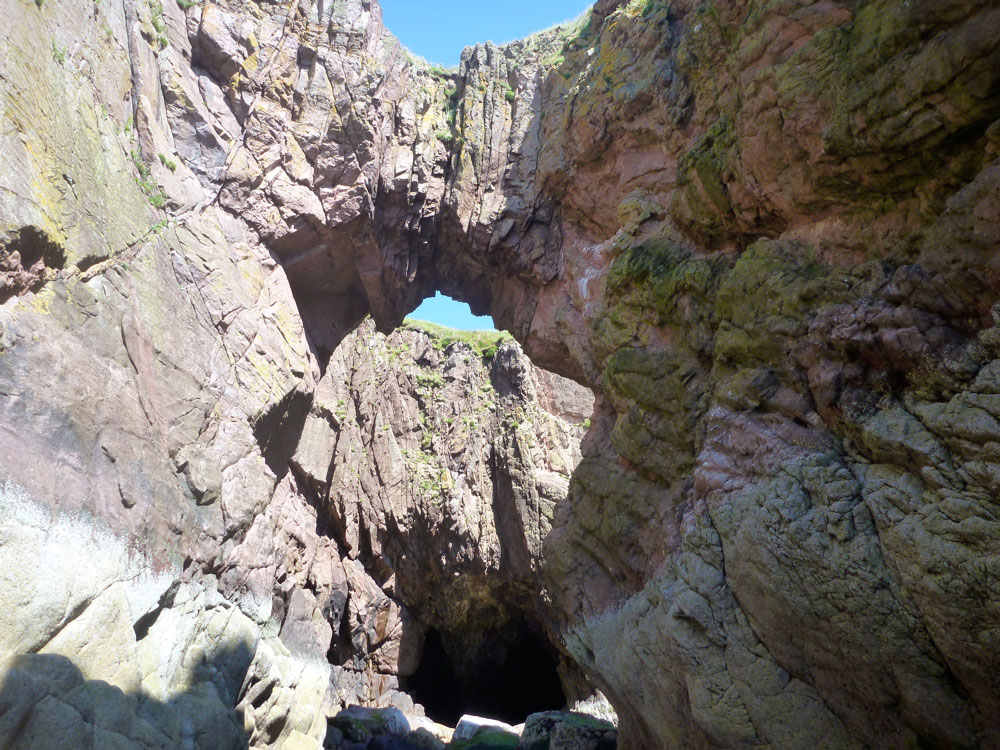
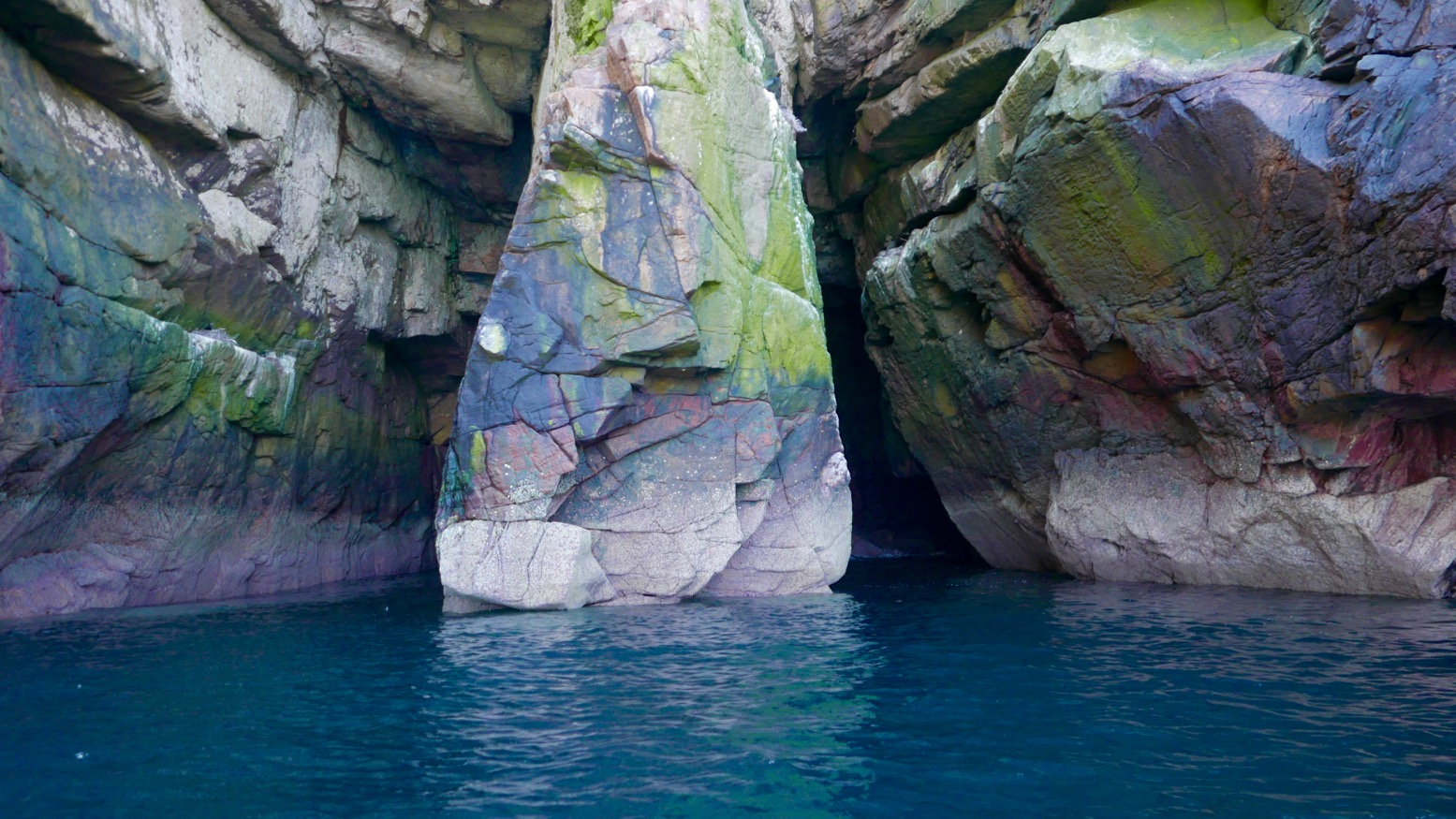
Double Arch • Bottle Island This was a great discovery – in under one arched slot with room enough below a collapsed roof cavern to turn for a paddle-stowed squeeze out of the other exit (above right) if the tide is high or the swell is right. Read more…
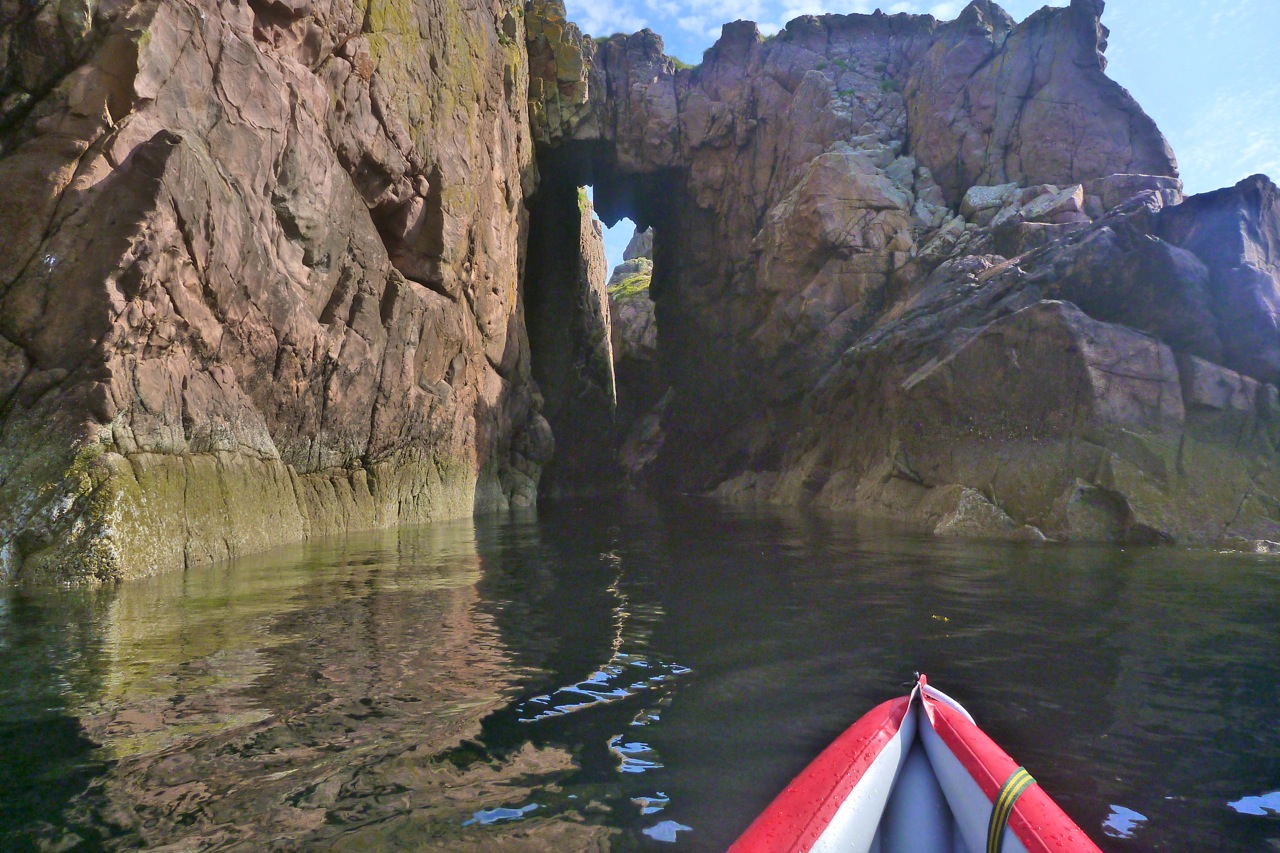
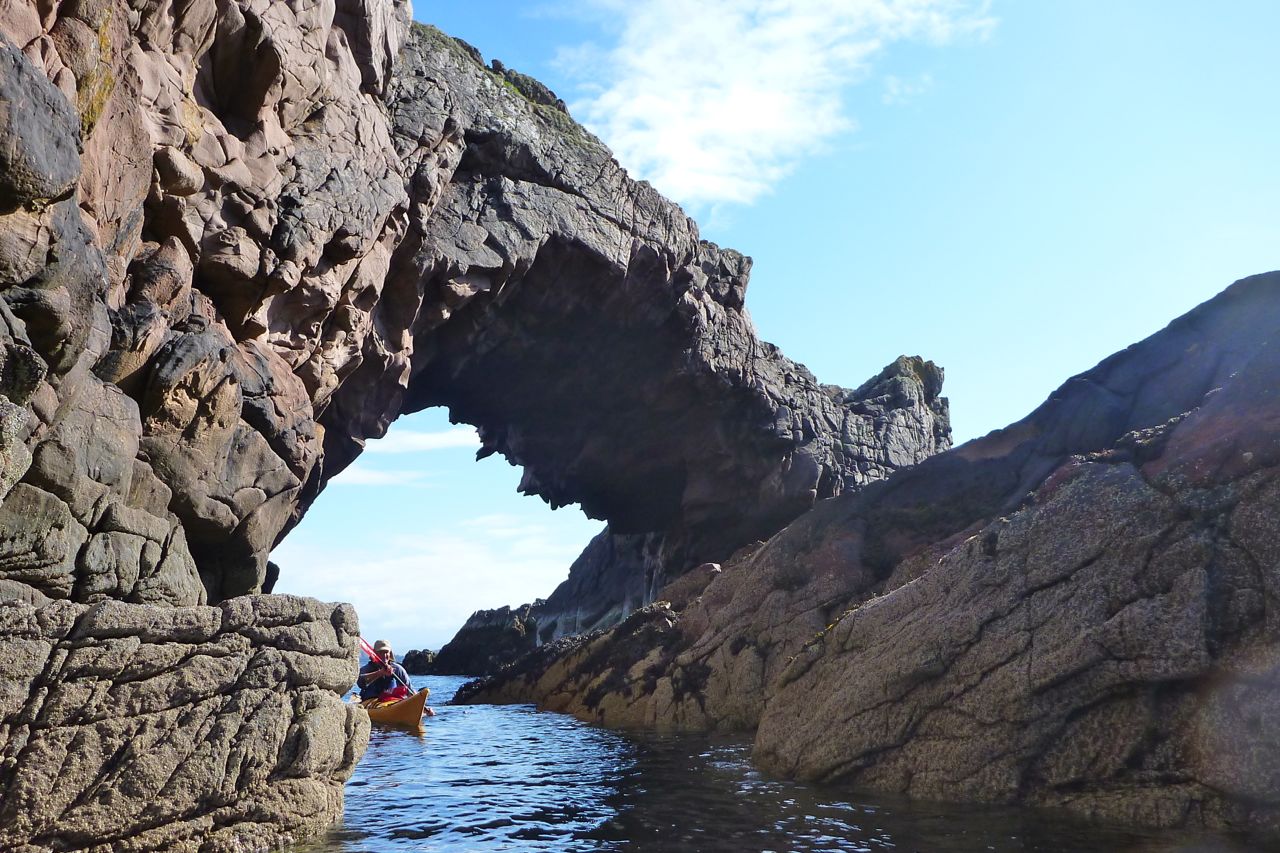
Arch • Tanera Beg The best known and best looking of kayaking arches in the Summer Isles (left). Not that easy to spot on the usual approach from the northeast I the Tanera channel, so start nosing around off the southeast side of Tanera Beg when the tide is high. Read more…
Arch • Eilean Mullagrach Another superb example of Torridian archmanship which elsewhere, in similar forms, may have given birth to the first architectural arch. Easy to find and get to as long as there’s a paddle in your hand and water under your boat. There’s a cave behind the arch (both left) which, who knows, may one day link up with the other Mullagrachcave described below. Read more…
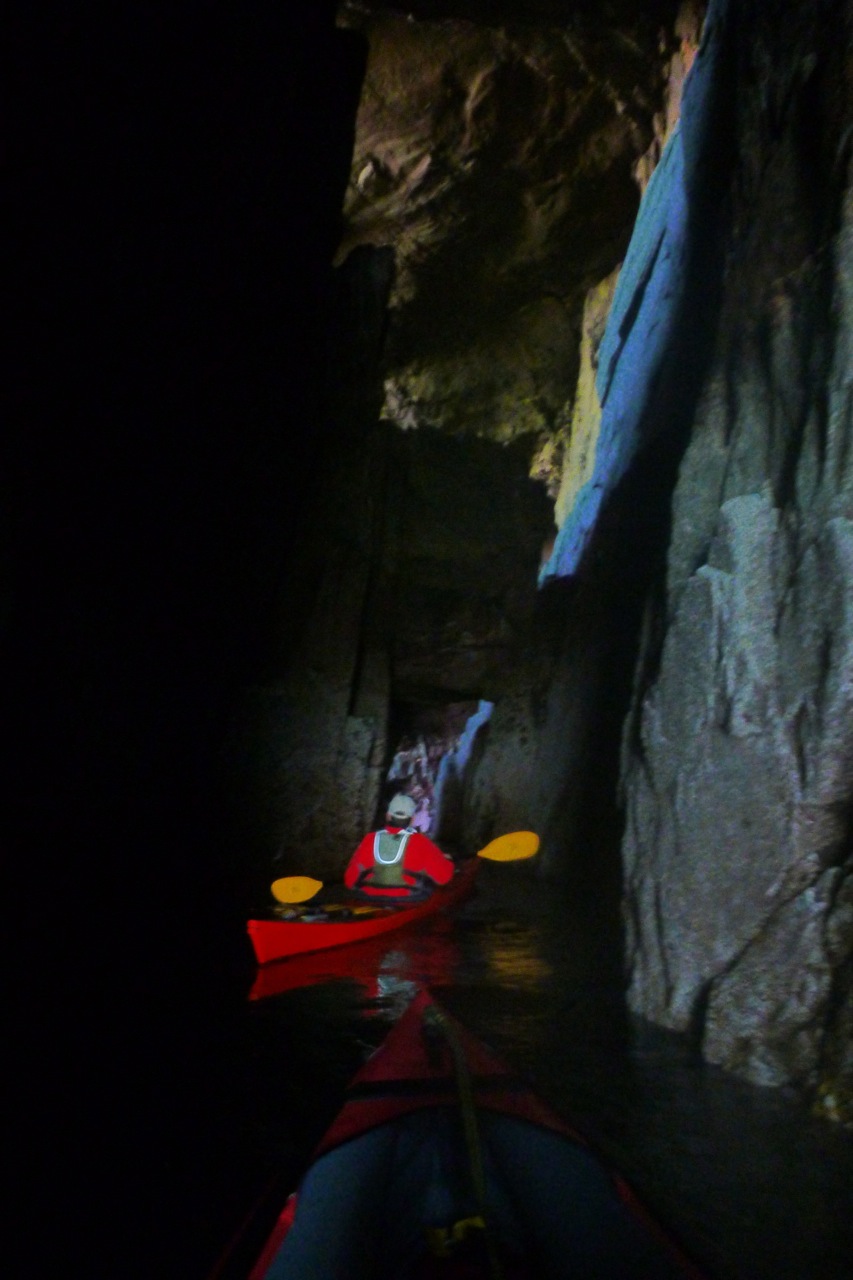
Deep Cave • Eilean Mullagrach Just up the coast from the above arch is a hidden cave tucked in the back of a little cove – Am Fang on some maps. Look on a map or sat image and it very much looks part of the same fault as the arch above which burrows right along the eastern shore of Mullagrach. We went back the other day for a closer look with a bit more tide but which did not please the birds nesting by the entrance (left) at all. We probably got within a boat’s length of the end, using the camera flash to navigate. Read more…
Arches and Caves • Priest Island We didn’t go right round the ‘Island of the Clerics’ but passed an arch approaching the Priest’s northern tip, and I read in Fraser-Darling’s Island Years that there are deep linking chasms – crawlable not kayakable – around the northern point and another on the western end too. On the east end of the ‘Acairseid’ or bay is a narrow cave as well as a tricky right-angled tidal slot alongside a stack (right; I may be conflating the two). There’s also a less a constricted passage through the skerries just round the corner. Read more…
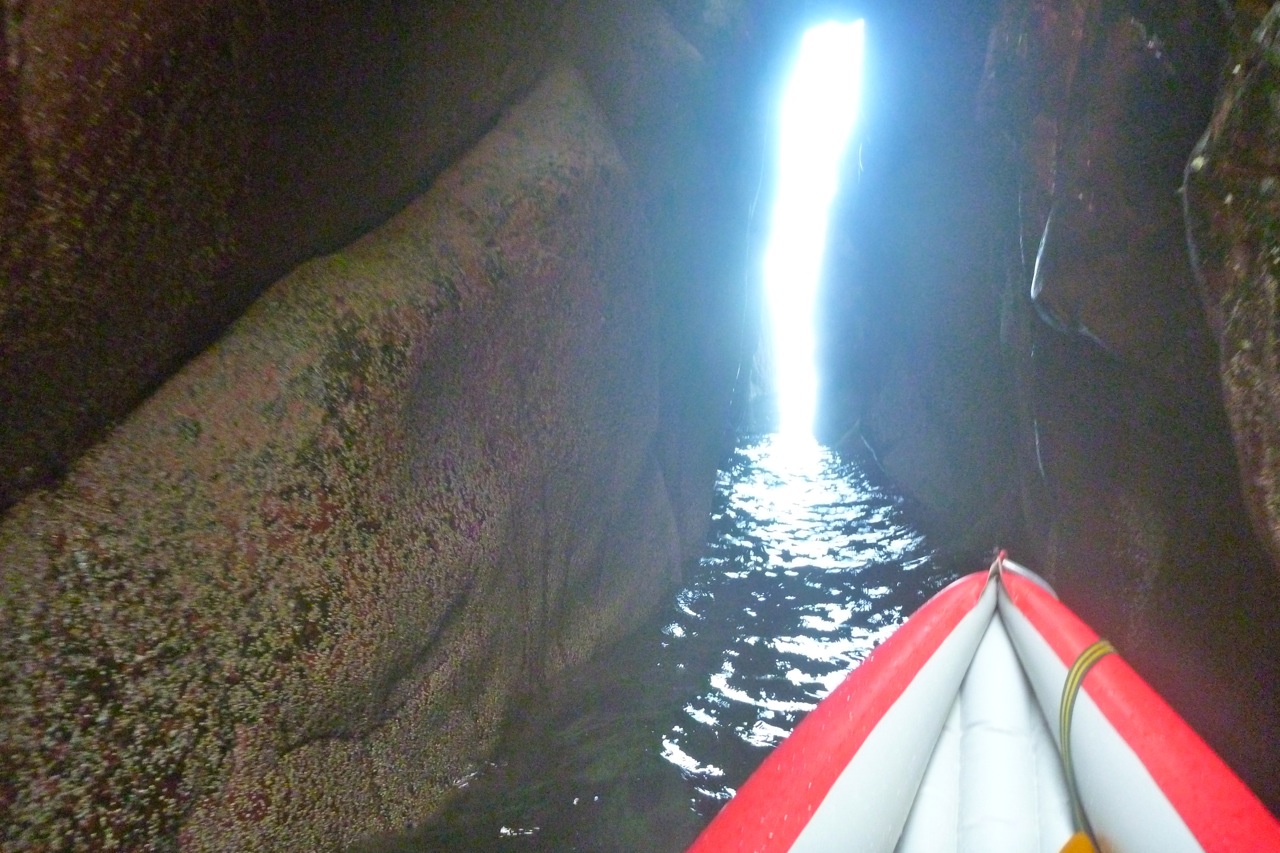
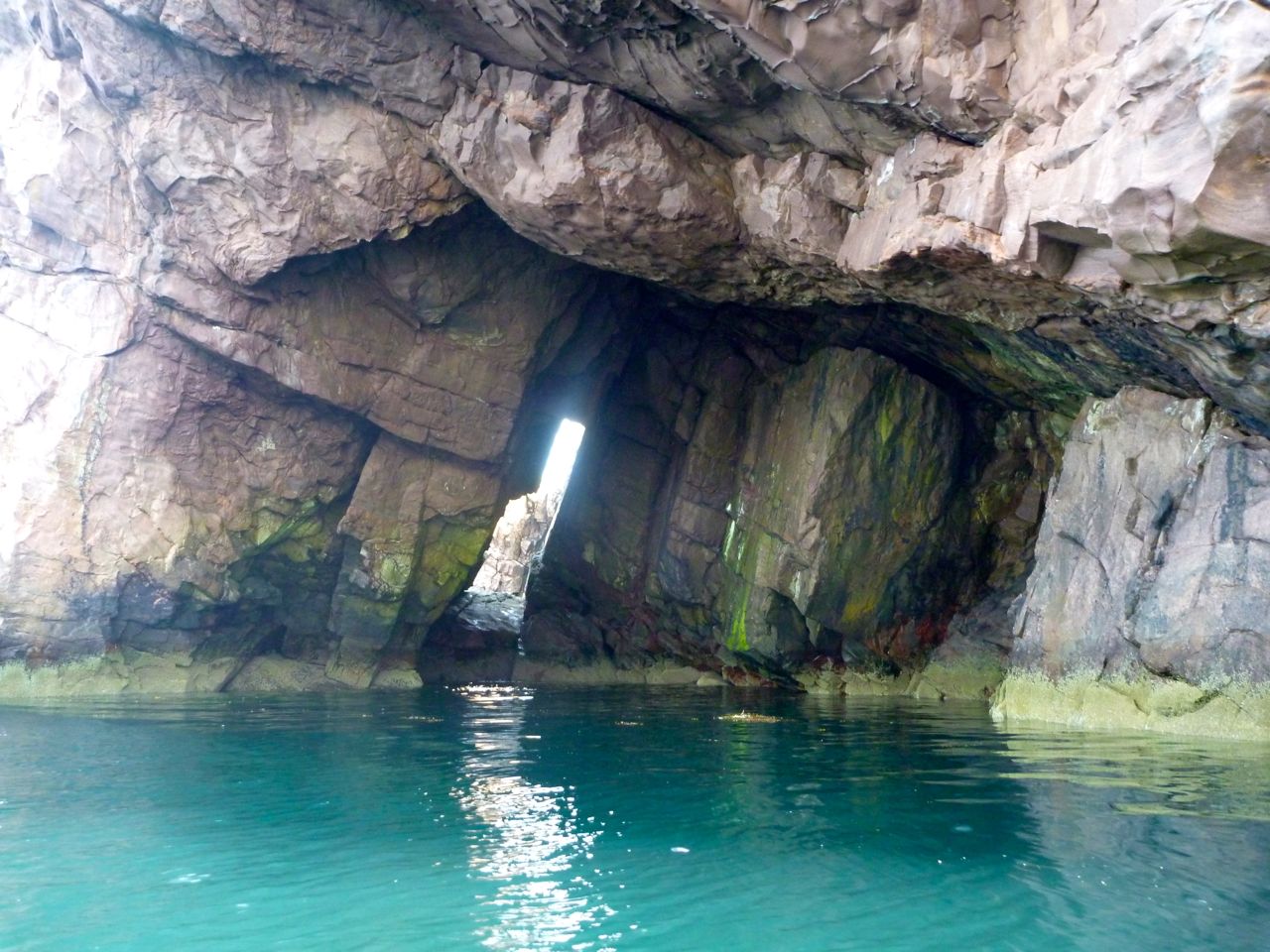
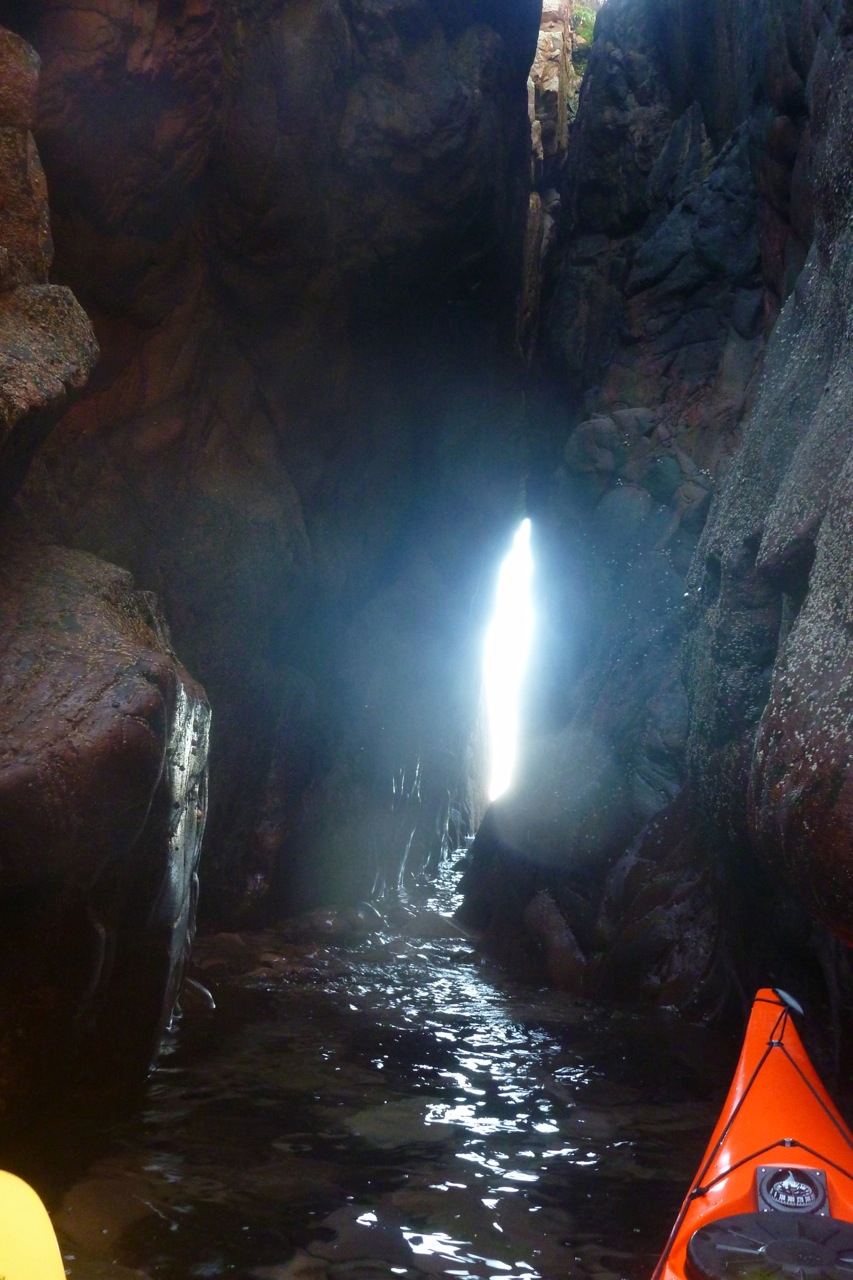
Cave • Tanera Beg On the OS map this cave is near a point labelled Sron Ghlas on at the island’s south-southeast point. ‘Cathedral Cave’ is what the boat tours call it, as they can edge right in while the captain offers a rendition of ‘Danny Boy’. With the daylight coming through the crack at the back (right), give it 100,342 years and they’ll have to reprint their brochures with ‘Cathedral Arch’. Read more…
Double Arch • Sgeir Ribhinn In a rush to get to see the main islands before the weather breaks, most would paddle by Sgeir Ribhinn, the easternmost of the three skerries south of the Taneras. But if you do pass close by, the one-kayak-wide geo on the upper east side will bring you into the cathedral gloom of big and small (left) arches overhead. Read more…
There are more caveson the Coigach peninsula cliffs facing Enard Bay, northwest of Achnahaird plus some fun tidal passages in the Isles too. Here you can catch that serene Caribbean sensation of gliding on aquamarine glass over the sandy sea bed, if not always with tropical temps, balmy winds or reggae soundtrack. My favourite is the pass between Carn Iar and Carn Deas (left), just above Bottle Island, with a lovely sandy passage on the right of Deas. Carn nan Sgeir below Horse Island is another, though you’ve got to time both at high tides.
… I deliberately chose [these Kokatat Swift] dry trousers with no sewn-in socks as my drysuit has those. With the Swifts … I’ll just wear short Seal Skins and have no worries about the sewn-in socks getting holed by gravel. Time will tell how they wear and perform.
Well, I’ve changed my mind. I’ve never been convinced by the Goretex/membrane magic; at least not for hillwalking – I get too hot and sweaty. But making less heat paddling an open kayak on a cool Scottish day, the stuff seemed to work. It keeps out the splash and light rain, but because the leg muscles are inactive, sweatiness is barely apparent. Using a regular eVent hiking cag on top produced more mugginess, but nothing as bad as on the hill and easier to control with the front zip and adjustable cuff cinches. Unlike a hardshell, for an IK there’s no great benefit to buying a regular kayak cag with a waist seal as there’s no cockpit spray skirt to seal it against. If you really want to keep dry all over, just use a dry suit.
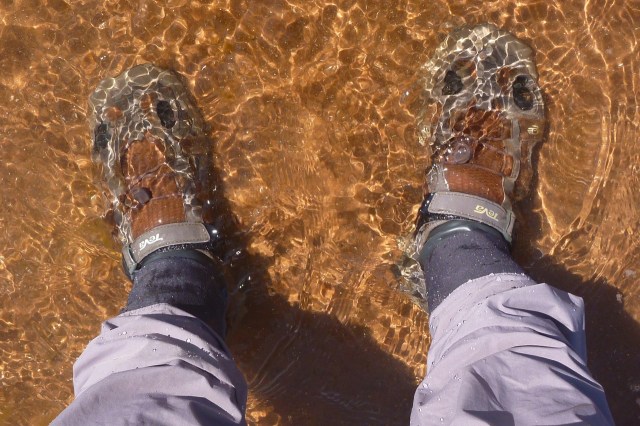
On one trip I found that the Swifts with knackered SealSkinz didn’t really work. ‘Waterproof’ SealSkinz only last until the clingfilm-like membrane goes. Then they become saggy sock-bags with insulation qualities no better than woollen socks. In fact, they may well chill damp feet. Wearing my slowly dilapidating Teva Omnium water shoes (left), I now think it’s better to seal feet properly with latex socks. IMO latex is easier to repair than socks laboriously made from off-cuts of membrane fabric which, like all that kind of stuff, has a limited life span, especially under the grinding weight of a foot. Bizarrely, I see most don’t make dry pants with integrated latex socks, only membrane, which must be a a cost or maybe a UV thing. Anfibio is an exception. But you can easily buy dry pants with latex ankle seals and glue on latex socks which are readily sold individually for around 20 quid.
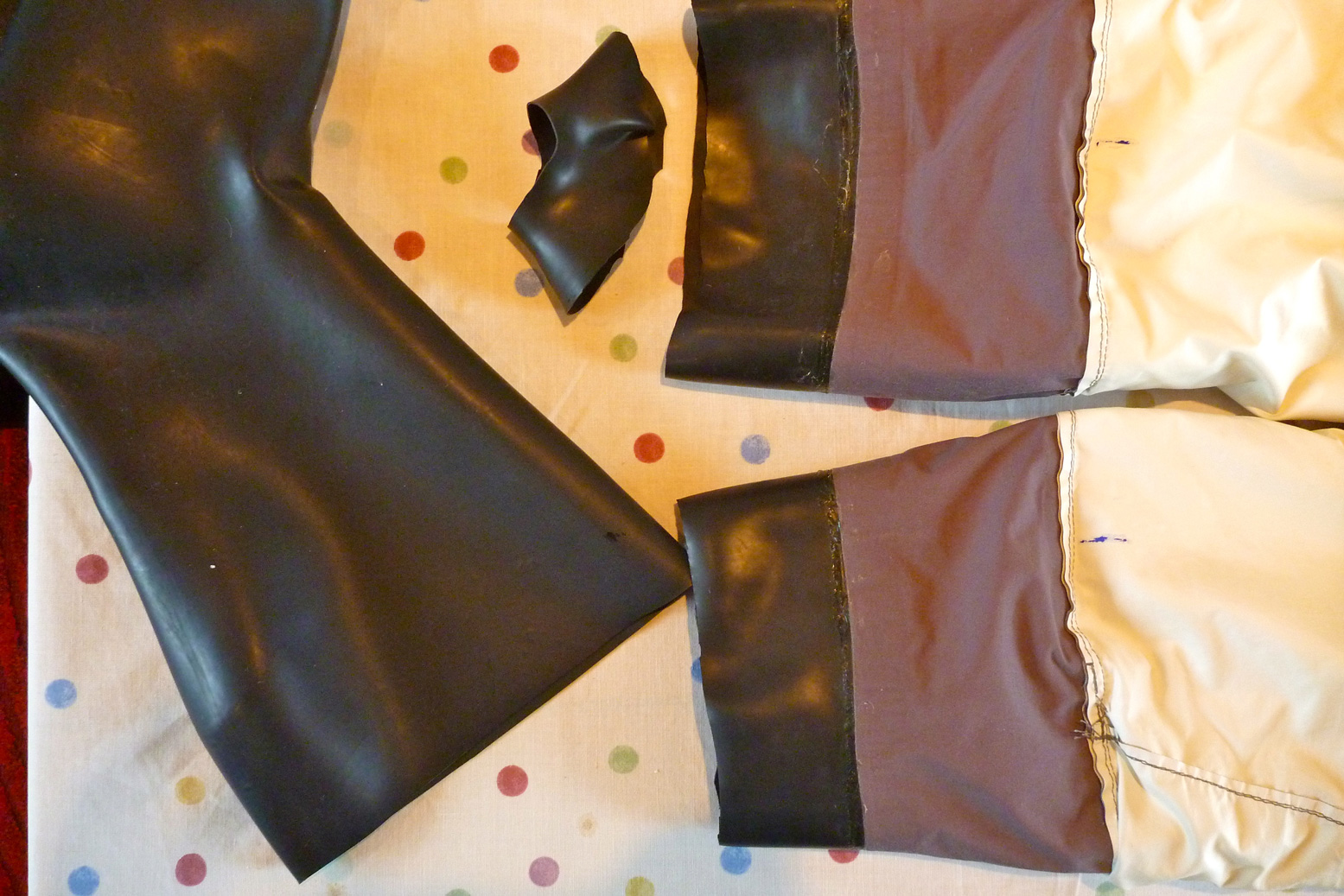
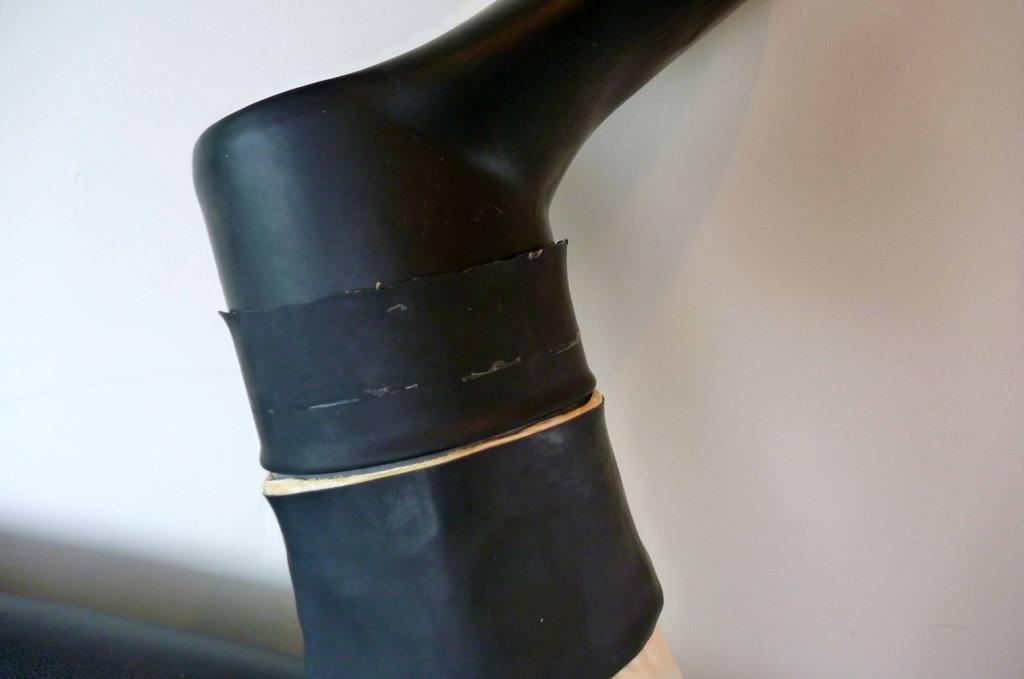
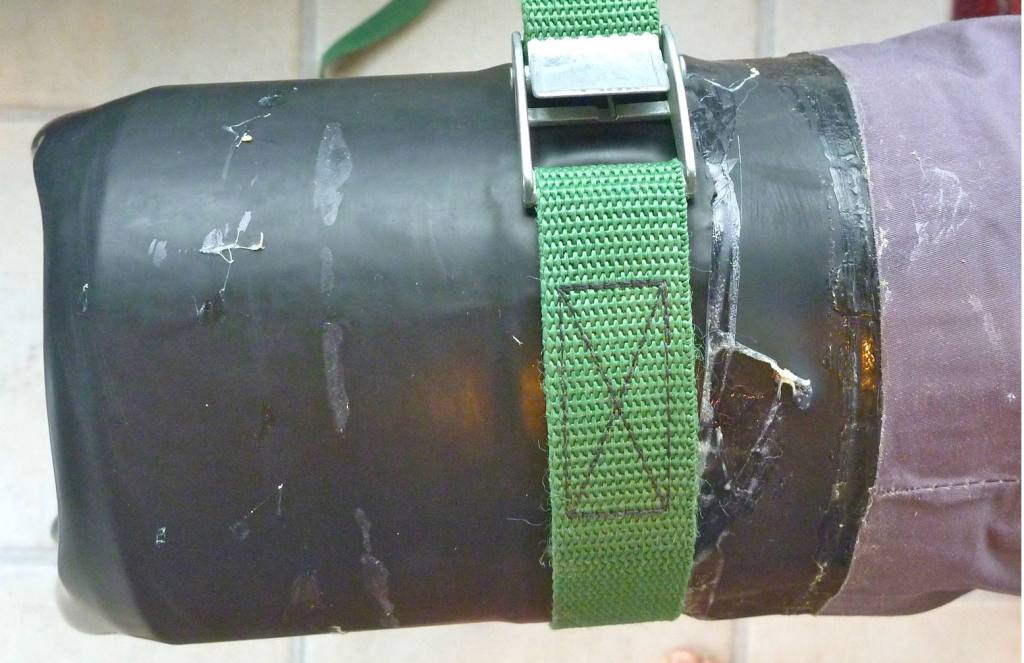
Gluing on latex socks First I trimmed the latex on the trousers and the socks to similar lengths. Getting a circumference match is important if there’s to be no leak-prone creasing once they’re joined. You’d think gluing latex socks to latex trouser cuffs would be simple. Not so it seems. My first go using regular rubber glue didn’t take to the shiny outer surface of the pants’ latex.
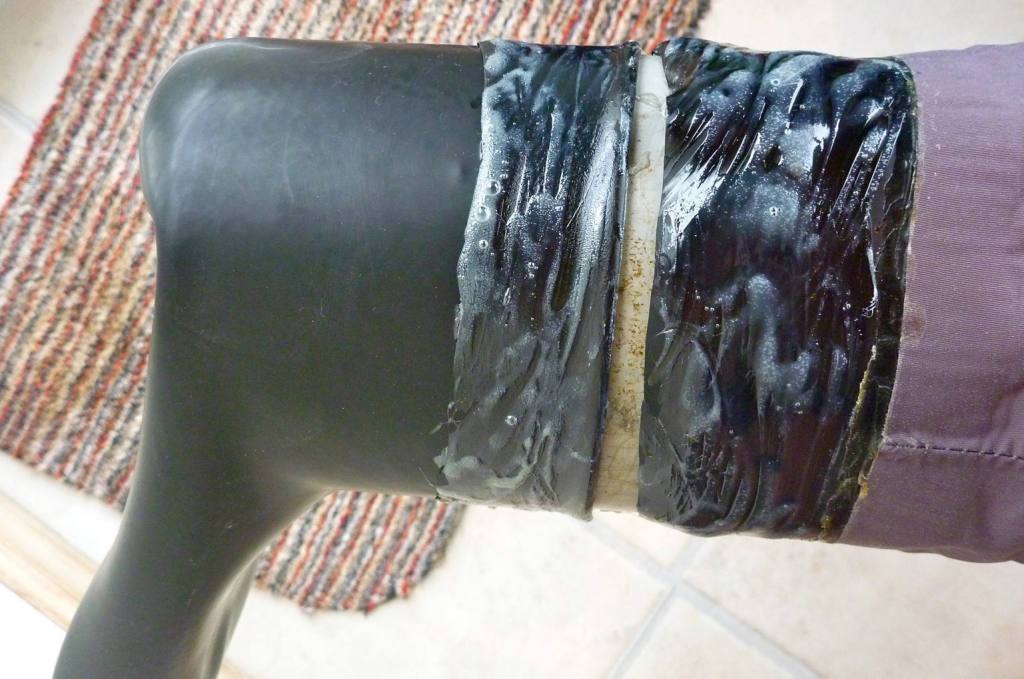
I read of using two-part adhesive, even though that refers to the tricky latex-to-dry suit fabric seal, not similar latex. So with the leg and the sock remounted on a piece of 5-inch plastic drain pipe (below), I tried again mixing up some PolyMarine Hypalon adhesive. This stuff sticks like a velcro electro-magnet, but curing times are lengthy and there’s the whole faff of getting the 25:1 mix correct.
Mount on a pipe
Fold sock back and glue
Fold over and press down
I folded back the sock about 3cm on the pipe end and nudged it against the exposed trouser leg cuff (left, above). When the adhesive had cured after 30 mins, it’s another coat (middle), wait 3 mins then just roll the sock over onto the leg and lay in with the roller then strap it up for a couple of hours. There was one small leak, easily fixed.
When cooler weather requires them but you don’t want a full-on drysuit, these fully sealed pants have been great. I can wade right in without getting wet feet, and wearing regular socks underneath the latex is are warm and comfy. A few years later one sock started leaking; a tiny hole, easily fixed with a dab of Aquaseal. They say latex is prone to UV so is best kept out of sunlight (which is why latex cuffs are often covered) and given the odd squirt of 303 UV protectorant or NikWax Solarproof.
Integrated socks – best thing you can do to your dry pants
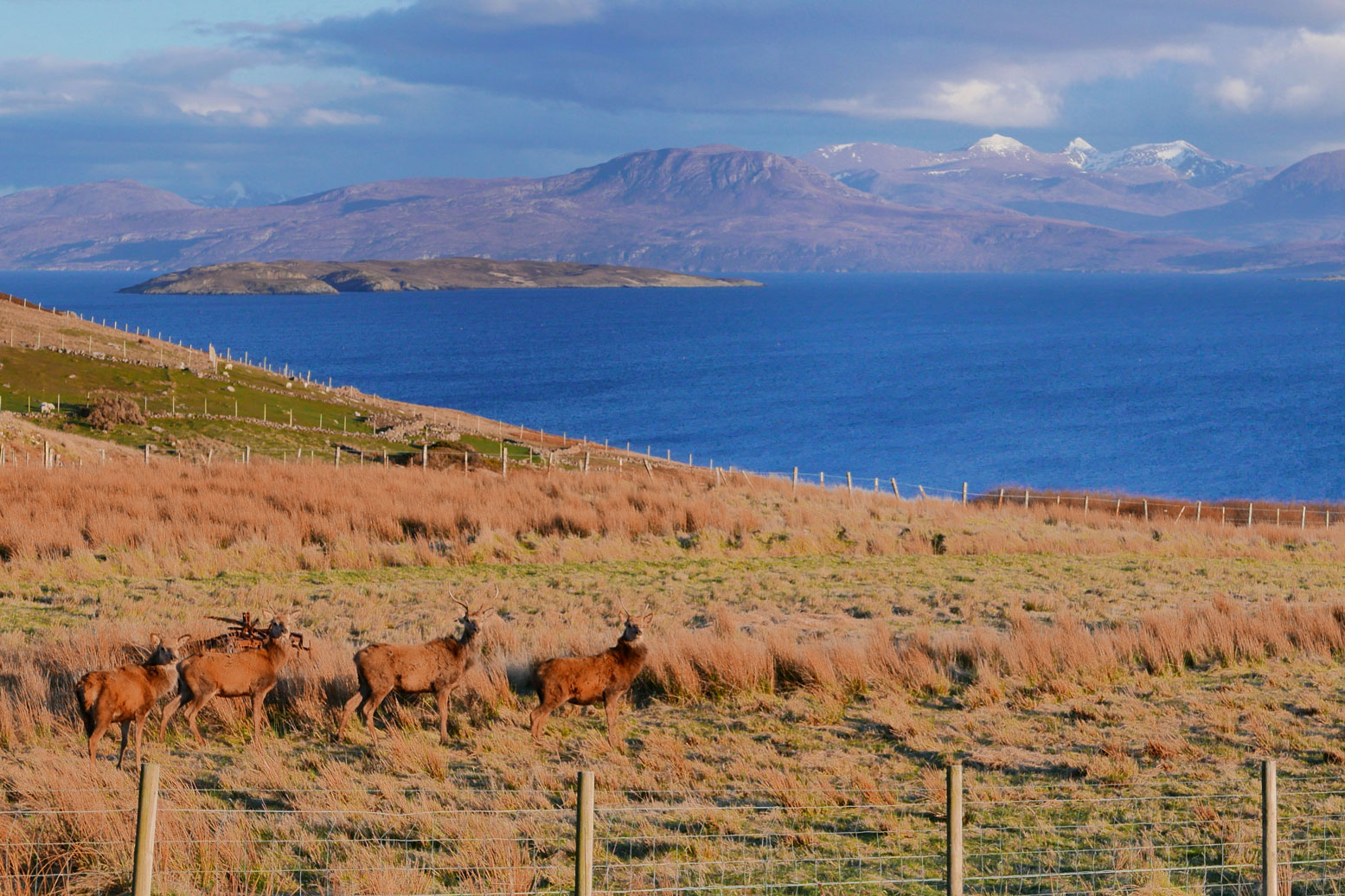
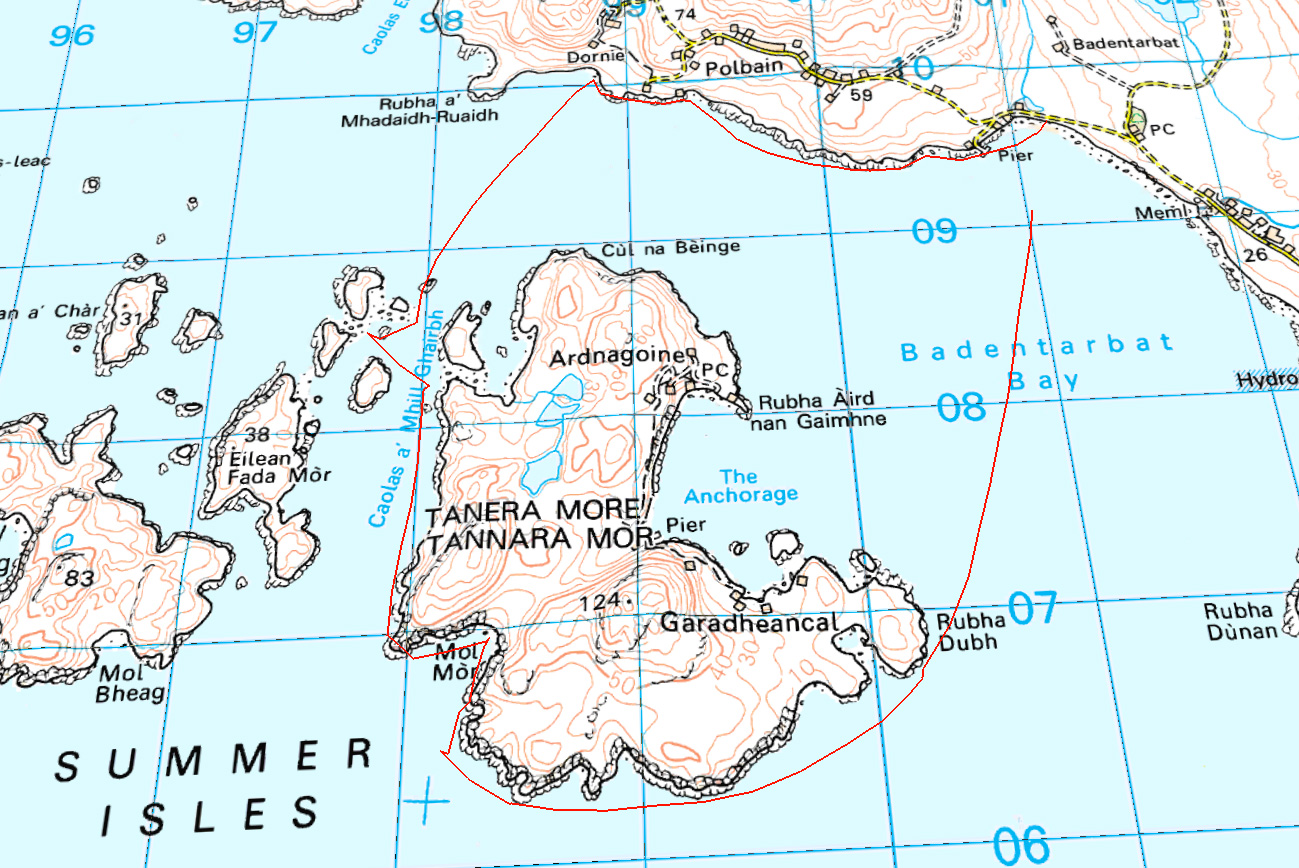
First paddle of the season, although it’s still far from spring-like. The last few days snow has been blanketing the Torridons (left), the Assynts and even BM Coigach (above). But after three days of howling, the winds abated and Jon and I went for a spin round Tanera Mor. I remember first time I did that in the new K40 it felt like an expedition. This time with two of us it was just a jaunt to get the old shoulders cranking again.
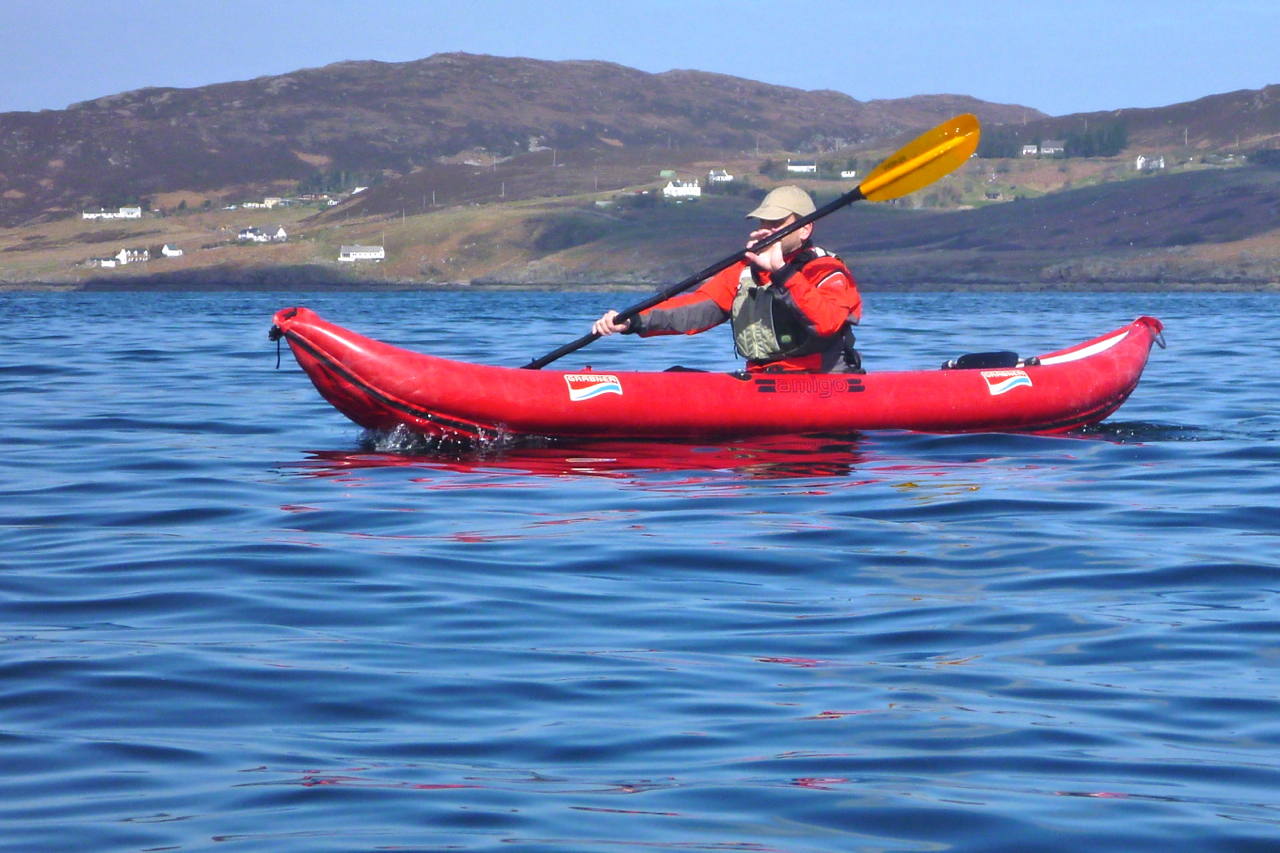
Jon bought my previous IK, a Grabner Amigo, but had yet to use it, so this was a chance to compare it with my current Seawave. I sold the Amigo after a run out to Bottle Island when it dawned on me it literally wasn’t cut out to be a swift sea kayak. Still, I managed a pretty good tour of the Slate Islands that year with the Amigo.
Off Badentarbet beach heading for Rubha Dubh-Dubh, Jon was notably slower in the Grabner. For a moment I felt a bit bad – Jeez, did I really sell him such a dud? I’m sure it wasn’t that bad. It was only later when we swapped boats and were more of less evenly matched, that it transpired years of paddling slick, hydro-dynamically efficient hardshells had had a catastrophic effect on Jon’s pulling power. Either that, or a winter’s pushbike training had similarly atrophied his arms, giving him the physique of a T Rex.
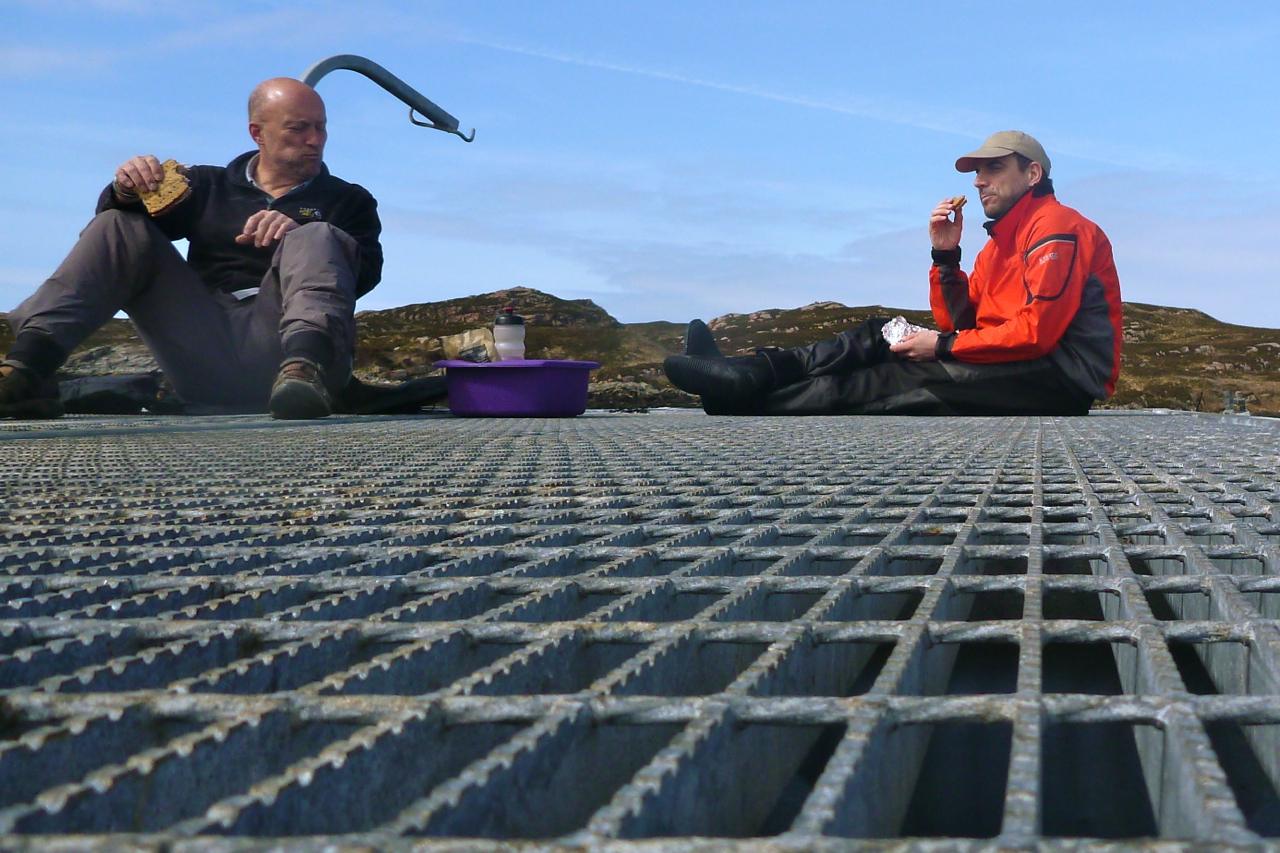
Still, it was good to break the arms in gently, and before we knew it we were turning back northwest for the Tabera channel. With the tide bottomed out, we had lunch on a fish farm platform to the sound of salmon skimming and thrashing up non-existent rapids to their blue remembered breeding grounds. With that sort of daily exercise, at least they won’t end up like T Rexes. From here I rowed the Amigo back. Sure, the flat nose was more snow plough than arrow-like bow, but you’ve got to admire the Grabner’s solid, no-nonsense build. PRVs? Kiss mein schkegg!
Proper seat and attachment points? Opzional, Freund. And compared to the slight flex I noticed in the Seawave – even at .25 bar all round – the 0.3 bar and 750-cm shorter Amigo was as stiff as a stretcher.
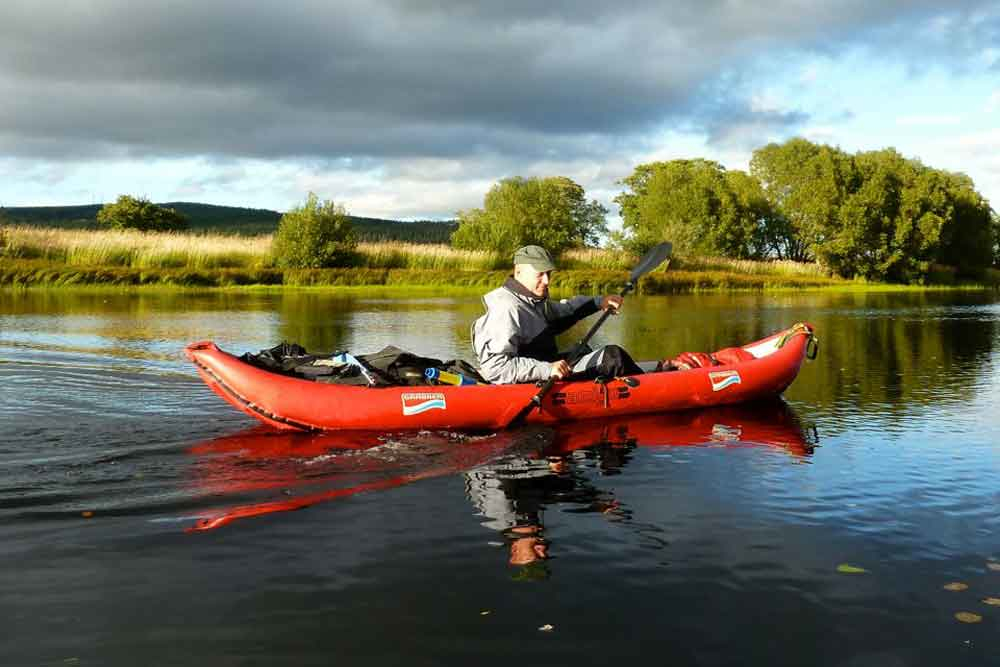
As before, the seat-bar mounts caught my fingers as I paddled, but Jon found similar protuberances on the Gumboat. The bomb-proof Amigo would make a great river touring boat: tough as nails, upswept ends to ride over whitewater and as stable as any IK – though the upswept stern might be a backwind catcher when running skeg-free, as I did on the shallow Spey one time (left).
All in all though, living as I occasionally do by better sea than big, boaty rivers, the Seawave works for me, even at just half an mph faster. The price new was about the same, but there were a lot more extras with the Gumotex, including a deck (I never use). I gave the OE seats away with the Amigo and made a lightweight and q/d seating arrangement which I’ve adopted on the Seawave: a packraft seat base, SoT backrest plus packraft thigh straps and my patented elasto-cantilevered drainpipe footrest (left). Read all about them here.
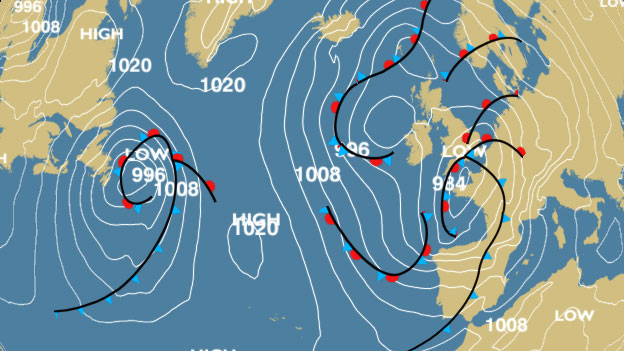
High pressure alert!No, my range of recreational leisurecraft weren’t about to blow, it’s the weather – and that’s not about to blow. Far from it. A high was about to lasso the north of Scotland with its concentric isobars. It may be mid-October but it’s been the sunniest and calmest spell up here for two months. Never mind Indian summer, this was turning into an Arapaho autumn. It all added up to good chance to make a break for that most troublesome and distant of the Summer Isles: Priest Island – or Eilean a’ Chleirich; ‘Island of Clerics’.
Whichever way you look at, it Priest looks way out there for someone used to staying within a mile of the shore. Mainlandwise, it’s over six miles out of Old Dornie, nearly four miles off Mellon Udrigle on the other side, and a bit more from the end of the Scoraig peninsula. Far enough out to need the full length of a good day and someone for backup. Luckily Jon thought so too and rode up late Thursday night with his Peckett & McNabb Scorchio LV.
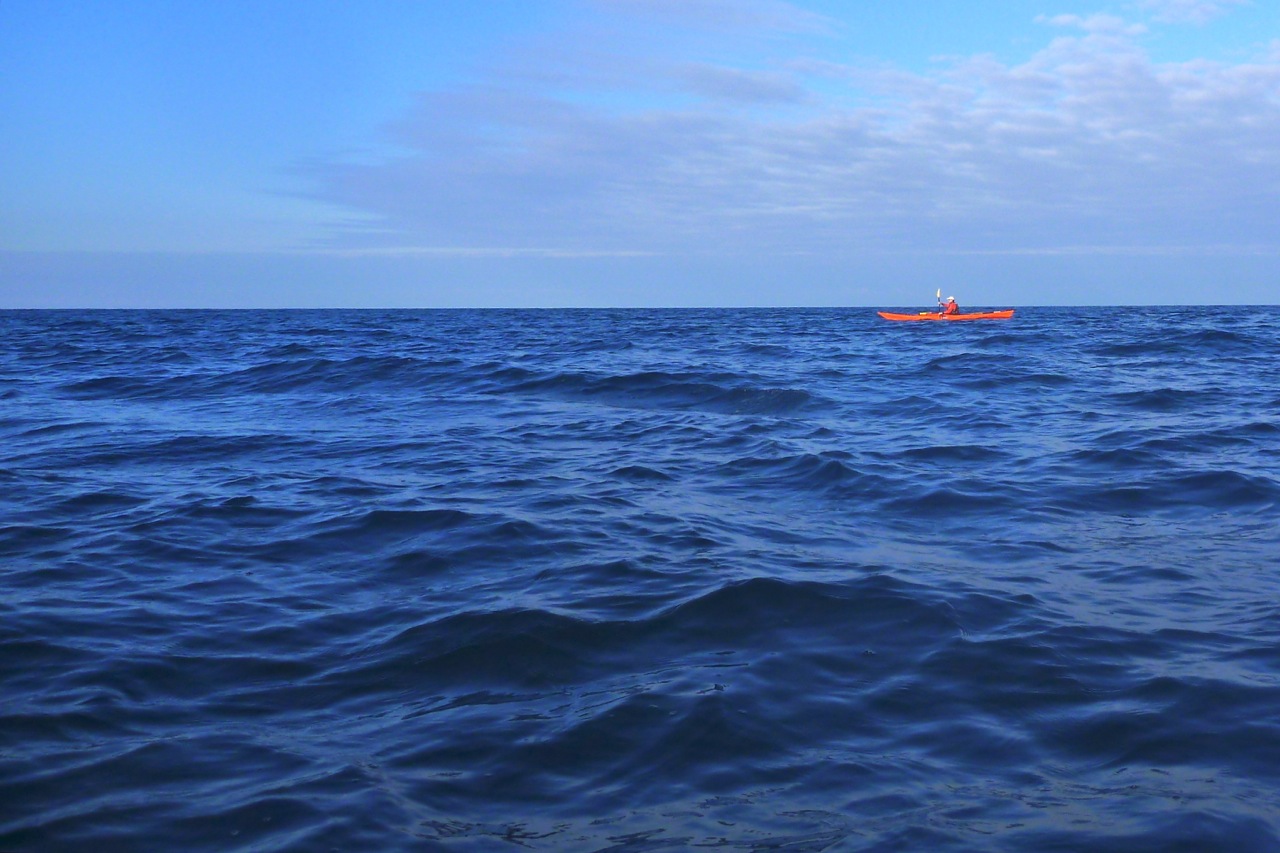
Friday, soon after dawn we were putting in at the top of the tide at Old Dornie. ETA Priest north shore: 2.5 hours. The forecast was a 6mph SE till late morning after which time it was set to drop right off to the southwest. Once clear of the back of Tanera Beg’s lee, I expected things to kick up a bit. But what a difference it is having someone else along for the ride to quell the usual neuroses. Jon agreed that he too would be nervous of taking a run out to Priest alone, and he was sea kayaking by the book: UHF, spare paddle, bluetooth bilge pump and the Semaphore Handbook in six languages, including Gaelic. Of course, this was all in a day’s work for someone like Gael A who was up here a couple of years ago in an Incept K40 at the end of his Scottish Sea Kayak Trail when he wrote.
I headed towards the closest, Priest Island some 5km away. Halfway through the passage, the wind died off and the sea glassed over. The uncanny cries of the guillemots emphasised the eerie atmosphere; I felt like I was entering an unearthly space. From the SE tip of the Priest Island I carried on around the west side. It was another paddling paradise with endless features to explore in the good company of seabirds and seals.
Back to now, and I was typically under-dressed, making a concession to the season with some Ron Hill leggings and my warmer pfd. It may have been mid-October but I knew I’d cook in my drysuit and, as I guessed correctly, my high-waisted Kokotat overtrousers would complicate the inevitable pee breaks long before I got to set foot on Priest. Good thing a calm was setting in then. As we left Old Dornie Jon asked me to pull down his jammy skeg, and in the ten seconds it took me to locate it, my arm went numb with cold. Falling in out there would really not bear thinking about. The cold shock would lock your lungs like a slamming safe door. As it was, once past the back of Tanera Beg the sideslap never got that unnerving, and as we sploshed along I knew not to be concerned if the distant dark crags of Priest appeared not to grow any nearer.
Only 90 minutes in the marker of Glas Leac Beag (small green rock – above) came up on the right. I visited the bigger counterpart, Glas Leac Mor the other week, but Glas Leac Beag’s consolation in an emergency was purely hypothetical as the only way to get on it would be to leap from a boat like a frog. Still, we were going quicker than I expected despite the chop and corrections against the sidewind. The skeg-rudder idea of fellow Gumotard, Jim, would have been handy here. Every once in a while I had to give a double haul on the right. Jon’s hardshell worked by balancing the variable drop of the skeg against the force of a sidewind which would otherwise push his stern round: more sidewind, more skeg, or something like that. In that sense skegs are more like optional rudders on hardshell cheesecutters which have no need of directional aids, unlike windprone IK bloats.
Looking at Priest with the low sun in my face, it was impossible to discern any perspective to the foreshore – it was all one long dark line of crags. The map lay right in my lap but who looks at maps once they’re on the move? I failed to recognise that the bouldered landing beach we were aiming for was further to the east, while we were heading down to the western end. Once I realised that, we changed course and passed the tip of Priest and an arch (not the needle-eye arch on the west end) which only Jon noticed. And as predicted, the wind dropped off to nothing.
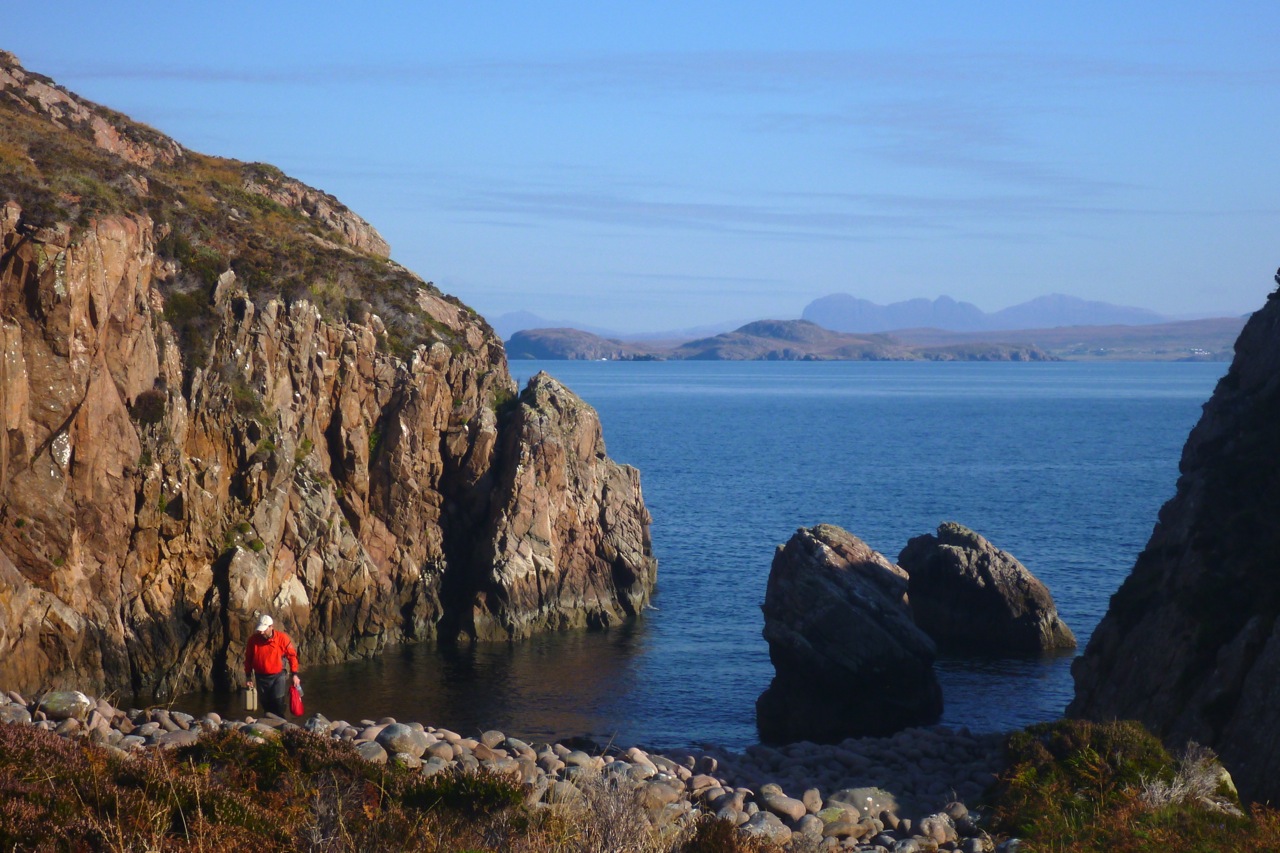
We were searching for the cobble stoned beach created by the island’s NE/SW glacial gouging. We put in up a cleft (left) and staggered ashore, but it was all wrong – we had made the deadly mistake of pre-emption: scourge of the hasty navigator! If we wanted to spend any time on land, the dropping 12-foot tide would make getting back out of the cleft tricky.
Back into the boats on the slippery seaweed boulders – surely the most awkward and risky part of sea yaking, short of tackling a typhoon. Soon we got to the correct stony beach I’d clocked on Google. A stumbly 5-minute portage from here would have led to the glassy half-km-long Lochan Fada which cuts right to the heart of the island, one of nine freshwater sources on the Priest. But, great picture though it may have made, I was a bit pooped and more interested in ham butties. We sat on a hill overlooking the still lochan when Jon noticed the back of a signboard at the other landing beach. It was a plea by the island’s RSPB owners for visitors to be careful not to crush the burrows and eggs of the 2000-strong colony of storm petrels that inhabit Priest Island.
As it happens that was made easier by a few paths leading from the two landing beaches. One led past the RSPB shed from where I carried on to the south side to check out the ‘prehistoric’ stone circles. The ones I saw (picture far below) looked more like rude shepherd shelters than mysterious Neolithic monuments (there’s more on Wiki), but to be fair, I didn’t see the others just to the north. That was because it took a bit of reorienting to locate the island’s sole ruin, a substantial but roofless four-room bothy supposedly on the site of a sixth-century Christian chapel, suggesting an origin to the island’s name. I was curious to see this place as it’s said in 1975 a pair of unlikely criminals hid out here for a few months, on the run from a collapsing series of scams.
Google ‘Jim Miller and John Bellord, Southern Organs Scandal’ and you’ll soon find Geoff Green’s recent book: Paying for the Past. In it, the author admits to falling under Miller’s mesmeric spell in the early sixties and eventually becoming one of the entrepreneurs’ close business associates. Along with many others, he was invited to make a quick buck by investing in loans to supposedly supply churches with expensive electric organs, and was later drawn into a racy, high-profile lifestyle as the manager of Southern Organs’ GP sponsorship endeavour. Alvin Stardust (right) and other celebs were part of the gang, but then around 1975 the whole cosy investment scam which supported the racing sponsorship began to crumble.
Although he knew nothing of the area, it was Green who came up with the idea for the pair to hide out on Priest Island. They jetted off on a long-overdue holiday to Calais, sent postcards back home saying they’d killed themselves, ferried back to Dover the same day where Green met them and drove up to Ullapool. He then RIB’ed over from Dundonnell to Priest, leaving them with provisions and an inadequate two-metre dinghy with an outboard.
I read the book curious to discover if this claim – that these urbane middle-aged gents (Miller lightly crippled with polio) could really have lived for ‘262 days’ on Priest Island, frying up storm petrel omelettes and brewing peat tea. Over eight months sounded far-fetched for two conmen fleeing a Rolls Royce-champagne-and-helicopter lifestyle before clumsily faking their suicides from Calais, like Reggie Perrin on telly, John Stonehouse the MP, Lucan and more recently, our hardshelled friend, Canoe Man. A desperate, ex-para axe-murdering survivalist might have been able to hack Priest for that long. But with these two, insisting as they did on a chemical toilet, it all seemed improbable. Crofting on Coigach mainland is hard enough. What chance on a 120-hectare island, even with half-a-dozen lochans? On their release they went on to explain in a BBC documentary:
… the island had reaffirmed our belief in the simple things and helped us to clear away a mass of valueless and extraneous paraphernalia with which we, like so many, has cluttered our lives.
Paying for the Past is a bit light on clerical details and dates as, after dropping them off on Priest one stormy September day (a slightly over-written episode with some implausible embellishments, IMO), the author (left) was never to see his friends again. It’s only towards the end of the book that Green suggests they may not have been on the island anywhere near as long as he claims, and once recovered to the mainland, probably used their well-polished charm and remaining cash to secure local support in Ullapool, as explained in the book.
This video is part of a documentary that portrays the events from the point of view of a psychic detective who was hired by the Express, though it wasn’t shot on Priest Island. And for all our man’s alleged clairvoyance, it was simply the police tip-off from Geoff Green (under pressure from legions of debtors and with leniency guaranteed) that got the two arrested in Ullapool. Ironically though, it was Miller’s similar esoteric beliefs in radionics, among other ‘faith healing’ therapies, that founded and then funded what became the duo’s glamourous empire.
When I found the ruin in which they say they hid, it was clearly not your average Coigach crofter’s bothy, but a more substantial dwelling supposedly built on the site of an old chapel, either by a sixth-century monk on retreat, or a banished sheep rustler with a talent for masonry. As a sign (right) we saw on the Dundonnell Estate near Scoraig last week proves, ovine rustling is still an issue here in the wild nor’ west.
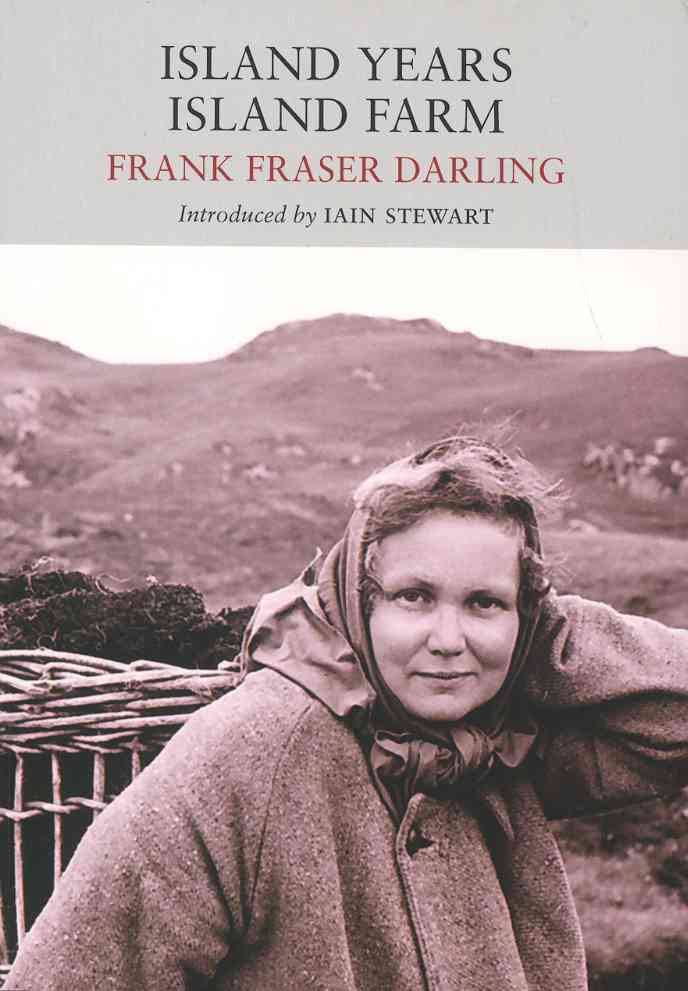
The way Green tells it, it was his auspicious discovery and reading of Frank Fraser Darling’s book Island Years, Island Farm (1943, left) which gave him the bright idea for the pair to hide out on Priest Island until it all blew over. Apparently, Miller and Bellord had holidayed in Ullapool and were fond of the area – that was all it took. Any bushcraft savvy they could pick up along the way. Darling’s Island Years mostly deals with experimenting with sustainable crofting agriculture on Tanera Mor (left) in the early 1940s (Island Farm), but he and his resilient family first tried to give a go for a few months on Priest Island a few years earlier. Having now read that book I wouldn’t say the account of Arctic-grade tents being torn to shreds would evoke a great place for a hideaway holiday, but as we know with northwest Scotland, when the weather is calm it’s brilliant, and when it’s not you just knuckle down.
The Fraser Darling family went on to camp on the Treshnish Islands and even endured a spell on North Rona where the author had been funded to study grey seals and their effect on commercial fishing.
Miller and Bellord come across as an intriguing pair, and you can see why their background, interests and activities captured the attention of the media, and why Geoff Green’s 2014 book has gone down well with readers.
In this video published by Green a couple of weeks ago, he returns to Priest Island, but in it he mistakes the hut circles I saw (left) for the bothy which appears on the 25k OS map shown on this page, and even more clearly on Google aerial imagery. It remains as intact as it was in the first, 1979 BBC Everyman documentary featured at the end of the video above, with a bit of unsightly plastic rubbish in the adjacent burn – a job for the next RSPB volunteer visit, or anyone with a bin bag and space.
Anyway. Enough true crime confessionals. We returned to the boats and headed southeast across the big bay towards some interesting looking cliffs and clefts. One chasm led deep into the crag with promising daylight peaking out the far end. We edged in deeper, pushing off the sides, and between the swells got far enough through to see there was no way out at this point, halfway down the tide. We tried from the other end, slipping behind the outer stack visible on aerial images, but that too needed at least another foot of water to paddle through. Finally at Aird Glas, Priest’s eastern extremity, we managed to paddle behind a stack and commence our glide across the now mirrored water to Bottle Island.
It all seemed so effortless. We could have aimed at any Summer Isle we chose – over to Carn nan Sgeir even – and paddled straight there with ease. What was all the fuss about? On Bottle I was hoping to lead Jon through the southern passage I found last year, but as on Priest, the water was too low to pass through the narrower exit tunnel (right).
All that remained now was to follow the island chain over to nearby Carn Iar/Deas and from there pass over the sandy green channel of Caolas nan Sgeirean Glasa (I throw all these Gaelic names about like I didn’t just type them carefully off an OS map :–). We pulled in for tea break on the jetty of Eilean Dubh, ahead of the final, six-mile surge back to Old Dornie. I found this handy refuge last year and we agreed that a: the jetty was a bit short for the tidal span and b: even if it’s nice to have a secluded island cabin (right) well sheltered from the prevailing winds, it had a comparatively ordinary view back towards Achiltibuie and a chilly, sunless aspect this time of year.
The tide was on the turn now as we passed Tanera’s tidal lagoon and crossed Badetarbet Bay on home ground. I’d been asked to pick up some heavy bags of winkles somewhere on the north side of the bay on Rubhan na Buaile and drop them off at Old Dornie. But clambering along the grubby shore while Jon towed my boat, neither of us could find any trace of them. There was clearly a need for some CCTV surveillance around here, too.
We got back to Old Dornie just as everything was getting bathed in the same rosy-orange glow it had been when we set out, nine hours earlier. And after 30 clicks of sea paddling and very little similar exercise, I wasn’t as shagged as I’d expected to be, something that I’d partly put down to a lack of tension of not doing it alone.
The Bottle Island run last year was 22km but pushing the bow of the Amigo had been enough of a slog to make me buy the Seawave. I think there’s barely one kph in it, but that’s nearly 20%, and with the Seawave’s many other benefits, not least its sharper bow, I can conclude that, like the name suggests, it’s a better all-round sea boat, and also that Priest Island would be a great place to revisit.
It’s summer time in the Summer Isles and the rest of the UK too, it seems. It’s a little later than usual but we’re not complaining. Feels like the warmest day of the year. Loading the boat up, I realised I sold my footrest pipe with the Solar last week. Darn, I didn’t want to catch the wind so I quickly hacksawed a slice of plastic drainpipe on which the Seawave rests between missions. New XL footrest cut and rigged in ten minutes.
Don’t know if it was this bigger foot-tube but today the Seawave seemed set up just right. Seat, backrest, footrest, thigh braces and operator all working in perfect harmony as we sliced across Badentarbat Bay. I set off planning to gallop around Horse Island but halfway across the bay took a fancy to Tanera Mor instead. It’s a good thing I don’t leave details with the coastguard; they’d never find me if they went looking.
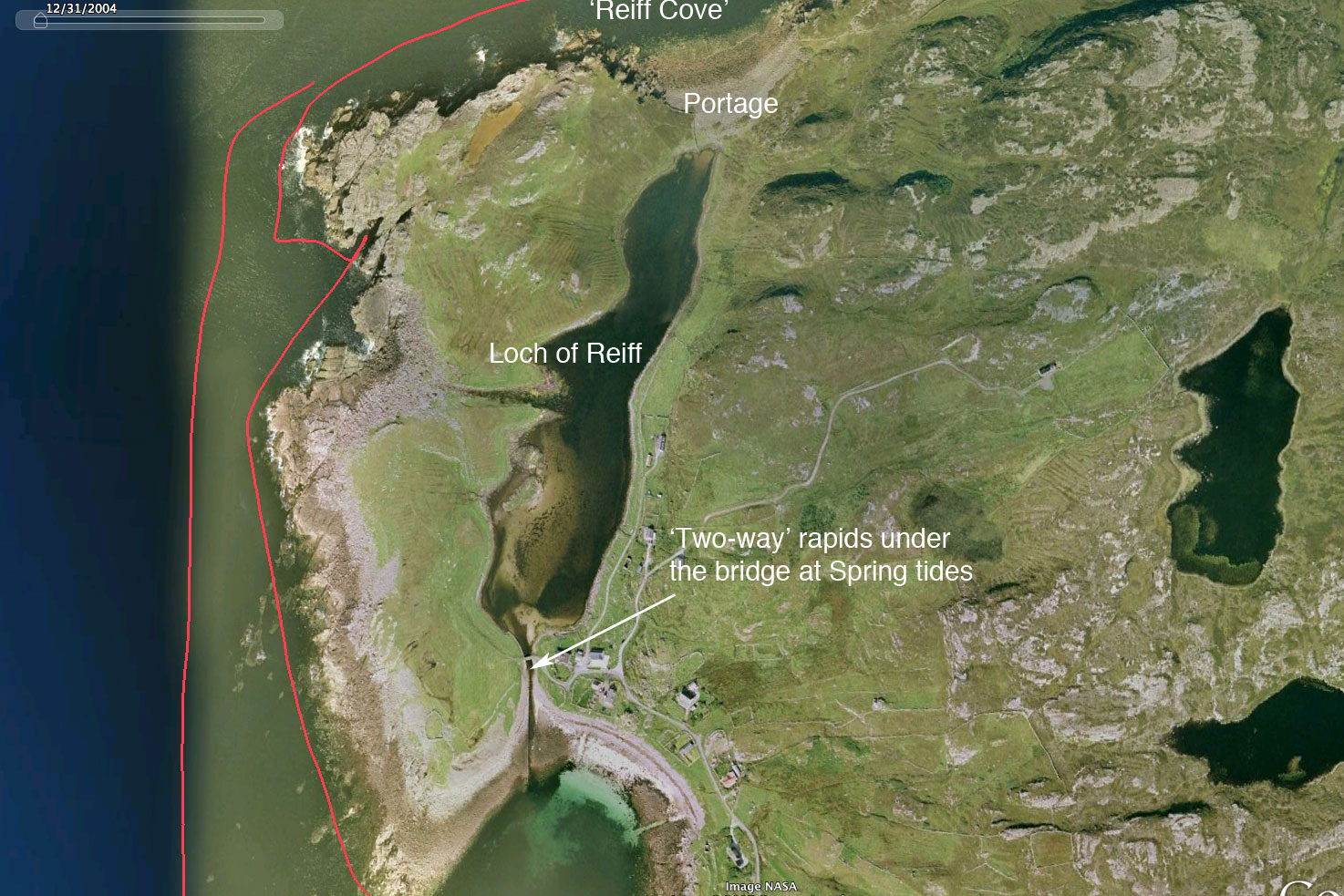
The breeze would be in by 2pm so I kept it simple and headed for a cove I recalled on the east corner of Tanera, just beyond Rubha Dubh Dubh. On the way in, a stream was draining a shoreside lochan into the cove, which looked odd. Then I remembered it was another one of those tidal lagoons which only fill on a spring tide, like Loch of Reiff.
I pulled up to the stream bed in my long red limousine, crossed An Lochanach and went for a wander in the ankle-twisting tussocks. Up on top, I caught a lovely view over the tranquil Anchorage from behind Garadheancal. With all the ruins and usable houses, there are a lot of buildings on Tanera – still for sale at well under £2m now.
Back at An Lochanach the sea had dropped two feet in half an hour and as I was paddling out, my skeg doubtless hooked up a load of seaweed trying to pull through the mush.
I decided to contour around Tanera’s Anchorage, past the flapping salmon pens and pull up again by the post office at Ardnagoine which was having a quite day. All appeared to be in order so I set off back home in the flat calm which usually precedes a wind starting up from another direction. According to British Stomach Time it was definitely lunchtime.
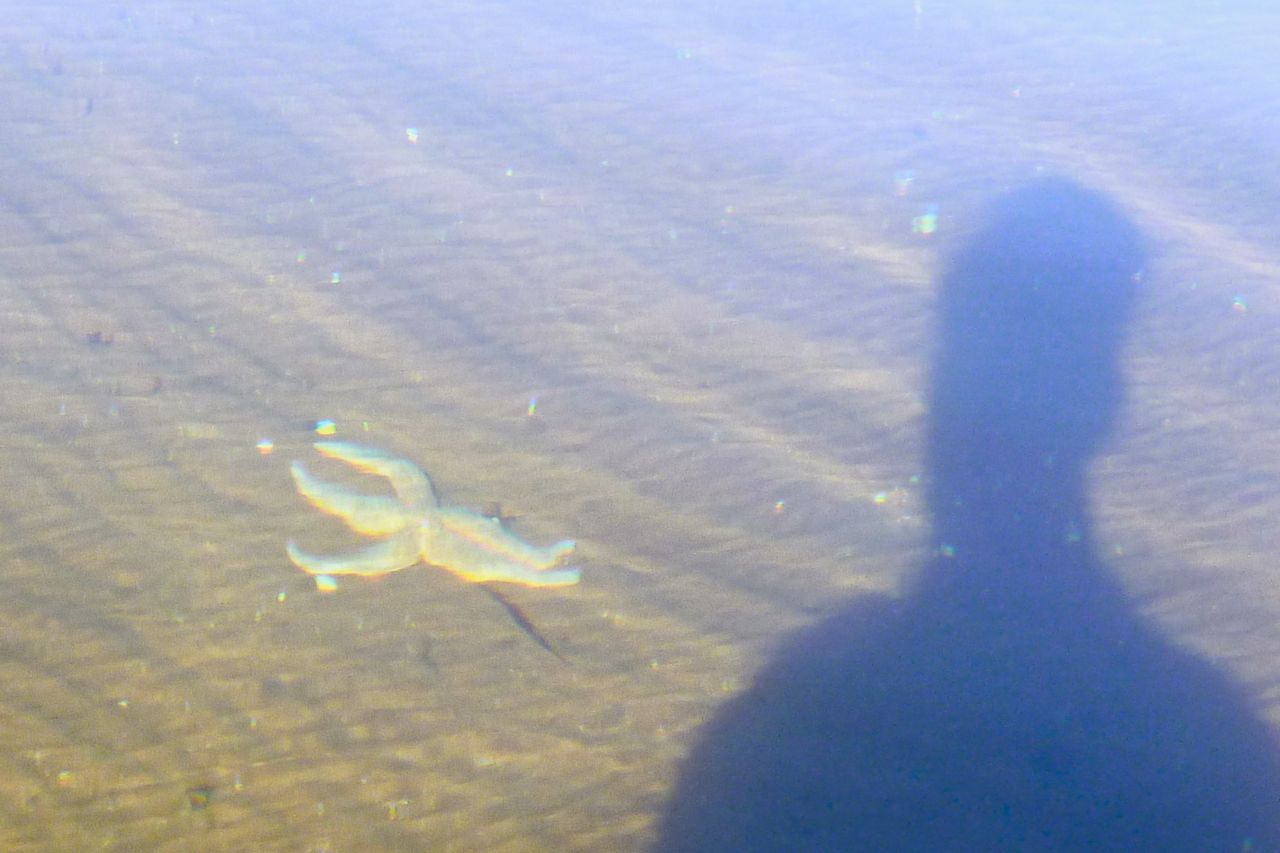
I slipped under the encrusted beams of the condemned pier and was just at the right level to pick off a few mussels for tea. On the way in the wind picked up and the ochre sands were already exposed as I glided over a mangled starfish on the seabed.
It’s taken a few visits, adding up to over a year up here, but I do declare I am running out of new things to paddle in the Coigach and Summer Isles area. A seven-mile run out to Priest Island – the very, very, very last of the Summer Isles – would be less edgy if not alone, while all the coasts from Lochinver round to Ullapool and up to the back of Loch Broom have been surveyed at least once. About a year ago that I did my (for me) epic run out to Bottle Island, just a stone’s throw from Priest.
September does seem to be a reliably good month up here. Well, better than August – an old Highland truism. Another unexpected day of blue skies and light winds with the northwest pinned between a ‘Double Zero Low’, the sort of meteorological phenomenon that gives weatherpersons the munchies.
We decide to motor off the peninsula, along the Wee Mad Road (WMR) and past Lochinver to Clashnessie – a Norse word meaning ‘Battle of the Sea Monsters’. Here we paddled out towards the high arch before Point of Stoer and the beach at Culkein for lunch..
From Culkein beach there was a clear view right across western Sutherland to the quartzite mountains of Arkle, Foinaven, and the sea cliffs ending at Cape Wrath. I thought about crossing the bay directly via the Eilean Chrona for Oldany Island channel. But it was a Spring tide going out so the flow may have been in our face by the time we reached the channel. Why wear yourself out on openish water? It would have added another 8 miles, ending with a rocky run back to the Clash of Nessies, just to explore a small area, and who knows what the weather might be doing by then.
So we headed back to Nessie beach, letting the swell you so often notice in these north-oriented bays, lift the boat as it rolled inshore to crash against the rocks. Directly ahead was Quinaig mountain (left). I’ve said it before: it’s one of the best day’s hill walks here in the Assynt. I’d long wanted to poke around the scattered skerries and islets between Oldany Island and Drumbeg. We drove up the Drumbeg road, where one time a mate and I had staggered against a gale, looking for the car after slackrafting the Lewisian barrens. Soon enough a small turn off led north to a ruined jetty at tiny Culkein Drumbeg.
Coming north, as soon as you get on the WMR you begin to see a different ecology. Hard to pin down what exactly: less bleak and peat sodden than Coigach. Perhaps it’s due to the Lewisian gneiss bedrock, because the Torridian sandstone was scraped off like an icky marzipan crust by the Ice Age and dumped into the Minch, to wash up on the beaches of the Western Isles just in time for Castaway. More birds dash about, the flora’s subtly different with a few more pockets of old-growth trees which have been picked clean or long blown away on Coigach. Perhaps the Stoer headland protects Oldany a bit, but it feels more like Plockton than the blustery northwest.
We set off for the hidden isthmus beach somewhere out here, scattering more seals as we went. Not bothering with the GPS to record moving averages, I’ve recently finally found a handy way to mount an easy-to-read compass on the Seawave, tucking it under the deck bar mount tabs. It was already proving handy to follow the NW bearing suggested by the map, out via the islets to the secret beach.
As we approached the sands we startled some hardy and doubtless Nordic skinny-dippers with their parked up Sevy Sirocco. Once beached, we politely took off in the other direction until they had regained their modesty. Soon a couple of hardshellers rocked up too – kayak rush hour on Oldany Island beach. Perhaps it’s not such a secret after all.
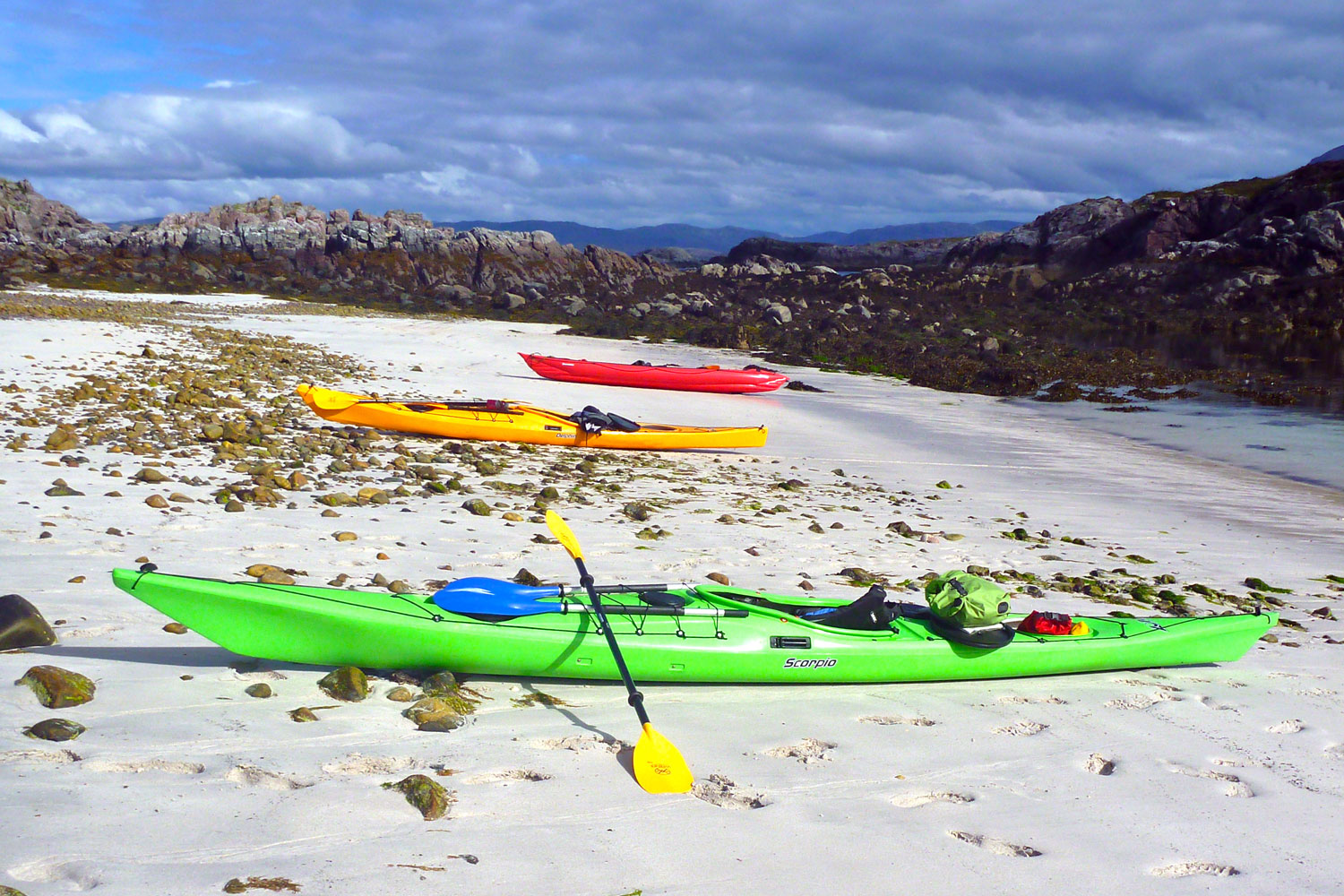
A small bothy sits perched on the spit of grass which separates the two beaches. Hardshell man told me it was a private dwelling once rented to a local doctor by the Edinburgh owners, and even had a phone line installed in case someone’s baby was born early. It was another detailed ownership report the like of which you won’t find online. Our busy beach made an altogether lovely prospect of sand, grass and the azure sea beyond, abob with skerries and distant peaks. Plus kayaks in red, blue, green and mango.
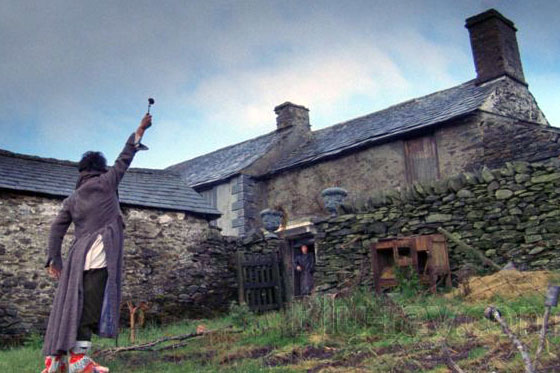
Back afloat, we took the long way back to the jetty, nipping round to the south to check out where the channel went. That could be a fun run at the right stage of a big ebbing tide. In the car, we carried on clockwise around the coastal road. Even more than the WMR, this Drumbeg road is hardly level for a moment and would be a good work out on a pushbike. Back on the main road, in Unapool we stopped off for a brew at the Rock Stop Cafe. A retired couple there were trying to track down the rude Withnailian cottage they’d honeymooned at no less than half a century ago. They’d not been up to the northwest in 50 years and Rientraid, overlooking the Kylesku bridge, had rung a bell. We told them about The Kerracher Man book which was set nearby, but about a decade later.
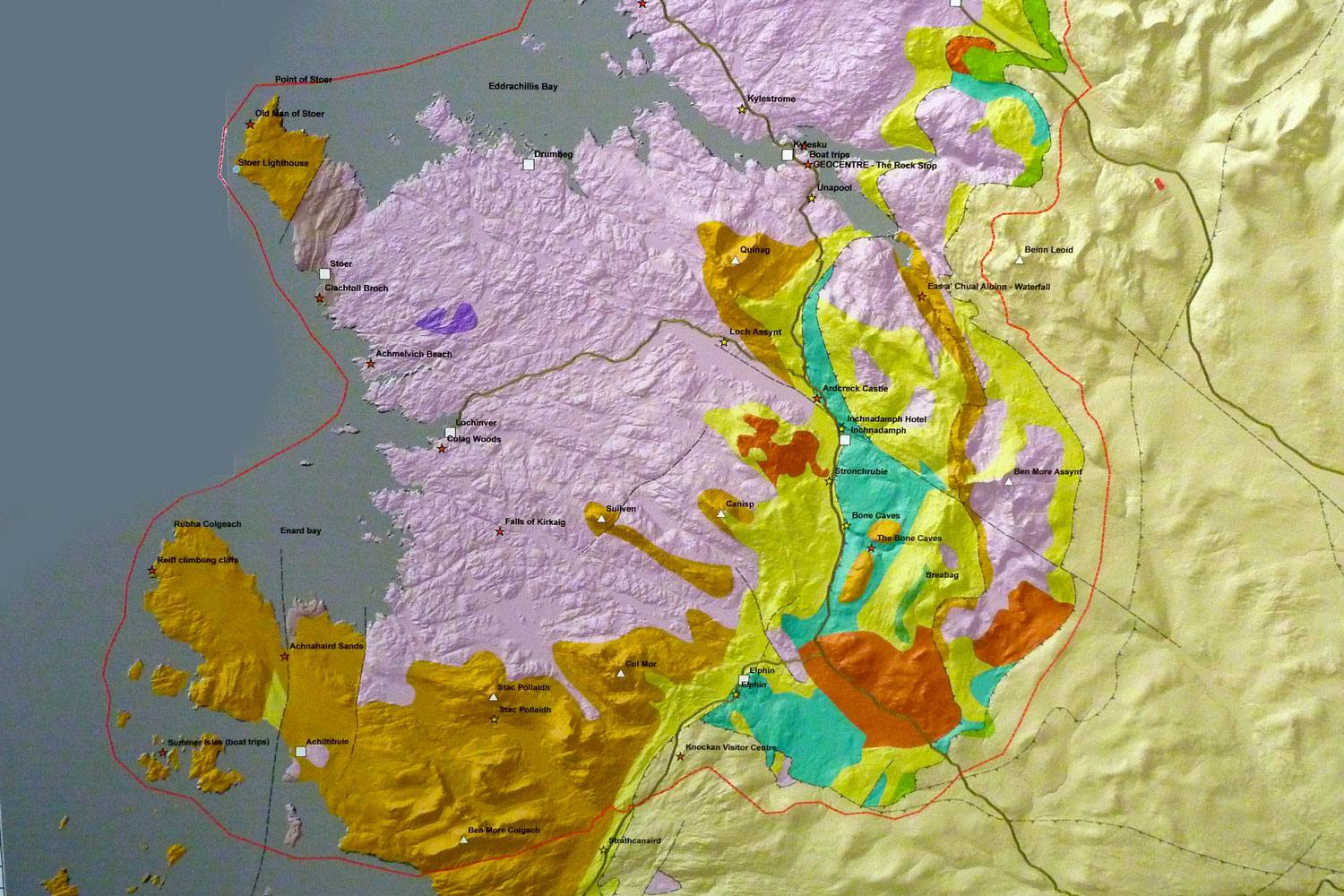
In the cafe there was Rocky Road in the cake cabinet and a geology map on the wall. Pink is your 3 billion-year-old under-icing of Lewisian gneiss; the orange is a creamy overlay of Torridian sandstone. Interestingly, the map showed Horse Island as the only Summer made of gneiss. Who’d have known? High time then to get your schist together and watch a geology lesson.
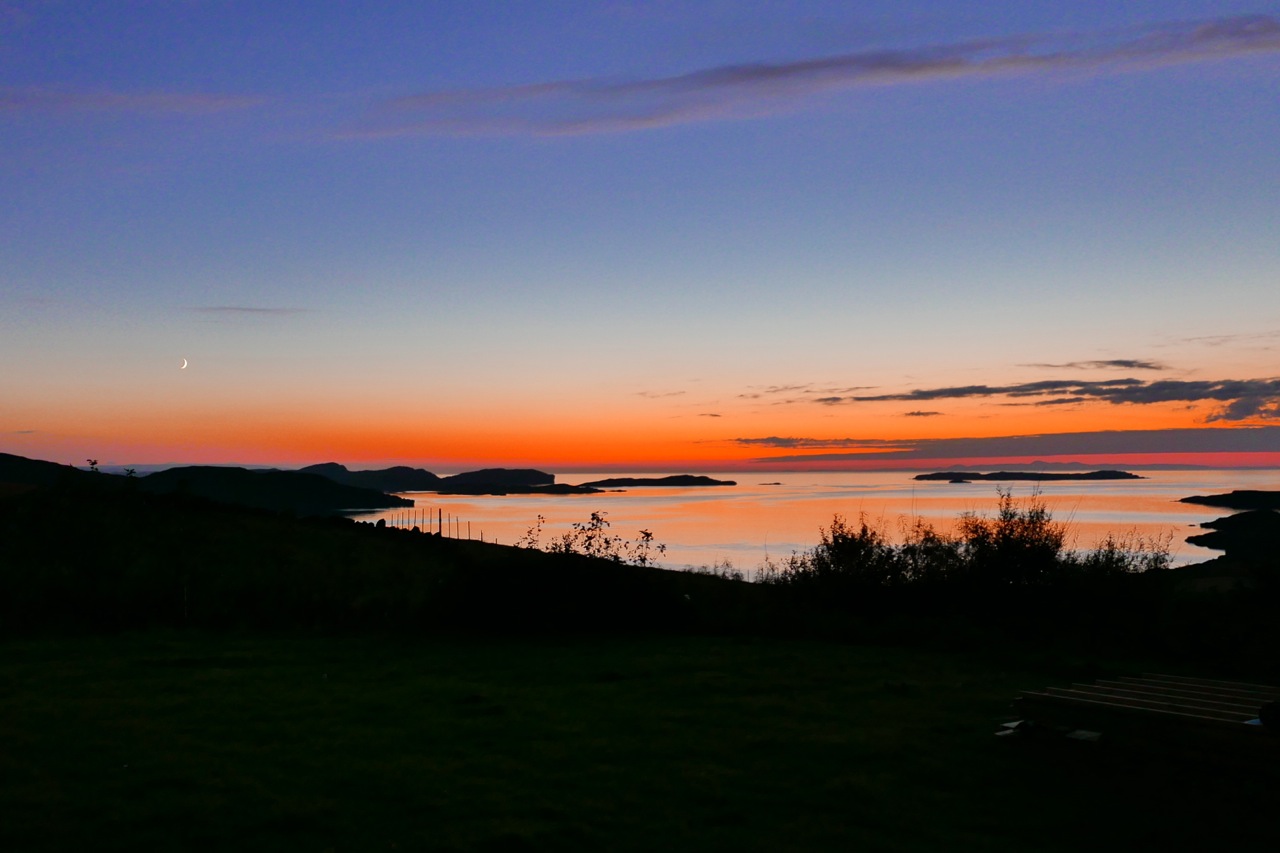
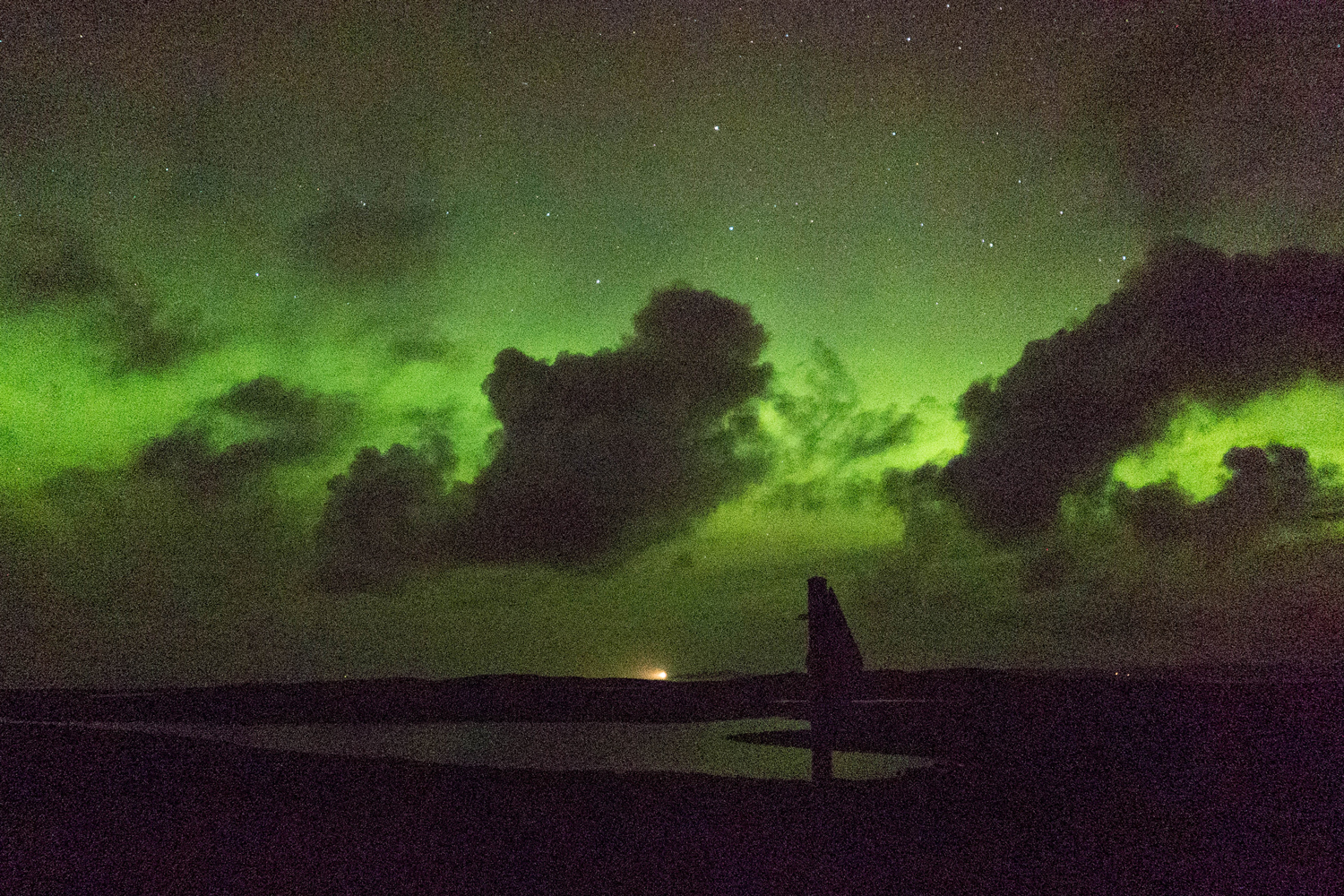
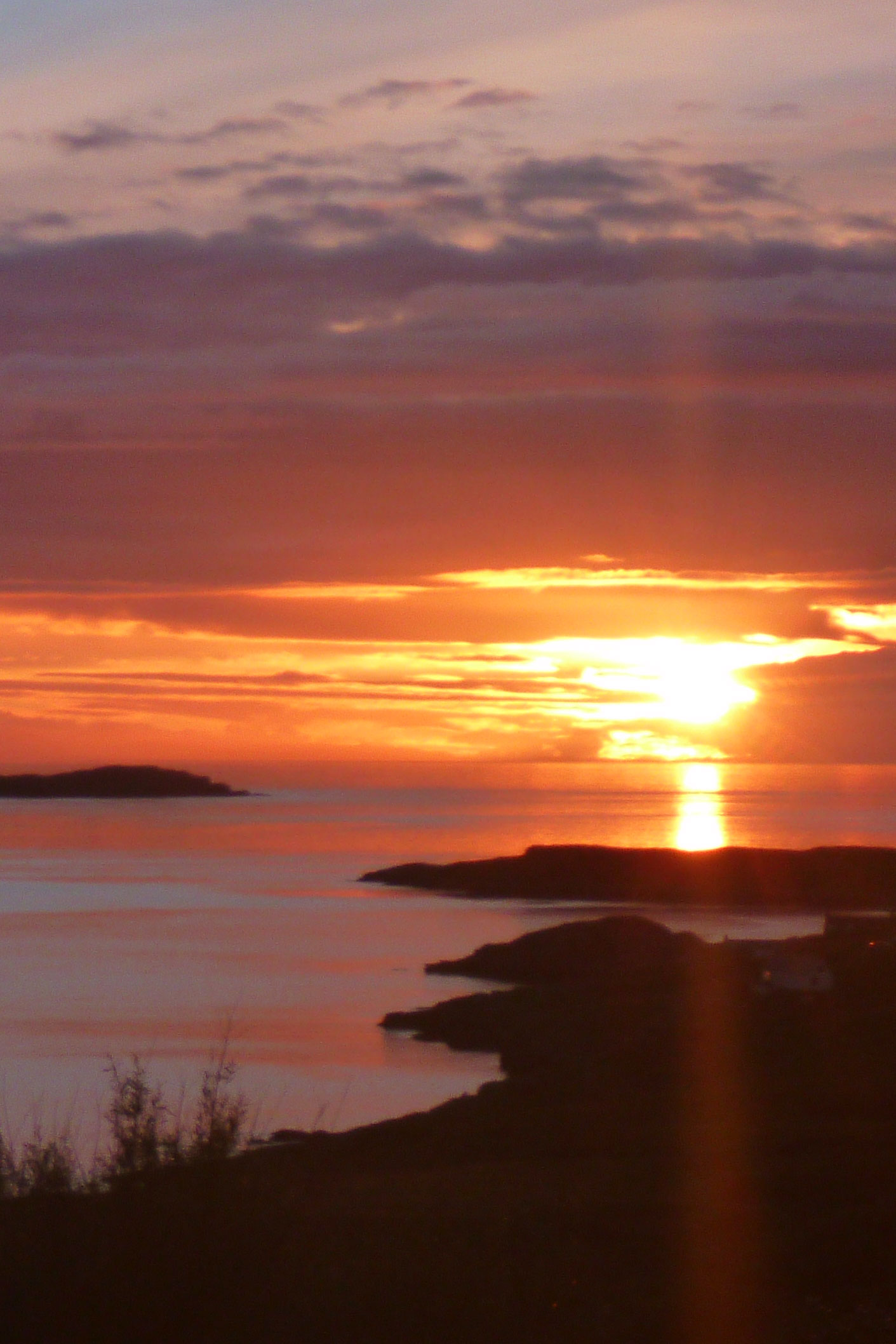
We’ve had some good here sunsets lately and even a green boreal glow a couple of weeks back. The other night the stormy orange clouds reminded me of the cover of Argonauts of the Western Isles – a great title for a lovely memoir by Robin Lloyd-Jones about sea kayaking on the west coast. I’ve only just realised it’s a take on Brondo Malinowski’s seminal 1922 Argonauts of the Western Pacific which, unless I’m very much wiki-mistaken ‘redefined the ethnographic genre’.
Actually now I see the cover, it’s nothing like my photo, it’s much worse, though might have worked without that tilted horizon. But don’t let that put you off if you’ve not read it. It’s a wonderful tale that covers years of paddling up here, from post-war bathtubs and broomsticks to the start of the sea kayaking boom.
I’ve had a chance to do a few day trips in the Seawave, including trying it out as a tandem boat. The main view west from our place is over to Glas-leac Mor, one of the peripheral Summer Isles, with a corresponding Glas-leac Beag nearly three miles further out and less than a mile from Priest Island.
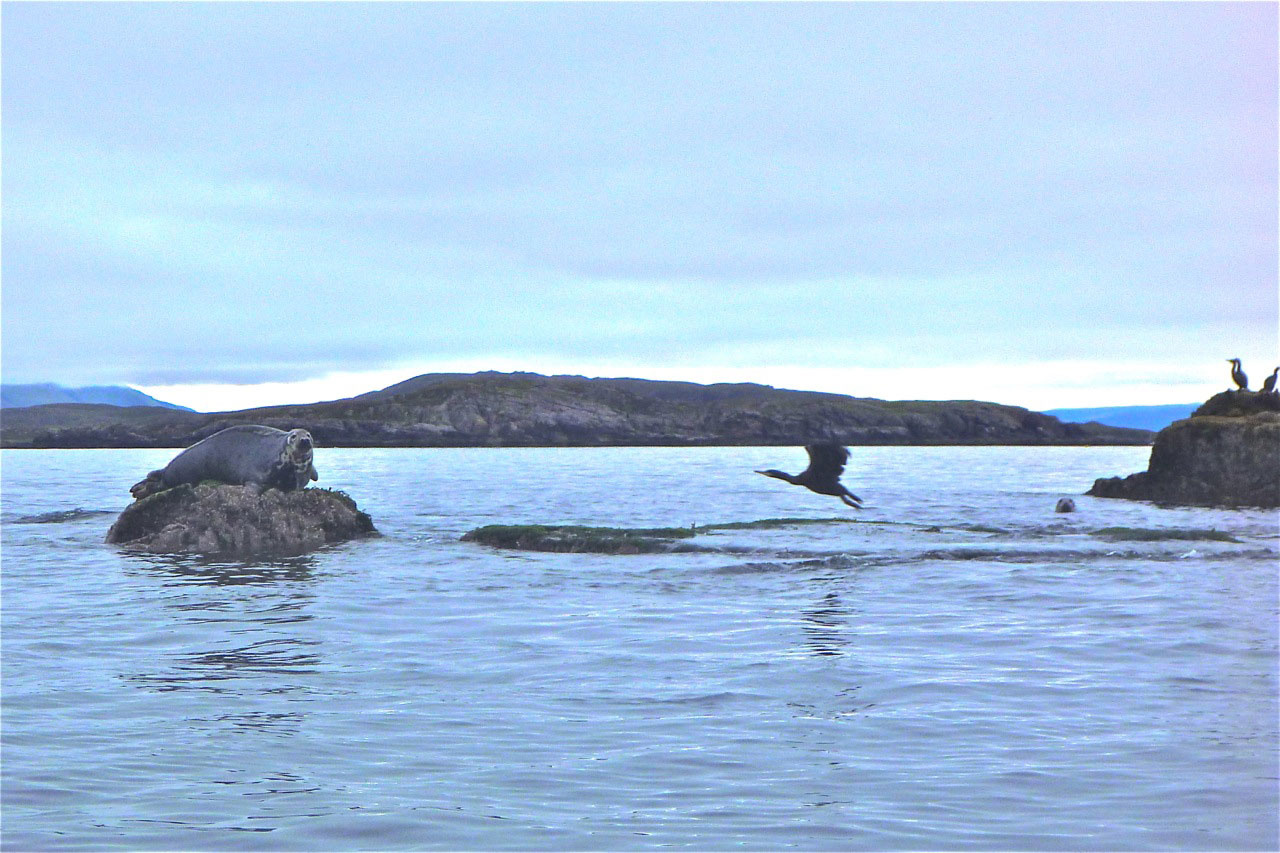
The day came round to loop the loop on Glas-leac Mor and maybe even carry on around the peninsula to Achnahaird. That idea was rained upon when the promised sunny skies turned out to be heavily overcast. Soon out of Old Dornie harbour The Call of the Bladder insisted I interrupt some basking seals on the unnamed skerry (left) close to Glas’s southern tip. Halfway down the east side I noticed a big stony beach, the only way of getting onto the island. There’s a lochan on Glas too, so it could be a good hideout.
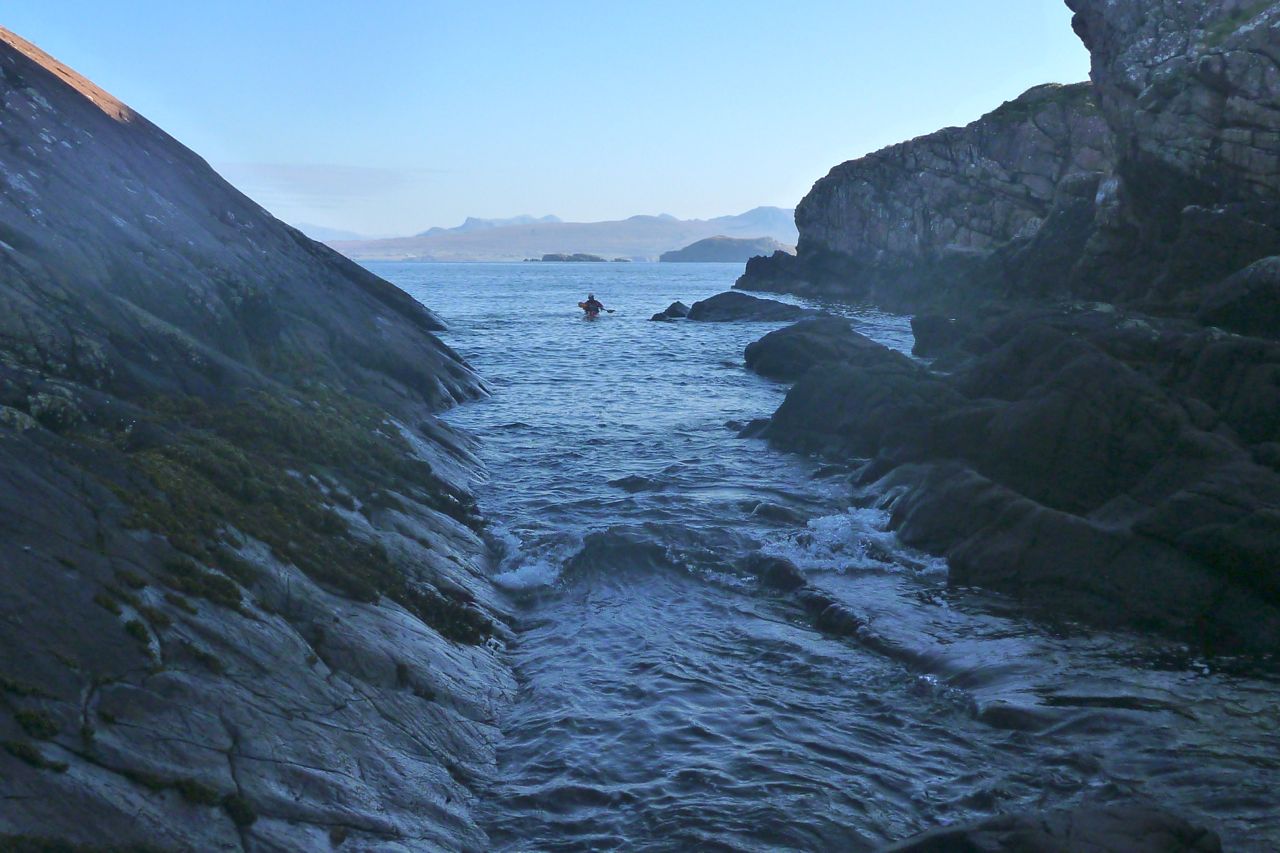
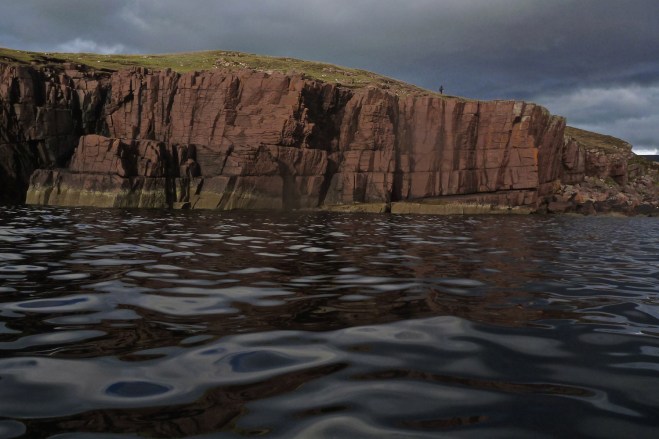
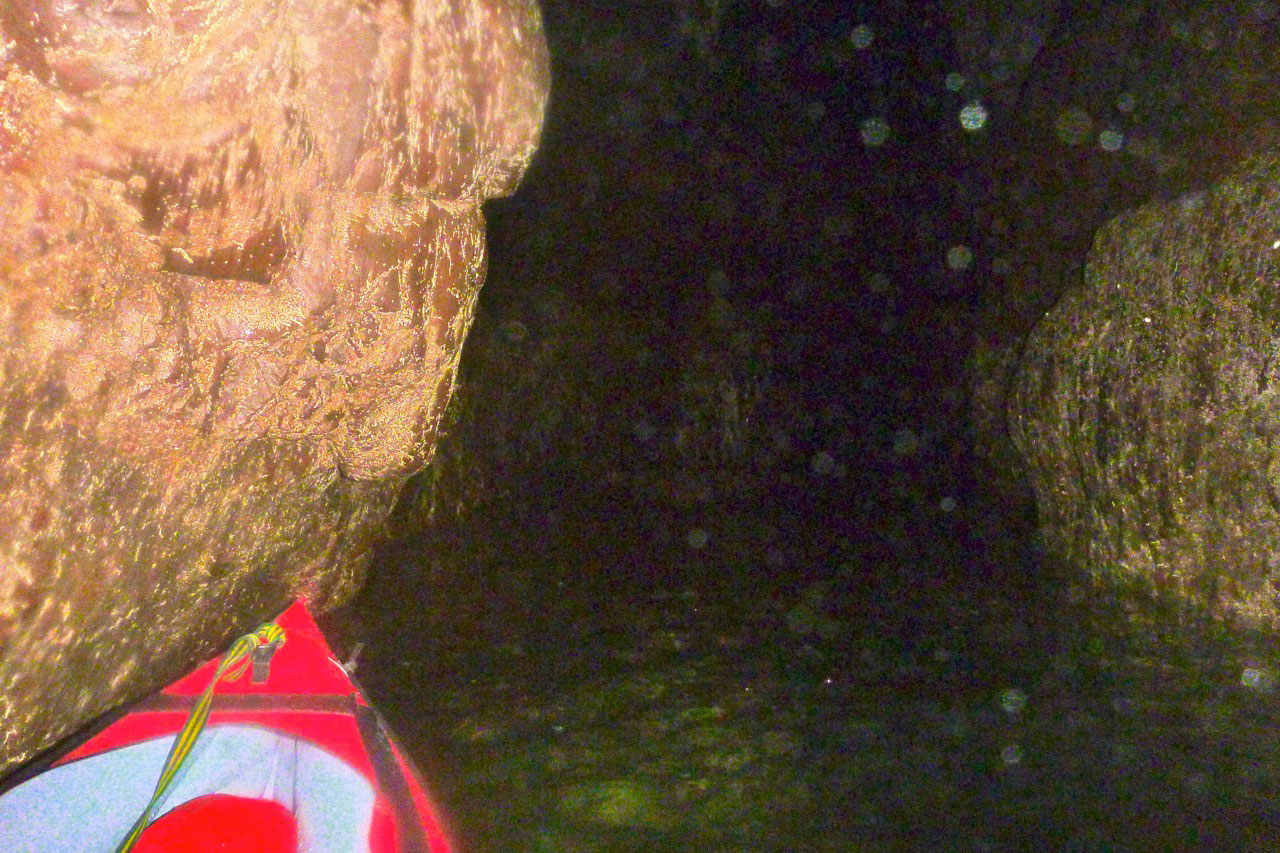
On the Minch side of these islands I always feel exposed on the swell that feels bigger than anything I can do with a paddle. It got a bit clapotty-choppy near the top of the island as I made a beeline north for Mullagrach. I was looking for a new cave I recently heard about and sure enough, north of the well-known arch an unnoticed inlet led under the island (right). (This was at the low end of the tide.)
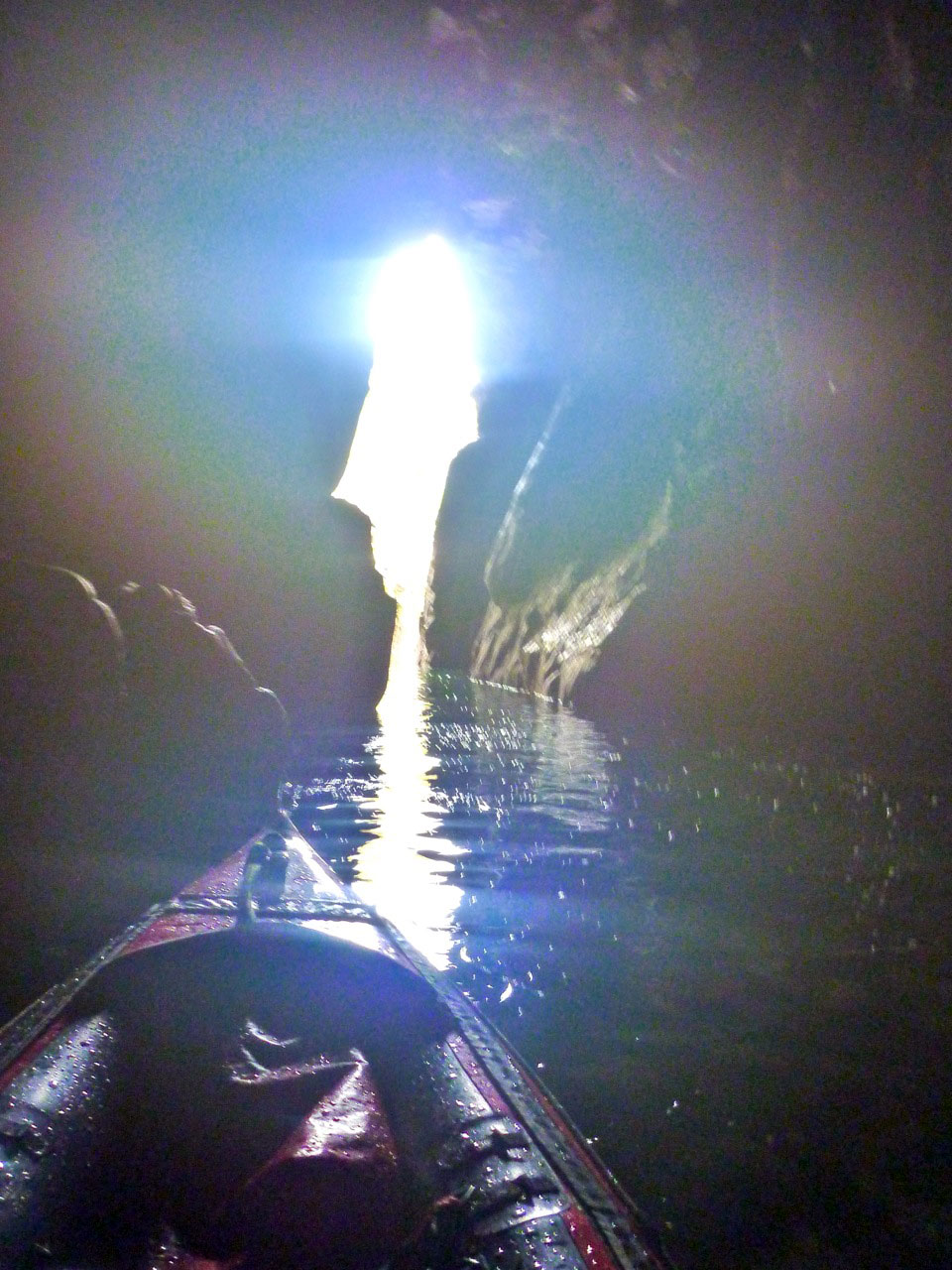
The GPS shows a rather unlikely subterranean track; I think it’s more of a southerly fault that’s part of the main arch and its adjacent cave. It was pitch black before I got to the end of the geo, but with a flash photo and from the sound of the slap-slopping swell, it felt like another 10-20 feet. But it was getting less than paddle wide and I didn’t fancy getting jammed on some old storm-mangled shopping trolley or stolen moped, in a bid to find out.
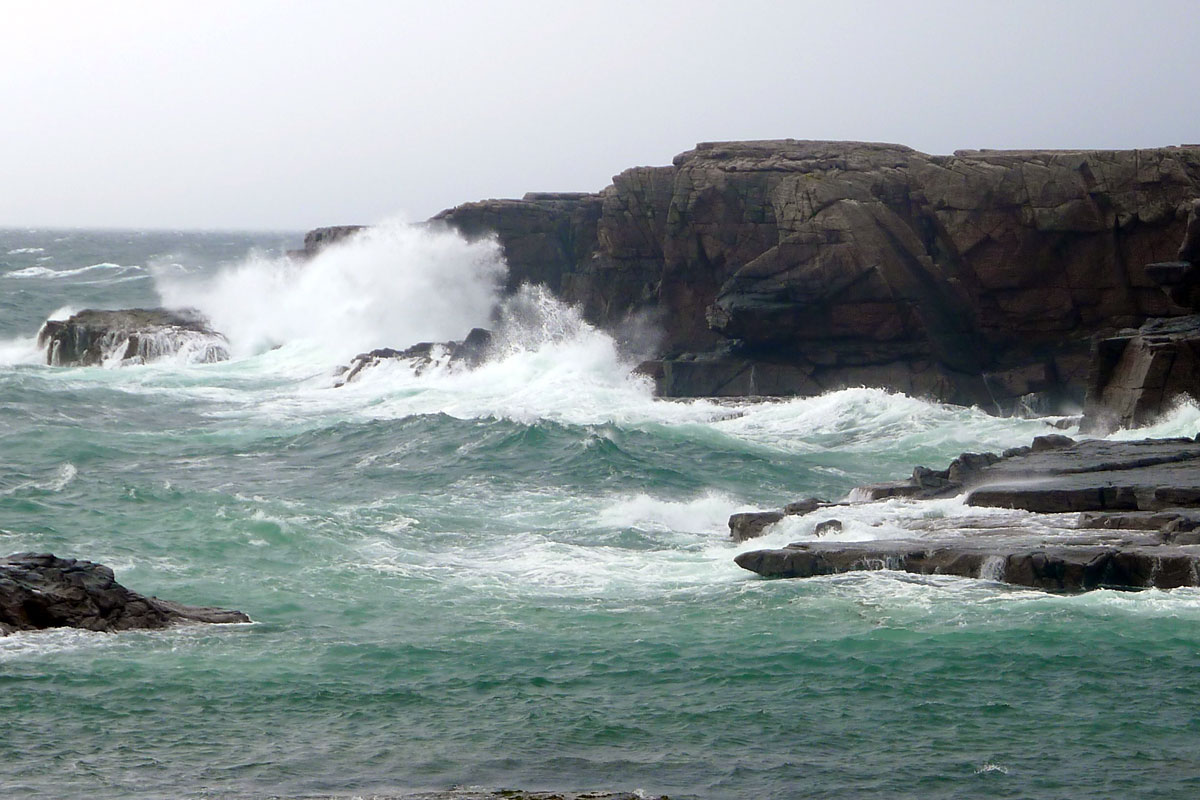
According to the GPS, I had been cruising at around 3.5mph but I wasn’t feeling that fast as I’ve not done much paddling exercise. So round the headland to Achnahaird felt a bit much. Instead, I settled on a short hop further north to ‘Reiff Cove’, as I call it, a nice sandy bay a mile or so above Reiff Bay where the houses are. As I got near, the swell was slapping back off the cliffs. This is a great place to watch crashing waves when there’s a good westerly on (right).
On the beach, I found a superb giant salami of polystyrene – former use unknown but for me a very handy boat perch and lunchtime bottom warmer. Up on the cliffs I checked out the locked bothy which looked like it’d had a new roof, all the while wishing I’d dragged my boat a bit further up the beach. I do this every time.
Up there I also clocked what I later realised was the back end of Loch of Reiff which fills and drains on the highest tides, making a fun ‘mini-rapid’ along the build-up canal under the bridge where a small quay used to be. If the timing had been right I could have done the short portage into the top of the loch (left) and got flushed out the south end into Reiff Bay. One for next time when the timing’s right, maybe even in a packraft. From Reiff Bay it was a couple of miles of coast hopping back down to Old Dornie, with just enough bars on the phone to call in the taxi.
I’ve hooked up some lightweight packraft thigh braces from the Packraft Store. Simple 50mm straps with a ‘delta strap’ to additionally attach to the side to add instant tension when you brace or roll a packraft. I used a couple of hull top D-rings to clip them on. but they don’t sit as well as the heavy SoT straps I used on the previous Grabner Amigo. Mostly it’s because I had to glue four D-rings on the floor of the otherwise bare Amigo, whereas on the Seawave the mounts are higher so the straps don’t hook over the knees so well. I suppose I ought to get round to gluing floor D-rings but it’s a big job to do well. For the moment the ‘delta straps’ can be clip together like a sternum strap on a backpack (above), and hold the straps in place. ‘Warning – Entanglement hazard!’ I hear you cry, and quite right too. If it gets that gnarly I’ll unclip, pronto. And probably inflate my pfd, too.
Another fine day, another fine paddle. As usual I plan big but then snap out of it and think: why end up hauling ass all day when we can just have a sticky beak in some new corner of the locality. Ardmair harbour, home of the famous Ardmair weather station, often looks like such a place, a striking bay just over the hill from Ullapool. One often sees tourists stopping here to admire it’s perfection. With a beach made of distinctive flat stones, I bet I am not the first person to say this would be a great location for a stone skimming championship.
Two-up, we set off to round Isle Martin clockwise. The winds were forecast to be in single figures, but coming round the west end of the island I could see the line of the north-easterly F4 blowing hard out of the Strath Canaird valley onto us.
But with barely a mile of fetch to gather up, the chop was only a foot high, so we tucked in and hammered along until we were close enough under the 1000-foot cone of Beannan Beaga to get a bit less chop along the northern shore. We bounced along that as tight in as we could, setting the seals off until we reached the stony sweep of Camas Mor beach.
Up in the warm grass for a midge free snack, I went for a wander and soon realised we were right below the jumbled rubble remains of Dun Canna Iron Age fort from about 0BC. You can see it would have made an excellent defensive position with good resources all around and over in the smaller Camas Beag (every Mor – ‘big’ – has its adjacent Beag – ‘small’ – hereabouts) bay to the north, what looked like a tidal fish trap (left). Sorry to say the fort’s rubble was not quite compelling enough to be honoured with a photo.
A couple walked by, looking for driftwood with which to make ornamental clocks. And I was later told that gems and who knows – maybe even the Lost Hoard of Brisingamen – lay among the stones of Camas Mor.
From the headland looking west towards the Summers, the ruffled sea and scrubbed, autumnal sky were as blue as John Lee Hooker with a hangover and a tax bill.
Time to ship the heck out. My plan was to edge south enjoying the lee, then poke the boat right up the Strath Canaird estuary until the winds, current and outgoing tide suffocated our spirit of exploration. Reading our GPS track that now seems a lot less further than it felt, but was enough to uncover a new habitat of seaweed dangling over mussel beds and dazzling highland villas once belonging to cider magnates, according to the knowledgeable driftwood couple. It’s odd how everyone around here knows which well-to-do-family owned but then sold what bit of land or island to whom.
Of course I’d long ago clocked Strath Canaird as a potential river paddle excursion, probably in a packraft from Strathcanaird hamlet on the A835. Now I’ve seen its lower end that 4-mile paddle looks a bit more intriguing. Once we’d had enough battling the elements, we let them flip the Seawave round and scooted back to Ardmair Bay for a final nose around the moored up boats by the campsite and then out round the point and back to Ardmair Beach.
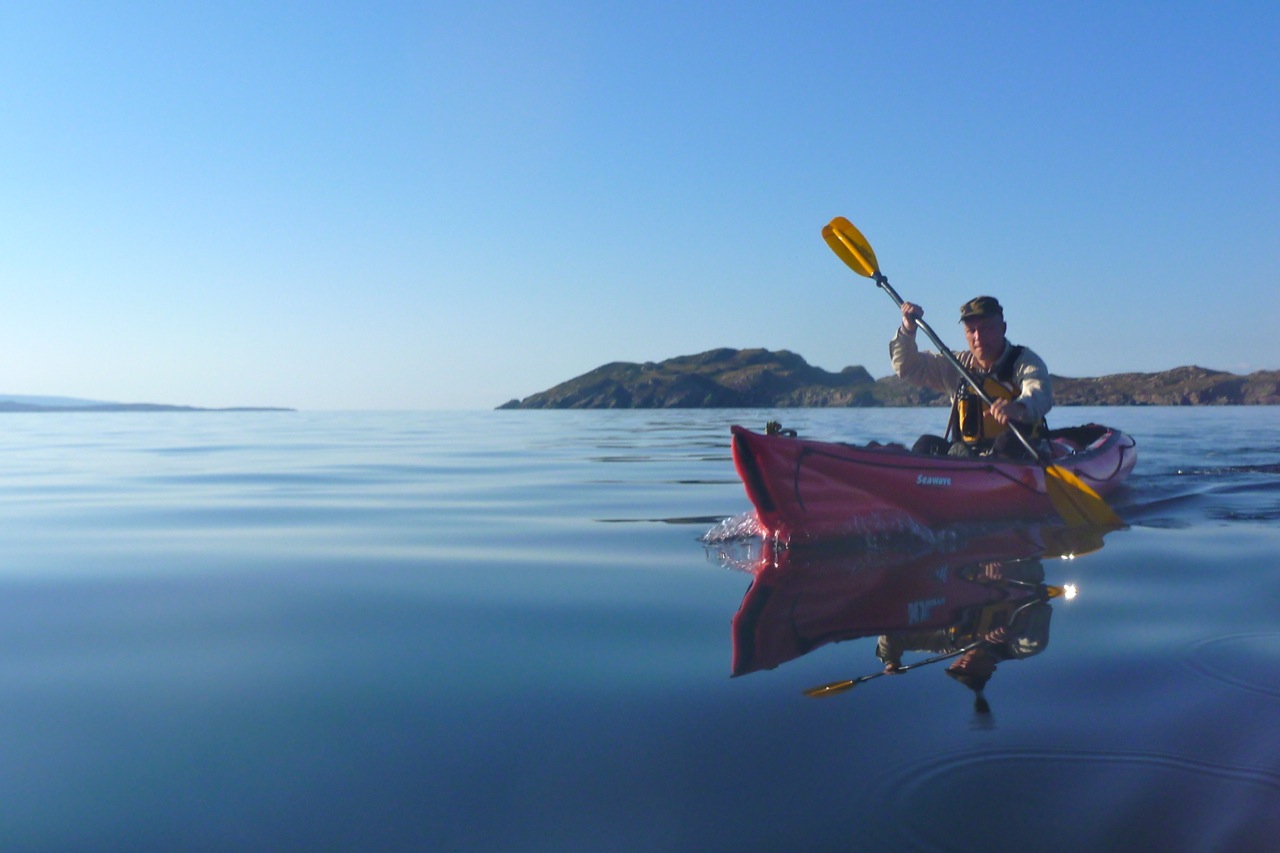
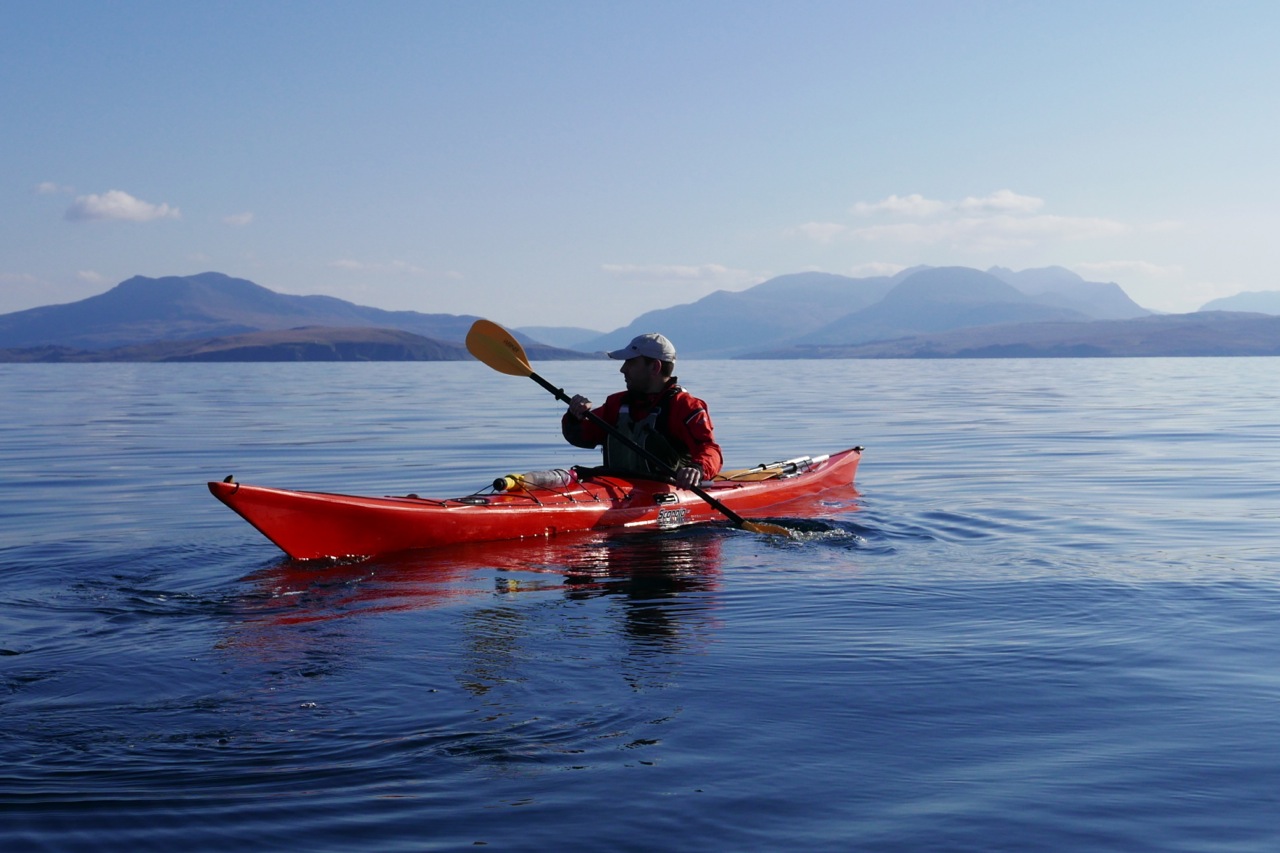
Two up or solo, the Seawave’s speed seems to be about 3.5–4mph, with the odd freak burst up to 5mph. That doesn’t seem to be much different to the Grabner I replaced it with, but it’s still an easier boat to use: PRVs all-round means it needs a quick ten jabs with the K-Pump Mini after a few days off in the outdoors, but never needs a manometer check. Masses of D-rings compared to the Grabner’s zero. The optional deck, the OE skeg and two feet of extra space. And though the Amigo is long discontinued, the Seawave costs less. The nearest Grabner now would be the ruddered Grabner H2 but its over half a metre shorter; the H3 is half a metre longer but we’re still talking between €1800-2100 for well-made but rather bare boats. My Seawave with extra bits came in at €1000 from Czecho so to paraphrase the bloke from Jaws: ‘We’re ain’t gonna need a better boat’. Well, not fora while.





























































 Inflatable Kayaks & Packrafts