Not much time for paddling at the moment, but with a staggering three days of cloud-free skies while the south had its traditional wet bank holiday, we had to down tools and go and do something. How about another walk over Suilven and paddle back – was last time three years ago already? The motorbike was left at Inverkirkaig, so this time it was just a paddle-and-boot ‘biathlon’.
With the car parked near Glencanisp Lodge, it’s about a 2-hour walk along the estate track to the turn-off leading up to Suilven saddle. On the way we pass Suileag bothy where Jon and I overnighted in May, tackling an Assynt variant on the Cape Wrath Trail.
It’s only a mile and a quarter from the estate track to the saddle, but with the 430-metre rise, it takes up to an hour. The washed-out last few feet onto the 600-metre-high saddle are on all fours. Above at the back, Quinaig, one of the best of the Assynt mountain walks. No packraft required.
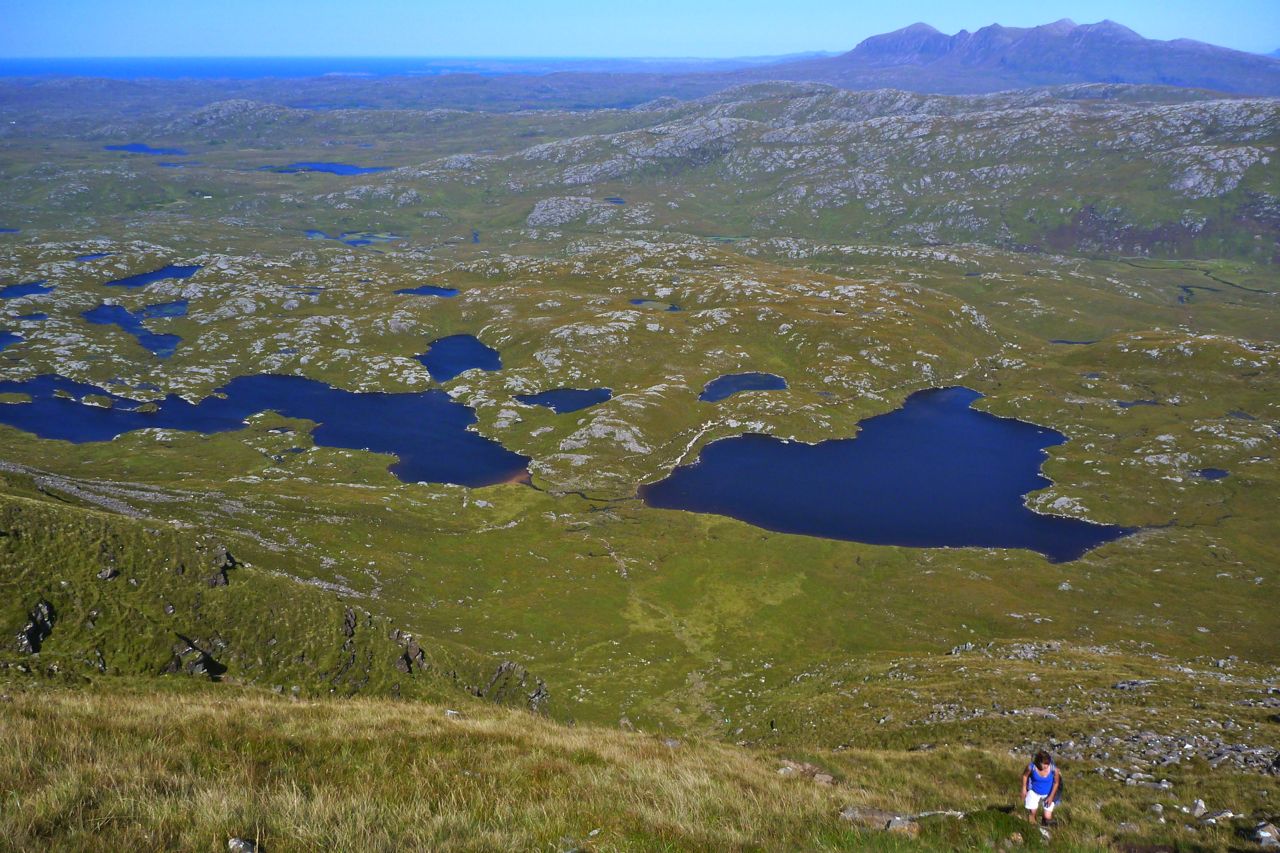
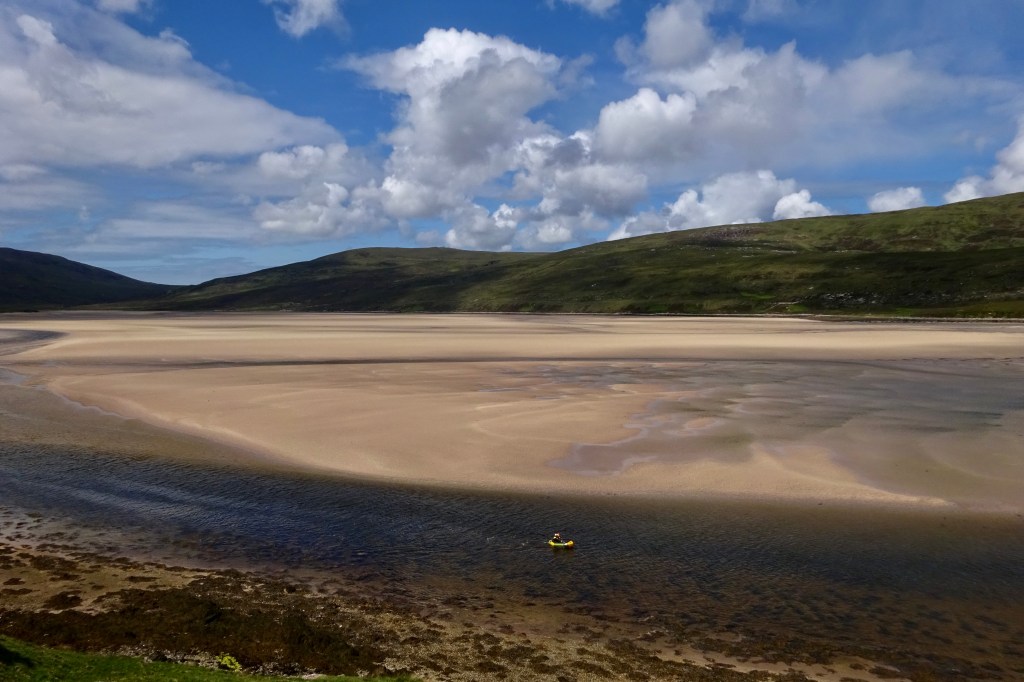
At the breezy saddle it’s quite busy – well, ten people or so – so we decide to lounge around and not visit the 731-m summit, nice grassy spot though it is. Far down below on Fionn Loch, we think we can see three canoes heading upstream towards the canoe camp alongside the rapids (more or less the middle of the picture, above). But they’re moving so slowly, for while I thought I was mistaken. Soon we’d realise why they were creeping along at about one foot a second.
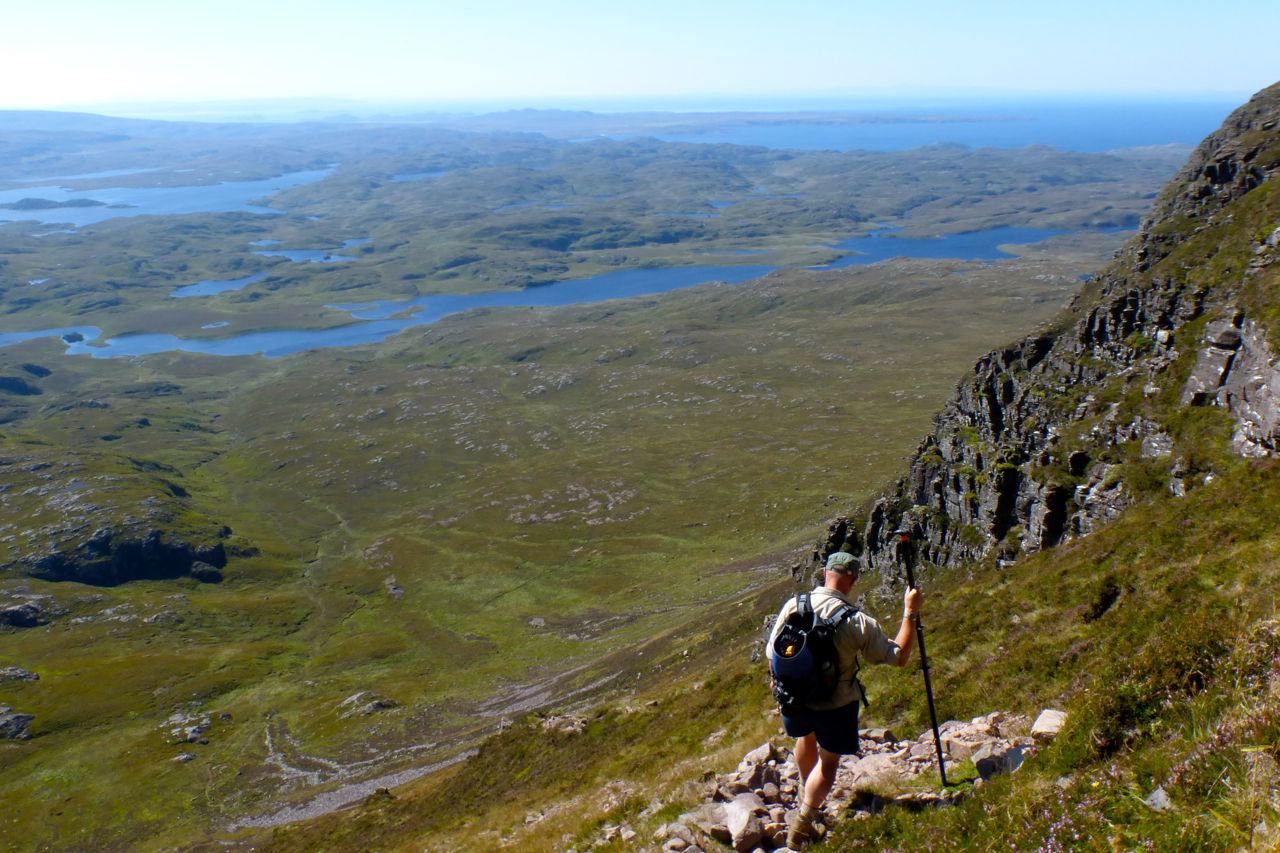
We set off down the exceedingly steep south side of the mountain.
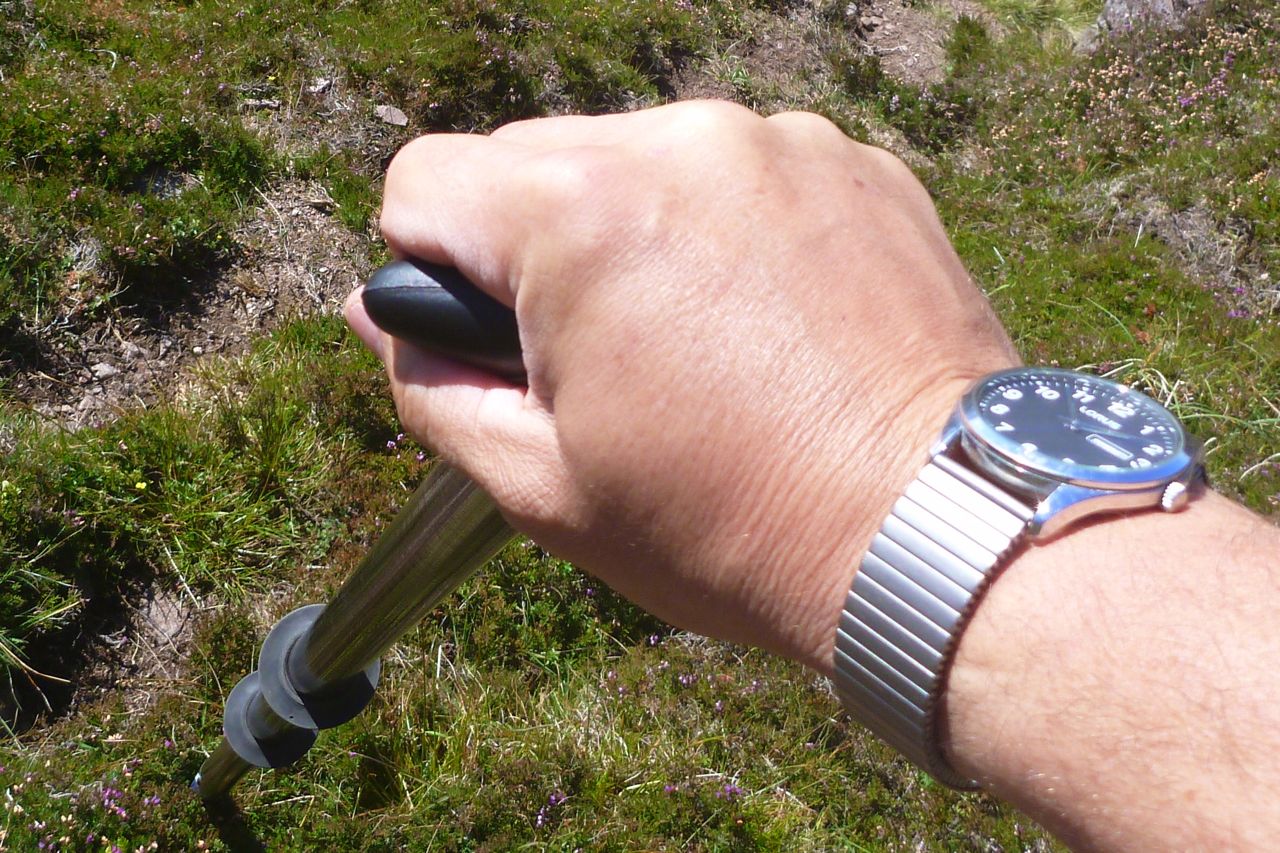
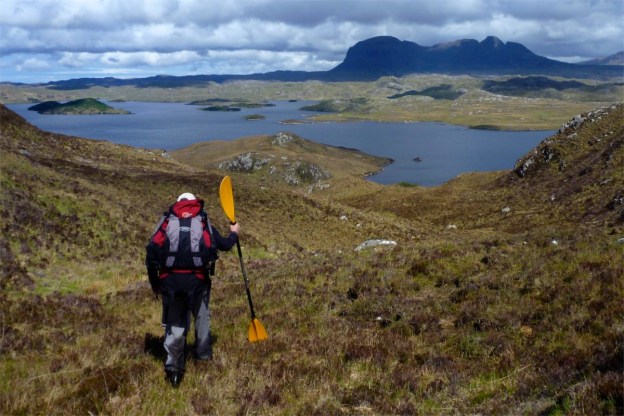
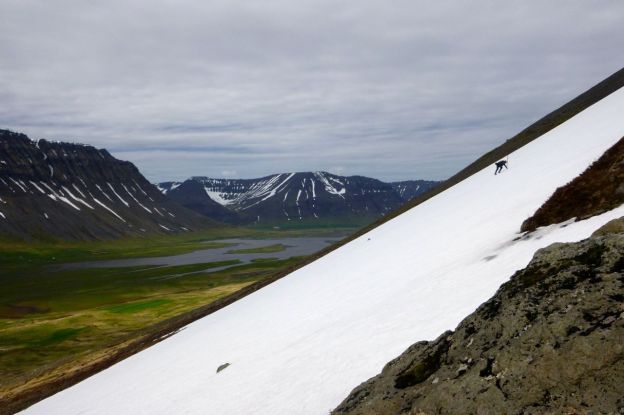
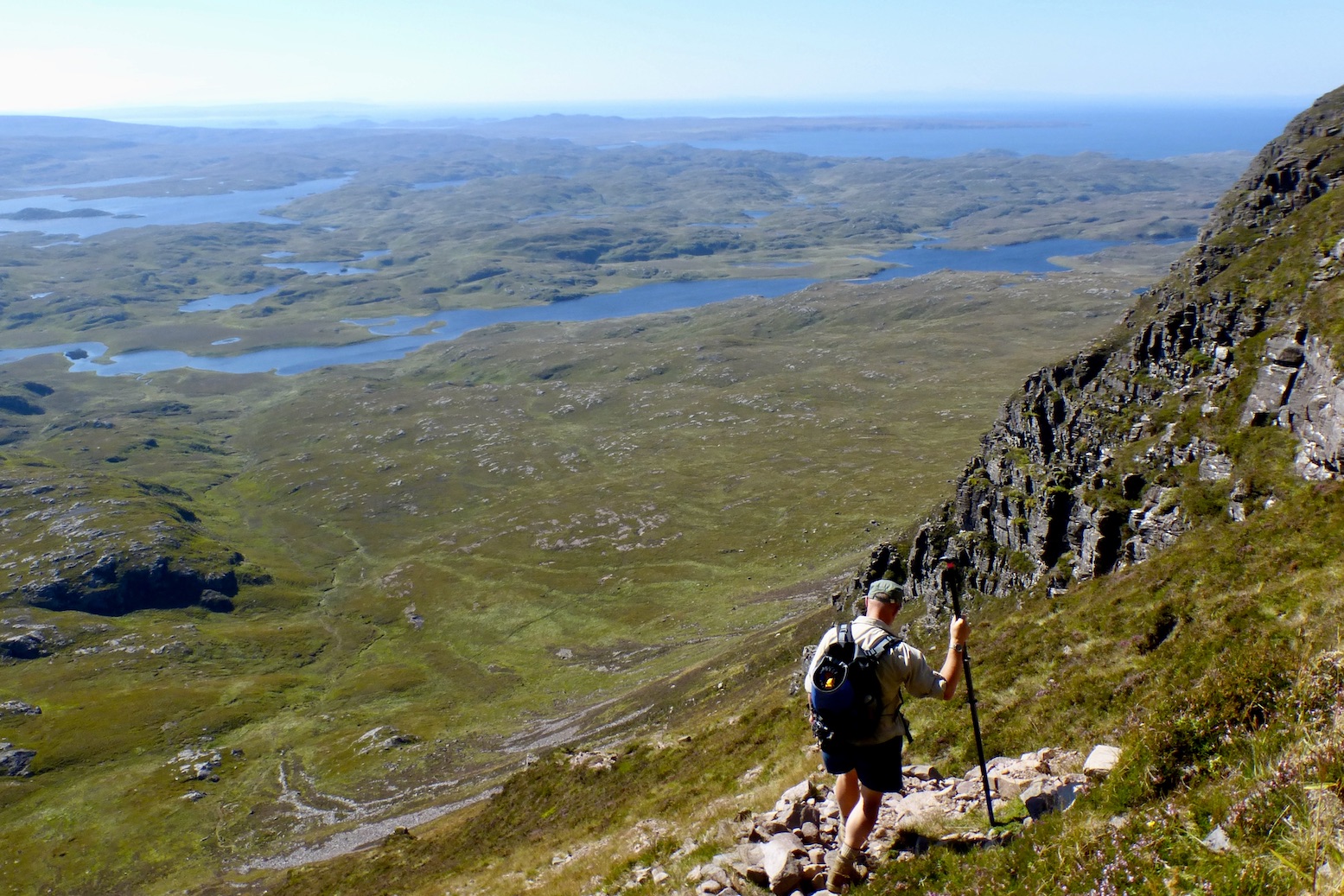
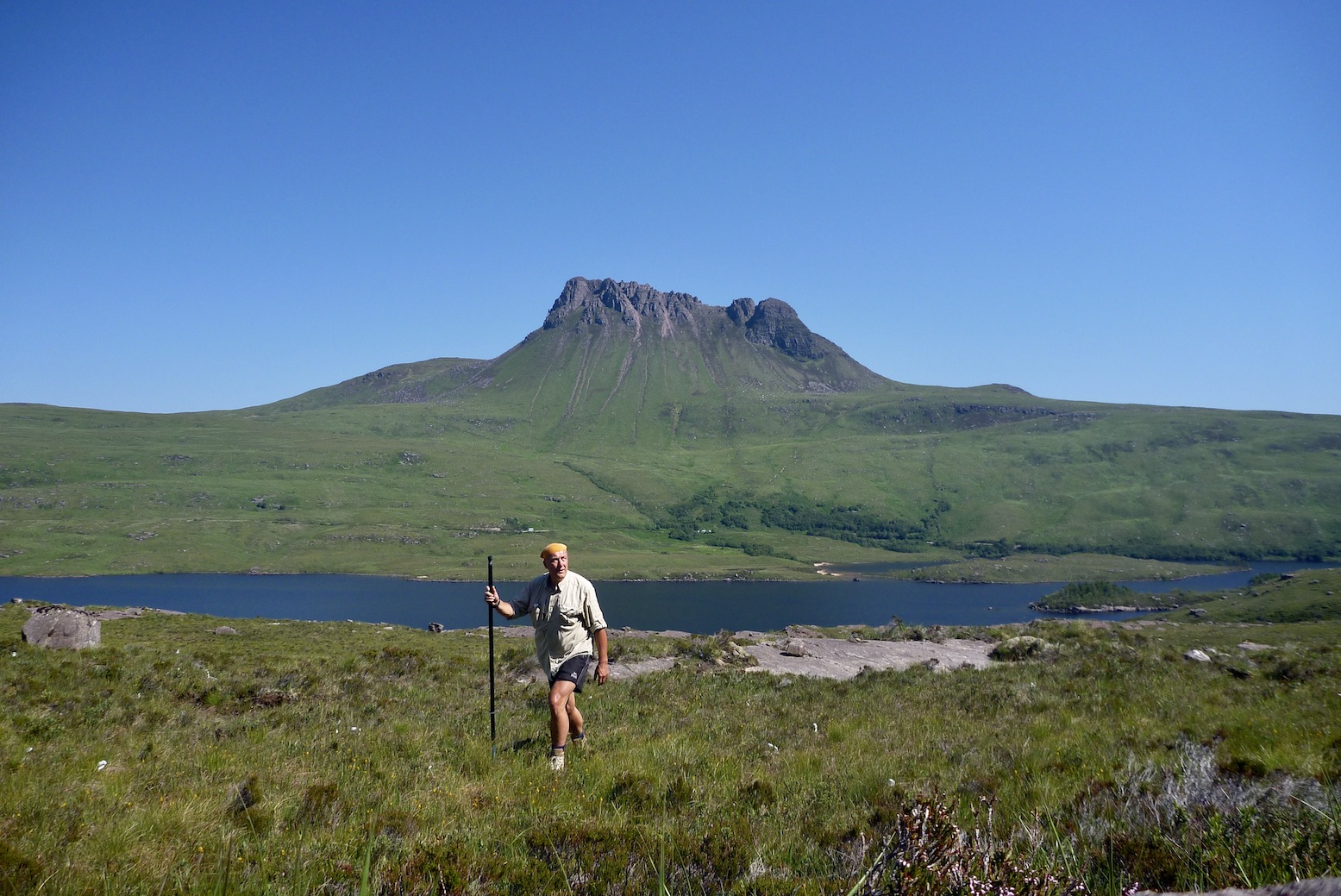
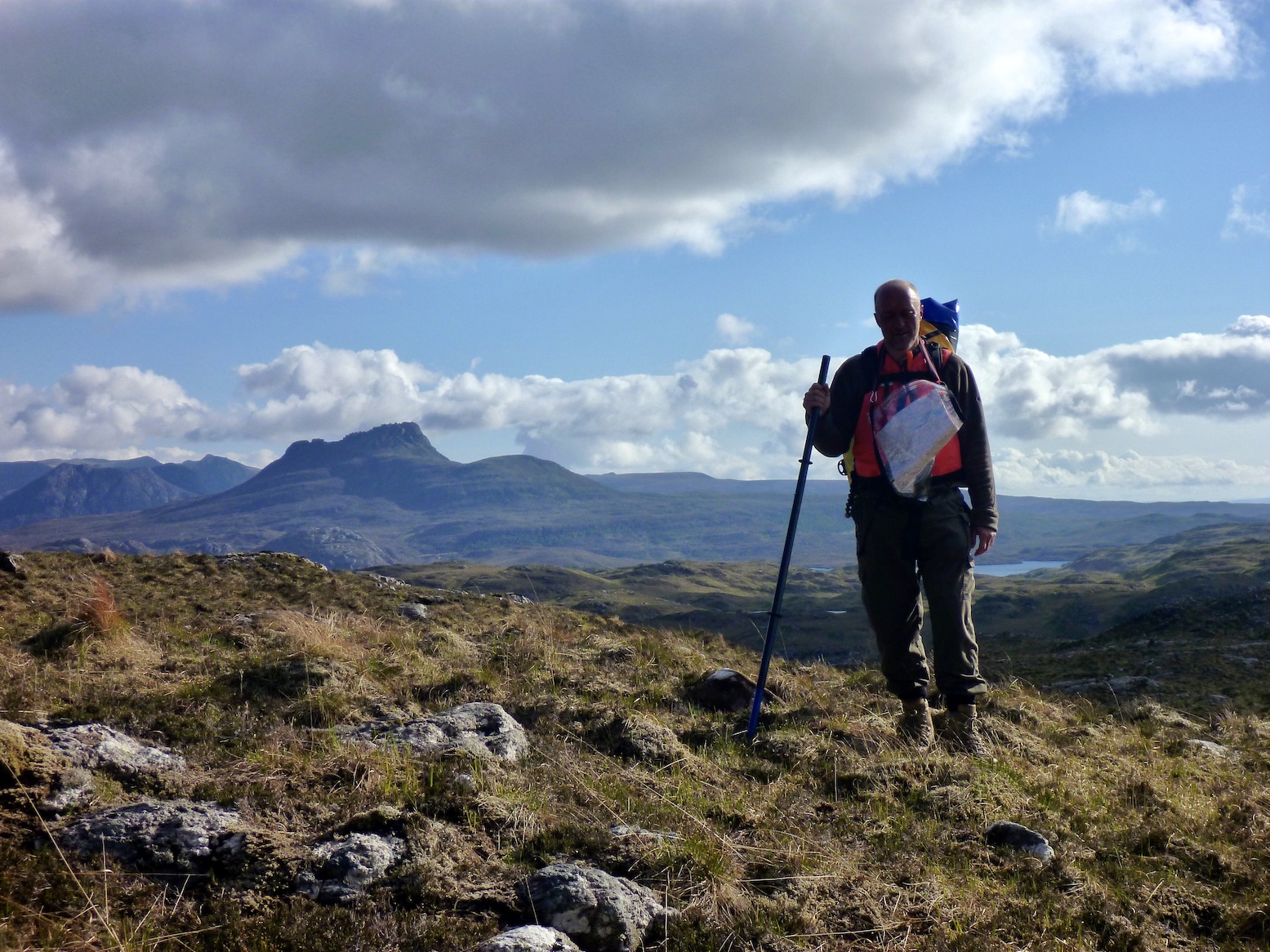
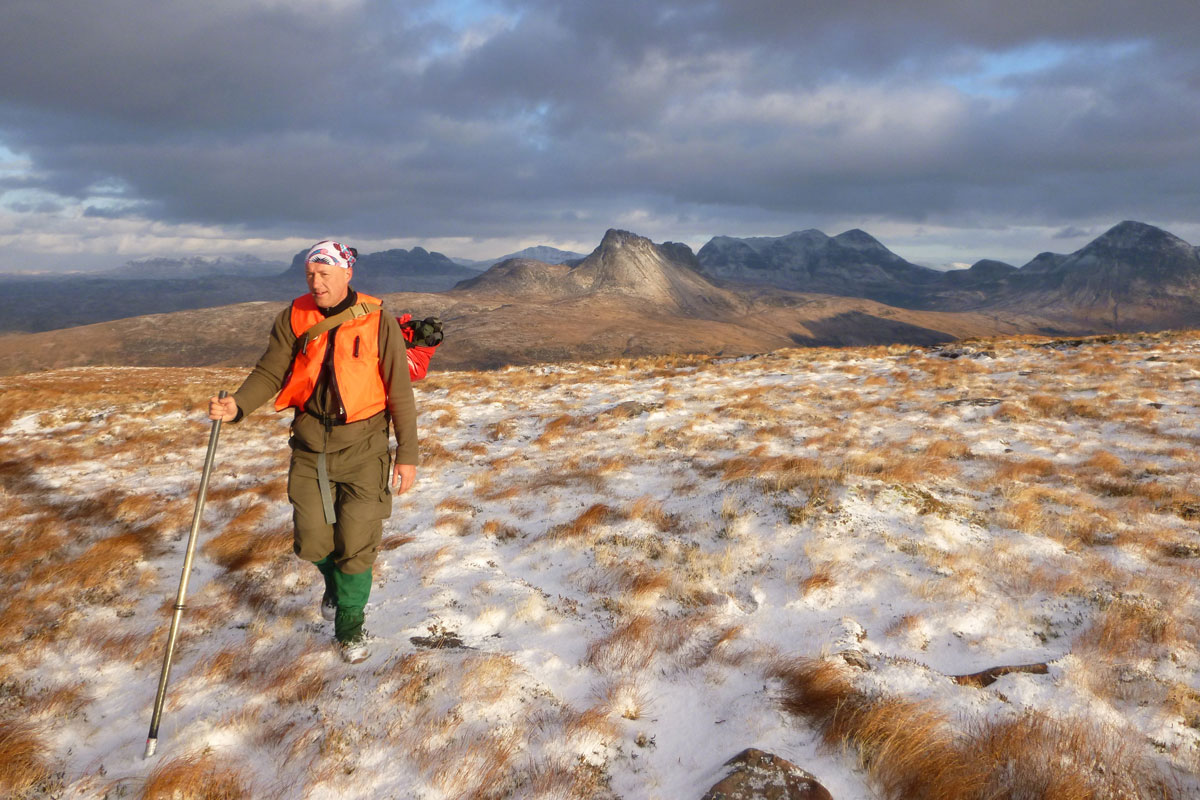
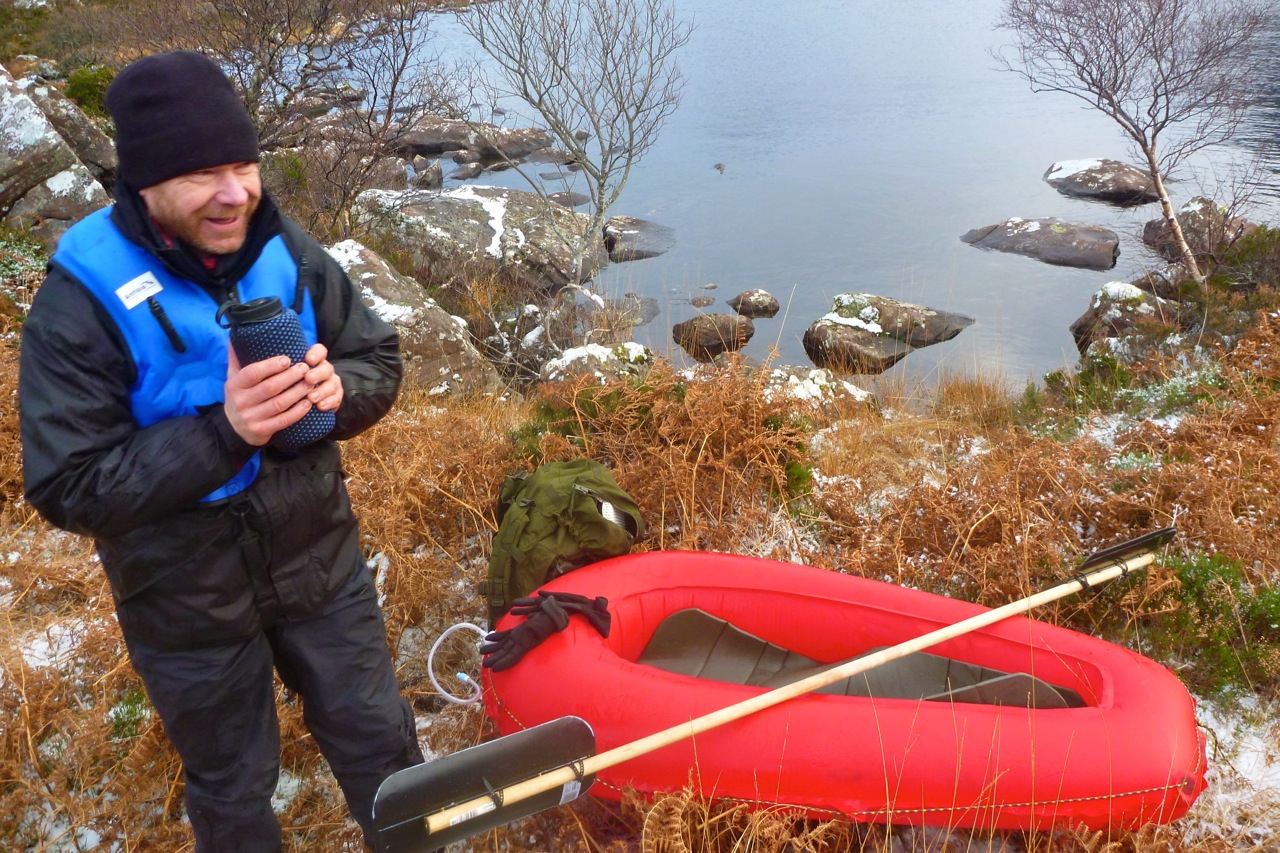
Here I get my first chance to appreciate the canoe-handle T-piece I’ve added to the end of my packstaff. It makes a much better support when inching down steep slopes, and the long packstaff can reach down a foot below your boots. Anyone would think I was going on about packstaffs again.
Coming off Suilven, the gradient begins to ease. By Fionn lochside a strong easterly is blowing and the packraft fills up almost by itself, even if the boat is on the verge of taking off. This looks a lot more than the 15-mph forecast. The wind will blow us downstream, but it looks rather gnarly out there, and we’re only at the ‘top’ of the fetch. It’s about a mile and a half along the loch to the river inlet and will get choppier downwind.
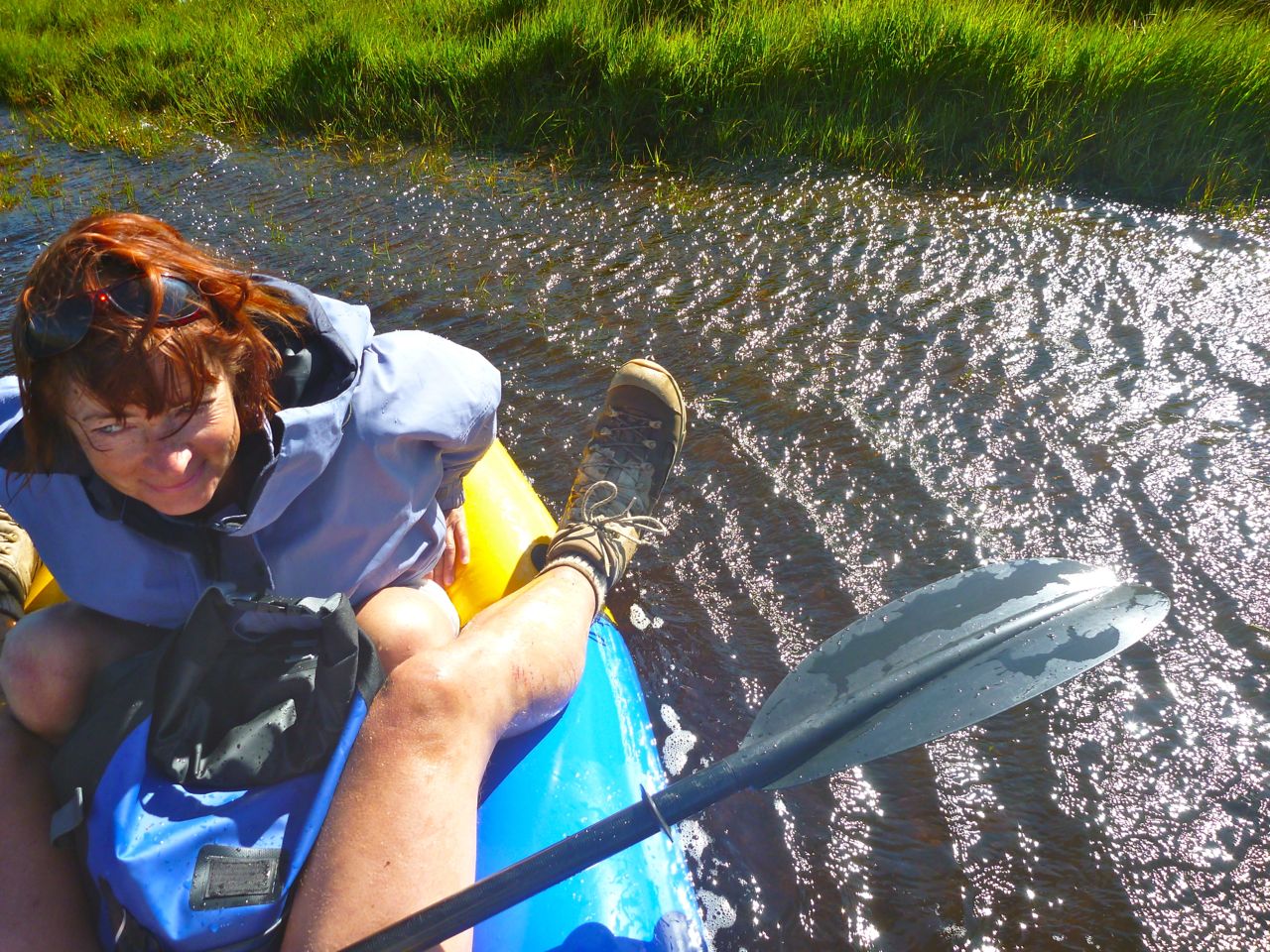
Visiting baboons might enjoy a view of my butt patch – glued on with Bostik 1782 and (appropriately) lined with gorilla-tape. Even though the 2014 Alpackas have a bit more back-end buoyancy (as we were about to find to our cost), for the weightier and lazier paddler, a butt patch offers useful protection in the shallows.
Did I say it’s very windy? And to make matters worse I’m rather careless about the weight distribution, forgetting how we did it last time in much calmer conditions. With the packs in the middle of the boat and the Mrs’ legs tucked in, instead of reaching back, the bow was noticeably low.
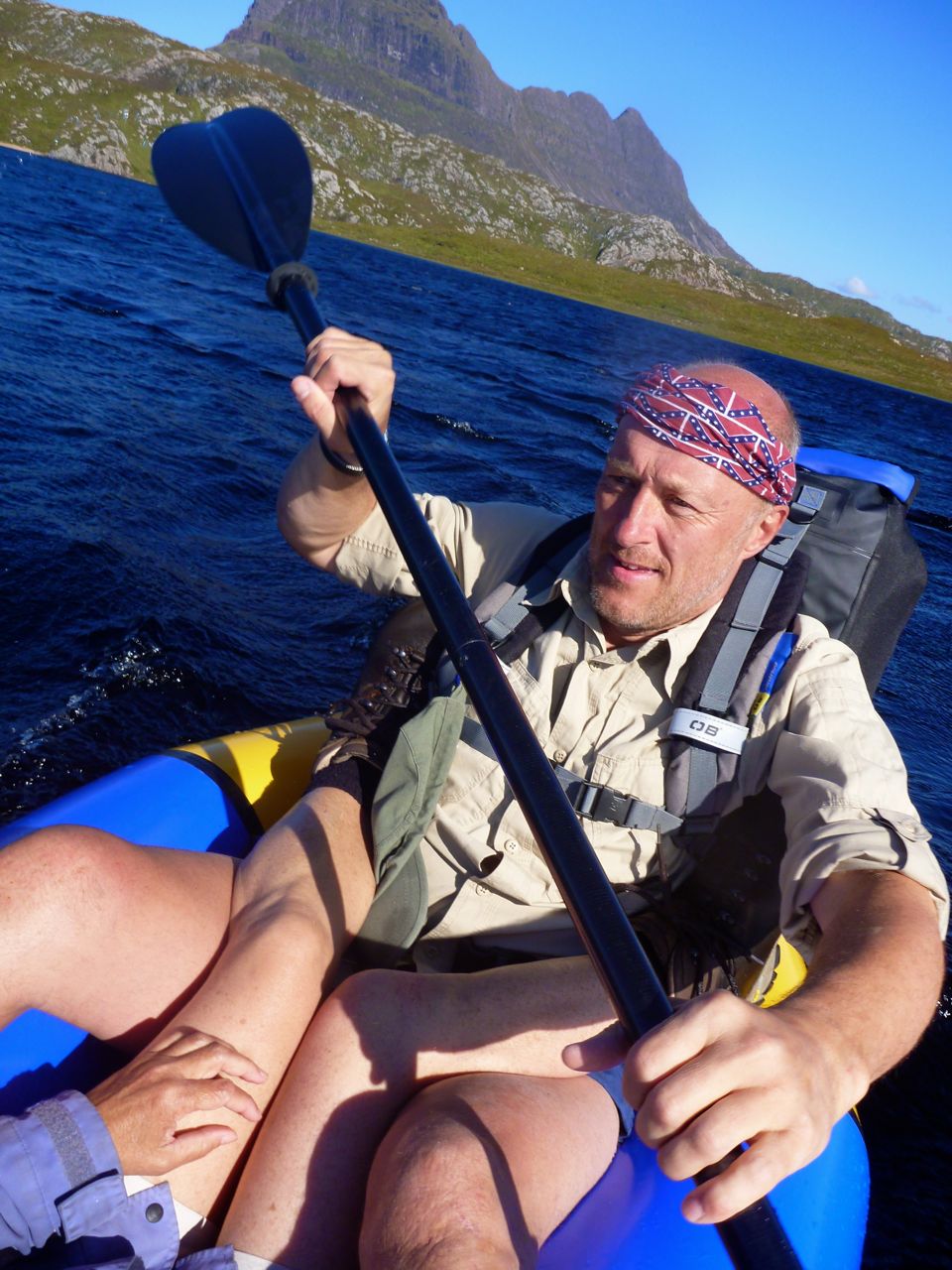
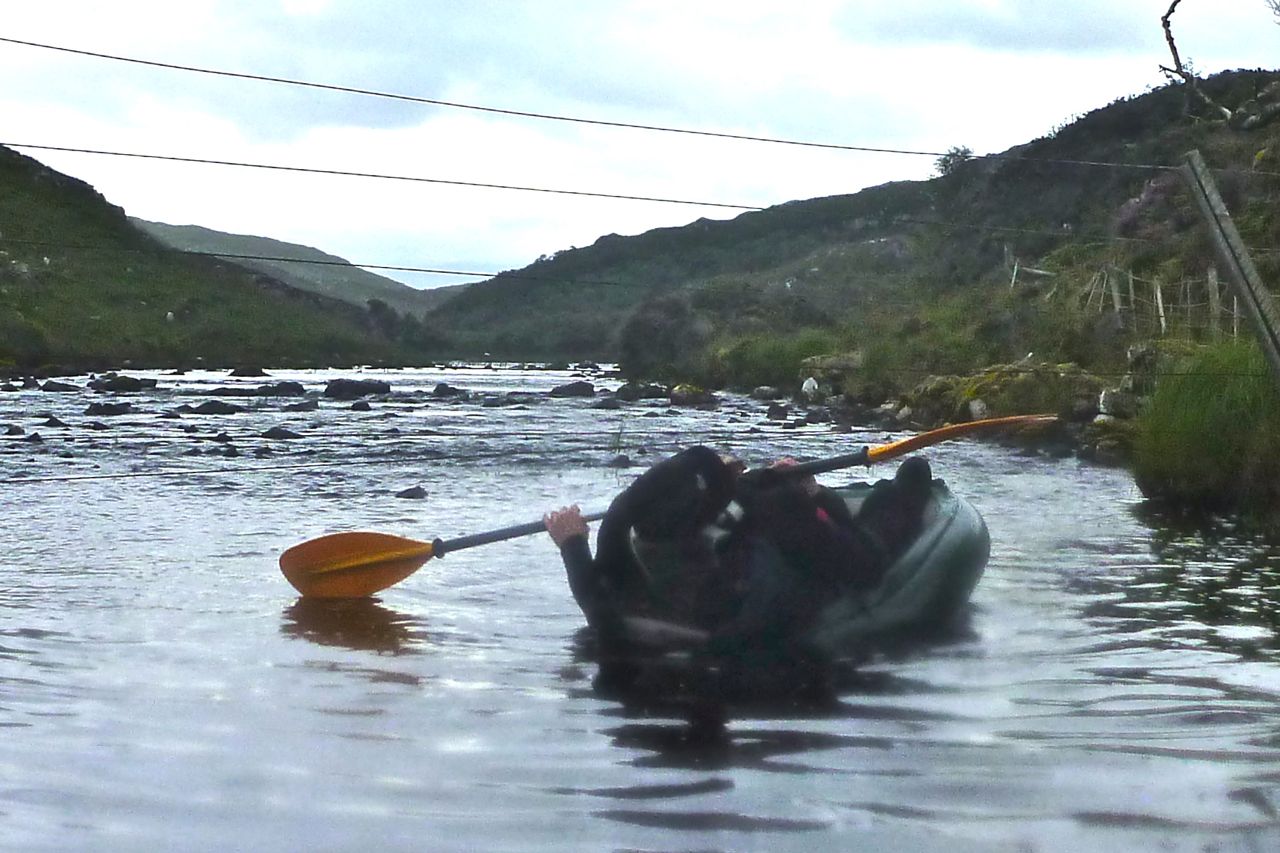
Once out midstream, the bow started swamping in the chop which was a little alarming. The restful 1.5-mile downwind paddle to the river inlet is abandoned. I tell the Mrs to lean towards me, and I paddle across-wind for the other bank. The odd wave splashes over the side.
We could have tried again with the packs on my back, but were a bit unnerved. As it is, two-up the boat was a little hard to handle in the wind, and we have no pfds. So the Mrs takes to the bank – a long detour around a lagoon – while I tip out the boat then allow the wind to whip me along the loch, pulling over to wait once every few minutes.
I’m not sure I want to engage with the wind funnel at the ‘narrows’ of Fionn Loch, as by now the whitecaps and chop are getting it on. Plus I’ve lost track of the Mrs. So I pull over and stagger over the bogs to see where she is.
Reunited, we’re effectively on the south side of the Kirkaig river, so are still going to have to paddle across to get to the north side for the regular path back to the car park. I recall the river entrance nearby is in another bay which will be out of the easterly fetch. With better thought out trim, that crossing should be less risky.
I know from previous experience that trying to carry an inflated packraft even five minutes to the bay in this sort of wind will be like trying to wrestling a pterodactyl. So out with the plug and under my arm it goes. That’s the great thing with packrafts: they’re as easy to paddle in as they are to walk with, though there’s probably a more elegant way of saying that.
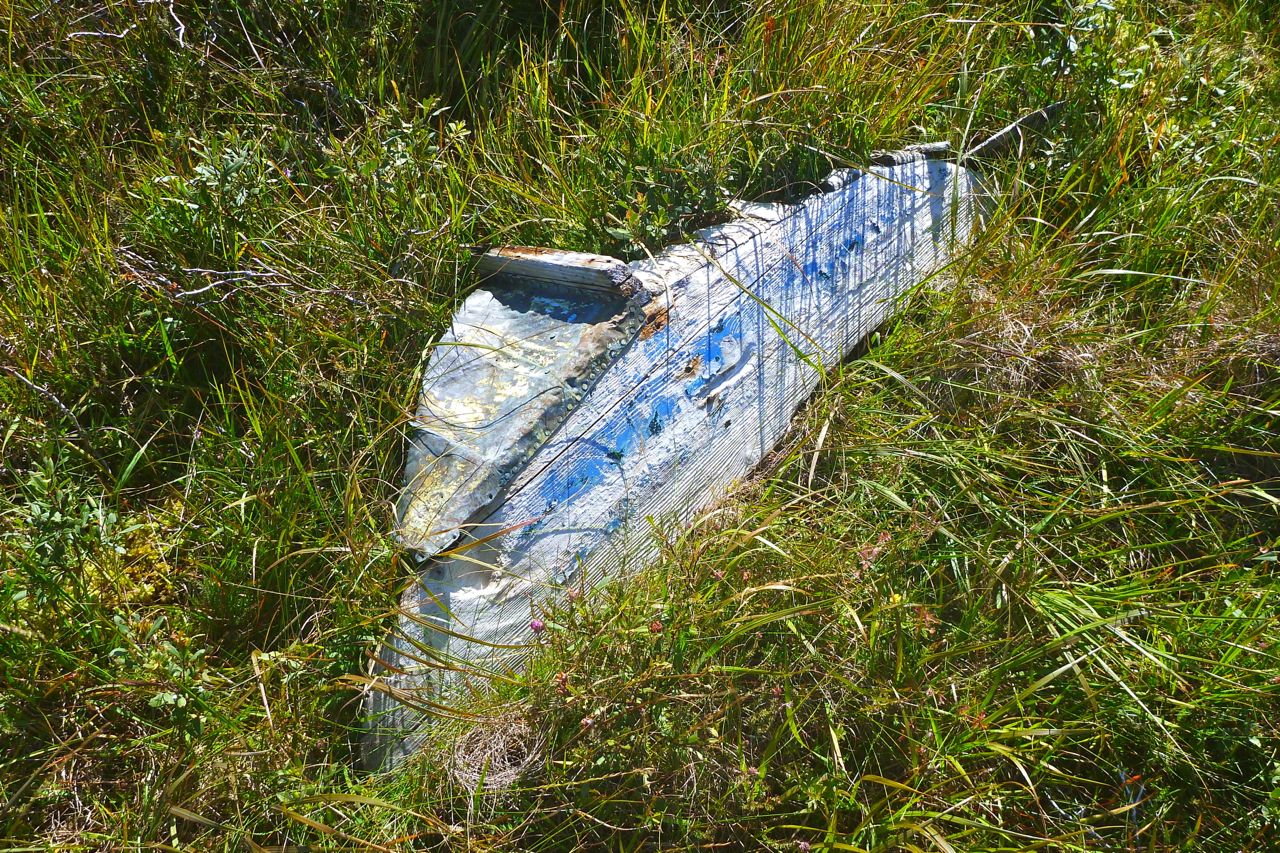
This rotting transom is all that remains of the last boat that came this way.
Another quick air up…
…and we set off across the small bay…
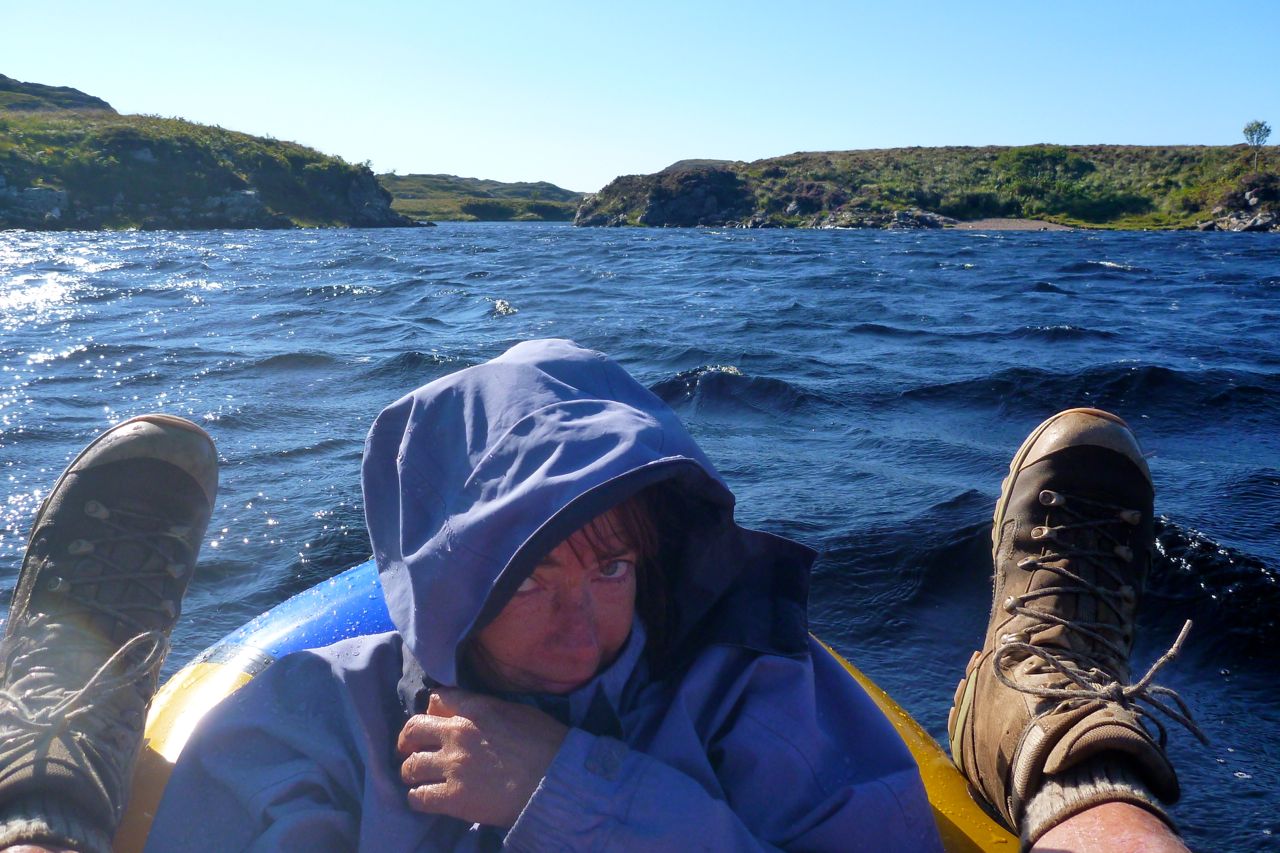
…for a small beach by the river entrance (above my right boot). Two up with the wind, I don’t want to get involved with the swift current flowing through the inlet towards bone-crunching waterfalls.
Back ashore I roll up the Yakpacka…
…and we set off for the 3.5-mile walk back to the bike at Inverkirkaig. And even here on the path the wind nearly knocks we over a couple of times. It was only an 11.5-mile day (10 for me on foot + 1.5 paddle), but by the time we get back to the bike we are pooped. Luckily, this year we have a lovely house to go back to.
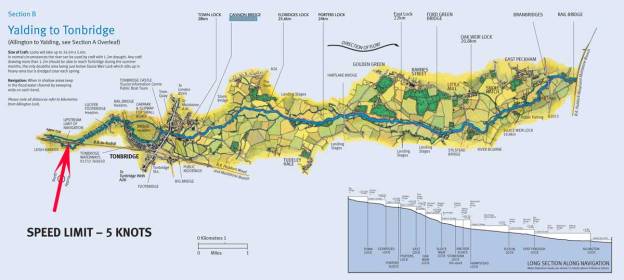
As we’re normally way up north for the British summer, I’ve forgotten how great a sunny 26-° southern English day feels. It’s been years. If it was France it’d be normal, but in the UK it’s not which adds to the magic. A perfect day then to bang out a Medway run from Tonbridge to Yalding in my newish Alpacka Yak. Even the wind was up for it, with a stiff, 15mph breeze forecast from the southwest.
With shoes, shirt and pfd in the wet bag, I slid down the chute off Tonbridge’s Town Lock, sat up straight and set sail. Overhead the wind was lifting the leaves, exposing their lighter underside, and with the river course (below) oriented right on it, I suspected this was going to be a good run. Eldridge Lock chute rolled up in under 20 minutes and that felt like at least a mile (1.3). And with no shoes or pfd the Yak felt roomy so I pushed the backrest low to get nicely jammed in. Paddle at eye level, a full draw from the feet, and I crack on.
Porters Lock already? OK then. How far is it to Yalding, anyway? Twelve something; couldn’t remember if it was kms or miles (13km), but I knew when we did it last June in my new IK that I was pooped well before the end. After Porters I pass some canoe-ers crouched on the floor of their boat, battling upstream. There’s no current but they’re sure fighting the wind. Further down the river, a couple with a camo-pattern IK are lunching by one of the locks. With the trees in full summer bloom and yellow lilies at the banks, in places the pea-soup Medway could pass for a backwater in Kakadu, with salties lurking in the shallows, eyeing up wading jabirus.
Sluice Weir Lock
Much sooner than expected it’s the big slide down Sluice Weir Lock (above) which I knew was near the end. The short Yak surfs over the frothing base a lot better than a nose-burying kayak. I took no water on any of the chutes and the backwind even helped keep the paddle splash off me. After a quick visit to water the bushes, I top off the seat and hull. Holy moly, now the firmed up Yak is skimming along like a surf ski under the big-bladed Corry paddle. This last section was a l o n g haul last time, but I power on and there is, the Anchor Inn at Yalding. Don’t want to eat there again, so I finish off my water and check the watch. Two hours twenty. That seems fast; it was an all-dayer last time.
It’s another 5-10 minutes scoot down to the take-out at Hampstead Lock and a short walk to the station where it costs over a fiver to ride three stops back to Tonbridge. When I get home I Google Map the river distance: 7.5 miles or about 12 clicks to the Anchor. In two twenty that’s a pretty surprising 3.4mph or nearly 3 knots. I’d be pleased with that in my 14-foot IK, but in dumpy packraft? Not bad at all.
I am slowly working my way through a western variant of the Cape Wrath Trail, a hardcore, unofficial Long-distance path that runs some 200 miles between Fort William and Cape Wrath. More about the CWT here.
After scraping through the first part of the variant from Dundonnell in December 2013, I returned with paddlechum Jon to complete the remainder from Stac Polly mountain to Kylesku bridge where the regular route comes in from the east at Kylestrome. Following several humiliating episodes orchestrated by me in slackrafts, Jon finally saw the light and bought himself a red Alpacka Alpaca (the next size down from my Yak).
After kayaking around the Slate Islands near Oban I rode up to Achiltibuie on my very overloaded bike and met Jon at Di’s croft in Altandhu. We fixed up her electric bike, extended the goat shed then next day left a car at Stac car park (above) for our two-day paddle-walk to Kylesku. But things had already got off to a bad start: Jon had done his knee in on the previous day’s Etape Caledonia cycle race.
As a result progress was slow up the steep path onto Stac mountain and even slower once we left the path down the north side (above) for the trudge towards Sion’ loch. By this time Jon had recognised the value of using his hefty TNP paddle as a packstaff.
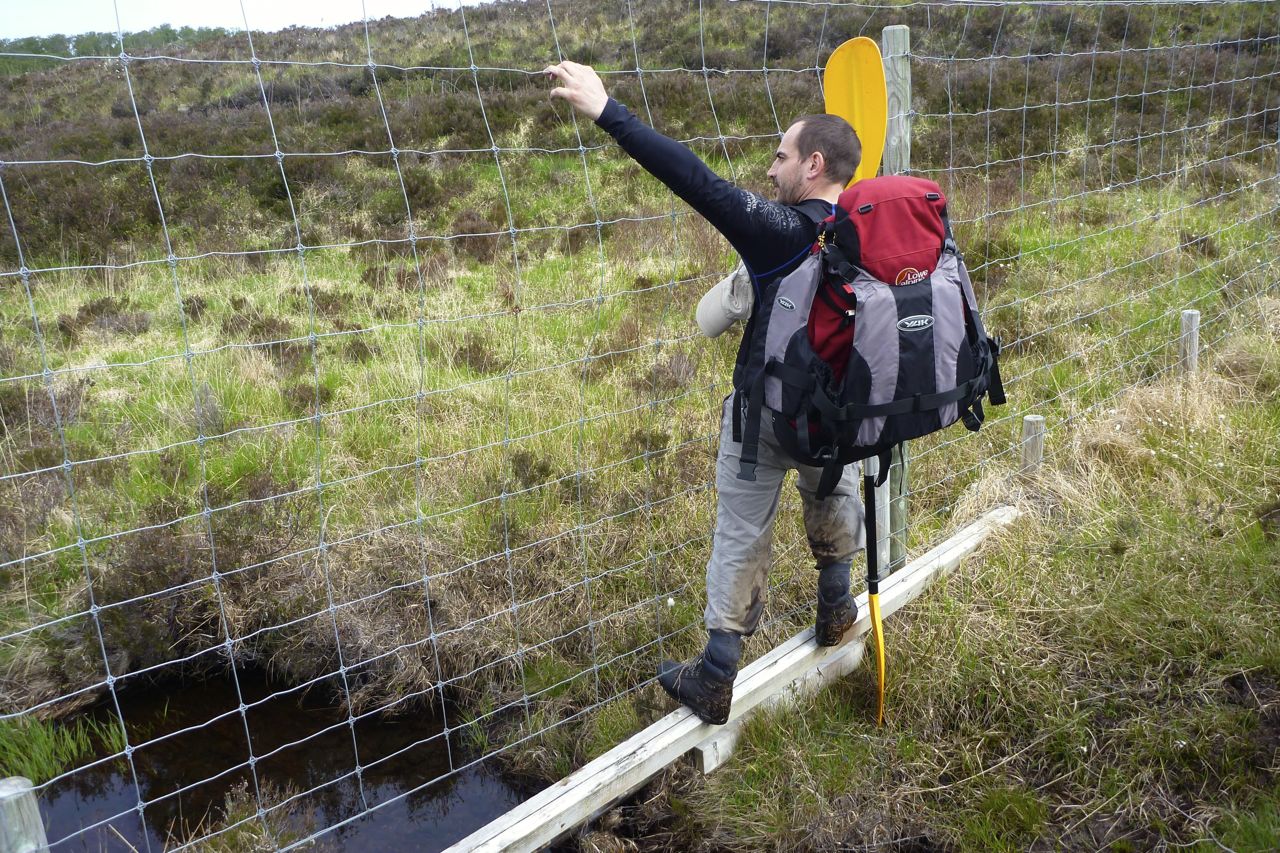
As the slope levelled off, ahead of us a deer fence cut through the scrub; we followed it until a stout corner post provided an easy hop to the other side. We were now heading directly for a bay with a small island to put in, but that was further than it looked, down small cliffs before dropping through an enchanting light birch woodland which the deer fence may have helped preserve.
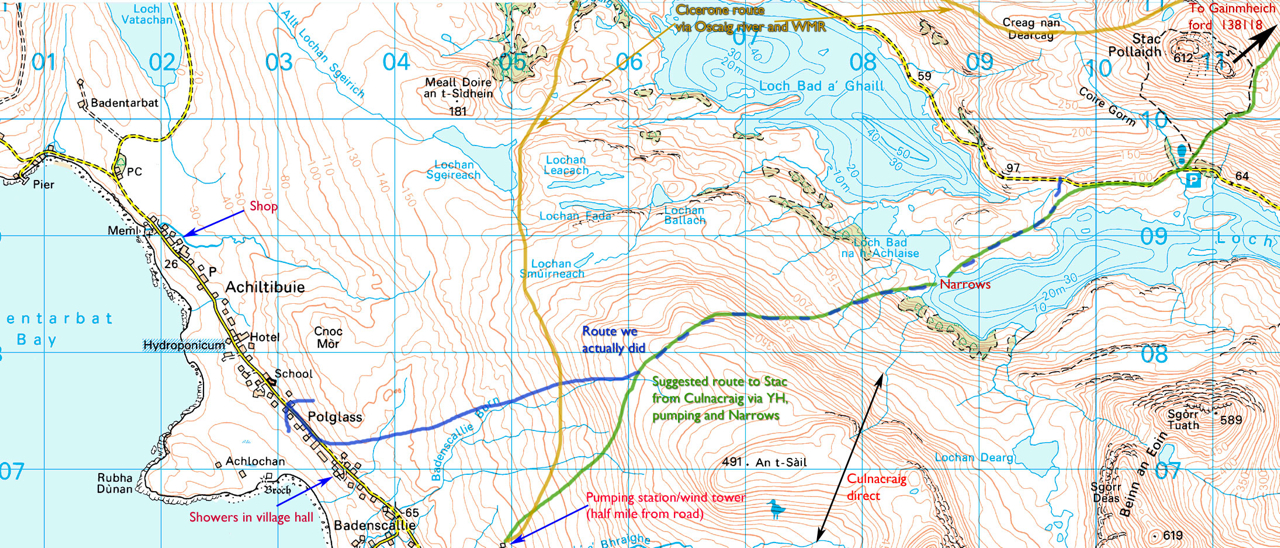
While it was nice to come across the lost pocket of woodland, walking or boating, next time I think I’d take the Linneraineach path which starts a mile or so east of Stac. It leads all the way to the wadeable stream running into the loch (on the edge of the map, above) and is probably quicker and less effort. A walker would certainly be better off going that way instead of rising halfway up Stac and then down again, as we did. As it was, we were lucky that a recent dry spell had left a spongy crust on top of the saturated post-winter mire. On a few occasions that crust sheared away from the soggy underlay and sent me flying. Either way, this was packstaff terrain par excellence. Have I mentioned packstaffs yet?
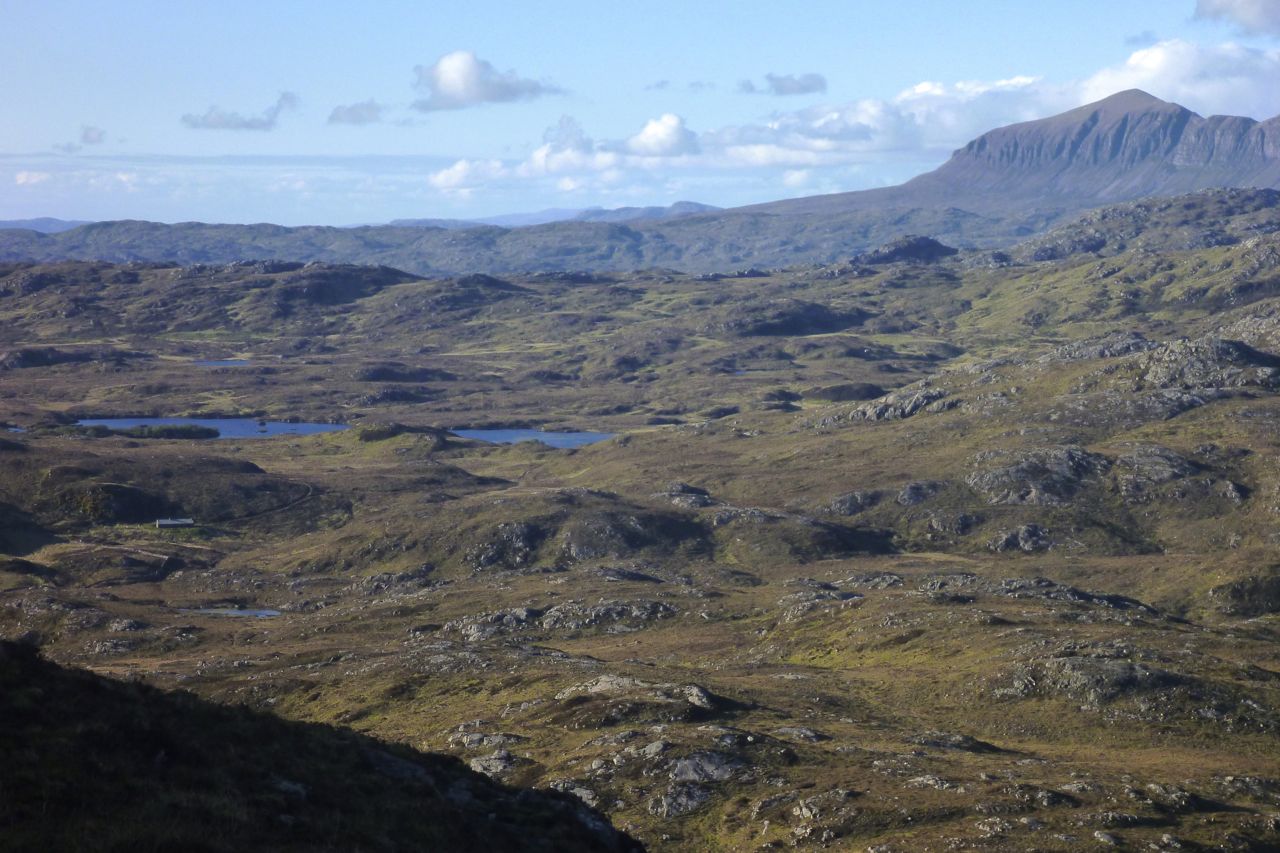
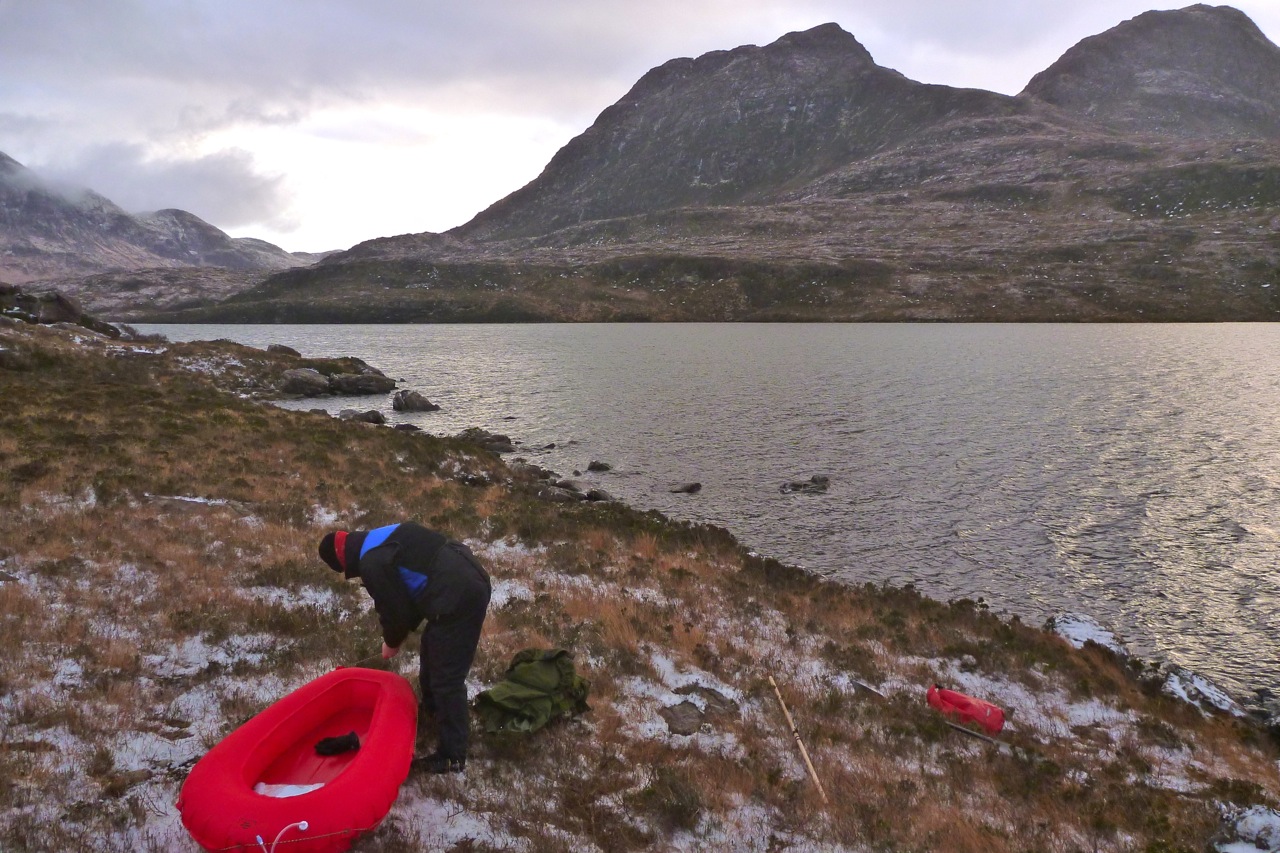
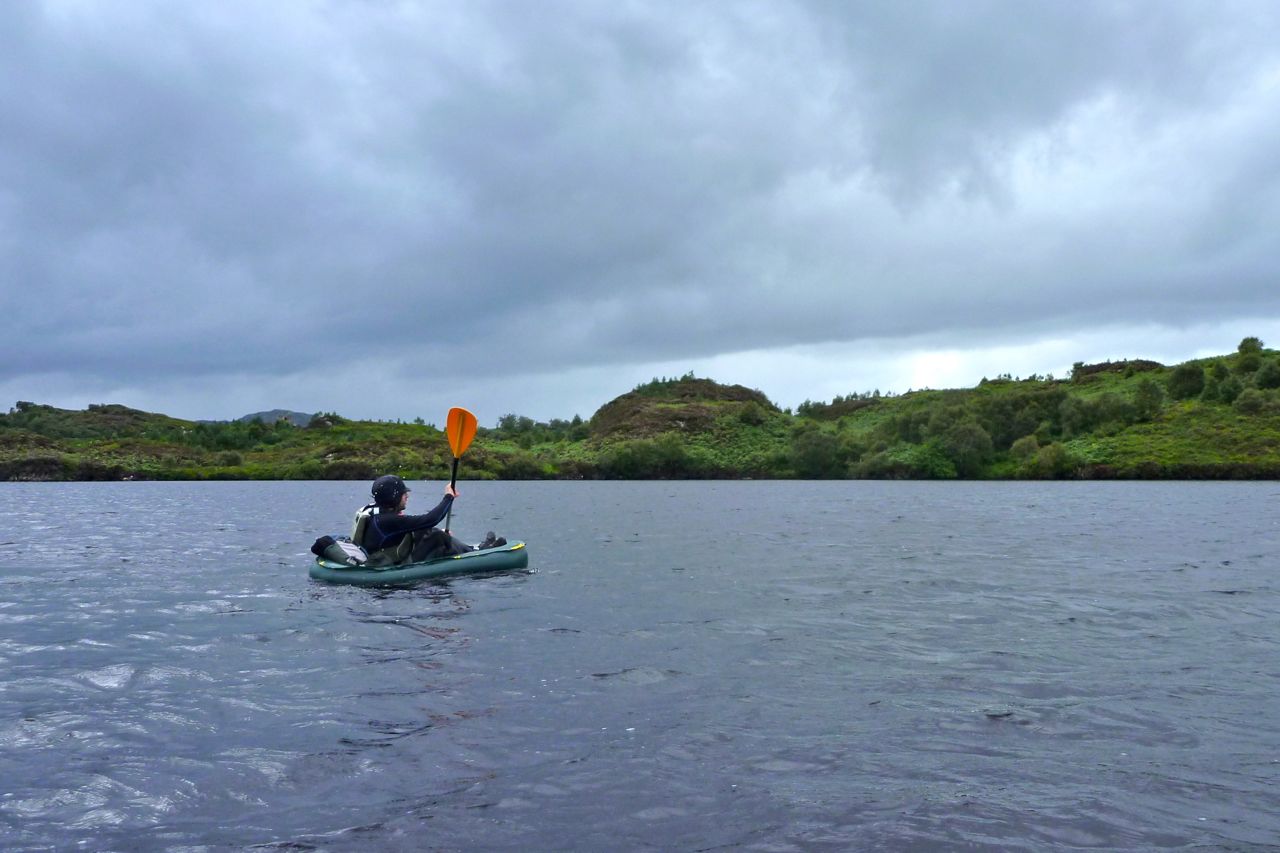
On the small beach at ‘Island Bay’ we pumped up our supple new Alpackas and paddled out north across the loch towards Suilven mountain, passing between small islets and landing an hour later for lunch near ‘Shielding’ on the map. Initially the northwest breeze put us at the fetchy end of the loch and we took on the odd splash. But even with a wet bum, from any vantage point you care to choose, with its ring of peaks, the primeval Inverpolly basin (below) has got to be one of northwest Scotland’s most dramatic landscapes.
Over lunch I measured up Jon’s red Alpaca against my Yak but could hardly see a difference (it’s 3 inches shorter inside and out). But Jon was having trouble getting a full draw of the paddle with his bag across the bow (mine was below my knees). It’s possible these newer Alpackas have more of a wave-riding upturn at the bow which makes any bow-mounted bag slide backwards. That, plus a need to adapt to a gentler but more frequent ‘packrafting cadence’ saw Jon’s red Alpaca lag behind my Yak. Later we swapped paddles which made a small difference – we should have swapped boats too to see if man or boat was the culprit. My 2014 Yak has the slightly longer stern, but paddles much like my old one.
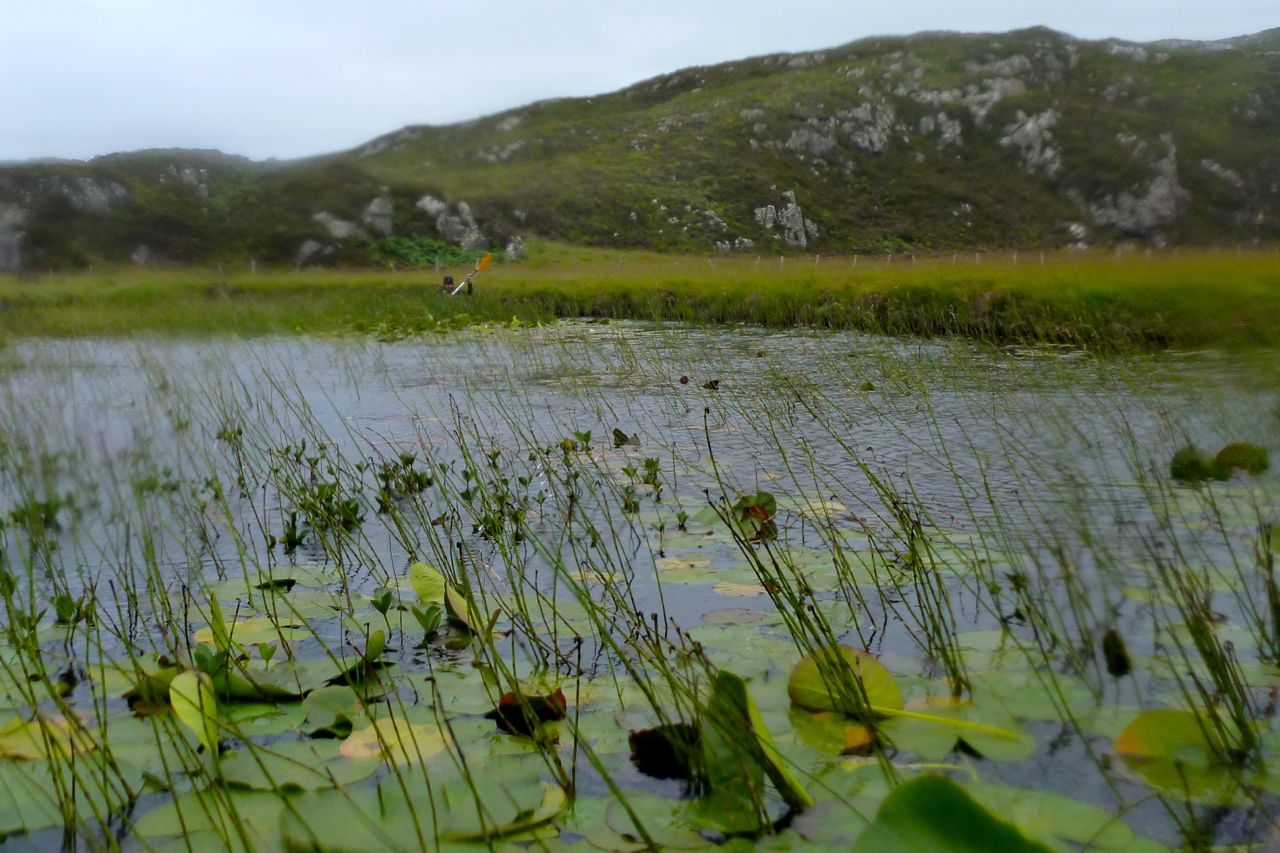
From Shielding we walked over the pass to Fionn Loch directly below the south wall of Suilven. As before, some canoeists were camped by the Uidh Fhearna river crossing (a deep wade for a walker; right), practising their moves and barely noticed us slipping into the water from a reedy lagoon. Once on the north side we found an oddly deep channel which led inland for a hundred metres saving some tussock and bog walking.
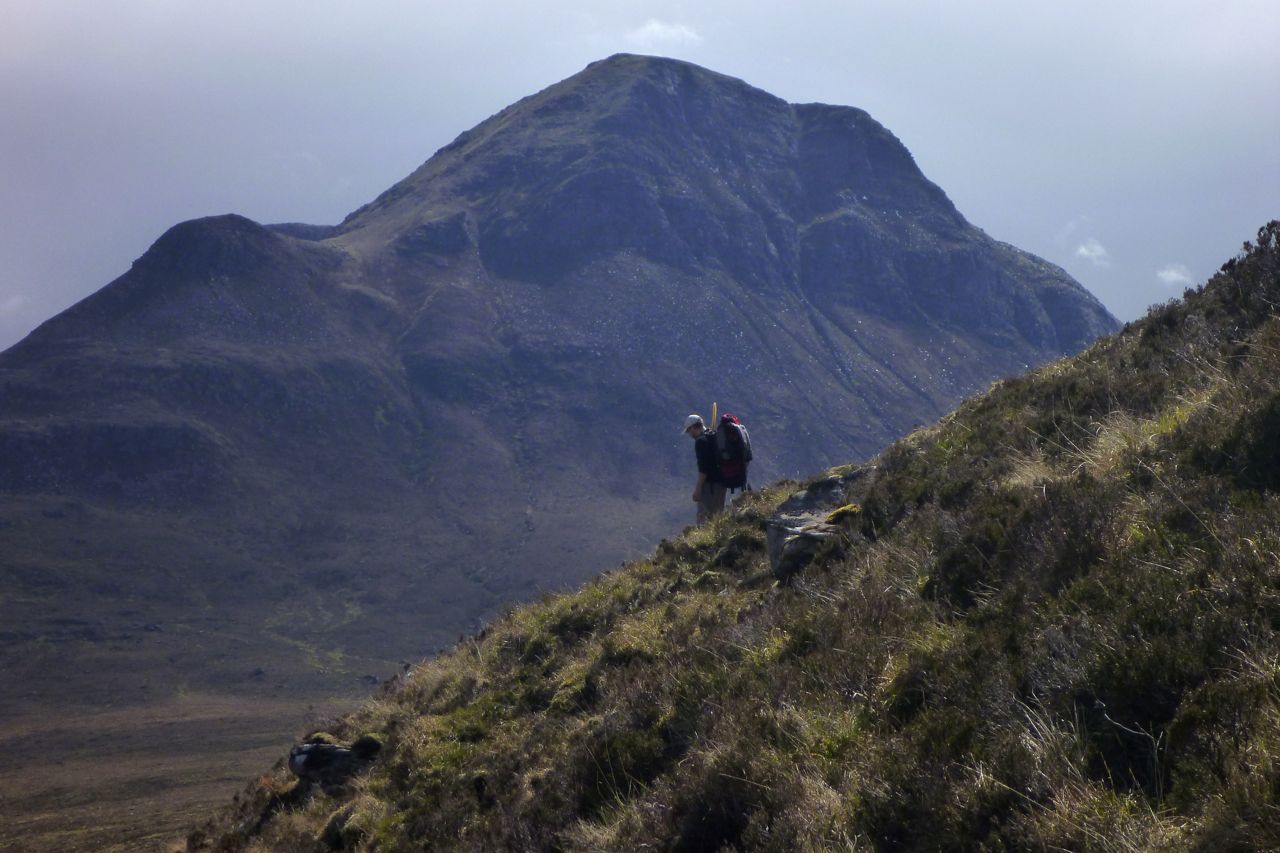
Rolling the boats up, I tried to persuade Jon that the seemingly vertical clamber up Suilven’s south face would be excellent knee therapy, but he wasn’t buying it. He had ten weeks to get into shape for a four-day trans-Pyrenean ride and didn’t want to risk it. So we set off north below the western prow of what the Norsemen called ‘the Pillar’ (below).
The 50k map doesn’t show a series of gradually ascending ups and downs over ridges running parallel to the mountain. With Jon’s paddle-supported hobbling it took an hour and a half to get to the high point where a view of our next challenge – Quinag (below) – revealed itself across a string of lochans.
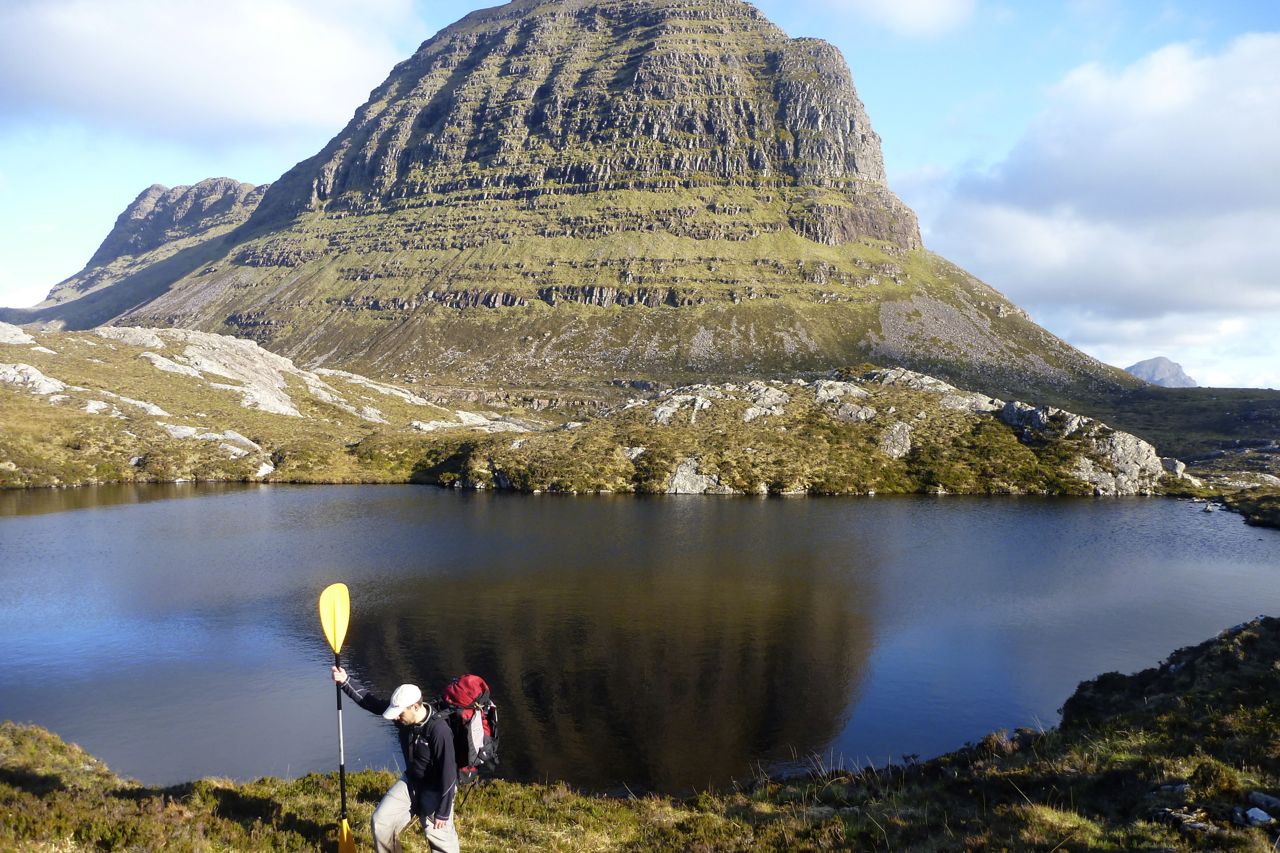
Soon we caught a view of Suileag bothy far below but the terrain got gnarlier still, winding around lochans, small passes and down steep slopes. Somewhere here Jon chose to follow an indirect low route to spare his knee and somehow managed to sneak past me while I scanned from a high point for half an hour, trying to track him down. He was behind me all the time, kettle on and yellow paddle resting by the bothy’s doorway as a marker. I needlessly paddled over Loch an Alltain Duibh, assuming the river gully just upstream would be too awkward to cross. In fact Jon had found it an easy ankle wade.
In hindsight I’d say the path climbing up and down the saddle of Suilven to pick up the jeep track west to the bothy wouldn’t have been much slower than our route around the mountain’s western prow, let alone the added appeal of taking a quick detour from the saddle to Suilven’s western summit. Since we did this, the path on the north side of the mountain has been improved.
Suileag bothy is one of the tidiest I’ve seen, clean and basic with a fireplace and water from a nearby burn. It’s so much more agreeable to barge into any bothy and spread out like a normal person, than crawl around a tent like an invertebrate.
Next morning we followed the path north over a pass for two or three miles to the footbridge over the River Inver to Little Assynt; all up much quicker going. At the footbridge we carried on west then north, over another deer fence and ankle twisting tussocks to a beach beyond the sluice where Loch Assynt drained into the river.
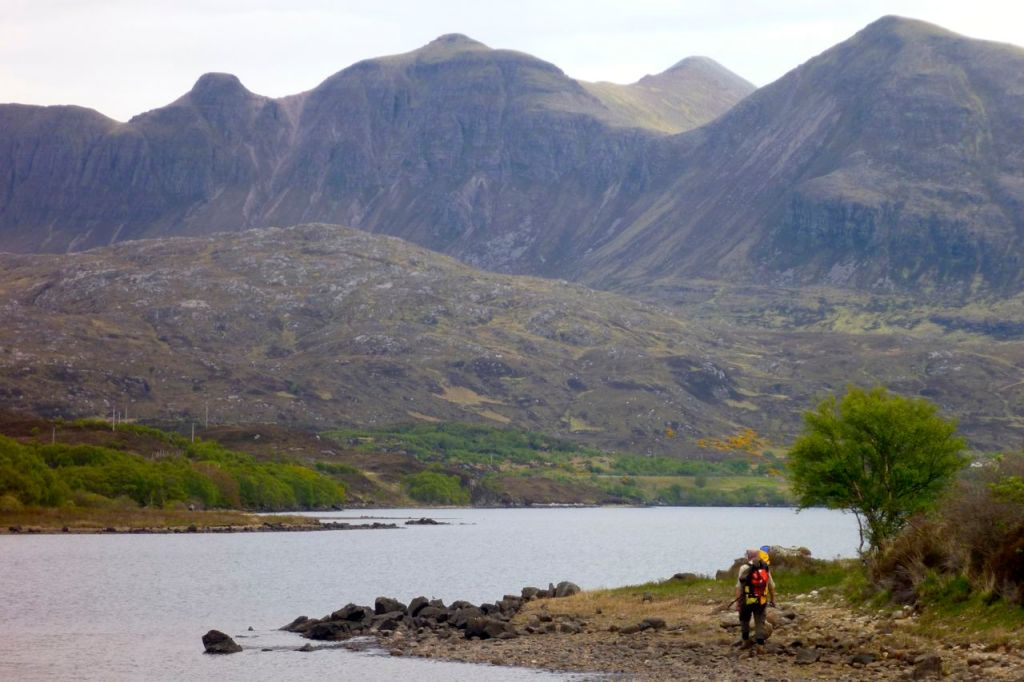
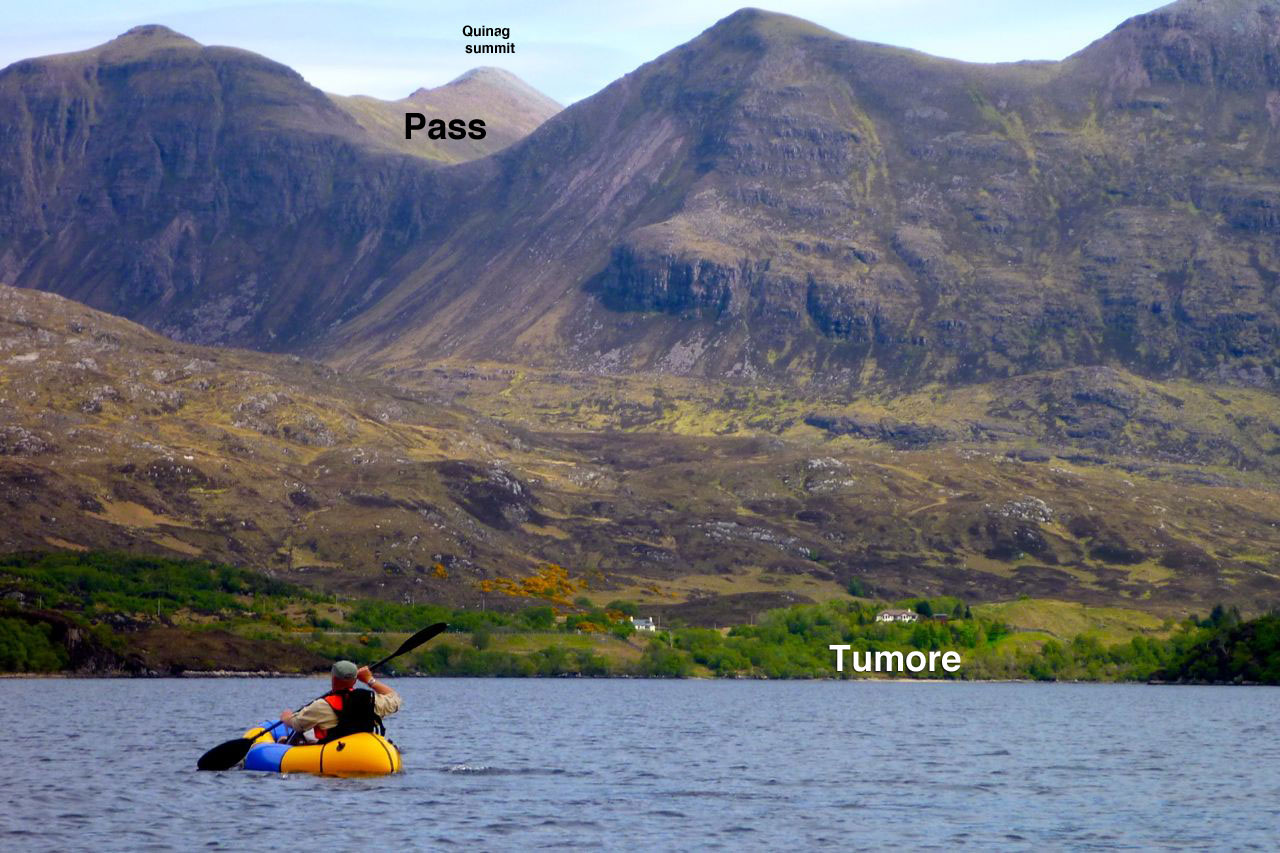
Up ahead loomed the mass of Quinag mountain (above) and Jon and I debated the feasibility of tackling the Bealach a Chornaidh from the pathless west side. Leaving the Drumbeg path, a slope leads a kilometre and some 400m up to either a harmless scree bank or a lethal cliff. It was probably the former but too much for Jon’s gammy knee. We finished off our food under a gale-bent birch below Tumore and, as the wind was with us, decided to paddle Loch Assynt east to the road junction instead. The back way up Quinag pass would have to wait for another time.
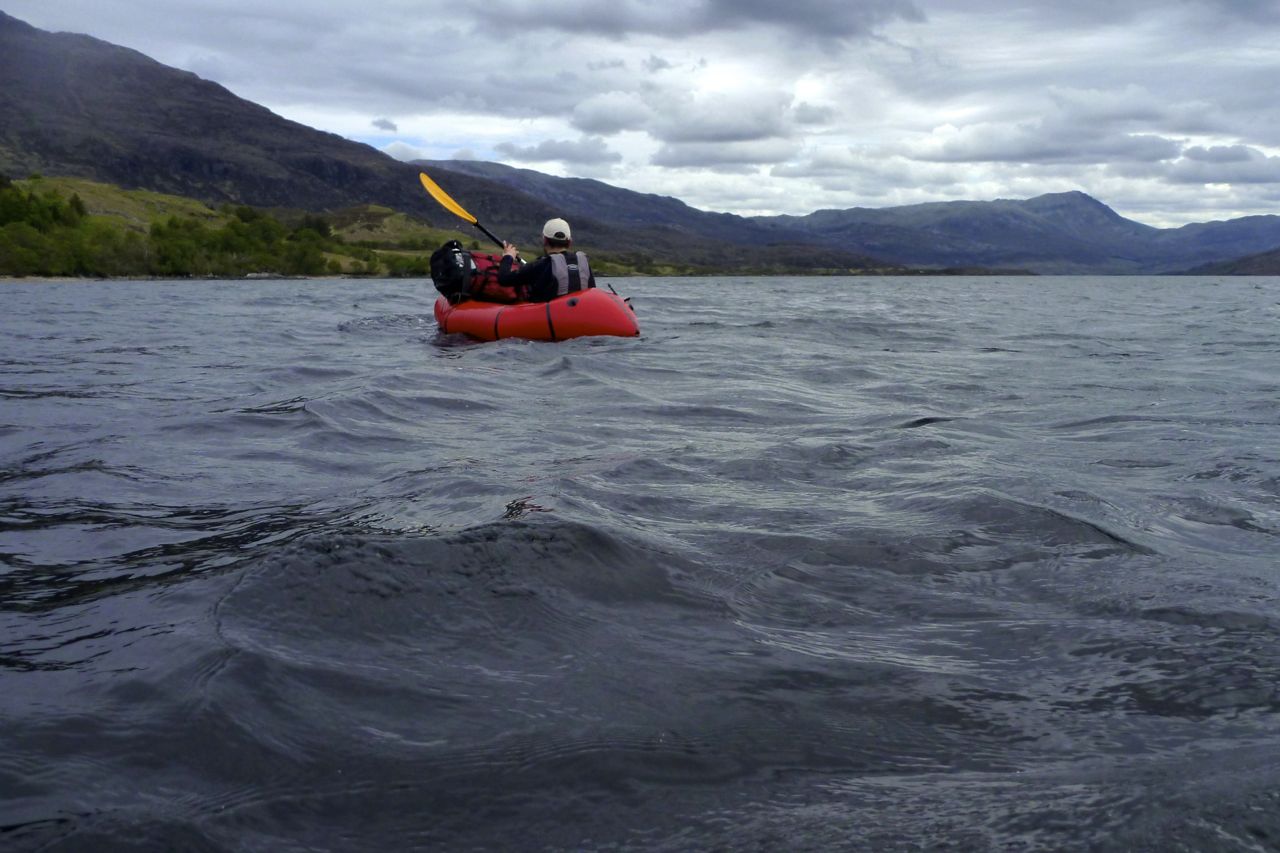
On the water the southwest breeze wafted us helpfully down the loch, though the Alpaca was still notably slower despite my helpful demonstrations on how to paddle. I really ought make one of those instructional dvds, like Jane Fonda. Once ashore all that remained was a seven-mile road walk to Kylesku by which time the forecast wind and rain had caught up with us.
On the road walk I eyed up the terrain northwest of Quinag massif. It looks like the planned orange path shown on the map above would have been another convoluted cross-country struggle, even if it was a more direct line. Leave that to the crows and follow the regular path down from the pass east to the road (unshown on the map but it’s there). And that was the lesson learned on the land stages of this CWT variant. While there may now be a right to roam across the glens and bens of bonnie Scotland, who in their right mind would want to do that for any longer than necessary? Even wild animals develop paths; it’s less effort and happens to be quicker, even if it’s not a direct route.
Lured by the promise of a free meal at the hotel, Di drove up right on time and took us the last mile to Kylesku where a TV crew happened to be recording the retirement of the postmistress following no less than 61 years on the job.
So, my summary for this nearly completed CWT Assynt variant? For a boatless walker, once over Loch Broom and in Ullapool, the Postie Path is a dramatic way of getting to Achiltibuie where there’s a hostel, pub and shop. Over the hill it’s a major wade across the Narrows of Loch Lurgainn after which I’d recommend the Linneraineach path between Stac and Cul Beag to the stream before the long cross-country trek to a shorter wade across the Uidh Fhearna river at Fionn Loch. From here take yourself up and down Suilven’s saddle, then from the bothy take the track to Little Assynt footbridge. From here it’s a two-mile road walk to Tumore where you take the Drumbeg path before breaking off up to the Chornaidh pass and down to the road using the path to get you there. With a boat the Narrows can be paddled, so can Loch Sionasgaig, cutting out a long cross-country yomp. Another quickie over Fionn Loch, up and over or around Suilven and paddle the west end of Loch Assynt to Tumore from anywhere north of the sluice. Job done.
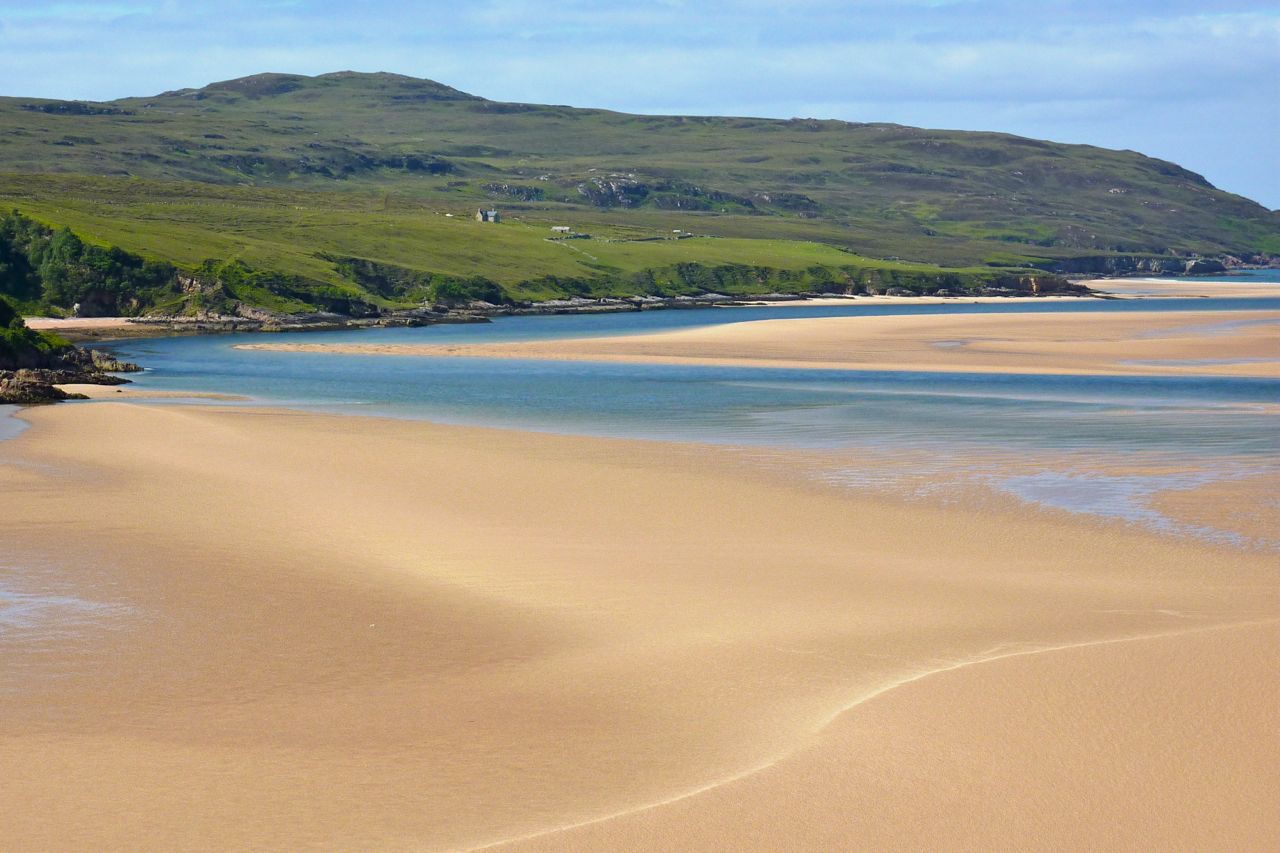
As far as I can tell, there are few other places on the regular CWT path where a packraft is worth carrying (which is probably why the path goes that way and avoids the Assynt). Except of course to get across the Kyle of Durness sea loch after the walk’s finale at Cape Wrath, if the boatman is not around and you don’t fancy the detour to the head of the loch. The image left from a few years ago must be a very low tide, but as you can see it’s potentially just a swim of a few metres. Eight years later I finally got to paddle the Kyle (below).
Crossing the Kyle of Durness; Cape Wrath headland behind
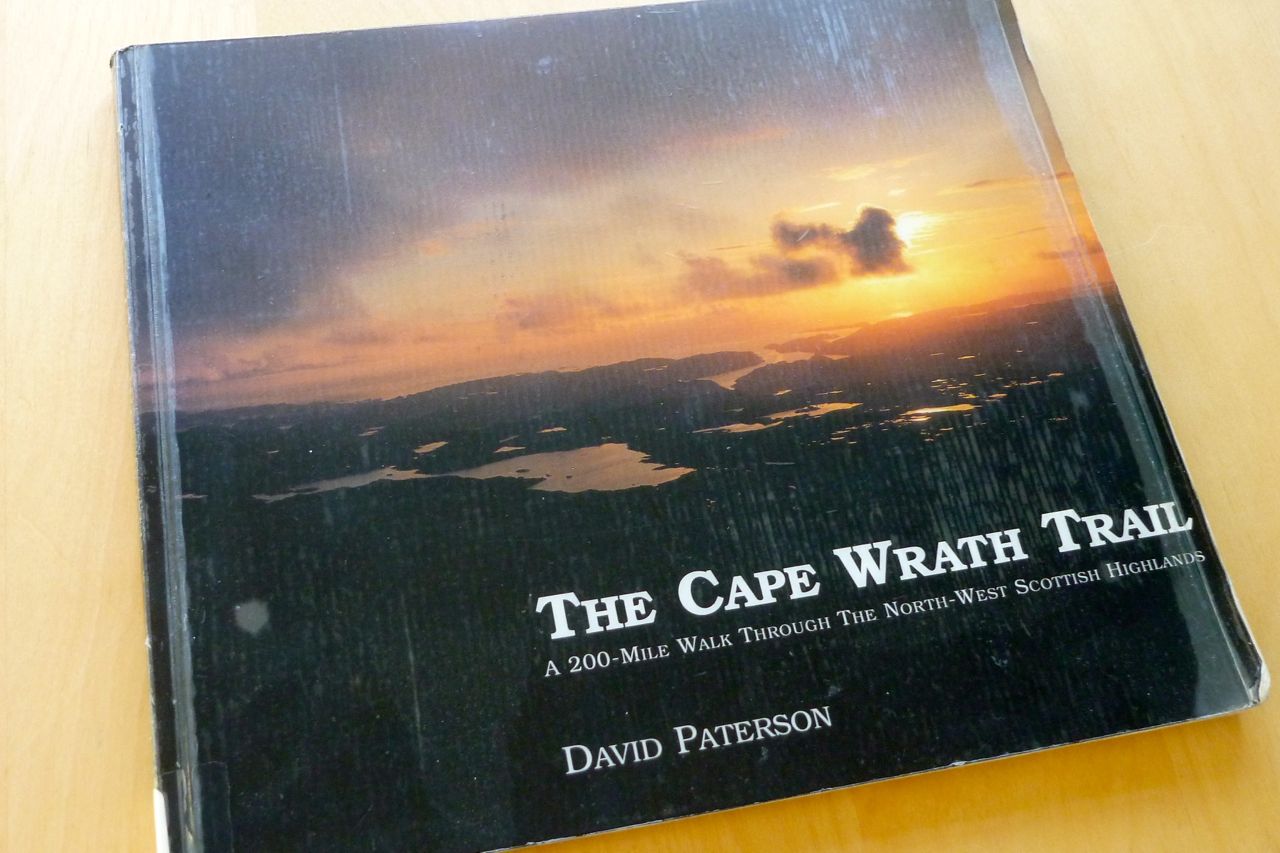
The 200-ish mile Cape Wrath Trail from Fort William to the top of Sutherland was cooked up in the early 1990s by David Paterson, a photographer who’d just come off a job shooting the West Highland Way. Paterson wondered if you could extend the WHW through the North Western Highlands to the very tip of the British Isles in Sutherland. Over many visits he established a route and in 1996 produced a beautiful book: ‘The Cape Wrath Trail: A New 200-mile Walking Route Through the North-West Scottish Highlands’, creating what he humbly ‘dared to call the Cape Wrath Trail’. Since then various other routes have evolved between the two points. There’s no set route, far less two helpful waymarks to rub together, but it would not be an exaggeration to describe the CWT as Britain’s toughest long-distance path. Though it’s tracklogged comprehensively on walkhighlands, follows passes and valleys, and tops out at just one 600-m summit, the terrain, weather, scarcity of resupply points or any other services in the North Western Highlands puts the CWT in a class of its own. On occasions, there is no path at all, but the advent of the 2003 Scottish Land Reform Act opened the moors to all, offering an infinity of options or ‘variants’.
Originally Paterson’s route passed from Dundonnell through Ullapool, crossing the half-mile of Loch Broom from Altnaharrie on the Scoraig peninsula using a regular ferry. That ferry ceased operating in 2003 and the CWT now reroutes itself miles inland up to the head of Loch Broom and via Oykel Bridge. But as none other than Cameron McNeish suggested in a rather hastily written ‘Foreward’ on a Cape Wrath Trail website:
‘…the route should follow a south to north line as close as possible; it should allow passage through the most scenic areas; it should try and avoid tarmac and paved roads or paths but instead follow existing footpaths and stalkers’ tracks whenever they were useful and it should avoid crossing mountain ranges and major rivers except where necessary.’
In 2013 Cicerone published The Cape Wrath Trail guidebook. They’d published an earlier version as ‘North to the Cape’ in 1999. The 2013 Cicerone author Iain Harper has a website on which he questions and then decides not to include his Coigach-Assynt route option for safety reasons. ‘… Not including an Assynt alternative in the guide was a difficult decision, but on balance I came down on the side of caution, however for the more adventurous walker it should definitely considered…’.
I’m not an especially adventurous walker and have not done the CWT, but knowing the Coigach-Assynt area, and from the walkhighlands reports I’ve read on the current route, Postman’s Path excepted (see below), the Coigach-Assynt doesn’t seem much more dangerous or remote than many other rather hairy sections on the CWT. And furthermore, our variant stays closer to McNeish’s ‘south to north line [and takes a] passage through the most scenic areas’. The peaks of the Assynt are like nothing else in the Scottish highlands and it seems to me a shame that the original CWT route had fallen into disuse for want of a half-mile boat ride across Loch Broom.
That boat ride (or using a packraft, of course!) is the key to unlocking this Coigach-Assynt variant and on a pleasant summer’s morning it would be perfectly packraftable paddle from Altnaharrie jetty to Ullapool on the north side of the loch (David H did so in 2012 on his northwestern epic).
But after the six-mile walk up from the Badralloch turn-off near Dundonnell, arriving at Altnaharrie jetty on a rainy evening in early December 2013 with a spring tide in full ebb against a 20mph wind, paddling towards Ullapool’s harbour lights seemed less of a jolly jaunt. To cut a long story short, we ‘d contacted the harbour master to see if he could help out with a lift. At least one other CWT walker has done this. He arranged for the night shift to come over and pick us up. [It’s worth noting the former Altnaharrie Inn gourmand’s restaurant alongside the small jetty in now a private residence].
After a cozy night and a lavish brekkie in Ullapool’s Ceilidh Inn, Robin and I set off set off for the 12-mile walk to Culnacraig via the notorious Postman’s Path. We didn’t quite make it and as it involves no actual paddling, you can read about it on Walkhighlands. In 2021 round-Britain coastal walker Quintin Lake recalled the path: I thought I’d seen it all by now, but the postman’s “path” to Culnacraig passes over some of the steepest ground I’ve yet encountered. If there weren’t a path to lure me onwards, I’d have turned back.
From the vicinity of Culnacraig our suggested variant takes a more direct line than the Cicerone suggestion shown in yellow (above). It crosses over to the narrows at Loch Lurgainn which are just about wadeable to a boatless walker with a stout stick, but which we paddled during a break in the December storms. You can read about that here.
A few months later Jon and I returned to Achiltibuie with our new Alpackas to pick up the variant from the foot of Stac and follow it through to Kylesku where it rejoins the regular CWT for the last lap to Cape Wrath. It can all be walked or waded but our route was streamlined by taking three paddles (right) and a shallow wade. You can read about that here.
Some people place a rubber cap on the paddle shaft and use it as a walking stick. This application makes me nervous about damaging the paddle shaft.
Luc Mehl, The Packraft Handbook
Packstaff in Scotland
No one’s ever asked me how to make a packstaff attachment for their four-part paddle, but I’m going to tell you anyway. After nearly two decades decade, I’m still a big fan of my idea for traversing rough terrain with heavy loads (above).
What’s so good about packstaffs? Well, they’re a great way of converting your light but strong paddle shaft into a light but strong walking staff that’s stronger and longer than too short trekking poles or hefty camera monopods, both of which are useful on the trail, but largely redundant on the water. Not needed on flat ground, staffs help you trek uphill and down dale with the same benefits as trekking poles, spreading the load off your ageing kneesto your arms and chest. And when hauling a full load, they help with balance, reducing the effort need in your core for self-correction. I‘m sure my legs have felt less tired after a full day of loaded packstaffing in the hills. Why not just use some trekking poles like a normal person? I tried them once years ago and can see the benefits, but it’s just more gear and I actually prefer using a longer single staff in one hand, while maximiusing gear functionality on land and water.
Packstaff in Turkey
A longer packstaff can easily support your weight as you inch downhill with a heavy backpack pushing you forward. A cheap telescopic trekking pole would collapse, or sure feels like it might, same as a repurposed monopod. Like any long staff, they’re also handy for prodding bogs, fighting off killer Turkish mastiffs, just like tubmen in the old days, plus help with vaulting narrow streams and ditches or fording stepping stones in a bid to keep the feet dry. Again, a lightweight walking pole may not be stiff enough to do this. An MYO packstaff nib weighs 200g, costs next to nothing, and works with any four-part paddle, like my old Aqua Bound Manta Ray. There’s even a bloke on ebay who’s partly copied my concept. See bottom of the page on how to simply convert an Anfibio Vertex Tour by sawing off the end of a canoe paddle handle of one section and using the other canoe paddle handle section.
Packstaff in Mauritania
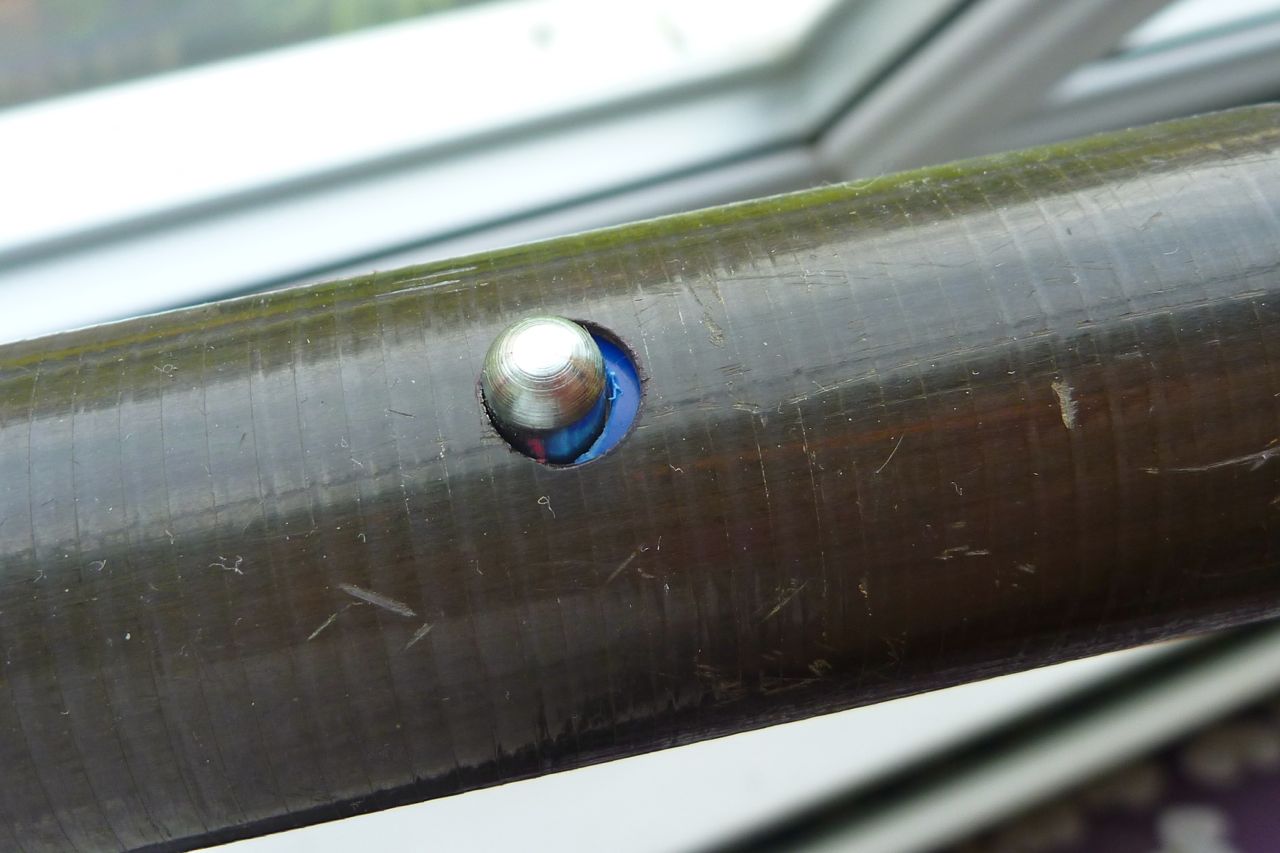
Find a bit of tube that’s close to the right diametre to slip into your paddle where the blade goes. My blue tube was from some cheap paddle that came with a long-gone slackraft. Add tape to make a snug fit, if necessary. But not so tight that you risk jamming when wet. Drill a hole at a point where there’s enough overlap to make the assembly strong, and then fit a spring clip. I bought a pair on eBay for a fiver, though you can buy cheaper pressed out ones for less. As it happens it turns out my Aqua Bound uses cheap pressed clips. You may not be able to find the typical 7-8mm buttons to fit the AB files. I settled with 6mm. This spring clip is easy to fit and a big improvement over my previous ‘slip-on’ nib which got sucked off in bogs.
Match up the overlapFit spring clip into blue nib6mm button in 8mm hole
Collar is important to take loads off the button
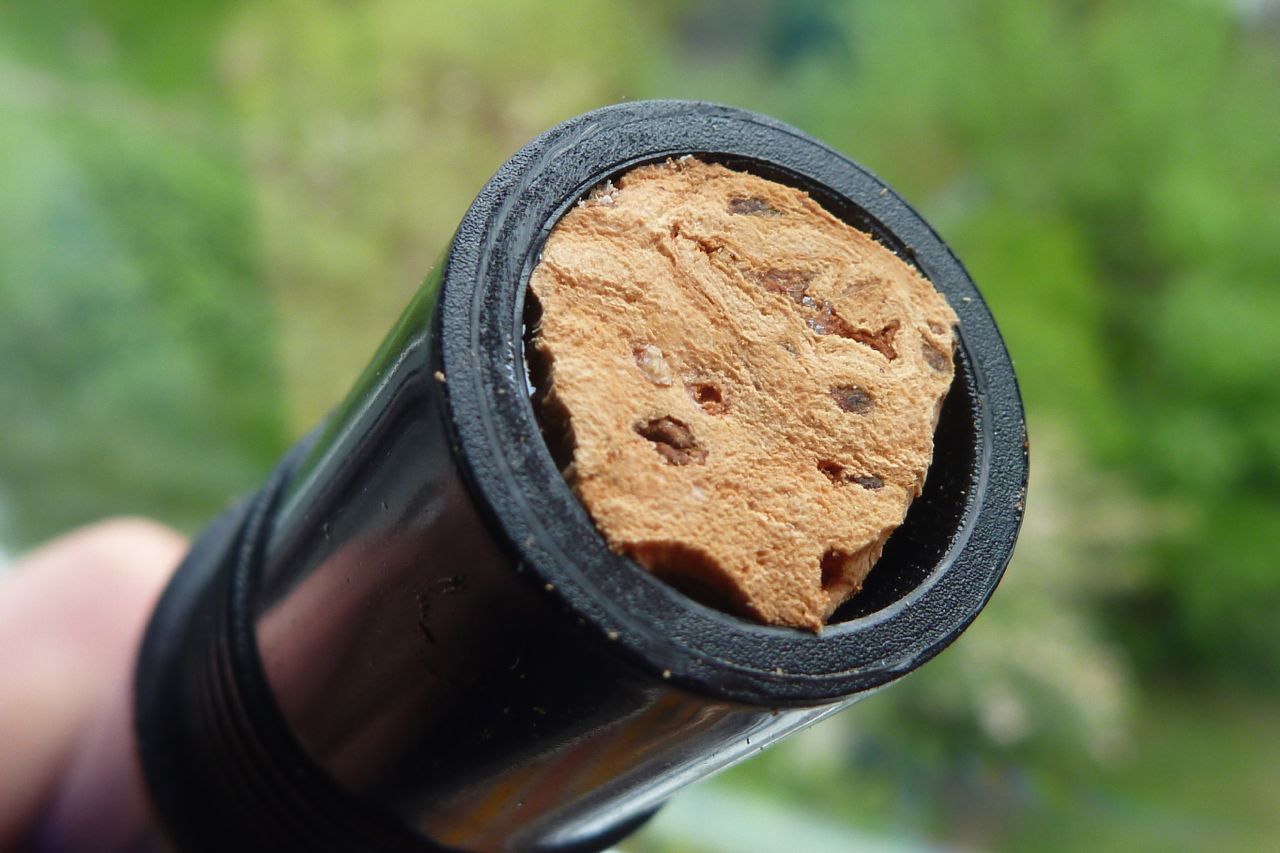
Next, line up the two holes or fit the spring clip and add a collar. You don’t want the nib’s striking force impacting on the clip’s button alone. I sawed a bit of old fibreglass kayak shaft which was a tight fit on the blue tube, so split it then glued it on. That glue didn’t work so well so I added a couple of rivets. The collar also protects the end of your paddle shaft. The actual end ‘nib’ is currently a black plastic screw section. Stuff and glue in a bit of cork or other blockage in your nib end (right) to stop the tube slowly filling with mud or stones. The nib weighs 137g.
All up my packstaff weighs 213g. The AB paddle is 890g
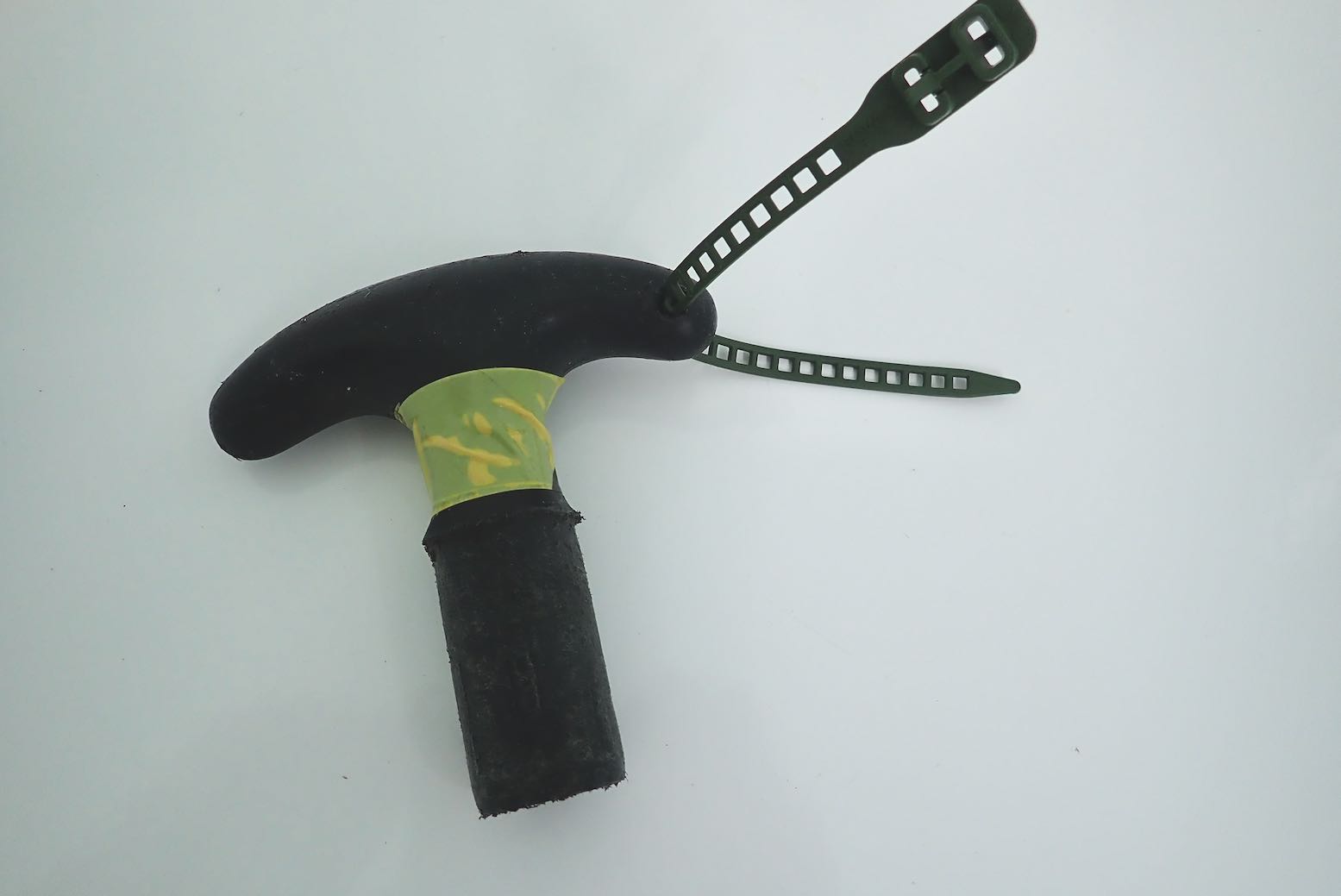
Using the packstaff with an open shaft at the top, I sometimes worry that stumbling onto that shaft at face height could take an eye out. With a canoe T-grip (below left; fiver on ebay) you can press comfortably on the staff coming down a hill, and it also acts as a handy hook. Mine had to be ground down to fit. It weighs 78g with a 6mm SoftTie to attach it to the nib during transit.
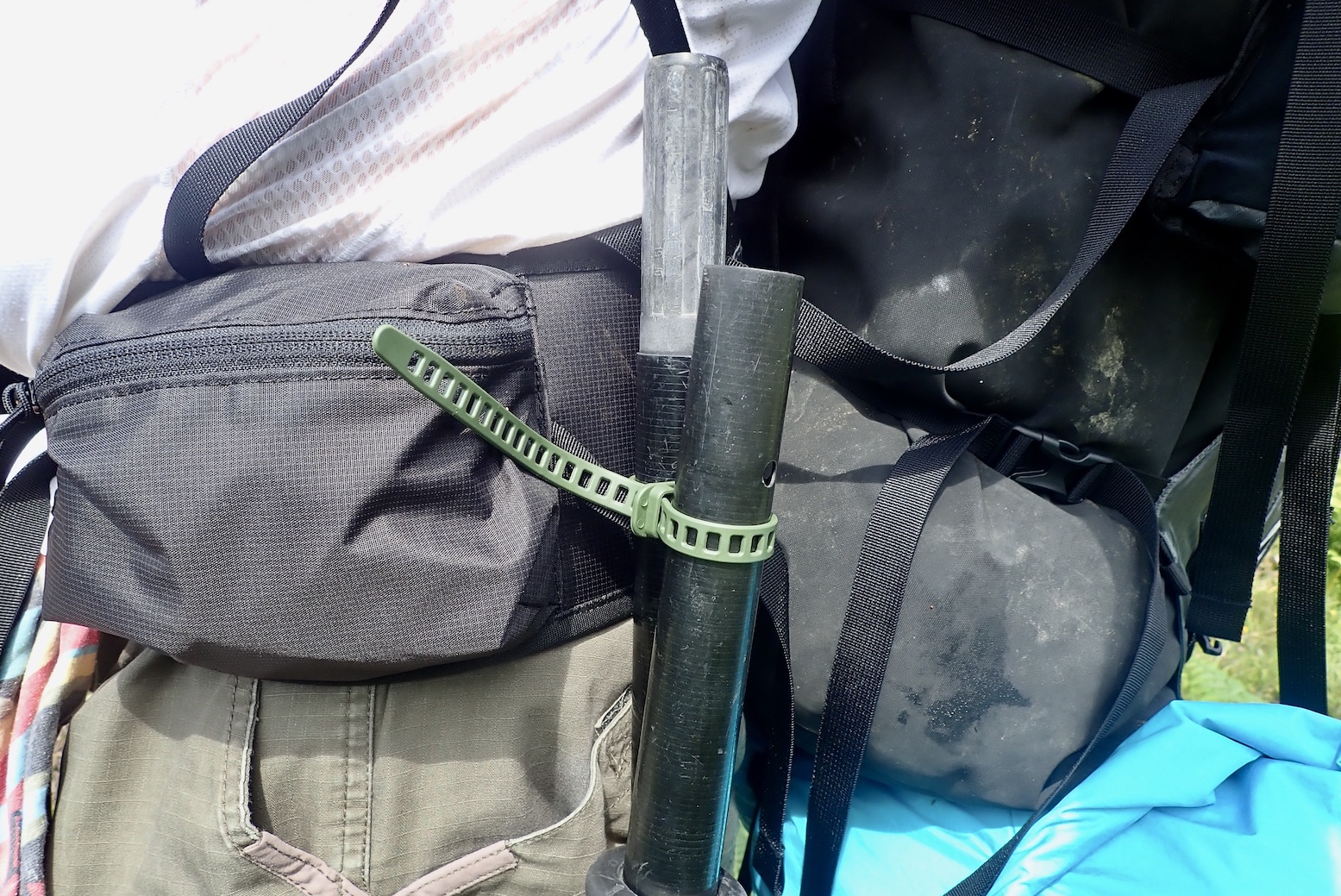
When you don’t need to carry the packstaff you can stick it under a shoulder strap, but I find it slips out. So better to break it down to two parts and slip it under a belt or similar loop. Again, I find the double-loopable SoftTies handy for this, and the loop stays on this paddle to make a handy paddle leash attachment using the mooring line when sailing or in rough open water.
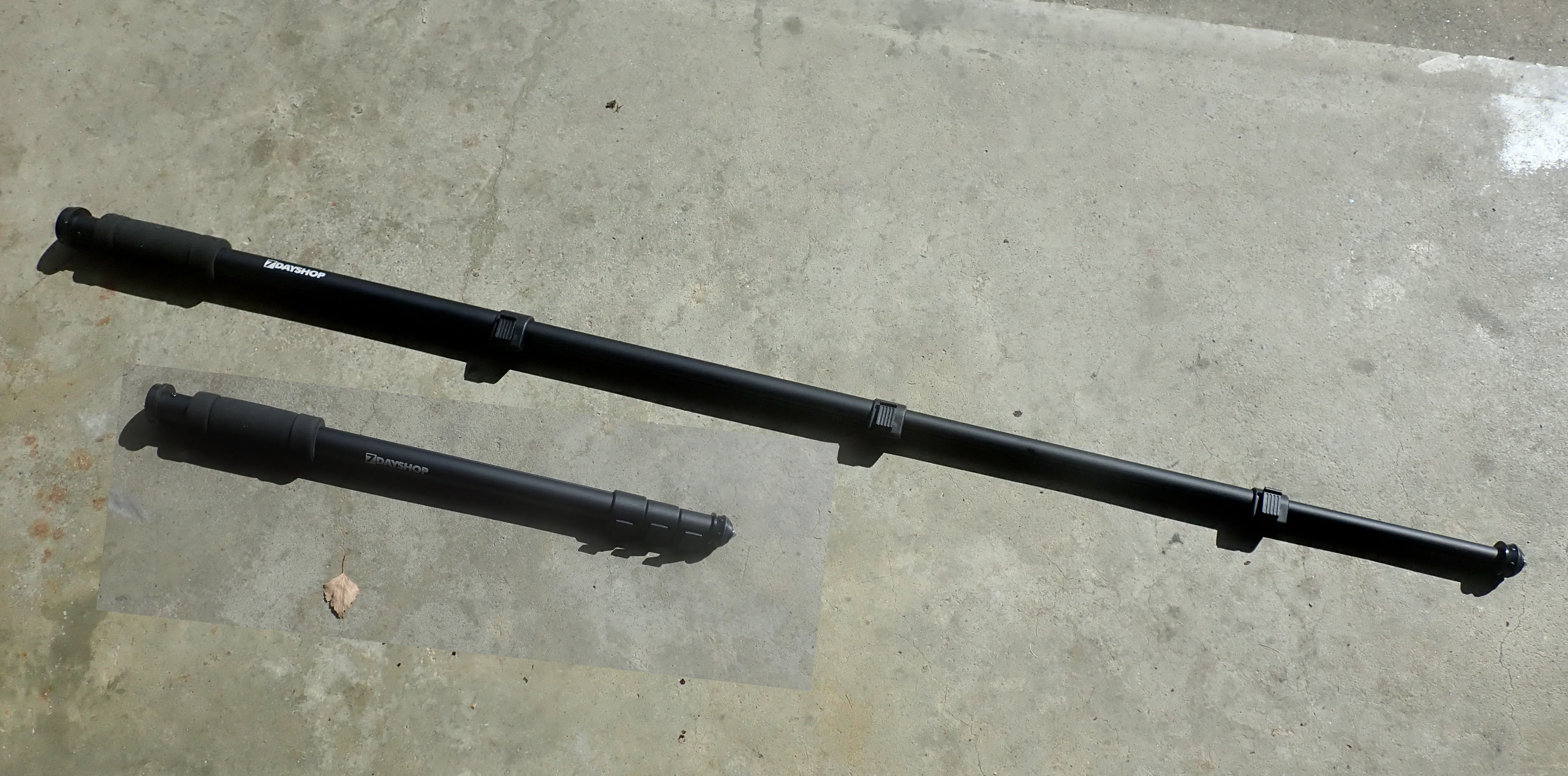
Packstaff 2 In 2022 I got an Anfibio Vertex Multi Tour 4-parter so sold my old Aqua Bound Manta Ray 4P which weighed about the same. The Multi Tour comes with two canoe handle sections to make a pair of canoe paddles. I can’t see myself canoe paddling but figured there must be a way to convert these pieces into a Vertex packstaff. Sure enough there is. Use the canoe paddle add-on handle with the clamp on the end and the section of paddle shaft also with the clamp, then saw the handle off the plain canoe handle section. You now have a three-part, length adjustable packstaff. Jam whatever nib you think is needed onto the thick carbon-plastic end of the sawn-off handle. The whole thing weighs 400g, and the advantage of length adjustment between 100cm and 133cm, which may have its uses. Annoyingly, in a noble bid to reduce excess gear I sold the Vertex and kept the Wave. I’ve since found an unused alloy, telescopic camera monopod that’s as long, weighs 370g, a bit less than the Vertex set up. It’s clearly not designed for packstaffing so I’m not sure it won’t slip under heavy loads. We shall see.
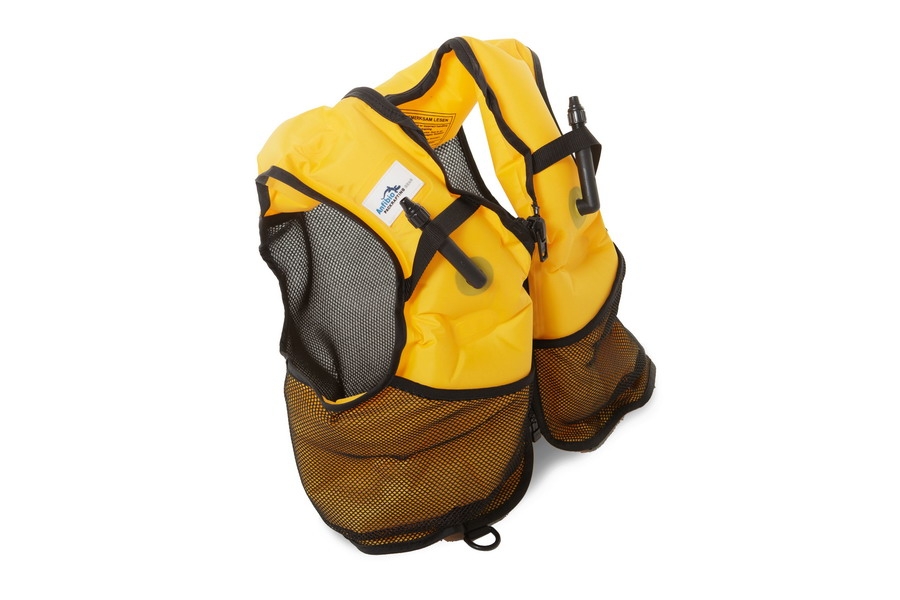
Back in 2015 the Packrafting Store in Germany sold us a couple of pre-production Anfibio inflatable packrafting vests to try out. These came without the big mesh pockets, unlike the current production item, left. Called a Buoy Boy, an ‘inflatable jacket’ or buoyancy aid is all they claim to be, not a PFD, far less life jackets. They don’t even claim to have the rescue/harness elements suited to white water recoveries, as found on better PFDs. A warning label inside spells it all out. Instead, your Buoy Boy bad boy is just a compact, unobtrusive buoyancy aid that’s well suited to sedate packraft touring.
You clip the waist clip and hook the strap under the crotch to stop it riding up, as can happen with a regular PFD, then zip up the front. Our prototypes had two ‘push and blow’ valve tubes inflating the two chambers (three breaths each). These chambers don’t cover the lower back which is composed of a thick, stretchy mesh below the inflated collar (left), so avoiding that inelegant ‘pushed-up PFD’ look in your packraft. The rear collar around the neck might even float you unconscious, face up, like a proper life jacket, but that would be a happy coincidence and despite the appearance, it is not a design element.
We weren’t even planning to take our regular PFDs on this mid-winter trip, so a compact option came in welcome, especially when a late-night boat ride required them. Best thing: it’s unobtrusive to wear deflated, doubling up as a high-viz vest whose benefits we also appreciated when road walking in the Scottish mid-winter gloom. We even inflated them while walking in freezing conditions to act as extra insulation, while at other times the Buoy Boy will be less hot than a regular PFD; another problem I’ve found when foam PFDs and paddling in 25°C+.
Weight is from 340g to 400g for a Med/Large. My ‘M/L’ was a snug fit once fully inflated over all my mid-winter clobber (I’m normally 42″ chest). A great bit of kit that I can see becoming my regular day-tripping BA, especially when I have to wear one due to regs rather than need to due to conditions.
Update. I used my orange BBoy proto just about all the time as most of my paddling is flatwater and it’s great not to feel cluttered. I bought myself a larger L/XL with horizontal valve straps and very handy large frontal mesh pouches just what was needed. Unfortunately it was black – I prefer brighter colours for safety and photos. Now in 2018 colours are blue (S), yellow (M/L) and black or yellow (L/XL) – hooray! A roomy Large on me weighs 450g with crotch strap. Price is €99. More details and photos here.
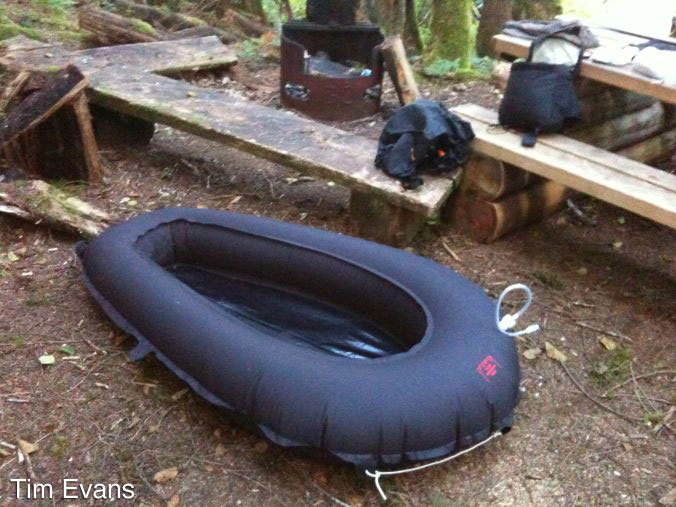
At a verified 670g (23.6oz) including an added grab line, Supai Adventure Gear’sFlatwater Canyon II ($300) must be among the world’s lightest and most compact boats. Before a winter storm blew our plan off the map, the trip we’d lined up in northwest Scotland was ideal for the Flatwater: short crossings saving lengthy overland detours or risky deep wading, but no extended or exposed paddling.
Fabrication Examining the deflated raft, it became clear it was composed of just four pieces of flat material: the top and bottom ‘rings’ which define the hull shape, an inner hull wall joining the top to bottom, and the floor fixed under the completed ring. You could almost make one yourself.
No fabricdetails on SAG’s website, but the Packraft Store states: ’75 denier polyester with single, innerside urethane coating’. This whole denier thing can be a bit misleading, the raft fabric looks and feels similar in thickness to my MSR Dromlite water bags (right) made from 200 denier, PU-coated Cordura (nylon?), but the Flatwater polyester has what looks like a reassuring ripstop weave (visible below left). And as we know from our studies in IK hull fabrics, polyester stretches less than nylon and so is more suited to inflatable boat applications than compact water storage. Where the seams overlap on the outside edge they’ve included seven reinforced tabs (above left) to use as attachment points (a weak point on my non-ripstop Dromlites, even with an eyelet). The floor is made of the same weight fabric and shows what look like ‘spot welds’ along the inch-wide seam (middle).
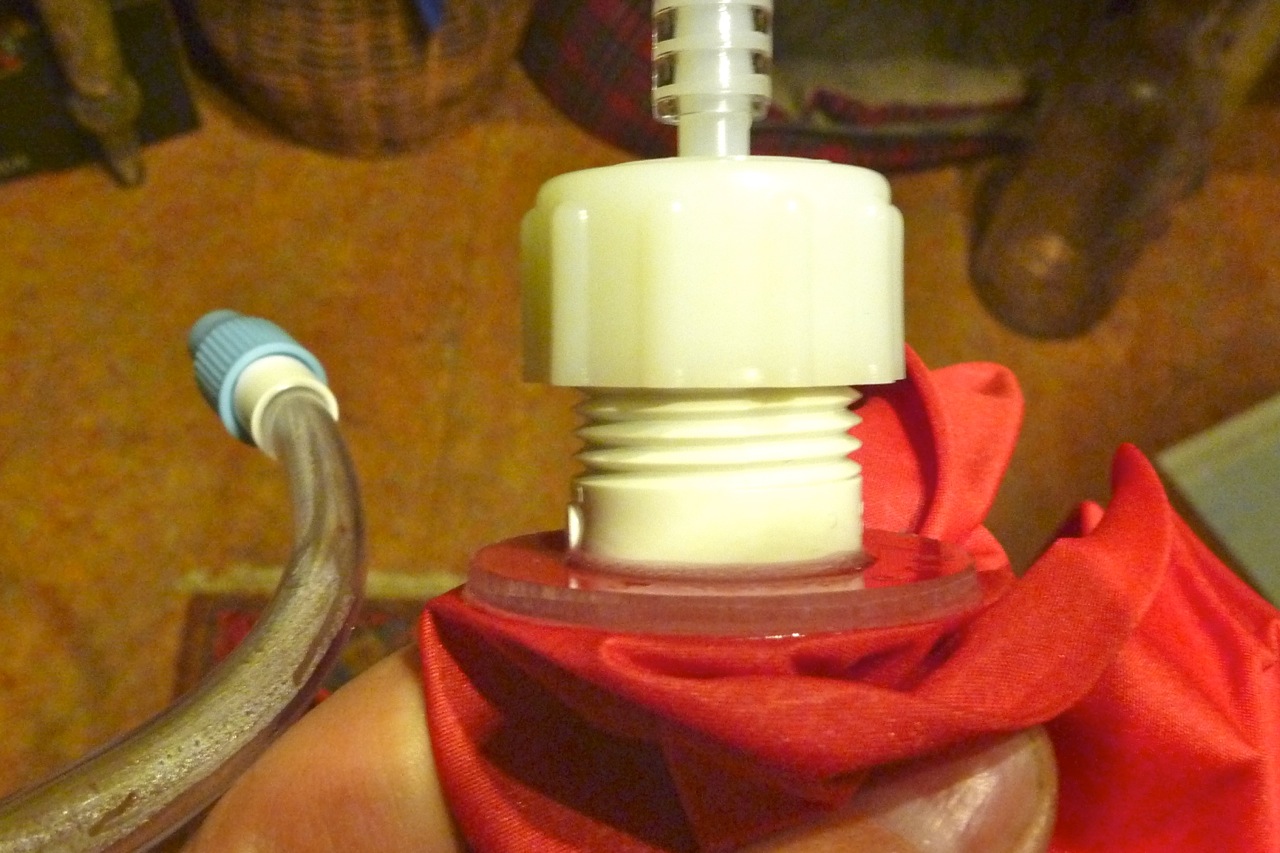
That’s it, apart from a big threaded inflation port onto which screws a white cap fitted with a 18-inch hose topped with a blue twist-lock valve (left). You blow the boat up by mouth (took me about 45 breaths) then top up to operating pressure with the twist lock, like on an Alpacka. But unlike a pre-Boston Alpacka, the long hose means you’re able to further top-up from the water where inflatable boats initially sag as they cool. Plus you could potentially manage a slow leak the same way.
The hull form tapers and narrows towards the bow to resemble a blunt wedge, similar to old Sevylor Trail Boat (right). Like all packrafts and even slackrafts, the added buoyancy (tube diameter) in the stern counteracts the mass of the paddler’s weight. There’s no seat and a new boat comes with a repair kit with full repair instructions on the SAG website.
Some of my measurements (checked several times and now confirmed by the Packrafting Store) vary greatly from those still posted on the SAG website many years later in 2020 and which had their Canyon over 10% bigger, inside and out. Even if they’re factoring in ‘paddler squidge’ making more room inside by pushing on the hull, that won’t make the boat seven inches longer.
As for buoyancy, SAG originally quoted ‘250lb’ (now a more realistic 200lb or 90kg). Robin briefly paddled the raft with his pack which we thought added up to about 100kg. That felt like the limit once a light breeze came up the valley, and required gentle paddling to avoid too much cyclic bobbing and possible swamping.
With the weight; the Store states 633g, SAG quote 24oz (680g). As mentioned, with a grab line and traces of dirt, our boat comes in at 670g on the IK&P calibrated kitchen scales (left). I won’t quibble over 40 grams; to be able to paddle across a loch in a boat weighing less than my trousers is quite something.
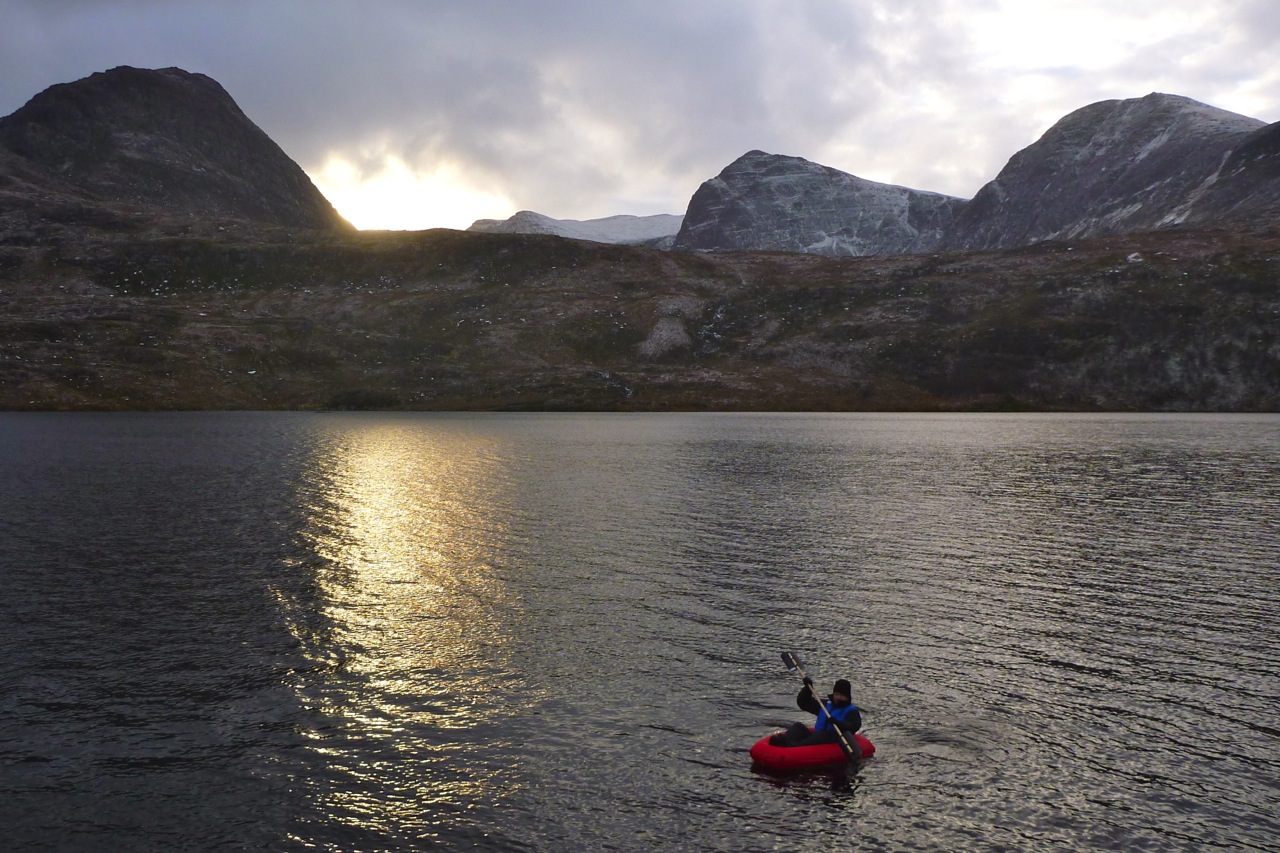
On the water The air was calm but temperatures were close to freezing as we set off to cross the eastern narrows on Loch Lurgainn below Stac Pollaidh mountain. We’d originally planned to come over in the other direction from the Culnacraig shore, but the storm which went on to wreak havoc across Britain nixed that plan (story here). So today we were just taking a 10-mile day trip with a short paddle, from Stac car park southwest back to Altandu.
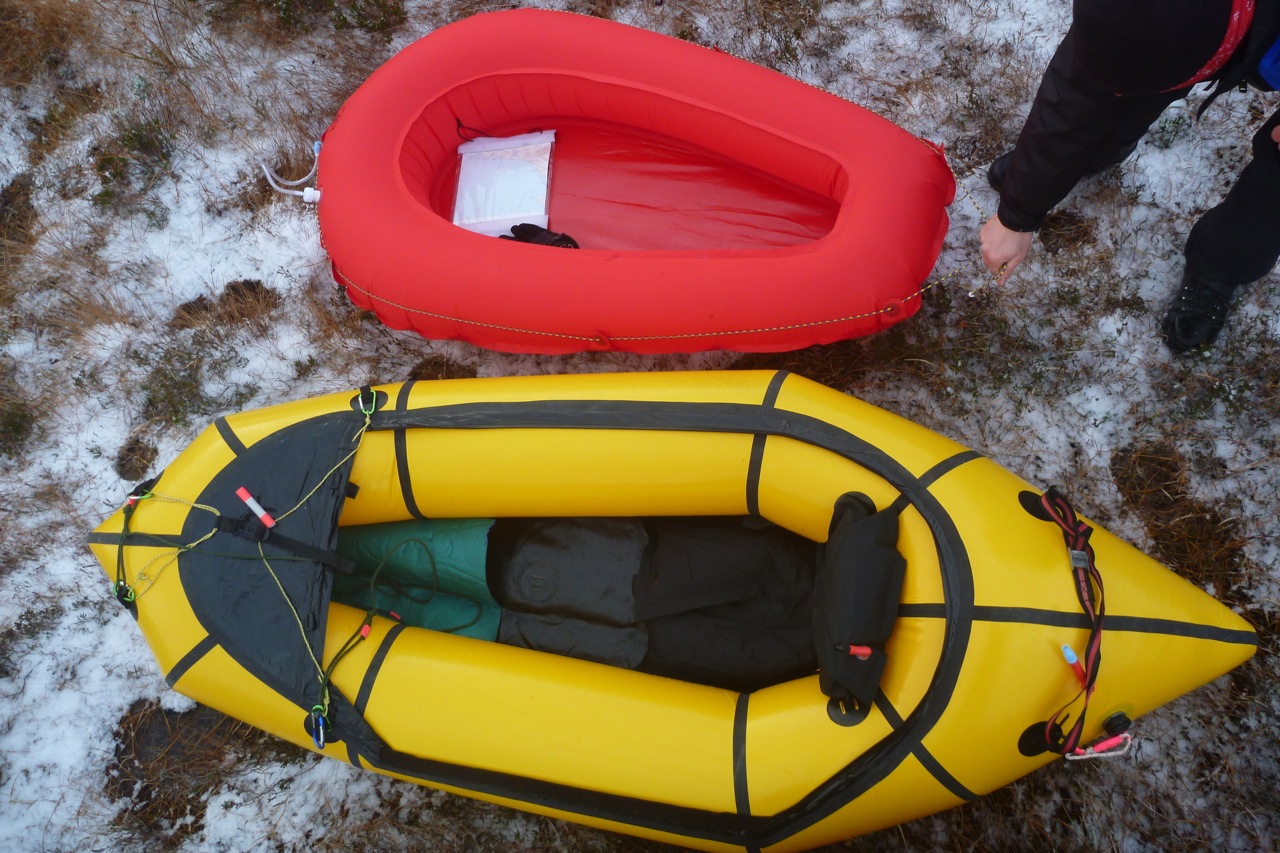
I tried to get directly over the two boats to get an equal perspective but I still think this shot makes the Supai appear a little smaller than it really is. I make the Yak ~42% longer.
‘Fragile and small’ had been Robin’s first impressions after Sven from the Packraft Store in Germany sent us the raft to evaluate. Robin had recently upgraded to a couple of Gumotex Twist IKs so may not have been impressed by the Supai’s thin fabric. I had more faith in that, but as for the size, I too anticipated that SAG had cut it a bit fine with the Flatwater II, even if it lived up to their motto: ‘where every ounce counts’.
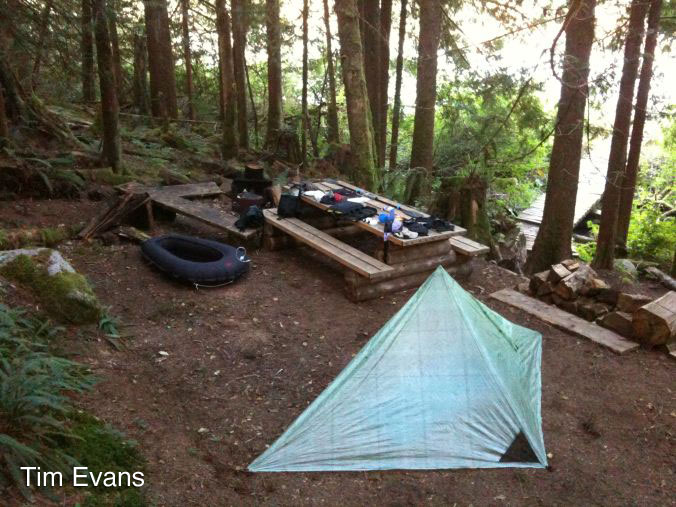
Down on the loch shore, even with a helpful breeze to fill my Yak’s bag, inflation time for both boats was actually the same, although by the end of it Robin was staggering around a bit. As Tim Evans found on his trip, other inflator bags can be adapted to avoid passing out.
Now, laid alongside my Alpacka Yak (same width but 66cm or over two feet longer), to me the Flatwater’s proportions rather too closely resembled a slackraft I skinned from a Sevylor pool toy a year or two back. I knew that with my weight of about 100kg in gear, I’d be pushing this boat’s limit. Without a drysuit I didn’t want to risk it.
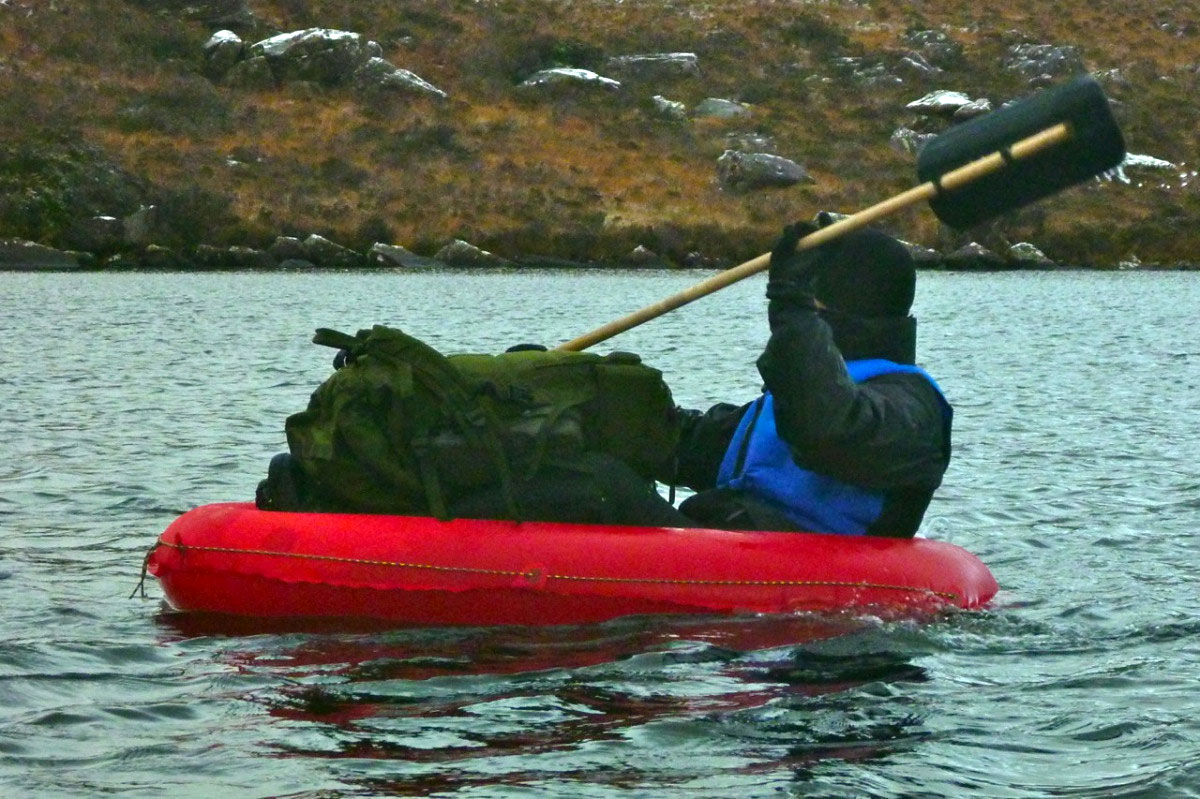
It took some prodding to get packrafting newb Robin (80kg + clothes) in the Supai and I’m not sure I blame him. A sudden move could see the stern dip down and douse the butt. After fitting his closed cell mat to keep warm and protect the thin floor, he set off for a quick spin and soon realised there wasn’t so much to worry about. Paddling gingerly with his home-made paddle (a broom stick, two sawn-down buckets and zip ties) he did a few loops while learning to control the annoying yawing you get with short packrafts and slackrafts, as well as managing the less welcome bobbing which might amplify into a back-end pour over. Yawing keeps the speed down which may be just as well. Start paddling too fast and the bow will rise with a corresponding drop at the stern when slowing down, again risking a pour over in wavy conditions.
Having established he wasn’t going to sink with all hands, I lowered Robin’s 10-kg pack onto his legs then hopped into my Yak. The pack’s added frontal weight should minimise the Supai’s yawing – at least that’s the effect on my Yak. But it’s well known that first time in a new packraft, especially a short one like the Flatwater, paddling efficiently is an acquired knack. Our extra chilly scenario (not helped by his experimental B&Q paddle) meant that Robin couldn’t really relax or bomb around in the Supai. (I tried his B&Q but soon sent it back as it brought in unwanted splash all over my boat). A gust rolled up the valley, rippling the loch’s surface, adding further to the feeling of anxiety in the Supai. From my PoV it looked like the stern was more than half sunk at times – and half sunk on a round tube makes pour-overs all the easier. I skimmed over to the other side and got out to get some long shots and was reminded yet again what a great boat my Yak is. No worries about getting in clumsily, sudden winds or carrying Robin’s pack. Sat here a day earlier when a gale was ripping through at an average of 35mph and gusting to twice that, it may have been a different story, but my long-bodied, yaw-suppressing, high-sided, tough hulled Yak inspires confidence, even without the spray skirt.
The price you pay is weight and bulk. Ready to paddle, at 3.1kg with seats, heel pad, pack attach and lead,plus other straps and some mini krabs, my boat is 4.5 times heavier than the Supai as tested, and even more bulky when you add in the blow bag, skirt and repair kit: the red bag shown right.
Robin slowly waddled over to the south edge of the loch and got out with care before pulling the plug and rolling it up. As on any inflatable, the floor is vulnerable and we discussed ways of getting round this. One problem is the Supai’s floor glues to the hull ring above the lowest points in the hull tubes which means the undersides of the hull are actually lower than the floor (until you sit in it on the water). Using a thicker floor panel won’t eliminate all possible wear. Robin is a versatile home-fabricator (as his B&Q paddle proves) and we decided the least invasive way of protecting the entire underside – hull and floor – would be to string a sheet of whatever you like from the peripheral half-inch hull seam (the seven reinforced tabs not being quite enough to do the job). No messy, irreversible, crease-inducing gluing required, just a line of holes along the seam plus a drawstring. Pre-emptive protection is something I’ve done to my Alpackas’ ballistic nylon floor and although it won’t look too neat, a floor sheet would enhance the less robust Supai’s undercarriage, despite a weight penalty.
Our conclusion He may have got used to it over time, but the Supai felt too skimpy for 80-kilo Robin. Ill-dressed on the day and over-fed in general, I didn’t even try to get in. Build quality is great and the fabric I could live with; it’s much better than slackraft PVC and the extra care needed in handling is well worth the weight saving over an Alpacka. Factoring in experience, company (support), weather conditions and operator weight, the Supai felt right on the limit. Initially you’re reluctant to paddle normally for fear of swamping which could turn exponential. Alongside a Yak it’s a pretty slow too, although I don’t think that’s a flaw. My Yak is slower than my IK which in turn is slower than … As long as it makes progress, a boat is as fast as it is.
Alpacka’s Scout might be a fairer comparison with the Flatwater II. According to Alpacka stats it weighs 1450g, is 4.5cm narrower, 2cm shorter inside and 26cm longer overall, while costing at least $200 more in the US. That still puts the Supai well in the ballpark on weight and cost.Anfibio’s Alpha XC is another which I’ve actually tried. Although it looks to have been designed for the canyon lands of southwest USA, for the lighter paddler the Supai could a great packraft for less predictable Scottish conditions involving short, flatwater crossings. The negligible weight really opens out the options and means you don’t have to get too fanatical about the rest of your gear which can translate into greater comfort.
I knew this even before I saw the boat, but what I’d love to see is a Flatwater XXL more closely matching my Yak’s (or my) size. I’d happily trade the extra 8cm of width the Supai has at the hips for fatter and higher tubes all round, plus another 10cm added to interior length. It’s hard to think that would add up to much more than a kilo overall, but would reward the portlier or overnight-equipped paddler with a more versatile boat able to deal with dodgier conditions. Let’s hope this is part of Supai’s game plan. * SAG later released the Matkat. Not exactly what I was thinking but we tried that too.
Photos also by Tim Evans who writes:
I got interested in packable boats as I love both walking and being on the water. My first major trip was in an Alpacka Yak from Whistler to Vancouver. I hiked for 2 days, paddled the Cheakamus River for a day (with some easy whitewater), then paddled 24 miles of ocean inlet back to Vancouver. This trip was only possible because of the packraft. Then I bought a Supai and did 35km through a lake system north of Vancouver that included a number of portages. I saw a pair with a canoe which they pushed on a trolley through the portages with 200lbs of gear. It took them hours to go a few km. I did the 4-day trip with 16lbs of gear including food, just to see if it could be done (it can). I could have jogged through the portages with my little boat tucked under my arm. The Supai was a light as it gets, but SLOW for any sort of distance.
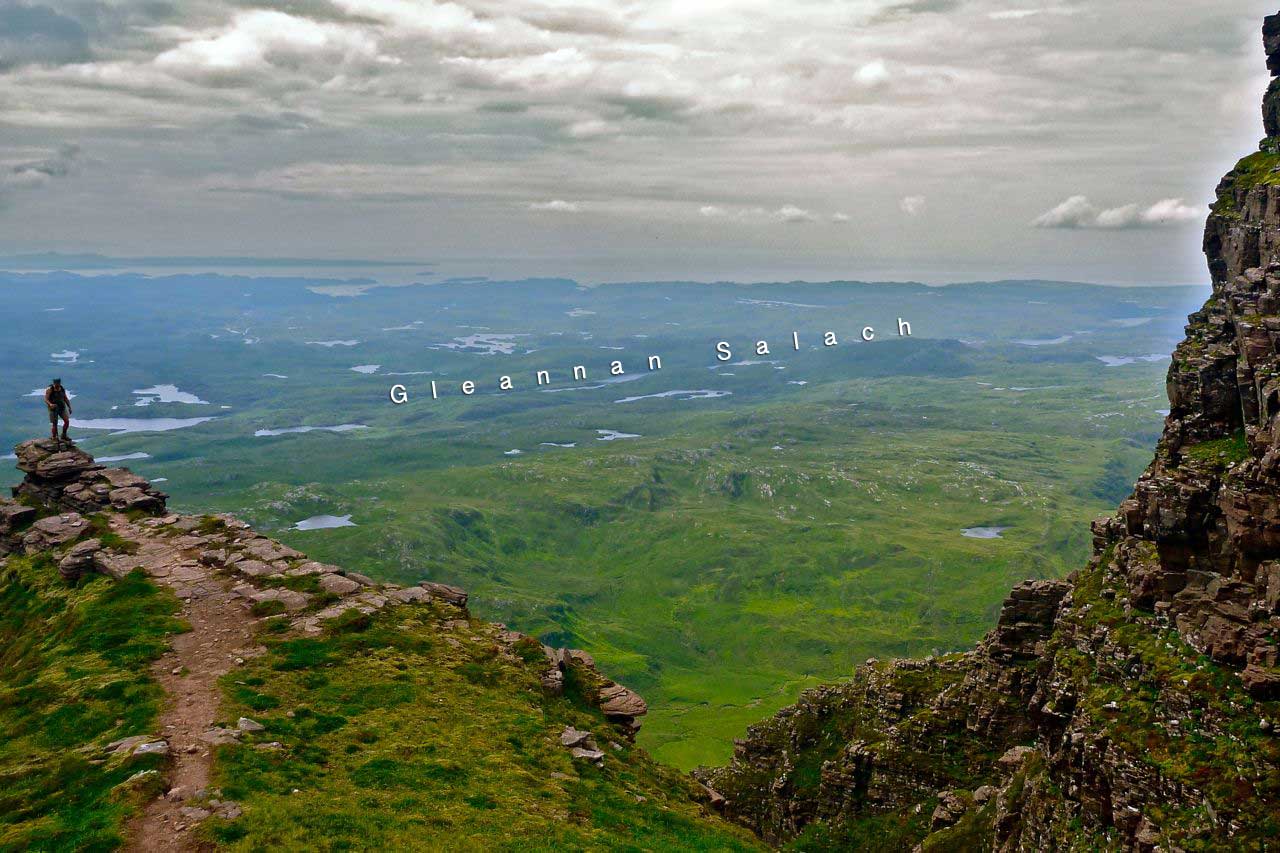
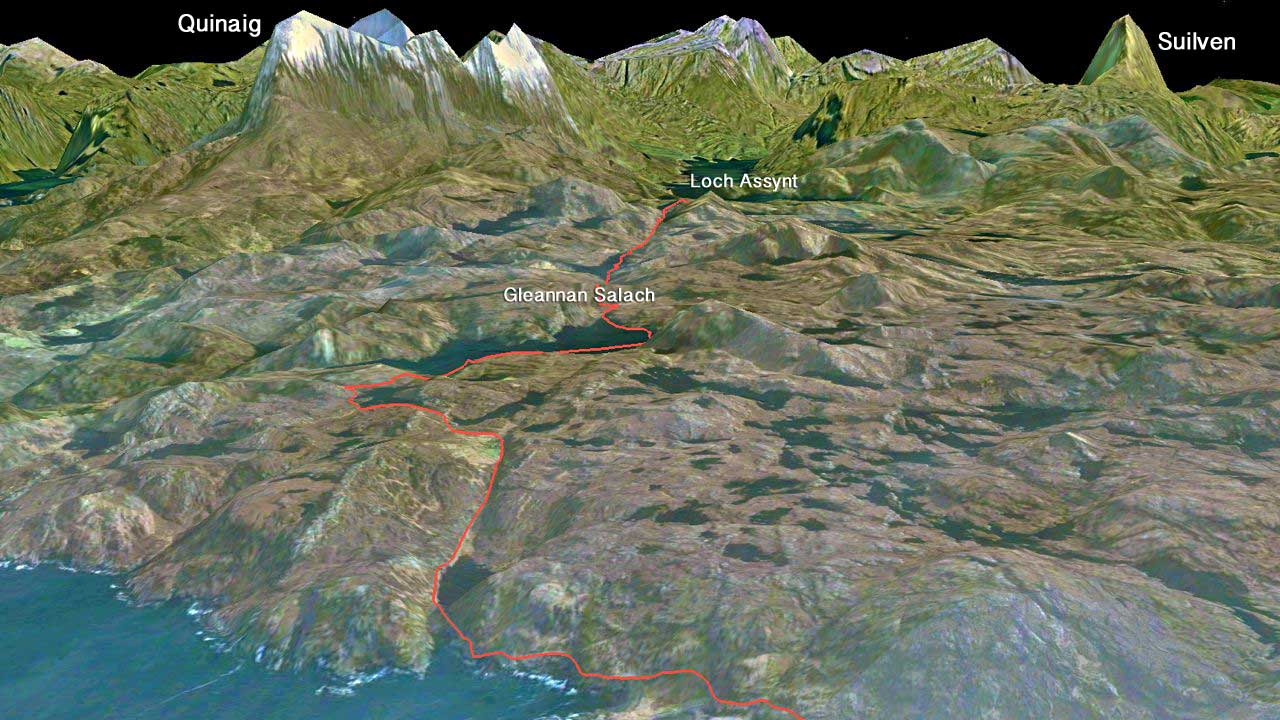
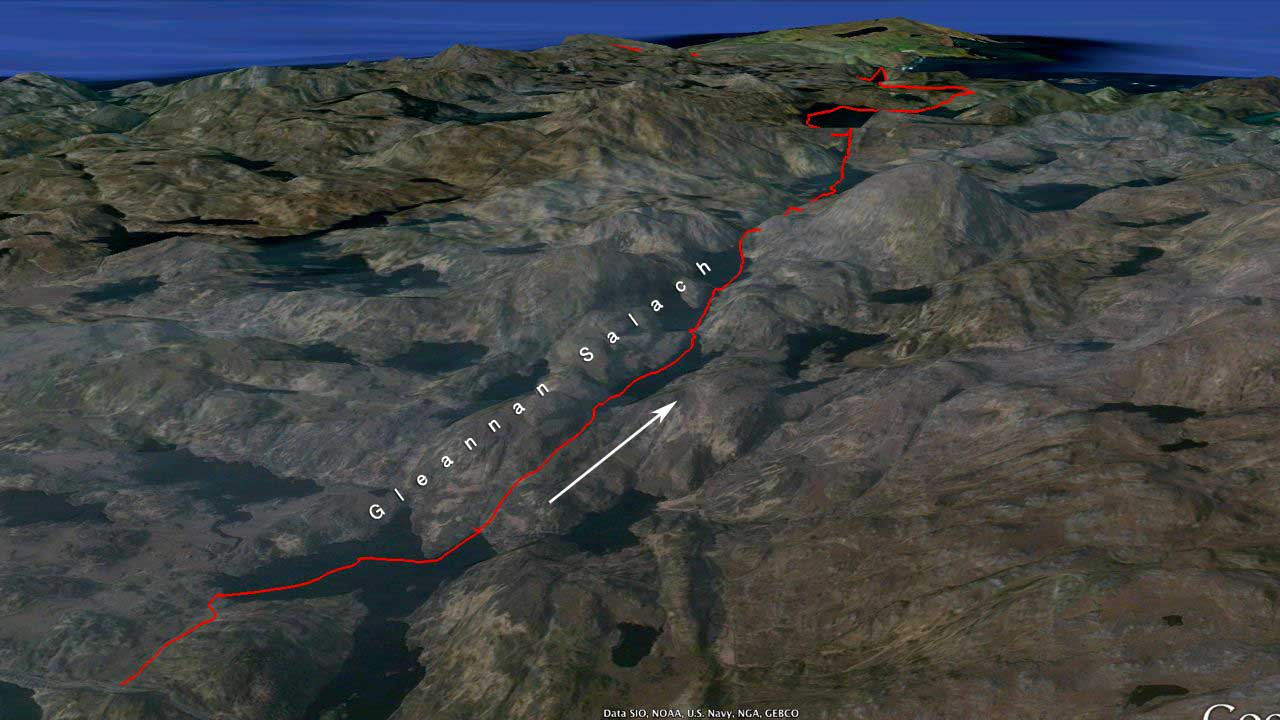
As we left one car near Stoer, out to sea a stampede of white horses were galloping in towards the Bay of Clachtoll. It looked like a late 90s Guinness commercial out there. We didn’t want to be kayaking in that, no sirree. So instead Jon and I swapped craft and set out to follow a string of lochs which filled a fault line marked on the maps as ‘Gleannan Salach‘ (above). It ran west from Loch Assynt to the sea, across a lochan-speckled headland tipped by the Point of Stoer. To the south Enard Bay (which I kayaked a few weeks ago) to the north Eddrachillis Bay; all ringed by the cute Drumbeg road. I’d clocked this as a viable packrafting ‘line’ some time ago and today was the day.
It was only about seven miles, road to road. But from the look of the map and knowing the terrain around here, I expected the walking stages to be sodden, gruelling bogs or chest-high fernfests. We’d found as much on Horse Island the previous day. Jon was debuting his skinned dinghy (more on that idea here), last seen here during a bitterly fought offshore jousting tournament we’d held off Achnahaird Bay a year or two ago. I’d cut my own slackraft down a while back but found with my weight, the freeboard was a limited and the slightest wave would swamp it. Luckily that was all the excuse I needed to be allowed to use my proper packraft.
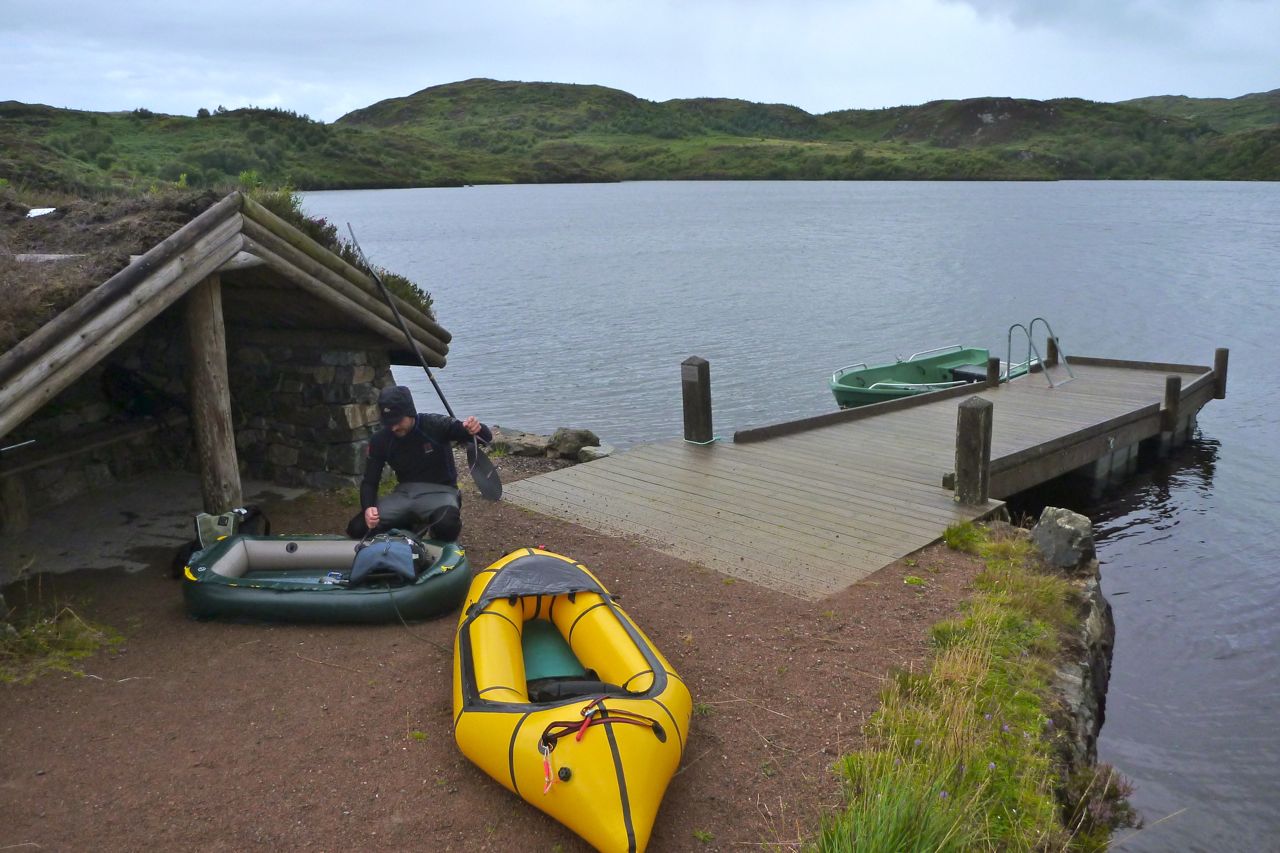
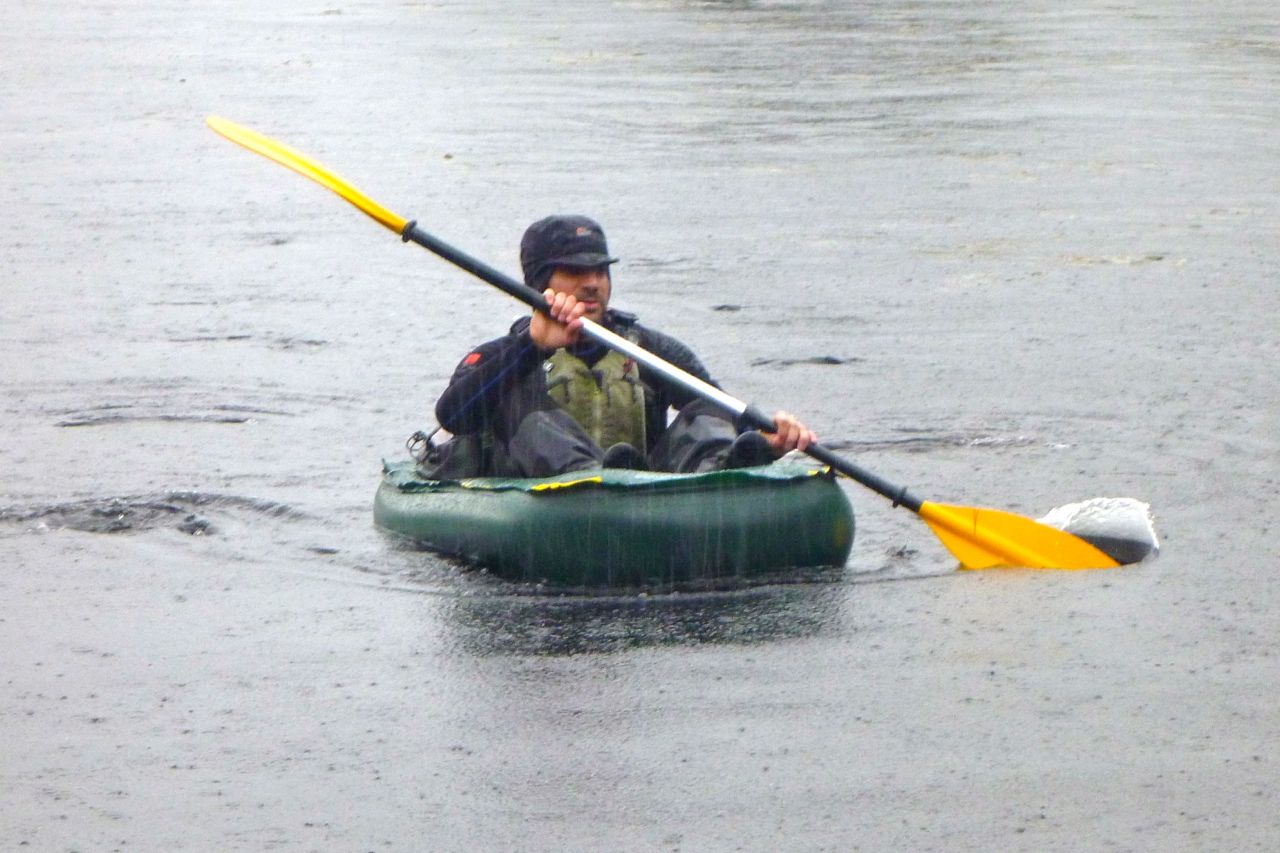
It was going to be a day of blustery winds and heavy showers so appropriately dressed, we parked up at the Leitir Easaidh end near Loch Assynt and put in at a shelter by a boat ramp. On inflation, Jon’s slackie looked ridiculously small, an impression that worsened once he actually got on it. And on the water the situation deteriorated still further; that thing pulled half the speed of the ‘packa, yawing left and right like some demented dashboard ornament in need of a good slap.
A relative novice to slacking, it’s possible Jon was paddling as if he was in his 17-foot sea kayak which has a length/width ratio of over 8:1. On his slackie it was less than 2:1. Long, powerful strokes merely flip the bow left to right, as I found when I first tried my original Alpacka Llama. It takes a bit of a knack to limit yawing, although the newer ‘fastback’ tailed Alpackas like my yellow Yak, greatly minimised that. Previous slacking expeditions in France and the Kimberley has been with unskinned, full-width slackboats which attained some two thirds of an Alpacka’s peak velocity, once you’ve divided the surface tension by Ω x π. It brought up the troubling possibility: was removing the outer hull to gain slimness at a slight loss of buoyancy not as efficacious as previously thought?
Jon’s in there somewhere, collecting ticks
By the time we got to the far end of Loch Leitir Easaidh we’d already been rained on and blown about twice. Faced with a steep climb through knotted woodland and thick bracken, we rolled ’em up and go stuck in. Soon we were at the pass which overlooked the next lochan and by the time we were back at the pumps that one mile had taken an hour.
We estimated the rest of the crossing would probably be at the same slug-like pace, so to get home before Christmas, I towed the slackraft. Jon paddled too of course, the tow line constraining his rampant yawing as we clung to the leeward south shore. Alone on windless flat water, my packraft can sit on 3 mph. Out of the wind our packboat convoy managed about two which was good enough. At the far end a short portage dropped us a few feet down to Loch Three, and at the end of that one a deer fence stretched across the small weir before Lochan a Ghleannein Shalaich, loch #4.
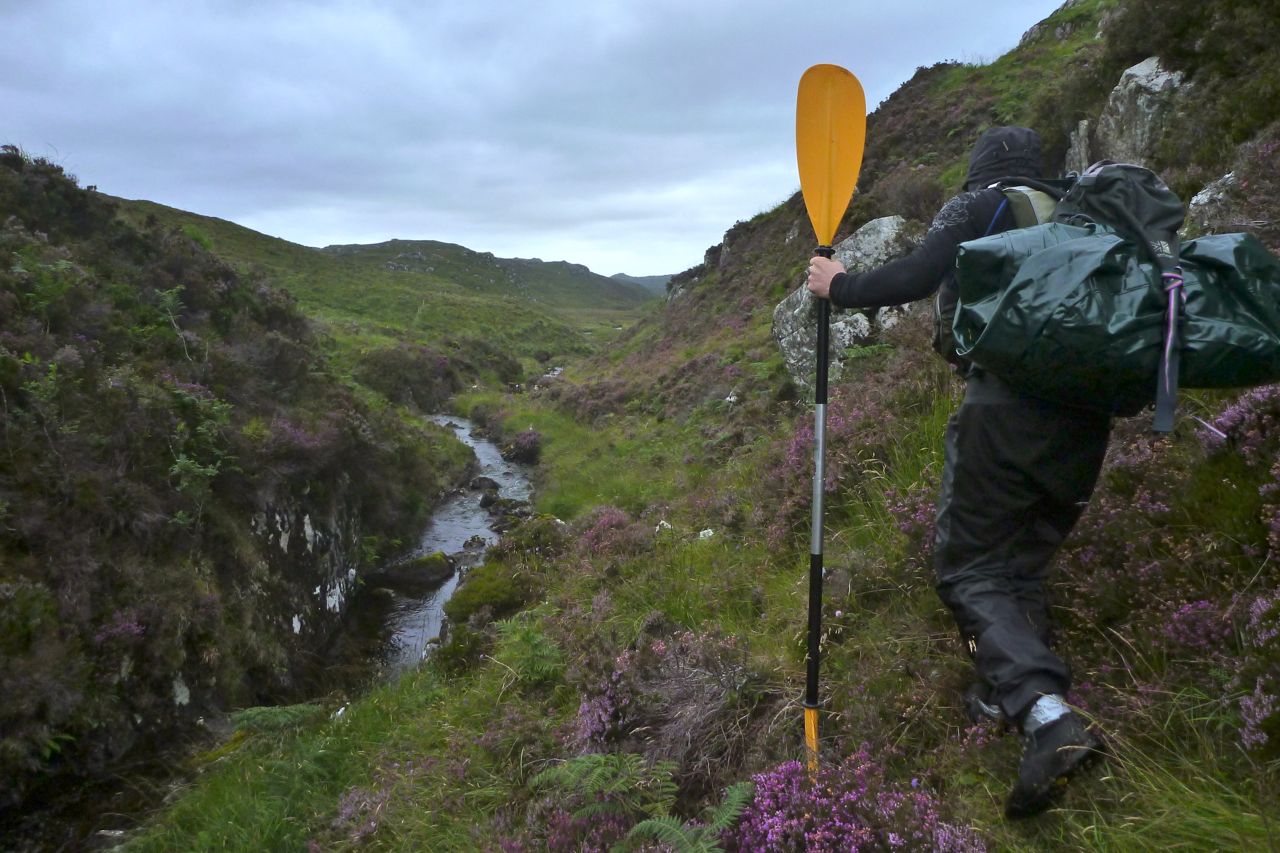
At this point the map showed the flow funnelled into a narrow gorge which could mean an awkward climb to get round. We’d decided if it took ages to get to the gorge we’d turn back, but lined up we were averaging a little over our target 1 mph so the mission rolled on. Better still, an easily walkable route ran alongside the stream through the gorge (above), then opened out to an agreeably grassy basin that didn’t involve thrashing through chest-high bracken or sinking into unset peat. Unusually, walking here proved to be faster than paddling.
That stage gained us some time, but back on the water we took a few steps back. The southwesterly gale sweeping across Loch na Loinne must have been accelerating round Cnoc an Dubharlainn, at 223-metres, the highest hill in the ‘Salach’. A couple of islands provided inadequate protection from 35-mph sidewinds which hammered down on the rafts. We both dug hard on the right and barely the left across the exposed bays, managing between 1.5- and 2 mph, though it sure didn’t feel like it. The shortest rest saw us skitting across the choppy waters to the northeast bank.
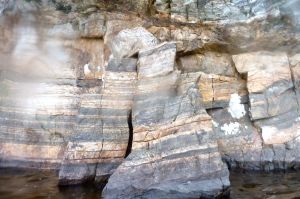
Out of the wind it’s another world. By a wooded cliff we glided past the controted, banded Lewisian gneiss that makes up the bedrock of this waterlogged region. Said to be three billion years old, the Salach badlands has had its capping of oxblood coloured Torridon sandstone scrapped away, right down to the raw bones of the primeval gneiss. At the far end they’d built up a rubble and mat barrage which diverted the outflow through a pipe. Purpose unclear, but after the effort of getting here, I suggested we unline for the next little loch before one more portage brought us to Loch Poll, the last and biggest loch.
Untethered, the Alpacka Yak skimmed across the lochan like a spun stone. Jon was not so far behind and we both squeezed under a fence and along a channel before we ground out on mossy boulders and took to the banks. The whole traverse seems to follow an ancient wall and a newer fence, and as the winds strengthened we popped through a lonely gate and over a pass clinging to our inflated boats. Down on the far side, again we managed to paddle a meandering, reedy stream until a small waterfall barred access to Poll. Raining, blowing and cold, it was a good time to cram in the last of our squashed snacks for the final haul.
Slackerman, where you gonna run to? And a haul it was. The winds and rain intensified to the point where we decided, that even at our glacial pace, better to take a longer route around Poll’s southern edge. Flat against the wind at times, from the look of the passing shore, our lined-up flotilla crept along at barely a mile an hour. In fact a ’10’ marked on the OS map has obscured a couple of handy islands that would have made crossing Loch Poll’s 300-metre wide ‘neck’ not so exposed, though that route may have put us against the biggest fetch and rebounding winds.
We curved round the loch’s southern shore to gain a brief spell of backwind and then with more hacking, arrived at the take-out bay at 7pm, six hours out of Leitir Easaidh. It was a ten-minute walk to the road and the car, somewhere within a mile. Half an hour later, where was the car? Not in Strathcoy, not in Imirfada. Had we turned the right way off the Salach? At Clashnessie Bay I was forced into that ultimate humiliation: looking at the map. Oh dear. I got Clachtoll near Stoer mixed up with Clashnessie, also near Stoer; I had assumed the Gàidhlig Buidheann-stiùiridh doi Teanga (Gaelic Language Directorate) had changed the name. Another three miles march it was then, into a headwind so strong we couldn’t hear each other talking. Ardmair near Ullapool recorded 48 mph around that time.
So, has the cut-down slack rafting myth been finally punctured with a blunt wooden spoon? I knew they were slow but Jon’s boat seemed worse. Still, my Amigo IK is the same alongside Jon’s Scorpio sea kayak – not as fast – so you’re as fast as you are. I still think for a hill trekker carrying a slackraft that’s no slower than a Supai, lighter than my Alpacka and a fraction of the price, still enables water-inclusive routes across the well-suited northwestern highlands. Longer crossings may take a while but you paddle. That’s what you do. Splish follows splosh follows splish follows splosh. Good things come to those who wait.
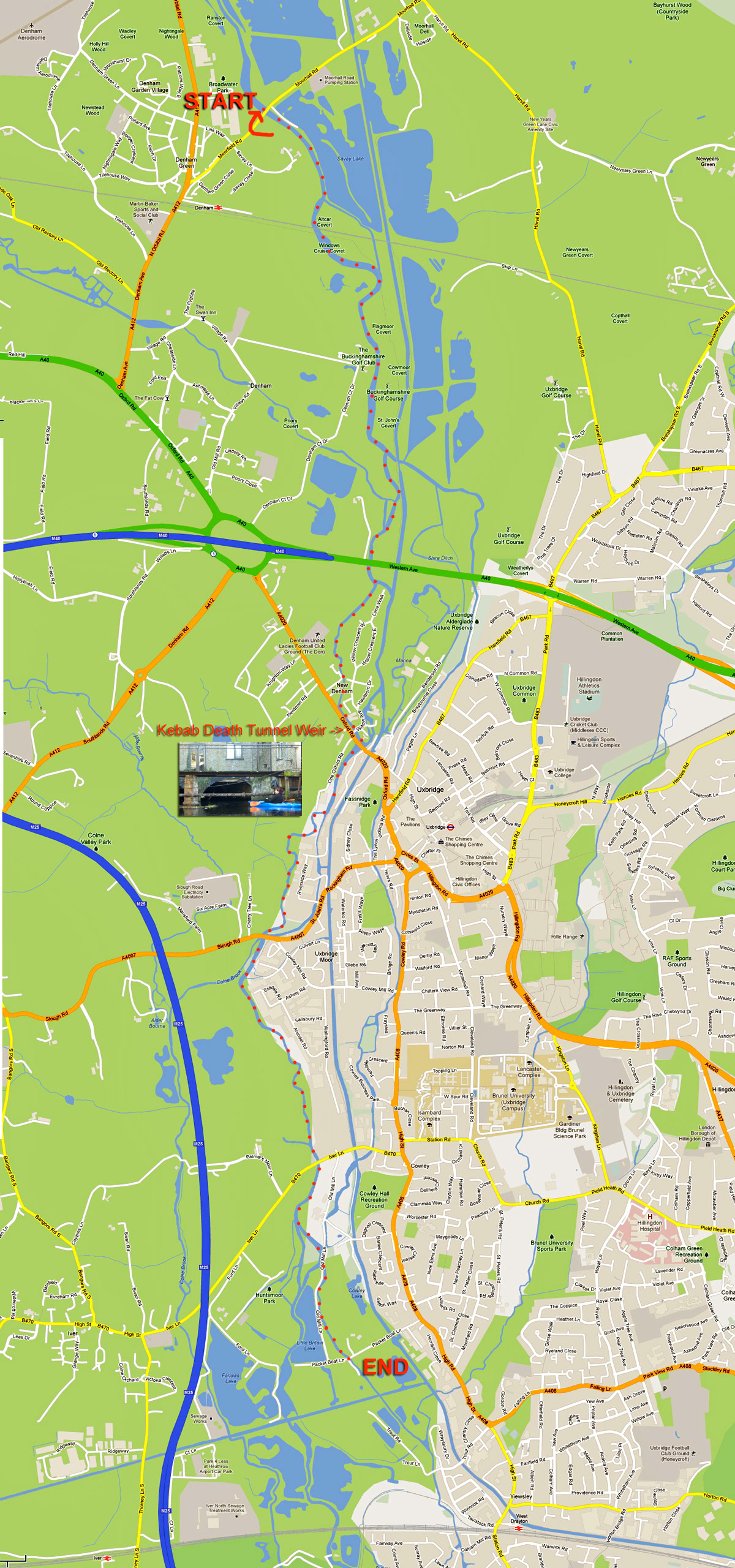
The other day a friend relatively new to yaking invited me and a mate to paddle a river near her home. The Colne runs between the edge of Greater London and the M25 motorway just a stone’s throw from Heathrow airport.
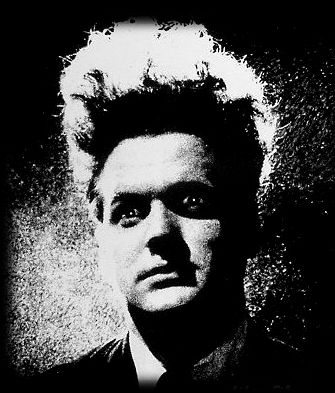
Looking at a map (far below) and more so at a sat image, it’s hard to distinguish the actual course of the Colne among the many waterways, reservoirs, overgrowths and the Grand Union canal which all fill this part of west London’s perimeter, but Lois had already recce’d a route which included half a dozen fun weirs and other challenges along the way – all up a run of around six miles. Chief among these tests was what must surely be an urban paddler’s nightmare; a weir drop inside a low tunnel that passed under a kebab shop and which we dubbed TheKebab Death Tunnel Weir (the word order is interchangeable). The thought of being spun in a dank, sunless hydraulic or jammed against a rusting grate as clammy kebab fat dripped onto your forehead from cracks in the overhead brickwork was surely the makings of a deleted scene from David Lynch’s Eraserhead.
All that was far from our thoughts as we bundled over a bridge parapet and inflated Lois’ Sunny IK which Robin was borrowing. Lois was using her newish hardshell Dagger and I was in my Yak packraft. Lois quite rightly rationalised her controversial IK betrayal by explaining that as she lived on a canal she just wanted a boat to hop into anytime (her Gumos having sprung slow leaks). I can relate to that though I wouldn’t go as far as actually buying a plastic coffin. We swooshed off under the bridge and downstream on a lovely autumn’s day, along what transpired to actually be a proper river with a kosher current, far from my expectations of a concrete lined culvert awash with urban detritus and pestilent scum. We passed under a huge arc of brickwork supporting the westbound mainline railway and soon sidled up alongside the Grand Union canal. Not that we could see it. Even the OS map gets quite confusing, marking rivers or other waterways passing across lakes and wetland reserves. But once on the river the way ahead was usually obvious.
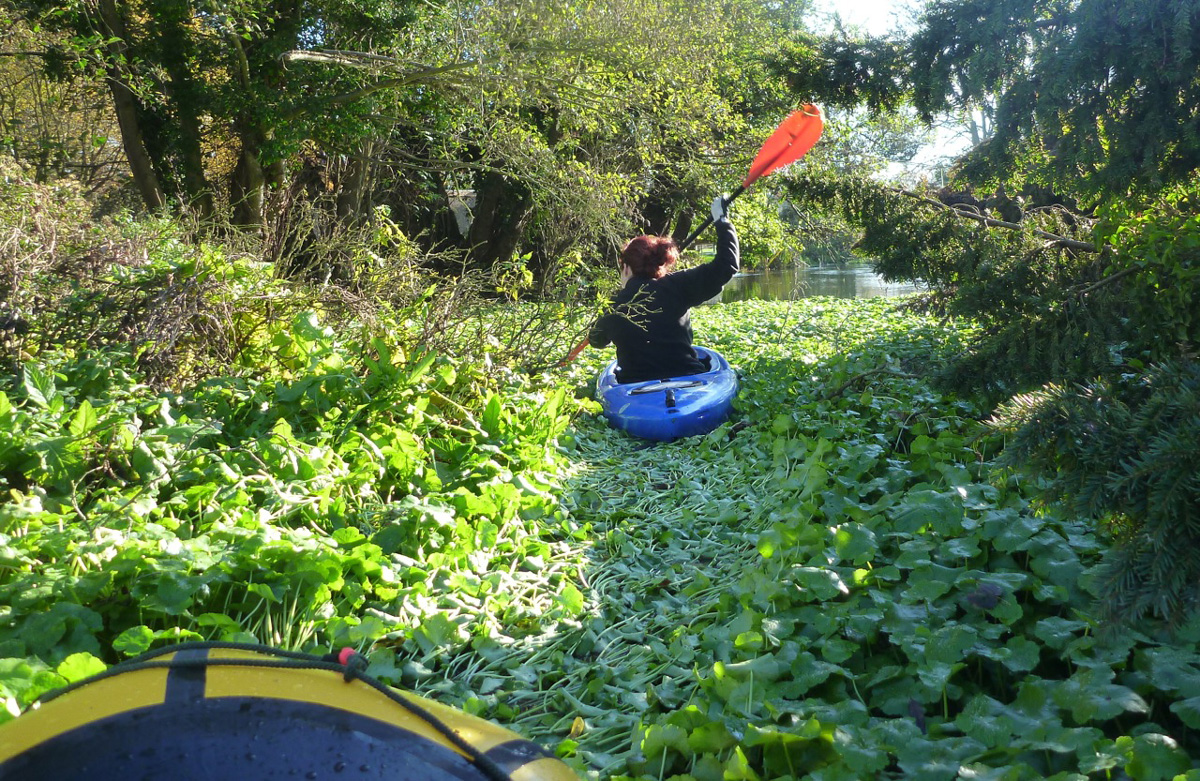
At one point what looked like thick mat of giant watercress carpeted the river bank to bank (actually pennywort, a very troublesome weed I am informed). Up ahead Lois’ Dagger ploughed into the vegetation (left) which amazingly proved to be paddleable, although with my wide, flat-hulled ‘packa I found reaching out and tugging on the floating wortrug worked best.
Soon we came to our first weir, a drop of a foot or so but where we did the right thing and hopped out to check we weren’t tipping over onto some gnarly boat spike. All clear so Lois slid over effortlessly into some shallows, then Robin beached himself inelegantly on the rim in the possibly under-inflated Solar. Knowing this, I sped the Yak up to warp speed and scrapped over with a splash.
More riverine bliss ensued with barely a crisp packet to sully our glide. Delicate foot bridges led to cosy cottages. Another double weir looked deadly from above but recce’d from below was no drama. No having yet recognised the benefits of spray skirts, Lois’ Dagger was taking a cockpitful on some of these weir drops. The Solar too scooped up some swill, but this was the first occasion where I zipped on the Alpacka’s spray skirt – mostly to keep my legs warm but also proving it did what it was supposed to.
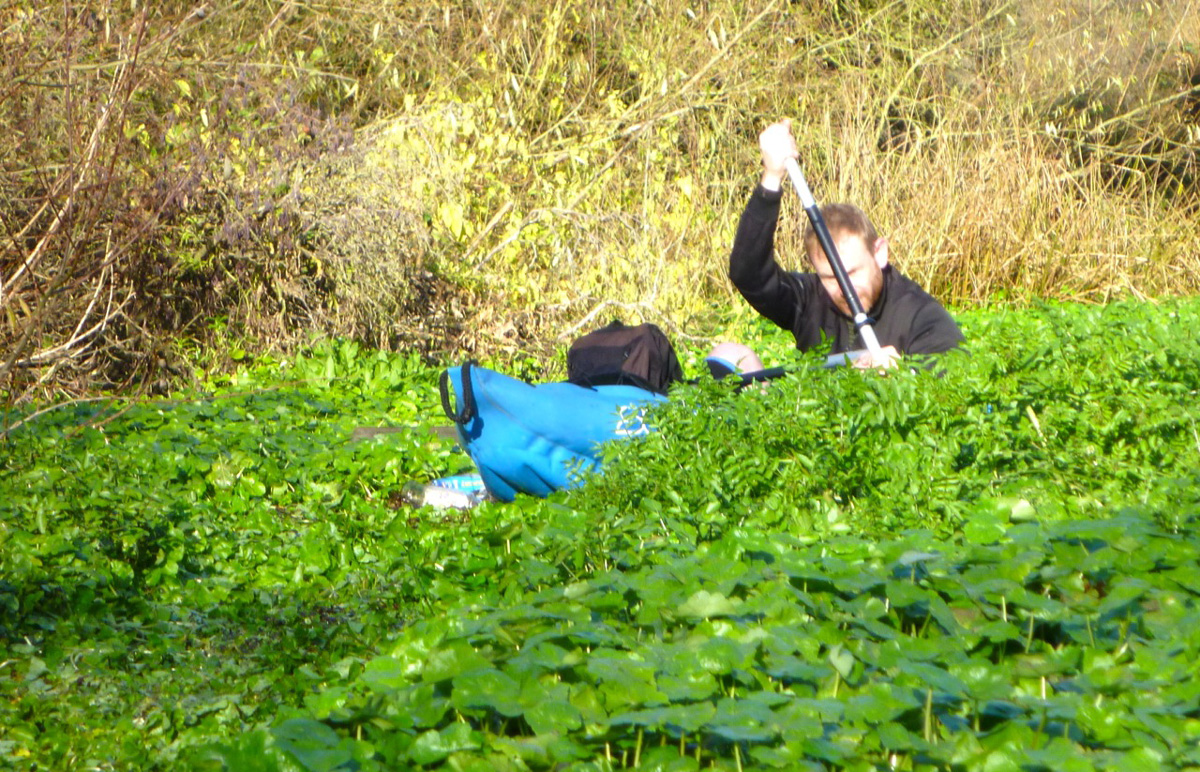
Up ahead, another clot of creswort choked the channel, but this had got thick enough to catch some crap so we hauled out stinky twigs and other rancid mush before hacking our way in. The rigid hardshell was best; my Alpacka (above) while broad was at least light, while the Gumboat put up a fight and Robin split his paddle all the better to dig his way through (right). Another weir with a drop of a couple of feet gave Lois a fresh rinse as we neared the outer London suburb of Uxbridge.
Bankside trees gave way to razor-topped railings protecting the back end of industrial units and things turned decidedly less serene as we neared the gaping twin maws of the Death Tunnel. It burrowed under a parade of shops, the pride of which was unquestionably the broad, handsome frontage of the Burger Kebab Galaxy restaurant.
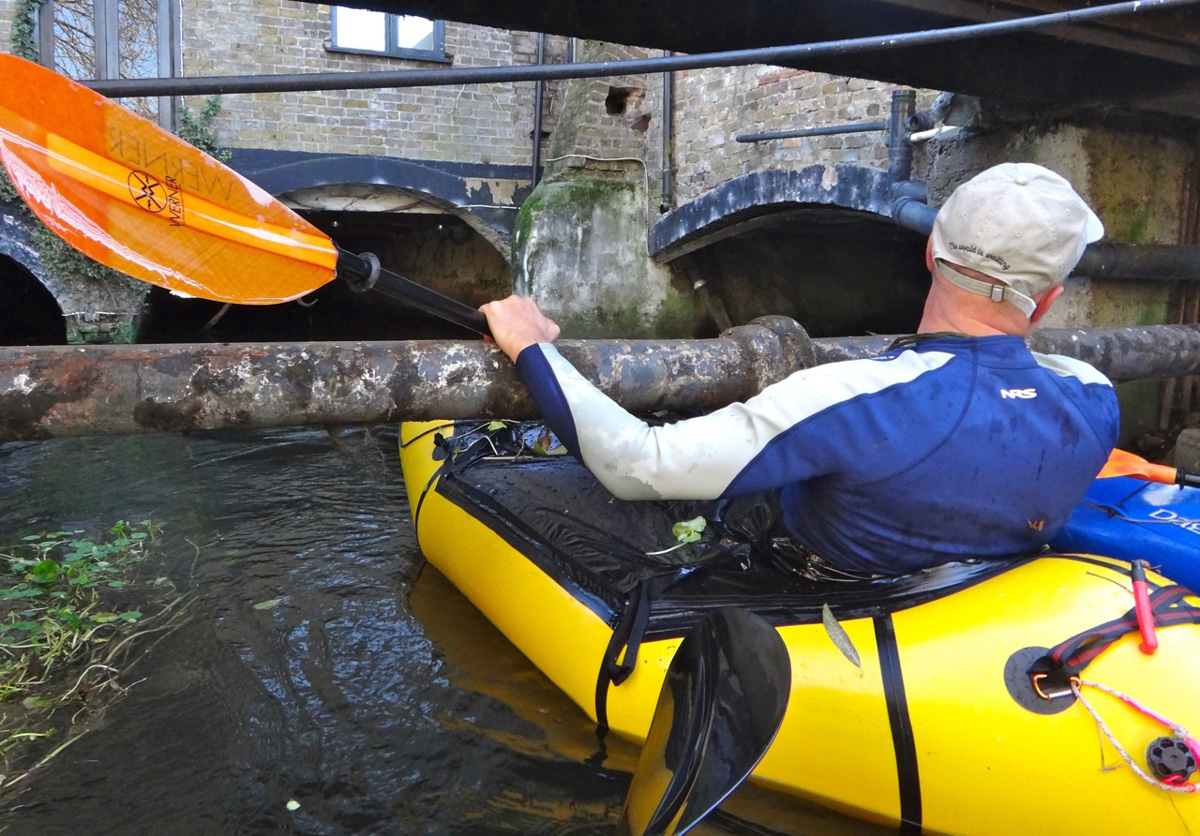
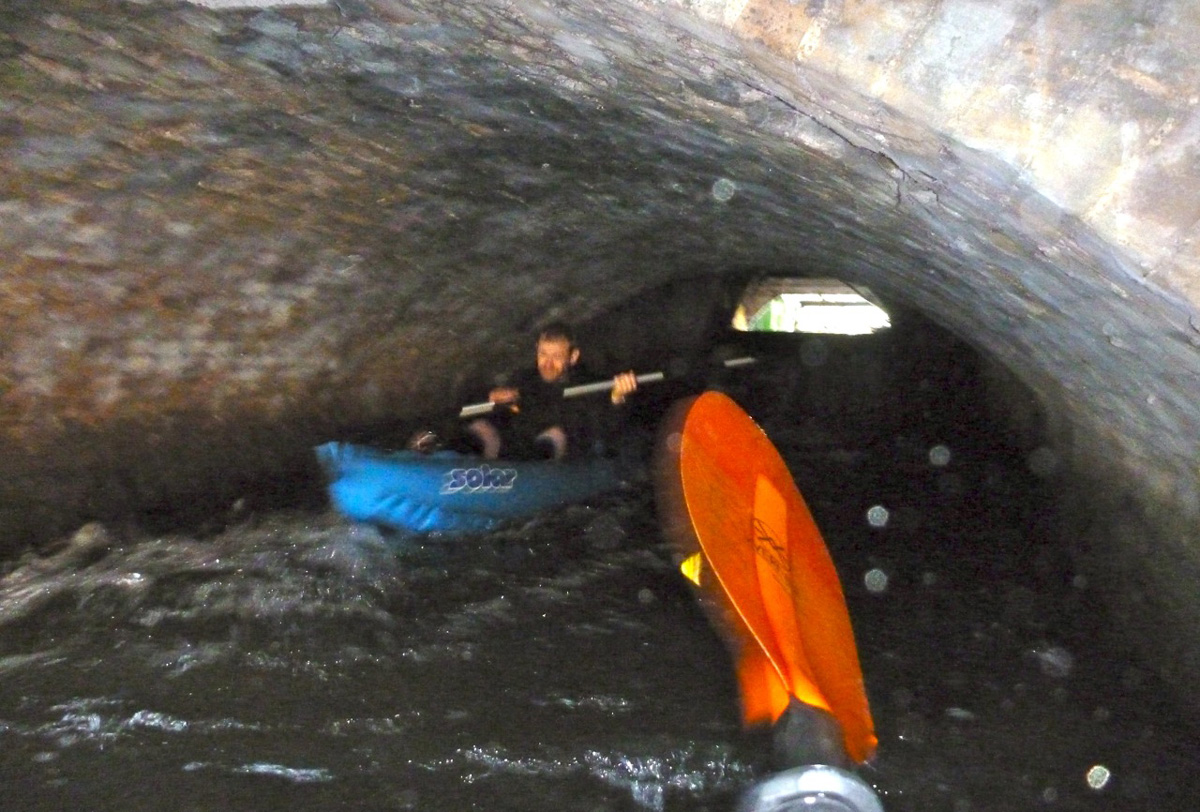
Two limbo-low bridges lead to an even lower rusty sewer pipe spanning the canal, and up ahead two arches reached into the watery gloom like a farmer’s rubber glove and where the rank stench of congealed doner fat choked the air. A chink of light marked the far end of the 70-foot tunnel (left) where the roof – strung with electrical piping, rotting rafters and mummified bats – pressed down to just a couple of feet right over the edge of the drop. Lois said last time the water was higher and they couldn’t even see the end, but they’d edged in anyway, slid over and survived.
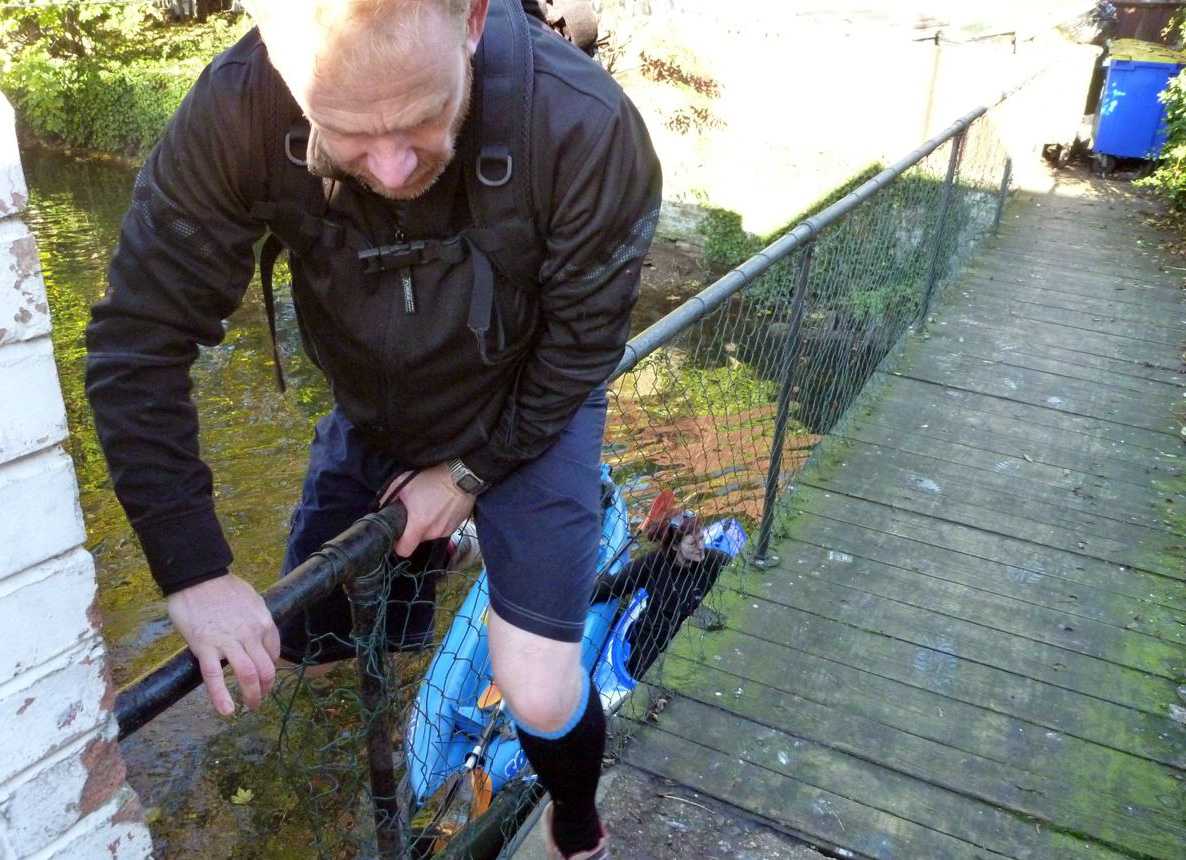
Even then, you never know when a burned-out scooter or half a tree might be poised to spoil your weir and anyway, Lois was sure this weir was higher than anything we’d done so far. So Robin and I clambered up onto the footbridge (left), walked round the far side and waded up into the tunnel as far as we could against the current. With the help of my camera’s flash I was able to get far enough in to see that the three-foot weir was actually a narrow 45° slide of about 3 feet, not a straight drop. Much less risky.
Now reassured that I wouldn’t be pitched out of the packraft to smack, face-first into to a span of festering, greasy brickwork, back at the boat I squeezed myself under the sewer pipe (right) and let the speeding current draw me in, making sure to keep well away from a broad side tunnel which led off to the right and didn’t look like it had a happy ending. I didn’t want to end up being squeezed out of someone’s kitchen tap like rubber-boned Janus Stark. In the main tunnel, the roof bore down and I stowed the paddle as I tipped down the chute, getting shoved against the right wall as I ran out towards the light like a near-death experience.
Lois came down next (faintly visible above left) and also got pushed right at the base of the chute and semi capsized.
Kebab Death Horror!
Her paddle floated down towards me but before I could grab it the eddy caught it and floated it back up towards the chute. Meanwhile, soggy arsed Lois hopped out and dragged her waterlogged Dagger into the piercing daylight. Robin came down next (left), got pushed over but kept it together. It seems the tunnel weir had set up a long, thin anti-clockwise circulant or eddy which came upstream and looped back down just below the chute and explained why we’d all got pushed into the right wall as we came off the slide.
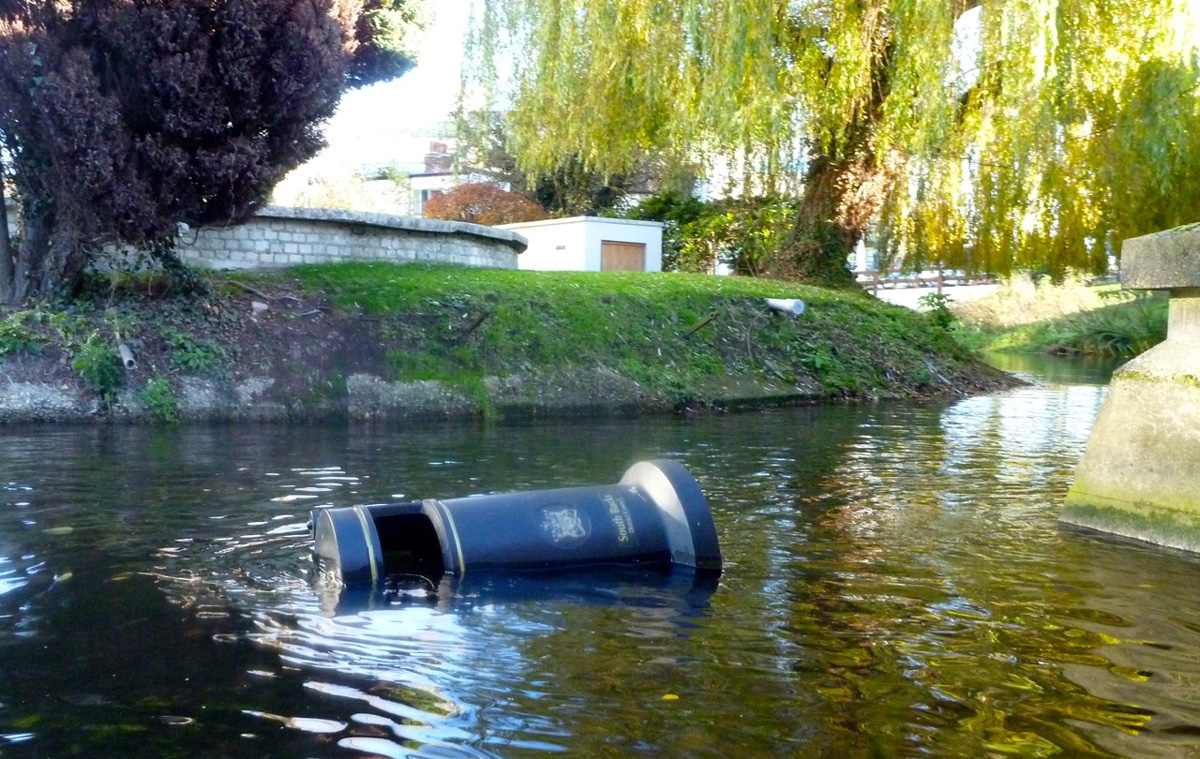
But we’d survived the KWDT and soon cruised past a striking municipal bronze statue depicting a trio of naked nymphs grappling over a giant Christmas pudding (left), a scene plucked from the otherwise unexceptional Lost Chronicles of Uxenbride discovered not far from Kebab Galaxy in 1892. And here at last! A plucky South Bucks District Council dustbin uprooted from it’s roadside vigil and flung into the Colne by some beer-crazed revellers high on nitrous oxide. Now that’s what you call urban packboating! There was more to come. What is a paddle in merry England without getting a bollocking from a vexed bankside angler. We’d seen a few upstream who’d mostly ignored us (I don’t waste greetings on anglers anymore), but as Robin and I rounded a bend following another weirlette, some grumpy git wearing rubber up to his neck let us know his feelings, concluding with: ‘You coming back?’ (demonstrating his lack of understanding about how kayaks and rivers interact). ‘No sirree‘ ‘Good!’
His mate just down the way was more civil and explained ‘there’s no navigation on this beat, it’s in the agreement…’ pointing to a sign, rather ineffectively positioned downstream that merely said Private Fishing or some such. I didn’t know the paddling status of the Colne and maybe Lois didn’t either, but a quick Google later on showed up threads on the SotP and ukrivers that indeed suggested the Colne hereabouts had been leased by a bankside golf club to Uxbridge Anglers Club, and their £80 membership fee helped entitle them to exclude paddlers on parts of the Colne. What about the Magna Carta and all that? Which parts are off-limits is hard to determine unless there is a blanket paddling ban.
We certainly saw no ‘ No Canoeing’ signs so it all left a sour taste for a while, but that’s the way paddling is in England thanks to Edward the 1st’s short-sighted bequest to his loyal noblemen (or so the story goes).
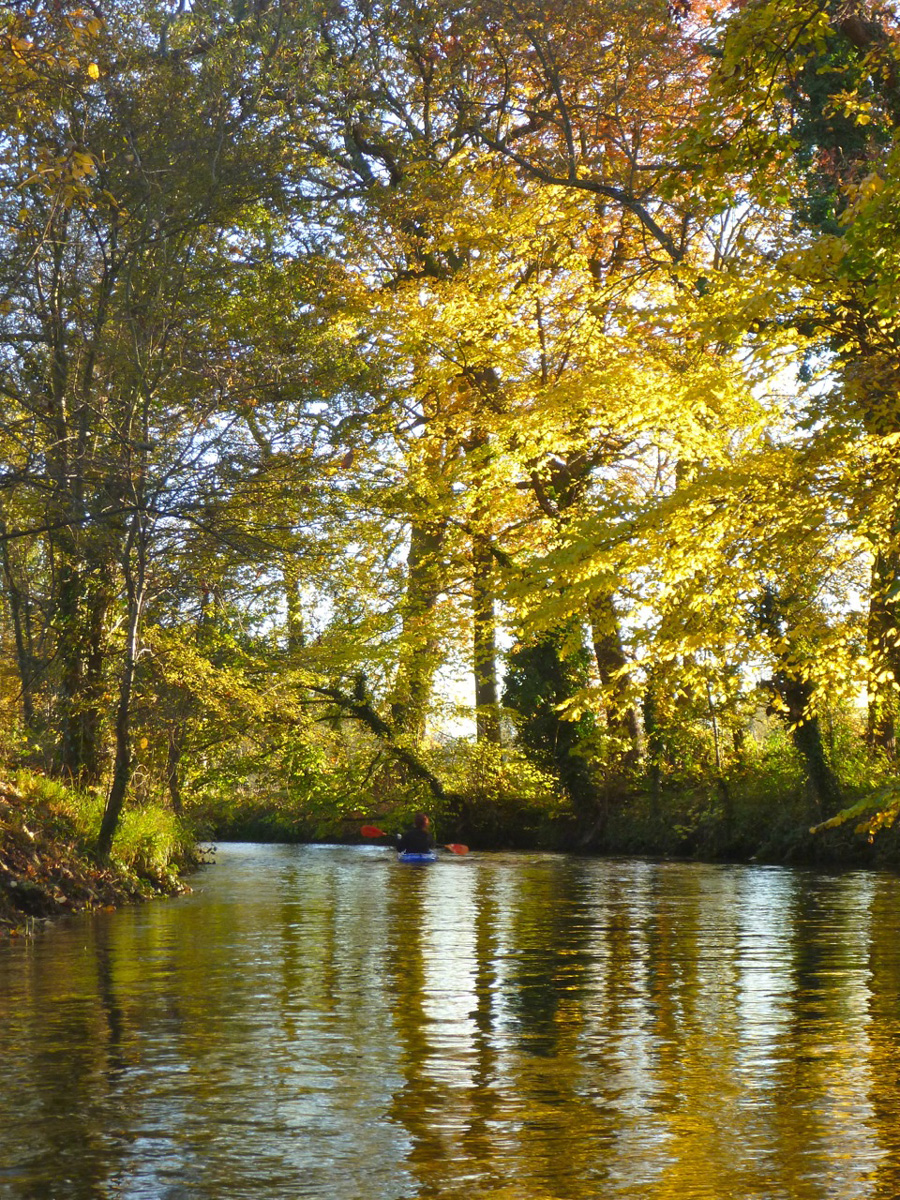
The last mile or two down to Packet Boat Lane passed without rancour as the late autumn sun seeped through the falling leaves. The current was speeding along by now and negotiating a squeeze around a fallen tree and some brambles, Robin managed to low side the unskeged Gumotex at exactly the point where Lois had tipped in on a previous occasion. Luckily he was also in shorts and hopped back in the Solar. Somewhere here there was a blockage of fallen trees and flotsam which we couldn’t paddle through and so made our only short portage. ‘Take out, rrrrrrriver left!’ yelled Lois, scarring the crows into the flight path of several 747s lowering their landing gear. Incredibly, Packet Boat Lane (near Iver) is actually a drivable ford across the Colne, rated at no less than five stars by the peer-reviewed wetroads.co.uk.
Once back at Lois’ cosy houseboat Robin couldn’t resist nipping back and having a crack at the car-swallowing ford on his well-travelled trail bike. I stood in the middle with water halfway up my thighs and filmed the action, thinking, ‘rather you than me, mate – it’s a long push back to Crawley’. Sure enough, before he got even halfway his Yamaha spluttered to a stop and we pushed it back like a couple of spotty teenagers trying out their first stolen bike. Back on the barge the throbbing woodburner and a hot bowl of soup soon thawed our chilled limbs as we tried to analyse what the heck was wrong with Robin’s moto, other than acknowledging an engine can’t run on water like a kayak can. We left Robin to it, I rolled up my Alpacka and rode back home across London. Thanks to Lois P for organising a great day out.














































































 Inflatable Kayaks & Packrafts